

Editor's Choice: Scroll below for our monthly blend of mainstream and alternative March 2026 news and views s between March 1 and March 16. See March News 2026 (Pt. 2) for news after March 16.
Note: Excerpts are from the authors' words except for subheads and occasional "Editor's notes" such as this. Nearly all excerpts are drawn from news sources for which the Justice Integrity Project pays a subscription. Readers here are encouraged also to subscribe to these outlets also to receive their full coverage and to support their work.
March 16
Top Headlines

- New York Times, Iran War Live Updates: Israel Expands Lebanon Offensive; Trump’s Oil-Route Demands Draw Cool Response, Aaron Boxerman and Yan Zhuang, March 16, 2026. The Israeli military said that it was escalating ground attacks against Iran-backed Hezbollah. China and other nations reacted tepidly to President Trump’s call for warships to reopen the Strait of Hormuz.
 The Contrarian, Opinion: Trump’s War is the Worst Conceived in American History, Jennifer Rubin, right, March 16, 2026. Ignoring experts comes at a steep price.
- Paul Krugman via Substack, Political-Economy Commentary: No, America is Not Respected, Paul Krugman, right,
 March 16, 2026. Thanks to Trump, we’re held in contempt even by our closest allies.
- New York Times, Trump’s Threat to Delay Summit With Xi Casts New Shadow Over China Relations, Ravi Mattu, March 16, 2026. President Trump warned that he could postpone a meeting set to begin in just over two weeks if China refuses to help reopen the Strait of Hormuz.
- Morning Shots via The Bulwark, Political Opinion: Trump’s Fork in the Road to Tehran, Bill Kristol, Andrew Egger and Jim Swift, March 16, 2026. He only has bad options.
U.S. Law, Crime, Justice, Rights
- New York Times, News Analysis: Justice Dept. Struggles to Take Basic Steps in Targeting Trump’s Rivals, Michael S. Schmidt and Alan Feuer, March 16, 2026. A ruling Friday that derailed an investigation into the Federal Reserve chair at an exceptionally early stage showed the limits of President Trump’s campaign of legal retribution.
- The Big Newsletter, Monopoly Round-Up: Bombshell Document Details Watergate-Style Corruption at the Antitrust Division, Matt Stoller, March 15-16, 2026. From Ticketmaster to Paramount to Hewlett Packard, the Trump administration and corporate America are involved in an orgy of corruption. Finally, we are seeing the first real investigation take place.
More On Iran War
- Letters from an American, Historical Commentary: March 15, 2026 [Checking Claims of War Victory], Heather Cox Richardson, right, March 16, 2026.
 Today, as the country enters its third week of war against Iran, President Donald J. Trump was on the golf course, illustrating the observation of journalist E.J. Dionne in the New York Times that “from the very beginning of this war, we got a sense that there wasn’t a great deal of serious thought put into it by the president of the United States about how it might end, what our objectives were, what needed to be done to protect Americans who are in the Middle East, what might happen to oil in the Strait of Hormuz.”
- Morning Shots via The Bulwark, Political Opinion: It’s Worse Than It Looks, William Kristol, March 16, 2026. On Bulwark on Sunday yesterday, my guest, the historian Robert Kagan, explained the broad implications of the Iran war as well as anyone I’ve seen. I thought his remarks were helpful and important enough that I’m going to devote this space to some of his key points.
News Roundup
- The Parnas Perspective, News and Commentary: Criminal Referral Sent for Kristi Noem as Trump Lashes Out at Critics, Calls for Treason Charges Against Media Companies, and Allies Ignore His Demands, Aaron Parnas, right,
 March 16, 2026. We've got a lot of news to cover this Monday morning from a criminal referral sent to the Department of Justice for Department of Homeland Security Secretary Kristi Noem. Here's what Scott McFarlane, who is a great journalist, just put out this morning. Also, Donald Trump spent time lashing out at media companies calling for their arrest for treason.
More Global News
- Popular Information, Accountability Journalism: Kushner breaks pledge, seeks $5 billion more from foreign governments, Judd Legum, right,
 March 16, 2026. After Donald Trump won the presidency in 2024, Jared Kushner, his son-in-law, dismissed concerns that his private equity firm would be a vehicle to buy foreign influence.
- Roll Call, Senate Democrats seek to prevent military action against Cuba, Rebecca Kheel, March 16, 2026, Measure is latest effort from Senate Democrats to constrain Trump’s military interventions.
- New York Times, Opinion: Go-Go Dubai Was Not Built for War, Richard Florida (author of “The Rise of the Creative Class” and “The New Urban Crisis”), March 16, 2026. A video was circulating on social media last week, of what appeared to be an Iranian Shahed drone flying over the al-Mamzar beach in Dubai on March 8. A fighter jet was in hot pursuit, trying to shoot the drone down. Down below, people were sunbathing under umbrellas.
U.S. Elections, Politics, Governance

Graphic by the Lincoln Project of Imagined Trump Rally.
- Hopium Chronicles, Political Advocacy: This Trump Thing Has Failed, Utterly, Simon Rosenberg,
 right, March 16, 2026. Pro-Democracy Forces Must Fight Now For An Urgent, Dramatic Course Correction. This morning we wake to Trump’s America, and what has now become an ongoing, global humiliation of our once great country. We cannot, and should not, sugar coat the gravity of what Trump has done. He’s thrown the entire world into chaos. Energy, food, and price shocks are coming for literally every person in the world. This morning governments from all over the world are telling him to f*ck off, leaving America alone, weakened, humiliated.
- Decision Desk HQ, 5 races to watch in Illinois,
 Geoffrey Skelley, March 16, 2026. Democrats have high-stakes primaries in solidly blue seats, highlighted by the party's Senate primary to succeed retiring Sen. Dick Durbin.
Trump Health Care Decision-Making
- New York Times, Judge Strikes Down Kennedy’s Vaccine Policies, Apoorva Mandavilli, March 16, 2026. Ruling on a lawsuit brought by several prominent medical organizations, a district court said the federal government had not based its decisions on science in limiting Covid shots and revising the childhood immunization schedule.
- New York Times, U.S. Considers Withholding H.I.V. Aid Unless Zambia Expands Minerals Access, Stephanie Nolen, March 16, 2026. A draft State Department memo outlines ways the Trump administration may ratchet up pressure on the African country by ending health support “on a massive scale.”
- New York Times, In Tense Meeting, Mehmet Oz Pressed Medical Societies on Trans Care for Teens, Jeremy W. Peters, March 16, 2026. Most groups defended their support for medical intervention. But the Society for Plastic Surgeons broke with the consensus.
Media, Entertainment, Education

- Morning Shots via The Bulwark, Political Opinion: Carr Wreck, Andrew Egger, March 16, 2026. The Federal Communications Commission is a relatively obscure federal agency, so its chairman, Brendan Carr, tends to get into the news only when he starts threatening to revoke broadcast licenses over speech he dislikes. Unfortunately, he’s back in the news.
- New York Times, The Oscars 2026 Winners: The Complete List, Shivani Gonzalez, March 16, 2026 (print ed.). The winning actors, directors, pictures and more at the 98th annual Academy Awards.
- New York Times, Kennedy Center Board Votes to Close for 2-Year Renovation Project, Julia Jacobs, March 16, 2026. Ahead of the vote, President Trump criticized the center’s physical condition and previous financial management.
- New York Times, ICE Releases Columbia Protester Who Was Held For 1 Year, Maria Cramer, March 16, 2026. A New Jersey woman who took part in pro-Palestinian demonstrations at Columbia University in 2024 has been released from a federal detention center in Texas, where she had been held for more than a year.
- Plowshares, An open letter to Secretary Hegseth, Jordan Schneider, March 15, 2026. Instead of fighting over a 21-mile-wide bottleneck forever, we cut a new channel through friendly territory. A dozen thermonuclear detonations and you’ve got a waterway wider than the Panama Canal, deeper than the Suez, and safe from Iranian attacks....The views expressed above do not necessarily represent those of anyone with brain cells.
- New York Times, One of Epstein’s Levers of Power: Access to Elite Private Schools, Jan Ransom, March 16, 2026. Jeffrey Epstein used his money and influence in the world of elite private schools to assist friends and acquaintances.
- The Honest Editor via Substack, Commentary: The myths of London Book Fair, Phoebe Morgan, March 14, 2026. An honest look at the reality behind the noise!
Top Stories
 New York Times, Iran War Live Updates: Israel Expands Lebanon Offensive; Trump’s Oil-Route Demands Draw Cool Response, Aaron Boxerman and Yan Zhuang, March 16, 2026. The Israeli military said that it was escalating ground attacks against Iran-backed Hezbollah. China and other nations reacted tepidly to President Trump’s call for warships to reopen the Strait of Hormuz.
Here is the latest.
The Israeli military said on Monday that it was expanding its ground assault in southern Lebanon against the Iran-backed armed group Hezbollah, as countries responded cautiously, if at all, to President Trump’s demand that they send warships to break the de facto Iranian blockade of the Strait of Hormuz.
The American-Israeli air war against Iran, now in its third week, has drawn in much of the Middle East and killed over 2,000 people, mostly in Iran and Lebanon. Global energy prices have skyrocketed with tanker traffic all but stopped through the Strait of Hormuz, a conduit for around a fifth of the world’s oil shipments. The price of Brent crude, the global benchmark for oil, briefly reached $106 on Monday.
And there are few signs that the conflict is easing. Israeli forces announced that they were widening their ground attacks in southern Lebanon, adding to fears that they could soon launch a more sweeping invasion. Israeli leaders have rebuffed Lebanese and French initiatives to negotiate a de-escalation of the conflict, which began when Hezbollah fighters fired rockets at Israel in solidarity with Iran.
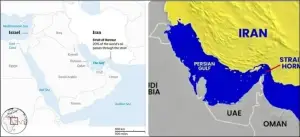 As Iran on Monday repeated its threat not to let ships from “hostile” nations through the Strait of Hormuz, concerns are growing about the global economic fallout. Mr. Trump’s latest attempt to reopen the strait — calling on other countries, including China, to send warships there — did not immediately yield any commitments to do so.
Officials in Japan and Australia said that they did not plan to send ships. Britain, France, the European Union and South Korea were noncommittal.
 Iran is allowing ships carrying oil to China to cross the strait, but other oil tankers have been attacked by projectiles. Mr. Trump threatened to postpone a planned summit in Beijing with Xi Jinping, China’s leader, if it did not comply.
Mr. Trump said NATO member nations should help too. “If there’s no response or if it’s a negative response, I think it will be very bad for the future of NATO,” he told The Financial Times on Sunday.
Here’s what else we are covering:
- Israel strikes Iran: The Israeli military said on Monday it had launched a “broad wave” of attacks across Iran. Earlier, airstrikes again targeted the Mehrabad airport in Tehran, and a thick plume of smoke was rising from the airport, according to several residents of Tehran.
- Iranian response: Iran’s foreign minister, Abbas Araghchi, told CBS News on Sunday that the country was “ready to defend ourselves as long as it takes” and denied Mr. Trump’s claim a day earlier that Iran wanted to make a deal. “We never asked for a cease-fire, and we have never asked even for negotiation,” he said.
- Dubai airport: The authorities in the United Arab Emirates said they had responded to a fire from “a drone-related incident” near Dubai International Airport on Monday that caused damage to a fuel tank and forced the temporary closure of the airport. The airport is normally among the world’s busiest, but it has contended with multiple drone attacks in recent weeks that have curtailed flights.
- Death toll: At least 1,348 civilians in Iran have been killed since the start of the war, Iran’s U.N. representative told the Security Council on Wednesday, the latest figure the country has provided. In Lebanon, officials said that 850 people had been killed. And in Israel at least 12 people have been killed, according to the authorities. The Pentagon has said that 13 American service members have died since the start of the war.
 The Contrarian, Opinion: Trump’s War is the Worst Conceived in American History, Jennifer Rubin, right, March 16, 2026. Ignoring experts comes at a steep price.
 General Dan Caine, left, the chairman of the Joint Chiefs of Staff, warned Donald Trump that an attack on Iran would provoke its closure of the Strait of Hormuz.
Every president contemplating war in the Middle East has known this and therefore avoided a full regional war. But Trump said he knew better and plunged into war. Of course, Trump was wrong — monumentally, predictably, and inexcusably wrong. Now, the Strait is mined and closed, the war rages out of control, oil prices have spiked, and the economy is teetering.
This catastrophic blunder stems from Trump’s delusion that a forty-seven-year-old Islamic regime insulated by layers of bureaucracy, an enormous military, an entrenched ideology, and a fervent national identity could be bombed out of existence. He convinced himself and his cult that — without adverse consequences — he could replace the mullahs with a friendlier regime (who, exactly, he never said). This madness, enabled by the phalanx of yes-men afraid to tell Trump he is wrong (even about their shoe size), was not unique to Trump.
Israel’s Prime Minister Benjamin Netanyahu, another regime change fabulist, frequently insisted, as he did at the war’s start, that full-scale war would “create the conditions for the brave Iranian people to take their destiny into their own hands.”
 Netanyahu is now back-pedaling furiously. “I can’t tell you with certainty that the Iranian people will bring down the regime,” Netanyahu said at his first wartime press conference last week. “If it doesn’t fall, it will be much weaker.” Oh, now he tells us.
The realization that regime change is a pipe dream, which U.S. presidents have learned repeatedly, has swamped Trump’s megalomania and Netanyahu’s dream of “forever” removing an Iranian threat. (The latter requires forever war.) By Friday, even Trump figured out that toppling the regime is a “very big hurdle.” He sounds as if he just discovered his goal’s impossibility: “Who’s going to do that? They literally have people in the streets with machine guns, machine gunning people down if they want to protest.” What did he think would happen?
On the American side, sane voices consistently have derided labeled regime change as a fantasy. The U.S. intelligence community reiterated its view that the Iranian government “is not at risk of collapse,” Reuters reported. It turns out that Trump’s “feeling” he could pull it off was baseless, perhaps a function of untreated malignant narcissism.Subscribed
The reasons other presidents avoided war against Iran — economic cost to the U.S., bombardment of our Gulf allies, closure of the Strait of Hormuz and soaring oil prices, high civilian casualties, a vengeful regime still in place but more determined to pursue a nuclear weapon, and Russia’s economic bonanza — all have surprised Trump and his regime of lickspittles. “When past presidents balked at the possibility of war with Iran, they weren’t just dodging a hard choice; they were deterred by all of the obvious reasons a conflict could perilously spiral,” Franklin Foer wrote recently. “Nobody should be shocked that the expected is now coming to pass.” Except the least competent president ever.
The annals of regime change are not littered with success stories. Wherever attempted (e.g. Iraq, Afghanistan, Libya), it begat endless, bloody war and an inconclusive outcome, at best. While we may wish for a better Iran regime, Phil Gordon at Brookings wrote early in the war: “By thinking he can defy deep historical lessons from the region, and by launching a war with no congressional mandate or significant public support, Mr Trump is taking a massive and unnecessary gamble—not just with his presidency but with the lives of countless Americans, Iranians and others.” He is losing his gamble, with others to pay the price.
Atrocious economic news (“Fourth-quarter GDP revised down to just 0.7% growth; January core inflation was 3.1%”) makes the added economic pain that much harder to tolerate. Moreover, in past wars, the U.S. has restrained Israel; in this war, Netanyahu and Trump have egged each other on with no plan for when to stop or evident consideration of what happens afterward.
The war reminds us that the current right-wing Israeli government and the U.S. do not have identical interests, although Netanyahu and Trump personally are two peas in the autocrat pod (e.g., corrupt, contemptuous of the press, law, and public opinion; antagonistic toward democracy). Netanyahu, in search of his white whale of regime change/redemption for the October 7 catastrophe, might be content with perpetual war. The U.S. public and sane bipartisan foreign policy voices have limited appetite for casualties, soaring oil prices, and long-term strain on our other alliances. Israel’s right-wing government may want to turn Iran into a failed state. From the U.S. perspective, a failed state of 90M people will likely become a hotbed of terrorism, a source of mass migration and violence, a spur to regional instability, and an elevated risk of nuclear proliferation.
The two powers now differ even on targeting. Yousef Munayyer wrote for The Guardian: “Israel struck oil facilities in Tehran that led to apocalyptic scenes in the Iranian capital, heightened Iran’s resolve to target oil infrastructure in neighboring US allies, sent shockwaves into the oil market that puts the greatest pressure on Trump and poisoned the environment in a city of 10 million people.” (Of course, the Gaza War already demonstrated the countries’ divergent interests: Netanyahu’s one-state fantasy to completely subjugate the Palestinians without regard for civilians’ well-being is both unattainable and, to most Americans, reprehensible.)
Polls, oil prices, and/or casualties may force Trump to find an off-ramp. But after the fighting, the region will be more volatile, the human cost breathtaking, and the need for an agreement to contain Iran’s nuclear program that much more essential. To both allies and foes, the U.S. will appear unreliable and disingenuous.
This war may be an even greater strategic disaster than the Iraq War. “[I]t is really incredible malpractice that they have launched this war, created the set of circumstances in the region that has long-term economic and strategic consequences without fully thinking through the potential outcomes,” Brookings Institution’s Suzanne Maloney observed.
Democrats need a different Middle East vision, one grounded in four principles:
1.) The U.S. does not unconditionally arm Israel or approve every Israeli action (as is true with all allies);
2.) The U.S, needs regional stability, which requires containing Iran, preventing more failed states, and protecting Israel’s legitimate security needs but restraining its regional aggression and working toward resolving the Palestinian crisis;
3.) A robust clean energy policy must weaken dependence on fossil fuel (while a net energy exporter, the U.S. is in a global oil market); and
4.) Wars (whether labeled “excursions” or without the malapropism, “incursions”) must be a last resort, never undertaken without public and congressional support.
In sum, only public pressure will force Trump to end his war. Going forward, policymakers should remember Trump’s blunders and do the opposite. Finally, voters must remember that regardless of what they say, Republicans cannot resist a Middle East war and invariably underestimate its cost in blood and treasure.
Paul Krugman via Substack, Political-Economy Commentary: No, America is Not Respected, Paul Krugman, right, March 16, 2026. Thanks to Trump, we’re held in contempt even by our closest allies.
There’s a real Baghdad Bob feel to pronouncements from the Trump administration these days. The war is going great! We’ve been totally victorious! Also, other countries — including China! — must immediately send ships to escort oil tankers through the Strait of Hormuz, which the U.S. Navy isn’t doing because it’s too dangerous.
But this has been the pattern ever since Trump returned to power. Despite repeated failures to deliver on his campaign promises — remember how he was going to cut energy prices in half? — he and his minions have continually insisted that everything is wonderful, that everything they do is a triumphant success story. And he’s still doing it. On Thursday he told a rally that:
"Inflation is plummeting, incomes are rising, the economy is roaring back and America is respected again."
As I and others have documented ad nauseam, none of those economic assertions are true. Today, however, I want to focus on the bolded claim. Trump constantly insists, in speeches and social media posts, that he took over a weak, despised nation and restored its international reputation. This is clearly something that matters a lot to him and his sense of self-worth.
It’s also the total opposite of the truth.
A stunning poll from Politico — just released, but taken last month — confirms what I and other observers strongly suspected: America is now widely despised, despised like nobody has ever been despised before.
I don’t mean that we’re disliked, although that too. But this isn’t a case of oderint dum metuant — let them hate so long as they fear. Instead, the world increasingly holds America in contempt.
Our former friends no longer consider us trustworthy: A graph of a company AI-generated content may be incorrect.
And they no longer believe that being a U.S. ally offers protection, that a good relationship with America will deter potential enemies from attacking them: A graph with different colored arrows AI-generated content may be incorrect.
At this point, a plurality of the population in every one of our erstwhile allies considers China a more reliable partner than the United States: A graph of a person AI-generated content may be incorrect.
And outside the United States, China, not America, is widely perceived as the great power of the future.
If this is world respect, what would world contempt look like?
Why has America’s global reputation fallen so far, so fast? It’s not a mystery.
After all, why would anyone consider America a trustworthy ally when Trump keeps insulting our neighbor and former closest ally, Canada, by insisting that it must become the 51st state and repeatedly calling its Prime Minister “governor”? Why trust us when Trump tried to bully NATO member Denmark into handing over Greenland?
Beyond that, Trump’s tariffs aren’t just economically damaging. They aren’t just, as the Supreme Court finally ruled, illegal under our own laws. They are also in clear, overwhelming violation of international trade agreements solemnly signed by previous presidents. Given the way the current administration has casually ignored those agreements, why would anyone expect America to honor any future deals?
Last but not least, I don’t think Trump and company have any idea how much their betrayal of Ukraine has weakened America.
I mean, here we have a nation fighting and dying to defend democracy against a brutal dictatorship that the U.S. has long considered an adversary. Yet Trump has rewarded Ukrainian courage by completely cutting off aid:
Trump has also repeatedly belittled Volodymyr Zelenskyy while praising Vladimir Putin, and made it increasingly clear that he wants Putin to win. In a way, America’s reputation has been further diminished by the fact that Trump isn’t getting his wish, because Ukraine keeps refusing to be defeated. So Trump can’t even do betrayal right.
What’s especially depressing about that Politico poll is that it was taken a month ago. That is, it reflects international attitudes before the debacle in Iran.
As everyone other than the most slavish Trump acolytes realizes, the war is going badly. The U.S. has spent billions of dollars bombing a third-rate power, badly depleting our stockpiles of sophisticated munitions, yet the regime survives and remains able to blockade a fifth of the world’s oil supply.
The Trump administration’s incompetence at war planning has been revelatory, in the worst way. The U.S. military’s lack of preparedness has also been shocking. Everyone following the Russia/Ukraine conflict, with its drone-infested battlespace, has been wondering whether American forces are ready for this new kind of war. Now we know that they aren’t. In a hair-raising article, the military historian and expert Phillips O’Brien says that this is a sign of rot in the U.S. military. I wish I were sure that he is wrong.
Now, Ukraine has learned the hard way how to fight this kind of war — and it moved quickly to help the United States and its allies in the region make use of its drone-fighting technology, despite Trump’s betrayals. Meanwhile Russia is aiding Iran. But Trump is still demeaning and insulting Zelenskyy while praising Putin.
The general public may not be aware that Trump’s America offers no reward to nations that come to its aid and does nothing to punish nations that aid its adversaries. But I guarantee that every leader in the world — very much including the leaders of nations Trump is now begging for help in the Strait of Hormuz — has taken notice and will treat the United States accordingly.
In short, Trump’s actions have drastically reduced the world’s respect for the United States. Yet Trump and his officials keep asserting that they have, well, made America great again. Why?
I don’t think it’s mainly about persuading the public. It is, instead, a desperate attempt to persuade themselves. For Trump, life is all about dominance displays; his sense of self-worth depends on believing that he’s cowing the world into submission. Others in his administration have more specific motivations. Pete Hegseth has built his brand around the notion that “warrior ethos” and “lethality” are what make a nation strong. Admitting that being smart and having allies are more important than macho posturing would be an implicit concession that he’s been wrong about everything.
The truth is that America used to be respected, not simply because we were a superpower, but because we were a different kind of superpower — a nation that stood by its allies, that mostly obeyed the rules of the system we created, that possessed an army that was professional, smart and incorruptible. Now Trump has thrown all that away. And I don’t know how or when we can ever get it back.
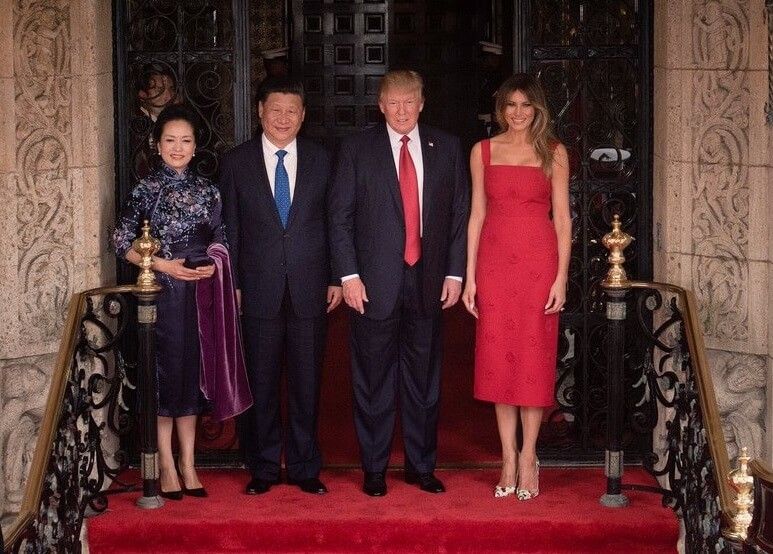
President Trump with China's President Xi Jinping and their wives in April 2017.
New York Times, Trump’s Threat to Delay Summit With Xi Casts New Shadow Over China Relations, Ravi Mattu, March 16, 2026. President Trump warned that he could postpone a meeting set to begin in just over two weeks if China refuses to help reopen the Strait of Hormuz.
President Trump threatened to postpone a long-planned summit with Chinese leader Xi Jinping as he called on China to send warships to help reopen the Strait of Hormuz, casting a new shadow over the relationship between the world’s two biggest economies.
Mr. Trump told the Financial Times on Sunday that he “may delay” the meeting, which is expected to start on March 31 in Beijing, if China does not answer his demand to help reopen the strait to shipping in the next two weeks. Mr. Trump said that waiting until the summit for an answer may be too long.
“We’d like to know before that,” he said.
China is one of several countries that have responded cautiously to Mr. Trump’s demands for naval assistance to thwart Iran’s efforts to block the strait, which is a transit route for about a fifth of the world’s oil. China, the biggest buyer of Iranian oil, has not responded directly to Mr. Trump’s remarks but has previously called for the cessation of hostilities.
A spokesman for China’s foreign ministry said on Monday that officials from both countries were discussing plans for the summit, and stressed that direct discussions between the leaders were essential.
“Head-of-state diplomacy plays an irreplaceable, strategic guiding role in China-U.S. relations,” Lin Jian, the spokesman, told reporters at a daily briefing in Beijing.
In Paris, Treasury Secretary Scott Bessent was holding a second day of talks with He Lifeng, his Chinese counterpart, to finalize preparations for the meeting. They were scheduled to speak to reporters on Monday afternoon local time.
Mr. Xi invited Mr. Trump to visit Beijing when the leaders met in Busan, South Korea last October.
Since the start of the war in the Middle East late last month, the price of oil has soared above $100 a barrel. Israel has targeted Iranian oil facilities and the United States has hit military sites on Kharg Island, where about 90 percent of Iran’s oil exports are processed. Iran has retaliated by effectively closing the Strait of Hormuz and launching missile and drone strikes against the oil infrastructure of U.S. allies in the Persian Gulf.
Mr. Trump has previously said that the United States and Israel did not require help from other countries to conduct their military campaign against Iran. But in recent days, he has criticized European and Asian allies for not participating in the attacks.
 Morning Shots via The Bulwark, Political Opinion: Trump’s Fork in the Road to Tehran, Bill Kristol, Andrew Egger and Jim Swift, March 16, 2026. He only has bad options.
 Leading the New York Times this morning: Israel is stepping up its ground attacks against the Iranian proxy Hezbollah in Lebanon, while other nations appear to be shrugging at Trump’s demand that they send warships to reopen the Strait of Hormuz. All perfectly standard procedure for a war that, as the White House keeps telling us, will be ending any minute now. Happy Monday.
U.S. Law, Crime, Justice, Rights
New York Times, News Analysis: Justice Dept. Struggles to Take Basic Steps in Targeting Trump’s Rivals, Michael S. Schmidt and Alan Feuer, March 16, 2026. A ruling Friday that derailed an investigation into the Federal Reserve chair at an exceptionally early stage showed the limits of President Trump’s campaign of legal retribution.
A judge has thrown out two of their most high-profile indictments.
Grand juries have repeatedly refused to charge those they are targeting.
And now, in the wake of a lacerating ruling by a federal judge derailing an inquiry into the Federal Reserve chair, Jerome H. Powell, officials at the Justice Department have encountered an even more profound problem: Prosecutors are floundering in the most basic steps of criminal investigations into those President Trump wants scrutinized.
The latest setback in the president’s retribution campaign came on Friday when Judge James E. Boasberg of Federal District Court in Washington quashed grand jury subpoenas to the central bank for information about the renovations underway at its headquarters and Mr. Powell’s testimony to Congress about them.
The U.S. attorney overseeing the case, Mr. Trump’s longtime friend and ally Jeanine Pirro, has vowed to appeal the decision and cast Judge Boasberg, who has clashed with the Trump administration, as an activist. And an appeals court could ultimately overturn the decision.
Still, Judge Boasberg’s ruling was an extraordinary example of pushback by the judicial branch, cutting short the investigative process at an exceptionally early stage, when prosecutors are essentially doing the most basic work of federal law enforcement.
Last fall, after Mr. Trump demanded his political appointees ratchet up his retribution campaign, the Justice Department ran into roadblocks once a judge tossed out indictments against the former F.B.I. director, James B. Comey, and the New York attorney general, Letitia James. The prosecutor who brought the charges, the judge declared, had been appointed illegally.
Instead, the judge surmised, the real reason the subpoenas were issued was political: because Mr. Trump wanted to strong-arm Mr. Powell into lowering interest rates.
“The subpoenas’ dominant (if not sole) purpose is to harass and pressure Powell either to yield to the president,” Judge Boasberg wrote, “or to resign and make way for a Fed chair who will.”
Judge Boasberg explicitly acknowledged the reality of Mr. Trump’s revenge campaign, writing that the president had urged the Justice Department to investigate his adversaries and adding that the department’s prosecutors had listened. In and of itself, it was an extraordinary acknowledgment. Citing a Supreme Court case, he wrote that “judges ‘are not required to exhibit a naïveté from which ordinary citizens are free.’”
The Federal Reserve subpoenas were not the only ones associated with Mr. Trump’s revenge campaign to have been dealt a blow last week. A New York judge, Lorna G. Schofield, refused to pause her own order blocking Justice Department subpoenas related to an attempted civil rights investigation into the New York attorney general, Ms. James. Judge Schofield said that the U.S. attorney who sent the subpoenas, John A. Sarcone III of the Northern District of New York, had remained in his position unlawfully, invalidating the inquiry into Ms. James.
When Mr. Trump began his second term, he was determined to use his expansive powers over the department to go after his rivals, subjecting them to the same legal ordeal that he believed he had unfairly undergone when he was out of office.
He wanted indictments, trials, guilty verdicts and ultimately jail for his enemies.
But the cases he has demanded in recent months have become so far removed from justifiable prosecution that even the loyalists he has installed have found it difficult to push them through a judicial system that does not appear to have hesitated to push back.
As remarkable as Judge Boasberg’s ruling was, it reflected a broader trend of judges across the country who increasingly doubt the word of lawyers for the Justice Department. Those lawyers have traditionally enjoyed a solid bond of trust with courts known in legal parlance as the presumption of regularity.
Then, in February, a grand jury in Washington refused to indict six Democratic lawmakers whom Mr. Trump wanted prosecuted for sedition after they released a video reminding military and intelligence personnel of their obligation not to obey illegal orders.
But Judge Boasberg’s block on the subpoenas against the Federal Reserve was in some ways an even sharper rebuke, stopping prosecutors in their tracks at the fact-gathering stage of their investigation after determining that it was flawed from the outset. The move proved again that even though Mr. Trump has long claimed nearly boundless powers to use the law as a cudgel against his foes, he does not exercise full or unilateral control over the legal system.
In a lengthy, rambling Truth Social post late Sunday, Mr. Trump lashed out at the courts and Judge Boasberg over his ruling.Editors’ PicksA New Magazine of International Reportage? In This Media Environment?Why Are We in Iran? On ‘S.N.L.’, Pete Hegseth Has the Answer: ‘I Don’t Know’8 Songs We’re Talking About This Week
“The Courts treat Republicans, and me, so unfairly, always seeming to protect those who should not be protected,” Mr. Trump said. “They are highly politicized. Cases don’t matter, the Judge does! As an example, how is this absolutely terrible Federal Reserve Chairman, Jerome ‘Too Late’ Powell, not even allowed to be investigated for the horrible job he does?”
Mr. Trump said Judge Boasberg should be removed from ruling on all cases related to the Trump administration and “suffer serious disciplinary action.”
As a general rule, prosecutors are given great leeway in issuing grand jury subpoenas, a common tool in the early stages of investigations. Unlike search warrants, they do not require a finding of probable cause by a judge that there might be evidence a crime was committed.
But Judge Boasberg found that Ms. Pirro’s office did not even meet the extremely low threshold needed to send the subpoenas, ruling there was “essentially zero evidence to suspect Chair Powell of a crime.”
 The Big Newsletter, Monopoly Round-Up: Bombshell Document Details Watergate-Style Corruption at the Antitrust Division, Matt Stoller, right, March 15, 2026. From Ticketmaster to Paramount to Hewlett Packard, the Trump administration and corporate America are involved in an orgy of corruption. Finally, we are seeing the first real investigation take place.
 Lots of monopoly news this week, as usual. Economic growth slowed, the $2 trillion unregulated segment of Wall Street known as private credit is tottering as a top private equity official calls lenders ‘arrogant,’ fertilizer and oil prices are going haywire due to the conflict in the Middle East, and there was huge drama in the Ticketmaster antitrust case as Trump tried to give the company a pardon, but state-level enforcers effectively said ‘Hell no.’
All of that is in the round-up after the paywall.
Before getting to the full slate of news, I want to focus on an explosive and little-noticed document filed on Friday that represents the first meaningful in-depth investigation into the Trump Presidency that could have significant legal repercussions. And it has to do with an antitrust case.
Live Nation/Ticketmaster was filed in 2024, and went to trial two weeks ago in a New York City courtroom, in front of a jury of normal people.
The argument put forward by the Department of Justice and dozens of states is that Live Nation/Ticketmaster has market power in ticketing software, artist promotion, and performance venues, and uses these different lines of business to extract revenue, fortify their competitive advantages, and extend their monopolies. It’s a widely loathed company, on both sides of the aisle; one of their biggest critics is Trump-supporting artist Kid Rock.
It was a reasonable case, with documents coming out showing Live Nation executives talking about how stupid their customers were and how they were “robbing them blind.” But on Monday, Live Nation surprised everyone, including the judge, with the announcement they had settled the case with the Trump Department of Justice. The trial, they thought, would end.
The deal reached by the company and Trump would compel Live Nation to allow rival ticket sellers to use its platform for secondary ticket sales, force it to give up control, though not ownership, of just 13 amphitheaters nationwide, and have a modest payout to states. There have been multiple such “settlements” in the last twenty years, and Live Nation’s monopoly power has only grown. So this settlement was widely seen as a corporate pardon by Trump of a hated monopoly.
And the process amplified that impression. The judge called the circumstances “mind boggling.” You are not supposed to surprise judges, you are supposed to tell them you are in negotiations. But Live Nation, whose strategy is led by a boomer antitrust lawyer named Dan Wall, did not do that. In fact, the DOJ’s own lead litigating attorney, David Dahlquist, didn’t even know about the settlement, and neither did the state attorneys general who were co-plaintiffs. I suppose the goal was to shock the state co-plaintiffs into accepting the deal, since they were unprepared to take over the trial.
But instead of working, the gambit backfired. The judge said the state attorneys general must continue the trial on Monday, without the DOJ, or settle. And 33 of them chose to move forward. These state officials were mostly Democratic, but some -- like Texas’s Ken Paxton -- are conservative enforcers. And a few, such as Colorado Attorney General Phil Weiser, are experienced at overseeing antitrust cases. Moreover, they hired a rock star antitrust lawyer, Jeff Kessler, to take over the case. Kessler has a long and illustrious career, his last win was beating NASCAR on behalf of Michael Jordan. This guy is not someone Live Nation wanted to face.
The backstory of this whole deal is, unsurprisingly, corruption. Live Nation has on retainer influential Republican Kellyanne Conway, as well as Mike Davis, a MAGA lobbyist close to Donald Trump and Pam Bondi. Months ago, Davis was able to force the ouster of the previous Antitrust chief, Gail Slater. Davis has a book of business, including forcing through the merger of two of the biggest real estate brokerages in America without the DOJ asking any real questions.
More On Iran War
Letters from an American, Historical Commentary: March 15, 2026 [Checking Claims of War Victory], Heather Cox Richardson, right, March 16, 2026. Today, as the country enters its third week of war against Iran, President Donald J. Trump was on the golf course, illustrating the observation of journalist E.J. Dionne in the New York Times that “from the very beginning of this war, we got a sense that there wasn’t a great deal of serious thought put into it by the president of the United States about how it might end, what our objectives were, what needed to be done to protect Americans who are in the Middle East, what might happen to oil in the Strait of Hormuz.”
Although the administration appears to be trying to convince Americans that the U.S. military’s destruction of the Iranian military means the U.S. has won the war, Iranian leadership needed simply to continue in power to declare victory. Then, blocking the 20% of the world’s oil that flows through the Strait of Hormuz would give them leverage over the war’s outcome.
On March 10, Helene Cooper and Eric Schmitt of the New York Times reported that senior defense officials told them the Iranian military is adjusting its tactics to strike at the communications and defense systems protecting U.S. troops. Those tactics include drone strikes. The same day, Marc Caputo, Barak Ravid, and Colin Demarest of Axios reported that Ukrainian officials had tried several months ago to sell the U.S. anti-drone technology for downing Iran-made drones as a sign of thanks for U.S. support and as a way to strengthen ties between the U.S. and Ukraine, but the U.S. did not pursue the offer.
White House spokesperson Anna Kelly responded: “This characterization made by these cowardly unnamed sources is not accurate and proves that they are simply outside looking in. [Defense] Secretary [Pete] Hegseth and the armed forces did an incredible job planning for all possible responses by the Iranian regime, and the undisputed success of Operation Epic Fury speaks for itself.”
And yet the fallout from the strikes on Iran by the U.S. and Israel appears to have caught the administration by surprise. Trump told Kristen Welker and Alexandra Marquez of NBC News yesterday that he was “surprised” that Iran attacked other countries after the U.S. and Israeli strikes. He also said strikes on Saturday on Kharg Island, which is about fifteen miles off the Iranian coast and is home to Iran’s primary oil export terminal, “totally demolished” most of the island but that “we may hit it a few more times just for fun.”
President Donald J. Trump posted on social media Saturday morning: “Many Countries, especially those who are affected by Iran’s attempted closure of the Hormuz Strait, will be sending War Ships, in conjunction with the United States of America, to keep the Strait open and safe. We have already destroyed 100% of Iran’s Military capability, but it’s easy for them to send a drone or two, drop a mine, or deliver a close range missile somewhere along, or in, this Waterway, no matter how badly defeated they are.”
Despite what Trump claimed was the utter destruction of Iran’s military, he asked other countries to contribute to the effort to reopen the strait. “Hopefully China, France, Japan, South Korea, the UK, and others, that are affected by this artificial constraint, will send Ships to the area so that the Hormuz Strait will no longer be a threat by a Nation that has been totally decapitated. In the meantime the United States will be bombing the hell out of the shoreline, and continually shooting Iranian Boats and Ships out of the water. One way or the other, we will soon get the Hormuz Strait OPEN, SAFE, and FREE!”
Since he took office more than a year ago, Trump has gone out of his way to antagonize our allies and partners, warning them that the United States will act alone and working to undermine the international alliances the U.S. has shaped since World War II. Now, having sparked a regional war in the Middle East after ignoring what virtually everyone said would be the result of attacking Iran a second time, Trump is begging other countries to come to his aid.
In yesterday’s NBC News interview, Trump told Welker and Marquez that several countries have committed to helping reopen the strait, but he declined to name them. “They’ve not only committed, but they think it’s a great idea,” he said. He also said that “Iran wants to make a deal,” but he has declined “because the terms aren’t good enough yet.” Today Iran’s foreign minister, Abbas Araghchi, said Tehran had not even asked for negotiations, let alone a ceasefire.
That the White House is in turmoil showed this morning first of all in the fact that one of the people making the administration’s case on the talk shows was U.S. Ambassador to the United Nations Mike Waltz, the man who added Atlantic editor Jeffrey Goldberg to the Signal messaging app on which members of the administration were making plans to strike Houthi militants in Yemen, a chat that would hide administration discussions from the record-keeping required by public records laws.
On CNN’s State of the Union this morning, over a chyron that read, “OIL PRICES SKYROCKET AS IRAN THROTTLES TRAFFIC IN STRAIT OF HORMUZ,” Jake Tapper noted that while the U.S. has said it would soon send naval escorts through the strait, shipping executives have told CNN “that all their requests for escorts have…been rebuffed. Tapper asked Waltz if Trump is simply hoping other countries will send naval escorts through the Strait of Hormuz or if they had committed to it.
Waltz answered that “we have the energy dominance in place,” then noted that in the past, other countries had worked alongside the U.S. to keep energy flowing through the strait, and Trump is calling on the world to do the same thing again. Waltz said: “We certainly welcome, encourage, and even demand their participation to help their own economies.”
On Face the Nation, another odd salesperson for Trump’s war, National Economic Council director Kevin Hassett, told host Margaret Brennan that “you have to understand that America is not going to have its economy harmed by what the Iranians are doing.” Hassett implied that because the U.S. produces more oil now than it did in the 1970s, it doesn’t really need oil from the Persian Gulf. The Iranians “think that they’re gonna harm the U.S. economy and get President Trump to back down,” he said. “There couldn’t be anything that was a stupider thing to say. ‘Cause the bottom line is that our economy has got all this momentum in the world, and we’ve got lots and lots of oil.”
The U.S. does indeed produce more oil and natural gas than it consumes, but it cannot use much of what it produces. The key is prices and refineries. The U.S. tends to produce light, sweet crude oil, a term for oil that flows easily and has low sulfur content. Because it is easy to refine and more valuable than heavy, sour crude, U.S. producers have an incentive to sell it on the open market. Even if they wanted to keep it at home, U.S. refineries are set up to refine the cheaper heavy crude oil, so the U.S. does not have the refining capacity to process the oil it currently produces and must buy what it needs from elsewhere. This means the U.S. is inextricably tied to the international oil markets.
The administration appears to be taking the position that the problem is not Trump’s launching an ill-thought-out war, but rather the media outlets’ reporting on that war. Although Trump has been conversing freely with reporters by cell phone since the war broke out, yesterday morning he posted on social media: “The New York Times and The Wall Street Journal (in particular), and other Lowlife “Papers” and Media actually want us to lose the War. Their terrible reporting is the exact opposite of the actual facts! They are truly sick and demented people that have no idea the damage they cause the United States of America. Fortunately, as proven by our Great and Conclusive Election Win in 2024, the People of our Country understand what is happening far better than the Fake News Media!”
Less than two hours later, Trump posted an image titled “PRESIDENT TRUMP IS RESHAPING THE MEDIA,” with three categories: “GONE,” “REFORMS,” and “WINNING.” Under “gone” was the defunding of PBS and NPR, as well as a list of reporters who have been fired since Trump took office in 2025. Under “reforms,” the image claimed Trump was the “Most Accessible POTUS Ever,” boasted that under CBS’s new ownership by Trump ally David Ellison the station has a “News Bias Ombudsman,” and suggested that CNN would soon be under “New Ownership” as well. Under “winning” was a quotation from The Guardian that “Trump is waging war against the media—and winning.”
Hours later, Federal Communications Commission chair Brendan Carr, right, threatened the broadcast licenses of media stations. He quoted  Trump when he posted: “Broadcasters that are running hoaxes and news distortions—also known as the fake news—have a chance now to correct course before their license renewals come up. The law is clear. Broadcasters must operate in the public interest, and they will lose their licenses if they do not…. It is very important to bring trust back into media, which has earned itself the label of fake news.” Then Carr slipped in his own fake news, suggesting that Trump won “a landslide election victory” when in fact he received less than 50% of the vote, and concluded: “Time for change!”
The Framers of the U.S. Constitution understood that a free press is imperative for a democracy. They established the right to a free press in the First Amendment that begins the Bill of Rights. Silencing critics is the refuge of those who know what they are doing is unpopular and unjustifiable.
Jim Acosta, who left CNN, noted that while the administration is attempting to establish a state media, the American people increasingly have the option of reading independent journalism. “Yes,” Acosta wrote, “Trump put me on his media hit list. I regret to report to the notoriously thin-skinned, twice elected, yet soon to be thrice-impeached president that I am still here, loving the freedom of independent media…. Living rent free in the mind of the president of the United States is indeed liberating, especially when you are coloring outside the lines of corporate media.”
Yesterday evening, the official White House social media account on X tried to reassure Americans that Trump knows what he’s doing. It posted an image of the American flag over a stealth bomber with the words “PEACE THROUGH STRENGTH” and “NO PANICANS!”
And yet, in what seemed to be panicked comments tonight, Trump on social media appeared to take on the rifts showing up among MAGA leaders over the Iran war, saying of isolationist America First MAGAs: “THEY ARE NOT MAGA, I AM, and MAGA includes not allowing Iran, a Sick, Demented, and Violent Terrorist Regime, to have a Nuclear Weapon to blow up the United States of America, the Middle East and, ultimately, the rest of the World.”
Another post blamed Iranian AI and disinformation for stories that he said are “FAKE and, in a certain way, you can say those Media Outlets that generated it should be brought up on Charges for TREASON for the dissemination of false information.” He reiterated support for Carr’s attack on the media and insisted he won the presidential election “IN A LANDSLIDE.”
In yet another post, the president’s account attacked the U.S. Supreme Court for declaring his tariffs unconstitutional, then blamed the justices for ruining the nation by permitting Democrat Joe Biden to be inaugurated rather than “call out The Rigged Presidential Election of 2020.”
In an interview with Financial Times published this evening, Trump warned that the North Atlantic Treaty Organization (NATO) would have a “very bad” future if allies don’t help open the Strait of Hormuz. And tonight, on Air Force One, Trump told reporters: “Really, I’m demanding that these countries come in and protect their own territory, because it is their territory. It’s the place from which they get their energy, and they should come and they should help us protect it. You could make the case that maybe we shouldn’t even be there at all, because we don’t need it. We have a lot of oil.”
Morning Shots via The Bulwark, Political Opinion: It’s Worse Than It Looks, William Kristol, right,  March 16, 2026. On Bulwark on Sunday yesterday, my guest, the historian Robert Kagan, explained the broad implications of the Iran war as well as anyone I’ve seen. I thought his remarks were helpful and important enough that I’m going to devote this space to some of his key points.
Kristol: Give me your read on where we stand in the war and what its geopolitical implications are so far.
Kagan: The outcome of the war is in doubt. We can’t really foresee what’s going to happen, partly because we don’t know what Donald Trump is going to do. He has a huge choice to make: either go all-in and really deal with this problem once and for all, which also implies a huge long-term American military commitment (you can’t just go in and do that and then run out), or try to find some way to bug out and declare victory. Until he makes that choice, I don’t think we’re going to know how this war turns out.
But even before knowing the outcome, we can see some of the repercussions in terms of the rest of the world. The top-line, big-picture result is that one undoubted effect of the Iran war has been to drive a deeper wedge between the United States and pretty much all of its traditional allies—in Europe, in Asia, and potentially even in the Middle East.
* * *
Buckle up. This is about to get bleak. But it’s an important conversation, and we call it like we see it.
Kristol: Let’s go through those in order. Start with Europe.
 Kagan, right: For the Europeans, they face an existential threat from Russian aggression right now. From the Europeans’ perspective, this war has been a real strategic disaster, for two main reasons. First, oil prices have skyrocketed, and even before Trump lifted sanctions on Russia—over the unanimous objection of the other G7 leaders—that was going to increase Russian income. It’s a real lifeline to Putin.
Second, American forces are—perhaps unexpectedly—burning through major stocks of weaponry, particularly Patriot and other interceptors that Ukraine depends on heavily to defend its cities from Russian attacks. So on both ends—helping Russia and hurting Ukraine—this has been a major setback for Europeans.
And it’s clear that the Trump administration couldn’t care less about the effect on Europe. They didn’t consult the Europeans before the war.
* * *
Kristol: And Asia?
Kagan: Very few countries in the world are more dependent on Middle East oil than Japan. The Japanese were not consulted. The skyrocketing oil prices are really damaging our allies. On top of that, the Japanese will notice that the United States has sent significant forces that are dedicated to the defense of Japan and critical to any response to a Chinese attack on Taiwan, to the Middle East.
The Chinese can also see that in order to conduct this war against a much lesser power, the U.S. has had to strip the Western Pacific of significant forces dedicated to a potential China threat. I don’t see why China should be more worried about the U.S. after this than before it.
* * *
Kristol: The Middle East?
Kagan: The Gulf States in particular are wondering whether they’ve joined the right team. They thought they had a pretty good arrangement with the Iranians: a kind of live-and-let-live agreement. So they didn’t favor the war and were overruled. And now it turns out the United States can’t really protect them. They’ve been targets; they’ve lost money on oil. They had—with tremendous cooperation from the Trump family and social circle—been working to make themselves an attractive destination for investment in AI and other sectors, hosting data centers for major companies, positioning themselves as a hub for investment and tourism. This war is devastating for all of that.
And now Trump is calling on China to help keep the strait open. It’s not hard to see how that pushes certain Gulf states toward viewing China as an equally reliable partner—or maybe more reliable—than the United States has turned out to be.
* * *
Kristol: The big picture?
Kagan: At the largest level, whatever outcome we eventually get, however decent, it will be because the United States brought enormous power to bear. And history shows it’s not enough to bring that power to bear to secure a victory. You have to keep it there to sustain the victory. The United States won a big victory in World War I, totally transformed the balance of power in Europe in a way favorable to peace, then pulled out—and then the balance of power got refashioned in ways that didn’t sustain peace, and we ended up in World War II. Something similar could happen in the Middle East if the U.S. brings great power to bear to create a certain situation but isn’t willing to keep it there.
That’s why Trump is at a fork in the road. It seems to me Trump faces one of two choices: establish a long-term, large American military presence to sustain whatever gains the war has made, or pull back and let things take whatever course they take. I find both highly problematic. But splitting the difference won’t solve anything.
And as every expert I’ve read says, the only way to guarantee keeping the strait open is to control the Iranian coastline from which most of the attacks originate. And you can only control the coastline with ground forces. If you ask me right now, I would say Trump is going to use ground troops, and we’re going to be in this war for months at minimum.
Kristol: That’s striking. Did you think that two weeks ago?
Kagan: No. Like most people, I thought Trump would declare victory and bug out. But things have gotten to the point where I don’t think he can.
We told you it was gonna get bleak. Points for honesty on our part.
* * *
Kagan: And there’s one thing we haven’t mentioned that I find genuinely concerning: the domestic ramifications.
Kristol: Say a word about that.
Kagan: One reason I worry Trump is willing to let this war go on for months is that it’s a potential weapon against domestic opposition. Brendan Carr, right, just threatened to start looking into the broadcast licenses of news organizations running coverage the Trump administration doesn’t like. They could use this to silence the media further, or pressure corporate chiefs to rein in their news organizations.
And that doesn’t even get to national security authorities—whether it’s around elections or some other context, justified by the fact that we’re at war and facing threats. Can we trust the FBI under Kash Patel to tell us a threat is real, rather than manufacture one? What happens when there are anti-war protests? Do they get labeled domestic terrorists for protesting a great patriotic war?
I’ve always thought Stephen Miller was particularly enthusiastic about the Venezuela action not because he cared about who was ruling Venezuela, but because of the domestic authorities it might give him to wield. I worry the Iran war, as it continues, could open the same opportunity. Trump would not be the first leader in history to find a foreign war useful for domestic consolidation.
* * *
A bracing and important analysis. Watch the whole thing. And watch Bob’s very good talk with Tim Miller from six weeks ago on Trump’s new world disorder.
News Roundup
The Parnas Perspective, News and Commentary: Criminal Referral Sent for Kristi Noem as Trump Lashes Out at Critics, Calls for Treason Charges Against Media Companies, and Allies Ignore His Demands, Aaron Parnas, right, March 16, 2026. We've got a lot of news to cover this Monday morning from a criminal referral sent to the Department of Justice for Department of Homeland Security Secretary Kristi Noem. Here's what Scott McFarlane, who is a great journalist, just put out this morning. Also, Donald Trump spent time lashing out at media companies calling for their arrest for treason,
Donald Trump spent the evening lashing out at critics ranging from the Supreme Court to Republicans who do not support his war in Iran, while also defending his PAC for using a photo from a dignified transfer in a fundraising email.
At the same time, Trump is calling for the criminal prosecution of media companies for treason for sharing videos he claims are AI related to the war in Iran that he does not like. He is also making clear that the chairman of the FCC is looking into revoking the broadcast licenses of several media organizations.
The attack on the media has never been greater, and it is exactly why independent journalism matters right now.
Here’s the news:
According to Scott MacFarlane, who is a friend and recently left CBS to be independent, Congressional Democrats, led by Dick Durbin and Jamie Raskin, are sending a referral to the U.S. Department of Justice requesting an investigation into whether outgoing Homeland Security Secretary Kristi Noem committed perjury during congressional testimony earlier in March. Previously, Republican Senator John Kennedy also suggested Noem lied under oath:
The referral alleges that several of Noem’s statements to Congress—about a $220 million taxpayer-funded ad campaign, conditions in immigrant detention facilities, the detention of U.S. citizens, and compliance with federal court orders—may have been false or misleading.
During a press exchange, Donald Trump defended a fundraising email from his PAC that used photos of him at a military dignified transfer, saying he believed the message was appropriate and arguing that no one has been more supportive of the U.S. military than he has. When questioned by a reporter from ABC News about criticism of the email, Trump dismissed the outlet as “one of the worst, most fake, most corrupt” and said he did not want further questions from them.
Donald Trump said that U.S. media outlets could face serious legal risk for publishing information he claims they know is false, arguing that spreading knowingly inaccurate reporting is “pretty criminal,” undermines their credibility, and poses a danger to the country.
During an exchange with a reporter from ABC News, Donald Trump declined to explain the purpose of sending 5,000 Marines and sailors and instead told the reporter to be quiet, calling them “a very obnoxious person.”
When asked by a reporter for comment on six deceased U.S. service members, Donald Trump did not respond to the substance of the question and instead ignored it, saying “Go ahead. Who else?” as he moved on to another reporter.
Donald Trump accused unnamed media outlets of knowingly publishing a “fake” story and suggested they could face treason charges for spreading false information, while praising Brendan Carr for examining the broadcast licenses of what Trump called corrupt and unpatriotic news organizations.
In a statement, Donald Trump said that preventing Iran from obtaining a nuclear weapon is central to the MAGA movement, calling the Iranian government a “sick, demented, and violent terrorist regime” and arguing that stopping its nuclear ambitions is necessary to protect the United States, the Middle East, and global security while praising the U.S. military and his efforts to rebuild it.
In a phone call with the Financial Times, Donald Trump warned that it would “be very bad for the future of NATO” if allies refuse to help secure the Strait of Hormuz during the ongoing conflict involving Iran, pressing NATO countries and other major economies to send warships to escort shipping through the vital oil corridor. Several allies have responded cautiously or rejected the idea of a NATO mission, highlighting tensions within the alliance over involvement in the escalating Middle East conflict.
Donald Trump criticized the Supreme Court of the United States, claiming the country had been “ransacked” by the court and accusing it of becoming a weaponized and unjust political organization.
Several European countries are resisting pressure from Donald Trump to send warships to help reopen the Strait of Hormuz, with leaders such as Antonio Tajani saying existing EU naval missions are defensive and not intended to expand into the strait. Officials including Xavier Bettel also signaled reluctance to commit troops or military assets, reflecting broader caution across Europe as governments weigh the risks of being drawn deeper into the escalating conflict and instead emphasize diplomatic or limited support measures.
Australia has declined requests from Donald Trump to send warships to the Strait of Hormuz, signaling reluctance to become directly involved in the effort to reopen the vital oil shipping corridor amid the escalating regional conflict.
According to a report by the New York Post, U.S. intelligence officials told Donald Trump that Mojtaba Khamenei may be gay, an allegation reportedly based on classified intelligence sources and longstanding rumors about his personal life. The report says Trump and some aides reacted with surprise and laughter during the briefing, though the claim has not been publicly confirmed and comes amid escalating tensions between the United States and Iran.
Keir Starmer said the United Kingdom will not be drawn into a broader Middle East war, emphasizing that the government’s priority is to work with allies toward a swift resolution to the conflict rather than expanding its military involvement.
China said it is continuing diplomatic communication with the United States about an upcoming visit by Donald Trump, despite Trump threatening to delay the trip unless Beijing helps reopen the Strait of Hormuz, which Iran has effectively shut down. Chinese officials said a planned summit between Trump and Xi Jinping remains under discussion while urging all parties to halt military actions and avoid further escalation that could disrupt global economic stability.
Iran’s Foreign Minister Abbas Araghchi said Iran is not seeking a ceasefire in the current conflict because it wants the war to end in a way that deters future attacks, arguing that Iran must demonstrate it will defend itself and continue fighting as long as necessary to ensure its adversaries do not attempt similar actions again.
According to Reuters, Israel Katz said the Israel Defense Forces has begun a ground maneuver in Lebanon aimed at removing threats and securing northern Israel, warning that hundreds of thousands of Shiite residents displaced from southern Lebanon and Beirut will not be allowed to return south of the Litani River until Israel says the region is safe.
NBC News has confirmed that Cuba will allow Cuban nationals living abroad—including many in the Miami area—to invest in and own private businesses on the island as part of new economic reforms aimed at reviving its struggling economy, according to Deputy Prime Minister Oscar Pérez-Oliva Fraga. The move comes amid an energy crisis, protests, and pressure from the administration of Donald Trump, with Cuban officials blaming U.S. sanctions for limiting access to fuel, technology, and financing while also confirming that talks have begun between Havana and Washington about future relations.
According to NBC, former Return to Nature Funeral Home co-owner Carie Hallford faces up to 20 years in federal prison after pleading guilty to conspiracy to commit wire fraud for taking more than $130,000 from families for cremations while often giving them urns filled with concrete instead of ashes and helping conceal nearly 200 decomposing bodies at the facility.
More Global News
Popular Information, Accountability Journalism: Kushner breaks pledge, seeks $5 billion more from foreign governments, Judd Legum, right, March 16, 2026. After Donald Trump won the presidency in 2024, Jared Kushner, his son-in-law, dismissed concerns that his private equity firm would be a vehicle to buy foreign influence.
In December 2024, Kushner said that he “preemptively” raised $1.5 billion earlier that year. The $1.5 billion came from Qatar’s sovereign wealth fund and Lunate, an investment fund linked to the UAE government.
The influx of cash, Kushner said, would allow his firm “to avoid any conflicts” and ensure “we don’t have to raise capital for the next four years.” Kushner made the comments on the December 20, 2024, edition of “Invest Like The Best,” a podcast hosted by Patrick O’Shaughnessy.
Kushner’s claim that he would not raise additional money during Trump’s presidency to avoid conflicts turned out to be a lie.
On Friday, the New York Times reported that Kushner “has spoken with potential investors in recent weeks about raising $5 billion or more for Affinity Partners.” Kushner’s team has “already met with Saudi Arabia’s Public Investment Fund [PIF].” PIF, Kushner’s biggest client, invested $2 billion with Affinity Partners in 2021. According to the report, Kushner is also seeking additional funds from Qatar and the UAE.
Kushner reportedly tried to drum up new investments while at the World Economic Forum in Davos as part of the official Trump administration delegation.
Kushner is seeking billions in additional funding from the Saudi government as he serves as one of Trump’s top negotiators with Iran. Notably, “Saudi Crown Prince Mohammed bin Salman [MBS] made multiple private phone calls to Trump” in February, advocating a U.S. attack,” according to reporting in the Washington Post. Last week, Trump said Kushner was one of a handful of top advisers who convinced him to launch major combat operations in Iran. According to CNN, the UAE was also lobbying the Trump administration to strike Iran.
After leaving the White House in 2021 and quickly accepting billions from PIF, Kushner acted as a de facto foreign policy advisor to Saudi Arabia. According to a Reuters report, Kushner advised MBS on “U.S.-Saudi diplomatic negotiations involving Israel…multiple times.” Since Trump’s second inauguration, Kushner has resumed his role as one of his father-in-law’s most important foreign policy advisors. Kushner has been one of the administration’s top diplomats for nearly every major foreign policy issue — from the war in Ukraine to Gaza to Iran.
Kushner’s deep involvement with the Trump administration’s foreign policy also breaks a pledge he made before Trump’s second term.
In February 2024, at an event hosted by Axios, Kushner was asked whether accepting billions in investments from Middle Eastern governments would make it “very difficult… to do any sort of foreign policy work” in a second Trump administration.
“I’m an investor now,” Kushner replied. “I served in government, and I think my track record is pretty impeccable. Now I’m a private investor.” Axios titled the video, “Jared Kushner tells Axios he will not join Trump’s administration.”
During the December 2024 podcast with O’Shaughnessy, Kushner presented himself as law-abiding and scrupulously ethical. At the same time, Kushner insisted his critics were ignorant people who did not understand how business is done. “I’m not going to allow people like the media or these ethics experts, who quite frankly don’t have real jobs and get paid to try to find potential conflicts that don’t exist, to change what we think and what we’re going to do,” Kushner said.Kushner’s dual role and the Constitution
Is it permissible for Kushner to hold a key position in the Trump administration while simultaneously accepting tens of millions in fees from foreign governments? Not according to the Foreign Emoluments Clause of the Constitution, which prohibits someone “holding any Office of Profit or Trust” from the federal government from accepting “any present, Emolument, Office, or Title, of any kind whatever, from any King, Prince, or foreign State.”
Previously, the Trump administration claimed that Kushner had no “office” and was simply acting as a volunteer. This argument was unlikely to withstand scrutiny, since the legal test is an individual’s actions, not the label assigned. Kushner is conducting high-level diplomacy on behalf of the Trump administration.
But all doubt was eliminated on February 19, when Trump named Kushner a Special Envoy for Peace. That designation formalized his role with the Trump administration and triggered a requirement to file a public financial disclosure within 30 days. Steve Witkoff, who participates in most negotiations, is also a Special Envoy and has filed his financial disclosure.
Citizens for Responsibility and Ethics in Washington (CREW), a government watchdog group, sent a letter to White House Counsel David Warrington last week highlighting this requirement. “As you know, collecting Mr. Kushner’s disclosure report is a critical first step, potentially followed by any needed divestment, changes to trust arrangements, or other steps as required by OGE to ensure that he is in compliance with federal law and the Constitution,” CREW wrote.
Kushner has five days left to comply.

U.S. Secretary of State Marco Rubio sits at a conference table with other officials in Doral, Florida under a backdrop that displays "Shield of the Americas Doral 2026" on March 7, 2026. Flags from participating countries are displayed behind the officials. (U.S. State Department photo).
Roll Call, Senate Democrats seek to prevent military action against Cuba, Rebecca Kheel, March 16, 2026, Measure is latest effort from Senate Democrats to constrain Trump’s military interventions.
Amid concerns that Cuba could be President Donald Trump’s next target for military action, a trio of Senate Democrats has introduced legislation aimed at blocking him from doing so.
The war powers resolution from Democratic Sens. Ruben Gallego of Arizona, Tim Kaine of Virginia and Adam B. Schiff of California would direct the president to “remove the United States Armed Forces from hostilities within or against Cuba,” according to text released Friday.
“As if the disaster of the Iran War and the resulting spike in oil prices weren’t enough, Trump is now threatening to intervene in Cuba as well,” Gallego said in a news release announcing the joint resolution. “He ran on America First, but now it’s clear he’s become a puppet of the war hawks in his party.”
The measure is the latest effort from Senate Democrats to constrain Trump’s military interventions, following similar measures on Venezuela and Iran.
While those past efforts fell short, and there are no signs a Cuba measure would fare differently, supporters of the measures argue they are still important exercises in getting lawmakers on record, forcing a public debate about the use of military force and sending a message to Trump about Congress’ authority in matters of war.
“Only Congress has the power to declare war under the Constitution, but he operates with the belief that the U.S. military is a palace guard, ordering military action in the Caribbean, Venezuela, and Iran without Congress’ authorization or any explanation for his actions to the American people,” Kaine said in a statement Friday.
Kaine and Schiff are also among a group of six Democratic senators who recently introduced several more Iran war powers resolutions in an effort to force public hearings on the Iran war.
Cuba was one of several countries Trump threatened at the beginning of the year after the U.S. military raid in Venezuela. After he ordered military action against Iran, speculation has swirled that Cuba could be next.
Sen. Lindsey Graham, R-S.C., a close Trump ally who campaigned for military action against Iran, said on Fox News last week that “the liberation of Cuba is upon us. It’s just a matter of time.”
A couple days earlier, Trump told CNN in an interview that “Cuba is gonna fall pretty soon.”
 Since January, the United States has imposed a blockade of oil shipments to Cuba, causing fuel shortages on the island that have led to lengthy blackouts and aggravated an economic crisis.
Amid the U.S. pressure campaign, Cuban President Miguel Díaz-Canel on Friday acknowledged for the first time that his government has held talks with U.S. officials. The talks, he said in a speech, “were aimed at finding solutions through dialogue to the bilateral differences between our two nations,” according to The Associated Press.
Under the 1973 War Powers Resolution, Gallego, Kaine and Schiff will be able to force an initial procedural vote on their Cuba measure after 10 days of introduction. The measure was introduced on Thursday.
“The president’s saber rattling toward Cuba makes clear where his sights are next,” Schiff said in a statement. “Congress must make its voice heard, or we risk involvement in another risky war of choice and losing our constitutionally granted authorities forever.”
Even if the measure were to be passed by the Senate, it would face an uncertain future in the GOP-controlled House since the War Powers Resolution does not prescribe expedited procedures for consideration of such a joint resolution in that chamber. And it would almost certainly be vetoed if it did reach the president’s desk.
New York Times, Opinion: Go-Go Dubai Was Not Built for War, Richard Florida (author of “The Rise of the Creative Class” and “The New Urban Crisis”), March 16, 2026. A video was circulating on social media last week, of what appeared to be an Iranian Shahed drone flying over the al-Mamzar beach in Dubai on March 8. A fighter jet was in hot pursuit, trying to shoot the drone down. Down below, people were sunbathing under umbrellas.
The comments ponged between whether it was more amazing that people were still on the beach during wartime, or whether it was news at all that people kept living their “best lives,” since they trusted their government to keep them safe.
Dubai, which sits near the Strait of Hormuz, was supposed to be safe. Instead, it has been under attack by Iran since Feb. 28. More than 260 ballistic missiles and over 1,500 drones have been detected over the U.A.E.; most have been intercepted, but their percussive booms have become part of the city’s soundscape. The city that had spent decades billing itself as a sleek sanctuary — luxe, apolitical, income-tax-free, floating above and apart from the fractious region around it — was suddenly no longer insulated.
Dubai is on edge. Big banks asked employees to stay away from their office towers. People sheltered in underground parking garages or wherever they could find cover. Parents told their children the explosions overhead were Ramadan fireworks. At least four people have been killed so far in the U.A.E. — including a Pakistani, a Nepali and a Bangladeshi.
Those with means, many of whom had come to Dubai to work in financial firms, hedge funds, family offices, law firms and consultancies, scrambled for commercial flights and private jets out of the Gulf.
The strikes kept coming. On March 11, four people were injured when two drones fell at Dubai International Airport. Since about two-thirds of the world’s population is within an eight-hour flight, it has become an essential transit hub, and Dubai’s airline, Emirates, a global force. Since the war began, the airport has repeatedly suspended its operations for brief periods. Thousands of flights to and from the region have been cancelled.
The attacks struck at the fundamental premise of Dubai’s model as a new type of global metropolis. It’s developed into what could be called a city as platform — less a rooted place with people and history than a blank slate for the exchange of capital. Its success has even spawned a term, “Dubaification” — the spread of the same malls and towers, restaurants, airport lounges and luxury brands that make places feel secure and, despite its proximity to Iran and the now blockaded Strait of Hormuz, out of harm’s way. What could ever go wrong when there are a Nobu and a Louis Vuitton boutique nearby?
U.S. Elections, Politics, Governance
Graphic by the Lincoln Project of Imagined Trump Rally.
Hopium Chronicles, Political Advocacy: This Trump Thing Has Failed, Utterly, Simon Rosenberg, right, March 16, 2026. Pro-Democracy Forces Must Fight Now For An Urgent, Dramatic Course Correction.
This morning we wake to this other America, Trump’s America, and what has now become an ongoing, global humiliation of our once great country. We cannot, and should not, sugar coat the gravity of what Trump has done. He’s thrown the entire world into chaos. Energy, food, and price shocks are coming for literally every person in the world. This morning governments from all over the world are telling him to f*ck off, leaving America alone, weakened, humiliated.
Watch this video. Stuff like this is all over the global Internet. Sound on:
Trump is getting his ass kicked so badly in global social media that he is now bitterly complaining about it, lashing out, pathetically, threatening everyone:
I stand by my post last week - Trump is a titanic, vainglorious fuck up. His moment for declaring victory and ending the war has passed. Escalation will be an even bigger catastrophe. He has no good options left, but the best option for him, for the country, for the world, is to somehow get him to end the war as soon as possible.
We are learning why no American President ever attempted to attack Iran before - for whatever gains we might achieve on the battlefield, the costs of the war - to America and the world would not be worth it. With Claude’s help here is a fresh and very conservative estimate of the direct costs of the war - $6 to $10 trillion, or between 5% and 9% of global GDP. It is already rivaling the cost of the entire global financial crisis in 2008-2009.
Remember these energy, food, and commodity shocks are not just about money - they mean slower growth, rising unemployment, bankrupt companies, social strife, literally everywhere in the world. As farmers all around the world, including in the US, are struggling to get access to affordable fertilizer manufactured in the Middle East, Trump may have also triggered a global food crisis that may already be impossible to reverse.
This new threat comes a year after Trump and Musk vaporized USAID, weakening the already fragile social safety net in the poorest countries of the world. Estimates are that Trump’s elimination of USAID will lead to at least 14 million deaths by 2030, and (yes Trump is a mass murderer):
“They risk abruptly halting - and even reversing - two decades of progress in health among vulnerable populations. For many low- and middle-income countries, the resulting shock would be comparable in scale to a global pandemic or a major armed conflict.”
And this all comes on top of Trump illegally placing unilateral across the board tariffs on every country in the world, putting additional strain on global supply chains, small businesses and farmers throughout the world. Here is Republican Senator Chuck Grassley this weekend:
Trump’s tariffs and mass deportations have already pushed American farmers into crisis. Now we have exploding fertilizer costs, reduced availability, and skyrocketing diesel prices, the fuel that powers the farm economy in America.
The protests from redder parts of America about the costs of this war are about to get very, very loud.Subscribed
Meanwhile, here in the US we’ve had two terror attacks in the past few days that could be attributed to the fallout from the war. And DHS remains shut down, unable to protect us, for Trump and Miller want to maintain their ability to act lawlessly and terrorize communities across the US. Trump went to war with a major global sponsor of terrorism without having our guard up here in America. His lack of concern for the security and well being of the American people remains unacceptable and shocking……
The bottom line here is that it has become clear that Trump is a failed President. Nothing he has done has been good for America. He is leaving us less prosperous, less safe, and less free. He has enriched himself while putting the entire world - and all of us - in danger. Pro-democracy forces in the US must grow bolder now, as the crisis in front of us is grave and serious. We must fight to end the war, to block this ridiculous “make it harder for everyone to vote” bill in Congress this week, but we must be more strategically ambitious now, and make it clear to the American people that we are urgently fighting for a much larger course correction/better path. Something along the lines of our emerging agenda:
- Work To End This New Gulf War, And Trump’s Global Imperial Ambitions
- Make Clear We Support Ukraine and Europe, Not Russia
- Roll Back The New, Illegal Tariffs
- Rescind The Trump Tax Cuts, Claw Back The Extra ICE Funding
- Make The US A Clean Energy Superpower, Fight For True Energy Independence, And Lower Energy Prices For The American People
- Keep Fighting To Rein In ICE, End Mass Deportation
Top races to watch: U.S. Senate; 2nd, 7th, 8th, and 9th congressional districts Left to right: Lt. Gov. Juliana Stratton, Rep. Raja Krishnamoorthi, and Rep. Robin Kelly are the main contenders in Illinois’s Democratic primary for U.S. Senate. (Images: Stratton, Krishnamoorthi, and Kelly campaigns). A three-cornered Senate primary.
Decision Desk HQ, 5 races to watch in Illinois, Geoffrey Skelley, March 16, 2026. Democrats have high-stakes primaries in solidly blue seats, highlighted by the party's Senate primary to succeed retiring Sen. Dick Durbin.
The votes happening in Illinois on March 17 are the next significant batch of nomination contests following the March 3 primaries in Texas, North Carolina, and Arkansas. (With apologies to Mississippi, which had a few uncompetitive primaries on March 10.)
Whereas both parties had must-watch contests on March 3, Democrats host all of the major primaries on the March 17 slate. Five stand out: The races for Illinois’s open U.S. Senate seat and four open U.S. House seats in solidly Democratic districts. Democratic Gov. JB Pritzker is unopposed for renomination and will be a heavy favorite to win reelection. But the potential 2028 presidential contender is closely involved in his party’s Senate primary.Illinois
An open-seat race for Senate is the most notable contest on the Illinois primary ballot. Democratic Sen. Dick Durbin is retiring, and three major candidates are tussling in the Democratic primary to succeed him: Rep. Raja Krishnamoorthi, Lt. Gov. Juliana Stratton, and Rep. Robin Kelly. Krishnamoorthi holds a narrow lead in the polls over Stratton in a contest that has featured large amounts of outside spending targeting the two leading contenders.
Democratic primaries in four open and solidly blue U.S. House seats also feature on March 17. The contests in the 2nd, 7th, 8th, and 9th congressional districts feature ample outside spending, arguments over the influence of AIPAC, and skirmishes between progressive and more moderate Democrats.
Trump Health Care Decision-Making
New York Times, Judge Strikes Down Kennedy’s Vaccine Policies, Apoorva Mandavilli, March 16, 2026. Ruling on a lawsuit brought by several prominent medical organizations, a district court said the federal government had not based its decisions on science in limiting Covid shots and revising the childhood immunization schedule.
In a severe blow to the Trump administration’s health agenda, a federal judge in Massachusetts on Monday blocked the government from implementing a series of decisions on vaccines made over the last year by Health Secretary Robert F. Kennedy Jr.
The ruling also reversed, at least for the time being, all decisions made by the panelists that Mr. Kennedy appointed to the Advisory Committee for Immunization Practices, which makes recommendations on which vaccines Americans should take. The court decision will prevent the committee from meeting later this week, as it was scheduled to do.
The judge’s ruling brought an abrupt halt to the major changes that Mr. Kennedy, who has long been skeptical of vaccines, had set in motion, upending national vaccine policy and making sweeping revisions to the recommendations for what shots are given and when. Those included cutting down the number of diseases covered by routine immunization, and restricting access to Covid vaccines, two pillars of Mr. Kennedy’s vaccine agenda.
In his decision, Judge Brian Murphy, of the U.S. District Court for the District of Massachusetts, noted that the vaccine committee has historically made decisions through careful review of scientific evidence, “a method scientific in nature and codified into law through procedural requirements." But, he added “unfortunately, the government has disregarded those methods and thereby undermined the integrity of its actions.”
The ruling by Judge Murphy, who was appointed to the federal bench by former President Joseph Biden, a Democrat, will almost certainly be appealed. Andrew Nixon, a spokesman for the Department of Health and Human Services, said, “H.H.S. looks forward to this judge’s decision being overturned just like his other attempts to keep the Trump administration from governing.”
Judge Murphy made the ruling in a lawsuit brought by six medical organizations, that contended Mr. Kennedy and his appointees had made “arbitrary and capricious” changes to the childhood vaccine schedule, bypassing the careful, evidence-based practice that in the past has underpinned the recommendations.
The lawsuit also argued that the panelists Mr. Kennedy appointed did not have the qualifications to recommend vaccinations and that their decisions endangered the health of Americans.
In his decision, Judge Murphy wrote that only six of the 15 panelists “appear to have any meaningful experience in vaccines — the very focus of A.C.I.P.”
Lawyers for the federal government, for their part, had argued that changes to the vaccination schedule represented reasonable disagreements about health policy. They noted that the states — not the vaccine committee or the federal government — are the ultimate authority in decisions about which vaccines are required.
In a hearing this month, Isaac Belfer, a lawyer for the Trump administration, argued that Mr. Kennedy and the committee had “unreviewable” — or absolute — authority to make vaccine policies, even if that included recommending that people become infected with measles instead of getting vaccinated.
Judge Murphy was clear in his dismissal of that argument. “Suffice it to say that the Court disagrees,” he said.
The decision was the clearest outcome yet in an escalating battle between the medical establishment and the Health Department, which under Mr. Kennedy has embraced anti-vaccine conspiracies, including debunked theories that childhood shots cause autism, asthma or other diseases.
“This is a significant victory for public health, evidence-based medicine, the rule of law, and the American people,” Richard Hughes, a lawyer for the plaintiffs, told reporters after the court made its ruling.
The government may appeal the decision, Mr. Hughes noted, “but for now, we get to celebrate a rare bit of good news.”
The vaccine committee’s decisions powerfully influence states’ vaccination requirements for entry into day care and elementary school and shape insurance coverage of the shots.
The panel was initially scheduled to meet in February, but the Health Department did not file the necessary federal notices for the meeting and postponed the session.
The lawsuit was filed in July by the medical organizations, including the American Academy of Pediatrics, after Mr. Kennedy announced on social media that Covid vaccines would no longer be recommended for healthy children or pregnant women.
New York Times, U.S. Considers Withholding H.I.V. Aid Unless Zambia Expands Minerals Access, Stephanie Nolen, March 16, 2026. A draft State Department memo outlines ways the Trump administration may ratchet up pressure on the African country by ending health support “on a massive scale.”
The State Department is considering withholding lifesaving assistance to people with H.I.V. in Zambia as a negotiating tactic to force the government of the southern African country to sign a deal giving the United States more access to its critical minerals.
“We will only secure our priorities by demonstrating willingness to publicly take support away from Zambia on a massive scale,” a draft of a memo prepared for Secretary of State Marco Rubio by the department’s Africa Bureau staff says. A copy of the memo was obtained by The New York Times.
Some 1.3 million people in Zambia rely on daily H.I.V. treatment that is provided through the decades-old U.S. President’s Emergency Plan for AIDS Relief (known as PEPFAR) and on tuberculosis and malaria medications that save tens of thousands of Zambian lives each year. The Trump administration is considering whether to “significantly cut assistance” as soon as May, to increase pressure on Zambia, the memo says.
In the wake of the Trump administration’s broad cut to foreign aid last year, the State Department has been pushing countries to sign new agreements pledging to meet certain conditions to receive American funds. Twenty-four countries have signed agreements so far, worth a total of $20 billion in health aid over five years. In most cases the main requirement on the recipient country is that its government commit to increasing its own health spending.
While most countries have signed, Zimbabwe’s government recently walked away from negotiations, saying demands about data and biological sample sharing were an intolerable infringement on sovereignty. Activists in Kenya have taken that country’s deal to the courts over similar concerns.
Unlike the other agreements, which are limited to funding for health programs, the United States is trying to use the deal it is negotiating with Zambia to address a longtime source of frustration: what is sees as China’s unfettered access to the country’s mineral wealth. Zambia is one of the world’s major copper producers, and also has huge reserves of minerals like lithium and cobalt, all of which are key in the green energy transition.
While the terms of the deal have not been made public by either government, a draft of the health component seen by The Times says the United States proposes to give Zambia $1 billion in health funding over five years, if Zambia commits $340 million in new health spending of its own. This is less than half the amount of health assistance Zambia received before the Trump administration took office.
The second piece is an agreement on steps that would give American businesses more access to Zambia’s vast mineral deposits and, by extension, end what the United States sees as China’s preferential access to Zambian mines.
The third is a renegotiation of a contract with the Millennium Challenge Corporation, an American foreign assistance agency focused on economic governance. The original contract, signed in 2024, gave Zambia a $458 million grant to support its agricultural sector. The Trump administration wants it restructured to require regulatory changes in mining and other industries. Editors’ PicksHow an Artist Lives on $36,000 a Year on the Upper West SideTips to Avoid Becoming the ‘Dead Wife in a Movie’ TropeI’m a Small Landlord. What Can I Do About My Nonpaying Tenants?
Zambia will need to agree to all three by May in order to keep a portion of the health aid it now receives through PEPFAR, the draft memo suggests.Want to stay updated on what’s happening in Zambia? Sign up for Your Places: Global Update, and we’ll send our latest coverage to your inbox.
The State Department declined to comment on the memo. Responding to questions from The Times, the department’s press office said by unsigned email that it would not comment “on purportedly leaked documents or on deliberative diplomatic discussions.” The draft memo was prepared by the Zambia desk in the Africa Bureau and circulated among, and approved by, a number of officials who are informing the American side of the negotiations.
Cornelius Mweetwa, Zambia’s minister of information and its chief government spokesman, declined to comment on the negotiations.ImageA large sign reads "forging prosperity through mining wealth" at a roadside as a car passes by it.Signs advertising Zambia’s mineral wealth on a street in Lusanka.Credit...Arlette Bashizi for The New York Times
The Trump administration had expected Zambia to sign late last year, when other African countries were agreeing to contracts, and officials traveled from Washington to Lusaka, the Zambian capital, to try to close the deal.
But it remains unfinished, and the administration’s frustration has grown with Zambia — a country with vast mineral wealth but also an immense foreign debt burden that has long been dependent on foreign aid and cheap loans from China.
The draft memo prepared for Mr. Rubio says that getting the agreement signed would involve “the potential use of sticks” and warned that Zambia could not be allowed to backtrack because other countries are watching.
If Zambia won’t sign, “sharp public cuts to American foreign assistance would significantly demonstrate to aid-receiving countries the seriousness of our interest in collaboration and our insistence on tangible benefits under our America First foreign policy,” the draft memo says.
Zambia has been one of the largest recipients of PEPFAR assistance — more than $6 billion — in the past two decades. When the assistance began, during the administration of George W. Bush, some 90,000 people a year were dying of H.I.V. in Zambia and the health system was entirely overwhelmed.
New York Times, In Tense Meeting, Mehmet Oz Pressed Medical Societies on Trans Care for Teens, Jeremy W. Peters, March 16, 2026. Most groups defended their support for medical intervention. But the Society for Plastic Surgeons broke with the consensus.
Over the winter, Mehmet Oz, the head of the Centers for Medicare and Medicaid Services, summoned the leaders of the country’s major medical societies to his office for what he called a “grand rounds” — a hospital term for a meeting where doctors discuss complex cases.
The topic was one of the most contentious in American medicine: Transgender medical care for teenagers.
Dr. Oz pressed on a question that hangs over the entire field: Why did these organizations recommend medical intervention for young patients — including hormone treatment, puberty blockers and surgery — when the research on whether it helped young patients in the long term, especially on mental health, was inconclusive?
The meeting, which has not been widely reported, was remarkable for convening, in the same room, medical experts with such divergent opinions.
On one side were the medical societies, including the American Medical Association, the American Psychiatric Association and the American Society of Plastic Surgeons, which have helped set the policies and recommendations for doctors treating adolescents with gender dysphoria. Gender care providers and patients say that the treatments can help young people feel more aligned physically with their gender identity, leading to improved mental health and well-being.
On the other side were doctors and academics who have argued that gender clinicians have misrepresented the data. Dr. Oz himself has spoken harshly about these treatments, calling them “sex-rejecting” experiments performed on children as if they were “lab mice.”
At the meeting, his tone was more inquisitive than hostile, said Zhenya Abbruzzese, who attended along with several colleagues from a group she co-founded that funds and promotes research critical of the medical consensus, the Society for Evidence-Based Gender Medicine.
“What’s the barrier to engaging with the evidence?” Ms. Abbruzzese recalled Dr. Oz asking. “What gives?”
Dr. Oz’s goal, however, was lost on no one.
According to five people at the meeting, the leaders of the medical societies each took turns defending their guidelines. But the last speaker, representing the plastic surgeons, surprised many in the room. The society was changing its position, its official said, after determining that studies on the medical benefits of surgery in minors were limited and of low quality.Editors’ PicksHow an Artist Lives on $36,000 a Year on the Upper West SideTips to Avoid Becoming the ‘Dead Wife in a Movie’ TropeI’m a Small Landlord. What Can I Do About My Nonpaying Tenants?
Going forward, the group would recommend that any gender-related surgeries, including mastectomies, the most common gender-related surgical procedures in minors, wait until patients turn at least 19.
For the better part of a decade, the American medical societies have endorsed medical intervention as an evidence-based and potentially lifesaving method of caring for adolescents diagnosed with gender dysphoria.
But several independent reviews have challenged the research underpinning those recommendations, finding gaps and deficiencies in many studies, including their size, length of follow-up, lack of adequate controls and the number of study participants who had dropped out.
In several countries, the independent reviews have led to major changes in the way gender medicine is practiced — a fact that Dr. Oz raised in the meeting. Health officials in Britain, Finland, Sweden and New Zealand have agreed to restrict medical treatments for youth, citing the reviews. At the same time, groups drafting guidelines in Germany, Austria and Switzerland have cautiously endorsed medical intervention, citing a consensus among clinicians and the lack of apparent alternatives, while acknowledging the uncertain evidence.
In the United States, however, the debate has become far more entangled in politics, as the Trump administration leverages the power of the federal government to try to halt the practice of pediatric gender medicine and, more broadly, to eliminate social accommodations and legal rights for transgender people by targeting institutions, including schools, universities, hospitals, the military and sports associations.
Media, Entertainment, Education
 Morning Shots via The Bulwark, Political Opinion: Carr Wreck, Andrew Egger, March 16, 2026. The Federal Communications Commission is a relatively obscure federal agency, so its chairman, Brendan Carr, tends to get into the news only when he starts threatening to revoke broadcast licenses over speech he dislikes. Unfortunately, he’s back in the news.
On Saturday, after President Trump posted a message to Truth Social grumbling about coverage of his war in Iran (“Media actually want us to lose the war. Their terrible reporting is the exact opposite of the actual facts!”), Carr chimed in: “Broadcasters that are running hoaxes and news distortions—also known as the fake news—have a chance now to correct course before their license renewals come up. The law is clear. Broadcasters must operate in the public interest, and they will lose their licenses if they do not.”
Naturally, for Carr the public interest is Trump’s interest. If this wasn’t obvious enough from the fact that he attached a screenshot of Trump’s kvetching post to his threat, Carr went on: “When a political candidate is able to win a landslide election victory after in the face of [sic] hoaxes and distortions, there is something very wrong. It means the public has lost faith and confidence in the media. And we can’t allow that to happen.”
Apparently, Carr believes that reporting that tanker planes were “struck” in an Iranian missile strike—the headline that set Trump grumbling in the first place¹—is to invite the government to label you “fake news” and retaliate against you as such. But lest you think he’s just being an incredible stickler for accuracy, in the very same post Carr proclaims that Trump “won a landslide victory” in 2024—an interesting way to describe a 1.5-point win with a plurality of the popular vote.
Because he’s not insane, Carr, right, wants to frame his threat as mere concern for fair coverage. But the president he’s channeling, who is insane, isn’t really bothering.
In one post last night, Trump accused the “Fake News Media” of working “in close coordination” with Iran to spread AI-generated disinformation about the war: “Buildings and Ships that are shown to be on fire are not.” He added that “the Media Outlets that generated it should be brought up on Charges for TREASON for the dissemination of false information!”
Which outlets were these? Who knows! Trump didn’t name them, and since no actual outlets have actually been spreading such AI-generated disinformation, it’s hard to know from context clues. (I asked the White House this morning which outlet in particular the president was accusing of treasonous AI-generated coverage. They did not respond.)
Trump’s post suggests that different adversaries are blurring together in the president’s mind: He starts by taking issue with a Wall Street Journal report, then pivots to denouncing AI clips he seemingly bumped into on social media before smash-cutting to Carr-like threats against broadcasters’ FCC licenses and, for good measure, a parting shot at “the Late Night Morons, who get gigantic Salaries for horrible Ratings.”
It’s possible that Carr, channeling Trump, was making an empty threat intended to keep Trump’s media opponents off-balance. Carr’s last foray into the headlines is perhaps instructive here: Last year, after threatening to revoke ABC affiliates’ broadcast licenses over a Jimmy Kimmel monologue he didn’t like, Carr ended up backtracking pretty quickly.
Or maybe this time Carr is more serious. The White House has had media suppression on the mind lately—think of Defense Secretary Pete Hegseth’s remark Friday that “the sooner David Ellison takes over [CNN], the better.”
And wartime has always made for better opportunities than peacetime for opportunistic governments to start chiseling away at the structures restraining their power. The stakes are too high, a would-be wartime autocracy argues, for subversive internal elements to be allowed to go on poisoning the body politic.
Whatever Carr intends, it’s plain he isn’t freelancing here. CNN’s Brian Stelter notes that Carr’s threat came during a trip to Mar-a-Lago, where he was seen Saturday meeting with Trump. That same day, Trump posted a chest-thumping graphic (above) to Truth Social detailing the ways he is “reshaping the media,” which Stelter theorized may have been provided to him by Carr:
Apparently, Carr and Trump intend to reshape it still further—perhaps by threats alone, perhaps by force.
AROUND THE BULWARK
- The Voter Fraud Fraud… There just isn’t evidence of significant election cheating—but that won’t stop the GOP from pushing its dangerous SAVE America Act, argues SEN. ANGUS KING.
- How Does The Iran War End? On this week’s Shield of the Republic, ERIC EDELMAN and ELIOT COHEN discuss the Iran war: its battlefield gains, strategic failures, mounting munitions costs, and the possibility of a shift in U.S. focus to Cuba.
- Trump’s War With the Fed Could Backfire… On How to Fix It, Harvard economist and former IMF chief economist KENNETH ROGOFF joins JOHN AVLON to discuss the growing risks facing the U.S. dollar.
Quick Hits
THE BEST AND BRIGHTEST: It’s been a tough week for the DOGEbros. Elon Musk’s kid arsonists, who spent the early part of last year slashing and burning their way across the federal government, have been sitting for depositions in a court case brought by groups seeking to reverse their cuts. The groups have argued that the cuts were illegal and arbitrary, and the DOGEbros aren’t exactly beating the allegations. As the New York Times reported earlier this month, much of DOGE’s “work” involved downloading grant summaries and feeding them into ChatGPT with a simple prompt: “Does the following relate at all to D.E.I.? Respond factually in less than 120 characters. Begin with ‘Yes’ or ‘No.’”
Recently, clips from the DOGEbros’ depositions have gone viral on social media, especially one in which staffer Justin Fox repeatedly struggles to define what D.E.I. actually is. In another, staffer Nathan Cavanaugh is asked whether he regrets that people might have lost income to DOGE’s fast-and-loose work. “No,” he replies, “I think it was more important to reduce the federal deficit from $2 trillion to close to zero.” (The federal deficit last year ended up being about $1.7 trillion.)
Clowning on the DOGEbros is fun and cathartic, but perhaps not conducive to achieving a sober outcome in the lawsuit. On Friday, a judge ordered that the deposition videos be removed from the internet. Late last night, Musk said that he had offered his former staffers “legal support as needed.” Big of him.
WITH COURTS LIKE THESE: The Fake News Media weren’t the only institutions that felt Donald Trump’s social media wrath this weekend. He also had some revealingly insane things to get off his chest about the Supreme Court. In the wake of their tariff decision, which found—to the shock of no one—that Trump did not actually have unlimited power to place tariffs on any product from any country at any level for any duration for any reason at any time, the president fumed that the justices he appointed weren’t giving him the respect they owed him: “They openly disrespect the Presidents who nominate them to the highest position in the Land, a Justice of the United States Supreme Court, and go out of their way, with bad and wrongful rulings and intentions, to prove how ‘honest,’ ‘independent,’ and ‘legitimate’ they are.”
And Trump wasn’t finished: “They wouldn’t even call out The Rigged Presidential Election of 2020. . . . This completely inept and embarrassing Court was not what the Supreme Court of the United States was set up by our wonderful Founders to be.”
New York Times, The Oscars 2026 Winners: The Complete List, Shivani Gonzalez, March 16, 2026 (print ed.). The winning actors, directors, pictures and more at the 98th annual Academy Awards.
The movie awards season finally came to a close Sunday night, with the 98th edition of the Academy Awards, which took place at the Dolby Theater in Hollywood.
“One Battle After Another,” which was nominated for 13 awards, received the highest honor of the night: best picture. Paul Thomas Anderson won for best director and Sean Penn, though he wasn’t in attendance, received the best supporting actor award. The film also won in the newly added category, best casting (Cassandra Kulukundis).
With a record-breaking 16 nominations, “Sinners” took home four awards. Its writer-director Ryan Coogler won best original screenplay, and its star, Michael B. Jordan received best actor.
Conan O’Brien hosted the show with a slew of gags about the future of A.I., while a heartfelt in memoriam segment honored Rob and Michelle Reiner, Robert Redford, Diane Keaton, Catherine O’Hara and others.
See below for a full list of winners.unregulated segment of Wall Street lending may soon collapse, and the new New Jersey Governor Mikie Sherrill is centering part of her agenda on attacking personalized pricing. That and much more, after the paywall. Read on!
New York Times, Kennedy Center Board Votes to Close for 2-Year Renovation Project, Julia Jacobs, March 16, 2026. Ahead of the vote, President Trump criticized the center’s physical condition and previous financial management.
The board of the John F. Kennedy Center for the Performing Arts voted on Monday to shutter the institution for a two-year renovation project after President Trump warned them that the building was in “very bad shape” and had been on “the verge of collapse” before he took over.
Shortly before the vote, Mr. Trump had assembled the board members — a vast majority of them allies whom he appointed — at the White House, where he urged them to approve his plan.
“What I know best in the world is construction,” Mr. Trump, the board’s chairman, said in his public remarks. “The best way to do it is close it, do it properly and reopen it, have a grand reopening. And when it’s finished it’s going to be far better than it was when it was originally built.”
A news release from the center, which will close in July, said the vote was unanimous.
The full scope of the renovations is not entirely clear. But Mr. Trump has said that both structural and internal work was needed, noting on Monday that the building’s heating system would be “ripped out in its entirety,” and that new theater seating and new marble would be installed.
“You can’t have people walking over the marble every night, as it’s drying and setting, and going to a play,” Mr. Trump said during his remarks, which veered from criticisms of the center’s unions to commentary on the personal wealth of the board’s members.
After keeping Washington’s pre-eminent arts institution at a distance during his first term, Mr. Trump has made the center a fixation of his second. He replaced the board’s leadership with allies and personally hosted its marquee event, likening himself to Johnny Carson. Late last year, the center added the president’s name to the center’s facade, prompting a new wave of cancellations from artists and boycotts from some patrons.
The announcement of the plans to close last month prompted an uproar from Democrats, who have suggested that the decision was actually motivated by financial problems that have stemmed from declining ticket sales and cancellations from artists over the past year.
Representative Joyce Beatty of Ohio, a Democrat and an ex officio member of the board, has filed a lawsuit that challenges the board’s authority to close the center, citing her fears that Mr. Trump would demolish the center without warning, as he did with the East Wing of the White House last year. (Mr. Trump has said he does not plan to tear down the center.)
Ms. Beatty told reporters on Monday that before the voice vote by the board, she shared her strong opposition to closing the building without consulting Congress, which established the center in 1958 and later designated it as a living memorial to President Kennedy.
New York Times, ICE Releases Columbia Protester Who Was Held For 1 Year, Maria Cramer, March 16, 2026. A New Jersey woman who took part in pro-Palestinian demonstrations at Columbia University in 2024 has been released from a federal detention center in Texas, where she had been held for more than a year.
The woman, Leqaa Kordia, 33, was freed on Monday, about a month after she said she had been chained to a hospital bed following a seizure inside the Prairieland Detention Center in Alvarado, Texas, where she described filthy and inhumane conditions. She has not been charged with a crime.
On Friday, she appeared before an immigration judge, who ordered her released on $100,000 bond. It was the third time that the judge had ordered her release. But government lawyers had appealed the judge’s earlier decisions, forcing her to remain in detention.
Former U.S. House Speaker Newt Gingrich advocated using nuclear weapons to carve a new waterlane access to oil and gas products traditionally transported through the now-closed Strait of Hormuz off the coast of Iran. Gingrich's conclusion, including a quotation, was apparently based on the column below by a group called Plowshares.
Gingrich apparently missed, or did not understand the sentence below in boldface signfying that the column was a parody, something that also would have been apparent from the name "Plowshares," whic is a longstanding group advocating for peaceful solutions to global issues:
Plowshares, An open letter to Secretary Hegseth, Jordan Schneider, March 15, 2026.
Dear Mr. Secretary,
On Friday you told reporters: “The only thing prohibiting transit in the straits right now is Iran shooting at shipping.” Fifteen days in, and the best we’ve got is the President asking the UK, France and even China to send warships. That’s not MAGA. That’s weakness.
I have a solution that doesn’t require a single phone call to Xi. A solution that only President Trump could pull off, because only he has the vision, and the arsenal, to do it.
America has dared to solve problems with nukes before. In 1957, the Atomic Energy Commission launched Project Plowshare. Named after the Bible. Isaiah. “They shall beat their swords into plowshares.” I know you’re more of a swords man, but plowshares are lethal too. Especially when your plowshare is a thermonuclear device.
The guy behind it was Edward Teller, father of the hydrogen bomb and Princeton man (before that meant woke).1 The Atlantic-Pacific Interoceanic Canal Study Commission spent years planning to nuke a sea-level canal through Colombia. They were “confident that someday nuclear explosions will be used in a wide variety of massive earth-moving projects,” but some hippies got worried about radiated milk and killed their momentum. The time to cash in on Teller’s vision is now.The Plan
Instead of fighting over a 21-mile-wide bottleneck forever, we cut a new channel through friendly territory. A dozen thermonuclear detonations and you’ve got a waterway wider than the Panama Canal, deeper than the Suez, and safe from Iranian attacks.2
The Canal Commission estimated you could nuke a canal for $5 billion. You know what else costs $5 billion? A few days of this war. It pays for itself before the fallout settles.
See below for the CONOP I threw together in Gotham. Or click the link to nuke your own.Preempting the Hand-Wringers
Now, I know what the woke deep state is going to say, and I want to save you the trouble of listening to them.
“The Comprehensive Nuclear-Test-Ban Treaty?” Never ratified it. Even if we did, who cares. Next.
“The environmental impact?” Mr. Secretary, Iranian oil is leaking everywhere. Tankers are on fire near Fujairah. This approach is constructive destruction.
“Radiation?” Radiation is the most overblown left-wing conspiracy since climate change. The Plowshare’s 1962 underground Sedan test fallout reached South Dakota in 1962 and South Dakota is fine. Went for Trump by thirty points. Plus, the residual glow keeps Iran from trying anything funny near the new channel.The Trump Canal
Your boss is a builder. Trump doesn’t want to play nice with a coalition of countries he hates to patrol the Strait of Hormuz. He wants to cut a ribbon and watch the chyron on Fox. “TRUMP CANAL OPENS — LARGEST IN HUMAN HISTORY.” Mr. Secretary, give him that chyron and you win the war and keep your job. We can even tariff the tankers.
The views expressed above do not necessarily represent those of anyone with brain cells.
New York Times, One of Epstein’s Levers of Power: Access to Elite Private Schools, Jan Ransom, March 16, 2026. Jeffrey Epstein used his money and influence in the world of elite private schools to assist friends and acquaintances.
After Jeffrey Epstein agreed to pay more than $14,000 in private school tuition for the children of a German artificial intelligence researcher, he followed up with a pointed request: “You have yet to tell me your insights into how people see me.”
It was the summer of 2017. Mr. Epstein had recently been sued by yet another woman who had accused him of having trafficked her for sex, and he was eager for the opinion of the researcher, whose work he was funding.
The exchange, which was included in the millions of files related to Mr. Epstein released by the Justice Department, shows how he wielded tuition payments to private primary and secondary schools, and the perception that he could sway their admissions processes, to build relationships and gain influence even after he was convicted of sex crimes in Florida.
A review of the Epstein files turned up dozens of mentions of the Trinity School in Manhattan, Riverdale Country School in the Bronx, the Masters School in Westchester and other elite academies across casual conversations, dashed off emails and other records. In some cases, hopeful parents contacted Mr. Epstein for help with tuition or gaining admission for their children. In others, he appeared to reach out to the parents on his own initiative.
Among the parents were the researcher, Joscha Bach; the media and real estate mogul Mortimer Zuckerman; Eva Andersson-Dubin, a former Trinity board member who dated Mr. Epstein before marrying the hedge fund manager Glenn Dubin; and Mr. Epstein’s private banker.ImageA man in a suit speaks at a glass lectern and a woman in a dress stands next to him, her hands folded.Glenn R. Dubin and Dr. Eva Andersson-Dubin attend the opening of Dubin Breast Center at the Tisch Cancer Institute at Mount Sinai Hospital in 2011.Credit...Rob Kim/FilmMagic
All the exchanges occurred after Mr. Epstein was convicted of sex crimes in Florida in 2008, and before federal prosecutors in Manhattan accused him of sexually abusing dozens of girls and indicted him on sex trafficking charges in the summer of 2019. There is no suggestion in the files that the parents aided Mr. Epstein in any wrongdoing.
But the messages underscore how deeply entrenched Mr. Epstein had remained in the circles of the powerful even after he registered as a sex offender.
Mr. Epstein had long associated with prestigious private schools. He served briefly as a math and science teacher at the Dalton School on Manhattan’s Upper East Side before he was dismissed for poor performance and went to work in finance, and in the years that followed he moved in the same circles as some of the school’s leaders and prominent alumni.
In doing so, and occasionally offering to call in favors, Mr. Epstein was following a well-worn path for Americans of wealth and privilege, said Adam Howard, an education professor at Colby College who has studied prestigious private schools.
“This issue is not simply about Epstein or one man,” Mr. Howard said. “It is that these elite institutions often operate in a culture of quiet sponsorship and leverage and social networks. Most of us in the U.S. have no way of accessing these kind of networks that have one function and one function only: to make and remake elites.”
For Mr. Bach, the tuition payments came as part of an agreement that Mr. Epstein would fund his research at M.I.T. and Harvard — and his family’s living costs in the United States — from about 2013 to 2019.
Mr. Bach, who studies theories of consciousness and artificial intelligence, said he was connected with Mr. Epstein by other prominent scientists. In all, Mr. Bach accepted more than $180,000 from Mr. Epstein and stayed in one of his Manhattan apartments for a time in 2015.
The payments included more than $31,000 in tuition for Mr. Bach’s children to attend the private German International School Boston in 2016 and 2017, emails show. School officials did not immediately respond to a request for comment.Editors’ PicksA TV Empire Built on Humor and HeartHow Gin, Wax and Heat Guns Make Onscreen Meals Look DeliciousCan You Really ‘Detox’ From Plastic?
In an email to The New York Times, Mr. Bach said he received advice from scientists he respected saying that he should accept funding from Mr. Epstein.
“However, if I had known or suspected the horrible things that Epstein had been accused of after he was arrested again, or that he might engage in any renewed criminal conduct, I would not have accepted his funding or associated with him in any way,” Mr. Bach said.
“When Epstein offered to fund my research,” Mr. Bach said, “I told him that this might be difficult, because I have two children and would have to move my family to the U.S., which I could not afford.”
“He told me that he would take care of our living expenses for the time of the project,” he added, and said of the tuition payments: “This was part of the research funding he gave me.”
The files do not include a reply from Mr. Bach in which he shared his views about Mr. Epstein’s reputation. In a post on the website Substack late last year, he described Mr. Epstein as a “high-functioning sociopath” who was “high strung, intensely curious and utterly devoid of fear, guilt or shame.”
In the case of Mr. Zuckerman, he and Mr. Epstein had a long association, socializing and even at one point investing alongside one another. But by early 2014, their relationship had become tense: Mr. Epstein was aggressively pushing for Mr. Zuckerman, a billionaire, to hire him for estate planning, and Mr. Zuckerman had decided against doing so, the files show.
“Jeffrey, I just don’t feel comfortable with your structure I have tried and it doesn’t fit,” Mr. Zuckerman wrote to Mr. Epstein that February. “Sorry but that is why I could not proceed.”
Eight days later, Mr. Epstein sent an email to Mr. Zuckerman suggesting that he had learned through Ms. Andersson-Dubin that Mr. Zuckerman was trying to get his daughter into the Trinity School in Manhattan.
“We should speak,” Mr. Epstein wrote.
It was not clear whether Mr. Epstein took steps to aid Mr. Zuckerman’s daughter, but later that week, he emailed Mr. Zuckerman again, saying that he “was glad that everything worked out” for her.
Mr. Zuckerman, 88, did not respond to requests for comment.
Ms. Andersson-Dubin, for her part, called on Mr. Epstein for a favor related to Trinity when she was serving as a board member there in 2012, the files show.
That September, she emailed asking whether Mr. Epstein could arrange for the Nobel laureate and molecular biologist Richard Axel to speak at an assembly in 2012. She also noted that “if Woody Allen would consider this they would die!”
It was not clear whether either man ever attended an event at the school, and neither Ms. Andersson-Dubin nor representatives of Trinity responded to requests for comment.
Mr. Epstein also made tuition payments totaling more than $89,000 for the daughter of his longtime accountant, Richard Kahn, to attend the Nightingale-Bamford School on Manhattan’s Upper East Side.
Mr. Kahn’s lawyer declined to comment, as did a representative of the school.
In February 2018, Mr. Epstein’s personal banker, Paul Barrett, provided Mr. Epstein with a list of the headmasters and board members for Riverdale Country School, the Ethical Culture Fieldston School and the Masters School in Westchester and asked for help in getting his son off the schools’ wait lists, emails show.
Mr. Epstein replied, “late, but I’ll try.”
It was unclear what, if any, steps Mr. Epstein took on behalf of Mr. Barrett, who wrote again a month later, saying: “Did you have any more thoughts on this? Public school looking likely at this point.”ImageA view of a building on a private school campus in Westchester.The Epstein files contain references to the Masters School, a private school in Westchester.Credit...Tony Cenicola/The New York Times
Mr. Barrett declined to comment.
Aside from those transactions, Mr. Epstein also donated more than $400,000 over a 13-year period beginning in the 1990s to Interlochen Center for the Arts, a prestigious boarding school in Michigan with grade-school- and high-school-level programs. And he and his longtime companion, Ghislane Maxwell, used a lodge that he funded there to recruit some of their earliest victims, NPR reported in February.
A spokeswoman for Interlochen said that in 2009, when administrators learned of Mr. Epstein’s criminal convictions, the school conducted an internal review and found no record of complaint or concern about Mr. Epstein, who died in a Manhattan jail cell while awaiting trial on the federal sex trafficking charges in 2019. His death was ruled a suicide.
After his arrest in 2019, a second review was conducted at Interlochen that failed to turn up any complaints about Mr. Epstein, said the spokeswoman, Maureen Oleson.
“We continue to be appalled at what we have learned about the scope of conduct by Epstein and his co-conspirators and we expect that a more comprehensive understanding of the full scope will continue to evolve,” Ms. Oleson said.
The Honest Editor via Substack, Commentary: The myths of London Book Fair, Phoebe Morgan, March 14, 2026. An honest look at the reality behind the noise!
If you’re at all interested in the publishing industry, you won’t have missed the fact that last week was the London Book Fair. This happens every year, and is basically a three-day trade fair, at which international editors, agents, and scouts gather in the event space Olympia to talk about books. The basic aim is buying and selling rights, but there are also interesting panel talks and speeches from industry professionals, often debating the key issues of the day such as AI, English language rights, audio growth and more.
It’s not really a place for writers. There are ‘authors of the fair’ (this year one of ours, the brilliant AF Steadman, was present on the Tuesday) and those authors are invited to meet their translation publishers or to give talks, but it’s not a place for unpublished writers or even for most published writers. It’s more for those working in the industry on the publishing side. If you are an aspiring writer there is no need to go. It’s not where you would find an agent or a publisher and it’s expensive! I’m only saying this as I think sometimes authors feel confused and worry they should attend so I’m telling you honestly, you don’t need to!
The other reason I wanted to write this post is to help dispel the sense of anxiety, failure and fear of missing out that can descend (on both writers and editors) around LBF. It is so, so easy to read the Bookseller or go on social media and see endless six-figure whirlwind announcements and feel bad about yourself because you’re not one of them (either as an author or as a publisher/agent). HOWEVER, and I cannot stress this enough, when these announcements go out they are only one small piece of the picture, and a pretty small piece at that…
Here are some myths dispelled!
March 15
Top Headlines

No More Billionaires (graphic by the advocacy group The Other 98 Percent).
- New York
 Times, Opinion: It’s Good to Be a Billionaire, Even at Tax Time, Jeff Sommer (author of Strategies, a weekly column on markets, finance and the economy), March 15, 2026. Paying taxes would feel better if the truly rich were bearing a fair share, our columnist says.
- The Parnas Perspective, News and Comment, Family of Fallen Service Member Slams Iran War, Oil Prices Surge, Trump Turns Back to Migrant Labor, Aaron Parnas, right, March 15, 2026. The family of a service member killed in the Iran war is condemning the conflict and urging Americans to vote in November. Crude oil prices are surging as former Republican Speaker Newt Gingrich suggests using nuclear explosions to carve a new canal to bypass the Strait of Hormuz. China and Russia are providing military support to Iran while China ramps up pressure around Taiwan.
- Politico, Iran warns of retaliation; Trump urges countries to send warships, Claudia Chiappa, March 15, 2026. Trump called on the U.K., France, China and Japan, among others, to help secure the Strait of Hormuz.
- New York Times, How Trump’s Homeland Security Pick, a Prolific Investor, Got a Lot Wealthier in Congress,
 Christopher Flavelle, Madeleine Ngo and Georgia Gee, March 15, 2026. Markwayne Mullin’s financial dealings take on new importance as the Senate considers his nomination to lead an agency whose budget has vastly expanded.
- PoliticusUSA, Pete Buttigieg Blasts Trump For Raising Money Off Of Troops That He Got Killed,.Jason Easley, March 15, 2026. There are many reasons why Donald J. Trump is unfit for the presidency, but it doesn’t get much lower than profiting off of fallen troops. Those troops and their families deserve better from the presidency than what they are getting from Trump.
- New York Times, For Trump, a Promised Economic Boom Collides With the Costs of War, Tony Romm and Colby Smith, March 15, 2026 (print ed.). President Trump had envisioned a growing economy and improving fortunes for American families in 2026. That appears at risk in his war with Iran.
- New York Times, Iran and the United States: A Long History of Antagonism, Neil MacFarquhar, March 15, 2026. The governments of both countries have repeatedly cast the other as evil, perpetuating a cycle that has culminated in the present war.
U.S. Governance, Politics, Elections, History

Photo of a Maine Island community after a snowstorm by Buddy Poland.
- Letters from an American, Historical Commentary: March 9, 2026 [], Heather Cox Richardson, right, March 15, 2026. March 15 is a crucially important day in U.S. history. As the man who taught me to use a chainsaw said, it is immortalized by Shakespeare’s famous warning: “Cedar! Beware the adze of March!”
- The Other 98%, Advocacy: This is the move everyone has been waiting for, March 14, 2026. Philadelphia DA Larry Krasner just told every person connected to Jeffrey Epstein's trafficking empire that state prosecutors are coming for them, and there's not a thing Donald Trump can do about it.
- The Opposition via The Bulwark, What Life’s Like for the Muslim Constituents of Congress’s Nastiest Islamophobe, Lauren Egan, March 15, 2026. A visit to Nashville’s Little Kurdistan, Greetings from my adopted home of Nashville, a city that has a political history both rich and fractured.
- New York Times, Opinion: How Minnesota Beat Trump, Thomas L. Friedman, right, March 15, 2026. The last year has been one of the most depressing of my nearly 50 years as a journalist.
 It’s not just that I’ve had to watch the Trump administration destroy cherished alliances, like ours with Western Europe and Canada, that have upheld freedom, democracy and global trade since World War II. It’s also been the stunning cowardice and boundless greed with which leaders of big law firms and Big Tech have bent their knees to King Donald and indulged a cabinet of clowns — not one of whom they’d hire in their own businesses.
- Sunday Hopium Chronicles, Democratic Advocacy: Trump Begs The World For Help, Ukrainian Wartech To The Rescue, Senate Rs Getting Worried The Chamber May Flip, Simon Rosenberg, right, March 15, 2026. Trump's terrible, fascistic "Make It Really Hard For Everyone To Vote" bill comes to the Senate this week.
More On Iran War
- New York Times, Iran War Live Updates: Israel Launches New Strikes on Iran, Aaron Boxerman and Vivian Nereim, March 15, 2026. Here is the latest.
Global News
- A Truth For You, Plot twist of the century: Israeli PM Benjamin “Bibi” Netanyahu is basically a Philly suburb kid who rebranded harder than a TikTok influencer! March 15, 2026. Born in Tel Aviv (1949), but teen years? Straight-up Cheltenham High School, class of ’67 in suburban Philadelphia. Played soccer (left wing—goals AND geopolitics?), debate club (foreshadowing much?), chess club (checkmate on world leaders?).
More On Epstein Files, Trump Coverup
- The Search for Accountability, The Epstein Cover-Up: A Lawsuit Against Pam Bondi and the Fight for Justice, Duyen Elaine and Tháng Ba, March 11, 2026. In a shocking turn of events, dozens of survivors of Jeffrey Epstein’s abuse have filed a lawsuit against former Florida Attorney General Pam Bondi, alleging that she played a crucial role in shielding Epstein from a more thorough investigation.
Global News
- New York Times, News Analysis: New U.S. Diplomat Was Not So Diplomatic. South Africa Pushed Back, John Eligon, March 15, 2026. The latest clash between the two countries illustrates the depths to which relations have sunk and the struggle to forge a new path forward.
- New York Times, State Department Cuts Price of Renouncing U.S. Citizenship to $450, Ali Watkins, March 15, 2026. The fee had been increased to $2,350 in 2015, prompting criticism and legal challenges from advocacy groups and Americans living abroad
 New York Times, Two Arrested in Death of Anti-Iranian Regime Activist in Canada, Yan Zhuang, March 15, 2026. A man and a woman were charged with murder in what the authorities described as a “targeted incident” against Masood Masjoody, who had gone missing weeks ago in British Columbia.
U.S. Tariffs, Economy, Jobs, Inflation
- Politico, Trump’s latest tariffs face a fresh set of legal hurdles, Josh Gerstein, March 15, 2026. Here are the key issues in the court fight over Trump’s newest tariffs after the Supreme Court’s ruling.
Transitions
 The Columbus Free Press, In Memoriam: Clifford O. Arnebeck, Democracy Warrior, Bob Fitrakis, Jan. 3, 2023, republished. Cliff Arnebeck, right, who could pass for Clark Kent, transformed himself into Superman as he came to our rescue in times of democratic crisis.
- Status, POLITICO’s Precarious Perch, Natalie Korach, March 15, 2026. As Axel Springer searches for the publication’s next top editor, Status has learned executives may also be quietly weighing a business-side leadership shakeup as well
March 15
Top Stories
No More Billionaires (graphic by the advocacy group The Other 98 Percent).
New York Times, Opinion: It’s Good to Be a Billionaire, Even at Tax Time, Jeff Sommer (author of Strategies, a weekly column on markets, finance and the economy), March 15, 2026. Paying taxes would feel better if the truly rich were bearing a fair share, our columnist says.
If you’ve been thinking about your tax bill, here’s something else to stew about.
Scores of people with enormous wealth are paying relatively little, if anything, in taxes. Billionaires — and those with fortunes that are merely in the hundreds of millions — can avoid taxes legally, using loopholes that are unavailable to the rest of us.
The income tax is for working people. So is the payroll tax — which wage earners and their employers pay into Social Security and Medicare, week after week. The payroll tax and the income tax corral nearly everybody who holds down a job.
Then there are the superrich. They live by another set of rules. The wealthiest people in the United States pay taxes on a minuscule proportion of their income, and some avoid the income tax and payroll tax entirely, says Ray Madoff, an expert on taxes at Boston College Law School. Much of their staggering wealth — assets including cash, stock, bonds, gold, art collections, homes, yachts and every other valuable thing they have already accumulated — is barely taxed, she says.
Professor Madoff has written a persuasive book, “Second Estate: How the Tax Code Made an American Aristocracy.” She says billionaires in the United States can be virtually exempt from taxes, like the French aristocracy before the revolution of 1789.
Some billionaires manage to bypass the income tax entirely, she says. And they are all barely touched by the payroll tax because the income captured by that tax is capped at $184,500.
“There are two classes of people in the United States today,” she said in a long phone conversation. “Those who pay taxes, which is most of us, and the ‘wealth class’” — a self-perpetuating elite that passes on riches that are barely taxed, from generation to generation.
The tax code, she said, has helped create a new “hereditary class,” which is taking advantage of arcane rules that are hard for most people to fully understand.
Taxes Are for Workers

Top Tech Titans and Authoritarians (Source: The Authoritarian Stack).
Salaries are heavily taxed, Professor Madoff writes. So perhaps the most critical move in the standard “Tax-Avoidance Playbook” for billionaires, she adds, is “to avoid those traditional earnings.”
On the face of it, that seems a little strange. After all, traditional earnings are all I’ve ever had. I’ve usually assumed that I don’t have enough. And if I retire one day, most of the money I’ve put away in tax-sheltered 401(k) and individual retirement accounts will be taxed in the traditional way when I start to spend it.
But if I were a billionaire, I’d know better. The superrich don’t need to bother with paychecks or 401(k) withdrawals. There are much better ways for them to minimize taxes and, perhaps, avoid paying them entirely.
Consider that The New York Times has published annual accounts of the compensation of the highest-paid chief executives in the United States, using Equilar data, for the past 18 years. These tallies often have not included some of the richest people in corporate America — billionaires like Jeff Bezos, Warren Buffett, Steve Jobs, Mark Zuckerberg, Peter Thiel and, for a time, Elon Musk.
Why have they been missing? These billionaires paid themselves little or nothing in salary, instead amassing wealth mainly in stock shares and options. (Even so, Securities and Exchange Commission regulations have led to the disclosure of occasional gargantuan stock grants.)
For day-to-day expenses, to say nothing of yachts and planes and private islands, billionaires have excellent options, from a tax standpoint, to raise cash.
The most straightforward is to sell assets. Even if you sell hundreds of millions of dollars’ worth of stock or other assets, like art collections, you will be taxed at a low federal rate for long-term capital gains — an advantage often advocated by economists as an incentive for investment. But this preferential treatment makes an already tilted playing field even steeper.
“Capital gains are taxed at much lower rates than earnings from work,” Professor Madoff writes. “Because of this difference in tax treatment, someone who earns $50,000 from working a job pays higher taxes than someone who makes $50,000 from selling an investment.”
The truly rich may never need to sell their assets. Instead, banks and private credit firms will happily lend money at favorable rates, using wealth as collateral. And as long as their wealth grows at a higher rate than the interest rate charged on their loan, they become richer, tax-free.
Along with everything else they reveal, the millions of pages of documents released by the federal government in the Jeffrey Epstein files shed light on this tax strategy of the superrich. They show how Mr. Epstein helped Leon Black, the former chief executive of the Apollo Group private equity firm, live luxuriously while minimizing his taxes. Mr. Black was able to spend hundreds of millions of dollars, which he received in low-interest bank loans, using his art collection as collateral. As an account by John Hyatt points out in Forbes, the collection’s value grew from an estimated $1 billion in 2014 to $1.4 billion in 2017.
The Parnas Perspective, News and Comment, Family of Fallen Service Member Slams Iran War, Oil Prices Surge, Trump Turns Back to Migrant Labor, Aaron Parnas, right, March 15, 2026. The family of a service member killed in the Iran war is condemning the conflict and urging Americans to vote in November. Crude oil prices are surging as former Republican Speaker Newt Gingrich suggests using nuclear explosions to carve a new canal to bypass the Strait of Hormuz. China and Russia are providing military support to Iran while China ramps up pressure around Taiwan.
At the same time, after carrying out mass deportations of migrant farmworkers, the Trump administration is now changing course and moving to bring more migrant labor back into the country.
Some of you have told me you are having trouble seeing my reporting on other platforms, and others have warned me about fake AI videos of me circulating online. That is exactly why I am here, and why I am asking for your help to keep building this space. If you can, please consider subscribing or gifting a subscription to support this work.
This is the only platform where I fully control my reporting without an algorithm deciding who gets to see it. No matter how many people try to undermine what we are building, I am not going anywhere.Subscribed
Here’s the news:
After conducting mass deportations, the Trump administration is now changing rules in the H-2A agricultural visa program to increase the number of foreign farmworkers entering the U.S., making it cheaper and easier for farms to hire temporary migrant labor as the industry faces severe labor shortages. Officials acknowledged to the New York Times that immigration raids, deportations and tighter border enforcement have worsened the shortage of workers in agriculture. The new rules lower wage requirements for H-2A workers in many states and allow housing to count as part of compensation, a move farmers support but critics say could reduce pay for U.S. farmworkers and deepen reliance on migrant labor.
 According to the Daily Beast and NBC4, family members of Tech Sgt. Tyler Simmons, one of six U.S. airmen killed when a refueling aircraft crashed during operations tied to the Iran war, criticized the conflict as unnecessary and said his death could have been prevented.
Their comments came as President Donald Trump spent the weekend golfing, drawing attention to the growing toll of the war, which has killed 13 U.S. service members and injured more than 140 since it began Feb. 28. This is from an Instagram post from one of his close friends:
The New York Times has confirmed that Jared Kushner, serving as President Trump’s Middle East envoy, has been seeking to raise at least $5 billion for his private equity firm Affinity Partners from foreign governments and sovereign wealth funds in the region, including Saudi Arabia’s Public Investment Fund. The fundraising effort has drawn scrutiny because it overlaps with his diplomatic role in the Middle East, raising concerns about potential conflicts between public duties and private business interests.
American oil executives warned the Trump administration that the energy crisis triggered by the Iran war could worsen, citing rising global prices and supply disruptions tied to instability in the Strait of Hormuz, according to a Wall Street Journal report.
U.S. oil prices rose above $100 a barrel as the Trump administration threatened strikes on Iran’s key oil export facilities on Kharg Island, escalating tensions in the war and raising fears of further supply disruptions. Analysts warn that attacking the island, which handles about 90 percent of Iran’s oil exports, could trigger severe retaliation and worsen the global energy crisis already driven by the near shutdown of the Strait of Hormuz.
Energy Secretary Chris Wright said the Strait of Hormuz is effectively closed because the vital shipping route runs directly along Iran’s coastline, responding to questions about why the administration had not prevented the disruption despite saying it had prepared for the possibility.
 Former House Speaker Newt Gingrich, left, suggested using nuclear explosions to create a new shipping route as an alternative to relying on the Strait of Hormuz, proposing that a series of thermonuclear detonations could carve a canal through allied territory that would be wider and deeper than major existing waterways and protected from Iranian interference.
The Trump administration plans to announce as soon as this week that several countries have agreed to form a maritime coalition to escort commercial ships and oil tankers through the Strait of Hormuz along Iran’s coast, according to U.S. officials cited by The Wall Street Journal. The proposed coalition would aim to protect shipping through the critical oil transit route, which has been heavily disrupted during the war with Iran.
Canadian Prime Minister Mark Carney said Canada will not take part in offensive military operations by the United States and Israel against Iran, declaring the country “will not, ever” join the attacks. His remarks come amid broader international distancing from the conflict, including protests in Japan, restrictions affecting U.S. shipping in the Strait of Hormuz and signs that several allies are reconsidering their support for American military actions.
FCC Chair Brendan Carr faced criticism from Republicans and Democrats after warning that broadcasters could lose their licenses if they air what the agency considers “fake news” about the Iran war. Republican Sen. Ron Johnson said the government should not interfere with free speech, while Democrats including Sens. Elizabeth Warren and Chris Murphy called the threat unconstitutional.
Iranian Foreign Minister Abbas Araghchi said Russia and China are providing Iran with political, economic and military cooperation during its war with the United States and Israel, describing both countries as strategic partners. He also said Iran has restricted the Strait of Hormuz to U.S. and Israeli ships and their allies, while allowing other vessels to pass despite rising global oil prices and tensions in the region.
Energy Secretary Chris Wright said the U.S. and Israel’s war with Iran will likely end within weeks and predicted that oil and gas prices will fall afterward, despite a recent surge caused by Iran closing the Strait of Hormuz. The Trump administration is taking steps to stabilize energy markets, including releasing oil from the Strategic Petroleum Reserve and easing some sanctions on Russian crude, while working with international partners to reopen the strait.
The U.S. identified six Air Force crew members killed when a KC-135 refueling plane crashed in Iraq during operations related to the Iran war: Maj. John A. Klinner, Capt. Ariana G. Savino, Tech. Sgt. Ashley B. Pruitt, Capt. Seth R. Koval, Capt. Curtis J. Angst and Tech. Sgt. Tyler H. Simmons. Officials said the crash was not caused by hostile fire and remains under investigation, and their deaths bring the number of U.S. service members killed since the conflict began Feb. 28 to 12, with one additional death linked to a medical issue.
Taiwan reported 26 Chinese military aircraft and seven naval ships operating near the island on Saturday, with 16 planes entering parts of Taiwan’s Air Defense Identification Zone. The surge follows an unusual two week drop in Chinese military flights, which analysts say could be linked to China’s legislative meetings, shifts in military training, or possible efforts to ease tensions ahead of a potential visit by U.S. President Donald Trump to China.
According to CNN, the disappearance of retired Air Force Maj. Gen. William Neil McCasland, a former commander of the Air Force Research Laboratory at Wright-Patterson Air Force Base, has renewed attention on the Ohio installation long linked to UFO speculation and advanced military research. The base became central to UFO lore after rumors that debris from the 1947 Roswell crash was secretly transported there for analysis, and it has since remained a hub for aerospace intelligence and research, though the U.S. military has repeatedly denied possessing extraterrestrial technology.
North Korean leader Kim Jong Un and his daughter were shown observing missile tests that destroyed a target island during a military demonstration, as the regime showcased its advancing rocket and strike capabilities.
Leaked data from the Department of Homeland Security’s technology incubator shows the agency funding AI projects that could significantly expand surveillance, including airport passenger monitoring, phone based biometric scanning and systems that analyze nationwide 911 data to predict crime trends. The records reveal more than $845 million in contracts over two decades with hundreds of companies developing technologies critics warn could enable predictive policing and broader government surveillance.
Hundreds of people protested in Burlington, Vermont after a chaotic ICE raid in nearby South Burlington that led to the detention of three immigrants even though the man agents were seeking was not found. Demonstrators demanded the detainees’ release and criticized local police for helping clear protesters with tear gas, flash bangs and force, while officials said officers were trying to maintain order during the confrontation.
Long security lines formed at major U.S. airports after TSA agents missed their first full paycheck during the Department of Homeland Security funding shutdown, with staffing shortages and more than 300 workers quitting since February worsening delays. Travelers reported waits of up to two hours at airports including Atlanta, Chicago, Austin and Philadelphia as agents continue working without pay while Congress remains deadlocked over funding.
Israeli forces killed a Palestinian father, mother and two of their young children in the occupied West Bank after troops fired on their vehicle during an operation in the village of Tammun, according to Palestinian health authorities, while the Israeli military said soldiers shot after perceiving the car as an immediate threat. Two other children survived with injuries, and the military said the circumstances of the incident are under review as violence in the West Bank and Gaza has increased amid the ongoing Israel Iran conflict.
CEOs of major U.S. airlines urged Congress to end the 29 day partial government shutdown that has left about 50,000 TSA officers working without pay, warning that staffing shortages are causing long security lines and travel disruptions during the busy spring break season. The executives also called for legislation to ensure aviation personnel are paid during future shutdowns as more than 300 TSA officers have already quit since the funding lapse began.
Politico, Iran warns of retaliation; Trump urges countries to send warships, Claudia Chiappa, March 15, 2026. Trump called on the U.K., France, China and Japan, among others, to help secure the Strait of Hormuz.
 U.S. President Donald Trump urged countries to send warships to help protect the Strait of Hormuz, as Iran warned it would strike U.S.-linked oil and energy infrastructures in the Middle East if its own oil facilities are attacked.
Tehran reiterated its threat of retaliation in response to the U.S. bombardment of military targets on Iran's Kharg Island. The Iranian warnings specified American interests in the United Arab Emirates, which later suffered a drone strike.
“In the event of an attack on the oil, economic and energy infrastructure of the Islamic Republic of Iran … all oil, economic and energy infrastructure belonging to oil companies throughout the region that own American stocks or cooperate with the United States will be immediately destroyed,” a spokesperson for Iran's Khatam al-Anbiya Central Headquarters said, according to a report by Iran's Fars news agency.
“They will be destroyed and turned into a pile of ashes,” the spokesperson added.
Iran’s Khatam al-Anbiya Central Headquarters warned that U.S. interests in the United Arab Emirates, including ports, docks and military locations, were legitimate targets, according to media reports. Hours later, a drone attack on Fujairah port, a major bunkering hub in the UAE and crude export terminal, forced the facility to suspend some oil-loading operations, Reuters reported.
Trump late Friday said the U.S. had launched air strikes on Kharg Island, targeting only military assets in what he called one of the “most powerful bombing raids in the History of the Middle East.” The island, a 5-mile strip of land, is home to Iran’s most important oil facility, where roughly 90 percent of the country’s crude is processed.
Trump said the U.S. attack spared vital oil infrastructure on the island.
But "should Iran, or anyone else, do anything to interfere with the Free and Safe Passage of Ships through the Strait of Hormuz, I will immediately reconsider this decision," he said on social media.
New York Times, How Trump’s Homeland Security Pick, a Prolific Investor, Got a Lot Wealthier in Congress, Christopher Flavelle, Madeleine Ngo and Georgia Gee, March 15, 2026. Markwayne Mullin’s financial dealings take on new importance as the Senate considers his nomination to lead an agency whose budget has vastly expanded.
A few days after Christmas, Senator Markwayne Mullin’s expansive stock portfolio got significantly bigger.
Mr. Mullin, right, reported buying shares in Chevron, the only major U.S. oil company producing in Venezuela. Five days after the purchase, President Trump attacked Venezuela, demanding that its leadership give better terms to U.S. oil companies. Chevron’s stock price has since jumped, even as the market as a whole has slipped.
The Chevron transaction, which Mr. Mullin reported in January, was among as much as $2.8 million he invested in 31 companies on Dec. 29 — and part of a pattern of large and frequent trades that has made him one of the most prolific stock buyers in Congress.
 There is no indication that Mr. Mullin, an Oklahoma Republican and member of the Senate Armed Services Committee who has said he speaks with Mr. Trump “all the time,” had inside knowledge of the administration’s plans before those stock transactions. Federal law doesn’t prohibit members of Congress from trading stock, even in industries overseen by committees on which they serve.
But Mr. Mullin’s financial dealings take on new importance this week as the Senate is set to consider his nomination to lead the Homeland Security Department, which is issuing billions of dollars in new contracts as part of the administration’s immigration crackdown.
Many prominent leaders, including Mr. Trump, have called for new limits on stock trading by lawmakers and their families, arguing that unfettered trading creates the potential for government officials to make decisions that benefit their private interests rather than those of the public. The previous secretary, Kristi Noem, was ousted by Mr. Trump amid questions about conflicts of interest at D.H.S.
A spokeswoman for Mr. Mullin said the senator does not personally direct or inform his family’s stock purchases and complies with all laws and ethics rules. “Senator Mullin uses an independent, third-party operator firm that manages all stock investments on his behalf,” she said in a statement.
Abigail Jackson, a White House spokeswoman, added that, if confirmed as D.H.S. secretary, Mr. Mullin “will comply with all ethics and conflict of interest rules, just as every cabinet secretary does.”
Mr. Mullin’s frequent trading, which ramped up after he joined the Senate three years ago, has contributed to a level of personal wealth that has ballooned since he arrived in Washington in 2013 to represent an eastern Oklahoma House district. His assets were worth between $29 million and $97 million in 2024, according to his financial disclosure forms, compared with $2.8 million to $9 million in 2012. (Congressional rules only require lawmakers to report the value of their assets within broad ranges.)Editors’ PicksThis Month the Book Review Book Club Is Reading ‘Kin’. Join Us for Discussion.How Neighborly Do Home Additions Have to Be?Want More Fiber and Protein? These Sheet-Pan Meals Make It Easy.
Mr. Mullin also reported liabilities — a mortgage and a line of credit — valued at between $6 million and $30 million.
Members of Congress are required to disclose their stock transactions on a regular basis, but have to reveal their wealth only once a year. Mr. Mullin’s 2024 annual report is the most recent available. His spokeswoman declined to share more up-to-date or precise figures for Mr. Mullin’s total wealth.
Frequent stock trading is a recent addition to Mr. Mullin’s investment strategy. For his first eight years in Congress, most of Mr. Mullin’s wealth came from the value of his family’s plumbing company. His financial disclosure documents from that period report just a handful of individual stocks and trades.
After selling his company in 2021, Mr. Mullin reported fewer than 30 stock trades in 2022, which were listed under his wife, according to an analysis of his disclosure forms by The New York Times. In 2023, his first year as a senator, Mr. Mullin reported more than 100 trades, rising to more than 130 trades last year. In the first two months of this year alone, he has reported 40 stock trades. Those figures include trades in Mr. Mullin’s name, in his wife’s name, and in both their names.
Mr. Mullin’s transaction records reveal not just frequent trades, but successful ones too. From 2024 to 2026, the returns on Mr. Mullin’s stock purchases outperformed the market by 8 percent, according to Bruce Sacerdote, a Dartmouth economist who examined Mr. Mullin’s trades at the request of The Times and has researched stock trading among members of Congress.

New York Times, For Trump, a Promised Economic Boom Collides With the Costs of War, Tony Romm and Colby Smith, March 15, 2026 (print ed.). President Trump had envisioned a growing economy and improving fortunes for American families in 2026. That appears at risk in his war with Iran.
To President Trump, the U.S. economy appeared to be moving in his direction at the turn of the year.
The stock market was buoyant, prices had started to level out and White House officials saw ample evidence for robust growth on the horizon. There were mounting signs of strain, but the president projected optimism anyway, as he tried to convince a restive public that the nation’s fortunes had improved.
But that was before Mr. Trump started the war in Iran in a move that has unnerved consumers and businesses around the world. Now, by his own hand, the president has upended his vision for the nation’s economic trajectory, creating a new set of hazards months before the midterm elections.
For Mr. Trump, the greatest threat is the rapid rise in energy prices, which have rippled across the economy in ways that have pinched American families even beyond the gasoline pump. The soaring oil costs have at times spooked financial markets, one of Mr. Trump’s preferred barometers for success, and threatened to aggravate what has already been a long, tough battle with inflation.
Gas prices have also undercut Mr. Trump’s lofty projections of growth this year, which he and aides previously pegged at 4 percent or more. Now, their talk of a boom has been replaced with a new round of speculation among economists over the odds of a recession, as families and businesses pull back in the face of higher gasoline prices and elevated uncertainty.
Not everything was as rosy as the White House had claimed before the war in Iran began. The first year of Mr. Trump’s second term touched off a period of immense disruption, particularly in the labor market, which saw new job cuts as businesses grappled with the twin shocks of a trade war and new technology.
But those weaknesses have hardly abated as Mr. Trump forges ahead with what he frequently describes as a “short-term excursion” in Iran. Speaking at a political rally in Hebron, Ky., on Thursday, the president barely acknowledged the growing pain at the pump, as he proclaimed his economic agenda to be an unfettered success.
“Inflation is plummeting, incomes are rising, the economy is roaring back and America is respected again,” he said.
A series of economic indicators released by the government one day later appeared to tell a different story.Editors’ PicksThis Month the Book Review Book Club Is Reading ‘Kin’. Join Us for Discussion.How Neighborly Do Home Additions Have to Be?‘We Had Flunked Out of College and Did Not Want to Face Our Parents’
Inflation actually ticked up to open the year, according to a gauge preferred by the Federal Reserve, with prices rising at an annual rate of 2.8 percent. That cut into what had been an increase in personal income in January. And the government found that the economy grew more slowly in the final three months of 2025 than it had initially estimated. The dip came as a result of the government shutdown during that period.
Olu Sonola, the head of U.S. economic research at Fitch Ratings, said in an analysis on Friday that the inflation report, in particular, painted a picture of the economy in which prices were heating up and consumers were “losing steam.” But all of the data was collected before Mr. Trump began his war with Iran, which Mr. Sonola said had threatened to “squeeze” households even further, putting future growth at risk.
By the end of trading on Friday, global oil futures had reached $103 a barrel, having only briefly and barely budged after the United States joined other countries in releasing fuel from their reserves earlier in the week. Meanwhile, the average cost of a gallon of gasoline topped $3.67 nationally, according to the AAA motor club, with prices on Saturday marking a roughly 25 percent increase from a month ago.
New York Times, Iran and the United States: A Long History of Antagonism, Neil MacFarquhar, March 15, 2026. The governments of both countries have repeatedly cast the other as evil, perpetuating a cycle that has culminated in the present war.
While President Trump has used a scattershot approach to explain the goals of his war on Iran — one day it’s regime change, the next stopping an immediate nuclear threat — he has been relatively consistent in framing the conflict as the culmination of historic grievances.
“For 47 years, the Iranian regime has chanted ‘Death to America’ and waged an unending campaign of bloodshed and mass murder, targeting the United States, our troops and the innocent people in many, many countries,” Mr. Trump said in his first speech about the war on Feb. 28, stressing repeatedly that it was time to end the threat.
His comments fit into a longstanding narrative. No country has bedeviled the United States quite like Iran ever since the Islamic Revolution in 1979 toppled Shah Mohammed Reza Pahlavi, a brutally repressive, staunch American ally. A fundamental clash in political agendas has repeatedly brought the two countries to the brink of war.
Iran cast the United States as the “Great Satan,” with habitual chants against America and Israel at virtually every officially sanctioned prayer gathering or demonstration. All that might seem like agitprop. But the ritual underscored that a cornerstone of the Muslim Shiite theocracy was to undermine American influence in the Middle East and beyond.
“I don’t think Americans actually care that much about Iran, but Iran deeply cared about America and deeply cared about its commitment to overturning what it saw as the American-led global order,” said Afshon Ostovar, the author of “Wars of Ambition: The United States, Iran and the Struggle for the Middle East.”
“Israel was a huge piece of that,” he added, with Iran encircling it by empowering a rogue’s gallery of hostile organizations, including  Hezbollah, Hamas and the Houthis. Iran “advanced its agenda but also stayed on the radar of the United States,” he said.The Birth of a Rogue State
For Washington, Iran became something of a permanent boogeyman starting within months of the revolution, when militants seized the U.S.Embassy in Tehran and held 52 employees hostage for 444 days. Iran’s refusal to follow diplomatic protocol cemented the U.S. perception of it being a rogue state.
Iran would say the bad relationship began further back, in 1953, when the C.I.A. engineered a coup to empower the shah as an absolute ruler by overthrowing Mohammad Mosaddegh, left, the prime minister who had moved to nationalize the oil industry.
U.S. Governance, Politics, Elections, History
Photo of a Maine Island community after a snowstorm by Buddy Poland.
Letters from an American, Historical Commentary: March 9, 2026 [As Maine Goes, So Goes the Union], Heather Cox Richardson, right, March 15, 2026. March 15 is a crucially important day in U.S. history. As the man who taught me to use a chainsaw said, it is immortalized by Shakespeare’s famous warning: “Cedar! Beware the adze of March!”
He put it that way because the importance of March 15 is, of course, that it is the day in 1820 that Maine, the Pine Tree State, joined the Union.
Maine statehood had national repercussions. The inhabitants of this northern part of Massachusetts had asked for statehood in 1819, but their petition was stopped dead by southerners who refused to permit a free state—one that did not permit human enslavement—to enter the Union without a corresponding “slave state.” The explosive growth of the northern states had already given free states control of the House of Representatives, but the South held its own in the Senate, where each state got two votes. The admission of Maine would give the North the advantage, and southerners insisted that Maine’s admission be balanced with the admission of a southern slave state lest those opposed to slavery use their power in the federal government to restrict enslavement in the South.
They demanded the admission of Missouri to counteract Maine’s two “free” Senate votes.
But this “Missouri Compromise” infuriated northerners, especially those who lived in Maine. They swamped Congress with petitions against admitting Missouri as a slave state, resenting that slave owners in the Senate could hold the state of Maine hostage until they got their way. Tempers rose high enough that Thomas Jefferson wrote to Massachusetts—and later Maine—senator John Holmes that he had for a long time been content with the direction of the country, but that the Missouri question “like a fire bell in the night, awakened and filled me with terror. I considered it at once as the knell of the Union. It is hushed indeed for the moment, but this is a reprieve only, not a final sentence.”
Congress passed the Missouri Compromise, but Jefferson was right to see it as nothing more than a reprieve.
The petition drive that had begun as an effort to keep the admission of Maine from being tied to the admission of Missouri continued as a movement to get Congress to whittle away at slavery where it could—by, for example, outlawing the sales of enslaved Americans in the nation’s capital—and would become a key point of friction between the North and the South.
There was also another powerful way in which the conditions of the state’s entry into the Union would affect American history. Mainers were angry that their statehood had been tied to the demands of far distant slave owners, and that anger worked its way into the state’s popular culture. The opening of the Erie Canal in 1825 meant that Maine men, who grew up steeped in that anger, could spread west.
And so they did.
In 1837, Elijah P. Lovejoy, who had moved to Alton, Illinois, from Albion, Maine, to begin a newspaper dedicated to the abolition of human enslavement, was murdered by a pro-slavery mob, who threw his printing press into the Mississippi River.
Elijah Lovejoy’s younger brother, Owen, had also moved west from Maine. Owen saw Elijah shot and swore his allegiance to the cause of abolition. “I shall never forsake the cause that has been sprinkled with my brother’s blood,” he declared. He turned to politics, and in 1854 he was elected to the Illinois state legislature. His increasing prominence brought him political friends, including an up-and-coming lawyer who had arrived in Illinois from Kentucky by way of Indiana, Abraham Lincoln.
Lovejoy and Lincoln were also friends with another Maine man gone to Illinois. Elihu Washburne had been born in Livermore, Maine, in 1816, when Maine was still part of Massachusetts. He was one of seven brothers, and one by one, his brothers had all left home, most of them to move west. Israel Washburn Jr., the oldest, stayed in Maine, but Cadwallader moved to Wisconsin, and William Drew would follow, going to Minnesota. (Elihu was the only brother who spelled his last name with an e).
Israel and Elihu were both serving in Congress in 1854 when Congress passed the Kansas-Nebraska Act, overturning the Missouri Compromise and permitting the spread of slavery to the West. Furious, Israel called a meeting of 30 congressmen in May to figure out how they could come together to stand against the Slave Power that had commandeered the government to spread the South’s system of human enslavement. They met in the rooms of Representative Edward Dickinson, of Massachusetts—whose talented daughter Emily was already writing poems—and while they came to the meeting from all different political parties, they left with one sole principle: to stop the Slave Power that was turning the government into an oligarchy.
The men scattered for the summer back to their homes across the North, sharing their conviction that a new party must rise to stand against the Slave Power. In the fall, those calling themselves “anti-Nebraska” candidates were sweeping into office—Cadwallader Washburn would be elected from Wisconsin in 1854 and Owen Lovejoy from Illinois in 1856—and they would, indeed, create a new political party: the Republicans. The new party took deep root in Maine, flipping the state from Democratic to Republican in 1856, the first time it fielded a presidential candidate.
In 1859, Abraham Lincoln would articulate an ideology for the party, defining it as the party of ordinary Americans standing together against the oligarchs of slavery, and when he ran for president in 1860, he knew it was imperative that he get the momentum of Maine men on his side. In those days Maine voted for state and local offices in September, rather than November, so a party’s win in Maine could start a wave. “As Maine goes, so goes the nation,” the saying went.
So Lincoln turned for his vice president to Hannibal Hamlin, who represented Maine in the Senate (and whose father had built the house in which the Washburns grew up). Lincoln won 62% of the vote in Maine in 1860, taking all eight of the state’s electoral votes, and went on to win the election. When he arrived in Washington quietly in late February to take office the following March, Elihu Washburne was at the railroad station to greet him.
I was not a great student in college. I liked learning, but not on someone else’s timetable. It was this story that woke me up and made me a scholar. I found it fascinating that a group of ordinary people from country towns who shared a fear that they were losing their democracy could figure out how to work together to reclaim it.
Happy Birthday, Maine.
 The Opposition via The Bulwark, What Life’s Like for the Muslim Constituents of Congress’s Nastiest Islamophobe, Lauren Egan, above, March 15, 2026. A visit to Nashville’s Little Kurdistan, Greetings from my adopted home of Nashville, a city that has a political history both rich and fractured.
The latter term I mean literally: A few years back, state Republicans divided up the city’s congressional district into thirds to dilute Democratic power. The result was various communities that had been tied together were now strategically placed into different GOP districts. One of those is Little Kurdistan, a diaspora of Kurds who came to this country for reasons most immigrants do: because they were fleeing violence, looking for a better life for their family, or simply drawn to the quintessential American Dream.
I spent some time in Little Kurdistan last week in pursuit of another increasingly quintessential American story: to document the fallout of the virulent Islamophobia that has burst out on Capitol Hill in recent days.
 Among the GOP members of Congress who have declared that they don’t believe Islam to be compatible with America is Rep. Andy Ogles, shown above with his family and guns in a Christmas message, a congressman whose district includes a slice of Little Kurdistan. What I found among the people there was worse than anger. It was fear—fear that the shift toward open Islamophobia presages something darker than mere rhetoric.
Before we get to it, a quick note. This is a newsletter dedicated to covering the Democratic party. The people of Little Kurdistan aren’t all Democrats, naturally. But the title of this newsletter is also The Opposition. And to understand what it means to oppose the Trump administration in this day and age, it’s vital to understand what the climate created by Trumpism has done to voters and communities across the country.
That’s why I spent the day in Little Kurdistan. And it’s why our readers recognize the value of what we are doing here at The Bulwark.
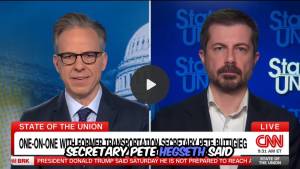 Military veteran and former Transportation Secretary Pete Buttigieg, right, and CNN host Jake Tapper discuss Trump's war against Iran on March 15, 2026.
PoliticusUSA, Pete Buttigieg Blasts Trump For Raising Money Off Of Troops That He Got Killed,.Jason Easley,  right, March 15, 2026. There are many reasons why Donald J. Trump is unfit for the presidency, but it doesn’t get much lower than profiting off of fallen troops. Those troops and their families deserve better from the presidency than what they are getting from Trump.
 The Trump administration is still refusing to look the American people in the eye and tell them the truth about the Iran war. The administration continues to look at the war through optimistic eyes and claims that gas prices will fall in a couple of weeks and the war will end.
It is important for America that those who have been through war in the Middle East speak up and deliver a clear-eyed assessment.
Besides being a veteran and the former secretary of transportation, Pete Buttigieg is a former and perhaps future presidential candidate.
On Sunday, Buttigieg discussed Trump’s Iran war in clear terms.
What I'm worried about is not the soldiers and the people who are serving. What I'm worried about is their political leadership, like Pete Hegseth and Donald Trump.
We lived through a war that was sold to us on false pretenses when I was younger. This war has not been sold on any pretense. The president just went ahead and did it.
Here's the biggest thing that has not changed since the war in Afghanistan or the war in Iraq. The biggest thing that has not changed is who pays the price. We have now seen 13 American service members killed. And when you prepare to go to war, the thing you think about, the thing you most dread is your family being the ones to get that knock on the door.
More than a dozen American families have now gotten that knock on the door. And the president has basically assured us that there will be more where that came from. And while they're paying the ultimate price, every American is paying some price. Right now, mortgage rates are up because of this war.
Food is going to be more expensive because of this war. And, of course, the price of gas that we're paying at the pump is more expensive because of this war.
Buttigieg didn’t stop with telling America that we are being sold a war on no pretenses.
He called out Trump for using the bodies of the fallen to make money.
CNN’s Jake Tapper asked Buttigieg, “So the Trump administration argues that they needed to take action to take out Iran's nuclear weapons program and Iran's ballistic missile program, because, when they came into office, the Biden administration, your administration had done nothing in four years to stop Iran from building a nuclear weapon, developing ballistic missiles, funding terrorism around the world. Are they wrong?”
Buttigieg answered:
Yes, of course they're wrong.
I mean, for one thing, the president assured us that the nuclear program, President Trump assured us that the nuclear program was, in his words, obliterated just a few months ago. And let's also remember that, in the past, Iran's nuclear program was contained without a shot being fired.
I think President Trump thought he could get a better deal than the Obama administration did. He failed to get that better deal. And he went off and launched a war without planning, without being ready for even some of the most basic things.
I mean, it is a certainty that the military would have advised him that the Straits of Hormuz would have been closed, that that was a likely scenario. And yet they're talking about this and clearly acting as though they didn't think this would happen.
Secretary Hegseth went so far as to say that the Straits of Hormuz is open, other than the fact that there would be fire against vehicles transiting the strait. This is clearly amateur hour at the Pentagon and in the White House. And, again, the price is being paid by all of us.
You can also just tell from the administration's attitude toward this war, the fact that they're putting out videos treating this like a video game. It's not a video game for the families of the fallen. And then, just this week, we saw campaign fund-raising materials being put out, e-mails, where the president's committee, the president's political operation was raising money off of images of him at a dignified transfer.
Any politician who does that has no business leading American troops in a war. If the president is willing to raise campaign funds over the bodies of America's war dead, he is unfit to be the commander in chief.
I am old enough to remember when George W. Bush caught criticism for using 9/11 and footage of US troops in the Middle East in his 2004 reelection campaign. Now, Donald Trump is raising money for his super PAC off of the dignified transfer of remains of troops that he got killed through his war of choice in the Middle East.
As usual, the mainstream press is at best asleep at the wheel and at worst willfully ignoring that a president is not only abusing his power by starting a war with no justification. Veterans like Sens. Reuben Gallego and Mark Kelly, along with former Secretary Buttigieg, are important voices at this moment because voices like theirs were suppressed and not visible before the Iraq invasion.
New York Times, Opinion: How Minnesota Beat Trump, Thomas L. Friedman, right March 15, 2026. The last year has been one of the most depressing of my nearly 50 years as a journalist.
It’s not just that I’ve had to watch the Trump administration destroy cherished alliances, like ours with Western Europe and Canada, that have upheld freedom, democracy and global trade since World War II. It’s also been the stunning cowardice and boundless greed with which leaders of big law firms and Big Tech have bent their knees to King Donald and indulged a cabinet of clowns — not one of whom they’d hire in their own businesses.
But then I spent time in my native state, Minnesota, after something else that I’d never seen in nearly 50 years: a spontaneous uprising of civic activism propelled by a single idea — I am my neighbor’s keeper, whoever he or she is and however he or she got here.
It was one of the most courageous battles ever fought by American men and women not in uniform. It was led by moms ready to donate their breast milk to strangers and dads ready to drive someone else’s kids to school because the parents, terrified of ICE agents, were too afraid to go out outdoors. It was neighbors ready to hit A.T.M.s to help out neighborhood restaurants and businesses deciding not to open — thus forgoing their income — for fear that masked ICE agents might drag away their cooks or dishwashers or desk clerks.
And the best part was this: At a time when we have a president so shameless that he insists on putting his name on every public building he can, these good Samaritans of all colors and creeds acted without fanfare. “There were hundreds of leaders of this movement,” Bill George, a longtime Twin Cities business executive, said to me, “and I don’t know a single one of their names.”
Many surely got to know one another, though, because they were all propelled by a verb I’d never heard before: “neighboring,” as in, Today I will be neighboring — going out to protect the good people next door or down the block. Not because I favor illegal immigration, but because I oppose the fundamental indecency of President Trump and Stephen Miller and the blessedly now departed Kristi Noem trying to fulfill their daily quota for evicting illegal immigrants by arresting my neighbors, most of whom work hard, pay taxes, go to church or mosque and help me dig out my car from the snow in winter.
Here’s some free advice for Trump and Miller: Minnesotans are winter people. Don’t come for winter people in winter. They’re not afraid of the cold. Just the opposite. The weather has forged a unique Minnesota neighborliness — not everywhere, not always, but in a lot of places on a lot of days. Its power is rooted in its ordinariness — just a basic human impulse to look out for your neighbors and, yes, dig their cars out of the snow on Monday because you know they will do the same for you on Wednesday.
Observing it up close made me think about what Stephen Miller told CNN’s Jake Tapper in January: “We live in a world in which you can talk all you want about international niceties and everything else. But we live in a world, in the real world, Jake, that is governed by strength, that is governed by force, that is governed by power.”
Well, Stephen, maybe you don’t know the real world after all, because your private ICE army — “governed by strength” and “force” — was sent packing by a bunch of moms and dads armed only with cellphone cameras and whistles, ready to walk out on a freezing morning in bathrobes and bunny slippers, to defend their neighbors, some of whom they barely knew.
Yes, Stephen, maybe you don’t know the “real world” after all, because the real score here is: Neighboring, 1. Trumpism, 0.
More On Iran
New York Times, Iran War Live Updates: Israel Launches New Strikes on Iran, Aaron Boxerman and Vivian Nereim, March 15, 2026. Here is the latest.
Iran’s foreign minister claimed the Strait of Hormuz was open to all except America or its allies. President Trump had threatened to strike Iran’s main oil export terminal if it did not lift the de facto blockade.
Israel said it had launched a new wave of airstrikes on Iran on Sunday, while Iranian forces said they were firing at U.S. and Israeli targets as fears grew about the economic fallout from the Middle East war, now in its third week.
President Trump called on a host of other countries, including Britain, France, and China, to send warships to the Strait of Hormuz to end a de facto Iranian blockade on the shipping of oil through the strategic waterway. It was far from clear, however, whether any countries would volunteer to patrol the strait, through which about a fifth of the world’s oil transits.
Iran’s foreign minister, Abbas Araghchi, said on Telegram that the strait “is open to everyone, except American ships and those of its allies.” In practice, however, the oil shipped through the passage is coming from either Iran or American allies such as Saudi Arabia and Kuwait.
Oil prices have risen steeply since the United States and Israel launched their air war on Iran on Feb. 28. While the Trump administration and other governments have sought to calm the volatility and bring prices down — including by easing sanctions on some Russian oil — they have seen little success thus far.
Mr. Trump threatened to attack oil infrastructure on Kharg Island, home to Iran’s main oil export terminal, unless Tehran allowed ships to pass through the Strait of Hormuz. Such a move would almost certainly rattle energy markets further. U.S. consumers have already seen the price of a gallon of gasoline rise by 25 percent on average, according to the AAA motor club.
On Saturday, Iran’s powerful Islamic Revolutionary Guards Corps rejected Mr. Trump’s threat, asserting in a statement that the critical waterway was under its full control and that “any attempt to move or transit will be targeted.”
Iran faced new Israeli strikes on Sunday. The Israeli military said it has conducted more than 7,000 attacks on the country since the war began.
The Revolutionary Guards force said it was continuing to target Israel and U.S. assets in the region. Iranian missiles repeatedly set off air raid sirens in Israel. Saudi Arabia said it had intercepted drones near the capital and in an eastern province, without saying where they came from.
Here’s what else we are covering:
- Iraq: The U.S. Embassy in the Iraqi capital, Baghdad, urged all American citizens to leave Iraq immediately on Saturday after Iran-linked Iraqi militias attacked the embassy compound. It was the second time the U.S. mission had been attacked since the war began.
- Death toll: At least 1,348 civilians in Iran have been killed since the start of the war, Iran’s U.N. representative told the Security Council on Wednesday, the latest figure the country has provided. In Lebanon, officials said that 826 people had been killed. And in Israel, at least 12 people have been killed, according to authorities.
- Americans killed: On Saturday, the Pentagon identified the six service members who died when a refueling aircraft crashed in Iraq last Thursday, bringing the total number of American service members killed to at least 13.
Israel and Hamas agreed to a cease-fire late last year, but the Israeli military has accused the Palestinian militant group of violating the agreement and continued to bombard the territory. While backed by Iran, Hamas has not joined the regional war, unlike Hezbollah, an Iran-supported militia in Lebanon.
In parallel to Israel’s spiraling war with Iran, the Israeli military has not stopped attacking Gaza, where it fought Hamas, the Palestinian armed group, in a devastating two-year war. On Sunday, at least eight police officers affiliated with the Hamas-controlled administration in the territory were killed in a strike, the Gazan interior ministry said in a statement. The Israeli military did not immediately comment on the incident.
The energy secretary says there are “no guarantees” oil prices will fall soon.ImageEnergy Secretary Chris Wright, wearing a gray suit, sits at a table. American flags are behind him.In an interview with ABC News on Sunday Energy Secretary Chris Wright expressed some confidence that the United States would be able to secure the Strait of Hormuz within weeks.
Energy Secretary Chris Wright said on Sunday there were “no guarantees” that oil prices would fall in the coming weeks, despite President Trump’s having vowed repeatedly that the United States will try to force Iran to stop attacks on oil tankers in the Strait of Hormuz.
“There’s no guarantees in wars at all,” Mr. Wright said in an interview on ABC’s “This Week.” “I can guarantee the situation would be dramatically worse without this military operation to defang the Iranian regime.”
“Right now, our focus is destroying their military capabilities, including those that are used specifically to threaten the straits,” he added. “But we need to finish those tasks first, and you will see the straits open again in the not-too-distant future.”
The Iranian military has been carrying out projectile attacks against tankers in the area, setting ships ablaze and sending the price of crude oil surging on world markets. It has also begun laying mines in the strait, despite the U.S. military’s having destroyed some Iranian naval vessels capable of that type of operation.
Mr. Wright said in another interview on Sunday that the strait was not safe for tanker passage. “No, it is not,” he said on NBC’s “Meet the Press.”
About 20 percent of the world’s oil goes through the narrow waterway connecting the Persian Gulf and the Gulf of Oman.
At a later point in the ABC News interview, Mr. Wright expressed some confidence that the United States would be able to secure the Strait of Hormuz within weeks.
“Yeah, I think that this conflict will certainly come to the end in the next few weeks,” he said, adding that the war could also end sooner than that. “We’ll see a rebound in supplies and a pushing down of prices after that.”
He said the administration was “very aware” that the world “would have short-term disruption” as a result of the war that the United States and Israel started against Iran on Feb. 28. “We would cause a little bit of increased prices on Americans,” he added, noting that “this is short-term pain to get through to a much better place.”
Mr. Wright also rebutted criticism from Democratic lawmakers and others who say the Trump administration did not plan sufficiently for Iran to stop oil tanker traffic through the strait.
“Of course meticulous planning went into what might happen with the Strait of Hormuz, how to deal with that,” he said. “Our chairman of the Joint Chiefs of Staff, General Caine, is known for many things, but high on that list is an absolute meticulous planner of all of the scenarios that might unfold.”
The New York Times reported on Tuesday that Mr. Trump and his advisers miscalculated the scope of Iran’s retaliations — it has carried out missile and drone attacks for the past two weeks across the Middle East, widening the war and disrupting the economy — and its ability to bring traffic in the Strait of Hormuz to a halt.
Mr. Wright deflected a question on which other countries might send warships to help escort tankers through the strait, as Mr. Trump has promised would happen. Mr. Trump listed China, France, Japan and South Korea last week.
“All nations of the world depend on products that come from the Straits of Hormuz,” Mr. Wright said, without mentioning any commitments from other nations to send escort ships.
Iran appears to be allowing some tankers to pass through the strait, including ones carrying oil to China, U.S. officials said. Abbas Araghchi, the foreign minister of Iran, told CBS News on Sunday that the country was not ready to negotiate with the United States, despite President Trump saying the previous day that Iran wanted to make a deal.
“We never asked for a cease fire, and we have never asked even for negotiation,” Araghchi told “Face the Nation.” “We are ready to defend ourselves as long as it takes.” Trump said in a phone interview with NBC News on Saturday that “”Iran wants to make a deal, and I don’t want to make it because the terms aren’t good enough yet.”

Sunday Hopium Chronicles, Democratic Advocacy: Trump Begs The World For Help, Ukrainian Wartech To The Rescue, Senate Rs Getting Worried The Chamber May Flip, Simon Rosenberg, right, March 15, 2026. Trump's terrible, fascistic "Make It Really Hard For Everyone To Vote" bill comes to the Senate this week.
Our failed leader found a new pathetic and desperate path to go down yesterday: He is demanding that other nations of the world come help him fight his war now that it isn’t going so well (note he leaves off Russia here, which is actively supporting Iran in this war with the U.S.). His claim, of course, that these nations will be sending “War Ships” is made up, delusional, Mad Kingy:
Yes, the war has gone to shit. Yesterday the State Department has told Americans living in Iraq -- yes Iraq -- to leave immediately:
There is no domestic option for our allies to step in and help Trump in his failed war.
Historian Phillips O’Brien has a great new article looking into the way Ukraine’s wartech start ups are changing the way war is is fought in Russia-Ukraine, and now likely for the US and in Europe and the Middle East too:
I realize that I and others have been writing much more about the US bombing of Iran in the last two weeks. While that is not surprising (nor a bad thing as what is happening there is so important), it is also vital that the Russo-Ukraine War does not lose attention. Indeed, as we are still in the early phases of 2026, it is worth thinking about where things stood a year ago to understand the strategic value of Ukraine for Europe now and going forward. In a nutshell, a year ago many people were saying Ukraine was failing, that Europe had to take on Ukraine as a burden, etc. Ukraine was portrayed as facing a manpower crisis that would soon see unable to hold back the Russian steamroller and with the USA now under the leadership of Donald Trump, it was proclaimed that Ukraine faced a very bleak future.
The reality ended up being rather different. This year the focus is not so much on Ukrainian weakness but on Ukrainian attempts to fight back and whether they have a chance at success. That is remarkable with the US changing sides and the Russians hammering Ukrainian infrastructure all winter. This change in narrative is because certain key Ukrainian strengths and capabilities are now far more apparent to the media and analytical community than they were a year ago. Much of this strength is in war production and technology, strengths that have become glaringly apparent over the last two and a half weeks. They are so vital that Europe’s defense future now requires Ukraine. Ukraine is now achieving what Europe has struggled with for decades—creating new and innovative start-ups.
The West must now not only embrace the Ukrainian-led tech revolution, but we must make the transition from fossil fuels to cleaner, cheaper, and more distributed energy a national obsession now:
Finally, Politico has a remarkable bit of reporting today, Senate Republicans worry they’re losing ground in the midterms. Some excerpts:
Senate Republicans are growing anxious about the midterms.
They once felt like they had a glidepath to keep or even grow their majority in November, unlike in the House, where GOP control is razor-thin and members have become increasingly on edge about Democrats returning to power.
It’s pretty clear now that Trump has hit the panic button. His big play to change the trajectory of an election he’s losing -- Iran -- has become a global fiasco. Now, his next big play -- passing SAVE -- also looks it is going to fail. In both cases he has ignored warnings from steady hands that he was pursuing a dangerous course and just plowed ahead. More from that Politico story:
Asked about Trump’s claim that the party will be in trouble if it doesn’t pass the SAVE America Act, Senate Majority Leader John Thune told reporters this week that he believed the election is instead “going to be about the economy, and that’s why I think we’re focused on that.”
Republicans in the Senate are right to be worried. Captain Ahab is at the helm of their ship, the ridiculous war is going to make an already weakened American economy far worse, Democrats keep winning and overperforming everywhere, and Senate Democrats have had a great recruitment cycle. Look at the Senate polling we got this week…..
It’s why it is time now……..To Get To Work Everyone!!!!!!!!!!!!!!!!!!!!
Here’s our working Hopium Post-Iran Disaster Agenda:
- Work To End This New Gulf War, And Trump’s Global Imperial Ambitions
- Make Clear We Support Ukraine and Europe, Not Russia
- Roll Back The New, Illegal Tariffs
- Rescind The Trump Tax Cuts, Claw Back The Extra ICE Funding
- Make The US A Clean Energy Superpower, Fight For True Energy Independence, And Lower Energy Prices For The American People
- Keep Fighting To Rein In ICE, End Mass Deportation
- This week our calls should clearly focus on reining in the illegal war in the Middle East and ICE here at home, and on blocking the “SAVE Act.”
Keep working hard all. We are entering a dangerous place, and we need to be very, very loud now - Simon
More On Epstein Files, Trump Coverup
 The Other 98%, Advocacy: This is the move everyone has been waiting for, March 14, 2026. Philadelphia DA Larry Krasner, above top, just told every person connected to Jeffrey Epstein's trafficking empire that state prosecutors are coming for them, and there's not a thing Donald Trump can do about it.
 "Hey Epstein class, you may think that whatever happened on that island or happened in Epstein's mansion is not going to haunt you," Krasner said. "Let me tell you who is going to haunt you. It's the prosecutors at the state court level who still care about the Constitution, the laws, and justice."
Because Epstein's operation was sprawling and transnational, it crisscrossed through countless local jurisdictions. That means state prosecutors across the country potentially have standing to bring charges. And here's the part that should have every powerful person on that client list losing sleep: state court convictions cannot be pardoned by any president. Period.
Krasner emphasized that the statute of limitations for crimes involving children extends for years, giving prosecutors a long runway. Any conviction at the state level means real time served, no matter who's in the White House.Krasner already founded the F.A.F.O. coalition, a network of progressive prosecutors from cities including Minneapolis, Dallas, Austin, and multiple Virginia jurisdictions, built specifically to hold powerful people accountable when the federal government refuses to.
He's not bluffing. He's building infrastructure.Under Pam Bondi, the DOJ has shown zero interest in pursuing Epstein's associates. The files have been buried. The investigations have stalled. The coverup is happening in plain sight.So if the federal government won't do its job, Krasner is saying the states will. And the beauty of this approach is that it only takes one indictment. One associate flips. Then another. Then the whole thing unravels.The powerful have spent years assuming they were untouchable. Krasner just told them they're not.
Other98 uses meme warfare and strategic coalition-building to challenge the corporations and billionaires that have hijacked our democracy. We're elevating stories from the front lines of crucial struggles for justice to fight like hell for an America that works for the other 98% of us.
 Four Jeffrey Epstein trafficking victims file suit against Attorney Gen. Pam Bondi, shown below right, with Epstein shown at center (March 10, 2026).
The Search for Accountability, The Epstein Cover-Up: A Lawsuit Against Pam Bondi and the Fight for Justice, Duyen Elaine and Tháng Ba, March 11, 2026. In a shocking turn of events, dozens of survivors of Jeffrey Epstein’s abuse have filed a lawsuit against former Florida Attorney General Pam Bondi, alleging that she played a crucial role in shielding Epstein from a more thorough investigation.
This lawsuit, led by Maria Farmer—one of the first women to accuse Epstein publicly—has become a focal point for those who have fought for years to bring the truth about Epstein’s crimes to light.
The plaintiffs claim that critical details about Epstein’s activities were concealed during the initial investigation and that influential figures, including Bondi, may have deliberately allowed Epstein to avoid more serious charges. This explosive lawsuit has not only rekindled interest in the Epstein case but also raised serious questions about the role of powerful individuals in protecting one of the most infamous sex traffickers in modern history.
As the case gains momentum, it could reveal new, vital information about the way Epstein’s case was mishandled—and whether those who could have stopped him were instead complicit in his ability to evade justice for years.
Bondi faces pressure after first release of Epstein files fell short of expectations | PBS News
The Jeffrey Epstein case has become a symbol of corruption and the deep-rooted power dynamics that allow sexual abuse and trafficking to flourish within the elite circles of society. For years, Epstein’s wealth and connections seemed to shield him from prosecution, despite mounting evidence of his crimes. It was only in 2019, after Epstein’s arrest on federal charges of sex trafficking minors, that the full scope of his abuse began to unravel.
Before his arrest, Epstein had faced allegations of sexual abuse from numerous women, some of whom were minors at the time. Yet, his high-profile connections—spanning politicians, business leaders, and celebrities—allowed him to avoid serious consequences for years. The leniency with which his previous cases were handled raises unsettling questions about the extent to which Epstein was protected by those in power.The Role of Pam Bondi: A Controversial Figure
Pam Bondi, the former Attorney General of Florida, has come under intense scrutiny for her actions during the handling of Epstein’s case in the early stages. According to the lawsuit, Bondi, alongside other officials, played a role in covering up crucial information that could have led to more serious charges against Epstein.
In 2008, Epstein struck a controversial plea deal in which he pleaded guilty to two state charges of soliciting prostitution from a minor. The deal, which many have criticized as a “sweetheart deal,” allowed Epstein to serve just 13 months in a county jail, with work release privileges. Despite the severity of the charges, the deal effectively protected Epstein from facing federal charges related to sex trafficking.
The plaintiffs in the lawsuit argue that Bondi, as the Attorney General at the time, was part of a larger effort to protect Epstein. They claim that key details about his crimes were intentionally overlooked or suppressed, allowing him to continue his predatory behavior unchecked for years. The survivors believe that Bondi’s involvement in the investigation’s early stages helped Epstein avoid more severe charges and prolonged his reign of abuse.

Global News

New York Times, State Department Cuts Price of Renouncing U.S. Citizenship to $450, Ali Watkins, March 15, 2026. The fee had been increased to $2,350 in 2015, prompting criticism and legal challenges from advocacy groups and Americans living abroad
The State Department is drastically reducing the cost of renouncing American citizenship, ending a yearslong legal battle over the price of relinquishing a blue passport.
In an update published in the Federal Register on Friday, the State Department said it was reducing the consular fees of renouncing U.S. citizenship to $450 from $2,350, a more than 80 percent reduction in cost for the clunky, bureaucratic process.
The policy change, which is effective April 13, was proposed in October 2023.
The change announced on Friday returns the fee to what it was in 2010, when the State Department first instituted a charge for Americans renouncing their U.S. citizenship.
The process, which is arduous and costly, requires extensive work from consular officials, including confirming that anyone seeking to give up their citizenship fully understands the implications of doing so.
Obtaining a “certificate of loss of nationality” requires two separate interviews with consular officials, a vetting process and a formal oath of renunciation. The process can take months.
The department warns on its website that the risks of renouncing U.S. citizenship include becoming “stateless” and requiring a visa to enter the United States.
For years, the government has jousted with lobbying groups representing Americans and ex-Americans abroad, who have called the $2,350 fee exorbitant.
Among them is the Paris-based Association of Accidental Americans, which legally challenged the increased fee and sought to have the difference returned to their clients.
“This fee reduction is a concrete first victory — but our fight to have the right to renounce recognized as a fundamental constitutional right continues,” the group’s president, Fabien Lehagre, said in a statement on the group’s Facebook page.Editors’ PicksTips to Avoid Becoming the ‘Dead Wife in a Movie’ TropeHow Neighborly Do Home Additions Have to Be?This Month the Book Review Book Club Is Reading ‘Kin’. Join Us for Discussion.
While there are no figures showing how many Americans have formally renounced their citizenship, an estimated 9 million Americans live abroad.
For them, American citizenship can become a burden — the United States is one of only a few countries that levies taxes based on citizenship rather than geography. This means that Americans living abroad must file a tax return, and they may find it more difficult to open a bank account, because of reporting rules for foreign banks imposed by the U.S. government.
Renouncing U.S. citizenship was free until 2010, when the State Department first instituted the $450 administrative fee. It acknowledged that amount covered “less than 25 percent of the cost to the U.S. government” to process and certify loss of nationality, but kept it at that price in part to keep from discouraging those who sought to use the service.
But a sharp increase in requests — driven in part by foreign banking requirements instituted in 2010 — led the State Department to increase the fee to $2,350 in 2015, to cover the full processing costs.
But the change sparked outrage from expatriate Americans who said the new fee was prohibitive.
“Members of the public have continued to raise concerns about the cost of the fee and the impact of the fee on their ability to renounce their citizenship,” the department said in its announcement.
The State Department first announced in October 2023 that it intended to lower the fee associated with rescinding citizenship. At the time, hundreds of commenters spoke in favor of the change, with many citing bureaucratic American tax policy as the reason they hoped to give up their citizenship.
“Many reported spending hundreds or thousands of dollars a year on tax professionals, even when they might have no U.S. tax liabilities,” the State Department said in announcing the change. “Some stated that despite being required to comply with U.S. tax laws, they received and/or benefited from few of the services for which their taxes were collected.”
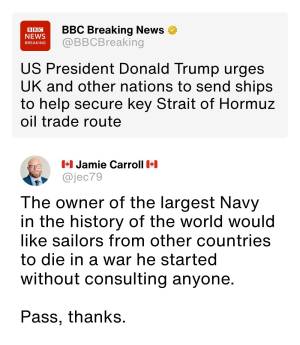
New York Times, Two Arrested in Death of Anti-Iranian Regime Activist in Canada, Yan Zhuang, March 15, 2026. A man and a woman were charged with murder in what the authorities described as a “targeted incident” against Masood Masjoody, who had gone missing weeks ago in British Columbia.
The Canadian authorities have charged two people with murder in the death of an activist who spoke out against the Iranian regime, in what the police described on Saturday as a “targeted incident” involving people who were connected on social media.
The remains of Masood Masjoody, 45, a former university math instructor, were found about a week ago in Mission, British Columbia. Officials had launched an investigation into his disappearance in early February after his neighbors in Burnaby, British Columbia, raised concerns.mageA headshot of a man with glasses standing in front of bare branches.Masood Masjoody in an undated photograph released by the Royal Canadian Mounted Police.Credit...Royal Canadian Mounted Police
On Saturday, the police announced they had arrested a man and a woman, Mehdi Ahmadzadeh Razavi, 48, from Maple Ridge, British Columbia, and Arezou Soltani, 45, from North Vancouver, in the same province. Both were charged with one count of first-degree murder, the Integrated Homicide Investigation Team, a branch of the police, said in a statement.
“While the motive is still under investigation, we can say the victim and the two accused were known to each other and that this was a targeted incident,” Freda Fong, the department’s spokeswoman, said at a news conference.
Public records show that the three people had continuing disputes and exchanges on social media, but it was unclear if those played a role in the killing, Ms. Fong said. She added that neither Mr. Ahmadzadeh Razavi nor Ms. Soltani had a criminal record in Canada, and had limited prior interactions with the police.
Mr. Masjoody was a critic of the Islamic Revolutionary Guards Corps and served as a board member of the Iran Front for the Revival of Law and National Sovereignty, an anti-regime activist group active in Europe and elsewhere.
In early February, the group released a statement expressing concerns about his disappearance, describing him as someone who had devoted years to exposing “influence and intimidation networks linked to the Islamic Republic within the host countries of Iranian communities.”
In recent years, Mr. Masjoody had also filed a number of lawsuits against parties, including the university where he had previously taught, the social media company X and Reza Pahlavi, the son of the last shah of Iran who lives in the United States and has sought to position himself as an counterweight to the Islamic Republic.
Court records show that Mr. Masjoody lost his job at Simon Fraser University because of instances of professional misconduct, including using an alternate grading system and publicly accusing staff members of providing a “safe haven for Islamic Republic thugs.”
A Truth For You, Plot twist of the century: Israeli PM Benjamin “Bibi” Netanyahu is basically a Philly suburb kid who rebranded harder than a TikTok influencer! March 15, 2026. The future prime minister is shown in a high school photo and bio below:
 Born in Tel Aviv (1949), but teen years? Straight-up Cheltenham High School, class of ’67 in suburban Philadelphia. Played soccer (left wing—goals AND geopolitics?), debate club (foreshadowing much?), chess club (checkmate on world leaders?).
Skipped his own graduation to get back to Israel and join the IDF right before the Six-Day War. Iconic move.
 But wait—his last name wasn’t always Netanyahu. Family original: Mileikowsky (very Polish, very Ashkenazi Jewish from Warsaw). Grandpa Nathan Mileikowsky—a rabbi and hardcore Zionist—moved everyone to Mandatory Palestine in 1920, started signing articles “Netanyahu” (Hebrew for “God-given”), and the fam fully switched it.
Classic early Zionist glow-up: ditch the European surname for that biblical Hebrew flex. (Ben-Gurion was Grün, Sharon was Scheinerman… whole squad was rebranding like it was 1920s MySpace.)
So yeah, from Polish-Jewish roots → Philly high school jock → global controversy magnet. The guy who lectures the world on history spent his awkward teen years in the land of cheesesteaks and mall hangs. Who knew the future PM was dodging dodgeball in Pennsylvania?
Bonus drama: Inducted into Cheltenham’s alumni Hall of Fame in ’99… until 2025 when students petitioned to boot him. Small-town shade hits different!
Wildest “world leader was secretly one of us” story?

South African leader Cyril Ramaphosa (Reuters photo).
New York Times, News Analysis: New U.S. Diplomat Was Not So Diplomatic. South Africa Pushed Back, John Eligon, March 15, 2026. The latest clash between the two countries illustrates the depths to which relations have sunk and the struggle to forge a new path forward.
Less than a month into his job, the new United States ambassador to South Africa delivered some harsh words against the government.
He claimed that South Africa had more than 150 laws “aimed against whites,” and that the Trump administration was “running out of patience” with the South African government.
He made veiled comments about South Africa’s president, Cyril Ramaphosa, subtly accusing him of “insulting our president,” an apparent reference to Mr. Ramaphosa’s criticisms of President Trump in a recent interview with The New York Times. And he rejected a South African court’s ruling that an anti-apartheid song was not hate speech. “I don’t care what your courts say,” said the ambassador, L. Brent Bozell III, speaking at a business forum in the Western Cape Province.
 After making those statements, Mr. Bozell was summoned by the foreign minister on Wednesday to explain his “undiplomatic remarks.”
This latest clash between the United States and South Africa illustrates how deeply relations between the two governments have fallen. Early last year, South African officials worked hard to explain their policies to the Trump administration, eager to find common ground with their nation’s second-largest trading partner. They sent envoys and requested meetings.
Now, South Africa appears to have given up trying to reason with Trump officials on subjects like the killing of white farmers, government land seizures and laws meant to redress the legacy of apartheid. “We will not be bullied,” Mr. Ramaphosa said in his state of the nation addresses last month and last year.
South African officials have realized that “trying to explain or clarify or debunk those negative narratives is a largely futile exercise,” said Ziyanda Stuurman, a Cape Town-based adviser at Africa Practice, a strategic advisory firm. “Ultimately, right now, I think that the relationship is in a state of managed decline where neither side will climb down from their view of the other.”
This icy posture with the United States carries great risk for South Africa, a much smaller country. But South Africa also has a history of diversifying its alliances with the hope of making itself less reliant on global superpowers. That strategy of seeking out like-minded middle powers has become more pronounced amid global disruptions caused by Mr. Trump, analysts say.
On the same day that Mr. Bozell made his remarks, Mr. Ramaphosa was on a state visit to Brazil, where its president, Luiz Inácio Lula da Silva, suggested that their nations deepen defense cooperation. “I don’t know if Comrade Ramaphosa realizes that if we don’t prepare in terms of defense, one day someone might invade us,” he said during a joint news conference.
“We have a lot to learn from each other,” Mr. Ramaphosa replied.
As the leader of Africa’s largest economy, Mr. Ramaphosa has long trumpeted the role of middle powers on the global stage. In his interview last month with The Times, he criticized what he described as attempts by some countries to dominate others using economic pressure and other levers.
“We’ve now arrived, and it is wrong for us to keep on being locked out of the door,” he said. “Much as we are small or middle power countries, respect us as well and deal with us on the basis of respecting our sovereignty and seeking to advance the interests of all.”
But Mr. Ramaphosa and his government have been accused, even by allies, of not always practicing what they preach. After Russia invaded Ukraine four years ago, South Africa walked back its initial statement that Russian troops should withdraw, a move that angered its European partners.
Mr. Ramaphosa also drew condemnation this month for sending a condolence letter to the Iranian Embassy after the country’s supreme leader was killed by U.S.-Israeli bombings.
South Africa’s critics have argued that its claims of nonalignment have been used as a tactic by the governing party, the African National Congress, to maintain alliances with apartheid-era allies that the West now views as enemies, like Cuba and Russia.
“Nonalignment is used to pretend neutrality as cover for aligning with anti-Western interests,” Joshua Meservey, a senior fellow at the Hudson Institute, a conservative think tank, wrote in a thread on X. “SA has openly aligned against the US on key issues for decades, something the US ignored until recently.”
At the business conference, Mr. Bozell said he was also concerned about “South Africa’s growing engagement with some of America’s greatest adversaries,” an apparent reference to Tehran.
After his meeting with South African officials, Mr. Bozell clarified his remarks on social media on Wednesday, in an effort to bring down the temperature. But the substance of his comments has not changed.
“If the U.S. ambassador sticks to his guns on these issues,” said Priyal Singh, a senior researcher at the Institute for Security Studies, a South African think tank, “it’s definitely going to be a tough couple of years for South Africa and the U.S.”
U.S. Tariffs, Economy, Jobs, Inflation
Politico, Trump’s latest tariffs face a fresh set of legal hurdles, Josh Gerstein, March 15, 2026. Here are the key issues in the court fight over Trump’s newest tariffs after the Supreme Court’s ruling.
Just three weeks after the Supreme Court handed President Donald Trump a stinging defeat over the sweeping tariffs he imposed last year, the legal battle over his first move to replace those import taxes is heating up.
Democratic attorneys general and governors from 24 states and a libertarian group representing two small businesses filed their first legal briefs Friday asking a federal trade court to strike down the 10 percent tariffs Trump imposed on most U.S. trading partners in February.
Trump promised to hike those tariffs to 15 percent, but hasn’t yet done so.
Legal experts told POLITICO that Trump’s backup tariffs are probably on stronger legal footing than the “Liberation Day” taxes the high court struck down.
Despite that, his challengers are exuding bravado about their chances.
“We are 100 percent confident that we will be successful in the Court of International Trade,” New York Attorney General Letitia James told reporters last week.
Trump is also projecting confidence, repeatedly claiming that the same Supreme Court went ahead and blessed his use of other authorities, like the so-called Section 122 tariffs he’s turned to as a short-term fix.
That is not true. While the three justices who dissented from last month’s decision did cite Section 122 as one of the tools Trump could use to rebuild his tariff scheme, the court’s six-justice majority explicitly declined to embrace that position. “We do not speculate on hypothetical cases not before us,” Chief Justice John Roberts wrote.
While Trump called his new approach “time tested,” that authority has never been invoked before, and the high court has not given its blessing to Trump using that specific law in the current circumstances.
Here’s a look at the key issues in the legal fight over Trump’s replacement tariffs.
Transitions
The Columbus Free Press, In Memoriam: Clifford O. Arnebeck, Democracy Warrior, Bob Fitrakis, Jan. 3, 2023, republished. Cliff Arnebeck, right, who could pass for Clark Kent, transformed himself into Superman as he came to our rescue in times of democratic crisis.
I first encountered Cliff when I was campaign manager during Tom Erney’s 1990 run for Chalmers Wylie’s 15th district congressional seat. Cliff also ran against Wylie in the Republican primary.
I planned a series of debates where Wylie failed to attend but Cliff always showed up. Cliff was one of the most honest and forthright speakers I’d ever heard. He shared the same democratic values put forth by the Erney campaign. He wanted to get rid of the “permanent Congress” that dominated U.S. politics. We became political friends and allies on key issues.
The next time I remember Cliff’s work is when I wrote about his attempt to prevent the city’s destruction of the old Ohio penitentiary, using historical preservation laws to preserve it. Later, I supported his lawsuit that successfully challenged the 2000 Ohio Chamber of Commerce's financing of a campaign to defeat Democratic Justice Alice Robie Resnick. Early on, Cliff realized that the Chamber was involved in illegal court packing and results would be devastating for democracy in Ohio. I was also especially impressed when Cliff agreed to join the Reverend Gary Witte and I on a last-minute trip to the Mansfield prison’s death row trying to get a last testimony from Johnny Byrd before his impending execution.
Cliff and I were two of the four attorneys who challenged the 2004 Ohio presidential election results. He was one of the original attorneys who heard the public’s testimony in hearings we held all over the state about election irregularities. As a result of the numerous election complaints, US Representative John Conyers called congressional hearings in Washington DC and Columbus, where Cliff and I testified. Conyers issued a long report on the irregularities causing the election results to be challenged in the US House and Senate.
Cliff played a key role in subsequent litigation regarding the 2004 presidential election in Ohio. The Moss v Bush case sued to overturn the 2004 election results and the King Lincoln Bronzeville Neighborhood Association v Blackwell case sued to correct the election results and seek fair election reforms. Fighting for free and fair elections then became Cliff’s main political purpose in life.
Starting in 2005, Cliff shared an office with the Columbus Free Press and independent media center. We continued to collaborate on election integrity activities including books, articles, conferences, radio shows, movies, hearings, election protection, speaking engagements and more lawsuits. Cliff and I took testimony from Michael Connell, the Bush family and Karl Rove’s IT guru responsible for the system that flipped votes in 2004, just prior to his untimely death in a small plane accident. Cliff was a tireless advocate for election reform and exposing political corruption. He represented me in court several times in my lawsuits to prevent election rigging in the state.
Cliff was a happy warrior, always in good humor, and he and his wife Sibley were a constant presence at the monthly Free Press Second Saturday Salons. The Free Press awarded them a “Libby” award for the devotion to community service.
Ultimately, Cliff began as a corporate Harvard lawyer who gave up much of his fiscal well-being to fight for democracy. Cliff passed away in December 2022 in Michigan of non-Hodgkins lymphoma.
Status, POLITICO’s Precarious Perch, Natalie Korach, March 15, 2026. As Axel Springer searches for the publication’s next top editor, Status has learned executives may also be quietly weighing a business-side leadership shakeup as well.
 Earlier this month, a report in Puck took some at POLITICO by surprise. The story said that executives at parent company Axel Springer had taken meetings with media industry leaders, fueling internal speculation that they might be considering replacing POLITICO’s chief executive, Goli Sheikholeslami.
The possibility that Mathias Döpfner, Jan Bayer, Claudius Senst, and other Axel executives might be eyeing a business-side shakeup had not been on the radar of those inside POLITICO, where many assumed the company’s immediate focus was limited to finding a successor to John Harris as editor-in-chief. Some also believed that Döpfner’s attention was elsewhere, particularly as the company was finalizing its bid for The Daily Telegraph.
Status has since independently confirmed that Axel brass has indeed spoken with industry executives about the potential role, according to two people familiar with the matter. One person told Status that Döpfner had explicitly asked them for recommendations of candidates who might be a good fit to run the outlet. Axel Springer disputed that characterization in a statement. Senst, the German publishing giant’s chief operating officer, told Status: “Any speculation about replacing Goli or questioning our confidence in her as CEO is unfounded. She has our full support, and we look forward to POLITICO's continued growth under her leadership.”
Get exclusive interviews, scoop-driven reporting, and deep analysis on the media forces shaping society.Upgrade to Paid
Support independent journalism and stay ahead—become a member today.
Still, that vote of confidence appears unlikely to quell chatter about Axel Springer reassessing POLITICO’s leadership structure. Last year, Harris announced he would step aside from the top editor role, kicking off a widespread search for a global leader to replace him. That search has prompted internal speculation about how much change Axel Springer is looking to implement at the Washington political outlet.
Sheikholeslami was named chief executive of POLITICO in 2022, one of the first big hiring decisions Axel Springer made after acquiring the publication the year prior for over $1 billion. At the time of her appointment, Bayer, the chairman of Axel’s supervisory board, said that Sheikholeslami would expand on Axel’s plans to “build the global news and information leader on politics, policy and regulation in power centers across the world.”
March 14
Top Headlines
- New York Times, Why Little Was Done to Head Off Oil’s Strait of Hormuz Problem, Rebecca F. Elliott and Vivian Nereim, Rebecca Elliott and Vivian Nereim, March 14, 2026. Geography and regional rivalries have prevented Gulf countries from finding a true alternative to the strait, which the war with Iran has effectively shut down.
- New York Times, Iran War Live Updates: Iran Defies Trump’s Threats Over Strait of Hormuz Blockade; U.S. Tells Citizens to Leave Iraq After Second Attack on Embassy, Aaron Boxerman, Yeganeh Torbati, Farnaz Fassihi and Erika Solomon, March 14, 2026. President Trump threatened to “wipe out” oil infrastructure on Kharg Island if Iranian forces continued to block the critical conduit for fuel. The U.S. Embassy in Baghdad was hit for the second time since the war started.
 New York Times, Jared Kushner Solicits Funds for His Firm While Working as Mideast Envoy, Copeland and Maureen Farrell, March 14, 2026 (print ed.). President Trump’s son-in-law is trying to raise $5 billion or more from foreign governments and others for his private equity firm.
- PoliticusUSA, News and Commentary:Trump's FCC Chair Threatens To Take Away Broadcasting Licenses If Networks Don't Push Iran War Propaganda, Sarah Jones and Jason Easley, March 14, 2026. Trump's FCC Chair Brandon Carr threatened to take away licenses from broadcasters if they don't stop telling the truth about the Iran war.
The Case For Trump Treason Over Iran War
- Proof, Investigative Commentary; Yes, It’s Finally Time to Talk About Trump and Treason, Seth Abramson, right,
 March 13-14, 2026. The fully sourced, highly specificcase for investigating Donald Trump for Treason—a federal criminal offense (18 U.S. Code § 2381) punishable by death—is in fact not complicated.
News Roundups
- The Parnas Perspective, News and Commentary: Trump Attacks Media Coverage of Iran War After Privately Acknowledging He Thought Tehran Would Capitulate Instead of Closing the Strait of Hormuz, Aaron Parnas, right, March 14, 2026. President Trump has privately acknowledged to his staff that he did not expect Iran to close the Strait of Hormuz.
More On Iran
- New York Times, War in Iran Has Put Middle East Water Supplies at Risk, Mira Rojanasakul, Claire Brown and Hiroko Tabuchi March 14, 2026 (print ed.). Two weeks into the war in Iran, two water desalination plants in the region have been damaged in military operations, raising concerns over the vulnerability of a system that serves as a lifeline for millions across the Middle East.
- PoliticusUSA, News and Commentary:Trump Trashed America’s Allies Now He Begs For Their Help In Iran, Jason Easley, right, March 14, 2026. Trump claims that he did the rest of the world a favor by starting a war with Iran, so now he wants other countries to join the war to open the Strait of Hormuz.
- Hopium Chronicles, Advocacy: 2,500 Marines Are Headed To The Middle East, Kushner Shakes Down Gulf Leaders, Trump Is A Titanic F*ck Up, Simon Rosenberg, right, March 14, 2026. Every day we are reminded that Trump doesn't give a sh*t about America or the American people.
U.S. Governance, Elections, Politics
- New York Times, Trump Administration Live Updates: Kennedy Center’s President Leaving After Tumultuous Year, Adam Nagourney and Julia Jacobs, March 14, 2026 (print ed.). What We’re Covering.
- New York Times, Judge Rules Lawmaker Must Be Allowed to Join Kennedy Center Board Meeting, Zach Montague, March 14, 2026. A judge ordered that Representative Joyce Beatty, a Democrat, be given access to planning documents and have the chance to oppose changes to the center at a board meeting next week.
- New York Times, A federal judge orders the V.A. to restore a union contract with 300,000 workers, Zach Montague, March 14, 2026 (print ed.). A federal judge in Rhode Island ordered the Trump administration to restore a union contract with more than 300,000 Veterans Affairs Department workers, after Doug Collins, the V.A. secretary, moved to nullify the agreement in August.
- New York Times, Trump Administration Readies Plans to Dismantle Renowned Science Lab, Eric Niiler, March 14, 2026 (print ed.). Proposals include transferring a supercomputer to the University of Wyoming and shifting a space weather lab to a private company.
U.S. Justice, Law, Crime, Courts, Rights
- New York Times, Justice Dept. Legal Threat Complicates Trump’s Pick for Fed Chair, olby Smith and Tony Romm, March 14, 2026. An investigation of the Federal Reserve was thwarted on Friday, but a department appeal could reimpose an obstacle in Kevin Warsh’s path.
- New York Times, Lobbyist Arrested in Extortion Attempt of Client Who Received a Trump Pardon, Kenneth P. Vogel, William K. Rashbaum and Santul Nerkar, March 14, 2026. Josh Nass, a lawyer and lobbyist, had recently represented Joseph Schwartz, a former nursing home executive pardoned by the president late last year.
U.S. Media, Propaganda, Artificial Intelligence
- New York Times, Cascade of A.I. Fakes About War With Iran Causes Chaos Online, Stuart A. Thompson and Alexander Cardia, March 14, 2026 (print ed.). A torrent of fake videos and images generated by artificial intelligence have overrun social networks during the first weeks of the war in Iran.
- Stars and Stripes, U.S.Pentagon plan expands oversight of Stars and Stripes, limits content, Rose L. Thayer, March 13, 2026. A March 9 memo affirmed the independence of the publication while announcing new restrictions.
Top Stories
New York Times, Why Little Was Done to Head Off Oil’s Strait of Hormuz Problem, Rebecca F. Elliott and Vivian Nereim, Rebecca Elliott and Vivian Nereim, March 14, 2026. Geography and regional rivalries have prevented Gulf countries from finding a true alternative to the strait, which the war with Iran has effectively shut down.
Of all the risks the global energy system has long faced, none was bigger or better known than the potential closure of the Strait of Hormuz.
The narrow passageway out of the Persian Gulf is both vital — serving as the only gateway to the rest of the world for huge amounts of oil and natural gas — and extremely vulnerable to attacks.
But despite being widely recognized as a potential choke point, the strait remains the only way to export most of the energy produced in the region. That has come into sharp relief in the second week of the war in the Middle East, as the near-closure of the waterway sent oil prices soaring above $100 a barrel for the first time in almost four years.
The reason there is no true alternative comes down to a combination of geography, political tensions and economic competition among the region’s oil powers. There have been efforts to circumvent the strait, notably by Saudi Arabia and the United Arab Emirates. But the pipelines through those countries can carry only a small fraction of the energy produced in the Persian Gulf.
For many other energy-producing countries in the region, the only way to avoid the strait would be to lay a pipeline across a neighboring country — an expensive and politically fraught endeavor. Take Qatar, one of the world’s biggest natural gas exporters. Its only land border is with Saudi Arabia — a country that cut off diplomatic ties and closed that border during a regional spat resolved five years ago. Plus, any pipeline would itself be vulnerable to Iranian attacks.
New York Times, Iran War Live Updates: Iran Defies Trump’s Threats Over Strait of Hormuz Blockade, Aaron Boxerman, Yeganeh Torbati, Farnaz Fassihi and Erika Solomon, March 14, 2026. President Trump threatened to “wipe out” oil infrastructure on Kharg Island if Iranian forces continued to block the critical conduit for fuel. The U.S. Embassy in Baghdad was hit for the second time since the war started.
Iran on Saturday rebuffed President Trump’s threats to potentially bomb Iranian oil infrastructure unless Iranian forces ceased menacing ships in the Strait of Hormuz, saying that the critical waterway was under its full control and that “any attempt to move or transit will be targeted.”
The defiant statement came a few hours after an Iran-backed militia said it had hit the American Embassy in Iraq late Friday night, and after the United States bombed military installations on Kharg Island, Iran’s main oil export hub.
Mr. Trump said he had ordered the military to spare the island’s energy infrastructure for now, but that he could “wipe out” the terminal if Iran continued to block the Strait of Hormuz. But on Saturday, Iran’s Islamic Revolutionary Guards Corps made clear that they did not intend to give up control of the strait.
The powerful Iranian military force said in a statement carried by Iranian media that it would not allow any “oil tankers or commercial ships” belonging to “aggressors and their allies” to pass through the area, a funnel for about one-fifth of the world’s oil shipments.
Also on Saturday, Kataib Hezbollah, an Iran-backed militia group in Iraq, shown at right in a flag-map,said it had fired on the U.S. Embassy in Baghdad, the second time the U.S. mission there has been attacked in as many weeks. Two Iraqi security officials who were not authorized to speak publicly confirmed the attack but could not give additional details.
An Iran-backed militia took responsibility for an overnight attack on the U.S. Embassy in Baghdad. President Trump called on other nations to help escort oil tankers through the Strait of Hormuz.
President Trump on Saturday afternoon reiterated calls for countries that rely on oil flowing through the Strait of Hormuz to help secure the shipping route. In a Saturday post on Truth Social he said the United States had “completely decimated” Iran and would assist other nations in securing the passage, adding, “This should have always been a team effort, and now it will be.”
Earlier today, Mr. Trump said in a separate post that “hopefully” many countries - including China, France, Japan and South Korea and the United Kingdom - would send naval assets to help secure the strait.
Nations in the Persian Gulf continued to report attacks by drones and missiles on Saturday, but the pace appeared to follow a broader slowdown in Iranian strikes. In Qatar and Kuwait, the daily number of strikes by missiles and drones were in the single digits, according to governments defense reports.
The United Arab Emirates defense ministry said its air defenses “engaged” 9 ballistic missiles and 33 drones launched by Iran on Saturday, and Saudi Arabia’s defense ministry reported a handful of drone interceptions during the day. Bahrain’s military said it had destroyed 124 missiles and 203 drones since the start of Iran’s attacks, but did not specify a daily number.
 As the war entered its third week on Saturday, more than 2,000 people have been killed, the vast majority of them in Iran and Lebanon. Millions of people have been displaced in countries across the Middle East, according to the United Nations agency for refugees.
The Trump administration has struggled to sell the war with Iran to a skeptical American public, including Mr. Trump’s own right-wing supporters. His advisers appear to have miscalculated how severely Iranian retaliation could disrupt global energy markets.
In part as a result of the Iranian blockade of the Strait of Hormuz, oil prices have risen by more than 40 percent, defying efforts to calm markets. On Saturday, U.S. gasoline prices jumped again, to a national average of $3.68 a gallon, according to the AAA motor club, an increase of 23.5 percent since the war began.
Since the war began, the United States and Israel have struck over 15,000 targets in Iran, according to the Pentagon. In the Iranian capital of Tehran, the streets are often empty in the daytime and security forces deploy at night, deterring potential demonstrators, one city resident said.
In the morning, he said, he wakes up to the sound of explosions. He spoke on the condition of anonymity to avoid government reprisals.
Here’s what else we are covering:
- Bombardments: Israel’s military bombarded the Iranian capital of Tehran on Saturday and the southern outskirts of the Lebanese capital of Beirut, while Hezbollah, the Iran-backed armed group, fired rockets and drones into Israeli territory.
- Marine deployment: The United States is sending 2,500 Marines aboard as many as three warships to the Middle East, officials said, to join about 50,000 troops already amassed in the region. It was unclear how the new deployment would be used. Read more ›
- Death toll: More than 1,348 civilians in Iran have been killed since the start of the war, Iran’s representative to the United Nations told the Security Council on Wednesday, the latest figure the country has provided. In Lebanon, officials said that nearly 800 people had been killed and over 2,000 others injured.
- Attacks on the Gulf: Officials in several Persian Gulf nations reported a wave of aerial attacks overnight as Iran continued to retaliate across the region. In Dubai, debris from an intercepted projectile struck the facade of a building, the city’s authorities said. Saudi Arabia’s defense ministry said it had intercepted 11 drones, while in Bahrain, the interior ministry sounded sirens and urged residents to seek shelter.
The Lebanese health ministry raised the number of people killed in Lebanon during the Israeli military campaign against Hezbollah to 826, according to the country’s state media. More than 2,000 people in the country have been wounded since the war began.
An overnight strike in Baghdad hit a headquarters of the Iran-aligned militia, Kataib Hezbollah, killing three people, including one of its commanders, known as Abu Ali al-Amiri, according to an official from the group as well as an Iraqi security official. Both asked not to be identified because they were not authorized to discuss the matter publicly.
 António Guterres, above, the U.N. secretary general, was asked on Saturday about comments from some Israeli officials suggesting that the devastation in Gaza could be used as a model for Lebanon. He responded that such a scenario must be avoided. On Friday, Israel dropped leaflets over Beirut, the Lebanese capital, that referred to its invasion of Gaza as “a remarkable success.” Guterres said: “What happened in Gaza is a disaster that must be avoided anywhere else in the world.”

Jared Kushner, shown at top right with Elon Musk and royalty at a World Cup match in Qatar on Dec. 18, 2022.
New York Times, Jared Kushner Solicits Funds for His Firm While Working as Mideast Envoy, Copeland and Maureen Farrell, March 14, 2026 (print ed.). President Trump’s son-in-law is trying to raise $5 billion or more from foreign governments and others for his private equity firm.
Jared Kushner, one of the U.S. government’s chief negotiators in the Middle East, is trying to raise more money for his private equity firm from governments in the region.
Mr. Kushner, President Trump’s son-in-law, has spoken with potential investors in recent weeks about raising $5 billion or more for Affinity Partners, his investment firm, according to five people with knowledge of the talks who were not permitted to speak publicly about the discussions.
As part of the fund-raising effort, Affinity’s representatives have already met with Saudi Arabia’s Public Investment Fund, which invests the proceeds of the kingdom’s vast oil reserves, two of the people briefed on the discussions said. PIF is led by Crown Prince Mohammed bin Salman, who has formed close ties with Mr. Kushner and the Trump administration.
PIF, which is already the largest and earliest investor in Affinity, invested $2 billion soon after the first Trump administration ended.
As part of that deal, the Saudis must be given the first chance to invest during any subsequent attempts by Affinity to raise funds, the two people said. Other Middle Eastern sovereign wealth funds that invested earlier in Affinity, including those in the United Arab Emirates and Qatar, are also expected to be asked for more, the people said.
Mr. Kushner’s fund-raising is expected to stretch on for the better part of this year.
The efforts show the blurring of the lines between public service and private profit-seeking during Mr. Trump’s second term. Only a few weeks ago, in his role as Mr. Trump’s “peace envoy,” Mr. Kushner met in Geneva with Iran’s foreign minister. The U.S. and Israeli bombing campaign in Iran began shortly after those meetings concluded without a deal on Iran’s nuclear program.
Mr. Kushner, 45, also spearheaded the Trump administration’s successful efforts to extract hostages from Gaza and negotiated between Russia and Ukraine in an attempt to end their war.
In January, Mr. Kushner traveled to Davos, Switzerland, as part of the official U.S. delegation at the World Economic Forum, where he unveiled the Trump administration’s plan for a “New Gaza.”
While at Davos, Kushner also discussed his plans to raise billions in new investments for Affinity in private meetings with international business leaders, two people with knowledge of the conversations said.
As recently as December 2024, Mr. Kushner suggested that he would not seek more money for Affinity during Mr. Trump’s second term. That month, he told the podcaster Patrick O’Shaughnessy that he would “pre-emptively try to avoid any conflicts.”
“We don’t have to raise capital for the next four years,” Mr. Kushner added.
That appears to have changed. In materials provided to potential investors this year and reviewed by The New York Times, Affinity indicated that more than three-quarters of the roughly $5 billion it had raised since its founding had already been spent on investments in companies such as Phoenix Financial, an Israeli insurer, and Revolut, a financial technology start-up.
Affinity’s preliminary internal projections suggest that it has earned an estimated 25 percent rate of return since its 2021 founding, the documents show.
The scion of a prominent real estate family, Mr. Kushner is a relative newcomer to private equity, an industry where giant investors buy part or all of companies and try to improve the businesses before selling them.
When he began Affinity, based in Miami, he leaned heavily on his government contacts. During the first Trump administration, Mr. Kushner served as a senior adviser to his father-in-law, often accompanying him on trips to meet with foreign officials.
PoliticusUSA, News and Commentary:Trump's FCC Chair Threatens To Take Away Broadcasting Licenses If Networks Don't Push Iran War Propaganda, Sarah Jones, right, and Jason Easley, March 14, 2026 . Trump's FCC Chair Brandon Carr threatened to take away licenses from broadcasters if they don't stop telling the truth about the Iran war.Sarah Jones.
The signal was sent during Secretary of Defense Pete Hegseth’s latest briefing, which was a loss in the media and a loss in the war in Iran. Hegseth attacked the media for reporting details about the planning mistakes that appear to have been made by the Trump administration, and that the war is not going as well as the rosy picture that the White House likes to paint would suggest.
Hegseth took time out of his briefing to lecture the press about how he thought they should cover the war. To the surprise of no one, the Trump administration official wants the war to be covered as sunshine and rainbows as the United States marches to an easy victory.
The reality is that Donald Trump spent Saturday posting that the allies of the United States, whom he trashed, should be helping to open the Strait of Hormuz.
Trump’s administration doesn’t want to acknowledge that its war in Iran is the least popular war at such an early stage in the history of public opinion polling.
The administration is blaming the media for the unpopularity of the war, so their answer is to use their power to threaten broadcasters.
Trump’s FCC Chair Brendan Carr, right, posted on X on Saturday:
Broadcasters that are running hoaxes and news distortions - also known as the fake news - have a chance now to correct course before their license renewals come up.
The law is clear. Broadcasters must operate in the public interest, and they will lose their licenses if they do not.
And frankly, changing course is in their own business interests since trust in legacy media has now fallen to an all time low of just 9% and are ratings disasters.
The American people have subsidized broadcasters to the tune of billions of dollars by providing free access to the nation’s airwaves.
It is very important to bring trust back into media, which has earned itself the label of fake news. When a political candidate is able to win a landslide election victory after in the face of hoaxes and distortions, there is something very wrong. It means the public has lost faith and confidence in the media. And we can’t allow that to happen.
The “landslide victory” Carr was referring to was Donald Trump's in 2024. Even though Trump did not win by a landslide, and the corporate media spent much of the campaign working on Trump’s behalf by refusing to mention his felony convictions, the 1/6 case against him, or Trump’s theft of classified materials.
Carr’s comments are making it clear that the FCC is a partisan instrument to do Donald Trump’s bidding, and no longer acting in good faith for the American people.
It is not Carr’s job to promote “trust in the media,” whatever that is. Carr’s job is to implement the law.
Carr does not have any power over cable networks or the internet, but his comments are trying to create a chilling effect across all media.
The administration wants the media to be afraid to tell the truth about the Iran war.
The media isn’t the reason why the war is unpopular, and even if all the broadcast networks spread propaganda, the popular opposition is likely to keep growing.
The Case For Trump Treason Stemming From Iran War
Proof, Investigative Commentary; Yes, It’s Finally Time to Talk About Trump and Treason, Seth Abramson, left, attorney, best-selling author, professor, March 13-14, 2026. The fully sourced, highly specific case for investigating Donald Trump for Treason—a federal criminal offense (18 U.S. Code § 2381) punishable by death—is in fact not complicated.
The United States is at war with Iran (whether declared or not is immaterial for 18 U.S. Code § 2381 purposes, as the Trump administration has repeatedly acknowledged America is at war before trying to take it back—as have key members of Congress who refuse to vote on it anyway, and all of American media—and also because such de facto and de jure distinctions don’t matter for statutory purposes if jus in bello applies, as it certainly does now in Iran). Due in part to this new fact, it is finally appropriate to have a real rather than merely rhetorical conversation about Trump and Treason.
 The second of the Treason statute at issue here effectively requires a military conflict rather than “merely” the workaday betrayals of American interests Donald Trump has authored since 2015—corrupt actions which have understandably seen him deemed “treacherous” or a “traitor” in lay terms even as no lawyer would argue the Treason statute has been formally triggered. It’s for this reason that this author, an attorney as well as a Trump critic and presidential historian, has often observed that while Trump engages in treachery of American interests and has betrayed his countrymen too many times to count in ways large and small, the Treason statute isn’t applicable here.
Well, now it may be.
Here is the case for a federal criminal investigation into whether Donald Trump has committed the death-penalty-eligible offense of Treason, an offense that—to be very clear—he’s often accused political rivals of and said they should be put to death for.
(1) A never-followed-up-on FBI report hidden by Donald Trump’s personal lawyers for a year but just now released to the American public in the latest Epstein Files tranche says that (a) Jared Kushner is running the Trump administration, (b) he is an Israeli agent who does the bidding of Israeli prime minister Benjamin Netanyahu, and (c) this and other secret Israeli incursions into the United States government have caused President Donald Trump to be “compromised” by Israel.
This claim by a trusted FBI confidential source is not unanchored by other facts—in fact, it’s highly consistent with all presently known evidence relevant to the question—even though neither the first nor second Trump administration ever designed to investigate it.
Readers will recall that Jared Kushner was denied a security clearance because of his foreign dealings, which dealings led to the U.S. Intelligence Community fearing current “foreign influence” over him. He received a security clearance only because his father-in-law (now accused, alongside his son-in-law, of being a compromised foreign agent) overruled the entire national security apparatus of the United States.
Kushner thereafter was accused of leaking classified intelligence to foreign autocracies and seeking a clandestine and illegal backchannel to the Kremlin. Foreign autocrats were then overheard boasting that they had Kushner “in their pocket.”
His friendship with Netanyahu has lasted decades, to the point that the man has slept in Kushner’s childhood bed many times. Kushner has never taken any public stance or action that opposes any action by the Israeli state, and has repeatedly pursued policies (as his father-in-law’s Middle East envoy for two administrations now) that benefit Israel and harm American interests, including supporting a genocide in Gaza and—according to President Trump—being the person who told him that Iran was an imminent threat America had to launch a war against in both 2025 and 2026, despite not one member of Congress (or even any member of the Trump administration) making that case to the American people or one another in a way that passes muster under international law, federal law, historical precedent, or any other measure. In fact, to the contrary the Mueller Report identified numerous instances in which Jared Kushner engaged in clandestine collusion with both Russian and Israeli nationals, a key finding given that the aforementioned never-followed-up-on FBI report links Kushner’s foreign-agent status to Chabad, a radical far-right entity whose birthplace and chief sphere of operation is Russia even as it works on behalf of Israel in transnational operations.
(2) The Trump administration has admitted that America is at war with Iran right now because of the desires of Benjamin Netanyahu—not American intelligence assessments about whether Iran was an imminent threat to America in either 2025 or 2026. Marco Rubio, the United States Secretary of State, confirmed the reporting of longtime British diplomat Alastair Crooke in saying that America co-launched the Second Iran War because—just as the neutral Omanis were telling the world that America and the Iranian regime were on the cusp of a new nuclear deal that (we now know) the Israelis opposed—Netanyahu told President Trump that Israel was going to attack Iran unilaterally (a war crime) one way or another.
In the aftermath of this stunning statement by Netanyahu, a wanted war criminal who is under indictment also in his own country for numerous public-corruption felonies, Trump decided that America would go to war rather than anger the very same foreign leader that a never-followed-up-on FBI report says he’s beholden to through Kushner.
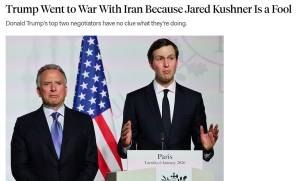 In order to maintain a false cover story justifying war, Trump turned to none other than… Jared Kushner (shown above with fellow Trump envoy Streve Witkoff under a disparaging headline from a commentator.).
Kushner is who Trump now cites as the source who told him Iran posed an immediate danger and had to be engaged in a full-scale war. Kushner has no intelligence or foreign-policy training or credentials, offered no evidence to back up his claim, and indeed was only in a position to advise his father-in-law this way because his father-in-law put him in a position of power despite being warned by the U.S. intelligence community that Kushner was likely compromised by a foreign power through any of (a) his lifelong friendship with Netanyahu, (b) his radical far-right religious beliefs about the centrality of Israel in all human affairs, (c) his own personal business interests as an investor in a postwar Gaza luxury development that could eventually make him billions of dollars, (d) billions in corrupt investments from the Saudis and Emiratis (who would benefit directly from the collapse of the Iranian regime), or simply (e) the possibility that he’s under the control of Mossad either via blackmail, Chabad, or wittingly (an allegation also made, in the Epstein Files, about Jeffrey Epstein, long an acquaintance of Jared Kushner and accused, like Kushner, of loyalties to Russia and Israel and financial compromise by both the Saudi and Emirati royal families.)
(3) The Second Iran War is manifestly not in the interests of the United States, has caused the deaths of a number of American soldiers, has harmed the American economy, has damaged America’s standing in the world—including its military alliances—and poses an ongoing violent threat to the American homeland and to U.S. bases abroad via missiles, drones, lone-wolf terror attacks, cyberattacks, and more. In the context of this, it remains the case that neither Trump nor anyone in his administration has articulated any reason for the United States to be at war with Iran beyond assisting a known war criminal from a country hostile to the United States—as it has interfered openly and criminally on Trump’s behalf in recent U.S. presidential elections—in a war of choice primarily intended to keep him (Benjamin Netanyahu) in power and out of prison in his own country.
 Notably, Trump’s words himself underscore that the Second Iran War is solely aimed at aiding and abetting the war criminal Netanyahu (shown together in an October 2025 meeting) rather than American interests.
The president said in mid-2025 that Iran’s nuclear capabilities were “obliterated,” and maintains this stance to the current day, so he can’t say America is at war to end Iran’s nuclear program. No Iranian missiles can reach the American homeland, nor can any Iranian drones (which have a maximum range of only 1,200 miles). The only attacks by Iran on U.S. bases in the Middle East have been in response to U.S. attacks on Iran, so the president can’t claim that Iran is a ballistic missile threat even to U.S. interests overseas. While Iran is a state sponsor of terror, it’s been so for nearly a half-century and has gained no new capacity or aggressiveness in this regard to warrant turning ongoing law enforcement operations into a full-blown military conflict. And we must also note that it is this military conflict that has now increased the domestic terror threat, a reality so damning to Trump and Kushner that they have tried to block its release to the American people. Nor is this way targeted in any way to reduce terror attacks on American soil; in fact, Trump and his personal lawyers Pam Bondi and Kash Patel have reduced every single domestic capacity American federal law enforcement has to detect, track, and thwart Iranian terror threats (see here for more), so it’s not possible to say that the Second Iran War has anything to do with terrorism.
(Summation) In view of all the foregoing, there’s ample reasonable suspicion that the United States has been thrust into a war that is (a) killing our troops and citizens at home, (b) dramatically increasing the threat to our homeland, (c) all but destroying our standing with our allies, (d) destabilizing the American and world economy, and (e) pushing the United States to commit multiple war crimes that could end future international cooperation with the USAF in military matters (to include the Minab War Crime and the Dena War Crime), and that the President of the United States—in conspiracy with his son-in-law Jared Kushner, an accused Israeli agent—has now harmed America in wartime exclusively to “adhere to an give aid and comfort to our enemies” (which, in the context of Iran, the Netanyahu Regime in Israel definitionally is, as reporting confirms it sought to destroy our peace negotiations with Iran via a military intervention that America opposed and that damaged American interests).
This investigation doesn’t require a finding that America is at war with Israel or that the state of Israel is definitionally an enemy of the United States; neither is true at this point. But the early evidence—which currently stands well beyond the reasonable suspicion standard in play here—supports a determination that this Israeli government chose to make itself a belligerent against U.S. interests during the peace negotiations held subsequent to the First Iran War, in doing so directly causing American deaths in a second war in Iran that the U.S. was attempting to avoid. And it had avoided it, until Jared Kushner, an accused Israeli agent, lied to the United States—aided and abetted by his father-in-law—to manufacture a conclusively fraudulent casus belli.
Those who think this is all an academic matter fail to appreciate that in well under a year the Democratic Party will likely control not only the United States House of Representatives—which future at present seems certain—but maybe even the Senate.
It’s therefore necessary for the current minorities in both those houses of Congress to begin their own investigations of Treason by the President of the United States so that Donald Trump can be impeached for Treason immediately upon the convening of the next House of Representatives in early 2027 if the facts of the investigations confirm what the reasonable suspicion above points toward. Treason cannot be abided for one minute more than is absolutely necessary.

Seth Abramson, shown above with the cover of one of his books documenting Trump scandals, is an author, attorney and former college professor.
News Updates
The Parnas Perspective, News and Commentary: Trump Attacks Media Coverage of Iran War After Privately Acknowledging He Thought Tehran Would Capitulate Instead of Closing the Strait of Hormuz, Aaron Parnas, right, March 14, 2026. President Trump has privately acknowledged to his staff that he did not expect Iran to close the Strait of Hormuz.
He believed Iran’s government would quickly capitulate. That did not happen. The strait has become a central pressure point in the conflict, global energy markets are reacting, and the war is proving far more complicated than the administration anticipated. At the same time, Trump is increasingly lashing out at the media over coverage he believes is biased.
Meanwhile, investors behind the TikTok deal are paying the U.S. government 10 billion dollars tied to the administration’s role in executing the agreement. Laura Loomer is also facing backlash internationally after being called out in India for posts widely criticized as racist and Islamophobic.
Today I will spend time digging into several major stories that many people have stopped talking about. That includes the Epstein files, developments in Minnesota, ICE, and much more. These issues are still unfolding and deserve continued attention.
Here’s the news:
More than two weeks after Donald Trump launched U.S. strikes on Iran that killed Supreme Leader Ali Khamenei, the conflict has expanded into a wider regional war with Iranian retaliation, disruption of oil shipments through the Strait of Hormuz, rising global energy prices, and growing concern among U.S. officials and allies that the administration lacks a clear strategy or exit plan.
 Donald Trump proceeded with military action against Iran despite warnings from advisers that Tehran could shut the Strait of Hormuz, betting Iran would back down; instead, the waterway has been largely blocked, oil prices have surged, and the conflict has expanded with casualties, economic fallout, and uncertainty over how the war will end.
U.S. law enforcement officials warn of elevated terrorism risks in the United States amid the war with Iran, following several recent violent incidents and concerns that staffing cuts and departures at the Federal Bureau of Investigation and the United States Department of Justice could weaken the government’s ability to detect and prevent potential attacks.
Donald Trump claimed Iran could have up to 1,700 “sleeper cells” in the United States, but the White House said there is no credible threat to the U.S. homeland, highlighting conflicting messages from officials as tensions rise during the ongoing war with Iran.
Donald Trump attacked the media for, what he views as, improper coverage of the war in Iran:
An Iranian missile strike damaged five U.S. Air Force refueling aircraft at Prince Sultan Air Base in Saudi Arabia, according to U.S. officials, marking a direct hit on American military assets in the region amid escalating conflict tied to the war with Iran. This was Trump’s response:
As the war enters its third week, Donald Trump threatened to strike Iran’s vital oil export hub on Kharg Island if attacks on shipping in the Strait of Hormuz continue; Iran responded defiantly, downplaying damage from U.S. strikes, launching missiles and drones toward the UAE, and warning it could target regional energy infrastructure and U.S. facilities, while disruptions to oil loading in the UAE and uncertainty about the conflict’s duration have caused volatility in global energy markets.
United States Central Command said U.S. forces carried out a large-scale precision strike on Kharg Island, destroying about 90 Iranian military targets while avoiding oil infrastructure at the strategic terminal that handles most of Iran’s exports, prompting Iran to warn it could retaliate by attacking oil and gas facilities tied to the U.S. and its allies across the region.
A strike hit a helipad inside the United States Embassy Baghdad compound in Baghdad’s heavily fortified Green Zone, according to Iraqi security officials, marking the latest attack on the facility frequently targeted by Iran-aligned militias amid escalating regional tensions.
Mohsen Rezaei said the Strait of Hormuz will not reopen unless the United States leaves the Persian Gulf and regional states control the waterway, adding that Iran would only consider ending the war after receiving compensation and security guarantees from Washington.
An explosion lightly damaged a Jewish school in Amsterdam in what Mayor Femke Halsema called a deliberate attack against the Jewish community; no one was injured, but authorities increased security at Jewish institutions amid rising antisemitic incidents, including recent attacks on synagogues in the Netherlands and Belgium, and broader tensions linked to the ongoing conflict between Israel, the U.S., and Iran.
Major General Mohsen Rezaei said Iran controls whether the war ends and would only agree to stop fighting if the United States fully compensates Iran for all losses and withdraws from the Persian Gulf, which he framed as a necessary guarantee against future conflict.
 Donald Trump attacked Maggie Haberman (author of the book Confidence Man and a longtime reporter forthe New York Times) in a post, calling her a “sleazebag writer” and saying he may add her and other reporters to his Florida lawsuit against The New York Times, accusing them of publishing false stories about him.
Rajdeep Sardesai criticized Laura Loomer for remarks about Kamala Harris, Indians, and immigrants, calling them “brazenly racist and Islamophobic” and condemning the comments as offensive toward immigrant and Indian communities.
According to the New York Times, investors backing a U.S.-controlled version of TikTok — including Oracle, Silver Lake, and Abu Dhabi’s MGX — are set to pay a $10 billion fee to the U.S. Treasury for the government’s role in arranging the deal championed by Donald Trump and led by JD  Vance, an unusually large government charge tied to resolving national-security concerns over TikTok’s former Chinese parent ByteDance.
North Korea fired about 10 ballistic missiles into the sea off its east coast in a show of force during joint U.S.–South Korea military drills, underscoring rising regional tensions as Pyongyang condemns the exercises, signals defiance toward Washington and Seoul, and links the standoff to broader global instability amid the Middle East war.
A recruiting pitch by headhunting firm Heidrick & Struggles sought to lure Wall Street bankers to join a new investment team at the United States Department of Defense by promising high salaries, privileged access to senior officials and foreign sovereign investors, and the chance to help deploy up to $200 billion in government-backed investments in strategic industries—an effort tied to the economic and national-security strategy of Donald Trump but criticized by ethics experts as potentially enabling conflicts of interest and corruption.
According to the Atlantic, Donald Trump’s personal cellphone number has widely circulated among journalists, executives, and political figures, leading to a surge of direct calls to the president that sometimes influence news coverage and even financial markets, while White House officials worry the informal, unscripted conversations—especially during the war with Iran—can create confusion or spread inconsistent messaging.
Palestinians in Gaza Strip say their humanitarian crisis is being overshadowed by the expanding regional conflict involving Iran, as ceasefire progress between Hamas and Israel stalls, aid deliveries decline, crossings close, and many displaced families continue living in tents or even cemeteries while facing severe shortages of food, water, and medical supplies.
A large Russian missile and drone barrage struck the Kyiv region, killing at least four people and injuring more than 15 while damaging homes and energy infrastructure, as stalled peace talks and the global focus on the Middle East war raise concerns that Russia may exploit the distraction to intensify its campaign against Ukraine.
Iranian lawmaker Ebrahim Azizi warned that Ukraine could become a “legitimate and lawful target” after Volodymyr Zelenskyy said Kyiv would help the U.S. and Israel counter Iran-designed Shahed drones in the Middle East, escalating rhetoric as the wider regional conflict expands.
A federal jury in Fort Worth convicted eight people on terrorism charges linked to a 2025 shooting outside the Prairieland ICE detention center, a case pursued by the U.S. Department of Justice after Donald Trump designated antifa a domestic terrorist organization; prosecutors said the defendants were tied to antifa, while defense attorneys argued the protest was not an organized terrorist plot and warned the verdict could have major implications for protest rights.
The United States has formally intervened at the International Court of Justice to defend Israel against South Africa’s genocide allegations over the Gaza war, arguing that the legal standard for genocide is being misapplied, while countries such as the Netherlands and Iceland have also joined the case, with the Dutch urging scrutiny of whether aid was deliberately withheld from Gaza.
More On Iran
New York Times, War in the Middle East: War in Iran Has Put Middle East Water Supplies at Risk, Mira Rojanasakul, Claire Brown and Hiroko Tabuchi March 14, 2026 (print ed.). Two weeks into the war in Iran, two water desalination plants in the region have been damaged in military operations, raising concerns over the vulnerability of a system that serves as a lifeline for millions across the Middle East.
Last week, Abbas Araghchi, Iran’s foreign minister, said an attack on a desalination plant on Qeshm Island, in the Persian Gulf, on March 7 had affected the water supply to 30 villages. While Iran blamed the United States for the attack, the Pentagon has denied responsibility, as has Israel.
And in Bahrain, the Interior Ministry blamed an Iranian drone for “material damage” to a desalination plant, though the country’s water and electricity authority said water supplies had not been affected.
Over the last few decades, the arid countries of the Persian Gulf have become increasingly reliant on desalination plants to supply water to cities and towns.
Desalination plants have become crucial infrastructure in places like Qatar and Bahrain, both of which now rely on the technology for more than 50 percent of their fresh water.Share of water from desalination plants Even if desalination plants aren’t targeted directly, damage to surrounding facilities could still disrupt their operations. Some plants draw water from the sea, raising the prospect that polluted water could clog plant filters or contaminate pipes.
“Say there is an oil spill next to the intake to the desalination plant,” Mr. Elimelech said. “That would practically kill the desalination plant.”
In 1991, the United States accused Iraq of deliberately spilling millions of gallons of Kuwaiti crude oil into the Persian Gulf with the intention of crippling desalination capacity or thwarting an amphibious invasion.
That created a nine-mile oil slick and prompted a monthslong effort to keep the oil from shuttering a desalination plant that supplied half of the drinking water for Riyadh, the Saudi capital. Oil spills on land, meanwhile, infiltrated many of Kuwait’s aquifers.
Hopium Chronicles, Advocacy: 2,500 Marines Are Headed To The Middle East, Kushner Shakes Down Gulf Leaders, Trump Is A Titanic F*ck Up, Simon Rosenberg, right, March 14, 2026. Every day we are reminded that Trump doesn't give a sh*t about America or the American people.
Brent crude rose overnight:
Yesterday I shared new data showing the economy grew far less than we thought in the fourth quarter of last year, and inflation remains way above the Fed target rate - all before the price spikes we are now seeing from the war.
The Wall Street Journal has a new, in-depth report on the “planning” that went into Trump’s new war, and how Trump just decided to go for it, despite the incredible damage the war could do to an American economy already weakened by his ruinous domestic agenda (gift link):
Before the U.S. went to war, Gen. Dan Caine, the chairman of the Joint Chiefs of Staff, told President Trump that an American attack could prompt Iran to close the Strait of Hormuz.
Caine said in several briefings that U.S. officials had long believed Iran would deploy mines, drones and missiles to close the world’s most vital shipping lane, according to people with knowledge of the discussions.Trump acknowledged the risk, these people said, but moved forward with the most consequential foreign-policy decision of his two presidencies. He told his team that Tehran would likely capitulate before closing the strait—and even if Iran tried, the U.S. military could handle it.
Now, two weeks into the war, Iran’s leaders have refused to back down, and the Strait of Hormuz has emerged as Tehran’s most potent leverage point.Iran has blocked tankers from the strait and struck cargo ships, triggering a surge in oil prices and an energy shock rippling around the world. U.S. forces are targeting Iran’s mine-laying ships and factories, trying to prevent the country from lining the waterway with explosives.
The joint U.S.-Israel military operation has killed Iran’s supreme leader, targeted military headquarters and damaged or destroyed more than 90 Iranian vessels.
Yet, the price has been steep. At least 13 Americans have been killed, including six in a crash Thursday of an Air Force refueling plane, making the war in Iran the deadliest military operation of Trump’s two terms. At least 140 Americans have been wounded in the conflict. Roughly 175 people, mostly children, were killed in a strike on a girls’ school in Iran, which a preliminary U.S. investigation found was likely launched by U.S. forces.
The U.S. operation is costing billions of dollars a week. More broadly, the growing risk of a widening and drawn-out war threatens the American economy, raising warnings of stagflation, a quagmire of stagnant growth and high inflation.Behind Trump’s rationale for war was a deep confidence in the capabilities of the U.S. military to deliver a swift, decisive victory, according to administration officials and others familiar with the matter.
The president’s trust in Caine was buoyed by the successful U.S. strikes on Iran’s nuclear sites last year and the January raid that captured Venezuela’s autocratic leader, Nicolás Maduro
Typically, war preparations include weeks or months of classified deliberations, written planning documents, the airing of dissenting views from diplomats and intelligence officials, and National Security Council meetings with cabinet members to make the most informed decision.
Only a small group was looped into the preparations for Iran—including Vice President JD Vance, Secretary of State Marco Rubio and Hegseth. That narrowed the advice, information and ideas available to the president, who had to balance the many downsides of an attack.
Foreign diplomats in Tehran anticipate that Iran will aggressively police the waterway, hoping the high cost to the U.S. will persuade Trump to walk away from the war.The president and some advisers were surprised at the breadth and scope of Iran’s retaliation, which included missiles and drones launched at regional countries from Azerbaijan to Oman, according to people familiar with the matter.
Allies in the Gulf are privately furious with the U.S., according to diplomats and others familiar with the matter. They blame the Trump administration for triggering a war that put them in the crosshairs and pierced their image of a luxurious, business-friendly locale free of the region’s chaos. Trump has been privately calling those leaders this week, according to a person familiar with the conversations.
Americans have been caught in danger, as well. The State Department didn’t urge U.S. citizens to depart countries in the region or evacuate some embassies until after the war began. By then, commercial airspace was already closed, leaving tens of thousands of Americans stranded in the Middle East and U.S. diplomats at some embassies in harm’s way.As we’ve discussed here given the failure of Trump’s early strategy he had two choices - declare victory and get out, or escalate. Yesterday Trump decided to escalate:
Yesterday, Pete Hegseth, in his bloodthirsty and unhinged press conference, committed a clear and undeniable war crime by declaring “no quarter,” a military term meaning that we will kill all prisoners.
Trump has responded to intelligence reports that Russia is helping Iran fight America, and Ukraine’s providing us technology to defend ourselves against Iranian-Russian Shahed drones, by relaxing sanctions on Russian oil and providing billions to fund Putin’s war in Ukraine.
As Trump uses the war to help his buddy Putin he is also using it to enrich himself and his family (gift link):
Jared Kushner, one of the U.S. government’s chief negotiators in the Middle East, is trying to raise more money for his private equity firm from governments in the region.Mr. Kushner, President Trump’s son-in-law, has spoken with potential investors in recent weeks about raising $5 billion or more for Affinity Partners, his investment firm, according to five people with knowledge of the talks who were not permitted to speak publicly about the discussions.
Yes, all of this is why we need keep working hard everyone……So, Now, Let’s Get To Work!!!!!!!!!!!!!!!!!!!!Winning The Midterms, Competing In Red States and Red Places, Expanding The Map.
PoliticusUSA, News and Commentary:Trump Trashed America’s Allies Now He Begs For Their Help In Iran, Jason Easley, right, March 14, 2026. Trump claims that he did the rest of the world a favor by starting a war with Iran, so now he wants other countries to join the war to open the Strait of Hormuz.
What happens when a president starts a war and completely misjudges how the country that he is attacking will respond?
Unfortunately for the American people, we are finding out the hard way.
Trump appears to have believed that Iran would not respond to a full-scale bombing operation with economic warfare, even though Middle East experts have been saying for decades that if the Iranian regime were ever attacked, it would, with near certainty, try to destabilize and cut off a significant amount of the world’s oil supply.
None of this is a surprise.
The idea that Iran would fight back economically was something that was factored into every previous president’s policymaking on Iran for nearly half a century.
Donald Trump thought he was different and that Iran would never do this to him.
According to AAA, the price for a gallon of regular gasoline has increased by four cents since yesterday. The national average is now $3.67. The price has increased by twenty-six cents over the last week, and by seventy-four cents a gallon over the past month.
Another week of this war will likely result in gas prices increasing by one dollar a gallon.
Trump’s solution to this problem is to make the rest of the world clean up his mess.
Trump posted on Truth Social:
Many Countries, especially those who are affected by Iran’s attempted closure of the Hormuz Strait, will be sending War Ships, in conjunction with the United States of America, to keep the Strait open and safe. We have already destroyed 100% of Iran’s Military capability, but it’s easy for them to send a drone or two, drop a mine, or deliver a close range missile somewhere along, or in, this Waterway, no matter how badly defeated they are.
Hopefully China, France, Japan, South Korea, the UK, and others, that are affected by this artificial constraint, will send Ships to the area so that the Hormuz Strait will no longer be a threat by a Nation that has been totally decapitated. In the meantime, the United States will be bombing the hell out of the shoreline, and continually shooting Iranian Boats and Ships out of the water. One way or the other, we will soon get the Hormuz Strait OPEN, SAFE, and FREE!
Trump spent years campaigning before the 2024 election on the claim that Joe Biden and Kamala Harris were going to start World War III.
Now that he is stuck in a war with that he started but has no clue how to end, Donald Trump is casually suggesting that other countries join his folly, in what looks a lot like World War III.
None of the other countries that Trump listed asked him to start a war with Iran.
Trump wants to be thanked for something that other countries didn’t want.
Donald Trump wants US allies who he has spent most of his term bad-mouthing to run to his aid now that he is stuck in a war of his choice with Iran.
Those countries should tell Trump to go pound sand.
Donald Trump broke it. Now he owns war with Iran.
U.S. Governance, Elections, Politics
New York Times, Trump Administration Live Updates: Kennedy Center’s President Leaving After Tumultuous Year, Adam Nagourney and Julia Jacobs, March 14, 2026 (print ed.). What We’re Covering.
- Kennedy Center: Richard Grenell, a close ally of President Trump who was installed to run the John F. Kennedy Center for the Performing Arts (shown above), is leaving his position after a tumultuous year that included an exodus of artists and audiences from the Washington cultural center. Mr. Trump said Mr. Grenell was being replaced by Matt Floca, the center’s vice president of facilities operations. Read more ›
- Powell Inquiry: A federal judge blocked an attempt by the Justice Department to issue subpoenas to the Federal Reserve as part of its investigation targeting the central bank’s chair, Jerome H. Powell. The judge wrote that there was “abundant evidence” the government’s action was designed to “harass and pressure” Mr. Powell into yielding to Mr. Trump’s wishes to lower interest rates or resign. Read more ›
Mr. Trump announced Mr. Grenell’s departure from the center, which will soon close for two years of renovations, in a post on social media on Friday afternoon.
“Ric Grenell has done an excellent job in helping to coordinate various elements of the Center during the transition period, and I want to thank him for the outstanding work he has done,” Mr. Trump wrote.
The president said Mr. Grenell, right,  would be replaced by Matt Floca, the center’s vice president of facilities operations. Mr. Trump said Mr. Floca “has helped us achieve tremendous progress in bringing the Center to the highest level of Excellence!”
Mr. Grenell, the former ambassador to Germany, is stepping aside as the center prepares to close on July 4. Mr. Trump announced the shutdown after months of headlines about boycotts by patrons and high-profile artists, including the composer Philip Glass, the Grammy-winning banjo player Béla Fleck, the San Francisco Ballet and the traveling production of “Hamilton.”
He leaves behind an institution that is drastically changed from a year ago, when Mr. Trump installed himself as chairman of the center and filled the board with loyalists as he moved to put his imprint on the center, including what appeared on its stages. The president went on to insert his name into that of the center, which opened in 1971 in tribute to John F. Kennedy.
The upheaval at a traditionally nonpartisan institution, where Republicans and Democrats have over the decades sat side by side for opera, theater and orchestra performances as well as black-tie gala events like the Kennedy Center Honors, set off a storm in the cultural world.
The Washington National Opera, a cultural pillar of the center, announced that it was moving out because of a decline in attendance and an edict from Mr. Grenell that all productions had to show how they would break even before the curtain raised. (Operas rarely make a profit from ticket sales alone, relying instead on contributions.)
The National Symphony Orchestra continued to perform at the Kennedy Center, often to many empty seats, but last week its executive director, Jean Davidson, announced she was leaving. She previously had been a public advocate of the orchestra’s staying put but said then that she did not “see how I could be effective as a leader in the current climate.”
Mr. Floca is stepping in as the center moves from offering arts programs to construction and rebuilding, an extension of the kind of work he was doing in his previous positions.
On Friday, Mr. Trump posted two renderings of the future Kennedy Center online and said that it would be “the finest facility of its kind anywhere in the World!” It is not clear, however, whether performers and audiences will return as enthusiastically, much less what it will look like after the project is completed.
In other administrataion news, a federal judge criticizes the government for pursuing an investigation of Jerome H. Powell.
A federal judge in Washington threw a major roadblock into a criminal investigation of Jerome H. Powell, the Federal Reserve chair, quashing grand jury subpoenas issued to the central bank by federal prosecutors over renovations underway at its headquarters in Washington.
 In a blistering 27-page decision unsealed on Friday, the judge, James E. Boasberg, left, derided the U.S. attorney’s office in Washington, led by the Trump loyalist Jeanine Pirro, for pursuing a case against Mr. Powell when it appeared that its only reason to do so was President Trump’s desire to seek vengeance against him. Mr. Powell has long resisted calls from the White House to significantly lower borrowing costs, prompting a litany of attacks that has extended to the president’s effort to fire another top official, Lisa D. Cook.
“There is abundant evidence that the subpoenas’ dominant (if not sole) purpose is to harass and pressure Powell either to yield to the president or to resign and make way for a Fed chair who will,” Judge Boasberg wrote.
He continued, “On the other side of the scale, the government has offered no evidence whatsoever that Powell committed any crime other than displeasing the president.”
Judge Boasberg’s decision did not necessarily mean the end of Ms. Pirro’s inquiry, but it did deal the investigation a devastating blow. If prosecutors intend to continue pursuing it, they would have to find other ways of obtaining evidence, like persuading a judge to issue a search warrant.
A fiery Ms. Pirro, appearing at a hastily called news conference in her office up the block from Federal District Court in Washington, where Judge Boasberg sits as the chief judge, said she planned to both appeal and file a motion requesting the judge to reconsider.
She also followed the bellicose lead of her boss, Mr. Trump, by attacking the judge, accusing him of harboring an animus toward the president and claiming that he had “neutered the grand jury’s ability” to obtain information from the Federal Reserve about its expenditures.
“Jerome Powell today is now bathed in immunity, preventing my office from investigating the Federal Reserve,” said Ms. Pirro, who asserted the subpoenas were issued because Mr. Powell ignored earlier requests for information. “This is wrong and it is without legal authority.”
The exchange was the latest development in a three-sided battle between a top Trump ally determined to pursue a dubious legal course to placate the president, a Fed chair fighting for the independence of an institution whose stewardship is essential to the economy, and a judge who has emphatically rejected the administration’s maximalist legal strategy.
The investigation began late last year, when Ms. Pirro’s office served two subpoenas to the Fed’s Board of Governors. Prosecutors sought records about recent renovations of the board’s buildings and testimony that Mr. Powell delivered to Congress that briefly discussed the project, which is running over budget by about $700 million and is set to cost around $2.5 billion. The administration seized on those cost overruns and accused Mr. Powell of mismanaging the project, culminating in a visit by Mr. Trump at the construction site in July.
The criminal investigation is only the latest in a string of attacks by the White House to pressure the Fed into lowering borrowing costs. The Justice Department’s investigation prompted a rare rebuke from Mr. Powell, who accused the White House of using the threat of criminal charges to coerce the central bank into lowering rates.
New York Times, Judge Rules Lawmaker Must Be Allowed to Join Kennedy Center Board Meeting, Zach Montague, March 14, 2026. A judge ordered that Representative Joyce Beatty, a Democrat, be given access to planning documents and have the chance to oppose changes to the center at a board meeting next week.
A federal judge in Washington on Saturday ordered that Representative Joyce Beatty, Democrat of Ohio, be granted more information and be allowed to participate in a planning meeting about the future of the John F. Kennedy Center for the Performing Arts, temporarily resolving a minor standoff with President Trump.
The ruling gave Ms. Beatty a window into the president’s goals for remaking the center in his own image, after dozens of performers canceled shows in protest and patrons worried about a proposed multiyear closure of the performance space.
Ms. Beatty was designated an ex officio member of the board of the Kennedy Center and has used that role to fight against changes to the institution as Mr. Trump asserts more control over its governance.
The center’s board is scheduled to meet on Monday, though Ms. Beatty argued that the purpose of the meeting had not been explained, and that she had been kept out of the loop.
On Saturday, Judge Christopher R. Cooper of the Federal District Court in Washington agreed that Ms. Beatty needed to receive a more thorough accounting of plans and be allowed “a meaningful opportunity to lodge her dissent” at the meeting, “and not be categorically barred from speaking.”
She has said that she plans to attend and voice her opposition to Mr. Trump’s proposals to overhaul the performing arts center.
Judge Cooper wrote that the secrecy surrounding the project and the agenda on Monday appeared hard to square with the scale of the president’s stated ambitions.
“These are exceptional circumstances, both in the potential immensity of the announced work on the Kennedy Center and the manner in which most of its trustees have been sidelined from one of the more consequential decisions in the institution’s life span,” he wrote.
Ms. Beatty has also asked the court to issue an order barring Mr. Trump from redeveloping the site, arguing that her job on the board was to be a steward of the center. Judge Cooper has not yet considered that request.
Mr. Trump has told performers and staff that he intends to transform the space into a “new and spectacular Entertainment Complex.”
In a 37-page opinion, Judge Cooper laid out a list of documents — including budgets and planning reports — that had to be sent to Ms. Beatty within 24 hours, “to the extent they exist.” He added that the government’s claims in the lawsuit that no plans had been finalized, just four days before the board could meet to approve them, “borders on preposterous.”
New York Times, Trump Administration Readies Plans to Dismantle Renowned Science Lab, Eric Niiler, March 14, 2026 (print ed.). Proposals include transferring a supercomputer to the University of Wyoming and shifting a space weather lab to a private company.
The Trump administration is reviewing proposals to break up one of the world’s leading climate and weather laboratories, transfer its work to universities and private companies, take away its aircraft, and sell its property in Boulder, Colo.
The laboratory, the National Center for Atmospheric Research, has been targeted for months by the Trump administration. In a social media post in December, Russell Vought, the White House budget director, called the Colorado center “one of the largest sources of climate alarmism in the country.”
The center, founded in 1960, is responsible for many of the biggest scientific advances in understanding of weather and climate. Its research aircraft and sophisticated computer models of the Earth’s atmosphere and oceans are widely used in forecasting weather events and disasters.
Scientists say the move to dismantle the center would weaken research that is crucial to understanding the atmosphere, space and oceans, air pollution and climate change. It would leave emergency officials and planners less prepared for extreme weather events, critics said.
The center’s staff includes about 830 employees working under the University Corporation for Atmospheric Research, a nonprofit consortium of colleges and universities that oversees the center for the federal government.
The center also operates a massive supercomputer, known as Derecho, in Cheyenne, Wyo., that scientists use to predict the behavior of wildfires, space weather, hurricanes and other complex weather patterns.
Proposals are due on Friday to the National Science Foundation from institutions that want to take over management of the center’s research portfolio and various facilities; comments from the public about the center’s future are also due then.
Michael England, a spokesman for N.S.F., which oversees the center, said the proposals and comments from interested parties would not be made public. He would not say when the officials would make a final decision about the fate of the center.
“I don’t have anything on that for you,” Mr. England said.
Colorado’s elected officials have been fighting to preserve the center. Putting it on the chopping block would also be an economic blow to the state. President Trump has feuded with Gov. Jared Polis, a Democrat, over Mr. Trump’s pardoning of a former Colorado election official who was convicted of multiple state felonies after she gave Mr. Trump’s supporters unauthorized access to voting machines after the 2020 presidential election.Editors’ PicksWhen It Came to Their Vows, Rapper Remy Banks Didn’t Miss a BeatThe Best Writing Tip? Get a Dog.Inside the Kitchen That Feeds Hollywood on Oscars Night
“Breaking up the institution would have detrimental impacts,” Gov. Polis said in a statement on Thursday. “People evacuate more quickly and safely from fires because of NCAR.”
The center’s data, Mr. Polis said, “improve forecasting of severe weather events like fires and floods, support safer aviation and transportation, and help businesses and communities make informed decisions.”
In a letter to the N.S.F.’s acting director, Brian Stone, Representatives Joe Neguse, a Democrat, and Jeff Hurd, a Republican, wrote that dismantling the center would increase costs and “erode critical research capacity, disrupt longstanding partnerships, and diminish our ability to understand, anticipate and respond to extreme weather-related risks.”
New York Times, A federal judge orders the V.A. to restore a union contract with 300,000 workers, Zach Montague, March 14, 2026 (print ed.). A federal judge in Rhode Island ordered the Trump administration to restore a union contract with more than 300,000 Veterans Affairs Department workers, after Doug Collins, right, the V.A. secretary, moved to nullify the agreement in August.
 In a 29-page opinion, Judge Melissa R. Dubose wrote that the union, the American Federation of Government Workers National V.A. Council, had made clear that the termination of the contract was retaliatory — and therefore in violation of the First Amendment — given the opposition to the Trump administration’s labor policies mounted by the union’s umbrella group, the American Federation of Government Employees.
Noting that the union was already shedding members after the termination of the agreement, Judge Dubose reasoned that waiting until the lawsuit was finished to restore the contract would cause painful losses for the union and its workers. She ordered that the three-year contract, which was ratified in June 2023, be reinstated for the remainder of its term.
The decision to end the agreement, she wrote, “seems substantially motivated by the plaintiffs’ history and frequency of vocally opposing changes to labor policies.”
The union had argued that the decision hinged on its opposition to Mr. Trump’s presidential policies. The union is part of the American Federation of Government Employees, which represents workers at many other government agencies. It has, Judge DuBose noted, “actively litigated against the Trump administrations.”
Judge Dubose acknowledged that First Amendment claims based on retaliation against unions have had a mixed record nationally.
She pointed to a decision in August by the U.S. Court of Appeals for the Ninth Circuit, which reasoned that President Trump would likely have signed an executive order last year stripping more than a million federal workers of collective bargaining rights regardless of their public stances. But she concluded that the union had made a strong argument that the cancellation of the contract was related to existing resentments toward the union and its members.
She cited a White House fact sheet on an executive order Mr. Trump’s executive order signed in March, which stated that “certain federal unions have declared war on President Trump’s agenda.” And she noted various anti-labor statements by Mr. Collins, which she said demonstrated that the “laser focus” of the agency’s leaders “was on the ways the V.A. perceived employee unions as frustrating the work and purpose of the V.A.”
In a statement celebrating the news, Mary Jean Burke, the president of the smaller National V.A. Council, said the decision overcame “this administration’s shameful and hostile attempts to silence V.A. workers.”
U.S. Justice, Law, Crime, Courts, Rights
New York Times, Justice Dept. Legal Threat Complicates Trump’s Pick for Fed Chair, Colby Smith and Tony Romm, March 14, 2026. An investigation of the Federal Reserve was thwarted on Friday, but a department appeal could reimpose an obstacle in Kevin Warsh’s path.
For a moment on Friday, Kevin M. Warsh was on a glide path to becoming the next chair of the Federal Reserve.
That afternoon, a federal judge tossed out a pair of subpoenas that the Justice Department had issued to the central bank as part of a criminal investigation into Jerome H. Powell, the Fed’s chair, and his handling of its headquarters renovation.
The inquiry, opened by Jeanine Pirro, the U.S. attorney for the District of Columbia and a longtime ally of President Trump, had been the main obstacle between Mr. Warsh and one of the most powerful economic policymaking jobs in the world.
But Ms. Pirro soon made it clear that the fate of Mr. Warsh — and the president’s desire to appoint more of his supporters to the Fed — remained in her hands.
As a court unsealed the judge’s decision, Ms. Pirro hastily convened a news conference, where she defiantly threatened to continue the fight. In a span of about an hour, a possible pathway for Mr. Warsh narrowed about as quickly as it had emerged, turning instead into his latest political hurdle.
Ms. Pirro’s criminal investigation had rankled several powerful members of the Senate Banking Committee, which oversees the Fed. They included Senator Thom Tillis, Republican of North Carolina, who vowed again on Friday to block Mr. Trump’s choice to lead the Fed until the investigation was scrapped.
“This ruling confirms just how weak and frivolous the criminal investigation of Chairman Powell is, and it is nothing more than a failed attack on Fed independence,” Mr. Tillis said in a statement. “We all know how this is going to end, and the D.C. U.S. attorney’s office should save itself further  embarrassment and move on. Appealing the ruling will only delay the confirmation of Kevin Warsh as the next Fed chair.”
Since returning to office, Mr. Trump has spared no opportunity to try to steer the actions of the Fed, frequently testing the limits of the law. But his administration’s maneuvers threaten to keep the president from what he has sought most: a new leader at the Fed who is more sympathetic to lower interest rates.
At the center of the saga is Mr. Powell, whose term as chair ends in May. Mr. Trump has spent years scolding Mr. Powell, whom he elevated to chair during his first term, for not slashing borrowing costs. In late January, Mr. Trump tapped Mr. Warsh to succeed Mr. Powell, writing that Mr. Warsh, a former Fed governor, would “go down as one of the GREAT Fed Chairman, maybe the best.”
Mr. Warsh, right, is well liked among Republicans, who control the Senate. But lawmakers quickly realized they would have difficulty advancing anyone Mr. Trump picked in the wake of the Justice Department’s criminal investigation.
Republicans had been looking for an offramp that would allow Mr. Warsh’s nomination to proceed. Treasury Secretary Scott Bessent sought to downplay the ramifications of the investigation and made clear his desire to get the confirmation process underway.
“We’ll see where the investigation goes with Jeanine Pirro’s office,” Mr. Bessent said on CNBC last month. “There were subpoenas issued. But that doesn’t have to mean that there are charges.”
The latest entreaty came from Senator Tim Scott of South Carolina, the chair of the Banking Committee. On Wednesday, he said he hoped the investigation into Mr. Powell just “goes away.”
New York Times, Lobbyist Arrested in Extortion Attempt of Client Who Received a Trump Pardon, Kenneth P. Vogel, William K. Rashbaum and Santul Nerkar, March 14, 2026. Josh Nass, a lawyer and lobbyist, had recently represented Joseph Schwartz, a former nursing home executive pardoned by the president late last year.
Josh Nass, a lawyer and lobbyist with connections in President Trump’s orbit, was arrested by F.B.I. agents on Friday afternoon in Manhattan and charged with attempted extortion, according to court papers.
Mr. Nass, who has connections in conservative Jewish and evangelical circles, had recently been paid $100,000 to pursue clemency for Joseph Schwartz, who was convicted of tax crimes related to a nursing-home empire that had collapsed amid allegations of endangering the residents and defrauding his employees.
Joseph Nocella Jr., the United States Attorney for the Eastern District of New York, in a statement issued Saturday morning, accused Mr. Nass of having “plotted the violent extortion of one of his own clients.”
Mr. Nass had been paid $100,000 by the client, but was owed an additional $500,000, according to court papers in the case unsealed on Saturday. The filings claim that Mr. Nass instructed someone he hired to “do anything and everything” to collect the outstanding funds from the client’s son.
The papers strongly suggest that the targets of Mr. Nass’s threats were Mr. Schwartz and one of his sons, though they are not named.
Mr. Nass, 34, is expected to be arraigned Saturday in Brooklyn.
Mr. Nass’s efforts on behalf of Mr. Schwartz were detailed in an article this month in The New York Times.
An associate of Mr. Nass said that he was arrested on Friday in Midtown Manhattan after leaving a meeting at a hotel about securing business from other clemency seekers.
Mr. Nass could not be reached for comment. One of his lawyers, Marc Agnifilo, said he would comment after reviewing the charges. Mr. Schwartz did not immediately respond to a request for comment.
Mr. Schwartz had pleaded guilty in 2024 to tax crimes in federal and Arkansas courts related to his failure to pay nearly $40 million in employment and payroll taxes, as well as to a state Medicaid fraud charge in Arkansas. He was sentenced to three years in federal prison.New York Times,East
U.S. Media, Propaganda, Artificial Intelligence
New York Times, Cascade of A.I. Fakes About War With Iran Causes Chaos Online, Stuart A. Thompson and Alexander Cardia, March 14, 2026 (print ed.). A torrent of fake videos and images generated by artificial intelligence have overrun social networks during the first weeks of the war in Iran.
The videos — showing huge explosions that never happened, decimated city streets that were never attacked or troops protesting the war who do not exist — have added a chaotic and confusing layer to the conflict online.
The New York Times identified over 110 unique A.I.-generated images and videos from the past two weeks about the war in the Middle East. The fakes covered every aspect of the fighting: They falsely depicted screaming Israelis cowering as explosions ripped through Tel Aviv, Iranians mourning their dead and American military vessels bombarded with missiles and torpedoes.
Collectively, they were seen millions of times online through networks like X, TikTok and Facebook, and countless more times within private messaging apps popular in the region and around the world.
The Times identified the A.I. content by checking for both obvious signs — such as depictions of buildings that do not exist, garbled text and behaviors or movements that defy expectations — and for invisible watermarks embedded within the files. The posts were also checked with multiple A.I. detector tools and compared with reports from news organizations.
A sophisticated new wave of A.I. tools makes the fakes possible, enabling nearly anyone to create lifelike simulations of war that can deceive the naked eye for little to no cost. Similar content has spread in other conflicts, including the war between Ukraine and Russia. But this war has multiple fronts, and that has led to a proliferation of fake content since the United States and Israel first attacked Iran, according to experts.
“Even compared to when the Ukraine war broke out, things now are very different,” said Marc Owen Jones, an associate professor of media analytics at Northwestern University in Qatar. “We’re probably seeing far more A.I.-related content now than we ever have before.”
 Stars and Stripes, U.S.Pentagon plan expands oversight of Stars and Stripes, limits content, Rose L. Thayer, March 13, 2026. A March 9 memo affirmed the independence of the publication while announcing new restrictions.
The Pentagon has released a modernization plan for Stars and Stripes that affirms the publication’s independence while expanding Defense Department oversight, introducing new restrictions on content and transitioning away from a print publication.
An eight-page memo, dated March 9 and effective immediately, limits the use of wire services, bars comics and other syndicated features and states that content must be consistent with “good order and discipline,” a phrase borrowed from the Uniform Code of Military Justice.
The memo is the first formal explanation since Pentagon Press Secretary Sean Parnell said in a Jan. 15 social media post that the Defense Department intended to “refocus” the news organization “from woke distractions that syphon morale.”
On Friday, Parnell in a statement provided the first direct comment to the organization since Jan. 15. He said the department is “returning S&S to its original mission: an independent news source for service members stationed overseas that is by the warfighter and for the warfighter.”
Parnell said the effort includes “a transition from print to digital, transition to uniformed staff at locations outside the continental U.S., and other efficiency measures that will eliminate redundancies and ensure smart use of DOW resources.”
Stars and Stripes staff currently includes service members on one- to three-year assignments who are mentored by civilian journalists. The service members are typically trained by the services in public relations.
Parnell did not answer questions about how his office is coordinating with the news organization to implement these changes or if the decisions are based on any formal review or evaluation of Stars and Stripes operations.
No coordination
Stars and Stripes Publisher Max Lederer told U.S.-based staff of the memo Thursday and said he would begin meeting with the organization’s leadership to discuss implementation of the memo.
Lederer said he has not been contacted directly by anyone from the Pentagon about the changes, despite reaching out to them. The memo, which was sent to Pentagon leaders and combatant commanders, was written without Stars and Stripes’ input.
Stars and Stripes was not notified about publication of the memo, which was found during a search on a DOD website.
“It is unlikely that the Pentagon was aware of the extensive modernization that Stars and Stripes had already begun,” Erik Slavin, Stars and Stripes editor in chief, said in a statement Thursday. “Over the past year, the changes to our digitally produced news and information have resulted in significant increases in pageviews, engagement and subscribers.”
Reader feedback and real-world usage drove the efforts, said Slavin, who became the organization’s top editor late last year after more than 20 years stationed with the company in Japan, Iraq, South Korea and Germany.
Business operations and funding remain largely unchanged by the memo.
‘A threat to the First Amendment’
Press freedom advocates said the memo shifts authority over content decisions in a way that risks undermining the newsroom’s independence.
“This clearly shows that the Pentagon is trying to increase its influence over content decisions at Stars and Stripes,” said Timothy Richardson, program director of journalism and disinformation for PEN America, a nonprofit that protects free expression.
“That’s a threat to the First Amendment, certainly, and the independence that the Congress has long guaranteed for the newsroom,” he said Thursday after reviewing the memo.
PEN America and five other press-freedom organizations sent a letter to Congress last month in support of Stars and Stripes’ editorial independence.
Stars and Stripes, which is owned by the Defense Department, was first published by Union troops during the Civil War and has been published continuously since World War II. The newspaper publishes print editions overseas and a U.S. weekly edition. It distributes to combat zones as needed.
Its website and other digital offerings have gained readership among troops stationed across the U.S. and among veterans.
The news organization has been threatened with closure over the years but has repeatedly garnered support from veterans and bipartisan members of Congress.
The Pentagon in January withdrew a federal regulation that underpinned the mandate set by Congress for Stars and Stripes to provide independent journalism to the military community under the principles of the First Amendment.
The new memo confirmed that Stars and Stripes’ editorial operations are “independent of the military chain of command, military public affairs activities or other external influences,” but makes no mention of First Amendment freedoms.
It moves the defense secretary’s public affairs office into an oversight role. Previous guidance gave it an administrative role to help with funding, military manning and other regulatory steps. It also calls for an advisory board of Defense Department personnel.
Content overhaul
The memo bars purchased content on the assumption that all service members overseas have online access to all commercially available news on their own. Exceptions for purchased content can be approved by Parnell, according to the memo.
Stars and Stripes uses wire services to provide more complete world coverage of interest to the military community.
Jacqueline Smith, Stars and Stripes’ ombudsman, said wire services add value because they fill gaps and make a news outlet a “one-stop shop.”
“A complete newspaper should include national sports and entertainment ...,” she said. “Stripes does not have the resources to do its own reporting in those areas. Yet sports and entertainment contribute to the morale of troops.”
Losing this “will reduce the quality and breadth of information available to readers,” Slavin said.
The memo calls on Stars and Stripes to be a “‘hometown-style’ publication for the increasingly niche U.S. military community” and says it “should” republish content created by the Defense Department public affairs offices with a label describing its origin, though it grants the publisher latitude to determine whether such content serves readers’ needs.
The memo does not specify which publications should include public affairs content.
“We have no plans to commingle military public relations offerings with our independent reporting,” Slavin said. “Stars and Stripes remains committed to balanced and accurate reporting on behalf of the military community we serve.”
Other changes require the ombudsman to send information bound for Congress through the Defense Department Legislative Affairs Office.
“The House Armed Services Committee created the independent position in 1990-91 with the requirement the ombudsman report to the committee on matters of importance to maintaining Stripes editorial independence,” Smith said. “If that report must go through the Pentagon’s legislative affairs staff, then there is no assurance it would be complete and unchanged and there would be no opportunity to ask the ombudsman questions.”
The memo also bars reporters from requesting public records through the Freedom of Information Act in an official capacity and prohibits the organization from publishing “controlled unclassified information.” This label has often been used to limit the release of information under broadly defined terms.
Last year, the Pentagon asked all reporters working within the building to sign a pledge that included a similar demand. Dozens of journalists turned in their access badges, while a new group of reporters signed the agreement and replaced them.
“The obstacles that the Pentagon continues to throw in the way of credible reporting are growing, and [the memo] is another clear example of that,” Richardson said.
March 13
Top Headlines

U.S. Secretary of Defense Pete Hegseth, an ultra-right Christian nationalist who calls himself "Secretary of War" despite his legally defined title as "Defense" Secretary, addresses senior military leaders at Marine Corps Base Quantico on September 30, 2025 in Quantico, Virginia.
- New York Times, War Live Updates: Hegseth Vows to Reopen Key Strait as U.S. Measures Fail to Calm Oil Markets, Eric Schmitt, Helene Cooper and Adam Rasgon, March 13, 2026. Defense Secretary Pete Hegseth said that the U.S. military would stop Iran from choking off the Strait of Hormuz but did not say how. Oil prices remained high even after the Trump administration eased restrictions on Russianshipments. Here’s the latest.
- New York Times, Hegseth’s Boasts of ‘Maximum’ Engagement Authorities Face Scrutiny After School Is Hit, Charlie Savage, March 13, 2026 (print ed.).The defense secretary has disparaged restrictive rules for opening fire that are aimed at reducing the risk of mistakes and civilian casualties.
- The Contrarian, Analysis: Is Trump Building ‘Concentration Camps’? These Experts Have No Doubts,Tim Dickinson, March
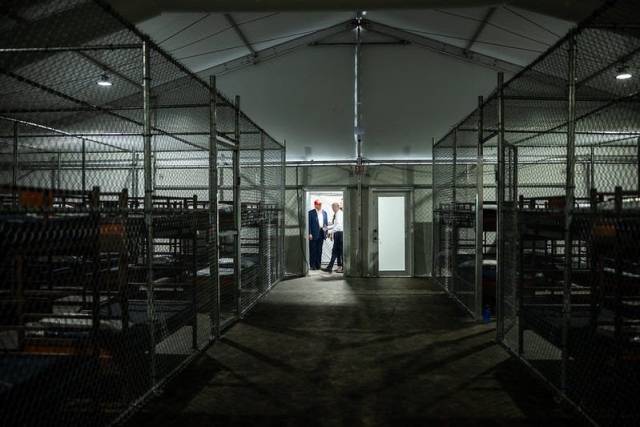 13, 2026. ICE’s immigrant mass-detention facilities fit a dark, century-old pattern. Donald Trump tours “Alligator Alcatraz” (White House photo at right).
- New York Times, Suspended U.S. Sanctions Add a Political Win to Russia’s Economic Gains, Ivan Nechepurenko and Paul Sonne, March 13, 2026. Kremlin officials said the American move, which Europe opposes, showed that Moscow could not be dislodged from the center of global energy markets.
- New York Times, Trump Administration: Wall Street Bankers Offered Lucrative Access to Join the Pentagon, Ana Swanson, March 13, 2026. A presentation from a headhunting firm aimed to recruit Wall Street investors to the Pentagon by offering “unmatched access” to government officials and fund-raising opportunities among foreign sovereigns.
 New York Times, Trump Removes Sanctions on Russia to Help Oil Flow Amid Iran Conflict, Alan Rappeport, March 13, 2026 (print ed.). TreasurySecretary Scott Bessent said it was “unfortunate” that the move could benefit Russia, but maintained that it was only for the short term.
- Emptywheel, Analysis: Trump Rewards Russia for Helping Iran Target US Service Members, Emptywheel (Marcy Wheeler), right, March 13, 2026.
 Yesterday, Scott Bessent lifted sanctions on any Russian oil currently stranded at sea (including oil that Russia managed to “strand” at sea between Monday, when Trump spoke with Putin, and yesterday).
- Morning Shots via The Bulwark, Political Opinion: Trump to America: Thank Me for Your Gas Bill, Bill Kristol, Andrew Egger and Jim Swift, March 13, 2026. Higher prices = more money, according to the president.
News Updates
- The Parnas Perspective, News and Commentary: Trump Underestimated Iran's Willingness to Close Strait of Hormuz, Pentagon Lashes Out at Media, Trump Says it is an "Honor" to Kill Iranians, Aaron Parnas, right, March 13, 2026. The United States reportedly underestimated Iran’s willingness to close the Strait of Hormuz, and now Iran has done exactly that. Meanwhile Defense Secretary Pete Hegseth said the quiet part out loud by openly attacking the press and saying he can’t wait for CNN to be sold. The US has temporarily lifted sanctions on Russian oil, more American service members have been killed in the conflict, and Donald Trump said it is his “honor” to kill Iranian leaders while simultaneously fundraising off the war.
More News Updates: U.S. Elections, Politics, Governance
 Letters from an American, Historical Commentary: March 12, 2026 [Billionairre Candidate Profits Big], Heather Cox Richardson, right, March 13, 2026. In Ohio today, Republican candidate for governor Vivek Ramaswamy, above, launched a $10 million TV and digital ad campaign to run until Election Day.Jeremy Pelzer of Cleveland DOT com explained that this ad buy alone is more than twice as much as the $4.4 million Democratic candidate Amy Acton, the former state health director, has raised, and it is only about half of the $19.5 million Ramaswamy’s campaign has raised.
- Hopium Chronicles, Advocacy, Inflation Comes In Hot (Again), Nation State AI Propaganda Here Now, New 2026 Battlefield Emerging, Simon Rosenberg, March 13, 2026. Hegseth, Witkoff, and Kushner Are All Up Schitt's Creek.
- The Other 98%, Advocacy: Keeping the Class War classy! Palantir CEO Alex Karp just announced on camera that he is going to reduce the economic power of highly educated Democratic voters, Staff and wire reports, March 13, 2026. In a recent CNBC interview, Karp stated that his AI technology disrupts humanities trained, largely Democratic voters and makes their economic power less, while increasing the economic power of vocational, working class, often male voters.
More On Iran War
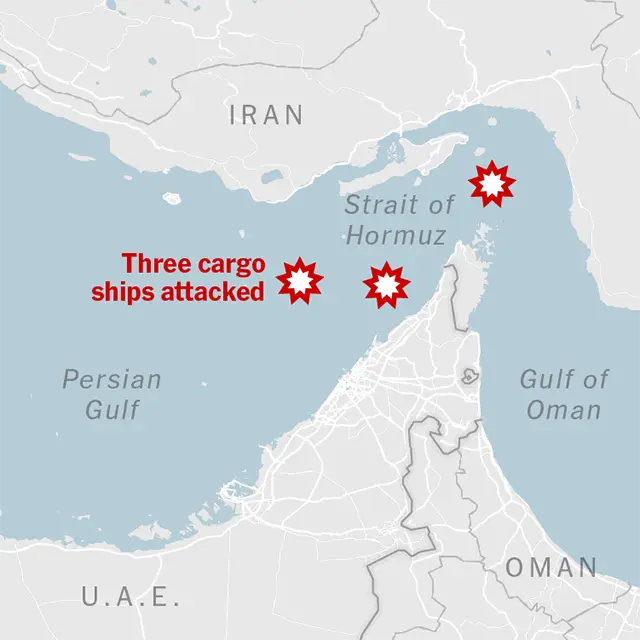
- New York Times, Weakened by War, Iran Hits Back by Strangling a Vital Waterway, Anton Troianovski, Julian E. Barnes and Greg Jaffe, March 13, 2026 (print ed.). The threats to shipping in the Strait of Hormuz are complicating President Trump’s calculations about how and when to end the war.
- New York Times, 4 Killed in Crash of U.S. Refueling Plane in Iraq, Military Says, Helene Cooper, Greg Jaffe and Eric Schmitt, Updated March 13, 2026. The crash was not because of hostile or friendly fire, U.S. Central Command said. Four crew members died, it said, bringing the number of U.S. service members killed in the Iran conflict to at least 11.
- New York Times, Lebanese Family Members of Synagogue Attacker Died in Airstrike, Jacey Fortin, Hwaida Saad, Neal E. Boudette and Kurt Streeter, March 13, 2026. The man was identified as a U.S. citizen born in Lebanon, who lived and worked outside Detroit. The attack on Temple Israel left Jewish communities across America rattled.
- Morning Shots via The Bulwark, Political Opinion: Trump’s Iran ‘Excursion’, William Kristol, March 13, 2026. Donald Trump has been mocked for calling the Iran war an “excursion,” indeed a “little excursion.” And deservedly so.
U.S. Law, Courts, Crime, Civil Rights
- Public Notice, How Trump hacked the judiciary, Lisa Needham, March 13, 2026. His fake "emergencies" are pushing the country toward autocracy.
- New York Times, Guest Essay: The Trump Administration Floats a New Way to Humiliate the Legal Profession, Deborah Pearlstein (director of the Princeton Program in Law and Public Policy and a visiting professor of law at the Princeton University School of Public and International Affairs), March 13, 2026.
- Checks & Balances, Commentary: When Homeland Security Threatens the Citizens It Was Created to Protect, Nuala O’Connor, A warning from the first-ever Chief Privacy Officer of the DHS.
- New York Times, Treasure Hunter Released From Prison After Refusing to Turn Over Gold Coins, Remy Tumin, March 13, 2026 (print ed.). Thomas G. Thompson was held in contempt for 10 years for repeatedly denying he knew the whereabouts of 500 missing gold coins.
More Global News
- New York Times, Canada to Expand Military Presence in Arctic, Following Trump Threats, Ian Austen, March 13, 2026 (print ed.). Prime Minister Mark Carney said Canada would build three bases in the region. The government also plans to improve infrastructure and airports in the north.
- New York Times, Cuban President Acknowledges Talks With Trump Administration, Frances Robles, David C. Adams and Patricia Mazzei, March 13, 2026. President Miguel Díaz-Canel, whose country is rapidly running out of fuel, said the talks were based on “respect for the political systems of both countries.”
- Emptywheel, Analysis: Trump Rewards Russia for Helping Iran Target US Service Members, Emptywheel (Marcy Wheeler), March 13, 2026. Yesterday, Scott Bessent lifted sanctions on any Russian oil currently stranded at sea (including oil that Russia managed to “strand” at sea between Monday, when Trump spoke with Putin, and yesterday).
- New York Times, Phones ‘Ringing Off the Hook’ for Ukraine Defense Firms as Mideast Seeks Help, Andrew E. Kramer and Maria Varenikova, Visuals by Brendan Hoffman, March 13, 2026. Ukraine wants to leverage its defense expertise into security partnerships and to reap potentially vast profits for its arms industry.
More On U.S. Inflation, Economy, Jobs, Markets
- New York Times, Oil Prices Rise Despite Trump’s Decision to Lift Russia Sanctions, Updated March 13, 2026. The worldwide price of oil rose slightly on Friday, continuing to trade around $100 a barrel on heightened fears about the economic impact of a sustained blockage of Middle East energy.
- Paul Krugman via Substack, Political-Economy Commentary: Oil Prices Could Easily Go Much Higher, Paul Krugman, right, March 13, 2026. If the Strait stays closed, look out above.
- Morning Shots via The Bulwark, Political Opinion: Magical Thinking, Andrew Egger, March 13, 2026. Wake up, babe: Donald Trump is field-testing a new Iran-war messaging strategy. Spiking oil prices, he informed us by tweet yesterday, are good, actually: “The United States is the largest Oil Producer in the World, so when oil prices go up, we make a lot of money.”
- New York Times, Trump Administration Live Updates: D.H.S. Staff to Miss Paycheck as Shutdown Continues, Carl Hulse, March 13, 2026. What We’re Covering Today.
U.S. Media, Culture, Education
- The Contrarian, Opinion: Undaunted, Jennifer Rubin, right, March 13, 2026. Reporting on Trump need not be wishy-washy.
- Lincoln Square Media, Opinion: How U.S. Media Uncovered the Truth about the Iran School Strike, Jennifer Schulze, March 13, 2026. Dogged investigative news reporting has revealed the U.S. role in the deadly school bombing—but you won't hear much about that from Trump-friendly media.
Top Stories
U.S. Secretary of Defense Pete Hegseth, an ultra-right Christian nationalist who calls himself "Secretary of War" despite his legally defined title as "Defense" Secretary, addresses senior military leaders at Marine Corps Base Quantico on September 30, 2025 in Quantico, Virginia.
New York Times, War Live Updates: Hegseth Vows to Reopen Key Strait as U.S. Measures Fail to Calm Oil Markets, Eric Schmitt, Helene Cooper and Adam Rasgon, March 13, 2026. Defense Secretary Pete Hegseth said that the U.S. military would stop Iran from choking off the Strait of Hormuz but did not say how. Oil prices remained high even after the Trump administration eased restrictions on Russian shipments.
Here’s the latest.
U.S. officials on Friday vowed to thwart Iran’s attempts to block the Strait of Hormuz, as oil markets appeared largely unmoved by the Trump administration’s efforts to avert an energy crisis stemming from the Middle East war.
Defense Secretary Pete Hegseth said at a news conference that the disruptions in the strait were “something we are dealing with,” adding: “Don’t need to worry about it.” Gen. Dan Caine, the chairman of the Joint Chiefs of Staff, said that the U.S. military was targeting Iran’s ability to lay mines in the strait, through which 20 percent of the world’s oil normally travels.
“There’s a reason why we chose as one of our primary objectives to destroy their Navy,” Mr. Hegseth said. “We have a plan for every option here,” he added. “That’s not a strait we’re going to allow to remain contested.”
The war in the Middle East has killed more than 2,000 people over the past two weeks, mostly in Iran and Lebanon, and displaced millions of others. Iran’s new supreme leader, Mojtaba Khamenei, has vowed to keep blocking the Strait of Hormuz, a move that has disrupted global energy supplies and rattled financial markets.
Exchanges of fire by Israel; the United States; Iran; and its Lebanese ally, Hezbollah; showed little sign of slowing on Friday. Mr. Hegseth said at the news conference that Israeli and U.S. air forces had struck over 15,000 targets since the war started on Feb. 28.
In Tehran, Iran’s capital, Iranians thronged the streets for an annual anti-Israel rally. An explosion was seen close to where crowds had gathered, according to videos shared by Iranian state television. It was not immediately clear what had caused the blast, but earlier in the day Israel had warned of more strikes in Tehran.
In Turkey, NATO air defenses intercepted a missile fired from Iran and entering Turkey’s airspace on Friday, the Turkish defense ministry said. It was the third such interception of an Iranian missile.

New York Times, Hegseth’s Boasts of ‘Maximum’ Engagement Authorities Face Scrutiny After School Is Hit, Charlie Savage, March 13, 2026 (print ed.).The defense secretary has disparaged restrictive rules for opening fire that are aimed at reducing the risk of mistakes and civilian casualties.
Defense Secretary Pete Hegseth has made contempt for what he calls “stupid rules of engagement” — limits meant to reduce risks to civilians — central to his political identity, and has boasted that he unleashed the military to use “maximum authorities on the battlefield” in the Iran war.
“Our warfighters have maximum authorities granted personally by the president and yours truly,” Mr. Hegseth said at a briefing four days after the war started. “Our rules of engagement are bold, precise and designed to unleash American power, not shackle it.”
This and similar statements are now the backdrop to a body of evidence that the destruction of an Iranian elementary school during the opening hours of the war was likely caused by an American missile strike. The preliminary finding of an ongoing military investigation has determined that the United States was responsible, The New York Times has reported.
The destruction of the school, which coincided with an attack on an adjacent Iranian naval base, killed about 175 civilians, most of them children, according to Iranian officials.
 Long before this war, Mr. Hegseth’s opposition to stricter versions of limits on what U.S. forces need to see and know about a potential target before they may open fire drew criticism. Retired commanders argue that the point of such constraints is not just law, morality and honor, but strategic self-interest. Mistakes that kill civilians stoke anti-Americanism — alienating allies, creating new enemies and making wars harder to win.
“You don’t want to turn the entire population against the United States,” said Mark Hertling, a retired three-star Army general (shown at right in an official photo in 2011 before his retirement). “If you are bombing indiscriminately — like may have happened on several occasions, to include the girls’ school — that would negate any opportunity to have a positive regime change.”

Pressed about the incident (photos of the schoolgirls are shown above) as the details have gradually come to light, Mr. Hegseth has repeatedly responded by saying the matter is under investigation and stressing that the United States does not target civilians.
“We’re certainly investigating,” Mr. Hegseth said on Saturday, for example, standing behind President Trump on Air Force One. “But the only — the only side that targets civilians is Iran.”
But the issue is not targeting civilians — such as a situation in which an armed force deliberately attacks a civilian building knowing full well what it is, because it wants and intends to kill civilians.Editors’ PicksWhat You Really Need to Know About HerniasSlowly, Slowly, ‘Darwin’s Finches of the Snail World’ Return From Near ExtinctionSilicon Valley’s Image Takes a Dark Turn in Pop Culture
If the United States attacked the building under the mistaken belief that it was a military facility, the issue is instead how strict or lax the rules of engagement in Mr. Hegseth’s Pentagon were for identifying and verifying the nature of a potential target.
What standards of certainty were imposed on planners for the strikes for vetting and validating potential targets? Does Mr. Hegseth’s repeated statement that he gave the military “maximum authority on the battlefield,” compared with the practice in past wars, mean the standards were formally lowered? Whatever the rules were on paper, did such comments contribute to a culture of moving faster and with less care — of “no hesitation,” in his words — among the planners, resulting in negligence or recklessness?
The school was next door to an Iranian military base full of buildings that were destroyed by precision missile strikes. The school building was once part of that base, before it was fenced off between 2013 and 2016 and converted to civilian use. Officials familiar with the preliminary findings of the official investigation said the strike relied on outdated intelligence and questions remained about why it had not been double checked.ImageA man holding a backpack as peopel search through the rubble of a destroyed building.Rescue workers searched through the rubble of a girls’ elementary school after an airstrike on Feb. 28 in Minab, Iran, that preliminary evidence suggests was carried out by the United States.Credit...Mehr News Agency, via Associated Press
The Pentagon press office declined to comment, saying only that “the incident is under investigation.” It also declined to say who is conducting the investigation.
Usually, the Navy would perform an after-action review of strikes involving Tomahawks fired from a naval vessel, which would ultimately go to Mr. Hegseth for review and approval.
In theory, the Pentagon’s inspector general could conduct a more independent inquiry. But Mr. Trump last year fired the experienced watchdog there, and recently installed as a replacement a former political appointee from his first administration with no prior experience doing inspector general work, Platte B. Moring III.
Last month, Mr. Moring froze a staff proposal to evaluate targeting practices and procedures in the military attacks on boats the administration says are suspected of smuggling drugs, saying he wanted to consult department leadership. He also told staff that it sounded like such a project could be highly political, according to a person briefed on the matter, who spoke on the condition of anonymity to discuss internal deliberations.
His office noted it has not publicly announced any projects related to the Iran war operation and declined to comment on the status of the boat strike matter.Challenging guardrails
“War is hell,” as Mr. Hegseth frequently points out. But traditionally, American military leadership has expressed concern about the risk of civilian casualties. Especially during the counterinsurgency efforts of the Afghanistan and Iraq wars, when U.S. and allied commanders realized that winning local cooperation was key, they imposed rules of engagement that the military considered to be more restrictive than the minimum guardrails required by the laws of war.
The Pentagon’s own law-of-war manual states that the military, in planning and conducting attacks, must “in good faith based on the information available at the time, take feasible precautions to verify that the person or object is a military objective.” It also notes that “policymakers may choose to apply heightened standards of identification, greater than those required by the law of war, to reduce the risk of incidental harm in conducting an attack.”
Mr. Hegseth thinks differently. He has tried to reshape Pentagon culture, reveling in lethality with “no apologies, no hesitation.” He has portrayed this approach as a “warrior ethos,” one that is tough and manly.
He came up as an Army infantry officer and, as he wrote in his 2024 memoir “The War on Warriors,” loathed strict rules of engagement imposed to minimize risk to civilians, seeing heightened standards for when his platoon could open fire as putting soldiers at greater risk on the battlefield. He blamed judge advocate general lawyers, or JAGs, for such rules — even though it is commanders, not lawyers, who issue them.
Mr. Hegseth later continued that line of thinking as a Fox News contributor and host and as an advocate for U.S. service members charged with war crimes. In his 2024 book, he questioned the need to obey the Geneva Conventions and derisively referred to military lawyers as “jagoffs.”
After Mr. Trump appointed him to lead the Defense Department, Mr. Hegseth fired the top JAGs for the military services and shuttered Pentagon offices that focused on preventing and responding to civilian harm during U.S. combat operations.
For the first few days of the war in Iran, when details about the school strike were murky, Mr. Hegseth boasted at briefings about how he had dialed the rules of engagement down to a minimum.
Unlike traditional American allies “who wring their hands and clutch their pearls, hemming and hawing about the use of force,” he said on March 2, the United States was using force on its own terms “with maximum authorities — no stupid rules of engagement.”
Donald Trump tours “Alligator Alcatraz” (White House photo).
The Contrarian, Analysis: Is Trump Building ‘Concentration Camps’? These Experts Have No Doubts,Tim Dickinson, March 13, 2026. ICE’s immigrant mass-detention facilities fit a dark, century-old pattern
Donald Trump’s brutal ICE detention facilities have been blasted as “concentration camps.” This is a freighted term — summoning more than a century of deplorable history.
But experts in the field have no hesitation in using these words to describe the network of facilities that the federal government is using to literally warehouse tens of thousands of immigrants — men, women, and even children — snatched out of their communities by masked federal agents.
The activist group 50501 recently hosted a video call on this topic. It featured Andrea Pizer, the author of One Long Night: A Global History of Concentration Camps, as well as journalist Frank Abe, co-editor of The Literature of Japanese American Incarceration and a longtime activist in pursuing redress for the abuses of America’s World War II camps.
In his introductory remarks, Abe insisted that Trump’s new ICE warehouses “are nothing but 21st Century American concentration camps.” He added that the subject was personal to him: “I’m a third-generation Japanese American, and I know a concentration camp when I see one.”
The words “concentration camp,” for many, evoke the horrors of Hitler and of facilities like Auschwitz, where more than 1 million people were murdered by the Nazis. But Pitzer drew a firm distinction (as do other experts) between “extermination centers” and concentration camps. The latter are not synonymous with “death camps” — although people held in concentration camps often die by disease, deprivation, or indifference.
Concentration camps have been around since the 1890s and documented on six continents. Pitzer, who has traced that history, offered the audience her own general definition: “A concentration camp is a mass detention of civilians on the basis of identity — something you are, rather than what you’ve done,” she said. “It is generally used without due process. And it is done to entrench and expand political power for an authoritarian-style government.”
The label “concentration camp” has always been controversial. Nearly from the beginning, Pitzer explained, authorities running concentration camps have routinely denied that they are, in fact, running “concentration camps.” The first camps were established by the Spanish in Cuba — followed shortly by the British in southern Africa.
But even those Brits were adamant that their camps were different. “Literally from the beginning of concentration camp history, every country that had concentration camps would argue, ‘No. These aren’t really like those other camps,’” making the claim that their regime of mass-incarceration was somehow justified on the basis of public safety, rather than cruelty and control.
“This is a dialogue and a debate that still goes on today,” Pitzer underscored. “So if you hear that about immigrant detention today — ‘Well, it’s not really concentration camps’’ — it is very much so.”
A key indicator that Trump’s ICE camps fit the definition, for Pitzer, is the lawless way the administration is filling them. “You have masked secret police that don’t identify themselves on the streets, kidnapping people,” she described, “and taking them quickly from a local detention to a transit camp — so attorneys can’t find them to give them legal rights.”
And then there is the “dismal” reality of ICE camps themselves — where detention conditions are a threat to human health and so noxious that many detainees agree to deportation rather than pursuing their rights to due process. “People in feces [from overflowing toilets]. People without clean water to drink. People without adequate food,” Pitzer said, reeling off a litany. “They’re denied medical care. They’re denied their own medicine, even if they brought them in. There have been multiple deaths — with one of them even declared a homicide.”
Emphasizing that these are the early days of a system that is unlikely to improve, Pitzer added: “We are already looking at a tremendous amount of suffering” — including outbreaks of deadly disease ranging from measles to tuberculosis.
That suffering is attributable, in part, to a mad rush by the administration, and state allies like Florida, to expand detention capacity by erecting makeshift tent-walled camps. These include Camp East Montana — the largest facility in the ICE network, built at an El Paso military base that was previously the site of a Japanese “internment camp;” and Alligator Alcatraz, a Florida-state facility that operates in conjunction with the Trump regime. (Tallahassee and the MAGA administration are now feuding over who should pay for the $600 million camp.)
The experience at both facilities have been hellish for detainees, but also logistically: “Hygiene, water, weather, disease outbreaks — different things [are] just going horribly for them,” Pitzer said.
The administration is now pivoting to more permanent facilities — seeking to spend as much as $38 billion to acquire new detention centers. Many of these will consist of caged bunkhouses, built inside huge industrial warehouses — with the goal of adding tens of thousands of additional bunks to the ICE system. The largest facilities, described by the government as “mega-centers,” — could house 10,000 people apiece.That scale that would put ICE camps on par with the federal camps opened during World War II to incarcerate Japanese Americans. “That’s the size of a Manzanar or Tule Lake,” said Abe, naming two giant “relocation” facilities that have been acknowledged in federal records (and by the Truman Library) as “concentration camps.”
Abe helped secure a national apology during the Reagan administration to Americans of Japanese descent who were imprisoned at such camps, including his father and stepfather. “We won that in 1988. We thought, Mission Accomplished; America will never do that again,” Abe said. “And yet, here we are.”ICE is currently detaining about 70,000 people, nearly three-quarters of whom have no criminal record, and whose only alleged wrongdoing relates to civil violations of immigration statutes. Nonetheless, the government is working overtime in the courts to prevent such individuals from being released on bond until their immigration cases are resolved.
The number of ICE detainees has soared by about 75 percent since Trump took office. And if anti-immigrant zealots in the White House, like Stephen Miller, have their way, the administration is just getting started. “Their goal is to deport 15 to 20 million people,” Pitzer said. “For historical context, that is [the size of] the Soviet Gulag. The Soviet concentration camp system had 18 to 20 million people move through it in more than 20 years.”The Trump regime is seeking to move much more quickly. “That is impossible to do without a tremendous amount of death and suffering — even if we never reach the stage of extermination camps that we saw in Nazi Germany,” Pitzer said, adding: “I don’t think that we are close to those.”But the concentration camp scholar emphasized that stopping short of Nazi crimes against humanity is a cold comfort. “There can be plenty of deaths without ending up with gas chambers and mass executions,” she said. “The system itself will do a lot of that.”The hour-long 50501 presentation is well worth your time, and includes success stories of local activists who marshalled their communities to block the administration’s planned acquisition of warehouse space. The video is available at the link below:
Tim Dickinson is the senior political writer for The Contrarian.
The Contrarian is community-supported. To enable our work, help hold those in power accountable, and learn about relevant cultural voices of the resistance, please join us as a subscriber. SubscribedThank you for being part of The Contrarian. Share this piece to help spread the word.ShareHaving trouble with your account? Visit our FAQ page for up-to-date resources. SHARE
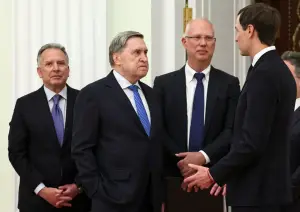 A photo released by Russian state media shows Kirill Dmitriev, second right, with Trump financial allies with billions of dollars in personal projects pending Steve Witkoff, left, and Jared Kushner, right, at the Kremlin in January (Pool photo by Alexander Kazakov).
New York Times, Suspended U.S. Sanctions Add a Political Win to Russia’s Economic Gains, Ivan Nechepurenko and Paul Sonne, March 13, 2026. Kremlin officials said the American move, which Europe opposes, showed that Moscow could not be dislodged from the center of global energy markets.
The U.S. decision to temporarily lift some restrictions on Russian oil has delivered a geopolitical victory to the Kremlin on top of the boon that Russia’s war-strained budget is already receiving from soaring energy prices.
The American move, announced on Thursday, is intended to ease an energy shock that has accompanied the U.S.-Israeli attacks on Iran and at times sent the price of oil soaring over $100 a barrel.
Analysts said they did not believe the suspension of sanctions on Russian oil would substantially ease the worst supply shock to the global market since the 1970s, given that Russia had been able to transport and sell its oil for years despite the restrictions.
“Right now, obviously, the world needs every extra barrel that is available, and I can understand why the White House, under political pressure, would want to check this particular box,” said Pavel Molchanov, an energy analyst at Raymond James. “But it’s not going to make any meaningful difference.”
European countries, which have been at the forefront of imposing sanctions on Russia and are also suffering from higher energy prices, opposed the American move. President Volodymyr Zelensky of Ukraine said during a news conference on Friday that the move “certainly does not help peace,” adding: “This single easing by America alone could give Russia around $10 billion for the war.”
The temporary loosening of the U.S. restrictions, some analysts said, could reduce the discount that Russia has been forced to offer buyers of its oil since the invasion of Ukraine four years ago. Still, the real boon for Russia, they noted, is from higher prices, which the conflict in Iran was prompting before the United States loosened restrictions.
The mood in Moscow was triumphant, after years in which the United States and European countries have tried to starve Russia’s economy of the energy revenues needed for its war machine. Russian officials said the American move showed that Russia could not be dislodged from its central place in global energy markets.
Kirill Dmitriev, President Vladimir V. Putin’s special envoy for foreign investment and economic cooperation, boasted in a post on Telegram that the United States was “effectively acknowledging the obvious: without Russian oil, the global energy market cannot remain stable.”Editors’ PicksWith No Time to Spare, They Traded a House in Austin for a Condo in ChicagoAllergy Season Is Coming. These 4 Steps Can Help You Prepare.My Sister Won’t Vacation With My Kids. Is She Being Selfish
In a post on social media, Mr. Dmitriev was even more blunt: “EU bureaucrats will soon be forced to recognize this reality, acknowledge their strategic blunders, and atone.”
Mr. Dmitriev met this week in Florida with Steve Witkoff, President Trump’s special envoy, and Jared Kushner, the president’s son-in-law. They discussed energy issues in addition to the peace negotiations that Mr. Witkoff and Mr. Kushner have been leading.Want to stay updated on what’s happening in Central Asia, Eastern Europe and the Middle East? Sign up for Your Places: Global Update, and we’ll send our latest coverage to your inbox.
The Kremlin spokesman, Dmitri S. Peskov, told journalists on Friday that the interests of the United States and Russia had aligned in the current environment and welcomed the U.S. move.
“Such measures will help stabilize the market,” Mr. Peskov said. “Without significant volumes of Russian oil, market stabilization is impossible.”
The decision came as the Trump administration scrambled to contain the energy shock that has resulted from production disruptions in Gulf countries and the de facto closure of the Strait of Hormuz, a key transit corridor for oil and gas. The U.S. move was announced by the Treasury Department, which said the exemptions would be in place until April 11 and apply only to Russian oil that was loaded onto tankers on or before Thursday.
Washington previously issued a 30-day waiver to allow India to buy Russian oil, an about-face after the Trump administration pressured New Delhi to cease purchases last year. Indian firms moved rapidly to buy the Russian oil available on the market. David Wech, chief economist at the oil and gas cargo tracking firm Vortexa, said he expected Indian imports of Russian crude to “reach new record highs” from next month, providing the situation in the Middle East continued.
Since Mr. Putin launched his full-scale invasion of Ukraine four years ago, China, Turkey and India have been among Russia’s biggest oil purchasers.
Soaring energy prices and sanctions relief during the conflict with Iran have offered the Kremlin a lifeline at a difficult financial moment.
On Tuesday, the Russian finance ministry reported that its revenues had collapsed by more than 10 percent since the start of the year, with its budget deficit reaching $43 billion, more than 90 percent of what was forecast for all of 2026.
Now, prices have risen and restrictions have vanished on the barrels of its oil currently at sea: around 100 million of them, according to Mr. Dmitriev.
“Russian oil has gone from global pariah to now being extremely sought after, with the discount on Urals crude versus the global Brent benchmark almost disappearing,” Robin Brooks, a senior fellow at the Brookings Institution, wrote in a post on Substack. Urals crude is the blend most often produced by Russia.
Russia’s budget is set to gain more than $1.6 billion per month from each $10 increase in the price of its crude, according to Sergey Vakulenko, a senior fellow at the Carnegie Russia Eurasia Center in Berlin and a former top manager at Gazprom Neft, one of Russia’s largest oil producers.
As of Friday, Russia’s Urals oil benchmark had increased by about $30 per barrel since before the war with Iran, according to Argus Media, a price reporting agency used by the Russian government to calculate its oil extraction taxes. That would mean that the country is receiving more than $150 million extra every day.
President Emmanuel Macron of France said on Wednesday that “the current situation does not justify lifting the sanctions on Russia.”
Chancellor Friedrich Merz of Germany expressed a similar sentiment the day before. “Faced with the choice between sanctions and solidarity, our position is clear: We stand with Ukraine and are prepared to endure such a phase if necessary,” he said.
The oil crunch in the Middle East has the potential to do more than prop up the Russian budget, more than a third of which is being spent on the war in Ukraine. It could also shift the Kremlin’s leverage in the global market, with countries in Asia beginning to view Moscow as a more necessary long-term partner.
For years, China has been reluctant to pursue Moscow’s ambitious plans for a gas pipeline and other projects. But it may now be more amenable, looking to diversify its supplies away from the Middle East in the longer term.
“China may realize that shipments from the Gulf are a problem,” Mr. Vakulenko said.
New York Times, Trump Administration, Wall Street Bankers Offered Lucrative Access to Join the Pentagon, Ana Swanson, March 13, 2026. A presentation from a headhunting firm aimed to recruit Wall Street investors to the Pentagon by offering “unmatched access” to government officials and fund-raising opportunities among foreign sovereigns.
A headhunting presentation aimed at recruiting Wall Street investment bankers to the Pentagon dangled access to government officials and foreign royal families that could be used to raise capital in the future, according to a slide deck viewed by The New York Times.
The presentation says that the Pentagon is seeking to build a 30-person investment team to deploy up to $200 billion in government investment over the next three years. Joining the team offers “unmatched access to top-level government officials and privileged information flow — whatever you need, you can get.”
The document was prepared by Heidrick & Struggles, a headhunting firm. It is not clear whether Pentagon staff members approved or dictated the content of the presentation, which features an agency logo.
The Defense Department declined to comment. Heidrick & Struggles did not immediately respond to a request for comment. The presentation was earlier reported by Semafor.
Officials in and around the Trump administration have continually blurred the lines between public service and individual profit seeking.
The president’s family continues to profit off a cryptocurrency venture that has received investment from foreign officials also negotiating with the government. David Sacks, the White House A.I. czar, has promoted policies that could benefit stakes he holds in hundreds of A.I. companies. In January, Howard Lutnick, the commerce secretary, extended a loan to a company that was also doing business with his former firm, which is now run by his sons.
The Pentagon recruiting effort dangles both money and access, offering Wall Street recruits the opportunity to manage “more capital than most investors deploy in their entire careers.” Salaries could reach as much $300,000 at the Pentagon, or $500,000 to $600,000 “if employed through a government-aligned nonprofit.” According to federal statistics, the average pay for a federal worker is about $100,000, and only about 3 percent make $200,000 or more.
The investment teams would focus on an array of industries and technologies, including undersea cables, minerals extraction and refining, strategic logistics, munitions, drones, satellites and energy generation. The Trump administration has been trying to invest to build up critical industries domestically, to reduce what national security officials see as a dangerous dependence on foreign countries, including potential rivals like China.
In addition to offering loans, the administration has begun taking a series of equity stakes in firms in industries such as mining, semiconductors and steel, in what it says will result in a better deal for U.S. taxpayers.The presentation emphasizes the access to information and the new relationships the move could offer new recruits, as well as subsequent opportunities for enrichment.
New York Times, Trump Removes Sanctions on Russia to Help Oil Flow Amid Iran Conflict, Alan Rappeport, March 13, 2026 (print ed.). Treasury Secretary Scott Bessent said it was “unfortunate” that the move could benefit Russia, but maintained that it was only for the short term.
The United States on Thursday temporarily lifted sanctions on Russian oil that is currently at sea, allowing it to be shipped to buyers around the world as the Trump administration scrambles to contain energy prices that have been soaring because of the war in Iran.
The exemptions, which were issued by the Treasury Department, will be in place until April 11. Treasury Secretary Scott Bessent estimated that freeing Russian oil could add hundreds of millions of barrels of crude to global markets, curbing prices that have been hovering near $100 per barrel as a result of the Iran conflict.
The decision was a significant turning point in America’s effort to punish Russia for its war in Ukraine.
Russia has faced punishing sanctions from the United States and the rest of the Group of 7 advanced economies since Moscow’s invasion of Ukraine in 2022. Those sanctions have included a price cap on Russian oil and a crackdown on Russia’s “shadow fleet” of unmarked vessels that oil exporters have used to evade sanctions.
As President Trump’s war with Iran has unfolded, his administration has looked for ways to mitigate the economic pain. His administration temporarily freed Russian oil last week that was sitting at sea and was set to be delivered to India. It is also in the process of offering a $20 billion maritime insurance backstop through the U.S. International Development Finance Corporation, an agency that generally lends to and invests in overseas companies and projects.
 Mr. Bessent, above, asserted on Thursday that Russia would not benefit significantly from the sanctions relief but acknowledged that Moscow would see some financial benefit.
“To increase the global reach of existing supply, Treasury is providing a temporary authorization to permit countries to purchase Russian oil currently stranded at sea,” he wrote in a social media post. “This narrowly tailored, short-term measure applies only to oil already in transit and will not provide significant financial benefit to the Russian government, which derives the majority of its energy revenue from taxes assessed at the point of extraction.”
In a podcast interview on Thursday, Mr. Bessent said that it was “unfortunate” that Russia stood to gain financially from the conflict in Iran but that he hoped it would benefit for only a “micro period.”
Top Senate Democrats assailed the Trump administration for easing sanctions on Russia, saying that it was done to mitigate a war of Mr. Trump’s own making.
“This war has resulted in huge spikes in gas prices for Americans, who are now paying more at the pump than at any point in either of President Trump’s two terms,” they wrote in a joint statement.
The lifting of oil sanctions represents a sharp reversal from last summer, when the administration doubled tariffs on India as punishment for its purchases of oil from Russia.
“In one fell swoop we’ve undone a huge amount of pressure on Russia,” said Edward Fishman, a senior fellow and director of the Maurice R. Greenberg Center for Geoeconomic Studies at the Council on Foreign Relations.
About 130 million barrels of Russian oil is currently at sea, according to the commodities data tracking service Kpler.
The move by the Trump administration could further divide the United States and Europe, which has been skeptical of Mr. Trump’s attack on Iran and has expressed a desire to continue to exert economic pressure on Russia.
Mr. Fishman said he did not think that easing the Russia oil sanctions would lower prices, noting that the move last week to let Russian oil be delivered to India did not have an impact. He noted that the price of Russian oil had been rising since the war in Iran started, and that it was likely that the sanctions relief could be extended indefinitely.
“I do worry that this is effectively the destruction of the oil sanctions on Russia,” said Mr. Fishman, the author of “Chokepoints: American Power in the Age of Economic Warfare.”
Emptywheel, Analysis: Trump Rewards Russia for Helping Iran Target US Service Members, Emptywheel (Marcy Wheeler), right, March 13, 2026. Yesterday, Scott Bessent lifted sanctions on any Russian oil currently stranded at sea (including oil that Russia managed to “strand” at sea between Monday, when Trump spoke with Putin, and yesterday). (Excerpt continued below.)
This move comes in the wake of reports — first from WaPo,
Since the war began Saturday, Russia has passed Iran the locations of U.S. military assets, including warships and aircraft, said the three officials, who spoke on the condition of anonymity because of the matter’s sensitivity.
“It does seem like it’s a pretty comprehensive effort,” one of the people said.
And detailed further by CNN that Russia was providing Iran with satellite intelligence about US movements.
Russia is helping Iran with advanced drone tactics from its war in Ukraine to hit US and Gulf nation targets in the Middle East, according to a Western intelligence official.
Shahed drones, designed by Iran but mass produced by Moscow for use in Ukraine, have been unexpectedly successful in penetrating the air defenses of Gulf nations. Russian intelligence sharing with Iran has until now been reported as general assistance with targeting, but specific tactical advice is a new level of support.
Morning Shots via The Bulwark, Political Opinion: Trump to America: Thank Me for Your Gas Bill, Bill Kristol, Andrew Egger and Jim Swift, March 13, 2026. Higher prices = more money, according to the president.
At today’s Pentagon press briefing on the ongoing war in Iran, Defense Secretary Pete Hegseth started the show laser-focused on what really matters: not that more American service members had lost their lives in the Middle East, but how unfair the big bad media’s being to the administration.
“People look up at the TV and they see banners, they see headlines . . . ‘Mideast War Intensifies,’ splashing on the screen the last couple days,” Hegseth fumed. “What should the banner read instead? How about ‘Iran Increasingly Desperate.’ Because they are.”
Not to worry, though: Trump’s billionaire pals are buying up more and more of the media every day!
“More fake news from CNN—reports that the Trump administration underestimated the Iran war’s impact on the Strait of Hormuz,” Hegseth said. “It’s a fundamentally unserious report. The sooner David Ellison takes over that network, the better.” Happy Friday.
News Updates
The Parnas Perspective, News and Commentary: Trump Underestimated Iran's Willingness to Close Strait of Hormuz, Pentagon Lashes Out at Media, Trump Says it is an "Honor" to Kill Iranians, Aaron Parnas, right, March 13, 2026. The United States reportedly underestimated Iran’s willingness to close the Strait of Hormuz, and now Iran has done exactly that. Meanwhile Defense Secretary Pete Hegseth said the quiet part out loud by openly attacking the press and saying he can’t wait for CNN to be sold. The US has temporarily lifted sanctions on Russian oil, more American service members have been killed in the conflict, and Donald Trump said it is his “honor” to kill Iranian leaders while simultaneously fundraising off the war.
This is why independent media matters right now more than ever. Here’s the news:
According to CNN, the Trump administration reportedly underestimated the possibility that Iran would close the Strait of Hormuz in response to US military strikes. Officials believed Iran would avoid doing so because it would harm Iran’s own economy more than the United States. As a result, the scenario was not fully planned for during the administration’s strategy discussions. Sources tell CNN that President Trump relied on a small circle of advisers, which limited broader interagency debate about the economic consequences. Although the Energy and Treasury Departments were involved, detailed economic analysis that previous administrations typically used in similar decisions played a smaller role.
Iran’s closure of the strait has created major disruption in global energy markets. Oil tanker companies have requested US Navy escorts through  the waterway, but the Pentagon has said it is currently too dangerous due to Iranian drones, missiles, and sea mines.
Defense Secretary Pete Hegseth, right, attacked media coverage of the Iran conflict, arguing that headlines like “Mideast War Intensifies” are misleading and should instead read that Iran is “increasingly desperate.” He also lashed out at CNN, saying it spreads “fake news,” and added, “The sooner David Ellison takes over that network, the better.” The remark drew criticism for openly pressuring a news outlet’s ownership and attacking the press while serving as the nation’s top civilian defense official.
According to Axios, President Trump told G7 leaders during a virtual meeting that Iran was “about to surrender,” but also said there were no remaining officials in Tehran with the authority to formally make that decision, suggesting the country lacked clear leadership capable of announcing  a surrender.
Defense Secretary Pete Hegseth said Iran’s leadership has gone into hiding and mocked them as “rats,” claiming the country’s new supreme leader is wounded, possibly disfigured, and lacks legitimacy. He argued that the leader’s recent message was only released as a written statement without audio or video because he is injured, scared, and on the run following the death of his father and ongoing US strikes.
Despite Hegseth’s claim, Iranian leadership was marching in the street today. This is an image of Ali Larijani, Iran’s top National Security Advisor.
The Trump administration temporarily lifted sanctions on Russian oil already at sea to increase global supply and ease rising energy prices caused by the Iran conflict. Treasury Secretary Scott Bessent said the move is a short term measure that may slightly benefit Russia financially, but critics argue it weakens pressure on Moscow and represents a major shift from earlier US sanctions policy.
German Chancellor Friedrich Merz criticized the Trump administration’s decision to temporarily lift sanctions on Russian oil to lower energy prices during the Iran conflict, calling the move “wrong” and warning it could allow Russia to exploit the war to weaken Ukraine while undermining Western pressure on Moscow.
California Governor Gavin Newsom is blaming President Donald Trump and the Iran war for rising gasoline prices, arguing the conflict caused recent spikes at the pump. Republicans and the White House counter that California’s high fuel costs stem from the state’s own policies and refinery shutdowns, while the global oil shock from the Iran conflict has intensified the political fight over who is responsible.
Oil industry executives expressed concern to Politico after President Donald Trump posted that higher oil prices during the Iran war mean the United States “makes a lot of money,” with some in the industry worried the comment reinforces public perceptions that oil companies profit from war and rising fuel costs even as companies face volatility and political backlash from the price spike.
Four of the six crew members aboard a US KC-135 military refueling aircraft were confirmed dead after the plane crashed in western Iraq during operations related to the Iran war. The US military said the crash was not caused by hostile or friendly fire and that rescue efforts for the remaining crew members were ongoing, bringing the total number of US service members killed since the conflict began on February 28 to ten, with another death attributed to a medical issue.
President Donald Trump posted on social media during the Iran conflict that the United States was attacking Iran’s leadership, calling them “deranged scumbags” and saying, “Watch what happens to these deranged scumbags today… I, as the 47th President of the United States of America, am killing them. What a great honor it is to do so,” as part of escalating rhetoric amid ongoing US and Israeli strikes against Iranian targets.
A fundraising email from Donald Trump promotes a “National Security Briefing Membership” for supporters who donate, promising private briefings and insider updates on threats facing the United States. The message also uses an image from a dignified transfer ceremony for fallen US service members, which critics say politicizes a solemn military event and raises ethical concerns about linking national security themed access to campaign fundraising.
During a live interview, US Treasury Secretary Scott Bessent was suddenly pulled off air after being told that “the President wants you right away.” When he returned to the broadcast, observers noted that his voice sounded noticeably shaken.
When asked by a reporter about reports that a US airstrike may have hit a girls’ school in Iran, Defense Secretary Pete Hegseth declined to confirm details, saying the military would not let media reporting dictate its response. He added that in the conflict with Iran, the United States is the only side that “literally never targets civilians.”
A French soldier, Warrant Officer Arnaud Frion, was killed and six others were wounded in a drone attack on a Kurdish military base in the Irbil region of Iraq. French President Emmanuel Macron condemned the strike as “unacceptable,” saying French troops are stationed there solely to fight ISIS and that the war with Iran cannot justify attacks on them.
Turkey said NATO air defenses in the eastern Mediterranean intercepted a third ballistic missile launched from Iran toward Turkish territory. The Turkish Defense Ministry said it is taking all necessary measures to protect its airspace and is seeking clarification from Iran, while reports also described an overnight explosion near the Incirlik military base in southern Turkey where US and allied troops are stationed.
An AFP investigation found that thousands of Chinese fishing boats have been gathering in large geometric formations in the East China Sea, with experts suggesting the coordinated activity may be part of preparations for a potential regional crisis or conflict.
The US economy grew at a slower than expected annual rate of 0.7 percent in the fourth quarter, significantly below earlier estimates and far weaker than the previous quarter’s growth. The slowdown comes as the economy enters the Iran war period, with rising oil prices, job losses, and cautious consumer spending raising concerns about additional inflation and potential economic instability if the conflict continues.
Authorities told NBC News that the man suspected of carrying out a car ramming attack at a synagogue in the Detroit area had recently lost several family members in Israeli airstrikes in Lebanon. Officials said two of his brothers, who were reportedly affiliated with Hezbollah, as well as his niece and nephew were killed in the strike, though investigators have not yet determined whether that event was connected to the motive for the attack.
Two California Democratic lawmakers said they would return political donations from Flock, a company that operates AI powered license plate reader cameras, amid concerns that its data could be accessed by federal immigration authorities and used to support deportation efforts. Privacy advocates and lawmakers worry the technology could allow federal agencies to track people in ways that violate California’s data sharing restrictions.
According to the Guardian, court testimony revealed that ICE agents in Oregon were instructed to aim for about eight arrests per day and used a surveillance app called Elite to identify neighborhoods and individuals to target. The disclosures came during a federal lawsuit challenging warrantless detentions, with a judge criticizing the tactics and ruling that such arrests in Oregon violated constitutional protections.
Michael Cohen appeared on Lara Trump’s show and said he is working with Laura Loomer to launch a new podcast together.
Dale Steele, a 100 year old World War II veteran from Nebraska who helped concentration camp survivors and guarded Nazi leaders during the Nuremberg trials, became the oldest known organ donor in the United States after his liver was successfully transplanted following his death, demonstrating that organ donation depends more on health than age.
More News Updates: U.S. Elections, Politics, Governance
Letters from an American, Historical Commentary: March 12, 2026 [Billionairre Candidate Profits Big], Heather Cox Richardson, right, March 13, 2026. In Ohio today, Republican candidate for governor Vivek Ramaswamy, above, launched a $10 million TV and digital ad campaign to run until Election Day. Jeremy Pelzer of Cleveland DOT com explained that this ad buy alone is more than twice as much as the $4.4 million Democratic candidate Amy Acton, the former state health director, has raised, and it is only about half of the $19.5 million Ramaswamy’s campaign has raised.
Forbes reported in December 2025 that Ramaswamy’s net worth had nearly doubled, from about $1 billion to about $1.8 billion, since he announced his candidacy in February 2025.
On March 9, Mike Baker and Steven Rich of the New York Times published a long exposé of the corruption of American politics by billionaires. They explain how underwriting political campaigns from those for local school boards to the presidency has enabled the very wealthy to lock in their policy preferences for tax cuts, deregulation, and cuts to the social safety net while also steering valuable government contracts to themselves.
In 2024, Baker and Rich note, 300 billionaires and their immediate family members donated 19% of all political contributions in federal elections, either directly or through political action committees (PACs). While that amount does not account for money that might have gone through dark money groups that don’t have to disclose their donors, it still amounts to more than $3 billion, or an average of $10 million per family.
The authors’ example of what this flood of money looks like in the political system is the victory of Senator Tim Sheehy (R-MT), who beat popular Democratic incumbent Jon Tester in 2024 with the help of $8 million from billionaire Stephen Schwarzman and at least 63 other billionaires and 37 of their immediate family members, who donated about $47 million to Sheehy’s Senate race.
In the Senate, Sheehy “has become a key ally on tax policies that benefit the wealthy and cosponsored a proposal to eliminate the estate tax,” the authors note. Sheehy has been in the news lately for killing a decades-old solar energy tax credit when his own home uses solar power. Sheehy’s spokesperson declined to tell reporters if he had used the tax credit for 26% of the system’s cost.
Sheehy has also been in the news for jumping into the effort of three Capitol Police officers to eject a protester opposed to the Iran War from a Senate Armed Services Committee hearing. The arm of Brian McGinnis, a Marine Corps veteran who was wearing his dress uniform, was stuck behind the door. As Sheehy threw his weight into McGinnis, there was the audible crack of his arm breaking. When a spectator called Sheehy a coward, the senator appeared to tell him: “Go f*ck yourself.” Sheehy later said he was trying to “de-escalate the situation” and blamed McGinnis for “causing…violence.”
Billionaire Elon Musk spent close to $300 million in the 2024 elections, putting much of it, as well as the support of the social media platform X, behind Trump. After his leadership of the Department of Government Efficiency created a backlash to his companies and sparked a rift between him and Trump, Musk said he was going to step back from political spending.
And yet by the end of 2025, he had already given $20 million to Republicans to prepare for the 2026 elections. “It’s a big deal for Trump and for the Republicans to have the world’s richest man on their side,” Republican strategist Brian Seitchik told Julia Mueller and Julia Shapero of The Hill in February.
Baker and Rich noted that while both parties had reaped windfalls from billionaires in the past, in 2024 that money turned sharply toward Republicans. For every dollar of billionaire money that went to Democrats, they wrote, five dollars went to Republicans.
During his term, President Joe Biden called for securing the solvency of Social Security and Medicare and addressing the growing national debt with higher taxes on the wealthy and corporations. He wanted to increase the tax rate for those making more than $400,000 a year, to close the carried-interest loophole, and to impose a tax of 25% on Americans with a wealth of more than $100 million, saying during his 2024 State of the Union address: “No billionaire should pay a lower tax rate than a teacher, a sanitation worker, a nurse.” When she took over as the Democratic candidate, Vice President Kamala Harris also called for higher taxes on the wealthy, although at slightly lower rates than Biden backed.
In contrast, Trump promised billionaires he would extend the 2017 tax cuts that benefited the wealthy and corporations. At a fund raiser at Mar-a-Lago, he told oil executives that they should raise $1 billion to put him back in office. That price tag would be a “deal,” he told them, because of the taxes and regulations they would avoid if he were in charge.
And so, some of them pumped money into his campaign. Once back in office, Trump gave his wealthy supporters what he promised: the One Big Beautiful Bill Act that extended the 2017 tax cuts, cut regulation, and slashed the social safety net.
But along with those tax cuts and deregulation, those who supported Trump gave the country an erratic president who has destabilized the world economy through tariffs and now has led us into war in the Middle East.
Today Paul Krugman wrote in his newsletter that this is “The Billionaires’ War,” since it was their campaign money that mobilized low-information voters to rally behind Trump and his minions: “The Gang That Couldn’t Think Straight,” as Krugman puts it.
There are major societal implications for that war. It is already costing at least $1 billion a day, and administration officials have suggested they are going to ask Congress for more money for it. That request will come on top of the news of March 10 that, according to the Congressional Budget Office, the U.S. has borrowed $1 trillion over the past five months—that’s $50 billion a week on average—as Trump’s tax cuts slash revenue.
Republicans are sounding the alarm about the ballooning debt and suggesting the only way to address it is to cut more programs that benefit the American people. But that raises fundamental questions about the purpose of the U.S. government. What should it do? Whom should it benefit, and why?
In the 1860s, during the U.S. Civil War, the Republican Party reacted to rising expenses and growing debt not by punishing everyday Americans, but by inventing the income tax. In a time when the very existence of the American government was under threat, Republicans argued that the federal government had a right to “demand” 99 percent of a man’s property for an urgent necessity. When the nation required it, Vermont’s Justin Smith Morrill said, “the property of the people…belongs to the Government.”
From the beginning, congressmen graduated the taxes according to income. Morrill said: “The weight [of taxation] must be distributed equally not upon each man an equal amount, but a tax proportionate to his ability to pay.”
Recognizing that those who supported the government financially would care deeply about its survival, the American people welcomed the taxes. Even conservative Republican newspapers declared, “There is not the slightest objection raised in any loyal quarter to as much taxation as may be necessary.”
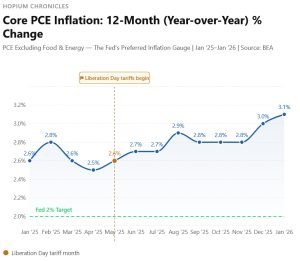
Hopium Chronicles, Advocacy, Inflation Comes In Hot (Again), Nation State AI Propaganda Here Now, New 2026 Battlefield Emerging, Simon Rosenberg, right, March 13, 2026. Hegseth, Witkoff, and Kushner Are All Up Schitt's Creek.
We start the day with more evidence of how badly Trump’s economic program has failed us. The Fed’s preferred gauge of inflation, Personal Consumption Expenditures, above, came in hot again. The “core” result, minus food and energy, rose 0.4% in January, the second straight month of a 0.4% (5% annualized) gain. Over the last twelve months core PCE has risen 3.1%, more than 50% above the Fed’s target of 2%. With Claude’s help here’s the core PCE trendline. Note the increase since the tariffs were illegally levied:
Another inflation gauge, PPI, showed a similar upward trend in January:
The third inflation gauge, CPI, was released earlier this week, and it too came in above the Fed target:
Trump’s policies have pushed inflation to an unacceptable level, which is helping slow economic growth too. We lost jobs last month, the 5th time we’ve lost jobs in the last 9 months (since the tariffs):
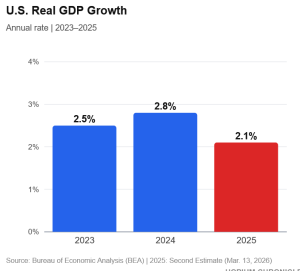 And we got a revised GDP number today showing that in that in q4 GDP growth was just 0.7%, down from an initial estimate of 1.4% (with annual charts shown above). So not only are we seeing job loss, not gains, the economy barely grew at all in the fourth quarter, and came in much slower in 2025 than 2023 or 2024:
Again, all this data is from before the war. Trump went to war with an American economy slowing and inflation rising - and now we have soaring gas and other commodity (incl fertilizer) prices which will both drive prices higher and further slow an economy already teetering on recession. A new CNN report helps explain why the Trump regime was willing to take this extraordinary risk with our economy and our economic lives - they didn’t think Iran would close the Strait of Hormuz. Okey-Dokey!
Gird yourself from historic levels of dangerous Trumpian incompetency:
Top Trump officials acknowledged to lawmakers during recent classified briefings that they did not plan for the possibility of Iran closing the strait in response to strikes, according to three sources familiar with the closed-door session.
The reason, multiple sources said, was administration officials believed closing the strait would hurt Iran more than the US — a view that was bolstered by Iran’s empty threats to act in the strait after US strikes on Iranian nuclear facilities last summer……
….The reality in the strait has left diplomatic counterparts, former US economic and energy officials and industry executives who spoke with CNN in a state of confusion and disbelief.
“Planning around preventing this exact scenario — impossible as it has long seemed — has been a bedrock principle of US national security policy for decades,” a former US official who served in Republican and Democratic administrations said. “I’m dumbfounded.”
…The Pentagon and National Security Council significantly underestimated Iran’s willingness to close the Strait of Hormuz in response to US military strikes while planning the ongoing operation, according to multiple sources familiar with the matter.
President Donald Trump’s national security team failed to fully account for the potential consequences of what some officials have described as a worst-case scenario now facing the administration, the sources said.
While key officials from the Departments of Energy and Treasury were present for some of the official planning meetings about the operation before it started, sources said, the agency analysis and forecasts that would be integral elements of the decision-making process in past administrations were secondary considerations.
Treasury Secretary Scott Bessent and Energy Secretary Chris Wright have been key players throughout the planning and execution stages of the conflict, the sources acknowledged. But Trump’s preference of leaning on a tight circle of close advisers in his national security decision making had the effect of sidelining interagency debate over the potential economic fallout if Iran were to respond to US-Israeli strikes by closing the strait.
And now it may be weeks before the administration’s efforts to alleviate the intensifying economic fallout take hold, officials said Thursday, including high-risk naval escorts of oil tankers through the strait that the Pentagon believes are currently too dangerous to conduct. The president, meanwhile, has continued to downplay the tumult in energy markets and the danger. He told Fox News in an interview airing Friday that oil tanker crews should “show some guts” and go through the strait.
This morning the thin-skinned Fox News Host running the Pentagon lashed out at CNN for their reporting, claiming the war wasn’t “widening” but “shrinking.” Really……
Yes, all of this is further confirmation that Trump is a titanic, vainglorious fuck up.
In most countries the Trump government would have fallen by now. Consider:
Trump is leading a wildly illegal cover up of global sex trafficking ring led by his “best friend,” and there are now credible reports of him raping and beating a thirteen year old girl
His tariffs that did so much damage to our economy, and our standing in the world, were declared illegal by the Supreme Court. Those original tariffs were in my mind the greatest abuse of Presidential power in US history. And rather than accepting the Court’s judgement, and that of Congress’ where each chamber voted to rescind the tariffs, he defiantly, illegally, recklessly both levied new tariffs to replace the ones struck down by the Court and has refused to pay back the hundreds of billions he owes to Americans. Seriously WTF……
Trump unleashed an illegal, unconstitutional paramilitary force to terrorize communities across the country, illegally detain many thousands of people, and kill Americans in cold blood on the streets of our cities. Noem has fallen for this. Miller should follow.
The ridiculous Iran war. This is now the greatest abuse of Presidential power in our history, outstripping the tariffs; and also perhaps the greatest policy mistake our great country has ever seen. The Trumpian incompetence the entire world is experiencing now - incompetence magnified by his extraordinary malevolence and stunning recklessness - should cause the immediate departure of Hegseth, Wifkoff, and Kushner.
Trump is an historic fuck up who has done jawdropping levels of damage to America and the world. It’s incredible that our political system is allowing him to remain in power. It’s why we have to working as hard as we can all.
 The Other 98%, Advocacy: Keeping the Class War classy! Palantir CEO Alex Karp just announced on camera that he is going to reduce the economic power of highly educated Democratic voters, Staff and wire reports, March 13, 2026. In a recent CNBC interview, Karp stated that his AI technology disrupts humanities trained, largely Democratic voters and makes their economic power less, while increasing the economic power of vocational, working class, often male voters.
He then had the audacity to admit these technologies are "dangerous societally," but justified it with a Cold War style argument that if America doesn't do it, adversaries will. This isn't some fringe conspiracy. This is a sitting CEO, with billions in government contracts, telling you exactly what he's doing to your democracy while daring you to stop him.
The mechanism is straightforward and worth understanding. As AI automates the cognitive, analytical, and communications work that college educated professionals have built careers around, those white collar jobs shrink in value and number. The people most exposed are educated women who vote Democrat. Meanwhile, trade and vocational workers, the plumbers, electricians, and machinists who lean Republican and male, become harder to replace with software. Karp isn't just predicting this shift. He is building the technology that accelerates it, cashing Pentagon checks along the way, and calling it patriotism.
We are watching a tiny class of AI billionaires reshape society, redistribute political power, and embed themselves into government infrastructure without a single vote being cast. Even Palantir's own head of communications called the company's political drift "concerning." The solution is not complicated: tax these people aggressively, break up these contracts, and demand democratic oversight of AI before the architecture of our entire society gets quietly handed over to a few unelected men with god complexes and government clearances. See lessNew York Times, U.S. Involvement in Venezuela
Trump’s Advice to Machado Restarting Diplomatic Relations Maduro’s Last Days in Power Venezuela’s Oil
More On Iran War
New York Times, Weakened by War, Iran Hits Back by Strangling a Vital Waterway, Anton Troianovski, Julian E. Barnes and Greg Jaffe, March 13, 2026 (print ed.). The threats to shipping in the Strait of Hormuz are complicating President Trump’s calculations about how and when to end the war.
Nearly two weeks after the United States and Israel attacked Iran with an extraordinary display of firepower, Iran has found a way to inflict pain back on its enemies by strangling one of the world’s most vital waterways.
By threatening shipping traffic through the Strait of Hormuz, attacking tankers in an Iraqi port and beginning to lay mines in the strait, Iran has sent oil prices surging and slowed global trade. It has also made clear that it is intent on using what advantages it has to sap the will of the United States to sustain the war.
The Iranian tactics have forced the United States to prepare to provide naval escorts for shipping traffic through the strait and to plan for anti-mine operations even as American forces target what is left of the Iranian navy, including Iranian mine-laying vessels.
On Thursday, Mojtaba Khamenei, right, the new supreme leader of Iran, sent the regime’s clearest signal yet that it would continue to endanger  commercial shipping in the strait, through which a fifth of the world’s oil was passing before the war began.
“Certainly, the lever of closing the Strait of Hormuz must continue to be used,” Mr. Khamenei said in his first statement since being chosen to succeed his father, who was killed in an airstrike at the start of the war.
Iran, analysts say, is demonstrating that even in a weakened state, it can inflict significant economic and military damage on the United States. That further complicates President Trump’s calculations about how and when to end the war and how to deal with a post-conflict Iran.
“This war isn’t only about what happens in the current cycle,” said Caitlin Talmadge, a professor at the Massachusetts Institute of Technology who has long studied security issues in the Persian Gulf. “It is about re-establishing Iranian deterrence for the next war.”
New York Times, 4 Killed in Crash of U.S. Refueling Plane in Iraq, Military Says, Helene Cooper, Greg Jaffe and Eric Schmitt, Updated March 13, 2026. The crash was not because of hostile or friendly fire, U.S. Central Command said. Four crew members died, it said, bringing the number of U.S. service members killed in the Iran conflict to at least 11.
Four of six crew members died after a U.S. military KC-135 refueling aircraft that was part of the American war against Iran crashed in neighboring Iraq, United States Central Command said on Friday.
In a statement, it said that rescue efforts were continuing and that the circumstances of the crash were under investigation, but added that “the loss of the aircraft was not due to hostile fire or friendly fire.”
The deaths brought the number of U.S. service members killed in operations related to the Iran conflict to at least 11.
Central Command did not immediately identify the four crew members who were killed, pending notification to their families.
It said on Thursday that an incident involving two aircraft had “occurred in friendly airspace,” and one aircraft went down, while the other landed safely.
The last American tanker crash occurred in 2013. In that incident, a K-135, taking part in refueling missions over Afghanistan, crashed soon after departure from the Manas airport in the Central Asian state of Kyrgyzstan. Three airmen died in the incident.
The KC-135s are among the most heavily used aircraft in the Air Force’s arsenal, and among its oldest airframes. The planes are used to refuel all kinds of aircraft to include fighter jets, surveillance planes and cargo aircraft.
A U.S. official said that the other plane involved in the collision was also a KC-135, which landed safely.
Air-to-air refueling missions are performed regularly by Air Force pilots and mishaps are rare. But the maneuver is still challenging, especially in bad weather or high winds. Investigators suspect a midair collision may have caused the crash, but details are still murky, Air Force officials said. The inquiry is still going on along with a search and rescue effort to locate the downed crew.
The western Iraq region where the plane crashed consists mostly of isolated desert.
This is the fourth manned aircraft to be downed since Operation Epic Fury began in late February, though none of the crashes were caused by hostile Iranian fire. Three Air Force F-15E Strike Eagle fighters were shot down by Kuwait F/A-18 aircraft in a friendly fire incident in early March.
Morning Shots via The Bulwark, Political Opinion: Trump’s Iran ‘Excursion’, William Kristol, right, March 13, 2026. Donald Trump has been mocked for calling the Iran war an “excursion,” indeed a “little excursion.” And deservedly so.
For one thing, it’s wildly inappropriate to use that term when people are getting killed in this conflict—lots of people, from American service members to Iranian schoolgirls. In fact, it’s more than inappropriate. It’s grotesque. If you’re president of the United States and you start a war, you should have enough of a sense of decency and dignity to treat it as a serious matter.
To make this obvious point isn’t to be woke or even antiwar. It’s to be adult and civilized. And however much Trump has degraded our civic culture, I think it’s a point with which most Americans would agree.
Now it’s probably the case that Trump stumbled into the term “excursion.” It surely wasn’t the word that Trump was meant to use. As part of their effort to avoid the word “war,” his aides must have advised Trump to call it an “incursion.”
But they failed on both counts. They didn’t talk him out of using “war.” Trump’s vanity makes him want to be a war president, so he won’t avoid boasting about his “war.” And Trump’s deficient grasp of the English language led “incursion” to become “excursion.”
Or did Trump—perhaps subconsciously—shy away from the word “incursion” because he vaguely remembered hearing about Richard Nixon’s politically disastrous and ultimately unsuccessful 1970 Cambodian “incursion”?
Anyway, Trump landed on the term “excursion.” He seems to like it. He’s embraced it. As Will Saletan points out, he’s used it at least sixteen times in the past week.
It’s irresponsible. It’s distasteful. It’s grotesque.
But couldn’t it be something of a political opportunity? Trump has taken us to war. The damage of his unilateral and irresponsible decision to do so is mounting, in terms of death and destruction in the Middle East, American casualties, and economic damage globally and at home. And it doesn’t look as if there’ll even be regime change in Iran. Trump’s war is a mistake heading towards disaster.
And Trump’s enjoying it all. For him, it’s exciting! It’s fun! It’s an excursion!
Consider George W. Bush and Iraq. Bush didn’t revel in the Iraq war and didn’t deny it was a war. And of course he had congressional approval for it. But he paid a great political price when it didn’t go well, and that price was exacerbated by his seeming to claim, a few weeks in, that it was a “mission accomplished.”
Couldn’t Trump’s “little excursion” into Iran be his “mission accomplished”? Couldn’t the expression be wrapped around Trump’s neck by his opponents as a term of well-deserved ridicule and opprobrium? Why shouldn’t “Trump’s Excursion” become an important signpost in the downward trajectory of a failed presidency?
U.S. Law, Courts, Crime, Civil Rights
Public Notice, How Trump hacked the judiciary, Lisa Needham, March 13, 2026. His fake "emergencies" are pushing the country toward autocracy.
There’s no question that the Department of Justice is an absolute shambles under Attorney General Pam Bondi and President Trump, given that the latter basically dictates what the DOJ does now, and he’s a crumbling mess of capriciousness and id.
 However, whether by accident or design, the DOJ has hit on one strategy that works: exploiting little-known, sometimes even never-before-used laws as the basis for Trump’s constant states of emergency.
This is a neat trick for two reasons. First, it confounds the courts a bit as they are forced to grapple with scenarios where there isn’t a well-developed body of law to rely on to interpret whether whatever ridiculous or evil thing that Trump is doing is permitted. And because of those gaps in the law, Trump is able to exploit the judiciary’s deference to the executive branch, particularly if the president is claiming there’s some sort of national security need.
It’s easy to get frustrated at the federal courts for not being bolder, especially earlier in Trump’s lawless reign. But courts — the current conservatives on the Supreme Court notwithstanding — are inherently small-c conservative and cautious entities. Their work is built on precedent, on looking at what has come before.
It takes time. And that’s a weakness in the judicial system that Trump exploits over and over again.Trump’s military excursion, into an abyss Trump’s military excursion, into an abyssDavid R. Lurie · Mar 12Read full story
Broadly speaking, Trump’s (mis)use of the law falls into four categories. Distressingly, at root, all of these excesses are about this administration’s abiding, unwarranted hatred for immigrants and for other countries, even when there are spillover effects for everyone else.
First, the administration has invoked a mishmash of domestic law to justify its international crimes in bombing boats in the Caribbean (and the country of Iran). Next, existing immigration laws have been cobbled together in a sort of unholy patchwork, an ever-shifting mess that allows the administration to pretend there’s some legal authority for what is nothing but xenophobia-fueled cruelty. Third, Trump relies on never- or seldom-used laws about presidential authority to deploy active-duty troops domestically, warping beyond reason any conception of state sovereignty. Finally, of course, there was the use of emergency powers to justify his sweeping, random, and retaliatory tariffs, which is where Trump received the biggest setback.
Yes, indeed, it’s inherently depressing that the only meaningful limitation the Supreme Court has seen fit to impose on Trump’s powers related far more to ensuring the safety of some justices’ pocketbooks rather than the safety of immigrants, Americans living in blue cities, and unarmed fishermen and fishing boats in the Caribbean. But Trump and his lawyers have also had a lot of success in the lower courts thanks in part to their brazen distortions of the legal code.The very legal and very cool clause
It feels odd to be discussing how Trump has used domestic laws to create international chaos without discussing his unprecedented, undeclared war in Iran that is currently spiraling out of control. But Trump hasn’t actually relied on any laws for that. Instead, he’s just claiming that his inherent Article II power magically gives him the authority to do it, despite the power to declare war exclusively belonging to Congress.
Trump loves claiming that his Article II power is basically unlimited, allowing him to ignore courts and Congress as long as he can say there’s an emergency or he’s acting with his inherent prerogative as president or both. That’s a justification that conservatives have adopted wholesale to justify the Iran War, even though it literally contradicts the Constitution.Aaron Rupar @atrupar.comQ: The president has not ruled out boots on the ground. Six American service members have already been killed. Where is Congress? THUNE: Congress obviously has the power of the purse. The president has broad authorities under Article 2 when it comes to defending America's national security interestTue, 03 Mar 2026 20:09:04 GMTView on Bluesky
Though Trump did some Article II flexing back when he was bombing fishing boats in and around the Caribbean, his justification for those strikes was a mashup of emergency powers, a tortured reading of some laws, a claim that national security is at stake, and an assertion that he can do whatever he wants. The administration did release a heavily-redacted version of a Office of Legal Counsel memo, which it says justifies the boat strikes and the invasion of Venezuela to abduct Nicolas Maduro. That memo floated the idea that maybe 10 U.S.C. § 274(b)(2)(F)(iii), which allows the defense secretary to make personnel available to transport suspected terrorists from foreign countries, could provide a legal basis, but went on to concede that whoops, that would have required Maduro to be charged with specific crimes he hadn’t been charged with, such as material support of terrorism.
So instead, the administration’s stance is, at root, that the president can do whatever he wants, whenever he wants. And with the boat strikes, who can stop him?
There’s not really a way to sue the government to stop this, as there’s no one who has standing. Families of victims of the boat strikes have filed wrongful death lawsuits against the administration, but those cases aren’t about attacking the justification for the strikes directly, nor do they function as a way to stop Trump and Hegseth from continuing to do this.Fake invasions
While Trump barely pretends to have a legal justification for his brutality abroad, he’s stretching laws to the breaking point to provide a veneer of legitimacy for mass deportation.
In March of last year, Trump invoked the Alien Enemies Act (AEA) to say that somehow, a combination of the Tren de Aragua gang and the Venezuelan government, then headed by Maduro, was a “hybrid criminal state” that was invading the United States. This, in turn, formed the basis for the dead-of-night deportation of 261 alleged Venezuelan TdA gang members to CECOT, El Salvador’s notorious prison. The fight over the administration’s defiance of Judge James Boasberg’s order to turn the planes around is continuing, nearly a year later.Aaron Rupar @atrupar.comTrump on El Salvador: "They've built a massive prison system. It's a hell of a system. We bring people there, and when they go there, they don't get out ... it's a brilliant system."Fri, 27 Jun 2025 16:12:45 GMTView on Bluesky
The AEA has only been invoked three times, and only in times of war — the War of 1812, World War I, and World War II. It’s most well-known as the justification for interning tens of thousands of Japanese-Americans during World War II. (A normal president wouldn’t want to invoke that shameful legacy, but we have Donald Trump instead.)
Because the AEA has never been invoked in peacetime, has never been invoked in the immigration context, and because the idea of a “hybrid criminal state” was invented out of whole cloth, courts have struggled with what to do, which is why there is still no final ruling on whether Trump can use the AEA in this fashion.John Roberts will save the judiciary if he has to burn it down John Roberts will save the judiciary if he has to burn it downLiz Dye · April 10, 2025Read full story
In May 2025, the Supreme Court, closing the barn door after the horse had bolted, refused to lift a temporary block on using the AEA to deport Venezuelans based on Trump’s nonsense. But that’s only because litigation is continuing, and the court severely limited relief for people the administration is trying to deport by saying the only way to challenge their detention under the AEA is to bring an individual habeas claim.
In January, the Fifth Circuit Court of Appeals sitting en banc — which is when the whole court re-hears a case after an initial three-judge panel ruling — heard oral arguments about whether the AEA allows this. The administration’s stance is its typical one: courts are simply not allowed to review any of Trump’s proclamations under the AEA.
This stance carves out wholly new ground. At root, it makes two new arguments courts haven’t dealt with yet. First, whether the AEA is even applicable to a newly-invented concept of a non-wartime “invasion” by a “hybrid criminal state.” Next, whether Trump’s authority in using it in this new context is so vast that courts cannot even consider it. Meanwhile, the administration continues to treat the need to round up random Venezuelans as an inherent emergency, a vital national security interest.
Trump has also used a byzantine combination of portions of the Immigration and Nationality Act to drastically increase its detention and deportation efforts. These rationales shift over time, but are always a complicated, tortured reading of those statutes that somehow — you guessed it — lets Trump do whatever he wants.
Trump has also broken new ground — not in a good way, mind you — with his use of laws about federalizing active-duty troops and deploying them domestically. (Only in blue cities, naturally.)
This was inevitable given how desperately Trump wanted to invoke the Insurrection Act in his first term during the 2020 George Floyd uprising. He hasn’t gone that far this time around, but he’s worked hard to figure out other ways to achieve his goals, and anti-ICE protests in Los Angeles gave him a perfect opportunity to try out a new theory: that the president can magically federalize a state National Guard based on vibes.“Neither our media nor our political system is designed to deal with a far right authoritarian party” “Neither our media nor our political system is designed to deal with a far right authoritarian party”Aaron Rupar and Thor Benson · June 21, 2025Read full story
On June 7 of last year, Trump issued a memo invoking 10 U.S.C. 12406. That’s a provision that allows the president to federalize a state National Guard, and up until then, that had always been read to require orders to be issued via the governor of the state. That section also can only be used if there is an invasion or danger of invasion, a rebellion or danger of rebellion against the government, or if the president could not execute federal laws with the regular forces available.
Trump didn’t get the consent of California Gov. Gavin Newsom, nor was it in any way credible to claim there was a “rebellion” or that Trump could no longer execute federal laws with the glob of ICE and CBP goons already in place. But Trump just went ahead anyway, with the truly novel idea that the requirement orders be issued “through” the governor was met by Defense Secretary Pete Hegseth ordering the commander of the California National Guard to allow federalization and, since the commander reports to Newsom, voila! Orders were issued “through” Newsom.
The administration also took the unprecedented step of arguing that any “protests or acts of violence” were actually a rebellion. So Trump rolled troops into Los Angeles, shouting “emergency” and “national security” all the while.
District Court Judge Charles Breyer blocked Trump from doing so nearly immediately, only to have the Ninth Circuit Court of Appeals step in and stay that order indefinitely. That left the case in limbo and the troops on the streets while the litigation proceeded. This proved enough of a mess that Breyer wasn’t even sure, for a time, that he had jurisdiction to hear the case. But Breyer ended up having to conduct a trial and ultimately wasn’t able to rule until December 2025 that Trump had to get the troops out.
During those months, however, Trump kept pushing the envelope because there was no court ruling telling him he couldn’t. So, in October, when a lower court ruled he could not similarly federalize the Oregon National Guard over sporadic anti-ICE protests there, he hit upon the notion of sending the already-federalized California National Guard to Oregon instead.
At the same time, Trump leveraged the fact that he’d been allowed to federalize California guard members under his tortured readings of both “through the governor” and “rebellion” to also federalize the Illinois National Guard in preparation for a deployment to Chicago. The Supreme Court finally ruled on this in December 2025, telling the administration it wouldn’t let him send troops to Chicago because “at this preliminary stage, the government has failed to identify a source of authority that would allow the military to execute the laws in Illinois.”
Well, the Supreme Court sort of ruled. This came down on the shadow docket, so it isn’t a final ruling on anything. After six months of wrangling, the best that blue states could get was a temporary reprieve, a limbo. There’s no definitive ruling that Trump’s perverse and risible re-reading of the law is wrong and can’t be used ever again. The state of permanent emergency invented by the administration therefore continues.How the Supreme Court taught Trump to rewrite history How the Supreme Court taught Trump to rewrite historyMatthew Wollin · October 17, 2025Read full story
Of course, the administration wasn’t going to let a little thing like the Supreme Court stop it from invading states. Only 10 days after the Supreme Court’s ruling on the Illinois federalization came down, the administration surged thousands of ICE agents into Minnesota, based not on some purported rebellion, but somehow because of alleged fraudulent misuse of federal money. The administration was also savvy enough not to rely on any laws for this one, instead saying only that the president had clear authority under Article II to invade a state to enforce federal immigration laws.
Who says the Trump administration can’t learn from its mistakes, right?
Finally, there were all the emergency invocations of Trump’s powers under the International Emergency Economic Powers Act (IEEPA) to impose whatever tariffs his fevered brain came up with, for any reason. He lost at the Supreme Court on that one, but then promptly pivoted to saying he would just use different, never-before used laws to impose tariffs, starting a whole new round of litigation.Flooding the zone
This administration’s philosophy towards laws is fundamentally the Steve Bannon approach — to flood the zone with shit.
It does things with no legal justification at all. It does things based on legal justifications that are obviously false. It does things based on legal justifications that have never been used before. It does things based on legal justifications that stretch far beyond reason. And it does so, always, by saying there is some emergency that allows — even requires — such action.
Courts are tangled up in this mess, playing whack-a-mole with each new development, while the rest of us try to survive a lawless, dangerous presidency.
Executive Dysfunction, Legal Analysis: We Have a Winner for Most Grotesque Supreme Court Audition Yet, DahliaLithwick and Mark Joseph Stern, March 13, 2026.
Judge Lawrence VanDyke issued a crass and indecent solo dissent on Thursday, castigating his colleagues for protecting the rights of transgender women. VanDyke—a Donald Trump appointee to the 9th U.S. Circuit Court of Appeals—attempted to shame his fellow judges with lewd descriptions of genitalia, and ultra-partisan complaints about trans anti-discrimination laws, which he derided as “Frankenstein social experiments.” Although VanDyke regularly belittles his own federal appeals court with juvenile insults, this latest shock-jock routine crossed the line from attention-grabbing performance art into outright vulgarity, prompting an unprecedented rebuke from 29 of his own colleagues across the entire ideological spectrum. His trolling, however, may well draw the attention of President Trump, who was clearly the intended audience for this obscene Supreme Court audition.
On this week’s Slate Plus bonus episode of Amicus, co-hosts Dahlia Lithwick and Mark Joseph Stern discussed VanDyke’s appalling dissent, the extraordinary response from his life-tenured colleagues, and the implications of this sordid spectacle for judicial independence. A preview of their conversation, below, has been edited and condensed for clarity.
--Dahlia LITHWICK: Judge VanDyke has constructed a reputation for himself as the judiciary’s most decorum-shredding troll. There’s stiff competition for that position, to be sure, but he outdid himself with this dissent. He began it this way: “This is a case about swinging dicks.” And it only gets worse from there.
----Mark Joseph STERN: I’m going to limit how much I quote VanDyke, because I hesitate to give him the attention he so obviously craves, but here is what he went on to write: “You may think that swinging dicks shouldn’t appear in a judicial opinion. You’re not wrong. But as much as you might understandably be shocked and displeased to merely encounter that phrase in this opinion, I hope we all can agree that it is far more jarring for the unsuspecting and exposed women at Olympus Spa—some as young as thirteen—to be visually assaulted by the real thing.”
So what’s actually going on here? Olympus is a Korean spa in Washington state whose Christian owners say they only allow entry to “biological women,” which apparently excludes preoperative transgender women. Washington’s Human Rights Commission found that this policy violated state law because state law outlaws discrimination on the basis of gender identity and public accommodations. The spa argued that it had a religious right under the First Amendment to discriminate against transgender patrons. A panel for the 9th Circuit disagreed, holding that the statute “imposes only incidental burdens on religious expression” and is both neutral and generally applicable. The spa petitioned for rehearing en banc, which was denied by the appeals court. That’s what prompted VanDyke to write this grotesque dissent.
--LITHWICK: Let’s stipulate that nobody should be surprised by VanDyke’s conduct. In a judicial attention economy, we have a lot of judges who all want the president’s solo attention waving their hands and saying: No, I am the grossest one of all! Nobody should be surprised that when he was nominated in 2019, the American Bar Association rated VanDyke “Not Qualified” based on 60 interviews with lawyers and judges, who found him to be an “arrogant, lazy,” “ideologue” who “lacks humility, has an ‘entitlement’ temperament, does not have an open mind, and does not always have a commitment to being candid and truthful.” They also questioned, at the time, whether he “would be fair to persons who are gay, lesbian, or otherwise part of the LGBTQ community.” Confronted with this assessment, he cried during his confirmation hearing.
But let’s see how he described Washington state’s unexceptional trans rights law: “Sometimes, it feels like the supposed adults in the room have collectively lost their minds. Woke regulators and complicit judges seem entirely willing, even eager, to ignore the consequences that their Frankenstein social experiments impose on real women and young girls.” I think the ABA is vindicated in its assessment, and deserves a little medal for prescience here.
----STERN: The ABA deserves a medal, a trophy, a Chili’s gift card. Unfortunately, Republican senators did not heed its warning, which is what led to this stunning dissent. Speaking of his bias, VanDyke also wrote that Washington’s law “will be used by sexual deviants to prey on women in female-only spaces,” and that these “sick and twisted consequences” are a result of “woke judges’ willingness to sacrifice those rights on the altar of ‘social progress.’ ”
I want to be clear that there is no evidence in the record that Washington’s transgender women will abuse the law in the way VanDyke warns. And the spa can exempt itself from this civil rights law if it operates as a private club or as part of a religious institution rather than as a for-profit business, which is what it currently is. The spa can also urge the Legislature to change the statute to give an exemption to businesses like theirs. I’ll note that when LGBTQ+ people have asked courts to protect their rights, conservative judges have long argued that they should really be working through the democratic process rather than asking unelected judges to do their bidding. And there is real irony in the fact that conservative judges are now telling a commercial establishment that it should be able to leapfrog over that democratic process to get permission from unelected judges to discriminate against transgender people.
Reasonable people can disagree about the precise scope of LGBTQ+ nondiscrimination laws. But this case is not a debate about the wisdom of Washington’s law. This is certainly not a case about whether men can go into a women’s spa and assault women—that is already prohibited under state law. This is about whether a federal court should step in and tell a state that its civil rights law goes too far, under the pretense of claiming there’s some kind of religious discrimination against a commercial establishment. The 9th Circuit correctly concluded that it should not.
--LITHWICK: One fascinating thing about VanDyke’s opinion is that it prompted a truly remarkable clapback among 29 of the 9th Circuit’s active and senior judges. Twenty-six judges joined an opinion by Judge Margaret McKeown in which she writes that VanDyke’s language “makes us sound like juveniles, not judges, and it undermines public trust in the courts. The lead dissent’s use of such coarse language and invective may make for publicity or entertainment value, but it has no place in a judicial opinion.” She added: “The lead dissent ignores ordinary principles of dignity and civility and demeans this court. Neither the parties nor the panel dissent found it necessary to invoke such crude and vitriolic language.”
Some very conservative judges signed onto that, including Jay Bybee, the George W. Bush appointee who gave his seat to VanDyke, and Eric Miller, a Trump appointee. Danielle Forrest, another Trump appointee, signed onto a separate opinion by Judge John Owens that states: “Regarding the dissenting opinion of Judge VanDyke: We are better than this.” This entire revolt tells us that even some people who agree ideologically with VanDyke’s positions are tired of this flagrant Miss America–style campaigning for a Supreme Court seat that may or may not open up this summer.
Does this rebuke only make VanDyke look better in the eyes of the only judge of this Miss America pageant, Donald J. Trump? And also, to Judge McKeown’s point: Won’t this one-way ratchet just completely collapse public confidence in the judiciary?
New York Times, Guest Essay: The Trump Administration Floats a New Way to Humiliate the Legal Profession, Deborah Pearlstein (director of the Princeton Program in Law and Public Policy and a visiting professor of law at the Princeton University School of Public and International Affairs), March 13, 2026.
For presidents, broadly speaking, lying is not against the law. For lawyers pursuing a president’s agenda, however, it’s a very different story.
Like all other lawyers licensed to practice in the United States, if they violate legal ethics rules, they can face sanctions in court or professional discipline, up to and including the permanent loss of their license to practice. Efforts to overturn the 2020 election foundered in court more than 60 times, before judges of both parties, in part because lawyers arguing President Trump’s case often feared telling a court the same extravagant lies that the president was telling the American people.
That was then. Now, under pressure to ignore a range of ethics rules, a large number of Department of Justice attorneys have quit, opting to lose their jobs but save their careers. Between these departures and a purge of legal staff members seen as insufficiently loyal to the president’s agenda, the department has lost thousands of lawyers. It shows: Briefs are riddled with errors. Attorneys come to court grossly unprepared. Worst, court orders stand violated — in some cases, it seems, because there weren’t enough lawyers available to ensure they were carried out.
To fill those empty seats, the department has launched an increasingly desperate effort to recruit new hires. (“Don’t be scared off by the transcript requirement,” a conservative law school reportedly told its students. “G.P.A. is not a strong factor.”) Even so, it seems too few lawyers are willing to take the chance. So the Trump administration last week offered up a different solution: a proposed rule that aims to shield Department of Justice lawyers from independent ethics investigations.
Such an arrangement would run afoul of a federal law known as the McDade Amendment, which says that government lawyers are subject to the ethics rules of the states in which they practice, “to the same extent and in the same manner” as every other lawyer licensed in the state. The proposed rule would be challenged in court immediately if it were ever to take effect. It shouldn’t get that far, however. It would do much more than potentially give department lawyers a free pass to lie on the president’s behalf. It would severely limit the courts’ ability to offer any kind of independent check on the executive branch.Sign up for the Opinion Today newsletter Get expert analysis of the news and a guide to the big ideas shaping the world every weekday morning. Get it sent to your inbox.
Rules requiring lawyers to serve as honest officers of the court have been adopted by every state and the District of Columbia. They serve a host of purposes, starting with the basic right to fairness. These rules are also critical to the independence of the courts, which depend on access to reliable evidence and accurate representations by counsel.
Such rules serve an especially critical function in constitutional democracies, which distinguish themselves from authoritarian regimes in part by insisting that truth and falsehood exist separately from whatever the government may assert. Facts, no less than law, constrain government power. Against the “flood the zone” strategy of misinformation that the current administration seems to favor, lawyers and judges, bound by legal, professional and social obligations to work in a reality-based world, can function as a critical levee.
The Trump administration lawyers who remain have spent the past year testing this levee, amassing a staggering record of false sworn statements, withheld information, contradictory testimony and more. Judges appointed by presidents of both parties have repeatedly called out Justice Department lawyers for their failures, excoriating attorneys for wasting judicial resources in some cases, threatening lawyers with sanctions in others. So damaged is the department’s reputation for truth-telling at this point, one judge noted despairingly, that “the court is left with little confidence” that government lawyers “can be trusted to tell the truth about anything.”
Under the proposed rule, the attorney general could ask any independent disciplinary authority to suspend ethics proceedings against a Justice Department lawyer (on threat of unspecified enforcement action), and send the matter to the department’s own Office of Professional Responsibility. But an O.P.R. review is not a serious substitute for a state bar investigation. Even before Mr. Trump, the office, which answers to a political appointee, had a reputation of operating like a black hole, with the details of investigative findings almost never made public.
The O.P.R. came into being as a compromise measure, designed to stave off calls for more radical reforms at the Justice Department when it became clear how many of its lawyers had aided Richard Nixon’s corruption. It has never had the power to subpoena testimony or information from outside the department. At the moment, it doesn’t even have a leader. That leaves it up to Deputy Attorney General Todd Blanche — who recently declared that the administration was at “war” with the federal courts — to move any internal evaluation along as fast, or as slowly, as he wants.
The state bar disciplinary system is far from perfect. Proceedings can drag on for years. Some bar authorities are reluctant to investigate Trump administration lawyers. Even disciplinary systems with the courage to move forward could have a tough time handling the sheer number of administration lawyers who have apparently lied. Still, coupled with other deterrents — the courts themselves, and lawyers’ concern for their own reputations — the risk of state bar discipline remains a critical tool for protecting the truth-finding function of the federal courts. No wonder the administration is determined to go after them.
The move against state bars is of a piece with the administration’s broader strategy against universities, the media, law firms — any set of organizations capable of challenging the president’s power. And few things threaten it more than holding it to the truth.
New York Times, Lebanese Family Members of Synagogue Attacker Died in Airstrike, Jacey Fortin, Hwaida Saad, Neal E. Boudette and Kurt Streeter, March 13, 2026. The man was identified as a U.S. citizen born in Lebanon, who lived and worked outside Detroit. The attack on Temple Israel left Jewish communities across America rattled
The man who rammed his truck into a Michigan synagogue on Thursday lost four family members in an airstrike in Lebanon the week before, according to an imam in Dearborn Heights, Mich., and a Lebanese official who said he knew the man and his family.
The attacker was identified by federal officials as Ayman Mohamad Ghazali, a 41-year-old naturalized U.S. citizen who was born in Lebanon. He lived outside Detroit, where a mosque held a memorial for his slain family members this week, according to the imam, Hassan Qazwini of the Islamic Institute of America, who performed the service but did not know Mr. Ghazali, he said.
Mr. Ghazali was killed on Thursday after driving through the temple doors and down the hallway of Temple Israel in West Bloomfield Township, Mich. He exchanged gunfire with security guards, officials said, though they added on Thursday that his cause of death of was not yet clear.
No one else was killed in the attack, which set the building on fire and sent some 30 police officers to the hospital to be treated for smoke inhalation. One security guard was hit by the vehicle and injured. He is expected to recover.
The episode heightened fears among Jews in Michigan and across the United States. A wave of rising antisemitism in America has been exacerbated by the U.S.-Israeli war on Iran, which has extended into attacks by Israel on Lebanon in an attempt to root out the Iran-backed militant group Hezbollah.
It also prompted anxiety for members of the area’s large Arab community, who braced for extra scrutiny after they learned that the attacker was from Lebanon. “This tragedy comes at a time when communities everywhere are confronting rising hate and senseless violence,” said Mayor Mo Baydoun of Dearborn Heights, Mich., where the attacker worked at a local restaurant.ImageTwo uniformed law enforcement officers patrol an area outside a building near a playground. A fire truck sits nearby.The attack set the building on fire and sent some 30 police officers to the hospital to be treated for smoke inhalation.Credit...Sarah Rice for The New York Times
Mayor Baydoun said in a statement late Thursday that Mr. Ghazali had lost several members of his own family, including his niece and nephew, in an Israeli attack this month, though the source of his information was unclear. But it matched what an official in Lebanon and Imam Qazwini told The New York Times on Friday.
The Lebanese official, speaking on condition of anonymity because he feared reprisals, said Mr. Ghazali’s brother, Ibrahim, and his two children, as well as another brother, Qassem, were killed in a strike on their three-story building. Ibrahim’s wife was seriously wounded and is in a hospital, the official said.
Lebanon’s health ministry said that an Israeli airstrike had killed four people and injured a woman in the eastern town of Mashgharah on March 5, according to reports by The Associated Press.
Though investigators in Michigan said they had not determined a motive for the synagogue attack, officials described it as a clear indication of rising antisemitism. Temple Israel is one of the country’s largest Reform houses of worship and the largest in metropolitan Detroit.
 “It was hate, plain and simple,” Gov. Gretchen Whitmer of Michigan, above, said on Friday. “We will fight this ancient and rampant evil. We will stand together as we do it, and we will call it out.”
Temple Israel includes a nursery school and a religious school for children in prekindergarten to 12th grade. About 140 children were inside when the vehicle rammed the building shortly after noon. All of them were evacuated from the building without injury.
Cassi Cohen, 50, a director at Temple Israel, was in the synagogue’s administrative offices during the attack. “We heard a really loud crash,” she said. “We saw debris flying everywhere, and heard a bang. We knew we had to get out of there.”
Mr. Ghazali came to the United States in 2011 on a visa for foreign-born spouses of U.S. citizens, the Department of Homeland Security said. He became a citizen in 2016. Residents in Dearborn Heights, a Detroit suburb with a large Lebanese community, said that Mr. Ghazali had worked at a popular restaurant known for its Mediterranean food.
Chadi Zreik, 32, a neighbor of Mr. Ghazali, said that news of the attack spread quickly, appalling residents of Dearborn Heights. “And now there’s going to be blowback on our community,” he said. “Anytime anything happens in this community, it’s under a microscope.”
Checks & Balances, Commentary: When Homeland Security Threatens the Citizens It Was Created to Protect, Nuala O’Connor, A warning from the first-ever Chief Privacy Officer of the DHS.
In 2003, I became the first Chief Privacy Officer of the US Department of Homeland Security, when serving in the Bush administration under DHS Secretary Tom Ridge. I was the first statutorily mandated CPO in the federal government, and my job was to ensure that even as we defended America against terrorism, we never sacrificed the civil liberties that define us as a nation. We understood then what seems forgotten now:
A government that surveils its own citizens in the name of security becomes the very threat it claims to guard against.
 That’s why I’m alarmed by recent reports that DHS is demanding voter rolls and other personal data from states like Minnesota. This isn’t about border security or preventing terrorism. This is about amassing a surveillance apparatus aimed at American citizens—and it represents a fundamental betrayal of the department’s mission.
When DHS was established after 9/11, Congress recognized the extraordinary powers we were granting a federal agency. They insisted on safeguards, including my position, precisely because they understood the danger of unchecked government access to personal information. We built privacy protections into the department’s DNA because Americans were willing to accept enhanced security measures only if their fundamental rights remained intact.
The current request violates those founding principles in several ways. First, voter registration data contains deeply personal information: names, addresses, dates of birth, party affiliations, and voting history. This isn’t abstract metadata—it’s the detailed political profile of every registered voter. When the federal government demands this information without specific criminal or national security justification, it crosses a constitutional line.
Second, there’s no legitimate homeland security purpose for wholesale collection of state voter data. DHS’s core mission is to defend our home: prevent terrorist attacks and secure our borders. Voter rolls don’t tell us who poses a terrorist threat. They don’t help identify smuggling operations or cybersecurity vulnerabilities in critical infrastructure. What they do provide is the ability to monitor, track, and potentially intimidate citizens based on their political activities.
Some will argue this data will only be used for legitimate purposes like verifying citizenship or preventing voter fraud. But we’ve seen this playbook before. Mission creep is inevitable once surveillance infrastructure exists. Data collected for one stated purpose invariably expands to others. When we created post-9/11 security measures, we promised they’d only target terrorists. Soon those tools were being used for routine law enforcement. The same will happen here.
Moreover, timing matters. This request comes amid broader efforts to centralize power and weaken the federal-state balance that protects liberty. When the national government can demand detailed information about citizens from state authorities without clear legal authority, federalism loses its meaning. States become administrative branches of federal surveillance, rather than independent sovereigns that can push back against overreach.
I saw firsthand how easily good intentions can morph into civil liberties violations when proper oversight is absent. After 9/11, there were proposals to create massive databases tracking everything from library records to travel patterns. We fought those efforts not because we didn’t take security seriously—security was our full-time job—but because we understood that a free society cannot function when citizens fear their government is watching their every move.
The chilling effect of such surveillance is real. When people know the government is collecting information about their political activities, they self-censor. They avoid certain associations. They think twice before speaking out. This isn’t hypothetical—it’s documented across authoritarian societies and in America’s own history, from COINTELPRO to the surveillance of civil rights leaders.
DHS should return to its core mission: protecting Americans from external threats while respecting the Constitution that is our nation’s framework for being. That means rejecting broad fishing expeditions for citizen data and focusing instead on genuine security challenges. It means recognizing that privacy isn’t the enemy of security—it’s the foundation of the liberty we’re trying to secure.
Minnesota and other states should refuse these requests unless DHS provides specific legal authority and clear national security justification. Congress should investigate and, if necessary, legislate clear limits on federal access to state voter and other data. And citizens should demand that their representatives stand firm against this overreach.
Done right, security and liberty aren’t opposites. But the current path threatens that balance. When Homeland Security becomes a tool for monitoring American citizens rather than protecting them, we’ve lost our way. It’s time to find it again.
Nuala O’Connor was the first Chief Privacy Officer of the US Department of Homeland Security and founding member of the President’s Board on Safeguarding Americans’ Civil Liberties under President George W. Bush. She has held senior legal, data, and technology leadership positions at companies including Amazon, General Electric, and Walmart, and served as president and CEO of the Center for Democracy & Technology from 2014 to 2019. She currently serves on several company and nonprofit boards and is a member of the advisory council of the Society for the Rule of Law.
New York Times, Treasure Hunter Released From Prison After Refusing to Turn Over Gold Coins, Remy Tumin, March 13, 2026 (print ed.). Thomas G. Thompson was held in contempt for 10 years for repeatedly denying he knew the whereabouts of 500 missing gold coins.
A former-scientist-turned-treasure-hunter was released from prison last week after serving his 10-year sentence for contempt of court for refusing to share the location of missing gold coins.
During his searches, Thomas G. Thompson, 73, discovered the S.S. Central America in 1988 off the South Carolina coast. The steamship went down in 1857, in a hurricane, with 450 passengers and tons of coins, bars and nuggets of California gold worth millions of dollars.
It was known as the Ship of Gold, and since its discovery, insurers and angry investors have wanted to collect their share of the bounty. In 2005, some investors who had backed his efforts sued Mr. Thompson, saying they had yet to receive any money from a $50 million sale of some of the treasure. Mr. Thompson went into seclusion in Florida. In 2012, a judge issued a warrant for his arrest after he failed to show up to court.
Three years later, the authorities tracked him down. The judge held him in contempt and sent Mr. Thompson to prison for refusing to cooperate in the recovery of 500 coins missing from the loot. He has maintained that the gold coins were commemorative coins known as restrikes — melted down from a bar from the ship and pressed using a 19th-century machine from the San Francisco Mint — and part of his share of the payment. He turned the coins over to a trustee in Belize around 2009, and has repeatedly said he has no clue where the coins are.
Mr. Thompson has been fascinated with the deep sea since he was a boy, said his lawyer Keith Golden, who has known him since the 1970s. He wanted to get into deep sea oceanic studies but couldn’t line up the funding, so a friend suggested he turn to treasure hunting to help raise money, Mr. Golden said. Mr. Thompson spent hours deciding which treasure to “go after,” Mr. Golden said.
Mr. Thompson, then at Battelle Memorial Institute in Columbus, a private contractor specializing in science and technology, decided on the S.S. Central America. He persuaded some 250 investors to back his hunt.
“It’s the greatest treasure in American history,” said Dwight Manley, a California coin dealer who bought and sold nearly 93 percent of the available treasure.
Mr. Thompson’s contempt order was terminated in 2024, but he still had to serve the two-year sentence from the initial charge of failing to appear before the judge.
More Global News
New York Times, Canada to Expand Military Presence in Arctic, Following Trump Threats, Ian Austen, March 13, 2026 (print ed.). Prime Minister Mark Carney said Canada would build three bases in the region. The government also plans to improve infrastructure and airports in the north.
Prime Minister Mark Carney of Canada unveiled a multibillion-dollar plan on Thursday to significantly build up the country’s military capacity in the Arctic, including establishing new bases in a region where the country has had to rely on the United States to ensure its defense.
The announcement follows President Trump’s repeated calls for Canada’s annexation and his musings about acquiring Greenland, Canada’s Arctic neighbor.
Mr. Carney is not the first Canadian prime minister with grand plans for improving the security and asserting Canada’s sovereignty over its enormous yet largely unpopulated Arctic region. But his proposal is more comprehensive and extensive than past efforts.
“With this plan, we are taking control of our future,” Mr. Carney said, speaking in an airplane hanger in the city of Yellowknife surrounded by troops. “We will no longer rely on others to defend our Arctic security or to fuel our economy. We are taking full responsibility for defending our sovereignty.”Mr. Carney said that past efforts “lacked the scale of ambition and the depth of strategy worthy of this vast region and its people.”Want to stay updated on what’s happening in Canada? Sign up for Your Places: Global Update, and we’ll send our latest coverage to your inbox.
The cornerstone of the new effort will be spending 32 billion Canadian dollars, about $23.5 billion, to build three military bases in the northern territories, including one in Yellowknife, and making improvements at an existing base in Labrador. Two “operational support nodes” — essentially service stations for military aircraft and troops — will also be built for another 2.67 billion Canadian dollars. The government will spend 294 million dollars on improving two Arctic airports to allow the landing of larger aircraft, civilian and military.
“The primary purpose of all this spending is to show Donald Trump that Canada can take care of security in its own Arctic, so that the U.S. doesn’t need to,” said Michael Byers who studies Arctic sovereignty and Canadian defense policy at the University of British Columbia.
Professor Byers added that “in other circumstances, permanently stationing more than a few hundred troops in the Canadian Arctic would not make sense. It’s too vast, cold, and sparsely populated.”
He said that it would be more effective and less expensive to set up a special northern rapid reaction force in southern Canada that could be swiftly sent north.
David Perry, president of the Canadian Global Affairs Institute, a defense and international affairs research group, said that “these are massive, not seen in several generations investments.”
A senior government official, who spoke on the condition of anonymity because of public service rules, said the new bases and supply stations would allow Canada to maintain a constant presence of a sizable number of troops and aircraft in the north, rather than just dispatching them for occasional training exercises. The official said that work on some of the projects had already started and that the government had called for bids on the others.
The entire project is expected to take at least a decade to complete.
The expanded military presence follows Canada’s decision to spend 6.5 billion Canadian dollars on an Australian radar system to monitor Arctic airspace. During a visit to Australia last week, Mr. Carney attended a demonstration of that system by the Royal Australian Air Force.
New York Times, Cuban President Acknowledges Talks With Trump Administration, Frances Robles, David C. Adams and Patricia Mazzei, March 13, 2026. President Miguel Díaz-Canel, whose country is rapidly running out of fuel, said the talks were based on “respect for the political systems of both countries.”
In what was seen as a last-ditch effort to save his hobbled government, President Miguel Díaz-Canel of Cuba announced on Friday that his government had been holding talks with the Trump administration while managing an increasingly severe lack of fuel.
Cuba’s government is facing an existential crisis as the Trump administration ratchets up pressure on the 67-year-old Communist state, maintaining what amounts to an oil blockade. Fuel is rapidly running out, plunging Cuba into prolonged periods of darkness.
Though the discussions with the United States had previously been reported by U.S. news outlets, it was the first time the government had acknowledged that talks were underway.
Mr. Díaz-Canel, in a 90-minute news conference broadcast on state media, said the talks were aimed at finding solutions to Cuba’s differences with the United States. He said the discussions were based on “respect for the political systems of both countries, sovereignty and our government’s self-determination,” suggesting that, from his point of view, political changes in Cuba were not on the table.
He said international factors had facilitated the exchanges, without providing specifics. Cuba’s foreign minister recently met with the Vatican, as did Mike Hammer, the top U.S. diplomat in Havana.
The Vatican’s secretary of state, Cardinal Pietro Parolin, said the Vatican had taken “the necessary steps, always with a view to a dialogue-based solution to the problems that exist.”
Cuba’s government announced on Thursday that it would soon release 51 prisoners, in what appeared to be an effort to appease the Trump administration.
Mr. Díaz-Canel said a development to be announced on Monday would “greatly facilitate” the participation of Cubans abroad in the island’s “economic and social development program,” strongly suggesting that the government would allow Cubans overseas to invest in the nation’s economy. Exiles in Florida and other places with large Cuban communities have been pushing for that for years.
Over the past year, Mr. Díaz-Canel said, the island’s foreign ministry has held talks with Cubans abroad to listen to their ideas. He acknowledged that there had been a significant exodus from the country, saying the number of Cubans overseas “has grown.”
(a) Except as provided in paragraph (b) of this general license, all transactions prohibited by the above-listed authorities that are ordinarily incident and necessary to the sale, delivery, or offloading of crude oil or petroleum products of Russian Federation origin loaded on any vessel, including vessels blocked under the above listed authorities, on or before 12:01 a.m. eastern daylight time, March 12, 2026 are authorized through 12:01 a.m. eastern daylight time, April 11, 2026.
-- U.S. Sanctions Against Russia
Emptywheel, Analysis: Trump Rewards Russia for Helping Iran Target US Service Members, Emptywheel (Marcy Wheeler), right, March 13, 2026. Yesterday, Scott Bessent lifted sanctions on any Russian oil currently stranded at sea (including oil that Russia managed to “strand” at sea between Monday, when Trump spoke with Putin, and yesterday).
This move comes in the wake of reports — first from WaPo,
Since the war began Saturday, Russia has passed Iran the locations of U.S. military assets, including warships and aircraft, said the three officials, who spoke on the condition of anonymity because of the matter’s sensitivity.
“It does seem like it’s a pretty comprehensive effort,” one of the people said.
And detailed further by CNN that Russia was providing Iran with satellite intelligence about US movements.
Russia is helping Iran with advanced drone tactics from its war in Ukraine to hit US and Gulf nation targets in the Middle East, according to a Western intelligence official.
Shahed drones, designed by Iran but mass produced by Moscow for use in Ukraine, have been unexpectedly successful in penetrating the air defenses of Gulf nations. Russian intelligence sharing with Iran has until now been reported as general assistance with targeting, but specific tactical advice is a new level of support.
“What was more general support is now getting more concerning, including UAS [drone] targeting strategies that Russia employed in Ukraine,” said the official, who did not want to be identified discussing sensitive intelligence. While the official declined to specify the exact tactical help, Russia has used Shahed drones against Ukraine in waves, with multiple drones flying together and changing course regularly to elude air defenses.
Both WaPo and, in an earlier story on Russian assistance, CNN mentioned the six people who died in a facility in Kuwait. Later CBS reporting described the full extent of the damage and one of the reservists injured in the attack has described it.
No one has circled back and considered whether Russia helped Iran target a much more sophisticated attack, the March 1 strike on Prince Sultan Airbase in Saudi Arabia that NYT described this way:
On Saturday night, the Islamic Revolutionary Guards Corps announced that the Prince Sultan Air Base in Saudi Arabia had been targeted with missiles and drones. The following morning, satellite imagery captured a mile-long smoke plume rising from a building connected to the site.
Another satellite image captured on Tuesday showed the structure was largely destroyed.
The building that was hit is close to a radome and sits within a fenced-off area roughly six miles east of the main base, indicating Iranians may have been specifically targeting a communications section of the site.
That is likely the strike that injured SpaceComm soldier Benjamin Pennington, leading to his death on March 8.
Army Sgt. Benjamin N. Pennington, 26, of Glendale, Kentucky, died Sunday after being wounded during a March 1 attack on the Prince Sultan Air Base, Saudi Arabia, a Pentagon statement said.
[snip]
Pennington was assigned to the 1st Space Battalion, 1st Space Brigade of the U.S. Army Space and Missile Defense Command based at Fort Carson, Colorado.
The unit’s mission focused on “missile warning, GPS, and long-haul satellite communications,” according to their website.
There is chatter about redeployments of refueling tankers (the same kind of tanker that went down in Western Iraq yesterday) from Prince Sultan and a significant MEDEVAC to Landstuhl, the kind of MEDEVAC DOD was trying to arrange before Pennington passed away, though I’m still trying to confirm their accuracy.
 To be clear, Russia told Trump, Steve Witkoff, right, and Jared Kushner — all of whom have a history of being easy marks for Russia — they weren’t helping Iran, which Witkoff, AKA “Dim Philby,” described this way.
Russian leaders in a call with President Donald Trump on Monday denied allegations that they are sharing intelligence with Iran during the war, U.S. Special Envoy Steve Witkoff said.
“So, you know, we can take them at their word,” Witkoff told CNBC’s “Money Movers” during an interview on Tuesday. “Let’s hope that they’re not sharing.”
[snip]
“Well, I’m not an intel officer, so I can’t tell you,” Witkoff replied.
“I can tell you that yesterday, on the call with the president, the Russians said they have not been sharing,” Witkoff said. “That’s what they said.”
Witkoff also said he and Trump’s son-in-law, Jared Kushner, had separately had a phone call on Monday morning with Yuri Ushakov, Putin’s foreign policy advisor.
Ushakov, in that call, “reiterated the same,” that Russia is not sharing intelligence with Iran, Witkoff said.
Wednesday, as service members continue to risk their lives in Trump’s illegal war, Witkoff and Kirill Dmitriev met in Miami to discuss business deals.
Thus far, Trump’s illegal war has led to an increase of Iranian oil shipping:
Iran is exporting more oil through the Strait of Hormuz than before the war, showing it is in control of a strategic waterway that it has closed off to the rest of the region’s oil producers.
As Gulf Arab oil producers from Saudi Arabia to Iraq cut production and scramble for new routes that bypass the strait, Iran is conducting business as usual, according to data from tanker-tracking firm Kpler, throwing a financial lifeline to Tehran as it comes under blistering attack from the U.S. and Israel.
Since the war started on Feb. 28, seven tankers have loaded oil off the Iranian coast, according to Kpler. At least two of the most recent loadings are out of the Persian Gulf, Kpler said. Over the past six days, tankers have loaded a daily average of 2.1 million barrels of Iranian oil, higher than the 2 million barrels a day Iran exported in February, according to Kpler.
Iran’s export levels can vary week to week, but the recent increase shows that, unlike other producers, their shipments are unimpeded and that China hasn’t lost its appetite for Tehran’s crude.
New York Times, Phones ‘Ringing Off the Hook’ for Ukraine Defense Firms as Mideast Seeks Help, Andrew E. Kramer and Maria Varenikova, Visuals by Brendan Hoffman, March 13, 2026. Ukraine wants to leverage its defense expertise into security partnerships and to reap potentially vast profits for its arms industry.
For most of its four-year-long war with Russia, Ukraine has been a recipient of security aid from the United States and European allies. With war now raging in the Middle East, Ukraine’s government is seeking to turn the tables by offering a pivotal technology to intercept the exploding drones menacing the region’s oil facilities and shipping.
 In a possible prelude to sales agreements, Ukraine has sent interceptor drones and teams to operate them to three American allies in the Persian Gulf: Saudi Arabia, Qatar and the United Arab Emirates.
Eleven countries in all, including the United States, European nations and Gulf monarchies, have sought Ukraine’s assistance or advice on shooting down Iranian-made Shahed drones, according to President Volodymyr Zelensky. For years, Ukraine has been fine-tuning defenses against such drones, which Russia fires into the country by the thousands each month.
“This phone has been ringing off the hook,” said Oleg Rogynskyy, the chief executive of Uforce, a conglomerate of Ukrainian defense technology start-ups that has attracted seed capital valuing it above $1 billion. As the U.S.-Israeli war against Iran spreads through the Middle East, interest in the company’s drone aircraft and boats is skyrocketing, he said.
Ukraine wants to leverage its defense expertise into political recognition of a security partnership with the United States and European countries, and to reap potentially vast profits for its arms industry. While no deals have been announced yet, the market for drone defenses for oil fields and tankers could run to many billions of dollars, Ukrainian defense executives say.
Ukraine’s counter-drone technology, initially cobbled together from off-the-shelf consumer goods and video game gear, now rivals conventional air defense systems but at a fraction of the cost, military analysts say.VideoAn interceptor drone being piloted at a training center.
The most common type of Ukrainian drone used to intercept Shaheds resembles a toy rocket. It is made of 3-D-printed plastic parts, stands about three feet tall and is powered by electric motors and propellers. It zooms at speeds close to 200 miles an hour and can hit targets up to an altitude of about 15,000 feet.
By last year, Ukrainian companies’ capacity to produce such drones exceeded the government’s budget to buy them. Mr. Zelensky lifted wartime restrictions on exports, saying that export revenues could help domestic arms companies cover costs at home.
Skyfall, a Ukrainian drone maker, says it can produce 50,000 of its P1-Sun interceptors per month. Another manufacturer, General Cherry, can make 10,000 of its Bullet interceptor drones a month. F-Drones, which makes the Litavr interceptor, has adapted its systems for compatibility with foreign radars, the company’s founder, Hnat Buyakin, said.
More On U.S. Inflation, Economy, Jobs, Markets
New York Times, Oil Prices Rise Despite Trump’s Decision to Lift Russia Sanctions, Updated March 13, 2026. The worldwide price of oil rose slightly on Friday, continuing to trade around $100 a barrel on heightened fears about the economic impact of a sustained blockage of Middle East energy.
The latest move by President Trump to signal relief to markets slowed but did not reverse the increase in prices. Treasury Secretary Scott Bessent announced on Thursday night that the U.S. government had temporarily removed sanctions on Russian oil currently at sea to add oil to global markets.
Stock markets in Asia fell again on Friday, a day after the S&P 500, the U.S. stock benchmark, slumped to its worst single-day performance since the war began.Here is the latest on how some crucial markets are reacting:
Oil price spike eases but hovers around $100. Global stocks fall. Gasoline prices go up again.
Oil price spike eases but hovers around $100.
The price of Brent crude, the global benchmark for oil, was hovering around $100 a barrel on Friday in London. It settled at $100.46 a barrel on Thursday, up 10.1 percent, the highest settlement level since August 2022.
West Texas Intermediate crude, the U.S. benchmark, was around $95 a barrel. It settled at $96.40 a barrel on Thursday, up 10.5 percent.
Oil markets have been on a convulsive path since the United States and Israel attacked Iran on Feb. 28. The price of Brent jumped to nearly $120 a barrel on Monday as traders feared long-lasting cuts in supplies. Prices have pulled back since then, but remain sharply higher than before the war.
Investors and analysts across the world are focused on the Strait of Hormuz, the narrow waterway between Iran and Oman that is a vital trading route for oil and natural gas, which normally carries as much as one-fifth of the world’s oil supply. Shipping traffic exiting the Persian Gulf through the strait has been effectively halted and tankers are stranded because of the risk that vessels could be attacked.
Governments have tried to assuage concerns about the global supply of oil. World leaders agreed on Wednesday to release 400 million barrels of oil from their strategic reserves. Before its broader waiver on Russian sanctions, the Trump administration last week similarly freed India from some sanctions restricting its purchases of Russian oil.
Paul Krugman via Substack, Political-Economy Commentary: Oil Prices Could Easily Go Much Higher, Paul Krugman, right, March 13, 2026. If the Strait stays closed, look out above.
I did not have time yesterday to do a full post for today, but wanted to say something I suspect many economists are thinking, but which I haven’t seen clearly expressed: the world economy’s very robustness to oil price shocks may lead to extremely high oil prices.
Or to put it differently: even after the spike in oil prices we’ve seen, those prices aren’t high enough to cause a global economic crisis. And that’s a reason prices may have to go much, much higher.
The rise in prices since the bombs began falling has evidently come as a huge shock to Trump and company, and they are flailing furiously (and epically.) But as I and many others have pointed out, the U.S. and other major economies are a lot less oil-dependent than they were in the 1970s, and even at $100 a barrel oil prices are not high enough to provoke a major crisis.
In fact, as the chart at the top of this post shows, the real price of oil — the price of oil relative to the prices of everything else, as measured by the Consumer Price Index — isn’t much higher than it was during much of Trump’s first term, when nobody was talking about an energy crisis.
Yet if one looks at the state of global oil supply, it’s extremely dire. Around 20 percent of the world’s normal flow of oil is bottled up inside the Strait of Hormuz — and as we’ve seen in the past day, even tankers and oil facilities inside the Strait are vulnerable to attack. If this blockade persists, it will be a much worse shock to world oil supplies than the 1973 embargo, the 1979 Iranian revolution, or the 2022 Russian invasion of Ukraine.
So what happens if the Strait remains closed for months? It’s a matter of supply and demand. If the quantity of oil supplied to world markets can’t rise — which, as far as we can tell, it won’t until the mullahs decide to let tankers through again — the price of oil will have to rise high enough to reduce the quantity demanded.
And how high would that price have to be? It would have to be high enough to persuade drivers to stop driving, trucks to stop trucking, airlines to stop flying.
In other words, the price of oil would have to rise enough to cause a global economic crisis even though the world is much less oil-dependent than it used to be.
Given time to adjust, the world can conserve oil in many different ways. For example, gas mileage roughly doubled in the decades that followed the 70s oil shocks — and that was before hybrid and electric vehicles. In the long run, the world economy could make do without Persian Gulf oil, at minimal cost in terms of global GDP.
But in the long run we are all dead. In the short run, the economic impact of a sustained loss of Gulf oil could be very ugly. In fact, it would have to get ugly to persuade the world to buy a lot less oil.
I’ve seen some alarmists warn that a long war in the Gulf could lead to oil at $150 a barrel. That looks low to me.
Morning Shots via The Bulwark, Political Opinion: Magical Thinking, Andrew Egger, March 13, 2026. Wake up, babe: Donald Trump is field-testing a new Iran-war messaging strategy. Spiking oil prices, he informed us by tweet yesterday, are good, actually: “The United States is the largest Oil Producer in the World, so when oil prices go up, we make a lot of money.”
If this sounds like a flailing attempt to stanch a massive political wound—well, that’s because it is. But it’s also an illustration of the exact mindset that led Trump to do so much damage to the U.S. economy even before the war: his insistence that tuning the economy to the benefit of a few favored producers is a victory, even if it harms the vast majority of consumers.
A spike in oil prices distributes strain across the economy. Consumers feel it directly in higher prices at the pump, but the costs to them don’t end there: more costly gas makes moving all people and goods around more expensive, pushing up prices on pretty much everything. U.S. oil producers do well (provided they’re not themselves too exposed to the Strait-of-Hormuz woes); everybody else suffers.
Trump didn’t set out to make this happen, of course. But what he’s done to oil by accident is pretty much exactly what he’s spent a year doing to commodities like steel and aluminum and derivative products like copper pipes on purpose. This is the whole point, after all, of commodity tariffs: to artificially raise the costs of stuff out there coming in here to let the people making and selling the same stuff here charge more.
One price that’s not going up is the price of a Bulwark+ membership. For a limited time, get a whole year for 20 percent off! (And if it’s not financially realistic for you, just send us an email—we’ll work something out.)Subscribed
And although the costs may not be quite as screamingly obvious as more expensive oil equals more expensive gas, the ripple effects are the same. More expensive metal commodities means more expensive metal goods—cars, housing, electronics, the four cans of La Croix I drank while writing this. It also means more strain on the manufacturers that turn those commodities into those goods, who are forced to be the bearers of economic bad news.
Trump is far from the first politician to embrace tariffs for political ends. But he may well be the first to treat them not as a porky handout to a favored constituency, but as a no-downside win for the entire economy. For past politicians, tariffs were a hacky political trick: trumpet the concentrated benefit to a favored class while quietly ignoring the distributed cost to everybody else. But it takes a mind as unique as Trump’s to suggest: Why not just fix the WHOLE economy by putting tariffs on EVERYTHING?
In some respects, reality has begun to intrude. The tariffs have intensified consumer anxieties about affordability while also hammering American manufacturing broadly. As our Catherine Rampell put it last month, downstream manufacturers—firms that make machinery, computer parts, or transportation equipment—are “screwed and shedding workers.” It’s gotten so bad, in fact, that the White House has quietly begun looking for ways to roll back certain metal tariffs. The Financial Times reported last month that “trade officials in the commerce department and US trade representative’s office believed the tariffs were hurting consumers by raising prices for goods such as pie tins and food and drink cans.”
But don’t think for a moment that Trump’s magical thinking has changed. He retains his unique economic perspective—the kind that looks out over a global spike in oil prices and thinks, Okay, so what’s the bad news?
AROUND THE BULWARK
- The Trump War Glossary: What He *Really* Means About Iran… WILL SALETAN tries keeping up with Mr. ‘I Have the Best Words’ as he twists the English language during his no war presidency.
- Can Every Movie Make Money? On The Bulwark Goes to Hollywood, KEVIN GOETZ joins SONNY BUNCH to discuss his latest book, How to Score in Hollywood.
- What the Hell’s Going On… On Bulwark+ Takes, KATIE COURIC joined TIM MILLER and JVL to take on some of the biggest and most interesting stories of the week.
Quick Hits
MASS DEPORTATION VIBE CHECK: After his disaster in Minneapolis, Donald Trump publicly signaled he was tapping the brakes on his max-carnage mass-deportation strategy. Many reasonably wondered: Did this signal a real policy change, or was Trump just trying to weather a hard political moment before stomping the gas again?
Now signs are emerging that the Department of Homeland Security really has pulled back its enforcement operations. Politico reports that “the torrent of emergency lawsuits mounted by ICE detainees” has begun to slow:
Courts have been flooded for months with petitions for habeas corpus—requests by ICE detainees to be released from custody or at least to have a chance to plead their cases. Habeas petitions are still arriving at astonishing levels, but have noticeably declined since the administration pulled back from its mega-enforcement operation in Minnesota. . . .
Habeas petitions peaked at more than 400 on Feb. 6 but have since steadily declined, dipping below 300 per day late last month and approaching 200 per day by early March.
Not everyone is thrilled. An assortment of immigration hardliners launched a new lobbying effort this week, the “Mass Deportation Coalition,” to try to talk Trump out of his newfound skittishness on the topic. “Overwhelmingly, Trump voters expect this from the administration,” said Chris Chmielenski, president of the hawkish Immigration Accountability Project. “They don’t just support it, they expect it.”
Meanwhile, DHS remains in a turbulent state, amidst an expected leadership transition from Secretary Kristi Noem to Trump’s new nominee, Sen. Markwayne Mullin. And the department is still unfunded, with many employees on furlough. Earlier this week, Senate Democrats repeatedly attempted to pass a measure that would fund everything in DHS except ICE and the Border Patrol, which they have pledged not to fund until Republicans agree to various civil-rights reforms. Republicans blocked them every time.Subscribed
THE HOUSING SQUEEZE by Cathy Young: It’s one of the strongest political throughlines of our era: Even when the economy’s been good, people still feel oddly bad about it. One reason is the housing crunch. America just doesn’t have enough homes, and competition for our limited stock has pushed prices sky-high for buyers and renters alike.
Both parties have pledged to tackle the issue. But increasingly, they’re both looking to do it through an empty-calorie fad idea: blaming the crunch on private-equity firms that they accuse of buying up housing to drive up prices. In reality, such purchases are barely a blip in the overall housing picture, and the narrative gets the causality backwards: Housing has become an attractive purchase for large investors because supply constraints are putting so much upward pressure on prices, not the other way around. But the idea has excited voters, and everyone from Donald Trump to Elizabeth Warren has rushed to the slopulist trough to feast.
The unfortunate result is a housing policy change that may actually make the situation worse. Yesterday, the Senate passed the bipartisan ROAD to Housing Act, a housing-supply bill with many good provisions—and one big mistake. The bill would ban large companies (defined as any company that manages more than 350 units) from building new single-family homes for the purpose of bringing them to market as long-term rentals. Under the bill, the company would be required to sell such homes after seven years.
This is a totally different scenario than the panic about private-equity homebuying. That narrative imagines that big companies are squeezing the housing stock—but build-to-rent companies are expanding it. (Such companies are currently building about 8 percent of America’s new housing stock.) Many housing groups have warned that this provision would ruin the financials of such businesses, leading to less new housing overall—the exact opposite of the desired policy aim. But for most of the Senate, from Sen. Warren on down, notching an empty political win against “private equity” outweighs the policy imperative of easing the housing squeeze. Despite a last-minute push from Sen. Brian Schatz, the provision stayed in. The bill now heads to the House.
Trump to CBS: Roll Over: There’s trouble in the MAGA-friendly paradise of the David Ellison/Bari Weiss CBS News. White House officials, reports Axios, are “outraged” over the hiring of Jeremy Adler, a communications executive and former staffer to Rep. Liz Cheney—or “Liz Cheney’s flack who has worked to jail President Trump,” as a White House staffer put it, asking, “What the hell is Bari Weiss thinking?”
CBS had no comment, but you could see the glass as either half empty or half full. The good news: Ellison and Weiss are willing to antagonize the Trump White House and even the vindictive president himself. The bad news: Some Trump underlings feel entitled to vent about a CBS News hire that rubs the president the wrong way.
Recall that because of Trump’s absurd “voter interference” complaints against CBS News, the network is under an unprecedented FCC order requiring special oversight of bias allegations. Critics have said this amounts to a directive not to offend Trump. Clearly, some White House officials agree with that characterization.
This situation puts Ellison and Weiss in a bind. Go full sycophant, and risk further alienating audiences and talent. Act too independent, and Trump gets mad. They painted themselves into this corner, so good luck.
But what about the broader implications? Obviously, we’re nowhere near Vladimir Putin-level media controls (yet). But given that Ellison’s empire is also likely to absorb CNN, it’s a worrying picture.
New York Times, Trump Administration Live Updates: D.H.S. Staff to Miss Paycheck as Shutdown Continues, Carl Hulse, March 13, 2026. What We’re Covering Today.
- D.H.S. Shutdown: T.S.A. workers and other employees of the Department of Homeland Security will miss their first full paycheck starting on Friday, increasing the chance of call-outs and long lines at airports. A Senate vote to reopen the Department of Homeland Security failed on Thursday as the standoff over funding the department approached a second month. Read more ›
- Trade Investigation: The Trump administration on Thursday evening initiated a sweeping trade investigation against more than 60 countries over what it said was a failure to restrict imported goods produced with forced labor. The targets include Britain, Canada, Saudi Arabia and the European Union. Read more ›
The bill to fund the Department of Homeland Security failed to get the 60 votes needed to advance.ImageA passenger at O’Hare International Airport in Chicago last month. Credit...Nam Y. Huh/Associated Press
The congressional impasse over funding the Department of Homeland Security is entering its second month after the Senate on Thursday again deadlocked over providing money for the agency, even as airports continued to experience security line backups.
With Democrats refusing to back money for the agency without significant new restrictions on federal immigration officers, legislation providing new funding failed on a vote of 51 to 46, well short of the 60 votes required to advance the bill. All but one Democrat, Senator John Fetterman of Pennsylvania, voted no.
The outcome meant that agencies including the Transportation Security Administration, the Federal Emergency Management Agency, the Coast Guard and a federal cybersecurity office would continue without funding, leaving thousands of employees without paychecks, as they have been since the closure began on Feb. 14.
Border control and immigration enforcement agencies are operating with additional funding approved separately by Republicans last year.
“This cannot continue this way,” said Senator Susan Collins, Republican of Maine and the chairwoman of the Appropriations Committee. “The stakes are far too high.”
Senate tensions have been mounting over the extended shutdown and the potential political backlash in an election year, and both parties have been maneuvering to try to shift the responsibility — and the blame — to the other.
Over the past two days, Democrats have taken to the Senate floor to propose funding T.S.A. and other branches of the Department of Homeland Security separately, to clear the way for paying federal employees while lawmakers seek negotiations with the White House over limits on the immigration agents.
“Let’s not have T.S.A. officers in the middle of this fight,” Senator Jacky Rosen, Democrat of Nevada, said on Thursday as she offered a plan to fund that agency. “They don’t deserve it.”
Republicans argued that Democrats’ piecemeal approach was unfair to other workers who would go without pay.
“Let’s fund the whole department,” said Senator Bernie Moreno of Ohio. “Let’s get this over with.”
He and other Republicans have proposed that the agency be funded without conditions for two weeks to allow time for stepped-up talks on immigration enforcement tactics. But Democrats have balked at that approach, arguing that the White House has been unwilling to meet key demands for limits on federal officers carrying out President Trump’s deportation drive.
Democrats dug in against the funding for the agency after federal agents fatally shot two U.S. citizens in Minneapolis earlier this year during an immigration crackdown that has since been dialed back. After the deaths, Democrats said they would refuse to cooperate in providing funding unless legislation putting new restrictions on federal officers was signed into law, a position they have maintained even as pressure has mounted for them to relent.
Democrats have pushed for an end to masked officers and random roundups of suspected undocumented immigrants, in addition to requirements for body cameras and new requirements for warrants issued by a judge for arrests and home entry. But talks with the White House have not resulted in much progress and have been stalled for the past two weeks.
Republicans are hoping that airport disruptions stir at least enough Democrats to break with the party to fund the agency, as happened last year with a broader government shutdown. But so far the party has remained united. Republicans say that the need to get the Department of Homeland Security back at full strength has become particularly acute now, given the military assault on Iran and the possibility of retaliatory terror attacks.
“All warning lights are flashing red,” Senator John Barrasso of Wyoming, the No. 2 Republican, said Thursday as he berated Democrats for holding up the agency funding.
U.S. Media, Culture, Education
The Contrarian, Opinion: Undaunted, Jennifer Rubin, right, March 13, 2026. Reporting on Trump need not be wishy-washy.
We do not spare legacy media outlets when they fall short in exposing Donald Trump’s cruelty, serial law-breaking, and lies. However, when reporters do step up to inform the public without equivocation and dismantle his deceitful excuses, they deserve credit.
During this unconstitutional, reckless, and unnecessary war, repeatedly justified by exaggerations and outright lies, we have seen dogged reporters fulfill their mission as truth-tellers and protectors of democracy. A case in point was the aftermath of the U.S. Tomahawk missile strike on a school, killing 175 people, mostly children. Donald Trump told the jaw-dropping lie during an exchange with the press on Air Force One: that Iran could be responsible for the missile strike and deaths. To their credit, reporters at the New York Times and other outlets unequivocally proved Trump was lying.
The New York Times reported:
The video, uploaded on Sunday by Iran’s semiofficial Mehr News Agency and verified by The New York Times, shows a Tomahawk cruise missile striking a naval base beside the school in the town of Minab on Feb. 28. The U.S. military is the only force involved in the conflict that uses Tomahawk missiles.
In addition, a Times’ reporter smartly framed a question to reveal Trump’s duplicity. In response to a question from CNN’s Manu Raju about overwhelming evidence that the U.S. killed the civilians, Trump again lied, stating it could have been Iran’s own strike. He further lied by insisting that other countries have these weapons, which he claimed are “generic.”
Shawn McCreesh of the New York Times, putting on a clinic for the White House press corps in how to question and confront Donald Trump, asked the critical follow-up:
MCCREESH: You just suggested that Iran got its hands on a Tomahawk and bombed its own elementary school on the first day of the war. You’re the only person in your government saying this. Even your defense secretary wouldn’t say that when he was asked, standing over your shoulder on your plane on Saturday. Why are you the only person saying this?
TRUMP: Because I just don’t know enough about it.
The exchange pierced the thin veil of normalcy that usually shrouds Trump, revealing him to be both dishonest and addled. (He does not know enough, so he says something no one else believes is true?!) Good reporting can beget a splurge in truth-telling.
Even a hard-bitten MAGA politician such as Sen. John Kennedy (R-LA) was forced to concede about the horrific killings: “It was terrible. We made a mistake.” He added, “Other countries do that sort of thing intentionally, like Russia. We would never do that intentionally. I think the department is investigating it now, and I’m sorry.”
Jennifer Griffin, a credible journalist, even managed to tell the Fox News audience that Trump’s claim was a lie. “That was a bit surprising to me because, basically, the U.S. has Tomahawks,” Griffin said. “The Brits and the Australians have Tomahawks, but they’re not part of this conflict.” She added, “I think the president knows that. He just knows that this is certainly a mistake, a big mistake, and it’s being investigated. But he is trying to sort of muddy the waters by talking about the Tomahawks.” In other words, he was lying.
CNN’s Aaron Blake likewise broke down Trump’s nonsense. He wrote: “There has never been an indication that Iran has any Tomahawks, which are made by US defense manufacturer Raytheon for the US military, subject to strict export controls and not the ‘generic’ product Trump claimed Monday.” He reiterated that the only other powers with these weapons “include the United Kingdom, Australia, Japan and the Netherlands, but not Israel or any other ally in the Middle East… [and] certainly does not include Iran.” Blake also added commentary from Trump critic, Gen. Barry McCaffrey (Ret.) identifying Trump’s “bald faced” and “childish” lying.
Other reporters have shown the value of persistent, fact-based reporting and pointed questioning. “You said the war is ‘very complete,’” an unidentified reporter began. “But your defense secretary says, ‘this is just the beginning.’ So, which is it?” Trump incoherently answered, “both.”
By Wednesday, the New York Times reported: “An ongoing military investigation has determined that the United States is responsible for a deadly Tomahawk missile strike on an Iranian elementary school. . . . Striking a school full of children is sure to be recorded as one of the most devastating single military errors in recent decades.” Now the question must turn to how this occurred and who will shoulder responsibility for a failure of this magnitude.Subscribed
It is easy to ask why the White House press corps and their outlets are not this effective all the time. It is not simply that Trump’s lies have become more obvious or that war coverage brings out the best in reporters (although both are true). Several factors explain this bonanza of quality journalism — and collectively indicate tougher reporting is transferable to other issues.
First, given the war’s importance, the press is compelled to focus on a single issue. Trump’s usual tactic — unleashing a stream of outrageous actions and execrable statements so one shocker displaces the previous one(s) — falters when everyone knows the one big topic deserving of focus. Lesson: Even when there are multiple topics of interest, it behooves reporters to focus on one topic at a time, as State Department reporters do — e.g., first all the Russia questions, then the Venezuela issues, etc.)
Second, if reporters listen to one another and follow up as McCreesh did, the result will make them all look better. It is inexcusable that Trump can avoid a hard question by insulting one reporter (especially if it’s a woman) and moving on. Lesson: Reporters cannot let Trump pick off one reporter at a time, avoiding the hard topics.
Third, in war, reporters know not to treat serious matters of life and death like a sporting match or horse race. The critical questions are not “Will Trump get away with it? Will Democrats or Republicans benefit from this?” Rather, the essential lines of inquiry must be: “What happened, and why is Trump ignoring reality/lying?” This should be true of domestic topics as well. Presenting Trump with contradictions/binary choices can help expose his lies and incoherence. For example: “You said foreign countries pay tariffs, but domestic companies and consumers are claiming refunds, so which is it?” Lesson: Reporters need to press Trump on his obvious, concrete lies to re-establish a baseline rooted in reality. Do not turn him into a pundit; hold him accountable for his decisions.
In sum, undaunted, undistracted reporters do not aim to create “balance” between lies and truth or between a pro-democracy party and a cult. Armed with facts, they can ferret out lies and hold the government accountable, which in turn preserves a free press, objective truth, and, therefore, democracy itself.
Now, more than ever, the press must rigorously expose Trump’s delusions, lies, and blunders while they spotlight the victims and consequences of Trump’s reign of chaos. We should applaud journalists who do just that — and admonish those who need to do better.
Lincoln Square Media, Opinion: How U.S. Media Uncovered the Truth about the Iran School Strike, Jennifer Schulze, March 13, 2026. Dogged investigative news reporting has revealed the U.S. role in the deadly school bombing—but you won't hear much about that from Trump-friendly media.
One of America’s precision weapons — a Tomahawk missile — hit an elementary school in Iran, killing nearly 200 children. It appears to be the worst tragedy so far in the U.S.-Israel-launched war. The United Nations calls it a violation of international humanitarian law and Human Rights Watch says it requires a war crimes investigation.
It was dogged reporting by U.S. and international journalists using open-source intelligence — “geolocated videos, public statements from U.S. officials and the assessment of munitions experts” — that uncovered the growing evidence that it was the U.S. military that launched not one, but two Tomahawk missiles at the school. Now the New York Times is reporting that a preliminary government inquiry does place the blame squarely on the U.S.
The images are truly devastating. Bystander videos show parents clawing through the rubble searching for survivors. There is aerial footage of row after row of tiny graves. Iranian state T.V. had live coverage of the funerals with enormous crowds of mourners.Subscribed
The tragedy is an important part of the story of this war. But because it has become a political liability for Donald Trump, MAGA media has mostly ignored it.
There’s barely a mention of it on the war-with-Iran cheerleader, Fox. The same is true for the Trump-friendly Sinclair- and Nexstar-owned local television stations. CBS News is also lagging far behind on the school strike story while doing its fair share of Iran war cheerleading.
The school bombing occurred just hours into the start of the war on Saturday, Feb. 28. (Saturday is a school day in Iran.) It happened hundreds of miles away from the Iranian capital of Tehran in Minab, a town near the Strait of Hormuz. Despite its relatively remote location and Iran’s on-and-off again internet access, video of the bombing aftermath quickly ricocheted around the world. Soon after, the finger-pointing began. Did Israel bomb the school or was it the U.S.? Trump claimed it was an Iran misfire that killed all of those kids. Credible media outlets quickly tried to answer those critical questions.The Mainstream Media Investigates
Using “satellite imagery and visuals of the aftermath of the Minab attack,” the Reuters News agency was first to report the likely U.S. role in the bombing. More news coverage soon followed, with journalists using rigorous investigative techniques similar to those used to uncover details of the fatal shootings of Renee Good and Alex Pretti by border agents in Minneapolis in January.
These are some of the headlines from the first round of investigative pieces on Minab. Nothing like this was evident on MAGA media.
WSJ: U.S. Likely Hit Girls’ School Attached to Iranian Military Compound
ABC News: US was operating in area of elementary school ahead of deadly strike: Sources
NYT: Analysis Suggests School Was Hit Amid U.S. Strikes on Iranian Naval Base
NBC News: The U.S. military was targeting an area near bombed Iranian school, sources say
The impressive reporting on the nightmare has continued this week with Bellingcat geolocating video of a Tomahawk missile hitting near the school and the NYT’s story about how the bomb fragments have U.S. markings. Also important this week: when New York Times reporter Sean McCreesh directly confronted Trump at a news conference on Monday on the U.S.’s culpability. It was quite an exchange, certainly not something we are used to seeing from the White House press corps.
McCreesh: “You just suggested that Iran somehow got its hands on a Tomahawk and bombed its own elementary school on the first day of the war, but you’re the only person in your government saying this. Why are you the only person saying this?”
Trump: “Because I just don’t know enough about it. I think it’s something that I was told is under investigation, but Tomahawks are used by others, as you know. Numerous other nations have Tomahawks. They buy them from us.”
Radio Silence from MAGA Media
Contrast that to the limited coverage of this massive Iran tragedy on Fox. Of course, there’s been no mention of the bombing of Ukrainian civilians on Russian state T.V., either.
Prime time host Laura Ingraham did call for full transparency on the bombing and there was one brief moment of truth telling on Fox. It came on Monday when anchor Bret Baier debriefed one of the only journalists at the cable network, Jennifer Griffith. She said Trump surely knows the U.S. bombed the school and was just trying to muddy the waters.
March 12
Top Headlines
- New York Times, Iran War Live Updates: New Supreme Leader Issues Defiant Statement Amid Growing Disruption to Global Oil Supplies, Aurelien Breeden, Rebecca Elliott, Erika Solomon and John Yoon, March 12, 2026. Iranian state media said Mojtaba Khamenei had released his first written statement as supreme leader, vowing that Iran would continue to block the Strait of Hormuz, a vital oil route. Global oil markets have been roiled by the war.
- New York Times, Why Oil Prices Surged Even After the Release of Strategic Reserves, Aaron Krolik, March 12, 2026. Reserves or no reserves, the outlook remains bleak as long as a major oil and gas trade route remains virtually closed.
- New York Times, Pentagon Memo: How Hegseth Came to See Moral Purpose in War as Weakness, Greg Jaffe, March 12, 2026. Defense Secretary Pete Hegseth’s bellicose and vengeful rhetoric describing the military’s war in Iran grew out of his experience in Iraq.
- New York Times, Pentagon Bars Photographers From Briefings on Iran War, Erik Wemple, March 12, 2026 (print ed.). The decision is the latest move by the Pentagon to restrict access inside the department for journalists.
- Morning Shots via The Bulwark, Political Opinion: Sing, Goddess, of the Fury of Trump!, Bill Kristol, Andrew Egger and Jim Swift, March 12, 2026. The wartime president is focused on footwear.
News Updates
- The Parnas Perspective, News and Commentary: Iran Escalates War After Trump Declares Victory, Iranian Hackers Hit U.S. Company, AlliesAdmit They Don’t Know Trump’s Plan, Aaron Parnas, right, March 12, 2026. Despite Donald Trump claiming the United States “won” the war in Iran, the Iranian military spent the night bombing commercial oil tankers and oil ports across the Middle East.
- Letters from an American, Historical Commentary: March 11, 2026 [Iran War Prospects, U.S. Policies], Heather Cox Richardson, right, March 12, 2026. In a brief call with Barak Ravid of Axios today, President Donald J. Trump said “The war is going great. We are way ahead of the timetable. We have done more damage than we thought possible, even in the original six-week period.” He added that the war against Iran will end “soon” because there’s “practically nothing left to target.” “Little this and that... Any time I want it to end, it will end,” he said.
More On Iran War
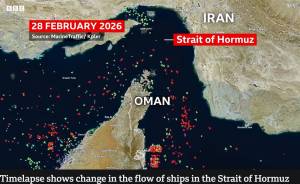
Chart Shows Shipping it Strait of Hormuz As of Feb. 28, 2026 before shipping was curtailed because of threats and attacks by Iran.
- Morning Shots via The Bulwark, Political Opinion: Epic Failure, William Kristol, March 12, 2026. President Trump hasn’t been particularly coherent about what it is we’re trying to accomplish in Iran. He seems to have taken us to war without a clear plan or purpose. But he has given his war a striking moniker: Operation Epic Fury.disaster.
- Paul Krugman via Substack, Political-Economy Commentary: The Billionaires’ War, Paul Krugman, right, March 12, 2026. The ultrawealthy put Trump in power but other people will pay the price.
- Morning Shots via The Bulwark, Political Opinion: Little Marco, Big Shoes, Andrew Egger, March 12, 2026. It’s clear by now that Donald Trump’s subordinates know the secret to thriving in his orbit is to butter him up shamelessly and mercilessly at every turn. And yet it remains genuinely repulsive to watch that dynamic play out in the sort of fealty displays usually associated with ludicrously totalitarian regimes.
U.S. Tariffs, Inflation, Economy, Jobs
- Popular Information, Accountability Journalism: Consumers paid for Trump’s illegal tariffs. These companies may profit, Rebecca Crosby and Noel Sims, President Trump imposed sweeping global tariffs during his first year as president.
U.S. Education, Religion, Culture, Media
- Lincoln Square Media, The Intellectualist Opinion: Trump Appoints Erika Kirk to Air Force Academy Oversight Board, Brian Daitzman, March 12, 2026. The Turning Point USA head joins the board that evaluates curriculum, discipline and campus culture at one of the military’s key officer-training institutions.
Top Headlines
New York Times, Iran War Live Updates: New Supreme Leader Issues Defiant Statement Amid Growing Disruption to Global Oil Supplies, Aurelien Breeden, Rebecca Elliott, Erika Solomon and John Yoon, March 12, 2026. Iranian state media said Mojtaba Khamenei had released his first written statement as supreme leader, vowing that Iran would continue to block the Strait of Hormuz, a vital oil route. Global oil markets have been roiled by the war.
Here is the latest.
Mojtaba Khamenei, Iran’s new supreme leader, struck a defiant tone on Thursday in his first known public comments since succeeding his slain father, vowing to keep blocking the Strait of Hormuz, a vital oil route, and to avenge “the blood of the martyrs.”
In written statements carried by Iranian state media, Mr. Khamenei said Iran would pursue “an effective and regret-inducing defense” and “the lever of blocking the Strait of Hormuz must also continue to be used.”
The comments were likely to add further instability to oil markets. Iran has threatened attacks on shipments through the Strait of Hormuz, which is normally a conduit for one-fifth of the world’s oil. Iraq and Oman closed oil terminals on Thursday after two tankers were attacked and left burning off Iraq’s coast, as the International Energy Agency warned that the war in the Middle East had caused “the largest supply disruption in the history of the global oil market.”
Oil prices have surged despite a coordinated effort by the United States and other major economies to calm markets by pledging to release emergency reserves. The U.S. administration, too, has tried to soothe fears, with Chris Wright, the U.S. energy secretary, telling CNN on Thursday that “the world is very well supplied with oil right now.” In an earlier CNBC interview, Mr. Wright said that the U.S. Navy could begin escorting ships through the strait by the end of the month.
In his statement, Mr. Khamenei also threatened more strikes on U.S. military bases in the region. Countries in the Persian Gulf that host those bases “must have realized that America’s claim of establishing security and peace has been nothing more than a lie,” he said.
Mr. Khamenei has not appeared on video or in public since he was appointed on Monday to replace his father, Ayatollah Ali Khamenei, who was killed in Israeli airstrikes at the start of the U.S.-Israeli bombing campaign. Mr. Khamenei, 56, a hard-line cleric seen as close to Iran’s top military force, was injured in the initial strikes, according to Iranian and Israeli officials. The full circumstances and extent of his injuries is unclear. His mother, wife, and daughter were also killed in the U.S.-Israeli strikes.
Fighting has displaced up to 3.2 million people inside Iran, the United Nations refugee agency said on Thursday, as the human toll of the conflict rose. Almost 2,000 people have been killed since the start of the U.S.-Israeli assault, mostly in Iran.
The Israeli military said that it had launched a new wave of strikes in the country, targeting government infrastructure, as it also expanded its campaign against Hezbollah in Lebanon. Workers swept bloodstained sand off the sidewalk along the waterfront in Beirut, the Lebanese capital, after Israeli airstrikes killed at least seven people.
Here’s what else we are covering:
- Death toll: The number of people who have died in Iran is unclear. Iran’s representative to the United Nations, Amir Saeed Iravani, told the Security Council on Wednesday that more than 1,348 civilians had been killed. Dozens have also died in Iranian drone and missile attacks on Gulf countries and Israel. In Lebanon, the Israeli bombardment has killed more than 600 people and displaced over 800,000, according to Lebanese officials.
- Tanker attacks: Iran’s Revolutionary Guards Corps claimed responsibility for attacking one of the two tankers off Iraq’s coast, a Marshall Islands-flagged ship that Iraqi officials said was owned by an American company. In a statement cited by Iranian state media, the Guards said the ship had “disobeyed and ignored” warnings.
- Banks threatened: Major financial institutions, including Citi and HSBC, temporarily closed offices in the Persian Gulf after Iran said it would target U.S. and Israeli banks in the region. Iran’s Islamic Revolutionary Guards Corps made the threat after an airstrike hit a building in Tehran linked to Bank Sepah, an institution founded in 1922 as Iran’s first modern domestic bank. Read more ›
- Deadly school strike: The United States was responsible for the strike on an Iranian school that killed 175 people, most of them children, based on outdated targeting information, according to the preliminary findings of a Pentagon investigation.
New York Times, Why Oil Prices Surged Even After the Release of Strategic Reserves, Aaron Krolik, March 12, 2026. Reserves or no reserves, the outlook remains bleak as long as a major oil and gas trade route remains virtually closed.
Reality is starting to set in for the world’s oil traders.
Oil futures have again topped $100 a barrel — the latest surge after days of wild price swings in the market since the United States and Israel first struck Iran. But this uptick came after the International Energy Agency on Wednesday announced that more than 30 countries would release a record amount of oil from their emergency reserves.
Instead of reassuring jittery markets, the news seemed to further spook traders by underscoring how far the world is from reopening trade in the Strait of Hormuz, the narrow waterway and vital trading route that separates Middle Eastern oil producers from their customers. This concern was further reinforced when three ships were attacked in the channel on Wednesday.
Before the war, the strait carried more than 20 million barrels a day, roughly one-fifth of the world’s supply. That traffic is virtually halted. While world leaders agreed to release a record 400 million barrels of oil from strategic reserves, that is only about 20 days worth of oil that would normally flow through the strait.
And the war began nearly two weeks ago — with no end in sight.
“No amount of storage can replace 20 million barrels per day of continuous flow,” said Edward C. Chow, a senior associate at the Center for Strategic and International Studies, a Washington think tank, and a former executive at Chevron.
Tapping those emergency stores of oil is easier said than done. Reserves are stored in massive facilities scattered around the world.
South Korea, for example, has storage sites positioned around the peninsula, according to the Korea National Oil Corporation. Some facilities, like one in Okinawa, Japan, are shared with commercial inventories owned by producers like Saudi Arabia’s Aramco.
Member countries of the International Energy Agency, a Paris-based organization, are required to maintain at least 90 days of their imports as emergency reserves.
Getting the oil flowing from reserves also takes time. There are physical limits on how quickly oil can be pulled from storage, but also more mundane hurdles, such as finding buyers, writing contracts and the basic logistics of moving supplies across the globe.
The maximum rate at which the United States can draw oil from its reserves is only 4.4 million barrels per day, according to the U.S. Department of Energy.
Even if shipments resume in the strait, it could be months before energy markets return to normal, according to June Goh, a Singapore-based oil market analyst at Sparta, a commodities data firm.
Refineries are complex, tightly sequenced operations and cannot be turned on and off like a light switch. If refineries are forced to shut down, it would take at least two months for them to return to normal operations, even after regular shipments return, she said.
Oil prices rose sharply after the war began on Feb. 28, briefly surpassing $110 a barrel this week before falling back.
Markets are starting to reflect the possibility that there will be no short-term resolution to the conflict and its consequences on oil supplies, and that even releasing the reserves is only a temporary solution.
Traders had been betting that the conflict would be brief and that President Trump would back down as he has in trade disputes, said Edward Fishman, a senior fellow at the Council on Foreign Relations. But unlike with tariffs, the strait is not something that Mr. Trump can unilaterally open or close.
Even if the United States were to declare an end to military operations, there is no guarantee that Iran would quickly reopen the strait, Mr. Fishman said. Iran’s leadership has publicly said its goal is to push the United States out of the Gulf entirely, and after two weeks of American strikes, it may have little reason to back down.
“There is only one party that can reopen the strait,” he said. “And that’s Iran.”
New York Times, Pentagon Memo: How Hegseth Came to See Moral Purpose in War as Weakness, Greg Jaffe, March 12, 2026. Defense Secretary Pete Hegseth’s bellicose and vengeful rhetoric describing the military’s war in Iran grew out of his experience in Iraq.
Long before President Trump chose him to lead the U.S. military, Pete Hegseth described the moral calling that had compelled him to volunteer to serve in Iraq.
He was working on Wall Street in the summer of 2005 and had read an article about an insurgent who blew himself up, killing 18 Iraqi children. “To me, that was the face of evil,” Mr. Hegseth told The Princeton Alumni Weekly, adding, “That sent to me a signal that I need to do my part not to let that ideology win in Iraq.”
He deployed to the war-torn city of Samarra a short time later.
Today, Mr. Hegseth describes the mission and moral purpose animating the war in Iran, now in its second week, in starkly different terms. The goal, he said recently, is to unleash “death and destruction from the sky all day long.” Instead of seeking justice, U.S. forces are pursuing vengeance against an implacable foe.
“Their war on Americans has become our retribution,” he vowed.
For decades, presidents and their secretaries of defense have framed American military interventions in altruistic terms. Even though the truth was often more complicated, they cast U.S. troops as liberators bringing democracy and freedom to those living under tyranny and oppression.
Mr. Hegseth has largely dispensed with that talk. His bellicose, at times vengeful, rhetoric reflects his belief that the United States’ lofty goals in Iraq and Afghanistan caused the military to lose focus on its main task, killing the enemy, and led to costly defeats in both wars.
In his view, the U.S. military’s strength is not rooted in its high ideals, humanity or moral purpose, but rather its ability to punish adversaries. Anything that distracts from that singular mission, he has said, is weakness.
“This is not 2003. This is not endless nation building,” Mr. Hegseth said on Tuesday at the Pentagon. “It’s not even close. Our generation of soldiers will not let that happen again.”
Instead, he said, the U.S. military was pursuing Mr. Trump’s war objectives with “brutal efficiency, total air dominance and an unbreakable will.”
A Pentagon spokeswoman said Mr. Hegseth’s remarks “project strength, resolve and confidence” to enemies and allies in “an increasingly dangerous world.”
In 2006, shortly after Mr. Hegseth arrived in Samarra, a powerful explosion shattered the golden dome of one of Iraq’s most revered Shiite shrines in the city. The blast set off months of sectarian fury, plunging the country into a state of civil war.
Mr. Hegseth was part of a small team focused on rebuilding Samarra, where the U.S. military had spent tens of millions of dollars. He pored over spreadsheets detailing the reconstruction contracts and visited many of the sites, some of which were half-finished or empty lots. He concluded that a major chunk of the military’s money was funding the insurgency.
He and his team redirected the remaining funds to the head of the Samarra City Council, who used them to build a security force. The Iraqi leader also provided valuable intelligence on the enemy. To show solidarity, Mr. Hegseth and other soldiers from his team spent the night at the embattled Iraqi leader’s home. The gesture was Mr. Hegseth’s idea, according to a former soldier from his unit.
Those who knew Mr. Hegseth from that period describe him as ambitious, passionate and dedicated to the mission.
“In Iraq, I often met these midlevel officers who were very competent and actually cared despite being thrust into an almost impossible situation not of their making,” recalled Philip Shishkin, a former Wall Street Journal reporter who embedded with Mr. Hegseth’s unit in 2006. “Hegseth fell into that category.”
New York Times, Pentagon Bars Photographers From Briefings on Iran War, Erik Wemple, March 12, 2026 (print ed.). The decision is the latest move by the Pentagon to restrict access inside the department for journalists.
In its first briefing after the United States attacked Iran, the Pentagon welcomed photographers from news outlets including Bloomberg, The Associated Press, Getty Images, Reuters and more.
But the Pentagon has since enacted strict limits that bar access to photographers from news organizations, the latest move by the Defense Department under Secretary Pete Hegseth to restrict press access.
The Pentagon said in a statement that it made the change for photographers to use the space in the Pentagon’s briefing room “effectively.”
“Photographs from the briefings are immediately released online for the public and press to use,” the department said.
Mr. Hegseth has taken an adversarial stance toward the news media since his first days of running the Pentagon. He proposed denying access to a reporter from NBC News from the Pentagon, then removed several news organizations from their on-site workstations. Months later, he curtailed the unescorted roaming privileges of journalists within the complex.
And last fall, Mr. Hegseth presided over the adoption of new media restrictions that allow the Pentagon to determine whether reporters pose “security risks” that justify revoking their press credentials. Rather than sign the document, dozens of reporters surrendered their credentials, and a new set of largely pro-Trump commentators and influencers took their places.
The Times in December sued the Defense Department over the policy, calling it a violation of the First Amendment. In a hearing on that suit last Friday, David Schulz, a lawyer representing the Pentagon Press Association, said that before a briefing early last week, Pentagon officials invited the new press corps to attend. “And then they realized none of those people could really get the information out to TV networks and others since they didn’t have a camera,” Mr. Schulz said.
The Pentagon then requested placement of a pool camera for the major TV networks, Mr. Schulz said. The network pool camera has been at all three Pentagon briefings on the Iran war.
The Times is among the outlets whose photographers have been excluded from the latest briefings.
“As The Times has long said: there is a clear importance and public service to allowing journalists to report fully on the U.S. military,” The Times said in a statement. “This includes photojournalists, who deserve access and credentialing to attend Pentagon briefings.”
Morning Shots via The Bulwark, Political Opinion: Sing, Goddess, of the Fury of Trump!, Bill Kristol, Andrew Egger and Jim Swift, March 12, 2026. The wartime president is focused on footwear.
Way back in June 2024, Andrew wrote that “one awkward thing about Trump discourse today is that all the vile things about him suck up so much oxygen that it can be hard to make space to talk about the ways in which he’s merely very stupid.”
We thought about that this morning—and about how it’s now become a government-wide phenomenon—when we encountered this Deadline headline: “Kash Patel Confirms UFC Fighters Will Train FBI Agents This Week, Calling It a ‘Historic Opportunity.’” What a time to be alive. Happy Thursday.
News Updates
The Parnas Perspective, News and Commentary: Iran Escalates War After Trump Declares Victory, Iranian Hackers Hit U.S. Company, Allies Admit They Don’t Know Trump’s Plan, Aaron Parnas, right, March 12, 2026. Despite Donald Trump claiming the United States “won” the war in Iran, the Iranian military spent the night bombing commercial oil tankers and oil ports across the Middle East.
America’s allies are publicly saying they have no idea what Trump’s goals are in a war that has already cost taxpayers more than $11 billion. An Iranian-linked hacker group has carried out its first known hack of an American company since the conflict began, and the FBI has reportedly begun training alongside UFC fighters.
Some of you have told me you’re having trouble seeing my reporting on other platforms like Meta. That’s exactly why I’m here, and why I’m asking for your help to keep building this space. If you can, please consider subscribing or gifting a subscription to support this work.
This is the only platform where I fully own my reporting, without an algorithm deciding what people are allowed to see. No matter how many people try to undermine what we’re building, I’m not stopping.
Here’s the news:
During a CNN appearance last night, I discussed the cost of the war with Iran, noting that while President Donald Trump described it as an “excursion,” I argued that sending billions of dollars overseas and putting American lives at risk constitutes war, and said the administration has not clearly made the case for why U.S. lives should be on the line.
Americans are worried about whether they can afford health care and groceries, and many see the U.S. spending billions of dollars overseas, which I said could hurt President Donald Trump politically in the November elections.
According to Axios, after a G7 video call, French President Emmanuel Macron said uncertainty remains about Washington’s strategy in the Iran conflict, stating, “No one can tell what U.S. President Donald J. Trump wants from this ongoing war with Iran.” Israeli officials believe Trump likely won’t end the war in the next two to three weeks, though they acknowledge he could shift course quickly; the initial strike that killed Iran’s Supreme Leader Ali Khamenei and dozens of senior officials has not yet destabilized the regime as hoped.
An Iran-linked hacker group called Handala Team claimed responsibility for a cyberattack on Stryker, a Michigan-based medical technology company, marking what appears to be the first significant Iranian cyberattack on a U.S. company since the war between the countries began. The attack reportedly disrupted Stryker’s Microsoft environment and may have involved hackers accessing the company’s Microsoft Intune management system to remotely wipe employee devices to factory settings, halting communications and work for some staff; the company said the disruption was contained and not caused by ransomware or malware.
The Iranian government issued new threats to service members in the region:
According to Reuters, U.S. intelligence assessments indicate Iran’s government is not at risk of collapse, even after nearly two weeks of U.S. and Israeli strikes that killed Supreme Leader Ali Khamenei and dozens of senior officials. Intelligence reports say the regime remains cohesive and retains control of the population, though the situation remains fluid, and analysts note that toppling the government would likely require a ground offensive, while Iranian Kurdish militias lack the manpower and weapons to effectively challenge Iranian security forces.
The Trump White House faced online backlash after posting an AI-generated video about the Iran war that used bowling imagery—showing pins representing Iranian officials being knocked down by an American-flag bowling ball and captioned “STRIKE”—with critics arguing the post trivialized an ongoing conflict in which U.S. service members have been killed and injured.
Military analysts say reopening the Strait of Hormuz could require a ground operation to seize Iran’s coastline along the strategic waterway, a move that would significantly escalate the conflict and could lead to higher casualties for U.S. and allied forces, according to the Wall Street Journal.
Suspected Iranian attacks set oil tankers ablaze near Iraq’s port of Basra, escalating strikes on shipping that have cut off Middle Eastern oil flows and pushed prices back above $100 a barrel, even as President Donald Trump claimed the war had effectively been won early on. The conflict has killed around 2,000 people and caused major disruptions to global energy supplies, while Iranian drones and regional attacks continue across the Gulf.
Suspected Iranian attacks also set off a fire at a port in Oman:
Escalating Iranian attacks on ships in the Strait of Hormuz are raising fears the crucial shipping lane could remain closed for an extended period, as the U.S. has so far held off on providing naval escorts for oil tankers and Iran warns it will target any vessels attempting to pass through the waterway. Trump says when oil goes up, the United States makes money:
FBI Director Kash Patel confirmed to Deadline that several UFC fighters will lead a training seminar for FBI agents at the FBI Academy in Quantico on March 15–16, where agents—including academy students and senior staff—will learn combat techniques, tactics, and training methods used by professional mixed martial artists. The initiative is part of the FBI’s broader effort to modernize and diversify agent training, and features fighters such as Justin Gaethje, Jorge Masvidal, Chris Weidman, Claudia Gadelha, Michael Chandler, Manel Kape, and Renzo Gracie.
Iran’s new supreme leader, Mojtaba Khamenei, is expected to deliver his first public message since being appointed after nearly four days of silence amid reports he was injured in an airstrike. The hard-line leader, who recently succeeded his father Ali Khamenei after he was killed in a U.S.-Israeli bombing campaign, is reportedly wounded but safe, according to a government adviser.
The International Energy Agency (IEA) says the Iran war is causing the largest supply disruption in the history of the global oil market, with oil flow through the Strait of Hormuz—normally carrying about one-fifth of the world’s supply—reduced to a trickle after Iranian threats against ships. The agency released a record 400 million barrels of oil to stabilize markets but warned it is only a temporary measure as prices continue to fluctuate.
Citibank temporarily closed several branches in the United Arab Emirates until Saturday as a precaution after Iran threatened Gulf financial institutions linked to the U.S. and Israel, with the bank planning to reopen most locations Monday while keeping one Dubai branch open.
Israeli Defense Minister Israel Katz said he has ordered the military to prepare to expand operations in Lebanon if the Lebanese government cannot stop Hezbollah attacks on northern Israel, warning that Israel may take control of the territory itself to restore security.
Lebanese officials say an Israeli airstrike on the Ramlet al-Baida public beach in Beirut killed at least eight people and injured 31, as Israel said it was carrying out wide-scale strikes targeting Hezbollah infrastructure across Lebanon; the country is also facing a growing humanitarian crisis with about 700,000 people displaced since the war began.
A new “Mass Deportation Coalition” made up of Trump allies and immigration hardliners is lobbying the White House to expand deportations to all undocumented migrants, not just violent criminals, citing a McLaughlin & Associates poll showing 66% of likely 2026 voters support deporting migrants who entered illegally. The push comes as the administration has recently shifted its messaging to prioritize deporting violent offenders, sparking tension within the president’s political base.
 A federal judge blocked ICE from building an immigration detention facility in Hagerstown, Maryland, siding with the state’s lawsuit arguing the project moved forward without the legally required environmental impact review.
The Trump administration launched a new trade investigation under Section 301 of the Trade Act of 1974 as it seeks to replace tariffs struck down by the Supreme Court, potentially paving the way for new import taxes aimed at protecting U.S. industries from foreign manufacturing practices and subsidies.
The Senate is expected to vote again today on a bill to fund the Department of Homeland Security, which has been partially shut down for 27 days due to a partisan dispute over funding and guardrails for ICE and CBP, though the measure is widely expected to fail to reach the 60 votes needed to advance. The standoff comes amid broader controversy over the administration’s immigration crackdown, including the fatal shootings of two U.S. citizens in Minneapolis during federal enforcement operations and the ouster of Homeland Security Secretary Kristi Noem after 13 months in the role.
A West Health–Gallup poll found that about one in three Americans have made financial trade-offs to afford health care, including rationing medications or borrowing money, while nearly one in ten have postponed retirement due to medical costs, underscoring growing financial strain as health care becomes a top voter concern ahead of the midterm elections.
According to NBC, South Africa summoned U.S. Ambassador Leo Brent Bozell III after he publicly criticized the country’s diplomatic ties with Iran and its affirmative action policies, deepening tensions between the two nations under the Trump administration. South African officials said the remarks were undiplomatic, and Bozell later apologized and expressed regret, while broader disputes persist over issues such as land expropriation laws, rural crime, and U.S. allegations about violence against white farmers—claims widely disputed in South Africa.
A Moscow court convicted 19 people for their roles in the March 22, 2024 terrorist attack at Crocus City Hall, where four gunmen killed 149 people and wounded more than 600 before setting the venue on fire during a concert. The attack was claimed by a faction of ISIS, and those convicted received lengthy sentences, including 15 life sentences, while others were given prison terms ranging from about 20 to 22½ years; Russian officials have alleged Ukrainian involvement without providing evidence, a claim Ukraine denies.
According to the Guardian, an Israeli airstrike hit a tent camp sheltering displaced Palestinians west of Gaza City, after residents were reportedly given five minutes to evacuate via phone warnings from the Israeli military; following warning strikes, a final strike ignited a large fire and heavy smoke at the displacement site.
Letters from an American, Historical Commentary: March 11, 2026 [Iran War Prospects, U.S. Policies], Heather Cox Richardson, right, March 12, 2026. In a brief call with Barak Ravid of Axios today, President Donald J. Trump said “The war is going great. We are way ahead of the timetable. We have done more damage than we thought possible, even in the original six-week period.” He added that the war against Iran will end “soon” because there’s “practically nothing left to target.” “Little this and that... Any time I want it to end, it will end,” he said.
In fact, according to Patrick Wintour of The Guardian, Iranian officials have rejected two messages from Trump’s Middle East envoy Steve Witkoff calling for a ceasefire. Wintour writes that Iran’s leaders “sense it is not losing the war and the US president is at the minimum feeling the political pressure.” Iranian officials intend to make the economic, political, and military costs of the war so high that Trump will not attack Iran again.
For his part, Trump appears to be panicking over yesterday’s news that Iran is laying mines in the Strait of Hormuz, through which tankers transport about 20% of the world’s oil through a two-mile-wide (3.2 km) shipping channel. (Twenty percent of the world’s oil is about 20 million barrels, and a barrel is a unit of measure equal to 42 U.S. gallons or 159 liters.) Threats from Iran have bottled up oil in the Persian Gulf, and suppliers are shutting down operations because their storage facilities are full. The average price of gasoline in the U.S. has jumped nearly 60 cents a gallon since Trump launched attacks against Iran.
As Morgan Phillips of Fox News notes, naval mines are cheap, as little as a few thousand dollars, and can incapacitate or sink a $2 billion U.S. destroyer. They can be deployed by small vessels like hard-to-spot fishing craft at night.
The U.S. destroyed sixteen inactive Iranian mine-laying ships yesterday; today three merchant ships sustained minor damage after being struck in or near the strait. Today Trump claimed the U.S. has hit “28 mine ships as of this moment,” prompting Chris Cameron of the New York Times to note that “[t]he president sometimes exaggerates or is imprecise when giving figures.”
A spokesperson for Iran’s military command, Ebrahim Zolfaqari, said: “Get ready for oil to be $200 a barrel, because the oil price depends on regional security, which you have destabilised.” Today Iran struck oil storage facilities in Oman and Bahrain.
While a few Iranian ships are traversing the strait, they are the only ones. Retired French vice admiral Pascal Ausseur told the Associated Press: “In today’s context, sending warships or civilian vessels into the Strait of Hormuz would be suicidal,” adding that a ceasefire with Iran “would move the situation from suicidal to dangerous.” At that point, escorts of oil vessels by military ships could begin.
Today Trump told Leonardo Feldman of Newsweek that the project of reopening the Hormuz Strait is “working out very well, and I think you are going to see that.” Trump has said prices will “drop very rapidly when this is over,” but oil industry analysts say reopening production could take at least a month even if Trump could declare the war over immediately, and there is no indication Iran would agree to an instant ceasefire.
Aarian Marshall of Wired reports that half of the ships that usually travel through the Strait of Hormuz carry oil, but the other half carry raw materials that are made into fertilizer, plastics, precision instruments, machinery, electrical parts, and electronic components, all of which could jump in price.
Jon Gambrell of the Associated Press suggested that the war with Iran boils down to a single question: “Who can take the pain the longest?” Iran is being hammered with air strikes by both Israel and the U.S. Those strikes now include Israeli strikes on targets in Lebanon Israel says are connected to Iran-backed Hezbollah militants, killing more than 600 people and turning as many as 800,000 into refugees. For the regime, Gambrell notes, victory means staying in power and outlasting the bombing.
It is unclear what victory looks like for the U.S. The administration has offered a range of justifications for its war without suggesting what an endgame looks like. David Brown of the Wall Street Journal reported today that the U.S. and Israel appear to disagree about how long the war should last, with Israeli officials wanting to continue the war by decimating Iran’s oil industry and targeting top Iranian officials.
The pain for the U.S. is already becoming clear. Yesterday, after Reuters reporter Phil Stewart reported that as many as 150 U.S. troops had been wounded so far in the Iran conflict, the Pentagon publicly revised its estimate of fewer than a dozen U.S. service members wounded upward to about 140. The wounds include brain trauma, shrapnel wounds, and burns. Seven service members have died.
Lawmakers and their aides expressed frustration that the Pentagon had not announced the casualty numbers without prodding. “Just own it and be transparent,” a congressional aide told Alex Horton of the Washington Post. “You owe it to the service members.”
Bora Erden and Leanne Abraham of the New York Times reported today that at least seventeen U.S. military sites and installations across the region, including air defense systems, have been struck since the war began. Iran has also struck diplomatic sites, including U.S. embassies in Kuwait City, Kuwait, and Riyadh, Saudi Arabia, and the U.S. consulate in Dubai.
The eye-watering cost of the conflict is also hitting home. Officials from the Pentagon told members of Congress this week that the military used up $5.6 billion worth of munitions in the first two days of the war, a much higher burn rate than the administration had previously disclosed. Lawmakers are concerned that Trump’s Iran attack, along with his strikes on Nigeria, Somalia, Iraq, Venezuela, the small boats in the Caribbean and eastern Pacific, and the Houthis in Yemen, is cutting into U.S. readiness for unexpected conflicts.
Lawmakers are also unhappy about the administration’s expected upcoming request for more money to fight the war. Catie Edmondson of the New York Times reported that Pentagon officials told lawmakers yesterday the first six days of the war had cost more than $11.3 billion, not including the buildup of personnel and military hardware for the initial strikes.
Today Julian E. Barnes, Eric Schmitt, Tyler Pager, Malachy Browne, and Helene Cooper of the New York Times reported that, according to a preliminary report by military investigators, the U.S. is responsible for the February 28 strike on the Shajarah Tayyebeh girls elementary school that Iranian officials say killed at least 175 people, most of them children. The school building had been part of an adjacent Iranian military base years ago, and it appears the U.S. used outdated information in their targeting of the building.
As the journalists wrote, “Striking a school full of children is sure to be recorded as one of the most devastating single military errors in recent decades.”
On Saturday, when asked about the possibility the U.S. was responsible for the strike, Trump answered: “No. In my opinion and based on what I’ve seen, that was done by Iran…. We think it was done by Iran. Because they’re very inaccurate, as you know, with their munitions. They have no accuracy whatsoever. It was done by Iran.”
On Monday, when a reporter noted that it was likely a Tomahawk missile that hit the school and asked if the U.S. would accept responsibility, Trump responded that “the Tomahawk…is sold and used by other countries,” and suggested that Iran “also has some Tomahawks.”
On Tuesday, a reporter asked why Trump said Iran had Tomahawks when only three other U.S. allies and the U.S. have them. White House press secretary Karoline Leavitt answered: “The president has a right to share his opinions with the American public, but he has said he’ll accept the conclusion of that investigation, and frankly, we’re not going to be harassed by the New York Times, who’s been putting out a lot of articles on this making claims that have just not been verified by the Department of War, to quickly wrap up this investigation because the New York Times is calling on us to do so.”
Today a reporter confronted Trump, saying: “A new report says that the military investigation has found that the United States struck the school in Iran. As commander-in-chief, do you take responsibility for that?”
Trump answered: “I don’t know about it.”
Tonight, Iranian boats full of explosives hit two tankers carrying Iraqi fuel oil and set them ablaze about 30 miles (48 kilometers) off the Iraqi coast. According to Iraqi state media, Iraqi oil ports have “completely stopped operations.” Jon Gambrell of the Associated Press reported that one of the key measures of oil prices, Brent crude, jumped above $100 a barrel.
More On Iran War
Morning Shots via The Bulwark, Political Opinion: Epic Failure, William Kristol, right, March 12, 2026. President Trump hasn’t been particularly coherent about what it is we’re trying to accomplish in Iran. He seems to have taken us to war without a clear plan or purpose. But he has given his war a striking moniker: Operation Epic Fury.
It’s an unusual one. Usually, in naming military operations, the Pentagon seeks to convey an attitude of strength or determination. Last June’s strike against Iran’s nuclear program was called Operation Midnight Hammer. January’s operation in Venezuela was dubbed Operation Absolute Resolve.¹
But such names no longer seem to satisfy Trump’s child-like grandiosity and dictator-like megalomania. As Trump explained yesterday at a rally in Hebron, Kentucky, it was “Epic Fury” that spoke to him.
In the midst of delivering a brief war update, Trump paused over the name. “Epic Fury!”, he shouted with relish. “Is that a great name?” he asked rhetorically. And then Trump explained: “They gave me, like, 20 names. And I’m like, falling asleep. I didn’t like any of them. Then I see Epic Fury. I said, ‘I like that name, I like that.’”
It’s a ridiculous and embarrassing name.
After all, this is a war that Trump has characterized as merely a “little excursion.” So by Trump’s own telling, it’s not very “epic.”
And “fury?” That’s not perhaps the term to choose if you want to reassure the American people and the world that this war you’ve started is based on sound strategic judgment, and that this military operation is well-considered.
But if you revel in tough-guy triumphalism and world-historical vanity, then I suppose “Epic Fury” hits the spot. Is it possible that Trump has some vague memory of Homer’s Iliad? It’s an epic account of great fury, and its sort-of hero, Achilles, became famous. Will Trump have his Homer? “Sing, Goddess, of the fury of Trump!”
Of course, Homer does seem to suggest over the course of his long epic poem that the rage of Achilles was kind of a mixed blessing for his fellow Greeks.
What about the epic fury of Donald Trump? How’s that working out for us?
Trump thinks, or claims to think, it’s been just great. As he said yesterday in Kentucky, “Let me say we’ve won . . . We won. We won. In the first hour it was over. But we won.”
And earlier in the day, Trump called Barak Ravid of Axios to tell him that “The war is going great. We are way ahead of the timetable.” Later, in Ohio, he said “For us, it’s turned out to be easier than we thought.”
Is he protesting just a bit too much?
Surely he knows that so far he’s failed to remove the reprehensible Iranian regime. He knows the Iranians still have plenty of short-range missiles, drones, and naval mines because they’re continuing to use them, some to damaging effect.
He knows that he’s been unable to prevent the closing of the Strait of Hormuz, the disruption of the global economy, and a dramatic rise of oil prices up to the neighborhood of $100 a barrel. He knows that seven American soldiers have been killed and many more seriously injured. He knows that the cost of all this is running at some $2 billion a day. And even he must know that U.S. forces were responsible for the killing of scores of school children in an accidental bombing—a tragedy that, as the New York Times put it, “is sure to be recorded as one of the most devastating single military errors in recent decades.”
You might think that Trump would therefore know—though he’d never admit it—that all is not going swimmingly well. After all, while he may not be re-reading his Homer, he’s probably aware of what our own bard, Joe Rogan, is saying. The podcaster who supported Trump in 2024 declared on his show Tuesday that the war was “crazy” and had left Americans feeling “betrayed.” “This one’s nuts,” Rogan concluded.
I suspect that Trump may realize deep down that his exercise in epic fury is nuts. Presumably that’s why he’s assuring us that “Any time I want it to end, it will end.” I expect him to declare victory and end it soon.
But it won’t be remembered as an epic victory for the United States. All we can hope is that Epic Fury doesn’t turn out to have been an epic disaster.
Chart Shows Shipping it Strait of Hormuz As of Feb. 28, 2026 before shipping was curtailed because of threats and attacks by Iran.
Paul Krugman via Substack, Political-Economy Commentary: The Billionaires’ War, Paul Krugman, right, March 12, 2026. The ultrawealthy put Trump in power but other people will pay the price.
A large fire with smoke and flames AI-generated content may be incorrect.
It becomes clearer with each passing day that the people who took us to war with Iran had and have no idea what they’re doing — that they’re adolescents who think they’re playing video games while thousands die and the world careens toward economic crisis. The New York Times reports that Trump officials dismissed warnings that attacking Iran could disrupt world oil supplies. Among other things, the Times reports that
Mr. Trump, both publicly and privately, has been arguing that Venezuelan oil could help solve any shocks coming from the Iran war.
In 2024 Venezuela produced 900,000 barrels of oil per day; normally 20 million barrels a day transit the Strait of Hormuz. But arithmetic has a well-known woke bias.
Meanwhile, the Washington Post reports that the Pentagon has barred press photographers from briefings about the war after they published photos of Pete Hegseth that his staff considered “unflattering.” Priorities!
Amid the bloody shambles, one big question is, who put The Gang That Couldn’t Think Straight in power? In an immediate sense, Trump was put over the top by low-information voters — defined by G. Elliott Morris as voters who don’t know which party controls Congress. But the groundwork for the MAGA takeover was laid well before by the Roberts Supreme Court and by right-wing billionaires that the court enabled.
A few weeks ago I wrote about Billionaires Gone Wild, the extraordinary influence acquired by a tiny group of ultra-wealthy men. I shared this chart on campaign contributions, based on estimates from Americans for Tax Fairness: A graph with numbers and lines AI-generated content may be incorrect.
On Monday the Times published a deeply reported story about billionaires’ influence that, among other things, found that the chart above somewhat underestimates their role in campaign finance: According to the Times, they accounted for 19 percent of contributions in 2024, not 16.5 percent.
The Times also pointed out that the big money swung hard right in the 2024 election. The magnitude of the largesse showered on Republicans is clear in OpenSecrets data on the top 100 donors in different cycles: A graph of blue squares AI-generated content may be incorrect.
Moreover, the Times presents numbers that are even more extreme than the Open Secrets data:
In past elections, as ultrawealthy donors became more active, both major parties reaped rewards. But there was a stark divergence in 2024, with less money flowing directly to Democrats and a sharp increase in the amount donated to Republicans.
For every dollar donated by billionaires and their immediate families to a candidate or committee associated with Democrats, five dollars went to Republicans.
Much of that was a result of ultrawealthy people in the tech industry, who aligned with Mr. Trump’s tax and deregulation policies. More than a dozen billionaires were awarded roles in his administration.
And these explicit money flows don’t capture the immense effect of other deployments of billionaires’ wealth, notably the subversion of both conventional and social media. Elon Musk purchased Twitter in 2022 and quickly began converting it into the Nazi-friendly cesspool it is today — and no, that’s not hyperbole. How much did this contribute to the degradation of public discourse? Paramount, controlled by Larry Ellison and run by his son, has taken over CBS News — which is rapidly going downhill — and is on the verge of taking over CNN too. And Jeff Bezos is gutting The Washington Post, although kudos to the remaining reporters who are still trying to do their jobs.
There is, however, something that is still puzzling me: To a large extent billionaires bought themselves a government friendly to their interests. Trump and company have granted many items on the tech broligarchy wish list, from tax breaks to deregulation to promotion of crypto and unregulated AI. But why the abject incompetence? Couldn’t billionaires find political allies who wouldn’t plunge the country into a potentially disastrous and historically unpopular war without considering the risks?
I have two tentative answers.
One is that no, competent allies weren’t available. Money buys a lot of influence, but to actually take over the U.S. government requires more than money — it requires politicians who are utterly corrupt. In his first administration, Trump learned that hiring people who were even modestly competent eventually presented barriers to his authoritarian instincts – for example, his former Vice President Mike Pence. Hence Trump learned that in choosing his political hires the more incompetent, the more venal, the more bigoted, and the more cruel, the better.
You might think that presidential pardons for scammers, money launderers and outright crooks are unrelated to the ill-advised war on Iran. But corruption is a key feature of a billionaire-installed regime, and corruption and incompetence go hand in hand.
My second answer is that the vast wealth of tech billionaires has made many of them unconcerned with the little people’s lives — and deeply unpatriotic. If Americans are being brutalized and murdered by rogue ICE agents…well, that’s not their problem. If the Justice Department and the FBI are totally subverted and operate as Trump’s enforcers, they know that vindictive, unlawful tactics will never touch their lives. If Republican budget cuts decimate rural hospitals and deprive hundreds of thousands of health insurance…well, they have their own private doctors and clinics. If Trump starts an ill-conceived war that doubles the price of oil…well, they can certainly afford the higher gasoline bills for their limousines and yachts. And it won’t be their kids hunkered down in a bunker in the Middle East.
So if you want to understand how this country has degenerated to such a state, how we can be spending nearly $2 billion a day attacking Iran without a clear endgame in sight, while children go without healthcare, nursing homes are understaffed because their workers have been deported, home electricity bills skyrocket due to data centers, consider who benefits and who isn’t hurt.
This is a billionaire’s war, waged at everyone else’s expense.
Morning Shots via The Bulwark, Political Opinion: Little Marco, Big Shoes, Andrew Egger, March 12, 2026. It’s clear by now that Donald Trump’s subordinates know the secret to thriving in his orbit is to butter him up shamelessly and mercilessly at every turn. And yet it remains genuinely repulsive to watch that dynamic play out in the sort of fealty displays usually associated with ludicrously totalitarian regimes.
On Monday, Trump delivered a speech at the Congressional Institute, where he was joined on stage by four members of House Republican leadership: Speaker Mike Johnson, Majority Leader Steve Scalise, Conference Chairman Lisa McClain, and Majority Whip Tom Emmer. As Trump took the stage, they immediately began to applaud—and then, bizarrely, they just didn’t stop. For nearly two minutes they stood there, clapping, as Lee Greenwood’s “God Bless the USA” played over the loudspeakers. Trump just stood there, pivoting slightly, occasionally firing off a dance move. At one point, Scalise briefly dropped his hands, then appeared to think better of it and got back to clapping again. It was a lesson straight from Solzhenitsyn’s Gulag Archipelago: “Don’t ever be the first to stop applauding.”
Still, House leaders might console themselves, there are worse humiliations. You could be in Trump’s cabinet, doomed to spend your life flapping around in clown shoes. The Wall Street Journal reported this week that Trump has recently fallen in love with the American shoe brand Florsheim, and he’s taken to having pairs ordered for all the men in his office. “It’s hysterical,” one female White House aide told the Journal, “because everybody’s afraid not to wear them.”
But there’s a problem: Trump’s just guessing everybody’s shoe size. And after the piece appeared, people began to notice: Oh, that’s why Marco Rubio and JD Vance keep getting photographed with their feet swimming in outrageously large Oxfords.(Chip Somodevilla/Getty Images. Saul Leob/AFP via Getty Images. Kay Nietfeld/picture alliance via Getty Images))
I invite you to consider the constant low-level physical and psychological drain of spending your entire professional life in way-too-big shoes.
These middle-aged men, some of the most powerful in the world, are not allowed even to stand or walk normally. The shoes are not very expensive—about $145—but apparently even to order a replacement pair in the correct size would risk an unacceptable breach of courtly etiquette. What if he noticed?? So they clomp around, their posture and gait arrested, their blisters and spinal alignments unimaginable, some non-trivial percentage of their neurons constantly devoted to keeping the damn things on. For them, slavishness to Donald Trump has gone beyond the merely mental; they feel it in their skin, their joints, their bones.
Against that backdrop, it’s hard even to get too worked up about the other White House aesthetic controversy of the week: Defense Secretary Pete Hegseth banning press photographers from the Pentagon briefing room for releasing pictures of him he considers insufficiently hot. Sure, it’s an outrage against ordinary norms of a free press, but at least it’s an outrage being carried out due to pure human vanity—Hegseth thinks he’s a smokeshow, and he demands to be presented as such. That urge is identifiably human. Worms don’t care how they look.
AROUND THE BULWARK
- Iran Fears on The Focus Group. BILL KRISTOL joins SARAH LONGWELL for reactions to the war in Iran, views on the Trump administration (including the Epstein files), and the rise of Israel-linked conspiracies. Plus: Bulwark fans are starting to show up in our focus groups?!
- Paxton vs. Cornyn Is a Choice Between Two MAGA Flavors… Both are awful. Both are Trumpy. One also happens to be extravagantly corrupt, writes JILL LAWRENCE.
- If the Shoe Fits: Trump and the Florsheim You Can’t Refuse… CATHY YOUNG takes on the strangely Soviet odor of the week’s weirdest story.
Quick Hits
WHO KILLED THOSE GIRLS? As information has slowly trickled out about the mistaken American bombing of an Iranian girls’ school, many people have reasonably wondered: Was AI involved in the decision that led to the death of scores of Iranian schoolchildren?
As has been widely reported, the Defense Department used AI heavily during its target planning for its initial strikes on Iran, assembling target lists on systems from the defense contractor Palantir that are powered by AI technology from Anthropic. But reporting from multiple outlets suggests that the problem was likely one of outdated intelligence from the Defense Intelligence Agency: The site of the school was on a target list because the building, which was next door to a military compound, was part of the compound years ago.
If that’s true, then the Pentagon’s AI wasn’t at fault for the mistake—it simply passed along a piece of faulty data that had been fed into it. But it’s still reasonable to wonder if a Pentagon that wasn’t leaning on AI systems would have made the same mistake. The Washington Post reports on how the Pentagon’s AI use is “speeding the pace of the campaign,” turning “weeks-long battle planning into real-time operations.” The power of these tools allows the military to move at unprecedented speed and scale—but that in turn significantly raises the pressure on, for instance, the human analysts whose job it is to vet targets before they’re attacked. “Given the speed and scale of Operation Epic Fury,” WaPo reported, “those targets may not have received updated vetting.”
In other words, it’s plausible that the school strike was exactly the sort of mistake humans interacting with AI tend to make: Not being thorough enough in double-checking the machine’s extremely correct-looking outputs. And here’s a reminder: The Pentagon is currently fighting a major legal battle with Anthropic precisely because it thinks, over the strenuous objections of the company, that it should be able to take humans out of this loop altogether.
THE COALITION CRACKUP CONTINUES: Back in January, we wrote about Donald Trump’s growing problem with a demographic that helped get him re-elected: young men. A big part of their concern, according to Speaking with American Men pollster John Della Volpe, was that Trump was more focused on foreign policy than on domestic affordability. And you’re not gonna believe this, but this business in Iran seems to be making the issue worse. The New Republic’s Greg Sargent reports:
Della Volpe told me he just conducted over 50 interviews with men of ages 19 to 29 for a forthcoming release. They are registering “strong opposition” and dismay with Trump over the war, Della Volpe said, describing their message this way: “He assured them there would be no more wars, and it feels like betrayal.” . . .
In a sense, Trump’s economic failures and Iran invasion constitute a double whammy of broken promises. He gave young people hope for a brighter economic future rooted in populist nationalist renewal and also hope for a future of peace. “Neither of those things has been delivered,” Della Volpe said.
We won’t hold it against the kids that they believed those promises in the first place. Fool me once, etc.
THINGS THAT MAKE YOU SAY ‘HMMM’: Where is the money Trump extorts from companies—ABC, Meta, Paramount, X—actually going? Congressional Democrats are trying to find out. WaPo reports:
The four companies each committed millions of dollars to the project through legal settlements with Trump in the months after the 2024 presidential election, seeking to resolve claims they had harmed him by restricting his access to social media or defaming him in their coverage. The commitments totaled at least $63 million, according to company statements and media reports.
But the Donald J. Trump Presidential Library Fund, Inc., which was set to receive at least some of the settlement funding, was administratively dissolved in September by Florida officials after it did not submit a mandatory annual report. Three months later, Jacob Roth, the lawyer who originally incorporated the fund, filed articles of dissolution, OpenSecrets first reported last year.
“Now it is unclear where this money has gone, exacerbating concerns about corruption that were apparent at the time of the settlement,” the lawmakers wrote.
All totally above-board and corruption-free, we have every confidence. Read the whole thing.
U.S. Tariffs, Inflation, Economy, Jobs
Popular Information, Accountability Journalism: Consumers paid for Trump’s illegal tariffs. These companies may profit, Rebecca Crosby and Noel Sims, President Trump imposed sweeping global tariffs during his first year as president.
To justify many of the tariffs, Trump relied on a novel interpretation of a 1977 law, the International Emergency Economic Powers Act (IEEPA), which did not mention tariffs at all. But in February, the Supreme Court struck down the majority of Trump’s tariffs, ruling 6-3 that Trump had exceeded his authority. The court found that Trump’s tariffs were unconstitutional, as “taxation power clearly belongs to Congress.”
In recent months, thousands of companies have sued the Trump administration over its tariff policies, seeking refunds for tariff-related costs.
The Supreme Court did not discuss refunds in its ruling. But at the beginning of March, Judge Richard Eaton of the U.S. Court of International Trade ruled that companies that paid tariffs were “entitled to benefit” from the Supreme Court ruling. The order directed U.S. Customs and Border Protection (CBP) to begin the refund process and to stop collecting the tariffs that were struck down. (The judge later “temporarily suspended his order to give the government time to prepare” after CBP said in an affidavit that “immediate compliance was not logistically possible,” Bloomberg reported. CBP estimated that it could start offering refunds by late April.)
The federal government could now be responsible for issuing “refunds worth $175 billion,” according to the Penn Wharton Budget Model.
While it seems likely that companies will eventually get refunds from Trump’s tariffs, much of the cost was borne by consumers. Many companies publicly stated that they were raising prices due to the tariffs. But now that the tariffs are being refunded, only a few companies have pledged to refund customers or offer discounts.
Popular Information contacted 18 companies— including Lululemon, Dollar General, and Crocs— that said they hiked prices due to tariffs and are suing the Trump administration for tariff refunds. We asked whether they would offer customers refunds or discounts once the refunds are processed. None of the companies responded.Major companies offering refunds or discounts
Costco is one of the few companies that has promised to pass some of the refunded tariff money back to customers.
“As we’ve done in the past, when legal challenges have recovered charges passed on in some form to our members, our commitment will be to find the best way to return this value to our members,” Costco CEO Ron Vachris said during an earnings call last week. Vachris said that the company would return recovered tariff money to customers “through lower prices and better values,” but noted that “it is not yet clear what the process will be, what refunds, if any, will be received, and when this will happen.” Costco executives also said during the call that the company took steps to absorb some of the increased cost caused by tariffs instead of passing it on to customers.
In November, Costco sued the Trump administration over its tariff policies and sought refunds.
FedEx has also pledged to refund a portion of any tariff money it receives to customers. “Our intent is straightforward: if refunds are issued to FedEx, we will issue refunds to the shippers and consumers who originally bore those charges,” FedEx said in a statement on its website. “When that will happen and the exact process for requesting and issuing refunds will depend in part on future guidance from the government and the court.”
In February, FedEx also sued the federal government for a full refund of tariff-related costs.Companies that will not commit to refunding customers
Unlike Costco and FedEx, several companies that have sued the Trump administration for a tariff refund have not pledged to refund customers, despite publicly stating they were raising prices due to tariffs.
Abercrombie & Fitch, the clothing brand that also owns Hollister, raised prices late last year and announced that it would continue to do so for its spring inventory. Despite passing some of the cost of tariffs along to its consumers, Abercrombie & Fitch has not said that it will share any refund it might receive from the federal government if it wins its lawsuit. “We feel good about the [tariff] mitigation strategies that we put in place,” the company’s CFO said on a call with analysts last week.
Similarly, Columbia Sportswear is suing the government, but has not indicated that it will share any potential refunds with its customers. Columbia was among the companies that announced planned price hikes before Trump had even been elected to his second term in anticipation of his tariff plans. In October 2024, Columbia CEO Tim Boyle told the Washington Post, “We’re buying stuff today for delivery next fall. So we’re just going to deal with it and we’ll just raise the prices. … It’s going to be very, very difficult to keep products affordable for Americans.”
GoPro announced price increases on its cameras in August. In a report on its 2025 Q2 earnings call, GoPro said, “We expect to offset half of our expected tariff costs with modest price increases.” Although GoPro expected price increases to cover a significant portion of its tariff costs, the company has not publicly announced plans to pass any refunds from its lawsuit against the government back to consumers.
Japanese clothing brand Uniqlo announced price hikes in the U.S. during a July earnings call. One executive said during the meeting, “It will be difficult to absorb all costs. Our approach will be to raise prices where possible and not where it isn’t possible, while ultimately focusing on creating a sustainable business that securely generates profits.” Uniqlo has not said that it will reimburse customers who absorbed the cost increases for their products if it wins a refund from the Trump administration.
Other companies that raised their prices to account for tariff costs and are now suing the Trump administration for a refund, but have not announced plans to refund consumers include:
- Steve Madden
- Crocs
- EssilorLuxottica (Ray-Ban’s parent company)
- Lululemon
- Deckers (parent company of UGG and Hoka)
- Dollar General
- Trek Bicycle
- Yeti
- Helly Hansen
- Brooks Running
- Allbirds
- Dyson
- Puma
- Nintendo
The customers strike back
At least two companies that have sued the federal government for tariff refunds are facing lawsuits of their own from consumers.
Although FedEx has promised refunds to customers, one consumer says that their promise is not enough. In a class action lawsuit filed one day after FedEx announced its refund plans, plaintiff Matthew Reiser claimed that FedEx’s pledge “creates no legally enforceable obligation and is expressly contingent on future government and court guidance that may never materialize.”
The lawsuit seeks a refund of the tariffs that FedEx customers paid — regardless of whether FedEx wins any money from its own lawsuit against the government — and a refund of the “ancillary brokerage and clearance fees for processing customs entries” that would not have been necessary if it were not for the tariffs.
Another consumer has filed a similar lawsuit against EssilorLuxottica, the parent company of Ray-Ban. Unlike FedEx, EssilorLuxottica has not promised consumers a refund if it wins its lawsuit against the Trump administration.
“Despite seeking an order entitling it to a refund of the duties collected as a result of the subject tariffs, EssilorLuxottica continues to collect and has not refunded the tariff surcharges it collected from consumers,” the lawsuit alleges. “EssilorLuxottica’s retention of those surcharges unjustly profits EssilorLuxottica at the expense of consumers.”
UPS is also facing a lawsuit from a customer seeking a refund for tariff costs that UPS passed on, although the company itself has not sued the government for a refund.
U.S. Education, Religion, Culture, Media
Lincoln Square Media, The Intellectualist Opinion: Trump Appoints Erika Kirk to Air Force Academy Oversight Board, Brian Daitzman, March 12, 2026. The Turning Point USA head joins the board that evaluates curriculum, discipline and campus culture at one of the military’s key officer-training institutions.
 President Donald Trump has appointed Erika Kirk, widow of the conservative activist Charlie Kirk, to the advisory board that oversees the United States Air Force Academy, extending the presence of a prominent conservative activist network inside a body that reviews the school’s curriculum, discipline and campus climate.
The appointment places Ms. Kirk in the same oversight body her husband served on before he was killed last year and keeps a leading figure from the conservative movement involved in debates over how the academy educates and trains future military officers.Subscribed
In a statement announcing the decision, the White House described the appointment as a continuation of his work.
“Charlie Kirk served proudly on the board, inspiring not only the next generation of service members, but millions around the world with his bold Christian faith, defense of the truth and deep love of country,” White House spokeswoman Olivia Wales said in a statement. “Erika Kirk will continue his legacy, and be a fearless advocate for the most elite airpower force in the history of the world whose warriors keep our nation safe, strong and free.”
The Board of Visitors is a statutory advisory body that reviews the academy’s operations and campus culture. According to the academy, the board examines cadet morale, discipline, curriculum, instruction and academic methods, as well as the school’s physical facilities and finances.
Board members have access to academy officials, faculty members and cadets as they evaluate conditions on campus. Their findings and recommendations are submitted through the secretary of the Air Force to the secretary of defense and to the congressional committees that oversee the military.
Although the panel does not run the academy, its inquiries can influence policy debates at one of the nation’s service academies.
The academy in Colorado Springs prepares thousands of cadets for leadership roles in the Air Force and Space Force, and questions about curriculum and campus culture have become a recurring subject of national political debate.
Charlie Kirk joined the board after Mr. Trump appointed him in 2025. During his tenure he pressed academy officials on several issues tied to broader cultural and political debates within the military.
Minutes from an August board meeting show that he asked academy officials how the school was ensuring compliance with presidential directives concerning diversity and curriculum. He questioned how faculty members were being prevented from promoting frameworks he described as “oppression, oppressor/oppressed dynamics, anti-western, anti-American, and gender ideology.”
The minutes also show him asking about the pace of renovations to the academy’s distinctive aluminum-and-glass chapel, a long-standing symbol of the campus that is undergoing extensive repairs.
The board includes presidential appointees as well as members designated by congressional leaders from both parties. Current members include Senator Tommy Tuberville of Alabama and Dina Powell, who served as deputy national security adviser during Mr. Trump’s first administration.
Since her husband’s death, Ms. Kirk has taken over leadership of Turning Point USA as chair and chief executive of the organization he founded. The group has become one of the most prominent youth-focused political organizations on the American right.
The appointment places a prominent figure from that movement on a board that reviews academic and institutional matters at the Air Force Academy, an institution that has increasingly been drawn into national debates over curriculum, diversity policy and military culture.
March 11
Top Headlines
- New York Times, U.S. at Fault in Strike on School in Iran, Preliminary Inquiry Says, Julian E. Barnes, Eric Schmitt, Tyler Pager, Malachy Browne and Helene Cooper, March 11, 2026. Outdated targeting data may have resulted in a mistaken missile strike, according to the ongoing military investigation, which undercuts President Trump’s assertion that Iran could be to blame.
- New York Times, Live Updates: Japan and Germany to Release Oil as War in Iran Threatens Global Supply, John Ismay, Eric Schmitt, Qasim Nauman and Abdi Latif Dahir, March 11, 2026. The Strait of Hormuz, a conduit for a fifth of the world’s oil, is all but closed as war in the Middle East expands. A British agency said three ships were hit by unidentified projectiles in or near the strait. Here’s the latest.
- New York Times, How Trump and His Advisers Miscalculated Iran’s Response to War, Mark Mazzetti, Tyler Pager and Edward Wong, March 11, 2026 (print ed.). In the lead-up to the U.S.-Israeli attack, President Trump downplayed the risks to the energy markets as a short-term concern that should not overshadow the mission to decapitate the Iranian regime.
- New York Times, At Least 17 U.S. Sites Damaged in War With Iran, Analysis Shows, Bora Erden and Leanne Abraham, March 11, 2026. Iran has responded to the U.S.-Israeli assault on the country by launching drones and missiles at American targets across the Middle East, hitting embassies, killing U.S. soldiers, and damaging military bases and air defense infrastructure.
News Roundups
- The Parnas Perspective, Evening News and Comment: California Aware of Possible Iran Drone Threats, Iran War Costs $11 Billion Taxpayer Dollars, Aaron Parnas, March 11, 2026. We’re covering major new Epstein revelations about who funded Jeffrey Epstein, California officials responding to possible Iranian drone threats, the rapidly rising cost of the Iran war as tankers are attacked in the Gulf, and Trump declaring the United States has won the war.
- The Parnas Perspective, Morning: News and Commentary, Trump Misjudged Iran's Response, Pam Bondi Moved to Military Housing, DOGE Engineer Steals Social Security Data of Millions, Aaron Parnas,right, March 11, 2026. New reporting shows that thousands of documents tied to the Epstein case are still missing or withheld, with many records yet to be released by the DOJ. This comes as Attorney General Pam Bondi has reportedly moved to military housing after receiving threats, including from cartels and critics over her handling of the Epstein files.
- Letters from an American, Historical Commentary: March 10, 2026 [Furious Democratic Responses To War], Heather Cox Richardson, right, March 11, 2026. Today, administration officials gave a classified briefing to the Senate Armed Services Committee about the war in Iran. Democrats who spoke to the press afterward appeared to be furious.
More On Iran War
- Popular Information, Accountability Journalism: Trump says Kushner helped convince him to go to war with Iran, Judd Legum, right, March 11, 2026. The disclosure highlights Kushner's massive financial conflicts.
- The Contrarian, Opinion: Trump’s Delusions Come at Americans’ Expense, Jennifer Rubin, right,March 11, 2026. “We don’t see anyone who can replace the regime,” an Israeli official told David Ignatius.
- New York Times, Live Updates: Japan and Germany to Release Oil as War in Iran Threatens Global Supply, John Ismay, Eric Schmitt, Qasim Nauman and Abdi Latif Dahir, March 11, 2026. The Strait of Hormuz, a conduit for a fifth of the world’s oil, is all but closed as war in the Middle East expands. A British agency said three ships were hit by unidentified projectiles in or near the strait.
U.S. Governance, Politics, Elections, Energy
- Morning Shots via The Bulwark, Political Opinion: End the War. End Mass Deportation. End the Tariff, End Republican control of Congress. William Kristol, right, March 11, 2026. The Trump administration is in disarray.
- Politico, US to release 172 million barrels of oil from strategic reserve to combat energy price hike, James Bikales and Carlos Anchondo, March 11, 2026. The Trump administration move is in conjunction with the International Energy Agency action and comes as shipments from the Persian Gulf remain constrained.A section of the Strategic Petroleum Reserve facility is shown in West Hackberry, Louisiana.
- Politico, Trump’s energy ‘tiger team’ struggles to find its roar with Iran, Ben Lefebvre and James Bikales, March 11, 2026. Trump's vaunted “energy dominance” team is in danger of fumbling the biggest energy crisis of his second term, critics say.
- New York Times, How Trump Turned a Republican Battle Over a Texas Senate Seat Into Leverage, Shane Goldmacher, March 11, 2026. The president has yet to make an endorsement in the contest between John Cornyn and Ken Paxton as he tries to push the Senate to pass a bill requiring voters to show identification at the polls.
- New York Times, V.A. Begins Drive to Put Homeless Veterans Into Guardianship, Ellen Barry and Jason DeParle, March 11, 2026. A joint effort with the Justice Department creates new authority to compel veterans into institutional or involuntary care.
Trump's Deference To Russia, Putin
- The Hartmann Report, Commentary, Does Trump Have a KGB Card? Thom Hartmann, March 11, 2026. From campaigning to destroy NATO to selling out Ukraine to letting Russia help kill American soldiers in the Gulf region, Trump’s goal appears to be, to “Make America Russia”…
More On Epstein Files, Trump Coverup
- Legal AF, The Court of History: Michael Wolff BREAKS HIS SILENCE on New EPSTEIN DEPOSITIONS, March 11, 2026. Michael Wolff talks with Sidney Blumenthal and Sean Wilentz Bill Clinton's testimony Hillary Clinton's testimony Trump's lies and what Epstein told Wolff about them.
More Global News
- Politico, Spain downgrades its diplomatic ties with Israel, Aitor Hernández-Morales, March 11, 2026. Madrid retires its ambassador to Tel Aviv and leaves its representation under the control of the chargé d’affaires.
- Politico, Meloni joins EU chorus criticizing Trump’s strikes on Iran, Hannah Roberts, March 11, 2026. Italy’s right-wing prime minister rebukes interventions “outside the scope of international law,” as European disapproval builds over Middle East war.
U.S. High Tech, Communications, Culture
- Morning Shots via The Bulwark, Political Opinion: AI Apocalypse Looms. We’re Already Blowing It, Bill Kristol, Andrew Egger and Jim Swift, March 11, 2026. Surely there are more options than letting AI run wild or shutting it down, right? Right?
- Paul Krugman via Substack, Political-Economy Commentary: The Plot Against Intelligence, Human and Artificial, Paul Krugman, right, March 11, 2026. Reverse DEI comes for Claude.
- Morning Shots via The Bulwark, Political Opinion: Everybody Hates AI, Andrew Egger, March 11, 2026. In the few short years since generative AI arrived on the scene, the technical capabilities of large language models have quickly gone from cool to remarkable to astonishing.
U.S. Law, Rights, Crime, Justice
- Politico, DC Bar moves to sanction Ed Martin for DEI push, Gregory Svirnovskiy and Jacob Wendle, March 11, 2026. Deputy Attorney General Todd Blanche panned the DC Bar’s stand against Martin in a post on X Tuesday.Ed Martin speaks during a hearing.
March 11
Top Stories
New York Times, U.S. at Fault in Strike on School in Iran, Preliminary Inquiry Says, Julian E. Barnes, Eric Schmitt, Tyler Pager, Malachy Browne and Helene Cooper, March 11, 2026. Outdated targeting data may have resulted in a mistaken missile strike, according to the ongoing military investigation, which undercuts President Trump’s assertion that Iran could be to blame.
An ongoing military investigation has determined that the United States is responsible for a deadly Tomahawk missile strike on an Iranian elementary school, according to U.S. officials and others familiar with the preliminary findings.
The Feb. 28 strike on the Shajarah Tayyebeh elementary school building was the result of a targeting mistake by the U.S. military, which was conducting strikes on an adjacent Iranian base of which the school building was formerly a part, the preliminary investigation found. Officers at U.S. Central Command created the target coordinates for the strike using outdated data provided by the Defense Intelligence Agency, people briefed on the investigation said.
Officials emphasized that the findings are preliminary and that there are important unanswered questions about why the outdated information had not been double checked.
Striking a school full of children is sure to be recorded as one of the most devastating single military errors in recent decades. Iranian officials have said the death toll was at least 175 people, most of them children.
While the overall finding was largely expected — the United States is the only country involved in the conflict that uses Tomahawk missiles — it has already cast a shadow on the U.S. military operation in Iran.
President Trump’s attempts to sidestep the blame for the strike have also already complicated the inquiry, leaving officials who have reviewed the findings showing U.S. culpability expressing unease. The people interviewed for this story spoke on the condition of anonymity, citing the sensitive nature of the ongoing investigation and Mr. Trump’s assertion at one point that Iran, not the United States, was responsible.
“As The New York Times acknowledges in its own reporting, the investigation is still ongoing,” Karoline Leavitt, the White House press secretary, said in a statement.
People briefed on the investigation said many questions were yet to be answered around why outdated information was used and who failed to verify the data.
Still, the error has not surprised current and former officials.
The school, in the town of Minab, is on the same block as buildings used by Iran’s Islamic Revolutionary Guards Navy, a top target of the U.S. military strikes. The site of the school was originally part of the base. Officials briefed on the inquiry said the building was not always used as a school, though it is not clear precisely when the school opened on the site.
A visual investigation by The Times showed the building housing the school had been fenced off from the military base between 2013 and 2016.
Satellite imagery reviewed by The Times showed that watchtowers that once stood near the building had been removed, three public entrances were opened to the school, ground was cleared and play areas including a sports field were painted on asphalt, and walls were painted blue and pink.
New York Times, Live Updates: Japan and Germany to Release Oil as War in Iran Threatens Global Supply, John Ismay, Eric Schmitt, Qasim Nauman and Abdi Latif Dahir, March 11, 2026. The Strait of Hormuz, a conduit for a fifth of the world’s oil, is all but closed as war in the Middle East expands. A British agency said three ships were hit by unidentified projectiles in or near the strait.
Here’s the latest.
The leaders of industrialized nations were racing on Wednesday to shore up the global oil supply, after three ships in the Persian Gulf and Strait of Hormuz came under attack, in a stark illustration of how the war in the Middle East is threatening to choke off one of the key conduits for international trade.
Japan, Germany and Austria will release oil from their strategic reserves in response to disruptions in the supply from the Middle East, officials in those countries said on Wednesday. They made the announcements hours before a meeting of leaders of the Group of 7 industrialized nations,  including the United States, to discuss jointly releasing oil in consultation with the International Energy Agency.
The attacks, which occurred within a few hours of each other, marked a sharp uptick in strikes on vessels in or near the Strait of Hormuz, through which a fifth of the world’s oil transits. On Tuesday, the U.S. military said that it had attacked 16 Iranian mine-laying vessels near the strait, where tanker traffic has been largely paused for days because of concerns that drones or missiles could hit merchant ships.
The expanding conflict has killed more than 1,800 people, mostly in Iran, and disrupted global energy markets. Soaring oil prices have driven up prices for global consumers, with gas prices in the United States rising for the 11th straight day on Wednesday, to a national average of $3.58 a gallon, according to the AAA motor club.
A total of 13 ships have come under attack since Feb. 28 in the strait, the Persian Gulf and the Gulf of Oman, according to the British agency, United Kingdom Maritime Trade Operations. Two cargo ships reported being hit by unknown projectiles in the region on Wednesday, the agency said. A third ship was hit about 50 miles northwest of Dubai, in the United Arab Emirates, the agency said.
The source of the projectiles was not known, although Iran has fired wide-ranging strikes across the region in retaliation for the U.S.-Israeli assault that killed its supreme leader on Feb. 28. Iran launched fresh strikes on Wednesday, with several Gulf countries reporting missiles and drones heading toward their airspace. The defense ministry in the United Arab Emirates said that its air defenses were responding to incoming missiles and drones from Iran. Saudi Arabia, Kuwait and Qatar said their forces had intercepted drones and missiles on Wednesday, without saying where they came from.
Israel said in the early hours of the morning that it had launched a wave of strikes on Tehran, targeting what it said was the Iranian regime’s infrastructure. The Israeli military also issued alerts after detecting what it said were missiles fired at Israel from Iran.
Here’s what else we are covering:
- Mining the strait: Iran’s ability to potentially block the Strait of Hormuz with mines has long been a concern for the United States. President Trump has said the destruction of Iran’s navy is among the core objectives of the U.S. military campaign. The United States believes that Iran was preparing to mine the strait but had not begun the operation, according to an American official who wasn’t authorized to speak publicly.
- Strikes in Lebanon: Dozens of people were killed or wounded in Israeli strikes early Wednesday across Lebanon, where the Israeli military is attacking the Iran-backed armed group Hezbollah, Lebanon’s national news agency reported.
- New leader: Mojtaba Khamenei, right, who has succeeded his slain father as Iran’s supreme leader, has not appeared on video or in public nor issued any written statements since his appointment was announced on Monday. One reason is concern that any communication could reveal his location and put him in danger, according to three Iranian officials. Another is that he was injured on the opening day of the U.S.-Israeli strikes, they said. Read more ›
- Trump messaging: Mr. Trump and his top officials have sent mixed messages about how long they expect the war to last. The president has listed Iran’s “unconditional surrender” as a condition for ending the war. Karoline Leavitt, the White House press secretary, said on Tuesday that Mr. Trump, not Iran’s leaders, would be the one to declare if Iran had unconditionally surrendered.
- Death toll: U.S. and Israeli strikes have killed about 1,300 people in Iran, according to Iranian officials, while Iranian attacks across the Middle East have killed at least 30. Israeli strikes have killed more than 500 people in Lebanon, state media reported.
- American casualties: The Pentagon said on Tuesday that Iranian strikes, which have killed seven U.S. service members, have also wounded 140 U.S. service members, eight severely.
New York Times, Live Updates: Japan and Germany to Release Oil as War in Iran Threatens Global Supply, John Ismay, Eric Schmitt, Qasim Nauman and Abdi Latif Dahir, March 11, 2026. The Strait of Hormuz, a conduit for a fifth of the world’s oil, is all but closed as war in the Middle East expands. A British agency said three ships were hit by unidentified projectiles in or near the strait.
Here’s the latest.
The leaders of industrialized nations were racing on Wednesday to shore up the global oil supply, after three ships in the Persian Gulf and Strait of Hormuz came under attack, in a stark illustration of how the war in the Middle East is threatening to choke off one of the key conduits for international trade.
Japan, Germany and Austria will release oil from their strategic reserves in response to disruptions in the supply from the Middle East, officials in those countries said on Wednesday. They made the announcements hours before a meeting of leaders of the Group of 7 industrialized nations, including the United States, to discuss jointly releasing oil in consultation with the International Energy Agency.
The attacks, which occurred within a few hours of each other, marked a sharp uptick in strikes on vessels in or near the Strait of Hormuz, through which a fifth of the world’s oil transits. On Tuesday, the U.S. military said that it had attacked 16 Iranian mine-laying vessels near the strait, where tanker traffic has been largely paused for days because of concerns that drones or missiles could hit merchant ships.
The expanding conflict has killed more than 1,800 people, mostly in Iran, and disrupted global energy markets. Soaring oil prices have driven up prices for global consumers, with gas prices in the United States rising for the 11th straight day on Wednesday, to a national average of $3.58 a gallon, according to the AAA motor club.
A total of 13 ships have come under attack since Feb. 28 in the strait, the Persian Gulf and the Gulf of Oman, according to the British agency, United Kingdom Maritime Trade Operations. Two cargo ships reported being hit by unknown projectiles in the region on Wednesday, the agency said. A third ship was hit about 50 miles northwest of Dubai, in the United Arab Emirates, the agency said.
The source of the projectiles was not known, although Iran has fired wide-ranging strikes across the region in retaliation for the U.S.-Israeli assault that killed its supreme leader on Feb. 28. Iran launched fresh strikes on Wednesday, with several Gulf countries reporting missiles and drones heading toward their airspace. The defense ministry in the United Arab Emirates said that its air defenses were responding to incoming missiles and drones from Iran. Saudi Arabia, Kuwait and Qatar said their forces had intercepted drones and missiles on Wednesday, without saying where they came from.
Israel said in the early hours of the morning that it had launched a wave of strikes on Tehran, targeting what it said was the Iranian regime’s infrastructure. The Israeli military also issued alerts after detecting what it said were missiles fired at Israel from Iran.
New York Times, How Trump and His Advisers Miscalculated Iran’s Response to War, Mark Mazzetti, Tyler Pager and Edward Wong, March 11, 2026 (print ed.). In the lead-up to the U.S.-Israeli attack, President Trump downplayed the risks to the energy markets as a short-term concern that should not overshadow the mission to decapitate the Iranian regime.
On Feb. 18, as President Trump weighed whether to launch military attacks on Iran, Chris Wright, the energy secretary, told an interviewer he was not concerned that the looming war might disrupt oil supplies in the Middle East and wreak havoc in energy markets.
Even during the Israeli and U.S. strikes against Iran last June, Mr. Wright said, there had been little disruption in the markets. “Oil prices blipped up and then went back down,” he said. Some of Mr. Trump’s other advisers shared similar views in private, dismissing warnings that — the second time around — Iran might wage economic warfare by closing shipping lanes carrying roughly 20 percent of the world’s oil supply.
The extent of that miscalculation was laid bare in recent days, as Iran threatened to fire at commercial oil tankers transiting the Strait of Hormuz, the strategic choke point through which all ships must pass on their way out of the Persian Gulf. In response to the Iranian threats, commercial shipping has come to a standstill in the Gulf, oil prices have spiked, and the Trump administration has scrambled to find ways to tamp down an economic crisis that has triggered higher gasoline prices for Americans.
The episode is emblematic of how much Mr. Trump and his advisers misjudged how Iran would respond to a conflict that the government in Tehran sees as an existential threat. Iran has responded far more aggressively than it did during last June’s 12-day war, firing barrages of missiles and drones at U.S. military bases, cities in Arab nations across the Middle East, and on Israeli population centers.
U.S. officials have had to adjust plans on the fly, from hastily ordering the evacuation of embassies to developing policy proposals to reduce gas prices.
After Trump administration officials gave a closed-door briefing to lawmakers on Tuesday, Senator Christopher S. Murphy, Democrat of Connecticut, said on social media that the administration had no plan for the Strait of Hormuz and did “not know how to get it safely back open.”
Inside the administration, some officials are growing pessimistic about the lack of a clear strategy to finish the war. But they have been careful not to express that directly to the president, who has repeatedly declared that the military operation is a complete success.
 Mr. Trump has laid out maximalist goals like insisting that Iran name a leader who will submit to him, while Secretary of State Marco Rubio and Defense Secretary Pete Hegseth have described narrower and more tactical objectives that could provide an off-ramp in the near term.
Karoline Leavitt, right, the White House press secretary, said the administration “had a strong game plan” before the war broke out, and vowed that oil prices would drop after it ended.
“The purposeful disruption in the oil market by the Iranian regime is short term, and necessary for the long-term gain of wiping out these terrorists and the threat they pose to America and the world,” she said in a statement.
This article is based on interviews with a dozen U.S. officials, who asked for anonymity to discuss private conversations.
News Roundups
The Parnas Perspective, Evening News and Comment: California Aware of Possible Iran Drone Threats, Iran War Costs $11 Billion Taxpayer Dollars, Aaron Parnas, March 11, 2026. We’re covering major new Epstein revelations about who funded Jeffrey Epstein, California officials responding to possible Iranian drone threats, the rapidly rising cost of the Iran war as tankers are attacked in the Gulf, and Trump declaring the United States has won the war.
Here’s the news:
California Gov. Gavin Newsom said his administration is “aware of that information” after the FBI warned local law enforcement that Iran could potentially retaliate for U.S. military action by launching drone attacks against unspecified targets on the West Coast. State officials said they are coordinating with federal and local agencies through California’s emergency operations system to monitor the threat and share intelligence with local partners.
U.S. and state law enforcement officials told CBS News there is no credible intelligence supporting a bulletin that warned Iran might retaliate for U.S. strikes by launching drones at the West Coast. Officials said the alert from the FBI’s Los Angeles field office was based on an old, unverified tip that surfaced before the current conflict and was shared only to keep law enforcement informed, not because of an actionable threat.
Epstein’s accountant named several wealthy Epstein clients who allegedly paid millions in fees: Les Wexner, Glenn Dubin, Steven Sinofsky, the Rothschilds, and Leon Black.
This is what Congressman Subrmanyam posted during the deposition:
Former White House counsel Kathryn Ruemmler is scheduled to answer questions on April 21 about her connection to Jeffrey Epstein.
According to the New York Times, Pentagon officials told Congress in a closed-door briefing that the first six days of the U.S. war with Iran have already cost more than $11.3 billion, one of the first comprehensive estimates shared with lawmakers. The figure excludes several major expenses — including the military buildup before the strikes — meaning the total cost of the conflict is expected to rise significantly as more spending is accounted for.
Two oil tankers were reportedly attacked by Iranian boats using explosives, according to Reuters, raising new concerns about escalating threats to shipping in the Persian Gulf.
Donald Trump said the U.S. has effectively “won in many ways” in the war with Iran, portraying the conflict as largely successful and near completion. However, he also indicated the fighting is not fully over yet, saying the U.S. still intends to continue operations to achieve what he called “ultimate victory.”
The Pentagon barred press photographers from recent briefings after photos of Defense Secretary Pete Hegseth from a March 2 briefing were considered “unflattering” by his staff. In response, photographers from outlets such as the Associated Press, Reuters, and Getty were excluded from the following briefings, leaving only Defense Department photographers to document the events. The decision drew criticism from press freedom advocates, including the National Press Photographers Association, which warned it raises First Amendment concerns.
The White House believes it can withstand a short-term spike in oil prices caused by the Iran war and thinks it has about three to four weeks before higher fuel costs become a serious political problem. Officials say they expect prices to stabilize if the conflict ends quickly, though they are monitoring market volatility and potential disruptions to shipping through the Strait of Hormuz.
U.S. inflation held steady at 2.4% annually in February, but food and energy prices surged as markets anticipated conflict with Iran and potential disruptions to oil shipments through the Strait of Hormuz. Economists warn inflation could worsen in March as gasoline prices jumped sharply and supply disruptions tied to the war push up energy, transportation, and food costs.
Donald Trump said the U.S. will release crude oil from the Strategic Petroleum Reserve to try to bring down fuel prices that have surged following the U.S. war with Iran and disruptions to oil shipping in the Strait of Hormuz. He did not specify the size or timing of the release, but said the administration plans to replenish the reserve later and suggested the move could help stabilize markets as global oil supplies tighten.
Two foreign tankers carrying Iraqi fuel oil were attacked in Iraqi territorial waters in the Persian Gulf, according to an Iraqi port official. Both vessels caught fire, and Iraqi authorities evacuated all 25 crewmembers from the ships.
While first responders handled a medical emergency in the crowd during his event, Donald Trump asked staff to play “Ave Maria.” The moment occurred as the rally paused while emergency personnel assisted the individual.
Donald Trump said, “Wait until you see the numbers by the end of the year,” adding that the U.S. “did an excursion,” which he described as “a little trip to get rid of some evil, very evil people.” The comment appeared to reference recent U.S. military action, framing the operation as a mission to eliminate dangerous adversaries.
The war with Iran is rapidly consuming U.S. air defense missiles, including Patriot interceptors, raising concerns that future supplies for Volodymyr Zelenskyy and Ukraine could be reduced. Officials warn that the diversion of these weapons could weaken Kyiv’s ability to defend against Russian missile attacks and give Vladimir Putin an opportunity to escalate strikes while U.S. and allied resources are focused on the Middle East conflict.
The Trump administration asked the Supreme Court of the United States to allow it to end Temporary Protected Status (TPS) for roughly 350,000 Haitians living legally in the United States. The request comes after a federal judge blocked the move, ruling that the decision to terminate the protections may have been influenced by racial bias and lacked adequate review of conditions in Haiti.
The U.S. Department of Homeland Security is seeking access to a restricted federal database containing employment and child support information on millions of Americans, raising concerns it could be used for immigration enforcement. Current and former officials warn the request could violate federal law and expose sensitive data from systems like the National Directory of New Hires, which includes employment records for most U.S. workers.
According to Politico, Senate Republicans are planning marathon floor sessions to force extended debate on the SAVE America Act, an elections bill backed by Donald Trump, in an effort to put Democrats on the defensive. The bill is expected to fail to reach the 60 votes needed to pass, but GOP leaders, including John Thune, are preparing amendments tied to Trump’s priorities, such as limits on transgender participation in women’s sports and new restrictions related to mail voting.
The Parnas Perspective, News and Commentary, Trump Misjudged Iran's Response, Pam Bondi Moved to Military Housing, DOGE Engineer Steals Social Security Data of Millions, Aaron Parnas, right, March 11, 2026. New reporting shows that thousands of documents tied to the Epstein case are still missing or withheld, with many records yet to be released by the DOJ. This comes as Attorney General Pam Bondi has reportedly moved to military housing after receiving threats, including from cartels and critics over her handling of the Epstein files.
Meanwhile, Iran has launched its most intense strikes of the war so far, targeting commercial shipping as the conflict escalates after the Trump administration underestimated how Tehran would respond. At the same time, analysts warn that Russia could try to exploit the global instability created by the Iran conflict to pressure the Baltic states.
On a personal note, I want to share something really special. Today I’m on the cover of USA Today for the first time. If you happen to see it in stores, let me know. It’s an incredible moment and a real testament to what we are building together.
Let’s keep growing this community. We’re expanding the team so we can bring more accurate news to more people and help fill the gap where civics and media literacy haven’t been properly taught in schools across America. If you can, please subscribe to support this work. And to everyone who already has—thank you from the bottom of my heart. We’ll also be doing a subscriber-only live soon, so stay tuned.Subscribed
Here’s the news:
Documents released by the Justice Department related to the Jeffrey Epstein investigation still appear to be incomplete, with missing FBI notes and interview records involving allegations against prominent figures including former banker Jes Staley and billionaire Leon Black, according to reporting by MS NOW. The missing materials include dozens of pages documenting a woman’s claims that she was sexually abused by Epstein and assaulted by the two men, though both Staley and Black deny wrongdoing and the allegations have not been independently corroborated.
U.S. Attorney General Pam Bondi, left, has moved from her Washington apartment into military housing at a base in the D.C. area after facing increased threats, including from drug cartels and critics of her handling of the Jeffrey Epstein case, according to The New York Times. Bondi is one of 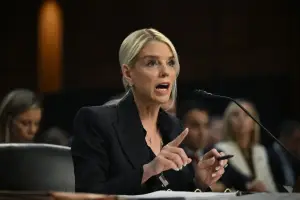 several Trump administration officials who have relocated to secure military accommodations due to security concerns following events such as the capture and prosecution of Venezuelan President Nicolás Maduro.
Several senior Trump administration officials are now living on military bases in or near Washington due to security concerns, including Attorney General Pam Bondi, White House adviser Stephen Miller, Secretary of State Marco Rubio, former Homeland Security Secretary Kristi Noem, Defense Secretary Pete Hegseth, Army Secretary Dan Driscoll, and Navy Secretary John Phelan.
Rep. James Comer said the Department of Justice asked New Mexico officials to halt a 2019 investigation into a ranch, telling Fox News host Jesse Watters that he believes the request came from the DOJ when asked which branch of the federal government intervened.
According to the New York Times, Trump administration officials misjudged how Iran would respond to the U.S.–Israeli military campaign, initially downplaying the risk that Tehran would retaliate by targeting global energy infrastructure or shipping lanes. Instead, Iran has responded far more aggressively than in previous clashes, launching missile and drone attacks across the Middle East and threatening commercial vessels in the Strait of Hormuz, causing shipping to slow dramatically and triggering sharp spikes in global oil prices.
The escalation has forced the administration to react quickly as economic and strategic risks grow, with officials scrambling to evacuate embassies, stabilize oil markets, and consider measures such as naval escorts for tankers and government-backed insurance for shipping companies. Behind the scenes, some officials are increasingly concerned about the lack of a clear strategy to end the conflict, while the war is already consuming large amounts of U.S. military resources and driving political anxiety in Washington over rising fuel prices and economic fallout.
According to the Washington Post, a whistleblower complaint has triggered an investigation by the Social Security Administration’s inspector general into a former U.S. DOGE Service software engineer who allegedly claimed to possess highly sensitive Social Security data and intended to use it at a private contractor job after leaving government service. According to the complaint, the engineer reportedly told colleagues he had copies of two restricted databases—Numident and the Master Death File—potentially stored on a thumb drive.
These databases contain records on more than 500 million Americans (living and deceased), including Social Security numbers, birth details, citizenship status, race and ethnicity, and parents’ names. The whistleblower says the engineer asked for help transferring the data from the thumb drive to a personal computer so he could “sanitize” it before uploading it to his employer’s systems.
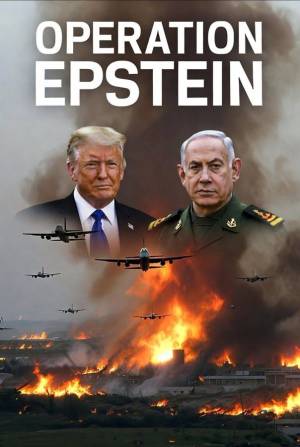 Operation “Epstein Fury” was trending on Twitter for 24 hours:
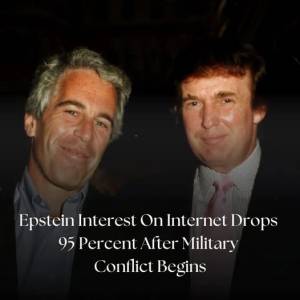
Russia’s legislative committee has approved amendments expanding President Vladimir Putin’s authority to deploy Russian troops abroad, allowing the military to operate extraterritorially to “protect Russian citizens” who are arrested, detained, or prosecuted outside the country, according to The Moscow Times. This has lead to fears from experts that Russia could be preparing to invade various Baltic states:
Iran launched what state media described as its “most intense operation” of the war, firing some of its most advanced ballistic missiles toward major Israeli cities including Tel Aviv and Haifa, marking a significant escalation in the conflict as Tehran continues retaliatory strikes against Israel following ongoing U.S.–Israeli attacks on Iranian targets.
Iran’s top national security official, Ali Larijani, warned that the Strait of Hormuz could become either a route of “peace and prosperity” or a place of “defeat and suffering for warmongers,” signaling that Tehran may escalate disruptions to global shipping if attacks against Iran continue. The statement underscores Iran’s leverage over the strategic waterway—through which roughly 20% of the world’s oil flows—and reflects growing tensions as the conflict threatens global energy markets and maritime traffic.
Senator Roger Marshall defended rising gas prices amid the Iran war, saying Americans should expect to make sacrifices during the conflict, arguing that “freedom is not free” and that higher costs are part of the price of confronting adversaries abroad.
Multiple Middle Eastern countries reported attacks as the war entered its 12th day, with Kuwait saying it shot down eight drones, the United Arab Emirates and Qatar intercepting Iranian missiles, and drones injuring four people near Dubai International Airport while flights continued operating normally.
Three commercial ships were struck in separate incidents near the Strait of Hormuz, including vessels hit by unknown projectiles that caused fires and damage, according to a British maritime monitoring agency, underscoring rising security risks in the key shipping corridor through which about 20% of the world’s oil passes. Crews were evacuated or rescued and no casualties have been reported so far.
Sen. Roger Marshall acknowledged he was wrong about earlier claims that U.S. strikes had set Iran’s nuclear program back for years, admitting during an interview that despite believing the facilities had been “obliterated,” Iran is now restarting nuclear efforts at other sites. Confronted with his previous comments, Marshall said the situation had changed and suggested Tehran was rebuilding parts of its program despite the earlier damage.
Iran has warned that facilities linked to major U.S. technology companies could become targets as the regional war expands, naming firms such as Amazon, Microsoft, Nvidia, IBM, Oracle, and Palantir and suggesting infrastructure connected to them in places like Israel, Dubai, and Abu Dhabi may be considered “legitimate targets.” The warning, reported by multiple outlets citing Iranian sources, reflects a widening of the conflict to include private tech and data-center infrastructure that Tehran claims supports military or intelligence operations tied to the U.S. and Israel.
Iran’s military warned that ships belonging to the United States, Israel, or their allies could be targeted in the Strait of Hormuz, declaring that any such vessel or oil cargo would be considered a “legitimate target” and vowing it will not allow oil shipments to pass through the critical waterway.
Iran’s new Supreme Leader, Ayatollah Mojtaba Khamenei, was wounded during the war but is reported to be safe, according to Iranian and Israeli officials who spoke with NBC News, with the son of Iran’s president saying he had been told Khamenei’s injuries are not serious; the leader has not appeared publicly since taking power after his father, Ayatollah Ali Khamenei, was killed at the start of the conflict.
 After 11 days of fighting, Israel has received 9,115 damage claims from missile strikes, including 6,586 for damaged buildings, 1,044 for contents or equipment, and 1,485 for vehicles, highlighting the extensive infrastructure and property damage caused by the ongoing conflict.
The International Energy Agency is preparing to call for the largest release of emergency oil reserves in its history, potentially releasing about 400 million barrels to stabilize global markets shaken by the Iran war and disruptions to shipping through the Strait of Hormuz. The proposed move, backed in principle by G7 countries, would dwarf previous releases such as the 182 million barrels deployed after Russia’s 2022 invasion of Ukraine and aims to counter supply shocks and volatile oil prices caused by the conflict.
At least 570 people have been killed and 1,444 wounded in Lebanon since the start of the Iran war, according to Prime Minister Nawaf Salam’s office, as renewed fighting between Israel and Hezbollah spreads across the country and nearly 800,000 people have registered as displaced in shelters.
According to The Guardian, the United States has reportedly begun redeploying parts of its THAAD missile defense system and other military assets from South Korea to the Middle East for the war with Iran, a move that has unsettled officials in Seoul and raised concerns about weakening defenses against North Korea. South Korean leaders have sought to reassure the public that the country can still deter threats from Pyongyang, but critics warn the shift could signal reduced U.S. focus on Northeast Asia and potentially embolden North Korea to test the allies’ security posture.
Democrats flipped a seat in the New Hampshire State House as Democrat Bobbi Boudman won a special election in a district Donald Trump carried by nine points, marking a roughly 13-point Democratic overperformance compared with the 2024 results, when Boudman lost the same seat by 14 points.
Republican Clay Fuller and Democrat Shawn Harris will face off in an April 7 runoff election to fill the House seat formerly held by Marjorie Taylor Greene in Georgia’s 14th district, after both candidates finished ahead in a crowded special election field. The race is being closely watched as a test of Donald Trump’s influence in the district, which heavily favors Republicans, while Democrats see a potential opening after Greene resigned earlier this year following a public break with Trump and political tensions within the GOP.
An activist group called Secret Handshake installed a statue in Washington, D.C., depicting Donald Trump and Jeffrey Epstein as Jack and Rose from the Titanic:
 Sen. Jon Husted said people living in poverty often lack experience navigating finances, arguing that some individuals who rely on programs like SNAP may not understand basic budgeting or how money works in everyday transactions, and that financial education is needed to address affordability challenges.
Jeremy Carl withdrew from consideration for assistant secretary of state for international organizations after backlash over past remarks about Jewish people, race, and immigration left him without enough Republican support in the Senate, marking a rare setback for Donald Trump in a GOP-controlled chamber. Carl faced unified Democratic opposition and lost key Republican backing on the Senate Foreign Relations Committee, with critics citing comments viewed as antisemitic, racist, and sympathetic to the “great replacement” conspiracy theory.
According to The Guardian, health experts and lawmakers are raising alarms about a controversial hepatitis B vaccine trial in Guinea-Bissau that would have vaccinated only half of newborns, warning it could serve as a model for future studies under U.S. Health Secretary Robert F. Kennedy Jr. Critics say the proposed research raises serious ethical concerns because it would withhold a widely recommended vaccine in a country with high hepatitis B prevalence and limited research oversight, prompting protests, congressional scrutiny, and intervention from global health officials before the study was ultimately paused for review.
Miami Heat star Bam Adebayo scored 83 points in a game against the Washington Wizards, recording the second-highest single-game scoring performance in NBA history behind Wilt Chamberlain’s 100-point game. Adebayo set multiple team records in the 150–129 win, including points in a quarter and half, finishing 20-of-43 from the field and 36-of-43 from the free-throw line as he surpassed Kobe Bryant’s 81-point performance and delivered one of the most prolific scoring nights ever recorded in the league.
Letters from an American, Historical Commentary: March 10, 2026 [Furious Democratic Responses To War], Heather Cox Richardson, right, March 11, 2026. Today, administration officials gave a classified briefing to the Senate Armed Services Committee about the war in Iran. Democrats who spoke to the press afterward appeared to be furious.
Senator Richard Blumenthal (D-CT) told reporters he was coming out of the briefing “as dissatisfied and angry, frankly, as I have from any past briefing in my 15 years in the Senate. I am left with more questions than answers, especially about the cost of the war. My questions have been unanswered. And I will demand answers because the American people deserve to know.”
“I am most concerned about the threat to American lives, of potentially deploying our sons and daughters on the ground in Iran. We seem to be on a path toward deploying American troops on the ground in Iran…and there is also, as disturbingly as anything else, the specter of active Russian aid to Iran, putting in danger American lives. Literally, Russia seems to be aiding our enemy, actively and intensively, with intelligence and perhaps with other means, and China, also, may be assisting Iran.”
“So, the American people deserve to know much more than this administration has told them about the cost of the war, the danger to our sons and daughters in uniform, and the potential for further escalation and widening of this war, a war of choice made by this president, not chosen by the American people, with potentially huge consequences to American lives.”
Senator Chris Murphy (D-CT) noted on social media that the administration appears to have no goals for the war except continued bombing, and no plan for reopening the Strait of Hormuz.
Senator Jacky Rosen (D-NV) was obviously frustrated that the administration is giving out information only under the cloak of classified briefings, making it hard for elected officials to communicate with their constituents about the war. “[W]e’ve been calling over and over again for them to come out of the classified briefings, to allow us to have these conversations, as much as we can, in an open setting, not just with the press, but with the American people, and with our constituents. With our men and women who serve in the military with their families, who are waiting home for them.”
While it is “solely the responsibility of the United States Congress to declare war,” she said, she called attention to Trump’s frequent use of the word “war” to suggest Republicans are hiding his seizing of that power by claiming Trump’s attacks on Iran do not fall under that constitutional provision. “Make no mistake,” she said, “this is Trump’s war. He says it every day…. And he wants to go any further, he needs to come out and have this discussion with Congress and the American people.
“[W]hat I heard is not just concerning,” Rosen said, “it is disturbing, and I’m not sure what the endgame is or what their plans are.” She said Trump “has not shown, to this Congress, to me, or, I believe, to us in our classified briefing…any plans for what he wants to do for the day after.” She warned that Trump could not simply stop the war and have everything go back to the way it was on February 27. The Middle East has sustained too much damage. “You see the bombs, you see the destruction. It’s not going to stop just because he wishes it to be so.”
A key reason the Framers of the Constitution put the power to declare war in the hands of Congress, rather than the executive, was that they were all too familiar with the history of European kings who had launched wars of choice that had reduced their subjects to poverty under crushing war taxes. They feared that the same thing could happen in their new country: that supporting an army would cost tax dollars, impoverishing the citizens of the new nation.
If the debate over war went to Congress, voters could hear the reasoning for the war hashed out and decide for themselves if the cost in lives and treasure was worth it to them. And, after they voted for a war, members of Congress would have to answer to their constituents for the money they spent and the lives lost.
That argument is potent again almost 250 years later. Democrats are calling out that Trump is spending $1 billion a day in his attacks on Iran but that he slashed through government programs that help Americans, claiming the need to address the country’s ballooning national debt. Just yesterday, Berkeley Lovelace Jr. of NBC News reported that Dr. Mehmet Oz, the administration official overseeing the Affordable Care Act, says that many of those enrolled in healthcare under the law should not be there. About 23 million people signed up for ACA coverage this year, down by more than 1.2 million from last year. Oz anticipates cutting another 4 million off the rolls as he targets “waste, fraud, and abuse.”
And yet, as Ellie Quinlan Houghtaling of The New Republic noted last night, according to a report from government watchdog Open the Books, the Pentagon under Defense Secretary Pete Hegseth blew through $93.4 billion in September 2025 alone, with more than $50 billion going out in the last five days of the month alone.
To spend the entirety of the defense budget, rather than lose it, Pentagon officials bought “a $98,329 Steinway & Sons grand piano for the Air Force chief of staff’s home, $5.3 million for Apple devices such as the new iPad, and an astronomical amount of shellfish, including $2 million for Alaskan king crab and $6.9 million worth of lobster tail. (Lobster tail is apparently a favorite of Hegseth’s Pentagon—the department spent more than $7.4 million total on the luxury item in March, May, June, and October.) In other pricey food purchases, the government decided to drop $15.1 million for ribeye steak (again, just in September), $124,000 for ice cream machines, and $139,224 on 272 orders of doughnuts.”
In October, Houghtaling noted, the administration said it could not fund the Supplemental Nutrition Assistance Program (SNAP), formerly known as food stamps, because the government had shut down. Millions of Americans lost food benefits.
Representative Melanie Stansbury (D-NM) reposted Houghtaling’s article and commented: “You better believe we’ll be investigating.”
Democratic Texas state representative James Talarico, who is running for the U.S. Senate, expressed his concerns about the Iran war on CBS Mornings yesterday. “As a millennial, I saw how military disasters like the Iraq War robbed this nation of young lives, of billions of dollars of our moral standing in the world, and I worry that our current leaders are repeating those same mistakes,” he said.
“I was in Sand Branch, Texas, which is a community south of Dallas that doesn’t have running water. It doesn’t have basic sewer infrastructure,” he continued. “So every dollar we spend bombing people in the Middle East is a dollar we’re not spending in Sand Branch, Texas, or in our communities here at home.”
“We’re always told that we don’t have enough money for schools, or for health care, or for our veterans. But there’s always enough money to bomb people on the other side of the world. And so we can support the democracy movement in Iran. We can prevent Iran from getting a nuclear weapon, all without bombing innocent schoolchildren, or sending our American troops off to die on the other side of the world.”
Talarico was channeling a Texas-born Republican from the post–World War II years: President Dwight D. Eisenhower. In early March 1953, soon after he took office, Soviet leader Josef Stalin died, and Eisenhower jumped at the chance to reset the militarization of the Cold War.
All people hunger for “peace and fellowship and justice,” he said in a speech to newspaper editors, and he deplored the growing arms race with the USSR. Even if the two superpowers managed to avoid an atomic war, pouring wealth and energy into armaments would limit their ability to raise up the rest of the world.
“Every gun that is made, every warship launched, every rocket fired signifies, in the final sense, a theft from those who hunger and are not fed, those who are cold and are not clothed.” The sweat of workers, the genius of scientists, and the hopes of children would be better spent on schools, hospitals, roads, and homes than on armaments. World peace could be achieved, Eisenhower said, “not by weapons of war but by wheat and by cotton, by milk and by wool, by meat and by timber and by rice.”
 Extremist Republicans sneered at what they called Eisenhower’s “stomach theory” of diplomacy, but Eisenhower’s approach to the world was forged by his horror at what he saw at Ohrdruf, the Nazi concentration camp that funneled prisoners to Buchenwald, when he commanded the Allies in World War II. “I never dreamed that such cruelty, bestiality, and savagery could really exist in this world!” he wrote. He was determined to do all he could to guarantee that such atrocities never happened again.
Eisenhower, left, recognized that economically dispossessed people were natural targets for political and religious extremists. They could easily be manipulated by a strong leader to back a cause—any cause—that promised to resurrect a world in which they had enjoyed prosperity and cultural significance.
Such extremism had been dangerous enough in the hands of the Nazis, but 1945 gave quite specific shape to Eisenhower’s fears. The atomic bomb, unleashed by the United States over Hiroshima and Nagasaki in summer 1945, changed the meaning of human conflict. If a charismatic political or religious extremist roused a dispossessed population behind another war, and if that leader got his hands on a nuclear weapon, he could destroy the world.
Promoting economic prosperity and better standards of living at home and around the world was not just about peace or justice, Eisenhower thought; it was about saving humankind.
More On Iran War
Popular Information, Accountability Journalism: Trump says Kushner helped convince him to go to war with Iran, Judd Legum, right, March 11, 2026. The disclosure highlights Kushner's massive financial conflicts.
At a press conference on Monday evening, President Trump said his son-in-law, Jared Kushner, was one of a handful of top advisers who convinced him to launch major combat operations in Iran. The disclosure raises additional questions about the role of Kushner, who is being paid tens of millions of dollars annually by Middle Eastern governments that were reportedly lobbying Trump to attack Iran.
Aaron Rupar @atrupar.comTrump: "Based on what Steve and Jared and Pete and others were telling me, Marco is so involved, I thought they were going to attack us"
“The situation was very quickly approaching the point of no return… based on what Steve and Jared and Pete and others were telling me, Marco is so involved, I thought they were going to attack us,” Trump said, referring to Middle East envoy Steve Witkoff, Secretary of War Pete Hegseth, Secretary of State Marco Rubio, and Kushner, who has no formal title.
“Within a week, [Iran was] going to attack us, 100 percent. They were ready,” Trump said at a different event Monday. “They had all these missiles, far more than anyone thought, and they were going to attack us.”
Witkoff and Kushner were dispatched by Trump to Geneva to participate in mediation with their Iranian counterparts, in what was described as a last-ditch effort to avoid war. Kushner’s participation violated his pledge not to be involved in foreign policy in a second Trump administration. Instead, Kushner had said he was focused on running his private equity fund, Affinity Partners, which has raised billions of dollars from foreign governments.
Kushner’s largest investor is the Saudi Arabian government, which provided Kushner with $2 billion in funding in 2021. Each year, Saudi Arabia pays Kushner 1.25% of its investment, $25 million, as a “management fee.” Meaning he has received in excess of $100 million from the Saudi government over the last few years.
Notably, “Saudi Crown Prince Mohammed bin Salman made multiple private phone calls to Trump” in February, advocating a U.S. attack,” according to reporting in the Washington Post. Trump’s comments reveal that Kushner used his role in Geneva to push Trump toward the outcome favored by his biggest client. Affinity Partners also received more than $200 million from the UAE. According to CNN, behind the scenes, the UAE was also lobbying Trump to strike Iran.
It is unclear precisely what Kushner told Trump about his mediation session with the Iranians. The Times of Israel, quoting an anonymous administration source, said that Kushner told Trump that Iran was “basically playing games.” According to the source, Kushner told Trump that it would only be possible for Trump to strike an “Obama kind of deal“ with Iran and even that “would take months.”
The claim that Iran was planning an imminent attack against the U.S. — the conclusion that Trump took away from his discussions with Kushner and others — is directly contradicted by U.S. intelligence agencies. Shortly after the war began, “Trump administration officials told congressional staff in private briefings on Sunday that U.S. intelligence did not suggest Iran was preparing to launch a preemptive strike against the United States interests,” according to ABC News. CNN reported that Trump administration officials “acknowledged to congressional staff that Iran was not planning to strike US forces or bases in the Middle East unless Israel attacked Iran first.” Senator Mark Warner (D-VA), the top Democrat on the intelligence committee who receives classified briefings, said, “I saw no evidence that Iran was on the verge of launching any kind of preemptive strike against the United States of America.”
Trump attends the Dignified Transfer of remains of six U.S. soldiers killed in an Iranian drone strike while sporting a baseball cap that he is selling as merch. (Official White House Photo by Daniel Torok)
The Contrarian, Opinion: Trump’s Delusions Come at Americans’ Expense, Jennifer Rubin, right, March 11, 2026. “We don’t see anyone who can replace the regime,” an Israeli official told David Ignatius.
The New York Times reported, “A report by the National Intelligence Council completed before the United States and Israel launched attacks on Iran assessed that even a large-scale military assault on the country would be unlikely to topple its theocratic government.” So, when Donald Trump declares his end-goal is regime change, that he wants “unconditional surrender,” and/or wants to pick the next Supreme Leader, he is actually telling us he wants a war without end.
His delusions of grandeur and compulsion to dominate others inevitably overwhelm the Constitution, decency, political good sense, and Americans’ distress. His utter incoherence at a press conference on Monday suggests he is decomposing before our eyes.
Just days ago, he egged on Iranians to take up arms, but by Monday was expressing utter contempt for them (“Will I help them? I’d like to, if they can behave. But they’ve been very menacing.”) In his broken brain, evidently, the war can be both “complete” and “just the beginning.”
Trump is more than happy to inflict a host of harms on Americans: Seven servicemen killed, a billion per day in war costs, trillions in stock market capitalization wiped out, inflation risks heightened, and oil prices on the rise. Trump attends the Dignified Transfer of remains of six U.S. soldiers killed in an Iranian drone strike while sporting a baseball cap that he is selling as merch. (Official White House Photo by Daniel Torok)
To justify his foray into regional war, Trump tells Americans they should docilely accept their fate as hostages of his endless war fantasy. He declares that $100+ per barrel is a “very small price to pay” (for us to pay) for his war. He adds that “only fools” would think the war is not worth it.
He likewise shrugs off a massive drop in the financial markets, although we know that spiking oil prices increase the probability of a stock market crash. Stagflation fears are pushing the markets down at an alarming rate. Since the start of Trump’s war, the Dow Jones has plummeted and been extremely volatile, with no indication of stability in sight.
Chillingly, Trump is indifferent to war casualties. “Some people will die,” he shrugs, and “more will likely die.” He matter-of-factly tells Americans to get over it. “That’s the way it is.” He sports a baseball cap while overseeing the dignified transfer of slain servicemen, refusing to respect the occasion with the simple act of removing his hat. He says it is “more fun” to sink ships, which almost certainly kill those on board.Subscribed
Meanwhile, the childish and deeply unserious Secretary of Defense Pete Hegseth is downright gleeful about casualties and destruction, snarling at the press that reporting on dead soldiers is just a way to make Trump “look bad.” He obviously relishes spitting out TV lines and boasting about the people our troops will kill: “The only ones that need to be worried right now are Iranians that think they’re going to live,” he stated. He’s become a ghoulish caricature of a military leader.
Hegseth’s release of war clips interspersed with movie footage drew the condemnation of Blase Cupich, archbishop of Chicago. In a statement Saturday, Cupich deplored the White House for releasing a video as “more than 1,000 Iranian men, women, and children lay dead after days of bombardment from U.S. and Israeli missiles.” He warned:
A real war with real death and real suffering being treated like it’s a video game — it’s sickening. Hundreds of people are dead, mothers and fathers, daughters and sons, including scores of children who made the fatal mistake of going to school that day. Six U.S. soldiers have been killed. They are also dishonored by that social media post. Hundreds of thousands displaced, and many millions more are terrified across the Middle East. … Our government is treating the suffering of the Iranian people as a backdrop for our own entertainment, as if it’s just another piece of content to be swiped through while we’re waiting in line at the grocery store.
Trump and Hegseth are similarly triumphant when addressing the direct murders at sea (the count is now over 150), in violation of international and domestic law, without effort to interdict the boats or seek definitive proof that the victims are “narco-terrorists.”
But this is nothing new for Trump, who seems to relish inflicting harm on vulnerable Americans to achieve his whims. Trump and his spineless MAGA enablers chose (unlike every other administration) to cut off SNAP during the government shutdown, thereby depriving kids, seniors, the disabled, and the working poor of food. He celebrated slashing Medicaid as part of his “beautiful” bill. He and MAGA Republicans refused to extend Affordable Care Act subsidies, inflicting huge premium increases on Americans and pricing many out of the market. The MAGA crowd was delighted when DOGE minions cut vital government services, slashed jobs, and consigned children and adults overseas to death. Trump applauds when government workers lose their jobs.
Now, in the midst of a Department of Homeland Security shutdown, he and his MAGA toadies refused to separately fund TSA, FEMA, and the Coast Guard. They appear perfectly content to trigger more pain (which he thinks pressures Democrats, who actually care about people).
Meanwhile, he continually tries to cut vital social services in blue states, holding their residents hostage to his partisan power plays.
Moreover, Trump taxed imports (tariffs), then reimposed taxes (tariffs) after the initial tranche was struck down, forcing already strapped families and small businesses to pay more. The Trump regime tells Americans either they won’t pay for it, or if they do, it’s worth a recession.
For those who recognize Trump as a malignant narcissist, all this comes as no surprise. Those with narcissistic personality disorder are recognizable by their “[i]mpaired ability to recognize or identify with the feelings and needs of others; excessively attuned to reactions of others, but only if perceived as relevant to self; over- or underestimate of own effects on others.” (One can imagine how someone more concerned about how others view his hair than he is about showing respect for fallen soldiers might meet this definition.) Trump’s entire foreign policy is built around him — his wealth, his grievances, his need to impress other autocrats.
Regardless of whether Trump warrants a medical diagnosis, he inarguably cares nothing about (if not outright celebrates) deaths, illnesses, suffering, economic distress, and any other harm he inflicts on those who refuse to worship him. When the victims are foreigners, especially non-whites whom he dehumanizes, he revels in his secret police force’s brutality. When it comes to Americans, Trump defies critics and insists on maintaining counterproductive policies, without a care in the world about fallout.
Most presidents do their best to spare vulnerable Americans from harm; Trump seems thrilled each time he demonstrates his power over them. “It’s worth it” essentially means ‘I don’t care what suffering I cause because I just want to get my way.’ Americans appalled by his reckless indifference to human life and, frankly, by the blatant sadism of an unwell president and defense secretary should register their disapproval at the polls. The voters still have the power to stop the MAGA runaway train of death and destruction.
More Global News
Politico, Spain downgrades its diplomatic ties with Israel, Aitor Hernández-Morales, March 11, 2026. Madrid retires its ambassador to Tel Aviv and leaves its representation under the control of the chargé d’affaires.
In a sign of the bad state of relations between Spain and Israel, Madrid on Wednesday permanently withdrew its ambassador to Tel Aviv.
The diplomatic downgrade comes after years of tense exchanges between both governments. Spain has been a leading critic of Israeli Prime Minister Benjamin Netanyahu’s military operations in Gaza and, this month, Spanish Prime Minister Pedro Sánchez blasted Israel for joining the  U.S. in its “illegitimate” attack on Iran.
Madrid recalled its ambassador to Tel Aviv, veteran diplomat Ana María Salomón Pérez, last September, after Israeli Foreign Minister Gideon Sa’ar accused Sánchez’s government of inciting a “pro-Palestinian mob” and banned Deputy Prime Minister Yolanda Díaz and Minister of Youth Sira Rego from entering the country.
The decision to definitively retire the ambassador is a highly symbolic move that underscores the degradation of ties between the two countries. With the ambassador’s removal, Spain’s diplomatic representation will now be handled by its chargé d’affaires, a lower-ranking official whose status is meant to reflect the downgraded relations.
Politico, Meloni joins EU chorus criticizing Trump’s strikes on Iran, Hannah Roberts, March 11, 2026. Italy’s right-wing prime minister rebukes interventions “outside the scope of international law,” as European disapproval builds over Middle East war.
Italian Prime Minister Giorgia Meloni on Wednesday joined a growing European backlash against the U.S. and Israeli strikes on Iran.
The right-wing leader issued her strongest rebuke of the war so far in remarks to the parliament in Rome, describing the military campaign unfolding in the Middle East as part of a growing trend of interventions "outside the scope of international law,” while also acknowledging the threat Tehran poses to regional security.
Over the last week, Spanish Prime Minister Pedro Sánchez, French President Emmanuel Macron and Dutch Prime Minister Rob Jetten have all signaled varying degrees of opposition to the war being waged by the U.S. and Israel against Tehran's clerical regime.
 Meloni's shift in tone was striking from a leader who has built a reputation as one of Europe’s most reliable U.S. allies, and aligns her more closely with those heavyweight European counterparts (with the notable exception of German Chancellor Friedrich Merz). Her criticism comes while the war is driving up oil prices, with knock-on effects for European citizens filling up their cars with gas.
Sánchez is the only EU leader to directly challenge U.S. President Donald Trump over the war, calling it unjustified, dangerous and illegal.
In response Trump slammed the Spanish government as “terrible” and “unfriendly” and threatening to cut all trade with the EU’s fourth-biggest economy.
Dutch Prime Minister Rob Jetten on Friday said the U.S. and Israeli strikes on Iran were “outside the framework of international law,” while French President Emmanuel Macron said last week the strikes were conducted "outside of international law" and that Paris "cannot approve of them."Domestic pressure
Meloni’s more critical tone is also a reflection of pressures closer to home. Airstrikes on Iran have proved deeply unpopular in Italy, where public opinion is overwhelmingly hostile toward the prospect of being drawn into another Middle East conflict.
U.S. Law, Rights, Crime, Justice
Politico, DC Bar moves to sanction Ed Martin for DEI push, Gregory Svirnovskiy and Jacob Wendle, March 11, 2026. Deputy Attorney General Todd Blanche panned the DC Bar’s stand against Martin in a post on X Tuesday.Ed Martin speaks during a hearing.
A senior Trump administration official is facing the ire of the Washington, D.C., Bar for his role in President Donald Trump’s push to end diversity, equity and inclusion practices in U.S. universities.
The DC Bar filed disciplinary charges against Ed Martin, right, formerly the acting U.S. Attorney for Washington, stating that he threatened to withhold  funding from Georgetown University’s Law Center and barred his staff from hiring its students in a bid to punish the institution for its DEI practices — a violation of the First Amendment, the DC Bar said.
“Acting in his official capacity and speaking on behalf of the government, he used coercion to punish or suppress a disfavored viewpoint, the teaching and promotion of ‘DEI,’” Hamilton Fox, disciplinary counsel for the DC Bar, wrote in a filing made public on Tuesday.
Martin is now the pardon attorney for the Department of Justice, after failing to attain enough support from Senate Republicans to land a full-time appointment to the U.S. attorney post last year. He was replaced by former Fox News host Jeanine Pirro, who previously served as district attorney of Westchester County.
Trump appointed Martin in May to lead the DOJ’s “Weaponization Working Group” to look into officials who investigated Trump and Jan. 6 rioters, but the initiative failed to produce meaningful results. Martin has since lost sway in the Trump administration, which relocated his office from the DOJ headquarters to a government building in a different neighborhood of D.C. in recent months.
“Mr. Martin knew or should have known that, as a government official, his conduct violated the First and Fifth Amendments to the Constitution of the United States,” Fox wrote.
Deputy Attorney General Todd Blanche panned the DC Bar’s stand against Martin in a post on X Tuesday. “The DC Bar is such a blatantly Democrat-run political organization,” Blanche said. “Thank God I’m not a member, and trust me, I never will be.” Martin reposted Blanche’s post on his X account.
U.S. Governance, Politics, Elections
Morning Shots via The Bulwark, Political Opinion: End the War. End Mass Deportation. End the Tariff, End Republican control of Congress. William Kristol, March 11, 2026. The Trump administration is in disarray.
In this election year, the task of the opposition is to turn the administration’s disarray into Republican defeat—a defeat as dramatic, as complete, and as debilitating to the Trump administration as possible.
The disarray is in plain sight. Yesterday, for example, Secretary of Energy Chris Wright announced that the U.S. Navy had successfully escorted an oil tanker through the Strait of Hormuz. Markets rallied. Wright’s claim was quickly discovered to be false. He had to delete the post. Markets plunged.
It was yet another instance of an administration at war that doesn’t seem to know what it is doing. It’s also an administration that didn’t understand what it was getting into when it went to war. On February 18, ten days before Trump started the war, Wright had said he wasn’t concerned that a Middle East war might disrupt oil supplies and drive oil prices up.
Well, they’re up a lot. And probably heading higher. And it’s the Republicans in Congress that blocked efforts to force the administration to get congressional approval for this ill-considered war.
At about the same time yesterday that Secretary Wright was sharing fake war news, White House Deputy Chief of Staff James Blair was telling Republican members of Congress to spread fake domestic news. Stop talking about mass deportation until the midterms, was the order of the day from the White House.
Presumably left unsaid—because it didn’t need to be said, was:
Of course we’re still going to be doing mass deportation. We ran on mass deportation. We distributed signs at the 2024 Republican National Convention calling for “mass deportation now.” And the architect of mass deportation—indeed, of Trump immigration agenda writ large—Stephen Miller, is still in the White House. Yes, mass deportation was the reason for the enormous increase in funding for ICE and the Border Patrol you voted for in the 2025 reconciliation bill. Yes, those funds are paying for all the new personnel and equipment and warehouses needed for mass deportation. And yes, most of those removed from the country last year seem to have had no criminal conviction at all. But just pretend all of that isn’t true. Just ignore it. Talk about other things.
The trouble is that if mass deportation is no longer the goal, then the administration doesn’t need even more funding for ICE or the Border Patrol. If mass deportation is no longer the goal, congressional Republicans could simply accept the Democrats’ proposal not to give more money over the next few months to the agents of mass deportation and instead to fund the non-problematic parts of DHS like TSA. But they won’t. Because in fact mass deportation remains central to the administration’s agenda that congressional Republicans support.
Meanwhile, after the Supreme Court struck down Trump’s illegal tariffs, the administration insisted on imposing new tariffs under different legislative authorities. The administration had a chance to back off from imposing burdens on our slowing economy. It didn’t take it. And the Republican Congress has gone along with the administration on this, as on almost everything else.
Democrats have a tendency to overthink everything. They should resist the temptation and keep things simple: It’s Trump’s war. It’s Trump’s mass-deportation regime. These are Trump’s tariffs. Republicans have supported and enabled them all.
End the war. End mass deportation. End the tariffs. End Republican control of Congress.
New York Times, How Trump Turned a Republican Battle Over a Texas Senate Seat Into Leverage, Shane Goldmacher, March 11, 2026. The president has yet to make an endorsement in the contest between John Cornyn and Ken Paxton as he tries to push the Senate to pass a bill requiring voters to show identification at the polls.
President Trump had spent months getting squeezed by top Senate Republicans to endorse the embattled Senator John Cornyn of Texas in order to avert a costly and prolonged primary fight in Texas against Ken Paxton, the state’s hard-line attorney general.
Suddenly it’s Mr. Trump doing the squeezing.
Just a week ago, he had seemed on the verge of endorsing Mr. Cornyn after Republicans spent more than $70 million on pro-Cornyn ads in the first round of the Texas primary, which ended with him and Mr. Paxton heading to a May runoff. Mr. Trump said on social media that he would make an endorsement “soon” — and that the candidate who did not get his nod should drop out.
Then Mr. Paxton made a bold play.
In a post on X, he said he would consider dropping out — but only if Senate Republicans circumvented the filibuster to pass Mr. Trump’s top legislative priority, a bill that would impose strict voter ID requirements. The gambit quickly went viral, with some of the most influential voices on the right amplifying it, including the president’s son.
Mr. Paxton did not leave it to chance that Mr. Trump himself would see his message, according to two people with knowledge of the matter. He texted it to the president himself.
Now Mr. Trump is leveraging his potential endorsement — which Senate Republicans long for — to ratchet up the pressure on them to change the Senate’s rules and pass the bill. Mr. Cornyn, still pursuing the president’s blessing, reversed his long-held position that the filibuster should be protected in an opinion piece for The New York Post on Wednesday.
What began as a fight over a single seat in Texas has since spilled into halls of Congress, with potential implications for voting access nationwide.
The episode offers a window into how Mr. Trump is wielding power in his second term, as well as his relationship with congressional Republicans and his MAGA base. This account is based on interviews with a dozen Republican officials involved in the ongoing battle, many of whom were granted anonymity to describe private discussions.
Here’s how it unfolded:Why did Trump finally edge toward an endorsement?
National Republicans have warned for months that nominating the scandal-plagued Mr. Paxton — he has survived impeachment and his wife is divorcing him “on biblical grounds” — might put the seat, and ultimately their control of the Senate, in jeopardy.
Last week Mr. Cornyn edged ahead of Mr. Paxton in the primary with the help of a record-breaking $70 million rescue mission, and the two men advanced to a May runoff that promises to extend an expensive and often ugly intraparty battle. Democratic voters nominated James Talarico, a state legislator with an explicit message of reaching out to independent voters, which seemed to add urgency to the cause of uniting the G.O.P.Editors’ PicksMark Zuckerberg Is Said to Have Made a Record Florida Home PurchasePasta e Fagioli, Kimchi Ramen and More of Our Best 25-Minute SoupsDoes a Powerhouse London Indian Restaurant Work in Las Vegas?
It seemed that Mr. Trump had finally seen and heard enough.
He posted last Wednesday that the primary “cannot, for the good of the Party, and our Country, itself, be allowed to go on any longer.” Some news outlets, starting with The Atlantic, wrote that the president was expected to endorse Mr. Cornyn. One person familiar with the matter said that aides to Mr. Trump had prepared language for the president to consider for a potential Cornyn endorsement, which is standard procedure.
But Mr. Trump paused, igniting a fierce public and private lobbying blitz.
Republican senators have been asked by their leadership to call Mr. Trump to ask him to back Mr. Cornyn to put an end to an increasingly acrimonious primary, according to three Republican officials with knowledge of the requests. Mr. Paxton’s team has pushed its allies to be in touch with the president, as well.
The Paxton and Cornyn campaigns declined to comment.How did Paxton’s gambit rally the MAGA base?
After reports of a coming Cornyn endorsement, the Trump base — and MAGA-aligned news outlets — erupted to try to stop it.
“John Cornyn Chose Jack Smith, Joe Biden, Illegal Aliens Over Trump, Texas,” blared Breitbart. “The Top 6 Times Senator Cornyn Has Backstabbed Trump and MAGA,” read a headline in The National Pulse. Right-wing influencers revived old clips of Mr. Cornyn speaking ill of Mr. Trump.
Steve Bannon, the former chief strategist for Mr. Trump and the host of an influential streaming show, The War Room, called Mr. Cornyn “reptilian” for his shifting stances on Mr. Trump. He said that Mr. Paxton had been a true loyalist: showing up at Mr. Trump’s 2024 federal trial, his 2022 re-election kickoff and in the courts fighting to overturn the 2020 election.
Mr. Bannon argued that the base’s animus toward Mr. Cornyn actually made him less electable. Democrats generally see Mr. Paxton as the weaker candidate, but they circulated private polls this week showing Mr. Talarico competitive with both Republicans.
One of the surveys could have almost been designed to give pause to Mr. Trump, who relishes the power of his endorsements. It suggested that his endorsement wouldn’t give Mr. Cornyn a decisive lead.
But the biggest development was Mr. Paxton’s announcement that he “would consider dropping out of this race” if Senate Republicans bypassed the filibuster to pass the SAVE America Act, which would impose strict ID and proof-of-citizenship requirements on voting.
“Wow!!!!” Donald Trump Jr. responded. Elon Musk, the world’s richest man and the biggest donor in Republican politics, replied with an American flag emoji. The pro-Trump provocateur Laura Loomer called Mr. Paxton “the best man for the job” and wrote, “I hope President Trump sees his post.”
Cornyn allies strained to point out that Mr. Paxton had said only that he would “consider” leaving the race, but in private, they grudgingly gave him credit for a savvy maneuver.How did Trump turn the tables on Senate Republicans?
Mr. Trump issued a seeming ultimatum over the weekend: He wouldn’t sign any legislation until the SAVE America Act has passed, and now he is using the potential Cornyn endorsement as leverage over Senate Republicans, in a move first reported by Politico.
Senator John Thune of South Dakota, the majority leader, has said there are not enough votes in the Senate to circumvent the filibuster to push the measure through. “That is just a function of math, and there isn’t anything I can do about that,” Mr. Thune said on Tuesday.
Mr. Paxton’s move served to highlight the limits of the current Senate Republican majority — which have been a source of frustration to both the president and his base.
Mr. Cornyn’s flip — “I support whatever changes to Senate rules that may prove necessary,” he wrote in The Post — seemed to show that Mr. Trump’s pressure campaign was having an effect.
The president’s endorsement has loomed over the race from the start.
Mr. Cornyn and his allies installed two of Mr. Trump’s top 2024 advisers, Tony Fabrizio and Chris LaCivita, at his campaign and super PAC. And Mr. Cornyn, who had questioned Mr. Trump’s electability during the 2024 campaign, has gone out of his way to try to demonstrate his support, perhaps most memorably when he posted a photo of himself pensively reading Mr. Trump’s book “The Art of the Deal” a year ago with a one-word caption: “Recommended.”
Mr. Paxton seemed to relish the latest turn, taking a victory lap of his own on Wednesday. “In one week,” he wrote of his rival, “I’ve made him more conservative than in the past 24 years.”
Politico, US to release 172 million barrels of oil from strategic reserve to combat energy price hike, James Bikales and Carlos Anchondo, March 11, 2026. The Trump administration move is in conjunction with the International Energy Agency action and comes as shipments from the Persian Gulf remain constrained.A section of the Strategic Petroleum Reserve facility is shown in West Hackberry, Louisiana.
The Trump administration said Wednesday the U.S. will release 172 million barrels of crude oil from the Strategic Petroleum Reserve, its boldest attempt yet to bring down oil prices that have spiked since the U.S. launched its war against Iran.
“We’ll do that, and then we’ll fill it up,” President Donald Trump told Cincinnati news station Local 12 in an interview Wednesday afternoon. “I filled it up once, and I’ll fill it up again. But right now, we’ll reduce it a little bit, and that brings the prices down.”
Energy Secretary Chris Wright announced later Wednesday that the drawdowns would begin next week and take about 120 days.
The U.S. release is part of an effort by the 32 members of the International Energy Agency — which include the U.S., Japan, Germany, the U.K. and France — to release 400 million barrels of oil held in emergency reserves, the largest such effort in the body’s history.
Trump, who spent years attacking the Biden administration for tapping the SPR in 2022, touted the IEA effort at a rally in Kentucky on Wednesday, saying it will “substantially reduce the oil prices as we end this threat to America and this threat to the world.”
“We don’t want to leave early, do we?” Trump said. “We got to finish the job.”
Interior Secretary Doug Burgum had said earlier Wednesday afternoon that Trump had yet to decide whether to join the international effort.
The Trump administration has initially ruled out utilizing the reserve, a series of underground salt caverns in Texas and Louisiana. But Iranian attacks against oil tankers in the Strait of Hormuz have sent crude prices spiraling to four-year highs as vessels stop traversing the key waterway connecting Middle Eastern oil fields to the global market.
The DOE announcement had little impact on U.S. crude oil futures prices, which extended their gains in evening trading to sit near $94 a barrel. Iran attacked several more ships in the Gulf Wednesday and Iranian military officials warned the world to get ready for $200 oil, according to Reuters.
The U.S. oil stockpile currently holds 415 million barrels, according to the Energy Department, making it less than 59 percent full. The U.S. consumes around 20 million barrels of crude a day, similar to the amount that typically flows through the Strait of Hormuz each day.
The Trump administration only added modest amounts of oil back into the reserve after the Biden administration tapped it to calm markets after Russia invaded Ukraine.
A part of the storage caverns also suffered damage as a result of those Biden-era drawdowns, which has slowed the effort to refill it.
Wright said in his statement that the Biden administration had left the SPR “drained and damaged.” DOE has already arranged to replace its drawdown with 200 million barrels within the next year, 20 percent more than it plans to draw down, he said.
“President Trump promised to protect America’s energy security by managing the Strategic Petroleum Reserve responsibly and this action demonstrates his commitment to that promise,” Wright said.
Appearing on Fox News Wednesday night, Wright predicted that shipping through the Strait of Hormuz would resume “in the next few weeks,” well before the U.S. completed the planned SPR releases.
“I think we will have the Straits of Hormuz open well before then,” he said. “Exactly when? I can’t say, but we are working 24 hours of every day to get there.”
The reserve is designed to be able to release up to 4.4 million barrels of oil per day within 13 days of a presidential decision, according to the Energy Department. But analysts have said the actual flow rate may be far lower — perhaps 2 million barrels a day — due to physical constraints.
“The flak only gets heavy when you’re over the target,” he wrote on X later on Tuesday.
Politico, Trump’s energy ‘tiger team’ struggles to find its roar with Iran, Ben Lefebvre and James Bikales, March 11, 2026. Trump's vaunted “energy dominance” team is in danger of fumbling the biggest energy crisis of his second term, critics say.
President Donald Trump once pledged his incoming “energy dominance” team would bring about a golden age of American prosperity and global peace.
Now, 15 months later, the Trump administration’s self-described “Tiger Team” led by Interior Secretary Doug Burgum and Energy Secretary Chris Wright appears flummoxed by the surge in global oil prices in the wake of the U.S. attack on Iran and is scrambling to head off a bout of energy-driven inflation.
Burgum has hewed to the White House line that the energy pain would be temporary, even as White House aides say he’s caused eye-rolling among staff amid his media appearances and trips to events like Rupert Murdoch’s birthday party. Wright’s efforts to reassure markets that oil supplies remain ample have fallen flat, and the Energy Department quickly deleted a market-churning social media post that erroneously claimed U.S. warships had escorted an oil tanker through the Persian Gulf’s Strait of Hormuz.
Energy experts say the administration underestimated the oil impacts from launching the war, which, despite near-record U.S. crude production, has sent gasoline prices at the pump up 60 cents a gallon in less than two weeks. The early messaging that global energy markets would cool in time as Iran’s threat to Strait of Hormuz shipping waned has been replaced Wednesday by its agreement that dozens of countries should release up to 400 million barrels of oil from their strategic stockpiles.
Wright announced Wednesday that the Energy Department would release 172 million barrels of oil from the U.S. Strategic Petroleum Reserve over 120 days as part of the IEA’s move. The U.S. oil markets largely shrugged off the news and extended their gains from earlier in the day in Wednesday evening trading.
“We’ll do that and then we’ll fill it up,” Trump told Cincinnati news station Local 12 about the planned crude oil releases. “But right now, we’ll reduce it a little bit and that brings the prices down.”
Adding to the sense of confusion was the Tuesday post to Wright’s X.com account that the U.S. Navy had successfully escorted an oil tanker through the narrow Strait of Hormuz. The post, which the Energy Department attributed to a mistake by a staffer, was quickly deleted, but not before it sent oil markets whipsawing.
Democrats have been quick to pounce on the missteps by contending the Trump administration has failed to lay out U.S. goals in attacking Iran and failed to put in place a clear strategy to stabilize the Persian Gulf region that sends 20 percent of global oil and gas supplies through the strait.
Sen. Chris Murphy laid into the administration in a social media post after a briefing on the war on Tuesday for having “no plan” going into the war to keep the Hormuz open.
“Suffice it [to] say, right now, they don’t know how to get it safely back open,” Murphy wrote on X. “Which is unforgiveable, because this part of the disaster was 100% foreseeable.”
Trump and Wright have sought to stabilize the energy markets, offering a U.S. insurance backstop for tankers traversing the waterway, easing sanctions on Russian oil purchases for India and saying the U.S. warships would protect oil tankers from Iranian missiles and drones. But the Navy later said it couldn’t provide that security despite receiving requests for protection from shippers — and overnight hits on three cargo vessels and Iran’s attempts to lay mines in Hormuz are keeping the sector on edge.
Industry analysts are scratching their heads at the X.com gaffe and at the broader messaging strategy that has contributed to historic levels of market volatility, with oil prices swinging in a $40 per barrel range this week.
“The Department of Energy has really not been involved in this whole thing despite the fact that energy is a big part of the puzzle here,” Bob Yawger, commodity specialist at Mizuho Securities, said after Wright’s post. “And their first effort to kind of put up the big headline blew up on them.”
In the years following Epstein's death, the ranch had remained largely unused until it was sold to San Rafael Ranch LLC for an undisclosed sum rumored to be far lower than the asking price in 2023.[9] The ranch was purchased in 2023 by the family of Texas businessman and politician Don Huffines through an LLC with the owners' names kept secret.[25] A former GOP state senator from Dallas, Huffines in 2026 is running a high-profile campaign for Texas Comptroller of Public Accounts — a publicly elected position in Texas overseeing state financial matters.[26] The name of the ranch has been changed to Rancho de San Rafael,[27][28][29] and a spokesperson for Huffines relayed that it would be used as a Christian retreat.[30] Staggering Revelations in the Epstein Files!Glenn Kirschner1.17M subscribers
New York Times, V.A. Begins Drive to Put Homeless Veterans Into Guardianship, Ellen Barry and Jason DeParle, March 11, 2026. A joint effort with the Justice Department creates new authority to compel veterans into institutional or involuntary care.
The Trump administration on Wednesday announced a new effort to initiate legal guardianships for homeless veterans, which could be used to force more of them into involuntary or institutional care.
The new system, carried out in partnership with the Justice Department, will invest Veterans Affairs Department attorneys with expanded powers that would allow them to initiate and take part in guardianship proceedings for veterans who have no family and are “unable to make their own health care decisions.”
The initiative represents the Trump administration’s most concrete action to advance its goal of compelling more homeless people into involuntary treatment for mental illness and drug addiction.
President Trump identified the issue as a priority during the 2024 presidential campaign and promoted it last July in an executive order that called on agencies to use civil commitment to move homeless people into “long-term institutional settings.”
Critics say the policy shift raises significant civil liberties concerns, noting that in earlier generations, people with severe mental illness were routinely stripped of their legal rights and confined to state hospitals.
The V.A. says the guardianship initiative would affect “hundreds” of veterans who are currently in V.A. facilities but need “a legal decision maker” to transition to a new setting. Some are homeless, and others are “at risk of homelessness” upon discharge, the agency said in a press statement.
“Our new partnership with the Justice Department reflects our ongoing commitment to ensuring that every veteran receives timely, appropriate care,” said Doug Collins, the V.A. secretary.
Guardianship powers are broader and longer lasting than civil commitment, which is used to compel someone to accept medical treatment.
Guardianship proceedings are typically initiated by family members, friends or health care providers, and are argued before state or probate judges, with the subject entitled to legal representation. If a court finds that the person is not able to make basic decisions about health and safety, a guardian is appointed.Editors’ PicksWhy Is Everyone Saying the Word Tranche?Don’t Fence Ted McGinley InTomato Soup Is a Hug in a Bowl. Here Are Our Best Recipes.
Guardians can control a person’s assets, where the person lives and whom he or she sees. They can also require the person to accept medical treatment. Unlike civil commitment rulings, which expire after a specific time period, guardianships are intended to be durable, though they are revisited periodically and can be terminated or dissolved.
Michael Figlioli, the director of the National Veterans Service for the Veterans of Foreign Wars, commended the change, which he said recognizes “that some of our nation’s most vulnerable veterans must be approached through a public health and social services framework.”
If thoughtfully carried out, he said, guardianships could provide more “structured support” for vulnerable veterans, though he noted “important considerations regarding veterans’ privacy, potential implementation gaps and the need for sufficient resources.”
Rights advocates said they were alarmed by the proposal, which they saw as part of a drive by the administration to place homeless people in institutional settings against their will.
“My speculation is that they are seeking to have people placed under guardianship so they can have a person appointed who will force them into congregate or institutional settings when there isn’t anything else available,” said Jennifer Mathis, the deputy director of the Bazelon Center for Mental Health Law.
There are about 33,000 homeless veterans in the United States, about 14,000 of whom live on the streets. Veterans make up around 5 percent of the unsheltered homeless population.
Hopium Chronicles, Advocacy: Inflation Is Still Running Way Too Hot, Idiots And Fools Are Running Our Country, Thune Stuffs Trump On SAVE, Simon Rosenberg, right, March 11, 2026. A campaign to force Witkoff and Kushner from government must be waged now......
We got that third gauge of inflation this morning, the Consumer Price Index, and February came in hot, at 0.3%, 3.6%+ on annualized basis. Food increased 0.4%, or close to 5% annualized. Energy came in at 0.6%, over 7% annualized. We are still running almost two times above the Fed’s monthly target of 2% annualized - not good.
Here’s a chart I threw together with Claude this morning showing how in the months prior to the May Liberation Day tariffs inflation was at the Fed’s target rate. Since May CPI has increased by an average of 0.3%, or 3.6% on annualized basis - again, way above the Fed target. All the bad economic data we’ve been getting recently - slowing GDP, job losses, inflation coming into too hot - comes from before the war took a wrecking ball to the US and global economies. We cannot for one moment forget that Trump and his advisors looked at all this bad data and decided to 1) illegally reinstate global tariffs, ensuring prices stayed high; 2) launched a war that almost certainly would see gas and other commodity prices explode, fueling even more inflation, and slowing an economy that was already losing jobs.
Gas prices are now up 65 cents since the start of the war, and climbing: Idiocy, recklessness, Mad King arrogance, oligarchical not giving a shit about people - choose your description of what we are experiencing now. Every day is a reminder of why our Founders put the power to go to war in Congress, not the Presidency. For it is far less likely that thoughtful deliberation would allow mistakes of this magnitude to be made.
The NYT has some incredible reporting this morning on the impulsive idiocy and recklessness of Trump and his ridiculous quislings. Here’s the NYT’s home page right now: Let’s drill down on that lead story, How Trump and His Advisers Miscalculated Iran’s Response To War (gift link). Vainglorious idiots and fools are running our country:
On Feb. 18, as President Trump weighed whether to launch military attacks on Iran, Chris Wright, the energy secretary, told an interviewer he was not concerned that the looming war might disrupt oil supplies in the Middle East and wreak havoc in energy markets.
Even during the Israeli and U.S. strikes against Iran last June, Mr. Wright said, there had been little disruption in the markets. “Oil prices blipped up and then went back down,” he said. Some of Mr. Trump’s other advisers shared similar views in private, dismissing warnings that — the second time around — Iran might wage economic warfare by closing shipping lanes carrying roughly 20 percent of the world’s oil supply.
This titanic idiocy is weakening Trump at home and abroad. Yesterday Senate Leader Thune declared Trump’s SAVE Act dead in the Senate. Today, in the middle of this extraordinary mess, Trump is taking the time to campaign against a member of his own party, Rep. Tom Massie, who has lead the charge to get the Epstein files released. It looks petty and small, and also deeply corrupt and malevolent. But we are here, and it’s why we need to keep working hard everyone……
Trump's Deference To Russia, Putin
The Hartmann Report, Commentary, Does Trump Have a KGB Card? Thom Hartmann, right,  March 11, 2026. From campaigning to destroy NATO to selling out Ukraine to letting Russia help kill American soldiers in the Gulf region, Trump’s goal appears to be, to “Make America Russia”…
 Eight of our American service members are dead and over 140 wounded because Iran’s military has suddenly gotten really good at targeting our soldiers, Airmen, and Marines. News reports say they’ve been able to hit us with such precision because Russia is using their extraordinary spy satellite, spy plane, and advanced radar capabilities to help Iran’s military.
The Washington Post, which first reported on this, quoted a Russian military expert as saying that Iran is now “making very precise hits on early-warning radars or over-the-horizon radars,” seeming to validate the concern. The article added:
“Iran possesses only a handful of military-grade satellites, and no satellite constellation of its own, which would make imagery provided by Russia’s much more advanced space capabilities highly valuable — particularly as the Kremlin has honed its own targeting after years of war in Ukraine…”
 When asked about the reports, Trump — who’d just returned from the soldiers’ bodies’ dignified transfer — basically downplayed Russian efforts to hurt Americans, just like he did when he learned in 2020 that Putin was paying Afghan insurgents a bounty to kill our soldiers. He pointed out that the US had been sharing intelligence with Ukraine during the Biden administration, so apparently, according to him, Russia is justified in helping Iran kill American service members:
“They’d say we do it against them. Wouldn’t they say that we do it against them?”
His fellow real estate billionaire, Steve Witkoff (whose sons are making billions with Trump’s sons in the Middle East and has been regularly traveling to Moscow for private meetings with Putin) similarly shrugged off the report, telling CNBC:
“I can tell you that yesterday, on the call with [President Trump], the Russians said they have not been sharing. That’s what they said. So, we can take them at their word, but they did say that.” Witkoff later added, “Let’s hope that they’re not sharing.”
Putin himself, though, was nowhere near as circumspect, saying:
“On my part, I want to confirm our unwavering support of Tehran and our solidarity with our Iranian friends. Russia has been and will remain the Islamic Republic’s reliable partner.”
As if to confirm that Trump is Putin’s toady, just last week, in the wake of Iran shutting off the Strait of Hormuz and cutting oil supplies to Asia and the Subcontinent, our president signed a waiver to our Russia sanctions so Putin can now sell unlimited amounts of Russian oil directly to India.
Every time Putin says “Jump,” Trump asks, “How high?”
Which raises the question: “Why? Why does Trump always give Putin whatever he wants and why is he so terrified of speaking out against him?”
Is it possible that Trump is actively working for Putin? What if Putin somehow owns him? Or is blackmailing him? And has been running him as an Russian asset since at least 2017?
That sort of treason would be more important than Russian agents Robert Hanssen (life without parole), Aldrich Ames (life without parole), or Etheland Julius Rosenberg (death penalty).
And let’s not forget that right after Trump won re-election in November of 2024, Russian state TV published explicit nudie pictures of Melania Trump and their anchors were laughing about it and at Trump. Was this Putin’s first assertion this cycle that he still owns Donald?
Jack Smith’s case in Florida was limited to Trump stealing sensitive documents and sharing them on two publicly known occasions (and didn’t even reference other known acts like Kid Rock’s allegation that Trump showed him Top Secret maps in the White House: this was apparently a regular thing for Trump).
That said, you can bet your bottom dollar that the FBI and other agencies worked as hard as they could to contain the damage done by Trump’s leaving documents that could cause “grave damage” to America in public places where spies could simply waltz in and take cell-phone pictures of them by attending a wedding or paying $200,000 for essentially unlimited access Club membership.
But what if it goes beyond that? What if Putin has owned him for years?
From Russian oligarchs laundering money through Trump’s operations — real estate is the most common device used worldwide for money laundering — to keeping him alive in his most difficult times, like those multiple bankruptcies in the 1990s when he almost lost everything?
Or perhaps blackmailing him?
What if Putin got him the presidency, and he knows that if America found out for sure, it would destroy him? Or has Epstein’s videos of Trump with underage girls? Or his own pictures, taken when Trump was in Moscow for one of his beauty pageants?
Which begs the question: exactly how much damage might Trump have already done to our nation, and what does he have planned for the next three years of this second term?
And is he getting ongoing day-to-day instructions from Putin, which explains why he’s so reluctant to discuss their conversations, as Rachel Maddow recently documented?
In 2019 The Washington Post revealed that, throughout his last presidency, Donald Trump was having regular secret phone conversations with Russia’s President Putin (over 20 have been identified so far, including one just days before the 2020 election).
The Moscow Project from the American Progress Action Fund documents more than 270 known contacts between Russia-linked operatives and members of the Trump campaign and transition team, as well as at least 38 known meetings just leading up to the 2016 election.
The manager of his 2016 campaign, Paul Manafort — who was previously paid tens of millions by Vladimir Putin’s people to install a pro-Putin puppet as Ukraine’s president in 2010 — has admitted that he was regularly feeding secret inside-campaign strategy and polling information to Russian intelligence via the oligarch who typically paid him on their behalf.
Throughout the campaign, Manafort let Russian intelligence know where Trump needed help, and when, and it appears Russia jumped in to social media to provide the needed help.
Trump pardoned Manafort, which got him out of prison and ended any investigations. He’s still fabulously rich from his work for Russia.
As The New York Times noted in 2020:
“[I]nvestigators found enough there to declare that Mr. Manafort created ‘a grave counterintelligence threat’ by sharing inside information about the presidential race with Mr. Kilimnik and the Russian and [pro-Russian] Ukrainian oligarchs whom he served.”
There is no known parallel to this behavior by any president in American history — one could argue it easily exceeds Benedict Arnold’s audacity — and bringing documents to Mar-a-Lago was just the tip of the iceberg.
The Washington Post reported in 2022 that Trump had a habit of carrying top-secret information that could severely damage our national security, leaving it in hotel rooms in hostile nations.
Was he bringing these documents with him to sell? Or just to show to leaders or oligarchs in those countries to impress them? Or because Putin, who has agents in those countries, told him to?
Trump doesn’t put all that effort into hauling things around unless it’s extraordinarily important to his ego or he thinks he can makes money off them. Or he’s scared.
“Boxes of documents even came with Trump on foreign travel,” The Post noted, “following him to hotel rooms around the world — including countries considered foreign adversaries of the United States.”
When Robert Mueller’s FBI team tried to investigate Trump’s ties to Russia and his possibly sharing sensitive military information with them, they were stonewalled.
The Mueller Report identified ten specific instances of Trump himself trying to obstruct the investigation, including offering the bribe of a pardon to Paul Manafort, asking FBI Director Comey to “go easy” on General Flynn after his dinner with Putin, and directing Attorney General Jeff Sessions to limit Mueller’s ability to investigate Trump’s connections to Russia.
As the Mueller Report noted:
“The President launched public attacks on the investigation and individuals involved in it who could possess evidence adverse to the President, while in private the President engaged in a series of targeted efforts to control the investigation.
“For instance, the President attempted to remove the Attorney General; he sought to have Attorney General Sessions un-recuse himself and limit the investigation; he sought to prevent public disclosure of information about the June 9, 2016 meeting between Russians and campaign officials; and he used public forums to attack potential witnesses who might offer adverse information and to praise witnesses who declined to cooperate with the government.”
It adds, detailing Trump’s specific Obstruction of Justice crimes:
“These actions ranged from efforts to remove the Special Counsel and to reverse the effect of the Attorney General’s recusal; to the attempted use of official power to limit the scope of the investigation; to direct and indirect contacts with witnesses with the potential to influence their testimony.”
There are, after all, credible assertions from American intelligence that when Trump was elected, members of Russian intelligence and Putin’s inner circle were literally partying in Moscow, celebrating a victory they believed they made happen.
And apparently Putin and his intelligence operatives had good reason to be popping the champagne in November, 2016. They were quickly paid off in a big way.
In his first months in office, Trump outed an Israeli spy to the Russian Ambassador in what he thought was going to be a “secret Oval Office meeting” (the Russians released the photo to the press), resulting in MOSAD having to “burn” (relocate, change identity of) that spy.
The undercover agent was apparently working in Syria that year against the Russians, who were embroiled in the midst of Assad’s Civil War and indiscriminately bombing Aleppo into rubble.
That, in turn, prompted the CIA to worry that a longtime American spy buried deep in the Kremlin was similarly vulnerable to Trump handing him over to Putin.
As CNN noted (when the story leaked two years later):
“The source was considered the highest level source for the US inside the Kremlin, high up in the national security infrastructure, according to the source familiar with the matter and a former senior intelligence official.
“According to CNN’s sources, the spy had access to Putin and could even provide images of documents on the Russian leader’s desk.”
The CIA concluded that the risk Trump had burned or was about to burn our spy inside the Kremlin was so great that — at massive loss to US intelligence abilities that may even have otherwise helped forestall the invasion of Ukraine — they pulled our spy out of Russia in the first year of Trump’s presidency, 2017.
Similarly, when they met in Helsinki on July 16, 2018, Trump and Putin talked in private for several hours and Trump ordered his translators’ notes destroyed; there is also concern that much of their conversation was done out of the hearing of the US’s translator (Putin is fluent in English) who may have been relegated to a distant part of the rather large empty ballroom in which they met.
The Washington Post reported, after a leak six months later, that when Trump met privately for those two hours with Putin the CIA went into “panic mode.” A US intelligence official told the Post:
“There was this gasp’ at the CIA’s Langley, Virginia headquarters. You literally had people in panic mode watching it at Langley. On all floors. Just shock.”
Three weeks after Trump’s July 16, 2018 meeting with Putin in Helsinki, Senator Rand Paul made a solo trip to Moscow to personally hand-deliver a document or package of documents from Trump to Putin. Its contents are still unknown, although Paul told the press it was a “personal” letter of some sort.
Senator Paul has also consistently taken Trump’s and Putin’s side with regard to the Ukraine war: he single-handedly blocked a $40 billion military aid package in the Senate. When the FBI searched Mar-a-Lago, he responded with a call for the repeal of the Espionage Act. He further suggested the FBI may have “planted” Secret documents at Mar-a-Lago.
Ten days after Paul’s trip to Moscow, The New York Times reported that the CIA was freaked out because their sources inside Moscow had suddenly “gone silent”:
“The full reasons the sources have gone silent are not known,” the Times reported, but Trump having intentionally given a man working for the FBI to Putin — a man whose job at that time was to find and reveal Russian agents involved in or close to the Trump campaign — may also have had something to do with it:
“[C]urrent and former officials said the exposure of sources inside the United States has also complicated matters,” noted the Times. “This year, the identity of an F.B.I. informant, Stefan Halper, became public after [Trump-loyal MAGA Republican] House lawmakers sought information on him and the White House allowed the information to be shared. Mr. Halper, an American academic based in Britain, had been sent to talk to Trump campaign advisers who were under F.B.I. scrutiny for their ties to Russia.”
Things were picking up the following year, in 2019, as Putin was planning his invasion of Ukraine while Trump was preparing for the 2020 election.
In July 2019, Trump had conversations with five foreign leaders during and just before a presidential visit that month to Mar-a-Lago; they included Putin and the Emir of Qatar.
In one of those conversations, according to a high-level US Intelligence source, Trump “made promises” to a “world leader” that were so alarming it provoked a national security scramble across multiple agencies.
As The Washington Post noted in an article titled, “Trump’s communications with foreign leader are part of whistleblower complaint that spurred standoff between spy chief and Congress”:
“Intelligence Community Inspector General Michael Atkinson determined that the complaint [against Trump] was credible and troubling enough to be considered a matter of ‘urgent concern,’ a legal threshold that requires notification of congressional oversight committees.”
On the last day of that month, July 31, Trump had another private conversation with Putin.
The White House spokespeople told Congress and the press that Trump said that he and Putin discussed “wildfires” and “trade between the nations.” No droids in this car…
But the following week, on August 2nd, The Daily Beast’s Betsy Swan reported that Trump had that week asked the Office of the Director of National Intelligence for a list of all its employees (including all our “spies”) who had worked there more than 90 days, and the request had intelligence officials experiencing “disquiet.”
Perhaps just by coincidence, months after Trump left office with cases of classified documents, The New York Times ran a story with the headline Captured, Killed or Compromised: C.I.A. Admits to Losing Dozens of Informants:
“Top American counterintelligence officials warned every C.I.A. station and base around the world last week,” the Times’ story’s lede began, “about troubling numbers of informants recruited from other countries to spy for the United States being captured or killed, people familiar with the matter said.
“The message, in an unusual top secret cable, said that the C.I.A.’s counterintelligence mission center had looked at dozens of cases in the last several years involving foreign informants who had been killed, arrested or most likely compromised. Although brief, the cable laid out the specific number of agents executed by rival intelligence agencies — a closely held detail that counterintelligence officials typically do not share in such cables.”
And now, to complicate matters, it appears Elon Musk took with him access to the payroll records of all of our nation’s spies and other foreign intelligence agents. The Elon Musk who, himself, The Wall Street Journal reports has also reportedly been having his own secret conversations with Putin.
If it turns out the Trump has been acting as an agent for Russia, how long might this have been going on?
Czechoslovakia’s Státní bezpečnost (StB) first started paying attention to Trump back in 1977, as documented by the German newspaper Bild when the StB’s files were declassified, because Trump married Czech model Ivana Zelnickova, his first wife, recently buried on his golf course in New Jersey.
Czechoslovakia at that time was part of the Warsaw Pact with the Soviet Union, and Ivana and her family had been raised as good communists. Now that a Czech citizen was married into a wealthy and prominent American family, the StB saw an opportunity and started tracking Trump virtually from his engagement.
As 2016 and 2018 investigations by The Guardian found:
“Ivana’s father, Miloš Zelníček, gave regular information to the local StB office about his daughter’s visits from the US and on his celebrity son-in-law’s career in New York. Zelníček was classified as a ‘conspiratorial’ informer. His relationship with the StB lasted until the end of the communist regime.”
An investigative reporting breakthrough by Craig Unger for his book American Kompromat led Unger to Uri Shvets, a former KGB spy who’d been posted to Washington, DC for years as a correspondent for the Soviet news agency TASS.
Shvets told the story — from his own knowledge — of how Trump and Ivana visited Moscow in 1987 and were essentially recruited or seduced by the KGB, a trip corroborated by Luke Harding in his book Collusion: Secret Meetings, Dirty Money, and How Russia Helped Donald Trump Win.
Their trip was coordinated by Intourist, the Soviet travel agency that was a front for the KGB, and the Trumps’ handlers regaled Donald and Ivana with Soviet talking points, presumably about things like the horrors of NATO.
The KGB’s psychological profile of Trump had determined he was vulnerable to flattery and not much of a deep thinker, so they told him repeatedly how brilliant he was and that he should run for president in the US.
Much to the astonishment and jubilation of the KGB, Trump returned from Moscow to the US to give a Republican presidential campaign speech that fall in Portsmouth, New Hampshire.
He then purchased a large ad in The New York Times, The Washington Post, and The Boston Globe on September 1, 1987 that questioned America’s ongoing support of Japan and NATO, both thorns in the side of the USSR and their Chinese allies.
Trump’s ad laid it on the line:
“Why are these nations not paying the United States for the human lives and billions of dollars we are losing to protect their interests? ... The world is laughing at America’s politicians as we protect ships we don’t own, carrying oil we don’t need, destined for allies who won’t help.”
As The Guardian reported in 2021:
“The bizarre intervention was cause for astonishment and jubilation in Russia. A few days later Shvets, who had returned home by now, was at the headquarters of the KGB’s first chief directorate in Yasenevo when he received a cable celebrating the ad as a successful ‘active measure’ executed by a new KGB asset.
“’It was unprecedented,’ [Shvets said.] … It was hard to believe that somebody would publish it under his name and that it will impress real serious people in the west but it did and, finally, this guy became the president.’”
Meanwhile, Putin was making friends with powerful influence over American foreign policy.
Turkish President Recep Tayyip Erdoğan, who flipped his nation into a strongman neofascist state following an unsuccessful attempted coup in 2016 (he imprisoned and tortured numerous journalists and political opponents), has been deepening his relationship with Russian President Vladimir Putin ever since that US election year.
In 2017, Erdoğan apparently gained access to America’s deepest secrets by secretly paying off General Michael Flynn even as Flynn became Trump’s National Security Advisor, who also had at least one secret phone conversation with Russian Ambassador Sergey Kislyak after Flynn started working in the White House.
Flynn pleaded guilty in December of 2017 to “willfully and knowingly” making “false, fictitious and fraudulent statements” to the FBI about one of those conversations with Russian Ambassador Kislyak. Flynn was also an unregistered agent of a foreign government while working in the White House: he had taken about a half-million dollars from Erdoğan.
Around the time he was leaving office, Trump pardoned Flynn, essentially burying the entire story.
From campaigning to destroy NATO to selling out Ukraine to letting Russia help kill American soldiers in the Gulf region, Trump’s goal appears to be, to paraphrase Ron DeSantis, to “Make America Russia.”
The big question is, “Why?”
U.S. High Tech, Communications, Culture
Morning Shots via The Bulwark, Political Opinion: AI Apocalypse Looms. We’re Already Blowing It, Bill Kristol, Andrew Egger and Jim Swift, March 11, 2026. Surely there are more options than letting AI run wild or shutting it down, right? Right?
Several commercial ships are under fire near the Strait of Hormuz as Iran continues to try to block one of the world’s most important shipping lanes. The U.S. military is trying to prevent the Iranian Navy from laying mines in the key shipping channel. The chairman of the Joint Chiefs of Staff reported that the Iranians are already “adapting” as they target American air defenses and hotels frequented by U.S. service personnel.
And it seems like just last month Trump was boasting about low gas prices. Happy Wednesday.
Paul Krugman via Substack, Political-Economy Commentary: The Plot Against Intelligence, Human and Artificial, Paul Krugman, right, March 11, 2026. Reverse DEI comes for Claude.
So far I personally have made almost no use of AI. But I know people who use it all the time. Broadly speaking, they fall into two groups. Some use AI casually or for fun; they generally use OpenAI’s ChatGPT. Some use it to get serious work done; they generally use Anthropic’s Claude.
My impressionistic take is confirmed by data on market shares, which by the start of 2026 showed Anthropic rapidly overtaking OpenAI, the early leader, in adoptions by enterprises — businesses and other organizations trying to accomplish well-defined tasks.
Among the organizations that have found Anthropic’s AI models more useful than those of its rivals is the Department of Defense, which relied heavily on Claude until early this month — which is when Pete Hegseth, the secretary of defense who calls himself the secretary of war, suddenly banned the use of Claude. As I pointed out the other day, Hegseth seems determined to exalt ignorance and wage war on expertise and hard thinking; it turns out that his war on human intelligence is also a war on artificial intelligence he doesn’t like.
To justify the ban, the defense department declared that Anthropic is a supply chain risk, and it is trying not just to end its own use of Claude but to prevent any contractors doing business with the department from using Claude.
There’s no mystery about the motivation for banning Claude. Anthropic has said that it wants assurances that its products won’t be used for fully autonomous weapons or mass surveillance of Americans. This has enraged Trump officials: David Sacks, the administration’s AI and crypto czar, has accused the company of supporting “woke AI.” So an administration for which seeking vengeance against perceived enemies is a central motivation is naturally trying to punish Anthropic and damage its business.
But the fact that the Trumpist-Anthropic feud is understandable doesn’t make it normal or acceptable. In fact, the designation of Anthropic as a supply chain risk is a terrible omen for America’s future, in at least three ways.
First, it’s obviously illegal. Designating a potential contractor a supply-chain risk isn’t something the government is supposed to do casually. The legal basis for such a designation, embodied in the federal government’s acquisition guidelines, is very specific:
“Supply chain risk” means the risk that an adversary may sabotage, maliciously introduce unwanted function, or otherwise subvert the design, integrity, manufacturing, production, distribution, installation, operation, or maintenance of a covered system so as to surveil, deny, disrupt, or otherwise degrade the function, use, or operation of such system (see 10 U.S.C. 3252).
So supply chain risk is about sabotage or subversion. “This company is too woke” doesn’t meet that definition.
Second, denying government contracts to a company because the administration doesn’t like that company’s politics is a seriously corrupt practice. Think of it as the flip side of crony capitalism: while throwing taxpayer dollars at companies it considers friends — especially because they personally enrich members of the administration or the president’s family — the administration is freezing out companies it considers enemies. If this practice becomes the norm, as it surely will if these people remain in power, it will waste money because the government is denying contracts to vendors who offer the best value but aren’t sufficiently MAGA. It will also further corrupt our politics, as businesses feel the need to be demonstratively pro-Trump if they want federal contracts.
Finally, the Defense Department is now doing exactly what people like Hegseth have always accused supporters of DEI of doing — refusing to hire the best people for the job, refusing to give contracts to the best suppliers, in the name of political correctness. The Pentagon’s managers and tech experts clearly believe that Claude is the best tool for many purposes, but they have been ordered not to use it because their political masters don’t like the company’s politics.
Imagine the reaction if the roles of the parties were reversed — if a Democratic administration were denying the U.S. military the tools it wants to use because it considered the company supplying those tools too conservative. Republicans wouldn’t just be protesting; they’d be screaming “treason.”
Indeed, while I can’t judge how much damage telling the military to stop using Claude — just as a war was starting! — will do, it’s clearly a move that weakens national security. And what this move tells us is that the Trump administration cares more about fighting wokeness than it does about keeping America safe.
Morning Shots via The Bulwark, Political Opinion: Everybody Hates AI, Andrew Egger, March 11, 2026. In the few short years since generative AI arrived on the scene, the technical capabilities of large language models have quickly gone from cool to remarkable to astonishing.
As at any disruptive, revolutionary moment, the public-policy challenges are going to be massive. The laws governing AI use are non-existent; the political pressure to come up with some is massive and growing. After a decade-plus of general policy paralysis amid endless referendums on the person of Donald Trump, it’s not hard to imagine a world in which the 2028 election hinges instead on the future of American AI regulation.
It’s hard to overstate, too, just how wide open the political terrain is. An NBC News poll released this week asked voters which party they most trusted across a number of different policy issues. Most were basically unsurprising: By a wide margin, Republicans were more trusted to deal with border security, immigration, and crime, while Democrats were favored for dealing with health care, protecting democracy, and protecting Americans’ constitutional rights. But when it came to AI, practically nobody had any confidence that either party had the edge. Just look at this graph: The Trump administration is in disarray.
In this election year, the task of the opposition is to turn the administration’s disarray into Republican defeat—a defeat as dramatic, as complete, and as debilitating to the Trump administration as possible.
The disarray is in plain sight. Yesterday, for example, Secretary of Energy Chris Wright announced that the U.S. Navy had successfully escorted an oil tanker through the Strait of Hormuz. Markets rallied. Wright’s claim was quickly discovered to be false. He had to delete the post. Markets plunged.
It was yet another instance of an administration at war that doesn’t seem to know what it is doing. It’s also an administration that didn’t understand what it was getting into when it went to war. On February 18, ten days before Trump started the war, Wright had said he wasn’t concerned that a Middle East war might disrupt oil supplies and drive oil prices up.
Well, they’re up a lot. And probably heading higher. And it’s the Republicans in Congress that blocked efforts to force the administration to get congressional approval for this ill-considered war.
At about the same time yesterday that Secretary Wright was sharing fake war news, White House Deputy Chief of Staff James Blair was telling Republican members of Congress to spread fake domestic news. Stop talking about mass deportation until the midterms, was the order of the day from the White House.
Presumably left unsaid—because it didn’t need to be said, was:
Of course we’re still going to be doing mass deportation. We ran on mass deportation. We distributed signs at the 2024 Republican National Convention calling for “mass deportation now.” And the architect of mass deportation—indeed, of Trump immigration agenda writ large—Stephen Miller, is still in the White House. Yes, mass deportation was the reason for the enormous increase in funding for ICE and the Border Patrol you voted for in the 2025 reconciliation bill. Yes, those funds are paying for all the new personnel and equipment and warehouses needed for mass deportation. And yes, most of those removed from the country last year seem to have had no criminal conviction at all. But just pretend all of that isn’t true. Just ignore it. Talk about other things.
The trouble is that if mass deportation is no longer the goal, then the administration doesn’t need even more funding for ICE or the Border Patrol. If mass deportation is no longer the goal, congressional Republicans could simply accept the Democrats’ proposal not to give more money over the next few months to the agents of mass deportation and instead to fund the non-problematic parts of DHS like TSA. But they won’t. Because in fact mass deportation remains central to the administration’s agenda that congressional Republicans support.
Meanwhile, after the Supreme Court struck down Trump’s illegal tariffs, the administration insisted on imposing new tariffs under different legislative authorities. The administration had a chance to back off from imposing burdens on our slowing economy. It didn’t take it. And the Republican Congress has gone along with the administration on this, as on almost everything else.
Democrats have a tendency to overthink everything. They should resist the temptation and keep things simple: It’s Trump’s war. It’s Trump’s mass-deportation regime. These are Trump’s tariffs. Republicans have supported and enabled them all.
AROUND THE BULWARK
- This is Why America’s Institutions Are Failing… On The Illegal News, SARAH LONGWELL talks with former federal prosecutor ANDREW WEISSMANN about his new book: Liar’s Kingdom.
- Are Democrats Reaganmaxxing? Prospective 2028 presidential candidates are proposing major tax cuts. They belong to a different party than you might expect, reports JOE PERTICONE in Press Pass.
- Trump’s Surgeon General Pick Needs a Spine Implant… A recent exchange revealed a troubling lack of political courage—but the job practically demands it, observes JONATHAN COHN in The Breakdown.
- Quick Hits
YOU’RE IN GOOD HANDS: The war goes on, and the planning and execution are going as well as you’d expect. Worries that America is blowing through its state-of-the-art weapons systems at a shocking rate are only growing. The Pentagon told Congress this week that it had burned through $5.6 billion in munitions in just the first two days of the conflict, and the Washington Post reported yesterday that the military has moved parts of THAAD missile-defense systems and Patriot interceptors to Iran from the Indo-Pacific—a worrisome drawdown of weapons that would be needed if China were to launch an attack on Taiwan.
Meanwhile, the White House gave us an unintentional object lesson in just how badly the conflict is rattling oil markets. As Bill mentioned above, the entire commodity market seemed to breathe a sigh of relief after Energy Secretary Chris Wright tweeted that the Navy had “successfully escorted an oil tanker through the Strait of Hormuz to ensure oil remains flowing to global markets.” Oil prices tumbled—until Wright deleted his post and it became clear that no such escort had taken place. (A Department of Energy spokesperson attributed the falsehood to a captioning error by DOE staff.) Oil prices surged upward again.
Apropos of nothing, the Trump administration’s official explanation of why previous wars went wrong is that we had stupid people in charge.
NO FILIBUSTER FOR YOU: Donald Trump is used to getting pretty much whatever he wants from congressional Republicans. But Sen. Majority Leader John Thune seems determined to withhold the one thing Trump wants most from him at the moment: his permission to kill the Senate’s legislative filibuster to pass Republicans’ SAVE America Act. Politico reports:
Thune is at the center of a relentless pile-on from prominent figures in the GOP’s MAGA wing who want Senate Republicans to force a “talking filibuster” to smoke out and ultimately defeat Democratic opposition to the bill known as the SAVE America Act — a tactic Thune believes doesn’t have enough support from his members.
President Donald Trump declared the bill his “No. 1 priority” going into the midterms Monday, and House Republicans are vowing to gum up their own chamber in a bid to squeeze the Senate GOP. An intense online campaign reached a crescendo this week with tech mogul Elon Musk joining online calls to remove Thune as leader.
Thune, confident of his support from fellow Republican senators, brushed off the criticism in an interview Tuesday.
“It just kind of comes with the territory,” he said. “You just roll with it, you know. It’s the times in which we live.”
Because we live in Hell, the one thing Thune has a spine about is the one possible dispute between the two men where we actually agree with Trump. Still, respect.
YOU’RE IN HIS POCKET: If “shocking but not surprising” was the standard cliche for stories during the first Trump term, it’s starting to look like “predictable but still infuriating” is the winner this time around. Last year, at the height of DOGE, Wired reported extensively on the way Elon Musk’s gang of boy hackers was making mincemeat of the government’s data-security systems, helping themselves to, for instance, Americans’ closely held personal data at the Social Security Administration. Now, the Washington Post reports a whistleblower complaint that one of the DOGEbros in question tried to carry a massive trove of that data along with him to his next private-sector job:
According to the disclosure, the former DOGE software engineer, who worked at the Social Security Administration last year before starting a job at a government contractor in October, allegedly told several co-workers that he possessed two tightly restricted databases of U.S. citizens’ information, and had at least one on a thumb drive. The databases, called “Numident” and the “Master Death File,” include records for more than 500 million living and dead Americans, including Social Security numbers, places and dates of birth, citizenship, race and ethnicity, and parents’ names. The complaint does not include specific dates of when he is said to have told colleagues this information, but at least one of the alleged events unfolded around early January, according to the complaint. While working at DOGE, the engineer had approved access to Social Security data.
According to the complaint, he allegedly told the whistleblower that he needed help transferring data from a thumb drive “to his personal computer so that he could ‘sanitize’ the data before using it at [the company.]” The engineer told colleagues that once he had removed personal details from the data, he wanted to upload it into the company’s systems. He told another colleague, who refused to help him upload the data because of legal concerns, that he expected to receive a presidential pardon if his actions were deemed to be illegal, according to the complaint.
Pretty much everybody involved—the government, the company, the onetime DOGEbro—denies that anything untoward happened. Read the story and make of it what you will.
Cheap Shots
That’s what opportunity looks like. The party that can win the argument over AI is set up for a political windfall—and then will be tasked with shepherding the country through massive disruption toward a prosperous rather than a dystopian AI-integrated future, if possible. No pressure.
But so far it seems like basically everybody is blowing it.
If the question politicians are asking themselves is merely “how can I reap a political benefit from AI policy,” there’s increasingly one answer that is unfortunately straightforward. At the moment, most people hate AI—which isn’t very surprising, since their exposure to its benefits has been much more muted than their exposure to its drawbacks. If you’re not an active AI user today, then AI isn’t much for you but a machine that spits out the deluge of scams and uncanny clickbait that clogs your social feeds, the slop that fills up online product reviews, and the glitchy chatbots you’re forced to dodge around if you want to speak to an actual customer service person—oh, and which you worry may be coming to take your job soon.
So for most populists—left and right—there’s an easy answer to the AI-policy debate: Just quit letting it happen. From Sen. Bernie Sanders to Florida Gov. Ron DeSantis, there’s a growing chorus of voices eager to strangle generative AI in the cradle, typically by banning the construction of the data centers that constitute its brains. “Why would we subsidize something,” DeSantis asked last year, “that could potentially cause problems for folks?” (For more establishment-ish types, there’s of course a different easy way to reap a political benefit: Just become an industry cheerleader and soak in the campaign cash.)
Many other legislative attempts to regulate AI are just as blinkered in their approach. Take just one state-level example. In New York, a bill that just sailed through a Senate committee would forbid AI chatbots from giving “any substantive response, information, or advice” about knowledge related to any field for which the state credentials practitioners—doctors, lawyers, engineers, therapists, social workers. A chatbot can’t replace a doctor or a lawyer, of course—but that doesn’t make it sensible for a legislature to try to wall off entire fields of knowledge out of fears that AI being able to inform you about them could theoretically harm existing professional groups. Ludicrously, the bill would also be enforced by a private right of action—meaning that if you could trick a chatbot into giving you medical or legal advice in New York, you’d be allowed to sue whoever made the chatbot.¹
But if some state attempts to regulate have been ham-handed, so too has been this White House’s approach. The Trump administration has attempted to prevent states from regulating AI altogether, and has in fact treated the very idea of doing anything to direct or restrain AI’s development and deployment as an unacceptable obstacle to winning the AI race against China. Under their accelerationist framework, even AI companies’ own internal controls are an intolerable barrier to speed. This month, Defense Secretary Pete Hegseth declared war on the AI company Anthropic over its refusal to allow its products to be used for mass surveillance of Americans or to control autonomous lethal weapons systems.
And we shouldn’t have much hope that it will be enough for the companies to regulate themselves. There’s too much of a race-to-the-bottom dynamic here, as the Pentagon dustup also demonstrates: Although Anthropic was willing to take an enormous financial hit to its business rather than bend on its redlines, other AI labs were waiting in the wings. Elon Musk’s xAI and Sam Altman’s OpenAI were all too happy to step up in Anthropic’s place on the terms Hegseth desired.²
I could go on and on, but you get the idea. At an existential moment that demands bold thinking and policy innovation, we’re stuck with the same old broken toolset: a paralyzed Congress in which even the simplest compromises, let alone groundbreaking policy work, seems impossible, a whipsawing White House that wants to encourage AI development until the moment it decides to burn an AI company down out of pique. Maybe they’ll surprise us all and rise to the moment. Maybe someone new will show up to fill the void they’re leaving. I’m not holding my breath.
March 10
Top Headlines
- New York Times, War in the Middle East: Live Updates: Nearly 700,000 Flee Israeli Strikes in Lebanon, Euan Ward, Paul Sonne, Erika Solomon and Eric Schmitt, March 10, 2026. Lebanese leaders and aid groups warned of a growing humanitarian crisis as Israel targets Hezbollah. Defense Secretary Pete Hegseth predicted Tuesday would bring the most intense day of strikes on Iran since the start of the war.
- New York Times, Live Updates: Hegseth Says Tuesday Will Be ‘Most Intense’ For U.S. Strikes on Iran, Aurelien Breeden, Chris Cameron, Farnaz Fassihi and Yan Zhuang, March 10, 2026. Defense Secretary Pete Hegseth said that “the most fighters, the most bombers” would be deployed. A day earlier, President Trump sent mixed signals on when the war might end.
- New York Times, News Analysis: New Supreme Leader Inherits Sprawling, Secretive Office That Dominates Iran, Neil MacFarquhar, March 10, 2026. His father, Ayatollah Ali Khamenei, had turned what was traditionally a religious affairs office into a shadowy national security juggernaut.
- Wayne Madsen Report, Investigative Commentary: Trump and Netanyahu have set the world on fire, Wayne Madsen,
 March 10, 2026. Effects of war of choice is spinning out of control with a frightening potential end result.
Epstein Files, Trump Coverups

- Popular Information, Accountability Journalism: Trump’s alleged sexual assault of a minor: what we know and what’s still being hidden, Judd Legum, right, March 10, 2026. President Trump allegedly sexually assaulted a 13-year-old girl who was trafficked to him by Jeffrey Epstein, according to documents released by the Department of Justice (DOJ) last Thursday. The White House insists the allegations are “completely baseless“ and “backed by zero credible evidence.”
- The Parnas Perspective, News and Commentary: Major Epstein Investigation Launched as Iran Threatens Trump's Life and USA Launches Most Intense Strikes to Date, Aaron Parnas, right, March 10, 2026. The first ever search of Jeffrey Epstein’s New Mexico ranch is underway, a place where Epstein and Ghislaine Maxwell abused children.
- Dark Sky Horizon, MSNOW reports that Epstein guard shouted "You killed this dude," Frank Vyan Walton, March 10, 2026. FBI interviews from the Epstein files reveals wild claims by prison guards.
More On Iran War
 Iran’s Supreme Leader Ali Khamenei Killed in Strikes Feb. 28
- New York Times, Opinion: Trump Has No Idea How to End the War With Iran, Thomas L. Friedman, right, March 10, 2026 (print ed.). In September 1996, I visited Tehran for the first time. I stayed at the Homa Hotel, formerly a Sheraton. I wrote at the time that fixed above the door in the lobby was a sign that read, in English, “Down with U.S.A.” As I pondered that sign, I remember thinking something like: Wow, that’s not graffiti! That’s firmly attached. That won’t come down easily.
- Letters from an American, Historical Commentary: March 9, 2026 [U.S. War Plan For Iran?], Heather Cox Richardson, right, March 10, 2026. It has become clear that Trump had no plan in Iran other than to strike it, knock out the leaders he didn’t like, and hope the Iranian people would rise up and put in place new leaders he could deal with.
- New York Times, Unlike in Past Conflicts, Most Americans Oppose Iran Attacks, Lily Boyce and Ruth Igielnik, March 10, 2026. Public support for U.S. military intervention in the first days of international conflicts.
- Morning Shots via The Bulwark, Political Opinion: It’s TACO Time, William Kristol, March 10, 2026. To TACO or not to TACO, that is Donald Trump’s question.
- Morning Shots via The Bulwark, Political Opinion: “War Porn”, Mark Hertling, March 10, 2026. In the first week of our war on Iran, Americans have been subjected to a series of highly produced videos released through the White House communication apparatus showing military strikes. At the same time, the political leaders most important in wartime have engaged more in swagger than explanation.
- Emptywheel, Analysis: The Con Trump Used to Attempt to Hide How He’s Rewarding Russia for Helping Iran Target Americans, Emptywheel (Marcy Wheeler), March 10, 2026. At 2:40 ET yesterday (screen caps are Irish time, which this week is just four hours ahead), Reuters posted as news that Trump “is expected as early as Monday” — it was past noon on Monday — “to review a set of options to tame oil prices.”
- Meidas Touch Network, Commentary: Trump Skips Dignified Transfer for 7th U.S. Troop Killed in Iran War, J.D. Wolf, March 10, 2026. Instead, Trump’s day included his golf club and a restaurant photo op.
- Drop Site News, Analysis: Trump Might Want to End the War. Iran Won’t Do It on His Terms, Jeremy Scahill and Murtaza Hussain, March 10, 2026. Iran says the U.S. and Israel underestimated its military capacity and will to fight, as Trump careens toward a quagmire.
- MeidasTouch Network, Trump GOES SILENT as IRAN WAR TRAPS HIM!!!. Ben Meiselas, right,
 March 10, 2026. Trump pushed for further escalation on his social media platform last night. Trump threatened that if Iran disrupts oil flow through the Strait of Hormuz, the United States will respond “twenty times harder” and destroy targets that would make it “virtually impossible for Iran to ever be built back as a nation again.” The post included a warning that “death, fire, and fury will reign upon them.”
News Updates
- The Parnas Perspective, News and Commentary: Tensions with Iran are escalating, Aaron Parnas, right, March 10, 2026. Donald Trump has threatened Iran with “death and fury,” Iranian officials have issued threats against Trump, and the United States says today will be the most intense day of strikes inside Iran so far. At the same time, U.S. officials are expressing regret that they did not accept Ukraine’s help earlier on countering Iranian drones.
- Morning Shots via The Bulwark, Political Opinion: TACOs With a Side of War Porn, Bill Kristol, Andrew Egger and Mark Hertling, March 10, 2026. Despite his callous bluster, Trump is seemingly retreating.
U.S. Governance, Politics, Elections
- New York Times, Trump’s War in Iran, and Rising Gas Prices, Collide With Midterm Agenda, Tyler Pager, March 10, 2026 (print ed.). The attack on Iran has led to a surge in energy prices at a moment when the cost of living is a major issue heading into the fall elections.
- Meidas Touch Network, Commentary: Husted Caught Attending Fundraiser in Ohio After Refusing to Return to Testify in Bribery Case, Troy Matthews, March 10, 2026. Husted's lawyers said he couldn't testify in-person because he needed to be in D.C. for the Iran war.
- New York Times, Elections in Mississippi and Georgia Will Provide Clues to Both Parties’ Future, Kellen Browning, March 10, 2026, It’s Primary Day in Mississippi, where a younger Democrat is trying to oust a House veteran, and in Georgia, where Marjorie Taylor Greene’s former seat is up for grabs.
- Meidas Touch Network, Commentary: Small Business Owner Emily Gregory Running to Flip Mar-a-Lago Blue, Troy Matthews, March 9, 2026. Emily Gregory wants to make sure all of Donald Trump's Florida representatives are Democrats.
U.S. Jobs, Inflation, Economy, Energy
- The Contrarian, Opinion: Words & Phrases, Jennifer Rubin, right, March 10, 2026. Let’s lose ‘lost jobs.’
- New York Times, U.S. Solar Installations Fell in 2025 as Trump Attacked Clean Energy, Ivan Penn, March 10, 2026. More solar energy was added to U.S. grids than any other technology, but the amount installed fell by 14 percent, according to a new report.
U.S. Education, Religion, Culture, Media, High-Tech
- New York Times, Trump Antisemitism Inquiry Demanding List of Jews at Penn Heads to Court, Alan Blinder and Michael C. Bender, March 10, 2026. l The Trump administration, which said it is investigating harassment, sued the University of Pennsylvania after it refused a request to provide information about Jewish students and staff.
Top Stories
New York Times, War in the Middle East: Live Updates: Nearly 700,000 Flee Israeli Strikes in Lebanon, Euan Ward, Paul Sonne, Erika Solomon and Eric Schmitt, March 10, 2026. Lebanese leaders and aid groups warned of a growing humanitarian crisis as Israel targets Hezbollah. Defense Secretary Pete Hegseth predicted Tuesday would bring the most intense day of strikes on Iran since the start of the war.
Nearly 700,000 people have been driven from their homes in Lebanon, the United Nations said on Tuesday, as Israel’s mass evacuation orders and bombing campaign transform the country into a major new front in the expanding Middle East war.
Israeli airstrikes pounded Lebanon anew, sending tens of thousands of residents fleeing for safety and prompting warnings of a growing humanitarian crisis. Bombing also continued in Iran, where a resident warned that “if they keep hitting Tehran like this for another 10 days, nothing will remain.” In Washington, Defense Secretary Pete Hegseth vowed those attacks would go on, and said that Tuesday would be the “most intense day” of American strikes since the start of the war.
In Beirut and its densely packed surrounding area, tens of thousands of people fleeing Israel’s attacks on the Iran-backed armed group Hezbollah were living in schools and government buildings, while others slept in cars and on sidewalks along the city’s seaside promenade.
 More than 667,000 people have registered on the Lebanese government’s online displacement platform, the U.N. migration agency said on Tuesday, citing government figures. That included more than 100,000 in the past 24 hours, the agency said.
The Trump administration has started to loosen restrictions on Russian oil exports in a bid to temper rising gas prices, in the latest signal that the consequences of the U.S.-Israeli war in Iran were cascading into other crises.
The easing of Russian oil sanctions, which were intended to help force an end to the war in Ukraine, includes a 30-day waiver for India to buy Russian oil already at sea without retaliation from Washington. Treasury Secretary Scott Bessent has said the United States was considering lifting more sanctions on Russian oil.
On Tuesday, Mr. Hegseth said that the U.S. military was giving President Trump “maximum options” to conduct the war. Mr. Hegseth, who said last week that the conflict could last three to eight weeks, argued that it was up to Mr. Trump to assess whether “it’s the beginning, the middle or the end.”
There was no talk of diplomatic efforts to end a conflict that has killed more than 1,800 people and seriously disrupted global energy markets.
After the president said on social media that the United States would hit Iran “twenty times harder” if it tried to stop the flow of oil, Ali Larijani, Iran’s top national security official, warned Mr. Trump to “take care of yourself, so that you are not eliminated.”
Israel’s military announced a new wave of strikes in Tehran, the Iranian capital, on Tuesday after Prime Minister Benjamin Netanyahu said that he hoped the Iranian people would oust the Islamic republic and that “ultimately, it is up to them” on when the war would end.
Retaliatory strikes from Iran continued to batter countries in the Persian Gulf as the conflict raged into its 11th day.
Here’s what else we’re covering:
- Strait of Hormuz: Fighting has slowed ship traffic in the Strait of Hormuz, the conduit for about one-fifth of the world’s oil. Warships from Pakistan, which relies heavily on energy imports from the Gulf, were escorting merchant vessels on Tuesday to ensure access to energy supplies. Read more ›
- Death toll: U.S. and Israeli strikes have killed about 1,300 people in Iran, according to Iranian officials, while Iranian attacks across the Middle East have killed at least 30. Israeli strikes have killed almost 500 people in Lebanon, state media reported.
- Health fears: Strikes on Iranian fuel depots led to dark plumes of smoke, black rain and sanitary concerns for local residents. “The war has entered our throats,” one said. Read more ›
- School strike: A newly released video added to the evidence that it was most likely an American missile that hit an Iranian elementary school where 175 people, many of them children, were reported killed. The evidence contradicts Mr. Trump’s claim that Iran was responsible for the strike. Read more ›
 Russian leaders told President Trump on Monday that they were not sharing intelligence on the locations of U.S. military assets with Iran, according to Steve Witkoff, President Trump’s Middle East special envoy. “We can take them at their word,” Witkoff said of Russia in an interview on CNBC, adding, “Let’s hope that they’re not sharing.”
U.S. officials have said that Russia has long provided intelligence to Iran, including satellite imagery showing the locations of American warships and military personnel, and has done so since the start of the U.S.-Israeli strikes nearly two weeks ago.
President Volodymyr Zelensky on Tuesday provided more clarity on the support that Ukraine was giving to Middle Eastern nations facing Iranian attacks. Ukraine has sent “professional, fully equipped teams” to Qatar, the United Arab Emirates and Saudi Arabia, he told journalists in a WhatsApp chat. He previously said that 11 countries had requested Ukraine’s support and that experts had been sent to protect U.S. military bases in Jordan. When asked on Tuesday what Ukraine would get in return, Zelensky said, “We are raising the issue of missiles for air-defense systems that we currently lack.”
As the fighting intensifies, pressure is mounting on Lebanon’s new government, formed last year after the previous war left Hezbollah battered and politically sidelined, to prevent further devastation. Lebanon’s president, Joseph Aoun, signaled on Monday that his country was ready for direct peace talks with Israel as he stares down growing calls at home and abroad to disarm Hezbollah, which for decades has styled itself as Lebanon’s defender.
Lebanon’s cash-strapped military has been tasked with that fraught mission, though it is unclear whether there is enough political will to see it through amid growing fears of domestic instability.
Human Rights Watch warned last week that Israel’s evacuation order for everyone south of the Litani River — a line that effectively divides southern Lebanon from the rest of the country — raised “serious risks of violations of the laws of war.” Israel has defended the move as a means to prevent civilian harm.
Nearly 500 people have been killed in Lebanon since the fighting escalated a week ago, according to Lebanon’s health ministry.
Top Senate Democrats have criticized the Trump administration for loosening restrictions on Russia, accusing Mr. Trump of giving Mr. Putin a “huge financial boost. “Now is not the time to clear the way for sales for Russian oil majors and Russian-owned and shadow fleet vessels,” they said in a statement on Friday.
New York Times, Live Updates: Hegseth Says Tuesday Will Be ‘Most Intense’ For U.S. Strikes on Iran, Aurelien Breeden, Chris Cameron, Farnaz Fassihi and Yan Zhuang, March 10, 2026. Defense Secretary Pete Hegseth said that “the most fighters, the most bombers” would be deployed. A day earlier, President Trump sent mixed signals on when the war might end.
Defense Secretary Pete Hegseth, below left, vowed that Tuesday would be the “most intense day” of American strikes against Iran since the start of the war, after President Trump sent mixed signals about a possible end to the conflict.
“The most fighters, the most bombers, the most strikes,” Mr. Hegseth said at a news conference at the Pentagon alongside Gen. Dan Caine, the chairman of the Joint Chiefs of Staff.
Mr. Hegseth’s comments were among several indicating that the main parties in the war were sticking to their positions, with no talk of diplomatic efforts to end a conflict that has killed over 1,000 people and that has seriously disrupted global energy markets.
On Monday, Mr. Trump said the conflict could end “very soon” before warning of even more aggressive action if Iranian leaders continue to choke off oil tanker traffic.
Iranian officials responded by insisting they had no intention of ending the conflict, with Iran’s speaker of Parliament, Mohammad Bagher Ghalibaf, saying in a social media post on Tuesday that the country was “absolutely” not seeking a cease-fire.
Israel’s military announced a new wave of strikes in Tehran, the Iranian capital, on Tuesday after Prime Minister Benjamin Netanyahu said that he hoped the Iranian people would oust the Islamic Republic and that “ultimately, it is up to them” on when the war would end.
Fighting has slowed ship traffic in the Strait of Hormuz, the conduit for about one-fifth of the world’s oil. Warships from Pakistan, which heavily relies on energy imports from the Gulf, were escorting merchant vessels on Tuesday to ensure its access to energy supplies.
On Monday, Mr. Trump struck a belligerent tone. “We will hit them so hard that it will not be possible for them or anybody else helping them to ever recover that section of the world,” he said. Mr. Trump also told Fox News early Tuesday that he was “not happy” with Iran’s choice of Mojtaba Khamenei as supreme leader, adding: “I don’t believe he can live in peace.”
But Mr. Trump has been ambiguous about when the war might end.
In a phone interview with CBS on Monday, he said the war “is very complete, pretty much.” Oil prices dropped, and stocks rose after those comments.
But Mr. Trump struck a different tone after U.S. markets closed later in the day. “We have won in many ways, but not enough,” he told a gathering of Republican lawmakers in Florida. Asked later if the war would be over this week, Mr. Trump said, “No.” He said only: “soon, very soon.”
As the conflict raged into its 11th day on Tuesday, the United Arab Emirates said it was responding to Iranian strikes, while Saudi Arabia and Kuwait said they had intercepted drones, without specifying their origins. Bahrain’s Ministry of the Interior said that one person had been killed in an Iranian attack that hit a residential building in the capital, Manama.
In Lebanon, militants for Hezbollah, the Iranian-backed militia group, appeared to step up their attacks on Israeli forces on Tuesday, after heavy Israeli bombardment the day before.
The Israeli military responded with a new wave of airstrikes against Hezbollah in southern Lebanon and urged residents to flee. “I’m leaving the town with tears,” said Shadi Sayah, the mayor of Alma al-Shaab, a Lebanese village that was ordered to evacuate. “We are peaceful people.”
Here’s what else we’re covering:
- Death toll: U.S. and Israeli strikes in Iran had killed about 1,300 people, according to Iranian officials, while Iranian attacks across the Middle East killed at least 30 people. Israeli strikes have killed almost 500 people in Lebanon, state media reported, and more than 600,000 people have been displaced, according to President Joseph Aoun.
- Health fears: Strikes on Iranian fuel depots led to dark plumes of smoke, black rain, and sanitary concerns for local residents. “The war has entered our throats,” one of them said. Read more ›
- Oil prices: The price of Brent Crude, the international benchmark, fell to below $90 following Mr. Trump’s remarks to CBS. The price briefly jumped to almost $120 on Sunday night, then fell after the Group of 7 wealthy nations said they were considering intervening to lower prices. The Group of 7 energy ministers is expected to discuss the situation on Tuesday.
- Turkey: The Turkish defense ministry said on Tuesday that an American-made Patriot air defense system was being deployed in eastern Turkey “to support the protection of our airspace.” The State Department ordered the mandatory departure of U.S. diplomats and family members from the consulate in Adana, a city near Incirlik Air Base, where the U.S. Air Force and other NATO forces operate. Read more ›
- School hit: A newly released video adds to the evidence that an American missile likely hit an Iranian elementary school where 175 people, many of them children, were reported killed. The evidence contradicts Mr. Trump’s claim that Iran was responsible for the strike. Read more
- Soccer team: Australia granted humanitarian visas to five members of the Iranian national women’s soccer team after the players were labeled “traitors” by Iran’s state media for declining to sing the country’s national anthem. The Australian authorities said on Tuesday that the same offer had been extended to the rest of the team. Read more ›
New York Times, News Analysis: New Supreme Leader Inherits Sprawling, Secretive Office That Dominates Iran, Neil MacFarquhar, March 10, 2026. His father, Ayatollah Ali Khamenei, had turned what was traditionally a religious affairs office into a shadowy national security juggernaut.
In the political annals of the Islamic Republic of Iran, one of the first notorious public episodes involving Mojtaba Khamenei, right, the man just named as the country’s new supreme leader, occurred during the 2005 presidential election.
After a dark-horse candidate, Mahmoud Ahmadinejad, surged abruptly into a runoff and eventual victory, the reformist politician who unexpectedly lost wrote an open letter to the supreme leader accusing his son Mojtaba of manipulating the vote.
“You are well aware that the unwise intervention of the relatives and aides of some religious and political officials in the past has had a very negative consequence,” the opposition candidate, Mehdi Karroubi, wrote in the letter, published by two newspapers that were forced to suspend publication afterward.
Ever since, Mr. Khamenei has had the reputation of operating in the shadows, using the power of his father’s office to manipulate events in the Islamic republic in favor of the hard-line faction.
That headquarters of the supreme leader, which he is now inheriting from his father, Ayatolllah Ali Khamenei, has always played an outsize role in the country’s affairs.
In the 37 years that the elder Mr. Khamenei ruled before being killed in an American and Israeli attack, he transformed the office from a traditional religious affairs bureau with a political cast into a national security juggernaut with oversight of the military, intelligence, the economy, foreign affairs and, of course, the clergy.Want to stay updated on what’s happening in Iran and Israel? Sign up for Your Places: Global Update, and we’ll send our latest coverage to your inbox.
“Under Khamenei, it became a complete security, political and economic state within a state,” said Saeid Golkar, a political science professor at the University of Tennessee who coauthored a report last January about the transformation.
Mojtaba Khamenei, 56, the second of four sons, was already considered the “mini supreme leader” advising his father on the office’s web of operations, Mr. Golkar added. His three brothers also worked there in advisory roles.
President Trump has said that his assault on Iran should give him a role in picking the country’s next leader. Asked about the younger Mr. Khamenei at a news conference on Monday, Mr. Trump said, “We think it’s going to lead to more of the same problems for the country, so I was disappointed.” Analysts considered the choice a sign of the regime’s seeking continuity amid the tumult of the war.
The name of the office is Bayt-e Rahbari in Farsi, meaning the House of the Supreme Leader, often known simply as the Bayt.
In Shiite Islam, tradition dictates that an ayatollah should establish a bayt to interact with followers on religious questions and to organize matters like charity. A son is often delegated to run it.
Ayatollah Ruhollah Khomeini, the founder of the Islamic Revolution, added a political element to that model. When the ayatollah began fading before his death in 1989, his son Ahmad Khomeini became his gatekeeper. That prompted considerable grumbling about excessive interference by the Bayt, especially after Ahmad was accused of torpedoing as too liberal the main candidate expected to succeed Ayatollah Khomeini.The secretive Bayt that the next leader, Ayatollah Khamenei, established was on a different order of magnitude. While the previous Bayt had dozens of employees, said Mr. Golkar, 4,000 people now work there, and 40,000 more are affiliated throughout the government.
Ayatollah Khamenei created mirror offices for every government ministry, appointing powerful deputies for foreign affairs, education, cultural affairs and other departments who were all given a mandate to ensure that government policy conformed to his wishes. Other teams steer military and intelligence matters. Mr. Trump imposed sanctions on the supreme leader’s office in 2019.
Lacking venerable religious credentials or popular support when he became supreme leader in 1989, Ayatollah Khamenei set about consolidating his power through the security services and his Bayt.
Given his reliance on the security services to crack down on increasingly frequent waves of dissent, including fatally shooting thousands of street protesters months ago, Ayatollah Khamenei had surrounded himself with the military commanders of the Islamic Revolutionary Guards Corps.
The religious weight of the office declined further with the younger Mr. Khamenei’s appointment, said Behnam Ben Taleblu, a senior fellow at the Foundation for Defense of Democracies in Washington. The son is a mid-ranking cleric, even if official statements immediately started referring to him as an “ayatollah.”
“Neither Khamenei was religiously qualified for the position, and it is almost certain that the new supreme leader will emulate his father and cultivate security ties,” said Mr. Taleblu.
The son is considered even more entwined with the Guards, particularly since he vetted the appointments of the latest generation of commanders and his history with them goes back to his teenage years, when he served in a noncombat role toward the end of the Iran-Iraq war, said Mr. Golkar.
Mojtaba Khamenei, who was 22 when his father took over as supreme leader, matured within the Bayt. Throughout those years, the regime’s authoritarian bent has increasingly overshadowed the theocracy that first emerged from the 1979 Islamic Revolution.
“Iran has already moved from a theocratic regime to the theocratic security system under Khamenei, and now it is moving toward a more complete security state under Mojtaba,” said Mr. Golkar.

Wayne Madsen Report, Investigative Commentary: Trump and Netanyahu have set the world on fire, Wayne Madsen, left, March 10, 2026. Effects of  war of choice is spinning out of control with a frightening potential end result.
As can be seen at gas pumps around the world, Donald Trump’s and Binyamin Netanyahu’s war of choice against Iran is seeing consequences far beyond the Middle Easr.
Trump’s gambit in attacking Iran was to draw attention away from the Epstein Affair, one that has already exposed him as a violent pedophile who sodomized children. Netanyahu’s interest in lighting the match in the Middle East had little to do with symbolically attacking Iran on the Jewish holiday of Purim (which celebrates Persian Queen Esther saving the Jews from the evil Persian vizier Haman) and everything to do the kick his criminal trial for fraud further down the road.
Many Iranians continue to hold a belief in the pre-Islamic Zoroastrian tenets of Persia. One holds that demonic forces aligned with Angra Mainyu, the spirit of destruction, will bring about the end of the world. A pair of daevas (demons) are predicted to unleash chaos before Frashokereti, the final renovation of the world. Ask any Iranian who they believe are the pair of daevas currently raining down death and destruction on their country and the reply will be Trump and Netanyahu. Israel’s bombing of Tehran’s major oil refinery has cast black clouds raining down oil-laden rain on the city. For many Iranians, it might seem like it’s the end of the world. Amd, if the photos of Israeli cities looking much like Gaza are authentic, Armageddon is likely crossing the minds of a number of Israelis — Jews, Muslims, Christians, and Druze.
With 20 percent of the world’s oil transiting through the Strait of Hormuz, Iran’s closing of the strait, so vital to the world’s supply of liquefied natural gas, as well as oil, has triggered global financial calamity. Qatar has shut down the world’s largest LNG facility and Saudi Arabia’s largest refinery has closed. An Iranian missile, as well as drones, hit Bahrain’s BAPCO refinery, shutting down operations. An Iranian drone hit on the mega-refinery of the Abu Dhabi National Oil Company at Ruwais has shut down its operations. ADNOC Ruwais refinery fire
Israel’s war against Lebanon has displaced nearly 700,000 people, including 200,000 children. Israel’s war has equally affected Lebanese Shi’as, Sunnis, Christians, and Druze. Israeli attacks have destroyed or damaged homes, roads, and public infrastructure in almost every governate of the nation.
Around the world, stock and commodity exchanges are seeing downward spirals, gasoline prices are through the roof in countries already having experienced prewar economic downturns. Skyrocketing inflation is painfully apparent on market shelves as well as for services. On top of that, consumers around the world are on the cusp of experiencing shortages of goods resulting from supply chain disruption caused by paralyzed shipping. Political instability is increasing in the wake of financial bedlam and uncertainty. losangeles #california #gasprices ...
The secondary effects of the Iran war are also being felt worldwide. Airspace closures across the UAE, Qatar, Kuwait, and other Gulf states have grounded thousands of flights, hitting tourism and global aviation networks. Tighter financial conditions are making borrowing more expensive for governments, companies, and households. That increases recession risks. In some financial prognostication quarters, the word “depression” is being mooted.
Making matters worse, the world’s news media is facing a barrage of censorship not seen since World War II. Damage assessments, military KIAs and POWs, and civilian death counts are being censored by governments and compliant social media corporations.
The corporate media is not covering the effects of the Iran war around the world. Fuel shortages have drastically affected daily life across Pakistan, India, and several other countries. Transportation, work routines, household budgets, and political stability are being adversely affected. Pakistan, a nuclear weapons nation, is among the hardest‑hit countries because it relies heavily on both formal imports and informal smuggled fuel from Iran. Fuel prices jumped 20 percent in a single move, straining household budgets and raising transport fares. Gas stations across Baluchistan, Punjab, Sindh, and Khyber Pakhtunkhwa are running dry, forcing motorists to wait hours or return home without fuel. In some cities, motorists are limited to buying fuel worth only 300 rupees per vehicle. Pakistan's fuel crisis Long lines for gasoline in Pakistan
Hearkening back to the days of the Covid pandemic, the Pakistani government is considering mandatory work from home to reduce commuting and conserve fuel. Fuel allocations for government vehicles have been cut by 50 percent and 60% of official vehicles are off the road. Salaries for officials have been reduced to save energy costs. Currently, Pakistan has only 28 days of gasoline and diesel reserves.
In India, another nuclear-armed nation, trucking, shipping, and aviation costs have risen, raising prices of food, consumer goods, and intercity travel. For households, rising fuel and liquefied petroleum gas prices have pushed up cooking, commuting, and electricity costs. For Indian industries, manufacturing and transport-heavy sectors are facing higher input costs, reducing margins and slowing production.
In Bangladesh, nationwide fuel rationing has been imposed, with long lines at gas stations and restrictions on how much fuel drivers can buy. Public anger is rising against the nation’s new government as transport and industry struggle to operate.
Countries like Bosnia and Herzegovina have only two days of natural gas reserves left, prompting emergency measures. Malta, an EU member, has warned that fuel prices would be 45 percent higher without government subsidies. In Senegal, there has been panic buying after viral rumors of shortages began circulating. The national oil company had to intervene to calm the public fears.
Peru’s gas supply disruption has forced the government to prioritize public transport and compensate taxi drivers who rely on compressed natural gas.
The French shipping company CMA CGM has halted Suez Canal passage and rerouted ships around the Cape of Good Hope, adding weeks to transit times and imposing emergency surcharges of $2,000–$3,000 per container. The Italian MSC shipping firm has suspended all bookings to the Middle East until security improves. The Danish Maersk shipping company has paused sailings through the Bab el‑Mandeb Strait, forcing detours around Africa. Some 3,200 ships are currently stuck inside the Persian Gulf, with another 500 waiting outside UAE and Oman ports. This has had a domino effect on shipping around the world. Moreover, Middle Eastern exports of fertilizers and petrochemicals are stuck in port or being rerouted, raising global agricultural input costs.
Air cargo has also been severely impacted. Planes carrying freight from the Gulf region, particularly to and from the air cargo hubs of Dubai, Doha, and Abu Dhabi, are grounded due to airspace closures and security risks. This has affected high‑value, time‑sensitive goods such as pharmaceuticals from India and semiconductors from East Asia, industries that rely heavily on air transport.
Japan is one of the world’s largest importers of oil and LNG and much of it normally routed through the Strait of Hormuz. Higher energy prices have fed directly into electricity costs, industrial production, and household budgets. Shipping delays through the Indian Ocean and Suez region have slowed the movement of autos, electronics, and components.
In other parts of Asia, export‑oriented economies, such as Vietnam, Thailand, and Malaysia, are facing slower shipments of electronics, textiles, and machinery.
In Australia, inflationary pressure is rising as fuel, logistics, and import costs feed into consumer prices. In New Zealand, the 14 percent jump in Brent crude immediately raised domestic fuel prices. Across the board, New Zealand faces rising inflation, higher transport costs, and pressure on export‑driven sectors.
For their own personal reasons, Trump and Netanyahu stand to be just as disastrous for the world as Covid. It can be argued that all three are viruses, if left unchecked, could end civilization as we know it. That may be music to the ears of religious extremists who preach end-of-the-world claptrap in mega-churches, but for the sane elements of global society, Trump and Netanyahu should be treated as viruses. As the Israel-Iran war enters another ...
In any nuclear‑armed state, particularly Israel and Pakistan, if leaders believe their nuclear deterrent might be destroyed or crippled, pressure grows to act earlier and more aggressively. And that results in a nuclear-armed nation resorting to the unthinkable.
If Israel was to use its “Samson Option” — nuclear retaliation against Iran and/or another country if the Israeli state faces an existential threat — all reasonable bets are off. That could trigger a Russian nuclear option against Ukraine. The nuclear domino effect could then engulf the entire planet.
Epstein Files, Trump Coverups

New disclosures in the Epstein files echo Trump's words in "Hollywood Access" videotape, reported upon above, which arose during the 2016 presidential campaign. Shown Then: The front page of a 2016 New York Daily News edition contrasts with President Trump's claimed innocence in the Epstein Files revelations.

Donald Trump, actress Arianne Zucker and actor Billy Bush shown together after Trump exchanged his views with Bush about assaulting women, as shown on the notorius Access Hollywood outtake disclosed during the 2016 presidential campaign.
Popular Information, Accountability Journalism: Trump’s alleged sexual assault of a minor: what we know and what’s still being hidden, Judd Legum, right, March 10, 2026. President Trump allegedly sexually assaulted a 13-year-old girl who was trafficked to him by Jeffrey Epstein, according to documents released by the Department of Justice (DOJ) last Thursday. The White House insists the allegations are “completely baseless“ and “backed by zero credible evidence.”
For three decades, the victim only told her mother and one close friend about the alleged assault by Trump. The DOJ became aware of the allegation when that friend called a tipline that had been set up for Epstein victims. By that time, her mother was deceased.
 In 2019, the victim told the FBI that her mother advertised her babysitting services in Hilton Head, South Carolina, in the 1980s. She was 13 years old. Epstein, known to her as “Jeff,” responded.
She said that when she arrived at Epstein’s condo, he was alone, and offered her drugs and alcohol. As the room went blurry, the victim alleged, Epstein began to sexually assault her. She said the rapes and abuse continued for several years — both in South Carolina and in other states.
When she was between 13 and 15 years old, the victim said she was transported by Epstein “to either New York or New Jersey” and taken to a “very tall building with huge rooms.” At that point, according to her account, she was introduced to Trump.
The victim told the FBI that Trump cleared the room and said something like, “Let me teach you how little girls are supposed to be.” Trump then unzipped his pants and forced her head onto his penis, the victim alleged. In her FBI interview, the victim said that she “bit the shit out of it” in response, and Trump retaliated by hitting her on the side of the head.
Since the initial release of the documents, two important developments have bolstered the credibility of the alleged victim. This new information has received little national media attention.

- First, the Miami Herald’s Julie K. Brown, above, the nation’s premier journalist on the Epstein scandal, has revealed new information about how theFBI assessed the victim. Brown, citing a DOJ source, reported that the FBI agents who interviewed the victim “found her to be credible.” The DOJ source told Brown that they would not have interviewed her four times if they suspected she was lying. This does not mean they were able to verify the substance of the victim’s allegations, but it is significant.
- Second, the Post and Courier, a media outlet based in Charleston, South Carolina, verified key aspects of the victim’s story around the time of the alleged Trump assault. For example, the victim claimed “her mother became aware that Epstein had nude photos of the teen from their sexual encounters and was demanding money to keep them hidden.” She told the FBI that this “extortion demand caused her mother to steal funds from her real estate company.” The Post and Courier obtained public records showing that her mother was “accused of stealing $22,000 from the escrow account” at the time. The victim also said that these financial crimes ultimately landed her mother in “a state prison near Columbia.” Public records obtained by the Post and Courier confirm her mother’s incarceration.
Smaller details also checked out. For example, the victim told the DOJ that she once bumped into Epstein at a Rick James concert in Savannah. Archival newspaper databases show that James regularly played in the Savannah area at the time.
These new developments do not prove that the substance of the victim’s allegations is true. But, put into context with what we already knew about Trump and how the Epstein files have been handled, it suggests her claims should be taken seriously.
Three key documents about Trump’s alleged sexual assault of a minor were withheld
On January 30, the DOJ announced that it had completed the release of all Epstein documents it was required to disclose under the Epstein Files Transparency Act. That document dump, however, only included a brief description of the allegations against Trump and a summary of one interview where the victim did not discuss the alleged sexual assault by Trump.
Independent journalist Roger Sollenberger discovered the existence of three additional interview summaries with the victim in the files of a case involving Ghislaine Maxwell. Sollenberger’s reporting was later confirmed by numerous major media outlets. Only after a public outcry about the missing files were summaries of these interviews released.
On March 5, the Justice Department released the three additional interview summaries, claiming that they were incorrectly labeled as “duplicative.” The notion that three documents that contain detailed allegations about Trump sexually assaulting a minor were accidentally miscoded strains credulity, particularly since an interview with the same victim that does not mention Trump was previously released.Other key documents about Trump’s alleged sexual assault of a minor continue to be withheld
NPR reported that 53 pages of materials related to Trump’s alleged sexual assault of a minor were excluded from the DOJ’s January 30 release. So far, only 16 pages have been disclosed, meaning 37 pages are still being withheld by the Trump administration. The missing documents include “notes from the interviews, a law enforcement report and license records.” The DOJ has not explained why these materials are not being released.Trump has been accused of sexual assault by dozens of women
More than two dozen women have accused Trump of sexual assault. In 2023, a jury found Trump liable for sexually abusing writer E. Jean Carroll in the mid-90s and later defaming her. He was accused by multiple contestants of walking into a group dressing room “while teenagers were changing their clothes“ during the Miss Teen USA pageants in the 1990s. In 2005, he bragged about his ability to go into beauty pageant dressing rooms during an episode of Howard Stern.
Famously, Trump was recorded bragging about his ability to get away with sexual assault in 2005 on an Access Hollywood tape.
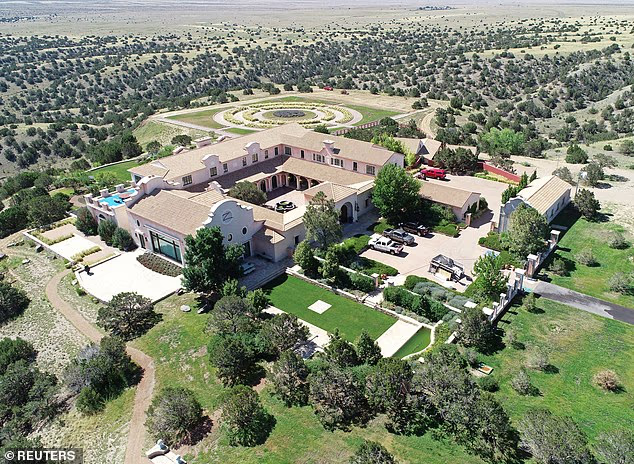
The Parnas Perspective, News and Commentary: Major Epstein Investigation Launched as Iran Threatens Trump's Life and USA Launches Most Intense Strikes to Date, Aaron Parnas, right, March 10, 2026. The first ever search of Jeffrey Epstein’s New Mexico ranch (above) is underway, a place where Epstein and Ghislaine Maxwell abused children.
The New Mexico Department of Justice and other law enforcement agencies searched Zorro Ranch, formerly owned by Jeffrey Epstein, as part of a criminal investigation into alleged illegal activities that occurred there before his death in 2019.
Authorities asked the public to stay away from the property and avoid flying drones in the area while the investigation is ongoing, and encouraged anyone with information about events at the ranch to contact the NMDOJ.
This is the first ever search of the New Mexico ranch where Epstein and Maxwell abused children, and authorities are searching the ranch for possible buried bodies.
Dark Sky Horizon, MSNOW reports that Epstein guard shouted "You killed this dude," Frank Vyan Walton, March 10, 2026. FBI interviews from the Epstein files reveals wild claims by prison guards. Details from The Sun:
Investigative reporter Julia K. Brown from the Miami Herald joined the program to explain the document’s significance and provide additional context on this new detail in the long-running Epstein case.
The segment ties into broader ongoing coverage of newly released or declassified Epstein-related files, fueling discussions and speculation about the circumstances of his death.
The inmate claims to have heard commotion inside the Special Housing Unit where he and Epstein were being held, according to a five-page handwritten FBI report.
He alleges that officers were frantically saying “Breathe” Breathe!” as they scrambled to resuscitate Epstein at 6:30am.
Moments later, the witness claimed one guard worried: “Dudes, you killed that dude.”
A woman’s voice then fired back: “If he’s dead, we’re going to cover it up and he’s going to have an alibi – my officers”, the inmate claimed, according to a report of the five-page interview.
The inmate believed the voice belonged to Tova Noel, according to the report , the prison guard who allegedly Googled Epstein in the hour before he was discovered hanged.
Noel, 37, and her colleague Michael Thomas were sacked after claims that they falsified records saying they checked on Epstein during the night of his death.
Prosecutors alleged the pair failed to conduct the mandatory checks on Epstein every 30 minutes during the overnight shift.
They were later charged over the claims, but the case was ultimately dropped.
This was also covered by Status Coup via the New York Post.
The inmate interviewed by the FBI stated “Miss Noel killed Jeffrey.” Records also indicate that Noel received many mysterious payments in the weeks leading up to Epstein’s death, including one payment of $5000.
More On Iran War
Iran’s Supreme Leader Ali Khamenei Killed in Strikes Feb. 28
New York Times, Opinion: Trump Has No Idea How to End the War With Iran, Thomas L. Friedman, right, March 10, 2026 (print ed.). In September 1996, I visited Tehran for the first time. I stayed at the Homa Hotel, formerly a Sheraton. I wrote at the time that fixed above the door in the lobby was a sign that read, in English, “Down with U.S.A.” As I pondered that sign, I remember thinking something like: Wow, that’s not graffiti! That’s firmly attached. That won’t come down easily.
The late 1990s were a fleeting moment of openness in Iran, which is how I got a visa. I was hopeful that the obvious quest then of many of Iran’s young people to join the world economy would eventually triumph over its leaders who had fixed those words into the wall. It didn’t happen. The words were too deeply embedded.
Now, we’re more than a week into the war with Iran launched by President Trump and Prime Minister Benjamin Netanyahu of Israel, and the biggest question I have is this: What if the necessary is impossible? What if the transformation of Iran is so much more important than the war’s critics admit, but so much more difficult than the war’s designers understand?
Yes, nothing would improve the prospects of the people of Iran, Lebanon, Iraq, Syria, Gaza, Yemen and Israel more than removing the Islamic regime in Tehran.
But what if that regime is also so embedded — in mayoralties, schools, police stations, government jobs, the banking system, the military, neighborhood paramilitaries — that, despite its unpopularity with a majority of Iranians, it can’t be removed without plunging the entire Iranian landmass, about a sixth the size of the United States and home to 90 million people, into chaos? What if the only quick alternative to Iran’s Islamic autocracy is not democracy but disorder on an epic scale?
Nothing underscores the embeddedness of this regime more than the fact that Iran just replaced its supreme leader, Ali Khamenei, killed early in the war, with his son Mojtaba Khamenei, said to be another hard-liner.
Letters from an American, Historical Commentary: March 9, 2026 [U.S. War Plan For Iran?], Heather Cox Richardson, right, March 10, 2026. It has become clear that Trump had no plan in Iran other than to strike it, knock out the leaders he didn’t like, and hope the Iranian people would rise up and put in place new leaders he could deal with.
It was supposed to look like what happened in Venezuela in January, when U.S. forces launched a surprise military strike that enabled them to capture Venezuelan President Nicolás Maduro and his wife, Cilia Flores, leaving in his place the vice president, Delcy Rodríguez, who promises to work with Trump and has given him access to the country’s oil resources.
Andrew Egger of The Bulwark explains that the Trump administration didn’t bother to have a theory for why the U.S. was going to war with Iran, or to explain to the American people why such a war would be a good thing, because they didn’t think there was going to be a war, just a fast, hard strike that would enable the U.S. to put a new Iranian leader in place.
But the initial Israeli strikes killed most of the people the administration hoped would replace 86-year-old hardline ayatollah Ali Khamenei as supreme leader, and yesterday Iran proclaimed as his successor Khamenei’s 56-year-old son Mojtaba Khamenei despite Trump’s statement that “Khamenei’s son is unacceptable to me.” Mojtaba Khamenei is thought to be even more extreme a hardliner than his father.
Wall Street Journal national security reporter Alex Ward reported today that according to current and former U.S. officials, “President Trump has told aides he would back the killing of new Iranian Supreme Leader Mojtaba Khamenei if he proves unwilling to cede to U.S. demands, such as ending Iran’s nuclear development.”
This morning, Joe Wallace, Summer Said, Rebecca Feng, and Georgi Kantchev of the Wall Street Journal wrote an article titled “The Long-Feared Persian Gulf Oil Squeeze Is Upon Us,” warning that the stoppage of traffic through the Strait of Hormuz has set off “the most severe energy crisis since the 1970s and [is] threatening the global economy.” Ships move not only oil but also fertilizer used for crops around the globe through that strait.
On March 3, Trump offered government insurance for shipping and floated the possibility of Navy escorts for ships in the strait, but that has not been enough to restore voyages. So this morning, on the Fox News Channel, Brian Kilmeade, who cheered on Trump’s attack on Iran from the television studio, told the captains of oil tankers they must simply conquer their fear and start up. “If you want to diminish the Iranian threat, if you want to make sure this ends up with complete Iran capitulation,” he said, “show some guts and go through that Strait, and do it.”
The spreading war in the Middle East threatens the ties between the region and the U.S. that Trump has pushed since taking office. As Eliot Brown, Georgi Kantchev, and Lauren Thomas of the Wall Street Journal reported on Friday, the richest countries in the Persian Gulf last year tried to strengthen ties with Trump by pledging billions of dollars of investment into the U.S. Now they are having second thoughts. A prominent Dubai businessman posted at Trump on social media: “Who gave you the authority to drag our region into a war?” Trump had placed the Gulf states “at the heart of a danger they did not choose,” he wrote.
On Saturday, Vivienne Walt of the New York Times warned that such investments have gone both ways, with U.S. tech giants like Nvidia, Microsoft, and Oracle investing in large-scale facilities across the Middle East with an eye to making the region a global center for AI. Now they are questioning the security of such investments.
Aaron Katersky and Josh Margolin of ABC News reported today that shortly after the death of Ayatollah Ali Khamenei on February 28, the U.S. intercepted encrypted messages suggesting that Iran has activated covert operatives, or “sleeper assets,” in other countries. When Eric Cortellessa of Time magazine asked Trump if Americans should worry about attacks at home, Trump answered: “I guess. But I think they’re worried about that all the time. We think about it all the time. We plan for it. But yeah, you know, we expect some things. Like I said, some people will die. When you go to war, some people will die.”
Under increasing pressure over the Epstein files, the Department of Justice (DOJ) today released some of the missing documents concerning an allegation from an Epstein survivor that Trump raped her when she was thirteen or fourteen. The so-called 302 report released today concerns four separate FBI interviews with the woman. (FD-302 is the form used by the Federal Bureau of Investigation to provide an official record of summarized interviews.) The DOJ’s initial document drop included only the interview in which she talked about her abuse at Epstein’s hands; the other interviews discuss Trump. Some of the files related to that accusation and those interviews are still missing.
The White House has responded to the pressure on Trump by posting an image of what appears to be a pilot in an aircraft under the caption “PATRIOTS ARE IN CONTROL.” The Steady State, a group made up of former national security officials, explains that in Q-Anon circles, that phrase “refers to the long-standing belief that Trump and a hidden network inside government were secretly running things the entire time.”
Trump has become so desperate to force Republicans in Congress to limit voting before the 2026 midterms that yesterday morning he took to social media to threaten them. He said that unless the Senate weakens the filibuster to pass the Safeguard American Voter Eligibility (SAVE) America Act over the objections of Democrats, “I, as President, will not sign other Bills until this is passed, AND NOT THE WATERED DOWN VERSION—GO FOR THE GOLD: MUST SHOW VOTER I.D. & PROOF OF CITIZENSHIP: NO MAIL-IN BALLOTS EXCEPT FOR MILITARY—ILLNESS, DISABILITY, TRAVEL: NO MEN IN WOMEN’S SPORTS: NO TRANSGENDER MUTILATION FOR CHILDREN! DO NOT FAIL!!!”
Senate minority leader Chuck Schumer (D-NY) responded: “The SAVE Act is Jim Crow 2.0. It would disenfranchise tens of millions of people. If Trump is saying he won’t sign any bills until the SAVE Act is passed, then so be it: there will be total gridlock in the Senate. Senate Democrats will not help pass the SAVE Act under any circumstances.”
Senate majority leader John Thune (R-SC) does not have the votes even to make up a majority in favor of the act, let alone the 60 he would need to overcome a filibuster, and has said he will not change the filibuster to try to pass the measure.
Brian Finucane noted today in Just Security that Congress, especially the Senate, could cause other problems for Trump. Although it has so far declined to reclaim its power to rein in his military adventures, it could still do so through the power of the purse. The administration appears to be planning to ask for more money to fund the war in Iran. Congress could refuse that money or could place restrictions on it by passing laws establishing such restrictions, although Trump could veto such measures and it would take a supermajority in each chamber of Congress to override his veto.
In the midst of Trump’s tanking numbers on all the issues that used to be Republicans’ strength—the economy, immigration, national security—Trump spoke today to Republican members of the House at their annual policy retreat at Trump’s property in Doral, Florida.
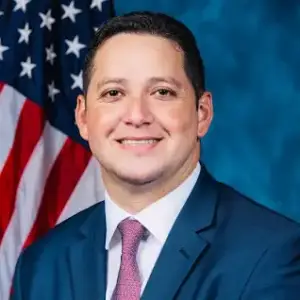 The Republican majority is now so thin that Johnson can afford to lose just a single vote on the House floor, and as of this morning, that seat seemed to be in jeopardy with Representative Tony Gonzales (R-TX), left, facing calls to resign after admitting to an affair with a former staffer who later died by suicide.
This afternoon, Representative Kevin Kiley of California announced he was leaving the Republican Party to become an Independent. When California redistricted the state to counter Texas’s redistricting, Kiley’s district became much more competitive. Kiley says that going forward, he will “have to consider” every bill “on its own merits.”
This afternoon, Weijia Jiang of CBS reported: “NEW—In a phone interview, President Trump told me the war could be over soon: ‘I think the war is very complete, pretty much. They have no navy, no communications, they’ve got no Air Force.’ He added that the U.S. is ‘very far’ ahead of his initial 4–5 week estimated time frame. Asked about Iran’s new Supreme leader Mojtaba Khamenei, who Trump has openly criticized, he said, ‘I have no message for him. None, whatsoever.’ Trump said he has someone in mind to replace Khamenei, but he did not elaborate. As for the Strait of Hormuz, Trump noted that ships are moving through now, but he is ‘thinking about taking it over.’ Trump warned Iran, ‘They’ve shot everything they have to shoot, and they better not try anything cute or it’s going to be the end of that country.’”
The price of oil had spiked overnight up to its highest level since global trade surged in 2022 after the Covid-19 lockdowns, peaking briefly at over $100 a barrel. News that the Group of Seven advanced economies (G7) is willing to consider releasing strategic oil reserves if necessary brought it down from its highs. A dropping stock market reflected the spike in oil prices. Those drops moderated after news about the possible release of strategic oil reserves, and the news that Trump considers the war ending meant the market ended up higher by the end of the day than it had begun.
But once the market had closed, Trump changed his tune, telling House Republicans, “We have won in many ways, but not enough. We go forward more determined than ever to achieve ultimate victory that will end this long-running danger once and for all.” When asked at a later news conference if the war would be over this week, Mr. Trump said, “No.”
This evening, Trump’s account posted: “If Iran does anything that stops the flow of Oil within the Strait of Hormuz, they will be hit by the United States of America TWENTY TIMES HARDER than they have been hit thus far. Additionally, we will take out easily destroyable targets that will make it virtually impossible for Iran to ever be built back, as a Nation, again—Death, Fire, and Fury will reign [sic] upon them—But I hope, and pray, that it does not happen! This is a gift from the United States of America to China, and all of those Nations that heavily use the Hormuz Strait. Hopefully, it is a gesture that will be greatly appreciated.”
Aaron Rupar of Public Notice commented: “Trump is completely flailing. He didn’t anticipate the economic blowback and now he’s trying to undo the past 10 days and contain the damage.”
As part of its apparent war on what the administration calls “narco-terrorists” in Latin America, U.S. Southern Command announced yesterday that it has struck another small vessel in the eastern Pacific, killing another six men.
New York Times, Unlike in Past Conflicts, Most Americans Oppose Iran Attacks, Lily Boyce and Ruth Igielnik, March 10, 2026. Public support for U.S. military intervention in the first days of international conflicts.
In the days after President Trump launched U.S. forces in an attack against Iran, support for the strikes is far lower than what it has been at the beginnings of previous foreign conflicts.
So far, polls have found that most Americans oppose the Iran attacks. Support ranges from 27 percent in a Reuters/Ipsos poll to 50 percent in aFox News poll. The wide variation suggests that public opinion is still taking shape as more Americans learn details of the attacks and the aftermath.
But even the highest level of public support for this conflict falls far lower than that at the start of most other conflicts, including World War II, the Korean War and the Iraq War.
In the days after the United States was attacked at Pearl Harbor and subsequently declared war against Japan, 97 percent of the public supported the move, according to Gallup. And in the days after President George W. Bush put troops on the ground in Afghanistan, 92 percent of Americans were on board in a Gallup poll.
A part of this difference in support, said Sarah Maxey, an associate professor of international relations at Loyola University of Chicago, is the way previous presidents have taken the time to sell wars to the public.
“Before the Iraq War in 2003, we had a whole year of why this mattered, why we exhausted other operations, why we needed this,” said Ms. Maxey, who studies public opinion around war and foreign conflicts. “We have not had many foreign conflicts without a clear communication strategy beforehand.”Approval for taking military action after an attack on the U.S.
But there are also larger forces at play.
At the beginning of wars, presidents typically experience what researchers call the “rally around the flag effect,” where support swells, even among those who otherwise disapprove of the president.
As polarization has grown over the last 30 years and Americans have drifted further apart politically, that effect has diminished.
“People from the opposing party of the president have been the source of most of the rally, but Democrats are not going to rally behind Trump,” said Matthew Baum, a professor at Harvard University who studies public opinion on foreign policy.
“For this president, to the extent that he has any rally from his base, he has a base who thinks they hired him to get him out of wars,” he added.
Support for wars typically wanes over time, as casualties increase and Americans start to feel the costs of war. As unpopular as the Iraq War ultimately became, 76 percent of Americans approved of the decision to go to war in a poll taken the day after the conflict began.
Morning Shots via The Bulwark, Political Opinion: It’s TACO Time, William Kristol, right, March 10, 2026. To TACO or not to TACO, that is Donald Trump’s question.
I think we know how it’s likely to be resolved.
TACO, for those sane humans who haven’t been obsessively following all the commentary on our 47th president, is an acronym for Trump Always Chickens Out. The term originated on Wall Street last May, after Trump would threaten or even announce tariffs and then reverse himself after a negative market reaction. A TACO trade involved buying stocks after a tariff announcement pushed them lower, then selling them after the tariffs had been postponed or reduced and the market had rallied. In general, the Street has found betting on the TACO trade to be profitable.
Yesterday we saw the mother of all TACO trades. Oil prices were soaring and the market was falling. Then at 3:30 p.m., President Trump told Weijia Jiang of CBS that the war could be over soon: “I think the war is very complete, pretty much.” Oil prices promptly plunged and stocks shot up. You could have made a lot of money in that last half hour of trading. For all we know, some Trump insiders did.
But chickening out isn’t a matter of one phone call. It takes time and can be a bit complicated to pull off. And of course Trump won’t acknowledge he’s doing it.
So in his speech later that afternoon to House Republicans, Trump dutifully read the hawkish passages that had been written for him: “We have won in many ways, but not enough. We go forward more determined than ever to achieve ultimate victory that will end this long-running danger once and for all.”
In his more off-the cuff remarks, though, and in his answers to questions at the press conference that followed, Trump’s inclination to TACO was dominant: The war was a “short-term excursion,” its progress “was ahead of schedule,” and it could be over “very soon.”
Now Trump will continue to unleash violence and destruction for a while. And he’ll continue to threaten, as he did last night on Truth Social: “If Iran does anything that stops the flow of Oil within the Strait of Hormuz, they will be hit by the United States of America TWENTY TIMES HARDER than they have been hit thus far. Additionally, we will take out easily destroyable targets that will make it virtually impossible for Iran to ever be built back, as a Nation, again—Death, Fire, and Fury will reign [sic] upon them.” But this protesting-too-much bluster was followed by the TACO tipoff sentence: “But I hope, and pray, that it does not happen!”
I suggested late last week when I took a brief excursion into Trump’s mind that he was already thinking then that “it’s getting to be time to end this, to pull the plug. Because it could all go south.”
Over the last few days the markets started to go south. So did the optics and politics of the war. And so Trump’s now looking to end it.
This process will have plenty of zigs and zags. Pulling a TACO in war isn’t simple. Once you’ve decided to “Cry ‘Havoc,’ and let slip the dogs of war,” it’s not as easy to get the fierce dogs of war back in the kennel as it is the docile puppies of tariffs.
And it’s not at all easy to contain or manage the real-world consequences of the havoc the war has caused. But worrying about the real-world consequences of his actions is never what’s uppermost in Trump’s mind.
What will be top-of-mind for Trump is the need to look tough, even or especially while chickening out. He’ll want to pull off a face-saving TACO. You might call it a macho TACO.
After all, the macho stuff has been central to the war effort, as Mark Hertling details below. Indeed, it’s central to fascism, including in its Trumpist iteration. As Umberto Eco points out in his great 1995 article “Ur-Fascism,”
Since both permanent war and heroism are difficult games to play, the Ur-Fascist transfers his will to power to sexual matters. This is the origin of machismo . . . Since even sex is a difficult game to play, the Ur-Fascist hero tends to play with weapons—doing so becomes an ersatz phallic exercise.
So Trump will continue “to play with weapons” and to talk about playing with weapons. That is harmful, and dangerous, and can certainly get out of control. But at least for now the weapons-playing will primarily be in the service of obscuring the fact that he’s chickening out.
Hamlet says near the end of his great soliloquy, “Conscience doth make cowards of us all.” Markets and politics do make a coward of Donald Trump. For Trump’s war, I think it’s TACO time.
If Trump TACOs out of Iran, can he really avoid the repercussions? Or was Colin Powell right—you break it, you buy it?
Morning Shots via The Bulwark, Political Opinion: “War Porn,” Mark Hertling, shown at right in a 2011photo before hhis ertirement, March 10, 2026. In the first week of our war on Iran, Americans have been subjected to a series of highly produced videos released through the White House communication apparatus showing military strikes. At the same time, the political leaders most important in wartime have engaged more in swagger than explanation.
This “messaging”—circulated on social media and repeated during press briefings by President Donald Trump, Secretary of Defense Pete Hegseth, and others—is less the sober reporting of combat operations and more like something drawn from a video game highlight reel.¹
Those of us who have served have a term for this kind of imagery and rhetoric: “war porn.” That phrase captures a troubling trend in how war is increasingly presented to the American public—stylized, dramatic, titillating, and not at all like the real thing. Videos like these strip away the gravity that should accompany decisions involving sending men and women into harm’s way, potentially to their deaths.
I’m not the target audience for these clips: I’m a boomer and a combat veteran, so maybe I don’t understand how this kind of content appeals to younger audiences raised on digital media and immersive graphics. But generational preference doesn’t matter when you’re speaking about the seriousness of war.
War is not entertainment. It is not a meme. It is not a cinematic product designed to generate likes and shares. And it should not be influenced by partisan language or hyperbolic and unrealistic statements. War is the realm of the profession of arms, where young Americans—our sons and daughters—carry out missions that involve lethal force under strict legal and ethical obligations.
The way leaders communicate about those missions matters.
During recent press conferences, the secretary of defense has paired slick and meaningless videos with familiar talking points—phrases that repeat the mantras of “the most lethal fighting force the world has ever seen,” the “restrictive, minimalist rules of engagement,” or the need to avoid “politically correct wars of the past.” These phrases may be politically effective because they resonate with audiences already inclined to believe that the military has historically been constrained by timid civilian leadership.
But they are also misleading.
Yes, our military is first-rate and extremely lethal; it has been for years, and little has changed with this administration. Rules of engagement have never been bureaucratic obstacles imposed to handicap the military; they are tools developed by commanders and military lawyers to ensure that force is applied lawfully and strategically, in accordance with the laws of armed conflict, and to avoid war crimes and the misapplication of violence. Far from restricting effectiveness, they help ensure that tactical actions support strategic objectives. Showing “no mercy,” as a graphic posted by the Department of Defense yesterday proclaimed, may be a way to rack up a kill count, but it’s no way to isolate your enemies, multiply your allies, and win a war.
The same is true of the phrase “forever wars.” It’s a powerful political slogan, but it often obscures more than it explains. Wars become prolonged not because soldiers are overly cautious or politically correct, but because the political objectives behind them are unclear, shifting, or unrealistic.
Sound bites may work in campaign speeches. They are a poor substitute for explaining what the military is doing to our nation’s citizens, most of whom don’t understand the details of combat operations.
There is another problem with turning combat footage into social media content: credibility.
For generations, the American military has tried to maintain a professional distance from domestic political messaging. Updates on operations have traditionally come from commanders, Pentagon briefings, or reporting by journalists embedded with units in the field. The purpose was to inform the public and explain the strategic context—not to produce dramatic visuals for political consumption.
When the White House communications team becomes the primary producer of war imagery, that balance shifts. Especially when most of those producing the videos have never experienced combat. The line between informing the public and promoting a narrative becomes blurred. And that’s dangerous.
Behind every strike video is a chain of command, months or years of training, and the possibility that someone—on our side or the other—does not come home. Those realities rarely show up in slickly edited footage.
The profession of arms is built on discipline, responsibility, and a profound respect for the destructive power entrusted to those who serve. Military leaders understand that using force is sometimes necessary. But they also understand it should never be trivialized or packaged in slick messaging that does not represent what is really happening. Americans deserve to know what their military is doing. And the military, in order to maintain its edge over our adversaries, needs Americans to have an accurate, if not thorough, idea of what it is that those in uniform do and are doing. Transparency matters in a democracy because that candor should illuminate the reality of war, not turn it into a spectacle.
When the imagery of combat begins to look like a video game highlight reel, or when a press briefing uses partisan talking points in place of strategy, we risk forgetting what war is—and what it costs the young Americans of all political backgrounds whom we ask to fight it.
More book news: Mark Hertling’s new book is out today! "If I Don’t Return: A Father’s Wartime Journal" is a collection of letters he wrote to his sons from Saudi Arabia, Kuwait, and Iraq during the Gulf War—plus more recent reflections on friendship, leadership, courage, honestly, faith, and character.
AROUND THE BULWARK
- Trump Is Repeating Putin’s Blunder… Both men thought they could start easy, quick regime-change wars at minimal cost, observes MATT JOHNSON.
- What It Felt Like to Face Combat in the Middle East… Everyone experiences fear differently. MARK HERTLING writes about what it was like for him in an excerpt from his new book.
- Trump Says the War Is “Very Complete,” But Also Just “Beginning”... Come get existential with SARAH and SAM as they break down Trump’s bizarre Iran presser on a Bulwark+ Take.
- ‘Project Hail Mary’… is the most crowd-pleasing movie SONNY BUNCH has ever seen. “Good movie!” (There’s more to the review than that.)
- Why Primaries Reward The Most Extreme Candidates… MONA CHAREN talks with Unite America’s NICK TROIANO about the structural problem driving America’s political polarization: the primary system.
Quick Hits
ANTHROPIC FILES SUIT: Anthropic is still trying to mend fences with the Pentagon—but now they’re fighting back, too. On Monday, the frontier AI lab sued the government, arguing that the Defense Department’s attempt to designate them a “supply chain risk” was meritless retaliation and that the government has no valid basis to forbid it from doing business with other government contractors.
“Anthropic was founded based on the belief that AI technologies should be developed and used in a way that maximizes positive outcomes for humanity,” the company said in its suit. “Anthropic brings this suit because the federal government has retaliated against it for expressing that principle. . . . The Constitution does not allow the government to wield its enormous power to punish a company for its protected speech.”
Until recently, Anthropic was the AI company the Pentagon relied on most. But Defense Secretary Pete Hegseth went nuclear on the company after it refused to withdraw redlines over the use of its AI for mass surveillance of Americans and autonomous weapons systems. He cancelled all the military’s contracts with the company and forbade all military contractors from doing business with them as well. The rest of the federal government quickly followed suit.
“President Trump will never allow a radical left, woke company to jeopardize our national security by dictating how the greatest and most powerful military in the world operates,” White House spokeswoman Liz Huston told The Bulwark in a statement yesterday. “Under the Trump Administration, our military will obey the United States Constitution—not any woke AI company’s terms of service.”Subscribed
RUBIO RISING?: The more Trump falls in love with war, the more he seems to fall in love with Secretary of State Marco Rubio. On the first evening of the conflict, February 28, Trump was schmoozing with donors at Mar-a-Lago when he asked them an interesting question: Who should he support to succeed him in 2028, Rubio or Vice President JD Vance?
The attendees, NBC News reported, “overwhelmingly indicated” Rubio. “It was almost unanimous for Marco,” one anonymous source said.
There’s little question Rubio has managed to distinguish himself over the past year, at least in Beltway circles, by a simple strategy of leaning in on polite professionalism when so many other prominent Trump cabinet members favor mawkish and vulgar pugnaciousness. His role as the adult in the room has been underscored by the increasingly tall pile of jobs and responsibilities the president has heaped on his shoulders.
That said, JD shouldn’t feel too badly: There is plenty of room for his isolationist star to rise again if and when the Iran conflict goes sideways.
Credit to Bulwark+ member AngieP, who said the administration was treating war like a video game the day before the White House posted a video combining footage of the war with actual video games. Here’s her insight:
I’ve commented before that the DoD decision-makers’ only model for armed conflict is a videogame. . . . Winning in a videogame is a matter of mashing buttons, perhaps coordinating with other players who are also mashing buttons, until the enemies and bosses die, and then you win. Having won, there’s also no need to rebuild a civilian government, administration, and infrastructure. . .
I think there are plenty of people in the Department of Defense who have a pretty good understanding of war and its difference from video games. But ultimately, they have to listen to their civilian bosses.
Emptywheel, Analysis: The Con Trump Used to Attempt to Hide How He’s Rewarding Russia for Helping Iran Target Americans, Emptywheel (Marcy Wheeler, right), March 10, 2026. At 2:40 ET yesterday (screen caps are Irish time, which this week is just four hours ahead), Reuters posted as news that Trump “is expected as early as Monday” — it was past noon on Monday — “to review a set of options to tame oil prices.”
It was a weird comment. Oil prices had been rising pretty steadily since the time Trump launched an illegal war on Iran, then spiked over the weekend as the Strait of Hormuz remained closed and it became clear — as it was clear from the start — that Trump’s promises of “FREE FLOW” through the Strait of Hormuz were empty, little more than an attempt to, by declaration, make a very difficult problem, one that should have been foreseen from the start, simply go away.
In the period leading up to the time on Monday when, per Reuters, Trump would be presented with proposals on what to do about spiking oil prices, Trump:
Hosted 50 people to talk about what to do about the commercialization of college sports (attendees included Secretary of State and National Security Adviser Marco Rubio and former Secretary of State and former National Security Adviser Condoleeza Rice, who knows a lot about disastrous wars in the Middle East, but did not include Tommy Tuberville, who might have expertise on college sports but is admittedly very stupid about all things but football) Created a new organization for Latin America’s authoritarians, at which Trump announced a plan to take over Cuba and laid out his plan to use the military to hunt drug traffickers in more countries, including (most recently) Ecuador Wore his golf hat to the dignified transfer ceremony for six of the eight service members he has gotten killed so far Wore his dignified transfer hat to golf on Sunday morning
But, some time on Monday, Reuters told us, after spending the weekend doing more interesting things, Trump would try to come up with a plan for what to do about the economic and energy crisis his illegal war had caused.
Less than an hour after Reuters told us that Trump would soon turn to solving the economic problem he had caused, at 3:16 ET, Weijia Jiang tweeted out the first details of a phone interview she did with Trump, declaring Mission Accomplished: “the war is very complete, pretty much.”
Now, Jiang is a perfectly good journalist and over the years, Trump has treated her just as terribly as he has treated every other real female journalist who dares to ask him questions. And she’s not alone in airing Trump’s bullshit claims about this war; Trump has spent much of his time since he started it — when he manages to take a break from golf, that is — speaking with any reporter who’ll listen and testing messages to see whether they’ll make his war look good. Jonathan Karl, just as one example, has floated some real bullshit himself.
But it matters that Jiang has covered the White House for CBS even as Bari Weiss has turned it into a propaganda rag. It matters that Jiang is the President of the White House Correspondents Association. Just days earlier, Jiang had controversially celebrated the fact that she had convinced Trump to grace the WHCA Dinner this year, an event with which Trump has always had a fraught relationship, one that celebrates the free press, with which Trump has had an even more fraught relationship.
Just days after providing Trump an opportunity to whitewash his assault on the press, then, Jiang had parroted out the most ridiculous bullshit Trump fed her.
Here’s how Jiang reported the effect that her bullshit report had (without quite acknowledging that her bullshit report had caused it) when she wrote up the interview later in the day.
The U.S. benchmark for crude oil dropped as much as 13.7%, or just around $13 per barrel, shortly after CBS News’ interview, before rebounding somewhat a few hours later. Oil prices are now down slightly since Friday, after surging by double-digit margins earlier Monday, though oil prices remain above pre-war levels. Major stock indices also closed in positive territory Monday after spending most of the day in the red.
And here’s what it looked like:
Now, to be fair to Jiang, she reported (as a third tweet of three, a tweet which got 417K views as compared the 4.9M views her first tweet got), the most ridiculous thing Trump said. Ships are moving through Hormuz, Trump “noted” (they’re not, unless they fly flags friendly to Iran), “but he is ‘thinking about taking it over.'”
That was an hour before American markets closed and he had already announced he’d address the press an hour after markets closed, and played a significant role in boosting markets at the end of the day.
Sometime in that period, Trump had an hour-long call with Vladimir Putin.
The call with Putin happened even as Ukraine, while it is fighting for its life in the face of a Russian invasion largely accomplished through drone and missile strikes, has offered up its expertise in countering Iran’s Shahed drone attacks. (Update: Axios reports this morning that Ukraine offered this assistance last August, but Trump’s team blew it off.)
The call with Putin came in the wake of the disclosure — first reported by WaPo — that Russia was helping Iran with targeting intelligence, which (WaPo implies) may be how Iran did so much damage to US facilities in Saudi Arabia, including at Prince Sultan Air Base, where the seventh combat-related fatality was injured in a strike on a communications facility on March 1 but for some reason never successfully evacuated to Germany for treatment before he passed away on Saturday.
Analysts said that the sharing of intelligence would fit the pattern of Iran’s strikes against U.S. forces, including command and control infrastructure, radars, and temporary structures, like the one in Kuwait where six service members were killed.
The CIA’s station at the U.S. Embassy in Riyadh, Saudi Arabia’s capital, also was struck and destroyed in recent days. Parts of the embassy building have been left “unrecoverable” and must be sealed off, according to an internal State Department assessment. The assessment, which was reviewed by The Post, said that other parts of the embassy would not be habitable for at least another month.
Iran is “making very precise hits on early-warning radars or over-the-horizon radars,” said Dara Massicot, an expert on the Russian military at the Carnegie Endowment for International Peace. “They’re doing this in a very targeted way. They’re going after command and control,” she added.
Iran possesses only a handful of military-grade satellites, and no satellite constellation of its own, which would make imagery provided by Russia’s much more advanced space capabilities highly valuable — particularly as the Kremlin has honed its own targeting after years of war in Ukraine, Massicot said.
Trump’s team has downplayed the import of Russia sharing satellite intelligence with Iran.
After WaPo’s report, Steve Witkoff said he had strongly communicated to Russia to stop.
Strongly.
In the same exchange on Air Force One, when asked if he thought Russia was doing that, Trump said simply it wasn’t doing Iran much good.
The Secretary of Make War Not Defense echoed that claim. “No one’s puttin’ us in danger,” Whiskey Pete said not long before a man died from a strike that Russia may have facilitated.
Major Garrett: The American people can therefore expect conversations with the Russians to stop this?
Pete Hegseth: Well, I– President Trump, as people have seen, has a unique relationship with a lot of world leaders where he can get things done that other presidents, certainly Joe Biden, never could have. And through direct conversations or indirect, through him one-to-one or through his cabinet, messages– definitely can be delivered.
Major Garrett: Does this put U.S. personnel in any more danger than they otherwise would be?
Pete Hegseth: Well, no one’s–
Major Garrett: The Russian involvement?
Pete Hegseth: No one’s puttin’ us– us in danger. We’re puttin’ the other guys in danger, and that’s our job. So we’re not concerned about that. We mitigate it as we need to. Our commanders factor all of this. But the only ones that need to be worried right now are– are Iranians that think they’re gonna live.
It didn’t reward Russia for helping to target American service members to make it easier to sell oil, Trump’s flunkies claimed. When Scott Bessent explained in an interview that was supposed to focus on reinsuring tankers transiting Hormuz, but instead offered dumb excuses for having lifted sanctions on India and might lift sanctions on others, even Larry Kudlow seemed to doubt Bessent’s spin about the Russia sanctions. Then Energy Secretary Chris Wright and UN Ambassador Mike Waltz, repeated that spin. That oil was just floating there. It didn’t reward Russia to be able to profit off it.
So even as Ukraine takes resources away from its own defense to — among other things — help protect America’s base in Jordan, Trump called up Vladimir Putin. I don’t believe that the White House has issued a read-out yet. The Russian read-out specifies:
Trump called Putin, not the other way around. They haven’t spoken since the end of December (implicitly, before Trump’s invasion of Russia’s ally Venezuela), even though Trump has said they should speak regularly. His comments about Iran reflected calls with Iran’s president and other unnamed leaders. Trump still wanted to broker a peace deal in Ukraine and Putin claimed he welcomed Trump’s efforts to serve up Ukraine for him. Putin lied and claimed Russia was making significant advances when, in reality, Ukraine has had some success recovering territory in recent weeks. Venezuela also came up.
Putin has been holding out on Trump since Trump started invading his client states, but now that his latest invasion has roiled oil markets, Trump picked up the phone and offered to reward Putin.
Trump was asked about this call at his presser — the one scheduled well after US markets had closed — at which he reiterated his claim he might take over Hormuz and repeatedly claimed the war roiling the world’s economy was a mere excursion, like a picnic.
Do you approve of Iran’s new supreme leader? And secondly, can you tell us more about your call with Russian President Vladimir Putin today? What did you discuss?
Yes. Yes, I had a very good call with President Putin. We had a lot of people on the line from our side, from his side. We were talking about Ukraine, which is just a never-ending fight. And when — look, there’s tremendous hatred between President Putin and President Zelenskyy. They can’t seem to get it together.
But I think it was a positive call on that subject and we obviously talked then about the Middle East, and he wants to be helpful. I said, you could be more helpful by getting the Ukraine-Russia war over with; that would be more helpful. But we had a very good talk and he wants to be very constructive. Yeah.
[snip]
Can I ask you, you mentioned you were going to waive certain additional oil waivers or sanctions; can you talk a little bit more about that and address in particular —
Well, we’re looking to keep the oil prices down. We went artificially up because of this excursion into a very positive thing. I mean, this was an excursion that a lot of people wouldn’t have done. I knew oil prices would go up if I did this and they’ve gone up probably less than I thought they’d go up, but I don’t think anybody thought we were going to be this quickly successful.
This was a military success, the likes of which people haven’t seen. We have the best military. We have the best equipment. We have, I believe, the best generals. We have the best. And this went very quickly. Uh, we talked about that with President Putin. He was very impressed with what he saw because nobody’s ever seen anything quite like it. You know, Iran was a very powerful military country with all of the missiles.
After the Trump presser, Reuters replaced and subsequently updated the earlier story, about plans Trump might consider once he’s done golfing and saving college sports, with another focused more on the possibility that Trump would lift sanctions on Russia.
U.S. President Donald Trump is considering easing oil sanctions on Russia and releasing emergency crude stockpiles as part of a package of options aimed at curbing spiking global oil prices amid the Iran conflict, according to multiple sources.
The deliberations reflect White House worries that the surge in oil prices following more than a week of U.S. and Israeli strikes on Iran will hurt U.S. businesses and consumers ahead of the November midterm elections, when Trump’s fellow Republicans hope to retain control of Congress.
[snip]
Easing sanctions on Russia would potentially boost world supplies of oil at a time of massive disruptions to Middle East shipments from the expanding Iran conflict. But it could also complicate U.S. efforts to deprive Russia of revenue for its war in Ukraine.
Trump added later in the press conference that he had a “very good call” with Russian President Vladimir Putin about the war in Ukraine.
Analysts and industry officials have said the White House has few meaningful tools to quickly curb rising oil prices unless authorities can restore the flow of tankers through the Strait of Hormuz, the narrow waterway between Iran and Oman that carries roughly a fifth of the world’s oil supply.
A previously announced White House plan to provide naval escorts and backstop insurance for tankers traveling the Strait of Hormuz so far has failed to significantly boost shipping traffic through the vital waterway.
“The problem is options range from marginal through symbolic to deeply unwise,” said one of the sources, who is engaged with the White House on the effort.
[snip]
The White House last week asked federal agencies to assemble proposals that could help ease pressure on crude and gasoline prices, Reuters previously reported.
The deliberations involve top White House officials, including White House Chief of Staff Susie Wiles and top adviser Stephen Miller, the sources said.
What had become vague options in Reuters’ earlier report has now become lifting sanctions on Russia, even as Russia helps Iran destabilize America’s presence in the Middle East.
If Russia’s help explains why Iran has so successfully targeted communications facilities, including what NYT reported earlier in the week included this facility on Prince Sultan Air Base:
On Saturday night, the Islamic Revolutionary Guards Corps announced that the Prince Sultan Air Base in Saudi Arabia had been targeted with missiles and drones. The following morning, satellite imagery captured a mile-long smoke plume rising from a building connected to the site.
Another satellite image captured on Tuesday showed the structure was largely destroyed.
The building that was hit is close to a radome and sits within a fenced-off area roughly six miles east of the main base, indicating Iranians may have been specifically targeting a communications section of the site.
… Then Russia helped kill Benjamin Pennington, the SpaceComm soldier who died after being wounded on March 1.
Army Sgt. Benjamin N. Pennington, 26, of Glendale, Kentucky, died Sunday after being wounded during a March 1 attack on the Prince Sultan Air Base, Saudi Arabia, a Pentagon statement said.
[snip]
Pennington was assigned to the 1st Space Battalion, 1st Space Brigade of the U.S. Army Space and Missile Defense Command based at Fort Carson, Colorado.
The unit’s mission focused on “missile warning, GPS, and long-haul satellite communications,” according to their website.
And Trump has responded to those precision attacks by Iran by considering lifting all oil-related sanctions on Russia.
Trump is engaged in a series of cons to try to distract from the reality about his illegal invasion of Iran, a con job that has, for the last day or so, succeeded in serially juicing markets to stave off a larger collapse.
But the most substantive thing he’s considering to address the crisis he created is to reward Vladimir Putin for potentially helping to kill Benjamin Pennington.
Which is emblematic of the larger strategic problem with what Trump has done. When he’s pitching this to reporters, he focuses on this big game of Battleship, the number of Iranian warships on the bottom of the sea. He jokes — as he did in that presser — about how much fun it is to kill Iranian sailors.
But because he didn’t think through the most basic realities of the Persian Gulf, one of the key bottlenecks in the global economy, he is inching closer and closer to a dramatic strategic loss.
Drop Site News, Analysis: Trump Might Want to End the War. Iran Won’t Do It on His Terms, Jeremy Scahill, right,  and Murtaza Hussain, March 10, 2026. Iran says the U.S. and Israel underestimated its military capacity and will to fight, as Trump careens toward a quagmire.
As the U.S.-Israeli war on Iran stretches into its second week, President Donald Trump has been floating the idea that he wants to declare Mission Accomplished. “We will. We’ve already won in many ways, but we haven’t won enough,” Trump declared on Monday afternoon in a speech before Republican lawmakers in Florida.
Iran, however, has shown no sign of ceasing its attacks. The Islamic Revolutionary Guard Corps is steadily launching missiles at cities across Israel and continues to strike U.S. military assets and outposts in the Persian Gulf. “The Armed Forces of the Islamic Republic of Iran are capable of continuing at least a six-month intense war at the current pace of operations,” IRGC spokesperson Ali Mohammad Naini said Sunday in video remarks broadcast on state media. “Iran will determine when the war ends.”
Iranian military officials have said that in the first days of the war, they overwhelmingly used missiles developed between 2010 and 2014, while holding some of Iran’s more sophisticated, modern missiles for future use as the war stretches on.
“In the last ten years, what’s been produced, we haven’t used at all,” Naini said. The IRGC announced Monday that it was going to begin deploying more of its advanced 1,000 kg ballistic missiles and, in the first series of retaliatory strikes launched since the naming of a new Supreme Leader, fired dozens of missiles at Tel Aviv and at the U.S. Navy’s 5th Fleet infrastructure in Bahrain.
Iran’s latest round of strikes began as Trump was addressing a press conference in Florida, assuring reporters that Iran’s drone and missile capacity had been “utterly demolished.”
“Their missile capability is down to about 10 percent, maybe less. We’re also hitting where they make missiles and where they deliver missiles,” Trump said. “We’re knocking them out. We know where they all are. We’re knocking them out very quickly. We’re ahead of our initial timeline by a lot.”Upgrade to paid
Despite these claims, Iranian forces have continued to conduct counterstrikes across the region and inside Israel, and Iranian leaders have asserted they have the ability to continue the war. “Let them continue lingering in these illusions,” said Foreign Ministry spokesperson Esmail Baghaei at a press briefing Monday in Tehran. “They started this war and now realize they are caught in a quagmire.”
While U.S. and Israeli leaders have loudly proclaimed that the use of overwhelming force is evidence that they are winning the war, political and military analysts say this rhetoric obscures the reality that in asymmetrical warfare, the less powerful force does not need to militarily defeat an adversary, but rather force it to a point where it determines the costs of continuing the war is too high.
“Iran’s goal is to impose such a great cost that the war ends and their ‘win condition’ is the war has ended and they are still the guys you have to talk to,” said Amir Husain, author of “Hyperwar: Conflict and Competition in the AI Century,” in an interview with Drop Site. Iranian ballistic missile and drone attacks in the region are not aimed at causing random widespread damage or defeating the U.S. and Israel militarily, he said, but rather at inflicting economic damage that forces Trump to cease the war and deters future attacks. “The U.S. is the biggest military machine in the world. Nothing that the U.S. has lost is irreplaceable in time. The question is economic costs and that is really the big driver.”
Iranian officials told Drop Site that after being attacked on February 28 they moved swiftly to implement a series of planned retaliatory strikes that had been war-gamed extensively in the months following the 12-Day War in June 2025. Iran, they said, anticipated that the U.S. and Israel would conduct a systematic assassination campaign against the country’s leaders so Tehran’s military planners preemptively constructed a “mosaic” system where command authority was delegated further down the chain. This allowed commanders from the Islamic Revolutionary Guard Corps aerospace division to launch ballistic missile and drone attacks within hours of the war beginning and to strike at predetermined targets even if communications were disabled or senior leaders killed or incapacitated.
“This is the war that Iran has been preparing for for a generation. And the question was always when this existential war was going to take place. And it seems that they believe that that time is now,” said Jon Elmer, an analyst on weapons and military tactics of Palestinian and regional resistance groups for Electronic Intifada. “The Trump administration was treating Iran as if you just come back every few months and destroy and attempt to overthrow the country, overthrow the regime. Iran’s preparation for this war is generational and there’s strategic depth, both within their hardware capacity, but also within their human capacity.” Smoke rises after Iran carried out a missile strike on the main headquarters of the U.S. Navy’s 5th Fleet in Manama, Bahrain in retaliation against U.S.-Israeli attacks, on February 28, 2026. Photo by Stringer/Anadolu via Getty Images.
Since the war began, Iran’s drone and ballistic missile attacks have hit major U.S. airbases, naval headquarters, logistics sites, and missile-defense radar systems across Bahrain, Kuwait, Qatar, the UAE, Jordan, and Saudi Arabia. Iran also struck a CIA station in Saudi Arabia. Perhaps the most significant strikes have been Iran’s attacks on U.S. advanced warning radar systems, the nerve center for the military’s defensive missile apparatus.
Satellite imagery has shown that Iranian attacks have damaged or destroyed advanced AN/TPY-2 and PAC-3 missile defense radars for the THAAD and Patriot systems as well as other radar domes at U.S. bases in the Gulf. In addition to reducing ballistic missile defense effectiveness for the entire region, the disabling of defensive facilities at airbases may force operations to be carried out farther from Iran, further reducing the number of sorties that the U.S. can carry out on a daily basis. On March 9 the satellite imagery provider Planet Labs announced that it would restrict access to its commercial imagery over the region for security reasons.
On Tuesday, the Washington Post reported that the U.S. had begun relocating components from its THAAD missile defense system in South Korea to the Middle East, as well as more Patriot interceptors that had been deployed to East Asia. South Korean President Lee Jae-myung said that Seoul had “expressed opposition,” to the decision, which would increase its own exposure to the threat of war. “The reality is that we cannot fully push through our position” and block the transfers, he added.
In addition to ballistic missile strikes, U.S. officials on Tuesday confirmed the downing of at least 11 MQ-9 Reaper drones over Iran, with another reportedly shot down on Wednesday. Iran claims to have shot down over 80 drones, and the officially confirmed U.S. losses come in addition to significant numbers of downed Israeli drones verified by OSINT researchers and independent monitors. The loss of drones over Iran further degrades the ability to stop Iran from firing by adding a limitation to the intelligence the U.S. can gather on ballistic missile launches.Unsubscribe
MeidasTouch Network, Trump GOES SILENT as IRAN WAR TRAPS HIM!!!. Ben Meiselas, right, March 10, 2026. Trump pushed for further escalation on his social media platform last night. Trump threatened that if Iran disrupts oil flow through the Strait of Hormuz, the United States will respond “twenty times harder” and destroy targets that would make it “virtually impossible for Iran to ever be built back as a nation again.” The post included a warning that “death, fire, and fury will reign upon them.”
 At the same time, reporting from the Wall Street Journal indicates that Trump’s own advisers are quietly urging him to find an exit ramp from the war. They’re increasingly worried about political backlash as the conflict drags on, particularly as the economic fallout grows more visible here at home.
Trump himself said yesterday he thinks the war could end “very soon.” But according to people familiar with his thinking, he has also been surprised and caught off guard that Iran hasn’t folded under the joint U.S.–Israeli military campaign.
And the reality on the ground right now is that Iran is showing absolutely no sign of surrender.
Iranian officials have said outright they are not seeking a ceasefire. Missiles and Shahed drones continue to launch across the region, and the war is spreading into critical energy infrastructure.
Another major oil facility was struck this morning. The massive refinery complex in Ruwais in the United Arab Emirates, one of the largest in the region, halted operations after a drone strike sparked a fire in the industrial area surrounding the plant. That refinery alone can process nearly 900,000 barrels of oil per day. Events like that are exactly why global markets are on edge.
And the war continues to escalate, the messaging from the White House is revealing the depths of their incompetence. Earlier today, U.S. Energy Secretary Chris Wright posted on social media that the U.S. Navy had escorted an oil tanker through the Strait of Hormuz to ensure the continued flow of global oil shipments. Shortly after posting it, Wright deleted the message. So you now have a situation where the president is threatening massive escalation around the Strait of Hormuz while the administration is deleting posts suggesting the U.S. military is already escorting tankers through it.
If you’re an oil market trader trying to interpret signals from Washington right now, good luck.
Meanwhile, the political reality of the war is becoming clearer as polling data comes in. A new analysis highlighted by the New York Times shows Trump’s war with Iran is the least popular American military conflict at its outset in modern history. Public support in the early days of World War II and the Persian Gulf War was overwhelming. Even the initial stages of the Afghanistan war saw strong backing. Trump’s war began with roughly 41 percent support.Subscribed
Meanwhile, Pakistan’s prime minister publicly congratulated Iran’s new supreme leader today following the death of Ayatollah Ali Khamenei. The message praised the new leadership and expressed confidence Iran would move toward stability and prosperity. For a U.S. administration that has been trying to build a coalition against Iran, that kind of public statement from a nuclear-armed country is not exactly encouraging.
Inside Iran itself, the dynamic appears to be moving in the opposite direction of what the administration predicted. Front-page images from Tehran show massive crowds gathering in support of the new Iranian leadership. Even Iranians who may have opposed the regime previously appear to be rallying behind the country as it faces foreign attacks. That’s a dynamic political scientists have warned about for decades, and one we have seen play out repeatedly. External military pressure often strengthens internal unity rather than weakening regimes.
Another deeply disturbing development continues to hang over the administration as well. New photos published by the New York Times from the February strike on a school in Minab, Iran show weapon debris consistent with a U.S.-made Tomahawk cruise missile. The debris includes visible Department of Defense codes and markings indicating the weapon was manufactured in the United States. That strike killed more than 150 children at the school and nearly 200 people in total.
Yet during a press conference this week, Defense Secretary Pete Hegseth accused Iran of targeting schools and hospitals as part of its military tactics. That statement came as the administration continues to refuse to acknowledge what independent investigations and U.S. officials have already suggested—that the missile involved in that strike was American. Yesterday, Trump said that it’s possible Iran has Tomahawk missiles, too. They don’t. The lies are absolutely appalling and depraved.
While the war intensifies, another story surfaced today that raises serious questions about how the war might have unfolded differently. According to Axios, Ukrainian President Volodymyr Zelenskyy presented Donald Trump with a detailed briefing last August warning that Iran was rapidly improving its Shahed drone technology. Zelensky even offered to partner with the United States to develop counter-drone systems and mass-produce advanced drone defenses in America. The presentation included a map of the Middle East and a warning that Iran’s drone program was evolving quickly. Zelenskyy did this even as the U.S. continuously derided Ukraine and pulled its aid.
The U.S. government declined the offer.
Fast forward to today and those same Iranian drone systems are now shaping the battlefield across the region. At the same time, the Trump family has been investing in drone technology companies hoping to sell equipment to the Pentagon as military demand for drones explodes. And now the United States is begging Ukraine for assistance.
Meanwhile, Trump’s diplomatic circle continues to lean heavily on one particular foreign leader: Vladimir Putin. Trump has repeatedly said that Putin wants to help end the war. And today Trump envoy Steve Witkoff revealed that he and Jared Kushner had a direct conversation with Putin adviser Yuri Ushakov independent of Trump himself. In other words, members of Trump’s inner circle are conducting direct communications with senior Russian officials about the war. The same Russia who is allied with Iran and is actively helping the Iranian regime target American troops, per reporting.
Earlier, Witkoff was asked a straightforward question: how does the war end?
Witkoff admitted he had no idea.
He followed that by arguing Americans should be grateful Trump is president, suggesting the alternative would be a world filled with dozens of nuclear weapons. It’s all so embarrassing and dangerous.
Back on Capitol Hill, House Speaker Mike Johnson gaslighted the public and told reporters that the military operation in Iran is limited in scope and has already been remarkably successful. Johnson said thousands of targets have been struck and suggested the situation could wrap up quickly, because that’s what Trump said.
But events on the ground tell a much different story.
Iran has launched new missile waves toward Israeli territory and continues to strike energy facilities across the region. Explosions were reported live on Iranian state television from Tehran’s Revolution Square today while crowds gathered in support of the new leadership. The images coming out of Iran show defiance, not surrender.
At the same time, reports indicate that American Patriot and THAAD missile defense systems may have been moved from South Korea to the Middle East. South Korean officials have already expressed concern about the redeployment, saying they opposed the withdrawal but had little ability to influence the decision.
And while all of this unfolds overseas, another story back home highlights how the Pentagon has been spending taxpayer money.
A new watchdog report revealed that the Defense Department spent $93 billion in September alone—the largest monthly outlay since 2008. Some of the purchases included $225 million in furniture, millions spent on luxury food items like lobster and ribeye steak, $124,000 for ice-cream machines, $140,000 on doughnuts, and nearly $100,000 for a grand piano installed at a senior official’s home. There were even $12,000 spent on fruit basket stands. Those expenditures came during the same period the Pentagon was rapidly burning through its annual budget before the fiscal year ended.
Taken together, it paints a picture of a government simultaneously waging a volatile war abroad while facing growing scrutiny at home.
Meanwhile, the American people refuse to let Epstein go from the headlines. A statue depicting Donald Trump and Jeffrey Epstein styled like Jack and Rose from Titanic appeared on the National Mall today, showing the two figures standing on a ship’s bow with their arms outstretched in the film’s famous “King of the World” pose. Here are some photos:
So that’s where things stand this Tuesday. We’ll keep following every development as it unfolds. Thanks to everyone for subscribing and sharing our reporting. You make this all possible.
Meidas Touch Network, Commentary: Trump Skips Dignified Transfer for 7th U.S. Troop Killed in Iran War, J.D. Wolf, March 10, 2026. Instead, Trump’s day included his golf club and a restaurant photo op.
Vice President JD Vance and Pete Hegseth traveled to Dover Air Force Base Monday night to attend the dignified transfer for Benjamin N. Pennington, a 26-year-old U.S. Army soldier from Glendale, Kentucky who died from injuries sustained in an attack linked to the escalating Iran conflict.
According to the military, Pennington was assigned to the 1st Space Battalion, 1st Space Brigade under the U.S. Army Space and Missile Defense Command and was wounded during a March 1 attack on Prince Sultan Air Base in Saudi Arabia. Pool reporters said Vance arrived at Joint Base Andrews shortly after 7 p.m., and waved to the press but declined questions before boarding Air Force Two for the trip to Delaware.
President Donald Trump did not attend the ceremony. This marks a contrast with the administration’s messaging after the first six service members killed in the conflict.
White House Uses Dignified Transfer Footage For TikTok Videos
The White House had previously posted TikTok videos highlighting Trump’s presence at Saturday’s dignified transfer ceremony, but on Monday the president instead spent time at his golf club resort and made a public stop at a nearby restaurant, El Arepazo in Doral, Florida, before returning to Washington. Pennington is the seventh U.S. service member confirmed killed in Trump’s unauthorized war in Iran.
News Updates
The Parnas Perspective, News and Commentary: Tensions with Iran are escalating, Aaron Parnas, right, March 10, 2026. Donald Trump has threatened Iran with “death and fury,” Iranian officials have issued threats against Trump, and the United States saystoday will be the most intense day of strikes inside Iran so far. At the same time, U.S. officials are expressing regret that they did not accept Ukraine’s help earlier on countering Iranian drones.
Meanwhile, our work was featured today in USA Today, which profiled my journey from lawyer to journalist and the work I’ve done over the past seven years to define myself independently while building this media platform. Read it here.
Here’s the news:
Donald Trump warned that if Iran disrupts oil shipments through the Strait of Hormuz, the United States will strike “twenty times harder” and target infrastructure in ways that could make it nearly impossible for Iran to rebuild as a nation. He framed protecting shipping through the strait as a benefit to countries that rely on the route for energy supplies, including China.
Ali Larijani, a senior Iranian security official, issued a thinly veiled threat toward Donald Trump after Trump warned Iran it would be hit “twenty times harder” if it continued blocking oil through the Strait of Hormuz. Larijani said Iranians do not fear Trump’s “hollow threats” and cautioned the U.S. government to “beware, lest you are the ones who are eliminated.”
U.S. Defense Secretary Pete Hegseth said that the current day would mark the most intense round of American strikes inside Iran since the military campaign began, involving the largest deployment of fighter jets and bombers so far. He made the statement during a Pentagon briefing as part of escalating operations aimed at degrading Iran’s missile systems, naval forces, and other military capabilities.
Defense Secretary Pete Hegseth, left, said the U.S. takes reports of a strike near an Iranian school very seriously and will thoroughly investigate the incident amid evidence suggesting an American missile may have hit the area and killed many children. He emphasized that investigations take time and cautioned that open-source information alone is not sufficient to determine exactly what happened.
Jennifer Griffin said during a discussion with Bret Baier that evidence strongly suggests a U.S. Tomahawk missile struck the area near the Iranian school, contradicting claims that Iran may have misfired a weapon. Griffin said there is no evidence Iran launched anything at the school and pointed to satellite imagery and analysis indicating the strike was likely carried out by the United States, adding that the president likely knows this.
John Kennedy, a Republican U.S. senator, expressed regret over the bombing of a girls’ primary school in Iran during the opening day of Operation Epic Fury that reportedly killed about 175 children. He spoke to NBC News and called the strike “a mistake,” said the U.S. would never intentionally target civilians, and added that the Department of Defense is investigating the incident while apologizing for the loss of life.
According to Axios, U.S. officials have acknowledged a significant tactical miscalculation in dismissing Ukraine’s offer last year to share its battle- tested technology for intercepting Iranian Shahed drones. The decision is now viewed with regret after Iranian drone attacks killed seven U.S. service members and forced the U.S. to reverse course and seek Ukrainian help, with officials conceding the technology likely would have helped if adopted earlier.
Lindsey Graham said he will return to South Carolina and ask residents to support sending their sons and daughters to serve in the Middle East, signaling support for continued U.S. military involvement in the conflict.
Defense Secretary Pete Hegseth said the U.S. military’s resolve in the conflict is “endless,” but emphasized that the war itself is not intended to be open-ended. He said Donald Trump has set clear objectives for the operation and that the administration aims to avoid a prolonged conflict or “mission creep,” with the president ultimately deciding when those goals have been achieved.
Amin Nasser, CEO of Saudi Aramco, warned the ongoing conflict could have “catastrophic consequences” for the global economy if disruptions in the Strait of Hormuz continue. With roughly 20% of the world’s oil supply normally passing through the strait, the fighting has effectively shut the route, creating what Nasser called the region’s biggest oil and gas crisis to date.
According to Politico, rising oil and gas prices linked to the war with Iran are fueling concern among Republicans that higher energy costs could hurt voters’ finances and overshadow the economic benefits of recent GOP tax cuts ahead of the midterms. Some lawmakers warned that gasoline prices, already up sharply, are politically sensitive and could erase gains for lower-income Americans if the disruption to global oil supplies continues.
Donald Trump told House Republicans that passing the SAVE America Act, a GOP-backed elections bill requiring stricter citizenship and photo ID rules for voting, should be their “No. 1 priority” ahead of the midterm elections. He urged lawmakers to expand the legislation with provisions restricting mail voting and addressing transgender issues, saying Republicans should prioritize the bill even if it means delaying other parts of their legislative agenda.
Reuters has confirmed that Kim Yo Jong, the sister of Kim Jong Un, criticized the United States and South Korea for continuing their joint Freedom  Shield military exercises and warned that any threat to North Korea would bring “terrible consequences.” She said the drills undermine regional stability during a period of escalating global conflicts and vowed that North Korea would continue strengthening its military and nuclear deterrence in response.
Friedrich Merz, left, faces growing political pressure in Germany after his coalition government suffered electoral setbacks and rising public anxiety over the economy and global conflicts, including the wars in Iran and Ukraine. Divisions within the coalition are deepening over economic policy and Germany’s support for U.S. and Israeli strikes on Iran, with some leaders arguing the conflict “is not our war.”
Morning Shots via The Bulwark, Political Opinion: TACOs With a Side of War Porn, Bill Kristol, Andrew Egger and Mark Hertling, March 10, 2026. Despite his callous bluster, Trump is seemingly retreating.
When we mentioned yesterday that Trump was blaming Iran for firing the Tomahawk missile that destroyed an Iranian girl’s school on February 28, we suggested he’d probably (or hopefully) have been briefed otherwise and was merely lying.
Now we’re not so sure. Asked at his presser yesterday why he was the only member of own administration accusing Iran of the strike, Trump replied: “Because I just don’t know enough about it.” Truest thing he’s ever said. Happy Tuesday.
New York Times, Unlike in Past Conflicts, Most Americans Oppose Iran Attacks, Lily Boyce and Ruth Igielnik, March 10, 2026. Public support for U.S. military intervention in the first days of international conflicts.
In the days after President Trump launched U.S. forces in an attack against Iran, support for the strikes is far lower than what it has been at the beginnings of previous foreign conflicts.
So far, polls have found that most Americans oppose the Iran attacks. Support ranges from 27 percent in a Reuters/Ipsos poll to 50 percent in a Fox News poll. The wide variation suggests that public opinion is still taking shape as more Americans learn details of the attacks and the aftermath.
But even the highest level of public support for this conflict falls far lower than that at the start of most other conflicts, including World War II, the Korean War and the Iraq War.
In the days after the United States was attacked at Pearl Harbor and subsequently declared war against Japan, 97 percent of the public supported the move, according to Gallup. And in the days after President George W. Bush put troops on the ground in Afghanistan, 92 percent of Americans were on board in a Gallup poll.
A part of this difference in support, said Sarah Maxey, an associate professor of international relations at Loyola University of Chicago, is the way previous presidents have taken the time to sell wars to the public.
“Before the Iraq War in 2003, we had a whole year of why this mattered, why we exhausted other operations, why we needed this,” said Ms. Maxey, who studies public opinion around war and foreign conflicts. “We have not had many foreign conflicts without a clear communication strategy beforehand.”Approval for taking military action after an attack on the U.S.
But there are also larger forces at play.
At the beginning of wars, presidents typically experience what researchers call the “rally around the flag effect,” where support swells, even among those who otherwise disapprove of the president.
As polarization has grown over the last 30 years and Americans have drifted further apart politically, that effect has diminished.
“People from the opposing party of the president have been the source of most of the rally, but Democrats are not going to rally behind Trump,” said Matthew Baum, a professor at Harvard University who studies public opinion on foreign policy.
“For this president, to the extent that he has any rally from his base, he has a base who thinks they hired him to get him out of wars,” he added.
Support for wars typically wanes over time, as casualties increase and Americans start to feel the costs of war. As unpopular as the Iraq War ultimately became, 76 percent of Americans approved of the decision to go to war in a poll taken the day after the conflict began.
U.S. Governance, Politics, Elections
New York Times, Trump’s War in Iran, and Rising Gas Prices, Collide With Midterm Agenda, Tyler Pager, March 10, 2026 (print ed.). The attack on Iran has led to a surge in energy prices at a moment when the cost of living is a major issue heading into the fall elections.
President Trump sought to dismiss concerns about rising gas prices from his war in Iran, contending that the price spike “doesn’t really affect us” even as some Republicans fear that soaring costs are undercutting their economic argument heading into the November elections.
Mr. Trump, speaking in Florida on Monday, said that prices were “artificially up” because of the war and vowed that they would drop again after it ended. But the president offered no clear timeline of when that would happen, even as he bragged that the United States was far ahead of its timeline.
Mr. Trump’s economic message on Iran so far boils down to the idea that any pain is short-term, worthwhile and not as bad as he initially thought it would be. But for Republicans in tight midterm races, the knock-on effects of the war — and Mr. Trump’s so-far vague assurances about the economy — are still open questions.
The conflict has sent the price of gasoline surging, and it reached $3.48 a gallon on Monday, nearly a 17 percent increase since the war began on Feb. 28. World leaders are preparing for far-reaching repercussions, and in private some Republicans lawmakers are growing resigned to the harsh political realities that confront the party in power when prices rise sharply.
Senator John Thune of South Dakota, the Republican majority leader, told reporters on Monday that “the price of gas is always kind of a benchmark.”
“I do think the fact that we’ve increased our supply here domestically will help ease it, but it’s something obviously we’ve got to pay attention to,” he said.
He later added that he was “always concerned about the price of oil, the price of gasoline.”
The White House hoped it would not be this way. Just before Mr. Trump’s State of the Union address last month, the president’s top White House aides, most of his cabinet and other political advisers met at the Capitol Hill Club for a midterm strategy session in which they insisted that efforts to reduce the cost of living must be central to the party’s pitch to voters.
In his State of the Union speech, Mr. Trump declared that “the roaring economy is roaring like never before.” As he listed a flurry of data points to make his case, Mr. Trump lingered on one of his favorites: gas prices.
“Gasoline, which reached a peak of over $6 a gallon in some states under my predecessor — it was quite honestly a disaster — is now below $2.30 a gallon in most states,” he said. “And in some places, $1.99 a gallon. And when I visited the great state of Iowa just a few weeks ago, I even saw $1.85 a gallon for gasoline.”
The landscape a few weeks later is vastly different. Now Mr. Trump, who has long used high gas prices as a cudgel against his political opponents, is arguing that Americans need to accept the short-term pain.
“Short term oil prices, which will drop rapidly when the destruction of the Iran nuclear threat is over, is a very small price to pay for U.S.A., and World, Safety and Peace,” he wrote on social media on Sunday. “ONLY FOOLS WOULD THINK DIFFERENTLY!”
Still, Mr. Trump is adapting his message. On Monday, while bragging about his economic accomplishments to a meeting of House Republicans in Doral, Fla., he made no mention of gas prices. Before the war, he almost always cited falling gas prices as evidence of his economic success. Instead, he focused on the stock market setting records under his watch.

Meidas Touch Network, Commentary: Husted Caught Attending Fundraiser in Ohio After Refusing to Return to Testify in Bribery Case, Troy Matthews, March 10, 2026. Husted's lawyers said he couldn't testify in-person because he needed to be in D.C. for the Iran war.
Republican U.S. Senator Jon Husted told a judge he was unable to return to Ohio to testify in-person about his role in the biggest bribery scheme in that state's history, with his lawyers citing his need to be in Washington, D.C. "due to the outbreak of war in Iran."
But then WEWS News 5 Cleveland caught Husted flying back to Ohio to attend a $1,000/ticket GOP fundraiser on Friday. Husted refused to comment to reporters as he was filmed in airports in both Washington, D.C. and Columbus.
 Husted, right, has been mentioned over 100 times in the trial related to the FirstEnergy bribery case, the largest case of public corruption in Ohio's history, including in phone calls, text messages and previously unreported secret meetings between Husted and the indicted FirstEnergy executives. Husted was even called FirstEnergy's "golden boy" by Neil Clark, a FirstEnergy lobbyist and co-defendant.
Though not accused of any crime, as Lt. Governor, Husted appeared to be the point person between executives at FirstEnergy and the Governor Mike DeWine administration in pushing a billion dollar taxpayer funded bailout of the failing energy company through the legislature. The bailout resulted in higher energy bills for Ohioans.
The bill, known as HB 6, turned out to be tied to a $61 million bribery scheme. Husted met with the state official accused of accepting bribes from FirstEnergy only two days before the bill was introduced in the state legislature.
Public records revealed that FirstEnergy executives spent $3.5 million through dark money groups to fund the 2024 reelection campaign of Husted and DeWine, who then appointed Husted to fill the U.S. Senate seat from Ohio vacated by JD Vance in 2025.
Agreeing to testify as a witness for the defense, Husted's lawyers convinced the judge to allow him to testify remotely over video conferencing due to his apparent need to stay in D.C. as the Iran war began. But despite the war, Husted found time to get out of D.C. to be the Keynote Speaker at the Greene County Republican Party's Lincoln Day fundraiser on Friday March 6th.
Husted is not exactly a key member of the Senate's national security group. Those tend to be senators on the Intelligence and Armed Services Committees. Husted's Senate committee assignments include: Health and Education, Labor and Pensions, Small Business and Entrepreneurship, Environment and Public Works, and the Special Committee on Aging.
Husted also voted against the War Powers Resolution which would have ended hostilities in Iran except where explicitly authorized by Congress; essentially voting to remove Congress from having a say in the execution of the war. That vote was held on Wednesday March 4th. Husted left for the Ohio fundraiser on Thursday the 5th.
"Jon Husted has been mentioned more than 100 times in the largest bribery scandal in Ohio history — and now that he’s finally being called to testify, he is refusing to show up in person to answer for his role in the scandal," Ohio Democratic Party Spokesperson Tony Wen said in a statement. "Ohioans deserve to know why Jon Husted sold them out to a big utility company and left families paying hundreds more each year on their energy bills."
Husted is running to be elected as a Senator in his own right in the November midterms.

New York Times, Elections in Mississippi and Georgia Will Provide Clues to Both Parties’ Future, Kellen Browning, March 10, 2026, It’s Primary Day in Mississippi, where a younger Democrat is trying to oust a House veteran, and in Georgia, where Marjorie Taylor Greene’s former seat is up for grabs.
Voters will weigh in on Tuesday in two elections in the South that could offer clues to both political parties about the sentiments driving this year’s midterm cycle: how strongly Democrats are seeking generational change, and how willing Republicans are to heed President Trump’s endorsement.
 Mississippi and Georgia will hold contests less consequential than those that took place this month in Texas and North Carolina, and many of the races on Tuesday are not expected to be particularly competitive.
For instance, Senator Cindy Hyde-Smith of Mississippi is expected to easily fend off her primary challenge from Sarah Adlakha, a businesswoman, in her safely Republican seat.
But two races stand out: the special election to fill the vacant seat of former Representative Marjorie Taylor Greene in rural northwest Georgia, and the re-election bid of Representative Bennie Thompson, 78, who is fighting to fend off a younger Democrat who is trying to make an issue of Thompson’s age.
Here’s what to look for in both states:
Will Democrats boot a senior House member?
After Democrats started suggesting more than a year ago that they were ready to oust the old guard of their party and usher in a wave of younger lawmakers, their first attempts to do so in Texas and North Carolina last week met with mixed results.
One older incumbent, Representative Valerie Foushee, defeated her young progressive challenger in North Carolina by an extremely narrow margin, while another, Representative Al Green, is headed to a runoff in Texas.ImageEvan Turnage, wearing a green T-shirt, listens as one of several people surrounding him speaks.Mr. Turnage, center, has made Mr. Thompson’s age an issue in his primary campaign.Credit...Rory Doyle for The New York Times
 Another young candidate will try his hand on Tuesday in Mississippi. Mr. Thompson, above, who became a cable-news fixture as a co-chair of the House committee that investigated the Jan. 6 attack on the U.S. Capitol, is fighting to fend off Evan Turnage, 34, an antitrust lawyer who has criticized Mr. Thompson’s effectiveness and has drawn contrasts between himself and his rival based on age. Among other jabs, Turnage likes to say that he was a year old when Mr. Thompson was first elected in 1993.
But Mr. Thompson, once a young activist in the segregated Mississippi of the 1960s, retains significant support, and Mr. Turnage’s bid could prove to be a long shot. Mr. Thompson is running on his record, arguing that he has been a steady and productive advocate for a district that is more than two-thirds Black and is also one of the poorest in the nation.Who will emerge from a crowded primary to replace M.T.G.?
 Ms. Greene, left, once a steadfast ally of Mr. Trump and his MAGA movement, had a bitter and public break with the president last year over a variety of disagreements, none larger than her support for forcing a vote to release the investigative files on Jeffrey Epstein, the convicted sex offender.
Her seat has been empty since she left Congress in January, a consequential vacancy at a time when the slim Republican majority can afford to lose only a single vote on legislation.
More than a dozen candidates are vying to replace Ms. Greene in a special election with Republicans and Democrats on the same ballot. Because it is unlikely that any candidate will garner more than 50 percent of the vote, the race is nearly guaranteed to head to a runoff. resident Trump.Credit...Nicole Craine for The New York Times
 In a deeply conservative district, the top Republican candidates are Clay Fuller, a former state prosecutor, and Colton Moore, a former state senator and conspiracy theorist whose approach to politics echoes Ms. Greene’s. Mr. Fuller earned Mr. Trump’s endorsement, but that does not guarantee his victory in a deeply conservative district that re-elected Ms. Greene in 2024 by nearly 29 points. Both men are staunch supporters of the president, and voters bucked Mr. Trump’s choice in a high-profile state legislative race in North Carolina last week.
Shawn Harris, an Army veteran and a moderate candidate, is expected to be the top-performing Democrat, most likely setting up a runoff between Mr. Harris and one of the Republican candidates.
The winner of the runoff, scheduled for April 7, will immediately begin serving to complete Ms. Greene’s unfinished term. Meanwhile, a separate race is underway — with many of the same candidates — to win the November election to serve a full two-year term in the same seat. The primaries for that race are scheduled for May 19.

Meidas Touch Network, Commentary: Small Business Owner Emily Gregory Running to Flip Mar-a-Lago Blue, Troy Matthews, March 9, 2026. Emily Gregory wants to make sure all of Donald Trump's Florida representatives are Democrats.
Emily Gregory is a Democrat running for Florida's 87th state house district in West Palm Beach. It is the district that contains Donald Trump's Mar-a-Lago estate, shown above, and it is primed to be flipped blue.
Gregory, right, is a small business owner who runs a fitness center for postpartum moms,  a military spouse, and a mother of three boys who has never before run for office, yet her common sense approach to politics has earned her wide endorsements and high poll numbers. She is even pulling support among some Republican voters.
Her campaign is centered on the affordability crisis; bringing prices down and easing the burden on families in the state. She has also championed greater healthcare access, including fighting Florida's six-week abortion ban, and increased public services for working families.
 "It's the Florida legislature," Gregory said in an interview with MeidasTouch when asked what motived her to run. "The supermajority is turning out horrible legislation, and the budget [doesn't] reflect the priorities of the average Florida family. And that is why I'm doing this."
Residents of the 87th district have gone without representation in the current legislative session because Governor Ron DeSantis delayed calling a special election for months to fill the seat vacated by Republican Mike Caruso, whom DeSantis appointed as Palm Beach County Clerk in August of last year.
Finally, the election has been set for Tuesday, March 24th.
Aside from her win getting Democrats that much closer to breaking a Republican supermajority in the state house, the messaging victory that would result from flipping Mar-a-Lago blue cannot be overstated.
"That is a really powerful message to send, you know, six months before the midterms." Gregory said. "The president's congressperson is a Democrat. His state senator is a Democrat. And in two weeks and four days, a state representative is about to be a Democrat."
"The power that the president wields in many ways. This particular president is fear and its perception. People are not okay with what's happening. And I think this really helps solidify that straw man. His numbers and his perceived following is much smaller than he would like to project." Florida House of Reps. District 87 encompasses much of West Palm Beach
Florida House of Reps. District 87 encompasses much of West Palm Beach
"Our biggest challenge is getting the word out that there is a special election," says Gregory. "I feel a hundred percent confident...that we win those votes, if people know there's a special election. A lot of games were played with the election dates."
Gregory easily won her primary, receiving 88% of the vote of Dems. The district has also moved into toss-up territory with Gregory polling two points ahead of her opponent, and with Trump sitting on a 7% net disapproval in his home district.
If only counting the undecided voters in this state house race, Trump's disapproval shoots up to 27%. Gregory is currently beating her opponent by 14 points among No Party Affiliation voters, and even has the support of 12% of Republicans.
Democrats have overperformed by an average of 17.3% in nine special elections held in Florida in 2025, with Trump winning this district by 10 points in 2024. Which means if Gregory can match the Florida Democrat average for special elections since Trump took office she will win the district. This follows a trend of Democratic overperformance in state special elections across the country, with a 90% win or overperform rate for Democrats since Trump won in 2024.
Her opponent, Jon Maples is endorsed by Donald Trump, who has mentioned him in social media posts; the highest honor for a MAGA candidate. But beyond that he has been somewhat of a no-show on the campaign trail. Except for a bizarre exchange at a candidate forum where he seemed to not understand the difference between state and federal taxes in a conversation about a constitutional amendment to abolish property tax in Florida, which has passed the house:
"The Republicans are all talking about abolishing property taxes, which is an insane proposal and really dangerous," said Gregory.
As a state that already has no income tax, eliminating property tax would have serious ramifications for public services. It would likely shift the burden for state revenue onto consumption taxes like sales tax, which more heavily burdens the middle and lower classes at a time when cost of living in Trump's economy is becoming untenable for many Americans.
Despite the race being incredibly close, Gregory believes Maples is operating as if his election is assured.
"He thinks this is a shoe in," Gregory said. "He doesn't even think he has to try. We are out canvassing, as you can imagine, at full strength. We try to have at least five volunteers every single day right now, and then of course, times on the weekends knocking thousands and thousands of doors."
"The advantage we have is we have all this momentum. We have this amazing, ground game. He thinks he's just gonna, you know, skate right into the state house."
"It’s clear voters are blaming Republicans for raising costs and leaving families behind, and now even Mar-a-Lago is vulnerable territory," Democratic Legislative Campaign Committee President Heather Williams said in a statement. "Emily is exactly the kind of candidate who can defy the odds and connect with voters as a small business owner and mom, and this is exactly the kind of race the DLCC is targeting to change who is in power in this country."
Emily Gregory is a political outsider who is standing up to the Florida Republican machine in Donald Trump's own neighborhood with a message of common sense solutions and a push back on extremism and inept MAGA leadership.
The Special Election for Florida HD 87 will take place on Tuesday, March 24th.
U.S. Jobs, Inflation, Economy, Energy
The Contrarian, Opinion: Words & Phrases, Jennifer Rubin, right, March 10, 2026. Let’s lose ‘lost jobs.’
“The U.S. Lost 92,000 jobs in February, an unexpected decline,” declared the New York Times. CBS intoned: “U.S. labor market lost 92,000 jobs in February, marking an unexpected setback for the economy.” And the Wall Street Journal echoed: “U.S. Loses 92,000 Jobs in Widespread and Unexpected Downturn.”
Really, did we “lose” jobs, as in “misplace” them, like car keys or reading glasses? And for whom was this unexpected?
Let’s get real. The jobs were not “lost,” and it is not as much of a shocker as legacy outlets made it out to be. Donald Trump is systematically sinking the economy and killing jobs with an array of dumb policies. Sen. Kirsten Gillibrand (D-NY) diagnosed it exactly right, arguing: “[Republicans’] failed policies have led to job losses, higher prices and a weaker economy.”
We knew the economy slowed down in 2025, as job creation ground to a halt. Steve Rattner, commenting on Trump’s State of the Union lies, explained the two key factors that account for this drop-off in jobs: immigration (i.e., mass deportations) and tariffs. Trump’s nonsensical policies hamper growth, which inevitably means fewer jobs will be created.
Rattner spelled out the rotten jobs’ picture:
Job growth during Trump’s first year fell markedly from the prior year, an average of just 15,000 jobs a month, compared to 122,000 jobs a month the prior year. The number of manufacturing jobs fell while healthcare employment accounted for more than 100% of the jobs that were created. Meanwhile, the unemployment rate rose to 4.3% from 4% when Trump took office. Lastly, long-term unemployment increased; a quarter of those unemployed have been out of work for more than 26 weeks.
Paul Krugman likewise mused that just a couple of weeks ago, Trump “[t]alked about a golden age, about fantastic job growth like nothing you’ve ever seen. Boasted about low gasoline prices, which he said were below $2.30 a gallon in most states.” Of course, there was not a “a single actually true number in the speech,” and the entire premise of the speech — Greatest economy ever! — was just more nonsense.
In fact, the job market turned out to be worse than it appeared to be just a couple of weeks ago. The March jobs report adjusted the December 2025 number downward by 65,000 jobs, from +48,000 to -17,000. That means rather than 181,000 jobs created in 2025, only 116,000 jobs were created for the entire year — less than the average number of jobs created per month under Joe Biden. Was February really such a shocker? (Perhaps folks were thrown off by the bizarrely out-of-whack January number, which was also reduced downward to 126,000.) And now, thanks to Trump’s war, oil prices soared over $100 per barrel over the weekend.
Trump is not the unfortunate victim of job “losses”; he is destroying jobs, especially manufacturing jobs. “Spending on manufacturing construction declined steadily during 2025 as Trump imposed tariffs (which increase uncertainty around input costs) and moved to halt Biden-era investment programs, like the poorly named Inflation Reduction Act,” Rattner reminded us. And in savaging medical and scientific grants and going to war with universities, Trump is further undercutting one of America’s greatest sources of long-term growth and productivity — our advantage in scientific prowess and innovation.Subscribed
In the near term, we can see that a major cause of the job downturn is Trump’s mass deportation scheme. “The latest numbers show that net migration into the United States fell by more than half, and that reality is now reflected in the latest employment report,” the Center for American Progress found. Moreover, “native-born workers haven’t seen their wages or employment prospects rise under this new immigration approach.” CAP explained: “Immigration is the driving force behind America’s labor supply growth, accounting for about half of labor force growth each year for the past three decades and an even larger share in recent years.” When you have declining birth rates and choke off immigrants, who have higher job participation, then “negative job growth could become the new normal, according to some estimates.”
No single factor can account for the rotten jobs performance, but a self-destructive immigration policy coupled with massive taxes (which are what tariffs are), undoubtedly dragged on job creation. It was not as if Trump had not been warned that he was sabotaging America’s economy.
Now, Trump has launched an unnecessary, open-ended war that threatens to shock the entire global economy. “Any event that extends the conflict or threatens sources of oil and gas is likely to lift energy prices to levels that would sow inflation. That could prompt central banks worldwide to raise interest rates, pushing up the costs of mortgages, car loans, and other borrowing,” the New York Times reported. “And that would choke off consumer spending and business investment — a classic pathway to a downturn.”
In a written statement, Rep. Don Beyer (D-VA) explained, “Already under strain from the President’s disastrous trade war and anti-immigrant crusade, our economy is extremely ill-prepared to deal with yet another wave of Trump-induced chaos, this time in the form of an illegal war of choice in the Middle East which is rapidly driving up energy prices across the globe.”
But Trump seems incapable of doing anything other than making matters worse. His ever-changing rationale for the war and lengthening timeline create more volatility. His inane comment that we would accept only “unconditional surrender” (are we planning a land invasion to take by force a country of over 90 million people?) spooked the oil markets. Perhaps when oil prices soar above $150 per barrel, his party will revolt.
The only question is how long Republicans will allow Trump’s shambolic economic policies to drive us into recession. After all, the MAGA congressional majorities could end his job-killing tariffs, reform and rein in ICE, and end this war. Unless they move quickly, however, they will have no excuses in November when they get clobbered at the ballot box.
In sum, we really should stop saying the economy “lost” jobs — or that anything is surprising or unexpected about Trump crashing the economy. His and his MAGA supplicants’ erratic, wrongheaded policies and destabilizing wars are killing employment and growth while fueling inflation. The only question is if and when they will decide to reverse course.
New York Times, U.S. Solar Installations Fell in 2025 as Trump Attacked Clean Energy, Ivan Penn, March 10, 2026. More solar energy was added to U.S. grids than any other technology, but the amount installed fell by 14 percent, according to a new report.
Solar power installations declined in the United States last year, as the Trump administration sought to impede the growth of renewable energy, according to an industry report released on Tuesday.
Solar energy maintained its position as the largest source of new electricity generation added to the electric grid, but the amount added was 14 percent lower than in 2024, according to the report and data published by the Solar Energy Industries Association and Wood Mackenzie, an energy research firm.
Last year was much better for battery storage installations, which increased to their highest annual level, the report said. Trump administration officials have not criticized batteries as much as they have criticized solar and wind power.
“The emphasis in federal energy policy that happened throughout 2025 on fossil fuels and a kind of a move away from renewables definitely made an impact on the solar industry, to be sure,” said Michelle Davis, head of global solar at Wood Mackenzie Power & Renewables. “It’s undeniable.”
It is too early to say how the war with Iran, which has sharply driven up the prices of oil and natural gas, will affect renewable energy. A sustained rise in those costs could push businesses and individuals worldwide to buy more solar panels and batteries. But some policymakers may respond by pulling back clean energy goals and increase subsidies for fossil fuels.
The U.S. government began making drastic changes to energy policies when President Trump returned to office. Last summer, the Energy Department announced plans to cut hundreds of millions of dollars from federal renewable energy and efficiency programs, largely targeting solar and wind power. Other government departments and agencies have stalled environmental and other reviews of wind and solar projects.
Mr. Trump’s energy secretary, Chris Wright, has frequently criticized renewable energy, describing it as inadequate and unreliable while praising and directing more federal funding to coal, natural gas and nuclear projects.
“Beyond the obvious scale and cost problems, there is simply no physical way wind, solar and batteries could replace the myriad uses of natural gas,” Mr. Wright, a former oil and gas executive, said last year at CERAWeek by S&P Global, an annual energy conference in Houston.
U.S. Education, Religion, Culture, Media, High-Tech

New York Times, Trump Antisemitism Inquiry Demanding List of Jews at Penn Heads to Court, Alan Blinder and Michael C. Bender, March 10, 2026. l The Trump administration, which said it is investigating harassment, sued the University of Pennsylvania after it refused a request to provide information about Jewish students and staff.
Jacob Naimark, a law student at the University of Pennsylvania, has worried ever since he learned that Trump administration investigators had demanded that his school turn over the names of many Jewish people on campus.
“It was disturbing,” said Mr. Naimark, a co-president of the school’s Jewish Law Students Association, adding: “We know very well the history of governments assembling lists of Jews does not end well.”
On Tuesday, a federal judge in Philadelphia will consider whether the government’s tactics went too far.
The government has argued it was investigating harassment and other potential episodes of antisemitism on campus, including some related to campus protests over the war in Gaza. But the request upset many Jewish faculty and students, and Penn has refused to comply, calling the Trump administration’s demands unconstitutional and “disconcerting.” Some say the campaign to force the university to give information about Jewish people makes them feel less safe, in part because it recalls the methods of Nazi-era Germany.
The two sides will meet in court after the Equal Employment Opportunity Commission asked a judge, Gerald J. Pappert, to enforce a subpoena requiring Penn to turn over the information. Mr. Naimark’s group is among those that have joined the case opposing the government.
The Trump administration has repeatedly adopted a hard line toward elite universities, which it regards as opposed to its ideology and as hot spots of discrimination. Last year, the government paused $175 million in federal funding to Penn amid a dispute about a transgender swimmer, before it reached a settlement with the university.
The antisemitism case is testing how far the government can go to investigate its suspicions about American universities. It could determine how aggressively the Trump administration pursues inquiries on other campuses.
The E.E.O.C. has argued to Judge Pappert that there is nothing out of the ordinary about its investigation. A commissioner, Andrea R. Lucas, a Penn alumna, launched the case in 2023, asserting that she believed Penn had “engaged in a pattern or practice of harassment based on national origin, religion and/or race against Jewish employees.” Ms. Lucas is now the chairwoman of the E.E.O.C.
She said the allegations were based on information published in news reports and congressional testimony, among other sources.
In March 2025, the commission asked for a range of records, including complaints about antisemitism. It also asked for a list of “all clubs, groups, organizations and recreation groups” that were “related to the Jewish religion, faith, ancestry/national origin,” as well as membership rosters of those groups, so it can speak with students and faculty members about discrimination on campus.
It also sought a list of employees in Penn’s Jewish Studies Program since November 2022. After Penn balked, the commission issued a subpoena for the records and added more demands, including notes taken during “listening sessions” of a campus antisemitism task force.
Instead, Penn, according to its court filings, told the commission it was willing to inform all employees about the inquiry and how to contact the commission directly.
The government refused the offer as unworkable and said it was not seeking to “imperil any individual.” In a court filing last month, Trump officials called the request routine and the criticism speculative.
March 9
Top Headlines
- New York Times, Live Updates: Oil Price Surge Rattles Markets; Iran’s Choice of Leader Signals Defiance, Farnaz Fassihi, Yan Zhuang and Aaron Boxerman, March 9, 2026. Stocks in Asia and Europe fell, and U.S. futures were lower, as oil prices rose on fears of a prolonged U.S.-Israeli war with Iran. Top clerics selected Mojtaba Khamenei, right, as Iran’s supreme leader, despite President Trump’s warning that he was “unacceptable.”
- New York Times, Trump’s War Becomes World’s Latest Economic Hazard, Tony Romm, Colby Smith and Alan Rappeport, March 9, 2026. The president insists conflict with Iran will be brief, but world leaders are preparing for severe economic blowback.
- Morning Shots via The Bulwark, Political Opinion: Why Would There Be a War? Andrew Egger, March 9, 2026. What did the White House think it was getting into in Iran? A strike against Iran’s oppressive and fanatical regime, sure. A display of America’s awesome military might, definitely. But it’s become increasingly, painfully clear: They didn’t think there was going to be a war.
- New York Times, Billionaires Are Swaying Elections in All Corners of America, Mike Baker and Steven Rich, March 9, 2026. Billionaires made 19 percent of all reported federal campaign contributions in 2024, a Times analysis shows, and even more in some local elections. Wealthy donors are reaping the rewards.
News Roundups
- The Parnas Perspective, News and Commentary, U.S. Underestimated Iran’s War Readiness; Hardline Leader Takes Power; New Video Suggests U.S. Missile Strike Near Iranian Girls’ School, Aaron Parnas, March 9, 2026. The United States appears to have underestimated Iran’s war readiness when launching its strikes. Iran now has a new Supreme Leader, Mojtaba Khamenei, who is considered even more hardline than his father and is openly hostile toward the United States and Israel after an Israeli strike killed both his father and his wife.
- Letters from an American, Historical Commentary: March 8, 2026 [Taking Deaths Seriously], Heather Cox Richardson, right, March 9, 2026 Yesterday, President Donald J. Trump was among the dignitaries who attended the dignified transfer returning the remains of the six U.S. soldiers killed in the military action against Iran to the United States for burial. At the transfer, Trump wore a white USA baseball cap for sale in his campaign store.
More Global News and Comment

- Aaron Rupar (@atrupar.com) via BluSky, Lindsey Graham: 'Blow the hell out of those people,' Aaron Rupar, March 9, 2025. Quoting South Carolina Republican senator on Fox News about Iran
- Wayne Madsen Report, Investigative Commentary: Fooling his flock, Trump turns out to be just another Henry Kissinger globalist, Wayne Madsen, March 9, 2026. Trump commences Operation Condor 2.0 in Western Hemisphere.
 How to Survive the Broligarchy, Commentary: Is this the Broligarchy's first world war? Carole Cadwalladr, right, March 9, 2026. AI-guided weapons, two out-of-control authoritarians, no legal authority and a toxic mess of masculinity: welcome to the manosphere's first major conflict.
- Emptywheel, Analysis: Trump Dreads Failing Like Jimmy Carter Did on Iran, Emptywheel, (Marcy Wheeler, right), March 9, 2026. The analogies that commentators are using to describe the crisis Donald Trump caused by launching an illegal attack on Iran jumble a lot together. And while smart economists say the world won’t suffer the kind of inflationary cycle it did in the 1970s, many people compare today’s disaster with the last time Iran’s radical clerics avenged US imperialism in epic fashion in 1979.
- New York Times, British Lawmaker Wants King Charles to Cancel His U.S. Trip Over Iran War, Michael D. Shear, March 9, 2026. Ed Davey, the leader of the Liberal Democrats in Britain, said President Trump does not deserve the “diplomatic coup” of hosting the king for a state visit.
U.S. Governance, Politics, Elections
- The Triad via The Bulwark, Political Opinion: Warning: The Chaos President THRIVES on Chaos, Jonathan V. Last, March 9, 2026. 1. Idiocracy; 2. The Politics of Chaos; 3. The Law; 4. Post-Liberalism.
- New York Times, Markwayne Mullin, Once a Political Outsider, Moves All the Way In, Michael Gold, March 9, 2026. The Oklahoma senator whom President Trump chose to run the Department of Homeland Security has risen in Washington by styling himself as a MAGA warrior and Trump loyalist.
- Morning Shots via The Bulwark, Political Opinion:Why Would Ukraine Want to Help Us?, Benjamin Parker, March 9, 2026. Ukrainian President Volodymyr Zelensky announced this weekend that his country’s armed forces have sent interceptor drones and a team of specialists to U.S. military bases in Jordan to help protect American forces against Iranian drone attacks.
More On Iran Operations, Impacts
- Popular Information, Accountability Journalism: 9 days in, the most basic question about the Iran war remains unanswered, Judd Legum, right, March 9, 2026. In just over a week, Trump and top administration officials have given at least 17 different responses about why the war began.
- The Contrarian, Opinion: Inexcusable Incompetence, Jennifer Rubin, right, March 9, 2026. Tens of thousands of civilians are stranded and at risk.
- New York Times, U.S. Tomahawk Hit Naval Base Beside Iranian School, Video Shows, Malachy Browne and John Ismay, Updated March 9, 2026. The evidence contradicts President Trump’s claim that Iran was responsible for a strike at the school that killed 175 people, most of them children.
- New York Times, Dozens Wounded in Bahrain as Arab States Condemn Iranian Strikes, Raja Abdulrahim, March 9, 2026. Key U.S. allies in the Persian Gulf have stepped up their criticism of Iran after facing a barrage of missiles and drone attacks over the past week.
- PoliticusUSA, News and Commentary:Trump Is Looking For A Way Out Of His Iran War Disaster, Sarah Jones, March 9, 2026. It looks like Donald Trump and his administration are looking for a way out of their Iran war, as they have changed America's objectives, and are starting to panic as gas prices skyrocket,
- Lance’s Substack, Opinion: Once More With Feeling, Pete Hegseth’s Mental Condition Is Cause For His Immediate Removal, Lance F Rosen, March 9, 2026. Last week I wrote about Hegseth’s mental illness, in the form of his homicidal racism, misogynistic brutality, Oedipal rage, and his pseudo-Christian apocalyptic fantasy vision. I drew the comparison with the movie character in Kubrick’s satirical World War III film “Dr. Stranglelove,” General Jack D. Ripper. The Guardian article linked below, which details his various statements regarding the US-Israeli war with Iran, serves as an exclamation point, an addendum to that article.
- PoliticusUSA, News and Commentary: Trump Holds Insane Press Conference As He Fails In Iran, Jason Easley, March 9, 2026. Trump held a press conference to claim that the American people aren't impacted by rising gas prices, that his bombing of Iran helps China, and that his reason for going to war was all in his head.
U.S. Markets, Inflation, Energy Supplies, Jobs
- Paul Krugman via Substack, Political-Economy Commentary: Dire Strait, Paul Krugman, right, March 9, 2026. Oil wells that end badly?
- Politico, Oil climbs down from precipice as US crude reserve release ‘on the table,’ Ben Lefebvre, March 9, 2025. The Trump administration hasn’t committed to joining allies in tapping oil stockpiles, and so far doesn’t consider oil supply to be a problem. Gasoline prices are expected to rise following a weeklong climb in oil prices amid the war with Iran.
- Morning Shots via The Bulwark, Political Opinion: Trump Confounded by the War He Started, Bill Kristol, Andrew Egger and Jim Swift, March 9, 2026. It’s now clear: There was no plan.
- New York Times, News Analysis: Oil Remains Potent Geopolitical Tool, Decades After Energy Crisis, Rebecca F. Elliott, March 9, 2026. The war in the Middle East has sent prices soaring, showing how much the world continues to depend on reliable supplies of oil and gas.
U.S. Law, Crime, Civil Rights, Courts
 The Alexander Brothers convicted on all charges of trafficking, sexual assault: From left: Tal Alexander, Oren Alexander and Alon Alexander.
- New York Times, Alexander Brothers Found Guilty of All Counts in Sex-Trafficking Trial, Debra Kamin, Kate Christobek and Benjamin Weiser, March 9, 2026. The verdict comes more than a month after the trial began in Federal District Court in Manhattan where the jury heard weeks of emotional and often graphic testimony.
- New York Times, Live Updates: N.Y. Police Commissioner Says Gracie Mansion Incident Inspired by Islamic State, Chelsia Rose Marcius and Yan Zhuang, Updated March 9, 2026. Police Commissioner Jessica Tisch said that three improvised explosive devices were found, including one that was found in a vehicle on Sunday. No one was injured in the incident on Saturday.
- Newsweek, Three People Die in ICE Detention Over 4 Days, Billal Rahman, March 9, 2026. Three people being held by Immigration and Customs Enforcement (ICE) died within four days in late February and early March, according to several agency press releases.
- New York Times, Two Supreme Court Justices Debate Handling of Trump Emergency Cases, Abbie VanSickle, March 9, 2026. In a rare joint appearance, Justices Ketanji Brown Jackson and Brett M. Kavanaugh offered sharply different views on how the court should handle emergency requests.
 New York Times, In Scathing Ruling, Judge Says 3 Trump Prosecutors Are in Unlawful Roles, Jonah E. Bromwich and Tracey Tully, March 9, 2026. The ruling found that the three-person leadership team in New Jersey’s federal prosecutor’s office was illegal, and sharply questioned President Trump’s priorities.
U.S. Media, Education
- New York Times, Ticketmaster’s owner reaches settlement terms with Justice Dept. in antitrust case, Ben Sisario, David McCabe and Olivia Bensimon, March 9, 2026. The agreement, which requires a judicial sign-off, would avoid a breakup of the concert giant. But states who joined the suit object to the terms.
- New York Times, Lawsuit Accuses Writer of Using Classmate’s Story in Best-Selling Memoir, Katherine Rosman and Elisabeth Egan, March 5, 2026. A woman contends that Amy Griffin’s story of being sexually abused, as described in “The Tell,” was based on assaults that she herself suffered.
Top Stories
New York Times, Live Updates: Oil Price Surge Rattles Markets; Iran’s Choice of Leader Signals Defiance, Farnaz Fassihi, Yan Zhuang and Aaron Boxerman, March 9, 2026. Stocks in Asia and Europe fell, and U.S. futures were lower, as oil prices rose on fears of a prolonged U.S.-Israeli war with Iran. Top clerics selected Mojtaba Khamenei, right, as Iran’s supreme leader, despite President Trump’s warning that he was “unacceptable.”
Here’s the latest.
Markets in Asia and Europe tumbled on Monday, and U.S. futures were down, as a spike in oil prices reflected global fears of a prolonged U.S.-Israeli war with Iran. Meanwhile, Iran projected defiance by naming a son of its slain supreme leader as his successor.
Oil prices briefly surged early Monday to almost $120 per barrel, their highest level since the Covid pandemic, as President Trump’s plans for the next steps in the war, let alone its endgame, remained unclear, and Iran showed no sign of bowing to his demand for unconditional surrender.
Iran’s new supreme leader, Mojtaba Khamenei, was appointed by senior clerics on Monday, days after Mr. Trump declared that he was an “unacceptable choice” and amid Israeli threats to kill Ayatollah Ali Khamenei’s successor. Iran’s military and hard-line political forces trumpeted the selection, but in Tehran, opponents of the government were heard chanting “Death to Mojtaba” from their windows — reflecting widespread if muted dissent.
As the conflict raged into its 10th day, Iran continued to retaliate with attacks on Israel and U.S. allies across the Persian Gulf. Israel said it was bombing across Iran, including in the country’s far-flung south.
A ballistic missile launched from Iran targeted Turkey before being downed by NATO defenses, the Turkish defense ministry said. It was the second such announcement in six days, after officials said a previous Iranian attack had been aimed at Incirlik air base in southern Turkey.
Iranian strikes on Turkey are particularly incendiary because Turkey is a member of the NATO alliance, whose nations are bound to defend one another. Iran denied targeting Turkey and has yet to comment on Monday’s announcement.
At least one person was killed in Israel during an Iranian missile attack on Monday morning, according to Magen David Adom, the Israeli emergency service, raising the death toll in the country to at least 11. Saudi Arabia said Monday it had intercepted attacks headed toward the kingdom’s massive Shaybah oil field, drones over Riyadh, the capital, and ballistic missiles targeting a Saudi air base.
In Bahrain, the state-owned energy company declared that it could no longer fulfill its contracts, citing the ongoing conflict and a recent attack on its refinery complex.
Iran’s retaliation against the Gulf has infuriated Arab governments. Qatar’s prime minister described the Iranian attacks as a “betrayal” in a televised interview. On Monday, Saudi Arabia warned Iran “would be the greatest loser” in the event of “a widening of escalation.”
Here’s what else we’re covering:
- Investor jitters: As Asian markets declined on Monday, spiking oil prices sparked a mass exit from the region’s previously booming stocks. Markets opened lower in Europe, too.
- New leader: Iran’s new supreme leader is known as a hard-liner who has close ties to Iran’s Islamic Revolutionary Guards Corps. He is not just Iran’s new religious and political authority but also the commander in chief of its armed forces.
- Gulf states: The civilian toll of Iranian retaliatory strikes has continued to rise in Arab states along the Persian Gulf. Bahrain’s health ministry said that 32 people had been injured, including children, in an Iranian drone strike on Monday in the island of Sitra. Qatar blamed Iran for the deaths of two civilians on Sunday in Saudi Arabia, saying that an attack had targeted a residential facility.
- School hit: A newly released video adds to the evidence that an American missile likely hit an Iranian elementary school where 175 people, many of them children, were reported killed. The evidence contradicts Mr. Trump’s claim that Iran was responsible for the strike.
- Lebanon: Israeli ground forces raided a new area of southern Lebanon, according to the Israeli military, part of an effort to carve out and expand a buffer zone inside the country. Israel and Hezbollah have been fighting for the past week since the Lebanese armed group, which is backed by Iran, shot rockets at Israeli territory.
- Aid from Ukraine: Ukraine sent interceptor drones and a team of drone experts to protect U.S. military bases in Jordan, President Volodymyr Zelensky said in an interview with The New York Times. The United States made the request for help on Thursday, and the Ukrainian team was expected to arrive in the Middle East soon, he said.
New York Times, Trump’s War Becomes World’s Latest Economic Hazard, Tony Romm, Colby Smith and Alan Rappeport, March 9, 2026. The president insists conflict with Iran will be brief, but world leaders are preparing for severe economic blowback.
Fuel prices could soar, and stay elevated for months. That could make groceries and other shipped goods more expensive. And consumers and businesses, stung by the rising costs, could choose to spend less, constraining economic growth.
In the eyes of economists, that is the increasingly real and dire picture from the U.S.-led war with Iran, now in its second week. It may be a conflict of President Trump’s making, but it is becoming the world’s latest economic headache, one that has sent foreign leaders scrambling for ways to contain the possible fallout.
At the heart of the panic is a surge in the price of oil, which at one point rose above $100 a barrel on Monday. Because energy is central to the functioning of the global economy, the turbulence has prompted fears about a prolonged conflict that could exact a deep financial toll around the world, including on Americans.
In response, world leaders convened an emergency meeting of the Group of 7 countries on Monday, where finance ministers considered, yet decided against, tapping their national stores of oil to increase available supply. The gathering came as Mr. Trump continued to assert that the war he started with Iran would be short, rendering it unnecessary for the U.S. government to mount a major economic response. The president is set to appear at a news conference later Monday.
For days, Mr. Trump has dismissed or downplayed the risks posed by his strikes on Iran. He has even described the surge in gasoline prices as a “very small price to pay” for national security. The comments have offered a stark contrast with the president’s prior boasts about falling gas prices earlier in his second term, a development that he frequently portrayed as a strong gauge of the nation’s trajectory.
The impact seemed anything but small for Americans. The average price of a gallon of gasoline reached nearly $3.48 nationally on Monday, according to AAA, a 16 percent increase from a week earlier. The surge in energy costs spooked financial markets, leading the S&P 500 and other major stock indexes to drop.
In many ways, the fallout has been similar to the global panic that greeted the start of Mr. Trump’s trade war nearly a year ago. Then, too, economists warned about looming upheaval, while world leaders panicked over the consequences for their economies. Some of the dire predictions came to pass, jilting consumers and businesses in ways still being felt today.
Yet Mr. Trump remained undeterred. With Iran, Mr. Trump he has once again forged ahead in spite of warnings that a long military engagement could inflict lasting damage, perhaps even touching off a global recession.
“This is a very concerning shock to consumers, which have been a driving force in the economy,” said Tim Mahedy, chief economist at Access/Macro, a research firm, who formerly worked at the Federal Reserve Bank of San Francisco.
Morning Shots via The Bulwark, Political Opinion: Why Would There Be a War? Andrew Egger, March 9, 2026. What did the White House think it was getting into in Iran? A strike against Iran’s oppressive and fanatical regime, sure. A display of America’s awesome military might, definitely.
But it’s become increasingly, painfully clear: They didn’t think there was going to be a war.
The Trump administration developed no real theory of the objectives of the Iran war, because they didn’t think there was going to be a war. Instead, the administration has backfilled a dizzying array of post-hoc goals for the strikes against Iran. Judd Legum counts seventeen different rationales offered by many different officials, from the president’s “feeling, based on fact” that Iran was about to strike the United States to a desire to free the Iranian people to a need to destroy a nuclear program the White House had claimed was already “obliterated.”
The Trump administration made no effort to get the American people on board with war, because they didn’t think there was going to be a war. A majority of the public is already opposed to war with Iran, and what support the war does have seems to be based on the questionable assumption that the conflict will be shortly resolved: 44 percent of Americans support the strikes so far, but only 12 percent would be in favor of sending U.S. ground troops into the country. But the White House has made no broad effort to convince the public on a bipartisan basis that they should be prepared for a long-haul conflict.
They didn’t think there was going to be a war, and so the White House seemingly gave no thought to what the economic ramifications of war would be. After several days of strikes on Iran, President Trump seemed suddenly to realize last week that the ongoing conflict was going to be terrible for energy prices. He tried to slap a band-aid on the problem by announcing risk insurance and military escorts for all oil tankers through the Strait of Hormuz, but it wasn’t enough: Suddenly, oil prices went through the roof, and the White House was scrambling to contain the damage—rushing to reassure consumers that the price hikes would be temporary and even waiving some sanctions on Russian oil to try to ease pressures on global supply. “Short term oil prices, which will drop rapidly when the destruction of the Iran nuclear threat is over, is a very small price to pay for U.S.A, and World, Safety and Peace,” Trump posted on Truth Social yesterday. “ONLY FOOLS WOULD THINK DIFFERENTLY!”
They didn’t think there was going to be a war, and so the president assumed he’d be in charge of picking Iran’s next political leadership. This plan, admittedly, hit an unexpected snag early on: The initial round of strikes that took out Iran’s top leaders also killed a number of lower-ranking regime figures that the White House had identified as pragmatists who might be willing to negotiate. “The attack was so successful it knocked out most of the candidates,” Trump said a day after the strikes began. “It’s not going to be anybody that we were thinking of because they’re all dead. Second or third place is dead.” Still, Trump made it clear he expected to be involved in picking Iran’s next supreme leader, and absolutely ruled out Mojtaba Khamenei, the son of the slain ayatollah: “They are wasting their time . . . Khamenei’s son is unacceptable to me.” But this morning, Iran went ahead and proclaimed Mojtaba Khamenei their next supreme leader anyway.
Somehow, the president seems to remain so confident Iran will be buttoned up in no time that he’s already openly licking his chops over the next triumphant blitzkrieg. “Cuba is gonna fall pretty soon, by the way,” Trump told CNN Friday. “I’m going to put Marco over there and we’ll see how that works out. We’re really focused on this one right now.”
Others in the administration, however, are starting to wake up to the fact that they have plunged into a morass with no easy way out. The success of last year’s strikes on Iran’s nuclear program and the capture of Venezuela’s Nicolás Maduro had pumped them full to bursting with the purest hubris: The United States could simply impose its will on smaller countries, getting in and out with little cost. But this conflict couldn’t look more different: no end in sight, no end even conceptualized, no base of popular support, Americans suffering economically at home and militarily abroad, Iran bloodied but determined to keep on fighting.
They didn’t think there was going to be a war. But now they’ve got one, and they don’t have the faintest idea how to end it.
New York Times, Billionaires Are Swaying Elections in All Corners of America, Mike Baker and Steven Rich, March 9, 2026. Billionaires made 19 percent of all reported federal campaign contributions in 2024, a Times analysis shows, and even more in some local elections. Wealthy donors are reaping the rewards.
Several years ago, before he was elected as a U.S. senator from Montana, Tim Sheehy was running an aerial firefighting business that was struggling to secure clients and desperately hunting for cash to build out a fleet of aircraft.
Then he found a lifeline: As Mr. Sheehy has told the story over the years, Stephen Schwarzman, the billionaire chairman of the private equity group Blackstone Inc., helped steer a $150 million investment from his company into Mr. Sheehy’s.
Both Mr. Schwarzman and Mr. Sheehy came out winners. Blackstone nearly doubled its investment by cashing in many of its shares a few years later, even as the firefighting company continued to struggle. Mr. Sheehy collected multi-million-dollar bonuses that helped him seed his Republican Senate campaign in 2024.
It was an uphill race against a popular, three-term Democratic incumbent, Jon Tester. But with control of the Senate up for grabs and Mr. Sheehy one of the few who could help tip it in favor of Republicans, Mr. Schwarzman came to his aid once again, hosting a fund-raiser for him and also donating $8 million to a political action committee that supported his candidacy.
He was not the only financial heavyweight in Mr. Sheehy’s corner.
At least 64 billionaires and 37 of their immediate family members donated directly to his campaign, a New York Times analysis found. When also accounting for money that flowed through political committees that support Mr. Sheehy, an analysis shows that billionaires contributed about $47 million in the race that Mr. Sheehy went on to win.
The extraordinary spending in Montana is part of a new era of political power for the rapidly growing number of billionaires minted over the past eight years. The Times analysis found that 300 billionaires and their immediate family members donated more than $3 billion — 19 percent of all contributions — in federal elections in 2024, either directly or through political action committees.
Five presidential elections ago, before the Supreme Court’s 2010 ruling that lifted many remaining campaign finance restrictions, the share of billionaire spending was almost zero — 0.3 percent, to be precise.
The billionaire families gave an average total of $10 million each in 2024, an amount roughly equal to what 100,000 typical political donors gave, combined. Money at that scale can be game-changing in tight races. TV ads, targeted digital advertising, canvassing technology to aim door-knockers at the right voters — spending money wins elections.
Many of those billionaires are not only hoping to reshape the federal government, as Elon Musk did in the early months of President Trump’s second term, but to win influence in state legislatures, City Councils, school boards and courthouses.
Ultrawealthy donors on both the left and the right have helped overhaul political leadership and policy in states across the country, expanding private charter schools, restricting abortion rights, advancing artificial intelligence in government and blocking laws that would make it harder to evict tenants. And one issue behind many of these big contributions on both sides of the aisle is taxes.
In the Senate, Mr. Sheehy has become a key ally on tax policies that benefit the wealthy and cosponsored a proposal to eliminate the estate tax. This year, ultrawealthy donors are lining up to fight a California proposal to impose the nation’s first statewide tax on billionaires.
News Roundups
The Parnas Perspective, News and Commentary, U.S. Underestimated Iran’s War Readiness; Hardline Leader Takes Power; New Video Suggests U.S. Missile Strike Near Iranian Girls’ School, Aaron Parnas, March 9 2026. The United States appears to have underestimated Iran’s war readiness when launching its strikes. Iran now has a new Supreme Leader, Mojtaba Khamenei, who is considered even more hardline than his father and is openly hostile toward the United States and Israel after an Israeli strike killed both his father and his wife.
At the same time, newly surfaced video appears to show a U.S. missile striking near a girls’ school in southern Iran, raising serious questions about President Trump’s claim that Iran was responsible for the attack.
Meanwhile, the FBI has begun seizing voter records in Arizona as part of a widening election investigation, and additional revelations tied to the Epstein files continue to emerge.
On another note, there is a video circulating online that uses AI to make it look like I said that more than 100 U.S. soldiers were captured by Iran. I did not make that video. It is completely fake. Please do not share it. People who feel threatened by the work we are doing are now cloning my voice and creating AI videos to spread misinformation. If you do not hear it directly from me, it did not come from me.
Here’s the news:
U.S. officials say the first week of the war revealed Iran was more prepared than expected, continuing widespread and unpredictable strikes even after the killing of Ali Khamenei and other senior leaders in Israeli attacks aided by CIA intelligence, with the Donald Trump administration warning that additional American casualties are likely.
Mojtaba Khamenei, 56, has become Iran’s new Supreme Leader after the killing of his father, Ayatollah Ali Khamenei; considered more hardline and closely aligned with the Islamic Revolutionary Guard Corps (IRGC), he is a secretive cleric who rarely appears in public but has long been trusted by his father and senior clerics, previously served during the Iran-Iraq war, and reportedly lost his wife Zahra in the same Israeli airstrike that killed his father.
Video confirmed by the New York Times appears to show a U.S. Tomahawk missile striking near a girls’ primary school in Minab, southern Iran—an attack that reportedly killed around 170–180 people, mostly children; analysts say Israel does not possess Tomahawk missiles, while the U.S. does, contradicting Donald Trump’s claims that the United States is not responsible. Defense Secretary Pete Hegseth would not confirm the President’s claims.
Six Democratic senators said they are “horrified” by a strike on a school in southern Iran that reportedly killed many children, citing analysis suggesting a possible U.S. missile and calling for a full investigation and answers from the Defense Department.
Oil prices jumped more than 15% to around $100 per barrel as the Iran war disrupts shipments through the Strait of Hormuz and forces production cuts across the region, sending global stocks lower and prompting G-7 finance ministers to consider releasing strategic reserves to stabilize markets.
Residents of Tehran described “apocalyptic” conditions after U.S.-Israeli airstrikes hit multiple oil depots and fuel facilities around the capital, sending thick black smoke across the city, raising fears of toxic air and acid rain, and triggering health issues, fuel shortages, rising prices, and panic as some residents attempted to flee while authorities urged people to stay indoors.
Turkey says NATO intercepted a ballistic missile that entered its airspace from Iran, marking the second such incident since the Iran war began, while the U.S. has suspended consular services in southern Turkey and urged Americans in the region to leave due to security risks.
The U.S. has advised non-essential personnel to leave its consulate in Adana, near a major NATO base, and urged American citizens to depart southeastern Türkiye due to security concerns, the U.S. Embassy in Ankara said.
Sen. Lindsey Graham, above, a longtime ally of Donald Trump and known Iran hawk, urged Israel to be more “cautious” after it reportedly bombed about 30 Iranian fuel depots, signaling growing concern even among Trump’s hardline supporters about the widening war with Iran.
According to Politico, G7 finance ministers are considering releasing 300–400 million barrels from strategic oil reserves to stabilize markets after oil prices surged above $100 per barrel due to the U.S.-Israeli war on Iran, though Donald Trump has downplayed the price spike as a temporary cost of eliminating Iran’s nuclear threat.
With one of the smallest House majorities in nearly a century, Mike Johnson and GOP leaders must secure nearly every Republican vote to pass legislation, forcing members to rush back to Washington despite illness, family tragedies, or travel disruptions, as even a single absence could derail votes and threaten Republican control of the chamber.
The FBI has secretly seized large amounts of election data from Arizona’s Maricopa County through a grand jury subpoena as part of a widening criminal probe into potential election irregularities, expanding an investigation that previously involved a ballot raid in Fulton County, Georgia. Donald Trump celebrated this news today:
Hundreds of protesters gathered outside Jeffrey Epstein’s former Zorro Ranch in New Mexico on International Women’s Day to honor victims, rebuild a removed roadside memorial, and demand deeper investigations into alleged crimes at the property as state authorities reopen probes into Epstein’s criminal activities there. H/T Washington Eye:
An NPR investigation found that Jeffrey Epstein used his wealth and connections to gain access to the Interlochen Center for the Arts, where he allegedly targeted and preyed on teenage girls, according to documents in the recently released Epstein files.
Airports across the U.S. are experiencing hours-long security lines as a partial shutdown of the Department of Homeland Security leaves the Transportation Security Administration short-staffed, with some travelers waiting more than three hours and workers missing paychecks amid a political standoff over immigration funding.
Politico has confirmed that Live Nation has reached a settlement with the U.S. Department of Justice in a major antitrust case, agreeing to pay about $200 million to states, open parts of its Ticketmaster platform to rival ticket sellers like SeatGeek and Eventbrite, limit exclusive venue contracts to four years, divest more than 10 amphitheaters, and cap ticket service fees at 15%, ending a federal trial that alleged the company maintained an illegal monopoly over live events.
According to the Wall Street Journal, Donald Trump has reportedly become obsessed with a $145 pair of leather Oxford dress shoes and has begun giving them to friends, advisers, and cabinet members as a kind of insider MAGA status symbol, with aides joking that “all the boys have them.”
According to Reuters, Israeli airstrikes and tank shelling in Gaza killed six Palestinians—including two women, a girl, and a journalist—after a strike near crowded tent camps for displaced families and shelling in the Nuseirat camp, according to medics, while Israel said one strike targeted two Hamas members allegedly preparing an attack.
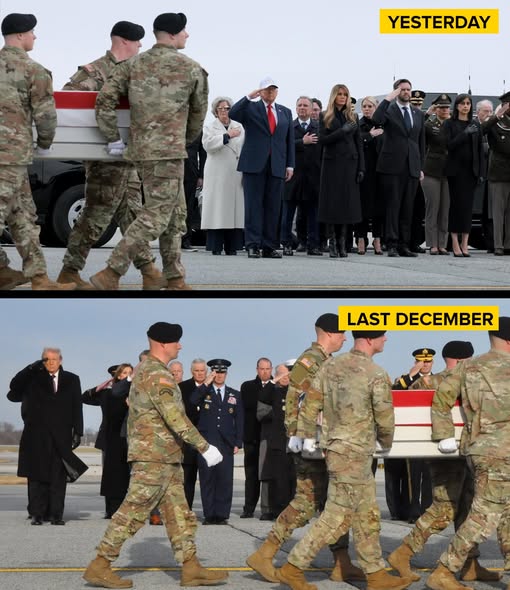 President Trump, wearing a baseball cap of the kind he promotes and sells, is shown in the top photo saluting (which is a formality normally reserved for uniformed military members) during the Dignified Transfer ceremony on March 7 for military members killed during the U.S.-Iran war. Yet Fox News broadcast to its audience a similar photo from last December, but without the baseball hat, as if it were the ceremony on March 7.
Letters from an American, Historical Commentary: March 8, 2026 [Taking Deaths Seriously], Heather Cox Richardson, right, March 9, 2026 Yesterday, President Donald J. Trump was among the dignitaries who attended the dignified transfer returning the remains of the six U.S. soldiers killed in the military action against Iran to the United States for burial. At the transfer, Trump wore a white USA baseball cap for sale in his campaign store.
Recognizing that Americans would recoil from seeing Trump wear a baseball cap at a dignified transfer, the Fox News Channel declined to show how he had looked yesterday and aired old footage of Trump from his first term without the hat. Caught in their lie, the Fox News Channel admitted they had shown the wrong footage but claimed it was inadvertent. They did not, however, show the real footage from yesterday, showing Trump wearing his merch.
The producers at the Fox News Channel seemed to recognize that Trump’s USA hat at a dignified transfer looked like deliberate disrespect for those whose lives had been taken in the service of our country. They seemed to understand the gulf between the administration’s cartoonish approach to the war in Iran and the reality of war for those participating in it.
The official social media account of the White House has portrayed its military adventures in Iran as a movie, or a game, splicing images from what appear to be footage of U.S. military strikes with clips from adventure movies and video games like Call of Duty and Grand Theft Auto.
Undeterred by criticism, White House communications director Steven Cheung called for supporters to show their enthusiasm for one of the videos in comments below it.
Last Thursday, March 5, Trump talked to ABC News chief Washington correspondent Jonathan Karl about the war. “I hope you are impressed,” he said. “How do you like the performance? I mean, Venezuela is obvious. This might be even better. How do you like the performance?” Karl answered that “nobody questions the success of the military operation, the concern is what happens next.”
“Forget about next,” Trump answered. “They are decimated for a 10-year period before they could build it back.”
“We’re marching through the world,” Senator Lindsay Graham (R-SC) told a laughing Maria Bartiromo of the Fox News Channel this morning. “We’re cleaning out the bad guys. We’re gonna have relationships with new people that will make us prosperous and safe. I have never seen anybody like it. This is Ronald Reagan Plus. Donald Trump is resetting the world in a way nobody could have dreamed of a year ago. He is the greatest commander in chief of all time. Our military is the best of all time. Iran is going down, and Cuba is next.”
The administration’s approach to foreign affairs appears to be the logical outcome of two generations of a peculiar U.S. cowboy individualism. Since the 1950s, right-wing ideologues in the United States have embraced a fantasy world in which a hero cuts through the red tape of laws and government bureaucracy to do what he thinks is right. That image was fed by TV westerns that rose after the 1954 Brown v. Board of Education decision to portray a world in which dominant white men delivered justice to their communities without the interference of government. By 1959, there were twenty-six westerns on TV. In one week in March 1959, eight of the top ten TV shows were westerns.
 The idea of white men acting for freedom and justice on their own, unhampered by a government that served Black Americans, people of color, and women, became a guiding image for the rising right wing beginning with Arizona senator Barry Goldwater in 1964. It found a home in the Republican Party with Ronald Reagan in 1980, as supporters took a stand against a federal government they insisted was redistributing the tax dollars of hardworking Americans to undeserving minorities and women.
That cowboy individualism spread into foreign affairs as well, until by 2003, right-wing talk radio host Rush Limbaugh could use it as shorthand to defend President George W. Bush’s military operation in Iraq. Just after the 2003 capture of Iraqi leader Saddam Hussein, Limbaugh gushed about presidents Ronald Reagan and George W. Bush, who had ignored the rules imposed by “liberals” and fixed what was wrong with the world. Limbaugh explained that Reagan was a cowboy: “He was brave, positive, and gave us hope. He wore a white hat…. Liberals hated Ronald Reagan.”
Limbaugh continued: “They also hate President Bush because he distinguishes between good and evil. He calls a spade a spade, and after 9-11 called evil ‘evil,’ without mincing any words, to the shock of the liberal establishment. That’s what cowboys do, you know…. In the old West, might did not make right. Right made might. Cowboys in white hats were always on the side of right, and that was their might. I am glad my President is a cowboy. He got his man! Cowboys do, you know.”
In Breaking the News today, James Fallows wrote that that way back in 2015, he concluded that “it had become far too easy for political leaders to strut and posture about ‘honoring the troops’—the Hegseth term ‘warfighters’ was not yet in common use—but then to commit them in half-thought-through “forever” wars, since so much of the public was so insulated from the consequences.”
But if Trump’s Iran adventure began with the strutting and posturing of a military performance, it is running hard into reality. It appears that Trump saw the strikes themselves as the culmination of his performance and did not have a plan for what would happen after them. He has said he was surprised that the conflict has included neighboring states.
Now the ships that carry about 20% of the world’s oil are not traveling through the Strait of Hormuz, and oil prices are surging. Rising oil prices are already hitting Americans at the gas pump—gasoline prices rose 14% last week—and will also hit the economy in general as jet fuel and diesel for trucks and tractors become more expensive. Trump tonight posted that high oil prices are “a very small price to pay for U.S.A., and World, Safety and Peace. ONLY FOOLS WOULD THINK DIFFERENTLY.”
The public support for the financing of this war is different from that of past adventures. While President George W. Bush could borrow to pay the cost of Operation Iraqi Freedom in 2003, 2026 is a different story. The national debt has ballooned in the two decades since the Iraq war, and Republicans last summer justified their dramatic cuts to government programs, including healthcare and supplemental nutrition assistance, by insisting that it must be addressed. Now Trump is spending an estimated $1 billion a day on Operation Epic Fury, highlighting that while there was no money for programs that helped the American people, there appears to be plenty for a war of choice in the Middle East.
Since the 1980s, Republican presidents have been able to sell their military adventures with the argument that, like cowboys, they were cutting through bureaucracy and laws in order to do what was right. As Limbaugh described it, they were never looking for trouble, but when trouble came they faced it with courage. They were always on the side of right, defending good people against bad people. They had high morals and spoke the truth. They were “a beacon of integrity in the wild, wild West.”
The fantasy of those who embraced cowboy individualism was that if only they could have full sway, they would solve the world’s problems and keep Americans safe. But the conduct of the war is starting to illustrate that any claims of a moral code disappear when a leader exercises military might on a whim. According to Defense Secretary Pete Hegseth, the U.S. will not be bound by any “stupid rules of engagement” and will rain down “[d]eath and destruction from the sky all day long. This was never meant to be a fair fight,” he said, “and it is not a fair fight. We are punching them when they’re down, which is exactly how it should be.”
On Wednesday, March 4, a U.S. submarine torpedoed an Iranian warship in international waters. The vessel was not participating in hostilities; it was off Sri Lanka returning from a naval exercise organized by India in the Bay of Bengal. In the past, the U.S. has participated in those exercises.
Andrew Roth, Cate Brown, and Hannah Ellis-Peterson of The Guardian noted that submarine attacks since World War II have been incredibly rare, as are attacks on vessels not taking part in hostilities. The ship was believed to have 180 people on board; Sri Lankan officials said they rescued 32 and recovered 87 bodies from the water. Hegseth boasted: “An American submarine sank an Iranian warship that thought it was safe in international waters.”
On Thursday, Phil Stewart and Idrees Ali of Reuters reported that the U.S. appears to bear responsibility for the February 28 strike on a girls’ school in Minab, in southern Iran, in the early waves of the Israeli-U.S. attack. The strike appears to have killed 168 people or more, many of them children. Since the Reuters report, others have noted that the U.S. was operating in the area and Israel was not. The strike remains under investigation.
After Saturday’s dignified transfer, Trump told reporters on Air Force One. “I hate to do it, but it’s a part of war,” he said. “It’s a sad part of war.”
“It’s the bad part of war.”
More Global News and Comment
Aaron Rupar (@atrupar.com) via BluSky, Lindsey Graham: 'Blow the hell out of those people,' Aaron Rupar, March 9, 2025. Quoting South Carolina Republican senator, above, on Fox News about Iran.
LINDSEY GRAHAM: Israel and the United States -- you just wait to see what comes the next two weeks
BARTIROMO: Meaning what?
GRAHAM: We're going to blow the hell out of these people.
U.S. Secretary of State Marco Rubio sits at a conference table with other officials in Doral, Florida under a backdrop that displays "Shield of the Americas Doral 2026" on March 7, 2026. Flags from participating countries are displayed behind the officials. (U.S. State Department photo).
Wayne Madsen Report, Investigative Commentary: Fooling his flock, Trump turns out to be just another Henry Kissinger globalist, Wayne Madsen, left,  March 9, 2026. Trump commences Operation Condor 2.0 in Western Hemisphere.
If one believes Trump White House propaganda, his Shield of the Americas is an emerging Western Hemispheric pact involving like-minded governments in advancing the use of military force to fight drug cartels, sharing intelligence, and countering Chinese influence. It is none of those things. It is nothing more than a return to the dark days of Operation Condor, a U.S.-backed campaign of state terror by South American dictatorships last lasted from 1975 to 1983. It was an era that witnessed several Latin American nations cooperating in political assassinations, torture, and the disappearances of between 60,000 and 80,000 leftists across the region. Operation Condor saw the incarceration of 400,000 political prisoners. Trump’s plans for ICE mass detention centers across the United States serves notice to the other Shield of the Americas countries that concentration centers like that of CECOT in El Salvador are now permissible across the Shield signatories.
Members of the Shield include, in addition to the United States, Argentina, Bolivia, Chile, Costa Rica, Dominican Republic, Ecuador, El Salvador, Guyana, Honduras, Panama, Paraguay, and Trinidad and Tobago. Leaders, other than Trump, who participated in the Shield summit were Kamla Persad‑Bissessar (Trinidad and Tobago), Santiago Peña (Paraguay), Luis Abinader (Dominican Republic), Nayib Bukele (El Salvador), Mohamed Irfaan Ali (Guyana), Rodrigo Chaves Robles (Costa Rica), Daniel Noboa (Ecuador), Rodrigo Paz Pereira (Bolivia), Javier Milei (Argentina), José Raúl Mulino (Panama), Nasry Asfura (Honduras), and José Antonio Kast (Chile, president‑elect). All face intense opposition to joining the pact from center-to-left parties in their legislatures.
After offering the Shield leaders U.S. missile strikes against their drug cartels, he also offended the delegates by criticizing their use of the Spanish language. Trump said, “I’m not learning your damn language. I don’t have time.”
One major difference between the Shield of the Americas, which Trump has appointed fired Department of Homeland Security Secretary Kristi Noem as U.S. Envoy, is that the United States is leading the way on disappearing immigrants and U.S. citizens by the thousands. In Operation Condor, U.S. Secretary of State Henry Kissinger sat back while Latin American dictatorships sought to stop the advance of “Communism” through disappearances and assassinations. Undoubtedly, Noem will bring her experiences with ICE to share with fascist-oriented Latin American governments eager to do crack down on progressive parties in their own nations.
Henry Kissinger meeting with Condor supporter General Augusto Pinochet of Chile in 1976.
The Shield of the America’s is a culmination of the “Trump Corollary to the Monroe Doctrine,” a narrowing of U.S. cooperation to ideologically aligned governments and treating the hemisphere as the U.S.’s immediate sphere of influence. The corollary is jokingly called the “Donroe Doctrine.” It stands as a total repudiation of John F. Kennedy’s Alliance for Progress, which promoted U.S. support for all Western Hemispheric democratic nations. Shield of the Americas deliberately narrows participation to like‑minded right‑leaning governments, bypassing multilateral bodies like the Organization of American States and the annual Summit of the Americas and excluding governments seen as unfriendly to U.S. interests. Not invited to the Doral summit were Mexico, Brazil, Colombia, and Haiti. It is not known whether Nicaragua, Uruguay, Venezuela, or Guatemala were invited or, if so, why they skipped the summit. Aside from Guyana and Trinidad and Tobago (and Belize in the military meeting run concurrent to the summit), no Caribbean Community (CARICOM) member was represented at Doral.
On March 7, Trump and his version of the insane Don Quixote’s loyal servant Sancho Panza, Marco Rubio, played co-host, along with Trump, of the inaugural summit in Florida of the Shield of the Americas. The summit included a motley collection of fascist and proto-fascist leaders who were Trump’s guests at his bedbug-ridden Trump National Doral Golf Club in Miami. The club once sat next to one of Florida’s largest waste landfills. The piles of waste could be seen from Trump’s gold course, something that became a running joke. In February 2023, the Covanta Energy waste-to-energy plant caught fire and it continued to burn for weeks. The cause of the fire remains unknown, as do most crimes involving or adjacent to the mobster-in-chief.
 U.S. Secretary of State Marco Rubio, left, greets the Trump-pardoned Jan. 6 insurrectionist Enrique Tarrio at the Trump-sponsored "Shield of Americas Summit" convening ultra-right Latin American leaders at Trump National Doral Golf Club in Miami.
And who was among the fascists gathered at Doral? None other than Enrique Tarrio, the former national leader of the white nationalist Proud Boys and a leader of the January 6, 2021 insurrection at the U.S. Capitol. Tarrio, photographed with fellow Cuban-American Rubio, appeared ecstatic over Trump’s plan to take over Cuba from its present government. Tarrio, who had been sentenced in 2023 to 22 years in prison prior to being pardoned by Trump, was at the Doral summit for a reason. Rubio and Trump were sending a message to the Brazilian government of leftist president Luiz Inácio Lula da Silva that the “Shield,” which sounds more like a Marvel comics group than an international alliance.
Tarrio’s presence in Doral with anti-democratic leaders from the hemisphere was a signal that Trump and his far-right allies would fight for Brazil’s release from a 27-year prison sentence of former far-right president Jair Bolsonaro, convicted of launching in Brasilia a carbon copy of the U.S. insurrection after his 2022 defeat for reelection.
“War Secretary” Pete Hegseth hosted a conference at the U.S. Southern Command headquarters, also located in Doral. Titled the "Americas Counter Cartel Coalition" (ACCC), the gathering of military chiefs, the signatories of a counter-narcotics agreement pledged to adopt the Trump administration’s aggressive military action against drug cartels, eschewing past law enforcement actions by police, prosecutors, and the courts. Signatories of the Counter Cartel Pact included all 17 signatories of the Shield of the Americas charter plus the Bahamas, Belize, and Peru. Hegseth told the signatories that the U.S. and Latin American countries shared a Christian heritage that would be instrumental in combating cartels, restore deterrence, and "make the Americas great again."
Operation Condor served as a transnational intelligence and repression network, sharing data, conducting cross‑border operations, and targeting dissidents abroad. Shield of the Americas replicates Condor in the sharing of intelligence and data, conducting cross-border operations, such as the recent U.S. military action against “cartel” groups in Ecuador, and targeting leftists. In Trumpworld-speak, cartels and leftists are often one and the same.
Stephen Miller, the cosplaying Nazi chief adviser to Trump, told the Latin American military conference that there was a reason why it was military-led and not a conference of lawyers. Miller emphasized that cartels can only be defeated with military power, a policy carried out by U.S. military forces against boat traffic in the Caribbean and eastern Pacific will deadly results that included the murder of innocent civilian fishermen on the high seas.
Miller, addressing a military audience of delegates from Honduras, Argentina, Dominican Republic, Argentina, Paraguay, Panama, El Salvador, and other countries, said, “I see some heads nodding up front because they understand you’re dealing with a lot of lawyers in your own country, I’m sure. You have my permission not to listen to them.”
Operation Condor saw Chile, Argentina, Uruguay, Paraguay, Ecuador, and Bolivia, with sporadic assistance from Peru, coordinating repression of leftist opponents.
As can be seen from Hegseth’s address to the Shield summit, his idea of “Making the Americas Great Again” is to restore the fascist dictatorships of Kissinger’s Condor era. When individuals like Hegseth, Steve Bannon, and Elon Musk render “sieg hiel” salutes they are not waving to a crowd. They are sending a message that their intent is to bring about a Fourth Reich on the principles of Adolf Hitler, Benito Mussolini, and now, Vladimir Putin and Donald Trump.
Coupled with the U.S.-Israeli war against Iran and the illegal kidnapping of Venezuela’s president and first lady, the Shield of the Americas and the Counter-Cartel pact move the United States firmly into the category of a fascist aggressor nation and international pariah state.

In April 1980, President Jimmy Carter delivered a nationwide address describing Operation Eagle Claw, a was a failed U.S. Department of Defense attempt to rescue 53 U.S. embassy staff held captive by Revolutionary Iran on 24 April 1980. Carer ordered the mission after Iran refused to release the hostages. The operation, as described here, encountered so many obstacles -- includding failures of three of the eight helicopters and a blinding sandstorm in an Iranian desert where U.S. personnel assembled prior to the rescue attempt -- that Carter aborted the mission. As the U.S. forces prepared to withdraw in the blinding sandstorm, one of the remaining helicopters crashed into a transport aircraft that contained both servicemen and jet fuel. The resulting fire destroyed both aircraft (with wreckage of the Bluebird helicopter shown below) and killed eight servicemen.
Emptywheel, Analysis: Trump Dreads Failing Like Jimmy Carter Did on Iran, Emptywheel, (Marcy Wheeler, right), March 9, 2026. The analogies that commentators are using to describe the crisis Donald Trump caused by launching an illegal attack on Iran jumble a lot together. And while smart economists say the world won’t suffer the kind of inflationary cycle it did in the 1970s, many people compare today’s disaster with the last time Iran’s radical clerics avenged US imperialism in epic fashion in 1979.
That’s why I keep coming back to the interview Trump did with the NYT, in the wake of his seeming successful kidnapping of Nicolás Maduro.
Three times, Donald Trump described his success in Venezuela in terms of the risk that it might have gone south like Operation Eagle Claw, Jimmy Carter’s failed attempt to rescue the American hostages in 1980.
Early in the interview, Trump offered up the comparison: “To think this could have turned out like Carter’s failed Special Forces operation!”
[T]o think that we could go in there and have nobody killed, not lose one aircraft, where we’re going 1,800 miles an hour over a small area with 152 different planes, different planes and helicopters, is pretty amazing to people, you know. You didn’t have a [President] Jimmy Carter crashing helicopters all over the place, that you didn’t have a Biden Afghanistan disaster where they couldn’t do the simplest maneuver. That was a simple maneuver — they should have never left from that airport. They should have used Bagram.
When Katie Rogers asked Trump what it felt like as he watched the operation in real time, Trump said he had been thinking primarily of the possibility of humiliating failure, like Carter.
 David E. Sanger,right,: Did you watch either by video —
- President Trump: I did. I was, I saw it.
- David E. Sanger: What — what did that feel like? You were down at Mar-a-Lago?
- President Trump: It’s like watching a movie, except you’re — it’s a little bit, you know — look, you don’t know if —
- Katie Rogers" Are you worried when this is happening, while you’re watching? Or what is going through your mind?
- President Trump Yeah, I’m worried that it ends up being Jimmy Carter disaster that destroyed his entire administration.
- And when, in a remarkable attempt at normalization, David Sanger asked Trump if he had studied — studied!?!?! Donald Trump?!?!?! — previous occupations, Trump could speak again of Operation Eagle Claw, that operation that might have been successful if Carter hadn’t rushed it.
- David E. Sanger: Did you study some other occupations? Japan, Iraq, others?
- President Trump: Yes, yes. I studied, I studied —
- David E. Sanger And what — what lesson did you draw from that, that we should know —
- President Trump: That it’s highly risky.
- David E. Sanger — for Venezuela?
- President Trump: That’s what I do.
- David E. Sanger: OK, so —
- President Trump: I looked at — I looked at some of the attacks. I studied the Carter attack. It was a disaster. I would have never done it that way.
- David E. Sanger: You were talking about the attack. I was asking about the occupations that followed —
- President Trump: You know, they had — they had a — they had a sandstorm. Did you know that? And they decided to go forward. We would go back, and let’s hit it three days later. They wanted to go forward, and they said, keep going. Helicopters don’t work well in the sand.
- Karoline Leavitt: Sir, do you want to show them the renovations?
Check please! Do you want to show off your shiny bunker-ballroom, Sir?
Curiously, DOD posted a review of the failed Eagle Claw operation last year. It turns out, Trump wasn’t the only one “studying” that operation. Here’s a snippet.
“This mission required a lot of things we had never done before. We were literally making it up as we went along,” said retired Air Force Col. Bob Brenci, the lead MC-130 pilot on the mission.
Flying using night-vision goggles was almost unheard of then, he said.
Operation Execution The mission began on April 24, 1980, with the arrival of the MC-130s at Desert One. The plan almost immediately began to unravel.
The piece describes (accurately) how the Eagle Claw failure led DOD to professionalize Special Operations and institutionalize a lot of other kinds of coordination, lessons learned that have served the US well since then.
Chief among the lessons, though, is that you don’t just make shit up as you go along.
Yet that is precisely what Trump has been doing.
Donald Trump has a pathological need to avoid being seen as he sees Jimmy Carter, a loser, someone who keeps leeching power over the course of an extended crisis.
And yet, as he keeps doing things that make that far more likely, just making shit up, everyone makes the obvious comparison with Carter’s failures. I think a lot of the commentary has not considered that Trump has caused himself a resounding blow to his own self-image, and every time they make the comparison with 1979, that wound is renewed.
At a very personal level, he will be seeking ways to not look like a loser. Which could make his decisions still more irrational.

New York Times, British Lawmaker Wants King Charles to Cancel His U.S. Trip Over Iran War, Michael D. Shear, March 9, 2026. Ed Davey, the leader of the Liberal Democrats in Britain, said President Trump does not deserve the “diplomatic coup” of hosting the king (shown above in a file photo) for a state visit.
Ed Davey, the leader of the Liberal Democrats party in Britain, called on King Charles III to cancel his state visit to the United States in protest of what Mr. Davey calls President Trump’s “illegal war” against Iran.
Mr. Davey urged Prime Minister Keir Starmer, right, to advise the king to call off the trip, which is expected to take place next month as part of  celebrations to mark the 250th anniversary of American independence. A specific date has not been announced.
“At a time when Trump has launched an illegal war that is devastating the Middle East and pushing up energy bills for British families, it’s clear this visit should not go ahead,” Mr. Davey said in a statement on Monday.
“A state visit from our King would be seen as yet another huge diplomatic coup for President Trump, so it should not be given to someone who repeatedly insults and damages our country.”
Buckingham Palace said that no state visit has been confirmed and that all state visits happen on the advice of the government. But government officials have previously indicated that planning was underway for the king to travel to the United States in late spring.
A spokesman for Mr. Starmer declined to comment. Steve Reed, a Labour Party lawmaker and a minister in the prime minister’s cabinet, told the BBC, “I don’t think it is for Ed Davey to decide what the King should or should not be doing.”
The centrist Liberal Democrats are the third largest party in the British Parliament, with 72 of its 650 seats.
Mr. Davey’s demand comes at a delicate moment for Mr. Starmer, whose relationship with Mr. Trump has gone from rosy to grim in the last several weeks. The president has repeatedly belittled the prime minister for not joining the initial attacks against Iran.
On Saturday, Mr. Trump lashed out again on his social media platform after Mr. Starmer announced that his government was sending more ships to the Gulf to help defend Cyprus and other allies.
“That’s OK, Prime Minister Starmer, we don’t need them any longer,” Mr. Trump wrote. “But we will remember. We don’t need people that join Wars after we’ve already won!”
Mr. Starmer had previously made it a priority to please Mr. Trump, saying that doing so would benefit Britain in its dealing with the United States. Last year, the prime minister was the first foreign leader to negotiate a trade deal with Mr. Trump to avoid even higher tariffs.
In September, the king hosted a lavish state visit for Mr. Trump at Windsor Castle after the invitation was delivered to the president by Mr. Starmer.
But the friendly relationship between the two leaders has frayed since then. Mr. Trump has angrily criticized Britain for refusing to allow America to use a joint U.S.-U.K. military base in Diego Garcia and another base in England to launch the initial attacks on Iran.
“He should be giving us, without question or hesitation, things like bases,” Mr. Trump said in an interview with the New York Post last week.
 The allied oligarchs Larry Ellison, Donald J. Trump, Benjamin Netanyahu and Tony Blair, from left to right (File photos).
How to Survive the Broligarchy, Commentary: Is this the Broligarchy's first world war? Carole Cadwalladr, right, March 9, 2026. AI-guided weapons, two out-of-control authoritarians, no legal authority and a toxic mess of masculinity: welcome to the manosphere's first major conflict.
The brand is chaos. That’s the defining quality of everything that Donald Trump is doing. It’s also the state of our information system. They’re both marked by the same absence of rationality, order, logic, rules and signposts to the future. We are living in an eternal present, an unending scroll of news, videos, cats falling off logs, bombs blowing up apartment blocks and perfectly smooth foreheads speaking at the camera as they narrate the narrowest of world views.
There is no sense to be had in a media landscape that both mirrors and enables the political turbulence we’re living through. We’re trapped inside this never-ending algorithmic scroll where our dopamine-fuelled lust for the endless new is Trump’s literal foreign policy.
In three months, we’ve careered around the world in his wake from Venezuela to Greenland to Iran. Next stop Cuba.
I’m writing these words, after a gap of silence, because the last thing I wanted to do is to add to the noise. And I can’t presume to try and help make sense of what’s happening in the world for anyone else when I can’t understand it myself. And I don’t see how anybody can.
The chaos we are living through is the equivalent of cognitive assault. Our extra-sensory information landscape engages our frontal lobes in the busyness of mental processing from which no meaning comes. Three weeks ago, the news cycle stopped briefly on a subject that for a brief moment was shocking even in spite of this algorithmic numbing.
The dazzling glare of public exposure shone a light on a global network of rich and powerful men, many of them household names, who had participated in, or turned a blind eye to, an international trafficking operation involving hundreds of women and girls. For the briefest of moments, it felt like a sharp blast of daylight had been shone on one of the darkest corners of our world. There was no path to justice or accountability for the victims of Jeffrey Epstein, but there was some small comfort in that at least, finally, it couldn’t be ignored.
How wrong can you be? Of course, it could be.
The news cycle hasn’t just moved on, we are now deep into the testosterone zone, the fizzing, almost sexual excitement of war. This is what the early stages of all wars look like. Pumped up officials walking stiff-legged to podiums to tell the waiting press about the incredible potency of their firepower. Videos of fighter jets commanding the skies. Mesmerising footage of high-tech “intercepts” across the night sky. Spectacular explosions among dense tower blocks, all of it so familiar from any video game while a constant parade of interchangeable military men, analysts, commentators pontificate across our screens.
This was what was on the White House’s social media accounts three days ago. A hyper-masculine meme-ified fantasy of war.
But there’s another even more dangerous fantasy at play because this is a war that is being waged with a new generation of AI-guided missiles.
What’s happening in Iran is a step-change. Gaza was the laboratory, this is the next stage. Reporting from 972 magazine in 2024 revealed the Israeli military were using an AI programme, Lavender, to find and profile targets.
And last week, the WSJ and Washington Post revealed that the US deployed AI at scale. It reports the US military is using the “Maven Smart System” built by Peter Thiel’s Palantir and powered by Anthropic’s Claude to profile and select kill targets.
Or as this excellent piece by the Citizens sums it up:“The same logic that built recommendation engines and social media algorithms is now being applied to the industrial generation of kill lists.
Chatbot systems that entered public life writing emails, summarising documents and telling you what to have for dinner now help determine who lives and who dies.”
Three weeks ago, details of Peter Thiel’s relationship with Epstein came tumbling out. A social, intelIigence and business relationship that saw Epstein invest $40m in Thiel’s Valar Ventures and, with the former Israeli PM, Ehud Barak, co-invest in an Israeli surveillance firm, Carbyne.
This week, news of Palantir’s involvement in the US’s and Israel’s war of choice saw its stock price rise 15%. Was it AI that selected the Iranian school where at least 168 people were killed, mostly children?
Investigations by three major US news organisations - the New York Times, CNN and Reuters - have now concluded the school was hit by US bombs. Reuters identified a “double tap”, two strikes, 40 minutes apart. The open-source investigative site Bellingcat yesterday published a report that reviewed verified footage and identified the missile which hit the school to be a US Tomahawk. That report has now been independently replicated by the New York Times.
I grew up in Wales and felt the chill every time we passed a road sign to “Aberfan”. My dad would recount the story of the day a coal tip fell on the town’s school killing 144 children. The name of Aberfan is still burned into the nation’s collective memory more than half a century on. But the slaughter of an entire community’s children in the town of Minab in a single day? It’s an obscenity that’s caused barely a ripple of anguished outrage.
We now need to know: was AI involved in targeting this school? This is a crucial question. Were those children the collateral damage of an AI hallucination? We all know how unreliable these large language models are. We’ve all been served a bullshit answer based on a fabricated link. Now apply this to war.
We can’t let this moment pass. Minab, like Aberfan, is a place that should be burned onto our brains. AI, like war, is another hyper-masculine fantasy of God-like power. It’s nothing of the sort, it’s just a story, a myth, that’s being imposed on us by a self-interested cohort of unaccountable men succoured by a pliant and incurious press.
But not here. Not in this newsletter, not on the day after International Women’s Day, not in the midst of a new illegal war that the US and Israel have started and that Britain is being press ganged into joining by a right-wing media that’s using Trump’s words as if they were evidence of anything other than an out-of-control megalomaniac.
Forget Andrew Tate, this is the real manosphere. One whose edges we can’t even see because we’re living inside it. Our world is controlled by these men, their platforms, their alliances with nation states, technology-fuelled political power which is only accelerating and gathering strength.
When I coined the word “broligarchy” it wasn’t as a cutesy pun: I used it to describe the confluence of Silicon Valley technologies and US state authoritarianism, and a warped toxic pseudo-masculinity that’s at its heart.
Andrew Tate is simply a phenomenon that is downstream of this. He’s a visible excrescence that’s a byproduct of this phenomenon, nothing more than a boil on the backside of the broligarchs. Two weeks ago, in the midst of the Epstein revelations, I read Gisèle Pelicot’s autobiography ahead of what was going to be a last-minute interview with her. It’s an astonishing story of almost superhuman resilience but it also forced me to confront yet another bleak dystopian consequence of our brave new digital world.
The multiple rapes Gisèle Pelicot survived were only possible because a technology platform enabled her husband to connect with other rapists -- at least 72 of them -- in a 50km radius of their small French provincial town.
What do you do with that information? In the pre-internet age, would all those men be rapists? I don’t believe so. Their desires were normalised by algorithmic forces beyond their control and an opportunity was presented by a platform that offered anonymity and impunity. It fed them a fantasy of God-like power and control: possession of a woman who literally couldn’t fight back.
You don’t want to face this. None of us do. It’s too dark, too bleak. But to understand what is happening now, in Iran and Lebanon, and the forces behind it, we need to see that this is a continuum. Dominique Pelicot and Andrew Tate and Jeffrey Epstein are only symptoms. They are the doorway through which we can understand the forces behind not just another catastrophic Gulf War but a global power structure in which state violence, commercial profit and the control, domination and violation of women are inextricably entwined.
For those of us old enough to remember the despair and helplessness we felt at the outbreak of the last Gulf War, it’s impossible to avoid vivid flashbacks from that era and one figure in particular: Tony Blair. On Friday night, a story dropped in the Daily Mail that claimed Tony Blair had “rebuked” Keir Starmer for not backing Trump.
The comments, it was said, were made at a private event where Blair was quoted as saying. “The American relationship matters. It matters particularly today. It's not a question of whether it's this president or that president. If they are your ally and they are an indispensable cornerstone for your security... you had better show up.”
If the British people had a vote on who would be the very last person they’d like to hear from now, I suspect that there would be a landslide for Tony Blair. He led us into the disastrous war on Iraq and he’s never expressed guilt, contrition or doubt. But his rhetoric is exactly what the united ranks of the right-wing press have been saying since Trump and Netanyahu began this war. They’ve been making cheap political capital about the UK government’s reluctance to facilitate an illegal war they weren’t even warned about. (Bookmark this paragraph for when the war reaches Britain’s shores and Keir Starmer is also to blame.)
But Blair also throws a helpful light on what else is at stake here and who else is involved. Because Tony Blair is not a free agent or simply a mouthpiece simply for the opinions of Tony Blair. Tony Blair’s entire project -- the Tony Blair Institute for Global Change -- is bankrolled by Larry Ellison, the billionaire founder of Oracle, the technology company that’s front and centre, alongside OpenAI, in the great AI bubble boom.
In Britain, Blair has to be considered an unregistered lobbyist for Larry Ellison. He’s received in the order of half a billion dollars from him. Blair may very well believe everything he says with every fibre of his being -- it’s likely part of the reason Ellison hired him - but Tony Blair’s financial interests are also squarely Larry Ellison’s financial interests.
And Larry Ellison’s financial, commercial and now ideological interests are not Britain’s or even America’s. Larry Ellison mostly acts in the interests of Larry Ellison. But as I laid out in this investigation for the Nerve -- Ellison, a Trump donor and ally, is also tightly bound up with Netanyahu -- his good friend and sometime holiday companion.
And both Blair and Ellison are front and centre of the plans for Gaza, Blair as a member of the absurdly named “Board of Peace” and Ellison as one of the technology companies that stand to control and profit from the grotesque plans for redevelopment.
 Tony Blair, right, is a way to understand the forces at work in this latest war. A confluence of US and Israeli state, technological and commercial interests that stand to gain from this war. That Blair’s views are being channelled into the UK press as it cheerleads for Britain to join this war without this disclaimer is yet another point of failure. Though that’s as nothing compared to the power over the US press and media which Larry Ellison now wields -- through his son, David Ellison, a nepo baby in the mould of Succession’s Roman Roy.
Ellison’s purchase of CBS has turned it into a state propaganda outlet and with the proposed buyout of Warner Brothers, CNN and HBO Max are next in line. He’s also acquired a majority stake in the US company that now controls TikTok. This consolidation is being reported in the US as a business monopoly story. Hollywood Reporter and Deadline have carried quotes from Hollywood types saying they think it’ll be fine because David Ellison likes movies.
This isn’t about who controls the Harry Potter franchise or even the CBS newsroom. It goes beyond even the creation of a state-aligned propaganda machine with one central point of coordination across multiple news and media brands. There’s a far bigger strategic power play at work here, the Trump-Netanyahu alliance that’s behind this latest war. And Blair is the key that helps unlocks this.
The takeover of the US media is part of the same power players behind the “Board of Peace”, an organisation owned and run in perpetuity by Donald Trump, that’s been set up not just to rape Gaza but to replace the United Nations with a wholly illegitimate pseudo authority. Whatever else we do in this moment, it cannot include listening to Tony Blair.
I don’t know where we sit in that open space, but I do know this:
Trump and the Republican party talk openly about moving America to the right side of this scale. Trump has used chaos to create political opportunity for himself continually over the last decade. And as a society moves toward authoritarianism, the less important popular will becomes and the more important institutional control—of the police, the army, the media, the business community, the judicial system—becomes.
If I were confident that we were still basically on the left side of the scale, then I’d be sanguine about the political damage the Iran war is doing to Trump.
I worry that we don’t have a clear sense of where we are, as a society. And that we may have already drifted to a place where this war will present at least as many opportunities as dangers for our strongman.
A note on who I am: I’m an investigative journalist who’s spent a decade reporting on the collision of technology and democracy including exposing the Facebook/Cambridge Analytica scandal for the Guardian and the New York Times. Two years ago, I called the alliance of Trump, Silicon Valley and a global axis of autocracy: a tech bro oligarchy, aka the Broligarchy. Please help me continue to expose it.
More On Iran Operations, Impacts
Popular Information, Accountability Journalism: 9 days in, the most basic question about the Iran war remains unanswered, Judd Legum, right, March 9, 2026. In just over a week, Trump and top administration officials have given at least 17 different responses about why the war began.
9 days in, the most basic question about the Iran war remains unansweredIn just over a week, Trump and top administration officials have given at least 17 different responses about why the war beganJudd LegumMar 9 READ IN APP Defense Secretary Pete Hegseth speaks during a press conference in Washington, DC, on March 2, 2026. (Brendan SMIALOWSKI / AFP via Getty Images)
On February 28, President Trump announced that “the United States military began major combat operations in Iran.” The war has claimed the lives of more than 1500 people, including about 1300 Iranians, dozens in neighboring countries, and six U.S. troops. The Pentagon has estimated the conflict is costing U.S. taxpayers about $1 billion per day — and that figure may be too low.
And yet, nine days into the war, Trump and his administration have failed to clearly answer the most fundamental question: Why did the war begin?
Instead, the Trump administration has offered a bewildering series of shifting, contradictory, and factually incorrect answers. In just over a week, Trump and top administration officials have given at least 17 different responses about why the war began:
Iran’s nuclear program was “obliterated” last June, but the U.S. started the war because Iran refused to abandon its “nuclear ambitions.” In his February 28 announcement, Trump said that “in Operation Midnight Hammer last June, we obliterated the regime’s nuclear program.” The U.S. initiated this attack, Trump said, because Iran “rejected every opportunity to renounce their nuclear ambitions, and we can’t take it anymore.”
The U.S. attacked Iran to prevent a nuclear war. “If we didn’t do what we’re doing right now, you would have had a nuclear war, and they would have taken out many countries,” Trump said on March 3.
Absent an attack, Iran would have had a nuclear weapon within two weeks. “If we didn’t hit within two weeks, they would’ve had a nuclear weapon. When crazy people have nuclear weapons, bad things happen,” Trump said on March 4.
Iran is developing long-range missiles that “could soon reach the American homeland.” In his February 28 speech, Trump said that Iran was “developing the long-range missiles that can now threaten our very good friends and allies in Europe, our troops stationed overseas, and could soon reach the American homeland.” The idea that Iranian long-range missiles posed an imminent threat is not supported by public intelligence assessments. An assessment by the Defense Intelligence Agency published last May estimated that Iran would need ten years to develop a missile capable of reaching the United States — if it chose to pursue that capability.
The war is necessary because Iran has too much control over the global oil supply. On March 2, Secretary of State Marco Rubio said, “This terroristic regime, led by radical clerics, has the ability potentially to shut off 20 percent of global energy. That’s the kind of leverage they have because of their navy. We’re going to destroy their navy.”
The U.S. started the war because it knew Israel was going to attack Iran, endangering U.S. troops. “We knew that there was going to be an Israeli action, we knew that that would precipitate an attack against American forces, and we knew that if we didn’t preemptively go after them before they launched those attacks, we would suffer higher casualties,” Secretary of State Marco Rubio said on March 2.
The U.S. did not start the war because it knew Israel was going to attack Iran. The following was an exchange between Rubio and a reporter on March 3: “Q: Mr. Secretary, yesterday you told us that Israel was going to strike Iran and that that’s why we needed to get involved… SECRETARY RUBIO: Yeah, your statement’s false.”
Trump pushed Israel to join an attack on Iran because he believed Iran would otherwise attack first. “You see, we were having negotiations with these lunatics, and it was my opinion that they were going to attack first. …If we didn’t do it, they were going to attack first. I felt strongly about that. …So, if anything, I might have forced Israel’s hand,” Trump said in the Oval Office on March 3.
The U.S. attacked Iran to eliminate the threat posed by its short-range missiles and drones. “The United States is conducting an operation to eliminate the threat of Iran’s short-range ballistic missiles…,” Rubio said in his March 2 briefing. He also cited the need to destroy Iran’s “one-way attack drones.” According to Rubio, these missiles would act as a “shield” and allow them to later produce nuclear weapons. House Speaker Mike Johnson (R-LA) reiterated this claim after receiving a classified briefing the same day. “The objective was to take out those missiles, the short- and mid-range missiles, and their ability to produce them,” Johnson claimed.
The U.S. attacked Iran because “they’ve been killing Americans for 47 years.” This was cited by Trump in his February 28 announcement and by Secretary of War Pete Hegseth on March 4.
The U.S. attacked Iran because Iran is “the weakest they’ve ever been.” Hegseth made this claim as a justification for the War in his March 4 press briefing.
The war on Iran was started because of the “cumulative effect of various direct threats” and Trump’s “feeling, based on fact, that Iran does pose an imminent and direct threat” to the U.S. “This decision to launch this operation was based on a cumulative effect of various direct threats that Iran posed to the United States of America, and the president’s feeling, based on fact, that Iran does pose an imminent and direct threat to the United States of America,” White House Press Secretary Karoline Leavitt said during a press briefing on March 4.
The war is personal payback for Trump. “I got [Ayatollah Ali Khamenei] before he got me,” Trump told ABC News on March 1. “They tried twice. Well, I got him first.” Trump was referring to intelligence that Iran was plotting to assassinate Trump during the 2024 presidential campaign. This rationale was repeated by Hegseth during a March 4 press briefing. “The leader of the unit who attempted to assassinate President Trump has been hunted down and killed. Iran tried to kill President Trump, and President Trump got the last laugh,” Hegseth said.
The U.S. started the war because the Iranians were not negotiating in good faith. “Tehran was not negotiating. They were stalling, buying time to reload their missile stockpiles and restart their nuclear ambitions,” Hegseth said on March 2.
Trump started the war to secure freedom for the Iranian people. “All I want is freedom for the people,” Trump told the Washington Post on February 28.
The U.S. attacked Iran because it was the “last best chance” to do so. “This was our last best chance to strike…and eliminate the intolerable threats posed by this sick and sinister regime,” Trump said on March 1.
The war is a response to Iran’s efforts to interfere in U.S. elections. Trump posted this article on Truth Social on February 28: “Iran tried to interfere in 2020, 2024 elections to stop Trump, and now faces renewed war with United States.”
Nevertheless, Hegseth has described the war’s mission as “very very clear“ and “laser-focused.” Rubio said the war had “a very clear goal“ and he didn’t understand why there was any “confusion.” Leavitt said that Trump had laid out “achievable objectives.”
On Truth Social, meanwhile, Trump declared that the war would continue until he achieved his “objective of PEACE THROUGHOUT THE MIDDLE EAST AND, INDEED, THE WORLD!“
The Contrarian, Opinion: Inexcusable Incompetence, Jennifer Rubin, right, March 9, 2026. Tens of thousands of civilians are stranded and at risk.
“Everyone saw this coming except the President.” An “unmitigated disaster of epic proportions.” Were these the words from Democrats decrying Donald Trump for failing to plan to evacuate hundreds of thousands of civilians under a blizzard of retaliatory fire raining down on the Gulf States? No, those were Republicans excoriating former president Joe Biden for the botched 2021 exit from Afghanistan. Back then, Rep. Steve Scalise (R-LA) thundered, “It’s a very dire situation when you see the United States Embassy being evacuated.”
Fast forward to last week. The Trump regime closed down three of our embassies (Saudi Arabia, Lebanon, and Kuwait), abandoning U.S. citizens in those countries. Trump’s minions failed to consider advanced planning to evacuate Americans from the region, leaving them to fend for themselves in places where missiles are flying and buildings are ablaze.
Story after story has documented Americans scared, stranded, and left to find their own transportation out of countries made dangerous by his careless whims. Many have expressed their understandably fury that their government could be so derelict. The State Department has failed spectacularly in one of its essential missions — protecting Americans around the world.
The Trump regime’s level of recklessness and indifference to human life and international order should appall all Americans. Trump’s excuse for making no evacuation plans — “Well, because it happened all very quickly” — is ludicrous, considering the U.S. and Israel apparently spent months planning the military assault. His jaw-dropping admission that Iran’s bombardment of neighboring countries in retaliation was “probably the biggest surprise” reflects how little thought he put into a war with global ramifications.
Even in Afghanistan in 2021, after initial mayhem, the State Department scrambled, mounted a all-hands-on-deck rescue operation, enlisted personnel worldwide, and evacuated over 100,000 people in just a couple weeks. We see no comparable sense of urgency now.
Foreign policy professionals who have planned and executed mass evacuations of civilians in war zones over decades blasted Trump’s negligence. State Department veteran and Middle East expert Jeffrey Feltman recently argued, “It is a complete dereliction of duty for President Trump and his administration to have been planning this war for the past month, however long it’s been since they’ve been moving assets, without planning for an evacuation of American citizens.” He expounded on the cavalier and irresponsibly failure to protect Americans:
You know, Biden rightly got criticized for the shambolic withdrawal from Afghanistan. But we’re talking now about the potential of… American citizens being trapped in 14 different countries when they could have been planning all along for how they were going to deal with this. Right now, right now, the statements are, “Use commercial means to leave.” Well, there are no commercial means to leave. There’s been some hints they’re looking at this, but they could have put all this in place.
How could they not have expected a country with a stockpile of missiles would retaliate across the region, endangering tens of thousands of Americans? Secretary of State Marco Rubio and Trump’s pathetic excuses for neglecting elemental steps to protect Americans left Democrats, ordinary people, and foreign policy insiders flabbergasted.
Sen. Andy Kim (D-N.J.) reported his office was inundated with “panicked calls from Americans stuck in the Middle East, outraged that our government has provided zero evacuation support.” Combat veteran Sen. Tammy Duckworth (D-Ill.) was outraged by the absence of any “evacuation plan for Americans in the region when he launched his reckless, needless and unconstitutional war of choice against Iran.” Others joined in denouncing the institutional malpractice.Subscribed
This display of incompetence should not surprise us, given that the MAGA crew harbors such contempt for government. The massive cuts and loss of scores of foreign policy professionals (collectively representing centuries of experience) mean institutional knowledge is scarce. DOGE cuts conducted by know-nothing twenty year olds, partisan witch hunts, early retirements, and mass resignations have hollowed out the State Department, leaving it in the hands of a skeletal staff retained for their political loyalty — not expertise and experience. (Rubio also slashed staff at the National Security Council, which is supposed to oversee interagency planning.) In any other administration, the secretary of state/national security adviser would get canned or forced to resign in disgrace after such management malpractice.
As Columbia University Professor Elizabeth Saunders explained, Trump and Rubio’s “gutting of the State Department and blowtorching of US diplomatic capacity and credibility is an accelerant to this spiraling war and will seriously undercut US/allied efforts to pick up the pieces after.” If they bollixed up something as foreseeable as evacuations, imagine what chaos will ensure when the fighting stops.
For over a year, buffoonish Cabinet secretaries and their senior advisers have demonstrated the Trump regime is no “meritocracy.” As in all corrupt regimes that value sycophancy over competence, avoidable errors multiply over time. Americans trapped in a regional war zone (not to mention our armed service and regional allies) now pay the price for an unhinged and impulsive president enabled by careless, juvenile advisers who think war is a video game.
Meanwhile, no one at the White House has the temerity to contradict Trump’s “gut” impulses. Without aides to restrain Trump’s whims (e.g., Mr. President we need to get the Americans out first), he blunders forward.
To compound the problem, MAGA’s cult of personality that necessitates Republicans abdicate their legislative responsibilities, Congress would have voted for a war powers resolution, or at the very least, initiated aggressive oversight. Alas, the Republicans (who have time to quiz the Clintons behind closed doors about the pedophile scandal) show no interest in determining how this travesty unfolded and what is being done to remedy it. Instead, Hill staffers are left to field angry calls from constituents begging for help.
Congress must rouse itself to focus on a foreign policy disaster that makes the Iraq War look like a masterstroke. Rubio and other top officials under oath and in public should answer for their lapses, account for every dime spent, and give Congress some basic information. (What is the plan to extract Americans? When does the war end? Are we now targeting civilians?) The last thing Congress should do is agree to any request, as the Trump team is reportedly contemplating, to shovel more money into the coffers of this gang of bumblers.
Unfortunately, we know how this will play out. Trump and his arrogant yes-men will never admit error, let alone apologize; Republicans on the Hill will not stir themselves to do their jobs. It will be up to the voters to throw out every elected Republican and force removal of the architects of this catastrophe. Until that happens, Americans here and abroad will needlessly suffer and die.
New York Times, U.S. Tomahawk Hit Naval Base Beside Iranian School, Video Shows, Malachy Browne and John Ismay, Updated March 9, 2026. The evidence contradicts President Trump’s claim that Iran was responsible for a strike at the school that killed 175 people, most of them children (shown above).
A newly released video adds to the evidence that an American missile likely hit an Iranian elementary school where 175 people, many of them children, were reported killed.
The video, uploaded on Sunday by Iran’s semiofficial Mehr News Agency and verified by The New York Times, shows a Tomahawk cruise missile striking a naval base beside the school in the town of Minab on Feb. 28. The U.S. military is the only force involved in the conflict that uses Tomahawk missiles.
A body of evidence assembled by The Times — including satellite imagery, social media posts and other verified videos — indicates that the Shajarah Tayyebeh elementary school building was severely damaged by a precision strike that occurred at the same time as attacks on the naval base. The base is operated by the Islamic Revolutionary Guards Corps.
Asked by a reporter from The Times on Saturday if the United States had bombed the school, President Trump said: “No. In my opinion and based on what I’ve seen, that was done by Iran.” He said, “They’re very inaccurate, as you know, with their munitions.”Defense Secretary Pete Hegseth, who was standing beside Mr. Trump, said the Pentagon was investigating, “but the only side that targets civilians is Iran.”
President Trump said he believed that Iran was responsible for a strike on an elementary school that reportedly killed 175 people.
The video of the strike, which was first reported by the research collective Bellingcat, was independently verified by The Times. We compared features visible in the footage to new satellite imagery captured days after the strikes in Minab.
The video was filmed from a construction site opposite the base and shows a worn, dirt path across a grassy area and piles of debris also evident in recent satellite imagery, bolstering its credibility. The video also comports with other verified videos taken in the immediate aftermath of the strikes.
A Times analysis of the video shows the missile striking a building described as a medical clinic in the Islamic Revolutionary Guards Corps base. Plumes of smoke and debris shoot out of the building after it is hit as the distant screams of onlookers are heard.
As the camera pans to the right, large plumes of dust and smoke are already billowing from the area around the elementary school, suggesting that it had been struck shortly before the strike on the naval base. This is supported by a timeline of the strikes assembled by The Times that shows the school was hit around the time as the base.
Several other buildings inside the naval base were also hit by precision strikes in the attack, an analysis of satellite imagery showed. Determining precisely what happened has been impeded by the lack of visible weapons fragments and the inability of outside reporters to reach the scene.
PoliticusUSA, News and Commentary:Trump Is Looking For A Way Out Of His Iran War Disaster, Sarah Jones, March 9, 2026. It looks like Donald Trump and his administration are looking for a way out of their Iran war, as they have changed America's objectives, and are starting to panic as gas prices skyrocket,
The Iran war has backfired on Donald Trump and his party. Gas prices are rising exponentially. The world is concerned about a global economic meltdown, and Iran’s regime doesn’t seem to be going anywhere.
Now that the consequences for a war of choice are blowing back on them, the administration is changing its tune.
The Daily is outside the Beltway journalism for the people. Please support us by becoming a subscriber.Subscribed
First came Secretary of State Marco Rubio, who changed the objectives for the war:
This mission is clear, and it’s important to continue to remind the American people of why it is that the greatest military in the history of the world is engaged in this operation. It is to destroy the ability of this regime to launch missiles, both by destroying their missiles and their launchers, destroy the factories that make these missiles and destroy their navy.
I think we are all seeing right now the threat that this cler clerical regime poses to the region and to the world. They are trying to hold the world hostage. They are attacking their neighbor. They are attacking neighboring countries, their energy infrastructure, their civilian population. They’re attacking embassies.
This is a terrorist government. This is a terroristic regime, and we are seeing them conduct terrorism using nation state elements, using weapons like missiles, and one way attack drones. And the objective of this mission is to destroy their ability to continue to do that, and we are well on our way to achieving that objective every single day with overwhelming force, with overwhelming precision. The military, the United States military, the men and women in uniform are conducting an extraordinary operation. There are not a lot of cameras down there covering what they’re doing, as opposed to some of the other images that you may see from some of the cities and capitals nearby.
But I want everyone to know your military is getting the job done and every single day this regime in Iran has less missiles, has less launchers, their factories work less, and their Navy is being eviscerated. And the world is going to be a safer and a better place when this mission is accomplished.
What Rubio left out is that Iran has a stockpile of more deadly weapons that it hasn’t touched yet, so the Trump administration has gone from regime change to destroying the Iranian nuclear program to destroying Iran’s military.
The objective keeps getting smaller.
It seemed like the administration was looking for a way out, then Trump spoke and confirmed it.
Trump tried to stop the rising gas prices by proclaiming that the war with Iran, which he claimed would last weeks or months, was nearly over.
Trump told CBS News:
I think the war is very complete, pretty much. Iran has no navy, no communications, they’ve got no air force. Their missiles are down to a scatter. Their drones are being blown up all over the place, including their manufacturing of drones.
If you look, they have nothing left. There’s nothing left in a military sense.
That bit of Trumpian nonsense was enough to send the stock market up again and oil prices falling.
The problem is that it doesn’t matter if Trump thinks that the war is complete. If Iran decides to seek retribution on the United States by wrecking the global oil market, there isn’t much that Trump can do to stop them.
The war has been an unpopular fiasco from the beginning.
If the administration stops dropping bombs tomorrow, what did it accomplish, besides killing some of Iran’s leadership, blowing up military equipment, and murdering nearly 200 school girls?
There will be no regime change. Trump has, as of the publication of this article, gotten rid of the Iranian nuclear program. Iran will be able to reacquire and rebuild what was destroyed.
What was the point of this operation? The Trump administration has never been able to clearly tell the American people why this war began, and now that Trump is getting even more criticism at home, it seems like he is cutting and running.
The damage has been done, and the American people will make their voices heard loud and clear in November.
Lance’s Substack, Opinion: Once More With Feeling, Pete Hegseth’s Mental Condition Is Cause For His Immediate Removal, Lance F Rosen,  right, March 9, 2026. Last week I wrote about Hegseth’s mental illness, in the form of his homicidal racism, misogynistic brutality, Oedipal rage, and his pseudo-Christian apocalyptic fantasy vision. I drew the comparison with the movie character in Kubrick’s satirical World War III film “Dr. Stranglelove,” General Jack D. Ripper.
The Guardian article linked below, which details his various statements regarding the US-Israeli war with Iran, serves as an exclamation point, an addendum to that article. It includes commentary from military professionals who have a broad range of expertise on what constitutes the necessary outlook and qualifications for someone to provide effective leadership as is required of the Pentagon’s top official.
I’m posting it here because it underscores the cartoonish, infantile, hostile fantasy world which is Hegseth’s mental life. It is as if he is seven years old, and lives in the headspace of GI Joe action figures and “Call Of Duty” video games, in which he believes that if he gets enough “kills” and blows up enough buildings that his Mommy will recognize him for being a very grown-up and potent little man, even stronger than his Daddy.
Clearly he is in some sort of performance mode to live up to the standard of the fake orange Cowboy in clown’s greasepaint, by role-playing the Alpha-male testosterone junkie which he’s expected to be by his draft-evading gutless coward of a child-rapist boss. His use of the terms “warfighter” for soldiers, calling himself “Secretary Of War” who lives by a “warrior ethos” are hallmarks of a form of delusional psychosis reminiscent of mental patients claiming to be the authentic Napoleon Bonaparte. He is not simply a “Chickenhawk,” he is Warner Brothers character Foghorn Leghorn in a Rambo suit cosplaying as a Super-Chicken. But there is more to it.
It is worth re-stating that Hegseth is a blackout drunk, and according to his own Mother a domestic abuser. He is also in a cult run by a woman-hating Nazi evangelical church. In every sense of the expression Hegseth is a “clear and present danger” to both the United States and to global stability, because of his psychotic religious and personal beliefs.
The general news media narrative has misleadingly characterized him as just incompetent and having far-right beliefs. He is far worse than that. In fact he is more comparable to one of Adolf Hitler’s SS Generals in charge of the “Einzatzgruppen” units on the Eastern Front, one promoted from the Wehrmacht’s dregs, whose deployment was to carry out mass slaughter of Jews and Slavs in order to carve out new “Lebensraum” for the Nazi’s master race.
He is possessed of the cult belief that he is leading a “Holy War” and is acting as God’s instrument in following the orders of Trump, who he believes was ordained by Jesus to bring about “End Times.” All of us should be fully cognizant that between Hegseth’s destructive mental state, and Trump’s lifelong erotic obsession with unleashing violence and chaos, that the potential for a deployment of US tactical nuclear weapons against Iran is very much in play.
The reports last week that Hegseth ordered military commanders to indoctrinate their personnel to believe that this is what they are fighting for, should have been cause for him to have been put in restraints, dragged out by force, and institutionalized. Instead he is being celebrated on Fox News as a greater war hero than Generals U.S. Grant and Eisenhower by the despicable closeted hypocrite and accused pedophile Senator Lindsey Graham.
It is vital that Americans recognize the implications of this reality. We, the people, have absolutely no right to sit back passively and wait until November to vote out the Republicans who enabled Trump and Hegseth. The spectator mentality and those who indulge in it, those who lie to themselves so they can lie to others by saying, “there’s nothing else I can do because I’m powerless,” are, in my opinion, objectively our leading problem aside from the regime itself.
That said, the activity of the Democratic opposition has died down since Minnesota’s anti-ICE demonstrations. There are scattered local anti-war protests, local political campaigns, and such things. This “pulling back” factor is actually one of the reasons that Trump and others of history’s mad dictators launch wars to begin with. Opposing our government during wartime can get people into some serious trouble, and if there is anything that could be said about why Trump was elected President twice is that a majority of those Americans who are not stupid racist idiots have been, at the very least, risk averse.
Also people are nervous about opposing a war which was supposedly launched in defense of Israel. They are afraid of being labeled anti-semitic or as a “terrorist sympathizer.” And of course, we are nervous about appearances, meaning that opposing the war leaves us open to attack for “undermining our troops.”
You’ve all experienced this during the first Gulf War when the big fad was tying yellow ribbons everywhere, then similarly we “wagged the dog” during the post-9-11 conflict in Iraq. (Which remember had nothing to do with the 9-11 attacks) People who opposed the war slapped bumper stickers on their cars, “Support Our Troops,” so the neighbors wouldn’t think they were unpatriotic.
So, the larger issue is not Hegseth, or what he says publicly, or even our feelings about him. It is our global mindset that matters. We have to fight against these backward tendencies and fear reactions in ourselves. No one who opposes this war is undermining our troops. We are speaking out to undermine the monsters misdeploying and wasting our troops for an unjust cause, like the cristo-fascist racist garbage dumpster who calls himself “Secretary Of War.” Indeed, if people want to “support” Hegseth, they should say it with a noose.
On a personal note, since the war began my “numbers” on Facebook, ie: reactions, comments, and especially shares, have gone into the tank. My account is monetized (a long story, I was persuaded to do it) but I receive almost nothing from it, nor do I care about money, which is the reason my Substack is not paywalled. Likewise my Substack page has something like a net loss of 20 free subscribers in the last week in the form of disabled emails by people who were either opposed, offended, or simply afraid to be associated with me. To me this is an indication of something which has nothing to do with me, or the quality of our content, which has only improved. (That isn’t bragging on my part, since any improvement has mainly been a function of my learning a great deal from my readers and incorporating their feedback into our editorial process)
War propaganda, combined with the increased threat of Trump’s police state apparatus under wartime conditions, has had a chilling effect on our activity overall. Not just with us but with the Democratic Congress, with only a few outlier exceptions. What are they doing to stop it? Is any of it serious? Or, are they loathe to oppose a war fought in alliance with Netanyahu’s Israel because they fear losing AIPAC money and their re-elections? Of course they are!
So these issues need to be addressed and made social, in my view. Most of us want the same things. But we are lacking in a few areas, all of which are open for discussion.
- Urgency
- Specificity
- Flexibility
- Unity
- Unpredictability
- And did I mention urgency?
The reality of Trump’s, Hegseth’s, and MAGA’s suicidal madness; the willingness to risk world war with Russia and China; to shut down world trade, to cause an energy shock, to waste the lives of soldiers and vast military resources, to spend one billion dollars a day in defending Israel from a wholly fabricated threat while Social Security, Medicare, Medicaid, and the entire US social safety net are being called “waste” and have been targeted for elimination; these are things we cannot hide from behind our device’s privacy settings, by deleting our accounts, or cancelling our subscriptions.
We need to do a number of things differently and more effectively, and frankly I think there should be more discussion of that here on Facebook, and less obsessive posting of the repetitious and gruesome details in the Epstein files. But the one thing we cannot afford, the most useless and empty cliche we could ever repeat, one that I never want to hear or read here on my page, is “remember in November.” Anyone foolish enough to think they have that luxury, to wait until eight months from now to act, is simply not in the real world, or just amoral. Many of us know this. Some of my friends are in fact fully engaged and acting on the reality, and they know who they are. They likely are as frustrated as am I that more are not responding and still remain uninvolved. We can’t let that frustration factor, however justified it feels, take us over.
We need more. There might not be a November if we keep thinking that way. Please, try not to not think about it.
“The greatest mistake we make is that we think we have time.”
PoliticusUSA, News and Commentary: Trump Holds Insane Press Conference As He Fails In Iran, Jason Easley, right, March 9, 2026. Trump held a press conference to claim that the American people aren't impacted by rising gas prices, that his bombing of Iran helps China, and that his reason for going to war was all in his head.
A sure sign that things are going very wrong for Donald Trump is when he decides to hold a press conference to try to sell his version of reality to the American people.
The Iran war is a war that is being conducted because Donald Trump chose that course of action.
PoliticusUSA’s news and opinions are 100% independent. Support us by becoming a subscriber.Subscribed
The big question has been why Trump chose to launch a war with Iran.
Trump had an answer, and it wasn’t good.
The president said:
The situation was very quickly approaching the point of no return, and the United States found it intolerable, in my opinion, based on what Steve and Jared and Pete and others were telling me. Marco was so involved that I thought that they were gonna attack us. I thought they would. If we didn’t do this at the time we did it, I think they had in mind to attack us.
Video:
Trump launched a war that has gotten Americans and Iranians killed while destabilizing the Middle East and harming the global economy because he had a feeling that Iran was going to attack the United States.
Notice that Trump has offered no evidence or proof that Iran was going to attack the United States.
Donald Trump’s reasoning is so flimsy that it makes George W. Bush’s weapons of mass destruction claims before the Iraq war look like airtight facts.
Trump has no evidence, only a feeling, and after a decade, the vast majority of Americans know that Trump’s feelings and instincts are always wrong.
The president, who thinks that we should trust his mind, was just getting warmed up, as next up, he told people that those surging gas prices aren’t really happening.
Trump also told the American people that they aren’t impacted by skyrocketing oil prices.
Donald Trump said:
Because you have to keep the straits flowing with all of that. It affects other countries much more than it does the United States. It doesn’t really affect us. We have so much oil. We have tremendous oil and gas, much more than we need. We have Venezuela now as our new partner. Great partner. They’ve worked out so wonderful.
We’re working with the administration, the president, and it’s a massive source of oil, gas, everything. But we’re in a very good position, but very unfair to other parts of the world, like China, as an example. I mean, we’re doing this for the other parts of the world, including countries like China. They get a lot of their oil through the straits.
So we’re doing this. We have a very good relationship with President Xi and China. I’m going there in a short period of time and we’re protecting the, the world. From what these lunatics are trying to do and very successfully. I might add, we’re also waiving certain oil-related sanctions to reduce prices.
So we have sanctions on some countries. We’re gonna take those sanctions off till this straightens out. Then who knows? Maybe we won’t have to put ‘em on. There’ll be so much peace.
The United States doesn’t control the oil even the oil that is extracted from our own country. The government has no national oil refineries, so the oil doesn’t belong to the government or the American people.
The oil belongs to the oil companies, and it is sold on the global market. Venezuelan oil is a bad product. The oil industry warned that it will take years, if not a decade, for Venezuela to have oil suitable for export and sale on the open market.
Gas prices are rising because the United States does not have its own oil supply and is impacted by the global market.
Donald Trump has no idea what he is talking about, and he is lying.
For good measure, Trump threw in that he is lifting oil sanctions on Russia, while never saying Russia’s name.
Trump also claimed in the same answer that the war is almost finished, but it could also last for weeks.
The press conference was all over the place. Trump tried to claim that Iran bombed their own school and killed nearly 200 school children, when evidence revealed it was the United States that blew up the school.
Trump also repeated the lie that Iran was 2-4 weeks away from getting a nuclear weapon.
New York Times, Dozens Wounded in Bahrain as Arab States Condemn Iranian Strikes, Raja Abdulrahim, March 9, 2026. Key U.S. allies in the Persian Gulf have stepped up their criticism of Iran after facing a barrage of missiles and drone attacks over the past week.
Iranian airstrikes on Bahrain wounded more than 30 people on Monday and sparked a fire near a petroleum refinery, according to the Bahraini authorities, prompting Arab countries to condemn the latest wave of Iran’s retaliatory strikes.
Iran has fired hundreds of missiles and drones at its neighbors in the Persian Gulf since Israel and the United States began their military campaign against Iran just over a week ago. The Iranian government says that it is targeting American military bases, but the strikes have killed civilians and damaged sites including airports, hotels and energy infrastructure.
Several countries in the Persian Gulf are key American allies, and Bahrain hosts the U.S. Navy’s Fifth Fleet and U.S. Naval Forces Central Command. Relations between several of the Persian Gulf countries and Iran were warming until the U.S.-Israeli military campaign set off a series of Iranian retaliatory strikes and engulfed the region in conflict.
Bahrain’s Ministry of Health said on Monday that an Iranian drone strike in Sitra, an island near the capital, Manama, had wounded 32 Bahrainis, four of them seriously. Among the wounded were four minors, including a 2-month-old baby, the ministry said.
Part of the refinery complex of Bapco Energies, Bahrain’s state-owned energy company, is on Sitra.
Separately, Bahrain’s Ministry of Interior reported that a fire at a “facility” in Ma’ameer, an area near Sitra where Bapco Energies also operates, was the result of “Iranian aggression.” The fire was brought under control with no injuries or casualties, the ministry said.
Hours after the drone attack, Bapco Energies invoked force majeure, a legal provision that freed it from legal liabilities because it was unable to meet its contractual obligations due to the war.
Bahrain’s Defense Force said on Monday that its air defense systems had destroyed 102 missiles and 171 drones since the start of what it described as an Iranian attack on Feb. 28.
Iran has hit regional U.S. allies every day since the start of the conflict, just over a week ago. Two civilians were killed on Sunday in Saudi Arabia when a “military projectile” fell on their residence in the Al Kharj region, which is home to a Saudi air base used by the U.S. military, according to Saudi Arabia’s civil defense.
In a statement, Saudi Arabia’s foreign ministry said that Iran’s attacks against “Arab, Islamic, and friendly countries” could not be “accepted or justified under any circumstances” and that Saudi Arabia “retains its full right to take all necessary measures to safeguard its security.”
U.S. Governance, Politics, Elections

The Triad via The Bulwark, Political Opinion: Warning: The Chaos President THRIVES on Chaos, Jonathan V. Last, March 9, 2026.
1. Idiocracy
The Trump regime’s planning and execution of its war in Iran has been almost laughably incompetent. The commander-in-chief and his team seem to not have understood how maritime insurance works, or taken into account the relative economics of drone attacks vs. missile defense, or understood Iran’s Mosaic Defense doctrine.
We are witnessing the military version of Trump’s COVID response: The president says crazy, demonstrably untrue things every day¹ while his administration fails at the basic blocking and tackling of government.²
A conventional wisdom is forming which believes that the Iran war and its resultant strategic and economic failures will significantly damage Trump.
This conventional wisdom should be true. I want it to be true. But I’m going to share a counter view: Throughout his political career, Donald Trump has created chaos at every turn. And for the most part, he has thrived on it.
He has not pulled it off every time he has reached a crisis point. But more often than not, he has figured out how to turn manufactured chaos to his advantage.
To believe that Trump will be damaged by high gas prices and an unpopular war, you’ve got to assume that we are still competing in a free and fair democratic system.
But what if we are partway through the transition to a post-democratic system? In that scenario, couldn’t the chaos of the Iran war be useful for Trump’s post-liberal project?
This one goes to four . . .
First, let’s pretend we still lived in the old world.
- In America as it existed prior to 2016, the most salient facts about Trump’s presidency would be:
- He has a net -15 job approval.
- The economy is slowing.
- Unemployment is rising.
- Inflation remains stubbornly persistent.
- He launched a major war at the behest of, and by partnering with, America’s only unpopular ally.
- Spiking energy prices will immediately be felt by consumers in the price of gasoline and will eventually be seen in consumer goods that rely on trucking for distribution. (Which is pretty much everything.)
- The president is in his second term and cannot run again.
- Therefore, the entire Republican party should be looking to runaway from him.
But we don’t live in that world. Let’s start with the most salient fact:
How many elected Republicans could you get to state, unequivocally and on the record, that Trump cannot and will not run for a third term?³
That’s the foundation and I don’t think anyone appreciates what a sea change it represents for our country. Trump and his confederates have kept a third term open as a live possibility. They keep floating it and countenance just enough denials (or non-denials) to prevent it from becoming a working assumption. Can you imagine if Obama had sold third-term merch on his private store?
Am I 100 percent certain Trump will attempt to run for a third term in 2028? No. Is he acting in such a way as to keep his options open? 100 percent yes. In Trump’s brain, 2028 is a long time from now. He’ll break those eggs when he gets to them. His immediate goal is avoiding accountability in the midterm elections.
If Trump were a “normal” president with high net negatives and a bad economy, he’d get a normal result this November. But he’s not. He looks, at every turn, to create chaos. Because that’s where he likes to operate. He understands that chaos creates opportunities for him—both political and legal.
The war in Iran can help him on both of those fronts.
Morning Shots via The Bulwark, Political Opinion:Why Would Ukraine Want to Help Us?, Benjamin Parker, March 9, 2026. Ukrainian President Volodymyr Zelensky announced this weekend that his country’s armed forces have sent interceptor drones and a team of specialists to U.S. military bases in Jordan to help protect American forces against Iranian drone attacks.
It’s probably not a coincidence that Jordan is reportedly the site of an American Terminal High Altitude Area Defense (THAAD) system that the Iranians reportedly damaged or destroyed.
It’s a remarkable reversal. We’re still (probably) the mightiest military in the world—but Ukraine has the one with all the recent experience.
For years, the American government has been telling Ukraine how to fight its war against Russia—what equipment it needs and doesn’t need, how to plan its operations, how to organize its forces, and on and on. Some of that advice was probably apt, but much of it appears to have been outdated.
Which shouldn’t be surprising. The United States hasn’t fought a conventional war against a serious competitor since Saddam Hussein’s Iraq in 1991. And if you don’t consider what was then the world’s fourth-largest military a serious competitor, then you have to go back to the Korean War 75 years ago. To put it shortly, our experience fighting the kind of war Ukraine is fighting is pretty close to nil.
We haven’t fought a war in the drone age. Ukraine has. Right now, the most modern military in the world, the one with the most experience with state-of-the-art technology, is not the United States, which still mostly relies on planes, ships, and ground vehicles from the Reagan-era defense buildup. It’s Ukraine.
Under the Biden administration, American officials claimed to know better than the Ukrainians how to fight Ukraine’s war. Under the Trump administration, the United States is now also trying (but so far failing) to dictate to Ukraine how it should end the war.
And yet, despite all this, Ukraine is still offering to teach us how to protect our sophisticated, expensive, high-demand-low-supply missile defense systems against Iranian drone and missile attacks. As their population has endured endless barrages of such attacks by Russia, using Iranian-designed and in many cases Iranian-manufactured drones, the Ukrainians have become the world’s leading experts in counter-drone warfare. We need their expertise. Maybe we should have been learning from them this whole time.
It’s hard to judge if the decision to lend us a hand is a smart one for the Ukrainians. It cements their reputation as military experts, which is good marketing for their domestic arms industry, which will be key to the country’s future security. And maybe it wins some good will among Americans. And maybe it subtly changes the power dynamic between Washington and Kyiv.
After withstanding more than a year of American diplomatic pressure to accede to Russia’s demands and essentially surrender, it’s not obvious that Ukraine would still want to help us. We’re grateful that they still do.
AROUND THE BULWARK
- Iran’s Regional War Strategy is Failing… On Shield of the Republic, ERIC EDELMAN and ELIOT COHEN welcome NORMAN T. ROULE to discuss Trump’s attempt to replicate his Venezuela playbook in Iran, the search for an Iranian Delcy Rodríguez, the complexities of succession in Tehran, and whether the regular army (Artesh) could ultimately seize power.
- RFK Jr.’s Junk Science Diet… His MAHA ideas about food are built on some of the same lies as his antivax campaign, observes MICHAEL GRUNWALD.
- Living With Stage 4 Cancer for Five Years… On How to Fix It, ANNABELLE GURWITCH joins JOHN AVLON about surviving stage 4 lung cancer—and what her experience reveals about America’s broken health system.
- Is This War Legal? On The Illegal News, SARAH LONGWELL talks with Just Security’s TESS BRIDGEMAN about whether the Iran war is legal under the Constitution, the War Powers Act, and international law.
Quick Hits
WHO BOMBED THE SCHOOL? For days, White House officials had avoided taking a public stance on whether America was responsible for the February 28 strike that destroyed a girl’s school in southern Iran, killing more than a hundred civilians, many of them children. But on Saturday, Donald Trump weighed in with an unexpectedly strong claim: “In my opinion, based on what I’ve seen, that was done by Iran.”
Immediately, reporters asked Defense Secretary Pete Hegseth, who was standing behind Trump, whether he shared that assessment. Hegseth wasn’t willing to go as far, but also seemed unwilling to contradict the president to his face: The government, he said, was “investigating” the strike, but “the only side that targets civilians is Iran.”
Trump then repeated: “It was done by Iran.”
Iran’s government has flatly denied that it targeted its own civilians in the strike. And while the Iranian regime has a wretched human-rights record and has been perfectly happy to butcher their own citizens in even the extremely recent past, the idea that this particular tragedy was some sort of friendly-fire strike is contradicted by available evidence. This morning, the New York Times published video analysis confirming that the IRGC base adjacent to the school was hit by a Tomahawk missile—which no belligerent in the war uses except for the United States—and that the school was damaged at around the same time. Ergo: We bombed the school. It seems in all likelihood that this wasn’t a case of Iran intentionally targeting civilians, but of the United States accidentally killing civilians.
Trump, one imagines (or perhaps hopes?), has been briefed on all this. But he’s never been one to let uncomfortable facts get in the way of more comfortable ones he dreamed up himself. Thus: “It was done by Iran.”Subscribed
THE JUSTICE DEPARTMENT VS. THE PEOPLE: We’ve written for months about this White House’s habit of slandering protesters and other perceived “enemies” as violent agitators, rioters, and even domestic terrorists, but sometimes it’s difficult to get a sense of scale. The Wall Street Journal has a great new investigative report into the 279 people whom government officials accused over the past year of attacking federal officers—181 of whom were American citizens, only about half of whom were ever charged with a crime, and precisely zero of whom have been convicted at trial:
Names, mug shots and other identifying details posted by the government put a bulls-eye on them. They had to explain the accusations to family, friends and employers. In a few cases, their home and workplace addresses were leaked online, drawing death threats. Some shouldered the costs of posting bail, securing defense attorneys and taking days off from work to appear in court, including cases where videos debunked the assault claims. When citizens were exonerated, government accounts fell silent about the outcome of their cases, the Journal found. . . .
Federal prosecutors in cities with high-profile immigration operations said they have been pressured by Justice Department leaders to aggressively pursue assault charges, even in cases undermined by contradictory evidence or ones that fail to appear worthy of prosecution. Some have quit in response. . . .
So far, 15 Americans accused of assault by the U.S. government on social media have pleaded guilty—10 to lesser charges. . . Another 51 cases are pending.
FRIENDSHIP OVER EVERYTHING. The reports that Russia is giving Iran intelligence on the positions of American troops should be a pretty big deal, especially when Donald Trump evidently still hopes for some sort of partnership with Vladimir Putin. Yet administration officials have been hand-waving it. In his 60 Minutes interview, Secretary of Defense Pete Hegseth asserted that Russia’s assistance to Iran in targeting Americans doesn’t matter because it’s all factored in by U.S. forces; also, “the president has an incredible knack at knowing how to mitigate those risks.” So would there be conversations with Russia about stopping it? Well, Hegseth said, Trump has a “unique relationship with a lot of world leaders” that lets him resolve such problems in a way Joe Biden never could have done.
That’s comforting.
Meanwhile, aboard Air Force One, Steve Witkoff, Trump’s Putin-friendly envoy, assured reporters he had “strongly” asked the Russians to knock it off, and Trump himself, like Hegseth, dismissed the reported intelligence-sharing as unimportant: “If they’re getting information, it’s not helping them much.” Surely helping target American soldiers is very bad even if it’s not very effective. But Trump shrugs it off: “Wouldn’t they say that we do it against them?”
U.S. Markets, Inflation, Energy Supplies, Jobs
Paul Krugman via Substack, Political-Economy Commentary: Dire Strait, Paul Krugman, right, March 9, 2026. Oil wells that end badly?
The Strait of Hormuz has been effectively closed since the war on Iran began, with no obvious way to get it reopened quickly. As I showed in yesterday’s primer, continued closure of the Strait is a shock to world oil supplies bigger than the oil shocks of the 1970s. What changed?
Well, on Friday Trump called for UNCONDITIONAL SURRENDER, suggesting both intransigence and a tenuous grip on reality. Then the Iranians chose Khamenei’s son, reputedly a hard-liner, as the new Supreme Leader. These developments may have dashed the hopes of oil traders who still thought we might have cosplay regime change, Venezuela-style: The regime basically continues, but a new leader makes conciliatory noises and throws a bunch of money Trump’s way. That could still happen, but not for a while.
Time matters here. As the Strait remains closed, producers are shutting down, and this isn’t like turning off a tap that can be quickly restarted. There’s apparently a real nonlinearity here: a 2-week closure of the Strait has much more than twice the adverse impact on global oil supply as a 1-week closure. If this goes on for multiple weeks — and it’s easy to imagine that happening — oil prices, which retreated slightly off their highs early this morning, could go much higher.
Even so, premature to predict a global economic crisis. Prices now are roughly at Russia shock levels. That shock was ugly but didn’t cause recessions in either the US or Europe. As I emphasized in the primer, advanced economies are much less vulnerable to oil shocks than they were in the 1970s.
But the situation is scary. And what’s even scarier is that the “warrior ethos” gang in the Trump administration seem to have been caught completely off-guard by the fallout from their adventure, even though the military and the intelligence community tried to warn them about the risks.
Politico, Oil climbs down from precipice as US crude reserve release ‘on the table,’ Ben Lefebvre, March 9, 2025. The Trump administration hasn’t committed to joining allies in tapping oil stockpiles, and so far doesn’t consider oil supply to be a problem. Gasoline prices are expected to rise following a weeklong climb in oil prices amid the war with Iran.
Oil prices retreated from the four-year highs hit overnight, but the grim outlook in the energy markets has put the White House in a tough spot on whether to approve the release of U.S. strategic oil supplies.
News early Monday that the United States and other G7 countries were discussing a possible coordinated release of oil from their strategic petroleum reserves halted a panic-driven market spike that briefly pushed U.S. oil to nearly $120 a barrel overnight. The French governement later in the morning walked that back, saying the G7 was “not there yet” as far as tapping oil stockpiles, according to a report from Bloomberg.
Still, the dramatic run-up in crude prices since the U.S. and Israel started their attacks against Iran just over a week ago continues to threaten the global economy, analysts warn.
“The White House is in constant coordination with the relevant agencies on this important issue, as it is a top priority to the President,” White House spokesperson Taylor Rogers said. “President Trump and his entire energy team have had a strong game plan to keep the energy markets stable well before Operation Epic Fury began, and they will continue to review all credible options. As the President said last night, this is a short-term change in oil prices, which will drop dramatically once the objectives of Operation Epic Fury are achieved.”
The White House is mulling releasing oil from the Strategic Petroleum Reserve but so far has not made a formal decision, a person familiar with the administration’s discussion said Monday morning.
“It’s on the table,” said the person, granted anonymity to discuss private discussions, of an SPR release. “But there is pretty fierce opposition to tapping SPR — it’s a half measure at best. The focus of the messaging is to emphasize the current run-up in global oil prices is temporary.”
Administration officials who oppose tapping the reserve say a release wouldn’t solve what they consider the underlying problem: the fact that Iran’s retaliation against U.S. and Israeli military strikes against it have included attacking oil tankers in the Strait of Hormuz. That has nearly frozen traffic in the waterway traversed by ships carrying 20 percent of the world’s waterborne crude.
Energy Secretary Chris Wright has been making that argument, telling FOX News Sunday “It’s just fear and perception” causing the run-up in oil prices.
“The world is abundantly supplied with energy, thanks to President Trump’s energy dominance agenda,” Wright said. “The United States is a net exporter of oil, net exporter of natural gas. We’re in contact with our allies. This is a disruption on the way to a much better place to end a 47-year war against America.”
Some market analysts aren’t quite so sure, however. Besides the problems at Hormuz, energy traders are looking at oil production shutdowns in Iraq and Kuwait as well as Qatar’s halting of natural gas exports. Iranian attacks have also damaged refineries around the Persian Gulf, and China has ordered its fuel-makers to stop exporting gasoline and diesel to shore up its fuel supply.
“Markets are rapidly repricing the crisis as a real supply disruption rather than a temporary logistics issue,” analysts at Spartan Commodities said in a Monday morning note to clients.
The economic fallout from a surge in oil prices even at $100 a barrel is expected to begin showing up in everything from gasoline prices at the pump to groceries that require fertilizer, analysts said. U.S. airline and freight companies have seen their stock prices tumble over the past week as investors worry increased fuel bills will erode profits. Stock indices in the United States, Japan and South Korea all plunged Sunday as investors worry about a potential oil shock.
The jump in oil prices is also complicating the decision making at the Federal Reserve Board as it tries to decide its next move on interest rates next week. Rising energy prices could convince the Fed to keep rates up to fight inflation, while the weak February employment numbers would make a case for lowering borrowing costs.
In all, what the market wants is the one thing President Donald Trump hasn’t given: a clear end date for the administration’s war against Iran, analysts say.
Morning Shots via The Bulwark, Political Opinion: Trump Confounded by the War He Started, Bill Kristol, Andrew Egger and Jim Swift, March 9, 2026. It’s now clear: There was no plan.
Andrew [Egger] bought a Toyota hybrid a couple months ago, and at one point the thought occurred to him: You know, this gas mileage would be even sweeter if gas weren’t pretty cheap right now.
So he can’t help but feel like, at some cosmic level, he might be a little bit responsible for all this. If so, you know—he’s sorry. Happy Monday.
New York Times, News Analysis: Oil Remains Potent Geopolitical Tool, Decades After Energy Crisis, Rebecca F. Elliott, March 9, 2026. The war in the Middle East has sent prices soaring, showing how much the world continues to depend on reliable supplies of oil and gas.
From the capture of Venezuela’s Nicolás Maduro to the war in the Middle East, 2026 has served as a powerful reminder of oil’s enduring influence in geopolitics and the global economy.
Oil has been both a prize, as in Venezuela, and a potent tool of political coercion, as seen in the U.S. blockade that is starving Cuba of energy. And now, with oil trading above $100 a barrel for the first time in almost four years, the economic risks of going even a short time without full access to energy from the Persian Gulf are becoming clearer by the day.
With oil front and center, it feels almost like revisiting an earlier time, before countries began embracing renewable energy and before the United States became the world’s biggest producer of oil and natural gas.
There is little sign that the war with Iran will cause the kind of economic pain experienced about a half-century ago, when oil met almost half of the world’s energy needs and an embargo by members of an oil cartel caused prices to quadruple in a matter of months, tipping the U.S. economy into a period of high inflation and stagnant economic growth. But it is clear that going without as much oil and natural gas as the world is used to, even briefly, will strain economies around the world.
“The old game is back more than people thought it would ever be,” said Elliott Abrams, who served as a special representative for Iran and Venezuela during the first Trump administration.
The world remains dependent on reliable oil and gas supplies, even though two-thirds of global spending in the energy sector now go to cleaner alternatives such as solar power that are growing much more quickly.
U.S. Law, Crime, Civil Rights, Courts
The Alexander Brothers convicted on all charges of trafficking, sexual assault: From left: Tal Alexander, Oren Alexander and Alon Alexander.
New York Times, Alexander Brothers Found Guilty of All Counts in Sex-Trafficking Trial, Debra Kamin, Kate Christobek and Benjamin Weiser, March 9, 2026. The verdict comes more than a month after the trial began in Federal District Court in Manhattan where the jury heard weeks of emotional and often graphic testimony.
Three brothers, including two who were among the country’s most prominent real estate brokers, were convicted in Manhattan on Monday of engaging in a yearslong conspiracy to traffic women and girls for sex.
The brothers — Tal and Oren Alexander, who regularly closed multimillion-dollar real estate deals in New York and elsewhere, and Alon Alexander, a security executive — were found guilty on every count they each faced, and could now all face life in prison when they are sentenced on Aug. 6.
The verdict comes more than a month after the trial began in Federal District Court in Manhattan, where the jury heard weeks of emotional and often graphic testimony from 11 women who had accused the Alexander brothers of rape or sexual assault. Jurors deliberated for 21 hours.
In some cases, the brothers — Tal, 39, and Oren and Alon, twins who are 38 — used drugs to incapacitate their victims before raping them.
In one case, prosecutors showed the jury a video of Oren Alexander raping an incapacitated 17-year-old girl in 2009 in a Manhattan apartment he shared with his brothers. Although courtroom spectators were not able to see the video, Andrew Jones, one of the prosecutors, described it in his summation — how Oren Alexander set up the front-facing camera on his laptop, adjusted its angle and then got into bed with the drugged girl.
“When you saw him pick up her limp legs and climb on top of her lifeless body, you knew what you were seeing,” Mr. Jones said.
The victim, who testified under a pseudonym, said she had no memory of the events shown in the video or of ever meeting Oren Alexander.
In court, none of the three brothers testified at the trial.
Their lawyers, summing up their cases to the jury, argued that the brothers were “playboys” and “womanizers” but not criminals. They cast the dozens of accusers as a bloc of scorned women, all motivated by shame, regret and greed. Their incomplete recollections, the lawyers said, were due not to drugs slipped to them by the brothers, but to their own voluntary consumption of alcohol and narcotics. Their accounts of being assaulted, the lawyers argued, were influenced by media reports and cash-hungry civil lawyers, who had whipped up a conspiracy.
They were not successful in persuading the jury.
The verdict seals a spectacular fall from grace for the Alexander brothers, one that has been breathlessly chronicled by tabloids and real estate publications since allegations first surfaced against them nearly two years ago.
When the trial opened in January, the brothers were together facing 12 charges. But late in the trial, prosecutors dropped two counts, telling the judge they had been forced to do so after one accuser became so frightened by the defense team’s tactics that she refused to testify. Prosecutors said in a memo to the judge that a private investigator hired by the defense had pretended to be an insurance agent, visited the accuser’s neighborhood and asked questions about her children.
The conduct “crossed ethical lines,” prosecutors said. It also followed a pattern of shame and intimidation tactics employed by the brothers since the first accusations against them were made public in the summer of 2024.
In the end, they faced 10 counts, and were found guilty on every one of them.
Those accusations — two civil lawsuits first reported on by The Real Deal, a real estate trade publication — prompted an avalanche of litigation against the brothers. By the time federal charges were filed in December 2024, with all three men arrested in predawn raids in Miami, prosecutors would say they had interviewed 60 women while preparing their case.
Newsweek, Three People Die in ICE Detention Over 4 Days, Billal Rahman, March 9, 2026. Three people being held by Immigration and Customs Enforcement (ICE) died within four days in late February and early March, according to several agency press releases.
 At least 11 detainees have died in ICE custody so far in 2026, according to a Newsweek analysis of detainee death notifications.
Silky Shah, Executive Director of Detention Watch Network told Newsweek: "Decades of evidence illustrate that no one is safe in ICE custody."Why It Matters
The deaths have renewed concerns over medical care and oversight in ICE detention facilities under the Trump administration. Newsweek has revealed multiple allegations of abuse in ICE-run centers, including instances of medical neglect and mistreatment of detainees.
The number of deaths in ICE custody have increased in recent years, with seven in‑custody deaths occurring in 2023, 11 in 2024 and 32 in 2025.
At the same time, the number of people held in ICE detention has climbed to historically high levels. The Transactional Records Access Clearinghouse (TRAC) recorded 68,289 people in ICE custody on February 7, 2026. That compares with TRAC snapshots showing about 32,743 in late August 2023 and about 37,782 on January 13, 2024.
Alberto Gutiérrez‑Reyes, a 48‑year‑old Mexican national held by ICE, died in a California hospital on February 27 after being admitted for chest pain and shortness of breath, the agency announced March 4.
ICE said Gutiérrez‑Reyes reported feeling faint on February 25 and was transferred from the Adelanto ICE Processing Center to Victor Valley Global Medical Center in Victorville, where he was evaluated.
Early on February 27, medical staff at the hospital initiated life‑saving measures after he became unresponsive, and he was pronounced dead, ICE said.
The agency said Gutiérrez‑Reyes had a criminal history that included a conviction for inflicting corporal injury on a spouse and said the agency follows mandated procedures for detainee deaths.
Los Angeles City Council member Eunisses Hernandez said on Facebook that Gutiérrez‑Reyes had been "denied medical care."
Gutiérrez‑Reyes’s wife, Patricia Martínez Hernandez, told ABC7 that her husband had diabetes and high cholesterol, and she said the medical center failed to properly treat these conditions.
"He would say that he wasn’t feeling well. He wasn’t feeling well," Martínez Hernandez told the outlet. "When my son went to go see him Sunday, my son goes every Sunday, he would tell me, ‘Mom, dad’s skin is yellow. His face is yellow.’ Last week, the Sunday before, he told me, ‘Mom, his eyes are yellow."
Pejman Karshenas Najafabadi, a 59‑year‑old Iranian national, died on March 1 at Merit Health Hospital in Natchez, Mississippi, ICE said in a press release on March 6.
"ICE is required by policy to report detained deaths within 48 hours of their occurrence, yet this death does not appear to have been publicly reported until approximately five days after it took place, raising questions about compliance with the agency’s own reporting requirements," Austin Kocher, an immigration professor at Syracuse University, wrote in a blog post.
He had been transferred from a detention facility on February 20 for ongoing medical care and was receiving treatment at the hospital when he suffered a cardiac arrest.
ICE said that Karshenas had a medical history that included a prior cardiac arrest, inflammation of the heart, and methicillin-resistant Staphylococcus aureus.
He had previously been convicted of multiple crimes, including conspiracy to possess with intent to distribute cocaine, prostitution, aggravated assault with a deadly weapon, possession of fentanyl and theft, among other charges, the agency said.
Karshenas was originally admitted to the United States in 1991 as a lawful permanent resident, commonly known as a green card holder, according to ICE.
Emmanuel Damas, a 56-year-old Haitian man detained after an asylum claim, was transferred from a detention facility to a hospital in Scottsdale and died on March 2 after what family members described as a severe tooth infection and subsequent complications.
The Boston Police Department arrested Damas for assault and battery on September 14, 2025, and ICE Boston took him into custody without incident the following day at the Boston Police Department Nashua Street Jail in Boston, according to ICE.
He was ordered removed by an Immigration Judge on January 6, 2026, and on January 27, he filed an appeal with the Board of Immigration Appeals, but remained in ICE custody under the mandatory detention requirements of the Laken Riley Act while the appeal was pending, according to ICE.
Damas told detention medical personnel he was suffering from severe toothache, his family told several local news outlets. He was only given over‑the‑counter pain relievers instead of being seen by a dentist, and the untreated infection worsened, according to CBS Boston.
On February 19, Damas was taken to a local hospital for shortness of breath and later moved to an intensive care unit in Phoenix, where he remained intubated on a ventilator and underwent tests and surgeries; ICE’s timeline shows he was repeatedly in critical condition and in hospitals, with next‑of‑kin notified as care progressed.
Silky Shah, Executive Director of Detention Watch Network told Newsweek: "ICE’s immigration detention system deprives people of freedom, isolates people away from loved ones, and subjects people to abysmal conditions, including inadequate medical care and mental health services, inedible food, and racist abuse. The Trump administration’s massive detention expansion is exacerbating the inhumane conditions inherent to ICE’s detention system."
New York Times, Two Supreme Court Justices Debate Handling of Trump Emergency Cases, Abbie VanSickle, March 9, 2026. In a rare joint appearance, Justices Ketanji Brown Jackson and Brett M. Kavanaugh offered sharply different views on how the court should handle emergency requests.
Two Supreme Court justices publicly sparred on Monday evening over how the court is handling a barrage of emergency requests to clear the way for Trump administration policies.
The polite but forceful back-and-forth between Justices Ketanji Brown Jackson, one of the court’s three liberals, and Brett M. Kavanaugh, who is part of the court’s conservative supermajority, gave a rare glimpse into the justices’ sharply differing viewpoints about how to navigate repeated emergency requests by the Trump administration to greenlight its policies.
Supreme Court justices deliver only occasional public remarks and appear together even more rarely, particularly across the ideological divide.
The notable example of two justices debating one other in front of a crowd came during an annual lecture series at a federal courthouse in Washington, D.C., and in front of a courtroom packed with spectators, including prominent federal judges who have handled cases involving Trump administration policies.
Since President Trump began his second term, the administration has filed a flood of emergency applications with the justices, asking them to clear the way for a wide range of policies, including immigration, federal funding and firing of independent agency leaders.
The court’s conservative supermajority has shown a willingness to allow many of these policies to take effect, often agreeing that the Trump administration can move ahead, even as lower courts consider whether its actions are legal.
On the court’s traditional, or “merits” docket, the justices choose which cases to accept. They then receive extensive written briefs and hear oral arguments. Before ruling, they engage in lengthy deliberations and often take months to come to a decision. Published opinions include vote counts of the justices and lay out the majority’s reasoning.
Got a news tip about the courts? If you have information to share about the Supreme Court or other federal courts, please contact us.See how to send a secure message at nytimes.com/tips
The emergency docket, on the other hand, which is known by critics as the “shadow docket,” involves an entirely different process. There, cases are typically decided without oral argument or full briefing sometimes weeks or only days after the court has received the applications. Decisions often include little or no reasoning, and no vote count.
Justice Kavanaugh told those gathered that he thought the justices were being asked more frequently to weigh in on presidential actions because gridlock in Congress has led presidents to do more through executive orders, which have then been challenged in court. It is an argument he has made previously from the bench and in public appearances.
He added that such emergency requests are “not a new phenomenon” and had been on the rise during the Biden administration as well. He pointed to an emergency request by the Biden administration to keep in place access to a widely available abortion drug, mifepristone, as a lower court heard a challenge to the drug’s approval.Covering the CourtOur Supreme Court reporters discuss how they get inside the most secretive branch of government.Why The Times Is Expanding Its Supreme Court CoverageFeb. 2, 2026
Justice Jackson, however, pushed back and suggested the court’s actions under Mr. Trump represented a departure.
Previously, she argued, the court had used emergency orders largely to maintain the status quo. Yet in the Trump administration, she said the court was signing off on new policies. In the mifepristone example, she said, the drug had already been in use for decades, and the Biden administration wanted to maintain access, not seek a new policy or change.
By agreeing to take on such emergency applications, she said the justices had signaled a willingness to hear the cases before they had worked their way through the lower courts, creating “a warped” kind of proceeding and “a real unfortunate problem.”
“I think it is not serving the court or our country well at this point,” Justice Jackson said, to applause from many in the audience.
Justice Kavanaugh appeared to share Justice Jackson’s frustration with the emergency docket’s speed. And he said he too worries that emergency cases could involve short-circuiting the deliberations in lower courts.
“None of us enjoys this,” he said.
New York Times, In Scathing Ruling, Judge Says 3 Trump Prosecutors Are in Unlawful Roles, Jonah E. Bromwich and Tracey Tully, March 9, 2026. The ruling found that the three-person leadership team in New Jersey’s federal prosecutor’s office was illegal, and sharply questioned President Trump’s priorities.
A judge on Monday declared the three-person leadership team of the New Jersey federal prosecutor’s office to be unlawful and said President Trump’s insistence on handpicking U.S. attorneys showed that the White House cared more about personal control than public safety.
The judge, Matthew W. Brann, was ruling on whether the three prosecutors who have led the New Jersey office since December were doing so lawfully. He also addressed the national trend in which the Justice Department fires judicially appointed prosecutors as soon as they take office.
Using italics that demonstrated the heightened tenor of his ruling, he wrote that the Trump administration had shown through its statements and actions that it cared far more about who was running the New Jersey U.S. attorney’s office “than whether it is running at all.”
Judge Brann pointedly said that the president’s continued reliance on unlawful mechanisms to appoint top federal prosecutors meant that “scores of dangerous criminals could have their cases dismissed or convictions eventually reversed.”
He said that any additional attempts “to unlawfully” direct the leadership of the office would require judges to throw out pending cases, a grave threat underscoring his frustration. Judge Brann said he would pause his own decision to allow the government to appeal.
U.S. attorneys, who lead prosecutors’ offices in more than 90 districts, are typically nominated by the president and confirmed by the U.S. Senate. But a number of Mr. Trump’s favored nominees, including Alina Habba, his choice to lead the New Jersey office, have been blocked by senators in their states, in some cases leading judges to fill vacancies by selecting candidates for the position on their own, as permitted by law.
During Mr. Trump’s second term, when judges have installed a U.S. attorney, the Justice Department has fired them. After it did so with an interim U.S. attorney in upstate New York recently, the deputy attorney general, Todd Blanche, wrote on social media: “Judges don’t pick U.S. Attorneys, @POTUS does. See Article II of our Constitution.”
Judge Brann, a federal judge who typically sits in Pennsylvania but was designated to handle the matter in New Jersey, referred to that statement and others like it as “combative (and legally incomplete).” He said that such assertions clearly indicated that “the Department of Justice would not permit anyone to hold any United States attorney’s office if that person was not handpicked by the president.”
Ms. Habba, a former personal lawyer to Mr. Trump who now works at the Justice Department in Washington, responded on social media to Judge Brann on Monday, calling his ruling “ridiculous.
“Judges may continue to try and stop President Trump from carrying out what the American people voted for, but we will not be deterred,” she wrote. “The unconstitutionality of this complete overreach into the Executive Branch, time and time again, will not succeed.”
Judge Brann joins a growing collection of district court judges in New Jersey and around the country whose rulings are increasingly colored by their frustration with what they have consistently characterized as the lawless behavior of the Trump administration.
In several such rulings, judges appear to be seeking strategies to address frequent violations of the law. At least three in New Jersey have proposed new processes or tactics that they clearly hope will curb the administration’s conduct.
At the same time, the administration has grown more and more belligerent toward the judiciary. Top officials ridiculed the Supreme Court after it ruled against Mr. Trump’s tariffs, and Justice Department lawyers began an appeals court brief last week by saying: “Courts cannot tell the president what to say. Courts cannot tell the president what not to say.”
New York Times, Live Updates: N.Y. Police Commissioner Says Gracie Mansion Incident Inspired by Islamic State, Chelsia Rose Marcius and Yan Zhuang, Updated March 9, 2026. Police Commissioner Jessica Tisch said that three improvised explosive devices were found, including one that was found in a vehicle on Sunday. No one was injured in the incident on Saturday.
Here is the latest.
The New York police commissioner, Jessica S. Tisch, said on Monday that the two men arrested after a homemade bomb was thrown near Gracie Mansion was being investigated as an act of terrorism inspired by the Islamic State.
Ms. Tisch said that an analysis of one of the devices found on Saturday contained TATP, “a dangerous and highly volatile homemade explosive used IED attacks around the world.”
U.S. Media, Education, Entertainment

New York Times, Ticketmaster’s owner reaches settlement terms with Justice Dept. in antitrust case, Ben Sisario, David McCabe and Olivia Bensimon, March 9, 2026. The agreement, which requires a judicial sign-off, would avoid a breakup of the concert giant. But states who joined the suit object to the terms.
The Justice Department has reached a tentative settlement of its antitrust litigation against Live Nation, the concert giant that includes Ticketmaster, after a week of testimony in a high-profile trial that examined competition in the music industry.
Under the terms, which were confirmed by two people familiar with the agreement, Live Nation would agree to change how it makes ticketing deals with venues, allowing those businesses to use multiple vendors to sell tickets to fans, rather than work with Ticketmaster exclusively. In addition, the company would allow touring artists to use other promoters when performing in its amphitheaters.
Live Nation would also pay financial damages to the states that join the settlement, according to one of the people familiar with the agreement, who was not authorized to disclose the details publicly. Dozens of state attorneys general joined the Justice Department’s lawsuit that had been underway at Federal District Court in Manhattan.
The existence of the settlement was discussed in open court on Monday morning, and the judge overseeing the case who must approve the agreement, Arun Subramanian, appeared angry about how it was reported.
Outside the presence of the jury, lawyers told the judge that Live Nation and the Justice Department had signed a deal on Thursday. Judge Subramanian noted that at a meeting in his chambers on Friday morning, neither side told him it had executed an agreement.
“It shows absolute disrespect for the court, the jury and this entire process,” Judge Subramanian said in court on Monday. “It is absolutely unacceptable.”
In addition, lawyers representing some of the 39 states, along with the District of Columbia, who were involved in the litigation complained about the settlement and said they would seek a mistrial.
New York’s attorney general, Letitia James, said in a statement that New York would continue the case.
“We will keep fighting this case without the federal government,” Ms. James said, “so that we can secure justice for all those harmed by Live Nation’s monopoly.”Editors’ PicksAnd Givenchy Created WomanWhat Are the Charms of ‘Mystery Scoops’?Lemurs Love This Fruit That Is Choking Madagascar’s Forests
The news of a possible settlement came after a week of testimony in which witnesses from three venues across the country said that Live Nation employees — among them its longtime chief executive, Michael Rapino — had threatened to retaliate against the venues if they did not use Ticketmaster as their exclusive ticketing vendor.Live Nation Accused of Hurting Music Fans as Antitrust Trial BeginsFormer Barclays Center Executive Says Live Nation Threatened to Pull Tours
Judge Subramanian said that he expected Mr. Rapino and Omeed A. Assefi, the acting head of the Justice Department’s antitrust division, to be in court on Tuesday to discuss their settlement agreement.
The settlement, if it goes forward, would allow Live Nation to put the case behind it with an outcome that is far less severe than the breakup that the government had requested when it filed suit in May 2024. That divestment, if decided by the judge in the case, would have effectively undone Live Nation’s 2010 merger with Ticketmaster in a deal that smaller companies have long since complained about, saying it created a monopoly with no equal in the music industry.
Live Nation’s agreement with the Justice Department comes in a case that had bipartisan political support in Washington. At a Senate Judiciary hearing in 2023, weeks after a botched sale by Ticketmaster for tickets to Taylor Swift’s Eras Tour, senators from both parties scolded a Live Nation executive and called the company a monopoly.
To those who had sought a breakup of Ticketmaster and Live Nation, however, the settlement deal underscored how President Trump has tempered the aggressive antitrust enforcement of the Biden administration. Federal regulators have allowed big corporate mergers to go forward and settled cases brought by their predecessors. In one of those settlements, the Justice Department ended a case against a software company accused of facilitating collusion between landlords to raise rents after the company agreed to limit the nonpublic data used by its software.
In its suit, the Justice Department had accused Live Nation of operating an illegal monopoly that reaches into nearly every aspect of the multibillion-dollar concert business. The company, the government said, stifles competition, pressures artists and venues into using its services and drives up ticket prices for millions of fans.
Live Nation has consistently denied those accusations, saying that it faces a robust competitive market for its services, including ticketing, and that it does not threaten venues or artists.
Live Nation is by far the biggest power in the live entertainment business, with a global reach and a sprawling business model whose breadth is unmatched by any rival. Last year, Live Nation put on 55,000 events and sold 646 million tickets, and the company owns or controls 460 venues and manages more than 300 artists, according to its annual report. In 2025, Live Nation had $25 billion in revenue — more than Spotify or the Universal Music Group, two other companies with a significant influence on the music industry.
New York Times, Lawsuit Accuses Writer of Using Classmate’s Story in Best-Selling Memoir, Katherine Rosman and Elisabeth Egan, March 5, 2026. A woman contends that Amy Griffin’s story of being sexually abused, as described in “The Tell,” was based on assaults that she herself suffered.
Amy Griffin, a best-selling memoirist, was sued on Wednesday by a former classmate who contends that Ms. Griffin’s story of being sexually abused — as she described in her book, “The Tell” — was based on assaults the classmate herself suffered at their Texas middle school in the 1980s.
The classmate, identified in court papers as Jane Doe, filed the lawsuit in California, accusing Ms. Griffin of invasion of privacy, negligence and infliction of emotional distress, among other claims. The suit also names Sam Lansky, a ghostwriter who worked on “The Tell,” as well as Penguin Random House and The Dial Press, which published the book, as defendants.
“‘The Tell’ constitutes neither a genuine nor harmless memoir,” the lawsuit says.
The suit was filed in state court nearly one year after the publication of the book, which came out last March amid enormous social media support from Ms. Griffin’s network of famous friends. “The Tell” also was selected last year by Oprah Winfrey for her book club.
In the book, Ms. Griffin wrote that while under the influence of MDMA, an illegal psychedelic drug, she recovered memories from more than 30 years earlier of being assaulted at her middle school by one of her teachers.
Ms. Doe’s lawsuit specifically cites two incidents in the book — an assault at a middle-school dance and another in a school bathroom, in which Ms. Griffin said the teacher tied her hands behind her back with a bandanna — that were presented in “The Tell” as Ms. Griffin’s “own ‘recovered memories’ that she had recently become aware of after going through MDMA therapy.”
Ms. Doe asserts that both attacks actually happened to her. She contends in her lawsuit that she was sexually assaulted at the dance while wearing a dress she had borrowed from Ms. Griffin and that she returned the dress with a stain on it left by the teacher during the assault.
And, she says, she was attacked again approximately one month later, in a school bathroom.
“This assault was more violent,” the suit states. It describes the teacher putting his boot on her back and stuffing a bandanna in her mouth, which caught on her braces.
Thomas A. Clare, a lawyer for Ms. Griffin said, “We look forward to exposing these meritless claims in court, as well as the deeply flawed New York Times reporting that is at the center of it.”
Representatives for Penguin Random House and The Dial Press did not respond to requests for comment, nor did Mr. Lansky.
Parts of Ms. Doe’s story came to light in a New York Times article published in September that examined how Ms. Griffin’s celebrity connections catapulted a book by a first-time author, with the help of a ghostwriter, onto the best-seller list. It also revealed that Ms. Griffin’s husband, John A. Griffin, had financially supported research conducted as part of an effort to push the Food and Drug Administration to approve MDMA for therapeutic use, and that the couple had invested through their foundation in a company poised to sell MDMA.
Zach Rosenblatt, a lawyer for Ms. Doe, identified his client by name to The Times. She is the classmate mentioned in the article. The classmate spoke to The Times last year on the condition of anonymity.
In that article, The Times also reported that the book had not been fact-checked by the publisher, and that the teacher Ms. Griffin accused of sexual abuse — whom she had named in her proposal to publishing houses — was described in enough detail that he was identifiable to many in Amarillo, Texas, where she grew up.
The classmate told The Times that the teacher who assaulted her was not the teacher whom Ms. Griffin accuses in her book. The lawsuit makes the same distinction.
During his 30-year career, no complaints were filed against the teacher Ms. Griffin says raped her, state education and law enforcement officials said. The Times article reported that despite the publicity generated during the rollout of the book, no other accusers came forward, according to the Amarillo police.
In the lawsuit, Ms. Doe claims that she met with Ms. Griffin in 2019, at the author’s invitation, at a coffee shop in California and discussed growing up in Amarillo. The suit also says that in 2022, Ms. Doe was contacted by someone claiming to be a talent agent and producer who “expressed an interest in using her ‘life story’” for a film or television show. During several subsequent conversations, Ms. Doe revealed her middle school sexual abuse. When Ms. Doe asked for a contract, the purported agent cut off contact, according to the lawsuit.
Ms. Doe claims that the information she shared was then used in “The Tell.”
More On Epstein Files, Trump Coverup

On the Jeffrey Epstein-owned island Little Saint James in the Caribbean, the financier and sex trafficker built a temple, shown above. On an overview of the island as viewed from the north immediately below, the temple can be seen at top right.

Hebrew Horror, The Temple on Epstein Island: History, Secrets, and Factual Lore, Elie Lichtschein, May 21, 2025. Musings from under the golden dome.
The island of Little Saint James sits in the U.S. Virgin Islands off the southeast coast of St. Thomas. Made up of a jut of mountainous peak rising from the Caribbean ocean floor, Little Saint James, as its name suggests, is small, as far as private islands go. Visitors can see from any one peak to the other on a clear enough day.jeffrey epstein little saint james guide islandLittle Saint James, viewed from the north. This photo was taken sometime after 2021 — the temple can be seen in the top right.
Totaling 78 acres, the island was acquired in 1998 for $7.95 million by a company called L.S.J. LLC. The sole shareholder in L.S.J., according to documents, was Jeffrey Edward Epstein.
When Jeffrey Epstein bought the island in 1998, he wasn’t widely known. The New York Magazine profile that would elevate his social mythos by casting him as “a money manager exclusively for billionaires” was still two years away. Within a decade he’d plead guilty to soliciting a minor and serve thirteen months of an infamously lenient sentence, but in 1998, Epstein had not yet earned the supervillain notoriety that his suspicious death would cement in the worlds of true crime, conspiracy theory, and the feverish hallways in-between.
At 45, Epstein was a multi-millionaire of murky origin—fit, graying, and secretive, spending his fortune (on the surface, at least) on the more banal luxuries of the ultra-rich: a personal chef, monogrammed clothing, trophy homes across the globe, a fleet of cars and airplanes, and, maybe less common, his own private island.jeffrey epstein little saint james guide island
In 1998, when Epstein moved in, Little Saint James was modestly developed. It contained a main house, three guest cottages, a caretaker's cottage, a private desalination system, a helipad, and a dock.
In the decades that followed, Epstein would expand the original residence into a luxury estate, containing revamped bedrooms, offices, a telecom tower for high-speed internet access, and a library with enough shelf space for 9,000 books. He took care to clear away the native vegetation, which he deemed unsightly, replacing it with 40-foot palm trees that cost $20,000 a pop.A Look at Jeffrey Epstein’s Island: Little Saint James
There were cottages, beach houses, infinity pools, utility buildings, a cabana for guests, a lagoon with flamingoes, and lodging for the island’s 70 year-round staff members who maintained it between Epstein’s visits. On average, Epstein would visit his island once a month and stay three or four nights.
Guests drove golf carts from place to place, but Epstein preferred his ATV.jeffrey epstein little saint james guide island
There was a sundial in the center of the island big enough to walk on. Thirteen colorful benches were set around it in a circle.jeffrey epstein little saint james guide islandThe design of the face is said to have Masonic resonances.
There were fountains and gardens meant to evoke meditation and calm.jeffrey epstein little saint james guide islandEpstein victim Sarah Ransome in 2006 dressed in white beside a fountain.
Benches were placed at strategic points on the island, offering incredible views of the ocean, sky, and horizon.jeffrey epstein little saint james guide islandA bench on the island. In the distance, you can see the temple on its cliff.
A berm, or raised embankment, was erected on what was previously a tennis court. This was to protect the compound’s service vehicles during hurricane season. Among the vehicles was an ambulance with LSJ written on the back.jeffrey epstein little saint james guide islandConstruction and emergency vehicles in the berm.
There was even a “Smokestacks” style bathtub in a clearing to allow guests to bathe in the great outdoors.jeffrey epstein little saint james guide islandConcrete container that previously held a small bathtub.
This was in line with the island’s other outdoor tubs.jeffrey epstein little saint james guide islandDrone footage of one of the island’s villas, including an outdoor tub.
Of course, there were also massage rooms. In Epstein’s perverted world, a massage was code for sex. It was how he trapped many of his victims. On his island, he made sure to include massage tables right off the main beach.jeffrey epstein little saint james guide islandTwo massage tables on an elevated outdoor platform.
There were statues. Epstein was famous for his vast collection of erotic art, but these statues were animals. Sometimes, as a joke, Epstein would have his maintenance workers rotate the position of his large all-weather cow statue, to give the impression that it was grazing all over the island and who knew where it might show up next?jeffrey epstein little saint james guide islandEpstein’s cow statue “grazing” just off the beach.
There were sculptures of birds that appeared to be cockatoos, judging by their distincctive crests.jeffrey epstein little saint james guide islandStatues framing the staircase leading from the beach deeper into the island.
And then, of course, there was the temple.jeffrey epstein little saint james guide island
The temple was Epstein’s most controversial addition to the island. Built on a cliff at the southwest tip, it was, during its owner’s lifetime, a small building with blue and white stripes, set on a paved stone platform covered in red markings.
On the roof was a golden dome as well as two gold statues showing what appear to be more cockatoos, although one visitor who saw it in person claimed they were gargoyles. The gold dome is said to have blown off in 2019 during the hurricane season.
The entrance to the temple showed an arched wooden door equipped with a black metal bar lock, although this was later determined to be painted on.
The design incorporated optical illusions, making the windows and doors appear set within carved flanges, like the JE above, creating an impression of depth.
The purpose of the temple is unclear, as it deviates from the plans for a music pavilion that Epstein's architects submitted for approval in 2010.jeffrey epstein little saint james guide islandThe submitted plans versus the final (post-dome) product.
The original building in the plans was octagonal, rectangular in cross-section, with a pair of side rooms. The structure that was eventually built, sometime between 2010 and 2012, was much taller, box-shaped, and without any side rooms. It was also not constructed out of stone, the material listed in the plans.jeffrey epstein little saint james guide islandSome have whispered about the utility shed down the hill from the temple.
According to those who set foot inside the temple, the structure contained a grand piano and an elevated platform meant to be a small stage. It had wood floors covered with a large Oriental rug, a gray couch, a long desk, and floor-to-ceiling bookshelves.
The temple’s purpose remains unclear. But that hasn’t stopped people in recent years from sneaking onto the island to explore the temple and its mysteries.jeffrey epstein little saint james guide islandAn open street map version of Epstein’s Island. Some have noted the shape is similar to a bird with its wings spread.II. Two YouTubers: Filming Epstein’s Temple
Since Epstein’s death in August 2019, several independent filmmakers have crashed the island in order to record their findings.
Two videos are especially noteworthy for what they capture.
The first was uploaded on October 2019, two months after Epstein’s death. At some point earlier that month (they don’t give a date for their visit), YouTubers Luke Rudkowski and Jeff Berwick snuck onto the island.
Their video shows them in the immediate aftermath of breaching the island, once they’re safe back on St. Thomas. It cuts between shots of them rambling excitedly about their trip with the footage of them on the island.
The pair spent thirty minutes wandering around before spotting a security guard in a golf cart, at which point they sprinted back to their boat.
They walked around the temple and confirmed that the door is painted on.jeffrey epstein little saint james guide island
The second video flips between archival footage of Epstein and original footage captured by urban explorer Andy Bracco.
Bracco’s footage, which he filmed in August 2020, shows him and a friend visiting Little Saint James twice in twelve hours. They check out the temple and film through its large windows, which were boarded up during Rudkowski and Berwick’s visit almost a year earlier.
Bracco’s video is important because it provides the first-ever glimpse into the temple. (From the ground, at least—drone footage of the temple’s interior exists from January 2020.) He told Newsweek that "between my two visits to the island I did peer into the temple from the outside and noticed the staircase descending downwards,"but he didn’t provide footage to back up this explosive claim.
Interestingly, his video shows him entering a small shack near the temple, which some believe contains an entrance to
The temple was Epstein’s most controversial addition to the island. Built on a cliff at the southwest tip, it was, during its owner’s lifetime, a small building with blue and white stripes, set on a paved stone platform covered in red markings.
On the roof was a golden dome as well as two gold statues showing what appear to be more cockatoos, although one visitor who saw it in person claimed they were gargoyles. The gold dome is said to have blown off in 2019 during the hurricane season.
The entrance to the temple showed an arched wooden door equipped with a black metal bar lock, although this was later determined to be painted on.
The design incorporated optical illusions, making the windows and doors appear set within carved flanges, like the JE above, creating an impression of depth.
The purpose of the temple is unclear, as it deviates from the plans for a music pavilion that Epstein's architects submitted for approval in 2010.jeffrey epstein little saint james guide islandThe submitted plans versus the final (post-dome) product.
The original building in the plans was octagonal, rectangular in cross-section, with a pair of side rooms. The structure that was eventually built, sometime between 2010 and 2012, was much taller, box-shaped, and without any side rooms. It was also not constructed out of stone, the material listed in the plans.jeffrey epstein little saint james guide islandSome have whispered about the utility shed down the hill from the temple.
According to those who set foot inside the temple, the structure contained a grand piano and an elevated platform meant to be a small stage. It had wood floors covered with a large Oriental rug, a gray couch, a long desk, and floor-to-ceiling bookshelves.
The temple’s purpose remains unclear. But that hasn’t stopped people in recent years from sneaking onto the island to explore the temple and its mysteries.jeffrey epstein little saint james guide islandAn open street map version of Epstein’s Island. Some have noted the shape is similar to a bird with its wings spread.II. Two YouTubers: Filming Epstein’s Temple
Since Epstein’s death in August 2019, several independent filmmakers have crashed the island in order to record their findings.
Two videos are especially noteworthy for what they capture.
The first was uploaded on October 2019, two months after Epstein’s death. At some point earlier that month (they don’t give a date for their visit), YouTubers Luke Rudkowski and Jeff Berwick snuck onto the island.
March 8
- The Parnas Perspective, News and Commentary: Horrific Scenes as Iran Covered in Fire, Black Smoke, and Oily Rain as United States and Israel Accused of Violating International Law, Aaron Parnas, right, March 8, 2026. Switzerland says the U.S. and Israel are violating international law, the U.S. is warning that strikes near civilian populations may occur, and the Middle East’s water supply is at risk as desalination plants have been targeted.
More On U.S. Governance
- New York Times, Judge Voids Mass Layoffs at Voice of America, Minho Kim, March 8, 2026 (print ed.). The ruling, which said that Kari Lake’s appointment to oversee V.O.A.’s parent agency was invalid, was a major rejection of President Trump’s attempts to dismantle the government-funded news group.
More On Epstein Files, Trump Coverup

Clothing retailing tycoon Leslie H. Wexner, 88, shown above left in a photo collage with his longtime collaborator Jeffrey Epstein, testified under oath before five members of the House Oversight Committee on February 18, 2026. He described himself as naive, foolish, and gullible.
- The Fallout via Substack Investigation, The Conman Defense: The Ohio Node Part III, Troy Barile, March 7, 2026. He gave a billion dollars to a predator and now he wants to say he was the victim.
- Digital Holodomor, Investigation: Epstein’s Rogue Warrior: Richard Marcinko, Epstein, Earl Anthony Wayne, SEAL Team Six, and the Mexico nexus, Digital Holodomor, Feb. 1, 2026. In the deluge of files that are released through the Epstein Files Transparency Act, there are an untold number of plots that, while less salacious than others on the surface, offer us an in depth view into the Epstein network.
More On Iran War
- New York Times, Iran Names Khamenei’s Son New Supreme Leader, Farnaz Fassihi, Edward Wong, Mark Mazzetti, Eric Schmitt and Aaron Boxerman, March 8, 2026. Top clerics said in a statement published in state media that they had picked Mojtaba Khamenei, right, a son of the slain supreme leader Ayatollah Ali Khamenei, to succeed his father.
- Hopium Chronicles, Advocacy: Trump's Disastrous New War Spirals Out Of Control, Simon Rosenberg, March 8, 2026. Prices shocks from Trump's new war have begun battering an American economy and American consumers already battered by his reckless policies.
- New York Times, Live Updates: Iran Says It’s Close to Naming New Supreme Leader as Attacks on Infrastructure Grow, Aaron Boxerman, Erika Solomon, Vivian Nereim, Eric Schmitt and Farnaz Fassihi, March 8, 2026. Iranian state media reported that top clerics were finalizing their decision on a successor to Ayatollah Ali Khamenei. Israel and Iran appeared to be ramping up attacks on infrastructure targets.
- New York Times, Iran Could Retrieve Uranium at Site U.S. Bombed Last Year, Officials Say, Julian E. Barnes, Tyler Pager, Christiaan Triebert, Eric Schmitt and Ronen Bergman, March 8, 2026 (print ed.). The fate of the highly enriched uranium and the options for securing it have become critical issues for the Trump administration.
- Letters from an American, Historical Commentary: March 2, 2026 ['Unconditional Surrender!'], Heather Cox Richardson, right, March 8, 2026. At 8:50 yesterday morning, President Donald J. Trump posted on social media: “There will be no deal with Iran except UNCONDITIONAL SURRENDER! After that, and the selection of a GREAT & ACCEPTABLE Leader(s), we, and many of our wonderful and very brave allies and partners, will work tirelessly to bring Iran back from the brink of destruction, making it economically bigger, better, and stronger than ever before. IRAN WILL HAVE A GREAT FUTURE. ‘MAKE IRAN GREAT AGAIN (MIGA!).’ Thank you for your attention to this matter! President DONALD J. TRUMP”
Top Stories
The Parnas Perspective, News and Commentary: Horrific Scenes as Iran Covered in Fire, Black Smoke, and Oily Rain as United States and Israel Accused of Violating International Law, Aaron Parnas, right, March 8, 2026. Switzerland says the U.S. and Israel are violating international law, the U.S. is warning that strikes near civilian populations may occur, and the Middle East’s water supply is at risk as desalination plants have been targeted.
Here’s the news:
Oil-laden rain fell across Tehran after major Israeli airstrikes hit oil facilities in the south and west of the capital, sending smoke and toxic hydrocarbons into the air.
Israeli airstrikes on Tehran’s oil depots and a refinery ignited massive fires, blanketing the city in thick black smoke and causing reports of oily “black rain” from polluted storm clouds.
Switzerland’s defense minister said US and Israeli airstrikes on Iran violated international law and called on all sides to stop the violence and protect civilians. He warned the war could spill into Europe through terrorist attacks and refugee flows, adding that Switzerland currently lacks defenses against long-range missile threats.
According to Axios, the U.S. and Israel have discussed a potential operation to send special forces into Iran to secure its roughly 450 kilograms of 60%-enriched uranium, which could be converted to weapons-grade material for multiple nuclear bombs within weeks. Officials said the mission could involve special operations troops and nuclear experts seizing, removing, or diluting the uranium at heavily fortified sites like Isfahan, Fordow and Natanz if Iran’s military is sufficiently weakened during the war.
Fox News admits to airing an old dignified transfer video on its program this morning, one that did not show Donald Trump wearing a white ball cap.
Fox’s dignified transfer footage now just completely excludes Trump.
Asked whether he was concerned about risks to Americans from the ongoing war with Iran, President Trump told ABC News reporter Mary Bruce that he was “not worried about anything,” dismissing concerns about potential threats inside the United States.
Video circulating online appears to show storm drains in Tehran erupting in flames after oil from the bombed Shahran Oil Depot and nearby infrastructure reportedly spilled into the city’s drainage system following Israeli airstrikes.
According to the New York Times, desalination plants in Iran and Bahrain were struck during the escalating conflict, with Iran accusing the U.S. of hitting a facility on Qeshm Island that supplies water to about 30 villages, while Bahrain blamed an Iranian drone for damaging a plant there. Analysts warned that attacking desalination infrastructure — a primary source of drinking water for millions in the Gulf — marks a serious escalation that could threaten civilian survival and broaden the war’s impact beyond military targets.
U.S. Central Command warned Iranian civilians to shelter in place, accusing the Iranian government of launching ballistic missiles and one-way attack drones from densely populated areas in cities such as Dezful, Esfahan, and Shiraz. The U.S. military said operating from civilian neighborhoods endangers residents and could make those locations potential military targets, though it says it is taking precautions to minimize civilian harm.
President Trump told ABC News that Iran’s new supreme leader “is not going to last long” without U.S. approval, suggesting Washington should have influence to prevent future conflicts. Iran’s foreign minister rejected the idea, saying the selection of a new leader is solely the business of the Iranian people through the Assembly of Experts.
House Democratic Leader Hakeem Jeffries said he would not support sending U.S. ground troops into Iran, noting that even candidate Trump previously argued American servicemen and women should not be put in harm’s way in “another endless war in the Middle East.”
Sen. Lindsey Graham warned that major military action could be coming soon, saying, “Israel and the United States — you just wait to see what comes the next two weeks,” adding: “We’re going to blow the hell out of these people.”
Norwegian police said an explosive device detonated around 1:00 a.m. outside the consular entrance of the U.S. Embassy in Oslo, causing minor injuries and damage to the building. Authorities confirmed the embassy was the target and are investigating the blast, according to a statement given to NRK by the Oslo police chief.
U.S. Senator Lindsey Graham said the United States should win any conflict quickly and suggested broader action beyond Iran, declaring that “the liberation of Cuba is upon us” and that the U.S. is “marching through the world” to “clear out the bad guys.”
President Trump said he will refuse to sign any new legislation until Congress passes the SAVE America Act banning vote-by-mail along with several bills related to transgender policies.
According to Reuters, Iran’s Assembly of Experts has reportedly reached a broad consensus on a successor to the late Supreme Leader Ali Khamenei, though final procedural issues remain before the decision is formally announced. Officials said the choice was guided by Khamenei’s view that Iran’s leader should be someone “hated by the enemy,” while the assembly may finalize the decision remotely due to security risks during the war.
A former detainee at the Camp East Montana ICE facility said he overheard guards allegedly placing bets on which detainee would die by suicide next, with one guard claiming to have put $500 into a betting pool. The allegation surfaced amid an AP investigation documenting repeated suicide attempts, medical emergencies and widespread mental distress among detainees at the overcrowded Texas detention center.
Iran’s foreign minister Abbas Araghchi said Tehran has a “strategic partnership” with Russia and acknowledged the relationship will continue, but declined to confirm whether Moscow is providing military assistance such as helping locate U.S. forces.
With Iran in chaos from the ongoing strikes by the United States and Israel, the fate of the uranium and the options for securing it have become critical issues for the Trump administration.
On Saturday, President Trump was asked by reporters on Air Force One if he would consider sending in ground forces to secure the highly enriched uranium.
“Right now we’re just decimating them, but we haven’t gone after it,” he said. “But something we could do later on. We wouldn’t do it now.”
Prime Minister Benjamin Netanyahu of Israel said on Saturday that the decision to go to war with Iran was motivated, in part, by the Iranian government’s decision to move its nuclear and missile projects so far underground that they would be “immune to any assault.”
The United States chose not to try to retrieve the uranium last year after the 12-day war in which Iran’s nuclear sites came under intense bombardment. Mr. Trump determined that doing so at that time would be too dangerous.
Any insertion of ground forces — presumably Special Operations commandos — would be highly risky. U.S. officials said that the air campaign against Iran would need to continue for days to further weaken Iranian defenses before any final decision on the viability of that type of raid.
The option to conduct a raid on nuclear sites was earlier reported by Semafor. The New York Times reported in January that Mr. Trump was considering inserting commando teams into Iran.
More On Iran War
New York Times, Iran Names Khamenei’s Son New Supreme Leader, Farnaz Fassihi, Edward Wong, Mark Mazzetti, Eric Schmitt and Aaron Boxerman, March 8, 2026. Top clerics said in a statement published in state media that they had picked Mojtaba Khamenei, a son of the slain supreme leader Ayatollah Ali Khamenei, to succeed his father.
Iran has named Mojtaba Khamenei, right, a son of the country’s slain supreme leader, as his father’s successor, according to a statement from top clerics published on state media. His ascension, announced early Monday morning, signals the government’s desire for continuity as Iran faces expanding attacks from the United States and Israel nine days into the war.
Mojtaba Khamenei, 56, was appointed by a committee of senior Shiite clerics after Ayatollah Ali Khamenei, the highest authority in the country for more than three decades, was killed in an airstrike during the opening blow of the U.S.-Israeli war on Iran. He is known for having close ties to Iran’s Islamic Revolutionary Guards Corps and takes the helm not just as Iran’s new religious and political authority but also as the commander in chief of its armed forces.
Israel’s military has been threatening to kill whoever succeeds Ayatollah Khamenei, and President Trump has called the younger Khamenei an “unacceptable” choice. Before the announcement, he warned in an ABC News interview on Sunday that the next supreme leader “is not going to last long” without the approval of the United States.
There was no sign of an offramp for the war, as fears mounted that the fighting would broaden across the Middle East. In a sign that American officials were aware of growing risks in the region, the State Department told American diplomats to leave Saudi Arabia, according to current and former U.S. officials.
And as markets opened Sunday evening, oil prices surged more than 10 percent, crossing $100 a barrel for the first time in almost four years.
The U.S. and Israeli militaries bombarded Iranian military targets and energy facilities over the weekend. Water desalination plants also came under attack in Iran and on the Persian Gulf island of Bahrain, as strikes on civilian infrastructure threatened to affect the lives of millions of people.
Dense, oily clouds from strikes on fuel depots had settled over Tehran on Sunday, according to residents and video. “With the fire it felt like night became day, and then with all the smoke the day turned back into night again,” said Aryan, 33, a resident who requested anonymity to avoid possible retribution by the Iranian authorities.
Israel’s military said it had targeted the fuel depots because they were being used by Iran’s military, and a senior U.S. military official said American forces were targeting sites affiliated with the Iran’s powerful Islamic Revolutionary Guards Corps, as well as missile sites and air defenses. Iran retaliated by firing barrages of missiles and drones across the Persian Gulf and Israel, some of which hit critical civilian infrastructure.
Iran’s foreign minister, Abbas Araghchi, said the strike on a facility in Bahrain came only after the United States had hit an Iranian desalination plant on Qeshm Island, affecting the water supply for 30 villages. “The U.S. set this precedent, not Iran,” he said on social media.
Here’s what else we’re covering:
- American casualty: The Pentagon said a seventh American service member had died, a week after being wounded in an Iranian attack on a military base in Saudi Arabia where U.S. troops were stationed.
- Migrant worker deaths: Saudi Arabia reported its first civilian deaths: Two foreign residents — one Indian national and one Bangladeshi national — were killed, and 12 more Bangladeshi residents were injured, after a “military projectile” fell on their residence in the Kharj region, according to the kingdom’s civil defense authority. Migrant workers have been among the most heavily affected by Iranian attacks in the Persian Gulf countries.
- Death toll: The death toll in Iran remained shrouded in uncertainty. Earlier this week, the Red Crescent Society said nearly 800 people had been killed, but it has not provided an official update to that figure in recent days. On Friday, Iran’s ambassador to the U.N. put the number of dead over 1,300.
- Beirut attacks: An Israeli airstrike hit a hotel in central Beirut on Sunday, killing at least four people, according to the Lebanese health ministry. The Israeli military said it had attacked commanders in the Quds Force special forces, a branch of Iran’s Revolutionary Guards that helps manage Iranian ties to proxy militias across the region. The death toll from the Israeli military operation in Lebanon has risen to almost 400, the Lebanese health ministry said Sunday.
- Gulf strikes: Kuwait’s defense ministry reported “a wave of drones” that damaged fuel storage tanks at the country’s international airport. Two border guards were killed in the country, raising the death toll in the Gulf to at least 14. READ IN APP
- Good afternoon, everyone. There is a lot of news to cover today, with a major focus on Iran. Right now, parts of Iran are covered in thick black smoke following U.S. and Israeli strikes on oil depots around the country, with residents reporting black, oily rain. Meanwhile, Fox has admitted to airing the wrong video of the dignified transfer of troops after we called them out.
Hopium Chronicles, Advocacy: Trump's Disastrous New War Spirals Out Of Control, Simon Rosenberg, March 8, 2026. Prices shocks from Trump's new war have begun battering an American economy and American consumers already battered by his reckless policies.
It’s become pretty clear that Trump believed the Iranian regime would yield, quickly. He has persistently talked about the Venezuelan model - decapitation, cooperative regime, steal the oil, immense self-enrichment, affirmation of him as God Emperor. Easy peasy. Chop-chop. For it’s clear very little planning or thought went into what would happen if the Iranian regime fought back, the war dragged on, and global oil, gas, fertilizer, and chemical products that come from the region just stopped coming. The arrogance of the God Emperor, and his Crusader Defense Secretary, to believe that if they bellowed, and bombed, all would be good comes despite our long failed history in the region, universal warnings from scholars and experts, and Trump’s own intelligence agency warning that a heavy bombing campaign would not be sufficient for the Iranian regime to fall.
Here’s new reporting from the Washington Post, Intel report warns large-scale war ‘unlikely’ to oust Iran’s regime (gift link):
A classified report by the National Intelligence Council found that even a large-scale assault on Iran launched by the United States would be unlikely to oust the Islamic republic’s entrenched military and clerical establishment, a sobering assessment as the Trump administration raises the specter of an extended military campaign that officials say has “only just begun.”
The findings, confirmed to The Washington Post by three people familiar with the report’s contents, raise doubts about President Donald Trump’s declared plan to “clean out” Iran’s leadership structure and install a ruler of his choosing.
The report, completed about a week before the United States and Israel initiated the war on Feb. 28, outlined succession scenarios stemming from either a narrowly tailored campaign against Iran’s leaders or a broader assault against its leadership and government institutions, the people familiar with its findings said. In both cases, the intelligence concluded that Iran’s clerical and military establishment would respond to the killing of Supreme Leader Ayatollah Ali Khamenei by following protocols designed to preserve continuity of power, these people said.
The prospect of Iran’s fragmented opposition taking control of the country was described as “unlikely,” said the people, who spoke on the condition of anonymity to discuss a classified report.
So here we are. And we now entering a very dangerous place.
First, the price shocks to the US and global economy are going to be significant. Here’s gas prices today -- up 50 cents in just the last few days.
Petroleum analyst Patrick De Haan wrote this on Twitter today:
National average price of gasoline creeping higher at $3.469/gal this morning, up 52.8c/gal from a week ago while diesel has hit $4.583/gal, up 84.3c/gal from a week ago. Americans today will spend nearly $200 million more on gasoline than just 7 days ago.
Perspective: The national average gas price from Jan 2021–Jan 2025 was $3.461/gal on average. Today it’s $3.469/gal. Not apples-to-apples (four years vs. one day), but helpful context beyond the peak seen in 2022.
Prices for food and goods transported domestically or internationally are going to rise now, everywhere in the world, due to this new Gulf War. Airline travel is going to get much more expensive too.
Here’s The Washington Post’s home page right now:
All of these prices shocks will come to an American economy where growth had already significantly slowed, where jobs were already being lost, where inflation was already rising again, and where our fiscal condition has already deteriorated due to Trump’s reckless tax cuts and the eventual ending of his illegal tariffs. These new prices shocks are going to make all these trends worse, dramatically weakening our country and wrecking havoc on the economic lives of the American people.
So, of course, given all this, there is tremendous pressure on Trump to end the war. Ending the war can come in two forms. Declaring victory, and heading home. Or dramatic escalation, further pain, to get the regime to yield. Trump has chosen the latter - dramatic escalation. In the last 24 hours the US-Israeli campaign has begun attacking the energy infrastructure in Iran - as Putin has done in Ukraine - endangering the health of tens of millions of Iranians.
New York Times, Live Updates: Iran Says It’s Close to Naming New Supreme Leader as Attacks on Infrastructure Grow, Aaron Boxerman, Erika Solomon, Vivian Nereim, Eric Schmitt and Farnaz Fassihi, March 8, 2026. Iranian state media reported that top clerics were finalizing their decision on a successor to Ayatollah Ali Khamenei. Israel and Iran appeared to be ramping up attacks on infrastructure targets.
Here is the latest.
Fuel depots near Iran’s capital, Tehran, were engulfed in flames early Sunday after U.S. and Israeli forces expanded their attacks, while Iran tried to project stability by announcing that top clerics were finalizing their decision for a new supreme leader.
More than a week into the war, there was no sign of an offramp for the fighting. Instead, both sides were intensifying attacks on critical infrastructure, potentially impacting millions of people across the Middle East. And Iran rejected out of hand President Trump’s demand for unconditional surrender, with a top leader vowing to avenge the ayatollah’s death.
Iranian state television announced on Sunday that the country’s top clerics were close to naming a successor to Ayatollah Ali Khamenei, the ruler killed in the opening blow of the U.S.-Israeli war with Iran last weekend. The channel did not say who the new leader might be — possibly a reflection of Iran’s vulnerability since Israel has threatened to kill whoever takes over.
The skies over Tehran turned orange overnight, oil fires blazing on the horizon, and by morning, dense, oily clouds had settled over the capital, according to residents and video. “With the fire it felt like night became day, and then with all the smoke the day turned back into night again,” said Aryan, 33, a Tehran resident who requested anonymity to avoid possible retribution by the Iranian authorities.
Israel’s military said it had targeted the fuel depots because they were being used by Iran’s military. In an address on Saturday night, Benjamin Netanyahu, the Israeli prime minister, said Israel had “many more targets” in Iran, part of an effort to destabilize the Islamic Republic’s rule. U.S. forces also intensified strikes against military targets, including Iran’s Revolutionary Guards Corps, air defenses and missiles, a senior U.S. military official said on Saturday.
Iran retaliated by firing barrages of missiles and drones across the Persian Gulf and Israel, some of which hit civilian infrastructure. In Bahrain, the authorities announced that a desalination plant had been damaged in an Iranian attack. The Gulf countries depend almost entirely on desalination for drinking water.
Kuwait’s defense ministry reported “a wave of drones” that damaged fuel storage tanks at Kuwait’s international airport. And two border guards were killed in the country, raising the death toll in the Gulf to at least 14.
Mr. Trump’s plans for the next phase of the war remained unclear as the administration shifted its position. On Saturday, Mr. Trump told reporters on Air Force One that he had ruled out involving Kurdish forces as it would make the conflict “more complex.” Two days ago, he said he was “all in” on a Kurdish offensive in Iran.
Mr. Trump also blamed Iran for an airstrike that hit an elementary school in Iran on Feb. 28, killing scores of children. A New York Times visual investigation indicates that the school was most likely hit by an American airstrike.
When asked whether he would consider sending ground troops into Iran to secure its nuclear facilities, Mr. Trump said that “at some point maybe we will.” He added: “It would be a great thing, but right now we’re just decimating them.”
Here’s what else we’re covering:
- Americans killed: Mr. Trump watched solemnly as the remains of American service members killed in the war with Iran arrived in the United States on Saturday in Delaware. They were killed last Sunday in an Iranian drone attack at the Shuaiba port in Kuwait.
- Death toll: The death toll in Iran also remained shrouded in uncertainty. Earlier this week, the Red Crescent Society had said nearly 800 people had been killed, but it has not provided an official update to that figure in recent days. On Friday, Iran’s ambassador to the U.N. put the number of dead at over 1,300.
- Beirut attacks: The Iranian-backed Hezbollah militia fired a string of rockets and drone attacks into northern Israel on Saturday, and Israel said it had begun a new wave of airstrikes in Lebanon’s Dahiya neighborhood, a Hezbollah stronghold. In Beirut’s seaside neighborhood of Raouché, Lebanon’s Ministry of Health said Saturday that four people were killed and 10 wounded in an attack.
- Intelligence report: A report by the National Intelligence Council completed before the United States and Israel launched attacks on Iran predicted that even a large-scale military assault on the country would be unlikely to topple its theocratic government, according to U.S. officials briefed on the work.
- Gas prices up: As oil has jumped in price on the global market, so has gasoline at U.S. service stations. Since the start of the conflict, average gas prices have risen 16 percent, after going up another 4 cents a gallon on Sunday, according to data from the AAA motor club.
New York Times, Iran Could Retrieve Uranium at Site U.S. Bombed Last Year, Officials Say, Julian E. Barnes, Tyler Pager, Christiaan Triebert, Eric Schmitt and Ronen Bergman, March 8, 2026 (print ed.). The fate of the highly enriched uranium and the options for securing it have become critical issues for the Trump administration.
American intelligence agencies have determined that Iran or potentially another group could retrieve Iran’s primary store of highly enriched uranium even though it was entombed under the country’s nuclear site at Isfahan by U.S. strikes last year, according to multiple officials familiar with the classified reports.
Officials familiar with the intelligence said that Iran can now get to the uranium through a very narrow access point. It is unclear how quickly Iran could move the uranium, which is in gas form and stored in canisters.
U.S. officials have said that American spy agencies have constant surveillance of the Isfahan site and have a high degree of confidence they could detect — and react — to any attempt by the Iranian government or other groups to move it.
That stockpile of uranium would be a key building block if Iran decided to move toward making a nuclear weapon.
Letters from an American, Historical Commentary: March 2, 2026 ['Unconditional Surrender!'], Heather Cox Richardson, right, March 8, 2026. At 8:50 yesterday morning, President Donald J. Trump posted on social media:
“There will be no deal with Iran except UNCONDITIONAL SURRENDER! After that, and the selection of a GREAT & ACCEPTABLE Leader(s), we, and many of our wonderful and very brave allies and partners, will work tirelessly to bring Iran back from the brink of destruction, making it economically bigger, better, and stronger than ever before. IRAN WILL HAVE A GREAT FUTURE. ‘MAKE IRAN GREAT AGAIN (MIGA!).’ Thank you for your attention to this matter! President DONALD J. TRUMP”
As Alex Leary and Vera Bergengruen of the Wall Street Journal observed, the demand for unconditional surrender was quite a shift from Trump’s original promise to the people of Iran that the future is “yours to take,” or even his early claim that he was hoping to knock out Iran’s nuclear facilities. Trump’s shift highlighted that there appears to have been very little planning for what would happen after U.S. and Israeli bombs began to rain on Iran.
Leary and Bergengruen noted that Trump was bouncing ideas for the next stage of the assault off journalists even as ships stopped passing through the Strait of Hormuz, American citizens were stranded in the Middle East, the war spread to countries throughout the region, and U.S. military personnel died.
When reporters asked about what Trump meant by unconditional surrender, White House press secretary Karoline Leavitt seemed to say that unconditional surrender meant whatever Trump decides it does whenever he decides what the goals of Operation Epic Fury are. She said: “What the president means is that when he as commander in chief of the U.S. armed forces determines that Iran no longer poses a threat to the United States of America and the goals of Operation Epic Fury has [sic] been fully realized, then Iran will essentially be in a place of unconditional surrender whether they say it themselves or not.”
Like other administration figures, Leavitt suggested that the violence itself was the point, saying: “Frankly, they don’t have a lot of people to say that for them because the United States and the state of Israel have completely wiped out more than fifty leaders of the former terrorist regime including the supreme leader himself.”
President of Iran Masoud Pezeshkian said Iran’s enemies “must take their dream of the Iranian people’s unconditional surrender to their graves,” but he did apologize to neighboring countries for the strikes against U.S. military bases in their lands. He said Iran would suspend those strikes unless those states themselves launched attacks on Iran.
At 6:11 this morning, Trump posted on social media: “Iran, which is being beat to Hell, has apologized and surrendered to its Middle East neighbors, and promised that it will not shoot at them anymore. This promise was only made because of the relentless U.S. and Israeli attack. They were looking to take over and rule the Middle East. It is the first time that Iran has ever lost, in thousands of years, to surrounding Middle Eastern Countries. They have said, ‘Thank you President Trump.’ I have said, ‘You’re welcome!’ Iran is no longer the ‘Bully of the Middle East,’ they are, instead, ‘THE LOSER OF THE MIDDLE EAST,’ and will be for many decades until they surrender or, more likely, completely collapse! Today Iran will be hit very hard! Under serious consideration for complete destruction and certain death, because of Iran’s bad behavior, are areas and groups of people that were not considered for targeting up until this moment in time. Thank you for your attention to this matter! President DONALD J. TRUMP”
Zach Everson of Public Citizen recalled a quotation from William Shirer’s The Rise and Fall of the Third Reich, summing up Adolf Hitler’s view: “We must always demand so much that we can never be satisfied.”
Today, on Air Force One, when asked “what unconditional surrender looks like to you,” Trump answered: “Where they cry uncle or when they can’t fight any longer and there’s nobody around to cry uncle. That could happen too…. If they surrender or if there is nobody around to surrender but they’re rendered useless in terms of military.”
On Thursday, Defense Secretary Pete Hegseth warned representatives from sixteen Latin American and Caribbean countries that if they don’t adopt more aggressive strategies against drug cartels, the Trump administration will do it for them. Hegseth urged the countries to remain “Christian nations, under God, proud of our shared heritage with strong borders,” and not be led astray by “radical narco-communism, anarcho-tyranny…and uncontrolled mass migration.”
Tiago Rogero of The Guardian reported that Latin American countries resisted the framing of Hegseth’s speech. The title of his article used the word “dismay.”
In Miami today, Trump and his advisors convened a “Shield of the Americas” summit with twelve of Latin America’s Trump-aligned leaders. At the meeting, Trump called for an “anti-cartel coalition” that would use military might to crush drug cartels. Former homeland security secretary Kristi Noem told the group: “Now that America is secure, and our borders are secure, we want to focus on our neighbors and help our neighbors with their borders and the challenges they have.”
Trump suggested that Cuba was next on his list of countries to topple. “We’re looking forward to the great change that will soon be coming to Cuba,” Trump said. “They have no money, they have no oil, they have a bad philosophy and bad regime.” “Cuba is in its last moments of life as it was, but it will have a great new life,” he said.
In Need to Know, David Rothkopf today called out the madness of the fact world trade and global security is being shattered by a single man. “Not since Adolf Hitler blew his brains out in a bunker beneath the garden of the German Reich Chancellery on April 30, 1945, have the lives of so many people around the world been so buffeted by the psychosis of a single man.”
Why has Trump launched a war against Iran on a whim, attacked other countries, and upended world trade, Rothkopf asked. “Because he’s insane. Because he’s venal. Because he’s a malignant narcissist. Because he’s a sociopath. Because he has a fragile ego. Because those around him exacerbate and play to those traits to advance their own interests. Because CEOs and investors do likewise to fill their coffers. Because to some people, whether he is insane or malevolent or repugnant or not matters less than whether his actions will feather their nests, increase their power.
“Because they, the billionaires…play their games and the consequences for the little people down below, the consequences for us, hardly matter a whit.”
On Thursday, Senator Sheldon Whitehouse (D-RI) called attention to another factor in play. In a speech to the Senate, Whitehouse noted that throughout his second term, Trump has advanced policies that help Russia, pausing weapons shipments to Ukraine, easing sanctions on Russia, and pushing a peace deal favorable to Russia. Last summer, he welcomed Putin to American soil, and administration officials have parroted Russian propaganda. Russian state media gloated when Trump “installed Russia apologist Tulsi Gabbard as his director of national intelligence,” and Attorney General Pam Bondi upon taking office stopped the anti-kleptocracy work that had targeted Russian oligarchs.
Trump’s new national security policy threw traditional U.S. allies overboard and favored policies that Russian government officials praised as “largely consistent” with their own.
“If Trump were purposefully doing Russia’s bidding,” Whitehouse said, “it is hard to see what he would be doing differently. The United States is the most powerful nation in the world. Russia is a weak, corrupt regime. My old friend Senator John McCain used to say that Russia is a gas station, run by gangsters, with an army. It doesn’t make sense that the President of the United States, who insists—insists—on being dominant in essentially every relationship, is so submissive to one person and that one person is Russia’s dictator, Vladimir Putin.”
Whitehouse suggested that the answer “could…have something to do with Trump’s close friendship with the deceased pedophile Jeffrey Epstein.” He noted that the Epstein files, riddled as they are with references to Trump, are also riddled with references to Russian girls and women, Russian operatives, and Russian president Vladimir Putin.
Whitehouse spoke about how many of Epstein’s victims believed he was recording them, and how there were hidden cameras installed throughout his homes. He quoted Epstein victim Virginia Giuffre, who wrote: “He explicitly talked about using me and what I’d been forced to do with certain men as a form of blackmail, so these men would owe him favors.”
Whitehouse suggested the possibility that Epstein might have been working with Russian operatives, but emphasized that we don’t know. “Epstein was an inveterate liar and a criminal who often sought to exaggerate his power and influence, and the Epstein files need to be viewed through that lens,” he said. “What we do know is that a significant number of powerful men—our current President, some of his cabinet secretaries, tech billionaires like Elon Musk, Bill Gates, and others—were very mixed up with Epstein at different times. And Epstein seems to have been very mixed up with Russia.”
“We also know that there is a cover-up afoot at the Department of Justice,” he continued, where officials are “trying to shield Trump from something in the Epstein files.”
“One of the great forces that Washington runs on is normalcy bias,” he said, but he suggested looking past that bias to note that “we have links with Russia, girls from Russia, money from Russia, people from Russia, deals and transactions with Russia, contacts with people with Russian intelligence, news reports exploring contacts with Russia, and an official investigation from the government of Poland into an Epstein-Russia connection.”
Yesterday Noah Robertson, Ellen Nakashima, and Warren P. Strobel of the Washington Post reported that Russia is providing Iran with the information it needs to attack U.S. forces in the Middle East, including aircraft and ships.
During a roundtable on college sports, Peter Doocy of the Fox News Channel asked Trump about that report, saying: “It sounds like the Russians are helping Iran target and attack Americans now.” Trump responded: “I have a lot of respect for you. You’ve always been very nice to me. What a stupid question that is to be asking at this time. We’re talking about something else.”
More On U.S. Governance
New York Times, Judge Voids Mass Layoffs at Voice of America, Minho Kim, March 8, 2026 (print ed.). The ruling, which said that Kari Lake’s appointment to oversee V.O.A.’s parent agency was invalid, was a major rejection of President Trump’s attempts to dismantle the government-funded news group.
A federal judge on Saturday ruled that the appointment of Kari Lake, the head of Voice of America’s oversight agency, was invalid, voiding mass layoffs that she had carried out at the federally funded news group last year.
 The decision from Judge Royce C. Lamberth, left, of the U.S. District Court for the District of Columbia was a major rejection of President Trump’s attempts to dismantle the storied government-funded news group, which was founded to combat Nazi propaganda.
If upheld by higher courts, Judge Lamberth’s ruling would allow more than 1,000 journalists and support staff members at the  news group to return to their jobs. Ms. Lake, right, who had been leading the U.S. Agency for Global Media, V.O.A.’s parent agency, said that she would appeal the decision.
Before Mr. Trump pushed to close the agency and influence its editorial decisions, Voice of America broadcast in 49 languages and had more than 360 million weekly listeners around the world, providing news services to foreign countries with limited press freedoms, such as China, Russia and Iran.
In his ruling, Judge Lamberth called Mr. Trump’s decision to have Ms. Lake lead the global media agency without Senate confirmation or appropriate procedures required for an acting head “violence to the statutory and constitutional scheme.”
The judge found that Ms. Lake’s appointment violated the law that determines who can serve as an acting head of an agency whose permanent leader would require Senate confirmation. The law, the Vacancies Act, requires that an acting head must be the second senior officer of an agency, be appointed by the president with the Senate’s consent or be a senior officer who had been at the agency before a vacancy arose.
Judge Lamberth found that Ms. Lake did not satisfy those conditions.
Ms. Lake claimed that she had not assumed the official title of the acting chief executive of the media agency, but rather, that the authority of its chief executive position had been delegated to her. That allowed her to exercise sweeping power over layoffs, funding cuts and contract terminations at the news agency, she said.
But the judge rejected her argument, writing that “allowing the president to circumvent Congress’s carefully crafted limitations” through delegations would violate the spirit of the Constitution.
In a statement, Ms. Lake called Judge Lamberth, an 82-year-old appointee of President Ronald Reagan, “an activist judge” who had been “trying to stand in the way” of Mr. Trump’s push to “cut bloated bureaucracy, eliminate waste and restore accountability to government.”
The journalists and support staff members at Voice of America who sued the Trump administration expressed hope on Saturday that broadcasting at the news organization would return to levels seen before last March, when Mr. Trump and Ms. Lake moved to shutter it.
“We feel vindicated and deeply grateful,” Patsy Widakuswara, Jessica Jerreat and Kate Neeper, three of the plaintiffs, said in a statement, in which they vowed to continue fighting for “restoring V.O.A.’s global operations and ensuring we continue to produce journalism, not propaganda.”
Ms. Widakuswara and Ms. Jerreat are journalists on paid leave from Voice of America. Ms. Neeper is on paid leave from the U.S. Agency for Global Media.
More On Epstein Files, Trump Coverup

Former SEAL Team Six commander and Epstein collaborator Richard Marcinko.
Digital Holodomor, Investigation: Epstein’s Rogue Warrior: Richard Marcinko, Epstein, Earl Anthony Wayne, SEAL Team Six, and the Mexico nexus, Digital Holodomor, Feb. 1, 2026. In the deluge of files that are released through the Epstein Files Transparency Act, there are an untold number of plots that, while less salacious than others on the surface, offer us an in depth view into the Epstein network.
One such incident has been revealed through the latest files release, and sheds light on Epstein’s oft-under-discussed activity in Mexico. While Epstein’s Little St. James Island and the New Mexico Zorro Ranch have become famous; there has been almost no discussion or photos of his residencies in Cancun, Cozumel, or Playa del Carmen that we are aware of.
Nevertheless, Epstein’s activity in Mexico appears to be prolific, as he flew there hundreds of times, hosted ‘parties’ in Cancun, Tulum, and Playa del Carmen, and met with prominent officials, including the former President of Mexico, the ‘frontman of neoliberalism’ Carlos Salinas de Gortari. Emails show that, to the glee of the chorus of Epstein’s creepy and powerful friends, Epstein was importing ‘models’ from other countries to attend his raucous parties. These ‘parties’ must have generated an entire vault of compromising material that was in the possession of the Rogue Warrior himself, former SEAL Team Six Commander Richard Marcinko.
The new files give a look into a frantic US intelligence shadow war against Mexican Federal Police and an American private investigator that was waged in the weeks leading up to Epstein’s death.
While it is unclear what Kenneth Darrel Turner actually did for employment past his US Air Force service, he was clearly some sort of private investigator. It is possible he once served US intelligence and later started his own firm. A background check included in the files list these as his former employers.1 Perhaps “Turner Marketing Systems” was his firm.
Ken Turner had been deputized by the Mexican government to investigate “a child sex ring in and around Mexico City”.2 Turner had been investigating this ring from 2000-2017 and by 2018 returned to America and provided the FBI with all information he had, “...regarding sex trafficking with minors that involves ex-Navy SEAL commander, Richard Marcinko and ex-USA Ambassador in Mexico, Earl Wayne Anthony.”

Nefarious financier, power broker and child sex trafficker Jeffrey Epstein and his longtime partner in crime Ghislaine Maxwel, shown in an undated photo.
Apparently the FBI had no interest in pursuing these leads, as Turner contacted the FBI National Threat Operations Center (NTOC) from Mexico on July 19th, 2019, just thirteen days after Epstein was arrested. In the July 2019 contact, Turner fills the FBI in on a 2014 raid by Mexican Federal Police on the American Embassy. Obama appointed Ambassador Earl Anthony Wayne was present for the raid but fled the country immediately and promptly retired from government, going on to fulfill positions with the American University’s School of International Service, Board for the Mexico Institute at the Woodrow Wilson International Center for Scholars, the Atlantic Council, and the Center for Strategic and International Studies. More on his alleged crimes later.Ambassador Earl Anthony Wayne
During the July 19th contact Turner also informed the FBI NTOC that in June 2019 alongside Mexican Federal Police he found a vault, “...containing approximately 10,000 videos of minors from Guatemala, Honduras, Mexico and some white girls that later on was determined they had been brought into Mexico from South Africa by now convicted and in a Mexican prison, Mr. Nissan.”
 Turner claimed that some of the videos had Epstein in them, alongside “a very prominent figure from the United States”. Turner believed Marcinko sought to blackmail Epstein. Turner also said the findings had been shared with then Mexican President AMLO, and that he had given Turner permission to contact the FBI. Apparently, the US Embassy was not happy with any of this. The US’s displeasure is evidenced by Turner’s partner (Jorge) getting his arm amputated or ‘chopped off’ in an unspecified incident.
“Turner said the American Embassy in Mexico doesn't want to admit they have agents in charge of investigating him. Turner knows what he is doing is very dangerous that even one of his partners' arm was cut off.”3
It seems that Turner was handed off to the FBI-NYPD Child Exploitation and Human Trafficking Task Force, as he would later email with NYPD Detective Walter E. Harkins. In a July 19th email, presumably to Detective Harkins, Turner states, “We all are under threat from US Agents here so we try to be very careful about how we talk and where. When you talk to Jorge ask him who I was referring to when I said ‘high powered individual’ who has threatened him, me and maryna and who spoke to the President of Mexico last week and told him he would not back off on the threats towards us three.” The collaboration between FBI-NYPD and Turner confirms that the investigation by Mexican authorities on Marcinko and Ambassador Wayne was real. Therefore, adding veracity to every specific detail and claim Turner makes throughout his dialogue with the FBI-NYPD.4
One can only speculate who this “high powered individual” is, but considering the timing of this email and Trump’s extensive involvement with Epstein, it is plausible that Turner was referring to Trump himself. Especially if these threats against Turner and his team were being issued directly to AMLO, it’s hard to think of many other people that would have a direct line to the Mexican President. At this point Turner and his Mexican counterpart Jorge Gonzalez had Richard Marcinko in custody in a secret location- and Epstein was still alive.File EFTA00164990
Simultaneous to Turner’s investigation, Trump issued a new and unprecedented threat against the Mexican State and President Lopez Obrador. In June, seemingly out of nowhere, Trump threatened AMLO stating that, ‘because of illegal immigration’, he would be forced to impose an aggressive tariff regime on Mexico. It should be noted that this was before Trump’s current tariff craze. The Trump regime, up to June 2019, deployed two rounds of sweeping tariffs. First, a targeted tariff on aluminum imports from Canada and Mexico, and the other, an escalation in the ongoing trade and tariff war against China. These tariffs seemed different. They were not designed to protect specific industries or in the context of a broader trade war. The reason, “the invasion of immigrants in the United States of America,” is alarmingly vague. How could Mexico stop immigration? Was this actually an excuse for Trump to achieve a more ‘personal’ victory? An official White House statement,5 dated May 30, 2019, declares:
…starting on June 10, 2019, the United States will impose a 5 percent Tariff (erroneously capitalized throughout the document) on all goods imported from Mexico. If the illegal migration crisis is alleviated through effective actions taken by Mexico, to be determined in our sole discretion and judgment, the Tariffs will be removed. If the crisis persists, however, the Tariffs will be raised to 10 percent on July 1, 2019… if Mexico still has not taken action to dramatically reduce or eliminate the number of illegal aliens crossing its territory into the United States, Tariffs will be increased to 15 percent on August 1, 2019, to 20 percent on September 1, 2019, and to 25 percent on October 1, 2019. Tariffs will permanently remain at the 25 percent level unless and until Mexico substantially stops the illegal inflow of aliens coming through its territory.
We can assume that the ‘discretion and judgement’, indicated in the statement, referred to Mexico bailing out Trump’s pedophile buddies, who were operating a pedophile sex trafficking ring in Mexico, involving the US ambassador and founder of SEAL Team Six. Trump, in his second term, has learned that he can threaten nations with tariffs to garner specific personal favors.
Curiously, the tariff regime levied against Mexico in the summer of 2019, ended without Mexico signing an agreement regarding ‘illegal immigration’ (or any agreement, for that matter). Instead, Mexico promised to maintain the existing program requiring asylum seekers to wait in Mexico before approval of their asylum requests. In other words, Trump touted a false victory, which was no different from the status quo.6 Afterwards, a hoard of American racists cheered, ecstatic that America defeated its neighbours. However, all the while, American pedophiles (Trump’s buddies) that prayed upon poor Mexican children escaped justice.
Turner and his team were attacked even more vigorously following their July 19th contact with the FBI, as he would send this extreme weight bearing email to Detective Harkins on July 27.
Clothing retailing tycoon Leslie H. Wexner, 88, shown above left in a photo collage with his longtime collaborator Jeffrey Epstein, testified under oath before five members of the House Oversight Committee on February 18, 2026. He described himself as naive, foolish, and gullible.
The Fallout via Substack Investigation, The Conman Defense: The Ohio Node Part III, Troy Barile, March 7, 2026. He gave a billion dollars to a predator and now he wants to say he was the victim.
On February 18, 2026, Leslie H. Wexner sat for a five-hour deposition at his New Albany estate. Under oath, before five members of the House Oversight Committee, the 88-year-old billionaire offered the same account he has given for seven years: he was naive, foolish, and gullible. Jeffrey Epstein was a con man, and Wexner was the mark. The statement was polished, consistent, and it is contradicted at almost every significant point by the documentary record he spent decades building.
This is Part III of The Fallout’s Ohio Node series. Part I identified James Wade Atkins, the Weyerhaeuser regional manager named in FBI FD-302s as a participant in the abuse of a child at Hilton Head in 1984. Part II traced the Ohio network — the Columbus cluster of Wexner associates, the Maxwell bond portfolio, the intelligence background. This installment examines the specific claim at the center of Wexner’s legal defense: that he did not know. The documents suggest otherwise.
I. Before the Power of Attorney
The official account, as Wexner has given it consistently and as congressional investigators have largely accepted, places the formal beginning of his financial relationship with Epstein in 1987. That is when, by Wexner’s own telling, Epstein became his money manager. The power of attorney followed in July 1991, granting Epstein authority to sign checks, hire staff, borrow money, and buy or sell property on Wexner’s behalf. But the power of attorney was not the beginning of Epstein’s control over Wexner’s finances. It was the formalization of an arrangement that was already operating.
In March 1991 — four months before Wexner signed the power of attorney — Epstein was made trustee of a $250 million Wexner-funded entity called the Ohio Education Trust. Wexner also made Epstein trustee of three additional obscure trusts in the same period. According to reporting by Nina Burleigh for American Freakshow, the combined value of these trust instruments, starting in 1991, was over half a billion dollars — none of whose stated purposes or documented donations appear to be publicly known.
The Ohio Education Trust has never been reported to have donated to any educational institution, any cause, or any beneficiary. Its name suggests a charitable mission but its record suggests something else. Ohio charitable trusts are required to register with the Ohio Attorney General. The registration file for the Ohio Education Trust — including its stated purpose, its initial corpus, and the identities of all trustees — is a public record. No journalist covering this story appears to have requested it.
Mention of the Ohio Secretary of State filing, September 21, 1998: New Albany Company LLC, with Jeffrey Epstein and Leslie Wexner listed as authorized representatives. Epstein co-signed as president.
What the sequence means
A trustee of a $250 million trust does not require power of attorney from the trust’s grantor and they are already legally empowered to act on the trust’s behalf. What the March-to-July 1991 sequence shows is that Epstein was accumulating legal authority over Wexner’s assets in layers — trust instruments in the spring, general power of attorney in the summer — before Wexner has acknowledged their relationship had reached that level of formality.
The conventional framing of this period is that Wexner, trusting Epstein implicitly by 1991, handed him extraordinary authority in a single gesture. The actual sequence is more deliberate: multiple legal instruments, signed across several months, each extending Epstein’s reach into a different corner of Wexner’s financial life. Wexner had retained his own counsel throughout. He was not acting impulsively. He was doing paperwork.
II. The Manhattan Mansion and What Wexner Told Congress
In 1989, Wexner purchased 9 East 71st Street — a nine-story mansion on the Upper East Side, previously the Herbert N. Straus House — for approximately $13 million. He reportedly poured tens of millions more into renovation before transferring it to Epstein in the mid-1990s.
The transaction has been described in public record as a sale. Wexner testified to the House Oversight Committee that he believed he received a fair price — approximately $20 million. What he told Congress he had never heard was his own lawyers’ separate assessment: that Epstein had acquired the property at a “deeply discounted” price, an assessment Wexner’s legal team had already communicated to the Department of Justice. Wexner’s response to being told his own lawyers had described it as a discounted sale was, by contemporaneous congressional accounts, that he had “never heard that before.”
A man who received a fair price does not have lawyers quietly telling federal investigators the price was deeply discounted. A man who was conned does not have the luxury of never having heard his own attorneys’ description of the transaction. These two facts occupy the same case file and Wexner’s deposition put both on the public record in the same afternoon.
The DOJ production also includes the mechanics of the transfer. Al Jazeera’s review of those records found a 1998 purchase and sale agreement, a $10 million promissory note, and a personal guaranty signed by Epstein. The property became Epstein’s New York base — the address from which he ran his trafficking operation, hosted powerful men, and conducted surveillance of his victims. The renovation that made it possible was funded by Wexner.
Ohio Secretary of State filing, September 21, 1998: New Albany Company LLC, with Jeffrey Epstein and Leslie Wexner listed as authorized representatives. Epstein co-signed as president. Search Epstein-Data.com for EFTA00312972 to view the full report.
What has not been reported is the Kessler dimension of this story. Jack Kessler, Wexner’s co-founder of the New Albany Company and one of central Ohio’s most influential real estate developers, hit what one Columbus Monthly profile called a “tough financial patch” in the early 1990s — the precise period in which Epstein was being installed, layer by layer, as the financial manager of Wexner’s affairs. Kessler stepped back from New Albany during this period, while Epstein stepped forward. Kessler recovered and returned as chairman. The sequence has not been examined in the context of Epstein’s management of Wexner’s power of attorney.
It is worth noting what else Kessler was during this period: a board member of JPMorgan Chase. JPMorgan was Epstein’s primary bank from the early 1990s until 2013, when it closed his accounts after years of internal complaints that he was “not an honorable person.” The bank later paid $290 million to settle a lawsuit by Epstein victims. No one has asked, on the record, what Kessler knew about Epstein’s accounts at a bank where he sat on the board.
Easton Town Center
The design connection between Easton Town Center and Epstein’s island, Little St. James, has now been reported. Stephen Caplinger, a former VP of Design and Planning at Landmark Land Company — the Epstein island development contractor — included photographs of Easton’s trellises in design reference materials he sent to Epstein for the island’s development. The physical aesthetic of one of central Ohio’s most prominent commercial projects was used as inspiration for the infrastructure of a trafficking operation.
What has not been examined is whether Epstein had any financial interest in Easton itself. The mall opened in 1999 — squarely within the period when Epstein held power of attorney over Wexner’s finances. The Limited sold a 50 percent stake in the project to the Georgetown Company during development. Epstein was managing Wexner’s finances, his real estate transactions, and his corporate vehicles throughout. Ohio Secretary of State filings and Franklin County property records for the Easton development parcels are public. Whether Epstein’s name, or any entity associated with him, appears in those filings has not been reported.67 Little Saint James Stock Videos, Footage, & 4K Video Clips - Getty Images
Design reference materials submitted by Stephen Caplinger, VP of Design and Planning at Landmark Land Company, to Jeffrey Epstein for the development of Little St. James. Caplinger included photographs of Easton Town Center’s trellises as aesthetic reference.
IV. The 2008 Email
On the day Jeffrey Epstein pleaded guilty in Florida to charges of soliciting prostitution from a minor — the deal that would later be described as one of the most lenient prosecutorial agreements in the history of American sex crime — Wexner sent him an email.
“Abigail told me the result… all I can say is I feel sorry. You violated your own number 1 rule… always be careful.”
Email from Leslie Wexner to Jeffrey Epstein, sent the day Epstein pleaded guilty to soliciting prostitution from a minor, June 2008. Wexner wrote: “You violated your own number 1 rule… always be careful.”
Wexner has said he cut ties with Epstein in 2007, when he learned of the Florida investigation. His spokesperson has characterized the 2008 email as a one-time expression of disappointment. But the email does not read as the communication of a man who has cut ties. It reads as the communication of a man who is still inside the relationship, who still knows the operative rules, and whose primary reaction to his associate’s guilty plea for child sex abuse is sorrow — and a note that the associate violated his own protocols.
“Always be careful” is not the moral vocabulary of someone confronting the revelation that a trusted associate was a predator. It is the operational vocabulary of someone who already knew the risks and expected them to be managed.
Wexner’s deposition has been described by Democrats on the House Oversight Committee as the testimony of a man who provided Epstein with, by their estimate, approximately one billion dollars in financial support over the course of their relationship. Representative Robert Garcia said during a break:
“There is no single person that was more involved in providing Jeffrey Epstein with the financial support to commit his crimes than Les Wexner. There would be no Epstein island, there’d be no Epstein plane, there’d be no money to traffic women and girls.”
Wexner, in his written statement, described himself as naive, foolish, and gullible.
Wexner’s written statement to the House Oversight Committee, February 18, 2026. Rep. Robert Garcia (D-CA) said after the deposition: “There is no single person that was more involved in providing Jeffrey Epstein with the financial support to commit his crimes than Les Wexner.” The full statement can be found here: https://www.nbc4i.com/wp-content/uploads/sites/18/2026/02/Statement-of-Leslie-H.-Wexner.pdf
V. What the Record Requires
The conman defense requires a passive victim. It requires a man who did not notice the things that were done with his money, did not read the legal instruments he signed, did not wonder where half a billion dollars in trust assets were going, did not question a real estate transfer that his own lawyers would later describe to federal investigators as deeply discounted, and did not grasp — even in 2008, with a guilty plea in hand — that the man who violated his “number one rule” had done so by sexually abusing children. That portrait is available to anyone who chooses to accept it. The House Oversight Committee, in its current composition, appears likely to do so. The Republican members did not attend the deposition which alone speaks volumes.
What the documents require is something narrower and more precise: an accounting of each legal instrument, each trust, each property transfer, each corporate filing, and each wire instruction that moved through Epstein’s hands during the period he held power of attorney over Wexner’s affairs. That accounting does not yet exist in public form. The Ohio Attorney General maintains charitable trust registrations, The Franklin County Recorder maintains property records, and The Ohio Secretary of State maintains corporate filings. The OSU Board of Trustees archives meeting minutes back to 1870, including every finance committee report from the years Epstein was managing Wexner’s money and Wexner was chairing the board (and I have gone through all of them).
These are not classified documents. They are not sealed by court order. They are public records sitting in public archives, waiting for someone to read them.
March 7
Top Headlines
-
The Parnas Perspective, Evening News and Commentary: Iran Threatens Trump, Says he Will "Pay" as Trump Moves Closer to Deploying Troops and Denies USA Struck Elementary School, Aaron Parnas, right,
March 7, 2026. The Iranian government is issuing threats against Donald Trump’s life following the death of its Supreme Leader. -
New York Times, Recent U.S. Assessment Found an Attack on Iran Unlikely to Result in Regime Change, Julian E. Barnes, March 7, 2026. Intelligence officials have been skeptical that a popular uprising could dislodge the Islamic Revolutionary Guards Corps, which controls much of Iran’s security apparatus.
- New York Times, Justice Department Denounces Federal Judges in Fight Against Law Firms, Chris Cameron and Jonah E. Bromwich, March 7, 2026 (print ed.). The Trump administration had signaled earlier this week that it was ready to abandon four executive orders seeking to punish law firms, but abruptly reversed course the next day.
More On Epstein Files-Trump Scandals

 The FBI released in redacted form this week its 2019 reports recording claims by a woman stating that she had been sexually assaulted and then threatened by Donald Trump and his friend Jeffrey Epstein in the period 1983 to 1985 when she was in her early teens.
- Emptywheel, Analysis: The Alleged Trump Victim’s Claims about Blackmail Are as Important as Her Claims about Rape, Emptywheel (Marcy Wheeler), March 6, 2026. Yesterday, DOJ released the three interview reports from a woman who alleged she was abused by Donald Trump that it had previously withheld.
- New York Post, Epstein prison guard googled him minutes before body found — and made mysterious deposit before pedo's suicide: DOJ, Gabrielle Fahmy, March 7, 2026. One of Jeffrey Epstein’s prison guards googled the sex predator minutes before he was found dead — and also made a mysterious $5,000 cash deposit 10 days before the predator’s jail-cell suicide, new Department of Justice documents reveal.
- Alisa Writes via Substack, Investigation: Jeffrey Epstein's Ranch Won $85 Million in the Oklahoma Lottery Two Days After He Went to Prison. The Company That Printed the Ticket Belonged to His Palm Beach Neighbor, Alisa Valdes-Rodriguez, March 6, 2026. The Store That Sold It Belonged to The Neighbor's Former Colleague. And The Ranch, Which Was Never Searched, Now Belongs to a Trump Insider's Family. Follow the Money, Part Two.
- New York Times, Epstein Doctor Steps Away From Elite Health Clinics, Maggie Astor and David A. Fahrenthold, March 7, 2026. Dr. Bernard Kruger once gave a private E.R. membership to Jeffrey Epstein and unnamed “girls.”
Immigration, Oversight, DHS Secretary's Scandals, Ouster
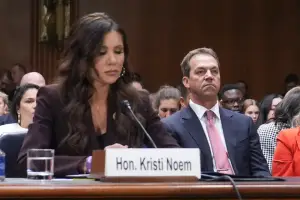
Then-Homeland Security Secretary Kristi Noem testifying before the House Oversight Committee as her husband, Byron Noem, right, looks on (Associated Press photo)
- New York Post, The real reason why Kristi Noem's cuckold husband stayed married to her through Corey Lewandowski 'humiliation,' Caitlin Doornbos, March 7, 2026 (print ed.). The real reason why Kristi Noem's cuckold husband stayed married...GOP senator reveals why Kristi Noem was ‘dead as fried chicken’ after disastrous congressional hearing.
More On Iran War
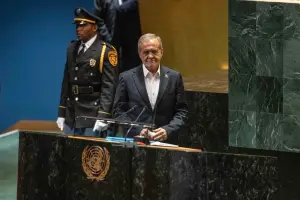
President Masoud Pezeshkian of Iran at the United Nations General Assembly in New York, in September (New York Times photo by Dave Sanders).
- New York Times, Live Updates: Trump Vows to Hit Iran Harder, Aaron Boxerman, Leily Nikounazar, Abdi Latif Dahir and Shawn McCreesh, March 7, 2026. President Trump claimed that Iran had surrendered. He made the statement after the country’s president said earlier that Iran would end strikes in Gulf states, with caveats. Qatar and Bahrain reported incoming fire.
- New York Times, Iranian President’s Apology Showcases Leadership Rifts, Leily Nikounazar and Aaron Boxerman, March 7, 2026. Masoud Pezeshkian, the Iranian president, apologized for the waves of strikes hitting Gulf states, then hours later claimed Iran had not attacked its “friendly and neighboring countries” in this war.
- New York Times, News Analysis: Europe Didn’t Want War With Iran. But So Far, It Can’t Stay Out of It, Mark Landler, March 7, 2026. From London to Rome and beyond, leaders are facing diplomatic headwinds and criticism at home as they take part in a conflict they did not seek.
- New York Times, Ideas: How Good Intentions Helped Pave Trump’s Road to Iran, Amanda Taub, March 7, 2026. Humanitarians proposed a loophole in international law. Decades later, Trump is jumping through it.
- Politico, Allies fear Iran war will leave them without US weapons they bought, Jack Detsch, John Sakellariadis and Phelim Kine, March 7, 2026. European and Asian countries worry the Pentagon is burning through munitions so fast that it won’t have enough to send the weapons they have purchased.
- New York Times, What the U.S. and Israel Have Targeted in Their Iran Blitz, Adam Goldman, Samuel Granados, Ronen Bergman and Eric Schmitt, March 7, 2026. The waves of bombings reveal a broad effort to ravage the country’s leadership and security services.
- New York Times, Gas Prices Continue to Surge in U.S., Rising 14% in a Week, Emmett Lindner, March 7, 2026. Soaring oil prices suggest that more increases could be in store for American drivers. Diesel, jet fuel, and other refined products are also becoming much more expensive.
News Updates
- The Parnas Perspective, News and Commentary, White House Blocks Intel Report Warning of Elevated Terror Threats Due to War as Trump Escalates and Air Fare Set to Surge, Aaron Parnas, right, March 7, 2026. The White House is blocking an intelligence report warning of elevated terrorism threats inside the United States linked to the war with Iran. At the same time, Trump is escalating his rhetoric, saying additional groups in Iran are now under consideration for death and destruction as Tehran rejects demands to surrender while signaling it will step back from attacks on neighboring countries.
- Letters from an American, Historical Commentary: March 6, 2026 [], Heather Cox Richardson, right, March 7, 2026. The Reverend Jesse Jackson died on February 17, 2026, at age 84. Tying together the past and the future, this weekend’s annual commemorative crossing of the Edmund Pettus Bridge will honor his legacy.
U.S. Crime, Law, Courts, Justice, Civil Rights
- Emptywheel, Analysis:, While DOJ was hunting Don Lemon, it dropped four drug prosecutions, Emptywheel (Marcy Wheeler), right, March 7, 2026. Before Donald Trump started an illegal war against Iran, DOJ superseded the indictment against Don Lemon and others, adding 30 new alleged co-conspirators. Pam Bondi did so at the opportunity cost of keeping Minnesotans safe.
U.S. Politics, Governance, Elections
- Associated Press via Politico, Former Democratic presidents remember the late Rev. Jesse Jackson during final public tribute, Staff Report, March 7, 2026. “He paved the road for so many others to follow,” former President Barack Obama said of the civil rights legend.
- Politico, Darrell Issa announces retirement from the House, Melanie Mason and Ben Fox, March 7, 2026. His California district had been redrawn to favor Democrats as part of the state’s gerrymandering last year. Republican Rep. Darrell Issa is calling it quits — again.
- Meidas Touch Network, Trump Attacks Iran War Critics Tucker Carlson, Megyn Kelly, Nick Fuentes, J.D. Wolf, March 5, 2026. Donald Trump escalated his attacks on former allies late last night by promoting an article from the pro-Trump outlet Just the News accusing several prominent conservative voices of losing their influence after breaking with him.
- New York Times, Across America, congressional candidates are finding creative — and critics say cynical — ways to signal support for two deep-pocketed industries: A.I. and crypto, Shane Goldmacher, Produced by Leo Dominguez, March 7, 2026.
- New York Times, A Schools Chief So Charming That Los Angeles Overlooked His Red Flags,Dana Goldstein and Shawn Hubler, March 7, 2026. Alberto Carvalho was seen as a catch for the nation’s second-largest school district. Then his home and office were raided by the F.B.I.
- Politico, Steyer questions Swalwell’s eligibility to run for California governor, Blake Jones, The billionaire climate activist’s campaign also asked the state to enforce a dormant five-year residency requirement for candidates.Eric Swalwell stands.
Top Stories
The Parnas Perspective, Evening News and Commentary: Iran Threatens Trump, Says he Will "Pay" as Trump Moves Closer to Deploying Troops and Denies USA Struck Elementary School, Aaron Parnas, right, March 7, 2026. The Iranian government is issuing threats against Donald Trump’s life following the death of its Supreme Leader.
At the same time, Trump says the United States was not responsible for the strike on an elementary school in Iran while signaling the U.S. is moving closer to deploying ground troops. Meanwhile, gas prices are expected to rise as a major bombing campaign targeting Iran’s oil infrastructure continues tonight.
Here’s the news:
NBC News has confirmed that President Donald Trump has privately discussed the possibility of deploying a limited number of U.S. ground troops into Iran for targeted strategic missions—such as special operations raids, securing nuclear materials, or influencing a post-war political transition—while not pursuing a large-scale invasion; the war is currently an air campaign, no decision has been made on ground deployment, and officials say the option remains on the table amid rising risks and casualties.
The Trump administration is considering several military options against Iran’s nuclear program, including a potential Special Operations raid by units such as Delta Force to seize or destroy nuclear materials at sites like Isfahan, though the plan would be extremely risky and complex. Officials tell Semafor that alternatives include continued airstrikes or bunker-busting bombs against underground facilities, while contingency plans for temporary ground operations at key nuclear sites have long existed within U.S. Central Command.
When asked about reports that a strike killed about 175 people at an Iranian elementary school, Donald Trump claimed Iran was responsible due to inaccurate munitions, while Defense Secretary Pete Hegseth said the incident is still under investigation. This, despite the fact that the Administration told Congress that it was bombing near the region and analysis conducted by CNN, the New York Times, and others suggested that it was the United States that struck the school in Minab, Iran.
Iranian national security official Ali Larijani warned that Iran will hold Donald Trump responsible for the conflict and vowed that Tehran will not let the issue go until it retaliates “in kind,” signaling that Iran intends to respond directly to U.S. actions rather than de-escalate.
U.S. and Israeli strikes reportedly targeted Tehran’s Shahran Oil Depot and other nearby oil facilities, sparking large fires as the campaign known as “Operation Epic Fury” expands to hit Iran’s broader industrial and energy infrastructure.
A Pakistani man was killed in Dubai’s Al Barsha neighborhood after debris from an intercepted missile fell onto his vehicle, according to the Dubai Media Office.
Donald Trump said the scale of U.S. strikes could leave Iran so devastated that “there will be nobody left” to formally say “we surrender,” suggesting the campaign could be extremely destructive.
President Donald Trump and First Lady Melania Trump attended a dignified transfer at Dover Air Force Base for six U.S. Army soldiers killed in an Iranian strike on their operations center.
During a parliamentary session, some Iraqi lawmakers reportedly chanted “Death to America” while expressing support for Iran amid escalating regional tensions.
Donald Trump criticized the United Kingdom and Prime Minister Keir Starmer, saying the U.S. no longer needs British aircraft carriers in the Middle East and accusing the U.K. of joining wars only after victory is assured.
Two people were taken into custody after police discovered suspicious homemade explosive devices outside New York City Mayor Zohran Mamdani’s official residence (Gracie Mansion) during an anti-Islam protest organized by right-wing influencer Jake Lang; no injuries were reported and the incident remains under investigation.
U.S. envoy Steve Witkoff said the United States has “strongly” warned Russia not to provide targeting intelligence or other assistance to Iran, adding that he hopes Moscow is not doing so.
Donald Trump signed a proclamation launching an “Americas Counter Cartel Coalition,” pledging to use U.S. military force against drug cartels across Latin America after already deploying troops and conducting strikes in Ecuador, with 17 countries supporting the initiative to combat cartels, reduce migration and drug trafficking, and counter growing foreign influence in the region.
During an exchange with Defense Secretary Pete Hegseth about Marco Rubio speaking Spanish, Trump asked if Rubio was better in Spanish, and Hegseth replied that he “only speak[s] American.”
A plaque honoring U.S. Capitol Police and other law enforcement who defended the Capitol during the Jan. 6, 2021 attack was installed on the Senate side of the Capitol after years of delay and a Senate resolution, with the location serving as a temporary placement until both chambers agree on a permanent display.
NBC News has confirmed that Democratic senators launched an investigation into companies that received a $220 million DHS advertising contract featuring former Homeland Security Secretary Kristi Noem, seeking to determine whether Noem, adviser Corey Lewandowski, or other DHS officials personally benefited from the no-bid agreements.
California Gov. Gavin Newsom criticized former Homeland Security Secretary Kristi Noem, nicknaming her “Kosplay Kristi,” and demanded the Department of Homeland Security release over $500 million in FEMA wildfire recovery funds for Los Angeles that he says were stalled under a policy requiring Noem’s approval for large contracts.
Rep. Kevin Kiley of California announced he will run for reelection as an independent after Democratic-led redistricting reshaped his district into a Democratic-leaning one, arguing both parties are responsible for partisan gerrymandering and positioning himself as a centrist candidate in a difficult race.
According to CNN, FDA drug chief Dr. Tracy Beth Hoeg is facing internal criticism and potential conflict-of-interest concerns for pushing to hire a researcher friend, Dr. Adam Urato, while accelerating review of his petition to add new warnings to antidepressants about unproven pregnancy risks, a proposal many experts say relies on weak evidence and could discourage necessary treatment for depression during pregnancy.
New York Times, Recent U.S. Assessment Found an Attack on Iran Unlikely to Result in Regime Change, Julian E. Barnes, March 7, 2026. Intelligence officials have been skeptical that a popular uprising could dislodge the Islamic Revolutionary Guards Corps, which controls much of Iran’s security apparatus.
A report by the National Intelligence Council completed before the United States and Israel launched attacks on Iran assessed that even a large-scale military assault on the country would be unlikely to topple its theocratic government, according to U.S. officials briefed on the work.
The N.I.C., which is part of Tulsi Gabbard’s Office of National Intelligence, is in charge of crafting intelligence assessments based on an array of views across the intelligence community. While some of their reports are joint products, others are produced independently, with less coordination.
The council’s document, drafted late last month, builds on work by the C.I.A. that assessed that a complete change of government was unlikely even if Ayatollah Ali Khamenei, the supreme leader, was killed in a U.S.-led military operation. But the actual report was an independent product of the council, the officials said.
Still, there seemed to be wide agreement that the theocratic government in Iran is deeply entrenched. Intelligence officials have been skeptical that a popular uprising could dislodge the Islamic Revolutionary Guards Corps, the organization that exerts control over much of the security apparatus in Iran as well as large sectors of its economy.
New York Times, Justice Department Denounces Federal Judges in Fight Against Law Firms, Chris Cameron and Jonah E. Bromwich, March 7, 2026 (print ed.). The Trump administration had signaled earlier this week that it was ready to abandon four executive orders seeking to punish law firms, but abruptly reversed course the next day.
The Department of Justice on Friday attacked the federal judiciary, accusing judges who ruled against the Trump administration of undermining President Trump’s authority while continuing to fight a case that it had signaled it was ready to abandon earlier this week.
Its attack came in a court filing in its appeal of four district court rulings that had struck down Mr. Trump’s executive orders attempting to bar prominent law firms from government business.
“Courts cannot tell the president what to say,” the 97-page legal brief began, adding that four federal judges had “bent over backwards” to rule against Mr. Trump and were “encroaching on the constitutional power of the president,” in what the document described as “a grave error for the district courts.”
The blistering court filing came as the Trump administration encounters heightened scrutiny from district courts across the country. Its officials have grown ever more bellicose, including in criticizing the Supreme Court after it ruled against Mr. Trump’s sweeping tariffs.
It was also the latest turn in the dizzying saga of the executive orders, which sought to punish law firms for their perceived connections with Mr. Trump’s political enemies. The orders targeting law firms are one of Mr. Trump’s most audacious — and, the district courts found, unconstitutional — attempts at subduing potentially powerful adversaries, and the new twists this week created uncertainty in a legal profession already roiled by the orders.
The tone and language of the brief were remarkable as Justice Department lawyers opened an argument to federal appeals court judges by attacking those judges’ lower court colleagues.
Its ferocity came as a surprise given that, earlier this week, the Justice Department indicated that it was ready to abandon the case entirely. On Monday, it filed a motion with the D.C. court, asking it to dismiss the case.
But the next day, after the department’s decision to leave the appeal behind had received extensive news coverage, it reversed course. The Justice Department then asked the judges for permission to withdraw the previous day’s motion, after some of the country’s biggest law firms thought they had put to rest a key part of the president’s sweeping retribution campaign.
It was not immediately clear what had prompted the about-face, but Mr. Trump and other top administration officials have often bristled at the perception that they have backed down from a public fight. In one high-profile example, the federal government initially acknowledged in court that it had made a mistake last year in deporting a Salvadoran man living in Maryland, only for high-level officials to mount an effort to keep him out of the country.
Four firms — Perkins Coie, WilmerHale, Jenner & Block and Susman Godfrey — fought the executive orders targeting them, quickly receiving favorable rulings from the district court judges. Nine others struck deals to avoid punishment from the government, most notably Paul Weiss, drawing criticism.
Though the government had initially signaled to the law firms that it would ask for a weeklong extension, it did not ultimately do so..
The brief’s bellicose language was most notable in its opening pages, and the Justice Department’s lawyers soon turned to more conventional legal arguments. But even those were notable, as when the department said that Mr. Trump’s language targeting the firms was “a textbook example of government speech.”
Immigration, Oversight, DHS Secretary's Scandals, Ouster
Then-Homeland Security Secretary Kristi Noem testifying before the House Oversight Committee as her husband, Byron Noem, right, looks on (Associated Press photo)
New York Post, The real reason why Kristi Noem's cuckold husband stayed married to her through Corey Lewandowski 'humiliation,' Caitlin Doornbos, March 7, 2026 (print ed.). The real reason why Kristi Noem's cuckold husband stayed married...GOP senator reveals why Kristi Noem was ‘dead as  fried chicken’ after disastrous congressional hearingGOP senator reveals why Kristi Noem was ‘dead as fried...
Biden says ‘I’m a hell of a lot smarter than most of you’ to crowd at Jesse Jackson's funeralBiden says ‘I’m a hell of a lot smarter than most of you’...Anti-Iranian regime protester pummeled at deluded NYC vigil for Ayatollah Ali KhameneiAnti-Iranian regime protester pummeled at deluded NYC vigil for...Bishop who allegedly made several trips to Mexican brothel arrested at San Diego airport trying to flee USBishop who allegedly made several trips to Mexican brothel...Mamdani makes far-fetched argument to downplay NYC first lady's 'likes' of graphic Oct. 7 massacre Instagram postMamdani makes far-fetched argument to downplay NYC first lady's...Trump claims Iran will be hit 'very hard' today, says some groups 'under serious consideration for complete destruction and certain death'
Bryon Noem‘s family members are hoping he finally leaves his wife, embattled Homeland Security Secretary Kristi Noem, after the ultimate “humiliation” from her alleged affair with a top adviser — but fear he’ll continue to stay in his marriage due to his Christian faith and commitment to his vows.
Members of the extended family of Bryon Noem told The Post on Friday that the South Dakota businessman has long felt it was his religious duty to stand behind his wife — even as the very public scandal rocks their marriage.Kristi Noem and Bryon Noem at a Senate Judiciary Committee oversight hearing. 5Bryon Noem (right) attended the Senate Judiciary Committee oversight hearing to support his wife, then-Homeland Security Secretary Kristi Noem (left). AP
“He said he decided about 20 years ago that it was his calling from God to support her in whatever she decided to do,” one family member said. “So he has put up with the humiliation. We will see if he sticks with her now.”
“I think it’s him honoring the calling from God,” the family member added. “But it seems like there would be some limit to that."
 The Noems’ more than three-decade-long marriage began in 1992, after having gone to high school together. They began dating when Kristi was a junior at Hamlin High School in Hayti, S.D., and Bryon was a freshman at Northern State University.
The couple (shown at right in a photo on Facebook) went on to have three children together, raising them in an ultra-strict church community, according to relatives.
They initially worked the family farm together, before Bryon moved into the insurance business in 2003 and Kristi entered politics in 2006, winning a seat in the South Dakota House of Representatives before securing the governorship in 2018.Kristi and Bryon Noem smiling at the beach with cliffs and sea stacks in the background. 5Bryon Noem is expected to stay by her side despite the “humiliation” of her affair with longtime political adviser Corey Lewandowski. Kristi Noem/Facebook
But family members say alleged tensions between the Homeland Security chief and her husband’s relatives have simmered for years — and many have long heard about her alleged romantic entanglement with Corey Lewandowski, which spilled out into the open this week.
“She despises the Noem family,” the relative said of the axed Cabinet official.
The relative said Bryon Noem appeared determined to show solidarity with his wife even as she faced a bruising public grilling from lawmakers — and hoped it opened his eyes.Kristi Noem and Corey Lewandowski smiling while standing at the bottom of a grand staircase, as shown below.
 Homeland Security Secretary Kristi Noem and her advisor and travelling companion Corey Lewandowski.
“I actually liked that he sat behind her while she was grilled on the ICE atrocities,” the person said. “I think he’s ignored the reality. Maybe he has to face it now.”
In a Wednesday House hearing, Rep. Sydney Kamlager-Dove (D-Calif.) grilled Noem over rumors of her affair with Lewandowski, her top adviser and “special government employee.”
 Kristi Noem reportedly has an affair with longtime political advisor Corey Lewandowski (right), the New York Post reported.
David Sands via Facebook shows Kristi Noem wearing a "Make America Great Again" hat, with Corey Lewandowski putting "devil horns" behind her head. A family relative alleged tensions between the Homeland Security chief and her husband’s relatives have simmered for years — and many have long known about her romantic entanglement with Lewandowski.
According to the New York Post:
The real reason why Kristi Noem’s cuckold husband stayed married to her through all of Kristi Noem’s scandalous moments before Trump finally fired her Noem’s answer on ‘sexual relations’ with Lewandowski was ‘final straw’ for Trump, sources say.
Bryon Noem had left the briefing shortly before the tense questioning came up — during which Kristi Noem refused to deny her rumored relationship with Lewandowski, a leading figure in President Trump’s 2016 campaign.
A second family member told The Post that the controversy unfolding publicly was shocking — and the relative hopes it will wake Bryon up to the reality of his marriage.Homeland Security Secretary Kristi Noem speaks during an oversight hearing. 5President Trump fired Noem as Homeland Security secretary Thursday following her oversight committee hearing on Wednesday, March 4, 2026. AP
“What gets me is she couldn’t say no,” the relative said. “When she’s getting grilled about it, she couldn’t say no.”
“The relative said they also believed Bryon Noem’s Christian faith — and devotion to his children — would keep the marriage intact even amid the fallout.
“Bryon is a Christian man, and he believes that marriage is forever,” the relative said. “He’s very close with his children. I’m sure this is really hard on them.” Bryon Noem did not immediately respond to requests for comment.
 Kristi Noem, shown above posing in a Coast Guard training video, is expected to leave her post at DHS at the end of the month, with sources telling The Post that her answers about her relationship with Lewandowski were the final straw for Trump.
More On Epstein Files-Trump Scandals
The FBI released in redacted form this week its 2019 reports recording claims by a woman stating that she had been sexually assaulted and then threatened by Donald Trump and his friend Jeffrey Epstein in the period 1983 to 1985 when she was in her early teens.
Emptywheel, Analysis: The Alleged Trump Victim’s Claims about Blackmail Are as Important as Her Claims about Rape, Emptywheel (Marcy Wheeler, right), March 6, 2026. Yesterday, DOJ released the three interview reports from a woman who alleged she was abused by Donald Trump that it had previously withheld.
As NPR notes, DOJ is still withholding a number of materials (notes from her interviews and, far more importantly, details about the handling of the interview) relating to the accusation. That matters because, it is now clear, DOJ withheld — and is still withholding — the originals of the interview reports.
And that matters given the timeline of the accusations and the fact that, just days before Epstein suicided, the victim claimed Epstein and Trump spoke about blackmail.
Here’s what the timeline looks like:
July 8, 2019: SDNY [Southern District of New York] announced arrest of Jeffrey Epstein and included a tip line for others who had been abused by Epstein.
July 8: The alleged victim’s friend called the tip line. She explained that the friend had recently told her about the Trump incident. And on the day of the Epstein arrest, the friend asked the victim if Epstein had also abused her, too, and the victim said yes.
July 24: 16 days later, the FBI interviewed the alleged victim for the first time. That interview (the one that did originally get released) focused almost entirely on Epstein. Trump only came up in the context of that conversation with the friend who called the tip line and one other friend. And she went to some (futile) length to crop Trump out of that picture.

August 7: On August 7, the FBI did a follow-up interview. The interview started with the alleged victim saying that she felt comfortable enough describing the other men who abused her, starting with a guy named Atkins (who also had a relationship with her mother). Nevertheless, more than half the interview focused on Epstein. At the bottom of page 7 of 10, the report begins to record her allegations about Trump: He didn’t like that she was a tomboy, he got her alone in a room and forced her down on him saying something to the effect of, “Let me teach you how little girls are supposed to be.” She bit him. He said, “get this little bitch the hell out of here,” but in the telling, others came back in the room and a beautiful blonde lady told her to wear a bra, which is to say a description of the claim later produced in a power point is inaccurate — she described that he called for her to be removed, but she was not.
Another paragraph describes the victim describing further conversations between Epstein and Trump. Then the interview focused back on Epstein for six paragraphs, including a claim that Epstein came to trust her, that he spoke another language occasionally.
The interview ended with these two paragraphs — one mixing details of Epstein blackmailing her mother and discussing blackmail with Trump, with additional random details suggesting more contact with Trump than any other document, and a final paragraph describing she was afraid Epstein’s people would come after her.

August 9: The first interview report was finalized on August 9, two days after the second interview in which the victim claimed that she had heard Epstein and Trump talk about blackmail.
August 10: And then, three days after this woman described Epstein and Trump discussing blackmail and the day after FBI entered the first interview with this woman, Epstein suicided. There’s no public evidence the timing was anything but a wild coincidence. But at the very least, it must have made the treatment of these documents even more politically fraught.
August 20: The third interview with the woman took place at a time when Epstein could no longer be held accountable because he was dead, on August 20. After a completely redacted administrative paragraph, that interview report started by focusing on Trump, whose alleged abuse of the woman might have taken place in SDNY, or New Jersey, either of which would have given those FBI agents jurisdiction to investigate.

The next paragraph described her claim that her mother’s embezzlement conviction had a tie to Epstein and the Atkins guy she claimed had also abused her. It was followed by a reference to Epstein’s brother (which is pertinent not least because Mark Epstein says Jeffrey never spent summers in South Carolina, where all this allegedly started).

And then the remainder of the interview, nine paragraphs over three pages, focused on threats she believed arose from harassment from Epstein. In just one of those paragraphs, in which she explained why she attributed these threats to Epstein even though no one ever said they came from him, is she recorded as mentioning Trump.
August 22: The second interview — the one where the alleged victim claimed that Epstein and Trump talked about blackmail just days before Epstein suicided in prison — was entered weeks later, on August 22, two days after describing that she had been harassed for years and she attributed that harassment, with no evidence, to Epstein.
August 30: The third interview was entered on August 30.
October 16: The final interview took place on October 16. The attorney who had represented her to date was not present and she had, in the interim, told the FBI that she was working with what must be Lisa Bloom on a civil suit, which would be filed in December. She refused the FBI request to record the interview. They explained that they wanted to focus the interview on Epstein’s associates who abused her (which makes sense given that Epstein himself was dead). and asked her if she would provide more details about what happened with Trump. She said nothing could be done about it, which is why she stopped cooperating.
October 22: That final interview was entered on October 22, well into the focus on impeachment.
December 27: On December 27, a Jane Doe 4 made an allegation in a lawsuit that had not been shared with the FBI: that after hitting her in the face, a prominent businessman (who is not described as Trump, though Trump is mentioned elsewhere) vaginally and anally raped her. The lawsuit also states with certainty this happened in New York when, in her interviews with the FBI, the victim was not sure whether it happened in New Jersey or New York.
46. Jane Doe 4 was brutally and forcibly battered, assaulted, and raped by these other men she met through Epstein. On one occasion, one of these prominent men forcibly slapped Jane Doe 4 in the face after she was forced to perform oral sex on him. This same man forcibly raped her, penetrating her both vaginally and anally. On information and belief, Epstein was aware of and, indeed encouraged, the assault of Jane Doe 4 by these other men.
These interviews reveal several things. First, the victim’s allegations were not focused primarily on Trump; she was focused on a man she claimed to be Epstein. Indeed, in the first interview, Trump came up primarily in the context of explaining the role of the photograph used to ID Epstein, not Trump. Her second interview did include the Trump allegation amidst a much greater focus on Epstein, but her claim that the two discussed blackmail in front of her is every bit as inflammatory as the rape claim.
Remember, when Pam Bondi and Kash Patel attempted to dismiss this whole issue last July, they claimed, “There was also no credible evidence found that Epstein blackmailed prominent individuals as part of his actions.” That’s factually false; there’s clear evidence Epstein was pressuring Bill Gates. But given that, weeks later, the FBI listed the allegation from this woman first in what appears to be prep for Todd Blanche’s interview with Ghislaine Maxwell, it is exceedingly likely they had this claim in mind when they dismissed the credibility of all blackmail claims. The Alleged Trump Victim’s Claims about Blackmail Are as Important as Her Claims about Rape
This woman told the FBI that Epstein and Trump discussed blackmail, and days later he suicided in prison.
And after that, the FBI wanted to focus on Trump because, well, Epstein wasn’t around to be prosecuted anymore.
Then, years later, DOJ attempted to withhold documents recording all that.
When faced with overwhelming evidence that they had withheld documents implicating Trump, DOJ released them. But the excuses it gave are as suspect as the withholding.
As NPR explained, when caught withholding these documents, DOJ claimed they had withheld them because they were duplicates, and now is effectively saying, oops, they weren’t duplicates.
The Justice Department has repeatedly told NPR that any documents withheld were “privileged, are duplicates or relate to an ongoing federal investigation.”
Last week, after NPR’s initial story, the Justice Department said it was determining if records had been mistakenly tagged as duplicates and if any were found, “the Department will of course publish it, consistent with the law.”
But in fact, these documents — every one of the documents released so far — are duplicates.
As NPR focused in their original story on the withholding, what got released was the discovery shared with Ghislaine. Both the original release and these includes three Bates stamps, including the series — 3501.045-003, here — tied to discovery to Ghislaine, along with stamps from that production.
The Ghislaine material is the definition of duplicate material, because everything that went to her should have an original copy in the FBI’s case file.
But we didn’t get any of those originals. We still haven’t gotten those originals. We can’t be sure if the originals still exist. DOJ certainly hasn’t given us the originals, they gave us duplicates after saying these were duplicates.
DOJ not only withheld documents documenting a claim that Trump raped a teenager, and with it, a claim that Trump and Epstein discussed blackmail, but they’re still withholding the originals of all that.
 Former New York prison guard Tova Noel, center in a yellow blouse and dark blue coat, surrounded by people, leaving federal court. Criminal charges against Noel and the other guard, Michael Thomas were dropped in December 2021 by a federal judge (Associated Press photo).
New York Post, Epstein prison guard googled him minutes before body found — and made mysterious deposit before pedo's suicide: DOJ, Gabrielle Fahmy, March 7, 2026. One of Jeffrey Epstein’s prison guards googled the sex predator minutes before he was found dead — and also made a mysterious $5,000 cash deposit 10 days before the predator’s jail-cell suicide, new Department of Justice documents reveal.
Tova Noel was one of the two Metropolitan Correctional Center workers accused of falsifying records to say they checked on Epstein throughout the night before his Aug. 10, 2019, suicide.
The guards were fired but criminal charges against both were later dropped.
Noel googled “latest on Epstein in jail” at 5:42 a.m. and then again at 5:52 a.m. — less than 40 minutes before her colleague, correctional officer Michael Thomas, above, shown in an AP photo,found the disgraced financier dead in his cell by hanging at 6:30 a.m., according to an FBI record of Noel’s internet search history that night.
Earlier that shift, Noel, 37, shopped for furniture online and snoozed on the job instead of making the mandated checks on Epstein every 30 minutes, while Thomas perused motorcycles, prosecutors said.
The FBI highlighted the eerie internet search in its 66-page forensic examination of the Bureau of Prisons desktop computers of Noel and Thomas. It was the only search highlighted.
When questioned during her sworn statement to the DOJ in 2021, Noel denied googling Epstein.
“I don’t remember doing that,” she claimed, according to a transcript. She said FBI records were not “accurate. I don’t recall looking him up.”
Noel, who has since been sued in Westchester County Supreme Court for alleged assault at her new job as a medical office assistant at Montefiore Einstein Advanced Care, also claimed to investigators that everyone at the Manhattan federal lockup failed to do rounds and falsified records about it.Medical personnel transporting a body in a black bag from a hospital side door. 5Epstein was found dead in his cell when Thomas and Noel brought him breakfast at 6:30 a.m. on Aug. 10, 2019. William Farrington
“I’ve never worked in the Special Housing Unit and actually done rounds every 30 minutes,” she told investigators.
Meanwhile, Chase Bank flagged cash deposits in Noel’s bank account in a “suspicious activity report” to the FBI in November 2019, another file from the DOJ revealed.
A total of 12 deposits began in April 2018, the bank said, and culminated in the largest deposit, for $5,000, on July 30, 2019, the records showed.Tova Noel, Epstein guard, pictured wearing a uniform. Noel began working in the MCC’s Special Housing Unit, where Epstein was housed, in 2019. DOJDocument showing an internet search history with "latest on epstein in jail" highlighted. 5The FBI highlighted the eerie early morning Google search in its files. DOJ
The files only contain Noel’s bank records beginning in December 2018. They show seven cash deposits totaling $11,880. Noel started working at the Special Housing Unit — where Epstein had been held — beginning on July 7, 2019, just weeks before his death.
Noel, who drove a $62,000 2019 Land Rover Range Rover, wasn’t asked about the cash during her DOJ interview, records showed.
An internal FBI briefing, also released in the DOJ files, reveals the agency thought Noel was likely the mysterious orange shape spotted in a blurry surveillance video near Epstein’s cell around 10:40 p.m. that night.Start your day with all you need to know
Morning Report delivers the latest news, videos, photos and more.Enter your email address
By clicking above you agree to the Terms of Use and Privacy Policy.
“At approximately 10:40 pm, a correctional officer, believed to be Tova Noel, carried linen or inmate clothing up to the L-Tier, last time any correctional officer approached the only entrance to the SHU tier,” the agency wrote. Epstein apparently hanged himself with strips of orange cloth.
In the sworn statement, Noel, who was working a double shift that day, told investigators she last saw Epstein alive “somewhere around after 10” and that she “never gave out linen — ever” or clothing to inmates because that’s done the shift before.
The identity of the pixelated orange blob in the video has been a source of debate and conspiracies since the FBI released the footage last summer.Mugshot of Jeffrey Epstein with short gray hair, a gray beard and mustache, wearing a gray t-shirt. 5Epstein was housed at the MCC after his July 6, 2019 arrest, until his death. AP
The original 2023 inspector general report said it was “unidentified correctional officers,” making the recently released FBI document the first time a name was publicly put to the mysterious shape.
She testified she didn’t know why Epstein had extra linen in his cell. The other guard on duty was sleeping between 10 p.m. and midnight, she said.
A prison employee entering the area of Epstein’s cell alone would be a policy violation, workers have said.
What do you think? Post a comment.
Lawyers for Noel declined to comment. Asked during her sworn statement if she had any part in Epstein’s death, Noel replied “no.”
Alisa Writes via Substack, Investigation: Jeffrey Epstein's Ranch Won $85 Million in the Oklahoma Lottery Two Days After He Went to Prison. The Company That Printed the Ticket Belonged to His Palm Beach Neighbor, Alisa Valdes-Rodriguez, March 6, 2026. The Store That Sold It Belonged to The Neighbor's Former Colleague. And The Ranch, Which Was Never Searched, Now Belongs to a Trump Insider's Family. Follow the Money, Part Two.
Yesterday, I published the first installment of a four-part series I’ve written in which I follow the money related to Jeffrey Epstein’s Zorro Ranch, from its purchase from the King family in 1993 to its new owners, Don and Mary Catherine Huffines. What follows here is part two. By following the money, a terrifying picture begins to emerge, an existential threat to the national security of the United States of America.
The Stripes convenience store in Altus, Oklahoma, that sold the winning Powerball ticket to Zorro Trust in 2008.
In yesterday’s part one of this series, I shared a bit about the financial relationships between dead child rapist and sex trafficker Jeffrey Epstein and former New Mexico Governor Bruce King and his son, former New Mexico Attorney General Gary King. To briefly summarize, Epstein’s Zorro Trust purchased nearly 7,500 acres outside Stanley, New Mexico, from the King family for $12.3 million in 1993, after the King family sold it off to help pay $21 million in debts on their various businesses. I recounted the evidence of child sex rape and trafficking that took place at Zorro Ranch for decades, and ended the piece with the vastly under-reported fact that Zorro Trust won the Oklahoma Powerball lottery in 2008, two days after Epstein began serving his first — and far too lenient — jail term, in the amount of $85 million.
Today we pick up there. With that lottery win. While I’ve seen a few stories online about it, no serious news outlet has covered it. I suspect this is because plausible deniability is built into the way Oklahoma law allows trusts to win the lottery while legally protecting the identity of the trust’s owners. This law exists in theory to protect large jackpot winners from being hounded or robbed. But it also creates fertile ground for fraud. Not even a freedom of information act records request from a reporter can unseal those records. The only way we could ever find out for certain, from lottery officials, that the Zorro Trust that won on July 2, 2008, was the same Zorro Trust that bought the ranch in Stanley, New Mexico — a six-hour drive from the convenience store where the ticket was purchased — would be if the courts demanded the record unsealed. So far, that hasn’t happened.
There are, however, other ways to put together a strong circumstantial case.
One way is to go to Stanley and other points in this state and ask around. Which I did. I live here. We’re a big state with a small population. Everyone knows everyone, and my family has been here for 13 generations. Lots of regular people worked on that ranch — as staff, as contractors. And while it’s clear in the Epstein files that Epstein and his wealthy associates didn’t think much of the working poor who cleaned their toilets and took out their trash, such disregard by the rich for those they exploit tends not to breed loyalty in the end, because the working poor are human. That said, people are still reluctant to give their names publicly, because many were forced to sign non-disclosure agreements, and others witnessed abuses so horrific they’re pretty sure that even with Epstein dead, there are still people who want this all to go away.
I want to pause here to say this: Former employees of Jeffrey Epstein’s Zorro Ranch who signed non-disclosure agreements may have more legal freedom to speak than they realize. The Speak Out Act, signed into federal law in 2022, significantly curtailed the enforceability of NDAs involving sexual assault and sexual harassment, gutting one of the primary legal mechanisms used to silence witnesses to abuse. Beyond that, courts have long held that no contract can compel someone to conceal criminal conduct — an NDA that functions as a cover-up is, by definition, unenforceable as against public policy. Whistleblower protections further shield anyone who comes forward to law enforcement or journalists investigating matters of legitimate public concern. And there is a practical reality worth noting: Epstein is dead, his ranch has changed hands, and any attempt by his estate to sue a former employee for speaking truthfully about crimes would open that estate to the very discovery process it would most want to avoid. The NDA, in other words, may have always been more threat than law.
Which is all to say: people here in New Mexico know that it was Epstein’s Zorro Trust that won the Oklahoma lottery two days after he began to serve his first prison sentence. They also know who bought the ticket. Brice Gordon, a former New Zealand soldier who managed the estate with his wife Karen, also a former New Zealand soldier. I’d ask them about it directly, but they seem to have disappeared off the face of the earth after inheriting $2 million when Epstein died.
Now that we have all that out of the way, let’s look at the people and entities involved behind the scenes in making that win possible — a win with 146 million to one odds for regular people, and likely far greater odds for a convicted pedophile in prison. It’s in those details that the picture begins to come into focus.
Fact No. 1: The Man at the Top
James Scroggins materialized in the world of American state lotteries the way certain figures do in industries built on government contracts and quiet relationships — fully formed and without much of a paper trail explaining how he got there. He ran the Pennsylvania lottery, then the Missouri lottery for thirteen years, then arrived in Oklahoma in 2005 to launch its lottery from scratch. He was the executive director of the Oklahoma Lottery Commission on July 2, 2008, when the Zorro Trust walked in and claimed $85 million — which the trust opted to take as a $29.3 million lump sum. He was the man legally required to receive the trust’s membership disclosure — the document naming the actual human beings behind that claim. He is one of a very small number of people alive who knows what that document said.
Scroggins is not a man the public knows much about. Search his name and you find almost nothing — no consulting website, no professional biography, no industry award profiles, no conference keynotes, no press releases announcing his next chapter after he left public service. His LinkedIn profile exists, but is set to private, a curious posture for a man who spent two decades as a government official administering a public trust. What we know about him comes almost entirely from contemporaneous news coverage of the lotteries he ran. And what that coverage reveals, once you read across all four states and all four decades, is a consistent pattern: wherever James Scroggins went, the rules bent.
It started in Pennsylvania.
In the late 1980s, while Scroggins was serving as Pennsylvania’s lottery director, a man named Nick Herbst walked into lottery offices to claim a nine-month-old $15.2 million Super 7 jackpot. The ticket was reviewed at the lottery offices and approved for payment by Scroggins personally — over the written objections of at least one lottery staff member who had flagged a serious problem with the ticket’s validity. The problem was this: while the lottery’s computer showed the ticket had been sold at the Neshaminy Mall in Bensalem, Bucks County, the paper the ticket was printed on carried a serial number assigned to a lot of paper sent to a Scranton lottery agent — a completely different location. The two records did not match. Scroggins ordered the claim honored anyway. Herbst was ushered to a press conference, given a check for the first installment, posed for photographers, and answered reporters’ questions. He claimed he had forgotten about the ticket and had been using it as a bookmark.
The ticket was a fraud. It had been fabricated by an employee of the company that provided computer systems to the lottery — a scheme that required inside access to the technical infrastructure of the game itself. Two men, Herbst and a computer repairman alleged to have masterminded the scheme, were arrested and charged with forgery, theft, conspiracy, tampering with public information, and unlawful use of a computer. When the arrests were made, Scroggins stood before reporters and said: “This situation proves beyond a shadow of a doubt the system works. Yes, there was a payment made to someone who in fact was not a winner, but those persons were apprehended.” That claim was disputed by at least one official privy to the details of the investigation.
It was not the last time Scroggins would find himself defending a suspicious claim he had personally approved.
He moved on to Missouri, where he ran the lottery for thirteen years without surfacing in major public scandals — though it bears noting that Missouri was a Scientific Games contract state throughout his tenure, cementing a long working relationship between Scroggins and the executives of the company that would later hold Oklahoma’s lottery contract.
Then came Oklahoma, where the pattern sharpened considerably.
Two years before the Zorro Trust claimed its $85 million, a different anonymous trust claimed a $101.8 million Powerball jackpot in Oklahoma. Scroggins told a reporter at the time that the commission did not even know who the winners were — that their identities were not stated in the trust agreement. Under the Oklahoma Lottery Act, the commission was required to withhold delinquent child support payments from lottery winnings. But Scroggins, backed by the state Attorney General’s office, declared that requirement inapplicable in this case. The winners’ identities were protected. No background search was conducted. No child support check was run. The precedent had been set: anonymous trust claims in Oklahoma were beyond scrutiny, with the executive director’s blessing and the state’s legal imprimatur.
That was 2006. In 2008, the Zorro Trust walked through the door Scroggins had built.
Scroggins himself, in a 2009 interview, drew attention to something remarkable about Oklahoma’s jackpot win rate. He noted that the state’s frequency of jackpot winners was, in his own word, “astounding” for a lottery only four years old. “Many participating states have played Powerball for 10 to 15 years and only had one winner,” he said. Oklahoma, between 2006 and 2008, had produced four unique jackpot winners — two of them on the same day. Scroggins flagged the anomaly. He did not investigate it.
There is something else worth noting about that July 2, 2008 drawing specifically. According to multiple accounts, a computer malfunction disrupted what was ordinarily a live, televised broadcast of the Powerball draw. The drawing went forward without the usual public broadcast, monitored instead by an auditing firm. Why was the night Oklahoma’s largest-ever jackpot was decided also the night the live television feed went dark? That question has never been publicly answered.
After Oklahoma, Scroggins moved to Illinois in 2012, to serve as Chief Financial Officer for the state’s lottery — arriving, characteristically, at a moment of institutional chaos. Illinois had just become the first state in the nation to privatize its lottery operations, hiring a company called Northstar Lottery Group to run its games. Northstar later came under withering scrutiny after a Chicago Tribune investigation found that the lottery had failed to award more than forty percent of the instant game grand prizes it had advertised between 2011 and 2015, with Northstar dramatically increasing the number of printed tickets while dangling ever-larger prizes in front of buyers. Scroggins walked into the middle of that scandal.
And then he vanished from public record entirely.
What we are left with, across Pennsylvania, Missouri, Oklahoma, and Illinois, is a man who repeatedly found himself at the exact intersection of questionable claims, convenient procedural interpretations, and lucrative vendor relationships — and who, when his public career ended, chose silence over the kind of professional visibility that is standard in his industry. We know almost nothing about who he is. That, too, is a kind of answer.
Fact No. 2: The Store
 The winning ticket was purchased at a Stripes convenience store in Altus, Oklahoma — a town of 18,000 near an Air Force base, and a six-hour drive from the Zorro Ranch outside Stanley, New Mexico — by Brice Gordon.
Stripes was a chain of convenience stores and gas stations operating primarily in Texas, Oklahoma, and New Mexico, owned in 2008 by Susser Holdings Corporation, a family-run company headquartered in Corpus Christi, Texas. The Altus location had only recently come under Susser Holdings’ control — the company had completed its acquisition of the Town & Country Food Stores chain in early 2008, absorbing the western Oklahoma locations into its corporate portfolio just months before the July 2 jackpot.
Unlike a franchise operation, where an independent owner might notice and report anomalies, Susser Holdings owned and operated its stores directly. The terminal, the staff, and the ticket inventory at the Altus location all fell under a single corporate chain of command. And at the top of that chain was the company’s Chairman, CEO, and President: Sam L. Susser.
Susser had come to the convenience store business by way of Wall Street. He worked at Salomon Brothers Inc. in the Corporate Finance and Mergers and Acquisitions division from 1985 to 1987. He was on the floor of that institution during the precise months when a man named Ronald Perelman — funded by junk bond king Michael Milken of Drexel Burnham Lambert — made a hostile move to acquire a controlling stake in Salomon Brothers worth $800 million. It was widely described as a junk bond raid. Warren Buffett intervened as a white knight, investing $700 million in convertible preferred stock, which allowed Salomon to buy back the targeted shares. With that, Perelman was dispatched. Susser left Salomon the same year and returned to Texas to build his family’s business.
Fact No. 3: The Lottery Contract
The company that held the Oklahoma lottery contract in 2008 — printing the state’s Powerball tickets and operating the central gaming system that determined the winners — was Scientific Games Corporation. Its largest shareholder, holding nearly forty percent of its stock, was Ronald Perelman.
Let that land for a moment. The man who had tried to seize the firm where the future owner of the winning ticket’s store once worked — Perelman — controlled the company that printed the tickets and ran the system.
Fact No. 4: The Network
Ronald Perelman was not a peripheral figure in Jeffrey Epstein’s world. He appears in Epstein’s personal black book. He hosted the 1995 Palm Beach dinner at which Epstein and President Bill Clinton were first documented in the same room together. And in 2004, Perelman sold his Palm Beach estate, Casa Apava, for $70 million — then a record for Palm Beach real estate — on the same small island where, that same year, Epstein and Donald Trump famously went head to head at a bankruptcy auction for a 62,000 square foot oceanfront mansion called Maison de l’Amitié, the House of Friendship. Trump outbid Epstein, paying $41.35 million. The trustee overseeing the auction described it at the time as “two very large Palm Beach egos going at it.” It was the beginning of the end of their friendship. Within weeks of losing that auction, Epstein found himself under investigation by Palm Beach police.
These three men — Epstein, Trump, and Perelman — did not merely know each other. They occupied the same tightly drawn circle on one of the wealthiest strips of land in America. And Ronald Perelman, alone among them, had the industrial infrastructure to print lottery tickets and run the systems that determined who won.
And it just so happens that his associate, Jeffrey Epstein, was the winner.
Fact No. 5: The New Owners
Eleven years passed between the lottery win and Epstein’s death in a Manhattan federal detention facility on August 10, 2019 — years during which Zorro Ranch was never searched, even as federal investigators examined his other properties. Two days before he died, Epstein changed his will, leaving $100 million and all of his properties to a woman often identified as his last girlfriend, Karyna Shuliak, whom I wrote about in detail a couple of weeks ago. Zorro Ranch was among those properties. Shortly after Epstein’s death, federal investigators instructed then-New Mexico Attorney General Hector Balderas to pull the plug on any efforts to investigate or search the ranch.
On August 16, 2023, a company called San Rafael Ranch LLC purchased Zorro Ranch from Epstein’s estate for an undisclosed price — the asking price had been reduced from $27.5 million to $18 million before the sale closed. San Rafael Ranch LLC was formed just 19 days before the purchase closed, with a Santa Fe real estate attorney, Charles V. Henry IV, listed as its registered agent. There was no public disclosure of beneficial ownership, until last month, when Clara Bates, a reporter with the Santa Fe New Mexican, was able to find mention of the LLC’s owners in court documents pertaining to the owners’ attempts to force the state of New Mexico to place the value of the ranch at just $9 million for tax purposes — the same tactic Trump has used throughout his career to avoid paying real estate taxes.
The new owners are Don and Mary Catherine Huffines. Court documents list Mary Catherine as trustee and their son Colin as manager of a related entity, San Rafael One LLC.
Don Huffines is a Dallas real estate developer and hard-right Republican politician who, along with his identical twin brother Phillip, co-founded Huffines Communities in 1985, now one of the largest residential real estate development firms in the Dallas-Fort Worth area. A fifth-generation Texan whose family has operated car dealerships in the Dallas metroplex since 1924, Huffines served one term in the Texas State Senate representing North Dallas from 2015 to 2019, ran unsuccessfully against Governor Greg Abbott from the right in 2022, and on March 3, 2026 — three days before this article was published — won the Republican primary for Texas Comptroller, the state’s chief financial officer. A self-described MAGA Republican, he has endorsements from Ted Cruz, the late Charlie Kirk, and just last week, Donald J. Trump. Don and Mary Catherine spent Valentine’s Day in 2025 at Mar-a-Lago.
Another son, Russell Huffines, serves as Associate Director of Agency Outreach in the White House Office of Cabinet Affairs under President Donald J. Trump, and co-runs HEST Investments — a Dallas-based venture capital family office — alongside his father.
And here’s where the dot-connecting comes full circle. Remember Sam L. Susser? Yeah. Hold on to your hats, friends. It’s about to get bumpy.
In 2014, Sam L. Susser sold Susser Holdings Corporation — the parent company of the Stripes convenience store chain — to Energy Transfer Partners for approximately $1.8 billion. He then relocated to Dallas, where he founded Susser Bank, a private financial institution, taking on the role of Chairman. To help govern it, he assembled a board that included James R. Huffines — Don Huffines’ older brother.
James Huffines is a veteran Texas banker who had served as President and Chief Operating Officer of PlainsCapital Corporation before becoming COO of Hilltop Holdings, the financial empire built by Dallas billionaire Gerald J. Ford.
Ford, it happens, had built a significant portion of that empire in partnership with Ronald Perelman — the same Ronald Perelman whose company printed Oklahoma’s Powerball tickets in 2008, and whose name appears in Jeffrey Epstein’s personal black book.
In March 2026, the newly-created Epstein Survivor’s Truth Commission ordered Don and Mary Catherine Huffines to immediately halt all construction at the now-renamed San Rafael Ranch, finding the new front gate was being built without proper permitting. Aerial shots taken by the New York Times showed that the Huffines had also excavated a large portion of the ranch’s helipad and labyrinth gardens, leaving a deep, massive hole in a property where witnesses said two “foreign girls” had been buried on orders from Epstein and Maxwell after being murdered during “rough fetish sex.”
In tomorrow’s Part 3 of this series, I will take a closer look at the businesses Don and Russell Huffines run together through HEST Investments, and how at least one of their portfolio companies — which works with neonatal cardiac tissue harvested within 30 days of live birth — occupies a field of science that was of well-documented special interest to Jeffrey Epstein.
New York Times, Epstein Doctor Steps Away From Elite Health Clinics, Maggie Astor and David A. Fahrenthold, March 7, 2026. Dr. Bernard Kruger once gave a private E.R. membership to Jeffrey Epstein and unnamed “girls.”
Dr. Bernard Kruger, a doctor in Manhattan, has stepped away from roles at two concierge medicine practices after the public disclosure of his relationship with Jeffrey Epstein, the wealthy sex offender who died in a jail cell in 2019.
The head of one practice, the Atria Health and Research Institute, sent an email to employees on Monday saying that Dr. Kruger had “recently retired and is no longer involved with Atria.” He had been a part-time, nonpracticing physician there, the email said.
A spokeswoman for the other practice, Sollis Health, a private emergency room, said on Friday that Dr. Kruger was on leave from the company’s board of directors “pending a review launched by management in consultation with external legal counsel when it became aware of Dr. Kruger’s past interactions with Jeffrey Epstein.”
The doctor had been part of a small circle of specialists catering to Mr. Epstein in the last decade of his life, The New York Times reported last week. As revealed in the tranche of Epstein files released by the federal government, the doctors gave V.I.P. treatment to the financier, his friends and many of the young women in his orbit — and were handsomely rewarded. Some of Mr. Epstein’s doctors worked at Mount Sinai, which has formed a committee to investigate those ties.Elite Doctors Served Jeffrey Epstein While Treating His ‘Girls’Feb. 28, 2026
Dr. Kruger was a longtime physician to Mr. Epstein. In 2016, a private emergency room in Manhattan that he co-founded charged Mr. Epstein $15,000 for an annual membership that covered him and five “girls,” emails show. An accountant told Mr. Epstein that the practice — called Priority Private Care at the time, but now Sollis Health — did not require naming the patients, which would give him “more flexibility.” (A spokeswoman for Sollis said names were added later, and also said Dr. Kruger had never been a practicing physician there.)
Dr. Kruger’s medical office in Manhattan also appears to have allowed Mr. Epstein to book appointments without using names. In one case in 2018, the office sought to reschedule an appointment for “Jeffrey’s assistant” but didn’t know which assistant. (It turned out to be a lawyer close with Mr. Epstein, and Dr. Kruger’s spokesman said the doctor never saw patients without knowing their identities.)
The spokesman, Mark Botnick, said last week that the doctor believed that incident had been a clerical error. “The fact that Mr. Epstein was later revealed to be a serial predator does not implicate the physicians who cared for him,” he said.
On Friday, Mr. Botnick said that Dr. Kruger had “made the decision to retire from his role as a clinical consultant at Atria,” but declined to say whether he had been pushed to do so. He said of the Sollis review, “Dr. Kruger looks forward to the outcome of the inquiry and expects the results to be shared publicly.”
Atria, an elite practice that operates in New York, Florida and California, was founded after Mr. Epstein died in what was ruled a suicide. An Atria spokesman told The Times that Dr. Kruger had worked there since 2023.
The email announcing his departure from Atria said he had provided colleagues with support and thanked him for his contributions.
More On Iran War
New York Times, Live Updates: Trump Vows to Hit Iran Harder, Aaron Boxerman, Leily Nikounazar, Abdi Latif Dahir and Shawn McCreesh, March 7, 2026. President Trump claimed that Iran had surrendered. He made the statement after the country’s president said earlier that Iran would end strikes in Gulf states, with caveats. Qatar and Bahrain reported incoming fire.
President Trump vowed Iran would be “hit very hard” on Saturday — including “areas and groups of people” yet to be targeted since the Israeli-American joint assault began — as the spiraling war entered its second week.
Mr. Trump also said Iran had “apologized and surrendered to its Middle East neighbors.” His remarks came after a televised speech earlier on Saturday by Masoud Pezeshkian, the Iranian president who is also a member of the interim three-person council running the country.
While the Iranian president apologized to Gulf states for shooting scores of missiles and drones at them in retaliatory strikes, Mr. Pezeshkian appeared to reject Mr. Trump’s demand on Friday for unconditional surrender.
“The idea that we would surrender unconditionally is a dream that our enemies will take to the grave,” Mr. Pezeshkian said.
And Mr. Pezeshkian cautioned that Iran reserved the right to respond against countries from whose territory Iran was attacked. That matches Iran’s current justification for targeting the Gulf states — that the countries host U.S. military bases.
The mixed remarks by American and Iranian leaders left it far from clear whether an off ramp to end the war was emerging. Shortly after Mr. Pezeshkian’s televised apology, air-raid sirens rang out in Bahrain and Qatar, suggesting that attacks were still ongoing.
The Israeli military said on Saturday it had launched “a broad-scale wave of strikes” overnight across the Iranian capital of Tehran and central Iran. Israeli attacks hit Mehrabad airport in Tehran overnight on Saturday, according to Iranian state media.
Just over a week into the fighting, the U.S.-Israeli war with Iran has killed hundreds and displaced hundreds of thousands; drawn in states from Oman to Turkey; snarled international travel and shipping; and sent oil and gas prices surging.
And President Trump’s plan for the war remained very much unclear. His administration has zigzagged between outlining specific military goals for the war versus a broader attempt to oust the Iranian government.
Israel also intensified its attacks in Lebanon against Iran-backed Hezbollah militants there. Overnight, Israeli warplanes repeatedly bombarded the southern outskirts of Beirut, where the military had ordered hundreds of thousands of residents to flee or face imminent danger.
The Israeli military said its special forces had also launched a rare raid deep in eastern Lebanon to search — unsuccessfully — for the remains of Ron Arad, an Israeli soldier deemed missing in action since the 1980s. The raid prompted clashes in which at least 41 people were killed amid Israeli airstrikes, according to Lebanese officials and state media.
Here’s what else we’re covering:
- Death toll: Hundreds of people have been killed in Iran since the start of the U.S.-Israeli attacks, according to the Red Crescent Society. More than 200 people in Lebanon have been killed, according to the Lebanese health ministry. Tom Fletcher, the United Nations’ emergency relief coordinator, has warned of a potential humanitarian crisis.
- Oil and gasoline prices: The price of the U.S. domestic benchmark crude soared by almost $10 a barrel in a single day, closing near $91 on Friday, its highest since 2023. The average price of unleaded gasoline in the United States reached $$3.41 per gallon, up 14 percent since the war began. The concurrent increases could be a serious shock to an already-slowing world economy.
- Dubai airport: Dubai International announced on Saturday that it had partially resumed operations, after saying earlier that all flights were suspended. The Emirati authorities have not said what caused the disruption, but video circulating on social media appeared to show a drone strike near the airport. The sound of a whirring motor can be heard as an object plummets to the ground, causing an explosion.
- Evacuations: The State Department is battling accusations from diplomats and travelers who say the Trump administration endangered U.S. citizens by beginning a war without adequate plans for helping Americans leave the Middle East.
President Masoud Pezeshkian of Iran at the United Nations General Assembly in New York, in September (New York Times photo by Dave Sanders).
New York Times, Iranian President’s Apology Showcases Leadership Rifts, Leily Nikounazar and Aaron Boxerman, March 7, 2026. Masoud Pezeshkian, the Iranian president, apologized for the waves of strikes hitting Gulf states, then hours later claimed Iran had not attacked its “friendly and neighboring countries” in this war.
Masoud Pezeshkian, the Iranian president, had just apologized on state television on Saturday morning for waves of Iranian missile strikes that hit Gulf states since last week, when air-raid sirens blared in Qatar and Bahrain — warning of further attacks.
Hours later, following criticism from Iranian hard-liners, Mr. Pezeshkian issued another statement in which he asserted that Iran had not attacked its “friendly and neighboring countries” in this war — this time omitting any apology.
This back-and-forth occurred even as attacks on Gulf countries continued, revealing divides inside Iran’s leadership as the country struggled to respond to the American-Israeli attacks, now entering their second week.
Iran has fired hundreds of missiles and drones at its Arab neighbors in the Persian Gulf since the war began last Saturday, arguing that it was targeting the American military bases located there. Iranian strikes, however, have also damaged civilian sites across the Middle East, including airports and hotels.
In an apparent attempt to mollify the outrage among Gulf states, Mr. Pezeshkian apologized on Saturday morning “on behalf of Iran to the neighboring countries affected” and pledged to stop. But the promise was conditioned on an end to attacks against Iran that originate from their territory, which still hosts U.S. bases, appearing to render the point moot.
Mr. Pezeshkian also suggested that the Iranian military and Islamic Revolutionary Guards Corps had acted independently during the crisis, which began with Israeli attacks that assassinated the country’s supreme leader, Ayatollah Ali Khamenei, and other senior Iranian leaders.
“Because our commanders and our leader lost their lives due to the brutal aggression, our armed forces, when there were no commanders present, acted on their own authority,” Mr. Pezeshkian said.
Those comments raised questions about who exactly was overseeing Iran’s military response. Before his death, Ayatollah Khamenei had begun increasingly handing responsibility to Ali Larijani, one of Iran’s top security officials.
As Iran’s president, Mr. Pezeshkian wielded some authority, but Ayatollah Khamenei held ultimate power. A successor for Ayatollah Khamenei has yet to be chosen.
Mr. Pezeshkian is now a member of a three-member council charged with administering the country until a new supreme leader is selected, but analysts say Iran’s entrenched and powerful security state is likely far more influential.
“Pezeshkian’s comments, which were followed by further strikes on the Gulf, will only reinforce perceptions of his powerlessness within a military dominated system,” said Sanam Vakil, director of the Middle East and North Africa Program at Chatham House, the London-based research institute.
New York Times, Ideas: How Good Intentions Helped Pave Trump’s Road to Iran, Amanda Taub, March 7, 2026. Humanitarians proposed a loophole in international law. Decades later, Trump is jumping through it.
If Iran “violently kills peaceful protesters, which is their custom, the United States of America will come to their rescue,” President Trump wrote on Truth Social in January as protesters flooded the streets of Iran in the largest anti-government demonstrations in the country’s history. “We are locked and loaded and ready to go.”
As it turned out, Iran did kill thousands of protesters. But the United States was not as ready as it claimed. It was not until Feb. 28 that the U.S. and Israel launched an attack on Iran’s government.
Since the bombing began, Mr. Trump has offered a series of shifting justifications for the war. He’s mentioned Americans taken hostage in 1979; he’s criticized Iran’s use of proxy forces in the Middle East; most of all, he has blamed Iran for its failure to abandon its nuclear program.
Yet a certain appeal to humanitarianism still echoes through the discussion of the war. You can find it in the words of Mr. Trump’s supporters, like Senator Lindsey Graham. “The ayatollah and his henchmen slaughter people for protesting, they beat young women to death for wearing their head scarves improperly, and they have overseen the largest state sponsor of terrorism for decades. Who wants that to continue?” Senator Graham, a South Carolina Republican, wrote in an op-ed days before the attack began.
Such sentiments can even be heard among the war’s reluctant critics. President Emmanuel Macron of France said that the Israeli-U.S. strikes are “outside of international law, which we cannot approve.” But, he added, “History never weeps for those who butcher their own people, and none will be missed.”
Few believe that Mr. Trump is driven by a concern for human rights. He has also made clear his lack of interest in international law. And the war has already been catastrophic for many Iranian civilians, including dozens killed at an elementary school in an apparent U.S. missile strike on a nearby naval base. Yet the invocation of humanitarianism to help justify the war taps into — whether the president intends it or not — a powerful argument that has reshaped the global order since the end of the Cold War.
Under international law, force is permitted only in self-defense against an armed attack, or with authorization from the U.N. Security Council. There is no right to invade another country to protect civilians, even if their own government is the one harming them. That can often lead to governments or armed militias getting away with massacring protesters, torturing prisoners, committing ethnic cleansing or other atrocities. These rules of international law and the institutions that apply them have long been a source of anger.
The doctrine known as the “Responsibility to Protect,” often abbreviated as R2P by foreign-policy wonks, sought to change that. It emerged out of an era of liberal triumphalism, when the United States, its allies and some international institutions started to believe that sometimes, might could be a force for right — perhaps even if that meant violating international law.But the effort to carve out a humanitarian exception, experts say, has left a weak spot in legal norms around the use of force — one that can now be exploited by leaders seeking to justify invasions of other sovereign states.
“I think Trump is pretty masterful at seeing these points of discomfort that people have with supporting the international order,” said Oona Hathaway, a professor at Yale Law School and a co-author of “The Internationalists and Their Plan to Outlaw War.”
The American president is not the only leader who has recently invoked humanitarian logic to justify a war that is, as Mr. Macron put it, “outside of international law.” President Vladimir V. Putin of Russia claimed in 2014 that his country’s invasion of Crimea was necessary to protect the Russian-speaking population there from deadly threats. In 2022, he claimed that his invasion of the rest of Ukraine was needed to stop the “genocide of millions of people.”
“It’s more effective to pick up a tool that already exists than to create a new one,” said Kate Cronin-Furman, a professor at University College London and the author of “Hypocrisy and Human Rights: Resisting Accountability for Mass Atrocities.”
“There’s an academic conception of zombie norms, which are norms of international law that get sort of hollowed out, but still hang around with rhetorical relevance, even though they don’t seem to really constrain anyone’s behavior,” Professor Cronin-Furman said.
The fact that Responsibility to Protect once had considerable legitimacy, she said, means that Mr. Trump, or Mr. Putin, can still draw on it now.Morality Trumps Legality
In 1999, during the Kosovo crisis, the Secretary General of the United Nations, Kofi Annan, wrote an op-ed in The Economist in which he asked the international community to think about the Rwandan genocide that had occurred a few years earlier. “Imagine for one moment, in those dark days and hours leading up to the genocide, there had been a coalition of states ready and willing to act in defense of the Tutsi populations, but the council had refused or delayed giving the green light. Should such a coalition then have stood idly by while the horror unfolded?”
The implication was clear: Even though there was no U.N. Security Council authorization for the use of force in Kosovo, the NATO countries ready to intervene there had morality on their side. After they did so, an international commission concluded that their airstrikes on Kosovo had been “illegal but legitimate.” Morality trumped legality.ImageA color photograph shows people crying.In 1999, around the birth of the Responsibility to Protect doctrine, NATO took military action against Serbia after repeated mass killings in Kosovo.Credit...Joel Robine/Agence France-Presse — Getty Images
This was not isolated to Kosovo. With the Cold War recently over, and the United States the sole superpower, wars between governments seemed like a relic of the past — an argument explicitly made in “New and Old Wars,” an influential 1999 book by the political scientist Mary Kaldor. Instead, the most urgent threats to peace came from the rebellions, civil wars and ethnic conflicts that were boiling over around the world.
Genocides in Rwanda and the former Yugoslavia, predatory rebel groups in West Africa and Congo, and warlords in Somalia and Haiti seemed like indications that there was a terrible blind spot in international law and the institutions that were supposed to implement it. The system put in place after World War II was devised to prevent countries from invading and conquering each other, but those same rules also made it difficult for outside powers to aid civilians whose own governments were persecuting them, or had failed to protect them from harm.
That’s how R2P was born. In September 2000, the Canadian government announced that it would form an international commission to consider when it was appropriate for one state to take military action against another for the purpose of protecting civilians. The following year, the commission published a report arguing for the “Responsibility to Protect” doctrine. In 2005, it was unanimously adopted at the U.N. World Summit, a gathering of over 170 heads of state.
The principles were designed to complement the international system, not undermine it. The first two pillars of the doctrine emphasized that states had a responsibility to protect their own citizens, that other nations had a duty to “encourage and support” them in doing so. But the third pillar proclaimed that if a state failed to meet those protection obligations, the international community should act.
Meidas Touch Network, Trump Attacks Iran War Critics Tucker Carlson, Megyn Kelly, Nick Fuentes, J.D. Wolf, March 5, 2026. Donald Trump escalated his attacks on former allies late last night by promoting an article from the pro-Trump outlet Just the News accusing several prominent conservative voices of losing their influence after breaking with him.
The piece targets a group of once-loyal MAGA figures who have sharply criticized Trump’s decision to start a war in Iran, including media personalities Tucker Carlson and Megyn Kelly, the conservative commentators Keith Hodge and Kevin Hodge of the Hodgetwins, and far-right activist Nick Fuentes.Tucker Carlson
The article dismisses these figures by focusing on Tuesday’s GOP primary results in relation to Trump’s endorsements. However, Trump makes safe endorsements, and, logically, his so-called endorsement record in the GOP primary and criticism for his decision to go to war in Iran are largely unrelated. Megyn Kelly and Tucker Carlson
By amplifying the article on social media, Trump signaled he is willing to publicly brand right wing critics as “ex-MAGA” as his Iran war divides his base over his broken campaign promises. Nick Fuentes
The post could provoe a response from the same high-profile figures Trump is now targeting. Carlson and Kelly both command massive online audiences, while the Hodgetwins have millions of followers across social media. Fuentes also has a loyal following and has expressed his disillusionment with Trump to his audience.
However, this isn’t the first time Trump has attacking some of these so-called “ex-MAGA influencers.” In January, Trump shared a video from the Dilley Meme Team criticizing Tucker Carlson, Alex Jones and other former criticisms and telling them to “shut the fuck up and let him cook.”
These voices have criticized the Iran strikes, arguing the policy contradicts the “America First” agenda that helped propel Trump to power. The dispute highlights a growing rift within Trump’s political movement between voices wary of foreign wars and the Trump establishment starting what is shaping up to be another forever war in the Middle East.
New York Times, News Analysis: Europe Didn’t Want War With Iran. But So Far, It Can’t Stay Out of It, Mark Landler, March 7, 2026. From London to Rome and beyond, leaders are facing diplomatic headwinds and criticism at home as they take part in a conflict they did not seek.
A week into the American-Israeli military campaign against Iran, Europe’s leaders remain united in their misgivings about an operation they never asked for. But the reality is, they are being dragged into it more by the day, and that is causing political and diplomatic headaches from London to Berlin.
The tensions are visible in the growing gap between the words of European leaders and the orders they are giving their military commanders to send warships, planes and other combat equipment into the Middle East.
“We are not at war,” President Emmanuel Macron of France said on social media Thursday. “We don’t want to go to war,” Prime Minister Giorgia Meloni of Italy told broadcasters the same day. “We are not joining the U.S. and Israeli offensive strikes,” Prime Minister Keir Starmer of Britain said in Parliament on Monday.
Europe is caught in a deepening dilemma. On the one hand, its leaders need to protect their citizens stranded in the region, honor defense pacts with Arab states and, in some cases, allow the United States to use their military bases to avoid antagonizing President Trump.
On the other, they need to avoid too overt a show of support for American actions, to avert a military backlash from Iran as well as electoral consequences from their restive publics, which are anxious to avoid the quagmire of another Middle East war.
Mr. Macron, for example, was responding to a young woman on Instagram, who pleaded with him to steer clear of the war so she could live in peace. “I understand your concern,” he said, “but I want to be very clear, you are not going to war at all.”Want to stay updated on what’s happening in the Middle East, Northern Europe and Western Europe? Sign up for Your Places: Global Update, and we’ll send our latest coverage to your inbox.
Yet France scrambled Rafale fighter jets over the United Arab Emirates after a drone attack hit a French naval base in Abu Dhabi. And Mr. Macron has ordered the aircraft carrier Charles de Gaulle to the eastern Mediterranean Sea, where it could take part in a French-led effort to keep open strategic shipping lanes.
In Italy, Ms. Meloni agreed to deploy air-defense forces to Persian Gulf countries to defend them from Iranian missiles and drones. Italy has also allowed American planes to use its bases, though Ms. Meloni emphasized that it was for logistical support, not offensive operations.
Even that limited support has put Ms. Meloni in a tricky position with Italian voters. Mr. Trump, with whom she had carefully cultivated a relationship, is deeply unpopular in Italy. Her solicitous approach could now threaten her government, which faces a referendum on judicial reform later this month that it could lose.
The episode has also sowed doubts about how good the relationship between Ms. Meloni and Mr. Trump really is. He did not give Italy a heads-up about the attack, and there is little evidence Ms. Meloni has had any influence over him since then.
New York Times, What the U.S. and Israel Have Targeted in Their Iran Blitz, Adam Goldman, Samuel Granados, Ronen Bergman and Eric Schmitt, March 7, 2026. The waves of bombings reveal a broad effort to ravage the country’s leadership and security services.
A week into their war on Iran, the United States and Israel have attacked a vast array of targets — about 4,000 in all — from the land, air and sea.
The bombing campaign, one of the most intense periods of strikes involving U.S. forces in decades, reveals a broad strategy. The United States and Israel are seeking to loosen the grip of Iran’s repressive security and intelligence services and possibly topple its authoritarian government. They are also trying to eliminate Iran’s ability to produce and launch missiles, to seriously degrade its navy and to prevent the country from being able to produce nuclear weapons.
President Trump said on Friday that the conflict would continue until Iran’s “unconditional surrender,” indicating that the war may just be getting started. But so far Iran has not folded.
The bombing has killed the country’s supreme leader and other top officials, but the Islamic government that has ruled the country since 1979 remains in place. Though it has been weakened, Iran’s military is still firing missiles and drones at Israel and at countries in the region where U.S. troops are deployed. The vast Iranian security forces also appear to be intact. And while the United States and Israel have struck at least one site at the heart of Iran’s nuclear program, the extent of the damage is unclear.

New York Times, Gas Prices Continue to Surge in U.S., Rising 14% in a Week, Emmett Lindner, March 7, 2026. Soaring oil prices suggest that more increases could be in store for American drivers. Diesel, jet fuel, and other refined products are also becoming much more expensive.
The price of gas in the United States reached an average of $3.41 per gallon on Saturday, a day after crude oil prices soared to levels not seen since 2023 as the spillover from the U.S.-Israeli attacks on Iran continued.
That gain means gasoline has jumped 14 percent in the past week, according to data from the AAA motor club. The prices recorded Saturday were the highest for gasoline since 2024.
The suddenly rising energy costs — everything from jet fuel to diesel for trucks and tractors is more expensive — are rooted in supplies of crude oil coming from the Persian Gulf. The tankers that normally carry oil out of the region are not sailing, cutting the world off from about one-fifth of its oil supply.
That’s led to a surge in oil prices globally. By Friday, the U.S. crude benchmark, called West Texas Intermediate, had climbed more than 35 percent for the week, to settle at $90.90 a barrel, with much of that gain coming on Friday alone. The last time crude was trading at those levels, gasoline in the United States was above $3.80 a gallon, the data from AAA shows.
There are already big variations in how much drivers pay. Though oil prices make up the largest share of the cost of gasoline — about 60 percent — taxes, refining margins, and distribution costs can raise prices further. Drivers in California, for example, paid an average of $5.08 a gallon on Saturday, the highest in the country, while those in Kansas paid $2.90, the lowest.
Prices at the pump could steady once oil channels reopen, but the impact on American wallets could extend beyond that time.
“Even if it’s a short-term increase in prices and in two to three months we go back to where we were, you still significantly squeeze people’s budgets, and you significantly impacted the economy,” said Wayne Winegarden, an economist at Pacific Research Institute, a think tank. “That will have long-term implications.”
In an interview on Thursday with Reuters, President Trump suggested that the military operation in Iran was his priority and that he was willing to tolerate a rise in prices. “They’ll drop very rapidly when this is over, and if they rise, they rise, but this is far more important than having gasoline prices go up a little bit,” he said.
Energy experts generally say presidents have little control over the price of oil, but the United States does have its Strategic Petroleum Reserve, which has a storage capacity of 714 million barrels, to turn to in case of shortages. In 2022, as gas prices spiked after Russia’s invasion of Ukraine, President Joseph R. Biden Jr. released millions of barrels from the stockpile to level out commodity prices.
News Updates
The Parnas Perspective, News and Commentary, White House Blocks Intel Report Warning of Elevated Terror Threats Due to War as Trump Escalates and Air Fare Set to Surge, Aaron Parnas, right, March 7, 2026. The White House is blocking an intelligence report warning of elevated terrorism threats inside the United States linked to the war with Iran. At the same time, Trump is escalating his rhetoric, saying additional groups in Iran are now under consideration for death and destruction as Tehran rejects demands to surrender while signaling it will step back from attacks on neighboring countries.
The United States has also launched strikes in Ecuador alongside the Ecuadorian military, and gas prices are climbing rapidly across the country. In short, it is shaping up to be an extremely busy and consequential weekend.
A new Daily Mail report confirmed that the White House blocked a planned joint intelligence bulletin from the FBI, Department of Homeland Security, and National Counterterrorism Center that warned of elevated terrorism threats in the United States linked to the war with Iran. Officials said Iranian actors, proxy groups, and radicalized individuals could target U.S. personnel but the bulletin was put on hold for White House review, raising concerns that delaying the warning could hinder law enforcement awareness as tensions escalate following the U.S. and Israel’s Operation Epic Fury against Iranian leadership.
Iranian President Masoud Pezeshkian said Iran will stop attacking neighboring countries or launching missiles unless those countries initiate attacks on Iran, while rejecting Donald Trump’s demand for Iran’s unconditional surrender. Trump responded by warning that Iran would be hit very hard and said multiple areas and groups inside the country are under consideration for complete destruction in future strikes. When asked about Russia providing intelligence to the Iranians, Defense Secretary Pete Hegseth said the only people who should be worried right now are Iranians who think they will survive.
Senator Lindsey Graham was a key voice pushing Donald Trump to strike Iran, repeatedly lobbying the president and framingmilitary action as historic leadership while using rhetorical appeals in private conversations. According to the Wall Street Journal, to strengthen his case, Graham traveled to Israel multiple times in recent weeks to meet with intelligence officials, saying they would “tell me things our own government won’t tell me,” and he spoke with Israeli Prime Minister Benjamin Netanyahu while advising him on how to lobby Trump directly for military action.
A classified report by the National Intelligence Council representing all 18 U.S. intelligence agencies concluded that even a large-scale U.S. military assault on Iran would be unlikely to topple the country’s entrenched clerical and military leadership. The analysis said that even after Ayatollah Ali Khamenei’s killing the regime would likely follow established succession protocols to preserve continuity of power, and it judged the chance of Iran’s fragmented opposition taking control as unlikely, casting doubt on plans to remove Iran’s leadership. From the Washington Post:
A U.S. munition is increasingly believed to have struck an elementary school in Minab, Iran during the opening phase of the U.S. and Israeli bombing campaign, killing more than 170 people. U.S. officials told Congress the area was being targeted by American forces and an investigation is underway into whether the strike resulted from faulty intelligence or poor targeting, while witnesses said the school was built on a former Islamic Revolutionary Guard Corps base that had been closed for about 15 years.
Overnight, the U.S. military carried out a targeted strike in Ecuador alongside Ecuadorian forces against a narco-terrorist supply complex, part of a broader campaign to dismantle drug trafficking networks in the region. U.S. Southern Command said the operation involved lethal action against designated terrorist organizations at Ecuador’s request, while Defense Secretary Pete Hegseth confirmed the strike and said more operations were likely as the U.S. expands efforts with regional partners to disrupt narco-terrorism across the Western Hemisphere.
Six U.S. Army Reservists were killed in an Iranian drone attack on Port Shuaiba, Kuwait, and a dignified transfer ceremony for their remains is scheduled at Dover Air Force Base with President Donald Trump expected to attend. The soldiers were part of the 103rd Sustainment Command, and the ceremony reflects the military’s longstanding process of honoring service members killed in action before their remains are returned to their families.
U.S. gasoline prices have surged sharply, with the national average rising from about $2.80 per gallon in mid-January to roughly $3.41 now, marking a significant increase in a short period of time.
The New York Post is reporting that newly released Justice Department documents show that a guard responsible for monitoring Jeffrey Epstein searched Google for updates about Epstein in jail minutes before he was found dead in his cell in 2019. The same guard also made a $5,000 cash deposit days before the death, raising new questions about the circumstances surrounding the suicide, though earlier criminal charges against the guards for falsifying records were ultimately dropped.
Donald Trump joked about the value of his political endorsements, saying candidates often ask for his support and go on to win by large margins, and quipped that if it were legal he might try to get paid for giving endorsements.
According to MS Now, the Obama Presidential Center is set to open on June 19 with celebrations planned throughout the week. Valerie Jarrett said former President George W. Bush is invited due to his close working relationship with the Obamas, but President Donald Trump has not been invited to the opening.
ICE deported a mother and her two young children from San Francisco to Colombia after detaining them during a routine immigration check-in, including a six-year-old boy who is deaf and was not given his assistive communication devices. California’s state superintendent and educators are calling for the child to be returned to the U.S., arguing the deportation deprived him of necessary support services and the ability to communicate because he primarily uses American Sign Language.
U.S. Olympic figure skater Amber Glenn said she will not accept an invitation to visit the White House after winning gold at the 2026 Winter Olympics, saying athletes have the right to choose what they endorse. Glenn, who is openly pansexual and outspoken on LGBTQ+ rights, expressed support for other athletes who have also declined to meet with President Donald Trump.
An analysis of FDA records found that more than 100 substances used in common U.S. foods, supplements, and beverages were never reviewed for safety by the Food and Drug Administration. Investigators say companies are exploiting the “generally recognized as safe” rule to introduce new chemicals into the food supply without mandatory oversight, raising concerns that potentially harmful ingredients are entering products without proper health scrutiny.
The Florida Bar said it mistakenly stated that it was investigating Lindsey Halligan, a Trump-appointed former interim U.S. attorney who oversaw controversial prosecutions of Trump’s political opponents. The bar later clarified that no ethics investigation is currently underway and that it is only monitoring legal proceedings related to a complaint alleging Halligan violated professional rules during her tenure.
A tornado struck the Union City area in southern Michigan, killing three people and injuring at least a dozen as powerful storms tore roofs off buildings, downed trees, and caused widespread damage. Authorities warned residents to expect power outages and road closures as severe weather swept across parts of the Midwest, with millions of Americans placed under risk alerts.
Letters from an American, Historical Commentary: March 6, 2026 [], Heather Cox Richardson, right, March 7, 2026. The Reverend Jesse Jackson died on February 17, 2026, at age 84. Tying together the past and the future, this weekend’s annual commemorative crossing of the Edmund Pettus Bridge will honor his legacy.
The past that his legacy will honor is rooted in March 7, 1965, when marchers set out across the Edmund Pettus Bridge in Selma, Alabama, headed for the state capital at Montgomery.
The trigger for their march was the shooting death of an unarmed 26-year-old, Jimmy Lee Jackson, but their journey had begun a full three years before, in 1963, when Black organizers in the Dallas County Voters League launched a drive to get Black voters in Selma registered. They had chosen Selma because while there were more Black people than white people among the 29,500 people who lived in Selma, the city’s voting rolls were 99% white.
In 1964, Congress passed the Civil Rights Act, but the measure did not adequately address the problem of voter suppression. In Selma a judge had stopped protests over voter registration by issuing an injunction prohibiting public gatherings of more than two people.
To call attention to the crisis in her city, Amelia Boynton, a member of the Dallas County Voters League acting with a group of local activists, traveled to Birmingham to invite the Reverend Martin Luther King Jr. to the city. King had become a household name after delivering his “I Have a Dream” speech at the 1963 March on Washington, and his presence would bring national attention to Selma’s struggle.
King and other prominent members of the Southern Christian Leadership Conference (SCLC) arrived in January to push the voter registration drive. For seven weeks, Black residents tried to register to vote. County Sheriff James Clark arrested almost 2,000 of them on a variety of charges, including contempt of court and parading without a permit. A federal court ordered Clark not to interfere with orderly registration, so he forced Black applicants to stand in line for hours before taking a “literacy” test. Not a single person passed.
Then on February 18, white police officers, including local police, sheriff’s deputies, and Alabama state troopers, beat and shot an unarmed 26-year-old, Jimmie Lee Jackson, who was marching for voting rights at a demonstration in his hometown of Marion, Alabama, about 25 miles northwest of Selma. Jackson had run into a restaurant for shelter along with his mother when the police started rioting, but they chased him and shot him in the restaurant’s kitchen.
Jackson died eight days later, on February 26.
The leaders of the Southern Christian Leadership Conference in Selma decided to defuse the community’s anger by planning a long march—54 miles—from Selma to the state capitol to draw attention to the murder and voter suppression.
On March 7, 1965, the marchers set out. As they crossed the Edmund Pettus Bridge, named for a Confederate brigadier general, Grand Dragon of the Alabama Ku Klux Klan, and U.S. senator who stood against Black rights, state troopers and other law enforcement officers met the unarmed marchers with billy clubs, bullwhips, and tear gas. They fractured future U.S. representative John Lewis’s skull and beat Amelia Boynton unconscious. A newspaper photograph of the 54-year-old Boynton, seemingly dead in the arms of another marcher, illustrated the depravity of those determined to stop Black voting.
Images of “Bloody Sunday” on the national news mesmerized the nation, and supporters began to converge on Selma. King, who had been in Atlanta when the marchers first set off, returned to the fray and asked faith leaders to join him.
A young seminary student from Chicago named Jesse Jackson organized a group of students to answer King’s call. Born in South Carolina in 1941, Jackson was president of his high school class and at Greensboro’s North Carolina A&T College became active in the civil rights movement. After graduating from college in 1964, Jackson began his studies at Chicago Theological Seminary.
The marchers set out again on March 9. Once again, the troopers and police met them at the end of the Edmund Pettus Bridge, but this time, King led the people in prayer and then took them back to Selma. That night, a white mob beat to death a Unitarian Universalist minister, James Reeb, who had come from Massachusetts to join the marchers.
On March 15, President Lyndon B. Johnson addressed a nationally televised joint session of Congress to ask for the passage of a national voting rights act. “Their cause must be our cause too,” he said. “[A]ll of us…must overcome the crippling legacy of bigotry and injustice. And we shall overcome.” Two days later, he submitted to Congress proposed voting rights legislation.
The marchers remained determined to complete their trip to Montgomery, but Alabama’s governor, George Wallace, refused to protect them. So President Johnson stepped in. When the marchers set off for a third time on March 21, they had the protection of 1,900 members of the nationalized Alabama National Guard, FBI agents, and federal marshals. Covering about ten miles a day, they camped in the yards of well-wishers, their ranks growing as they walked. When they arrived at the Alabama State Capitol on March 25, they numbered about 25,000 people.
On the steps of the capitol, speaking under a Confederate flag, Dr. King said: “The end we seek is a society at peace with itself, a society that can live with its conscience. And that will be a day not of the white man, not of the black man. That will be the day of man as man.”
That night, Viola Liuzzo, a 39-year-old mother of five who had arrived from Michigan to help after Bloody Sunday, was murdered by four Ku Klux Klan members who tailed her as she ferried demonstrators out of the city.
On August 6, Dr. King and Mrs. Boynton were guests of honor as President Johnson signed the Voting Rights Act of 1965. Recalling “the outrage of Selma,” Johnson said: “This right to vote is the basic right without which all others are meaningless. It gives people, people as individuals, control over their own destinies.”
But many of the marchers recognized that civil rights needed economic justice. Before he left Selma to go back to Chicago, Jesse Jackson asked Ralph Abernathy, a pastor and civil rights activist who was King’s closest friend and advisor, for a job with SCLC to prepare to spread the civil rights movement from the South into northern cities. King hired Jackson to lead Chicago’s Operation Breadbasket, a campaign that created economic opportunities in Black communities by boycotting businesses that would not hire Black employees. In 1967, Jackson became the national director of Operation Breadbasket.
After clashes with Abernathy, who took over SCLC after King’s assassination, in 1971 Jackson launched his own organization for economic empowerment: Operation PUSH (People United to Save Humanity). In 1984, Jackson left the organization to run for president. In a speech at the 1984 Democratic National Convention, after Republican president Ronald Reagan had turned the country sharply away from the liberal programs of the past thirty years, Jackson reminded Americans: “Our flag is red, white, and blue, but our nation is a rainbow—red, yellow, brown, black, and white—and we’re all precious in God’s sight.”
“America is not like a blanket—one piece of unbroken cloth, the same color, the same texture, the same size,” he said. “America is more like a quilt: many patches, many pieces, many colors, many sizes, all woven and held together by a common thread. The white, the Hispanic, the black, the Arab, the Jew, the woman, the Native American, the small farmer, the businessperson, the environmentalist, the peace activist, the young, the old, the lesbian, the gay, and the disabled make up the American quilt…. [W]e have experienced pain but progress, as we ended American apartheid laws. We got public accommodations. We secured voting rights. We obtained open housing, as young people got the right to vote.” But he noted the losses, too, including “Martin…and Viola.” Jackson pulled together a “Rainbow Coalition” to build a base of those hurt by the new direction of the country. In 1996, his organizations merged.
Jackson’s funeral services today in Chicago were packed with mourners, including former presidents Bill Clinton, Barack Obama, and Joe Biden. Obama recalled how Jackson paved the way for people like him by promising everyone “that they mattered, that their voices and their votes counted. He invited them to believe. He invited us to believe in our own power to change America for the better.”
Obama continued: “He was talking about everyone who was left out, everyone who was forgotten, everyone who was unseen, everyone who was unheard. And in that sense, he was expressing the very essence of what our democracy should be, the ideals at the very heart of the American experiment, the belief that regardless of what we look like or how we worship, regardless of where our ancestors come from or how much money we got, we’re all part of the American family. We’re all endowed with the same inalienable rights to life and liberty and the pursuit of happiness. We’re all obligated to answer the call and step forward and take responsibility for making wrongs right and for caring for our neighbors, and bringing the reality of America a step closer to its glorious ideals.”
“We are living in a time when it can be hard to hope,” Obama said. “Each day we wake up to some new assault on our democratic institutions, another setback to the idea of the rule of law, an offense to common decency. Every day you wake up to things you just didn’t think were possible. Each day, we’re told by those in high office to fear each other and to turn on each other, and that some Americans count more than others, and that some don’t even count at all. Everywhere we see greed and bigotry being celebrated and bullying and mockery masquerading as strength, we see science and expertise denigrated while ignorance and dishonesty and cruelty and corruption are reaping untold rewards. Every single day we see that, and it’s hard to hope in those moments. So it may be tempting to get discouraged, to give into cynicism. It may be tempting for some to compromise with power, and grab what you can, or even for good people to maybe just put your head down and wait for the storm to pass.”
But, Obama said, Jackson’s life “inspires us to take a harder path. His voice calls on each of us to be heralds of change, to be messengers of hope…. Wherever we have a chance to make an impact, whether it’s in our school or our workplaces or our neighborhoods or our cities, not for fame, not for glory, or because success is guaranteed, but because it gives our life purpose, because it aligns with what our faith tells us God demands, and because if we don’t step up, no one else will.”'
U.S. Politics, Governance, Elections
Associated Press via Politico, Former Democratic presidents remember the late Rev. Jesse Jackson during final public tribute, Staff Report, March 7, 2026. “He paved the road for so many others to follow,” former President Barack Obama said of the civil rights legend.
 From former presidents to an NBA Hall of Famer to prominent church pastors, stories of the Rev. Jesse Jackson Sr.’s influence on politics, corporate boardrooms and picket lines loomed large Friday at a celebration honoring the late civil rights leader.
Thousands of people gathered at a church on Chicago’s South Side to pay a final public tribute to Jackson.
Barack Obama said Jackson’s presidential runs in the 1980s set the stage for other Black leaders, including his own successful 2009 presidency and re-election.
“The message he sent to a 22-year-old child of a single mother with a funny name, an outsider, was that maybe there wasn’t any place or any room where we didn’t belong,” Obama said. “He paved the road for so many others to follow.”
Obama, joined by two other former Democratic presidents, Joe Biden and Bill Clinton, at a celebration of life for Jackson, received the loudest round of applause as the three entered the chamber.
“We are living in a time when it can be hard to hope,” Obama said. “Each day we wake up to some new assault to our democratic institutions. Another setback to the idea of the rule of law, an offense to common decency. Every day you wake up to things you just didn’t think were possible.”
“Each day we are told by folks in high office to fear each other,” said Obama, referring to the current Republican leadership in Washington.
Clinton said Jackson made him a better president. “He knew change came from the inside out,” Clinton said.
Former Democratic Vice President Kamala Harris also spoke Friday.
President Donald Trump, who praised Jackson on social media after he died and also shared photos of the two of them together, was not attending the service, according to his public schedule issued by the White House.Thousands attend Jackson memorial service
The event honors the protege of the Rev. Martin Luther King Jr. and two-time presidential candidate and follows memorial services that drew large crowds in Chicago and South Carolina, where Jackson was born. Friday’s celebration — at an influential Black church with a 10,000-seat arena — is expected to be the largest.
Crowds of attendees waited in long lines outside the church on the city’s South Side as television screens played excerpts of some of Jackson’s most famous speeches. Inside, vendors sold pins with his 1984 presidential slogan and hoodies with his “I Am Somebody” mantra.
New York Times, Across America, congressional candidates are finding creative — and critics say cynical — ways to signal support for two deep-pocketed industries: A.I. and crypto, Shane Goldmacher, Produced by Leo Dominguez, March 7, 2026.
The A.I. and crypto industries entered this year with nearly $250 million combined to spend on politics, and a battle plan to shape the regulatory landscape in their favor. And candidates know it.
They are filling out industry questionnaires and writing social media posts or peppering their websites with telling phrases that echo corporate talking points — the kind of buzzwords that industry insiders can instantly recognize as signs of support.
Talk up innovation. Praise the blockchain. Hail the need for “clear” rules and regulation.
In some ways, it is an old Washington story of power, money and influence, unfolding in new ways, with new players and on new platforms.
The language can be quite niche.
Good-government advocates are aghast at what they denounce as a public prostration for cash.
“It used to be that campaign websites would tell voters what candidates believe,” said Tiffany Muller, the president of End Citizens United, a liberal group that aims to limit the influence of money in politics. “Now they are a signaling apparatus to the wealthy special interests.”
She called it a distortion of democracy.
“These industry-aligned super PACs are now having a huge role in deciding who can run, who can compete and who can win,” Ms. Muller said, “and what they’re expecting on the back side is a return on investment.”
The candidates say they are simply communicating to voters about the crucial technologies of tomorrow.
In Illinois, Jesse Jackson Jr., a Democratic former congressman attempting a political comeback, wrote an opinion piece about how A.I. could ease the caregiving burden.“AI has the potential to be a lifeline for unpaid caregivers.”
Ill. 2nd, Dem. primaryTwo weeks later, the A.I. industry’s biggest super PAC announced plans to spend $1.1 million to send him to Congress.
In Texas, Jessica Steinmann, a Republican House candidate, has carved out sections on her website hailing the benefits of both A.I. and crypto.“America must lead the world in artificial intelligence … keep crypto entrepreneurs here at home.”
Texas 8th, Rep. primaryThe crypto and A.I. industries spent more than $1.2 million to help her win her primary race on Tuesday.
And back in Illinois, Melissa Bean, another Democratic House candidate, wrote a post on X that volunteered her belief in A.I.’s importance. “We can lead in AI innovation and set smart guardrails.”
The main A.I.-funded super PAC began spending another $1.1 million to help her in this month’s primary.
Mr. Jackson, who went to prison after pleading guilty more than a decade ago to spending $750,000 in campaign money on personal items, said in a statement that he supported A.I. because “underserved communities must not miss another major economic shift. We’ve been left behind too many times.” Ms. Bean declined to comment.
A spokesman for Ms. Steinmann, Mike Thom, defended the prominence of A.I. and crypto on her site, calling them “two of the most consequential industries for the future.” He added, “Any campaign that IS NOT talking about these issues is not attuned with voters and the future American economy.”
The A.I. and crypto industries are locked in pivotal fights over regulation in Washington and beyond, with billions of dollars at stake.
And they have not been shy about their intent to use their enormous political war chests to elect more allies.
New York Times, A Schools Chief So Charming That Los Angeles Overlooked His Red Flags,Dana Goldstein and Shawn Hubler, March 7, 2026. Alberto Carvalho was seen as a catch for the nation’s second-largest school district. Then his home and office were raided by the F.B.I.
The Los Angeles school district thought it had found the ideal leader.
During Alberto M. Carvalho’s 14-year tenure as superintendent in Miami, he boosted student test scores and built a reputation for tech innovation and lifting poor students. He wore impeccable suits and spoke fluent Spanish. His polished public appearances seemed tailor-made for the high-wattage limelight of Los Angeles.
But some red flags — tech meltdowns, romantic scandals — were set aside when Mr. Carvalho was hired to lead the Los Angeles Unified School District in 2021, as the district emerged from the pandemic.
Now, Mr. Carvalho’s past troubles are under intense scrutiny, a week after the F.B.I. raided his Los Angeles home and his office at district headquarters. The federal government has not said exactly who or what is under investigation. So far, Mr. Carvalho, who was placed on paid leave, has not commented.
The inquiry appears to stem from a prior investigation into an education technology start-up that won a contract from Los Angeles Unified under Mr. Carvalho. The company, AllHere, tried to build an A.I. chatbot for students, but quickly collapsed into bankruptcy. Its founder was charged with fraud. The deal between the school district and AllHere had been brokered with Mr. Carvalho by a longtime associate and friend from his years in Miami.
The investigation has upended Los Angeles Unified, the nation’s second-largest school district, and raised fresh questions about the tech world’s pursuit of public education dollars and about how well school districts vet their leaders. Some in Los Angeles wonder if it’s also about politics.ImageNews cameras are set up outside a two-story white home on a residential street.News crews outside Mr. Carvalho’s Los Angeles home last month. The F.B.I. raided the home and his office at district headquarters.Credit...William Liang/Associated Press
Mr. Carvalho’s supporters are pointing to the contentious relationship between the Trump administration and deep-blue California as one reason he may have been targeted. Mr. Carvalho, an outspoken advocate for immigrant children, declared in 2017, for example, that the Trump administration could remove children from classrooms “over my dead body.”
But the investigation into the troubled ed-tech company began under the Biden administration, and others in the city are not so sure Mr. Carvalho is a political target, including some of his fans.
Ana Teresa Dahan, a nonprofit leader who has worked with the superintendent, said Mr. Carvalho’s leadership had been good, overall, for the district. But she and others are also wondering if Mr. Carvalho’s confidence, charisma and left-leaning politics could have blinded the city to problems.
“Everyone’s initial reaction was, Oh my God, this is a Trump retaliation,” Ms. Dahan said. “For 24 hours, we were all waiting for Trump to tweet something. And he didn’t. And now it’s so scary that Trump going after him might be the best-case scenario.”An Immigrant Story
Mr. Carvalho, 61, often told a classic up-by-his-bootstraps back story. He grew up impoverished in Portugal with parents who had only a third-grade education. Two of his siblings died young, because, he said, they lacked access to good health care.
He said that after graduating high school, he moved to New York City and worked as a dishwasher, overstaying a visitor visa. He moved to Miami where, for a brief period, he was homeless and slept in a U-Haul truck. But with help from E. Clay Shaw Jr., a Republican congressman, he eventually obtained a student visa. Later, he became a citizen, he said.
He graduated from Barry University and became a high school physics teacher, rising to serve as an assistant principal and then in various jobs at district headquarters.
He was known as a suave dresser, earning the nickname “Armani,” and a fast learner. He was also adept at drawing close to political power players and business leaders in South Florida.ImageMr. Carvalho, wearing a white button-down shirt and tie, gestures as he speaks into a microphone. Behind him a crowd of people hold up signs.Mr. Carvalho, then superintendent of Miami-Dade County Public Schools, at a 2009 rally in Tallahassee, Fla.Credit...Phil Coale/Associated Press
In 2008, the Miami-Dade County school board appointed Mr. Carvalho superintendent. He embraced a reform agenda closely in line with the bipartisan priorities of the Obama era.
He took over underperforming schools, forcing out their principals and tightly controlling their curriculums. He also supported school choice and started a new magnet school — iPrep Academy — where a mix of online and traditional courses was intended to “personalize learning,” a popular buzzword at the time. Unusually, he appointed himself the school’s principal while simultaneously working as superintendent. He won a stack of “superintendent of the year” awards.
“It was the golden years,” said Marta Perez, a Miami-Dade school board member from 1998 to 2022.
Politico, Steyer questions Swalwell’s eligibility to run for California governor, Blake Jones, The billionaire climate activist’s campaign also asked the state to enforce a dormant five-year residency requirement for candidates.Eric Swalwell stands.
Tom Steyer’s campaign petitioned the California secretary of state to enforce a dormant residency requirement in the governor’s race, arguing rival Eric Swalwell “appears to live in California on paper only.”
The request, first reported here, elevates a charge that was previously limited to conservative critics into a full-blown campaign attack by one of Swalwell’s top-polling Democratic opponents.
The secretary of state’s office has for years considered a requirement that candidates reside in the state for five years immediately prior to the election to be unconstitutional and unenforceable. But Steyer’s campaign argued a hostile Trump administration — which has lobbed mortgage fraud allegations against Swalwell after the House member helped lead impeachment proceedings against the president — could exploit legal ambiguity to embroil California in a “constitutional crisis” if Swalwell wins.
“If elected, questions of legitimacy would hang over Swalwell, allowing the Trump Administration to sow doubt, exploit the ambiguity, and advance its perverse agendas,” Steyer’s general counsel Ryan Hughes wrote in a letter to Secretary of State Shirley Weber on Thursday. “The Trump Administration could question Swalwell’s legitimacy as Governor and, therefore, imperil California’s receipt of federal funds, the state’s ability to deploy the California National Guard, and act in emergencies.”
Conservative filmmaker Joel Gilbert previously filed a lawsuit against Swalwell over the issue, arguing that because the East Bay representative listed on his candidate intention statement a business address belonging to his attorneys, there is no proof that Swalwell still resides in California after 13 years in Congress. The case is ongoing.
“Tom Steyer has sunk to a new low, peddling far-right MAGA conspiracy theorist Joel Gilbert’s tired talking points. Gilbert is a quack who has published that Bruce Lee is alive and Paul McCartney is dead,” a spokesperson for Swalwell’s campaign said in a statement. “Billionaire Steyer is personally going after a public servant who has long rented in his East Bay Congressional district. California’s renters don’t need to be shamed by an out-of-touch billionaire.”
Steyer’s campaign in its letter pointed to Swalwell’s disclosure that, on several occasions, he spent campaign funds to stay in a San Francisco hotel while posting on social media from the Bay Area. Swalwell is also registered to vote at an address belonging to in-laws of a longtime political associate, and in 2022 listed a property in Washington D.C. as his “primary residence” on a deed of trust.
His campaign has repeatedly dismissed questions about his California residency, saying it’s common for candidates to list their treasurer or lawyer’s address on paperwork due to safety concerns. Swalwell has reported receiving violent threats dating back to at least 2019, when he and Steyer both unsuccessfully ran for president.
It’s unclear whether hitting Swalwell, who grew up partly in Dublin, California and served on the city’s council before ascending to the House, will be politically salient. Nevertheless, the residency hit underscores the pressure to create separation in the most wide-open California governor’s race in decades. Swalwell, Steyer and Porter have been stuck in a statistical tie in recent polls, each drawing low double digits of support.
“Steyer’s sinking campaign has already spent $64 million on ads that have flopped, so his team has resorted to a petty letter to the CA Secretary of State to try to slow down Eric Swalwell’s momentum,” the Swalwell spokesperson continued. “Run up those legal bills, Tom. But if you want to know why people don’t like billionaires, it’s because of stupid shit like this.”
Politico, Darrell Issa announces retirement from the House, Melanie Mason and Ben Fox, March 7, 2026. His California district had been redrawn to favor Democrats as part of the state’s gerrymandering last year. Republican Rep. Darrell Issa is calling it quits — again.
Issa, right,  a polarizing fixture of Southern California politics for more than two decades and an ally of President Donald Trump, announced he will retire at the end of his term – a decision that could help Democrats win his district in the midterms.
Issa made the announcement Friday, soon after the deadline passed to register as a candidate in a district that was redrawn last year and transformed from one that heavily favored Republicans to one that now gives Democrats the edge.
Issa’s unexpected decision is an about-face from less than three months ago, when the veteran lawmaker declared “I’m not quitting on California” after briefly considering running for a Texas congressional seat instead.
 “This decision has been on my mind for a while and I didn’t make it lightly,” Issa said in a statement on Friday. “First, we built the right campaign infrastructure, support has been overwhelming — including from President Trump — and our polling was unmistakable: We would win this race. But after a quarter-century in Congress — and before that, a quarter-century in business — it’s the right time for a new chapter and new challenges.”
Issa said he was giving San Diego Supervisor Jim Desmond his “enthusiastic endorsement” in the race to succeed him. Desmond had previously planned to run in a neighboring district, but filed for Issa’s seat Friday morning, amid speculation that Issa would drop out.
Issa, a former Army officer and CEO of a manufacturer of anti-theft devices, has been active in politics since the 1990s. He leveraged his personal wealth to run for Senate in 1998, losing to Barbara Boxer, before running successfully for a San Diego-area House seat in 2000.
He climbed to the top tier of Republican power players when he zealously investigated the Obama administration during his stint as chair of the House Oversight Committee.
The probes made him a top target for Democrats as his once-reliably GOP district spanning San Diego and Orange counties morphed into a purple seat. After eking out a surprisingly tough win in 2016, Issa decided to retire in 2018 instead of facing the blue wave that swept the midterms that year.
U.S. Crime, Law, Courts, Justice, Civil Rights
Emptywheel, Analysis:, While DOJ was hunting Don Lemon, it dropped four drug prosecutions, Emptywheel (Marcy Wheeler), right, March 7, 2026. Before Donald Trump started an illegal war against Iran, DOJ superseded the indictment against Don Lemon and others, adding 30 new alleged co-conspirators. Pam Bondi did so at the opportunity cost of keeping Minnesotans safe.
In the 37 days between when she originally charged Nekima Levy Armstrong and two other people on January 20 and the February 26 indictment, Bondi’s DOJ dropped a number of cases against allegedly serious criminals and kept hundreds of HSI agents in Minnesota, effectively choosing to pursue Lemon (as Harmeet Dhillon rashly boasted to Megyn Kelly), “to the end of the earth” rather than those serious crimes. But, based on the new indictment, Bondi has still not found much evidence that the Cities Church protesters intended to deprive members of the Cities Church of their right to worship, which would be needed to convict on a Conspiracy against Rights case.
Start with the opportunity cost of rounding up all 39 protestors.
Pam Bondi’s DOJ has been letting allegedly dangerous defendants, including drug dealers, go free. Both the Star Tribune and the AP have covered the number of criminal cases that Minnesota’s US Attorney’s office has dropped in the face of staffing shortages and the flood of immigration habeas cases created by Stephen Miller’s invasion of Minnesota.
During the period Bondi was pursuing the Cities Church case, the following cases were dismissed for what appear to be staffing collapses:
On January 23, MN USAO moved to dismiss a case, charged a year ago, of intent to distribute 500 grams of meth (a judge had just granted a Franks hearing challenging the warrant used in the investigation). On January 23, MN USAO moved to dismiss a case, charged last September, of intent to distribute cocaine and possessing a firearm in furtherance of trafficking. On January 27, MN USAO moved to dismiss a case, charged in December, of intent to distribute 500 grams of meth (the defendant still faces state charges). On January 29, MN USAO moved to dismiss a case, charged last May, of intent to distribute 500 grams of meth. A successful bid for detention last January described his criminal history extended 30 years, with the possibility the defendant would face a mandatory sentence of 25 years in prison. On February 23, Judge David Doty dismissed a felon in possession of a gun case because MN USAO had basically forgotten to take the defendant, who had been detained for months, to trial.
These are in addition to a number of cases charging undocumented immigrants for returning after previous deportations that were dismissed, which were dismissed when the person was deported (in these cases, the charges make deportation quicker).DOJ’s surge of HSI investigators outlasted its surge of immigration goons
During the same period, ICE sustained its surge of Homeland Security investigators well past the time it started drawing down its Enforcement and Removal Operations surge.
4. During Operation Metro Surge, approximately 3,000 additional ERO officers and HSI agents were detailed to the St. Paul Field Office. These details have come at different times and for varying lengths of time. Typically, the ERO St. Paul Office is staffed with approximately 190 officers covering the five states of Minnesota, North Dakota, South Dakota, Nebraska, and Iowa. In the Twin Cities of St. Paul and Minneapolis, ERO has approximately 80 officers.
5. As of February 23, 2026, there are approximately 270 ERO officers and 700 HSI agents on detail to the St. Paul Field Office.
6. After February 25, 2026, approximately 107 ERO officers will remain on detail to the St. Paul Field Office. HSI anticipates that there will be approximately 300 agents on detail to the St. Paul Field Office by March 2026.
It’s unclear what these HSI officers have been doing. In testimony last week that led to her firing, Kristi Noem claimed they were chasing the Somali fraud that Joe Biden’s DOJ started uncovering years ago.
But with few exceptions (the shooting of Marimar Martinez is one), most investigations of surge-related defendants, including in Minnesota, have been led by HSI officers.
This case is no exception. The affiant in the original complaint was attested by Timothy Gerber, a guy who just started at ICE last year (after working as an IRS investigator before that), who has focused largely on the kinds of crimes associated with Stephen Miller’s invasions — things called “assaults on federal officers” (which often get dismissed), things called human rights violations (which often reflect an attempt to champion white nationalism), and immigration violations.
I am a Special Agent (SA) with the Department of Homeland Security (DHS), Immigration and Customs Enforcement (ICE) Homeland Security Investigations (HSI), and have been so employed since March of 2025. In my capacity as a Special Agent, I am responsible for conducting investigations into the federal laws enforced by HSI. Since March of 2025, I have investigated various criminal violations relating to child exploitation, assaults on federal officers, human rights violations, and immigration violations.
At its height, DHS had one in ten of HSI’s 7,100 officers nationwide deployed to Minnesota. When you pull that many people into immigration surges, you pull them off their day jobs investigating things like child sex trafficking and other kinds of transnational trafficking.
And to the extent that the Administration used these surged HSI officers to track down the 30 defendants they had not originally charged, it means other crimes, crimes like child sex trafficking, are not getting investigated.The superseding indictment presents little evidence of intent to deprive congregants of their right to worship
Based on the things and people added to the indictment, superseding the indictment did not add much of substance to the indictment. Just two of the new defendants, Satara Strong-Allen and Monique Cullars-Doty, are described to have participated in the planning of the protest. One more woman, Tiffany Lynn Dunlap, chanted “ICE Out.” Otherwise, most of the new defendants simply showed up (and given that the superseding indictment dropped a claim that all co-conspirators attended, some apparently did not attend the planning meeting or drive with others to the church).
Overt Act #3: On January 17, 2026, defendants [Chauntyll Louisa] ALLEN and [Satara Diann STRONG Allen] conducted reconnaissance around the Cities Church in preparation for the next day’s takeover operation at the Church and made a video documenting their observations, including the location of parking areas, where they could “pull up,” and ALLEN noting that “my thoughts are to be able to clog up this whole alleyway right here.”
Overt Act # 4: On January 17, 2026, defendant ALLEN sent her reconnaissance video via text message to defendant [Nekima Levy] ARMSTRONG for her use in preparing for the takeover operation against the Church.
Overt Act #5: On January 17, 2026, defendants ARMSTRONG, ALLEN, and [Monique Cassandra Cullars-DOTY] exchanged text messages regarding the contemplated operation against the Church and whether members of the Church would be able to see their approach to the building.
[snip]
Overt Act # 12: On January 17, 2026, defendant ARMSTRONG exchanged text messages with a person who advised her of defendant LEMON’s plan to travel to Minneapolis for the Operation PullUp action.
[snip]
Overt Act #22: While in his vehicle, defendant LEMON mentioned to defendants RICHARDSON and BEUTE, “I don’t think we can go ahead. I don’t think we can go inside, right?” and then answered his own question “No, no, no” but defendants LEMON, RICHARDSON, and BEUTE nonetheless entered the Church shortly thereafter and joined his co-conspirators in the operation against the Church.
[snip]
Overt Act #31: While inside the Church, defendant [Tiffany Lynn] DUNLAP personally participated in the disruptive takeover operation with other defendants by holding up an anti-ICE sign and chanting “ICE Out!” and “We have nothing to lose but our chains!”
More importantly, this new information, which appears to rely on the exploitation of Nekima Levy Armstrong’s and Chauntyll Allen’s texts (and so possibly their phones), does nothing to prove that whatever conspiracy there might have been had, as its purpose, the deprivation of Cities Church members’ right to worship.Co-conspirators must intend to deprive victims of their rights
To understand the challenge here, consider the jury instructions from Douglass Mackey’s trial on the same conspiracy charge.
In order to establish that the defendant entered into a conspiracy against rights, as charged in the indictment, the government must prove each of the following elements beyond a reasonable doubt:
First, that two or more persons entered into the particular unlawful agreement charged; and Second, that the defendant knowingly and intentionally became a member of the conspiracy.
[snip]
The indictment alleges that the objective of the charged conspiracy was to injure, oppress, threaten or intimidate one or more persons in the free exercise and enjoyment of their right to vote. The government must therefore prove beyond a reasonable doubt that the defendant knowingly and intentionally joined the conspiracy with the intent to further that objective. In this case, the government has alleged that the object of the conspiracy was specifically to “injure” one or more persons in the free exercise and enjoyment of their right to vote. I instruct you that the statute covers conduct intended to “obstruct,” “hinder,” “prevent,” “frustrate,” “make difficult or impossible,” “or indirectly rather than directly assault” free exercise of the right. For example, “hinder” is defined as “to make slow or difficult the progress of, to hamper, to hold back, to prevent, to check.”
It does not require the possibility of physical force or physical harm. Thus, conduct that makes the right to vote more difficult, or in some way prevents voters from exercising their right to vote can constitute an “injury” within the meaning of the law.
[snip]
The key inquiry is whether the defendant joined the conspiracy charged in the Indictment with knowledge of the basic aim and purpose of the unlawful agreement and with the intent to help it succeed. [my emphasis]
The case against Mackey was backed by exhibits like this, explicitly discussing suppressing pro-Hillary voting turnout with a hoax.
Remember that Mackey’s case was overturned not because he did not attempt to cheat Hillary voters out of their vote, but because he was not present in chatrooms when this planning went on (and DOJ may face a similar problem with many of the defendants charged here, including Lemon). Remember, too, that Don Jr has confessed to participating in these chat rooms and this figure, P0TUSTrump, was pushing Podesta emails in the same way Don Jr was known to in other places.
Jury instructions in this case, if it goes to trial, would be similar (though the Cities Church superseding indictment removed the “injury” language that had been in the original indictment), swapping out the language about right to vote for right to worship.
Prosecutors have to prove that the protestors had the intent of depriving members of Cities Church of their right to worship. It may not be enough to prove that their protest had the effect of disrupting their service. They likely will need to prove that a protest focused entirely on ICE was instead about religion.
Notably, while the indictment lists every alleged co-conspirator who posted the advertisement for the protest to social media (including several of the new defendants), it never posts the ad itself, which focuses on MLK Jr and ICE.
Not only is there no hint of depriving people of their rights (indeed, most participants wouldn’t know that a church was involved until quite late in the event, and the ad was a tribute to a Christian faith leader), but what overt acts gets billed as describing intent in the indictment focuses on immigration, not faith.
Overt Act #31: While inside the Church, defendant DUNLAP personally participated in the disruptive takeover operation with other defendants by holding up an anti-ICE sign and chanting “ICE Out!” and “We have nothing to lose but our chains!”
One exception may be William Kelly, described to have told kids in the church their parents were Nazis who would go to hell.
Overt Act # 30: While inside the Church, defendant KELLY (a) disrupted the service by chanting, “This ain’t God’s house. This is the house of the devil”; (b) approached one female congregant, who was with two young children, and demanded to know in a hostile manner why she was not involved in and supportive of the takeover operation; and (c) screamed “Nazi” in congregants’ faces and asked child congregants. “Do you know your parents are Nazis? They’re going to burn in hell.”
More tellingly, the indictment rewrote this passage of the complaint, in which Don Lemon explains that he is a Christian:
31. [Lemon] then approached the pastor and began asking him questions. In response to a question from [Lemon], the pastor (Victim #7) said, “We were interrupted by this group of protesters. We asked them to leave and they, um, obviously have not left. This is unacceptable. This is shameful. It’s shameful to interrupt a public gathering of Christians in worship. [Lemon] advised the pastor that, “We live in a, there’s a constitution and the First Amendment to freedom of speech and freedom to assemble and protest.” The pastor replied, “We’re here to worship Jesus because that’s the hope of these cities. That’s the hope of the world is Jesus Christ.” [Lemon] interrupted and then told the pastor, “I want to be very respectful, please don’t push me, though.”
32. In the video, [Lemon] is standing very close to the pastor. In the livestream, the pastor appears to be worried and distraught about his parishioners, whom he keeps looking at. [Lemon] continues to distract the pastor with questions. The pastor then stated, “I have to take care of my church and my family. So, I ask that you actually also leave this building. [Lemon] asked, “You don’t want us to worship?” The pastor replied, “unless you’re here to worship.” [Lemon] replied, “I’m always worship[ing]; I’m a Christian.” Approximately thirteen minutes later, [Lemon] exited the Cities Church.
The indictment relayed no specifics of the conversation between Lemon and the pastor.
Overt Act # 35: With other co-conspirators standing nearby, defendants LEMON, RICHARDSON, FORT, and BEUTE approached the pastor and largely surrounded him (to his front and both sides). stood in close proximity to the pastor in an attempt to oppress and intimidate him, and physically obstructed his freedom of movement while LEMON peppered him with questions to promote the operation’s message.
Overt Act # 36: While talking with the pastor, defendant LEMON stood s0 close to the pastor that LEMON caused the pastor’s right hand to graze LEMON, who then admonished the pastor, “Please don’t push me.”
Overt Act #37: Although the pastor told defendant LEMON and other defendants to leave the Church, the defendants ignored the pastor’s request and did not immediately leave the Church.
In taking out quotations of Lemon speaking of his faith, of excluding the advertisement that paid tribute to a Christian leader, DOJ has suppressed exculpatory evidence that this was not about faith.The superseding indictment is a tactic
So let me repeat, again. Between the first and the second indictment, DOJ seems to have exploited the texts of Nekima Levy Armstrong and Chauntyll Allen, whom they credibly treat as the organizers of this alleged conspiracy. And yet none of those new details include anything about faith. On the contrary, a good many people charged in this conspiracy speak openly of faith and God.
The new indictment doesn’t add evidence. It adds defendants.
That’s likely a tactic (and Don Lemon and Georgia Fort’s legal teams appear to agree).
As I noted, days before obtaining this superseding indictment, DOJ asked to stall the case, either via designating it a complex case or just giving the government more time, after rushing this to charges at the start. DOJ was, Lemon and Fort’s lawyers revealed in their response, struggling with the cell phones in this case.
In their papers and at Mr. Lemon’s arraignment, the Government raised particular concern about the ability to timely produce the “data found in seized cellphones” because of the use of a filter team, id. at 4-5, and because technical issues with accessing the data itself. This case involves, at most, the cell phones seized incident to the arrests of the nine defendants, and data from conduct that allegedly occurred over a single day.
We now know, based on the thin gruel that got added to the superseding indictment, that some of the most important electronic accounts to this prosecution included no evidence to support a claim of an intent to deprive Christians of their right to worship (I suspect the phones instead included affirmative evidence that some of the defendants themselves are devout Christians).
On February 23, three days before this superseding indictment, Magistrate Judge Douglas Micko responded to DOJ’s request for complex case designation by granting just a 30-day extension, with the possibility of reconsidering the request for complex designation.
According to Lemon and Fort’s renewed request to get the grand jury transcripts, the government intends to use the superseding indictment not just to renew its bid for a complex case designation (which is unsurprising and likely to work), but also intends to draw out the request to get grand jury transcripts.
Under the briefing schedule proposed by Mr. Lemon and Ms. Fort, the government’s opposition would be filed within 14 days—over four weeks after the Grand Jury Motion was filed. On February 24, 2026, defense counsel emailed government counsel requesting to meet and confer about the briefing schedule for the Grand Jury Motion and proposing a briefing schedule. On March 2, 2026, government counsel indicated via e-mail that “the Government will not be stipulating to any expedited briefing schedules” and “will be filing our response to all motions by the Court’s deadline pursuant to the arraignment order.”
But the government’s current April 23, 2026 response date (ECF 140) threatens potential and unnecessary delay. Expedited briefing is necessary to allow Mr. Lemon and Ms. Fort to raise—if their Motion is granted—any challenge to the Grand Jury presentations by the dispositive motions deadline. Additionally, in their March 2 e-mail to defense counsel, the government advised that they “will be renewing [their] motion for complex case designation later this week in light of the superseding indictment.” Such a motion, considering the 39 defendants now embroiled in this prosecution, threatens to further draw out the government’s deadline to respond to any pretrial motions, and prejudices the ability of the journalists charged in this case to have the motion heard quickly.
Pam Bondi and Harmeet Dhillon, in their race to do the bidding of the President and one of their far right allies, charged this case without first looking for evidence to sustain their theory of conspiracy. In the weeks since, they appear to have discovered a distinct lack of evidence of the sort they’ll need to sustain a conviction.
And their response to that has been to stall for time by charging 30 more people, all but a handful of whom there’s even less evidence against than the original defendants.
Compare that to the way prosecutors proceeded in the January 6 investigation, where prosecutors waited almost a year before charging both Enrique Tarrio and Stewart Rhodes to give investigators time to carry out difficult phone extractions for both. And Bondi claims that was abusive.
But there is a cost to all this. While Bondi and Harmeet have been pursuing their jihad, at a time when Minnesota’s judges and AUSAs are already buckling under the strain created by abusive ICE arrests, DOJ has been letting drug dealers go free, at least partly because of resource constraints. And some hidden number of child sex trafficking cases get left neglected because the Administration is using significant numbers of HSI agents to criminalize opposition to ICE.
Pam Bondi’s DOJ has been letting accused drug dealers go free while she has added more and more resources to chase this case. And thus far, all she has discovered once she actually investigated was a lack of evidence to prove her case.
More Global News
Politico, Allies fear Iran war will leave them without US weapons they bought, Jack Detsch, John Sakellariadis and Phelim Kine, March 7, 2026. European and Asian countries worry the Pentagon is burning through munitions so fast that it won’t have enough to send the weapons they have purchased.
American allies are watching in disbelief as the Pentagon reroutes weapon shipments to aid the Iran war, angry and scared that arms the U.S. demanded they buy will never reach them.
European nations that have struggled to rebuild arsenals after sending weapons to Ukraine fear they won’t be able to ward off a Russian attack. Asian allies, startled by America’s rate of fire, question whether it could embolden China and North Korea. And even in the Middle East, countries aren’t clear if they will get air defenses from the U.S. for future priorities.
Nearly a dozen officials in allied nations in Asia and Europe say they can’t win. The Trump administration has put them under extreme political pressure to raise defense budgets and buy American weapons — from air defense interceptors to guided bombs — only to quickly burn through those munitions in a war of its own.
“It shouldn’t be a secret to anyone that the munitions that have been and will be fired are the ones that everybody needs to acquire in large numbers,” said one northern European official.
Weapons production is a complex process that takes years of planning and runs through a supply chain riddled with bottlenecks. Trump’s reassurances that the U.S. has a “virtually unlimited supply” of munitions to fight Iran has done little to soothe allies’ fears.
“It is very frustrating, the words are not matching the deeds,” said an Eastern European official, who like others interviewed, was granted anonymity to speak candidly. “It is pretty clear to everyone that the U.S. will put their own, Taiwan’s, Israel’s, and hemisphere priorities before Europe.”
The joint U.S.-Israel war, officials warn, could accelerate the distancing between America and its allies when it comes to defense. The European Union already has approved rules to favor its own arms-makers over American contractors — risking tens, if not hundreds of billions in future U.S. sales. Even major companies, such as the German drone-maker Helsing are touting “European sovereignty.” Poland, a longtime American ally, has bought tanks and artillery from South Korea instead of U.S. contractors such as General Dynamics.
Media, Research

William E. (Bill) Kelly: 1951 – 2026 (above)
“I am a freelance writer, journalist and historian whose major interests are music and history, with a special emphasis on the assassination of President Kennedy.”
Assassination Archives and Research Center (AARC), In Memoriam: Bill Kelly, AARC President Dan Alcorn, March 7, 2026. Bill Kelly was a hero of the research movement.
He grew up in Camden, New Jersey where his Dad was kept busy as a homicide detective. Bill educated me from his father’s library as to how to investigate a homicide. Suffice it to say that JFK’s murder has never been properly investigated.
Bill met John Judge at the University of Dayton, which they both attended. The rest is history as they say. Bill and John started the Committee for an Open Archive which was their vehicle for years of productive research and writing. One day at the National Archives they were looking through a file on General Curtis LeMay and came across a news report that General LeMay died in a plane crash on November 22, 1963. This appeared to be part of a cover story for the assassination.
Bill and John were looking for another document and did not make a copy of the LeMay report, but the memory of it was in their minds and they passed the information on to us.
In 1993, researchers organized the Midwest Conference on Assassinations in Chicago. Bill and John were active participants. Among the oddities of the event was that Oliver Stone was filming a movie next door and was persuaded to drop into the conference and wave. Another was that Roger Feinman bumped into Dan Rather in the hallway of the Drake Hotel. Rather said he was on other business in Chicago. They talked briefly of CBS’s firing of Roger when he would not drop the JFK investigation. Roger was very knowledgeable of internal matters at CBS.
John and Bill saw the need for a new national organization and John issued a call at the conference for such an organization. After a couple of false starts, COPA emerged with John as Executive Secretary and Dr. Wecht as Chairman.. I represented AARC on the COPA board. During the ARRB lifespan, COPA did great work getting the story out. Bill and John were key movers. It is likely that the truth of the assassination is in Bill’s writings.
John’s health ultimately failed, and Bill spoke eloquently at the funeral. I will never forget one thing he said about his friend John: “The doctors said John died of an enlarged heart. Everyone who knew John knew he had a big heart.”
Now they are both gone, but not forgotten. Their work will live on in the annals of assassination research.
March 6
Top Headlines
- New York Times, Live Updates: Trump Says There Will Be ‘No Deal’ as Israel Unleashes Wave of Attacks on Iran, Adam Rasgon, Euan Ward and Shawn McCreesh, March 6, 2026. President Trump repeated his call for the “unconditional surrender” of the Islamic Republic. Israel said it had struck a leadership bunker in Tehran, and sent thousands fleeing a bombardment in Lebanon.
- New York Times, Live Updates: U.S. Employers Cut Jobs in Sign of a Shakier Economy, Sydney Ember, March 6, 2026. A weaker-than-expected report for February showed a decline of 92,000 jobs, and a rise in the unemployment rate to 4.4 percent.
- The Parnas Perspective, News and Commentary, Trump Acknowledges Americans May Die From Iranian Attacks at Home as Economy Sheds Nearly 100k Jobs in Terrible Jobs Report, Aaron Parnas, March 6, 2026. Job numbers came in far worse than expected for the Trump administration’s economy, as employers cut 92,000 jobs, a sharp miss compared with economists’ forecasts and a clear warning sign for the labor market. At the same time, Trump acknowledged that Iran could launch retaliatory attacks on the American homeland and said that some people will die as a result of the war.
U.S. Immigration, Security, Civil Rights, Justice

As part of her government-funded public relations campaign to show tough treatment for migrants tothe United States alleged to lack proper documentation, Homeland Security Secretary Kristi Noem posed last year in front of a notorious Central American torture/prison camp where her department had shipped migrants from the United States.
- New York Times, Bulletproof Vests and Rolex Watches: The Rise and Fall of Kristi Noem, Zolan Kanno-Youngs and Hamed Aleaziz, Updated March 6, 2026. The homeland security secretary, who was fired by President Trump Thursday, helped fulfill his border pledges, but also drew negative attention to his administration.
- New York Times, Senate Democrat Pushes to Investigate Noem for Perjury, Carl Hulse and Michael Gold, March 6, 2026 (print ed.). Senator Richard Blumenthal of Connecticut said Democrats had evidence to suggest Kristi Noem lied under oath during a Senate hearing on Tuesday.
U.S. Governance, Politics, Elections
- Letters from an American, Historical Commentary: March 5, 2026 [The Stable Genius?], Heather Cox Richardson, right, March 5, 2026. President Donald J. Trump is behaving more and more erratically these days, seeming to think he can dictate to other countries.
- PoliticusUSA, News and Comment:Trump Is Leading Republicans To Midterm Doom As Job Growth Plummets, Jason Easley, March 6, 2026. Trump has been selling his party on the idea of a miracle economic turnaround before the midterm election, but the economy is sinking to new lows as Republicans look increasingly doomed.
U.S. Energy, Inflation, Jobs, Markets, Economy
Chart Shows Shipping it Strait of Hormuz As of Feb. 28, 2026 before shipping was curtailed because of threats and attacks by Iran.
- Paul Krugman via Substack, Political-Economy Commentary: Renewable Energy and National Security, Paul Krugman, right, March 6, 2026. The wind and the sun don’t need to transit the Strait of Hormuz.
- New York Times, U.S. Gas Prices, Up 11% in a Week, Pile Pressure on Trump, Emmett Lindner, March 6, 2026. The average price of a gallon of gasoline jumped again on Friday, to $3.32 per gallon, hitting its highest level in a year and a half.
- New York Times, Big Revisions Are a Reason to Question Jobs Numbers, Not Dismiss Them, Ben Casselman, March 6, 2026. Economists say estimates from the Bureau of Labor Statistics and other agencies are reliable, but they worry the quality of data is eroding.
More On Iran War
- New York Times, News Analysis: Lebanon at ‘Tipping Point’ as It Seeks to Curb Hezbollah’s Influence, Christina Goldbaum, March 6, 2026. The country is waiting to see if the government seizes on this moment to disarm the Iranian-backed armed group and how the militants will respond.


