

Editor's Choice: Scroll below for Part 1 of our monthly blend of mainstream and alternative April 2026 news and views, with clips beginning at April 1 and extending through April 15 in reverse chronological order. See Part 1 in our News Reports section for clips April 16 to April 30 during this unusually heavy news period.
Note: Excerpts are from the authors' words except for subheads and occasional "Editor's notes" such as this. Nearly all excerpts are drawn from news sources for which the Justice Integrity Project pays a subscription. Readers here are encouraged also to subscribe to these outlets also to receive
April 15
Top Headlines
- The Triad via The Bulwark, Political Opinion and Advocacy, How to Drive a Stake Through the Heart of Trumpism, Jonathan V. Last, April 15, 2026. Today, I want to talk about how the incoming Hungarian government is thinking about structural reforms to take their democracy off of the honor system. We should pay attention to this because if we’re lucky enough to throw off Trumpism in America, we will face a choice. Should the American opposition party focus on “the future” and “kitchen-table issues”?

- New York Times, Iran War Live Updates: Iran Threatens Retaliation Over U.S. Blockade, Ali Watkins, Peter Eavis, Aaron Boxerman and Erika Solomon, April 15, 2026. Iran’s armed forces said they would attempt to expand their influence over sea lanes beyond the Strait of Hormuz if the U.S. military continued to block Iranian shipping.
- Morning Shots via The Bulwark, Political Opinion: Cali Dems Need to Get Their Sh*t Together, Bill Kristol, Andrew Egger and Jim Swift, April 15, 2026. At this point, Gov. Tom Steyer might be the least bad outcome.
News Updates

Pope Leo XIV, left, Iran President Masoud Pezeshkian, center and U.S. President Trump (File photos).
- The Parnas Perspective, Morning News and Commentary: Renewed Calls for Trump's Removal as He Escalates Attacks on the Pope, Iran Threatens its Own Blockade, Trump Urges China to Not Supply Weapons to Iran, Aaron Parnas, right,
 April 15, 2026. Overnight, the President and Vice President escalated their criticism of the pope and the Catholic Church. The President spent hours posting about Pope Leo and the Church, prompting renewed calls for an evaluation of his mental acuity and possible removal. The Vice President also weighed in, suggesting the pope should be “careful” when speaking on theology. At the same time, Iran is threatening new blockades, while Trump is urging China to stay out of the conflict and warning that the United States is very capable of fighting.
- Letters from an American, Historical Commentary: April 4, 2026 [Hungary's Game Changer], Heather Cox Richardson, right,
 April 15, 2026. There are signs the political game has changed in the United States since Hungarian voters rejected Prime Minister Viktor Orbán’s leadership on Sunday, April 12. His party’s loss of control of the government to a supermajority of its opponents undermined the belief that right-wing authoritarianism was an unstoppable force in world politics.
More On Hungarian Election, Global Impacts
 President Trump meets Russian President Vladimir Putin during a July 16, 2018 meeting that would exemplify their longstanding close collaboration (White House photo by Shealah Craighead).
- Wayne Madsen
 Report, Investigative Commentary: Trump's attack on Pope Leo is linked to Kremlin's agitprop about the Vatican and the downfall of Viktor Orban, Wayne Madsen, right, author of 28 books and former Navy intelligence officer, April 14-15, 2026.Moscow convinced Trump that the pope helped rally Hungarian Catholics against Orban.
- The Hartmann Report, Advocacy and Commentary: Democrats: To Win America Back, Confront Trump's and the GOP's Naked Corruption, Thom Hartmann, right, April 15, 2026. From Hungary to Ukraine to America, one message wins: expose the rigged system and mobilize voters to defeat it…
- Paul Krugman via Substack, Political-Economy Commentary: Autocracy = Corruption, Paul Krugman, right,
 April 15, 2026. What the U.S. resistance can learn from Hungary.
- Morning Shots via The Bulwark, Political Opinion: The Lessons of Péter Magyar, William Kristol, right,
 April 15, 2026. Yes, yes, I know. I can’t keep on writing about Hungary forever. I mean, this newsletter is called “Morning Shots,” not “Reggeli lövés.”
U.S. Taxes, Federal Reserve, Inflation, Jobs, Economy
 Ultra-right partisan Elon Musk, reputed to be the world's richest person as owner of Tesla, Space X, and many other properties often reliant on U.S. government contracts, is shown in a collage with President Trump, whose campaigns Musk has strongly supported with hundreds of millions in donations.
- Popular Information, Accountability Journalism: These highly profitable corporations paid zero federal income taxes last year, Judd Legum, right,
 and Rebecca Crosby, April 15, 2026. In 2025, Tesla reported $5.7 billion in U.S. profits. The company paid absolutely nothing in federal taxes.
- New York Times, Trump threatens to fire Powell if he does not resign from the Fed,
 Colby Smith, April 15, 2026. Jerome Powell has said that he has “no intention of leaving the board” of the Fed until a criminal investigation into his handling of renovations at the central bank’s headquarters was “well and truly over.”
- New York Times, Stocks Hit Record High as Wall St. Looks Beyond War, Joe Rennison, April 15, 2026. Investors appear to be treating an end to the U.S.-Israeli war with Iran as a foregone conclusion, as the S&P 500 closes above 7,000.
- New York Times, Debt Alarms Ring as Countries Rack Up More Emergency Spending, Eshe Nelson, April 15, 2026. Amid signs of a prolonged period of high energy costs, policymakers are urging restraint as governments open up the public till to protect households and businesses.
More On Iran War
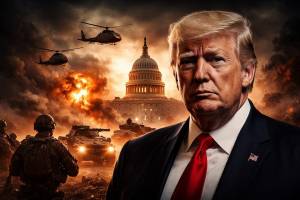
Shown above is on of the Artificial Intelligence-generated fake images created by the Trump Administration to portray President Trump as a brave wartime commander leading troops against domestic and foreign enemies.
- New York Times,
 Trump’s Blockade Risks Upending an Emerging Détente With China, David E. Sanger and Tyler Pager, April 14, 2026 (print ed.). In a thinly veiled critique of the war in Iran, China’s leader said the world could not risk reverting “to the law of the jungle.”
- New York Times, Ship ‘Spoofing’ in Strait of Hormuz May Compound Confusion, Ephrat Livni, Updated April 15, 2026. A new pattern of deceptive activity by some vessels around the critical waterway suggests the new American blockade is changing how some ships linked to Iran are behaving.
- New York Times, Done and Dusted? Trump’s Portrayal of the War in Iran Collides With Reality, Anton Troianovski, April 15, 2026. President Trump is confronting a crisis that is not bending to his narrative of a “pretty reasonable” new regime in Iran and all-but-assured victory for the United States.
More Global News

Britain's King Charles III and Queen Camilla wave to the crowds from the balcony of Buckingham Palace after the coronation ceremony in London, Saturday, May 6, 2023 (Associated Press photo by Frank Augstein).
- New York Times, King Charles III and Queen Camilla Will Visit D.C., New York and Virginia, Michael D. Shear, Updated April 15, 2026. The planned four-day state visit comes at a fraught time in the U.S.-U.K. relationship, following President Trump’s frequent belittling of the British prime minister.
- New York Times, Trump and Meloni Split Amid Growing Dispute Over Pope and Iran, Jason Horowitz, April 15, 2026. Prime Minister Giorgia Meloni was once considered one of President Trump’s closest European allies. Their friendship now appears in danger.
- New York Times, Japan Pledges $10 Billion to Help Countries Cope With Oil Prices, River Akira Davis and Kiuko Notoya, April 15, 2026. With supply chains at risk, the aid to Southeast Asian nations is aimed at securing the availability of oil-based products, including medical equipment.
- National Press Club (NPC), NPC Statement on Arrest of Journalist Ahmed Shihab-Eldin, Media Contact: Beth Francesco, April 14, 2026. National Press Club President Mark Schoeff Jr. today issued the following statement on the reported arrest of American-Kuwaiti journalist Ahmed Shihab-Eldin in Kuwait.
More On U.S. Immigration, Law, Courts, Crime, Civil Rights
- Robert Reich via Substack, Political Opinion: Stephen Miller's Strait of Hormuz, Robert Reich, right, April 15, 2026. His crackdown on immigrants is assumed to be good for America as long as it causes immigrants more pain than it does us. Same "logic" as Trump is using in Iran.
- New York Times, Appeals court ends contempt inquiry into deportation flights, Alan Feuer, April 15, 2026 (p[rint ed.). A federal appeals court on Tuesday put a halt to an extraordinary contempt investigation by a federal judge over whether the Trump administration had violated his order to stop flights of Venezuelan immigrants from being sent to El Salvador last year.
Trump, Vance Attack Pope Leo

Vice President JD Vance speaks in Pakistan while overseeing failed peace negotiations with fellow U.S. emissaries Jared Kushner, left, the president's son-in-law and business partner of multiple nations based in the Middle East, and Trump friend and fellow real estate investor Steve Witkoff, who is also emeshed in personal business dealings with nations and their dictators, including Russia (Pool photo April 12, 2026).
- New York Times, Vance Says the Pope Should Be More Careful When Talking About Theology, Anton Troianovsk, Updated April 15, 2026. The vice president, who is Catholic, took issue with Pope Leo XIV’s statement that disciples of Christ are “never on the side of those who once wielded the sword and today drop bombs.”
- The Contrarian, Opinion: Autocrats Don’t Fare Well Against Faith Leaders, Jennifer Rubin, right,
 April 15, 2026. Pope Leo echoes Pope John Paul II.
- Everyone Is Entitled To My Own Opinion, Political Commentary: JD Vance lectures the Pope. Hilarity ensues, Jeff Tiedrich, right,
 April 15, 2026. Try not to laugh.
U.S. Governance, Politics, Elections
- The New Republic, Fresh Off AI Jesus Scandal, Trump Posts Another Crazy Jesus Photo, Malcolm Ferguson, April 15, 2026. President Trump has no problem conflating himself with Jesus.
- Morning Shots via The Bulwark, Political Opinion: Golden State Clown Car, Andrew Egger, right,
 April 15, 2026. Last month, I wrote in this newsletter that billionaire Tom Steyer’s campaign to become California governor was “one of the funnier ongoing subplots of this young election season”—another vanity campaign like his 2020 presidential bid that would set unholy heaps of Steyer’s own money on fire en route to another doomed finish. I should have known I was tempting fate.
- Checks & Balances from the Society for the Rule of Law Institute, Political Opinion: There is No Role for the President in Our Elections, Trevor Potter, right,
 April 15, 2026. The Constitution makes itself clear.
- Michael Cohen, Political Opinion: The Dangerous Midterm Narrative, Michael Cohen, April 15, 2026. Complacency is the quiet killer of democracy, and as war, economic anxiety, and illusion collide, the 2026 midterms may hinge on who actually shows up.
- Daily Star, RFK Jr cut off dead raccoon's penis on family trip as he 'wanted to look at it,' Kathleen O'Boyle and Tom McGhie, April 15, 2026. A new biography of Robert F. Kennedy Jr. is revealing a string of personal and bizarre episodes from his past, including an incident where he recorded severing a deceased raccoon's penis during a family trip.
- New York Times, Labor Dept. Investigates Texts Among Secretary’s Family and Staff, Rebecca Davis O’Brien, April 15, 2026. Secretary Lori Chavez-DeRemer asked staff members to bring wine to her hotel room, and to keep in touch with her husband and father.
Top Stories

The Triad via The Bulwark, Political Opinion and Advocacy, How to Drive a Stake Through the Heart of Trumpism, Jonathan V. Last, April 15, 2026. Yesterday I gave you a long exegesis on how Victor Orbán legally turned Hungary into a competitive autocracy. The short version is that Hungarian democracy—like American democracy—was run on the honor system. I hope you’ll read the long version anyway.
Today, I want to talk about how the incoming Hungarian government is thinking about structural reforms to take their democracy off of the honor system. We should pay attention to this because if we’re lucky enough to throw off Trumpism in America, we will face a choice.
Should the American opposition party focus on “the future” and “kitchen-table issues”?
Or should they go after the retreating authoritarians hammer-and-tongs and use power to reform the structural weaknesses that allowed Trumpism to flourish?
After we talk about what the Hungarians are looking at, we’ll talk about some of the things that should be on the table in a post-Trump  America.
Warning: We’re in a late republican period. If we’re going to push back against it, we’re going to have to get pretty wild and pretty far out there and go in directions that a lot of liberals right now are uncomfortable with.¹
Let’s go.1. Reform: Hungarian-stizz
Yesterday we talked about Orbán’s various machinations after being elected in 2010. He passed an entirely new constitution on a party-line vote after winning an election in which doing such a thing was never even mentioned.
This was bad! Norms! Radical action! No bueno!
But what is Péter Magyar’s Tisza party supposed to do now? Would we have them not pass constitutional amendments—or even a new constitution—to undo the damage Orbán did? Even if they can only pass them on party-line votes?
The full extent of Magyar’s plans for the constitution are unclear. So far as I can tell, the only reform he has definitely promised is an amendment capping a prime minister at two terms (eight years).
Is that enough? If the constitution can be amended by a two-thirds vote of parliament, then a future supermajority could simply rewrite the rule to allow a future strongman to continue in office.
 My sense is that Magyar, right, was purposefully vague on this subject. We’ll see soon how ambitious his plans for constitutional reform are.
Magyar has promised some legal (as opposed to constitutional) reforms. For example:
Control of the Hungarian intelligence services will be relocated from the prime minister to the Ministry of the Interior.
The Sovereign Protection Office—an Orbán creation that had access to tremendous amounts of personal data and a mandate to find and sanction Hungarians who were deemed to be enemies of the state—will be destroyed.
Magyar says he plans to reform the judiciary, which, as we discussed yesterday, has been turned into an arm of Fidesz. How will he do this?
Unclear.
Magyar also says he plans to empower the attorney general to be independent and to free the media and the universities. Again: The mechanisms he uses to achieve these goals will matter; we have no idea what they might be.
To my mind, the most significant change we know about is Magyar’s pledge to join the European Public Prosecutor’s Office. This ascension would give the E.U. jurisdiction to investigate and prosecute fraud and corruption inside Hungary.
Meaning that if Orbán, his apparatchiks, and/or his cronies committed crimes during their reign, they could be held criminally accountable.
Which seems like a very big deal.
 New York Times, Iran War Live Updates: Iran Threatens Retaliation Over U.S. Blockade, Ali Watkins, Peter Eavis, Aaron Boxerman and Erika Solomon, April 15, 2026. Iran’s armed forces said they would attempt to expand their influence over sea lanes beyond the Strait of Hormuz if the U.S. military continued to block Iranian shipping.
Here’s the latest.
Iran on Wednesday threatened further retaliation over an American naval blockade of its ports in the critical Strait of Hormuz as the U.S. military said that it had “completely halted” trade in and out of Iran by sea.
More than 10,000 soldiers, as well as dozens of planes and warships, are enforcing the blockade, the U.S. military said. In response, the Iranian military said on state media that it could expand its grip over critical shipping routes beyond the strait if the U.S. blockade continued.
“Iran’s powerful armed forces will not allow any exports or imports to continue in the Persian Gulf, the Sea of Oman and the Red Sea,” said Maj. Gen. Ali Abdollahi, leader of the military joint command that oversees Iran’s army and Revolutionary Guards.
Mediators are rushing to shore up a two-week cease-fire in the war between the United States, Israel and Iran that expires April 21. But the future of the talks is unclear after a meeting between Vice President JD Vance and senior Iranian leaders over the weekend in Pakistan ended without a breakthrough.
Esmaeil Baghaei, a senior Iranian official, said that Iran had continued to exchange messages with the United States through Pakistan since the talks ended on Sunday morning.
President Trump, in an interview with Fox Business, again deemed the conflict “close to over” — a claim he has made repeatedly — while also suggesting that U.S. attacks could continue as long as needed to keep Iran from obtaining a nuclear weapon.
Iran has not fully relaxed its control over the Strait of Hormuz, the Persian Gulf conduit for oil and gas, which Mr. Trump said was a precondition for the current truce. Iran began blockading the Strait of Hormuz as a pressure tactic during the war, rattling the world economy and sending energy prices soaring.
Reaching a deal to end the war would require not only an agreement to reopen the strait, but also an agreement over Iran’s nuclear program and Israel’s military campaign in Lebanon against Hezbollah, the Iran-backed militant group.
The United States announced on Tuesday that Israel and Lebanon had agreed to “launch direct negotiations” to end fighting between Israel and Hezbollah in Lebanon. The announcement followed a rare face-to-face meeting in Washington between the Israeli and Lebanese ambassadors.
Hezbollah condemned the Lebanese government for negotiating with Israel, however, and it was unclear whether any Israel-Lebanon agreement would lead to an end in the fighting. Hezbollah has long been Lebanon’s dominant military and political force, defying attempts by the official Lebanese government to assert control.
Here’s what else we’re covering:
Lebanon: The talks between Israel and Lebanon did not lead to an immediate cease-fire. Israeli forces bombarded towns in southern Lebanon on Wednesday, according to Lebanese state media. Several people were killed in a strike in the coastal town of Ansariya, Lebanon’s official National News Agency said.
Iranian rescues: Emergency teams have rescued more than 7,200 Iranians from rubble after U.S. and Israeli bombings throughout the war, the president of Iran’s Red Crescent society, Pir Hossein Kolivand, said. The Iranian authorities have released little comprehensive information about the dead and wounded in the country, more than a month in the war.
Death tolls: The Human Rights Activists News Agency said at least 1,701 civilians, including 254 children, had been killed in Iran as of last Wednesday. Lebanon’s health ministry said on Tuesday that 2,124 people had been killed in the latest fighting between Israel and Hezbollah. In attacks attributed to Iran, at least 32 people have been killed in Persian Gulf nations. At least 22 people had been killed in Israel as of Sunday, as well as 12 Israeli soldiers fighting in Lebanon. The American death toll stands at 13 service members.
 Morning Shots via The Bulwark, Political Opinion: Cali Dems Need to Get Their Sh*t Together, Bill Kristol, Andrew Egger and Jim Swift, April 15, 2026. At this point, Gov. Tom Steyer might be the least bad outcome.
This week, Donald Trump posted a picture that portrayed him as Jesus Christ, before deleting it among a furious backlash from Christian conservatives. But his quest to discover which forms of idolatry they will and won’t put up with continues. This morning, he posted a meme portraying him being embraced by a Jared Leto-looking Jesus, which included the caption: “I was never a very religious man .. but doesn’t it seem , with all these satanic , demonic , child sacrificing monsters being exposed … that God might be playing his Trump card !”¹
“The Radical Left Lunatics might not like this,” Trump wrote, “but I think it is quite nice!!!” Happy Wednesday.
News Updates
Pope Leo XIV, left, Iran President Masoud Pezeshkian, center and U.S. President Trump (File photos).
The Parnas Perspective, Morning News and Commentary: Renewed Calls for Trump's Removal as He Escalates Attacks on the Pope, Iran Threatens its Own Blockade, Trump Urges China to Not Supply Weapons to Iran, Aaron Parnas, right, April 15, 2026. Overnight, the President and Vice President escalated their criticism of the pope and the Catholic Church. The President spent hours posting about Pope Leo and the Church, prompting renewed calls for an evaluation of his mental acuity and possible removal. The Vice President also weighed in, suggesting the pope should be “careful” when speaking on theology. At the same time, Iran is threatening new blockades, while Trump is urging China to stay out of the conflict and warning that the United States is very capable of fighting.
Here’s what you missed:
Overnight, the President spent several hours complaining about Pope Leo and escalating his attacks against the Catholic Church. He even implied that he was the victim of attacks after posting the image of himself as Jesus. The renewed comments have led to more calls for an investigation into the President’s mental acuity, with some suggesting he should be removed from office. The latest post related to religion and Jesus is the following:
JD Vance, who converted to Catholicism in 2019, publicly told Pope Leo XIV to be “more careful” when speaking on theology. His comment suggests criticism of the pope’s recent statements or interpretations.
Tom Homan said he loves the Catholic Church but believes it should stay out of politics after criticism from Pope Leo XIV over U.S. immigration policy. He argued that church leaders should focus on internal issues instead. Homan also said his decades of experience show that strong border security helps save lives.
Donald Trump said he exchanged letters with Xi Jinping about concerns that China might be supplying weapons to Iran. Trump claimed he urged Xi not to provide military support, and Xi responded by denying that China is doing so. However, U.S. intelligence reportedly indicates China may soon send new air defense systems to Iran, contradicting Xi’s claim. The situation has raised tensions, with Trump threatening steep tariffs on Chinese goods, while also planning a trip to China next month.
Trump claimed that Xi Jinping agreed not to send weapons to Iran and said China supports his efforts to reopen the Strait of Hormuz. In a social media post, Trump emphasized cooperation with China while also warning of U.S. military strength if needed. He suggested the move would benefit global trade, though shipping in the strait remains largely halted amid the U.S. blockade of Iranian ports. Trump is expected to visit Beijing soon as tensions continue.
Trump made a confusing remark about Ruth Bader Ginsburg, suggesting her death occurred shortly after an election that Democrats had won. In reality, Ginsburg died in September 2020 while Trump was still president, allowing him—not a Democrat—to appoint her replacement. His statement appeared to inaccurately describe the timeline and circumstances surrounding her death.
Trump said he was pleased with the reaction to the U.S. blockade of Iranian ports near the Strait of Hormuz, describing it as “amazing” and stronger than expected. He suggested the response was even more significant than after prior U.S. actions, claiming the U.S. had already dealt major damage to Iran. Trump added that he believes the U.S. is “doing very well” so far. However, he emphasized that the ultimate outcome of the situation is what truly matters and said it could become clear soon.
As I mentioned previously, I also wanted to start highlighting other newsletters and journalists that I am personally a fan of! One of the newsletters I love to read is titled Who Broke It. A lot of you have asked me how you could best track other creators in this space and learn more about the creator economy, well this newsletter has it for you. It’s a twice-weekly newsletter that catalogs and analyzes the political creators who genuinely move the discourse — breaking down their viral feats, public flops, and how both can affect actual policy. Written by Grace Weinstein, she goes into all the darkest, dankest corners of the internet to highlight trends and personalities weeks before they hit the mainstream. Check it out, subscribe by clicking here, and let me know what you think! It’s free to do!
Iran has warned it may block shipping routes in the Persian Gulf, Sea of Oman, and Red Sea if the U.S. continues its blockade of Iranian ports. Maj. Gen. Ali Abdollahi said such actions would be seen as escalating tensions and potentially violating a ceasefire. He added that Iran’s armed forces would respond forcefully and could halt all import and export activity in those waterways. The threat underscores rising risks to global shipping and regional stability if the standoff continues.
Iranian media claims that two of its tankers successfully passed through the Strait of Hormuz despite the U.S. blockade. The reports say one was a supertanker and another a food supply vessel heading to an Iranian port. However, the claims have not been independently verified, and it’s unclear which ships were involved. Meanwhile, U.S. Central Command maintains that the blockade has been fully enforced.
During an interview with Maria Bartiromo, Donald Trump responded to a reported Chinese cyberattack by suggesting such actions are reciprocal, saying “we do it to them” as well. Pressed on whether the U.S. would formally respond, he gave a vague answer, indicating he would address it but downplaying the situation as typical behavior between countries. His comments implied a normalization of cyber activity between the U.S. and China rather than outlining a specific policy response.
The Israeli military has ordered residents in southern Lebanon to evacuate north of the Zahrani River as airstrikes continue in the area. An Israeli spokesperson warned that anyone near Hezbollah personnel or infrastructure is at risk. The United Nations says the ongoing conflict has already displaced over one million people. It also described the humanitarian situation in Lebanon as “grave,” highlighting the worsening crisis.
JD Vance recently led lengthy in-person talks with Iranian officials in Islamabad, and a second round could happen soon if U.S. officials travel quickly to Pakistan. The first round involved about 21 hours of negotiations after a long journey from Washington. Donald Trump has suggested progress could come within days. Timing is tight, as another trip would require significant travel on short notice.
According to Politico, Trump has threatened to tear up the U.S.-U.K. trade deal over Britain’s opposition to military action against Iran, escalating tensions with Keir Starmer. Starmer pushed back, saying the U.K. will not change its position despite pressure from Washington. The dispute has raised concerns about the future of the “special relationship” between the two countries. It also comes at a sensitive time for trade and diplomatic ties.
Donald Trump said he would fire Jerome Powell if Powell remains in his role after his term ends next month, escalating tensions with the central bank. Trump has criticized Powell over interest rates and a costly Federal Reserve renovation project, which is also under investigation. Powell has indicated he will stay in the position temporarily if a successor is not confirmed. The situation raises legal and political questions about presidential authority over the Federal Reserve.
Photos released by Getty Images show extensive destruction at the Shahid Boroujerdi residential complex in southern Tehran following a U.S.-Israeli strike last month. The images highlight significant damage to civilian buildings amid the recent conflict with Iran. The release comes during a fragile ceasefire, underscoring the ongoing impact of the war.
Iran-War-Aftermath
Trump walked back earlier remarks suggesting oil prices might rise before the midterm elections, saying he expects prices to return to previous levels or possibly fall. He acknowledged there could be a short-term economic hit but predicted a recovery. Trump also claimed his prior comments were misquoted, despite having said recently that prices could stay the same or increase. Overall, he expressed optimism that oil prices will stabilize and not significantly impact the economy by the midterms.
Iran-linked media and online creators have produced viral LEGO-style rap videos mocking Donald Trump and criticizing his actions, including his stance toward the pope and the war. The videos use satire and religious references to accuse Trump of disrespecting Christianity while promoting conflict. These clips are part of a broader digital propaganda effort using AI-generated content to influence public opinion during the war. Analysts say such content has gained millions of views and reflects a growing role of social media in modern information warfare.
Todd Blanche said Americans should be “happy” that Donald Trump is heavily involved in the Justice Department, framing it as strong executive leadership. He defended Trump’s public pressure on prosecutors, including urging action against political opponents, as transparency about expectations. Blanche also indicated the department may continue pursuing cases even after grand juries decline to indict. His stance contrasts with past norms that sought to keep the Justice Department independent from White House influence.
Today, on Tax Day, Republicans are struggling to gain political support from their 2025 tax cuts as many Americans feel little benefit. Tax refunds have risen modestly but fell short of expectations, and many voters remain unaware of or unconvinced by the relief. The impact of the Iran war and rising gas prices has overshadowed the policy, making it harder to promote ahead of midterm elections. Polls show widespread dissatisfaction with tax burdens, complicating Republican messaging.
Democratic lawmakers, including Elizabeth Warren and Chuck Schumer, are introducing a bill to prevent presidents and vice presidents from receiving settlement payments from the federal government. The proposal follows Donald Trump suing federal agencies for $10 billion over the leak of his tax records. The legislation would bar top officials and their families from benefiting financially from such settlements, with limited exceptions. Supporters say it aims to prevent abuse of power and protect taxpayer money.
 Eric Swalwell, left, is facing a new sexual assault allegation from a woman who claims he drugged and raped her in 2018, prompting an ongoing investigation by Los Angeles authorities. The accuser says the incident occurred in a hotel room and has recently filed a report with law enforcement. Swalwell has denied the allegations, calling them false and politically motivated. The case adds to multiple other misconduct accusations and led to his resignation from Congress.
A new analysis finds that major oil and gas companies are making enormous profits from the Iran war, earning over $30 million per hour due to higher energy prices. The conflict pushed oil prices to around $100 per barrel, creating tens of billions in extra profits while increasing costs for consumers and businesses. Governments are considering windfall taxes as countries lose revenue from fuel tax cuts and face rising inflation. Experts warn the crisis highlights global dependence on fossil fuels and strengthens the case for investing in renewable energy.
The U.S. Department of Justice under Donald Trump has asked a federal appeals court to overturn seditious conspiracy convictions of members of far-right groups involved in the January 6 Capitol attack. The request targets figures from the Proud Boys and Oath Keepers, including leaders previously given lengthy prison sentences. It follows earlier pardons and commutations issued by Trump to many individuals connected to the attack. The move marks a major reversal from prior efforts to hold participants accountable and could erase these convictions entirely.
Bob McCaffrey Jr., previously convicted in connection with his wife’s 2012 disappearance, has been arrested for a separate 1990 murder in New Jersey. Authorities say DNA evidence linked him to the killing of Lisa Marie McBride, whose case had remained unsolved for decades. McCaffrey was captured in North Carolina and now faces multiple charges, including murder and kidnapping. The arrest highlights how advances in DNA technology can help solve long-standing cold cases.

President Trump meets Viktor Orbán, the prime minister of Hungary
Letters from an American, Historical Commentary: April 4, 2026 [Hungary's Game Changer], Heather Cox Richardson, right, April 15, 2026. There are signs the political game has changed in the United States since Hungarian voters rejected Prime Minister Viktor Orbán’s leadership on Sunday, April 12. His party’s loss of control of the government to a supermajority of its opponents undermined the belief that right-wing authoritarianism was an unstoppable force in world politics.
Since MAGA Republicans had tied themselves to Orbán and his movement, his loss also weakened their own claims to inevitable victory over those trying to protect democracy.
On Sunday night, President Donald J. Trump appeared to melt down on social media. In The Atlantic today, Tom Nichols noted that Trump’s “emotional state seems to be fraying: This weekend, he attacked Pope Leo XIV, presented himself as Jesus Christ, and then jabbed at his phone until dawn.” Nichols notes that after Trump attacked the Pope and portrayed himself as Jesus, he posted an AI version of a Trump Tower on the moon. (“Sure,” Nichols writes. “Why not?”)
Then Trump posted a meme of how senators Bernie Sanders (I-VT) and Chuck Schumer (D-NY), and former president Joe Biden all look old—unlike Trump—and then posted clips from Newsmax. The postings continued throughout the night. “This is not the behavior of a stable, healthy leader,” Nichols writes. “The American people must not look away…. They must pay attention to the president’s deterioration, and insist that the House and Senate start acting like functioning branches of the government by asking the White House to explain what is happening, without insults or evasions, before the eyes of the country and the world.”
Trump has tried to explain away the AI image he posted on social media on Sunday depicting himself as Jesus, clothed in robes, bathed in radiant light, and apparently healing a man in bed. After an extraordinary outcry over the image from his evangelical Christian followers, he took the image down, telling reporters “I thought it was me as a doctor” and claiming that “only the fake news” could suggest the image showed him as Jesus. He added: “I do make people better.”
With the House back in session today, Representative Jamie Raskin (D-MD), the top-ranking Democrat on the Judiciary Committee, introduced a bill to establish an independent commission to evaluate the president’s mental state. The Twenty-fifth Amendment to the Constitution establishes a process by which either a majority of the Cabinet or a majority of a body created by Congress to evaluate the president’s fitness can declare that a president is “unable to discharge the powers and duties of his office.” In a press release, Democrats on the House Judiciary Committee expressed concern about “Trump’s escalating erratic conduct.” The bill has fifty Democratic co-sponsors.
“Public trust in Donald Trump’s ability to meet the duties of his office has dropped to unprecedented lows as he threatens to destroy entire civilizations, unleashes chaos in the Middle East while violating Congressional war powers, aggressively insults the Pope of the Catholic Church and sends out artistic renderings online likening himself to Jesus Christ. We are at a dangerous precipice, and it is now a matter of national security for Congress to fulfill its responsibilities under the 25th Amendment to protect the American people from an increasingly volatile and unstable situation,” Raskin said in a statement.
Trump’s deteriorating mental state has become impossible to overlook, but Republicans are making excuses for it. Cabinet members, who owe their positions to Trump and who likely recognize they will never rise to such power again in a merit-based system, will probably not question Trump’s mental acuity. But Raskin’s measure will force Republicans in Congress either to vote for an independent commission to evaluate Trump or to own his increasingly erratic behavior themselves.
Today, when asked if he were comfortable with Trump’s threat of last week that an entire civilization would die if it did not meet his demands, Senate majority leader John Thune (R-SD) changed the subject by saying: “You’ve got to…look at what the president is doing, and I think right now he’s trying to open the Strait of Hormuz, which…we are all supportive of.” The strait was, of course, open before Trump attacked Iran.
The Lincoln Project accused Republicans of “ignoring Trump’s sharp mental decline the same way they’ve ignored his crimes.”
Trump’s erratic behavior has led the U.S. into disaster by striking Iran, which in turn attacked its neighbors and closed the Strait of Hormuz. After unsuccessfully bullying other nations to force Iran to reopen the strait to all ships, not just to those of certain nations, Trump last week declared a ceasefire and a framework for an agreement, then suggested the U.S. and Iran would together manage the strait. When Iran continued to maintain control of it, Trump announced the U.S. would blockade the strait to make sure no ships at all could cross through it, with the idea that the U.S. can withstand the economic pain that closure will cause for a longer time than Iran can.
Data released today show that wholesale inflation has risen to 4%, the highest annual rate in three years. Today Marta Pacheco of EuroNews reported that the last of the vessels that left the Strait of Hormuz before the U.S. and Israel struck Iran have reached Europe. Analysts expect a new surge in energy prices. In Talking Points Memo today, David Kurtz points out that the economic mess in which the U.S., and the world, finds itself is entirely Trump’s fault. The trade wars, unjustified war in the Middle East, and attacks on U.S. science, universities, and immigration that are throttling economic growth are all a product of Trump’s personal choices.
As the war enters its seventh week, Minority Leader Chuck Schumer said today that Senate Democrats will repeatedly force votes on war powers resolutions designed to force Trump to get congressional authorization before any further military action in Iran. “Forty-five days into this war, Congress has been sidelined because our Republican colleagues refuse to take a strong stand against this war and duck it completely because they’re afraid of Trump,” Schumer said today.
Thune and other Republicans countered with the belief that the war won’t go on much longer, and they support Trump’s actions.
Today former attorney general Pam Bondi was scheduled to testify under oath before the House Oversight and Reform Committee about the Department of Justice’s handling of the release of the Epstein files. The DOJ has released only about half of those files despite a law requiring it to produce them all no later than December 19 of last year. Many of the records it did release are heavily redacted, despite the very few and very specific conditions under which Congress allowed such redactions.
Bondi did not show up.
The Department of Justice is taking the position that since she was subpoenaed as attorney general and no longer holds that position, the subpoena was no longer in force.
Democrats on the committee disagree. Representative Jasmine Crockett (D-TX), who was a prosecutor before she entered the House, posted: “Pam Bondi refused to show up for today’s Oversight deposition—defying our lawful subpoena. We couldn’t care less that she was fired from her job as Attorney General. She is responsible for leading the White House cover-up of the Epstein files. Since she didn’t show up, Oversight Democrats will move to hold her in contempt of Congress. The survivors deserve justice—and we will get answers. Enough is enough.”
Representative Robert Garcia (D-CA), the top Democrat on the Oversight Committee, told the Weeknight: “People have to be held accountable for the laws that we pass in the Congress and the subpoenas that we put in place.”
More On Hungarian Election, Global Impacts
President Trump meets Russian President Vladimir Putin during a July 16, 2018 meeting that would exemplify their longstanding close collaboration (White House photo by Shealah Craighead).
Wayne Madsen Report, Investigative Commentary: Trump's attack on Pope Leo is linked to Kremlin's agitprop about the Vatican and the downfall of Viktor Orban, Wayne Madsen, right, author of 28 books and former Navy intelligence officer, April 14-15, 2026. Moscow convinced Trump that the pope helped rally Hungarian Catholics against Orban.
The one thing that holds true about Donald Trump is that he is easily manipulated by those who play on his personal biases and a belief in grand conspiracies. Trump’s lashing out at Pope Leo XIV partly results from Vladimir Putin’s belief that the Vatican helped rally Hungarian Catholics — who represent a third of the eligible voters in Hungary — to support the opposition Tisza coalition in their recent landslide victory over Viktor Orban’s pro-Moscow Fidesz party.
Putin and Trump pulled out all the stops in supporting Orban. Putin even suggested that Russian intelligence could stage a phony assassination attempt against Orban to whip up a sympathy vote. For his part, Trump dispatched Vice President JD Vance to Budapest to endorse Orban and his party. In February, Secretary of State Marco Rubio visited Budapest and told Orban at a news conference, “President Trump is deeply committed to your success because your success is our success.”
In addition to being influenced by Putin, Trump also concocted in his current dementia-ridden imagination that there was a secret alliance between the Vatican and billionaire George Soros to defeat Orban. This was prompted by a conspiracy theory advanced by Elon Musk, who wrote on X, “Soros Organization has taken over Hungary.” Musk was responding to a post by Alex Soros, Chair of the Board of Directors of  the Open Society Foundation and the son of the Hungarian-born George Soros, “The people of Hungary have taken back their country! A resounding rejection of entrenched corruption and foreign interference.” Dan Andronic: Peter Magyar este, de fapt, un Viktor Orban cu față umană Péter Magyar and Tisza supporters celebrating April 12 election victory in Budaest
The victorious Tisza party made it clear that it did not accept funds from foreign NGOs, including that of Soros. The same cannot be said of Orban and his Fidesz party, which formed a central cog in the global fascist movement supported by such billionaires as Musk, Peter Thiel, David Sacks, Stephen Schwarzman, Bill Ackman, Marc Andreessen, Timothy Mellon, Miriam Adelson, and others. Musk and Orban before Orban’s fall from power
A group of German NGOs suspected that Musk had been providing technical support to Orban in the same way that he helped engineer Trump’s electoral victory in 2024. In early February, Democracy Reporting International (DRI) and Society for Civil Rights (GFF), as well as the law firm Hausfeld Rechtsanwälte, sued X in a Berlin court for refusing their request to provide data on Musk’s platform’s conducting an influence and disinformation campaign designed to help Orban win another term in office. Musk’s operation coincided with a similar influence operation conducted by Russian intelligence services. The Berlin court agreed with the plaintiffs and ordered X to hand over the data requested pursuant to the EU Digital Services Act (DSA). The DSA requires large social media platforms to hand over data to researchers investigating “disinformation, hate speech, and election manipulation.” Trump has cited the DSA as a reason for the U.S. to impose punishing tariffs on the EU precisely because he, Musk, Orban, Putin, Binyamin Netanyahu, and others view the law as a way to suppress far-right parties and movements in Europe and elsewhere.
 Musk’s and Putin’s twin election interference operations targeting Hungary were expected to result in Orbán’s Fidesz–KDNP party alliance winning the April 12 election by 49 percent over Tisza’s 42 percent. A massive turnout of nearly 80 percent of the electorate stymied Orban’s re-election with Tisza winning 53.6 percent of the vote to Fidesz’s 37.8 percent. That equated to Tisza winning an absolute majority of 138 to 140 seats over Fidesz’s 55 seats. The Hungarian election proved that the Trump-Putin-Musk equation for electoral manipulation fails miserably when there is a massive voter turnout in elections.
Pope Leo’s problems with Orban actually began under his predecessor, Pope Francis. In 2023, Francis visited Hungary in an attempt to woo back to the Catholic faith the over 15 percent of Catholics who left the church since 2001, when they stood at over half of the population. Orban was playing a double game with the papal visit. He wanted the pontiff’s support for Fidesz’s Christian nationalism but not at the expense of Orban’s invigoration of Fidesz’s attraction to the neopagan Ősmagyar vallás or Hungarian Native Faith. Putin has supported the rediscovery by Russians of the Rodnovery movement, the Slavic Native Faith, while also using the Russian Orthodox Church to bolster his dictatorship. Image result for Pope Francis budapest Pope Francis rallying the faithful in Budapest in 2023
Francis’s visit to Hungary had the opposite effect of what Orban expected. It was followed by the exposure of significant corruption within the Fidesz party and Orban’s government. Two senior Fidesz officials were forced to resign. Orban’s government showed signs of fracture, thus accelerating Tisza leader Péter Magyar’s rise as a reformist alternative.
Ironically, it was a child sex scandal following the papal visit that directly contributed to Orban’s ouster, much in the same manner that the Jeffrey Epstein scandal threatened to bring about Trump’s political demise. Orban convinced President Katalin Novak, a close ally of Orban, to issue presidential pardons to 25 individuals. Orban claimed that the pardons were in honor of Francis’s recent visit. One of those pardoned was Endre Konya, a man convicted of covering up the sexual abuse of minors at a state-run orphanage. The pardons were carried out by Justice Minister Judit Varga, Magyar’s ex-wife, and President Novak. Magyar, a longtime Fidesz apparatchik, resigned his executive positions at two state-run companies and the state-owned MBH Bank.
Magyar, right, immediately seized the initiative at the outset of Orban’s pedophilia scandal. He accused Fidesz leadership of hiding “behind women’s skirts.” Although Varga and Novak were forced to resign, Magyar contended that “it was clear from the beginning that a member of Orbán’s family was behind the pardon and was pushing for it.” Image result for hungary padon scandal President Novak announces resignation over pedophile pardon scandal
Magyar continued to turn up the heat on Orban by saying that “a few families own half the country.” Magyar demonstrated that Fidesz’s claim that it was a protector of traditional family values and children was a fraud. After Magyar joined Tisza, the party achieved a degree of success in the April 2024 European Parliament election, winning 7 of Hungary’s 21 EU parliamentary seats with some 30 percent of the vote. Magyar and his party began surging in the opinion polls, which ultimately led to Orban’s defeat.
Because Orban placed loyalists throughout Hungarian law enforcement, prosecutor, and judicial positions, including acting President Tamás Sulyok armed with pardon authority, Magyar has vowed to join the European Public Prosecutor’s Office. That would allow EU investigators to bypass Orban’s plants and investigate not only fraud, nepotism, and other corruption but also any links between Hungarian institutions and businesses to the international Jeffrey Epstein youth sex trafficking network. By endorsing Orban, Trump and his loyalists were attempting to ensure that Budapest would not turn into an other location from which Epstein and his associates could be investigated, especially in relation to the trafficking of eastern European underage female “models.” Trump will no longer have that luxury.
 Magyar, left, who was raised Roman Catholic, holds a law degree from Pázmány Péter Catholic University in Budapest. Graduates of the university include several Hungarian notables in the fields of international law and human rights. The Catholic institution is ideologically opposite of the Mathias Corvinus Collegium (MCC) of Budapest, which has become a nest for pro-Orban neo-fascist politics, including co-hosting conferences with the Hungarian branch of the U.S. Conservative Political Action Conference (CPAC). The MCC became known as Orban’s “pet university.” It was from Orban’s carrot-and-stick approach to Hungary’s institutions of higher learning where Trump got the idea to threaten some of America’s top colleges and universities unless they paid him out-of-court lawsuit “settlement” fees. At CPAC, Viktor Orbán Got a Standing Ovation From the Trump Faithful Orban at CPAC Dallas in 2022
Magyar has issued a stark warning for CPAC and the MCC (along with other pro-Orban think tanks like the Foundation for a Civic Hungary, the Danube Institute of Budapest, American Hungarian Federation, the Roger Scruton Legacy Foundation of London, and the Edmund Burke Foundation of Washington, DC):
“The state will not finance these things, neither the event called CPAC nor other related institutions such as the Mathias Corvinus Collegium and similar attached bodies. I believe the state should never have financed them in the first place, it was a crime. Mixing party financing with government spending from the state budget is, in my view, a criminal offense, and this will have to be investigated by the future authorities, including the National Office for the Recovery and Protection of Public Assets, since those budgetary funds were not meant to finance party events.” Image result for Mathias Corvinus Collegium
Orban’s fall from power also limits the influence that Deputy Assistant to the President and Senior Director for Counterterrorism Sebastian Gorka has in Hungary and other countries in eastern Europe. Gorka became a national security advisor to Orbán and Fidesz prior to the 1998 general election. After Orban’s victory, Gorka allegedly remained an advisor to Orbán. In 2002, Gorka failed to obtain a national security clearance, which prevented him from serving on a parliamentary committee. Yet, today Gorka possesses an all-level and all-compartmented clearance to access America’s most tightly-controlled secrets. Two leaders of the Order of Vitéz, a fascist Hungarian society, told The Forward that Gorka took a lifelong loyalty oath prior to his wearing the Order’s medal at the 2017 inauguration of Trump. Nevertheless, in keeping with the lies rampant among Trump loyalists, Gorka denies that he is a member of the fascist order. Sebastian Gorka to Speak at CPAC in DC 2025 Sebastian Gorka at CPAC 2025 in National Harbor, Maryland
Orban’s and Fidesz’s defeat came as welcome news to Pope Leo. Orban, a member of the Calvinist Hungarian Reformed Church, strenuously opposes Catholic doctrine, especially in relation to assisting the poor and displaced refugees and migrants. Orban’s Calvinist — make that Christian nationalist — beliefs are shared by U.S. “War Secretary” Pete Hegseth and Trump, who was raised by his father in the Presbyterian “prosperity gospel” sect of Norman Vincent Peale. Peale was an infamous anti-Catholic Protestant theologian who participated, along with evangelist Billy Graham and some 30 other Protestant clerics (reportedly including Southern Baptist Convention President Ramsey Pollard and Lutheran Church-Missouri Synod President Rev. Dr. John W. Behnken), in a secret 1960 conclave in Montreux, Switzerland to strategize against the election as president of John F. Kennedy, who was Catholic. A later anti-Kennedy meeting involving Peale and Graham occurred at the Mayflower Hotel in Washington, DC just prior to the 1960 election. It was Graham’s wife, Ruth, who spilled the beans on the Montreux meeting to a friend. How American Life Is Impacted By The Prosperity Gospel : Throughline : NPR Norman Vincent Peale and Donald Trump
 Individuals like Trump, Hegseth (who did not invite Catholics to a recent Good Friday service at the Pentagon for “Protestants only”), and Orban are continuing the anti-Catholic bias, this time against Pope Leo, the first U.S. pontiff. Pentagon official Elbridge Colby (a grandson of former CIA director William Colby) also recently threatened the Papal Nuncio to the United States with an “Avignon Papacy,” the implication that the U.S. military could kidnap Leo from the Vatican and force him to act under Trump administration orders as a hostage inside U.S. territory.
The defeat of Orban will have far-ranging effects, including helping the pontiff to quell the global influence of the pro-fascist Opus Dei sect, which counts among its adherents at least two members of the U.S. Supreme Court.
Catholics and non-Catholics are praying for the success of the Tisza government in Hungary and the papacy of Pope Leo XIV. The enemies of democracy and Christianity have shown their hands and pundits and political scientists are predicting the imminent demise of other far-right leaders and parties, including Prime Minister Robert Fico in Slovakia, Prime Minister Aleksandar Vucic in Serbia, and far-right parties in Germany, Italy, France, and Bulgaria, with Putin in Russia, Alexander Lukashenko in Belarus, and the U.S. Republican Party being within close political firing range.
DEEPER LOOK:
Ever since Cardinal József Mindszenty was arrested by Hungary’s Communist government in 1948, Vatican-Hungarian relations have served as a linchpin in wider East-West geopolitical relations. Anti-Vatican Zionists, buoyed by the creation of the State of Israel, were quick to support Budapest’s imprisonment of Mindszenty and his forced confession to various “crimes” against the state. In 1956, in the midst of the Hungarian Revolution, Mindszenty was released from prison. When the Soviet Union invaded Hungary, Minszenty sought refuge in the U.S. embassy, where he was granted asylum. George Orwell praised Mindszenty for demonstrating that the triumph good versus evil can exist outside of religious connotations.A Living RebukeCardinal Mindszenty’s show trial in Budapest
In 1971, the Hungarian government allowed Mindszenty to leave the country for Vienna. Pope Paul VI demanded that the elderly Mindszenty resign as the Archdiocese of Esztergom. Upon Mindszenty’s refusal, the pope stripped the Hungarian of all his titles but opted to leave the Hungarian archdiocese vacant. Mindszenty died in Vienna in 1975.
There were anti-Catholic forces, most notably within the Calvinist sect, who accused Mindszenty of conspiring with the Nazis during World War II. However, the cardinal was fiercely opposed to the fascist Arrow Cross Party that ruled Hungary and allied the country with Adolf Hitler’s Germany. Mindszenty was also opposed to the Communists, which made him a target for Soviet apologists in the West.
The sectarian fissures that opened up within Hungary in the 1950s, including those between Hungarian Calvinists and Catholics, continued throughout the Viktor Orban regime. Orban’s alliance with Vladimir Putin reminded Hungarians of that between Hungarian Communist General Secretary Mátyás Rákosi and Soviet leader Joseph Stalin. And the rise of Peter Magyar to challenge Orban was reminiscent of the 1956 uprising against the Kremlin led by Communist leader Imre Nagy.
Now that the Kremlin and the global fascist movement have lost their Hungarian beachhead in the heart of Europe, there are charges flying about that Pope Leo XIV aided Hungary’s victorious Tisza party against Orban’s Fidesz. The new prime minister, Magyar, is Catholic while Orban is a member of the Hungarian Reformed Church, which adheres to Calvinist Protestant theology. Donald Trump’s and Vice President JD Vance’s nonstop attacks on Pope Leo, which appear coordinated with Kremlin anti-Vatican agitprop on social media, increased in vitriol following Tisza’s electoral drubbing of Orban.
Vance converted to Catholicism six years ago, a decision quite possibly influenced by the non-Catholic — but Catholic curious — billionaire Peter Thiel. Acting as a mentor for Vance, aka James Donald Bowman, James David Hamel, J.D. Hamel, James David Vance, J.D. Vance (with periods), and whatever nicknames that were used on gay dating sites, Thiel has recently organized bizarre seminars on the Anti-Christ within walking distance of Vatican City.Hillbilly Elegy' author, Peter Thiel ...JD Vance and his mentor Peter Thiel
Vance’s recent “schooling” of Pope Leo on Christian theology is in keeping with someone whose conversion to Catholicism is extremely reminiscent of Opus Dei recruitment efforts via the Catholic Information Center in Washington, DC. Among these conversions are Larry Kudlow, Newt Gingrich, former Senator Sam Brownback, the late Robert Novak, the Heritage Foundation’s Kevin Roberts and Leonard Leo, and, allegedly, Supreme Court Associate Justices Sam Alito and Clarence Thomas. Pope Leo has built upon efforts of his predecessor, Pope Francis I, to curb the influence of Opus Dei. Vance’s direct confrontation with Pope Leo are a sign that Opus Dei continues to challenge the Catholic reformist doctrine advanced by Francis and Leo.No photo description available.
The other factor in challenging Pope Leo is Vladimir Putin, who is not happy with Leo continuing Francis’s support for political liberalism in the European Union and recognition of autocephalous Orthodox churches in eastern Europe. These autocephalous synods have sworn allegiance to the Orthodox Patriarchate of Constantinople of Bartholomew over the pro-Kremlin Moscow Patriarchate. One of these autocephalous churches is the Orthodox Church of Ukraine that remains independent from Moscow.
Putin views the Vatican as an impediment to Moscow’s control over all Russian Orthodox churches in Europe and elsewhere. The defeat of Orban will also limit the activities of a network of far-right think tanks and other groupings based in Budapest that have engaged in agitprop, much of it provided by Kremlin troll farms, targeting Pope Leo and his loyal archbishops, as well as Catholic government officials like Prime Minister Giorgia Meloni of Italy and Chancellor Friedrich Merz of Germany.
Thanks to the hostility of Trump and Putin, Pope Leo is now considered to be a major leader of democratic forces in Europe. In response to a question posed in 1943 about the pope, Stalin quipped, “How many divisions does the pope of Rome have?” What Pope Leo lacks in military power he more than makes up for with the soft power of the Catholic Church as a guiding force against Russian and American fascism and belligerency.
The Hartmann Report, Advocacy and Commentary: Democrats: To Win America Back, Confront Trump's and the GOP's Naked Corruption, Thom Hartmann, right,  author of "The Last American President," shown below, and commentator, April 15, 2026. From Hungary to Ukraine to America, one message wins: expose the rigged system and mobilize voters to defeat it…
Péter Magyar defeated Viktor Orbán in last weekend’s Hungarian elections because he ran a Navalny-style playbook, calling Orbán’s and his billionaire buddies’ capture of the media and most other aspects of Hungarian life a “state capture system” grounded in good old-fashioned corruption.
 From Orban’s son-in-law pulling a Jared and using his government position to become one of the richest men in the country, to his billionaire cronies buying up the media like the billionaire Ellisons are doing here now, corruption was Magyar’s singular through-line message. And it worked, producing an overwhelming turnout and undeniable victory.
It will work here, too!
Democrats are (continuously, it seems) debating what should be their campaign strategy, their main through-line message, for the 2026 midterms and the 2028 presidential election. Every faction and special interest group in the country is pushing their own idea, but there’s one overarching concept — one word — that can encompass most all of them and do so with a proven political punch: “Corruption.”
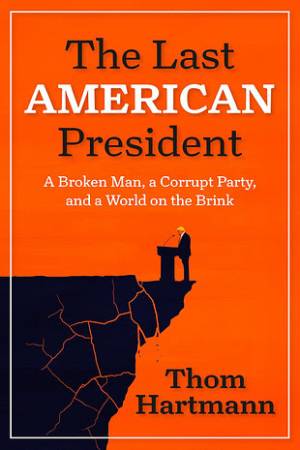 At every level, ever since the Reagan Revolution, the heart of Republican policies has been the naked corruption of our American political and economic systems. Since the 1980s, Republicans have sold their corruption with slogans like, “Government is the problem, not the solution,” and “Let the market decide,” but their real message is, “Turn it all over to the billionaires and their corporations.” The result has been:
— Tax cuts and loopholes for billionaires and big corporations that, in aggregate since 1981, add up to more than our total national debt of $38 trillion (in other words, Republicans borrowed $38 trillion in our names that our kids will repay and gave all of it to the morbidly rich).
— Reagan’s 1983 suspension of enforcement of the anti-trust laws that has caused every industry in America to become a form of monopoly dominated by five or fewer massive corporations, gutting competition and raising prices.
— Five on-the-take Republicans on the Supreme Court ruling that corporations are persons and money is the same thing as “free speech,” handing our elections over to the highest bidders.
— Virtually every legacy federal regulatory agency being run by industry insiders working on a revolving-door basis.
— Members of Congress and the corrupt Trump regime engaging in insider trading with impunity.
— A GOP-aligned military-industrial complex that’s essentially taken over Pentagon procurement.
— An anti-labor Labor Department; an anti-education Education department; an anti-civil rights Civil Rights enforcement agency; an anti-environment Environmental Protection Agency; etc…
— Trump’s mysterious pardons that always seem to go to people who’ve given him millions of dollars (after Giuliani claimed he and Trump were selling pardons for two million each and splitting the money).
— The wholesale gutting of the Internal Revenue Service enforcement budget and staffing so that wealthy tax cheats and multinational corporations can evade taxes with near-impunity, shifting the burden onto working people.
— The systematic sabotage and privatization of public institutions
— from the US Postal Service to public schools to prisons
— so Republican-connected corporations can profit off services that used to be part of the commons and kick some of that money back to the GOP
.— The explosion of dark money after Citizens United, allowing billionaires and corporate fronts to secretly pour unlimited cash into elections with zero accountability.
— The weaponization of the Federal Communications Commission to loosen media ownership rules while threatening outlets that don’t sing Trump’s praises, accelerating consolidation so a handful of right-leaning billionaires dominate what Americans see and hear.
— Red-state-level voter suppression laws — strict ID requirements, purges of voter rolls, and reduced polling access
— that entrench GOP power by making it harder for poor, young, female, and minority voters to participate.
— The Republican refusal to allow Medicare to negotiate drug prices for years, a policy written by and for Big Pharma that forces Americans to pay the highest prescription costs in the developed world.
— The systematic dismantling of campaign finance enforcement, turning the Federal Election Commission into a deadlocked, do-nothing body incapable of policing even blatant violations.
— The use of tax havens and trade policy to encourage offshoring American jobs while bigshot executives reap record profits and bonuses, hollowing out the American middle class.
— The Republican normalization of lobbyists literally writing legislation via groups like the Koch-funded ALEC, ensuring laws are crafted to benefit industries and billionaires rather than the public.
— The quiet rewriting of environmental and labor rules to favor polluting industries, often by GOP appointees with direct financial stakes in the companies they’re supposed to regulate.
— The strategic packing of the federal judiciary with hardcore rightwing/neofascist judges, often vetted by groups like the Federalist Society, ensuring decades of rulings that favor corporate and billionaire power, weaken labor and consumer protections, and shield the GOP’s corruption from any sort of meaningful accountability.
Republicans understand the power of mobilizing the public’s outrage against the corruption that they themselves have participated in for over 40 years. Astonishingly, cynically, that’s the meta-message to Trump’s main campaign slogan each of the three times he’s run for president: “Drain the swamp.”
It worked, even though it was an outrageous lie. Democrats, who have actually been trying to do something about corruption for years, need to appropriate the anti-corruption theme as their main message. Because, universally, it works.
— When working in Russia, I witnessed the way Alexi Navalny came so close to taking down Putin that the Russian dictator ordered him murdered; it was done via Navalny’s Anti-Corruption Foundation. It systematically and relentlessly exposed the ways Putin and his cronies were looting their nation’s government while passing out favors to oligarchs willing to align themselves with them.
— In the 1980s, I was working for a German international relief organization in The Philippines when Cory Aquino mobilized an anti-corruption message against the Marcos dynasty; the week Marcos and his wife fled the country I was bumped off Philippine Airlines flights five days in a row because so many of their cronies were appropriating all the seats (the airline was run by a crony).
— When Jair Bolsonaro first successfully ran for president of Brazil it was on a campaign against the corruption “Operation Car Wash” had exposed in the Lula administration. When elected, Bolsonaro, instead of ending the corruption, slid right into the system and expanded it, leading to his own ultimate downfall and current imprisonment.
— In Delhi, activist Anna Hazare’s 2011 anti-corruption hunger strike ignited a nationwide movement that helped spur passage of India’s Lokpal anti-corruption law and led his former allies to found the Aam Aadmi Party, which rose from scratch to power in Delhi on a clean-government platform.
— And, of course, it was the anti-corruption message of the EuroMaidan “Revolution of Dignity” in 2014 that lifted then-comedian and TV star Volodymyr Zelenskyy into the presidency of Ukraine.
Paul Krugman via Substack, Political-Economy Commentary: Autocracy = Corruption, Paul Krugman, right, April 15, 2026. What the U.S. resistance can learn from Hungary.
There will be many post-mortems on the demise of the Orbán regime. The stunning victory of Hungary’s opposition was delivered by an electoral surge so large that it swamped the anti-democratic breakwaters the regime had erected to maintain its grip on power.
A full analysis of why Hungarians repudiated Orbán will surely contain many details unique to Hungary. However, it’s also clear that there were three main factors that led to Orbán’s overthrow. And understanding these factors is important if Americans are to defeat Trump’s MAGA regime.
First, Hungarians view themselves as part of democratic Europe – not as a satellite of Russia. Hence they wanted an end to autocracy and their freedoms restored.
Second, but just as importantly, they were voting against Orbánist corruption. For example, drone-taken videos showing the Orbán family’s luxury country estate reportedly received wide play within Hungary: An aerial view of a building AI-generated content may be incorrect.
Autocracy and corruption aren’t separate issues. In practice they inevitably go hand in hand. They’re a natural pairing, like crypto and crime, because authoritarian rule removes accountability and opens the door for Grand Theft Autocracy. There’s even solid statistical evidence:
The findings suggest that as countries become more democratic, they tend to experience lower levels of corruption. The chart is titled "Countries that are more democratic tend to be less corrupt" with a subtitle indicating the year of the data and the source.
What Hungary has shown the world is that autocratic corruption can be a powerful mobilizing issue.
The third factor is that Hungary was a “soft” autocracy: Orbán maintained the superficial trappings of democracy, such as elections, while undermining the underpinnings of democracy, with actions such as intimidating opponents, installing a corrupt judiciary, capturing the media, and silencing any independent voices. However, because Orbán still allowed a general election to be held (no doubt under pressure from the European Union), a mass movement of voters was able to defeat him.
What does the “new Hungarian Revolution” mean for the U.S. today?
An immediate lesson is the political power of highlighting corruption as we try to defeat our own home-grown autocrats. Corruption is something every voter can understand, unlike abstract principles in defense of democracy.
The self-dealing during Trump I was, in fact, unprecedented in American history. Recall how lobbyists and foreign potentates booked pricey rooms in Trump’s Washington hotel? But under Trump II blatant corruption has run wild at the highest levels of government, on a scale like nobody has ever seen before. Trump and his family have used his office to extract billions in de facto graft, through crypto deals with petro-state autocrats, investments in prediction markets and defense contractors, making sweetheart foreign real estate deals that line up with favorable tariff treatment, soliciting hundreds of millions for Trump vanity projects.
Oh, yes, then there is the Epstein affair…
While the average American voter may (unfortunately) tolerate some small-scale corruption by those in power, the level of corruption we are now seeing is so vast that it has become a cancer, that is eating away at the heart of the U.S. government.
Want to stop a data center in your community and impose common-sense controls on AI? Well, that’s a non-starter because the Trump family has invested in data centers and in AI firms. Want to regulate crypto and stop its use as a vehicle for crime? Well, um, no, because the Trump family has amassed billions from their crypto holdings. Want to rein in the pernicious effects of prediction markets. I don’t think so, because the Trump family invests in Polymarket. Want to shift America towards safe, clean renewable energy? Think again, because petrostate oligarchs have poured $500 million into Trump’s World Liberty coin.
I could go on, but I think you get the point. Trump promised to drain the swamp, but under his rule the swamp drains you.
And everyone can see it.
Like Orbán, Trump is trying to solidify his own version of soft autocracy by destroying the American system of democratic checks and balances – such as corrupting the Justice Department, bullying Democratic states, and delivering CNN into the hands of the Ellisons.
The possibility that should truly terrify us is that Trumpian levels of corruption and its accompanying authoritarianism will become normalized in America. And that’s the game plan of the autocrat: the public comes to believe that resistance is futile because the regime controls so many levers of power and has corrupted so many people and institutions.
The good news from Hungary is that blatant corruption doesn’t have to be normalized. In fact, public perceptions of runaway corruption can become a weapon in defense of democracy. The public understands corruption, hates it, and can be mobilized to vote en masse against it.

Note for readers: At noon ET today Heather Cox Richardson and I will start a series of lunchtime Substack live conversations.
Morning Shots via The Bulwark, Political Opinion: The Lessons of Péter Magyar, William Kristol, right, April 15, 2026. Yes, yes, I know. I can’t keep on writing about Hungary forever. I mean, this newsletter is called “Morning Shots,” not “Reggeli lövés.”³
And yes, I’m aware there are other things going on in the world: Trump’s ever-more unhinged behavior, the increased danger of his Justice Department now under leadership that’s still malevolent but probably more competent, the continued depredations of ICE, Trump’s desperate attempts to mask the fact that he’s heading for the exits in Iran with the mission not accomplished, and the still-unfolding Epstein scandal.
But I do want to dwell at least one more day on Hungary, and on lessons to be learned from Viktor Orbán’s stunning defeat and Péter Magyar’s inspiring victory. And I want to do this by bringing you a couple of key points made by David Pressman, our excellent ambassador to Hungary during the Biden administration, in a Bulwark Take we recorded yesterday. Here are some lightly edited excerpts:
The message: kleptocracy and corruption.
Péter Magyar, right, took his campaign directly to the rural heartland of Hungary . . . to Viktor Orbán’s, and Fidesz’s, strongholds. And Magyar went to those strongholds, and he delivered a message and opened a conversation with conservative Hungarians that was about kleptocracy and corruption.
Magyar’s campaign framing was: Victor Orbán and Fidesz are a criminal organization, and we need to dismantle this criminal organization. And he connected the impact of the criminal organization to these Hungarians’ experiences.
So when you go to the countryside in Hungary, you realize they can’t go to a hospital that’s up to twentieth-century standards, they can’t find public schools that can properly educate their children, and they’re watching their grandchildren moving out of Hungary and leaving to try to find opportunity. What Magyar did is he explained to them that the reason your hospitals and your schools are crumbling is because these guys are stealing from you. I think that was hugely impactful. And he connected the relationship between Vladimir Putin and Viktor Orbán as one vector of mass corruption in Hungary.
You asked, am I surprised? I’m surprised that Magyar was able to penetrate this pervasive media control that Viktor Orbán has over Hungary. But I’m not surprised at all that the Hungarian people were prepared to choose a different path. Hungarians galvanized behind a candidate who wasn’t proposing policy change, but was proposing system change.
One of the things that we have not transitioned to in the United States is we continue to see what’s happening as instances of corruption. I am concerned a little bit that as we look at the situation, we keep seeing some outrageous and unprecedented, in my view illegal, acts taking place. But we continue to view them as individual derogations from practice as opposed to a new system that has actually been put in place that needs to be challenged systemically. These are not aberrations. This is the new system of government. And in that respect, Péter Magyar wasn’t calling out individual abuses. He was calling out an entire platform that was designed to enrich a kleptocratic elite and the family of Viktor Orbán.
The messenger: bold and unafraid.
I’ve heard a lot of discussion in the Western press about the broad coalition that Péter Magyar brought together, which is absolutely true. But also, this is about leadership, right? It’s not just the ability to assemble a coalition. It was also not being afraid. And he was not afraid. It was his fearlessness—and the fearlessness manifested itself in the way he communicated.
I remember when he emerged onto the scene and the Fidesz party started going after him. But remember, the Fidesz party controlled all of the instruments of state. So when the party goes after you, it’s a government going after you. And at one point, this was early on, they started making fun of him because he was wearing what they called women’s sunglasses. Just a small example. And his response to that was not to deliver some sort of a lecture on gender norms, or to say, how dare you do this. He started broadcasting and projecting as many images as he could of him in these sunglasses, smiling, having fun, more sunglasses. Then he auctioned the sunglasses off, did a public auction, which created a whole story, raised all this money to deliver to women’s charities. And through it all, he appeared to be having a good time, And so, you know, there was a brashness to his communications that felt strong.
When we think about how you confront strongmen, it requires a kind of engagement that’s not something that we’re really accustomed to in politics.
Magyar at his press conference yesterday said something that I thought was right. I want to say something to the foreign correspondents in the room, he said. The propaganda apparatus in Hungary, he said, was like North Korea. I don’t think you understand how bad it was. And I think he’s right. I think that most Americans and most Westerners don’t appreciate just the sheer power that having just all of these platforms of communication badmouth you, smear you, spy on you, what that does to individuals. But Magyar, to his credit, he didn’t shirk and plowed through it in a really impressive way. Really, the most important part is that he wasn’t afraid, and he demonstrated to people how not to be afraid.
U.S. Taxes, Federal Reserve, Inflation, Jobs, Economy
New York Times, Trump threatens to fire Powell if he does not resign from the Fed, Colby Smith, April 15, 2026. Jerome Powell has said that he has “no intention of leaving the board” of the Fed until a criminal investigation into his handling of renovations at the central bank’s headquarters was “well and truly over.”
President Trump on Wednesday vowed to fire Jerome H. Powell, right, if he opted to stay on at the Federal Reserve after his term as chair ends, doubling down on a criminal investigation into the central bank that is threatening to delay the confirmation of Mr. Powell’s successor.
 Mr. Powell’s tenure as chair officially ends on May 15, but both the law and past precedent suggest that he can serve on a temporary basis until Mr. Trump’s pick to replace him, Kevin M. Warsh, is confirmed by the Senate. Mr. Powell can also stay on at the central bank as a governor until 2028.
The process to confirm Mr. Warsh is tied up in the Justice Department’s investigation into Mr. Powell and his handling of costly renovations at the Fed’s headquarters in Washington. Mr. Trump said on Wednesday that the investigation was about showing Mr. Powell’s “incompetence.”
Federal prosecutors have faced a litany of legal setbacks in their pursuit of the case, with a judge as recently as this month denying the department’s request to reconsider an earlier ruling that quashed subpoenas issued to the central bank.
Mr. Powell told reporters in March that he had “no intention of leaving the board until the investigation is well and truly over, with transparency and finality.” His decision to stay or go would ultimately be based on “what he thought was “best for the institution and for the people we serve,” Mr. Powell said.
Ultra-right partisan Elon Musk, reputed to be the world's richest person as owner of Tesla, Space X, and many other properties often reliant on U.S. government contracts, is shown in a collage with President Trump, whose campaigns Musk has strongly supported with hundreds of millions in donations.
Popular Information, Accountability Journalism: These highly profitable corporations paid zero federal income taxes last year, Judd Legum, right, and Rebecca Crosby, April 15, 2026. In 2025, Tesla reported $5.7 billion in U.S. profits. The company paid absolutely nothing in federal taxes.
To achieve this remarkable result, Tesla took advantage of several corporate tax breaks expanded or made permanent last summer as part of President Trump’s One Big Beautiful Bill (OBBB) — 100% bonus depreciation and immediate R&D expensing. It also generated savings by exploiting a long-standing deduction for executive stock options.
 Tesla is not an anomaly. So far, 88 profitable corporations have reported paying $0 in federal income taxes last year, according to a new report by the Institute for Taxation and Economic Policy (ITEP). The list includes Citigroup ($4.45 billion in profits), CVS Health ($6.57 billion), GoDaddy ($981 million), Palantir ($1.58 billion), PayPal ($1.43 billion), Walt Disney ($8.3 billion), and Yum Brands, the parent company of KFC, Pizza Hut, and Taco Bell, ($1.03 billion).
The statutory tax rate on corporate profits is 21%. Collectively, the 88 companies in the ITEP report reported $105 billion in profits in 2025. That means, absent special breaks, they would have owed the federal government about $22.1 billion. Instead, these companies collectively “received $4.7 billion in tax rebates.”
Trump’s OBBB is accelerating an existing trend of lower corporate income tax payments to the federal government. The statutory federal corporate income tax rate was 53% in 1969, 34% after former President Reagan’s 1986 tax cut, and 21% after Trump’s first term.

 While the statutory rate has remained unchanged since 2018, effective rates have continued to plummet due to a growing list of new tax breaks and loopholes. The effective tax rate paid by the average profitable corporation has fallen from 38% in the 1960s to 22% before Trump’s first term, and to about 12.8% after Trump’s first tax cut was passed in 2018.
The impact of the OBBB is still being assessed, but in 2025, four large tech firms — Meta, Alphabet, Tesla, and Amazon — paid an average rate of 4.9%.
This has massive consequences for the federal budget. In the 1950s, corporate income tax revenue accounted for nearly one-third of all revenues.
In 2025, corporate income taxes amounted to just 8.6% of revenue. The Treasury Department reported federal corporate income tax revenue fell 14.7% — a $77.8 billion drop from last year — even as overall federal revenue grew 6%. This year is projected to be even worse, with corporate tax revenue accounting for just 7% of total receipts.
Overall, the corporate tax breaks in OBBB, excluding those that primarily benefit small businesses, are expected to cost over $1 trillion over 10 years.
This is a policy choice. While Tesla paid nothing in U.S. federal income taxes in 2025, it paid over $1 billion in taxes to China and other foreign governments.
When corporations pay less in taxes, the benefits flow to shareholders — who are overwhelmingly wealthy and, increasingly, foreign. A stock in a corporation that pays little to no taxes on its profits is more valuable. In the United States, 58% of corporate stocks are owned by the richest 5% of households. Overall, 40% of stock in American corporations is owned by citizens of other countries. We are reducing tax revenue that could be used to benefit Americans to further enrich wealthy foreigners.The truth about DoorDash Grandma
As corporations pay historically low tax rates — or nothing at all — Trump has pushed the narrative that American workers are thriving. Earlier this week, Trump had McDonald’s delivered to the White House through the food delivery app DoorDash to promote the “no tax on tips” policy that was also part of OBBB. The food was delivered by DoorDash worker Sharon Simmons, who was wearing a “DoorDash Grandma” t-shirt.
Simmons claimed that she saved thousands of dollars because of Trump’s no tax on tips policy. “Isn’t that incredible?” Trump said. “We call it the Great Big Beautiful Bill, we should call it the Great Big Beautiful Tax Cut Bill, because it’s tremendous amounts of money.” Trump said it was “pretty amazing.” Simmons agreed, saying, “Yes, it is.”
Most workers will see little to no benefit from the policy. Only a small percentage of all workers — about 2.5% according to the Yale Budget Lab — even receive tips. In 2022, 37% of tipped workers did not make enough money to owe federal income tax and therefore would not benefit from the policy. Simmons, who said she makes $11,000 annually in tips, may not benefit at all. She lives in Arkansas and was flown in for the event.
The biggest beneficiary is the employers of tipped workers, who now have a justification to “hold down or cut base wages.”
Overall, workers are being compensated at historically low rates. According to the Bureau of Labor Statistics, the “labor share” of Gross Domestic Product (GDP) in the U.S. “decreased to 53.8% in the third quarter of 2025,” the lowest level seen since 1947 when the Bureau first began recording labor share. In the fourth quarter of 2025, the labor share was only slightly higher, at 54.4%.
Many Americans have taken up gig work. A 2021 survey by the Pew Research Center found that 16% of Americans had “earned money through an online gig platform.” But gig workers have considerably less job stability and are not offered the same benefits as a traditional job. For example, gig workers often cannot set or negotiate their own rates, and do not get overtime pay or paid sick leave. According to a study from the U.C. Berkeley Labor Center, workers for rideshare and delivery apps also often earn below the minimum wage.
Simmons said that Trump’s no tax on tips policy will help pay medical bills for her husband, who was diagnosed with cancer last year. Many workers are forced to do low-wage work due to rising health care costs in the United States. Trump’s OBBB included large cuts to Medicaid and the Affordable Care Act, causing millions of people to lose their health insurance coverage.
More On Iran War
Shown above is on of the Artificial Intelligence-generated fake images created by the Trump Administration to portray President Trump as a brave wartime commander leading troops against domestic and foreign enemies.
New York Times, Trump’s Blockade Risks Upending an Emerging Détente With China, David E. Sanger and Tyler Pager, April 15, 2026 (print ed.). In a thinly veiled critique of the war in Iran, China’s leader said the world could not risk reverting “to the law of the jungle.”
When China declared on Monday that the U.S. blockade of Iranian oil leaving the Strait of Hormuz was “dangerous and irresponsible,” it was a brief window into President Trump’s latest challenge: how to keep the Iran conflict from upending an emerging détente with China.
Mr. Trump is expected to land in Beijing in four weeks, in what was imagined as a carefully planned, highly orchestrated effort to recast the relationship between the world’s two largest economies.
The president has already delayed the trip once, and White House officials insist there is no discussion of putting it off again, even if the United States is still choking off Iranian oil exports. Ninety percent of those exports — more than 1.3 million barrels per day — were purchased by China before the American and Israeli attack began on Feb. 28.
At first the Chinese were relatively quiet about the military action, knowing that the shipments already at sea and an impressive stockpile of emergency reserves of oil would likely tide them through. They ignored Mr. Trump’s demand that China send warships to keep the strait open. They produced standard-issue calls for both sides to stand down.
But once the blockade began on Monday, and facing the prospect that Chinese-flagged cargo ships, some manned by Chinese crews, could be turned away by the U.S. Navy, the tone shifted.
China’s leader, Xi Jinping, made his first public comments on the war on Tuesday, saying that the world could not risk reverting “to the law of the jungle.” He never mentioned the United States or Mr. Trump. But he did not need to, adding during a meeting with the crown prince of Abu Dhabi that “to maintain the authority of international rule of law, we cannot use it when it suits us and abandon it when it doesn’t.”
It was a clear reference to Mr. Trump, who in January told The New York Times that “I don’t need international law,” adding, “I’m not looking to hurt people.” He made it clear that he would be the arbiter of when international legal constraints applied to his actions.China’s foreign ministry, playing its accustomed role in signaling between Washington and Beijing, took a tougher line, accusing the United States of a “targeted blockade” that “will only aggravate confrontation, escalate tension, under the already fragile cease-fire, and further jeopardize safe passage thorough the Strait of Hormuz.”
New York Times, Ship ‘Spoofing’ in Strait of Hormuz May Compound Confusion, Ephrat Livni, Updated April 15, 2026. A new pattern of deceptive activity by some vessels around the critical waterway suggests the new American blockade is changing how some ships linked to Iran are behaving.
Maritime intelligence experts say that more ships in and around the Strait of Hormuz seem to be adopting tactics to avoid detection since the U.S. blockade on vessels coming in and out of Iranian ports went into effect on Monday.
“Now, we are starting to see vessels going dark or using ‘zombie’ or random identification,” Ami Daniel, the chief executive of Windward, a maritime intelligence data provider, said in an interview on Tuesday.
In the weeks after the American-Israeli attack on Iran in late February, Iranian exports went “uninterrupted” and had “almost no need to go off radar,” Mr. Daniel said. But in the past 24 hours, more ships appear to be manipulating the global system intended to keep tabs on vessel activity and traffic, suggesting that some vessels linked to Iran are being “a bit more cautious,” he said.
Under international maritime law, most large commercial vessels must travel with a transponder that automatically transmits the ship’s name, location, route and other identifying information. That includes a 9-digit number with a country code, which serves as a digital fingerprint for a ship.
Vessels in Middle Eastern waters that are now trying to hide their location or are otherwise falsifying information are employing methods that have been perfected by Russian “shadow fleet” vessels evading sanctions related to the invasion of Ukraine in 2022, some experts say.
“Shadow fleet tankers have been experimenting with stateless ID numbers,” said John C.K. Daly, a nonresident fellow at the Central Asia-Caucasus Institute in Washington who has been tracking Russian shadow ships. “What the Russians have been doing is altering the numbers.”
When a ship is engaged in “spoofing,” as the practice is known, its captain can type in a false origin or destination or can pretend to be piloting another ship altogether. Vessels can also temporarily turn off their transponders, seeming to disappear in one place and reappear in another, sometimes with altered data.
This approach has enabled Russia to keep up its energy exports and finance its war, generating up to $100 billion a year.
It appears that vessels linked to Iran are using similar methods now, experts say. Some ships have gone dark, while sanctioned and falsely flagged vessels seem to still be active, a Windward report on Tuesday noted.Editors’ PicksBob Dylan and the Beatles: When the Fab Four Became the Fab FiveWorkout Clothes That Offer Support, Sun Protection — and Even ProbioticsWhat’s With the Two-Button Rule?
“Under previous enforcement frameworks, including the December blockade of Venezuela, sanctioned and stateless tankers were primary targets for interdiction,” the report said. “The continued movement of similar vessel profiles indicates that operators are testing the practical limits of enforcement in real time.”
By manipulating the global system meant to illuminate ship movements, so-called ghost or shadow vessels may compound confusion about the state of the Strait of Hormuz, even if in the end they cannot breach the American blockade.
“Right now, the strait is a contested information environment,” said Erik Bethel, a partner at Mare Liberum, a maritime technology venture capital fund.
Detection-avoidance tricksmay make it harder for the Navy to identify boats for interdiction. “A blockade is only as strong as the intelligence behind the interdictions,” Mr. Bethel said.
More Global News
New York Times, King Charles III and Queen Camilla Will Visit D.C., New York and Virginia, Michael D. Shear, Updated April 15, 2026. The planned four-day state visit comes at a fraught time in the U.S.-U.K. relationship, following President Trump’s frequent belittling of the British prime minister.
King Charles III and Queen Camilla of Britain will make a four-day visit to the United States at the end of April to celebrate America’s 250th anniversary of independence, Buckingham Palace announced Tuesday.
The visit will begin on April 27 and include a state dinner at the White House, a stop in New York City where the royal couple will meet with families of 9/11 victims, and a meeting with Native Americans at a national park in Virginia.
The king will also deliver a speech to Congress, only the second time that a British monarch has addressed American lawmakers in the chamber. Queen Elizabeth II, the king’s mother, was the first to do so during a visit to the United States in 1991.
Diplomats on both sides of the Atlantic have been working for months to choreograph the royal trip, which is intended to underscore the close bonds between the two countries, often referred to as a “special relationship.”
 But the visit comes at a fraught time in relations between the United States and Britain. President Trump has repeatedly mocked and belittled Prime Minister Keir Starmer of Britain, right,
 during the past two months, accusing him of cowardice for failing to join in America’s war of choice against Iran.
In an interview this month, Mr. Trump told The Telegraph newspaper that he believed the king “would have taken a very different stand, but he doesn’t do that. I mean, he’s a great gentleman.”
The president’s harsh language about Mr. Starmer and his threats to annihilate Iranian civilization prompted some British politicians to call on the palace to cancel the king’s visit. Ed Davey, the leader of the Liberal Democrat party, made that case to Mr. Starmer in Parliament on Monday.
“He is a dangerous and corrupt gangster, and that is how we must treat him,” Mr. Davey said of Mr. Trump. “So will the prime minister advise the king to call off his state visit to Washington before it’s too late? Because I really fear for what Trump might say or do while our king is forced to stand by his side. We cannot put His Majesty in that position.”
The prime minister responded by calling the president’s language about Iran “wrong” but saying that “what the monarchy is able to do through the bonds that they build is reach through the decades.” He added that “the purpose of the visit is to mark the 250th anniversary of the relationship between our country and the United States.”
New York Times, Trump and Meloni Split Amid Growing Dispute Over Pope and Iran, Jason Horowitz, April 15, 2026. Prime Minister Giorgia Meloni was once considered one of President Trump’s closest European allies. Their friendship now appears in danger.
For years, Prime Minister Giorgia Meloni of Italy enjoyed leverage as the right-wing leader who could bridge the gap between Europe and President Trump.
This week, though, she seems to have decided that Mr. Trump is a bridge too far.
After suffering major political setbacks because of her association with Mr. Trump, who is deeply unpopular in Italy and seen as the cause of rising gas prices, Ms. Meloni seized on an opportunity to extricate herself from a relationship that had grown domestically and internationally poisonous. After Mr. Trump launched a broadside on Monday against Pope Leo XIV, Ms. Meloni rallied to the American pontiff’s defense, saying, “I find President Trump’s remarks about the Holy Father unacceptable.”
 Mr. Trump, clearly jilted, lashed out at Ms. Meloni, saying in an interview with an Italian newspaper on Tuesday that he hadn’t talked to her “in a long time,” was vexed by her lack of participation in the war in Iran and was “shocked by her,” adding, “I thought she was brave, but I was wrong.” He responded to her “unacceptable” criticism by snapping, “She’s the one who’s unacceptable.” On Wednesday, he added in a television interview that with Italy, “we do not have the same relationship.”ImageA woman walks on a crosswalk. In the background, a tall building is covered with a large mural of a hand tearing blue fabric.A billboard in Tehran depicting the Strait of Hormuz this week. The war in Iran has heightened tensions between Mr. Trump and Ms. Meloni.Credit...Arash Khamooshi for The New York Times
The spat seemed to be the end of, or at least a low point for, perhaps Mr. Trump’s most special relationship in Europe.
It is also another remarkable moment in the career of Ms. Meloni, who has over decades shifted from teenage neofascist activist to hard-right party leader — before finally emerging as a pragmatic conservative and the first female prime minister of Italy.
When Mr. Trump returned to power last year, many in the European establishment feared that he would pull her to the far-right extremes. Instead, analysts suggest, Mr. Trump may have actually pushed her deeper into the Europe mainstream.
“In the relationship with Trump, she originally thought he could be an asset, and maybe he was, because she could appear as the person that could mediate between the rest of Europe and Trump,” said Roberto D’Alimonte, an emeritus professor of political science at the University of Florence. “But gradually it has become a liability. I think she took advantage of what he said about the pope to make a firm statement and take distance. She couldn’t do otherwise.”
New York Times, Japan Pledges $10 Billion to Help Countries Cope With Oil Prices, River Akira Davis and Kiuko Notoya, April 15, 2026. With supply chains at risk, the aid to Southeast Asian nations is aimed at securing the availability of oil-based products, including medical equipment.
 Japan said it would provide about $10 billion in financial support to help Southeast Asian nations cope with soaring oil prices that threaten production of petroleum-derived products in the region.
Japan’s prime minister, Sanae Takaichi, left, announced the initiative on Wednesday at a regional forum that included Japan and major Southeast Asian economies such as Thailand, Vietnam, the Philippines and Malaysia.
 The pledge comes as much of Asia is being buffeted by disruptions in oil supplies stemming from the war in the Middle East. With crude prices surging, the aid is intended to help less-wealthy nations in the region buy oil from the United States and other suppliers.
For Japan, the move is a bid to shore up its own industries and supply chains.
Southeast Asia, in particular, has been battered by the global drop-off in oil supplies. The region is a major manufacturer of products derived from oil that are crucial to producing everything from plastics to clothing — underscoring how the war in the Middle East is disrupting not only a fuel but an essential ingredient for global manufacturing.
Ms. Takaichi said she hopes the financial aid will bolster factories in Southeast Asia.
“Japan will not simply provide oil to countries struggling due to the situation in the Middle East, but will work together with Asian countries to build a resilient energy and critical mineral supply chain,” Ms. Takaichi said. Japan’s financial support was about a year’s worth of Southeast Asian oil imports, she said.
Japan maintains one of the world’s largest strategic petroleum reserves — equivalent to 254 days of domestic demand. It began releasing those stocks last month. Still, industry experts have flagged a point of friction: Japan’s stockpiles are dedicated to domestic oil refiners, not foreign nations.
Japan has recently struggled with a shortage of naphtha, a crude-oil derivative. Earlier this week, the Japanese toilet maker Toto said it was suspending new orders for its prefabricated bathroom units, citing a shortage of naphtha-derived solvents.
Media, Press Freedom, Free Speech, Culture
National Press Club (NPC), NPC Statement on Arrest of Journalist Ahmed Shihab-Eldin, Media Contact: Beth Francesco, April 14, 2026. National Press Club President Mark Schoeff Jr. today issued the following statement on the reported arrest of American-Kuwaiti journalist Ahmed Shihab-Eldin in Kuwait.
“We voice great concern on the reported arrest of Ahmed Shihab-Eldin by Kuwaiti authorities, in a move that appears designed to further government censorship of the ongoing Iran war and intimidate journalists from reporting outside of official government narratives.
We join international press freedom organizations in calling for the immediate release of Shihab-Eldin and for full transparency regarding any charges against him.
That Shihab-Eldin had previously reported on a friendly-fire incident on March 3, in which Kuwaiti air defense missiles shot down U.S. aircraft, has not gone unnoticed. His arrest raises concerns as to the extent Kuwaiti authorities will go to stifle independent reporting on the war and reflects a larger pattern of censorship across the Gulf that has accelerated since the recent outbreak of hostilities.
The public has the right to know the facts of the conflict as they occur. Criminalizing the work of journalists like Shihab-Eldin isn’t merely an attack on independent reporting – it deprives the public of the information they need to navigate a rapidly changing conflict with far-reaching global effects.”
More On U.S. Immigration, Law, Courts, Crime, Civil Rights

Robert Reich via Substack, Political Opinion: Stephen Miller's Strait of Hormuz, Robert Reich, right,  April 15, 2026. His crackdown on immigrants is assumed to be good for America as long as it causes immigrants more pain than it does us. Same "logic" as Trump is using in Iran.
Trump’s chief bigot, Stephen Miller, shown above, said on Fox News that immigrants to the United States bring problems that extend through generations.
“Not only is the first generation unsuccessful,” Miller claimed. “You see persistent issues in every subsequent generation. So you see consistent high rates of welfare use, consistent high rates of criminal activity, consistent failures to assimilate.”
Bullshit. The children and grandchildren and great-grandchildren of most immigrants are models of upward mobility in America.
In a recent paper, researchers found that immigrants today are no slower to move into the middle class than immigrants were a century ago. In fact, no matter when their parents came to the U.S. or what country they came from, children of immigrants have higher rates of upward mobility than their U.S.-born peers.
 Stephen Miller’s great-great-grandfather was born in a dirt-floor shack in the village of Antopol, a shtetl in what is now Belarus. He came to America in 1903 with $8 in his pocket and spoke no English. Three generations later, little Stephen was born in 1985 to American parents but somehow developed a visceral hatred for immigrants.
Miller and Trump have been dealing with immigrants the same way Pete Hegseth and Trump have been dealing with Iran and the Strait of Hormuz — inflicting pain on both them and the United States, in the hope their pain will be worse than the pain we endure.
Today’s Tax Day was supposed to be a big PR boon for Trump, in which he touts his “no taxes on tips” and other ersatz tax “cuts” for average working Americans (while hiding that his Big Ugly bill actually gave most of its benefits to the wealthy and big corporations, and paid for them by taking money from Medicaid and food stamps and other programs the working class and poor rely on).
But the war in Iran has made everything — even Stephen Miller’s war on immigrants — feel like the Strait of Hormuz.
Consider that before Miller ordered the Internal Revenue Service to give ICE officials the addresses of people subject to deportation, undocumented immigrants had been paying roughly $60 billion annually in federal taxes, much of it going into Social Security and Medicare — programs from which they don’t benefit.
 Now, tax experts fear many immigrants won’t file returns, and those who formerly had their taxes withheld in every paycheck will shift into under-the-table jobs. The Yale Budget Lab, a nonpartisan research center, projected lost tax revenue of about $300 billion over a decade.
Meanwhile, Miller’s vast, sadistic crackdown on undocumented workers is causing significant pain for the U.S. economy. There aren’t enough workers in construction, hospitality, and agriculture to keep these sectors going. Another Strait of Hormuz situation.
Let’s be clear. Apart from Native Americans, we are all immigrants — all descended from “foreigners.” Some of our ancestors came here eagerly; some came because they were no longer safe in their homelands; some came enslaved.
As Ronald Reagan put it in a 1988 speech,
You can go to Japan to live, but you cannot become Japanese. You can go to France to live and not become a Frenchman. You can go to live in Germany or Turkey, and you won’t become a German or a Turk. But … anybody from any corner of the world can come to America to live and become an American. A person becomes an American by adopting America’s principles, especially those principles summarized in the “self-evident truths” of the Declaration of Independence, such as “life, liberty, and the pursuit of happiness.”
Reagan understood that America is a set of aspirations and ideals more than it is a nationality.
Miller and Trump, on the other hand, want to fuel bigotry. Their entire project depends on hate. Like dictators before him, Trump’s road to tyranny is paved with stones hurled at “them” — whether “they” are immigrants, Iranians, or anyone else who doesn’t fit the white Christian nationalist mold.
America is better than Trump and his chief bigot.
Trump, Vance Attack Pope Leo
Vice President JD Vance speaks in Pakistan while overseeing failed peace negotiations with fellow U.S. emissaries Jared Kushner, left, the president's son-in-law and business partner of multiple nations based in the Middle East, and Trump friend and fellow real estate investor Steve Witkoff, who is also emeshed in personal business dealings with nations and their dictators, including Russia (Pool photo April 12, 2026).
New York Times, Vance Says the Pope Should Be More Careful When Talking About Theology, Anton Troianovsk, Updated April 15, 2026. The vice president, who is Catholic, took issue with Pope Leo XIV’s statement that disciples of Christ are “never on the side of those who once wielded the sword and today drop bombs.”Listen · 2:55 min
Vice President JD Vance invoked World War II on Tuesday to defend the U.S. bombing of Iran from criticism by Pope Leo XIV, extending the Trump administration’s spat with the Catholic Church and underlining the White House’s struggle to justify an unpopular war.
Mr. Vance, who is Catholic, told a conservative audience at the University of Georgia that the pope was wrong to say that disciples of Christ are “never on the side of those who once wielded the sword and today drop bombs.”
“Was God on the side of the Americans who liberated France from the Nazis?” Mr. Vance said after referring to the pope’s comment. “I certainly think the answer is yes.”
President Trump has appeared stung by Leo’s condemnation of the war, criticism that has highlighted the challenge the administration faces from the coalition of conservative and religious voters who helped elect Mr. Trump in 2024. The president lashed out at the pope on Sunday in a social media post that called the first American-born pontiff “weak on crime” and “terrible for foreign policy.”
Leo has stuck to his antiwar stance, telling reporters Monday that he had “no fear of the Trump administration.” Without mentioning Iran or Mr. Trump, the pope posted on social media on Tuesday that “God’s heart is torn apart by wars, violence, injustice and lies.”
The back-and-forth has presented a particular quandary for Mr. Vance, a convert to Catholicism who is publishing a book about his path to the faith and who has long courted the Republican religious base. Asked about the debate between Mr. Trump and the pope at an Athens, Ga., event hosted by the conservative group Turning Point USA, Mr. Vance admonished Leo, saying that if he was “going to opine on matters of theology,” his comments needed to be “anchored in the truth.”
“In the same way that it’s important for the vice president of the United States to be careful when I talk about matters of public policy, I think it’s very, very important for the pope to be careful when he talks about matters of theology,” Mr. Vance said.
The Contrarian, Opinion: Autocrats Don’t Fare Well Against Faith Leaders, Jennifer Rubin, right, April 15, 2026. Pope Leo echoes Pope John Paul II.
Donald Trump was not playing five-dimensional chess when he attacked Pope Leo for being “weak on crime” or when he posted a picture portraying himself as Jesus (subsequently taken down). Assuming a clever strategy behind objectively demented conduct is the equivalent of sane washing, that is, straining to attribute rational motives to someone behaving irrationally. Trump is deeply unwell, becoming more so as he experiences serial failures and finds his bully routine no longer works (on Iran, Europe, or the Pope).
As Peter Baker of the New York Times acknowledged (more please!), the buzz about Trump’s mental stability has heated up of late:
 A series of disjointed, hard-to-follow and sometimes-profane statements capped by his “a whole civilization will die tonight” threat to wipe Iran off the map last week and his head-spinning attack on the “WEAK on Crime, and terrible for Foreign Policy” pope on Sunday night have left many with the impression of a deranged autocrat mad with power.
Mr. Trump seems even less restrained and more incoherent at times. He uses more profanity, speaks longer and regularly makes comments rooted in fantasy rather than fact.
Pope Leo responded as one would expect of a religious leader. On Monday, Pope Leo said, “The message of the church, the message of the gospel — blessed are the peacemakers. I do not look at my role as being political.” He continued: “I don’t want to get into a debate with him. I don’t think the message of the gospel is meant to be abused in the way that some people are doing.” Legacy media’s insistence on treating this like a game (the two are “feuding”!) reveals their own superficiality, lack of insight into Pope Leo, and aversion to taking Trump’s mental defects seriously.Subscribed
Nevertheless, Pope Leo is as much a problem for Trump as Pope John Paul II was for communist Poland. When a native son (Leo of America, John Paul II of Poland) expresses affection for and understanding of his countrymen in their native language during a time of the oppressive rule, the Pope can form an emotional bond that rises above politics. His message of faith, peace, and love reaches far beyond Catholic churches and compels people to focus on matters and values more profound and compelling than partisanship. A Pope in tune with his flock who promotes a values-based worldview can illuminate an autocrat’s smallness, meanness, and desperation. Pope John Paul II visits Poland in 1979
As Catholics recall nearly fifty years later, Pope John Paul II’s visit to Poland in June 1979 helped ignite a movement that would upend the communist regime. The Pope’s visit attracted 11 million people (of a total 36M at the time) and “helped many Poles understand that they were not alone in their rejection of the regime.” Put differently, John Paul II helped Poles reconnect with their historic, religious, and patriotic roots, helping them to recognize communism as a foreign, transitory, and corrosive force. A year later, Solidarity formed in the Lenin Shipyards in Gdansk to spearhead the anti-communist political movement.
The Polish example reminds us that autocrats resort to bullying, violence, and fear because they cannot obtain people’s affection. Through personal experience with a despotic regime, regular people (whether in Poland in the 1980s or Hungary and the U.S. today) eventually recognize the regime as exploitive, corrupt, and cruel.
Once unleashed, these forces can level tyrants who previously cultivated the aura of invincibility. Historian Anne Applebaum writes:
Orbán’s loss brings to an end the assumption of inevitability that has pervaded the MAGA movement, as well as the belief—also present in Russian President Vladimir Putin’s rhetoric—that illiberal parties are somehow destined not just to win but to hold power forever, because they have the support of the “real” people. As it turns out, history doesn’t work like that. “Real” people grow tired of their rulers. Old ideas become stale. Younger people question orthodoxy. Illiberalism leads to corruption. And if Orbán can lose, then his Russian and American admirers can lose too.
Popular movements grounded in stirring positive emotions such as patriotism, love, and faith accelerate the demise of secular autocrats who appear small, desperate, and superficial in comparison to religious figures. When despots insult the faithful, matters go from bad to worse.
The now-infamous Trump-as-Jesus image triggered an instantaneous blowback from many in his white Christian base, compelling him to take it down and confirming this was not some genius strategy. He wouldn’t, however, apologize to the Vatican, showing where Catholics stand in the MAGA hierarchy. (Only the most willing dupes bought his lame excuse that he thought the image portrayed him as a doctor.) Rightwing commentators decried Trump’s image as “blasphemy”, while regular Truth Social users also condemned Trump’s sacrilegious image.
 The White House assumes angered Christians will soon forget the latest outrage, but at least for a moment, some MAGA Republicans (especially Catholics) can recognize Trump is an unhinged narcissist exploiting their religious beliefs. Perhaps rightwing Christians will become permanently disaffected from Trump or stay home in November or even disengage from politics entirely.
The democracy movement is not a religious community, although faith motivates many in their opposition to ICE, racism, and neglect of the poor. Nevertheless, the pro-democracy movement can and should stay grounded in positive ideals — patriotism, decency, fairness, and empathy. Whether those values emanate from religious faith or humanistic values, once people rediscover a sense of obligation to something higher than themselves, they are more likely to lose fear of the regime, forge a community with other inspired democracy defenders, challenge authority, and view vulgar, crazed leaders as weak and transitory figures.
Democracy advocates should unabashedly denounce Trump in moral terms. Launching a war of choice and threatening genocide is evil. Taking away healthcare and food from the poor to enrich billionaires is wrong. Deporting grandmothers and children is cruel.
When the argument becomes right vs. wrong rather than right vs. left, an amoral, corrupt autocrat is cooked. A wide coalition that can unite around simple propositions (e.g., freedom, decency, fairness, peace, truth) can bring down a communist Polish regime, a fascist Hungarian autocrat, or a mad king who rages at the Pope.
U.S. Governance, Politics, Elections
 The New Republic, Fresh Off AI Jesus Scandal, Trump Posts Another Crazy Jesus Photo, Malcolm Ferguson, April 15, 2026. President Trump has no problem conflating himself with Jesus.
President Trump is once again posting boomer Jesus slop on Truth Social.
The president posted a screenshot of an image of him with Jesus Christ just days after coming under fire for making a post of himself as Jesus Christ. It’s a screenshot from an “Irish for Trump” X account that shows Trump and Jesus in a tender embrace, eyes closed, standing in front of the American flag with a celestial light shining behind them.
“I was never a religious man,” the random caption reads. “But doesn’t it seem, with all these satanic, demonic, child sacrificing monsters being exposed … that God might be playing his Trump card!”
“The Radical Left Lunatics might not like this, but I think it is quite nice!!!” Trump captioned the screenshot. “President DJT.”
These are the posts your senile uncle with deep religious psychosis posts on Facebook, not the president of the United States.
You’d think that Trump would abandon the Jesus posts after being criticized from all sides for his previous one—and for his strange beef with Pope Leo XIV. But he continues to put up these baffling images. And that caption? What satanic and demonic things has Trump “exposed”? His Cabinet has done more work to further obscure the Epstein files, he dropped an f-bomb on Easter Sunday, and is currently engaged in an illegal war with one of the oldest civilizations on earth.
 Everyone Is Entitled To My Own Opinion, Political Commentary: Try not to laugh, Jeff Tiedrich, right, April 15, 2026. JD Vance lectures the Pope. Hilarity ensues.
The United States Vice President:
he spent an entire week in Hungary, campaigning for Dear Leader’s despot bestie Viktor Orbán — only for Vik to end up getting crushed in a historic landslide.
his attempt to wangle some kind of peace deal with Iran was a clownfucktacular disaster. after just one day of getting his smug, insufferable ass handed to him, he bailed and went home.
the latest stop on the JD Vance Worldwide Self-Humiliation Tour was the Akins Ford Arena in Athens, Georgia, and — well, you can see for yourself just how swimmingly that debacle went.Subscribed
ooof. that is pathetic. look at the sections upon sections upon sections of empty seats. it’s a ghost town.
Whoever had the bright idea to book an 8,500-seat hockey arena for an evening with the most-repellent person in American politics really deserves the Four Seasons Total Landscaping ....Prize.
But it’s a shame that more people didn’t show for the event, because they really missed out on a crowning moment of supreme arrogance. hey, did you know that 'McGee' knows more about popery than all the popes?
it’s true!
“I think it’s very important [for the Pope] to be careful when he talks about matters of theology.”
‘The Pope needs to stop mouthing off about religion’ is a bold strategy for Vance. let’s see if it pays off for him.
You know, it’s kind of inaccurate to frame the piss-baby bellyaching that Donny and Couchfuck are engaging in as some kind of ‘feud’ they’re having with the Pope. ...They’re not operating on the same level as Pope Chicago Bob.
It’s only a feud in the same way that you or I might ‘feud’ with two annoying gnats buzzing around our face. The unearned arrogance of Donny and his sewer clowns is stunning.
with every single member of Preznit Fuckwit’s administration, it’s as if Dunning and Kruger had a baby — and then dropped it on its head. not one of these shitwits has any idea just how totally fucking brainless they are.
Piss-Drunk Pete Kegstand, a Fox News weekend chat-show dunk-tank clown, imagines he knows more about warfighting than all the generals who have studied military strategy their entire lives — and look where Pete’s unwavering faith in his own nonexistent genius has gotten us: bogged down in an unwinnable don’t-you-dare-call-it-a-war in Iran.
chainsawed-whale-head enthusiast Bobby Brainworms Jr. believes he knows more about germ theory than all the actual scientists. in reality, he’s the Marvelous Mister Measles.
Donny, of course, lives in a magical, enchanted fever-swamp fairyland where he knows more about everything than everybody. anyone who falls for this patently ludicrous nonsense has been licking toads.
and now, the repulsive furniture fucker JD Vance has the temerity to lecture the Pope — the person who Catholics believe is God’s infallible representative on Earth — on theology.
the unearned and serene confidence of mediocre white men like Couchfuck McGee is stunning. if only there were some way to tap it, it could be an infinite source of cheap, renewable energy.
Hang on — Captain Obvious has something else he needs to get off his chest.
“People don’t have any idea how bad the corruption is in Washington DC.”
We the People know exactly where the corruption in DC is. we see it every day. We see it when the Republican-controlled Congress abdicates their Constitutionally-mandated responsibility to act as a check on a power-mad president.
We see it when the Republican-controlled Supreme Court declares that Dear Leader is a Very Special Boy Who Gets To Crime All He Wants.
We see it when Donny’s own Department of What Used To Be Justice uses its power to suppress the Dead Pedo Bestie Files.
We see it when this wine-guzzling cow-cosplaying weirdo imagines her job is to prosecute all of Dear Leader’s political enemies.
We see it when Tom Homan gets caught on video accepting bags of cash from undercover agents, and then the whole thing mysteriously goes fuckity-bye.
And we see it when Dear Leader uses the power of his office to enrich himself, selling everything from access to pardons to f.....-up trading cards of himself as a super-hero.
When you get all high and mighty about ‘corruption in DC.’ go clean up your own house first.
Rep. Jamie Raskin of Maryland, the top Democrat on the House Judiciary Committee, introduced a bill on Tuesday that seeks to kick-start the removal of President Donald Trump through the 25th Amendment — a long-shot effort that, while unlikely to succeed, aims to put renewed focus on the president’s mental fitness and recent rhetoric.
The legislation, which was offered with 50 Democratic co-sponsors, would establish a Commission on Presidential Capacity to Discharge the Powers and Duties of Office. That body would be composed of 17 members tasked with determining whether the president is incapacitated — “either mentally or physically” — and unable to discharge the powers and duties of office, as called for in Section 4 of the 25th Amendment.
I’m not being sarcastic when I say that more of this is exactly what we need right now.
Morning Shots via The Bulwark, Political Opinion: Golden State Clown Car, Andrew Egger, right, April 15, 2026. Last month, I wrote in this newsletter that billionaire Tom Steyer’s campaign to become California governor was “one of the funnier ongoing subplots of this young election season”—another vanity campaign like his 2020 presidential bid that would set unholy heaps of Steyer’s own money on fire en route to another doomed finish. I should have known I was tempting fate.
Now, the sudden collapse of Rep. Eric Swalwell due to sexual misconduct accusations has left California Democrats in a deeply unpleasant spot. Swalwell wasn’t running away with the contest, but he had started to seem a little inevitable, which Democrats, on the whole, were basically fine with. With him gone, the field is suddenly looking astonishingly weak—and Steyer simply buying his way to victory is actually a genuine possibility.
After all, who would stop him? The other known quantity in the Democratic contest, former Rep. Katie Porter, is a staunch progressive with fervent fans. But she’s also developed a reputation for—well—instability: She has had inexplicable meltdowns during respectful press interviews, gone viral for shouting at staffers during Zoom calls, and in 2022 barred a young short-term staffer from returning to her office after accusing her of giving her COVID.
Some Democrats are trying to cobble together alternative possibilities. San Jose Mayor Matt Mahan, a more centrist candidate and one with actual California executive experience, had been considered an afterthought in the race. But the Washington Post reports that wealthy donors have begun looking to him as their way out of the jam: a super PAC supporting him received $12 million in pledged donations just this past weekend.
If you want to support a better kind of politics, you could make a million-dollar pledge to PAC for a candidate you kinda-sorta believe in. Or you could join Bulwark+. (Or both.)Subscribed
Meanwhile, somebody out there is running a poll testing a different proposition: How would Kamala Harris fare in this primary if she were to suddenly enter the race as a write-in candidate?
It’s a measure of how bad the vibes are that the only really good piece of news on the contest for California Democrats lately came from Donald Trump. Two different candidates, former Fox host Steve Hilton and Riverside County Sheriff Chad Bianco, had been polling above ten percent—raising the age-old anxiety about a Republican lockout.² But then Trump endorsed Hilton, making the necessary near-even split between the two Republicans far less likely.
Still, doesn’t this all feel a little horrifyingly familiar? How can it possibly be that Democrats have yet again sleepwalked into yet another high-profile race for which they seem to have basically zero highly qualified and popular candidates? Is it too much to expect this party to figure out one primary field that looks inviting enough that nobody feels compelled to do write-in candidate hopium long after the filing deadlines have passed? Am I the only one for whom this nonsense is starting to get old?
Not to freak people out or anything, but the stakes are pretty high for the country right now. It’s not hard to imagine a world where the ongoing outrages of the Trump presidency galvanize Democrats to turf up more inspiring, more capable, more visionary candidates. Instead, Trump often has a flattening effect. As California Democratic strategist Brian Brokaw told the New York Times this week: “Trump himself occupies so much of the political conversation that the only way for anyone at the state or local level to break through that noise is to position themselves as an anti-Trump figure.”
But positioning yourself as an anti-Trump figure is so easy pretty much anybody can do it. Which means that it’s even more of an advantage than usual to be able to purchase a much bigger megaphone than your competitors. Which is why California may, remarkably, implausibly, find itself saddled with a Governor Steyer.
We can only hope Democrats will have these sorts of nominating kinks worked out by the time 2028 rolls around. That one’s going to be pretty important, too.
AROUND THE BULWARK
A Bittersweet 20th Birthday for Romneycare… Mitt Romney’s legacy is a reminder of how governing used to work. JONATHAN COHN is in Massachusetts, where he talked to former senator and Governor MITT ROMNEY.
Trump Keeps Trying to Pressure Ukraine. Zelensky Doesn’t Care… The American president is trying to use leverage he doesn’t have, argues STEVEN PIFER.
A New Hungary Is a Huge Opportunity for Europe… Once the problem area, Central Europe could become the engine of reform the continent needs, writes DALIBOR ROHAC.
The Nationalist Right Isn’t Taking Orbán’s Loss Well… CATHY YOUNG takes a look at America’s nationalists mourning one of their own.
Calling all West Coast Bulwark+ members: Tickets are now on sale for our Bulwark Live shows in San Diego on May 20 and Los Angeles on May 21. Click here to get the members-only presale code and links to the ticketing sites.
Quick Hits
JD AMOK: Do the hits keep coming for JD Vance or what? Fresh off his humiliating Hungary trip stumping for a two-bit authoritarian who lost in an enormous landslide days later, the vice president headed last night to Georgia for a Turning Point USA event. But the event fell far short of expectations, with videos going viral of Vance speaking to a basketball arena barely a quarter full.
Nor were the vibes particularly good. Far from keeping fire focused on the left, Vance opened the event with a harangue against the right-wing conspiracy theorists who continue to harass TPUSA leader Erika Kirk, the widow of Charlie Kirk. Erika Kirk had been supposed to participate in the event, Vance said, but had pulled out over death threats. (Apparently, the risk to the vice president’s own life is not as substantial.)
“It’s one of the most disgusting things I have seen in public life,” Vance said. “To say Erika Kirk wasn’t grieving her husband—that she was somehow complicit in his death—is preposterous and disgusting. . . . If you’re going after Erika Kirk and not the people trying to destroy the United States of America, you’re part of the problem.”
Will Vance be successful in his attempts to scold the world’s biggest lunatics into focusing their lunacy on more politically useful targets? We’ll keep you posted.
MORE SHOES TO DROP: Congress’s ethics reckonings aren’t over yet. On the heels of the resignations of Rep. Eric Swalwell (D-Calif.) and Tony Gonzales (R-Texas), many in Congress are now raising the pressure on another pair of ethically challenged members: Democratic Rep. Sheila Cherfilus-McCormick and Republican Rep. Cory Mills, both of Florida.
 Cherfilus-McCormick is under federal indictment for allegedly embezzling millions of dollars of FEMA disaster funds, conduct for which a House ethics investigation last month found her guilty of twenty-five ethics violations. Yesterday, House Speaker Mike Johnson said he believed Cherfilus-McCormick would be expelled from Congress: “I think the facts are indisputable at this point. . . That certainly rises to the level that’s needed.”
Mills isn’t there yet—his own ethics investigation, covering a host of accusations of campaign finance violations, sexual misconduct, misuse of federal funds, and more, remains ongoing. But many lawmakers, including some in his own party, seem to think it’s only a matter of time for him as well. “Two down,” Rep. Nancy Mace tweeted yesterday, “two to go.”
FRIEND OF A PREDATOR: The fallout from Swalwell’s implosion hasn’t been confined to the house. Sen. Ruben Gallego (D-Ariz.) has been a longtime personal friend and political ally of Swalwell’s, and he came strongly to his defense when rumors about the congressman’s behavior started swirling last week.⁴
Now the senator, too, has been forced into damage-control mode. In a press conference in his office yesterday, a harried Gallego disclaimed all knowledge of the predations of his—he insisted—former friend. “I let this man into my family,” Gallego said. “Look, we socialized. We went out. But I never saw him engage in any of the predatory behavior, harassment, sexual assault, anything like that.”
“I definitely look at the world a different way now,” Gallego added, pledging to “take, you know, personal steps and office steps to make sure that we don’t even get close to a gray line.”
Checks & Balances from the Society for the Rule of Law Institute, Political Opinion: There is No Role for the President in Our Elections, Trevor Potter, right, April 15, 2026. The Constitution makes itself clear.
A major effort of the second Trump administration has been a relentless attempt to expand executive branch power by applying a shockingly broad interpretation of the authority of the president under Article II of the U.S. Constitution. That provision establishes the president and the executive branch of government, whose role is to “execute” the laws passed by Congress.
Among the many examples of the Trump administration’s campaign to run roughshod over the rule of law and our government’s constitutional separation of powers are unconstitutional attempts by the president to control who can vote in our elections and how elections for federal office are administered.
To be clear, the Constitution does not give the president any role in this aspect of our democratic republic. The elections clause of the Constitution is, in fact, quite specific: “The Times, Places and Manner of holding Elections for Senators and Representatives, shall be prescribed in each State by the Legislature thereof; but the Congress may at any time by Law make or alter such Regulations, except as to the Places of choosing Senators.”
Despite this clear delegation of powers to the states and Congress, President Donald Trump has, almost from the start of his second term, attempted to make law from the White House governing our elections.
The president’s most recent executive order provides a clear example of an administration trying to will new election laws into existence, including new requirements for mail-in voting; creating a national database of “verified” eligible voters based on faulty information; and directing the U. S. Postal Service to send mail-in ballots only to certain individuals.
My organization, Campaign Legal Center, alongside Democracy Defenders Fund, has sued the Trump administration to block this illegal and unconstitutional order. The lawsuit echoes arguments in a complaint we filed last March challenging a different executive order, which, at its core, is an illegal attempt to prevent millions of Americans from registering to vote or have their ballots counted by adding unnecessary, burdensome hurdles.
Regardless of what any executive order calls for in terms of changing election rules, the key point is that the executive branch is not legally entitled to make new changes to voting and election administration rules. That is the job of the states and Congress. Federal judges hearing this case have said as much in numerous rulings putting the order’s provisions either temporarily or permanently on hold.
The Trump-appointed leadership at the U.S. Department of Justice has also gone to unprecedented lengths to insert the DOJ into the electoral process. The Justice Department is currently suing 29 states and Washington, D.C., to obtain unredacted voter registration lists, pressuring states to use error-prone processes for vetting those lists and backing a lawsuit — recently argued before the U.S. Supreme Court — that could invalidate more than 30 state laws on deadlines for receiving absentee ballots.
To illustrate the proper role of the federal government in regulating our elections, consider the Federal Election Commission (FEC) and the Election Assistance Commission (EAC).
The former was created by an act of Congress following the Watergate scandal, for the express purpose of enforcing federal campaign finance laws aimed at reducing the corrupting influence of money in our political system.
Congress created the EAC after the 2000 presidential election, when, in the wake of Florida’s controversial election process, it became clear that national standards for voting systems were necessary to ensure every vote is counted accurately, even if those standards are voluntary. The EAC also serves as a national clearinghouse for information on election administration, accredits voting machine testing laboratories, and certifies voting systems.
The FEC and EAC were expressly designed by Congress to be independent agencies, controlled by a group of commissioners evenly divided between the two major political parties. The law does not make the regulatory decisions of these commissions subject to presidential oversight. However, in yet another demonstration of this president’s failure to honor Congress’ legislative prerogative, President Trump signed an executive order in February of last year asserting that the president can overrule regulatory decisions by independent federal agencies.
The president has further overstepped the limits of executive power by asserting the right to fire the heads of independent federal agencies at will, an issue that the U.S. Supreme Court will be ruling on this year in a case called Trump v. Slaughter.
It should go without saying that the president (any president), who is surely invested in the political success of his party, should not have any substantive role in controlling agencies empowered to regulate our elections. In opposing the president’s firing of independent agency leaders, Campaign Legal Center and I made this same argument to the justices at the Supreme Court in our Slaughter amicus brief.
As records from the Constitutional Convention capture, avoiding the concentration of too much power in a single person in the new American government was high atop the list of priorities. Indeed, the branch invested with arguably the most substantial powers in our government — the power to tax, to establish tariffs, to declare war and the like — is Congress, based on the idea that large bodies of elected officials are best suited to make such decisions.
In a concurrence to the Supreme Court’s majority opinion in February invalidating the president’s sweeping tariff policy, Justice Neil Gorsuch wrote: “It can be tempting to bypass Congress when some pressing problem arises. But the deliberative nature of the legislative process was the whole point of its design.”
That design was not invalidated by the inauguration of Donald Trump last January. A key aspect of the current battle to ensure the Framers’ vision persists beyond 2028 is opposing the president’s attempts to wrest control over the electoral process away from the states and Congress.
Trevor Potter is the president and founder of the Campaign Legal Center, a nonprofit dedicated to advancing democracy through law. A former Republican chairman of the Federal Election Commission, he also served as general counsel to John McCain’s 2000 and 2008 presidential campaigns.
Michael Cohen, Political Opinion: The Dangerous Midterm Narrative, Michael Cohen, right,  April 15, 2026. Complacency is the quiet killer of democracy, and as war, economic anxiety, and illusion collide, the 2026 midterms may hinge on who actually shows up.
I’ve been saying it until I’m blue in the face, hoarse from repetition, and frankly exhausted by the sound of my own voice: stay engaged. Stay informed. Stay grounded in reality, not the fantasyland that cable news and social media algorithms are all too happy to sell you. Because if we learned anything from 2025, it’s this, complacency is not just dangerous, it’s lethal to democracy.
And yet here we are again, staring down the barrel of another midterm election cycle, with people on our side already acting like the outcome is preordained. Like the political winds have shifted so decisively that all we need to do is sit back, relax, and watch the inevitable blue wave roll in and wash everything clean. It’s comforting. It’s seductive. And it’s exactly the kind of thinking that got us into this mess in the first place.
Let me be crystal clear. Rage bait is not a strategy. It’s a dopamine hit. It feels good in the moment, sure, dunking on the latest absurdity, sharing the most outrageous clip, feeding that cycle of outrage that keeps us glued to our screens. But elections are not won on retweets and viral outrage. They are won on turnout, discipline, and a brutally honest assessment of where things actually stand.
And right now, things are a hell of a lot closer than many would like to admit.
You wouldn’t know that if you’re living inside the echo chamber. If your information diet consists solely of voices that tell you what you want to hear, reinforcing the idea that Republicans are doomed, that Trump has finally overplayed his hand, that the war with Iran is the political nail in the coffin. That the meme of him as Jesus was a red line crossed. It makes for great headlines. It drives clicks. It keeps the base energized. But it also creates a dangerous illusion.
Because beneath the surface, the data tells a much more complicated story.
Yes, the war with Iran has rattled the economy. Gas prices spiking north of four dollars a gallon is not some abstract policy debate, it’s a weekly gut punch for millions of Americans. It’s the kind of thing people feel every single time they pull into a station, every time they check their bank account, every time they start questioning whether that summer trip is even worth it anymore.
And when people feel that kind of pressure, they don’t always respond in neat, predictable, partisan ways. They get anxious. They get angry. And more often than not, they take it out on whoever happens to be in power.
That’s the historical reality Republicans are now staring down. The party in control almost always bleeds seats in the midterms. Add a prolonged conflict, economic uncertainty, and a president whose approval ratings are hovering in the high thirties, and you’ve got the makings of a democrat political storm.
But here’s where it gets tricky, and where the media, particularly left leaning outlets, are doing us no favors.
They’re treating this like it’s already over.
Like the combination of high gas prices, shaky consumer confidence, and Trump’s erratic handling of a geopolitical crisis automatically translates into Democratic victories up and down the ballot. As if voters are simply going to connect the dots in a clean, linear fashion and reward the opposition accordingly.
That’s not how this works. That’s never how this works.
Voters are not spreadsheets. They are emotional, inconsistent, often contradictory human beings. The same voter who is furious about gas prices might also be skeptical of Democratic messaging. The same independent who is uneasy about the war might still distrust the alternative. And if we don’t speak to those complexities, if we reduce everything to simplistic narratives and self congratulatory headlines, we’re going to miss the mark. Again.
Look at the numbers more closely. Trump’s approval rating has dipped, but not collapsed. One or two percentage points is not a political free fall, it’s a wobble. Republicans are nervous, yes, but they are not in panic mode. They still have money. Lots of it. They still have infrastructure. And they still have a base that, whether we like it or not, shows up.
Meanwhile, Democrats are facing a far steeper climb in places like the Senate, where the map is anything but friendly. Even with favorable shifts in a handful of races, flipping that chamber is still an uphill battle. Possible? Sure. Guaranteed? Not even close.
And yet, you turn on the TV or scroll through your feed, and you’d think the entire Republican Party is on the verge of collapse. It’s comforting. It’s easy. And it’s dangerously misleading.
What concerns me most isn’t just the spin, it’s the effect that spin has on behavior. Because when people believe victory is inevitable, they disengage. They tune out. They assume someone else will do the work. And before you know it, turnout drops, margins tighten, and suddenly those “safe” races don’t look so safe anymore.
We saw flashes of reality in those recent elections. Overperformances, yes, but not outright blowouts. Warning signs wrapped in cautious optimism. The kind of results that should be a wake up call, not a victory lap.
So here’s my message, the same one I’ve been delivering, the same one I’ll keep delivering whether people want to hear it or not.
Stay engaged, not enraged. Stay informed, not indoctrinated. Seek out information that challenges your assumptions, not just the kind that validates them. Because democracy does not survive on autopilot. It requires participation, vigilance, and a willingness to confront uncomfortable truths.
The war with Iran may very well reshape this election. Gas prices may rise or fall. Trump’s numbers may dip or stabilize. There are a hundred variables still in play, and anyone telling you they know exactly how this ends is either lying to you or lying to themselves.
What we cannot afford, what we absolutely cannot afford, is to repeat the mistakes of the past. To mistake noise for momentum. To confuse headlines with outcomes. To believe that outrage alone is enough to carry the day.
It’s not.
And if we don’t learn that lesson now, in this moment, with everything on the line, then we’re not just risking an election. We’re risking the very system we claim to be fighting to protect.

Health Secretary Robert F. Kennedy Jr., with President Trump and Mehmet Oz, the Medicaid and Medicare services administrator, in the White House in September (New York Times photo by Tierney L. Cross)
Daily Star, RFK Jr cut off dead raccoon's penis on family trip as he 'wanted to look at it,' Kathleen O'Boyle and Tom McGhie, April 15, 2026. A new biography of Robert F. Kennedy Jr. is revealing a string of personal and bizarre episodes from his past, including an incident where he recorded severing a deceased raccoon's penis during a family trip.
The book, RFK Jr.: The Fall and Rise, penned by investigative journalist Isabel Vincent, draws upon dozens of sources, including private diaries Kennedy maintained in New York City between 1999 and 2001. These diaries, which were updated daily, were subsequently shared with Vincent following the 2012 death of his second wife, Mary Richardson Kennedy.
According to the book, the diaries were retained by Mary as "leverage" during their divorce proceedings, which had not been completed at the time of her death at age 52. She ended her life on May 16, 2012, at her residence in Westchester County, New York. The fresh biography emerges as RFK Jr.'s podcast launch was mocked by critics who claimed their 'ears will bleed.'
Vincent's reporting utilises the diaries to create a comprehensive portrait of Kennedy's personal battles, family conflicts, and enduring fascination with wildlife. One entry, dated November 11, 2001, describes Kennedy stopping on a motorway while travelling with his family after noticing a dead raccoon, reports the Irish Star.
"I was standing in front of my parked car on I-684 cutting the penis out of a road killed raccoon, thinking about how weird some of my family members have turned out to be," he wrote, reportedly reflecting on strained relationships with his brother Douglas Kennedy and cousin Bobby Shriver. "My kids waited patiently in the car."
Vincent revealed to People that Kennedy removed the animal's genitals so he could "study them later."
The revelation contributes to a collection of tales concerning Kennedy's treatment of animals and roadkill. His fascination with wildlife stems from his youth, including an occasion when he presented a salamander to his uncle, John F. Kennedy, in the Oval Office. He also cultivated an early passion for falconry and was employed at the National Zoo in Washington, D.C.
Not the raccoon in question (stock)(Image: Getty Images)
"You have to understand, Bobby wanted to be a veterinarian as a kid. His after-school job was at the National Zoo in Washington, D.C.," Vincent explained. "So he's got a great love and interest in animals and a freezer full of roadkill, I'm sure, where he studies it." In recent years, further allegations about Kennedy's conduct with animals have emerged.
"Throughout the 2024 presidential campaign and following his appointment to Donald Trump's administration as Secretary of Health and Human Services, stories emerged claiming that he disposed of a dead bear in Central Park, decapitated a whale, and pulverised "baby chickens and mice in a blender" to feed hawks. That final allegation was put forward by his cousin, Caroline Kennedy, prior to his Senate confirmation hearings.
Kennedy has also spoken openly about his fascination with roadkill. "I've been picking up roadkill my whole life. I have a freezer full of it," he told journalists in August 2024.Article continues below
Beyond the raccoon episode, the book reveals other elements of Kennedy's private life, including supposed affairs. According to Vincent, his diaries describe a method in which he monitored and scored women he had relations with on a scale of 1 to 10.
The biography also highlights Kennedy's previous connections with Jeffrey Epstein and Ghislaine Maxwell. Maxwell was reportedly acquainted with Mary, and Kennedy travelled twice aboard Epstein's private aircraft.
One journey involved a visit to Palm Beach with Mary, whom he described as his "wife" while still wed to his first wife, Emily Black. Another flight transported him and his family to South Dakota for a fossil-hunting expedition.
April 14
Top Headlines
The Parnas Perspective, Mornging News and Commentary: Trump Mocked as Sanctioned Chinese Tanker Passes Through Blockade, DoorDash Admits Fake Delivery, Trump Blasts MAGA Influencers, Aaron Parnas, right, April 14, 2026. Despite Trump’s blockade of the Strait of Hormuz, multiple ships, including a sanctioned Chinese oil tanker, successfully passed through, exposing clear limits to the policy.
Morning Shots via The Bulwark, Political Opinion: Orbán Was First. Trump Is Next, Bill Kristol, Andrew Egger and Jim Swift, April 14, 2026. Can America have its own liberal patriotic renaissance?
Wayne Madsen Report, Investigative Commentary: Trump's attack on Pope Leo is linked to Kremlin's agitprop about the Vatican and the downfall of Viktor Orban, Wayne Madsen, April 14, 2026. Moscow convinced Trump that the pope helped rally Hungarian Catholics against Orban.
Trump Team v. Pope Leo

New York Times, In Leo, Trump Faces a Different Kind of Papal Opponent, Elizabeth Dias and Motoko Rich, April 14, 2026. Unlike his predecessor, Pope Leo XIV enjoys growing support from a broad swath of conservative Catholics.
New York Times, Trump’s Attacks on Pope Leo Create Fresh Midterm Headaches for G.O.P., Lisa Lerer and Reid J. Epstein, April 14, 2026. Republicans are counting on the votes of Catholics to maintain control of Congress.
Wayne Madsen Report, Investigative Commentary: Trump's attack on Pope Leo is linked to Kremlin's agitprop about the Vatican and the downfall of Viktor Orban, Wayne Madsen, right, April 14, 2026. Moscow convinced Trump that the pope helped rally Hungarian Catholics against Orban.
New York Times, Vance Says Pope Leo Should Stay Out of U.S. Affairs, Chris Cameron, Updated April 14, 2026. The vice president, a Catholic, defended President Trump, who had accused the pope of being too liberal and “weak on crime.” The pontiff has said that he has “no fear of the Trump administration."
New York Times, Guest Essay: Trump Has Pope Derangement Syndrome, James V. Grimaldi (former executive editor of The National Catholic Reporter), April 14, 2026. Last year, Pope Leo XIV questioned whether the “inhuman treatment of immigrants” is consistent with being pro-life. This year, on Easter, he said, “Let those who have the power to unleash wars choose peace!” On Friday, he posted a message that anyone who is a disciple of Jesus Christ “is never on the side of those who once wielded the sword and today drop bombs.”
Global News: More On Hungary's Elections

President Donald Trump greets Hungarian Prime Minister Viktor Orbán as he arrives at the White House on November 7, 2025.(Photo by Roberto Schmidt via Getty Images)
Morning Shots via The Bulwark, Political Opinion: Hungary Shows the Way, William Kristol, right, April 14, 2026. Hungary’s Viktor Orbán was, according to MAGA propagandist Steve Bannon, “Trump before Trump.” Or as the Heritage Foundation’s Kevin Roberts put it, Orbán’s Hungary was “not just a model . . . but the model.”
New York Times, MAGA Absorbs the Loss of Orban, a Kindred Spirit to Trump’s Movement, Kellen Browning and Shane Goldmacher, April 14, 2026 (print ed.). Viktor Orban, the Hungarian prime minister, and his right-wing playbook were embraced by parts of the American right. Now some are worried by his defeat.
Letters from an American, Historical Commentary: April 13, 2026 [Orbán's Loss, Ultra-Right/MAGA's Loss ], Heather Cox Richardson, right, April 14, 2026. On April 12, the day of Hungary’s parliamentary elections, the Conservative Political Action Conference (CPAC) posted on social media that it was closely watching the election and stood firmly behind Prime Minister Viktor Orbán.
Global News: More On Canadian Elections
New York Times, Carney Seals a Majority and Remakes Canada’s Liberal Party, Matina Stevis-Gridneff, April 14, 2026. The rising star in  global centrist politics has secured a majority in the Canadian Parliament. Critics are crying foul.
New York Times, Elections and Defections Unshackle Canada’s Liberals Under Carney, Ian Austen, Updated April 14, 2026. Prime Minister Mark Carney, right, constrained by leading a minority government for the past year, gained a majority in the House of Commons after special elections on Monday.
More On U.S.-Israeli / Iran-Lebanon Wars
 Emptywheel, Analysis and Advocacy: Whatever Means to Call for Trump’s Removal, It Is a Tool to Expand Accountability for Iran, Emptywheel (Marcy Wheeler), right,
 April 14, 2026. A week ago, Donald Trump threatened Armageddon. It was an insane, it was criminal, it was treated as an outrage.
The Contrarian, Opinion: Words & Phrases, Jennifer Rubin, right, April 14, 2026. ‘Short term extortion.’ No wonder Donald Trump is melting down.
New York Times, Italy Suspends Defense Pact With Israel, Further Straining Ties, Elisabetta Povoledo, April 14, 2026. The move by Italy, once considered a strong ally of Israel, reflected growing anger over Israeli aggression in the Middle East. President Trump criticized Italy’s stance on the war.
The New Republic, Trump Confusingly Brags About Ships Passing Through Strait of Hormuz, Edith Olmsted, April 13, 2026. Which are we supposed to want, ships passing through the strait, or the U.S. military preventing ships from passing through the strait?
Trump Team Watch / U.S. Governance, Politics
The New Republic, Trump Deletes Photo of Himself as Jesus and Makes Up Pathetic Excuse, Hafiz Rashid, April 13, 2026. The president appears to have finally realized he crossed a line after the MAGA uproar.AI photo of Trump as Jesus as he heals a sick man by putting his hand on his forehead. Others crowd around them watching and praying.Screengrab/Donald Trump on Truth Social
Morning Shots via The Bulwark, Political Opinion:The Geopolitics of ‘Your Rules,’ Andrew Egger, April 14, 2026. Your rules, your rules, your rules!
New York Times, Virginia Governor Ends Tax Breaks for Confederate Groups, Anna Venarchik, April 14, 2026. The new law signed by Gov. Abigail Spanberger is the culmination of a long, Democrat-led push to distance Virginia from its Confederate past.
U.S. Immigration, Law, Courts, Crime, Civil Rights

New York Times, The View From Inside Trump’s D.H.S, Rachel Poser, Emily Bazelon and Matthew Purdy, Photographs by Stephen Voss, April 14, 2026. Dozens of agents and officials share their stories about working in the Department of Homeland Security during the harsh crackdown on illegal immigration.
New York Times, Appeals court ends contempt inquiry into deportation flights, Alan Feuer, April 14, 2026. A federal appeals court on Tuesday put a halt to an extraordinary contempt investigation by a federal judge over whether the Trump administration had violated his order to stop flights of Venezuelan immigrants from being sent to El Salvador last year.
U.S. Inflation, Energy, Economy, Technology, Science
Paul Krugman via Substack, Political-Economy Commentary: Chinese Electrotech is the Big Winner in the Iran War, Paul Krugman,right, April 14, 2026. An energy-hungry world is being pushed away by America and into China’s arms.
More On Epstein Files, Trump Coverup

Popular Information, Accountability Journalism: Judge dismisses Trump’s $10 billion Epstein lawsuit against the Wall Street Journall, Judd Legum, right,April 14, 2026. On Monday, a federal judge dismissed Trump’s $10 billion defamation lawsuit against the Wall Street Journal. The lawsuit alleged that the Wall Street Journal defamed Trump when it reported on a bawdy letter allegedly authored by Trump in 2003 in celebration of Jeffrey Epstein’s 50th birthday.
April 14
Top Stories
The Parnas Perspective, Mornging News and Commentary: Trump Mocked as Sanctioned Chinese Tanker Passes Through Blockade, DoorDash Admits Fake Delivery, Trump Blasts MAGA Influencers, Aaron Parnas, right, April 14, 2026. Despite Trump’s blockade of the Strait of Hormuz, multiple ships, including a sanctioned Chinese oil tanker, successfully passed through, exposing clear limits to the policy.
Iran quickly seized on that, openly mocking the president across its social channels. At the same time, the White House and DoorDash are facing growing backlash over yesterday’s delivery stunt, with DoorDash now admitting it was staged. This all comes as Trump turns on MAGA influencers who criticized his post depicting himself as Jesus.
A couple of quick programming notes. This afternoon I will be sitting down with a European Union commissioner to discuss Iran, Hungary, Lebanon, and more, so send in your questions. Subscriber questions will be prioritized. Also, this Thursday is my 27th birthday, so there may be a little less content that day.
Here’s the news:
China condemned the U.S. blockade of Iranian ports as “dangerous and irresponsible,” warning it could escalate tensions and threaten the fragile ceasefire. A foreign ministry spokesperson said the move risks disrupting navigation through the Strait of Hormuz and worsening regional instability. China urged all sides to return to dialogue and diplomacy instead of further confrontation. The response reflects growing international concern over the potential for escalation.
Reuters has confirmed that a U.S.-sanctioned Chinese tanker successfully passed through the Strait of Hormuz despite the American blockade, showing that shipping traffic has not been fully stopped. The vessel, previously sanctioned for ties to Iran, was traveling to China and used misleading registration details. U.S. officials clarified the blockade targets Iranian ports, not all ships using the strait. The incident highlights the limitations of the blockade and the continued movement of international vessels through the key waterway.
Iran mocked the United States in response to the Chinese oil tanker passing through the naval blockade:
More from Iran:
JD Vance accused Iran of “economic terrorism,” claiming it is threatening global shipping through the Strait of Hormuz. He said the U.S. would respond in kind by restricting Iranian ships, signaling a retaliatory escalation strategy. Vance framed the situation as a direct confrontation, emphasizing that the U.S. would not allow Iran to disrupt global trade without consequences. The remarks highlight rising tensions and the risk of further economic and military escalation.
In response to rising gas prices due to the war in Iran, people are placing the following stickers in red areas in Texas:
A DoorDash delivery to Donald Trump at the White House was revealed to be a staged PR event promoting his “No Tax on Tips” policy. The driver, Sharon Simmons, is a grandmother who has publicly supported the policy and said it helped her cover medical expenses for her husband’s cancer treatment. While the event was meant to highlight the policy’s benefits, it appeared orchestrated and included awkward exchanges where Trump tried to frame Simmons as a supporter and pressed her on unrelated political topics. The moment drew attention to both the administration’s messaging strategy and the real financial struggles faced by gig workers despite the policy’s tax relief. DoorDash even admitted it was a stunt:
JD Vance downplayed Donald Trump’s social media post depicting himself as Jesus, saying he believed it was meant as a joke.
Donald Trump publicly criticized former ally Riley Gaines after she questioned his social media post depicting himself as Jesus. Gaines had urged him to show humility, prompting Trump to lash out and distance himself from her. The exchange marks a break between Trump and a previously supportive MAGA figure. It highlights ongoing tensions within his political base.
Here is what Gaines said in response:
Donald Trump is facing growing resistance from other countries, as several global actors have recently pushed back against his aggressive policies on issues like trade and foreign relations. Critics argue his approach relies too heavily on pressure and fails to account for how other nations respond, which can weaken U.S. influence. These tensions are prompting allies and rivals alike to become less dependent on the U.S. and more willing to act independently. This shift could contribute to a world where American power is less dominant and cooperation becomes more necessary.
Europe’s top foreign policy official, Kaja Kallas, warned that conflicts in Ukraine and the Middle East represent the most serious breakdown of international law since World War II. She linked growing instability to a shift toward “coercive power politics,” where major powers compete for influence without respecting global rules. The escalating tensions, including U.S. actions against Iran, are also disrupting energy markets and increasing costs worldwide. Kallas cautioned that this trend could lead to a more dangerous and unstable global order dominated by competing military powers.
France said Lebanon must be included in any ceasefire agreement, warning it cannot be treated as a “scapegoat” in the conflict. Foreign Minister Jean-Noël Barrot criticized Israel’s strikes on Lebanon as “intolerable,” arguing they undermine the ceasefire and risk escalating tensions. He also said such actions could strengthen Hezbollah rather than weaken it. France is pushing for a broader, more inclusive agreement as talks between Israel and Lebanon take place.
Senator Lindsey Graham warned the Pope that he is “miscalculating,” signaling disagreement or criticism of the Pope’s stance on a political or global issue.
Mark Carney, right, has secured a parliamentary majority for his Liberal government, giving him full control of Canada’s House of Commons. This political success comes as economic confidence among Canadians is declining, with many expecting worsening conditions in the near future. Surveys show a majority of households feel financially strained and pessimistic about the economy and housing outlook. The situation sets up a challenge for the government to translate its strong political mandate into improved economic confidence and stability.
The International Committee of the Red Cross has delivered its first humanitarian aid shipment to Iran since the conflict began, taking advantage of a temporary ceasefire. About 171 metric tons of supplies—enough for roughly 25,000 people—are being distributed, with additional shipments on the way. The aid includes essential items like blankets, hygiene kits, and shelter materials. Despite the truce allowing relief efforts, the ongoing effects of the conflict continue to heavily impact civilians.
According to NBC News, a major investor, Justin Sun, is accusing the Trump family’s crypto company, World Liberty Financial, of misleading investors and improperly freezing accounts, including his own. He claims the platform allows insiders too much control, contradicting the principles of decentralization, while the company denies wrongdoing and threatens legal action. The dispute comes amid broader concerns about the company’s finances, declining token value, and loan practices.
Early voting in Virginia suggests Democrats may have an advantage in a key referendum to redraw congressional districts, which could help them gain up to four U.S. House seats. Turnout has been especially strong in Democratic-leaning Northern Virginia, though changes to voting access may affect final participation. The measure comes amid a closely contested battle for control of the House, with both parties heavily engaged. While Democrats appear favored, the outcome will depend on Election Day turnout and whether opponents can overcome a significant polling deficit.
Tony Gonzales announced he will resign from Congress amid backlash over sexual misconduct allegations, including an admitted affair with a staffer and additional accusations from others. His resignation follows similar pressure on Eric Swalwell, who also said he would step down after facing multiple misconduct allegations. Lawmakers had been preparing to vote on expelling both members, with bipartisan support. Gonzales’ departure creates a vacancy in Texas’ 23rd District and sets up a potentially competitive special election.
Two accusers of Eric Swalwell, right, say they are continuing to speak out about their allegations, emphasizing they won’t back down. Annika Albrecht and Ally Sammarco, with help from influencer Cheyenne Hunt, shared their stories publicly in an effort to hold the congressman accountable. In an interview with Nancy Cordes, they described their decision to come forward as his political career faces mounting scrutiny.
Olivia Troye, below, a former adviser to Vice President Mike Pence, has launched a congressional campaign as a Democrat in  Virginia’s 7th District. She is running as a vocal critic of Donald Trump, emphasizing her break from the Republican Party and positioning herself strongly against MAGA. The race is expected to be competitive within a crowded Democratic primary in a district that leans Democratic after redistricting. Her candidacy highlights a broader trend of former Republicans aligning with Democrats, though it remains uncertain how voters will respond.
"I've seen firsthand the chaos inside Donald Trump's administration. And I've seen firsthand how his extreme plans are hurting Virginia's families. I won't sit by any longer. So today, I'm launching my campaign for Congress. I'm going to fight like hell to undo the harm," she wrote.
A former student opened fire at a high school in southeastern Turkey, wounding at least 16 people, including students, teachers, and a police officer. The 18-year-old attacker used a shotgun and fired randomly before being cornered by police inside the building. He later killed himself, and authorities evacuated students while launching a full investigation. The motive remains unknown, and officials noted that school shootings are rare in Turkey.
 According to Reuters, Israeli airstrikes in Gaza killed at least four people despite ongoing ceasefire talks, highlighting continued violence during fragile negotiations. More than 750 Palestinians have reportedly died since the ceasefire began, with both sides accusing each other of violations. Talks are ongoing, but a major sticking point is whether Hamas will disarm, which it says depends on a full ceasefire being implemented first.
A powerful super typhoon, the strongest on Earth this year, is approaching the Northern Mariana Islands with winds up to 173 mph, threatening severe damage, flooding, and power outages. Guam is expected to avoid a direct hit but is already experiencing heavy rain and strong winds. Around 50,000 residents in nearby islands like Saipan and Tinian are preparing for impact, with emergency aid and federal support mobilized. Authorities warn that recovery could be slow due to the islands’ remote location and vulnerability to infrastructure damage.
Morning Shots via The Bulwark, Political Opinion: Orbán Was First. Trump Is Next, Bill Kristol, Andrew Egger and Jim Swift, April 14, 2026. Can America have its own liberal patriotic renaissance?
Viktor Orbán’s defeat wasn’t the only dent in MAGA International this week.
Yesterday, Giorgia Meloni, Italy’s right-wing prime minister, denounced Trump’s barrage of attacks on Pope Leo XIV:“I find President Trump’s remarks about the Holy Father unacceptable,” Meloni said. “The Pope is the head of the Catholic Church, and it is right and proper that he call for peace and condemn all forms of war.”
Happy Tuesday.
Trump Team v. Pope Leo
New York Times, In Leo, Trump Faces a Different Kind of Papal Opponent, Elizabeth Dias and Motoko Rich, April 14, 2026. Unlike his predecessor, Pope Leo XIV enjoys growing support from a broad swath of conservative Catholics.
Donald Trump ascended to office 10 years ago while publicly jousting with Pope Francis, who was routinely making headlines for the progressive Catholicism he elevated, pushing the Roman Catholic Church to focus on climate change and the rights of immigrants. The pope suggested that Mr. Trump was “not Christian”; Mr. Trump fired back that Francis was “disgraceful.”
Mr. Trump capitalized on growing discontent among conservative Christians and won the White House. The chasm only further widened between the Vatican and conservative American Catholics, who often saw in Mr. Trump a champion.
Pope Leo XIV, who was elected less than a year ago, is not Francis. For Mr. Trump, who is now in his second term, he presents a new foil at the Vatican with a markedly different standing among Catholics. As the first American in the seat of St. Peter, he has a native fluency in American politics and culture, and his leadership is supported across broad swaths of the American church.
This new dynamic was at play in a pointed exchange on Sunday night and Monday, when Mr. Trump unleashed a tirade on social media against Leo, who then stood his ground.
“I’m not sure this is ultimately going to be a positive fight for the president to wage,” said Matt Salisbury, whose firm provides strategic communications for many conservative Catholic clients.
He added that many of his Catholic friends in the Washington area who, like him, voted for Mr. Trump, including some who work in the administration, were “unanimously critical” of the president’s outburst.
Unlike his predecessor, Leo has growing support from conservative Catholics in pews across the United States. As the anniversary of his election approaches next month, he has so significantly rebuilt the Vatican’s relationship with the American Catholic right that many in Mr. Trump’s own camp rushed to the pope’s defense on Monday.
Interviews with conservatives attending Mass at Catholic parishes across the country revealed significant displeasure with the president for his harsh criticism of the pope, a dynamic hard to imagine not long ago.
Outside midday Mass at the Basilica of Our Lady of San Juan del Valle National Shrine in San Juan, Texas, not far from the border with Mexico, Rudy Gutiérrez, 68, said he had voted for Mr. Trump in each of the past three presidential elections. But the attack on the pope for speaking out against war in Iran amid the threat of escalating violence went too far, he said.
“As a Catholic, I take offense to that, and I am Republican,” Mr. Gutiérrez said.
At first, many conservative Catholics were wary of Leo’s election, worrying he might be a Francis protégé. But he quickly made it clear that he was gently returning the church to a more traditional path. He has chosen to live in the pope’s quarters of the Apostolic Palace and to renew an old practice of Pope John Paul II by carrying the cross through the Colosseum on Good Friday. He has focused on issues like artificial intelligence, a largely nonpartisan issue in the church, and has not antagonized conservatives over the Latin Mass.ImagePope Francis, wearing a white cassock, standing among other men on an airport tarmac.Pope Francis at Kennedy Airport during a visit to New York in 2015. Many conservative Catholics disliked Francis’ outspoken advocacy for the poor and migrants.Credit...Sam Hodgson for The New York Times
When Pope Francis toured the United States in 2015, it was his first time in the country. Pope Leo, born Robert Prevost in Chicago, was elected last May after spending most of his career abroad in South America and then Rome.
“Where you’re from matters,” said Kathleen Sprows Cummings, a history professor who specializes in Catholicism at the University of Notre Dame. “He’s got friends, he’s got siblings in the United States. He understands American politics. He knows Republicans and Democrats.”
“That doesn’t mean that’s why he was elected, or he’s even approaching this as an American,” she said. “But he understands it and he would have been paying attention to Donald Trump in a way that Pope Francis wouldn’t have.”
Leo’s modest, calm style also shapes his approach to how he manages volatile American politics. Many conservative Catholics disliked Francis’ outspoken advocacy for the poor and migrants, which they viewed as coming at the expense of other priorities. Although Leo also speaks out for the poor and migrants, he is less dramatic in his speeches.
“He’s a very disciplined, reserved person, and that makes his criticism that much harder to dismiss,” said David Gibson, director of the Center on Religion and Culture at Fordham University. “This isn’t, ‘There goes Pope Francis again.’ You can’t say that about Leo. This is a person who thinks, who deliberates and says what he means.”
Leo is showing that Catholic teaching does not fit neatly into American political boxes, said Ashley McGuire, a senior fellow at the Catholic Association, a small nonprofit that promotes conservative causes.
“This continues to vex the president, who is treating him like a political adversary,” she said. “If anything, however, that he is American and still defying American political agendas is demonstrating all the more that the papacy is a spiritual, not a political, office.”
Leo has an 84 percent favorability rating among American Catholics, with overwhelmingly high support regardless of political party, according to a Pew Research Center survey from last year. Francis’ favorability rating was just as high the first year of his papacy, but by the time of his death it had dropped to 78 percent.
At Mass at St. Lawrence Catholic Church in Cincinnati, Ohio, on Monday, Fernanda Moreira said she voted for President Trump in 2016 and again in 2024, but now had strong concerns.
“It’s scary,” Ms. Moreira said. “I was for him very much, but I think he’s going in the wrong direction. It’s sad because he’s done so much that is good.”
Theresa Thien said she voted for Mr. Trump in 2016 because she was tired of career politicians, but after his first four years he lost her support. Now Ms. Thien believes that the president is in a “downward spiral.”
“What kind of leader preaches Christ and Christian behavior and threatens to annihilate a population?” asked Ms. Thien, a lifelong Catholic, referring to Mr. Trump’s recent comments about Iran. “Where people say ‘He’s the best’ or ‘He’s appointed by God,’ I don’t know — I have a hard time with that. He threatened the pope.”
At least one conservative Catholic — perhaps the most prominent one — did not seem to object to the president’s outburst.
Leo should “stick to matters of, you know, what’s going on in the Catholic Church,” Vice President JD Vance, who converted to Catholicism in 2019, said on Monday night on Fox News.
Wayne Madsen Report, Investigative Commentary: Trump's attack on Pope Leo is linked to Kremlin's agitprop about the Vatican and the downfall of Viktor Orban, Wayne Madsen, right, April 14, 2026. Moscow convinced Trump that the pope helped rally Hungarian Catholics against Orban.
The one thing that holds true about Donald Trump is that he is easily manipulated by those who play on his personal biases and a belief in grand conspiracies. Trump’s lashing out at Pope Leo XIV partly results from Vladimir Putin’s belief that the Vatican helped rally Hungarian Catholics — who represent a third of the eligible voters in Hungary — to support the opposition Tisza coalition in their recent landslide victory over Viktor Orban’s pro-Moscow Fidesz party.
Putin and Trump pulled out all the stops in supporting Orban. Putin even suggested that Russian intelligence could stage a phony assassination attempt against Orban to whip up a sympathy vote. For his part, Trump dispatched Vice President JD Vance to Budapest to endorse Orban and his party. In February, Secretary of State Marco Rubio visited Budapest and told Orban at a news conference, “President Trump is deeply committed to your success because your success is our success.”
Thanks for reading Wayne Madsen Report! Subscribe for free to receive new posts and support my work.Subscribed Vance slams Zelenskiy comments about Hungary's Orban | Southern Cross ... Vance and Orban appear at pre-election Fidesz rally in Budapest
In addition to being influenced by Putin, Trump also concocted in his current dementia-ridden imagination that there was a secret alliance between the Vatican and billionaire George Soros to defeat Orban. This was prompted by a conspiracy theory advanced by Elon Musk, who wrote on X, “Soros Organization has taken over Hungary.” Musk was responding to a post by Alex Soros, Chair of the Board of Directors of the Open Society Foundation and the son of the Hungarian-born George Soros, “The people of Hungary have taken back their country! A resounding rejection of entrenched corruption and foreign interference.” Dan Andronic: Peter Magyar este, de fapt, un Viktor Orban cu față umană Péter Magyar and Tisza supporters celebrating April 12 election victory in Budaest
The victorious Tisza party made it clear that it did not accept funds from foreign NGOs, including that of Soros. The same cannot be said of Orban and his Fidesz party, which formed a central cog in the global fascist movement supported by such billionaires as Musk, Peter Thiel, David Sacks, Stephen Schwarzman, Bill Ackman, Marc Andreessen, Timothy Mellon, Miriam Adelson, and others. Musk and Orban before Orban’s fall from power
A group of German NGOs suspected that Musk had been providing technical support to Orban in the same way that he helped engineer Trump’s electoral victory in 2024. In early February, Democracy Reporting International (DRI) and Society for Civil Rights (GFF), as well as the law firm Hausfeld Rechtsanwälte, sued X in a Berlin court for refusing their request to provide data on Musk’s platform’s conducting an influence and disinformation campaign designed to help Orban win another term in office. Musk’s operation coincided with a similar influence operation conducted by Russian intelligence services. The Berlin court agreed with the plaintiffs and ordered X to hand over the data requested pursuant to the EU Digital Services Act (DSA). The DSA requires large social media platforms to hand over data to researchers investigating “disinformation, hate speech, and election manipulation.” Trump has cited the DSA as a reason for the U.S. to impose punishing tariffs on the EU precisely because he, Musk, Orban, Putin, Binyamin Netanyahu, and others view the law as a way to suppress far-right parties and movements in Europe and elsewhere.
Musk’s and Putin’s twin election interference operations targeting Hungary were expected to result in Orbán’s Fidesz–KDNP party alliance winning the April 12 election by 49 percent over Tisza’s 42 percent. A massive turnout of nearly 80 percent of the electorate stymied Orban’s re-election with Tisza winning 53.6 percent of the vote to Fidesz’s 37.8 percent. That equated to Tisza winning an absolute majority of 138 to 140 seats over Fidesz’s 55 seats. The Hungarian election proved that the Trump-Putin-Musk equation for electoral manipulation fails miserably when there is a massive voter turnout in elections.
Pope Leo’s problems with Orban actually began under his predecessor, Pope Francis. In 2023, Francis visited Hungary in an attempt to woo back to the Catholic faith the over 15 percent of Catholics who left the church since 2001, when they stood at over half of the population. Orban was playing a double game with the papal visit. He wanted the pontiff’s support for Fidesz’s Christian nationalism but not at the expense of Orban’s invigoration of Fidesz’s attraction to the neopagan Ősmagyar vallás or Hungarian Native Faith. Putin has supported the rediscovery by Russians of the Rodnovery movement, the Slavic Native Faith, while also using the Russian Orthodox Church to bolster his dictatorship. Image result for Pope Francis budapest Pope Francis rallying the faithful in Budapest in 2023
Francis’s visit to Hungary had the opposite effect of what Orban expected. It was followed by the exposure of significant corruption within the Fidesz party and Orban’s government. Two senior Fidesz officials were forced to resign. Orban’s government showed signs of fracture, thus accelerating Tisza leader Péter Magyar’s rise as a reformist alternative.
Ironically, it was a child sex scandal following the papal visit that directly contributed to Orban’s ouster, much in the same manner that the Jeffrey Epstein scandal threatened to bring about Trump’s political demise. Orban convinced President Katalin Novak, a close ally of Orban, to issue presidential pardons to 25 individuals. Orban claimed that the pardons were in honor of Francis’s recent visit. One of those pardoned was Endre Konya, a man convicted of covering up the sexual abuse of minors at a state-run orphanage. The pardons were carried out by Justice Minister Judit Varga, Magyar’s ex-wife, and President Novak. Magyar, a longtime Fidesz apparatchik, resigned his executive positions at two state-run companies and the state-owned MBH Bank.
Magyar immediately seized the initiative at the outset of Orban’s pedophilia scandal. He accused Fidesz leadership of hiding “behind women’s skirts.” Although Varga and Novak were forced to resign, Magyar contended that “it was clear from the beginning that a member of Orbán’s family was behind the pardon and was pushing for it.” Image result for hungary padon scandal President Novak announces resignation over pedophile pardon scandal
Magyar continued to turn up the heat on Orban by saying that “a few families own half the country.” Magyar demonstrated that Fidesz’s claim that it was a protector of traditional family values and children was a fraud. After Magyar joined Tisza, the party achieved a degree of success in the April 2024 European Parliament election, winning 7 of Hungary’s 21 EU parliamentary seats with some 30 percent of the vote. Magyar and his party began surging in the opinion polls, which ultimately led to Orban’s defeat.
Because Orban placed loyalists throughout Hungarian law enforcement, prosecutor, and judicial positions, including acting President Tamás Sulyok armed with pardon authority, Magyar has vowed to join the European Public Prosecutor’s Office. That would allow EU investigators to bypass Orban’s plants and investigate not only fraud, nepotism, and other corruption but also any links between Hungarian institutions and businesses to the international Jeffrey Epstein youth sex trafficking network. By endorsing Orban, Trump and his loyalists were attempting to ensure that Budapest would not turn into an other location from which Epstein and his associates could be investigated, especially in relation to the trafficking of eastern European underage female “models.” Trump will no longer have that luxury.
Magyar, who was raised Roman Catholic, holds a law degree from Pázmány Péter Catholic University in Budapest. Graduates of the university include several Hungarian notables in the fields of international law and human rights. The Catholic institution is ideologically opposite of the Mathias Corvinus Collegium (MCC) of Budapest, which has become a nest for pro-Orban neo-fascist politics, including co-hosting conferences with the Hungarian branch of the U.S. Conservative Political Action Conference (CPAC). The MCC became known as Orban’s “pet university.” It was from Orban’s carrot-and-stick approach to Hungary’s institutions of higher learning where Trump got the idea to threaten some of America’s top colleges and universities unless they paid him out-of-court lawsuit “settlement” fees. At CPAC, Viktor Orbán Got a Standing Ovation From the Trump Faithful Orban at CPAC Dallas in 2022
Magyar has issued a stark warning for CPAC and the MCC (along with other pro-Orban think tanks like the Foundation for a Civic Hungary, the Danube Institute of Budapest, American Hungarian Federation, the Roger Scruton Legacy Foundation of London, and the Edmund Burke Foundation of Washington, DC):
“The state will not finance these things, neither the event called CPAC nor other related institutions such as the Mathias Corvinus Collegium and similar attached bodies. I believe the state should never have financed them in the first place, it was a crime. Mixing party financing with government spending from the state budget is, in my view, a criminal offense, and this will have to be investigated by the future authorities, including the National Office for the Recovery and Protection of Public Assets, since those budgetary funds were not meant to finance party events.” Image result for Mathias Corvinus Collegium
Orban’s fall from power also limits the influence that Deputy Assistant to the President and Senior Director for Counterterrorism Sebastian Gorka has in Hungary and other countries in eastern Europe. Gorka became a national security advisor to Orbán and Fidesz prior to the 1998 general election. After Orban’s victory, Gorka allegedly remained an advisor to Orbán. In 2002, Gorka failed to obtain a national security clearance, which prevented him from serving on a parliamentary committee. Yet, today Gorka possesses an all-level and all-compartmented clearance to access America’s most tightly-controlled secrets. Two leaders of the Order of Vitéz, a fascist Hungarian society, told The Forward that Gorka took a lifelong loyalty oath prior to his wearing the Order’s medal at the 2017 inauguration of Trump. Nevertheless, in keeping with the lies rampant among Trump loyalists, Gorka denies that he is a member of the fascist order. Sebastian Gorka to Speak at CPAC in DC 2025 Sebastian Gorka at CPAC 2025 in National Harbor, Maryland
Orban’s and Fidesz’s defeat came as welcome news to Pope Leo. Orban, a member of the Calvinist Hungarian Reformed Church, strenuously opposes Catholic doctrine, especially in relation to assisting the poor and displaced refugees and migrants. Orban’s Calvinist — make that Christian nationalist — beliefs are shared by U.S. “War Secretary” Pete Hegseth and Trump, who was raised by his father in the Presbyterian “prosperity gospel” sect of Norman Vincent Peale. Peale was an infamous anti-Catholic Protestant theologian who participated, along with evangelist Billy Graham and some 30 other Protestant clerics (reportedly including Southern Baptist Convention President Ramsey Pollard and Lutheran Church-Missouri Synod President Rev. Dr. John W. Behnken), in a secret 1960 conclave in Montreux, Switzerland to strategize against the election as president of John F. Kennedy, who was Catholic. A later anti-Kennedy meeting involving Peale and Graham occurred at the Mayflower Hotel in Washington, DC just prior to the 1960 election. It was Graham’s wife, Ruth, who spilled the beans on the Montreux meeting to a friend. How American Life Is Impacted By The Prosperity Gospel : Throughline : NPR Norman Vincent Peale and Donald Trump
Individuals like Trump, Hegseth (who did not invite Catholics to a recent Good Friday service at the Pentagon for “Protestants only”), and Orban are continuing the anti-Catholic bias, this time against Pope Leo, the first U.S. pontiff. Pentagon official Elbridge Colby (a grandson of former CIA director William Colby) also recently threatened the Papal Nuncio to the United States with an “Avignon Papacy,” the implication that the U.S. military could kidnap Leo from the Vatican and force him to act under Trump administration orders as a hostage inside U.S. territory.
The defeat of Orban will have far-ranging effects, including helping the pontiff to quell the global influence of the pro-fascist Opus Dei sect, which counts among its adherents at least two members of the U.S. Supreme Court.
Catholics and non-Catholics are praying for the success of the Tisza government in Hungary and the papacy of Pope Leo XIV. The enemies of democracy and Christianity have shown their hands and pundits and political scientists are predicting the imminent demise of other far-right leaders and parties, including Prime Minister Robert Fico in Slovakia, Prime Minister Aleksandar Vucic in Serbia, and far-right parties in Germany, Italy, France, and Bulgaria, with Putin in Russia, Alexander Lukashenko in Belarus, and the U.S. Republican Party being within close political firing range.
Thanks for reading Wayne Madsen Report! Subscribe for free to receive new posts and support my work.Subscribed Share Like Comment Restack
New York Times, Vance Says Pope Leo Should Stay Out of U.S. Affairs, Chris Cameron, Updated April 14, 2026. The vice president, a Catholic, defended President Trump, who had accused the pope of being too liberal and “weak on crime.” The pontiff has said that he has “no fear of the Trump administration.”
Vice President JD Vance, the highest-ranking Catholic in the federal government, said in an interview on Fox News on Monday that the pope should stay out of American affairs.
Mr. Vance, a convert to Catholicism who is about to publish a book detailing his turn to the faith, brushed off a backlash among Christians across the political spectrum to President Trump’s attacks against Pope Leo XIV. He said “that in some cases it would be best for the Vatican to stick to matters of morality.” Mr. Trump has clashed with the pontiff over matters ofwar and immigration, and on Sunday attacked him as “weak on crime.”
“Stick to matters of, you know, what’s going on in the Catholic Church,” Mr. Vance said on Fox News’s “Special Report with Bret Baier” when asked by Mr. Baier if he agreed with Mr. Trump’s attacks against the pope. “And let the president of the United States stick to dictating American public policy.” He added: “When they are in conflict, they are in conflict. I don’t worry about it too much.”
He continued: “I think it’s a natural thing. I’m sure it will happen in the future and it’s not that big of a deal that it happened in the past.”Mr. Vance converted to Catholicism in 2019 at age 35, after private instruction with Dominican friars in Cincinnati. But his newfound faith has come with complications, as his views, particularly on immigration, have prompted strong denunciations from leaders in the Vatican and are in opposition to the priorities set by Leo, the first American pope.
New York Times, Trump’s Attacks on Pope Leo Create Fresh Midterm Headaches for G.O.P., Lisa Lerer and Reid J. Epstein, April 14, 2026. Republicans are counting on the votes of Catholics to maintain control of Congress.
President Trump’s attacks on Pope Leo XIV are causing fresh headaches for Republicans, who are counting on the votes of Catholics to maintain control of Congress in this year’s midterm elections.
Mr. Trump’s broadsides against Leo this week prompted widespread condemnation from Catholic bishops, activists and lay leaders, who accused the president of being “disrespectful,” “offensive” and “immature.”
Mr. Trump’s decision to pick a fight with Leo, the first American pontiff, is the latest in a series of episodes this spring that have complicated efforts by Republicans to make the case that they are tackling what voters say is their central concern this year: the rising cost of living.
First, Mr. Trump went to war with Iran, opening a rift with prominent leaders of his MAGA movement, who accused him of breaking his “America First” campaign promise. Perhaps more crucially for independent voters, the war has spiked gas prices and rattled the economy.
Next, Mr. Trump angered some Christians with a profane social media post on Easter Sunday that demanded that Iran reopen the Strait of Hormuz. Two days later, his pledge to bring mass destruction to Iran brought fresh condemnation from across the political spectrum.
Some now say that Mr. Trump’s display of animosity toward Leo will further erode his support among the Catholic voters in Rust Belt states, suburbs and border counties who moved toward the Republican Party in the 2024 election.
“His attacks on Pope Leo are inexcusable, disrespectful and deeply disturbing,” said Representative Debbie Dingell, Democrat of Michigan, who is Catholic and hails from a critical battleground state. “Pope Leo is an example for all of us, someone who has devoted his life to humility, service and values taught in the Gospel — not anything our current president practices or understands.”
Others noted the political malpractice of picking fights with popular figures instead of talking about how to help struggling Americans.
“You really don’t want to do some unforced errors like this,” said Joshua Mercer, a co-founder of Catholic Vote, a conservative organization that mobilized voters for Mr. Trump in 2024. “We think it’s really helpful to try to focus on what can make, as he says, America great again, and make things more affordable for families to grow and prosper.”By Monday afternoon, the president still hadn’t gotten that message. Accepting a McDonald’s order from a DoorDash courier outside the Oval Office, Mr. Trump spoke less about the purpose of this staged event — hailing the “no tax on tips” provision in his 2025 tax law — than about Leo.
Asked if he would apologize to the pope, the president said: “There’s nothing to apologize for. He’s wrong.”
At the root of the extraordinary dispute between the president and the pope is Leo’s criticism of Mr. Trump’s decision to go to war with Iran.

President Trump published an image portraying himself as pope soon after the death of Pope Francis as the world's Roman Catholics mourned the loss of their spiritual leader and prepared for a succession
New York Times, Guest Essay: Trump Has Pope Derangement Syndrome, James V. Grimaldi (former executive editor of The National Catholic Reporter), April 14, 2026. Last year, Pope Leo XIV questioned whether the “inhuman treatment of immigrants” is consistent with being pro-life. This year, on Easter, he said, “Let those who have the power to unleash wars choose peace!” On Friday, he posted a message that anyone who is a disciple of Jesus Christ “is never on the side of those who once wielded the sword and today drop bombs.”
By Sunday, President Trump apparently had heard enough. He unleashed a lengthy post accusing the pope of being “WEAK on Crime, and terrible for Foreign Policy.” Mr. Trump also posted a picture of himself as a Christ-like figure, though that was taken down after it generated a backlash. (An image of Mr. Trump in papal garb that the White House shared just days before Pope Leo’s election is still up.) Mr. Trump said Leo was elected only “because he was an American, and they thought that would be the best way to deal with President Donald J. Trump.”
The president is missing the point.
Nearly a year ago, right after Leo was elected, seven cardinals — six Americans and Cardinal Christophe Pierre, then the Vatican’s apostolic nuncio, or ambassador, to the United States — were asked if he had been selected to serve as “a counterweight” to Mr. Trump. While Cardinal Joseph Tobin of Newark noted that Leo “is not one to back down if the cause is just,” the group said no: In choosing the new pope, their conclave was thinking about the future in terms of the unity and strength of the Roman Catholic Church, not designating a foil for Mr. Trump.
Pope Leo’s statements aren’t partisan barbs; they are expressions of his understanding of the Gospel and Catholic social teaching. For Mr. Trump to respond to them as potshots or challenges to his authority reflect a misplaced obsession with the pope and a misunderstanding of his role as the spiritual leader of more than a billion Catholics worldwide — call it pope derangement syndrome.
It shouldn’t have come as a surprise to anyone that Leo, like Pope Francis before him, would denounce the harsh treatment of immigrants. It is an outlook rooted in Matthew 25:35. In November, Leo made his position on this issue clear when he said, “I think every country has a right to determine who and how and when people enter,” but at the same time, “we have to look for ways of treating people humanely, treating people with the dignity that they have.”
When it comes to the war with Iran, the pope would not have been doing his job if he didn’t remind Catholics and the rest of the world of the church’s teaching on armed conflicts. As Cardinal Robert McElroy, of the Washington archdiocese, has explained, this conflict fails the church’s theory of just war: When the United States chose to strike Iran six weeks ago, our country wasn’t responding to “an existing or imminent and objectively verifiable attack by Iran.” The just war theory traces to Augustine of Hippo, a saint close to Pope Leo’s heart.
I can see how some American Catholics would object to the pope taking public positions that contrast with the president’s. After all, Mr. Trump won the Catholic vote in 2024. His administration is filled with Catholics who are executing some of his policies, including Vice President JD Vance, Secretary of State Marco Rubio and the administration’s border czar, Tom Homan. But the approximately 50 million Americans who identify as Catholic should know by now that the views of the church do not fit neatly under the broad political labels of liberal and conservative.
For many Catholics, myself included, Leo’s words make us proud of our faith and thankful to have a pope who isn’t afraid to clearly and powerfully articulate a vision of what we consider morally and scripturally right, even if — or especially if — the church’s teaching clashes with the views of a president.
But that’s not necessarily because we are Democrats or disaffected Republicans (I am neither), nor because we’re reflexively anti-Trump. It’s not because we secretly hope Leo was elected to hector the president. It’s because we Catholics believe that the pope is the Vicar of Christ, in essence God’s messenger on earth. It only follows that he would proclaim God’s message, particularly when it matters most, regardless of the political fallout.
Leo is thought to have been surprised at being selected, but as his election became more likely, he resigned himself to it, saying, “Here we go, Lord; you’re in charge and you lead the way.” He may be surprised to be spending so much time reminding us about the moral pitfalls of unjust wars. He may be surprised to have been dragged into this kind of exchange with Mr. Trump.
But you never know what God has planned for you. On Monday, the pope said he has “no fear of the Trump administration.” Perhaps Robert Prevost of Chicago was in fact chosen for this very moment.
Global News: More On Hungary's Elections
President Donald Trump greets Hungarian Prime Minister Viktor Orbán as he arrives at the White House on November 7, 2025.(Photo by Roberto Schmidt via Getty Images)
Morning Shots via The Bulwark, Political Opinion: Hungary Shows the Way, William Kristol, right, April 14, 2026. Hungary’s Viktor Orbán was, according to MAGA propagandist Steve Bannon, “Trump before Trump.” Or as the Heritage Foundation’s Kevin Roberts put it, Orbán’s Hungary was “not just a model . . . but the model.”
So it’s reasonable to wonder whether Orbán’s defeat on Sunday might not be a herald of failure for Trump, a harbinger of the defeat of Trumpism.
Orbán was in a stronger position in Hungary than Trump is here. Orbán had been in power for sixteen years, reelected with supermajorities in 2014, 2018, and 2022. He succeeded in establishing his dominance of the political system in his sixteen years in office, rewriting the constitution, changing electoral rules, and establishing a remarkable degree of control over the courts, the media, and the private sector. All this was in the service of institutionalizing the “illiberal democracy” he proclaimed as his goal in 2014.
Yet Orbán lost in a landslide. He was defeated by Péter Magyar, right, who’d been a member of Orbán’s Fidesz party until joining  the Tisza Party two years ago. Magyar was able not only to bring together and unite disparate parts of the resistance to Orbán, but to turn that opposition into a kind of social movement that transcended normal partisanship and that offered the country a different vision of a Hungarian future.
If you’re looking for a different version of an American future—one where people are more dedicated to democracy than party and to truth over point-scoring—join Bulwark+.Subscribed
David Baer, whose dispatch from Budapest was featured in yesterday’s newsletter, emphasized to me as were texting last night that Magyar was not merely a skilled political tactician; his campaign offered a vision that promised to “make people proud of their country again.” David noted that Magyar’s campaign often cited the great Hungarian national poet, Sándor Petőfi, a hero of the Hungarian Revolution of 1848, who was “a great LIBERAL and PATRIOTIC poet.”
Here are the lines from Petőfi that the Magyar campaign liked to quote, in David’s translation:
Beautiful again shall be Hungary’s nameWorthy of its ancient fameWhat centuries past have smeared with blightWe shall wash off and set aright.We swear by God we shall be freeNo longer sons of slavery.
And David remarks,
The extent to which Magyar’s campaign, and he himself, seem infused with the very classical liberal ideals of Hungary’s 1848 revolution is lost in the reporting that characterize him as conservative. We don’t fully know who he is yet, but you could make a good case that he’s a liberal in the way conservatism in America used to be liberal.
This of course raises the question and the possibility: Could liberal patriotism overcome authoritarian nationalism here as well? As Orbán showed the way for the authoritarian turn in American conservatism, could Magyar herald a revival of a vigorous and victorious patriotic liberalism?
This wouldn’t be the first time the small country of Hungary held aloft the torch of liberty.
The Hungarian revolutionaries in 1848, led by Lajos Kossuth, inspired liberals not just in Europe but in the United States (including Abraham Lincoln).
The example of the Hungarian freedom fighters in 1956, with their valiant uprising against the Soviet Union—“the first tear in the Iron Curtain”—was important to many both within and outside the Soviet bloc who resisted communism over the next decades.
And in 1989, Hungary led the way in breaking up the Warsaw Pact, opening its border to the West in September and dissolving its communist government in October, before the Berlin Wall came down.
Hungary is a small country. We’re a big one. And we’re used to indulging in the conceit that it’s our role to show others the way. So we often have. But it’s also been the case that others have shown us the way. One thinks especially of Churchill and the people of Great Britain who stood alone in 1940, as we remained mostly aloof from the fight against Nazism. One also thinks of Zelensky and the people of Ukraine who have so courageously fought alone against Putin’s Russia—though with support from the free world—over the past four years and longer.
Obviously what happens next in Hungary—to say nothing of what happens here—is up in the air. But for now we can at least express gratitude to the people of Hungary who have inflicted such a notable defeat not just on Viktor Orbán but on Vladimir Putin and Donald Trump. Let us see to it that it is not the last.
President Trump meets Viktor Orbán, the prime minister of Hungary
New York Times, MAGA Absorbs the Loss of Orban, a Kindred Spirit to Trump’s Movement, Kellen Browning and Shane Goldmacher, April 14, 2026 (print ed.). Viktor Orban, the Hungarian prime minister, and his right-wing playbook were embraced by parts of the American right. Now some are worried by his defeat.
President Trump knew that Prime Minister Viktor Orban of Hungary was in trouble when he sent Vice President JD Vance to Budapest last week to campaign on his behalf.
Mr. Trump and his MAGA movement have long shared DNA with Mr. Orban’s brand of right-wing politics, with both taking hard-line anti-immigration stances, working to curb press freedoms and expressing concern about falling birthrates. Steve Bannon, a MAGA podcaster and former aide to the president, once called Mr. Orban “Trump before Trump.” They are so close that Mr. Vance dialed Mr. Trump from his rally in Budapest and put him on speaker phone.
“He didn’t allow people to storm your country and invade your country, like other people have, and ruin their countries, frankly,” Mr. Trump said, praising Mr. Orban to a cheering crowd.
Just days later Hungarians roundly rejected a fifth term for Mr. Orban. Now the scale of his defeat is setting off alarm bells for the American right, because many of Mr. Trump’s supporters have seen Mr. Orban as a kindred spirit and as an incubator of ideas that they embraced.
The fear is that Republicans in the U.S., facing flagging poll numbers and an unhappy electorate, could suffer the same fate in 2026 and 2028 by failing to keep right-wing populism popular.
“They are going to pay the price in 2028 for Trump making the same mistakes that Viktor Orban did,” said Rod Dreher, a prominent American conservative writer and supporter of Mr. Trump’s and Mr. Orban’s right-wing populism, who now lives in Hungary. “The fact that Orban, as intelligent as he is, couldn’t pull through, ought to really scare the hell out of Republicans.”
Influential swaths of the American right have for years looked to Hungary for inspiration. When Tucker Carlson was still on Fox News, he broadcast from Budapest for a week in 2021 and called Hungary a place “with a lot of lessons for the rest of us.” The Conservative Political Action Conference gave Mr. Orban a speaking slot at its 2022 gathering and started CPAC Hungary.
Matt Schlapp, a staunch Trump ally and CPAC chairman, downplayed the idea that Mr. Orban’s loss was a warning sign for Mr. Trump.
“I think this has zero impact on American politics,” Mr. Schlapp said.
But he allowed that there could be some similarities. “Are there similar themes that we’re seeing in the American elections?” he asked. “Yes.”
Some conservatives noted that the opposition leader who defeated Mr. Orban, Peter Magyar, also holds conservative views, so they did not see Mr. Orban’s loss as a repudiation of right-wing policies.
But other observers suggested that both men shared key vulnerabilities, and that Mr. Trump’s movement could learn from Mr. Orban’s defeat. The Hungarian prime minister was undone in large part by a sluggish economy that weighed on ordinary citizens at the same time that charges of corruption resonated with voters concerned by income disparities.
“When all boats aren’t rising, everybody looks at who’s on the yacht,” Mr. Dreher said. “In terms of MAGA, populism is great, but if you can’t deliver on the economy, none of it is going to matter.”
Mr. Bannon suggested in an interview that Mr. Orban’s loss should serve as a “warning flare” to the MAGA movement not to get complacent or lose touch with the issues that motivated its voters to turn out for the president.
“You have to energize your base, and they have to come with a sense of urgency,” Mr. Bannon said. “If you’re going to go middle of the road and moderate your policies, you’re just not going to have a motivated base and you’re just not going to have people turn out.”
He added: “People should not dismiss this. They should take this and redouble our efforts.”
Democrats greeted Mr. Orban’s defeat with glee, and said it foreshadowed Republican losses this fall.
“Far-right authoritarian Viktor Orban has lost the election,” Representative Hakeem Jeffries of New York, the top Democrat in the House, wrote on social media. “Trump sycophants and MAGA extremists in Congress are up next in November.”
Some Republican officeholders seemed divided on the Hungarian election outcome.
Senator Mitch McConnell, the Kentucky Republican and former leader who is the face of the MAGA-skeptical old guard of establishment conservatism, wrote in a Fox News opinion piece that there was a lesson for “those on the right drawn to Orban” even as he found it “endlessly puzzling” that the American right fawned over Hungary.
Others seemed to mourn Mr. Orban’s loss. “Should Viktor Orban be offered asylum in the U.S.?” Senator Mike Lee, a Utah Republican, wrote on X.
Because Mr. Magyar shares many of Mr. Orban’s right-wing views on issues like immigration, Mike Gonzalez, a senior fellow at the Heritage Foundation, a conservative think tank, said the result showed that conservative policies remained popular with voters.
And he argued that Mr. Orban’s 16-year tenure had made him susceptible to Mr. Magyar’s charges of cronyism and to accusations that he had grown out of touch with voters. He noted that Mr. Trump’s tenure was much shorter.
“There’s no repudiation of the Trump worldview here,” said Mr. Gonzalez, whose think tank shares some of Mr. Orban’s right-wing populist beliefs. “I think that the lessons are: Stay hungry, don’t ever get too accustomed to being in power.”
CJ Pearson, a Republican influencer and strategist, agreed that Mr. Orban’s loss didn’t portend risk for MAGA. But he said it was a good reminder to stay focused on voters.
“If we’re trying to prevent what happened in Hungary to Orban, in terms of having that happen here in America,” Mr. Pearson said, “it’s going to be critical to do all we can here on the home front to deliver on the domestic policy agenda that President Trump oftentimes talks about.”
In an interview with Fox News on Monday, Mr. Vance said he had no regrets about making the trek to Hungary to campaign for Mr. Orban, even though he knew “there was a very good chance that Viktor would lose that election.”
“We went because it’s the right thing to do to stand behind a person who had stood by us for a very long time,” Mr. Vance said.
Letters from an American, Historical Commentary: April 13, 2026 [Orbán's Loss, Ultra-Right/MAGA's Loss ], Heather Cox Richardson, right, April 14, 2026. On April 12, the day of Hungary’s parliamentary elections, the Conservative Political Action Conference (CPAC) posted on social media that it was closely watching the election and stood firmly behind Prime Minister Viktor Orbán.
As a major networking event and ideological trendsetter for the radical right in the United States, CPAC has been instrumental in celebrating Orbán’s Hungary as the center of the effort to destroy the liberal democracy of the United States and Europe in order to replace it with what Orbán called “illiberal democracy,” or “Christian democracy.” His system replaced the multiculturalism at the heart of democracy with Christian culture, stopped the immigration that he believes undermines Hungarian culture, and rejected “adaptable family models” in favor of “the Christian family model.”
Today Péter Magyar, the man who will replace Orban after winning the election in a blowout, revealed that Orbán was using government money to finance CPAC. Orbán has clearly been working for the benefit of Russia’s president Vladimir Putin, and just days before the election, news broke that last October, Orbán told Putin, “In any matter where I can be of assistance, I am at your service.”
So it appears that CPAC was funded by a foreign government that was working closely with Vladimir Putin. In a speech today, Magyar told reporters that the outgoing foreign minister, who has been accused of working closely with Russian foreign minister Sergey Lavrov, was shredding confidential documents.
The influence of Orbán on the U.S. right wing marked a change in Republican politics.
Before Trump won the presidency in 2016, the modern-day Republican Party was well on its way to endorsing oligarchy. It had followed the usual U.S. historical pattern to that point. In the 1850s, 1890s, 1920s, and then again in the modern era, wealthy people had come around to the idea that society worked best if a few wealthy men ran everything.
Although those people had been represented by the Democrats in the 1850s and the Republicans in the 1890s, 1920s, and 2000s, they had gotten there in the same way: first a popular movement had demanded that the government protect equality of opportunity and equal justice before the law for those who had previously not had either, and that popular pressure had significantly expanded rights.
Then, in reaction, wealthier Americans began to argue that the expansion of rights threatened to take away their liberty to run their enterprises as they wished. To tamp down the expansion of rights, they appealed to the racism of the poorer white male voters whose votes they needed to maintain control of the government, telling them that legislation to protect equal rights was a plan to turn the government over to Black or Brown Americans, or immigrants from southern Europe or Asia, who would use their voting power to redistribute wealth.
The idea that poor men of color voting meant socialism resonated with white voters, who turned against the government’s protecting equal rights and instead supported a government that favored men of property. As wealth moved upward, popular culture championed economic leaders as true heroes, and lawmakers suppressed voting in order to “redeem” American society from “socialists” who wanted to redistribute wealth. Capital moved upward until a very few people controlled most of it, and then, usually after an economic crash made ordinary Americans turn against the system that favored the wealthy, the cycle began again.
When Trump was elected, the U.S. was at the place where wealth had concentrated among the top 1%, Republican politicians denigrated their opponents as un-American “takers” and celebrated economic leaders as “makers,” and the process of skewing the vote through gerrymandering and voter suppression was well underway. Republican leaders wanted a small government that kept taxes low and left business to do what it wished, but they still valued the rule of law and the rules-based international order.
It’s impossible to run a successful business without a level legal playing field, as businessmen realized after the 1929 Great Crash made it clear that insider trading had meant that winners and losers were determined not by the market but by cronyism. And it’s impossible to do business without freedom of the seas and the stability of international rules.
But when Orbán took office for the second time in 2010, he courted the right wing with promises not to get the government out of their way, as right-wing politicians in the U.S. had done since the 1980s, but to use the government to impose their cultural values on the country at large. He established control over the media, cracking down on those critical of his party and rewarding those who toed the party line. In 2012 his supporters rewrote Hungary’s constitution to strengthen his hand, and extreme gerrymandering gave his party more power while changes to election rules benefited his campaigns.
Increasingly, Orbán used the power of the state to concentrate wealth among his cronies, and he reworked the country’s judicial system and civil service system to stack it with his loyalists. By 2026, Hungary still had elections, but state control of the media and the apparatus of voting made it very difficult for Orbán’s opponents to take power.
That model proved irresistible for right-wing leaders in the U.S. who courted radical white evangelicals and who recognized that their ideology was unpopular enough that the only way to make it the law of the land was to impose it through the power of the state. In Florida, Governor Ron DeSantis, who took office in 2019, followed Orbán’s model right down to the laws prohibiting discussion of LGBTQ+ issues and DeSantis’s attempt to strip Disney of its governance structure when it refused to adhere to the “Don’t Say Gay” law.
Orbán’s idea that the power of the state must be used to overturn democracy in order to enable a small group of leaders to restore virtue to a nation inspired the far-right figures that took charge of the Republican Party under Trump. As Heritage Foundation president Kevin Roberts put it: “Modern Hungary is not just a model for conservative statecraft but the model.”
Calling for “institutionalizing Trumpism,” Roberts pulled together dozens of right-wing institutions behind the Heritage Foundation’s Project 2025 to create a blueprint for a second Trump term that uses the power of the government to impose right-wing religious values on the U.S. In his foreword for a 2024 book by Roberts, then-senator and vice presidential candidate J.D. Vance made it clear he saw himself and Roberts as working together to create “a fundamentally Christian view of culture and economics.”
Since taking power, Trump and Vance have followed Orbán’s model both at home and internationally. Instead of working with our traditional allies, they have attacked Europe and aligned the U.S. with Hungary and Russia.
Establishment Republicans who wanted a smaller government liked Trump’s tax cuts and deregulation, but they did not like the threat of government intervention in their business decisions to force them to adhere to right-wing moral values. They are also not keen on Trump’s rejection of Europe and destruction of the rules-based international order under pressure from Putin. That order facilitates international trade.
In an op-ed in Fox News online today, Senator Mitch McConnell (R-KY), the old leader of the establishment Republicans, tried to sideline the MAGA Republicans when he wrote: “Watching this from Kentucky, it is hard to understand how some on the American right thought that staking U.S. influence on the outcome of a parliamentary election in a small, central European country was putting America’s interests first. To the extent that what happens in Hungary matters to America, it is a question of whether its actions on the world stage—not its social policies—align with America’s strategic interests.” By that, he tried to recall the Republican Party to his faction rather than that of the MAGA Republicans by pointing out that Magyar’s government seems more likely to resist America’s adversaries and work with America’s allies than Orbán was.
But the model that Hungarian voters’ dramatic rejection of Orbán offers to the U.S. is a more sweeping rejection of the whole radical right than McConnell suggests. Rather than centering an elite as lawmakers, as right-wing ideology does, it centers the people. Those who know Hungarian politics say that Magyar’s party won because voters recognized that Orbán’s vow to purify Hungarian society turned out to be a cover for extraordinary corruption of party leaders and cronies, while the destruction of the economy hurt everyday people.
Magyar and his party reminded Hungarians of the good in their country and reawakened their national pride. They promised voters a democratic state with the rule of law under a government that worked for the people.
Just as there is a blueprint for destroying democracy, there is also one for rebuilding it. “Let us now and here highly resolve to resume the country’s interrupted march along the path of real progress, of real justice, of real equality for all of our citizens, great and small,” New York governor Franklin Delano Roosevelt said to the delegates at the Democratic National Convention in 1932 as American democracy struggled to resist fascism.
“Out of every crisis, every tribulation, every disaster, mankind rises with some share of greater knowledge, of higher decency, of purer purpose,” FDR said. “Today we shall have come through a period of loose thinking, descending morals, an era of selfishness, among individual men and women and among Nations…. Let us be frank in acknowledgment of the truth that many amongst us have made obeisance to Mammon, that the profits of speculation, the easy road without toil, have lured us from the old barricades. To return to higher standards we must abandon the false prophets and seek new leaders of our own choosing.”
“I pledge you, I pledge myself, to a new deal for the American people,” FDR concluded. “Let us all here assembled constitute ourselves prophets of a new order of competence and of courage. This is more than a political campaign; it is a call to arms. Give me your help, not to win votes alone, but to win in this crusade to restore America to its own people.”
Global News: More On Canadian Elections

At the World Economic Forum on Jan. 21, 2026, Prime Minister Mark Carney of Canada took a stand against President Trump’s desire for the United States to own Greenland, and called on medium-size countries to stand up to larger powers (Associated Press photo by Markus Schreiber via New York Times).
New York Times, Carney Seals a Majority and Remakes Canada’s Liberal Party, Matina Stevis-Gridneff, April 14, 2026. The rising star in global centrist politics has secured a majority in the Canadian Parliament. Critics are crying foul.
It’s Mark Carney’s Canada now.
One year, almost to the day, since the stunning electoral win that made him prime minister but still left him a few parliamentary seats short of an outright majority, Mr. Carney on Monday completed his plan to clinch control.
 In so doing, he secured his dominance at home, shielding his government from the vagaries of a minority government.
He will now be able to more easily pass budgets and other crucial bills to advance his ultimate goal of making Canada more independent from the United States. His majority will insulate him from parliamentary challenges, even if some of his big plans, such as trade talks with the United States, do not go fully as planned.
If Mr. Carney, right, can keep his majority together, he will not even need to hold an election before 2030.
How he got here was not pretty.
The Liberals won all three special elections on Monday. In the months before, Mr. Carney had lured five opposition lawmakers — four Conservatives and one from the leftist New Democrats — to “cross the floor” (or, in American terms, “cross the aisle”) and join his party.
Some hold positions far from traditional Liberal policies and had been sharply critical of Mr. Carney before flipping sides, sparking complaints that the defections amounted to cynical, self-interested betrayals of voters’ preferences.
Still, even if it has been messy, Mr. Carney has now completed the remaking of the Liberal Party as his own. He has moved it rightward to the political center and turned it into a “big-tent” that includes a motley crew of progressives, environmentalists, social conservatives, former bankers, like himself, and others.
Mr. Carney’s methodical majority-building now leaves him unmatched in domestic power and recasts Canadian politics by usurping space on the right from Conservatives and freeing up space on the left for the small New Democratic Party.
The end result perfectly encapsulates Mr. Carney’s Canadian pragmatism to do what is needed to accomplish what is necessary: Help Canada grow and thrive with less dependence on the United States.“People are quite happy with this purple version of a Liberal Party,” said Shachi Kurl, president at the Angus Reid Institute, a nonpartisan political research group. “It’s pragmatism, a business-minded ‘let’s get on with it’.”ImageA man in a suit walking down a staircase and holding a navy blue folder, with a woman walking alongside him.Mr. Carney after being elected as leader of Canada’s Liberal Party last year.Credit...Cole Burston for The New York TimesMaking Of A Majority
To fully appreciate Mr. Carney’s achievement, it is important to recount how we got here.
Mr. Carney last year inherited a broken Liberal Party from his predecessor, Justin Trudeau, who had been in power for 10 years and had shaped the party around his progressive politics. At that point, the Conservatives dominated polls.
But within a few weeks, President Trump’s menacing rhetoric toward Canada and Mr. Carney’s decision to enter politics and replace Mr. Trudeau after an international career in finance and monetary policy upended the political dynamics.
New York Times, Elections and Defections Unshackle Canada’s Liberals Under Carney, Ian Austen, Updated April 14, 2026. Prime Minister Mark Carney, constrained by leading a minority government for the past year, gained a majority in the House of Commons after special elections on Monday.
After months of backroom political intrigue, Prime Minister Mark Carney of Canada on Monday gained a majority in the House of Commons after special parliamentary elections, solidifying the Liberal Party’s hold on power.
Since late last year, five members of opposition parties have joined the Liberals, one as recently as last week, bringing Mr. Carney within a single vote of the 172 needed for a majority. CBC News projected on Monday night that Liberal candidates won all three elections, giving Mr. Carney a majority.
With his newfound control, Mr. Carney will have broader latitude with his legislative agenda, which is focused on reducing Canada’s dependency on the United States, and give him a stronger footing with which to deal with President Trump, especially on trade.
During his keynote speech to about 4,000 delegates at a Liberal Party convention in Montreal on Saturday, Mr. Carney indirectly spoke about the floor crossings.
“This is not the time for politics as usual, for petty differences, for political points scoring,” Mr. Carney said as the partisan crowd rose to its feet and cheered. “United, we will build Canada strong. A Canada for all. A Canada strong that no one can ever take.”A Tenuous Hold on Power
In the federal election last April, the Liberals retained power under Mr. Carney, a former central banker in Canada and England who was in his first campaign. But the party fell short of a majority in the House of Commons, Parliament’s lower house, which has 343 seats. (The Senate in Canada is appointed.)
As the head of a minority government, Mr. Carney has always been at risk of suddenly losing power if some members of other parties defeated the government on confidence motions or on its budgets. he Perks of Control
Winning just one of the three special votes on Monday would have left the Liberals technically in control, but with constraints. The speaker of the House of Commons, who is drawn from the Liberal ranks, can vote only to break ties and traditionally can only support the government on confidence matters.
The Liberals will enjoy significant advantages, however, from winning all three of the votes, which will give them an unqualified if narrow majority. In particular, they will eventually be able to take control of the House of Commons committees. The opposition parties have used committees to slow the progress of much of Mr. Carney’s legislation — such as bills on bail reform, cybersecurity and border security. They have also combined their voting power on committees to hold special hearings intended to embarrass the government.
The clear majority also means that Mr. Carney will no longer have to tailor bills to make them acceptable to his opponents.
Mr. Carney had been careful not to declare victory before the elections. So it remains unclear what new measures he may now propose.Special Votes
Two of the special votes are in Toronto constituencies in which Liberal members of Parliament have resigned. One of them was vacated by Chrystia Freeland, who became the most prominent member of Justin Trudeau’s cabinet during his time in office. Her resignation as finance minister in December 2024 set off the chain of events that included Mr. Trudeau stepping down and Mr. Carney entering politics. The CBC projected that the Liberals had won that vote, as well as another election in Toronto.
The third election, in a Montreal suburb, was ordered by the Supreme Court of Canada after a Liberal candidate won it by a single vote last year. Early Tuesday, the CBC projected that the Liberal candidate had won that one also.Backroom Deals
Four of the five members of Parliament who left their parties to bring Mr. Carney’s so close to a majority were Conservatives.
The other defector, Lori Idlout, came from the New Democratic Party, which fared badly in the last election.
More On U.S.-Israeli / Iran-Lebanon Wars
Emptywheel, Analysis and Advocacy: Whatever Means to Call for Trump’s Removal, It Is a Tool to Expand Accountability for Iran, Emptywheel (Marcy Wheeler), right, April 14, 2026. A week ago, Donald Trump threatened Armageddon. It was an insane, it was criminal, it was treated as an outrage.
It was about five outrages ago.
In the wake of Trump’s genocidal comment, a number of things could have happened. Cabinet members could have discussed invoking the 25th Amendment or resigning, as a number did after Trump attempted a coup in 2021. Democrats could have immediately filed for impeachment, as they’ve done twice before. Protestors could have taken to the streets, as they’ve done during past wars.
Aside from a few small protests, none of that happened.
In the interminable week that followed, a lot of the people who didn’t protest complained (as reported in The Hill below) that Democrats are still just mulling what to do.
On one hand, the minority Democrats are well aware that they have virtually no power to boot Trump from office — an effort that’s opposed by even some in their own party — and they don’t want to distract from the issues of rising costs and inflation, where they see Republicans as most vulnerable heading into the midterms.
On the other hand, Trump’s threat to use the military to attack civilian infrastructure and destroy “a whole civilization” has infuriated base progressives, who say the president crossed a line that demands his removal, either through impeachment or the 25th Amendment. Liberals in the Capitol are advancing the cause.
The uproar is posing a dilemma for House Minority Leader Hakeem Jeffries (D-N.Y.) and Senate Minority Leader Chuck Schumer (D-N.Y.), who find themselves (once again) scrambling to prove to base voters that they’re fighting their best fight to restrain Trump’s impulses — without antagonizing the centrists whose support will be crucial to the Democrats’ success in November’s elections.
By end of week, dozens of Democrats came back from recess to discuss the various legal means for which Democrats don’t have the votes, with a plan to develop a commission to discuss those measures that won’t work legally.
U.S. Representative Jamie Raskin of Maryland told fellow House Democrats on Friday that he will introduce legislation creating a commission to facilitate the removal of any president deemed unable to carry out their duties, according to a House Judiciary Committee spokeswoman.
A “Commission on Presidential Capacity to Discharge the Powers and Duties of the Office” bill was first introduced by Raskin, now the senior Democrat on the committee, in 2020, when Donald Trump was in his first presidential term.
Senators, on the other hand, are pretty unhappy their House colleagues would even entertain using a process that failed twice already.
“I think the focus needs to be that Donald Trump betrayed the country. He lied to the country that he would stay out of foreign wars,” Van Hollen added.
Sen. Cory Booker, a potential 2028 presidential candidate, also shot down the House effort, saying removing Trump by way of the 25th Amendment is “not going to happen.”
“I understand because the things he’s saying seem absolutely insane, frankly,” Booker said. “What he’s doing is cruel. What he’s doing is chaotic. He’s tanking our national economy and driving pain into the lives of tens of millions of Americans.”
Another potential White House contender, Sen. Mark Kelly, expressed skepticism about the prospect of another impeachment effort after two failed attempts by Democrats during Trump’s first term — once in 2019 regarding Ukraine and then in 2021 related to the Jan. 6 attack on the Capitol.
“Congress went down the impeachment path with him a couple of times,” Kelly told NOTUS. “Unless you have Republican senators saying, ‘Hey, this is the appropriate thing to do,’ it’s like, it just becomes an exercise in futility.”
House Republicans, meanwhile, have decided they don’t need to tell the public how badly Trump’s illegal war is going until May 19.
Republicans in Congress have scrapped an opportunity to publicly question senior Pentagon officials next week on the war in Iran, postponing a scheduled hearing until late May as they continue to resist exercising oversight of the far-reaching military operation.
The House Armed Services Committee had scheduled testimony by Adm. Brad Cooper, the head of U.S. Central Command, and Gen. Dagvin R.M. Anderson, leader of the military’s Africa Command, on April 21.
But majority Republicans put off the session until May 19. And it was not certain whether a Senate panel scheduled to hear from the same officials on April 23 would go forward with that hearing either.
The senior Democrat on the House committee, who said the delay was based on Admiral Cooper’s availability and his being “busy with the war,” criticized the move, arguing that it would deprive lawmakers of a crucial chance to get answers about the conflict.
“Congressional oversight is crucially important,” said Representative Adam Smith of Washington, the ranking Democrat on the Armed Services Committee. “We are six weeks into this conflict. And we still haven’t gotten a public briefing from anyone in the administration about the war.”
At the risk of overstepping my privilege sitting safely in Ireland (where blockades in the last week — at gas ports instead of Doonbeg — have created huge delays, real shortages at petrol stations, and a crisis for the centrist government), in my opinion Democrats are thinking of this all wrong.
Before I explain why, let me review my rubric for ways to fight fascism.
Fighting in the courts. The Erica Chenoweth rule, which says that if you can get 3.5% of a population in the streets, it often leads to regime change. Beginning to peel off four people in the Senate or eight or nine people in the House. Rescuing Republicans from a predictable catastrophe like Democrats did in 2008 and 2020. Waiting until 2026, winning at least one house of Congress, and beginning to rein in Trump that way.
One reason I keep harping on this rubric is to emphasize that there are different roles to play, and the tactics of those roles vary dramatically.
With very limited exceptions, members of Congress don’t have standing to sue (though the suit headlined by Joe Neguse has been instrumental in forcing open ICE prison camps for oversight), but states — especially Oregon, the headline state behind one set of tariff challenges — have done great work with lawsuits.
It never made sense to expect Chuck Schumer and Hakeem Jeffries to lead protests, in part because you want to harness the energy of the far left and antifa and recruit independents and Republicans. None of those people are going to respond enthusiastically to Schumer and Jeffries. Just as importantly, No Kings thrives by eschewing message discipline. No Kings has succeeded by allowing everyone to focus on their own pet complaint, and those pet complaints have evolved over time.
Congress does need message discipline, and message discipline on something everyone will buy into. Not only do Democrats, in this media environment, have to work, really hard, for their message discipline to have any effect at all. More importantly, the three things Schumer and Jeffries do have direct influence over — peeling people off, rescuing Republicans from catastrophe, and winning in November (Jeffries has had a significant role in the response to Trump’s redistricting push, and Schumer pushed to get people like Sherrod Brown and Mary Peltola and, less laudably, Janet Mills in the Senate race, the former of which have officially put the Senate within reach) — require different tactics. Any parliamentary maneuvers (or efforts at message discipline) require accounting for people like Henry Cuellar, Tom Suozzi, Jeanne Shaheen, and John Fetterman, but they also require preserving enough comity to maximize the impact of peeling off individual Republicans (and Shaheen’s at-times infuriating squishiness has laid the groundwork for other bipartisan efforts). By far the most successful parliamentary maneuvers — and I believe it will be historically important — involved Jeffries enabling efforts to force the release of the Epstein files, which relied on a growing trust between Ro Khanna and Tom Massie. Khanna and Massie are now working hard to get just enough votes to force a War Powers Resolution. In the Senate, Republicans like John Curtis and Lisa Murkowski have pushed for some legal coverage for this war. Democrats in Congress have invested far too much faith that their colleagues would act based on courage or principle.
Which is why it’s time to make them act on self-preservation.
When I initially conceived of what is bullet 4 above, rescuing Republicans from a predictable catastrophe like Democrats did in 2008 (the Wall Street crash) and 2020 (COVID), I thought the predictable catastrophe would be caused by Trump’s twin investments in AI and crypto or RFJ Jr’s gutting of public health. Those catastrophes may well arrive in months ahead.
But Trump didn’t wait around for those catastrophes to develop. He went out and caused one by launching an illegal war on Iran. And even if Trump capitulates to Iran this week, there will still be a crisis far worse than the one caused by tractors in Ireland — which Fintan O’Toole predicts, “From these days, a serious far-right movement will at last emerge in Ireland” –after the last fuel shipments fall off a cliff starting, basically, now. Trump caused a crisis akin to the twin 1970s crises, and Democrats have done little to lay the groundwork to hold him accountable.
Democrats — in Congress and outside — have one job to do if they want to force accountability for that crisis. They need to tie Republicans to that catastrophe. There are Democrats like Mark Kelly who have the moral authority to make this a matter of the debt Congress owes to service members, to ensure that a compromised President doesn’t rent out the US military to whatever Middle East bone-chopper has built him a shiny tower. But for everyone else — and by everyone, I mean Schumer and Jeffries and rank and file members and people in the streets — the case is simple: Trump’s illegal war has not only violated one of the few promises Trump made, not to start stupid wars, but it has taken a shitty economy and turned it disastrous, and Republicans
Have
Done
Nothing.
I think Republicans genuinely hope if they stay on vacation, avoiding any public discussion of this war, they’ll avoid being tainted by it. It’s not their problem! They were never in a public hearing room with Generals explaining why Hormuz remains closed.
And that’s why I think Dems need to rethink impeachment. Until next January (assuming Democrats win back at least the House), it’s not a tool to remove Trump from office. It’s a tool to hold Republicans accountable because they refuse to remove Trump from office, they refuse to do any goddamned thing to protect America and the world from the catastrophic ramifications of Trump’s Iran war, they refuse to demand that Trump put actual diplomats rather than his buddies who stand to make a profit from service members’ sacrifice in charge of negotiations, or put someone other than a Fox News host in charge of the Pentagon.
Democrats are probably not going to peel off the nine people in the House to lead impeachment; they’re certainly not going to peel off the dozens in the Senate it would take to convict. But at a time when the right is expressing its dismay about Trump’s insanity in various ways, many of them counterproductive to democracy, picking this fight puts a narrative to the coming catastrophe that just happens to be true.
Trump did this.
And it makes right wingers own both that narrative and their own complicity in it.
And the reason to do that is not just because it is the right thing, constitutionally to do. The reason to do that is because as the economy worsens there are going to be a whole lot of furious people looking for a villain. And impeaching the President is one of the few tools that Democrats can use — all of them, in and outside Congress — to explain how Trump’s Iran war, and Republican abdication of oversight of it, is the cause.
Holding Trump accountable for the Iran war, tying the Iran war to the economic malaise that is about to get a lot worse, is one of the few things that can, and should, unite those on the street with those on the Hill. But to do that they need to reconceive what impeachment could serve: to incur a political cost for Republicans because they refuse to hold Trump accountable.
Update: Here’s one example of how this might work. At a local event, Mike Lawler tried to distance himself from Trump’s war. Making him take responsibility for it could corner him politically.
Having largely sat on the sidelines as Mr. Trump began the war without congressional authorization, then abruptly announced a cease-fire and now is imposing a blockade — sending gas prices soaring amid persistent economic anxiety — Republican members of Congress like Mr. Lawler are facing mounting questions from voters, who do not appear satisfied by the answers they are getting.
“With the war in Iran, you have seen a short-term volatility in the oil markets,” Mr. Lawler said, pivoting to the conflict after an introduction focused on what he had done to address cost of living issues, immigration enforcement, and foreign policy challenges.
“Do something,” some attendees shouted. “It is Trump’s fault,” others jeered.
The Contrarian, Opinion: Words & Phrases, Jennifer Rubin, right, April 14, 2026.‘Short term extortion.’ No wonder Donald Trump is melting down.
The Iran war, more than any other Trump screw-up, perfectly illustrated the central truth at the heart of his presidential bluster: “The emperor has no clothes.” With the announcement of the half-baked ceasefire, the entire world could see that Trump, who fancies himself a great dealmaker (who critics call a conman) and a winner, turns out to be an easy mark and a loser.
Trump came oh so close to grasping the extent of his humiliation in his Truth Social post: “The Iranians don’t seem to realize they have no cards, other than a short term extortion of the World by using International Waterways.” (One is tempted to respond: ‘Other than that, Mrs. Lincoln, how did you enjoy the play?’)
“Short term extortion” is a preposterous phrase to camouflage “indefinite and overwhelming leverage.” Trump’s ostensible purpose for the war (other than fantasy regime change) was to reduce Iran’s ability to project power in the regime. Now Iran can project power internationally with a chokehold on the Strait of Hormuz — while also maintaining its stockpile of enriched uranium and retaining “thousands of ballistic missiles in its arsenal that it could use by retrieving launchers from underground storage areas.”
Transporting us from tragedy to farce, Trump announced that the Iranians would not get away with blockading the Strait of Hormuz — HE would do it! As ranking member of the Senate Intelligence Committee Sen. Mark Warner (D-VA) said dryly on CNN’s “State of the Union”: “How blockading the strait gets it open suddenly — I don’t get that logic.” Neither does anyone else, Senator.
Trump still does not understand — or will not admit — that if Iran refused to release the Strait of Hormuz when it was getting pummeled by U.S. and Israeli air power, it is unfathomable that it will give up control during a negotiation in which Trump is desperate to avoid resumption of fighting. (Watching inflation soar and consumer confidence tank no doubt makes him more frantic than ever to “end” the war for good.) And indeed, the marathon negotiating session over the weekend came to… nothing.
Why should Iran give up its most valuable bargaining chip? Iran surely grasps that Trump does not have the stomach for a mammoth military exercise to free the Strait. If the Iranians had any doubt, Trump reassured them that he did not care if a deal was reached, since U.S. had “already won.” (Translation: He will walk away with the Strait in Iran’s hands.) (Credit: The White House, Public domain)
How did Iran wind up with all the cards (in Trump lingo, “short term extortion”)? Simple: Trump was “played,” as the New York Times illustrated in its account of how Trump plunged recklessly into a disastrous war. Unlike his predecessors, Trump got snowed by Israeli Prime Minister Benjamin Netanyahu. As former secretary of state John Kerry explained to Jen Psaki:
Kerry: I was part of any number of conversations with Netanyahu.
Psaki: Pitching the US strike Iran?
Kerry: Yes, he wanted us to strike. He came to President Obama. He made a presentation to ask to strike. President Obama refused. President Biden refused. President Bush refused.
The only thing Trump refused was to appreciate or listen to aides who warned that Netanyahu was peddling the “farcical” (CIA Director John Ratcliffe’s description) notion that bombing Iran could expedite regime change. Whether you prefer Secretary of State Marco Rubio’s evaluation (“Bullshit”) or Chairman of the Joints Chiefs Gen. Dan Caine’s formulation (“They oversell, and their plans are not always well-developed”), Trump’s addled brain could not process that the Iranian regime’s survival — coupled with its predictable seizure of the Strait of Hormuz and success in refurbishing missiles to hit Israel and the Gulf States — would leave Iran more dangerous. Narcissism coupled with utter ignorance of history, military strategy, and the Iranian mindset set up Trump (eager to repeat his success in knocking out Nicolás Maduro and in avoiding a robust Iranian response during the 12-day war) as an eager mark for Netanyahu’s farcical sales pitch.Subscribed
In some cosmic karma, Netanyahu is also receiving blowback at home for failing to deliver on his “farcical” scheme. Israeli polling shows: his party is sinking in advance of this year’s elections; substantial majorities disapprove of the nothing-burger ceasefire that gives Iran overwhelming leverage; and “a majority of respondents were unconvinced that Israel and the U.S. had won the war.” To boot, Netanyahu has earned the enmity of 60 percent of the American people, is getting squeezed to end his Lebanon campaign, and faces the same Iranian regime, now more determined than ever to build a nuclear weapon. Netanyahu is paying the price for getting “high on his own supply.”
At any rate, Netanyahu is not the only leader adept at selling Trump a bill of goods. The world has seen that Trump has long been under the spell of Russian President Vladimir Putin. As far back as 2018, Putin persuaded Trump to believe him, not our own intelligence community, about election interference. Since then, Putin has assumed the role of ventriloquist, Trump the dummy (pun intended).
As Rex Huppke put it, the ex-KGB agent routinely fleeces “an easily glazed sucker who fancies himself a genius.” After the disastrous Alaska summit last year, where Putin utterly dominated Trump, Trump revealed his astounding gullibility. A hot mic captured his remark to French President Emmanuel Macron, that Putin “wants to make a deal for me.” Even Trump sheepishly admitted that sounded “crazy.”) “Trump, as always, [was] mistaking manipulation for respect. In the place of logic, he has “unquenchable narcissism,” Huppke observed. Trump is putty in the hands of cagey manipulators such as Putin or Netanyahu. Trump has continued to parrot Russia’s anti-Ukraine propaganda.
As maddening as Netanyahu’s aggressive sales pitch and Putin’s nonstop manipulation may be, other presidents have adeptly rebuffed savvy operators. Only Trump has consistently displayed jaw-dropping gullibility. He alone is responsible for repeatedly endangering our national security.
So no one should buy into Trump’s absurd “short term extortion” formulation. What happened here is simple: Trump handed Iran the rope to strangle the world’s economy. Trump is now so deluded as to claim victory without a deal to free up the Strait of Hormuz. (Instead, he’ll double blockade the Strait — that’ll show ‘em!) Iran’s extortion scheme is not a short term problem — and neither is Trump.
New York Times, Italy Suspends Defense Pact With Israel, Further Straining Ties, Elisabetta Povoledo, April 14, 2026. The move by Italy, once considered a strong ally of Israel, reflected growing anger over Israeli aggression in the Middle East. President Trump criticized Italy’s stance on the war.
Italy is declining to renew a longstanding defense agreement with Israel, Prime Minister Giorgia Meloni said on Tuesday, a sharp reversal for her right-wing government.
Guido Crosetto, had sent a letter to his Israeli counterpart, Israel Katz, announcing the decision.
The defense accord, ratified in 2005, established cooperation between the two countries in areas including “defense industry and procurement policy,” importing and exporting military equipment, exchanging technical data and other forms of military collaboration. It has been renewed every five years, and was set for another renewal this month.
Opposition parties had put pressure on the government for over a year to suspend the renewal. Marco Grimaldi, an opposition lawmaker, said the decision was “a victory” for those who had protested Israel’s military offensive in Gaza over the last three years.Want to stay updated on what’s happening in Israel and Italy? Sign up for Your Places: Global Update, and we’ll send our latest coverage to your inbox.
Foreign Minister Gideon Saar of Israel played down the importance of the agreement. “There isn’t even an agreement,” he wrote in a social media post. “There is a memorandum of understandings that was never materialized or had any substantive content. Israel’s security will not be impacted.”
Until recently, Ms. Meloni’s government had been one of Israel’s closest supporters. When Prime Minister Benjamin Netanyahu of Israel visited Rome in March 2023, Ms. Meloni described Israel as a “friend and key partner of Italy, in the Middle East and at global level.”
But relations between the two countries have deteriorated sharply. When Italy’s foreign minister, Antonio Tajani, visited Lebanon on Monday, he angered Israel by posting on X that the trip intended to show Italy’s “solidarity” with Lebanon “following the unacceptable attacks by Israel against the civilian population.” He added: “We must avoid at all costs another escalation like the one in Gaza.”
The New Republic, Trump Confusingly Brags About Ships Passing Through Strait of Hormuz, Edith Olmsted, April 13, 2026. Which are we supposed to want, ships passing through the strait, or the U.S. military preventing ships from passing through the strait?
Donald Trump bragged Monday about the number of ships passing through the Strait of Hormuz, shortly after imposing a military blockade of  Iranian ports.
“34 Ships went through the Strait of Hormuz yesterday, which is by far the highest number since this foolish closure began,” Trump wrote in a brief post on Truth Social.
It seems the president is trying to suggest that his announcement of a military blockade was to thank for the sudden surge in trade through the Strait of Hormuz, but that “foolish closure” he referred to was spurred by his decision to join Israel’s reckless military campaign against Iran. As a result, Iran’s retaliatory attacks have brought trade through the Strait of Hormuz to a screeching halt, threatening global food and energy supplies.
Trump would like to pretend he’s the savior, when really, he’s the problem.
The reality of Trump’s blockade is a lot more tenuous. A sustained military blockade would be incredibly expensive and require a large number of warships, and U.S. allies have made it very clear they have no intention of helping out. While it may seem like a quick fix, taking Iranian oil off the market will only squeeze the market, causing energy prices to surge higher. Gas prices in the U.S. have surged beyond $4 a gallon, as crude oil has climbed to over $100 per barrel.
Plus, Trump’s numbers are a little off. In the last 24 hours, 31 vessels have passed through the Strait of Hormuz, carrying oil, natural gas, and other cargo, NBC News reported. As of early Monday morning, there were 11 vessels in the waterway, including three Iranian ships. That’s still well below the prewar daily average of 138 ships. Although it wasn’t immediately clear whether the U.S. Navy had begun its operation, CBS News reported, two ships immediately turned away from the waterway Monday.
Trump Team Watch / U.S. Governance, Politics
The New Republic, Trump Deletes Photo of Himself as Jesus and Makes Up Pathetic Excuse, Hafiz Rashid, April 13, 2026. The president appears to have finally realized he crossed a line after the MAGA uproar.AI photo of Trump as Jesus as he heals a sick man by putting his hand on his forehead. Others crowd around them watching and praying.Screengrab/Donald Trump on Truth Social
Donald Trump has deleted a post containing an AI image of himself as Jesus after backlash from his supporters and religious leaders.X screenshot Kaitlan Collins @kaitlancollins It appears as if Trump has deleted his post portraying himself as Jesus after facing some backlash from his own supporters. (Screenshot: Not Found)
The Truth Social post showed an illustration of the president, in the style of art usually found in Bibles, dressed in white in a red shawl with light emanating from him while he healed a sick man in a bed wearing a hospital gown. In the picture, Trump is surrounded by men and women, all white, while the background is full of soldiers, fighter jets, a bald eagle, a waving American flag, and the Statue of Liberty.Screengrab/Donald Trump on Truth Social
Shortly after deleting the image, he made a lame attempt to play dumb, saying that while he did initially post it, “I thought it was me as a doctor, and had to do with Red Cross as a Red Cross worker there which we support, and only the fake news could come up with that one.”
Various figures on the right, including evangelical Christians and right-wing media personalities, decried the picture as blasphemous. Sean Feucht, who has performed worship music at Trump’s Mar-a-Lago estate and the White House, called on the photo to be “deleted immediately.” Christian influencer Mandy Arthur posted on X that “we have made a mistake and accidently elected the Antichrist. Send help.”
Anti-transgender activist Riley Gaines also chimed in, saying that “a little humility would serve [Trump] well” and “God shall not be mocked.” Conservative Christian commentator Megan Basham called the post “OUTRAGEOUS blasphemy” and called on Trump “to take this down immediately and ask for forgiveness from the American people and then from God.”
Trump has not endeared himself to his Christian supporters in recent days, drawing ire from Catholics, Protestants, and Evangelicals alike. After a report emerged last week that his administration apparently threatened Pope Leo XIV in January, Trump doubled down on Sunday and attacked the pontiff further, calling him “WEAK on crime” and “terrible for foreign policy.”
The pope deflected Trump’s comments on Monday, saying that he wasn’t afraid of the president and that he “will continue to speak out loudly against war, looking to promote peace, promoting dialogue and multilateral relationships among the states to look for just solutions to problems.”
“Too many people are suffering in the world today. Too many innocent people are being killed. And I think someone has to stand up and say there’s a better way to do this,” the pope added.
This post alienated Christians of all denominations, even the right-wing conservatives in his base. But Trump doesn’t seem to care, and has enjoyed being compared to Jesus before, most recently at an Easter lunch at the White House by his spiritual adviser Paula White-Cain. The president has never rushed to correct anyone praising him, no matter how excessive.
Morning Shots via The Bulwark, Political Opinion:The Geopolitics of ‘Your Rules,’ Andrew Egger, right, April 14, 2026. Your rules, your rules, your rules!
For much of today’s online right, these two words are a slogan, a rallying cry, a way of life. They’re a core part of the permission structure of a politics built around nothing but owning the libs. The good guys, it is suggested, have actual moral standards and codes that their godless dishonorable enemies lack, but they need not actually hold to these codes in their dealings with those enemies. In such instances, “we’re only playing by your rules.”
In theory, this is a condensed argument about double standards. In practice, it’s an all-purpose excuse for pretty much anything. That was obvious this week, when we saw the apotheosis of “your rules” thought from both the president and the vice president.
On Sunday morning, Donald Trump was asked on Fox News to defend his threat last week that “a whole civilization will die tonight” if Iran did not capitulate to his demands—an obvious, explicit threat of genocide. “I’m fine with it,” Trump said, insisting that the threat had “brought [Iran] to the table.” Then he added: “They’re allowed to say ‘Death to America.’” Your rules.
Then, last night, JD Vance had this to say—again on Fox—about America’s blockade of the Strait of Hormuz, which comes atop Iran’s blockade of the strait: “What they have done is engage in this act of economic terrorism against the entire world—they’ve basically threatened any ship that’s moving through the Strait of Hormuz. Well, as the president of the United States showed, two can play at that game.” Your rules.
There are, of course, major differences between Iran’s blockade and America’s: Our military has promised to interdict ships transiting the strait under Iran’s permission, not to attack them with drones, menace them with mines, or ram them with speedboats. But Vance’s core argument, like Trump’s above, is predicated on a simple rhetorical point: How can anyone object to us treating Iran the way they treat us?
This argument is simply incompatible with the way America, until about fifteen seconds ago, conceptualized its position in the world. America was supposed to be a beacon of the good things that were possible for human civilizations to attain: freedom, prosperity, the rule of law. To borrow the hoary old phrase from John Winthrop via Ronald Reagan: the “shining city upon a hill.” This was both a noble aspiration and a great international brand that helped America become the linchpin of a global order that benefited it immensely.
But Trump, his lackeys, and his movement have nothing but contempt for both the old aspiration and the old order. All that ever did, they believe, is get us ripped off by people who were willing to be more devious and unscrupulous than us. But thanks to them, America is now wise to their tricks. We’re not going to let them get away with it anymore. Now, we’re playing by their rules.
We weren’t always perfect in following them, but our rules helped raise America to heights no other country had ever achieved. Now, the president and vice president suggest, no one can or should complain if we lower our standards to the level of the world’s most lawless regimes. We’re only playing by your rules.
AROUND THE BULWARK
What a ‘Blockade’ in the Strait of Hormuz Really Means… It’s not as easy as it sounds, explains MARK HERTLING.
RFK Jr.’s Lifelong Lapse of Judgment… A new book shines light, if any were needed, on the man’s manifest unfitness, writes BILL LUEDERS.
Trump’s Weird DoorDash Stunt Backfires… On Bulwark+ Takes, ANDREW EGGER and CATHERINE RAMPELL break down Donald Trump’s bizarre McDonald’s DoorDash photo op at the White House, meant to highlight his “no tax on tips” policy.
A 250-Foot Monument to Trump’s Ego… On the Mona Charen Show, Washington Post architecture critic PHILIP KENNICOTT joins MONA CHAREN to discuss Trump’s physical desecration of Washington, D.C.
Calling all West Coast Bulwark+ members: Today starting at 9:00 a.m. PT, tickets will go on sale for our Bulwark Live shows in San Diego on May 20 and Los Angeles on May 21. Click here to get the members-only presale code and links to the ticketing sites.
Quick Hits
THE MAN HIMSELF: Sometimes there just isn’t room in even as meaty and substantial a newsletter as Morning Shots to give adequate time to every ludicrous thing our president sets himself to in a given day. So we’ll just briefly mention here his “No Tax on Tips” stunt at the White House yesterday, in which a self-proclaimed “DoorDash Grandma” named Sharon Simmons delivered McDonald’s to the Oval Office to talk about how Trump’s Big Beautiful Bill has saved her money on her deliveries. Trump subjected her to an unexpectedly uncomfortable barrage of questions:
“I think you voted for me?”
“Uh . . . maybe.”
“Do you think that men should play in women’s sports?”
“I really don’t have an opinion about that. I’m here about no tax on tips.”
Simmons also stood by awkwardly as Trump offered a howler of an explanation for his Sunday Truth Social post of AI-generated artwork depicting him as Jesus, which had incensed many religious conservatives online: “I thought it was me as a doctor. And had to do with Red Cross, as a Red Cross worker there, which we support.”
DOGGED PURSUIT OF JUSTICE: We’ve said it before, and this won’t be the last time: It is a grotesquery of our era that old outrages are so rapidly followed by new ones that the old ones are difficult to bear in mind. The horrors of ICE’s occupation of Minneapolis are barely past us—Renee Good was killed just 98 days ago, Alex Pretti just 80—and yet those horrors can already feel like a distant memory.
Some attempts at accountability persist, however. Yesterday, county officials in St. Paul, Minnesota announced the latest development in their investigation of ICE’s contemptible January treatment of ChongLy Thao, a U.S. citizen whom ICE agents inexplicably dragged half-naked from his home into the Minnesota winter. [The Department of Homeland Security claimed its agents had mistaken Thao for one of two criminal migrants they expected would be at the address—but as Andrew reported at the time, neither looked a bit like him, and one of the two was already in state prison.]
Ramsey County prosecutors have been investigating the incident as a possible kidnapping, but ICE—and we’re sure this will shock you—has proven remarkably uncooperative. At a press conference yesterday, county officials said the federal government has rebuffed all requests for basic records on the incident, and that they were preparing to sue if ICE’s stonewalling continues.
“There are limits on ICE authority just like there are limits on ours,” Ramsey County Sheriff Bob Fletcher said at the press conference. “When someone breaches those limits of authority, there are consequences. . . . There is no such thing as absolute immunity for federal agents.”
TWO CREEPS OUT: Well, that was fast. One week ago, Rep. Eric Swalwell (D-Calif.) was the odds-on favorite to become California’s next governor. Now, in the wake of a sudden blizzard of sexual assault and misconduct allegations, Swalwell’s career seems to have winked out of existence. On Friday, Swalwell insisted that “these allegations are flat false, and I will fight them.” On Sunday, he dropped out of the governor’s race. And on Monday, he announced his immediate resignation from Congress.
This resignation had an unexpected effect: Shortly thereafter, Rep. Tony Gonzales (R-Texas) announced he would be “retiring,” too. Gonzales, you may recall, is the congressman who last year allegedly pressured a staffer into an affair—then broke off contact when her husband found out. The staffer then killed herself by setting herself on fire. Gonzales, whose months of implausible denials of wrongdoing included accusing the woman’s widower of participating in a conspiracy to bring him down, finally announced last month that he would abandon his re-election campaign. But he had remained obstinately in his current office—until now.
The timing is notable. Both men were facing possible expulsion votes upon the return of the House this week—with a Democratic lawmaker announcing immediately after Swalwell’s resignation announcement that she would personally file the motion to expel Gonzales should he fail to resign. In our era of total-war partisanship, it seems that disgraced Republican lawmakers can stagger on for a while by calling all accusations against them witch hunts—at least until there’s a disgraced Democrat to trade their resignation for, like a swap of prisoners of war.
U.S. Immigration, Law, Civil Rights, Governance
New York Times, The View From Inside Trump’s D.H.S, Rachel Poser, Emily Bazelon and Matthew Purdy, Photographs by Stephen Voss, April 14, 2026. Dozens of agents and officials share their stories about working in the Department of Homeland Security during the harsh crackdown on illegal immigration.
Before the 2024 election, about three-quarters of Americans believed that the U.S. immigration system was broken. Large majorities in both political parties said the Biden administration badly mishandled the surge of undocumented migrants into the country after the onset of the pandemic. Though President Joe Biden took steps to sharply reduce the numbers in his last months in office, frustration over immigration helped catapult Donald Trump back into the White House.
On Day 1 of his presidency, the Trump administration began the harshest crackdown on immigrants inside the country since the 1950s. Stephen Miller, Trump’s homeland security adviser and the architect of his immigration policy, set a target of 3,000 arrests a day and one million deportations a year.
The administration has argued in court that nearly everyone who illegally crosses the border is subject to mandatory detention and has fired more than 100 immigration judges it viewed as lenient. Most controversially, Trump ordered surges of thousands of immigration enforcement agents in U.S. cities, leading to declining approval ratings, mass protests and the fatal shootings of two American citizens by federal agents.
The main engine of Trump’s enforcement campaign is the Department of Homeland Security. To understand how the agency has transformed, we interviewed more than 80 former and current D.H.S. employees, as well as officials in the Justice Department, which oversees immigration courts. Many of them supported increased enforcement but criticized the administration’s execution, aspects of which they characterized as chaotic, dangerous and ineffective.
Career employees described experiencing a frustrating sense of whiplash as immigration policy has swung back and forth between Republican and Democratic administrations. The root of the problem, as they see it, is the failure of Congress over many decades to pass new laws that address today’s realities. In February, the Department of Homeland Security shut down after Congress failed to reach a deal on Democrats’ proposed changes to enforcement tactics.
D.H.S. policies bar employees from speaking to the news media without authorization. Some of our sources spoke on the condition of anonymity because they feared retribution from the administration. We corroborated their descriptions of specific incidents with colleagues, contemporaneous notes and court documents. Miller, Homeland Security Secretary Markwayne Mullin, former Secretary Kristi Noem and other agency leaders declined our requests for interviews. We also sent the department detailed questions.
In response to a request for comment, Lauren Bis, acting assistant secretary of public affairs at D.H.S., wrote in an email that federal immigration officers are arresting “the worst of the worst including murderers, rapists, pedophiles, gang members and terrorists,” while facing “a coordinated campaign of violence against them.”
A White House spokeswoman, Abigail Jackson, also responded to a request for comment. “President Trump’s highest priority has always been the deportation of illegal alien criminals who endanger American communities,” she wrote in an email. “As the Department of Homeland Security has repeatedly said, approximately 70 percent of deportations to date have been illegal aliens with criminal records.”
The government’s own records complicate that picture. Only about 5 percent of people booked into ICE custody in the last year have been convicted of a violent crime. The number of arrests of people with violent convictions has increased by 37 percent under Trump, while the number of arrests of those with no conviction of any kind has risen by 770 percent, according to ICE data. Many agents and officials we spoke to say the relentless pursuit of deportations is unsustainable and has compromised the department.
New York Times, Appeals court ends contempt inquiry into deportation flights, Alan Feuer, April 14, 2026. A federal appeals court on Tuesday put a halt to an extraordinary contempt investigation by a federal judge over whether the Trump administration had violated his order to stop flights of Venezuelan immigrants from being sent to El Salvador last year.
The decision was the most forceful move yet by the U.S. Court of Appeals for the District of Columbia to shut down a nearly yearlong effort by James E. Boasberg, the chief federal district judge in Washington, that had become a major point of contention in President Trump’s battles with the judiciary as he attempted to push the limits of his power.
Judge Boasberg has sought to get to the bottom of a question from the early weeks of Mr. Trump’s second term in the White House: whether some of his aides had deported the immigrants to El Salvador, using an 18th-century wartime law, in violation of an order not to expel them from the country without first giving them an opportunity to challenge their removal.
The immediate effect of the appeals panel’s 2-to-1 ruling killing off what it described as Judge Boasberg’s “improper investigation” was that the administration would now most likely avoid a potentially explosive hearing where witnesses were poised to testify about internal deliberations in the deportation case.
That hearing was originally scheduled to take place late last year and was supposed to have focused on testimony from Erez Reuveni, a Justice Department whistle-blower, and Drew Ensign, a senior department lawyer. But the same appeals court temporarily paused the proceedings shortly before they were set to be held. The panel’s new decision shut them down altogether after finding that Judge Boasberg had engaged in an “abuse of discretion” by seeking sworn testimony from members of the executive branch.
“These proceedings improperly threaten an open-ended, freewheeling inquiry into executive branch decision-making on matters of national security that implicate ongoing military and diplomatic initiatives,” Judge Neomi Rao wrote for the panel’s majority. “This judicial intrusion into the autonomy of a coequal department cannot be remedied by a later appeal from a contempt conviction.”
Todd Blanche, the acting attorney general, praised the panel’s ruling, sticking up for the Justice Department lawyers who had worked on the case and would no longer face scrutiny. That included Mr. Blanche’s former deputy, Emil Bove III, who left the department last year to become a federal appeals judge.
“Today’s decision by the DC Circuit should finally end Judge Boasberg’s year-long campaign against the hardworking Department attorneys doing their jobs fighting illegal immigration,” Mr. Blanche wrote on social media.
The American Civil Liberties Union, which has been representing the Venezuelan men from the start of the case, denounced the decision and said it would ask the full appeals court to reconsider the panel’s ruling.
“It is unfortunate that the court has kneecapped Judge Boasberg’s effort to determine who willfully violated his order, which resulted in dozens of men being sent to a notorious Salvadoran prison to be abused and tortured,” said Lee Gelernt, the A.C.L.U.’s lead lawyer.
The panel’s sharp rebuke of the judge’s investigation came at a moment of extreme tension between the Trump administration and the federal bench. Judge Boasberg has been a particular focus of the administration’s ire as the president and his aides have repeatedly assailed him for his decisions in the deportation case and other legal matters. Those attacks have included vitriolic broadsides on social media, calls for his impeachment and even a failed attempt to bring an ethics complaint against him.
The deportation flights were one of Mr. Trump’s first and most aggressive efforts to make good on his promise to deport as many as a million immigrants from the United States. Just two months after returning to the White House, he issued a proclamation invoking the sweeping powers of the Alien Enemies Act, a wartime law passed more than two centuries ago, to round up and deport scores of Venezuelan men accused of being members of the violent street gang Tren de Aragua.
The question of whether he used the act properly to expel the Venezuelans is now being considered by a different court, in New Orleans, and is likely to ultimately make its way to the Supreme Court. Judge Boasberg’s contempt proceeding was supposed to have focused solely on the issue of whether administration officials had complied with his instructions during an emergency Zoom hearing on March 15, 2025, to ground any deportation flights bound for El Salvador that day and turn around any planes already in the air.
Judge Rao, who was appointed by Mr. Trump, wrote that Judge Boasberg’s inquiry was not only an example of judicial overreach, but was also unneeded because, in her opinion, the administration had never violated his initial order. The order, she pointed out, barred officials from removing the Venezuelans from the country, but said nothing about what should happen to those who were already outside U.S. airspace by the time a subsequent written order was issued.
Judge Justin R. Walker, another Trump appointee, agreed with her, noting in a concurring opinion that even though Judge Boasberg had issued an oral ruling demanding that planes still in the air should turn around, the written order did not explicitly bar the administration from transferring immigrants outside the United States into Salvadoran custody.
Judge J. Michelle Childs, who was appointed by President Joseph R. Biden Jr., issued a dissenting opinion, criticizing her colleagues for ending an inquiry that could have embarrassed the administration.
“Contempt of court is a public offense, and the fate of our democratic republic will depend on whether we treat it as such,” Judge Childs wrote. “In the many forms in which it can be committed, contempt degrades the power that the people, through their Constitution and Congress, gave the federal courts. Without the contempt power, the rule of law is an illusion, a theory that stands upon shifting sands.”
New York Times, Virginia Governor Ends Tax Breaks for Confederate Groups, Anna Venarchik, April 14, 2026. The new law signed by Gov. Abigail Spanberger is the culmination of a long, Democrat-led push to distance Virginia from its Confederate past.
 Gov. Abigail Spanberger of Virginia, right, has signed into law a bill to end tax exemptions for a slate of Confederacy-related organizations in the state.
The signing by Ms. Spanberger on Monday is the culmination of a yearslong Democrat-led push to shake off the state’s legacy as the capital of the 11 Southern, slaveholding states that seceded from the country in the 1860s.
The new law’s most significant target is the United Daughters of the Confederacy, founded in 1894 for descendants of Confederates. The organization’s stated purpose is to honor the members’ ancestors. Throughout its history, the group built hundreds of Confederate memorials around the country, which have become flash points for protests over historical memory and racial injustices in the last decade.
In the past, the organization has said that losing the decades-old tax breaks could hinder its ability to maintain its headquarters in Richmond and carry out its operations.
Governor Spanberger, a Democrat, was elected in November by a wide margin and took office in January. She has described her victory as a referendum on the Trump administration, which has been aggressively moving to restore some Confederate symbols that were taken down in recent years.
In the General Assembly, where Democrats control both chambers, the House voted 62 to 35, and the Senate 21 to 17, to pass the legislation. This is the third consecutive year that Delegate Alex Askew has sponsored a version of the bill, which he said was an important step toward making state law align with modern values.
“Governor Spanberger’s signing of this bill is a proud moment and an important step forward for Virginia,” he said in a statement on Monday.
Representatives for the United Daughters of the Confederacy did not respond to requests for comment. In a statement in February, Julie Hardaway, the president of the national organization, said the bill “reeks of discrimination, based on misguided and biased opinions of our great philanthropic organization.”
Of particular concern to the group is its marble-walled headquarters in Richmond. It sits on property that the state deeded the group in 1950, but the terms stipulate that if the organization can no longer maintain the site, it will revert to the state.
The total property is valued at about $4.7 million, which according to the city’s rate would make the annual property tax over $57,000. The organization had about $2.1 million in revenue and about $1.1 million in expenses in 2025, according to a tax filing.
In 2020, the building sustained millions of dollars in damage when demonstrators set it ablaze during violence after George Floyd’s murder.
Two other Democrat-led bills targeting the Confederacy’s legacy also made it to Governor Spanberger’s desk. One, which she sent back to the Assembly with recommendations, would establish a task force at the Virginia Military Institute. The panel would be expected to, among other things, recommend ways the college could distance itself from the “Lost Cause,” a sanitized narrative about the Confederacy that has been propagated as fact throughout much of Southern history. The other bill discontinues specialty license plates that feature Robert E. Lee and the Sons of Confederate Veterans. It was signed into law by the governor last week.
Frank Earnest, a spokesman for the Virginia division of the Sons of Confederate Veterans, said it was “terrible” that the Lee plate would be discontinued and that it was an issue of free speech.
“I could go down to the D.M.V. right now and point out some fact about every plate there that I didn’t like,” he said. “So if we’re going to cancel every plate because somebody out there doesn’t like it, we might as well just cancel the whole program.”
U.S. Inflation, Energy, Economy, Technology, Science
Paul Krugman via Substack, Political-Economy Commentary: Chinese Electrotech is the Big Winner in the Iran War, Paul Krugman, right, April 13, 2026. An energy-hungry world is being pushed away by America and into China’s arms.
Donald Trump wants to stop the renewable energy revolution. But he can’t — it will continue to advance around the world because the economics and the science are compelling. Trump can, however, ensure that the revolution passes us by. And the big geopolitical winner from Trump’s hostility to the energy revolution will be China, which dominates the production of renewable-energy infrastructure.
Furthermore, the China-led energy future will arrive ahead of schedule thanks to the debacle in Iran.
Soaring oil and gas prices, combined with the threat of shortages, have driven home the riskiness of relying on fossil fuels. The New York Times had a striking graphic about electricity prices in Europe: A map of europe with countries/regions and names AI-generated content may be incorrect.
France and Spain, which mostly generate electricity from non-fossil sources (including nuclear power in France), have been partially insulated from the war’s side effects. Italy, heavily reliant on gas, has suffered badly.
Also, Trump’s decision to counter Iran’s blockade of the Strait of Hormuz by blockading the Strait of Hormuz surely adds to the perception that relying on U.S. oil and LNG, which is what countries will have to do if they don’t turn to solar and wind, isn’t safe. Who can guarantee that an erratic America won’t try to weaponize other countries’ dependence on our energy?
So Trump’s adventurism in Iran has sparked a global rush to invest in solar power, wind power, and the batteries that make renewable energy work 24/7.
And where will the world procure most of the renewable energy equipment it seeks? From China. China is the workshop of the world. Its manufacturing sector is larger than those of the U.S., Japan, Germany and South Korea combined.
While China is strong in many industries, it is utterly dominant in electrotech, the cluster of industries — solar panels, wind turbines, batteries and electric vehicles — at the heart of the renewables revolution. Or as the Wall Street Journal puts it, China’s “green industrial complex” rules. China accounts for more than 80 percent of global production in all these sectors with the exception of wind turbines. In the wind turbine sector, China’s share is “only” 60 percent because Europe retains a significant role.
Why does China dominate electrotech? Industrial policy — deliberate government promotion of these industries — is part of the answer. But a key driver of China’s success has been the speed with which the Chinese themselves have been adopting renewable energy, creating a huge domestic market that provides their electrotech industries with big advantages even in foreign markets.
There’s a widespread, completely erroneous belief among opponents of renewable energy that China produces electrotech equipment but doesn’t use the stuff itself. Speaking at the World Economic Forum three months ago, Trump declared that
China makes almost all of the windmills and yet I haven’t been able to find any wind farms in China. Did you ever think of that? That’s a good way of looking at it. They’re smart, China’s very smart. They make them, they sell them for a fortune. They sell them to the stupid people that buy them, but they don’t use them themselves. They put up a couple of big wind farms, but they don’t use them, they just put them up to show people what they could look like. They don’t spin; they don’t do anything. They use a thing called coal mostly.
China does, in fact, still burn a lot of coal. But its use of wind and solar power is rising rapidly. The demand for solar panels, wind turbines and batteries depends on the increase in renewable generation rather than its level. And China’s growth in renewable energy, both wind and solar, has been larger than that of the rest of the world combined: A blue bar with black text AI-generated content may be incorrect.
China also accounts for more than 60 percent of world sales of electric cars: A blue rectangle with black text AI-generated content may be incorrect.
And electrotech is exactly the kind of industry in which a large domestic market translates into success at exporting into other markets. For all of the component industries of electrotech are marked by steep learning curves: the more a country produces, the better it gets at producing. By dominating electrotech now, China is gaining experience and know-how that no other country can match. It is also creating an industrial ecosystem of specialized suppliers that, again, no other nation will be able to rival. And the low costs generated by this industrial ecosystem gives China a huge advantage in global markets.
Under President Biden the United States took much needed steps toward developing its own electrotech sectors, notably batteries and electric vehicles. It also sought to accelerate the growth of renewable energy in general. But not only has the Trump administration canceled all of Biden’s renewable energy programs, it is also actively trying to block private commercial investments in renewable energy.
By the time America frees itself from Trump’s fossil fuel obsession, if it ever does, China’s lead in the manufacture of renewables will probably be insurmountable.
Now, a world that relies on China for solar panels and batteries isn’t necessarily a bad thing. It’s certainly less risky for most nations, politically and economically, than relying on LNG imports from Qatar — or, at this point, the United States.
Furthermore, although the Trump administration is full of climate denialists, climate change is continuing. March was a record warm month in the United States: Map of the U.S. showing temperature percentiles for March 2026 with warmer areas in gradients of red and cooler areas in gradients of blue.
Given the rate at which the planet is warming, a shift away from fossil fuels can’t come fast enough. Where the equipment needed to make that shift happen was manufactured is a secondary issue.
Yet it’s sad to watch this country sabotage itself and cede the most important industry of the future to China. In doing so, we make ourselves poorer, technologically backward, and less influential in a world that is speeding towards the energy revolution. In the end, we aren’t just burning fossil fuels; we’re also burning our future.
More On Epstein Files, Trump Coverup
Popular Information, Accountability Journalism: Judge dismisses Trump’s $10 billion Epstein lawsuit against the Wall Street Journall, Judd Legum, right, April 14, 2026. On Monday, a federal judge dismissed Trump’s $10 billion defamation lawsuit against the Wall Street Journal. The lawsuit alleged that the Wall Street Journal defamed Trump when it reported on a bawdy letter, shown above left, allegedly authored by Trump in 2003 in celebration of Jeffrey Epstein’s 50th birthday.
According to Trump’s lawsuit, the letter, which includes a line drawing of a naked woman, was “fake and nonexistent,” and the Wall Street Journal “concocted this story to malign President Trump’s character and integrity and deceptively portray him in a false light.”
The alleged letter, as reported by the Wall Street Journal, is structured as an imagined dialogue between Trump and Epstein. “We have certain things in common, Jeffrey,” Trump says. “Enigmas never age, have you noticed that?” The letter concludes: “A pal is a wonderful thing. Happy Birthday — and may every day be another wonderful secret.”
In a 17-page order, Judge Darrin Gayles found that, even assuming everything in Trump’s complaint is true, Trump’s lawsuit “comes nowhere close” to meeting the standard for defamation. Gayles does not weigh in on whether the 2003 Trump letter was genuine, but notes that the lawsuit fails to establish that the reporters acted with “actual malice.”
Specifically, Gayles notes that the reporters reached out to Trump and others for comment, and printed Trump’s denial that he authored the letter in the piece. This showed that the reporters both investigated the letter’s authenticity and allowed readers to draw their own conclusions.
At this stage, Gayles did not even consider the most damning fact about the lawsuit. The same letter featured in the WSJ report was provided to the House Oversight Committee by the Epstein estate in response to a subpoena. This directly undermines Trump’s claim that the letter was simply invented by the WSJ reporters, who do not control the Epstein estate’s archives. While Gayles did not consider the letter obtained by the House Oversight Committee, he does note that “the produced documents certainly appear identical to the album and Letter referenced in the Article.”
No corporate overlords. No false equivalencies. No BS. Upgrade to paid to support independent accountability journalism.Subscribed
The lawsuit is not officially dead yet. Gayles dismissed the case “without prejudice,” which means that Trump can refile the case and attempt to allege facts that meet the actual malice standard. “President Trump will follow Judge Gayles’s ruling and guidance to refile this powerhouse lawsuit against the Wall Street Journal and all of the other Defendants,” a Trump spokesperson said in a statement. “The President will continue to hold accountable those who traffic in Fake News to mislead the American People.”
It is unclear what allegations could credibly be added to the complaint to meet the actual malice standard. If Trump’s attorneys were aware of such facts, they would have been included in the original complaint.
The dismissal is the latest in a series of damaging blows to the lawsuit and Trump’s contention that the letter was fake. Trump initially said the letter was not written by him because it’s “not the way I talk.” This was echoed by Vice President JD Vance, who posted, “Does anyone honestly believe this sounds like Donald Trump?”
But Popular Information illustrated that many of the distinctive elements of the letter — including “enigma,” “pal,” and referring to himself in third person — were frequently used by Trump.Does Trump's alleged letter to Epstein "sound like" Trump? An investigation. Does Trump's alleged letter to Epstein "sound like" Trump? An investigation.Judd Legum · July 21, 2025Read full story
Alternatively, Trump said that the letter could not be from him because he does not “draw pictures.” That claim is definitively false. “It takes me a few minutes to draw something, in my case, it’s usually a building or a cityscape of skyscrapers, and then sign my name, but it raises thousands of dollars to help the hungry in New York through the Capuchin Food Pantries Ministry,” Trump wrote in his 2008 book, Trump Never Give Up: How I Turned My Biggest Challenges Into Success.
While Trump is eager to turn the page on the Epstein controversy, the administration has still not released dozens of pages related to the allegations of a woman who alleges that Trump sexually assaulted her as a minor.
Melania Trump thrust the Epstein issue back into the headlines last week when she delivered an unusual statement from the White House denying she had a close relationship with Epstein or his criminal accomplice, Ghislaine Maxwell. In a 2002 email to Maxwell, Melania is friendly and warm, referring to Maxwell as “G” and signing the email “Love, Melania.” In Maxwell’s response, she refers to Melania as “sweet pea.”
April 13
Top Headlines
New York Times, After criticizing the pope, Trump posts an image of himself as a Jesus-like figure, Claire Moses, April 13, 2026. Shortly after criticizing Pope Leo XIV in a lengthy social media post on Sunday, President Trump shared an apparently A.I.-generated image depicting him as a Jesus-like figure.
New York Times, Iran War Live Updates: Oil Climbs Back Above $100 as U.S. Plans Hormuz Blockade, Katie Rogers, Tyler Pager, Aaron Boxerman and Isabel Kershner, April 13, 2026. The U.S. military said it would block ships entering or exiting Iranian ports or coastal areas starting at 10 a.m. Eastern. European leaders distanced themselves from the plan.
New York Times, Iran Blockade Sets Up a Test of Which Side Can Endure More Pain, David E. Sanger, April 13, 2026. President Trump is trying to choke off the country’s lifeline with a blockade of the Strait of Hormuz. But the Iranians are betting that his tolerance for political pain is limited.
New York Times, Swalwell Says He Will Resign From Congress After Sex Abuse Accusations, Jill Cowan, Emily Cochrane and Michael Gold, April 13, 2026. The California lawmaker said in a social media post Monday that he would quit. He has denied accounts of abusing women.
New York Times, Tony Gonzales, a Texas Congressman, Says He Will Resign, J. David Goodman, April 13, 2026. The third-term Republican lawmaker is accused of coercing a staff member into a sexual relationship.
Morning Shots via The Bulwark, Political Opinion: MAGA International Goes Down in Flames, Bill Kristol, Andrew Egger and Jim Swift, April 13, 2026. And so do the U.S.–Iran peace talks.
News Updates
The Parnas Perspective, Morning News and Commentary: MAGA Erupts as Trump Posts Himself as Jesus, the Pope Tells Trump he is 'Not Afraid,' Trump Launches Naval Blockade, Aaron Parnas, right, April 13, 2026. A full-blown MAGA civil war has erupted, larger than anything we’ve seen before, after the President posted an image of himself as Jesus and then spent the night attacking the Pope.
More On U.S.-Israeli War vs. Iran-Labanon
New York Times, Trump Said Other Countries Would Help Blockade Iran. So Far, There Are No Takers, Ben Hubbard, April 13, 2026. President Trump’s announcement of a complete U.S. blockade was his latest effort to pressure Iran to negotiate after direct talks over the weekend did not yield an agreement.
New York Times, Iran War Live Updates: Iran Proposes Suspending Nuclear Activity for Up to 5 Years, Tyler Pager, Eric Schmitt, Farnaz Fassihi and David E. Sanger, April 13, 2026. Vice President JD Vance sought a 20-year suspension in weekend negotiations, which ended without an agreement a day before the U.S. military blockade of the Strait of Hormuz began.
New York Times, News Analysis: Israelis Don’t Feel Much Like Victors in War With Iran, David M. Halbfinger, April 13, 2026. The regime in Iran has not changed and the nuclear and missile threats have not been eliminated, leaving many Israelis to wonder what this was all for.
More On Trump Administration
The Contrarian, Opinion: Bullying Does Not Pay, Jennifer Rubin, right, April 13, 2026. NATO and the pope reveal Trump’s isolation and weakness.
The Hartmann Report, Advocacy: Did Trump Just Light a Fuse He Can’t Control? Thom Hartmann, April 13, 2026. The Strait of Hormuz crisis could be following the same path that led to World War I…
Hopium Chronicles, Advocacy: Congress Returns To Trump Breaking The Cease Fire, Attacking The Pope, Orban Falling, Melania Going Rogue, And Inflation Exploding, Simon Rosenberg, April 13, 2026. From reading the news this morning it’s pretty clear Congressional Republicans are in deep denial about how the ground has shifted in recent weeks.
PoliticusUSA, News and Commentary: Pope Leo XIV Isn't Afraid of Trump's Attacks, Sarah Jones, April 13, 2026. Pope Leo vowed to keep speaking out against war after Trump attacked him, saying the Christian message was being abused.
Occupy Democrats, Opinion: "FULLY UNHINGED!" — Hillary Clinton SLAMS Trump’s social media meltdowns, warns allies think America has "lost its mind," Staff Reports, April 13, 2026. Hillary Clinton has finally had enough.
The Triad via The Bulwark, Opinion: Trump’s God Complex, Jonathan V. Last, April 13, 2026. Losing allies, sniping at the Pope, depicting himself as Jesus. Three things happened this weekend, each of which suggested that Donald Trump is, as poker pros put it, playing on tilt.
Morning Shots via The Bulwark, Political Opinion: Jekyll Jekyll Hyde..., Andrew Egger, April 13, 2026. Despite last week’s supposed ceasefire, the Strait of Hormuz never really reopened. Iran had been letting a trickle of vessels pay tolls to get through before the ceasefire, and they kept doing the same thing after. Now, however, it appears the strait is about to be—for the first time—totally shut. And this time, it’s Trump who’s shutting it.
U.S. Inflation, Jobs, Tariffs, Economy
Letters from an American, Historical Commentary: April 12, 2026 [Inflation and Promises], Heather Cox Richardson, right, April 13, 2026. By the end of 2024, inflation in the U.S., which had soared in the aftermath of the Covid-19 lockdowns, was almost back to the Federal Reserve’s goal of 2%. Even so, during the 2024 presidential campaign, candidate Donald Trump promised he would bring prices down on Day One, beginning with energy prices, thanks to new high tariffs, business deregulation, and tax cuts.
More Global News
Pope Leo XIV, left, Iran President Masoud Pezeshkian, center and U.S. President Trump (File photos).
Occupy Democrats, Advocacy: Iranian President Masoud Pezeshkian storms to Pope Leo's defense after Trump launched a deranged attack calling him "WEAK" and accusing him of "hurting the Catholic Church, Staff Report, April 13, 2026. Trump is uniting the entire world against himself...
U.S. Media, Entertainment, Free Press, Free Speech, Culture
Occupy Democrats, Advocacy: : Trump HUMILIATED as judge tosses $10 billion Epstein letter lawsuit for failing basic legal test, Staff Report, April 13, 2026. Donald Trump has always routinely used lawsuits as a method of intimidating — and ultimately controlling — his critics and other perceived adversaries. Until recently, it’s been proven to be quite an effective strategy, forcing his opponents to choose between long and costly litigation and humiliating submission to the Orange Narcissist’s will.
All Rise News, Murdoch beats Trump's suit on WSJ's Epstein exposé: What's next? Adam Klasfeld, April 13, 2026. Trump can refile the complaint, but he's 'nowhere close' to winning, the judge added.
 Lincoln Square, Opinion: The Melania Files, Kristoffer Ealy. April 11, 2026. The First Lady wants us to buy that she didn't know Jeffrey Epstein. Let's take a deep dive into her history and her character.
Popular Information, Accountability Journalism: Coachella performers are funding the MAGA movement, Judd Legum, right, April 13, 2026. Following the money from Sabrina Carpenter, Justin Bieber, and Karol G to the politicians advancing Trump’s agenda.
New York Times, Hollywood Heavyweights Sign Letter Opposing Paramount’s Deal for Warner Bros., Benjamin Mullin, April 13, 2026. The letter warns that the deal will result in fewer jobs for creatives, along with higher costs and less choice for audiences.
Occupy Democrats, Advocacy: Iranian President Masoud Pezeshkian storms to Pope Leo's defense after Trump launched a deranged attack calling him "WEAK" and accusing him of "hurting the Catholic Church, Staff Report, April 13, 2026. Trump is uniting the entire world against himself.
Occupy Democrats, Advocacy: : Trump HUMILIATED as judge tosses $10 billion Epstein letter lawsuit for failing basic legal test, Staff Report, April 13, 2026. Donald Trump has always routinely used lawsuits as a method of intimidating — and ultimately controlling — his critics and other perceived adversaries. Until recently, it’s been proven to be quite an effective strategy, forcing his opponents to choose between long and costly litigation and humiliating submission to the Orange Narcissist’s will.
April 13
Top Stories
New York Times, After criticizing the pope, Trump posts an image of himself as a Jesus-like figure, Claire Moses, April 13, 2026. Shortly after criticizing Pope Leo XIV in a lengthy social media post on Sunday, President Trump shared an apparently A.I.-generated image depicting him as a Jesus-like figure.
The image, which was posted on the president’s account on his social media platform, Truth Social, shows Mr. Trump dressed in white and red robes. In the illustration, the president’s hands emit shining lights, and his right hand is touching the forehead of a man lying on a bed, wearing a hospital gown. The image evokes religious art depicting Jesus healing the sick.
The illustration was posted without commentary, less than an hour after Mr. Trump criticized Pope Leo XIV in another post, calling him “weak on crime” and “terrible for foreign policy.” The pope, the first American-born pontiff to lead the world’s 1.4 billion Catholics, has spoken out against the U.S.-Israeli war with Iran, condemning the “absurd and inhuman violence” unleashed by the fighting.
Leo, speaking to reporters on a flight to Algeria ahead of a 10-day tour of several African nations, said: “I have no fear of the Trump administration, or speaking out loudly of the message of the Gospel, which is what I believe I am here to do.” Asked directly about Mr. Trump’s comments on Truth Social, Leo said: “It’s ironic — the name of the site itself. Say no more.”
In the image posted on Sunday, the man in the bed is surrounded by figures looking up at Mr. Trump, including a person in a medical uniform with a stethoscope around their neck, a praying woman and a man in a camouflage uniform. The background of the image includes the Statue of Liberty, a building resembling the Lincoln Memorial, fighter jets, eagles, fireworks and a billowing American flag.
Mr. Trump has posted a number of apparently A.I.-generated images of himself on social media over the last year, sometimes drawing significant backlash. In May 2025, after the death of Pope Francis, Mr. Trump posted an image of himself as pontiff, drawing criticism, including from Catholics.
In February 2025, Mr. Trump posted an image of himself wearing a crown on a magazine cover resembling Time, but called Trump, as he likened himself to a king.
New York Times, Iran War Live Updates: Oil Climbs Back Above $100 as U.S. Plans Hormuz Blockade, Katie Rogers, Tyler Pager, Aaron Boxerman and Isabel Kershner, April 13, 2026. The U.S. military said it would block ships entering or exiting Iranian ports or coastal areas starting at 10 a.m. Eastern. European leaders distanced themselves from the plan.
Oil prices surged and stocks fell early Monday, hours before the U.S. military was expected to begin a blockade of Iranian parts of the Strait of Hormuz, the Persian Gulf waterway that is critical for global energy supplies.
Mr. Trump announced the blockade on Sunday, an effort to cut off Iran’s income from oil shipments, adding to uncertainty around an already fragile cease-fire between the two sides. Marathon peace talks between Iranian and American leaders, including Vice President JD Vance, over the weekend in Pakistan ended without a breakthrough.
On Monday, Iran threatened repercussions. Ebrahim Zolfaghari, an Iranian military spokesman, said that if Iranian ports were threatened, “no port in the Persian Gulf and the Sea of Oman will be safe.”
European leaders, already frustrated by Mr. Trump’s military campaign in Iran, quickly distanced themselves from his proposed blockade, despite the president’s promise “that numerous countries are going to be helping us with this.” Prime Minister Keir Starmer of Britain said in a radio interview that the United Kingdom would not participate, while Spain’s defense minister said the maneuver “makes no sense.”
The U.S. military said that it would begin blocking ships “entering or departing Iranian ports and coastal areas” starting at 10 a.m. Eastern on Monday, while allowing other vessels to transit the strait on their way to or from non-Iranian ports. Prime Minister Benjamin Netanyahu of Israel backed the move, although he did not say whether Israeli forces would participate.
A U.S. blockade of Iranian ports would be a significant change in Washington’s approach. The United States had previously been allowing Iranian oil tankers to traverse the strait to keep up global supplies, according to Scott Bessent, the Treasury secretary.
Iran has already choked off shipping through the strait — through which about 20 percent of the world’s oil normally flows — since the war began in late February, allowing only its own ships and a few others to pass.
The price of Brent crude, the global benchmark for oil, rose more than 7 percent to around $102 a barrel. Stocks fell in Asia and Europe, and U.S. markets were also set to decline when trading on Monday begins.
Talks between the U.S. and Iran remained stalled as of Monday, although officials in both countries — including Mr. Trump — appeared to leave open the possibility of further negotiations.
Here’s what else we’re covering:
Israel: The 40-day war with Iran and the ongoing war with Hezbollah have left many Israelis despairing over how little they believe the fighting accomplished, particularly compared to what they had been promised, according to two new polls. Read more ›
Strait of Hormuz: France and Britain will organize a conference in the coming days to continue discussing a multinational mission to secure passage for ships through the strait, President Emmanuel Macron of France said on Monday.
Lebanon: The Israeli military said that its forces had encircled and raided the Lebanese town of Bint Jbeil, one of the largest communities near the border between the two countries. Israel’s attacks there have become a sticking point in the cease-fire negotiations, as Iran has demanded the truce extend to Lebanon. According to the Lebanese government, more than 2,000 people have been killed in the country since Hezbollah, the Iran-backed militia, fired on northern Israel in early March, prompting a widening Israeli ground invasion. The Israeli and Lebanese ambassadors to the United States are expected to meet in Washington this week for rare direct talks.
Death tolls: The Human Rights Activists News Agency said at least 1,701 civilians, including 254 children, had been killed in Iran as of Wednesday. Lebanon’s health ministry on Saturday said that 2,020 people had been killed in the latest fighting between Israel and Hezbollah, including 357 in a wave of Israeli strikes last Wednesday. In attacks attributed to Iran, at least 32 people have been killed in Gulf nations. At least 22 people had been killed in Israel as of Sunday, as well as 12 Israeli soldiers fighting in Lebanon. The American death toll stands at 13 service members.
New York Times, Iran Blockade Sets Up a Test of Which Side Can Endure More Pain, David E. Sanger, April 13, 2026. President Trump is trying to choke off the country’s lifeline with a blockade of the Strait of Hormuz. But the Iranians are betting that his tolerance for political pain is limited.
President Trump’s decision to blockade all Iranian shipments out of or into the Strait of Hormuz starting Monday morning sets up the next great test in the Iran war: Which side can endure more economic pain, Tehran’s new leadership or Mr. Trump himself?
Almost everything about how this new turn in the war plays out is likely to look very different than what has unfolded so far.
Instead of directing missiles and bombs at military sites, missile emplacements and Iran’s defense industry, Mr. Trump will try to choke off the country’s lifeblood, the oil that accounts for more than 50 percent of its exports and just about all of the government’s revenue.
The president’s first hope, administration officials said on Sunday, is to force the government to surrender to the terms that Vice President JD Vance laid out in peace talks in Islamabad, Pakistan — and that Iran rejected, just as it did in negotiations in Geneva before the war began on Feb. 28. The list of terms starts with Iran’s agreement to turn over every ounce of its uranium stockpile, permanently dismantle its huge infrastructure for producing nuclear fuel and give up its claims to regulate traffic in the strait.
Failing an Iranian capitulation, Mr. Trump appears to still harbor the hope he expressed the first evening of the war: that a restive Iranian populace will rise up and overthrow the military-clerical regime that has guided the country since the revolution in 1979. But engineering that outcome is no easier than it was a month and a half ago.
For its part, Iran’s strategy appears to be one of waging the conflict in the global markets, where Tehran has discovered new powers. Acutely aware that they lost the military contest in the first five weeks, but performed above expectations in the information arena and in terrorizing their neighbors with well-aimed missile and drone strikes, the Iranians are betting that Mr. Trump’s tolerance for political pain is limited.Sign up for Your Places: Global Update. All the latest news for any part of the world you select. Get it sent to your inbox.
If no Iranian oil gets through the strait, prices could keep rising over time — some companies say they are planning for $175 a barrel. The Iranians understand the potential political effects of continued inflation in the United States less than seven months before midterm elections.
“Soon you’ll be nostalgic for $4 to $5 gas,” Iran’s top negotiator and the speaker of its Parliament, Mohammad Bagher Ghalibaf, warned American consumers after the failure of the talks he led with Mr. Vance. As of Monday morning, with the naval blockade about to begin, the markets did not seem especially panicked: Brent crude oil prices rose about 6 percent, to just above $101 a barrel, around the time the blockade was imposed, but were still below where they were before the cease-fire was declared last week.
Mr. Trump, for his part, is dialing back his previous claim that as the shooting stops, gas prices will drop. He told Fox News on Sunday that prices “should be around the same” during the midterms and might be “a little bit higher.” That is the exact fear of many Republican candidates.
This is uncharted territory.
For Mr. Trump, this is yet another reversal of strategy. A few weeks ago, he decided to allow Iran to sell oil that was already at sea, in hopes of easing supply shortages. But the effects on prices were minimal. And Mr. Trump looked as though he were conducting a halfhearted war, bombing Iran while allowing it to profit. And the country's imposition of tolls on traffic going through the strait meant that a new revenue stream was opening up for Tehran at the moment it needed it most.
“The current situation, in which Iran gets to deny use of the strait to all except its friends or those who pay up, is untenable,” said Richard Haass, a former Republican senior national security official and the former president of the Council on Foreign Relations, who was among the first to advocate a blockade strategy.
“It gets rich while others get poor,” he continued. “A blockade adds to the economic pressure on Iran that already existed before the war and was made worse by the war. If they want to sell their oil, they need to reopen the strait to all.”
The test of the strategy may well be how Iran’s biggest customers react. Mr. Haass argues for pairing the blockade with a diplomatic strategy to get China, India, Pakistan and Turkey — all major customers of Iran — to pressure the country to give in to U.S. demands and get oil flowing again. But it is unclear whether they will do so, especially if China sees an opportunity to profit in the long term from the confrontation.
It might work. But there is also the possibility that Iran’s reaction will be to resume attacks on energy facilities in the United Arab Emirates, Kuwait and perhaps even Saudi Arabia. In that scenario, Iran would essentially say that if it cannot ship oil, its Arab neighbors will not be able to, either.
As with so much in this war, there was confusion on Sunday about what, exactly, was subject to blockade. Mr. Trump’s initial social media post declared a “complete” blockade on all traffic in and out of the strait. But as described in a news release on Sunday from U.S. Central Command, and later by Mr. Trump himself, the blockade applies only to ships going to or from Iranian ports. Cargo from other Gulf states will be allowed to pass, assuming they are willing to take the risk of hitting mines or being attacked by Iranian speedboats or drones. It was also unclear how the United States would determine which ships had paid a toll to the Iranians.
New York Times, Swalwell Says He Will Resign From Congress After Sex Abuse Accusations, Jill Cowan, Emily Cochrane and Michael Gold, April 13, 2026. The California lawmaker said in a social media post Monday that he would quit. He has denied accounts of abusing women.
Eric Swalwell, below left, a Democratic congressman from the San Francisco Bay Area, said on Monday that he is resigning after allegations that he sexually assaulted a former staff member and engaged in misconduct with other women.
The accusations, published in articles by The San Francisco Chronicle and CNN, prompted rescinded endorsements in the governor’s race, a criminal investigation and, now, Mr. Swalwell’s exit from politics. The lawmaker has denied what he described as “the serious false allegation made against me,” but apologized to his family, staff and constituents “for mistakes in judgment I’ve made in my past” in a statement Monday.
Mr. Swalwell, 45, suspended his campaign for governor on Sunday after having been a Democratic front-runner in a wide-open race to succeed Gov. Gavin Newsom, who cannot run again because of term limits.
The House was expected to vote on whether to expel Mr. Swalwell this week, and a growing number of Mr. Swalwell’s colleagues — many of them Democratic women — said they would support forcing him out. The House Ethics Committee also announced it would investigate the allegations.
“Expelling anyone from Congress without due process, within days of an allegation being made, is wrong,” Mr. Swalwell said. “But it’s also wrong for my constituents to have me distracted from my duties.”
He did not offer a timeline for his resignation. Under California law, Gov. Gavin Newsom can decide whether to call a special election when a congressional office becomes vacant this close to a regularly scheduled election.
California’s primary is on June 2, and Mr. Swalwell was not running for re-election to the House because he had been running for governor.
A former prosecutor and local politician in the East Bay suburb of Dublin, Calif., Mr. Swalwell had in recent years raised his profile as a frequent and vocal critic of President Trump, becoming a fixture on cable news. He is married and has three young children.
New York Times, Tony Gonzales, a Texas Congressman, Says He Will Resign, J. David Goodman, April 13, 2026. The third-term Republican lawmaker is accused of coercing a staff member into a sexual relationship.
 Representative Tony Gonzales, right, a Texas Republican accused of having a coercive sexual relationship with a staff member who later killed herself, said on Monday that he would resign from Congress amid growing bipartisan outcry from House members.
Mr. Gonzales, a third-term congressman whose border district stretches from San Antonio to El Paso, was embroiled in a bitter primary fight when text messages became public that documented his pursuit of a female staff member. He announced last month that he was withdrawing from the race.
“There is a season for everything and God has a plan for us all,” Mr. Gonzales said in a social media post on Monday. “When Congress returns tomorrow, I will file my retirement from office.”
His message came hours after Representative Eric Swalwell, Democrat of California, announced his own intention to resign from Congress amid allegations that he had sexually assaulted a former staff member.
Both congressmen had faced calls to step down. Mr. Gonzales had been resisting those calls since earlier this year, when text messages he had sent to the female staff member, Regina Santos-Aviles, became public.
At first, it appeared that Mr. Gonzales would be able to remain in Congress after he said that he would drop his bid for re-election. But after the accusations against Mr. Swalwell came to light, pressure grew in Congress to push out both members, as well as others.
Morning Shots via The Bulwark, Political Opinion: MAGA International Goes Down in Flames, Bill Kristol, Andrew Egger and Jim Swift, April 13, 2026. And so do the U.S.–Iran peace talks.
Donald Trump doesn’t have enough fights going on at the moment, it seems, so last night he picked one with the pope. “Pope Leo is WEAK on Crime, and terrible for Foreign Policy,” the president wrote on Truth Social. He went on and on: how he likes the pope’s MAGA brother Louis better, how he doesn’t “want a Pope who criticizes the President of the United States because I’m doing exactly what I was elected, IN A LANDSLIDE, to do,” how unforgivable it is that the pope had an audience with “Obama Sympathizers like David Axelrod.”
“Leo should get his act together as Pope, use Common Sense, stop catering to the Radical Left, and focus on being a Great Pope, not a Politician,” Trump concluded. “It’s hurting him very badly and, more importantly, it’s hurting the Catholic Church!” Happy Monday.
News Updates
The Parnas Perspective, News and Commentary: MAGA Erupts as Trump Posts Himself as Jesus, the Pope Tells Trump he is 'Not Afraid,' Trump Launches Naval Blockade, Aaron Parnas, right, April 13, 2026. A full-blown MAGA civil war has erupted, larger than anything we’ve seen before, after the President posted an image of himself as Jesus and then spent the night attacking the Pope. This morning, MAGA influencers, politicians, and commentators are openly denouncing him, calling this a line that should not have been crossed. A serious fracture is now out in the open, unfolding as the Pope declares he does not fear Trump and as the administration moves forward with a naval blockade of the Strait of Hormuz starting today.
Some of you said I look especially exhausted this morning. You’re right. My newborn did not sleep much last night. But I am pushing through on adrenaline and caffeine.
This is shaping up to be an extremely consequential week. From the internal MAGA rupture to the escalating conflict with Iran, the stakes are high and the pace is not slowing down. I will be bringing you real-time updates throughout the day, every day. We will be speaking with leaders and activists and breaking this all down as it happens. Stay tuned.
Here’s the news:
Overnight, Donald Trump enraged Catholics, including many conservatives, by posting the following image depicting him as Jesus:
Donald Trump further posted a lengthy attack of Pope Leo:
Pope Leo responded to the personal attack from Donald Trump by reaffirming his mission and independence from political influence. He emphasized that his role is to speak boldly about the Gospel rather than engage in politics or foreign policy in the same way a political leader would. He also positioned himself as a peacemaker guided by faith. As he stated, “I have no fear of the Trump administration or speaking out loudly of the message of the Gospel… I do believe in the message of the Gospel, as a peacemaker.”
Responding to criticism from Donald Trump, Pope Leo delivered a message emphasizing peace and justice during remarks in Algiers. He reaffirmed his belief that nonviolence and moral principles will ultimately prevail over conflict and wrongdoing. As he said, “The future belongs to men and women of peace… justice will always triumph over injustice… violence… will never have the last word.”
A reporter asked why Trump criticized Pope Leo. Trump responded that he believes the pope is doing a poor job and suggested the pope is too tolerant of crime. He also claimed the pope supports positions like allowing nuclear weapons and being lenient on crime, which he disagrees with. Overall, Trump concluded that he is not a fan of Pope Leo.
Republicans have erupted at the President, including many that regularly still support him, due to his attacks on the Pope and framing himself as Jesus:
 Giorgia Meloni, Italy's prime minister shown above in a file photo, criticized Donald Trump’s remarks about Pope Leo XIV as “unacceptable,” emphasizing the pope’s role in calling for peace. Trump had called the pope “weak” and refused to apologize, continuing a public feud. The episode, along with backlash to Trump’s earlier Christ-like AI post, put pressure on his allies and highlighted growing tensions even among supportive leaders.
 Rep. Andy Ogles, a Tennessee Republican, made a controversial statement targeting Rep. Eric Swalwell, saying, “Let’s hang him.” He added, “Rapists should be hung, period,” framing his remark as part of a broader stance on punishment. The comments drew attention for their violent language and political focus.
The U.S. military announced it would begin a blockade of all Iranian ports and coastal areas at 10 a.m. ET, escalating tensions in the region. While President Donald Trump initially suggested a broader move to stop all ships in the Strait of Hormuz, officials later clarified the policy would be more limited. Ships traveling between non-Iranian ports will still be allowed to pass through the critical waterway.
Iran dismissed Donald Trump’s threat to blockade the Strait of Hormuz as a “bluff,” calling on him to respect the Iranian people. Ebrahim Rezaei said the U.S. should accept its “defeat” and not try to gain through negotiations what it failed to achieve militarily. He also warned that Iran could reveal additional strategies or actions it has not yet used.
Thirty-one vessels passed through the Strait of Hormuz in the past 24 hours, with some carrying cargo such as oil, chemicals, or liquefied petroleum gas. As of early morning, 11 ships were in the strait, including three Iranian-flagged vessels and several tankers and cargo ships, though most were not fully loaded. This activity came amid Trump’s threat to block the waterway, raising concerns about global shipping. However, U.S. Central Command later clarified that ships traveling between non-Iranian ports would still be allowed to pass.
Iran’s embassies across the globe continue to mock Trump:
According to NBC News, satellite imagery and tracking data indicate activity by Iranian vessels near Kharg Island, a key oil export hub. Two ships were seen traveling to and from the island, suggesting possible loading of oil or goods. In total, five vessels were identified in the area, four of them Iranian-flagged and one Cuban passenger ship docked at the island. The movements of the Iranian ships have been ongoing since Saturday, according to tracking data.
Ursula von der Leyen said there can be no stability in the Middle East while Lebanon remains engulfed in conflict. She called for an end to hostilities, emphasizing that “security is indivisible.” She also warned that disruptions in the Strait of Hormuz are causing significant damage and stressed that restoring freedom of navigation is critically important.
A United Nations Development Programme report warns that war-related economic fallout in the Middle East could push over 32 million people into poverty worldwide. It describes a “triple shock” affecting energy, food, and economic growth, with developing countries suffering the most. Alexander De Croo emphasized that conflict reverses development, undoing years of progress in a short time. The report highlights how crises force difficult trade-offs between stabilizing economies and investing in essential services like health and education.
Eric Swalwell, left, announced he is dropping out of the California governor’s race following multiple sexual misconduct allegations and mounting pressure from allies and fellow Democrats. He denied the accusations, calling them false, but apologized for past “mistakes in judgment” and said he would fight the claims outside of the campaign. The allegations, reported by media outlets and supported by accounts from several women, prompted calls for investigations and even his resignation from Congress. Despite ending his campaign, his name will remain on the ballot due to election deadlines.
European leaders celebrated the defeat of Viktor Orbán after 16 years in power, as challenger Peter Magyar, right, and his party secured a sweeping election victory. The result was widely seen as a boost for European unity and a setback for allies of Russia and Donald Trump. However, analysts cautioned that Orbán’s influence over Hungary’s institutions may be difficult to undo quickly. Magyar has pledged to restore democratic checks and strengthen ties with the European Union.
X (formerly Twitter) has reduced payments to users who post clickbait or recycle content, cutting payouts to “aggregators” by about 60% to prioritize original creators. The change, introduced under Elon Musk’s leadership, aims to discourage low-quality reposts that crowd out original content. Executives said accounts that repeatedly use misleading tactics or repost without adding value may face ongoing penalties. The platform is also testing tools to better identify and reward original authors.
Bernie Sanders warned that the U.S. economy could worsen, arguing that growing inequality and the influence of billionaires threaten workers. Speaking at a rally alongside Zohran Mamdani, he called for stronger unions and major economic reforms. Both leaders highlighted concerns about automation and artificial intelligence replacing jobs and weakening worker protections. Sanders urged collective action, saying workers must organize to challenge the power of wealthy elites and protect democracy.
According to the Guardian, TikTok content creator, Ashley Guillard, is appealing a $10 million defamation verdict after falsely accusing Rebecca Scofield of involvement in the 2022 Idaho student murders. Guillard had used tarot card readings to make baseless claims in videos, despite the killings later being solved with Bryan Kohberger pleading guilty. A jury awarded damages to Scofield for financial harm and punitive reasons, rejecting Guillard’s claims. Guillard argues the verdict was flawed and is seeking to overturn it on appeal.
More On U.S.-Israeli War vs. Iran-Labanon
New York Times, Trump Said Other Countries Would Help Blockade Iran. So Far, There Are No Takers, Ben Hubbard, April 13, 2026. President Trump’s announcement of a complete U.S. blockade was his latest effort to pressure Iran to negotiate after direct talks over the weekend did not yield an agreement.
President Trump’s announcement over the weekend of a complete U.S. blockade of Iranian ports was another surprise shift in his zigzagging efforts to bring Iran to heel and reopen the critical Strait of Hormuz to international shipping.
The U.S. Navy will block access to Iran’s ports starting on Monday and intercept any ships that pay Iran for safe passage, Mr. Trump said in a post on social media. He also suggested that other militaries would join the effort.
“We think that numerous countries are going to be helping us with this also,” he told Fox News on Sunday.
Early Monday, there was no sign of volunteers.
Many countries stayed mum on the idea. Prime Minister Keir Starmer of Britain said his country would not support a blockade. His Australian counterpart, Anthony Albanese, said his government had not been asked to help and instead called for “de-escalation” of the conflict.
Mr. Trump’s proposed blockade “makes no sense,” Spain’s defense minister, Margarita Robles, said in a television interview on Monday. “Since this war started, nothing makes sense,” she said. “This is another episode in the downward spiral the world has been dragged into.”
New York Times, Iran War Live Updates: Iran Proposes Suspending Nuclear Activity for Up to 5 Years, Tyler Pager, Eric Schmitt, Farnaz Fassihi and David E. Sanger, April 13, 2026. Vice President JD Vance sought a 20-year suspension in weekend negotiations, which ended without an agreement a day before the U.S. military blockade of the Strait of Hormuz began.
Here’s the latest.
The United States and Iran traded proposals for a suspension of Iran’s nuclear activities during weekend negotiations in Pakistan, but remain far apart on the length of the agreement, according to Iranian and U.S. officials.
Iran said on Monday it could suspend uranium enrichment for up to five years, an offer the Trump administration rejected, insisting on 20 years, according to two senior Iranian officials and one U.S. official. Still, the discussions suggested that there may be a path to a peace deal, even as the U.S. military began its blockade of Iranian ports in the Strait of Hormuz on Monday, threatening a nearly week-old cease-fire.
Officials said they were also discussing a second round of face-to-face talks, but provided no details.
Mr. Trump said other countries would join the blockade of the Strait, though on Monday, several European leaders refused to be involved.
Mr. Trump announced the blockade on Sunday after high-level talks over the weekend between American and Iranian negotiators ended without a breakthrough. Shortly after the blockade went into effect Monday morning, Iran promised to retaliate. A spokesman for its powerful Revolutionary Guards threatened to “introduce new methods of warfare” though it was not clear what weapons he was referring to. And Ebrahim Zolfaghari, an Iranian military spokesman, said “no port in the Persian Gulf and the Sea of Oman will be safe” if Iranian ports were threatened.
New York Times, News Analysis: Israelis Don’t Feel Much Like Victors in War With Iran, David M. Halbfinger, April 13, 2026. The regime in Iran has not changed and the nuclear and missile threats have not been eliminated, leaving many Israelis to wonder what this was all for.
Even now, as President Trump alternately taunts, threatens and tries to negotiate with the leadership in Tehran, Israel is left on the sidelines. It is forced to accept whatever Washington decides — as when it received a scolding for a furious wave of airstrikes on Beirut on Wednesday that Iran protested was a violation of the day-old cease-fire.
Barely a third of Israelis believe that when Israel and the United States disagree, Israel can act on its own judgment, according to a an opinion poll released Sunday by the Institute for National Security Studies in Tel Aviv.
A separate poll also released Sunday by Agam Institute and the Hebrew University of Jerusalem found that three times as many Israelis see the war as a failure than a victory. Some 70 percent believe the cease-fire reflects an American concession to Iran, and two-thirds oppose it.
Many Israelis have become pessimistic, fatigued, disillusioned and distrustful of the information that they are receiving, the Agam-Hebrew University survey found.
It all adds up to a sense that this victory isn’t much of a victory at all, said Yaakov Katz, an Israeli analyst and co-founder of the Middle East-America Dialogue.
“What’s the Israeli story today?” he said. “It’s a narrative of a country that’s constantly fighting, and presents no alternatives except for more war.”
More On Trump Administration
President Trump published an image portraying himself as pope soon after the death of Pope Francis as the world's Roman Catholics mourned the loss of their spiritual leader and prepared for a succession

President Trump's published self-portraits asserting dominance include those above, with the lower one showing him (in its full portrayal) as dumping excrement on urban residents from his airplane perch.

U.S. Sen. Bernie Moreno, center, a first-term Republican representing Ohio who self-identifies as Roman Catholic, harshly criticized Pope Leo XIV on April 13 for not being suitably deferential to President Trump's views.
The Contrarian, Opinion: Bullying Does Not Pay, Jennifer Rubin, right, April 13, 2026. NATO and the pope reveal Trump’s isolation and weakness.
Democratic defenders can take pride and comfort in the landslide defeat of Hungarian Prime Minister Viktor Orbán after 16 years of autocratic rule. With a record turnout, Péter Magyar led his Tisza Party to a victory Sunday so sweeping that Orbán was compelled to concede. With more than two-thirds of the 199-seat Parliament, Magyar’s party can rewrite the constitution and chart the course back to democracy. Orbán, long the darling of MAGA and who received a visit from Vice President JD Vance and the backing of Donald Trump, in the end may have demonstrated that anti-democratic bullies’ resilience is overrated.
Orbán’s defeat capped a week of failure for Vance and Trump, a sign of Trump’s own diminishing power that may end in a midterm defeat as humiliating as Orbán’s. Trump, despite his bluster, looks smaller and more isolated than ever. Vice President JD Vance stumps for Hungarian autocrat Viktor Orbán. (White House)
As a full-fledged narcissist, Trump expects complete subservience — no matter how badly he treats others. He, therefore, must have been shocked when NATO countries did not rush to aid his disastrous war of choice against Iran. More recently, the White House was likely flabbergasted when its effort to strong-arm Pope Leo (!) triggered another Vatican tongue-lashing, which was leaked. Never in the post-World War II era have so many world leaders shown open contempt for a U.S. president.What did he expect from NATO?
Bruised from criticism over his disastrous war and the loss of a critical international waterway, Trump pivoted to threatening to exit NATO. He is miffed that many European allies, who were caught by surprise by Trump’s illegal, ill-conceived war, spoke out against it. Although Germany, the UK, and France allowed the United States to use (at least partially) their airspace or bases, Spain did not. Trump’s demand that Europeans send minesweepers to the Strait of Hormuz was met with stone-cold silence. (NATO is obviously a defensive alliance; NATO invoked Article V after 9/11 because we were attacked. Member states had no obligation to join Trump’s harebrained war of aggression.)
Trump had no reason to anticipate unconditional support from European allies whom he never consulted, especially after he abandoned defense of Europe (i.e., sabotaging Ukraine’s defense), levied tariffs on them, smeared them for precipitating “civilizational decline” with lax immigration laws, threatened to invade Denmark’s territory of Greenland, and meddled (unsuccessfully) in German and Hungarian elections on behalf of fascists. Really, what did he expect? In his narcissistic brain, he no doubt assumed that bullying would deliver total obedience.
Although Trump rants about pulling out of NATO (which he cannot legally do, if that mattered to him), seasoned national security experts do not expect him to make good on his threat, although he may reduce troop numbers in certain countries. (Those troops benefit our defense, so Trump’s fervor for revenge again punishes the United States.)
As the New York Times reported: “In the president’s latest outburst, some analysts also see a familiar inclination to attack a weaker party, especially given Mr. Trump’s inability to compel Iran to surrender after five weeks of bombardment.”
Trump’s post-war temper tantrum only underscores how much clout Trump has lost and how badly he has degraded our most vital alliances. NATO hangs by a thread; our Gulf allies grumble that they now face, thanks to Trump, a more aggrieved Iran, which is bolstered by control of the Strait of Hormuz and which still possesses enriched uranium and missile capacity. Robert Kagan wrote that he sees this as a preview of our shrunken stature and influence: “Nations that once bandwagoned with the United States will now remain aloof or align against it—not because they want to, but because the United States leaves them no choice, because it will neither protect them nor refrain from exploiting them.”
Meanwhile, Russian President Vladimir Putin and other aggressors know Trump has undermined U.S. power and alliances. They will design their expansionist schemes accordingly (be it China’s designs on Taiwan or Russia’s on Europe).The pope has the last word
Like a scene from a bad mob movie, Pentagon officials in January reportedly leaned on the Vatican to get on board with Trump’s war. According to a news report, at an extraordinary meeting Pentagon officials told the representatives of the Holy See: “The United States has the military power to do whatever it wants in the world. The Catholic Church had better take its side.”
Christopher Hale, a Vatican expert, confirmed the report, explaining that Under Secretary of War for Policy Elbridge Colby implicitly threatened Vatican Ambassador Cardinal Christophe Pierre by invoking “the Avignon Papacy, the period when the French Crown used military force to bend the bishop of Rome to its will.” (Nice church you have, shame anything might happen to it.)
Vice President JD Vance, who once arrogantly lectured the Vatican — incorrectly — on theology, first claimed not to recognize Pierre’s name, but then promised to look into it. (It should make his tour for his new book, flaunting his Catholic bona fides, interesting.)
The Trump regime furiously denied the report; the Vatican played it down. Nevertheless, the pope on Friday left no doubt where the Vatican stands, writing on his X account:
Absurd and inhuman violence is spreading ferociously through the sacred places of the Christian East, profaned by the blasphemy of war and the brutality of business, with no regard for people’s lives, which are considered at most collateral damage of self-interest. ….
God does not bless any conflict. Anyone who is a disciple of Christ, the Prince of Peace, is never on the side of those who once wielded the sword and today drop bombs. Military action will not create space for freedom or times of #Peace, which comes only from the patient promotion of coexistence and dialogue among peoples.
On Saturday, Pope Leo reiterated his condemnation of the “delusion of omnipotence.” He seemed to be admonishing Trump and Defense Secretary Pete Hegseth when he declared, “Even the holy Name of God, the God of life, is being dragged into discourses of death.” (By Sunday night, Trump was accusing the pope of being soft on crime. No, really. Trump cannot resist displaying evidence of his unwell mind.)
The Pentagon stunt revealing narcissistic dreams of domination and thuggish arrogance toward the leader of over 1.4 billion Catholics reveals the depth of the Trump regime’s depravity and the unbridled hypocrisy of MAGA cult, which claim to champion religious freedom (as long as it’s their faith) against Godless liberals. It reveals Trump for what he truly is: a hateful man playing Mafia boss.America alone
While Trump’s anti-NATO rhetoric emphasizes his destruction of our most valuable alliance, the Vatican episode displays the degree to which Trump (who threatens genocide), Hegseth (who glorifies death, gamifies war, and wages his own crusade), and the rest of the MAGA apparatchiks have sacrificed America’s moral standing at the altar of Trump deification.
Though more ephemeral than military or economic power, moral authority is an essential part of American strength that has sustained the United States as a resilient superpower. As former Secretary of State Antony Blinken said last year, we made a choice after WWII to adopt a vision of “enlightened self-interest, the notion that the success of others is actually to our benefit.” It worked insofar as America “got new markets for our products” and “found new partners to deal with challenges that we were not capable really effectively of dealing with alone.” With all the U.S.’s faults, this smart strategy gave us, as Blinken recalled, “80 extraordinary years of progress.”
Unfortunately, in casting aside enlightened self-interest in favor of survival of the meanest, Trump sacrifices the foundation of our superpower stature. As Kagan wrote, “No one will cooperate with the United States by choice, only by coercion. Without allies, the United States will have to depend on clients that it controls, such as Venezuela, or weaker powers that it can bully.”
In a dangerously unstable world, we will find out how America fares without voluntary alliances of mutual benefit and the power of moral suasion.
Occupy Democrats, Advocacy: : Trump HUMILIATED as judge tosses $10 billion Epstein letter lawsuit for failing basic legal test, Staff Report, April 13, 2026. Donald Trump has always routinely used lawsuits as a method of intimidating — and ultimately controlling — his critics and other perceived adversaries. Until recently, it’s been proven to be quite an effective strategy, forcing his opponents to choose between long and costly litigation and humiliating submission to the Orange Narcissist’s will.
Now, however, Trump’s tried and true tactic has hit a major speedbump.
Last year, Trump sued The Wall Street Journal for $10 billion over a story about a lewd birthday card he allegedly sent to Jeffrey Epstein. A federal judge just threw Dementia Donnie’s suit out of court — and the Journal's lawyers made one argument that deserves to be read twice: the story couldn't be defamatory because the conduct described was "consistent with Trump's reputation."
BOOM! That’s the sound of Trump’s head exploding after realizing that he won’t be able to use frivolous lawsuits to bully his antagonists into compliance with his wishes much longer.
Judge Darrin Gayles dismissed Trump's lawsuit Monday, ruling that Trump had failed to "plausibly allege" that the Journal published the story with actual malice — meaning the paper had no reason to believe it was false and in fact did its due diligence before publishing.
The Journal reached out to Trump for comment before publication. They noted his denial in the article. They investigated the claims. They published anyway, because the evidence supported the story.
The article, published last July, described a letter in a 2003 birthday album compiled for Epstein — apparently from Trump — featuring a drawing of a naked woman with Trump's signature filling in for pubic hair and the message: "Happy Birthday — and may every day be another wonderful secret."
Trump said he "never wrote a picture in my life" and called it "a fake thing." He filed the lawsuit the day after the article was published, seeking $10 billion — the same amount he's seeking from the IRS in a separate lawsuit he is filing against essentially himself as the head of government.
A copy of the birthday book, including the letter, was subsequently released to the House Oversight Committee by lawyers for Epstein's estate. Which is to say: the physical evidence of the letter's existence is now in congressional hands.
The case has been dismissed without prejudice, meaning Trump can refile. His legal team immediately announced they would bring back what they called "this powerhouse lawsuit," which is quite a creative description of a complaint a federal judge just ruled didn't plausibly allege the basic elements of defamation.
Here is the full picture of Donald Trump's relationship with the legal system right now.
He is suing the Wall Street Journal for reporting on his Epstein birthday letter. He is suing the IRS for $10 billion in a case he is negotiating against himself. He is seeking $230 million from the Justice Department over the January 6th and Mar-a-Lago cases. His pardoned allies are filing hundreds of additional claims seeking taxpayer money. His own pardon attorney is claiming executive privilege to escape ethics charges.
And Pam Bondi is still not sitting for her Epstein files deposition.
"May every day be another wonderful secret." Unfortunately for Donald Trump, some secrets have a way of getting out.

New York Times, Hollywood Heavyweights Sign Letter Opposing Paramount’s Deal for Warner Bros., Benjamin Mullin, April 13, 2026. The letter warns that the deal will result in fewer jobs for creatives, along with higher costs and less choice for audiences.
More than 1,000 writers, actors and directors released a letter on Monday opposing Paramount’s acquisition of Warner Bros. Discovery, saying the deal would harm Hollywood’s already distressed entertainment industry.
 The letter, which was signed by well-known performers and directors including Bryan Cranston, Joaquin Phoenix, Tiffany Haddish, Lily Gladstone and Yorgos Lanthimos, warns that merging two of Hollywood’s major studios will result in “fewer opportunities for creators, fewer jobs across the production ecosystem, higher costs and less choice for audiences in the United States and around the world.”
“We have witnessed a steep decline in the number of films produced and released, alongside a narrowing of the kinds of stories that are financed and distributed,” the letter said. “Increasingly, a small number of powerful entities determine what gets made — and on what terms — leaving creators and independent businesses with fewer viable paths to sustain their work.”
The letter comes months after Paramount and its chief executive, David Ellison, prevailed against Netflix to acquire Warner Bros. Discovery for $111 billion. Mr. Ellison has said that the deal will be good for the creative community, pledging to release at least 30 movies in theaters annually and invest in both studios. He has also argued that a deal with Netflix would have created a subscription streaming behemoth twice the size of its nearest competitor.
The letter was organized by a coalition of advocacy groups including the Committee for the First Amendment, the free speech group led by the actor Jane Fonda; Democracy Defenders Fund, an organization co-founded by Norm Eisen, an ambassador in the Obama administration; and the Future Film Coalition, a group of independent film professionals.
Paramount’s deal with Warner Bros. Discovery is expected to close later this year pending approval from shareholders and government regulators. The company has said that it does not expect any significant impediments to closing in the United States and that some countries like Germany and Slovenia have already given their approval to proceed.
But concerns about the deal loom over Hollywood. Michael O’Leary, chief executive of Cinema United, a trade organization that represents 30,000 movie screens in the United States, said in an interview that he was opposed to the acquisition, warning that any decrease in film production could result in more theater closings.
Rob Bonta, California’s attorney general, said that the acquisition was “not a done deal” but he expressed skepticism that the federal government would conduct a rigorous review.
In the letter, the signatories urged Mr. Bonta to continue scrutinizing the deal, saying they were prepared to support efforts to “ensure a vibrant future for our industry.”“Competition is essential for a healthy economy and a healthy democracy,” the letter said. “So is thoughtful regulation and enforcement. Media consolidation has already weakened one of America’s most vital global industries — one that has long shaped culture and connected people around the world.”
Popular Information, Accountability Journalism: Coachella performers are funding the MAGA movement, Judd Legum, right, April 13, 2026. Following the money from Sabrina Carpenter, Justin Bieber, and Karol G to the politicians advancing Trump’s agenda.
Sabrina Carpenter, the headlining act of Coachella 2026, is an outspoken critic of the Trump administration and MAGA politics. The proceeds from her performance, however, will help get more MAGA Republicans elected.
Last December, when the Trump administration used her hit song “Juno” in an online video of ICE arrests, Carpenter issued a harsh rebuke. “This video is evil and disgusting,” Carpenter posted on X. “Do not ever involve me or my music to benefit your inhumane agenda.”
Carpenter’s progressive advocacy goes well beyond objecting to the appropriation of her tracks. In June 2025, as ICE raids intensified across the country, Carpenter encouraged her 50 million Instagram followers to donate to the National Immigration Law Center, which is fighting the Trump administration’s deportation agenda in court.
Since 2024, Carpenter has set aside $1 for every ticket sold to support a variety of causes, including LGBTQ rights. After Trump won a second term, Carpenter added the Transgender Law Center to the list of beneficiaries. In June 2024, Carpenter partnered with Van Leeuwen Ice Cream to create an Espresso flavor, donating a portion of the sales to an organization supporting LGBTQ youth.
In June 2025, Carpenter signed an open letter protesting the Trump administration’s decision to end federal funding for suicide prevention for LGBTQ youth. During her September 2025 performance at the MTV Video Music Awards, performers held signs reading “Protect Trans Rights,” “In Trans We Trust,” and “Support Local Drag.”
Carpenter’s performance came as Republican governors across the country signed anti-trans legislation and Trump issued multiple anti-trans executive orders.
Whether or not Carpenter is aware, the proceeds from her 20-song headlining set at Coachella — along with the other musical acts at Coachella — will help elect more MAGA Republicans and advance their “inhumane agenda.”
Here is how it works: Coachella is run by Anschutz Entertainment Group, a subsidiary of The Anschutz Corporation, which is owned by right-wing billionaire Philip Anschutz. Money from The Anschutz Corporation’s treasury, which includes the profits from Coachella, is funneled directly to right-wing organizations that support key politicians funding ICE, undermining LGBTQ rights, and restricting abortion.
Republican governors, for example, have been signing legislation and taking other action to require local law enforcement to assist in ICE deportation raids. This has been a key lever to accelerate ICE’s crackdown.
The Anschutz Corporation donated $125,000 to the Republican Governors Association (RGA) on April 3, 2025.
The company also donated $125,000 to the RGA in 2024, $100,000 in 2023, and $100,000 in 2022. (The RGA, which is organized as a 527 organization, has not yet had to disclose any 2026 donations.) This money is used to ensure as many Republicans as possible are elected governor. Over the same time period, the Anschutz Corporation has not donated any money to the Democratic Governors Association.
Republican attorneys general have also acted aggressively to assist ICE. In December 2025, for example, Louisiana Attorney General Liz Murrill (R), a Trump loyalist, wrote a letter to the New Orleans Police Department demanding the department “fully cooperate” with a Trump administration ICE raid. Murrill suggested the failure to do so would be illegal.
The Anschutz Corporation donated $100,000 to the Republican Attorneys General Association (RAGA) on April 1, 2025. This is the company’s first donation to RAGA since 2022, when it donated $125,000. Democratic attorneys general are fighting the Trump administration’s immigration crackdown in court, but The Anschutz Corporation has not donated any funds to the Democratic Attorneys General Association.
The Republican-controlled Congress has provided tens of billions of dollars in additional funding for ICE. The Anschutz Corporation donated $250,000 to the Senate Leadership Fund (SLF), a Super PAC devoted to maintaining Republican control of the Senate, on April 3, 2025. The company donated $500,000 to the SLF in 2024 and $500,000 in 2023. In 2023 and 2024, The Anschutz Corporation donated a combined $375,000 to the Congressional Leadership Fund (CLF), the Super PAC supporting Republicans in the House. If Republicans lose control of either the House or the Senate, it will be much more difficult for the Trump administration to fund its immigration crackdown. The Anschutz Corporation has not donated any money to Super PACs supporting the election of Democrats.
Candidates and officials who are supported by RGA, RAGA, SLF, and CLF have also worked to undermine other issues important to Carpenter, including LGBTQ rights. Republican governors signed dozens of anti-LGBTQ laws last year, Republican attorneys general are filing lawsuits to restrict LGBTQ rights, and Republicans in Congress are pushing anti-LGBTQ legislation.
Carpenter is not the only prominent musician taking the stage at Coachella this year to speak out against the MAGA agenda. Justin Bieber, another 2026 headliner, wore an “ICE Out” pin to the Grammy Awards in February 2026. Jack White called Trump an “obvious fascist” in 2024 and sued the Trump campaign to prevent the use of “Seven Nation Army” in a campaign video. White specifically called out Trump’s “gestapo ICE tactics.” During the ICE raids of 2025, Karol G wrote, “I am Latina, and what is happening to my community is deeply painful. Being Latino shouldn’t generate rejection or fear.” Addison Rae also condemned the ICE raids, writing, “I’m so disappointed and disturbed by what is happening across our nation. This country could not exist without immigrants.”
Karly Hartzman of Wednesday, an indie band, closed its 2026 Coachella set by declaring, “Fuck ICE’ and free Palestine.” David Byrne, the lead singer of Talking Heads, projected images of anti-ICE protests as he performed the song, “Life During Wartime.”
All of these artists, and others who have made similar statements, are now generating profits for Anschutz, which he is using to support MAGA politicians.
In 2022, Popular Information reported on The Anschutz Corporation’s support of RAGA in light of the group’s efforts to restrict abortion rights. Representatives of The Anschutz Corporation told Popular Information the donations should not be considered an endorsement of the organization’s views on any issue. “Mr. Anschutz makes contributions to numerous organizations, usually for specific reasons,” a spokesperson said. “He does not review or support each of the positions taken by such organizations.”
In 2017, Anschutz faced scrutiny after his foundation donated to anti-LGBTQ groups, including the Alliance Defending Freedom and the Family Research Council. He denied he was financing anti-LGBTQ causes, calling the claims “fake news.” Anschutz declared that he “unequivocally” supports “the rights of all people without regard to sexual orientation.”
Anschutz claimed in 2017 to have “immediately ceased all contributions” to groups that oppose LGBTQ rights. Anschutz, however, continues to support groups like the RGA and RAGA, which support politicians who are restricting LGBTQ rights.
The Guardian, Tucker Carlson to launch publishing imprint with books by Russell Brand and Milo Yiannopoulos, Staff Report, April 13, 2026. Former Fox News host says publishing house Skyhorse ‘looking for books that nobody else will publish’
Former Fox News host Tucker Carlson, right, is set to launch his own imprint and publish books by the likes of Russell
 Brand and “alt-right” commentator Milo Yiannopoulos.
The imprint, Tucker Carlson Books, will be part of the US-based publisher Skyhorse. “I think most people don’t read books anymore because they’re too absorbed in all the other available media,” said Carlson, according to the Wall Street Journal. He added that those who do “tend to be disproportionately influential in policy conversations and conversations about ideas”.
Among the titles set to be published by Carlson’s imprint is Brand’s How to Become a Christian in Seven Days, described by Skyhorse as a “testimony and guide to a timeless, yet zeitgeist-capturing, grounded, yet psychedelic encounter with Christ”.
The former BBC radio host turned influencer is currently facing charges of three counts of rape, three counts of sexual assault and one count of indecent assault in the UK, to all of which he has pleaded not guilty.
Carlson’s imprint will give “a platform to things that would, in many cases, be shut down, be censored, and be covered over by propaganda”, said Skyhorse publisher Tony Lyons. Carlson said Lyons is “just looking for books that nobody else will publish”.
Carlson, a former Trump supporter and promoter of right-wing conspiracy theories, was reportedly fired from Fox News in 2023. He soon launched his own media company, Tucker Carlson Network. The imprint is being launched in partnership with the network.
Carlson’s imprint will also publish Yiannopoulos’s book, Ex Gay. Yiannopoulos has previously been shunned by publishers, with one insider calling his 2017 memoir, Dangerous, a “toxic book”. Its publication was subsequently cancelled by Simon & Schuster after footage surfaced in which he made comments that appeared to condone sex between adult men and underage boys. Yiannopoulos denied endorsing child abuse and said the video had been “selectively edited”.
Previous publications by Skyhorse have included Woody Allen’s memoir Apropos of Nothing, and US secretary of health and anti-vaccine activist Robert F Kennedy Jr’s The Real Anthony Fauci. The publisher, which is distributed by Simon & Schuster, launched in 2006. On its website, it claims to be one of the fastest-growing independent book publishers in the US.
Existing imprints include Good Books – which it says focuses on cookbooks, country living titles, craft books, Amish and other Christian titles, justice and peace-building – and War Room Books, which published Trump’s Time to Get Tough in 2024.
The Hartmann Report, Advocacy: Did Trump Just Light a Fuse He Can’t Control? Thom Hartmann, right, April 13, 2026. The Strait of Hormuz crisis could be following the same path that led to World War I…
Saturday’s back-to-back headlines on The Washington Post were: “‘They Have Chosen Not To Accept Our Terms,’ Vance Says” and “U.S. Intelligence Shows China Taking A More Active Role In Iran War.” They echo headlines from a century ago that reported on the early days of what quickly became World War I.
In 2021, China and Iran became military allies, signing a “broad strategic partnership encompassing economic, diplomatic, and security dimensions.” Russia signed a similar comprehensive military/security agreement with Iran in January of last year. The three countries are now military allies and formally assisting each other. Hold that thought.
Then, yesterday morning, America’s resident madman Donald Trump announced on his Nazi-infested social media site that the United States Navy will illegally blockade the Strait of Hormuz — the narrow chokepoint through which twenty percent of the world’s oil used to flow every day — threatening to intercept “every vessel in International Waters” that’s paid a toll to Iran.
The US blockade of the Strait begins the hour that I publish this article, 10 AM ET on Monday, April 13th.
That means all the shipping of oil for China and drones for Russia will be intercepted by the US. We’re now blocking the war and energy supplies of nations that have nuclear weapons and whose military assets are already in the region. And it came just hours after the peace talks in Islamabad — led by three American grifters with absolutely no diplomatic experience — had predictably collapsed.
What happens next will depend entirely on whether anyone in this administration has ever seriously studied what happened the last time a similar cascade of great-power commitments, cornered leaders, and military miscalculations all converged at once.
A hundred and twelve years ago this summer, a young Bosnian Serb named Gavrilo Princip fired two shots in Sarajevo, killing Archduke Franz Ferdinand of Austria-Hungary.
What followed was a deadly catastrophe, because every major European power had spent the previous forty years putting together mutual defense treaties with other major European powers.
(In the 1908 Bosnian Crisis Austria-Hungary had annexed Bosnia, land that Serbia claimed; the Serbs were humiliated and furious. The Balkan Wars of 1912-13 left Serbia stronger and more willing to reach out to the Slavic people still living under Austria-Hungarian rule, particularly those in Bosnia, further enraging the Austria-Hungarians.)
Everybody was armed to the teeth and, frankly, paranoid about everybody else. So, when Franz Ferdinand’s assassination gave Austria-Hungary an excuse to punish it’s longtime enemy Serbia, those treaties clicked into place like the tumblers of a massive combination lock and the doors of hell swung open onto the most catastrophic war the world had, at that time, ever seen.
Austria-Hungary declared war on Serbia. Russia, bound by pan-Slavic solidarity and treaty, mobilized. Germany, allied with Austria-Hungary and seeing the Russian mobilization, declared war on Russia. The Franco-Russian alliance dragged France in.
Once the fighting started, Germany’s Schlieffen Plan required invading France through neutral Belgium, which triggered Britain’s 1839 treaty obligation to protect Belgian neutrality.
Within six weeks of two pistol shots in Sarajevo, virtually every major power in Europe was engaged in a brutal war that escalated with the inevitability and power of a landslide. The leaders who set the whole machine in motion genuinely believed they could control the escalation, but they were terribly and tragically wrong. The interlocking agreements and past hostilities simply took over, and seventeen million people died.
I’ve been thinking about Sarajevo a lot this week, because what’s happening in the Strait of Hormuz right now follows the same terrifying script, except that this time, the European, Middle Eastern, and Asian powers that are being pulled toward what could easily become World War III all have nuclear weapons.
Here’s how we got here:
Benjamin Netanyahu made six trips to the White House in the year before the war began, each time pressing Trump and his old family friend Jared Kushner with the argument that Iran was ripe for regime change, that the mullahs were one good strike away from falling, and that history was calling.
What the New York Times’ reporting now makes clear — and what Trump’s own CIA director and secretary of state reportedly called “farcical” and “bullshit” in private — is that Netanyahu had an overwhelming personal reason to want this war: he’s been fighting a fraud, bribery, and breach-of-trust criminal trial that could put him in prison if he’s convicted.
Wars are good for embattled leaders: they can generate emergency status and even pause court proceedings. And when this war started on February 28th, Netanyahu’s trial did indeed grind to a halt under Israel’s wartime court emergency rules, which had to be repeatedly extended. The trial is only now, this week, resuming. (Trump, to help his fellow authoritarian, has been publicly pressuring Israel’s president to pardon Netanyahu, telling him to do it “today” and calling him a “disgrace” for hesitating.)
So Trump (himself facing a crisis from the Epstein documents and accusations of raping a 13-year-old girl) and “Whiskey Pete” Kegseth (who simply loves war) launched a bloody confrontation in which one of the key decision-makers’ primary motivation — at least on the Israeli side — was to keep himself out of prison.
And forty-four days later, the man who should be in the defendant’s chair is instead flying into southern Lebanon to pose with troops (his popularity is now sky-high in Israel because of the war) while the United States Navy blockades one of the most consequential waterways on the planet.
Yesterday, Trump posted to his failing social media site a declaration that may end up being seen, in retrospect, much like the assassination of Archduke Ferdinand. He proclaimed that the Navy will begin “BLOCKADING any and all Ships trying to enter, or leave, the Strait of Hormuz” and will “seek and interdict every vessel in International Waters that has paid a toll to Iran.”
That last sentence is the one that could rock the planet, because, as the independent National Security Desk analysis makes clear, Trump’s phrase “every vessel in International Waters” is a global directive. It means the U.S. Navy now officially claims the legal right to board, search, and seize foreign ships anywhere on the world’s oceans as well as the ships of any nation trying to pass through the Strait.
Under international maritime law, that’s called “piracy.” And here’s the other parallel to the tensions between Austria-Hungary and Serbia back in the day: roughly 80 percent of China’s oil imports that transit the Strait — that Trump just said he will “blockade” — are Chinese-owned or Chinese-connected vessels.
— China already has a Type 055 cruiser, a Type 052D destroyer, and a massive surveillance ship sitting right there in the region, in the Gulf of Oman.— Chinese satellites have been providing real-time targeting intelligence to Iran throughout this war.— Russia has been running electronic warfare systems that, according to pre-war assessments, degrade American radar and communications by as much as 80 percent.— Iran’s military has been successful in killing over a dozen American troops and wounding hundreds — and downing multiple US military aircraft — because of targeting information Putin’s reportedly been giving them.
These are active military contributions to the Iranian war effort right now.
So what happens when a U.S. destroyer orders a Chinese-flagged tanker to heave to in the Strait of Hormuz and a Chinese warship sails between them? Trump has to choose between backing down — and watching the blockade collapse — or firing on the naval vessel of a country with roughly 400 nuclear warheads.
And this isn’t a purely hypothetical scenario. China and its leader Xi Jinping have made it abundantly clear that maintaining an uninterrupted energy supply through the Strait is one of its core national interests; it won’t simply steam away.
On the Russian side, Vladimir Putin is also not a man who responds with moderation to being cornered. And he’s already in deep trouble in his own country, as well as on his back foot in Ukraine.
The Atlantic Council and RAND have both documented that Putin’s domestic position is more stressed than at any point since his brutal and criminal Ukraine invasion began. Russia today faces runaway military spending consuming eight percent of GDP, skyrocketing inflation, fuel shortages, and a society that polls show has grown deeply tired of the war in Ukraine.
Analysts at the Royal United Services Institute have concluded that Putin literally cannot afford to be seen accepting strategic defeat, because the entire justification of his authoritarian model rests on his promise to “restore Russian greatness” (Make Russia Great Again). If he fails, he may not survive. Not just politically, but physically; Russia has a long, ancient history of dealing harshly with failed leaders.
Thus, a cornered, domestically vulnerable Putin with 6,000 nuclear weapons who is already actively helping Iran kill Americans isn’t a guy who backs down gracefully. He’s a leader who escalates.
And to compound things, yesterday one of the most important parts of the worldwide autocratic network Putin’s been building for decades (including his support for Trump’s election and re-election) collapsed.
In Hungary, where Viktor Orbán has spent sixteen years building the model of “illiberal democracy” that Trump, Vance, and the Heritage Foundation have openly cited as their template, voters turned out in the highest numbers since the fall of communism — a stunning 78 percent — and handed a decisive victory to opposition leader Péter Magyar and his Tisza party.
Vice President Vance was just there last week, rallying with Orbán, promising Trump’s “economic might” to help out Hungary (which is suffering under years of corruption and looting by Orbán’s oligarch buddies) if Fidesz held on. Today, that ally is soon to be gone (Magyar takes over in May). The worldwide autocrat network, which is now largely led by Putin, Trump, Orbán, and Netanyahu, is beginning to fracture at its European edge.
When great powers are simultaneously cornered along with a smaller ally, when their leaders face domestic crises that demand the appearance of strength, when interlocking military commitments are already active and drawing them toward conflict, that’s when the world has historically stumbled into catastrophes that nobody wanted and nobody planned.
In 1914, it took six weeks until the dogs of all-out-war were fully unleashed. This time, we’re already forty-three days in, and we have destroyers parked in a mined strait that China needs to stay alive economically and Russia would love to see humiliate the United States and Europe.

White House advisor Paula White-Cain, shown also below right, and MAGA pastors praying for Trump in the Oval Office (File Photo).
PoliticusUSA, News and Commentary: Pope Leo XIV Isn't Afraid of Trump's Attacks, Sarah Jones,  April 13, 2026. Pope Leo vowed to keep speaking out against war after Trump attacked him, saying the Christian message was being abused.
Pope Leo XIV isn’t afraid of Donald Trump. The pontiff vowed to keep speaking out against war after Trump attacked him, going so far as to say the Christian message was being abused.
 The first U.S. pontiff told Reuters on Monday aboard his flight to Algiers for an 11-day tour of Africa that he planned to keep speaking out against war even after President Donald Trump attacked him.
“I do not look at my role as being political politician. I don’t want to get into a debate with him. I don’t think that the message of the gospel is meant to be abused in the way that some people are doing,” the Pope said.
“And I will continue to speak out loud against war, looking to promote peace, promoting dialog and multilateral relationships among the states, to look for just solutions and problems. Too many people are suffering in the world today. Too many innocent people are getting killed, and I think someone has to stand up and say, there’s a better way.”
"The message of the church, my message, the message of the Gospel: Blessed are the Peacemakers. I do not look at my role as being political, a politician," he said.
Pope Leo XIV has aggressively condemned the U.S.-Israeli war on Iran, calling it a "madness of war" and an "unjust war" while urging global leaders to end the conflict. He further demanded an end to "the idolatry of self and money" and criticized the use of religious rhetoric to justify violence.
Naturally, being called out to be a decent human being and leader upset Trump, who lashed out to call the pontiff a “liberal” who is “weak on crime.”
Seriously. The US president who is a convicted felon called a Pope weak on crime.
Unlike our media corporations, Republican lawmakers and a handful of law firms in this country, Pope Leo has no plans to bow down to Donald Trump or pervert his faith to flatter an adjudicated rapist, convicted felon and adjudicated fraudster.
Some people have principles that can’t be bought off. They aren’t afraid of Donald Trump, because they see him for what he is. Donald Trump can be taken down just like Viktor Orbán was yesterday. There is no need to cower before him.
Morning Shots via The Bulwark, Political Opinion: Jekyll Jekyll Hyde..., Andrew Egger, April 13, 2026. Despite last week’s supposed ceasefire, the Strait of Hormuz never really reopened. Iran had been letting a trickle of vessels pay tolls to get through before the ceasefire, and they kept doing the same thing after. Now, however, it appears the strait is about to be—for the first time—totally shut. And this time, it’s Trump who’s shutting it.
This weekend, Pakistan-brokered talks between the U.S. and Iran broke down over the negotiation’s fundamental point: Iran remains unwilling to end nuclear enrichment, and the White House remains unwilling to sign a deal without this concession. Now, however, the United States has added its most aggressive economic pressure yet: It will forcibly close Iran’s Hormuz tollbooth.
“Effective immediately, the United States Navy, the Finest in the World, will begin the process of BLOCKADING any and all Ships trying to enter, or leave, the Strait of Hormuz,” Trump wrote on Truth Social Sunday morning. Iran’s continued economic control of the Strait, Trump wrote, was “WORLD EXTORTION.” “I have also instructed our Navy,” Trump added, “to seek and interdict every vessel in International Waters that has paid a toll to Iran. No one who pays an illegal toll will have safe passage on the high seas.”
Between the United States and Iran, in other words, the strait will now be completely blockaded: If Trump is to be believed, no ship that fails to pay Iran will make it through the strait, and no ship that pays will make it through either.
Four points are worth making here. The first is simple: The United States has no more right than does Iran to blockade the Strait of Hormuz, a waterway in which unmolested freedom of passage is guaranteed by international law.
The second is that this announcement represents just the latest insane policy yo-yo from Trump in this conflict. Until now, the president—sweating under the skyrocketing global price of gas—has pursued a Jekyll-and-Hyde policy of making it easier for Iran to ship and sell its oil even while bombing the country to smithereens. Last month, the administration lifted decades-old sanctions on some Iranian oil in an attempt to control global costs. Now, they have swung without warning as far the opposite way as it’s possible to go: not merely sanctioning but blockading Iranian oil, and the oil of any vessel from any nation that pays Iran’s exit bribe to boot.
The third is that this is the latest Iran plan announced without, it seems, the slightest consideration of its effects. Set aside the blatant pirate illegality of Trump’s move. America’s military, the president suddenly announces, now stands ready to take hostile action toward any ship of any nation that tries to transit the strait under Iran’s conditions. And not only that: A plain reading of Trump’s threat would seem to indicate that any ship anywhere that paid the bribe even before Trump’s announcement—“every vessel in international waters that has paid a toll to Iran”—could be subject to U.S. interdiction. You don’t need MENSA certification to see some of the obvious immediate risks for spiraling conflict. Chinese ships have transited the strait through the tollbooth; is the U.S. military now under orders to seize these ships? This astonishingly open-ended threat has, unsurprisingly, driven yet another massive wedge between us and our allies; the UK has already announced it will not help Trump enforce his blockade.
Finally, the announcement is the clearest demonstration yet of the strange dual forces shaping Trump’s strategic decision-making. If the president is truly determined both to stop Iran’s nuclear enrichment and confiscate its fissile material and to reopen the strait, there is really only one strategy at his disposal that would fit both aims: an invasion with ground troops. But Trump, perceiving—probably correctly—that this would lead to yet another despised Middle East forever war, seems unwilling to give such an order.
In fact, putting boots on the ground is about the only thing Trump is apparently unwilling to do—or even to threaten. This has forced him into a series of bizarre contortions as he tries to find elaborate and disruptive ways to coerce the Iranians into submission from afar. He’s tried a shock-and-awe bombing campaign. He’s tried threats of genocide. Now, he’s trying a naval blockade. What are the odds he threatens to use nuclear weapons next?
More On U.S. Governance, Politics
Hopium Chronicles, Advocacy: Congress Returns To Trump Breaking The Cease Fire, Attacking The Pope, Orban Falling, Melania Going Rogue, And Inflation Exploding, Simon Rosenberg,  April 13, 2026. From reading the news this morning it’s pretty clear Congressional Republicans are in deep denial about how the ground has shifted in recent weeks.
No hearings are planned for Trump’s failed war, Russia and China coming to Iran’s aid, spiraling inflation, a weakening economy, or Trump’s increasingly deranged and unhinged behavior.
Instead they are going to try to put lipstick on their unpopular and destructive legislative pig -- the big ugly bill; try to pass DHS/ICE/CBP funding without any reforms of ICE; and appear about to double down on the failed and unpopular war that has caused a dangerous global geopolitical and economic crisis, has caused inflation to soar, and is doing even more harm to America’s farmers already suffering under the tariffs, disappearing markets, and rising health care costs and a degraded health care system.
Putting their vulnerable incumbents on the record for all that would be extraordinary political malpractice but it appears to be where Republicans are headed this week.
Meanwhile Trump’s failed war continues to fail; he just suffered a global humiliation in Hungary; and last night his commentary raised fresh questions about this deteriorating mental health as he posted all night long -- all night -- attacked the Pope repeatedly.
Watch this video from his return to DC last night. He responds to a question about his repeated attacks on Pope Leo by talking about COVID. It’s completely unhinged:
As I argued last week, Trump is the crisis. His war has created a global economic crisis and a political crisis for Republicans here at home. Today the Cook Report pushed four Senate races towards the Democrats. In our town, this is the official declaration that “The Senate is in play and Republicans are in trouble”:
And a new poll from Iowa this morning shows the statewide races there competitive. Republicans are going to be defending seats this election they never imagined would be in play.
As we’ve been discussing, the electoral arms of the White House and Congressional Republicans have acknowledged this significant deterioration of the battlefield by announcing enormous SuperPAC summer and fall spending. I think the real question now is what happens in Congress these next few weeks as they grapple with the cascading sense of failure and collapse from Trump world. I mean look at this data from our Friday post:
Can they really keep pretending this isn’t happening? That the war will just magically end and things will snap back to where they used to be? That Trump isn’t in some kind of profound and dangerous psychological meltdown?
Time will tell if they change course and start challenging this failed regime far more directly. I am not sure they have any other choice.
Occupy Democrats, Opinion: "FULLY UNHINGED!" — Hillary Clinton SLAMS Trump’s social media meltdowns, warns allies think America has "lost its mind," Staff Reports, April 13, 2026. Hillary Clinton has finally had enough.
The woman whom Donald Trump somehow defeated in his first presidential run can no longer hold her tongue when faced with his devastatingly bizarre and institutionally destructive behavior that harms both our system of government and our nation as a whole.
"Trump has become fully unhinged, and we should talk about it," Clinton posted on X — after which she made a beeline to an appearance on MS Now’s Morning Joe and explained exactly what she meant, with the calm fury of someone who has spent decades watching American institutions be tested and knows what it looks like when they're breaking.
Clinton said reading Trump's social media posts left her "shaking my head and feeling sick at heart."
And the receipts are not hard to find. In the past week alone, Trump threatened to destroy "a whole civilization" over a shipping deadline he set himself on Truth Social, attacked Pope Leo — the first American pope in history — and compared himself to Jesus Christ on social media.
"When you look at the last week of unhinged rants coming from Trump's social media account, it's just disgraceful," Clinton said.
Hillary reserved particular contempt for Trump and Vance's constant invocations of "Western Civilization" — a phrase they deploy like a weapon while apparently having no idea what it actually means. "I don't think they've ever taken a course in Western Civilization," Clinton said flatly. "Western civilization has a real meaning. It is a meaning about our values, our institutions — how we hold leaders accountable so they don't become autocrats and dictators, and how they don't lead us into reckless wars."
On the Iran negotiations — the talks that just collapsed in Pakistan after 21 hours with no deal — Clinton, who helped lay the groundwork for the original Iran nuclear agreement under Obama, was surgical: "You know, two of them, Jared Kushner and Steve Witkoff, they're supposed to solve Ukraine, Iran, Gaza. It's a joke."
She noted that real diplomacy requires "hours of sitting in a chair" doing hard, disciplined work — something she knows that Trump and his minions are "unable to do."
And then came the warning that should be on the front page of every newspaper in the world: America's closest allies, Clinton said, "believe we've lost our minds." They wake up every morning, like the rest of us, and see the president of the United States ranting on social media, threatening civilizations, attacking the Pope, and comparing himself to Jesus.
"A figure of such authority," she said, "making no sense half the time."
Those allies are now strengthening their own defenses and building up the European Union — because they have concluded they can no longer rely on the United States as long as this man is in charge.
The former Secretary of State who negotiated with world leaders, who sat in those chairs for hours, who helped build the diplomatic architecture that Trump is now burning to the ground — she is watching all of it, reading the posts, and feeling sick.
The Triad via The Bulwark, Opinion: Trump’s God Complex, Jonathan V. Last, April 13, 2026. Losing allies, sniping at the Pope, depicting himself as Jesus. Three things happened this weekend, each of which suggested that Donald Trump is, as poker pros put it, playing on tilt.
(1) Donald Trump gave Iran everything it wanted in the hopes that it would agree to stop the war he started. His plan seems to have been: Capitulation followed by renegotiation. When he tried to change the terms of America’s surrender, the Iranians rebuffed him and reclosed the Strait of Hormuz.
Trump’s response was to say that if Iran was going to close the strait, then the United States would blockade the straight.
Is this some idiot reverse psychology? Or dementia? Who can say?
(2) Viktor Orbán, the proto-Trump whose goal was to create a permanent one-party state, was deposed by Hungarian voters in a landslide election. Trump had pushed all-in to support Orbán, explicitly aligning the U.S. government with the Hungarian strongman and even sending JD Vance in-country to campaign for him.
Hungarians have now thrown Orbán over and Trump will watch to see if the new government pursues criminal charges against Orbán and his confederates and/or if it attempts constitutional reforms to prevent Orbánism from ever taking root in Hungary again.
Trump must know that he is watching one of the possible futures that await him 31 months from now. Which may be why:
(3) Trump picked a fight with Pope Leo XIV. Here is the statement he published at 9:03 p.m. on Sunday night:
And here is the image he posted 46 minutes later:
My friends, these are not the actions of a guy who’s winning. This is what it looks like when a man is spiraling out of control and reaching for something—anything—to get well. This is playing on tilt.
In poker, when a player is on tilt he loses the ability to judge between good and bad risks. He’s so desperate that he pushes all-in not because he has the nuts, but because he thinks he has no choice. He chases cards, refuses to walk away, and turns what could just be a run of bad luck into full-on bankruptcy.
That’s where Trump is right now. And it is delicious.
The story of how this bizarre image came to be—it was apparently an AI-modified version of an AI-generated image that Trump sycophant Nick Adams tweeted back in February—is less interesting than the story of how it came to be posted.
I realize that the president of the United States is a busy man who is not, by temperament, a details guy. If he can’t be bothered to figure out whether or not the Israeli prime minister is selling him a bill of goods on a war that will cost hundreds of billions of dollars, wreck the American economy, and turn Iran from a pariah state into a middle power, then he isn’t going to look closely at AI art before he posts it.
But even Trump’s brain must have clocked that he was depicting himself as Jesus healing the sick and/or raising the dead before a host of heavenly action figures and a four-armed demogorgon less than an hour after complaining about the pope. At some point this morning Trump deleted the post with the image. Not something he typically does.
The president is playing on tilt. Which means he’s losing. Bad.
AROUND THE BULWARK
Trump’s Path of Destruction… On Shield of the Republic, MONA CHAREN joins ERIC EDELMAN to discuss the week’s developments—from NATO and Hungary to Vance’s Iran assignment—while unpacking MAGA’s internal splits, Netanyahu’s influence on Trump, and the broader political and cultural fallout at home.
Hey, Democrats: Take Yes for an Answer… Welcome America Firsters into the tent—and steal their message, argues TIM MILLER.
Zoning Laws Are Killing the Middle Class… On How to Fix It, JOHN AVLON talks with MECHELE DICKERSON about how housing rules, college costs, and the modern school system are stacked against working families—and how those same systems could be fixed.
Quick Hits
SWALWELL FALLING: California Rep. Eric Swalwell was a liberal star who was widely considered the Democratic frontrunner to succeed Gavin Newsom as governor next year. Then, in a single weekend, the wheels fell off. On Friday, CNN and the San Francisco Chronicle independently released stories detailing separate allegations of sexual misconduct by Swalwell—including a rape accusation from a former staffer and accusations of unsolicited nude photos and explicit messages from several other women. Swalwell denied the allegations, despite their being corroborated by significant circumstantial evidence. But it was clear almost at once that his campaign stood little chance of surviving them. His endorsers, including Nancy Pelosi, started backing out en masse.
On Sunday night, the congressman threw in the towel: “I am suspending my campaign for Governor,” he wrote in a statement. “To my family, staff, friends, and supporters, I am deeply sorry for mistakes in judgment that I’ve made in the past. I will fight the serious, false allegations that have been made—but that’s my fight, not a campaign’s.”
The statement was odd—if he’s claiming the allegations are lies, what’s he apologizing for? Regardless, his departure leaves the California governor’s contest in a truly bizarre spot: No other candidate in the jungle primary had been polling above 15 percent. The latest Emerson College poll found Republicans Steve Hilton (13 percent) and Chad Bianco (11 percent) near level with Democrats Tom Steyer (11 percent) and Katie Porter (8 percent).
SAND RISING: In less sordid governor news: We’ve been paying quite a bit of attention lately to Rob Sand, the Iowa auditor who’s running a surprisingly competitive Democratic campaign for governor. On Friday, the nonpartisan Cook Political Report moved its rating of the contest from “Lean Republican” to “Toss Up,” pointing to Sand’s favorable brand as an anti-corruption crusader, his strong fundraising numbers, his early polling position, and his go-everywhere media strategy.
In a post this weekend on her Substack, Iowa political reporter Laura Belin pointed to another element of Sand’s pitch: his regular attacks on the lack of state oversight of a school voucher program Iowa Republicans passed in 2023. School choice has become a major culture-war issue in red-state politics over the past few cycles, with more Republican governments passing policies to allow parents to take their public-school tuition dollars to pay tuition for private schools. The issue tends to be broadly popular on paper but can generate a backlash in practice, since it risks creating major budgetary problems for the public schools where most parents send their kids. And Sand, with his transparency- and accountability-focused brand, seems uniquely positioned to make hay on the topic. Here he was this weekend at a forum of the Iowa State Education Association, per Belin:
The only thing private schools can’t do with the voucher funds [Sand said] is pay a rebate to parents. “If you want to buy booze with public dollars as a private school in the state of Iowa, you can do that. If you want to run a for-profit school,” you can do that as well.
U.S. Inflation, Jobs, Tariffs, Economy
Letters from an American, Historical Commentary: April 12, 2026 [Inflation and Promises], Heather Cox Richardson, right, April 13, 2026. By the end of 2024, inflation in the U.S., which had soared in the aftermath of the Covid-19 lockdowns, was almost back to the Federal Reserve’s goal of 2%. Even so, during the 2024 presidential campaign, candidate Donald Trump promised he would bring prices down on Day One, beginning with energy prices, thanks to new high tariffs, business deregulation, and tax cuts.
It was a year ago today, just ten days after President Donald Trump’s “Liberation Day” tariff announcement, that Trump’s senior counselor for trade and manufacturing Peter Navarro told the Fox News Channel that “90 [trade] deals in 90 days is possible. The boss is going to be the chief negotiator. Nothing’s done without him looking very carefully at it—he has such a fine attention to detail.”
Trump’s “Liberation Day” tore up the free trade principles on which leaders after World War II based the international order that promoted stability and prosperity. In their place, Trump first declared an emergency to take the power to manage tariffs away from Congress, then used that power to elicit favorable treatment for his own businesses or bribes from those who needed the tariffs on their products lowered.
The Supreme Court declared those tariffs unconstitutional on February 20, and later that day Trump claimed the right to impose tariffs under Section 122 of the Trade Act of 1974, which authorizes tariffs to address “large and serious balance-of-payments deficits.” Trump was the first to use this law, and his use of it has already been challenged.
In the meantime, the administration has not begun the process of refunding the approximately $175 billion owed to the importers who paid the illegal tariffs, but says it will begin that process on April 20. Democrats have introduced bills to refund the costs of the tariffs passed on to consumers. The money from illegal tariffs is accumulating about $23 million a day in interest, to be paid for by taxpayers.
In mid-March, Federal Reserve chair Jerome Powell noted that inflation was rising. He explained that “some big chunk of that, between a half and three-quarters is actually tariffs, so we’re looking for progress on that” once Trump’s tariffs move through the system.
Statistics released by the Labor Department on Friday showed that Trump’s war with Iran has pushed inflation to 3.3%. That’s the fastest rate of growth in almost two years, tripling the 0.3% rate in February, when inflation was 2.4%. Gasoline prices rose 21.2%, a record.
Economist Heather Long told Alicia Wallace of CNN: “It’s going to get a lot worse before there’s any relief. Even if the war on Iran ends in two weeks, and there’s magically an agreement, inflation will continue to rise for months to come.” She continued: “We haven’t seen it come through with food yet, in airfares—those are clearly going to go higher—and in transit costs. It’s just a matter of time.” She added: “We almost forget the tariffs, because we’re all paying attention to the gas, but it’s a good reminder that part of the issue here is we’re piling on top of what was already rising.”
Those energy costs are going to continue to skyrocket until the Strait of Hormuz, through which about 20% of the world’s oil is transported, reopens for traffic. After strikes from both the U.S. and Israel costing the lives of 13 U.S. service members and countless Iranian and Lebanese civilians, and more than $1 billion a day, Iran has closed the strait for all but a few vessels from favored nations. In negotiating to reopen the strait, the U.S. is demanding terms that are significantly weaker than the ones Iran agreed to in 2015 during negotiation with the Barack Obama administration.
The Joint Comprehensive Plan of Action (JCPOA) between Iran and the five permanent members of the United Nations Security Council—China, France, Russia, the United Kingdom, and the United States, together with Germany and the European Union—took 20 months to hash out. The agreement constrained Iran’s nuclear program in exchange for a relaxation of sanctions that would let Iran recover about $100 billion of assets frozen in overseas banks.
Yesterday Vice President J.D. Vance, Trump’s son-in-law Jared Kushner, and Trump’s special envoy for the Middle East Steve Witkoff were in Islamabad, Pakistan, to negotiate with Iran. According to Vance, their goal was to get Iran to stop its quest for a nuclear weapon, although both Kushner and Witkoff have deep financial ties to the Middle East and have been openly courting investments there during negotiations. And yet these leaders of the U.S. delegation, who have no experience in diplomacy, announced after only 21 hours that they could not reach an agreement and were leaving.
At just about the same moment Vance, Kushner, and Witkoff left the negotiations, Trump and Secretary of State Marco Rubio were watching an Ultimate Fighting Championship match in Miami. Earlier, Trump had said to reporters that he didn’t care if the team in Islamabad reached an agreement. “We win, regardless,” he said. “We’ve defeated them militarily.” The fact that the president had the U.S. secretary of state with him at a UFC event while talks were breaking down in Islamabad showed Trump’s disdain for the State Department, as well as his attempt to play Vance and Rubio off against each other as each vies for Trump’s endorsement as the inheritor of MAGA.
Today Trump announced that the U.S. military will blockade the Strait of Hormuz, sending the price of oil surging.
It is unclear what the president hopes to accomplish by blockading the strait. He told Maria Bartiromo of the Fox News Channel his new policy is “called ‘all in and all out.’ There’ll be a time when we’ll have ’em all come in, and all come out, but it won’t be a percentage. It won’t be a friend of yours, like, a country that’s your ally or a country that’s your friend; it’s all or nothing. And that’ll be, uh, that won’t be in too long a distance. No, we’re, uh, just bringing the ships up. We got a lot of ships, so we’re bringing them up. We think that numerous countries are gonna be helping us with this also, but we’re putting on a complete blockade. We’re not gonna let Iran make money on selling oil to people that they like and not people that they don’t like, or whatever it is. It’s gonna be all or none, and that’s the way it is, and it’ll be, you saw what we did with Venezuela. It’ll be something very similar to that, but at a higher level.”
U.S. Central Command, overseeing the U.S. military operation in Iran, announced today that it would “begin implementing a blockade of all maritime traffic entering and exiting Iranian ports on April 13…in accordance with the President’s proclamation.”
Trump’s promise to voters that he would lower prices, along with his crusade against immigrants, attacks on education and the courts, and vow to resurrect a patriarchy in which white Christian men would dominate women and people of color, was closely patterned on the “illiberal democracy” of Viktor Orbán in Hungary. MAGA Republicans embraced Orbán as the leader of a movement to replace democracy with an authoritarianism that empowered the far right.
MAGA Republicans invited Orbán to speak at the Conservative Political Action Conference, and media figure Tucker Carlson interviewed him in Hungary. His destruction of democracy in Hungary provided the blueprint for Project 2025, with Heritage Foundation president Kevin Roberts building close ties to Orbán’s institutions.
But Orbán’s vows to reinstate traditional values in Hungary produced higher prices and profound corruption. His corruption as well as his evident attempts to make Hungary subordinate to Russia’s president Vladimir Putin infuriated Hungarians, whose hatred for Russia runs deep, especially after that affinity was recently revealed to be actual promises to be “at your service” “in any matter where I can be of assistance.”
Although Orbán’s political party has skewed governance in Hungary to make it hard for him to lose at the polls, as well as censoring the media, Hungarians turned out today in record numbers—77% of registered voters—and gave Orbán’s opposition party more than two thirds of the seats in the parliament, a supermajority that will let the opposition undo some of the changes Orbán’s party made to cement their power. Orbán’s defeat means that the parliament will name opposition leader Péter Magyar, a former Orbán loyalist, as prime minister.
“We have done it,” Magyar told a crowd after Orbán conceded. “We have liberated Hungary and have taken back our country.” European Commission President Ursula von der Leyen posted on social media: “Hungary has chosen Europe. Europe has always chosen Hungary. A country reclaims its European path. The Union grows stronger.”
Along with other right-wing leaders, both Trump and Vance had worked for Orbán’s victory in the election, with Vance actually traveling to Hungary to urge voters to turn out for Orbán’s party. Orbán’s defeat is a major blow to the MAGA belief that the right-wing forces opposing liberal democracy are the vanguard of an unstoppable movement blessed by God.
Trump responded to Orbán’s defeat with a long screed attacking Pope Leo XIV, who has spoken out against the religious justification for wars, a statement widely interpreted as commentary on the Trump administration’s claim that the war in Iran is a holy war. “God does not bless any conflict,” the Pope posted on Friday. “Anyone who is a disciple of Christ, the Prince of Peace, is never on the side of those who once wielded the sword and today drop bombs.”
Trump tonight posted on social media, in part: “I don’t want a Pope who criticizes the President of the United States because I’m doing exactly what I was elected, IN A LANDSLIDE, to do, setting Record Low Numbers in Crime, and creating the Greatest Stock Market in History.” Trump suggested the Pope was elevated to the papacy only “because he was an American, and they thought that would be the best way to deal with President Donald J. Trump. If I wasn’t in the White House, Leo wouldn’t be in the Vatican.” He wrote “Leo should get his act together as Pope, use Common Sense, stop catering to the Radical Left, and focus on being a Great Pope, not a Politician.”
Today is Orthodox Easter, and about 45 minutes after attacking the Pope, Trump posted an image of himself in the place of Jesus, apparently healing a sick man in a bed, surrounded by a soldier, a nurse, a woman praying, and an older man. Behind him are the Statue of Liberty, the Lincoln Memorial, and a giant American flag, while in the sky are two eagles, three fighter jets, soldiers, and what seems to be a monster.
Amid popular revulsion at what people are calling heresy and blasphemy, former U.S. representative Marjorie Taylor Greene wrote: “It’s more than blasphemy. It’s an Antichrist spirit.”
A minute after posting the image of himself as Jesus, Trump posted an image of a Trump tower on the moon.
Paul Krugman via Substack, Political-Economy Commentary: , Paul Krugman, right, April 13, 2026.
More Global News
Pope Leo XIV, left, Iran President Masoud Pezeshkian, center and U.S. President Trump (File photos).
Occupy Democrats, Advocacy: Iranian President Masoud Pezeshkian storms to Pope Leo's defense after Trump launched a deranged attack calling him "WEAK" and accusing him of "hurting the Catholic Church, Staff Report, April 13, 2026. Trump is uniting the entire world against himself...
 "His Holiness Pope Leo XIV (@Pontifex): I condemn the insult to Your Excellency on behalf of the great nation of Iran, and declare that the desecration of Jesus, the prophet of peace and brotherhood, is not acceptable to any free person," wrote Pezeshkian. "I wish you glory by Allah."
In addition to his Truth Social meltdown — which was prompted by Leo's criticisms of the Iran War — Trump posted a since-deleted image of himself as Jesus reaching out to heal someone. It was, quite simply, the most blasphemous act imaginable and if the Evangelicals who support him were actually Christians they would be uniformly enraged.
Instead we see the Iranian President, himself a Muslim, rushing to condemn Trump's sacrilege because Jesus is considered a sacred prophet in Islam. Whereas Trump pretends to be religious to court votes while believing in nothing, Iran's leaders are genuine in their beliefs.
None of this is to excuse the brutal actions of the Iranian government towards its own people, but they have the clear moral high ground against Trump. He started this war of choice on Israel's behalf by blowing up a school full of little girls. His atrocities have only since multiplied. Now, he's picking a fight with the Pope.
Even those who don't believe in the Antichrist are starting to see some real red flags in Trump's behavior.
U.S. Media, Entertainment, Free Press, Free Speech, Culture
All Rise News, Murdoch beats Trump's suit on WSJ's Epstein exposé: What's next? Adam Klasfeld, April 13, 2026. Trump can refile the complaint, but he's 'nowhere close' to winning, the judge added.
A federal judge dismissed Donald Trump's lawsuit against Rupert Murdoch and his media empire on Monday, rejecting claims that the Wall Street Journal's exposé of Trump's contribution to Jeffrey Epstein's 50th birthday book amounted to defamation.
U.S. District Judge Darrin Gayle gave Trump’s legal team another chance to refile an amended complaint by April 27.
Trump’s legal team vowed to take up the judge’s invitation.‘Nowhere close to the standard’
Pursuing the lawsuit would keep alive a story that Trump has tried desperately to outrun.
In July, the Wall Street Journal revealed that Trump contributed a “bawdy” entry for a birthday scrapbook Ghislaine Maxwell stitched together for Epstein: a drawing of a “naked woman” with “small arcs” denoting her breasts and the name “Donald” signed over her crotch, mimicking pubic hair.
Denying the story as “fake,” Trump sued Murdoch, the Journal, and the reporters. Then, Epstein’s birthday book became public pursuant to a House Oversight Committee subpoena to Epstein’s estate, indicating that it remained in Epstein’s control since he received it as a gift in 2003. The book showed that the Trump letter was exactly as the Journal had described — and perhaps, even worse.
“The breasts on this figure are clearly those of a very young woman, not of the sort of voluptuous beauties that Donald Trump himself tends towards,” former federal prosecutor Mitchell Epner said in an interview.
Spanning more than 200 pages, Epstein’s birthday book has dozens of contributors, and only Trump has disputed the authenticity. Trump’s entry appears roughly two-thirds of the way into the book. Researchers matched his signature and typeface to other letters Trump wrote during that time, and Trump has an even tougher burden than proving an outlandish premise.
To win a defamation case, Trump needs to show that the Journal acted with “actual malice” by knowingly publishing a forgery or deliberately failing to investigate whether it was genuine.
The judge found that Trump’s lawsuit “comes nowhere close to the standard.”
“Quite the opposite,” the ruling states. “The article explains that, before running the story, Defendants contacted President Trump, Justice Department officials, and the FBI for comment. President Trump responded with his denial, the Justice Department did not respond at all, and the FBI declined to comment. In short, the complaint and article confirm that Defendants attempted to investigate.”
‘Like a marlin on a fish line’
For now, Judge Gayle put off ruling on whether Trump will be forced to pay The Wall Street Journal’s attorneys’ fees under anti-SLAPP law, a statute designed to punish litigation designed to chill free speech.
The Journal said that this is exactly the type of lawsuit such laws were meant to combat.
“In an affront to the First Amendment, the President of the United States brought this lawsuit to silence a newspaper for publishing speech that was subsequently proven true by documents released by Congress to the American public,” the paper’s motion to dismiss says. “By its very nature, this meritless lawsuit threatens to chill the speech of those who dare to publish content that the President does not like.”
Moving ahead with the lawsuit could leave Trump on the hook for Murdoch’s legal fees when the litigation ends, and legal experts noted that those could add up.
“The Wall Street Journal here is paying a lot of money for very good lawyers to defend it, and they’re doing a very good job,” Epner said. “And being required to pay the legal fees for most people would be an enormous disincentive to continue a frankly frivolous lawsuit.”
Epner says that’s not true for Trump, who has raked in billions in cryptocurrency over his presidency and likely views the tab as a “rounding error.”
“He’s desperately thrashing about like a marlin on a fish line, trying to figure out any way to get out from here,” Epner said. “Now, I don’t think that there is a way out for him, but Donald Trump has made his fortune in continuing to fight things that other people would say there’s no upside to fighting. And there have been millions upon millions of Americans who have chosen to believe him over their own lying eyes.”
Trump has had some luck forcing media giants like ABC and CBS to fold in lawsuits widely viewed as dubious by threatening the vindictive use of White House power.
Epner wouldn’t make any predictions about whether News Corporation would follow suit.
“I don’t guess what Rupert Murdoch’s going to do, because the only thing I know for certain about the future is it hasn’t happened yet,” he said. “What I think it means is that up until now, that part I can comment about, is that Rupert Murdoch decided that he was not going to be played for a punk in the way that the Disney Corporation was and that CBS was.”
Occupy Democrats, Advocacy: : Trump HUMILIATED as judge tosses $10 billion Epstein letter lawsuit for failing basic legal test, Staff Report, April 13, 2026. Donald Trump has always routinely used lawsuits as a method of intimidating — and ultimately controlling — his critics and other perceived adversaries. Until recently, it’s been proven to be quite an effective strategy, forcing his opponents to choose between long and costly litigation and humiliating submission to the Orange Narcissist’s will.
Now, however, Trump’s tried and true tactic has hit a major speedbump.
Last year, Trump sued The Wall Street Journal for $10 billion over a story about a lewd birthday card he allegedly sent to Jeffrey Epstein. A federal judge just threw Dementia Donnie’s suit out of court — and the Journal's lawyers made one argument that deserves to be read twice: the story couldn't be defamatory because the conduct described was "consistent with Trump's reputation."
BOOM! That’s the sound of Trump’s head exploding after realizing that he won’t be able to use frivolous lawsuits to bully his antagonists into compliance with his wishes much longer.
Judge Darrin Gayles dismissed Trump's lawsuit Monday, ruling that Trump had failed to "plausibly allege" that the Journal published the story with actual malice — meaning the paper had no reason to believe it was false and in fact did its due diligence before publishing.
The Journal reached out to Trump for comment before publication. They noted his denial in the article. They investigated the claims. They published anyway, because the evidence supported the story.
The article, published last July, described a letter in a 2003 birthday album compiled for Epstein — apparently from Trump — featuring a drawing of a naked woman with Trump's signature filling in for pubic hair and the message: "Happy Birthday — and may every day be another wonderful secret."
Trump said he "never wrote a picture in my life" and called it "a fake thing." He filed the lawsuit the day after the article was published, seeking $10 billion — the same amount he's seeking from the IRS in a separate lawsuit he is filing against essentially himself as the head of government.
A copy of the birthday book, including the letter, was subsequently released to the House Oversight Committee by lawyers for Epstein's estate. Which is to say: the physical evidence of the letter's existence is now in congressional hands.
The case has been dismissed without prejudice, meaning Trump can refile. His legal team immediately announced they would bring back what they called "this powerhouse lawsuit," which is quite a creative description of a complaint a federal judge just ruled didn't plausibly allege the basic elements of defamation.
Here is the full picture of Donald Trump's relationship with the legal system right now.
He is suing the Wall Street Journal for reporting on his Epstein birthday letter. He is suing the IRS for $10 billion in a case he is negotiating against himself. He is seeking $230 million from the Justice Department over the January 6th and Mar-a-Lago cases. His pardoned allies are filing hundreds of additional claims seeking taxpayer money. His own pardon attorney is claiming executive privilege to escape ethics charges.
And Pam Bondi is still not sitting for her Epstein files deposition.
"May every day be another wonderful secret." Unfortunately for Donald Trump, some secrets have a way of getting out.
New York Times, Hollywood Heavyweights Sign Letter Opposing Paramount’s Deal for Warner Bros., Benjamin Mullin, April 13, 2026. The letter warns that the deal will result in fewer jobs for creatives, along with higher costs and less choice for audiences.
More than 1,000 writers, actors and directors released a letter on Monday opposing Paramount’s acquisition of Warner Bros. Discovery, saying the deal would harm Hollywood’s already distressed entertainment industry.
The letter, which was signed by well-known performers and directors including Bryan Cranston, Joaquin Phoenix, Tiffany Haddish, Lily Gladstone and Yorgos Lanthimos, warns that merging two of Hollywood’s major studios will result in “fewer opportunities for creators, fewer jobs across the production ecosystem, higher costs and less choice for audiences in the United States and around the world.”
“We have witnessed a steep decline in the number of films produced and released, alongside a narrowing of the kinds of stories that are financed and distributed,” the letter said. “Increasingly, a small number of powerful entities determine what gets made — and on what terms — leaving creators and independent businesses with fewer viable paths to sustain their work.”
The letter comes months after Paramount and its chief executive, David Ellison, prevailed against Netflix to acquire Warner Bros. Discovery for $111 billion. Mr. Ellison has said that the deal will be good for the creative community, pledging to release at least 30 movies in theaters annually and invest in both studios. He has also argued that a deal with Netflix would have created a subscription streaming behemoth twice the size of its nearest competitor.
The letter was organized by a coalition of advocacy groups including the Committee for the First Amendment, the free speech group led by the actor Jane Fonda; Democracy Defenders Fund, an organization co-founded by Norm Eisen, an ambassador in the Obama administration; and the Future Film Coalition, a group of independent film professionals.
Paramount’s deal with Warner Bros. Discovery is expected to close later this year pending approval from shareholders and government regulators. The company has said that it does not expect any significant impediments to closing in the United States and that some countries like Germany and Slovenia have already given their approval to proceed.
But concerns about the deal loom over Hollywood. Michael O’Leary, chief executive of Cinema United, a trade organization that represents 30,000 movie screens in the United States, said in an interview that he was opposed to the acquisition, warning that any decrease in film production could result in more theater closings.
Rob Bonta, California’s attorney general, said that the acquisition was “not a done deal” but he expressed skepticism that the federal government would conduct a rigorous review.
In the letter, the signatories urged Mr. Bonta to continue scrutinizing the deal, saying they were prepared to support efforts to “ensure a vibrant future for our industry.”“Competition is essential for a healthy economy and a healthy democracy,” the letter said. “So is thoughtful regulation and enforcement. Media consolidation has already weakened one of America’s most vital global industries — one that has long shaped culture and connected people around the world.”
Popular Information, Accountability Journalism: Coachella performers are funding the MAGA movement, Judd Legum, right, April 13, 2026. Following the money from Sabrina Carpenter, Justin Bieber, and Karol G to the politicians advancing Trump’s agenda.
Sabrina Carpenter, the headlining act of Coachella 2026, is an outspoken critic of the Trump administration and MAGA politics. The proceeds from her performance, however, will help get more MAGA Republicans elected.
Last December, when the Trump administration used her hit song “Juno” in an online video of ICE arrests, Carpenter issued a harsh rebuke. “This video is evil and disgusting,” Carpenter posted on X. “Do not ever involve me or my music to benefit your inhumane agenda.”
Carpenter’s progressive advocacy goes well beyond objecting to the appropriation of her tracks. In June 2025, as ICE raids intensified across the country, Carpenter encouraged her 50 million Instagram followers to donate to the National Immigration Law Center, which is fighting the Trump administration’s deportation agenda in court.
Since 2024, Carpenter has set aside $1 for every ticket sold to support a variety of causes, including LGBTQ rights. After Trump won a second term, Carpenter added the Transgender Law Center to the list of beneficiaries. In June 2024, Carpenter partnered with Van Leeuwen Ice Cream to create an Espresso flavor, donating a portion of the sales to an organization supporting LGBTQ youth.
In June 2025, Carpenter signed an open letter protesting the Trump administration’s decision to end federal funding for suicide prevention for LGBTQ youth. During her September 2025 performance at the MTV Video Music Awards, performers held signs reading “Protect Trans Rights,” “In Trans We Trust,” and “Support Local Drag.”
Carpenter’s performance came as Republican governors across the country signed anti-trans legislation and Trump issued multiple anti-trans executive orders.
Whether or not Carpenter is aware, the proceeds from her 20-song headlining set at Coachella — along with the other musical acts at Coachella — will help elect more MAGA Republicans and advance their “inhumane agenda.”
Here is how it works: Coachella is run by Anschutz Entertainment Group, a subsidiary of The Anschutz Corporation, which is owned by right-wing billionaire Philip Anschutz. Money from The Anschutz Corporation’s treasury, which includes the profits from Coachella, is funneled directly to right-wing organizations that support key politicians funding ICE, undermining LGBTQ rights, and restricting abortion.
Republican governors, for example, have been signing legislation and taking other action to require local law enforcement to assist in ICE deportation raids. This has been a key lever to accelerate ICE’s crackdown.
The Anschutz Corporation donated $125,000 to the Republican Governors Association (RGA) on April 3, 2025.
The company also donated $125,000 to the RGA in 2024, $100,000 in 2023, and $100,000 in 2022. (The RGA, which is organized as a 527 organization, has not yet had to disclose any 2026 donations.) This money is used to ensure as many Republicans as possible are elected governor. Over the same time period, the Anschutz Corporation has not donated any money to the Democratic Governors Association.
Republican attorneys general have also acted aggressively to assist ICE. In December 2025, for example, Louisiana Attorney General Liz Murrill (R), a Trump loyalist, wrote a letter to the New Orleans Police Department demanding the department “fully cooperate” with a Trump administration ICE raid. Murrill suggested the failure to do so would be illegal.
The Anschutz Corporation donated $100,000 to the Republican Attorneys General Association (RAGA) on April 1, 2025. This is the company’s first donation to RAGA since 2022, when it donated $125,000. Democratic attorneys general are fighting the Trump administration’s immigration crackdown in court, but The Anschutz Corporation has not donated any funds to the Democratic Attorneys General Association.
The Republican-controlled Congress has provided tens of billions of dollars in additional funding for ICE. The Anschutz Corporation donated $250,000 to the Senate Leadership Fund (SLF), a Super PAC devoted to maintaining Republican control of the Senate, on April 3, 2025. The company donated $500,000 to the SLF in 2024 and $500,000 in 2023. In 2023 and 2024, The Anschutz Corporation donated a combined $375,000 to the Congressional Leadership Fund (CLF), the Super PAC supporting Republicans in the House. If Republicans lose control of either the House or the Senate, it will be much more difficult for the Trump administration to fund its immigration crackdown. The Anschutz Corporation has not donated any money to Super PACs supporting the election of Democrats.
Candidates and officials who are supported by RGA, RAGA, SLF, and CLF have also worked to undermine other issues important to Carpenter, including LGBTQ rights. Republican governors signed dozens of anti-LGBTQ laws last year, Republican attorneys general are filing lawsuits to restrict LGBTQ rights, and Republicans in Congress are pushing anti-LGBTQ legislation.
Carpenter is not the only prominent musician taking the stage at Coachella this year to speak out against the MAGA agenda. Justin Bieber, another 2026 headliner, wore an “ICE Out” pin to the Grammy Awards in February 2026. Jack White called Trump an “obvious fascist” in 2024 and sued the Trump campaign to prevent the use of “Seven Nation Army” in a campaign video. White specifically called out Trump’s “gestapo ICE tactics.” During the ICE raids of 2025, Karol G wrote, “I am Latina, and what is happening to my community is deeply painful. Being Latino shouldn’t generate rejection or fear.” Addison Rae also condemned the ICE raids, writing, “I’m so disappointed and disturbed by what is happening across our nation. This country could not exist without immigrants.”
Karly Hartzman of Wednesday, an indie band, closed its 2026 Coachella set by declaring, “Fuck ICE’ and free Palestine.” David Byrne, the lead singer of Talking Heads, projected images of anti-ICE protests as he performed the song, “Life During Wartime.”
All of these artists, and others who have made similar statements, are now generating profits for Anschutz, which he is using to support MAGA politicians.
In 2022, Popular Information reported on The Anschutz Corporation’s support of RAGA in light of the group’s efforts to restrict abortion rights. Representatives of The Anschutz Corporation told Popular Information the donations should not be considered an endorsement of the organization’s views on any issue. “Mr. Anschutz makes contributions to numerous organizations, usually for specific reasons,” a spokesperson said. “He does not review or support each of the positions taken by such organizations.”
In 2017, Anschutz faced scrutiny after his foundation donated to anti-LGBTQ groups, including the Alliance Defending Freedom and the Family Research Council. He denied he was financing anti-LGBTQ causes, calling the claims “fake news.” Anschutz declared that he “unequivocally” supports “the rights of all people without regard to sexual orientation.”
Anschutz claimed in 2017 to have “immediately ceased all contributions” to groups that oppose LGBTQ rights. Anschutz, however, continues to support groups like the RGA and RAGA, which support politicians who are restricting LGBTQ rights.
First Lady Melania Trump delivers remarks at the Fostering the Future Together Global Coalition Summit, Tuesday, March 24, 2026, at the U.S. State Department in Washington D.C. ( Official White House Photo by Andrea Hanks via Flickr).
Lincoln Square, Opinion: The Melania Files, Kristoffer Ealy. April 11, 2026. The First Lady wants us to buy that she didn't know Jeffrey Epstein. Let's take a deep dive into her history and her character.
On April 9, 2026, Melania Trump walked into the Grand Foyer of the White House, stood at a podium, and asked the American public to believe her. She never knew Jeffrey Epstein. She never visited his island. She never boarded his plane. The email she sent to his convicted child sex-trafficker girlfriend — the one that opened with “Dear G!” and closed with “Love, Melania” and included warm thoughts about a magazine profile of the man she claims was practically a stranger — was just casual correspondence. A trivial note.
She spoke for five minutes, read from a prepared statement, plugged her book, told Congress what investigations to conduct, and walked away without taking a single question. A press conference where you don’t take questions isn’t a press conference. That’s a hostage video with better lighting.
I want to be very clear about something before we go any further: I do not believe this woman. I have not believed this woman for a long time. And it is not because of anything Jeffrey Epstein-related. It is because I have been watching Melania Trump operate for the better part of fifteen years, and what I have observed is a person who lies the way most people breathe — reflexively, efficiently, and without apparent discomfort. The difference between Melania Trump lying and Melania Trump telling the truth is not something you merely hear. It is something you feel. It settles into the room like humidity. And what settled into the White House Grand Foyer on April 9, 2026 was very, very familiar.
The media will spend the next several days debating whether her denial was credible. I am not interested in that debate. I am interested in the record. Because the record is long, it is documented, and it has more receipts than a Whole Foods on a Saturday afternoon. Let’s go through it.1996: She arrives in the United States on a tourist visa and immediately starts working.
Melania Knauss entered the country in August 1996 on a B-1/B-2 visitor visa — the kind of visa that permits networking and business meetings but explicitly prohibits paid employment. According to reporting by the Associated Press, she accepted at least ten modeling jobs in the United States after that entry, before her work authorization was officially approved.
Her lawyer claims she obtained H-1B status in October 1996, conveniently plugging the gap. Now, you would think that a woman married to a man who has built his entire second act on screaming about illegal immigration would have airtight documentation proving she followed every rule to the letter. You would think she would have held that promised press conference, released those documents, and put the whole thing to rest. You would be wrong. The press conference never happened. The documents were never released. The public was simply expected to take her word for it.
The irony of an undocumented worker becoming the First Lady of the most aggressive anti-immigration administration in modern history is the kind of thing that would be funny if it weren’t so catastrophically on the nose.
Kristoffer Ealy is a political scientist, political analyst, and professor in Southern California. He teaches American Government and political behavior, with a focus on political psychology, voting behavior, and political socialization.
April 12
Top Headlines

The President of the United States Donald Trump and Secretary of State Marco Rubio, center, are with UFC CEO Dana White at left, attended a UFC event Saturday night April 11 as negotiations with Iran collapsed in Islamabad — raising the risk of a massive war restarting (Pool photo by Julia Demaree Nikhinson via Reuters).
New York Times, Iran War Live Updates: U.S. and Iran Fail to Agree on Peace Deal, Tyler Pager, Farnaz Fassihi, Elian Peltier and Aaron Boxerman, April 12, 2026. Top Iranian Negotiator Suggests Further Peace Talks Are Possible.
New York Times, Control of the Strait of Hormuz and Iran’s Uranium Stockpiles Were Sticking Points, Farnaz Fassihi, April 12, 2026. The U.S. had demanded that Iran immediately reopen the strait to all maritime traffic, but Iran said it would do so only after a final peace deal, according to Iranian officials.
New York Times, Hungary’s Orban, Beacon to the Right, Concedes Election Defeat, Andrew Higgins and Lili Rutai, April 12, 2026. Prime Minister Viktor Orban, who has inspired populist movements globally, could not overcome the growing dissatisfaction of his own citizens.
New York Times, Swalwell Suspends Campaign for California Governor Amid Sexual Assault Accusations, Jill Cowan, April 12, 2026. In a social media post, the representative said he was “deeply sorry for mistakes in judgment I’ve made in my past,” but promised to fight what he called “false allegations.”
Major News Updates
The Parnas Perspective, Far-Right Loses in Hungary Despite Trump Endorsement, More Epstein Developments, Trump Announces Blockade of the Strait, Aaron Parnas, right, April 12, 2026. Viktor Orbán, a key ally of Donald Trump and JD Vance, was defeated despite backing from both the U.S. president and vice president. At the same time, tensions are escalating globally, with Trump announcing a blockade of the Strait of Hormuz—pushing the world closer to a broader conflict.
PoliticusUSA, Opinion: Trump And MAGA See Their Future As Viktor Orbán Gets Wiped Out In Hungarian Election, Jason Easley,  right, April 12, 2026. Viktor Orbán's defeat in Hungary is great news for all champions of democracy and it likely serves as a preview of what's to come for Donald Trump, JD Vance, and MAGA.
The Parnas Perspective, Evening News and Comment: This Sunday evening, the Vice President of the United States, J.D. Vance,is facing ridicule from all across the political spectrum, not just in the United States of America, but globally, Aaron Parnas, right, April 12, 2026. Seemingly, every task that the President of the United States sends J.D. on, J.D. doesn't perform. And well, that's going to cause him some problems heading into 2028.
More On Iran, Lebanon Wars

“I’m your mother, just answer me,” Fatima Kholeif, above, cried into her phone as she sat outside a hospital mourning two of her sons, who were killed in an Israeli strike. Below, a neighborhood destroyed by Israeli airstrikes in Lebanon’s southern port city of Tyre. (Visuals by David Guttenfelder for The New York Times).
New York Times, ‘I Can’t Endure This’: Inside a Bombarded City in Southern Lebanon, Christina Goldbaum and Hwaida Saad, Visuals by David Guttenfelder, April 12, 2026. In Tyre, a city on Lebanon’s coast, near-daily bombardments by Israel have killed and injured civilians, and left many searching for shelter.
Meidas Touch Network, Commentary: U.S.-Iran Negotiations Collapse in Pakistan, Ben Meiselas, April 12, 2026.  The talks in Islamabad between the United States and Iran have failed. Let me say that again clearly. The negotiations are over, and the Trump regime blew them up from the inside.
Emptywheel, Analysis: Having Failed to Win a “Marathon” [sic] without Training, Trump Announces Blockade of Iran’s Blockade, Emptywheel (Marcy Wheeler), right, April 12, 2026. Virtually every major outlet has referred to JD Vance’s one day bid to make peace a “marathon,” reaching new heights of infantilizing measures for these clowns.
New York Times, What Now? Vance Leaves Iran Talks Without a Deal, Tyler Pager and David E. Sanger, The lack of a breakthrough after 21 hours of negotiations leaves the Trump administration facing several unpalatable options.Vice President JD Vance’s failure to win the concessions the United States sought from Iran in a single, marathon negotiating session over its nuclear program was no surprise.
More On U.S. Governance, Politics, Elections
Hopium Chronicles, Pro-Democracy Advocacy, Vance Fails In Pakistan, Trump Breaks The Ceasefire And Launches A Naval Blockade,Turn Out In Hungary Is Very Strong, Simon Rosenberg, right, April 12, 2026. These last few days were so very Trump. A rough and confusing cease fire came together. Talks began. Our regime made delusional demands. Iran said no. Vance left. And this morning Trump escalated, broke the cease fire, and launched a naval blockade of the Strait of Hormuz.
Associated Press via The Independent, Trump all smiles at UFC 327 alongside Joe Rogan and Marco Rubio as Iran-US peace talks fail, Staff report, April 12, 2026. The main attraction early at UFC 327 wasn’t any of the fighters, but President Donald Trump Donald Trump greeted Joe Rogan and Marco Rubio at UFC 327 on Saturday night as peace talks to end the Iran war faltered.
Heather Delaney Reese via Substack, Commentary: Trump can’t handle the truth, April 12, 2026. At 4:52 this afternoon (Saturday, April 11), the President of the United States stopped in front of the waiting press pool for less than four minutes to take questions from reporters already lined up to talk to him, and almost immediately, you could hear the frustration in his voice.
PoliticusUSA, News and Commentary: Trump Says Gas Prices Might Be Even Higher By The Midterm Election, Jason Easley, right, April 12, 2026. It is like Trump is trying to lose the midterm election as he went on Fox News, and turned a question about gas prices into a Democratic ad by saying that prices could go even higher.
MS NOW’s Sunday Spotlight: Artemis II was a success but NASA may take a hit anyway, Edited by Ryan Teague Beckwith, April 12, 2026. Meanwhile, President Donald Trump backed down from his worst Iran threats, but the damage has still been done; Plus, the undeserved rehabilitation of an unrepentant hip-hop star.
U.S. Law, Courts, Crime, Justice, Rights
Salon, Commentary: The next attorney general could be an anti-civil rights warrior, Heather Digby Parton, April 12, 2026.  Harmeet Dhillon has worked to implement Trump's agenda at the Justice Department.
More On U.S. Wars
 Fort Sumter bombardment in 1861 by South Carolina rebels against the Union, beginning the U.S. Civil War (Currier and Ives image).
Letters from an American, Historical Commentary: April 11, 2026 [Civil War's Start], Heather Cox Richardson, right, April 12, 2026. At 4:30 a.m. on April 12, 1861, Confederate forces fired on Fort Sumter, a federal fort built on an artificial island in Charleston Harbor. “And the war came.”
Epstein, Trump, Swalwell Scandals
 Former Brazilian model Amanda Ungara, top left and bottom right in the collage above, has become a whistleblower based on her experiences as the ex-wife of Trump friends Paolo Zampolli, Donald Trump and Melania Trump, shown at top right in a file photo and with the others in the file photo below.
Legal AF via Meidas Touch Network, Melania’s DARK PAST Blown WIDE OPEN as Witness STEPS FORWARD?!?! Michael Popok,  right, April 12, 2026. Is the real reason Melania started her angry press conference with a denial of her involvement or knowledge of Epstein's child sex trafficking ring because of social media postings by a former best friend and ex-wife of Trump's Special Envoy for Global Partnerships?
New York Times, How California Democrats Got Behind Swalwell — and Quickly Abandoned Him, Laurel Rosenhall, April 12, 2026. Representative Eric Swalwell, right, a Washington figure, was largely unknown in the California State Capitol. But influential groups began backing him for governor in the weeks before he was publicly accused of sexual assault.
New York Times, Push to Expel Swalwell Could Touch Off Chain Reaction of House Removal Votes, Annie Karni, April 12, 2026 (print ed.). The House could move within days to consider expelling Representative Eric Swalwell, Democrat of California, in light of sexual assault allegations against him. There could be more to come for both parties.
April 12
Top Stories
The President of the United States Donald Trump and Secretary of State Marco Rubio, center, are with UFC CEO Dana White at left, attended a UFC event Saturday night April 11 as negotiations with Iran collapsed in Islamabad — raising the risk of a massive war restarting.Trump plans to hold another UFC (Ultimate Fighting Championship) event at the White House on June 14 to celebrate his birthday as part of U.S. 250th anniversary pageantry (Pool photo by Julia Demaree Nikhinson via Reuters).
New York Times, Iran War Live Updates: U.S. and Iran Fail to Agree on Peace Deal, Tyler Pager, Farnaz Fassihi, Elian Peltier and Aaron Boxerman, April 12, 2026. Top Iranian Negotiator Suggests Further Peace Talks Are Possible.
Vice President JD Vance said Sunday that a marathon session of negotiations between the United States and Iran had failed to immediately produce an agreement to end the war.The top Iranian negotiator on Sunday appeared to leave the door open for future diplomacy after marathon peace negotiations between Iran and the United States failed to immediately produce an agreement to end the war.
The fate of the fragile truce now remains uncertain after the 21 hours of talks in Pakistan, led by the Iranian negotiator, Mohammad Bagher Ghalibaf, and Vice President JD Vance. Mr. Vance said in the early hours of Sunday that Iran had “chosen not to accept our terms,” before departing the capital, Islamabad.
“We leave here with a very simple proposal: a method of understanding that is our final and best offer,” Mr. Vance told reporters. “We’ll see if the Iranians accept it.”
Analysts said the issues dividing the two countries were so complex — and their differences so entrenched — that cinching a deal in a single round of talks had been highly unlikely. Javad Zarif, the former Iranian foreign minister, accused the U.S. of seeking to dictate terms to Iran.
Neither Mr. Vance nor Mr. Ghalibaf ruled out another round of negotiations before the two-week cease-fire expires on Apr. 21.
Mr. Ghalibaf said on social media that deep distrust between the two sides posed one obstacle to reaching an agreement. The United States had been “unable to gain the trust of the Iranian delegation in this round of talks,” he said. “Now it is time for it to decide whether it can earn our trust or not.”
The last talks between the United States and Iran fizzled, and were promptly followed by a U.S.-Israeli attack in late February that killed Ayatollah Ali Khamenei, Iran’s supreme leader, and ignited more than a month of war.
Mediated by Pakistan, this weekend’s negotiations were the highest-level face-to-face encounter between U.S. and Iranian leaders since Iran’s 1979 Islamic Revolution. Officials said some of the major sticking points included Iran’s grip over the Strait of Hormuz, which choked shipping of oil and gas through the waterway decline and sent global energy prices soaring.
President Trump, who was watching a U.F.C. fight in Florida during the talks, had declared the cease-fire last week in part to ease the shock from the loss of access to 20 percent of the world’s oil supplies. The other two key issues were the fate of nearly 900 pounds of highly enriched uranium and Iran’s demand that about $27 billion in frozen revenues held abroad be released, the officials said.
Mr. Vance did not provide specifics on what the United States had offered Iran, but said the Trump administration was waiting for an “affirmative commitment” that Iran would not seek a nuclear weapon or the tools with which to produce one.
The United States had demanded that Iran immediately reopen the Strait of Hormuz to all maritime traffic, said two Iranian officials familiar with the talks. Iran refused to give up its leverage over the waterway, saying it would do so only after a final peace deal, according to the officials, who spoke on the condition of anonymity to discuss sensitive diplomatic negotiations.
Here’s what else we’re covering:
Strait of Hormuz: The U.S. Defense Department said on Saturday that two U.S. warships crossed the strait to begin an operation to clear mines from the critical waterway. Iran denied the claim. Only a handful of ships have passed through the strait since the cease-fire began. U.S. officials said one reason Iran had been unable to get more ships through was that it could not locate and remove all of the mines it had laid in the waterway.
Israel and Lebanon: Israel was not involved in the weekend negotiations and Prime Minister Benjamin Netanyahu avoided mentioning them in an address on Saturday evening as he faces criticism at home over the cease-fire with Iran. Israel has kept up deadly attacks on southern Lebanon, including on Sunday morning, according to Lebanon’s state media. Iran had accused Israel of breaking the cease-fire by continuing to attack in Lebanon, leading Mr. Trump to ask Israel to rein in its assault. The Israeli and Lebanese ambassadors to the United States are expected to meet in Washington next week for rare direct talks.
Death tolls: The Human Rights Activists News Agency said at least 1,701 civilians, including 254 children, had been killed in Iran as of Wednesday. Lebanon’s health ministry on Saturday said that 2,020 people had been killed in the latest fighting between Israel and Hezbollah, including 357 in a wave of Israeli strikes on Wednesday. In attacks attributed to Iran, at least 32 people have been killed in Gulf nations. At least 22 people had been killed in Israel as of Sunday, as well as 12 Israeli soldiers fighting in Lebanon. The American death toll stands at 13 service members.
New York Times, Control of the Strait of Hormuz and Iran’s Uranium Stockpiles Were Sticking Points, Farnaz Fassihi, April 12, 2026. The U.S. had demanded that Iran immediately reopen the strait to all maritime traffic, but Iran said it would do so only after a final peace deal, according to Iranian officials.
When talks between the United States and Iran ended just before dawn on Sunday morning without a permanent cease-fire, the Americans said they had made their final best offer and that Iran had not accepted.
“We’ve made very clear what our red lines are, what things we’re willing to accommodate them on, and what things we’re not willing to accommodate them on,” Vice President JD Vance said after 21 hours of meetings with top Iranian officials at the Serena Hotel in Islamabad.
Mr. Vance did not say what those red lines were. In the days leading up to the talks, both sides had issued public statements suggesting they remained far apart on several critical issues. They did not even agree on whether the two-week truce they reached on Tuesday applied to fighting in Lebanon, a dispute that nearly derailed the meeting.
By early Sunday, three main sticking points remained, according to two Iranian officials familiar with the talks: the reopening of the Strait of Hormuz; the fate of nearly 900 pounds of highly enriched uranium; and Iran’s demand that about $27 billion in frozen revenues held abroad be released.Want to stay updated on what’s happening in Iran and Israel? Sign up for Your Places: Global Update, and we’ll send our latest coverage to your inbox.
The United States had demanded that Iran immediately reopen the strait to all maritime traffic. But Iran refused to relinquish leverage over the critical choke point for oil tankers, saying it would do so only after a final peace deal, according to the two Iranian officials, who spoke on the condition of anonymity to discuss sensitive diplomatic negotiations.
Iran also sought reparations for damage from six weeks of airstrikes and asked for frozen oil revenues held in Iraq, Luxembourg, Bahrain, Japan, Qatar, Turkey and Germany to be released for reconstruction, the officials said. The Americans refused those requests.
Another point of contention was President Trump’s demand that Iran hand over or sell its entire stockpile of near-bomb-grade enriched uranium. Iran made a counterproposal, but the sides were unable to reach a compromise, the officials said.
“When two serious teams with an intention for a deal come to the table, it has to be a win-win for both. It is unrealistic to think we can come out of this without making any serious concessions; the same holds true for the Americans,” said Mehdi Rahmati, an analyst in Tehran, in a telephone interview.
Even though the meetings ended without an agreement, the fact that they took place at all was a sign of progress. Just six weeks earlier, the United States and Israel had killed Iran’s supreme leader, Ayatollah Ali Khamenei, in an airstrike, and Iranian officials vowed to avenge his death. At the time, the prospect of any high-level meeting between Iranian and American officials seemed remote.
Still, Mohammad Bagher Ghalibaf, the head of Iran’s Parliament and an influential military commander, led the Iranian delegation and met face-to-face with Mr. Vance. The two men shook hands, and the talks was described as cordial and calm, the two senior Iranian officials familiar with the talks said. While no diplomatic breakthrough was reached, a taboo — shaped by decades of hostility, sharp rhetoric and chants in Iran of “death to America” — was broken.
The meeting between Mr. Vance and Mr. Ghalibaf was the highest-level face-to-face engagement between representatives of Iran and the United States since diplomatic relations were severed in 1979 after the Islamic Revolution. Shortly afterward, Iran’s new rulers stormed the U.S. Embassy and took American diplomats hostage.
“This is the most serious and sustained direct talks between the U.S. and Iran, and it reflects the intention of both sides to end this war,” said Vali Nasr, a professor and Iran expert at Johns Hopkins University. “And there has been clearly positive momentum for the talks to go as long as they have and not break down.”

Vice President JD Vance and Prime Minister Viktor Orban of Hungary in Budapest on Tuesday (Pool photo by Jonathan Ernst).
New York Times, Hungary’s Orban, Beacon to the Right, Concedes Election Defeat, Andrew Higgins and Lili Rutai, April 12, 2026. Prime Minister Viktor Orban, who has inspired populist movements globally, could not overcome the growing dissatisfaction of his own citizens.
Prime Minister Viktor Orban of Hungary, a lodestar for MAGA culture warriors and right-wing populists in Europe, conceded defeat on Sunday in a general election, breaking the momentum of a global nationalist revival promoted by President Trump.
Speaking to supporters Sunday evening in Budapest, Mr. Orban said the “election results, although not complete, are understandable and clear. They are painful for us but unequivocal.”
He congratulated the opposition in his surprisingly early and gracious concession speech, saying: “The responsibility and opportunity to govern were not given to us.”
But, he also vowed: “We are not giving up. Never, never, never.”
Sunday’s vote was widely seen as showdown between friends and foes of liberal democracy, a cause that Mr. Orban has battled against for years to applause from his fans in the United States, Europe and Latin America. It was closely watched by the Trump administration and the Kremlin, both of which wanted Mr. Orban to win and both of which offered support in his campaign.
Shortly before polls closed, the electoral authorities said that more than 77 percent of registered voters had cast ballots, the highest turnout in a Hungarian election since the collapse of Communism in 1989 and the start of democracy.
“Hungary’s fate will be decided today, for a long time to come,” winner Peter Magyar, shown at leftin a file photo, said early Sunday as he went to vote. He later noted that Election Day was the anniversary of a 2003 vote in favor of joining the European Union, a sign that he wanted to end the Orban government’s antagonism toward the bloc.
Mr. Orban, whose party won the four previous elections easily, acknowledged on Sunday that he faced a very tight race that could hinge on just a few votes. Casting the vote as a choice between peace and war, as he has throughout the campaign, he appealed to supporters on Facebook.
The consequences of the outcome reach far beyond Hungary’s borders. They could help alter the course of the war in Ukraine, a neighbor that Mr. Orban has cast as an enemy of Hungary, and affect European security. They will also be looked at by populists around the world who view the Hungarian leader as a model of success and of pugnacious defiance of the mainstream.
Mr. Orban remade Hungary in his own image, eliminating many checks and balances by stacking the judicial system and nominally independent agencies with Fidesz loyalists, and taking control of most news media outlets. He also worked to export his model of “illiberal democracy,” promoting himself as an invincible guru for followers across Europe and elsewhere.
Sunday’s election results are likely to disappoint President Trump, who sent Vice President JD Vance to Budapest, the Hungarian capital, last week to rally support for Mr. Orban in the final stretch of the campaign.
“I love Viktor,” said Mr. Trump, speaking by telephone from Washington to a gathering of Fidesz supporters in Budapest on Tuesday.
New York Times, Swalwell Suspends Campaign for California Governor Amid Sexual Assault Accusations, Jill Cowan, April 12, 2026. In a social media post, the representative said he was “deeply sorry for mistakes in judgment I’ve made in my past,” but promised to fight what he called “false allegations.”
Eric Swalwell, right, a Democratic congressman from the San Francisco Bay Area, said in a social media post on Sunday evening that he is suspending his campaign for California governor in the wake of allegations that he sexually assaulted a former staff member and engaged in sexual misconduct with other women.
The accusations, published Friday in articles by The San Francisco Chronicle and CNN, prompted rescinded endorsements, a criminal investigation and, now, his withdrawal from the race. Mr. Swalwell has repeatedly denied the accusations and continued to do so Sunday evening.
“To my family, staff, friends, and supporters, I am deeply sorry for mistakes in judgment I’ve made in my past,” Mr. Swalwell said in a post on X. “I will fight the serious, false allegations that have been made — but that’s my fight, not a campaign’s.”
The post did not mention his role in the House.
Mr. Swalwell, who beat an 80-year-old incumbent for his seat in 2012 and briefly ran for president in 2019, had benefited from higher name recognition than many of his competitors, but the field was — and still is — wide open.
A former prosecutor and local politician in the East Bay suburb of Dublin, Calif., Mr. Swalwell, 45, had in recent years raised his profile as a frequent and vocal critic of President Trump, becoming a fixture on cable news.
On Saturday, one day after the news investigations published, the Manhattan district attorney’s office said it was investigating Mr. Swalwell. According to The Chronicle and CNN, a former staffer of Mr. Swalwell’s alleged that he sexually assaulted her in a New York hotel.
Several Democratic officials — and more than 50 of his former staff members — had called for him to step aside. Representative Nancy Pelosi, the former House Speaker whose word carries perhaps the most weight of any Democratic leader in California politics, said in a statement on Friday afternoon that she had spoken with Mr. Swalwell and told him that the “extremely sensitive matter” should be investigated thoroughly.
“It is clear that is best done outside of a gubernatorial campaign,” she said.
Ms. Pelosi, who has said she will retire at the end of the year, has not backed a candidate.
Later on Friday, House Democratic leaders issued a joint statement calling on Mr. Swalwell to drop out. None of them said he should resign from Congress, though other candidates for governor did, and a Republican congresswoman, Anna Paulina Luna of Florida, said she would file a motion to expel him from the House.
When Mr. Swalwell jumped into the crowded race to succeed Gov. Gavin Newsom, he amassed support from other elected officials, including Senator Adam Schiff, as well as some of the state’s biggest unions. The endorsements helped propel him to a leading spot in polls — albeit by a thin margin — among the many Democratic candidates leading up to the primary on June 2.
But a few days before the news reports containing the allegations, online rumors swirled that Mr. Swalwell had behaved inappropriately toward staff members after two liberal influencers posted that they had been told about sexual misconduct by him. On Tuesday, he forcefully denied ever having had inappropriate relationships with staffers.
Then, on Friday, The Chronicle published the account of the former staff member, who accused Mr. Swalwell of sexually assaulting her on multiple occasions, including while she was too intoxicated to consent. Just hours later, CNN published a report in which four women, including one who appeared to be the same former staffer, described sexual misconduct by Mr. Swalwell. The New York Times has not confirmed the sexual assault accusations.
Ally Sammarco, who was named in the CNN report, spoke to The Times and said Mr. Swalwell had sent her inappropriate messages on Snapchat in 2021, including unsolicited nude images.
Major News Updates
The Parnas Perspective, Far-Right Loses in Hungary Despite Trump Endorsement, More Epstein Developments, Trump Announces Blockade of the Strait, Aaron Parnas, right, April 12, 2026. Viktor Orbán, a key ally of Donald Trump (shown above together in a file photo) and JD Vance, was defeated despite backing from both the U.S. president and vice president. At the same time, tensions are escalating globally, with Trump announcing a blockade of the Strait of Hormuz—pushing the world closer to a broader conflict.
The political shockwaves from Europe are already being felt. Some analysts are warning this could foreshadow serious trouble for Republicans in the upcoming U.S. midterms. Meanwhile, Trump is escalating attacks on Bruce Springsteen, and I’m continuing to uncover new developments tied to the Epstein story.
The opposition Tisza Party, led by Péter Magyar, has defeated Orbán’s party and is set to secure more seats in parliament. While final results are still pending, this marks a stunning setback for the long-serving leader. Orban has just congratulated his opponent. Trump endorsed Viktor Orban for re-election. Vance campaigned for Orban in Hungary recently.
In other news:

The Epstein files deepen this morning. In a new interview, Brazilian former model Amanda Ungaro, above left in a collage with Melania Trump, says she was deported from the U.S.after being detained for several months. She links her case to broader immigration policies under Donald Trump. She describes the experience as traumatic and says it disrupted her life and family. Ungaro claims her ex-partner, businessman Paolo Zampolli, played a role in her detention and deportation. She says he contacted immigration authorities during a custody dispute over their son. Zampolli denies the allegations and disputes her version of events. Ungaro says that as a minor she flew on a private jet owned by Jeffrey Epstein with many other young girls. She recalls briefly meeting Epstein and Ghislaine Maxwell but says she had no further interaction and never saw him again. She later described the experience as confusing and unsettling at the time.
She recounts difficult conditions in detention, including overcrowding and poor treatment. Ungaro also says the deportation prevented her from properly defending herself against fraud charges, which she denies. She maintains that the truth will eventually come out. Ungaro previously moved in high-profile social circles and attended events with the Trump family. She later worked in diplomatic roles connected to small Caribbean nations at the United Nations. Her story highlights a dramatic shift from elite connections to legal and personal struggles.
Donald Trump said the U.S. would begin blockading the Strait of Hormuz after peace talks with Iran failed. He framed the move as a response to Iran allegedly extorting ships for passage and ordered the Navy to intercept vessels that paid such tolls. Trump emphasized that ships engaging with Iran’s system would not have safe passage in international waters. He also warned of possible further military action, signaling readiness to escalate the conflict if needed.
Trump said a potential blockade of the Strait of Hormuz would be an “all or nothing” action, applying to all ships rather than selectively targeting certain countries. He emphasized that even allies would not be exempt, framing it as a decisive and comprehensive move. Trump justified the idea by criticizing Iran’s control over the passage and its ability to charge or restrict oil shipments. Overall, he portrayed the blockade as a way to prevent Iran from profiting off or manipulating global energy transit. These are the redlines for the United States:
During negotiations, Trump and Marco Rubio were at a UFC fight:
Trump claims the U.S. could rapidly devastate Iran’s critical infrastructure (energy, power plants, bridges), emphasizing overwhelming military capability while acknowledging long-term destruction. He is now again threatening to take out all of Iran “in one day.”
Trump said he hopes oil and gas prices will fall before the midterm elections but acknowledged uncertainty. He suggested prices could stay about the same or even rise slightly.
Five people, including three women, were killed and 25 others injured in an Israeli attack on Qana in southern Lebanon, according to the Lebanese Ministry of Health.
Israeli forces have reportedly demolished entire villages in southern Lebanon using large-scale detonations, destroying homes and infrastructure and displacing residents. Israel says it is targeting Hezbollah infrastructure embedded in civilian areas, but rights groups warn the widespread destruction may amount to unlawful “domicide.” Residents described losing their homes, livelihoods, and communities, with many saying entire towns have been wiped out, leaving them effectively homeless.
Donald Trump spent the afternoon mocking Bruce Springsteen during the war.
Dan Patrick warned that Republicans could face significant challenges holding their Texas House majority in the upcoming midterms, signaling growing concern within the GOP. He stressed that party divisions—especially from a contentious Senate primary between John Cornyn and Ken Paxton—could hurt Republican chances if the losing candidate does not unify behind the winner. Patrick also noted that past elections have shown Democrats can gain ground when Republicans are divided, pointing to close races and recent Democratic wins in traditionally conservative areas.
Former CIA Director John Brennan called for Donald Trump to be removed from office, arguing the 25th Amendment applies due to concerns about his behavior. He described Trump as “clearly unhinged” and warned that his rhetoric about Iran poses serious risks. Brennan’s comments come amid broader debate and calls from some lawmakers for Trump’s removal. However, such action is considered unlikely given support within Trump’s administration.

Miguel Díaz-Canel, the President of Cuba, shown above left in a file photo via Getty Images, said he has “no fear” of threats from Donald Trump and is willing to die defending Cuba ifnecessary. He emphasized (to NBC Meet the Press host Kristen Welker, shown above in a file photo) that Cuba does not seek war but would resist any U.S. military action, warning of high costs for all sides. Díaz-Canel criticized U.S.  policies, including the blockade, calling them unjust and harmful to the Cuban people. He also rejected calls for regime change, affirming Cuba’s independence and refusal to yield to U.S. pressure.
One person was killed and several others were injured in a mass shooting at a Chick-fil-A in Union Township, New Jersey. Authorities say at least six people were shot, with victims taken to hospitals and one pronounced dead at the scene. The attack reportedly involved multiple masked individuals, though no suspects or motives have been confirmed. The incident remains under investigation by local officials.
Donald Trump has proposed painting the Eisenhower Executive Office Building with a so-called “magic” silicate paint to improve its appearance and durability. Experts, however, warn the paint would not properly bond with the building’s granite and could cause permanent damage. Preservation groups argue the plan may be illegal without proper review and could harm the historic structure.
PoliticusUSA, Opinion: Trump And MAGA See Their Future As Viktor Orbán Gets Wiped Out In Hungarian Election, Jason Easley, right, April 12, 2026. Viktor Orbán's defeat in Hungary is great news for all champions of democracy and it likely serves as a preview of what's to come for Donald Trump, JD Vance, and MAGA.
Viktor Orbán has been one of Donald Trump and the right’s role models for the destruction of democracy.
As The Daily’s Sarah Jones wrote:
Republicans have been taking basic how-to autocratization classes from Hungarian Prime Minister Viktor Orbán. Hungary evinces the soft fascism that is the end goal of all Republican actions. Globally, conservatives’ goal is to defeat international liberalism, which results in the tightening pressure we see against western democracy.
One of the Orbán-style attacks on democracy is to use the law to grab power. If what they want is illegal, change the law to make it legal. They are to make changes to the law to enable them to invoke their goal, and then to argue first principles in defense, which is particularly and specifically ironic given that they are actually taking power away from the people while citing popular sovereignty as justification — the idea that the government’s power comes from the people being governed. When called out for abuse of power, they claim “this is my democratic mandate.”
Orbán visited the White House, was a featured speaker at CPAC, and was held up by MAGA as an example of what they wanted the United States to become.
Orbán eroded democracy in Hungary and concentrated power, all the while being one of Putin’s closest allies, and a constant problem for the EU.
Orbán's defeat is a critical turning point in the global battle for democracy.
Orbán was defeated by Péter Magyar, who broke with Orbán two years ago and formed a new party comprising disillusioned conservatives and Orbán-opposition voters.
Years of corruption and economic strain finally caught up to Orbán. Trump modeled his anti-immigrant extremism on Orbán, and now Orbán is gone. His party got trounced in parliament, and everything that MAGA thought could be imported to the United States and exported around the world, like Christian Nationalism, has suffered a major defeat.
Less than two years ago, it looked like democracy was under grave threat, as right wing authoritianism was on the march, but conservatives and the far right have lost in the UK, France, Canada, and now the most stunning defeat in Hungary.
Many of the same issues that caused the Hungarian people to oust Orbán are present in Trump’s second administration.
When MAGA looks at what happened in Hungary, they should see their own future. American voters are expressing their anger at Trump and the Republican Party every time they get to cast a ballot.
Orbán was ousted in April. The Republican control of all or part of Congress will be gone in November, and if JD Vance is the nominee, MAGA could be dead by 2028.
As Trump fails and fades, democracy is on the rise.
The Parnas Perspective, Evening News and Comment: This Sunday evening, the Vice President of the United States, J.D. Vance,is facing ridicule from all across the political spectrum, not just in the United States of America, but globally, Aaron Parnas, right, April 12, 2026. Seemingly, every task that the President of the United States sends J.D. on, J.D. doesn't perform. And well, that's going to cause him some problems heading into 2028.
Meanwhile,Donald Trump has launched an act of war against Iran, despite the quote unquote ceasefire. And I keep that in quotes because Israel continues to attack Lebanon and killed a Red Cross personnel today. And we're going to talk about this act of war and this act of war, which is the naval blockade that begins tomorrow of Iranian ports,has already tanked the American stock market and surged the American oil market. And Republicans this evening are concerned, following Viktor Orban's loss in Hungary, that what it means for them in November. So like, comment, share and subscribe. I have the latest. The more you like, the more people see this.And if you can subscribe to my sub stack, click the link below to support my work. Let's just jump right in. This evening, J.D. Vance is facing ridicule. He is on a, quote, historic roll, as my friend Ron Filipkowski pointed out. He campaigned for the far-right AFD party in Germany. They lost.He invited the Pope to the United States for Donald Trump's big event, the 250th anniversary. The Pope refused. J.D. Vance was most recently, last night, in Islamabad in Pakistan, leading negotiations on behalf of the United States against Iran. He failed. And now he campaigned in Hungary for Viktor Orban, who lost. And we're, I mean,the final results are still coming in, but the opposition party in Hungary could very well have a super majority in the parliament. That is a significant development. And this evening, Republicans are seeing what J.D. Vance has been up to and rather what he hasn't been able to accomplish.And there are some talks behind the scenes over whether or not Vance is the anointed leader after Trump leaves office or whether they should look to someone like Marco Rubio or even someone like Tucker Carlson, who's been making waves recently. And well, if you look at J.D.NEWS: JD Vance Faces Blowback as None of his Tasks are Successful, Republicans Concerned Following Orban's Loss, Naval Blockade Begins TomorrowAaron ParnasApr 12, 2026
Good afternoon. I hope your Sunday has been a good one—but tonight, there’s no shortage of serious developments.
Right now, Vice President JD Vance is facing mounting criticism, as key assignments handed down by the president continue to unravel. From stalled peace efforts with Iran to controversial political outreach abroad, the results are drawing scrutiny from both allies and opponents. At the same time, Republican leaders here at home are growing uneasy about what Viktor Orbán’s recent loss could signal for their own prospects in November.
And now, a major escalation: Donald Trump has announced a naval blockade targeting Iran starting tomorrow. Markets are already reacting—and not well.
This is the moment where clarity matters. Where honesty matters.
You’ve given me the ability to report independently—to speak without fear, without pressure, and without compromise. And as parts of the mainstream media falter in real time, I want to be clear: I’m not going to bend. I’m not going to dilute the truth. I’m not going to look away.
If that kind of journalism matters to you—direct, unfiltered, and accountable—then stand with it. Subscribe. Support independent reporting.
Here’s the news:
Viktor Orbán conceded defeat after 16 years in power as Peter Magyar’s Tisza Party was projected to win a decisive parliamentary majority in Hungary. With about 45% of votes counted, Tisza was expected to secure a supermajority, marking a major political shift. Orbán acknowledged the loss and said his Fidesz party would move into opposition, while Magyar framed the election as a choice about Hungary’s direction and alignment with Europe. The result reflects voter dissatisfaction with issues like rising costs, corruption, and declining public services, and signals a potential pivot toward closer ties with the European Union.
New Prime Minister Péter Magyar said Hungary will once again act as a strong ally within both the European Union and NATO, signaling a shift toward closer cooperation with Western partners.
 Ursula von der Leyen, as shown above, and other European leaders welcomed Viktor Orbán’s defeat, describing it as a sign that Hungary is returning to a more pro-European path. Leaders including Emmanuel Macron praised opposition figure Péter Magyar and emphasized unity, democracy, and cooperation within Europe. Orbán’s loss is seen as ending years of tension with the European Union, during which he often challenged its policies. The outcome signals a potential realignment of Hungary more closely with EU priorities.
Large crowds gathered in Budapest to celebrate the election outcome, with a lively street party atmosphere. People were seen dancing, hugging, and celebrating emotionally, with tears and cheers marking the moment. The scenes reflected a strong public reaction to the political shift, as supporters celebrated what they see as a historic change.
Vice President JD Vance is facing ridicule, as indicated below in a post by Ron Filipkowski of the Meidas Touch Network, following a series of losses:

 The U.S. military announced it will begin a naval blockade of Iran’s seaports at 10 a.m. ET tomorrow, targeting all vessels entering or leaving Iranian ports.
U.S. Central Command said the blockade will apply to ships of all nations but will not affect vessels traveling through the Strait of Hormuz to non-Iranian destinations. Authorities advised ships in the region to monitor radio communications and stay in contact with the U.S. Navy. The move signals a significant escalation in U.S. actions toward Iran and could impact regional maritime activity.
More On Iran, Lebanon Wars
“I’m your mother, just answer me,” Fatima Kholeif, above, cried into her phone as she sat outside a hospital mourning two of her sons, who were killed in an Israeli strike. Below, a neighborhood destroyed by Israeli airstrikes in Lebanon’s southern port city of Tyre. (Visuals by David Guttenfelder for The New York Times).
New York Times, ‘I Can’t Endure This’: Inside a Bombarded City in Southern Lebanon, Christina Goldbaum and Hwaida Saad, Visuals by David Guttenfelder, April 12, 2026. In Tyre, a city on Lebanon’s coast, near-daily bombardments by Israel have killed and injured civilians, and left many searching for shelter.
The mother sat on the curb outside a hospital in southern Lebanon, holding her phone and pleading with a photo of her sons on its screen.
“I’m waiting for you, answer me, answer me,” the woman, Fatima Kholeif, cried. “I’m your mother, just answer me.”
Her relatives huddled around her, unsure of what to do. When one tried to coax the phone from Ms. Kholeif’s hands to calm her down, she just clutched it harder. Didn’t they understand? The photos were all she had left of her sons — the sons who had just bought her hair dye so she could color her wispy, gray curls, a respite from the Israeli bombing. The sons who had kissed her cheeks that morning as they left for work harvesting oranges in an orchard nearby. The sons who were killed on that orchard in an airstrike.
“I can’t endure this,” she cried, her voice trailing off. “Two of my sons, two, two, two.”
U.S. Vice President JD Vance announces failure to achieve a peace deal with Iran in Pakistan following 21 hours of negotiations ending early April 12, as Trump son-in-law Jared Kushner, left, and Trump golf partner and New York real estate colleague Steve Witkoff look on as the chief U.S. negotiators supporting Vance (Pool photo by Jacquelyn Martin).
Meidas Touch Network, Commentary: U.S.-Iran Negotiations Collapse in Pakistan, Ben Meiselas, right,  April 12, 2026. The talks in Islamabad between the United States and Iran have failed. Let me say that again clearly. The negotiations are over, and the Trump regime blew them up from the inside.
Here’s what happened. Iran put forward a ten-point framework as the basis for negotiations — a framework the Trump administration accepted. That acceptance is what got both sides to the table in Islamabad in the first place. Then, as is Donald Trump’s lifelong habit, the terms changed the moment he had something to gain from changing them. The administration showed up and attempted to impose an entirely different set of demands, including U.S. control over the Strait of Hormuz. Iran said no.
 J.D. Vance held a press conference moments ago, after 21 hours of talks, declaring the negotiations dead.
Vance announced the following as he approached the lectern: “We have not reached an agreement. And I think that’s bad news for Iran, much more than it’s bad news for the United States of America…They have chosen not to accept our terms.”
What Vance conveniently left out is that the United States agreed to Iran’s framework and then committed what amounts to diplomatic fraud by abandoning it entirely at the negotiating table. Trump even said he was having his administration investigate news organizations who reported on Iran’s ten-point framework that he agreed to.
Iran’s state media had already telegraphed the collapse before Vance stepped to the podium, stating that “excessive demands of the American side, especially regarding the Strait of Hormuz,” had prevented even a basic common framework from being established. You cannot reach a deal when you won’t honor the terms that brought both parties to the room.
Meanwhile, as these talks were crumbling, the Trump administration attempted to send two Navy destroyers through the Strait of Hormuz. Iran’s navy came out and made clear what would happen if they continued. The destroyers turned around. CENTCOM then put out a statement declaring the mission a success. It was not a success, per independent experts who were monitoring the situation. A Chinese vessel and an Indian vessel passed through. American warships reportedly did not, despite U.S. claims.
And where was the President during all of this? At a UFC match in Florida, with Marco Rubio clapping in the stands. You’d think the President and the Secretary of State would be engaged in these high-stakes negotiations, but nope. They were too busy yucking it up with Joe Rogan.
Before heading there, Trump gave a press conference on the White House lawn claiming the strait was being swept clean, that Iran has no navy, no air force, no radar, and that he’s winning regardless of whether a deal gets done. It didn’t matter if a deal was made, Trump insisted, because the U.S. had already “won.”
That was the most obvious tell that talks were not going well. What happened in Islamabad with the United States in negotiations does not project a nation that just won a war. Far from it. Iran just played their cards, the cards which Trump insisted they did not have. Now, the U.S. delegation is heading back home empty handed. The ceasefire that preceded these talks now looks like exactly what I suspected it was: a mechanism to briefly calm the markets, not a genuine path to peace.

 President Trump reacted to the failure of peace negotiations with Iran by ordering a U.S.-enforced blockade (as shown above in his Truth Social platform) of the Strait of Hormuz and its oil, gas and fertilizer deliveries vital to the world economy. Earlier this month, Trump used profanity on his Truth Social plantform to order (as shown above) Iran to open passage on the Strait, which Iran closed following U.S. and Israeli bombing of Iran begun on Feb. 28 on orders of Trump and Israeli Prime Minister Benjamin Netanyahu.
Emptywheel, Analysis: Having Failed to Win a “Marathon” [sic] without Training, Trump Announces Blockade of Iran’s Blockade, Emptywheel (Marcy Wheeler), right, April 12, 2026. Virtually every major outlet has referred to JD Vance’s one day bid to make peace a “marathon,” reaching new heights of infantilizing measures for these clowns.
We’ll get more details of why that effort failed: once again the US came without experts, JD had to keep calling Daddy (who was busy at a UFC match), the US walked into negotiations with no way of speaking for other players, most importantly the Israelis.
The Saudis probably nixed the quickest way to make “peace,” — for the Iranians to let the US into their toll booth business, payable in Trump crypto (which genuinely was on the table at one point).
So now Trump has declared that he will blockade Iran’s blockade.
Even ignoring the effects this will have in Hormuz — it won’t alleviate fuel shortages, but it will give China more incentive to get involved — there’s something about which the geniuses in the White House may be unaware: Iran has a backdoor, a backdoor via which Trump’s boyfriend has been supplying Iran.
I maintain that this strike — described as an exclusively Israeli one — is among the most interesting and least noted developments of the war.
An Israeli strike on a naval outpost in the Caspian Sea targeted Russia’s support for Iran in the war, hitting a supply line that the countries have used to move ammunition, drones and other weaponry, people familiar with the matter said.
Last week’s strike was Israel’s first ever on the world’s largest inland sea. Far beyond the reach of the U.S. Navy, the sea connects Russian and Iranian ports about 600 miles apart, giving the countries a place to freely swap weapons along with goods such as wheat and oil.
The route has become especially important for transferring Iran’s Shahed drones—now made in both countries—which Russia has used to bombard Ukrainian cities and Tehran has used to strike airports, energy facilities and U.S. bases across the Persian Gulf.
Cooperation between the two countries has expanded during the war, with Russia sharing satellite imagery and improved drone technology to help Iran attack U.S. assets and other targets across the Gulf, people familiar with the matter have said.
Russia claims — who cares if the claims are bogus — that this is civilian trade.
Russia’s Foreign Ministry condemned Israel’s attack, calling the port an important trade and logistics hub that it actively uses for trade in civilian goods with Iran. Moscow also warned against expanding the war to the Caspian.
And the description of Israel’s efforts to avoid escalation with Russia leaves unmentioned Trump’s even greater love for Putin.
Israel has long sought to maintain good relations with Moscow, in part to avoid conflict in Syria, where Russia used to have a significant military presence. Russia’s changing stance in the region to more aggressively challenge the U.S. and its allies since the invasion of Ukraine has complicated Israel’s calculations.
Israel didn’t mention Russia when disclosing the attack to avoid angering Moscow and putting further pressure on it to get involved in the war, analysts said. Israeli Prime Minister Benjamin Netanyahu has spoken to Russian President Vladimir Putin several times over the past few months.
Israel wouldn’t attack Russian ships that continue to ply the route, one of the people familiar with the matter said.
Analysts said that while the strikes were significant, Iran and Russia would likely be able to shift trade to other Caspian ports.
“It’s not going to completely lead to the decline of Iranian food security or Russian food security or even when it comes to drone transfers,” Grajewski said. “But it could disrupt the flow for a time.”
Iran would not be able to export oil via this backdoor (but that’s not much different from the sanctions in place before the war). But Trump would have to escalate to blockade Iran, as opposed to just the Strait of Hormuz.
New York Times, What Now? Vance Leaves Iran Talks Without a Deal, Tyler Pager and David E. Sanger, The lack of a breakthrough after 21 hours of negotiations leaves the Trump administration facing several unpalatable options.Vice President JD Vance’s failure to win the concessions the United States sought from Iran in a single, marathon negotiating session over its nuclear program was no surprise.
But what now?
The failure leaves the Trump administration facing several unpalatable options: A lengthy negotiation with Tehran over the future of its nuclear program, or a resumption of a war that has already created the largest energy disruption in modern times, and the prospect of a long struggle over who controls the Strait of Hormuz.
White House officials said they would defer to President Trump, who traveled to Florida for the weekend to attend an Ultimate Fighting Championship match, to announce the administration’s next move. But each of those paths carries significant strategic and political downsides.
Mr. Vance said little about what took place during more than 21 hours of negotiations, suggesting he had handed the Iranians a take-it-or-leave-it proposal to forever terminate their nuclear program, and they left it.
“We’ve made very clear what our red lines are,” Mr. Vance told reporters, “what things we’re willing to accommodate them on.” He added, “They have chosen not to accept our terms.”
In that respect, this negotiation appears to have differed little from the one that ended in deadlock in Geneva in late February, leading Mr. Trump to order what became 38 days of missile and bombing attacks across Iran, aimed at its missile stockpiles, its military bases and the industrial base inside Iran that produces new weaponry.
But Mr. Trump’s bet, one he described several times over the past month, was that Iran would change its mind once faced with a huge demonstration of American military prowess, with more than 13,000 targets hit, according to the Pentagon. The Iranians, for their part, were determined to show that no amount of American ordnance would force them to give way.
“The heavy loss of our great elders, dear ones, and fellow countrymen has made our response to pursue the Iranian nation’s interests and rights firmer than ever before,” the Iranian foreign ministry said in a statement as Mr. Vance headed to a military airfield to leave for home, empty-handed for now.
Perhaps that will change. But the administration’s fear of being sucked into a complex, lengthy conversation with Iran is palpable. Mr. Trump believes that he emerged the victor of the conflict, and therefore, as the special envoy Steve Witkoff puts it, Iran should simply “capitulate.”
That is not how it happened in the past. The last major agreement between Tehran and Washington, reached during the Obama administration, took two years to negotiate. And it was full of compromises, including allowing Iran to retain a small amount of its nuclear stockpile, and gradually lifting the restrictions on its nuclear activities until 2030, when Iran would be permitted to conduct any nuclear activity permissible under the Nuclear Nonproliferation Treaty.
But the deadlock Mr. Vance ran into was essentially the same as the ones that derailed negotiations in late February, and prompted Mr. Trump to order the attack. (That negotiation was run by Mr. Witkoff and Jared Kushner, the president’s son-in-law, who were present in Islamabad during the more than 20 hours of negotiations.)
Back then, the Iranians offered to “suspend” their nuclear operations for a few years, but not to give up their stockpiles of near-bomb-grade uranium or permanently surrender the capability to enrich uranium on their own soil. To the Iranians, that is their right as a signatory of the Nuclear Nonproliferation Treaty, which commits them to never making a nuclear weapon. To the Americans, it is what Mr. Witkoff called “a tell” that Iran always wants a ready option to build a nuclear weapon, even if it never exercises that option.
Thirty-eight days of war appear to have hardened that view, not loosened it.
Mr. Trump’s chief leverage now comes in his ability to threaten to resume major combat operations. After all, the fragile two-week cease-fire ends on April 21. But while the threat of resuming combat operations may be invoked in coming days, it not a particularly viable political choice for Mr. Trump — and the Iranians know it.
Mr. Trump declared the cease-fire last week in large part to stem the pain from the loss of 20 percent of the world’s oil supplies, which was sending the price of gasoline soaring, and creating shortages of fertilizer and, among other critical supplies, helium for the production of semiconductors. Markets rose on the prospect of an agreement, even an incomplete or unsatisfactory one. Should the war resume, the markets would most likely decline, the shortages would worsen and inflation — already up to 3.3 percent — would almost inevitably rise.
And that leaves the most urgent issue: the reopening of the Strait of Hormuz. The Iranians, in their own description of the meeting, put it first among their list of issues discussed. “In the past 24 hours, discussions were held on various dimensions of the main topics, including the Strait of Hormuz, the nuclear issue, war reparations, lifting of sanctions and the complete end to the war against Iran,” the Iranian foreign ministry said in a statement.
It was a notable list, since the closing of the strait was not an issue until after the war started and the Iranians decided to make use of their most potent weapon of economic chaos.
Now control of the waterway is wrapped in Iran’s other demands, including that the United States pay for damage done to Iran in the course of the bombing and missile strikes, and that it lift more than two decades of sanctions against the country. The United States has rejected the first idea, and said the second could happen only slowly, as the Iranians put in place their part of a deal.
What Mr. Vance’s trip made clear is that both sides think they emerged as the victor of the first round: the United States by dropping so much ordnance on Iran, the Iranians by surviving. Neither seems in the mood for compromise.
More On U.S. Governance, Politics, Elections
Hopium Chronicles, Pro-Democracy Advocacy, Vance Fails In Pakistan, Trump Breaks The Ceasefire And Launches A Naval Blockade, Turn Out In Hungary Is Very Strong, Simon Rosenberg, right, April 12, 2026. These last few days were so very Trump. A rough and confusing cease fire came together. Talks began. Our regime made delusional demands. Iran said no. Vance left. And this morning Trump escalated, broke the cease fire, and launched a naval blockade of the Strait of Hormuz:
For as we've discussing here, Trump and his team are no longer capable of negotiating deals, with anyone. They dictate, and demand, and expect all of us to bend the knee. There is only one play in the playbook, but of course we here in America and others around the world are not complying, the way the Maduro regime did. Trump did not take Greenland. He could not come to a deal on reining in ICE, so DHS remains unfunded. He couldn’t get SAVE passed. Zelenskyy is not accepting Trump’s outrageous demands of Ukrainian surrender. The Iranians said no, so the Iranian regime remains in power, still possesses thousands of ballistic missiles and nuclear material, and the Strait of Hormuz remains closed. Eight million Americans marched across the country a few weeks ago, the largest protest in American history. The Hungarian people appear to be defying Trump-Vance today, as Americans have been doing in election after election of all kinds in the last fifteen months (Hungary is 6 hours ahead of us).
Here’s the NYT summary of the failed talks (gift link), and the ridiculous Trump-Vance expectation that Iran would just surrender, just as the Venezuelan regime did:
When talks between the United States and Iran ended just before dawn on Sunday morning without a permanent cease-fire, the Americans said they had made their final best offer and that Iran had not accepted.
“We’ve made very clear what our red lines are, what things we’re willing to accommodate them on, and what things we’re not willing to accommodate them on,” Vice President JD Vance said after 21 hours of meetings with top Iranian officials at the Serena Hotel in Islamabad.
Mr. Vance did not say what those red lines were. In the days leading up to the talks, both sides had issued public statements suggesting they remained far apart on several critical issues. They did not even agree on whether the two-week truce they reached on Tuesday applied to fighting in Lebanon, a dispute that nearly derailed the meeting.
By early Sunday, three main sticking points remained, according to two Iranian officials familiar with the talks: the reopening of the Strait of Hormuz; the fate of nearly 900 pounds of highly enriched uranium; and Iran’s demand that about $27 billion in frozen revenues held abroad be released.
The United States had demanded that Iran immediately reopen the strait to all maritime traffic. But Iran refused to relinquish leverage over the critical choke point for oil tankers, saying it would do so only after a final peace deal, according to the two Iranian officials, who spoke on the condition of anonymity to discuss sensitive diplomatic negotiations.
Iran also sought reparations for damage from six weeks of airstrikes and asked for frozen oil revenues held in Iraq, Luxembourg, Bahrain, Japan, Qatar, Turkey and Germany to be released for reconstruction, the officials said. The Americans refused those requests.
PoliticusUSA, News and Commentary: Trump Says Gas Prices Might Be Even Higher By The Midterm Election, Jason Easley, right, April 12, 2026. It is like Trump is trying to lose the midterm election as he went on Fox News, and turned a question about gas prices into a Democratic ad by saying that prices could go even higher.
Donald Trump hasn’t done interviews with neutral journalists who could challenge him in years. Trump’s venues of choice are either cell phone interviews that last a minute or two or conservative media like Fox News and Newsmax.
The Fox News interviews are heavily manufactured, usually pretaped, and edited before they air.
It takes a special level of incompetence to go on a network that is propagandistic and supportive and botch a softball question in such a friendly and managed environment.
The issue that is driving the special election results that Democrats have been dominating, and the Democratic Party’s midterm generic ballot lead that has been growing, is the economy. Inflation and rising prices are driving voter outrage directed at this president and his administration.
The White House and his party wanted Trump to be discussing affordability. Instead, the president got talked into a war against Iran in the Middle East, and has abandoned any messages on affordability to the American people.
Fox News’s Sunday Morning Futures aired an interview with Trump where he was tossed a giant, juicy softball by loyal supporter Maria Bartiromo.
Bartiromo asked Trump, “ So do you believe the price of oil and gas will be lower before the midterm elections?”
This should have been an easy question, but somehow Trump turned it into a gift to Democrats.
Trump answered: I hope so. I mean, I think so. It could be, it could be or the same or maybe a little bit higher, but, uh, it should be around the same. I think this won't be that much longer.
They're wiped out. They're wiped out, and you don't get the, you don't get a fair shake. You don't get, you know, we need, we need a free and fair press in this country. And I, I don't even know why people would do that. Why would they say how wonderful they're doing militarily. They're doing so well. They're totally, the country is wiped out.
According to Trump, Iran is “wiped out,” but they aren’t “wiped out” enough yet to feel the need to negotiate an end to the war, which suggests that they aren’t wiped out at all.
Even worse, Trump told the American people that the price of gas will either stay the same or go even higher. Notice that Trump glossed over the possibility of prices falling, because even he knows that it is unlikely that prices will substantially fall.
Trump is telling the American people that due to his war of choice, they are going to be stuck paying too much for gasoline for months to come.
That’s not a winning campaign message for a midterm election.
It is very obvious that Donald Trump is in decline, but he can’t even make his way through a Fox News interview with a host who is holding his hand without botching it and making things worse for Republicans.
Associated Press via The Independent, Trump all smiles at UFC 327 alongside Joe Rogan and Marco Rubio as Iran-US peace talks fail, Staff  report, April 12, 2026. The main attraction early at UFC 327 wasn’t any of the fighters, but President Donald Trump Donald Trump greeted Joe Rogan and Marco Rubio at UFC 327 on Saturday night as peace talks to end the Iran war faltered.
Arriving at the Kaseya Center shortly after 9 pm, Trump was there to watch the light heavyweight fight between Jiri Prochazka and Carlos Ulberg.
He was accompanied by Ultimate Fighting Championship president Dana White and several family members.
To a soundtrack of Kid Rock, Trump made his way to his seat, where Secretary of State Marco Rubio was waiting.
U.S. Ambassador to India, Sergio Gor, was also nearby. Trump engaged with attendees, shaking hands and greeting podcaster and UFC color commentator Joe Rogan, frequently offering smiles to the cameras.
His high-profile appearance followed an advertisement posted earlier on his Truth Social account, which appeared to promote a "UFC fight at the White House" on 14 June, coinciding with his 80th birthday.
A crowd of onlookers could be seen filming the presidential motorcade upon arrival.
Meanwhile in Pakistan, peace talks between the U.S. and Iran have crumbled after just one day, as JD Vance blamed Tehran for being unwilling to accept American terms.
U.S. and Iranian officials traveled to Pakistan on Saturday for what were hailed as “make-or-break” peace talks aimed at bringing an end to the bloody six-week war and reopening the Strait of Hormuz.
But less than 24 hours later, the teams departed Islamabad empty-handed.
In remarks following the 21-hour marathon talks, the U.S. vice president suggested the sticking point had come after Tehran had failed to convince negotiators it would not seek to develop a nuclear weapon.
With former champion Alex Pereira vacating the belt to move up and challenge for the interim heavyweight crown at UFC Freedom 250 at the White House, Ulberg (14-1-0) earned his spot across Procházka (32-5-1) in the main event of Saturday’s card.
Heather Delaney Reese via Substack, Commentary: Trump can’t handle the truth, Heather Delaney Reese, right, April 12, 2026. At 4:52 this afternoon  (Saturday, April 11), the President of the United States stopped in front of the waiting press pool for less than four minutes to take questions from reporters already lined up to talk to him, and almost immediately, you could hear the frustration in his voice.
He snapped at a female reporter, telling her, “You don’t know anything,” shortly after saying, “Whether we make a deal or not makes no difference to me” about ongoing negotiations in the Iran war. And then, with his temper visibly escalating, he threatened China as he walked toward Marine One, on his way to Miami to attend UFC 327.
In the midst of war negotiations, an energy crisis, and a world in turmoil, he spoke to the press for just three tumultuous minutes. During which the President of the United States managed to undermine his own negotiating team, insult a journalist for doing her job, dismiss the outcome of important diplomatic talks, and threaten a nuclear superpower before getting on a helicopter to go watch a cage fight.
And while Trump was heading to Kaseya Center in Miami to sit cageside and soak in the crowd, Vice President JD Vance, special envoy Steve Witkoff, and Trump’s own son-in-law Jared Kushner were in Islamabad, Pakistan, more than fifteen hours into what is being described as the highest-level face-to-face meeting between the United States and Iran in forty-seven years.
These are the talks that the whole world is watching. And the man who started the war just told reporters that whether those talks succeed or fail makes no difference to him, trying to frame it in the false light that we “already won”. And he said it multiple times. “Regardless, we win.” “Regardless [of] what happens, we win.” Over and over.
When someone has to say “we win” five times in three minutes, they know they’re not winning. And we see it for what it is. The American people are not being misled. The world isn’t either. And neither are our adversaries.
When he snapped at the reporter and she identified that she was from NBC, he dismissed the entire network as “fake news.” Sending the same signal he has sent to so many journalists who have ever asked him a question he didn’t want to answer: challenge me, and I will ridicule you and paint you and your network as the enemy. A
nd it connects directly back to what he’d been doing for hours before he ever stepped in front of a camera. His attacks on the press had already ramped up earlier that morning when he posted essentially the same tirade twice on Truth Social before noon. Both posts targeted the media for reporting that Iran is “winning,” when, in his words, “everyone knows that they are LOSING, and LOSING BIG!”
He blamed it on TDS, “Trump Derangement Syndrome,” claiming the press is incapable of telling the truth because of it. In the first post, he declared their leaders “no longer with us, praise be to Allah.”
He bragged that the United States is now clearing the Strait of Hormuz “as a favor to Countries all over the World,” while mocking those same countries for not having “the Courage or Will to do this work themselves.” He even pointed to empty oil tankers bound for the United States to “LOAD UP,” treating the wreckage he created as a gift to the world.And then, two hours later, he posted it again. Almost word for word.
The media is “CRAZY, or just plain CORRUPT.” The same claims and the same attempt to discredit any version of reality that doesn’t match what he wants people to believe. And with each word he said today to the reporters and on social media, our standing in civilized society continues to slip. Because this is so far beneath what used to be considered how the leader of the free world should behave.
And somehow, we keep adjusting to it. We keep watching the bar drop lower and lower, each time thinking it can’t go any further, and then he takes us there.Calling the press “deranged,” corrupt, and incapable of truth isn’t just an insult. It’s a strategy. And it’s the most dangerous one he has.
Because when the President of the United States spends his morning telling the public that every major news outlet is lying to them, and then spends his afternoon snapping at a reporter and dismissing her network as fake, he’s not just being rude. He is systematically dismantling the only mechanism the public has for holding him accountable.
He is telling the American people not to believe what they see, not to trust what they read, and not to listen to anyone who contradicts him. And in a country where free elections depend entirely on an informed electorate, that is not a personality flaw. It is an act of sabotage. And what makes it even more dangerous is the silence around it.
Because only a corrupt or complicit Congress could watch this pattern play out, day after day, post after post, and still refuse to act.And the repetition tells you everything you need to know about where we are. This is not a man communicating a message. This is a man trying to will a version of reality into existence that the facts won’t support.
He’s not informing the public. He’s performing for an audience of one, himself, and hoping enough people buy it that the truth stops mattering.But it does matter. Because his numbers tell a completely different story than the one he’s selling. His overall approval has dropped to around 39 percent across polling averages, down from 47 percent when his second term began. His economic approval just hit a career low of 31 percent in the latest CNN/SSRS poll. Only 27 percent of Americans approve of his handling of inflation, down from 44 percent a year ago. Only 24 percent approve of how he’s handling gas prices.
A UMass Lowell/YouGov poll released just two days ago found that 65 percent of Americans say the cost of the Iran war is too great. Sixty-seven percent say the country is on the wrong track. The share of Republicans who strongly approve of his job performance has dropped from 52 percent to 43 percent since January. His net approval hit an all-time second-term low of negative 17.5 on Nate Silver’s tracker just days ago.
And a political scientist at UMass Lowell called the war “an unmitigated public-opinion disaster,” noting that Trump “seems to have skipped the typical surge of popularity for military action and gone straight to the decline.”
Because what he’s trying to hide is becoming impossible for more and more people to pretend not to see. Every leadership decision he has made has led to more instability, more damage, and more consequences he cannot contain. And at a certain point, that stops looking like failure and starts looking like something deeper. It shows a lack of leadership altogether. There is no steady hand guiding this. There is no control. There is no real leadership at the top. And that’s why everything else has become performance.
Because when there’s no ability to lead, the only thing left is to act like you are. To project false strength. To dominate attention instead of solving the problem. That’s what we’re watching now. Not leadership under pressure, but the absence of leadership being covered by spectacle.
There’s an expression that has survived for two thousand years because it captures something universal about what happens when leaders stop leading. “Nero fiddled while Rome burned.” The real Emperor Nero probably didn’t play a fiddle; the instrument didn’t exist yet in 64 AD.
What historians recorded was that while the city was consumed by fire, the emperor retreated to a private stage and sang about the fall of Troy, comparing Rome’s destruction to ancient legend rather than doing anything about the destruction happening around him. Most historians believe the story was exaggerated by Nero’s enemies.
But it endured for two millennia anyway because it captured something people recognized then and still recognize now: what it looks like when a leader chooses performance over responsibility. When the show matters more than the suffering.
Trump isn’t singing about Troy. He’s sitting cageside at UFC 327 in Miami, his first major public appearance at a sporting event since the Iran war began on February 28, while the world he set on fire tries to negotiate its own ceasefire without him.
The instinct is exactly the same. A man who has lost interest in governing, if he ever had any, retreating into the spaces where he thinks he can still feel powerful. Where he expects the crowd to cheer. Where nobody asks hard questions.
And while Trump sat cageside in Miami, the news broke that proved he already knew what was coming when he stood in front of those reporters this afternoon and said it makes no difference. After twenty-one hours of direct negotiations in Islamabad, Vice President JD Vance stepped in front of cameras and announced that no deal had been reached. Iran refused to commit to abandoning its nuclear weapons program. Vance spoke for barely four minutes, called it “bad news for Iran much more than for the United States,” left a “final and best offer” on the table, and then immediately departed Islamabad for Washington.
The Iranian side said the United States came with “excessive demands” and was “looking for an excuse to leave.” Negotiations will continue, Iran’s government said, despite “remaining differences,” though no date has been set.
And for the military families who had been holding their breath, hoping that maybe these talks would be the beginning of the end, hoping that their loved ones might finally be coming home, tonight was devastating. Because we have to remember why we were told this war was necessary in the first place. The only justification this administration has ever given the American people for launching Operation Epic Fury was the threat of a nuclear Iran. That was it. That was the whole case.
And last summer, after Operation Midnight Hammer, we were told the job was done. Trump stood in front of cameras and said we had wiped out Iran’s nuclear capability. Mission accomplished. And then somehow, by February, the threat was back, more urgent than ever, and we were launching a full-scale military operation that the president still refuses to call a war, even though he himself has called it a war, repeatedly, when it suits him.
And now, after six weeks of combat, after American service members have been killed, and after thousands of civilian deaths across the region, and all of this “winning,” we are worse off than we were before it started.
And that is exactly why his attacks on the free press matter so much. Because the only reason the American people know any of this is, that the talks failed, that he was at a cage fight when it happened, is because journalists reported it. The same journalists he called deranged this morning. The same ones he dismissed as fake news this afternoon. The same ones he has been trying to destroy since the day he took office.Trump’s war on the press is not a sideshow. It is the centerpiece of everything. Every attack on a journalist, every “fake news” dismissal, every Truth Social rant about media credibility, it’s all aimed at the same target: our ability to know what’s true.
Because if people trust the media enough to hear the truth, the truth will end him. And he knows it. That has been his strategy from the beginning, and it is one of the most dangerous things he does, because it is the one thing that makes everything else possible. Without a free press, there is no accountability. Without accountability, there are no free elections. And without free elections, there is no democracy. It is that simple and that serious.
MS NOW’s Sunday Spotlight: Artemis II was a success but NASA may take a hit anyway, Edited by Ryan Teague Beckwith, April 12, 2026. Meanwhile, President Donald Trump backed down from his worst Iran threats, but the damage has still been done; Plus, the undeserved rehabilitation of an unrepentant hip-hop star.
 Space race? Friday’s splashdown of the Artemis II crew was a moment of celebration for the entire planet. But it comes as the Trump administration is proposing troubling budget cuts that would all but dismantle much of NASA, argues Bill Nye the Science Guy. These cuts would be an insult to our astronauts and the entire NASA workforce, even as there is a growing consensus in Washington that we are in a new space race, this time with the China National Space Administration, which is planning to have taikonauts walk on the moon in 2030. Read more.
Law of war: Trump’s threat to destroy Iranian “civilization” was seemingly averted after a temporary ceasefire was announced. But his words should not be forgotten, as they were quite literally criminal on their face, because the law of war, as espoused by the Pentagon’s own manual, prohibits threats that terrorize a civilian population, writes Lt. Col Rachel E. VanLandingham (ret.), a law professor at Southwestern Law School and president emerita of the National Institute of Military Justice. Trump’s words also undermined U.S. service members’ training, diminished U.S. legitimacy and embolden enemies to fight lawlessly as well. Read more.
Labor secretary: As head of the Department of Labor, Lori Chavez-DeRemer is charged with ensuring American workplaces are free from discrimination. But at least three people have lodged formal workplace discrimination complaints against the labor secretary, alleging she created a toxic workplace and sought to retaliate against women who reported her husband for sexual misconduct in her office, according to two sources familiar with the allegations, write Carol Leonnig and Mychael Schnell. The complaints portray Chavez-DeRemer as an agency leader who fostered a workplace where staffers feared punishment for speaking out or resisting inappropriate directives, such as performing personal chores for her. Read the article here.
Streisand Effect: Barbra Streisand infamously drew more attention to her home in Malibu when she attempted to sue a photographer who took a picture of it. The latest entry in the Streisand Effect Hall of Fame is first lady Melania Trump, whose surprise statement that she was not friends with “the disgraceful Jeffrey Epstein” raised all of the questions that it seemed to be designed to put to rest, argues Paul Waldman. The short televised address only drew more attention to an email exchange between her and the convicted sex offender, raising the question of why she felt compelled to hold it. Read more.
Don’t go West: Kanye West suffered a setback when the U.K.’s Home Office announced on Tuesday that it would block him from traveling to the country for a summer music festival. That’s not surprising, given that in the last few years he has said he loved Nazis, sold T-shirts with a swastika and released a song called “Heil Hitler,” argues author and culture writer Mychal Denzel Smith. And yet, his latest album debuted at No. 2 on the Billboard charts and celebrity guests, such as CeeLo Green and Lauryn Hill, have appeared with him at sold-out shows in Los Angeles — a disappointing endorsement of his horrifying behavior. Read more.
U.S. Law, Courts, Crime, Justice, Rights
Salon, Commentary: The next attorney general could be an anti-civil rights warrior, Heather Digby Parton, April 12, 2026. Harmeet Dhillon, below right, has worked to implement Trump's agenda at the Justice Department.
The destruction of the Justice Department is one of the biggest stories of the second Trump administration. But coming as it does amid chaos on the world stage, violence on the streets of America’s cities, and a news cycle moving at warp speed, the department’s demise feels as though it’s happening in slow motion. But if, as the old saying goes,  “personnel is policy,” then the policies of this DOJ are about as extreme and corrupt as it gets.
The ascension of Todd Blanche, who led a purge of the department, to the post of acting attorney general following the firing of his former boss Pam Bondi made it clear that the in-house assault on the rule of law isn’t going away. Blanche may or may not be an ideologue; his history is vague in that regard. But he is fiercely loyal to Donald Trump, and that fidelity will guide his every decision.
There are others, though, whose own zeal and blind ambition are obvious. Among those is Harmeet Dhillon, who leads the DOJ’s Civil Rights Division, and is rumored to be in line for a promotion to one of the department’s top jobs.
Unlike Blanche, Dhillon is a media-savvy operator with deep roots in Republican politics, and her bomb-throwing style, which she frequently highlights on social media, has made her a favorite of MAGA media and Trump’s base. While Blanche was toiling in the Justice Department as a prosecutor for many years before he went into private practice and joined Team Trump by serving as the president’s personal lawyer, Dhillon has been a political player since she was in college, when she began making her name as a conservative activist.
As part of a cadre of future right-wing operatives at Dartmouth during the 1980s, Dhillon served as editor of the Dartmouth Review. In 1988 she published a shocking column called “Ein Reich, Ein Volk, Ein Freedmann” about the university’s president James O. Freedman, with a cover featuring a drawing of Freedman as Adolf Hitler. The piece satirically drew a parallel between conservatives on campus and the Holocaust, calling it the “Final Solution of the Conservative Problem” and making other grotesque analogies. Being Jewish, Freedman was justifiably appalled.
So imagine the surprise of those who knew Dhillon then at seeing her take charge of the Justice Department’s Civil Rights Division and immediately use her power to attack universities for alleged antisemitism, using the issue to threaten and sue them unless they adhere to conservative demands to change curricula and police speech on campuses. After years of complaining vociferously about being shut out of the conversation at Dartmouth, her demands that colleges curtail free speech is nothing if not gutsy. (Perhaps unsurprisingly, she has not gone after Dartmouth, calling them “one of the good guys” for not fighting the Trump administration’s crusade against universities.)
Having spent most of her career as a conservative antagonist in the liberal bastion of San Francisco, picking fights with the California power structure, Dhillon is not a shrinking violet. That doesn’t mean she hasn’t dipped her toe into the left-wing pond at times. After 9/11, she worked for the ACLU, representing the Sikh community in a series of discrimination lawsuits. As an immigrant herself — she was born in India, and came to the U.S. as a child — this would not be unexpected. But coming from someone who is now pushing the policies of the most xenophobic administration in more than a century, it’s yet another example of her willingness to use whatever tools she finds at her disposal to achieve her ends.
Dhillon ran for statewide office as a Republican and lost badly, and later became the chair of the San Francisco Republican Party. Intriguingly, she contributed to Kamala Harris’ 2003 campaign for San Francisco district attorney, later explaining that, as a Republican in the liberal city, she was forced to choose between the lesser of two political evils. That, along with her ACLU affiliation and her delivery of a Sikh prayer at the 2016 Republican National Convention, caused her to draw harsh criticism from some conservatives, but it didn’t dampen her ambition.
As a right-winger in a blue state, she was just doing what was necessary to advance her career. Naming Dhillon to head the Justice Department’s Civil Rights Division was a perfect middle finger to the liberal constituencies of the Democratic Party.
Charged with protecting the civil rights of all Americans, but especially those protected classes outlined in the Civil Rights Act, she immediately set out to turn federal policies that have been in place for decades inside out. No longer would the department be concerned with violations of civil rights against minorities and women.
Today the department is obsessed with supposed discrimination against white males, and protecting the police against charges of misconduct.In perhaps the most famous example of the latter, Dhillon refused to investigate the January death of protester Renee Good, who was killed on camera by an Immigration and Customs Enforcement agent in Minneapolis.
Weeks later, instead of assigning an experienced civil rights attorney to investigate the killing of Alex Pretti, another Minneapolis protester, she tapped a workplace-discrimination attorney. In years past, this would have been practically a pro forma investigation, but Dhillon decided to focus on prosecuting journalists Don Lemon and Georgia Forte for covering an anti-ICE protest in a church, claiming they were participating in the “desecration of a house of worship.”
Four civil rights officials at the Justice Department resigned over Dhillon’s decisions in those cases, which came on top of a massive purge in that division, with experienced employees being reassigned to lesser positions and many leaving the federal government altogether.
The fact that this assault on liberal policies, values, and norms is coming from an Indian-American woman and an immigrant makes it all the more delicious to the ascendant far right.
And no one is enjoying it more than Dhillon herself. She told POLITICO on Monday that she was not interested in winning a popularity contest — but by that, she clearly meant popularity among the mainstream public.
Dhillon is an accomplished and enthusiastic right-wing provocateur in the tradition of Trump himself, and she has proven herself to be unconcerned about appropriate public behavior or the dignity of her office.
She prolifically re-posts material from all the worst right-wing actors, and willingly wrestles in the partisan mud. Hardcore activists like Mike Cernovich are big fans, and are boosting Dhillon in her media campaign to be named Trump’s attorney general.
“Harmeet Dhillon always seemed to me to be the obvious AG,” Cernovich told POLITICO. “If this isn’t locked down, she’s definitely someone most supported by the base.”
My sense is that Blanche will ultimately be Trump’s choice for attorney general, and that the Republicans will have no problem confirming him. For one, he doesn’t have the provocative paper trail that Dhillon has. But she is actively being talked up for associate attorney general, one of the DOJ’s top jobs, where she will be in a powerful position to further mold the department in her (and Trump’s) image.
There is every reason to believe she is on her way up. In the Trump era, activists like Dhillon are transforming the federal government from the inside out, and there is no sign anywhere that the Republican establishment has even the slightest problem with that.
More On U.S. Wars
Fort Sumter bombardment in 1861 by South Carolina rebels against the Union, beginning the U.S. Civil War (Currier and Ives image).
Letters from an American, Historical Commentary: April 11, 2026 [Civil War's Start], Heather Cox Richardson, right, April 12, 2026. At 4:30 a.m. on April 12, 1861, Confederate forces fired on Fort Sumter, a federal fort built on an artificial island in Charleston Harbor.
Attacking the fort seemed a logical outcome of events that had been in play for at least four months. On December 20, 1860, as soon as it was clear Abraham Lincoln had won the 1860 presidential election, South Carolina lawmakers had taken their state out of the Union. “The whole town [of Charleston] was in an uproar,” Elizabeth Allston recalled. “Parades, shouting, firecrackers, bells ringing, cannon on the forts booming, flags waving, and excited people thronging the streets.”
Mississippi had followed suit on January 9, 1861; Florida on January 10; Alabama on January 11; Georgia on January 19; Louisiana on January 26; and Texas on February 1. By the time Lincoln took the oath of office on March 4, 1861, seven southern states had left the Union and formed their own provisional government that protected human enslavement.
Their move had come because the elite enslavers who controlled those southern states believed that Lincoln’s election to the presidency in 1860 itself marked the end of their way of life. Badly outnumbered by the northerners who insisted that the West must be reserved for free men, southern elites were afraid that northerners would bottle up enslavement in the South and gradually whittle away at it. Those boundaries would mean that white southerners would soon be outnumbered by the Black Americans they enslaved, putting not only their economy but also their very lives at risk.
To defend their system, elite southern enslavers rewrote American democracy. They insisted that the government of the United States of America envisioned by the Founders who wrote the Declaration of Independence had a fatal flaw: it declared that all men were created equal. In contrast, the southern enslavers were openly embracing the belief that some people were better than others and had the right to rule.
They looked around at their great wealth—the European masters hanging in their parlors, the fine dresses in which they clothed their wives and daughters, and the imported olive oil on their tables—and concluded they were the ones who had figured out the true plan for human society. As South Carolina senator James Henry Hammond explained to his colleagues in March 1858, the “harmonious…and prosperous” system of the South worked precisely because a few wealthy men ruled over a larger class with “a low order of intellect and but little skill.” Hammond dismissed “as ridiculously absurd” the idea that “all men are born equal.”
On March 21, 1861, Georgia’s Alexander Stephens, the newly elected vice president of the Confederacy, explained to a crowd that the Confederate government rested on the “great truth” that the Black man “is not equal to the white man; that…subordination to the superior race is his natural and normal condition.” Stephens told listeners that the Confederate government “is the first, in the history of the world, based upon this great physical, philosophical, and moral truth.”
Not every white southerner thought secession from the United States was a good idea. Especially as the winter wore into spring and Lincoln made no effort to attack the South, conservative leaders urged their hot-headed neighbors to slow down. But for decades, southerners had marinated in rhetoric about their strength and independence from the federal government, and as Senator Judah P. Benjamin of Louisiana later wrote, “[t]he prudent and conservative men” of the South were not “able to stem the wild torrent of passion which is carrying everything before it…. It is a revolution...of the most intense character…and it can no more be checked by human effort, for the time, than a prairie fire by a gardener’s watering pot.”
Southern white elites celebrated the idea of a new nation, one they dominated, convinced that the despised Yankees would never fight. “So far as civil war is concerned,” one Atlanta newspaper wrote in January 1861, “we have no fears of that in Atlanta.” White southerners boasted that “a lady’s thimble will hold all the blood that will be shed” in establishing a new nation. Senator James Chesnut of South Carolina went so far as to vow that he would drink all the blood shed as a consequence of southern secession.
Chesnut’s promise misread the situation. Northerners recognized that if Americans accepted the principle that some men were better than others, and permitted southern Democrats to spread that principle by destroying the United States, they had lost democracy. “I should like to know, if taking this old Declaration of Independence, which declares that all men are equal upon principle, and making exceptions to it, where will it stop?” Lincoln had asked in 1858.
Northerners rejected the white southerners’ radical attempt to destroy the principles of the Declaration of Independence. They understood that it was not just Black rights at stake. Arguments like that of Stephens, that some men were better than others, “are the arguments that kings have made for enslaving the people in all ages of the world,” Lincoln said. “You will find that all the arguments in favor of king-craft were of this class; they always bestrode the necks of the people, not that they wanted to do it, but because the people were better off for being ridden…. Turn in whatever way you will—whether it come from the mouth of a King, an excuse for enslaving the people of his country, or from the mouth of men of one race as a reason for enslaving the men of another race, it is all the same old serpent….”
Northerners rejected the slaveholders’ unequal view of the world, seeing it as a radical reworking of the nation’s founding principles. After the Confederates fired on Fort Sumter, Lincoln called for 75,000 troops to put down the rebellion against the government. He called for “loyal citizens to favor, facilitate, and aid this effort to maintain the honor, the integrity, and the existence of our National Union, and the perpetuity of popular government; and to redress wrongs already long enough endured.”
Like their southern counterparts, northerners also dismissed the idea that a civil war would be bloody. They were so convinced that a single battle would bring southerners to their senses that inhabitants of Washington, D.C., as well as congressmen and their wives packed picnics and took carriages out to Manassas, Virginia, to watch the Battle of Bull Run in July 1861. They decamped in panic as the battle turned against the United States army and soldiers bolted past them, flinging haversacks and rifles as they fled.
For their part, southerners were as shocked by the battle as the people of the North were. “Never have I conceived,” one South Carolina soldier wrote, “of such a continuous, rushing hailstorm of shot, shell, and musketry as fell around and among us for hours together. We who escaped are constantly wondering how we could possibly have come out of the action alive.”
Over the next four years, the Civil War would take more than 620,000 lives and cost the United States more than $5 billion. By 1865, two thirds of the assessed value of southern wealth had evaporated; two fifths of the livestock—horses and draft animals for tilling fields as well as pigs and sheep for food—were dead. Over half the region’s farm machinery had been destroyed, most factories were burned, and railroads were gone, either destroyed or worn out. But by the end of the conflagration, the institution of human enslavement as the central labor system for the American South was destroyed.
 On March 4, 1865, when a weary Lincoln, above, took the oath of office for a second time, he reviewed the war’s history. “To strengthen, perpetuate and extend [slavery] was the object for which the insurgents would rend the Union even by war while the government claimed no right to do more than to restrict the territorial enlargement of it,” he said. “Neither party expected for the war the magnitude or the duration which it has already attained. Neither anticipated that the cause of the conflict might cease with or even before the conflict itself should cease. Each looked for an easier triumph and a result less fundamental and astounding.
“Both read the same Bible and pray to the same God and each invokes His aid against the other. It may seem strange that any men should dare to ask a just God’s assistance in wringing their bread from the sweat of other men’s faces but let us judge not that we be not judged. The prayers of both could not be answered—that of neither has been answered fully. The Almighty has His own purposes.”
“Both parties deprecated war but one of them would make war rather than let the nation survive, and the other would accept war rather than let it perish,” he said.
“And the war came.”
Epstein, Trump, Swalwell Scandals
Former Brazilian model Amanda Ungara, top left and bottom right in the collage above, has become a whistleblower based on her experiences as the ex-wife of Trump friends Paolo Zampolli, Donald Trump and Melania Trump, shown at top right in a file photo and with the others in the file photo below.
Legal AF via Meidas Touch Network, Melania’s DARK PAST Blown WIDE OPEN as Witness STEPS FORWARD?!?! Michael Popok, right, April 12, 2026. Is the real reason Melania started her angry press conference with a denial of her involvement or knowledge of Epstein's child sex trafficking ring because of social media postings by a former best friend and ex-wife of Trump's Special Envoy for Global Partnerships?
Amanda Ungaro was posting on social media at the same time that Melania knew about Epstein, the ring, and her husband?
Michael Popok takes a hard look at the timing of events and the allegations raised by Ms. Ungaro, the former wife of Paolo Zampolili, who brought Melania in from Slovenia and introduced her to Trump in 1998.
Let's remember the name Amanda Ungaro because she may be the connect-the-dot between Melania Trump and Jeffrey Epstein. And it may be Amanda Ungaro and her social media posts in the same time period that led and lit the fuse for Melania Trump to angrily take to a podium just the other day and start off by denying her links to Jeffrey Epstein.
I mean, we just had a remarkable event, right? But structurally it was odd because she didn't lead with "I'm the First Lady and I want dignity and justice for the survivors and the victims of Jeffrey Epstein and there should be hearings."
No, that was the second half. The first half is that she angrily denied any connection to Jeffrey Epstein.
Donald Trump likes to talk about a lot of firsts, you know, he happens to be the president during the 250th anniversary of America and its birth. Well, we just saw something remarkable. The first time in 250 years a First Lady had a had to admit in public that she had no connection to a child sex trafficking ring.
Amanda Ungaro, a former Brazilian model who was married to the person who owned a modeling agency that connected Donald Trump and Melania Trump, introduced them in 1998 at the KitKat Club.
Paolo Zampolli is currently in the inner circle of Donald Trump and Melania. Okay. He owned a modeling agency in the 1990s. He discussed opening a modeling agency with Jeffrey Epstein and Donald Trump. He connected and introduced Melania, whom he recruited from Slovenia himself into this uh into the Donald Trump world. We know that's true. We know that Amanda Ungaro was married to Paolo Zampolli.
You know that he was rewarded with an ambassadorship by Trump. He was rewarded by an ambassadorship by Grenada. And they were in the inner, inner circle of the Trump world. In fact, they attended the 2017 inauguration. And by all reports, Amanda Ungaro sat at Melania's table, the first lady's table during the inauguration.
Things went awry after she accused her husband, of philandering, of cheating on her, of sending lewd messages to a sex worker, and ultimately of pedophilia, and attacked Paulo Zampollii, leading to a bitter divorce.
He then had her removed by ICE because she had overstayed a visa. That's why she's down in Brazil. Amanda Ungaro claims that at 17 she was brought to the United States on Jeffrey Epstein's plane from Paris where she was modeling and was abused and observed things related to Jeffrey Epstein.
And by her claims, which I'm going to read to you now ... is that Melania knew everything about Jeffrey Epstein and everything about her husband and another gentleman by the name of Jean Luc Brunell, who was the agent for Amanda Ungaro and who died in a French jail, about child sex trafficking and his relationship with Jeffrey Epstein. Yes. another person in the Jeffrey Epstein ring, who died in a in a jail cell.
Let's get down to the story of Amanda Ungaro. Here's what it looks like to many people just sequencing events. See, when I saw this angry response from Melania, which she led off with, I'm thinking, well, this must be from the world of Michael Wolff, the journalist.
Because Michael Wolff, and he's been on Legal AF, Michael Wolff has reported, and this is his journalistic integrity reporting, that Melania had been on Jeffrey Epstein's plane at one time, that ultimately the world of Epstein and Trump and Melania was tighter than she wants to admit. that and he knew about Paulo Zampolli and the introduction -- and that she and basically suggests that she knew or should have known about Jeffrey Epstein and Ghislaine Maxwell.
I thought that's what led to this press conference. But now, the more I look into it, it may be Amanda Ungaro posting in social media that's been seen by over a million people trying to take down the first lady and calling her a fraud because she knows more about Epstein than she's letting on.
Let's play the Melania clip first.
The lies linking me with the disgraceful Jeffrey Epstein need to end today. The individuals lying about me are devoid of ethical standards, humility,and respect. I am not Epstein's victim.
Epstein did not introduce me to Donald Trump. The first time I crossed paths with Epstein was in the year 2000 at an event Donald and I attended together.
At the time I had never met Epstein and had no knowledge of his criminal undertakings.
I call on Congress to provide the women who have been victimized by Epstein with a public hearing specifically centered around the survivors.
Give these victims their opportunity to testify under oath in front of Congress with the power of sworn testimony.
Each and every woman should have her day to tell her story in public if she wishes and then her testimony should be permanently entered into the congressional record.
Then and only then we will have the truth.
Now here's what um Amanda Ungaro former wife of Paolo Zampolli here's what she was posting at or around the same time.
I will tear down your corrupt system even if it's the last thing I do in my life. I will go all the way. I'm not afraid. Maybe you should be afraid of what I know of who you are and who your husband is.
She also said that she was going to take legal action against Trump and her pedophile husband, that's Paulo Zampolli, while alleging long-standing ties to the former model. In other words, you know, here's the connect the dots that she's doing.
Here's what Amanda Ungaro is claiming. That Melania knew that Jeffrey Epstein had brought her from Paris on his plane when she was 17 into the United States. That Melania, of course, knew her agent, Jean Luc Brunell, and he was involved with Epstein and child sex trafficking. And he and knew Jean Luc Brunell. that Amanda eventually marries Paolo Zampollii, who had brought Melania in from Slovenia and introduced Melania to Donald Trump at the Kit Kat Club in 1998. And they were all part of this world and that through her relationship, friendship with Amanda Ungaro that Melania knew and should have known about what Jeffrey Epstein was all about and therefore by extension what her husband was all about.
 Statement Issued April 11 by Senior Staff of U.S. Rep. Eric Swalwell and the Swalwell for Governor Campaign.

Family of U.S. Rep. Eric Swalwell (D-CA), center, drawn from his congressional website.
New York Times, How California Democrats Got Behind Swalwell — and Quickly Abandoned Him, Laurel Rosenhall, April 12, 2026. Representative Eric Swalwell, a Washington figure, was largely unknown in the California State Capitol. But influential groups began backing him for governor in the weeks before he was publicly accused of sexual assault.
Representative Eric Swalwell entered the race to become California’s next governor with a splashy debut on late-night TV in November. Jimmy Kimmel introduced him as a popular congressman who “does battle daily with the forces of MAGA — and the president does not like him at all.”
If Californians knew anything about Mr. Swalwell, that was it.
Mr. Swalwell, a Democrat, had no experience in state government and few connections with leaders in a State Capitol run by his party. What he had was a media profile as a Trump antagonist, burnished by years of appearances on news shows that made him more familiar to voters than most of his competitors.
Mr. Swalwell, 45, quickly ascended past Democrats whose campaigns had failed to catch fire, in a vast state where it is notoriously difficult to break through without celebrity status or money. By March, he had won over much of the Democratic establishment and the influential groups that shape California politics.
But it all came crashing down on Friday when four women accused him of sexual misconduct in news reports, including allegations that he had twice sexually assaulted a former staff member when she was intoxicated.
Mr. Swalwell said the accusations were “flat false.” But in an instant, campaign committees froze spending, unions retracted their endorsements and political advisers quit. The rapid implosion of Mr. Swalwell’s campaign revealed how shallow his relationships were in California, and how low his credibility was in state circles.
“It’s not like anybody in California outside of his district had ever voted for him,” said Garry South, a Democratic consultant who ran campaigns for former Gov. Gray Davis. “So when something like this breaks, their kind of flimsy support can collapse very, very quickly.”
New York Times, Push to Expel Swalwell Could Touch Off Chain Reaction of House Removal Votes, Annie Karni, April 12, 2026 (print ed.). The House could move within days to consider expelling Representative Eric Swalwell, Democrat of California, in light of sexual assault allegations against him. There could be more to come for both parties.
The sexual assault and misconduct allegations against Representative Eric Swalwell, Democrat of California, that have upended his gubernatorial campaign and prompted a criminal investigation have also supercharged a push in Congress to expel a group of lawmakers in both parties facing serious accusations of wrongdoing.
The House could move within days on a motion by Representative Anna Paulina Luna, Republican of Florida, to expel Mr. Swalwell. That could touch off a chain reaction of similar moves to purge accused offenders in both parties in a series of votes that, if successful, would not change the balance of power.
Mr. Swalwell brings to four the number of House members — two Democrats and two Republicans — who face possible expulsion in the coming weeks, a potentially major uptick in a very rare practice that could dominate action on the House floor at a time when the country is embroiled in a military conflict with Iran and a partial government shutdown.
Members of Congress are typically reluctant to force out their colleagues because it invalidates the will of voters. In the 237-year history of the U.S. House of Representatives, only six lawmakers have been expelled by a vote of their peers. Three of them were slave-owning supporters of the Confederacy, two were convicted felons, and one was the serial fabulist George Santos.
A vote to expel requires a two-thirds majority, which is not an easy lift. But Stanley M. Brand, a former House general counsel, said that lawmakers were living in a moment when there is “panic on both sides of the aisle of people letting this stuff go by. It looks like corruption is afoot if they don’t do something, and they fear they will be judged.”
George Conway, the constitutional lawyer and Trump critic running for Congress in Manhattan, said on social media that the right move was to “stick ‘em all in one resolution,” with one up-or-down vote.
“Let’s see who actually believes in standards of decency,” he added, rather than scoring “partisan political points.”
The Manhattan district attorney’s office on Saturday said it was opening an investigation into Mr. Swalwell, who has denied the accusations and vowed to continue to fight them even as the political support for his gubernatorial run has cratered. So far, many Democrats have called for Mr. Swalwell to end his campaign, but stopped short of calling for him to be removed from office.
Representative Sheila Cherfilus-McCormick, Democrat of Florida, was already facing potential expulsion. She has been indicted and stands accused of embezzling $5 million of federal disaster money and using it for her campaign, in a case that could carry a prison term of up to 53 years. The House Ethics Committee last month held a rare public trial and is set to make a recommendation soon on potentially removing her from office. (Her attorney has said she is “absolutely innocent.”)
Also facing calls for his removal is Representative Tony Gonzales, Republican of Texas, who admitted in March to a sexual relationship with a staff member who later took her own life. While the Ethics Committee was still conducting an investigation, a second former staff member came forward and accused him of pressuring her into a sexual relationship. Mr. Gonzales has not commented on the second allegation, but is facing calls from members of both parties to leave Congress.
Another lawmaker who could face potential expulsion is Representative Cory Mills, Republican of Florida, who was investigated by the Metropolitan Police Department in Washington, D.C. last year in connection with a report of an assault on a woman. His former girlfriend was issued a protective order against him after accusing him of threatening her with revenge porn after she broke up with him. He has also been under investigation by the ethics panel and has vehemently denied any wrongdoing.
Speaker Mike Johnson and Representative Hakeem Jeffries, Democrat of New York and minority leader, have assumed the same stance regarding the members of their party who are credibly accused of sexual misconduct or rape: they have called on the alleged offenders to end their re-election campaigns but stopped short of calling for their resignations.
Still, under House rules, any lawmaker can initiate a move to expel a member, which must be acted upon within two days. With Ms. Luna planning to target Mr. Swalwell, Democrats are ready to move ahead with a motion to expel Mr. Gonzales, according to two people familiar with their thinking who described it on the condition of anonymity because they did not want to detail plans that are still in flux. Democrats expect the motion to receive bipartisan support, the people said.
“I don’t care what the party affiliation is, if they are corrupt and engaging in illegal activity in Congress I’m going to vote to expel them,” Ms. Luna, who has also called for Mr. Gonzales to be expelled, wrote on social media. “It is time Congress had a good house cleaning.”
April 11
Top Headlines

Iran Prime Minister Shehbaz Sharif, left, and U.S. Vice President JD Vance meet in Pakistan on April 11, 2026 (Pool photo by Jacquelyn Martin).
New York Times, Iran War Live Updates: Iran War Live Updates: U.S. and Iran Fail to Reach Agreement After Marathon Peace Talks, Vance Says, Elian Peltier,  Tyler Pager, John Yoon and Aaron Boxerman, April 11, 2026. After a meeting in Islamabad that lasted 21 hours, Vice President JD Vance said the Iranian delegation had not accepted American terms for ending the war. Vice President JD Vance said on Sunday that 21 hours of peace talks in Islamabad, Pakistan, between the United States and Iran had failed to produce an agreement to end the war, leaving the question of what happens after the current two-week cease-fire up in the air.
More On Iran, Lebanon Wars
Meidas Touch Network, Saturday Afternoon News Updates: The Islamabad Talks Are Collapsing, Ben Meiselas, April 11, 2026. Iran came with demands, Israel is sabotaging from the sidelines, and the U.S. negotiating is a disaster. Here are the latest updates.
New York Times, In New War With Israel, Hezbollah Defies Notion That It Was Crippled, Abdi Latif Dahir, April 11, 2026. The Iran-backed Lebanese militant group surprised many with the intensity of its attacks on Israel in the current conflict.
New York Times, News Analysis:Iran Has Been Consistent in War. Will It Be Consistent in Peace Talks? Neil MacFarquhar, April 11, 2026. While President Trump’s war aims have changed by the moment, Iran has stuck to firm demands. The question is whether it will compromise in peace negotiations.
Swalwell #MeToo Scandal
Family of U.S. Rep. Eric Swalwell (D-CA), drawn from his congressional website.
San Francisco Chronicle, Investigation:Ex-staffer says Eric Swalwell, candidate for California governor, sexually assaulted her, Alexei Koseff and Sophia Bollag, April 10-11, 2026. Rep. Eric Swalwell, right, denied allegations by a former staff member that he had sexually assaulted her, once when she was working for his of
 Politico, Jeffries, Pelosi and other Democrats call on Eric Swalwell to end governor campaign, Riley Rogerson, April 11, 2026. House Minority Leader Hakeem Jeffries and former Speaker Nancy Pelosi headlined a growing list of Democratic lawmakers called on Rep. Eric Swalwell Friday to withdraw his campaign for California governor amid allegations of sexual misconduct.fice and years later when she was no longer an employee. “These anonymous election eve claims are categorically false,” his campaign said.
New York Times, Swalwell Faces Sex Assault Accusations and Calls to Quit Governor’s Race, Laurel Rosenhall and Madison MaloneKircher, Updated April 11, 2026. Eric Swalwell,a Democratic congressman, denied the accounts published by CNN and The San Francisco Chronicle. Nancy Pelosi was among those who said he should withdraw from the California governor’s race.
PoliticusUSA, Political Opinion: Eric Swalwell Needs To Go Right Now, Jason Easley, right, April 11, 2026. Rep. Swalwell is accused of everything from sexual misconduct to rape. Top California and House Democrats are calling on Swalwell drop out of the gubernatorial primary, but that's just the start.
US Weekly, Who Is Eric Swalwell’s Wife? What to Know About Brittany Watts After His Apology for ‘Mistakes,’ Miranda Siwak, April 11, 2026. Congressman Eric Swalwell issued an apology to his wife, Brittany Watts, after he was accused of sexual assault by multiple women.
The Daily with Sarah Jones, Eric Swalwell Is Now Under Criminal Investigation For Sexual Assault, Sarah Jones & Jason Easley, April 11, 2026. Rep. Eric Swalwell now has more to worry about than his political career as the Manhattan DA has confirmed that the congressman is under investigation for sexual assault.
Epstein Files, Trump Denials
Daily Beast Inside Trump's Head, Wolff: This Is What I Know About Melania Bombshell,  April 11, 2026. Joanna Coles and Michael Wolff dive deep into the mystery behind Melania Trump’s stunning public statement and the explosive theories it has unleashed.
News Updates
The Parnas Perspective, News and Commentary: White House Desperately Scrambles to Move on From Epstein, China Set to Help Iran Militarily, Trump Invokes Allah Again While Launching Operation to Reopen Strait of Hormuz, Aaron Parnas, right, April 11, 2026. Right now there is a clear and renewed push by the White House to move on from the Epstein files. Even aides close to Donald Trump were reportedly confused and caught off guard by why Melania Trump suddenly addressed Epstein this week. I am still working to track down exactly what triggered that move, but one thing is certain: this story is not going away, and it will not be buried again.
Letters from an American, Historical Commentary: April 10, 2026 [], Heather Cox Richardson, right, April 11, 2026. It feels like something shifted in the United States this week after President Donald J. Trump threatened on Tuesday that “a whole civilization will die tonight, never to be brought back again.”
U.S. Moon Mission Landing

The Orion capsule splashes in the ocean under orange and white parachutes.Splashing down in the Pacific Ocean on Saturday near San Diego, the Artemis II mission came to a successful conclusion (Photo by Bill Ingalls of NASA via Agence France-Presse and Getty Images).
New York Times, Artemis II Splashdown Gives NASA Momentum in Renewed Moon Race, Kenneth Chang, Updated April 11, 2026. The astronauts — three Americans and one Canadian — captivated the world with their historic mission.
U.S. Law, Courts, Crime, Rights
Civil Discourse, Why the Cassidy Hutchinson Investigation Should Make Us Very Uncomfortable, Joyce Vance, right,  April 11, 2026. I don’t know Cassidy Hutchinson, the former deputy to Trump Chief of Staff Mark Meadows, who flipped and became a star witness during the January 6 Committee hearings and who is now reportedly under investigation.
New York Times, As Election Looms, Washington Wonders if Trump Will Get a New Supreme Court Pick, Ann E. Marimow, April 11, 2026. Justice Samuel A. Alito Jr. is the subject of intense speculation about whether he will retire in the coming months and give President Trump a fourth nominee.
Global News
Paul Krugman via Substack, Political-Economy Commentary: Delusions of Grandeur, Hungary Edition, Paul Krugman, right, April 11, 2026. Trump really doesn't understand America's role in the world.
New York Times, Growing List of Orban Loyalists Defecting Before Critical Election, Andrew Higgins and Lili Rutai, April 11, 2026. With Prime Minister Viktor Orban seeming vulnerable before Sunday’s vote, criticism is growing from within institutions his party once counted on for support.
New York Times, Opinion: He Was ‘Trump Before Trump,’Michelle Goldberg, April 11, 2026. Now He’s in Trouble.
New York Times, Britain Puts Chagos Islands Deal on Hold, Citing U.S. Opposition, Stephen Castle, April 11, 2026. The plan to give Mauritius formal control of the islands, home to a U.S.-British military base, was called “an act of great stupidity” by President Trump.
Top Headlines
Iran Prime Minister Shehbaz Sharif, left, and U.S. Vice President JD Vance meet in Pakistan on April 11, 2026 (Pool photo by Jacquelyn Martin).
New York Times, Iran War Live Updates: Iran War Live Updates: U.S. and Iran Fail to Reach Agreement After Marathon Peace Talks, Vance Says, Elian Peltier, Tyler Pager, John Yoon and Aaron Boxerman, April 11, 2026. After a meeting in Islamabad that lasted 21 hours, Vice President JD Vance said the Iranian delegation had not accepted American terms for ending the war. Vice President JD Vance said on Sunday that 21 hours of peace talks in Islamabad, Pakistan, between the United States and Iran had failed to produce an agreement to end the war, leaving the question of what happens after the current two-week cease-fire up in the air.
Here’s the latest.
“They have chosen not to accept our terms,” Mr. Vance said in a brief news conference, though he left open the possibility that terms could still be reached. “We leave here with a very simple proposal: a method of understanding that is our final and best offer,” he added. “We’ll see if the Iranians accept it.”
The marathon talks between high-level officials stretched past 6 a.m. local time on Sunday, a historic encounter between decades-old adversaries as they sought to broker peace after more than a month of war.
The negotiating session, mediated by Pakistan, was the highest-level face-to-face meeting between U.S. and Iranian officials since Iran’s 1979 Islamic Revolution, which put the two countries on a collision course.
Esmaeil Baqhaei, the spokesman for Iran’s foreign ministry, said in a post on social media earlier on Sunday that the discussions in Pakistan “were held on various dimensions of the main negotiation topics, including the Strait of Hormuz, the nuclear issue, war reparations, lifting of sanctions and the complete end to the war against Iran and in the region.” Baqaei, who was in Pakistan as part of the Iranian delegation, added that the success of the talks depended on the United States’ “acceptance of Iran’s legitimate rights and interests.”
Israel was not involved in the talks, and even though its forces have not struck Iran since the cease-fire was reached, they have continued to strike targets in Lebanon. On Saturday, Prime Minister Benjamin Netanyahu said that while Iran’s military had been badly damaged, the war was “not over.”
In Washington, President Trump projected nonchalance earlier in the evening, claiming it did not matter to him whether the U.S. delegation reached an agreement with Iran. “We win, regardless,” he said. “We’ve defeated them militarily.”
While the talks seemed not to produce a diplomatic breakthrough, the fact that the speaker of Iran’s Parliament, who was leading Iran’s delegation, met face to face with the American vice president is still extraordinary, given the long history of animosity between the two nations. Just six weeks ago American and Israeli airstrikes killed Iran’s supreme leader, and Iranian officials pledged to avenge his blood.
The United States and Iran agreed to a provisional cease-fire on Tuesday that suspended the fighting for at least two weeks.
Israel’s military campaign in Lebanon against Hezbollah, the Iran-backed militant group, has threatened to derail the truce. Iran had accused Israel of breaking the cease-fire by continuing to attack in Lebanon, leading Mr. Trump to ask Israel to rein in its assault.
Israeli fighter jets have not attacked the Lebanese capital of Beirut since Wednesday. But Israel has kept up its airstrikes in southern Lebanon, including on Saturday morning, according to Lebanon’s state media.
More On Iran, Lebanon Wars
Meidas Touch Network, Saturday Afternoon News Updates: The Islamabad Talks Are Collapsing, Ben Meiselas, right, April 11, 2026. Iran came with demands, Israel is sabotaging from the sidelines, and the U.S. negotiating is a disaster. Here are the latest updates.
Islamabad talks between the U.S. and Iran have hit a full stalemate and are on the verge of collapse
Iran came to the table with four formal demands — not negotiating positions, demands
Iran state media says the U.S. is pushing “extravagant” demands of its own
Stalemate centers on the Strait of Hormuz — Iran wants full control, the U.S. proposed joint control, Iran said no
Disputed Strait of Hormuz incident — Iran says it forced a U.S. destroyer to retreat; the U.S. denies it
Conflicting claims over whether the U.S. released frozen Iranian assets as a goodwill gesture
Israel privately assesses the talks will collapse and is already threatening a “severe and comprehensive” next strike on Iran
Netanyahu pushing the U.S. to separate Lebanon from any Iran deal
Trump melts down across social media mid-negotiation, writes “praise be to Allah”
Israel carries out 200+ airstrikes on Lebanon in the past 24 hours despite the ceasefire
Manhattan DA opens investigation into sexual assault allegation against Rep. Eric Swalwell
Let’s start with the breaking news: the Islamabad talks between the United States and Iran are in serious trouble. According to the Financial Times, the negotiations have already reached a stalemate, talks have turned heated, and the central breaking point is control of the Strait of Hormuz. Iran walked in demanding full authority over the waterway. The U.S. floated joint control as a compromise. Iran said no. That’swhere things stand right now, deadlocked, with no obvious path forward and both sides increasingly talking past each other.
Here’s what Iran actually came to Islamabad to do. Deputy Foreign Minister Kazem Gharibabadi said that Tehran is not negotiating. They are issuing demands. Their reasoning is that the United States under Donald Trump has proven so consistently dishonest and deceptive that ordinary diplomacy isn’t a viable framework. Their four formal red lines: full authority over the Strait of Hormuz, payment of war reparations from the United States, the unfreezing of all blocked Iranian financial assets, and a comprehensive regional ceasefire with permanent security guarantees for Iran and all of its proxy groups across the Middle East. That is a maximalist list. That is the list of a partythat believes it won. These demands are far greater than anything Iran was asking for prior to Trump’s war.
Iran’s social media accounts have been gleefully underlining the point all day. They posted “Time to seal the victory in beautiful Islamabad.” When Trump posted that Iran “has no cards,” Tehran’s embassy responded with: the latest attempts at psychological warfare against Iran...we are masters of this, followed by a sunglasses smiley face emoji. The Keyboard Warrior-in-Chief is being out trolled on the Internet.
And now, Iran’s state broadcaster IRIB is reporting that it’s actually the U.S. coming to the table with “extravagant” demands of its own. Both sides are now publicly accusing the other of being the unreasonable party. Things are not going well.
The Destroyer Incident Nobody Can Agree On
Layered on top of the stalemate is a separate, deeply murky incident involving a U.S. Navy destroyer and the Strait of Hormuz. And the two sides are presenting much different stories to the public.
The Trump administration’s version, leaked to Axios, is that several U.S. destroyers crossed the Strait from east to west and back again, completely unimpeded, in a freedom of navigation operation. No Iranian vessels. No confrontation. Done.
Iran’s version is that a U.S. destroyer attempted to enter the strait and was turned back after Iran’s armed forces issued a direct warning. According to Iranian sources, Tehran informed the Pakistani mediators in real time that if the vessel didn’t reverse course, it would be targeted within 30 minutes and the negotiations would be over. The destroyer turned around. Iran’s Foreign Ministry called it a forced retreat. Iranian military officials stated flatly that no U.S. vessel crossed the strait at all.
The Trump administration says they received no threats and the ships moved freely. So either American destroyers sailed through without incident, or they were quietly stared down by Iran mid-negotiation and reversed course while the U.S. simultaneously denied the whole thing happened. One of these things is true. The other is a lie. I’ll leave it to you to decide which version is more consistent with how this administration has conducted itself throughout this entire conflict.
New York Times, In New War With Israel, Hezbollah Defies Notion That It Was Crippled, Abdi Latif Dahir, April 11, 2026. The Iran-backed Lebanese militant group surprised many with the intensity of its attacks on Israel in the current conflict.
One of the big surprises of the war now engulfing the Middle East has been the intensity of attacks by the Lebanese militant group Hezbollah on neighboring Israel after it held its fire for more than a year.
A nominal cease-fire in late 2024 ended the last Israeli-Hezbollah war, but Israel kept up near-daily strikes on Lebanon in an effort to dismantle the Iran-backed militia and diminish its ability to operate. When Hezbollah did not retaliate, many assumed that was because it had been weakened and much of its arsenal had been destroyed.
Hezbollah has defied that notion by managing to launch consistent rocket barrages into Israel for more than a month now. Officials and experts say the attacks demonstrate that Hezbollah has adapted to its new circumstances, becoming more agile, operating in smaller units and mounting surprise assaults.
The United States and Israel said this past week that Lebanon was not in the cease-fire agreement that was announced with Iran. Prime Minister Benjamin Netanyahu said Israel would continue hitting Hezbollah even as it opens talks with the Lebanese government on how to disarm the militant group.
The war has also made clear that Hezbollah retained a sizable arsenal of rockets, missiles and drones and carried on producing weapons locally. Hezbollah’s operations suggest that it saw the 15-month cease-fire not as an end to its conflict with Israel, but as a crucial window to prepare for another round of fighting, according to Israeli, Western and Arab officials and analysts who spoke to The New York Times.
“There was a very wrong widespread assumption that Hezbollah was finished,” said Heiko Wimmen, a Lebanon expert at the research organization International Crisis Group. “But it now appears that was not the case. They did prepare. They did rebuild. They did regroup.”

Five men and a woman in dark suits walk down a red carpet, flanked by soldiers in blue uniforms. A large plane is parked behind them.Vice President JD Vance with Pakistani officials after arriving in Islamabad, Pakistan, on Saturday (Pool photo by Jacquelyn Martin).
Here’s what else we’re covering:
Negotiating team: Mr. Vance was joined in Islamabad by President Trump’s special envoy, Steve Witkoff, and son-in-law, Jared Kushner. The Iranian delegation, which includes Foreign Minister Abbas Araghchi and Mohammad Bagher Ghalibaf, the speaker of Iran’s Parliament, arrived earlier in the Pakistani capital. Read more about them here.
Strait of Hormuz: Mr. Trump said on social media on Saturday that the United States had begun “clearing out the Strait of Hormuz,” where Iran laid mines during the course of the war. Only a handful of ships have passed through the strait since the cease-fire began last week. U.S. officials said one reason Iran had been unable to get more ships through was that it could not locate and remove all of the mines it laid in the waterway.
Israel and Lebanon: The countries’ ambassadors to the United States are expected to meet in Washington next week for direct talks, but a settlement to end the war in Lebanon is not expected imminently. More than a million people — roughly a fifth of the population — have been forced from their homes since the renewed war erupted last month between Israel and Hezbollah. Take a closer look in photos and video here.
Death tolls: The Human Rights Activists News Agency said at least 1,701 civilians, including 254 children, had been killed in Iran as of Wednesday. Lebanon’s health ministry on Friday said that at least 1,953 people had been killed in the latest fighting between Israel and Hezbollah, including 357 in a wave of Israeli strikes on Wednesday. In attacks attributed to Iran, at least 32 people have been killed in Gulf nations. In Israel, at least 20 people had been killed as of Monday. The American death toll stands at 13 service members.
New York Times, News Analysis:Iran Has Been Consistent in War. Will It Be Consistent in Peace Talks? Neil MacFarquhar, April 11, 2026. While President Trump’s war aims have changed by the moment, Iran has stuck to firm demands. The question is whether it will compromise in peace negotiations.
From the moment the United States and Israel ignited their war against Iran, Tehran has maintained a markedly consistent set of demands, built around a permanent peace, economic relief and the right to pursue nuclear enrichment.
In contrast, President Trump frequently has recast the war’s aims — fluctuating among denying Iran nuclear weapons, inflicting devastating destruction, imposing regime change and achieving total victory — sometimes several times in one day.
Iran’s unwavering demands helped the regime to survive a war inspired at least partly by the hope that it would collapse, analysts said. The question is whether the two-week cease-fire that was announced Tuesday can endure should Iran maintain the same line during negotiations due to start Saturday in Pakistan. The maximalist demands put forth publicly in its 10-point plan for the talks appear both unrealistic and unworkable, not least because Mr. Trump has already been dismissive.
The United States is seeking major concessions, including Iran surrendering its highly enriched uranium and committing to no nuclear weapons as well as other limits on its military abilities; restoring unfettered transit through the Strait of Hormuz; and ending support for its regional proxies like Hezbollah. In posts on his Truth Social platform, Mr. Trump described Iran’s published demands as a “hoax,” while suggesting that Iran’s proposals behind closed doors are more reasonable.
Iran says that its goal from the talks is to establish “new security and political equations” in the Middle East that recognize the country’s “power and leadership,” according to a statement posted online Tuesday evening from the Supreme National Security Council, the powerful body that formulates defense and foreign policy.
Swalwell #MeToo Scandal
San Francisco Chronicle, Investigation:Ex-staffer says Eric Swalwell, candidate for California governor, sexually assaulted her, Alexei Koseff and Sophia Bollag, April 10-11, 2026. Rep. Eric Swalwell denied allegations by a former staff member that he had sexually assaulted her, once when she was working for his office and years later when she was no longer an employee. “These anonymous election eve claims are categorically false,” his campaign said.
 Rep. Eric Swalwell, right, denied allegations by a former staff member that he had sexually assaulted her, once when she was working for his office and years later when she was no longer an employee. “These anonymous election eve claims are categorically false,” his campaign said.Rich Pedroncelli/Associated Press
A woman who worked for nearly two years for Rep. Eric Swalwell, a leading candidate for California governor, said she had sexual encounters with him while he was her boss and alleged he twice sexually assaulted her when she was too intoxicated to consent.
Swalwell did not respond to any of the former staffer’s specific allegations, made in a series of interviews with the Chronicle, and provided a statement Friday:
“These allegations are false and come on the eve of an election against the frontrunner for governor,” he wrote. “For nearly 20 years, I have served the public — as a prosecutor and a congressman and have always protected women. I will defend myself with the facts and where necessary bring legal action. My focus in the coming days is to be with my wife and children and defend our decades of service against these lies.”
Late Thursday, an attorney for Swalwell sent a cease-and-desist letter to the woman, saying she had “made false statements accusing Mr. Swalwell of sexual assault and nonconsensual sexual encounter,” and threatening to sue her if she did not retract her allegations.See more S.F. Chronicle on GoogleMake us a Preferred Source to get more of our news when you search.Add Preferred Source
On Friday afternoon, shortly after the Chronicle published an initial version of this story, Swalwell allies including both chairs of his campaign — Democratic Reps. Jimmy Gomez of Los Angeles and Adam Gray of Turlock (Stanislaus County) — began withdrawing their endorsements and calling on him to drop out of the gubernatorial race. Speaker Emerita Nancy Pelosi, one of Swalwell’s most powerful allies, also called on him to leave the race.
The woman said Swalwell began pursuing her within weeks after she was hired at age 21 to work in the Democrat’s district office in Castro Valley in 2019. Swalwell messaged her on Snapchat, she said, sending images of his genitals and seeking nude pictures of her in return.
She said Swalwell, who is married and 17 years her senior at age 45, tried to kiss her in her car when she drove him home from a donor meeting one night. Driving him to another event weeks later, she said Swalwell pulled out his penis in the car and asked her to perform oral sex on him. She said she did so in a parking lot.
In September 2019, the woman said, Swalwell invited her out for drinks and she became so severely intoxicated that she does not remember the rest of the night. She said she woke up naked in Swalwell’s hotel bed and could feel the effect of vaginal intercourse. She said Swalwell distanced himself from her afterward and the relationship faded.
Five years later, the woman said, she attended an April 2024 charity gala where Swalwell was honored. The woman, who no longer worked for Swalwell, said they met for drinks afterward, during which she became so inebriated that she remembers only snippets of the night, including pushing Swalwell away and telling him, “No,” while he allegedly forced himself on her.
The woman texted a friend three days later that she was “sexually assaulted” by Swalwell. She wrote in a series of messages reviewed by the Chronicle that she had “blacked out” but “woke up once during it and even told him to stop at one point.”
“This happened one other time when I was working with him, but I convinced myself I was an equal party in it even though same pattern: I blacked out and he had sex with me,” she wrote, referring to the 2019 incident.
The Chronicle spoke with the friend and the woman’s then-boyfriend, whom she said she told about the alleged 2024 assault when she got home the next day. Both described her as still disoriented that morning, and her then-boyfriend said he encouraged her to report Swalwell to the police.
The woman said she did not go to the authorities because she was afraid they would not believe her. Medical records show she obtained pregnancy and STD tests a week after the incident.
The Chronicle shared a detailed summary of the woman’s account with Swalwell’s campaign Thursday.
Swalwell’s attorney, Elias Dabaie, wrote in the cease-and-desist letter that the woman had exhibited “the conduct of a loyal and supportive colleague, not a victim” and that “the credibility of your accusations is fatally undermined by your voluntary and cooperative relationship with Mr. Swalwell over the course of many years following the period in question.”
The letter mentioned the woman’s use of Swalwell as a professional reference and her recent outreach to the Swalwell campaign about social media posts alleging his misconduct.
An attorney representing the woman, Gerald Singleton, responded to Dabaie on Friday, writing that her “statements are 100% factually accurate, and she will not be withdrawing them.”
In recent weeks, political influencers and other social media accounts have alleged sexual misconduct by Swalwell. The online posts have not included any specific evidence, but gained enough attention that Swalwell issued a public denial, saying he had never behaved inappropriately toward or slept with female staffers during his seven terms in Congress.
“No, no, it’s false,” Swalwell told reporters after a town hall in Sacramento on Tuesday evening, characterizing the posts on social media as political attacks less than a month before people begin voting in the primary election, in which the top two candidates will advance to November’s general election.Rep. Eric Swalwell, D-Castro Valley, denied claims by a former staff member that he had sexually assaulted her. “These anonymous election eve claims are categorically false,” his campaign said.
Politico, Jeffries, Pelosi and other Democrats call on Eric Swalwell to end governor campaign, Riley Rogerson, April 11, 2026. House Minority Leader Hakeem Jeffries and former Speaker Nancy Pelosi headlined a growing list of Democratic lawmakers called on Rep. Eric Swalwell Friday to withdraw his campaign for California governor amid allegations of sexual misconduct.
“This extremely sensitive matter must be appropriately investigated with full transparency and accountability,” Pelosi said in a statement. “As I discussed with Congressman Swalwell, it is clear that is best done outside of a gubernatorial campaign.”
In a joint statement with other elected House Democratic leaders, Jeffries, right, called for a “swift investigation” as well as the end of his pending campaign.
“This is unacceptable of anyone — certainly not an elected official — and must be taken seriously,” the leaders said.
The San Francisco Chronicle reported Friday that a former congressional aide accused the congressman of two sexual encounters without her consent, beginning in 2019. CNN later reported that four women allege that Swalwell has committed sexual misconduct, including one former staffer who accuses Swalwell of rape.
Swalwell denied the allegations in a statement.
“These allegations are false and come on the eve of an election against the frontrunner for governor,” he said. “I will defend myself with the facts and where necessary bring legal action.”
Key backers of Swalwell’s governor bid swiftly revoked their support after the Chronicle’s story was published, including Reps. Jimmy Gomez (D-Calif.) and Adam Gray (D-Calif.), who served as campaign co-chairs.
New York Times, Swalwell Faces Sex Assault Accusations and Calls to Quit Governor’s Race, Laurel Rosenhall and Madison Malone Kircher, Updated April 11, 2026. Eric Swalwell, a Democratic congressman, denied the accounts published by CNN and The San Francisco Chronicle. Nancy Pelosi was among those who said he should withdraw from the California governor’s race.
Representative Eric Swalwell of California, right, faced accusations of sexual misconduct on Friday, prompting immediate calls for him to drop out  of the governor’s race as key Democratic supporters abandoned him.
The San Francisco Chronicle published an account Friday from a woman who was not named but gave detailed descriptions of several sexual encounters she said she had with Mr. Swalwell, including two instances in which she said he had assaulted her when she was too intoxicated to consent.
Hours later, CNN published a report with four women accusing Mr. Swalwell of a range of misconduct, including a former staff member who appeared to be the same person in The Chronicle’s account. CNN’s report also described allegations from a Democratic activist who said Mr. Swalwell had touched her thigh and tried to kiss her in the booth of a bar before bringing her to his hotel room, and from two women who said he had sent them unsolicited photos of his penis.
Mr. Swalwell immediately denied the accusations and said later on Friday that he would continue to fight them.
“These allegations are false and come on the eve of an election against the front-runner for governor,” he said in his initial statement Friday. “For nearly 20 years, I have served the public — as a prosecutor and a congressman and have always protected women. I will defend myself with the facts and where necessary bring legal action.”
The New York Times has not confirmed the accusations of sexual assault.
The allegations were already upending Mr. Swalwell’s campaign, with senior officials quitting and powerful interest groups retracting their endorsements. Representative Jimmy Gomez, a California Democrat who had been his campaign chairman, said he was stepping down immediately and called on Mr. Swalwell to withdraw from the race. Mr. Gomez called the accounts of misconduct the “the ugliest and most serious accusations imaginable.”
“My involvement in any campaign begins and ends with trust,” Mr. Gomez said, adding that Mr. Swalwell should leave the race “so there can be full accountability without doubt, distraction, or delay.”
The House minority leader, Representative Hakeem Jeffries of New York, as well as other Democratic leaders in Congress, asked Mr. Swalwell to drop out of the California governor’s race. They did not demand his resignation from the House but called for a swift investigation into the sexual assault allegations.
“This is unacceptable of anyone — certainly not an elected official — and must be taken seriously,” they said in a statement.
Representative Nancy Pelosi, the former House speaker who continues to wield tremendous influence over California politics, said that she told Mr. Swalwell to drop out of the governor’s race.
One of the four women in the CNN report, Ally Sammarco, said in an interview with The Times on Friday night that Mr. Swalwell sent her inappropriate messages on Snapchat in 2021.
Ms. Sammarco, a 28-year-old content creator, was working as a field organizer for the Democratic Party of Virginia on behalf of Terry McAuliffe, a candidate for governor, when she reached out to Mr. Swalwell on Twitter that August.
After some conversation, he offered to connect Ms. Sammarco, then 24, with his team and gave her his personal cellphone number, asking her to text him. The conversation shifted from her work to “more friendly” chatting, she said, providing screenshots of text messages to The Times. Later, he asked her if she had a Snapchat account. (She said she did not have records of those exchanges because Snapchat content disappears after a period of time.)
On Snapchat, Mr. Swalwell sent her messages she felt were “inappropriate,” asking her personal questions, discussing alcohol and telling her she was attractive.
“A lot of it was like photos of him going on trips, on airplanes, in hotels, him laying in bed, and then like things like, ‘What would you do if I was, like, with you’ or, like, ‘Wish you were here,’” Ms. Sammarco said.
Once, unprompted, Mr. Swalwell sent her a photo of his penis, Ms. Sammarco said. “It made me feel gross and uncomfortable,” she said. “I didn’t ask for that.”
About three months after Ms. Sammarco’s text exchanges with Mr. Swalwell began, his wife gave birth to their third child. While he was posting photos of the baby on public social media platforms, he was writing Ms. Sammarco in private. “He would send me messages like, ‘When am I going to see you?’” she said.
The messages, she said, were off-putting, and she slowly stopped responding, realizing that he was not going to help her find a job. By December 2021, they had fallen out of touch.
The allegations have prompted some of Mr. Swalwell’s closest allies in Congress to abandon him. Senator Adam Schiff, a California Democrat who had been the most prominent state leader to have endorsed Mr. Swalwell, called on Mr. Swalwell to drop out.
Senator Ruben Gallego, Democrat of Arizona, also pulled his endorsement. It was a significant withdrawal, as the men are close friends and Mr. Gallego often has attended Little League games with Mr. Swalwell’s children. The senator said he regretted that he had come to Mr. Swalwell’s defense in recent days before specific allegations were published.
“What is described is indefensible,” Mr. Gallego said. “Women who come forward with accounts like this deserve to be heard with respect, not questioned or dismissed.”
Mr. Swalwell had begun to harness support in recent weeks from labor unions and professional associations that hold sway in the State Capitol, and he was starting to separate himself in polls from other prominent Democrats as the primary, in June, drew closer.
Mr. Swalwell is among eight prominent Democrats and two well-known Republicans competing in California’s nonpartisan primary to replace Gov. Gavin Newsom, who cannot run again because of term limits. If he were to drop out, the race would become scrambled.
Among the candidates likeliest to benefit from the fallout would be Katie Porter — a Democrat who once represented an Orange County, Calif., district in Congress — and Tom Steyer, a billionaire who has courted union members and emphasized his progressive agenda.
Groups that had endorsed Mr. Swalwell’s campaign were scrambling to put together emergency meetings to reconsider next steps on Friday. One of the state’s most powerful labor unions, the California Teachers Association, quickly rescinded its endorsement.
“We withdraw all support,” David Goldberg, the group’s president, said in a statement. “The disturbing allegations by multiple women cannot be ignored.”
Another major labor union, Service Employees International Union California, which had put $5 million into an account to support Mr. Swalwell, announced that it had suspended its campaigning for him and would meet to discuss next steps. The state’s doctors’ lobby, the California Medical Association, was also rushing to discuss whether to withdraw its endorsement of Mr. Swalwell.
An independent committee that had raised $7.7 million from the medical association, Uber and other donors to run ads supporting Mr. Swalwell suspended its campaign activity Friday. And a Hollywood fund-raiser planned for this month was suddenly “postponed until further notice,” according to an email from the hosts that was obtained by The Times.
“We will see how things shake out, but if true it’s a huge disappointment,” read the note, from Lucy Stutz and Jared Levine.
Mr. Swalwell, who is married and has three young children, was elected to Congress in 2012 after challenging an 80-year-old Democratic incumbent in a campaign that highlighted generational change. He represents a suburban district east of San Francisco, and is known for a punchy social media presence and frequent appearances on cable news programs.
In a video released Friday night, Mr. Swalwell insisted the sexual assault allegations were false but apologized to his wife.
“I do not suggest to you in any way that I’m perfect or that I’m a saint,” he said. “I have certainly made mistakes in judgment in my past, but those mistakes are between me and my wife and to her, I apologize deeply for putting her in this position.”
Late Thursday night, a lawyer for Mr. Swalwell sent cease-and-desist letters to women who had made accusations against him, threatening to sue them for defamation if they allowed their claims to be published. Those letters were sent after CNN and The Chronicle approached Mr. Swalwell’s campaign with specific allegations, the outlets said.
“We learned from press outlets that there are multiple allegations made against the congressman. We believe those allegations are baseless and continue to seek the truth,” Elias Dabaie, Mr. Swalwell’s lawyer, said in an email to The Times. “We also want to understand why these allegations would suddenly arise on the eve on an election against the front-runner in what appears to be a coordinated effort to undermine his candidacy.”
The accusations against Mr. Swalwell, who briefly ran for president in 2019, were the first specific claims to emerge after speculation had circulated online for weeks.
At first, Mr. Swalwell ignored social media posts from two liberal influencers who said that they had spoken with women who had experienced or had knowledge of sexual misconduct by the congressman. The posts did not include any specific claims.
But this week — before The Chronicle and CNN reports were published — he forcefully denied ever having had inappropriate relationships with female staffers. He also denied the existence of nondisclosure agreements, which the social media posts had said was a reason that victims were reluctant to come forward.
“It’s false,” he said Tuesday, as he answered questions from reporters at a campaign event in Sacramento. “There’s never been an allegation, and there’s never been a settlement.”
With ballots being mailed to voters in less than a month for the election, Mr. Swalwell on Tuesday chalked up the allegations as the kind of dirty politics that play out when campaign season heats up. He said he was addressing the unfounded rumors because “I don’t want there to be any question in the minds of Californians.”
PoliticusUSA, Political Opinion: Eric Swalwell Needs To Go Right Now, Jason Easley, right, April 11, 2026. Rep. Swalwell is accused of everything from sexual misconduct to rape. Top California and House Democrats are calling on Swalwell drop out of the gubernatorial primary, but that's just the start.
There are two points about the allegations against Rep. Eric Swalwell. The allegations are vast. They span multiple women over several years. Not all allegations are anonymous and have been verified by media reports.
CNN reported:
A former staffer of Rep. Eric Swalwell, a leading Democratic candidate for California governor, says that the congressman raped her when she was heavily intoxicated and left her bruised and bleeding, an allegation Swalwell strongly denies.…She said it was the second time Swalwell had nonconsensual sexual contact with her while she was drunk. In 2019, when she was still working for him, she said she woke up naked with him in a hotel room after a night of heavy drinking. She said she had no memory of what happened but could feel physically that they’d had sexual contact.Three other women who spoke with CNN also alleged various kinds of sexual misconduct by the Democratic congressman – including Swalwell sending them unsolicited explicit messages or nude photos.
Rep. Swalwell released a video late Friday night denying all of the allegations, but he did make general references to not being perfect and making mistakes.
MS NOW has confirmed some of the allegations independently, and reported on Saturday morning, and one of the women making the allegations explained why she came forward now, “ One more thing I wanna read that the woman told me last night, I really felt the responsibility to, to protect younger staffers because no one protected me and I really didn't want to go on knowing this information, wondering of another person could be hurt by him.”Video: Eric Swalwell is only thinking about himself and his campaign, but this is about women, abuse of power, and who Democrats and the country want to be.What I found most troubling about the allegations against Rep. Swalwell is that people knew and did nothing. I am not talking about the women making the accusations.
The statement by one of the victims that there was no one there to protect them. She had no support and did not feel like she could come forward.
Sadly, this is the norm for women rather than a unique feeling. Epstein survivors have been trying to get justice for decades, but there are rich and powerful people protecting other rich and powerful people.
The Democratic Party proclaims itself to be different. Democrats have made a political issue out of Epstein and justice for the survivors, but the dynamic of a powerful man allegedly using his power to prey on women is not limited to Republicans, Trump, and Epstein.
If Democrats want to show that they are different from Trump and his party, they can start by getting rid of Swalwell. There is talk that the party is pressuring Swalwell to end his gubernatorial campaign, and then they are going to demand that he resign from Congress.This doesn’t need to be a two-step process.
So far, Swalwell is pulling from the Trump playbook and denying everything while vowing to fight. He has referenced “mistakes” and “not being perfect,” but he has taken zero responsibility.
Multiple women are telling the same story about Swalwell, but it shouldn’t take multiple women before they are believed. It should only take one verified allegation.
There doesn’t need to be a wait-and-see period to find out if Swalwell does the right thing. The women who were allegedly sexually assaulted and raped didn’t get to “wait and see.”
The issue here is greater than politics. It is about women being treated as equals and feeling safe in the workplace and in life.
Actions speak louder than words, and Democrats must act immediately on the Swalwell allegations.
Statement Issued April 11 by Senior Staff of U.S. Rep. Eric Swalwell and the Swalwell for Governor Campaign.
Family of U.S. Rep. Eric Swalwell (D-CA), drawn from his congressional website.
US Weekly, Who Is Eric Swalwell’s Wife? What to Know About Brittany Watts After His Apology for ‘Mistakes,’ Miranda Siwak, April 11, 2026. Congressman Eric Swalwell issued an apology to his wife, Brittany Watts (shown together previously on a Facebook photo),  after he was accused of sexual assault by multiple women.
“I do not suggest to you in any way that I’m perfect or I’m a saint,” Swalwell said in a social media video shared in April 2026, addressing the claims. “I have certainly made mistakes and judgment in my past, but those mistakes are between me and my wife.”
He continued, “To her, I apologize deeply for putting her in this position.”
Several hours earlier, four women — including one of Swalwell’s former staffers — accused the politician of sexual misconduct, sexual harassment and rape. Swalwell has vehemently denied the accusations, vowing to “fight” them “with everything” he has.
Swalwell is a democratic congressman representing California’s 14th congressional district. He is the frontrunner in the 2026 race for California governor.
Watts, for her part, has not publicly addressed Swalwell’s scandal.
Swalwell and Watts met in September 2015 by mutual friends, whom the politician set up on a date 12 years earlier.
Brittany Watts keeps a low profile amid her husband Eric Swalwell’s political career. She is a small business owner in hospitality, according to an entry on his congressional website.
PoliticusUSA, The Daily with Sarah Jones, Eric Swalwell Is Now Under Criminal Investigation For Sexual Assault, Sarah Jones & Jason Easley, April 11, 2026. Rep. Eric Swalwell now has more to worry about than his political career as the Manhattan DA has confirmed that the congressman is under investigation for sexual assault.
CNN reported:
The Manhattan District Attorney’s Office said Saturday it is investigating an allegation of sexual assault against Rep. Eric Swalwell, a day after CNN reported that a former staffer for the California Democrat accused him of having sex with her when she was unable to consent.
“We urge survivors and anyone with knowledge of these allegations to contact our Special Victims Division at 212-335-9373,” the DA’s office said in a statement to CNN. “Our specially trained prosecutors, investigators and counselors are well-equipped to help you in a trauma-informed, survivor-centered manner.”
Swalwell appears to be initially trying to follow the playbook of Donald Trump, which means deny everything and vow to fight. It also seems that Swalwell might be trying to follow Trump’s strategy in another way.
The congressman had to have known that this story was coming. Journalists go to great lengths and spend months or sometimes years corroborating the allegations of victims before they are published. Journalists would have also reached out to Swalwell during the investigation for his side of the story.
Given this context, Swalwell might have been hoping to hold off the story until after the California gubernatorial primary, where, if he secured a spot on the general election ballot, he could have argued from a stronger position that the allegations were politically motivated as a general election candidate.
Like Trump after the Access Hollywood tape, Swalwell might have been hoping that Democrats would be stuck with him on the ballot.
Now that he is facing a criminal sexual assault investigation, all of those potential plans have evaporated, and instead of potentially being the next governor of California, Eric Swalwell might be fighting to stay out of prison.
Epstein Files, Trump Denials
Daily Beast Inside Trump's Head, Wolff: This Is What I Know About Melania Bombshell, April 11, 2026. Joanna Coles and Michael Wolff dive deep into the mystery behind Melania Trump’s stunning public statement and the explosive theories it has unleashed.
From a high-stakes anti-SLAPP lawsuit and whispers of Epstein-era connections to a branding blitz, geopolitical intrigue, and speculation of a calculated move against her own husband, Wolff dissects the legal battles, power plays, and personal tensions driving the drama. As conspiracies swirl the episode exposes the fragile intersection of politics, marriage, and media, revealing how one unexpected speech has reignited scandal, shaken the White House narrative, and forced the world to scrutinize what may lie beneath the carefully constructed Melania mystique.
Unpacking Melania’s Epstein Denial
Legal Threats, Lawsuits, and the Anti-SLAPP Battle
Controlling the Narrative: Melania’s Past and Immigration Questions
The Melania Brand: Documentary, Image, and Monetization
Why Now? Epstein Ties Resurface and Fuel Speculation
Modeling World Connections and the Sampaoli Allegations
Inside the Trump Marriage: Power, Motives, and Strategy
Unknowable Melania: PR Tactics and Public Persona
Post-Trump Futures and the Epstein Timeline Revisited
News Updates
The Parnas Perspective, News and Commentary: White House Desperately Scrambles to Move on From Epstein, China Set to Help Iran Militarily, Trump Invokes Allah Again While Launching Operation to Reopen Strait of Hormuz, Aaron Parnas, right, April 11, 2026. Right now there is a clear and renewed push by the White House to move on from the Epstein files. Even aides close to Donald Trump were reportedly confused and caught off guard by why Melania Trump suddenly addressed Epstein this week. I am still working to track down exactly what triggered that move, but one thing is certain: this story is not going away, and it will not be buried again.
At the same time, negotiations over the war with Iran are now underway, with reports that China could soon supply new military equipment to Iran. All of this is unfolding while Trump continues posting unusual rhetoric, including praising Allah on Truth Social.
If you value this kind of reporting, I’m asking you to subscribe and support my work. This is not easy journalism. It takes time, persistence, and a willingness to pursue stories others avoid, especially when it comes to Epstein and the powerful networks surrounding him.Subscribed
My commitment is simple: the truth, and standing with survivors, no matter how uncomfortable that becomes. Your support directly sustains independent journalism like this and helps ensure these stories continue to be investigated and exposed.
Here’s the news:
The White House had been trying to move past the Jeffrey Epstein controversy as focus shifted to foreign policy and elections, with officials believing the issue had largely faded. However, Melania Trump abruptly brought it back into the spotlight with a public denial of any ties, driven by her frustration with ongoing media coverage. Her statement caught aides—and even Donald Trump—off guard, as it had not been fully coordinated and revived a politically damaging narrative. The move disrupted the administration’s efforts to move on and left officials concerned about renewed scrutiny and prolonged fallout. And now, the White House is scrambling to move on again.
Melania Trump’s decision to publicly deny ties to Jeffrey Epstein has been widely framed as a self-inflicted PR disaster. Instead of shutting down rumors, the sudden press conference dragged the issue back into headlines and intensified scrutiny of her past connections and the broader Trump circle. Critics describe it as a classic “Streisand effect,” where trying to suppress a story only amplifies it, and some speculate it may have been an attempt to get ahead of potential new revelations. The episode has complicated efforts by Donald Trump’s administration to move on, fueling renewed political pressure and prolonging the controversy.
According to CNN, U.S. intelligence indicates China may be preparing to send air defense weapons to Iran, potentially escalating tensions during a fragile ceasefire. The systems, reportedly portable anti-air missiles (MANPADS), could threaten U.S. aircraft if fighting resumes. Officials believe China may route the shipments through third countries to conceal their origin, though Beijing denies the claims. The situation highlights growing geopolitical complexity, with China balancing support for Iran while publicly positioning itself as neutral.
Donald Trump said the U.S. has begun clearing the Strait of Hormuz, signaling active efforts to secure the key shipping route. The statement follows reports that U.S. warships have already crossed the strait. Trump also, again, made an unusual reference praising Allah in his message.
Two U.S. Navy warships have passed through the Strait of Hormuz for the first time since the war began six weeks ago. The move marks a significant escalation in U.S. military presence in the region. It signals efforts by the United States to reassert control over a critical global shipping route. The transit highlights rising tensions and the strategic importance of keeping the strait open.
Iran has laid out four key “red lines” ahead of peace talks with the United States, including control over the Strait of Hormuz, war reparations, the release of frozen assets, and a full regional ceasefire. These demands highlight Iran’s hardline position and major sticking points in negotiations. Talks are currently underway in Islamabad, though both sides remain deeply distrustful. The outcome is uncertain, with these conditions likely to shape whether a lasting agreement is possible.
A senior Iranian source told Reuters that the United States has agreed to unfreeze up to $6 billion in Iranian assets held abroad, framing it as a sign Washington is serious about reaching a deal. The funds, originally frozen under sanctions and later moved to accounts in countries like Qatar, have been a central demand for Iran in ongoing talks. Iranian officials linked the release of the money directly to ensuring safe passage through the Strait of Hormuz, making it a key bargaining point in negotiations. However, U.S. officials quickly denied any such agreement, underscoring deep mistrust and conflicting narratives as talks continue.
According to Iran’s state-linked Fars News Agency, Iranian officials warned that a U.S. destroyer moving toward the Strait of Hormuz could be targeted within 30 minutes if it continues its course. The message was reportedly passed through Pakistani mediators amid ongoing U.S.-Iran negotiations. The threat underscores how fragile the talks are, with military escalation still a real possibility. Similar warnings have been reported more broadly, with Iran signaling it may attack U.S. naval movements it views as provocative.
Donald Trump said large numbers of empty oil tankers are heading to the U.S. to load American oil and gas, highlighting domestic energy supply. His comments come amid tensions with Iran and limited traffic through the Strait of Hormuz following a ceasefire. He also warned about rising oil and fertilizer prices, pledging to prevent price gouging and support U.S. farmers. The remarks tie energy markets closely to the ongoing geopolitical situation.
Negotiations between United States and Iran have reportedly begun in Islamabad, according to Iranian state media, though the U.S. has not confirmed this. Talks are said to include issues like reducing regional attacks and potentially releasing Iran’s frozen assets. Iran is pushing for a full ceasefire, particularly involving Israel’s actions in Lebanon, and remains cautious due to past tensions. The discussions are ongoing, with further technical negotiations expected.
Israeli airstrikes in Lebanon killed three people after hitting a residential building in Mefdoun and caused further destruction in nearby towns. The strikes also damaged infrastructure, including an electricity facility. In response, Hezbollah said it fired rockets into Israel. The situation reflects ongoing escalation between the two sides.
UNICEF warned that there is “no longer a safe place” in Lebanon amid ongoing Israeli airstrikes. The agency said intense strikes killed and injured hundreds, including many children, even as ceasefire discussions were underway. Attacks have expanded to areas like Beirut that were previously untouched. The situation highlights a rapidly worsening humanitarian crisis.
JD Vance met with Shehbaz Sharif in Islamabad as U.S.-Iran talks began. Both sides expressed hope that the negotiations could lead to lasting peace in the region. U.S. officials, including aides like Steve Witkoff and Jared Kushner, participated in the meeting. Iranian representatives are also expected to meet with Pakistan’s leadership during the talks.
Eric Swalwell is facing mounting political fallout as top Democrats withdraw endorsements and urge him to drop out of the California governor’s race following multiple sexual misconduct allegations. His campaign has been effectively halted, with staff resignations and fundraising suspended. Swalwell has denied the accusations, calling them false and politically motivated. The controversy has significantly weakened his candidacy just weeks before voting begins.
A major criminal case could be dismissed due to comments made by acting Attorney General Todd Blanche about the prosecution of Kilmar Abrego Garcia. A judge is considering whether those remarks suggest the case was pursued for retaliatory reasons, which could undermine it. The situation has complicated the Justice Department’s position and may even require Blanche to testify under oath. The case highlights how public statements by top officials can have serious legal consequences.
Tens of thousands of people gathered in Heroes’ Square for an anti-government concert ahead of Hungary’s election, chanting “Russians, go home!” The demonstration reflects growing opposition to Viktor Orbán and his ties to Russia.
Explosives found near a gas pipeline in Serbia were likely a provocation rather than a serious sabotage attempt, according to experts. The small amount of material would not have been enough to significantly damage the pipeline, suggesting the goal was political rather than destructive. Analysts believe it may have been linked to efforts to influence Hungary’s election and potentially benefit Viktor Orbán or Russian interests. The incident has fueled accusations of a possible false-flag operation amid rising regional tensions.
A U.S. man has been arrested in Bahamas after his wife, Lynette Hooker, disappeared during a boat trip. He claims she fell overboard at night and was swept away by strong currents, but authorities are investigating the circumstances. Family members have expressed doubt about the account, citing the couple’s history of conflict. The case is now under investigation by both Bahamian authorities and the U.S. Coast Guard.
NASA successfully completed the Artemis II mission, sending astronauts around the Moon and safely back for the first time since 1972. The achievement marks a major milestone in U.S. space exploration and strengthens its position in the race with China. However, the success is overshadowed by proposed budget cuts from Donald Trump, including a significant reduction in funding for space science programs. Critics say the cuts could undermine future missions, creating a sharp contrast between the mission’s success and uncertainty about NASA’s future.
Letters from an American, Historical Commentary: April 10, 2026 [Trump Threats Equal War Crimes?], Heather Cox Richardson, right, April 11, 2026. It feels like something shifted in the United States this week after President Donald J. Trump threatened on Tuesday that “a whole civilization will die tonight, never to be brought back again.”
As professor of human rights, global affairs, and philosophy Mathias Risse of Harvard University’s Kennedy School noted, the Geneva Conventions prohibit “acts or threats of violence whose primary purpose is to terrorize civilians.” He notes that Trump’s threat terrorized 90 million Iranians by threatening them with genocide.
Trump has continued to struggle to assert his power over Iran since Tuesday, and has continued to fail. Yesterday former secretary of state John Kerry told Jen Psaki of The Briefing that Israeli prime minister Benjamin Netanyahu had urged presidents Barack Obama, Joe Biden, and George W. Bush to strike Iran, and they all refused him. Only Trump was willing to go along.
But negotiations have been rocky all along, and today Trump warned that if Iran didn’t come to a peace deal, the U.S. would launch even deadlier attacks. “We have a reset going,” Trump told the New York Post. At 9:31 this morning, Trump’s social media account posted: “WORLD’S MOST POWERFUL RESET!!! PRESIDENT DJT.” At 12:27, Trump vented some of his apparent frustration that the Iranians have been trolling him, posting: “The Iranians are better at handling the Fake News Media, and ‘Public Relations,’ than they are at fighting!” A minute later, he posted: “The Iranians don’t seem to realize they have no cards, other than a short term extortion of the World by using International Waterways. The only reason they are alive today is to negotiate!”
Trump continues to try to shore up the international right-wing authoritarian project even as people are turning against it. Today he threw the economic might of the United States of America behind Hungarian prime minister Viktor Orbán, who gutted Hungary’s democracy and turned the country into an authoritarian state. Orbán is deeply underwater ahead of the April 12 parliamentary elections in Hungary. Vice President J.D. Vance has been in Hungary to support Orbán, and today Trump posted: “My Administration stands ready to use the full Economic Might of the United States to strengthen Hungary’s Economy, as we have done for our Great Allies in the past, if Prime Minister Viktor Orbán and the Hungarian People ever need it. We are excited to invest in the future Prosperity that will be generated by Orbán’s continued Leadership! President DONALD J. TRUMP”
A recently revealed transcript of an October 2025 phone call between Orbán and Russian president Vladimir Putin shows Orbán promising to be a “mouse” aiding the “lion” Putin, telling the Russian leader: “In any matter where I can be of assistance, I am at your service.” Tonight Hungarians filled the streets to protest Orbán, chanting “Russians, go home.”
Josh Dawsey of the Wall Street Journal reported today that Trump has repeatedly promised to pardon his top officials before he leaves office and that he brings up the subject frequently. In a recent meeting, he said: “I’ll pardon everyone who has come within 200 feet of the Oval [Office].” In response to a request for comment by Meredith Kile of People magazine, White House press secretary Karoline Leavitt said: “The Wall Street Journal should learn to take a joke; however, the President’s pardon power is absolute.”
But Tuesday has given momentum to those trying to rein Trump in. Representative Jamie Raskin (D-MD), the top-ranking Democrat on the House Judiciary Committee, made a record of Trump’s recent bizarre behavior in a letter today to the president’s personal physician, Captain Sean P. Barbabella.
Raskin noted that “[e]xperts have repeatedly warned that the President has been exhibiting signs consistent with dementia and cognitive decline. And, in recent days, the country has watched President Trump’s public statements and outbursts turn increasingly incoherent, volatile, profane, deranged, and threatening.” Raskin recounted Trump’s wild social media posts and weird performance at the White House Easter egg roll, what the congressman called “a bizarre display that shocked tens of millions of Americans and astonished observers across the political spectrum.”
Raskin wrote that Trump’s “apparently deteriorating condition has caused tremendous alarm across the nation (and political spectrum) about the President’s cognitive function and continuing mental fitness for the office of President, and prompted concerns about the President’s well-being.”
Raskin asked the White House physician to “[c]onduct a comprehensive neuropsychological assessment of the President, including a formal cognitive screening instrument, and publicly release the results; [p]rovide a detailed report on the President’s current mental and physical health status, including any medications he is currently taking and their potential cognitive side effects; and [m]ake yourself available for a briefing, under oath, with Members of the Committee on the results of this assessment.”
Former secretary of transportation Pete Buttigieg said on Morning Joe today that the gradual destruction of the United States under Trump changed suddenly on Tuesday. “For the leader of the free world, the leader of this country, to just make a nakedly genocidal threat against another civilization, as if the United States of America was a death star that was going around blowing up civilizations, of course that crosses a new line, and, of course, that’s a new low,” he said.
Buttigieg continued: “I think the really important thing to remember is that the effects of that kind of thing will outlive Donald Trump long after he has departed the scene, the collapse in trust, not just affection for the United States, but trust in the United States, and it’s very important that not just allies but, frankly, also adversaries that we’re negotiating with when we’re making a peace deal or some other kind of deal, that they have a level of trust that there is stability in the United States.”
Those trying to write off Trump’s threat as bluster or just Trump being Trump were missing the point, he said. “[T]he reality is that the whole country is being judged. Even though most Americans don’t support him anyway. The whole country is being judged just for tolerating that kind of thing at the White House.”
The pushback against Trump is spreading across the United States. Jess Craven of Chop Wood, Carry Water today called out rock and roll legend Bruce Springsteen’s opening last night at his concert in Los Angeles:
“Good evening, Los Angeles,” he said. “Welcome to the Land of Hope and Dreams tour. We begin tonight with a prayer for our men and women in service overseas. We pray for their safe return.
“The mighty E Street Band is here tonight to call upon the righteous power of art, of music, of rock and roll in dangerous times. We are here in celebration and defense of our American ideals, democracy, our Constitution, and our sacred American promise. The America I love, the America that I’ve written about for 50 years, that has been a beacon of hope and liberty around the world, is currently in the hands of a corrupt, incompetent, racist, reckless, and treasonous administration,” he said.
“Tonight we ask all of you to join with us in choosing hope over fear, democracy over authoritarianism, the rule of law over lawlessness, ethics over unrivaled corruption, resistance over complacency, truth over lies, unity over division, and peace over war.”
U.S. Moon Mission Landing
The Orion capsule splashes in the ocean under orange and white parachutes.Splashing down in the Pacific Ocean on Saturday near San Diego, the Artemis II mission came to a successful conclusion (Photo by Bill Ingalls of NASA via Agence France-Presse and Getty Images).
New York Times, Artemis II Splashdown Gives NASA Momentum in Renewed Moon Race, Kenneth Chang, Updated April 11, 2026. The astronauts — three Americans and one Canadian — captivated the world with their historic mission.
Floating in the Pacific Ocean on Friday, the four astronauts of NASA’s Artemis II mission had achieved more than just a historic return to human spaceflight around the moon.
“From the pages of Jules Verne to a modern-day mission to the moon, a new chapter of the exploration of our celestial neighbor is complete,” Rob Navias, who provided NASA commentary during the re-entry, said after splashdown.
The successful conclusion of Artemis II sets NASA on a path to extend the agency’s achievements in space exploration, and, for now at least, the United States is ahead of China in a 21st century space race.
Reid Wiseman, Victor Glover, Christina Koch of NASA and Jeremy Hansen of the Canadian Space Agency were the first people to leave low-Earth orbit since 1972. Their journey captivated space enthusiasts and may have created new ones.
Along the beaches of Central Florida, spectators craned their necks as a giant NASA rocket roared to space on April 1. “Moon joy” became a catch phrase for the astronauts and mission control.ImageA large rocket lifts off in front of a U.S. flag while crowds look on.The Artemis II mission began on April 1 with the liftoff of the Space Launch System rocket from NASA’s Kennedy Space Center.
As their spacecraft slipped into Earth’s atmosphere at more than 24,000 miles per hour on Friday, the big three American TV networks — ABC, CBS and NBC — interrupted scheduled programming just as they had during the Apollo missions.
As the astronauts swung around the moon’s far side on Monday, they passed through a point 252,756 miles from Earth, surpassing a distance record set by the crew of Apollo 13 in 1970. In all, they traveled 700,237 miles from Florida to the moon to the Pacific Ocean.
Along the way, the Artemis II astronauts studied parts of the lunar far side that human eyes had never seen. (Those regions of the surface were hidden in shadow during the Apollo missions.) They were also wowed by a 53-minute solar eclipse.
Most importantly, the mission demonstrated that their Orion spacecraft can handle transporting human beings to the moon.
That sets up the next steps in the Artemis program, which aims to put American back on the surface of the moon in 2028.
China, which is aiming to put its astronauts on the moon by 2030, is the competitor spurring NASA and the United States. But unlike the lunar contest with the Soviet Union in the 1960s, the goal for both countries is not just to get to the moon but establish a continuing presence there.ImageVictor Glover wearing a microphone looks out a window aboard the Orion crew capsule.Victor Glover and the other astronauts spoke expressively as they described their observations of lunar surface features during their moon flyby.Credit...NASA
”It’s a huge moment for everybody,” Jared Isaacman, the NASA administrator, said from the deck of the U.S.S. John P. Murtha, waiting for the astronauts to be brought aboard. “We are going to get back into doing this with frequency, sending missions to the moon until we land on it in 2028 and start building our base.”
After splashdown, at 8:07 p.m. Eastern time, members of the recovery team took more than an hour to approach the bobbing capsule as they contended with currents in the waters off San Diego.
They soon helped the astronauts out of the spacecraft, hoisted them up for hovering helicopters to take them to the U.S.S. John P. Murtha. All four astronauts were able to walk across the ship’s flight deck to a medical bay for examinations.
At a news conference after splashdown, Rick Henfling, the NASA flight director who oversaw mission control during the re-entry, said the crew was “happy and healthy and ready to come home to Houston.”
For the astronauts, their last day in space began with a pair of wake-up songs. The first was “Run to the Water” by the rock group Live. That was the song that the crew had requested for the beginning of their last day in space. That was followed by “Free” by the Zac Brown Band and a recorded message.
“It takes courage, grit and freedom to chase the unknown,” Mr. Brown told the crew. “It’s the purest kind of American spirit.”
The spacecraft picked up speed as it fell like a rock toward the planet.
At 7:33 p.m. the Orion crew capsule — the cone-shaped section where the astronauts sat — detached from the cylindrical service module below it. The service module contained the power, propulsion and communications equipment used for most of the mission, but it was not needed for the last part of the journey. That discarded part burned up as it entered the atmosphere over the Pacific Ocean.
U.S. Law, Courts, Crime, Rights
Civil Discourse, Why the Cassidy Hutchinson Investigation Should Make Us Very Uncomfortable, Joyce Vance, right, April 11, 2026. I don’t know Cassidy Hutchinson, the former deputy to Trump Chief of Staff Mark Meadows, who flipped and became a star witness during the January 6 Committee hearings and who is now reportedly under investigation.
I don’t have an independent basis for knowing whether she was completely truthful when she testified. Certainly, then-Congresswoman Liz Cheney and committee staff thought she was on the up and up, or they wouldn’t have offered her testimony. But my view is that if prosecutors have a reasonable suspicion that a crime was committed, they should investigate. They may either clear the subject’s name or move on to more serious investigation and even prosecution if the facts and the law warrant it. That’s how the system works. Regardless of who the person is.
The problem these days is that my view is based on the old rules, where we could assume the Justice Department operated on time-honored ethical principles. This one doesn’t. So until we hear that there is evidence that substantiates the claim being bandied about, I have concerns about how this investigation is proceeding.
First off, DOJ doesn’t typically announce that it has opened a criminal investigation. Maybe that didn’t happen here. But The New York Times ran a story on Tuesday that it had, “according to four people familiar with the matter.” It’s possible, but unlikely, that all four of those people were Hutchinson’s lawyers. For one thing, it doesn’t benefit her to have her name dragged through the mud, one of the reasons DOJ doesn’t announce it’s investigating an individual. And it seems unlikely that all four sources would be her lawyers. We don’t know for certain that DOJ or someone else in government leaked the investigation, but the circumstances raise the first red flag.
That takes us to the second red flag. This is reportedly an investigation into perjury, a core crime prosecutors in U.S. Attorneys’ offices look into. A perjury case that occurred in the District of Columbia would normally be investigated by the U.S. Attorney’s office for the District of Columbia. That office has prosecuted other cases involving testimony before Congress, like the one against Peter Navarro for obstruction. The now-failed perjury before Congress case against former FBI Director Jim Comey was brought by a U.S. Attorney’s office.
It’s possible that lawyers in Main Justice might be asked to help out if a case is particularly complicated. That would likely involve the Public Integrity Section, which can help U.S. Attorney’s offices handle prosecutions of political figures anywhere in the country. Or at least, it used to.
Last June, the White House gutted the Public Integrity Section. The office is down to 5 lawyers, instead of the 30 experienced prosecutors who were there until Washington directed the then-U.S. Attorney in the Southern District of New York to close the prosecution of New York Mayor Eric Adams, so they could recruit him as an ally for Trump’s mass deportation policy. She declined, triggering resignations and firings in both her office and in the Public Integrity Section. That means an investigation like this should be conducted by the U.S. Attorney in D.C.
But that’s not where the Hutchinson investigation sits. Instead, it’s being conducted by the Civil Rights Division. We discussed the current Assistant Attorney General in charge of the Division, Harmeet Dhillon, here. I spent 25 years at DOJ, and I’ve handled a variety of civil rights matters. I’m unfamiliar with any authority that gives the Civil Rights Division the ability to handle a perjury investigation that has nothing to do with a civil rights matter.
Although the Civil Rights Division’s org chart (and its website!) have undergone considerable change in the past year under Trump, the laws it has the authority to enforce haven’t changed. There is both a civil side to the Division that brings lawsuits to enforce laws like the Civil Rights Act of 1964 and the Americans with Disabilities Act, and a criminal side that prosecutes civil rights conspiracies, police excessive force, hate crimes, and other civil rights violations.
Nowhere is there authority to investigate a former White House staffer for perjury, based on a referral by a member of Congress.
That brings us to a third red flag, and one that makes it imperative to scrutinize the legitimacy of this announced investigation: this Justice Department’s long line of failed Trump revenge prosecutions, from Jim Comey to New York Attorney General Letitia James, to six members of Congress who reminded the military not to follow illegal orders, to Jerome Powell, head of the Fed. There’s also the ongoing grand jury investigation in Miami looking into people, including former CIA Director John Brennan, which reportedly involves testimony Brennan gave before Congress. (It’s hard to figure out how prosecutors in Miami have jurisdiction over that one; perhaps something about Trump’s residence in Mar-a-Lago, and Judge Aileen Cannon is there.)
An investigation into Hutchinson can’t be viewed without considering this context. DOJ has undertaken a revenge agenda for the boss, and Pam Bondi, who reportedly authorized opening this matter while she was fighting to save her job, knew she was under fire for colossal failures to deliver results in that regard. Absent actual evidence against Hutchinson, it’s hard to accept that this matter is legitimate. And the time for that proof would have been when a grand jury indictment was obtained and announced—not during the preliminary stages in an investigation that may or may not pan out.
You don’t have to be a former prosecutor for this situation to give you pause. If competent prosecutors have credible reason to suspect misconduct by Hutchinson, then investigation is warranted. But there are a lot of ifs there.
DOJ has a serious job to do. The Civil Rights Division has a serious job to do. Pacifying a petulant president who wants to take revenge against his perceived enemies shouldn’t be a part of it. But here we are. Again. There is no longer a presumption of regularity for this Justice Department—either in court or in the court of public opinion. Skepticism is now the order of business.
New York Times, As Election Looms, Washington Wonders if Trump Will Get a New Supreme Court Pick, Ann E. Marimow, April 11, 2026. Justice Samuel A. Alito Jr. is the subject of intense speculation about whether he will retire in the coming months and give President Trump a fourth nominee.
Late last month, more than a hundred people gathered at the National Constitution Center in Philadelphia for a formal dinner featuring Justice Samuel A. Alito Jr.
The gathering of the justice’s former law clerks, academics and an array of conservative federal judges considered possible contenders to succeed him, was intended to mark Justice Alito’s 20 years at the Supreme Court, a milestone he reached this year.
But, according to multiple attendees, there was one topic none of Justice Alito’s fans and acolytes raised publicly: whether the justice will serve a 21st year.
Ever since President Trump returned to the White House, speculation has swirled about whether he will have an opportunity to name a fourth or even a fifth justice to the bench, which already includes three justices nominated by Mr. Trump during his first term. Those questions have mounted in recent months, as Mr. Trump’s political fortunes have waned and the chance that Democrats might win the Senate in November has grown.
Justice Clarence Thomas, who at 77 is the court’s oldest current justice, has over the years ruled out retiring, indicating he intends to serve for decades more. Justice Thomas could set the record as the longest-serving justice in the Supreme Court’s history if he stays through spring 2028.
Global News
Vice President JD Vance and Prime Minister Viktor Orban of Hungary in Budapest on Tuesday (Pool photo by Jonathan Ernst).
Paul Krugman via Substack, Political-Economy Commentary: Delusions of Grandeur, Hungary Edition, Paul Krugman, right, April 11, 2026. Trump really doesn't understand America's role in the world.
What is Hungary to us or we to Hungary?
The eyes of the world are upon Budapest.
It’s a little odd that Hungary is so much the focus of a lot of people, myself included. It has about the same population as New Jersey, about a quarter of New Jersey’s GDP.
It’s not a big place, but it’s symbolic. It is a role model for right-wing authoritarians everywhere. It still formally has the institutions of democracy, but has for the past 16 years been a one party state — ruled by a right-wing authoritarian ethno-nationalist regime that enforces its will partly by rigging elections, partly through an extensive system of crony capitalism that rewards its friends and punishes its enemies.
In other words, it’s a MAGA kind of place. It’s what they would like to do to the United States, although with less sophistication and more brutality.
Donald Trump has been frantically trying to keep Viktor Orban in power, largely in ways that demonstrate that he really doesn’t understand how the world views him. Sending JD Vance to campaign for Orban is not helpful to Orban. It’s a boost to the opposition. Spewing frantically on Truth Social about how important it is that Orban win is, again, a gift to the Hungarian opposition.
The system is still very rigged in Hungary, but there’s pretty good reason to hope that the popular wave against Orban and Fidesz is so large that it will sweep away all of the rigging that they’ve imposed to try and keep themselves in power.
We’ll all be watching the polls eagerly tomorrow. What struck me, however, as something new is that lately, at the very end, Trump is now saying, oh, elect Orban and I will help you out economically. And just yesterday, he put up a post saying that if Orban is re-elected, that the Economic Might of the United States will come in to aid Hungary and its well-deserved prosperity and all of that.
Which is interesting because it’s an illustration of the megalomania, the delusions of grandeur that really afflict the current U.S. administration, a complete inability to have a sense of the limits of American power.
What Hungary is to us or what Hungary is to MAGA is clear, but what are we to Hungary? Look at Hungarian trade. It is a relatively open economy, which depends a lot on its role as a relatively low-cost manufacturing platform, which it has been able to maintain despite the crony capitalism and all of that.
Where does Hungary export to? Well, about 80% of its exports go to either the European Union, or Britain has a little bit on top. So essentially the democracies of Western Europe are where 80% of Hungarian exports go. How much does it export to the United States? 3.5%. Basically, Hungary, for practical purposes, does no business with the United States.
This is mostly about gravity: The “gravity equation” in international trade says among other things that trade depends very much inversely on the distance between countries. Hungary is in the middle of Europe. It’s going to inevitably do a lot of trade with Europe. And that’s even larger because the special role that Hungary has taken is that of being a a manufacturing platform for relatively low-wage pieces of the European manufacturing sector. In a way, kind of like Mexico is for North American manufacturing.
By the way, the fact that German companies in particular have invested a lot in Hungarian production is a large part of the reason that the European Union has been so derelict in trying to rein in Orbán and his destruction of democracy. But in any case, the point is that there’s just no way that the United States is going to be an important economic partner for a small country in the middle of Europe. It’s a complete misunderstanding of how big, how important, how powerful the United States is.
It is in a way kind of the economic counterpart of imagining that the United States can easily effect regime change and bludgeon Iran into submission. This is not who we are. It’s not our role. We are not big enough. We are not the sole global superpower. And in any case, being a superpower isn’t what it used to be. So all of this will be ignored by the Hungarians.
The one thing that may happen is that the clear message that Trump favors Orban may be the straw that breaks the camel’s back, maybe the final, tipping point that removes Orban from power.
I’m not counting any paprika chickens before they’re hatched. There is a kind of a nightmare here about what happens if there’s a clear attempt to simply overrule, defraud the Hungarian electorate, not just the rigging that has worked so far, but something even more extreme. And then will the Europeans ever live up to their own values, their own ideals?
I hope we don’t come to that point. But anyway, whatever is happening, one thing that’s clear is that U.S. economic partnership or lack thereof with Hungary doesn’t make a damn bit of difference.
New York Times, Growing List of Orban Loyalists Defecting Before Critical Election, Andrew Higgins and Lili Rutai, April 11, 2026. With Prime Minister Viktor Orban seeming vulnerable before Sunday’s vote, criticism is growing from within institutions his party once counted on for support.
When Vice President JD Vance visited Hungary this past week, he spoke at and praised Mathias Corvinus Collegium, an educational institution set up to create a new conservative elite in step with the Russia-friendly and MAGA-aligned views of Prime Minister Viktor Orban.
Mr. Vance’s laudatory remarks on Wednesday about the 10-year-old college, known as M.C.C., as a bastion of free thinking and common sense, however, stuck in the craw of Zalan Alkonyi, one of its researchers focused on Russia.
The college, Mr. Alkonyi said in an interview at his book-filled home in Budapest, has many serious scholars, but it puts pressure on them to speak and publish in support of the government’s line.
The chairman of the college’s board of trustees is Balazs Orban, who is not related to the prime minister but does serve as his political director.
“For years I had to practice severe self-censorship on Russia and the Russian policy of the Hungarian government,” said Mr. Alkonyi, 28.
He recounted feeling pressure to support, or at least not contradict, Mr. Orban’s view that Ukraine, not Russia, was the main threat to European security and that the European Union had been foolish in helping Kyiv resist Russian attack.
With Hungary about to hold a general election that could end Mr. Orban’s 16 years in power — an outcome that neither Washington nor Moscow wants — Mr. Alkonyi is among a growing list of defectors from institutions that the governing Fidesz party for years counted as loyal allies.
The latest of these was Viktor Norman Virag, a former senior member of the National Bureau of Investigation, who on Wednesday told Partizan, an opposition media outlet, that 80 percent of his work involved “meeting political expectations,” which in one case meant dropping a case against a Russian suspected of being a cybercriminal.
Others who have broken ranks with the government include Szilveszter Palinkas, a captain in the military who was featured on recruiting posters and attended a military academy in Britain at the same time as Mr. Orban’s son, Gaspar.
New York Times, Opinion: He Was ‘Trump Before Trump,’Michelle Goldberg, right, April 11, 2026. Now He’s in Trouble.
The Danube Institute, located in a refurbished villa in Budapest’s wealthy castle district, is one of several government-supported think tanks and foundations in Hungary that cater to foreign conservatives.
At a panel discussion on Thursday evening, three days before Hungary’s elections, the mood was grim. The speakers, a mix of Americans and Europeans, hadn’t abandoned hope that Prime Minister Viktor Orban might eke out a victory, but all agreed that his party, Fidesz, was facing the most serious challenge to its rule in the 16 years since Orban returned to power.
“Here’s the problem,” said John Fund, a writer for National Review. “You have to have some kind of positive campaign.”
 Orban, right, seeking a fifth term amid an economy widely seen as terrible — with high unemployment, virtually no growth and threadbare social services — is running on fear. Much of his pitch revolves around the fantastical claim that his center-right opponent, Peter Magyar, left is going to drag Hungary to war in Ukraine.
Hungary’s capital, Budapest, is blanketed with posters of side-by-side mug-shot-style photos of Magyar and Ukraine’s president, Volodymyr Zelensky, with the words “They Are Dangerous! Stop Them!” In the past, Orban has succeeded by positioning himself against demonized opponents — he pioneered many of the right-wing conspiracy theories about George Soros — but this time, it doesn’t seem to be working. “You have to strain to see an idealistic, positive message about, let’s say, the economy, that Fidesz is putting forward,” said Fund.
New York Times, Britain Puts Chagos Islands Deal on Hold, Citing U.S. Opposition, Stephen Castle, April 11, 2026. The plan to give Mauritius formal control of the islands, home to a U.S.-British military base, was called “an act of great stupidity” by President Trump.
Britain said on Saturday that it was suspending its plan to give up sovereignty over the Chagos Islands, which are home to a strategically important British and American military base, following criticism from President Trump.
An agreement to give Mauritius formal control of the islands, a remote Indian Ocean archipelago that Britain has held since the colonial era, had been in trouble since January, when Mr. Trump called the plan an “act of great stupidity.”
Under the deal, reached in 2024, Mauritius would assume sovereignty over the tropical island chain, but Britain would lease the base on its largest island, Diego Garcia, for an initial period of 99 years.
On Saturday, the British government said it was not abandoning the agreement permanently but acknowledged that it could not proceed without Washington’s support.
The developments came at a time of trans-Atlantic tension. Mr. Trump, who initially supported the Chagos Islands deal, denounced it at the height of his bid to acquire Greenland from Denmark, which Britain and other NATO allies opposed.
When the Iran war began in late February, Prime Minister Keir Starmer of Britain refused to let the United States use British air bases to launch attacks on Iran. He later gave permission to use them for defensive strikes, but Mr. Trump has continued to criticize Mr. Starmer and other European leaders for not taking a more active role in the war.
In its statement on Saturday, the British government called the Diego Garcia base a “key strategic military asset for both the U.K. and the U.S.,” saying that ensuring its operational security was “the entire reason for the deal.”
Britain’s control of the Chagos Islands had come under growing criticism in recent years, and a series of court rulings had cast doubt on its viability. The agreement with Mauritius was meant to provide certainty under international law, though some Chagossians who were expelled from the islands by Britain saw it as a betrayal, saying it failed to guarantee their right to return.
The deal would require formal U.S. approval under a process known as an exchange of notes, which has not taken place. “We continue to believe the agreement is the best way to protect the long-term future of the base, but we have always said we would only proceed with the deal if it has U.S. support,” the British government said in its statement.
The agreement would also have to be approved by Britain’s Parliament, whose current session ends in a few weeks. Next month, the British government will propose a raft of new legislation for the next session, but it is not expected to include a bill to ratify the Chagos Islands deal, effectively putting the agreement on ice, at least in the medium term.
Some British politicians have criticized the terms of the proposed lease arrangement, which was expected to cost Britain about 100 million pounds, or about $135 million, per year.
Kemi Badenoch, the leader of the main opposition Conservative Party, welcomed the decision not to proceed but accused the government of flip-flopping over the plan, which she said would have decreased Britain’s value to the United States as a military ally.
“I welcome the news that the Chagos surrender may finally be on the dust heap where it belongs,” she said in a speech on Saturday, describing the proposal as “astonishingly naïve.”
April 10
Top Headlines
New York Times, With Iran Setting Limits, Strait of Hormuz Remains Thorny Politically, Mark Landler, April 10, 2026. Even after a cease-fire, Iran is keeping a chokehold on traffic, forcing countries to cut deals that could put them at odds with the U.S.
New York Times, Iran War Live Updates: Israel Strikes Hezbollah as Lebanon Impasse Threatens Cease-Fire, Francesca Regalado, Michael Crowley, Anton Troianovski and Pranav Baskar, April 10, 2026. Israel said it would continue striking the Iran-backed militia. Iran said it would not attend peace talks with the United States in Pakistan if the truce was not extended to Lebanon.
Morning Shots via The Bulwark, Political Opinion: Melania Throws Donald Under the Bus, Bill Kristol, Andrew Egger and Jim Swift, April 10, 2026. And just like that, the Epstein files are back in the news.
News Roundups
Letters from an American, Historical Commentary: April 9, 2026 [Iran War Ceasefire Collapse], Heather Cox Richardson, right, April 10, 2026. The ceasefire President Donald J. Trump announced Tuesday night fell apart almost immediately.
More On Iran-Lebanon War
New York Times, Vance Faces a High-Profile Test of His Negotiating Skills With Iran Talks, Katie Rogers and Tyler Pager, April 10, 2026. Vice President JD Vance is leading negotiations this weekend toward an end to a war that he had opposed starting.
New York Times, NATO Labors to Avoid Becoming Another Casualty of the Iran War, Anton Troianovski, April 10, 2026 (print  ed.). President Trump is citing the unwillingness of European nations to back the United States in the conflict as another reason to scale back or abandon the alliance. And he still wants Greenland.
Trump Watch

The Hartmann Report, Political Opinion: “What I’m Going To Do To You Is Going to be Fucking Disgusting…” Thom Hartmann, right, April 10, 2026. Trump makes mob-style threats. Only instead of, “I’m going to mess up you and your family,” it’s now, “A whole civilization will die tonight.” He must be impeached now…
U.S. Governance, Politics, Elections
Public Notice, Political-Economy Commentary: America learns about "personalist regimes" the hard way, Lisa Needham, April 10, 2026. Truth Social posts are no way to run a country (or war).
The Contrarian, Opinion: Undaunted, Jennifer Rubin, right, April 10, 2026. Calls for impeachment should be commended.
U.S. Media, Culture, Free Speech, Religion, Education
New York Times, Trump Lashes Out at Prominent Conservatives Over Iran War Criticism, Tim Balk, April 10, 2026 (print ed.). In a lengthy social media post, the president attacked Tucker Carlson, Megyn Kelly and others in starkly personal terms. He also criticized the editorial board of The Wall Street Journal.
U.S. Law, Courts, Crime, Guns, Safety
New York Times, State Judges Turn to Guns in New Era of Judicial Threats, Katie J.M. Baker, April 10, 2026. The reporter interviewed judges and law enforcement officials and requested data from all 50 states, analyzing court, police and legislative records to document rising threats. A Times examination reveals thousands of threats against state judges, in addition to assaults and fatal attacks. Judges say local law enforcement agencies often can’t offer adequate protection.
U.S. Immigration, Rights, Laws
New York Times, Trump’s Changes Lock Some Employers Out of H-1B Visa Program, Madeleine Ngo, April 10, 2026. Since imposing a $100,000 fee on new visas in September, the Trump administration has upended the skilled worker program.
Epstein Files, Trump Team Coverup
Morning Shots via The Bulwark, Political Opinion: What Melania Didn’t Say, Bill Kristol, April 10, 2026. Shakespeare knew that rats instinctively leave a sinking ship
PoliticusUSA, News and Commentary: Epstein Survivors Call Out Melania Trump's Performative Press Conference, Jason Easley, right, April 10, 2026. Melania Trump's extremely performative press conference didn't fool anyone, especially not a group of Epstein survivors.
Robert Reich via Substack, Why did Melania hold a news conference today, denying any relationship with Jeffrey Epstein? Robert Reich, right, April 9-10, 2026. Some theories.
Michael Cohen via Substack, Bondi Either Shows Up Or Gets Locked Up, Michael Cohen, right,  April 10, 2026. After sixty three hours under oath, I know this: delay is not defense. Bondi can stall, posture, and parse words, but pressure builds until truth forces its way out.
U.S. Inflation, Economy, Jobs
New York Times, Live Updates: Inflation Surges as Effects of the Iran War Show in Prices, Colby Smith, April 10, 2026. The Consumer Price Index jumped 3.3 percent in the year through March, reflecting the rising costs for energy and other goods affected by disruptions in the Middle East.
More Global News
President Trump meets Viktor Orbán, the prime minister of Hungary
Thinking About...., Analysis: The Hungarian Candidate, Timothy Snyder, right,  April 10, 2026. Is Orbán's Decline Trump's Fall?
U.S. Religion, Culture, Media, Education

Pope Leo, above left, and Archbishop and Martyr Oscar Romero.
Emptywheel, Analysis: Poor Tactics Make Any Strategy Impossible, Vatican Edition, Peterr, April 10, 2026. Drug War, Foreign Policy, Immigration, Iran, Religion, State Department, Venezuelan Coup.
April 10
Top Headlines
- New York Times, With Iran Setting Limits, Strait of Hormuz Remains Thorny Politically, Mark Landler, April 10, 2026. Even after a cease-fire, Iran is keeping a chokehold on traffic, forcing countries to cut deals that could put them at odds with the U.S.
- New York Times, Iran War Live Updates: Israel Strikes Hezbollah as Lebanon Impasse Threatens Cease-Fire, Francesca Regalado, Michael Crowley, Anton Troianovski and Pranav Baskar, April 10, 2026. Israel said it would continue striking the Iran-backed militia. Iran said it would not attend peace talks with the United States in Pakistan if the truce was not extended to Lebanon.
- Morning Shots via The Bulwark, Political Opinion: Melania Throws Donald Under the Bus, Bill Kristol, Andrew Egger and Jim Swift, April 10, 2026. And just like that, the Epstein files are back in the news.
News Roundups
- Letters from an American, Historical Commentary: April 9, 2026 [Iran War Ceasefire Collapse], Heather Cox Richardson, right, April 10, 2026. The ceasefire President Donald J. Trump announced Tuesday night fell apart almost immediately.
More On Iran-Lebanon War
- New York Times, Vance Faces a High-Profile Test of His Negotiating Skills With Iran Talks, Katie Rogers and Tyler Pager, April 10, 2026. Vice President JD Vance is leading negotiations this weekend toward an end to a war that he had opposed starting.
- New York Times, NATO Labors to Avoid Becoming Another Casualty of the Iran War, Anton Troianovski, April 10, 2026 (print ed.). President Trump is citing the unwillingness of European nations to back the United States in the conflict as another reason to scale back or abandon the alliance. And he still wants Greenland.
Trump Watch
- The Hartmann Report, Political Opinion: “What I’m Going To Do To You Is Going to be Fucking Disgusting…” Thom Hartmann, right, April 10, 2026. Trump makes mob-style threats. Only instead of, “I’m going to mess up you and your family,” it’s now, “A whole civilization will die tonight.” He must be impeached now…
U.S. Governance, Politics, Elections
- Public Notice, Political-Economy Commentary: America learns about "personalist regimes" the hard way, Lisa Needham, April 10, 2026. Truth Social posts are no way to run a country (or war).
- The Contrarian, Opinion: Undaunted, Jennifer Rubin, right, April 10, 2026. Calls for impeachment should be commended.
U.S. Media, Culture, Free Speech, Religion, Education
- New York Times, Trump Lashes Out at Prominent Conservatives Over Iran War Criticism, Tim Balk, April 10, 2026 (print ed.). In a lengthy social media post, the president attacked Tucker Carlson, Megyn Kelly and others in starkly personal terms. He also criticized the editorial board of The Wall Street Journal.
U.S. Law, Courts, Crime, Guns, Safety
- New York Times, State Judges Turn to Guns in New Era of Judicial Threats, Katie J.M. Baker, April 10, 2026. The reporter interviewed judges and law enforcement officials and requested data from all 50 states, analyzing court, police and legislative records to document rising threats. A Times examination reveals thousands of threats against state judges, in addition to assaults and fatal attacks. Judges say local law enforcement agencies often can’t offer adequate protection.
U.S. Immigration, Rights, Laws
- New York Times, Trump’s Changes Lock Some Employers Out of H-1B Visa Program, Madeleine Ngo, April 10, 2026. Since imposing a $100,000 fee on new visas in September, the Trump administration has upended the skilled worker program.
Epstein Files, Trump Team Coverup
- Morning Shots via The Bulwark, Political Opinion: What Melania Didn’t Say, Bill Kristol, April 10, 2026. Shakespeare knew that rats instinctively leave a sinking ship
- PoliticusUSA, News and Commentary: Epstein Survivors Call Out Melania Trump's Performative Press Conference, Jason Easley, right, April 10, 2026. Melania Trump's extremely performative press conference didn't fool anyone, especially not a group of Epstein survivors.
- Robert Reich via Substack, Why did Melania hold a news conference today, denying any relationship with Jeffrey Epstein? Robert Reich, right, April 9-10, 2026. Some theories.
- Michael Cohen via Substack, Bondi Either Shows Up Or Gets Locked Up, Michael Cohen, right, April 10, 2026. After sixty three hours under oath, I know this: delay is not defense. Bondi can stall, posture, and parse words, but pressure builds until truth forces its way out.
U.S. Inflation, Economy, Jobs
- New York Times, Live Updates: Inflation Surges as Effects of the Iran War Show in Prices, Colby Smith, April 10, 2026. The Consumer Price Index jumped 3.3 percent in the year through March, reflecting the rising costs for energy and other goods affected by disruptions in the Middle East.
More Global News
President Trump meets Viktor Orbán, the prime minister of Hungary
- Thinking About...., Analysis: The Hungarian Candidate, Timothy Snyder, right, April 10, 2026. Is Orbán's Decline Trump's Fall?
U.S. Religion, Culture, Media, Education
Pope Leo, above left, and Archbishop and Martyr Oscar Romero.
- Emptywheel, Analysis: Poor Tactics Make Any Strategy Impossible, Vatican Edition, Peterr, April 10, 2026. Drug War, Foreign Policy, Immigration, Iran, Religion, State Department, Venezuelan Coup.
April 10
Top Stories
New York Times, With Iran Setting Limits, Strait of Hormuz Remains Thorny Politically, Mark Landler, April 10, 2026. Even after a cease-fire, Iran is keeping a chokehold on traffic, forcing countries to cut deals that could put them at odds with the U.S.
For the last several weeks, sailing a ship through the Strait of Hormuz was perilous, given the risk of Iranian attacks, whether by missiles or mines. Now that the United States and Iran have put the war on pause, the voyage may be less dangerous. But it is no less challenging politically or diplomatically.
Two days into the fragile cease-fire, the strait has become Iran’s biggest chip in a high-stakes geopolitical contest with President Trump.
Rather than throwing open the waterway to oil tankers and container ships, as the Trump administration had promised, shipping analysts said Iran was keeping a chokehold on it. And Iran is giving priority to a trickle of vessels from countries that either trade directly with it or are not viewed as hostile to the Iranian government.
This has put the dozens of countries that use the strait in a devilish position, having to navigate between Iran and the United States like modern-day versions of Scylla and Charybdis, the monsters of Greek mythology who threatened mariners with destruction in the treacherous Strait of Messina.
“The Iranians are willing to negotiate with certain countries to secure voyages, but only on a case-by-case basis,” said Bridget Diakun, a senior risk and compliance analyst at Lloyd’s List Intelligence, a London-based maritime data and intelligence company. “The Trump administration is forcing its allies to negotiate with Iran because there is no other option.”
That could change, of course, if the United States applies enough pressure on Iran to ease passage in the strait. But for now, at least, the Iranians are still exploiting their ability to disrupt global trade and energy flows — based on their interests.
New York Times, Iran War Live Updates: Israel Strikes Hezbollah as Lebanon Impasse Threatens Cease-Fire, Francesca Regalado, Michael Crowley, Anton Troianovski and Pranav Baskar, April 10, 2026. Israel said it would continue striking the Iran-backed militia. Iran said it would not attend peace talks with the United States in Pakistan if the truce was not extended to Lebanon.
The Israeli military said early Friday that it was striking Hezbollah targets in Lebanon, the latest attacks in a campaign that is straining diplomacy three days into a shaky cease-fire between the United States and Iran.
The Israeli strikes against the Iran-backed militia have exposed divergences between Prime Minister Benjamin Netanyahu and President Trump, who appears eager to strike a deal with Iran to end the war. The Iranian foreign ministry spokesman, Esmail Baghaei, said delegates from the country would not attend peace talks in Pakistan scheduled to begin on Saturday if the cease-fire was not extended to Lebanon.
On Thursday, Mr. Trump said he had asked Mr. Netanyahu to scale back Israel’s operations in Lebanon. The Israeli leader later said his country would start talks with the Lebanese government to disarm Hezbollah. But, hours later, he vowed to continue strikes on the group.
“There is no cease-fire in Lebanon,” Mr. Netanyahu said.
Israeli airstrikes have killed hundreds of people in Lebanon since the cease-fire took effect, according to the Lebanese authorities. European leaders have urged Israel to stop the attacks, warning that they threaten to derail efforts to end the war. They have also demanded that Lebanon be included in the cease-fire.
But any talks between Israel and Lebanon would face enormous hurdles, in part because the Lebanese government has no direct control over Hezbollah, which has resisted disarming. Mr. Netanyahu said on Thursday that Israeli operations will not stop until Hezbollah is disarmed. A senior Hezbollah official dismissed the possibility of talks between Israel and Lebanon, saying that the Lebanese government did not speak for the group.
The uncertainty over Lebanon cast a shadow over preparations for U.S.-Iran talks that are scheduled to begin in Islamabad on Saturday. Vice President JD Vance is expected to arrive in the Pakistani capital on Friday to lead the U.S. delegation.
A key priority for Mr. Vance will be ensuring the full reopening of the Strait of Hormuz, a vital shipping passage for oil and gas that Iran has in effect blockaded since the war started. While the cease-fire announcement led to a drop in global oil prices, tankers have not restarted journeys through the strait over fears of attacks.
Saeed Khatibzadeh, Iran’s deputy foreign minister, said on Thursday that the strait was open to everyone but that ships must coordinate with the Iranian military because of “technical restrictions,” including mines.
Mr. Trump expressed displeasure with the situation in the strait in a social media post late Thursday.
“Iran is doing a very poor job, dishonorable some would say, of allowing Oil to go through the Strait of Hormuz,” he wrote. “That is not the agreement we have!”
Here’s what else we’re covering:
- Global economic outlook: The International Monetary Fund will downgrade its global growth outlook because of the war, its managing director, Kristalina Georgieva, said on Thursday. Even under the most optimistic outcome, she said, where the temporary truce holds, there will be economic fallout because of “infrastructure damage, supply disruptions, losses of confidence, and other scarring effects.”
- Death tolls: The Human Rights Activists News Agency said at least 1,701 civilians, including 254 children, had been killed in Iran as of Wednesday. Lebanon’s health ministry on Monday said that more than 1,500 people had been killed in the latest fighting between Israel and Hezbollah. In attacks blamed on Iran, at least 32 people have been killed in Gulf nations. In Israel, at least 20 people had been killed as of Monday. The American death toll stands at 13 service members.
- Criticism of Trump: Prime Minister Keir Starmer of Britain directed criticism at Mr. Trump, saying in an interview with the ITN news agency that he was “fed up” with Trump and President Vladimir Putin of Russia for causing the price of energy to jump. The prime minister rarely criticizes Trump by name in public.
Morning Shots via The Bulwark, Political Opinion: Melania Throws Donald Under the Bus, Bill Kristol, Andrew Egger and Jim Swift, April 10, 2026. And just like that, the Epstein files are back in the news.
With Hungary’s parliamentary elections just days away, Donald Trump and his administration are leaving no stone unturned in their attempts to prop up the flagging fortunes of their favorite two-bit autocrat, Prime Minister Viktor Orbán. Vice President JD Vance went all the way to Hungary this week to rally on Orbán’s behalf, while the president last night posted a long, glowing endorsement on Truth Social.
Nevertheless, the polling shows Orbán’s Fidesz party trailing its main opposition, Tisza, 49 percent to 39 percent. Apparently America isn’t the only nation where MAGA-style right-wing authoritarianism is getting a little stale. Happy Friday.
News Roundups
Letters from an American, Historical Commentary: April 9, 2026 [Iran War Ceasefire Collapse], Heather Cox Richardson, right, April 10, 2026. The ceasefire President Donald J. Trump announced Tuesday night fell apart almost immediately.
Israel complained that it hadn’t been consulted, and Prime Minister Benjamin Netanyahu insisted Israel did not accept an end to its bombardment of southern Lebanon as a way to dislodge Iran-backed Hezbollah militants. Steven Scheer of Reuters noted today that Israel has been under a state of emergency that halted the work of the judicial system, but with the end of the war, Netanyahu’s trial for corruption is scheduled to begin again on Saturday.
Iran has been permitting certain ships to pass through the Strait of Hormuz, but responded to Israel’s continued bombing by closing the strait again.
Vice President J.D. Vance said there was a “legitimate misunderstanding” about whether the ceasefire included Lebanon. “We never made that promise,” he said. But in fact, Pakistani prime minister Shehbaz Sharif, who posted the terms of the ceasefire on Tuesday, noted that the agreement did include a ceasefire in Lebanon. He tagged Vance in the post.
As more information about the achievement of the ceasefire became known, it reflected poorly on Trump. Humza Jilani, Abigail Hauslohner, and Demetri Sevastopulo of the Financial Times reported yesterday that while Trump claimed Iran was begging for a deal to end hostilities, it was actually the Trump administration that was pushing Pakistan to broker a deal with Iran. Tyler Pager and Katie Rogers of the New York Times reported that the White House was helping to craft Sharif’s social media statements, suggesting Trump “was actively looking for a way out of the crisis” as his own imposed deadline drew closer on Tuesday evening.
 Although Defense Secretary Pete Hegseth claims the U.S. has had a “historic and overwhelming victory” that achieved “every single objective,” David S. Cloud of the Wall Street Journal wrote yesterday that Iran saw the ceasefire as a “triumph” because it had survived a 38-day barrage from the United States and Israel and because it had gained control over the Strait of Hormuz, inflicting deep damage on the U.S. economy. Iran claimed the U.S. had suffered “an undeniable, historic, and crushing defeat.” Iran’s new leadership is even more anti-Western than the previous leadership, killed in the early days of the U.S.-Israeli strikes.
Yesterday the president posted his own interpretation of the terms of the agreement, but they were aspirational and asked for Iran to agree to terms that were less advantageous for the U.S. than the Joint Comprehensive Plan of Action (JCPOA) that President Barack Obama negotiated in 2015 and Trump tore up in 2018.
The actual terms of the ceasefire agreement were murky. On Wednesday, Iran released its version of the points of the agreement; the White House said those points weren’t the basis for the ceasefire.
Also yesterday, Trump suggested the U.S. was considering joining the Iranians in demanding tolls for ships passing through the Strait of Hormuz. “We’re thinking of doing it as a joint venture. It’s a way of securing it,” he told journalist Jonathan Karl. But today Trump posted: “There are reports that Iran is charging fees to tankers going through the Hormuz Strait—They better not be and, if they are, they better stop now!” Hours later, he added: “Iran is doing a very poor job, dishonorable some would say, of allowing Oil to go through the Strait of Hormuz. That is not the agreement we have!”
By Wednesday night, Trump was backing away from his celebratory statements about the ceasefire. “All U.S. Ships, Aircraft, and Military Personnel, with additional Ammunition, Weaponry, and anything else that is appropriate and necessary for the lethal prosecution and destruction of an already substantially degraded Enemy, will remain in place in, and around, Iran, until such time as the REAL AGREEMENT reached is fully complied with. If for any reason it is not, which is highly unlikely, then the ‘Shootin’ Starts,’ bigger, and better, and stronger than anyone has ever seen before. It was agreed, a long time ago, and despite all of the fake rhetoric to the contrary—NO NUCLEAR WEAPONS and, the Strait of Hormuz WILL BE OPEN & SAFE. In the meantime our great Military is Loading Up and Resting, looking forward, actually, to its next Conquest. AMERICA IS BACK!”
Meanwhile, Jonah Kaplan and Michael Kaplan of CBS News reported today that survivors of the deadly March 1 attack on U.S. forces in Kuwait, which killed six service members and wounded over 20 more, disputed Defense Secretary Hegseth’s description of the deadly drone that hit their position as a “squirter,” suggesting it squirted through the defenses of a fortified area. The survivors say their position was not fortified and was dangerously exposed to attack.
Although Congress is not scheduled to conduct business again until April 13, Democrats were in Washington, D.C., today to try to force Republicans to vote on a war powers resolution to end the war on Iran. Republicans have steadfastly refused to discuss Trump’s attack on Iran, even on Tuesday after Trump threatened that “a whole civilization will die tonight, never to be brought back again.” That pattern continued today. The Republican in charge of the House, Chris Smith of New Jersey, refused to recognize the Democrats and ended the day’s session immediately. He later said the Democrats should get behind the ceasefire agreement.
This afternoon, out of the blue, First Lady Melania Trump called the White House press pool to hear a statement. The first lady strode to a podium bearing the presidential seal—always reserved for the president alone—and announced that she had never been friends with sex offender Jeffrey Epstein, that she had never had a relationship with Epstein or his “accomplice” Ghislaine Maxwell, and that the “lies linking me with the disgraceful Jeffrey Epstein need to end today.” She called for Congress to hold hearings for Epstein’s victims, and concluded that “Epstein was not alone. Several prominent male executives resigned from their powerful positions after this matter became widely politicized.”
Her six-minute statement appeared to have been written by someone else: she could not pronounce some of the words in it, like “trivial,” and she said “calculating” and “convinced” in place of “circulating” and “convicted.” Notably, she did not mention her husband even as her unexpected statement injected the issue of the Epstein files and his appearance in them squarely back into the news. When she was done speaking, she turned and walked back out of view the way she had come, as reporters shouted questions.
Trump told a reporter he did not know the first lady was preparing to give a speech, but a source told CNN’s Betsy Klein that Trump had been alerted that she was going to make the statement. If his actions afterward were any indication, he wasn’t keen on it.
This afternoon, Trump began posting wildly. At 4:28 his social media account lashed out at former allies Tucker Carlson, Megyn Kelly, Candace Owens, and Alex Jones, who don’t support Trump’s war in Iran. Trump said “[t]hey’re stupid people, they know it, their families know it, and everyone else knows it, too!” He reiterated his false claim that he won “in a LANDSLIDE,” and suggested MAGA voters love him. Those standing against his Iran adventure are “not ‘MAGA,’” he wrote; “they’re losers, just trying to latch on to MAGA.”
Then, at 5:28, Trump’s social media account posted: “The Wall Street Journal, one of the worst and most inaccurate ‘Editorial Boards’ in the World, stated that I ‘declared premature victory in Iran.’ Actually, it is a Victory, and there’s nothing ‘premature’ about it! Because of me, IRAN WILL NEVER HAVE A NUCLEAR WEAPON and, very quickly, you’ll see Oil start flowing, with or without the help of Iran and, to me, it makes no difference, either way. The Wall Street Journal will, as usual, live to eat their words. They are always quick to criticize, but never to admit when they’re wrong, which is most of the time! President DONALD J. TRUMP”
And then, at 7:49 tonight, the president’s social media account posted a graphic video of a man killing a woman with a hammer. The screed that accompanied the video attacked Haitian immigrants, former president Joe Biden, and “the Radical Democrats in Congress.” The post echoed the usual vicious racism to which Trump turns to feed his base. But it is hard to miss that hours after his wife gave an unexpected press conference about Jeffrey Epstein, Trump posted a video of a woman’s murder.
More On Iran-Lebanon War

Vice President JD Vance in the Oval Office with President Trump last month. Mr. Vance is to lead a U.S. delegation to Islamabad for a meeting on Saturday with Iranian officials. (New York Times photo by Doug Mills).
New York Times, Vance Faces a High-Profile Test of His Negotiating Skills With Iran Talks, Katie Rogers and Tyler Pager, April 10, 2026. Vice President JD Vance is leading negotiations this weekend toward an end to a war that he had opposed starting.
Weeks after Vice President JD Vance privately warned President Trump of the costs of a full-scale U.S. war with Iran, he is now leading the charge to negotiate an end to the biggest foreign policy crisis that the president has faced during his time in office.
Mr. Vance, along with Steve Witkoff, the president’s special envoy, and Jared Kushner, Mr. Trump’s son-in-law, are expected to travel to Pakistan on Friday to hold talks with the Iranians, as a cease-fire between the United States and Iran is under strain. It would be the highest-level meeting between U.S. and Iranian officials since 1979.
The stakes are enormous for Mr. Trump and for Mr. Vance, whose most high-profile assignments from Mr. Trump have involved domestic politics, most recently as the president’s “fraud czar.”
Before the war began, the vice president was planning to be heavily focused on traveling the country ahead of the midterm elections, counteracting widespread concerns over the cost of living and affordability by attacking Democrats as out of touch and politically extreme. The war has upended that messaging. An Iranian blockade around the Strait of Hormuz, a key oil route, has sent energy prices soaring.
“Knowing that this is a midterm election year, that is the biggest leverage point that the Iranians have, and they know that,” said Marc Short, who served as chief of staff to Vice President Mike Pence, Mr. Vance’s predecessor from Mr. Trump’s first term. “That creates a challenge for the president’s negotiating team.”
New York Times, NATO Labors to Avoid Becoming Another Casualty of the Iran War, Anton Troianovski, April 10, 2026 (print ed.). President Trump is citing the unwillingness of European nations to back the United States in the conflict as another reason to scale back or abandon the alliance. And he still wants Greenland.
Mark Rutte, the secretary general of NATO, described his tense meeting with President Trump this week as a “conversation” that “was really between friends.”
Mr. Trump, in a social media post on Thursday, put it slightly differently: “our own, very disappointing, NATO” does not understand “anything unless they have pressure placed upon them!!!”
Even as it has violently upended the Middle East and put intense strains on the global economy, the war in Iran has deepened the gulf between Mr. Trump and America’s NATO allies. That is after those countries spent more than a year buffeted by the president’s threats, begun in his first term, to abandon the alliance.
Mr. Trump is training his anger at NATO as his cease-fire with Iran hangs in the balance and even some of his supporters question whether the United States really achieved its objectives. He is airing his discontent over his inability to take over Greenland, despite behind-the-scenes talks over the Danish island that the White House says are going well. And he is forcing European leaders yet again to try to keep him from abandoning them, even as their countries struggle to shoulder the economic costs of the U.S. war with Iran.
Trump Watch
President Trump's published self-portraits asserting dominance include those above, with the lower one showing him (in its full portrayal) as dumping excrement on urban residents from his airplane perch.
The Hartmann Report, Political Opinion: “What I’m Going To Do To You Is Going to be Fucking Disgusting…” Thom Hartmann, right, April 10, 2026. Trump makes mob-style threats. Only instead of, “I’m going to mess up you and your family,” it’s now, “A whole civilization will die tonight.” He must be impeached now…
Donald Trump used to have Michael Cohen to make his threats for him (after Roy Cohn died and could no longer serve Trump and the New York Mafia families). When journalist Tim Mak, then working for the Daily Beast, was producing an article about Trump’s first wife, Ivana, saying he “raped” her when he was angry because his hair plugs she recommended didn’t turn out well, Cohen called Mak and said:
“So I’m warning you, tread very fucking lightly because what I’m going to do to you is going to be fucking disgusting. Do you understand me? Don’t think you can hide behind your pen because it’s not going to happen. …
“I’m more than happy to discuss it with your attorney and with your legal counsel because motherfucker you’re going to need it. And it’s going to be my absolute pleasure to serve you with a 500 million-dollar lawsuit, like … I did to Univision. …
“I will make sure that you and I meet one day while we’re in the courthouse. And I will take you for every penny you still don’t have. And I will come after your Daily Beast and everybody else that you possibly know. So, I’m warning you, tread very fucking lightly, because what I’m going to do to you is going to be fucking disgusting. You understand me?”
It’s apparently one of many such communications. He famously threatened Fordham University that if they ever released Donald’s grades, “we will hold your institution liable to the fullest extent of the law including damages and criminality.”
G-d only knows how many of the thousands of women and small businesspeople who sued or threatened to sue Trump for stiffing or otherwise screwing them got a similar treatment; it’s probably in the thousands, since we know he’s been involved in over 4,000 lawsuits, according to a USA Today analysis.
Cohen ended up on the receiving end of Trump’s bile when he planned to publish his own book about their time together and was thrown into a notorious New York jail; he’s since turned on his former employer.
So, now Trump makes the mob-style threats himself. Only instead of, “I’m going to mess up you and your family,” it’s now, “A whole civilization will die tonight.”
Bullying is fundamental to Trump’s style. It’s how his psychopath father raised him. It’s how he treats reporters, calling them “piggy” and “stupid” and “low intellect.” It’s what he did to Ukrainian President Volodymir Zelenskyy — the victim of Trump’s mentor and fellow bully Putin — in front of a horrified world.
Remember when Trump bragged that he’d told a NATO leader he‘d “encourage [Russia] to do whatever the hell they want” to European countries?
Or when he told a meeting of police chiefs:
“When you see these thugs being thrown into the back of a paddy wagon… you just see them thrown in, rough — I said, please don’t be too nice. … Like when you guys put somebody in the car and you’re protecting their head… I said, you can take the hand away, okay?”
And now he’s going after his own followers who are turning against his Iran decision. Some of them were even still trying to hang onto him outside of that one issue, but his attack yesterday against Megan Kelly, Candace Owen, Tucker Carlson, etc., was extraordinarily vicious.
Not to mention the insanity of publishing a snuff video, as he did yesterday. Yes, the President of the United States published a video on his failing, Nazi-infested social media site of a woman being murdered.
When he was a small-time New York real estate developer and incompetent businessman with a long string of failed companies, his inability to do anything other than bluster and bully didn’t matter much to the world.
But now this same guy commands the most powerful military on the planet and has successfully emulated Putin and Saddam by surrounding himself exclusively with lickspittles and toadies who’re so terrified of his ire that they’ll wear shoes that don’t fit and slather him with unctuous, drooling praise in humiliating public meetings.
The danger that represents — both to America and the world — is that his default mode of threatening and intimidating to get what he wants has left him without anybody who’ll tell him, “No,” explain reality to him, or restrain his worst impulses.
More On U.S. Governance, Politics, Elections
Public Notice, Political-Economy Commentary: America learns about "personalist regimes" the hard way, Lisa Needham, April 10, 2026. Truth Social posts are no way to run a country (or war).
Remember how there were endless fights over whether it was appropriate to say President Trump was a fascist? Well, that one seems pretty well-settled now.
But Trump’s second-term swath of destruction doesn’t only prove that the fascist moniker is apt. It also shows that America is living under a personalist regime, and it’s wrecking us.
Consider the whiplash of Tuesday’s genocidal threat to wipe out Iran’s entire civilization, one that hung in the air all day while everyone desperately hoped he’d reverse himself before his self-imposed deadline. Everyone knew full well that the outcome would be based completely on Trump’s whims, not part of any larger military strategy. It wasn’t going to be the product of robust, informed debate among cabinet officials. The world had to just wait to see where Trump’s vibes landed circa 8pm Eastern time.
Trump’s agreement to a nebulous ceasefire, one where he doesn’t even seem to be sure what the terms are, was, of course, a vast, worldwide relief. But while everyone else was still reeling from spending 12 hours in a state of sorrow and worry and fear, he had already moved on.
A few hours later, Trump was already excitedly posting about how the United States would be helping with traffic in the Strait of Hormuz: “There will be lots of positive action! Big money will be made. Iran can start the reconstruction process. We’ll be loading up with supplies of all kinds, and just ‘hangin’ around’ in order to make sure that everything goes well. I feel confident that it will.”Aaron Rupar @atrupar.comTrump: “A big day for World Peace! Iran wants it to happen, they’ve had enough! Likewise, so has everyone else! The USA will be helping with the traffic buildup in the Strait of Hormuz … We’ll be loading up with supplies of all kinds, and just ‘hangin’ around’ to make sure that everything goes well”Wed, 08 Apr 2026 04:10:35 GMTView on Bluesky
What?
Trump’s sunny mood continued into Wednesday morning, where he floated that the United States would somehow co-administer the strait with Iran, presumably so he could get some of the $2 million per ship fee inexplicably given to Iran as part of the ceasefire: “We’re thinking of doing it as a joint venture. It’s a way of securing it — also securing it from lots of other people. It’s a beautiful thing.”Aaron Rupar @atrupar.comTrump went from making genocidal threats against Iran to becoming business partners with Iran in 24 hours. The guy is loonier than a shithouse rat.
Again, what?
In 24 hours, Trump seesawed from being prepared to enact a literal genocide on the Iranian people to deciding the Iranian government was his business partner. This radical reversal makes sense in Trump’s head and really nowhere else, but since there’s no one stopping him and no guardrails around him whatsoever, everyone has to treat this as rational behavior and move on.
Except we just can’t. Anyone who isn’t in thrall to Trump isn’t able to turn on a dime and switch from “hell yeah, genocide” to “business partners.” But this is what it’s like under a personalist regime, where power is concentrated in a single person, a leader not accountable to the military or to a political party. Personalists gut those institutions, instead making themselves the sole arbiter of government policies and actions.
It feels distinctly un-American to discuss the president in these terms — not Trump specifically, but the very nature of our democratic structure, which is supposed to be insulated from this sort of thing thanks to Congress, an independent judiciary, and the separation of powers. But what we’ve learned is that those things function as norms, not laws, and if Congress and the Supreme Court simply step aside and abdicate their power, then it’s all Trump, all the time. And when you look at Trump’s second term in particular, you can see that his behavior pretty much ticks all the personalist regime boxes.
American carnage goes global
Personalists are the rulers most likely to have risky foreign policies and to start wars, which is pretty much all Trump has done since retaking office. That aggressiveness stems in part from personalist authoritarians already being cut-throat and not averse to using force. But it’s also because they hollow out any institutions that could impose consequences and surround themselves with servile minions who will not challenge them.
Trump’s unprecedented, unjustified, and poorly planned attack on Iran has brought this into sharp focus, even before his threat to destroy the country entirely. Shortly before starting the war, Trump met with a small group of advisers that included Defense Secretary Pete Hegseth, telling them he wanted to attack Iran in tandem with Israel. Hegseth understood the assignment. He not only backed Trump’s plan but also soft-pedaled the risks rather than being forthright about the possibilities of risks like Iran closing the Strait and the war engulfing the Middle East.
As the war spiraled out of control, Trump engaged in a manic back-and-forth of threats followed by walkbacks, an ever-shifting landscape that included assertions that the US was engaging in productive talks with Iran, while Iran denied any talks were occurring at all. Popping off on Truth Social isn’t diplomacy, but the entire war now revolves around whatever Trump feels like posting next.
That also means that for other countries, negotiating with a personalist strongman like Trump is a fool’s errand. It’s not simply that his word means nothing, but that he reverses decisions based on nothing but whims. Tariffs get increased, decreased, removed entirely, revived, and so on, a pattern he’s managed to continue even after the Supreme Court blocked him from one way of imposing them. These aren’t deliberate decisions taken in conjunction with trade and economic experts in his administration. It’s just Trump singlehandedly creating international chaos whenever the mood strikes.
Trump can do this because he’s surrounded himself in his second term with nothing but sycophants.
Gone are the so-called adults in the room from his first term, hardline Republicans who nonetheless believed in the basic contours of American democracy. There’s no room now for a James Mattis as defense secretary or Christopher Wray as FBI director. Instead, there’s Hegseth and Kash Patel for these roles.
It’s not just that people like Hegseth and Patel are loyalists, absolutely devoted to Trump. Yes, appointing loyalists is a necessary feature of a personalist regime, but the loyalty that Trump demands is of a particular kind: agreeing to believe the same lies he does and act with the same fervor in enacting vengeance on anyone who doesn’t.
When Trump was putting together his second term nominations, candidates were asked about whether they agreed with Trump’s assertion that he won the 2020 election and how they felt about the January 6 insurrection. Neither of these things, of course, has anything to do with whether someone is qualified for any particular high-level government job.
Picking inexperienced supporters offers another benefit to the head of a personalist regime: their fancy high-level jobs are dependent solely on their abject fealty to Trump. To be fair, any presidential cabinet appointee in any administration serves at the pleasure of the president. But there is no situation in which, for example, Trump would want to fire Kash Patel for being disloyal but would realize that Patel’s steady, seasoned leadership was best for the FBI.
So, it doesn’t really matter that Patel is objectively bad at his job. It doesn’t matter that Hegseth decided to fire multiple experienced senior officers in the middle of a war. They aren’t there to effectively and efficiently run the DOD and the FBI. They’re there to say yes to Trump, no matter what.
Hegseth and Patel aren’t alone in their incompetence wrapped in fealty. Indeed, it’s tough to name a second term Trump cabinet appointee who appears to be the person genuinely most qualified for their job. Even those with some level of government experience, like Secretary of State Marco Rubio, are there because they’ve made clear they will never get crossways with Trump. Lower-level picks like former Trump personal attorney Alina Habba and former Trump personal attorney Lindsey Halligan were chosen for their unvarnished willingness to prosecute anyone Trump demanded they prosecute.
In a personalist regime, it isn’t just high-level government officials who are chosen for their partisan loyalty rather than their experience. Rather, government employment becomes a patronage system rather than a civil service one. Jobs are doled out as rewards to cronies and supporters rather than having a core of experienced, non-political civil servants that remains intact no matter who is president.
Trump has been gunning to dismantle the civil service since his first term, when he created Schedule F, a new job classification that stripped civil service protections from any job with a “confidential, policy-determining, policy-making, or policy-advocating character.” He wasn’t able to realize his vision of a dismantled federal workforce right away because he lost the 2020 election, and Joe Biden immediately repealed Schedule F. But when Trump got back into office, he picked up right where he left off.
Schedule F is now Schedule Policy/Career, and the Office of Personnel Management has already finalized the rule, which could reassign as many as 50,000 civil servants to non-protected positions where they could be fired at will. In a real personalist regime touch, no one yet knows exactly which jobs this would apply to, and the only person who gets to make those designations is Donald Trump.
Additionally, all job applications for any federal job at grade 5 or above on the General Schedule, a relatively low rank on the federal government’s method for defining job requirements and pay scales, now have an explicit loyalty test essay question: “How would you help advance the President’s Executive Orders and policy priorities in this role? Identify one or two relevant Executive Orders or policy initiatives that are significant to you, and explain how you would help implement them if hired.”
Even Trump’s vast corruption, his use of the presidency to enrich himself, his family, and his companies, is a feature of a personalist regime. Trump has merged his public office with his personal business interests, creating a situation where the best way to get something from him — a pardon, a government contract, a favorable foreign policy — is to fatten his bottom line. He’s neatly combined his private family cryptocurrency business, World Liberty Financial, with his presidential ability to scuttle most oversight and regulation of … cryptocurrency businesses.
So, foreign governments and convicted crypto felons have poured literal billions into the Trump family coffers, but let’s not overlook the media companies that ponied up 10 figures to settle sham lawsuits Trump brought in his personal capacity as a way to ensure favorable treatment from Trump in his presidential capacity.
Trump tried to fire one Federal Reserve governor, Lisa Cook. He repeatedly threatened to fire the chair, Jerome Powell. He had his minions gin up allegations that Cook committed mortgage fraud and unsuccessfully attempted to subpoena Powell, only to have the subpoenas tossed when a federal judge ruled that they were issued only to force Powell to give into his demand to cut interest rates. Powell will be replaced with Kevin Warsh when his term ends in May, but Treasury Secretary Scott Bessent declined to rule out the possibility that Warsh would be investigated or sued by the DOJ if he doesn’t follow Trump’s wishes on interest rates. Much like Hegseth, Bessent understands the assignment.
Thanks to the functional collapse of American democracy, all three of the world’s major national powers — Russia, China, and the US — are now all helmed by personalist strongmen. Having the most powerful people in the world unfettered by guardrails, untroubled by experienced advisers, and uninterested in keeping their word will make for some brutal, volatile years for everyone.
We always assumed we had enough democracy in place to avoid having our own Vladimir Putin, but we were wrong.
U.S. Media, Culture, Free Speech, Religion, Education

 U.S. President Donald Trump speaks from the Cross Hall of the White House on April 1, 2026 in Washington, D.C. (Photo by Alex Brandon via Pool and Getty Images)
New York Times, Trump Lashes Out at Prominent Conservatives Over Iran War Criticism, Tim Balk, April 10, 2026 (print ed.). In a lengthy social media post, the president attacked Tucker Carlson, Megyn Kelly and others in starkly personal terms. He also criticized the editorial board of The Wall Street Journal.
President Trump on Thursday assailed Tucker Carlson, Megyn Kelly and two other leading conservative podcasters who oppose the war in Iran in a blistering 482-word Truth Social post that insulted his critics in starkly personal terms.
The president reserved some of his sharpest attacks for Candace Owens and Alex Jones, two conspiracy-minded conservatives who in recent days have called for Mr. Trump to be removed from office. The president had faced weeks of criticism from all four media figures, but had largely ignored them until Thursday.
“They have one thing in common, Low IQs,” the president said of the four media figures. “They’re stupid people, they know it, their families know it, and everyone else knows it, too!”
Mr. Trump set off a fresh round of criticism from the group with a profane post on Easter Sunday in which he declared that Iran would be “living in Hell” if it did not move to open the Strait of Hormuz, the vital shipping route that has been shut down during the war.
Mr. Carlson, who appeared particularly bothered by the Easter statement, described Mr. Trump’s threats to Iran as “evil” and called on members of the Trump administration to stand up to him. “Now is time to say no, absolutely not, and say it directly to the president: No,” Mr. Carlson said on his podcast.
On Tuesday, after Mr. Trump threatened to wipe out the Iranian civilization, Mr. Jones posted that Mr. Trump sounded “like an unhinged super villain from a Marvel comic movie.” Ms. Kelly asked: “Can’t he just behave like a normal human?”
In his post on Thursday, Mr. Trump described Mr. Carlson as a “broken man,” saying he has “never been the same” since his dismissal from Fox News in 2023. He revived a long-running feud with Ms. Kelly over a question she asked during a debate in 2015 regarding statements he had made about women, writing that she had treated him “nastily.”
He commented on Ms. Owens’s appearance, writing that Brigitte Macron, France’s first lady, was a “far more beautiful woman.” (Ms. Owens repeatedly accused Ms. Macron of being a man, prompting a lawsuit from her and her husband, President Emmanuel Macron.) And he wrote that Mr. Jones “says some of the dumbest things,” giving the example of his “horrendous” false claims about the Sandy Hook Elementary School shooting.
“These so-called ‘pundits’ are LOSERS, and they always will be!” Mr. Trump wrote.
All four podcasters attract significant audiences, with some episodes exceeding one million viewers.
Mr. Carlson and Ms. Kelly, a former Fox News host, did not immediately respond to requests for comment.
Separately on Thursday, Mr. Trump criticized the editorial board of The Wall Street Journal after it accused him of a “premature” declaration of victory in Iran.
The Journal has “one of the worst and most inaccurate ‘Editorial Boards’ in the World,” the president wrote.
Mr. Trump insisted that he did not care about the views of the podcasters — writing that “nobody’s talking about them” — and said that his handling of the war was broadly supported by his voters. (Eighty-six percent of Republican voters said they supported the war in a Quinnipiac poll published late last month.)
“As President, I could get them on my side anytime I want to,” Mr. Trump wrote of the podcasters, “but when they call, I don’t return their calls because I’m too busy on World and Country Affairs.”
In his post, Mr. Trump complained that news outlets were paying too much attention to the comments by Mr. Jones and Ms. Owens, giving them “‘positive’ press for the first time in their lives.”
U.S. Law, Courts, Crime, Guns, Safety
New York Times, State Judges Turn to Guns in New Era of Judicial Threats, Katie J.M. Baker, April 10, 2026. The reporter interviewed judges and law enforcement officials and requested data from all 50 states, analyzing court, police and legislative records to document rising threats. A Times examination reveals thousands of threats against state judges, in addition to assaults and fatal attacks. Judges say local law enforcement agencies often can’t offer adequate protection.
In an animated video, a man in an American-flag-print face mask who called himself “the Patriot” tracked his target, Judge Jennifer Johnson, with a hatchet in his hand.
The man followed a cartoon version of the judge, who sits on a county court in rural Florida, down a sidewalk as he muttered insults about her appearance and shared personal details about her marriage and children. Then he announced that it was “takedown time.”
“Judge Johnson, let’s bury the hatchet,” the man said, striking his virtual target in the back until she fell to the ground. Then he swapped the hatchet for a gun and shot her in the head. As blood pooled around her corpse, the man celebrated her “execution.”
Judge Johnson knew exactly who had made the video, which was uploaded to YouTube and TikTok in September 2023. The man had been threatening her since soon after she heard his child dependency case in 2016, at one point calling her “target number one.” But local authorities had told her that his incessant social media posts and phone calls were too legally “gray” to act on, she said.
So she bought a gun, as the sheriff had already advised her to do, and enrolled in courses to learn how to shoot it. When the video was posted, she installed a home security system, altered her daily travel routes and stopped sitting with her back to the door in restaurants or in the same pew at church.
“I was treated like threats were part of the job,” Judge Johnson said. “But it should not be a part of the job description to deal with threats of violence against your person. I didn’t sign up for that.”
For judges across the country, threats and harassment have become an inescapable occupational hazard. The Department of Homeland Security issued a nationwide alert late last year to law enforcement agencies: Harassment of judges has surged, and the trend is likely to continue.
The New York Times has identified thousands of threats targeting state judges in the past three years alone, among more than 14,000 broader security incidents involving state courts and their employees across the country. These figures offer a look at a problem that has historically gone uncounted because of a lack of record-keeping; they almost certainly understate the true scale, given that many states fail to formally track the issue.
Some of the violence is high-profile: In January, Judge Steven Meyer and his wife survived a shooting at their home in Lafayette, Ind., an attack that the police said was orchestrated by a defendant in an upcoming domestic battery case. In 2023, a Maryland state judge was shot and killed in his driveway, and in 2022, a retired Wisconsin state judge was killed in another targeted home attack.
But many more incidents never reach the public. Records show that state judges have been subjected to stalking, death threats, physical assaults and assassination plots. They have reported being struck in the head, shot and pelted with feces.
U.S. Immigration, Rights, Laws
New York Times, Trump’s Changes Lock Some Employers Out of H-1B Visa Program, Madeleine Ngo, April 10, 2026. Since imposing a $100,000 fee on new visas in September, the Trump administration has upended the skilled worker program.
The Wayside Youth & Family Support Network has long struggled to recruit local teachers for its private special education school, relying on a skilled visa program to hire workers from countries like Brazil, Mexico and Germany.
Sara McCabe, the president of the Massachusetts-based nonprofit, said the school has five open teaching positions that it would usually try to fill through the H-1B program. But after the Trump administration attached a steep $100,000 fee to new H-1B visas last fall, Ms. McCabe said the nonprofit could no longer afford to use the program. As a result, the school has turned away a dozen students who have tried to enroll because it cannot hire enough special education teachers to offer more classes.
“The $100,000 fee has closed the door for us,” Ms. McCabe said.
Since imposing the fee in September, the Trump administration has upended the H-1B program, a critical pipeline for a broad swath of employers ranging from big tech companies and consulting firms to hospitals and schools. The result has been a fundamental shift in who gets to benefit from the visa program, which was put in place three decades ago.
The effects have been uneven across employers, with the burdens falling most heavily on smaller firms, nonprofits and rural hospitals that are having a harder time gaining access to the program because they cannot cover the costs anymore. Many companies that largely recruit workers overseas have also significantly reduced their applications, including IT firms that have been among the biggest beneficiaries of the program, according to immigration lawyers.
The program has long been a source of controversy, one that has splintered President Trump’s base. It has prompted outrage over instances of employers abusing the program to sideline Americans and hire foreign workers at lower pay. Still, economists generally agree that the program provides a net benefit to the U.S. economy and raises wages even for American workers.
The new fee is just part of the Trump administration’s attempt to drastically overhaul the H-1B program. In February, regulatory changes that would favor the allocation of the visas to higher-paid jobs took effect. Last month, the Labor Department proposed a rule that aims to lift the minimum wages that employers have to pay H-1B visa holders. Administration officials say the goal is to incentivize companies to prioritize hiring American workers and better protect their wages.
The changes have not choked off demand for H-1B visas, in part because the $100,000 fee is not applied uniformly. It applies only to workers outside the United States, meaning firms that hire people already in the country with a different form of status — such as an international student who needs an H-1B visa to remain in the United States — are able to skirt the fee. Previously, a typical visa cost companies roughly $10,000, including legal fees and administrative costs, immigration lawyers said.
The Contrarian, Opinion: Undaunted, Jennifer Rubin, right, April 10, 2026. Calls for impeachment should be commended.
Donald Trump cannot erase from Americans’ memories his recent displays of emotional and mental unfitness, which ended in strategicdefeat. The issue is not whether he will be forced from office — his Republican toadies for now will make sure that never happens so long as they are in control — but whether he should be.
Democrats who make the case that Trump has irreversibly revealed his unfitness to lead do the country and our democracy a service. If nothing else, they highlight the utter irresponsibility of Trump’s lap-dogs in Congress in leaving him in control of the armed forces, including nuclear weapons.
“Donald Trump has blown past every requirement to be removed from office. And it’s getting worse,” said Rep. John Larson (D-CT), who filed articles of impeachment this week. “He’s becoming more unstable by the day. His profane and sacrilegious Easter Sunday and subsequent threats, including ‘a whole civilization will die’ and ‘open the Strait…or you’ll be living in hell’ not only foreshadow war crimes, but put our security at risk.”
While Larson urged Vice President JD Vance and Trump’s Cabinet to act, he is not banking on that. He vowed “to help build a clear and undeniable record of Donald Trump’s corruption, high crimes, and violations of the Constitution, so that when the moment comes, whether in this Congress or the next, we are prepared to act decisively and uphold the rule of law.”
He is hardly alone. Rep. Yassamin Ansari (D-AZ) also said she would file articles of impeachment. Beyond that, Axios counted at least 85 Democrats (mostly House members) who spoke out on Tuesday to urge he be removed via the 25th Amendment or impeachment.
The reason for impeachment did not vanish with the ceasefire (about which Trump is wildly lying), as Rep. Alexandria Ocasio-Cortez (D-NY) explained:
The President has threatened a genocide against the Iranian people, and is continuing to leverage that threat.
He has launched a massive war of enormous risk and of catastrophic consequence without reason, rationale, nor Congressional authorization — which is as clear a violation of the Constitution as any. Each day this goes on, the risk and criminality of these actions escalate for our nation and the world.
Moreover, this administration’s self-enrichment, insider trading, and pure corruption off this chaos — from cryptocurrencies to predictive trading markets to bribe “settlements” — has placed the Trump administration’s pursuit of personal wealth squarely against the wellbeing of our nation and its people.
All of these incidents, and plenty more, have clearly driven our country past the threshold for impeachment or invocation of the 25th amendment. We cannot risk the world nor the wellbeing of our nation any longer. None of these considerations should be partisan, but shared in good faith by Americans of all backgrounds who care for the safety and stability of the United States.
AOC makes a critical point: While Trump plainly violated the Constitution in launching and conducting the war, the risk is enormous that he will do even worse as time passes. (That’s an entirely reasonable conclusion, whether you believe he has dementia or simply conclude with age, he is less able to cope when the walls close in). This would be a prophylactic impeachment necessary to remove a ticking time bomb (excuse the metaphor) that could go off at any time.Subscribed
After the ceasefire’s announcement, other House Democrats echoed AOC’s call for impeachment. “Temporary ceasefire or not, Trump already committed an impeachable offense,” Rep. Seth Moulton (D-MA) tweeted. “Congress needs to get back to work and remove him from office before he does more damage to our country and the world.” Likewise, Rep. Melanie Stansbury (D-NM) tweeted: “Just because a President announces he’s agreed to a two week ceasefire moments before he threatened to commit war crimes, does not mean he is suddenly fit to serve.”
Why raise impeachment if it is not attainable now? For one thing, Democrats need to be on record warning the country that Trump’s continued occupancy of the Oval Office endangers all Americans. In ignoring unmistakable signs of his mental, emotional, and moral infirmity, Republicans assume full responsibility for all debacles that one can reasonably anticipate for the remainder of his term (e.g., further wars and war crimes, increasingly extreme incitement against judges).
Without reference to previous corruption and wrongdoing, to impeach solely based on how he has handled Iran provides at least four separate and wholly sufficient grounds for impeachment:
1.) Violation of the Constitution in taking the country to war without congressional consent;
2.) Violation of international law (and thereby U.S. law via the Supremacy Clause) in threatening genocide;
3.) Unforgivable malfeasance in ignoring all warnings about the risk of Iran’s retaliation and capture of the Strait of Hormuz; and
4.) Stunning capitulation that endangers our national security and ignores his obligations as commander-in-chief.
Somehow, he actually celebrates handing Iran — a brutal regime, sworn enemy of the United States, and international scofflaw he has identified as “evil” — the Strait of Hormuz, without restrictions on Iran’s uranium enrichment or missile programs, and without support for regional proxies. In doing so, he either misrepresents or doesn’t understand what he gave away.
Major General (Ret.) Paul Eaton argues that unconstitutionally cutting out Congress was the genesis of the horrors that followed. “A congressional debate would have forced this administration to articulate a strategy, define objectives, and present metrics for success — the basic elements of any military campaign,” he argues.
Without that debate, we went to war with the ability to blow things up and no coherent idea of why we were blowing them up... . A war that cannot define its own purpose cannot be won.
Eaton, like numerous experts (“Iran has survived this war battered but sounding triumphant, and it has good reason to be”) well-versed in the Middle East and this “strategic fiasco”, concludes: “This was a net loss for the United States.” Indeed, this is an egregious, entirely predictable, and wholly avoidable loss that will put us at a significant economic and geopolitical disadvantage for years to come.
In sum, the undaunted, unwavering, and uncompromising patriots who warned in advance of the dangers of this unconstitutional folly and continue to advocate for Trump’s removal deserve our thanks and praise. This is a debacle of historic proportions; let Republicans defend keeping a madman in office for another 2 ½+ years.
We salute them, and encourage others to join the “Get him out of there!” chorus.
Epstein Files, Trump Team Coverup

Melania Trump delivers statement at White House remarks distancing herself from participants in Epstein-related scandals (April 9, 2026).
Morning Shots via The Bulwark, Political Opinion: What Melania Didn’t Say, Bill Kristol, right, April 10, 2026. Shakespeare knew that rats instinctively leave a sinking ship.
In Act 1, scene 2, of The Tempest, Prospero, the once and future Duke of Milan, tells his daughter Miranda how years before traitors tried to do him in:
they hurried us aboard a bark,
Bore us some leagues to sea, where they prepared
A rotten carcass of a boat, not rigged,
Nor tackle, sail, nor mast; the very rats
Instinctively have quit it.
Shakespeare knew that rats instinctively leave a sinking ship. Yesterday, Melania Trump made her move to quit the rotten carcass of her husband’s presidency,
Standing behind a podium bearing the presidential seal, speaking at the White House Cross Hall where so many presidents have addressed weighty matters of state, and where her husband last week spoke to the nation about Iran, the first lady read a six-minute statement about her and Jeffrey Epstein.
Melania’s focus was on . . . Melania. She began, “The lies linking me with the disgraceful Jeffrey Epstein need to end today.” Her purpose, she said, was to defend “my reputation,” to clear “my good name.” (Emphasis mine.)
And so she asserted that “I have never been friends with Epstein” and that “I . . . was never on Epstein’s plane.” She also claimed that “My email reply to [Epstein’s imprisoned accomplice Gislaine] Maxwell cannot be categorized as anything more than casual correspondence. My polite reply to her email doesn’t amount to anything more than a trivial note.”
Left unsaid, but not unimplied, was that none of these claims could be made about her husband. He was a pal of Epstein’s. He was on Epstein’s plane. His relationship with Epstein, as exemplified for example in his contribution to Epstein’s birthday book, was more than “casual” or “trivial.”
Melania also chose to express concern for Epstein’s victims, something her husband has conspicuously not done.
And she went on to say that
Now is the time for Congress to act. Epstein was not alone. Several prominent male executives resigned from their powerful positions after this matter became widely politicized. Of course, this doesn’t amount to guilt, but we still must work openly and transparently to uncover the truth.
So the Epstein investigation is not, as her husband has asserted, a “hoax.” Nor is it yet time, as her husband has said, to move on. The truth hasn’t yet been uncovered, and we need to uncover it. And if doing so leads more “prominent male executives” to resign, so be it. One wonders: Could Melania have one prominent male chief executive in mind?
Melania chose not to include in her statement any assertion of her husband’s innocence of complicity in the Epstein affair.
Melania is perhaps not a deep thinker, but she’s no fool. Since immigrating to the United States three decades ago, Melania Knauss has done well for herself. She’s shown that she has a shrewd sense of how to operate in her adopted country. She’s risen to the top, while mostly avoiding being directly engulfed in all the scandals that have raged around her.
If you have trouble following all the scandals, subscribe to Bulwark+. You’ll get members-only newsletters, podcasts, and live events, plus membership in a thriving pro-democracy community. Join us!Subscribed
And now she seems to think that the man to whom she hitched herself may be going down. She’s trying to arrange not to go down with him.
She presumably doesn’t think her husband can be induced to become one of those “prominent male executives” who resigns from his powerful position. But she knows that he can be removed from it. Isn’t Melania signaling others in the Trump administration and her husband’s supporters in Congress that it’s time to abandon ship, that it’s time to remove him from office?
It should not have taken Melania Trump, acting in her own self-interest, to spur this action. Others should have come to this conclusion based on a judgment of what’s necessary for the well-being of the nation. But one welcomes any helping hand in our current drama. After all, if
All the world’s a stage,
And all the men and women merely players;
They have their exits and their entrances,
and if Donald Trump leaves the public stage sooner rather than later, then I stand ready to applaud Melania Trump for her role in ushering Donald Trump to the exit.
PoliticusUSA, News and Commentary: Epstein Survivors Call Out Melania Trump's Performative Press Conference, Jason Easley, right, April 10, 2026. Melania Trump's extremely performative press conference didn't fool anyone, especially not a group of Epstein survivors.
First Lady Melania Trump complained at a press conference that people are telling lies about her and her relationship with Jeffrey Epstein.
Trump also called for the Epstein survivors to get a public hearing:
Give these victims their opportunity to testify under oath in front of Congress with the power of sworn testimony. Each and every woman should have her day to tell her story in public, if she wishes, and then her testimony should be permanently entered into the congressional record. Then and only then, we will have the truth.
A first lady who can’t stand living in the White House and spends most of her time MIA from her duties randomly showed up and held a press conference to talk about Epstein.
It was all very odd.
It was also something that a group of Epstein survivors was not buying.
The survivors released a statement after the press conference:
Survivors of Jeffrey Epstein have already shown extraordinary courage by coming forward, filing reports, and giving testimony.
Asking more of them now is a deflection of responsibility, not justice.
First Lady Melania Trump is now shifting the burden onto survivors under politicized conditions that protect those with power: the Department of Justice, law enforcement, prosecutors, and the Trump Administration, which has still not fully complied with the Epstein Files Transparency Act.
It also diverts attention from Pam Bondi, who must answer for withheld files and the exposure of survivors' identities. Those failures continue to put lives at risk while shielding enablers. Survivors have done their part. Now it's time for those in power to do theirs.
Melania Trump is trying to pass the blame for the Epstein scandal away from the Trump administration and put it on anyone else who isn’t Melania Trump, her husband, or the Trump administration.
The First Lady was trying to avoid or get out ahead of something. Was Melania Trump brought into this situation to serve as a distraction from other matters? The administration would throw Melania Trump out there to distract from the Epstein files, but did they use her to distract from the Iran war?
The Trump administration is in control of the information flow on the Epstein story, but the Iran war has gotten completely out of control.
The Epstein survivors were correct. Melania Trump was trying to divert attention.
Soon, we will likely find out what she was diverting attention from.

Emptywheel, Analysis: Melania’s Immigration Witness, Paolo Zampolli, Asked to Get His Baby Mama Deported, Emptywheel (Marcy Wheeler), April 9, 2026. You’ve no doubt seen the Melania video in which she made some claims:
I’ve never been friends with Epstein … or his accomplice, Maxwell. Donald and I were invited to the same parties as Epstein from time to time. My email response to Maxwell cannot be categorized as anything more than casual correspondence. I am not Epstein’s victim. Epstein did not introduce me to Donald Trump. I’m not a witness or a named witness in any of Epstein’s crimes. I have never been legally accused or convinced [sic] of a crime in connection with Epstein’s sex trafficking.
The biggest denial may be this one:
I met my husband by chance at the [sic] New York City party in 1998. This initial encounter with my husband is documented in a detailed [sic] in my book, Melania.
The entire stunt seemed like a response to Michael Wolff. After all, when Melania listed the people who’ve had to retract claims — James Carville, The Daily Beast, and Harper Collins, in conjunction with a biography of the Andrew formerly known as Prince — she did not mention Wolff (or Hunter Biden), whom she has been threatening to sue for some time, with whom she has been stuck in litigation for months.
She has threatened Wolff in the past, who has made claims about how she met Trump, whether Epstein had fucked Melania before Donald did, and whether Donald and Melania first fucked on his plane. But thus far that litigation remains pending, and she didn’t mention him (or Hunter Biden, whom she also threatened to sue) in this appearance.
Wolff has many recordings about what Epstein told Wolff, whether Epstein’s claims were true or not.
But I’m more interested in another detail.
Melania cites her own book for the definitive account of how she met Donald (she has done this in past lawsuits).
Why would she do that? She has a witness to some of this: Paolo Zampolli, the agent who imported her on the same Einstein visa scam as Epstein used for his victims.
Zampolli not only remains in the Trump circle, but he flew to Hungary to do errands for Russia with JD Vance this week.
And that’s interesting, because Zampolli appears to be the kind of guy who would use immigration status as a means to political leverage.
According to this March 20 story, last year, Zampolli asked ICE to deport the mother of his child, so he could get custody.
Last June, the man credited with introducing President Trump to his wife asked the administration for a favor.
Paolo Zampolli, a former modeling agent turned presidential special envoy, had learned that his Brazilian ex-girlfriend was in a Miami jail, arrested on charges of fraud at her workplace. They had been in a custody battle over their teenage son. Now he saw an opportunity.
He reached out to a top official at Immigration and Customs Enforcement, explaining that his ex was in the country illegally, according to records obtained by The New York Times and a person familiar with the communications. Could she be put in ICE detention? That could help him get his son back.
The official, David Venturella, promptly called the agency’s Miami office to ensure that ICE agents would pick up the woman from the jail before she was released on bail, according to the records and a person with knowledge of the conversation who requested anonymity to discuss it. During the call, Mr. Venturella noted that the case was important to someone close to the White House.
The woman, Amanda Ungaro, was placed in ICE custody and ultimately deported, an outcome that may well have happened regardless of Mr. Zampolli’s meddling. But the ICE official’s willingness to spring into action for a Trump ally — even one in a low-level, largely ceremonial role — reflects a recurring theme of the second Trump administration: The levers of the federal government can be pulled to settle a personal score.
Zampolli had more success than Karoline Leavitt’s brother Michael did (who allegedly tried to get his Brazilian baby mama deported, too, with no success). Ungaro was deported.
A Xitter account by that name threatened — yesterday! — to take legal action against Melania.
And after Melania’s speech, Paolo (this is the fucking Daily Mail again, as if this is all the same campaign) promised to — under oath — do what her book cannot: vouch that she is a legal(-ish) immigrant, vouch that Paolo, and not Epstein, introduced her to the future President.
Ambassador Paolo Zampolli said Thursday that he’s ready to testify before Congress to prove that he was the individual who introduced President Donald Trump and First Lady Melania Trump.
Zampolli made the pronouncement in a phone interview with the Daily Mail after the First Lady made a stunning statement in the White House on serial pedophile Jeffrey Epstein – an announcement that apparently even took the President by surprise.
Among the comments she made, the First Lady denied rumors that it was Epstein who introduced Melania to her future husband.
‘I’m ready to testify in Congress, in front of Congress, to say who introduced the First Lady, and I’m ready to even bring another 50 witnesses to say they were present that night,’ the Italian-American diplomat said in an interview with the Daily Mail. ‘The whole world knows this. This is old news.’
Melania has been suing frantically since last year to get ahead of some Epstein disclosure, Arguably, that’s what her book and propaganda film tried to do: affirm that she was not just imported as a sex toy for rich men like Donald Trump.
But until now, Paolo chose not to affirm what Melania wants him to: that the story she told in her book about her immigration status, about how she met her spouse, are true.
Update: One more point about Melania’s video. She stated, clearly, she was not Epstein’s victim. But DOJ generally redacted all women’s names as possible victims. So now that Melania has stated she was not a victim, Congress should demand references to her name be unredacted.

Donald Trump and his future wife Melania, a former nude model and beauty contestant granted U.S. citizenship on a special "genius" immigration grant. They pose along with their friends Jeffrey Epstein and Ghislaine Maxwell, with the latter now imprisoned as Epstein's recruiter, lover and fellow rapist of young girls but granted special VIP privileges in her minimum security federal facility (photo via Getty Images).
Robert Reich via Substack, Why did Melania hold a news conference today, denying any relationship with Jeffrey Epstein? Robert Reich, right, April 9-10, 2026. Some theories.
Trump’s rule for “flooding the zone” has been straightforward: Whenever the subject that everyone’s talking about becomes too uncomfortable for him — he changes it.
Too much Jeffrey Epstein? Send federal agents to Minnesota to brutalize American citizens. Too much brutality by federal agents? Fire the head of Department of Homeland Security and start a war with Iran. War goes badly? (Well, we’ll soon find out.)
So, why did Melania Trump hold a news conference today? Standing at a lectern in the Grand Foyer of the White House, the first lady labeled as “lies” unspecified allegations linking her to Epstein, and said they “need to end today.”
“The false smears about me from mean-spirited and politically motivated individuals and entities looking to cause damage to my good name to gain financially and climb politically must stop.”
But who’s even been thinking about Melania and her potential relationship with Epstein or Maxwell in the midst of Melania’s husband’s threat to obliterate 90 million Iranians? Who cares about Melania and Maxwell when the price of gas is through the roof? Why would anyone be interested in such “unspecified allegations” when Iran still possesses 970 pounds of highly-enriched uranium and now has more motive than ever to turn it into nuclear weapons?
Besides, there hasn’t been the faintest whiff of scandal about the relationship between Melania and Maxwell, let alone Epstein.
Back in January (which seems years ago), the Justice Department released an email Melania sent to Maxwell. But the email got little attention. It was part of millions of pages of correspondence released about the Department’s investigation into the disgraced financier. Also, the correspondence took place in 2002, more than two years before Melania became Trump’s third wife.
There’s not even a smoking gun in her email. Melania merely expressed friendliness toward Maxwell and says she can’t wait to visit her in Palm Beach. A 2002 email from Melania Trump to Ghislaine Maxwell was released in the Jeffrey Epstein files on Friday, January 30, 2026.(Justice Department) A 2002 email from Melania Trump to Ghislaine Maxwell was released in the Jeffrey Epstein files on Friday, January 30, 2026. (Justice Department)
Melania also refers to a “nice story about JE” in New York magazine — presumably the 2002 story in which Donald Trump indicated he knew about his former pal’s penchant for young girls. It was in that story that Trump boasted:
“I’ve known Jeff for 15 years. Terrific guy. He’s a lot of fun to be with. It is even said that he likes beautiful women as much as I do, and many of them are on the younger side.”
Granted, this quote suggests Trump was on to Epstein’s proclivities and may have even shared them. But the quote is old news. It’s been circulating ever since Trump was first discovered to be cavorting with Epstein.
Why, then, did Melania hold today’s news conference?
I can think of three possible reasons:
1. She was urged to do it as a way to revive interest in the Epstein scandal. You heard me right. The White House figures that Epstein is easier to handle right now than the fallout from the catastrophe of Trump’s war in Iran. Plus, Pam Bondi is gone and won’t be testifying, and the emerging regime at the Justice Department — Todd Blanche and Harmeet Dhillon — can more reliably be counted on to bury anything in the Epstein files that might incriminate Trump. In other words, a great way to change the subject.
2. Amazon is now in negotiations over streaming rights to Melania’s 2026 documentary Melania, which has been a box office bomb, grossing only $16.6 million worldwide against a massive $40 million production budget and $35 million in marketing, and leaving Amazon with a significant financial loss. Amazon and Bezos urged Melania to stir up publicity for herself, and what better way to get attention than to deny any relationship with Epstein?
3. Melania is pissed off at Trump for any number of things, and today’s news conference was a way of letting him know she’s capable of making his life miserable.
Michael Cohen via Substack, Bondi Either Shows Up Or Gets Locked Up, Michael Cohen, right, April 10, 2026. After sixty three hours under oath, I know this: delay is not defense. Bondi can stall, posture, and parse words, but pressure builds until truth forces its way out.
I’ve sat in that witness chair. Not metaphorically. Literally. Under oath, under lights, under the kind of scrutiny that makes your skin itch and your bank account bleed. Seven times I testified before Congress. Seven. Each one clocking in at roughly nine hours, give or take the political grandstanding and performative outrage. Sixty three hours of my life spent answering questions I did not want to answer, in rooms I did not want to be in, for people I did not trust to be asking them in good faith.
And yet, I showed up.
Because that is how this works. Or at least, that is how it is supposed to work.
This Substack is reader-supported. To receive new posts and support my work, consider becoming a free or paid subscriber.Subscribed
So when I read that Pam Bondi has decided she is not going to appear before Congress regarding the Jeffrey Epstein files, I had to laugh. Not because it is funny, but because it is familiar. The arrogance. The legal gymnastics. The belief that the rules apply differently depending on your proximity to power.
Let us unpack the excuse, shall we.
Bondi’s argument, as relayed by the DOJ, is that the subpoena was addressed to her in her official capacity as Attorney General. Now that she has been fired, it no longer applies. Defective on its face. A legal technicality wrapped in bureaucratic ribbon.
Fine. I will even grant her that.
But here is the part where the logic collapses under its own weight.
So what.
Congress is not some confused intern fumbling paperwork. They will reissue the subpoena. This time not to Attorney General Bondi, but to Citizen Bondi. Same person. Same knowledge. Same obligation. And when that happens, the clock starts ticking again. Show up, or face the consequences.
And those consequences are not theoretical.
Just ask Peter Navarro, who learned the hard way that ignoring a congressional subpoena is not an act of defiance. It is a fast track to a jail cell. Contempt of Congress is not a suggestion. It is a mechanism. One I became intimately familiar with, sitting there hour after hour, knowing full well that noncompliance was not an option.
That is the part people do not understand unless they have lived it. You do not testify because you want to. You testify because you have to. Because the alternative is worse.
So why the delay. Why the dance.
Because time is the most valuable currency in Washington. The longer you stall, the more the headlines shift, the more the public attention drifts to the next outrage, the next scandal, the next shiny object dangled in front of an exhausted electorate. Delay is not just strategy. It is survival.
But here is where it gets interesting, and by interesting, I mean alarming.
This is not just about Bondi. This is about the Epstein files. And if you think for one second that this story is going away quietly, you have not been paying attention.
The House Oversight Committee is not poking around for sport. They are digging into the Department of Justice’s handling of one of the most grotesque and far reaching criminal networks in modern history. A network that did not exist in a vacuum. A network built on access, influence, and the kind of wealth that buys silence.
And silence, my friends, is exactly what is being chipped away at.
Slowly. Painfully. And yes, frustratingly.
I know the impatience. I feel it too. You want the names. The connections. The accountability. You want the curtain ripped back in one dramatic reveal. But that is not how this works. This is death by a thousand disclosures. Redactions challenged. Documents unsealed. Testimony compelled.
Piece by piece.
And every time someone like Bondi tries to sidestep that process, it only reinforces the suspicion that there is something worth hiding.
Let us not ignore the context here either. Bondi was not just any Attorney General. She was fired, reportedly over dissatisfaction with how these very Epstein files were being handled. That is not a coincidence. That is a flashing neon sign.
So when the DOJ sends a polite little letter saying the subpoena no longer applies, forgive me if I do not take that at face value. I have seen how this game is played. I have been inside the machine.
And the machine does not like sunlight.
But sunlight is coming.
Maybe not today. Maybe not tomorrow. But it is coming.
Because Congress will reissue that subpoena. Because the pressure is not going away. Because there are too many eyes on this now, too many questions left unanswered, too many people who understand that the truth, no matter how inconvenient, no matter how explosive, has a way of surfacing.
I sat there for sixty three hours because I did not have a choice.
Neither does she.
And when Citizen Bondi gets that new piece of paper with her name on it, she will face the same decision I did. Walk into that room and tell the truth, or gamble everything on the illusion that accountability is optional.
It is not.
And know this Pam, the truth does not knock forever. Eventually, it kicks the door in.
U.S. Inflation, Economy, Jobs
New York Times, Live Updates: Inflation Surges as Effects of the Iran War Show in Prices, Colby Smith, April 10, 2026. The Consumer Price Index jumped 3.3 percent in the year through March, reflecting the rising costs for energy and other goods affected by disruptions in the Middle East.
U.S. inflation surged in March as the energy shock stemming from the war in Iran rippled across the economy.
The Consumer Price Index report showed that inflation jumped to 3.3 percent compared to the same time last year, almost a full percentage point increase from February’s annual pace. Overall prices rose 0.9 percent over the course of March, the highest monthly gain since the peak of the post-pandemic inflation crisis in June 2022.
“Core” inflation, which strips out volatile food and energy prices, increased modestly. This measure of underlying inflation rose to 2.6 percent on a year-over-year basis following a 0.2 percent increase in March.
The data released by the Bureau of Labor Statistics on Friday captured the period of rapidly rising commodity prices that preceded this week’s temporary cease-fire. The truce has provided some reprieve, but prices remain far higher than before the war began given its tenuous nature.
Before this week’s breakthrough, prices for Brent crude, the international oil benchmark, had shot up by roughly 50 percent to trade upward of $110 a barrel. It currently hovers around $95, a more than 30 percent premium compared to the prewar level.
Americans are now paying around 40 percent more for gasoline compared to late February, $4.15 per gallon on average, according to AAA. Shipping companies, food delivery services and airlines have added new surcharges and fees to cover mounting costs.
The overall energy index in the latest C.P.I. report rose nearly 11 percent, led by a 21 percent surge in gasoline prices. That alone accounted for nearly three-quarters of the monthly increase in prices in March, according to the Bureau of Labor Statistics. Sectors most exposed to the energy shock, such as airfares, saw a big jump in prices as well. Airfares rose 2.7 percent in March and were up 14.9 percent from a year earlier.
Grocery prices fell slightly in March, by 0.2 percent, but many economists expect that to soon change because of the war. Disruptions in the natural gas market have also boosted fertilizer prices, fanning fears that it will make everyday staples more expensive.
Global News

Thinking About...., Analysis: The Hungarian Candidate, Timothy Snyder, right, April 10, 2026. Is Orbán's Decline Trump's Fall?
On Sunday, the day after tomorrow, Hungary will hold parliamentary elections. Ho-hum, you might think, a routine round of politics in a small central European nation. But these elections loom large the world over.
Viktor Orbán, the prime minister of Hungary, is a central figure in the international far right, and indeed the man, more than any other, who created the networks that normalized what he himself calls “illiberalism.” Should he lose, as all signs indicate he will, this would be blow to far more familiar figures such as JD Vance and Donald Trump, who are Orbán’s pupils.
Americans tend to think that history moves from us outward; but in the case of the new oligarcho-fascism, we are the students rather thanthe masters. Much of what seems American in Trump and Vance came from Hungary, or from Russia via Hungary.
President Trump meets Viktor Orbán, the prime minister of Hungary
Orbán has been prime minister of Hungary for twenty years, the last sixteen consecutively. He was in power long before Trump was president. He was prime minister when Vance attended school in the Cincinnati exurbs. Beginning long before either man won office, Orbán created a model of post-modern authoritarianism. Inside Hungary he managed, largely by way of constitutional changes, to create an apparently invincible strategic position for one-party rule and his own personal power: the “illiberal state” which he then presented to others as a model for emulation.Subscribed
On the European scale, Orbán has done more than anyone else to generate negative propaganda about the European Union, treating it as a hostile enemy even as he personally exploited Hungary’s membership. He worked to normalize his own anti-democratic, far right position within the EU parliament. He took money directed by the EU to assist Hungary and used it to enrich his oligarch friends. His government opened EU territory to Russian and Chinese intelligence operations and indeed directly supplied Russia with confidential information about EU meetings.
On the scale of Russia, Europe, and North America, Orbán has been a leader of transnational efforts to pass dark money from country to country in support of the far right. Budapest has become a hub in a system in which Russian oil money is laundered to become support for far right figures and organizations in Europe and the United States. Many institutions which we presume to be American, such as the Heritage Foundation, are in fact part of this larger international network. Many initiatives that we treat as American, such as Project 2025, are based largely on Hungarian models. The same goes, for that matter, for a number of American politicians. In our American provincialism we often fail to see that Trump and Vance have been involved in a certain kind of international politics from the beginning; there was never a moment when their terrain was purely American. Indeed, that has always been Orbán’s magic: to be an essentially international player who claims to be protecting the little guy at home.
Orbán has helped far right politicians in Europe and the United States (such as Donald Trump and JD Vance) find their feet in the tricky territory of foreign affairs. Much of what passes for Trumpian policy positions -- the claims that Russia is not the aggressor despite having invaded Ukraine, that Russian energy is always the solution and never the problem, that Ukraine is corrupt and suspicious, that the EU is an overbearing bureaucracy, that immigrants are the real threat -- arise in whole or in part from Hungarian sources.
This is why when Vance just traveled to Budapest to support Orbán (as he just did) he essentially says the same things Orbán does. It is also why Orbán comes to the US to be a star of Conservative Political Action Conference (CPAC) in Texas in 2022, when he instructed the American far right to fight a culture war. A special conference of CPAC was held for Orbán in Hungary last month.
At the level of global fascist propaganda memes, Orbán has been a pioneer in the politics of unreality, shamelessly running electoral campaigns (earlier) on the premise that the international Jewish conspiracy was coming for Hungary or (this time) on the premise that if he loses Ukraine will invade. It should be noted that the Ukrainian angle is also antisemitic, in that it portrays the Ukrainian president (who is Jewish) as a warmongering maniac, when in fact he is a democratically-elected head of state who is leading his country in a defensive struggle against a Russian invasion. Orbán’s slogan is “Don’t let Zelenskyy have the last laugh” and the campaign posters present Zelens’kyi as a dark, cackling Jewish enemy. State-run social media propaganda is even worse.
In Sunday’s elections, Orbán and his party Fidesz have two advantages: an apparatus at home built up to ensure that they can never lose, and allies abroad (Vance, Trump, Putin) who recognize Orbán’s importance in the oligarcho-fascist network that is their own source of power. If international dictators and the MAGA minstrels were doing the voting, Orbán would certainly win. But it is Hungarians who will vote. They will vote in the conditions political scientists call “competitive authoritarianism”: with major hindrances, but with the real possibility of changing power. This will be the American situation in November, as Trump and Vance understand.
Orbán has been prime minister for a very long time. In electoral politics this is of course itself a disadvantage. Along with Putin and Trump, he works in the “politics of eternity,” in which one man should rule forever thanks to constant references to eras of past innocence and invocations of external and internal enemies. He has essentially exhausted Hungarian history for these purposes, dwelling on the territorial losses at the end of the First World War, and finally landing on Ukraine as the current enemy. Orbán is good at the politics of endless grievance; but being in power indefinitely also has its shortcomings, as Hungarians see their economy stagnate, their institutions crumble, and their standard of living fall ever further behind that of other Europeans. There is really no one else to blame for that than Orbán. In his recent public appearances he has fallen into the someone desperate mode of saying that people who oppose him are not really Hungarians or are Ukrainian agents.
Over the years, the risk that an act of corruption becomes public also increases. Interestingly, Hungarian right-wing oligarchy had the same problem as American right-wing oligarchy: a coverup of the sexual abuse of children. In the Hungarian case, a director of a state-run orphanage, convicted of abusing children, received a state pardon. When this was revealed by independent journalists, it led to huge protests. The president who issued the pardon felt obliged to resign, as did Orbán’s heir apparent Judit Varga, who was involved as minister of justice. Her ex-husband Peter Magyar, who had been a major figure inside Fidesz, then gave a widely-read interview in which he exposed the corruption of Orbán’s government. That led to the creation of a new political party, Tisza, which quickly gathered a third of the votes in elections to the European Parliament. It is at the center now of a larger opposition movement. brown concrete building near body of water during daytime
In the creation of an opposition movement, independent media has played an essential role. Like Putin and Trump, Orbán understands that creating public/private media monopolies is indispensable for durable personal power. But in Hungary there are still cracks through which the light gets in, and these have allowed Hungarians, even as they are drenched in government propaganda, to also get a sense of the scandals and the abuses. Hungarian tax money, and money Hungarians were supposed to receive from the EU, have instead been used to build senseless monuments to the bad taste of the wealthy, landmarks on a tour of self-destruction that independent media guides Hungarians to see.
So what happens on Sunday? It is important to always emphasize that politics is not a spectator sport. Orbán is very far behind in the polls -- according to the latest independent polling, by 25 points. But polls do not win elections: people have to vote, and then all too often they have to defend their votes. Orbán has many ways to influence the outcome: gerrymandered districts, a habit of not counting mail-in ballots for the opposition, and a practice of buying votes. And the dirty tricks and intimidation efforts are already on display, with the government persecuting independent journalists and organizing provocations to make it appear that opposition is somehow run by Ukraine.
Most interestingly, and also most ridiculously, Orbán has already reached the last resort of the dirty tricksters, which is fake terrorism. In a highly transparent and widely predicted provocation, Orbán announced that Serbs had discovered explosives on a pipeline that supplied Russian gas to Hungary. No evidence was provided. And then, predictably, Orbán went on to claim that the perpetrators must have been Ukrainians, the purported allies of the opposition party.
Now, this kind of provocation can be effective, if people can be made genuinely afraid: it worked for Putin as he came to power, but in that case Russians used real explosives to kill other Russians and then blamed the self-terrorism on Chechens. In this case, the opposition had correctly forecast that Orbán would try something of the sort, which is the most effective defense. And the fact that the entire escapade depends on taking Orbán at his word makes it unlikely to have much effect one way or the other. Only Russian propagandists seem to be taking much trouble to even pretend that Orbán’s version might be true.
Orbán was making these claims while JD Vance was in Budapest, and the provocation itself reveals the essentially international character of Orbán’s program. It depended on the work of a few people in Serbia and Russia and a few statements by Orbán himself. It had nothing to with anything that actually happened, as far as we can tell. It is consistent with the politics of unreality that Orbán and his allies depend upon. But the failure of this provocation may also reveals the limits of big lies. They can become not only implausible bit boring and predictable.Subscribed
Another big lie is almost certainly under way. While Vance was in Budapest, he claimed that the Ukrainian secret services interfere in elections on the United States and Hungary — an activity that is unknown to the scholarship of the subject, to put it mildly. This was reinforcing a campaign message of Orbán: the tall tale that the Ukrainian secret services had somehow penetrated all of Hungary and were preparing a systematic electoral falsification. When, as i likely, Orbán loses the vote count, he will probably revive this story in some form. Americans might endorse it; they might copy it themselves this fall. It is a comfortable story for Trump and Vance because it inverts the historical fact: that Russia always tries to tilt elections their way
When leaders themselves telegraph these stunts, oppositions can also talk about them, and thereby make them seem implausible and even make them self-defeating. This realization is important, because another such attempt cannot be ruled out, either in Hungary or among the politicians who imitate Orbán, which include Vance and Trump. It would indeed be very surprising indeed if Trump and Vance, Orbán’s acolytes, did not take heed of his electoral stunts, and consider trying similar tactics themselves in October or November. We should be as aware of this possibility as the Hungarian opposition was, and deter it by being ready to mock it and use it against anyone who tries it.
Because Orbán is an essentially international rather than national phenomenon, his defeat would have international consequences. It will be painful for Trump and Vance in particular if Orbán loses. They have both gone to a lot of trouble to endorse him personally, and they are both dependent upon international networks of ideas and money which Orbán helped to build. Might they try to help Orbán in some way if he loses the election, an outcome which seems extremely likely?
Their ability to do so would seem to be hampered by the humiliation in Iran, and also by the contradictions in their foreign policy. Hungary under Orbán is part of a set of powers that includes Iran, Russia, and China, that seek to challenge to status quo and upend the traditional legal, ideological, and economic bases of American power. It has never really made sense for the US to try to defeat Iran while also trying to support Putin and Orbán.
But some kind of American intervention cannot be ruled out, especially given that Vance and Trump have already offered Orbán their explicit endorsement (which has not helped him; it may have hurt). If Orbán loses and claims that he has won, Americans will likely join Russians in giving him some kind of at least rhetorical support. Sadly, the days when the United States might stand for free and fair elections as such have passed, at least for now.
But all this, too, is known to the Hungarian opposition. No one in Hungary believes that this is just a normal election. They might be slandered by Chinese, Russian, and American regime propaganda if they win, but they have been slandered for two years at home already. Most likely the outcome of the election will have to be contested, in some way, well after Sunday. But an opposition that has been hard at work for two years is unlikely to give up in one day. And it is not clear, as we see over and over again, that Trump and Vance have the patience or the strength of will to actually implement a foreign policy, however malign may be their intentions, in the teeth of any actual resistance. All but the most tactful of foreign interventions are likely to backfire, depriving Orbán of any claim to represent Hungarians, revealing him as the cosmopolitan player that he is -- and tact has not been the forte of either Trump or Vance. They will support Orbán in some way, but in the face of popular determination it is not clear what they could achieve.
The most important consequence for Trump and to Vance of Orbán’s defeat would be the revelation that history is not in fact going in a single direction, that their power, or the power of people like them, is not assured for all time. In their view of themselves, they are not of course the creatures of historical structure: the power of oil money; the psychology of social media, the perversion of wealth inequality. As they see matters, they are beyond history now, beyond historical change, beyond the actions of the peoples in whose name they rule. This is, if possible, even more true of Vance than of Trump; Trump has at least worked to campaign for president; Vance has no legitimation at all beyond the notion that his ideas, none of which is original, somehow fit the times.
Orbán has helped to create that sensibility, because he has understood those structures. If he loses, if he falls, it means that Trump and Vance lose a guide. It also means that they are exposed to the reality that they, too, can lose, can fall. It turns out not to be true (yet again) that there are no alternatives, that there is only one possible future, and that the people in power happen to be the anointed ones forever.
And so, although Hungary might be a small country, we can draw some larger conclusions. The world has been plagued for a century by various “ends of history,” and those ends of history have arisen disproportionately in central and eastern Europe, in Hungary in particular.
The fascists of the 1930s, in Hungary and elsewhere, said that history was over, that all that remained was a biological struggle directed by a party elite. The communists, who came to power in Hungary after 1945 and elsewhere, said that history was over, replaced by scientific administration directed by a party elite. After the end of communism, speaking about Hungary and other post-communist states, too many of us declared that history was now indeed over, since fascism and communism have exhausted themselves, and all that remained was the imperturbable triad of liberalism, democracy, and capitalism.
From Hungary, Orbán showed that this was not true: capitalism could be corrupted; liberalism could be replaced by illiberalism (his word); and democracy could be turned into a ritual. Seduced by Hungary’s success, many on the far right came to see the Hungarian alternative as the next end of history, the way that things would be, the way that things had to be.
And they are wrong; history goes on. Just as Hungary once offered the international oligarchical far right the confidence that a formula had been found, it now offers to men such as Vance and Trump the anxiety that voting might actually make a difference, that democracy might actually turn out to be more than a slogan, that unpredictable change is still possible, that the future is open.
April 9
Top Headlines
- New York Times, New Deadline Looms for U.S. and Iran as Truce Wavers, Michael Crowley, April 9, 2026 (print ed.). Fractures were already emerging in the limited cease-fire. Vice President JD Vance will lead a U.S. delegation in talks this weekend.
- New York Times, Iran War Live Updates: Israeli Strikes in Lebanon Threaten Shaky U.S.-Iran Cease-Fire, Farnaz Fassihi, Peter Eavis, Christina Goldbaum and Aurelien Breeden, April 9, 2026. Israeli forces killed more than 200 people in strikes against Hezbollah, the Iran-backed militant group, on Wednesday. Top European diplomats called for Lebanon to be included in the cease-fire. Here’s the latest.
- Morning Shots via The Bulwark, Political Opinion: Iran Schools Trump in the Art of the Deal, Bill Kristol, Andrew Egger and Jim Swift, April 9, 2026. Can you call it a ceasefire when we’re the only ones who have ceased firing?
News Updates

- The Parnas Perspective, Morning News and Commentary: Trump Says Military Ready for Its Next 'Conquest,' US to Make Military Draft Registration Automatic, Trump Gives NATO Ultimatum, Aaron Parnas, right, April 9, 2026. There is a lot to cover today as the United States government moves to make military draft registration automatic starting in December, while Donald Trump says U.S. forces will remain near Iran for the foreseeable future and even suggests the military is preparing for its next “conquest.” At the same time, Trump is issuing an ultimatum to NATO allies, demanding they step in and support a war effort that the United States initiated.
- The Parnas Perspective, Evening News and Commentary: Trump has HISTORIC MELTDOWN Following Melania’s BOMBSHELL Speech, Aaron Parnas, right, April 9, 2026. Trump Launches Tirade Attacking MAGA, Iran, and Says he Had No Knowledge of Melania's Statement as Survivors Blast First Lady.
U.S. Immigration, Miiltary Justice Civil Rights
- New York Times, How Trump Purged Immigration Judges to Speed Up Deportations, Nicholas Nehamas, Allison McCann, Steven Rich, Jazmine Ulloa and Hamed Aleaziz, April 9, 2026. Judges are ordering an unprecedented number of people deported after coming under significant pressure from the administration to do so or risk losing their jobs. The reporters interviewed more than 85 people, including immigration judges, administration officials, asylum seekers and lawyers, and analyzed data on millions of immigration court cases dating back to 2009.
- New York Times, Opinion: Trump Is Tearing at the Soul of the Military, David French, right,
 April 9, 2026. On Tuesday, President Trump attacked the soul of the American military.
- Robert Reich via Substack, Political Opinion, The truth about Harmeet Dhillon, Robert Reich, April 9, 2026. Trump's likely pick for attorney generalis Harmeet Dhillon, now assistant AG for civil rights -- but is intent on reversing civil rights.
More On Iran-Lebanon War
- New York Times, News Analysis: A Cease-Fire for Now in Iran, but a Blow to American Credibility, Steven Erlanger, April 9, 2026. Critics wonder if this is America’s “Suez moment,” when a leading power signals the start of its international decline.
- The Contrarian, Opinion: A Strategic Defeat of Historic Proportions, Jennifer Rubin, right, April 9, 2026. No amount of self-delusion can change that.
- Morning Shots via The Bulwark, Political Opinion: The End of Madman Theory, Andrew Egger, April 9, 2026. It’s a fundamental piece of MAGA mythology: None of the histrionic threats the president makes during his spasms of gangster negotiation should be taken seriously by Americans. If the president threatens a genocide against Iran, and that makes you worry that the president might order a genocide against Iran, you’re acting like an idiot or a rube.
Global News
- Reuters, Iran war doubles Russia's main oil revenue to $9 bln in April, Reuters calculations show, Staff Report, April 9, 2026. Russia's oil tax revenue seen doubling in April to about 700 bln rbls Tax rise is driven by oil price surge after war in Iran Russia raises Urals price to $77 in March, up 73% from February Russia runs a budget deficit, faces economic headwinds
U.S. Governance, Politics, Elections
- KPFA-FM (Los Angeles), Election Crimes Bulletin: Lord Save Us From The Save Act — And Trump's EO (Executive Order), KPFA host Dennis Bernstein interviews Greg Palast, author, filmmaker and founder of Greg Palast Investigates, April 9, 2026. There’s a lot of focus on the SAVE Act, which is basically a Jim Crow dream list of everything you can do to stop people of color from voting.
- Popular Information, Accountability Journalism: Trump's CFTC goes to war with states — to protect his family's business partners, Rebecca Crosby, April 9, 2026. In an unprecedented move, the Commodity Futures Trading Commission (CFTC) announced that it had filed lawsuits against several states to block their efforts to rein in prediction markets.
- Morning Shots via The Bulwark, Political Opinion: Trump the Conquistador, William Kristol, right, April 9, 2026. In his inaugural address fifteen months ago, President Trump proclaimed, “We will measure our success not only by the battles we win but also by the wars that we end—and perhaps most importantly, the wars we never get into.”
- The Triad viaThe Bulwark, Political Opinion: The Department of War vs. the Pope, Jonathan V. Last, April 9, 2026. Christian Nationalism is the logical conclusion of prosperity gospel paganism.
U.S. Economy, Markets, Inflation, Jobs
- Paul Krugman via Substack, Political-Economy Commentary: Job Growth on ICE, Paul Krugman, right, April 9, 2026. The employment slowdown: Causes and consequences apply; Union Victory at Appomattox Day.
Epstein Files, Team Trump
- New York Times, Melania Trump Says She Was Not a Victim of Jeffrey Epstein, Shawn McCreesh, April 9, 2026. Responding to what she said were smears, the first lady said she never had knowledge of Jeffrey Epstein’s abuse of victims. She called on Congress to continue investigating.
- Associated Press via WLWT-TV, Melania Trump delivers statement at White House denying ties to Epstein and knowledge of his crimes, Collin Binkley and Will Wissert, April 10, 2026. First lady Melania Trump is denying ties to Jeffrey Epstein and knowledge of his sex crimes, saying Thursday that the "stories are completely false" and calling accusations that she was somehow involved "smears about me."
- PoliticusUSA, News and Commentary: Melania Trump Has Given Herself A Giant Epstein Problem, Sarah Jones, April 9, 2026. First Lady Melania Trump has watched her approval rating plummet, so she went before the nation and told America to stop connecting her to Jeffrey Epstein.
- Daily Mail, Melania Trump: 'I am Not Epstein's Victim,' Ross Ibbetson, Jon Michael Raashand Nikki Schwab, April 9, 2026. Trump makes astonishing claim he was BLINDSIDED by Melania's Epstein bombshell. Donald Trump has claimed he was blindsided by Melania's surprise White House address blasting 'smears' linking her to Jeffrey Epstein.
- Emptywheel, Analysis: Melania’s Immigration Witness, Paolo Zampolli, Asked to Get His Baby Mama Deported, Emptywheel (Marcy Wheeler), April 9, 2026. You’ve no doubt seen the Melania video in which she made some claims: I’ve never been friends with Epstein … or his accomplice, Maxwell. Donald and I were invited to the same parties as Epstein from time to time. My email response to Maxwell cannot be categorized as anything more than casual correspondence. I am not Epstein’s victim....
Today In Americn History

Confederate Army leader Robert E. Lee, portayed seated at left, surrenders to Union Army leader Ulysses S Grant, ending the Civil War.
- Letters from an American, Historical Commentary: April 8, 2026 [Civil War Lesson}
, Heather Cox Richardson, right, April 9, 2026.
On April 8, 1865, General Ulysses S. Grant was having a hard night.Top Stories
Vice President JD Vance in the Oval Office with President Trump last month. Mr. Vance is to lead a U.S. delegation to Islamabad for a meeting on Saturday with Iranian officials. (New York Times photo by Doug Mills).
New York Times, New Deadline Looms for U.S. and Iran as Truce Wavers, Michael Crowley, April 9, 2026 (print ed.). Fractures were already emerging in the limited cease-fire. Vice President JD Vance will lead a U.S. delegation in talks this weekend.President Trump faces new diplomatic tests as he prepares for weekend talks with Tehran amid doubts about the durability of his day-old cease-fire with Iran and the prospects for building it into a broader peace settlement.
A White House official said on Wednesday that Vice President JD Vance would lead a U.S. delegation to Pakistan for a meeting on Saturday with Iranian officials. Mr. Vance will be joined in the capital, Islamabad, by Mr. Trump’s special envoy Steve Witkoff and his son-in-law Jared Kushner as they work to bridge huge political differences, some dating back decades, under a two-week clock set by the cease-fire agreement.
But even as Trump officials finalized the Saturday meeting, fractures were already emerging in the limited cease-fire brokered by Pakistan on Tuesday night, just ahead of Mr. Trump’s deadline for a threatened “civilization”-ending attack on Iran.Robert Malley, who served as President Joseph R. Biden Jr.’s special envoy for Iran, said the cease-fire was filled with ambiguities. The United States and Iran are already arguing over them, he said, and that will complicate the path forward.
“It’s hard to know not just where you go from here, but where you are to begin with,” he said. “The talks are starting on very weak grounds.”ImageIran’s parliament speaker noted in a statement on social media that the “agreed framework” between the U.S. and Iran had already been violated as Israel struck Lebanon on Wednesday.Credit...Diego Ibarra Sanchez for The New York Times
In a statement on social media, Iran’s parliament speaker, Mohammad Bagher Ghalibaf, insisted that three clauses of what he said was a 10-point “agreed framework” between the U.S. and Iran had already been violated, including an end to Israeli attacks on Iran-backed Hezbollah fighters in Lebanon. The Trump administration says that was not part of the agreement.
Mr. Ghalibaf also condemned the Trump administration for reasserting on Wednesday that Iran would never be allowed to have a domestic uranium enrichment program, as Tehran has long demanded.
“In such situation, a bilateral cease-fire or negotiations is unreasonable,” wrote Mr. Ghalibaf, who Iranian state media has said will represent Iran in Islamabad this weekend.
At the same time, U.S. officials were watching to see whether Iran would deliver on its promise to reopen the Strait of Hormuz, which Tehran militarized in response to the conflict. By Wednesday night, there was little evidence that significant shipping traffic through the mine-laden waterway was resuming.
While the United States and Iran will surely bluster and jockey for advantage in public, diplomats and Iran experts said, both sides may have enough incentives to muddle their way through to Islamabad without allowing the cease-fire to collapse. Iran’s military and political leadership has been devastated by the five-week war, while Mr. Trump is under heavy pressure from a skeptical public, rising energy prices and growing dissent among his supporters as the fall midterm elections approach.Want to stay updated on what’s happening in Iran, Israel and Lebanon? Sign up for Your Places: Global Update, and we’ll send our latest coverage to your inbox.
“It’s going to be a very messy, imperfect cease-fire,” said Suzanne Maloney, an Iran expert and vice president at the nonpartisan Brookings Institution in Washington. “But my sense is that both sides want to at least test what’s possible at the negotiating table.”
Those possibilities may be limited, but the White House struck an optimistic tone.ImageA pro-government rally in Tehran on Wednesday during the cease-fire.Credit...Arash Khamooshi for The New York Times
Karoline Leavitt, the White House press secretary, told reporters on Wednesday that the United States had received an Iranian proposal that provided “a workable basis on which to negotiate,” notably different from Mr. Ghalibaf’s description of the document as an “agreed framework.” She added that the proposal was “more reasonable and entirely different” from an earlier list of Iranian demands, which she said had been “thrown in the garbage.”
The newer proposal has not been released publicly. “These extraordinarily sensitive and complex negotiations will take place behind closed doors over the course of the next two weeks,” Ms. Leavitt said.
She also cautioned reporters against relying on statements from Iranian officials and state media, which have contained such maximalist Iranian demands as the lifting of all U.S. sanctions on Iran’s economy, the withdrawal of U.S. forces from the Middle East and a domestic uranium enrichment program.ImageU.S. officials said they were watching to see whether Iran would grant safe passage to commercial shipping through the Strait of Hormuz.Credit...Reuters
But experts said it was unlikely that Iranian leaders had suddenly made major new concessions, given the consistency of Iran’s demands over several years and the economic leverage it has demonstrated by choking off vital energy and chemical shipments through the Strait of Hormuz.
Mr. Ghalibaf’s statement made clear, for instance, that Iran still insisted on what it called its sovereign right to enrich uranium, the refining process that produces fuel for nuclear power or atomic bombs. The Trump administration has said that Iran must agree to zero enrichment, and on Wednesday Ms. Leavitt told reporters that ensuring “the end of uranium enrichment in Iran” remained a nonnegotiable demand for the president.
Given such a wide gap, Mr. Malley said it was highly unlikely the Trump administration could quickly conclude a wide-ranging bargain with Iran, especially in such a short time. He called it more plausible that the two sides would find limited agreements that sidestep the most difficult matters, including the fate of Iran’s nuclear program and its stockpile of nearly 1,000 pounds of highly enriched uranium.
“It’s hard to imagine a comprehensive deal given the gaps and differing visions of both sides,” Mr. Malley said. “You can imagine a series of smaller deals that includes the Strait of Hormuz and some sanctions relief.”
Ms. Maloney and others said the addition of Mr. Vance to the U.S. negotiating team was a notable shift in Mr. Trump’s diplomatic approach.
It was Mr. Witkoff and Mr. Kushner who led two previous rounds of talks with Iranian officials over the country’s nuclear program, one last spring and one in late February. Analysts said that Iran likely views them with profound skepticism given that Mr. Trump launched attacks after both, including on the day before the United States joined Israel in opening the latest conflict with a massive airstrike that killed Iran’s supreme leader, Ali Khamenei, and several other senior officials.
New York Times, Iran War Live Updates: Israeli Strikes in Lebanon Threaten Shaky U.S.-Iran Cease-Fire, Farnaz Fassihi, Peter Eavis, Christina Goldbaum and Aurelien Breeden, April 9, 2026. Israeli forces killed more than 200 people in strikes against Hezbollah, the Iran-backed militant group, on Wednesday. Top European diplomats called for Lebanon to be included in the cease-fire. Here’s the latest.Intense Israeli attacks in Lebanon threatened to derail the shaky U.S.-Iran cease-fire on Thursday, as the Trump administration prepared for talks with Tehran. Confusion also persisted over the status of the Strait of Hormuz, the critical waterway that Iran has in effect blockaded.
The United States and Israel have said the two-week cease-fire does not extend to Lebanon, where the Israeli military on Wednesday fired one of its heaviest barrages of airstrikes in its war against Hezbollah, the Iran-backed militia. Iran, which accused the United States of not upholding its end of the deal, and Pakistan, which mediated the truce, say Lebanon is included.
Top diplomats from Britain, France and the European Union also said that Lebanon must be included in the cease-fire. Not doing so would “destabilize the whole region,” said Yvette Cooper, Britain’s foreign secretary.
In parts of Beirut, the Lebanese capital, cars were mangled, shop fronts were blown out and twisted rebar littered the streets on the morning after the deadliest day since the latest war between Israel and Hezbollah began last month. Lebanon’s health minister said 203 people had been killed and more than 1,000 others wounded.
Israel attacked more than 100 targets in Lebanon on Wednesday and said it had killed the personal secretary to Hezbollah’s leader, Naim Qassem, in those strikes. Hezbollah said on Thursday that it had targeted Israel with rockets in retaliation and that it planned to continue until Israel’s aggression stopped.On Saturday, Pakistan is scheduled to host Iranian and U.S. officials for talks in Islamabad, according to the White House. Vice President JD Vance was expected to travel there with a group that includes Steve Witkoff, the president’s special envoy, and Jared Kushner, President Trump’s son-in-law. Reza Amiri Moghadam, Iran’s ambassador to Pakistan, said on social media that an Iranian delegation was expected to arrive in Islamabad on Thursday night, though the post was later deleted.The announcement of the truce calmed global markets and sent the price of oil below $100. Brent crude, the international oil price standard, rose about 3 percent to $98 a barrel in early trading on Thursday after settling at $94.75 a barrel the day before. It had skyrocketed, going above $110 for a period, after the war began on Feb. 28 and Iran moved to block the Strait of Hormuz.
The status of the strait was still unclear. Under the cease-fire deal, Iran said it would allow ships to pass through the strait as long as they coordinated with its military. As of Thursday morning, no oil and gas tankers were known to have made the crossing since the cease-fire took effect, according to data from the ship-tracking firm Kpler.
Late Wednesday, President Trump wrote on social media that the U.S. military ships, aircraft and personnel would stay near Iran until a “REAL AGREEMENT” was reached between the two countries. If not, he said, fighting would resume “bigger, and better, and stronger than anyone has seen before.”
Here’s what else we’re covering:
- Persian Gulf: Countries in the region have been fending off missile and drone attacks almost daily during the war, including after the cease-fire went into effect on Wednesday. On Thursday morning, there were no reports of incoming fire from several countries. Bahrain said that it had intercepted seven drones in the past 24 hours, although it was unclear when exactly they had been launched.
- Iran: Supporters of the Iranian government gathered for mourning processions to commemorate the 40th day since Ayatollah Ali Khamenei, the country’s longtime supreme leader, was killed in U.S. and Israeli airstrikes. In Shia Islam, the 40th day after a death is a milestone in the mourning process.
- What’s next: Iran publicly released what it said was the 10-point framework for talks that Mr. Trump described as “a workable basis on which to negotiate” an end to the war. A White House official said the points did not match what Mr. Trump was referring to. Read more ›
- Death tolls: The Human Rights Activists News Agency said at least 1,665 civilians, including 244 children, had been killed in Iran as of Monday. Lebanon’s health ministry on Monday said that more than 1,500 people had been killed in the latest fighting between Israel and Hezbollah. In attacks blamed on Iran, at least 32 people have been killed in Gulf nations. In Israel, at least 20 people had been killed as of Monday. The American death toll stands at 13 service members.
Morning Shots via The Bulwark, Political Opinion: Iran Schools Trump in the Art of the Deal, Bill Kristol, Andrew Egger and Jim Swift, April 9, 2026. Can you call it a ceasefire when we’re the only ones who have ceased firing?
What does an “open” Strait of Hormuz look like, in Iran’s telling? This morning, we got some clarity. Iran is claiming that vessels can sail through as they wish—but that because they have heavily mined the main shipping channel, shippers must only transit while hugging the Iranian shore and in coordination with the Iranian military. You know, for safety. “We have to be very careful for the safety and security of those tankers and vessels,” Deputy Foreign Minister Saeed Khatibzadeh told ITV News.Is this true? Who knows! But shippers will be unlikely to risk the main channel until they get more clarity. This is the shakedown America appears prepared to permit under our “ceasefire.” Happy Thursday.
News Updates
President Trump with Secretary of Defense Pete Hegseth at the White House.
The Parnas Perspective, Morning News and Commentary: Trump Says Military Ready for Its Next 'Conquest,' US to Make Military Draft Registration Automatic, Trump Gives NATO Ultimatum, Aaron Parnas, right,
April 9, 2026. There is a lot to cover today as the United States government moves to make military draft registration automatic starting in December, while Donald Trump says U.S. forces will remain near Iran for the foreseeable future and even suggests the military is preparing for its next “conquest.” At the same time, Trump is issuing an ultimatum to NATO allies, demanding they step in and support a war effort that the United States initiated.At home, pressure is mounting on the media, with investigations and actions targeting outlets that the administration disagrees with. This is serious and it is unfolding in real time.
I remain independent. No billionaire controls what I say or how I report. No one in power decides what gets covered. This work exists because of you. If you believe in independent journalism, subscribe and help build something stronger and truly independent.Subscribed
Here’s what you missed:
The U.S. plans to begin automatically registering eligible men for the military draft starting in December, shifting responsibility from individuals to the government. This change, mandated by the 2026 defense policy law, aims to streamline the process and reduce costs. While registration remains required for men ages 18 to 25, an actual draft is not currently planned, though it could be reinstated in a national emergency with congressional approval. The U.S. has relied on a voluntary military since 1973, and women are still not included in draft requirements.
President Donald Trump said U.S. military forces will remain deployed around Iran until the terms of a “real agreement” are fully met, warning that any violation would trigger a significantly stronger military response. His comments come amid a fragile two-week ceasefire between the U.S. and Iran, with key disagreements still unresolved. Trump dismissed Iran’s reported peace proposal as “fake” and emphasized goals such as preventing nuclear weapons development and keeping the Strait of Hormuz open. Ongoing tensions, including continued fighting involving Israel and Lebanon, have raised doubts about the ceasefire’s durability.
U.S. inflation remained elevated ahead of the Iran war, with the Federal Reserve’s preferred measure showing prices rising 0.4% in February and holding annual inflation around 2.8%. While consumer spending increased, much of that gain was offset by higher prices, signaling limited real growth. Economists warn the conflict with Iran could push costs even higher, adding pressure to already persistent inflation.
The U.S. economy grew at a modest annual rate of 0.5% in the fourth quarter of 2025, a sharp slowdown from the previous quarter’s 4.4% pace. The weaker performance was largely driven by reduced investment, even as consumer spending remained relatively strong. Declines in government spending and exports also weighed on overall growth. The data suggests slowing economic momentum heading into 2026, with underlying demand showing mixed signals.
Israel’s attacks on Beirut have caused widespread devastation, killing at least 200 people on one of the deadliest days of the conflict. The strikes have drawn global condemnation and created confusion over whether Lebanon is included in a ceasefire deal reportedly agreed by President Trump. Rescue workers continued searching through rubble as civilians grappled with the aftermath of the surprise assault. A local nurse described the scene to NBC News as chaotic and traumatic, with fire, smoke, and screams overwhelming the city.
Lebanon Israel Iran War
Iran’s president Masoud Pezeshkian warned that the country may abandon the ceasefire, citing continued Israeli strikes on Lebanon as a “flagrant violation” of the agreement. He accused ongoing negotiations of being deceptive if the attacks persist. Pezeshkian emphasized that Iran remains ready to respond militarily and will continue to support Lebanon. The statement signals growing strain on the already fragile ceasefire.
Iran’s parliamentary speaker Mohammad Bagher Qalibaf stated that Lebanon is an “inseparable” part of the recently brokered U.S.-Iran ceasefire and warned that violations would have clear consequences. He emphasized there is no room for denying that Lebanon is included in the agreement. However, both Israel and the United States dispute this claim, saying the ceasefire does not cover fighting in Lebanon. Qalibaf called for an immediate halt to hostilities and warned of strong responses if the truce is broken.
Iranian media continues to troll the President of the United States, with the latest post from one of its embassies being:
According to Politico, a cluster of newly created accounts on the prediction platform Polymarket placed large, well-timed bets on a U.S.-Iran ceasefire just hours before it was announced, raising concerns about possible insider trading. Some accounts invested tens of thousands of dollars and quickly turned significant profits, with one earning around $200,000. The bets came despite little public indication that a deal was imminent, as Donald Trump had been escalating threats earlier that day. The unusual trading patterns have prompted scrutiny and renewed calls for tighter regulation of prediction markets.
Sultan Al Jaber, CEO of ADNOC, warned that the Strait of Hormuz remains effectively closed despite the ceasefire, with access still restricted and controlled. He stressed that true stability requires the strait to be fully open and unrestricted, as global energy security depends on it. Al Jaber noted that hundreds of oil tankers are currently stalled, heightening economic risks—especially for Asia, where most shipments are headed. He rejected any single country controlling passage and warned that limited access could trigger wider economic disruption.
Survivors of a deadly Iranian strike in Kuwait that killed six U.S. servicemembers say the incident has been misrepresented by officials, according to a CBS report. They described the attack as a direct hit on a base with insufficient defensive measures in place. Troops had reportedly removed protective gear after an earlier all-clear signal before the strike occurred. Despite the chaos, survivors quickly rushed to help their wounded comrades.
Iran’s deputy foreign minister Saeed Khatibzadeh said the Strait of Hormuz is open, but only for ships that coordinate with Iranian military authorities due to wartime “technical restrictions.” He emphasized that vessels must obtain permission to ensure safe passage, and that these limits are tied to ongoing conflict conditions. However, this claim is disputed by regional officials, including the UAE’s Sultan Al Jaber, who argues the strait is effectively not open because access is still controlled. The conflicting statements highlight continued uncertainty over shipping conditions in the vital waterway.
UK Defence Secretary John Healey said Russia has been conducting covert undersea operations near critical British infrastructure in recent months. The activity reportedly involved an Akula-class attack submarine and two submarines linked to Russia’s deep-sea research unit (GUGI). In response, the Royal Navy and a Royal Air Force P-8 aircraft were deployed to track the vessels, prompting the Akula submarine to withdraw. However, the two GUGI-linked submarines remain in the area and continue to be monitored.
Only five ships crossed the Strait of Hormuz on the first day of the U.S.-Iran ceasefire, according to analytics firm Kpler, and none were oil or gas tankers. This marks a dramatic drop from typical traffic levels of around 110 ships per day before the conflict escalated. The sharp decline highlights ongoing disruptions to global shipping despite the ceasefire. It also underscores continued uncertainty and restrictions affecting one of the world’s most critical energy routes.
President Donald Trump has reportedly given European allies only days to commit warships to the Strait of Hormuz, according to Der Spiegel. Diplomats described the demand as an “ultimatum” following a closed-door meeting with NATO Secretary General Mark Rutte. The move is seen as increasing pressure on Europe to take a more direct military role in securing the vital shipping route.
Donald Trump spent the morning attacking NATO, again.
A $70 million luxury Boeing 737 purchased by U.S. Immigration and Customs Enforcement is set to remain under the Trump administration’s control and be used by top officials, including First Lady Melania Trump and Cabinet members. Originally justified as part of a mass deportation effort, the aircraft features high-end amenities such as a bedroom, showers, a kitchen, multiple large TVs, and a bar. Officials say it will support secure, long-range government travel, though at least one bedroom is being converted into seating to align with its stated operational purpose.
Italian Prime Minister Giorgia Meloni has begun distancing herself from Donald Trump following political backlash at home and rising economic pressure from the Iran war. In a parliamentary speech, she emphasized the need for unity between Europe and the U.S. but openly acknowledged disagreements with Trump’s policies, including tariffs and the military conflict.
The United Kingdom has rejected Iran’s proposal to impose tolls on ships passing through the Strait of Hormuz, with Foreign Secretary Yvette Cooper arguing that the waterway is an international route that must remain open and free under global maritime law. She warned that allowing any country to control or monetize access would undermine the principle of freedom of navigation and threaten the global economy, while also criticizing escalating rhetoric in the conflict as potentially dangerous.
The FBI has arrested former Fort Bragg employee Courtney Williams on charges of leaking classified information to a journalist investigating alleged misconduct at the base. Authorities say she shared sensitive national defense material, while Williams and the journalist dispute the claims, describing her as a whistleblower exposing issues like harassment and alleged criminal activity. The case centers on information linked to a book examining deaths and drug activity involving personnel at the base. Federal officials have warned they will continue pursuing leaks, while critics argue the focus should be on the alleged crimes uncovered. From Kash Patel:
A Hawaii anesthesiologist, Gerhardt Konig, was found guilty of attempted manslaughter after being accused of trying to kill his wife during a hike in Honolulu. Prosecutors said he attempted to push her off a cliff, inject her with a substance, and strike her with a rock, while the defense argued he acted in self-defense during a struggle. The attack was interrupted by nearby hikers who heard her cries for help, likely preventing her death. The case highlighted conflicting accounts of the incident, but the jury ultimately convicted him on the lesser charge.
According to The Guardian, emperor penguins have been officially classified as endangered due to climate change-driven sea ice loss, which is causing mass drownings of chicks before they develop waterproof feathers. Record low Antarctic sea ice has already led to the collapse of multiple breeding colonies, killing thousands of chicks and contributing to a population decline. Scientists warn the species could lose half its population by the 2080s if current trends continue. The crisis highlights the broader impact of global warming on polar ecosystems and the urgent need for emissions reductions.
The Parnas Perspective, Evening News and Commentary: Trump has HISTORIC MELTDOWN Following Melania’s BOMBSHELL Speech, Aaron Parnas, right,
April 9, 2026. Trump Launches Tirade Attacking MAGA, Iran, and Says he Had No Knowledge of Melania's Statement as Survivors Blast First Lady.Right now, Trump is unleashing a tirade on Truth Social—attacking his own MAGA allies, escalating rhetoric against Iran, and telling MS Now he had no prior knowledge of Melania’s statement about Jeffrey Epstein and Ghislaine Maxwell.
At the same time, I’ve been in contact with survivors throughout the day, and they are forcefully condemning the First Lady’s remarks. Their message is clear: they are not backing down, and neither am I.
Here’s what you missed:
Melania Trump publicly denied any meaningful connection to Jeffrey Epstein, saying she had no knowledge of his crimes and was never a victim. She pushed back hard against what she called false rumors and “smears,” insisting her limited contact with him was purely incidental through social circles. At the same time, she called on Congress to hold public hearings so survivors can testify under oath. Despite her attempt to clear her name, many pointed out that she had a much closer relationship than she let on.
Donald Trump told MS Now he was unaware of Melania Trump’s remarks before she spoke publicly, claiming he was in a meeting about the war at the time. He quickly distanced both of them from Jeffrey Epstein, adding that “she didn’t know him,” before abruptly ending the call.
Epstein survivors issued a response to Melania Trump emphasizing that they have already spoken out and shared their experiences. They stress that the responsibility now lies with those in positions of power to take meaningful action. The statement highlights frustration with inaction and calls for accountability. I had it first:
Donald Trump unleashed a sharp, personal attack on Tucker Carlson, Megyn Kelly, Candace Owens, and Alex Jones, blasting them as “low IQ” and “losers.” The remarks mark a clear rupture with prominent figures who have operated in overlapping political and media spaces. Rather than policy disagreements, the criticism is overtly personal and dismissive.
Despite previously agreeing to allow Iran to charge tolls, this evening, Trump is lashing out at Iran for charging tolls after facing backlash for the agreement:
Here is Trump just yesterday saying that it will be a joint venture:
Donald Trump is now asserting oil supplies will resume soon regardless of whether Iran cooperates. It reflects confidence that the U.S. or its allies can restore oil flow even without Iranian involvement.
A fragile ceasefire between the U.S. and Iran is increasingly at risk after Israel carried out deadly strikes on Lebanon. Iran has condemned the attacks as a direct violation of the agreement. The escalation threatens to unravel diplomatic progress made just days earlier. Overall, the situation is highly unstable and could quickly spiral back into open conflict.
There is major confusion over whether Lebanon is included in the ceasefire terms. Iran and mediator Pakistan insist it is part of the deal, while the U.S. and Israel say it is not. This disagreement has created a dangerous gap in expectations between the parties. As a result, actions by Israel in Lebanon risk triggering broader retaliation. But, according to CBS, Trump knew that Lebanon was a part of the ceasefire when it was executed:
Iran has issued strong warnings that continued attacks will be met with forceful retaliation. Officials have signaled that ceasefire violations will come with “explicit costs.” This rhetoric raises the stakes and increases the likelihood of renewed military escalation. The threat of the ceasefire collapsing now looms over the region.
Army service members are claiming that Pete Hegseth lied about the severity of strikes on a base in Kuwait:
The Strait of Hormuz remains effectively constrained despite claims of reopening. Ship traffic is minimal, and there are indications Iran may be controlling access or even placing sea mines. This disruption affects a critical global oil route and adds economic pressure to the crisis. Uncertainty around safe passage is contributing to rising energy concerns worldwide.
Donald Trump has said U.S. military forces will remain positioned around Iran until a full agreement is secured and enforced. At the same time, he has expressed optimism that a deal is still achievable. This reflects a dual approach of maintaining pressure while pursuing diplomacy. However, ongoing violence complicates those efforts.
The conflict has resulted in significant casualties across multiple countries. Thousands have been reported killed in Iran and Lebanon, along with deaths in Israel and among U.S. personnel. The human toll continues to rise as the situation remains unresolved. This underscores the high stakes of both the ceasefire and any potential breakdown.
John Fetterman said he will oppose efforts in Congress to limit Donald Trump’s military actions against Iran, breaking with many fellow Democrats. He argued that the U.S. should stand behind its military and allow it to complete its objectives, emphasizing his strong support for Israel. Other lawmakers from both parties have pushed for war powers resolutions to require congressional approval for continued strikes, but those efforts have struggled to pass.
The White House is pushing to continue construction on White House’s new $400 million ballroom, arguing it is essential for national security and the safety of Donald Trump and his family. Officials say the project includes major protective features like missile-resistant materials, bomb shelters, and secure infrastructure. A federal judge has temporarily blocked construction, questioning whether Trump has the authority to build it without congressional approval. The administration is appealing the decision and may take the case to the Supreme Court if necessary.
NBC is reporting that the United States Department of Justice under Donald Trump is preparing a report accusing the Biden administration Justice Department of anti-Christian bias, particularly in areas like abortion clinic enforcement and Covid policies. The report stems from a task force created by Trump and is expected to be released soon, though it carries no legal authority. Critics argue the claims lack evidence and say the effort could be used to justify discrimination under the guise of religious freedom. Overall, it reflects a broader political clash over religion, law enforcement, and civil rights.
The Environmental Protection Agency under Donald Trump is proposing to loosen regulations on how coal plants dispose of toxic coal ash, which contains hazardous materials like mercury and arsenic. The plan would give states more flexibility in setting groundwater protection standards and monitoring practices. Officials say the changes would support the energy industry, but environmental groups warn it could increase risks to drinking water and public health. The proposal sets up a clash between industry priorities and environmental protections.
U.S. Immigration, Military Justice Civil Rights
 Robert Reich via Substack, Political Opinion, The truth about Harmeet Dhillon, Robert Reich, April 9, 2026. Trump's likely pick for attorney generalis Harmeet Dhillon, above, now assistant AG for civil rights -- but is intent on reversing civil rights.
The Justice Department has just launched a criminal investigation of Cassidy Hutchinson. Remember her?
 Hutchinson, left, was the young, courageous former White House aide whose testimony before Congress implicated Trump in the violence that erupted at the Capitol on January 6, 2021.
Not surprisingly, her testimony enraged Trump. So, the Justice Department is now accusing Hutchinson of having lied to Congress, which is a criminal offense.
It’s just the latest example of Trump’s vindictive and perverse use of the Justice Department to go after people he perceives to be his enemies.
Who’s been assigned to carry out this vicious investigation? Not anyone in the criminal division, which you might expect would have expertise in pursuing a criminal case. No, Todd Blanche, the acting attorney general, has assigned the case to the Civil Rights Division, which in normal times focuses on civil rights abuses like police misconduct and racial discrimination.
Blanche has given the case directly to Harmeet Dhillon, who runs the Civil Rights Division. Dhillon, an unblinking Trump loyalist, has emerged as an effective advocate for Trump’s agenda.She’s also reputedly on the shortlist to be Trump’s next attorney general.
So, what do we know about Harmeet Dhillon?
Although she’s taken on the investigation of Cassidy Hutchinson, in January Dhillon refused to investigate the killing of Renee Good by an ICE agent in Minneapolis.
Dhillon’s decision not to investigate Good’s killing marked a sharp departure from past Civil Rights Division chiefs, who have always moved quickly to probe shootings of civilians by law enforcement officials.
Four senior DOJ civil rights officials resigned over Dhillon’s refusal to investigate.
Dhillon also refused to assign civil rights attorneys to investigate the subsequent Minneapolis shooting death by two federal agents of Alex Pretti. Instead, she tapped a lawyer who handles civil investigations involving workplace discrimination.
Yet a few weeks after Good’s killing, Dhillon took on the investigation of a group of people (including journalist Don Lemon) who had protested Good’s shooting by disrupting a service at Cities Church in St. Paul, Minnesota.
The protesters had targeted the church because a pastor there, David Easterwood, was identified as the local ICE field office director.
Dhillon characterized the disruption as a “desecration of a house of worship” and therefore a violation of federal civil rights laws. By April, nearly 40 people faced federal charges in this case of conspiracy against the right of religious worship.
Dhillon has also been the force behind condemning universities for allowing what she deems “antisemitic” protests — and withholding research funding unless they agree to explicit measures supposedly to prevent antisemitism.
Last summer, the The New Yorker published an extensive piece on Dartmouth College titled “How Dartmouth Became the Ivy League’s Switzerland,” claiming that Dartmouth President Sian Beilock had successfully avoided Dhillon’s ire — and the federal funding cuts that have threatened Harvard and Columbia — by adopting a “neutral” position on Trump’s attempt to take greater control of higher education.
Dhillon calls Dartmouth “one of the good guys” in higher education. (Rather than neutral Switzerland during World War II, a more accurate analogy for Dartmouth’s response to Trump under Beilock would be Britain under Neville Chamberlain, who appeased Hitler.)
I was a Dartmouth trustee in the 1980s when its president, James O. Freedman, who was Jewish, endured the antisemitic barbs of an ascendant right-wing student group headed by Dhillon, then a Dartmouth student. (Other members included Laura Ingraham and Dinesh D’Souza.)
In 1988, Dhillon, as editor of The Dartmouth Review, published a column depicting Freedman as Adolf Hitler under the headline “Ein Reich, Ein Volk, Ein Freedmann” — a play on a Nazi slogan, “One Empire, One People, One Leader,” but substituting and misspelling Freedman’s name for “Fuhrer.”
Using the analogy of Nazi Germany and the Holocaust, the column satirically described how “Der Freedmann” and his associates rid the campus of conservatives. The column referred to the “‘Final Solution’ of the Conservative Problem” and to “survivors” of the Dartmouth “holocaust” and described Dartmouth conservatives being “deported in cattle cars in the night.”
A drawing on the cover of the following issue of Dhillon’s Dartmouth Review also depicted Freedman, who had been critical of The Review, as Hitler.
I saw how much Dhillon’s publication hurt Freedman. As a Jew, he not only felt personally attacked but also worried about the effects of Dhillon’s publication on Jewish students at Dartmouth.
Granted, this was 1988. Dhillon’s history of publishing such antisemitic crap doesn’t necessarily cast her recent crusade against campus antisemitism as hypocritical. It’s possible that her undergraduate escapade into antisemitism caused her such remorse that she subsequently experienced a conversion of sorts and became committed to ridding universities of similar acts of bigotry.
But nothing in her history after Dartmouth or her official biography suggests such a conversion. The most probable explanation for her turnaround is simple ambition.
Dhillon grabbed the opportunity to become assistant attorney general in charge of civil rights and agreed to use the charge of antisemitism as a weapon to carry out the Trump regime’s war on prestigious universities — not because they’re hotbeds of antisemitism, but because the authoritarian right considers them hotbeds of leftist ideology.
JD Vance said in a 2021 speech titled “The Universities are the enemy,” that “we have to honestly and aggressively attack the universities in this country.” He never mentioned antisemitism.
Dhillon admits that her overall vision is not just slowing down civil rights in America but “turning the train around and driving in the opposite direction,” as she told the conservative Federalist Society after her appointment as head of the division.
She has eliminated federal oversight of police departments accused of discrimination, once the centerpiece of the Civil Rights Division’s work.
She has directed universities to end all types of affirmative action, once defended by the Civil Rights Division.
She is now suing states to acquire voter databases in an effort to disenfranchise minority voters. The Civil Rights Division once existed to protect their voting rights.
Harmeet Dhillon is no advocate for civil rights. She’s a legal hack for Trump’s cruel agenda of attacking Americans trying to stop ICE and Border Patrol agents from doing their worst, of seeking to destroy academic freedom in American universities in favor of Trump’s narrow view of what should be allowed, of undermining equal opportunity for people of color, and of prosecuting anyone — like Cassidy Hutchinson — with the courage and integrity to stand up against Trump’s despotism.
Harmeet Dhillon is the last person who should be running the Civil Rights Division of the Justice Department. She should never become attorney general — which means Trump will probably nominate her.
New York Times, How Trump Purged Immigration Judges to Speed Up Deportations, Nicholas Nehamas, Allison McCann, Steven Rich, Jazmine Ulloa and Hamed Aleaziz, April 9, 2026. Judges are ordering an unprecedented number of people deported after coming under significant pressure from the administration to do so or risk losing their jobs. The reporters interviewed more than 85 people, including immigration judges, administration officials, asylum seekers and lawyers, and analyzed data on millions of immigration court cases dating back to 2009.The Trump administration has systematically pressured the nation’s immigration judges, threatening them with disciplinary action if they do not deport more people and firing those seen as insufficiently supportive of the president’s aggressive enforcement agenda, a New York Times investigation has found.
The overhaul of the immigration courts has been far less visible than the militarized deportation raids that President Trump scaled back after public protest. But the effort has helped reshape a hugely consequential, if little-known, corner of the government that the administration is harnessing to advance its mass-deportation policies.
Although they wear robes and are required by law to exercise “independent judgment,” immigration judges are not part of the judicial branch. Instead they work for the Justice Department, under Mr. Trump’s ultimate command, and can be fired. One of their main duties is deciding whether undocumented immigrants should be deported or granted a form of legal status like asylum and be allowed to remain in the country.
So far, the Trump administration has dismissed more than 100 immigration judges out of about 750 in place when Mr. Trump returned to power, an unprecedented purge.
At the same time, the administration has reshaped the immigration bench, announcing the appointments of 143 permanent and temporary judges, including many who previously worked as immigration prosecutors for the Department of Homeland Security or as military lawyers.
By many measures, the administration is achieving its goals. The number of people being ordered deported has risen sharply, while judges have approved asylum claims in fewer than 10 percent of cases this year, the lowest rate for which data is available, The Times found. Asylum grant rates have plummeted.
In interviews, more than two dozen immigration judges who have served under the second Trump administration described feeling a consistent sense of pressure to deport immigrants or risk losing their jobs.
“All of us are looking over our shoulders,” said Holly D’Andrea, an immigration judge in Texas who was appointed during the first Trump administration. She spoke with The Times in her capacity as president of the National Association of Immigration Judges, a labor union.
New York Times, Opinion: Trump Is Tearing at the Soul of the Military, David French, right, April 9, 2026. On Tuesday, President Trump attacked the soul of the American military.At 7:06 a.m., he posted, “A whole civilization will die tonight, never to be brought back again” if Iran did not agree to open the Strait of Hormuz. The principal target of that message was the Iranian regime and the innocent men, women and children who would suffer if Trump acted on his unconscionable, reprehensible threat.
But there was another more subtle target for his words: the men and women of the United States military. The president was placing a choice before them. Do you serve Trump, or do you serve the Constitution? Do you serve Trump, or do you serve an even deeper law than the Constitution — the universal moral imperative to protect the innocent and the vulnerable?
The instant I read Trump’s post, my thoughts turned to a very different quote: “The soldier, be he friend or foe, is charged with the protection of the weak and unarmed. It is the very essence and reason for his being.”
Who do you think said those words? A chaplain? A pope? A woke professor who doesn’t appreciate Pete Hegseth’s constant evocation of “lethality?”
No, they come from one of America’s fiercest warriors, Gen. Douglas MacArthur, speaking after the end of World War II, during the military tribunal he organized to hold Japanese leaders accountable for their own horrific war crimes, including the sack of Manila in 1945.
After an anxious day during which much of the world felt as if it were teetering on the precipice of a historic catastrophe, Trump relented, at least for now. He agreed to a two-week cease-fire with Iran. The terms of the cease-fire are unclear. We don’t know if it will result in a permanent peace. And we don’t know if Trump will threaten Iran with destruction again.
So there is a reason to feel a degree of relief. The worst has not happened. Yet.
But we should feel anger even more than we feel relief.
Trump’s post was a declaration by an American president that he intended to commit war crimes so grave that they could, if fully carried out, constitute a crime against humanity. As terrible as that is, Trump’s putative orders also threatened to break the moral backbone of the American military and trigger one of the most serious constitutional crises in American history.
His threats, which apparently included the destruction of every bridge, power plant and possibly every desalination plant in Iran if it didn’t agree to his terms, would have plunged the country into nearly medieval conditions, creating human suffering on a staggering scale.
In other words, Trump is threatened to act like Vladimir Putin. Russia has been conducting a relentless bombing campaign against Ukraine’s civilian infrastructure, plunging much of the country into cold and darkness every winter.
From the beginning of that war, the United States has condemned Putin’s campaign. We have rightly called it a war crime, and Putin’s attacks on infrastructure represent a core element of the determination by the United Nations Independent International Commission of Inquiry on Ukraine that Russia has committed crimes against humanity during its invasion.
That’s not to say that every attack on a bridge or power plant is a war crime. It is acceptable to attack bridges to immobilize approaching or retreating enemy forces, for example. Our military can attack plants that directly power important military facilities or military industries, so long as their destruction provides a definite military advantage.
But we absolutely cannot attack civilian infrastructure that has no direct military use — even if the intention is to use economic loss or the suffering of civilians to pressure our enemies to surrender. Imposing suffering on a country’s civilian population for the purpose of pressuring its government is by definition a war crime.
Western democracies imposed these legal limits on their adversaries after World War II, holding the leaders of Nazi Germany and Imperial Japan accountable for their crimes against humanity. But the limits were intended to apply to us as well. Allied area bombing killed hundreds of thousands of civilians. The words “never again” of course apply primarily to the Holocaust, but they should also apply to the kind of total war waged by the great powers at the height of the conflict.
The best way to think about the legal standard is that an attack on a civilian bridge, power plant or desalination plant is presumptively unlawful. You can overcome that presumption only if you can demonstrate that the civilian facility is, in fact, dual-use (used for military as well as civilian purposes), and the use of force is proportionate — that the cost to civilians is not excessive compared to the military gains. It is necessary to satisfy both conditions to justify a strike.
It would be acceptable, for example, to bomb a bridge that you knew an advancing army was about to use to attack vulnerable troops, but you could not bomb a bridge in the middle of a city just because you know that some soldiers live there and might use it when commuting to work. And you definitely can’t bomb it simply because it’s a bridge and you believe bombing bridges hurts Iran.
When I served in Iraq, for example, I once approved a strike on a small bridge that would block a Qaeda force’s only known avenue of retreat, but only after we established that civilians had ample alternative means of transport and escape.
More On Iran-Lebanon War
New York Times, News Analysis: A Cease-Fire for Now in Iran, but a Blow to American Credibility, Steven Erlanger, April 9, 2026. Critics wonder if this is America’s “Suez moment,” when a leading power signals the start of its international decline.Historical analogies are never exact. But with the tenuous cease-fire deal in the U.S.-Israeli war against Iran, some are asking whether this is a “Suez” moment for the United States, marking the waning of American power and credibility in the world.
The Suez crisis took place in October 1956, when Britain, France and Israel attacked Egypt to force open the Suez Canal. President Dwight D. Eisenhower, with an election days away, ordered them to stop. Prime Minister Anthony Eden of Britain resigned. President Gamal Abdel Nasser of Egypt became a hero of anti-colonialism.
Suez became shorthand for the moment that Britain, exhausted from World War II, gave way as a global power to the United States.
There are differences from that time. The Suez Canal is man-made and wholly in Egyptian territory, unlike the international waterway of the Strait of Hormuz. There is no other global power capable of replacing America in the region, let alone ordering President Trump around.
But the two-week cease-fire leaves the Islamic Republic in place and still in command of the future of the Strait of Hormuz, with Iran’s nuclear stockpile and ballistic missile program unresolved. After Mr. Trump’s declaration of victory, however hollow, it is difficult to imagine a resumption of full-scale war.
For the rest of the world, the war “is starting to look like a military defeat, more serious than Iraq or Afghanistan,” said Bruno Maçães, former secretary of state for European affairs for Portugal.
“The myth of America as all-powerful is important,” he added, “and it’s the basic requirement of a global hegemon to keep the oil flowing, to open up the strait and keep it open. This belief in an all-powerful America that can solve anything is disappearing.”
Keeping sea lanes open for American goods and global trade is one of the few permanent interests the United States has in the Middle East, as well as in Asia.
The war in Iran shut down the strait. Now, the Iranian military is still in control of the passageway and is likely to demand large tolls. “The strategic rationale for the American military presence in the region has taken a huge hit,” said Stephen Wertheim, a senior fellow at the Carnegie Endowment in Washington.
The Suez analogy works, Mr. Wertheim said, in that the war in Iran demonstrated “in a single incident the danger of American misgovernance and poor judgment.”
The Contrarian, Opinion: A Strategic Defeat of Historic Proportions, Jennifer Rubin, right, April 9, 2026.
No amount of self-delusion can change that.Donald Trump, Defense Secretary Pete Hegseth, and their MAGA cult can tell themselves whatever lies they want about “victory” against Iran, but make no mistake: The United States suffered a decisive and devastating defeat in an illegal war that was doomed from the get-go.
“Although the United States has agreed to a two-week suspension of strikes against Iran, Tehran continues to exercise de facto control over the Strait of Hormuz,” Commander, JAGC (ret.) Mark Nevitt writes for Just Security.
Iran’s Foreign Minister has declared that vessels seeking to transit the Strait must coordinate directly with Iranian armed forces, subject to unspecified ‘technical limitations’—a posture that amounts to a unilateral assertion of sovereign authority over one of the world’s most critical maritime chokepoints.Trump has handed over an international waterway to the Iranians, who will now charge (at least) $2M per vessel. (Blocking an international waterway and charging a toll violates international law, by the way.) Trump, unbelievably, contemplates this “joint venture” — a “beautiful thing” — with Iran. (If that is not evidence of mental defect, I’m not sure what is.)
As Nevitt points out, we have given Iran the ability to blackmail the entire world, holding the Strait of Hormuz as the ultimate bargaining chip. The current energy shock may therefore become a permanent chokehold on our economy. Just imagine if Barack Obama had left the Strait of Hormuz in Iranian hands and allowed it to recoup financial losses by charging the rest of the world for the privilege of transit.
Trump’s failure does not end there. He has placed no restriction on Iran’s stash of enriched uranium, no limits on its missile program, and no barrier to its continued support for terrorist groups. If the aim of the war was regime change or even to end Iran’s ability to project power in the region, the war has been a colossal failure at a high cost (13 American deaths, thousands of Iranians dead, billions spent, damage to our Gulf allies). We have facilitated the transition to a leader at least as dogmatic as the last and extended Iran’s influence (from the region to the international energy market). “They will control and toll the Strait for the first time. They keep their nuclear program. They keep their missiles. What a disaster,” tweeted Sen. Chris Murphy (D-CT).
Honest analysts describe this as a strategic defeat. Munk School of Global Affairs founding director Janice Stein told CBS News, “This is frankly a huge strategic defeat, no matter what follows, because Iran is functionally in control of the Strait of Hormuz.”
Likewise, longtime Middle East diplomat Aaron David Miller tells me that this defeat is “a significant strategic failure in a poorly planned war of choice.” The list of Iranian gains is stunning: “The regime survives controlling highly enriched uranium” and retains “residual capacity to attack Gulf states and control/influence over the Strait.” Miller notes that in granting Iran its 10-point wish list for purposes of a ceasefire, Trump has conceded this as a floor for further negotiations. No amount of spin, self-delusion, or lies “can change those realities quickly, easily, or likely at all,” he observes.
From Israel’s point of view, this is also a defeat. “[The Iranian] regime retains its buried stockpile of highly enriched uranium,” writes David Horovitz of The Times of Israel. “It may, if anything, be more inclined to attempt a breakout to the bomb, with a heightened determination to destroy Israel and to achieve broader invulnerability to future attack.” Likewise, the ceasefire is silent on the Iranian missile program, which showed remarkable success in piercing Israel’s defense and leaves Iran more confident than ever of its ability to wreak havoc based on its demonstrated resilience during the war. Trump is not the sole author of this calamity. Congressional Republicans who refused to approve a War Powers Act resolution, conducted no public oversight hearings of high-level national security officials during the war, remained mute as Trump threatened genocide, and are now making excuses for an objectively terrible deal have shown themselves to be feckless, useless lackeys. If the American people want a Congress that will stop unnecessary, reckless wars and avoid threats of genocide, they must boot out Republicans.
Where do Democrats go from here?
For starters, Democrats must continue to make the case emphatically that Trump is an unstable, unfit, and mentally unwell. While the 25th Amendment is not a real possibility right now, they can, by raising and focusing on the issue, highlight Republicans’ utter irresponsibility in failing to control a madman. (Democrats should also preserve all options after the midterms to pursue impeachment of Trump and/or Hegseth.) With a mentally unfit leader, the country — more than ever — needs grown-ups in Congress willing to rein him in.
In addition, Democrats must insist on oversight hearings, calling Hegseth, Secretary of State Marco Rubio, and Joint Chiefs Chairman Gen. Dan Caine to explain what planning took place, what the goals of this war were, how the ceasefire advances those goals, and why giving up the Strait of Hormuz should be seen as anything other than a humiliating defeat. We also need a full accounting of the cost of the war, including the potentially long-lasting energy shock.
Beyond that, a thorough examination of the utterly dysfunctional Pentagon (including subpoenas of recently fired and retired officers) must be undertaken. Giving the Pentagon an enormous increase should be off the table in funding, so long as Hegseth runs amok and gobs of money are spent for no recognizable benefit.
Finally, as Congress did after 9/11, Democrats — once back in control of one or both Houses — should impanel an independent commission of former secretaries of state and defense, national security advisers, CIA directors, and senior military, as well as retired Senate and House chairmen of relevant committees. This expert body can provide a top-to-bottom analysis of this entire fiasco and make recommendations for, among other things, a revision of the War Powers Act. (The system should be turned around, that is, to suspend troop deployment and funding after 30 days unless Congress votes to authorize a military action/war.)
In sum, at a mammoth cost, the U.S. has suffered a humiliating strategic defeat. This is also a massive failure of the entire Republican Party, which must be held accountable at the polls for abdicating its duties. It will then be up to Democrats to chart a path to recover from this nightmare.
Morning Shots via The Bulwark, Political Opinion: The End of Madman Theory, Andrew Egger, right, April 9, 2026. It’s a fundamental piece of MAGA mythology: None of the histrionic threats the president makes during his spasms of gangster negotiation should be taken seriously by Americans. If the president threatens a genocide against Iran, and that makes you worry that the president might order a genocide against Iran, you’re acting like an idiot or a rube.Somehow, Trump’s supporters insist, his threats are supposed to exist in some mythical space where we are permitted to discount them but they are expected to take them deadly seriously. This, in turn, is supposed to unlock for Trump devastating levels of negotiating pressure that only he can access.
But the last thirty-six hours have shown us the truth. Trump’s threats aren’t only a blot on America’s conscience and stain on our standing in the world, which now sees America as a country that might threaten the worst possible crimes to get what it wants. They’re also a total failure on their own terms. Far from maximizing America’s agency, Trump’s ultimatum and accompanying threats finally placed him in a negotiating straitjacket. He had to back down, and the Iranians knew it.This backdown has landed America in a surreal place. For all intents and purposes, the ceasefire we announced with so much fanfare on Tuesday has already ceased to exist—indeed, never existed at all. All the belligerents, besides us, are still shooting. Yesterday, Israel conducted more extensive attacks against Lebanon, while the Gulf states reported that Iranian missile and drone attacks had not abated. Meanwhile, the Strait of Hormuz remains, despite the president’s assurances to the contrary, functionally closed: Iran continues to warn ships to transit the strait only in coordination with the Iranian military, threatening to attack vessels that disobey.
According to the MAGA mythology of the Trump threat, none of this should be happening at all. Iran is supposed to be scared straight, too terrified that Trump might drop the gloves and bomb them back to the Stone Age to keep acting out.
But it isn’t just that we’re back to the pre-ceasefire status quo. The White House now has a strong interest in pretending that a ceasefire is in effect even if it isn’t—because otherwise Trump’s threats achieved nothing, and they would have to admit he just chickened out. And so the whole White House messaging apparatus spent yesterday twisting themselves into pretzels to explain why none of these obvious provocations were really, truly violations of the ceasefire.
That bloody fighting in Lebanon? Press Secretary Karoline Leavitt and Vice President JD Vance insisted it had never been subject to the ceasefire in the first place.¹ The missiles and drones targeting the Gulf states? That, Leavitt suggested, was probably just because we’d bombed Iran’s military communications infrastructure too well: parts of Iran’s military maybe just hadn’t heard about the ceasefire yet. And Iran’s continued tolling of the Strait of Hormuz? Well, hey, that was a work in progress, and anyway the president was cooking up some ideas about how maybe America could get a kickback there, too, so why all the complaining?
Here’s the Bulwark promise: We respect facts. We tell you what we really think. We support democracy. If that sounds like your speed, join Bulwark+. We’d love to have you.Subscribed
Meanwhile, the White House was insisting—against all evidence—that the ten-point Iranian plan Trump had said Tuesday would serve as a basis for negotiation was not, in fact, the ten-point plan that had been publicly reported and which Iran was claiming Trump had agreed to consider. Leavitt insisted that that plan, which contained a host of ludicrous concessions that no American president would agree to, had been “literally thrown in the garbage” by Trump and his negotiating team. Leavitt further claimed that Iran had secretly communicated a different, far more acceptable ten-point plan, and that it was this plan that Trump had agreed to make the basis for further negotiations.²
“The president’s red lines, namely the end of uranium enrichment in Iran, have not changed,” Leavitt said (Trump contradicted this himself; more on that below), “and the idea that President Trump would ever accept an Iranian wish list as a deal is completely absurd.”
This, apparently, was news to the Iranians. In an angry statement after Leavitt’s press conference, Iranian Speaker Mohammad-Bagher Ghalibaf accused America and Israel of already violating multiple clauses of the ceasefire, including by continuing to strike Lebanon and by denying Iran’s right to enrich uranium. “Now the very ‘workable basis on which to negotiate’ has been openly and clearly violated, even before the negotiations began,” Ghalibaf fumed. “In such a situation, a bilateral ceasefire or negotiations is unreasonable.”
I will repeat: Under the MAGA theory of Trump negotiation, all these roles should be reversed. It should be the Iranians who are desperate to maintain the ceasefire—because who knows what Trump would do?—and the Americans who are watching like hawks for any violation, warning Iran that the slightest deviation from the ceasefire terms would bring the wrath of Trump down on their heads.
Trump spent yesterday evening trying to reclaim that role: If a full agreement with Iran is not reached, he said, “then the ‘Shootin’ Starts,’ bigger, and better, and stronger than anyone has ever seen before.”
“In the meantime,” he added, “our great Military is Loading Up and Resting, looking forward, actually, to its next Conquest. AMERICA IS BACK!”
Global News
Reuters, Iran war doubles Russia's main oil revenue to $9 bln in April, Reuters calculations show,lStaff Report, April 9, 2026. Russia's oil tax revenue seen doubling in April to about 700 bln rbls Tax rise is driven by oil price surge after war in Iran Russia raises Urals price to $77 in March, up 73% from February Russia runs a budget deficit, faces economic headwinds
Russia will see revenue from its biggest single oil tax double to $9 billion in April due to the oil and gas crisis triggered by the U.S. and Israeli attack on Iran, Reuters calculations showed on Thursday. The Reuters calculation is some of the first concrete evidence of a windfall for Russia, the world's second-largest oil exporter, from the Iran war, which oil traders say has triggered the most serious energy crisis in recent history.
U.S. Governance, Politics, Elections
KPFA-FM (Los Angeles), Election Crimes Bulletin: Lord Save Us From The Save Act — And Trump's EO (Executive Order), KPFA host Dennis Bernstein interviews Greg Palast, author, filmmaker and founder of Greg Palast Investigates, April 9, 2026. There’s a lot of focus on the SAVE Act, which is basically a Jim Crow dream list of everything you can do to stop people of color from voting.
The SAVE Act won’t pass, because Trump needs 60 votes in the Senate, and they are not going to change that rule because that kills the filibuster.
Senator John Thune, who’s the majority leader for the Republicans, has indicated he will not change the filibuster rule to move the SAVE Act because he knows that there’s a damn good chance that the GOP’s going to be thrown out on its keister in November. And then, if he removes the filibuster, the Republicans are going to get hammered (depending on who the Democratic leader is).
But, here’s the thing, you don’t have to pass the SAVE Act for it to have tremendous power. Because, what most people have not noticed is that not only did Trump propose a SAVE Act, he put the provisions of the SAVE Act into an Executive Order. So, it doesn’t matter what Congress does. It’s up to the courts to see how much of this will survive — and look at our courts.
One of the key provisions of both Trump’s Executive Order and the SAVE Act is federal access to state voter roll information. Why do they want this? The overall aim is to purge voters. Now understand, we purge about 20 million people from the voter rolls every other year, on off years. And about 4 million of those people who’ve been purged were purged wrongly.
It took years to get rid of Interstate Crosscheck, a purge program I exposed in my film The Best Democracy Money Can Buy. Crosscheck crudely matched names, and purged people, claiming they were trying to vote in more than one state. Flawed by design, Crosscheck disproportionately ensnared voters of color with common names like Jose Garcia and James Brown, who tend to vote blue. After we exposed it, and the ACLU successfully challenged it in the courts, citing our work, we thought Crosscheck was dead. But here it is, back in another form.
And they’re expanding the vigilante challenge system I exposed in my film Vigilantes Inc., where in around half of states, new laws mean anyone can challenge the rights of voters, and challenge them en masse. In the film, we interviewed one woman, Pamela Reardon, who personally challenged the eligibility of 32,379 voters in Georgia.
The organization that provided Reardon with her challenge list — and has created vigilante challenge lists containing the names of millions of voters — is called True the Vote. This organization partnered with a guy called Gregg Phillips for a movie, 2000 Mules, which justified all of these new vote purging programs by making false claims that the 2020 election was stolen by thousands of “mules” illegally dropping fraudulent ballots into dropboxes.
Right now Phillips’ day job is working as the Associate Administrator of FEMA’s Office of Response and Recovery. And recently, he was talking in an interview about how he was teleported from his home to a Waffle House. I kid you not!
This is the guy who is in charge of federal emergency management, who helped come up with lists to challenge the rights of millions of voters, and he claims he’s being teleported to a Waffle House?!? This is how our elections are being run. This is how our government’s being run.
So, forget the idea that Trump’s gonna call off the elections. because he is not gonna bother. He doesn’t have to — if you fix the elections. Remember they have elections in Russia. Under Saddam Hussein, they had elections in Iraq. The Communist Party has elections too. It’s not a question of elections. It’s a question of whether you have a fair election.
Watch The Best Democracy Money Can Buy and Vigilantes Inc. for FREE!
Morning Shots via The Bulwark, Political Opinion: Trump the Conquistador, William Kristol, right,April 9, 2026. In his inaugural address fifteen months ago, President Trump proclaimed, “We will measure our success not only by the battles we win but also by the wars that we end—and perhaps most importantly, the wars we never get into.”We haven’t heard much talk recently from the president about wars we’re not getting into.
Will one consequence of his humiliating failure in Iran be a return to such a stance? Perhaps the difficulties of the last two weeks have diminished Trump’s interest in foreign excursions?Appears not. A taste for foreign adventures seems to have lodged itself in Trump’s brain.
Just under two weeks ago, Trump said in Miami, “I built this great military. I said, ‘You’ll never have to use it.’ But sometimes you have to use it. And Cuba is next by the way.”
So Trump acknowledges a change of attitude from “You’ll never have to use” the military to “Sometimes you have to use it.” There’s no more boasting here about wars we’ll never get into. And “Cuba is next” seems to be a pretty straightforward promise that he’ll start yet another war.
Yesterday evening, in the context of attacking NATO, Trump reminded us of his interest in taking Greenland:
NATO WASN’T THERE WHEN WE NEEDED THEM, AND THEY WON’T BE THERE IF WE NEED THEM AGAIN. REMEMBER GREENLAND, THAT BIG, POORLY RUN, PIECE OF ICE!!! President DJT
So both Cuba and Greenland seem to be in Trump’s sights.
And later last night, Trump posted the threat Andrew mentioned above:
All U.S. Ships, Aircraft, and Military Personnel, with additional Ammunition, Weaponry, and anything else that is appropriate and necessary for the lethal prosecution and destruction of an already substantially degraded Enemy, will remain in place in, and around, Iran, until such time as the REAL AGREEMENT reached is fully complied with. If for any reason it is not, which is highly unlikely, then the “Shootin’ Starts,” bigger, and better, and stronger than anyone has ever seen before. It was agreed, a long time ago, and despite all of the fake rhetoric to the contrary - NO NUCLEAR WEAPONS and, the Strait of Hormuz WILL BE OPEN & SAFE. In the meantime our great Military is Loading Up and Resting, looking forward, actually, to its next Conquest. AMERICA IS BACK!
With respect to Iran, and despite the bluster about starting the shooting again, what’s noteworthy is Trump’s description of the goals of an agreement. “No nuclear weapons” is a far cry from no enriched uranium or no missiles or no nuclear program at all. In fact, the Iranian regime has always claimed they don’t seek nuclear weapons, so they can agree to that. As for the Strait of Hormuz being “open and safe,” that could be consistent with Iranian supervision of the strait, tolls for ships, and other elements of a new status quo the Iranian regime would be pleased with.
So the bulk of Trump’s post is consistent with retreat from Iran.
But the penultimate sentence is also striking. “In the meantime our great Military is Loading Up and Resting, looking forward, actually, to its next Conquest.”
It’s unusual for an American president to proclaim “Conquest” as his goal. In his June 6, 1944 D-Day prayer, President Roosevelt said that American soldiers “fight not for the lust of conquest. They fight to end conquest. They fight to liberate.”
Not so of American soldiers under the command of Trump. Like many wannabe authoritarians, he’s interested in “Conquest.” Indeed, the dream of foreign conquest seems to have become a more central part of Trump’s personal sense of grandiosity, not to say megalomania, than it was earlier in his career.
The prospect of more unauthorized and unjustified foreign adventures is evidently very much on Trump’s mind. He’s even adopted a name for it: the ‘Donroe Doctrine.’ It’s all the more reason for Congress to check him preemptively as much as possible, and to remove him from office as soon as possible.
AROUND THE BULWARK
- Trump Has a War Crimes Problem. It’s His Mouth… He can’t stop freestyling about plunder and atrocities, observes WILL SALETAN.
- Donald Trump’s Unfreedom of the Seas… GISELLE DONNELLY writes that Trump’s capitulation in the Strait of Hormuz could be the beginning of the end of America’s superpower era.
- Technology and Its Terrors… ‘Exit 8’ and ‘Undertone’ reviewed by SONNY BUNCH.
- Trump Went to War Without a Plan. Now He’s Scrambling to Get Out… TOM NICHOLS joins MARK HERTLING and BEN PARKER on Command Post to discuss the bleak reality of Trump’s Iran war.
- The Superpower Folded in Front of the Whole World… DAVID FRENCH and REP. SUHAS SUBRAMANYAM join TIM MILLER on the flagship pod to break down Trump’s erratic war leadership, rising global risks, and questions about his motives. Plus: Orbán, Virginia redistricting, and Dem oversight.
- Programming note: Our next Bulwark Founders Town Hall will be April 13. Upgrade to a Founders Membership today to join JVL and Sarah for this exclusive virtual town hall. And don’t forget to tell us what’s on your mind or what you’d like to know more about in the comments.
Quick Hits
OIL OUTRAGE: It might be good enough for MAGA—for now—for Trump simply to slap an “OPEN” sign on the still-closed Strait of Hormuz. But the oil industry is a little more concerned about that “solution.” Politico reports:
Oil company executives are reaching out to the White House, Secretary of State Marco Rubio and Vice President J.D. Vance to protest allowing Iran to charge tolls through the strategic Strait of Hormuz as a condition of peace talks, said one industry consultant granted anonymity to discuss relations with the administration.
“Hell yes,” this person said when asked if executives were contacting the White House to protest a toll on Hormuz. ”We didn’t have to do that before—and I thought we won the war. Any place you have access to the administration, you ask, what are you guys thinking?”
The response [administration] officials were giving industry representatives “is not a cold shoulder,” this person added. “It’s more like, ‘Yeah, ok, we’ll take note.’” Read the whole thing.
CLAUDE POWERS UP: Even in its current state, AI is already poised to become the defining technology and political issue of our time—and it just keeps getting stronger, faster. This week, Anthropic made an eye-popping announcement about its next forthcoming model, Mythos: The company would delay its public release over fears that it was too good at finding and exploiting cybersecurity flaws—both in the safeguards built by Anthropic to contain it and in unrelated software. Instead, the company would for now deploy Mythos only to a consortium of top tech companies, to enable them to use it to strengthen their own cybersecurity defenses, an initiative the company is calling “Project Glasswing.”
Anthropic’s claims here are startling:
Claude Mythos2 Preview is a general-purpose, unreleased frontier model that reveals a stark fact: AI models have reached a level of coding capability where they can surpass all but the most skilled humans at finding and exploiting software vulnerabilities.
Mythos Preview has already found thousands of high-severity vulnerabilities, including some in every major operating system and web browser. Given the rate of AI progress, it will not be long before such capabilities proliferate, potentially beyond actors who are committed to deploying them safely. The fallout—for economies, public safety, and national security—could be severe.
Oversold hype from a company talking up its own product? Maybe. But AI skeptics have been striking that pose toward AI companies’ claims for years, even as model after model keeps smashing through expectations of what large-language model technology can do. And a quick reminder: One major entity that has walled itself off from Anthropic—and thus from the ostensible benefits of participating in Project Glasswing—is the U.S. government.
BALLROOM BENEFITS: He’s the anti-mail-voting president who votes by mail! He’s the anti-foreign-steel president who builds his ballroom with foreign steel! The New York Times reports:
The White House has secured tens of millions of dollars worth of donated foreign steel for Mr. Trump’s $400 million ballroom project, according to two people familiar with the plans who spoke on condition of anonymity to discuss sensitive and private conversations.
ArcelorMittal, a Luxembourg-based firm that is the world’s second-largest steel maker, is providing steel for the structure of the ballroom project, the people said. They said the steel was produced in Europe, where the bulk of ArcelorMittal’s production is concentrated.
The White House has not disclosed details of the donation, but Mr. Trump said last October that he had been offered a donation of steel for the ballroom valued at $37 million.
What a nice, patriotic donation from ArcelorMittal! See, the Europeans aren’t all bad. The Times notes that, two days after Trump first mentioned that a steel company had approached him offering to donate the steel, the White House relaxed tariffs on imports of Canadian automotive steel—a provision that just so happened to benefit ArcelorMittal. Read the whole thing.
Popular Information, Accountability Journalism: Trump's CFTC goes to war with states — to protect his family's business partners, Rebecca Crosby, April 9, 2026. In an unprecedented move, the Commodity Futures Trading Commission (CFTC) announced that it had filed lawsuits against several states to block their efforts to rein in prediction markets.
Arizona, Connecticut, and Illinois have variously sought to prevent Kalshi, Polymarket, Crypto.com, and Robinhood from running what they claim are “unlicensed gambling sites that circumvent state laws.” Several of these companies are business partners of President Trump and his family members.
On March 17, Arizona filed a criminal case against the prediction market platform Kalshi, arguing that it allowed “illegal gambling” and unlawful betting on elections. But the CFTC argues that prediction markets are distinct from traditional gambling.The CFTC has authority over “swaps” that provide “for any purchase, sale, payment, or delivery… that is dependent on the occurrence, nonoccurrence, or the extent of the occurrence of an event or contingency associated with a potential financial, economic, or commercial consequence.” For example, a contract to pay a certain price for corn in the future would serve as an economic hedge against any potential price fluctuations that could affect producers of corn-based products.
Prediction markets, however, allow bets on a range of activities that have no discernible economic consequence. Users commonly place bets on the outcomes of sporting events, which account for 90% of all trading volume on Kalshi. Polymarket allows bets on whether the temperature in London today will be 21 or 20 degrees Celsius. Kalshi has a market for whether Justin Bieber will perform “Baby“ during his April 11 performance at Coachella.
The platforms have also taken bets related to the war in Iran. Bloomberg reported that over $170 million was bet by Polymarket users on a potential ceasefire. Some of the bets have raised suspicions of insider trading. Three Polymarket accounts “earned more than $600,000 by correctly betting” on a ceasefire, shortly after the accounts “made an earlier round of profitable wagers on the U.S. attacking Iran,” the Wall Street Journal reported. The accounts also lost smaller sums on earlier bets on a potential ceasefire.
In a press release, the CFTC argued that “various states have attempted to outlaw, regulate, or otherwise restrain” platforms that “facilitate trading in lawful event contracts.” CFTC Chairman Michael S. Selig said, “The CFTC will continue to safeguard its exclusive regulatory authority over these markets and defend market participants against overzealous state regulators.”
In February, the CFTC filed an amicus brief in federal court defending its right to regulate prediction markets, intervening in a lawsuit on behalf of Crypto.com. But this is the first time that the CFTC itself has sued to block state regulators from policing prediction markets. Ronald Filler, a scholar of CFTC history, told Bloomberg that “he wasn’t aware of any instance when the agency had sued a state in its 50-year history.”
In the lawsuits, the CFTC cited cease-and-desist letters that states sent to platforms such as Kalshi, Polymarket, Crypto.com, and Robinhood that alleged that the platforms were violating state online gambling laws. On April 1, 2025, the Illinois Gaming Board sent letters to Kalshi, Crypto.com, and Robinhood, and accused the companies of “engaging in unlicensed sports wagering.” The letters state that “[i]t is unlawful to knowingly establish, maintain, or operate an Internet site that permits a person to play a game of chance or skill for money or other thing of value via the internet, or that permits a person to make a wager upon the result of any sport, game, contest, political nomination, appointment, or election via the Internet,” without the proper license. The Illinois Gaming Board sent a similar cease-and-desist letter to Polymarket in January.
Kalshi, Polymarket, and Crypto.com all have extensive ties to the Trump family. The Trump administration is now using the power of the CFTC to file lawsuits that will benefit Trump and his family’s business partners. The companies benefiting from the CFTC lawsuit have also donated extensively to Trump’s political operation.Trump’s business and political ties to prediction markets
Trump Media & Technology Group (TMTG), Trump’s media company and the parent of Truth Social, has an extensive business partnership with Crypto.com. Trump is the largest shareholder of TMTG.
In 2025, TMTG announced it would offer rewards for engagement on Truth Social using Crypto.com’s Cronos tokens (CRO). TMTG and Crypto.com are collaborating to form a new company, Trump Media Group CRO Strategy, Inc., which will hold billions of CRO tokens. In October 2025, TMTG and Crypto.com also announced a partnership to create a prediction market called Truth Predict, which has yet to launch.
Crypto.com has spent millions supporting Trump. Popular Information previously reported that in January, Crypto.com’s parent company, Foris Dax, Inc., donated $5 million to MAGA Inc., the primary Super PAC supporting Trump. A few weeks later, the CFTC filed its amicus brief supporting the company. Since 2025, Crypto.com has donated at least $35 million to MAGA Inc.
Shortly after Trump became president, the Trump administration also dropped a Securities and Exchange Commission (SEC) investigation into Crypto.com that was started under the Biden administration, with no enforcement action.
Many of Trump’s political allies also have connections to the prediction market industry. Trump-supporting billionaire Peter Thiel, for example, has helped raise millions in funding for Polymarket. Paradigm, an investment firm, and venture capital firm Andreessen Horowitz also participated in a funding round for Kalshi. Paradigm donated $1 million to Trump’s inaugural fund. Andreessen Horowitz co-founders Marc Andreessen and Ben Horowitz both donated millions to a super PAC supporting Trump’s 2024 campaign, and Trump recently appointed Andreessen to his “President’s Council of Advisors on Science and Technology.”
On Monday, Robinhood announced that it had been “tapped as brokerage and initial trustee for Trump Accounts,” Trump’s new investment accounts for children, which are expected to launch this summer. Robinhood also donated $2 million to Trump’s inaugural fund.Trump Jr. advises both Kalshi and Polymarket
Trump’s son, Donald Trump Jr., is deeply enmeshed in the prediction market industry. In August 2025, 1789 Capital, a venture capital firm where Trump Jr. is a partner, “invested double-digit millions of dollars into Polymarket,” according to Axios. Trump Jr. also joined the company’s advisory board. In a statement at the time, Trump Jr. praised the company and advocated for the U.S. to allow Americans to use the platform. “Polymarket is the largest prediction market in the world, and the U.S. needs access to this important platform,” Trump Jr. said.
In January 2025, Trump Jr. also announced that he was joining Kalshi as a strategic advisor. “After using Kalshi on election night to track our victory in real time…it was obvious that prediction markets were going to upend mainstream media,” Trump Jr. said in a statement at the time. “I’m thrilled to be joining them.”
U.S. Economy, Markets, Inflation, Jobs
Paul Krugman via Substack, Political-Economy Commentary: Job Growth on ICE, Paul Krugman, right,
April 9, 2026. The employment slowdown: Causes and consequences apply; Union Victory at Appomattox DayArmageddon may (or may not) be on hold for a little while, so let’s talk about other issues, like the state of the economy — in particular, what’s going on with job growth, where important things are happening.
Are they good things or bad? Well, it’s a bad news/good news/but the good news is really bad news situation.
I’m not talking about the month-to-month numbers. You may have heard that the Bureau of Labor Statistics estimates that the U.S. economy added 178,000 jobs in March, after losing 133,000 jobs in February. Neither number tells you much except that monthly job numbers are noisy. Better to smooth them out, say by looking at the average change over the past 6 months. Here’s what that number, in thousands, looks like since the beginning of 2024:
Clearly, we’ve seen a huge employment slowdown, indeed an employment stall, with recent rates of job growth close to zero. Trump administration officials keep claiming that the economy is booming, but in terms of job creation it’s anything but.
That’s the bad news. The good news is that the employment stall has not led to a major worsening of the unemployment rate or other standard measures of the health of the labor market. Here, for example, is the percentage of prime-working-age adults with jobs, which remains high by historical standards: A graph showing the growth of a company AI-generated content may be incorrect.
But how can we have stalling job growth without rising unemployment? Clearly, the “breakeven” rate of job creation — the number of new jobs that must be added each month to keep up with growth in the labor force, and hence to avoid rising unemployment — has suddenly dropped. Multiple recent estimates suggest that breakeven employment growth is now close to zero.
There’s no mystery about why this has happened. It’s all about the crackdown on immigrants. The number of working-age native-born Americans has been falling for years, basically because we’re getting older, with most baby boomers already over 65. Labor force growth has therefore depended almost entirely on immigration — but in this ICE age, it’s dangerous to be an undocumented immigrant and, all too often, even to be a legal immigrant if your skin is the wrong color. So immigration, both legal and illegal, has dried up, and net immigration — the difference between the number of people coming and the number going — has plunged and may well have turned negative.
One way to think about what is happening is that we’ve stopped gaining jobs, but we’ve also stopped adding workers, so unemployment hasn’t risen a lot. But one can also turn this around and say that as a result of anti-immigrant policies we’ve stopped adding workers, but we have also stopped gaining jobs.
This is bad news for anyone who believed the predictions of immigration opponents. They claimed that cracking down on immigration would open up more jobs for native-born Americans, but this hasn’t happened. In fact, the unemployment rate for native-born workers has gone up under Trump, although not drastically: A graph of a line with blue line AI-generated content may be incorrect. There’s also another way in which the plunge in breakeven employment growth is bad news: It makes America’s already problematic fiscal outlook considerably worse, because future tax receipts depend on future economic growth — and economic growth will be much slower with zero growth in the labor force than it would have been with growing labor supply.
Consider the budget proposal the Trump administration released last week. This proposal purports to be fiscally responsible, with debt as a percentage of GDP falling slightly over the next decade. But this relatively rosy fiscal outlook depends crucially on the assumption that the economy will grow rapidly, 3 percent a year on average. This is much higher than the 2 percent growth projected by the Federal Reserve and 1.8 percent growth projected by the Congressional Budget Office. But you can see why Trump’s officials want to believe it: Rapid growth would help pay for large increases in military spending and growing outlays on Medicare and Social Security as the population ages.
Yet with no growth in the labor force, thanks to anti-immigrant policies, economic growth will have to come entirely through rising productivity — increased output per worker-hour. And 3 percent productivity growth would be very high by historical standards — in fact, we have never achieved sustained productivity growth that high, even during the postwar boom and at the height of the internet boom: A graph of a number of people AI-generated content may be incorrect.
It’s possible that we’ll have a record-breaking productivity boom as a result of AI, but we shouldn’t count on it. And if AI’s economic payoff is less than miraculous, the end of net immigration will lead to a slow-growth economy.
One point in particular that’s relevant given where we are politically: Donald Trump, Pete Hegseth and others envision a world of perpetual U.S. military dominance. But how can we maintain that dominance if, as the plunge in breakeven job growth suggests, we’ve entered an era of basically zero growth in our work force?
So when it comes to jobs, the bad news is that job growth has come to a screeching halt. The good news is that this hasn’t caused surging unemployment. But the bad news within the good news is that the disconnect between job growth and unemployment reflects a collapse in the inflow of immigrants, which is really bad for economic growth and America’s position in the world.
Are we great again yet?
Today In Americn History
Confederate Army leader Robert E. Lee, portayed seated at left, surrenders to Union Army leader Ulysses S Grant, ending the Civil War.
Letters from an American, Historical Commentary: April 8, 2026 [Civil War Lesson}, Heather Cox Richardson, right,
April 9, 2026. On April 8, 1865, General Ulysses S. Grant was having a hard night.His army had been harrying Confederate General Robert E. Lee’s for days, and Grant knew it was only a question of time before Lee had to surrender. The people in the Virginia countryside were starving, and Lee’s army was melting away. Just that morning a Confederate colonel had thrown himself on Grant’s mercy after realizing that he was the only man in his entire regiment who had not already abandoned the cause. But while Grant had twice asked Lee to surrender, Lee still insisted his men could fight on.
So on the night of April 8, Grant retired to bed in a Virginia farmhouse, dirty, tired, and miserable with a migraine. He spent the night “bathing my feet in hot water and mustard, and putting mustard plasters on my wrists and the back part of my neck, hoping to be cured by morning.” It didn’t work. When morning came, Grant pulled on his clothes from the day before and rode out to the head of his column with his head throbbing.
As he rode, an escort arrived with a note from Lee requesting an interview for the purpose of surrendering his Army of Northern Virginia. “When the officer reached me I was still suffering with the sick headache,” Grant recalled, “but the instant I saw the contents of the note I was cured.”
The two men met in the home of Wilmer McLean in the village of Appomattox Court House, Virginia. Lee had dressed grandly for the occasion in a brand new general’s uniform, carrying a dress sword; Grant wore simply the “rough garb” of a private with the shoulder straps of a lieutenant general.
But the images of the wealthy, noble South and the humble North hid a very different reality. As soon as the papers were signed, Lee told Grant his men were starving and asked if the Union general could provide the Confederates with rations. Grant didn’t hesitate. “Certainly,” he responded, before asking how many men needed food. He took Lee’s answer—“about twenty-five thousand”—in stride, telling the general that “he could have...all the provisions wanted.”
By spring 1865, the Confederates who had ridden off to war four years before boasting that their wealthy aristocrats would beat the North’s moneygrubbing shopkeepers in a single battle were broken and starving, while the Union army, backed by a booming industrial economy, could provide rations for twenty-five thousand men on a moment’s notice.
The Civil War was won not by the dashing sons of wealthy planters, but by men like Grant, who dragged himself out of his blankets and pulled a dirty soldier’s uniform over his pounding head on an April morning because he knew he had to get up and get to work.
The Triad viaThe Bulwark, Political Opinion: The Department of War vs. the Pope, Jonathan V. Last, April 9, 2026. Christian Nationalism is the logical conclusion of prosperity gospel paganismHeads up: We’re gonna get super churchy today. I know that’s not everyone’s thing. That’s okay. But it’s important because I want to try to answer three questions:
Why are Pete Hegseth and—of all people!—Donald Trump invoking God so much lately?
What kind of Christianity—or more specifically, what kind of Christianity-adjacent traditions—are they invoking?
How is the Trump/Hegseth brand of Christianity threatened by Pope Leo’s Catholicism?
Big caveat: I’m going to talk almost exclusively about Catholicism as a stand-in for True Christianity™.¹
Partly this is because of my own papist biases, but mostly it’s because once you get into Protestantism, everything gets more complicated. It can be hard to delineate what a “True Baptist” believes. Just within the largest Baptist denomination, the Southern Baptist Convention, membership is seen as a matter of voluntary association and churches are understood as a matter of biblical doctrine to have a fundamental and un-infringe-able autonomy. Even then, the underlying theological consensus within the SBC has dramatically shifted within my lifetime. Many Protestant sects also allow a good deal of theological free-lancing. Another denomination, the Church of England, has a famously large tent that covers everyone from extremely conservative theologians on one end to those who don’t even accept a realist conception of God’s existence on the other.
Whatever its flaws, at least the Roman Catholic Church has a catechism and a magisterium and a pope. It is possible to say “Catholics believe X” pretty definitively in most cases.
With all those caveats in mind, let’s go.
You may have noticed an uptick in overt religiosity from the Trump administration around the Iran war. Here is Trump offering glory to God while threatening to kill people:
At a press conference on April 6 Trump was asked, “Do you believe God supports the United States’ actions in this war?” His response:
TRUMP: “I do, because God is good. God is good, and God wants to see people taken care of. God doesn’t like what’s happening. I don’t like what’s happening.²
Secretary of Defense Pete Hegseth has done quite of lot of God talk, too. On March 8 he told CBS News, “The providence of our almighty God is there protecting those troops, and we’re committed to this mission.”
At a briefing on March 10 Hegseth offered this . . . statement? invocation? prayer? “May the Lord grant unyielding strength and refuge to our warriors, unbreakable protection to them and our homeland, and total victory over those who seek to harm them.”
And then there was Hegseth’s “God is good” press conference testimonial.
At the same time you may have noticed the Trump administration moving toward increasingly open conflict with the guy who sits at the head of the Catholic Church, Pope Leo XIV.
This is important.
A big part of Trumpism is Christian nationalism. Christian nationalism is not primarily a flavor of Christianity. It is a sub-brand of nationalism.
Christian nationalism cannot abide Catholicism—no matter what the Catholic integralists insist, the two must inevitably fall into conflict. Today I’d like to talk about why that is.
“God is good.”
Hegseth said that phrase over and over while bragging about the successful rescue of an American airman and boasting that the Iranian military was “impotent.”
You will note that Hegseth did not say “God is good” when reporting on the deaths of the first six American soldiers killed in the Iran war.
Why not?
If “God is good,” then He is good in all times and places. He is good when things you like happen; He is good when things you dislike happen.³
Catholic theologians have been wrestling with this tension since the beginning. They have a name for it: the problem of evil.⁴
The problem of evil asks:
If God is omnipotent,
And He is a God of love,
Then why does He permit suffering, death, and injustice?
The Catholic answer comes from the Gospels. You see it in Matthew, just before the Passion, when Jesus is in Gethsemane:
And He went a little farther, and fell on His face and prayed, saying, “O My Father, if it be possible, let this cup pass from Me; nevertheless, not as I will, but as Thou wilt.”
The Catholic answer to the problem of evil—and I’d suggest the True Christian answer—is the way of the cross, the belief that we unite our suffering with the suffering of God’s beloved Son as a way to enter into communion with the Almighty as we trust not in our own will, but in His divine will.
Which is even harder than it sounds. The daily catalogue of horrors in the world is difficult to reconcile with the idea that God is both omnipotent and loving.
Some people—like our president and secretary of defense—try to square this circle by adopting a stance in which they insist that God afflicts the unjust and blesses the just. So if someone is suffering (say, an Iranian soldier) it’s because the guy deserves it. And if someone benefits from chance (say, a rescued American airman) it’s because God favors him.
Which brings us to prosperity gospel.
The foundational underpinning of prosperity gospel theology is that God wants his believers to be rich and that if people just pray enough—and pray the right way—they will find God’s favor. One of the most prominent proponents of the prosperity gospel these days is the MAGA evangelist Paula White-Cain.
The prosperity gospel is a heretical perversion of Christianity, but Christian nationalism is its logical outgrowth. Christian nationalism takes the ideas of prosperity gospel and applies them at scale: The same way prosperity gospel promises individuals that they can get rich through prayer, Christian nationalism promises nations that they can become powerful through—well, not necessarily prayer, but theocracy. So Christianity becomes not a call to love thy neighbor, but a reason to build a kind of Jesus-inflected version of Iran or Taliban-run Afghanistan.
Christian nationalism is, almost by definition, a form of totalitarianism in which the actual teachings of Jesus are buried under pagan tribalism.
The most serious challenge to Christian nationalism isn’t secularism. Christian nationalism will almost always progress toward a secular totalitarianism if left to its own devices—because while its means are Christian-ish, its ends are political.
No, the real threat comes from genuine Christianity because it rejects prosperity, embraces suffering, and answers the problem of evil thusly:
As he went along, he saw a man blind from birth. His disciples asked him, “Rabbi, who sinned, this man or his parents, that he was born blind?”
“Neither this man nor his parents sinned,” said Jesus, “but this happened so that the works of God might be displayed in him.”
This is a view that neither the prosperity gospel nor Christian nationalism can tolerate.
All of which is why Trump and MAGA are threatened by Pope Leo XIV.
Leo has been outspoken in condemning the Iran war—which is not unusual for a pope. But this week he took the extraordinary step of telling American Catholics that they should contact their political representatives to condemn Trump’s genocide threat. And that’s after using his state of the world address in January to warn against America’s increasing belligerence.
The Trump administration understands the threat Leo poses to them. After the pope’s January speech, a senior official at the Department of Defense summoned a Vatican diplomat, Cardinal Christophe Pierre, to a closed-door meeting at the Pentagon where the priest was berated by staffers from the Trump administration:
Vatican officials briefed on the meeting told The Free Press that one of the Pentagon’s most senior officials summoned Cardinal Christophe Pierre to meet in January—then told him that the United States has the military power to do “whatever it wants,” and that Pope Leo, the first American-born pontiff, “better take its side.”
The site writes that “as tensions escalated,” one U.S. official “went so far as to invoke the Avignon Papacy, the period in the 1300s when the French Crown leveraged its military power to dominate the papal authority.”⁵
Now I know I said that Catholicism and Christian nationalism can’t coexist. And I think that’s true writ large. But individual people—they’re another story. Reportedly, this meeting was the brainchild of Under Secretary of Defense for Policy Elbridge Colby, a Catholic disciple of JD Vance, who is a Catholic convert.
Epstein Files, Team Trump
 Donald Trump and Jeffrey Epstein partying together at Mar-a-Lago, along with an artist's rendering of a birthday card that the Wall Street Journal reported that Trump sent Epstein in 2003 boasting of their shared secrets.
 New York Times, Melania Trump Says She Was Not a Victim of Jeffrey Epstein, Shawn McCreesh, April 9, 2026. Responding to what she said were smears, the first lady said she never had knowledge of Jeffrey Epstein’s abuse of victims. She called on Congress to continue investigating.
Melania Trump said on Thursday that she was not a victim of Jeffrey Epstein and that she had no knowledge of the abuse of his victims. She said she wanted to clear “my good name.”
“Numerous fake images and statements about Epstein and me have been percolating for years now,” Mrs. Trump told reporters at the White House in a rare public statement.
It was not clear why she chose to speak out now or to what reports in particular she was referring. She called on Congress to give a hearing to the victims. A spokesperson for Mrs. Trump said that the president was aware that his wife was going to make the statement.
She addressed cordial emails she had sent to Ghislaine Maxwell, the longtime companion of Mr. Epstein, but hit out hard at insinuations that she was in any way connected to Ms. Maxwell’s or Mr. Epstein’s crimes. And she called on Congress to keep investigating the financier.
PoliticusUSA, News and Commentary: Melania Trump Has Given Herself A Giant Epstein Problem, Sarah Jones, April 9, 2026. First Lady Melania Trump has watched her approval rating plummet, so she went before the nation and told America to stop connecting her to Jeffrey Epstein.
First Lady Melania Trump is historically unpopular. First Ladies are normally popular. They are not elected officials. First Ladies are usually not overly political and it is not uncommon for them to have higher approval ratings than their husbands.
CNN’s Harry Enten laid out how unpopular Melania Trump is:
We got her at 12 points underwater. Look at the rest of these first ladies on the board right here. They're all way above water. 42 points above water for Michelle Obama. 46 above water for Laura Bush. 25 points above water for Hillary Clinton, who always was not always the most popular and 50 points above water for Nancy Reagan. And I even looked at Jill Biden's numbers at this point in that presidency. Of course, that was term one. She was above water as well, so this is the worst at this point in a presidency as well.
The First Lady decided that now is the perfect time to yell at the American people and demand that they stop linking her to Jeffrey Epstein.
Melania Trump said at the White House:
The lies linking me with the disgraceful Jeffrey Epstein. Need to end today, the individuals lying about me, a devoid of ethical standards, humility and respect. I do not object to their ignorance, but rather I reject their mean-spirited attempts to defame my reputation.
I never been friends with Epstein. Donald and I were invited to the same parties as Epstein from time to time since overlapping in social circles is common in New York City and Palm Beach, to be clear. I never had a relationship with Epstein or his accomplice Maxwell.
My email reply to Maxwell cannot be characterized as anything more than casual correspondence. My polite reply to her email doesn't amount to anything more than a tribal note. I am not Epstein's victim. Epstein did not introduce me to Donald Trump. I met my husband by chance at the New York City party in 1998. This initial account with my husband is documented in a detail in my book Melania.
On the good side of this very strange ledger, she did call for a hearing to be held featuring the Epstein survivors, “Give these victims their opportunity to testify under oath in front of Congress with the power of sworn testimony. Each and every woman should have her day to tell her story in public, if she wishes, and then her testimony should be permanently entered into the congressional record. Then and only then, we will have the truth.”
The First Lady also said that the unindicted Epstein co-conspirators should face prosecution.
All in all, the press conference was bizarre, and it seemed like an attempt by Melania Trump to get out in front of potential news that may soon be coming out. While trying to distance herself, Melania Trump created a new headache for her husband, his administration, and herself.
Daily Mail, Melania Trump: 'I am Not Epstein's Victim,' Ross Ibbetson, Jon Michael Raashand Nikki Schwab, April 9, 2026. Trump makes astonishing claim he was BLINDSIDED by Melania's Epstein bombshell. Donald Trump has claimed he was blindsided by Melania's surprise White House address blasting 'smears' linking her to Jeffrey Epstein.
The President told MS Now he 'didn't know anything about' the First Lady's statement before she appeared on camera.
Trump added that 'she didn't know [Epstein]' before hanging up on the reporter.
Melania had earlier sent shockwaves through Washington with a surprise address denying she was an Epstein victim or that the pedophile financier had introduced her to her future husband.
The reason for the announcement was not immediately clear as there have not been any recent revelations or reporting linking Melania to Epstein.
'I am not Epstein's victim,' the First Lady said from the Cross Hall of the White House. 'Epstein did not introduce me to Donald Trump. I met my husband by chance at a New York City party in 1998.'
Melania said that she had 'never been friends with Epstein' and also denied any intimacy with Ghislaine Maxwell after an email to the British socialite appeared in the files released by the Justice Department.
The First Lady, a model when she first met Trump, said she and the President encountered Epstein only within the New York-Palm Beach social set, calling such overlap 'common.'
April 8
Top Headlines
- The Parnas Perspective, News and Commentary: Trump Panics As Ceasefire on the Verge of Collapsing, Pentagon Threatens the Pope and the Church, Congress Seeks to Stop Trump, New Epstein Developments, Aaron Parnas, right, April 8, 2026. Today is not just chaotic, it is unraveling in real time.
- Paul Krugman, Political Commentary: Ignorance and Ignominy, Paul Krugman, right, April 8, 2026. Our Hormuz humiliation was not an accident.
- Morning Shots via The Bulwark, Political Opinion: It’s Not a TACO. It’s a Surrender, Bill Kristol, Andrew Egger and Jim Swift, April 8, 2026. Iran 1, Trump 0. Well, that was all pretty dumb, wasn’t it? Happy Wednesday.
Strategic Failure: Iran's 10-Point Plan
 Charlie Sykes from To the Contrary, Commentary: "A Complete Strategic Failure," Charlie Sykes, right, Trump cannot un-ring the bells.
- Media Touch Network, Commentary: Trump's 'Ceasefire' in Collapse , Ben Meiselas, April 8, 2026. What a mess.
- The Triad via The Bulwark, Political Commentary: Trump Just Fed America a Sh*t Sandwich, Jonathan V. Last, April 8, 2026. Understanding Trump’s ceasefire/surrender—and what comes next.
- Letters from an American, Historical Commentary: April 7, 2026 [Bail Out], Heather Cox Richardson, right, April 8, 2026. Trump has painted himself into a corner in his impulsive war against Iran. Always in his life he has had someone to fix his mistakes—his father, Trump Organization chief financial officer Allen Weisselberg, the “adults in the room” in his first administration who distracted him from catastrophic errors, and so on—but no one was willing to bail him out of the global disaster of his war on Iran.
- The Contrarian, Opinion: What Comes From the Failure to Confront Insanity, Jennifer Rubin, right, April 8, 2026. Trump’s religious zealotry advocating war crimes is the inevitable result.
- Popular Information, Commentary: “Just following orders” is not a defense for war crimes, Judd Legum, right, April 8, 2026. For weeks, President Trump has threatened to destroy civilian infrastructure in Iran as retribution for the Iranian government’s refusal to open the Strait of Hormuz.
News Updates
- The Parnas Perspective, News and Commentary: Republicans Upset With Trump's Deal and Demand Congressional Approval, Iran Celebrates, Democrats Score Major Election Victories, Strikes Continue, Aaron Parnas, right, April 8, 2026. I spent the night reviewing the deal between the United States and Iran and closely tracking the fallout, and the reaction is intense. Many Americans are furious, arguing the agreement gives Iran more now than it had before the war even began. Lindsey Graham is already demanding congressional review, signaling just how serious the backlash is.
More On Iran-Lebanon Wars

- MS Now, Opinion: Trump desperately wants to claim victory over Iran — but the facts say otherwise, Anthony L. Fisher, April 8, 2026. Iran’s ruling regime has not only survived, but Trump’s war may also make it an even wealthier and more influential regional power.
- New York Times, Iran War Live Updates: Fragile Cease-Fire Takes Hold as Both Sides Claim Victory, Ravi Mattu, Adam Rasgon, Yeganeh Torbati and Francesca Regalado, April 8, 2026. Top U.S. defense officials are giving a news conference at the Pentagon.
- New York Times, Trump Finds His Offramp With Iran. But the Causes of War Remain Unresolved, David E. Sanger, April 8, 2026 (print ed.). President Trump’s short-term intimidation may have worked, but the fundamental divides with Iran are as sharp as they were in February.
- New York Times, It Will Take Months to Get Oil and Gas Flowing out of the Persian Gulf, Rebecca F. Elliott and Ivan Penn, April 8, 2026. Some wells can be turned on in days or weeks, but bringing the Gulf’s energy system back to something akin to normal will take monthsextensive damage is expected to take years to repair
- Morning Shots via The Bulwark, Political Opinion: Trump Surrenders, William Kristol, right, April 8, 2026. I’m old enough to remember when President Trump assured us, “There will be no deal with Iran except UNCONDITIONAL SURRENDER!” That was a month ago.
- Associated Press via Politico, Newly created Polymarket accounts bet big on US-Iran ceasefire in hours before Trump’s announcement, Staff Report, April 8, 2026. The bets came amid the president's escalating rhetoric and few signals that a deal was imminent.
U.S. Governance, Elections, Politics
- New York Times, Once ‘Ultra MAGA’, Trump Supporters Fume About Iran on Truth Social, Stuart A. Thompson and Steven Lee Myers, April 8, 2026. A growing chorus of disaffected Trump supporters is sounding off in the replies to his posts on the social media platform he founded.
- Michael Fanone via Substack,,The Man Running Disaster Response Thinks He Teleported, Michael Fanone, April 8, 2026. The person helping run disaster response in the United States says God teleported him to a Waffle House. Yeah. That’s where we are.
- New York Times, White House Secures Foreign Steel for Ballroom Project, Ana Swanson and Luke Broadwater, April 8, 2026. ArcelorMittal, a European steel maker, is donating tens of millions of dollars of foreign steel for President Trump’s new ballroom
- Morning Shots via The Bulwark, A Tale Told by an Idiot, Andrew Egger, right, April 8, 2026. God knows there’s plenty of competition. But for my money, the last twenty-four hours of Donald Trump’s utterances may take the prize as his most insane single-day run yet.
- Hopium Chronicles, Pro-Democracy Advocacy,,Trump Is A Failed President. It's Time To Start Talking About What Comes NextI, Simon Rosenberg, April 8, 2026. Trump’s desperate lying and misrepresentation about what has happened in the Middle East, and what the “deal” is has already begun.
- Lance’s Substack, Opinion: The Real Story On J. D. Vance’s Trip To Hungary, Lance F Rosen, April 8, 2026. On the surface, Vance’s trip is what it appears to be, which is the US, a superpower, is unlawfully meddling in the elections of a sovereign nation in order to boost (or rescue) the hated fascist, racist, authoritarian Putin agent who has held power there for the last fourteen years.
Epstein Files, Trump Team Coverup
 Attorney Gen. Pam Bondi, center right, joins other Trump administration officials in boasting in February 2025 outside the White House that they held in their hands "The Epstein Files" in binders that they would soon release -- a year ago. Shown below: Victims in February raised their hands during Bondi testimony when they were asked if the Justice Department had failed to follow up on their complaints.

- Occupy Democrats, Opinion and Advocacy: Fired AG Pam Bondi defies congressional subpoena to testify on Epstein files — but only Trump’s DOJ can prosecute her, Staff Reports, April 8, 2026. Before Pam Bondi unceremoniously got fired, she got hit with a congressional subpoena. But now she's unilaterally decided that she doesn't have to show up.
- Alisa Writes, Investigative Commentary: The Terrifying Real Reason For Jeffrey Epstein's Remote Zorro Ranch Emerges When You Examine the Ranch Next Door, Alisa Valdes-Rodriguez, April 8, 2026. Part 2 of a series of articles looking at the relationship between Epstein and the San Cristobal Ranch, owned by former OSS member Henry Singleton.
U.S. Law, Courts, Crime, Justice

- New York Times, Live Updates: Suspect in Gilgo Beach Murders Pleads Guilty, Corey Kilgannon, Nate Schweber and Andy Newman, April 8, 2026. Here’s the latest. Rex Heuermann (shown above with four victims) had been charged with killing at least seven women on Long Island. He was arrested in 2023, more than a decade after the first bodies were found.
- New York Times, Justice Dept.’s Civil Rights Division Is Investigating Star Witness Against Trump, Alan Feuer and Michael S. Schmidt, April 8, 2026 (print ed.). It was a highly unusual move by Justice Department leadership to direct a case that appears to involve accusations of lying to Congress to a division that normally focuses on civil rights abuses.
Top Stories
New York Times, Iran War Live Updates: Fragile Cease-Fire Takes Hold as Both Sides Claim Victory, Ravi Mattu, Adam Rasgon, Yeganeh Torbati and Francesca Regalado, April 8, 2026. Top U.S. defense officials are giving a news conference at the Pentagon.Israel declared its support for the two-week truce, but said it had launched the largest wave of strikes against Hezbollah in Lebanon since the war began.The United States and Iran announced a two-week cease-fire and plans to fully reopen the Strait of Hormuz on Tuesday evening, hours before a deadline set by President Trump, who had threatened to destroy Iran’s “whole civilization” unless it allowed free transit through the vital waterway.
The agreement, brokered by Pakistan, was hailed as a victory by both sides. Mr. Trump said a 10-point plan from Iran was a “workable basis on which to negotiate” a lasting end to the war, after demanding Tehran’s “unconditional surrender” for weeks. Iranian officials were triumphant, with Mohammad Reza Aref, the country’s first vice president, saying on social media that “the era of Iran” had begun after Trump failed to destroy the Islamic Republic’s government. Iran also said the Strait of Hormuz would remain open while negotiations took place.
Shipping companies signaled that they were cautious about resuming transit through the strait immediately. Two bulk carriers crossed the waterway on Wednesday, according to Kpler, a tracking company. A handful of ships have been observed crossing the strait each day since the war began. More than 400 tankers and other vessels remain “effectively stranded” in the Persian Gulf, Kpler said.
The cease-fire did not cover Israel’s offensive against Hezbollah, the Iranian-backed militant group in Lebanon, the office of Prime Minister Benjamin Netanyahu said in a statement. Fresh Iranian attacks were reported in some Persian Gulf countries early Wednesday morning.
Highlighting the fragility of the truce, Iran’s state media reported that an oil refinery on Lavan, an Iranian island in the Persian Gulf, was struck at around 10 a.m. local time by unspecified “enemies.” There were no reports of casualties, according to the state-run broadcaster.
Investors welcomed the cease-fire after weeks of war, which caused an energy crisis and turmoil for global markets. The price of oil tumbled on Wednesday, with Brent crude, the international benchmark, down almost 15 percent to about $95 a barrel. Global stock markets soared.
Worldwide relief at the pause in fighting was tempered by confusion over what would come next. Many challenges remain if the United States and Iran are to achieve a permanent deal to end the war,. And restarting operations at damaged refineries, storage facilities, and oil and gas fields will take time.
Nima, who lives in the Iranian capital, Tehran, said Wednesday morning was the first time in around 40 days that he had not feared his colleagues might be killed in an airstrike. It was a good feeling, he said — the latest in a swirl of emotions experienced by Iranians like him, as they waited to see what would come of Mr. Trump’s threat to wipe out their civilization amid reports of a flurry of negotiations.
“Last night was a really frightening evening,” said Nima, who declined to be fully named for fear of reprisals from the government.
Here’s what else we’re covering:
- U.S. defense officials: Defense Secretary Pete Hegseth and Gen. Dan Caine, the chairman of the Joint Chiefs of Staff, were scheduled to hold a news conference at the Pentagon at 8 a.m. Eastern time.
- Lebanon: The Israeli military kept attacking Lebanon on Wednesday, after Mr. Netanyahu said the cease-fire did not cover its offensive against Hezbollah. His assertion contradicted a statement by Prime Minister Shehbaz Sharif of Pakistan, who had said that the truce agreement applied to Lebanon.
- Israel: Israel said it backed the cease-fire deal between the United States and Iran, but critics of Mr. Netanyahu called it “a diplomatic disaster,” accusing him of failing to achieve his stated war goal of destroying Iran’s theocratic government.
- Persian Gulf: Kuwait, Qatar and the United Arab Emirates reported missile and drone attacks early Wednesday morning. Bahrain’s interior ministry sounded warning sirens and reported a fire started by an Iranian attack.
- Pakistan: Mr. Sharif, the Pakistani prime minister, said he had invited U.S. and Iranian delegations for talks in Islamabad on Friday, and Iran’s National Security Council said in a statement that Iran would attend. The Trump administration said it was in discussions about holding in-person talks with Iran but stressed that “nothing is final” until it is announced by the president or the White House.
- Markets respond: Stocks in Europe soared after markets rose sharply in Asia, where countries rely heavily on imports of gas and oil from the Middle East. S&P 500 stock futures were up, pointing to a possible strong open for stock markets in the United States.
- A timeline: The cease-fire was announced on the 39th day of the U.S.-Israeli war with Iran. It was the second time in less than a year that Mr. Trump had directly involved the United States in a military conflict with Tehran. Read through some of the key moments of the war so far here.
- Death tolls: The Human Rights Activists News Agency said at least 1,665 civilians, including 244 children, had been killed in Iran as of Monday. Lebanon’s health ministry on Monday said that more than 1,500 people had been killed in the latest fighting between Israel and Hezbollah. In attacks blamed on Iran, at least 32 people have been killed in Gulf nations. In Israel, at least 20 people had been killed as of Monday. The American death toll stands at 13 service members, with hundreds of others wounded.
Paul Krugman, Political Commentary: Ignorance and Ignominy, Paul Krugman, right,
April 8, 2026. Our Hormuz humiliation was not an accident.So the world’s greatest military power went to war with a poor, medievalist theocracy. It was an incredibly uneven match. Here’s are the GDPs of Iran and the United States in 2024:

Yet Iran won. The Iranian regime has emerged far stronger than it was before, controlling the Strait of Hormuz and having demonstrated its ability to inflict damage on both its neighbors and the world economy. The U.S. has emerged far weaker, having demonstrated the limitations of its military technology, its strategic ineptitude and, when push comes to shove, its cowardice.
We’ve also destroyed our moral credibility: Trump may have TACOed at the last minute, but he threatened to commit gigantic war crimes — and for all practical purposes our political and civil institutions gave him permission to do so.
How did this happen? Naturally, the Iranian Minister of War credited divine intervention, declaring that “God deserves all the glory.” His nation, he said, fought with the “protection of divine providence. A massive effort with miraculous protection.”
Well, theocrats gonna theocrat.
But I lied. That wasn’t a quote from an Iranian official. That’s what Pete Hegseth, our self-proclaimed Secretary of War, said while claiming that one of the worst strategic defeats in American history was a great victory.
There will be many analyses by military and strategic experts of the Iran debacle. But let’s not lose sight of the larger picture: We were led to disaster by the boastful ignorance of men like Trump and Hegseth — boastful ignorance made even worse by claims that God supports whatever they want to do.
With men like that running America, major disasters were just a matter of time. I’d like to think that they have been chastened by this debacle, that they have learned something. But I don’t believe that for a minute.
God help us.
Morning Shots via The Bulwark, Political Opinion: It’s Not a TACO. It’s a Surrender, Bill Kristol, Andrew Egger and Jim Swift, April 8, 2026. Iran 1, Trump 0. Well, that was all pretty dumb, wasn’t it? Happy Wednesday. The Parnas Perspective, News and Commentary: Trump Panics As Ceasefire on the Verge of Collapsing, Pentagon Threatens the Pope and the Church, Congress Seeks to Stop Trump, New Epstein Developments, Aaron Parnas, right,
April 8, 2026. Today is not just chaotic, it is unraveling in real time. Today is not just chaotic, it is unraveling in real time. The so-called ceasefire between Iran, the United States, Israel, and Lebanon is already collapsing. There was never a formal agreement to begin with, and now we are watching Israel bomb Lebanon live, crossing a clear red line for Iran. The Strait of Hormuz is shut down again, global shipping is disrupted, and the deal is breaking apart less than 24 hours after it was announced. At the same time, new reporting shows the Pentagon threatened the Pope and the Catholic Church to fall in line, while Republicans blocked Pam Bondi’s deposition to avoid further scrutiny over the Epstein files.
I want to personally thank all of you for watching, commenting, and sharing our content over the past 24 hours. People who normally tune out the news are paying attention, and we are filling a gap that should never have existed in the first place. This is what real civic awareness looks like, and we are building it together.
I know it feels overwhelming. I know a lot of you are exhausted. I feel it too. But I am not stopping. This is the most important work I could be doing, and I can only do it because of you. Subscribe, stay with me, and let’s keep going, especially as very powerful people want me to stop.Subscribed
Here’s the news:
According to Letters from Leo, the relationship between the White House and the Vatican has sharply deteriorated after Pope Leo XIV condemned the Iran war and called for global peace. Behind the scenes, U.S. officials reportedly threatened and pressured the Vatican, warning that America’s military power gives it the ability to act without restraint and pushing the Church to fall in line. The pope refused, instead escalating his criticism of war and domination, signaling a clear break with U.S. policy. The clash highlights a deeper struggle between raw political power and the Vatican’s claim to moral authority.
CNN has confirmed that there appears to be no formal written document outlining the ceasefire agreement, suggesting the deal may be based on verbal commitments or informal terms. This lack of clear documentation creates ambiguity around what each side has actually agreed to. Without defined terms, both sides can interpret the ceasefire differently, increasing the risk of disputes. It also makes the agreement more fragile and harder to enforce.
Senate Minority Leader Chuck Schumer said Democrats will push for a vote on a war powers resolution to limit U.S. military action in Iran when Congress returns. He argued that the conflict has made the U.S. worse off, citing its economic impact and warning against further escalation.
House Democratic leader Hakeem Jeffries said Democrats will attempt to pass a war powers resolution by unanimous consent during a pro forma session, though it is expected to be blocked by Republicans. The move shows urgency among Democrats to limit U.S. military involvement despite procedural obstacles. Meanwhile, Rep. Jamie Raskin plans to hold a briefing for Democrats on the 25th Amendment.
According to the Wall Street Journal, the Trump administration is reportedly considering penalizing certain NATO countries it views as unsupportive during the Iran war. The plan could involve relocating U.S. troops away from those countries and shifting them to allies that backed the military effort. While not a full withdrawal from NATO, the move would signal a significant shift in alliance dynamics. It reflects growing tension between the U.S. and some NATO members over their level of support in the conflict.
President Donald Trump said Lebanon is not included in the ceasefire agreement, calling the conflict there a separate issue tied to Hezbollah. He indicated that Israel’s continued strikes in Lebanon are acceptable and effectively part of the broader strategy. This stance directly contradicts claims from Pakistani mediators and Iran, who say Lebanon was meant to be covered by the deal. The disagreement adds tension and raises the risk of further escalation despite the ceasefire. This is what the Pakistani Prime Minister said last night:
Trump rejected key elements of Iran’s reported ceasefire proposal, emphasizing that only U.S.-approved terms will guide negotiations. Iran’s demands—such as removing U.S. forces, ending sanctions, and maintaining control over the Strait of Hormuz—directly conflict with American objectives. Trump insisted there is only one acceptable framework and said discussions would proceed based on those terms behind closed doors.
Iran reportedly shut down the Strait of Hormuz again in response to Israeli strikes on Hezbollah, escalating tensions despite ceasefire efforts. Iranian forces warned that any vessels attempting to pass through the vital waterway could be targeted and destroyed. The move threatens global oil shipments, as the strait is a key route for energy supply. This action signals Iran’s willingness to use economic disruption as retaliation in the conflict.
Only four ships were allowed to pass through the Strait of Hormuz, marking the lowest number of crossings so far this month and highlighting how restricted traffic remains. Despite Iran’s earlier commitment to reopen the waterway “immediately,” more than 20 hours passed with minimal movement. This sharp drop in transit shows that the ceasefire has not translated into real operational access. It underscores how tightly Iran still controls the strait and how fragile the situation remains.
Vice President JD Vance said the dispute over Lebanon stems from a misunderstanding, claiming Iran incorrectly assumed the ceasefire covered it. He emphasized that the U.S. never agreed to include Lebanon or suggested it would be part of the deal. His statement reinforces the U.S. position that the ceasefire is limited in scope.
Iran’s parliamentary speaker Mohammad Bagher Ghalibaf accused the U.S. of violating key parts of Iran’s proposed negotiation framework less than a day after the ceasefire began. He cited continued strikes in Lebanon, a U.S. drone entering Iranian airspace, and efforts to eliminate Iran’s uranium enrichment program as breaches of the agreement. Ghalibaf said these actions reinforce Iran’s long-standing distrust of the U.S. and undermine the basis for future negotiations. He warned that with these violations already occurring, pursuing a ceasefire or diplomatic talks may no longer be reasonable.
Iran’s foreign minister warned that the U.S. must choose between honoring the ceasefire or continuing the conflict indirectly through Israel. He pointed to ongoing strikes in Lebanon as evidence that the agreement is being undermined. Iran insists the ceasefire should include Lebanon, while the U.S. and Israel deny that interpretation. The statement raises pressure on Washington and signals that continued violence could collapse the fragile truce.
Qatar said its military intercepted seven Iranian ballistic missiles and multiple drones, successfully preventing any damage or casualties. The attack came shortly after a ceasefire between Iran, the U.S., and Israel was announced, highlighting how quickly tensions resurfaced. Despite the truce, the incident shows that hostilities are still ongoing and the situation remains highly unstable.
Former Attorney General Pam Bondi will not testify before the House Oversight Committee as scheduled, with the Justice Department arguing the subpoena no longer applies since she is no longer in office. Lawmakers from both parties strongly dispute this, insisting she is still legally required to appear and threatening further action if she refuses. The dispute centers on accountability in the handling of the Jeffrey Epstein case and the release of related files. The standoff highlights ongoing tensions between Congress and the Justice Department over transparency and responsibility. From Nancy Mace:
Donald Trump is asking New York’s highest court to fully dismiss the remaining fraud case against him, even after a lower court already ruled largely in his favor. While that decision eliminated a massive financial penalty, it still upheld findings that Trump and his business engaged in fraud. His lawyers are now seeking to overturn those findings and remove restrictions on his business activities. The move reflects Trump’s broader effort to completely clear the case and challenge what his team calls politically motivated prosecution.
Jasveen Sangha, known as the “Ketamine Queen,” was sentenced to 15 years in prison for selling the drugs that led to actor Matthew Perry’s fatal overdose. Prosecutors said she continued dealing even after learning her drugs caused harm, showing a disregard for human life. Sangha admitted to distributing ketamine and operating a drug network, while Perry had been struggling with addiction and seeking unsupervised doses.
Disasters don’t care about your ideology. Floodwater doesn’t check your voter registration. Tornadoes don’t care who you retweeted. When the system fails, it’s not pundits who suffer—it’s families in shelters, people waiting on insulin, communities trying to rebuild with nothing.
It’s hard to think of a more comprehensive US strategic failure.
Strategic Failure
- Charlie Sykes from To the Contrary, Commentary: "A Complete Strategic Failure," Charlie Sykes, right, Trump cannot un-ring the bells.
Charlie Sykes from To the Contrary, Commentary: "A Complete Strategic Failure," Charlie Sykes, Trump cannot un-ring the bells.
We have peace in our time. For now. So, this is good news.
But, as Phillips O’Brien notes, Trump’s climb-down from Armageddon was not a TACO — it was a complete strategic defeat. Despite the predictable bluster and claims of “complete and total victory,” Trump abandoned his war objectives and left Iran in a stronger strategic position than before the war began.
The mood today is understandably one of relief, and the markets will rally. But we do not know whether this shaky arrangement will hold, or how much damage has already been done.
Because some things once said cannot be unsaid. A bell cannot be un-rung.
Yesterday, the man who controls the world’s largest nuclear arsenal bleated out a threat of genocide, war crime, and civilizational erasure.
This is the way the monsters of history speak. And that is how we were seen.
In the distant mists of time, conservatives used to understand that character was destiny, that ideas have consequences, and that words matter. At one time, they recognized that America was “exceptional”, not because we have the biggest biceps, or bristling arsenals of missiles, but because of what we represented. Frequently falling short of our ideals, the United States was nevertheless an aspirational symbol.
If it was not always “a shining city on the hill,” it nevertheless remained a symbol of hope, freedom, and decency.
What are we of symbol of now?
In a different more rational world, the United States could have had the Free World on our side. We could have had the Iranian people see us as a force for liberation and dignity. Instead, the man who wields the cudgel of American power openly threatened that “A whole civilization will die tonight, never to be brought back again.”
If those words had been spoken by Vladimir Putin, we would have recoiled in horror. But they came from the President of the United States.
It was not simply the ugliest face of the Ugly American, it felt like a tectonic shift in the way America speaks and the way it will inevitably be viewed by the rest of the world.
“An American president threatening the death of an ancient civilization,” wrote author and former diplomat Richard Stengel, “is in some ways the end of the 250-year moral experiment of a constitutional republic that the framers saw as a model for all mankind.”
For hours yesterday, a stunned world was held hostage by American whim.
The moral shock was so great that it caused the Pope to take the extraordinary step of pleading with the American people to call their congressional representatives to push back against the madness.
Pope Leo again described the conflict as unjust.
He said the war “is continuing to escalate” and “is not resolving anything,” tying the fighting to a wider portrait of global disorder — a worldwide economic crisis, an energy crisis, and instability across the Middle East that he said is “only provoking more hatred throughout the world.”
Leo then suggested Trump is committing war crimes by reminding the world that attacks on civilian infrastructure violate international law and called such attacks a sign of “the hatred, the division, the destruction that the human being is capable of.” The innocent, he said — children, the elderly, the sick — would continue to be counted among the victims of this war.
Because we suffer from a collective national amnesia, our temptation will be to quickly memory-hole Trump’s threat along with the rest of the president’s verbal incontinence and move on.
But the world is unlikely to forget how dangerous the United States has become.
So now let’s talk about Trump’s surrender….**
A note to readers: A quick reminder, you are not the crazy ones. But this is the fight of our lifetimes, and the challenge of our generation.
In his first interviews after backing down from his threat to erase a 7000 year old civilization, Trump hailed his deal as a “Complete Victory”.
It will not surprise you to learn that this is complete bullshit. Writes Phillips O’Brien this morning:
If this indeed is the end of the war and that Iranian plan is the basis of a deal, it makes this if not the longest war in US history, the most pointless and a complete waste. Iran looks on the verge of emerging stronger, with the ability to generate massive new income, while the US looks, in a word, a busted flush.
This is no run of the mill TACO. This is complete US strategic failure.
We can start with the 10-point plan, which is so gobsmacking that analysts spent hours trying to figure out if it could possibly be real, because it seems to codify an extraordinary Iranian victory. The Wall Street Journal breaks down the details.
1. The U.S. must fundamentally commit to guaranteeing non-aggression.
2. Continuation of Iran’s control over the Strait of Hormuz.
3. Acceptance that Iran can enrich uranium for its nuclear program.
4. Removal of all primary sanctions on Iran.
5. Removal of all secondary sanctions against foreign entities that do business with Iranian institutions.
6. End of all United Security Council resolutions targeting Iran.
7. End of all International Atomic Energy Agency resolutions on Iran’s nuclear program.
8. Compensation payment to Iran for war damage.
9. Withdrawal of U.S. combat forces from the region.
10. Cease-fire on all fronts, including Israel’s conflict with Hezbollah in Lebanon.
The appropriate response to this is: WTAF? No regime change. No denuclearization. A green light for Iran to enrich uranium. (!!?) Iran keeps control of the Hormuz Strait. a US withdrawal. Compensation to Iran for war damage. The lifting of all sanctions against Iran.
That’s not all, notes, O’Brien. “The plan provides the economic power for Iran to rebuild and even get stronger. This starts in points 2 and 8. Now there are a range of readings of these, but the consensus seems to the following.
- Iran promises to reopen the Strait of Hormuz to traffic.
- Iran gets to continue charging a toll to that traffic.
- Oman may or may not get part of that toll.
- Iran demands this right as its reparations for the war.
- You can read other analyses of the 10 points here:
- Trump Backs Down, but Questions Remain Over Iran and the Strait of Hormuz - The New York Times
- Cease-Fire Leaves Questions Over Fate of Iran’s Uranium
So, this means Iran is in a much stronger strategic position than it was on February 27, 2026….
Add it all together, and Iran has basically proposed a detailed plan for its victory and Trump has accepted it as the basis of negotiations. Now we will see how those talks go, but it looks like Iran is in an excellent position to improve its security, secure massive reparations/tolls, end its diplomatic isolation and improve its nuclear technology.
It’s hard to think of a more comprehensive US strategic failure.
Media Touch Network, Commentary: Trump's 'Ceasefire' in Collapse, Ben Meiselas, right, April 8, 2026. What a mess.Israel has launched over 100 airstrikes on Lebanon in ten minutes, hitting Beirut, South Lebanon, and the Bekaa Valley simultaneously — at least 300 killed from what we are hearing now, hundreds more wounded
Iran has shut down the Strait of Hormuz again in response to the Israeli strikes
An oil refinery on Iran’s Lavan Island was attacked; Iran retaliated by striking Saudi Arabia’s East-West oil pipeline and hitting Kuwait’s water desalination and power plantsPakistan’s Prime Minister, the ceasefire mediator, says Lebanon was absolutely included in the deal; Trump now says it wasn’t
Trump is claiming a joint U.S.-Iran venture to charge tolls on Strait of Hormuz shipping. He seems to be the only person to know about this
Pete Hegseth held another unhinged press briefing this morning
JD Vance is in Hungary pushing pro-Putin talking points ahead of that country’s elections
The DOJ is trying to blodck Pam Bondi’s deposition before the House Oversight Committee on the Epstein files
At MeidasTouch, we don’t waste resources chasing access and pushing regime talking points. We invest in real reporting, holding power accountable, and building independent media that actually tells the truth. If you’re already a Meidas+ Substack member, thank you. If not, join us today and help fuel what we’re building.Subscribed
Let’s get into it.
Yesterday, Donald Trump was bragging about a ceasefire with Iran that, as I told you at the time, was essentially a complete capitulation to every one of Iran’s ten demands. I said it clearly: Iran presented their ten-point framework, Trump agreed to it, and that was a humiliation for the United States dressed up as a victory lap.
Well, this morning, the whole thing is blowing up.
Israel launched over 100 airstrikes on Lebanon in the span of ten minutes. Beirut, South Lebanon, the Bekaa Valley… all hit simultaneously. The footage coming out of Lebanon right now is apocalyptic. We’re talking at least 300 people killed per reports, hundreds more wounded, hospitals overwhelmed. This is one of the largest coordinated IDF strikes against Lebanon to date. And in direct response, Iran shut down the Strait of Hormuz again.
The entire ceasefire framework that Trump agreed to, that Pakistan’s Prime Minister Shehbaz Sharif mediated and announced, explicitly included Lebanon. Sharif said it. Iran said it. It was in the announcement. He posted it himself: an immediate ceasefire everywhere, including Lebanon and elsewhere, effective immediately.
So what does Trump say this morning when reporter Liz Landers asks him about Lebanon still being bombed? He says Lebanon wasn’t included in the deal. Because of Hezbollah. That it’s “a separate skirmish.” Then he told her to talk faster and hung up on her.
Then he called Jonathan Karl at ABC and floated the idea of a joint U.S.-Iran venture to charge tolls for ships passing through the Strait of Hormuz. Trump called it “a beautiful thing.” Iran has not agreed to this and will never agree to this. They were publicly mocking the concept when Trump floated something similar at the beginning of all this. Trump went from calling Iran “crazy bastards” to wanting to be in business with them in about 24 hours.
Meanwhile, Sharif put out another statement this morning reaffirming that the ceasefire does include Lebanon, and confirmed that both delegations will sit down in Islamabad on Friday for further negotiations. So we have the ceasefire mediator saying one thing, and the guy who supposedly agreed to the ceasefire saying the complete opposite. This is not a diplomatic gray area. Someone is lying, and based on Trump’s track record across roughly five decades of documented fraud, I think we can take a pretty good guess at who it is. Sharif also explicitly warned that the ceasefire was actively being violated.
Trump’s social media feed was predictably unhinged this morning. He declared that Iran has undergone a “very productive regime change.” What actually happened is that the supreme leadership structure of the Islamic Republic remains intact, just with a somewhat younger and more hardline configuration.
He also posted that there will be no uranium enrichment and that the U.S. will work with Iran to remove all the nuclear material. Here’s the problem: the ten-point framework he agreed to yesterday explicitly allows Iran to continue enriching uranium. It’s right there in the document. The document he said he agreed to. Now he’s out here saying the opposite. This is what he does. He agrees to a deal, then immediately starts pretending the deal says something different, daring everyone to litigate it while the chaos continues. It’s essentially the same strategy he’s used when it comes to the court and in his businesses.
And then there’s the 15 points versus 10 points situation. The U.S. had a 15-point plan that amounted to Iran surrendering. Iran had a 10-point plan that amounted to the U.S. surrendering. Trump posted yesterday that he agreed to Iran’s framework. Now he’s posting about “15 points.” This is the same con he’s run in real estate for his entire career… Agree to a contract, then act like the contract says whatever’s convenient in the moment, and dare the other side to spend the next decade in litigation. Now, the stakes are much higher.
Even Mark Levin, Fox host, staunch Trump ally, one of the loudest voices pushing for this war, said the ten points are “an absolute disaster.” Many of Trump’s closes allies are appalled by this “deal.”
The Wall Street Journal’s chief foreign policy correspondent, who is famously even-keeled in his reporting, posted this morning that Trump’s ceasefire appears to be entirely unilateral: the U.S. stopped bombing Iran, Iran is still bombing Gulf states, and the Strait of Hormuz remains closed to free navigation.
Over at the Pentagon, Pete Hegseth held a press conference that was, as has become standard, completely unmoored from reality. He claimed that nothing the administration has done has put a single American troop in greater danger, brushing of the 13 U.S. soldiers killed in the combat zone. He suggested the Iranian people should seize this moment of “opportunity.” He warned that if Iran moves its forces around, those forces just become easier targets. He said the U.S. will be “hanging around” to make sure Iran complies with the ceasefire, the ceasefire that is currently a ceasefire in name only while Lebanon burns.
While all of this is happening, JD is still in Hungary pushing pro-Putin talking points and backing Viktor Orbán ahead of upcoming Hungarian elections. He’s over there spreading claims about Zelensky that he says he “almost couldn’t believe.” This is the Vice President of the United States, doing the Kremlin’s electoral work in Europe while a ceasefire falls apart in the Middle East.
One more thing before I go. The DOJ announced this morning that Pam Bondi, who was fired as Attorney General, will not be appearing for her deposition before the House Oversight Committee on April 14th, claiming she was subpoenaed in her capacity as AG and no longer holds that role. Ranking Member Robert Garcia has made clear that the subpoena is to Pam Bondi the individual, not to her title, and that contempt charges are on the table if she doesn’t comply. This is the Epstein files cover-up, still ongoing, still being protected at every turn by this administration.
The ceasefire is falling apart, the Strait of Hormuz is closed, people are dying in Lebanon, and Trump is out here talking about toll roads with Iran and claiming credit for a regime change that didn’t happen.
The Triad via The Bulwark, Political Commentary: Trump Just Fed America a Sh*t Sandwich, Jonathan V. Last, April 8, 2026. Understanding Trump’s ceasefire/surrender—and what comes next.1. Told You So
We have a bunch of contradictions to keep in our heads today and it’s not going to be fun. But first I want to underline the value proposition
of this newsletter: I told you from the beginning that we were likely to get war. I told you it wasn’t going to be a quick in-and-out affair like the Venezuela raid because (1) Israel wanted it; (2) Trump believed he could win a war; and (3) Iran believed that by absorbing punishment for a brief period they could improve their position since Trump would eventually have to bribe them to allow America to exit the war.Let’s try to see around the next corner, right now.
If the general contours of the ceasefire agreement hold, then America will have suffered a significant strategic defeat and Iran will have won a significant strategic victory. Compare the pre-war and post-war equilibrium states:
Pre-War
- Significant economic sanctions hampered the Iranian economy.
- Iran faced a succession crisis with the approach of only the second transfer of power in half a century.
- The formal position of the Western world was that Iran was not permitted to obtain nuclear weapons.
- The Strait of Hormuz was a free waterway governed by international law.
- Iran had a plan to close passage of the strait, but this plan was unproven.
- Iran had a fourth-rate navy and a fifth-rate air force, neither of which figured prominently in its national defense strategy.
Post-War
- Sanctions against Iran will either be diminished or removed.
- Iran replaced an aging leader with a young leader, though we haven't seen him in public and a lot of the announcements of Iranian foreign policy are coming from other officials.
- The ceasefire framework makes no mention of limits on nuclear engineering; in fact it explicitly grants Iran permission to enrich uranium and tell the International Atomic Energy Agency to go pound sand. This is tantamount to permission from the United States for Iran to continue its nuclear program.
- The Strait of Hormuz will now be administered by Iran, which will also monetize this power by charging tolls. This change in international law carries with it the unilateral consent of the United States.¹
- Iran’s plan to close the strait has been proven to be (a) workable and (b) a strategic weapon of immense power.
- Iran’s navy and air force have been (temporarily) neutralized.
- There is no way—none, at all—to understand this shift except as a dramatic victory for Iran.
- So let’s examine the consequences of this victory.
Known-knowns: Iran’s power and influence in the Middle East will grow. We should expect ties between Iran and China to strengthen as the Iranians become a more consequential partner for the Chinese.
America’s ability to influence events in the Gulf will wane.
This diminishment will coincide with a further waning of American influence in Europe as European countries continue to establish a defense industrial base parallel to—translation: independent of—the United States.
Iran will probably get a nuclear weapon eventually. Follow the logic: Iran’s purpose in pursuing nukes wasn’t to use the first one on Tel Aviv. It was going to use nukes the same way North Korea does—as a guarantor of regime survival. Once Iran has nukes, it can play chicken with the biggest powers on the planet and get away with literal murder. Russia’s doing exactly that right now.
For Iran, the dangerous period was the time between when everyone found out they were going for a nuke—c. 2002—and the time when they actually have a nuke. During that time, their nuclear program was routinely attacked—by sanctions, by cyberattacks, by an assassination campaign against their nuclear scientists, and finally by massive bombs from airplanes. All this to prevent them from obtaining a strategic deterrent that can hold all other powers at bay.
But now they have such a deterrent in the Strait of Hormuz, which they have proven they can hold under threat even against the American military. If Iran can hold the strait under threat, then maybe they can prevent anyone from attacking their nuclear program again. Until they get a bomb. And then they have two strategic deterrents.
Known-unknowns: It is unclear what the other players will do. Will the Saudis and their smaller Gulf neighbors try to figure out an accommodation with Iran? Or will they draw closer to the Israelis? Will the Israelis do what Trump tells them to do regarding Iran?³ Or will they continue to push forward with their project of remaking the Middle East?
- What happens if the Israelis refuse to be party to the U.S.–Iran ceasefire agreement?⁴
- The scale of Trump’s defeat may compel him to move against the Cuban regime sooner rather than later.
- Unknown-unknowns: ???
- Not being glib. I’m interested in hearing your ideas about what some of the most distant consequences might be.
Letters from an American, Historical Commentary: April 7, 2026 [Bail Out], Heather Cox Richardson, right,
April 8, 2026.At 5:06 this morning, President Donald J. Trump posted on social media: “A whole civilization will die tonight, never to be brought back again. I don’t want that to happen, but it probably will. However, now that we have Complete and Total Regime Change, where different, smarter, and less radicalized minds prevail, maybe something revolutionarily wonderful can happen, WHO KNOWS? We will find out tonight, one of the most important moments in the long and complex history of the World. 47 years of extortion, corruption, and death, will finally end. God Bless the Great People of Iran!”
Trump has painted himself into a corner in his impulsive war against Iran. His job approval is dismal and Iran’s closure of the Strait of Hormuz, through which about 20% of the world’s oil travels, is sending the cost of oil soaring, squeezing the global economy. Always in his life he has had someone to fix his mistakes—his father, Trump Organization chief financial officer Allen Weisselberg, the “adults in the room” in his first administration who distracted him from catastrophic errors, and so on—but no one was willing to bail him out of the global disaster of his war on Iran.
So he threatened that “a whole civilization will die tonight, never to be brought back again,” an open threat to push his current embrace of war crimes all the way to genocide. No one knew if he was gearing up for a ground invasion of Iran in a war that has never received congressional authorization, or a massive bombing campaign, or even the use of nuclear weapons.
Or if he was making yet another empty threat.
Within the announcement were signs that perhaps it was bluster designed to let him claim victory and walk away. Despite his claim, there has been no “regime change” in Iran: the regime is very much still in place, although it has changed leadership in the wake of the bombing deaths of previous leaders. The new leaders appear to be more radical than their predecessors.
 There was also the unmistakable echo of television advertising in his announcement. Either “a whole civilization will die tonight, never to be brought back again,” or “maybe something revolutionarily wonderful can happen, WHO KNOWS? We will find out tonight, one of the most important moments in the long and complex history of the World.”
At 6:32 this evening, we learned that the horrifying announcement of the morning was, indeed, cover for Trump to declare victory and get out of the crisis he has caused in the Middle East.
Trump posted: “Based on conversations with Prime Minister Shehbaz Sharif and Field Marshal Asim Munir, of Pakistan, and wherein they requested that I hold off the destructive force being sent tonight to Iran, and subject to the Islamic Republic of Iran agreeing to the COMPLETE, IMMEDIATE, and SAFE OPENING of the Strait of Hormuz, I agree to suspend the bombing and attack of Iran for a period of two weeks. This will be a double sided CEASEFIRE! The reason for doing so is that we have already met and exceeded all Military objectives, and are very far along with a definitive Agreement concerning Longterm PEACE with Iran, and PEACE in the Middle East.
“We received a 10 point proposal from Iran,” Trump continued, “and believe it is a workable basis on which to negotiate. Almost all of the various points of past contention have been agreed to between the United States and Iran, but a two week period will allow the Agreement to be finalized and consummated. On behalf of the United States of America, as President, and also representing the Countries of the Middle East, it is an Honor to have this Longterm problem close to resolution. Thank you for your attention to this matter! President DONALD J. TRUMP”
Michael Rios of CNN reported that Iran’s media is claiming it has achieved a great victory, forcing the U.S. to agree in principle to its 10-point plan, which includes the end of sanctions against Iran, the removal of all U.S. combat forces from bases in the region, and Iranian control of the Strait of Hormuz. If these terms are correct, they leave the United States significantly worse off than it was before the war and leave Iran significantly stronger.
Trump called Rios’s story a fraud, and immediately sought to reassert his strength. He posted, “Authorities are looking to determine whether or not a crime was committed on the issuance of the Fake CNN World Statement,” and said that “CNN is being ordered to immediately withdraw this Statement with full apologies for their, as usual, terrible ‘reporting.’”
Political commentator Ben Rhodes summed up the situation: “In the best case scenario, Trump struck a deal to reopen a Strait that was open before the pointless war he started, with [Iran] demonstrating its control over the Strait and potentially extracting fees plus sanctions relief. Thousands of innocents—including hundreds of children—dead in Lebanon and Iran for no reason. U.S. troops killed and wounded. U.S. embassies and bases in the Middle East badly damaged. U.S. standing in the world obliterated. U.S. munitions badly depleted. Hundreds of billions spent. Prices up everywhere. More global economic fallout to come. Putin strengthened and enriched. Just a catastrophic situation even in the best of circumstances. A profoundly shameful episode in American history no matter what happens next.”
And then, a minute after midnight, Trump posted:
“A big day for World Peace! Iran wants it to happen, they’ve had enough! Likewise, so has everyone else! The United States of America will be helping with the traffic buildup in the Strait of Hormuz. There will be lots of positive action! Big money will be made. Iran can start the reconstruction process. We’ll be loading up with supplies of all kinds, and just ‘hangin’ around’ in order to make sure that everything goes well. I feel confident that it will. Just like we are experiencing in the U.S., this could be the Golden Age of the Middle East!!! President DONALD J. TRUMP”
Journalist Aaron Rupar of Public Notice wrote: “Trump went from making insane genocidal threats this morning to hyping the ‘golden age’ of Iran hours later, and he received no concessions in between. He’s an absolute basket case who needs to be removed from power before he follows through on one of his mass murder fantasies.”
The American people spent the whole day wondering if their mad king would destroy the world, only to find out he was terrorizing them in order to protect his ego after starting a disastrous war. Throughout the day, Democratic members of Congress have called for Majority Leader John Thune (R-SD) to recall the Senate and for Speaker Mike Johnson (R-LA) to recall the House of Representatives from break to end the war in Iran and start the process of removing Trump from office.
Trump’s threat that “a whole civilization will die tonight, never to be brought back again” was not just a reference to Iran. If he had destroyed Iran in our names, unhampered by the Republican Congress members who have vowed to defend the U.S. Constitution, it would also have been an epitaph for the United States of America.
Popular Information, Commentary: “Just following orders” is not a defense for war crimes, Judd Legum, right,
April 8, 2026. For weeks, President Trump has threatened to destroy civilian infrastructure in Iran as retribution for the Iranian government’s refusal to open the Strait of Hormuz.On March 21, Trump posted the following to Truth Social: If Iran doesn’t FULLY OPEN, WITHOUT THREAT, the Strait of Hormuz, within 48 HOURS from this exact point in time, the United States of America will hit and obliterate their various POWER PLANTS, STARTING WITH THE BIGGEST ONE FIRST!
That deadline, and subsequent deadlines set by Trump, have been pushed back. But Trump has continued to make similar threats. On March 30, for example, Trump threatened to end the war by “blowing up and completely obliterating all of their Electric Generating Plants, Oil Wells… and possibly all desalinization plants!”
The targeting of civilian infrastructure is a war crime. The Geneva Conventions prohibit attacks on civilian targets and “acts or threats of violence the primary purpose of which is to spread terror among the civilian population.” It would also violate a domestic law, the War Crimes Act.
Trump could argue that the power plants are essential for the Iranian military, but he hasn’t bothered. Instead, he has explicitly stated he is “not worried“ about whether he commits war crimes.
If there were any doubts about Trump’s intentions, he removed them on Tuesday morning, when he posted that, unless Iran opens the Strait of Hormuz by 8 p.m., “A whole civilization will die tonight, never to be brought back again.”
Trump’s threats have appalled even some of his strongest allies. “I think it would be a huge mistake. I mean, he loses me if he attacks civilian targets,” Senator Ron Johnson (R-WI) told the Wall Street Journal. “Whatever we do has to be within the laws of warfare.”
As the 8 p.m. deadline approached, Trump announced that he “agreed to suspend the bombing and attack of Iran for a period of two weeks.” Crucially, Trump has not renounced his plans to attack civilian targets. If an agreement to end the war is not reached over the next two weeks, it will be back on the table.
Trump appears confident he will never be held accountable for war crimes, and, as the president, he is probably right. The same cannot be said for members of the military who follow Trump’s orders to strike civilian targets.Members of the military have an obligation to refuse illegal orders
The Uniform Code of Military Justice states that it is a crime for a member of the armed forces to violate or fail to obey “any lawful general order or regulation” (emphasis added). According to the Manual for Courts-Martial, an order is lawful “unless it is contrary to the Constitution, the laws of the United States, or lawful superior orders.” An order to destroy civilian targets — or kill a civilization — clearly fails this test. The Military Task Force of the National Lawyers Guild explains that “members of the military have the right, and in some cases have the duty, to refuse illegal orders.”
In March 1968, during the Vietnam War, members of the military killed hundreds of civilians in an incident known as the My Lai massacre. In a subsequent court-martial, Lt. William Calley argued that he was simply following orders from superior officers. Calley was convicted, and the U.S. Court of Military Appeals found that conformity with an illegal order is not a valid legal defense.
Therefore, any members of the military who help destroy power plants or assist Trump in killing the entire Iranian civilization could be liable for war crimes. In an appearance on PBS News, retired Lt. Col. Rachel VanLandingham argued that Trump is “threatening to make our military engage in war crimes and therefore stain their honor and their soul and come back with moral injury.”
In November, Senator Mark Kelly (D-AZ), a retired Navy captain, appeared in a video with five other members of Congress. The video asserted: “Our laws are clear. You can refuse illegal orders.” Trump claimed that the video was “seditious behavior” that was “punishable by death.” The Pentagon announced that it was investigating Kelly for possible violation of military law. Kelly responded by suing Secretary of War Pete Hegseth.
The DOJ also launched an investigation and sought to indict Kelly and the other members. But the information in the video was accurate. As a result, a grand jury unanimously rejected the DOJ’s indictment.
A federal judge also ruled in Kelly’s favor in his lawsuit against Hegseth, finding the actions against Kelly constituted unconstitutional retaliation.
The Contrarian, Opinion: What Comes From the Failure to Confront Insanity, Jennifer Rubin, right,
April 8, 2026. Trump’s religious zealotry advocating war crimes is the inevitable result.Donald Trump’s Tuesday morning apocalyptic threat, amounting to a vow to commit genocide, bore the whiff of both insanity and desperation. As Amnesty International put it: “The US President’s threat of extermination and irreparable destruction brazenly shreds core rules of international humanitarian law, with potentially catastrophic consequences for over 90 million people.” (Emphasis added.) Trump’s belated construction of some muddled tale of a diplomatic
breakthrough should in no way diminish the illegality of his genocidal threats, the political horror it represented, or the frightful intrusion of religious zealotry into our politics. It is no small matter that Trump has adopted the rhetoric of religious apocalypse — something one might associate with a fundamentalist Islamic state — which once was the lone domain of Defense Secretary Pete Hegseth, who claims the war has been conducted on behalf of Jesus. With no hint of self-awareness, Hegseth recently declared, “We’re fighting religious fanatics who seek a nuclear capability in order for some religious Armageddon. But from my perspective, I mean, obviously I’m a man of faith who encourages our troops to lean into their faith, rely on God.”While Hegseth has been written off as a crank and imbecile (albeit one who once tainted our uniformed military ranks), this brand of religious fervor becomes deadly serious when uttered by the commander-in-chief, who possesses access to nuclear weapons. And since Easter, when he delivered the holy message of: “Time is running out — 48 hours before all Hell will reign down on them. Glory be to GOD!”, Trump has continually resorted to violent religious rhetoric to justify mass murder, mimicking the tone of theologically deranged terrorists.
On Tuesday, Pope Leo wrote: “Today as we all know there was this threat against all the people of Iran. This is truly unacceptable.” Archbishop Paul S. Coakley echoed: “The threat of destroying a whole civilization and the intentional targeting of civilian infrastructure cannot be morally justified.” Both condemned Trump’s religious justification for monstrous threats. While they must protect the sanctity of the Church, we must rescue our secular government.
How, then, did we reach the mortifying intersection of White Christian Nationalism (which rejects separation of church and state, casting the United States as a Christian nation), Trump’s personal pathological narcissism, and fascist warmongering (which repudiates democracy and rule of law at home and international law around the globe)? Multiple failures of our civil society and political system played a part.
This is what comes from a cadre of white, Christian evangelical leaders who have adopted nationalism rather than faith as their touchstone. MAGA leaders in collars and robes have treated Trump as a messiah figure, scorned the separation of church and state, and adopted the defense of Western civilization as a mantra and justification for cruel and exclusionary policies.
As PBS reported, Trump’s base includes white, Christian evangelists who “have been influenced by their own version of Armageddon and the end of the world…Some evangelicals espouse prophecies in which warfare involving Israel is key to bringing about the return of Jesus.” A cadre of Christian Zionists cheered the onset of war, which they see as an opportunity to advance their theology, fulfilling their prophetic vision of a triumphant Israel, a prelude to Armageddon. They can believe what they want; they should not be allowed to capture government and wield its power for their fringe sectarian purposes.Subscribed
Too many political leaders (both secular and followers of other faiths) allowed themselves to be cowed when MAGA cultists whined that they were victims of anti-religious bias. Power-hungry political leaders masquerading as religious adherents received far too much leeway to intrude into government policy, procedures, and personnel. It is long past the time to take this part of the MAGA movement head-on as antithetical to the Constitution and American pluralism.
This is what comes from legacy media ignoring Trump’s obvious mental and physical decline. They have studiously refused to recognize his mental unwellness, preferring to label it part of his “personality.” Without any factual basis or medical foundation, Jake Tapper declared on C-SPAN, “I think some of the questions about President Trump’s behavior have more to do with personality than with cognitive decline.”
In clinging to journalistic ground rules inappropriate to this president, the media have habituated the public to utterly abnormal conduct. Margaret Sullivan, former public editor for the New York Times, reaffirmed the problem: “The press, because of its own conventions and time-honored practices, normalizes him, and thus fails to get across the extreme nature of this president’s behavior. Ten years of sane washing have had their effect. He remains in power, reelected, undeterred.” And, ultimately, issuing threats to commit genocide.
This is what comes from the bastardization of outlets like the Washington Post and CBS News. They have been turned into cheering sections for Trump, avoiding unflinching scrutiny and running interference (e.g., zapping a 60 Minutes investigation of CECOT) for his authoritarian, cruel, and unhinged conduct. They and other legacy outlets continue to yuck it up with Trump at self-serving celebrations of themselves.
This is what comes from an entire political party abdicating its constitutional functions — from oversight to power of the purse to the power to declare war. After years of pretending not to hear Trump’s rants or excusing them as “Trump being Trump,” cowardly Republicans paved the way for Trump to plunge us into war and issue threats of genocide. Republican senators voting to confirm entirely unfit Cabinet secretaries and then refusing to remove them when they violated the law (Signalgate) and broke international law (extrajudicial killings) have played a critical role in democratic destruction. They must be replaced en masse for failure to do their jobs.
This is what comes from the highest ranks of the military agreeing to conduct murder on the high seas. In violation of U.S. and international law, they broke new ground in the Caribbean Sea, even making excuses for killing shipwreck survivors. Trump no doubt concluded that he had cowed military brass to such a degree that they would comply with any order, even one that amounted to genocide.
This is what comes from a Supreme Court that has treated Trump as a king. Absolving him of criminal liability and indulging ever-expanding executive power while scolding lower court judges who have attempted to rein him in have helped create a monster, one who now threatens them and the rest of our constitutional system.
It is not hard to see how we got to where we are. The temptation now will be to rationalize this brush with disaster, even for Republicans to cheer Trump’s “negotiating prowess” or “restraint.” That would be a grotesque error. Dodging one calamity but ignoring the underlying pathology and serial failures that brought us to this point will ensure we have other such incidents.
We must not forget that Trump’s threats in and of themselves are war crimes, grounds for impeachment, and a flashing siren that all the enablers, rationalizers, and opportunists who have refused to blow the whistle on a deranged president need to snap out of it. Trump is a threat not “only” to democracy, but to our national security and survival, and the peace and stability of the planet.
It is time to constrain and ultimately remove him before we destroy an entire civilization — our own.
News Updates
The Parnas Perspective, News and Commentary: Republicans Upset With Trump's Deal and Demand Congressional Approval, Iran Celebrates, Democrats Score Major Election Victories, Strikes Continue, Aaron Parnas, right,
April 8, 2026. I spent the night reviewing the deal between the United States and Iran and closely tracking the fallout, and the reaction is intense. Many Americans are furious, arguing the agreement gives Iran more now than it had before the war even began. Lindsey Graham is already demanding congressional review, signaling just how serious the backlash is.Donald Trump is declaring this a moment of “world peace,” but that claim is clashing with reality as strikes continue and Israel escalates its operations in Lebanon. At the same time, Trump is lashing out at the press and threatening action against journalists who report on the deal or highlight statements from Iranian officials that contradict his narrative.
Here’s the news:
The United States’ agreement with Iran on a temporary two-week ceasefire has sparked frustration among many Republicans, who view the deal as a political and strategic setback. Coming just before President Trump’s own deadline threatening severe consequences if Iran failed to reopen the Strait of Hormuz, critics argue the agreement undercuts his earlier hardline stance.
Rather than being seen as a strong step toward peace, some Republicans characterize the ceasefire as a fragile concession that leaves key issues unresolved. Many within the party have gone further, describing the outcome as a humiliation for the president and warning that continued negotiations may signal weakness rather than strength on the global stage. Lindsey Graham is demanding that Congress approve any deal, despite not approving the war in the first place:
Despite the ceasefire, violence has not fully stopped across the region, highlighting the instability of the agreement. Iran has reportedly launched attacks on Gulf states such as Kuwait and the United Arab Emirates, while Israel continues military operations in Lebanon against Hezbollah.
This contradiction—ceasefire in some areas but continued fighting in others—creates confusion about the scope and enforcement of the truce. It also underscores how multiple overlapping conflicts in the region complicate any single peace agreement. Despite this, Trump claims that the world is now at “peace.”
Trump reacted angrily to media coverage of the ceasefire, particularly targeting CNN in a series of late-night social media posts in which he accused the network of spreading false information. He rejected reports highlighting Iran’s claim of victory, calling them fraudulent and even suggesting potential legal consequences for the outlet. The outburst reflected broader frustration within his camp, as narratives portraying the deal as a defeat gained traction.
The Strait of Hormuz remains a central issue in the conflict, as it is a critical global oil shipping route. Iran has indicated that passage will be allowed but only under coordination with its military, raising concerns about potential restrictions or fees. The United States has suggested possible joint control or involvement in managing the strait, a proposal that could challenge international maritime law. Uncertainty around access to this waterway continues to affect global trade and energy markets. This morning, Trump suggested a “joint venture,” as Iran is now suggesting it will charge a toll for ships to pass through.
That would be marketably worse for the United States than before the war.
Iran has openly portrayed the ceasefire as a victory, emphasizing that it—not the United States—retains control over the Strait of Hormuz and successfully pushed its own terms into the negotiations. Iranian officials claimed the U.S. accepted the framework of a 10-point peace plan, including potential fees for ships and continued Iranian authority over the key waterway. Critics, including many Republicans, point to these concessions and Trump’s last-minute reversal of his military threats as evidence of a weakened U.S. position.
Here are the 10 principles:
Economic reactions to the ceasefire were immediate, with global markets showing signs of relief. Oil prices dropped sharply, and stock markets surged in response to reduced fears of prolonged disruption. However, experts caution that long-term economic damage from the conflict may persist, especially in energy supply chains. Industries such as aviation and shipping warn that recovery will take time due to lingering risks and logistical disruptions.
The human cost of the conflict has been severe, with more than 3,400 people reported killed across the Middle East. This includes significant civilian casualties, particularly in Iran and Lebanon, as well as deaths among military personnel from multiple countries. The scale of destruction and loss highlights the urgency of achieving a lasting peace agreement. However, incomplete data and limited transparency from some governments make the full extent of casualties difficult to verify.
Defense Secretary Pete Hegseth drew attention for framing the military campaign in explicitly religious terms, saying “God deserves all the glory” for the outcome of the conflict and describing operations as guided by “divine providence.”
Key political and military tensions remain unresolved, especially regarding Iran’s nuclear program. U.S. officials have insisted that Iran must give up its enriched uranium, while Iran maintains its right to continue nuclear development. The possibility of renewed military action remains on the table if negotiations fail, with U.S. leadership signaling readiness to act again if necessary. These fundamental disagreements pose a major obstacle to any long-term peace deal.
International involvement is playing a crucial role in stabilizing the situation and pushing for further diplomacy. Countries like Pakistan are mediating talks, while European and global leaders have expressed support for negotiations and a permanent ceasefire. Organizations such as the International Atomic Energy Agency have offered to assist with nuclear oversight and verification. This broad international engagement reflects the global stakes of the conflict, particularly in energy security and regional stability.
Overall, the ceasefire represents a temporary de-escalation rather than a definitive end to the conflict. Continued military activity, unresolved political disputes, and uncertainty over enforcement all suggest that tensions could quickly reignite. While leaders have expressed optimism, many analysts describe the situation as a “fragile truce” dependent on rapid diplomatic progress. The coming days of negotiations will be critical in determining whether this pause leads to lasting peace or merely delays further conflict.
Trump said this morning he will impose tariffs on any country that sells weapons to Iran:
Democrats notched a series of significant down-ballot victories across multiple states, signaling strong electoral momentum even as national attention remained focused on the Iran conflict.
In Wisconsin, Chris Taylor won a state Supreme Court seat, expanding the liberal majority to 5–2 and marking the third consecutive liberal victory for the court, further solidifying progressive influence in a key battleground state. Liberals will have a majority on the Supreme Court through at least 2030.
In Georgia’s 14th district, although Republicans held the seat, Democrats dramatically overperformed expectations in a deeply red area, narrowing margins and suggesting shifting voter dynamics.
Meanwhile, local wins in Missouri and Oklahoma—including a mayoral victory, a school board flip, and a seat flip with a wide margin—highlighted Democratic gains in traditionally conservative regions, collectively pointing to broader grassroots strength heading into upcoming elections.
Bill Gates is set to testify before Congress as part of an ongoing investigation into Jeffrey Epstein, with lawmakers seeking answers about his past meetings and communications; Gates has denied any wrongdoing, stating their interactions were limited to philanthropy and expressing regret over the relationship.
The German government publicly rebuked JD Vance, accusing him of hypocrisy after he claimed the European Union interfered in Hungary’s election; officials argued that his own visit to Budapest and vocal support for Viktor Orbán amounted to foreign interference. The criticism highlights growing tensions between the U.S. and European allies, as well as backlash to Washington’s unusually direct involvement in a key European election.
Voters in Port Washington approved the nation’s first anti–data center referendum, requiring future large-scale projects to gain voter approval before receiving tax incentives. The measure passed by a roughly 2-to-1 margin and reflects growing grassroots opposition to AI infrastructure developments tied to companies like OpenAI and Oracle.
According to Politico, Western security agencies revealed that Fancy Bear, a cyber unit linked to Russian military intelligence, carried out a large-scale espionage campaign by hacking vulnerable Wi-Fi routers across the U.S. and Europe. The operation allowed hackers to steal sensitive data—including passwords, emails, and authentication tokens—from military, government, and critical infrastructure targets. Officials say the campaign has been active since at least 2024 and exploited weaknesses in widely used devices, enabling surveillance and potential cyberattacks. The findings underscore growing concerns about state-backed cyber warfare and the vulnerability of everyday internet infrastructure.
More On Iran-Lebanon Wars
MS Now, Opinion: Trump desperately wants to claim victory over Iran — but the facts say otherwise, Anthony L. Fisher, April 8, 2026. Iran’s ruling regime has not only survived, but Trump’s war may also make it an even wealthier and more influential regional power.Whatever inspired President Donald Trump to not unleash an even more severe bombing campaign against Iran on Tuesday night — and possibly commit scores of war crimes by obliterating civilian infrastructure in the process — a two-week ceasefire is a positive, if short-term, development. But this should not be celebrated as some kind of victory for America or for the Iranian people, who remain under the yoke of a sadistic theocracy.Over and over in recent days, Trump has pledged to bomb Iranian power plants and infrastructure as part of a mighty American military campaign. In his zeal to project the U.S.’ “strength,” however, Trump’s actions on Tuesday have signaled something else entirely: a weak and unstable leader who has done irreparable damage to America’s reputation and the global order. Among the most befuddling developments: Why did Trump declare Iran’s “10 point proposal” (brokered through Pakistani mediators) “not good enough” on Monday, but suddenly a “workable basis on which to negotiate” on Tuesday? And how can Trump claim to have fully reopened the Strait of Hormuz when Iran still controls it?
This should not be celebrated as some kind of victory for America or for the Iranian people, who remain under the yoke of a sadistic theocracy.
Trump’s evolution on Tuesday was a global spectacle, starting with a social media post warning that a “whole civilization will die tonight” to another post, hours before his self-imposed deadline, about a “double-sided CEASEFIRE” if Iran agreed to reopen the Strait of Hormuz. White House press secretary Karoline Leavitt declared on X later on Tuesday, “This is a victory for the United States that President Trump and our incredible military made happen.”
But it’s Iran’s rulers and the Islamic Revolutionary Guard Corps — among the world’s most prolific sponsors of terrorism — who can lay a plausible claim to victory, simply by living to stare down the global superpower for another day.
By essentially shutting down the Strait of Hormuz at the relatively low cost of blowing up a few oil tankers, Trump’s likely illegal war has arguably gifted the Iranian regime unprecedented clout as a regional power. Iranian leaders seem to understand this, with The Wall Street Journal reporting that the regime’s Supreme National Security Council’s peace plan includes “the regulated passage through the Strait of Hormuz under the coordination of the Armed Forces of Iran, thereby conferring upon Iran a unique economic and geopolitical standing.”
New York Times, It Will Take Months to Get Oil and Gas Flowing out of the Persian Gulf, Rebecca F. Elliott and Ivan Penn, April 8, 2026. Some wells can be turned on in days or weeks, but bringing the Gulf’s energy system back to something akin to normal will take monthsReopening the Strait of Hormuz — a central aim for the United States when it agreed to a cease-fire with Iran — would be the first step toward getting more energy flowing through the Persian Gulf.
But only the first step.
That is because dozens of refineries, storage facilities, and oil and gas fields in at least nine countries, from Iran to the United Arab Emirates and beyond, have been targeted in strikes. All told, 10 percent or more of the world’s oil supply has been turned off. Restarting those operations will require not only safe passage through the Strait of Hormuz, but also inspecting pumps, replacing bespoke processing equipment and recalling employees and ships that have scattered across the globe.
“It’s not a case of you just flick a switch and everything’s back up again,” said Martin Houston, a longtime oil and gas executive who now serves as board member for several energy companies.
The timeline for bringing the Gulf energy system back to some semblance of normal is highly uncertain. For one thing, the war has been paused for only two weeks.
In the cease-fire deal, which President Trump announced on Tuesday evening, Iran agreed to allow ships to pass through the strait without being attacked. Earlier that day, Mr. Trump said that if the waterway remained closed, “a whole civilization will die tonight, never to be brought back again.” He has also repeatedly threatened to strike Iranian power plants and other critical infrastructure if Iran does not allow vessels to pass through the strait — acts that could be considered war crimes.
Attacks on energy facilities continued in the days leading up to the cease-fire, including on an oil refinery in Kuwait and petrochemical complexes in Iran. How much damage has already been done to the region’s infrastructure is difficult to know because many countries have shared little information.
Once companies regain confidence that their ships can transit the narrow waterway that runs between Iran and the Arabian Peninsula, the first order of business is likely to be shipping out the oil and other fuels that countries close to the strait stockpiled in storage tanks. Then, as long as hostilities do not resume, some wells are likely to flow again within days or weeks, industry analysts and Gulf oil executives say.
But a fuller recovery will be a monthslong process, they cautioned. And even then, some infrastructure that has sustained extensive damage is expected to take years to repair
Morning Shots via The Bulwark, Political Opinion: Trump Surrenders, William Kristol, right, April 8, 2026. I’m old enough to remember when President Trump assured us, “There will be no deal with Iran except UNCONDITIONAL SURRENDER!”That was a month ago.
Since then, Trump has bombed and blustered and caused all manner of damage to Iran, to its neighbors, to the United States, and to the world. But Iran hasn’t unconditionally surrendered. It hasn’t even conditionally surrendered. It’s agreed to a ceasefire followed by negotiations. These negotiations will be based not on Iranian surrender but, as Trump said last night, on a ten-point proposal from Iran that Trump believes “is a workable basis on which to negotiate.”
So we’re off to negotiations. Trump and the Iranian regime are making wildly contrasting claims and promises about what has been or will be agreed to. For now, as Gregg Carlstrom, Middle East correspondent of the Economist, put it:
So if you’re keeping score at home, the ceasefire includes Lebanon but also doesn’t include Lebanon, America has agreed to all of Iran’s demands and Iran has agreed to all of America’s demands, America will recognize Iran’s right to enrichment and also insist on zero enrichment, Hormuz is completely open but also Hormuz is subject to unclear limitations.
Oil market researcher Rory Johnston wittily called this “Schrödinger’s ceasefire.”
But the fog of ceasefire doesn’t mean that we don’t know anything. In fact, we know quite a lot already.
We know that the Iranian regime remains in place. The mullahs and the IRGC remain in control of Iran.
We know that the Iranian regime still has its enriched uranium (even if they can’t get to a lot of it right now). And we know that while its military capabilities have been much degraded, it still has functional missile and drone capabilities. We know there’s no reason not to expect Russia and China to be willing to rearm Iran.
We know that primary and secondary sanctions on Iran seem likely to be relaxed or even lifted.
If you’re not feeling relaxed or lifted these days, it might be because you’re trying to trudge through the news alone. It’s better with friends. Join us.Subscribed
We know that at least for now the Strait of Hormuz will be reopened. But it’s unclear whether it will remain an international waterway, as it was before, or whether Iran will be able to charge fees or tolls for passage. And we know that the fact that the Iranian regime was able to close the waterway, cause significant damage to the global economy, and live to boast about it, can’t be unseen. Whatever promises are now made, Iran will retain leverage with respect to the strait.
We know more generally that Trump’s war has further shaken any confidence our allies might still have in us. It will be seen as confirmation that Trump’s United States of America has become just another rogue nation in the international arena, if a less disciplined and cunning one than Putin’s Russia or Xi’s China. We know that the old international order with the United States as its anchor is gone.
What we know mocks Trump’s claim in an interview with AFP last night that the United States “won a total and complete victory. One hundred percent. No question about it.”
What we know tends to support the judgment by the distinguished military analyst, Phillips O’Brien, that “It’s a total fold by Trump. . . . What a waste all this was.”
And we know, as Jonathan V. Last put it on last night’s Bulwark livestream, that “This entire thing was avoidable and predictable. Donald Trump made America walk into the diner to eat the shit sandwich.”
The fact that this a shit sandwich doesn’t mean that one shouldn’t welcome this ceasefire. A ceasefire is better than war crimes. A deal to stop the fighting will be better than more death and destruction and economic damage. But the whole episode is a defeat for the United States, and for Donald Trump.
At 12:01 this morning, Trump tried to make the best of it all with a seven-exclamation-point post:
A big day for World Peace! Iran wants it to happen, they’ve had enough! Likewise, so has everyone else! The United States of America will be helping with the traffic buildup in the Strait of Hormuz. There will be lots of positive action! Big money will be made. Iran can start the reconstruction process. We’ll be loading up with supplies of all kinds, and just ‘hangin’ around’ in order to make sure that everything goes well. I feel confident that it will. Just like we are experiencing in the U.S., this could be the Golden Age of the Middle East!!! President DONALD J. TRUMP
I suppose “big money” may be made from this war and its aftermath by the Trump family. But for the United States of America, Trump’s war has been a defeat and a warning.
Recovering from this defeat will be a long-term challenge. All we can do in the short term is prevent further acts of gratuitous damage to our country and the world. The public can punish Trump’s Republican party this fall. Democrats can try to check Trump through the legislative and appropriations processes.
But the warning is this: thirty-three more months of an increasingly reckless and unhinged Trump in control of the executive branch of the United States poses too great a risk. The Founders set up a mechanism to deal with such an unfortunate eventuality in the presidency: impeachment, conviction, and removal from office. So Congress should heed the words of the young prince Guiderius in Shakespeare’s Cymbeline: “Come on then, and remove him.”
New York Times, Trump Finds His Offramp With Iran. But the Causes of War Remain Unresolved, David E. Sanger, April 8, 2026 (print ed.). President Trump’s short-term intimidation may have worked, but the fundamental divides with Iran are as sharp as they were in February.At 8:06 a.m. on Tuesday, President Trump delivered an apocalyptic threat to Iran, declaring that unless his demand to open the Strait of Hormuz was fulfilled by nightfall, “a whole civilization will die tonight, never to be brought back again.”
Ten hours and 26 minutes later, at 6:32 p.m. Eastern time, he lifted the threat, for now. He said an intervention by the Pakistani government had led to a two-week cease-fire in a war that has wracked the world economy and showed off American technological dominance and unexpected Iranian resilience.
Mr. Trump’s tactic of escalating his rhetoric to astronomical levels certainly helped him find an offramp he had been seeking for weeks. That success alone may fuel his belief that the tactics he learned in the New York real estate world — ignore old conventions, make maximalist demands — works in geopolitics as well.
Without question, it was a down-to-the-wire tactical victory, one that should, at least temporarily, get oil, fertilizer and helium flowing again through the Strait of Hormuz, and calm markets that feared a global energy shock would lead to a global recession.
But it resolved none of the fundamental issues that led to the war.
It leaves a theocratic government, backed by the vicious Islamic Revolutionary Guard Corps, in charge of a cowed population that has been pummeled by missiles and bombs, and finds itself still under the thumb of a familiar regime, even if under new management. It leaves Iran’s nuclear stockpile in place, including the 970 pounds of near-bomb-grade material that was, in theory, the casus belli of this war.Want to stay updated on what’s happening in Iran? Sign up for Your Places: Global Update, and we’ll send our latest coverage to your inbox.
It left Gulf allies reeling, with the discovery that the glass skyscrapers of Dubai and the desalination plants that make wealthy enclaves in Kuwait livable can be taken out by Iranian missiles and drones. Gas prices have soared, and are about to test Mr. Trump’s promise that they will fall again to old levels as soon as the fighting stops.
And it has left Mr. Trump’s political base fractured, with onetime supporters now accusing the president and his loyalists, starting with Vice President JD Vance, with violating their promise not to get America tied up in unwinnable wars in the Middle East.
It all happened at a moment when Iran has demonstrated that it can absorb 13,000 targeted strikes and still conduct an impressive asymmetric war, choking off oil supplies and sending its cyber army to attack American infrastructure.
Now Mr. Trump faces the challenge not only of reaching a more permanent settlement but proving to the United States and the world that this conflict was worth flighting in the first place. And to do so, he will have to demonstrate that he has removed Iran’s death-grip on the 21-mile channel that makes up the strait, and its chances of ever building a nuclear weapon.
On that point there was an ominous-sounding element buried in the Iranian description of the deal. Shipping would proceed, the Iranian foreign minister, Abbas Araghchi, wrote, but under the control of “Iran’s Armed Forces,” who would determine who passes, and when.
“Iran remains in the control of the Strait, which was not the case before the war,” said Richard Fontaine, the chief executive of the Center for a New American Security, a Washington think tank. “I find it hard to believe that the United States and the world could accept a situation in which Iran remains in control of a key energy checkpoint indefinitely. That would be a materially worse outcome than existed before the war.”
So might a final agreement. Four weeks ago Mr. Trump was demanding Iran’s “unconditional surrender,’’ saying he would determine when the country had been completely defeated. On Tuesday evening his tone was different. He agreed to base the next two weeks of talks on a 10-point plan Iran submitted to the Pakistanis. Mr. Trump called it “a workable basis on which to negotiate.”
“Have you looked at Iran’s plan?” asked Mr. Fontaine. “It reads like a Tehran wish list from before the war, calling for a global recognition of Iran’s right to enrich uranium, the removal of all American forces from the region and a lifting of economic sanctions. And it calls for the payment of reparations to Iran for damage caused in the war.”
Of course, that is just the starting point for the negotiation. But the gap between the Iranian view of a final peace agreement and the American view is so wide that imagining a settlement in two years, much less two weeks, requires some diplomatic jujitsu. It took two-and-a-half years for the Obama administration to negotiate the 2015 nuclear accord, which Mr. Trump dispensed with in 2018, and that was in peacetime. This negotiation will be held under the sword of a possible resumption of hostilities.
Presidents have been negotiating with Iran, sanctioning Iran and sabotaging Iran for 20 years. Now Mr. Trump faces the challenge of showing that warring with Iran achieves better results. It will not be easy.
If he fails to get the 970 pounds of 60-percent enriched uranium out of the country, along with far larger quantities of lower-enriched nuclear fuel, he will have accomplished less in the billion-dollar-a-day war than Mr. Obama accomplished 11 years ago. In that agreement, Iran shipped 97 percent of its nuclear stockpile out of the country.
If he fails to win agreement that Iran will limit the size of its battered arsenal of missiles, or the distance they can travel, he will have fallen short on one of his top objectives.
And if his talks with a government led by the new Supreme Leader, Mojtaba Khamenei, who is believed to be recovering from injuries in the bombing that killed his father, Ayatollah Ali Khamenei, end up cementing the new government’s authority, he risks selling out the Iranian people.
It was only a little more than five weeks ago that Mr. Trump was urging the Iranian people to rise up and overthrow their government. Now he is doing business with that government. On Tuesday he repeated his claim that the new Supreme Leader is part of a generation of “different, smarter, and less radicalized” leaders. American intelligence agencies have their doubts.
“Maybe this will work out,” said Mr. Fontaine, a former aide to the late Senator John McCain. “But there is a chance that this ends with the U.S. and the world in a worse situation than when it started.”
U.S. Governance, Elections, Politics
Morning Shots via The Bulwark, A Tale Told by an Idiot, Andrew Egger, right, April 8, 2026. God knows there’s plenty of competition. But for my money, the last twenty-four hours of Donald Trump’s utterances may take the prize as his most insane single-day run yet.Yesterday morning, Trump was threatening genocide against Iran. This threat, we now know, was a bluff: He called it off despite Iran declining to give him the “COMPLETE, IMMEDIATE, and SAFE OPENING” of the Strait of Hormuz he was demanding. His threat, made in full view of the world, stands as a lasting stain on America, and it didn’t even get him a ceasefire on his own terms.
While Iranian Foreign Minister Seyed Araghchi kept a poker face in his English-language statement about the deal—which Trump posted to Truth Social—the country’s National Security Council was more carefree in its statements to Iranian state media: “The enemy, in its unfair, unlawful, and criminal war against the Iranian nation,” the body exulted, “has suffered an undeniable, historic, and crushing defeat.”This probably overstates the case; in any event, Iran was always going to describe any ceasefire to its own people in these sorts of overwrought terms. But when CNN reported that this statement was going out on Iranian media, Trump lost his mind. “The alleged Statement put out by CNN World News is a FRAUD, as CNN well knows,” he seethed. “The Official Statement by Iran was just released, and posted on TRUTH, below. Authorities are looking to determine whether or not a crime was committed on the issuance of the Fake CNN World Statement, or was it a sick rogue player? CNN is being ordered to immediately withdraw this Statement with full apologies for their, as usual, terrible ‘reporting.’”
A few hours later, he posted again: “No one can believe that Fake News CNN put out a knowingly false and dangerous statement pretending it came from the upper levels of the Iranian Government. It didn’t! It was totally made up and posted, as a headline, for purpose of, perhaps, inflaming a very delicate situation.”
CNN, of course, denied all this: “The statement in question was obtained by CNN from Iranian officials and reported on multiple Iranian state media outlets. We received the statement from specific Iranian spokespeople who are known to us.” Iranian state media accounts had posted the statement themselves. But it didn’t matter. In the hours after his ultimatum had been exposed as a bluff, it was obvious where Trump’s head was: more focused on CNN daring to notice that not everyone thought he was the world’s best boy who had done the world’s best job than on the actual negotiations that were supposedly beginning.
Even then, Trump wasn’t done. This morning, on the phone with ABC News’s Jonathan Karl, he uncorked one more lunatic banger: Maybe he wouldn’t insist that Iran stop tolling the Strait of Hormuz, as they’d begun to do since the war began. Maybe, instead, the United States would just get in on the action too.
“We’re thinking of doing it as a joint venture,” Trump told Karl. “It’s a way of securing it—also securing it from lots of other people.” It would be, Trump added, a “beautiful thing.”
Why should companies halfway around the world have to pay the United States for the privilege of entering or leaving the Persian Gulf? In what universe would America benefit from locking arms with the terror regime in Tehran to extract these bribes from everybody else? Such questions appear not to occur to Trump, who is simply excited to have stumbled upon another possible place to wet his beak.
All in all, these statements present a remarkable survey of the various zones of necrotic flesh that appear to be consuming the president’s brain. There’s his ridiculous “negotiating” techniques: Threatening the biggest piece of pain he can imagine, then backing off and declaring victory despite none having materialized. There’s his ludicrous, myopic posture on the media, declaring war on CNN for passing along official statements from the government of Iran that Trump would rather not hear. And there’s his utterly senseless economic policy, which totally disdains the benefits of orderly and uninterrupted global trade in favor of a world order where everybody has to pay him a nickel on every transaction everywhere for no discernible reason.
The worst of the Iran conflict may be over. Unfortunately, we’re still stuck with the guy who kicked it off.
AROUND THE BULWARK
- Sorry, The 25th Amendment Can’t Save Us From Trump… On The Illegal News, ANDREW WEISSMANN joins SARAH LONGWELL to explain the legality of Trump’s unhinged Iran threats, the legal reality behind “war crimes” warnings, and the global fallout of a strategy with no clear objective.
- The Pentagon Purge and the Moral High Ground… Chief of Army Chaplains Maj. Gen. William Green is a good man, a good officer, and a good chaplain, writes MARK HERTLING.
- Right-Wing Figures Revolt Over Trump’s Genocide Threat… On Bulwark+ Takes, WILL SOMMER joins SAM STEIN to react to Donald Trump’s shocking post suggesting that an entire Iranian civilization could be wiped out and the rare backlash now emerging from inside MAGA.
Quick Hits
GIVING ORBÁN A HAND: JD Vance has been having a rough go of it lately, his supposed anti-war bona fides going up in so much smoke as the administration continues to pummel Iran in a war of its own choosing. So perhaps it made sense that Vance spent yesterday halfway around the world, indulging in his favorite security-blanket activity: boosting Europe’s reactionary right-wing political parties. There he was on stage in Budapest yesterday, offering a rousing speech that amounted to a re-election message for Hungarian autocrat Viktor Orbán ahead of his parliamentary elections Saturday: “The bureaucrats in Brussels, those people should not be listened to,” Vance said. “Listen to your hearts, listen to your souls, and listen to the sovereignty of the Hungarian people.”
Vance also took a moment to call up Trump himself. “I am a big fan of Viktor,” the president said via speakerphone, as Vance held his phone to the podium mics. Orbán, he said, “did not allow people to storm your country and invade your country like the people have and ruined other countries.”
Hungary has extremely low levels of immigration, and its population has been shrinking steadily since 1980.
NICE PLANE YOU’VE GOT THERE: Kristi Noem may be gone, but her much-maligned luxury jet remains. The Wall Street Journal reports that the White House intends to hang on to the $70 million plane, which the former Homeland Security secretary leased for high-style personal travel with top aide Corey Lewandowski:
The administration plans to use the plane, which is nicer than most other government jets, for travel by select cabinet secretaries, some of the officials said. First lady Melania Trump’s office would also have access to the jet, the officials said. . . .
Trump fired Noem last month, telling advisers that he was tired of the infighting and drama at her department and upset over her congressional testimony, in which she said Trump had signed off on other controversial spending at the department. Former Sen. Markwayne Mullin (R., Okla.) was confirmed last month as her replacement.
Officials with U.S. Immigration and Customs Enforcement, which was handling the jet’s purchase, thought plans to buy it would then be shelved, agency officials said.
But following Noem’s ouster, the White House wanted to move ahead, and has taken it away from DHS’s control, the officials said. The plane’s use is now approved by top White House officials instead of officials at DHS.
Noem should have known: There’s only one guy around here who gets to skim off the top with impunity, and it’s not the homeland security secretary.
Actually, there may be one thing dumber than Trump declaring war on CNN over reporting on Iran’s official statements—Trump’s toady FCC chair doing the same thing:
Lance’s Substack, Opinion: The Real Story On J. D. Vance’s Trip To Hungary, Lance F Rosen, right,
 April 8, 2026. On the surface, Vance’s trip is what it appears to be, which is the US, a superpower, is unlawfully meddling in the elections of a sovereign nation in order to boost (or rescue) the hated fascist, racist, authoritarian Putin agent who has held power there for the last fourteen years.
Most folks are already aware that Viktor Orbán’s Hungary is the model for the Heritage Foundation’s authoritarian blueprint, “Project 2025.” It is an Orwellian surveillance state, which calls itself an “illiberal democracy” when there is very little democracy being exercised worth speaking of, illiberal or otherwise.
Orbán also has served as a model for the closed border “Great Replacement” white supremacist fanatics, and has said publicly that keeping foreigners out is meant to keep the race pure. This is Nazi-style eugenics masked as immigration restriction and border enforcement policy.
Clearly the population there has had more than enough of him, and the Trump regime greatly fears Orbán’s ouster which would resonate in the US midterms as a political paradigm shift against far-right politics more generally. So they are bringing in the American couch potato to help their friend Viktor “get over the hump.”
Orbán has done nothing but sabotage Ukraine’s efforts at self-defense since the day his “good friend” Vladimir Putin invaded four years ago. Formally, Hungary is still a NATO member, but that isn’t even in name only. Were Russia to attack Poland or invade Lithuania, for example, no one is so detached from reality as to think Hungary would honor Article Five in order to defend either.
So, the US media is playing this as Trump sending his VP in his stead in order to help out an old friend and political ally in his reelection. This, unfortunately is typical of the superficial and decorticated vacuous tripe that our news media serves up as “coverage,” and has little to do with the larger strategic reality.
Analysis-
Trump, just in case it isn’t obvious, is a dying man. He is ambulatory for now, but has recently undergone a cascading series of bad health outcomes since before his election, including dementia symptoms, as well as visible signs of previous TIAs and/or congestive heart failure.
Vance is in Hungary because he is going to be sworn in at some point in the not too distant future, and consequently his handlers want to give him more visibility and a presidential veneer. He has been groomed as both the successor to Trump and as the new leader of MAGA, and events like this are seen as an opportunity to show himself as a worthy heir to the throne.
(An update- as if to confirm the above assessment, Vance has been delegated to lead the US negotiating team sent to Islamabad to engage with Pakistan's leadership to arrive at a truce with Iran. This is as of Wednesday morning April 8.)
The effort to have a smooth transition of MAGA into Vance’s hands is the reason his wife Usha has been virtually invisible lately, because she is a brown-skinned Hindu immigrant who is distrusted by the MAGA base. Vance is in effect trying to achieve image separation from his wife by flaunting his fake Catholicism with his new book, and as has been covered widely he has been pressuring her to either “convert or get off the pot.”
Hungary is a largely Catholic country and the far-right pro-fascist wing of the Vatican (which is radically opposed to the new American Pope Leo) is covertly backing their ruling party by joining their culture wars against “wokeism,” just like they backed Mussolini in Italy, Franco in Spain, and signed a concordat with Hitler under Pius XI.
Vance, just like his boss, despises the European democracies and has worked to topple their elected governments in order to install the white nationalist parties in western Europe, each of which have extensive ties to the Putin regime. “Alternativ für Deutschland (AfD) in Germany, the LePen Party in France, the British Conservative Party “Thatcherites,” as well as cozying up to other dictators such as Erdogan of Turkey, the Saudis’ MBS, Modi of India, all of whom Trump considers friends and models.
But it is the Putin angle, and Trump’s years long deep committment to pulling the US out of NATO, which are the strategic reasons behind Vance’s intervention to help the Russian puppet Orbán keep power. Vance is signaling to Putin that since his time as US President is near, that he will be a reliable partner of Russia’s, and will smooth the way for his billionaire backers such as Peter Thiel, Elon Musk, and the Kushner/Witkoff real estate/money laundering cartel, to expand their “business” arrangements with Russia once sanctions are fully lifted. He is also signaling that Ukraine can go to Hell by boosting the one leading NATO head of state who more than any other (besides Trump himself) has acted to sabotage their military aid.
Those are the multiple levels of significance behind Vance’s trip, which in my view is about so much more than just a campaign junket to boost a friend of Trump in his reelection.
It is part of the process of realignment of the world into new spheres of influence which were decided upon last year at the Trump-Putun Alaska summit. It is a phase of the coming Presidential succession as we move quickly toward the “Post-Trump Era.” It is also a visible aspect of the mad scramble of musical chairs currently ongoing in this White House, firings, purges, new hires, all reminiscent of “Shakespearian” court politics.
Vance is the point man for the US abandonment of our traditional alliances in favor of a geopolitical pact with Russia. His mentors and funders are all of the same stripe.
Assessment-
Vance’s support within the MAGA base is a mile wide and a millimeter deep. A CPAC straw poll two weeks ago had him at 53% favorability compared to other prospective candidates.
He has a few problems with Trump’s supporters, included are that he dressed up in drag in college, is rumored to have been conflicted sexually, is married to a woman of color who is unpopular with the racist MAGA-sphere, and he inspires even less confidence as a national leader than would Tiger Woods if he moonlighted as an Uber driver.
Like most mind control cults dependent on the personality of its Leader, MAGA is already showing huge tectonic shifts and cracks as the obvious medical crisis involving Trump worsens. His insane blabbering on social media has confronted his base with their inability to remain unified when he goes, because his image, even fake as it is, is what previously held the thing together.
For us, this means opportunity. There has been a great deal of pearl clutching over what a Vance Presidency would be, worse, better, or the same. The argument on one side is “Vance is smarter, his billionaire backers are powerful and evil, he is younger, not demented, has more energy, and has all of the trappings of White Christian nationalism, with lots of raw meat to throw out there to the fascist GOP masses. Therefore he is more dangerous.”
The other side says, “he will be so weak, a lame duck in fact, and so many MAGA leaders will either turn on him or announce early that they are running against him (Tucker Carlson anyone?) that it will be a feeding frenzy pile-on against Vance from all sides the moment he puts his hand on the Bible, then swears to drink the blood of half of our citizens and burn our Constitutional system to the ground. If Vance is the GOP nominee, that will be the best recruiter and engine for Democratic voter turnout ever, because he’ll be running to defend Trump’s twisted legacy and campaigning on his record of criminality, economic looting, budgetary mass murder, dogwhistle violence, government Stormtrooper tactics, and war, with war being the “dealbreaker.” Many will suggest he run for President of Epstein Island instead. Therefore he’ll be toasted like an English Muffin.” That view, in my thinking, is much closer to a realistic one.
Vance wants to be a King, just like his meshugannah boss. I’m reminded of a funny line from the original “Honeymooners” with Jackie Gleason and Audrey Meadows. You’ll all remember Ralph Kramden liked ordering around his wife Alice. He would tell her, “Alice, remember this, I’m the King of this castle, (pointing to the two room tenement apartment) and you are nothing. You hear me Alice, I’m King, and you’re nothing!” And Alice would slice and dice him with the comeback, “That’s right Ralph, that makes you King over nothing.” Just thinking about Ralph’s facial expression...well, you get the idea.
J.D. is a loser. Let’s not couch our terms, or cushion the blow. Don’t. Worry. About. Him. At least for right now.
Let’s focus on the midterms, and make plans to throw out all the ugly, stained and ripped up old furniture while we are at it.
Hopium Chronicles, Pro-Democracy Advocacy,,Trump Is A Failed President. It's Time To Start Talking About What Comes Next, Simon Rosenberg, right,
April 8, 2026. Trump’s desperate lying and misrepresentation about what has happened in the Middle East, and what the “deal” is has already begun.Manic social media posts are flying, chaos and confusion have already started overtaking any sense of calm and relief. For he is still there, still unhinged, untethered, and everyone knows that as long as he is still there there can be no calm, no peace, for America or the world.
We will get more clarity on where we are in the coming days but the bottom line is that this was an historic failure and miscalculation by Trump and his team, perhaps the greatest mistake an American leader has ever made; and we come out of this moment humiliated and far weaker and Iran battered but far stronger.
As for Trump leaving the Presidency, or us finding some form of national unity government to start forcing a better path we’ve been in that place here at Hopium for many, many months. We can’t go on as before. Something dramatic must change. Trump has not just been unprecedentedly corrupt, broken dozens of laws, abandoned legally binding treaties with our closest allies, and has now committed dozens of war crimes; he is very old for this demanding job, in ill-health, and often doesn’t make any sense when he speaks and posts; but, most importantly, he and his ridiculous regime are leading America to global and domestic ruin.
For so, so many reasons this man should no longer be leading this once-great nation.
And that is what we must focus on, in my view, in the days ahead - we must establish the clear material harm he is doing to the country - a weaker economy, rising prices, a deeply damaged health care system, struggling farmers and small businesses, the reckless attack on science and research and our public health, the savage assault on our civil rights and civil liberties, the torching of our alliances and the global system that has made us the most powerful nation in history, the slowing of the energy transition, and now a deep undermining of the perception of American strength, something that has helped create a period of unprecedented peace and prosperity for human kind.
He has profoundly failed us, repeatedly, across so many fronts. It would be reckless, dangerous even, to allow him to continue to lead as he has without monumental challenge.
We must use all our energy now to keep weakening his capacity to do harm to the country, and the world, keep taking back power, and learn from our recent success in fighting Trump on DHS/ICE - we must now fight him across all fronts, more often, more forcefully, and help forge a better path for the nation right now, today, not in January. For we remain in an extraordinary global crisis, and there simply is no reason to believe his vainglorious, idiotic, and addled man can lead us out of it successfully - for the crisis is him and his Presidency. Which is why as I’ve been writing here for some weeks it’s time now for Democrats to lay out their agenda for how we are going to put things right, and make demands for what we need - removal of Hegseth, Miller, Vought for example - in order to enter into good faith legislating and governance with the regime and Congressional Republicans going forward given the horrors they’ve unleashed on America and the world.
As we’ve been discussing here I think Thune, and to some degree Mike Johnson, are aware of the gravity of the problem they now face. They defied Trump on DHS/ICE and SAVE; Thune launched a massive $342 million Hail Mary to save their Senate majority; Democrats had more huge, terrifying overperformances in Georgia and Wisconsin last night and even Republican polling is now showing just how much their battlefield has eroded for them in recent weeks.
Here’s what Republican staff are waking up to Washington this morning:
Tomorrow, the White House and Republicans are likely to wake up to a soaring PCE inflation report:
And on Friday they will wake up to a CPI report that is likely to show one of the largest inflation spikes in American history:
Over the next few days Republicans are going to keep getting evidence of the extent of the damage Trump has caused; of the danger he represents to America, the world, and their own political prospects. They will try to once again put lipstick on this terrible Trumpian pig, but they know something new and different is required now. The current path is unsustainable for America, and for the Republican Party. We must use all of our might to force them into this new place, whatever that new place is and begin the hard work of picking up the pieces after these disastrous fifteen months……
New York Times, Once ‘Ultra MAGA’, Trump Supporters Fume About Iran on Truth Social, Stuart A. Thompson and Steven Lee Myers, April 8, 2026. A growing chorus of disaffected Trump supporters is sounding off in the replies to his posts on the social media platform he founded.The people logging into Truth Social each day tend to count themselves among the most ardent supporters of President Trump and his MAGA movement. In recent weeks, though, even some in the echo chamber have turned against his actions in Iran.
Thousands of users on the social media platform, which Mr. Trump created in 2022, have responded to the president’s drumbeat of posts with a mix of frustration, disbelief and outrage.
They have written that they feel betrayed by the expanding war in Iran and ashamed when Mr. Trump used an expletive on Easter to make demands of the Iranian government. Some were so perplexed by his military interventions that one declared they “make zero sense.”
The responses on Truth Social — numbering in the tens of thousands — offer a snapshot of a simmering criticism from the right that has intensified in recent weeks over Mr. Trump’s decision to go to war in Iran. While polling suggests that Republicans still broadly support the war, unease and anger are bubbling up on Mr. Trump’s own platform.
Mr. Trump’s approach to the war, which has disrupted oil shipments from the Persian Gulf and driven up gas prices, has clearly rattled parts of his base. Many voters were drawn to Mr. Trump in part because he had been deeply critical of global entanglements, and some supporters even spoke of him as “the peace president.”
Truth Social’s user base is relatively minuscule, with an estimated 6 million users compared to more than 550 million on X, owned by Elon Musk. It has never attracted enough advertisers to turn a profit, but it has served as Mr. Trump’s megaphone, even after he returned to the White House for a second term.
It is also one of the places where Mr. Trump’s most devoted supporters can interact with him, at least virtually, providing a glimpse of views of his political base.
An analysis by The New York Times of more than 40,000 comments on Mr. Trump’s posts showed the depths of the discontent over the war.Editors’ PicksFood Influencing Gets a Feel-Good RefreshMy Anxiety Is Keeping Me Up. How Can I Get Some Sleep?A Salmon and Potato Recipe That Only Feels Fancy
More than half of those responding to Mr. Trump’s warning on Tuesday morning that Iran’s “whole civilization will die,” were deeply critical of his comments.
One user, who indicated on their profile page that they supported “President Trump 100%,” wrote that Mr. Trump had demonstrated a “lust for blood.” A “Trump loving conservative” wrote that such threats would destroy the president’s legacy. “I’m honestly heartbroken,” the user added. (While social media sites tend to have a large number of bot accounts, The Times highlighted only examples showing no obvious signs of bot activity.)
Only a quarter of the comments were supportive, including posts praising Mr. Trump’s “backbone” and asking him to “finish the job.” (The analysis used A.I. tools to analyze the sentiment of the posts, assigning them a rating from “very critical” to “very supportive.”)
The fact that the war has left Iran’s government in power, its nuclear stockpile in place and its leverage over the Strait of Hormuz intact has frustrated some who supported the war.
When Mr. Trump backed off his threat to attack Iran’s infrastructure, hours ahead of a Tuesday night deadline he set, some of the accounts that had been supportive of the war expressed outrage.
The roiling sentiment reflects the challenging conditions facing the president and the Republican Party ahead of this year’s midterm elections. Mr. Trump recently recorded the worst approval rating yet during his second term.
 Michael Fanone via Substack,,The Man Running Disaster Response Thinks He Teleported, Michael Fanone, April 8, 2026. The person helping run disaster response in the United States says God teleported him to a Waffle House. Yeah. That’s where we are.
Not a meme account. Not a random Facebook uncle. A senior FEMA official—someone whose portfolio includes hurricanes, floods, wildfires, and the moments when Americans have lost everything and need the government to function like a grown-up.
His name is Gregg Phillips, and he’s running FEMA’s Office of Response and Recovery—the part of FEMA that’s central to what happens after disaster strikes. CNN reported the “teleportation” claims, and Phillips later tried to reframe the language—saying it wasn’t “teleportation,” it was more like being “transported” or “translated” by God while he was battling cancer and heavily medicated. FEMA has downplayed it as personal, informal remarks from a difficult time.
Call it teleportation. Call it translation. Call it divine Uber.
If you’re the guy responsible for coordinating response and recovery when people are trapped on rooftops, when towns are underwater, when families are begging for generators and medicine, and you’re publicly telling stories about supernatural transportation—people have a right to ask whether you belong anywhere near that job.
The Michael Fanone Show is a reader-supported publication. To receive new posts and support my work, consider becoming a free or paid subscriber.Subscribed
And the “teleportation” story is only the hook. The bigger issue is what it represents: a government that keeps elevating people not because they’re competent, not because they’ve earned it, but because they fit the political vibe. Phillips has a long record of pushing election conspiracy narratives, and multiple outlets describe him as aligned with far-right activism before landing in this role.
Here’s the part that would be funny if it weren’t so dangerous: when reporters went looking for evidence, it got even weirder. The New York Times sent a reporter to Rome, Georgia and talked to staff and regulars at local Waffle Houses. Nobody remembered the guy who says he appeared there out of thin air.
Again, I don’t actually care whether the Waffle House incident “happened.” People say wild things all the time.
I care that this is the caliber of leadership being put in charge of disaster response while the same political world talks about hollowing FEMA out, cutting it back, and pushing responsibility onto states like disasters politely stop at state lines.
New York Times, White House Secures Foreign Steel for Ballroom Project, Ana Swanson and Luke Broadwater, April 8, 2026. ArcelorMittal, a European steel maker, is donating tens of millions of dollars of foreign steel for President Trump’s new ballroom.President Trump has championed the U.S. steel industry, promising to strengthen it and to impose stiff tariffs on foreign metals to shield manufacturers from overseas competitors.
Yet the White House has secured tens of millions of dollars worth of donated foreign steel for Mr. Trump’s $400 million ballroom project, according to two people familiar with the plans who spoke on condition of anonymity to discuss sensitive and private conversations.
ArcelorMittal, a Luxembourg-based firm that is the world’s second-largest steel maker, is providing steel for the structure of the ballroom project, the people said. They said the steel was produced in Europe, where the bulk of ArcelorMittal’s production is concentrated.
The White House has not disclosed details of the donation, but Mr. Trump said last October that he had been offered a donation of steel for the ballroom valued at $37 million.
The president’s comments came just days before the White House made adjustments to its tariffs that could benefit ArcelorMittal, by cutting in half the tariffs applied to exports of automotive steel from its Canadian plant.
Mr. Trump has boasted that taxpayers are not on the hook for building his ballroom, the cost of which has risen by 100 percent, according to the president’s own estimates. But the use of foreign steel for a ballroom built at the most recognizable building in the United States may anger domestic companies and unions that are trying to promote the U.S. industry.
Associated Press via Politico, Newly created Polymarket accounts bet big on US-Iran ceasefire in hours before Trump’s announcement, Staff Report, April 8, 2026. The bets came amid the president's escalating rhetoric and few signals that a deal was imminent.
A group of new accounts on the prediction market Polymarket made highly specific, well-timed bets on whether the U.S. and Iran would reach a ceasefire on April 7, resulting in hundreds of thousands of dollars in profits for these new customers.
These bets were made even though, in the hours before a two-week ceasefire was announced on Tuesday, President Donald Trump’s rhetoric had escalated sharply and there were few signals that a ceasefire deal was imminent. Early in the day Trump had issued a warning on social media that “a whole civilization will die tonight” if Iran did not meet his demand to open the Strait of Hormuz by his 8 p.m. ET deadline.
An analysis of publicly available blockchain data from Polymarket, using the crypto analytics platform Dune, shows that at least 50 accounts, or wallets, placed substantial “Yes” bets Tuesday before Trump announced the ceasefire in a Truth Social post at around 6:30 p.m. ET.
Such bets have repeatedly raised questions from the public as well as members of Congress about whether some traders are using inside information to profit in these prediction markets. Bipartisan groups of senators as well as representatives have introduced legislation that would broaden the definition of insider trading to include prediction markets.
Even the two biggest platforms in the industry, Kalshi and Polymarket, have said they see a need to broaden the definition of insider trading on their platforms.
“This is why these markets need regulation,” said Todd Philips, a professor at Georgia State University who has written on prediction markets and the industry’s regulations. “We can’t have people trading with inside information and expect other traders are going to be OK being in these markets.”
Epstein Files, Trump Team Coverup
Attorney Gen. Pam Bondi, center right, joins other Trump administration officials in boasting in February 2025 outside the White House that they held in their hands "The Epstein Files" in binders that they would soon release -- a year ago. Shown below: Victims in February raised their hands during Bondi testimony when they were asked if the Justice Department had failed to follow up on their complaints.The Parnas Perspective, Evening News and Comment: Congress Set to Force Pam Bondi to Testify
Occupy Democrats, Opinion and Advocacy: Fired AG Pam Bondi defies congressional subpoena to testify on Epstein files — but only Trump’s DOJ can prosecute her, Staff Reports, April 8, 2026. Before Pam Bondi unceremoniously got fired, she got hit with a congressional subpoena. But now she's unilaterally decided that she doesn't have to show up.
The former Attorney General of the United States — the woman Rep. Robert Garcia accused of "leading a White House cover-up of the Epstein files" — will not appear before the House Oversight Committee for her April 14th deposition, the Justice Department announced. Her excuse? She's no longer Attorney General, so the subpoena doesn't count.
There's just one problem with that argument: it's wrong.
Democrats on the committee have pointed out that Bondi was subpoenaed by name — not by title — just as other former attorneys general have been. A subpoena doesn't expire when you get fired. That's not how subpoenas work. That's not how any of this works.
Rep. Summer Lee (D-PA) saw this coming. "For those keeping track, Pam Bondi is about to be out of compliance with not one but two lawful subpoenas if she fails to show up for a sworn deposition next week," she wrote on Monday. "Even after being fired, she's still legally obligated to show up."
And here's the part that should make every American's blood boil: defying a congressional subpoena is a crime. The committee could vote to refer Bondi for criminal prosecution. But that referral would go to the Justice Department — the same Justice Department now run by acting AG Todd Blanche, who on Tuesday refused to say whether Bondi would comply and floated the possibility of invoking privileges to help her avoid testifying altogether.
It’s a confounding situation. Pam Bondi defied a subpoena related to covering up the Epstein files. The only people who can prosecute her for defying that subpoena work for the man she was allegedly covering up for.Let's remember what this investigation is actually about. Jeffrey Epstein's files. The client list. The names of the powerful men who allegedly abused children and have never faced consequences. Congress passed the Epstein Files Transparency Act specifically to force the disclosure of all of the files. Bondi slow-walked it, dodged it, and held off-the-record meetings with members specifically to avoid being questioned under oath. Rep. Summer Lee walked out of one of those meetings in protest.
Now Bondi has been fired, subpoenaed, and is refusing to appear. The survivors of Epstein's abuse are still waiting for answers. And the Justice Department is weighing whether to help her avoid accountability entirely.This is what a cover-up looks like in broad daylight.Please like and share this article if you believe no one — not even a fired Attorney General — is above a congressional subpoena.
Alisa Writes, Investigative Commentary: The Terrifying Real Reason For Jeffrey Epstein's Remote Zorro Ranch Emerges When You Examine the Ranch Next Door, Alisa Valdes-Rodriguez, April 8, 2026. Part 2 of a series of articles looking at the relationship between Epstein and the San Cristobal Ranch, owned by former OSS member Henry Singleton.
Please note: What follows is analysis and hypothesis based upon available facts. To “prove” all of it would require a level of security clearance and access to classified intelligence documents I do not possess.
United States President Harry Truman signing Executive Order 9621 to abolish the Office of Strategic Services on September 20, 1945.
In September 1945, President Harry Truman signed Executive Order 9621 and abolished the Office of Strategic Services — the wartime intelligence agency that had run covert operations across Europe and Asia for the duration of World War II. Truman was a plain-spoken man from Missouri who did not believe a democracy needed a secret intelligence apparatus in peacetime. He dissolved the OSS and sent its men home.
Not all of them were happy about it.
The OSS had attracted a particular kind of American — young, educated, ambitious, comfortable with secrecy, thrilled by consequence. Many had, for the first time in their lives, felt both the specific gravity that comes from operating outside normal rules in service of large stakes. It was addictive, as was the sense of belonging this secret brotherhood conferred. Some of these men were brilliant. Some were ruthless. Many had to be both. What most of them shared was that the war that horrified the world had given them something they’d never had before: Importance. And they did not want it to end.A group of OSS men in 1944.
So they did not let it end. Not in reality. In law, sure. But they continued on, likely with a certain bitterness towards Truman. They reorganized. They planned. In secret. As they’d been trained to do. And as soon as they saw an opening, they took it.
The opening came when Truman had created a new organization called The Central Intelligence Group. He saw it as a small presidential newspaper of sorts, that could brief him, personally, on important issues of the day. The OSS veterans — who had never really stopped working — flooded back in, to make themselves indispensable. What Truman had envisioned as having 100 employees soon had 1,800. He watched, somewhat helplessly, as the men of the OSS outmaneuvered him.
The Cold War gave them the justification they needed. Within four years of Truman abolishing the OSS, OSS veterans Frank Wisner and Allen Dulles effectively controlled the new CIA’s covert operations, and the agency had reassembled everything Truman had tried to dismantle, and more. But the formal CIA was only part of what emerged from the dissolution of the OSS. The other part was informal — a network of men who had trained together, trusted each other, and understood that the real levers of postwar American power would run through not through government, but through the defense industry. Through weapons science. And through land.
They knew exactly where the land was, and it wasn’t Washington D.C..
They had watched, in July 1945, as the early morning sky over the New Mexico desert turned white as a second sun.
The Ground
The Trinity Site, where the world’s first nuclear weapon was detonated, sits in the high desert of south-central New Mexico, roughly equidistant between Albuquerque and El Paso. Los Alamos National Laboratory, where the bomb was designed and built, sits on a mesa above Santa Fe. Sandia National Laboratories, where nuclear weapons components are engineered and tested, sits on the eastern edge of Albuquerque. Kirtland Air Force Base, which houses the Air Force Nuclear Weapons Center, occupies the same footprint. To this day, the world’s largest collection of nuclear warheads is based here, beneath Kirtland Air Force Base, next door to Sandia Labs.
No other geography on earth concentrates so much of the infrastructure of American nuclear and intelligence power in so small an area. The newly created and unleashed men of the OSS understood this. After the war, some of them began to acquire land in New Mexico. Others followed. Political figures. Newsmen. All intelligence adjacent. Not all at once. Over decades. Quietly.
In the 1960s, a man named Carl H. Ingwer Jr. acquired 9,150 acres in the Sangre de Cristo Mountains of San Miguel County, near Las Vegas, New Mexico. Ingwer was not a rancher by background. He was a former fighter pilot from Cleveland. He ran Mercury Aviation in Phoenix and Tucson — a fixed-base operation with documented ties to the Flying Tigers network, which after the war became the backbone of CIA proprietary aviation. He owned a decommissioned Navy PBY amphibious bomber he told the press he had converted for “personal use,” and traveled extensively through regions of Cold War intelligence interest: North Africa, the Middle East, India, Australia. His New Mexico land sat in mountain country, well-positioned relative to the national laboratories corridor.
In May 1981 — two months after Dan Rather replaced Walter Cronkite as anchor of CBS Evening News, making him the most powerful broadcast journalist in America — Ingwer sold and transferred his New Mexico acreage to an entity called Tecolote Partnership. County deed records show no reception number on the transaction, an anomaly in standard property transfers.
The partners in Tecolote Partnership were Donald Rumsfeld, who had served as Gerald Ford’s Secretary of Defense and was by 1981 a senior figure in Ronald Reagan’s national security orbit, and Dan Rather, who was simultaneously covering the Reagan administration’s foreign policy on CBS. Rumsfeld and Rather held that land together — through Iran-Contra, through Gulf War I, through September 11, through the Iraq War that Rumsfeld ran and Rather reported — until September 2007, within months of both men losing their respective positions. In journalism school, I was taught it was unethical to even accept so much as a cup of coffee from a source. The ethical violation of the nation’s top news anchor owning a secret ranch with the architect of the Iraq war is mind-boggling.
This is all documented in San Miguel County deed records.
Robert Maxwell Comes to New MexicoRobert Maxwell
In 1984, a British media mogul named Robert Maxwell — a Czech-born WWII veteran who had worked in parallel intelligence structures to the OSS and who former Mossad officers have described as a long-standing Israeli intelligence asset — traveled to New Mexico on behalf of his company Pergamon International.
According to declassified FBI documents, Maxwell’s purpose in New Mexico was to sell a piece of software called PROMIS to American defense installations.
The FBI’s Albuquerque field office, alerted to the problem by three whistelblowers at Sandia Labs, opened a foreign counterintelligence investigation. According to those same documents, Maxwell successfully sold an Israeli-modified version of PROMIS — which contained a surveillance backdoor — to Sandia National Laboratories and Los Alamos National Laboratory. United States Dept. of Justice officials in Washington, under the administration of Ronald Reagan, quickly shut down the Albuquerque investigation.
PROMIS did not just track criminals and intelligence targets. Whoever held the backdoor key could surveil whoever was using it — reading their files, their cases, their contacts. Planted in the computers of the two most important nuclear weapons facilities in the United States, it was among the most consequential intelligence penetrations of the Cold War era.Ronald Reagan
Which means: The Reagan Justice Department opened an investigation into the sale of Israeli-backdoored software to America's most sensitive nuclear weapons laboratories — and then closed it without charges. The documents were later reclassified when a private party tried to obtain them under the Freedom of Information Act. Israel had been secretly developing nuclear weapons since the late 1950s, diverting American weapons-grade uranium as early as the 1960s. By the mid-1980s — the same Reagan-era period when Maxwell was selling surveillance software into Sandia and Los Alamos — Israeli scientists were visiting those same laboratories at an extraordinary rate, treated, according to a government watchdog report, more openly than visitors from other allied nations. By 1986, a former Dimona technician revealed that Israel possessed not just fission bombs but thermonuclear weapons.
In 1990, the Maxwell Foundation endowed a $300,000 professorship at the Santa Fe Institute — a private research organization founded six years earlier, primarily by scientists from Los Alamos National Laboratory. The chair was named for Robert Maxwell.
Robert Maxwell died in 1991, his body found floating near his yacht off the Canary Islands. His death has never been conclusively explained.
Two years later, his daughter, Ghislaine Maxwell, convinces her “boyfriend” Jeffrey Epstein to buy a ranch 65 miles from Los Alamos National Laboratories and 45 miles from Sandia Labs.
Henry Singleton and the Ranch Next Door
In the mid-1980s, a man named Henry Singleton began quietly assembling one of the largest private land portfolios in the American West. Starting with his 81,000-acre San Cristobal Ranch south of Santa Fe — a property that would eventually share nearly two miles of fence line with what would become Jeffrey Epstein's Zorro Ranch seven years later.
Singleton ultimately purchased more than 28 ranches in New Mexico, most of them strung along the U.S. Route 285 corridor from Santa Fe to Roswell, accumulating nearly one million acres in total. People in the ranching industry noticed. The American Quarter Horse Association, in giving Singleton Ranches its most prestigious award, noted that people who knew Henry Singleton were puzzled by the ranch purchases. He was an engineer who ran a defense conglomerate. The land didn't fit the pattern.
During World War II, Singleton served with the OSS in Europe, remaining until the organization was disbanded in the fall of 1945. After the war, he worked at Hughes Aircraft, then helped found Litton Industries before departing to establish Teledyne, the defense and aerospace conglomerate that would become (and continues to be) one of the most powerful contractors in the American military-industrial complex. Teledyne’s product line included inertial navigation systems — the guidance technology at the heart of ballistic missiles and precision munitions. Singleton’s National Academy of Engineering citation honors him specifically for his contributions to “lightweight inertial navigation systems.”
Singleton was also, while running Teledyne, a co-trustee of Ronald Reagan’s personal blind trust — meaning he held discretionary control over the president’s financial assets while simultaneously holding hundreds of millions of dollars in federal defense contracts. The enormous conflict of interest this arrangement represented was noted at the time and never fully investigated.
In 1989, two years after Singleton bought San Cristobal Ranch, Teledyne pleaded guilty to conspiracy and fraud as part of Operation Ill Wind — the FBI's massive investigation into Pentagon procurement corruption — having bribed a senior Navy engineer to steer defense contracts worth up to $174 million to Teledyne's electronics division. In a separate case, Teledyne's relays unit later admitted to falsifying test results on components supplied to the U.S. military.
Sandia National Laboratories, the same labs to which Maxwell had sold the compromised PROMIS software, designs the non-nuclear components of America's nuclear weapons stockpile — the very systems Teledyne's electronics divisions supplied.
Henry Singleton's defense conglomerate had been caught defrauding the Pentagon while its founder's new ranch sat an hour's drive from the laboratories his company supplied.
Ghislaine Delivers Epstein to the Scientists
In 1993, Jeffrey Epstein purchased Zorro Ranch — 7,600 acres in southern Santa Fe County, directly adjacent to Henry Singleton’s San Cristobal Ranch, sharing nearly two miles of fence line. Epstein bought the property from Bruce King, who was the governor of New Mexico at the time. The purchase price was approximately $12 million, and the property was a portion of the larger ranch the King family still owns to this day.
According to a deposition Ghislaine Maxwell gave the FBI, found in the latest DOJ files, it was she herself who found the New Mexico ranch for Epstein and encouraged him to purchase it.
Ghislaine Maxwell is Robert Maxwell’s daughter.
In the deposition, Ghislaine Maxwell stated that it was she who connected Epstein to the Santa Fe Institute and to its co-founder Murray Gell-Mann — through her father, Robert Maxwell, who had endowed a professorship there three years earlier. Santa Fe Institute records confirm the Maxwell Foundation’s $300,000 gift. Gell-Mann, a Nobel Prize-winning physicist, acknowledged Epstein’s financial support in his 1994 book. Financial records in the DOJ files show Epstein donated at least $680,000 to the Santa Fe Institute over the following decade, though the institute has publicly acknowledged only $275,000.Epstein with two girls or very young women and priceless petroglyphs located at Zorro Ranch
Epstein was direct, on the record, about why New Mexico interested him. In a 2019 interview with Steve Bannon, included in the DOJ files, he explained that after 1990, scientists who had worked at Los Alamos National Laboratory and Sandia Labs were dispersing into private research firms in the Santa Fe area — what locals called the “info mesa.” That, Epstein said, was the attraction.
He arrived in New Mexico through Robert Maxwell’s daughter, onto land adjacent to Robert Maxwell’s former intelligence network partner’s neighbor, to cultivate scientists from the laboratories where Robert Maxwell had planted a surveillance backdoor a decade earlier.
By 1996, victims, survivors and witnesses to child sex trafficking and, in one former employee’s case, murder, at Zorro Ranch, were pouring into New Mexico police departments. Nothing was done. The police investigated nothing. This is likely related to the fact that then governor Bill Richardson was among those the survivors named as their rapists. Also, then Santa Fe County Sheriff Greg Solano and then attorney general Gary King were both recipients of campaign financing from Epstein.
A local New Mexico investigation into Zorro Ranch only arrived, however briefly, after an investigative series by Julie K. Brown was published about Epstein’s pedophile ring in the Miami Herald in 2018. After reading it, then-New Mexico attorney general Hector Balderas opened an investigation. But he halted it shortly afterwards at the request of federal prosecutors in the Southern District of New York and gave them all his files. This was likely done as a professional courtesy, but Balderas was never legally required to halt his department’s investigation and he could have reopened it at any time. He didn’t.
The ranch remained untouched by law enforcement, unsearched and uninvestigated until this year, when the New Mexico state legislature created the Epstein Survivors’ Truth Commission, with $2.5 million in funding and subpoena power, to try to get to the bottom of what happened at Zorro Ranch and why it was never properly investigated. The commission plans to release its first report in July 2026. Whatever is left to be found might be long gone, however, as the Epstein estate held onto the property for four years after his death and the new owners, who are Trump allies, have been conducting massive excavation projects and unlicensed construction there in the past year.
What it Was All For
My opinion, stated plainly: None of this is coincidence. I fully believe Epstein’s operation was, and possibly remains, a tool of an intelligence operation, likely rooted in the men of the OSS during WWII, expanding over time to include more than one government, with continuity of purpose across decades and generations.
The former OSS men and their heirs appear over and over again in the Epstein saga, including former OSS man Donald Barr, who offers Epstein his first real job, as a teacher at a prestigious prep school in Manhattan, despite Epstein lacking a college degree. Later, is is Donald Barr’s son, William “Bill” Barr, who in 2009 joins the same legal firm representing Epstein in his Florida case at that time.
Bill Barr goes on to become United States Attorney General under Donald Trump, overseeing all federal prosecutors investigating Epstein in 2018. He is still in that role when Epstein dies in prison.
- Continuity of purpose.
- But what is that purpose?
That purpose, I believe, for many of the original OSS men and their heirs, is a perpetual continuation of the American war machine and its nuclear military industrial complex that made and continues to make them rich beyond their wildest dreams, off of government contracts that use our taxpayer dollars.
And adjacent to that purpose was another purpose, for Jeffrey Epstein and Ghislaine Maxwell.
Their purpose was likely to do whatever it took — even using a pedophilia blackmail operation — to wrench the nuclear military industrial machine endless weapons technology secrets from the New Mexico based scientists who held them, and pass those secrets to Israel, while making sure the county, state and federal government looked the other way.
Perhaps I am just delusional and paranoid in my conclusions. I wouldn’t be the first. After all, that’s what everyone said about Truman’s secretary of defense, James Forrestal, too.James Forrestal
In his review of Douglas Waller’s biography of Forrestal in The Nation, March 11, 2025, Adam Hochschihld wrote: “Convinced that he was being pursued by a mix of White House officials, Zionists, and communists, [Forrestal] told friends, ‘They’re after me.’ When a fire engine’s siren sounded, Forrestal rushed out of his house screaming, ‘The Russians are attacking!’ He was eased out of his job in 1949 and, several months later, jumped out of a hospital window to his death.”
Suicide shows up a lot in the world the former OSS men made. Remember Frank Wisner, who created the CIA along with Dulles?
Yeah. Him too.
Epstein’s Neighbor and His ModemHenry Singleton
Henry Singleton died in 1999, six years after Epstein arrived next door. In the years they were neighbors, something unusual was documented: Epstein’s personal address book — portions of which are included in the DOJ files — contains a listing for San Cristobal Ranch that includes a modem number. A review of comparable entries found no other listing in Epstein’s address book that included a modem number for any other person or property. Neighbors do not typically share modem access. Epstein, who ran a child pornography operation that collected compromising evidence of powerful people’s participation in serious crimes, was notoriously careful about his communications.
It should be noted that the Singleton Ranches in New Mexico were and are used for large-scale cattle ranching. They were once among the top cattle producers in the state, and are also known for a specific breed of cattle horse raised there, Singleton horses. Whatever else might or might not have been going on there, the San Cristobal Ranch was and is a cattle operation — though it has expanded to offering a complete old-west movie set on site, too, most recently used for filming the Michael Ricigliano movie, GODLESS.
The modem number share suggests a data connection between Zorro Ranch and San Cristobal Ranch that predates emails from 2016, released the DOJ Epstein file dump in 2026, that more clearly establish efforts by Epstein to share a communications network with San Cristobal Ranch.
That 2016 negotiation is documented in internal emails now part of the DOJ files. As the Southern District of New York deepened its investigation of Epstein, his ranch manager Brice Gordon contacted a man named “Vito” at San Cristobal — by then managed by the Singleton family heirs — to discuss sharing the cost of a major communications buildout. The proposed system was not residential internet. A contractor later involved in its construction described it as military and industrial grade. Gordon also contacted Epstein’s Little St. James island property to obtain technical specifications for the microwave system already operating there. Epstein’s reply to Gordon’s updates was unusually terse: “please push. dont wait, call again.”
A fiber feed site — a technical installation where fiber terminates and connects to wireless transmission equipment — already existed on San Cristobal Ranch, predating the 2016 negotiation. It had been built by the Singleton operation. Epstein’s people discovered it and sought to formalize a cost-sharing arrangement. Given that Epstein had nearly limitless funds, the request is striking.
The negotiation apparently stalled. Gordon pivoted. In July 2016, FCC licenses were issued to Zorro Development Corp. for a bidirectional military-grade microwave system linking Zorro Ranch to the Sandia Crest tower. Sandia Crest is unrelated to Sandia Labs. It’s just the top of the Sandia Mountains that flank Albuquerque’s eastern border. Many radio and communications towers are located there.
Those FCC licenses remain active today, in Brice Gordon’s name, maintained by the Huffines family — Trump allies from Dallas who purchased the Zorro Ranch property in 2023 and whose son Russell currently holds a position in the Trump administration. At the time the Huffines purchased the ranch, there were 5 FCC licenses listing Zorro Development Corp. and Brice Gordon still active. The Huffines terminated all but two. This seems to indicate they knowingly kept the massive industrial-grade microwave radio communications towers operating, in the Zorro name.
The Infrastructure Remains
In December 2025 — the same month the first batch of Epstein files was released under the newly passed Epstein Files Transparency Act — the Singleton heirs sold 937,000 acres of New Mexico ranchland to billionaire Stan Kroenke, almost their total New Mexico holdings. They retained only one parcel: the 81,000-acre San Cristobal Ranch, the property that shares nearly two miles of fence line with what was Jeffrey Epstein's Zorro Ranch. Three million more pages of Epstein files followed on January 30, 2026.
The fiber feed site is still there. The FCC licenses are still active. The fence line between San Cristobal and what is now the Huffines family’s San Rafael Ranch still runs for nearly two miles through the high desert outside tiny Stanley, New Mexico.
And Teledyne, according to a simple Google news search of financial markets updates, is still one of the best global investments a person can make. This quote from a March 24, 2026 Trading View article sums it up perfectly:
“Teledyne is witnessing strong demand from the defense sector, particularly in Europe, driven by rising regional defense spending. A favorable macroeconomic environment and the current U.S. administration’s inclination toward increased defense spending, with the nation being the largest weapons exporter, have been aiding the growth.”
In my next installments, I will look at the legal tactics used by Singleton, King, Ingwer and others, to forcibly purchase (or, in some people’s view, steal) their massive ranchlands from local Hispano families in New Mexico who had owned the lands communally for centuries, and who’d been guaranteed the security of their land ownership under the 1848 Treaty of Guadalupe Hidalgo. I will also look at the relationship between Hollywood, Bill Richardson, Jeffrey Epstein, and the San Cristobal Ranch.
U.S. Law, Courts, Crime, Justice
New York Times, Justice Dept.’s Civil Rights Division Is Investigating Star Witness Against Trump, Alan Feuer and Michael S. Schmidt, April 8, 2026 (print ed.). It was a highly unusual move by Justice Department leadership to direct a case that appears to involve accusations of lying to Congress to a division that normally focuses on civil rights abuses.The Justice Department has assigned its civil rights division to investigate Cassidy Hutchinson, shown above in an AP photo, a former White House aide who outraged President Trump four years ago after her testimony before Congress implicated him in the violence that erupted at the Capitol on Jan. 6, 2021, according to four people familiar with the matter.
The move was a highly unusual one by Justice Department leadership, directing a criminal case that appears to involve accusations of lying to Congress to a specialized unit that normally focuses on systemic civil rights abuses like police misconduct and racial discrimination.And yet the decision was in keeping with the administration’s bid to find new ways to use the powers of the federal government to target Mr. Trump’s political opponents. Those efforts persist even though the department has struggled to carry out the president’s demands for retribution and has increasingly hit roadblocks from judges, grand juries and even some of its own prosecutors.
Some Justice Department officials have been skeptical from the outset about whether there is a viable criminal case to be made against Ms. Hutchinson, who once worked for Mark Meadows, Mr. Trump’s last chief of staff during his first term in the White House.
Nonetheless, the inquiry into her was opened in recent weeks as the former attorney general, Pam Bondi, was trying to shore up her shaky standing with the president, according to two other people briefed on the effort. Ms. Bondi sought to move aggressively against Ms. Hutchinson and other investigative targets singled out by Mr. Trump in an effort to placate him.
Mr. Trump fired Ms. Bondi last week in part because she failed to push his increasingly unreasonable demands for revenge against his adversaries through the courts. He named Todd Blanche, her former deputy, as the acting attorney general, although Mr. Blanche will probably face similar problems in satisfying the president’s instructions to bring criminal charges against political targets with little to no evidence or legal justification.
At a news conference on Tuesday, Mr. Blanche shrugged off those concerns, saying that Mr. Trump had “the right,” even “the duty,” as president to call for investigations of anyone he believed deserved them. That position put Mr. Blanche at odds with most Justice Department leaders of the past 50 years, who have maintained at least the semblance of independence from the White House.
Typically, an investigation into perjury in front of Congress would be handled by the U.S. attorney’s office in Washington, which is run by Jeanine Pirro, a longtime ally of Mr. Trump. In recent months, however, Ms. Pirro and her subordinates have suffered a series of setbacks in trying to push criminal cases against the president’s foes past judges and grand juries in the local federal courthouse.
In an unorthodox move, leaders at the Justice Department did not offer Ms. Pirro a chance to open an investigation into Ms. Hutchinson, but instead gave the case directly to Harmeet Dhillon, who runs the civil rights division, according to three of the people familiar with the matter. Ms. Dhillon, another Trump loyalist, has emerged as an effective advocate for the administration’s agenda, particularly as the department has targeted higher education institutions that the White House perceives as being “too woke.”
A spokesman for Ms. Pirro declined to comment on the inquiry. A Justice Department spokeswoman did not respond to a request for comment.
The investigation into Ms. Hutchinson began some weeks ago after the Justice Department received a referral from a Trump ally in Congress who accused Ms. Hutchinson of lying to the special House committee that investigated the events of Jan. 6. During explosive televised testimony in June 2022, Ms. Hutchinson, now 29, said that Mr. Trump had encouraged the crowd that gathered to hear him speak near the White House on Jan. 6 to march to the Capitol even though he knew it was armed and could turn violent.
She also claimed that she had heard that Mr. Trump lunged at one of his Secret Service agents in a presidential limo when he was told he could not join his supporters on Capitol Hill. Other testimony later contradicted that assertion.
Among the U.S. attorneys who have been pushed to prosecute Mr. Trump’s political opponents, Ms. Pirro has arguably had the most challenging time following through on the president’s demands. Some of her subordinates have in fact worried that it could be difficult to force any more cases against Mr. Trump’s adversaries through the courts in Washington.
In February, prosecutors serving under Ms. Pirro failed to secure an indictment against six Democratic lawmakers who made a video last year reminding military and intelligence personnel about their obligations to disobey illegal orders. Around the same, they stalled in their efforts to build a case against former President Joseph R. Biden Jr. and aides over allegations that they had broken the law by signing presidential documents with the autopen.
Last month, Judge James E. Boasberg, the chief federal judge in Washington, threw a major roadblock into an investigation of Jerome H. Powell, the Federal Reserve chair, over claims that there were overruns in the central bank’s renovations of its headquarters.
Judge Boasberg determined that prosecutors had issued subpoenas to the Fed for no other reason than to harass Mr. Powell, who had long run afoul of Mr. Trump for not swiftly dropping interest rates, more or less at the president’s request.
New York Times, Live Updates: Suspect in Gilgo Beach Murders Pleads Guilty, Corey Kilgannon, Nate Schweber and Andy Newman, April 8, 2026. Here’s the latest. Rex Heuermann (shown above with four victims) had been charged with killing at least seven women on Long Island. He was arrested in 2023, more than a decade after the first bodies were found. Rex Heuermann, the man accused of murdering at least seven women on Long Island in what became known as the Gilgo Beach killings, pleaded guilty on Wednesday, bringing a sudden end to a case that took investigators more than a decade to solve.
Mr. Heuermann, 62, pleaded guilty to all seven murders, plus an eighth that he had not yet been charged with. He appeared in Suffolk County court at what had been scheduled as a routine hearing before a trial set to start in the fall.
Dressed in a dark suit, white shirt and blue patterned tie, Mr. Heuermann told Judge Timothy P. Mazzei that he was entering his plea willingly and waiving both his right to appeal and to testify on his own behalf.
“Do you feel it is in your best interest to plead guilty?” the judge asked.
“Yes, I do,” Mr. Heuermann replied, nodding as he spoke.
The Suffolk County district attorney, Raymond A. Tierney, named the victims one by one and asked Mr. Heuermann how he had caused their deaths. “Strangulation,” Mr. Heuermann said, again and again.
He said he had hired women as escorts, killed them, bound them in burlap and left them along Ocean Parkway. As he admitted to the murders, Mr. Heuermann maintained a normal demeanor, as if having a morning chat. The extraordinary proceeding, before a packed courtroom, was over in 20 minutes.
Afterward, Mr. Heuermann’s lawyer, Michael Brown, told reporters that the decision to accept responsibility was Mr. Heuermann’s.
“There came a point in this defense where Rex said, ‘I want to plead guilty,’” Mr. Brown said. He said Mr. Heuermann was motivated by a wish to spare the victims’ families from enduring a lurid trial and an interest in “saving his family from that ordeal.” Mr. Brown was asked if his client was sorry. “I hope so,” he said.
The investigation into the murders began in 2010 when the police discovered four bodies in and around Gilgo Beach on the South Shore of Long Island. They eventually found the remains of 16 people, including one woman who had been killed as far back as the 1990s. From the start, some investigators believed the deaths were the work of a serial killer. But the investigation was delayed by dysfunction, disarray and corruption.The police believed that the killer had targeted women who posted ads on Craigslist and had used camouflaged burlap straps to bind his victims. They believed the killer had used hard-to-trace burner phones to contact the women and mayhave commuted from Long Island to Manhattan, based on cell tower data.
Still, for a decade, the police failed to narrow their target to a single suspect. Finally in July 2023, the investigation ended in the arrest of Mr. Heuermann, an architectural consultant with an office in Manhattan who had lived for decades in the small town of Massapequa Park — 15 miles from Gilgo Beach.
For years, as one woman after another had gone missing, their families had pleaded with law enforcement to solve their disappearances and were left wondering if the investigation would have been more urgent had the women not been sex workers.
April 7
Top Headlines

- New York Times, Iran War Live Updates: Trump Announces Two-Week Cease-Fire, Backing Down From Threats of Imminent Devastation, Tyler Pager, Farnaz Fassihi, David E. Sanger and Eric Nagourne, April 7, 2026. President Trump announced a deal with Iran shortly before his deadline for Iran to agree to reopen the Strait of Hormuz or face the death of a “whole civilization.”
- Robert Reich via Substack, Opinion: Trump has really, seriously, frighteningly lost his mind, Robert Reich, April 6-7, 2026. His latest threat is bonkers.
- New York Times, Trump’s Threat to Wipe Out a ‘Whole Civilization’ Appalls Some on the Right, Nick Corasaniti, April 7, 2026. Marjorie Taylor Greene, Tucker Carlson and Senator Ron Johnson were among those pushing back against President Trump’s threats toward Iran.
- The Parnas Perspective, News and Commentary: Trump Says a "Whole Civilization Will Die Tonight" as Hegseth Faces Impeachment, Aaron Parnas, right, April 7, 2026. Donald Trump has issued, as portrayed above, a direct threat of mass killing, stating that if no deal is reached tonight, an entire civilization will die. This is not abstract rhetoric. It is a stated willingness to carry out catastrophic violence against a civilian population.
- New York Times, Trump Says Iran Proposal Isn’t Enough to Stop Attacks on Bridges and Power Plants, Tyler Pager and Erika Solomon, April 7, 2026 (print ed.). President Trump has told Iran it must open the Strait of Hormuz by 8 p.m. Tuesday or face the consequences, although he has delayed previous deadlines.
- New York Times, Hegseth Likens Easter Rescue of U.S. Airman to Resurrection of Jesus Christ, Chris Cameron, April 7, 2026 (print ed.). President Trump also asserted that God supports the American war against Iran “because God is good, and God wants to see people taken care of.”
- New York Times, Vance Visits Hungary to Boost Orban Before Election, Andrew Higgins and Lili Rutai, April 7, 2026. The trip by the American vice president, JD Vance, makes clear that Russia is not the only country invested in a victory for Hungary’s leader, Viktor Orban.
Trump Team Watch

Trump Threats Not New: Earlier this year, the President's Truth Social account portrayed him as a Vietnam-era character who described his enjoyment of the smell of "Napalm in the morning" in the film "Acopalypse Now," this time warning against vengeance against Chicago's liberal voters and officials in "Chipocalypse" against the city using the president's control over federal power
- Legal AF, Opinion:: Trump has PSYCHOTIC MELTDOWN as He LOSES ALL CONTROL, Sidney Blumenthal and Sean Wilentz, April 7, 2026. Days of rage. Sidney Blumenthal and Sean Wilentz review Trump’s lunacy, from his raging against leaders of the Western alliance to Bruce Springsteen to Davy Crockett, Trump being proclaimed Jesus, and his endless freefall into madness.
- Thinking about..., Commetary on Tyranny, The president speaks genocide, Timothy Snyder, April 7, 2026. The words, the law, the future.
- The Contrarian, Special Alert: Americans Must Not Tolerate War Crimes or Trump's Genocidal Threats, Jennifer Rubin, right, April 7, 2026. Trump’s insanity brings us to the brink of total war.
- Morning Shots via The Bulwark, Political Opinion: The Other Thing Trump’s Dying to Break, Bill Kristol, Andrew Egger and Jim Swift, April 7, 2026. Reminder: It’s not just Iran.
- Letters from an American, Historical Commentary: April 6, 2026 [How the Media Covers Trump], Heather Cox Richardson, right, April 7, 2026. “It’s really difficult to cover him in a way that conveys how unhinged he is,” journalist Aaron Rupar of Public Notice told George Grylls of The Times about President Donald J. Trump. Rupar explained that political journalists are trained to think, “‘OK, what did he say that was newsworthy?’ So you…convey that to your audience. But in reality, when you actually watch his rallies, you see that they’re full of hatred, he’s lying constantly, and a lot of it is incoherent.”
U.S. Law, Courts, Crime, Justice
- New York Times, Justice Dept.’s Civil Rights Division Is Investigating Star Witness Against Trump, Alan Feuer and Michael S. Schmidt, April 7, 2026. It was a highly unusual move by Justice Department leadership to direct a case that appears to involve accusations of lying to Congress to a division that normally focuses on civil rights abuses.
- New York Times, Gracie Mansion Suspects Wanted to Kill Up to 60 People, U.S. Says, Santul Nerkar, April 7, 2026. An indictment charged two men with conspiracy to use a weapon of mass destruction in the homemade bomb attack near Mayor Zohran Mamdani's residence. It cited dashcam audio in which one said, “I want to start terror bro.”
More On U.S. Governance, Politics, Elections
- Morning Shots via The Bulwark, Political Opinion:Trump’s Election Obsession, Andrew Egger, right, April 7, 2026. If Iran caves or if it doesn’t, if Trump follows through on his threats or if he doesn’t, there will be lots to talk about tomorrow. For today, though, I wanted to turn briefly to another presidential obsession that’s gone under the radar lately: Trump’s ongoing attacks on American elections infrastructure.
- The Triad Via The Bulwark, Political Opinion: The Iran War Is Coming for Your Social Security, Jonathan V. Last, April 7, 2026. The Iran War Is Coming for Your Social SecurityA story about petrodollars, the gold standard, and the greatest trick Uncle Sam ever played.
- The Parnas Perspective, News and Commentary: More U.S. Political News, Aaron Parnas, right, April 7, 2026. A pro-Trump retail store in Crystal Lake, Illinois, has been forced to close after a sharp collapse in demand for MAGA merchandise following the escalation of the Iran war.
- Popular Information, Accountability Journalism: The $1.7 trillion military budget includes a massive slush fund for Trump’s political allies, Judd Legum, right, and Noel Sims, April 7, 2026. Last week, President Donald Trump declared that the federal government cannot afford to spend “any money for day care” because “we’re fighting wars.”
- New York Times, Opinion: Guest Essay: How Much Humiliation Can Vance Take? Dana Milbank (columnist at NOTUS), April 7, 2026. At a closed-door Easter luncheon at the White House, President Trump decided to entertain the crowd by humiliating his understudy.
- New York Times, Democrats Pulled Off Their Biggest Shift Yet Among House Specials Since 2024, Caroline Soler and Christine Zhang, April 7, 2026. Shawn Harris lost by about 12 percentage points in the 14th Congressional District, but he shifted the district 25 points to the left.
- New York Times, Liberal Judge Wins Race for Wisconsin Supreme Court, Julie Bosman April 7, 2026. With Judge Chris Taylor’s win, liberals increased their hold on the court. Races for the Wisconsin Supreme Court often draw national attention, but not this year.
More On Iran and Lebanon Wars
- The Contrarian, Opinion: Words & Phrases, Jennifer Rubin, right,April 7, 2026. No, we don’t have ‘complete control’ of the skies.
- New York Times, Britain Reinforces That U.S. Cannot Use British Bases for Attacks on Iran, Michael D. Shear, April 7, 2026. The U.K. government underlined its previous stance that the United States could only use British bases for defensive purposes, after President Trump threatened to strike civilian targets.
Epstein Files, Trump Team Coverup

- Redacted Report, The Epstein Accountant Who Knew Everything: Richard Kahn and the Myth of Plausible Deniability, Staff Report, April 7, 2026. He impersonated Epstein to banks. He arranged a fake marriage. He managed the money for decades. But under oath, he says he saw "no red flags."
- Redacted Report, $378 Million and No Questions Asked: How BNY Mellon Became Epstein's ATM, Staff Report, April 7, 2026. How BNY Mellon Became Epstein's ATM270 wire transfers. No legitimate business purpose identified for any of them. And the bank waited more than a decade to tell the government.
U.S. Science, Education, Media, High Tech

Mission specialist Jeremy Hansen of CSA (Canadian Space Agency), pilot Victor Glover, commander Reid Wiseman, and mission specialist Christina Koch boarded Artemis II to travel around the moon and back, left to right(Photo byJoe Raedle via Getty Images).
- New York Times, Artemis II Astronauts Head Home After Historic Journey Around the Moon, Kenneth Chang, Katrina Miller and Thomas Fuller, Updated April 7, 2026. The NASA lunar flyby took the four crew members farther from Earth than any humans. They witnessed a solar eclipse and received praise in a call from President Trump.
- The New Republic, Trump Call to Artemis II Astronauts Hit With Longest Awkward Silence, Hafiz Rashid, April 7, 2026. Trump tried to blame the pause on a technical glitch. The connection was just fine. Artemis II astronauts wave while wearing their suits.
- Paul Krugman via Substack, Political-Economy Commentary: MAGA Is Winning Its War Against U.S. Science, Paul Krugman, right, April 7, 2026. When a political movement believes that ignorance is strength.
- New York Times, Texas Considers Required Reading List for Schools, Which Includes the Bible, Sarah Mervosh, April 7, 2026. Education officials are planning an overhaul to English and social studies in the nation’s largest Republican led state.
- New York Times, American Journalist Kidnapped in Iraq Is Freed, Falih Hassan, Pranav Baskar and Erika Solomon, April 7, 2026. The journalist, Shelly Kittleson, was abducted by a militia allied with Iran and held for a week. Iraqi officials say she was freed in exchange for the release of militia members.
More Global News
- New York Times, Why Hungary’s Election Could Swing on Roma Votes, Lara Jakes and Mate Halmos, April 7, 2026. Prime Minister Viktor Orban’s policies affecting the Roma minority have put those voters in play in upcoming parliamentary elections. In a tight race, they could make the difference.
- New York Times, 2 French Citizens Detained in Iran for Years Are Freed, Catherine Porter, April 7, 2026. The couple, who had been arrested during a tourist visit in 2022, were accused of spying in a case that galvanized the French public.
- Emptywheel, Analysis: Putin’s Puppet Project in Peril, Emptywheel (Marcy Wheeler), April 7, 2026. There’s a lot of commentary about how shamelessly Putin’s puppets are scrambling to save Viktor Orbán, the cornerstone of a larger far-right Russian-backed project.
Top Stories
New York Times, Iran War Live Updates: Trump Announces Two-Week Cease-Fire, Backing Down From Threats of Imminent Devastation, Tyler Pager, Farnaz Fassihi, David E. Sanger and Eric Nagourne, April 7, 2026. President Trump announced a deal with Iran shortly before his deadline for Iran to agree to reopen the Strait of Hormuz or face the death of a “whole civilization.”Here’s the latest.
The United States and Iran reached an 11th-hour cease-fire deal on Tuesday evening, hours after President Trump threatened to start wiping out a “whole civilization” if the Iranians did not allow commercial shipping to pass safely through the Strait of Hormuz.
The agreement was announced by Mr. Trump in a post on social media hours after Pakistan, a mediator in the dispute, urged Mr. Trump to stand down from the 8 p.m. Eastern time deadline he had set for Iran to accede to his demands. Pakistan proposed that each side observe a two-week cease-fire, and that during that time Iran allow oil, gas and other vessels to proceed unmolested through the economically vital waterway.
The cease-fire buys both sides time to try reach a longer-term end to the war, which began at the end of February with the United States and Israel subjecting Iran to a withering military assault.
But earlier, as the day wore on, it was not clear whether an off-ramp would emerge from the talks. It was not even clear if there were talks.
At one point, with Mr. Trump threatening devastating strikes on power plants, bridges and other critical infrastructure — a possible war crime under international law — Iran stopped engaging in the indirect negotiations.
“A whole civilization will die tonight, never to be brought back again,” Mr. Trump warned earlier in the day, though he said he hoped “maybe something revolutionarily wonderful can happen.”
In the hours before the 8 p.m. deadline, the United States and Israel stepped up their attacks on Iran. All the while, the Pakistanis were reported to be redoubling their efforts to get a cease-fire.
In urging Mr. Trump to hold off, the country’s prime minister, Shehbaz Sharif, said on social media that diplomatic efforts were “progressing steadily, strongly and powerfully with the potential to lead to substantive results.” He also asked Iran to open the waterway for two weeks.
Iran’s ambassador to Pakistan said in a social media post on Tuesday evening that diplomacy to stop the war had taken a “step forward” from a “critical, sensitive stage.”
But as night fell in the Middle East, Iranians were bracing for the possibility of more strikes. Some formed human chains along bridges and around power plants across the country, videos and photographs posted by state and other local media showed. It’s unclear whether the demonstrations were spontaneous or planned by the government.
Alarmed by President Trump’s threat to eliminate “a whole civilization” in Iran on Tuesday, more than a quarter of congressional Democrats have called for Trump’s removal from office, either through impeachment or by his cabinet stripping him of power through the 25th Amendment. Many raised concerns about the president’s soundness of mind and said his post to social media threatening widespread civilian destruction was evidence that he was not mentally fit to hold office.
An Iranian military spokesman warned on Tuesday that if President Trump followed through on his threats of crippling attacks on Iran, the Iranian military would target infrastructure of the United States and its allies in ways that could deprive them of access to the region’s oil and gas for years. The warning came as the spokesman described a new wave of missile and drone strikes across the region, including U.S.-linked sites in the Persian Gulf, petrochemical facilities in Saudi Arabia tied to American companies, and multiple locations in Israel.
Here’s what else we’re covering:
- Railways struck: The Israeli military said it had launched airstrikes on eight bridges across Iran, and warned Iranians not to ride railroads until 9 p.m. local time. Iranian state media reported that at least three people were killed when a railway bridge was hit in the central city of Kashan.
- Condemnation of Trump’s threat: Some commentators on the right are splitting from Mr. Trump, while some Republican lawmakers have expressed concern that the threat could cause the president to lose public support. Democrats forcefully condemned Mr. Trump, with a growing number calling for him to be removed from office.
- Death tolls: The Human Rights Activists News Agency said at least 1,665 civilians, including 244 children, had been killed in Iran as of Monday. Lebanon’s health ministry on Monday said more than 1,500 people had been killed in the latest fighting between Israel and Hezbollah. In attacks blamed on Iran, at least 50 people have been killed in Gulf nations. In Israel, at least 20 people had been killed as of Monday. The American death toll stands at 13 service members, with hundreds of others wounded.
- Trump said that the agreement was “subject to the Islamic Republic of Iran agreeing to the COMPLETE, IMMEDIATE, and SAFE OPENING of the Strait of Hormuz,” meaning that Iran has not yet agreed to conditions. In the past, Iran has insisted it would only open the Strait in return for a complete peace agreement, guaranteeing no further attacks by the U.S. and Israel, but not a cease-fire.
- The Human Rights Activists News Agency, a U.S.-based rights organization, said that over the past 24 hours it had recorded 425 attacks in 16 provinces in Iran, with at least 36 civilians killed and 48 others injured. The attacks on Tuesday notably targeted railway routes, bridges and major transportation corridors across the country. In total, the group has recorded at least 1,701 civilian deaths since the start of the war.
Robert Reich via Substack, Opinion: Trump has really, seriously, frighteningly lost his mind,
 Robert Reich, right, April 6-7, 2026. His latest threat is bonkers.
Trump told reporters today that unless Iran reopens the Strait of Hormuz, “every bridge in Iran will be decimated” and “every power plant in Iran will be out of business, burning, exploding and never to be used again,” adding that “the entire country can be taken out in one night, and that night might be tomorrow night.”
What about international law, which prohibits nations from destroying civilian infrastructure? What about Trump’s repeated assurance that the United States has already “obliterated” the danger Iran poses?
The biggest absurdity here is that Trump is now focusing his war’s endgame on Iran’s willingness to open the strait. But the strait was open before Trump attacked Iran on February 28. Iran blocked it in retaliation for that attack.
Iran said today it will reopen the strait only if it gets a guarantee that it will not be attacked again, if Israel ends its strikes against Hezbollah in Lebanon, and the U.S. lifts all economic sanctions on Iran. Sounds as if Iran believes it has more bargaining power now than it did before Trump began his war.
Trump also made a stunning admission today. “If it were up to me,” he said, “I’d take the oil, I’d keep the oil, it would bring plenty of money.” But he’s not going to do that, he said, because “unfortunately the American people would like to see us come home.”
Hello? Trump is already blaming the American public for his failure to achieve his objectives in Iran?
The problem isn’t that the American public wants this war to end. It does, but most of the public was against the war from its start.
The basic problem is we have a commander-in-chief who took the nation into this unwinnable war for reasons he never articulated, without a strategy for how to respond if Iran did the expected and closed the strait in retaliation, and without an exit strategy if Iran doesn’t surrender.
What if Iran refuses to reopen the strait by Trump’s deadline tomorrow? Has he really thought through the consequences if he goes through with his threat — likely thousands of Iranian civilians deaths? And what then? Has he thought through what happens if he doesn’t go through with his threat and loses still more credibility?
The problem underlying all this is we have a president who is no longer thinking straight. As Senator Chris Murphy posted, Trump “is completely, utterly unhinged. He’s already killed thousands. He’s going to kill thousands more.”
How do we deal with this underlying problem? Murphy suggests the 25th Amendment, section four of which authorizes the vice president and a majority of the Cabinet, or the vice president and a majority of an "other body" created by Congress, to declare a president "unable to discharge the powers and duties of his office." Doing so would elevate the vice president to acting president.
It won’t happen soon, but if Trump continues to deteriorate — subjecting Americans to ever-higher prices and ever-greater dangers — Republicans won’t have any alternative. Neither will America.
New York Times, Trump’s Threat to Wipe Out a ‘Whole Civilization’ Appalls Some on the Right, Nick Corasaniti, April 7, 2026. Marjorie Taylor Greene, Tucker Carlson and Senator Ron Johnson were among those pushing back against President Trump’s threats toward Iran.A growing number of prominent conservatives joined Democrats in condemning President Trump’s warning to Iran Tuesday that “a whole civilization will die tonight” if the country does not reopen the Strait of Hormuz.
The threat prompted former representative Marjorie Taylor Greene, once one of Mr. Trump’s staunchest supporters but now a vocal critic, to call for Mr. Trump’s removal from office under the provisions of the Constitution’s 25th Amendment.
“We cannot kill an entire civilization,” Ms. Greene wrote on social media. “This is evil and madness.”
Tucker Carlson, the influential conservative commentator, focused particularly on the president’s rhetoric on Easter Sunday, when he profanely threatened the country’s infrastructure and promised the Iranian people would be “living in Hell” if the strait were not reopened. On his most recent podcast, Mr. Carlson called on U.S. officials to disobey the president’s orders if he calls to attack civilians.
“Now it’s time to say no, absolutely not, and say it directly to the president, no,” Mr. Carlson said, echoing Democratic members of Congress whose similar remarks calling on members of the military to disobey illegal orders prompted Mr. Trump to demand investigations. Mr. Trump’s allies dubbed them the “seditious six.” The Justice Department tried and failed to indict the six members of Congress for their comments.
Senator Ron Johnson, Republican of Wisconsin and often a strong supporter of the president, has escalated his warnings to Mr. Trump against making good on his recent threats toward Iran.
“I do not want to see us start blowing up civilian infrastructure,” Mr. Johnson said on Monday during a podcast interview on “John Solomon Reports.” Later, Mr. Johnson told The Wall Street Journal that such an attack would be “a huge mistake” and that the president would lose support if he followed through on his threat to bomb Iran “back to the Stone Ages.”
Representative Nathaniel Moran, Republican of Texas, has supported the president’s decisions on military intervention in Iran, but drew the line at Mr. Trump’s recent comments.
“I do not support the destruction of a ‘whole civilization,’” Mr. Moran wrote on social media. “That is not who we are, and it is not consistent with the principles that have long guided America.”
At least one former administration official was also openly critical of the president.
“Trump believes he is threatening Iran with destruction, but it is America that now stands in danger,” said Joe Kent, the former director of the National Counterterrorism Center. “If he attempts to eradicate Iranian civilization, the United States will no longer be viewed as a stabilizing force in the world, but as an agent of chaos — effectively ending our status as the world’s greatest superpower.”
Jenna Ellis, a lawyer who helped Mr. Trump’s effort to overturn the 2020 election, called Mr. Trump’s comments “unmoored” in an interview with NBC News.
“This reads like a president who feels increasingly invincible — and that should concern everyone,” Ms. Ellis said. She continued: “When you pair that tone with an apparent belief that executive authority is unconstrained, it raises serious concerns about decision-making in one of the most volatile geopolitical contexts in the world.”
Also joining the criticism of the president has been a chorus of far-right commentators and conspiracy theorists, including Alex Jones and Candace Owens, who echoed the call for Mr. Trump’s removal from office under the 25th Amendment.
“He is a genocidal lunatic,” Ms. Owens wrote on social media. “Our Congress and military need to intervene. We are beyond madness.”
Others warned that the president may be alienating the base of supporters that put him in the White House.
“Trump would not have won the primary in 2016 had he run on Mitt Romney’s platform, nor would he have won the 2024 election by running on new wars,” Mike Cernovich, the conservative commentator who has promoted conspiracy theories in the past, wrote on social media on Sunday. “It’s silly to claim Trump is MAGA. He rode a cultural wave, only he had the personal will to do so, but the issues matter, too.”
Nathan Taylor described a rather sobering situation in which Secretaries of State and Commonwealth across the country have insisted that elections are very secure when evidence points to the contrary. In an age when one part7 sseks to place its thumbs on the scale when it comes to conducting free and fair elections, this apathy must change and quickly.
The Parnas Perspective, News and Commentary: Trump Says a "Whole Civilization Will Die Tonight" as Hegseth Faces Impeachment, Aaron Parnas, right,
April 7, 2026. Donald Trump has issued, as portrayed above, a direct threat of mass killing, stating that if no deal is reached tonight, an entire civilization will die. This is not abstract rhetoric. It is a stated willingness to carry out catastrophic violence against a civilian population.This comes as Pete Hegseth faces articles of impeachment and U.S. strikes inside Iran are already underway. The threat is not hypothetical. It is paired with active military escalation and a declared timeline. If carried out, it would constitute a war crime in the clearest possible terms. Even issuing such a threat signals a collapse of legal and moral restraint at the highest level of power.
If any other president made a statement like this, Congress would be in session right now moving to constrain executive authority. That is not happening. The absence of immediate institutional response is itself part of the story. The rules are not being applied evenly, and that should alarm anyone paying attention.
This is a critical moment. It is going to be a long day and an even longer night. I will be tracking developments continuously and bringing you updates as they happen. If you want to support this work, keep me caffinated, and ensure clear, accurate information is getting out in real time, please subscribe.Subscribed
Here’s the news:
Donald Trump declares that an entire civilization of people could “die tonight,” framing imminent mass killing as a real possibility. The statement goes beyond rhetoric and presents the prospect of deliberate, large-scale destruction. It amounts to an explicit threat of a war crime.
'Donald J. Trump @realDonaldTrump 1m A whole civilization will die tonight, never to be brought back again.| I don't want that to happen, but it probably will. However, now that we have Complete and Total Regime Change, where different, smarter, and less radicalized minds prevail, maybe something revolutionarily wonderful can happen, WHO KNOWS? We will find out tonight, one of the most important moments in the long and complex history of the World. 47 years of extortion, corruption, and death, will finally end. God Bless the Great People of Iran!'
U.S. Rep. Yassamin Ansari (D-AZ0 announced plans to introduce articles of impeachment against Pete Hegseth over his handling of the Iran war. She alleges he violated his oath of office and endangered U.S. service members through reckless conduct. The move reflects growing Democratic criticism of the administration’s military strategy. However, it is largely symbolic given Republican control of Congress and the high threshold for conviction.
Ansari also escalated her criticism to include Donald Trump, calling on his Cabinet to invoke the 25th Amendment. She cited his inflammatory rhetoric toward Iran as evidence he is unfit to lead during a crisis. The statement frames both civilian leadership and military decision-making as destabilizing factors. Despite this, there is no realistic path for either impeachment or removal under current political conditions.
The U.S. has already escalated militarily, conducting airstrikes on Iran’s Kharg Island, a key oil export hub. Officials say dozens of military targets were hit, including bunkers and air defense systems, though oil facilities were not directly targeted. These strikes occurred even before the deadline expired, signaling that escalation is already underway. The military activity reinforces the credibility and immediacy of Trump’s threats.
Iran has rejected a temporary ceasefire proposal while indicating that diplomacy remains at a “critical, sensitive stage.” Negotiations are ongoing through intermediaries, but both sides appear far apart. The looming deadline intensifies pressure and reduces room for compromise. This creates a volatile environment where negotiations and military escalation are unfolding simultaneously.
Iranian officials have responded with defiance and warnings of retaliation. The Revolutionary Guard threatened to disrupt oil and gas supplies to the U.S. and its allies for years if attacks on civilian infrastructure proceed. Officials have also called on civilians to physically protect key infrastructure like power plants. These responses signal both military and civilian mobilization in anticipation of further strikes.
The human toll of the broader conflict is already severe, with more than 3,400 people reported killed across the region, including over 1,600 civilians. Deaths span multiple countries, including Lebanon and Israel, while Iranian figures remain unclear. Recent strikes have reportedly killed civilians, including children, and damaged residential areas and religious sites. This underscores the high stakes and humanitarian consequences of further escalation.
The conflict is producing global economic shockwaves, particularly in energy markets. Oil prices surged sharply following news of the U.S. strikes, reflecting fears of supply disruption. The Strait of Hormuz is a critical chokepoint for global oil flows, making the situation economically significant worldwide. Market volatility highlights how military escalation is already affecting global stability.
Diplomatic and international responses reflect growing concern about wider escalation. Countries like Egypt and China are urging restraint and pushing for de-escalation through dialogue. Regional actors are attempting mediation as tensions reach a “delicate turning point.” Despite these efforts, the combination of deadlines, threats, and ongoing strikes raises the risk of a broader regional conflict.
According to the United Arab Emirates Ministry of Defense, Iran launched 1 ballistic missile and 11 one-way attack drones at the UAE in the past 24 hours. These latest strikes are part of a sustained campaign tied to the broader regional conflict under Operation Epic Fury. Despite the relatively smaller daily number, the attacks contribute to a much larger cumulative total. The continued launches show Iran retains the capability to carry out repeated strikes over time.
Cumulatively, Iran has fired 520 ballistic missiles, 26 cruise missiles, and 2,221 one-way attack drones at the UAE since the conflict began. UAE air defenses have intercepted the vast majority of these projectiles using systems like THAAD and Patriot. The scale of these totals highlights the intensity and persistence of the campaign. It reflects one of the largest sustained missile and drone attack efforts against a single country in recent history.
The Israeli military (IDF) issued a public warning urging civilians in Iran to avoid trains and railway infrastructure until 9 PM local time, citing immediate danger to anyone near those locations. The advisory strongly implies that rail systems could be targeted in imminent military operations, putting civilian transit routes at risk. Such warnings are typically issued ahead of planned strikes, signaling heightened escalation. The message frames civilian presence near infrastructure as life-threatening in the near term.
At the same time, Iran remains under a near-total internet blackout, leaving most civilians unable to access outside information or real-time warnings. The shutdown has reduced connectivity to a tiny fraction of normal levels and cut people off from global communication. As a result, many Iranians are unlikely to even receive evacuation or safety advisories like the IDF warning. This combination—active strike warnings and widespread information blackout—significantly increases the risk to civilians on the ground.
President Trump with Secretary of Defense Pete Hegseth at the White House.
New York Times, Trump Says Iran Proposal Isn’t Enough to Stop Attacks on Bridges and Power Plants, Tyler Pager and Erika Solomon, April 7, 2026 (print ed.). President Trump has told Iran it must open the Strait of Hormuz by 8 p.m. Tuesday or face the consequences, although he has delayed previous deadlines.President Trump said on Monday that a cease-fire proposal put forth by mediators between the United States and Iran was a “significant step,” but he warned that it was “not good enough” as his deadline of Tuesday evening for a deal approached.
Iran, for its part, rejected any proposal for a cease-fire, mandating that any peace plan include a complete end of hostilities. Diplomatic talks coordinated by Pakistan and other regional countries were continuing, officials said, even as there appeared to be little agreement on what any cessation of hostilities would look like.
If Iran does not agree to reopen the Strait of Hormuz by Tuesday at 8 p.m. Eastern time, Mr. Trump has threatened to launch a massive attack targeting bridges, power plants and other civilian facilities that would, in his words, send Iran “back to the Stone Ages.” But the president has also extended self-imposed deadlines in recent weeks, and diplomats around the world were asking whether Mr. Trump would find an off-ramp again or if he would follow through this time with what could be a gigantic conflagration.
“We have a plan, because of the power of our military, where every bridge in Iran will be decimated by 12 o’clock tomorrow night, where every power plant in Iran will be out of business, burning, exploding and never to be used again,” Mr. Trump told reporters at the White House on Monday afternoon. “I mean complete demolition by 12 o’clock.”
The White House has refused to answer questions about the specifics of the proposals, saying only that Mr. Trump was weighing his options.
The president brushed off a question about the possibility that U.S. attacks on Iran’s civilian infrastructure could amount to war crimes. Iran said it would retaliate forcefully if Mr. Trump carried out his threatened attacks.
“If attacks on civilian targets are repeated, the subsequent phases of our offensive and retaliatory operations will be carried out much more crushingly and extensively,” Ebrahim Zolfaghari, an Iranian military spokesman, said on Monday.
The president said the United States did not want to go down that route and would consider helping to rebuild Iran if they can strike a deal. He said the United States was working with an “active, willing participant on the other side.”
“They have till tomorrow,” he said. “Now we’ll see what happens. I can tell you they’re negotiating we think in good faith. We’re going to find out.”
Mr. Trump said Vice President JD Vance; Steve Witkoff, his special envoy; and Jared Kushner, his son-in-law, were all involved in the negotiations. Mr. Vance, who is expected to participate in any face-to-face talks if they occur, is scheduled to be in Hungary on Tuesday to show support for Prime Minister Viktor Orban. Officials have said he may adjust his trip for negotiations if Iranian officials agreed to meet.
New York Times, Hegseth Likens Easter Rescue of U.S. Airman to Resurrection of Jesus Christ, Chris Cameron, April 7, 2026 (print ed.). President Trump also asserted that God supports the American war against Iran “because God is good, and God wants to see people taken care of.”Defense Secretary Pete Hegseth
 on Monday likened the rescue on Easter Sunday of a missing American airman shot down over Iran to the Resurrection of Jesus Christ.
Minutes later, speaking at the same news conference describing the military operation, President Trump asserted that God supports the Israeli-U.S. war against Iran, which has killed thousands, including many civilians. “Because God is good,” he said, “and God wants to see people taken care of.”
Mr. Trump continued: “God doesn’t like what’s happening. I don’t like what’s happening. Everyone says I enjoy it. I don’t enjoy this.”
“I don’t like seeing people get killed,” he said.
In his account of the rescue operation, Mr. Hegseth (shown at left on the cover of his memoir and at right with his tatoos reflecting his Christian nationalist beliefs in the tradition of the anti-Muslim Crusaders seeking to control the Holy Land) drew parallels between the airman’s ordeal and the account
 of Christ’s death and Resurrection given in the Bible.
The F-15E fighter jet, he noted, was “shot down on a Friday — Good Friday.” That is the day Jesus was crucified.
After the airman bailed out over Iran, he hid, Mr. Hegseth said, “in a cave, a crevice, all of Saturday,” reminiscent of the tomb cut into a rock in which Jesus was buried.
Then, he said, the airman was rescued on the day Christians celebrate the Resurrection of Jesus — “flown out of Iran as the sun was rising on Easter Sunday.”
“A pilot reborn, all home and accounted for, a nation rejoicing,” the defense secretary said. “God is good.”
Mr. Hegseth also said that after the plane was shot down, the airman, the F-15E’s weapons systems officer, made contact with his American rescuers with a religious message: “God is good.” “In that moment of isolation and danger,” he said, “his faith and fighting spirit shone through.”
It was the latest example of the secretary of defense invoking Christian theology in public statements about the war with Iran. Earlier in the war, Mr. Hegseth asked Americans to pray for victory in the Middle East “in the name of Jesus Christ.”
Christian leaders, including Pope Leo XIV, the first U.S.-born pontiff, have sharply disagreed with Trump administration suggestions that the war has divine sanction. The pope has repeatedly called for an end to the conflict and criticized the use of Christianity to justify warfare. In a recent homily, Leo said that the Christian mission had often been “distorted by a desire for domination, entirely foreign to the way of Jesus Christ.”
Mr. Hegseth, who is directing a relentless bombing campaign against Iran, a majority-Shiite Muslim nation with a theocratic government, has often idolized the Crusades, the bloody medieval wars in which Christian warriors fought Muslims for control of important religious sites and territory in the Middle East.
Tattooed on Mr. Hegseth’s right biceps is the Latin phrase “Deus vult” — “God wills it” — which he describes as a battle cry of those wars. In his book “American Crusade,” published in 2020, Mr. Hegseth describes the Crusades as “bloody” and “full of unspeakable tragedy,” but argues that they were justified because they saved a Christian Europe from the onslaught of Islam.
Mr. Hegseth’s language also echoes tenets of conservative American Christianity, which often ties U.S. nationalism with religious virtue. Many of Mr. Trump’s Christian supporters have described themselves as combatants in a holy war that seeks to roll back secular and pluralist values and establish the U.S. as a fundamentally Christian nation.
Vice President JD Vance and Prime Minister Viktor Orban of Hungary in Budapest on Tuesday (Pool photo by Jonathan Ernst).
New York Times, Vance Visits Hungary to Boost Orban Before Election, Andrew Higgins and Lili Rutai, April 7, 2026. The trip by the American vice president, JD Vance, makes clear that Russia is not the only country invested in a victory for Hungary’s leader, Viktor Orban.After 16 years in power, Prime Minister Viktor Orban of Hungary is struggling to maintain his footing as his governing Fidesz party trails badly in most polls. Now, Vice President JD Vance is attempting a last-ditch rescue effort to revive the flagging prospects of Europe’s nationalist standard-bearer.
Mr. Vance was visiting Budapest, the nation’s capital, on Tuesday, just days before Sunday’s election, to urge voters to stick with Mr. Orban. His trip underscored just how important an election in a small country with a tiny economy is to countries far beyond its borders.
Both the Trump administration and Moscow see Mr. Orban as a linchpin of their common antagonism toward Europe and are hoping the polls are wrong. The European Union, long hobbled by Hungarian obstruction on key issues like the war in Ukraine, hopes the polls are right, though it is not saying so publicly to avoid providing fuel to Mr. Orban’s anti-European diatribes.
For President Trump, Mr. Orban stands as a resilient European agent against the kind of liberal “woke” politics that his MAGA movement abhors, and he is a valued thorn in the side of the European Union.
For President Vladimir V. Putin of Russia, he has been essential in stymying E.U. sanctions and holding up multibillion-dollar loans for Ukraine to help it defend itself in its four-year war with Russia. Moscow has made no secret of its collaboration with the Orban government.
Mr. Orban has put hostility toward Ukraine at the center of his campaign for re-election, presenting his Fidesz party as the only guarantor of security in face of what he says are dangerous threats from Hungary’s eastern neighbor.
Mr. Vance, who has long ruffled Europe’s political mainstream by cheering on political disruption from the nationalist right, was jumping into the final stage of Hungary’s volatile election campaign with a message of support for Mr. Orban’s Fidesz party.
Trump Team Watch
Trump Threats Not New: Earlier this year, the President's Truth Social account portrayed him as a Vietnam-era character who described his enjoyment of the smell of "Napalm in the morning" in the film "Acopalypse Now," this time warning against vengeance against Chicago's liberal voters and officials in "Chipocalypse" against the city using the president's control over federal power
Legal AF, Opinion:: Trump has PSYCHOTIC MELTDOWN as He LOSES ALL CONTROL, Sidney Blumenthal and Sean Wilentz, April 7, 2026. Days of rage.
Sidney Blumenthal and Sean Wilentz review Trump’s lunacy, from his raging against leaders of the Western alliance to Bruce Springsteen to Davy Crockett, Trump being proclaimed Jesus, and his endless freefall into madness.
Morning Shots via The Bulwark, Political Opinion: The Other Thing Trump’s Dying to Break, Bill Kristol, Andrew Egger and Jim Swift, April 7, 2026. Reminder: It’s not just Iran.Today, the president tells us, is judgment day in Iran. “A whole civilization will die tonight, never to be brought back again,” Trump posted this
morning. “I don’t want that to happen, but it probably will.” If his threats are to be believed, Iran must agree to open the Strait of Hormuz tonight or face—it feels strange to type it, but it’s right there in plain English—genocide. Talk about the art of the deal.Happy Tuesday.
Letters from an American, Historical Commentary: April 6, 2026 [How the Media Covers Trump], Heather Cox Richardson, right, April 7, 2026.
“It’s really difficult to cover him in a way that conveys how unhinged he is,” journalist Aaron Rupar of Public Notice told George Grylls of The Times about President Donald J. Trump. Rupar explained that political journalists are trained to think, “‘OK, what did he say that was newsworthy?’ So you…convey that to your audience. But in reality, when you actually watch his rallies, you see that they’re full of hatred, he’s lying constantly, and a lot of it is incoherent.”Rupar spends as much as eighty hours a week watching Trump and members of his administration, clipping videos of their noteworthy statements into a few minutes at a time. His work is indispensable for translating Trump’s long, meandering speeches to people who need shorter versions of them. In this quotation, he nails the real problem of this moment in which the president of the United States is threatening “obliteration” if another nation doesn’t do as he demands: the noteworthy story is not what the president says; the story is the president himself and his obvious mental deterioration.
Today was another surreal day in the second Trump administration.
At the traditional White House Easter Egg roll this morning, Trump, whose right hand was swollen and covered with makeup after his weekend away from the cameras, stood with First Lady Melania Trump on a White House balcony, accompanied by a human-sized Easter Bunny. The columns of the White House stood festooned in soft red, white, and blue plaid over the crowd of young children and their parents in festive pastel clothes excited for the day’s events. The band played “Hail to the Chief.” After a rendition of “The Star-Spangled Banner,” Trump told the audience that “it’s a day where we celebrate Jesus, it’s a day where we celebrate religion, and it’s an honor to be the president of the United States.” Then things veered off course. He continued: “Our country is doing so well like it has never done before. You’ll see that very shortly, and things that we’ve done have not been done before. We’ve broken every record on the stock market, we’ve broken every record on our military.”
And then he launched into a speech about Iran and wars and bombing and rescues. The Easter Bunny’s blank eyes seemed first shocked and then desperate. It was a scene out of a surreal movie: the president of the United States describing a war next to a giant rabbit with big, vacant, eyes. Charlotte Clymer of Charlotte’s Web Thoughts wrote: “Every day, I think: there’s no possible way it can get dumber and more embarrassing. And then Trump does something like this. And yes, this is real. It is all too real.”
While the children were rolling their eggs along the ground with spoons, Trump spoke to reporters, telling them about Iran, “If it were up to me, I’d like to keep the oil. I just don’t think the people of the United States would really understand.” He suggested that attacking Iran’s infrastructure wouldn’t be a war crime because “they killed 45,000 people in the last month. More than that. It could be as much as sixty. They killed protesters. They’re animals, and we have to stop them, and we can’t let them have a nuclear weapon.”
He claimed again that former presidents are telling him they wish they had done what he did in attacking Iran; all four living ex-presidents have denied speaking to him. Sitting with children drawing pictures, he told them they could sell his autograph on eBay for $25,000. He signed their pictures, and while he signed, he told the children that former President Joe Biden was “incapable of signing his name” so he had aides follow him around with an autopen machine.
A later press conference at the White House continued the wild lies and non sequiturs. Trump began the conference by greeting the reporters with “Happy Easter. We had a great Easter. This is one of our better Easters, I think, in a lot of different ways. I can say, militarily, it’s been one of the best.”
The celebratory speeches about the war compared a rescued airman to Jesus Christ and gave a great deal of detail about the rescue operation, but they didn’t deliver much information to the journalists packed into the room about negotiations or goals or the president’s ultimatum that Iran must agree to his demands by 8:00 tomorrow night or face “obliteration.”
Trump reiterated: “The entire country could be taken out in one night. And that night might be tomorrow night.” He said that while the regime governing the country has changed—meaning its leadership, because the actual regime is still in power—that his reason for undertaking the war was not regime change, but rather to keep Iran from obtaining a nuclear weapon.
He assured the journalists that he has had a plan all along. “I saw somebody said, ‘Oh, he doesn’t have a plan.’ I have the best plan of all, but I’m not going to tell you what my plan is. You know, they want me to say, Here’s my plan, we’re going to attack at 9:47 in the morning, and then we’re going to do this, and then we’re gonna, and if you don’t do that, they say, I have a plan. These people know what the plan is. Everybody here knows what the plan is…. Every single thing has been thought out by all of us. But I can’t reveal the plan to the media. So, you know, but we’re just thrilled by the success of this operation.”
Trump has said Iranians are upset when the strikes stop, and a reporter challenged him to explain “Why would they want you to blow up their infrastructure, to cut off their power?” He answered: “They would be willing to suffer that in order to have freedom. The Iranians have, and we’ve had numerous intercepts—’Please keep bombing.’ Bombs that are dropping near their homes. ‘Please keep bombing! Do it.’ And these are people that are living where the bombs are exploding, and when we leave and we’re not hitting those areas, they’re saying, “Please come back, come back, come back!’”
After noting he was responsible for the killing of Iranian military officer Qasem Soleimani, he added: “I did one other but this one was not picked up. Osama bin Laden—If you read my book, I said you’ve got to take him out one year before the World Trade Center came down. So I wish you’d read the book. To be a good president, I believe you have to have good instincts, and a lot of this is instinct.”
A special operations team located and killed Osama bin Laden, the founder of al Qaeda and the mastermind of the 9/11 attacks on the United States, in 2011, when Barack Obama was president. Trump’s frequent claim that his book called for a raid against Osama bin Laden has been just as frequently debunked as a lie.
Today was an exhausting day as Americans seem to have little choice but to pay attention to a man who is bizarrely threatening what appear to be war crimes against Iranians while spinning wild tales. The members of both chambers of Congress are away for another week and Republican leaders are showing no sign of calling them back, leaving the American people to face whatever Trump has in mind for tomorrow on our own.
In contrast to Trump’s vision of government according to the whims of a single man, no matter how bonkers those whims might be, New York City mayor Zohran Mamdani—who, as a naturalized citizen, is not eligible for the presidency—is illustrating what it means to have a government of the people, by the people, and for the people.
Mamdani’s videos about governing New York City inform New Yorkers about what their government does. At the same time, though, they lift up and honor the workers who make the wheels of government turn. During his campaign, Mamdani promised his administration would see to it that potholes got filled, and as the road maintenance workers made the trip to fill the 100,000th pothole of the year, he tagged along. The video humanized the process and dignified work that often doesn’t get attention.
Another video today about the 311 call center in New York City that helps residents find resources to help solve everything from where to recycle a mirror to how to get an apartment repaired featured Tangie Williams putting a face to the people in the center as she coached Mamdani himself through a call. Williams told Mamdani that the calls that “tug at my heart” are elderly people who have no family and need both to be heard and to access help, which she provides with evident joy.
Thinking about..., Commetary on Tyranny, The president speaks genocide, Timothy Snyder, right, April 7, 2026. The words, the law, the future.“A whole civilization will die tonight, never to be brought back again.”
These are not the words of Hitler, or Stalin, or Mao, or Pol Pot, or Assad, or Putin. These are the words of the president of the United States, today.
Do not be distracted by circumstances. Of course there are emotions, personalities, politics, a war. None of this excuses that sentence. The reason we have a notion of genocide, and a convention on genocide, is to define certain actions as always and definitively wrong.
Are these “only words”? No, they cannot be “only words.” As any historian of mass atrocity knows, there is no such thing as “only words.” The notion of killing a whole civilization, once spoken, remains. It enables others to say similar things, as when another elected representative compared the entire country of Iran to a cancer that had to be removed.
Whatever happens tonight, the president, by saying such things, has already changed the world for the worse, and made acts of mass violence more likely. If we are Americans, he has also changed our country. He has changed us, because he represents us; we voted for him, or we didn’t vote and allowed him to come to power, or we didn’t do enough to stop him. These words are America’s words, until and unless Americans reject them.
Yes, there have been other genocides, and there are other politicians who endorse genocide. That makes the words of the president worse, not better. Yes, the United States has undertaken atrocities before. That makes it all the more important, all the more urgent, that we catch ourselves now. Neither the evil nor the good in our history determines who we are. It is what we do now.
If we do not say something ourselves about this horror, we allow ourselves to be changed.
Around the president there will be people, sadly, who work deliberately to normalize the language of genocide. There will be other politicians who find the right words to reject it. One can hope that there will be politicians who find the courage to remove the man who speaks genocide from office. And these words should lead to resignations by everyone who works closely with the president.
But we cannot count on politicians. This is ultimately up to us, the citizens: for our own sake, for the sake of the future of the country, for the sake of a possibility of new beginnings, we need to say something, to someone else, to ourselves: this is simply wrong. a black and white photo of a wavy surface
Whatever happens tonight, or any other night in this war, is now legally defined by the president’s statement. In the practical application of the law of genocide, the Genocide Convention of 1948, the difficulty is usually in proving “the intent to destroy, in whole or in part, a national, ethnical, racial or religious group.” Henceforth the intent is on the record, in the published words of the president of the United States and the commander-in-chief of the armed forces about the death of “a whole civilization.”
Article III of the Genocide Convention makes it clear that not only the person who issues the genocidal order is guilty. Genocide itself is of course a crime, where genocide means the intent that Trump expressed, and actions such as killing members of a group, causing members of a group serious harm, or “deliberately inflicting on the group conditions of life calculated to bring about its physical destruction in whole or in part” -- which would of course include actions such as destroying access to energy or water. But also defined as a crime are conspiracy to commit genocide, incitement to commit genocide, attempts to commit genocide, and complicity in genocide.
We all have good ethical and political reasons to reject the president’s words. But those who serve in government, and in the armed forces, have been placed under the legal shadow of genocide by what Trump wrote. To bomb a bridge or a dam or a power plant or a desalinization facility, very likely a war crime in any event, could very well have a different legal significance, a genocidal one, if it takes place after the expression of genocidal intent by the commander and head of state.
The concept of genocide was created by a survivor and an observer of atrocities, Rafał Lemkin, so that we could see ourselves, judge ourselves, stop ourselves. But genocide is not only a concept. It is also a crime under international law, signed by the United States in 1948 as a convention, ratified by the United States as a treaty in 1988. That makes the words I have quoted here the law of the land.
The president speaks genocide. And so we too must speak. Not only about crimes, but about their legal punishment.
U.S. Law, Courts, Crime, Justice
New York Times, Gracie Mansion Suspects Wanted to Kill Up to 60 People, U.S. Says, Santul Nerkar, April 7, 2026. An indictment charged two men with conspiracy to use a weapon of mass destruction in the homemade bomb attack near Mayor Zohran Mamdani's residence. It cited dashcam audio in which one said, “I want to start terror bro.”A notebook rattled off what was needed to assemble and detonate a homemade bomb: hydrogen peroxide, sulfuric acid, a glass jar.
The mixture had to be prepared a certain way to achieve the bombmakers’ deadly goals: They wanted to kill up to 60 people in the name of ISIS, federal prosecutors said.
“All I know is I want to start terror, bro,” one of the men said. “I want to petrify these people.” Those words, recorded in dashcam video, revealed the motivations of Ibrahim Kayumi, 19, and Emir Balat, 18, who were arrested on March 7 outside Gracie Mansion in a terror attack, prosecutors said.
In an eight-count indictment released Tuesday evening, prosecutors charged the two men with crimes that included providing material support to a terrorist organization and conspiring to use a weapon of mass destruction.
They said that Mr. Balat hurled a homemade bomb that was spiked with lethal explosives at anti-Muslim demonstrators near Gracie Mansion, the Manhattan residence of Mayor Zohran Mamdani of New York and his wife, Rama Duwaji. The device did not detonate, and no one was injured.
The explosives included an energy drink can filled with triacetone triperoxide, or TATP, an explosive known as the “Mother of Satan” that has been used in several terror attacks in the past decade. Jay Clayton, the U.S. attorney for the Southern District of New York, said in a statement that the F.B.I. had found evidence of “meticulous planning” by the men.
More On U.S. Governance, Politics, Elections
Morning Shots via The Bulwark, Political Opinion:Trump’s Election Obsession, Andrew Egger, right, April 7, 2026. If Iran caves or if it doesn’t, if Trump follows through on his threats or if he doesn’t, there will be lots to talk about tomorrow. For today, though, I wanted to turn briefly to another presidential obsession that’s gone under the radar lately: Trump’s ongoing attacks on American elections infrastructure.So far this year, the president has failed to convince Congress to pass his SAVE America Act, which among other things would require voters nationwide to show proof of U.S. citizenship to register to vote or vote by mail. But last week, he tried to scratch his election-meddling itch in another way: a one-weird-trick-style executive order trying to seize federal control of mail voting by creating new lists of whose ballots the Postal Service can and can’t mail.“The cheating on mail-in voting is legendary,” Trump, who himself cast a mail-in ballot to vote in Florida days before, said at the signing ceremony. “It’s horrible, what’s gone on . . . I think this will help a lot with elections.”
In all likelihood, what the order will actually do, at least as a legal matter, is nothing. Its strategy—which involves ordering the Department of Homeland Security to create a list of “approved” absentee voters, and ordering the USPS not to mail requested ballots to anybody else—is legally hilarious, a slapped-together usurpation of states’ election authorities without the slightest basis in federal law. The order has already drawn a plethora of major lawsuits, which are all but guaranteed swift success.
And yet pro-democracy advocates who are focused on the president’s election predations remain wary. Not because they think the order has a prayer in court, but because they see it as part of a larger, ongoing presidential strategy to sow doubt about future American elections, or even to attempt to meddle with their outcomes after the fact. It remains gospel in MAGA circles that Democrats fiendishly stole the 2020 election on behalf of Joe Biden. And Trump keeps testing the waters of how much bullying of election officials he can get away with, most notably with the FBI’s January raid on the elections office in Fulton County, Georgia.
The antidote to authoritarian power-grabs is people organizing for democracy. That’s what The Bulwark is all about. Join us.Subscribed
In this context, even a legal win against the order isn’t a total win. Trump still muddies the waters, still intimidates anyone connected with elections who might need the courage to stand up to him, still confuses voters about what is and isn’t allowed, and still gets another point of “rogue judges” grievance to parade before his followers as the justification for his next move.
“He can’t lose with this,” Alexandra Chandler of Protect Democracy told The Bulwark. “Because basically, if there is the faintest vanishing chance the courts didn’t stop him, then he gets a win there. If he doesn’t, he gets a win in a narrative sense, and it just is the pretext for the next round, for the next action and the next, and then the eventual denial of the [election] results.”
There’s a perverse attention trap at play here. The more insane, ludicrous stuff Trump does around the country and around the world—the war in Iran being the most obvious example—the more he hemorrhages his domestic political support. But at the same time, these controversies threaten to take our attention away from his insidious work to meddle in elections right in plain sight—efforts which, if successful, would make such trivialities as “maintaining domestic political support” pointless. Why bother with holding an electoral coalition together if you think this time around you’ll just be able to steal the whole game?
We should take heed of all this. Trump really is losing support at a remarkable rate; all the old received wisdom about the impregnability of Teflon Don really does seem to have fallen apart. But Trump still has his hands around the neck of American democracy with a much surer grip than he had in 2020. And too much of the country seems strangely confident—just as in 2020, and with even less justification now than then—that he’ll simply choose not to squeeze.
AROUND THE BULWARK
- POTUS, the Macho Madman… BILL KRISTOL joins TIM MILLER on the flagship pod to break down Trump’s Iran war—driven by grievance and bravado—its potential war crimes implications, impeachment talk, and new Supreme Court retirement rumors.
- The Pentagon Purge and the Moral High Ground… MARK HERTLING writes that one of the most troubling victims of the spate of dismissals at the Pentagon was Maj. Gen. William Green, the Army’s top chaplain.
- SAVE THE DATE… Southern California, we’re coming to you next month—May 20–21! Tickets will be on sale soon for Bulwark Live with TIM MILLER, SARAH LONGWELL, and SAM STEIN starting in San Diego and winding up in Los Angeles. Watch your inbox and keep an eye on TheBulwark.com/events.
Quick Hits
PAIN AT THE PUMP: Think gas prices are bad now? You haven’t seen anything yet. Financial analysts at JP Morgan are warning that if Iran’s blockade of the Strait of Hormuz continues for another couple weeks, it may lead to nationwide gas prices above $5 a gallon. Prices have already risen nearly a dollar a gallon over the past month, sitting today at a national average of $4.14.
Trump has vacillated wildly in his public statements on the question of the strait, ping-ponging between shrugging statements that America doesn’t need it to reopen and ferocious demands that Iran reopen it immediately or face dire retribution. At his press conference yesterday, and in his post this morning, he threatened to destroy every bridge and power plant in Iran unless the Iranian government agrees by tonight to remove its choke on the strait.
MORE THREATS AGAINST THE PRESS: Donald Trump has long believed that journalists who protect their government sources should face jail time. Yesterday, he issued his latest threat in this department—pledging to unmask “that leaker” who had tipped the press off about the rescue of an American pilot in Iran Friday, while efforts to find and rescue the second American shot down were still ongoing.
“We’re going to go to the media company that released it,” Trump said during his long, rambling afternoon press conference, although many outlets reported on the rescue efforts. “And we’re going to say, ‘national security, give it up or go to jail.’ And we know who, and you know who we’re talking about.”
The evidence of the American search-and-rescue effort was also available on social media, where Iranians were posting videos of specialized aircraft and sharp-eyed observers were able to determine quickly what was going on.
DATA VIOLENCE: We’ve talked before about the growing populist backlash against AI in general and data center construction in particular, and yesterday we got a particularly alarming story in that vein out of Indianapolis. Last week, Councilman Ron Gibson voted in favor of a zoning measure he had championed to allow the construction of a data center in his district. The measure passed. Then, yesterday morning, someone shot up his home. Widely reported photos of the scene showed shattered glass and a front door riddled with holes; according to Gibson, thirteen shots were fired in all. And under his doormat, someone had placed a handwritten note: “NO DATA CENTERS.” The New York Times has more:
Gunfire at his home crosses a line, Mr. Gibson wrote in an emailed statement: “I understand that public service can bring strong opinions and disagreement, but violence is never the answer, especially when it puts families at risk.”
Mr. Gibson wrote that he and his 8-year-old son were awakened by the gunshots between 12:45 and 12:50 a.m. Monday, and he rushed to reassure his son that he was safe. He said 13 rounds were fired at his home, with bullets striking “just steps” from the dining room table where his son had played with Legos the day before.
The Parnas Perspective, News and Commentary: More U.S. Political News, Aaron Parnas, April 7, 2026. A pro-Trump retail store in Crystal Lake, Illinois, has been forced to close after a sharp collapse in demand for MAGA merchandise following the escalation of the Iran war.
The owner said sales “died the minute” U.S. airstrikes began, with foot traffic dropping to just a handful of visitors per day and most not making purchases. She attributed the downturn to widespread uncertainty and discomfort among supporters, who may now avoid publicly signaling political allegiance due to fear of confrontation or scrutiny.
The business, which sold items like hats, flags, and pro-Trump apparel, had initially performed well after relocating earlier in the year but quickly became financially unsustainable. The owner reported she was unable to cover basic expenses like rent and had already considered shifting to an online-only model before shutting down. She emphasized that the store was intended as a community space, but interest evaporated despite prior demand and promises of support.
An awkward moment reportedly unfolded during an interaction tied to the Artemis II mission, when Donald Trump stopped speaking mid-exchange and the astronauts had no response. The silence stretched into an extended pause, creating visible discomfort in the setting. The lack of dialogue highlighted a breakdown in communication rather than a substantive exchange.
The partial U.S. government shutdown has entered its eighth week, becoming a record-breaking standoff with no immediate resolution. Congress remains in recess and has failed to pass funding for key Department of Homeland Security agencies. A proposed Republican compromise would fund some agencies while withholding money from immigration enforcement bodies like ICE and parts of CBP. Internal GOP divisions, particularly pressure on Speaker Mike Johnson, are blocking progress and prolonging the crisis.
Homeland Security Secretary Markwayne Mullin is considering pulling customs agents from airports in sanctuary cities. The proposal could significantly disrupt international travel and escalate tensions over immigration policy. It reflects a broader strategy of using federal resources to challenge sanctuary jurisdictions. Critics warn it could create logistical chaos at major transit hubs.
Additional domestic developments highlight broader political strain. Ron DeSantis signed a controversial law allowing the state to designate and penalize support for certain “terrorist groups,” raising concerns about free speech. Meanwhile, courts are increasingly blocking aspects of Trump’s agenda, prompting backlash from the administration. These developments point to intensifying legal and political conflicts within the U.S. government.
JD Vance used a high-profile visit to Hungary to strongly endorse Viktor Orbán ahead of the country’s upcoming election. He praised Orbán as a key ally and even predicted his victory, signaling clear political alignment between the Trump administration and Hungary’s leadership. The visit was framed as strengthening a “golden era” of U.S.-Hungarian relations. The overt support raises concerns about direct U.S. involvement in a foreign election.
Vance sharply criticized the European Union, accusing “bureaucrats in Brussels” of interfering in Hungary’s election and damaging its economy. He framed EU actions as hostile to Hungarian sovereignty while simultaneously urging voters to back Orbán. The rhetoric presents the EU as an external antagonist while positioning the U.S. as a supportive partner. Critics note the contradiction between condemning interference and engaging in political advocacy abroad.
On foreign policy, Vance outlined a stark ultimatum for Iran, presenting two paths: integration into the global system or continued economic and military pressure. He reiterated that a U.S. deadline for Iranian compliance was imminent and suggested consequences would follow failure to meet it. His comments reinforce the administration’s hardline stance during an escalating conflict. The framing emphasizes coercion over negotiation.
Vance also weighed in on Ukraine and European energy policy, arguing that the EU made a “huge mistake” by cutting off energy ties with the East. He linked energy dependence to broader geopolitical instability and defended U.S. policy as strengthening Europe. At the same time, he positioned Orbán as a key figure in potential peace negotiations with Russia. This reflects a shift toward elevating Hungary’s role in regional diplomacy.
The visit underscores deeper ideological alignment between the Trump administration and Orbán’s government, particularly around nationalism, energy policy, and “Western civilization” rhetoric. Vance emphasized shared values rooted in conservative and Christian identity. He framed this partnership as a counterweight to liberal European leadership. The messaging highlights a broader realignment of transatlantic political alliances.
Popular Information, Accountability Journalism: The $1.7 trillion military budget includes a massive slush fund for Trump’s political allies, Judd Legum, right,
and Noel Sims, April 7, 2026. Last week, President Donald Trump declared that the federal government cannot afford to spend “any money for day care” because “we’re fighting wars.”According to Trump, the well-being of America’s children is not a concern of the administration. “We have to take care of one thing: military protection,” Trump declared. “We have to guard the country.”
These comments were made at a luncheon that Trump thought was private but was inadvertently live-streamed on YouTube.
A few days later, as the Iran War raged, Trump submitted an eye-popping $1.5 trillion defense budget for the 2027 fiscal year. This figure alone represents a 44% increase over 2026 funding.The request does not account for the war in Iran, which, according to a detailed calculation by Stephen Semler, is costing $2.1 billion per day. The Trump administration says it will request another $200 billion in supplemental defense funding to finance the war in Iran and other programs.
The combined $1.7 trillion is double the funding baseline before Trump’s second term of about $850 billion, according to an analysis by Taxpayers for Common Sense.
This funding level, if maintained, would dramatically expand federal spending. The Committee for a Responsible Budget found that the increased military spending proposed for 2027 would cost an additional $3.2 trillion over ten years. In 2024, only two other countries spent more than $100 billion annually on defense — China ($317 billion) and Russia ($149 billion).
A comprehensive federal subsidy for childcare and universal preschool would cost about $65 billion per year.
Notably, the “Department of War” cannot account for the money it is currently allocated. Congress has mandated an annual audit of defense spending since 2018, and the Pentagon has failed every single one. Hundreds of billions of dollars in spending and more than $1 trillion in assets are not accounted for appropriately.
Thus far, the White House has released few details about exactly how the Pentagon will spend this money. But we do know this: many billions of dollars will be directed to Trump’s political allies to pay for unproven technology that some experts believe will never work.The Pentagon’s golden egg
While there is no money for childcare, Trump’s defense budget allocates at least $17.5 billion to the “Golden Dome” — a space-based missile defense system. This is in addition to $25 billion that was earmarked for the project last year.
When the Golden Dome was first announced by Trump in May 2025, he claimed the project would cost $175 billion and be operational before the end of his term. Already, the price tag has increased to $185 billion, and the Pentagon says it will not be operational until at least 2035. Both of those estimates are likely much too optimistic.
In September 2025, Todd Harrison of the American Enterprise Institute estimated that a system actually capable of neutralizing threats from all countries would cost $3.6 trillion. Among other limitations, a $185 billion system would not be effective against threats from China or Russia, which have thousands of missiles, Harrison argues. Bloomberg’s independent analysis found that an effective system would cost about $1.1 trillion. Senator Tim Sheehy (R-MT), a Trump supporter and the founder of the Golden Dome caucus, acknowledged that “[i]t will likely cost in the trillions if and when Golden Dome is completed.”
Some scientists believe that, no matter how much is spent, a space-based missile defense system will not be effective. A February 2025 paper by the American Physical Society (APS) found that to defend against just one North Korean missile would require “a constellation of at least 1600 interceptors.” To defend against 10 missiles fired simultaneously, the United States would need 40,000 space-based interceptors, about three times the number of active satellites currently in orbit.
Even if a mutli-trillion-dollar system with tens of thousands of interceptors could be deployed, it could still be defeated with relatively inexpensive countermeasures, like decoys. The White House seems to acknowledge that the missile defense system it is building will not actually defend the country against a missile attack. “The goal is to not create a ‘perfect’ defense, but to provide an increasingly effective shield,” the White House budget document states.
While the efficacy of the Golden Dome is uncertain at best, the project will undoubtedly be a windfall for key Trump political allies.
Elon Musk spent over $250 million supporting Trump in the 2024 election. His company SpaceX is expected to receive “$2 billion to develop satellites that can track missiles and aircraft“ for the Golden Dome. This is likely the first of many payments to SpaceX to build and deploy hundreds — or even thousands — of satellites that the Golden Dome requires. SpaceX is slated to go public later this year and much of its valuation is tied to its $22 billion in federal government contracts.
Palantir, founded by Trump-supporting billionaire Peter Thiel, is expected to develop software to run the Golden Dome, according to a Wall Street Journal report on March 24. Vice President J.D. Vance worked for Thiel, who donated $15 million to Vance’s Senate campaign. The software is the Golden Dome’s “glue layer” that will “connect the radars and other sensors that detect and track airborne threats.”
According to the report, Palantir is partnering with Anduril, a software company founded by Palmer Luckey. Luckey donated over $1.1 million combined to Trump’s presidential campaigns in 2020 and 2024, according to FEC data. In 2020, Luckey hosted a fundraiser for Trump at his Newport Beach home, with tickets priced up to $150,000, and co-hosted another high-dollar fundraiser in 2024. Anduril has already received a small $10 million contract related to the Golden Dome, according to a November 2025 Reuters report.
Blue Origin, founded by Jeff Bezos, is also expected to compete for Golden Dome satellite work. Bezos has prioritized improving relations with Trump, turning the Washington Post editorial board into a conservative mouthpiece. The effort appears to be working. Trump praised Bezos as a “good guy“ who is trying to be “more fair” at the Washington Post.$350 billion with little oversight
Of the $1.5 trillion in military spending Trump is requesting, $350 billion is set to come through the budget reconciliation process, instead of the typical appropriations process. This $350 billion will include nearly all of the funding for the Golden Dome, meaning there will be little Congressional oversight of the project.
Funding the military is complex, and typically, lawmakers on either side of the aisle spend months speaking with military leadership and hammering out the details. The National Defense Authorization Act, which Congress has passed every year since 1962, takes twenty subcommittees around nine months to craft, and it is typically hundreds of pages long. It also requires a degree of bipartisan support because it is subject to the filibuster and thus requires 60 votes to pass the Senate.
Of the total defense budget that Trump has proposed, $1.15 trillion will be subject to this lengthy, bipartisan process, and the money will be obligated to specific programs laid out in the appropriations bill.
The rest will go through the much faster process of budget reconciliation, which allows Congress to quickly pass legislation that adjusts government spending and taxes. Because budget reconciliation theoretically does not introduce any policy changes, but only adjusts how the government spends on its existing policies, reconciliation bills are not subject to the filibuster. This means Senate Democrats will have little say over this portion of Trump’s defense budget, unless they can successfully argue that it does include policy changes.
Last year’s One Big Beautiful Bill Act (OBBBA) is already proving what can go wrong when a portion of the defense budget comes from budget reconciliation. OBBBA included over $150 billion in defense funding. Because budget reconciliation moves through the legislative process much faster, OBBBA only included broad guidelines for how Congress wanted to DOD to spend the money, but did not explicitly tie all of the funds to specific programs.
Republican senators tried to get assurances from Hegseth and other DOD officials that the department would stick to Congressional intent for spending the $150 billion, but the Trump administration has already proven that it is willing to break these promises.
In December, Trump announced that he was sending out $1,776 “warrior dividend” checks to over one million service members. To pay these dividends, the Trump administration pulled nearly $2.6 billion out of a $2.9 billion allocation under OBBBA that was meant to subsidize housing allowances for military families.
Additionally, it was unclear for several months how DOD planned to spend a large portion of its reconciliation funding. Initially, DOD only shared a classified plan for how it would spend $90 billion of the funds with certain Congressional committees. The other $60 billion was unaccounted for until late February, when DOD declassified its spending plan. While some of the details are still classified, it is now clear that DOD plans to spend all $150 billion during fiscal year 2026, even though some of the funds were to be spent over a period of five years.
The Triad Via The Bulwark, Political Opinion: The Iran War Is Coming for Your Social Security, Jonathan V. Last, April 7, 2026. The Iran War Is Coming for Your Social SecurityA story about petrodollars, the gold standard, and the greatest trick Uncle Sam ever played.The Iran war is a dagger aimed at the heart of the petrodollar system. I have been banging on about this for weeks because the petrodollar is America’s Achilles’ heel. The United States is losing the war, but we can absorb most of the losing scenarios. For instance: It will be bad if the sanctions regime against Iran is destroyed.¹ It will be worse if Iran is set on the pathway to become a nuclear power.²
But neither of those outcomes would be a strategic threat to America.The risk to the petrodollar is a different category. If its supremacy is supplanted then the entire American-led world order begins to teeter and the extent of the damage is impossible to calculate.
Just as a for-instance: Without the petrodollar system, Social Security and Medicare become hard to support at current levels and defense spending gets crunched.
In order to understand this threat, we’re going to have to dig into economic and geopolitical history. We’re going to talk about the gold standard and currency recycling and deficit financing and OMG this is not sexy stuff.
But it’s hugely important, and I think it’s possible to explain it clearly. And (to mix metaphors) if you want to see around corners, sometimes you have to eat your vegetables. So get ready for a double-shot of spinach, fam.
In the post-Cold War era, our ability to do deficit spending is used to prop up Social Security and Medicare, which are too costly to be sustained through current revenues. We sell Treasury bills to a world that is hungry for them so that we can pay our Social Security and Medicare obligations every year.
We can afford to do this because America is in the unique position of being able to borrow money cheaply. No other nation on earth has this superpower.
And that is what it means when people talk about the U.S. dollar being the world’s reserve currency.
I cannot underscore this boldly enough: The status of the dollar as the world’s reserve currency is built on the foundation of the petrodollar system.
At this point I remind you that the vast majority of our federal budget goes to what is called “nondiscretionary” spending.
Which is to say that most of the congressional budget fights you hear about account for the minority of what the federal government spends—only about a quarter. Most federal spending—the other roughly three quarters—is nondiscretionary.
I am oversimplifying matters a bit—but only a bit—when I say the following:
If the petrodollar system were to change, then America’s ability to finance debt as cheaply as we do would be imperiled. And so our ability to sustain Social Security and Medicare would be imperiled, too.
I don’t want to overstate things. The changes wouldn’t happen overnight. These things take time to work their way through the global financial system. And we could still borrow money in a world without petrodollars. But the interest rates would be higher. Which means that we’d have to either raise taxes or cut benefits just to stay at par.
People are starting to wake up to the danger the Iran war poses to the petrodollar.
Iran is a Chinese client state and already the Iranians are pushing on the petrodollar system. When Iran sells its oil on the global market, those transactions are largely conducted in yuan, because Iranian oil is (or rather, was) sanctioned and China buys the vast majority of it.⁸
Iran has been allowing some passage through the Strait of Hormuz so long as the oil transiting is sold in yuan. What happens if Iran demands a formalization of this system as its price for reopening the strait?ca.
The destruction of the petrodollar system is unlikely. A lot of things would have to break just right and America’s leadership would have to be almost unimaginably incompetent.
But big systemic changes do happen from time to time. Bretton-Woods. The Jamaica Accords. William Simon’s crazy deal with the king of Saudi Arabia. Big, systemic change is always unlikely . . . until it happens.
And as for incompetence, did you see Trump’s press conference yesterday? I did.
I do not think any reasonable person could have seen Trump and his secretary of defense speak and be prepared to call a bottom on the incompetence of our current leadership.
New York Times, Democrats Pulled Off Their Biggest Shift Yet Among House Specials Since 2024, Caroline Soler and Christine Zhang, April 7, 2026. Shawn Harris lost by about 12 percentage points in the 14th Congressional District, but he shifted the district 25 points to the left.The race for Georgia’s 14th Congressional District was quickly called for Clay Fuller, a Republican, but the seat had the largest leftward swing in a special election since the start of 2025. It continues a trend in which Democrats have been showing strong improvements in districts won easily by President Trump in 2024.
Mr. Trump won the district by 37 percentage points in 2024. Mr. Fuller’s lead over Shawn Harris, a Democrat, in Tuesday’s special runoff in the district is expected to be about 12 percentage points once all votes are in, according to estimates by The New York Times. That would amount to a 25-point shift from the 2024 presidential race.Georgia 14th Congressional District Special Runoff Election ResultsGet live results and maps from the 2026 Georgia 14th Congressional District special runoff election.
Before Tuesday, the largest shift in a special election since Mr. Trump was elected for a second time came in Florida’s First Congressional District, where Jimmy Patronis, a Republican, won by about 15 percentage points to replace Matt Gaetz. Mr. Trump had won the district by around 37 points. As with Tuesday’s election, that shift, though notable, was not enough to turn the seat blue.
Floyd County, Georgia, which is home to Rome, the region’s largest city, as well as Berry College, saw the biggest shift in the 14th District, at around 30 points. Other notable shifts came in Paulding County, which is part of metro Atlanta, and Whitfield County. Whitfield, where 31 percent of the population is Hispanic, is home to Dalton, which is known by some as the “carpet capital of the world” for its prominence in the carpet industry. Mr. Harris outright won in the areas of Cobb County that fall within the district — a region where Mr. Trump and Marjorie Taylor Greene came out ahead in 2024.
The special election in Georgia, which advanced to a runoff in March, was held to replace Ms. Greene, who resigned from the seat in January. Ms. Greene won the district by about 29 points in 2024. The special election had more than a dozen candidates in March, with the Republican hopefuls amassing an aggregate vote margin of about 20 points, which would represent a 17-point shift from Mr. Trump’s margin of victory in 2024 — a fairly average mark in recent special elections.
New York Times, Liberal Judge Wins Race for Wisconsin Supreme Court, Julie Bosman April 7, 2026. With Judge Chris Taylor’s win, liberals increased their hold on the court. Races for the Wisconsin Supreme Court often draw national attention, but not this year.Chris Taylor, a Wisconsin state appeals judge, won a seat on the state’s Supreme Court on Tuesday, according to The Associated Press, widening liberal control of the court to a 5-to-2 majority.
 Judge Taylor, 58, a former Democratic lawmaker, promised to defend democracy and protect the right to free speech if elected. She is the third liberal to be elected to the court in three years.
In the final days of the campaign, she made a pitch to voters that leaned heavily on her liberal background, emphasizing her relatives’ union membership, her time working for Planned Parenthood and her belief that the federal government is interfering in state elections.
The court is officially nonpartisan, but the ideological leanings of its justices, who serve 10-year terms, have become common knowledge in recent decades.
After several years of Wisconsin Supreme Court elections that attracted national attention, gigantic fund-raising hauls and celebrity endorsements, the campaign this year between Judge Taylor and Maria Lazar, a conservative appeals court judge, was relatively quiet.
Several factors accounted for the race’s muted nature: It was not defined by a pivotal policy issue, partisan control of the court was not at stake and, after two losses in a row, conservatives spent less energy on this campaign than usual.
More On Iran and Lebanon Wars
The Contrarian, Opinion: Words & Phrases, Jennifer Rubin, right, April 7, 2026. No, we don’t have ‘complete control’ of the skies.Epitomizing the contrast between the U.S. military’s technical brilliance, on one hand, and Donald Trump and Defense Secretary Pete Hegseth’s strategic malpractice, on the other hand, U.S. forces were able to complete a daring rescue mission of the remaining airman missing for 36 hours after a fighter jet was shot down on Friday. A second plane was also shot down, although the pilot managed to return to Kuwaiti airspace and ejected. Two Black Hawk helicopters attempting to rescue the airmen from the first incident were also struck.
As the Wall Street Journal put it, “Trump’s repeated declarations that the war is nearly over are colliding with the gritty battlefield reality.” Moreover, he and his juvenile, misogynistic, dim-witted defense secretary have consistently exaggerated and distorted “air superiority,”
suggesting U.S. planes are untouchable. While our aircraft were uncontested in Iraq and Afghanistan wars, “the air campaign the U.S. is now carrying out is far more challenging…due to Tehran’s longstanding investment in air defenses and the duration of the conflict.”Hence, the gap between Trump’s hyperbolic chest-thumping and the grim reality of the quagmire he has put us in. Beyond that, his mental and moral depravity, if not insanity, was on full display in his obscene Truth Social threats to commit war crimes: “Tuesday will be Power Plant Day, and Bridge Day, all wrapped up in one, in Iran. There will be nothing like it!!! Open the Fuckin’ Strait, you crazy bastards, or you’ll be living in Hell — JUST WATCH! Praise be to Allah.”
In his incoherent remarks from the White House last week, Trump insisted, “They have no anti-aircraft equipment. Their radar is 100% annihilated. We are unstoppable as a military force.” He previously declared, “They don’t have any spotters, they don’t have anti-aircraft, they don’t have radar, and their leaders have all been killed at every level.”
Over a month ago, Defense Secretary Pete Hegseth proclaimed, “I hope all the folks watching understand what uncontested airspace and complete control means.” He lectured the press that we would enjoy “uncontested airspace.” He prattled on:
It means we will fly all day, all night, day and night, finding, fixing and finishing the missiles and defense industrial base of the Iranian military, finding and fixing their leaders and their military leaders, flying over Tehran, flying over Iran, flying over their capital, flying over the IRGC. . .Iran will be able to do nothing about it.
A week later, he announced, “Iran has no air defenses.” On March 24, he again announced that “we literally have planes flying over Tehran and other parts of their country; they can’t do a thing about it.” On March 31, the New York Times reported, “The United States has achieved such unchallenged control of Iran’s skies that it is flying B-52 bombers directly over Iranian territory for the first time since the war began, Defense Secretary Pete Hegseth told reporters at a Pentagon briefing.”Subscribed
In short, we must be skeptical when “the administration’s claims about its military dominance in the skies have been absolutist, with phrases like ‘complete control’ and ‘uncontested airspace,’ even casting Iran as not even having the weaponry necessary to respond,” as CNN reports. Instead, we should view such hyperbole as “merely the latest example of Trump and those around him apparently exaggerating military success.” (As Michael O’Hanlon of Brookings explained to me, general control of airspace or even domination of airspace does not amount to “air immaculateness,” which the Trump regime seems to have implied.)
Thanks in part to his fixation on Hegseth’s adrenaline-pumping videos showing U.S. forces blowing stuff up, Trump mistakes tactical success for “victory” as he jettisons the goals he originally offered for this unnecessary war (e.g. regime change, removing all uranium) and seizes on immaterial developments (e.g. destroying Iran’s navy does not prevent Iran’s holding the Strait of Hormuz). Meanwhile, Iran ratchets up the pressure by recycling and quickly repairing its missiles, undercutting Trump’s declarations of victory.
Not even our intelligence community buys what Trump says. “The Pentagon and White House this week claimed to have made substantial progress against Iran,” the New York Times reports. “But American intelligence agencies have cast doubt on how close the United States is to destroying Iran’s missile capability, a key goal in the war.” It turns out: “While U.S. intelligence agencies have not estimated the number of remaining launchers with high confidence, Iran retains the ability to use its remaining arsenal of ballistic missiles and missile launchers to attack Israel and other countries in the region.” In other words, Trump, Hegseth, and whoever was cheerleading for the war (looking at you, South Carolina war-mongering Sen. Lindsey Graham) utterly miscalculated how Iran would respond to an existential threat.
It is hard to quibble with Mohammad Javad Zarif, a career Iranian official, when he argues that Iran “has maintained continuity of leadership even as its top officials have been assassinated, and it has repeatedly hit back at its aggressors even as they strike at its military, civilian, and industrial facilities.” Likewise, his conclusion — “The Americans and the Israelis who started the conflict with delusions of forcing capitulation thus find themselves in a quagmire without an exit strategy” — bears a greater resemblance to reality than the chest-thumping and deranged threats we hear from Trump. At the very least, we can infer this represents the current Iranian leadership’s assessment of the war.
The legacy media’s taking at face value Trump’s declarations that the U.S. has achieved “total and complete control over the skies” amounts to stenography. Frightfully, Trump lacks any semblance of control even over himself. (If anything, Iran understates the depth of the problem in declaring he is on “the brink of madness.”) We need less sane washing, more explanation of Iran’s surprising resilience/determination to wait us out, and increased attention to Trump’s serious mental deterioration, emotional unraveling, and incapacity to make rational decisions.
We and our allies remain vulnerable to Iran’s easily refurbished missiles and drones — and at the mercy of a president whose chances of removal under the 25th Amendment have betting markets buzzing.
Epstein Files, Trump Team Coverup
Redacted Report, The Epstein Accountant Who Knew Everything: Richard Kahn and the Myth of Plausible Deniability, Staff Report, April 7, 2026. He impersonated Epstein to banks. He arranged a fake marriage. He managed the money for decades. But under oath, he says he saw "no red flags."On March 11, 2026, a man named Richard Kahn, shown above, sat in a closed room on Capitol Hill and spent seven hours explaining to members of the House Oversight Committee how he managed Jeffrey Epstein’s finances for decades without ever noticing that anything was wrong. Epstein's longtime accountant testifies he was 'not aware' of sex offender's crimes : NPR
His name appears more than 50,000 times in the Department of Justice’s Epstein files — a fact you can verify yourself by searching the 400,000+ indexed documents at epstein.dugganusa.com. He was one of the targets profiled in the DEA’s Operation Chain Reaction drug investigation. He had the kind of access to Epstein’s financial life that almost no other human being possessed. And his testimony, once you lay it against the documentary record, reads less like a confession and more like an instruction manual for how the infrastructure around a predator actually works.
One of the most significant revelations from Kahn’s deposition was his confirmation of who actually paid Epstein. Not the dozens or hundreds of names that get thrown around in speculation — five. Kahn identified five clients who funneled money to Epstein:
- Les Wexner, the former CEO of Victoria’s Secret parent company L Brands.
- Leon Black, the co-founder of Apollo Global Management.
- Glenn Dubin, the hedge fund investor.
- Steven Sinofsky, the former president of Microsoft’s Windows Division.
- The Rothschild family.
That’s the list, according to the man who kept the books.
Each of those names has its own gravitational field in the Epstein story, but the fact that Kahn could produce this list — concise, specific, and apparently comprehensive — tells you something about the nature of his knowledge. This was not a man operating at the periphery. He knew exactly where the money came from because it was his job to know.
The Impersonation
Kahn admitted under oath that he impersonated Jeffrey Epstein in communications with banks. Let that settle in. The accountant wasn’t just processing transactions — he was pretending to be Epstein in dealings with financial institutions.
The implications here are enormous. If Kahn was representing himself as Epstein to banks, then the compliance systems those banks relied on — know-your-customer checks, suspicious activity monitoring, identity verification — were being deliberately circumvented by a member of Epstein’s inner circle. This isn’t a failure of banking oversight. It’s active fraud, admitted to under oath, before Congress.
And it maps directly onto the banking scandals that Senator Wyden has been unraveling. BNY Mellon’s failure to flag $378 million in suspicious transfers. JPMorgan’s years of inaction. Deutsche Bank’s belated compliance. If Epstein’s own accountant was impersonating him in bank communications, how much of what the banks “missed” was actually engineered to be invisible from the start?
Leon Black's $170 Million Machine: How a Billionaire Used Epstein, Paul Weiss, and America's Banks to Make Problems Disappear Leon Black's $170 Million Machine: How a Billionaire Used Epstein, Paul Weiss, and America's Banks to Make Problems DisappearRedacted Report · 12:21 AMRead full storyThe Impersonation
Kahn admitted under oath that he impersonated Jeffrey Epstein in communications with banks. Let that settle in. The accountant wasn’t just processing transactions — he was pretending to be Epstein in dealings with financial institutions.
The implications here are enormous. If Kahn was representing himself as Epstein to banks, then the compliance systems those banks relied on — know-your-customer checks, suspicious activity monitoring, identity verification — were being deliberately circumvented by a member of Epstein’s inner circle. This isn’t a failure of banking oversight. It’s active fraud, admitted to under oath, before Congress.
And it maps directly onto the banking scandals that Senator Wyden has been unraveling. BNY Mellon’s failure to flag $378 million in suspicious transfers. JPMorgan’s years of inaction. Deutsche Bank’s belated compliance. If Epstein’s own accountant was impersonating him in bank communications, how much of what the banks “missed” was actually engineered to be invisible from the start?
The Fake Marriage
Kahn also confirmed that he helped facilitate a fake marriage between two women connected to Epstein. The full context of this arrangement remains unclear from the public reporting — who the women were, what the purpose of the marriage was, and what legal or financial structures it was designed to create or protect.
But fake marriages in the context of trafficking operations typically serve specific functions: creating immigration pathways, establishing legal identities, or shielding assets. Whatever the purpose, Kahn’s involvement means the accountant’s role extended well beyond numbers on a spreadsheet. He was participating in the construction of the legal and administrative scaffolding that kept Epstein’s operation running.The Trump Question
Kahn confirmed that Epstein spoke about Donald Trump “a lot.” He did not elaborate in detail on the substance of those conversations, but the admission adds texture to a relationship that both men’s defenders have spent years trying to minimize.
The deposition also produced a contested exchange about payments. Democratic Rep. Suhas Subramanyam stated that Kahn testified that a person who had accused Donald Trump was given a settlement by Epstein’s estate. Rep. Ro Khanna later said Kahn backtracked and claimed he had been discussing a different woman. The ambiguity itself is telling — either the accountant was confused about which accuser received which payment, or the payments to accusers were numerous enough to create genuine confusion.The Ehud Barak Connection
Almost as an aside, Kahn confirmed that Epstein had investments connected to Ehud Barak, the former Prime Minister of Israel, or one of his entities. Kahn claimed he could not recall the details. Given that Barak’s relationship with Epstein has been one of the most scrutinized international dimensions of this story — including reports of visits to Epstein’s New York townhouse and a business relationship through a technology startup — the accountant’s convenient amnesia on this point stands out.Former Israeli PM Ehud Barak, Cousin Daphne Barak | Epstein Files Former Israeli PM Ehud Barak, Cousin Daphne Barak | Epstein FilesRedacted Report · Feb 14Read full storyThe Architecture of Ignorance
Rep. Robert Garcia put it plainly after the deposition: “Epstein’s massive sex trafficking ring would not have been possible without the consistent payments and services of his long-time accountant.”
This is the core of it. The Epstein story is often told as a story about powerful men who visited an island. But what made the island possible — what made any of it possible — was an infrastructure of professionals. Lawyers who drafted the agreements. Pilots who flew the planes. And accountants who moved the money, impersonated the client, arranged the marriages, and managed the books for decades while seeing, in their own telling, nothing at all.
Richard Kahn is not a peripheral figure. He is a case study in how complicity works at scale — not through dramatic villainy, but through the daily, professional, compensated act of looking away. His testimony is the most detailed map we have of how the financial plumbing of Epstein’s world actually functioned. The network graphs and CARVER analysis at epstein.dugganusa.com score figures like Kahn on criticality and vulnerability — and the data confirms what the narrative makes plain: the financial enablers were not bystanders. Kahn’s claim that he saw no red flags, in a life containing 50,000 mentions in DOJ files, is not a defense. It’s an indictment of the entire professional class that made Epstein possible.
Redacted Report, $378 Million and No Questions Asked: How BNY Mellon Became Epstein's ATM, Staff Report, April 7, 2026. How BNY Mellon Became Epstein's ATM270 wire transfers. No legitimate business purpose identified for any of them. And the bank waited more than a decade to tell the government.
In January 2026, Senator Ron Wyden released findings that should have detonated like a bomb in the financial press. Instead, it landed with the dull thud that Epstein-related banking stories always seem to produce — a brief flurry of coverage, a few stern quotes, and then nothing.
Here is what Wyden found: Jeffrey Epstein moved $378 million through 270 wire transfers at the Bank of New York Mellon. The bank’s own compliance review could not identify a legitimate business purpose for any of these transactions.
Not one.
And BNY Mellon did not file suspicious activity reports with the Treasury Department until 2019 — more than a decade after the transfers were made.
You can trace the financial flows yourself through the Sankey diagrams at epstein.dugganusa.com, which map money moving between Epstein’s entities, trusts, banks, and shell companies using DOJ source documents. What you’ll see is not a trickle. It’s a river.Upgrade to paidWhat the Bank Secrecy Act Requires
The Bank Secrecy Act is not ambiguous. Financial institutions are required to file Suspicious Activity Reports — SARs — when they detect transactions that appear to involve money laundering, fraud, or other criminal activity. The thresholds are not high. A single transaction of $5,000 or more that a bank “knows, suspects, or has reason to suspect” involves illegal funds triggers a reporting obligation.
Epstein moved $378 million. The bank found no legitimate purpose. And they said nothing for over ten years.
Senator Wyden’s characterization was blunt: “BNY’s failure to contemporaneously report Epstein’s suspicious activity to federal law enforcement may have enabled Jeffrey Epstein’s horrific crimes and allowed the abuse of women and girls to continue for years.”
He went further:
“Every one of these banks that enabled Epstein by waiting years to flag his suspicious transactions ought to face criminal investigation for violating the Bank Secrecy Act.”
The Pattern Across Banks
BNY Mellon is not an isolated case. It is the latest in a chain of major financial institutions whose relationships with Epstein followed the same pattern: accept the money, ask no questions, file reports only after the whole thing becomes public, and then settle with survivors rather than face trial.
JPMorgan Chase settled with Epstein survivors for $290 million in 2023 after evidence showed the bank maintained Epstein as a client for years after his 2008 conviction, with senior executives aware of the relationship. Deutsche Bank settled for $75 million. Bank of America, as revealed in March 2026, reached its own settlement with survivors after Wyden’s investigation proved the bank had enabled billionaire Leon Black’s payments to Epstein — more than $170 million — without conducting due diligence or reporting suspicious transactions.
The combined picture is of an entire tier of American banking that functioned, in practice, as Epstein’s financial infrastructure. Not because any single banker was a co-conspirator in trafficking, but because the compliance systems designed to catch exactly this kind of activity were either broken or deliberately ignored.
Jes Staley Former JPMorgan and Barclays executive:Melania Film Director Brett Ratner & Snow White, Jes Staley | Epstein Files Melania Film Director Brett Ratner & Snow White, Jes Staley | Epstein FilesRedacted Report · Feb 11Read full storyThe Wire Transfers and the Movement of Women
Wyden’s investigation uncovered something more disturbing than garden-variety compliance failure. Treasury Department files indicated that Epstein used several now-sanctioned Russian banks for hundreds of millions of dollars in wire transfers. More critically, investigators found that these wire transfers were “correlated to the movement of women or girls around the world.”
This is the detail that transforms the BNY Mellon story from a banking scandal into something much darker. If wire transfers can be mapped against the physical movement of trafficking victims — and investigators appear to believe they can — then the bank’s failure to report wasn’t just a regulatory violation. It was, functionally, a failure to flag the financial signature of human trafficking in real time.
The network analysis tools at epstein.dugganusa.com allow researchers to cross-reference financial entities with named individuals across the 400,000+ DOJ documents. The connections between banks, shell companies, trusts, and Epstein’s associates form a web that was designed to be invisible — and that banking compliance departments had every tool and legal obligation to make visible.
U.S. Science, Education, Media, High Tech
Mission specialist Jeremy Hansen of CSA (Canadian Space Agency), pilot Victor Glover, commander Reid Wiseman, and mission specialist Christina Koch boarded Artemis II to travel around the moon and back, left to right(Photo byJoe Raedle via Getty Images).
New York Times, Artemis II Astronauts Head Home After Historic Journey Around the Moon, Kenneth Chang, Katrina Miller and Thomas Fuller, Updated April 7, 2026. The NASA lunar flyby took the four crew members farther from Earth than any humans. They witnessed a solar eclipse and received praise in a call from President Trump.On the sixth day, 248,655 miles from Earth, four people ventured farther from home than any human being who has ever lived.
Embraced by the moon’s gravitational pull, four astronauts accelerated Monday afternoon on a path to swing around the lunar far side, five days after launching on the Artemis II mission from the Kennedy Space Center in Florida.
“Today, for all humanity, you’re pushing beyond that frontier,” said Jenni Gibbons, a Canadian Space Agency astronaut who was the main point of contact for the crew at mission control in Houston.
In response, Jeremy Hansen, a fellow Canadian who is a member of the Artemis II crew, hailed the space pioneers who had preceded them.
“We most importantly choose this moment to challenge this generationand the next to make sure this record is not long-lived,” he said.
A few hours later, Mr. Hansen, along with Reid Wiseman, Victor Glover and Christina Koch of NASA, became the first humans in more than half a century to slip behind the moon.
The New Republic, Trump Call to Artemis II Astronauts Hit With Longest Awkward Silence, Hafiz Rashid, April 7, 2026. Trump tried to blame the pause on a technical glitch. The connection was just fine. Artemis II astronauts wave while wearing their suits.
President Trump reached out to the crew of the Artemis II spacecraft Monday night, but ended up having a call that was so awkward it quickly went viral.
“America is a frontier nation, and the four brave astronauts of Artemis II are a modern day, you really are modern day pioneers, all of you,” Trump said, starting out with a congratulatory message. But then, he made things weird for one crewmember.
“And one of them happens to be a neighbor, you know who that is, right? You have a special person over there, a neighbor, and uh, we like our neighbor,” Trump continued.
The “neighbor” in question happened to be Canadian astronaut Jeremy Hansen, a member of the Canadian Space Agency. Trump can’t seem to be able to hide his feelings about the country, which he has antagonized by saying they should be the 51st U.S. state. Perhaps that’s why he couldn’t even bring himself to say the word “Canada,” even with a large Canadian flag clearly visible in the video feed from the crew alongside an American flag.
Trump said he spoke to Canadian ice hockey legend Wayne Gretzky, whom he called a “very special person,” and Prime Minister Mark Carney, and only then did he even say “Canada,” claiming to have many friends there.
“You have a lot of courage doing what you do, a lot of bravery, and a lot of genius. But they are very, very proud of you,” Trump said.
But after that, Trump went silent and the astronauts sat awkwardly during more than a full moment of silence.
“Yeah, I think we might have gotten cut off. It is a long distance.... Reception has been great,” the president said.
In the midst of an unnecessary war, a poor economy, and high gas prices, people around the world are looking at the Artemis II mission, which has brought humans further in space than ever before, as a source of inspiration. Does Trump see it that way as well?
Paul Krugman via Substack, Political-Economy Commentary: MAGA Is Winning Its War Against U.S. Science, Paul Krugman, right,
April 7, 2026. When a political movement believes that ignorance is strength.With all the other terrible news right now, you may not have noticed that Donald Trump is in the process of killing American science.
OK, that’s an exaggeration — but not that much of an exaggeration. The Trump administration’s latest budget proposal calls for a gigantic increase in military spending combined with severe cuts to social programs. But as the chart above shows, it also calls for debilitating reductions in research funding.
Furthermore, Trump appointees have already been strangling science by sharply reducing the rate at which research grants are approved. Here, for example, is the number of new grants approved by the National Science Foundation: Two bar charts showing the number of grants issued by the National Science Foundation and the National Institutes of Health from 2015 to 2025. In both cases, 2025 is the lowest bar.
Large numbers of existing grants have also been frozen or terminated, especially in the study of infectious diseases.
Add to this a sharp drop in visas issued to foreign students, who often play a direct role in research and who help support academic departments that do research:
Put all of this together, and much U.S. scientific research is set to come to a screeching halt — not a few years from now, but over the course of the next year or two.
This new assault on U.S. science is taking place at a time when the role of American science in the world has already been greatly eroded. The chart below, based on research recently reported by the National Bureau of Economic Research, measures national strength in science by the share of publications in highly ranked journals. In the 1990s the United States had more such publications than the rest of the world combined. Since then we’ve dropped into third place — well behind China and slightly below the European Union. And this was before the Trump administration’s attack on science had time to take its full effect. China’s Rise in Global Research Primary tabs
Some erosion in U.S. scientific preeminence was inevitable given China’s growing sophistication and wealth. But we’ve also fallen behind Europe, even though everyone says that Europe is lagging economically and technologically. Claims about Europe’s underperformance are, in fact, dubious if one looks hard at the data. But it’s still striking to see America lagging.
What’s going on? There are presumably multiple factors behind America’s scientific lag. But even before Trump II the growing hostility of the U.S. right to science surely had some negative effect. And since the rise of MAGA G.O.P. attitudes toward science in general have become overwhelmingly hostile. This is true even for the Republican rank and file: A graph with blue lines AI-generated content may be incorrect.
And while I haven’t been able to find good survey data, it’s obvious that the anti-science turn has been even more pronounced — and began earlier — among the Republican political elite. Chris Mooney published The Republican War on Science in 2005, and even then was describing a longstanding trend.
Why have Republicans turned so anti-science? Part of the answer is that they believe that scientists don’t support them. And they’re right! A study of who scientists give money to shows that only a small percentage gave money to Republicans even 20 years ago, and that almost none of them donate to Republicans now: A graph of blue lines and numbers AI-generated content may be incorrect.
Social scientists have always been strongly pro-Democratic, while there used to be a significant number of physical, “hard” scientists supporting the GOP. But these days physicists are almost as uniformly Democratic, or at least non-Republican, as sociologists.
Why are there almost no Republican scientists? It’s not a mystery. GOP political orthodoxy includes positions that are at odds with the scientific consensus on multiple issues, ranging from the validity of the theory of evolution, to the reality of climate change, to the efficacy and safety of vaccines. In each case the scientific consensus is solidly grounded in evidence. But even before the rise of MAGA the U.S. right was increasingly hostile to evidence-based policymaking — especially, of course, where the evidence is unfavorable to fossil fuel interests or quack medicine, both financial mainstays of right-wing politics.
So scientists don’t support Republicans, and the feeling is mutual. Today’s Republican Party doesn’t like science or scientists. It doesn’t like having its preconceived views challenged by appeals to evidence. It knows that very few scientists are on its side electorally. In general, it sees scientific research as a threat to its grasp on political power.
Add in MAGA’s combination of rabid anti-intellectualism and allergy to any hint of criticism, and one has the makings of a drastic anti-science turn in policy. “Ignorance is strength” might was well be an official MAGA motto.
And as I said, we aren’t talking about something that will happen over the course of multiple years: The U.S. scientific enterprise is threatened with severe damage, even collapse, over just the next year.
There are many reasons to find this prospect horrifying: Think of all the beneficial advances, affecting almost every part of life, that won’t happen because U.S. science — still crucial to the world — has been eviscerated.
But think, also, of America’s international standing. Can a nation that has forfeited its role as a leader, or even a contender, in global science, still be a Great Power?
No.
New York Times, Texas Considers Required Reading List for Schools, Which Includes the Bible, Sarah Mervosh, April 7, 2026. Education officials are planning an overhaul to English and social studies in the nation’s largest Republican led state.Texas education officials are considering sweeping changes to English and social studies instruction that would put readings from the Bible on a new state-required reading list for millions of public school students.
The changes would also bring a U.S. and Texas centric lens to history, with less emphasis on world history, a shift some historians and progressive groups have opposed.
The Texas State Board of Education, an elected board with a 10-to-5 Republican majority, is scheduled to meet on Tuesday to consider the proposals, including the hotly debated required reading lists for each grade level.
One draft of the list, proposed by the Texas Education Agency, includes widely recognized classics such as “The Very Hungry Caterpillar” by Eric Carle for kindergartners, “A Wrinkle in Time” by Madeleine L’Engle for seventh graders and the Rev. Dr. Martin Luther King Jr.’s “I Have a Dream” speech for eighth graders.
But it also includes passages from the Bible in middle and high school, such as the story of David and Goliath from the Old Testament and a meditation on love from First Corinthians.
The list includes select texts from Black historical figures like Langston Hughes and Frederick Douglass, but has relatively few Hispanic and Black authors, a move that has drawn criticism from Democratic members of the state board.
New York Times, American Journalist Kidnapped in Iraq Is Freed, Falih Hassan, Pranav Baskar and Erika Solomon, April 7, 2026. The journalist, Shelly Kittleson, was abducted by a militia allied with Iran and held for a week. Iraqi officials say she was freed in exchange for the release of militia members.An American journalist who was abducted in Baghdad by an Iraqi militia allied with Iran was freed on Tuesday after a week in captivity, according to the militia and two Iraqi security officials.
The militia, Kataib Hezbollah, said in a statement that it had released the journalist, Shelly Kittleson, “in appreciation of the patriotic positions” of Iraq’s prime minister, who had been negotiating for her release. The group said Ms. Kittleson must leave Iraq immediately.
“This initiative will not be repeated in the future,” a security commander from the group, who is known as Abu Mujahid Al-Asaf, said in the statement. “We are in a state of war waged by the Zionist-American enemy against Islam and in such situations many considerations are disregarded.”
Kataib Hezbollah, one of the most powerful militias in Iraq, is closely tied to Iran’s Quds Force, the overseas arm of the Islamic Revolutionary Guards Corps. The abduction of Ms. Kittleson, 49, is its second kidnapping of a foreigner in Iraq. In 2023, the group abducted Elizabeth Truskov, an Israeli-Russian doctoral student, and held her hostage for more than two years, torturing her while in captivity.
Ms. Kittleson, who has reported on the Middle East for more than a decade for various outlets, was set free in exchange for the release of several imprisoned Kataib Hezbollah members, according to the two Iraqi security officials. They asked not to be identified in order to discuss sensitive negotiations.
Her abduction prompted a manhunt for the kidnappers by Iraq’s security forces and efforts by the U.S. government to secure her release. A day after she was kidnapped, Kataib Hezbollah offered to negotiate the journalist’s freedom in exchange for the Iraqi government’s release of several detained militia members.
There has been growing American anxiety about Iranian-aligned armed groups in Iraq. In March, the U.S. Embassy in Baghdad told all American citizens they should leave Iraq immediately, citing attacks on civilian facilities and government buildings owned by the United States and its regional allies.
Kataib Hezbollah is one of the Iraqi militias at the forefront of retaliatory attacks for the U.S.-Israeli war against Iran. It has launched rocket and drone attacks almost daily on U.S. targets in Iraq and neighboring countries. Among the attacks it has claimed are missile strikes on the U.S. Embassy in Baghdad.
More Global News
New York Times, Why Hungary’s Election Could Swing on Roma Votes, Lara Jakes and Mate Halmos, April 7, 2026. Prime Minister Viktor Orban’s policies affecting the Roma minority have put those voters in play in upcoming parliamentary elections. In a tight race, they could make the difference.The party of Prime Minister Viktor Orban of Hungary is facing parliamentary elections on Sunday that are expected to be exceptionally close. And the marginalized Roma ethnic minority may prove to be an unexpected swing vote, pivotal to whether his party remains in power.
Over the last 16 years, Mr. Orban’s government has doled out public jobs to Roma voters, some in exchange for political loyalty to his party, Fidesz. But it has also overhauled Hungary’s education system in ways that experts and analysts say have systemically trapped Roma in Hungary’s underclass.
“There are many reasons why we won’t vote for Orban,” said Bettina Pocsai, an education expert in Budapest who is Roma and works with Roma people. “Many people in our community face so many challenges that it’s not just the failure of the educational system. But mainly that is what contributes to it.”
Long held back by economic instability and prejudice across Europe, ethnic Roma make up about 8 percent of Hungary’s population of 9.6 million, according to government officials and experts. But with a range of polls showing Mr. Orban’s party trailing in the election, “this is not the best time to risk the Roma vote,” said Gabor Gyori, a political analyst with the Policy Solutions research organization in Budapest.
Since taking office in 2010, Mr. Orban has imposed a range of national education initiatives that academics and analysts say have had a disproportionate impact on Roma students, largely limiting them to mediocre or substandard schools that, in turn, lead them toward low-wage jobs.
Mr. Orban’s government centralized control of public elementary and secondary schools, taking decisions about how children are educated out of the hands of communities. It shifted public funding to church-run schools that relatively few Roma attend. And it lowered the mandatory school attendance age from 18 to 16, leading to a significant drop in 17-year-old Roma continuing their educations.
At the same time, government programs have provided low-skills jobs to impoverished or otherwise disadvantaged Hungarians, many of them Roma, to replace some welfare assistance.
Disagreement over whether Mr. Orban’s education and employment policies hurt or help Roma has simmered for a long time. It took a profanity-laden remark in January by Mr. Orban’s transportation minister, Janos Lazar, to turn the debate into widespread anger.Speaking at a public forum at a lake resort town west of Budapest, Mr. Lazar used a racial epithet for Roma to declare that “someone has to clean the toilets on InterCity trains.”
He later apologized, but the remark created an uproar. Mr. Gyori said it reflected how politicians had generally “ignored the problems of the Roma community, thereby effectively cementing racial segregation in parts of Hungary.”
He called it “an instance of the mask slipping.”
Mr. Lazar did not respond to a request for comment.
New York Times, 2 French Citizens Detained in Iran for Years Are Freed, Catherine Porter, April 7, 2026. The couple, who had been arrested during a tourist visit in 2022, were accused of spying in a case that galvanized the French public.Two French citizens detained in Iran for almost four years, after being convicted of espionage in a trial the French government deemed “completely unfounded” and “arbitrary,” were released on Tuesday and taken out of the country.
The couple, both teachers, had become symbols in France of unjust imprisonment and the “hostage diplomacy” used by the Iranian regime. Their faces were posted on government buildings.
Cécile Kohler, 41, a high school literature teacher, and her partner, Jacques Paris, a retired mathematics teacher in his 70s, were arrested during a tourist visit to Iran in 2022. They were thrown into Tehran’s notorious Evin prison, where dissidents and political prisoners are held.
Over the next three years, they were allowed only four consular visits — and “under highly restrictive conditions,” the French state said. The French foreign affairs minister, Jean-Noël Barrot, likened their conditions to “torture.”
In 2025, the couple was convicted in an Iranian court of spying for French intelligence services, conspiring to undermine Iran’s national security and cooperating with Israeli intelligence services. Their sentences were severe: Ms. Kohler was given 20 years in prison, and Mr. Paris 17, according to the French government.
A month later, after intense negotiations, the couple was released, but barred from leaving Iran. They moved into the French Embassy in Tehran.
Over the years, Ms. Kohler and Mr. Paris’s names have repeatedly appeared in the French news, as their families rallied for them and French diplomats worked to secure their release. Their photos, with the word “freedom,” were posted on the metal gates of the French National Assembly, as well as ministry buildings.
After the United States and Israel launched the war against Iran at the end of February, and bombs began raining down over Tehran, French diplomatic efforts became more intense. The French government officials refused to disclose what, if anything, was given to Iran in exchange for the couple’s release.
President Emmanuel Macron made the much-anticipated announcement about the couple’s release at a health summit in Lyon, saying that they were “free and on their way back to France.”
“This is wonderful news,” he said.
When the news was announced in the National Assembly, lawmakers jumped to their feet to applaud.
Stephen Richer is the former elected recorder of Maricopa County, Arizona. He is now CEO of Republic Affairs and a fellow of the Cato Institute.
April 6
Top Headlines
- New York Times, Iran War Live Updates: As Trump’s New Ultimatum Looms, Tehran Vows to Step Up Attacks, Aaron Boxerman, Erika Solomon and Yan Zhuang, April 6, 2026. Iran said it would respond “crushingly” if President Trump carried out his threats to strike power plants and bridges unless Tehran reopens the Strait of Hormuz. An Israeli strike killed an Iranian intelligence chief overnight.
- New York Times, News Analysis:On Iran, Trump Keeps World Off Balance With Ever-Changing Threats, Michael D. Shear, April 6, 2026. Global leaders are struggling in their efforts to find a way to end the American-Israeli war on Iran, and they are spooked about what President Trump might do next.
- Paul Krugman via Substack, Political-Economy Commentary: The Terrorist in Chief, Paul Krugman, right, April 6, 2026. It’s time for us to face up to the ugly reality.
- Morning Shots via The Bulwark, Political Opinion: Impeach Him Again, Bill Kristol, Andrew Egger and Jim Swift, April 6, 2026. And create friction against him within the executive branch.
News Updates

At 8:03 this morning, Easter Sunday, President Donald J. Trump’s social media account posted: “Tuesday will be Power Plant Day, and Bridge Day, all wrapped up in one, in Iran. There will be nothing like it!!! Open the F*ckin’ Strait, you crazy b*stards, or you’ll be living in Hell—JUST WATCH! Praise be to Allah. President DONALD J. TRUMP”
- Letters from an American, Historical Commentary: April 5, 2026 [Threats of War Crimes?], Heather Cox Richardson, right, April 6, 2026. There are many things that could be going on with this ultimatum, which actually doesn’t sound like Trump’s usual style, in the same way the post of yesterday morning didn’t.
- The Parnas Perspective, News and Commentary: Trump Posts More Islamophobic Content, More Calls for 25th Amendment, Iran Mocks Trump as White House Seeks Ceasefire, Aaron Parnas, right, April 6, 2026. Overnight, Donald Trump posted more racist and Islamophobic videos and images on Truth Social that I cannot stay silent about as a journalist and have to call out.
More on Iran-Lebanon Wars
- Drop Site News, Iran Rejects Temporary Ceasefire, Says It Has Already Laid Out Terms for Agreement, Jeremy Scahillt, Murtaza Hussain, and Jawa Ahmad, April 6, 2026. Senior Iranian official tells Drop Site that Trump is pushing for a deal but the new proposal is “detached from the realities on the ground.”
- New York Times, An Iranian intelligence chief killed overnight on Monday was one of several Iranian officials who occupied their posts for only a few months, Samuel Granados and Amelia Nierenberg, April 6, 2026. In the latest blow to Iran’s senior leadership, the intelligence chief of the Islamic Revolutionary Guards Corps, Major General Seyed Majid Khademi, was killed in an Israeli airstrike in Tehran overnight on Monday, Israel’s defense minister said.
- Doomsday Scenario, Commentary: Is Trump About To Nuke Iran? Garrett M. Graff, April 6, 2026. The fact we can't say "no" for sure should terrify us.
- New York Times, The Islands That Give Iran Sway Over Hormuz, Josh Holder and Adina Renner, April 6, 2026. A U.S. invasion of islands in the world’s most vital oil corridor would come with extraordinary risks.
- PoliticusUSA, News and Comment: Trump Claims The Iranians Want To Be Bombed During Press Conference Fiasco, Jason Easley, April 6, 2026. Trump hid until the second downed US pilot was rescued in Iran, but on Monday he he held a press conference where he claimed that the Iranian people want to be bombed.
- The Triad via The Bulwark, Comment: All the President’s Bullshit (on Iran), Jonathan V. Last, April 6, 2026. Looking at everything he’s demanded, all at once.
- Meidas Touch Network, Commentary: Iran Sends Message Back to Trump, Ben Meiselas, April 6, 2026. Here are the top stories we’re tracking:
- MS Now, Political Comment: The problem with Trump’s DHS paycheck promise, Hayes Brown, April 6, 2026. The end of the longest partial shutdown in history is in sight — but thanks to some House Republicans refusing to rush back to Washington to pass it, the finish line is still almost two weeks away. These pouting House conservatives, however, are getting a reprieve from President Donald Trump. Trump posted on Truth Social last week that he would “soon sign an order to pay ALL of the incredible employees at the Department of Homeland Security.”
- Emptywheel, Analysis: Trump Keeps Digging with the Same Toy Bulldozers, Emptywheel (Marcy Wheeler), right, April 6, 2026. Barak Ravid, the credulous mouthpiece for Steve Witkoff and Jared Kushner, insists there are Iran negotiations ongoing. A series of stories in the last week include all the trappings of negotiations that look real, like discussions of ceasefires and confidence building.
U.S. Justice, Law, Courts, Crime, Civil Rights
- The Contrarian, Opinion: Bondi’s Replacement Will be Just as Bad, Jennifer Rubin, right, April 6, 2026. What Democrats should ask her nominated replacement.
- New York Times, Supreme Court Clears the Way for Dismissal of Bannon Conviction, Ann E. Marimow, April 6, 2026. Stephen K. Bannon, a former close aide to President Trump, was convicted for failing to comply with a congressional subpoena related to the investigation into the Jan. 6 attack.
- All Rise News, Bannon's rebound and Dugan's defeat, Adam Klasfeld, April 6, 2026. On the day Steve Bannon prevailed at SCOTUS, Judge Dugan couldn't toss her conviction. What that says about the Trump 2.0 legal system.
- Occupy Democrats, Opinion: New revelations in Trump-endorsed Texas congressman's #MeToo fatal staff scandal, Staff and wire reports, April 6, 2026. Regina Santos-Aviles, 35, died Sept. 14, 2025, after setting herself on fire. An autopsy ruled her death a suicide by self-immolation. At the time, she was director of U.S. Rep. Tony Gonzales' regional district office in Uvalde. The two had an affair in 2024. U.S. Rep. Tony Gonzales came under investigation by the House ethics watchdog because of his affair with a member of his staff, Regina Santos-Aviles. House rules prohibit such relationships.
- San Antonio-Express-News, Church of Acts pastor Ryan Peña charged with sexually abusing girls in his family, Annasofia Scheve, A relative told San Antonio police that pastor Ryan Peña began sexually assaulting her when she was 13. Two other women made similar claims.
More On U.S. Governance, Politics, Elections
- The Hartmann Report, Investigative Commentary: Are Trump’s Purges and Calls for a Larger Military Budget the Setup for a Coup? Thom Hartmann, right, April 6, 2026. As Trump demands sweeping new resources in the name of war, the scale of funding raises a chilling question: is this about national security or consolidating power?
- Roll Call, Defense-focused Trump budget seeks to cut Democratic priorities, Aidan Quigley, Featured April 6, 2026. Budget lays groundwork for another clash with Democrats over nondefense spending.
- Popular Information, Accountability Journalism: The broken database that could upend the 2026 election, Judd Legum, right, and Rebecca Crosby, April 6, 2026. President Trump and the election conspiracy theorists he surrounds himself with are determined to exclude people from voting in the 2026 election based on one database: the Department of Homeland Security’s Systematic Alien Verification for Entitlements (SAVE).
- Lincoln Square Media, Guest Essay: Flood the Zone: Why Narratives are Replacing Reality in Local Politics, Trygve Olson (strategist, pro-democracy fighter and a founding Lincoln Project advisor, and author of Searching for Hope on Substack), April 6, 2026. When "could" becomes "fact": How political narratives quietly turn speculation into certainty—and why that matters for democracy.
- Morning Shots via The Bulwark, Political Opinion: Resistance and Impeachment, William Kristol, right, April 6, 2026. “How are we going to make it through thirty-three more months of this?” a friend asked yesterday. The first proposal is that we think seriously about the case for internal resistance within the executive branch. When the head of the executive branch shows a repeated willingness to enrich himself, to lie to the public, to break the law, senior officials can appropriately recall that the oath they take is to support and defend the Constitution of the United States. They can remind themselves that they are obliged to obey the law rather than the illegal wishes of their boss or their boss’s boss.
- Politico, Trump endorses Steve Hilton in California governor's race, Blake Jones, April 6, 2026.
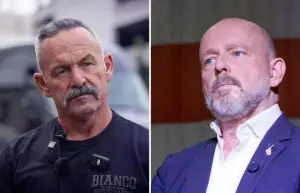 Some Republicans had argued the party’s best shot at the governor’s mansion depended on Trump staying out of the contest.
U.S. Immigration, Deportations, Civil Rights
- New York Times, Newly Obtained Video of Minneapolis Shooting Undermines ICE Account, Ernesto Londoño, Mitch Smith, Haley Willis and Robin Stein, April 6, 2026. Prosecutors did not watch video of the nonfatal shooting until weeks after charging the wounded man, an official said.
- The Independent, ICE arrests newlywed Army sergeant’s wife hours after couple arrive at military base Joe Sommerlad, April 6, 2026. A U.S. Army staff sergeant who reported for duty at a military base in Louisiana with his new bride last week was shocked to see her arrested by ICE agents shortly after their arrival.
U.S. Education, Media, Culture

Gareth Gore, above right, was granted a one-on-one audience with Pope Leo XIV (above) two years after the publication of his 2024 book on Opus Dei. (Composite photos: Corbis via Getty Images and courtesy Gareth Gore).
- The Guardian, Interview: He spent years investigating Opus Dei, a Catholic group accused of a vast conspiracy of abuse. Then Pope Leo asked to meet, Sam Wolfson. April 6, 2026. Gareth Gore’s 2024 book Opus alleges decades of manipulation, which the group has denied, He believes the pope wanted to send a clear message. Gareth Gore was on a research trip to California earlier this year when he was told to expect a call from the Vatican arranging a one-on-one audience with the pope.
- New York Times, Opinion: Teaching in an American University Is Very Strange Right Now, Frank Bruni, right,
 April 6, 2026. Reflections on the mess (and magic) of politics and life.
- New York Times, Guest Essay: I’ve Covered Women in the Workplace for 15 Years. Something Alarming Is Happening, Joanne Lipman (author of “That’s What She Said: What Men and Women Need to Know About Working Together” and other books), April 6, 2026. “Believe women” was the defining message of the #MeToo movement. Today, there’s a new one: Erase women.
- Associated Press, AP says it will offer buyouts, part of pivot from newspaper journalism, David Baudeer, April 6, 2026. The Associated Press, one of the world’s oldest and most influential news organizations, said Monday it is offering buyouts to an unspecified number of its U.S.-based journalists as part of an acceleration away from the focus on newspapers and their print journalism that sustained the company since the mid-1800s.
- Wall Street Journal, Gulf Funds Agree to Back Paramount’s $81 Billion Takeover of Warner, Jessica Toonkel and Lauren Thomas, April 6, 2026. Commitments from Middle East entities will help offset costs for Ellison family.
- National Press Club Journalism Institute, National Press Club opposes President Trump’s effort to force disclosure of confidential sources, Beth Francesco, April 6, 2026. National Press Club President Mark Schoeff Jr. today issued the following statement after President Donald Trump’s public remarks that a news outlet should reveal its confidential sources or face consequences including jail time.
Top Stories
New York Times, Iran War Live Updates: As Trump’s New Ultimatum Looms, Tehran Vows to Step Up Attacks, Aaron Boxerman, Erika Solomon and Yan Zhuang, April 6, 2026. Iran said it would respond “crushingly” if President Trump carried out his threats to strike power plants and bridges unless Tehran reopens the Strait of Hormuz. An Israeli strike killed an Iranian intelligence chief overnight.Here’s the latest.
Iran said on Monday that it would retaliate forcefully if President Trump carries out his threat to strike Iranian power plants and bridges unless Tehran ends its chokehold on the Strait of Hormuz.
Both countries appeared to stand on the precipice of what could become a new phase in the month-old war, as they escalated threats and Iran and Israel launched new attacks. An Israeli strike overnight on Monday killed Majid Khademi, the intelligence chief for the Islamic Revolutionary Guards Corps, in the latest killing of a senior Iranian leader.
Mr. Trump has repeatedly threatened to bombard critical Iranian infrastructure unless Iranian forces end their de facto blockade on the Strait of Hormuz, which is a conduit for a significant portion of the world’s oil and gas. Iran, in turn, has refused to back down, firing repeated volleys of ballistic missiles at its neighbors and ensnarling global shipping.
“If attacks on civilian targets are repeated, the subsequent phases of our offensive and retaliatory operations will be carried out much more crushingly and extensively,” Ebrahim Zolfaghari, an Iranian military spokesman, said on Monday.
Strikes on power plants could impact millions of civilians across Iran and many legal experts argue it could be considered a war crime under international law. Such attacks could also add to worries about the global economy, which has already been rattled by soaring energy prices since the war began in late February. Oil prices rose slightly during Asia’s business day on Monday before falling on media reports of progress in indirect talks between Iran and the United States.
The impasse has left Mr. Trump contemplating extreme options for the next steps, including a ground invasion of islands in the Persian Gulf. Mediators in Pakistan, Egypt and Turkey have sought to clinch a deal to end the crisis to little avail. While Mr. Trump has postponed threatened attacks before, analysts say repeatedly doing so without tangible progress toward a deal would risk eroding his credibility.
Mr. Trump, seemingly emboldened by the U.S. rescue of an American airman in Iran over the weekend, told Fox News on Sunday that he believed he could reach a deal with Iran by Monday. But he also said he was “considering blowing everything up” and taking control of the country’s oil if Iran did not cooperate.
In an expletive-laden social media post, Mr. Trump told Iranian leaders to “open the Fuckin’ Strait, you crazy bastards” or else the attacks on infrastructure would commence. He later wrote “Tuesday, 8:00 P.M. Eastern Time!” appearing to suggest a deadline for the strikes.
Here’s what else we’re covering:
- Iranian strikes: Israeli paramedics retrieved the bodies of at least three people killed in an Iranian missile strike in Haifa, according to the Israeli authorities. Kuwait and the United Arab Emirates reported attempted missile and drone strikes on Monday.
- Warning from oil nations: Eight members of the consortium of influential oil producing nations known as OPEC Plus on Sunday expressed concern about the toll the war was taking on global oil supplies and energy infrastructure in the region. “Restoring damaged energy assets to full capacity is both costly and takes a long time,” the group said in a statement warning of a slow recovery after the war. Read more ›
- Death tolls: The Human Rights Activists News Agency said at least 1,606 civilians, including 244 children, had been killed in Iran as of Friday. Lebanon’s health ministry on Thursday said at least 1,345 Lebanese had been killed since the latest fighting between Israel and Hezbollah began. In attacks blamed on Iran, at least 50 people have been killed in Gulf nations. In Israel, at least 20 people had been killed as of Monday. The American death toll stands at 13 service members, with hundreds of others wounded.
New York Times, News Analysis:On Iran, Trump Keeps World Off Balance With Ever-Changing Threats, Michael D. Shear, April 6, 2026. Global leaders are struggling in their efforts to find a way to end the American-Israeli war on Iran, and they are spooked about what President Trump might do next.The world is on edge.
One minute, President Trump says the war in Iran is nearly over. The next he says it will continue for weeks. He brags that Iran has been “eviscerated,” but then vows that the fighting will go on. A huge bombardment, he says, might begin in five days, or 10 days, or on Tuesday at precisely 8 p.m. Eastern.
If the president means what he says, the world could be about 24 hours from a devastating escalation in the war. But like the producer of a television cliffhanger, Mr. Trump seems determined to keep everyone off balance.
On that, at least, he is succeeding.
In capitals around the world, presidents and prime ministers have spent almost six weeks seeking a way to prevent the U.S.-Israeli war against Iran from spiraling out of control. Diplomats from more than 40 countries gathered for a video call on Thursday that concluded with few concrete proposals. Leaders across Europe, Asia and beyond are exasperated, angry and more than a little spooked about what could be around the corner.ImagePresident Lee Jae Myung of South Korea speaking into microphones, with a flag behind him.President Lee Jae Myung of South Korea warned on Monday that “the order of peace and prosperity that has sustained the world is weakening.”
In an emergency cabinet meeting on Monday, President Lee Jae Myung of South Korea warned, “The scars of war are expected to persist for a long time.” In an Easter message, Mr. Lee lamented, “The order of peace and prosperity that has sustained the world is weakening.”
In Japan, a country that is deeply reliant on oil imports from the Middle East, Prime Minister Sanae Takaichi said on Monday that she would seek direct talks with the Iranian government as soon as Wednesday. In France, President Emmanuel Macron complained last week about Mr. Trump’s constantly changing commentary, saying that serious people “don’t say every day the opposite of what we said the day before.”
Mr. Trump and his aides have long boasted that unpredictability is a strength on the world stage. During his first term, Mr. Trump threatened to unleash “fire and fury like the world has never seen” on North Korea but later declared that he “fell in love” with its dictator, Kim Jong-un, whom he called “a smart guy.”
Even knowing Mr. Trump’s erratic history, his handling of the war in Iran has rattled his counterparts with a series of contradictory, up-is-down statements about how the war might end.
On Wednesday, in a speech to the nation, Mr. Trump effectively declared Iran defeated. “Their navy is gone, their air force is gone,” he said, adding, “Their missiles are just about used up or beaten.” Iran has “no antiaircraft equipment,” he claimed, with a radar system that is “100 percent annihilated.”
Two days later, Iran shot down two American military planes.
In his Wednesday speech, Mr. Trump seemed unconcerned about the closure of the Strait of Hormuz, saying, “When this conflict is over, the strait will open up naturally. It will just open up naturally.”
Paul Krugman via Substack, Political-Economy Commentary: The Terrorist in Chief, Paul Krugman, right,
April 6, 2026. It’s time for us to face up to the ugly reality.Terrorism, according to ICE — yes, that ICE — “involves violence or the threat of violence against people or property to further a particular ideology.” The official website goes on to declare that “Terrorists do not care who they hurt or kill to achieve their goals.”
If you haven’t read Donald Trump’s Truth Social post from Sunday, above, take a minute to do so. Don’t rely on sanewashed descriptions in the media. And then tell me that Trump doesn’t perfectly fit his own officials’ definition of a terrorist.
Don’t tell me that his cause is just, that the Iranian regime is evil. That’s what terrorists always say, and even if it’s sometimes true, terrorism is defined by its means rather than its ends — by its attempt to achieve political goals by violently attacking the innocent.
And that’s exactly what Trump is doing: he’s threatening to attack civilian infrastructure if he doesn’t get his way. And since Trump is talking about targeting essential services — power plants! — this is a threatened attack on people as well as property.
Later on Sunday Trump told Axios that the U.S. is in “deep negotiations” with Iran. Forgive me for doubting that anything like that is happening. But he went on to say that if there isn’t a deal by Tuesday, “I am blowing up everything over there.”
He has issued these threats without even a pretense that we will be attacking military targets, and if anything he seems to relish rather than regret the death and suffering his actions will cause.
 On second thought, however, I shouldn’t say that Trump is making a threat of violence; he’s promising violence. That vile post isn’t part of a negotiating strategy, since there is, after all, zero chance that Iran will open the Strait of Hormuz by tomorrow evening. The Iranian regime almost certainly couldn’t open the strait on short notice if it tried: Military control in Iran has, by all accounts, been decentralized to local commanders to limit the effects of U.S. and Israeli decapitation strikes. So there’s no way people in Tehran could order the whole Iranian military to stand down at short notice even if they wanted to.
And of course they don’t want to, because they think Iran is winning. And so do Trump and the people around him, even though they will never admit it.
For terrorism is a strategy of the weak. It’s what extremists do when they lack the ability to achieve their goals through military action or other non-criminal means.
And that’s where Trump and his officials find themselves. They inherited a powerful military (which they are rapidly degrading), but for all its firepower this military lacks the wherewithal to open the Strait of Hormuz to normal traffic. So the Trumpists are gearing up to impose suffering and death on innocent civilians instead, even though this suffering and death will do nothing to achieve America’s objectives.
I don’t know what Trump will do when his deadline passes and the Strait is still closed. He probably doesn’t know either. But he is promising to commit war crimes on a massive scale. And the duty of everyone with any influence who isn’t part of Trump’s inner circle is to do all they can to stop him.
Most immediately, military officers should be aware that they have the right and the duty to disobey illegal orders. It’s incredible that we have gotten to this point, especially so quickly, but here we are.
 You may recall that Admiral Alvin Holsey, right, resigned in December, reportedly because he refused to be a party to illegal attacks on supposed drug boats. What Trump is now saying he will do is infinitely worse. And a refusal by senior officers to participate in war crimes may be the only thing that could stop this evil in its tracks.
Now is when we find out how completely our once honorable military has been corrupted.
Beyond the military, every politician, dare I say every public figure, in America should make it clear that Trump is not acting in their name.
This is not a time for Republicans who know — and most of them do know — that Trump has gone completely off the rails to remain obsequious for fear that he might endorse their primary opponents. One hopes that there are still a few genuine patriots left on that side of the aisle.
It is also not a time for Democrats to listen to strategists who urge them to stay silent on foreign policy and talk only about grocery prices. As it happens, that’s even bad political advice: Public disdain for Congressional Democrats has a lot to do with perceptions that they are weak and ineffectual, and ignoring Trump’s criminal madness will only reinforce that perception. And there has been no rally-around-the-flag effect from this war, which is growing more unpopular by the day.
But in any case, political considerations should take a back seat to civic duty.
The horrible but undeniable fact right now is that America has a terrorist president. And the whole world knows it. But we still have a chance to show the world that he is an aberration, that we are not a terrorist nation. And we can do that by standing up for the values that have always defined us.
Morning Shots via The Bulwark, Political Opinion: Impeach Him Again, Bill Kristol, Andrew Egger and Jim Swift, April 6, 2026. And create friction against him within the executive branch.It’s a weird spot we’re in when it comes to re-funding DHS: Even though leaders in both chambers and President Trump have backed a plan to fund the whole Department with the exception of ICE and the Border Patrol, which Republicans plan to instead fund through party-line reconciliation legislation, Republicans aren’t in a hurry to actually pass the deal.The shutdown remains in place, and House Speaker Mike Johnson hasn’t yet taken action to call the House back from its recess, which is currently scheduled to go until April 13. Happy Monday.
News Updates
At 8:03 this morning, Easter Sunday, President Donald J. Trump’s social media account posted: “Tuesday will be Power Plant Day, and Bridge Day, all wrapped up in one, in Iran. There will be nothing like it!!! Open the F*ckin’ Strait, you crazy b*stards, or you’ll be living in Hell—JUST WATCH! Praise be to Allah. President DONALD J. TRUMP”
Letters from an American, Historical Commentary: April 5, 2026 [Threats of War Crimes?], Heather Cox Richardson, right,
April 6, 2026. There are many things that could be going on with this ultimatum, which actually doesn’t sound like Trump’s usual style, in the same way the post of yesterday morning didn’t.The post appears to be threatening to commit war crimes by attacking civilian infrastructure, and it appears to suggest Trump is considering using tactical nuclear weapons. He emphasized the production of such weapons in his first administration. He seemed to encourage this interpretation in an interview with Rachel Scott of ABC News today. She said Trump “told me the conflict should be over in days, not weeks but if no deal is made he’s blowing up the whole country with ‘very little’ off the table. ‘If [it] happens, it happens. And if it doesn’t, we’re blowing up the whole country,’ he said. I asked if there’s anything off limits. ‘Very little,’ he said.”
In 2023 a book by New York Times Washington correspondent Michael Schmidt alleged that in 2017, when Trump was warning North Korean leader Kim Jong-un on social media that North Korea would be “met with fire and fury and frankly power, the likes of which this world has never seen before,” behind closed doors he was talking about launching a preemptive strike against North Korea and of using a nuclear weapon against the country and blaming someone else for the strike .
Schmidt reports that Trump’s White House chief of staff at the time, retired U.S. Marine Corps General John Kelly, brought military leaders to try to explain to Trump why that would be a bad idea and finally got him to move away from the plan by telling him he could prove he was the “greatest salesman in the world” by finding a diplomatic solution to his fight with the North Korean leader.
In his own book about that period, journalist Bob Woodward wrote: “The American people had little idea that July through September of 2017 had been so dangerous.”
But Trump’s secretary of state Mike Pompeo told Woodward: “We never knew whether it was real or whether it was a bluff.”
And that is another way to look at the post from Trump’s social media account: that he is panicked that he has not been able to bully other countries into fixing the mess he created by attacking Iran and precipitating the closure of the Strait of Hormuz, and is now simply trying to bully Iran. In The Guardian last Monday, Sidney Blumenthal noted that Trump “has declared ‘victory’ more than eight times,” says he has “won” more than ten times, and said Iranian forces have been “obliterated” or suffered “obliteration” more than six times. Blumenthal noted Trump is now threatening to “obliterate” Iran’s power grid and has used the words “decimate” or “decimation” at least six times.
Trump’s crazy post does, after all, push back yet again the deadline for his threats to rain destruction on Iran, which he then extended again in another post at 12:38 P.M. saying: “Tuesday, 8:00 P.M. Eastern Time!”
 This dynamic was not lost on Allison Gill of Mueller, She Wrote, left, who noted: “It was March 23rd. Then March 27th. Then March 30th. Then he gave that weird address on April 1st. [N]ew deadline April 4th. Then April 6th at 7 AM. Then April 7th at 8 PM. And now another address tomorrow at 1 PM. The chaos is intentional.” She also noted that his deadlines and his abandonment of them often seem tied to the rhythms of the stock market.
In an interview with Barak Ravid of Axios today shortly after this morning’s post, Trump reiterated that “if they don’t make a deal, I am blowing up everything over there” but also said the U.S. is “in deep negotiations” with Iran and that he thinks a deal can be reached. Trump told Ravid that his envoys Steve Witkoff and Jared Kushner—not Secretary of State Marco Rubio—are talking with the Iranians. Sources told Ravid that mediators from Pakistan, Egypt, and Türkiye are facilitating the talks.
But Iranian officials are refusing to deal with Witkoff and Kushner after they apparently misunderstood earlier negotiations and instead told Trump the talks weren’t going well before he launched strikes. Neither Witkoff nor Kushner is a trained diplomat, and both have deep financial ties to the Middle East. Notably, Saudi Arabia’s Crown Prince Mohammed bin Salman (MBS), who urged Trump to start the Iran war, has invested at least $2 billion in Kushner’s private equity firm.
On March 13, Rob Copeland and Maureen Farrell of the New York Times reported that Kushner is trying to raise $5 billion or more for his private equity firm from Middle East governments at the same time as he is also supposed to be negotiating peace in the region.
But Stephen Kalin, Eliot Brown, and Summer Said of the Wall Street Journal reported today that the closure of the Strait of Hormuz has already cost the Saudis about $10 billion, and the grand plans of MBS were already falling short of money. Some of those plans were U.S. investments. The reporters note that even before the war, the Saudi’s sovereign-wealth fund, the same one that invested in Kushner’s private equity firm, had sold much of its U.S. stock portfolio. Last year, MBS promised to invest up to $1 trillion in the U.S. Those investments are now under review.
Regardless of the inspiration for Trump’s post, by itself it tells a very clear story. The Federal Bureau of Investigation’s former assistant director for counterintelligence Frank Figliuzzi posted: “The American president has lost his mind.”
Journalist Steven Beschloss wrote: “This is an actual post. This is not funny. This is beyond desperate. This is a deeply unwell man who doesn’t belong anywhere near the levers of power. Every member of his cabinet and Congress is complicit in not demanding his removal now.”
Senator Chris Murphy (D-CT) posted: “If I were in Trump’s Cabinet, I would spend Easter calling constitutional lawyers about the 25th Amendment. This is completely, utterly unhinged. He’s already killed thousands. He’s going to kill thousands more.”
The 25th Amendment establishes a process through which a majority of the Cabinet and the Vice President, or another body Congress designates, can remove a president deemed “unable to discharge the powers and duties of his office.”
Murphy was not the only one thinking along those lines. Hollie Silverman of Newsweek reported that on the prediction market platform Kalshi, which allows traders to buy “yes” or “no” shares on the question “Will the 25th Amendment be used during Trump’s presidency?” “yes” has moved in recent days from 28.6% to 35.1%.
The Parnas Perspective, News and Commentary: Trump Posts More Islamophobic Content, More Calls for 25th Amendment, Iran Mocks Trump as White House Seeks Ceasefire, Aaron Parnas, right,
April 6, 2026. Overnight, Donald Trump posted more racist and Islamophobic videos and images on Truth Social that I cannot stay silent about as a journalist and have to call out.Meanwhile, Iran is rejecting ceasefire proposals and even mocking Trump online, as the United States and Israel continue strikes on Iranian universities and petrochemical facilities. At the same time, more Democratic lawmakers, along with some Republicans who previously worked for Trump, are raising calls to consider the 25th Amendment.
Here’s the news:
Overnight, Trump posted an openly Islamophobic video on Truth Social targeting Muslim women in a public space, using somber music to frame their presence as something negative, and then amplified an unfounded claim that most of them were on welfare. Earlier yesterday, he made an unhinged Easter post threatening attacks on Iranian infrastructure if his demands weren’t met. This is not normal, again. While some may just say it is Trump being Trump, I refuse. Some lawmakers responded by calling for consideration of the 25th Amendment.
Trump’s threats to target Iranian infrastructure such as power plants and bridges have drawn sharp international criticism, with Iranian officials and others arguing such actions would constitute war crimes under international law. European leaders have also stressed that attacking civilian infrastructure is illegal and warned of the humanitarian consequences of escalation. Critics, including U.S. lawmakers, described Trump’s rhetoric as dangerous and destabilizing, while Iran has warned it would respond with “much more devastating” retaliation if such strikes occur.
More lawmakers call for the 25th Amendment: Trump’s former Communications Director did the same:
Iran has rejected a proposal to reopen the Strait of Hormuz in exchange for a temporary ceasefire, telling mediators from Turkey, Egypt, and Pakistan that it will not accept short-term deals tied to U.S. conditions. It also refused to meet American officials in Islamabad and described U.S. demands to end the war as unacceptable. The rejection has stalled mediation efforts and highlights Iran’s position that negotiations cannot take place under pressure or ultimatums.
U.S. Central Command (CENTCOM) released video footage showing U.S. strikes on multiple Iranian targets across the country, offering visual confirmation of ongoing military operations and the scale of the campaign.
Trump spent part of Easter Sunday going to his Virginia golf resort instead of attending church, despite his strong support from evangelical Christians. His trip was not publicly scheduled, and press access was limited once he arrived. This took place while tensions and conflict with Iran were ongoing, with U.S. troops deployed abroad. The situation drew criticism for the contrast between him enjoying a golf outing and soldiers remaining in harm’s way.
Sharif University of Technology, one of Iran’s top engineering schools often compared to MIT, was reportedly bombed in Tehran, with surrounding educational facilities also damaged. The university has long been a major center for scientific talent, producing engineers who have gone on to work in Silicon Valley and contribute to major tech companies. The strike raised sharp criticism and concern about targeting an academic institution in a densely populated city of around 10 million people.
Israel carried out a major strike on Iran’s South Pars petrochemical facility, a critical site responsible for roughly half of the country’s petrochemical production, triggering large explosions and raising concerns about escalation. The attack hit part of the world’s largest gas field, shared with Qatar, and came despite ongoing efforts to negotiate a ceasefire between the U.S. and Iran. Airstrikes also hit Tehran, killing senior Iranian military figures, including the intelligence chief of the Revolutionary Guards, while Iranian missiles struck Israeli cities like Haifa, causing deaths.
The conflict has expanded across the region, with Iran launching missiles and drones at targets in Israel and Gulf countries, prompting nations like Saudi Arabia, the UAE, and Kuwait to activate air defenses. Key global energy infrastructure has been repeatedly targeted, contributing to rising oil prices and broader economic disruption. The Strait of Hormuz, a crucial route for about a fifth of the world’s oil supply, remains central to the conversation, with Iran restricting access and increasing pressure on global markets.
According to the United Arab Emirates Ministry of Defense, Iran launched a large-scale barrage in the past 24 hours, including 2 cruise missiles, 12 ballistic missiles, and 19 one-way attack drones targeting the country. UAE air defense systems successfully intercepted these threats, though such attacks are part of a sustained campaign that has repeatedly targeted the country during the ongoing conflict.
Diplomatic efforts are ongoing but fragile, with mediators proposing a potential 45-day ceasefire as a step toward ending the war. Iran has confirmed receiving proposals but rejected being pressured by deadlines or threats, emphasizing its own conditions for negotiations. At the same time, Trump has issued ultimatums demanding Iran reopen the Strait of Hormuz, warning of severe military consequences if it does not comply.
Newly released emails reveal that members of Elon Musk’s private security team were deputized as federal agents despite some lacking required training. The U.S. Marshals Service approved the request, reportedly coming from the White House, allowing them to carry weapons in certain federal buildings. The decision has raised concerns about standards and oversight in granting federal authority. It sheds light on unusual arrangements involving private security and government power.
CBS News has confirmed that the CIA World Factbook, a long-standing and widely used public database of global information on countries, was abruptly shut down by the Trump administration after more than six decades. The Factbook had served as a free, centralized source of data on geography, governments, economies, and cultures, used by students, researchers, and policymakers worldwide. Its closure sparked backlash and concern about losing a trusted, easily accessible source of information, with critics warning it may become harder to find reliable global data. The move was framed by the CIA as part of shifting priorities, but it also raised broader questions about access to knowledge and transparency.
The Supreme Court of the United States cleared the way for the Trump administration to dismiss the criminal contempt case against Steve Bannon, who had already served four months in prison for defying congressional subpoenas related to the January 6 attack. The court sent the case back to a lower court, effectively undoing a prior appeals ruling that upheld his conviction. The Trump administration has said it plans to drop the case “in the interests of justice,” which would erase the conviction after the fact. The move is largely symbolic but reflects broader efforts by Trump and his allies to revisit or undo legal actions tied to January 6.
According to Politico, the United States Holocaust Memorial Museum quietly removed educational materials linking Nazism to American racism and canceled or altered programs focused on democratic fragility after Trump returned to office. Internal changes included renaming a workshop to avoid politically sensitive language and taking down resources about topics like Jim Crow and Holocaust-era racial parallels. Former employees said these moves appeared to be preemptive, aimed at avoiding backlash from the Trump administration, even though officials denied any direct pressure. The changes occurred alongside broader efforts by the administration to reshape cultural institutions and remove diversity-related content, while leadership shifts at the museum further aligned it with Trump-appointed figures.
Trump requested a massive $1.5 trillion military budget for 2027, a 44% increase over the previous year, which immediately drew skepticism from lawmakers. Senator Tim Kaine and others questioned whether such a large increase could be justified and indicated Congress would closely review it. The proposal is expected to face significant challenges in getting approved.
Senator Ruben Gallego is considering a run for president in 2028, pointing to his background and appeal to Latino voters as key strengths. He emphasized themes of patriotism and representation, noting the contributions of Latino Americans despite ongoing challenges. His potential candidacy reflects broader positioning within the Democratic Party ahead of the next election cycle. This signals early movement in what could become a competitive 2028 field.
Democratic politicians across the country are increasingly embracing tax cuts as a central campaign idea to address cost-of-living concerns. Proposals range from federal tax exemptions on certain income levels to eliminating state income taxes for specific groups like teachers. These plans are aimed at winning back working-class voters and expanding appeal ahead of future elections. The trend shows a shift in messaging and economic strategy within the party.
Steve Hilton, a candidate for California governor, has received an endorsement from Donald Trump, signaling Trump’s backing in the race and potentially boosting Hilton’s visibility and support among Republican voters.
According to Politico, Serbia’s top military and intelligence officials said Ukraine was not responsible for an incident involving a large cache of explosives found near a gas pipeline on the Hungarian border. This directly contradicts claims made by Viktor Orbán, who had suggested Ukraine was behind the suspected attack.
More on Iran-Lebanon Wars
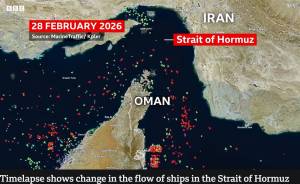 New York Times, The Islands That Give Iran Sway Over Hormuz, Josh Holder and Adina Renner April 6, 2026. A U.S. invasion of islands in the world’s most vital oil corridor would come with extraordinary risks.
Iran is using a string of islands in and near the Strait of Hormuz as outposts to help control shipping through the Persian Gulf.
But any operation to seize them would be perilous and would not assure control of the strait as long as Iran can attack ships with missiles and drones from the mainland.
President Trump has threatened to take Kharg Island, Iran’s biggest oil terminal. But an amphibious landing here would require a risky journey across the whole of the Persian Gulf.
Drop Site News, Iran Rejects Temporary Ceasefire, Says It Has Already Laid Out Terms for Agreement, Jeremy Scahillt, Murtaza Hussain, and Jawa Ahmad, April 6, 2026. Senior Iranian official tells Drop Site that Trump is pushing for a deal but the new proposal is “detached from the realities on the ground.”
Tehran rejects any agreement for a temporary ceasefire to end the war with the U.S. and Israel, a senior Iranian official told Drop Site, saying that Iran would only accept an agreement that leads to a permanent end to the fighting. The official, who was not authorized to make public statements and spoke on condition of anonymity, said recent proposals for a temporary pause in exchange for resumption of full access to the Strait of Hormuz were “detached from the realities on the ground.”
In the face of new threats by President Donald Trump to escalate the war on Iran, Reuters reported Monday on a Pakistani-led framework to end the fighting that had been shared with both Washington and Tehran. The framework reportedly calls for a temporary ceasefire in exchange for a resumption of traffic through the Strait of Hormuz, with 15-20 days given to reach a final settlement that would address Iran’s nuclear program, sanctions relief, and a regional framework for administering the strait.
The senior Iranian official who spoke with Drop Site confirmed that Tehran had received the proposal but reiterated that Iran rejects any agreement based on a temporary ceasefire. “It is our assessment that the Trump administration, owing to legal constraints within the United States concerning the prosecution of the war as well as the need to maintain control over financial markets, requires a short-term pause in the conflict,” said the official. He added that Iran would only accept an agreement that ended the war against Iran conclusively, and which could then be used as a basis for broader talks. The official also pointed to Iran’s February proposal in Geneva that included significant concessions on its nuclear program and a non-aggression pact as a basis for a permanent agreement.
“Our assessment indicates that this [new, temporary] proposal has been drafted solely on the basis of the mediators’ perception of the minimum demands of the parties for halting the war,” the official said. “Tehran does not consider a temporary ceasefire to be a logical course of action, inasmuch as the window for the United States’ exit from the conflict has already been delineated. Should the requisite political will exist, the parties are in a position to establish a permanent ceasefire and thereafter concentrate their efforts on diplomacy.”
The White House did not immediately respond to a request for comment. An administration official speaking to CNN on Monday said Trump has yet to sign off on the proposal, and that it is “one of many ideas.”
New York Times, An Iranian intelligence chief killed overnight on Monday was one of several Iranian officials who occupied their posts for only a few months, Samuel Granados and Amelia Nierenberg, April 6, 2026. In the latest blow to Iran’s senior leadership, the intelligence chief of the Islamic Revolutionary Guards Corps, Major General Seyed Majid Khademi, was killed in an Israeli airstrike in Tehran overnight on Monday, Israel’s defense minister said.
Israel has killed a number of Iran’s most senior officials since the start of the war, including Ayatollah Ali Khamenei, the former supreme leader, and Ali Larijani, a top national security official who had effectively been running Iran.
Mr. Khademi was described by Israel Katz, Israel’s defense minister, as one of the top three leaders of the Revolutionary Guards. He was one of several Iranian officials who occupied their post for only a few months, as Israel has ramped up its killing of top Iranian generals, senior officials and nuclear scientists.
Mr. Khademi’s death was confirmed by Iran’s state broadcaster. It follows the recent killing of Esmaeil Khatib, the Iranian intelligence minister, who was killed in an airstrike in mid-March.
 Doomsday Scenario, Commentary: Is Trump About To Nuke Iran? Garrett M. Graff, above, April 6, 2026. The fact we can't say "no" for sure should terrify us.share on facebook share on twitter share on threads share on linkedin
Is Donald Trump set to nuke Iran tomorrow night, Tuesday at 8 p.m. ET?
The chances at this moment are, at least, non-zero.
The simple fact that we can’t say “definitely no, absolutely not, for sure” is an astounding commentary on how unhinged and dangerous his presidency has become and how far off the rails the war with Iran has gone as Trump flails about with no plan, no strategy, no exit, and a global economy that day-by-day is reeling from the biggest geopolitical oil shock in history. It sets the next 36 or so hours up as one of the weirdest and scariest moments in geopolitics of our lifetimes.
Sunday morning, around 8 a.m. on Easter, the holiest of days in Christianity, the faith that Trump pretends to be for political convenience, the president posted on Truth Social, “Tuesday will be Power Plant Day, and Bridge Day, all wrapped up in one, in Iran. There will be nothing like it!!! Open the Fuckin' Strait, you crazy bastards, or you'll be living in Hell - JUST WATCH! Praise be to Allah. President DONALD J. TRUMP.”
It was a comment so startling that I double-checked it was real — and then checked a third time. For one thing, it didn’t really sound like him. For another, it was simply crazy. But it was true.
It was, by any measure, the most unhinged public comment by a president in US history. Later, he followed up with an ambiguous tweet that seemed to add a specific deadline: “Tuesday, 8:00 P.M. Eastern Time!”
Having caused such confusion and concern, Trump then settled back and celebrated Easter in the way that Christians traditionally do: With a day-long string of racist tweets about birthright citizenship.
More than one analyst online was left wondering whether Trump’s ultimatum and “promise” was a nuclear threat — and I think we have to take seriously the possibility that Trump does consider nuclear weapons as an answer to his own floundering in Iran. The chance, after all, is clearly more than zero — and at that point, the possibility that any president would use nuclear weapons in a conflict should be a terrifying and pressing public debate, just as it was in the opening stages of the Ukraine conflict when Vladimir Putin seemed to threaten such a use in 2022.
All sorts of media organizations failed the public, the country, and the world on Sunday in the wake of Trump’s unhinged explosion Sunday, downplaying or eliding the sheer insanity of Trump’s morning post.
The Associated Press, which usually is better, initially wrote, “WASHINGTON (AP) — Trump promises strikes on Iran's power plants and bridges on Tuesday if the Strait of Hormuz isn't reopened.” By the end of the day, as the media newsletter Status summarized, “The New York Times and other print outlets generally quoted the full expletive-tinged tirade. Broadcasters, held to a different standard and targeted by Trump’s FCC, didn’t.”
When you can’t quote a war-time commander-in-chief without violating the government’s own decency standards, you know something has gone terribly wrong.
And yet by this morning, less than 24 hours later, the front pages of all the nation’s major news outlets read as if it’s just another day in the war.
CNN’s top headline this morning says, “Trump and Iran trade threats over Strait of Hormuz.” The New York Times front-page headline reads, “As Trump’s New Ultimatum Looms, Tehran Vows to Step Up Attacks,” and the lede of that story says simply, “Iran said on Monday that it would retaliate forcefully if President Trump carries out his threat to strike Iranian power plants and bridges unless Tehran ends its chokehold on the Strait of Hormuz.” The Washington Post doesn’t even mention Trump’s tirade anywhere above its proverbial fold this morning, giving over the top headlines to the daring and courageous rescue of that downed F-15 crewman over the weekend:
The Wall Street Journal, meanwhile, reduces the power plant threat to a single bullet point — and presumably is featuring it at all because it actually managed to get an interview with Trump yesterday.
How can this be? Are we really this inured to unhinged comments that “Open the Fuckin' Strait, you crazy bastards, or you'll be living in Hell” doesn’t even warrant a full 24-hour news-cycle?
In a sentence that would have surprised the me of not that long ago, I’m going to let former congresswoman Marjorie Taylor Green (shown below in a file photo) eloquently explain why this should matter to us:

“Everyone in his administration that claims to be a Christian needs to fall on their knees and beg forgiveness from God and stop worshipping the President and intervene in Trump's madness. I know all of you and him and he has gone insane, and all of you are complicit.… Trump threatening to bomb power plants and bridges hurts the Iranian people, the very people Trump claimed he was freeing. … Our President is not a Christian and his words and actions should not be supported by Christians. Christians in the administration should be pursuing peace. Urging the President to make peace. Not escalating war that is hurting people…. This is not making America great again, this is evil.”Share the newsletter
At one level, Trump’s Easter morning tweet was consistent with two weeks of threats about attacking civilian infrastructure — he’s set, reset, moved, and repeatedly delayed a deadline for reopening the Strait of Hormuz “or else” he says the US will target civilian infrastructure like power plants in Iran, which would traditionally be a war crime.
The constantly shifting deadlines and increasingly unhinged make clear that Trump is lost at sea. Today, evidently, he plans another “national address” at 1 pm (although the White House social media graphics say the address is at 1 pm “EST,” even though the US is currently on “EDT,” so who knows when it’ll actually be!)
As Edward Wong wrote in a smart analysis building off Trump’s unhinged weekend rants and deadlines, “No other recent American president has talked so openly about committing potential war crimes, legal experts, historians and former U.S. officials say. Wartime American presidents and their aides have usually insisted they were trying to follow international and U.S. military law, even if they violated it in some cases.”
PoliticusUSA, News and Comment: Trump Claims The Iranians Want To Be Bombed During Press Conference Fiasco, Jason Easley, right, April 6, 2026. Trump hid until the second downed US pilot was rescued in Iran, but on Monday he he held a press conference where he claimed that the Iranian people want to be bombed.The press conference itself featured nearly an hour of propaganda from Trump and administration officials before a single question was taken from the assembled press.
The administration was trying to sell the war as a success, even though Trump’s claims that the US had already won the war were refuted by the shooting down of an American fighter plane.
The president is not living in reality as evidenced by his claim that the Iranian people want to be bombed.
Trump said:
Yeah, of the regime. Regime. They would be willing to, they would be willing and it’s suffering. They would be willing to suffer that in order to have freedom the Iranians have, and we’ve had numerous intercepts. Please keep bombing bombs that are dropping near their homes. Please keep bombing, do it.
And these are people that are living where the bombs are exploding. And when we leave and we’re not hitting those areas, they’re saying, please come back. Come back. Come. These are the people. I don’t know what they do. All I can tell you is they want freedom. They have lived in a world that you know nothing about.
Trump kept going and getting more insane:
It’s a violent, horrible world where if you protest, you are shot. Remember the great woman protests where they had 400,000, 500,000 women and they were all enthused and they were gonna protest, and everybody said, oh, the regime’s gonna come to an end, and then all of a sudden, boom. Boom. Five, six different areas.
A woman would go down, right between the eyes. They had snipers, they had five snipers. That’s all it took. And those four or 500,000 women said, oh my God, what’s that? Oh, look over there. What’s that? A woman shot right between the eyes and after five or six of them go down, then you start hearing the pur through the vast number of people.
Video:
And then they said, oh my God, who would do that? And they’re incredible people, but they’ve lived so horribly. They’ve lived so horribly. You know, Iran was a great country. If you go back 25 years ago or so. Uh, the Persian people, the, they’re incredible smart, brilliant actually. And I know so many I know coming from New York originally, I, I know so many people from arena.
They’re incredible people. Incredible energy. And, uh, very, very brilliant people. And, but when you’re standing in a group and protesting and you have a woman, in the case of a woman, remember the Great Woman March. Everybody was started, oh, this is the end of the country. And then snipers selectively picked, every single one was shot right between the eyes from a long distance.
They were on top of buildings. Nobody even knew where they were, where they coming from. This wasn’t like a machine gun, which is also very bad. They’ve done that too. They did that recently. This was snipers sitting on the top of buildings aiming and hitting women. And when they see people go down and all of a sudden there’s a riot in the reverse direction, and they never came out again.
And a lot of the, the news doesn’t talk about that. They talk about, oh, women’s rights. You wanna see women’s rights, you’re not gonna see it there. It’s amazing when I see, uh, some of the stupid people like, you know, a OC plus three, all that group, they talk about, oh. Freedom for Iran. They don’t tell you the real facts.
Women, men, gays. How about gays for Iran? They kill the gays. They throw ‘em off buildings. So I, I wonder what, what’s going on? I, I can only say this. They want us to keep bomb. Yeah, even if it jeopardized because their life is in much greater danger. They want freedom for Iran, but it’s very hard for them to protest.
I actually tell ‘em, I said, don’t go out. I fully understand nobody in this room would go out. I don’t think there’s any, because frankly, it’s not a question of bravery. We’re all brave, right? You’re brave. I’m brave. We’re all brave, but we’re also intelligent. If you have people shooting at you, expert shots with the best, what rifles you can get.
And hitting you right between the eyes every single time. And you’re looking here and you’re seeing, and you’re looking here, you’re out of there.
Trump said that the Iranians are shooting protesters. What he left out was ICE shooting and killing protesters in Minnesota.
Trump’s mind is gone as he rambles from topic to topic, and it is obvious that there is no strategy in this war.
I am not sure what the administration hoped this press conference would do, but any American listening to their president sound even more incoherent on the war than he was last week should not feel good about what is happening.
Emptywheel, Analysis: Trump Keeps Digging with the Same Toy Bulldozers, Emptywheel (Marcy Wheeler), right,
April 6, 2026. Barak Ravid, the credulous mouthpiece for Steve Witkoff and Jared Kushner, insists there are Iran negotiations ongoing. A series of stories in the last week include all the trappings of negotiations that look real, like discussions of ceasefires and confidence building.Amid those trappings of normalcy, one proof of life describes that Steve Witkoff is purportedly texting someone he believes to be Foreign Minister Abbas Araghchi.
Behind the scenes: Four sources with knowledge of the diplomatic efforts said the negotiations are taking place through Pakistani, Egyptian and Turkish mediators and also through text messages sent between Trump’s envoy Steve Witkoff and Iran’s Foreign Minister Abbas Araghchi.
A U.S. official said the Trump administration gave Iran several proposals in recent days, but so far Iranian officials hadn’t accepted them. The sources said the mediators are discussing with the parties the terms for two-phased deal; the first phase would a potential 45-day ceasefire during which a permanent end to the war would be negotiated. The ceasefire could be extended if more time were needed for talks, one of the sources said. The second phase would be an agreement on ending the war. The sources said mediators think that fully reopening the Strait of Hormuz and a solution for Iran’s highly enriched Uranium — either through its removal from the country or dilution — could only be a result of a final deal.
After the second version of this story (one, two, three, four), Ravid spoke directly to Trump (making him one of four sources for the story). Trump told him Steve Witkoff and Jared were in charge of the negotiations.
State of play: In an 8-minute phone call, Trump told Axios his envoys Steve Witkoff and Jared Kushner are holding intense negotiations with the Iranians.
Two sources involved in the negotiations said the talks are taking place through Pakistani, Egyptian and Turkish mediators, but also through text messages sent between Trump’s advisers and Iran’s foreign minister, Abbas Araghchi. “The negotiations are going well, but you never get to the finish line with the Iranians,” Trump said. He claimed that several days ago the U.S. and Iran were close to an agreement to hold direct negotiations. “But then they said they will meet us in five days. So I said, ‘Why five days?’ I felt they were not being serious. So I attacked the bridge,” Trump said, referring to Wednesday’s strike on a bridge that connects Tehran with northern Iran.
 What to watch: Two sources briefed on the mediation efforts said the foreign ministers of Pakistan, Egypt and Turkey are trying to reach a package of confidence-building measures that could lead to an extension of Trump’s ultimatum and get the parties closer to a meeting.
The three ministers held phone calls on Saturday with both Witkoff and Araghchi on this issue, but no breakthrough was achieved.
That story made no mention of the airman rescue that happened between the second and third of these stories (Ravid posted multiple stories on that, but treated them as totally separate, aside from a more pessimistic take on “diplomatic efforts [that] have shown very little progress in recent days” in one). It also treated Trump’s claims that Iran would meet with US negotiators as if it were credible.
Several times, Ravid notes that Trump extended his deadline to blow the shit out of everything.
Driving the news: President Trump’s 10-day deadline to Iran was expected to expire Monday evening. But on Sunday, Trump extended his deadline by 20 hours and posted on Truth Social a new deadline of Tuesday at 8pm ET.
Trump told Axios on Sunday that the U.S. is “in deep negotiations” with Iran and that a deal can be reached before his deadline expires on Tuesday. “There is a good chance, but if they don’t make a deal, I am blowing up everything over there,” he said.
In spite of all his purportedly great sourcing, he provides no explanation for that extension, though seemingly suggests that it served to give Iran time to capitulate without explaining why it would change Iran’s intransigence.
Reuters, relying on a single source, implies that the extension was a chance to make a plan dictated by Pakistan and delivered to both sides (which don’t include Israel), a chance to be signed.
Iran and the United States have received a plan to end hostilities that could come into effect on Monday and reopen the Strait of Hormuz, a source aware of the proposals said on Monday.
A framework to end hostilities has been put together by Pakistan and exchanged with Iran and the U.S. overnight, the source said, outlining a two-tier approach with an immediate ceasefire followed by a comprehensive agreement.
“All elements need to be agreed today,” the source said, adding the initial understanding would be structured as a memorandum of understanding finalised electronically through Pakistan, the sole communication channel in the talks.
Axios first reported on Sunday that the United States, Iran and regional mediators were discussing a potential 45-day ceasefire as part of a two-phase deal that could lead to a permanent end to the war, citing U.S., Israeli and regional sources.
The source told Reuters Pakistan’s army chief, Field Marshal Asim Munir, has been in contact “all night long” with U.S. Vice President JD Vance, special envoy Steve Witkoff and Iranian Foreign Minister Abbas Araqchi.
Under the proposal, a ceasefire would take effect immediately, reopening the Strait of Hormuz, with 15–20 days to finalise a broader settlement. The deal, tentatively dubbed the “Islamabad Accord,” would include a regional framework for the strait, with final in-person talks in Islamabad.
Lawrence Freedman has a post explaining why none of this makes sense, not least because Iran will never cede its leverage until it has permanent guarantees on the table.
I’m not much persuaded by any of these claimed deals and frankly suspect Trump will regret providing himself a specific deadline, as if he’s steeling himself, not least because the last time he provided Iran with his planned schedule — which happened to be the last time Trump promised to speak publicly, which he has said he’ll do today — they anticipated his statement with strikes. Even as he steels himself, he is overtly pining for a victory worthy of an Arch, both by touring its intended site and posting memes of the real thing.
I’m interested in how, over a month past the time that Jared and Witkoff proved either too stupid to handle negotiations or simply lying about their good faith claimed to be negotiating as the US and Israel used that as cover for strikes, there’s not more outrage about the fact that Trump would let Witkoff anywhere close to a negotiation. If Trump believes this is good faith, someone needs to pull the old geezer aside and explain how disastrously Witkoff has served him already, not least by making any possibility of a real negotiation far more difficult. But Trump is purportedly a grown-up, and there’s no reason anyone should treat a negotiation involving Jared and Witkoff as a negotiation rather than — as the ones in February appear to be — cover for crimes and corruption. Whether from stupidity or cupidity, Witkoff’s so-called negotiations created the mess that has destroyed the global economy.
As I wrote more than ten days ago, it is a travesty that anyone treats this charade as credible. Even if it were true that Trump believed these were legitimate negotiations (and the timing of the initial strikes calls that into question), zero sane people can treat Witkoff as a credible negotiator because he is so obviously unfit. No deal he was a part of would produce a viable peace, just as his Gaza “peace” has resulted in more genocide, just as his Russian “peace” amounts to rewarding Russia for its losing position. Trump’s continued inclusion of him (and Jared) is, at best, a sign that Trump himself doesn’t realize how fucked he and his son-in-law and his developer buddy have made things, or marginally less terrible, that Trump does realize he has fucked things but is so incapable of admitting his error, he’ll just continue to huddle with the men who helped create the mess in the first place, because they’re all psychologically incapable of confessing their own incompetence.
Meanwhile, the focus on Witkoff’s clown show distracts from curious discussions happening elsewhere.
After inking security deals with Saudi Arabia, UAE, and Qatar (after which a key UAE diplomat announced the US would remain UAE’s main security partner) and even as Ukraine carried out strikes in Crimea not dissimilar to those Iran has pulled off in Saudi Arabia, Zelenskyy met with Recep Tayyip Erdogan, then signed another security agreement, this time with Syria.
Meanwhile, there are claims that Witkoff and Kushner may bring their clown show to Ukraine after April 12 (which happens to be the date of the election in Hungary where a clean vote would replace Putin’s chief European puppet, Viktor Orbán), something that keeps getting floated but on which Dim Philby and Trump’s son-in-law always renege.
And Zelenskyy keeps insisting that Russia is helping Iran target civilian infrastructure in the wider Gulf. (It remains an open question how Iran acquired the infrared targeting that took down the F-15E and at least one other plane last week, but some sources claim Russia provided the weapons.)
Just as interesting, Giorgia Meloni — one of the handful of Europeans that Trump believes he must court — made her own diplomatic trip to the Middle East.
Italian Prime Minister Giorgia Meloni is on a surprise tour of Arab Gulf states that aims to ensure Rome continues to have access to crucial energy sources in the midst of the war in Iran.
Meloni kicked off her two-day trip on Friday afternoon, meeting with Saudi Arabian Crown Prince Mohammad bin Salman in Jeddah before traveling to Qatar and the United Arab Emirates on Saturday.
Due to security concerns, the visit — the first by a European leader to the region since the start of the war — was kept secret, with only Italian President Sergio Mattarella briefed on the plans ahead of Meloni’s departure. According to Italian media, the country’s intelligence services “strongly advised against” traveling to Gulf states, and ultimately persuaded the prime minister to cancel a stop in Kuwait.
In an interview with TG1, Meloni said she had chosen to travel to the Gulf “as a gesture of solidarity” with regional allies. But she admitted the trip also had the pragmatic goal of securing Rome’s access to the region’s oil.
Even as Trump was promising war crimes in Iran, he continued to bitch that European NATO members didn’t want to support them. NATO Secretary General Mark Rutte has a visit to DC planned for Wednesday, but it will take place after the deadline Trump set for blowing the shit out of Iran.
None of these other diplomatic channels make me optimistic. Trump is not the agent he imagines (and the press treats him) as, but he is pining for something he can claim is a victory and that makes him susceptible to offers of a quick fix, no matter their viability or the cost to anyone else in the world.
But as Israel continues its largely-ignored invasion of Lebanon and as Trump continues to attempt to con his way out of the mess he caused, the interests of the rest of the world no longer align with the US as they did a month ago, especially given the many ways that the economic shock Trump created will have a delayed and less extreme effect in the US petrostate.
One likely outcome will be that Iran fills Hormuz with just enough traffic to make it even more unassailable. And then the rest of the world figures out what it will look like after Pax Americana.
And long after Trump’s incompetence destroys Pax Americana, Barak Ravid will still be claiming signs of life in Steve Witkoff’s texting habits.
Occupy Democrats, Opinion:SECURITY RISK! Trump nearly leaks classified intel after admitting he ignored experienced generals’ military advice and endangered troops in Iran pilot rescue mission, Staff and wire reports, April 6, 2026. In the span of just a few extraordinary minutes at the White House today, Donald Trump nearly leaked classified military intelligence, admitted he overruled his own generals on a mission that could have killed hundreds of Americans, and stopped to compliment a four-star general's looks.
We wish we could say that this is satire, but this happened today at the White House podium.Even worse, this all transpired right after Trump vowed to track down the reporter who leaked the story that one of the pilots shot down over Iran had not been initially rescued — a damning revelation about the failures of his vaunted military operation. Rather than address the substance of that failure, Trump's instinct was pure autocrat: find the leaker, punish the truth-teller.Then, almost immediately, he nearly became the biggest leaker in the room himself.
When a reporter asked whether all of his military advisers had supported the rescue mission, Trump's answer was stunning in its candor: "There were people within the military that said this is not a wise…" He paused and then said, "I decided to do it."
His own generals told him not to do it. He did it anyway. And then he wanted to tell the whole world exactly how many troops he sent in.
"How many men did you send altogether, approximately, for the operation?" Trump asked Joint Chiefs of Staff Chair General Dan Caine — out loud, at a public press conference, on camera.
Caine's response was the desperate intervention of a man watching classified information about to spill onto live television: "I'd love to keep that a secret."
Trump's response to being told by the nation's top military officer that troop numbers should remain classified? "Okay, well, but I will tell you the number. I'll keep it a secret, but it was hundreds and hundreds of these people."
He then pivoted — mid-sentence, mid-crisis — to compliment General Caine's appearance. "Is he central casting?" Trump marveled, apparently unable to get through a discussion about a mission that nearly cost hundreds of American lives without remarking on how cinematic his general looks.Then came the line that should haunt every American: "Hundreds of people could have been killed. Forget about the equipment, a lot of equipment, nobody cares. Hundreds of people could have been killed."
Nobody cares about the equipment? The American taxpayers' money and the military hardware lost over Iran? Nobody cares?
The generals said it wasn't wise. Trump understood. Trump did it anyway. Hundreds of Americans were put in mortal danger. And when someone told the truth about what went wrong, Trump threatened to destroy them — while nearly spilling classified troop numbers himself at a press conference.
The most frightening thing is that this is the man with the nuclear codes.
The Triad via The Bulwark, Comment: All the President’s Bullshit (on Iran), Jonathan V. Last, April 6, 2026. Looking at everything he’s demanded, all at once. 1. The Timeline
Last week President Trump said that he didn’t care whether or not the Strait of Hormuz was reopened because it wasn’t America’s problem.
On Sunday he demanded the strait be reopened in two days or he would begin a campaign of war crimes against Iran.Which is it?
That’s a trick question, obviously. The answer is the former; or maybe the later. Or both. Or neither.
I don’t know about you, but until recently I had forgotten that President Trump originally demanded the Iranian regime accede to “unconditional surrender.”
That’s so far in the rearview that literally no one ever brings it up anymore.
Why haven’t reporters asked Trump why he’s negotiating about opening the Strait of Hormuz when he originally said that nothing short of “unconditional surrender” would be accepted? When you start radically revamping your win conditions, doesn’t that mean that you’re losing?But of course it’s not that simple. This isn’t really about “winning” and “losing.” Because when you put all of Trump’s shifting demands, conditions, and timelines together in one place and just read them chronologically, you get a picture of either a degenerate bullshitter, or a man who’s lost his mind.
Here are all of the war demands made (so far) by the president of these United States.
February 28: “Our objective is to defend the American people by eliminating imminent threats from the Iranian regime, a vicious group of very hard, terrible people. Its menacing activities directly endanger the United States, our troops, our bases overseas, and our allies throughout the world. . . .
“[T]o the great proud people of Iran, I say tonight that the hour of your freedom is at hand. Stay sheltered. Don’t leave your home. It’s very dangerous outside. Bombs will be dropping everywhere. When we are finished, take over your government. It will be yours to take. This will be probably your only chance for generations.”
March 2: “I don’t want to see it go on too long. I always thought it would be four weeks. And we’re a little ahead of schedule.”
March 4: “One of the things I’m going to be asking for is the ability to work with them on choosing a new leader. . . . I’m not going through this to end up with another Khamenei. I want to be involved in the selection.”
March 5: “We want to go in and clean out everything. . . . We don’t want someone who would rebuild over a ten-year period.”
March 5: “They are wasting their time. Khamenei’s son is a lightweight. I have to be involved in the appointment [of the next Iranian leader].”
March 5: “We’re going to have to choose that person along with Iran. We’re going to have to choose that person.”
March 6, 8:50 a.m. EDT: “There will be no deal with Iran except UNCONDITIONAL SURRENDER!”
March 6, at some point after 8:50 a.m. EDT: “Unconditional surrender could be that [the Iranians] announce it. But it could also be when they can’t fight any longer because they don’t have anyone or anything to fight with.”
March 6, 1:43 p.m. EDT: Karoline Leavitt says, “What the president means is that when he, as commander-in-chief of the U.S. Armed Forces, determines that Iran no longer poses a threat to the United States of America, and the goals of Operation Epic Fury has been fully realized, then Iran will essentially be in a place of unconditional surrender, whether they say it themselves or not.”
March 7: “He’s [Iranian national-security official, Ali Larijani] already surrendered to all of the Middle Eastern countries.”
March 7: “We don’t need people that join Wars after we’ve already won!”
March 11: “We’ve won. Let me tell you, we’ve won. You know, you never like to say too early you won. We won. We won the—in the first hour, it was over. But we won.”
March 13: “The Fake News Media hates to report how well the United States Military has done against Iran, which is totally defeated and wants a deal - But not a deal that I would accept!”
March 14: “The United States of America has beaten and completely decimated Iran, both Militarily, Economically, and in every other way, but the Countries of the World that receive Oil through the Hormuz Strait must take care of that passage, and we will help — A LOT! The U.S. will also coordinate with those Countries so that everything goes quickly, smoothly, and well. This should have always been a team effort. . .”
March 21: “If Iran doesn’t FULLY OPEN, WITHOUT THREAT, the Strait of Hormuz, within 48 HOURS from this exact point in time, the United States of America will hit and obliterate their various POWER PLANTS, STARTING WITH THE BIGGEST ONE FIRST!”
March 23: “I HAVE INSTRUCTED THE DEPARTMENT OF WAR TO POSTPONE ANY AND ALL MILITARY STRIKES AGAINST IRANIAN POWER PLANTS AND ENERGY INFRASTRUCTURE FOR A FIVE DAY PERIOD.”
March 23: “We are very intent on making a deal with Iran.”
March 23: “They [Iran] want very much to make a deal. We’d like to make a deal, too.”
March 24: “You know, I don’t like to say this — we’ve won this, because this war has been won, the only one that likes to keep it going is the fake news.”
March 25: The Trump administration crafts a fifteen-point peace plan. Conditions include:
- Dismantling of nuclear facilities in Natanz, Isfahan, and Fordow
- Handover of Iran’s stockpile of enriched uranium
- Limits on the range and number of Iran’s missiles
- Reopening of the Strait of Hormuz.
March 26: “I am pausing the period of Energy Plant destruction by 10 Days to Monday, April 6, 2026, at 8 P.M.”
March 30: “[I]f the Hormuz Strait is not immediately ‘Open for Business,’ we will conclude our lovely ‘stay’ in Iran by blowing up and completely obliterating all of their Electric Generating Plants, Oil Wells and Kharg Island (and possibly all desalinization plants!). . .”
March 31: “I had one goal: They will have no nuclear weapon, and that goal has been attained.”
March 31: “We’ll be leaving very soon. And if France or some other country wants to get oil or gas, they’ll go up through the strait and—Hormuz Strait. They’ll go right up there, and they’ll be able to fend for themselves. I think it’ll be very safe, actually, but we have nothing to do with that. What happens in the strait we’re not going to have anything to do with.”
April 1: “[T]he countries of the world that do receive oil through the Hormuz Strait must take care of that passage. They must cherish it. They must grab it and cherish it. They can do it easily. . . . Go to the strait and just take it, protect it, use it for yourselves. Iran has been essentially decimated. The hard part is done, so it should be easy. And in any event, when this conflict is over, the strait will open up naturally. It will just open up naturally.”
April 4: “Remember when I gave Iran ten days to MAKE A DEAL or OPEN UP THE HORMUZ STRAIT. Time is running out - 48 hours before all Hell will reign down on them.”
April 5, 8:03 a.m. EDT: “Tuesday will be Power Plant Day, and Bridge Day, all wrapped up in one, in Iran. There will be nothing like it!!! Open the Fuckin’ Strait, you crazy bastards, or you’ll be living in Hell - JUST WATCH! Praise be to Allah.”
April 5: “If they don’t come through, if they want to keep it closed, they’re going to lose every power plant and every other plant they have in the whole country.”
This isn’t just about dunking on Trump. It’s about understanding just how weak America’s position is right now. The walls are closing in not just on Trump, but on the old global order.
- This is a world leader negotiating against himself.
- The enemy must surrender unconditionally.
- Actually, unconditional surrender is something only the president can declare with his mind.
- We want a deal.
- We must select the next leader.
- Okay, you picked the one guy I said was unacceptable.
- We won; the war is over. They surrendered.
- You must do what we say in the next two days, or we’ll escalate the war.
- They want a deal, but I’m not ready to accept.
- Open the Strait of Hormuz, or else.
- Do whatever you want to the strait. We don’t care. It’s not our problem.
- Open the Strait of Hormuz, or else.
- Do what we say in ten days, or we’ll escalate the war.
- Make a deal or we’ll start doing war crimes, like Putin.
Meanwhile, the Iranian regime has absorbed a tremendous amount of punishment while quietly achieving its two strategic aims. It has preserved continuity and enforced closure of the strait.
The Iranians are the ones methodically and proportionally escalating. The Iranians are the ones refusing (publicly) to negotiate. And why would they? From their perspective, the American president is out of his GD mind and all they have to do is hold out until the domestic political fallout makes his position unsustainable.
At which point one of two things will happen. Either:
(1) Trump will give them enough of a bribe to get them to open the strait, he’ll declare victory, and leave. Or,
(2) Trump will declare victory and leave without opening the strait. Which will shift the locus of the entire global political order several thousand miles eastward. At which point I promise you that the Chinese and the Europeans will figure out a new system for governing the oil supply through the strait. And this new system will be hostile to American interests.Share
The best-case scenario left is for Trump to cave and give the Iranians whatever they need to open the strait and end the war. The price will be steep. The cost to America will be significant. The Islamic Republic will become even more entrenched and its influence will grow.
But at least the damage to America will be capped.
If we wind up with Door #2, then this war could become our Suez Crisis.
Not that it matters, but purely as an academic question I’m interested in what you think about that timeline of Trump’s positions.
War Crimes
Just Security’s Margaret Donovan and Rachel VanLandingham have an excellent piece on Trump’s proposed war crimes:
- [T]he president’s statements place servicemembers in a profoundly challenging situation. As former uniformed military lawyers who advised targeting operations, we know the presidents’ words run counter to decades of legal training of military personnel and risk placing our warfighters on a path of no return.
- Iranian power plants and other critical civilian infrastructure are protected from attacks by the law of war the United States helped craft after World War II. Such an object can lose its protection only if it is used for military purposes by the enemy and its destruction “offers a definite military advantage.” Even then, such an object can be attacked only if, after a case-by-case rigorous analysis, the “concrete and direct military advantage anticipated” outweighs the civilian suffering that is expected to result. (Geneva Convention Additional Protocol I art. 52, art. 57; DOD Law of War Manual, § 5.6, § 5.12).
Despite those well-settled legal parameters, President Trump has repeatedly threatened to obliterate such infrastructure without regard to the law’s high demands. His comments are blatant expressions that he is willing to turn the United States into a rogue State like Iran and Russia, one that rejects the fundamental legal restraints that protect innocent non-combatants like children, and the Iranian civilian population itself.
While our Commander-in-Chief threatens to “obliterate” “each and every one of their electric generating plants,” U.S. military commanders have been approving strike packages, wrestling with how to transform Trump’s dangerous bombast into lawful targets.
Asking our military professionals—lawyers and commanders alike—to grapple with the president’s erratic behavior is enormously consequential. U.S. military commanders have sworn to obey the Constitution and only those orders from their superiors that are lawful. Threats to bomb Iran “back to the Stone Ages” and to show “no quarter, no mercy” are plainly illegal. Trump’s outrageous statements gravely threaten our military professionals’ bedrock moral and legal principles, ones enshrined in the law of war that they’ve been trained to follow their entire careers.
Read the whole thing. The most consequential passage is this one:
[T]he public record of intent to commit war crimes puts soldiers at risk of later liability. In any future war crimes or U.C.M.J. investigation—for which there may be no statute of limitations—their actions will be judged based on the reasonably available information at the time of the strikes. See, e.g., Executive Summary of the Investigation of the Alleged Civilian Casualty Incident in the al Jadidah District, Mosul, May 8, 2017. Long after the Secretary of Defense receives his anticipated pardon from the president, it is not unlikely that both his and Trump’s expressly stated intent to commit acts that amount to clear war crimes and to dispense with “stupid rules of engagement” may be considered evidence of notice and scienter on the part of servicemembers’ during any future congressional or criminal investigations.
I do not envy military professionals who may be ordered to commit crimes by the commander-in-chief. Like Mike Pence, they may find themselves in a situation where they must either obey the president or the law—and there will be consequences no matter what.
But it seems important that the United States be fully committed to enforcing the full weight of legal consequences in the future, all the way down the chain. In the same way that every employee of DHS should be on the hook for any crimes committed during the Trump administration, so should members of the military.
Because if we turn back this authoritarian attempt and do not pursue full legal accountability for everyone who was complicit in it, then we will find ourselves confronted with another attempt.
There can be no free shots
Meidas Touch Network, Commentary: Iran Sends Message Back to Trump, Ben Meiselas, right,
April 6, 2026. Here are the top stories we’re tracking:- Iran has rejected any temporary ceasefire and sent back a 10-point counter-proposal with sweeping demands, calling Trump’s 15-point framework a non-starter
- Axios’ Barak Ravid floated a “45-day ceasefire” story last night, right before markets opened, only to quietly walk it back this morning
- Trump held what was supposed to be an Easter egg hunt at the White House and turned it into a deranged press conference about bombs, oil, and a mystery group he says stole his guns
- Iran’s South Pars petrochemical facility, responsible for roughly 85% of Iran’s petrochemical exports, was struck again by U.S.-Israeli forces
- Sharif University of Technology, Iran’s top engineering school (often called “Iran’s MIT”), was hit in U.S.-Israeli airstrikes, with labs, buildings, a mosque, and a nearby data center damaged
- Israel killed IRGC intelligence chief Brigadier General Majid Khademi and Yazdan Mir, the head of Quds Force Unit 840, in overnight targeted strikes
- Israel is now awaiting U.S. authorization to strike Iran’s energy facilities, with both countries reportedly having a coordinated target list designed to make Iran’s recovery, in their words, “long and painful”
- Trump, at his afternoon press conference, said: “[Iran] could be taken out in one night, and that night might be tomorrow night.”
- Trump said his administration will pursue and potentially jail the reporter who revealed that a second U.S. F-15E pilot was missing unless they disclose their source, accusing them of “leaking”
Let’s get into it.
On Sunday, Trump and his team were doing what they always do: shopping a feel-good story around to friendly reporters right before the markets open Sunday night. It again landed with the usual suspect, Barak Ravid at Axios, who published a piece claiming the U.S., Iran, and regional mediators were deep in talks over a potential 45-day ceasefire. Markets reacted accordingly. As I wrote on social media in response to the story last night, “Please stop.” The laundering of these false claims from U.S. and Israeli officials every Sunday night has been like clockwork. We’re at a point you can know it’s Sunday not by looking at the calendar, but by seeing if Axios posted a story claiming a deal is imminent.Then morning came, and surprise! The claims of an imminent end to hostilities again was proven to be complete BS.
Iran announced it had sent a 10-point counter-proposal through Pakistan, and it had nothing to do with a temporary ceasefire. Iran’s position is clear, and frankly it’s been clear for weeks: no ceasefire, no temporary pause, no negotiating within Trump’s 15-point framework. What Iran wants is a permanent resolution — and the terms are sweeping. A full end to regional fighting, which means security guarantees not just for Iran but for the Houthis in Yemen, Hezbollah in Lebanon, and Iranian-backed Shia groups in Iraq. Full sanctions relief. Reconstruction support. Control of the Strait of Hormuz with a permanent toll system. And Iran will not give up its ballistic missiles, Shahid drones, or major weapons systems. Those are its non-negotiables.
A U.S. official described Iran’s response as “maximalist” and expressed doubt it opens any path to real diplomacy. Meanwhile, Ravid was already updating his story: the “45-day ceasefire” was now just “one of many ideas being discussed,” the president hadn’t signed off on anything, and Operation Epic Fury continues. It’s clear Iran believes it has a stronger negotiating position now than prior to the war, when it was willing to come to an agreement with the United States.
Now. About that Easter egg hunt.
Trump was outside the White House this morning for what was billed as a family-friendly Easter celebration. Easter Bunny, kids, pastel decorations, and so on. And Trump, being Trump, immediately turned it into a press conference. With the Easter music still playing in the background, he continued to ramp up his war rhetoric.
A reporter asked how bombing Iran helps the Iranian people. Trump’s answer: the Iranian people love it when they hear bombs. They want to be free, he said, and bombing is how they know freedom is coming. When the bombs stop, that’s when Iranians are most unhappy. He said this twice, with full confidence, while a children’s Easter event was happening around him. The man looked a reporter in the eye and said that the most miserable moment in an Iranian’s life is when the explosions stop. 25th Amendment, anyone?
When asked whether he’d continue the war if Iran doesn’t meet his demands, he said, “You’ll have to watch. It’s an easy question. The answer is yes, but you’ll have to watch.”
A reporter then pointed out the obvious contradiction: Trump has repeatedly claimed Iran has been “obliterated,” so why are we still fighting? Trump’s answer was that Iran can’t really fight back, they had a “lucky shot” with one airplane, they’ve got a few missiles and drones left but essentially nothing. This, as we watch Iranian ballistic missiles hitting U.S. military assets across the region on a near-daily basis. The helicopters, he acknowledged, have “a lot of bullet holes.” But that’s just luck. They’re obliterated.
Then came the guns story. Trump said he sent weapons to a group of people who were supposed to fight back against the Iranian regime, but they kept the guns instead of using them. He’s angry about it. They’ll “pay a big price.” Who are these people? He didn’t say. Many suspect he may be referring to Kurdish forces who were armed ahead of the war and then didn’t move when fighting began. But Trump didn’t say. He also said, unprompted, that if it were up to him, he’d keep Iran’s oil.
At one point, with Melania standing directly beside him, he scanned the crowd and said he thought the First Lady was there “someplace.” She was right next to him. I repeat: 25th Amendment, anyone?!!!!
And wrapping it all up, with what I can only assume was Marco Rubio somewhere nearby in an Easter Bunny costume, Trump told the assembled children and reporters that he built the greatest military in the world during his first term and didn’t realize how much he’d be using it in his second.
Trump then held his press conference in the White House, which was equally deranged. While speaking to press, he said regarding Iran, “The entire country could be taken out in one night, and that night might be tomorrow night.”
Trump also threatened the press. He said his administration will contact the person who published the article "leaking" that the second US F-15E pilot was missing on Friday, warning the author of this article will "go to jail" if they do not release the name of the person who leaked this information.
While all this was unfolding at the White House, the war itself escalated significantly. The South Pars petrochemical complex in Assaluyeh was struck again — multiple explosions, major damage to what is Iran’s largest petrochemical facility. The last time South Pars was hit, Iran retaliated by striking a Qatari facility in the northern oil fields, given that Qatar and Iran share that same gas formation. We’ll be watching closely for what comes next there.
And Sharif University of Technology, Iran’s premier engineering institution, the school that produces the country’s top scientists, aerospace engineers, and tech minds, was hit in strikes this morning. Labs destroyed. Buildings damaged. A mosque hit. A data center possibly taken out. Iran’s Foreign Minister Araghchi responded by invoking a saying attributed to the Prophet Muhammad about Iranians’ relentless pursuit of knowledge, and warned that the aggressors “will see our might.”
Israel also confirmed the killing of IRGC intelligence chief Brigadier General Majid Khademi and Yazdan Mir, the commander of the Quds Force’s covert Unit 840. And Israel is now publicly waiting on a green light from Washington to begin striking Iran’s energy infrastructure across the board, a coordinated campaign, per both the Wall Street Journal and the New York Times, explicitly designed to cripple Iran’s economy and ensure any recovery is prolonged and severe.
U.S. Justice, Law, Courts, Crime, Civil Rights
 A group of Jeffrey Epstein sex assault and trafficking survivors raise their hands to signal they’ve been ignored by Trump’s DOJ as Attorney General Pam Bondi, shown at right front wearing a gold crucifix as a neck ornament and backed by youthful Justice Department personnel seated to hear rear, refuses to look at the victims during a hearing before the U.S. House Judiciary Committee on Feb. 11, 2026. (Photo by Roberto Schmidt for AFP via Getty Images and Bluesky).
The Contrarian, Opinion: Bondi’s Replacement Will be Just as Bad, Jennifer Rubin, right,
April 6, 2026. What Democrats should ask her nominated replacement.Donald Trump fired Attorney General Pam Bondi for doing his bidding poorly. Her vindictive prosecutions flamed out. Her refusal to abide by the law Trump signed to require disclosure of all of the Epstein pedophile files incurred the ire even of Republicans. Trump insists that the
fault for serial losses in court and scandals lies with Bondi’s lack of finesse in carrying out his orders, certainly not the underlying unconstitutionality, unreasonableness, and baseless actions he demands. He craved a more ruthless hired gun to oversee the weaponization of the Justice Department.Bondi’s legacy will include the DOJ’s lost independence and credibility; ruined reputation in federal courts; failed, unconstitutional efforts to bully states to turn over unredacted voter files; refusal to enforce a host of white collar criminal laws; partisan firings of prosecutors who fulfilled their obligations to prosecute Jan. 6 insurrectionists; loss of thousands of qualified attorneys whose institutional memory and experience are irreplaceable (resulting staff shortages, which, among other things, threaten national security); and absurd, unreasonable, and unprofessional Office of Legal Counsel opinions justifying Trump’s whims and abuses of executive
power (e.g., declaring the presidential records act unconstitutional, justifying extrajudicial killings on the high seas, authorizing Venezuela President Nicolas Maduro’s kidnapping).It will take decades to undo the damage she has wrought. To recover, the department will need to devise new mechanisms to insulate it from partisan corruption. At the very least, the next Democratic AG must complete a top-to-bottom review of DOJ’s misdeeds, ethical violations, and lawlessness, and then pursue accountability (e.g. professional sanctions, prosecution for perjury) for miscreants.
As Trump ponders Bondi’s replacement, we should remember Republicans votes to confirm her amidst a blizzard of red flags amounted to a green light for Trump’s reign of corruption, revenge, and lawlessness. Senate Republicans who voted for her will have to answer for their votes, many as early as this year when they face the voters (e.g., Sens. Susan Collins of Maine, Bill Cassidy of Louisiana, John Cornyn of Texas, Jon Husted of Ohio, Pete Ricketts of Nebraska, Dan Sullivan of Alaska).Subscribed
When it comes to her successor, Trump assuredly will only nominate an election denier fully committed to his agenda of retribution, illegality, contempt (figuratively and literally) of federal courts, and crass partisanship. By definition, then, Trump’s nominee will be grossly unfit for the office. Voting to confirm someone willing to do Trump’s malicious bidding would violate any senator’s oath.
Nevertheless, it is important for Democrats to highlight how disreputable the nominee truly is — both to hold the Republicans who vote to confirm responsible and to set the stage for subsequent accountability for this nominee. (Did he lie under oath? Did he reveal the illicit motives of prosecutions?)
Questions for the nominee should include:
- Trump signed the Epstein Files Transparency Act requiring disclosure of all files and waiving an array of privileges. Has the Department followed the law? Will you follow the law? What do you say to the survivors about failing to release all files? Should people who lied about their association with Epstein hold public office?
- Trump insisted his political enemies such as James Comey and Tish James be prosecuted. Their cases have been thrown out. Is it a violation of law and/or your oath to pursue prosecutions because the president wants revenge for perceived wrongs? Will you insist on pursuing these cases?
- What about the investigation of Federal Reserve Chairman Jerome Powell for whom the department admits it has no evidence of criminality? And the frivolous case against Sen. Adam Schiff (D-CA)?
- The president is suing the Justice Department for millions for prosecutions that were terminated only because he was re-elected. Will you commit to appointing a special counsel to handle these so as to minimize the appearance of self-dealing? What would be the legal basis for awarding any damages for case that could still result in convictions?
- Every court that has ruled against Bondi’s demand for state voting files. A court has already struck down one executive order seeking to supplant states’ election operations. Where does the Constitution place the power to regulate elections? Where is there any role/power for the president in running elections?
- Trump said: “I said, ‘Look, you know, we have a thing called a war,’ or as they would rather say, a military operation. It’s for legal reasons,’ said Trump. ‘I say ‘military’ because as a military operation, I don’t need any approvals. As a war, you’re supposed to get approval from Congress. Something like that.’” How do you justify such subterfuge? Given that we have lost thirteen lives, had hundreds injured, launched thousands of punishing strikes for 5+ weeks on Iran, killed more than 1500 Iranians, and would expect Iran to treat downed airmen under the laws of war, how is this anything but a ‘war’?
- The National Security Presidential Memorandum 7 (NSPM-7) on Countering Domestic Terrorism and Organized Political Violence purports to designate ‘Anifa’ a “domestic terrorist organization.” The crimes listed as “Antifa” are a list of discrete incidents for which no evidence of coordination exists. What evidence is there that Antifa is a coherent, organized entity? What authority does the president have to designate any domestic group as a terrorist threat?
- In directing that a broad array of groups espousing certain political speech association (“anti-Americanism, anti-capitalism, and anti-Christianity; …extremism on migration, race, and gender; and hostility towards those who hold traditional American views on family, religion, and morality”) doesn’t NSPM-7 violate the First Amendment? Would an order designating “election deniers” be constitutional?
- Who won the 2020 election? What specific evidence do you have to the contrary?
- In dozens of instances, courts found department lawyers misrepresented facts and/or evaded court orders. Why is this tolerated? Will these lawyers be disciplined?
- Is an exchange of money or investment in the president’s businesses in exchange for a pardon prohibited?
- A Twitter post said prospective lawyers must support the president’s agenda. Is this a valid requirement or a violation of law?
- The president has repeatedly insulted and threatened federal judges. Is this appropriate? Will you do the same? What is your reaction to Chief Justice John Roberts’ statement that such language has “got to stop”?
- Grand juries refused to indict 6 lawmakers who made a video telling military personnel to follow the law, Chicago residents charged in the ICE crackdown, the sandwich thrower in D.C., Tish James (twice) and many others. Given this unprecedented failure, shouldn’t we conclude DOJ’s bringing spurious cases? What discipline is proper for prosecutors who abuse discretion?
We should be under no illusion that the requisite number of Republicans will block Trump’s nominee. However, Democrats should use the hearing to educate the public about DOJ’s depravity, expose the spinelessness of senators voting to confirm, gather evidence to use later to exact accountability for the nominee or others (e.g., bar complaints, perjury charges), and remind federal courts this DOJ does not deserve the presumption of regularity.
Republicans must not escape responsibility for the next AG’s unethical and illegal actions.
 Former Trump 2016 presidential campaign manager and White House aide Steve Bannon, now host of the podcast War Room, shown in a collage of file photos.
New York Times, Supreme Court Clears the Way for Dismissal of Bannon Conviction, Ann E. Marimow, April 6, 2026. Stephen K. Bannon, a former close aide to President Trump, was convicted for failing to comply with a congressional subpoena related to the investigation into the Jan. 6 attack.
The Supreme Court on Monday agreed to clear the way for the dismissal of the criminal conviction of President Trump’s longtime adviser, Stephen K. Bannon. The court’s action came in response to a request from the Trump administration, which had asked the justices to help wipe out the conviction from Mr. Bannon’s record.
Mr. Bannon already served four months in prison as a result of his 2022 conviction for contempt of Congress for refusing to testify to the House committee that investigated the Jan. 6, 2021, attack on the Capitol. He had asked the justices to intervene after an appeals court affirmed his conviction.
But D. John Sauer, the solicitor general, in February subsequently asked the Supreme Court to send the case back to the lower court to be dismissed. The administration told the justices that it had determined “in its prosecutorial discretion that dismissal of this criminal case is in the interests of justice.”
The Supreme Court’s action was announced in a routine two-sentence order that sends the case back to the U.S. Court of Appeals for the D.C. Circuit for “further consideration in light of the pending motion to dismiss the indictment.”
Mr. Bannon’s conviction was affirmed by the D.C. Circuit. The Supreme Court’s order on Monday formally gets rid of the appeals court judgment. The Trump administration’s request to dismiss the indictment is pending before Judge Carl J. Nichols of the Federal District Court in Washington.Sign up for the Docket newsletter. Adam Liptak helps you make sense of legal developments in a turbulent time. Get it sent to your inbox.
In a statement, Mr. Bannon’s lawyer Michael Buschbacher said the Supreme Court’s order was “a welcome correction. This case should never have been brought, and we’re delighted that the decision affirming Mr. Bannon’s unlawful conviction has finally been vacated.”
A dismissal would effectively wipe out Mr. Bannon’s conviction but have little practical effect since he has already served his sentence. It follows a pattern of Mr. Trump using the Justice Department to go after his perceived enemies and protect his allies by repeatedly granting clemency to supporters and pardoning rioters charged in connection with Jan. 6.
Todd Blanche, then the deputy attorney general, said in a previous statement that Mr. Bannon’s conviction was the result of an “improper” House subpoena and should be vacated
“This department will continue to undo the prior administration’s weaponization of the justice system,” he said.
The D.C. Circuit is likely to now send the matter back to Judge Nichols. Legal experts said the circuit court could direct him to dismiss the indictment against Mr. Bannon or leave the decision about how to proceed in his hands. Judges have limited discretion over such requests, especially when the federal government and defense team are in agreement that the matter should be dropped.
In 2020, a federal judge in Washington agreed to dismiss the criminal case against President Trump’s former national security adviser Michael T. Flynn, who had pleaded guilty to lying to the F.B.I., but only after a lengthy process that included the appointment of a retired judge to evaluate the Justice Department’s decision to try to end the case.
The judge acted after Mr. Trump had pardoned Mr. Flynn, saying the legal question had become moot.

Steve Bannon and Hannah Dugan (via Getty Images)
All Rise News, Bannon's rebound and Dugan's defeat, Adam Klasfeld, April 6, 2026. On the day Steve Bannon prevailed at SCOTUS, Judge Dugan couldn't toss her conviction. What that says about the Trump 2.0 legal system.
On the same day that the Supreme Court cleared the Justice Department to dismiss Steve Bannon’s convictions, a federal judge rejected Judge Hannah Dugan’s effort to overturn her felony conviction.
The two developments, falling within hours of each other, significantly advance Donald Trump’s use of the Justice Department to reward his friends, target his enemies and advance his political agenda.
Federal juries found that Bannon and Dugan both tried to stand in the way of different types of lawful proceedings.‘All hell is going to break loose’
For Bannon, it was the investigation of the House Committee to Investigate the Jan. 6 Attack on the U.S. Capitol. Bannon had plenty of material information for congressional investigators. Before people even went to the polls on Election Day in 2020, Bannon predicted that Trump would falsely claim victory.
On his “War Room” podcast, Bannon stepped up the election subversion campaign in the days before the insurrection. He ratcheted up pressure on then-Vice President Mike Pence to illegally withhold certification of Joe Biden’s victory and announced on the eve of the riot: "all hell is going to break loose tomorrow.”
It took time for Bannon’s defiance of the House Jan. 6th Committee’s subpoena to be rewarded.
After losing his D.C. Circuit appeal, Bannon fully served his four-month sentence, and Trump’s Justice Department moved to erase the convictions by retroactively dismissing his indictment. The Supreme Court’s decision hasn’t ended that process, only cleared the way for that outcome as the case returns to a lower court.
“The judgment is vacated, and the case is remanded to the United States Court of Appeals for the District of Columbia Circuit for further consideration in light of the pending motion to dismiss the indictment,” the Supreme Court’s order states.
The Supreme Court declined to consider the Trump Justice Department’s invitation to consider the effect of Bannon’s claims of executive privilege or attacks on the legitimacy of the House Jan. 6th Committee. It’s unclear what discretion, if any, the D.C. Circuit has once the motion to dismiss Bannon’s indictment returns to the lower court.
In his criminal referral, Jan. 6th Committee Chair Bennie Thompson (D-Miss.) wrote that Bannon’s defiance hampered the investigation.
“If any witness so close to the events leading up to the January 6th attack could decline to provide information to the Select Committee, Congress would be severely hamstrung in its ability to exercise its constitutional powers with highly relevant information informing its choices,” the referral said. “Information in Mr. Bannon’s possession is essential to putting other witnesses’ testimony and productions into appropriate context and to ensuring the Select Committee can fully and expeditiously complete its work.”
Former federal prosecutor Harry Litman and I unpacked the development in a Substack Live earlier today.Subscribed‘I tried to help that guy’
Contrast Bannon’s case with that of Milwaukee County Circuit Judge Dugan, who was convicted last year of obstructing an immigration proceeding — namely, the administrative arrest of Eduardo Flores-Ruiz, a criminal defendant in her courthouse.
Just shy of a year ago, six federal agents showed up to Milwaukee County Circuit Court to arrest Flores-Ruiz, who was charged with domestic violence.
A federal jury found that Dugan had tried to obstruct Flores-Ruiz’s arrest by sending him and his attorney through a restricted hallway with two exits. The side door led to a stairwell leading out of the building, and the other door led to the hallway where the agents were waiting. Flores-Ruiz ultimately left through the hallway door, mere feet away from one of the agents, and he was safely arrested and deported. But an audio recording played for the jury suggested that wasn’t the plan.
A snippet of the audio captured Dugan saying “the side door.”
Judge Kristela Cervera, the government’s star witness, testified that Dugan told her she was “in the doghouse” with the chief judge because “I tried to help that guy,” apparently referring to Flores-Ruiz.
Throughout Dugan’s trial in December, there was little to no evidence that any “help” for Flores-Ruiz was personally motivated — and an avalanche of testimony and exhibits showing the upheaval that ICE enforcement inside courthouses wrought on the Milwaukee County Court system.
Milwaukee County’s Chief Judge Carl Ashley issued a press release warning that the policy could “significantly damage the integrity of the court system” by discouraging immigrants and marginalized groups from “attending court hearings, seeking legal assistance, or reporting crimes.” Ashley stood by that assessment in his courtroom testimony, and reams of internal emails showed judges struggling to navigate the legal boundaries of where and how ICE could execute arrests.
“What happens when someone with the highest duty to uphold the law decides that it doesn’t apply to her?” Assistant U.S. Attorney Kelly Brown Watzka said during closing arguments in December. “It undermines the entire justice system.”

U.S. Rep. Tony Gonzales, a Trump-endorsed Republican of Texas, and his late staffer Regina Ann Santos-Aviles, who committed suicide following his extensive sexual pressure, according to investigators.
Occupy Democrats, Opinion: New revelations in Trump-endorsed Texas congressman's #MeToo fatal staff scandal, Staff and wire reports, April 6, 2026. Regina Santos-Aviles, 35, died Sept. 14, 2025, after setting herself on fire. An autopsy ruled her death a suicide by self-immolation. At the time, she was director of U.S. Rep. Tony Gonzales' regional district office in Uvalde. The two had an affair in 2024. U.S. Rep. Tony Gonzales came under investigation by the House ethics watchdog because of his affair with a member of his staff, Regina Santos-Aviles. House rules prohibit such relationships.
Regina Ann Santos-Aviles, the congressional aide who had an affair with her boss, U.S. Rep. Tony Gonzales, was legally intoxicated when she set herself on fire in her backyard in Uvalde, according to an autopsy report obtained by the San Antonio Express-News.Santos-Aviles, 35, had a blood alcohol concentration of 0.094 grams per deciliter, according to the five-page report from the Bexar County Medical Examiner's Office. After lighting herself ablaze on the evening of Sept. 13, 2025, Santos-Aviles was flown to Brooke Army Medical Center in San Antonio, where she died the next morning.
It is illegal to drive in Texas and all other states with a blood alcohol level of 0.08 grams per deciliter or higher.
There is no evidence Santos-Aviles drove while intoxicated that night, but the toxicology results suggest her judgment may have been compromised.
At a blood alcohol level of 0.08 — less than what was in in her system — “judgment, self-control, reasoning and memory are impaired,” and it is “harder to detect danger,” according to the National Highway Traffic Safety Administration.
In the hours before she soaked herself with gasoline and ignited the fluid with a handheld lighter, Santos-Aviles went to an Applebee's restaurant in Uvalde with longtime friends and members of their family, according to reports by police investigators.
A member of the family told police Santos-Aviles had one alcoholic drink at the restaurant, and afterward she and another person stopped at a liquor store and purchased tequila, police reports state.
What Gonzales aide told police moments after setting herself on fire
Santos-Aviles drank some of the tequila at the friends' home. Because she had been drinking, one of the family members drove her to her own house at 8:15 p.m., police records state. She left her car behind.
The autopsy found no indication Santos-Aviles had illicit drugs in her system. It listed the cause of death as "self-immolation" and the manner of death as suicide.
Santos-Aviles was director of Gonzales’ Uvalde regional district office, where she had worked since 2021. She and the Republican congressman had an affair in 2024, text messages reviewed by the Express-News show. U.S. House rules prohibit sexual relationships between members of Congress and their staff members. At the time, Santos-Aviles was married and had a young son. Gonzales is married with six children.
Video from a home security system shows that Santos-Aviles was alone in her backyard when she ignited herself. She tried to extinguish the flames by rolling on the ground and then crawled to a faucet and poured water on herself with a garden house, police reports say.
She then walked through parts of her home, leaving a trail of blood and burned skin in a bedroom and hallway before she collapsed on the front porch, where first responders found her shortly after 9:30 p.m. on Sept. 13.
A pathologist for the medical examiner's office conducted the autopsy on the morning of Sept. 15.
Santos-Aviles’ body arrived at the ME’s Forensic Science Center in San Antonio bearing five heart monitor pads and three catheters inserted by emergency medical personnel as they tried to stabilize her.
“The body is nearly 100% burned,” the autopsy report states. The soles of Santos-Aviles' feet were the only area that escaped burns.
Her airway was red and swollen but free of significant soot, the pathologist found. Carbon monoxide levels in her blood were not elevated, indicating that smoke inhalation was not a primary cause of death.
In addition to alcohol, toxicology tests found traces of powerful anesthetics and sedatives administered by emergency personnel, along with levels of amphetamine “consistent with prescribed use,” the report says.
READ MORE: Gonzales says he is being 'blackmailed' over affair with staffer
After her death, police found a prescription bottle of Adderall, an amphetamine, in Santos-Aviles’ car. The drug is commonly prescribed for attention deficit hyperactivity disorder and for narcolepsy, a sleep disorder.
The autopsy noted identifying features on Santos-Aviles' body, including tattoos: "El Rey" on her left wrist, wings on her right foot and, on one of the fingers of her right hand, an image of a broken heart.
The post-mortem exam found no indication Santos-Aviles was pregnant, contrary to rumors that had circulated about the case.
Santos-Aviles and her husband, Adrian Aviles, separated sometime after he discovered her affair with Gonzales in late May 2024. The couple had been married seven years and shared parenting responsibilities for their 8-year-old son.
According to police reports, Santos-Aviles told officers who responded to her home on Sept. 13 that she set herself on fire because she had discovered her husband was "cheating on her" with her best friend. Aviles denies the allegation.
READ MORE: Did Gonzales favor Santos-Aviles with pay raises?
Aviles told police his wife had previously made threats to harm herself and was in the habit of taking antidepressants, drinking alcohol, and sometimes mixing the two.
In a separate interview with investigators, a friend who was with Santos-Aviles at Applebee's on the evening of Sept. 13 said her affair — he did not say with whom — had "put a heavy strain" on her marriage. He said Santos-Aviles and her husband had "tried to work things out for the sake of their son."
Describing her state of mind on Sept. 13, the friend told detectives, "Regina was pretty sad about the situation and was saying she wanted her family back."
The Express-News obtained the autopsy report under the Texas Public Information Act. The newspaper also requested the medical examiner's investigative notes and related materials. Those records have not been released.
Gonzales' liaison with Santos-Aviles became the subject of an inquiry by the Office of Congressional Conduct, the House ethics watchdog. The agency is expected to submit a confidential report on its findings to the House Ethics Committee sometime after Tuesday's primary election. Gonzales is seeking the Republican Party nomination for a fourth term representing Texas' 23d Congressional District.

Ryan Peña, 50, is charged with continuous sexual abuse of a victim under 14.
San Antonio-Express-News, Church of Acts pastor Ryan Peña charged with sexually abusing girls in his family, Annasofia Scheve, A relative told San Antonio police that pastor Ryan Peña began sexually assaulting her when she was 13. Two other women made similar claims.
Ryan Peña, 50, is charged with continuous sexual abuse of a victim under 14.Courtesy of the Bexar County Sheriff's Office
A pastor at a West Side church has been arrested and accused of sexually abusing family members when they were girls.
Ryan Peña, 50, was arrested Friday and charged with one count of continuous sexual abuse of a child under 14. He was released from the Bexar County jail Monday after posting a $150,000 bond.
A warrant for Peña's arrest directs law enforcement officers to arrest him at 9965 Kriewald Rd., the address of the Church of Acts. A biography on his website, Ryan Peña Ministries, lists him as a senior leader at the nondenominational Christian church, which was founded by his father, Robert Peña.
Videos and promotional material posted on the Church of Acts Facebook page feature Ryan Peña preaching in conjunction with the House of Many Waters, an online ministry he co-founded. He appears alongside his father in the videos.
Efforts to obtain comment from Peña, the Church of Acts and Peña's attorney were unsuccessful.Family members reported sexual abuse
Investigators with the San Antonio Police Department learned about the alleged abuse in January, when a family member reported that Peña had sexually abused her as a child.
She told detectives that Peña began "grooming" her around 2003, when she was between 6 and 8 years old. She would visit his home often, because he lived with her close family member.
On several instances when she stayed overnight at his trailer near the church, he approached her in the middle of the night. He would hold the girl "in a specific way" and tell her to "take several breaths" before she passed out, according to an arrest affidavit. When she woke up, he would do the same until she passed out again.
When she was about 13 years old, Peña began having intercourse with the girl "almost every night she spent the night," which was every other weekend, the affidavit states.
Peña would tell the victim "he loved her," the affidavit says. When she developed an interest in the vampire series "Twilight," Peña portrayed himself as the character Edward Cullen.
More on U.S. Governance, Politics, Elections
The Hartmann Report, Investigative Commentary: Are Trump’s Purges and Calls for a Larger Military Budget the Setup for a Coup? Thom Hartmann, right, April 6, 2026. As Trump demands sweeping new resources in the name of war, the scale of funding raises a chilling question: is this about national security or consolidating power?On Easter Sunday, Donald Trump posted to his failing, Nazi-infested social media site a rant that has shocked the world, threatening multiple war crimes with a level of obscenity that no Republican would have tolerated from President Obama or any other Democrat:
“Tuesday will be Power Plant Day, and Bridge Day, all wrapped up in one, in Iran. There will be nothing like it!!! Open the Fuckin’ Strait, you crazy bastards, or you’ll be living in Hell — JUST WATCH. Praise be to Allah.”
The Iranian response was to call his language “vile”:“Iran’s steadfastness and resistance have driven Trump to the brink of madness.”
Marjorie Taylor Greene shared an opinion most of the world now agrees with, tweeting:
He has gone insane, and all of you (the administration) are complicit.”
She also added:
“Everyone in his administration that claims to be a Christian needs to fall on their knees and beg forgiveness from God and stop worshiping the President and intervene in Trump’s madness. Our President is not a Christian and his words and actions should not be supported by Christians.”
All of which raises the question: What the hell is going on here?
When Donald Trump’s mentor Vladimir Putin wanted to cement absolute power in Russia, he and Yeltsen authorized a terror attack against an apartment complex in Moscow that would be blamed on Chechen “terrorists.” It was Russia’s 9/11 event, and signaled the end of that nation’s brief experiment in democracy.
Timothy Snyder, the world-renowned scholar of fascism, argued this past week that Trump and Hegseth may be planning something similar for America, using the war with Iran that they lurched us into as its foundation, and a false-flag “terror event” within the US to trigger a legal state of emergency to corrupt our coming elections.
If this is their plan, it could also explain the seemingly-inexplicable decapitation of the JAG corps (which advises officers on the legality of orders), and the recent removal of about twenty of our most senior military leaders who were uniquely in a position to stop Trump and Hegseth from staging a military coup they could use to stop or severely interfere with the November election.
After all, it wouldn’t be the first time Trump has attempted a coup against our American form of democracy; that’s exactly what he was trying to pull off on January 6th. With that attempt he was able to get the military to stand down for hours; this time he could mobilize it against the people he has now already officially designated as enemies of America in his National Security Presidential Memorandum 7.
It authorizes the FBI, DOJ, and over 200 federal Joint Terrorism Task Forces (coordinating FBI with local police across the country) to seek out and investigate any person or group who meet it’s “indica” (indicators) of potential domestic terrorism. They include, as Ken Klippenstein first reported:
“[A]nti-Americanism, anti-capitalism, anti-Christianity, … extremism on migration, extremism on race, extremism on gender, hostility towards those who hold traditional American views on family, hostility towards those who hold traditional American views on religion, and hostility towards those who hold traditional American views on morality.”
— Have you ever spoken ill of our country or its policies, particularly under Trump?— Trash-talked capitalism or praised socialism on social media?— Publicly questioned Protestant Christianity or professed loyalty to Judaism, Islam, Catholicism, Hinduism, Paganism, or any other non-Evangelical-Christian belief system or religion?— Embraced the trans or more general queer community?— Spoken out in defense of single-parenting, gay marriage, or same-sex couples adopting children?— Said things or carried a sign that might hurt the feelings of masked ICE agents, Trump, Miller, or Hegseth?
Just imagining that any of these could trigger FBI agents — or the Army — kicking in our doors was so grotesque a notion that when the story first appeared eight months ago, it was reported and then largely dismissed by mainstream media within the same day.
I mentioned it in a Saturday Report and an earlier article, but, like pretty much everybody else in the media, dismissed it as virtue-signaling to the Trump base rather than an actual plan to set up a Putin-style police state here in America.
I was wrong.
In a second bombshell report, Klippenstein obtained and published a copy of former Attorney General Pam Bondi’s December 4th memo ordering the FBI to actually begin Russian-KGB/FSB-style investigations of people and groups who fit into the categories listed above.
And now, he reports this week, the FBI is actively in the process of setting up the architecture necessary to essentially become America’s KGB, what he calls “the FBI’s new Political Pre-Crime Center” looking for and rooting out dissidents and critics of the Trump regime.
Not only that, Bondi also ordered the FBI to go back as far as 5 years in their investigations of our social media posts, protest attendance, and other activities to find evidence of average Americans’ possible adherence to these now-forbidden views.
At the same time, ICE is using a chunk of the massive budget the Big Ugly Bill gave them — larger than the budget of the FBI or any other police agency in America (or any other police agency in the world outside of China and Russia) — to buy tools they can use to spy on “anti-fascist” people who protest Trump’s cabal or oppose their actions.Subscribed
In a report titled “ICE Wants to Go After Dissenters as well as Immigrants,” the Brennan Center for Justice details how the agency has acquired “a smorgasbord of spy technology: social media monitoring systems, cellphone location tracking, facial recognition, remote hacking tools, and more.”
They’ve reportedly acquired devices that spoof cellphone towers, so if you’re near them your phone will connect, thinking it’s talking to your cell carrier. Once the connection is established, ICE and/or DHS/FBI can monitor every communication to or from your phone and possibly even download all the content on your phone including emails, pictures, apps, and your browsing history.
They’re tying into nationwide networks of license-plate readers, airport facial recognition systems, and federal surveillance drones to monitor people they consider enemies of the Trump regime. And they’re carefully combing your social media content for posts, likes, and reposts they consider objectionable. As the Brennan Center noted:
“Homeland Security Investigations recently signed a multimillion dollar contract for a social media monitoring platform called Zignal Labs that claims to ingest and analyze more than 8 billion posts a day. The agency is also paying millions to Penlink for monitoring tools that gather information from multiple sources, including social media platforms, the dark web, and databases of location data.”
ICE is also acquiring Russian-style spy software that can remotely target your phone without your realizing it, infect it with the equivalent of an “ICE virus,” and then have your phone send them everything you do, say, hear, or see on an ongoing basis for months.
The only clue you’ll have will be that your phone gets warm and battery life seems to have dropped as it’s pumping out to ICE your data and everything the camera and microphone in it pick up, all without your knowledge or permission.
This Putin-style “search” without a legal warrant is the sort of thing that King George III’s officers did against the colonists (although back then it was reading their mail, spying on them in person, and kicking in their doors) in the 1770s that provoked our nation’s Founders to write in the Fourth Amendment to our Constitution:
“The right of the people to be secure in their persons, houses, papers, and effects, against unreasonable searches and seizures, shall not be violated, and no Warrants shall issue, but upon probable cause, supported by Oath or affirmation, and particularly describing the place to be searched, and the persons or things to be seized.”
It’s also a clear violation of the First Amendment’s protection of our rights to “free speech” and “peaceably to assemble, and to petition the Government for a redress of grievances.”
When Putin ended democracy in Russia, he called the people who protested his policies “domestic terrorists” and had his secret police go after them in ways that are shockingly similar to the lawlessness ICE has been engaged in and Bondi ordered the FBI to begin.
With every passing day, Trump and his lickspittles grow more desperate that they’ll be held to account for their criminal activities and war profiteering if the November elections go the way they’re looking today.
Forty of Nixon’s senior officials, including his Attorney General John Mitchell, went to prison. Trump and his toadies realize they’re looking at the same thing if they lose their grip on power.
And now that the war is also going badly for Trump, and he’s decompensating right in front of our eyes with his obscene “Open the Fuckin’ Strait, You Crazy Bastards!” Easter rant, comes the very real possibility that after getting nearly $90 billion for ICE and proposing an astonishing half-trillion-dollar increase in the Pentagon’s budget, he’s doing it all to buy in advance the military’s willingness to go along with a second coup attempt against America.
An ICE officer can now make $200,000 a year, enough to ensure complete loyalty to his or her paymaster in DC, Donald Trump. If Trump’s purges of the military and request for additional funds are designed to do the same thing in the armed forces so that, like in Chile during Pinochet’s day, they’ll happily turn their guns on those who hold “hostility towards those who hold traditional American views,” we need to get ready.
That means spreading the alarm far and wide, as Snyder recommends in his excellent Substack newsletter.
Share the news of this threat with everybody you know, post to social media, reach out to your politicians to tell them in advance not to knee-jerk-react to a 9/11- or Moscow Apartments-type of terrorist event between now and the November elections.
And tell elected officials to cut funding to Trump’s ICE, stop his illegal war, and to begin immediate impeachment hearings in the House of Representatives.
Roll Call, Defense-focused Trump budget seeks to cut Democratic priorities, Aidan Quigley, Featured April 3, 2026. Budget lays groundwork for another clash with Democrats over nondefense spending. President Donald Trump unveiled a nearly $2.2 trillion spending request for fiscal 2027 Friday that features an enormous defense boost, posing a major challenge to GOP leaders as they seek an election-year spending deal with Democrats.
National security spending would soar to $1.5 trillion in the fiscal year that begins Oct. 1, a roughly 42 percent — or $445 billion — increase from this year’s level, the budget shows. But the administration is counting on Republicans to provide most of that increase, or $350 billion, through a filibuster-proof reconciliation bill, outside of the normal appropriations process.
Nondefense programs, meanwhile, would again be put on the chopping block. Discretionary nondefense programs would face a net cut of $73 billion, or 10 percent, in the coming fiscal year. And if proposed increases for veterans and Pell Grants were set aside, all other nondefense programs would take a collective hit of $95 billion.
All told, spending would amount to nearly $2.18 trillion, a 15.3 percent increase, after accounting for disaster relief, wildfire suppression and other programs that don’t count against annual spending limits. But the budget document didn’t include all the mandatory spending programs, such as Social Security and Medicare, along with interest on the debt, that would show total federal spending surpassing $7 trillion in the coming year.
The budget “builds on the President’s vision by continuing to constrain non-defense spending and reform the Federal Government,” Office of Management and Budget Director Russ Vought wrote in a letter to Congress accompanying the budget.
The proposal immediately drew serious pushback from Democrats. Senate Appropriations ranking member Patty Murray, D-Wash., said that Trump’s vision as laid out in the budget is “bleak and unacceptable.”
“President Trump wants to slash medical research to fund costly foreign wars,” Murray said in a statement. “It doesn’t get more backward than that, and the only responsible thing to do with a budget this morally bankrupt is to toss it in the trash.”
The request, while largely a messaging document, will help shape Republican priorities heading into the midterm elections, where they will fight to retain their thin majorities in both chambers. It also marks the official kickoff of the fiscal 2027 appropriations process, which is already starting about two months late.
The president’s request is due by statute on the first Monday in February, though that deadline is seldom honored. And the fiscal 2026 appropriations process isn’t even completed yet, as lawmakers continue to fight over funding for the Department of Homeland Security amid a partisan war over immigration enforcement.
Popular Information, Accountability Journalism: The broken database that could upend the 2026 election, Judd Legum, right, and Rebecca Crosby, April 6, 2026. President Trump and the election conspiracy theorists he surrounds himself with are determined to exclude people from voting in the 2026 election based on one database: the Department of Homeland Security’s Systematic Alien Verification for Entitlements (SAVE).Why?
SAVE is an incomplete and flawed database that has been shown to produce a massive number of false positives, incorrectly identifying American citizens as aliens. Thus, using SAVE to exclude voters buttresses the lie that a significant number of undocumented immigrants vote in elections.
Trump’s latest effort came last week when he signed an executive order directing the Department of Homeland Security (DHS) to use SAVE and other databases, to create, for each state, “a list of individuals confirmed to be United States citizens who will be above the age of 18 at the time of an upcoming Federal election and who maintain a residence in the subject State.” Trump’s executive order then directs the Department of Justice (DOJ) to prosecute “individuals and public or private entities engaged in, or aiding and abetting, the printing, production, shipment, or distribution of ballots” to anyone not on the list.
It is an effort to coerce states to use the SAVE database to purge voters or risk criminal charges.
But SAVE, as its full name suggests, was designed to determine eligibility for government benefits — not citizenship. And, crucially, “[n]ot all of the data is necessarily up to date.”
Shortly after Trump’s 2025 inauguration, Elon Musk’s Department of Government Efficiency (DOGE) “optimized“ the SAVE database over two weeks, quickly adding a lot of additional information, including full social security numbers. DOGE also allowed state officials to search SAVE for hundreds of thousands of voters at once with bulk uploads.
Used in this manner, SAVE has produced an extraordinarily high error rate.
In Missouri, for example, Secretary of State Denny Hoskins (R) ran the state’s voter list through SAVE in November 2025 and distributed the results to county election officials. In St. Louis County, Missouri, SAVE flagged 691 registered voters as non-citizens. But the county immediately determined that 35% of the names were naturalized citizens. After the list was cross-referenced with passport data in January, which has more accurate citizenship information, the list was cut to 133 — meaning at least 81% of the original data was incorrect. Even that list “may not be final“ and once a final list is established, anyone remaining on it will receive a letter and 90 days to appeal.
Seventy county clerks in Missouri, Republicans and Democrats, sent a letter to the state’s legislative leaders warning that the SAVE database is repeatedly flagging “individuals we know to be U.S. citizens — our neighbors, colleagues and even voters we have personally registered at naturalization ceremonies.”
Texas also uploaded its voter list to SAVE. In Denton County, Texas, SAVE identified 84 non-citizens who were registered to vote. Twelve of those responded to a notice with proof they were citizens. Fourteen others correctly marked on their registration forms that they were not citizens but were mistakenly registered anyway. The rest of the group did not respond to the notice and were removed from the rolls, but county election officials believe most of that group are eligible voters.
“What is bugging me is I think our voter rolls may be more accurate than this database,” Denton County elections administrator Frank Phillips told ProPublica. “My gut feeling is more of these are citizens than not.”
Trump’s executive order also attempts to weaponize the United States Postal Service (USPS), prohibiting it from mailing ballots to anyone who does not appear on the new federal list of voters.
Trump’s executive order, which would inject chaos into the voting process months before the election, is already being challenged in multiple court cases. These challenges have a good chance of success because the Constitution is very clear that states, not the federal government, have the primary authority to administer elections. Congress can pass laws that impact election administration, but Trump is attempting to invalidate state laws and procedures by executive fiat.
Trump’s efforts to enlist the USPS are also legally dubious, because it is an independent agency legally obligated to deliver mail throughout the country in a neutral manner. Trump’s order would transform the USPS into an arbiter of voter eligibility.
But even if this executive order is blocked by the courts, the push to purge voters from the rolls before November — or challenge ballots after the votes are in — remains a threat.The other paths to a voter purge
Trump’s executive order is trying to force states to cross-reference their voting list with the SAVE database. But even before the executive order was issued, the U.S. Citizenship and Immigration Services (USCIS) announced in November 2025 that 26 states “already have, or are in the process of establishing, a memorandum of agreement for voter verification with SAVE.”
The USCIS website specifically lists 24 states that have formally registered to use SAVE: Alabama, Arizona, Arkansas, Colorado, Florida, Georgia, Idaho, Indiana, Iowa, Kansas, Louisiana, Michigan, Mississippi, Missouri, Montana, North Carolina, North Dakota, Ohio, South Carolina, Tennessee, Texas, Utah, Virginia, and Wyoming. It’s possible that more will join before the election.
According to the DHS, SAVE has labeled 21,000 registered voters submitted by states as “non-citizens.” Whatever happens with the executive order, the purging of voters based on SAVE data in these states will continue. It’s unclear what, if anything, each state will do to double check the list of non-citizens produced by SAVE.
Separately, the DOJ has requested detailed voter roll data from at least 48 states. The states were presented with a Memorandum of Understanding (MOU) from the DOJ requiring them to remove any voters the federal government deemed ineligible using SAVE and potentially other databases. In December, the acting head of the DOJ Voting Section, Eric Neff, said that 11 states were willing to comply with the MOU.
According to a tracker maintained by the Brennan Center, 12 states have provided (or committed to provide) a full list of registered voters, including drivers license numbers and other personal information, to the DOJ. (Several other states have provided publicly available voter data to the DOJ.)
The DOJ has sued 30 states and the District of Columbia to force them to turn over detailed voter registration. Courts have dismissed cases against California, Oregon, Georgia and Michigan. But the DOJ has subsequently appealed or refiled in those states. The rest of the cases are still pending.
If the DOJ is ultimately successful in some or all of those cases, it could use the data to pressure states to purge their rolls of voters identified as non-citizens by SAVE — just as the executive order contemplates. It could also use SAVE’s list of alleged non-citizens to challenge the results of close elections after the ballots were counted.The other reason Trump wants voter data
The Trump administration has claimed that it is requesting states’ voter roll data to check for compliance with federal laws requiring states to maintain clean voter registration lists, including the Help America Vote Act and the National Voter Registration Act.
At the end of March, however, CBS News reported that the DOJ and the DHS “are close to finalizing an agreement that will allow the federal government to use sensitive voter registration data for immigration and criminal investigations.” According to CBS, under the agreement, the DOJ would share state voter registration data with Immigration and Customs Enforcement (ICE) to check whether non-citizens have voted or are registered to vote. Sources told CBS that the White House was also involved in discussions about the agreement.
The DOJ agreement with DHS appears to contradict statements made by DOJ attorneys in court. On March 3, during a hearing in Minnesota, the court asked DOJ attorney James Tucker if the voter data was being used for immigration enforcement. “Not to my knowledge,” Tucker said.
On March 19, a federal judge in Connecticut asked Tucker if the DOJ would guarantee that voter data would not be given to DHS. “I simply cannot state what the Attorney General’s purpose may be at some other time,” Tucker replied. “What I can say is, as of today, there has been no directive or instruction that the data, the non-publicly available data, is going to be transmitted to any other agency.” Tucker went on to say that, “Under the circumstances it’s not consistent with what the United States has specifically stated in its basis and purpose.”
But after CBS News asked the DOJ for comment on the agreement, a DOJ attorney acknowledged its true plans to the court. When asked by a Rhode Island judge if the DOJ could ask DHS to check for non-citizens on the state’s voter rolls, Neff said, “Yes, and we intend to do so,” the Rhode Island Current reported.
The timeline raises serious ethical questions about whether DOJ attorneys knew about the deal with DHS and have intentionally misled the court, which would violate American Bar Association rules. While CBS News “could not determine whether all of the lawyers… arguing the cases in court” knew of the plan, sources said that “at least a handful of senior attorneys from the Civil Rights Division have been privy to some discussions about the data-sharing plan… in addition to multiple officials in other Justice Department offices, including the deputy attorney general.”
Trump’s executive order further confirms that the Trump administration wants to use the voter roll data it is collecting to attempt to exclude purportedly ineligible voters by creating a national voter registration list.
Lincoln Square Media, Guest Essay: Flood the Zone: Why Narratives are Replacing Reality in Local Politics, Trygve Olson (strategist, pro-democracy fighter and a founding Lincoln Project advisor, and author of Searching for Hope on Substack), April 6, 2026. When "could" becomes "fact": How political narratives quietly turn speculation into certainty—and why that matters for democracy.
 Political narratives today often follow a predictable sequence.
Step One: The Hypothetical
- The story begins with a hypothetical.
- Not something happening now.Not something proposed.Not even something likely.
- Just something that could happen under the most extreme interpretation of a policy idea.
- Hypotheticals are powerful because they require no evidence to begin circulating.
- All you need is imagination.
Step Two: Emotional Framing
- Next comes emotional priming.
- In this case, the key phrase was:
- “Highest in the Nation.”
- That phrase isn’t policy analysis.
- It’s designed to trigger a reaction.
- Anger.Fear.A sense of threat.
- Once the emotional response kicks in, our brains begin doing what humans have always done:
- Looking for evidence that confirms the story we already believe.
Step Three: Narrative Conversion
- Now something subtle happens.
- The word “could” quietly disappears.
- Not literally.
- But in the way the claim is treated.
- People repeat it.Share it.Argue about it.
- Soon, the hypothetical becomes part of the assumed political landscape.
- The speculation has become a fact in the narrative world.
Step Four: The Defensive Loop
- This is where the tactic becomes particularly effective.
- Because when someone questions the claim, the conversation shifts.
- Instead of defending the policy itself, the response retreats to the literal wording.
- “I didn’t say it would happen. I said it could happen.”
- This maneuver allows the narrative to spread as if it were real, while maintaining deniability about its truth.
- And that’s where the psychology becomes important.
Morning Shots via The Bulwark, Political Opinion: Resistance and Impeachment, William Kristol, right,April 6, 2026. “How are we going to make it through thirty-three more months of this?” a friend asked yesterday.“This” is of course the presidency of Donald J. Trump. The query from my normally calm and composed friend was prompted by Trump’s Easter Sunday post:
“Tuesday will be Power Plant Day, and Bridge Day, all wrapped up in one, in Iran. There will be nothing like it!!! Open the Fuckin’ Strait, you crazy bastards, or you’ll be living in Hell—JUST WATCH! Praise be to Allah. President DONALD J. TRUMP”One might minimize the importance of this one post. Perhaps the president merely got carried away at his keyboard, as one does. But later in the morning, Trump told ABC News that if there were no deal immediately to open the Strait of Hormuz, “We’re blowing up the whole country.” He repeated to Axios that “if they don’t make a deal, I am blowing up everything over there.” And of course this post is merely one item in a long train of assaults on decency and sanity by the current president.
The simple fact is that we have a president who is irresponsible, reckless, and indeed unhinged. And he’s all the more dangerous because he is unconstrained by both his subordinates in the executive branch or by Congress.
What’s to be done? Let me offer two suggestions, one having to do with those subordinate officials in the executive branch, and one with Congress. I offer both of them in a spirit of tentativeness and as an invitation to further discussion. They may seem to be radical ideas—even desperate ones—but desperate times all for desperate measures.
The first proposal is that we think seriously about the case for internal resistance within the executive branch. When the head of the executive branch shows a repeated willingness to enrich himself, to lie to the public, to break the law, senior officials can appropriately recall that the oath they take is to support and defend the Constitution of the United States. They can remind themselves that they are obliged to obey the law rather than the illegal wishes of their boss or their boss’s boss.
In current circumstances, this means that serious people within the executive branch have to think soberly about what they can do every day to minimize Trump’s damage to the rule of law. Senior officials do have discretion. They can move quickly or slowly. They can act privately or more publicly. They can make life more difficult for their political masters who are seeking to engage in misconduct or abuses of power.
Even if such resistance doesn’t stop but merely exposes illicit schemes, it would be doing a service. And if conscientious public servants find they cannot stay in their positions, they need not resign politely and then keep quiet. They could—and should—rather force their political bosses to fire them for standing up against impropriety, and then should speak up about what they have seen inside.
Now any kind of internal resistance within the executive branch is obviously a complicated and delicate matter. And I’m aware that resistance is difficult, especially when you know you’re facing a vindictive administration that will use the media and the justice department against you. But such resistance has always been an important tool in the battle against authoritarianism.
Independent media—that doesn’t rely on government regulatory approval or a billionaire’s whims or making friends in the administration—is also an important tool against authoritarianism. Help us grow by joining Bulwark+.Subscribed
Still, resistance from within the executive branch is necessarily piecemeal and limited in its effects. The bolder and more straightforward measure that ought to be put on the table for debate now is impeachment.
After two impeachments in Trump’s first term failed to produce convictions, there’s considerable reluctance to talk about impeachment once again: Been there, done that. But perhaps the third time will be the charm. In any case, the fact is that Trump deserves to be impeached and convicted for his behavior in his second term.
Impeachment is, as Hamilton wrote in Federalist No. 65, the remedy in our system for “those offenses which proceed from the misconduct of public men, or, in other words, from the abuse or violation of some public trust.” The misconduct of Trump, in terms of his corruption and that of his associates, is unparalleled in our history. His abuses of power leave Nixon in the dust. A trial of impeachment would allow all the evidence of his offenses to be presented coherently in one time and place. Even if conviction doesn’t follow, an unequivocal alarm would have been sounded.
Impeachment and conviction aren’t in the cards today. But it’s worth beginning to make the case now, because it may well be necessary for the public good to proceed along these lines in the next year. I’m the last person who would welcome JD Vance as president. But he would present less of a clear and present danger to the nation than Mad King Donald.
Raising the possibility of these two measures may seem alarmist. For some reason, even though the alarmists have been right all along in their analysis of Trump and Trumpism, it remains unfashionable to be one. But we shouldn’t be slaves of fashion. And in fact it’s not alarmism, it’s sober realism, to doubt that we can make it safely through the next thirty-three months without considering measures like these.
Resistance and impeachment. There may be convincing arguments against resorting to either or both these expedients. And there are of course many other important strategies for dealing with the situation we face. But the time to discuss all of them openly and candidly is now.
AROUND THE BULWARK
- Why Democrats Should Shun Hasan Piker… They shouldn’t repeat the GOP’s mistake, argues MONA CHAREN, who also discusses Confronting Anti-Semitism, Left and Right with DAVID FRUM on her eponymous show.
- The Cost of Boots on the Ground… On Shield of the Republic, ERIC EDELMAN welcomes MIKE NELSON to discuss the president’s White House speech making the case for war with Iran—and the key questions it left unanswered.
- Remembering Shane DiGiovanna… In Overtime, JIM SWIFT remembers a friend of the Bulwark he profiled, who died last week at the age of 27.
- It’s “Messing With Me Mentally”... The Atlantic’s ASHLEY PARKER joins SARAH LONGWELL on The Focus Group to break down a month of the deeply unpopular Iran war—and hear what swing voters are saying about the Trump administration, including who they like (Marco Rubio) and who they really don’t.
- Dems Huffing the Hopium… In The Opposition, LAUREN EGAN writes of the Democrats’ growing optimism about the upcoming midterms. After that . . . it gets more complicated.
- This Was the Moment Trump Lost His Mojo... In The Breakdown, JONATHAN COHN has the slo-mo replay of the exact point where Trump forgot what got him elected in the first place.
Quick Hits
DOWN IN FLAMES: How catastrophic has Trump’s second term in general and his prosecution of the war in Iran in particular been for America’s reputation among our allies? European leaders are now openly comparing our strikes on Iranian infrastructure to Russia’s war crimes in Ukraine.
“Any targeting of civilian infrastructure, namely energy facilities, is illegal and unacceptable,” European Council President António Costa said this morning. “This applies to Russia’s war in Ukraine and it applies everywhere. The Iranian civilian population is the main victim of the Iranian regime. It would also be the main victim of a widening of the military campaign.”
THE STRAIT OF AFFAIRS: It was a weekend of confusing and contrary indicators for peace prospects in Iran, with official diplomatic contact inching forward even as the United States and Iran hurled increasingly wild threats at one another. So perhaps it’s unsurprising that oil prices, which careened upward after Trump’s Iran address last Wednesday, remained largely steady in weekend futures trading.
The number of ships transiting the Strait of Hormuz continues to tick up slowly. Twenty ships transited the strait yesterday, the most in any 24-hour period since the war began—but still far below the historical average of nearly 140 ships a day. Iran continues to wield total control over which ships are able to transit, and continues to insist it has no intention of letting the strait fully reopen to America and its allies.
AND NOW, A WORD FROM THE POPE: As the first American pope,¹ and one elected at a moment of such upheaval for the world, Leo XIV’s statements have seemed to carry an unusual political urgency for America. His Easter message, released yesterday, is worth a read:
In the light of Easter, let us allow ourselves to be amazed by Christ! Let us allow our hearts to be transformed by his immense love for us! Let those who have weapons lay them down! Let those who have the power to unleash wars choose peace! Not a peace imposed by force, but through dialogue! Not with the desire to dominate others, but to encounter them!
We are growing accustomed to violence, resigning ourselves to it, and becoming indifferent. Indifferent to the deaths of thousands of people. Indifferent to the repercussions of hatred and division that conflicts sow. Indifferent to the economic and social consequences they produce, which we all feel. There is an ever-increasing “globalization of indifference,” to borrow an expression dear to Pope Francis, who one year ago from this loggia addressed his final words to the world, reminding us: “What a great thirst for death, for killing, we witness each day in the many conflicts raging in different parts of the world!”
The cross of Christ always reminds us of the suffering and pain that surround death and the agony it entails. We are all afraid of death, and out of fear we turn away, preferring not to look. We cannot continue to be indifferent! And we cannot resign ourselves to evil! Saint Augustine teaches: “If you fear death, love the resurrection!” (Sermon 124, 4). Let us too love the resurrection, which reminds us that evil is not the last word, because it has been defeated by the Risen One.
 Republican contenders for California's party nomination for govenor this year, Chad Bianco, left, Steve Hilton (Los Angeles Times photos)
Politico, Trump endorses Steve Hilton in California governor's race, Blake Jones, April 6, 2026. Some Republicans had argued the party’s best shot at the governor’s mansion depended on Trump staying out of the contest.
Donald Trump endorsed former Fox News host Steve Hilton in the California governor’s race early Monday morning, dealing a potentially fatal blow to GOP rival Chad Bianco’s campaign — and to Republicans’ hopes of locking Democrats out of the runoff.
“I have known and respected Steve Hilton, who is running for Governor of California, for many years. He is a truly fine man, one who has watched as this once great State has gone to Hell,” Trump wrote on Truth Social, before bemoaning the state’s leadership under Gov. Gavin Newsom. “Steve can turn it around, before it is too late, and, as President, I will help him to do so!”
Trump’s intervention comes despite some California Republicans arguing that the party’s best, if narrow, shot at the governor’s mansion depended on him staying out of the contest in this heavily Democratic state. Republicans had been hoping that a large field of Democrats would split the vote in California’s jungle primary, allowing two Republicans to advance. But with Trump boosting Hilton, it becomes more unlikely that he and Bianco, the Riverside County sheriff, will be able to evenly split the GOP vote and keep Democrats out of the run-off.
The endorsement may also spare Democrats from having to spend heavily to boost one of the Republican candidates themselves — a strategy they have employed in several races in the past.
 “Trump’s endorsement of Steve Hilton likely frees up tens of millions of dollars for Democratic groups who would have otherwise had to spend heavily to elevate one of the two leading GOP gubernatorial candidates to avoid a Democratic lockout,” political data expert Rob Pyers of California Target Book, the nonpartisan campaign almanac, wrote on X.
While Hilton and Bianco had both openly invited the president’s endorsement, Hilton, who has talked with Trump over the years, told POLITICO on Thursday that he had not spoken with Trump about the race.
“I’d be honored to have the president’s endorsement, but I think that the California governor’s race is close to the last thing on his mind right now,” said Hilton, a former policy adviser to British Prime Minister David Cameron. “He’s got a lot on his plate, and so I’ve never discussed that with him.”
The endorsement comes before California GOP delegates vote at their convention in San Diego this upcoming weekend on whether to endorse in the race. A party nod had looked unlikely given the large margin needed for an endorsement and the several low-polling candidates poised to peel off votes from party activists. But Trump’s involvement could change that calculation.
Still, in a state where Democrats vastly outnumber Republicans and Trump is widely loathed, Hilton had sought to avoid nationalizing the election.
“The media obsession and the California Democrats’ obsession with Trump doesn’t do our state any favors. We have to focus on California issues, and that’s what I’m doing,” Hilton said late last week.
He said he did “not at all” see an electoral risk in Trump wading in before the primary. He and Bianco have both been lacing into each other in an effort to consolidate the Republican vote — including during a Saturday night debate moderated by Trump’s former Kennedy Center head and special envoy Richard Grenell.
MS Now, Political Comment: The problem with Trump’s DHS paycheck promise, Hayes Brown, April 6, 2026. The end of the longest partial shutdown in history is in sight — but thanks to some House Republicans refusing to rush back to Washington to pass it, the finish line is still almost two weeks away. These pouting House conservatives, however, are getting a reprieve from President Donald Trump. Trump posted on Truth Social last week that he would “soon sign an order to pay ALL of the incredible employees at the Department of Homeland Security.”
After initially dismissing the Senate deal, Speaker Mike Johnson, R-La., yielded last week, promising with Thune to get the ICE and Border Patrol funded in a party-line vote later this year. But a group of conservative lawmakers are so upset with the deal that they won’t even vote on it until Congress returns from spring break on April 13 — leaving DHS in limbo for almost another fortnight. That degree of petulance would be much riskier if it weren’t for the president running cover for the absentee legislature.In his attempt to let lawmakers off the hook, though, Trump is setting yet another dangerous precedent that threatens the balance of power in America. And the idea that the president can cause funding to appear out of nowhere is also deeply troubling.
Government shutdowns, be they full or partial, have gone from an anomaly to a regular part of the legislative toolbox. In theory, the lack of funding exerts enough political pain to eventually give way to a breakthrough on the seemingly insurmountable impasse of the moment. Legislators typically feel that pain directed their way from upset constituents, be it over an interruption of services for the public or missing paychecks for essential federal workers.
There’s no presidential American Express card that allows the White House to spend money that Congress hasn’t apportioned.
The Department of Homeland Security’s funding lapse has hit on both fronts, mainly thanks to the lack of money for the Transportation Security Administration. TSA agents have called out sick in droves during the last month, prompting massive lines at airports around the country. Other, less visible parts of DHS have also been suffering, including the Coast Guard and staffers with the Federal Emergency Management Agency.
Senate Democrats refused to pass a bill funding DHS without new restrictions on Immigration and Customs Enforcement and the Border Patrol, including a ban on wearing masks during immigration raids. Weeks of negotiations went nowhere, leading Senate Majority Leader John Thune, R-S.D., to pass a bill funding most of DHS but leaving ICE and Border Patrol’s budget for later. (The two law enforcement agencies are currently drawing money from the so-called One Big Beautiful Bill that Congress passed last year that gave both a several billion-dollar slush fund from which to draw funds.)
After initially dismissing the Senate deal, Speaker Mike Johnson, R-La., yielded last week, promising with Thune to get the ICE and Border Patrol funded in a party-line vote later this year. But a group of conservative lawmakers are so upset with the deal that they won’t even vote on it until Congress returns from spring break on April 13 — leaving DHS in limbo for almost another fortnight.
That degree of petulance would be much riskier if it weren’t for the president running cover for the absentee legislature. As it stands, the the idea that Trump can cause funding to appear out of nowhere is deeply troubling.Air traffic controller on TSA workers going weeks without pay: ‘It’s very demoralizing’March 30, 2026 / 05:39
The memo Trump signed Friday builds on one issued last month to get backpay in TSA agents’ hands. The earlier directive ordered Homeland Security Secretary Markwayne Mullin and Office of Management and Budget chief Russ Vought to essentially figure out where the money is coming from. It memo specifically instructed them to “use funds that have a reasonable and logical nexus to TSA operations to provide TSA employees with the compensation and benefits that would have accrued to them.”
The administration has yet to give a public explanation for exactly which funding streams were drawn, but it’s possible that at least some was drawn from the pool of cash floating around ICE and Border Patrol. Friday’s memo is no more clear about which accounts will be drawn from to make the decreed payments. But it declares that once regular funding is restored “every effort should be made” to “adjust applicable funding accounts within DHS” to essentially make it like this whole thing never happened.More from MS NOW Daily
Must reads from Today's listCatherine Hanaway participates in a forum on Jul 26, 2016 in Jefferson City, Mo.Missouri’s failed DEI suit vs. Starbucks offers lessons to Big BusinessJa’han JonesRep. Byron Donalds.Byron Donalds faces racist attacks in Florida’s ugly GOP gubernatorial primaryJa’han Jones
That kind of financial shuffling was eyebrow-raising enough when it was just for TSA. Somehow finding the means to pay the more than a quarter-million DHS employees when no new funding exists is a much bigger stretch, one that can’t be accepted as a done deal. It’s a power that no president has ever claimed and goes against the Antideficiency Act, a 150-year-old law that prohibits federal officials from spending or obligating money that Congress has not appropriated.
Vought has argued that the appropriations are essentially a ceiling, not a floor, allowing the administration to choose how much of that funding to spend. It’s a willful misreading of the law, but at least still requires Congress to first provide funds to the executive branch. Last year, during a total federal shutdown, Vought flirted with the idea of transferring funds from various accounts to fund administration priorities. There were several tricks he managed to pull off, but nothing at the scale of causing paychecks to materialize for over 260,000 employees.
Even if Trump and his advisers do think he has this ability, where was it earlier in the shutdown?
The promise of a bill coming down Pennsylvania Avenue eventually doesn’t grant Trump the authority to pre-spend that money. There’s no presidential American Express card that allows the White House to spend money that Congress hasn’t appropriated.
And even if Trump and his advisers do think he has this ability, where was it earlier in the shutdown? Why were any paychecks missed if the president can simply issue an I.O.U. from the Resolute Desk?
It’s a move that not only undercuts congressional authority but goes against the law at the heart of federal shutdowns. If money siloed off for one function under the law can be freely spent throughout the government, there’s no limit to how often a president can rob Peter to pay Paul. The Constitution’s clear instruction that “No Money shall be drawn from the Treasury, but in Consequence of Appropriations made by Law” would be made worthless.
This may be yet another instance of the White House daring its opponents to challenge them. After all, who wants the poor optics of suing to get that money back from FEMA staffers — only to potentially see the case made moot once Congress acts? It’s a bluff that should still be called though. The safeguards that prevent the Treasury itself from becoming an at-will checking account for the executive branch should be defended at all costs.
U.S. Immigration, Deportations, Civil Rights
New York Times, Newly Obtained Video of Minneapolis Shooting Undermines ICE Account, Ernesto Londoño, Mitch Smith, Haley Willis and Robin Stein, April 6, 2026. Prosecutors did not watch video of the nonfatal shooting until weeks after charging the wounded man, an official said.Almost immediately after an immigration agent shot and wounded a Venezuelan immigrant in Minneapolis this winter, the federal government cast the injured man as an attempted murderer and the agent as the victim of a brutal beating.
That version of events began unraveling when prosecutors dropped felony charges against the injured man, Julio C. Sosa-Celis, and one of his housemates, Alfredo A. Aljorna, who had fled from immigration agents.
Yet video footage of the shooting, newly obtained by The New York Times, raises questions about why it took weeks for the government’s case to fall apart.
The video contradicts the agent’s claim that three assailants had beaten him with a shovel and broom for roughly three minutes before he opened fire. Instead, the confrontation depicted in the video lasts about 12 seconds and shows two men struggling with the agent. It shows no sustained attack with a shovel.
The federal government had access to that video within hours of the shooting on Jan. 14, the Minneapolis police chief said. Yet prosecutors did not watch the footage, an official said, until nearly three weeks after they filed charges against the two men.
“Bare due diligence would have shown that the agents were lying,” Mayor Jacob Frey of Minneapolis said in a recent interview, shortly after he watched the video for the first time.
The shooting was a rare instance in which U.S. Immigration and Customs Enforcement under the Trump administration ultimately acknowledged a serious lapse. The agency’s acting director, Todd Lyons, said after the charges were dropped that two agents had appeared to have lied under oath about the events, adding that they had been placed on leave and could end up facing criminal charges.
The Department of Homeland Security did not answer written questions about the video, including whether it reviewed the footage before describing the incident publicly. The video, which The Times obtained after filing an open records request, was recorded on a city-owned camera at a nearby intersection.
The shooting of Mr. Sosa-Celis came during the height of the Trump administration’s deployment of thousands of immigration agents to Minnesota.Editors’ PicksHow to Find Great Values in WineMy Husband Can’t Get a Job. Should I Divorce Him?‘Summer House’ Mansion on the Market for $5.65 Million
From December to February, those agents made thousands of arrests, clashed with residents, shot three people and engaged in conduct that alarmed federal judges. The administration said the crackdown was necessary in part because of policies that limit state and local cooperation with immigration enforcement.
In the hours after Mr. Sosa-Celis was shot, protesters responded with fury. Some ransacked the vehicles of federal agents and threw fireworks at officers. The scene became so tense that investigators left before they had finished collecting evidence.
Still, Mr. Sosa-Celis’s case received far less attention than the two other shootings, which left American citizens dead at the hands of federal agents. In those killings, of Renee Good on Jan. 7 and Alex Pretti on Jan. 24, video footage also undermined the federal government’s version of events.‘They Are Coming’
Checks and Balances, We Are Sleepwalking Into a Surveillance-State Panopticon, Nuala O'Connor, April 6, 2026. Technology companies that contract with the government aren't just completing business transactions. They're making serious policy decisions that could erode our Constitutional right to privacy.
When a technology company builds the infrastructure that powers government enforcement, it is not merely providing a service. It is supporting a policy decision of its client and making an ethical one for itself - one that will affect millions of people who may have no knowledge it is happening. A company that builds tech architecture will say it is just providing a service. That argument does not age well.
Technology and data companies are not the first to face this reckoning with the lasting impact of their products - but they are newly, and urgently, confronted by it. The responsibility of knowing - of questioning, actively supporting, or rejecting certain use cases - extends across every layer of a company: leadership and front-line employees, lawyers and salespeople, coders and project managers alike. In the case of technology and data companies, that front line includes the engineers, developers, and data scientists who must recognize that what they are building is not neutral infrastructure. It is policy, encoded in software, executed at scale, and largely invisible to the people it affects.
We are in a unique moment. Large-scale data systems now provide the backbone - the very structure and mechanism - of government operations as almost never before. At least one data analytics company has been awarded a federal contract worth tens of millions of dollars to build a platform designed to aggregate personal data across multiple government agencies, track individual behavior with “near real-time visibility,” and optimize the identification and removal of immigrants from the United States. Based on an individual’s legal status, that removal may be legal and warranted. But the underlying data aggregation may not be. It has further been reported that government contractors have been engaged to expand social-media monitoring. Combining records across public and private sources likely exceeds reasonable expectations of privacy and the original consents attached to the underlying data - whether restrictions under federal law, or corporate promises made in customer-facing privacy policies.
According to publicly available contract documents, a database is being built that draws from passport records, Social Security files, tax data, driver’s license information, and license plate reader data and other geolocation sources. Most of the people in those databases never consented to their information being used this way. Some may be American citizens or legal permanent residents. This is happening largely without any public explanation, discourse, or opportunity to comment.
A primary use for this data is immigration enforcement - certainly a deeply contentious issue today. But that is only one example. The issues of widespread combination of data held, originally for differing purposes by different federal agencies, is a concern regardless of purpose. And the potential for blending private-sector data with data from public-sector sources - the blurring of the lines of private choices and data provided to the government - about which we often have no choice - is a human rights issue unique to the digital age. These practices raise foundational legal and ethical questions that every technology company doing business with the federal government should be asking itself right now - and always.
Support legal analysis and expertise like this. Subscribe to Checks & Balances.Upgrade to paidA Law Worth Understanding
The Privacy Act of 1974 was enacted in the aftermath of Watergate and J. Edgar Hoover’s surveillance files - a moment when Congress, in rare bipartisan agreement, decided that the government had accumulated too much unchecked power over personal information. Its core principle: federal agencies may only collect data for a specific, stated purpose. The law further prohibits sharing that data with other agencies without meeting specific legal conditions, including particularized written requests and formal public notice.
The law does include exemptions, particularly for law enforcement. As a former chief privacy officer of a federal agency, I’m well acquainted - and even supportive - of the important work our national security and law enforcement agencies do to keep us safe, and of the need for these exemptions. But an exemption is not infinite. A question worth asking is whether blanket data-synthesis programs that aggregate tax records, immigration files, biometric data, and geolocation feeds under a single enforcement architecture are consistent - even within the constraints and exceptions of our laws - with what Congress authorized.
Further, the blurring of lines between government databases and private-sector data - from license plate readers to social media and beyond - is likely not something the legislators who enacted the Privacy Act contemplated. It should concern all of us.
But legality is not the only standard. When a company builds the pipes that connect these systems, it does not merely provide a service. It becomes an architect of what could become a systemic end-run around the protections the Privacy Act was designed to provide. Building the infrastructure is the decision.
Join the Society for the Rule of LawA Framework for Ethical Engagement
If your company is a government contractor - or is considering becoming one - here is a rubric worth applying before you sign the contract, and at every renewal. It is not enough that your client represents that they are authorized; you, too, are responsible for the workstreams you pursue and the floodgates this work opens. The three questions below are deliberately simple. That is the point. If you cannot answer them - or if the answers are troubling - you should not build the system.
1. Would the people in this database have expected to be there? When someone filed a tax return, applied for a passport, or registered a vehicle, they consented to a specific purpose. They did not consent to their data being aggregated into an enforcement profile. If the people whose information powers your system would be surprised - or alarmed - by what you are building, that reaction is a signal, not a nuisance. Any system that depends on public ignorance to operate is a system that cannot withstand public scrutiny. It is not enough to rely on promises by the client that the system would never be used that way. Is the proposal at hand specifically authorized? How easy would it be to expand?
2. What happens when the system is wrong? Every platform designed for enforcement at scale will make errors. Even a small error rate, applied to millions of records, means thousands of people wrongly flagged, detained, or targeted. Before you build, demand answers: What is the appeal mechanism? Who corrects the record? How easily can individuals avail themselves of the correction process? Who bears accountability when an error causes harm? If those answers do not exist, the system should not be built. Accountability is not a feature to be added later - it is a precondition.
3. Who authorized this, and can it be undone? There is a meaningful difference between a system authorized by durable legislation and one implemented by leadership directive. Orders change overnight. A data platform embedded in federal infrastructure does not. Ask whether Congress has explicitly authorized the use you are enabling - and whether the architecture you are building can be audited, corrected, or shut down if the answer to that question changes. If the system cannot be reversed, you are not building a tool. You are building a permanent record. That is a different order of responsibility.A Word to the Helpers
The people who make these decisions are not only executives. They are the technologists who architect the data integration. The teams who write the code. The product managers who define the workflows. The lawyers who review the contracts. The account managers who maintain the relationships.
If you are being asked to build something and you cannot get a clear answer to the questions above, that ambiguity is itself information. Demand answers in writing. Raise concerns through internal channels. Understand that federal contractor employees have legal protections when they raise concerns about violations of law.
Design choices are policy choices. Architecture is governance. Accountability and transparency are features, not bugs, of a government system. And in a democracy, the engineers who build systems that affect millions of people are not merely contractors - they are participants in the exercise of public power and government force. Supporting that work comes with obligations that exceed ordinary commercial transactions, because the consequences - to real people, to civil liberties, to the rule of law - are of a different order entirely.
Nuala O'Connor is a leading privacy and technology policy expert who serves on the Advisory Council for the Society for the Rule of Law. She previously served as Chief Privacy Officer at the U.S. Department of Homeland Security and the U.S. Department of Commerce, helping shape early federal privacy frameworks. She later led the Center for Democracy & Technology as CEO from 2014 to 2019, advancing policies at the intersection of civil liberties and innovation.
The Independent, ICE arrests newlywed Army sergeant’s wife hours after couple arrive at military base Joe Sommerlad, April 6, 2026. A U.S. Army staff sergeant who reported for duty at a military base in Louisiana with his new bride last week was shocked to see her arrested by ICE agents shortly after their arrival.
Staff Sgt. Matthew Blank, 23, had driven from Houston, Texas, to Fort Polk with his wife Annie Ramos, 22, and his parents in time for a 2 p.m. registration appointment on Thursday April 2.
Ramos is an undocumented migrant who was brought to the U.S. by her parents when she was a toddler and had understood that she would receive a green card through her marriage, which would entitle her to apply for citizenship within three years of its receipt, as is customary under U.S. immigration law.Matthew Blank and Annie Ramos on their wedding day in March (Family/GoFundMe)Matthew Blank and Annie Ramos on their wedding day in March (Family/GoFundMe)
The group duly signed in at the base’s visitors’ center as instructed and presented their documentation, which included Blank’s military ID, their marriage license, and Ramos’s Honduran passport.
But rather than be ushered into the facility’s benefits office, as they were expecting, ICE agents descended, taking Ramos into custody in handcuffs before having her transported to a detention center in nearby Basile for deportation as the family wept in disbelief.
“Our plan was to drive over, bring her to the office to get her military ID and activate her military spouse benefits,” Blank told The New York Times. “She was going to move in after the Easter weekend. Instead, she got ripped away from me.”
“I knew she didn’t have status,” he added, saying the couple had retained an immigration lawyer and were attempting to operate by the book. “We were doing everything the right way.”
The Department of Homeland Security said in a statement that Ramos “has no legal status to be in this country and was issued a final order of removal by a judge,” alluding to a court order issued in absentia in 2005 that insisted the then-22-month-old infant must be returned to Honduras.ICE agents detained Ramos Thursday and removed her to a deportation center in Basile, Louisiana, saying she has no legal right to remain in the U.S. (Getty)ICE agents detained Ramos Thursday and removed her to a deportation center in Basile, Louisiana, saying she has no legal right to remain in the U.S. (Getty)
“This administration is not going to ignore the rule of law,” it added.
Ramos is a Sunday school teacher and college student who was a few months away from completing a bachelor’s degree in biochemistry, according to the Times.
The couple met last year via a dating app, were engaged on New Year’s Day, and married in Houston last month, with 60 guests at their reception at which a Mariachi band performed and fried chicken and mashed potato was served.
“I grew up here like any American,” Ramos told the newspaper via phone from the detention center. “This is all I know. My husband and family are here.”
Blank, who has previously been deployed to the Middle East and Europe, has vowed to do everything he can to secure his wife’s freedom and said he has the support of his chain of command.Staff Sergeant Blank was reporting for duty at Fort Polk, Louisiana, when his spouse was arrested (Getty)Staff Sergeant Blank was reporting for duty at Fort Polk, Louisiana, when his spouse was arrested (Getty)
“We are going to fight with everything I have,” he said. “She is going to move in with me. We will start a family... I am going to be with her and serve my country.”
A GoFundMe campaign set up by the family to raise money for Ramos’s costly legal fees had raised more than $8,000 towards its $12,000 target at the time of writing.
Margaret Stock, author of the book Immigration Law and the Military, told the Times the couple’s marital situation was “very common.”
“Prior to the Trump administration creating a mass deportation policy, somebody like her would not have been detained,’’ she said.
“It’s fundamentally harmful to national security to be doing this to members of the military, particularly while there is a war going on. This is a major crisis for this soldier. His mind can’t be on the job.”
U.S. Education, Media, Culture+
Gareth Gore was granted a one-on-one audience with the pope two years after the publication of his 2024 book on Opus Dei. Composite: Corbis via Getty Images, Courtesy Gareth Gore
The Guardian, Interview: He spent years investigating Opus Dei, a Catholic group accused of a vast conspiracy of abuse. Then Pope Leo asked to meet, Sam Wolfson. April 6, 2026. Gareth Gore’s 2024 book Opus alleges decades of manipulation, which the group has denied, He believes the pope wanted to send a clear message.
Gareth Gore was on a research trip to California earlier this year when he was told to expect a call from the Vatican arranging a one-on-one audience with the pope.
Gore was stunned. In 2024 he published the book Opus, a meticulously researched and gripping account of the abuses allegedly perpetrated by Opus Dei, the highly secretive Catholic group started by the Spanish priest Josemaría Escrivá in the 1920s. Over a century Opus Dei established itself as a deeply religious order that, they claim, helps ordinary people “love God and serve others through work well done, carried out with honesty and integrity”.A hand holding a card with a prayer in Spanish and a photo of a priest‘I became like a slave’: why 43 women are suing the secretive Opus Dei Catholic group in ArgentinaRead more
Gore’s book lays out claims the organisation is at the heart of a conspiracy involving child grooming, human trafficking, and psychological and emotional control, with former members saying the group used private confessions as leverage against members and drugged those under its sway – claims Opus Dei categorically denies. Gore reported that Opus Dei collaborated closely with the bloody dictatorship of Francisco Franco in Spain, before supporting rightwing causes around the world.
Gore laid much of the blame for these alleged abuses with the wider Catholic church, which relied on Opus Dei for financial support in the 1970s and in return gave it freedom to operate as a legitimate branch of Catholicism, but outside the Vatican’s normal structures. In 2002, Escrivá was made a saint after ferocious lobbying by Opus Dei, despite much protest from within the Vatican, as abuse allegations mounted and some Catholic leaders began to raise questions about the organisation.
Gore believes Opus Dei would never have been able to function without the complicity of the Vatican – which made the invitation from Pope Leo all the more surprising.A man wearing glasses preaches to a crowd of peopleJosemaría Escrivá preaches in 1972 in Barcelona, Spain. Photograph: Getty Images
Gore began reporting on Opus Dei almost by accident. He was a financial journalist looking into the collapse of Banco Popular, one of Spain’s largest banks, in 2017. At the time, the world couldn’t understand how such a pillar of European banking had failed so spectacularly. Gore discovered that the bank had been hijacked by Opus Dei since the 1940s (the bank’s chair was a lifetime member, as were much of its board, and companies controlled by Opus Dei turned out to be the bank’s largest shareholders). Opus Dei had used the bank “as its personal cash machine”, Gore alleged, “siphoning off” funds to finance its expansion around the world. (The trial of Banco Popular’s former leadership, facing allegations of fraud, is scheduled to begin in Spain’s national court in 2027. For its part, Opus Dei has denied that it was involved in the management of the bank and said it “does not get involved in commercial activities”.)
Through hundreds of interviews with former Opus Dei members, Gore’s book traces how from the 1950s onwards, Banco Popular’s wealth went into creating a vast recruitment network targeting children and vulnerable teenagers, building palatial Opus Dei centres across the world, and eventually forming one of the most formidable clandestine political influences in the US. Its US members would become crucial in eroding reproductive rights, funding the Washington march that led to January 6, and heavily influencing Project 2025, according to Gore’s reporting.
Who knows how much information actually gets to [the pope]. Opus Dei is renowned for having penetrated the Vatican
Gore’s book also sheds light on the inner workings of Opus Dei. Its most religious members, called numeraries, live in single-sex dormitories in a life of servitude and self-flagellation: they fast for dangerously long periods, wear a small spiked chain called a cilice around their thighs, and whip themselves with ropes, former members told Gore. Every element of their life is strictly controlled and manipulated by the group’s leader and senior priests, Gore said. Mental illness, common in an atmosphere of constant physical and psychological abuse, was treated with a reported cocktail of antidepressants, sedatives and even Rohypnol, according to claims made by victims in interviews Gore conducted.
Female members known as “numerary assistants” – women and girls from mostly underprivileged backgrounds – staffed the Opus Dei residencies, working long days cooking and cleaning. Many of them were allegedly cut off from their families, transported internationally and, in many cases, expected to give their entire salaries to Opus Dei in an operation that Gore believes meets the UN definition of human trafficking. Some made claims to Gore of sexual abuse.
In Argentina, federal prosecutors are leading an investigation into senior leaders of Opus Dei who they accuse of overseeing the exploitation and trafficking of women and girls; Opus Dei in Argentina set up a “healing and resolution” office to hear the women’s complaints. In 2024 it also said allegations that girls were coerced into joining the organization on promises of education at its schools were “false and misleading”. Opus Dei said it is committed to safeguarding minors and vulnerable adults.
Most Opus Dei members don’t live in these conditions. These “supernumeraries” can marry and live in their own homes. The most critical mission of the numeraries is to recruit supernumeraries to make large donations back to Opus Dei and influence politics and society to further Opus Dei’s conservative goals. An Opus Dei priest in Washington DC, who Opus Dei acknowledged has credible accusations of sexual misconduct against him, oversaw the 2009 conversion of former speaker of the house Newt Gingrich to Catholicism.A cross within a circle symbolizing the Earth and a rose beneathThe Opus Dei coat of arms. Photograph: Eric Vandeville/Gamma-Rapho/Getty Images
In a statement to the Guardian, Opus Dei’s US communications director said: “There are cultural spheres from which the reality of faith cannot be understood. In this case, a financial journalist interprets the reality of the Church through an economic and political lens. Unless the dimension of faith is taken into account, one cannot understand the Church … at the same time, we firmly reject the serious allegations contained in the book Opus. The book contains numerous errors, distortions, and unfounded allegations.”
The organization previously denied claims that it “exercise[s] control of its members’ political and business dealings”. It has also denied that it is a “secretive” organization.
I spoke to Gore, who lives in London, two weeks after his 16 March visit to the Vatican about what happened when he met Pope Leo.
This interview has been edited and condensed for clarity.
You’ve spent almost a decade compiling this dossier on Opus Dei that implicates the Vatican. How on earth does it happen that you’re invited to present these findings to the pope?
Honestly, I don’t know. I was on a work trip in the states and I got a call from somebody I know in Peru who’s quite close to the pope. And he had heard from the pope himself, that the pope wanted to meet me and to hear more. I remember putting the phone down and having to take a moment: is this for real?
I was told to contact someone at the Vatican who would arrange the meeting. So I sent this message, still thinking: no one’s going to reply to this. And almost immediately I got a message from someone quite senior inside the Vatican who was like, “Yeah, yeah, the Holy Father has told me absolutely that he wants to meet you. Let me know what dates might work.”
It was then a pretty stressful lead up to the meeting. Not because I was stressed about meeting the pope, but because I felt this weight on me. Having conducted this investigation over the course of five years, having spoken to literally hundreds of former members of Opus Dei and having unearthed all of these secret documents about the way that this group operates, I felt this weight to ensure that he received all this information.
How much do you think Pope Leo already knows about the organization?
Who knows how much information actually gets to him. Opus Dei is renowned for having penetrated the Vatican. It’s highly likely there are people there who are limiting what information gets to the pope – perhaps for malicious reasons, but also, as with any other kind of big company or big institution, sometimes it’s better that the boss doesn’t know everything so that there can be some kind of deniability.
I think [the pope] quite clearly wanted to send a signal to Opus Dei that he’s taking these allegations seriously
In the limited time you had to speak with Pope Leo directly, what was the central story that you wanted to tell him?
I think people on the outside don’t realize the founder of this movement, this Spanish priest Josemaría Escrivá, told his members that the idea for Opus Dei had come directly from God. He’d received this vision which he wrote down in meticulous detail.
These writings are the source of all of this control and manipulation and political manoeuvring that’s ongoing today. And so without understanding the internal documents, internal rules, and without understanding that the members truly believe that these rules came directly from God, it’s impossible to understand the mentality of how Opus Dei works. So I was trying to convey that message to [the pope], while also trying to explain why reforming this group will be unbelievably difficult, because the founder is revered as a saint, which he is. He was made a saint by the Vatican in 2002.
So the pope can’t just say, “You guys have got to stop doing this,” because the true believers will continue believing that all of these practices and all of this manipulation is what God wants of them.
How does one hammer things home to the pope? Did you feel like you had the freedom to be persuasive, or do you have to adopt a respectful tone?
I went into the meeting with this kind of burden of wanting to really get this information to him, but I had this attitude of not giving a damn. Maybe I want to rephrase that: I was unafraid of offending him or of breaching etiquette. I just thought: no one else has been given this opportunity and if they throw me out after five minutes, I can live with that because I’ve tried to do what I think is right.
But I had no idea about how he would respond to me ambushing him with this huge pile of papers, these internal documents and me giving him a very clear, full, unvarnished account of what life in Opus Dei was really like. I didn’t know whether he’d be pressing his button, getting his secretary to come in and show me out.
How did he respond?
Honestly, the meeting could not have gone any better. He asked a number of very incisive questions. It went on for much longer than was scheduled. There were two cameramen there. And at the end of the meeting, the pope said to me that it had been his decision to invite the cameras in and to make the meeting public. I think he quite clearly wanted to send a signal to Opus Dei that he’s taking these allegations seriously.Three men pose togetherFrom left: Josemaría Escrivá, Pope John XXIII, and Don Alvaro Portillo, the second head prelate of Opus Dei, pose together in 1960 in the Vatican. Photograph: Vatican Pool/Getty Images
Opus Dei is only 100 years old, and perhaps the reason it’s not treated like other groups of the 20th century that have accused of cultlike behaviour is the seal of religious authority that has been stamped on it by the Vatican. Does the Vatican have real powers to rein in Opus Dei if it chose to?
The Vatican helped to create this monster, not least Pope John Paul II because he saw them as political allies in his conservative crusade. He saw them almost like his personal green berets that he could send off to any part of the world where there was some kind of progressive priest or bishop who was causing trouble. He could send Opus Dei there to do his work or be his eyes and ears. He gave them this special status that has never been granted before or since in the history of the Catholic church.
What is that status? Gareth Gore was granted a one-on-one audience with the pope two years after the publication of his 2024 book on Opus Dei.Composite: Corbis via Getty Images, Courtesy Gareth Gore
He made them into this thing called the “personal prelature”, which basically meant that they were answerable to no one but the pope. They could operate anywhere they wanted to in the world and any abuse allegations against [Opus Dei] couldn’t be handled in the normal way through the local bishop or archbishop. Ordinary Catholics welcome this group into their homes, they allow their kids to go to its schools, they attend its meetings because [it has] this stamp of approval from the Vatican.
Pope Francis, to his credit, started to take action [before his death in April 2025]. He issued a papal decree in 2022 where he basically ordered Opus Dei to get its house in order. But there was no effort to speak with any former members, no effort to speak with journalists such as myself who investigated the group.
The point I was trying to make to Pope Leo is that if you’re trying to solve a problem, the first step is to understand exactly what the problem is. Which is why I suggested to him that the next logical step would be to open a full independent investigation into all allegations of abuse [by Opus Dei] – whether they are spiritual, psychological, emotional, physical.
This is a group that is by invitation only and they target the elites: politicians, judges, business people, journalists, academics
Prosecutors are starting to look into the organization too.
Certainly in Argentina, public prosecutors there have conducted a two-year investigation into the allegations made by 43 or 44 women. And after the investigation, these public prosecutors concluded that there were absolutely grounds to charge the group with human trafficking and serious labour offences. But that’s just the tip of the iceberg.
Wall Street Journal, Gulf Funds Agree to Back Paramount’s $81 Billion Takeover of Warner, Jessica Toonkel and Lauren Thomas, April 6, 2026.
 Commitments from Middle East entities will help offset costs for Ellison family.
“… Saudi Arabia’s Public Investment Fund has agreed to provide roughly $10 billion of the nearly $24 billion to Paramount, run by David Ellison, the son of billionaire Oracle co-founder Larry Ellison.
The agreements with investors also include Qatar Investment Authority and Abu Dhabi’s L’imad Holding Co., …
An early version of Paramount’s bid also initially included backing from Chinese company Tencent and Affinity Partners, the private-equity firm founded by President Trump’s son-in-law Jared Kushner. Affinity later backed out of Paramount’s deal. Tencent is also no longer in the deal, the people said. … ”
New York Times, Opinion: Teaching in an American University Is Very Strange Right Now, Frank Bruni, right, a Duke University professor who was on the staff of The New York Times for more than 25 years, April 6, 2026. Reflections on the mess (and magic) of politics and life. It’s sweetly customary for college students filing out of a seminar room or lecture hall to thank the professor who has just finished jabbering at them, as if all that verbiage were a favor rather than a job. I’m amused by it and grateful for it every time.But my students this semester often murmur something else as well.
“That was depressing,” one student said — not rudely, not as a complaint, but as an accurate summary of a discussion we just had about all the falsehoods and fury that thrive in the digital age.
“Another uplifting class” was another student’s sarcastic review of a conversation about the volume and variety of President Trump’s litigation against news organizations, whose economic and reputational woes are exacerbated by his attacks.
Clearly, some adjustments are in order. But how do I describe this troubled world of ours — the grave crossroads we straddle, the mighty stakes of our decisions — in a manner both truthful and gentle? How do I gird my students for the uncertainties and obstacles ahead while equipping them with an ample store of hope?
I’ve been on the faculty at Duke University for five years now, and this past one has been the most challenging and the strangest by far.
That’s not about Duke. It’s about higher education. It’s about America. It’s about dynamics — chiefly, this country’s tilt toward authoritarianism and the rapidly accelerating advances of A.I. — that render our tomorrows even hazier than usual. None of us knows what we’re in for and up against, and that confusion crystallizes on college campuses, which are by definition gateways to the future. They’re supposed to leave students with maps, routes, a destination. Not with compasses whose needles gyrate this way and that.
For much of the past decade, college students flocked to computer science, wagering that few majors were surer on-ramps to employment. A.I. has exploded that roadway. I teach in Duke’s school of public policy, where many students point themselves toward jobs in government or nonprofit groups. The ax that fell in the first months of Trump’s present term deforested that landscape.
Those are just examples, and this is hardly the first generation of young people to face disruption and major economic shifts. I can’t say just how unusual, in a historic sense, the unease that I feel around me is.
But I can tell you that my previous nine semesters at Duke are no rival for this one when it comes to the number of students who initiate conversations about what they should do next, what they should expect after that, where the country is headed, whether they’ll have any real say in that. I can tell you that their miens are darker, their voices more tremulous. I’m like a Magic 8 Ball who won’t — who can’t — disgorge the desired answers no matter how tightly it’s clutched, how vigorously it’s shaken. One of my faculty colleagues said recently that he’d never felt so inadequate as a mentor. Same here.Editors’ PicksHow to Find Great Values in WineMy Husband Can’t Get a Job. Should I Divorce Him?‘Summer House’ Mansion on the Market for $5.65 Million
And we are both dealing with an extraordinarily lucky group of young people talented, driven or connected enough to breach the sanctum of a highly selective university whose resources and range of course offerings rank it among the nation’s best schools. Still, their advantages can’t compete with their apprehensions.
They’re undoubtedly picking up on their elders’ anxiety. We’re trying to manage not only their fears and bafflement but also our own. News stories about universities since Trump returned to the White House focus on huge funding cuts for research, which have led to painful belt tightening at Duke and other schools; on investigations into admissions practices and incidents of antisemitism; and on fines, more or less, for institutions at odds with Trump’s agenda. But the Trump administration’s impact on campuses has been more sweeping than that.
There’s a nagging sense of being surveilled by invisible eyes. No one wants to draw the White House’s ire. So some of us deliberate how carefully we should watch our language, avoiding “diversity” and “equity” and the Trump administration’s other dirty words. Some of us go out of our way to make our receptiveness to a broad spectrum of ideologies clear and not to play into progressive caricatures. But which adjustments are reasonable corrections of past mistakes, which are defensible self-preservation and which are cop-outs?
And what’s my purpose? A.I. isn’t just upending the job market; it’s raising questions about the necessity and utility of an array of skills. I teach writing, which is increasingly being outsourced to bots. Some are scarily adept at it. So should I pivot to bot maximization? Should other professors in other disciplines?
But what puzzles me even more is how to respond to a concern wisely articulated by Robert Pondiscio, a former public school teacher who is now a senior fellow at the American Enterprise Institute, in several essays and in public remarks. He has been sounding an alarm about “the unbearable bleakness of American schooling,” a trend that predates Trump’s political ascent and that the president and his compatriots have used as populist fodder.
“If you simply listen to the stories we tell students,” Pondiscio wrote in a newsletter late last year, we promote “a view of the world in which everything is broken, corrupt, dangerous or doomed.” But optimism, he argued, is an essential civic virtue. “No society can expect its children to engage with a world they think has already given up on them.”
This world hasn’t. If I’ve given my students the opposite impression, I’ve screwed up. I need to communicate that for all this country’s current trials, it still brims with opportunities, its promise greater than its woes. And a blurry future isn’t the same as a bleak one. It just asks today’s college students to be especially nimble and patient. And it demands that those of us who stand before them work extra hard to find an honest balance between uncomfortable reckonings and reasons not to despair.
New York Times, Guest Essay: I’ve Covered Women in the Workplace for 15 Years. Something Alarming Is Happening, Joanne Lipman (author of “That’s What She Said: What Men and Women Need to Know About Working Together” and other books), April 6, 2026. “Believe women” was the defining message of the #MeToo movement. Today, there’s a new one: Erase women.The Trump administration’s attack on diversity, equity and inclusion has rolled back decades of progress for women, who now face a widening gender pay gap and narrowing employment protections. In the process, discussions about women have become a third rail, a toxic topic that is too politically charged to touch. Companies, universities, law firms and cultural institutions are all expunging references to “women” and “gender,” even under the most benign circumstances.
The Trump administration has defined “illegal D.E.I.” as “programs, initiatives or policies that discriminate, exclude or divide individuals based on race or sex.” But in practice, President Trump’s allies have questioned whether women deserve a place in the work force at all. They have blamed women for last year’s California wildfires and slammed the conservative Supreme Court justice Amy Coney Barrett as a “D.E.I. hire” for a ruling they didn’t like. Defense Secretary Pete Hegseth is purging the military of senior female officers after complaining that the armed forces had become “effeminate.” Women’s names have disappeared from museums, parks, monuments and even the Arlington National Cemetery.
Terrified of being the administration’s next target, organizations are descending into the realm of the absurd. A researcher focused on maternal health removed references to gender-based discrimination in order to receive federal funding. A medical trade publication warned scientists to avoid words such as “female” and “women” in grant applications. After Senator Ted Cruz of Texas released a list of supposedly “woke” National Science Foundation grants last year, ProPublica found that some were included merely because their project descriptions included words like “female,” as in a female research scientist, or “diversify,” as in the biodiversity of plants.
It’s a fun-house mirror moment. For more than a decade, while reporting on women in the workplace, I’ve seen my inbox clogged with companies boasting about their work championing female employees. But most firms I contacted for this piece begged me to keep them out of it. At a recent event about working women, I asked a room of human resources executives whether their firms’ diversity efforts were continuing, and every hand shot up. When I asked who would talk about it publicly, almost every hand quickly went down. Executives say they fear not just the administration, but also right-wing activists and misogynistic trolls who might target them.Sign up for the Opinion Today newsletter Get expert analysis of the news and a guide to the big ideas shaping the world every weekday morning. Get it sent to your inbox.
Even companies with excellent track records in promoting women don’t want to mention it. In a recent Harvard Business Review article, the sociologists Frank Dobbin and Alexandra Kalev identified several initiatives available to all employees that can actually be more effective than D.E.I. programs in boosting outcomes for marginalized groups. They highlighted the successes of IBM’s formal mentorship programs, Walmart’s training academy and Gap’s family-friendly scheduling options. All three companies recorded increases in the percentage of women and people of color in senior roles.
Just don’t ask IBM, Walmart or Gap to elaborate on those impressive findings. I did. All declined.
It may seem perfectly reasonable, even admirable, for companies to keep their mouths shut as they continue to advance diversity goals. After all, nobody wants to be a target. In previous years, too many companies went overboard, with lots of cheap talk about diversity and not enough action. The problem is that silencing the conversation risks undoing years of progress at a time when women are still underrepresented in business and public life. As women are erased from the narrative, injustices against them go unnoticed.
Already, incidents that in years past would have prompted public outrage are being met with silence. Just last month, in a stunning reversal, the United States for the first time in 70 years refused to sign off on the U.N. Commission on the Status of Women’s annual principles, an anodyne set of statements including a reaffirmation of its “commitments to gender equality” and a call to repeal “gender discriminatory provisions.” A U.S. representative to the U.N. slammed them as “gender ideology.”
My guess is that you haven’t heard about this historic repudiation. It’s not your fault: It got almost no public attention.Editors’ PicksBran Muffins Can Be Tender and Moist. Here’s How.He Suddenly Shuffled When He Walked. Why?The Best Raincoats for April Showers
Firms are even cutting funding for employee resource groups — affinity groups centered on women, ethnic and racial minorities or L.G.B.T.Q. communities — despite the fact that many aren’t in the administration’s cross hairs. In previous years, companies “would brag about what they’re doing,” Shelley Correll, a sociologist at Stanford University, told me. Now, companies are “canceling E.R.G.s that aren’t illegal,” she says. It’s “an overreaction to what even Trump is asking them to do.”
As a result, last year, an annual report on women in the workplace found that women have “less career support and fewer opportunities to advance.” One previous champion of women’s advancement, Meta’s chief executive, Mark Zuckerberg, now says companies need more “masculine energy.”
Other marginalized groups have also been targeted. In the wake of George Floyd’s murder in 2020, corporations jumped to make grand statements and pledge billions of dollars to combat discrimination. Most of those efforts, including initiatives to boost female employees, turned out to be empty platitudes or just plain failures.
The erasure of women from the national narrative has long been a key strategy authoritarian leaders use to destroy democracies. In Turkey, President Recep Tayyip Erdogan has declared that women aren’t equal to men. In Russia, some forms of domestic violence have been decriminalized. And in Hungary, Prime Minister Viktor Orban’s government has urged women to focus on childbearing, not its large pay gap. A primary feature of the “autocrat’s playbook” is “reversing progress on gender equality and women’s rights,” the Harvard scholars Erica Chenoweth and Zoe Marks have written.
Now, women’s rights are eroding in the United States. The Trump administration has called for resurrecting “traditional” nuclear families where the mother is a homemaker. JD Vance argued that having more women in the work force results in “unhappier, unhealthier children.” The administration recently sued a Coca-Cola distributor for hosting a women’s retreat, alleging it discriminated against men. Trump allies have even suggested stripping women of the right to vote.
When women mobilize, countries are more likely to be egalitarian democracies. That’s why authoritarians fear women. The rest of us shouldn’t.
Associated Press, AP says it will offer buyouts, part of pivot from newspaper journalism, David Baudeer, April 6, 2026. The Associated Press, one of the world’s oldest and most influential news organizations, said Monday it is offering buyouts to an unspecified number of its U.S.-based
journalists as part of an acceleration away from the focus on newspapers and their print journalism that sustained the company since the mid-1800s.The News Media Guild, the union that represents AP journalists, said more than 120 of the staff members it represents received buyout offers on Monday.
The news organization is becoming more focused on visual journalism and developing new revenue sources, particularly through companies investing in artificial intelligence, to cope with the economic collapse of many legacy news outlets. Once the lion’s share of AP’s revenue, big newspaper companies now account for 10% of its income.
“We’re not a newspaper company and we haven’t been for quite some time,” Julie Pace, executive editor and senior vice president of the AP, said in an interview.
Despite changes – the company has doubled the number of video journalists it employs in the United States since 2022 – remnants of a staffing structure built largely to provide stories to newspapers and broadcasters in individual states have remained.
That has its roots well back in American history; the AP was started in the mid-19th century by New York newspapers looking to share the costs of reporting outside their immediate territory.
Exact numbers of staff reduction unclear
The number of AP journalists who will lose jobs is murky, in part intentionally. The AP does not say how many journalists it employs, though it has a large international presence as well as its U.S. staff. Pace said the AP’s goal is to reduce its global staff by less than 5%.
Since buyouts are being offered now to only U.S. journalists, it stands to reason that the cut among that workforce will be more than 5%. Whether there are layoffs depends on how many people take the offer, Pace said.
“The AP employs hundreds of talented journalists who are willing and able to adjust to the changing media landscape,” the union said in a statement. “However, the company refuses to offer them appropriate training and tools. Instead, AP continues to get rid of experienced staff and flirt with artificial intelligence — ignoring the opportunity to differentiate AP news stories as ones that are and always will be created by human journalists.”
The union said AP ignored a request last week to bargain over artificial intelligence. The news outlet had no immediate comment on that claim, or the union’s estimate of how many people were offered buyouts. It’s not clear whether the buyout offers were concluded by Monday afternoon.
Over the past four years, the AP’s revenue from newspapers has declined by 25%. Gannett and McClatchy, two of the largest traditional newspaper publishers, dropped AP in 2024.
In recent days, the company learned that Lee Enterprises — publishers of newspapers like The Buffalo News, the St. Louis Post-Dispatch and the Richmond Times-Dispatch — is seeking an early exit from a contract due to expire at the end of 2026.
Pace said the buyout plan was in the works before learning about Lee Enterprises. “We made a decision earlier this year that we needed to be bolder in this transformation,” she said.An even higher focus on the day’s biggest stories
Besides the transition to more video capabilities, the AP is deploying rapid-response teams where staff members, no matter their geographic base, contribute to the day’s big stories, she said. The AP is putting more journalists on beats to break news on topics of known customer interest. But it is committed to maintaining a presence in all 50 states.
National Press Club Journalism Institute, National Press Club opposes President Trump’s effort to force disclosure of confidential sources, Beth Francesco, April 6, 2026. National Press Club President Mark Schoeff Jr. today issued the following statement after President Donald Trump’s public remarks that a news outlet should reveal its confidential sources or face consequences including jail time:
“President Trump’s public suggestion that journalists should be jailed if they refuse to reveal confidential sources is a direct threat to the First Amendment and the core function of a free press.
No president should call for jailing journalists who refuse to betray their sources. The ability to protect confidential sources is essential to newsgathering and to informing the public on matters of urgent national interest. Those protections are at risk when the president tries to bully news organizations to disclose confidential sources.
The government has a legitimate responsibility to safeguard classified information. But that responsibility does not extend to punishing journalists for lawful reporting or coercing them to disclose sources.
Comments like these are not theoretical. They risk chilling constitutionally protected reporting and sending a dangerous signal to those who would seek to undermine press freedom.
Such a curb on the news process is particularly dangerous at a time when the public should be fully informed about the U.S. war against Iran. The public has a right to know, and journalists' work is crucial in fulfilling it.
We urge all public officials to respect the constitutional role of a free and independent press and to refrain from rhetoric or actions that threaten it.”
April 5
Top Headlines
- Paul Krugman via Substack, Opinion: Living in Hell, War crimes coming: A horrifying update, Paul Krugman, right, April 5, 2026. America as we knew it may end Tuesday.
- The Hartmann Report, Historical Commentary: Your weekly excerpt from one of my books. This week: "The Last American President: A Broken Man, a Corrupt Party, and a World on the Brink," Thom Hartmann, April 5, 2026. Trump isn’t the first Republican president to have seized the White House by fraud. In fact, the historical pattern is far more disturbing: every Republican president since Eisenhower has either directly stolen the presidency or inherited their position from someone who did.
More Top Headlines
- New York Times, Iran War Live Updates: U.S. Rescues Officer From Downed Fighter Jet in Iran, Trump Says, Greg Jaffe, Eric Schmidt, Helene Cooper, Yan Zhuang and Aaron Boxerman, April 5, 2026. The rescue followed a two-day race between U.S. and Iranian forces to reach the injured airman, officials said. On Saturday, Israel attacked Iran’s largest petrochemical industrial complex.Here’s the latest.
- New York Times, What We Know About the Rescue of a U.S. Airman After Two Jet Crashes, Neil Vigdor, Aurelien Breeden and Yan Zhuang, Updated April 5, 2026. An airman was rescued on Saturday night, President Trump said. The rescue came after a risky two-day operation deep inside Iran.
- New York Times, News Analysis: Iran’s Downing of Plane and U.S. Rescue Leave Both Sides Dangerously Emboldened, Erika Solomon, April 5, 2026. After Iran shot down a U.S. plane and U.S. forces pulled off a risky ground operation to extricate a stranded airman, both sides claimed victory. That confidence could fuel further escalation.
- Heather Delaney Reese via Substack, Trump's bizarre speech was so disturbing they deleted it, Heather Delaney Reese, April 5, 2026. At an Easter lunch celebration surrounded by faith leaders, the President of the United States called Somali people “low IQ,” said he’d “prefer just to take the oil” from Iran, called daycare, Medicaid, and Medicare “little scams,” and while reading the biblical passage about Jesus entering Jerusalem, stopped mid-sentence and said, “They call me king now. Do you believe it?”
- Salon, Paula White likens Trump’s troubles to Jesus Christ at Easter lunch, CK Smith, April 5, 2026. Some Christian leaders are calling the comparison “blasphemous” as criticism grows, White House deletes the video.
News Updates

- Letters from an American, Historical Commentary: April 4, 2026 [Pentagon Intrigues], Heather Cox Richardson, right, April 5, 2026. On Thursday, Defense Secretary Pete Hegseth fired the U.S. Army chief of staff, General Randy George, in a struggle to exert his will over the career officers in the service.
U.S. Elections, Politics, Governance
- Lincoln Square Media, Political Opinion: Congratulations, Trump: You Played Yourself, Rick Wilson, right,
 April 5, 2026. Trump's new executive order is going to bite the GOP in the ass.
More On Iran War

- Michael Cohen via Substack, The Strait Of Hormuz Standoff, Michael Cohen, right, April 5, 2026. As Trump’s ultimatum collides with Iran’s defiance, the world edges toward catastrophic escalation, where ego, power, and survival instincts threaten to ignite an uncontrollable global inferno.
- Everyone's Entitled To My Own Opinion, Commentary: Get ready everyone, Jeff Tiedrich, right, April 5, 2026. Iran gets an obscenity-laced ultimatum.
More Global News

Pope Leo XIV holds up the holy host as he presides over a solemn Easter vigil ceremony inside St. Peter's Basilica at The Vatican, Saturday, April 4, 2026. (AP Photo/Andrew Medichini)
- New York Times, Pope Leo Calls for Peace and Warns of a World Indifferent to Violence, Elisabetta Povoledo, April 5, 2026. The pontiff’s Easter remarks follow a Palm Sunday homily in which he said God rejected the prayers of “those who wage war.”
- New York Times, Dozens Killed in Haiti Massacre as International Force Trickles In, André Paultre and Frances Robles, April 5, 2026 (print ed.). Gangs tore through several rural communities last weekend, underscoring the challenges that will face the new, U.N.-backed Gang Suppression Force starting to enter the country.
U.S. and Global Economies
- Paul Krugman via Substack, Political-Economy Sunday Primer: Private Credit and the New World of Financial Risk, Paul Krugman, right, April 5, 2026. There’s a whiff of 2008 in the air.
- Emptywheel, Analysis: The Other Hostage Crisis, Emptywheel (Marcy Wheeler), right, April 5, 2026. DOD managed to rescue the Weapons Systems Officer shot down in his F-15E on Friday, though not before having to backstop the transport planes used for the mission, requiring Special Forces to blow up the original transport planes which got stuck (and possibly one or more small Special Forces choppers as well). Meanwhile, WSJ has a story on the actual, ongoing Iranian hostage crisis happening in mostly plain sight: the 20,000 merchant sailors stuck on either side of the Strait of Hormuz, even as ships periodically get hit.
More On Epstein Files, Trump Team Coverup

- Redacted Report, Jeffrey Epstein, Leslie Wexner, and the Victoria’s Secret Pipeline How a Trans Teenager Named Maximilia Cordero Exposed the Trafficking Network in 2007 — and Was Silenced for $28,000, Staff Report, April 3, 2026. "Cordero v. Epstein" named Wexner & Victoria’s Secret as defendants nineteen years before this week’s survivor lawsuit. The New York Post outed her. The court dismissed her. Epstein’s lawyers paid her.
U.S. Law, Courts, Crime, Rights, Justice
- MS NOW, host reveals one thing Pam Bondi's 'legally sick' DOJ couldn't destroy, Matthew Chapman, April 3, 2026.
 The story of Attorney General Pam Bondi's rise, fall, and firing is the story of the Trump administration failing to bend the federal courts to their will, said MS NOW's Ari Melber on Friday — and taking it out on the woman given that impossible task.
U.S. Immigration, Deportation, Civil Rights

- New York Times, Stephen Miller Is Still Pursuing His Immigration Agenda, but More Quietly, Zolan Kanno-Youngs, Hamed Aleaziz, Christopher Flavelle, Emily Cochrane and Glenn Thrush, April 5, 2026. The architect of President Trump’s mass deportation campaign, above left, wants “a moratorium on immigration from third world countries until we can heal ourselves as a nation.” The chaos in Minneapolis has not pushed him off that course.
U.S. Culture Wars, Media, Religion, Race, Education
- Politico, ‘Proactively fall in line:’ Holocaust Memorial Museum quietly changed content after Trump returned to office, Irie Sentner, April 5, 2026. Two former employees said they believed the museum was altering its content preemptively to avoid unwanted negative attention from the Trump administration. The changes came as President Donald Trump cracked down on what he called “corrosive ideology” at the Smithsonian Institution, demanding a slew of alterations.
April 5
Top Stories
Paul Krugman via Substack, Opinion: Living in Hell, War crimes coming: A horrifying update, Paul Krugman,
April 5, 2026. America as we knew it may end Tuesday.Hi, I’m Paul Krugman. Sunday morning update. Yesterday, I talked about how awful Trump’s message about glory to God and all of that was, but it’s looking much, much worse today. I’ll quote Trump in a second.
But let me do a Heather Cox Richardson here and talk about history for a second. Think about what Abraham Lincoln, a president who was actually winning his war, said in his second inaugural. You’ve all probably heard the magnificent conclusion, which begins,
with malice toward none, with charity for all, with firmness in the right as God gives us to see the right, let us strive on to finish the work we are in.
Determination, humility, decency, Now, let me read you Donald Trump’s Truth Social post from this morning:
Tuesday will be power plant day and bridge day, all wrapped up in one in Iran. There will be nothing like it. Open the fuckin strait, you crazy bastards, or you’ll be living in hell. Just watch. Praise be to Allah.
What happened to us? This is not the country we were supposed to be.If Trump is actually going to give the order for massive war crimes, for destruction of civilian infrastructure, power plants, bridges, which will, among other things, lead to a lot of deaths in Iran, will the military obey it? A year ago, I would have said no.
But what we do know now is that, first of all, there turns out to be at least a significant MAGA component inside the officer corps. And we know that Pete Hegseth has been systematically corrupting, dismantling the military over the past 14 months. Generals who raise ethical concerns have been fired. Officers who even just want to be intelligent about warfare. and not believe that it’s all about warrior ethos and lethality have been fired, so it’s quite possible that there’s a quorum of officers who will follow instructions to commit war crimes.
You can get even more pessimistic. Tim Snyder, right, has been arguing that we’re basically in preparation for a coup, that somehow or other the war will be a pretense and arguing that this insane expansion of military spending in the latest Trump budget is a bribe to the military.I hope he’s wrong. But in any case, my God, if Trump gets his way, and if he doesn’t chicken out —and I think TACO is greatly overrated, I think all too often Trump actually does follow through on his insane stuff.
It’s entirely possible that basically by this time Tuesday, America will have established itself as one of the world’s great villains. I don’t want to be here, but, you know, be warned. This is happening. This is real.
It’s the most astonishing, awful thing that I’ve ever seen, and we’ve all seen a lot of awful things. Take care, I guess.
If destruction be our lot, we must ourselves be its author and finisher. As a nation of freemen, we must live through all time, or die by suicide.
—Abraham Lincoln (shown as president), Lyceum Address, 1838
The Hartmann Report, Historical Commentary: Your weekly excerpt from one of my books. This week: "The Last American President: A Broken Man, a Corrupt Party, and a World on the Brink,"
Thom Hartmann, right April 5, 2026. Trump isn’t the first Republican president to have seized the White House by fraud. In fact, the historical pattern is far more disturbing: every Republican president since Eisenhower has either directly stolen the presidency or inherited their position from someone who did.Nixon, below right, started this treasonous tradition in 1968. While President Johnson was desperately working to end the Vietnam War, Nixon secretly sent envoys to persuade South Vietnamese leaders to boycott peace talks, promising them better terms after his election. Johnson discovered this sabotage when the FBI brought him the wiretaps; he confronted Nixon directly, calling it what it was: “This is treason.”1.
 Nixon’s scheme worked, however, prolonging the war that killed an additional 22,000 Americans and over a million Vietnamese. And Johnson took this crime to his grave; his library didn’t release the tapes for decades. The pattern continued with Reagan in the election of1980. As recently confirmed by former Texas House Speaker Ben Barnes, Reagan’s campaign struck a deal with Iran’s Ayatollah Khomeini to keep fifty-two American hostages captive until after the election, deliberately sabotaging President Carter’s negotiations for their release.
 From left: President Ronald Reagan, News Corp. and Fox News founder Rupert Murdoch, right-wing fixer and superlawyer Roy Cohn (standing) and Reagan fund-raiser and U.S. Information Agency Director Charles Wick, back to camera (Photo via Reagan Presidential Library).
2. The hostages were freed the very minute Reagan was sworn in, and his administration later secretly sold weapons to Iran (leading to the Iran-Contra scandal), thus keeping his corrupt bargain. George H. W. Bush leveraged Reagan’s illegitimate presidency to get into the White
 House himself, and then used Attorney General Bill Barr (shown in 1992) to shut down the Iran-Contra investigation by pardoning six key figures before they could implicate him.
3. The Supreme Court handed George W. Bush the presidency in 2000 by halting Florida’s recount, despite Gore winning the popular vote by over 500,000 ballots. A later investigation by major newspapers confirmed Gore would have won Florida under any fair counting standard.
4. And let’s not forget that Bush’s brother, Florida Governor Jeb Bush, purged at least 57,000 mostly Black voters from the rolls just months before the election that was “decided” by fewer than 600 votes.
5. Trump continued this tradition in 2016, benefiting from voter suppression orchestrated by Republican secretaries of state and Kris Kobach’s Interstate Crosscheck program that purged millions of legitimate voters—mostly people of color—from the rolls.
6. He also benefited from Russian interference through social media manipulation, as documented by Robert Mueller’s investigation.
7.
 Finally, Trump’s payment to silence Stormy Daniels (above) —the crime that Manhattan DA Alvin Bragg successfully prosecuted, leading to Trump’s thirty-four felony convictions for election fraud—was crucial to keeping Trump’s candidacy afloat after the “grab ’em by the pussy” scandal. Without those illegal payoffs violating campaign finance laws and keeping the Stormy Daniels and Karen McDougal stories under wraps, Trump almost certainly would have lost to Hillary Clinton.
America has ignored GOP crimes to seize the White House for far too long. Ford’s pardon of Nixon set a destructive precedent of presidential immunity that has echoed through decades, leading to packed courts, unnecessary wars, massive tax cuts for billionaires, and the gutting of America’s middle class.
And now it’s been amplified by six Republicans on the Supreme Court ruling that Trump can commit crimes while in office with relative impunity, an immunity that he’s apparently reveling in.
It’s time to break this pattern and finally hold at least one (convicted) criminal Republican president accountable.
More Top Stories
New York Times, Iran War Live Updates: U.S. Rescues Officer From Downed Fighter Jet in Iran, Trump Says, Greg Jaffe, Eric Schmidt, Helene Cooper, Yan Zhuang and Aaron Boxerman, April 5, 2026. The rescue followed a two-day race between U.S. and Iranian forces to reach the injured airman, officials said. On Saturday, Israel attacked Iran’s largest petrochemical industrial complex.Here’s the latest.An Air Force officer whose fighter jet had been shot down in Iran was rescued by U.S. Special Operations forces in a risky night mission deep inside Iranian territory, President Trump said on social media early Sunday.
The rescue followed a life-or-death race between U.S. and Iranian forces that stretched over two days to reach the injured airman, a weapon systems officer, officials said. The operation took commandos deep inside Iran and involved hundreds of special operations troops.
There were no U.S. casualties among the rescue team, Mr. Trump said. The rescued officer had “sustained injuries, but he will be just fine,” Mr. Trump added.
Finding the downed airman had been the U.S. military’s top priority since Friday, when Iran's military shot down the F-15E Strike Eagle. It was the first known instance of a U.S. combat aircraft being shot down by Iran since the war began more than a month ago. The two members ejected from the cockpit and the pilot was quickly rescued.
Another U.S. aircraft, an A-10 Warthog attack plane, crashed near the Strait of Hormuz at about the same time, and the lone pilot was rescued, two U.S. officials said. The Iranian military said its air defense systems had hit an A-10. The U.S. officials did not say what caused the plane to go down.
The incident underscored Iran’s ability to fight back despite weeks of attacks on its military arsenal. On Sunday, Israel and Gulf nations reported attempted drone and missile strikes they attributed to Iran. Kuwaiti officials said Iranian drones significantly damaged two power and water desalination plants, and sparked a fire at the Kuwait Petroleum Corporation’s oil complex.
A fire at a storage facility for Bapco Energies, Bahrain’s state-owned energy company, was doused on Sunday after an Iranian drone attack, the state news agency reported.
Israel kept up its attacks on Iran and its allies across the region over the weekend, bombarding the Lebanese capital of Beirut on Sunday after attacking Iranian energy facilities on Saturday. The Israeli military said it was targeting Hezbollah, the Iran-backed armed group, in Lebanon and has signaled that Israel could launch a longer occupation of the south of the country.
As the search for the second airman continued, Mr. Trump on Saturday reiterated his threat to strike Iranian power plants unless a deal was reached within two days to halt Iran’s blockade of the Strait of Hormuz, a critical waterway for Persian Gulf oil and gas.
Mr. Trump has already delayed the ultimatum twice, saying that there were ongoing talks between the United States and Iran. Iranian officials have publicly dismissed U.S. demands, however, and continued to voice defiance.
Here’s what else we’re covering:
- Dwindling interceptors: The war in the Middle East has underscored the importance of antimissile interceptors in warfare but the conflict is rapidly depleting global supplies. Israel and Persian Gulf states have managed to weather most Iranian ballistic missile barrages thanks to the sophisticated defenses, but it is unclear how long the stockpiles will last, even as conflicts loom elsewhere around the world. Despite U.S. and Israeli efforts, Iran has been quickly repairing its bombarded missile bunkers and silos, according to U.S. intelligence reports. Read more ›
- Petrochemical factories hit: Israel on Saturday struck a petrochemical complex in Mahshahr, a sprawling industrial center in Iran’s southwest that plays a significant role in the country’s economy. Prime Minister Benjamin Netanyahu of Israel said the targeted sites were part of a “money machine” that brought in revenues for the Iranian government. At least five people were killed and 170 others injured in the attack on the major oil industry hub, state media in Iran reported.
New York Times, What We Know About the Rescue of a U.S. Airman After Two Jet Crashes, Neil Vigdor, Aurelien Breeden and Yan Zhuang, Updated April 5, 2026. An airman was rescued on Saturday night, President Trump said. The rescue came after a risky two-day operation deep inside Iran.An Air Force officer whose fighter jet had been shot down in Iran was rescued by U.S. Special Operations forces in a risky mission Saturday night, President Trump said on social media early Sunday.
The rescue followed a life-or-death race between U.S. and Iranian forces to reach the airman, a weapons system officer, that stretched over two days, officials said. There were no U.S. casualties among the rescue team, Mr. Trump said. The rescued officer had “sustained injuries, but he will be just fine,” Mr. Trump added.
Iran shot down the jet on Friday, the first known instance of a U.S. combat aircraft being shot down by Iran since the war began more than a month ago. It was a high-profile setback for the Trump administration, which has repeatedly sought to project American air supremacy in the war.
The two crew members on the plane, an F-15E Strike Eagle, were able to eject from it, U.S. military officials said. The pilot was rescued soon afterward, and officials launched an urgent search for the other airman.
Separately, another Air Force combat plane, an A-10 Warthog, crashed in the Persian Gulf region on Friday. The lone pilot was rescued, according to two U.S. officials who spoke on condition of anonymity to discuss operational matters.Here’s what you need to know:
Where was the first jet shot down? How did rescue efforts unfold? How have Iran and the United States reacted? What kind of jet were the airmen flying? What about the other plane that crashed?
Where was the first jet shot down?
Iran shot down the F-15E over the southwestern part of the country on Friday. Iran’s state broadcaster shared images that it claimed showed part of the wreckage.
The images showed the wingtip and top section of a vertical stabilizer from an F-15E, according to Justin Bronk, a senior research fellow who studies air power and technology at the Royal United Services Institute, a research institution in London. He said markings on the vertical stabilizer section were consistent with the 494th Fighter Squadron of the U.S. Air Force, based at R.A.F. Lakenheath in England.How did rescue efforts unfold?
Navy SEAL Team 6 commandos rescued the weapons systems officer in an operation that involved hundreds of special operations troops and other military personnel working deep in enemy territory, current and former U.S. officials said.
After ejecting from the F-15E, the officer hid in a mountain crevice. He evaded Iranian forces for more than 24 hours, at one point hiking up a 7,000-foot ridgeline, a senior U.S. military official said. His location was initially unknown to the United States but the C.I.A. found his hiding place, a senior administration official said.
U.S. aircraft dropped bombs and opened fire on Iranian convoys to keep them away from where the airman was hiding. U.S. commandos also fired their weapons to keep Iranian forces away from the rescue site as they converged on the airman but did not engage in a firefight with the Iranians, a U.S. military official said.
“This brave Warrior was behind enemy lines in the treacherous mountains of Iran, being hunted down by our enemies, who were getting closer and closer by the hour,” Mr. Trump said in his social media post.ImageA large torn piece of metal from a jet fighter lies on rocky ground. The word “Europe” is in a banner printed on the metal.A photo released by the Islamic Republic of Iran Broadcasting purporting to show fragments of a jet fighter that was downed on Friday.Credit...Islamic Republic of Iran BroadcastingHow have Iran and the United States reacted?
The loss of the two aircraft, days after Mr. Trump declared in an address to the nation that the United States was moving closer to achieving its military objectives, raised questions about Iran’s capabilities after a month of attacks. Mr. Trump hailed the rescue as evidence that Iran’s defenses had been badly damaged, if not destroyed.
“The fact that we were able to pull off both of these operations, without a SINGLE American killed, or even wounded, just proves once again, that we have achieved overwhelming Air Dominance and Superiority over the Iranian skies,” he wrote.
Iran’s regime had offered a reward for the capture of “enemy’s pilot or pilots,” who it said should be turned over alive to security forces, according to a local affiliate of Iran’s state broadcaster.
New York Times, News Analysis: Iran’s Downing of Plane and U.S. Rescue Leave Both Sides Dangerously Emboldened, Erika Solomon, April 5, 2026. After Iran shot down a U.S. plane and U.S. forces pulled off a risky ground operation to extricate a stranded airman, both sides claimed victory. That confidence could fuel further escalation.Iran’s downing of an American fighter plane and the dramatic U.S. mission that followed to rescue a stranded airman provides both countries with fodder to claim a victory, but this chapter could end up propelling them toward further escalation.
Iranian state media on Sunday published photographs of a charred American aircraft and declared that the downing of three American aircraft in three days was a triumph of “divine grace.” Reposting the picture, Iran’s hard-line speaker of Parliament, Mohammad Ghalibaf, said: “If the United States gets three more victories like this, it will be utterly ruined.”
From the U.S. perspective, President Trump also emerged emboldened, boasting on Sunday about how American forces were able to pull off a risky ground operation and issuing a crudely worded threat that he would begin striking infrastructure targets.
“Tuesday will be Power Plant Day, and Bridge Day, all wrapped up in one, in Iran. There will be nothing like it!!!” he wrote. Calling Iran’s leaders “crazy bastards” and using an expletive, he demanded they open the Strait of Hormuz shipping route, “or you’ll be living in Hell — JUST WATCH! Praise be to Allah.”
Iran is now one day away from Mr. Trump’s ultimatum to strike critical Iranian infrastructure if Tehran does not make a deal with Washington, or open the strategic strait. Attacking bridges or power plants, which could plunge Iran’s population of more than 90 million into darkness, would constitute a war crime.
Washington’s ally in the war, Israel, has already launched strikes on critical infrastructure, including a major pharmaceutical plant and its largest petrochemical complex.
Iran has warned it will retaliate by bombarding similar strategic assets in neighboring Gulf countries. Such escalation could be devastating for millions of civilians in the region, and wreak further havoc on the global economy and the already volatile markets.
“Iran’s approach is not to yield to these threats. Because if so, Trump will only continue,” said Sasan Karimi, a political scientist at the University of Tehran and the former deputy vice president for strategy in Iran’s previous government. “So Iran will use its maximum capability to retaliate — and not necessarily proportionally, because Iran’s infrastructure is vital, and hitting it is a violation of international law. A war crime, actually.”
With both sides perceiving themselves as at an advantage, there is currently little hope of making progress on a diplomatic solution to end the crisis, said Ali Vaez, the Iran project director of the International Crisis Group, a research organization. “From this point on, this war will become even more dangerous than it was before,” he said.
“This is exactly the kind of escalation trap that results in mission creep — which is if you constantly think that with more targeting and more pressure, you could eventually be able to force the Iranians to capitulate.”
Heather Delaney Reese via Substack, Trump's bizarre speech was so disturbing they deleted it, Heather Delaney Reese, right,
 April 5, 2026. At an Easter lunch celebration surrounded by faith leaders, the President of the United States called Somali people “low IQ,” said he’d “prefer just to take the oil” from Iran, called daycare, Medicaid, and Medicare “little scams,” and while reading the biblical passage about Jesus entering Jerusalem, stopped mid-sentence and said, “They call me king now. Do you believe it?”
He compared himself to a king while telling the story of Christ’s sacrifice, at an Easter event, in the White House. Not one faith leader in the room pushed back. Instead, they laid hands on him and prayed. One pastor compared his suffering to the death and resurrection of Jesus. The White House later deleted the video of the entire speech.
Hours later, he delivered a primetime address to the nation that had been teased for 24 hours, holding the country in suspense. He looked physically weak. He struggled with the teleprompter, saying “epic theory” instead of “epic fury” and “batter field” instead of “battlefield.” He claimed the war was the greatest military success in history and said America has been “winning for five years under my presidency,” erasing the Biden administration from existence. Senate Minority Leader Chuck Schumer asked if there has “ever been a more rambling, disjointed, and pathetic presidential war speech.” His own senior advisers admitted to Axios that they don’t know what he intends to do next.
And then he told Reuters he is “absolutely” considering pulling the United States out of NATO, calling the alliance “a paper tiger.” NATO was built in the ruins of a war that killed 70 million people. It was invoked for the first and only time after September 11th, when allied soldiers came to fight for us, and many never came home. Today, both the Australian and British prime ministers addressed their nations on the same day because of the chaos one American president has created. A CNN poll shows his economic approval at a career low of 31%. Among Republicans under 45, his economic approval is down 23 points since January. The cracks are widening, and November is coming.
We are living through a pivotal moment for our country, and my goal is to reach as many people as possible with clear, factual information about what is happening. The more people who understand what is unfolding, the better our chances of pushing back against chaos, cruelty, and corruption ahead of the midterms.
Salon, Paula White likens Trump’s troubles to Jesus Christ at Easter lunch, CK Smith, April 5, 2026. Some Christian leaders are calling the comparison “blasphemous” as criticism grows, White House deletes the video.
As Christians prepare to observe Easter, remarks from Paula White — a longtime spiritual adviser to Donald Trump — are drawing sharp criticism, including from within Christian communities.In comments made during a recent event, White appeared to draw a comparison between Trump and Jesus, invoking religious imagery that many critics said crossed a line. The remarks quickly circulated online, prompting backlash from both political observers and faith leaders who argued the framing was inappropriate particularly during Easter, one of Christianity’s most sacred holidays.
Some critics went further. Progressive Christian voices, including influencer and commentator Tim Whitaker, described the comparison as “blasphemous,” reflecting a broader concern that religious language is being used in ways that distort core theological meaning.
The controversy intensified as attention turned to how the remarks were handled afterward. Reports indicate that video of the moment was removed from official channels, raising additional questions about how the message was received internally.
 White, right, has long been a prominent and polarizing figure in evangelical circles, known for blending faith and politics in her public messaging. Supporters see her as an unapologetic advocate for Christian values in public life, while critics argue that her rhetoric risks collapsing the distinction between religious belief and political loyalty.
This latest episode reflects that divide in stark terms.
Easter centers on themes of sacrifice, resurrection and redemption. The pope took this Easter to make a call for “hope” and “peace” amidst all the war and violence. This makes any perceived comparison between political figures and religious icons especially sensitive and often offensive. For many observers, the reaction to White’s remarks underscores how quickly those boundaries can become flashpoints.
While the moment is unlikely to carry direct political consequences, it highlights a recurring tension: when faith and politics intersect, even a single comment can resonate far beyond its original audience.
News Updates
Letters from an American, Historical Commentary: April 4, 2026 [Pentagon Intrigues], Heather Cox Richardson, right,
April 5, 2026. On Thursday, Defense Secretary Pete Hegseth fired the U.S. Army chief of staff, General Randy George, below left, in a struggle to exert his will over the career officers in the service.On Friday at 8:15 p.m., the official social media account of the Joint Staff, the Chairman of the Joint Chiefs of Staff, and the Vice Chairman appeared to express their opinion of the firing when they posted: “On behalf of the Joint Force and the Joint Chiefs, we extend our deepest gratitude to Chief of Staff of the Army, General Randy George, for his decades of steadfast service to our nation. Since 1988, General George and his family have consistently answered the nation’s
call with honor and dedication. We are profoundly thankful to General George and his wife, Patty, for their many years of sacrifice and devotion to those who serve. As they graduate from this distinguished chapter of service and look toward the future, we wish them both continued happiness and success in all that lies ahead.”On Friday, Iranians shot down a U.S. F-15E fighter jet over Iran. U.S. forces quickly rescued the pilot of the jet, but the second crew member, a weapons system officer, was not rescued until late today, with the news breaking just minutes before midnight.
Iranians also hit a U.S. A-10 Warthog aircraft, a ground-attack plane designed for close support of ground troops, as it was engaging in the search. Its pilot ejected and was rescued. A helicopter also engaged in search and rescue was hit by small-arms fire that injured crew members, but it landed safely outside Iran.
The strikes came two days after Trump told the American people that the U.S. military had “beaten and completely decimated Iran,” that “[t]hey have no anti-aircraft equipment,” and that “[t]heir radar is 100% annihilated. We are unstoppable as a military force.” Meanwhile, Iranian TV showed people heading into the mountains to find the airman.
Dan De Luce, Courtney Kube, and Gordon Lubold of NBC News identified the last time an American plane was shot down by enemy fire as 2003, with a crash near Baghdad International Airport in Iraq. The pilot ejected safely and was rescued.
The social media accounts of the defense secretary and of U.S. Central Command went silent after Thursday night. Trump did not speak to the public about the missing airman. When the White House wants to tell the press there will be no more public information released that day, it “calls a lid” so journalists will stop waiting for news. The White House called a lid yesterday at 4:12 p.m., and the president did not go to Mar-a-Lago, as he has been in the habit of doing on the weekends. Trump did not appear at all today, and the White House called a lid at 11:08 a.m.
But Trump did post on social media. Yesterday, while the search for the airman was underway, his account posted: “With a little more time, we can easily OPEN THE HORMUZ STRAIT, TAKE THE OIL, & MAKE A FORTUNE. IT WOULD BE A ‘GUSHER’ FOR THE WORLD??? President DONALD J. TRUMP.”
At 10:05 this morning, Trump posted: “Remember when I gave Iran ten days to MAKE A DEAL or OPEN UP THE HORMUZ STRAIT. Time is running out—48 hours before all Hell will reign down on them. Glory be to GOD! President DONALD J. TRUMP”
Economist Paul Krugman noted today that this post didn’t sound like Trump. His speech on Wednesday was low energy and delivered in a
monotone. It suggested Trump was abandoning the idea of reopening the Strait of Hormuz and handing off the problem to other countries. Now he is threatening to “reign”—he meant “rain”—down “all Hell” on Iran to get it to restore the conditions that existed before he attacked. And then, as Krugman noted, he added “Glory be to GOD!” which sounds a lot more like Hegseth’s Christian holy war language than Trump’s.Krugman says, “[I]t sounds like he’s…going to try and do something truly awful in an attempt to somehow redeem himself and the situation” in Iran.
Michael R. Gordon and Alexander Ward of the Wall Street Journal reported today that Trump’s aides have been telling him Iran’s civilian infrastructure is a legitimate wartime target, despite the understanding among experts that such attacks are illegal. The journalists say Hegseth has embraced the aides’ argument that attacking infrastructure would make it more difficult for Iran to transfer the materials they need to develop nuclear weapons. A White House official added that destroying electric plants could foment civil unrest, which would in turn make it more difficult to produce a nuclear weapon.
Ryan Goodman of Just Security commented: “That would be an F on a bar exam.” He observed, “This isn’t legal analysis. It’s idiocy.”
Reuters reported today that Israel is prepared to attack Iranian energy facilities but is waiting for the U.S. to agree.
Tonight the White House released the president’s schedule for tomorrow, Easter Sunday. It has a scheduled 8:00 a.m. “Executive Time” and a 7:00 p.m. family Easter dinner. He has no scheduled public appearances.
U.S. Elections, Politics, Governance
Lincoln Square Media, Political Opinion: Congratulations, Trump: You Played Yourself, Rick Wilson, right, April 5, 2026. Trump's new executive order is going to bite the GOP in the ass.Trump’s latest and most madcap executive order on mail-in voting isn’t just a policy pivot; it’s a full-frontal assault on the plumbing of American democracy, delivered with the Cromwellian subtlety of a sledgehammer to a stained-glass window. It’s classic Trumpism: find a functioning, if unglamorous, part of the civic infrastructure, set it on fire because arson is your only tool when electoral reality is bearing down.
But it’s also among the dumbest ideas to slither out of the wet-brained claque of Trump’s advisors and lackeys, and that’s a very, very high bar.This executive order is going to absolutely wreck one of the GOP’s most effective election tools, because even if they lose in court, the MAGA voter now says, “Well… can’t do that mail-in ballot. George Soros has a secret army of gnomes in the mailbox to change my vote and make me trans!”
In the words of the poet and philosopher DJ Kahled: “Congratulations. You played yourself.”
The premise of this new order is a solution in search of a problem that doesn’t exist. It demands the creation of a federal “eligible voter” list, a sort of national velvet rope compiled by the Department of Homeland Security and the Social Security Administration. You know … the good voter. His voters. The rest of you? Not so much.
The order instructs the U.S. Postal Service to effectively act as a bouncer, refusing to deliver mail-in ballots to anyone whose name doesn’t appear on this centralized, non-existent database. I’m sure you’re filled with the same degree of confidence you’d feel if a large-animal vet showed up to do your heart surgery.
It’s an attempt to nationalize voter suppression under the imaginary demon of voter fraud. In reality, it’s a bureaucratic nightmare designed to inject maximum friction into the simplest act of citizenship.
But let’s talk about the why. This isn’t born of a sudden, scholarly interest in administrative efficiency; it’s born of a cold, acidic flopsweat over the 2026 midterms. The MAGA brain trust has seen the polling, and many of them are asking ChatGPT, “What is seppuku?” and “How to enter witness protection.”
With a blue wave currently building (and the data in every … single … poll, in primary turnout off-year, and special elections is shaking the MAGA GOP to its bones)…well, the White House is staring down a November where they could lose the House and the Senate, turning the rest of this term into a parade of subpoenas, investigations, impeachments, and accountability.
You know, Trump’s favorites.
They know they can’t win a fair fight on the merits, so they’re trying to clog the pipes. They are betting that if they can just break the process of voting by mail, which is enormously popular around the country, they can do an election-day turnout push and win.
Trump hopes the very engaged voters currently fueling the Democratic surge aren’t willing to face the harrowing gauntlet of delays, ICE agents at polling places, and eligibility checks, so that they can artificially suppress the tide before it reaches the shore.
We are witnessing a l’etat c’est moi jurisdictional hallucination of the highest order.
The Elections Clause of Article I, Section 4 is black-letter clear: the “Times, Places and Manner” of holding elections are prescribed by the States. While Congress has a limited role to “make or alter” these regulations, the Executive Branch has exactly zero authority to dictate how a state registers its voters or delivers its ballots.
This isn’t just an overreach; it’s a complete departure from the American tradition of decentralized power. Trump is treating the sovereign states like middle-management branch offices that need a fixer from Washington to tell them how to handle their own elections.
For a party that traditionally treats “States’ Rights” like a holy relic, the GOP’s silence on this federal intrusion is a masterpiece of hypocrisy. American elections are run by more than 10,000 local jurisdictions, a feature that prevents a single point of failure.
Now, red-state governors and legislatures, still under the grip of “What Does Master Trump Want?” will likely play ball. Good.
From Oregon’s universal mail-in system to Florida’s robust early-and-absentee program, states have spent decades perfecting their own machinery. By attempting to override these local systems with a clumsy federal mandate, Trump is signaling that the GOP’s commitment to federalism ends exactly where his personal political grievances begin.
For years, the Republican Party actually owned the mail-in game. Look at the Florida Model, of which I played no small part in creating: for decades, Florida Republicans spent millions of dollars perfecting the art of banking votes early via mail.
Why? It worked.
This allowed them to lock in their numbers and focus their resources on Election Day turnout. Their most reliable voters … seniors, rural residents, and military personnel …are the ones most reliant on the mailbox.
By demonizing the very system that kept them in power, Trump is effectively telling his own base to walk through a minefield just to reach the ballot box. It is political malpractice on a galactic scale, born of a narcissism that cannot distinguish between party strategy and a personal vendetta against the post office.
And honestly, I’m here for it on one level. Like the Texas Dummymander, regardless of the legal outcomes in this case, he’s telling his own people not to use the system that helped the GOP take power in states across the nation.
More On Iran War
Michael Cohen via Substack, The Strait Of Hormuz Standoff, Michael Cohen, right, April 5, 2026.
As Trump’s ultimatum collides with Iran’s defiance, the world edges toward catastrophic escalation, where ego, power, and survival instincts threaten to ignite an uncontrollable global inferno.There’s a line in The Dark Knight that has been echoing in my head as this war barrels forward: it is when the Joker says to the Batman, “what happens when an unstoppable force meets an immovable object?”
Well, we are about to find out.
On one side, you have President Trump, a man I know better than almost anyone. A man who does not negotiate so much as he escalates. Deadlines, ultimatums, theatrics. It has always been his playbook. Only now, instead of a boardroom or a courtroom, the stage is the Persian Gulf, and the stakes are measured in lives, economies, and the fragile architecture of global stability.
On the other side stands Ali Khamenei, or whichever hardline faction is truly pulling the strings inside Tehran. And here is the uncomfortable truth: for all their ideological differences, these two men are cut from a similar cloth. Neither bends. Neither concedes. Both derive power from defiance. Both understand that backing down is not just a political loss. It is an existential one.
So when Trump gives Iran a timeline ultimatum to reopen the Strait of Hormuz, he is not issuing a diplomatic request. He is setting a fuse.
And now we are down to T minus 24 hours.
Let’s be clear about what is happening. Iran has effectively choked off one of the most critical arteries of the global economy. Roughly a fifth of the world’s oil flows through that narrow passage. Shut it down, and you do not just create a regional crisis. You ignite a global one. Energy markets convulse. Supply chains fracture. Nations that have nothing to do with this conflict suddenly find themselves dragged into its consequences.
Trump sees this as leverage, a pressure point. In his mind, force creates compliance.
But here is where experience matters, and where his instincts become dangerous.
Because Iran does not see pressure the same way. Pressure, for them, is validation. It reinforces the narrative they have built for decades: that the United States is an aggressor, that resistance is survival, that capitulation equals collapse. For the current regime to remain in power, it must not just resist. It must be seen resisting.
That is the immovable object.
Meanwhile, Trump has just been handed what he believes is proof of concept. The successful rescue of a downed American airman, pulled from behind enemy lines after Iran shot down his F-15 jet, has given him a victory moment. A narrative of strength, of capability, of dominance. Never mind that the mission reportedly cost the United States multiple aircraft, including a C-130 aircraft and Black Hawk helicopters. In Trump’s world, the headline is all that matters.
Success, to him, is binary. You either win, or you lose.
And right now, he thinks he is winning.
Add to that Israel’s overnight strikes, over 120 Iranian military targets and missile launch sites reportedly destroyed, and you begin to see the pattern. Escalation layered upon escalation. Each side raising the stakes, convinced the other will blink first.
But neither will.
Israel is waiting for the green light to strike Iranian energy infrastructure. Iran is launching drones and missiles not just at Israel, but at United States linked targets across the region, from the UAE to Kuwait. The Houthis are now involved. Hezbollah is lurking. What started as a bilateral conflict is metastasizing into a regional war with global implications.
And still, the rhetoric hardens.
Trump promises to unleash all hell. Iran warns the region will become exactly that if provoked further. These are not negotiating positions. These are declarations of inevitability.
Here is what I learned sitting just feet away from Trump for almost a decade and a half: he believes in domination, not resolution. He believes that overwhelming force compels submission. And in many contexts, real estate, media, even politics, that approach can work.
But geopolitics is not a Manhattan zoning dispute.
You do not win against a regime that equates martyrdom with victory. You do not intimidate a leadership structure that thrives on confrontation. And you certainly do not impose a ticking clock on a culture that has spent decades preparing for exactly this kind of showdown.
That is where the analogy from The Dark Knight stops being cinematic and starts being chillingly real.
Because when an unstoppable force meets an immovable object, the outcome is not compromise.
It is collision.
And collisions at this scale do not just produce winners and losers. They produce fallout, literal and figurative. We are already hearing warnings about strikes near nuclear facilities like Bushehr, raising the specter of radiological risk. One miscalculation, one errant missile, one overzealous commander, and suddenly we are not talking about strategy anymore. We are talking about catastrophe.
What is perhaps most alarming is how little room remains for off ramps. Diplomatic efforts, like those tentatively being explored through Pakistan, are hanging by a thread. Public support in the United States is soft at best. And yet, the machinery of war keeps grinding forward, fueled by ego, ideology, and the dangerous illusion of control.Trump believes he can bend Iran to his will.
Iran believes it can outlast Trump’s will.
History suggests they are both wrong.
But history also teaches us something else: when leaders refuse to see themselves in their adversaries, when they fail to recognize the mirror staring back at them, they are far more likely to repeat the same fatal mistakes.
Right now, we are watching two men, two systems, two ideologies locked in a contest neither can afford to lose and neither is capable of ending.
The clock is ticking.
And when it hits zero, the question will not be who blinked first.
It will be how much of the world pays the price.
Everyone's Entitled To My Own Opinion, Commentary: Get ready everyone, Jeff Tiedrich, right,
April 5, 2026. Iran gets an obscenity-laced ultimatum. Loyal and patriotic citizens, please stand by for an Easter Message of Love and Peace from the President of the United States, Supreme Ruler of the Western Hemisphere, Lord-Emperor of the Sky Above and All the Planets, and God’s Own Avatar on Earth.
 “Remember when I gave Iran ten days to MAKE A DEAL or OPEN UP THE HORMUZ STRAIT. Time is running out - 48 hours before all Hell will reign down on them. Glory be to GOD! President DONALD J. TRUMP”
Oh goody, another deadline.
'Glory to god,’ seriously? What, did Piss-Drunk Pete (Secretary of Defense Pete Hegseth, shown above with his Crusader tatoo) make Donny put that in there? The dunk-tank clown really does imagine he’s fighting a holy war, doesn’t he? remind me one more time which side is supposed to be the religious fanatics. It’s hard to tell them apart.
Also, you illiterate imbecile, it’s ‘rain,’ not ‘reign.’ Goddammit, it’s just so eternally exhausting being governed by morons.
But look at the timing here. Have you ever noticed how all of Donny’s ultimatums always come due a half an hour before the markets open on Monday morning?
It’s not just me who sees this, is it? Oh good, it’s not just me.

Is recent history about to repeat itself? Tomorrow morning around 7am, is Donny going to post about how he’s been having ‘great talks’ with some farcical ‘new leadership,’ and announce that he’s giving Iran another ten-day extension to get their shit together in the Strait of Epstein™? will Donny and his cronies rake in billions as Wall Street goes nuts over the ‘news’?
You know what? Today is Easter Sunday. I’ve got an Easter message:
- To all my Christian friends, happy Easter.
- To all my Jewish friends, happy 4th day of Passover.
- To all my Muslim friends, I hope you had a happy Ramadan.
- To all my Pagan friends, happy Festival of Ēostre.
Wait, happy what? Oh, you don’t know about Ēostre? Ēostre is the pagan fertility goddess of humans and crops. The traditional colors of the festival are green, yellow and purple. The symbols used are hares and eggs, representing fertility (because we all know that bunnies breed like, well, rabbits) and new life.
Just have yourself a great day, wherever you are, and whatever you’re doing.
More Global News
Pope Leo XIV holds up the holy host as he presides over a solemn Easter vigil ceremony inside St. Peter's Basilica at The Vatican, Saturday, April 4, 2026. (AP Photo/Andrew Medichini)
New York Times, Pope Leo Calls for Peace and Warns of a World Indifferent to Violence, Elisabetta Povoledo, April 5, 2026. The pontiff’s Easter remarks follow a Palm Sunday homily in which he said God rejected the prayers of “those who wage war.”With war in the Middle East casting a shadow over the celebrations of the most important date on the Christian calendar, Pope Leo XIV used his first Easter address as pontiff to renew pleas for peace and dialogue, and to condemn violence.
“On this day of celebration, let us abandon every desire for conflict, domination and power, and implore the Lord to grant his peace to a world ravaged by wars and marked by a hatred and indifference that make us feel powerless in the face of evil,” Leo said on Sunday to tens of thousands of faithful gathered in St. Peter’s Square.
The first U.S.-born pontiff has been increasingly outspoken on the issues of war and peace in recent weeks during the U.S.-Israeli war in Iran. His Easter message came amid new Israeli airstrikes in Lebanon and President Trump’s threatening to rain down “hell” on Iran.
Under a sunny sky in Vatican City, thousands celebrated Easter Mass and listened to the traditional “Urbi et Orbi,” or “To the City and the World,” message, a compendium of the Vatican’s global concerns and the pope’s priorities.
“Let those who have weapons lay them down. Let those who have the power to unleash wars choose peace,” Leo said in the message. “Not a peace imposed by force, but through dialogue. Not with the desire to dominate others, but to encounter them.”
New York Times, Dozens Killed in Haiti Massacre as International Force Trickles In, André Paultre and Frances Robles, April 5, 2026 (print ed.). Gangs tore through several rural communities last weekend, underscoring the challenges that will face the new, U.N.-backed Gang Suppression Force starting to enter the country.
Ilres Théophile, a farmer living north of Haiti’s capital, said he woke in the middle of the night last Sunday to the unmistakable sound of heavy gunfire. Gran Grif, a feared gang in the area, had warned for days that it planned to attack a nearby community.
He fled, returning after sunrise to find carnage in the streets. Mr. Théophile’s three brothers and his son were among the dead. Homes, including his, were in flames. Gran Grif’s coordinated assault on at least eight towns in the agricultural Artibonite region left as many as 70 people dead.
“My son died with his eyes open,” said Mr. Théophile, 55. “We didn’t expect such horror.”
The massacre took place a few days before the arrival of the first wave of a United Nations-backed, multinational force created to quell the spiraling gang violence that has gripped Haiti for years. While the new Gang Suppression Force is expected to take a more aggressive approach than previous efforts, the slaughter in Artibonite underscored the challenges facing both the new force and the Haitian police in confronting the heavily armed groups.
U.S. Law, Courts, Crime, Rights, Justice
MS NOW, Host reveals one thing Pam Bondi's 'legally sick' DOJ couldn't destroy, Matthew Chapman, April 3, 2026. The story of Attorney General Pam Bondi's rise, fall, and firing is the story of the Trump administration failing to bend the federal courts to their will, said MS NOW's Ari Melber on Friday — and taking it out on the woman given that impossible task.
"Washington is still absorbing Trump's firing of Attorney General Bondi yesterday after a brief 14 months on the job, and she was often overshadowed in terms of what her general duties required by her key failures on Epstein," said Melber. "As part of Trump's steady drip of frustrations with her, the journal reports, Bondi stoked expectations about releasing an Epstein client list. She raised the bar on herself, and then later, basically all but conceded she was lying, just as she lied to MAGA influencers by handing them binders claiming to contain Epstein files, which did not - a kind of fraud against your own base, daring them to speak out."
But Epstein was just the start of it, said Melber, because Bondi, right, also oversaw "a DOJ that was losing in court.""Now, that's often because Trump's demands are flatly illegal," said Melber. "Troops in the streets. Global tariffs without Congress. Abusing power to try to indict critics with no evidence. So Bondi's demise is also a story about the courts working, and sometimes the way these things go down and the way the Washington elites and some of the media, quite frankly, talk about it."
"We could miss that," he added. "We get into the personalities or what's happening next before making sure we understand that 14 months just went by. There was a lot of failures, you see, just a slight selection, handful of headlines about those failures on your screen. But this is a story as well, about the courts working, albeit slowly. It's a story and a development about Trump losing, admitting it in public, having to replace his AG, and the rule of law holding."
"Bondi did not win a single case in Trump's vendetta to try to make the DOJ a sword against enemies, and Politico reports, that was part of Trump's decision to oust her," said Melber. "And the good news for the rule of law tonight is that Bondi's replacement faces the exact same judges, courts, and rules of evidence that dealt her all of these losses in an almost absurdly long list of Trump enemies. We put this up before tonight. It has a new relevance. But over the 14 months they've opened all these cases, the green stamps show DOJ cases that already fell apart. Some others remain open as lawmakers are subpoenaed and harassed. Journalists and government vets awaiting trial."
"So let me be clear about what this news means," Melber concluded. "It's a sign of a legally sick DOJ that so many of these faltering and failed cases were ever opened at all. But it's also a sign of a reasonably healthy court system in America right now, that we know the facts and the evidence basically kneecapped these plots, to Trump's great frustration."
U.S. Culture Wars, Media, Religion, Race, Education
Politico, ‘Proactively fall in line:’ Holocaust Memorial Museum quietly changed content after Trump returned to office, Irie Sentner, April 5, 2026. Two former employees said they believed the museum was altering its content preemptively to avoid unwanted negative attention from the Trump administration. The changes came as President Donald Trump cracked down on what he called “corrosive ideology” at the Smithsonian
 Institution, demanding a slew of alterations.
In the first year of President Donald Trump’s second term, the U.S. Holocaust Memorial Museum in Washington quietly removed from its website educational resources about American racism and canceled a workshop about the “fragility of democracy.”
The changes, which have not been previously reported, came as Trump cracked down on what he called “corrosive ideology” at the Smithsonian Institution, demanding a slew of alterations at the world’s largest museum network to more closely align its content with his worldview. They also coincided with the administration’s efforts to remove content related to diversity, equity and inclusion from federal websites.
Unlike his posture toward the Smithsonian, Trump has not publicly commented on the USHMM’s content or publicly called for any modifications. But two former museum employees who left amid the changes told POLITICO they believed the museum was altering its content preemptively, so as to not draw unwanted negative attention from the Trump administration. Both were granted anonymity due to fear of professional retaliation.
“It seems like they were trying to proactively fall in line as to not then be forced to change,” one of the people said.
The museum pulled from its website a page called “Teaching Materials on Nazism and Jim Crow” at some point after Aug. 29, 2025, the last time the page was captured on the Internet Archive. That page provided lesson plans and resources about the connections between American de jure racism and the Nazi regime, including links to sites about “African American Soldiers during World War II” and “Afro-Germans during the Holocaust,” among other topics.
It also linked to a 2018 video on the museum’s YouTube channel featuring a conversation between a Holocaust survivor and a woman whose father was lynched in Alabama. That video is now unlisted, meaning it does not show up on the USHMM’s YouTube page but is still accessible via direct URL.
Leaders at the museum also renamed a one-day civic education workshop designed for college students from “Fragility of Democracy and the Rise of the Nazis” to “Before the Holocaust: German Society and the Nazi Rise to Power.” In an email, obtained by POLITICO, between a senior staff member at the museum’s Levine Institute for Holocaust Education and a staffer planning the workshop, the senior staff member said the change was necessary due to “concerns regarding how the term fragility may be perceived or interpreted in the current climate.”
Since taking office, Trump has tightened his grip on the USHMM, an independent museum that relies on both private donations and federal appropriations and is not affiliated with the Smithsonian. In an unprecedented move last year, the president purged from its board several of President Joe Biden’s appointees before the end of their terms. And in the months since, he has installed his own loyalists on the board — most notably replacing Stuart Eizenstat, who helped found the museum, with GOP megalobbyist Jeffrey Miller as chair last month.
In an unsolicited statement to POLITICO during this story’s reporting, a museum spokesperson emphasized: “The Trump administration has not requested any changes to the Museum’s content or programming.”
Asked to respond specifically to the claims made in this story, the spokesperson said in a follow-up statement that “The allegations made by the two former employees that we have retreated from this content are false.” The spokesperson added that “Neither the Trump administration nor others ordered changes to the Museum’s content or programming.”
The spokesperson did not respond to specific questions about why the teaching materials page had been taken down, but provided links to active webpages on the museum’s site about racism in Germany and the U.S., the 1936 Olympics and Americans and the Holocaust.
Neither Miller nor the White House responded to requests for comment. Eizenstat declined to comment.
The “Fragility of Democracy” workshop was intended to engage students to “examine key questions, including: What motivated ordinary Germans to vote for an extremist party like the Nazis in free and fair elections? What factors strengthened or weakened democracy in 1920s Germany?” according to copies of two flyers advertising the workshop — one with the original name and one with the new name.
The program behind the workshop, called Civic Learning for Campus Communities, had started in 2020. After years of research and testing, the “Fragility of Democracy” workshop piloted in 2024. The program was canceled in July 2025.
In emails reviewed by POLITICO sent from a museum employee to two professors who had planned on hosting the workshops, the employee attributed the cancellation to “a set of cuts that are due to limited federal funds and a difficult fundraising environment.” But the employee — who has since left USHMM — said museum leadership had privately told them the cancellation was also about “shifting priorities.”
U.S. Immigration, Deportation, Civil Rights
New York Times, Stephen Miller Is Still Pursuing His Immigration Agenda, but More Quietly, Zolan Kanno-Youngs, Hamed Aleaziz, Christopher Flavelle, Emily Cochrane and Glenn Thrush, April 5, 2026. The architect of President Trump’s mass deportation campaign, above left, wants “a moratorium on immigration from third world countries until we can heal ourselves as a nation.” The chaos in Minneapolis has not pushed him off that course.It was May 2025, a few months into the second Trump administration, and Stephen Miller, the right-wing populist powering the White House crackdown on immigration, was clearly frustrated.
President Trump had talked about arresting “the worst of the worst” of undocumented immigrants — the rapists, killers and other criminals he had emphasized during the previous year’s campaign. Mr. Miller, however, had long pushed for removing anyone who had entered the country illegally.
So when Mr. Miller arrived one day last spring at the headquarters of Immigration and Customs Enforcement for an update from agency leaders, an official raised a question on many agents’ minds: Who exactly should they be going after?
Mr. Miller was unequivocal, according to three people with knowledge of the meeting. Agents should not limit themselves to dangerous criminals. Instead, they should stop people with the lowest level of reasonable suspicion, and detain anyone in the country illegally, with warrantless arrests. His message was clear: Push the limits.
Eight months later, Mr. Miller did something startling — he backpedaled.
His demands had helped set in motion militarized operations on the streets of Democratic-run cities, intensified by immigration agents killing two U.S. citizens protesting in Minneapolis. After initially denouncing one of the slain protesters, an intensive care nurse, as a would-be assassin, Mr. Miller offered a rare concession that immigration authorities might have made a mistake.
Now, Mr. Miller, 40, one of the most influential presidential advisers in recent memory and an unabashed champion of Mr. Trump’s hard-line immigrant crackdown, is at a crossroads. He faces questions about how aggressively he can continue to drive the deportation campaign, and how much appetite his party and the country have for tactics that proved successful in helping to boost arrests of immigrants but reignited a polarizing debate over what it means to be American.
The administration has toned down its immigration strategy. Federal agents have drawn down from the streets of major cities, and Kristi Noem, the homeland security secretary who had become the face of the policy, is out. Mr. Miller even pulled back his public appearances for a time.
But there is little sense inside the administration that Mr. Miller has lost his standing with Mr. Trump.
Far from acknowledging defeat, Mr. Miller appears to have simply adjusted his strategy in an effort to minimize political fallout. He has remained steadfast in his view that the administration should act to reverse an openness to migration that he has called “the single largest experiment on a society, on a civilization, that has ever been conducted in human history.”
This account of Mr. Miller’s role in the White House and his influence over one of the more far-reaching deportation crackdowns in recent decades is based on interviews with more than two dozen current and former administration officials, local representatives and people who work with Mr. Miller or have knowledge of internal administration deliberations.
Mr. Miller, who holds the dual titles of deputy chief of staff for policy and homeland security adviser, continues to preside over regular calls with national security and immigration officials. He is pushing for new ways to squeeze the lives of undocumented immigrants and those with legal protections, such as making it harder to get public housing or other benefits, officials said. He has targeted those with refugee status, particularly Somalis, a group he has long derided.
He is also putting the finishing touches on a rule to block green cards for immigrants who might need public assistance, according to White House officials. The policy faced legal pushback during Mr. Trump’s first term and was lifted under President Joseph R. Biden Jr. Mr. Miller is focused on crafting the rule to survive in court.
He has pushed Republicans in Congress to resist ICE reforms backed by Democrats, while his team in the White House has helped carry out Mr. Trump’s directive to deploy ICE agents to airports. And Mr. Miller is focused on ramping up deportations of noncitizens to faraway countries, with the hopes of encouraging immigrants still in the United States to leave voluntarily.
In addition to his efforts on the federal level, Mr. Miller has worked with politicians in various Republican states to pass anti-immigrant laws. He raised with Texas lawmakers last month the idea of ending public education funding for undocumented children.
U.S. and Global Economies
Paul Krugman via Substack, Political-Economy Sunday Primer: Private Credit and the New World of Financial Risk, Paul Krugman, right,
April 5, 2026. There’s a whiff of 2008 in the air.On July 15, 2007, the New York Times published an article titled “The richest of the rich, proud of a new Gilded Age.” The article was centered on a profile of Sanford Weill, CEO of Citigroup, who, like others in the financial industry, believed that they were leading America into a new era of prosperity — justifying their immense wealth — and that the government should scrap regulations that were getting in the way of financial innovation.
Exactly one year and two months later, Lehman Brothers failed, plunging the world into the worst financial crisis it had seen in more than 70 years. Many of the innovations of which Weill and others were so proud had, it turned out, created a system of poorly regulated financial institutions — so called “shadow banks” — that were exposed to a 21st-century version of the vast wave of bank runs in 1930 and 1931 that turned an ordinary recession into the Great Depression.
But the 2008 crisis was 17 years ago, and political support for the precautions introduced after 2008 has waned. The Treasury Department is moving to gut the Office of Financial Research, which monitors risks of financial crisis. There is once again a push to deregulate, to embrace financial innovations like crypto that arguably recreate the risks that brought the world economy to its knees in 2008. Shadow banking has had a major revival; by some measures, as I’ll explain, shadow banks are bigger relative to the financial system as they were when Lehman collapsed. And it’s only reasonable to worry about the possibility of a new financial crisis.
At the moment these worries are centered on private credit — lending by institutions that, unlike banks, are effectively shielded from public disclosure and regulation. What’s actually on their books?
After two lenders went bust last fall, Jamie Dimon, CEO of JPMorgan Chase, made waves with his comment that “When you see one cockroach, there are probably more.”
The good news is that providers of private credit aren’t banks, so that even if they turn out to have a lot of junk on their books it probably won’t have as much negative impact as bank losses in 1930 or shadow bank losses in 2008. But these companies aren’t exactly not banks either. And the rise of private credit is part of a broader growth in weakly regulated financial institutions that is making all of us who remember 2008 increasingly nervous.
So, today’s primer will be about private credit and the broader re-risking of the financial system. Beyond the paywall I will address the following:
1. How financial crises happen
2. The growth of private credit and other “non-bank financial intermediaries”
3. The risks from private credit
4. The big picture: Is it 2008 again?
The logic of financial crises
Financial crises — or, to use their older name, “panics” — were a regular feature of the U.S. economy before World War II. The Federal Reserve was created in a reaction to the Panic of 1907, in which J.P. Morgan rescued the banks from potential collapse: Everyone realized that you couldn’t count on there always being a J.P. Morgan around when you needed him, so an institutional equivalent was needed. Unfortunately, the Fed didn’t stop the mother of all panics, the immense banking crisis of 1930-31.
By 2008, however, many economists and policymakers considered such stories to be of mere historical interest. Bank runs, in which depositors raced to pull their funds from a bank they feared was on the edge of failure, were supposedly obsolete with depositors protected by deposit insurance, and in any case the risk of bank failure was supposed to be much lower thanks to regulations that limited risk-taking.
Then Lehman failed, and in the weeks that followed economists were wandering around muttering “Diamond-Dybvig” to themselves.
What? A seminal 1983 paper by Douglas Diamond and Phillip Dybvig — who won a Nobel prize in 2022 — laid out how bank runs can happen and spread through the economy. Their logic seemed obvious after the fact — why was a mathematical model necessary? — but that’s often true of breakthrough ideas in economics.
Diamond and Dybvig envisioned an institution that accepted deposits, which it promised to redeem with cash on demand even while investing most of that money in loans and other assets that could not be liquidated quickly except, possibly, at fire-sale prices.
Normally the disconnect between the liquidity of a bank’s liabilities and the illiquidity of its assets isn’t a problem, because only a small fraction of depositors will want to pull their money out on a given day. But if for whatever reason depositors come to fear that a bank will fail — possibly because other banks have failed recently — many will demand their money immediately. And this can become a self-fulfilling prophecy, because a bank trying to sell off its loans rapidly, at fire-sale prices, may well go bankrupt even if those loans were fundamentally sound.
That’s how the cascade of bank failures happened in the 1930s. But modern banks were supposed to be protected from such a fate because deposits are insured by the federal government.
What many economists more or less suddenly realized in the aftermath of Lehman’s fall was that the logic of bank runs, as laid out in Diamond-Dybvig, potentially applied to institutions that weren’t legally considered banks, and which didn’t accept conventional deposits. All that really matters, in terms of vulnerability to a crisis of confidence, is a mismatch between liquid liabilities and illiquid assets.
Thus Lehman was investing in mortgage-backed securities with money raised by issuing “repo”, basically one-day bonds. Repo isn’t exactly the same as bank deposits, but those buying it — for example, corporate treasurers — treated it as more or less equivalent, a place to park their cash with the expectation that it could be accessed on short notice. And because firms issuing repo were less regulated than conventional banks, they were able to offer a higher interest rate than their clients could get on bank deposits.
But when everyone lost confidence that money parked in repo would always be available on demand, Lehman and other financial institutions suffered the equivalent of a cascading wave of bank runs even though they weren’t banks in the conventional sense.
The 2008 crisis offered an object lesson in the risks created by shadow banking. But after retreating somewhat in the years after the crisis, shadow banking in a variety of forms has staged a huge comeback. This comeback is essential background for understanding the furor over private credit.
The growth in “non-bank financial intermediaries”
A financial intermediary is any institution that invests using other people’s money. Banks accept deposits and then lend them out — and banks are still, as a group, the largest class of financial intermediaries. But the Financial Stability Board, an international body based in Basel, Switzerland, estimates that non-bank financial intermediaries now hold slightly more than half the world’s financial assets: A graph with blue lines AI-generated content may be incorrect.
Many NFBIs are (financially) innocuous institutions like pension funds that probably don’t pose any significant risks to the system. But the board separates out a narrower measure that it poetically calls “the narrow measure of NBFI.” This is defined as “entities involved in credit intermediation activities that could give rise to bank-like vulnerabilities.” The share of these vulnerability-creating entities in assets fell substantially after the 2008 crisis but is now higher than ever:
Emptywheel, Analysis: The Other Hostage Crisis, Emptywheel (Marcy Wheeler), right,
April 5, 2026. DOD managed to rescue the Weapons Systems Officer shot down in his F-15E on Friday, though not before having to backstop the transport planes used for the mission, requiring Special Forces to blow up the original transport planes which got stuck (and possibly one or more small Special Forces choppers as well).The mission to save the crew member employed hundreds of special forces troops and other military personnel, dozens of U.S. warplanes, helicopters, and cyber, space and other intelligence capabilities.
The airman evaded Iranian forces for more than 24 hours, at one point hiking up a 7,000-foot ridgeline, a senior U.S. military official said. U.S. attack aircraft dropped bombs and opened fire on Iranian convoys to keep them away from the area where the airman was hiding. As U.S. commandos converged on the downed airman, they fired their weapons to keep Iranian forces away from the rescue site, but did not engage in a firefight with the Iranians, a U.S. military official said.
[snip]
In a final twist after the weapons officer was rescued, two transport planes that would carry the commandos and the airmen to safety got stuck at a remote base in Iran. Commanders decided to fly in three new planes to extract all the U.S. military personnel and the airman, and they blew up the two disabled planes rather than have them fall into Iranian hands.
I’ve reposted this post over and over since the shoot-down — laying out how Trump could not stop telling the NYT about his worries, during the Maduro kidnapping, that something like Eagle Claw would have happened.
It almost did.
NYT had already posted on the propaganda value if the US did not succeed in rescuing the airman. In spite of the success of the mission, Iran is nevertheless lying about the remains (Netblocks says today marks the record longest that a country has kept its Internet shut down during a war), which look eerily like those from Eagle Claw but have the context of five decades of Special Forces doctrine that changes the connotation of it.
This is what counts as a huge success, in spite of the two transport planes and the original F-15E (and some smaller choppers and a few Reaper drones) totally lost, the Warthog shot down during rescue attempts last Friday damaged, and several other planes that showed distress that same day. Hundreds live to tell stories (and make movies) about the rescues, and Trump avoids a truly catastrophic PR problem, an Iranian hostage crisis.
Meanwhile, WSJ has a story on the actual, ongoing Iranian hostage crisis happening in mostly plain sight: the 20,000 merchant sailors stuck on either side of the Strait of Hormuz, even as ships periodically get hit.
There are roughly 2,000 ships stuck in the Persian Gulf with more than 20,000 seafarers on them, according to the International Maritime Organization. Most have been stuck on board more than a month, because fewer than 200 ships have managed to slip through the Strait of Hormuz. In normal times, 20% of the world’s oil flows through the narrow waterway to global markets, along with critical supplies of natural gas, fertilizer and other cargo shipments. It’s unclear when the vital shipping lane will get back to normal.
Fresh vegetables and freshwater are running out on many ships, so the sailors are using social media and very-high-frequency marine radios to share survival tips and tactics. Some Chinese crew members have filmed themselves collecting condensate from air-conditioning units to shower and wash laundry. Others have taken to fishing over the side of their tankers, catching tuna, squid and largehead hairtail to cook.
Restocking supplies has become difficult—and expensive. The Port of Fujairah in the United Arab Emirates, where ships usually turn to, has been repeatedly attacked. Companies that provide fresh food to ships are charging more. The going rate for mangos is now $31 for a kilogram, or roughly 2.2 pounds, and oranges are $15 a kilogram for about three large pieces of fruit, according to screenshots of supply price lists reviewed by The Wall Street Journal.
Flying in crews and swapping them out remains tough because flights to major crew-change locations, including Dubai, are still relatively scarce and expensive.
The International Transport Workers’ Federation, a labor union based in London that represents a million seafarers, has received about 1,000 inquiries since the start of the conflict from crew near the strait, asking for support. A growing number report vessels are running out of food, while 200 seafarers wanted help getting off a ship to go home. More than half of the calls have been about pay and other contractual entitlements while in the war zone.
There is growing attention to the problem, with the UN attempting to intervene, followed by an earlier profile of life aboard the ships.
Before that, however, the human hostages (as distinct from the corporate-owned steel hostages that have attracted close scrutiny) have gone largely unnoticed and gone unnoticed for an unsurprising reason. On top of corporate non-disclosure demands, few merchant sailors are Americans or even Europeans; most are from poorer Asian countries (Chinese sailors are mentioned in the WSJ piece, Filipinos are quoted in the earlier ABC one), just as the “guest” workers in Gulf countries bearing the brunt of Iran’s attacks are disproportionately from Asian countries.
Their lives as hostages simply won’t create any kind of political pressure on Trump, certainly not directly.
Where things get interesting is if the twin effect of this kind of hostage situation, taken with the disproportionate exposure to scarcity Asia faces, exerts some kind of pressure. As the Economist tracks, the scarcity (as distinct from anticipatory price increases) that will eventually ripple across the globe has started to hit Asia.
This war is “an Asian crisis”, Vivian Balakrishnan, Singapore’s foreign minister, told Reuters last week. Around 80% of the oil and 90% of the gas that usually pass through the Strait of Hormuz are bound for Asian markets.
Poor countries are being hit the hardest. In the Philippines more than 90% of energy imports come from the Middle East; Bangladesh, India and Pakistan receive almost two-thirds of their total LNG supplies via the strait. But rich Asian countries are far from immune. Japan boasts a strategic oil reserve equivalent to 254 days of domestic demand, a buffer built up following the oil shocks of the 1970s. But bus and ferry services across the country have been curtailed for lack of supply.
[snip]
The strait’s closure presents three big risks to Asian economies. The first is rising fuel prices. These will increase costs elsewhere and crimp growth, potentially causing a stagflationary spiral. The immediate pain is being felt by motorists across the region, but especially in South-East Asia. Globally, petrol prices have risen by 14% since the war began; in South-East Asian countries the figure is 42%. Prices in the Philippines and Myanmar have shot up by more than 70%, among the biggest jumps in the world (see chart 1).
[snip]
The second risk, therefore, is to Asian governments’ balance-sheets. Many already spend heavily to subsidise energy or set fuel prices, but the fiscal room available for such interventions varies enormously. In Indonesia rising fuel subsidies could result in the country breaching its fiscal-deficit cap of 3% of GDP. Investor confidence, already fragile, would erode further. Cash-strapped Pakistan, under IMF scrutiny, has already had to put up fuel prices by 20%. Such pressures could invite unwanted attention from speculators looking for shaky currencies. Japan’s finance ministry is already said to be considering intervening in the oil-futures market to prop up the yen.
[snip]
The biggest inflationary force could come through food. The war has ensnared roughly a third of global seaborne fertiliser trade, which will drive up food prices, especially when the sowing season begins later this year. The Asian Development Bank (ADB) had projected that prices in Asia would creep up by just 2.1% in 2026. It now warns that figure could exceed 5%, depending on how long the war lasts.
If rising prices are an economics problem for Asian policymakers, the availability of fuel is one of politics and geography: a third big problem for Asia. Along with Japan’s 254 days of fuel reserves, estimates suggest that China has enough to cover 100 days. Both have started to tap those reserves to ease the strain. But analysis from Kpler, a data firm, suggests the situation is precarious in other parts of Asia. It estimates that the Philippines, Vietnam, and Thailand hold just enough onshore oil supplies to cover about three weeks of normal demand (see chart 2).
Most of these countries — the kinds of countries with significant populations that rely on remittances, but also countries that manufacture consumer goods for the US — don’t have the ability to pressure Donald Trump.
Aside from China.
But they may create the first wave of global instability that arises from a crisis entirely of Donald Trump’s making.
I suspect this crisis will end not because Donald Trump and Whiskey Pete Hegseth learn any lessons along the way. Even while inflation has already made this unpopular war more politically problematic,
It’ll come when outsiders — the Gulf allies getting hammered (several of which demand further costs to Iran), the countries formerly known as European allies, and Asians more generally — bring enough pressure to bear on both sides to find an exit-ramp.
It may not come before chaos hits some very high population countries around the world.
More On Epstein Files, Trump Team Coverup
Redacted Report, Jeffrey Epstein, Leslie Wexner, and the Victoria’s Secret Pipeline How a Trans Teenager Named Maximilia Cordero Exposed the Trafficking Network in 2007 — and Was Silenced for $28,000, Staff Report, April 3, 2026. "Cordero v. Epstein" named Wexner & Victoria’s Secret as defendants nineteen years before this week’s survivor lawsuit. The New York Post outed her. The court dismissed her. Epstein’s lawyers paid her. On April 1, 2026, eleven survivors of Jeffrey Epstein’s trafficking operation filed a lawsuit against Leslie Wexner, left, the Wexner Foundation, and Nine East 71st Street Corporation in New York Supreme Court. The suit alleges that Wexner provided Epstein with approximately $200 million in financial support that enabled decades of sexual abuse and trafficking — and that survivors were assaulted inside the East 71st Street mansion between 2000 and 2016, three of them as minors. The case is expected to transfer to federal court in the Southern District of New York.
This is being reported as breaking news. It is not. A transgender Latina teenager named Maximilia Cordero, shown above, filed the same case, against the same defendants, at the same address, nineteen years ago. She was sixteen when Epstein assaulted her. She was twenty-two when she sued. She was silenced for $28,000.
Who Is Maximilia Cordero?
Maximilia Cordero, also known as Ava Cordero, was a teenager in New York City in 2000 when she was lured to Jeffrey Epstein’s Upper East Side townhouse at 9 East 71st Street — the same mansion that would become the most notorious private residence in modern criminal history. She was sixteen years old. The lure, according to court filings, was a modeling career with Victoria’s Secret.
Epstein told her he was a money manager for Victoria’s Secret and could advance her career. According to the amended complaint filed in New York Supreme Court, Epstein told the teenager:
“I love how young you are. You have a tight butt like a baby.” He encouraged her to bring friends, telling her: “I love girls your age.” He promised Victoria’s Secret work if she returned.
The complaint alleged that during 2000 and 2001, Epstein “violently sexually assaulted” Cordero by forcibly touching her and forcing her to perform oral sex on him. She was a child. He was a billionaire financial manager with the weight of the world’s most famous lingerie brand behind his promises.The Victoria’s Secret Recruitment Pipeline
What made Cordero’s lawsuit extraordinary — and what makes it more relevant today than ever — is that she did not sue Epstein alone. Her October 2007 complaint named Leslie Wexner, the billionaire founder of L Brands and owner of Victoria’s Secret, as a defendant. It named Victoria’s Secret Stores Brand Management. It named Nine East 71st Street Corporation, the entity Wexner established to purchase the Manhattan townhouse. And it named Jeffrey Epstein and Co.
The complaint alleged that Wexner “knowingly allowed” Epstein to use the glamour of the Victoria’s Secret brand to “harass and trap young models and teenage girls in performing sex acts.” This was not a peripheral claim.
It was the central theory of the case:
that Epstein weaponized the Victoria’s Secret brand as a recruitment tool, and that Wexner, who retained Epstein as his personal financial manager from 1987 to 2007, enabled it.
 Wexner’s relationship with Epstein (shown above right together in a collage) was, by any standard, extraordinary. Wexner granted Epstein sweeping power of attorney. He transferred the 9 East 71st Street mansion to Epstein. Epstein was described as Wexner’s “main client” and operated with access to Wexner’s fortune, his brand, and his social infrastructure. Congressional investigators have since stated publicly that Epstein would have been “nothing without Wexner.”
Cordero put all of this in a legal filing in 2007. She was twenty-two years old.
Instead of prompting an investigation into how a billionaire’s financial manager was using one of the world’s most recognized brands to recruit minors for sexual abuse, Cordero’s lawsuit was met with something worse than silence. It was met with destruction.
The New York Post published her story — and outed her as transgender. The coverage fixated on her gender identity, using transphobic language and sensationalist framing designed to discredit her. The substance of her allegations — that a sixteen-year-old was sexually assaulted by a billionaire who promised her a modeling career with Victoria’s Secret — was buried under headlines engineered to make readers laugh rather than investigate. (See also, New York Magazine: How the System Destroyed Maximilia Cordero.)
The court dismissed the claims on statute of limitations grounds. The alleged assaults occurred before November 2001. The lawsuit was not filed until October 2007. The law said she was too late. The law did not ask why a teenager who had been assaulted by one of the most powerful men in New York might not have felt safe coming forward for six years.
Then came the settlement. Buried in the millions of pages of Epstein-related documents that have since been released is a draft settlement agreement dated October 2009, marked “Confidential & Inadmissible.” The case caption reads: Ava a.k.a. Maximilia Cordero v. Jeffrey Epstein, Victoria’s Secret Stores Brand Management Inc. a.k.a. Victoria’s Secret Stores, Leslie Wexner, Nine East 71st Street Corporation, and Jeffrey Epstein and Co.
The settlement amount: $28,000.
For $28,000, Cordero agreed to a comprehensive release of all claims. She agreed to a strict confidentiality clause. She agreed to a non-disparagement provision that forbade her from making any public statements “that impugns or attacks the reputation or character” of Epstein or any defendant. And she agreed to never encourage or cooperate with any other civil claims against Epstein.
Days after that document was prepared, her lawsuits were withdrawn by her attorney — with prejudice. Meaning they could never be refiled. For the price of a used car, Epstein’s legal team bought the permanent silence of a survivor who had identified the Victoria’s Secret pipeline, named Leslie Wexner as a knowing enabler, and described the recruitment mechanism that would not become public knowledge for another decade.What Leslie Wexner Knew and When He Knew It
Wexner has maintained for years that he was deceived by Epstein and severed ties in 2007 after learning of the criminal investigation in Florida. His spokesperson said this week that the Wexners “have tremendous sympathy for the victims of Jeffrey Epstein’s horrendous crimes” but characterized the new lawsuit’s claims as baseless, stating they “appear to be based upon ownership of a house Mr. Wexner sold years prior to the time of the allegations.”
April 4
Top Headlines
U.S. President Donald Trump speaks from the Cross Hall of the White House on April 1, 2026 in Washington, D.C. (Photo by Alex Brandon via Pool and Getty Images)- Paul Krugman on Substack, Opinion: Donald Trump Isn't Sounding Like Himself, Paul Krugman, right, April 4, 2026. And that's terrifying. '
- New York Times, News Analysis: Missing Airman Raises Concerns That Iran Could Gain Leverage Over the U.S., Yeganeh Torbati, April 4, 2026. Since 1979, Iran has repeatedly used Americans and Europeans detained on its territory to win concessions over more powerful adversaries.
- New York Times, Trump Pledged a Quick End to the Iran War, but He Hasn’t Explained How, Greg Jaffe, April 4, 2026. President Trump bet that American firepower could cow Iran into compliance. So far, Iran’s leaders have been unwilling to quit.
- MS Now Daily, Opinion: Trump’s cruel budget request, Bobby Kogan, April 4, 2026. On Friday, the Trump administration submitted its annual budget request to Congress. The document called for dramatically reducing what the United States government does for Americans. The budget called for steep cuts to funding for education, housing and health, funneling resources toward the military as the war in Iran reaches its fifth week.
- Meidas Touch Network, Opinion: He’s Not Grifting Anymore. He’s Just Taking It, Dina Doll, April 4, 2026.The State Department transferred $1.25 billion in foreign aid to Trump’s Board of Peace, pulling $1 billion from international disaster assistance, $200 million from peacekeeping operations, and $50 million from international organizations. Money that Congress authorized for hurricanes and refugees, moved without a congressional vote, into a fund that Trump created by executive order and controls personally.
News Updates
- The Parnas Perspective, Pete Hegseth Purges Generals as Paranoia Grows, Aaron Parnas, right, April 4, 2026. Military Silent as American Service Member is Missing, Trump Proposes Massive Cuts to Healthcare, Schools, and More.
More On Iran War
- New York Times, Europe’s Options in the Strait of Hormuz: Few, and Risky, Jim Tankersley, April 4, 2026. European leaders and other
 officials have ideas for bringing shipping back to the strait once the Iran war ends. But none of them are sure bets.
- National Public Radio, Evacuation of U.S. troops from Mideast base sends community groups scrambling to help, Steve Walsh, April 3, 2026. . NPR has learned that hundreds of sailors were evacuated back to the United States from their base in Bahrain after the base was attacked by Iranian missiles and drones. In addition to the base in Bahrain, NPR has learned that there have been evacuations at other U.S. military bases in the region, though the exact details are unknown at this point.
- Emptywheel, Analysis: Blind Spots in the Iran War, Emptywheel (Marcy Wheeler), right, April 3, 2026. Last week, I catalogued a number of filters — crazy, stupid, false, impotent, and blind — via which true accounts still present a misleading picture of the Iranwar. Just the last one — the blindness created by a delay in public release of satellite imagery — involved something other than the Trump team’s inadequacies. I wanted to revisit that, and catalog a number of similar blind spots.
- HuffPost, Pete Hegseth’s Pastor Says He Wants James Talarico To Die, Jennifer Bendery, Updated March 25, 2026. “We want him crucified with Christ,” Brooks Potteiger said of the Texas Senate Democratic nominee, after the podcast host said he prays “that God kills him.”
 Occupy Democrats, Opinion: Pentagon ROCKED as Hegseth’s top aide spreads wild story of disguises and drinking during war, Staff Report, April 3, 2026.U.S. Defense Secretary Pete Hegseth, left, and his military aide Ricky Buria.
More Global News
- Letters from an American, Historical Commentary: April 3, 2026 [NATO's Founding, Purpose, Future], Heather Cox Richardson, right, April 4, 2026. On April 4, 1949, representatives from twelve countries in Europe and North America—Belgium, Canada, Denmark, France, Iceland, Italy, Luxembourg, the Netherlands, Norway, Portugal, the United Kingdom, and the United States—signed the North Atlantic Treaty, creating the North Atlantic Treaty Organization, or NATO. This defensive security alliance has been a key institution for world stability since World War II.
U.S. Law, Courts, Crime
 New York Times, News Analysis: New Attorney General, Same Albatross: Trump’s Quest for Retribution, Alan Feuer and Glenn Thrush, April 4, 2026. The name atop the Justice Department’s organizational chart matters less than the presence of a president whose demands for revenge have become so extreme that even his most obsequious appointees have fallen short.
- The Contrarian Publisher’s Roundup: I Was There for the Trump-Bondi Breakup Norman Eisen, right,
 publisher, April 4, 2026. And Other Tales from the Birthright Argument at SCOTUS.
More On Epstein Files, Trump Coverup
 Republican Congressman Thomas Massie of Kentucky, left, urged Acting U.S. Attorney Gen. Todd Blanche, center, to comply with federal law requiring the remaining millions of pages regarding the late sex trafficker and corrupt financier Jeffrey Epstein, shown at right with his longtime friend Donald Trump.
- Occupy Democrats, Republican Congressman Thomas Massie drops an Epstein bomb on Trump's new Acting Attorney General — warning him that he has just one month to fully release the files under the law! Staff Report, April 4, 2026. There will be no rest for the wicked in this scandal...
- New York Times, Guest Essay: The Epstein Emails Show #MeToo Never Stood a Chance, Claire Wilmot (an academic who researches gender and legal systems), April 3, 2026. Jeffrey Epstein’s use of the false rape accusation — the #MeToo boogeyman and the catalyst of the backlash to the movement — that stopped me in my tracks.
More On U.S. Governance, Politics, Elections
- The Hartmann Report, Week's Best News and Opinion: Vance Targets Blue States as Trump’s New Fraud Czar, Thom Hartmann, April 4, 2026. Sure is starting to smell like Vietnam; Who was General George, who Whiskey Pete just fired? Is the Supreme Court about to become even more bizarre and corrupt than it already is? The West is drying up and Republicans who take money from the fossil fuel industry are trying to ignore it.
- Occupy Democrats, Pentagon ROCKED as Hegseth’s top aide spreads wild story of disguises and drinking during war, April 3, 2026. The Pentagon under Pete Hegseth has devolved into something between a frat house and a spy thriller — and the latest revelation is so unhinged it would be funny if the man at the center of it wasn't currently running America's military.
U.S. Education, Media, High Tech, Jobs
- Politico, Judge blocks Trump's college admissions data push in 17 states, Bianca Quilantan, April 4, 2026. The order reflects how the president's efforts to dismantle the Education Department are getting in the way of his policy goals.The U.S. Department of Education building is seen.
U.S. Jobs, Economy, Inflation
- The New Republic, Jobs Report Hit With Seriously Brutal Revision, Staff Report, April 3, 2026. The March jobs report doesn’t seem too bad—until you take a closer look at the revision. For what was meant to be the Golden Age of America, it’s sure looking like a recession could be on the cards.
Top Stories
U.S. President Donald Trump speaks from the Cross Hall of the White House on April 1, 2026 in Washington, D.C. (Photo by Alex Brandon via Pool and Getty Images)Paul Krugman on Substack, Opinion: Donald Trump Isn't Sounding Like Himself, Paul Krugman, right,
April 4, 2026. And that's terrifying. Hi, Paul Krugman here with a brief update on Saturday afternoon.
Not my usual thing. No economics, no analytics, just I felt I needed to say something. On Wednesday, Trump gave a speech, which was... pretty depressing. He was low energy, listless, and seemed to be disconnected from reality, insisting that everything is going great in this war and everything is going great across the board. And in terms of the closure of the Strait of Hormuz, well, it’s somebody else’s problem. And the Strait may naturally open by itself, which didn’t sound like leadership.
In some ways it sounded like Trump, always living in a fantasy world in which things are going his way. But if you thought about the outcome for the world, it seemed to be pointing towards the U.S. never admitting it openly, but implicitly basically giving up and leaving a stronger Iran, but with the Strait of Hormuz opening up — maybe with tolls collected by the regime in Iran, and just a diminished, weakened U.S., but better than some of the alternatives.
Today Trump put up a Truth Social post, which said that if Iran doesn’t open up the Strait of Hormuz within 48 hours, “all hell will reign down on them.” That was how he put it. All hell will rain down. Misspelled rain, but OK. And then finished it up with glory be to God. GOD in caps.
Wow. So first of all, this is a completely different picture suddenly. Aside from the Strait of Hormuz not being our problem to we will commit massive war crimes, presumably. That’s the only thing that makes sense here, unless they open it up, which is pretty bad.
And also... I don’t think Trump has ever said “glory be to God.” That doesn’t sound like him. That sounds almost as if Pete Hegseth wrote this post, which maybe in some sense he did. The misspellings and all do look like Trump in his own hand, but it feels like this is the influence of our religious fanatic Secretary of War, or as people in the Pentagon apparently call him the Secretary of War Crimes.
This is really bad. It’s hard to see what happens in 48 hours. It’s clear that Trump, for all his pretense of, “I’m always winning,” is aware of how completely he screwed things up, that he’s aware that he has basically led America into an epic strategic defeat. I don’t think he cares about that from the point of view of America, but he is realizing what this has done to him — that he will probably quite rapidly lose his grip on U.S., politics, and certainly to the extent that he cares about his legacy, it’s not going to be his wonderful ballroom. It’s going to be that he’s the man who single-handedly led America to one of its greatest defeats ever. But now what?
It would be one thing if he just kind of slunk away into the night, which is what we would have hoped would happen, but instead it sounds like he’s unable to accept it and that he is going to try and do something truly awful in an attempt to somehow redeem himself and the situation.
If we had a functioning democracy, this would be 25th Amendment time. This guy should not have any authority at all. Finger on the button, although I don’t think we’re talking about nukes, but he shouldn’t have any authority on matters of state violence when this is the kind of mood he’s in. Just in general, although religiosity is often expected of American leaders, saying glory be to God before you unleash violence, that is not what used to be the American way.
Anyway, I’m scared. I wonder very much what the next few days will bring because this is looking like basically a president who is losing it and unfortunately losing it in a way that can really make the world a much worse place very fast.
I guess enjoy the rest of your weekend.
New York Times, News Analysis: Missing Airman Raises Concerns That Iran Could Gain Leverage Over the U.S., Yeganeh Torbati, April 4, 2026. Since 1979, Iran has repeatedly used Americans and Europeans detained on its territory to win concessions over more powerful adversaries.The downing of a U.S. fighter jet over Iranian territory and the intense search for one of its crew members has raised concerns that the airman could be captured and provide Iran with a potent asset that it could use for leverage against the United States.
The rescue operation for the missing airman was in its second day on Saturday, with not only American troops conducting an all-out search but the Iranian military also trying to find the crew member, according to three Iranian officials who spoke on the condition of anonymity to discuss military operations.
In one indication of Iran’s eagerness to find the airman, an anchor for a local affiliate of Iran’s state broadcaster read a statement on Friday on television calling on residents to capture the “enemy’s pilot or pilots” and turn them over alive to security forces for a reward.
The possibility that Iran could capture the airman raises the specter of a replay of the 1979 Iran hostage crisis, a traumatizing event in American history that laid the foundation for nearly five decades of hostile U.S.-Iranian relations.
The crisis, in which militant students took over the U.S. embassy in Tehran and kept 52 Americans captive for 444 days, set a template for Iran that it would perfect in the coming decades as a way to capture global headlines, inflict pain on its adversaries and extract concessions.
Since 1979, Iran’s government has repeatedly used hostage-taking as a tactic against its adversaries. It has detained Americans, Europeans and other foreign citizens, sometimes imprisoning them for years before releasing them, often in exchange for cash or the release of its own citizens imprisoned abroad. It has used hostages as propaganda tools and to establish leverage.
The 1979 crisis came to define the final year of Jimmy Carter’s presidency and served for many as a symbol of his failures.
Mr. Trump has repeatedly criticized Mr. Carter’s handling of the hostage crisis, calling it “pathetic.”
In 1980, he told a journalist, “That this country sits back and allows a country such as Iran to hold our hostages, to my way of thinking, is a horror, and I don’t think they’d do it with other countries.”
Hamidreza Azizi, an expert on Iranian security issues at the German Institute for International and Security Affairs, a research organization, said Iran could take one of two tacks if it manages to capture the airman.
If the capture remains secret, the Iranians could approach the United States privately and cut a behind-the-scenes deal, demanding concessions in exchange for the crew member’s secret release. Or Iran could parade the airman in front of the cameras as propaganda.
That, he said, was the more likely strategy. “They really do want to present this image of victory and also to humiliate Trump,” Mr. Azizi said.
Ali Alfoneh, a senior fellow at the Washington-based Arab Gulf States Institute, pointed to a 2007 incident in which Iran captured British sailors, saying their vessels had trespassed in Iranian waters. The sailors were blindfolded, threatened and subjected to psychological pressure before giving videotaped statements in which they seemed to apologize. But there was no report of physical harm to them, Mr. Alfoneh noted.
“Then-President Mahmoud Ahmadinejad maximized international media coverage as he announced their release, and personally shook their hands,” Mr. Alfoneh said in an email. He added that the treatment of the American airman would likely be different, given that the United States and Iran are at war.
Even if the missing crew member is brought to safety, the episode underscores the risks of conducting missions over hostile territory against an adversary with the ability to retaliate. Rescue operations are inherently dangerous because additional American service members are put at risk.
A U.S. Black Hawk helicopter involved in the search was hit by ground fire on Friday but escaped safely. And a second combat plane, an A-10 Warthog, crashed in the Persian Gulf region, according to two U.S. officials who spoke on the condition of anonymity to discuss operational matters. The pilot in that plane was rescued.
Iranian officials, and even pro-government commentators, have said little so far about the missing crew member and what their fate might be if they fell into Iranian hands. Mohammad Bagher Ghalibaf, the speaker of Iran’s Parliament and a powerful member of Iran’s political establishment, taunted the United States on Friday on X.
“After defeating Iran 37 times in a row, this brilliant no-strategy war they started has now been downgraded from ‘regime change’ to ‘Hey! Can anyone find our pilots? Please?’” Mr. Ghalibaf wrote. “Wow. What incredible progress. Absolute geniuses.”
New York Times, Trump Pledged a Quick End to the Iran War, but He Hasn’t Explained How, Greg Jaffe, April 4, 2026. President Trump bet that American firepower could cow Iran into compliance. So far, Iran’s leaders have been unwilling to quit.From the moment the Iran war started, President Trump has been laboring to persuade anxious Americans that it will soon end.
“I can say tonight that we are on track to complete all of America’s military objectives shortly,” he promised on Wednesday from the White House. “Very shortly.”
Days earlier, Defense Secretary Pete Hegseth, just back from a trip to the Middle East, insisted that the war he witnessed was nothing like the one he had fought two decades earlier in Iraq. That war had been a grinding treadmill.
“It was always about the next rotation, never knowing when the mission would end,” he recalled.
This war — Operation Epic Fury — was the “exact opposite,” he said.
“It was sheer mission focus,” he said of the conflict, now in its fifth week. “It was the American warrior unleashed.”
The message from Mr. Trump and Mr. Hegseth: America was not engaged in an endless war.
The problem: Neither Mr. Trump nor Mr. Hegseth has been able explain how the war will end, short of the U.S. military battering Iran’s leaders into agreeing to concessions that, thus far, they have been unwilling to make. Those prospects grew even more complicated on Friday after Iran downed an Air Force F-15E fighter jet, undercutting American claims of having achieved near-total air superiority.
Mr. Trump and Mr. Hegseth launched the Iran war convinced that they had corrected for the mistakes that produced the quagmires of the past. U.S. troops, they vowed, would not take on ill-defined or impossible nation-building missions as they had in Iraq and Afghanistan. The U.S. military, unencumbered by “stupid rules of engagement,” would employ overwhelming force, Mr. Hegseth promised.
MS Now Daily, Opinion: Trump’s cruel budget request, Bobby Kogan, April 4, 2026.
On Friday, the Trump administration submitted its annual budget request to Congress. The document called for dramatically reducing what the United States government does for Americans.The budget called for steep cuts to funding for education, housing and health, funneling resources toward the military as the war in Iran reaches its fifth week. This shift would leave the portion of the budget known as “nondefense discretionary,” or NDD funding, which accounts for most domestic activities aside from Medicare, Medicaid, Social Security and SNAP, at its lowest level since at least Dwight D. Eisenhower’s presidency.
 When Trump signed the “big, beautiful bill” last July, he enacted the largest cuts to Medicaid and SNAP in history. The same law provided enormous tax cuts that disproportionately further enriched the very rich. Taken together, it instituted the largest transfer of wealth from the poor to the rich in a single law in U.S. history. The new budget proposal would double down on his legacy of cutting programs that ordinary Americans, and especially those already struggling to make ends meet, rely on.
Budgets are always partially aspirational, but every other president in my lifetime has tried to keep at least most of the discretionary part of their budget requests within reality, specifically to influence the outcome. Trump is not doing that.
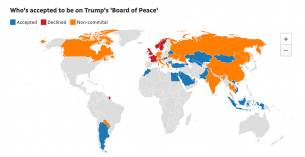 The map shows the foreign nations, not including the U.S. State Department, that are contributing to billions of dollars Donald Trump via the new Board of Peace that he created to chair for the rest of his life.
Meidas Touch Network, Opinion: He’s Not Grifting Anymore. He’s Just Taking It, Dina Doll, April 4, 2026.The State Department transferred $1.25 billion in foreign aid to Trump’s Board of Peace, pulling $1 billion from international disaster assistance, $200 million from peacekeeping
operations, and $50 million from international organizations. Money that Congress authorized for hurricanes and refugees, moved without a congressional vote, into a fund that Trump created by executive order and controls personally. You didn’t buy the Bible. You didn’t mint the coin. You didn’t sign up for Trump University or bid on the NFTs or book a room at Mar-a-Lago. You opted out of every scheme, every hustle, every grift and it didn’t matter. Because while you were watching an illegal war burn through a billion dollars a day and TSA workers suffered because Congress couldn’t find the money to pay them, Trump was doing something quieter. He was taking yours.
Trump has grifted his entire life. Now he’s just taking it.
 The State Department transferred $1.25 billion in foreign aid to Trump’s Board of Peace, pulling $1 billion from international disaster assistance, $200 million from peacekeeping operations, and $50 million from international organizations. Money that Congress authorized for hurricanes and refugees, moved without a congressional vote, into a fund that Trump created by executive order and controls personally. When reporters asked the State Department about it, a spokesperson said they had nothing to announce at this time.
The Board of Peace has one defining characteristic. Trump controls it forever. He named himself chairman for life. No audits. No transparency requirements. No conflict of interest rules. Countries pay $1 billion into a fund he runs to get a seat at the table. It has transferred nothing to Gaza, disclosed nothing about its spending, and received $1.25 billion of your disaster relief money without a word of explanation.
When he leaves the White House he keeps the fund. That is not a loophole. That is the design.Operation Epstein Fury Operation Epstein FuryDina Doll · Mar 21Read full story
Of course, that’s not the only action Trump has recently taken to pay himself straight from the taxes Americans pay to the federal government. Trump filed a $10 billion lawsuit against the IRS over the leak of his tax records by a contractor. The problem, beyond the absurdity of the number, is that Trump controls the government he is suing. He confirmed it himself: “I’m supposed to work out a settlement with myself.” The DOJ attorneys who would defend against this lawsuit serve at his pleasure. Bondi is literally the only thing protecting the American people from Trump’s attempt to steal billions of our hard-earned money. Which means, there is an ineffective counsel sitting at the defense table for the American people, Trump on the other side of the negotiating table and Treasury Secretary Scott Bessent ready to sign the check.
He went from selling people something worthless to skipping the transaction entirely.
Disaster relief money in a fund he controls forever. A $10 billion lawsuit against himself with your money as the prize. A billion dollars a day on an unauthorized war while TSA workers went without pay and American healthcare credits slashed.
There was always money. It just wasn’t going to you.
The grift required something from you. A purchase. A click. A willing suspension of disbelief. You could say no to the Bible. You cannot opt out of your tax dollars. You have already paid. The question is whether enough people understand what is being done with that money to make enough noise that someone has to answer for it.
Americans do not like cheaters. The reason the fraud of Trump’s University landed everywhere it landed was because the story was simple. He took money from people who trusted him and gave them nothing back.
This is that story. Bigger numbers. Higher office. No brochure required.
Tell someone who doesn’t know. The noise is the only friction left.
Consider subscribing to Dina on Substack to support her work: Dina DollLegal Analyst/Attorney/Community Leader/Mom MeidasTouch Host & Legal AF Contributor/ I explain the law because the law belongs to us all
Dina Doll is an experienced attorney and legal analyst. She hosts the MissTrial podcast on MeidasTouch and co-hosts Unprecedented on Legal AF. Dina also serves as the legal expert for Access Hollywood’s Trial Files and provides regular legal commentary for CNN, NewsNation, and other national media outlets.
News Updates
The Parnas Perspective, Pete Hegseth Purges Generals as Paranoia Grows, Aaron Parnas, right,
April 4, 2026. Military Silent as American Service Member is Missing, Trump Proposes Massive Cuts to Healthcare, Schools, and More. A U.S. service member shot down over Iran is still missing, and there is an active race between American and Iranian forces to find them first. At the same time, CENTCOM has gone silent, and Defense Secretary Pete Hegseth is reportedly growing increasingly paranoid about losing his job, firing top generals in an effort to protect his position. All of this is happening as President Donald Trump proposes sweeping cuts to major programs including healthcare grants, NASA, medical research, and public education.
Here’s the news:• U.S. Central Command’s official X (Twitter) account has been inactive for over 24 hours, even as the conflict reaches one of its most critical moments for U.S. forces. It comes as U.S. forces are urgently racing to locate a missing crew member after an F-15E fighter jet was shot down over Iran. Search-and-rescue teams have been deployed deep into hostile territory, facing ongoing Iranian attacks that have already struck supporting aircraft. The operation is high-risk and time-sensitive, with intense efforts underway to recover the service member safely.
• Defense Secretary Pete Hegseth’s decision to remove top Army leaders, including the Army chief of staff and other senior generals, was reportedly driven by growing paranoia that Army Secretary Dan Driscoll could replace him. Sources tell the New York Post that Hegseth became increasingly insecure after internal conflicts and began targeting officials he believed were aligned with Driscoll, attempting to sideline potential rivals. • Trump says time is running out before hell rains down on Iran:
• His concerns were fueled by Driscoll’s rising profile, close ties to Vice President JD Vance, and previous involvement in high-level negotiations.Officials describe the shake-up as less about policy and more about personal rivalry, with Hegseth going after perceived allies of Driscoll within the Army leadership. The situation has heightened tensions inside the Pentagon, raising concerns about instability and leadership struggles at a critical time during the Iran war.• Trump’s top economic advisor Kevin Hassett argued that current higher prices are temporary and will soon decline, echoing President Trump’s recent remarks. When challenged about past statements, he deflected by referencing earlier comments from Joe Biden, while Fox News pushed back that the situation has changed. • Donald Trump’s budget proposes massive cuts to social services that you rely on.
More On Iran War
New York Times, Europe’s Options in the Strait of Hormuz: Few, and Risky, Jim Tankersley, April 4, 2026. European leaders and other officials have ideas for bringing shipping back to the strait once the Iran war ends. But none of them are sure bets.When senior officials from 40 countries met virtually this week to discuss how to bring shipping traffic back to the Strait of Hormuz, Italy’s foreign minister had a proposal. He urged them to establish a “humanitarian corridor” allowing safe passage for fertilizer and other crucial goods headed to impoverished nations.
The plan, described after the meeting by Italian officials, was one of several competing proposals from Europe and beyond that were meant to prevent the Iran war from causing widespread hunger. But it was not endorsed by the envoys on the call, and the meeting ended with no concrete plan to reopen the strait, militarily or otherwise.European leaders are under pressure from President Trump to commit military assets, immediately, to end Iran’s blockage of the strait and tame a growing global energy and economic crisis. They have refused to meet his demands by sending warships now. Instead, they are hotly debating what to do to help unclog the vital shipping lane once the war ends.
But they are struggling to rally around a plan of action.
That partly reflects the slow gears of diplomacy in Europe and the sheer number of nations, including Persian Gulf states, that are invested in safeguarding the strait once the war ends. Many nations involved in the talks, including Italy and Germany, have insisted that any international effort be blessed by the United Nations, which could slow action further. Military leaders will take up the issue in discussions next week.
More than anything, the struggle reflects how difficult it could be to actually secure the strait under a fragile peace — for Europe or for anyone else. None of the options available to Europe, the Gulf states and other countries look foolproof, even under the assumption that the major fighting will have stopped.Idea 1: Naval escorts
The plan: French officials, including President Emmanuel Macron, have repeatedly raised the possibility that French naval vessels could help escort merchant ships through the strait after the war ends. American officials have pushed for Europeans and other allies, like Japan, to escort ships sailing under their own countries’ flags. (A French escort for a French ship, for example.)
The catch: Naval escorts are expensive. Also, their air defense systems alone might not be sufficient to stop some types of attacks, like drone strikes, should Iran choose to start firing again. “What does the world expect, what does Donald Trump expect, from let’s say a handful or two handfuls of European frigates there in the Strait of Hormuz,” Defense Minister Boris Pistorius of Germany said last month, “to achieve what the powerful American Navy cannot manage there alone?”Idea 2: Sweep for mines
The plan: German and Belgian officials, among others, say they are prepared to send minesweepers to clear the strait of explosives after the war.
The catch: Western military leaders aren’t convinced that Iran has actually mined the strait, in part because some Iranian ships still pass through it. So while minesweepers might be deployed as part of a naval escort, they might not have much to do.
The plan: Send fighter jets and drones to intercept any Iranian air assaults on ships. American officials have pushed Europe to do this.
The catch: Also quite expensive. Still not guaranteed to work. Iran can attack ships with a single soldier in a speedboat, and if just a few attempts succeed, that could be enough to spook insurers and shipowners out of attempting passage.Idea 4: All of those, plus diplomacy
The plan: Use negotiations and economic leverage to pressure Iran to refrain from future attacks, and deploy a variety of military means to enforce that. This effort would go beyond Europe. On Thursday, the German foreign ministry called on China to use its influence with Iran “constructively” to help end the hostilities.
The catch: Expensive. Still not guaranteed. Negotiations seem to have done little to stop the fighting. But this may be Europe’s best bet, for lack of a better one.What if none of that works?
Iranian officials said this week that they would continue to control traffic through the strait after the war. They have already made plans to make ships pay tolls for passing through the strait, which is supposed to be an unfettered waterway under international law.
A continued blockage risks global economic disaster. Countries around the world rely on shipments through the strait for fuel and fertilizer, among other necessities. In some regions, shortages loom. In others, like Europe, high oil, gas and fertilizer prices have raised the specter of spiking inflation and cratering economic growth.
“The big threat right now is stagflation,” said Hanns Koenig, a managing director at Aurora Energy Research, a Berlin consultancy. “You’ve got higher prices, and they strangle the tiny growth we would have seen this year.”
Emptywheel, Analysis: Blind Spots in the Iran War, Emptywheel (Marcy Wheeler), right,
April 3, 2026. Last week, I catalogued a number of filters — crazy, stupid, false, impotent, and blind — via which true accounts still present a misleading picture of the Iran war. Just the last one — the blindness created by a delay in public release of satellite imagery — involved something other than the Trump team’s inadequacies. I wanted to revisit that, and catalog a number of similar blind spots. In my earlier post I described how Planet Labs and other public satellite imagery firms delayed the release of targets hit by Iran for two weeks, which made it hard to understand, first, how Benjamin Pennington was killed and if it came with help from Russia, and second, whether that initial March 1 strike explains Iran’s subsequent success hitting Prince Sultan Air Force base.
Which brings me back to the decision by private satellite companies, notably Planet Labs, to delay the release of imagery reflecting targets on American or its allies facilities.
California-based Planet Labs has expanded restrictions on accessing its imagery of the Middle East to prevent adversaries from using it to attack the U.S. and its allies, a sign of how the expansion of commercial space business can impact conflicts.
Planet, which operates a large fleet of Earth-imaging satellites and sells frequently updated images to governments, companies and media, told customers on Monday that it was extending restrictions to a period of 14 days from a delay of four days imposed last week.
The decision came after NYT published this story showing that Iran had succeeded in hitting communications infrastructure around the Middle East, including what is probably the strike that led to Benjamin Pennington’s death, which has never been fully explained.
But that strike — the strike on Prince Sultan’s radar — may well explain how Iran succeeded in another attack — the one that damaged five refueling tankers parked at Prince Sultan — presented as an example of bad news Trump learned from reading it in WSJ.
Yesterday, CNN published a picture (seemingly without that two week delay) that confirms that Iran did take out one of the radars on which the larger Middle Eastern missile defense depends.
A critical American radar was damaged in an Iranian attack on Saudi Arabia’s Prince Sultan Air Base on March 1, a new satellite image has revealed. The radar, an AN/TPY-2, is a crucial piece of equipment for the US’ high-end THAAD missile interception system.
Since then, the base has suffered multiple Iranian attacks, including on March 27, when an E-3 radar aircraft and a refueling tanker were struck. That attack wounded at least 10 US service members.
The strike was part of a pattern of attacks by Iran seemingly intended to degrade the US’ ability to detect incoming missiles and drones by striking radars. Iranian strikes also destroyed another American AN/TPY-2 radar in Jordan, targeted military communications infrastructure, and damaged a Qatari early warning radar that cost over $1 billion to build.
CNN previously reported that a tent which had housed the radar at Prince Sultan was struck but could not confirm if the radar was present at the time of the attack, or if it had been damaged.
This is an example where we could assume the damage based on subsequent Iranian success. But we still don’t have a full explanation of Pennington’s death.Casualties
Nick Turse argues that’s intentional. He points to a number of ways, including limiting what DOD is counting as Iran War casualties and delaying the update of casualty figures, that DOD is low-balling casualty numbers.
U.S. Central Command, or CENTCOM, which oversees military operations in the Middle East, appears to be engaged in what a defense official called a “casualty cover-up,” offering The Intercept low-ball and outdated figures and failing to provide clarifications on military deaths and injuries.
At least 15 U.S. troops were wounded Friday in an Iranian attack on a Saudi air base that hosts American troops, according to two government officials who spoke with The Intercept. Hundreds of U.S. personnel have been killed or injured in the region since the U.S. launched a war on Iran just over a month ago.
[snip]
CENTCOM has sent outdated statements on casualty numbers, meanwhile, resulting in undercounts, including a statement sent Monday from spokesperson Capt. Tim Hawkins noting that “Since the start of Operation Epic Fury, approximately 303 U.S. service members have been wounded.” The comment was three days old and excluded at least 15 wounded in the Friday attack on Prince Sultan Air Base in Saudi Arabia. The command did not reply to repeated requests for updated figures.
CENTCOM also would not provide a count of troops who have died in the region since the start of the war. An Intercept analysis puts the number at no less than 15.
“This is, quite obviously, a subject that [War Secretary Pete] Hegseth and the White House want to keep under major wraps,” said the defense official who spoke on the condition of anonymity in order to speak frankly.
That obviously limits political pressure. But it also makes it harder to do what is critical to assessing Trump’s misconduct: documenting that Russia is now killing American service members, and Trump seems anxious to reward Russia.
DOD’s general lack of credibility makes it easier to assess claims, like those in the last day from Iran, that they’ve downed an F-15.
DOD has deployed rescue teams to southern Iran, so it is clear Iran is telling the truth about this downing.
Update: DOD has posted casualties for Operation Epstein Fury for the month of March.Enforced blindness, US: Press suppression
Meanwhile, four key players are using strategies to prevent more visibility.
In the US, Whiskey Pete gutted the press access to the Pentagon and is trying to criminalize actual reporting. Even as the NYT won a preliminary injunction against such measures, it accuses DOD of flouting that order.
Rather than comply with the Court’s Order and accompanying Opinion, Defendants are contemptuously defying it—both in letter and spirit in a newly released “interim” policy. Among other things, for the first time in history, the Interim Policy bars reporters with press passes from entering the building without an escort, sets up unprecedented rules governing when a reporter can offer anonymity to a source, and leaves in place provisions that this Court’s Order struck. Defendants’ counsel, Cmdr. Timothy Parlatore, candidly admitted that this revised, interim policy simply “use[s] more words to say the same thing.”1 See Second Supplemental Boutrous Decl., Ex. 1 (the “Interim Policy”). That is the definition of contempt.
As Julian Barnes (the named plaintiff) describes, effectively DOD is trying to pen journalists — even those with an escort — to the Pentagon library.
6. On Tuesday, March 31, 2026, I arrived at the Pentagon at 12:10 p.m. and entered the Visitor Center security area. I showed the attendant behind the glass my driver’s license and the PFAC. I entered my social security number upon his request. I was advised that individuals holding PFACs must enter through corridor 8. I replied that I had an appointment and the escort was going to meet me in the Visitor’s Center. The supervisor repeated that anyone with a PFAC could enter only through corridor 8. This was despite the fact that I was told to meet my escort in the Visitor’s Center and the fact that before I could have simply entered through the main gate using my PFAC. After I arrived at the Pentagon, the interview was postponed, and I was immediately escorted out of the building.
7. As that experience made clear to me, my PFAC does not provide me access to the Pentagon building and provides access only to the separate library building. By contrast, and like visitors who do not hold a PFAC, I may access the Pentagon building only upon invitation or approval by Department officials, and only with an escort. Neither I nor, to my knowledge, any of my colleagues have been told about the criteria used in determining whether to approve such a request, though the Interim Policy does state that no more than three PFAC holders from the same news organization will be provided an escort per day.
8. Going through a sometimes-lengthy process of scheduling official appointments in order to ask even one or two questions to an official—even assuming that request is granted and that official does not have to reschedule—does not allow for meaningful engagement with Department personnel on a timeline consistent with news reporting. As I stated in a prior declaration, reporting from the Pentagon has historically necessitated speaking to upwards of a dozen officials and other personnel from different press offices in a given day, sometimes in response to rapidly developing events. While I used to be able to walk from press office to press office throughout the day, I now would have to return to the library, call or email for an appointment, and wait for a response and approval, and for arrangement for and arrival of an escort. That means I will be spending hours of my day just waiting and walking back and forth—assuming I can get ahold of press offices and individuals and arrange interviews and be approved for an escort at all. That process will dramatically interfere with my ability to meaningfully engage with anyone from the Department on Pentagon grounds, or to obtain the information necessary to inform the public in a timely manner.
Effectively, DOD is saying that if is not allowed to restrict press resources to Laura Loomer (more on her in a follow-up) and Jack Posobiec, then no one can have access.
During the Iraq War, there would have been embedded journalists at Prince Sultan, who could explain some of what has happened at the base. Now, Whiskey Pete’s hand-selected scribes wouldn’t understand what they were looking at if they were embedded.Enforced blindness, UAE: Prosecution
The UAE risks having their entire myth of a desert paradise tainted if images of the damage Iran is doing circulate widely. As a result, it is cracking down on foreigners, particularly Brits, who are publishing videos of drone strikes.
Up to 70 UK citizens have been detained in the United Arab Emirates (UAE) for taking photos and videos of Iranian attacks, it has been claimed by a British-based campaign group.
Detained in Dubai chief executive Radha Stirling said she believed dozens of Britons had been arrested in the UAE for sharing war images under the country’s “draconian” cybercrime laws.
“We’re talking approaching 50 to 70 was my estimate and possibly even more. I think by the end of this we’ll see a lot more, possibly 100, maybe 150,” she told Sky News.
Bellingcat has a report on some of the incidents UAE has been trying to downplay.
Bellingcat has identified several high-profile incidents where authorities in the United Arab Emirates have downplayed damage, mischaracterised interceptions and in some instances not acknowledged successful Iranian drone strikes on the country.
A review of official statements shows that the public account does not always align with what can be observed through open sources. This comes as the UAE faces sustained aerial attacks on civilian and economic infrastructure, challenging its image as a secure global hub for business and tourism. Hours after the United States and Israel launched coordinated attacks on Iran on Feb. 28, the Islamic Republic responded by launching an attack against US-allies in the region including the UAE.
In the wake of the attacks, the UAE’s attorney general warned that publication of images or videos of strikes was illegal. People were also encouraged to report anyone sharing photos or videos of the strikes to authorities.
[snip]
On March 3, a video filmed from a vessel appears to show a drone striking the port of Fujairah, one of the UAE’s most strategically important energy hubs. The port handles roughly 1.7 million barrels of oil per day and is among the world’s largest.
The drone appears to approach its target intact, with no visible sign of interception, Sam Lair, a researcher at James Martin Center for Nonproliferation Studies, told Bellingcat.
Moments after it descends behind storage tanks, an explosion is heard and a large plume of smoke rises from the site.
On the same day, the Fujairah Media Office stated that a fire resulted from debris following a successful interception, adding that the had been brought under control. Satellite images captured on March 4 and 5 show thick black smoke rising from the site. NASA FIRMS data also detected fires on March 3, March 4 and March 5. By March 7, satellite imagery shows at least three storage tanks fully destroyed (25.184565, 56.345481).
The UAE strikes, in particular, would serve to hide Iran’s attempt to target US corporate facilities, like the Oracle facility hit today (though the AWS facility it has serially targeted is in Bahrain).Enforced blindness, Iran: Netblock
Iran is using a more traditional method: Blocking access to the Internet for virtually everyone, which Netblocks continues to track.
Update: The internet blackout in #Iran is now on its 35th consecutive day as connectivity flatlines at 1% of ordinary levels after 816 hours. The general public remain cut off from the world without vital updates and without a voice as the incident closes its fifth week.
The US (or Israel) had tried to counteract Iran’s similar shutdown during protests earlier this year by getting Starlink terminals into the country.
Iran is now targeting them specifically.
Iranian authorities arrested dozens of people who were allegedly in a network that sold Starlink satellite terminals, as Tehran expands efforts to control information more than a month into its war with the US and Israel.
Iran seized 139 Starlink devices and arrested 46 people involved in selling SpaceX’s terminals, the semi-official Iranian Students’ News Agency reported Monday, citing the country’s police chief Ahmad-Reza Radan. There are an estimated 50,000 Starlink terminals in the country, according to activists and digital rights groups.
In my earlier post, I described how Trump’s erratic state makes regular source-based reporting fraught with dangerous filters.
And what remains is blinded by a number of deliberate tactics.
Global News
National Public Radio, Evacuation of U.S. troops from Mideast base sends community groups scrambling to help, Steve Walsh, April 3, 2026. . NPR has learned that hundreds of sailors were evacuated back to the United States from their base in Bahrain after the base was attacked by Iranian missiles and drones. In addition to the base in Bahrain, NPR has learned that there have been evacuations at other U.S. military bases in the region, though the exact details are unknown at this point.
NPR
 Bahrain is the home of the Navy's 5th Fleet, making it a central hub for providing maritime security in the Middle East region, including protecting commercial shipping. The country is an island in the Persian Gulf that sits roughly 124 nautical miles away from the coast of Iran, which makes Bahrain well within range of Iranian drone and missile strikes.
Around 8,000 people were stationed at the base in Bahrain before the U.S. attacked Iran on Feb. 28.
On the opening day of the war, the base, known as Naval Support Activity (NSA) Bahrain, was struck multiple times. Posts on social media showed a ballistic missile and Iranian drones slamming into the base. Satellite imagery from the company Planet shows that at least seven buildings in and around the base were struck between Feb. 28 and March 6.
In response to an NPR request, a Navy spokesman acknowledged that 1,500 sailors, their families and several hundred pets were relocated back to the U.S. from NSA Bahrain.
Sailors have been arriving in Norfolk, Va., home to the world's biggest naval base, since at least the middle of March. Several groups that provide aid to military personnel say that the sailors arrived with very little. A call went out to community groups, asking for basic supplies like hygiene products.
"The base was asking for donations of toiletries and different things for the sailors coming back, because they were coming back with nothing," said Derrick Johnson, commander of American Legion Post 327 in Norfolk.
The post hosted a spaghetti dinner for some of the sailors, said Keith Shanesy, one of the post's vice commanders.
"They literally told them, 'Get what you can get in the backpack. You've got to go,'" he said. "They came with no uniforms, nothing. The three we met first, they came with the clothes on their back, what they could fit in that backpack."
The Navy has provided services including "crisis counseling, financial and legal assistance, relocation support, educational resources, coordination for child and youth programs," according to Lt. Cmdr. Kara Handley.
And the USO, which offers support to service members and families, has been providing aid to sailors in Norfolk as they arrive from various locations in the Middle East, according to David Carrier, with the national USO.
The Navy-Marine Corps Relief Society has handed out $1 million to roughly 2,000 sailors and their families since the evacuations began, said the group's chief operations officer Dawn Cutler, a retired rear admiral.The US Navy's USS Cincinnati littoral combat ship (LCS) arrives for a port call at the Ream Naval base, located in Cambodia's southern coast in Preah Sihanouk province, on Jan. 24, 2026. Several vessels of the same class have been equipped for mine-clearing operations.WorldIs the U.S. Navy ready to clear sea mines in the Persian Gulf?
"I saw one gal — she had a 2-week-old and a 2-year-old and a dog in a crate and a suitcase. So she was just at the moment, you know, looking to get out of danger, get to someplace safe. And now we're at the point where families are back and they're starting to ask the question: 'Well, what's next? Will we go back?'" Cutler said.
The money is mainly to pay for essentials and to provide bridge loans so families can pay basic living expenses while they wait for the government to reimburse them, which can take months, she said.
"The pet situation, I understand, was quite a challenge. We heard there was going to be no movement of pets. But then a change was made, but some were put on different flights. People didn't have carriers for a cat, so we helped scrounge up through our volunteers," she said.
When troops move overseas, they don't keep a home in the United States. The military requires service members to designate a safe haven where they will be relocated to in an emergency. Some of the sailors have gone to stay with relatives, while others remain on bases in the United States. MacDill Air Force Base in Tampa, Fla., and Joint Base Charleston in South Carolina have also been hubs for returning flights.
On April 1, the Navy released updated guidance for sailors and families who were evacuated. The service has worked out how people can be reimbursed for living in hotel rooms, including families who were temporarily relocated to Italy and Germany before being transported back to the United States.
The Navy does not yet have an answer for what will happen to cars and furniture left behind in the rush to leave. The Navy is also not telling evacuees when or if they will be returning to their bases in the Middle East.Douglas James Wilson (b. 1953) is an American conservative Reformed and evangelical Christian theologian and pastor.[1] Wilson leads Christ Church in Moscow, Idaho, in which capacity he has taken leading roles in the Communion of Reformed Evangelical Churches and the classical Christian education movement.[2] He is a public proponent of postmillennialism, Christian nationalism, covenant theology, and biblical patriarchy. Wilson, a self-described "paleo-Confederate", first garnered extensive media coverage in 2004, when he held a conference which publicized his controversial stance on American slavery.[3][4]
More Global News
Letters from an American, Historical Commentary: April 3, 2026 [NATO's Founding, Purpose, Future], Heather Cox Richardson, right,
April 4, 2026. On April 4, 1949, representatives from twelve countries in Europe and North America—Belgium, Canada, Denmark, France, Iceland, Italy, Luxembourg, the Netherlands, Norway, Portugal, the United Kingdom, and the United States—signed the North Atlantic Treaty, creating the North Atlantic Treaty Organization, or NATO. This defensive security alliance has been a key institution for world stability since World War II.On April 4, 1949, representatives from twelve countries in Europe and North America—Belgium, Canada, Denmark, France, Iceland, Italy, Luxembourg, the Netherlands, Norway, Portugal, the United Kingdom, and the United States—signed the North Atlantic Treaty, creating the North Atlantic Treaty Organization, or NATO. This defensive security alliance has been a key institution for world stability since World War II.
In the wake of that war, the U.S. and its allies recognized the crucial importance of peacetime alliances to deter future wars. To stop the spread of communism across war-torn Europe, the United States backed a massive financial investment into rebuilding Europe. President Harry S. Truman signed the European Recovery Program, better known as the Marshall Plan, into law on April 3, 1948.
Quickly, though, it appeared that economic recovery would not be enough to protect a democratic Europe. The expansion of Soviet-style communism prompted officials to consider a pact that would enlist the United States to stand behind the security of Western Europe. Crucially, though, they wanted it to stand outside the United Nations, where the Soviet Union could exercise veto power. The outcome was the NATO alliance.
NATO guaranteed collective security because all of the member states agreed to defend one another against an attack by a third party. Article 5 of the treaty requires every member nation to come to the aid of any one of them if it is attacked. That article has been invoked only once: after the September 11, 2001, attacks on the United States, after which NATO-led troops went to Afghanistan.
Over the years, the alliance has expanded to include 32 countries. In 1999, Poland, Hungary, and the Czech Republic, all former satellites of the USSR, joined NATO over the protests of Russia, which was falling under the control of oligarchs who opposed western democracy. More countries near Russia joined NATO in the 2000s, and Finland and Sweden have joined since Russia’s full-scale invasion of Ukraine—Finland three years ago tomorrow, in fact.
When NATO formed, the main concern of the countries backing it was resisting Soviet aggression, but with the fall of the Soviet Union and the rise of Russian president Vladimir Putin, NATO resisted Russian aggression instead.
In 1949, when he signed the treaty, President Truman called the pact a positive influence for peace. That peace was, first of all, among the nations signing the agreement. They were, he said, agreeing “to abide by the peaceful principles of the United Nations, to maintain friendly relations and economic cooperation with one another, to consult together whenever the territory or independence of any of them is threatened, and to come to the aid of any one of them who may be attacked.” If such an agreement had been in place “in 1914 and in 1939, supported by the nations who are represented here today,” he said, “I believe it would have prevented the acts of aggression which led to two world wars.”
With NATO, Truman said, “we hope to create a shield against aggression and the fear of aggression—a bulwark which will permit us to get on with the real business of government and society, the business of achieving a fuller and happier life for all our citizens.”
NATO countries agreed to stand together to withstand aggression from outside the pact. Truman emphasized the difference between the NATO countries and the authoritarian system against which the alliance stood. The NATO countries could stand together without being identical. “There are different kinds of governmental and economic systems, just as there are different languages and different cultures. But these differences present no real obstacle to the voluntary association of free nations devoted to the common cause of peace,” he said. “[I]t is possible for nations to achieve unity on the great principles of human freedom and justice, and at the same time to permit, in other respects, the greatest diversity of which the human mind is capable.”
The experience of the United States “in creating one nation out of…the peoples of many lands” proved that this idea could work, Truman said. “This method of organizing diverse peoples and cultures is in direct contrast to the method of the police state, which attempts to achieve unity by imposing the same beliefs and the same rule of force on everyone.”
The NATO countries did not believe that war was inevitable, Truman said. “Men with courage and vision can still determine their own destiny. They can choose slavery or freedom—war or peace. I have no doubt which they will choose. The treaty we are signing here today is evidence of the path they will follow. If there is anything certain today, if there is anything inevitable in the future, it is the will of the people of the world for freedom and for peace.”
U.S. Law, Courts, Crime
New York Times, News Analysis: New Attorney General, Same Albatross: Trump’s Quest for Retribution, Alan Feuer and Glenn Thrush, April 4, 2026. The name atop the Justice Department’s organizational chart matters less than the presence of a president whose demands for revenge have become so extreme that even his most obsequious appointees have fallen short.President Trump’s pick to replace Pam Bondi will face the same conundrum that every attorney general he has hired and fired has
confronted: It is hard to steer the Justice Department when the president is grabbing the wheel and stepping on the gas.Mr. Trump is searching for a tougher version of Ms. Bondi, left, but the fault lies not in the shirking weakness of those he has called upon to execute his will, but rather in the impossibility of his request — to bring criminal charges against political targets with little to no evidence or legal justification.
The president has settled for the moment on Ms. Bondi’s chief deputy and his former defense lawyer, Todd Blanche, right, whose grasp of legal
matters and low-key personality represent a contrast from the voluble, less lawyerly Ms. Bondi.Yet the name atop the Justice Department’s organizational chart matters less than the overbearing presence of a president whose demands for retribution against his enemies have become so frequent and extreme that even his most obsequious appointees have fallen short.
“It’s certainly not about the willingness or the loyalty of any one person to carry out the president’s orders,” said Mimi Rocah, a former federal prosecutor who is writing a book about the current state of the Justice Department.
“It’s more that there are limits on the president — courts, grand juries, lawyers and investigators who understand norms and ethics — that have started getting in his way.”
Over the past few months, those limits have become more visible as the legal system has pushed back in an extraordinary manner against the president’s attempts to investigate and prosecute his enemies, no matter how much — or rather, little — evidence exists to support the cases. Judges, grand juries and some federal prosecutors have stepped in to block Mr. Trump’s most egregious efforts, serving as a bulwark against his maximalist personal and political goals.It remains unclear for now how long Mr. Blanche, 51, might stay in his new job as acting attorney general — or who is likely to replace him. One senior administration official, speaking on the condition of anonymity, described the job as Mr. Blanche’s to lose.
Several other names have been floated in recent days, including Lee Zeldin, the administrator of the Environmental Protection Agency; Senator Mike Lee, Republican of Utah; and Senator Ashley Moody, Republican of Florida. But it is unclear how serious any of these candidates might be, given Mr. Trump’s habit of musing with his associates about potential personnel moves.Editors’ PicksHow Long Does It Take to Boil an Egg?On ‘Company Retreat,’ Anthony Norman Finished the JobTiny Love Stories: ‘If I Arrived Home After Dark ’
Some of Mr. Trump’s Republican allies seem to believe that all he needs to do is appoint a more belligerent attorney general to force through what Ms. Bondi failed to accomplish.
“We want to see heads roll,” Representative Chip Roy of Texas said on Friday morning on Fox News, adding, “The next attorney general needs to be very aggressive.”
The Contrarian Publisher’s Roundup: I Was There for the Trump-Bondi Breakup Norman Eisen, right, publisher,
April 4, 2026. And Other Tales from the Birthright Argument at SCOTUS:On Wednesday morning, I settled into my seat in the ornate U.S. Supreme Court chamber, with its coffered ceiling 40 feet above me, tall Ionic columns lining the walls, and heavy red drapes behind the elevated mahogany dais that the justices would shortly occupy. I was there as a member of the legal team defending birthright citizenship, one of my almost 300 legal cases and matters supported by the paid subscriptions of you Contrarians.Subscribed
Like the hundreds of others in the crowded courtroom, I expected to see history in the making — a case that would enter the annals of American law. What I didn’t expect was to witness a scene out of a reality TV show: The Real Cabinet Members of D.C.I was seated in the third row of the gallery. The first row is reserved for cabinet members and VIPs, and it was filling up when, at about 9:45 a.m., Attorney General Pam Bondi arrived and took an open seat for the 10 a.m. argument. She looked uncomfortable and unhappy, her face a grimace, her back stiff. I assumed she knew her side was going to have a rough day of it. We now know that she had just been fired in the car ride over with the president. Pam Bondi and Donald Trump exit the Supreme Court. (White House X)
Before long came the lumbering bulk of Donald Trump, accompanied by the more diminutive White House Counsel David Warrington. He sandwiched himself between Bondi and Trump, with the president occupying the spot at the very end of the far right of the row. That’s where the drama kicked in. Trump began whispering to Warrington and to his Secret Service detail. Then Commerce Secretary Howard Lutnick hurried over from further down the row, sycophantically groveling in the aisle to Trump’s right for more presidential whispering.
The next thing I knew, Trump was getting up and moving to the far left opposite end of the bench, about five feet in front of me — and as far away from Bondi as possible. She was left alone at the end of the row, looking none too chipper.
At the time I thought maybe Trump just didn’t like the view, although it wasn’t that different. It was a little over 24 hours later that Bondi’s firing was announced. In retrospect, it makes me wonder if it wasn’t the seat that Trump disliked but the seatmate. Whatever the explanation, I momentarily felt sorry for Bondi, abandoned at the end of the row like a school kid without a lunch companion.
But my flicker of sympathy was short-lived. After her role in pursuing baseless criminal charges against innocent victims of Trump’s misplaced revenge, in exposing the names of the Epstein victims, and then in doing so much other damage to the Department of Justice and the rule of law, I can only say she deserves to be shunned–and disbarred. (Hmm, that gives me an idea….)
With all that as prologue, what then transpired once the arguments began must have done little to improve her mood. Based on what I saw in court on Wednesday, I am guessing we are looking at a 6-3 or 7-2 victory for our birthright case. It was a terrible day for Trump, Bondi and their ilk — but a great day for justice and for all you Contrarians, whose paid subscriptions help support my work on cases like this one.Subscribed
It appears that the Supreme Court is poised to affirm that the citizenship clause of the Fourteenth Amendment means what it has always been understood to mean: that every person born on American soil is an American citizen. ACLU Legal Director and my co-counsel Cecillia Wang did a brilliant job of explaining that the meaning of the citizenship clause has been fixed since the Fourteenth Amendment was ratified in 1868. Subsequent Supreme Court case law, notably the Wong Kim Ark decision in 1898, has only reinforced that babies born in the country are American citizens regardless of the citizenship status of their parents. Here I am with Cecillia right after the argument:
Even the conservative justices were skeptical of the government’s argument: that only babies with parents who are “domiciled” in the United States and have permanent legal status here are entitled to birthright citizenship. Solicitor General John Sauer was peppered with questions about the lack of textual and historical support for this argument. At one point, after Sauer mentioned Wong Kim Ark, Justice Neil M. Gorsuch said, “Well, I’m not sure how much you want to rely on Wong Kim Ark.” Gorsuch also called out the government on the striking absence of discussion of “domicile” in congressional debates at the time the Fourteenth Amendment was passed. Chief Justice John G. Roberts Jr. referred to the government’s examples as “quirky.”
We do not expect to win this case 9-0, and Justices Clarence Thomas and, to some extent, Samuel A. Alito were sympathetic to the government’s arguments. That said, based on the questioning from the justices, it appears that a clear majority will rule for our clients. This is not a difficult case, in large part because the court already decided this issue in Wong Kim Ark, which involved the son of Chinese immigrants. In fact, Kavanaugh asked Wang whether the opinion could be a very short one affirming that the court is following Wong Kim Ark, and she agreed that it could.
As I explained at a rally after the argument, Wednesday was the culmination of years of planning that began even months before Trump was reelected in 2024. This planning was the reason that Democracy Defenders Fund and our partners were able to act immediately when Trump’s executive order purporting to end birthright citizenship as we know it was issued on the first day of his second term. More of my rally remarks are here:
We do not relish that this work is necessary, but I and my litigation colleagues at Democracy Defenders Fund and Democracy Defenders Action stand ready to continue fighting. That is thanks in no small part to your paid subscriptions, which fuel our role in cases and matters like this one and over 280 others.Subscribed
Of course, your paid subscriptions don’t support only my work in the courts of law; they also support the Contrarian’s stellar coverage that shapes the court of public opinion. Just take a look at this week’s highlights, put together by my wonderful Contrarian colleagues:Birthright citizenship at SCOTUS
- Trump Is Likely to Lose on Birthright
- No Kings Day at the Court
- Iran’s Negotiating Strategy Is Built on Distrust
- Is It Too Late To Apologize?
- American Consumers Will Pay for Trump’s War with Iran
- Trump Is Serious About Accepting a Humiliating Defeat
- The Echo in Trump’s Detention Camps
- For Meta, the Mask Is Off: They Knowingly Harmed Children
- Women Who Serve Also Face the Trump Administration’s Misogyny
- In Defense of Joyful Protest
- The Contrarian Covers the Democracy Movement
- Protesting is Necessary but Not Sufficient
U.S. Jobs, Economy, Inflation
The New Republic, Jobs Report Hit With Seriously Brutal Revision, Staff Report, April 3, 2026. The March jobs report doesn’t seem too bad—until you take a closer look at the revision. For what was meant to be the Golden Age of America, it’s sure looking like a recession could be on the cards.
The Bureau of Labor Statistics’ jobs report Friday found the U.S. added 178,000 jobs in March, surpassing expectations. But hidden in that good news was something else: The job losses in February were far worse than previously reported. Initially reported as a loss of 92,000 jobs, the labor market actually lost a total of 133,000 jobs that month.This update means that February represented the largest U.S. job loss since December 2020, during the height of the coronavirus pandemic.
The labor market has been consistently brutal since Trump took office in January 2025. Yearly job growth was the worst it had been outside of a recession since 2003.
“March was somewhat encouraging, but it’s been a rocky year for the labor market with almost no hiring since last April,” Heather Long, chief economist at Navy Federal Credit Union, told CNBC. “The March data will keep the Federal Reserve on hold, but no one is declaring victory yet. It’s likely to be a tough spring for job-seekers.”
The rough months come while Trump spends millions in taxpayer money on a golden ballroom for himself and his cronies (not to mention billions on his unpopular and unauthorized Iran war). Some Jay Gatsby parallels spring to mind—although at least Gatsby’s lavish spending was guided by unrequited love and a desire to fit in. Trump’s is more just because he’s a senile egoist.
More On Epstein Files, Trump Coverup
Republican Congressman Thomas Massie of Kentucky, left, urged Acting U.S. Attorney Gen. Todd Blanche, center, to comply with federal law requiring the remaining millions of pages regarding the late sex trafficker and corrupt financier Jeffrey Epstein, shown at right with his longtime friend Donald Trump.Occupy Democrats, Opinion: Republican Congressman Thomas Massie drops an Epstein bomb on Trump's new Acting Attorney General — warning him that he has just one month to fully release the files under the law! Staff Report, April 4, 2026. There will be no rest for the wicked in this scandal...
"Congratulations AG Blanche. Now you have 30 days to release the rest of the files before becoming criminally liable for failure to comply with the Epstein Files Transparency Act," Massie wrote on X in response to a tweet from Acting AG Todd Blanche about his new position.Attorney General Pam Bondi was fired earlier today by Trump, proving once again that loyalty is meaningless once he decides that you're worth throwing under the bus. In Bondi's case, she did everything within her power to obstruct and cover up Trump's role in Epstein's crimes but it still wasn't enough. In the end, she was more valuable to him as a scapegoat.
Now, Blanche finds himself in the unenviable position of being the face of this totally politicized, totally corrupt Justice Department. The MAGA base, and indeed all of America, are still demanding the full release of the files. But Blanche knows that Trump wants those files buried for good. If he releases them, he's fired. If he refuses to release them, he'll eventually become the next scapegoat — and end up criminally liable as Massie has pointed out. He's damned if he does, damned if he doesn't.
Of course, Blanche has already proven himself a willing hatchet-man in this Epstein affair, which is why Trump sent him to meet with Ghislaine Maxwell right before she was moved to a minimum security facility in Texas. Presumably, that little jaunt played a large role in his elevation to Acting AG.
But justice is coming.
After the midterm elections, once Democrats retake control of Congress, Pam Bondi, Todd Blanche, Kash Patel, and every other soulless crook who systemically covered up the mass sexual abuse of children will be forced to pay the piper. With subpoenas in hand, Democrats are going to tear this administration apart in search of the truth. We cannot wait.
New York Times, Guest Essay: The Epstein Emails Show #MeToo Never Stood a Chance, Claire Wilmot (an academic who researches gender and legal systems), April 3, 2026. Jeffrey Epstein’s use of the false rape accusation — the #MeToo boogeyman and the catalyst of the backlash to the movement — that stopped me in my tracks.In Shakespeare’s tragedy “Titus Andronicus,” a general’s daughter, Lavinia, is raped by Chiron and Demetrius, two powerful princes. To prevent her from revealing their crime, her assailants carve out her tongue and amputate both her hands.
Lavinia has been on my mind as I’ve combed through countless emails between Jeffrey Epstein and his vast network. In them, tongue-severing swords take the form of threats, settlements and confidentiality agreements. But unlike Chiron and Demetrius, Mr. Epstein seemed to know that even these vows of silence can crack under pressure, that women can still speak out.
The recent release of millions of pages of court filings, correspondence and other records spanning decades show that Mr. Epstein had been developing a playbook on how to silence women since his conviction, in 2008, for soliciting a minor for prostitution (a polite way of describing the crime of paying a teenager in order to sexually assault her). These documents show how he cultivated a climate of skepticism around all women leveling accusations of sexual impropriety, not merely the girls and women he abused.
The mechanics of doubt revealed in the Epstein files — the strategies and tactics deployed by the powerful to erode survivors’ credibility — offer a rare glimpse into what the #MeToo movement was up against when it took off in 2017.
The emails make it clear that the movement’s hard-won progress never stood a chance. Mr. Epstein seems to have understood that if he could wield his behind-the-scenes influence to encourage a belief that women and girls were unreliable, that perception was stronger than any nondisclosure agreement. If you can transform a person from a victim into a liar, you can cut out her tongue for good
During the height of the #MeToo movement, a handful of high-profile men were prosecuted, many more were canceled, and a number of promising legal reforms were passed. In America, statutes of limitations for sex crimes were extended and definitions of harassment were expanded. Nondisclosure agreements intended to silence women were made harder to enforce. Police departments faced pressure to reduce the number of rape cases that are dismissed for lack of evidence.
But those reforms led to outcomes that were, in many cases, bitterly disappointing. As an academic researcher during that era, I spent time in police stations, prisons and courtrooms in North America, Europe and Africa documenting the aftermath of various legal reforms. In the wake of #MeToo, many of the places I worked registered upticks in sexual violence reporting alongside declining rates of prosecution. A conviction may be an imperfect measure of justice, but these trends suggest that the #MeToo movement had fueled a desire for consequences that was not being met.
In my work as a researcher, I documented the subtle ways in which doubt clung to the testimonies of sexual violence survivors. In jails in Maryland and Ohio, I spoke to women who had called the police for help only to be detained and investigated as criminals themselves. In Nigeria, where feminist movements and subsequent legal reforms overhauled gender violence laws, I reviewed over 70 sexual violence case files, tracing how many survivors tended to be disbelieved because of their identities and biographies, which were given greater weight than the facts of their cases.
Burdens of proof are not borne equally. Women who are poor, not white, undocumented or otherwise marginalized have more to prove to offset the weight of the prejudices that chip away at their credibility. I found that for most survivors, when they tried to hold men accountable for their crimes, the slogans of #MeToo could not contend with their reality.
Doomscrolling through the Epstein files, I’ve found countless resonances to the stories I heard from the women in Maryland, in Ohio, in Nigeria. Mr. Epstein and his allies portray his survivors who are from poor backgrounds as frauds and thieves after money. Those with histories of trauma or substance abuse are dismissed as untrustworthy. Victims’ behavior is endlessly dissected and litigated. In an email from 2010, a contact notes that one of Mr. Epstein’s accusers smiled during a deposition. “Her OWN behavior in the depo disproves her allegations,” he wrote.Sign up for the Opinion Today newsletter Get expert analysis of the news and a guide to the big ideas shaping the world every weekday morning. Get it sent to your inbox.
But it was Jeffrey Epstein’s use of the false rape accusation — the #MeToo boogeyman and the catalyst of the backlash to the movement — that stopped me in my tracks.
Available data shows false reports of this nature are exceedingly rare (generally 2 percent to 5 percent), dwarfed by the estimated number of sexual assaults that are not reported to the police (around three-quarters of sexual assaults in the United States). Men of Mr. Epstein’s class are among the least likely to be prosecuted for false allegations — exoneration data in the United States shows victims of this sort of miscarriage of justice are disproportionately Black and poor.
Still, Mr. Epstein and many of his friends stoked fears around such allegations. In 2019, Noam Chomsky wrote to Mr. Epstein describing the “hysteria that has developed about abuse of women.”
In 2015, a rare false rape allegation made news — when Rolling Stone had to retract an article featuring a woman who claimed she was gang-raped at the University of Virginia. Mr. Epstein seized on the moment to push his view of sexual abuse accusers.
“Think about if there is a way to captialize” on the retracted article, Mr. Epstein wrote to the journalist Michael Wolff, in one of the many typo-ridden emails in the files. “These stories are made out of whole cloth.” The files suggest that Mr. Wolff did not respond, but that night he sent Mr. Epstein an email with the subject line “Are women bad for journalism?” In the email, he linked to a column he wrote for USA Today that denounced the news media for continuing to point to sexual assault on campuses as a serious problem, even after the fallout from the retracted Rolling Stone article.
More On U.S. Governance, Politics, Elections
The Hartmann Report, Week's Best News and Opinion: Vance Targets Blue States as Trump’s New Fraud Czar, Thom Hartmann,
right, April 4, 2026. — Sure is starting to smell like Vietnam… If you’re not old enough to remember the early days of the Vietnam war, ask somebody who was; the bravado, the bullshit coming from the SecDef, the president who’s afraid of being criticized as “weak” by “conservatives” if he doesn’t “win the war,” and the skepticism of the American people are all echoing so loudly it’s impossible to miss. Whiskey Pete, the wife-abusing alcoholic Fox “News” B-lister Trump put in charge of our military because he “looked strong” is proving to be every bit as incompetent and disastrous as the guy who appointed him. The most unqualified and frankly disastrous leader of our military in history — openly bragging about committing war crimes while trash-talking the Geneva Convention with his insane riffs about about “no quarter” and “no woke rules of engagement” — just purged the top ranks of our military again.
He just canned Army Chief of Staff General Randy George, right, four-star general David Hodne, and Major General William Green Jr., the top Army chaplain. Nobody’s sure exactly why (or if the timing of Bondi’s firing was designed to distract us from this) but speculation largely falls to two explanations. First, these are competent professional military men who most likely told Whiskey Pete and Trump the truth about what a disaster attacking Iran would be, and how it would be illegal to do it without congressional authorization, so they had to be removed. As Senator Chris Murphy noted, “It’s likely that experienced generals are telling Hegseth his Iran war plans are unworkable, disastrous, and deadly.” Only toadies, lickspittles, and sycophants allowed here. The other possibility is that they objected to Petey inserting himself into the promotion process explicitly to stop women and Black men from rising into the most senior ranks. Or both. Whatever it is, following on his gutting the JAG corps (which advises officers about what are and are not war crimes) and his previous attacks on Blacks and women, this is the lowest point for our military in my lifetime, and probably yours, too.— Who was General George, who Whiskey Pete just fired? General Randy A. George enlisted in the Army in 1982, fought his way into West Point, and then spent a career in the active duty infantry from platoon leader in the 101st Airborne in Desert Storm to multiple combat tours in Iraq and Afghanistan, commanding battalions, brigades, a division, and I Corps before becoming the 41st Chief of Staff of the U.S. Army. Along the way he earned a Bronze Star with three oak leaf clusters, a Purple Heart, a Combat Infantryman Badge, a Ranger tab, and a senior parachutist badge with a combat jump; the résumé of someone who has led from the front and bled with his soldiers. Whiskey Pete, on the other hand, essentially bankrupted two small veterans charities that he was supposed to be running while he was busy getting drunk and cheating on his wife.
— Is the Supreme Court about to become even more bizarre and corrupt than it already is? Speculation is rife in DC that Sam Alito and possibly Clarence Thomas — the two most extreme neo-fascists and on-the-take betrayers of the rule of law — are planning to retire this summer, giving Trump the opportunity to turn the Court into a 5-4 Trump-appointed majority. Alito has apparently penned a book, which some see as a sign he’s paving the way for his departure. Since Mango Mussolini is furious right now with his own appointees because they didn’t appear to roll over for his Birthright Citizenship scam attempt, odds are anybody he puts forward will be even more extreme than anybody currently there. Aileen Cannon, anyone? Or Matthew Kacsmaryk? The former helped Trump avoid prosecution in Florida for stealing and disseminating Top Secret documents essential to national security, and the latter tried to outlaw abortion pills nationwide. And there’s always John Eastman, even though he’s already been disbarred; with Trump, anything is possible. Get ready.
— Gas prices got you down? A new report by Democratic members of the Joint Economic Committee finds that just during the first month of Trump’s criminal war against Iran American drivers paid fully $8.4 billion more at the pump for gas than they would have had the war not driven up the price of oil. While he’s borrowed over $7 trillion in our names and given it to his billionaire buddies as tax cuts and run up our national debt higher and faster than any president in American history, Trump appears determined to drain every last cent he and his greedy buddies in the fossil fuel industry can get from average working people. He took billions from us in tariffs, and now they’re screwing us on the price of gas and diesel, since their costs haven’t gone up a penny but they’re sure happy to use the war as an excuse to jack up prices. This after killing off the VA program that kept over 10,000 veterans in their homes (with another 90,000 facing foreclosure in the coming month or two), gutting food aid, decimating Medicaid, and telling us all this past week that he really doesn’t have the time and America doesn’t have the budget for Medicare. When billionaires first declared war on the American working class with the Reagan Revolution in 1981, most people just thought it was a labor dispute with the air traffic controllers and an “adjustment” to tax rates; now the naked attack the morbidly rich have spearheaded against our middle class is impossible to ignore.
— JD Vance (or whatever his name is this week) is now in charge of Project Screw Blue States. Trump named him the “fraud czar” yesterday and told him to go after Democratic-run states, specifically “California, Illinois, Minnesota, Maine, and New York.” In an announcement unconsciously rich with irony and double entendre, Trump began the announcement on his failing, Nazi-infested social media site with this line for the ages: “Vice President JD Vance is now in charge of ‘FRAUD’ in the United States.” Couldn’t have said it better myself.
— Is Vance now the Vice President of Hungary? JD Vance flies to Budapest April 7th and 8th, four days before Hungary’s election. His mission is clear: boost Trump ally and fellow neofascist Viktor Orbán, whose Fidesz party is trailing in the polls for the first time in sixteen years. Trump has already endorsed Orbán on social media, calling him a “truly strong and powerful leader.” Secretary of State Rubio visited Budapest in February. Now Vance goes in for the close. Political analysts say the American intervention won’t shift the outcome since Hungarians are focused on kitchen-table issues. But the principle matters. For generations, American presidents stayed out of foreign elections. Orbán has gutted Hungary’s democratic institutions, had his friendly oligarchs take over all of the nation’s media (just like Putin did in Russian), packed the courts with sniveling toadies, and earned repeated EU sanctions for acting like a dictator and throwing in with Putin (he’s currently blocking EU loans to Ukraine). When the United States campaigns for a foreign autocrat, we’re not spreading democracy. We’re exporting its opposite.
— The West is drying up and Republicans who take money from the fossil fuel industry are trying to ignore it. Scientists are sounding a full alarm about a snowpack collapse across the American West unlike anything in the historical record. The Great Basin is at just 16 percent of average snowpack. The lower Colorado River basin, which supplies water to more than 40 million people, is at 10 percent. The Rio Grande is at 8 percent. During a California survey Wednesday, officials found zero measurable snow at a Sierra Nevada site where they’d normally stand knee-deep in snowpack. March 2026 was the warmest March on record, and that heat wiped out snowpack that should have lasted well into summer. Salt Lake City is already urging water conservation. Colorado and Wyoming are moving toward outdoor watering bans. Wildfire season is arriving weeks early. As one climatologist put it, the changes we’ve set in motion are going to be catastrophic. The West is running out of water and time.
— Trump has released his budget and wants $500 billion more for the military to pay for his war against Iran. He proposes to fund it by cutting:
$510 million - Grants for farmers and agricultural research
$82 million - Loans for rural small businesses (Fully eliminated)
$61 million - Support for farmers and food markets (Fully eliminated)
$240 million - School meals and food education for children abroad (Fully eliminated)
And more....
U.S. Defense Secretary Pete Hegseth, left, and his military aide Ricky Buria.Occupy Democrats, Opinion: Pentagon ROCKED as Hegseth’s top aide spreads wild story of disguises and drinking during war, Staff Report, April 3, 2026. The Pentagon under Pete Hegseth has devolved into something between a frat house and a spy thriller — and the latest revelation is so unhinged it would be funny if the man at the center of it wasn't currently running America's military.
According to a bombshell New York Post report, Hegseth's own chief of staff, Ricky Buria, has been telling Pentagon staffers an extraordinary story: that he and Hegseth donned disguises — hats and sunglasses — to sneak past Hegseth's security detail at the Ritz-Carlton in Pentagon City so they could go on a secret drinking bender. Of course, this would be a direct violation of the solemn pledge Hegseth made to stop drinking entirely — the promise that was the only thing that got him confirmed as Defense Secretary by a single tiebreaking vote from JD Vance.Now here's where the drama gets truly Shakespearean.
Buria apparently claims he was making the whole thing up — spreading a fake story as a loyalty test to catch leakers. But multiple sources aren't buying it. Several say Buria was telling this tale to too many people, in too much detail, over too long a period, for it to be a simple sting operation.
One source recalled Buria describing finding three bottles of hard liquor on a flight with Hegseth in April, saying: "I protect him, don't worry." Another remembered Buria explaining that "a hat and sunglasses is all you need" to sneak the Secretary of Defense out undetected, adding that "it was kind of amazing that nobody recognized them."
So either Pete Hegseth's chief of staff is running around the Pentagon telling elaborate, detailed lies about his own boss to catch leakers — which is insane — or Pete Hegseth actually snuck out of the Ritz-Carlton in a disguise to go drinking while managing a war — which is also insane.
Pick your insanity.
Remember, this is the same Pete Hegseth whose ex-wife told the FBI he "drinks more often than he doesn't." The same Hegseth whose Fox News colleagues said he smelled of alcohol before going on air. The same Hegseth who only got confirmed because Vance broke a 50-50 tie after Hegseth pinky-promised he'd quit drinking.
And this is the same Ricky Buria who last week told a senior Army official that Trump wouldn't want to stand next to a Black female officer at military events — apparently adding casual racism to his impressive portfolio of Pentagon chaos.
One source put it perfectly: "From day one, Ricky has consistently heightened the level of drama, paranoia, and infighting in the secretary's office." America is fighting a war in Iran. Troops are being wounded and killed. And the Pentagon's leadership is playing drunk spy games at the Ritz-Carlton. The American military’s biggest crisis right now is one of leadership.
U.S. Education, Media, High Tech, Jobs
Politico, Judge blocks Trump's college admissions data push in 17 states, Bianca Quilantan, April 4, 2026. The order reflects how the president's efforts to dismantle the Education Department are getting in the way of his policy goals.The U.S. Department of Education building is seen.
A federal judge blocked President Donald Trump’s admissions data collection for public universities in 17 states, delivering a major blow to his crackdown on the use of race in college admissions.The administration significantly expanded the scope of admissions information colleges must submit to the federal government after Trump issued an August memo directing the Education Department to do so. The move is a key part of a Trump administration effort to probe whether schools are discriminating against applicants based on race.
But a group of Democratic attorneys general from 17 states sued in early March to block the data collection.
Massachusetts District Court Judge Dennis Saylor, a George W. Bush appointee, wrote in a late Friday order the survey was created in a “rushed and chaotic manner” and problems with it are being “compounded” by the Trump administration’s efforts to shutter the Education Department.
Saylor’s preliminary injunction is a stark example of how the administration’s efforts to dismantle the Education Department are getting in the way of its policy goals.
The states argued that the number of employees at the department’s National Center for Education Statistics has been cut from about 100 to only three amid Trump’s mass government layoffs, which would complicate the division’s work to collect and analyze the data.
The administration disputed that, saying 13 employees remained at the agency’s statistical arm and the collection and processing would be handled by contractors.
But Saylor said the government was “conspicuously silent” in explaining how the data will be handled once the agency no longer exists.
“This is not a merely technical issue,” Saylor wrote. The process “cannot be turned over to states and local communities; they have no authority … to conduct such surveys. Nor, for that matter, does any federal agency other than NCES.”
Once the division no longer exists, the authority to conduct the survey “vanishes — and with it the authority both to ‘collect’ data and to ‘analyze’ data collected from prior surveys,” he added. “Whether and where that data will continue to exist, and who will have access to it, is entirely unclear.”
But Saylor’s ruling was not a complete victory for the states, with the judge writing that the agency has the authority to collect the data it is seeking.
Saylor also said he saw no reason to restrict the department from using it to investigate potential discrimination, rejecting an argument by the states that Trump would use the data to punish colleges and could impose severe penalties such as the loss of federal funding.
April 3
Top Headlines
- New York Times, Iran War Live Updates: One American Rescued From Fighter Jet Downed Over Iran, Officials Say, Eric Schmitt, Helene Cooper, Yeganeh Torbati, Adam Rasgon and Ronen Bergman, April 3, 2026. The fate of a second airman shot down in a F-15E warplane was unknown. It was the first time during the five-week war that a U.S. warplane had been brought down over Iran.
- New York Times, Hegseth Says U.S. Troops Are Fighting for Jesus. The Pope Disagrees, Motoko Rich, April 3, 2026. In sharp contrast to the Trump administration’s calls for Christian prayers for the war effort, Pope Leo XIV says military domination is “entirely foreign to the way of Jesus Christ.
- HuffPost via Yahoo News, Pentagon To Host Good Friday Service Just For Protestants, Not Catholics, Jennifer Bendery, April 3, 2026. The Pentagon has invited more than 3,500 employees to attend a Good Friday service at its in-house chapel. Except it’s only for Protestants, not Catholics.
- New York Times, Trump Administration Live Updates: White House Seeks 40 Percent Increase in Military Spending, Tony Romm, April 3, 2026. Here’s What We’re Covering Today.
- New York Times, Forest Service Will Close Research Stations That Study Wildfire Risk, Eric Niiler, April 3, 2026. Scientists say their work on fires and climate change could be lost as the agency moves its headquarters to Utah from Washington and shuts 57 research stations.
- Morning Shots via The Bulwark, Political Opinion: All the President’s Women Scapegoats, Bill Kristol, Andrew Egger and Jim Swift, April 3, 2026. The women get the boot while the men get off scot-free.
News Updates
- The Parnas Perspective, News and Commentary: Trump Considers Mass Firings for his Cabinet, Blanche Says No More Epstein Files or Investigations, Iran Shoots Down American Jet, Aaron Parnas, right, April 3, 2026. Donald Trump is reportedly frustrated with several Cabinet members, and significant firings could be imminent amid concerns he may struggle to get replacements confirmed if Democrats take the Senate.
- Letters from an American, Historical Commentary: April 2, 2026 [Trump's TV 1950s 'Reality'], Heather Cox Richardson, right, April 3, 2026. This afternoon, President Donald J. Trump posted on social media a video of the theme song of the Davy Crockett TV series from 1954–1955 starring Fess Parker. Over the clip, he wrote: “Davy Crockett, obviously a distant relative of Jasmine Crockett, and a very High IQ Frontiersman, would be proud of the legacy that he began long ago, and especially Jasmine’s Great Success as a Politician from the Great State of Texas! President DONALD J. TRUMP”
U.S. Law, Courts, Crime, Justice, Rights
- The Contrarian, Opinion: Undaunted, Jennifer Rubin, right, April 3, 2026. Judge Leon slams ballroom gambit!
- New York Times, Pam Bondi Wanted a Graceful Exit. But Trump Wanted Her Gone, Glenn Thrush and Tyler Pager, April 3, 2026 (print ed.). Attorney General Pam Bondi had a pretty good idea her days were numbered.
- HuffPost, Pam Bondi’s DOJ Portraits Immediately Trashed: MS NOW, Jennifer Bendery, April 3, 2026. Within hours of being fired as attorney general, portraits of Pam Bondi that had been placed around the Justice Department had been removed and, in the case of at least one portrait seen by MS NOW, unceremoniously tossed in the trash.
- HuffPost, Trump Seeks $152 Million To Reopen Alcatraz As Active Prison, Jennifer Bendery, April 3, 2026. The request was tucked into a proposed budget the White House released to fund the government for the 2027 fiscal year.
More On Iran War

U.S. President Donald Trump speaks from the Cross Hall of the White House on April 1, 2026 in Washington, D.C. (Photo by Alex Brandon via Pool and Getty Images)
- Morning Shots via The Bulwark, Political Opinion: Strait Talk, Andrew Egger, April 3, 2026. Yesterday, we saw something astonishing. The president had just given a speech on the war in Iran that contained virtually no new information; in fact, it largely consisted of a restatement of thoughts he’d already put up on Truth Social days before.
More Global News
- New York Times, At War With Iran Again, Some Israelis Fear Conflict Is Becoming Routine, Isabel Kershner, April 3, 2026. A majority of Israelis support the war with Iran, but many doubt that it will solve Israel’s long-term security problems. Some also question their prime minister’s assurances and motives.
U.S. Eonomy, Inflation, Jobs, Energy, Transportation
- New York Times, Live Updates: Strong Showing for Job Market in Latest Report, Lydia DePillis, April 3, 2026. U.S. employers added 178,000 jobs in March, and the unemployment rate ticked down to 4.3 percent, a robust showing after a run of weakness.
- Paul Krugman via Substack, Political-Economy Commentary: In Batteries We Trust, Paul Krugman, right, April 3, 2026. A break for some good news. The war goes on, and so does the global energy crisis. In fact, I believe that prices of oil futures remain too low given how much spot prices will need to rise to resolve the shortages that will hit once oil supplies that were shipped before the Strait of Hormuz was closed are exhausted.
U.S. Governance, Politics, Elections
- Morning Shots via The Bulwark, Political Opinion: The Sexism of Trumpism, William Kristol, right, April 3, 2026. According to the Access Hollywood tape, our president, Donald Trump, likes to “move on” women. In fact he seems to relish moving on them “very heavily.” “I don’t even wait. . . . Grab ‘em by the p—y. You can do anything.”
April 3
Top Stories
New York Times, Iran War Live Updates: One American Rescued From Fighter Jet Downed Over Iran, Officials Say, Eric Schmitt, Helene Cooper, Yeganeh Torbati, Adam Rasgon and Ronen Bergman, April 3, 2026. The fate of a second airman shot down in a F-15E warplane was unknown. It was the first time during the five-week war that a U.S. warplane had been brought down over Iran.Here’s the latest.
Iran shot down a U.S. fighter jet over the country, the first time that has occurred in five weeks of war, but a rescue effort succeeded in recovering one of its two crew members from Iranian soil, U.S. and Israeli officials said. The fate of the other one remained unclear.
The loss of the F-15E jet, reported by Iranian media and confirmed by U.S. and Israeli officials, and the rescue efforts create major military and diplomatic challenges for the United States. President Trump has threatened in recent days to bombard Iran “back to the Stone Ages,” and over the past 24 hours, the United States and Iran have been trading attacks on military and civilian infrastructure in the region.
Just days ago, Defense Secretary Pete Hegseth said Iran’s air defenses were so degraded that the United States was sending B-52 bombers over the country, lumbering planes considered highly vulnerable to antiaircraft systems. The F-15E, with a crew of two, is much smaller, faster and more agile, making it a tougher target, though it is not one of the stealth fighters of more recent design.
Iranian media said helicopters were searching for the crew members. Videos posted to social media and verified by The New York Times show helicopters and a C-130 airplane, apparently American craft that were part of the search and rescue effort, flying low over southwestern Iran.
In response to Israeli and U.S. attacks, Iran continued to strike at their allied Persian Gulf countries.
The Kuwait Petroleum company on Friday said that drones had struck the Mina al-Ahmadi refinery, without saying where the attack came from. In a separate incident, the Kuwaiti government said Iran had damaged a power and water desalination plant in the country. In Abu Dhabi, the Emirati capital, the authorities said falling debris from an air defense interception started a fire at a major gas field, halting operations there.
On Thursday, the United States struck a highway bridge near the capital, Tehran, and Iranian news outlets reported eight people were killed.
Since the war started on Feb. 28, Iran has attacked refineries, oil tankers, storage sites and other energy infrastructure across the region, while Israel has hit some similar sites in Iran. Intentionally targeting energy infrastructure could constitute a war crime under international law. The strikes and Iran’s blockade of the Strait of Hormuz, the conduit for around a fifth of the world’s oil, have sent global oil prices soaring. (Markets in the United States were closed on Friday for Good Friday.)Mr. Trump has threatened further strikes on energy infrastructure, warning that if Iran does not reopen the strait, the U.S. military will destroy the country’s power plants. “Bridges next, then Electric Power Plants!” he wrote on social media late Thursday. “New Regime leadership knows what has to be done, and has to be done, FAST!”
Iranian leaders have been defiant in the face of the threats from Mr. Trump. Esmail Baghaei, a spokesman for Iran’s foreign ministry, said in a statement on Thursday that negotiations with Washington were impossible under current conditions.
Iranian leaders have been defiant in the face of the threats from Mr. Trump. Esmail Baghaei, a spokesman for Iran’s foreign ministry, said in a statement on Thursday that negotiations with Washington were impossible under current conditions.
Here’s what else we’re covering:
- Targeting Israel: The Israeli military said Iran and Hezbollah had launched more missiles toward Israel, where the national emergency service reported several impact sites and one injury.
- War’s cost: Some estimates suggest the war could cost the United States as much as $1 billion a day, a total that underscores the economic trade-offs the Trump administration faces as the president had promised to focus on lowering consumer costs and other domestic issues.
- Death tolls: The Human Rights Activists News Agency said at least 1,606 civilians, including 244 children, had been killed in Iran as of Thursday. Lebanon’s health ministry said at least 1,345 Lebanese had been killed as of Thursday, since the latest fighting between Israel and Hezbollah began. In attacks blamed on Iran, at least 50 people have been killed in Gulf nations. In Israel, at least 17 people had been killed as of Friday. The American death toll stands at 13 service members, with hundreds of others wounded.

U.S. Secretary of Defense Pete Hegseth is shown with evangelical pastor Douglas Wilson, a self-described Paleo-Confederate and Christian Nationalist, in a collage that includes also Pope Leo at right.
New York Times, Hegseth Says U.S. Troops Are Fighting for Jesus. The Pope Disagrees, Motoko Rich, April 3, 2026. In sharp contrast to the Trump administration’s calls for Christian prayers for the war effort, Pope Leo XIV says military domination is “entirely foreign to the way of Jesus Christ.Pete Hegseth, the U.S. defense secretary, has asked the American people to pray “every day, on bended knee” for a military victory in the Middle East “in the name of Jesus Christ.”
Pope Leo XIV, the first U.S.-born pontiff, has a starkly different take on what should be done in Jesus’s name.
In a homily during a Mass on Thursday morning before Easter, the pope said that the Christian mission has often been “distorted by a desire for domination, entirely foreign to the way of Jesus Christ.”
Since the United States and Israel began bombing Iran in late February, the pope has consistently called for an end to the violence and a return to dialogue to resolve the conflict. But without naming Mr. Hegseth, he has also pointed out the ways in which Christianity has been marshaled for purposes that the pope says do not align with Catholic teaching.
“We tend to consider ourselves powerful when we dominate, victorious when we destroy our equals, great when we are feared,” the pope said in a homily during a Holy Thursday rite at the Basilica of St. John Lateran, the cathedral of the bishop of Rome. “God has given us an example — not of how to dominate, but of how to liberate; not of how to destroy life, but of how to give it.”
In late March the pope warned against invoking the name of Jesus for battle, saying in a Sunday homily that Jesus “does not listen to the prayers of those who wage war, but rejects them.”
Throughout his first year as pontiff, Leo has been careful not to wade into U.S. politics and has avoided direct confrontation with the White House.
He has used his influence through proxies, such as when he encouraged U.S. bishops to strongly support immigrants last year as President Trump escalated his deportation campaign.
He has mentioned Mr. Trump only when asked directly by a reporter if he had a message for the U.S. president.
“I’m told that President Trump recently stated that he would like to end the war,” the pope said outside his country residence in Castel Gandolfo outside Rome on March 31. “Hopefully he’s looking for a way to, to decrease the amount of violence, of bombing.”
Pope Leo has said he has not spoken directly to Mr. Trump about the war. But he talked Friday morning by telephone with Isaac Herzog, president of Israel, and reiterated the importance of dialogue and ending the conflicts to secure a “just and lasting peace” in the Middle East, according to a Vatican statement.
HuffPost via Yahoo News, Pentagon To Host Good Friday Service Just For Protestants, Not Catholics, Jennifer Bendery, April 3, 2026. The Pentagon has invited more than 3,500 employees to attend a Good Friday service at its in-house chapel. Except it’s only for Protestants, not Catholics.
“Just a friendly reminder: There will be a Protestant Service (No Catholic Mass) for Good Friday today at the Pentagon Chapel,” reads a
 Friday email sent by Air Force leadership, a copy of which was shared by an employee.
“I guess so the Catholics know their kind ain’t welcome,” said this employee, who requested anonymity to speak about internal communications. “It’s so ridiculous.”
A Pentagon spokesperson confirmed it is not hosting another, separate religious service for Catholic employees.
“The Protestant service is the only service scheduled in the Pentagon chapel today,” they said in a statement.
The Pentagon Memorial Chapel is a 24-hour interfaith space that employees can use for prayer and reflection, and that is used for religious services.
Defense Secretary Pete Hegseth, a far-right evangelical Christian, has tried to infuse his religious views into Pentagon activities.
Last May, he brought his Tennessee pastor and controversial spiritual advisor Brooks Potteiger to the Pentagon to lead a prayer service, during which he hailed President Donald Trump as a divinely appointed leader. Hegseth said at the time he wanted to make his prayer service a monthly tradition.
New York Times, Trump Administration Live Updates: White House Seeks 40 Percent Increase in Military Spending, Tony Romm, April 3, 2026. Here’s What We’re Covering Today.Budget Request: President Trump will ask Congress to approve roughly $1.5 trillion in funding for the military in the 2027 fiscal year, according to a budget request released by the White House on Friday. If approved, that amount would set military spending at its highest level in modern history.
Spending Specifics: The White House budget proposal seeks to slash domestic spending by about 10 percent, and includes cuts to programs meant to respond to natural disasters, train new teachers, root out tax fraud and research cures for diseases. The proposal also requests tens of millions in new spending for immigration enforcement, $30 million for an anti-fraud effort led by Vice President JD Vance and $152 million to reopen a prison at Alcatraz.
New York Times, Forest Service Will Close Research Stations That Study Wildfire Risk, Eric Niiler, April 3, 2026. Scientists say their work on fires and climate change could be lost as the agency moves its headquarters to Utah from Washington and shuts 57 research stations.The U.S. Forest Service is closing 57 of its 77 research facilities in 31 states under a reorganization plan announced this week, threatening science that looked at how wildfires, drought, pests and global warming are putting pressure on forests.
The agency plans to consolidate its research division into a centralized office in Fort Collins, Colo., and move field researchers to locations in nearby states. But employees said they feared the move would lead many scientists to leave instead. The reorganization will also move the agency’s headquarters to Salt Lake City from Washington, affecting 260 employees.
Many of the research facilities are at universities where Forest Service scientists have access to laboratories and computers or at experimental forests where scientists can monitor the effects of environmental changes over long periods of time. They also investigate logging techniques, endangered plant and animal species, and how forests grow back after devastating fires.
The agency is closing six research and development facilities in California, five in Mississippi, four in Michigan and three in Utah, among others.
It will also close all of its nine regional offices, which currently manage 154 national forests. Some states will have their own offices and others will be consolidated.
The Forest Service oversees 193 million acres of forest and grasslands in 43 states and territories, including forests managed for commercial logging and pristine wilderness areas. The agency lost 5,860 of its 35,550 employees during in the first half of 2025 to cuts by Elon Musk’s Department of Government Efficiency and early retirement programs, according to an inspector general’s report issued in December.
Critics raised alarm over the proposal to consolidate research stations while much of the Western United States is suffering from record temperatures and prolonged drought that increase the risk of wildfires this summer.
“This move will lead to an increasing divergence between sound science and land management,” said Kevin Hood, executive director of Forest Service Employees for Environmental Ethics, a nonprofit forest protection group.
Morning Shots via The Bulwark, Political Opinion: All the President’s Women Scapegoats, Bill Kristol, Andrew Egger and Jim Swift, April 3, 2026. The women get the boot while the men get off scot-free.It’s a big week in religious circles! A blessed end to Holy Week for all celebrating Easter this weekend, and a belated chag sameach to everyone celebrating Passover. And here’s an ecumenical offering for readers of all faith persuasions: At 11:45 a.m. E.D.T., Catherine Rampell and Sam Stein will be going live on YouTube and Substack to talk about the troubling state of the economy—unfortunately, it’s been a big week for other reasons, too. Happy Friday.News Updates
The Parnas Perspective, News and Commentary: Trump Considers Mass Firings for his Cabinet, Blanche Says No More Epstein Files or Investigations, Iran Shoots Down American Jet, Aaron Parnas, right,
April 3, 2026. Donald Trump is reportedly frustrated with several Cabinet members, and significant firings could be imminent amid concerns he may struggle to get replacements confirmed if Democrats take the Senate. At the same time, Iran claims it has shot down an American jet for the first time in the war, with a search operation reportedly underway for U.S. pilots inside Iran. Meanwhile, the new acting attorney general, Todd Blanche, has said the Epstein saga is in the DOJ’s past and not part of its future.
I want to be absolutely clear. No matter what Blanche says, I will not stop fighting for the Epstein files. I have already spoken with survivors and attorneys, and I am not backing down
Here’s the news:
According to Politico and The Atlantic, Donald Trump is considering additional Cabinet changes after ousting Attorney General Pam Bondi, reflecting frustration with some officials and a desire to reset his administration amid political challenges. Commerce Secretary Howard Lutnick, FBI Director Kash Patel, Army Secretary Dan Driscoll, and Labor Secretary Lori Chavez-DeRemer are reportedly under scrutiny, though no final decisions have been made. The potential shake-up is aimed at addressing perceived underperformance and improving the administration’s standing ahead of upcoming elections. Despite internal discussions, the White House has publicly expressed support for the officials in question.
Trump is facing criticism for allegedly running a misogynistic administration after firing Pam Bondi and Kristi Noem—the only two women removed from his Cabinet so far. Critics argue that male officials with similar or greater controversies have remained in their roles, raising concerns about unequal treatment. Some Democrats and former Republican officials have pointed to a pattern of women being dismissed more quickly than men.
Todd Blanche, right, stated that the Department of Justice has released all files related to the Epstein case and intends to move on from the issue.
He emphasized that while the Epstein “saga” was part of the department’s recent past, it should not factor into its future work.Blanche acknowledged frustration over the lack of progress in potential cases involving figures like Letitia James, Adam Schiff, John Brennan, and James Comey. He said the Justice Department is working diligently but does not publicly discuss investigations. Blanche also expressed understanding of broader anger toward actions taken during the administrations of Joe Biden and Barack Obama, noting he had personally experienced those events.
NBC News has confirmed that Pete Hegseth has intervened in military promotions, blocking or delaying more than a dozen senior officers, many of whom are women or minorities, raising concerns about possible bias. Critics inside the military and government worry his actions may target officers based on race, gender, or ties to Joe Biden-era policies, particularly diversity initiatives. His involvement has disrupted the traditionally structured and merit-based promotion process, with some officers removed despite no misconduct allegations. The moves have sparked concern that political considerations are undermining trust in the military’s promotion system.
Hegseth has removed several senior military leaders, including Army Chief of Staff Randy George, as part of a broader shake-up of military leadership. The firings appear tied to Hegseth’s effort to replace officials associated with prior administrations and reshape leadership in line with current priorities. Additional generals and top officers across multiple branches have also been dismissed, reflecting an ongoing pattern of high-level turnover.
The U.S. military carried out an airstrike destroying a major bridge connecting Tehran to a nearby city, marking a significant escalation in the ongoing conflict with Iran. Officials said the bridge was targeted because it was being used to transport military equipment, though the strike also hit key infrastructure. Donald Trump warned that further destruction could follow, signaling continued military pressure. The attack has heightened tensions and raised concerns about broader impacts on civilians and regional stability.
U.S. oil prices surged, with West Texas Intermediate crude reaching $112 per barrel—the highest level in four years—amid escalating global tensions. The sharp increase, up from $54 at the start of the year, reflects market reactions to the war in Iran and concerns about supply disruptions. Rising energy costs are fueling fears of economic slowdown, fuel shortages, and increased food insecurity worldwide. The spike comes despite markets being closed for the Easter holiday, highlighting the intensity of the upward pressure on prices.
Amnesty International has accused Iran of recruiting children as young as 12 into the Revolutionary Guard’s Basij force, warning the practice could constitute a war crime. The group says evidence, including eyewitness accounts and video analysis, shows child soldiers being deployed at checkpoints and patrols, sometimes armed. Amnesty warned that these children face serious harm due to ongoing U.S. and Israeli strikes targeting military sites. The report highlights growing humanitarian concerns as the conflict intensifies and draws in more vulnerable populations.
Pope Leo urged Israeli President Isaac Herzog in a phone call to pursue renewed dialogue to help end the war with Iran. The Vatican said the pope emphasized the need to protect civilians and uphold international humanitarian law. He has been increasingly vocal in criticizing the conflict and calling for peaceful resolution. The exchange reflects growing international pressure to de-escalate tensions in the region.
Hegseth announced a policy change allowing service members to carry personal firearms on military bases with commander approval, citing the need for self-protection. The move reverses longstanding restrictions and comes in response to past shootings on bases, though denials must now be justified in writing. Critics warn the policy could increase risks of gun violence and suicide among troops, noting existing concerns about firearm-related deaths in the military.
Axios has confirmed that the U.S. quietly expelled Iran’s deputy ambassador to the United Nations, Saadat Aghajani, in December over national security concerns, using a discreet internal process rather than a formal public declaration. The move was part of a broader pattern, with at least three Iranian diplomats expelled from New York in recent months and restrictions placed on their movements. While no specific allegations were publicly detailed, such actions are typically tied to concerns like espionage or activities against U.S. interests.
Iranian state media claimed it shot down a U.S. fighter jet over central Iran using an advanced air defense system, releasing photos as evidence. However, the United States has not confirmed any aircraft loss, and the images have not been independently verified. Axios has confirmed this report:
Video footage circulating online appears to show a U.S. Air Force HC-130J “Combat King II” aircraft flying at low altitude over southern Iran, likely as part of a combat search-and-rescue mission. Reports suggest the aircraft may have been supporting efforts to locate and extract the crew of a U.S. F-15E fighter jet reportedly downed earlier, though this crash remains unconfirmed. Such rescue operations typically involve specialized aircraft and helicopters working together to recover personnel in hostile territory.
Pakistan sharply increased fuel prices, with diesel rising about 55% and gasoline about 43%, marking the second hike in less than a month. Officials said the surge was driven by soaring global oil prices due to the U.S.-Iran war. The increases have intensified the country’s cost-of-living crisis, with many citizens warning they may not be able to cope financially. Public reaction has been severe, with critics describing the move as a “petrol bomb” on already struggling households.
Kuwait reported that Iranian attacks struck a desalination plant and the Mina Al-Ahmadi oil refinery, causing damage and fires in key facilities. The incidents highlight the growing targeting of critical infrastructure, including water and energy systems, in the conflict. Desalination plants are especially vital in the region, supplying most of the water for Gulf countries. The escalation comes amid warnings from Donald Trump about potential strikes on similar facilities in Iran.
Ali Jahanshahi warned that any U.S. ground invasion would face severe retaliation, saying American troops would be sent to the “pre Stone Age.” The statement echoes escalating rhetoric following threats from Donald Trump and comes as the U.S. increases troop presence in the region. Jahanshahi emphasized Iran’s military readiness and framed the country as prepared to defend against invasion. The exchange highlights rising tensions and the potential for further military escalation.
A U.S. immigration judge ruled against deporting Subramanyam Vedam, whose decades-old murder conviction was overturned after he spent over 40 years in prison. The judge found Vedam rehabilitated and not a danger to the public, citing his personal growth and contributions while incarcerated. Despite the ruling, federal authorities are still seeking to deport him based on other past convictions.
U.S. senators, including Richard Blumenthal and Elizabeth Warren, criticized Ticketmaster for raising other fees after a federal crackdown on hidden charges. Lawmakers say the company may be engaging in “bait-and-switch” tactics by complying with transparency rules while still increasing overall costs for consumers. The controversy comes amid ongoing legal scrutiny, including a federal case examining whether Ticketmaster and its parent company operate as a monopoly. Critics argue the company’s practices continue to drive up ticket prices and harm consumers.
Letters from an American, Historical Commentary: April 2, 2026 [Trump's TV 1950s 'Reality'], Heather Cox Richardson, right,
April 3, 2026. This afternoon, President Donald J. Trump posted on social media a video of the theme song of the Davy Crockett TV series from 1954–1955 starring Fess Parker. Over the clip, he wrote: “Davy Crockett, obviously a distant relative of Jasmine Crockett, and a very High IQ Frontiersman, would be proud of the legacy that he began long ago, and especially Jasmine’s Great Success as a Politician from the Great State of Texas! President DONALD J. TRUMP”The Walt Disney Studio designed the Davy Crockett western series for children when Trump was about nine, an age that put him in the right demographic to have been part of the Davy Crockett craze that put “The Ballad of Davy Crockett” at the top of the Hit Parade and spurred the sale of $300 million of Davy Crockett merchandise as little boys begged their parents for raccoon caps that would make them look like a western hero.
Jasmine Crockett is a current Democratic U.S. representative from Texas. There is no evidence she is related to David Crockett, who served as a U.S. representative from Tennessee from 1827 to 1835 and who died at the Battle of the Alamo in 1836. Trump mused about their possible relationship before, in 2025.
It feels frighteningly appropriate for a 1950s television western to seem more important to Trump right now than the real world of April 2026 does. Davy Crockett was only one of the many westerns on television in the 1950s and 1960s as those eager to dismantle the New Deal government championed the idea of the western hero as the true American. Trump is trying to bring to life a right-wing political fantasy of the 1950s, and Americans in the present are making clear they reject it.
After World War II, Republican businessmen, southern racists, and religious traditionalists hated the government that both Democrats and Republicans had embraced since 1933, one that leveled the American social and economic playing field by regulating business, providing a basic social safety net, promoting infrastructure, and protecting civil rights. They insisted that such a system of government action was socialism or even communism, and contrasted it with their fantasy of an independent white man on the frontier who wanted nothing of the government but to be left alone.
In 1960 a ghost-written book released under the name of Arizona senator Barry Goldwater, who wore a cowboy hat and boasted of his family’s ties to the Old West although he himself grew up with a live-in maid and a chauffeur, articulated this right-wing vision.
The Conscience of a Conservative maintained that even if Americans liked the new government that had stabilized the country since the Great Depression and World War II, the Constitution’s framers had deliberately written a document that would prevent “the tyranny of the masses.”
In place of a strong federal government, the book said, power should go back to the states to restore true freedom to Black Americans, farmers, and workers. Federal action had given those groups too much power, and they were using it to destroy liberty and lower the American standard of living. In their hands, the book said, the U.S. was on its way to becoming a totalitarian state. At the same time, the government must protect the country with an increasingly strong military.
At an Easter lunch reception yesterday, Trump echoed this argument precisely. “I said to [Office of Management and Budget director] Russell [Vought], ‘Don’t send any money for daycare because the United States can’t take care of daycare,’” he said. “That has to be up to a state. We can’t take care of daycare. We’re a big country. We have fifty states, we have all these other people. We’re fighting wars. We can’t take care of daycare. You gotta let a state take care of daycare, and they should pay for it, too. They should pay. They’ll have to raise their taxes, but they should pay for it. And we could lower our taxes a little bit to them to make up, but we, it’s not possible for us to take care of daycare. Medicaid, Medicare, all these individual things, they can do it on a state basis. You can’t do it on a federal. We have to take care of one thing, military protection.”
Trump is expected to release his 2027 budget plan tomorrow, in time to use it to shape Republicans’ argument for the midterm elections in November. Like Trump’s budget requests for 2026, it calls for an enormous boost to the nation’s military spending, $1.5 trillion, to be paid for with cuts to domestic programs. But members of Congress recognized that domestic spending is popular, and their 2026 appropriations bills kept domestic spending relatively flat.
The popular pressure to fund domestic programs showed today when House speaker Mike Johnson (R-LA) backpedaled on the Senate’s plan to fund the Department of Homeland Security (DHS) without funding Immigration and Customs Enforcement and the parent agency for Border Patrol, Customs and Border Protection. Far-right House Republicans opposed the Senate’s bill, and bowing to them, Johnson called the Senate’s bill “a joke” and sent House members home until April 13 without voting on it. Today Johnson said he would bring the bill forward to pass it with Democratic support and that Republicans would then try to fund ICE and Customs and Border Protection through a budget reconciliation measure that does not need Democratic votes.
Racism was central to the rhetoric of cowboy individualism, and the institutionalization of that racism in the mass deportations and incarcerations of the Department of Homeland Security under Trump has created a backlash. A poll last week by the Public Religion Research Institute (PRRI) shows that only 35% of Americans approve of Trump’s handling of immigration while 61% disapprove.
An analysis of DHS records by Ali Winston and Maddy Varner of Wired revealed today that DHS has used agents from special units accustomed to dealing with high-risk warrants, armed drug cartels, and manhunts for civilian immigration sweeps. Agents from Border Patrol Tactical Unit (BORTAC) and its sister unit, Border Patrol Search, Trauma, and Rescue (BORSTAR), are part of what the journalists call “a secretive, tightly knit world” in which their identities “are typically excluded from official documents and shielded from public records requests.”
The journalists’ analysis shows that these agents are “as a group, the most violent of the hundreds of federal agents deployed to Chicago.” Following the use-of-force guidelines rewritten by former leader Gregory Bovino—himself a member of BORTAC—their use of force there “included punching and kicking protesters, throwing tear gas, macing civilians, firing pepperballs and 40-mm foam rounds into crowds, shocking people with tasers, unleashing dogs on deportation targets, and shooting unarmed civilians, killing at least one of them [Silverio Villegas González, shot at “close range” as he fled from officers after a traffic stop].
The county medical examiner yesterday declared the death of Nurul Amin Shah Alam, a visually impaired Rohingya refugee from Myanmar whom Border Patrol agents dropped off in the parking lot of a coffee shop on a frigid February night in Buffalo, New York, a homicide. Rather than releasing him to his family or lawyer, CBP officers offered Shah Alam what they called a “courtesy ride.” He was found dead five days after agents left him at the closed shop.
A DHS spokesperson told Sydney Carruth of MS NOW that the homicide ruling was “another hoax being peddled by the media and sanctuary politicians to demonize our law enforcement. This death had NOTHING to do with Border Patrol.”
Those who oppose government social welfare programs, regulation of business, and so on, have worked to concentrate power in the president, knowing that Congress will hesitate to slash programs their voters like. Yesterday Assistant Attorney General T. Elliot Gaiser, of the Office of Legal Counsel, published an opinion for the White House that claims the Presidential Records Act, which requires that presidents keep records of their official business and turn them over at the end of their term, is unconstitutional. Gaiser clerked for Supreme Court Justice Samuel Alito.
“The PRA is not a valid exercise of Congress’s Article I authority and unconstitutionally intrudes on the independence and autonomy of the President guaranteed by Article II. The Act establishes a permanent and burdensome regime of congressional regulation of the Presidency untethered from any valid and identifiable legislative purpose,” the memo reads. “For these reasons, the PRA is unconstitutional, and the President need not further comply with its dictates.”
The fallout from that concentration of power is showing now in Trump’s disastrous adventure in Iran, undertaking to attack the country without consultation either with Congress or with allies.
Yesterday evening, Trump commandeered time from television networks to deliver what officials billed as a major announcement on the Iran war. But rather than announce anything new in his first address to the nation about a war that has gone on now for more than a month, Trump rambled for 19 minutes, reiterating what he has put in social media posts. He said the war was almost over but also that military operations were going to intensify, said its purpose was to destroy Iran’s nuclear capabilities—despite his claim in June 2025 to have obliterated those capabilities—and said the rise in oil and gas prices would be only a “short-term increase.”
Sounding tired and speaking in a monotone, Trump reiterated his claim that the U.S. doesn’t need the oil that travels through the Strait of Hormuz and demanded that other nations who need the oil more force Iran to reopen it. In reality, the U.S. is tied into international oil markets, and prices not only of oil, but also of products that use oil to get to market, are already rising.
One Republican strategist from a battleground state texted Lisa Kashinsky and Alec Hernandez of Politico: “What the hell did he just say?” The strategist called the speech “nonsense.”
As Trump spoke, U.S. stock futures plummeted, erasing about $550 billion in 25 minutes.
Today forty nations, led by Britain and France, discussed ways in which they could work to reopen the Strait of Hormuz. The United States was not invited to participate.
In the midst of this crisis, the tension between the Army’s leadership and Defense Secretary Pete Hegseth blew up today when Hegeseth fired Army Chief of Staff General Randy George. The Army chief of staff is the highest-ranking officer in the U.S. Army, the top military advisor for the Secretary of the Army, overseeing planning, training, and policy. George was appointed to his position in 2023 and worked closely with former defense secretary Lloyd J. Austin III, the four-star general who preceded Hegseth. Recently, George refused to remove four officers—two women and two Black men—from a promotion list at Hegseth’s insistence.
A source who spoke to Jennifer Jacobs, Eleanor Watson, and James LaPorta of CBS News said that Hegseth “wants someone in the role who will implement President Trump and Hegseth’s vision for the Army.” Two other Army leaders were also removed: General David Hodne, leader of the Army’s Transformation and Training Command, and Major General William Green, head of the Army’s Chaplain Corps. Hegseth has reworked the Chaplain Corps recently to limit the range of religious instruction available to military personnel.
And finally, Trump today fired Attorney General Pam Bondi by posting her dismissal on social media. He was apparently angry that she has not adequately punished his enemies and that her botched handling of the Epstein files has stoked rather than calmed the story. For the present, her replacement will be Deputy Attorney General Todd Blanche, who was Trump’s personal lawyer before joining the Department of Justice.
It was Blanche who met privately with Jeffrey Epstein’s associate, convicted sex trafficker Ghislaine Maxwell, last July, as the outcry over the Department of Justice’s apparent cover-up of the Epstein files grew. After their meeting, Maxwell was moved from the prison where she was being held in Florida, to a less restrictive, minimum-security federal prison camp in Texas.
U.S. Law, Courts, Crime, Justice, Rights

The Contrarian, Opinion: Undaunted, Jennifer Rubin, right,
April 3, 2026. Judge Leon slams ballroom gambit!With more than a dozen exclamation points, U.S. District Court Judge Richard J. Leon for the District of Columbia, a George W. Bush appointee, pulled the plug on Donald Trump’s illegal, cheesy, and poorly designed ballroom project financed by uber-rich elites and corporations. (This is a judge who loves his punctuation.) Leon’s opening line was telling: “The President of the United States is the steward of the White House for future generations of First Families. He is not, however, the owner!” It went downhill for Trump from there.
Leon made clear that the National Trust for Historic Preservation, which brought the suit, “is likely to succeed on the merits because no statute comes close to giving the President the authority he claims to have.” As seen on Dec. 17, the destruction left in the wake of the demolition of the White House East Wing. (G. Edward Johnson via Wikimedia Commons)Leon found that the Constitution was determinative. “The Property Clause vests Congress with complete authority over public lands. See U.S. Const. Art. IV, § 3, cl. 2 (‘The Congress shall have Power to dispose of and make all needful Rules and Regulations respecting the Territory or other Property belonging to the United States’),” Leon wrote. That means Congress has sole authority over properties like the White House.
However, Trump has more problems than just the Property Clause. The Appropriations Clause (“No Money shall be drawn from the Treasury, but in Consequence of Appropriations made by Law”) and the District Clause (giving Congress exclusive power to legislate over the District of Columbia) leave Trump with zero authority to tear down and rebuild the White House. Leon pointed out that even the Trump regime’s lawyers “declined to argue that they have any inherent constitutional authority to build the ballroom.” Judge Richard J. Leon
 That should be the end of it. However, Leon, right, also examined several statutes Trump’s side raised. They do not help Trump’s audacious power grab either. Trump hangs his hat on 3 U.S.C. § 105(d)(l), but that merely authorizes Trump to use funds for “the care, maintenance, repair, alteration, refurnishing, improvement, air-conditioning, heating, and lighting (including electric power and fixtures) of the Executive Residence at the White House.” Plainly, that doesn’t cover THIS. (Leon’s retort to the argument that this statute provides the legal basis the $400 million construction project is priceless: “Please!”) Since a mere $2.45 million is congressionally allocated for these purposes, Trump had to resort to a “convoluted funding scheme” that does not amount to a congressional authorization for fundraising.
The next statute also slams the door on the Versailles ballroom. “Congress has affirmatively prohibited the ‘erect[ion]’ of ‘[a] building or structure’ ‘on any reservation, park, or public grounds of the Federal Government in the District of Columbia without express authority of Congress.’ 40 U.S.C. § 8106,” Leon wrote. He then knocked down the government’s specious argument for why this statute does not apply:
Defendants argue that § 8106 should not be read to constrain the President or limit construction at the White House absent a clear statement. Please! A clear statement rule makes sense when Congress is legislating in an area where the President exercises overlapping constitutional authority.... But Defendants here have disclaimed that the President has any inherent constitutional authority over construction at the White House and have conceded that Congress’s constitutional authority over federal property is “exclusive.”
A separate statute that bars on national parks any “buildings over $1,000 dollars without express authority of Congress” does not help Trump on his $400 million project, Leon ruled. Likewise, the National Park Service Organic Act, which give the NPS authority “to promote and regulate” the park system, has nothing to do with building construction.
In weighing the equities on injunctive relief, Leon had no trouble determining that the imminent harm to the NPS (and the public) justifies halting the project. “It has demonstrated imminent, irreparable harm in the form of ongoing construction of a ballroom that would, in its own words, ‘overshadow[]’ the White House and disrupt the appearance of a historic and cultural icon,” Leon found. “The National Trust has shown that Defendants are making these irreversible changes without statutory or constitutional authority. While the National Trust would be deeply harmed in the absence of an injunction, the Government ‘cannot suffer harm from an injunction that merely ends an unlawful practice.’”
In one last gasp to rescue his monument to poor taste, Trump tried to waive around a claim of “national security.” Leon offers another “Please!” retort:
Please! While I take seriously the Government’s concerns regarding the safety and security of the White House grounds and the President himself, the existence of a “large hole” beside the White House is, of course, a problem of the President’s own making! Bald assertions of “national security” cannot excuse the Government’s failure to follow the law and then insulate those failures from judicial review.
(The White House has been blabbing about the location of a bunker under the East Wing/ballroom site, itself a glaring breach of confidentiality, but he can presumably install a covered entry way of some type.)
Finally, Leon reminded Trump he has a perfect alternative: Go to Congress for authorization and funding. Sure. Let the MAGA lackeys in the House and Senate decide whether to spend $400 million on this eyesore. If they rubber-stamp it, that would be one more reason to flip both houses — which would then allow Democrats to nix funding for this abomination.
Leon’s thorough and snarky put down of each preposterous argument is precisely the sort of undaunted, unflinching, and unequivocal response Trump’s increasingly ludicrous legal arguments requires. Trump’s determination to pursue patently absurd positions — and his lawyers’ willingness to give him thumbs up — point to the essential role of the federal courts in halting the slide into an autocracy run by the whims of a pathological narcissist. Fortunately, Leon, like so many other judges (appointed by presidents of both parties), remains a check against Trump’s mad and unconstitutional scheme.
This might not be the most important legal defeat Trump has suffered, but many Americans may find it among the most satisfying. It is their White House, not Trump’s.
New York Times, Pam Bondi Wanted a Graceful Exit. But Trump Wanted Her Gone, Glenn Thrush and Tyler Pager, April 3, 2026 (print ed.). Attorney General Pam Bondi had a pretty good idea her days were numbered.President Trump had complained too freely, too frequently, to too many people about her inability to prosecute the people he hates. She was falling short of Mr. Trump’s unyielding, unrealistic demands for retribution against his enemies. She had made mistake upon mistake in her handling of the Epstein files. Her critics were in the president’s ear.
Last month, Ms. Bondi told a friend that Mr. Trump’s willingness to fire Kristi Noem from her post as homeland security secretary meant she might be in jeopardy too.
But Ms. Bondi had not expected Mr. Trump, the man responsible for elevating her to one of the most powerful positions in the country, to drop the curtain quite so soon, according to four people familiar with the situation.
On Wednesday, the 60-year-old Ms. Bondi, downcast but determined, joined Mr. Trump for a glum crosstown drive to the Supreme Court, where they watched arguments in the birthright citizenship case. In the car, Mr. Trump told her it was time for a change at the top of the Justice Department.
Ms. Bondi hoped to save her job or, at the very least, buy a little more time — until the summer — to give herself a graceful exit.
She ended up with neither, and grew emotional Wednesday in conversations with friends and colleagues after she realized she was out. The next morning, Mr. Trump made it official, and fired her via social media post.
Ms. Bondi’s precipitous fall laid bare a cornerstone truth of Mr. Trump’s second term: Loyalty, flattery and obeisance are prerequisites for power, but they don’t provide durable protection from a president intent on carrying out his maximalist personal and political goals.
HuffPost, Pam Bondi’s DOJ Portraits Immediately Trashed: MS NOW, Jennifer Bendery, April 3, 2026. Within hours of being fired as attorney general, portraits of Pam Bondi that had been placed around the Justice Department had been removed and, in the case of at least one portrait seen by MS NOW, unceremoniously tossed in the trash.
It’s a fitting end for Bondi’s portraits, given her glee at removing those of her predecessors when she was originally appointed.In an interview that aired on Fox News last February, Bondi told Lara Trump how she personally removed the portraits of former President Joe Biden, Vice President Kamala Harris and Attorney General Merrick Garland.
“I went up on the seventh floor, which is the national security division. The entire floor is a SCIF, so no one can get in there,” Bondi said. “So I was able to get the code, open the door, and I look on the wall and see President Biden, Kamala Harris, and Merrick Garland’s paintings still hanging.”
“I personally took all three photos down. I'm walking down the hall with these pictures,” she continued. “I put them in front of someone who said to me, ‘Oh, well, maintenance is really slow here.’ I said, well, it took me about 30 seconds to get them off the wall.”
“He said, ‘Well, they don't like us touching anything,’” Bondi boasted. “I said, ‘Well, I just did.’”
Ryan Grenoble35 minutes agoRyan GrenobleA Second Air Force Plane Operating In Iran Has Crashed: New York Times
Two U.S. officials speaking on condition of anonymity told the New York Times that a second plane conducting combat operations in Iran crashed Friday near the Strait of Hormuz.
The pilot of the plane, an A-10 Warthog, was safely rescued.
The crash marks the second U.S. military aircraft that went down in the region today.
Iran shot down a U.S. Air Force F-15E Strike Eagle. One of two crew members aboard that aircraft have been rescued.
HuffPost, Trump Seeks $152 Million To Reopen Alcatraz As Active Prison, Jennifer Bendery, April 3, 2026. The request was tucked into a proposed budget the White House released to fund the government for the 2027 fiscal year.
The White House on Friday sought $152 million to return the former Alcatraz prison island to active duty, following up on President Donald
Trump’s call last year to transform the popular San Francisco Bay tourist destination.The request was tucked into a proposed budget the White House released to fund the government for the 2027 fiscal year. Such spending requests are typically treated by lawmakers in Congress as suggestions.
The budget seeks funds for the Federal Bureau of Prisons to cover the first-year costs of rebuilding Alcatraz into “a state-of-the-art secure prison facility.” It closed in 1969 and has been under the National Park Service’s auspices.
Trump in May announced on social media that he was directing the Bureau of Prisons, the U.S. Department of Justice, and other agencies to “reopen a substantially enlarged and rebuilt ALCATRAZ, to house America’s most ruthless and violent Offenders.”An aerial view of Alcatraz Island prison on June 24, 2025 in San Francisco, California. (Photo by Kirby Lee/Getty Images)An aerial view of Alcatraz Island prison on June 24, 2025 in San Francisco, California. (Photo by Kirby Lee/Getty Images)Kirby Lee via Getty ImagesVisitors tour a cellblock at Alcatraz Island on July 02, 2025 in San Francisco, California. (Photo by Justin Sullivan/Getty Images)Visitors tour a cellblock at Alcatraz Island on July 02, 2025 in San Francisco, California. (Photo by Justin Sullivan/Getty Images)Justin Sullivan via Getty Images
Alcatraz, which opened in 1934, had been billed as America’s most secure prison given the island location, frigid waters and strong currents. No successful escapes were ever officially recorded, though five prisoners are listed as “missing and presumed drowned.”
Before its closure, it housed such notorious criminals as Al Capone and James “Whitey” Bulger.
The Bureau of Prisons’ website recounts that it was closed because it was too expensive to continue operating, noting it was nearly three times more costly to operate than any other federal prison.
More On Iran War
Morning Shots via The Bulwark, Political Opinion: Strait Talk, Andrew Egger, right, April 3, 2026.Yesterday, we saw something astonishing. The president had just given a speech on the war in Iran that contained virtually no new information; in fact, it largely consisted of a restatement of thoughts he’d already put up on Truth Social days before.Writing it up for this newsletter, Bill accurately described the speech as a “nothingburger.” But commodities markets reacted as though Trump had unveiled some terrible revelation. Crude oil, which was under $100 a barrel when Trump’s speech began, jumped nearly 15 percent, and it is now sitting north of $110.
Was this irrational? I’m not going to sit here and act like I, a random political columnist with zero working knowledge of the finer points of oil trading, know better than the pros how to do their business. But it was certainly odd. In their ceaseless quest to turn a profit at the margin by reading market swings ahead of everybody else, traders seem to be pricing Trump’s washing his hands of the Strait of Hormuz Strait via Truth Social post more cheaply than Trump washing his hands of the Strait of Hormuz via primetime address. The theory seems to be that Trump says a lot of random nonsense on Truth Social, but if he sits down and reads the same thing off to a national audience, presumably he really actually means it.If that’s the case, then oil markets are waking up late to an unfortunate reality: Trump really seems to believe his own nonsensical spin about the U.S. economy not needing the strait to reopen. Repeatedly now he’s offered an “alternative” plan to the world: Just forget about the strait, and buy what you need from America. Problem solved, and in a way that’s much more profitable for the good old U.S.A.!Once again, Trump here betrays his staggering ignorance of the inadvisability of trying to reshape mammoth global supply chains by “hey, here’s an idea” presidential fiat. American oil companies can’t just snap their fingers and scale up production overnight to meet the global demand created by the closure of the strait. Even if they could, they wouldn’t want to. Ramping up production costs big money, and is only profitable if you’re sure you’ve got a buyer for what you’re pulling out of the ground. If your buyers suddenly vanish—as oil producers learned all too well during the COVID oil shock of 2020, when the price of the stuff briefly went negative—you’re up a creek: What are you going to do, pump it back?
This is exactly the sort of situation Trump wants to put American oil companies in again. They should ramp up production, he says, sufficient to backfill the supply bottled up in the Strait of Hormuz. But the closure of the strait is presumably not permanent; in fact, Trump insists he’s still working hard to end the blockade as soon as possible. And so, of course, American oil companies won’t comply with his suggestion, lest they find themselves grievously overextended if/when the strait does reopen. Demand will keep outstripping supply as long as the strait remains closed, the price of oil will keep spiking, and all the presidential wheedling in the world won’t alter that brute fact in the slightest.
AROUND THE BULWARK
- The Spirit of Passover and the American Story… Liberation and new beginnings are themes of the Jewish holiday that can help us to revitalize our sense for the prospects and future of our country, observes SAM B. GIRGUS.
- The Expanded Trump War Glossary: WILL SALETAN with still more of what he *really* means about Iran.
- Justices’ Questions Reveal the Stupidity of the Case Against Birthright Citizenship… Awkward SCOTUS stare-down as the president watches his government lawyer flail, writes KIM WEHLE.
- Why Theo Von and Joe Rogan are Losing Patience with Trump… Trump world is starting to crack, and TIM MILLER is here for it. He went live last night and took viewer questions.
More Global News
New York Times, At War With Iran Again, Some Israelis Fear Conflict Is Becoming Routine, Isabel Kershner, April 3, 2026. A majority of Israelis support the war with Iran, but many doubt that it will solve Israel’s long-term security problems. Some also question their prime minister’s assurances and motives.On a recent weeknight, a veteran Israeli rock singer gave a free concert to a small audience in an odd venue — Floor -2 of an underground parking lot in central Tel Aviv that affords protection from incoming Iranian missile fire.
“It’s a small escape from our miserable reality today,” said one concertgoer, Maggie Litman, 60. She added that her parents’ home in Bat Yam, just south of Tel Aviv, was destroyed by an Iranian ballistic missile during the last war, nine months ago.
Wartime guidelines limit gatherings to 50 people. Mattresses were laid out along the walls of the improvised concert space. Someone had set up a tent in one corner.
Polls have shown overwhelming support among Israeli Jews for the war against Iran being waged together with the United States, despite the fear and disruption caused by hundreds of missile launches sending millions into bomb shelters at all hours of the day and night.
Many Israelis, like Ms. Litman, say there was no choice but to fight, while at the same time expressing skepticism that this would be the last war, or would solve Israel’s national security problems.
U.S. Eonomy, Inflation, Jobs, Energy, Transportation
New York Times, Live Updates: Strong Showing for Job Market in Latest Report, Lydia DePillis, April 3, 2026. U.S. employers added 178,000 jobs in March, and the unemployment rate ticked down to 4.3 percent, a robust showing after a run of weakness.
The labor market put in a strong showing in March, as wintry weather receded, strikes concluded and businesses started looking beyond the significant uncertainty of President Trump’s first year in office.
Employers added 178,000 jobs last month, substantially more than economists had expected. The unemployment rate dropped to 4.3 percent, suggesting that the job market may be tightening up after gradually loosening.
Revisions to previous months subtracted only about 7,000 jobs, although employers appear to have shed 133,000 jobs in February.
The numbers were collected before the energy price shock caused by the war in the Middle East tightened its grip on the global economy. Forecasters have estimated that persistently higher oil prices will slow job creation and raise unemployment in a year they had expected the economy to regain some vigor.
Health care dominance: Even factoring in the addition of 31,000 jobs from workers ending a strike in California, the sector continued to lead gains, adding 76,000 positions. Manufacturing, which has been trending down for three years, added 15,000 jobs and construction grew by 26,000.
Federal government still contracting: The federal government shed another 18,000 jobs in March and is down a total of 355,000 positions, or 11.8 percent, since reaching a peak in October 2024.
Wage growth slowing: Average hourly earnings for private sector workers rose 3.5 percent over the year, the slowest rate since 2021 and just barely enough to keep up with inflation. Also, the average workweek shortened to 34.2 hours, indicating that employees are netting smaller paychecks than they might otherwise.
No vacancy: The hiring rate in February sunk to a low point last reached in 2020 as the economy was largely shut down. There are anecdotal signs that companies are investing in technology, rather than expanding their workforces.
Firings on ice: Burned by trying to rehire laid off workers after the pandemic, employers have stretched to hold on to their staff. Initial claims for unemployment insurance from laid-off workers are as low as they have been in two years.
Paul Krugman via Substack, Political-Economy Commentary: In Batteries We Trust, Paul Krugman, right,
April 3, 2026. A break for some good news. The war goes on, and so does the global energy crisis. In fact, I believe that prices of oil futures remain too low given how much spot prices will need to rise to resolve the shortages that will hit once oil supplies that were shipped before the Strait of Hormuz was closed are exhausted.But a better future is coming, despite Donald Trump’s assault on renewable energy as he tries to drag us back into the fossil fuel past. Regardless of Trump’s chest-thumping, America is not the world. We account for only 15 percent of global energy consumption, compared with China’s 28 percent. And the rest of the world is moving rapidly to renewables, thanks to a technological revolution in solar power, wind power, and, less visibly, batteries.
So let me take an optimism break and talk about why batteries may save the world.
The decline in battery prices has been incredible. It’s like nothing anyone has ever seen before. Big, strong men with tears in their eyes come up to me and say, “Sir, have you seen the progress in batteries?”: A graph with a line going up AI-generated content may be incorrect.
Why does this matter?
First, cheap battery storage of electricity greatly mitigates the problem of intermittency — the sun doesn’t always shine, the wind doesn’t always blow. This was a major concern early in the renewable revolution. Some energy economists scolded me for my naïve optimism when I first wrote about solar technology way back in 2011. But solar + batteries provides round-the-clock power.
Here’s a graph of California’s electricity supply generated by renewables and batteries over the course of 24 hours on April 1 that illustrates my point: A graph of a line AI-generated content may be incorrect.
During the middle of the day, California generates lots of electricity from solar. Much of it is poured into batteries, which provide electricity when the sun sets. Californians don’t even notice the switch.
Second, battery performance has soared as prices have plunged. Crucially, there has been a huge increase in batteries’ volumetric energy density: the amount of electricity that can be stored in a given space. Until a few years ago the energy density of gasoline gave internal combustion a huge advantage over electric vehicles. But no longer. Outside the U.S. electrification, the transition away from petroleum and towards electricity — particularly green-sourced electricity — is well underway: A graph of sales AI-generated content may be incorrect.
Third, we should expect continuing rapid improvement in renewable energy. That’s because the progress in batteries has come from cumulative learning rather than scientific breakthroughs. Lithium-ion batteries are, in fact, a decades-old technology. Yet costs have fallen drastically and energy density risen thanks to an ongoing process of learning, which shows no sign of coming to an end.
Furthermore, we’ve seen rapid progress in all components of the green energy transformation, even though their underlying technologies have little in common. Solar panels, wind turbines, and batteries are very different, yet all have seen revolutionary improvements. This strongly suggests that the whole renewable energy complex is experiencing a virtuous circle: ever-growing use leads to falling costs and falling costs lead to ever-growing use.
If we ask where this virtuous circle is taking place, the answer is, largely in China with an assist from Europe. And the corollary is “not in America.” The United States has allowed itself to be far surpassed by China and is now only a peripheral player in the renewable revolution. Fortunately for the rest of the world, this means that the Trump administration’s hostility to renewable energy, its attempts to sabotage progress, won’t stop that revolution or even noticeably slow its momentum. True, Trump’s anti-green, pro-pollution tilt will serve to leave America further behind, but progress in fighting climate change and reducing the risks of global dependence on oil will continue.
So although we are now in the midst of a severe energy crisis that could easily go on for many months, this too shall pass. A better, cheaper, cleaner energy future is on the way, and not even Trump can stop it.
U.S. Governance, Politics, Elections
Morning Shots via The Bulwark, Political Opinion: The Sexism of Trumpism, William Kristol, right, April 3, 2026. According to the Access Hollywood tape, our president, Donald Trump, likes to “move on” women. In fact he seems to relish moving on them “very heavily.” “I don’t even wait. . . . Grab ‘em by the p—y. You can do anything.”Trump likes to move on women. He also apparently likes to fire them. A month ago, Homeland Security Secretary Kristi Noem was the first cabinet official of Trump’s second term to be removed. She had tried dutifully to implement the mass-
deportation agenda under the direction of Trump’s top aide, Stephen Miller. But it was Noem, not Miller, who was dumped when Trump needed a scapegoat for its unpopularity.Not that one should shed tears for Noem. Nor should one cry for Attorney General Pam Bondi. She too was more than willing and eager to do Trump’s bidding. But Trump judged her to have failed to secure adequate revenge against his enemies. He probably also blamed her for the botched coverup of the Epstein files—even though Deputy Attorney General Todd Blanche and FBI Director Kash Patel seemed equally involved in that effort. But it was Bondi who was dumped, not Blanche or Patel. In fact, Blanche is now acting attorney general.
And then there’s Secretary of Defense Pete Hegseth, who’s been a central player in Trump’s signal foreign policy failure, the war on Iran. He’s not been fired either. To the contrary. He’s doing a lot of firing at Trump’s behest. Hegseth is continuing to remove senior military officers who are not or might not be sufficiently compliant with Trump’s wishes.
Yesterday, Hegseth summarily fired Army Chief of Staff Gen. Randy George. One of the precipitating factors seems to have been Gen. George’s resistance to Hegseth’s attempt to block the promotion of four officers, two black and two female, to be brigadier generals. General George, joined by Army Secretary Dan Driscoll, with whom he’d reportedly formed a close relationship, refused to strike them from the list. They cited the officers’ long records of exemplary service. Hegseth had to intervene to purge them.
If you want close relationships and exemplary service, join our pro-democracy community by becoming a Bulwark+ member.Subscribed
A few months earlier, Gen. George and Driscoll had refused to accede to demands from Hegseth’s office to block the scheduled promotion of Maj. Gen. Antoinette R. Gant to take command of the Military District of Washington. The Washington District commander appears alongside the president at ceremonial functions in the D.C. area, for example at Arlington National Cemetery. Hegseth’s chief of staff reportedly told Driscoll that Trump would not want to stand next to a black female officer at military events. Driscoll and Gen. George skillfully deflected, insisting that the president was neither sexist nor racist (how could anyone say such a thing?) and that the objection to Maj. Gen. Gant’s promotion was therefore unwarranted.
So yesterday’s removal of Gen. George seems to have been gender- and race-related: the firing of a man who refused to discriminate against officers for being black and/or women.
The mass-deportation regime, the gutting of the rule of law, purges of the military—these would be serious enough threats to our democracy even if unaccompanied by sexism and misogyny. At the Pentagon in particular, Hegseth’s “sweeping overhaul of how officers are selected for promotion and command” deserves more attention, as does the fact that the man Trump and Hegseth have put in charge of that overhaul, Anthony J. Tata, is so extreme in his views that he could not be confirmed by a Republican Senate to a senior Defense position in 2020.
In any case, it’s striking that Trumpist authoritarianism has been accompanied by gross sexism and racism and that Trumpist autocracy is attended by unabashed hostility to women’s equality and freedom. It’s a reminder that gender and racial equality are part of human equality, that respecting the dignity of every individual is part of the American creed. And it could lead us to recall, as we celebrate the 250th anniversary of our rebellion against tyranny, the words of Abigail Adams in a March 1776 letter to her husband: “Remember the ladies, and be more generous and favorable to them than your ancestors. . . . Remember all Men would be tyrants if they could.”
Quick Hits
BRIDGE BOMBERS: It’s been painfully clear for a while that aerial bombardment of military targets alone has not been sufficient for the Trump administration to break the will of Iran’s clerical regime. But rather than choosing to cut their losses or escalate with ground troops, the White House is apparently exploring a secret third option: What if we just started bombing civilian infrastructure instead? Here’s Axios:¹
The U.S. military on Thursday attacked major civilian infrastructure in Iran for the first time, hours after President Trump threatened in a prime-time address to bomb the country “back to the Stone Ages.”
The attack on the B-1 bridge near Tehran signals a widening of the U.S. military’s targets and could be a first step toward attacks on energy, water and transportation infrastructure.
Trump has said the U.S. could conduct such attacks, which would have devastating effects for Iranian civilians, to punish the regime if it won’t cut a deal. . . . A U.S. defense official told Axios more bridges are likely to be targeted.
But remember, folks: America loves the Iranian people and wants them to flourish. This is all for them, really.Subscribed
MEANWHILE, IN LEBANON: As war in the Middle East drags on, Americans have understandably been focused on what’s going on in Iran. But Israel’s ground invasion of Lebanon will have major long-term consequences too. As the IDF has moved north, they have ordered mass civilian evacuation of the southern part of the country, where they have razed bridges, homes, and even whole villages. Lebanon claims a million civilians have already been displaced. And as the New York Times reports, it’s not clear Israel is in a hurry to leave:
This week, Israeli officials offered their most explicit plan to date to occupy a swath of southern Lebanon from the border up to the Litani River after the ground invasion ends. That would amount to about 10 percent of the entire country. Israeli officials have said they aim to establish a “security zone” to prevent the territory from being used to attack Israel.
The hundreds of thousands of displaced Lebanese who fled the south will not be allowed to return to their homes until the “safety and security of northern Israeli residents is ensured,” the defense minister, Israel Katz, said on Tuesday.
DISSENSION IN THE RANKS: As we noted yesterday, Donald Trump and GOP House and Senate leaders have all grudgingly lined up behind a partial acquiescence to Democrats’ Department of Homeland Security funding proposal: passing a bipartisan bill to fund all of DHS except ICE and the Border Patrol, then turning to a party-line reconciliation bill to get ICE funded without the concessions required to get Democratic votes. Rank-and-file House Republicans are far from pleased, however. Politico reports:
Dozens of members aired objections to a proposed two-step process backed by President Donald Trump in a lengthy private call Thursday afternoon, according to three people granted anonymity to discuss the conversation.
Speaker Mike Johnson and other GOP leaders made a case for a bill funding most of the department—one they bitterly opposed as recently as this past weekend—leaving key immigration enforcement agencies for the party-line budget reconciliation process.
But several members on the call said they would oppose a bill that Johnson had publicly called a “joke” after it initially passed the Senate last week, with some reiterating they did not want to vote for a package that omits Immigration and Customs Enforcement and Border Patrol funding.
The revolt leaves Johnson in the uncomfortable spot of likely needing to rely on significant Democratic votes to get the package through the House. Read the whole thing.
April 2
Top Headlines
U.S. President Donald Trump speaks from the Cross Hall of the White House on April 1, 2026 in Washington, D.C. (Photo by Alex Brandon via Pool and Getty Images)
- New York Times, News Analysis: Every Trump Threat to Abandon NATO Hollows It Out, Steven Erlanger, April 2, 2026. Doubts that the United States would come to the aid of NATO allies increase each time, prompting Europeans to consider an alliance without Washington.
- New York Times, 5 Takeaways From Trump’s Address on Iran, Luke Broadwater and Tyler Pager, Updated April 2, 2026. President Trump did not define a clear path out of the conflict, which he estimated would end within three weeks.
- Morning Shots via The Bulwark, Political Opinion: Trump’s Pathetic Little Nothingburger of a Speech, Bill Kristol, Andrew Egger and Jim Swift, April 2, 2026. In the absence of a plan, the president chose to pretend that things are going well.
- Paul Krugman via Substack, Political-Economy Commentary: Trump Doesn't Even Have the Courage to Run Away, Paul Krugman, right, April 2, 2026. What the world learned from his big speech.
Trump Fires U.S. Attorney General
- New York Times, Trump Administration Live Updates: Bondi Fired as Attorney General, Tyler Pager and Glenn Thrush, April 2, 2026. Here’s What We’re Covering Today.
- New York Times Magazine, Investigation: The Unraveling of the Justice Department, Emily Bazelon and Rachel Poser Photographs by Stephen Voss, Nov. 16, 2025. Sixty attorneys describe a year of chaos and suspicion.
- New York Times, Guest Essay: The One Thing Trump Wanted That Pam Bondi Failed to Deliver, Jeffrey Toobin, April 2, 2026. President Trump had many good reasons to fire Attorney General Pam Bondi. He picked the single bad one.
More News Updates
- The Parnas Perspective, Evening News and Comment: Congress Set to Force Pam Bondi to Testify, DOJ Allows Trump to Take Presidential Records, GOP Rep. Tells Americans to Get Another Job, Aaron Parnas, April 2, 2026.
- The Parnas Perspective, Morning News and Commentary: White House Concerned as Trump's Address to Nation Falls Flat, Trump Considers Firing Bondi and Gabbard, and More, Aaron Parnas, right, April 2, 2026. Here is what you need to know right now. Trump is actively considering firing Pam Bondi and Tulsi Gabbard. He and Hegseth are escalating rhetoric about Iran and openly talking about sending the country “back to the stone age.” Trump is now comparing himself to Jesus. He is also facing backlash after suggesting the federal government cannot sustain programs like Medicaid and Medicare because of the war. At the same time, there is big news on the independent media front. We have remained the number one “news” newsletter in the world for nearly a full year and are reaching more people than most major media companies.
- New York Times, Iran War Live Updates: Oil Prices Surge After Trump Claims Success Without Offering Exit Plan, Zolan Kanno-Youngs, Yan Zhuang and Jason Karaian, April 2, 2026. In his address, President Trump also repeated his threats to hit Iranian infrastructure, including electrical plants, unless a deal was struck.
More On Iran-Lebanon Wars
- The Contrarian, Opinion: Trump Is Serious About Accepting a Humiliating Defeat, Jennifer Rubin, right, April 2, 2026. Donald Trump started an unconstitutional, reckless war without goals and with minimal planning. He failed to anticipate Iran’s entirely predictable response. No one, therefore, should be surprised that the war may end with the United States and its allies (or, rather, countries that used to be allies) worse off than when the war started
- New York Times, Trump Hails Destruction of Iranian Bridge, Warning ‘More to Follow,’ Euan Ward and Edward Wong, April 2, 2026. Fars, a semiofficial news agency, said eight people had been killed in the attack and dozens wounded.
- New York Times, Rival Nations Seize On Choke Points to Counter Trump, Ana Swanson, April 2, 2026. From Iran to China, President Trump’s global aggression has encouraged other countries to search for new ways to pressure the U.S. economy.
- New York Times, News Analysis: How Trump Boxed Himself In on Iran, David E. Sanger,.April 2, 2026. President Trump faces the possibility that at the end of his own two-to-three week window for wrapping up the war in Iran, nothing much will have changed.
- New York Times, Iran War Live Updates: Macron Voices European Frustration With Trump for Criticizing NATO, Mark Landler, Jason Karaian, Erika Solomon and Zolan Kanno-Youngs, April 2, 2026. Speaking of Mr. Trump’s verbal attacks on the alliance, the French leader said: “If you create doubt every day about your commitment, you hollow it out.”
- New York Times, A Bid to Use Force to Open Strait of Hormuz Hits U.N. Roadblocks, Farnaz Fassihi and Vivian Nereim, April 2, 2026. Several permanent members of the Security Council opposed the resolution, drafted by Bahrain in coordination with its Gulf neighbors, officials said.
- Morning Shots via The Bulwark, Political Opinion: Oh, the War? Don’t Worry. It’s Over. Almost, William Kristol, right, April 2, 2026. What was the point of Donald Trump’s sad and lackluster speech to the nation last night?
More On Epstein and Noem Scandals, Trump Coverup

- Emptywheel, Opinion: Trump Fires Bondi for Failing to Cover Up Allegations He Raped a Teenager, Emptywheel, (Mary Wheeler, right) April 2, 2026. And so the deed is done. After two days of chatter about firing Pam Bondi, Trump has done it.
- New York Times, How Pam Bondi’s Missteps on the Epstein Files Jeopardized Her Job, Glenn Thrush and Michael Gold, April 2, 2026 (print ed.). Ms. Bondi’s critics inside and outside the administration say she has made unforced errors that have turned the Justice Department’s handling of the Epstein files into a political crisis.
More On U.S. Courts, Law, Immigration, Crime, Rights
- The New Republic, Opinion: Trump’s Corrupt Pardons May Well Be the Most Corrupt Thing About Him, Madeleine Dean, right, and
 Norman J. Ornstein, April 2, 2026. When the Framers invented the pardon power, they never imagined someone like Trump as president. We need to rein that power in immediately.
- New York Times, Tina Peters, Colorado Election Denier, Will Have Prison Sentence Reconsidered, Jack Healy and Nick Corasaniti, April 2, 2026. Peters, a former county clerk, received a nine-year sentence after being convicted of tampering with voting machines. An appeals court overturned the sentence but did not immediately free her from prison.
More On U.S. Governance, Politics, Elections
- New York Times, Trump Administration Live Updates: Senate Advances Bill to End D.H.S. Shutdown, Staff Reports, April 2, 2026. The House and Senate are scheduled to hold special ceremonial sessions on Thursday, where a bill to reopen the Department of Homeland Security could be taken up and approved.
- Letters from an American, Historical Commentary: March 9, 2026 [Court Watch], Heather Cox Richardson, right, April 2, 2026. Today, for the first time in U.S. history, a sitting president attended oral arguments at the United States Supreme Court.
- Popular Information, Accountability Journalism: Using water to combat ICE, Noel Sims, April 2, 2026. Across the country, local and state officials are fighting to prevent U.S. Immigration and Customs Enforcement (ICE) from turning local warehouses into sprawling detention centers to support the Trump administration’s mass deportation agenda.
- New York Time, Hegseth Fires Army Chief Amid Battle With Its Leaders, Greg Jaffe, Helene Cooper and Eric Schmitt, April 2, 2026. Senior Army officers reacted with anger and frustration to news of Gen. Randy George’s dismissal, characterizing it as the latest blow to the service.
More On U.S. Space, Science, Media, Education
- New York Times, Artemis II Successfully Kicks Off 10-Day Lunar Mission, Kenneth Chang, Updated April 2, 2026. The crew, three Americans and a Canadian, are the first humans to travel to the moon in more than 50 years. They will not land on the surface, but the mission will pave the way for future visits.
- Morning Shots via The Bulwark, Political Opinion: NASA vs. the Internet, Andrew Egger, right, April 2, 2026. For the first time in more than half a century, we’re heading for the moon.
- New York Times, Opinion:Trump’s Media-Bashing Is Coming Back to Bite Him in Court, Erik Wemple, April 2, 2026. Judges have cited attacks on the press by the president and his appointees when ruling against the government in at least three court cases.
- The Daily via PoliticusUSA,The Dirty Legacy of Blake Lively's Lawsuit after a Judge Gutted Most of Her Claims, Sarah Jones, April 2, 2026. Even after a judge gutted most of Blake Lively’s case, its dirty legacy lives on.
- The Don Lemon Show, Boobgate and Blackmail, Peter Rothpletz and Don Lemon, March 31, 2026. The Noem family's narcissism and hypocrisy defines the GOP.
Right-Wing MAGA Polling, Reporting
- Newsmax.com, Rasmussen: Trump Approval Steady at 51%, Jim Mishler, April 1, 2026. President Donald Trump's job approval held steady at 51% in March, unchanged from February, according to Rasmussen Reports. Forty-eight percent disapproved of Trump's performance, up 2 points from the previous month.
Top Stories
U.S. President Donald Trump speaks from the Cross Hall of the White House on April 1, 2026 in Washington, D.C. (Photo by Alex Brandon via Pool and Getty Images)
New York Times, News Analysis: Every Trump Threat to Abandon NATO Hollows It Out, Steven Erlanger, April 2, 2026. Doubts that the United States would come to the aid of NATO allies increase each time, prompting Europeans to consider an alliance without Washington.Since his re-election, President Trump has threatened to leave the NATO alliance several times. On Wednesday, he did it again, frustrated that European nations had refused to join the so-far indecisive United States-Israeli war against Iran.
But the more he disparages NATO and threatens to abandon it, the more hollow it becomes.
The alliance, built after World War II to deter the Soviet Union and keep the peace in Europe, is in crisis, with some questioning whether it can survive. The Mideast war has brought existing doubts about American commitment to the alliance to the fore, argued Ivo Daalder, a former American ambassador to NATO.
“It’s hard to see how any European country will now be able and willing to trust the United States to come to its defense,” he said. “Hope, perhaps. But they can’t count on it.”
In his speech to the nation Wednesday night, Mr. Trump did not mention NATO, to the relief of allies.
But a senior European official said he thought most Europeans did not believe that Article 5, the NATO commitment to collective defense, still had teeth. The United States now seems part of the problem of world disorder, the official said, speaking anonymously given the sensitivity of the topic. The country is no longer the solution and the guarantor of last resort, he said.
Last week, Secretary of State Marco Rubio, reflecting Mr. Trump’s unhappiness with European allies, warned that relations with NATO would need to be re-examined after the war in Iran is resolved.
“Without the United States, there is no NATO,” Mr. Rubio said. “An alliance has to be mutually beneficial. It cannot be a one-way street. Let’s hope we can fix it.”
“If we decided tomorrow that we were going to remove our troops from Europe, that would be the end of NATO,” he added.
Others are not so sure. The United States is the nerve center and bones of the alliance, because Washington had always wanted it that way. But Europe is hardly helpless, and it is spending much more money on the military now, in part because of Russia’s invasion of Ukraine and in part because of Mr. Trump’s demands, including previous threats to leave the alliance unless its members “paid up.”
New York Times, 5 Takeaways From Trump’s Address on Iran, Luke Broadwater and Tyler Pager, Updated April 2, 2026. President Trump did not define a clear path out of the conflict, which he estimated would end within three weeks.More than a month into the war in Iran, President Trump gave a prime-time address to the nation on Wednesday to make the case for why he believes the conflict is necessary.
In a 19-minute speech from the White House, Mr. Trump said Iran’s missiles and drone systems have been “dramatically curtailed and their weapons factories and rocket launches are being blown to pieces.”
Although the U.S. and Israeli militaries have destroyed many of Iran’s ballistic missiles and launchers in airstrikes, Iran continues to fire missiles in the region.
Still, Mr. Trump described the military action as a major success and called on Americans, who are uneasy about its costs, to keep things in perspective. He estimated that the war should wind down within three weeks.Trump did not define a clear path out.
Mr. Trump oscillated between endorsing negotiations to end the war and promising an escalation of violence.Sign up for Your Places: Global Update. All the latest news for any part of the world you select. Get it sent to your inbox.
“We are on track to complete all of America’s military objectives shortly, very shortly,” he said. “We are going to hit them extremely hard. Over the next two to three weeks, we’re going to bring them back to the Stone Ages, where they belong. In the meantime, discussions are ongoing.”
Iran has said there are no direct talks with the United States, and U.S. intelligence agencies have assessed that the Iranians are willing to keep channels of communication open but not to make concessions at this point.He urged Americans to keep the war in perspective.
Mr. Trump seemed sensitive to criticism that he has bogged the United States down in a protracted conflict that is hurting the American economy and alienating voters who want a focus on domestic issues.
He listed the lengths of World War I, World War II, Vietnam, and the Korean and Iraq wars to argue that his military campaign has been far shorter than past wars.
“It’s very important that we keep this conflict in perspective,” Mr. Trump said.
He did not explicitly empathize with the economic pain Americans are feeling, but Mr. Trump maintained that the war was worth it to eliminate what he argued was the threat from Iran.
“This is a true investment in your children and your grandchildren’s future,” he said.He appeared to rule out a raid to capture Iran’s enriched uranium.
Mr. Trump has been weighing whether to authorize a mission to extract the highly enriched uranium that is secured under Iran’s nuclear site at Isfahan.
But on Wednesday, Mr. Trump said that Iran’s nuclear sites have been hit so hard that “it would take months to get near the nuclear dust.” He said the United States has satellites monitoring the sites and would attack if Iran made a move to retrieve the material.
It’s possible that Mr. Trump is deceiving Iran after weeks of telegraphing his interest in securing the material. If not, he will have left the nuclear material exactly where it was before the war started — deep underground, but theoretically within Iran’s reach — leaving open the question of what the conflict would have accomplished on that front.
He said the Strait of Hormuz is not America’s problem.
The president repeated his demands that the countries that import oil from the Persian Gulf via the strait take the lead in forcing Iran to reopen it.
He asserted that “we don’t need” the oil that goes through the artery off Iran’s southern coast. It’s true that the United States imports very little oil from the Gulf, but Mr. Trump’s stance ignores the economic reality that oil prices are set globally and that supply disruptions in the Middle East will filter through to the United States.
Less oil on global markets means higher gas prices for Americans. Other key commodities, like fertilizers, are also exported via the Strait of Hormuz, meaning that if Iran chokes off most shipping, the greater the risk of inflation in food prices and other goods.He hailed the Venezuela operation as a model for Iran, again.
In the opening minutes of his speech, Mr. Trump bragged about the success of the U.S. mission to capture the country’s leader, Nicolás Maduro.
Aides say Mr. Trump sees that operation as a model for what he wants to accomplish in Iran. But the two situations are very different. In Venezuela, U.S. forces quickly dropped into Caracas and left with Mr. Maduro in custody. There were no U.S. military deaths.
“That hit was quick, lethal, violent and respected by everyone all over the world,” Mr. Trump said Wednesday night. He added that the United States and Venezuela were “joint venture partners” and “getting along incredibly well.”
In Iran, the war so far has left a hostile regime in place and more than a dozen U.S. troops have been killed and hundreds have been
Morning Shots via The Bulwark, Political Opinion: Trump’s Pathetic Little Nothingburger of a Speech, Bill Kristol, Andrew Egger and Jim Swift, April 2, 2026. In the absence of a plan, the president chose to pretend that things are going well.Lots to discuss today, but one big headline before we do: We’ve got a DHS deal. The partial government shutdown looks likely to end after House GOP leadership suddenly agreed yesterday to accept the Senate’s proposal to fund everything in DHS except ICE and the Border Patrol—itself a package Senate Democrats had suggested long before Senate Republicans finally agreed to it last week. More on this below. Happy Thursday. Paul Krugman via Substack, Political-Economy Commentary: Trump Doesn't Even Have the Courage to Run Away, Paul Krugman, right, April 2, 2026.
What the world learned from his big speech.Donald Trump doesn’t even have the courage to run away.
Hi, I’m Paul Krugman. I’m not going to do a regular post today — it’s Thursday morning — because I wanted to wait and see what was in the big speech from Donald Trump last night. And I thought I could just do a short video about it.
It turns out that the speech was sort of an anticlimax, although not in a good way. Many people expected Trump to pull the mother of all TACOs, to declare victory and surrender. He did not do that. He declared victory, of course, but he did not actually announce an end to hostilities. On the contrary, he said we’re going to bomb Iran into the Stone Age. So add massive war crimes to your schedule.
There is clearly no strategy here. There’s no endgame. There’s nothing. It’s hard to tell, as always, whether Trump is delusional or just completely unable to admit something that he actually knows.
One of the moments that really struck me in the speech was him declaring that the whole world was extremely impressed by what happened. He said,
the whole world is watching and they can’t believe the power, strength and brilliance. They just can’t believe what they’re seeing. The world can’t believe what it’s seeing.
What it’s seeing is that the world’s greatest military power took on a fourth-rate power. Again, as I said the other day, Iran’s military budget is a rounding error in our military budget. And we lost. For all practical purposes, we’ve left ourselves in a much weaker position and Iran in a stronger position than it was before.
But Trump has to believe or has to claim that he believes that the whole world is extremely impressed. You might say, why do we care? Well, he cares, obviously. His whole thing is about dominance and believing that we’ve got the world awed by our strength.
If you want the real verdict on the speech, well, Brent oil futures were under $100 when Trump started speaking. They are over $108 as I record this. The oil market, I think is a more clear gauge, although the stock market has also reacted.
Basically, everybody said, oh my God, we thought that this was going to be at least the beginning of the end, and instead it looks like an endless quagmire. I still think that people are not fully taking into account the implications for global oil prices and everything else of the Strait of Hormuz remaining closed for the indefinite future.
So this is going to be really bad. But anyway, it was radically disappointing even to people who are, you know, the markets and a lot of people in the world were actually hoping that the United States would give up. I mean, it’ll be terrible. We really don’t want a medievalist theocracy empowered. But since this is heading nowhere except for, again, massive war crimes, better to end it. But we’re not getting that.
What really strikes me, and there’s obviously deeper stuff in here, but it is a question of character. It’s funny, I don’t think there’s a sort of, if you like, native English term for the Yiddish — but it’s effectively English now — word mensch. A mensch is literally a person, but it means somebody who takes responsibility for their actions, who accepts defeats as being defeats and tries to move on, who tries to improve, basically just being a mensch.
It’s hard to imagine somebody who’s less of a mensch than Donald Trump, except maybe for some of the members of his cabinet. It’s incredible that they’re so lacking in the basics of character.
The thing about what this means for America’s role in the world is not only that Trump and company are doing great damage, but the whole world is watching. They saw that this guy, and it wasn’t hard to see what kind of a person Trump was, that America elected this guy twice. It appears that the American public has completely lost sight of what it means to be a responsible, serious person.
I might say, since this masculinity posturing is such a part of it, they’ve forgotten what it is to be a man. Obviously, that applies to all genders. A country that will elect somebody like that twice is not a country anyone can rely on. And that is the ultimate lesson here.
We have Trump lecturing the world and saying, why are you cowards? Why don’t you come in and help us in this ill-conceived, disastrous war that we started without checking with you? But the reality is that the world is looking and saying, my God, what is wrong with America? They may still have a lot of bombs — although not as many as we started with — but it’s not a country anybody can trust for anything. And that, even more than the price of oil, is going to be the legacy of this war.
I guess have a great day.
Trump Fires U.S. Attorney General
A group of Jeffrey Epstein sex assault and trafficking survivors raise their hands to signal they’ve been ignored by Trump’s DOJ as Attorney General Pam Bondi, shown at right front wearing a gold crucifix as a neck ornament and backed by youthful Justice Department personnel seated to hear rear, refuses to look at the victims during a hearing before the U.S. House Judiciary Committee on Feb. 11, 2026. (Photo by Roberto Schmidt for AFP via Getty Images and Bluesky).New York Times, Trump Administration Live Updates: Bondi Fired as Attorney General, Tyler Pager and Glenn Thrush, April 2, 2026. Here’s What We’re Covering Today. President Trump fired Attorney General Pam Bondi on Thursday, removing the nation’s top law enforcement officer after privately venting his frustrations for months over her handling of the Epstein files and her failed efforts to prosecute his political enemies.
In a social media post, Mr. Trump said he was replacing Ms. Bondi with Todd Blanche, right, her deputy, on an interim basis.“We love Pam, and she will be transitioning to a much needed and important new job in the private sector, to be announced at a date in the near future,” Mr. Trump wrote.
Ms. Bondi is the second cabinet member in recent weeks to lose her job, after Mr. Trump ousted Kristi Noem, the secretary of homeland security, last month.
The firing of Ms. Bondi, 60, ends a turbulent 14-month tenure as attorney general in which she tried desperately to appease a boss who demanded unimpeded control of the Justice Department to pursue politically motivated investigations against targets of his choosing, even when prosecutors warned that there was no evidence to do so.In the process, Ms. Bondi surrendered much of the department’s historic independence and oversaw the exodus of experienced career officials, leaving the department’s public corruption and national security units, along with many local U.S. attorneys’ offices, weakened and demoralized.
Yet Mr. Trump remained annoyed by Ms. Bondi’s inability to secure indictments of people he referred to as “scum” during a speech in the department’s Great Hall about a year ago.
The president’s support for Ms. Bondi has steadily eroded since last summer, when her early stumbles in managing the release of the Epstein files created a political liability for Mr. Trump among a segment of his supporters. He has also complained about her shortcomings as a communicator and TV surrogate — a role he thought would suit her talents.
Ms. Bondi spent much of the last day making her case to stay in the cabinet, according to two people familiar with the situation. But her team could sense those chances slipping away when Mr. Trump issued only a lukewarm statement when The New York Times requested comment on rumors she was about to be removed.
“Attorney General Pam Bondi is a wonderful person and she is doing a good job,” he said on Wednesday, a day before he announced that she was fired.
In recent weeks, Mr. Trump sent mixed signals, privately praising her loyalty in public, and he has spoken with her several times a week, sometimes to seek advice or test ideas, a person close to Ms. Bondi said.
On Wednesday, even as Mr. Trump was discussing with aides whether to fire Ms. Bondi, the president traveled with her to the Supreme Court to watch arguments in the case challenging his executive order limiting birthright citizenship. Ms. Bondi was also at the White House on Wednesday evening for Mr. Trump’s address to the nation on the war in Iran.
But he has also expressed continuing dissatisfaction with her performance, and increasingly engaged with her critics inside his circle of advisers.
Sentiment had also been turning against Ms. Bondi among congressional Republicans.
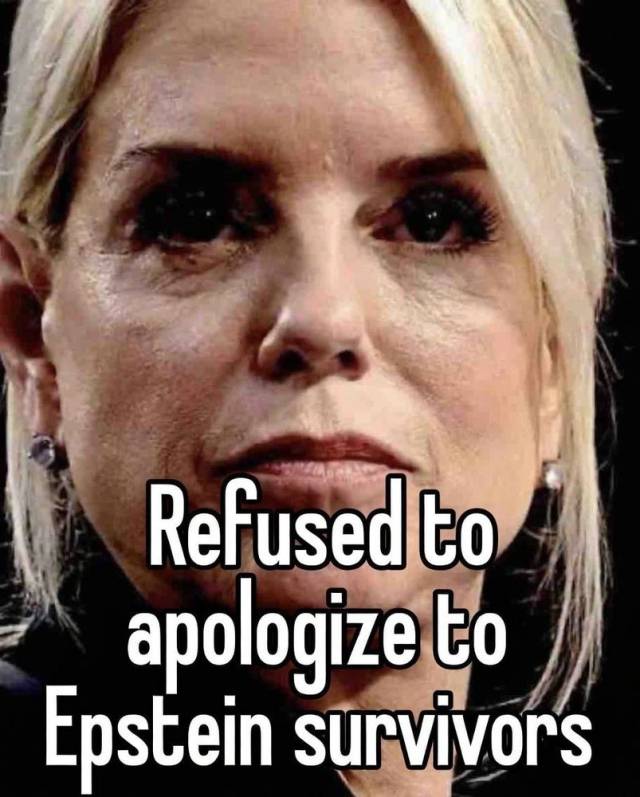 In mid-March, five Republicans on the House Oversight Committee blindsided their own leadership — and Ms. Bondi — by joining Democrats to vote to subpoena her to testify under oath behind closed doors about the Epstein case.
The committee’s Republican chairman, Representative James R. Comer of Kentucky, scheduled a deposition for April 14. Ms. Bondi has said she would comply with the law, but she and Mr. Comer have been quietly working together to avoid the deposition, even though it is unclear if it is legally possible to withdraw a subpoena, according to people with knowledge of the discussions.T
Todd Blanche, the new acting attorney general, said in a statement that Pam Bondi “led this Department with strength and conviction” and thanked Trump for promoting him.
“We will continue backing the blue, enforcing the law, and doing everything in our power to keep America safe,” Blanche wrote on social media.”
Representative Nancy Mace, the South Carolina Republican who pushed for the Oversight Committee to subpoena Pam Bondi and had been one of her more outspoken G.O.P. critics, said in a statement that she looked forward to Bondi’s replacement.
“Bondi handled the Epstein Files in a terrible manner and made this situation far worse than it had to be for President Trump,” Mace said.
The House Oversight Committee was scheduled to depose Pam Bondi on April 14 over the Justice Department’s investigation into Jeffrey Epstein and its handling of investigative material in the case. But Bondi had not yet committed to appearing, according to people familiar with the discussions between her and the committee.
 Representative Robert Garcia of California, the top Democrat on the panel, said in a statement that Bondi was still “legally obligated to appear before our committee under oath.” A representative for the committee’s Republican chairman did not immediately respond to a request for comment.
President Trump formally announced on Truth Social that he was firing Attorney General Pam Bondi and replacing her on an interim basis with Todd Blanche, her deputy.
“We love Pam, and she will be transitioning to a much needed and important new job in the private sector, to be announced at a date in the near future,” he wrote on social media.
New York Times, Guest Essay: The One Thing Trump Wanted That Pam Bondi Failed to Deliver, Jeffrey Toobin, April 2, 2026. President Trump had many good reasons to fire Attorney General Pam Bondi. He picked the single bad one.When the president announced Ms. Bondi’s departure from his cabinet on Thursday, he offered the customary false praise and cold comfort that accompany such defenestrations. But the core of Mr. Trump’s dissatisfaction with the attorney general was apparently her failure to serve his need for revenge against his enemies. She did not prosecute enough of Mr. Trump’s adversaries, and the cases she did bring were failures.
In a Sept. 20, 2025, message to Ms. Bondi that President Trump posted on Truth Social, he complained that “nothing is being done” about his demand for prosecutions of the former F.B.I. director James Comey, Senator Adam Schiff and New York Attorney General Letitia James. “We can’t delay any longer, it’s killing our reputation and credibility,” he wrote. In apparent response, Ms. Bondi’s Justice Department did later bring transparently defective cases against Mr. Comey (for allegedly lying to Congress) and Ms. James (for alleged mortgage fraud). Both prosecutions were promptly and properly dismissed, but the Justice Department is appealing.
These cases were among Ms. Bondi’s worst abuses of the legal system since her appointment, and judges have checked her. But her Justice Department has more such abusive investigations in the works. There is, for example, a federal grand jury inquiry underway in Florida that is apparently aimed at the Obama-era officials who began the investigation of ties between Russia and the 2016 Trump presidential campaign. Mr. Trump and his allies have also demanded a prosecution of Jack Smith, the special counsel who brought indictments against Mr. Trump in 2023.
The fact that Ms. Bondi has failed in these abusive prosecutorial efforts is cause for relief, not dismissal. It’s the rest of her record that has turned the Justice Department into an oxymoron that will take years, if not decades, to fix.Sign up for the Opinion Today newsletter Get expert analysis of the news and a guide to the big ideas shaping the world every weekday morning. Get it sent to your inbox.
Ms. Bondi herself has been a terrible spokesperson and symbol of the department — disrespectful of its honorable traditions, dismissive of critics, intolerant of dissent — and this was demonstrated most clearly with her inept handling of the Jeffrey Epstein matter. After Ms. Bondi misled the country about her initial disclosures in the case, Congress responded by passing a law forcing the Justice Department to release its files on the pedophile and his allies. Ms. Bondi’s delayed, inconsistent and generally incompetent response to the law achieved the seemingly impossible goal of uniting congressional Democrats and Republicans — in disgust with her performance. (Evidently, Mr. Trump was unimpressed as well.)
Still, the deeper problems with Ms. Bondi’s leadership rested at the level of policy. Under Ms. Bondi, the Justice Department had all but stopped doing its job of prosecuting crime. Caseloads are way down, and so are the number of prosecutors — almost certainly a result of Ms. Bondi’s leadership. The main reason for these changes is that instead of charging actual criminals, Ms. Bondi’s Justice Department has remade itself as the legal auxiliary of President Trump’s disastrous immigration enforcement practices.
The worst consequence of the Justice Department’s pursuit of cases involving otherwise law-abiding but undocumented individuals is that it has led to untold suffering among those targeted, their families and the economies they support. Ms. Bondi’s lawyers have spent considerable time and money on the harassment, and worse, of people who have done no harm to anyone.
In part because of its fixation on immigration, the Justice Department has cut back on the prosecution of white-collar crime, including through a complete cessation of enforcement of the Foreign Corrupt Practices Act. Local prosecutors can pick up the slack when the Justice Department doesn’t prosecute violent crime, but only the federal government has the resources and expertise to bring these cases. White-collar criminals are now getting a free pass, which is how Ms. Bondi, and the president, has wanted it.
Under Ms. Bondi, too, right-wing culture warriors wield the power of the federal government. The department’s storied civil rights division is now headed by Harmeet Dhillon, who has essentially ended its efforts to defend the rights of Black citizens and instead assigned her lawyers to combat “woke” policies and harass the beleaguered trans community. In an administration headed and staffed by 2020 election deniers, the department has launched investigations in Georgia and Arizona that seem aimed above all at putting future election results, including those of this year’s midterms, in doubt.
Perhaps worst of all, Justice Department lawyers under Ms. Bondi have often behaved in shockingly unethical ways. For decades, federal judges have looked at assistant U.S. attorneys and other Justice Department lawyers as something more than mere combatants. For good reason, judges assumed that federal lawyers told them the truth about the facts and the law of their cases. In legal terms, the actions of the Justice Department received a “presumption of regularity,” which the private bar did not enjoy. But based on the frequently appalling conduct — for instance, lying, gaslighting, hiding facts and evidence — of Justice Department lawyers in the Bondi era, many judges are no longer giving government lawyers the benefit of the doubt. Nor should they.
Replacing Ms. Bondi with her deputy, Todd Blanche, or the administrator of the U.S. Environmental Protection Agency, Lee Zeldin, to name two likely successors, will not solve this problem unless the new attorney general makes the commitment, unlikely under the circumstances, that the Justice Department will return to its tradition of honesty and integrity.
With the midterms looming, President Trump may have decided to replace his attorney general while his party still controls the Senate. But whomever he chooses, the future at the Justice Department looks like more of the same, and probably worse.
Jeffrey Toobin is a former assistant U.S. attorney who writes about the intersection of law and politics. He is the author of “The Nine: Inside the Secret World of the Supreme Court,” “The Pardon: The Politics of Presidential Mercy” and other books.
New York Times Magazine, Investigation: The Unraveling of the Justice Department, Emily Bazelon and Rachel Poser Photographs by Stephen Voss, Nov. 16, 2025. Sixty attorneys describe a year of chaos and suspicion. “If we’re indicting people because the president hates them, that’s counter to the whole point of doing my job.”Mike Romano, former prosecutor in the Public Integrity Section
“Our job wasn’t to engage in fact-finding investigations; our job was to find the facts that would fit the narrative.”Dena Robinson, former lawyer in the Civil Rights Division
“They didn’t want the ethics office calling them up and telling them what to do.”Joseph Tirrell, former director of the Departmental Ethics Office
President Trump’s second term has brought a period of turmoil and controversy unlike any in the history of the Justice Department. Trump and his appointees have blasted through the walls designed to protect the nation’s most powerful law enforcement agency from political influence; they have directed the course of criminal investigations, openly flouted ethics rules and caused a breakdown of institutional culture. To date, more than 200 career attorneys have been fired, and thousands more have resigned. (The Justice Department says many of them have been replaced.)
What was it like inside this institution as Trump’s officials took control? It’s not an easy question to answer. Justice Department norms dictate that career attorneys, who are generally nonpartisan public servants, rarely speak to the press. And the Trump administration’s attempts to crack down on leaks have made all federal employees fearful of sharing information.
But the exodus of lawyers has created an opportunity to understand what’s happening within the agency. We interviewed more than 60 attorneys who recently resigned or were fired from the Justice Department. Much of what they told us is reported here for the first time.
Beginning with Trump’s first day in office, the lawyers narrated the events that most alarmed them over the next 10 months. They described being asked to drop cases for political reasons, to find evidence for flimsy investigations and to take positions in court they thought had no legitimate basis. They also talked about the work they and their colleagues were told to abandon — investigations of terrorist plots, corruption and white-collar fraud.
Some spoke on the condition of anonymity because they feared retaliation against them or their new employers. We corroborated their accounts with multiple sources, interviewing their colleagues to confirm the details of what they described and reviewing court documents and contemporaneous notes. We also sent a list of questions to the Justice Department and the White House. “This story is a useless collection of recycled, debunked hearsay from disgruntled former employees,” a spokeswoman for the D.O.J. responded in an email. “Targeting the department’s political leadership while ignoring the questionable conduct of former attorneys who do not have the American people’s best interest at heart shows exactly how biased this story is, and further illustrates why Americans are turning away from biased, outdated legacy media platforms.”
Abigail Jackson, a White House spokeswoman, sent this statement: “These are nothing more than pathetic complaints lodged by anti-Trump government workers. President Trump is working on behalf of the millions of Americans who voted for him all across the country, not the D.C. bureaucrats who try to stymie the American people’s agenda at every turn.”
The attorneys who spoke to us for this project, many of whom have spent decades in government service, disagree.
More News Updates
Attorney Gen. Pam Bondi, center right, joins other Trump administration officials in boasting in February 2025 outside the White House that they held in their hands "The Epstein Files" in binders that they would soon release -- a year ago. Shown below: Victims in February raised their hands during Bondi testimony when they were asked if the Justice Department had failed to follow up on their complaints.The Parnas Perspective, Evening News and Comment: Congress Set to Force Pam Bondi to Testify, DOJ Allows Trump to Take Presidential Records, GOP Rep. Tells Americans to Get Another Job, Aaron Parnas, April 2, 2026. Pam Bondi will still be required to testify before Congress on the Epstein files, as the subpoena remains valid, while survivors say she failed them. At the same time, the Justice Department has issued a new opinion allowing Donald Trump to keep presidential records when leaving office, the very issue that once led to his prosecution, now declared permissible by his own DOJ.
This comes as Pete Hegseth forced a widely respected Army chief to retire early and the United States carried out strikes on civilian infrastructure in Iran, marking a sharp escalation. If you can, please subscribe or gift a subscription today. We are breaking stories, tracking developments, and doing this work independently, and it is only possible with your support.Subscribed
Here’s the news:
President Donald Trump announced he is removing Pam Bondi as attorney general and replacing her with Todd Blanche as acting AG. The move comes after months of frustration from Trump over the Justice Department’s performance and criticism of Bondi’s handling of sensitive issues, including the Epstein files. Bondi will transition to a private sector role, while Blanche—previously Trump’s defense attorney—steps into the position.
Congressional Democrats say that Pam Bondi must still testify in front of the Oversight Committee on April 14th:
Epstein survivors issued a statement criticizing Attorney General Pam Bondi after her firing, saying she “failed” them. They expressed disappointment in her handling of matters related to Jeffrey Epstein and accountability for his crimes. The statement reflects ongoing frustration among survivors over how authorities have addressed the case. Overall, it underscores their demand for stronger justice and support for victims.
Rep. Garcia said that Todd Blanche should be held accountable for his role in matters related to the Epstein files. He suggested Blanche has been involved in how those files were handled and released. The statement implies concerns about transparency and decision-making in the case. Overall, Garcia is calling for greater scrutiny of Blanche’s actions.
Rep. Moulton claimed that Pam Bondi was about to be deposed in connection with the Epstein case. He alleged that this was the real reason behind her removal. According to him, her firing was not routine but tied to potential legal exposure. The statement suggests a political motive related to the Epstein investigation.
Republican Rep. Jeff Van Drew suggested that Americans struggling with rising prices could consider getting another job. His comment came in response to concerns about the cost of living and financial strain. The remark has drawn attention as a blunt take on how individuals might cope with inflation.
Earlier reports confirm that the B1 Bridge on the Karaj–Tehran route was indeed targeted in U.S. (and possibly joint U.S.-Israeli) airstrikes amid the ongoing conflict. The strike hit a key highway bridge linking Tehran and Karaj, causing significant structural damage or partial collapse. U.S. officials said the bridge was targeted because it was allegedly being used by Iranian forces to transport missile and drone components, marking a notable escalation to include infrastructure targets. Iranian officials say that the bridge was civilian infrastructure and was not complete when it was destroyed:
Defense Secretary Pete Hegseth forced out Army Chief of Staff Randy George, asking him to retire immediately despite expectations he would remain in the role longer. The move is part of a broader effort to remove senior officials tied to previous administrations. George’s departure comes amid ongoing military tensions, including the conflict with Iran. It remains unclear who will replace him, though officials suggest a successor may already be in consideration.
The Justice Department issued a legal opinion stating that Donald Trump is not required to turn over presidential records to the National Archives, arguing the 1978 Presidential Records Act is unconstitutional. The opinion claims the law oversteps Congress’s authority and infringes on presidential powers, though it is advisory and not legally binding. If followed, the decision could prompt legal challenges, especially given past controversies over Trump’s handling of classified documents. The move signals a potential major shift in how presidential records are managed and interpreted.
President Donald Trump said he plans to sign an executive order to ensure all Department of Homeland Security employees are paid during the ongoing government shutdown. While some workers—like those in ICE and CBP—were already funded, many others, including FEMA and Coast Guard personnel, have been working without pay. The shutdown has lasted over 40 days, causing financial strain and operational disruptions, including airport delays. Trump framed the move as relief for affected families, while Congress works on a broader plan to restore full DHS funding.
A federal judge dismissed most of Blake Lively’s claims in her lawsuit against Justin Baldoni, including allegations of sexual harassment, defamation, and conspiracy. However, three claims—breach of contract, retaliation, and aiding retaliation—will proceed to trial. Lively accuses Baldoni of inappropriate behavior on set and a retaliatory smear campaign, while he denies the allegations. The ruling significantly narrows the case but allows key disputes to be decided in court.
Federal prosecutors allege that Pooh Shiesty orchestrated a kidnapping and robbery plot targeting Gucci Mane over a dispute about his record contract. According to the complaint, Shiesty allegedly pulled a firearm and forced Mane to sign release papers, while others involved carried out robberies and threatened victims. Authorities say multiple people were assaulted and feared for their lives during the incident. Shiesty and several others have been arrested and could face life sentences if convicted.
Today, Trump announced new tariffs of up to 100% on some brand-name pharmaceuticals, along with changes to tariffs on steel, aluminum, and other metals. The policy includes exemptions for generic drugs and companies investing in U.S. manufacturing, while allied countries will face lower rates. The move comes after the Supreme Court limited his broader tariff powers, signaling a shift toward more targeted trade actions. Critics warn the tariffs could raise costs, while the administration argues they will boost domestic production and national security.
According to TMZ, after a car crash in Florida, Tiger Woods told a deputy he had been speaking with “the president,” according to body camera footage. Woods was arrested and charged with DUI after officers observed signs of impairment and found medication in his possession. He pleaded not guilty and said he had not been drinking, though authorities noted failed sobriety tests. The incident caused minor property damage but no injuries, and Woods later said he plans to seek treatment.
TMZ spotted John James vacationing in Turks and Caicos during the ongoing government shutdown, even as many federal workers are going unpaid. Reports say he was traveling with his family and appeared to be relaxing while Congress remains on recess. He has, however, said he supports withholding his own paycheck during the shutdown. The trip has drawn attention as part of broader criticism of lawmakers taking time off while economic pressures continue.
According to Politico, the Treasury Department is moving to significantly cut the Office of Financial Research, a post-2008 crisis agency that monitors risks to the financial system. Plans include slashing up to 63% of its staff and reducing its budget, with layoffs and buyouts already underway. Supporters argue the office is inefficient and duplicative, while critics warn the cuts could weaken oversight during a time of growing instability in private credit markets. The move has sparked concern that it could increase the risk of another financial crisis.
The Parnas Perspective, Morning News and Commentary: White House Concerned as Trump's Address to Nation Falls Flat, Trump Considers Firing Bondi and Gabbard, and More, Aaron Parnas, right,
April 2, 2026. Here is what you need to know right now. Trump is actively considering firing Pam Bondi and Tulsi Gabbard. He and Hegseth are escalating rhetoric about Iran and openly talking about sending the country “back to the stone age.” Trump is now comparing himself to Jesus. He is also facing backlash after suggesting the federal government cannot sustain programs like Medicaid and Medicare because of the war.At the same time, there is big news on the independent media front. We have remained the number one “news” newsletter in the world for nearly a full year and are reaching more people than most major media companies. Many of you have asked if I would ever sell out to one of them. The answer is no. I will stay independent.
Here’s the news:
Donald Trump’s speech last night did not provide any new details. In a prime-time address, President Donald Trump said the U.S. war with Iran is progressing and could end “shortly,” though he warned that heavier strikes would continue in the coming weeks. He defended the conflict as necessary for global security, claiming major damage to Iran’s military capabilities while leaving open the possibility of further escalation. Despite his optimism, public skepticism remains high and experts question whether the campaign will achieve lasting strategic success.
Pete Hegseth amplified calls to send Iran back to the “Stone Age.”
Donald Trump acknowledged that many Americans are worried about rising gasoline prices but argued the U.S. economy remains strong. He claimed the country had built the strongest economy in history and is still experiencing its effects.
 According to the Guardian, Trump has privately discussed replacing Director of National Intelligence Tulsi Gabbard, right, after becoming frustrated with her handling of testimony related to the Iran war. His concerns stem from her perceived reluctance to fully support the administration’s justification for the conflict, though no final decision has been made. While Trump has expressed mixed public support, advisers warn that removing her without a clear successor could create political complications.
The New York Times has confirmed that Trump has recently discussed the possibility of firing Attorney General Pam Bondi, left, due to
frustrations with her leadership and handling of issues like the Epstein files. He has considered replacing her with EPA Administrator Lee Zeldin, though no final decision has been made and he continues to publicly express support for her. The situation reflects growing internal tensions in the administration, particularly over legal strategy and political priorities.Donald Trump compared himself to Jesus’ reception on Palm Sunday, noting that crowds once hailed Jesus as king and saying people now call him “king.” The remark draws a parallel between a significant Christian event and his own public support. It is likely to be seen as controversial given the religious significance of the comparison.
Paula White, a spiritual adviser to Donald Trump, compared his experiences to those of Jesus, citing themes of betrayal, accusation, and eventual triumph. She suggested that, like the resurrection of Jesus, Trump has “risen up” after challenges.
Trump said the U.S. cannot adequately fund programs like daycare, Medicaid, and Medicare while also managing its size and ongoing conflicts. He argued that the country’s scale and involvement in wars make it difficult to sustain expansive social services.
Despite Trump’s claims, Western officials and experts say there is no evidence that Iran’s regime has lost power or fundamentally changed. Although many senior leaders have been killed, their replacements appear equally or more hard-line, and key institutions like the Revolutionary Guard remain in control. Analysts say the government is weakened but still intact, with uncertainty over leadership dynamics and little sign of a shift toward U.S. demands.
War crimes experts warn to NBC News that President Donald Trump’s threats to target Iran’s civilian infrastructure, including power and desalination plants, could constitute war crimes under international law. Critics argue such actions would harm civilians disproportionately and risk damaging the U.S.’s global standing, potentially labeling it a “rogue state.” The White House defends the strategy as necessary for security, but legal experts say even making such threats could signal dangerous intent and set troubling precedents.
The U.S. Embassy in Iraq is urging Americans to leave the country immediately due to credible threats of imminent attacks by Iran-aligned militias in Baghdad. The warning follows the reported kidnapping of an American journalist and highlights risks to U.S.-associated locations, including businesses and diplomatic sites. With flights suspended, Americans are advised to exit via land routes despite delays and heightened security dangers.
French President Emmanuel Macron called for a ceasefire in the Middle East during a visit to Japan, emphasizing the need for peace, stability, and safe passage through the Strait of Hormuz. He and Japanese Prime Minister Sanae Takaichi, right, agreed on de-escalation while also strengthening cooperation in defense, energy, and technology. The visit highlights growing France–Japan ties in response to global tensions, even as differences remain with U.S. policy on the conflict. The death of Rohingya refugee Nurul Amin Shah has been officially ruled a homicide after U.S. Border Patrol agents left him outside a Buffalo restaurant on a cold night, where he later died. The medical examiner determined he died from complications of a perforated ulcer worsened by hypothermia and dehydration, noting that “homicide” reflects death caused by another person’s actions or negligence, not necessarily intent.
Shah, who was visually impaired and unable to speak English, had been detained and then released without notifying his family or lawyer, and was found dead days later. The ruling has intensified scrutiny of immigration authorities, prompting investigations by New York officials and calls for accountability over how he was treated.
Donald Trump encouraged Erika Kirk to take legal action against Druski, saying she should sue over comments made about her. He framed the situation as driven by jealousy and suggested she push back forcefully through the courts.

Turning Point CEO Erica Kirk, widow of the extremist white nationalist organization's founder Charlie Kirk, is shown in a collage above with the comedian Druski, who created a video in which he donned "white-face" make up (shown above right) to mock MAGA women.
Background: Yahoo News, Erika Kirk Hasn't Said a Word About Druski's 110-Million-View Parody. Everyone Else Won't Stop Talking, Olamide Oloro, March 27, 2026. Last Wednesday, the comic Druski released a skit parodying “conservative women in America,” in which he donned white face, a blonde wig, blue contact lenses and a pant suit for the role. The video juxtaposes him delivering deadpan remarks at a press conference with footage of him dancing near pyrotechnics, striking pilates poses and ordering food at a drive-through. “We have to protect all men in America, especially the white men in America,” he says at one point. “Those are the ones we care about.” The two-minute clip has garnered over 184 million views on X, with many commenters claiming that Druski was specifically lampooning Erika Kirk, the CEO of Turning Point USA and widow of Charlie Kirk.
New Homeland Security Secretary Markwayne Mullin, right, rescinded a rule requiring his personal approval for DHS spending over $100,000,
 reversing a policy that had slowed disaster response efforts. The change is expected to ease bottlenecks at FEMA and improve the speed of aid distribution, though ongoing funding issues may still limit immediate impact. The move marks an early shift in leadership after his predecessor Kristi Noem was removed amid criticism of the policy.
Midwives in Georgia have filed a lawsuit challenging state laws that restrict their ability to practice, arguing the rules worsen shortages in maternity care. The plaintiffs say requirements like physician agreements and limits on non-nurse midwives create barriers that contribute to high maternal mortality and limited access to care. The case is part of a broader trend of legal challenges across Southern states seeking to expand midwives’ roles in addressing healthcare gaps.
More On Iran War
New York Times, Iran War Live Updates: Oil Prices Surge After Trump Claims Success Without Offering Exit Plan, Zolan Kanno-Youngs, Yan Zhuang and Jason Karaian, April 2, 2026. In his address, President Trump also repeated his threats to hit Iranian infrastructure, including electrical plants, unless a deal was struck.Oil prices surged and stock markets sank on Thursday, hours after President Trump declared in a national television address that the U.S. military campaign against Iran was an overwhelming success but failed to offer a clear exit strategy.
On Wednesday night, in his first prime-time address from the White House since the United States and Israel launched strikes on Iran on Feb. 28, Mr. Trump threatened to bomb Iran “back to the Stone Ages” and repeated his threats to hit Iranian infrastructure, including electrical plants, unless a deal was struck.
Investors hoping for clearer signals of a de-escalation appeared disappointed. The price of Brent crude, the global benchmark for oil, jumped more than 7 percent in early trading on Thursday, the steepest daily rise in three weeks. Stock markets around the world fell, with indexes in Asia, where countries import vast quantities of oil and gas from the Middle East, hit particularly hard.
Mr. Trump said in his speech that Iran’s “ability to launch missiles and drones is dramatically curtailed.” On Thursday morning, Iran’s Revolutionary Guards Corps said that American and Israeli strikes had not decimated the country’s missile production centers, long-range drones, air defenses or electronic warfare systems. The United States and Israel “know nothing about our vast and strategic capabilities,” the Guards said in a statement on Thursday.
The U.S. and Israeli militaries have destroyed many of Iran’s ballistic missiles and launchers in airstrikes. But a large number are undamaged, and Iran continues to launch missiles and drones.
Early Thursday, Israel’s military said its forces had intercepted missiles launched from Iran. The authorities in the United Arab Emirates said their forces had responded to drone and missile strikes from Iran, while Saudi Arabia reported intercepting a missile and drones without saying where they came from.
Mr. Trump also appeared to plead with Americans uneasy about the war’s economic costs to “keep this conflict in perspective.” He framed the opening of the Strait of Hormuz, a major global conduit for oil, as an issue for other nations, even though he had said hours earlier that he would not agree to any cease-fire deal unless the waterway was opened. Iran has choked off traffic through the strait, causing oil and natural gas prices to surge.
Here’s what else we’re covering:
- Strait of Hormuz: Britain’s foreign secretary was expected to host a virtual meeting about Iran’s de facto blockade of the waterway. Dozens of nations are expected to participate, but the United States is not.
- Nuclear capabilities: Mr. Trump argued in his Wednesday night address that Iran was on the cusp of building a nuclear weapon. That is disputed. Iran could have produced bomb-grade nuclear fuel within days or weeks. But it would take months or more than a year to fashion that fuel into a weapon, American intelligence agencies concluded. Read more ›
- Death tolls: The Human Rights Activists News Agency said at least 1,606 civilians had been killed, including 244 children, in Iran since the war began. Lebanon’s health ministry said that more than 1,318 Lebanese had been killed as of Wednesday since the latest fighting between Israel and Hezbollah began. In attacks blamed on Iran, at least 50 people have been killed in Gulf nations. In Israel, at least 17 had been killed as of Friday. The American death toll stands at 13 service members, with hundreds of others wounded.
Morning Shots via The Bulwark, Political Opinion: Oh, the War? Don’t Worry. It’s Over. Almost, William Kristol, right,April 2, 2026. What was the point of Donald Trump’s sad and lackluster speech to the nation last night?The main point—really, the only point—was that his Iran war is basically over. Of course it’s not quite over. But, he wants us all to understand, it’s going to be over soon. Very soon.
“We’re getting very close.”
“We are going to finish the job and we’re going to finish it very fast.”
“We are on track to complete all of America’s military objectives shortly, very shortly.”
Why is Trump so very eager to have the American people understand that his war is so very much “nearing completion”? Because, as Nate Silver and Eli McKown-Dawson put it, in the last two weeks Trump’s “popularity has taken something of a nosedive.” So Trump wants out. Last night he promised us over and over again that we’ll be out soon.
Trump doesn’t want the American people to think too hard about the lack of justification for the war. He doesn’t want anyone to dwell on the fact that there was no imminent threat from Iran, or that Trump didn’t obtain authorization to go to war from Congress. He doesn’t want the American people to focus on what his administration’s conduct of the war has shown about its lack of character and competence. And he wants to divert attention as much as possible from the real-world consequences of his war for the American and global economy.
If you want to stay focused on what matters, there’s no better way to do it than by joining Bulwark+ and taking full advantage of the members-only reporting, analysis, and commentary. Join today.Subscribed
And by the way, what about all those U.S. troops steaming toward the region for possible ground operations—to take Kharg Island or reopen the Strait of Hormuz or seize the nuclear material? What about all those plans for putting “boots on the ground,” something that Trump boasted just a few days ago that he wasn’t afraid of?
Fuhgettaboutit. The prospect of the use of ground troops was never raised in last night’s update. The term “ground troops” was never uttered.
Trump did go out of his way, however, to tell us that this war was not going to last as long as World War I or World War II or Vietnam. So that’s something. And he told us that even though we’ve already “completely decimated Iran,” that we’ll be doing some more decimating on our way out the door. “We are going to hit them extremely hard over the next two to three weeks. We’re going to bring them back to the Stone Ages [sic], where they belong.”
So we won’t succeed in preventing the Iranian regime from closing international waters in the Strait of Hormuz, and we won’t be doing anything to help liberate the people of Iran from that oppressive regime. But we’re going to continue to rain down death and destruction on the nation of Iran.
Our founders hoped that the United States might herald a Novus Ordo Seclorum, a new order of the ages. In Trump’s America, we’ve given up on that promise. Instead we boast that we’re going to bomb people back to the “Stone Ages, where they belong.”
The Contrarian, Opinion: Trump Is Serious About Accepting a Humiliating Defeat, Jennifer Rubin, right,
April 2, 2026. Donald Trump started an unconstitutional, reckless war without goals and with minimal planning. He failed to anticipate Iran’s entirely predictable response. No one, therefore, should be surprised that the war may end with the United States and its allies (or, rather, countries that used to be allies) worse off than when the war started.On Wednesday, Trump delivered a rambling, breathless, low-energy “speech” to the nation that bore a strong similarity to his social media posts. He claimed Iran had been “decimated,” despite its continued strikes in the region. Trump insisted we have completed all our objectives — except the war will go on for a few more weeks. (He again threatened to commit war crimes by hitting Iran’s power plants.) The Strait of Hormuz will “open up naturally,” he proclaimed. (How? Don’t ask!) It is not clear what the point of
this address was or whom he could possibly have persuaded. During the speech, the price of oil rose and the markets fell.Imagine if Barack Obama, without congressional consent, had initiated a war that resulted in 13 American deaths and hundreds of injuries, caused massive civilian deaths (including two horrific strikes on civilians, primarily children), pushed gas to $4 per gallon, and induced counterstrikes on Israel and Gulf states (including oil and natural gas facilities). Consider the hue and cry if Obama had left Iran in control of the Strait of Hormuz and failed to force Iran to give up its enriched uranium, ballistic missile program, or support for regional terrorism.
And yet that is where Trump may put us. His feckless and irresponsible secretary of defense acknowledged on Tuesday that Iran retains the ability to launch missiles and drones. (Pete Hegseth is mystified that the MAGA base, which was told Trump opposed regime-change wars, is upset.) He also insisted regime change has already occurred, a sign of how far the Trump team is prepared to delude itself to get out of the quagmire.
Trump on Tuesday threw a revealing temper tantrum on his Truth Social platform:
All of those countries that can’t get jet fuel because of the Strait of Hormuz, like the United Kingdom, which refused to get involved in the decapitation of Iran, I have a suggestion for you: Number 1, buy from the U.S., we have plenty, and Number 2, build up some delayed courage, go to the Strait, and just TAKE IT. You’ll have to start learning how to fight for yourself, the U.S.A. won’t be there to help you anymore, just like you weren’t there for us. Iran has been, essentially, decimated. The hard part is done. Go get your own oil.
That confirmed the jaw-dropping report that Trump was prepared to run for the exits with the Strait of Hormuz in Iranian hands. And sure enough, on Wednesday Trump showed no interest in trying to reopen the Strait of Hormuz.
“For a war ostensibly designed to reduce Iran’s military capabilities and ability to threaten the region, it would seem an extraordinary outcome to have a result of the war be a situation in which Iran could now export oil freely, but our allies would have to pay fees to Iran for the privilege of doing so,” Brookings Institution’s Philip Gordon told me. “And Iran would remain in a position to close the strait again at any time, imposing high costs on Americans as well as exporters not just of oil and gas but of fertilizer, helium, etc. All this would have a sustained impact on world gas and food prices and overall inflation.”
Trump’s unilateral war has already inflicted immense damage on the Gulf states. In addition to damage to oil tankers and facilities, the war “could plunge four million more people across the Arab world into poverty and shave off up to 6 percent of the region’s economic output during that time, according to projections by the United Nations Development Program,” the New York Times reported. This would affect not only Gaza, Lebanon, and Syria but also “tip more countries, including Iraq, Jordan and Egypt, into severe economic crises,” the Times wrote. (Egypt, already in economic distress, has been “reliant on investments from oil-producing Gulf countries whose energy production has come under attack during the war.”)
In addition, the war has already kneecapped NATO, which Trump is threatening to leave. Italy and Spain have denied the United States the use of its bases and airspace, a natural reaction to Trump’s bullying and insults and his refusal to coordinate before launching his ill-conceived war. (Trump also lashed out at France, apparently thinking that France had denied use of its bases; it withheld only the use of its aircraft.) Britain has insisted that U.S. planes from its bases are used only “to conduct only operations that protect British and allied interests across the Middle East.” This is what a world without friends looks like.
As historian Robert Kagan explained:
Whenever and however America’s war with Iran ends, it has both exposed and exacerbated the dangers of our new, fractured, multipolar reality—driving deeper wedges between the United States and former friends and allies; strengthening the hands of the expansionist great powers, Russia and China; accelerating global political and economic chaos; and leaving the United States weaker and more isolated than at any time since the 1930s.
We have saddled allies with an energy shock, thrown into question our NATO Article V commitment, and bizarrely elevated the Middle East (where Trump promised not to start open-ended wars) over real priorities such as Russia and China. (Kagan noted that inexplicably the Middle East “seems to be the only priority, apparently worth any price, including the introduction of ground forces and even the destruction of the American alliance system.”)
In short, because we no longer offer and cannot expect cooperation and assistance from other democracies, we will be forced to rely on threats and bullying (which become less effective as Trump reinforces his TACO image) to round up support. China and Russia relish the collapse of the U.S. system of alliances that has maintained our superpower status.
In sum, Trump may wind up losing this war and subjecting the United States and the rest of the world to an open-ended, devastating oil shock. (As Gordon put it, “Trump has a history of being willing — and to his supporters often able — to sell anything, but it would be hard to sell an outcome of this war that left control over the strait in Iran’s hands as anything other than a major strategic defeat for the United States.”) That would be bad enough. However, the war has reinforced Trump’s determination to discard our historic advantages (e.g., alliances, a free-trade system, U.S. credibility, and moral stature).
No other president could possibly have done this much damage in such a short time. The United States stands alone — more despised and less respected than we have ever been in the modern era.
New York Times, Trump Hails Destruction of Iranian Bridge, Warning ‘More to Follow,’ Euan Ward and Edward Wong, April 2, 2026. Fars, a semiofficial news agency, said eight people had been killed in the attack and dozens wounded.President Trump celebrated the destruction of a bridge near Tehran on Thursday, warning on social media that there was “much more to follow.”
The attack on the B1 bridge between Tehran and the nearby city of Karaj killed eight people and wounded 95, according to Fars, a semiofficial Iranian news agency. Iran’s state broadcaster, IRIB, reported that two strikes had hit the bridge around an hour apart, the second arriving while emergency responders were assisting the wounded.
A U.S. military official said that American forces had struck the bridge, eliminating what the official called a planned military supply route for Iran’s missile and drone forces. The official spoke on condition of anonymity to share operational details.
But Mehr, another semiofficial Iranian news agency, said the claim the span was being used as a military supply route was false. “Bridge B1 has not yet been inaugurated,” it said.
It is unclear if the bridge, in the mountains, was open to the public or if the casualties were among people on the bridge or nearby. The strike occurred on the last day of Nowruz, the Iranian new year, which is traditionally a day when Iranians celebrate by spending time outdoors.
Mr. Trump’s post on Truth Social was accompanied by a video of an explosion on or near the bridge and a large plume of smoke rising into the sky. With the U.S.-Israeli war on Iran now in its fifth week and showing little sign of abating despite Washington’s diplomatic overtures to Tehran, Mr. Trump in his social media post urged Iran’s government to “MAKE A DEAL BEFORE IT IS TOO LATE, AND THERE IS NOTHING LEFT OF WHAT STILL COULD BECOME A GREAT COUNTRY!”
The Israeli military said in a briefing to reporters on Thursday that it was not responsible, and that the bridge had been a U.S. target. U.S. Central Command, which oversees American military operations in the Middle East, did not reply to a request for comment.
Mr. Trump has threatened to destroy all power plants and other infrastructure in Iran if its leaders did not agree to a peace deal and end their military’s de facto blockade of the Strait of Hormuz.
Some experts in the law of armed conflict say that a country’s infrastructure could be considered a legal and legitimate target if that infrastructure is used by its military or plays a role in military operations. The legality would vary on a case-by-case basis.
“Whether the bridge was a lawful military objective would depend on the facts,” said Brian Finucane, a former State Department lawyer who specialized in the law of armed conflict and who now works at the International Crisis Group. “My read is that bridge was targeted not to provide any military advantage but in the hopes of coercing Tehran and generating content.”Kristi Noem walks in on her husband....
New York Times, Rival Nations Seize On Choke Points to Counter Trump, Ana Swanson, April 2, 2026. From Iran to China, President Trump’s global aggression has encouraged other countries to search for new ways to pressure the U.S. economy.President Trump has unapologetically wielded the power of the United States on the global stage, taking a much more belligerent approach economically and militarily to try to dictate the actions of other countries.
From high tariffs to the war with Iran, Mr. Trump has claimed that this aggressive behavior internationally has only upsides, and that past leaders were fools for refusing to tap into America’s power.
But one clear drawback of the strategy is emerging. While many countries have acceded to the president’s demands, some have found a highly effective new way to fight back. Mr. Trump’s aggression has given them the opportunity to test their control over choke points, threatening the United States and the global economy.
One such choke point is the Strait of Hormuz. Iran, which accounts for less than 1 percent of global economic output, has control over the shipping lane that transports a fifth of the world’s oil and gas. Its closure since the United States and Israel began attacking Iran at the end of February has blocked shipments of fuel, fertilizer and other goods, sending gas prices sharply higher and spreading anxiety among U.S. farmers and manufacturers.
Another experiment in retaliatory coercion began one year ago on Thursday, when Mr. Trump walked into the Rose Garden and unveiled tariffs on what he called “Liberation Day.” While many governments — even powerful economies like the European Union — complied with U.S. demands, China was a notable exception. Beijing rolled out a licensing system for exports of rare-earth minerals and magnets that has given China unparalleled control over the global manufacturing system.
Makers of cars, semiconductors, fighter jets and other goods — the backbone of a U.S. factory system that Mr. Trump wants to revive — depend on rare earths, most of which are processed in China.
While China is approving some licenses and allowing some rare earths to flow, supplies for many manufacturers are running short. And China has cut off exports of these materials to companies that work for the U.S. military, leaving them struggling to find other suppliers. Mr. Trump's decision to delay a visit to China by roughly six weeks until mid-May worried some executives who hoped that his meeting with Xi Jinping, the Chinese leader, could alleviate the pressure.
New York Times, News Analysis: How Trump Boxed Himself In on Iran, David E. Sanger,.April 2, 2026. President Trump faces the possibility that at the end of his own two-to-three week window for wrapping up the war in Iran, nothing much will have changed.More than a month into a war that he insists will come to an end within two or three weeks, President Trump has put himself in a strategic box from which he is finding no easy exit.
Talks with Iran about a deal to end the conflict, to the degree they are substantive, have so far shown little promise. The key metrics of success described at various points by Mr. Trump — keeping Iran from possessing the fuel to make a nuclear weapon, helping the Iranian people topple a government much of the populace despises and reopening the Strait of Hormuz — remain in the distance, at best.
Iran’s tolerance for pain appears far higher than Mr. Trump anticipated, and despite devastating losses to its arsenal, it retains some ability to strike Israel with missiles. It did so even while Mr. Trump spoke about the war on Wednesday evening.
That televised, prime-time address was intended to reassure Americans that the costs of the war would be transitory, that an end to hostilities and a return to normal economic life were imminent. But the markets responded to his speech with deep skepticism.
Oil prices surged 8 percent in the hours after his 19-minute address, largely because he described no plan to end what amounts to a tanker hostage crisis in the Strait of Hormuz that is now rippling across the global economy. The strait, he insisted, would “open up naturally” when the conflict is over.
At this stage, Mr. Trump appears to be offering a host of sometimes contradictory paths forward, and faces the possibility that at the end of his own two-to-three week window, nothing much will have changed. And his promise to send Iran back to the “Stone Ages” if it did not agree to his terms — which he did not specify on Wednesday night — would amount to an expansion of the war, not a winding down.
Mr. Trump has never been troubled by internal contradictions, of course. He is the master of raising and dispensing with arguments to fit the moment. In the opening moments of the war he urged Iranians to rise up and take over their government, but he hasn’t mentioned that approach since, other than to say it would probably lead to the slaughter of the Iranian protesters.
On Wednesday evening he said that “regime change was not our goal,” although he had called for just that after the initial attack by the United States and Israel on Feb. 28. He now claims that “regime change has occurred because of their original leaders’ death,” as if a change of personnel was the same as a change of regime. (When Ayatollah Ruhollah Khomeini died in 1989, only to be succeeded by another supreme leader, few argued that it constituted a change of the governing structure.)
In weaving back and forth, Mr. Trump is relying on techniques he honed in the New York real estate world, where he often succeeded at creating his own reality. But war is different. The enemy gets to shape the environment as well, and the Iranians apparently sense they can wait Mr. Trump out. And while Iran has precious few allies — even its biggest oil customer, China, has kept its distance — Iranian leaders seem to be counting on declining stock markets and rising oil prices to speed Mr. Trump’s exit from the conflict.So whether the U.S. forces pull back in two or three weeks, as Mr. Trump predicted, or whether Washington escalates the fighting and gets stuck, here is a look at the challenges that seem unlikely to be resolved anytime soon.
New York Times, Iran War Live Updates: Macron Voices European Frustration With Trump for Criticizing NATO, Mark Landler, Jason Karaian, Erika Solomon and Zolan Kanno-Youngs, April 2, 2026. Speaking of Mr. Trump’s verbal attacks on the alliance, the French leader said: “If you create doubt every day about your commitment, you hollow it out.”Here’s the latest.
Mounting European frustration with President Trump, and defiance of his wishes on the war with Iran, bubbled over on Thursday, when President Emmanuel Macron lashed out at the American leader for his shifting war goals and his undermining of the NATO alliance.
“When we’re serious, we don’t say the opposite of what we said the day before every day, and maybe one shouldn’t speak every day,” Mr. Macron told reporters during a trip to South Korea. He also said of Mr. Trump’s mounting attacks on NATO, “If you create doubt every day about your commitment, you hollow it out.”
The French president has been among the most vocal of frustrated allies, but he is hardly the only one. Mr. Trump has steadily berated European leaders for refusing to join in a war that they view skeptically, at best, that he entered without consulting them, and that has had wide-ranging consequences the United States appeared unprepared for.
European leaders who have struggled to stay on Mr. Trump’s good side, and even gone out of their way to praise him, are increasingly resigned to the idea of a United States that is no longer a reliable partner and protector.
New York Times, A Bid to Use Force to Open Strait of Hormuz Hits U.N. Roadblocks, Farnaz Fassihi and Vivian Nereim, April 2, 2026. Several permanent members of the Security Council opposed the resolution, drafted by Bahrain in coordination with its Gulf neighbors, officials said.Russia, China and France on Thursday effectively stymied a push by Arab countries to get the United Nations Security Council to authorize military action against Iran to reopen the Strait of Hormuz, saying they opposed any language authorizing force, according to a diplomat and a senior U.N. official.
The actual vote on the resolution, which was drafted by Bahrain with the support of the Arab countries in the Persian Gulf, is expected to be scheduled for Friday. But it remained unclear whether extra hours of diplomacy would bring the three veto-holding countries on board.
Russia, China and France are among the five permanent members of the council with veto power. There were also divisions over the resolution among the 10 nonpermanent members, according to diplomats.
The current draft resolution is in its fourth revision after weeks of closed-door negotiations. The part of the text that has generated an impasse states that the Security Council “authorizes member States, acting nationally or through voluntary multinational naval partnerships, with advance notifications to the Security Council,” to use all necessary means “to secure transit passage and to deter attempts to close, obstruct or otherwise interfere with international navigation through the Strait of Hormuz.”
Iran closed the Strait of Hormuz, a strategic choke point where a fifth of the world’s oil and gas normally travels, shortly after the United States and Israel launched a war against it on Feb. 28. The closure has caused global energy disruption, hurt financial markets and increased the costs of oil, shipping and insurance. Iran has also launched thousands of retaliatory attacks on the Arab nations in the Persian Gulf — which host major American bases — killing at least 18 civilians and severely damaging military and energy infrastructure.Want to stay updated on what’s happening in Bahrain and Iran? Sign up for Your Places: Global Update, and we’ll send our latest coverage to your inbox.
Bahrain’s foreign minister, Abdullatif bin Rashid Al Zayani, told a session of the Security Council on Thursday that “Iran’s aggressive intentions” toward its Arab neighbors were “treacherous” and “preplanned,” and violated international law. He said Iran had targeted civilian structures such as airports, water stations, seaports and hotels.
Iran signaled on Thursday that it intended to continue to oversee shipping traffic through the critical Strait of Hormuz, even after the war.
For Iran, its Arab neighbors uniting against it at the Security Council represented a serious, perhaps irreparable, deterioration of relations. For years, Iran cultivated closer ties with its neighbors, only to blow them up during the past month of war.
Analysts say the Bahraini-led efforts at the Council are more symbolic than pragmatic; the militaries of most of the Persian Gulf countries are relatively small, and heavily dependent on U.S. support. They have minimal experience combating a military the size of Iran’s.
And France’s president, Emanuel Macron, said on Thursday that President Trump’s comments urging countries that rely on the strait to forcefully open it were unrealistic.
“It is unrealistic because it would take an inordinate amount of time and would expose anyone crossing the strait to coastal threats from the Revolutionary Guards, who possess significant resources, as well as ballistic missiles, a host of other risks,” Mr. Macron said.
Abdulaziz Sager, the chairman of the Gulf Research Center, a think tank based in Saudi Arabia, said any cease-fire agreement must also address Iran’s capability to attack Gulf countries and control maritime traffic through the Strait of Hormuz. “We will not forget what they have done to us, and they will not forget that the U.S. had a lot of facilities here in the Gulf,” he said.
The blocking of the strait has cut off the main export route for the Arab countries, where economies and government budgets depend heavily on fossil fuel revenue. Qatar, one of the world’s largest exporters of natural gas, has been forced to shut down production entirely and declare force majeure, breaking contracts with buyers.
The Qatari government said it expects a $20 billion loss in annual revenue. Most of the Gulf countries had maintained cordial ties with Iran before the war, including Saudi Arabia, which re-established diplomatic relations with Iran in a China-brokered pact in 2023.
More On Epstein and Noem Scandals, Trump Coverup
Emptywheel, Opinion: Trump Fires Bondi for Failing to Cover Up Allegations He Raped a Teenager, Emptywheel, (Mary Wheeler, right),
April 2, 2026. And so the deed is done.After two days of chatter about firing Pam Bondi, Trump has done it.
Reporting on the reasons for firing Bondi are vague. She has failed to prosecute any of Trump’s enemies who are not guilty of any crime. But holy hell, it’s not for wont of trying.
She fucked up the Epstein files. She did! But then so did Kash Patel, and he also ran off to Italy to get drunk on the taxpayer dime.
There’s an aspect of the Epstein fuck-up that should always be mentioned: she also appears to have tried — but failed to — cover up the allegation that Trump raped and assaulted a woman when she was a teenager. It’s not so much the allegation itself that is important, at least for the moment (and there are still reasons to be cautious about the allegation).
It’s that Bondi falsely claimed there was no credible evidence that anyone, including Trump, could be blackmailed. But there was, from this woman.
Remember, when Pam Bondi and Kash Patel attempted to dismiss this whole issue last July, they claimed, “There was also no credible evidence found that Epstein blackmailed prominent individuals as part of his actions.” That’s factually false; there’s clear evidence Epstein was pressuring Bill Gates. But given that, weeks later, the FBI listed the allegation from this woman first in what appears to be prep for Todd Blanche’s interview with Ghislaine Maxwell, it is exceedingly likely they had this claim in mind when they dismissed the credibility of all blackmail claims.
This woman told the FBI that Epstein and Trump discussed blackmail, and days later he suicided in prison.
And after that, the FBI wanted to focus on Trump because, well, Epstein wasn’t around to be prosecuted anymore.
Then, years later, DOJ attempted to withhold documents recording all that.
When faced with overwhelming evidence that they had withheld documents implicating Trump, DOJ released them. But the excuses it gave are as suspect as the withholding.
And there is good reason to believe that DOJ attempted to bury these files altogether, but accidentally provided files from the Ghislaine Maxwell discovery that allowed others to put together proof there was more there there.
As NPR explained, when caught withholding these documents, DOJ claimed they had withheld them because they were duplicates, and now is effectively saying, oops, they weren’t duplicates.
The Justice Department has repeatedly told NPR that any documents withheld were “privileged, are duplicates or relate to an ongoing federal investigation.”
Last week, after NPR’s initial story, the Justice Department said it was determining if records had been mistakenly tagged as duplicates and if any were found, “the Department will of course publish it, consistent with the law.”
But in fact, these documents — every one of the documents released so far — are duplicates.
As NPR focused in their original story on the withholding, what got released was the discovery shared with Ghislaine. Both the original release and these includes three Bates stamps, including the series — 3501.045-003, here — tied to discovery to Ghislaine, along with stamps from that production.
The Ghislaine material is the definition of duplicate material, because everything that went to her should have an original copy in the FBI’s case file.
But we didn’t get any of those originals. We still haven’t gotten those originals. We can’t be sure if the originals still exist. DOJ certainly hasn’t given us the originals, they gave us duplicates after saying these were duplicates.
DOJ not only withheld documents documenting a claim that Trump raped a teenager, and with it, a claim that Trump and Epstein discussed blackmail, but they’re still withholding the originals of all that.
Pam Bondi has been colluding with James Comer to avoid a sworn deposition this month. This firing may actually make it easier for DOJ — for the moment, Todd Blanche, who did succeed in silencing Maxwell — to instruct her not to answer any questions. But then Congress can subpoena him.
Unless something significant disrupts Trump’s control over Congress, Bondi will be back as a judge.
Which is why it is important to remember the specifics of how she fucked up the Epstein scandal.
New York Times, How Pam Bondi’s Missteps on the Epstein Files Jeopardized Her Job, Glenn Thrush and Michael Gold, April 2, 2026 (print ed.). Ms. Bondi’s critics inside and outside the administration say she has made unforced errors that have turned the Justice Department’s handling of the Epstein files into a political crisis.Attorney General Pam Bondi, above, emerged from a House Judiciary Committee hearing in February in an upbeat mood after delivering what she believed was her best, which is to say most bombastically defiant, defense of her handling of the release of the Epstein files.
Many others, including some of her allies, thought her testimony — hours of high-volume insults and non sequiturs (“The Dow is over 50,000 now!”) — was a miscalculation that only deepened distrust of Ms. Bondi. She even declined to make eye contact with victims of the convicted sex offender Jeffrey Epstein, who were seated behind her.
When bad reviews started pouring in, Ms. Bondi did not blame herself. Instead, she told an associate that the committee’s Republican chairman, Representative Jim Jordan of Ohio, had refused to defend her and had enabled Democratic questioners, according to people in her orbit speaking on the condition of anonymity to discuss internal deliberations.
Ms. Bondi has long promoted her transparency in the Epstein case, pointing to what she has described as an Eiffel Tower’s worth of documents made public on her watch. And her attack on Democrats landed better with the audience she cares most about, President Trump. But to critics, it was just the latest in more than a year of unforced errors and messaging misfires that have turned a thorny dilemma — how to handle an investigation that has shadowed Mr. Trump — into an enduring Republican political liability.
That is on top of the criticism leveled by Democrats and former Justice Department officials over the past year that she has sacrificed the department’s independence in pursuit of the president’s retribution agenda.
Yet like a radio built to pick only one channel — tuned to Mr. Trump’s demands — Ms. Bondi has gained and maintained her position through her attentiveness, loyalty and obedience. That makes her uniquely vulnerable to shifts in Mr. Trump’s opinion.
In recent weeks, Mr. Trump has privately sent mixed signals. He has discussed firing Ms. Bondi, according to four people familiar with the conversations, and replacing her with Lee Zeldin, the administrator of the Environmental Protection Agency.
He has complained about her shortcomings as a communicator and vented about what he sees as the department’s lack of aggressiveness in going after his foes, according to people who have spoken to him recently, speaking on the condition of anonymity to discuss private conversations.
But he has also praised her loyalty in public, and he speaks with her several times a week, sometimes to seek advice or temperature-test ideas, a person close to Ms. Bondi said. And on Wednesday, she accompanied the president to the Supreme Court to watch arguments in the birthright citizenship case.Editors’ PicksL.A. Locals Share Their Favorite BurritosHe Was Supposed to Break Up Kraft and Heinz. He Changed His Mind.Raphael and the Renaissance of Divine Beauty
In response to questions about his relationship with Ms. Bondi, Mr. Trump said in a statement that “Attorney General Pam Bondi is a wonderful person and she is doing a good job.”
The greatest danger Ms. Bondi now faces, in the view of current and former officials, is the possibility that she has become expendable to Mr. Trump, who was able to quell Republican criticism of his hard-line immigration policy by removing Kristi Noem as homeland security secretary.
Some of the protection Ms. Bondi enjoyed from G.O.P. lawmakers in the wake of Mr. Trump’s unifying victory in 2024 appears to be eroding ahead of the midterm elections, with congressional Republicans increasingly willing to call out the attorney general over what they see as her mishandling of the investigative files.
“We want to know why the D.O.J. is more focused on shielding the powerful than delivering justice,” said Representative Nancy Mace of South Carolina, one of Ms. Bondi’s most vocal Republican critics. The Epstein case is “one of the greatest cover-ups in American history,” she added, summing up the sentiments of a segment of the party’s base.
The Don Lemon Show, Boobgate and Blackmail, Peter Rothpletz and Don Lemon, March 31, 2026. The Noem family's narcissism and hypocrisy defines the GOP.
There’s a pattern, and if you’ve been paying attention, you already know what it is: the politicians who scream loudest about policing other people’s sexuality and gender identity are almost always the ones with the most interesting things happening behind closed doors. It’s practically a law of political physics at this point. Newton’s Fourth: for every crusade against LGBTQ+ rights, there is an equal and opposite skeleton rattling around somewhere in the family home.
Let me be clear at the top, because this matters: none of what follows is about shaming anyone for what they wear, what they enjoy, or what they do in private. That’s their business. This is about something else entirely: hypocrisy and national security risks. And right now, for former DHS Secretary Kristi Noem and her husband Bryon, those two things are colliding in salaciously spectacular fashion.
Here’s what we know. According to reporting from the Daily Mail, Bryon Noem allegedly participated in online communities centered around “bimbofication” — a fetish involving hyper-feminized, doll-like presentation — exchanging hundreds of messages with women in that space and sharing photos of himself in revealing feminine clothing, going for a sort of “Barbie-doll” aesthetic. Among other things. (The Daily Mail, of all places, breaking a story that would make Rupert Murdoch blush.)
Those details remain unverified by other outlets. However, Bryon didn’t deny all of the allegations. A spokesperson for Kristi told the New York Post: “Ms. Noem is devastated. The family was blindsided by this, and they ask for privacy and prayers at this time.”
I pray for their children. This isn’t fair to them. It’s an awful trauma they’re enduring. But this isn’t tawdry gossip. This is a security crisis wearing the oh-so tight-fitting clothes of a tabloid story.
One of the women Bryon was messaging with identified him almost immediately as the husband of the sitting Secretary of Homeland Security. He confirmed it. And when the topic of Kristi’s alleged affair with Corey Lewandowski came up — and I cannot stress enough that this is real, reported information about real, actual people in the real, actual world — Bryon apparently replied: “I know. There’s nothing I can do about it.”
Read that again. A stranger on the internet is extracting sensitive, deeply personal information from the spouse of the person who ran the Department of Homeland Security. That isn’t a marital drama. That’s an exploitable, dangerous vulnerability. That is, quite literally, the architecture of compromise, available via just one DM. We are not talking about some mid-level functionary here. Noem controlled an agency with sweeping federal enforcement powers and billions in funding (billions that, it’s worth noting, were already flowing through an institution rife with alleged corruption). Noem awarded hundreds of millions in advertising contracts to people with close personal ties to her. Border Czar Tom Homan was caught with $50,000 in cash handed to him in a Cava bag — during an FBI sting, no less. The money sloshing through DHS for its mass deportation campaign alone is staggering. The conflicts of interest aren’t the exception. They’re the texture of the whole operation.
Now add the hypocrisy, because it is, as they say, staggering in its brazenness.
During her time in office, Noem built her entire political brand around restricting LGBTQ+ rights. She questioned the settled legality of same-sex marriage following the Dobbs ruling, calling it a “debate that we will continue to have.” She signed a Religious Freedom Restoration Act in 2021 — a law that, in practice, sanctioned discrimination against LGBTQ+ people dressed up as piety. She banned gender-affirming care for minors, barred trans women from women’s sports, terminated a contract with a transgender advocacy group, and ultimately had to pay $300,000 to settle the resulting lawsuit out of court. That last one is particularly rich: Kristi Noem, champion of fiscal conservatism, cutting six-figure checks to clean up her own discriminatory messes.
That is the record. That is what she stood for. That is her legacy.
And again — the issue is not what Bryon does in private. People’s private lives are their own. The issue is that officials at the highest levels of government are revealing, in real time, just how easily they can be made to bend. If this is what surfaces publicly, the obvious question is: what are people like Pete Hegseth and RFK Jr. working overtime to keep behind closed doors? Because that’s where real leverage lives. That’s where power gets quietly traded.
One final note… For the Republicans already maneuvering for 2028: if you’ve built a career on restricting the rights of LGBTQ+ Americans, you might want to make sure your personal life can survive the scrutiny that’s coming. Because it will come. And the gap between the sermon and the reality? It will eat you alive.
Invite your friends and earn rewardsIf you enjoy The Don Lemon Show, share it with your friends and earn rewards when they subscribe.
More On U.S. Courts, Law, Immigration, Crime, Rights
The New Republic, Opinion: Trump’s Corrupt Pardons May Well Be the Most Corrupt Thing About Him, Madeleine Dean, right, and
Norman J. Ornstein, April 2, 2026. When the Framers invented the pardon power, they never imagined someone like Trump as president. We need to rein that power in immediately.Joseph Schwartz had a multistate nursing home empire. Through negligence and fraud, including deaths of patients in his facilities, it unraveled, leaving the families of the victims with nothing. And Schwartz responded by engaging in a massive payroll tax scheme, bilking his employees of $39 million. As ProPublica wrote, “He pleaded guilty last April to failure to pay the IRS taxes withheld from employees and failing to file a financial report for his employees’ benefit plan. A federal judge sentenced him to three years in prison.”
Three months into that sentence, in November of last year, Donald Trump pardoned Schwartz. Why? The New York Times reported recently on his extensive lobbying campaign: “Nearly a million dollars went to right-wing operatives who claimed to have worked with Laura Loomer, a social media provocateur who has the ear of Mr. Trump, to advocate for Mr. Schwartz’s release. Another $100,000 or more was paid to a lobbyist who had a different set of connections to Mr. Trump: pro-Israel evangelicals. Thousands more went to lawyers who had personal relationships with Alice Marie Johnson, Mr. Trump’s ‘pardon czar,’ and David Warrington, the White House counsel, according to four people familiar with the effort.”Schwartz’s is only the latest of a series of pardons of fraudsters. Of all the corrupt actions taken in chapter 2 of the Trump presidency, none is more shocking than the misuse of the presidential pardon—not just for personal gain but to reward friends, enrich lobbyist buddies, and make clear that anyone who commits a crime to further Mr. Trump’s interests need not fear prosecution.
Our Constitution does not limit presidential pardons. The Framers debated bestowing this immense power upon one individual, yet ultimately believed that presidential integrity, and the possibility of impeachment, would shield it from corruption. Unfortunately, the Framers did not anticipate a president with no integrity—nor did they anticipate a Congress abandoning its Article 1 authority in service to an unprincipled executive.
As we prepare to celebrate our nation’s 250th anniversary, we must safeguard our democracy and counteract Mr. Trump’s corruption. And we believe the only way to restore the presidential pardon power to its original, merciful purpose is through a constitutional amendment.
Origins of Mercy
The power to issue pardons and grant clemency is not unique to the United States. The concept—originated as the “royal prerogative of mercy” in seventh-century England—allowed British monarchs to commute death sentences and pardon convicted criminals. As the name implies, it was a tool intended for mercy; to alleviate pain, suffering, and injustice.
The power survived America’s colonial era and was eventually codified in the U.S. Constitution. Like their British predecessors, the Framers viewed the pardon power as a strong, necessary check against the judicial branch.
In The Federalist, Number 74, Alexander Hamilton argued that “a single person would be a more eligible dispenser of the mercy of the government than a body of men.” Imagining that congressional gridlock would render this power obsolete, the Framers made a calculated decision: Offering grace and mercy to the oppressed was worth the risk that some future president might abuse it (and after all, impeachment was always an option).
Presidential Perversion
Yet here we are. Mr. Trump has spent the last 14 months perverting the presidential pardon in every way imaginable to line his pockets, reward and protect those who commit or might commit crimes on his behalf, and assuage his fragile ego.
The Campaign Legal Center has defined three types of suspect pardons:
- Reward pardons, which benefit donors and supporters who break the law on Trump’s behalf;
- Corrupt pardons, which excuse public officials who abuse their office as long as they pledge loyalty to Trump and his political agenda; and
- Brokered pardons, where deep-pocketed individuals hire well-connected lobbyists or political fixers to secure clemency.
On Trump’s first day back in office—January 20, 2025—he issued a blanket pardon to every one of the 1,500 people charged or convicted over the violent insurrection at the Capitol on January 6, 2021.
We are two people who love our precious democracy—one as a congressional scholar, and the other as a member of Congress who stood in the House Gallery on January 6 as we braced ourselves for the violence outside the door. We find Trump’s pardons of those who assaulted police officers and were convicted of seditious conspiracy to be the most chilling assault on our democracy.
But Trump was undeterred. He then pardoned Trevor Milton, who had been convicted of fraud having to do with his electric truck startup, Nikola. Milton had been sentenced by a federal judge to four years in prison and ordered to pay $675 million in restitution to those who had been bilked. Just before Milton went to prison, Trump pardoned him and wiped away the payments to the victims. Mr. Milton and his wife contributed $1.8 million to Trump’s political committees.
Paul Walczak was similarly sentenced to 18 months for stealing his Florida nursing home employees’ tax payments, and ordered to pay $4.4 million in restitution. He was pardoned, with payments wiped out, just weeks after his mother attended a $1 million-a-person fundraiser at Mar-a-Lago.
The New York Times noted, “Across both of his terms, Mr. Trump has granted clemency to more than 70 allies, donors, and others convicted in fraud cases. In his second term, Mr. Trump’s pace of pardoning those convicted of fraud has increased. In the first year of his second term, he handed out nearly three dozen pardons and commutations for people accused of fraud.”
Then there are the drug traffickers. Ross Ulbricht, founder of the dark site Silk Road, was convicted in 2015 on multiple charges, including distributing narcotics by means of the internet and conspiracy to commit money laundering. He was sentenced to two life sentences plus 40 years without the possibility of parole, to be served concurrently. In 2023, according to The New Yorker, the head of the Libertarian Party guaranteed Trump the libertarian vote if he promised to free Ulbricht. Trump, for once, kept his promise: Ulbricht received a full and unconditional pardon in January 2025.
Juan Orlando Hernandez, former president of Honduras, took bribes from drug cartels to facilitate the transport of 400 tons of cocaine into the U.S. and to protect violent cartel leaders from prison. He was sentenced to 45 years. But after Trump’s buddy Roger Stone contacted the president, Hernandez was pardoned in full.
Republican lobbyists have reveled in Trump’s open-for-business pardon shop, especially after he fired the Justice Department’s career pardon attorney, Liz Oyer, when she refused to recommend a pardon for convicted domestic violence offender Mel Gibson to enable him to get a gun.
Reward pardons? Corrupt pardons? Brokered pardons? The last 15 months of the Trump administration have been replete with these perverse pardons. In Trump’s Washington, there is no place for mercy. Corruption reigns supreme.
Constitutional Reform
Previous presidents have abused the pardon power. But compared to Trump, those were on the level of jaywalking on Fifth Avenue compared with murder. We the People need a constitutional amendment.
Two hundred fifty years later, it is time that we reconvene—perhaps in Philadelphia—a convention of scholars, legislators, lawyers, judges, and citizens to draft a constitutional amendment to reorient and reanchor the presidential pardon power to the qualities of mercy and grace. To find the best language and methods to invalidate pardons done for corrupt and malign purposes—and to make clear that a president cannot pardon himself.
While the path to a constitutional amendment is difficult—requiring passage by two-thirds of both houses of Congress, and ratification by three-fourths of the states—this one should be widely embraced in a bipartisan way.
We call on all members of Congress—Republicans and Democrats. Though we may practice different faiths, we share common values: love of country, belief in justice and the rule of law, and an esteem for mercy. After all, as William Shakespeare so eloquently taught us in The Merchant of Venice, “Earthly power doth then show likest God’s / When mercy seasons justice.”Madeleine Dean
Congresswoman Madeleine Dean is the U.S. representative for the 4th district of Pennsylvania. She serves on the Appropriations and Foreign Affairs committees, and was an impeachment manager for President Trump’s second impeachment.Norman J. Ornstein
Norman Ornstein is an emeritus scholar at the American Enterprise Institute.
 Former Colorado county clerk Tina Peters, now serving a nine-year sentence on election-tampering charges, and Colorado Secretary of State Jena Griswold.New York Times, Tina Peters, Colorado Election Denier, Will Have Prison Sentence Reconsidered, Jack Healy and Nick Corasaniti, April 2, 2026. Peters, a former county clerk, received a nine-year sentence after being convicted of tampering with voting machines. An appeals court overturned the sentence but did not immediately free her from prison.
A Colorado appeals court on Thursday overturned the prison sentence of Tina Peters, the most prominent election denier still behind bars for crimes stemming from the 2020 election. But the court did not free Ms. Peters from prison, and it upheld her underlying conviction.
In a 3-to-0 ruling, the appeals court panel threw out the nine-year sentence handed down in 2024 to Ms. Peters, the former Mesa County clerk, and ordered that her case be sent back to the trial court in the county for resentencing. The court did not specifically order a shorter sentence. A jury in her conservative Western Colorado hometown had convicted her of tampering with voting machines that were under her control.
President Trump has demanded her release for months in a pressure campaign aimed at Colorado and its Democratic governor, Jared Polis.
The judges found that the trial judge who sentenced Ms. Peters had violated her free-speech rights by criticizing her as a “charlatan” and a snake-oil saleswoman who peddled false claims that the 2020 election had been rigged against Mr. Trump.
“The trial court’s comments about Peters’s belief in the existence of 2020 election fraud went beyond relevant considerations for her sentencing,” the judges wrote. “Her offense was not her belief, however misguided the trial court deemed it to be, in the existence of such election fraud; it was her deceitful actions in her attempt to gather evidence of such fraud.”
But the judges also rejected Mr. Trump’s attempt to issue a presidential pardon for Ms. Peters, noting that “the President’s pardon does not reach Peters’s state offenses.”
“We are unaware of — and can find no historical record of — any instance of a president pardoning someone for a state offense,” the judges wrote.
The ruling on Thursday is likely to intensify the legal battle swirling around Ms. Peters, 70.
With Ms. Peters in prison, the Trump administration has battered Colorado, cutting federal money to the state, moving to close a leading science center and relocating the headquarters of U.S. Space Command. Mr. Polis has suggested he is edging closer to granting clemency to Ms. Peters, a politically perilous decision for the governor in a solidly Democratic state.
Mr. Polis applauded the court’s ruling, saying that it ensured “equal justice for all” and that he was glad the judges had rejected Mr. Trump’s pardon of Ms. Peters. He also said Ms. Peters’s nine-year prison sentence had been an “obvious outlier” compared with those for other defendants charged with similar crimes.
But the governor did not say how the ruling might now affect Ms. Peters’s application for clemency that is sitting on his desk.
Mr. Polis has spent months talking to friends and political allies in private about her case. In public, he has dropped a series of increasingly concrete hints that he might commute her sentence, calling it “harsh” and noting her advanced age. In March, Mr. Polis compared Ms. Peters’s sentence to that of a Democratic former state senator, Sonya Jaquez Lewis, who was convicted of similar charges but given a far lighter sentence.
Peter Ticktin, a lawyer representing Ms. Peters, said they planned to appeal the decision, possibly directly to the U.S. Supreme Court.
Attorney General Phil Weiser of Colorado, whose office helped prosecute Ms. Peters, said in a statement that he thought her original sentence was fair. A spokesman said the office had not decided whether to appeal the court’s ruling.
“Whatever happens with her sentence, Tina Peters will always be a convicted felon who violated her duty as Mesa County clerk, put other lives at risk, and threatened our democracy,” said Mr. Weiser, a Democrat who is running for governor. “Nothing will remove that stain.”
Jena Griswold, the secretary of state and a Democrat, added her appreciation that the conviction had been affirmed and that Ms. Peters would “continue to face accountability for coordinating a breach of her own election equipment.” She added that Ms. Peters “should not receive any special treatment as the District Court considers re-sentencing.”
The willingness of Mr. Polis, who will leave office early next year because of term limits, to consider commuting Ms. Peters’s sentence has drawn strident opposition from nearly every elected Democrat in the state, and some moderate Republicans. They have questioned why their governor would speed up the release of a Trump supporter who helped fuel false claims of election fraud after the 2020 election.
But the Trump administration has offered its own reasons for Mr. Polis to act. Over the past few months, the administration has cut off transportation money earmarked for the state; relocated U.S. Space Command to Alabama from Colorado; vowed to dismantle a leading climate and weather research center in Boulder; and rejected disaster relief for rural counties in the state hammered by floods and wildfires.
The first veto of Mr. Trump’s second term killed a pipeline project to provide drinking water to the state’s eastern plains.
The president has not cited Ms. Peters’s case as a reason for any of these actions, but his calls for her release have been angry.
New York Times, Woman Spent Five Months in Jail After A.I. Linked Her to Bank Fraud Case, Michael Levenson, March 30, 2026. The police chief in Fargo, N.D., acknowledged “missteps” but stopped short of apologizing to Angela Lipps, a Tennessee resident who said she had never been to North Dakota before she was arrested.It was Christmas Eve when Angela Lipps was released from jail in Fargo, N.D.
She had spent more than five months behind bars after the police used a facial-recognition app to connect her to a bank fraud case in North Dakota, a state she had never visited until she was arrested in her home state, Tennessee, and taken there to face charges, she said.
“I had my summer clothes on, no coat — it was so cold outside, snow on the ground — scared, I wanted out, but I didn’t know what I was going to do, how I was going to get home,” Ms. Lipps told a Fargo television station, WDAY.
Last week, the Fargo police chief, David Zibolski, acknowledged “missteps” in the handling of Ms. Lipps’s case and said the department had overhauled its artificial-intelligence policy. But he stopped short of apologizing to Ms. Lipps, 50, who is planning to sue the police, and said the investigation was continuing.
“We’re happy to acknowledge when we make errors, and we’ve made a few in this case, for sure,” Chief Zibolski said at a news conference on March 24. He added, “We certainly apologize for any effect, or adverse effect, that this has had on trust in the community.”
Ms. Lipps’s lawyers said they were still piecing together what went wrong in her case. But Jay Greenwood, who represented Ms. Lipps in the bank fraud case, said it was “a cautionary tale about the use of A.I. and facial recognition as the sole tool to make these kind of charging decisions.”
The authorities in North Dakota relied on facial-recognition technology to identify Ms. Lipps “but made zero other efforts to corroborate that identification,” Mr. Greenwood said in an email on Monday. “Nor did they do any interviews with her or people in her orbit to determine whether they had the right person.”
As a result, Mr. Greenwood said, law enforcement officials held her in jail for more than five months in Tennessee and North Dakota “before realizing they had identified the wrong person.”
The case began when the Fargo police were investigating a string of bank fraud cases in April and May of 2025. In at least four of those cases, the same woman showed a fake military ID card with stolen personal information and withdrew money from a bank account or a home-equity line of credit, according to a Fargo police report.
The West Fargo Police Department, which had a similar bank fraud case with video surveillance footage, asked its intelligence unit to identify a person of interest, using Clearview AI, a facial recognition app, the West Fargo police said.Editors’ PicksOur Best Easter RecipesThey’re Plus-Size and Kind of Famous at Disney WorldHow to Replace Daniel Radcliffe on Broadway? Call Mariska Hargitay.
Clearview AI, which is based in New York, has scraped billions of photos from the web and from social media sites like Facebook, LinkedIn and Instagram. It is used by hundreds of local police departments, the Department of Homeland Security and the F.B.I. The company says its technology was “designed to function as one tool within a broader investigative process.”
“It generates leads; it does not make identifications, draw conclusions, or recommend arrests,” the company said in a statement. “When using Clearview AI’s platform, independent corroboration by trained law enforcement professionals is required.”
In the North Dakota bank fraud investigation, Clearview AI “identified a potential suspect with similar features to Angela Lipps,” the West Fargo police said in a statement. “That intelligence information was then shared with the Fargo Police Department, at their request, in relation to their open cases.”
A Fargo police detective then located Ms. Lipps’s Facebook and Instagram accounts and her Tennessee driver’s license photo, according to a Fargo police report. The detective determined that Ms. Lipps “does appear to be the suspect” in the bank fraud cases based on her facial features, body type and medium-long, blond-brown hair, the police report stated.
The Cass County State’s Attorney’s Office in Fargo determined there was probable cause to charge Ms. Lipps with eight felonies — four counts of unauthorized used of personal identifying information and four counts of property theft. On July 1, 2025, a judge signed an arrest warrant authorizing the nationwide extradition of Ms. Lipps to North Dakota, the Fargo police said.
Law enforcement agents in Tennessee arrested Ms. Lipps on July 14, 2025, while she was babysitting four young children, WDAY reported. Ms. Lipps, who referred questions to her lawyers on Monday, told WDAY: “It was so scary. I can still see it in my head, over and over again.”
She was held in a county jail in Tennessee, initially on a probation violation, the Fargo police said. In October, she was moved to Fargo, where she was booked into jail on the bank fraud charges. “I’ve never been to North Dakota,” Ms. Lipps told WDAY. “I don’t know anyone from North Dakota.”
Mr. Greenwood said he had met with Ms. Lipps and then contacted her family and friends, who sent him records showing she had been making purchases and deposits in and around Elizabethton, Tenn., in April and May of 2025, when the bank frauds were taking place in Fargo.
On Dec. 24, 2025, a judge dismissed the charges against Ms. Lipps, and she was released from jail. Local defense lawyers donated money for food and a hotel room before a volunteer drove her to Chicago to meet her family a couple of days later.
At the news conference last week, a reporter asked Chief Zibolski, who has since retired, if the police should apologize to Ms. Lipps. He responded that the police were still investigating the bank frauds, which he said had been carried out by a large criminal organization.
“So I think that’s an appropriate question and response at the right time,” he said. “But we do not know definitively who’s involved and who’s not at this juncture.”
Ms. Lipps’s lawyers said there was no evidence that she had anything to do with the bank frauds.
“I’m just glad it’s over,” Ms. Lipps told WDAY. “I’ll never go back to North Dakota.”
More On U.S. Governance, Politics, Elections
New York Times, Trump Administration Live Updates: Senate Advances Bill to End D.H.S. Shutdown, Staff Reports, April 2, 2026. The House and Senate are scheduled to hold special ceremonial sessions on Thursday, where a bill to reopen the Department of Homeland Security could be taken up and approved.- D.H.S. Shutdown: The Senate sent a bipartisan funding deal to reopen the Department of Homeland Security back to the House on Thursday morning. Still, it was unclear whether the chamber would take up the legislation amid opposition from hard-line conservatives. Though the House could pass the bill by unanimous consent, a single member’s objection on the floor would block the effort. Read more ›
- More Administration News: The Trump administration removed Delcy Rodríguez, the acting leader of Venezuela, from its sanctions list on Wednesday, another step toward normalizing relations with the country after the American raid on the Venezuelan capital in January, in which President Nicolás Maduro was captured. Read more ›
 Letters from an American, Historical Commentary: March 9, 2026 [Court Watch], Heather Cox Richardson, right, April 2, 2026. Today, for the first time in U.S. history, a sitting president attended oral arguments at the United States Supreme Court.
President Donald J. Trump broke precedent to take a seat in the front row of the Supreme Court’s public seating area, alongside Attorney General Pam Bondi and Commerce Secretary Howard Lutnick, to observe arguments in the case of Trump v. Barbara, a case under which Trump hopes to end the birthright citizenship guaranteed by the Fourteenth Amendment.
The case argued before the court today grew out of Trump’s executive order of January 20, 2025, the day he took the oath of office a second time, titled “Protecting the Meaning and Value of American Citizenship.” Fulfilling a campaign promise, the order declared that, contrary to the Fourteenth Amendment, individuals born in the United States are not citizens if their parents do not have legal permanent status.
With the help of the American Civil Liberties Union (ACLU) and other partners, three families who represented the many people endangered by this order sued the administration. Barbara, for whom the case is named, is an applicant for asylum from Honduras whose baby was due after the order was set to go into effect.
Trump has called for ending birthright citizenship since his first term as part of his appeal to his racist supporters who want to end Black and Brown equality in the United States. But his argument would overturn the central idea of the United States articulated in the Declaration of Independence, that we are all created equal.
The Fourteenth Amendment that established birthright citizenship came out of a very specific moment and addressed a specific problem. After the Civil War ended in 1865, former Confederates in the American South denied their Black neighbors basic rights. To remedy the problem, the Republican Congress passed a civil rights bill in 1866 establishing “[t]hat all persons born in the United States and not subject to any foreign power, excluding Indians, not taxed, are hereby declared to be citizens of the United States; and such citizens of every race and color…shall have the same right[s] in every State and Territory in the United States.”
But President Andrew Johnson, who was a southern Democrat elected in 1864 on a union ticket with President Abraham Lincoln, a Republican, vetoed the 1866 Civil Rights Bill. While the Republican Party organized in the 1850s to fight the idea that there should be different classes of Americans based on race, Democrats tended to support racial discrimination. In that era, not only Black Americans, but also Irish, Chinese, Mexican, and Indigenous Americans, faced discriminatory state laws.
In contrast to the Democrats, Republicans stated explicitly in their 1860 platform that they were “opposed to any change in our naturalization laws or any state legislation by which the rights of citizens hitherto accorded to immigrants from foreign lands shall be abridged or impaired; and in favor of giving a full and efficient protection to the rights of all classes of citizens, whether native or naturalized, both at home and abroad.”
When Republicans tried to enshrine civil rights into federal law in 1866, Johnson objected that the proposed law “comprehends the Chinese of the Pacific States, Indians subject to taxation, the people called Gipsies, as well as the entire race designated as blacks,” as citizens, and noted that if “all persons who are native-born already are, by virtue of the Constitution, citizens of the United States, the passage of the pending bill cannot be necessary to make them such.” And if they weren’t already citizens, he wrote, Congress should not pass a law “to make our entire colored population and all other excepted classes citizens of the United States” when eleven southern states were not represented in Congress.
When Congress wrote the Fourteenth Amendment to the Constitution, it took Johnson’s admonition to heart. It did not confer citizenship on the groups Johnson outlined; it simply acknowledged that the Constitution had already established their citizenship. The first sentence of the Fourteenth Amendment reads: “All persons born or naturalized in the United States, and subject to the jurisdiction thereof, are citizens of the United States and of the State wherein they reside.”
In the short term, Americans recognized that the Fourteenth Amendment overturned the 1857 Dred Scott v. Sandford decision, in which the Supreme Court ruled that people of African descent “are not included, and were not intended to be included, under the word ‘citizens’ in the Constitution, and can therefore claim none of the rights and privileges which that instrument provides for and secures to citizens of the United States.” The Fourteenth Amendment established that Black men were citizens.
But the question of whether the amendment recognized birthright citizenship for all immigrants quickly became an issue in the American West, where white settlers were not terribly concerned about Black Americans—there were only 4,272 Black Americans in California in 1870, while there were almost half a million white Americans—but wanted no part of allowing Chinese men to be part of American society.
Western state legislatures continued to discriminate against Asian immigrants by falling back on the country’s early naturalization laws, finalized in 1802, to exclude first Chinese immigrants and then others from citizenship. Those laws were carefully designed to clarify that Afro-Caribbeans and Africans—imported to be enslaved—would not have the same rights as Euro-Americans. Those laws permitted only “free white persons” to become citizens.
In the late nineteenth century, state and territorial legal systems kept people of color at the margins, using treaties, military actions, and territorial and state laws that limited land ownership, suffrage, and intermarriage.
As late as 1922, in the case of Takao Ozawa v. United States, the Supreme Court ruled that Takao Ozawa, born in Japan, could not become a citizen under the 1906 Naturalization Act because that law had not overridden the 1790 naturalization law limiting citizenship to “free white persons.” The court decided that “white person” meant “persons of the Caucasian Race.” “A Japanese, born in Japan, being clearly not a Caucasian, cannot be made a citizen of the United States,” it said.
The next year, the Supreme Court decision in United States v. Bhagat Singh Thind upheld the argument that only “free white persons” could become citizens. In that case, the court said that Thind, an Indian Sikh man who identified himself as Indo-European, could not become a U.S. citizen because he was not a “white person” under U.S. law, and only “free white persons” could become citizens. After the Thind decision, the United States stripped the citizenship of about fifty South Asian Americans who had already become American citizens.
Those discriminatory laws would stand until after World War II, when U.S. calculations of who could be a citizen shifted along with global alliances and Americans of all backgrounds turned out to save democracy.
But despite the longstanding use of laws designed to perpetuate human enslavement to prevent certain immigrants from becoming citizens, the Supreme Court always upheld the citizenship of their children. In 1882, during a period of racist hysteria, Congress passed the Chinese Exclusion Act agreeing that Chinese immigrants could not become citizens.
Wong Kim Ark was born around 1873, the child of Chinese parents who were merchants in San Francisco. In 1889 he traveled with his parents when they repatriated to China, where he married. He then returned to the U.S., leaving his wife behind, and was readmitted. After another trip to China in 1894, though, customs officials denied him reentry to the U.S. in 1895, claiming he was a Chinese subject because his parents were Chinese.
Wong sued, and his lawsuit was the first to climb all the way to the U.S. Supreme Court, thanks to the government’s recognition that with the U.S. in the middle of an immigration boom, the question of birthright citizenship must be addressed. In the 1898 U.S. v. Wong Kim Ark decision, the court held by a vote of 6–2 that Wong was a citizen because he was born in the United States.
Immigration scholar Hidetaka Hirota of the University of California, Berkeley, explains that the government went even further to protect children born in the U.S. In 1889 the Treasury Department—which then oversaw immigration—decided that a native-born child could not be sent out of the country with her foreign-born mother. Nor did the government want to hurt the U.S. citizen by expelling her mother and leaving her without a guardian. So it admitted the foreign-born mother to take care of the citizen child.
The Treasury concluded that it was not “the intention of Congress to sever the sacred ties existing between parent and child, or forcibly banish and expatriate a native-born child for the reason that its parent is a pauper.”
In May 2023, then–presidential candidate Donald J. Trump released a video promising that on “Day One” of a new presidential term, he would issue an executive order that would end birthright citizenship. He claimed that the understanding that anyone born in the United States is automatically a citizen is “based on an historical myth, and a willful misinterpretation of the law by the open borders advocates.”
But one judge after another has sided against him on this issue, and he apparently showed up at the Supreme Court today to try to intimidate the three judges who owe their seats on the bench to him into supporting his own radical reworking of one of the key principles of our nation. He left after an hour and a half, before Cecillia Wang, the ACLU lawyer arguing for the plaintiffs, began to speak.
Later, Wang described what it was like to argue in court today. She explained, it’s “a nerve-wracking experience to argue any case in the Supreme Court, and especially one as weighty as this one, where the president of the United States is taking aim at a cherished American tradition and individual right of citizenship based on your birth in this country. I myself am a Fourteenth Amendment citizen because my parents had not yet naturalized when I was born. So I walked in today with the spirit of my parents and so many people’s ancestors in that first generation of Americans—whether they naturalized or not, I consider them all Americans. They came to this country with hopes and dreams, and they gave birth to future Americans, and that’s us.”
Popular Information, Accountability Journalism: Using water to combat ICE, Noel Sims, left, April 2, 2026. Across the country, local and state officials are fighting to prevent U.S. Immigration and Customs Enforcement (ICE) from turning local warehouses into sprawling detention centers  to support the Trump administration’s mass deportation agenda.
The most powerful weapon in their arsenal? Water.
Over the last year, the number of people in ICE custody skyrocketed. According to a January report from the American Immigration Council, there are 75% more people in ICE detention on a given day than there were at the start of 2025. And although a smaller percentage have criminal records, fewer of those in custody are being released on bond.
The warehouses ICE is buying up are meant to help the agency keep up with its huge influx of detainees. But a warehouse and a facility where up to 10,000 people will live 24 hours a day are very different. A warehouse ICE purchased in Roxbury, New Jersey, for example, only has four toilets, one urinal, and five sinks. It is supposed to be converted into a facility that will hold 1,500 people. As detention facilities, these converted warehouses will need far more power, sewage treatment, and water.ICE has claimed it conducted “thorough due diligence” to ensure that surrounding communities were equipped to provide the warehouses with necessary utilities and infrastructure. In at least three states, however, officials say that the new ICE facilities will overwhelm local water and sewage infrastructure or damage the local environment.
So, they are shutting off the water.Upper Bern and Tremont Townships, PA
Shortly after ICE purchased two warehouses in small Pennsylvania towns in early February, Governor Josh Shapiro (D) sent a letter to then-Homeland Security Secretary Kristi Noem promising that his administration would “aggressively pursue every option to prevent these facilities from opening.”
Shapiro’s letter was accompanied by another letter from state health, environmental, and emergency response officials outlining the harm that the ICE facilities could cause in Upper Bern Township and Tremont Township, with populations of 1,600 and 300, respectively.
The Tremont facility previously used under 8,000 gallons of drinking water per day, but ICE’s plan for a 7,500-person detention facility would require an estimated 800,000 gallons per day. The total capacity of the Schuylkill County Municipal Authority’s water system — which serves Tremont and other nearby towns — is just one million gallons per day. The Schuylkill County area has experienced extreme drought in the last few months, meaning its water supply is already stretched thin, and the state has had to issue several emergency permits allowing more water to be hauled in.
Sewage at the Tremont facility poses similar problems. The warehouse was initially approved for just 6,000 gallons of sewage per day, but Pennsylvania officials estimate the ICE facility would produce hundreds of thousands of gallons per day.
The Upper Bern Township facility is a 1,500-person processing facility meant to hold detainees for just a few days. But officials in Pennsylvania say it will cause similar water and sewage problems.
As a result, Pennsylvania’s Department of Environmental Protection sent five administrative orders to ICE stating that ICE’s current plans would violate state water and sewage regulations. As a result, water and sewer service will not be provided, and ICE cannot proceed with converting the warehouses until they comply with state law.
These orders, issued on March 6, gave ICE a 20-day deadline to show the state its plans for providing drinking water and disposing of sewage without overburdening local infrastructure. In theory, ICE should already have these plans completed. However, the agency recently asked Pennsylvania for an extension, saying it will not have completed water and sewage plans until the end of April.
Until then, the warehouses remain closed.Social Circle, GA
When ICE purchased a warehouse in December 2025 in Social Circle, Georgia — a small town outside of Atlanta with a population of just under 5,500 — city leaders did not learn of the purchase until reporters asked about it.
The planned detention center, which could hold up to 10,000 detainees and employ 2,500 people, would triple the local population, overwhelming local water and sewage systems.
City leaders have shut off water and sewage at the warehouse and padlocked the water meter. “The lock is there until ICE indicates how water and sewer will be served without exceeding our limited infrastructure capacity. The City of Social Circle is not satisfied that an adequate engineering analysis has been conducted,” City Manager Eric Taylor said.
Social Circle currently has the capacity to treat 1.25 million gallons of wastewater per day, and an ICE document shared by the city indicates that ICE expects the detention facility to produce 1 million gallons of wastewater per day. In the document, ICE says that this is not a problem because Social Circle is planning to build another three-million-gallon treatment plant — but this plant has not been built, and accelerating the construction would come at a huge cost to the city.
“If DHS intends to rely on this future facility to meet the demands of its project, the question remains whether it plans to assist in alleviating the significant financial burden associated with accelerating or expanding that infrastructure,” city leaders have said.
Social Circle is primarily in Walton County, Georgia, which voted overwhelmingly for President Trump in 2024.Salt Lake City, UT
In late March, the Salt Lake City council voted unanimously to alter city ordinances to prevent new nonresidential developments from using more than 200,000 gallons of drinking water per day.
This new rule will directly impact a warehouse in the city that ICE purchased earlier in the month to turn into a detention center that could hold up to 10,000 people. Salt Lake City officials estimate that such a facility could use up to two million gallons of drinking water per day. Previously, the warehouse used less than 6,000 gallons per day.
The new water use limit came after Salt Lake City Mayor Erin Mendenhall vowed to “use every tool at the city’s disposal to stop [the ICE facility].” But city officials also say that the ordinance is as much about protecting the city’s water resources as it is about opposing ICE.
Salt Lake City, with a population of over 200,000, is much larger than Social Circle and Upper Bern and Tremont Townships. So the new ICE facility will not necessarily exceed the capacity of the city’s water or sewage systems.
However, Salt Lake City is facing a water crisis. The region received very little snow over the winter and faced record-breaking high temperatures in March, causing the city to issue a stage 2 drought advisory the week before voting to limit water use by new developments. As a part of the drought advisory, the city is aiming to reduce water usage by 10 million gallons per day.
Mendenhall said she met with ICE to discuss how they would mitigate the environmental impacts of the facility, and they were unable to provide a clear plan.
“They indicated they are waiting for a due diligence report on their recently acquired parcel of land,” she said. “They did not provide information about the anticipated environmental and traffic impacts to the area, nor did they have specific information on utility needs for the site.”
New York Time, Hegseth Fires Army Chief Amid Battle With Its Leaders, Greg Jaffe, Helene Cooper and Eric Schmitt, April 2, 2026. Senior Army officers reacted with anger and frustration to news of Gen. Randy George’s dismissal, characterizing it as the latest blow to the service. Defense Secretary Pete Hegseth fired Gen. Randy George, the Army’s chief of staff, on Thursday, a move that reflects growing hostility between Mr. Hegseth and the Army’s leadership, military officials said.
General George, who was appointed to his position in 2023, led the Army out of one of its worst recruiting crises in history in 2024 and more recently has pushed the service to accelerate its acquisition of cheap drones and other kinds of weapons that have come to dominate the war in Ukraine.
The tension with Mr. Hegseth was not rooted in substantive differences over the direction of the Army, military officials said. Rather it is the product of Mr. Hegseth’s long-running grievances with the Army, battles over personnel and his troubled relationship with Army Secretary Daniel P. Driscoll, the officials said.
Over the last year, General George and Mr. Driscoll had formed a tight partnership, officials said.
Mr. Hegseth has also clashed in recent months with General George and Mr. Driscoll over the defense secretary’s decision to block the promotion of four Army officers to be one-star generals.
Two of the officers targeted by Mr. Hegseth are Black and two are women on a promotion list that consisted of 29 other officers, most of whom are white men. Mr. Hegseth’s highly unusual decision to remove the officers prompted some senior military officials to question whether they were being singled out because of their race or gender, officials said.
Mr. Hegseth had been pressing Mr. Driscoll and General George for months to remove the officers from the promotion list. But Mr. Driscoll and General George refused, citing the officers’ long records of exemplary service.
Two weeks ago, General George asked Mr. Hegseth to meet with him to discuss the removal of the four officers from the one-star list, as well as the general’s view that Mr. Hegseth was interfering unnecessarily in Army personnel decisions overall, the officials said. Mr. Hegseth refused to meet with General George about the matter, they said.
Last week, Laura Loomer, a far-right conspiracy theorist who is close to Mr. Hegseth and President Trump, posted on social media that the defense secretary was “seriously considering” removing General George. Ms. Loomer has also repeatedly attacked Mr. Driscoll.
General George also had a close relationship with Lloyd J. Austin III, Mr. Hegseth’s predecessor and a former Army four-star general.Editors’ PicksWhy Australia Enshrined ‘a Succulent Chinese Meal’ Rant in Its ArchiveThis Puppy Could Someday Save Your LifeWaking Up in Pain? Your Sleep Position May Need Adjusting.
General George is expected to be replaced by Gen. Christopher LaNeve, who previously served as Mr. Hegseth’s senior military assistant in the Pentagon. In addition to removing General George, Mr. Hegseth also fired Gen. David M. Hodne, who was promoted in October to lead the Army’s Transformation and Training Command, a key four-star position focused on Army modernization and doctrine.
Mr. Hegseth also fired Maj. Gen. William Green Jr., the Army’s top chaplain, an official said.
General George’s dismissal had been rumored for months. He learned that he was being replaced on Thursday during a 4 p.m. phone call from Mr. Hegseth, Army officials said. CBS News reported his firing around the same time Mr. Hegseth placed the call.
Senior Army officials described General George’s dismissal as a blow to a service that has seen many of its top three- and four-star officers with deep experience fighting in Iraq and Afghanistan fired or sidelined in recent months.
New York Times, The Women Who Believe That Women Should Lose the Right to Vote, Vivian Yee, April 2, 2026. Adherents to biblical patriarchy support household voting: One household, one vote — the husband’s. They say the idea is catching on.When they prayed on the Sunday after Valentine’s Day, as on other Sundays, most of the women at King’s Way Reformed Church in the old mining town of Prescott, Ariz., wore dainty kerchiefs knotted over their hair to show devotion to God. Marybelle East, 36, wore hers all the time, she said — seven days a week — “for him to see that I submit to his authority.” Her husband’s authority, that is.Listen to this article with reporter commentary
Her head scarf is a physical reminder of biblical patriarchy, the kind of marriage the church preaches. “It keeps me from running my mouth,” she said.
To her and the other women, patriarchy also means ceding their political voices to their husbands. They believe America would be better off if women could not vote.
The Easts and their children had driven two hours from the Phoenix area to hear Dale Partridge, the 40-year-old pastor based on the outskirts of Prescott, in a brick-and-glass events space set between a regional airport and a modest golf course.
On social media, the pastor has attracted a following by posting incendiary commentary: railing against feminists, Catholics and gay people, describing immigration as “national suicide,” and labeling Islam and Hinduism “demonic.” He also calls for erasing women’s suffrage, which he lists as one reason “the world is falling apart.”
The 1920 passage of the 19th Amendment, the landmark legislative achievement of the movement to make women equal citizens, made it possible for women across America to vote. But for Mr. Partridge and a growing number of like-minded Christians, it drove America into national decline. Instead, they support “household voting.” One household, one vote — the husband’s.
While many Americans would see this as an unthinkable regression to a time when women were treated as second-class Americans, proponents of the concept believe deeply that this arrangement is what God envisioned in a marriage.
If a decade ago the idea was just another extreme provocation, today it is gaining adherents beyond the fringe. Male influencers and podcasters in the ultraconservative corner of the internet known as the manosphere often push to “repeal the 19th,” and far-right young women have also backed the idea.
“I used to teach this as, ‘This is this fringe thing that’s out there.’ Now I teach it as, ‘This is no longer fringe,’” said Beth Allison Barr, a history professor at Baylor University, author of “The Making of Biblical Womanhood” and advocate for women’s equality in the church, who said she has heard household voting and biblical patriarchy being discussed increasingly in evangelical circles. “It’s being made to sound more palatable and reasonable.”
Even Mr. Partridge is surprised at how fast the conversation has shifted. Just a few years ago, “you’d be slaughtered talking about this,” he said.
And now?
Defense Secretary Pete Hegseth shared a clip last summer of pastors in his ultraconservative denomination, which holds that America is a Christian nation whose laws should reflect Christian tenets, arguing that women should be barred from voting. In 2024, the popular conservative wellness podcaster Alex Clark said on her show that she “wouldn’t mind if it was just the male head of household that voted.”
A prominent anti-abortion activist who spoke at the 2020 Republican National Convention, Abby Johnson, has also endorsed household voting.
The church Mr. Partridge founded out of his house with a few people in 2021 now has more than 100 parishioners attending every Sunday, with five to 10 new families joining every year, he said. They’re coming from Phoenix and Minnesota and Las Vegas, from Canada and from as far away as Germany.
“Early adoption of any particular idea always seems strange to the mass,” the pastor said in a recent interview in Prescott, where he lives with his wife, Veronica Partridge, and four children. “But then a few years later, the mass is there, and you’re not as weird as everybody thought you were.”
To people at King’s Way, feminism is what’s weird, and women holding civil authority, or voting independently, is what’s unnatural.
“The results just speak for themselves,” Ms. Partridge, 36, said of female independence. “Everybody seems more stressed out, angry, frustrated with one another, depressed.”
Every democracy in the world has universal suffrage, and repealing the 19th Amendment would require approval by three-quarters of the states — an exceedingly unlikely prospect. But Mr. Partridge said that as more Americans embraced traditional gender roles, he foresaw red states throwing up barriers to women’s suffrage.
Some obstacles to women voting could come sooner. President Trump and Republican allies are pushing legislation that would require proof of citizenship to register to vote, a restriction that opponents say could disenfranchise the many women whose married names do not match those on their birth certificates or other documents.
As an untested model, household voting still has some basic problems, people at King’s Way acknowledged. Unmarried women, they suggested, could be represented by fathers, brothers or uncles. But in their ideal, women would be married, and only to men. (Gay couples have no place in this system.)
Supporters say women’s suffrage divided wives from husbands, rupturing the unity of what the Bible describes as “one flesh.” They argue that what they describe as women’s natural tenderness makes them dangerously susceptible to supporting immigration-friendly candidates and liberal policies.
Prominent conservatives including Allie Beth Stuckey, the Christian podcaster, and Ben Shapiro have also railed about what Ms. Stuckey calls women’s “toxic empathy,” though they stop short of advocating barring women from voting.
More On U.S. Space, Science, Media, Education
New York Times, Artemis II Successfully Kicks Off 10-Day Lunar Mission, Kenneth Chang, Updated April 2, 2026. The crew, three Americans and a Canadian, are the first humans to travel to the moon in more than 50 years. They will not land on the surface, but the mission will pave the way for future visits.A towering orange-and-white NASA rocket blasted off from Florida on Wednesday evening, lifting four astronauts toward space and transporting spectators’ imaginations to a future in which Americans may again set foot on the moon.
As they did during the heyday of the Apollo program, which first put men on the lunar surface, spectators squeezed onto the beaches along Central Florida’s Space Coast. The crowds cheered when the powerful rocket launched into the clear sky at 6:35 p.m. Eastern time. It traveled eastward, over the Atlantic Ocean, on a journey that will take astronauts around the moon but not land there.
“We have a beautiful moonrise and we’re headed right at it,” said Reid Wiseman, the NASA astronaut who is the commander of the mission, as the crew headed into space.
Tens of thousands of excited spectators exclaimed and hugged along Cocoa Beach and surrounding communities as the rocket shot into the sky on a column of fire and a long white vapor trail.
“The contrast against the blue sky was absolutely remarkable,” said Anthony Rodriguez, 35, of Orlando. “It’s just an unforgettable sight.”
The flight aboard a spacecraft named Integrity is taking Mr. Wiseman, Victor Glover, Christina Koch and Jeremy Hansen on what is expected to be a round trip of more than 695,000 miles to clear a path for more exploration, a new lunar landing, eventually a sustained human presence on the moon, and journeys farther out into the solar system.
Morning Shots via The Bulwark, Political Opinion: NASA vs. the Internet, Andrew Egger, right,April 2, 2026. For the first time in more than half a century, we’re heading for the moon.Yesterday evening, the Artemis II mission launched successfully from Florida’s Kennedy Space Center, sending four astronauts—Americans Reid Wiseman, Victor Glover, and Christina Koch and Canadian Jeremy Hansen—on a ten-day mission to circumnavigate the moon. The mission’s path around the moon’s dark side is expected to take it farther from
Earth than humans have ever gone.Watching the launch was surreal and awe-inspiring and, especially for Americans old enough to remember the Apollo program, a throwback to a vanished American age. This was especially true, I suspect, for people who watched the launch via a terrestrial TV newscast. “So impressed that CNN has stuck with coverage of Artemis II, giving it the attention it deserves as a major milestone in human history,” Peter Baker of the New York Times tweeted. “Compelling television that is about courageous people taking risks on behalf of all of us instead of those trying to divide us.”
Being a digital native myself, however, I didn’t watch Artemis II’s launch on TV. I streamed it on YouTube. In the main window of Fox’s LiveNOW stream was the same sublime, breathtaking footage. But that wasn’t all. Over in the sidebar raged the other distinctive characteristic of the streaming internet: the infinite gibbering scroll of the live-video comments feed. It wasn’t clear everyone was feeling particularly exalted. Pepe-avatar trolls crowing that the whole thing was obviously faked, people arguing about whether the Earth is flat, squabbles about preposterously off-topic matters like the death of Charlie Kirk, commenters offering fervent prayers for the mission, others asking NASA to turn the rocket to give them a better view: It all raged past, faster than you could read, at the speed of the internet’s id.
Later, I saw a viral clip from the Daily Wire’s stream of the launch: Host Michael Knowles, who was on site, got so fed up with commenters accusing him of being on a green screen that he unclipped his lav mic, took out his earpiece, and ran into the background of his shot, doing jumping jacks and pulling up clumps of grass.
It’s always been a bit like this, of course. The Apollo missions were a noble, audacious endeavor, a triumph of the human spirit that lifted the nation in a glorious common purpose—and they were also the genesis of one of the first big internet-style conspiracy theories. The idea that America faked the moon landings, that the powerful interests who controlled our information streams could hoodwink the public into believing in entirely fictional events through the magic of SFX, was an idea ahead of its time. Tinfoil-hat types would find many more applications for this sort of thinking later.
The mechanism of this sort of conspiratorial thinking has evolved. During the Apollo program, all the footage Americans saw—the ones who weren’t physically there, that is—came through a handful of institutional channels: the big news organizations and, of course, NASA itself. Today, the situation couldn’t be more different. Panning shots of the crowds who gathered near the Kennedy Space Center to watch the Artemis II launch in lawn chairs showed pretty much everybody with their smartphone out, documenting the rocket launch for themselves. Several viral videos were captured by observers with a particularly lucky viewpoint: They happened to be on flights where they could see and tape the rocket’s flight through the plane window.
We now live in a world where events like the Artemis II launch are better documented than ever, with hundreds or thousands of independent observers capturing them in HD.
But we also live in a world where every image, every video, every story, every take comes to the remote observer through the delivery mechanism of the internet algorithm. He is pelted with it—the real and the fake, the truths and the lies, all mixed together, raw, unmediated, context-collapsed. There is more to know than ever, if only he could figure out which bits to grasp. Instead, a certain type of internet user retreats into himself, dismissing it all with the same general-purpose sneer. Elaborate explanations of central-channel fakery—NASA falsified the footage to help us win the Cold War!—are no longer really needed. One-size-fits-all cynicism that we can really know anything about anything is enough to suit his purposes.
AROUND THE BULWARK
- APRIL FOOL… SAM STEIN, JVL, and MARK HERTLING were live, reacting to President Trump’s April 1 address on the war in Iran.
- How Big Is the Democrats’ ‘Big Tent’? In The Opposition, LAUREN EGAN takes on on the creation of the Hasan Piker litmus test.
- Why Quitting NATO Would Be a Huge Mistake… MARK HERTLING on how to understand the value of the alliance.
- Trump Is Doing Structural Damage to American Intelligence… The issue isn’t just his disregard for facts. It’s that he’s reshaping the government in his image, writes JOHN SIPHER.
- ICYMI: Our next Bulwark Founders Town Hall will be April 13. Upgrade to a Founders Membership today to join JVL and Sarah for this exclusive virtual town hall.
Quick Hits
DHS DEAL: Here’s the bad news up front: With their limited leverage in both the House and the Senate, congressional Democrats have not yet been able to force Republicans to acquiesce to any of their civil-rights demands about ICE enforcement, from banning masks to mandating badges, body cameras, and uniforms.
But when it comes to the procedural wrangling, it’s been shocking how effectively Democrats have driven the negotiating process from the beginning. First, they succeeded in striking a deal that would fund the whole federal government except for the Department of Homeland Security over their demands that Congress codify ICE reforms. Now, they’ve held firm until Republicans caved on funding everything in DHS except ICE and the Border Patrol.
Until about two seconds ago, Republicans were denouncing this solution as ludicrous. Sen. John Cornyn scoffed last month that it was “not acceptable.” Then he voted for it. Last week, House Speaker Mike Johnson called it a “joke.” Now he’s on board, too.
Republicans still think they have a path to re-fund ICE without giving Democrats an inch on their demanded reforms. They hope to jam the funding into a party-line reconciliation bill later this year. But that leaves them at the mercy of the Senate parliamentarian, who decides what can and can’t qualify for simple-majority legislation. And meanwhile, it leaves the fight exactly where Democrats want it, with TSA and FEMA funded, and the only remaining question a straightforward one: Before ICE gets its money, will Republicans agree to make them take the masks off?Subscribed
BIRTHRIGHT CITIZENSHIP: Donald Trump wants to unilaterally end the constitutional guarantee of birthright citizenship. Now, as the Supreme Court considers the matter, he’s doing everything he can think of to tilt the scales in his favor. Which is to say: He’s trying to bully the court into it with Truth Social posts—“We are the only Country in the World STUPID enough to allow ‘Birthright’ Citizenship!”¹—and a little good old-fashioned mean-mugging: Trump attended oral arguments in the case personally yesterday, apparently on the theory that the judges would be more sympathetic to his case if he could stare them down from the gallery.
It’s not clear it worked. Politico reports that, Trump or no Trump, the justices “sounded broadly skeptical about his attempt to upend the country’s long tradition of birthright citizenship”:
The court’s conservative majority joined the liberals in aggressively questioning [Solicitor General John] Sauer about the potential implications of disturbing the decades-long consensus on citizenship.
The president sat through about an hour of arguments before silently exiting after a lawyer for the American Civil Liberties Union stepped to the lectern to attack Trump’s policy as a violation of the Constitution’s 14th Amendment and Supreme Court precedent dating back to the 19th century.
It’s no big shock he didn’t stay longer—this is a guy, after all, who can seemingly barely stay awake these days even for his favorite forms of entertainment, like cabinet meetings where everybody is falling over themselves to pay him the biggest compliments. The Court is expected to issue a ruling by early summer.
The president opens up a new front in his World War on Culture: Not true.
New York Times, Opinion: Trump’s Media-Bashing Is Coming Back to Bite Him in Court, Erik Wemple, April 2, 2026. Judges have cited attacks on the press by the president and his appointees when ruling against the government in at least three court cases.President Trump in April 2025 posted some thoughts on Truth Social about public media, in all caps: “Republicans must defund and totally disassociate themselves from NPR & PBS, the radical left ‘monsters’ that so badly hurt our country!”
This was not a watershed moment. In both his social media posts and his off-the-cuff comments to reporters, Mr. Trump’s broadsides against traditional news outlets have become the tap water of his political rhetoric.
But they’re now haunting him in court.
Judges have cited attacks on the press by Mr. Trump and his appointees when ruling against the government in at least three court cases involving news organizations. The latest came on Tuesday, when a federal judge invoked Mr. Trump’s attacks on NPR and PBS while ruling that the president’s executive order to cut funding to the organizations was unconstitutional.
“It is difficult to conceive of clearer evidence that a government action is targeted at viewpoints that the president does not like,” Judge Randolph D. Moss, of the U.S. District Court for the District of Columbia, wrote in his decision.
The lawsuits provide a pathway to enforcing consequences for media-bashing by government officials. In Mr. Trump’s first term — when he took to calling the news media “the enemy of the people” — journalists, pundits and politicians puzzled over how to handle the attacks, in part because the attacks themselves are protected speech. Denouncing the rhetoric became the default approach. “Seeking to delegitimize journalists is dangerous to a healthy republic,” Jeff Mason, then the president of the White House Correspondents’ Association, said in April 2017.
But when politicians punish media companies based on their reporting, they risk running afoul of the First Amendment.
“Where the rubber meets the road is where they take governmental action to try to squelch speech because they don’t like the views being expressed,” said Theodore J. Boutrous Jr., a First Amendment lawyer at Gibson Dunn who has argued several such cases, including a suit filed by The New York Times against new Pentagon press rules.
In addition to cases involving news organizations, law firms and at least one university have filed suit against the administration over the same principle. “It’s like a viewpoint discrimination festival,” Mr. Boutrous said.
Abigail Jackson, a White House spokeswoman, said in a statement: “President Trump and his entire administration have repeatedly demonstrated their unwavering commitment to the First Amendment by providing unparalleled press access, restoring freedom of speech and ending federal censorship.”
The Associated Press has taken legal action against a White House measure from early 2025 that curtailed the wire service’s access because it declined to follow an executive order that renamed the Gulf of Mexico as the Gulf of America. When asked about the A.P. kerfuffle last year, Mr. Trump criticized the news wire for being “very, very wrong on the election, on Trump and the treatment of Trump.”
The Daily via PoliticusUSA,The Dirty Legacy of Blake Lively's Lawsuit after a Judge Gutted Most of Her Claims, Sarah Jones, April 2, 2026. Even after a judge gutted most of Blake Lively’s case, its dirty legacy lives on.
A New York federal judge has dismissed 10 of 13 claims in Blake Lively’s lawsuit against co-star and director Justin Baldoni, including all of her sexual harassment claims.
Judge Lewis J. Liman rejected Lively’s sexual harassment and defamation claims due to insufficient evidence and jurisdictional issues. While initial claims about on-set behavior were dropped, claims regarding retaliation, breach of contract, and aiding/abetting against other parties will proceed to trial.
his case has rocked the entertainment world with revelations of Ryan Reynolds’ private text messages where he pressured people with power that he knew in the industry, and messages between Lively and Taylor Swift became public.
It also brought awareness of how nasty the public relations game is, with publicists on both sides revealed as callous, manipulative and too powerful in text messages and emails.
The private messages also revealed that Lively’s publicist (Lively being the most powerful person in this equation due to her husband Ryan Reynolds) Leslie Sloan has the power to force journalists to change their stories and headlines about her, which should raise alarms about how mainstream media has become a PR machine for the powerful (as is also apparent on the politics side of media).
Lively’s lawyers made accusations about misuse of crisis PR against the Wayfayer Parties, alleging that they engaged bots and manipulated social media ala Amber Heard.
So far, the evidence of the smear campaign aspect of this case has not been shared if it exists, with Lively’s side filing spoliation accusations suggesting that because they can’t find the evidence, it must have been destroyed.
This dirty tactic would fall in line with what has become a topic of celebrity lawsuits across the board, the use of crisis PR to manipulate the landscape. There has been evidence brought forth in other cases. However, that doesn’t mean it applies to this case and these defendants.
The lawsuit also revealed some very disturbing methods used by the wealthy and powerful, including the use of an anonymous “Doe” lawsuit used to get access to someone’s phone without alerting that person so they could object in court, followed by dropping that separate case after the Lively parties got the contents of the phone they sought.
If any wealthy person can get access to anyone’s phone without that person’s knowledge by filing a Doe lawsuit, that is a big problem for victims of domestic violence and stalking.
The Lively lawsuit also revealed rather disturbing tactics used to harass and silence small, independent content creators. Over 100 subpoenas were sent out by Lively’s lawyers to tech companies directly, without giving the creators’ themselves a heads up so they could object.
Some of the tech companies chose to alert the creators, which resulted in raising awareness of the subpoenas, which asked for information about banking records, addresses and more of people who spoke about Blake Lively in a video on social media. This tactic — and the willingness of some tech companies to comply silently — certainly raised First Amendment concerns.
Right-Wing MAGA Polling, Reporting
Newsmax.com, Rasmussen: Trump Approval Steady at 51%, Jim Mishler, April 1, 2026. President Donald Trump's job approval held steady at 51% in March, unchanged from February, according to Rasmussen Reports. Forty-eight percent disapproved of Trump's performance, up 2 points from the previous month.
The poll found 36% of voters strongly approved of Trump's job performance, down 1 point, while 40% strongly disapproved, up 2 points.
The poll reports results by party but does not disclose the share of respondents identifying as Republican, Democrat, or unaffiliated.
Rasmussen Reports said the monthly figures reflect longer-term trends beyond daily tracking fluctuations.
The March results match Trump's highest monthly approval during his first term, when he reached 51% in February 2017.
His approval later dropped to a low of 42% in August 2017 before ending his first term at 47% in December 2020.
For comparison, former President Joe Biden reached a high of 52% approval in May 2021 before falling into the low 40% range through much of 2022.
Biden's approval later rose to as high as 48% in 2023 and ended at 45% in December 2024.
Rasmussen said the monthly results are based on approximately 8,000 interviews with likely voters, drawn from daily tracking surveys of about 350 respondents per night. The margin of sampling error for the monthly data is less than plus or minus 1 percentage point with a 95% level of confidence.
April 1
Top Headlines
- New York Times, Iran War Live Updates: Trump Berates Allies While Signaling He Will Wind Down the War, Abdi Latif, Dahir Megan Specia and Erika Solomon, April 1, 2026. President Trump said that he was considering leaving NATO over allies’ failure to support his Iran offensive. He suggested that the U.S. war would end in two or three weeks and that Iran’s closure of the Strait of Hormuz would be a problem for others to solve.
- Paul Krugman via Substack, Psychology of Military Incompetence, Paul Krugman, right, March 31- April1, 2026. How the Iran War was lost.
- The Parnas Perspective, News and Commentary: Trump Leaves Early as Supreme Court Poised to Rule Against Him in Birthright Citizenship Case, Aaron Parnas, right, April 1, 2026. Here is a full and expanded update following this morning’s landmark Supreme Court arguments on the future of birthright citizenship in the United States.
- Democracy Docket,
 Democrats sue to block Trump’s ‘unlawful’ order targeting mail-in voting, Yunior Rivas, Jim Saksa, April 1, 2026. Democratic plaintiffs in this case are represented by the Elias Law Group (ELG). ELG Chair Marc Elias, right, is the founder of Democracy Docket.
- Morning Shots via The Bulwark, Political Opinion: Liberation Day Brought Us Here, Andrew Egger and Jim Swift, April 1, 2026. Trump’s tariff catastrophe taught the world about TACO. We may have over-learned the lesson.
News Updates
- The Parnas Perspective, Morning News and Commentary: Trump Moves Closer to Leaving NATO, Will Address the Nation, Kristi Noem Asks for Prayers, Supreme Court Will Consider Birthright Citizenship Today, Aaron Parnas, right, April 1, 2026. This morning, Trump is signaling that he may move to pull the United States out of NATO as soon as tonight, when he addresses the nation from the White House at 9 PM EST.
- Letters from an American, Historical Commentary: March 31, 2026 [Washing Hands On Iran War?], Heather Cox Richardson, right, April 1, 2026. At 4:11 this morning, President Donald J. Trump’s social media account posted: “All of those countries that can’t get jet fuel because of the Strait of Hormuz, like the United Kingdom, which refused to get involved in the decapitation of Iran, I have a suggestion for you: Number 1, buy from the U.S., we have plenty, and Number 2, build up some delayed courage, to to the Strait, and just TAKE IT. You’ll have to start learning how to fight for yourself, the U.S.A. won’t be there to help you anymore, just like you weren’t there for us. Iran has been, essentially, decimated. The hard part is done. Go get your own oil! President DJT”
Noem Family, Homeland Security Scandals

President Trump, then Homeland Security Secretary Kristi Noem and her husband Bryon Noem are shown above in a photo collage above by the New York Post.. President Trump said he was surprised hearing about Kristi Noem’s husband’s double-life as a cross-dresser with a fetish for grotesquely oversized breasts, as widely reported March 31after an exclusive by the Daily Mail.
- Daily Mail, Investigation: Secret double life of Kristi Noem's crossdressing husband Bryon, Ben Ashford and Josh Boswell, April 1, 2026. The pouting 'busty bimbo' photos and trove of explicit messages.
- New York Post, Kristi Noem weighs in on report husband lives cross-dressing double life, Chris Nesi, April 1, 2026 (print ed.). 'The family was blindsided by this.' Shocking pictures of Kristi Noem's cross-dressing husband flaunting giant fake breasts revealed — sparking grave security questions.
 Them, Kristi Noem's Husband Accused of “Bimbo” Cross-Dressing Fetish in Leaked Messages and Photos, Quispe López, April 1, 2026 (print ed.). Bryon Noem allegedly dressed in a makeshift breast plate and dressed in tight pants and a crop top.
- New York Post, Former Department of Homeland Security chief Kristi Noem is “devastated” by salacious allegations her husband Bryon lives a double life where he cross-dresses and chats online with fetish models, Staff Report, April 1, 2026 (print ed.). “Ms. Noem is devastated. The family was blindsided by this, and they ask for privacy and prayers at the time,” Noem’s representatives told The Post.
- The Bulwark, Commentary: Kristi Noem's Husband Isn’t the Problem, Jonathan V. Last, Tim Miller, and Sarah Longwell, April 1, 2026. The wild new scandal involving Kristi Noem’s husband—and why the story isn’t what people think it is.
- The Daily Show, Kristi Noem's Husband Leads a Double-D Life, Desi Lydic, April 1, 2026. Who says Kristi Noem is the only person in her marriage allowed to dress up?
More On U.S. Governance, Politics, Elections
- New York Times, Trump Signs Order Seeking Federal Control of Mail Voting as He Promotes False Claims, Nick Corasaniti and Michael Gold, April 1, 2026. Election experts and Democratic officials called the order legally invalid, and Arizona and Oregon pledged to immediately challenge it in court.
- The Contrarian, Opinion: How Mass Movements Topple Autocracies, Jennifer Rubin, right, April 1, 2026. Trump is weak. The people are strong.
- The Hartmann Report, Opinion: Alex Jones Didn’t Just Spread Lies: He Helped the Right Wing Weaponize Them to Undermine American Democracy, Thom Hartmann, right, April 1, 2026. How Republicans turned misinformation into a system for seizing power and reshaping reality, and the damage those lies are doing to our democracy.
- New York Times, Hegseth Reverses Helicopter Crew Suspension Over Kid Rock Flyby, Emily Cochrane and Eric Schmitt, Updated April 1, 2026. Videos posted Saturday showed the pro-Trump musician saluting two Apache attack choppers, which appeared to be the same ones that flew low over a “No Kings” rally in Nashville.
- Emptywheel, Analysis: It’s Not that Trump Is Threatening NATO; He Is Making NATO Toxic, Emptywheel (Marcy Wheeler, right), April 1, 2026. The day after Trump won (the first time) I wrote what I consider an AMAZEBALLS post asking whether “Trump’s skepticism about NATO [would] bring EU closer together?” Here’s just one line of it: It’s unclear how much Trump’s soft side for Putin will affect events in Eastern Europe (and whether Trump will be smart enough not to get completely rolled by Putin).
- New York Times, Ocasio-Cortez Says She Will Oppose All U.S. Military Aid to Israel, Tim Balk, Benjamin Oreskes and Kellen Browning, April 1, 2026. Representative Alexandria Ocasio-Cortez of New York said she would oppose U.S. military aid to Israel, including for defensive systems.
- New York Times, Opinion: Stolid Midwestern Republicans Might Be the Real #Resistance, Michelle Cottle, April 1, 2026. There was a while late last year when the Republican lawmakers in Indiana who were resisting President Trump’s push to redraw the state’s congressional map lived with the pervasive risk of physical violence. “We had firebomb threats,” State Senator Jim Buck told me in a recent interview. “All kinds of threats!”
U.S. Courts, Law, Crime, Rights
- USA TODAY, Does the bullet match? Key issue emerges in Charlie Kirk murder case, N'dea Yancey-Bragg, April 1, 2026 (print ed.), Attorneys for the man accused of shooting conservative activist Charlie Kirk said a federal law enforcement agency did not connect the bullet found during autopsy to the suspected murder weapon.
- Democracy Docket, Democrats sue to block Trump’s ‘unlawful’ order targeting mail-in voting, Yunior Rivas, Jim Saksa, April 1, 2026. Democratic plaintiffs in this case are represented by the Elias Law Group (ELG). ELG Chair Marc Elias, right, is the founder of Democracy Docket.
- Occupy Democrats, Opinion: Trump STORMS OUT of Supreme Court after his own Justices tear apart his birthright citizenship case, Staff and wire reports, April 1, 2026. Donald Trump showed up to the Supreme Court on Wednesday to intimidate nine justices into stripping citizenship from 200,000 American-born babies a year. He left humiliated, with his motorcade speeding away down Independence Avenue before the other side had even finished arguing.
- New York Times, Supreme Court to Hear Landmark Challenge to Birthright Citizenship, Abbie VanSickle, April 1, 2026. The justices will consider the constitutionality of President Trump’s executive order ending birthright citizenship for the children of undocumented people and some temporary foreign visitors.
- New York Times, Federal Judge Approves Trump Effort to Obtain List of Jews From Penn, Michael C. Bender and Alan Blinder, April 1, 2026 (print ed.). The government’s effort to collect the names and phone numbers of Jewish people on campus as it investigates antisemitism has upset some people who worry about how the information will be used.
More On Iran, Lebanon Wars
- New York Times, Israel’s Message to Southern Lebanon: Shiites Must Go, Christina Goldbaum, Photographs by David Guttenfelder, April 1, 2026. Israel has issued sweeping evacuation warnings, and pressed some Christian and Druse leaders to expel Shiite Muslims from their towns, the leaders said.
- New York Times, Placing U.S. Troops in Middle East Hotels May Violate Laws of War, Thomas Gibbons-Neff, April 1, 2026. U.S. commanders have kept many troops away from bases in the region to protect them from Iran’s ballistic missile attacks.
Trump Watch
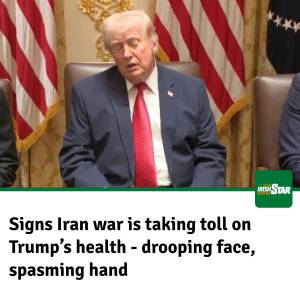
- New York Times, Bomb Shelters and a Drone-Proof Roof: Trump Says Ballroom Is a Matter of Security, Zolan Kanno-Youngs, April 1, 2026. President Trump spoke about his ballroom’s security features as he argued against a judge’s orders to stop construction.
U.S. Economy, Inflation, Jobs
- Popular Information, Accountability Journalism: The tale of the tape: Trump repeatedly pledged to cut gas prices by 50%, Judd Legum, right,and Rebecca Crosby, April 1, 2026. “Mark it down, and you can get very angry at me if we don’t do it.”
- Paul Krugman via Substack, Political-Economy Commentary: $4 Gasoline is Less Than Half the Story, Paul Krugman, right, April 1, 2026. The biggest losers from the Iran War are buyers of diesel, jet fuel, chemicals and fertilizer.
- Morning Shots via The Bulwark, Political Opinion: TACO Is The Opiate of the Masses, Andrew Egger, April 1, 2026. Liberation Day! One year ago tomorrow, Donald Trump took the lunatic policy swing that would bring a swift end—though he didn’t yet know it—to the first act of his second term.
U.S. Media, Education, High Tech, Culture
- New York Times, Trump’s Executive Order on NPR and PBS Is Unconstitutional, Judge Rules, Benjamin Mullin, April 1, 2026 (print ed.). The ruling will have minimal effect on the federal money going to public media because Congress voted to claw back funding. But it could have implications for any future funding.
- Public Notice, Political Commentary: Big tech is coming for the midterms, Paul Waldman, April 1, 2026. And Silicon Valley's agenda is bad news for working people.
- New York Times, Army Suspends Helicopter Crew After Kid Rock Gets a Flyby, Emily Cochrane and Eric Schmitt, April 1, 2026 (print ed.). The pro-Trump musician saluted the pair of Apache attack choppers, which appeared to be the same ones that flew low over a “No Kings” rally in Nashville.
Global News
- Politico Magazine, She Spoke Out About Gaza. Now She Can’t Use a Credit Card, Karl Mathiesen, April 1, 2026 (print ed.). After accusing governments and corporations of complicity in Gaza, the U.N. investigator for Palestine territories now finds herself in Washington’s crosshairs.
Top Stories
New York Times, Iran War Live Updates: Trump Berates Allies While Signaling He Will Wind Down the War, Abdi Latif, Dahir Megan Specia and Erika Solomon, April 1, 2026. President Trump said that he was considering leaving NATO over allies’ failure to support his Iran offensive. He suggested that the U.S. war would end in two or three weeks and that Iran’s closure of the Strait of Hormuz would be a problem for others to solve.Here’s the latest.
President Trump said that he was considering pulling the United States out of NATO over the war with Iran, as he heaps pressure on allies to
 manage the fallout of a conflict he signaled he would wind down in two or three weeks.
In an interview with Britain’s Telegraph newspaper published on Wednesday, Mr. Trump was asked whether he was reconsidering U.S. membership in the military alliance and was quoted as replying, “Oh yes,” and that it was “beyond reconsideration.” The remarks were published hours after President Trump said that he expected the U.S. military campaign in Iran would be over “very soon” and dismissed Iran’s closure of the Strait of Hormuz, which has jolted global energy markets, as a problem for other countries to resolve.
In a social media post on Tuesday, Mr. Trump had again denigrated U.S. allies, chiefly Britain, for not heeding his call for help in securing the strait, a conduit for much of the global oil supply, and said that the United States would not come to their aid in the future. An Iranian official emphasized on Wednesday that the United States would not regain access to the waterway, saying in a social media post: “The Strait of Hormuz will certainly reopen, but not for you.”
Mr. Trump was scheduled to deliver “an important update” on the war in a national address at 9 p.m. Eastern on Wednesday, said Karoline Leavitt, the White House press secretary. On Tuesday afternoon, Mr. Trump told reporters that he had achieved his primary goal of preventing Iran from developing a nuclear weapon, though there is no evidence that the United States or Israel has destroyed the country’s stockpile of near-bomb-grade fuel.Earlier Tuesday, Defense Secretary Pete Hegseth said that the U.S. had achieved such control of Iran’s skies that it was flying B-52 bombers directly over Iranian territory. But Mr. Hegseth acknowledged that Iran retained the ability to retaliate with missiles and drones targeting U.S. allies in the region. On Wednesday morning, the authorities in Bahrain, Kuwait and Qatar all reported missile or drone attacks from Iran.
The Israeli military said on Wednesday that it had completed a wave of strikes against Iranian government infrastructure in Tehran, the capital, without specifying the targets. Iranian state television reported that three locations were hit, including an area northeast of Tehran with military buildings and housing.
Here’s what else we’re covering:
- American kidnapped: A journalist, Shelly Kittleson, was kidnapped in Baghdad, the Iraqi capital, on Tuesday evening, the country’s Interior Ministry said. The ministry said that security forces had pursued the kidnappers, arrested one suspect and seized a vehicle used in the abduction. The suspect is a member of the Iranian-allied paramilitary group Kataib Hezbollah, two senior Iraqi security officials said.
- Houthis: In Yemen, the Iran-backed Houthi militia said it had launched ballistic missiles at Israel on Wednesday. Israel said it had detected a missile launch from Yemen toward its territory. The Houthis entered the war on Saturday by launching a missile attack on what they said were Israeli military targets.
- Lebanon: Israeli strikes in Beirut killed at least seven people and wounded 24 others early Wednesday, Lebanon’s national news agency reported. And there were more Israeli strikes across southern Lebanon, a day after Israel said it planned to occupy and control a large swath of the region and demolish entire towns.
- Death tolls: The Human Rights Activists News Agency said at least 1,598 civilians had been killed, including 244 children, in Iran since the war began. Lebanon’s health ministry said that more than 1,260 Lebanese had been killed as of Tuesday, with more than 3,750 others wounded, since the latest fighting between Israel and Hezbollah began. In Iran’s attacks across the Middle East, at least 50 people have been killed in Gulf nations. In Israel, at least 17 had been killed as of Friday. The American death toll stands at 13 service members, with hundreds of others wounded.
Paul Krugman via Substack, Psychology of Military Incompetence, Paul Krugman, right,
March 31- April1, 2026. How the Iran War was lost.So the world’s greatest military power went to war against a fourth rate nation whose military budget would be rounding error in our defense spending. And it appears that we lost.
It’s Tuesday. It’s the day that the stock market rallied enormously, that the futures price of oil dropped precipitously, all on the happy news that the United States, at least based on Trump’s Truth Social, appears to be surrendering. Trump put up a Truth Social post saying that, you know, we don’t need to open the Strait of Hormuz. If the Europeans think they need it, they should go ahead and do it. And it’s up to them. And this is pretty amazing.
Of course, the idea that it only matters to the Europeans, that it doesn’t matter to us, is all wrong. And that will be a subject of a Substack post shortly. But it is pretty much a confession. Although it’s framed as we won, now let somebody else do the cleanup, the reality is it’s effectively a confession that, well, we lost. We can’t do this.
How the hell did we manage to do this? I mean, the objective reality is that this was never going to be... Maybe it wasn’t even going to be doable. There were reasons why we didn’t go to war with Iran, particularly why we didn’t go to war in a way that basically became an existential threat for the regime so that they have no compunction about creating lots of damage because the alternative result is annihilation for them personally. But everybody who thought about it even for a couple of minutes, anyone who knew anything, particularly anyone who’d been paying attention to four years of war in Ukraine … we know something about what modern war looks like and about the inability of countries that have conventional superior forces to avoid major damage from drones and missiles. So this was completely, unbelievably stupid.
How did we get there? Well, there was a very good article by Tobin Harshaw in Bloomberg, and mostly I’m just riffing off what he wrote, but I think that it deserves wider circulation. He resurrected a book I had forgotten about, a 1976 book by Norman Dixon called The Psychology of Military Incompetence. It was very British oriented, but the lessons apply; Dixon looked at the great military disasters of British history.
You might think there were many reasons why really bad decisions were made, but he actually said there was a kind of consistent pattern. That what happened was that you had military leaders, or people making military decisions, who for the most part shared two things. First, they believed, they had this atavistic, anachronistic belief that warfare is all about muscles and not about minds. which hasn’t been true for a very long time. And second, he argued that they are just generally anti-intellectual, anti-education.
So in some sense, it’s all about muscles and don’t give me all of these smarty-pants intellectuals who are telling me about why I’m doing it wrong. It’s an uncannily accurate portrait of Pete Hegseth, down to even seemingly minor details. Muscular Christianity is among the defining symptoms of the bad British military leaders that Dixon analyzed. So this is what happened.
This is not about specific bad judgments. It’s not, in a way, about the specifics of the case. It is that we were led into war by people who exemplified in the classic way how really bad military decisions are made. And it all comes down to believing in brute force and toughness and muscles — muscles in the age of drone warfare! — and hate intellectuals, hate learning.
What really gets me is that in a war where the deciding factor is having some intellectual understanding of what you’re doing, that a theocratic regime in Iran, which basically wants to bring back the Middle Ages, mostly got it right.
And the world’s leading haven of scientific thought, or we were at least until the current administration, got it completely wrong. It’s humiliating. It’s awful. And, you know, we will all be paying the price for this incredible defeat for probably for the rest of our lives.
The Parnas Perspective, News and Commentary: Trump Leaves Early as Supreme Court Poised to Rule Against Him in Birthright Citizenship Case, Aaron Parnas, right,
April 1, 2026. Here is a full and expanded update following this morning’s landmark Supreme Court arguments on the future of birthright citizenship in the United States.I followed the proceedings closely so you would not have to, and based on both legal analysis and reporting experience, the trajectory is becoming increasingly clear. The Court appears poised to rule against Donald Trump later this year.
The case itself is already historic. At issue is a sweeping executive order issued by President Trump that seeks to reinterpret the meaning of the Fourteenth Amendment to the United States Constitution. Specifically, the order argues that children born on U.S. soil to parents who are either in the country unlawfully or on temporary visas should not automatically receive American citizenship.
That position runs directly into more than a century of constitutional understanding. The Court’s landmark precedent in United States v. Wong Kim Ark established that birthright citizenship applies broadly to nearly all individuals born on U.S. soil, regardless of their parents’ status. That precedent has long been considered settled law.
 Yet today’s arguments demonstrated that the Court is taking a hard look at the administration’s attempt to revisit that interpretation. Notably, President Trump himself attended the arguments, becoming the first sitting president in modern history to do so. He remained in the courtroom for just over an hour, listening as Solicitor General D. John Sauer presented the government’s case. However, he departed shortly after attorney Cecillia Wang began arguing in defense of broad birthright citizenship.
Observers noted the timing of his departure, especially as questioning from the justices began to intensify.
What stood out most during the session was the degree of skepticism from both conservative and liberal justices. This was not a divided ideological exchange. Instead, it was a unified probing of the administration’s legal theory.
Justice Neil Gorsuch, shown above at left, raised concerns about the government’s reliance on sources outside the established constitutional framework. Referencing Wong Kim Ark, he openly questioned how much weight the administration could realistically place on alternative historical interpretations, including references to Roman law traditions. The implication was clear. The argument appeared disconnected from binding precedent.Justice Elena Kagan went further, directly challenging the textual basis of the administration’s position. She noted that the plain language of the Fourteenth Amendment does not support the proposed limitation. Her remarks suggested that the argument depends heavily on obscure or strained historical readings rather than the Constitution’s actual wording.
 Chief Justice John Roberts, right, delivered one of the more memorable exchanges. When Solicitor General Sauer argued that modern globalization has changed the stakes, pointing out that billions of people are now only a plane ride away from the United States, Roberts responded succinctly. It may be a new world, he said, but it is still the same Constitution. That statement underscored a central theme of the hearing: technological or social change does not alter constitutional meaning.
Justice Amy Coney Barrett also pressed the administration on its historical framing. While acknowledging that the Fourteenth Amendment was designed in part to secure citizenship for formerly enslaved people, she pointed out that this purpose is not explicitly written into the text in a way that supports the administration’s narrower interpretation.Several exchanges highlighted potential weaknesses in the administration’s argument.
At one point, Justice Gorsuch asked whether Native Americans would qualify as birthright citizens under the government’s proposed test. Solicitor General Sauer struggled to provide a clear answer, signaling uncertainty about how the framework would apply consistently across different groups.
 Justice Ketanji Brown Jackson, left, raised practical and procedural concerns. She questioned how the government would implement such a policy, including whether pregnant women might be subject to investigation or deposition to determine their legal status or intent. When Sauer explained that citizenship determinations would occur automatically at birth through administrative systems, Jackson pointed out the troubling implication: individuals would only have the opportunity to challenge a denial after their child had already been stripped of citizenship status.
Justice Jackson’s line of questioning emphasized the real world consequences of the policy, not just its theoretical legal justification.
Justice Brett Kavanaugh addressed one of the administration’s broader arguments, which compared the United States to other countries that do not recognize birthright citizenship. While acknowledging that difference, Kavanaugh stated plainly that international practices are not particularly relevant when interpreting the U.S. Constitution. His comments suggested that comparative law arguments would carry little weight with the Court.
Taken together, the arguments painted a difficult path forward for the administration. The justices repeatedly returned to three core issues: the text of the Constitution, binding precedent, and the practical consequences of the proposed rule. On each of these fronts, the administration appeared to face significant challenges.
While it is always risky to predict Supreme Court outcomes with certainty, the tone and substance of today’s questioning strongly suggest that a majority of the Court is not persuaded by the effort to restrict birthright citizenship. A decision is expected later this year, and all signs point toward a ruling that reaffirms the long standing interpretation of the Fourteenth Amendment.
For now, this case stands as one of the most consequential constitutional disputes in recent memory, with implications that reach far beyond immigration policy and into the fundamental definition of citizenship in the United States.
Democracy Docket, Democrats sue to block Trump’s ‘unlawful’ order targeting mail-in voting, Yunior Rivas, Jim Saksa, April 1, 2026. Democratic plaintiffs in this case are represented by the Elias Law Group (ELG). ELG Chair Marc Elias, right,
is the founder of Democracy Docket. Democrats sued to block President Donald Trump’s executive order targeting mail-in voting Wednesday, calling it “unconstitutional” and designed to rig elections ahead of the 2026 midterms.
The lawsuit, brought by the Democratic Senatorial Campaign Committee, the Democratic Congressional Campaign Committee, the Democratic National Committee, the Democratic Governors Association and Democratic congressional leaders, alleges Trump’s order would “upturn the electoral playing field in his own favor and against his political rivals.”
The plaintiffs* are asking a judge to quickly halt enforcement of the order before it can take effect.
 When Trump signed the executive order Tuesday, he appeared to anticipate legal challenges — and to start trying to pressure judges who might hear those challenges. He claimed that only “rogue” and “very bad” judges might block it.
The order directs the Department of Homeland Security (DHS) to work with the Social Security Administration to create lists of verified U.S. citizens eligible to vote in each state. It also instructs the U.S. Postal Service (USPS) to send absentee ballots only to voters on approved lists, and directs the attorney general to prioritize the prosecution of ballots sent to anyone else.
At the center of the lawsuit is the core constitutional principle that presidents do not control elections.
“Our Constitution’s Framers anticipated this kind of desire for absolute power. They recognized the menace it would pose to ordered liberty and the ways in which it would corrode self-government like an acid,” the complaint reads.
Democrats argue Trump’s order would restrict mail voting access and insert federal agencies into election administration — a role the Constitution explicitly reserves for states and Congress.
“Undeterred by this consistent authority— and his own continued failures to convince Congress to adopt his self-aggrandizing election policies — President Trump has yet again taken matters into his own hands,” the complaint adds. “Just days after it became clear Congress would fail to pass the President’s SAVE America Act, he signed a new Executive Order … This Executive Order seeks to impose radical changes to the manner and conditions under which citizens may cast absentee or mail-in ballots — changes that imminently threaten to disenfranchise lawful voters and plainly exceed the President’s lawful authority.”
The lawsuit also takes aim at one of the order’s most controversial provisions, the creation of a national citizenship database for voters, describing it as part of a broader effort by the Trump administration to centralize control over elections.
Morning Shots via The Bulwark, Political Opinion: Liberation Day Brought Us Here, Andrew Egger and Jim Swift, April 1, 2026. Trump’s tariff catastrophe taught the world about TACO. We may have over-learned the lesson.Could peace in Iran be getting closer? Yesterday, Iranian President Masoud Pezeshkian, right, suggested that Iran would be willing to end the war
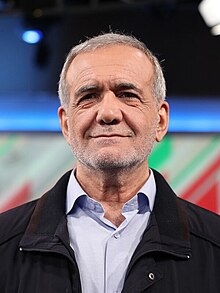 in exchange for U.S. security guarantees, which led to an immediate jump in stock prices—even though Pezeshkian’s remarks were heavily caveated.
Then, this morning, Trump posted that Pezeshkian had just asked America for a “CEASEFIRE,” adding that “we will consider when Hormuz Strait is open, free, and clear.”
Whether Trump was breaking new news or just responding to yesterday’s reports isn’t clear.
One reason to think this might just be Trump winging it is that he described Pezeshkian, who has been in office since 2024, as “much less Radicalized and far more intelligent than his predecessors”—apparently taking him to be one of the leaders who recently took over for a top official killed by Israeli or American strikes.
Trump is planning to give a primetime address on Iran to the nation tonight. Should be illuminating! Happy Wednesday.
News Updates
The Parnas Perspective, Morning News and Commentary: Trump Moves Closer to Leaving NATO, Will Address the Nation, Kristi Noem Asks for Prayers, Supreme Court Will Consider Birthright Citizenship Today, Aaron Parnas, right,
April 1, 2026. This morning, Trump is signaling that he may move to pull the United States out of NATO as soon as tonight, when he addresses the nation from the White House at 9 PM EST. Meanwhile, Trump’s approval rating has dropped to 31 percent and is now dangerously close to falling below 30. The Supreme Court is also set for a major clash today over birthright citizenship, and Trump will be there in person.
At the same time, Big Tech is tightening its grip on journalism, letting misinformation spread while AI-generated videos of me go viral. I am pushing back and staying focused on delivering real information, but I cannot do it alone. This is still one of the last places where independent voices can break through.
Here’s the news:
A new CNN poll shows Donald Trump’s approval rating on the economy has fallen to a career low of 31%, with most Americans saying his policies have worsened economic conditions. Rising gas prices—linked to the Iran conflict—are a major factor, with many households reporting financial strain and cutting back on spending. Overall approval remains low at 35%, and a majority believe he lacks a clear plan to address key issues like inflation and fuel costs.
Donald Trump said he is seriously considering withdrawing the U.S. from NATO, calling the alliance a “paper tiger” and suggesting he has long doubted its strength. He criticized NATO allies for not assisting in reopening the Strait of Hormuz amid ongoing Middle East conflict, implying their lack of action was disappointing. Trump also argued that the U.S. has provided support to other countries, such as Ukraine, even when it was not directly obligated to do so. Additionally, he took aim at the UK’s military capabilities, questioning the strength of its navy.Marco Rubio questioned the value of NATO, saying the U.S. may need to reconsider its membership if it cannot use allied bases. His remarks reflect growing frustration within the administration over limitations placed on U.S. military operations by NATO partners.
Trump is set to deliver a national address tonight on the Iran war, with broadcasters reserving time for what officials call an important update. He has
suggested the conflict could end within weeks and that the U.S. may soon withdraw from involvement. Despite earlier threats to escalate, recent statements from his administration indicate key military objectives against Iran may already have been achieved.Broadcasters have been instructed to set aside 20 minutes of airtime for an upcoming presidential address, indicating an official and potentially significant announcement.
Keir Starmer, right, addressed the nation, warning that the ongoing war will have lasting effects on the UK’s future. He sought to reassure the public, emphasizing that the country is prepared to withstand the challenges ahead. His message framed the conflict as a significant test but expressed confidence in Britain’s resilience.Anthony Albanese warned that the economic impact of the ongoing war will last for months and could bring difficult conditions ahead. He cautioned that the situation may not be easy but pledged that the government will take all possible steps to shield Australians from the worst effects.
Trump said Iran’s new leadership has requested a ceasefire with the United States. He indicated that the U.S. would consider the request, but only if the Strait of Hormuz is reopened.
Keir Starmer said he plans to pursue closer economic and security ties with the European Union at an upcoming summit, aiming for a more ambitious partnership based on shared values and interests. He reaffirmed the UK’s strong commitment to NATO, calling it highly effective for maintaining global security. Starmer emphasized that the UK will stay out of the current conflict, insisting it is not Britain’s war, while still prioritizing national interests.Kristi Noem said she is “devastated” following reports about her husband, Bryon Noem, allegedly engaging in a secret online fetish involving cross-dressing and explicit interactions. The reports claim he used a pseudonym and paid individuals while participating in a niche online community. The situation has drawn additional attention due to longstanding rumors about Noem’s personal life and political relationships. Her representatives say the family was blindsided and is asking for privacy.
Iran warned NATO member Bulgaria not to allow the U.S. to use its airports for military operations related to Iran, according to Bulgaria’s foreign ministry. The warning came in a diplomatic note protesting U.S. refueling planes stationed at Vasil Levski Airport, with Iran stating it could take necessary measures to protect its interests. Bulgarian officials confirmed receiving the note but emphasized that the country is not involved in any conflict.
Mojtaba Khamenei, right, Iran’s new supreme leader, sent a message thanking Naim Qassem and Hezbollah for their resilience against what he
 called major enemies of the Islamic world. He reaffirmed Iran’s commitment to supporting groups opposing U.S. and Israeli forces in the region. Khamenei has not appeared publicly since the war began on 28 February and has communicated only through written statements. U.S. and Israeli officials believe he was wounded in an attack that killed several family members, including his father, Ali Khamenei, and is currently in hiding.
The Supreme Court of the United States is set to hear arguments on Donald Trump’s effort to limit birthright citizenship, a constitutional right for those born in the U.S. to citizen or permanent resident parents. The case challenges the scope of this guarantee and could have major legal implications. Trump is expected to attend the hearing in person.
U.S. Defense Secretary Pete Hegseth said Army aircrew who flew helicopters near Kid Rock’s home will not face
 punishment, reversing an earlier suspension. The incident initially prompted a review over possible safety or protocol violations, but officials ultimately decided against any investigation. The helicopters were identified as AH-64 Apaches operating in the Nashville area, and the flight was described as unrelated to nearby protests.
American journalist Shelly Kittleson was kidnapped in Baghdad by suspected Iran-backed militants, according to U.S. and Iraqi officials. Authorities say one suspect linked to Kataib Hezbollah has been captured, while efforts continue to locate the others and secure her release. The United States Department of State is working with the FBI and had previously warned her about security risks in Iraq. The incident comes amid heightened tensions in the region, with U.S. officials cautioning that Americans in Iraq face significant danger.
A Russian An-26 military transport plane crashed in Crimea, killing all 29 people on board, including crew and passengers. Russian authorities said the aircraft likely went down due to a technical malfunction, with no evidence of external causes like missiles or drones. Communication with the plane was lost during a routine flight before it crashed into a cliff. Investigators are examining the site as part of an ongoing military inquiry into the incident.
KitKat has launched a tracker to find the 12 tons of KitKats stolen:
Allies of Donald Trump have proposed a new plan to dramatically increase deportations, aiming for over 1 million in a year by focusing heavily on workplace enforcement. The strategy would target industries employing undocumented workers, but risks backlash from sectors like agriculture and construction that rely on such labor. Critics warn it could disrupt supply chains and alienate voters, potentially dividing Trump’s political coalition. While the administration says its immigration priorities remain unchanged, the proposal highlights ongoing tensions over how aggressively to pursue deportations.
According to Politico, Frank Bisignano is facing scrutiny over his role leading the Internal Revenue Service, with critics questioning who is truly in charge given his unusual “CEO” position alongside an acting commissioner. He has defended his leadership, saying he is focused on modernizing the agency with technology and improving customer service. However, lawmakers, union leaders, and staff argue he lacks clear direction and may be hindering progress, especially after major staffing cuts and funding losses. The controversy is expected to intensify as he prepares to testify before Congress.
Reuters has confirmed that eleven children who were evacuated as premature babies from Gaza during the Israeli bombing two years ago have now been reunited with their families in an emotional return. The infants had been taken to Egypt for treatment without their parents as conflict surrounded hospitals at the time. Their return, arranged through a U.N.-backed effort, brought relief and joy to families who had been separated for years. The reunions also highlight the lasting humanitarian impact of the war, with ongoing shortages of medical supplies and damaged healthcare infrastructure in Gaza.
Democrats in California risk an unexpected setback in the governor’s race due to a crowded field that could split the vote and allow Republicans to take the top two spots under the state’s election system. With no clear frontrunner and several high-profile figures opting out, party leaders are struggling to unify support behind a single candidate. Efforts to narrow the field have failed, raising concerns about a potential “lockout” from the general election. While many believe the race will eventually consolidate, the situation has created significant issues within the party about a possible historic upset.
The United States Citizenship and Immigration Services has slowed or paused visa renewals for foreign doctors from certain countries deemed high-risk, leaving many unable to work despite years in the U.S. The delays are worsening staffing shortages, especially in rural and underserved areas that rely heavily on international physicians. Doctors report months-long waits with little communication, even after paying for expedited processing. Medical groups warn the policy could disrupt patient care nationwide and are urging exemptions for healthcare workers.
Hackers linked to North Korea breached widely used background software to steal login credentials and enable further cyberattacks. The attack targeted open-source code used in many apps and websites, making it a potentially large-scale “supply chain” hack. Security experts warned that the malicious update could have exposed data across millions of systems without users realizing it. Such operations are often tied to efforts by North Korea to fund its programs through cybercrime and cryptocurrency theft.
Letters from an American, Historical Commentary: March 31, 2026 [Washing Hands On Iran War?], Heather Cox Richardson, right,
April 1, 2026. At 4:11 this morning, President Donald J. Trump’s social media account posted:“All of those countries that can’t get jet fuel because of the Strait of Hormuz, like the United Kingdom, which refused to get involved in the decapitation of Iran, I have a suggestion for you: Number 1, buy from the U.S., we have plenty, and Number 2, build up some delayed courage, to to the Strait, and just TAKE IT. You’ll have to start learning how to fight for yourself, the U.S.A. won’t be there to help you anymore, just like you weren’t there for us. Iran has been, essentially, decimated. The hard part is done. Go get your own oil! President DJT”
While this morning, Trump appeared to wash his hands of his Iran war, there was an undertone of panic in his post, especially coming as it did just before an exclusive story by Alexander Ward and Meridith McGraw in the Wall Street Journal reporting that Trump has “told aides he is willing to end the military campaign against Iran even if the Strait of Hormuz remains largely closed.”
Economist Paul Krugman noted this evening that this is essentially an admission of defeat, and Suzanne Maloney, vice president of the Brookings Institution think tank and an expert on Iran, called Trump’s suggestion that he is willing to leave the strait closed “unbelievably irresponsible.” Having started a war, she said, the U.S. and Israel cannot walk away from the outcome. “Energy markets are inherently global, and there is no possibility of insulating the U.S. from the economic damage that is already occurring and will become exponentially worse if the closure of the strait continues,” she told the Wall Street Journal reporters.
Nonetheless, the idea the Iran War would end soon was a signal investors wanted to see. On the strength of the hope for a short war, the stock market posted its biggest one-day gain in ten months.
Meanwhile, another aircraft carrier, the USS George H.W. Bush, left its home port, Naval Station Norfolk in Virginia, today to head in the direction of the Middle East, although it is not clear if it will support Operation Epic Fury. According to Alison Bath of Stars and Stripes, the carrier will pick up other elements of the carrier group, including the destroyers USS Ross, USS Donald Cook, and USS Mason, as it crosses the Atlantic. The George H.W. Bush Carrier Strike Group also includes several aircraft squadrons and detachments that make up the 70 or more aircraft in Carrier Air Wing 7, along with more than 5,000 sailors and military personnel.
Nearly 3,500 sailors and Marines from the Tripoli Amphibious Ready Group arrived in the region on Saturday.
Yesterday, host Laura Ingraham, left, of the Fox News Channel wondered, “[W]as the president fully briefed about the risks of all of this from the beginning? And
 was he then able to take it all in and understand the complexity of this? How complex it could actually get, and further possibilities of casualties or other damage—the difficulty of dealing with these people? Or was he told this would be relatively quick, in and out?”
Nick Hilden of AlterNet reported that MAGA leader Alex Jones speculated today that ill-health is contributing to Trump’s poor decisions on Iran. “Trump’s run off the edge of a cliff, and I don’t think he’s coming back from it,” Jones said. He urged MAGA to move on without Trump. “We cut bait on Trump and we mobilize against the Democrats,” he said. “Trump is just a minor figure.”
Hunter Walker of Talking Points Memo picked up the story of another MAGA figure distancing himself from Trump. When he ran for governor in 2024, former North Carolina lieutenant governor Mark Robinson flat out denied stories about his participation in pornography forums and social media chats where he attacked Jewish, Black, gay, and transgender people as well as flirting with Holocaust denial and calling himself a “black NAZI!” He even sued CNN for $50 million for defamation, calling their story about him “a high-tech lynching” before dropping the suit after losing the election.
Walker noted that Robinson recently admitted on a podcast that he was lying all along. He “had to ignore the truth at that moment,” he said, because he was shielding Trump. “I certainly don’t want to be the person that costs the president of the United States the election,” he said. “Didn’t want to cost anyone else their election.” Asked if he would do it again, he answered: “I’d make the exact same decision. I’d fight in the exact same way.”
After Saturday’s No Kings rallies around the country and the world, and after new polls showing his job approval ratings have dropped to new lows, Trump this afternoon signed an executive order attacking mail-in voting. Although both Democratic and Republican election officials insist mail-in voting is secure and reliable, Trump claims it permits Democrats to cheat.
Ironically, earlier this month the story broke of a right-wing activist in Wisconsin who ordered ballots in other people’s names to prove that mail-in voting enabled voter fraud. Last week Harry Wait was convicted of one felony count of identity theft and two misdemeanor counts of election fraud, suggesting mail-in voting is not as insecure as he thought.
Nonetheless, Trump is ordering the Department of Homeland Security (DHS) to work with the Social Security Administration to create a list of verified U.S. citizens who are eligible to vote in each state. The order directs the U.S. Postal Service to send mail-in ballots only to voters on the list, and to mark each ballot with its own unique barcode. It threatens any states refusing to cooperate with the order with a loss of federal funding and directs Attorney General Pam Bondi to investigate anyone wrongfully distributing mail-in ballots. Aaron Reichlin-Melnick of the American Immigration Council notes that “there is no such thing as a federal list of citizens. It does not exist.”
“This is unconstitutional on its face,” election law expert David Becker told Yunior Rivas of Democracy Docket. “The Constitution clearly gives the president no power over elections.” The Senate Rules Committee oversees federal involvement in elections, and its top Democrat, Alex Padilla (D-CA), called the order a “blatant, unconstitutional abuse of power,” adding that Trump has “no authority to commandeer federal elections or direct the Postal Service to undermine mail and absentee voting.” Representative Joe Morelle (D-NY), the top-ranking Democrat on the House Administration Committee, said that the order is “illegal, dangerous and subversive” and that “Donald Trump fears the American people and is willing to violate the Constitution to stop them from voting.”
“See you in court,” posted Senate minority leader Chuck Schumer (D-NY). “You will lose.”
Another of Trump’s executive orders was in court today, when Judge Randolph Moss of the U.S. District Court for the District of Columbia ruled that much of Trump’s order stripping NPR and PBS of funds was unconstitutional. As Brian Stelter of CNN reported, Moss quoted a Supreme Court ruling when he wrote: “The First Amendment draws a line, which the government may not cross, at efforts to use government power—including the power of the purse—‘to punish or suppress disfavored expression’ by others.” Republicans in Congress have since voted to cut federal funding from NPR and PBS, but the decision is a victory for the First Amendment.
Judge Richard Leon, left, of the U.S. District Court for the District of Columbia also stymied Trump today when he ruled that Trump cannot proceed with his plans for a giant ballroom on the site of the demolished East Wing of the White House without approval from Congress. The National Trust for Historic Preservation has sued Trump and a number of federal agencies to stop construction of the ballroom, noting that Trump skipped reviews and approvals that were required by law.The decision by Leon, who was appointed by President George W. Bush, begins: “The President of the United States is the steward of the White House for future generations of First Families. He is not, however, the owner!” It goes on to say that “no statute comes close to giving the President the authority he claims…to construct his East Wing ballroom project and do it with private funds,” and points out that Trump appears to be relying for authority on a law permitting him “to conduct ordinary maintenance and repair of the White House.” Leon also noted that the White House has offered vague and shifting information about who is actually in charge of the project and that the public has an interest in the appearance of the White House. Leon said “the ballroom construction project must stop until Congress authorizes its completion.”
The Department of Justice has already appealed.
Trump exploded at the judge’s decision, posting on social media:
“The National Trust for Historic Preservation sues me for a Ballroom that is under budget, ahead of schedule, being built at no cost to the Taxpayer, and will be the finest Building of its kind anywhere in the World. I then get sued by them over the renovation of the dilapidated and structurally unsound former Kennedy Center, now, The Trump Kennedy Center (A show of Bipartisan Unity, a Republican and Democrat President!), where all I am doing is fixing, cleaning, running, and ‘sprucing up’ a terribly maintained, for many years, Building, but a Building of potentially great importance. Yet, The National Trust for Historic Preservation, a Radical Left Group of Lunatics whose funding was stopped by Congress in 2005, is not suing the Federal Reserve for a Building which has been decimated and destroyed, inside and out, by an incompetent and possibly corrupt Fed Chairman. The once magnificent Building is BILLIONS over budget, may never be completed, and may never open. All of the beautiful walls inside have been ripped down, never to be built again, but the National ‘Trust’ for Historic Preservation never did anything about it! Or, have they sued on Governor Gavin Newscum’s ‘RAILROAD TO NOWHERE’ in California that is BILLIONS over Budget and, probably, will never open or be used. So, the White House Ballroom, and The Trump Kennedy Center, which are under budget, ahead of schedule, and will be among the most magnificent Buildings of their kind anywhere in the World, gets [sic] sued by a group that was cut off by Government years ago, but all of the many DISASTERS in our Country are left alone to die. Doesn’t make much sense, does it? President DONALD J. TRUMP”
Hours later, he posted: “Secretary of the Interior Doug Burgum and I are working on fixing the absolutely filthy Reflecting Pool between the Lincoln Memorial and the Washington Monument. This work was supposed to be done by the Biden Administration, but Sleepy Joe doesn’t know what ‘CLEAN’ or proper maintenance is—The President and Secretary do!”
Tonight Summer Said, David S. Cloud, and Michael Amon of the Wall Street Journal reported that the United Arab Emirates is trying to get a United Nations Security Council resolution to call for the reopening of the Strait of Hormuz. The UAE says it will help the U.S. and other allies open the strait by force.
Noem Family, Homeland Security Scandals
President Trump, then Homeland Security Secretary Kristi Noem and her husband Bryon Noem are shown above in a photo collage above by the New York Post.. President Trump said he was surprised hearing about Kristi Noem’s husband’s double-life as a cross-dresser with a fetish for grotesquely oversized breasts, as widely reported March 31after an exclusive by the Daily Mail.
Daily Mail, Investigation: Secret double life of Kristi Noem's crossdressing husband Bryon, Ben Ashford and Josh Boswell, April 1, 2026. The pouting 'busty bimbo' photos and trove of explicit messages.
 Future South Dakota Governor and U.S. Homeland Security Secretary Kristi Noem with her husband Bryon early in their marriage.
New York Post, Kristi Noem weighs in on report husband lives cross-dressing double life, Chris Nesi, April 1, 2026 (print ed.). 'The family was blindsided by this.'
Shocking pictures of Kristi Noem's cross-dressing husband flaunting giant fake breasts revealed — sparking grave security questions.President Trump said he was surprised hearing about Kristi Noem’s husband’s double-life as a cross-dresser with a fetish for grotesquely oversized breasts, and that he felt remorse for the upheaval the revelation has caused the family.
“They confirmed it? Wow, well, I feel badly for the family if that’s the case, that’s too bad,” Trump told the Daily Mail Tuesday afternoon.
“I haven’t seen anything. I don’t know anything about it. That’s too bad, but I just know nothing about it,” he added.
Bryon allegedly shared hundreds of fetish photos.
A spokesperson for the ousted homeland security chief told The Post that she was “devastated” to learn what her husband of 32 years was allegedly up to, and that the family was “blindsided” by the disturbing revelation.
According to the outlet, Bryon Noem engaged in explicit conversations with women from a niche fetish scene known as “bimbofication” — in which adherents pump up their breasts to extreme proportions in pursuit of a “Barbie doll”-like appearance.
He allegedly sent tens of thousands of dollars to various women he chatted with, and even sent selfies wearing pink hotpants and flesh-toned crop-tops stuffed with balloons inflated to resemble cartoonish-sized breasts, even featuring the outlines of protruding nipples.
 His face was clearly visible in several of the salacious images.
In one conversation viewed by the Mail, Bryon pledged to worship one woman like a “goddess,” telling her, “you turn me into a girl,” before asking if he should “put on leggings.”
Questions about the Noems’ marriage have increasingly come to light as the former South Dakota governor has made numerous high-profile appearances with Trump confidant Corey Lewandowski, shown together at right, sparking rumors of an affair with the aide, who is also married.
 Them, Kristi Noem's Husband Accused of “Bimbo” Cross-Dressing Fetish in Leaked Messages and Photos, Quispe López, April 1, 2026 (print ed.). Bryon Noem allegedly dressed in a makeshift breast plate and dressed in tight pants and a crop top.
Bryon Noem, husband of former Department of Homeland Security Secretary Kristi Noem, has allegedly been cross-dressing and messaging sex workers who specialize in “bimbofication” to turn him “into a girl,” according to a report published in The Daily Mail.
Yes, you’re reading that correctly.
In hundreds of messages reviewed by the Daily Mail, the 56-year-old is allegedly shown messaging sex workers who specialize in “bimbofication,” or a type of roleplay fetish that involves being turned into a stereotypical bimbo or Barbie dolls in some cases.
According to the publication, Bryon Noem messaged three sex workers that he enjoyed their “huge, huge ridiculous boobs,” and sent over $25,000 to them. In one of the photos included in the report, he appears to be wearing a large, makeshift breast plate made of balloons under a peach crop top and tight pink shorts. Another appears to show South Dakota’s former “First Gentleman” pouting in a selfie wearing green tight pants and another balloon-stuffed crop top.
In one message, Bryon Noem told a sex worker, “You turn me into a girl” and then asked, “Should I put on leggings?”
Obviously, we're not here to condemn cross-dressing at Them, or anyone exploring their gender presentation. However, we would be remiss to not point out the irony of the report, given Kristi Noem’s long history of opposing queer and trans rights.
Cross-dressing is not inherently considered queer or trans, as exploring your gender presentation ultimately has no gender. But, the report does come after years of Kristi Noem attacking anyone playing with their gender, presentation or otherwise.
The former Governor of South Dakota signed a “Religious Freedom Restoration Act” that allowed people to discriminate against LGBTQ+ people in her home state under the guise of religious freedom, banned trans girls from participating in women’s sports, and banned gender-affirming care for trans youth, just to name a few of her anti-LGBTQ+ policy points.
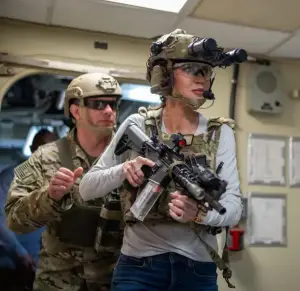 Not to mention her leadership of Immigrations and Customs Enforcement (ICE) to conduct mass deportations and what advocates have called “state-sponsored kidnapping,” including that of vulnerable LGBTQ+ migrants such as Andry Hernández Romero, a gay Venezuelan asylum seeker who was sent to Centro de Confinamiento del Terrorismo, or CECOT, a notorious prison in El Salvador.
Everyone, including Bryon Noem, should be free to explore their gender. But if Kristi Noem got the world that she actively is fighting for, no one would ever get to do that, including cisgender people with bimbofication fetishes. Outlets have reported that Kristi Noem is aware of the report and — perhaps shocking to no one who is aware of her track record — she is not taking it well.
“Ms. Noem is devastated,” a spokesperson for Kristi Noem told The New York Post. “The family was blindsided by this, and they ask for privacy and prayers at the time.”
The report about Bryon Noem’s alleged fetish comes just weeks after Kristi Noem was fired by President Donald Trump from her position as head of the DHS. Trump later replaced her with Republican Sen. Markwayne Mullin of Oklahoma.
Quispe López is the lifestyle editor for Them.us and an LGBTQ+ issues journalist whose work has appeared in NOLA.com, | The Times-Picayune and Business Insider. As a transmasculine Quechua Qariwarmi writer, their work focuses on transgender health and wellness.
 New York Post, Former Department of Homeland Security chief Kristi Noem is “devastated” by salacious allegations her husband Bryon lives a double life where he cross-dresses and chats online with fetish models, Staff Report, April 1, 2026 (print ed.). “Ms. Noem is devastated. The family was blindsided by this, and they ask for privacy and prayers at the time,” Noem’s representatives told The Post.“Ms. Noem is devastated. The family was blindsided by this, and they ask for privacy and prayers at the time,” Noem’s representatives told The Post.
According to reporting by the Daily Mail, Bryon Noem chatted up women from the so-called “bimbofication” fetish scene, in which adult performers augment their breasts with massive amounts of saline to achieve a “Barbie doll”-like appearance.Kristi Noem and Bryon Noem smiling on a beach with a rocky coastline. 9Kristi Noem’s rep said that she is ‘devastated’ over allegations that her husband, Bryon Noem, lives a double life dabbling in cross-dressing. Kristi Noem/FacebookBryon Noem hugs Governor Kristi Noem after she takes the oath of office. 9Noem’s “family was blindsided by this,” her rep said. REUTERSBryon Noem hugs Governor Kristi Noem after she takes the oath of office. 9According to reporting by the Daily Mail, Bryon Noem chatted up women from the so-called “bimbofication” fetish scene. Erin Woodiel / Argus Leader / USA TODAY NETWORK
Citing “hundreds” of messages purportedly sent by three women from the scene, Noem’s husband enthusiastically praised their heavily augmented appearances, and proclaimed he coveted “huge, huge ridiculous boobs,” according to the Mail.
One photo the Mail claims Bryon Noem shared with the women features him wearing pink hot-pants and a flesh-colored, skin-tight suit.Start your day with all you need to know.
The Bulwark, Commentary: Kristi Noem's Husband Isn’t the Problem, Jonathan V. Last, Tim Miller, and Sarah Longwell, April 1, 2026. The wild new scandal involving Kristi Noem’s husband—and why the story isn’t what people think it is.
They also discuss Trump’s chaotic handling of the Iran conflict, the political fallout at home, and whether his support is starting to crack. Plus: Lindsey Graham’s surreal Disney detour, protests across the country, CPAC’s decline, and JD Vance’s latest reinvention.More On U.S. Governance, Politics, Elections
New York Times, Trump Signs Order Seeking Federal Control of Mail Voting as He Promotes False Claims, Nick Corasaniti and Michael Gold, April 1, 2026. Election experts and Democratic officials called the order legally invalid, and Arizona and Oregon pledged to immediately challenge it in court.President Trump on Tuesday stepped up efforts to promote his false claims of widespread voting fraud, signing an executive order of questionable constitutionality seeking to create a national list of citizens that would determine voting eligibility and restrict mail ballots.
Mr. Trump acknowledged that the order, which comes as a bill he has been pushing to restrict mail voting has languished in Congress, could face legal hurdles.
“I believe it’s foolproof,” Mr. Trump said about the executive order before signing it in the Oval Office. “And maybe it’ll be tested. Maybe it won’t.”
The president has no explicit Constitutional authority over elections, and many aspects of the order appear difficult to enforce.
It directs the Department of Homeland Security to create a “state citizenship list” based on data from citizenship and naturalization records, Social Security records and other federal databases.
The order directs federal officials to send the list to state election officials, and orders the attorney general to prioritize prosecution of election officials who provide federal ballots to ineligible voters. It also directs the U.S. Postal Service not to transmit mail-in or absentee ballots from any individual not included on the “state citizenship list.”
Election experts and Democratic state election officials rejected the president’s directive as legally invalid. Officials in Arizona and Oregon pledged to fight the executive order in court. Marc Elias, a Democratic election lawyer, also vowed to file a lawsuit against the order.
“The Constitution doesn’t allow the executive to take over elections administration, that’s a job for the state legislatures or Congress, and so I don’t think this is going to pass any sort of judicial muster,” Adrian Fontes, Arizona’s secretary of state, said in an interview. “So this is a big, giant waste of time, and it’s an attention grab from the Trump administration.”Editors’ PicksIs ‘One-Sided Monogamy’ Just Cheating?This Old-Fashioned Dish Deserves a Place on Your Easter TableBill Lawrence and Christa Miller List Their NoMad Condo for $7.85 Million
He added: “The greatest threat to American elections is Donald Trump lying about them. Our elections are in good shape.”
The Contrarian, Opinion: How Mass Movements Topple Autocracies, Jennifer Rubin, right,
April 1, 2026. Trump is weak. The people are strong.Historically, autocrats often have turned out to be remarkably fragile, while effective mass movements have demonstrated unexpected strength to topple them. Donald Trump’s recent serial disasters vs. the burgeoning Resistance movement suggest the same might hold true in the U.S. Trump is sinking in approval in every public poll, with the University of Massachusetts Amherst poll reporting a new low of 33 percent approval. He is suffering from a crack-up in his base and rapidly losing young voters, Hispanics, and the “manosphere.” (About the latter, Elaine Godfrey writes that “the disillusioned young men and independents who voted for Trump in 2024 … can’t be expected to get out and vote for the GOP.”)
Discrete blunders (e.g., tariffs/affordability, the Iran war, the Epstein pedophile scandal, mass deportations, gas prices) might explain millions of voters’ disillusionment. But looked at with historical perspective, this sort of decay, characteristic of late-stage autocracy, flows directly from its defining features: corruption, cronyism, isolation from reliable information, and unalloyed faith in propaganda.Each played a part in the predictable quagmire in Iran and the corresponding nosedive in Trump’s poll numbers. His head-spinning corruption (e.g. reaping billions for him and his family from Middle East regimes) and cronyism (e.g., installing fan-boy incompetents such as Defense Secretary Pete Hegseth, sending ignoramuses Jared Kushner and Steve Witkoff to negotiate) set him up for failure. Tip: A corrupt leader surrounded by cronies can be played.
Making matters worse, Trump might be the least informed person in America, in part because all he consumes is a steady junk food diet of dramatic video footage, slobbering right-wing media coverage, and political sycophants’ cringeworthy flattery. (Looking at you, Speaker Mike Johnson!) The self-created information vacuum leaves him without reliable data about the state of the war, the sides’ relative weapons capacity, the Iranians’ leverage and objectives, and the impossibility of certain maneuvers (e.g., sending in troops to ferry out enriched uranium).
In the realm of state propaganda, Trump’s communication, even for him, has been terribly frantic and contradictory. He has become so accustomed to his cult’s uncritical acceptance of his lies (e.g., the “Sir” stories, fake history, incoherent blather “sane washed” by legacy media) that he is no doubt rattled when his bluster, threats, and transparent dissembling have no impact on the Iranians. Tip: Intoxication by your own lies is a serious handicap — as is deluding yourself into believing that implacable foreign enemies buy your nonsense.Subscribed
Put differently, autocracies are inherently brittle and susceptible to pressure because they eliminate the very things necessary to survive, such as reality-based decision-making, advisers picked on merit, a healthy flow of information, and the ability to discern spin from reality. (This sounds eerily similar to Russia’s Ukraine debacle, driven in large part by the “inefficiency, corruption, and brutality” of Vladimir Putin’s regime.)
The term for the point when autocracy goes haywire — autocratic backfire — “occurs when narcissistic leaders have insulated themselves from criticism by surrounding themselves with sycophants and loyalists,” Ruth Ben Ghiat explains. At that point, “[n]o one will tell them the truth, and religious collaborators tell them they are in office by divine will…so they also end up believing their own propaganda about their invincibility, genius instincts, and infallibility.” They therefore are likely to make “decisions on the basis of erroneous beliefs or personal ideological obsessions.” No wonder the result is often military or economic calamities and bone-headed “policies and projects championed by the ruler out of hubris and megalomania and implemented to disastrous effect.”
If Trump’s regime is brittle and subject to self-destruction, what about the Resistance? In polling, election results, and mass organizing events such as the No Kings protests, a vibrant grassroots movement has demonstrated surprising resilience, strength, and adaptability over 15 months.
Social movements scholar Dr. Liz Corrigan explains that mass events with huge turnout of people “who share some similarity of grievance against state actions” are critical to building a movement. Large numbers gathered without imposed ideological litmus tests encourage others to join. ‘Safety in numbers’ is real. “At protests, folks are registering voters, organizing volunteers, building databases for further actions, debating various courses of action, and creating relationships,” Corrigan observes. “It is literally how people build skills for solidarity actions as they are forced into more immediate confrontation with the state.”
Unlike autocrats, mass movements can adapt to new circumstances and embrace moments that can galvanize millions. The larger the number of activists, the more sources of information and ideas can be tapped to inform the movement. We saw the Resistance initially focus on direct opposition to DOGE with the “Hands off!” protest. Then it embraced the anti-corruption message that included the Epstein-Trump scandal (highlighting the Epstein elites’ avoidance of accountability). And most recently, ICE and the Iran War have supercharged the movement.
Mass movements — unlike inflexible, know-it-all autocrats — also can experiment with different models. Through trial and error, the movement can test new organizing methods (e.g., the Jimmy Kimmel boycott) and figure out ways to draw in different parts of the electorate.
Perhaps most powerfully of all, while autocrats operate through violence, bullying, threats, censorship, and weaponization of the justice system, a successful mass movement is built on hope, solidarity, and, yes, love. It turns out mass movements suffused with joy, love, and mutual support have triumphed time and again over brutal and menacing regimes, whether in Turkey, Chile, or in the American Civil Rights Movement (anchored in its quest for a “Beloved community”). In the current context, we see the whimsical costumed characters, an ever-expanding array of witty signs, the near-total absence of any violence, widespread impromptu community-organized aid for immigrants, and consistent expressions of joy and a deep, abiding love of neighbors, country, and democracy. (Credit: Tim Dickinson)
Certainly, victory over MAGA authoritarianism, brutality, and racism is far from inevitable. However, the Resistance can take solace that signs of Trump’s crackup are multiplying, the predictable result of erratic decisions from an isolated narcissist surrounded by yes-men. Trump’s version of autocratic backfire also reflects the growth of the Resistance movement, one large and flexible enough to sweep in millions of Americans, innovate over time, and propound a positive, uplifting message.
In sum, Trump’s profound weaknesses and the Resistance’s considerable strengths should give democracy defenders confidence to translate protest into organization and to redouble efforts to prevail in November, no matter what futile MAGA voter suppression tactics are deployed.
 The Hartmann Report, Opinion: Alex Jones Didn’t Just Spread Lies: He Helped the Right Wing Weaponize Them to Undermine American Democracy, Thom Hartmann, right, April 1, 2026. How Republicans turned misinformation into a system for seizing power and reshaping reality, and the damage those lies are doing to our democracy…
I still remember the day, back in 2009 when we were on speaking terms, when Alex Jones showed up naked for a live simulcast of our two shows. It’s one of those pictures that my staff and I have worked for years to get out of our heads.
It was for a stunt, of course; if nothing else, Alex has always known how to be a showman. It was April 15, Tax Day, and he wanted to emphasize how the IRS had “taken the shirt off my back.” Point made. And a largely harmless one (other than that $38 trillion national debt that’s 100% derived from tax cuts for billionaires and corporations we were lied into by Reagan, Bush, and Trump).But when he filmed a phony, staged “ISIS beheading” that he claimed happened on the southern US border, it was far from harmless, according to a new book by one of his former employees, Josh Owens, titled The Madness of Believing: A Memoir from Inside Alex Jones’ Conspiracy Machine.
The video of one of Jones’ reporters dressed up as an ISIS soldier carrying a phony severed-head prop went viral, gaining millions of views, and helped fuel anti-Muslim hatred that the rightwing was then working hard to exploit in post-9/11 America. Owens told an NPR reporter that the turning point for him was sitting on a plane next to a Muslim woman with her young daughter:
“I remember sitting there watching her, and it sounds so cheesy, but it was just this moment of like ... these people didn’t do anything. There’s no reason for suspicion; it’s just racism. It’s not like after that I changed everything and all of a sudden became a good person or started to do the right thing. But it did start to make me look at things a little bit differently.”
The real crisis this kind of media causes isn’t just the misinformation; it’s the collapse of a shared reality among Americans, without which democracy can’t function. And we’re seeing that play out in real time in the daily dysfunction both in Congress and in state capitols across the the nation.
When political power is built not on debate, compromise, and persuasion but on intentional lies, governance simply becomes a shallow performance and an opportunity for corruption rather than a way to serve the needs of the people of a country. It becomes, in essence, a grift.
This is why partisan lies used to seize and hold power are so corrosive: they destroy a nation’s sense of shared reality.
While it’s nearly impossible to identify any meaningful lies Democrats depend on to win elections, increase media profits, or pass special-interest legislation, there’s a long list of rightwing lies that serve those exact purposes:
— Tax cuts for billionaires help average people,— Unions are bad for workers,— Climate change is a hoax,— Welfare fraud is widespread and mostly committed by Black “welfare queens,”— Social Security is going broke and lifting the cap on what billionaires pay won’t solve the problem,— The 2020 election was stolen from Trump,— Immigrants bring more crime than native-born citizens,— Deregulation doesn’t produce harms but by increasing profits helps society,— National single-payer health insurance can’t work in America (even though it mysteriously works just fine, better than what we have, in dozens of other democracies),— America was founded as a Christian nation,— Men are superior to women,— White people are superior to people of color,— Vaccines are dangerous and Covid isn’t,— Voter fraud and voting by non-citizens is widespread,— Guns will keep your home and children safe,— Rich Jews are funding a program to “replace” white workers with dark-skinned people,— Increasing the minimum wage destroys economies and causes severe inflation.
Each one of these lies is repeated regularly by Republicans on TV and hosts of rightwing talk shows as if they’re true to the point where MAGA voters can recite them in their sleep (and when they’re carrying tiki torches).
As America learned when Fox “News” was forced to admit in court that their top talent was lying directly to the camera for months about the 2020 election, these lies are typically planned, organized, intentional, and can produce millions in revenue for the media and its stars.
Not to mention supporting billions in profits for aligned industries like fossil fuels and tobacco that depend on people believing lies to keep consuming their products.
Republican lies can also swing elections, like when a PAC aligned with George HW Bush’s 1988 campaign promoted their Willie Horton ad arguing that a prison furlough program that led to a white woman being raped and murdered by a Black man was Massachusetts Governor Michael Dukakis’ fault when, in fact, it’d been started by a previous Republican governor.
Rightwing lies have taken America into or prolonged wars, as we learned when Nixon lied about his “secret plan” to end the Vietnam war, Reagan “rescued” medical students by invading Grenada, George HW Bush had a member of the Kuwaiti royal family lie on national TV about Iraqi soldiers throwing babies out of incubators, Bush and Cheney lied us into combat in Afghanistan and Iraq, and Trump lied us into attacking Iran and killing hundreds of innocent children.
Republican lies can even create self-fulfilling prophecies, like how when both Obama and Biden each came into office Republicans and rightwing media immediately started loudly claiming the US southern border was “now wide open” and that lie, repeated over and over again by conservative politicians and media, made its way down to South and Central America and caused people there to believe it and then to migrate north.
It’s particularly problematic when Republican lies become loyalty tests for public office. Senators Richard Blumenthal and Sheldon Whitehouse have been asking every Republican-promoted federal judge nominee to come before the Judiciary Committee the simple question, “Who won the 2020 election?” Not even one single candidate has yet answered with the simple truth that Joe Biden won, fair and square, a result that was even litigated 60 times and proven before the Republicans on the Supreme Court.
The problem Republicans, rightwing billionaires, and conservative media have is that if they simply told the truth about any of the things in the list above — that they really do support more pollution and raw bigotry while exclusively working to enrich the already morbidly rich — they’d quickly lose their audiences and their voters.
The fix, therefore, isn’t particularly complicated, even if does require discipline.
Every anchor, every host, every journalist, and particularly every guest on radio or TV who lets one of these lies slide past without correction needs to be called out for it.
Not “some people disagree,” or “Democrats say otherwise.” Lies like these require a flat-out, factual, on-air correction: “That’s not true, and here’s the proof.” There really are differences between the two major parties, and only the GOP consistently uses demonstrable lies to get their way.
When hosts or Republican guests refuse to respond to that in good faith, when they treat a documented lie as just another “perspective” worthy of equal consideration, they have to be outed.
The Founders understood — as much as they loved free speech — that democracy can’t survive without a press willing to tell the truth. What we have today in far too much of our media landscape is the opposite: a press that’s either owned by billionaires invested in the lies or so terrified of being called “liberal” that it’s stopped holding liars accountable.
So, when you see this happen, pick up your phone and tell the network, station, host, or politician exactly what you just witnessed. And amplify it on social media.
The deep truth here is that decades of Republican lies have only worked because so many in the media — and so many of us who consume media — have let them pass unchallenged.
The facts are on our side. Americans, when presented with the actual substance of these issues without partisan labels attached, consistently support the positions Democrats hold and Republicans lie about.
And remember, every one of the lies on the list above exists for one reason only: because without them, the people telling them couldn’t win an election, hold an audience, get tax cuts and deregulation, or make more money.
So, correct the lies at the dinner table. Share articles like this one that document them with receipts. Support the journalists and outlets brave enough to call partisan and corporate liars out by name. Show up for protests. And, most important, vote this fall like your democracy depends on it, because (as the old cliché goes) it does.
The Daily Show,Kristi Noem's Husband Leads a Double-D Life, Desi Lydic, April 1, 2026. Who says Kristi Noem is the only person in her marriage allowed to dress up?
U.S. Science, Space, Health Care
New York Times, NASA’s Artemis II Moon Mission Launches Atop Tower of Flamen, Kenneth Chang, April 1, 2026. The crew of four — three Americans and one Canadian lifted off at 6:35 p.m. Eastern on the first crewed journey to the moon since 1972. But they will not land there on this mission.A towering orange-and-white NASA rocket blasted off from Florida on Wednesday evening, lifting four astronauts toward space and transporting spectators’ imaginations to a future in which Americans may again set foot on the moon.
As they did during the heyday of the Apollo program, which first put men on the lunar surface, spectators squeezed onto the beaches along Central Florida’s Space Coast. The crowds cheered when the powerful vehicle launched into the clear, twilight sky at 6:35 p.m. Eastern time. It traveled eastward, over the Atlantic Ocean, on a journey that is to go around the moon but not land there.
The flight aboard a spacecraft named Integrity is taking Reid Wiseman, Victor Glover, Christina Koch and Jeremy Hansen on what is expected to be a round trip of more than 695,000 miles to clear a path for more exploration, and eventually a new lunar landing.
The mission, known as Artemis II, is the 21st century equivalent of Apollo 8, when NASA astronauts Frank Borman, James Lovell and William Anders captured the rapt attention of the world. When they launched in December 1968, it was the first time that astronauts rode on top of NASA’s mighty Saturn V rocket. For that mission, instead of just a short test flight around Earth, the space agency audaciously decided to send the crew all the way to the moon and back, the first time that another celestial body became a destination that humans could reach.
Like Apollo 8, Artemis II aims to similarly check that the spacecraft can safely make the journey and keep its crew alive during the 10 days it is expected to take to go to the moon and return. Under those plans, the trip will conclude with a splash in the Pacific Ocean on April 10.
Health Secretary Robert F. Kennedy Jr., with President Trump and Mehmet Oz, the Medicaid and Medicare services administrator, in the White House in September (New York Times photo by Tierney L. Cross)
New York Times, C.D.C. Pauses Testing for Rabies and Pox Viruses, Apoorva Mandavilli, April 1, 2026. The diseases were removed from a list of tests the agency conducts for state and local health departments. Experts worry that with drastic staff reductions, the testing may not resume.The Centers for Disease Control and Prevention has temporarily paused testing for rabies and pox viruses, the family of viruses that includes smallpox and mpox, according to an update to the agency’s website on Monday.
The C.D.C. offers testing for dozens of pathogens to assist state and local public health laboratories that are not equipped to conduct them. The organization began evaluating its tests in late 2024 as part of an agencywide review.
But widespread layoffs, hiring freezes and resignations have shrunk the number of qualified scientists who can assist state labs. The C.D.C.’s rabies and pox virus teams have lost many of their members. By July, the rabies team will be down to just one person with the clinical expertise to advise state and local officials, and the pox virus team will have none.
The teams already have too few members to offer after-hours advice for states as the agency has long done, according to an official with knowledge of the situation who asked to remain anonymous because of fear of retaliation.
Several public health experts said they were concerned with the shortage of testing and expertise at the nation’s infectious disease agency. The country faces the threat of emerging diseases such as bird flu and is also preparing for major events, including the World Cup tournament and the celebrations for the 250th anniversary of U.S. independence, that will amass large crowds.
“In relative peacetime of no major outbreaks, no major pandemics, it’ll be fine,” said Jill Taylor, who directed the Wadsworth Center, New York State’s public health laboratory, until October 2020.
But, she said, “If we have an emergency all of a sudden, God help us.”
New York Times, Hegseth Reverses Helicopter Crew Suspension Over Kid Rock Flyby, Emily Cochrane and Eric Schmitt, Updated April 1, 2026. Videos posted Saturday showed the pro-Trump musician saluting two Apache attack choppers, which appeared to be the same ones that flew low over a “No Kings” rally in Nashville.Defense Secretary Pete Hegseth on Tuesday abruptly reversed the suspension of Army crews that piloted two Apache helicopters close to the musician Kid Rock’s residence in Nashville over the weekend.
Earlier on Tuesday, a spokesman said that the crew members involved had been barred from flight duties, a day after the Army began an inquiry into videos of the flyover posted on social media.
But Mr. Hegseth appeared to end both the suspensions and the investigation, with a social media post on Tuesday night declaring: “No punishment. No investigation. Carry on, patriots.”
It was a remarkable intervention from the highest level of the Pentagon, circumventing the internal military chain of command. For Mr. Hegseth, who in his previous career as a Fox News host defended service members accused of war crimes, the decree was another indication of his contempt for legal guardrails in the military.
Hegseth’s post came on the same day that President Trump told reporters at the White House that the crew members “probably should not have been doing it.”
“You’re not supposed to be playing games, right? I will take a look at it,” Mr. Trump said, adding, jokingly, “They like Kid Rock. I like Kid Rock. Maybe they were trying to defend him.”
Mr. Hegseth has also repeatedly clashed with the Army secretary, Daniel P. Driscoll, over personnel and administrative decisions, including by blocking the promotion of four Army officers to one-star generals. By reversing the suspension, he has waded into what had otherwise been a fairly routine disciplinary proceeding.
The Army directed a request for comment to Mr. Hegseth’s office.
The end of the suspensions was the latest twist in the helicopter episode after Kid Rock, whose real name is Robert James Ritchie, posted two videos on social media on Saturday that prompted official scrutiny. One video shows Mr. Ritchie waving and saluting as a helicopter hovers near the pool at the 27,000-square-foot mansion he has christened the Southern White House, which is fashioned after the original structure in Washington.
In a second video, another helicopter can be seen flying above the first as Mr. Ritchie continues to wave. The musician, who has been vocal about his support for President Trump, shared the videos with some derogatory commentary about Gov. Gavin Newsom of California, adding “God Bless America and all those who have made the ultimate sacrifice to defend her.”Mr. Ritchie’s manager did not respond to requests for comment.
The helicopter gunships also appeared to be the same ones that flew over a “No Kings” protest held on Saturday in Nashville, a maneuver that some attendees said felt like intimidation. (A spokesman said that the helicopter crews had been in the Nashville area for training, and he called their appearance over the rally “entirely coincidental.”)
 USA TODAY, Does the bullet match? Key issue emerges in Charlie Kirk murder case, N'dea Yancey-Bragg, April 1, 2026 (print ed.), Attorneys for the man accused of shooting conservative activist Charlie Kirk,shown above in a file photo, said a federal law enforcement agency did not connect the bullet found during autopsy to the suspected murder weapon.
 Tyler Robinson, shown below at right in a file photo, has been charged with aggravated murder and other felonies in Kirk's death. Kirk, 31, was killed Sept. 10 while speaking to students at Utah Valley University in Orem, Utah.
Authorities had said the gun used to assassinate Kirk was a Mauser 98, a common bolt-action rifle typically used for hunting. The hunting rifle, which had a heavier .30-06 caliber, dates back decades as German-made military surplus with millions produced and resold in the United States, experts told USA TODAY.
 Officials recovered the weapon near the scene of the shooting with one spent cartridge in the chamber and three unfired bullets etched with meme-influenced messages.
Robinson's attorneys said in a court filing that they have received a summary report from the Bureau of Alcohol, Tobacco, Firearms and Explosives "which indicates that the ATF was unable to identify the bullet recovered at autopsy to the rifle allegedly tied to Mr. Robinson."
"Although the State has not indicated an intent to produce this report at the preliminary hearing, the defense may very well decide to offer the testimony of the ATF firearm analyst as exculpatory evidence," the court filing said.
Robinson's attorneys said the FBI is conducting a second comparative bullet analysis and a bullet lead analysis, but it was not yet complete. The defense asked Judge Tony Graf to delay the preliminary hearing, scheduled for May, in part because the team has not gotten the case files and protocols related to these analyses and other evidence from prosecutors.
The defense did, however, receive a hard drive with more than 600,000 files in a meeting March 12 with prosecutors, according to the court filing. That came on top of the 20,000 files the defense team had already received, which included 31 hours of audio and more than 700 hours of video.
Robinson's attorneys said it would take at least 60 days to review the evidence they have and determine whether more has not yet been turned over to them.
"The defense team has devoted, and will continue to devote, significant resources to processing discovery, including identifying materials not yet received to inform readiness for the preliminary hearing," the court filing said. "However, the defense team is realistic and the comprehensive review required to determine what is missing will take hundreds of hours."
When asked about the defense's characterization of the ATF report, Christopher D. Ballard, a spokesperson for the Utah County Attorney's Office, told USA TODAY ethical rules prohibit him from speaking publicly about forensic testing and test results.
"But I can say generally that when the results of a bullet fragment analysis come back as inconclusive, that means only that the fragment did not contain enough detail for the examiner to determine whether the characteristics on the fragment were consistent with having been fired by a particular firearm," Ballard said.
Ballard confirmed the FBI and ATF are adding information to the initial reports, which prosecutors expect will include data supporting the initial conclusions. "As soon as the State receives those supplemental reports, we will provide them to the defense," he said.
Utah County Attorney Jeff Gray has said he will seek the death penalty for Robinson. Robinson is set to return to court April 17 for hearing on a defense motion to ban cameras from the courtroom.
 New York Times, Ocasio-Cortez Says She Will Oppose All U.S. Military Aid to Israel, Tim Balk, Benjamin Oreskes and Kellen Browning, April 1, 2026. Representative Alexandria Ocasio-Cortez of New York, shown above in a file photo, said she would oppose U.S. military aid to Israel, including for defensive systems.
Representative Alexandria Ocasio-Cortez of New York said Tuesday that she would vote against all U.S. military aid to Israel, including for defensive systems, a shift that underscores how opposition to the Israeli government has grown among various wings of the Democratic Party since the war in Gaza.
Speaking at a private, virtual forum with members of the New York City chapter of the Democratic Socialists of America, Ms. Ocasio-Cortez was asked if her opposition to aid for Israel extended to its defensive systems.
The congresswoman said yes, according to her chief of staff, Mike Casca.
The forum was part of the Democratic Socialists of America’s endorsement process. The news outlet City & State previously reported Ms. Ocasio-Cortez’s remarks.
Ms. Ocasio-Cortez, one of the most prominent and vocal critics of the war, has long been opposed to sending money to Israel for offensive weaponry. But over the years her position on whether to support Israel’s Iron Dome, its vaunted air defense system, has been less clear.
In a statement on Wednesday, Ms. Ocasio-Cortez said the Israeli government did not require U.S. assistance to defend itself.Want to stay updated on what’s happening in Israel? Sign up for Your Places: Global Update, and we’ll send our latest coverage to your inbox.
“I believe the Israeli government is well able to fund the Iron Dome system, which has proven critical to keep innocent civilians safe from rocket attacks and bombardment,” she said. “Consistent with my voting record to date, I will not support Congress sending more taxpayer dollars and military aid to a government that consistently ignores international law and U.S. law.”
Her announcement comes as support for Israel has fallen sharply among Democrats since the war in Gaza. The party has been consumed by debates about its stance toward Israel, with a growing number of Democratic lawmakers supporting some restrictions on military aid for Israel. Some prominent Democrats have said that they will no longer accept money from the American Israel Public Affairs Committee, which long enjoyed bipartisan support but has emerged as a flashpoint in recent Democratic primaries. And several outspoken critics of Israel’s policies have won recent elections, including Mayor Zohran Mamdani of New York.
Ms. Ocasio-Cortez said in her statement that American allies “who need our military aid must understand that we will provide it consistent with the Leahy amendment,” which bars the United States from providing training or equipment to foreign military units that commit human rights violations. Israel has strongly denied accusations that it has carried out a genocide.
Ms. Ocasio-Cortez entered political office as an anti-establishment progressive and is one of the most prominent democratic socialists in the country. She has emerged as a leader in the Democratic Party and is considered a potential 2028 presidential candidate. But some progressives are eager to see her challenge Senator Chuck Schumer of New York, the Democratic minority leader, in 2028.
In 2024 Ms. Ocasio-Cortez signed a statement with 18 other Congress members that said, “All of us support strengthening the Iron Dome and other defense systems.” In 2021 she voted “present” on a funding vote for the Iron Dome, saying that she had planned to vote no but had changed course in response to “hateful targeting.”
She has at times been at odds with the Democratic Socialists of America, particularly over Israel. In 2024, the national leadership of the organization pulled its endorsement of her, saying she had been insufficiently supportive of the pro-Palestinian movement.
New York Times, Opinion: Stolid Midwestern Republicans Might Be the Real #Resistance, Michelle Cottle, April 1, 2026. There was a while late last year when the Republican lawmakers in Indiana who were resisting President Trump’s push to redraw the state’s congressional map lived with the pervasive risk of physical violence. “We had firebomb threats,” State Senator Jim Buck told me in a recent interview. “All kinds of threats!”Several anti-redistricting Republicans were swatted — armed police swarmed their homes in response to fraudulent emergency calls. “I had to have a conversation with my kids about what happens if police kick down our door and why that’s happening and what to do,” recalled State Senator Spencer Deery.
More than three months after 21 Republicans helped vote down Mr. Trump’s redistricting scheme in the Indiana Senate, the danger of physical attacks appears to have dimmed. But for the eight members of that group pursuing re-election this year — Mr. Buck, Mr. Deery, Greg Goode, Travis Holdman, Greg Walker, Linda Rogers, Dan Dernulc and Rick Niemeyer — the political peril remains. And these senators’ fortunes in the state’s May 5 primary, in which early voting starts next week, have national implications.
Indiana was not the only red state where Mr. Trump, desperate to retain his party’s control of the U.S. House in the coming midterms, pressed state legislators to rig the game by pursuing mid-decade redistricting aimed at juicing the G.O.P.’s electoral odds. It was, however, the rare case where state Republicans thwarted him.
Now hellbent on unseating the holdouts, the president and a collection of allies have encouraged primary challengers and are expected to pour millions of dollars into these down-ballot races. Mr. Trump’s minions are candid, even boastful, about their retributive goal. “I want this to be talked about in political science textbooks for decades to come as a cautionary tale of deviating away from the conservative platform,” Brett Galaszewski, a leader with Turning Point Action, a conservative activist group, told Politico.
The Indiana senators are on the front lines of the MAGA movement’s fight to establish itself as a force that will endure beyond Mr. Trump’s reign, a process that involves stamping out competing power centers and glimmers of independent thinking in the Republican Party. Small-d democratic fundamentals, such as the idea that state lawmakers are autonomous operators with priorities distinct from the White House’s, have no place in the loyalty-based system Mr. Trump has built.
U.S. Courts, Law, Crime, Rights
The Daily Show, Kristi Noem's Husband Leads a Double-D Life, Desi Lydic, April 1, 2026. Who says Kristi Noem is the only person in her marriage allowed to dress up?
U.S. Science, Space, Health Care
New York Times, NASA’s Artemis II Moon Mission Launches Atop Tower of Flamen, Kenneth Chang, April 1, 2026. The crew of four — three Americans and one Canadian lifted off at 6:35 p.m. Eastern on the first crewed journey to the moon since 1972. But they will not land there on this mission.A towering orange-and-white NASA rocket blasted off from Florida on Wednesday evening, lifting four astronauts toward space and transporting spectators’ imaginations to a future in which Americans may again set foot on the moon.
As they did during the heyday of the Apollo program, which first put men on the lunar surface, spectators squeezed onto the beaches along Central Florida’s Space Coast. The crowds cheered when the powerful vehicle launched into the clear, twilight sky at 6:35 p.m. Eastern time. It traveled eastward, over the Atlantic Ocean, on a journey that is to go around the moon but not land there.
The flight aboard a spacecraft named Integrity is taking Reid Wiseman, Victor Glover, Christina Koch and Jeremy Hansen on what is expected to be a round trip of more than 695,000 miles to clear a path for more exploration, and eventually a new lunar landing.
The mission, known as Artemis II, is the 21st century equivalent of Apollo 8, when NASA astronauts Frank Borman, James Lovell and William Anders captured the rapt attention of the world. When they launched in December 1968, it was the first time that astronauts rode on top of NASA’s mighty Saturn V rocket. For that mission, instead of just a short test flight around Earth, the space agency audaciously decided to send the crew all the way to the moon and back, the first time that another celestial body became a destination that humans could reach.
Like Apollo 8, Artemis II aims to similarly check that the spacecraft can safely make the journey and keep its crew alive during the 10 days it is expected to take to go to the moon and return. Under those plans, the trip will conclude with a splash in the Pacific Ocean on April 10.
New York Times, C.D.C. Pauses Testing for Rabies and Pox Viruses, Apoorva Mandavilli, April 1, 2026. The diseases were removed from a list of tests the agency conducts for state and local health departments. Experts worry that with drastic staff reductions, the testing may not resume.The Centers for Disease Control and Prevention has temporarily paused testing for rabies and pox viruses, the family of viruses that includes smallpox and mpox, according to an update to the agency’s website on Monday.
The C.D.C. offers testing for dozens of pathogens to assist state and local public health laboratories that are not equipped to conduct them. The organization began evaluating its tests in late 2024 as part of an agencywide review.
But widespread layoffs, hiring freezes and resignations have shrunk the number of qualified scientists who can assist state labs. The C.D.C.’s rabies and pox virus teams have lost many of their members. By July, the rabies team will be down to just one person with the clinical expertise to advise state and local officials, and the pox virus team will have none.
The teams already have too few members to offer after-hours advice for states as the agency has long done, according to an official with knowledge of the situation who asked to remain anonymous because of fear of retaliation.
Several public health experts said they were concerned with the shortage of testing and expertise at the nation’s infectious disease agency. The country faces the threat of emerging diseases such as bird flu and is also preparing for major events, including the World Cup tournament and the celebrations for the 250th anniversary of U.S. independence, that will amass large crowds.
“In relative peacetime of no major outbreaks, no major pandemics, it’ll be fine,” said Jill Taylor, who directed the Wadsworth Center, New York State’s public health laboratory, until October 2020.
But, she said, “If we have an emergency all of a sudden, God help us.”
New York Times, Hegseth Reverses Helicopter Crew Suspension Over Kid Rock Flyby, Emily Cochrane and Eric Schmitt, Updated April 1, 2026. Videos posted Saturday showed the pro-Trump musician saluting two Apache attack choppers, which appeared to be the same ones that flew low over a “No Kings” rally in Nashville.Defense Secretary Pete Hegseth on Tuesday abruptly reversed the suspension of Army crews that piloted two Apache helicopters close to the musician Kid Rock’s residence in Nashville over the weekend.
Earlier on Tuesday, a spokesman said that the crew members involved had been barred from flight duties, a day after the Army began an inquiry into videos of the flyover posted on social media.
But Mr. Hegseth appeared to end both the suspensions and the investigation, with a social media post on Tuesday night declaring: “No punishment. No investigation. Carry on, patriots.”
It was a remarkable intervention from the highest level of the Pentagon, circumventing the internal military chain of command. For Mr. Hegseth, who in his previous career as a Fox News host defended service members accused of war crimes, the decree was another indication of his contempt for legal guardrails in the military.
Hegseth’s post came on the same day that President Trump told reporters at the White House that the crew members “probably should not have been doing it.”
“You’re not supposed to be playing games, right? I will take a look at it,” Mr. Trump said, adding, jokingly, “They like Kid Rock. I like Kid Rock. Maybe they were trying to defend him.”
Mr. Hegseth has also repeatedly clashed with the Army secretary, Daniel P. Driscoll, over personnel and administrative decisions, including by blocking the promotion of four Army officers to one-star generals. By reversing the suspension, he has waded into what had otherwise been a fairly routine disciplinary proceeding.
The Army directed a request for comment to Mr. Hegseth’s office.
The end of the suspensions was the latest twist in the helicopter episode after Kid Rock, whose real name is Robert James Ritchie, posted two videos on social media on Saturday that prompted official scrutiny. One video shows Mr. Ritchie waving and saluting as a helicopter hovers near the pool at the 27,000-square-foot mansion he has christened the Southern White House, which is fashioned after the original structure in Washington.
In a second video, another helicopter can be seen flying above the first as Mr. Ritchie continues to wave. The musician, who has been vocal about his support for President Trump, shared the videos with some derogatory commentary about Gov. Gavin Newsom of California, adding “God Bless America and all those who have made the ultimate sacrifice to defend her.”Mr. Ritchie’s manager did not respond to requests for comment.
The helicopter gunships also appeared to be the same ones that flew over a “No Kings” protest held on Saturday in Nashville, a maneuver that some attendees said felt like intimidation. (A spokesman said that the helicopter crews had been in the Nashville area for training, and he called their appearance over the rally “entirely coincidental.”)
USA TODAY, Does the bullet match? Key issue emerges in Charlie Kirk murder case, N'dea Yancey-Bragg, April 1, 2026 (print ed.), Attorneys for the man accused of shooting conservative activist Charlie Kirk said a federal law enforcement agency did not connect the bullet found during autopsy to the suspected murder weapon.
Tyler Robinson has been charged with aggravated murder and other felonies in Kirk's death. Kirk, 31, was killed Sept. 10 while speaking to students at Utah Valley University in Orem, Utah.
Authorities had said the gun used to assassinate Kirk was a Mauser 98, a common bolt-action rifle typically used for hunting. The hunting rifle, which had a heavier .30-06 caliber, dates back decades as German-made military surplus with millions produced and resold in the United States, experts told USA TODAY.
Officials recovered the weapon near the scene of the shooting with one spent cartridge in the chamber and three unfired bullets etched with meme-influenced messages.More: What we know about the gun used in the Charlie Kirk assassination
Robinson's attorneys said in a court filing that they have received a summary report from the Bureau of Alcohol, Tobacco, Firearms and Explosives "which indicates that the ATF was unable to identify the bullet recovered at autopsy to the rifle allegedly tied to Mr. Robinson."
"Although the State has not indicated an intent to produce this report at the preliminary hearing, the defense may very well decide to offer the testimony of the ATF firearm analyst as exculpatory evidence," the court filing said.
Robinson's attorneys said the FBI is conducting a second comparative bullet analysis and a bullet lead analysis, but it was not yet complete. The defense asked Judge Tony Graf to delay the preliminary hearing, scheduled for May, in part because the team has not gotten the case files and protocols related to these analyses and other evidence from prosecutors.
The defense did, however, receive a hard drive with more than 600,000 files in a meeting March 12 with prosecutors, according to the court filing. That came on top of the 20,000 files the defense team had already received, which included 31 hours of audio and more than 700 hours of video.
Robinson's attorneys said it would take at least 60 days to review the evidence they have and determine whether more has not yet been turned over to them.
"The defense team has devoted, and will continue to devote, significant resources to processing discovery, including identifying materials not yet received to inform readiness for the preliminary hearing," the court filing said. "However, the defense team is realistic and the comprehensive review required to determine what is missing will take hundreds of hours."
When asked about the defense's characterization of the ATF report, Christopher D. Ballard, a spokesperson for the Utah County Attorney's Office, told USA TODAY ethical rules prohibit him from speaking publicly about forensic testing and test results.
"But I can say generally that when the results of a bullet fragment analysis come back as inconclusive, that means only that the fragment did not contain enough detail for the examiner to determine whether the characteristics on the fragment were consistent with having been fired by a particular firearm," Ballard said.
Ballard confirmed the FBI and ATF are adding information to the initial reports, which prosecutors expect will include data supporting the initial conclusions. "As soon as the State receives those supplemental reports, we will provide them to the defense," he said.
Utah County Attorney Jeff Gray has said he will seek the death penalty for Robinson. Robinson is set to return to court April 17 for hearing on a defense motion to ban cameras from the courtroom.
New York Times, Ocasio-Cortez Says She Will Oppose All U.S. Military Aid to Israel, Tim Balk, Benjamin Oreskes and Kellen Browning, April 1, 2026. Representative Alexandria Ocasio-Cortez of New York said she would oppose U.S. military aid to Israel, including for defensive systems.Representative Alexandria Ocasio-Cortez of New York said Tuesday that she would vote against all U.S. military aid to Israel, including for defensive systems, a shift that underscores how opposition to the Israeli government has grown among various wings of the Democratic Party since the war in Gaza.
Speaking at a private, virtual forum with members of the New York City chapter of the Democratic Socialists of America, Ms. Ocasio-Cortez was asked if her opposition to aid for Israel extended to its defensive systems.
The congresswoman said yes, according to her chief of staff, Mike Casca.
The forum was part of the Democratic Socialists of America’s endorsement process. The news outlet City & State previously reported Ms. Ocasio-Cortez’s remarks.Ms. Ocasio-Cortez, one of the most prominent and vocal critics of the war, has long been opposed to sending money to Israel for offensive weaponry. But over the years her position on whether to support Israel’s Iron Dome, its vaunted air defense system, has been less clear.
In a statement on Wednesday, Ms. Ocasio-Cortez said the Israeli government did not require U.S. assistance to defend itself.Want to stay updated on what’s happening in Israel? Sign up for Your Places: Global Update, and we’ll send our latest coverage to your inbox.
“I believe the Israeli government is well able to fund the Iron Dome system, which has proven critical to keep innocent civilians safe from rocket attacks and bombardment,” she said. “Consistent with my voting record to date, I will not support Congress sending more taxpayer dollars and military aid to a government that consistently ignores international law and U.S. law.”
Her announcement comes as support for Israel has fallen sharply among Democrats since the war in Gaza. The party has been consumed by debates about its stance toward Israel, with a growing number of Democratic lawmakers supporting some restrictions on military aid for Israel. Some prominent Democrats have said that they will no longer accept money from the American Israel Public Affairs Committee, which long enjoyed bipartisan support but has emerged as a flashpoint in recent Democratic primaries. And several outspoken critics of Israel’s policies have won recent elections, including Mayor Zohran Mamdani of New York.
Ms. Ocasio-Cortez said in her statement that American allies “who need our military aid must understand that we will provide it consistent with the Leahy amendment,” which bars the United States from providing training or equipment to foreign military units that commit human rights violations. Israel has strongly denied accusations that it has carried out a genocide.
Ms. Ocasio-Cortez entered political office as an anti-establishment progressive and is one of the most prominent democratic socialists in the country. She has emerged as a leader in the Democratic Party and is considered a potential 2028 presidential candidate. But some progressives are eager to see her challenge Senator Chuck Schumer of New York, the Democratic minority leader, in 2028.
In 2024 Ms. Ocasio-Cortez signed a statement with 18 other Congress members that said, “All of us support strengthening the Iron Dome and other defense systems.” In 2021 she voted “present” on a funding vote for the Iron Dome, saying that she had planned to vote no but had changed course in response to “hateful targeting.”
She has at times been at odds with the Democratic Socialists of America, particularly over Israel. In 2024, the national leadership of the organization pulled its endorsement of her, saying she had been insufficiently supportive of the pro-Palestinian movement.
New York Times, Opinion: Stolid Midwestern Republicans Might Be the Real #Resistance, Michelle Cottle, April 1, 2026. There was a while late last year when the Republican lawmakers in Indiana who were resisting President Trump’s push to redraw the state’s congressional map lived with the pervasive risk of physical violence. “We had firebomb threats,” State Senator Jim Buck told me in a recent interview. “All kinds of threats!”Several anti-redistricting Republicans were swatted — armed police swarmed their homes in response to fraudulent emergency calls. “I had to have a conversation with my kids about what happens if police kick down our door and why that’s happening and what to do,” recalled State Senator Spencer Deery.
More than three months after 21 Republicans helped vote down Mr. Trump’s redistricting scheme in the Indiana Senate, the danger of physical attacks appears to have dimmed. But for the eight members of that group pursuing re-election this year — Mr. Buck, Mr. Deery, Greg Goode, Travis Holdman, Greg Walker, Linda Rogers, Dan Dernulc and Rick Niemeyer — the political peril remains. And these senators’ fortunes in the state’s May 5 primary, in which early voting starts next week, have national implications.
Indiana was not the only red state where Mr. Trump, desperate to retain his party’s control of the U.S. House in the coming midterms, pressed state legislators to rig the game by pursuing mid-decade redistricting aimed at juicing the G.O.P.’s electoral odds. It was, however, the rare case where state Republicans thwarted him.
Now hellbent on unseating the holdouts, the president and a collection of allies have encouraged primary challengers and are expected to pour millions of dollars into these down-ballot races. Mr. Trump’s minions are candid, even boastful, about their retributive goal. “I want this to be talked about in political science textbooks for decades to come as a cautionary tale of deviating away from the conservative platform,” Brett Galaszewski, a leader with Turning Point Action, a conservative activist group, told Politico.
The Indiana senators are on the front lines of the MAGA movement’s fight to establish itself as a force that will endure beyond Mr. Trump’s reign, a process that involves stamping out competing power centers and glimmers of independent thinking in the Republican Party. Small-d democratic fundamentals, such as the idea that state lawmakers are autonomous operators with priorities distinct from the White House’s, have no place in the loyalty-based system Mr. Trump has built.
Occupy Democrats, Opinion: Trump STORMS OUT of Supreme Court after his own Justices tear apart his birthright citizenship case, Staff and wire reports, April 1, 2026. Donald Trump showed up to the Supreme Court on Wednesday to intimidate nine justices into stripping citizenship from 200,000 American-born babies a year. He left humiliated, with his motorcade speeding away down Independence Avenue before the other side had even finished arguing.Trump made the unprecedented decision to personally attend oral arguments in his birthright citizenship case — the first sitting president in American history to do so. He was escorted in ten minutes early and seated in the front row, presumably to send a message.The message the justices sent back wasn’t exactly what the adamantly anti-immigrant crusader had in mind.Within 90 minutes, multiple members of the court's own conservative supermajority — justices Trump either appointed or championed — were openly dismantling his administration's arguments. Chief Justice John Roberts called a key part of the government's position "quirky."
Justice Neil Gorsuch and Justice Amy Coney Barrett both signaled serious skepticism. And when Trump's solicitor general, D. John Sauer, tried to argue that modern realities like "birth tourism" justified rewriting 157 years of constitutional interpretation, Roberts delivered the most perfectly devastating response of the entire term: "Well, it's a new world. It's the same Constitution."
Trump didn't wait around to hear more. His motorcade was spotted zipping away from the Supreme Court at 11:25 a.m., while the challengers' lawyer was still being questioned. The man who came to project dominance fled before the other team even got to speak.
Here's what was actually at stake in that courtroom. Trump's executive order — signed on day one of his return to power — would eliminate automatic birthright citizenship for children born in the United States to undocumented immigrants or temporary visa holders. It has never gone into effect, blocked by courts from the moment it was signed. If ultimately upheld, it would strip citizenship from approximately 200,000 babies born every year.
By 2050, according to a new study, it would create 6.4 million U.S.-born children with no legal status — stateless in the only country they have ever known. It would disproportionately affect Hispanic and Asian families. It would even potentially leave abandoned infants with no citizenship anywhere on earth.All of this to undo the 14th Amendment — ratified in 1868 specifically to guarantee that America would never again create a permanent underclass of people born on its soil with no claim to its protections.
The Constitution has answered this question for 157 years. On Wednesday, even Trump's own justices seemed to know it. While we’ll have to wait for an official ruling to see what the Justices ultimately decide in this particular challenge, Trump’s hasty retreat from the Court proceedings presages what the expected decision will be — and it’s not what the Racist-in-Chief was intimidating the Justices for.Trump came to the Supreme Court to make history.
He made it — just not the kind he was hoping for.
New York Times, Supreme Court to Hear Landmark Challenge to Birthright Citizenship, Abbie VanSickle, April 1, 2026. The justices will consider the constitutionality of President Trump’s executive order ending birthright citizenship for the children of undocumented people and some temporary foreign visitors.The Supreme Court on Wednesday will hear a landmark case testing whether President Trump can limit birthright citizenship, the long-held principle that nearly all children born in the United States are automatically citizens.
The case focuses on the constitutionality of an executive order signed by Mr. Trump last year that would end citizenship for babies born on U.S. soil to undocumented immigrants and temporary foreign visitors.
A ruling in favor of the Trump administration could redefine what it means to be an American. It could also have sweeping practical consequences, stripping citizenship from more than an estimated 200,000 babies born in the United States each year to undocumented immigrants.
The executive order, which was blocked by lower courts and has never gone into effect, would only affect babies born in the future. Opponents say a decision to uphold it would create chaos and uncertainty for newborns and their parents, and cast doubt over the status of millions of people who have already benefited from birthright citizenship.
A decision is expected in the case by the end of June or early July.
Mr. Trump raised the stakes for the court by telling reporters during an event at the White House on Tuesday that he planned to attend Wednesday’s arguments in person.
No sitting president has attended a Supreme Court argument, and Mr. Trump’s presence in the courtroom would add to the drama for an already emotionally charged session. Mr. Trump had previously mused about attending court arguments, but has steered clear of them.
In a key precedent, the Supreme Court ruled in 1898 that Wong Kim Ark, a man of Chinese ancestry born in San Francisco to noncitizen parents, was a U.S. citizen.
But the administration has argued that when the 14th Amendment was adopted, it was intended to apply to formerly enslaved people and their descendants. It has also claimed that the amendment has been incorrectly interpreted as extending to the children of undocumented migrants.
The plaintiffs, a group of expectant parents and their children, argue that the guarantee of birthright citizenship is enshrined in the Constitution, and that the president does not have the power to unravel it.
They point to English common law and assert that the language in the 14th Amendment “drew on and reaffirmed a centuries-old, common-law tradition of citizenship by virtue of birth, rather than parentage,” according to a brief to the court.Editors’ PicksIs ‘One-Sided Monogamy’ Just Cheating?This Old-Fashioned Dish Deserves a Place on Your Easter TableBill Lawrence and Christa Miller List Their NoMad Condo for $7.85 Million
The plaintiffs, who are represented by the American Civil Liberties Union, also argue that the language in the Constitution was meant to enshrine birthright citizenship as a foundational principle “beyond the reach of officials in any branch of government who might seek to overturn or narrow it.”
New York Times, Federal Judge Approves Trump Effort to Obtain List of Jews From Penn, Michael C. Bender and Alan Blinder, April 1, 2026 (print ed.). The government’s effort to collect the names and phone numbers of Jewish people on campus as it investigates antisemitism has upset some people who worry about how the information will be used.The Trump administration was within its rights to demand that the University of Pennsylvania turn over information about Jews on campus as part of a federal investigation into discrimination at the school, a federal judge decided Tuesday.
The government’s investigation had united Penn leaders with Jewish students and faculty members as they opposed the Equal Employment Opportunity Commission’s subpoena. Many on campus drew parallels between the government’s approach and methods deployed in Nazi Germany.
But the Trump administration has said that its request was typical for discrimination investigations to seek potential victims and witnesses, and Judge Gerald J. Pappert of Philadelphia’s Federal District Court agreed on Tuesday. He gave Penn until May 1 to comply with the administration’s subpoena, though the ruling appeared unlikely to quell the debates around how the administration has pressured top American universities.Read the decision.In his ruling, Judge Gerald J. Pappert of Philadelphia’s Federal District Court said Penn “relies on two federal-court opinions which hurt, not help, its position.”
Judge Pappert, an appointee of former President Barack Obama, appeared to hint at the discomfort that the government’s subpoena had prompted and at the accusations that the E.E.O.C. had gone too far with its tactics, especially a demand for information tied to groups “related to the Jewish religion.”
“Though ineptly worded, the request had an understandable purpose — to obtain in a narrowly tailored way, as opposed to seeking information on all university employees, information on individuals in Penn’s Jewish community who could have experienced or witnessed antisemitism in the workplace,” Judge Pappert wrote in his 32-page opinion, issued three weeks after he heard oral arguments.
Ultimately, Judge Pappert said, Penn’s constitutional claims were “easily dispensed with” and the government’s subpoena was valid.
Penn said in a statement on Tuesday that it would appeal the ruling and that it was “committed to confronting antisemitism and all forms of discrimination.”
“While we acknowledge the important role of the E.E.O.C. to investigate discrimination, we also have an obligation to protect the rights of our employees,” the university said. “We continue to believe that requiring Penn to create lists of Jewish faculty and staff, and to provide personal contact information, raises serious privacy and First Amendment concerns.”Editors’ PicksIs ‘One-Sided Monogamy’ Just Cheating?Chappell Roan, a Security Guard and a Crying Child. What Happened?As Hollywood Courts Gamers, They Warn: ‘Don’t Ruin This’
The university added that it did not “maintain employee lists by religion.”
A spokesman for the E.E.O.C. declined to comment.
The E.E.O.C. has been pursuing an inquiry into potential workplace discrimination against Jewish faculty and staff at Penn, an Ivy League school in Philadelphia, since 2023. While university officials said they welcomed the investigation, they balked last year after the government issued a subpoena seeking, among other records, names and phone numbers of employees who were members of Jewish groups on campus.
More On Iran, Lebanon Wars
New York Times, Israel’s Message to Southern Lebanon: Shiites Must Go, Christina Goldbaum, Photographs by David Guttenfelder, April 1, 2026. Israel has issued sweeping evacuation warnings, and pressed some Christian and Druse leaders to expel Shiite Muslims from their towns, the leaders said.When Israel and Hezbollah last went to war two years ago, Israeli evacuation warnings came a few villages at a time for residents in southern Lebanon.
With the outbreak of a new war last month, the warnings came all at once. As fighting reignited, Israel issued blanket evacuation guidance for a vast stretch of southern Lebanon — extending 25 miles from the Israeli border — publicly urging all civilians to flee to the north.
But behind the scenes, Israeli officials have conveyed a more targeted message.
In private calls to local leaders across southern Lebanon, Israeli military officials have assured several Christian and Druse communities that they could remain in the evacuation zone. They have pressed them, however, to force out any Lebanese from neighboring Shiite Muslim communities who have sought refuge among them as Israeli bombardment flatten Shiite towns, according to local Christian, Druse and Shiite leaders who spoke to The New York Times. The Shiites make up the majority of southern Lebanon.
Local leaders took the messages as a clear signal: Israel is trying to force out one group in the south — Shiites, who are from the same sect as Hezbollah, the Iranian-backed militant group that Israel is trying to vanquish.
“Israel wants to create a new buffer zone, it wants us out, what can we do?” said Ali Naser, 26, a Shiite from one border village, Aitaroun.
Mr. Naser and his relatives fled their farm there when the war broke out and sought refuge in Rmeish, a predominately Christian town within the evacuation area. About two weeks later, municipal leaders informed them they needed to leave at once. First they went to the city of Sidon, on the coast, and then, after being unable to find space in any of the government-run shelters there, a relative’s home in the eastern Bekaa Valley beyond the limits of the evacuation zone.
“The town received and hosted us, we are grateful for that,” Mr. Naser said of Rmeish. But, he said, local leaders told him the pressure from Israel to make them leave was too great. “I’m at a loss,” he said.
The Israeli directives are among the earliest indicators of the plans Israel appears to be laying in southern Lebanon.
New York Times, Placing U.S. Troops in Middle East Hotels May Violate Laws of War, Thomas Gibbons-Neff, April 1, 2026. U.S. commanders have kept many troops away from bases in the region to protect them from Iran’s ballistic missile attacks.The U.S. military’s decision to move troops away from bases under Iranian attack to hotels and office spaces in civilian areas may amount to violations of international humanitarian law and the U.S. military’s own laws of war, human rights officials and experts say.
The constellation of American bases in the Persian Gulf region has been essential to the U.S. military’s execution of the air war over Iran. But commanders have relocated many of their troops because the sprawling compounds did not have adequate defenses to protect from Iranian ballistic missiles and drones, U.S. defense officials said.
The move illustrates the U.S. military’s lack of preparedness for a war that the Trump administration started on its own terms, military experts said.
“This is the first war the United States is facing where we see the implications of democratized air power and the long-range persistent strikes from their adversary,” said Kelly Grieco, a senior fellow at the Stimson Center. “And the lack of preparedness is not limited to this theater.”
This lethal puzzle continues to complicate U.S. war planning after thousands of airstrikes, as Iran still retains the ability to launch ballistic missiles throughout the region. This has kept American forces away from bases and dispersed among the civilian population.Want to stay updated on what’s happening in Iran? Sign up for Your Places: Global Update, and we’ll send our latest coverage to your inbox.
“It is unconscionable that U.S. forces would knowingly put civilians at risk by leaving their bases and moving to hotels in the densely populated city centers,” said Brian Castner, a crisis researcher at Amnesty International, a human rights organization. “The commanders who ordered these relocations, not out of the conflict area but right into the heart of the civilian populations, should be investigated for violating U.S. laws of war.”
Iran has urged people in the Gulf region to report on U.S. military troop locations off their bases. Iranian strikes have since killed a number of civilians in the United Arab Emirates, Bahrain and Kuwait.
Both the Pentagon’s law of war manual and the first protocol of the Geneva Conventions outline the need to avoid placing military forces in or near civilian populations.Editors’ PicksAs Hollywood Courts Gamers, They Warn: ‘Don’t Ruin This’When Stars’ Plastic Surgery Is Played for Your EntertainmentWhat One Month of Intense Red-Light Therapy Did to My Mind
The U.S. Law of War Manual, which was updated in 2023, states that “military commanders and other officials responsible for the safety of the civilian population must take reasonable steps to separate the civilian population from military objectives and to protect the civilian population from the effects of combat.”ImageA U.S. Navy base in Bahrain in 2023.Credit...Andrea DiCenzo for The New York Times
The manual gives some wiggle room for cases when troops need to be “housed in populated areas to take advantage of existing facilities, such as facilities for shelter, health and sanitation, communications or power.”
“These are mushy rules in the sense that all these obligations are to the maximum extent feasible,” said Kevin Jon Heller, a professor of international law and security at the University of Copenhagen’s Center for Military Studies.
But “do the U.S. actions raise issues here? They do,” he added.
Where the U.S. military crosses the line in international humanitarian law is around what are called “passive precautions,” or the measures militaries take to protect civilians in the vicinity of military positions from attack.
“Passive precautions are required, but they are often not followed,” said Michael Schmitt, a professor of international law at the University of Reading and an emeritus professor at the U.S. Naval War College. “Billeting troops in civilian structures in which there are civilians as in a hotel that is still being used or an apartment building where civilians are still living would be a violation of passive precautions.”
The first protocol of the Geneva Conventions and the U.S. law of war allows some discretion when it comes to placing forces among civilians when there is active combat in those areas. One example would be Ukrainian forces defending the southern city of Mariupol in 2022. Ukrainian troops were among civilians because Russian forces were directly attacking the city with ground troops, artillery and air strikes.
“This would not apply to the current situation of U.S. forces in the Middle East because the soldiers are not deployed to the cities to defend the civilian population from attack,” Mr. Castner said. “In fact, the opposite. The forces are trying to avoid attack by being in the hotels, which would not be lawful targets otherwise.”
A step further would be if a military intentionally used civilians as “human shields” to protect troops from attacks, a tactic that is considered a war crime. Insurgent forces have used noncombatants in this way in conflicts with larger and more capable militaries.
Underscoring the U.S. military’s challenges, the Pentagon solicited a contract last week for premade bunkers that could be shipped quickly to the Middle East and could “protect personnel from blast and fragmentation threats.”
Emptywheel, Analysis: It’s Not that Trump Is Threatening NATO; He Is Making NATO Toxic, Emptywheel (Marcy Wheeler, right), April 1, 2026. The day after Trump won (the first time) I wrote what I consider an AMAZEBALLS post asking whether “Trump’s skepticism about NATO [would] bring EU closer together?” Here’s just one line of it:It’s unclear how much Trump’s soft side for Putin will affect events in Eastern Europe (and whether Trump will be smart enough not to get completely rolled by Putin).
I don’t consider it all correct, per se (though I was correct about Trump getting rolled).
It has taken a decade and a second Trump presidency for the EU to learn this hard lesson. But I was asking the right questions, including about the US’ propensity for using NATO for offensive adventures.
And here we are almost ten years later, Trump is demanding NATO support for his illegal war on Iran, and we’re still focused on whether Trump will abandon NATO, with both Trump …
Donald Trump has told The Telegraph he is strongly considering pulling the United States out of Nato after it failed to join his war on Iran.
The US president labelled the alliance a “paper tiger” and said removing America from the defence treaty was now “beyond reconsideration”.
It is the strongest sign yet that the White House no longer regards Europe as a reliable defence partner following the rejection of Mr Trump’s demand that allies send warships to reopen the Strait of Hormuz.
Mr Trump was asked if he would reconsider the US’s membership of Nato after the conflict.
He replied: “Oh yes, I would say [it’s] beyond reconsideration. I was never swayed by Nato. I always knew they were a paper tiger, and Putin knows that too, by the way.”
… And Marco Rubio (a big champion of NATO when he was a Senator) attacking the alliance.
U.S. Secretary of State Marco Rubio said Washington may need to reconsider its relationship with NATO once the war against Iran is over, sharply escalating pressure on European allies that America accuses of withholding support.
“We’re going to have to reexamine the value of NATO and that alliance for our country,” Rubio said in an interview with Fox News’ Sean Hannity on Tuesday night.
“If NATO is just about us defending Europe if they’re attacked, but them denying us basing rights when we need them, that’s not a very good arrangement. That’s a hard one to stay engaged in,” Rubio added.
Ivo Daalder asking whether this is the end of NATO.
There are three things not mentioned in these stories.
First, the damage was already done when Trump made his plans to steal Greenland. It’s not just, as Daalder fashions it, that European countries have no “confidence that if I am attacked, you will come help defend.” It’s a certainty that Trump will attack not just Greenland, but also liberal institutions within Europe, if he gets his way.
Second, Iran is not a war unto itself. Iran has supported Russia in a war targeting Ukraine but aimed against much of Europe and, at the same time, Russia is helping Iran kill American troops fighting in the Middle East. Trump’s response to Russia’s involvement has been to reward Russia, almost certainly including requests to Ukraine not to target Russia’s oil infrastructure. This reality appears not to have dawned on much of the US commentariat. A Politico catalog of all the ways Europe has refused to help, for example, includes Poland’s refusal to give up its Patriot battery, didn’t include the most important part of the Polish Defense Minister’s explanation why not: “Our Patriot batteries and their weapons are used to protect Polish skies and NATO’s eastern flank.” They’re there to protect against Russian invasion. The same is true of the UK’s increasing reluctance to share intelligence with Trump, also included in that catalog; Europe is in an adversarial position against Russia and Trump is everywhere helping Russia against Europe, increasingly aggressively as Viktor Orbán faces voters this month.
Third, and perhaps most importantly, a close alliance with Trump will become a big liability if one of the likely outcomes in the Hormuz comes to pass: that a negotiated settlement allows Iran to keep much of the power Trump has given to it, with some ability to veto who goes through the Strait. Trump is demanding that Europe reopen the Strait that he allowed Iran to close, but he appears to have no fucking clue that the most likely way that will happen is by negotiation, not bombs, a negotiation that will make any involvement from European countries a significant liability.
One big reason Europe is not rushing to join Trump’s war (though Ireland, which has peacekeepers under fire from Israel’s invasion of Lebanon, has inexplicably allowed Trump to use Shannon) is because it is so manifestly illegal. Israel’s extension of its Gazan tactics to Lebanon only makes things worse.
But another is that if, as Trump has threatened, he simply takes his toys and goes home, then any contributions to the war will make it far harder to clean up after Trump’s mess.
In January, as Trump threatened to invade Greenland, Europe finally had to face that Trump was not their ally. In the last month, as Trump has waged even stupider adventures in Iran, any alliance with Trump is becoming increasingly costly.War in the Middle East
Trump Watch
New York Times, Bomb Shelters and a Drone-Proof Roof: Trump Says Ballroom Is a Matter of Security, Zolan Kanno-Youngs, April 1, 2026. President Trump spoke about his ballroom’s security features as he argued against a judge’s orders to stop construction.President Trump on Tuesday delivered a new justification for his White House ballroom, just hours after a federal judge ordered him to halt construction. The $400 million project, he argued, is a matter of presidential security.
“We have a drone-proof roof,” Mr. Trump told reporters in the Oval Office, reading from prepared notes. He said the ballroom would also include bulletproof glass, “air-handling systems,” “biodefense all over,” “secure telecommunications and communications all over,” bomb shelters, a hospital and “major medical facilities.”
“We have all of these things,” Mr. Trump said. “So that’s called: I am allowed to continue building as necessary.”
A federal judge on Tuesday said that work on the ballroom had to stop until the project received a go-ahead from Congress, a ruling that the administration swiftly appealed. In the Oval Office, Mr. Trump made the unusual disclosure of the security features, including apparent references to the bunker being built beneath the ballroom.
While such security details are normally kept quiet, Mr. Trump has been talking about them more openly as his project faces legal challenges. On Sunday, speaking to reporters on Air Force One, Mr. Trump referred to underground facility as a “massive complex.” He said the ballroom “essentially becomes a shed for what’s being built under.”
Mr. Trump had previously spoken of the ballroom mostly as a matter of hospitality.
He has said that a new ballroom is needed to host large events for world leaders and other guests, so that the White House does not need to stand up a large tent on the South Lawn. “We don’t have a big room,” Mr. Trump said on Tuesday. “We have the East Room, which is very small.”
U.S. Economy, Inflation, Jobs
Popular Information, Accountability Journalism: The tale of the tape: Trump repeatedly pledged to cut gas prices by 50%, Judd Legum, right,
and Rebecca Crosby, April 1, 2026. “Mark it down, and you can get very angry at me if we don’t do it.”During the 2024 presidential election, Donald Trump promised that if he were elected president again, he would reduce the price of a gallon of gas by 50% within a year of taking office. “12 months from January 20th… your gasoline for your car is going to be 50% cheaper,” Trump declared at a speech to the Detroit Economic Club on October 10, 2024. “That’s a big thing.”
On January 20, 2025, the day Trump took office for a second term, the average price for a gallon of gas was $3.12. Had Trump kept his pledge, gas would now cost about $1.57 per gallon.
On Tuesday, the average price of a gallon of gas was $4.02. Instead of the 50% reduction in gas prices that Trump promised, prices have increased by more than 28%.
Trump also promised to drive down other energy costs, including electricity bills and home heating gas, by 50%. “Energy costs, all of it, air conditioning, heating, all of it, including gasoline, will drop by more than 50% within the first 12 months,” Trump pledged during an August 19, 2024, rally in York, Pennsylvania.
Home heating oil has gone from $3.94 per gallon on the day of Trump’s inauguration to $5.57 per gallon today, a 41% increase. Residential electricity costs averaged 15.92 cents per kilowatt-hour in January 2025. Today, Americans are paying an average of 18.05 cents per kilowatt-hour, an increase of 13%.
The sharp increase in energy prices, particularly oil prices, is not the result of misfortune. Rather, it is a direct and predictable consequence of Trump’s policies. Trump made the decision to start a war against Iran without a plan to secure the Strait of Hormuz, a sea passage used by about 20% of the world’s oil supply. Although most oil that travels through the Strait of Hormuz is not imported to the United States, oil trades in a global market, so cutting off a significant percentage of the supply increases costs for everyone.
Trump has pursued these policies even though his pledge to reduce energy prices was not a flip remark but a central plank of his reelection campaign, one he repeated over and over again.
“Under the Trump economic plan, we will cut your energy prices in half,” Trump said at a September 21, 2024, rally in Wilmington, North Carolina. “Mark it down, and you can get very angry at me if we don’t do it.” Two days later, in Indiana, Pennsylvania, Trump promised, “If you vote for me, I will cut your energy and electricity prices in half within 12 months.”
There are many more examples, all of which are on tape. Popular Information has compiled some highlights. Watch:
Trump has addressed increasing energy prices in a variety of ways. At times, he has sought to spin the increased prices as a positive development. “The United States is the largest Oil Producer in the World, by far, so when oil prices go up, we make a lot of money,” Trump bragged on March 12, 2026.
Alternatively, he has claimed the price spikes would be fleeting. Trump predicted that prices would “go lower than they were before“ as soon as the war ended. This is unlikely because the end of the war would not necessarily mean the reopening of the Strait of Hormuz. If the Strait remains closed for an extended period, crude oil prices could reach $200 per barrel, resulting in gas prices of about $7 per gallon.
Finally, after campaigning on lower energy prices, Trump has, at times, dismissed the issue as unimportant.
“If they rise, they rise,” Trump said.
Paul Krugman via Substack, Political-Economy Commentary: $4 Gasoline is Less Than Half the Story, Paul Krugman, right, April 1, 2026. The biggest losers from the Iran War are buyers of diesel, jet fuel, chemicals and fertilizer.
Although I expected the war on Iran to be a disaster, I didn’t expect the Trump administration to be implicitly conceding defeat after barely a month. Yet that’s where we are: A screenshot of a message AI-generated content may be incorrect.
The stock market has soared on the news of potential U.S surrender, which tells you something about how the war is going. Unfortunately, declaring victory and running away will be a lot more difficult than Trump thinks. For one thing, thousands of U.S. ground troops are on their way to the Persian Gulf, and it will be very hard to avoid succumbing to the temptation to use them, at which point we will have entered what Robert Pape calls the “escalation trap.”
At the same time, Trump’s claim that the blockade of the Strait of Hormuz is other countries’ problem is whistling in the dark. Trump is telling Europeans that if they lack the “courage” to seize the jet fuel they need — funny how the vastly larger U.S. military isn’t doing the job — they can just “buy from the U.S., we have plenty.” Here’s what has happened to the average price of jet fuel at major U.S. airports:
Does this look to you as if we have “plenty”? It doesn’t look that way to airline executives: A black text on a white background AI-generated content may be incorrect.
The reality is that U.S. prices of petroleum distillates and other products in which Persian Gulf nations are key producers have soared. The rise in gasoline prices, for which the national average just hit $4 a gallon, has made headlines. But other prices are also hugely important.
Most non-electric cars run on gasoline, but most trucks are fueled with diesel. And diesel prices are up even more than gasoline prices — approximately $1.70 per gallon as opposed to $1: A graph of a graph with blue lines AI-generated content may be incorrect.
The feedstocks for fertilizer are largely manufactured from natural gas, and Persian Gulf nations were major producers, shipping their production out through the Strait of Hormuz, before the war. Here’s what has happened to the price of urea: A graph with blue line AI-generated content may be incorrect.
And where do you think plastic comes from? Here’s the price of polyethylene: A graph showing a line AI-generated content may be incorrect.
How important are these non-gasoline price shocks? The Energy Information Administration has a useful chart — the data are for 2022, but the numbers will look similar for the eve of the Iran War: A chart of a graph AI-generated content may be incorrect.
Less than half of U.S. consumption of petroleum products was gasoline. And the price of distillate fuel oil — mostly diesel — is up about 70 percent more than the price of gasoline. Add in soaring costs for fertilizer and feedstocks for plastic, and the surge in gas prices, even though it dominates headlines, is well under half of the economic story.
And who pays the higher prices of diesel, jet fuel, fertilizer and plastics? The answer is that these show up initially as costs to producers but will quickly be passed on to consumers in the form of higher prices for shipping and, indirectly, almost everything you buy.
How big is the non-gasoline price shock? We consume around 4 million barrels of diesel a day, which is about 60 billion gallons per year (there are 42 gallons per barrel.) The price of diesel is up $1.70 a gallon, so if prices were to stay at current levels, that alone would be a roughly $100 billion hit to consumers. Substantial additional hits will come from higher prices of jet fuel, fertilizer and petrochemicals.
And, of course, gasoline has gotten a lot more expensive too. Do you still think that the Strait of Hormuz is other countries’ problem?
Now, America produces a lot of oil, and the domestic oil industry will be earning large windfall profits even as U.S. consumers suffer. But so what? We don’t have any mechanism in place to capture and redistribute those windfall gains, so ordinary U.S. families will bear the full brunt of the global oil shock even though America is a net oil exporter.
There’s an additional, technical but important reason to be even more worried about soaring prices for diesel, jet fuel and industrial materials than about gasoline prices. It involves how the Federal Reserve is likely to react.
The Fed normally bases its decisions about whether to reduce or increase interest rates on “core” inflation — inflation excluding food and energy prices. The reason it does this is that food and energy prices are highly volatile and are usually a poor indicator of what inflation will be over the next few years. So the Fed tries to “look through” inflation fluctuations driven mainly by the prices of groceries and gasoline. For example, it didn’t raise rates in 2011, when there was a temporary uptick in inflation driven entirely by oil prices.
There is a major debate among monetary policy experts about whether the Fed can safely focus only on core inflation and look through the inflationary effects of the Hormuz blockade, which if unresolved will be the worst energy crisis in history. In any case, however, core inflation only excludes energy directly purchased by consumers. Oil-related price shocks such as soaring jet fuel and diesel prices, which raise the cost of doing business, aren’t excluded, which means that they will increase the Fed’s preferred measure of inflation. This will push the Fed toward raising interest rates or at least holding off on rate cuts.
The Fed could, in principle, try to look through the effects of the Strait crisis on business costs as well as direct effects on consumer prices. But given how nervous everyone is about the risk of 70s-type stagflation, it probably won’t.
So the diesel/jet fuel/plastics shock will lead, other things equal, to a more hawkish Fed — and an elevated risk of recession.
The moral here is that the United States retains a vital interest in seeing the Strait of Hormuz reopened. Much as Trump would like to declare victory and insist that the blockade is other countries’ problem, reality won’t oblige him.
Morning Shots via The Bulwark, Political Opinion: TACO Is The Opiate of the Masses, Andrew Egger, right, April 1, 2026. Liberation Day! One year ago tomorrow, Donald Trump took the lunatic policy swing that would bring a swift end—though he didn’t yet know it—to the first act of his second term.He’d been reelected with a mandate to rule, he believed, and he’d wasted no time getting started. He’d empaneled DOGE to run riot through the executive branch, and Elon Musk’s posse of tweaky manlets had already ripped much of the wiring out of the walls of the government. He’d gotten started immediately with his personal-vengeance campaigns of political retribution and economic extortion, and he’d begun to spin up an immigration-enforcement machine to deliver on his promises of mass deportation. And now it was time to turn to the biggest
economic swing of all: reorienting the entire global economy through an unbelievably strict regime of massive tariffs.“April 2, 2025 will forever be remembered as the day American industry was reborn, the day America’s destiny was reclaimed, and the day that we began to make America wealthy again,” Trump exulted in his Rose Garden¹ speech announcing the change. “Our country and its taxpayers have been ripped off for more than fifty years, but it is not going to happen anymore.”
Markets had been bracing for some major tariff action, but what the president actually rolled out—massive, economy-stifling tariffs on nearly every country in the world, with rates calculated according to an almost unfathomably clownish baby’s-first-stats-class formula—went beyond anyone’s wildest imaginings. “The market reaction after hours, I’ve never seen anything like it,” a shell-shocked Jon Fortt said on CNBC immediately after Trump wrapped up. “This—I think, fair to say—is worse than the worst-case scenario of the tariffs that many in the market expected the president to impose.”
You probably remember what happened next. Trump held firm for about a week, as markets crashed around his ears and investors fled the U.S. bond market. Then, abruptly, he gave in to gravity: He postponed implementation of most of the global tariffs, then spent much of the next year hashing out individual deals with various countries. His partial retreat let the economy return from its cardiac event: from then on, tariff damage would accrue to it gradually, rather than all at once.
This was the moment that the world learned the lesson that Trump would, in the final and bitterest moment, respond to normal economic stimuli. Until the fallout from Liberation Day, Trump’s momentum had seemed unstoppable: You can just do things was the MAGA credo on which the country was suddenly running, and nowhere was his determination greater than in the realm of tariffs. And yet, faced with the prospect of inevitable economic calamity, he had blinked. The lesson seemed clear: If markets get spooked enough, Trump will see reason. And this in turn meant that if any individual trader held their holdings while others were panic selling amid a nightmare Trump policy swerve, they’d stand to benefit when Trump abruptly chickened out. Overnight, the TACO trade was born.
We’ve been living in the time of TACO ever since. But there’s a contradiction at the heart of this model that rendered it fundamentally unstable over time, and I wonder whether we’re now reaching the end of this second era of Trump II.
If Morning Shots has helped you navigate the first part of Trump’s second term, consider becoming a Bulwark+ member. You’ll get access to more newsletters, podcasts, and live events—and you’ll be helping us grow.Subscribed
The only thing that seems to get through to Trump is catastrophic market movements—but those market movements are not only reacting to Trump, but trying to predict him, too. The more the TACO trade philosophy permeates through the markets, the less the markets respond to Trump’s rash impulses and grandiloquent proclamations—because they expect him to reverse course once the damage becomes obvious. But that very confidence means Trump’s moves aren’t causing markets to swoon like they once did, which in turn means Trump isn’t getting the better-act-now stimuli that might cause him to reverse course.
What does this vicious cycle look like in practice? It looks like the world we’re living in now, where Trump has risked a global depression by precipitating Iran’s blockade of the Strait of Hormuz—and has now apparently deluded himself into thinking America can actually get on just fine without solving that problem. And why not? Sure, oil prices have risen and the stock market has taken a bit of a hit. But neither market has gone truly berserk yet—in part because they’re expecting Trump to change course. But he has convinced himself he has little incentive to change course, since they haven’t yet gone berserk!
So far, it appears Trump sees his strait problem as primarily a political one, which can be solved by simply finding the right people to blame. He does not see the economic calamity bearing down on us, because the markets—in their quest to find the optimal way of dealing with Trump—have inadvertently taken away the one signal that can get through to him. Liberation Day wasn’t just the economic catastrophe that set the tone for the 2025 economy. By introducing us to the TACO model, it sowed the seeds of our present catastrophe, too.
AROUND THE BULWARK
- Zelensky’s Kickass Two Weeks… CATHY YOUNG shares his broader achievement (so far).
- Reporters Now Need Escorts to Do Their Jobs at the Pentagon… On The Illegal News, ELLIOT WILLIAMS joins SARAH LONGWELL to explain a series of legal fights that go to the core of how the country operates.
- Court Orders Trump to Stop Construction on His Beloved Ballroom… SAM STEIN and WILL SALETAN take on a judge’s decision to halt Donald Trump’s plan to build a massive White House ballroom on Bulwark Takes.
- It Is Time to Scream and Yell… JON LOVETT joins TIM MILLER on the flagship pod to explain why this is the moment for Democrats to show what a real opposition is—especially when warmonger Lindsey Graham runs off to play at Disney World.
- Command Post Live! Mark Hertling and Ben Parker are going live at 11 a.m. EDT today on Substack and YouTube to discuss Trump’s speech tonight, the prospect of ground troops in Iran, and Trump’s slow-motion destruction of NATO (about which, more below).
- We’ll also have a Bulwark crew reacting live to Trump’s address tonight. Look out for links later in the day. We’ll post the replays of both livestreams on Bulwark Takes for those who can’t join us live.
Quick Hits
BREAKING NATO: President Trump told the Telegraph that he’s considering withdrawing the United States from NATO, saying his decision is “beyond reconsideration.” He told the British newspaper that the United Kingdom doesn’t have a navy—which is false—and said of the most successful alliance in the history of the world: “I was never swayed by Nato. I always knew they were a paper tiger, and Putin knows that too, by the way.”
There is a problem for Trump here, though.
Embedded in the FY 2024 National Defense Authorization Act, which Congress passed and Joe Biden signed into law, is a provision that no president can withdraw from NATO without the approval of the Senate or an act of Congress. That provision may or may not be constitutional—but that’s a question the courts will have to sort out, not Trump. If he wants to know more about the law,² he can consult one of its co-authors, his national security advisor and secretary of state,³ Marco Rubio.
But Trump has already broken NATO in so many ways. The United States is no longer trusted—and is much less popular—in Europe. Even if the transatlantic alliance can be repaired, it will never approach what it was before Trump’s second term. Trump’s military threats against Canada and Denmark were clear, specific, and obvious violations of the North Atlantic Treaty. Even if he decides not to invite the legal headache of formally withdrawing from the treaty, it hardly matters. The damage is done.
—Benjamin Parker
WHATEVER WE EXPECTED, IT WASN’T THAT: Tabloid family drama has surrounded outgoing Homeland Security Secretary Kristi Noem for years, mostly due to her she-denies-it-but-come-on relationship with longtime political ally Corey Lewandowski. Yesterday, however, brought startling headlines not about Lewandowski, but about Noem’s longsuffering husband Bryon—who, the Daily Mail reported,⁴ has a thing for putting balloons under his shirt and chatting online with “bimbofication” fetish models.⁵
Both Noem and her boss Donald Trump weighed in on the news yesterday, with a spokesperson for Noem telling the New York Post that she was “devastated” and the family was “blindsided.” Trump seemed surprised that Noem confirmed the story: “They confirmed it? Wow, well, I feel badly for the family if that’s the case,” he told reporters. “That’s too bad.”
The timing of this story was bizarre: It leaked on the very last day of Noem’s tenure at DHS. Did the Daily Mail sit on it until it was less likely to hurt the administration? Did a Noem enemy at DHS want to take a parting shot on her way out the door? Or is Lewandowski just tired of being the side piece and trying to figure out a path toward a more permanent arrangement? And perhaps most importantly: Now that “bimbofication” has joined “felching” in the dubious category of “fetish terms Trump cabinet officials have compelled us to learn,” will there be others to follow?Kristi Noem's Husband Isn’t the Problem Kristi Noem's Husband Isn’t the ProblemJonathan V. Last, Tim Miller, and Sarah Longwell · Mar 31Read full story
ANYTHING BUT THE BALLROOM: Legal losses have been piling up for the president lately, including the Supreme Court’s demolition of his “Liberation Day” tariffs and a California judge’s decision to grant the AI company Anthropic a temporary restraining order against the administration’s attempt to bar the company from all government-adjacent work. But yesterday, a federal judge dealt Trump perhaps the most grievous blow of all: a bar on further construction of the president’s lusted-after White House ballroom. “Unless and until Congress blesses this project through statutory authorization,” Judge Richard Leon wrote, “construction has to stop!”
It is no exaggeration to say that ballroom construction has been one of the top priorities of Trump’s second term. Even amid all the other upheavals occupying his attention—trade wars, actual wars, deportations, occupations of cities, extortions of companies, retributions against enemies—Trump has routinely made time to micromanage the details of its construction. On Sunday, while taking questions about Iran aboard Air Force One, Trump was suddenly brandishing a posterboard rendering of the ballroom: “I’m so busy that I don’t have time for this,” he said. “I’m fighting wars and other things, but this is very important, because this is going to be with us for a long time.” Prior to the ruling, he’d posted about the ballroom a total of 23 times on Truth Social and mentioned it more than 50 times at various press gaggles and media events.
The White House is appealing Leon’s decision, and the president is behaving predictably, railing against the National Trust for Historic Preservation—“a Radical Left Group of Lunatics”—which brought the suit after Trump demolished the White House East Wing to make way for the ballroom. Meanwhile, Trump is also testing out interesting new strategies to try to stanch the legal bleeding: He suggested yesterday that he plans to attend the Supreme Court’s oral arguments next week as the Court takes up his unconstitutional attempt to end birthright citizenship via executive order.
U.S. Media, Education, High Tech, Culture
New York Times, Trump’s Executive Order on NPR and PBS Is Unconstitutional, Judge Rules, Benjamin Mullin, April 1, 2026 (print ed.). The ruling will have minimal effect on the federal money going to public media because Congress voted to claw back funding. But it could have implications for any future funding.A federal judge ruled on Tuesday that President Trump’s executive order barring the federal funding of NPR and PBS violated the First Amendment.
Randolph Moss, a judge in the U.S. District Court for the District of Columbia, said in his ruling that Mr. Trump’s order, signed last May, was unlawful because it instructed federal agencies to refrain from funding NPR and PBS because the president believed their news coverage had a liberal viewpoint.
“The message is clear: NPR and PBS need not apply for any federal benefit because the president disapproves of their ‘left-wing’ coverage of the news,” Judge Moss wrote. But the First Amendment, he said, “does not tolerate viewpoint discrimination and retaliation of this type.”
The ruling will likely have minimal effect on the federal funding of public media. Two months after the executive order, Congress voted to claw back roughly $500 million in annual funding for the Corporation for Public Broadcasting, the organization that distributes federal money to NPR and PBS. The Corporation for Public Broadcasting has since shut down, and public radio and TV stations across the country have sought alternate forms of revenue.
But the ruling could have implications for any future money Congress decides to allocate to public media, removing a hurdle that could have prevented lawmakers from restoring funding for NPR and PBS.
The White House did not immediately respond for comment. “Today’s ruling is a decisive affirmation of the rights of a free and independent press,” Katherine Maher, NPR’s chief executive, said in a statement. PBS said in a statement that the judge’s ruling affirmed that Mr. Trump’s executive order imposed “textbook unconstitutional viewpoint discrimination.”
NPR’s lawsuit against the executive order upset some members of the public media community because it included the Corporation for Public Broadcasting as a defendant. NPR added the corporation as a defendant because Mr. Trump’s order directed it to deny NPR funding. NPR and the Corporation for Public Broadcasting eventually settled that dispute.
In his opinion, Judge Moss wrote that the executive order, along with other public statements from the White House criticizing NPR reporting, including about Russia’s attempt to interfere in the 2016 U.S. presidential election, “targets a disfavored viewpoint.”
“It is difficult to conceive of clearer evidence that a government action is targeted at viewpoints that the president does not like and seeks to squelch,” Judge Moss wrote.
Public Notice, Political Commentary: Big tech is coming for the midterms, Paul Waldman, April 1, 2026. And Silicon Valley's agenda is bad news for working people.
It wasn’t that long ago that the prevailing view in Silicon Valley was that politics is both grubby and boring, not worth the time and money of the nerd emperors too busy shaping the future of humanity to care who wins the next election.
But those days are gone, and now it seems that every few weeks we hear of a new tech-funded effort to leverage buckets of cash into the election of friendly members of Congress and state legislators.
The latest, called Innovation Council Action, reportedly plans to spend $100 million between now and the midterm elections in November. It’s run by Taylor Budowich, a key MAGA operative and former deputy chief of staff in the Trump White House.
New York Times, Army Suspends Helicopter Crew After Kid Rock Gets a Flyby, Emily Cochrane and Eric Schmitt, April 1, 2026 (print ed.). The pro-Trump musician saluted the pair of Apache attack choppers, which appeared to be the same ones that flew low over a “No Kings” rally in Nashville.The Army has suspended the crews that piloted a pair of Apache helicopters close to the musician Kid Rock’s residence in Nashville over the weekend, Pentagon officials said on Tuesday.
The crew members involved, who have not been identified, have been barred from flight duties, a spokesman said, a day after the Army began an inquiry into videos posted on social media of the flyover.
“The Army takes any allegations of unauthorized or unsafe flight operations very seriously and is committed to enforcing standards and holding personnel accountable,” said the spokesman, Maj. Montrell Russell. He declined to offer additional details about the suspensions, which were first reported by NBC News.
The helicopter gunships appeared to be the same ones that flew over a No Kings protest held on Saturday in Nashville, a maneuver that some attendees said felt like intimidation.
But it was the videos posted by Kid Rock, whose real name is Robert James Ritchie, on social media on Saturday that prompted official scrutiny. One video shows Mr. Ritchie waving and saluting as a helicopter hovers near the pool at the 27,000-square-foot mansion he has christened the Southern White House, which is fashioned after the original structure in Washington.
In a second video, another helicopter can be seen flying above the first as Mr. Ritchie continues to wave. The musician, who has been vocal about his support for President Trump, shared the videos with some derogatory commentary about Gov. Gavin Newsom of California, adding “God Bless America and all those who have made the ultimate sacrifice to defend her.”
Mr. Ritchie’s manager did not respond to requests for comment.
Maj. Jonathon Bless, a spokesman for the 101st Airborne Division, which is based about 60 miles north in Fort Campbell, Ky., said on Monday that an administrative review would “assess the mission and verify compliance with regulations and airspace requirements.”What matters to you in the South?Emily Cochrane covers the South for The Times. She is eager to learn about what makes life in this changing region distinct, and to talk to people whose lives have been directly affected by laws passed in Washington. Share your thoughts
The helicopters, Major Bless said, had been in the Nashville area for training, and he called their appearance over the No Kings rally “entirely coincidental.”
While Major Bless did not address the rally portion of the flight, Pentagon officials said that would be part of a review. They said the crew’s training mission had been scheduled only for the airspace above Fort Campbell. They spoke on condition of anonymity because they were not authorized to speak publicly about the internal discussions.Some of the people who attended the protest in Nashville said the brief flyover was jarring as they assembled in a park. Many in the sprawling crowd of thousands grumbled at what they said felt like a pointed maneuver, but did not leave.
Even for the couple of people familiar with the occasional training flight, and at least one other close flight over a Tennessee Titans game in 2021, it was an unusual sight.
“That’s taxpayer dollars right there,” said Sandra Sepulveda, a Nashville councilwoman who was at the protest and saw the helicopters. She added: “They could have chosen any other place, any other time to do a training exercise. So why was it this location specifically?”
The videos provoked some eye-rolling in liberal-leaning Nashville. Mr. Ritchie, whose stardom began in the Detroit area with the image of a no-holds-barred party beast, has evolved into a conservative flag-bearer and cultural icon in the MAGA movement. He joined many conservatives in moving south to Tennessee, and most recently headlined counterprogramming to Bad Bunny’s performance at the Super Bowl halftime show.
The military has faced scrutiny before for its use of helicopters during protests. In 2020, as thousands converged on Washington to protest the death of George Floyd, Army National Guard helicopters flew low and used the downward blast from their rotor blade to disperse protesters.
The appearances of the helicopters in Nashville were not the only incidents connected with No Kings rallies in Tennessee that raised alarm. In Memphis, roughly three hours away, a confrontation toward the end of the day became violent, as police officers used pepper spray and aggressively detained protesters whom they accused of failing to clear the road.
Three people were arrested and the officers involved have been placed on administrative leave during an investigation, Mayor Paul Young of Memphis said.
Global News
Politico Magazine, She Spoke Out About Gaza. Now She Can’t Use a Credit Card, Karl Mathiesen, April 1, 2026 (print ed.). After accusing governments and corporations of complicity in Gaza, the U.N. investigator for Palestine territories now finds herself in Washington’s crosshairs.
Francesca Albanese was on stage receiving a standing ovation when she first learned how the United States was going to punish her.It was July 9 last year. The Italian legal expert, who is the U.N. special rapporteur on the situation of human rights in the Palestinian territories, was in the Slovenian capital Ljubljana wrapping up a two-hour talk on her most incendiary report yet.
As she spoke, her tone flicked between professorial bromides on international law and flares of outrage as she detailed how some of the world’s largest companies — including giants of American tech, energy and defense — were aiding Israel in the starvation and killing of the Palestinians of Gaza. Now and again she fixed the audience with a look of exasperation.Francesca Albanese
When the talk ended, Albanese stood to accept the crowd’s adulation. One of the organizers walked across the stage, leaned close and said into her ear: “The United States has imposed sanctions on you.”
Albanese’s head dropped. She stared at the floor, absorbing what it meant, thinking that she needed to call her husband and children. Sanctions would cut her and her family off from U.S. banking, travel and tech. Would they be okay? But the crowd was still there. Clapping. Hollering. Her head snapped up. She stretched her arms wide, palms facing her supporters, with a wry smile that said, “What are you gonna do?”
A few seconds later, she raised a fist in the air.
“I was scared and I thought: ‘What a mafia,’” she told me when we spoke in March, referring to the U.S. administration. “‘But they will not break us.’”
Albanese is a self-admitted partisan in the conflict between Israel and the Palestinians, making her loved and loathed with equal extremes of feeling.e
Albanese was among the first official voices to label what has happened in Gaza a genocide. In a statement last week, the Israeli mission to the U.N. Geneva said she had engaged in “virulent antisemitism.”
Her supporters — including human-rights activists, Palestinians, some Israelis and a vast legion of online followers — see Albanese as a rare and forceful voice piercing the cone of silence and indifference that has fallen over Gaza while a generational crime takes place within.
This has earned her powerful enemies. Israel and U.S. officials, antisemitism watchdogs and a group of European governments say she is an antisemite, whose simplistic depiction of the conflict and inflammatory language is fanning hatred toward Jews. Some Jews who might otherwise be sympathetic to her cause find some of her public statements — which, for instance, have drawn parallels between Israel’s government and the Nazis — troubling and offensive.
But even against a campaign to discredit and silence her, the U.S. sanctions were an escalation — and an impressive expression of American power and animus. She was, after all, an unpaid U.N. expert, whose only real weapon (aside from the symbolic authority of her office) was her voice. That’s a point her family will take up in a court in the District of Columbia on Wednesday as they challenge the sanctions on free-speech grounds.
Now she is under constraints normally reserved for narco-barons and terrorists. What had she done that was so threatening to the U.S.?
Albanese thinks she knows. “This fury comes because I poked the bear,” she said. “Not in one eye, in both eyes.”
The targeting of a U.N. official was like “nothing that ever happened in the 18-plus years I was in the department and likely violates our own freedom of speech laws,” said one former State Department diplomat, granted anonymity to candidly discuss U.S. government policy. (The U.N. said there had been previous cases of the U.S. sanctioning its officials.)
A key part of that campaign has been allegations that her views on Israel are grounded in antisemitism.
When I raised this issue with Albanese, she was ready with a dismissal.
“The religion Israel professes cannot be used as an excuse to murder or torture children, right?” she said. “And the legitimate fight against antisemitism cannot be weaponized against those who ask for justice for those children.”
When U.S. Secretary of State Marco Rubio announced the sanctions on Albanese last summer, he said she had “spewed unabashed antisemitism, expressed support for terrorism, and open contempt for the United States, Israel, and the West.”
But none of these were the final trigger for the move, said a former senior White House official familiar with the development of the sanctions who was granted anonymity as they were not authorized to speak publicly.
That came in April and May 2025, when Albanese wrote letters to 48 companies, universities and financial institutions notifying them that, in her view, they were complicit in and profiting from a genocide. She said she was planning to name them in an upcoming report.
The letters went to a Who’s Who of U.S. capitalism — Alphabet, Lockheed Martin, BlackRock, Chevron, Palantir and Caterpillar among them. The companies listed above either did not respond to questions, called Albanese’s allegations “categorically false” (Palantir’s response), deferred questions about military sales to the U.S. government (Lockheed Martin) or highlighted their compliance with strict due diligence requirements (BlackRock).
Asked to comment, the State Department said in an emailed statement: “Our sanctions are legal, appropriate, and necessary. Her so-called ‘reports’ targeting American workers and their livelihoods from farms to factories show a deep-seated bias against American economic sovereignty, and have no basis in reality or fact, and distract from the very real work the UN does to help people, particularly in humanitarian settings.”
The first hearing in her court case is expected to take place on Wednesday, when Judge Richard J. Leon, a George W. Bush appointee, will decide whether to temporarily lift the sanctions while the court considers the matter.


