
Editor's Choice: Scroll below for our monthly blend of mainstream and alternative July 2026 news and views. See our News Reports section for coverage of earlier dates, months and years.
Editor's Note: Scroll below for Part 1 of our monthly blend of mainstream and alternative Julye 2026 news and views, with clips beginning at July 1 and extending through July15 in reverse chronological order. See our home page for more recent coverage during this unusually heavy news period.
Excerpts below are from the authors' words except for subheads and occasional "Editor's notes" such as this. Nearly all excerpts are drawn from news sources for which the Justice Integrity Project pays a subscription. Readers here are encouraged also to subscribe to these outlets also to receive their full coverage and to support their work.
July 15
Top Headlines

 Bill Kristol, Mona Charen and Benjamin Parker, July 15, 2026. Trump lauds ICE as the body count mounts.
Trump Team Obsessions, Oppressions, Corruption

Trump planned a special $5 tax on every American via Justice Department "settlement" for a special $1.8 billion slush fund to reward his Jan. 6 Capitol insurrectionists (some shown above beating police officers). Pro-Trump insurrectionists whom Trump pardoned are reportedly part of his immigration crackdown, which is widely suspected as being a test-run of Trump-orchestrated voter suppression efforts heavily targeting urban, African-American neighborhoods to retain Republican power during the November mid-term elections.
 Madeleine Ngo, July 15, 2026. Immigration and Customs Enforcement ordered its officers on Tuesday to halt most vehicle stops across the country after they shot two people over the past week.
 July 15, 2026. But I'm not talking about bombs and drones.
 July 15, 2026. Democracy has survived con men before, but only because ordinary Americans refused to become the mark…
U.S. Courts, Law, Crime, Immigration, Rights, Justice

Acting US Attorney General Todd Blanche attends a kick-off celebration for the "Great American State Fair" on the National Mall in Washington, DC, June 24, 2026. (Photo by Jemal COUNTESS / AFP via Getty Images)

Epstein survivor Theresa Helm speaks at a Sept. 3 rally on Capitol Hill. (C-SPAN)
 July 15, 2026. Today, the Senate Judiciary Committee will consider the nomination of Todd Blanche to be the next U.S. Attorney General. Blanche, President Trump’s former personal attorney who has been serving in an acting capacity since April, faces a number of obstacles to his confirmation.
 Jennifer Rubin, Peter Carr, Tom Joscelyn, Ben Sheehan, Katie Phang, Eliza Orlins, April Ryan, and Maya Wiley, For months, Acting AG Todd Blanche has dodged a clear answer — but The Contrarian hasn't looked away. Here's a range of takes on Trump's ex-lawyer ahead of his confirmation hearing to lead the DOJ.
 right, July 15, 2026. After the killings in January in Minneapolis of Renée Good and Alex Pretti sparked widespread public outrage, and with Democrats in Congress blocking additional multi-year funding for Immigration and Customs Enforcement, the Trump administration made some adjustments.
 We have one job today: Call and call and demand your Senators and Rep oppose and work against Todd Blanche and Jay Clayton. The installation of these two venal men, given Trump’s intensifying spiral and escalating desperation, would be a national emergency, a five alarm fire for our democracy. The confirmation hearings for both began this morning in the Senate.
News Roundups
 July 15, 2026. There is a lot to cover today. I am currently watching Todd Blanche’s confirmation hearing and will be speaking this afternoon with a senator who is questioning him.
More On Iran War
New York Times, Iran War Live Updates: U.S. and Iran Exchange Strikes for Fifth Straight Day, Ravi Mattu, Qasim Nauman, Eric Schmitt and Jenny Gross, July 15, 2026. Here's the latest. The United States launched new attacks against Iranian targets on Wednesday, hours after Iran targeted American military sites in the region. Neither side has shown signs of backing down as they enter a new stage of the war. The U.S. dramatically escalated its war with Iran by launching a new wave of airstrikes after four consecutive nights of attacks, targeting military sites tied to threats against commercial shipping in the Strait of Hormuz. More On U.S. Foreign Policy, Israeli Horrors
 July 15, 2026. Israel’s conduct warrants a strong U.S. reaction. You need not take the word of Israel’s committed enemies. For months now, Israel’s president, Isaac Herzog, has been among the leading voices denouncing “a terrible process of brutalization” in Israeli society, including the epidemic of brutality and lawlessness in the occupied West Bank. Marauding bands of violent thugs now routinely attack and murder Palestinians and burn property in what can only be described as routine pogroms, which the government either tacitly encourages, denies, or rationalizes.
More Global News
 New York Times, China’s Economy Grows at Slowest Pace in Years, Alexandra Stevenson and Murphy Zhao, July 15, 2026. Economic growth of 4.3 percent in the second quarter, versus the same period last year, reflected a broad slump outside of the country’s export-oriented manufacturing might.
 After striking roads and railways, Kyiv is now focusing on sea routes as it tries to disrupt fuel supplies and pressure Russia to end the war.
 right, July 15, 2026. Today, I am publicly releasing the first lecture of a ten-lecture course I tought at the University of Toronto this past year.
More On U.S. Elections, Politics, Governance
 right, July 15, 2026. If completed as planned, Donald Trump’s triumphal arch outside Arlington National Cemetery will tower over the graceful Memorial Bridge, obstruct the view of the Lincoln Memorial from Arlington cemetery (and vice versa), and offend anyone whose taste is north of Liberace. But there’s another aspect of this grotesquerie that deserves some attention: Namely, what is the triumph Trump is celebrating?
U.S. Religion, Culture, History, Law, Education


Leonard Leo (Associated Press photo by Carolyn Kaster).
 July 15, 2026. In August 1870 a U.S. exploring expedition headed out from Montana toward the Yellowstone River into land the U.S. government had recognized as belonging to different Indigenous tribes.
Top Stories
 New York Times, News Analysis: U.S. War Against Iran Enters a New Phase, Julian E. Barnes, Eric Schmitt and David E. Sanger, Updated July 15, 2026. As President Trump resumes his war, the focus is now on the Strait of Hormuz. But it remains unclear how far the U.S. military will go to exert control.
The Trump administration has lurched back into a war against Iran that had never really ended.
When the war started more than four months ago, U.S. forces targeted Iranian military bases, missile launchers, ships and naval facilities. Israel, fighting alongside the United States, hit leadership targets, hoping to bring down Iran’s hard-line government.
Their record of success has been mixed, at best. Israel killed the supreme leader, Ayatollah Ali Khamenei, but the leaders who succeeded him were even more hard-line. U.S. forces struck thousands of targets, but did not destroy Iran’s ability to control the Strait of Hormuz, the waterway through which about 20 percent of the world’s oil typically flows.
For roughly 90 days beginning in April, an on-again-off-again cease-fire prevailed. And then it was over.
The United States now appears to be entering Round 2 of its military campaign. This round has a new focus — but not necessarily a clearer strategy.
Iran’s ability to control the strait, despite the pummeling its navy took, is by far the most important lesson of the first phase of the war. So it is no surprise that the Trump administration is focused on trying to loosen Iran’s grip on it.
Last Tuesday, in retaliation for attacks on tankers, President Trump ordered airstrikes on dozens of targets in Iran, including coastal radars, anti-ship missile launchers and a fleet of small Iranian attack boats.
After a short lull, the United States hit 140 military targets in the first of three consecutive days of heavy bombing this week.
U.S. forces carried out new rounds of attacks on Iran throughout Tuesday and resumed a naval blockade of Iranian ports, a strategy that showed some success in the earlier phase.
The strikes are intended to open the waterway to shipping. The purpose of the naval blockade is to put economic pressure on Iran by choking off its trade and to flex American military might.
New York Times, Live Updates: Key G.O.P. Senator Presses Todd Blanche, Trump’s Attorney General Pick, Glenn Thrush, Devlin Barrett and Alan Feuer, July 15, 2026. Here’s the latest. Mr. Blanche, the acting attorney general and a former leader of Mr. Trump’s criminal defense team, faced methodical questioning from Senator John Cornyn of Texas, who has expressed doubts about him.
Todd Blanche, the acting attorney general nominated by President Trump to oversee the Justice Department, faced pointed questions during a confirmation hearing on Wednesday from Senator John Cornyn, a Republican on the Senate Judiciary Committee whose support could be crucial.
Mr. Cornyn, one of two G.O.P. lawmakers on the committee who has expressed reservations about Mr. Blanche, pressed him over a deal the department reached with the president that a federal judge said this week amounted to self-dealing. Even a single Republican vote against Mr. Blanche could be enough to sink his nomination, and Mr. Cornyn said during a brief recess that he was undecided.
The questions from Mr. Cornyn, a lame-duck senator from Texas who lost to a Trump-backed primary challenger, focused on two heavily scrutinized elements of the agreement, which stemmed from Mr. Trump’s suit against the I.R.S. over the leaking of his tax information.
Mr. Blanche approved a provision that would grant the president, his family and his businesses sweeping protection from audits and has refused to put on paper that another provision — a $1.8 billion fund for those the Trump administration believes to have been wronged by the legal system — is dead for good.
Mr. Cornyn, a former judge, displayed text of the deal on a poster behind him and noted that Mr. Trump “has not agreed in writing” to nixing the fund. During a recess, Mr. Cornyn said Mr. Blanche’s answers did not “lead inevitably to the conclusion that it’s dead,” adding that it “could be revived at a future date.”
But a second Republican who has raised concerns about Mr. Blanche, Senator Thom Tillis of North Carolina, appeared supportive after hearing his answers, including a promise that Mr. Blanche would review the pardons process. “You did a great job today,” Mr. Tillis said.
Mr. Blanche, a former federal prosecutor who served as Mr. Trump’s personal defense lawyer, has overseen disruptions unlike any in the department’s history, with mass firings, politically motivated persecutions and the erosion of a tradition of independence from the White House.
Democrats have accused Mr. Blanche of behaving like Mr. Trump’s personal lawyer, and his close ties to the president were underscored in his response to a softball question from a Republican senator. Asked if he was the president’s friend, Mr. Blanche replied, “I’m his lawyer — was his lawyer.”
Here’s what else to know:
Morning Shots via The Bulwark, Political Opinion: They Don’t Care If ICE Kills People, Bill Kristol, Mona Charen and Benjamin Parker, July 15, 2026. Trump lauds ICE as the body count mounts.
 Deputy Attorney General Todd Blanche has his first day of hearings for his nomination to the top Justice Department job today. He’ll spend most of the day answering questions—or, more precisely, not answering questions, because the rules the Republicans on the Senate Judiciary Committee imposed on this hearing (ten minutes of questioning per senator only) basically guarantee that Blanche can blather, platitudinize, and filibuster his way through the whole thing. Happy Wednesday.
Trump Team Obsessions, Oppressions, Corruption
Trump planned a special $5 tax on every American via Justice Department "settlement" for a special $1.8 billion slush fund to reward his Jan. 6 Capitol insurrectionists (some shown above beating police officers). Pro-Trump insurrectionists whom Trump pardoned are reportedly part of his immigration crackdown, which is widely suspected as being a test-run of Trump-orchestrated voter suppression efforts heavily targeting urban, African-American neighborhoods to retain Republican power during the November mid-term elections.
New York Times, Trump Pressures ICE to Resume Traffic Stops After Agency Pulls Back, Madeleine Ngo, July 15, 2026. Immigration and Customs Enforcement ordered its officers on Tuesday to halt most vehicle stops across the country after they shot two people over the past week.
President Trump on Wednesday criticized his administration’s directive to halt Immigration and Customs Enforcement officers from conducting most vehicle stops after two fatal shootings, immediately throwing the policy into question a day after it went into effect.
In a post on social media, Mr. Trump defended the traffic stops and urged ICE to “go back and do your very important job.”
“We CANNOT give up one of I.C.E.’s most important and effective Crime Fighting tools, THE TRAFFIC STOP!” Mr. Trump wrote. “Once we do, we are playing right into the criminal’s hands.”
The temporary pause on vehicle stops came on Tuesday, after ICE agents shot and killed one person in Houston and another in Biddeford, Maine, over the past week as part of a recent surge in immigration arrests. Both people were killed after officers tried to stop their cars, according to the Department of Homeland Security.
The department did not immediately respond to a request for comment on Mr. Trump’s post.
Tom Homan, the White House border czar, tried to downplay the potential impact of the pause on Tuesday, saying it was a temporary measure to “make sure we’re doing the right thing.” But many arrests occur after ICE officers pull over people in their cars, and the pause threatened to hamper the agency’s ability to increase arrests at a time when the White House and Mr. Trump’s conservative supporters are pressuring it to ramp up deportations.
Some influential lawmakers had urged Markwayne Mullin, the homeland security secretary, to impose the pause, including Senator Susan Collins of Maine, a Republican seeking re-election this year.

Paul Krugman via Substack, Political-Economy Commentary: The Forever War Gets Scary, Paul Krugman, right, July 15, 2026. But I'm not talking about bombs and drones.
The war with Iran has just reached a very scary phase, and I’m not talking about the bombs and the drones. Hi, Paul Krugman here, doing a brief podcast instead of a full post, because I actually spent the day with friends and doing other things, and this is a quicker alternative.
If you’re following the news, you know that the sort-of ceasefire with Iran has been called off. Trump has reinstated the blockade. The Iranians are back to hitting things with their drones and missiles.
The U.S. position has been wildly erratic. First, Trump said he was going to impose a 20% toll on all shipping, basically turning the Strait of Hormuz into a U.S. toll booth, which would have been wildly illegal and irresponsible, aside from being impossible. Now he says, no, he’s going to demand that countries invest in the United States, which is also actually wildly illegal. But in any case, it’s never going to happen.
And yet, this is extremely scary. The reason to be afraid is not that I think the war is going to come to America. It’s not even that I think the United States is going to seriously try to occupy Iran. We don’t have the troops. We don’t have the missiles. Trump depleted a large share of our weaponry in the course of his failed war so far. So this is likely going to be punitive strikes, maybe some war crimes along the way, but that’s all.
But what is really frightening here is that it does appear as if Trump has given up on trying to extract something that looks like victory. If we go back just a few days ago, it appeared that what was going to happen was that Trump was going to de facto pull out, give upon the project, take advantage of falling oil prices because the strait was sort of kind of open — and try to spin the story about this was truly, this was actually an American victory and the economy is great and look at the stock market.
And, you know, just it was a little bit — more than a little bit —stupid and doomed. It was also kind of amazing because a serious attempt to end the conflict would have required facing up to reality, saying, OK, this war didn’t go well, but America remains great. Sorry about that.
But that was apparently not something Trump emotionally could bring himself to do. He just cannot admit that this venture failed. He can never admit that anything failed. We’re going to be searching for the saboteurs of the reflecting pool for the remainder of his presidency.
This is a change in strategy that is ominous because what is Trump’s plan for the midterm elections? Here the idea presumably was that there would be enough economic success and people would have sufficiently short memories that they would possibly give Trump credit for opening the Strait of Hormuz, but in any case have put the gas price shock and the whole disruption surrounding the war behind them. And be ready to start admitting that this is the golden age that Trump and company keep on claiming it is.
Now that’s all off. Now it’s just we’re going to bomb Iran. No clear strategy there, but we’re not going to even pretend that things are okay. We’re going to blockade them, which actually has a little bit more leverage, but no hint that anything might be resolved in a way that would help Republican chances in the midterms. So what is going to happen?
I don’t think it’s a coincidence that just as Trump essentially gives up, not gives up in the sense of abandoning his war, but gives up on trying to achieve anything he can even spin as a positive outcome, that we now have an announcement that this Thursday he’s going to have a primetime speech, which reports say is going to be about election fraud in 2020. Some reports hinting that he might try to declare the two Democratic senators from Georgia somehow illegitimate.
Okay, that’s not going to actually work. And nobody’s going to be convinced by the claim that he actually won the 2020 election. But what is happening is that effectively he’s setting up the pretext, the groundwork for massive interference in the vote this November. That we’re basically seeing the stage set for some kind of attempt to block fair elections, maybe block elections entirely.
I don’t know how this is going to play out. But we are really now at the point where it’s pretty clear that Trump and the people around him have given up on actually winning the election. They’ve decided instead that somecombination of propaganda, misinformation, disinformation, and possibly massive illegality is their way forward.
And don’t say they wouldn’t do that. That has been famous last words every step of the way. The proposition that there were some things that even Trump and company would not do has been the best way to be wrong about everything, every step of the Trump administration.
So in a peculiar way, the fact that Trump is back to bombing Iran is really bad news, not because of the bombs. Yes, it’s terrible and all that, But not because I have any real fear that America is going to be at risk from a foreign power, but because I think it signals an enormous risk to us from our own president, our own government.
Be afraid, be very afraid.
And take care.
The Hartmann Report, Advocacy and Opinion: Midterm Elections: The Con Always Works, Right Up Until the Moment it Doesn’t, Thom Hartmann, right, July 15, 2026. Democracy has survived con men before, but only because ordinary Americans refused to become the mark…
Tomorrow night at nine o’clock Eastern, Donald Trump will look into a television camera and tell America he’s rescuing democracy. He teased the address to reporters this week, promising “really big news” about “free and fair elections” and adding that “it doesn’t get bigger.” For once, he and I agree. It doesn’t get bigger.
 An administration official told Reuters that the speech will center on newly declassified intelligence about the 2020 election and what the White House calls voting machine vulnerabilities open to foreign hackers; multiple election experts quoted in that same reporting warn he’s laying the groundwork to contest Republican losses this November.
To understand what we’ll actually be watching Thursday night, we have to go back to 1973, to a Manhattan night spot called Le Club, where a 27-year-old Donald Trump, freshly sued by the Justice Department for refusing to rent apartments to Black families,  met the most feared lawyer in New York. It’s a story I tell in detail in The Last American President.
Roy Cohn had made his reputation as Joe McCarthy’s chief counsel, wrecking careers with accusations he never had to prove. His advice to young Trump, as Cohn’s own cousin later recalled it, was blunt: “You might be guilty; it doesn’t matter.” Don’t settle. Don’t apologize. Attack the accuser.
So instead of quietly signing the consent decree his father’s regular lawyers recommended, Trump called a press conference and countersued the federal government for $100 million. A judge tossed the countersuit, the Trumps eventually signed roughly the deal they’d been offered at the start, and Cohn declared total victory anyway.
He understood something that’s become the operating system of Donald Trump’s entire life: the court of public opinion matters more than any court of law, and a lie defended with absolute commitment will usually beat a truth defended halfheartedly.
Over their thirteen years together, Cohn drilled three rules into his student: Attack, never defend. Deny everything, admit nothing. Claim victory no matter what actually happened.
When Jeff Sessions recused himself from the Russia investigation in 2017, Trump reportedly demanded of his aides, “Where’s my Roy Cohn?” He was mourning a fixer who’d been dead for three decades.
It took him eight more years, but he’s finally found his Roy Cohn. He’s found several of them, in fact, and he’s installed them at the Justice Department, the FBI, and the Office of the Director of National Intelligence.
That’s the machinery humming behind Thursday’s speech. The acting Director of National Intelligence is now Bill Pulte, a nepo-baby real estate guy with no intelligence experience who referred Trump’s political enemies for criminal prosecution based on mortgage records he pulled from government databases, and who Democrats say was installed precisely to help Republicans rig the midterms.
A White House task force has been combing through thousands of pages of classified documents, timed to land in the middle of an election season. Federal agents have already raided the Fulton County elections office and carted off 700 boxes of 2020 ballots, something I covered here at the Hartmann Report earlier this year.
Steve Bannon has promised ICE agents at the polls come November, and Trump’s new Postmaster General has confirmed the Postal Service won’t deliver mail-in ballots from states that refuse to hand over sensitive voter data to the federal government. And Jay Clayton, Trump’s pick for permanent DNI, faces his Senate confirmation hearing today, one day before the speech, having already auditioned for the job by echoing Trump’s phony claims about “election integrity” on CNBC.
Standing in front of Mount Rushmore on the third of July, Trump told the crowd that if Senate Republicans kill the filibuster and pass his SAVE America Act, with its proof-of-citizenship, driver’s license-must-match-birth certificate (that kicks off millions of married women), and photo ID requirements, then Republicans “will not lose an election for a hundred years.”
He tried holding a bipartisan housing affordability bill hostage to force the Senate’s hand, and now GOP leadership is trying to attach SAVE to the national security spending bill this week. Even Dan Abrams, hardly a flamethrower, opened his radio show this Monday by saying it’s time to admit the president of the United States is “trying to cheat” in the midterm elections.
One detail gives the whole con away: Tulsi Gabbard, before she resigned as DNI last month, commissioned a forensic analysis of voting machines seized in Puerto Rico. That analysis, Reuters reports, found security flaws but no evidence of hacking — none — and Gabbard’s own follow-up report recommending fixes has been sitting unreleased at the White House for months.
They went looking for proof of fraud, found none (but perhaps a way to hack machines in the future), buried the report that could have helped states harden their systems before November, and are now preparing a primetime address built on the fumes of the very investigation that came up empty.
Roy Cohn would be proud. Claim victory no matter what the facts say. When you’re in the wrong and on the defensive, lie and attack.
I lived in East Germany’s shadow for a year in the 1980s, working for an international relief organization in a small village a few miles from the border, and in 1986 I passed through Checkpoint Charlie into East Berlin. Most Americans probably don’t remember or even know that the DDR held elections; regular ones, with polling places and ballots and officially reported turnout levels that were typically north of 98 percent.
What they didn’t have was any possibility of a surprise. The regime had hollowed out every institution that could have made the outcome uncertain, so the election became theater, a ritual performed to legitimize a result already decided.
Putin ran East Germany’s KGB at the time, and he’s now Trump’s mentor with biweekly phone calls. Authoritarians rarely abolish elections. They keep the shell and kill what’s inside it, and it appears that Trump is following the path Putin blazed at multiple levels.
So will it work here? There’s no secret button that flips vote totals: more than 98 percent of American ballots are cast in jurisdictions with paper records, and when Trump signed an executive order that would have forced the decertification of voting machines, a federal judge permanently blocked it based on the Constitution handing the running of elections to the states.
The weapon Trump and his corrupt GOP will use is chaos, not hacking: seizures of ballots and equipment, decertification fights, litigation that delays counts past deadlines, ICE vans parked outside polling places in Democratic neighborhoods, and a pre-built national narrative, launched tomorrow night, that gives every Republican candidate permission to refuse to concede when they lose.
David Becker, a former Justice Department voting rights attorney, thinks the document dumps will fall flat with most Americans, and the primary results this spring suggest voters aren’t buying what Trump’s selling.
But Roy Cohn’s method never needed a majority to believe the lie. It only needed enough confusion, enough delay, and enough intimidation to change who shows up and what gets counted. It’s worked for Donald Trump for fifty years.
Remember, though, how it ended for the teacher. Roy Cohn died in 1986, disbarred just weeks earlier for dishonesty, fraud, deceit, and misrepresentation, abandoned by nearly everyone he’d ever helped, including Trump, who dumped him when he got sick.
The con, in other words, always works right up until the moment it doesn’t.
Whether Thursday night marks the beginning of the biggest con in American history or the beginning of its collapse depends less on what Trump says than on what tens of millions of us do between now and the first Tuesday this coming November.
Congress is voting this week on whether to bolt the SAVE Act onto the national security spending bill, so call the Capitol switchboard at 202-224-3121 and tell your senators and representative where you stand, and don’t forget to mention Todd Blanche to your senators.
Check your voter registration right now at vote.org, because purges are already underway in Red states, and track what your own legislature is doing to protect or restrict your ballot at openstates.org.
Democracy has survived con men before, but only because ordinary Americans refused to become the mark. As Jefferson told us, “Eternal vigilance is the price of liberty…”
U.S. Courts, Law, Crime, Immigration, Rights, Justice
Acting US Attorney General Todd Blanche attends a kick-off celebration for the "Great American State Fair" on the National Mall in Washington, DC, June 24, 2026. (Photo by Jemal COUNTESS / AFP via Getty Images)
Epstein survivor Theresa Helm speaks at a Sept. 3 rally on Capitol Hill. (C-SPAN)
Popular Information, Accountability Journalism: What is Todd Blanche still hiding about Epstein? Judd Legum, right, July 15, 2026. Today, the Senate Judiciary Committee will consider the nomination of Todd Blanche to be the next U.S. Attorney General. Blanche, President Trump’s former personal attorney who has been serving in an acting capacity since April, faces a number of obstacles to his confirmation.
One of the biggest is Jeffrey Epstein.
 Blanche stands accused of failing to comply with the Epstein Files Transparency Act, which required the public disclosure of most Department of Justice (DOJ) files associated with the late sex criminal. On April 27, journalist Katie Phang sued Blanche in federal court, alleging he had “either retracted, or failed to produce entirely, documents that should have been produced” under the law.
 The most explosive of Phang’s allegations is that Blanche has “withheld notes from FBI interviews with a victim who has alleged that in the 1980s, when she was about 13 years old, Epstein introduced her to Trump, who in turn assaulted her.”
In March, the DOJ belatedly released redacted typed summaries of three interviews with the woman discussing her interactions with Trump, including the alleged sexual assault. Those summaries were initially excluded from the DOJ’s primary release of Epstein files in January and disclosed only after their exclusion received media attention.
Phang sued to force Blanche to release the FBI’s handwritten notes from the interviews with the woman, which were also referenced in the Maxwell case. According to Phang, the disclosure of these notes was required under the Epstein Files Transparency Act.
In response to Phang, Blanche did not address the substance of Phang’s argument. Instead, he argued that the Epstein Files Transparency Act did not create a private right of action and, therefore, Phang did not have standing to sue. He also argued that, even if Phang had standing, she did not suffer any injury from his refusal to disclose the interview notes and other documents.
Judge Emmet Sullivan rejected all of Blanche’s arguments. He ruled that Phang did have standing and that Blanche’s failure to fully disclose the Epstein files created real harm to Phang as a journalist. Sullivan also found that, in not addressing the substance of Phang’s arguments, Blanche “conceded that he is in violation of the Act.” Sullivan ordered Blanche to produce the documents Phang was seeking by July 2 or “show cause” as to why they should not be produced.
Blanche did not produce the documents sought by Phang on July 2. Instead he filed a response to Sullivan’s order to show cause. Blanche said he had cause not to release the interview notes “because, by their nature, the underlying notes are substantially similar to the ultimate reports, and have accordingly been deemed duplicative.” Blanche also said the fact that the notes were handwritten “further complicates the redaction process and increases the risk of inadvertent disclosure” of the victim’s identity.
In a response to Blanche filed July 13, Phang said that Blanche was openly defying the court and the law. Blanche “makes clear that whatever the federal statute requires him to do, he will not comply,” Phang argues.
Phang notes that Blanche claims “that FBI handwritten interview notes are similar to subsequent FD-302s [interview summaries] as a general matter.” But “he has not argued—let alone provided any evidence—that the specific handwritten notes at issue here are substantially similar to the FD-302s that have been produced.” Further, “[t]he Epstein Act does not exempt from production documents that are ‘substantially similar’ to those that have been produced.” This amounts to an attempt by Blanche “to write exceptions into the Epstein Act that don’t exist.”
Phang is now asking the court to fine Blanche $1,000 per day until he complies with the judge’s order.
Blanche has until July 20 to respond to Phang. But he will almost certainly have to address his handling of the Epstein files during today’s committee hearing.Other documents Blanche refuses to release
Along with the interview notes, Phang has highlighted four other categories of information she says Blanche has illegally withheld. Sullivan sided with Phang in each instance.
First, Phang notes that Blanche has redacted the identity of the senders or recipients of at least eight damning emails. These messages, some of which were sent to Epstein, include “Thank you for a fun night… Your littlest girl was a little naughty” and “the key are the 14 to 15 year old girls—i am a sexual pervert because i say they are now of a reproductive age?” In his latest filing, Blanche claims that the senders of some of these messages are “victims.” But even in two instances where Blanche concedes the sender is not a victim, Blanche has refused to unredact the emails, citing generalized concerns about “personal privacy.”
Second, Phang seeks to unredact the identity of four names listed as “co-conspirators” on two documents. Blanche argues that three of the four individuals are also “victims.” The fourth is Lesley Groff, Epstein’s former assistant who has not “asserted victim status.”
Third, Phang notes that Blanche has not released any material in the files that was written in a language other than English. Blanche’s response is that a review of documents written in other languages is “not practical.” In this case, the court order did not give Blanche the option to “show cause” in lieu of complying with the order. Blanche decided not to take action anyway. Phang argues Blanche has “obviously and arrogantly ignored this Court’s order here.”
Finally, Phang seeks a log of all redactions from the Epstein files, along with an accompanying justification, as required by the Epstein Files Transparency Act. Blanche acknowledges the DOJ has not produced such a log but claims there is no deadline for the DOJ to do so. This directly contradicts both Sullivan’s order and any reasonable interpretation of the law.
The Contrarian, Opinion and Advocacy: A Collection of Blanche Checks, Norman Eisen, right, Jennifer Rubin, Peter Carr, Tom  Joscelyn, Ben Sheehan, Katie Phang, Eliza Orlins, April Ryan, and Maya Wiley, For months, Acting AG Todd Blanche has dodged a clear answer — but The Contrarian hasn't looked away. Here's a range of takes on Trump's ex-lawyer ahead of his confirmation hearing to lead the DOJ.
Morning Shots via The Bulwark, Political Opinion: New ICE, Same as the Old ICE Political Opinion: New ICE, Same as the Old ICE, William Kristol, right, July 15, 2026. After the killings in January in Minneapolis of Renée Good and Alex Pretti sparked widespread public outrage, and with Democrats in Congress blocking additional multi-year funding for Immigration and Customs Enforcement, the Trump administration made some adjustments.
Two of the most visible faces of the mass deportation effort, Department of Homeland Security Secretary Kristi Noem and Border Patrol “commander-at-large” Greg Bovino, were fired. Incoming DHS Secretary Markwayne Mullin said during his confirmation hearing that he hoped to have DHS generate less controversy. And as Republicans in Congress muscled through multi-year funding for ICE, there was talk that ICE would itself initiate various reforms, like having its agents wear body cameras.
All of this helped Trump’s mass deportation regime weather the political storm, get its multi-year appropriation, and avoid all requirements of accountability or transparency. By summer, ICE was unabashedly back. Under renewed pressure from the White House to meet higher immigration arrest quotas, the agency ramped up arrests to roughly 2,000 a day—about twice its daily total compared with the spring.
Then in the last ten days, in the course of its deportation frenzy, ICE has once again killed two innocent individuals. When 52-year-old husband and father Lorenzo Salgado Araujo was shot a week ago in Houston, DHS lied that he had “weaponized his vehicle in an attempt to run over an ICE law enforcement officer.” A week later, when 26-year- old husband and father Joan Sebastian Guerrero was killed in Biddeford, Maine, DHS retreated to the meaningless claim that the agent who shot Guerrero was “fearing for public safety.” ICE has shared no evidence from videos or witnesses about what actually happened in either case. It has not told us who those agents, acting and killing in our name, are. We do know that they were supposed to be looking for men other than the ones they shot. And we’ve been told they were not wearing body cameras.
Houston’s top prosecutor, Harris District Attorney Sean Teare, has been more forthcoming. He has said that the actions of federal immigration agents “in no way resemble” the tactics of “every law enforcement agency” he’s worked in, and that “either these agents are completely untrained, or intentionally putting themselves in situations where they can justify firing into cars.” Or both.
And these recent shootings didn’t come out of the blue. In recent weeks, we’ve seen videos and heard reports from all around the nation of illegal and indecent behavior by ICE agents. So while billions more dollars have been spent and thousands more agents have been added, we have no more transparency and accountability than before.
At The Bulwark, we promise you three things: We’ll deal in facts, we’ll tell you what we really think, and we’ll put the future of democratic government ahead of partisan or tribal affiliation. Join our community and support our work by becoming a Bulwark+ member.Subscribed
Now, after the killings, and after widespread criticism of the practice of vehicle stops, there were once again some suggestions that things might change. On Monday night, ICE ordered a suspension of vehicle stops during enforcement operations. But by Tuesday afternoon, border Czar Tom Homan was reassuring Fox News that the pause on ICE agents conducting vehicle stops is not a policy change but rather a short-term review, and that ICE agents will “get back to doing what they do best.” And our president posted this morning to tell us that “the men and women of ICE are doing a GREAT job,” adding, “we CANNOT give up one of I.C.E.’s most important and effective Crime Fighting tools, THE TRAFFIC STOP!”
There’s no reason to think there’ll be any kind of fundamental change to this thuggish and lawless agency, or to the mass deportation agenda that incentivizes and excuses its thuggish and lawless behavior. In fact, all evidence now points to things staying the same.
My colleague Adrian Carrasquillo reported yesterday that at a small vigil in Houston a Mexican-American man told Ronaldo Salgado,
I see you as my sons. We’re the generation of your dad . . . We don’t ask anyone for anything. We hand our children over to this nation, and with all my heart, I see you as my son. And I know you make your father proud, and your father is watching you. And you make him proud.
The fact that immigrants like Lorenzo Salgado Araujo and Joan Sebastian Guerrero want to come here and live here and work here and raise their families here should make us all proud. It is the acts of our own government that should make us ashamed.
News Roundups
The Parnas Perspective, Morning News and Commentary: Trump DOJ Says it Will not Comply With Epstein Criminal Investigation, Blanche Blasted, Trump Urges ICE Continue Traffic Stops, Aaron Parnas, right, July 15, 2026. There is a lot to cover today. I am currently watching Todd Blanche’s confirmation hearing and will be speaking this afternoon with a senator who is questioning him.
The Trump administration has informed the New Mexico attorney general that it will not cooperate with the state’s only active criminal investigation related to the Epstein files. That comes as Epstein survivors continue urging the Senate to reject Blanche’s confirmation. Meanwhile, the bombing campaign in Iran is escalating, Trump is demanding that ICE resume traffic stops, and there is much more to cover.
This morning, I’ll be back with the next episode of The Raging Perspective at noon, followed by our next paid subscriber live stream at 7:30 p.m. ET tonight. You can find the link here.
I am working around the clock today covering the Blanche hearing, and tomorrow all eyes will be on Trump’s speech about the 2020 election. Get ready because the news isn’t slowing down. Here’s the news:
Epstein Investigation:
New Mexico Attorney General Raúl Torrez is escalating a dispute with the Justice Department, accusing federal officials of refusing to provide unredacted Jeffrey Epstein records needed for the state’s active criminal investigation into alleged crimes at Epstein’s Zorro Ranch. Torrez said the DOJ has failed to honor earlier assurances of cooperation and gave the department until July 31 to release the records or face legal action. The Justice Department rejected those claims, saying it cannot legally release millions of unredacted documents because of federal law, court orders, and privacy protections for victims and witnesses. The dispute centers on New Mexico’s effort to investigate allegations that Epstein trafficked and abused girls at his ranch, including claims tied to a 2019 email alleging two foreign girls were buried on the property.
The New Mexico Attorney General confirmed that the Trump Administration will not comply with their criminal investigation into the Epstein files.
Former Goldman Sachs chief legal officer Kathryn Ruemmler is scheduled to appear before the House Oversight Committee for a closed-door interview about her relationship with convicted sex offender Jeffrey Epstein. Lawmakers say recently released Justice Department records indicate Ruemmler remained in contact with Epstein between 2014 and 2019, years after his 2008 conviction, and allegedly provided informal legal advice while receiving expensive gifts. Ruemmler has denied any wrongdoing, saying she never formally represented Epstein, regrets knowing him, and has sympathy for his victims. She resigned as Goldman Sachs’ chief legal officer earlier this year but remains with the bank as an adviser. Her testimony is part of the committee’s broader investigation into Epstein’s network, which has also included interviews with other prominent political and business figures.
Todd Blanche:
Epstein survivors are urging the Senate to reject Todd Blanche's nomination for attorney general ahead of his confirmation hearings, arguing the Justice Department mishandled the release of Epstein files under his leadership. Advocacy group World Without Exploitation says the DOJ exposed survivors' names, phone numbers, and home addresses while keeping many alleged abusers and powerful associates redacted, putting victims' safety at risk and revictimizing them. The group also criticized the department for failing to release millions of remaining Epstein-related documents and for not pursuing others allegedly involved in Epstein's crimes. Blanche has defended the DOJ's handling of the records, saying the Epstein files should no longer be an issue after the department released the documents under the Epstein Files Transparency Act, but survivors continue calling on senators to vote against his confirmation.
I spoke with Jess Michaels yesterday:
I asked Epstein survivor Jess Michaels what would she tell Senators during Todd Blanche's confirmation hearing. She said it simply: You cannot say an investigation is concluded when you have not met with the survivors.
I also spoke with Lara Blume McGee:
Senator Dick Durbin said Todd Blanche admitted, “I made a mistake,” regarding the Trump administration’s controversial IRS settlement and the proposed anti-weaponization fund during a private meeting ahead of Blanche’s confirmation hearing. Durbin said Blanche acknowledged the error after lawmakers raised concerns about the arrangement, which has faced bipartisan scrutiny. The reported admission comes as Blanche seeks Senate confirmation for a top Justice Department role. The settlement and fund have become a key issue in his confirmation process, with senators pressing him over his judgment and independence.
Durbin to Blanche: Under your leadership, more than 1,000 FBI personnel were pulled off of other priorities and directed to flag Epstein Records for any mentions of Trump. When scrutiny of the cover-up intensified, you participated in meetings in the White House Situation Room to strategize about how to protect Trump, not Epstein survivors. In clear violation of the Epstein Files Transparency Act, your explanation, “It isn’t a crime to party with Mr. Epstein.” These survivors deserve much better.
The New York City Bar Association urged the Senate Judiciary Committee to reject Todd Blanche’s nomination for U.S. Attorney General, arguing that his record as Deputy and Acting Attorney General shows he lacks the independence, ethics, and commitment to the rule of law required for the position. The letter accuses Blanche of pursuing politically motivated prosecutions, placing loyalty to President Trump above the Constitution, undermining the Justice Department through firings and restructuring, and violating professional ethical standards. It also criticizes his role in the Trump IRS settlement and his handling of the Jeffrey Epstein investigation, arguing those actions demonstrate conflicts of interest and abuse of authority. The association concludes that Blanche is unfit to lead the Justice Department and calls on the Senate to reject his confirmation.
Hopium Chronicles, Advocacy and Opinion: We Must Stop Blanche And Clayton, More Terrible Polling For Trump, Powerful New Ads From Dems, Simon Rosenberg, right, July 15, 2026. We have one job today: Call and call and demand your Senators and Rep oppose and work against Todd Blanche and Jay Clayton. The installation of these two venal men, given Trump’s intensifying spiral and escalating desperation, would be a national emergency, a five alarm fire for our democracy. The confirmation hearings for both began this morning in the Senate.
Here’s the NYT’s Editorial Board this morning in an editorial opposing Blanche (gift link, read the whole thing!):
On Monday, two days before the Senate hearing to consider Todd Blanche’s nomination to become the nation’s chief law enforcement official, a federal judge strongly suggested that he may not even be fit to practice law.
………
Of all the powers Americans give their government, none can curtail personal liberty like those of the Department of Justice, and this editorial board has listed the ways Mr. Blanche has abused that authority. He has celebrated the Jan. 6 rioters. He has misled Congress under oath. He has said it is Mr. Trump’s “right,” and “indeed it is his duty,” to use the department to investigate people he “has had issues with.”
…………….
To understand why Mr. Blanche poses such a threat to America’s system of justice, look at how sharply he and Mr. Trump have strayed from traditional restraints on the use of law enforcement powers.
Mr. Blanche’s relationship with the president stems from his role as a private lawyer. Over the past decade, Mr. Blanche first represented Trump allies like Paul Manafort before joining the team that defended Mr. Trump over his hush-money payments to the actress Stormy Daniels. After Mr. Trump won the election in 2024, he chose Mr. Blanche to be deputy attorney general.
Ethical guidelines exist to prevent government lawyers who previously were in private practice from using their offices to aid their former clients rather than their current one, the people of the United States. In Judge Williams’s suggestion that Mr. Blanche be a candidate for punishment, she cited these conflict-of-interest guidelines.
He has brazenly defied them at the Justice Department over the past year and a half. He has presided over the frivolous indictments of the former F.B.I. director James Comey and the investigations of the former C.I.A. director John Brennan and the former White House aide Cassidy Hutchinson, all perceived enemies of the president. The cases have gained no traction in the courts.
Mr. Blanche has also mounted an onslaught against the news media, attempting to undermine the First Amendment. Under his watch, the F.B.I. raided the home of a Washington Post reporter and issued multiple subpoenas against news organizations, including The Wall Street Journal. Last week, the F.B.I. director, Kash Patel, who works for Mr. Blanche, went to the White House to oversee an investigation that led to the subpoenaing of five New York Times reporters who broke the news that Mr. Trump’s new version of Air Force One had security flaws.
These acts represent an appalling politicization of law enforcement. Mr. Blanche has helped Mr. Trump violate decades of bipartisan tradition and use the Justice Department as an instrument of personal power.
If Mr. Blanche is confirmed, the problems are likely to worsen. Mr. Trump has repeatedly indicated an interest in interfering with this year’s midterm elections. He continues to lie about his 2020 defeat, and his administration, including Mr. Blanche, has investigated election officials who have done nothing wrong. There is every reason to worry that Mr. Blanche might use the powers of the Justice Department to intimidate voters or interfere with ballot counting this fall.
I would two more things to these long list of “injuries” and “abuses” - the green light he’s given to Trump’s historic corruption, and a refusal to prosecute or even investigate the DHS agents murdering people on our streets.
Here’s an excerpt from a letter Rep. Robert Garcia, Ranking Member of the House Oversight Committee, sent to the Senate today. Yes, House Members can and should weigh in on what happens in the Senate:
“I write to urge the Senate Judiciary Committee to reject the nomination of Todd Blanche to serve as Attorney General of the United States. More than any other individual, Mr. Blanche oversaw and implemented the White House coverup of the Epstein files. He oversaw the violation of the Epstein Files Transparency Act (EFTA), botched the release of the files, and continues to withhold millions of documents from Congress and the American people. He released information which put Epstein’s survivors in danger, while the names of Epstein associates and accomplices were and remain withheld. Further, he is a central architect of the Administration’s policy of providing preferential treatment to Ghislaine Maxwell in exchange for favorable testimony.
Mr. Blanche’s handling of the Epstein files shows his only loyalty is to President Trump, his former client, and not delivering justice to Epstein’s survivors or transparency to the American people. No nominee with his record should be confirmed to lead the Department.”
Trump dropped this little bomb in Blanche’s lap this morning - he appears to have reversed DHS’s decision yesterday to end traffic stops that keep resulting in dead people on our streets. Yes this is Trump encouraging state-sponsored killings of every day people in America - for violence, illiberalism and lawlessness is at the very core of the Trump-Blanche project…..
Make your calls everyone. Urge your networks to join you. As Trump’s failed regime keeps failing here and abroad he is growing more desperate and willing to do “whatever it takes” to prevent a free and fair election and a peaceful transfer for power next January.
We need to act as if our democracy is on the line today. For it is.
I want to highlight two things from the linked article above. First, like in Maine with Platner and in other recent races the demographic group that’s powering the success of “new left” candidates are white college educated voters, not non-college, working class voters:
Stevens’ strengths in the poll are with Black voters (67% to El-Sayed’s 21%), non-college-educated voters (56% to El-Sayed’s 34%), voters over age 55, Metro Detroit voters and traditional Democrats.
El-Sayed is getting the most support from White voters (51% to Stevens’ 39%), college-educated voters (48% to Stevens’ 41%), outstate voters, those under age 55 and likely primary voters who identify as Democratic Socialists.
Pew had similar findings in a poll earlier this year about how Democratic voters feel about leaders who identify as Democratic Socialists. In their poll 32% of Democrats like someone with the DSA affiliation, and here again we see the upper income, more highly educated skew:
Differences by education
Democrats with a college degree are more likely than those without one to like leaders who identify as democratic socialists (41% vs. 26%).
Differences by income
Four-in-ten upper-income Democrats like leaders who identify as democratic socialists. Smaller shares of those with middle (34%) and lower incomes (24%) say the same.
The second point is this observation from the pollster:
“Abdul El-Sayed wants to make this a race about the direction of the Democratic Party, and Haley Stevens wants to make this a race about the direction of America,” Czuba said.
This is something that I’ve argued repeatedly here -- that the “new left” messaging that has emerged in recent months may be well suited towards Democratic primary audiences in blue places, but I think has significant limitations with battleground general election audiences; and that the “new left” seems a lot more focused on beating Democrats than Republicans.
While most of our Senate candidate this cycle have been overperforming the partisan lean of their states, both El-Sayed and Platner (even at the height of his polling) have consistently underperformed the partisan lean. The jury is still out on whether this new, insurgent narrative and messaging can work outside a Democratic primary audience in blue places for it is designed, purposefully, for taking out Democrats and not Republicans.
More On Iran War
New York Times, Iran War Live Updates: U.S. and Iran Exchange Strikes for Fifth Straight Day, Ravi Mattu, Qasim Nauman, Eric Schmitt and Jenny Gross, July 15, 2026. Here's the latest.
The United States launched new attacks against Iranian targets on Wednesday, hours after Iran targeted American military sites in the region. Neither side has shown signs of backing down as they enter a new stage of the war.
The United States and Iran exchanged strikes for a fifth consecutive day on Wednesday, with both sides showing no sign of backing down as they entered a new stage of the war.
U.S. Central Command, which oversees American forces in the Middle East, said on social media that it had launched a new wave of strikes on military targets in Iran “to further degrade” its ability to attack commercial shipping in the Strait of Hormuz, a critical waterway for oil and gas shipping.
New York Times, News Analysis: For Israel, the U.S.-Iran Hostilities Have Created an Uneasy Limbo, David M. Halbfinger, July 15, 2026.
'Officials see a return to full-blown war as preferable to an agreement that fails to curb the threats Iran poses to Israel. Meanwhile, they wait.Listen · 7:52 min
For weeks, Israelis have lamented the uncertainty and volatility of the on-again, off-again conflict with Iran. As the United States and Iran shift from talks to threats and strikes in the Persian Gulf, Israel has so far sat on the sidelines, stuck in a kind of limbo.
Israeli civilians are worried they could find themselves stuck abroad if they leave over the summer, or back in bomb shelters if war breaks out again. After its onslaught against Iran ended with a nominal cease-fire, the military, already embroiled in Lebanon and Gaza, does not know what to plan for.
That uncertainty — a constant tension that shows no sign of resolving — is an uncomfortable place for the country to be. Polls show that Israelis feel less secure now than they did before the U.S.-Israeli attack on Iran in February.
But for many in Israel, that may be better than the alternatives.
The difficulty for Israel is that its own goals and those of the Trump administration are not aligned. President Trump has made clear that his main and most immediate objective is to reopen the Strait of Hormuz to commercial traffic unimpeded by Iran. Even at his most bellicose, Mr. Trump has maintained that the current U.S. attacks on Iran are meant not to re-escalate the conflict, but to force Iran back to the bargaining table.
For Israel, however, a U.S.-Iran agreement has become something to fear, given the contours of and omissions from the memorandum of understanding that the two adversaries agreed to in June.
More On U.S. Foreign Policy, Israeli Horrors
The Contrarian, Opinion: Enough Is Enough, Jennifer Rubin, right, July 15, 2026. Israel’s conduct warrants a strong U.S. reaction.
You need not take the word of Israel’s committed enemies. For months now, Israel’s president, Isaac Herzog, has been among the leading voices denouncing “a terrible process of brutalization” in Israeli society, including the epidemic of brutality and lawlessness in the occupied West Bank.
Marauding bands of violent thugs now routinely attack and murder Palestinians and burn property in what can only be described as routine pogroms, which the government either tacitly encourages, denies, or rationalizes. The absence of a robust U.S. reaction to this unfolding horror raises serious questions about our ability to influence events in the region, not to mention our standing internationally as the supposed leader of the “Free World.”
Incidents of unprovoked violence are not stray or isolated, but are now part of the regular pattern of daily life on the West Bank. “Israeli settlers attacked Palestinians and foreign media reporters in the West Bank, blocking and damaging their vehicles during the pursuit,” Haaretz reported on Saturday.
The attack on journalists was among at least 20 incidents of settler violence and incursions into Palestinian communities reported across the West Bank over the weekend, including assaults, armed threats, property damage, trespassing and clashes that led to arrests by Israeli security forces, according to Palestinian reports.
The accounts should appall anyone who claims to care about democracy and human rights. “CNN said its reporters were among those attacked by the settlers near Sinjil, where settlers lynched a Palestinian American last year. According to the channel, a group of settlers blocked the road with their car, preventing the CNN team from moving forward.”
The sense of impunity with which radical settlers now behave was on full display when settlers confronted at gunpoint and detained Rep. Ro Khanna (D-CA) in full sight and without objection by Israeli military personnel. The New York Times reported on Khanna’s visit to “the ruins of Khirbet Zanuta, a tiny Palestinian Bedouin village in the southern West Bank that was abandoned”:
Suddenly, a car of men holding guns pulled up and blocked the narrow road out of the village. The men began taunting the congressman and his team, swearing at them in Hebrew and Arabic and kicking the tires of their minibus, according to accounts, photographs and video footage from Mr. Khanna, an aide and his security guard. A photographer for The New York Times traveling in a different vehicle also saw the interaction.
Rather than forcefully intervene, IDF soldiers, according to Khanna, “smoked cigarettes, chatted with the men and after the settlers left, moved a car to block the road.” The culture of thuggery, unashamed even in plain sight of a U.S. congressman, should be illuminating.  Prime Minister Benjamin Netanyahu, right, as he invariably does, brushed off the incident as an aberration of stray hoodlums.Rep. Ro Khanna after being detained by radical Israeli settlers on his trip to the West Bank
The Netanyahu government’s go-to response — rank indifference to active incitement — no longer passes the straight face test. While incidents have skyrocketed by more than 560 percent, only “6.6 percent of the cases resulted in an indictment — according to data from Israel Police.” The UK, Canada, Australia, the Netherlands, Spain, Belgium, Norway, Ireland, New Zealand, and France have barred entry of National Security Minister Itamar Ben Gvir and Finance Minister Bezalel Smotrich (although the EU as a whole could not agree on sanctions) in response to the nonstop racist incitement. International condemnation, including a ban from France and Ireland, recently followed Ben-Gvir’s release of a video showing detained activists from the Gaza-bound aid flotilla kneeling with their hands tied behind their backs after their vessel was intercepted. Meanwhile, a larger pattern of horrendous Palestinian prisoner abuse and widely circulated images of apparent war crimes has emerged, with a predictable Netanyahu response: threatening to sue the New York Times for publishing evidence of abuse.
The overall picture should stun the conscience of anyone who supports democracy and the rule of law. In the U.S., such conduct has spurred more lawmakers previously sympathetic to Israel to call for stringent action. Rep. Jimmy Panetta (D-CA), for example, recently announced he would cosponsor legislation that “authorizes targeted sanctions against individuals and entities responsible for violence in the West Bank that threatens regional stability and undermines U.S. national security interests and prospects for a negotiated resolution.” Panetta and other lawmakers recognize that the escalating violence is not an isolated issue, nor incidental to U.S. interests. Instead, it “risks drawing the United States deeper into broader regional conflict.”Subscribed
While Netanyahu, who brought into government and enabled Ben Gvir and Smotrich — allowing them to indulge in racist rhetoric and abusive policies — bears responsibility, his possible defeat in upcoming elections may do nothing to improve the situation, given the political positions of his opponents. Former prime minister Naftali Bennett, who rose to prominence as director of the Yesha Council, an umbrella body for the settlements, and who is running in coalition with opposition leader Yair Lapid, has denounced violent extremism. But it is far from clear he will take decisive action if he comes to power. Gadi Eisenkot, the former top commander of the Israeli military, whose centrist Yashar party has been rising in the polls, remains maddeningly vague on issues, including the West Bank.
We should not bank on the existing Israeli political system to tackle endemic abuse absent outside pressure. Fortunately, as J Street Ilan Goldenberg argues, the U.S. has an unprecedented opportunity to use its leverage to curb Israel’s egregious, lawless abuse of Palestinians and gross violations of international law. The Israeli political system recognizes it is on thin ice with Democrats, and that even its standing with Republicans is no longer so secure as to ensure it can avoid adverse U.S. reaction.
That opens the door for Congress to pass, as Goldenberg recommends, the West Bank Violence Prevention Act, “targeting violent settlers as well as the organizations and institutions that finance and enable them.” It also leaves room for wider changes in the U.S.-Israel relationship, including a phase-out of military aid and economic sanctions against illegal settlements and other human rights abuses.
The narrative long-pitched by AIPAC and a U.S. administration driven by right-wing Christian Zionists and Netanyahu apologists (epitomized by Sen. Lindsey Graham, Pete Hegseth and other outspoken Islamophobes) — namely, that Israel is simply the innocent victim of antisemitic smears — does not match reality. The attitude has prompted administrations of both parties to indulge in inexcusable Israeli conduct and now fuels an unprecedented backlash against the nation.
Facts on the ground in Israel and the changed outlook on Israel in the U.S. present the chance for a break with a status quo that is no longer acceptable to most Americans. American politicians need to confront Israel’s deteriorating human rights record, take notice of the dramatic shift in American public attitude regarding Israel, and formulate a policy that furthers our stated goals of promoting democracy and regional stability, while fulfilling the legitimate aspirations of two peoples fated to share the same land.
More Global News
New York Times, China’s Economy Grows at Slowest Pace in Years, Alexandra Stevenson and Murphy Zhao, July 15, 2026. Economic growth of 4.3 percent in the second quarter, versus the same period last year, reflected a broad slump outside of the country’s export-oriented manufacturing might.
China’s economy last quarter grew at the slowest rate in three years, reflecting a broader slump that the country’s leaders signaled earlier this year when they set the lowest growth target in more than three decades.
On Wednesday, that National Bureau of Statistics said the economy expanded by 4.3 percent in the second quarter, compared to a year ago, down from a 5 percent pace in the first quarter and short of economists’ expectations.
Although China’s factories are churning out chips and electric cars to supply a global boom in artificial intelligence and energy-saving products, many Chinese people are feeling squeezed at home.
A long-running property crisis has no end in sight, with steep declines in construction dragging down economic growth. Jobs outside of factories are hard to come by and paychecks are not growing. Retail sales of consumer goods have been choppy. They fell in May, for the first time since the end of Covid-19 lockdowns in late 2022, before recovering somewhat in June.
That is in stark contrast to China’s relentless strength in manufacturing and trade, with a government report released on Tuesday showing China’s exports surging by 27 percent in June compared with a year earlier, driven by shipments of chips, batteries and cars. China’s trade surplus in June, at more than $125 billion, was second largest on record.
In other words, China’s mighty export machine is masking weaknesses elsewhere.
“You get this A.I. boom, which is a global thing, and China is part of the leading nations on the frontier,” said Yu Song, the chief China economist at UBS Securities. “Without this, China’s economy would be in a much worse state.”
New York Times, Ukraine Pounds Russian Ships in Its Campaign to Cut Off Crimea, Nataliya Vasilyeva, Marc Santora and Cassandra Vinograd, July 15, 2026. lAfter striking roads and railways, Kyiv is now focusing on sea routes as it tries to disrupt fuel supplies and pressure Russia to end the war.
Ukraine has opened another front in its intensifying blockade of Crimea, striking growing numbers of Russian vessels in the waters  near the occupied peninsula as it tries to heap pressure on the Kremlin to end the war.
Kyiv is using its expanding arsenal of long-range drones to mount its largest campaign in the Sea of Azov since Moscow’s full-scale invasion in 2022. Advances in technology have only recently brought the sea, which is surrounded by Russia and Russian-occupied territory, in reach of drones piloted by Ukrainian soldiers.
These drones have been the backbone of weeks of attacks against Crimea as Ukraine tries to expose Russia’s president, Vladimir V. Putin, as unable to defend the peninsula, which Russia illegally annexed in 2014.
Ukraine has struck power stations, military infrastructure and fuel facilities, as well as roads and railways leading into Crimea. The attacks have caused power cuts and fuel shortages, which Mr. Putin has vowed to alleviate with increased sea deliveries to the peninsula.
The Ukrainian military appears determined to throw a wrench in the Russian leader’s plans. It says it has struck dozens of vessels — tankers, cargo ships and auxiliary boats — as part of an effort to “systematically disrupt the enemy’s logistics chain.”Want to stay updated on what’s happening in Russia and Ukraine? Sign up for Your Places: Global Update, and we’ll send our latest coverage to your inbox.
The New York Times was unable to verify Ukraine’s claim that it had damaged or destroyed 116 Russian vessels in the Sea of Azov in the past nine days. Russia has acknowledged only a handful of attacks on its ships. The Times verified strikes on at least 11 vessels in the Sea of Azov, but the true number is most likely higher.
Tomas Alexa, an analyst at Ambrey, a maritime consultancy, said that from footage posted by the Ukrainian military on social media, it appeared that Ukraine hit 30 to 35 Russian vessels last week just between Monday and Thursday, mostly in the Sea of Azov.
On Wednesday, the Ukrainian military said that the first round of strikes in the Sea of Azov had ended and that it had begun targeting Russian ships in the neighboring Black Sea.
It was not clear what the vessels in the Sea of Azov were transporting. Leaking fluids were observed in satellite images reviewed by The Times, and the Russian authorities said at least one vessel was carrying methanol.
Ukraine has said its attacks are intended in part to disrupt Russia’s lucrative oil exports. But only smaller vessels tend to transit the relatively shallow Sea of Azov, and that indicates that the Russian ships were most likely bringing supplies to Crimea, not carrying oil abroad, said Elisabeth Braw, a fellow at the Atlantic Council who studies Russia’s maritime operations.

"Thinking about..." Historical Commentary: New Lecture Series for the Public: "Hitler and Stalin Today," Timothy Snyder, right, July 15, 2026. Today, I am publicly releasing the first lecture of a ten-lecture course I tought at the University of Toronto this past year.
The course is called “Hitler and Stalin Today.” Consider this a public resource for students, researchers, and anyone interested in understanding the relationship between history and contemporary democracy.
Throughout the ten lectures, I examine the Nazi and Soviet responses to the new globalized world they shared. The course begins with the colonial background that made totalitarianism possible, and which remains an essential element of our politics now. Their ideologies are described as worldviews and as practical politics, with an emphasis on the reasons for their appeal. Attention to their policies of mass killing, essential events of twentieth-century history, instructs us about how “it” can happen here. The study of dissident thought helps us to see connections between historical predicaments and our own, and instructs us about possible reactions as individuals and as citizens. Ultimately, the course asks what we have learned from the twentieth century, and what we should.
Thinking about... is a reader-supported publication. To receive new posts and support my work, consider becoming a free or paid subscriber.Subscribed
The first lecture (video above) is titled “What is history?” We speak often about history, but we are careless with the past. When we choose not to know what has happened before, we are also choosing not to influence what will happen after. If we don’t care about history, we find ourselves in an eternal present, denied any sort of imagination about the future, and nurtured on lies about a past in which we were innocent. History does not mean these misleading tales; it means a search for knowledge, using a certain set of tools; it means a process that enriches and humanizes, one that allows us to name things by their proper names.
There are two readings to go along with this lecture:
Hope you enjoy this brand new lecture series! Every Wednesday, I will release a new lecture, paired with readings.
More News Roundups
The Parnas Perspective, Morning News and Commentary: The bombing campaign in Iran is escalating, Aaron Parnas, right, July 15, 2026. The U.S. dramatically escalated its war with Iran by launching a new wave of airstrikes after four consecutive nights of attacks, targeting military sites tied to threats against commercial shipping in the Strait of Hormuz.
Iran retaliated with missile and drone attacks aimed at U.S. allies including Kuwait, Bahrain, and Jordan, while Iranian officials said recent American strikes killed at least 30 people and wounded more than 260. President Trump warned that unless Iran agrees to negotiate, the U.S. will expand its campaign to target bridges, power plants, and other critical infrastructure next week.
The battle over the Strait of Hormuz remains at the center of the conflict, with Iran insisting the waterway is closed to all vessels and claiming it fired warning shots at commercial ships attempting to pass through. The Trump administration, however, says the strait is open to all shipping except Iranian vessels as the U.S. reimposes a naval blockade targeting Iran’s ports and cargo. Ongoing attacks have effectively brought commercial traffic through the vital oil route to a standstill, despite competing claims over who controls it. European aviation authorities have also warned airlines to avoid flying over much of the Persian Gulf because of the growing risk posed by missiles, drones, and air defense systems.
The renewed fighting is driving economic and global security concerns as oil prices remain elevated, with Brent crude trading above $85 a barrel after surging on news of the blockade and intensified strikes. CENTCOM said its latest operations are intended to weaken Iran’s ability to threaten commercial shipping and civilian crews, while both countries continue exchanging military attacks. The collapse of the ceasefire has raised fears that the conflict is sliding back toward a broader regional war with no immediate diplomatic breakthrough in sight. Military operations, retaliatory attacks, and threats against shipping lanes continue to escalate as both sides show little sign of backing down.
Other News:
Trump said Wednesday that ICE should continue using traffic stops despite the agency’s recent decision to suspend most of them following a series of fatal shootings involving immigration officers. The apparent reversal comes after ICE officers fatally shot motorists in Maine and Texas and another man died while fleeing federal agents in Florida, fueling criticism of the agency’s enforcement tactics. Trump called traffic stops one of ICE’s “most important and effective” crime-fighting tools and argued ending them would benefit criminals. At least 11 people have died during immigration enforcement operations since the administration’s mass deportation campaign began, with several deaths involving vehicle encounters. Critics, including law enforcement experts and some lawmakers, have urged ICE to reconsider the tactic, warning that shootings involving moving vehicles pose serious risks to both officers and civilians.
Civil rights leaders, including Rev. Al Sharpton and Martin Luther King III, have announced a “March on Washington 2026: Defend the Vote” on August 28 to push for stronger voting rights protections. Organizers say the march is a response to recent Supreme Court rulings they believe have weakened key provisions of the Voting Rights Act, particularly protections against racial discrimination in elections. The demonstration will mark the 63rd anniversary of the historic 1963 March on Washington and aims to pressure lawmakers while mobilizing public support for voting rights. A broad coalition of civil rights, labor, and advocacy organizations, including the NAACP and National Urban League, is expected to participate alongside members of Congress. Organizers say the event is intended to highlight what they view as growing threats to voting access and representation in the United States.
Treasury Secretary Scott Bessent unveiled the first images of a new $1 gold coin featuring President Donald Trump’s likeness, saying the U.S. Mint will begin striking it to commemorate America’s 250th anniversary. Bessent said the coin is intended to celebrate American liberty, patriotism, and the nation’s semiquincentennial, and its design matches one of the proposed 250th anniversary concepts released earlier this year. The unveiling is likely to spark legal scrutiny because federal law generally bars living people from appearing on U.S. currency, although the Trump administration argues a 2020 law authorizing special 250th anniversary coin designs allows the coin to proceed. The announcement comes just weeks after the administration also introduced a new $250 bill bearing Trump’s image, raising broader questions about the legality of featuring a sitting president on U.S. currency.
Jay Clayton, President Trump's nominee to become director of national intelligence, is expected to receive a relatively favorable reception at his Senate confirmation hearing as lawmakers from both parties seek to replace acting DNI Bill Pulte. Democrats view Clayton as a more conventional choice than Pulte but are expected to press him on whether he would protect the intelligence community from political interference ahead of the 2026 midterm elections. The hearing comes as the White House prepares to declassify intelligence documents related to the 2020 election and ahead of Trump's planned speech on election integrity. Clayton has previously questioned election security, arguing mail voting creates greater opportunities for fraud, despite repeated findings that there was no widespread fraud in the 2020 election. Republicans also hope Clayton's confirmation will help break a congressional stalemate over renewing key U.S. surveillance authorities, which Democrats have tied to replacing Pulte as acting intelligence chief.
Engineers at U.S. startup Tornyol demonstrated a tiny autonomous drone that successfully intercepted and knocked a flying moth out of the air, marking what the company called its first successful mid-air insect takedown. The 40-gram drone uses ultrasonic sensors, microphones, and AI-powered software to detect the unique wingbeat signatures of insects, with the long-term goal of identifying and targeting mosquitoes by species and sex. The company says swarms of about 10 drones could eventually clear mosquitoes from an area of one square kilometer, though that claim has not yet been tested outside the laboratory. Tornyol hopes the technology will provide a chemical-free, lower-cost way to reduce mosquito populations and combat mosquito-borne diseases.
The Ebola outbreak in the Democratic Republic of Congo has surpassed 2,000 confirmed cases and claimed at least 754 lives, making it the fastest-growing outbreak of its kind on record. Health workers at hospitals in the hardest-hit areas have gone on strike, saying they have not been paid despite working on the front lines of the crisis. The World Health Organization says roughly 80% of new infections are coming from unknown chains of transmission, while ongoing conflict, population displacement, and mining activity have made contact tracing extremely difficult. Officials have also been unable to identify the outbreak’s first patient, and there are currently no approved vaccines or treatments for the Bundibugyo strain driving the outbreak. Researchers have begun clinical trials of two potential treatments as health authorities race to contain the rapidly spreading virus.
Capt. Chesley "Sully" Sullenberger, the pilot celebrated for safely landing US Airways Flight 1549 on the Hudson River in 2009, announced that he has been diagnosed with early-stage Alzheimer's disease at age 75. In a statement, Sullenberger said he is beginning a "long journey" with the disease but hopes speaking publicly will encourage other families affected by Alzheimer's to come forward. He said he remains committed to serving others and continuing his advocacy for aviation safety despite the diagnosis. Alzheimer's affects roughly 7 million Americans, has no cure, and is the most common form of dementia, though treatments can help manage symptoms and slow progression.
England's run to the World Cup semifinals has provided a major financial boost for pubs across the country, with millions of extra pints sold and some establishments seeing around 15% of their annual sales generated during the tournament. Pub owners say Wednesday's semifinal against Argentina is expected to be the busiest night yet, with more than 6 million additional pints projected to be sold nationwide. Despite the surge in business, industry leaders warn that rising taxes, business rates, and operating costs continue to force pubs to close, with 161 shutting their doors in the first three months of the year alone. Hospitality groups argue that temporary government relief is not enough and are calling for long-term tax and business rate reforms to keep pubs financially viable. Many owners say the World Cup offers a welcome boost, but stress that the industry cannot rely on a major sporting event every four years to survive.
New York City health officials are responding to a Legionnaires' disease outbreak on the Upper East Side after 76 building cooling towers tested positive for Legionella bacteria. Sixty people have been diagnosed with the disease this month, including 15 who remain hospitalized, though no deaths have been reported. Officials have ordered building owners to disinfect contaminated cooling towers, with most already completing the required cleanup while others face a deadline to do so. Health authorities say the outbreak is linked to cooling tower mist, not drinking water or air conditioners, and are urging anyone who recently visited the affected area to watch for symptoms such as fever, chills, fatigue, confusion, and diarrhea. The city says the outbreak appears to be slowing but continues to investigate the exact source while warning that additional cases may still emerge due to the disease's incubation period.
A Utah man has been arrested after police say he stabbed a Muslim man multiple times inside a shopping mall because of the victim’s religion. Authorities allege the suspect told investigators he intentionally targeted the victim because he was Muslim and expressed violent anti-Muslim beliefs, leading police to describe him as a significant danger to the public. The victim, a kiosk worker, remains in critical condition after reportedly being stabbed numerous times before bystanders subdued the attacker until officers arrived. The suspect now faces attempted murder and weapons charges, while Muslim advocacy organizations have condemned the attack and called for accountability. The incident has renewed concerns about anti-Muslim violence and rising religiously motivated hate crimes in the United States.
A Louisiana man has been charged with the murder of Deputy U.S. Marshal Drew Hanson after authorities say he opened fire on law enforcement officers attempting to arrest him at his home in Alexandria. Clarence A. Frazier Jr., 48, allegedly shot Hanson while U.S. marshals and sheriff’s deputies were serving an arrest warrant after he failed to appear for trial on rape and sexual battery charges. Prosecutors charged Frazier in federal court with the murder of a federal officer, an offense punishable by life in prison or the death penalty, before he was taken into custody following a standoff. Frazier had been scheduled to stand trial that day on felony rape and sexual battery charges and was also listed as a registered sex offender. Acting U.S. Attorney Todd Blanche said Frazier will be prosecuted “to the fullest extent of the law.”
One person is dead and three others remain missing after a 50-foot cabin cruiser carrying 20 adults capsized near Alcatraz Island during a family memorial service in San Francisco Bay. Authorities believe rough waters and a large wave may have caused the boat to overturn, throwing passengers into the water. Thirteen people were rescued, while three others were hospitalized with non-life-threatening injuries and were expected to recover. Rescue crews, including the Coast Guard, firefighters, divers, helicopters, and local law enforcement, continued an extensive overnight search for the missing passengers. Officials also confirmed that a dog aboard the vessel died in the incident as investigators work to determine the exact cause of the capsizing.
China’s economy grew at an annual rate of 4.3% during the April-June quarter, its slowest pace since late 2022 and well below the previous quarter’s 5% growth. While exports surged thanks to strong demand for artificial intelligence technologies and electric vehicles, weak consumer spending, sluggish investment, and a prolonged property downturn continued to weigh on the broader economy. Chinese officials acknowledged an imbalance between strong manufacturing output and weak domestic demand, as the country increasingly relies on high-tech industries such as AI, semiconductors, and robotics for growth. Economists have warned that heavy investment in advanced technologies may come at the expense of job creation and other sectors of the economy. Despite the slowdown, China is maintaining its 2026 growth target of 4.5% to 5%, though international forecasts expect growth to remain below that level.
The U.K. government has announced plans for a voluntary overnight social media curfew for 16- and 17-year-olds, alongside new default settings that disable features like autoplay to reduce excessive screen time. The proposal follows last month’s announcement of a social media ban for children under 16 and will require parliamentary approval before taking effect. Officials say pilot programs showed the curfew reduced overnight social media use while improving sleep and concentration, arguing most teenagers kept the default settings enabled. Critics and child safety advocates welcomed the move but warned voluntary measures alone will not fully address the addictive design of social media platforms. The proposal is expected to move forward even after Prime Minister Keir Starmer leaves office, with his anticipated successor signaling support for the plan.
U.S. Religion, Culture, History, Law, Education
Catholics for the Common Good, Analysis and Opinion: The Shadow Pope of K Street, Michael Fox, July 15, 2026. The Catholic Right in America Follows Leonard Leo not Pope Leo XIV.The American Catholic Right answers to two authorities and neither of them is Pope Leo XIV. One is Donald Trump, whose agenda it takes up as its own. The other is Leonard Leo, a lawyer and political power broker who holds no public office, gives few interviews, draws no crowds, and whose influence will last for decades.
Trump’s authority is political. He sets the agenda from day to day, and the Catholic Right gives him a prince’s loyalty, defending his decisions and policies as their own. Leonard Leo’s authority is the kind a pope holds: the power to set the spiritual and moral agenda, and to decide what is, and what is not, the proper Catholic response to the questions of the day. Within the world of the American Catholic Right, he is the shadow pope, holding in fact these powers over millions of American Catholics that Pope Leo XIV holds only in name.
Leonard Leo (Associated Press photo by Carolyn Kaster).
In this strategic alliance between the Catholic Right, governed by Leonard Leo, and the American state, governed by Donald Trump, the pope in Rome is meant to be irrelevant. It is Leonard Leo who stands behind Trump as Pope Leo III stood behind Charlemagne, providing the Catholic Church’s moral and religious mandate for Trump’s rule. Donald Trump and Leonard Leo need not be friends, as Charlemagne and Leo III were not, but they know they need each other to reach their grandest goals. Charlemagne offered military security while Leo III provided divine legitimacy. In the same way, Trump provides the political and military power while Leonard Leo supplies, for Catholics and others, the legal and moral justifications for the ways in which that power is used.
When I say “the Catholic Right,” I mean the organized right-wing movement that claims to speak for the Catholic Church in American politics: the donor networks and legal shops, the media outlets like EWTN and First Things and the National Catholic Register, political organizations like CatholicVote and the Catholic League, think tanks like the Napa Institute and the Acton Institute, the clergy who lend it credibility and cover, and the laity whom it forms to advance the goals of contemporary American conservatism.
Those goals include mass deportations, ending birthright citizenship, ending DEI policies, downplaying or ignoring the role slavery and racial discrimination played in American history, removing environmental restraints on capital, weakening trade unions, enforcing strict gender norms, reducing corporate taxes, and projecting American military power across the globe whenever the president chooses. It is a machine with institutions and payrolls, designed to provide a Catholic rationale for each of these goals, and perhaps more than anyone else, Leonard Leo built it and helps pay for it. It is also a machine whose goals are often in direct conflict with the Catholicism that comes from Rome.
For thirty years Leonard Leo ran the pipeline of the Federalist Society, the lawyers’ network he built from a student club into the vetting house for the American judiciary, with chapters in all accredited law schools and major cities, and tens of thousands of members. It recruits conservative law students, carries them through prestigious judicial clerkships and government posts onto the bench, and screens them for conservative poltical reliability at every step. Leo assisted Clarence Thomas through his 1991 confirmation and then ran the campaigns for John Roberts, Samuel Alito, Neil Gorsuch, Brett Kavanaugh, and Amy Coney Barrett. He drew up the Supreme Court list Donald Trump ran on in 2016, seated the three justices who built the conservative supermajority, and helped place more than two hundred judges on the federal appellate bench and the district courts. By the end of Trump’s first term, judges who he and the Federalist Society had vetted comprised quarter of the federal bench and six of the nine seats on the Supreme Court. The Court that overturned Roe v. Wade was his more than any other man’s, and so were the rulings that ended affirmative action, gutted the regulatory state, give the president sweeping power over the federal government and granted a president broad immunity from prosecution.
The money came in a single stroke. In 2021 a Chicago industrialist, Barre Seid, signed $1.6 billion over to Leonard Leo’s Marble Freedom Trust, the largest known political advocacy gift in the country’s history, and Leo came to command a war chest larger than either political party.
He moves this great stream of money as poltical influence through funds with bland names, the 85 Fund, the Concord Fund, the Rule of Law Trust, the Freedom and Opportunity Fund that gave away $250 million in a single year, routed through donor-advised accounts that bury the source, and out to two for-profit firms he controls, the BH Group and CRC Advisors, that have collected more than $135 million from his own network.
Watchdogs have charged that Leo arranged for the nonprofits he directs to enrich him personally. The Campaign for Accountability put the figure at $73 million, and the money paid off a mortgage, bought an eleven-bedroom house in Maine, and stocked a wine locker at Morton’s. He directed secret payments to Ginni Thomas, the wife of Justice Thomas, and told the go-between to keep her name off the paperwork. The District of Columbia opened an investigation and the Senate Judiciary Committee issued a subpoena; Leo defied both and denies any wrongdoing.
With the federal courts already captured, Leo turned the machine outward. His network funneled more than $50 million into the groups that wrote Project 2025, the blueprint for the second Trump administration. Through the Teneo Network, which he chairs and which he calls a Federalist Society for every field at once, he places his brand of conservative ideologues in finance, journalism, entertainment, and the universities. In 2024 he told his grantees to stop holding seminars and start waging campaigns, to turn their ideas into weapons and, in his own words, “crush liberal dominance at the choke points of influence and power in our society.” He has pledged a billion dollars to that fight. He sits on the board of governors of the Council for National Policy, a secretive umbrella organization and networking group that advocates for conservative policies, and that the New York Times has called "a little-known club of a few hundred of the most powerful conservatives in the country," who meet three times yearly behind closed doors at undisclosed locations for a confidential conference.“
Under all of it sits a chapel. Leo takes his spiritual direction at the Catholic Information Center, the Opus Dei house on K Street, where he and his wife rank among the chief donors and where the Center gave him its John Paul II New Evangelization Award in 2022. He is a knight of the Order of Malta. His money underwrites nearly all of the institutions that tell American Catholics what their faith requires of them in public: Tim Busch’s Napa Institute, the Becket Fund on whose board he sits and which he twice rescued from insolvency, the Ethics and Public Policy Center, and the Catholic press and legal shops that carry the message outward. He holds the courts, the treasury, and the culture, and his See is three blocks from the White House.
There is a spiritual logic beneath the strategy. Opus Dei, where Leo prays and takes his direction, is the prelature Josemaría Escrivá founded in 1928, and it teaches the faithful to sanctify the world by excelling in their professions and carrying the faith into the institutions of secular power. Leo built his life on that counsel: seat vetted believers in the clerkships and the courts, and then, through Teneo, in finance and media and the universities. The pipeline is Escrivá’s instruction given a war chest.
The title of the official leader of the Catholic Church is papa, father. St. Peter, whom Jesus charged three times to feed the sheep, is counted the first.
The man elected by the College of Cardinals to take up Peter’s role of leading the Church walks onto the balcony as the Holy Father and blesses a square of upturned faces. He wears his fatherhood in the open.
Leo XIV fathers the faithful in the open way the office asks. He went to Lampedusa for the drowned and he turns his face toward the stranger at the edge of the water whom no nation wants.
In contrast, Leonard Leo leads the Catholic province of the American Right from the shadows, through intermediaries and trusts and foundations and political PACs. When he bought himself a parish church in Maine, he did it through a foundation that listed only his own name.
The Catholic Church believes that a pope is chosen under the guidance of the Holy Spirit. The cardinals lock the doors, sing the Veni Creator Spiritus, and cast their ballots. The Church holds also that the cardinals remain free to choose badly. Grace works through the vote without forcing it.
Leonard Leo came to lead the Catholic province of the American Right through a conclave of one. No cardinal deliberated over Barre Seid’s gift; one industrialist in Chicago signed the check, and a shadow pope was made without a vote or a prayer. There was no white smoke, only a wire transfer.
The pope speaks as the vicar of Christ, reading the moral order of creation through the Gospel. He teaches the natural law with the cross behind him.
Leonard Leo claims the same voice. He describes his work as natural law, the natural order, “how we and the world are wired,” and rejects the word theocracy for it. He grounds the courts he built on an order he says God wrote into things.
Leonard Leo did not invent the ambition. When the American bishops measured Ronald Reagan’s economy against Catholic social teaching in their 1986 pastoral, Economic Justice for All, Michael Novak and William Simon convened a lay commission and answered it before it appeared, arguing that the faith itself blessed the free market. Stephen Schneck of the Catholic University of America called that rebuttal the start of a conservative drive to build “their own magisterium on the side.” Leonard Leo is what that drive became once it had a billion dollars behind it.
The two readings collide on the questions that decide lives. Leo XIV teaches, with the Catechism that Francis revised in 2018, that the death penalty is inadmissible; the Catholic Court Leonard Leo assembled keeps the machinery of execution running. Leo XIV teaches that the migrant’s dignity comes before the border; the Catholic Court that Leonard Leo put in power sanctions the very deportations that Rome calls inhuman. On the scaffold and on the stranger, the vicar in Rome teaches one thing and the vicar on K Street rules the other way. The American Catholic Right chooses to obey the vicar on K Street.
The pattern is larger than any single issue. The Church that spoke through the bishops’ letters of the 1980s taught a whole social Gospel at once: the union and the worker, the migrant, the poor, the condemned man, the peace of nations, and the unborn child, none of them optional. The machinery Leonard Leo built keeps the short list the Republican coalition already wanted, abortion, religious liberty, the policing of sex and gender, and lets the rest fall silent. His Becket Fund and his Ethics and Public Policy Center made religious liberty the defining Catholic cause in the federal courts, while the wage, the union, the migrant, the prisoner, and the wounded creation of Laudato Si’ dropped out of the public creed. What remains is a party platform with a Roman collar, and where the platform and the Gospel diverge, the platform wins and keeps the name.
Catholic means universal. The father of a universal Church fathers everyone, which is why Leo XIV crosses the water to the migrant outside the walls, and why the popes before him washed the feet of prisoners and Muslims. The shadow pope’s flock is a tribe. It is a donor network, the institutions of conservative power, and the narrow nation that JD Vance ranks ahead of the stranger in his ordo amoris, his order of love.
As we noted at the outset, the strategic alliance between Donald Trump, the secular ruler who provides the political and military power, and Leonard Leo, the shadow pope who supplies the legal and moral justifications for the ways in which that power is used, is not new. In the eighth century the popes, hemmed in by enemies they could not fight, turned to the Frankish kings, and the kings turned to the popes for a sanction no army could supply. Pope Stephen II crossed the Alps to anoint Pepin, and Pepin drove the Lombards from Italy and handed the pope a kingdom. Pope Leo III crowned Charlemagne emperor on Christmas Day of 800, and Charlemagne became the sword of a Christendom the pope alone could bless. The king carried the face and the muscle; the pope carried the legitimacy. Neither ruled without the other.
Trump and Leonard Leo stand in those two places. Trump supplies the face and the muscle. Leo supplies the sanction, along with the judges, the money, the priests, and the Catholic institutions. The difference between the present and its historical models is that Leonard Leo is not actually the pope. He is a shadow pope, playing the part for the American Catholic Right and for no one else.
Nor is he an antipope. The Church has known those: the rival claimants who reigned from Avignon during the Great Schism, who seized the title, split the obedience of Christendom, and could in the end be judged and deposed, because the throne they claimed was one everyone could see. Leonard Leo claims nothing. He issues no decree, declares no legitimacy, sits in no rival chair. He leaves Leo XIV in Rome with the official title and the balcony, and simply takes the obedience that belongs to the office. That is what makes him harder to resist than any antipope: there is no false claim to refute and no throne to strip, only a man whose power lasts precisely as long as some American Catholics grant it.
Trump's power ends when his term does; Leo's is built to outlast it, the way the medieval papacy crowned Charlemagne and then the emperors who followed him, the office enduring while the dynasties changed. When Trump is gone, the courts, the fortune, and the Catholic institutions remain, ready to sanction whoever comes next. And some of the men who will angle to replace Trumo, including such as Vice President JD Vance and State Department Secretary Marco Rubio, are Catholics, so the next prince would need no Protestant intermediary at all. Both men already play the part — self-described faithful Catholics who defend the movement's wars and deportations against the Catholic pope who condemns them.
But a shadow rules only where the light is blocked, and only for as long as the Church consents to stand in the dark. Leonard Leo’s authority over American Catholics is not a sacrament and cannot become one. It was not conferred in a conclave that opened by calling down the Holy Spirit; it was purchased with one man’s fortune, and what a fortune bought the faithful can refuse.
Many are refusing already. The bishops who go to the border instead of the donor gala, the priests who preach the whole Gospel and not the portion the donors will pay for, the women religious who have stood with the migrant and the condemned for a hundred years, and the lay Catholics who read Matthew 25, Rerum Novarum, Laudato Si’, and Magnifica Humanitas and hear in Pope Leo XIV the authentic voice of the Catholic Church.
Pope Leo XIV was chosen by the Holy Spirit. Leonard Leo was chosen by a wire transfer. To stand with the pope is to choose the rightful successor of Peter over the shadow pope on K Street.
More On U.S. Elections, Politics, Governance
Morning Shots via The Bulwark, Political Opinion:Triumphal Arch . . . of What? Mona Charen, right, July 15, 2026. If completed as planned, Donald Trump’s triumphal arch outside Arlington National Cemetery will tower over the graceful Memorial Bridge, obstruct the view of the Lincoln Memorial from Arlington cemetery (and vice versa), and offend anyone whose taste is north of Liberace.
But there’s another aspect of this grotesquerie that deserves some attention: Namely, what is the triumph Trump is celebrating?
The Arch of Titus in Rome celebrates the Roman victory over the Jews and the sacking of Jerusalem in AD 70. The Arch of Constantine honors Emperor Constantine’s AD 315 victory in the Battle at the Milvian Bridge (before which Constantine supposedly saw a cross in the sky and therefore converted to Christianity). The Arc de Triomphe in Paris was commissioned by Napoleon to commemorate his victory over the combined armies of Austria and Russia at Austerlitz in 1805. Whatever your view of imperial campaigns, military historians regard Napoleon’s victory there as one of history’s greatest. Nelson’s Column in London honors Horatio Nelson’s defeat of the French and Spanish fleets at the Battle of Trafalgar. Nelson was mortally wounded, but his statue towers above the city he saved.
The United States has not traditionally gone in for victory monuments. We have a Washington monument, but that’s for the whole man, not the military victory. Same with the Lincoln memorial, which stresses the terrible sacrifices the Civil War demanded. There is a moving memorial at Pearl Harbor that remembers our dead and tells the story of our recovery. The tone is solemn. You can find a World War II memorial in Washington, but it’s a tribute to the soldiers, sailors, airmen, and others who fought the war, not a gloating expression of chauvinism.
The Dewey monument in San Francisco honors the commodore who defeated the Spanish in Manila Bay, but it’s the exception that proves the rule. There is no victory arch for the Mexican–American War—though it was a crushing victory that doubled our territory. Americans felt queasy about celebrating it even in the nineteenth century. Ulysses Grant, who served in that war, recalled in his memoir: “I do not think there was ever a more wicked war than that waged by the United States on Mexico. I thought so at the time, when I was a youngster, only I had not moral courage enough to resign.”
And the Vietnam Memorial is a mournful thing. A black granite trove of carved names, it memorializes the thousands of 15- to 62-year-olds who gave the last full measure of devotion to a nation that should never have gotten involved in that war with ground troops.
What victory is Trump memorializing? The great battle of Caracas that extracted a single man from his palace and left a repressive regime in place? Or is it the Iran War, clocking in at an estimated $113 billion so far, draining our munitions (that could have helped Ukraine), and leaving the regime in the hands of even more radical forces than before, a regime that now knows it has little to fear from the United States and has a powerful weapon in the Strait of Hormuz? A regime before which the Trump administration is dangling $300 billion of carrots for peace? When one side is offering reparations, who won?
The proposed Arc de Trump would dwarf the Arc de Triomphe in scale, and destroy the geometry of the capital. The Memorial Bridge connects Arlington Cemetery and Robert E Lee’s former homestead to the Lincoln Memorial. It knits the former enemies back into one nation, but emphasizes that this is Lincoln’s country now. His temple catches the sunlight.
After World War I, New York constructed a temporary Victory Arch of wood and plaster to welcome home the troops. There were plans to finish it in stone but the funds never materialized and it was allowed to crumble. That would be a just fate for Trump’s monstrosity—but then again, wrecking cranes would be more efficient.
AROUND THE BULWARK
Quick Hits
JUSTICE FOR E. JEAN?: It’s really by a series of misnomers that we refer to “the justice system,” the “Justice Department,” Supreme Court “justices,” and so on. We have a system that attempts, at its best, to ensure some fairness in the process of social control—a process that’s a necessary and even salubrious part of any government. Government is generally better than anarchy, and if there can be a modicum of deliberation, reflection, and impartiality in the exercise of power, that’s better still—but it ain’t justice.
Take the case of E. Jean Carroll. She finally received the $5 million Donald Trump owed her for sexually abusing her and then defaming her ($5.6 million to be precise, when accounting for interest). That’s good. We should live in a society in which, if one person is legally found to have sexually abused another and then defames them, they should pay a penalty to the victim. (Maybe they should also pay a penalty to society, but that would involve the criminal “justice” system, which isn’t in play here.) A jury determined in 2023 that the amount Trump owed Carroll was $5 million—and now, after exhausting all appeals, the money has been transferred, along with the interest.
But in the meantime, Trump became president again and used his power to enrich himself by at least $2.6 billion so far. That ain’t justice.
THE KILLINGS WILL CONTINUE: ICE’s rapid changes in its policy regarding vehicle stops over the last twenty-four hours are enough to give every agent whiplash. As Bill wrote above, the agency is under pressure to meet its quotas. Some in the administration clearly see the practice’s deadly consequences as a bad thing (or, at least, the resulting PR from those deaths are viewed as a bad thing). Others—possibly including the president—don’t agree. But the reaction many in the MAGA crowd had to the announcement of a brief pause in the policy reveals that the movement writ large doesn’t have any compunction about the policy at all. Just take a look at this, or this, or this, or this, or this, or this, or this, or this, or this, or . . . You get the point.
So why is ICE so focused on traffic stops in the first place? A sympathetic answer could be that it’s easier for officers to control the situation compared to, say, going into people’s houses. But if any credence at all is to be given to ICE’s reflexive insistence that any officer who shot someone feared for his life because his victim had weaponized a vehicle, maybe homes are safer after all.
Homes are also more private. Depending on how the administration is feeling, that could be a good thing or a bad thing: Quiet deportations don’t create annoying news cycles like the ones we’ve seen after the extrajudicial killings of Renée Good, Alex Pretti, Lorenzo Salgado Araujo, and Joan Sebastian Guerrero. But also, the government simply doesn’t have the capacity to deport all the people it wants—it needs some of them to self-deport, which means it needs them to be terrified to stay, which means it needs to inflict some kind of violence—whether that’s sending people to a Salvadoran torture chamber or occasionally shooting someone in the head. It’s not formally part of the mass deportation policy, but the administration, and its diehards online, certainly aren’t acting like these killings get in the way of their policy goals.
NOTHING NEW UNDER THE SUN: Is there about to be a major conversion in the postliberal world? First Things is perhaps the most prominent outlet publishing on religion and politics today. One of its big-ticket items is the Erasmus Lecture, given annually by a public intellectual. This year it’s Yoram Hazony, the Israeli-American political theorist whose The Virtue of Nationalism put an intellectual veneer on a global nationalist turn in the late 2010s.
One problem: First Things’s print edition announced Hazony, a Modern Orthodox Jew, will be lecturing on “How Only the New Testament Can Restore America.” Big if true, as they say. Could it be that Hazony had seen the light of Christ? It’s hard to think of someone whose political thinking would be more fundamentally changed by conversion than Hazony. In any case, it wasn’t so. Hazony corrected the magazine’s “erroneous announcement” on X. He would be speaking on his original topic, “Only the Old Testament Can Restore America.” (Even that’s a concession—Jews prefer not to think of the Hebrew Bible as something old which had to be completed by something new). One wag joked it was “wishful thinking” from the First Things crew, whose religious profession tends toward the Catholicism of its editors-in-chief (both converts).
This copyediting pratfall raises darker specters. Under the editorship of R. R. Reno, First Things has become a primary venue of postliberal writing, and while postliberals form a united front against liberals, their visions are often incompatible. We saw this in an early kerfuffle, when Reno published a piece by a Catholic “integralist” defending “the Mortara case,” a nineteenth-century incident in which a sickly Italian Jewish boy was secretly baptized by his Catholic nanny. When he recovered, the Church found it necessary to “adopt” the boy, now six years old. “Should putative civil liberties trump the requirements of faith?” the author asked pregnantly. Well, Jewish readers freaked out, and so did small-L liberal Catholics and Protestants. And when Reno walked it back, integralists complained he was a squish.
The Erasmus Lecture typo wasn’t a Mortara case by stealth, but it reminds us that the postliberal alliance can only last until the Great Satan of liberalism is defeated. After that, it’s every postlib for himself.
—Joshua Tait
July 14
Top Headlines

July 14, 2026. One year after Trump's "Big Beautiful Bill," millions have lost food assistance and healthcare while billionaires pocket massive tax cuts. The bigger question is: why? Trump’s Big Beautiful Bill — which gave the top 1% fully $118 billion this year in tax cuts — turns a year old this week and Republicans in Congress actually celebrated the largest cuts to food assistance and Medicaid in American history. July 14, 2026. Senate Democrats successfully blocked a massive defense spending package that included the U.S.-Israel cooperation agreement. Elon Musk has been referred for possible criminal prosecution over allegations he interfered in Wisconsin’s 2025 Supreme Court election. Donald Trump has finally paid E. Jean Carroll the millions she was awarded by a jury after he was found liable for sexual abuse and defamation. And much more.Tonight, I’ll be speaking with Epstein survivor Jess Michaels ahead of Todd Blanche’s confirmation hearing tomorrow.New York Times, Blanche Was a Driving Force in Retribution Campaign, Emails Show, Glenn Thrush, July 14, 2026. The cooperation of Todd Blanche, right, in President Trump’s retribution against enemies will be a flashpoint in his confirmation hearing to be attorney general on Wednesday.More On Trump Team Obsessions, Oppressions, Corruption

July 14, 2026. ‘Weaponized’ lies. The murder of yet another nonviolent, decent, hardworking American at the hands of ICE thugs operating under the banner of federal immigration law should be grounds for national outrage and termination of all Trump officials involved in the perpetuation of a rogue operation. This is especially the case when agents of that operation kill with impunity and then resort to easily debunked lies to cover their tracks. July 13, 2026. Trump's police state is growing, but communities are organizing against it. Trump is turning America into a police state. His forces are ICE and Border Patrol, the National Guard and the U.S. Army, and the Drug Enforcement Administration and the FBI.Paul Krugman, right,July 14, 2026. Why? Because the real energy crunch is coming from the Russia/Ukraine war.
More On Epstein Files, Trump Team Coverups

U.S. Secretary of Commerce Howard Lutnick, left, with President Trumpl his friend who nominated him. Lutnick, who falsely denied contacts with Epstein during recent years, is newly linked to the notorious financier and pedophile Jeffrey Epstein, a close associate of Trump for many years before Epstein's death while in custody during Trump's first term. A photo, below, showed Lutnick at right with Epstein, center, on the sex offender's Caribbean island, Little St James, in December 2012 (photo via U.S .Department of Justice).

More News Roundups
July 14, 2026. Trump’s speech Thursday night is expected to lay the groundwork for renewed attacks on the integrity of upcoming midterm elections, with election experts warning about the potential impact. Trump officials are also escalating efforts to undermine the International Criminal Court as the administration seeks to shield U.S. and Israeli officials from potential war crimes prosecutions.More On U.S. Courts, Law, Crime, Immigration, Rights, Justice
 July 14, 2026. Throughout Trump’s second term, I’ve been waiting for SCOTUS’ holding in Trump v. US that the President controls all investigative decisions to implicate Trump personally in the weaponized prosecutions DOJ pursues.
U.S. Elections, Politics, Governance

 right, July 14, 2026. He may have found Trump distasteful, but no one did more to protect him. At this point, it wouldn’t be surprising if McConnell doesn’t return to the Senate before his term ends in January. But even if he recovers, this is a good time to take stock of the legacy McConnell leaves behind as one of the most influential congressional leaders of the modern era.
 July 14, 2026. The Wisconsin Elections Commission found that Elon Musk likely broke the law when he promised $1 million checks to voters in a 2005 Supreme Court special election. Musk has been referred to the DA.“There ought to be a system of manners in every nation which a well-formed mind would be disposed to relish. To make us love our country, our country ought to be lovely.”
More On Iran War
 July 14, 2026. The United States can destroy more targets than Iran. It can sink ships, eliminate missile batteries, strike command centers, and impose military losses that Tehran cannot reciprocate. But Iran does not have to match American firepower to achieve its goals. It must only keep commercial shipping at risk, energy markets unsettled, Gulf governments nervous, American bases under threat, and U.S. forces responding to the next crisis.July 14, 2026. The U.S. is restarting hostility—a blockade is an act of war—and, according to Trump, will protect the Strait of Hormuz but expects to be paid. Crucially, officials in the Trump administration continue to deny that Congress has any role in declaring war, despite the clear language of the Constitution. Today Elizabeth Dwoskin, Andrew Ba Tran, Luis Melgar, and Peter Jamison of the Washington Post reported that Trump’s sons “Donald Trump Jr. and Eric Trump have amassed a portfolio of defense technology start-ups that are benefiting from new Pentagon priorities and spending, further entangling the United States’ interests and the Trump family’s financial fortunes.” They have invested in more than a dozen defense companies that have collectively received at least $3.2 billion in business directly from the government since those investments, along with $3.1 billion in options for future contracts.July 14, 2026. Since the United States attacked Iran on February 28, 2026, Iran has closed — or severely restricted passage through — the Strait of Hormuz. As a result, the global supply of oil has been constrained, raising prices for U.S. consumers and others worldwide. This outcome was entirely predictable. Iran has threatened to close the Strait of Hormuz as a response to foreign aggression for 50 years. Four months later, the Trump administration still has not identified an effective strategy to reopen the strait. Instead, Trump simply asserts that the Strait of Hormuz is open or under U.S. control — over and over again.
U.S. High Tech, Media, Climate

Top Stories
The Hartmann Report, Commentary, Why are Trump and the GOP Tearing America Apart? Thom Hartmann, right, July 14, 2026. One year after Trump's "Big Beautiful Bill," millions have lost food assistance and healthcare while billionaires pocket massive tax cuts. The bigger question is: why?
Trump’s Big Beautiful Bill — which gave the top 1% fully $118 billion this year in tax cuts — turns a year old this week and Republicans in Congress actually celebrated the largest cuts to food assistance and Medicaid in American history.
They told us it was about fraud, about lazy people gaming the system, about restoring the dignity of work. Exactly a year later we can now see what it was really about in a line of cars outside a food bank in Phoenix.
That’s where ProPublica found Ana Alvarez on a recent morning, a single mother of five who works at a restaurant and lost her family’s SNAP benefits last September. She reapplied in December and the government still hasn’t processed her application.
She calls the agency every week and gets told to keep waiting, so she clips coupons, her kids don’t go to the zoo anymore, and as the summer heat bears down she’s doing grim arithmetic on rent, the car payment, and the electric bill that keeps the air conditioning running. She’s one reason Arizona has lost more than half of its SNAP recipients in a single year.
In Michigan, a widow named Sarah works two food service jobs to raise her 9-year-old daughter on $219 a month in food assistance, help she’s needed since her husband died suddenly six years ago. Last Christmas one of her employers wrote a single number wrong on her renewal paperwork, one missing zero, and the state cut her off.
And in Atlanta, Human Rights Watch documented a 36-year-old supermarket cashier who was working and meeting every requirement until she gave birth in late 2025, at which point Georgia shut off both her Medicaid and her food stamps, claiming she’d failed to report the job she was standing at every day. She’s spent the months since trying to get her coverage back while the medical bills pile up. In the party of family values, apparently, having a baby is now a firing offense.
None of these women are cheats or freeloaders. They’re workers, mothers, widows: exactly the people these cynical Republicans swear they’re protecting. But the numbers tell the story: more than 4 million Americans have been pushed off SNAP since the bill passed, the steepest drop since Clinton’s 1996 welfare cuts, and in just the 13 states that publish the data, roughly 808,000 children have lost food assistance.
The Congressional Budget Office projects millions more will lose Medicaid as the work requirement paperwork machine grinds through the states, even though more than nine in ten of the people targeted are already working, in school, caring for family, or disabled.
The cruelty built into the bill isn’t a side effect: it’s the whole reason for the “enhanced” paperwork requirements. Every mother who gives up in frustration, every widow tripped up by a typo, every application left to rot in a backlog is a line item of savings that can translate into a larger tax cut for Elon Musk, Jeff Bezos, and Mark Zuckerberg while the poorest households actually see their taxes go up.
That’s the morality of today’s GOP laid bare. They looked at Ana Alvarez’s five kids and Sarah’s daughter and that new mother in Atlanta, and they decided the billionaires needed the money more.
Every day, it seems, we see or hear about another way in which Trump and his lickspittles in Congress and the various federal agencies are tearing down our country, weakening our defenses, pitting Americans against each other, looting our government, and making life harder for everybody except the morbidly rich.
The question nobody seems to have an answer to is, “Why?”
— Is it that, as Craig Unger seems to suggest, that Trump’s been a Russian agent for decades and is setting us up to lose to the newly-forming Axis of Russia and China?
— Is it that he spent so many years burning with rage and embarrassment at not being accepted by New York high society that he’s just come to hate America?
— Could it be that American-values-hating foreign powers that have poured literally billions of dollars into the Trump family are paying him to tear us apart so they’ll never again have to endure the humiliation of having their human, civil, and women’s rights records called out by a future administration?
— Is it possible it’s all just to pay for tax cuts for billionaires?— Or are his, Vance’s, and Musk’s white supremacist, Christian nationalist, libertarian, and/or neo-Nazi ideologies so intense that they’re willing to essentially burn the country down just to expel immigrants, deny benefits to people of color, elevate the rich, crush unions, and re-subordinate women?
These are serious questions for which I can’t find credible answers that explain the entire spectrum of their behavior. Why would Trump and the GOP:
— Condemn 12 million Americans to sickness and early death by gutting Medicaid (and the biggest cuts don’t even kick in until right after this fall’s election)?— Destroy American soft power by killing USAID, thus condemning millions to death?— Fire so many workers at the Social Security Administration that just getting through to sign up or get help has turned into a multi-day slog?— Gut the State Department at a time diplomacy is most needed for world peace?— End food assistance (SNAP) for millions when one-in-five American children experience hunger?— Refuse to enforce laws and rules that allow workers to form unions in their workplaces?— Propose forcing all new Medicare recipients onto Medicare “Advantage” corporate scam plans?— Refuse military aid to Ukraine for over a year to give Russia time to finish off their genocidal job?— Stop the Consumer Financial Protection Bureau from going after fraudsters and banks when they rip people off?— Eliminate a major NOAA program designed to warn communities about the dangers of flooding and other extreme weather crises?— Politicize the FBI, the Department of Justice, and the Federal Election Commission?— End net neutrality so none of us are safe online?— Shut down anti-cyber-warfare operations in the federal government?— Defund university research that leads to innovation and saves lives?— Cut unemployment insurance benefits across Red states?— Terminate support for people with student loans and gut scholarship programs?— Slash Affordable Care Act outreach budgets and allow junk insurance plans?— Reverse over 100 environmental rules, including those on clean air, clean water, and chemical safety?— Weaken Dodd-Frank, including gutting oversight of “too big to fail” banks and stress tests for mid-size financial institutions?— Dial back OSHA workplace safety standards and inspections?— Cut taxes to rich people while raising them via tariffs on working class folks?— Change the Federal Trade Commission to allow more monopolistic, rip-off corporate behavior?— Make it harder to vote and harass Blue states by demanding their voter information?— Work to prosecute women who have miscarriages or abortions?— Make it harder to qualify for Social Security Disability Insurance (SSDI) and Supplemental Security Income (SSI)?— End auto emission standards and increase our reliance on fossil fuels?— Pack the courts with judges the American Bar Association says are “unqualified”?— Destroy our faith in our elections and set up election workers for harassment?— Fire the Inspectors General (who find waste, fraud, and abuse) across multiple federal agencies?— Weaken whistleblower protections?— Put the military on the streets of our cities in violation of Posse Comitatus?— Use state power to punish political opponents and those who’ve investigated Trump’s crimes, alleged Russian collusion, and corruption?— Create a network of concentration camps across America?— Allow a shadow cabinet of billionaires and theocrats via Project 2025?— Attack judges and prosecutors, leading to violence and threats of violence?— Foment violence (like on January 6th) as a political strategy?— Destroy our asylum and refugee systems?— Pardon insurrectionists, rapists, cybercriminals, and other wealthy criminals?— Defund the IRS so they can no longer audit the morbidly rich, leading to the loss of hundreds of billions in federal revenues?— Ban books and censor libraries?— Criminalize trans and queer people?— Roll back gun safety measures?— Defund the arts, humanities, and public media?— Gut vaccine and other programs that keep Americans healthy?— Nakedly politicize the military?— Expand federal surveillance powers while kneecapping oversight?— Criminalize free speech, particularly on college campuses?— Attempt to revoke birthright citizenship?— Attack press freedom and bar the Associated Press from the White House?— Sabotage the US Postal Service?— Undermine the census?— Scale back civil and women’s rights enforcement?— Normalize autocratic language like “vermin,” “scum,” and calling immigrants “animals”?— Expel millions of brown-skinned immigrants who’ve already gone through the legal process to get work permits and are on a path toward citizenship?— Create international fiscal chaos with an on-again, off-again TACO tariff policy?— Cancel the suicide hotline for queer kids?— Gut our national parks and sell off our federal lands to wealthy friends of the administration?— Create a vast, secret, unaccountable police force with masked officers whose identity is concealed?— Allow the president to accept hundreds of millions in obvious bribes from foreign powers in violation of the Constitution?— Work so hard to conceal the crimes of a notorious sexual predator?
And this, of course, is just a partial list of the ways Trump and the GOP have weakened our nation, reduced our standing and prestige in the world, corrupted our government, and immiserated working class families.
Many of the theories about why Trump and the GOP would enthusiastically do so much damage to our people, our military, and our democracy contradict others.
For example, why would billionaires want tax cuts at the expense of damaging the economy that made them rich? Why would we promote a muscular military policy like bombing Iran while simultaneously destroying morale within the ranks of our military and kneecapping our intelligence agencies?
“Something is happening here but you don’t know what it is,” sang Bob Dylan back in the 1960s.
Today, we’re there.
The Parnas Perspective, Evening News and Commentary: Democrats Block Military Spending Package, Elon Musk Referred for Criminal Prosecution, Trump Pays Carroll, and More, Aaron Parnas, right, July 14, 2026. Senate Democrats successfully blocked a massive defense spending package that included the U.S.-Israel cooperation agreement. Elon Musk has been referred for possible criminal prosecution over allegations he interfered in Wisconsin’s 2025 Supreme Court election. Donald Trump has finally paid E. Jean Carroll the millions she was awarded by a jury after he was found liable for sexual abuse and defamation. And much more.Tonight, I’ll be speaking with Epstein survivor Jess Michaels ahead of Todd Blanche’s confirmation hearing tomorrow.
I am working around the clock to keep the Epstein story in the spotlight while also covering everything else unfolding across the country and around the world. Because of my reporting on Epstein, I have become a target for relentless attacks and intimidation. That pressure will not stop me from doing this work.
I will never stop. Not now. Not ever. I need your support tonight.
Elon Musk:
 A bipartisan Wisconsin Elections Commission has found probable cause that Elon Musk likely violated the state’s election bribery law by giving away $1 million checks during Wisconsin’s 2025 Supreme Court election. In a 5-1 vote, the commission referred two complaints against Musk to the Brown County District Attorney for possible prosecution. Commissioners concluded the giveaways were offered to induce people to vote, which Wisconsin law prohibits. The law bars offering anything of value to encourage someone to cast a ballot. The referral does not constitute a criminal conviction, but it allows prosecutors to determine whether charges should be filed.
 The controversy centers on Musk’s announcement that he would award $1 million to Wisconsin voters ahead of the election. After legal experts warned the plan could violate election law, Musk deleted his original post and said the money would instead go to two people who signed a petition opposing “activist judges” and would serve as spokespersons for that effort. The elections panel nevertheless found there was probable cause that the giveaways were intended to influence participation in the election. Commissioners cited Wisconsin’s election bribery statute in concluding the matter warranted further investigation. The case now moves to local prosecutors for review.
Musk was one of the largest financial backers of the Wisconsin Supreme Court race, spending at least $20 million to support Republican candidate Brad Schimel. Despite the massive spending, Schimel lost decisively to liberal Judge Susan Crawford in what became one of the most expensive judicial elections in U.S. history, with overall spending exceeding $100 million. Other major donors, including billionaire George Soros, also poured money into the race. The election drew national attention because of its potential impact on key legal and political issues in Wisconsin. The commission’s findings now add another legal challenge stemming from Musk’s involvement in the contest.
Donald Trump / E Jean Carroll:

Former President Donald Trump is shown in a photo collage with columnist E. Jean Carroll, who won a jury verdict that he sexually attacked her three decades ago.

The disclosures in the E. Jean Carroll rape verdict echoed Trump's words in "Hollywood Access" videotape, reported upon above, that arose during the 2016 presidential campaign. Shown Then: The front page of a 2016 New York Daily News edition contrasts with President Trump's claimed innocence in the Carroll case.
E. Jean Carroll has received the more than $5.6 million that Donald Trump owed her after a federal court released the funds from an  escrow account following the collapse of Trump’s final appeal. The money was released on July 9, one day after Judge Lewis Kaplan, left, ordered the disbursement. The Supreme Court had declined to hear Trump’s appeal, triggering an agreement that required the funds to be turned over to Carroll. Trump’s legal team unsuccessfully argued the money should remain in escrow while seeking reconsideration. Carroll’s attorney said the payment fulfills the unanimous 2023 jury verdict that found Trump liable for sexual abuse and defamation.
The payment was made through the federal court’s registry investment system, where Trump deposited the money while pursuing appeals. Both sides had previously agreed that the funds would be released if the Supreme Court refused to hear Trump’s case. Because the money was held by the court rather than Trump, it could not be delayed indefinitely through additional legal maneuvers. Judge Kaplan rejected Trump’s request for more time to challenge Carroll’s motion to release the funds. The court’s action effectively ended the payment dispute in the 2023 case.
The $5.6 million judgment stems from Carroll’s successful 2023 lawsuit over Trump’s sexual abuse and defamatory statements after she publicly accused him of assaulting her in a New York department store in the 1990s. Trump has consistently denied the allegations and any wrongdoing. The payment is separate from the $83.3 million verdict Carroll won in a 2024 defamation case over additional statements Trump made while president. Both lawsuits originated from Carroll’s 2019 memoir, in which she detailed the alleged assault. Trump continues to contest the findings, but the 2023 damages have now been fully paid.
Military Spending:
Senate Democrats voted 46-50 to block debate on the annual National Defense Authorization Act (NDAA), arguing Congress should not advance a $1.15 trillion defense bill while President Trump continues the new war with Iran. Senate Minority Leader Chuck Schumer called the legislation a “permission slip” for the administration to continue military operations without meaningful  congressional oversight. The procedural vote marked a rare setback for one of Congress’ most important annual bills. The measure required 60 votes to move forward but fell short almost entirely along party lines.
Democratic opposition also centered on provisions that would significantly deepen U.S.-Israel military and intelligence cooperation. The bill would require the Pentagon to appoint an official coordinating defense technology with Israel, expand joint weapons development, and increase intelligence sharing, including controversial “data fusion” capabilities. Several Democratic senators, including Chris Van Hollen, Bernie Sanders, Elizabeth Warren, Ed Markey, Jeff Merkley, and Peter Welch, urged colleagues to reject the bill until those provisions could be debated. Critics argued Congress should not mandate expanded cooperation with Israel without greater scrutiny.
Outside Congress, a coalition of 14 civil liberties, foreign policy, and antiwar organizations urged senators to oppose the NDAA unless lawmakers were guaranteed a vote on an amendment prohibiting funding for what they described as Trump’s unauthorized war with Iran. The groups argued Congress should exercise its constitutional authority over war powers and military spending. The dispute also reflects broader shifts within the Democratic Party, where support for Israel has declined sharply ahead of the 2026 midterm elections. According to a Reuters/Ipsos poll cited in the article, Israel’s favorability among Democrats has fallen from 59% in 2018 to 22% in 2026.
Iran:
President Trump threatened to expand U.S. attacks to Iranian civilian infrastructure, saying American forces would target Iran’s power plants and bridges next week unless Tehran agrees to negotiate. He also declared that military strikes would continue until he personally decides “it’s enough,” signaling no immediate end to the escalating conflict. The comments came as the United States launched another round of strikes against Iranian targets. The threats marked one of Trump’s strongest public warnings since the renewed fighting began.
The U.S. military resumed its naval blockade of Iranian ports and launched additional strikes aimed at degrading Iran’s ability to attack commercial shipping in the Strait of Hormuz. U.S. Central Command said attacks began Tuesday afternoon as the blockade officially went back into effect, with more than 20 Navy warships and hundreds of military aircraft operating across the region. Iranian state media reported explosions near Bandar Abbas as the strikes unfolded. The Treasury Department also announced new Iran-related sanctions targeting individuals, entities, and vessels.
Trump declined to commit to releasing the findings of the investigation into the Minab school strike, saying, "I don't think anybody will ever be able to say what happened there." He argued that the incident occurred amid intense fighting, with "missiles flying all over the place," and said he did not believe anyone could definitively conclude the United States carried out the strike. "While things like that happen in war," Trump said, "I don't know how anybody could say that we shot it."
Iran responded by launching missiles and drones at targets in Kuwait, including a naval vessel and the Ali Al Salem airbase, while warning that continued U.S. military action would prevent the Strait of Hormuz from fully reopening. Iranian officials said Tehran no longer considers itself bound by last month’s memorandum of understanding with Washington and vowed to defend its sovereignty over the strategic waterway. The Revolutionary Guard warned that continued U.S. operations could halt regional oil and gas exports, while Kuwait reported intercepting one ballistic missile, five cruise missiles, and 33 drones. The renewed exchanges underscore the rapid escalation of the conflict despite ongoing international calls for de-escalation.
Trump has backed away from his proposal to impose a 20% fee on all ships traveling through the Strait of Hormuz after facing criticism from allies and members of his own party. Instead, he announced the U.S. will maintain a full blockade only on ships traveling to or from Iranian ports or carrying Iranian cargo, while all other commercial traffic will remain free to pass. Trump said Gulf state leaders persuaded him to abandon the toll plan in favor of securing large investment commitments from their countries into the United States, calling that approach preferable to charging shipping fees. The original proposal drew bipartisan criticism over its legality and potential economic consequences, while the revised policy comes as fighting between the U.S. and Iran resumes following the collapse of their ceasefire.
Other news:
The House voted 308-117 to pass the Sunshine Protection Act, which would make Daylight Saving Time permanent nationwide and eliminate the twice-yearly clock changes. The bill now heads to the Senate, where its future remains uncertain before it could reach  President Trump for his signature. Supporters argue the change would improve sleep, mental health, public safety, and economic activity by providing more evening daylight, while opponents warn it could create darker winter mornings that would affect farmers, students, and commuters. Trump praised the legislation, calling the current system of changing clocks twice a year wasteful and unnecessary. Similar efforts have failed in the past, including a 2022 Senate-passed bill that stalled in the House and a short-lived 1974 experiment that was later repealed after public backlash.
Nevada Gov. Joe Lombardo was pulled over by a Las Vegas police officer in May after allegedly failing to come to a complete stop before making a right turn at a red light, according to newly released body camera footage. When the officer approached the truck, Lombardo identified himself by saying, “I’m Joe Lombardo,” and the officer responded that he was already aware of the governor’s identity before letting him go without issuing a citation. The entire encounter lasted about 15 seconds, and police did not explain why no ticket was issued, though law enforcement officials said it is common to give warnings rather than citations for minor traffic violations. Lombardo’s campaign said he fully complied with the stop and praised the officer’s professionalism, while police union representatives and ethics experts said they saw no evidence the governor received improper special treatment. The footage surfaced months before Lombardo’s reelection campaign, where he is expected to face Democratic Attorney General Aaron Ford.
ICE has temporarily paused most vehicle stops nationwide following the fatal shootings of 26-year-old Johan Sebastián Durán Guerrero in Maine and Lorenzo Salgado Araujo in Texas, both of whom were shot by immigration agents during traffic encounters. The Department of Homeland Security confirmed it is reviewing enforcement procedures, while reports indicate the pause will remain in place until officers receive additional training on high-risk vehicle stops. The shootings, which involved officers not wearing body cameras, have sparked widespread protests and renewed calls for independent investigations. Since January 2025, federal immigration officers have fatally shot 11 people, including five who were in vehicles, with several official accounts later challenged by video evidence.
Darline Graham, the sister of the late Sen. Lindsey Graham, was sworn in Tuesday as South Carolina’s interim U.S. senator, just three days after his death, after being appointed by Gov. Henry McMaster to serve the remainder of his term through Jan. 3. At 62, she became the first woman to represent South Carolina in the Senate and cast her first vote shortly after taking the oath on the annual defense authorization bill. Darline, who had never previously held elected office, said she would honor her brother’s legacy by supporting President Trump and continuing Lindsey Graham’s work on behalf of South Carolina. She previously served on South Carolina’s Commission for the Blind and worked at Clemson University and in state government. Republicans will still hold an Aug. 11 special primary to choose a nominee for the November election, where the GOP candidate will face Democrat Annie Andrews.
The Trump administration has launched a new AI cybersecurity initiative called “Gold Eagle” that will use advanced artificial intelligence models to identify and help patch software vulnerabilities across federal agencies, critical infrastructure, and private industry. The voluntary clearinghouse fulfills a major requirement of President Trump’s June executive order on AI security and is intended to coordinate government and industry efforts to address security flaws discovered by frontier AI systems. White House officials said leading AI companies, including developers of advanced models such as Anthropic’s Mythos and OpenAI’s GPT-5.6, helped shape the program. Administration officials also emphasized that open-source AI developers will play a significant role in the initiative as the White House weighs additional measures to address security risks associated with open-source artificial intelligence.
New York Times, Blanche Was a Driving Force in Retribution Campaign, Emails Show, Glenn Thrush, July 14, 2026. The cooperation of Todd Blanche in President Trump’s retribution against enemies will be a flashpoint in his confirmation hearing to be attorney general on Wednesday.
Todd Blanche, right, then the Justice Department’s No. 2 official, had been on the job only for a couple of months in May 2025, when he was handed a migraine in a Detective Columbo trench coat by the name of Edward J. Martin Jr.
Mr. Martin, a right-wing lawyer who championed the cause of the Jan. 6 rioters, had just been forced out as the acting U.S. attorney for the District of Columbia. The White House then inserted him into Justice Department headquarters, in part to oversee a task force to investigate claims that the Biden administration had targeted President Trump and his allies.
Mr. Blanche, who once led Mr. Trump’s criminal defense team, did not believe that Mr. Martin, a provocateur with minimal prosecutorial experience, had the chops and know-how to do the job, according to current and former officials who requested anonymity to discuss private conversations.
“I am frustrated,” Mr. Blanche wrote to Mr. Martin, after less than a month on the job, documenting a relationship that swiftly descended from tense to testy.
He moved quickly to rein in Mr. Martin, scheduling a check-in meeting every Friday, according to a trove of internal Justice Department emails obtained by a government watchdog and provided to The New York Times in advance of Mr. Blanche’s confirmation hearing to be attorney general on Wednesday.
Mr. Blanche, a methodical former federal prosecutor, also created an organizational plan for the weaponization group that assigned key investigative lanes to some of his own deputies. That ensured, among other things, that he had tight control over one of the most sensitive issues on his plate — demands from Mr. Trump and his supporters to identify, investigate and punish those who had once pursued them.
The multifaceted portrait of Mr. Blanche that emerges from 352 pages of documents obtained by American Oversight is of a Trump loyalist who is committed to executing the president’s agenda but also intent on keeping a firm a grip on processes inside his building, perhaps because he has such limited control over forces beyond it.
Mr. Blanche’s cooperation in Mr. Trump’s retribution campaign, both as deputy attorney general and acting attorney general since the ouster in April of his predecessor, Pam Bondi, is his defining characteristic, in the view of critics. It will be a flashpoint in Mr. Blanche’s testimony before the Senate Judiciary Committee.
“Todd Blanche oversaw senior Justice Department officials pursuing politically charged investigations, convened recurring meetings of the so-called weaponization working group, and committed departmental resources to advancing President Trump’s efforts targeting political opponents, election administration and other high-profile vendettas,” said Chioma Chukwu, executive director of American Oversight, which obtained the documents through the Freedom of Information Act.
“Senators should judge him not by his assurances at a confirmation hearing, but by the record he has already built,” she said.
Mr. Blanche’s defenders argue that he has been a low-key, but important check on Trumpian excesses, slowing down or countering Mr. Martin and other Trump advisers, including a federal housing official, Bill Pulte.
The newly disclosed emails cover a relatively narrow, but nonetheless crucial, patch of a battleground in Mr. Blanche’s tenure at the department: how to enact Mr. Trump’s Day 1 executive order to “correct past misconduct by the federal government related to the weaponization of law enforcement and the weaponization of the intelligence community.”
During the first half of 2025, it appeared as if the department’s weaponization group would be a major, perhaps central, part of Mr. Trump’s drive to punish those who once held the power to hold him to account.
That is the less the case now. Much of the action has migrated to U.S. attorney’s offices, including in Miami, where prosecutors have been grinding away in an effort to build what Trump loyalists describe as “grand conspiracy” by the Biden and Obama administrations, despite a paucity of evidence.
It is not clear, more than a year and a half into the administration, if the group will ever exercise the power supporters applauded and critics feared.
But at the time of Mr. Martin’s arrival last May, Mr. Blanche diverted a significant complement of top lawyers in the deputy attorney’s office to the group, records show. And people close to Mr. Blanche said it still remained an important vehicle to identify and address wrongdoing, even acts that fall below the threshold of criminality.
One Blanche aide, Christopher-James DeLorenz, a former law clerk for Judge Aileen M. Cannon, the Trump appointee in the Southern District of Florida who presided over the case involving Mr. Trump’s handling of classified documents, was responsible for investigating potential wrongdoing by the special counsel Jack Smith. Mr. Smith oversaw the documents investigation in Florida and another, into Mr. Trump’s attempts to overturn the results of the 2020 election.
Kendra Wharton, a longtime Blanche associate who served on the president’s criminal defense team, was assigned to investigate “coordination” between federal prosecutors and Alvin L. Bragg, the Manhattan district attorney who successfully prosecuted Mr. Trump. Ms. Wharton later recused herself from the inquiry, citing an unspecified conflict of interest, according to the emails. She left the department in late July 2025.
Others in Mr. Blanche’s office led teams responsible for digging up information on hot-button political issues — an F.B.I. memo that targeted a conservative Catholic group in Richmond, Va.; federal scrutiny of conservative school board members’ and prosecutions of anti-abortion activists under the FACE Act, a 1994 law that prohibits obstruction and intimidation at women's clinics.
One team, led by another Blanche aide, Paul Perkins, focused on a single person: Tina Peters, a pro-Trump Colorado elections official convicted and imprisoned for state election-related crimes, who sentence was later commuted by the state’s Democratic governor.
Mr. Martin was given personal control of two investigations he had long championed: Investigating the prosecutions of Jan. 6 rioters — even though all of those convicted, including violent criminals, received clemency from Mr. Trump — and a probe into President Biden’s use of an autopen.
Mac Warner, an ally of Mr. Martin and a former Republican official from West Virginia, was assigned to investigate election fraud. One email shows Mr. Warner spending several hours at the Office of the Director of National Intelligence — an early signal of the expanded role the White House envisioned for the agency.
Morning Shots via The Bulwark, Political Opinion:Trump Keeps Bombing, Nothing Keeps Changing, Bill Kristol, Mark Hertling, and Benjamin Parker, July 14, 2026. What’s the definition of insanity again?
The National Mall has a new feature. No, not the once-again-drained Reflecting Pool. And no, not the mysterious gash the president insists some vandal (or “Vandal”) made in it—the length of which has grown, somehow, to 300 feet since the last time he complained about it. No, the new feature is a 10-foot “participation trophy” to Donald Trump for his war in Iran, installed by an anonymous protest-art group near the Martin Luther King Memorial. Not everyone can be a winner, right? Happy Tuesday.
More On Epstein Files, Trump Team Coverups
U.S. Secretary of Commerce Howard Lutnick, left, with President Trumpl his friend who nominated him. Lutnick, who falsely denied contacts with Epstein during recent years, is newly linked to the notorious financier and pedophile Jeffrey Epstein, a close associate of Trump for many years before Epstein's death while in custody during Trump's first term.
More On Epstein Files, Trump Team Coverups BBC, Investigation: How US commerce secretary's Epstein links were uncovered by British whistleblower, Andy Verity, Rob Byrne, and Ben Milne, July 13,2026. Howard Lutnick was appointed US commerce secretary by President Trump in 2025
 A British man has told the BBC how he unearthed evidence indicating that his former employer, Howard Lutnick -- now US commerce secretary -- failed to disclose a business relationship with the paedophile financier, Jeffrey Epstein.
Simon Andriesz, previously a managing director at a Wall Street firm, discovered an email chain from 2018 in which Lutnick and Epstein had discussed the prospects of a start-up business they were both involved in.
 Andriesz shared his findings - from the millions of released Epstein files -- with US politicians on the influential House Oversight Committee, ahead of an appearance there by Lutnick in May.
Lutnick told the committee that, to the best of his knowledge, he had only learned this year that Epstein had been an investor in the firm. Speaking on his behalf, the US Commerce Department told us there was no evidence of wrongdoing.
 Andriesz also discovered in the files that one of Lutnick's firms had made plans in 2013 to go into business with another figure linked to Epstein, the then-Prince Andrew, left, by commercially exploiting the contacts the former UK trade envoy had made.
"What it involved was a loan to Andrew Mountbatten-Windsor of £1m... to basically buy a prince," he tells File on 4 Investigates.Searching 3.5 million documents
"I was completely shocked," says Andriesz, describing the moment when he discovered his own name in the Epstein files - a massive collection of documents, photos, video and emails relating to the notorious sex offender, released by the US government in the past year.
The specific files in which Andriesz appeared related to interviews he had given to the FBI while in dispute with his former employer, BGC Partners -- a financial brokerage firm, part of Lutnick's Cantor Fitzgerald group.
 In 2016, Andriesz had raised concerns internally about accounting irregularities at the firm. He was sacked in 2017, but some of his allegations later led to BGC being ordered to pay a $3m (£2.24m) penalty by the US derivatives regulator for "numerous supervision, reporting, and record-keeping violations".Simon Andriesz wearing a dark quilted jacket stands on a beach beside the sea. The photograph is taken in profile, with Andriesz looking toward the horizon. In the background, waves roll toward the shore and a grassy cliff extends into the water beneath a cloudy sky. The scene is brightly lit by daylight, with the coastline and ocean filling much of the frame.Simon Andriesz, now living in Cornwall, has been in dispute with his former employers in the US for several years
BGC told us that Andriesz's allegations lacked credibility and were "categorically false". It said the claims had been investigated by authorities in several jurisdictions which, according to BGC, had not substantiated the allegations.
Andriesz spoke to the FBI about BGC, and about the firm's ultimate boss, Lutnick, in 2020-21 -- after Epstein had killed himself in jail while awaiting trial on sex trafficking charges.
The Epstein files show Andriesz alleged that Lutnick had had undeclared business ties with Epstein. The FBI did not investigate these accusations.
 Andriesz tells the BBC he was disappointed that few had seemed interested in what he had discovered: "I'm exposing Howard Lutnick's relationship, financial links, with Jeffrey Epstein, and there's no interest."
In 2025, Lutnick was appointed US commerce secretary, at which point he sold his shares in Cantor Fitzgerald and passed control of the firm to his sons.
On a podcast later that year, he claimed he had only ever met Epstein once, 20 years earlier, when they had been neighbours in Manhattan, and that he had found his behaviour "gross".
However, with the Epstein files' release, inconsistencies began to appear in this version of events. A photo, above, showed Lutnick at right with Epstein, center, on the sex offender's Caribbean island, Little St James, in December 2012 (photo via U.S .Department of Justice).
Four years earlier in Florida, Epstein had been sent to prison for two charges of soliciting prostitution -- including one with a minor.
Andriesz suspected there was yet more to find in the Epstein files that could back up his claims -- if only people knew where to look in the 3.5 million pages of documents.
"Everyone was searching 'Lutnick'," he says. He knew, though, that Cantor Fitzgerald executives preferred to use initials rather than full names in their emails.
Andriesz searched for "HWL" (Howard William Lutnick) and found emails sent to and from Epstein in 2018. Epstein had talked directly to Lutnick about a digital advertising company called Adfin, in which he and Lutnick's firm, Cantor Fitzgerald, had both invested.
Andriesz spotted correspondence where Epstein had directly asked the HWL account: "what do you think the prospects for adfin are?"
Lutnick responded: "Producing revenue finally. This is their year. Next 12 months they need to become economically self-sufficient."
Andriesz then shared this information with US politicians on the House Oversight Committee, the US Congress's main investigatory committee.
Lutnick agreed to appear before the committee in an off-camera hearing in May.
He has not been accused of any wrongdoing in connection with Epstein, and he told the committee: "I unequivocally condemn the conduct attributed to Jeffrey Epstein and everyone who participated in his illegal activities. The survivors of his crimes deserve our respect and support."
 Lutnick repeated his claim to the committee, that he did not know until this year that Epstein had been a co-investor in Adfin. However, Democrats on the committee accused him of lying and all 21 signed a letter demanding his resignation.
The US Commerce Department told us the allegations against Lutnick were "a desperate partisan distraction from the historic work of this Administration", adding that the commerce secretary has answered hundreds of questions before Congress and there is "no evidence of wrongdoing or legitimate cause for concern".'To buy a prince'
 Another discovery Andriesz made in the Epstein files concerned Lutnick's association with two other people who knew Epstein well - the then-Prince Andrew and his ex-wife, Sarah Ferguson (shown above with him in a 2014 photo via Getty Images).
Lutnick had been friends with Ferguson since the 1990s and was a guest at Princess Eugenie's wedding in 2018.
Documents in the files revealed his firm, Cantor Fitzgerald, had a plan in 2013 "to buy a prince", as Andriesz puts it, and exploit Andrew's contacts with wealthy individuals and sovereign institutions
Under the proposed terms of the deal, £1m would be loaned to a firm controlled by the prince, which would then be bound to do business exclusively with Cantor Fitzgerald.
Epstein warned the prince's business aide, David Stern, against the deal, the files reveal. One of his concerns was about the exclusivity of the deal -- under its terms, Andrew could only introduce wealthy clients to Cantor Fitzgerald and no-one else.
The files indicate that advisers to both Lutnick and the former prince discussed the deal for four months, from August to November 2013, but it came to nothing.
Asked about the deal, Cantor Fitzgerald did not deny the talks took place but told the BBC it did not go into business with the former prince. Andrew Mountbatten-Windsor did not respond to a request for comment.
 Donald Trump and Jeffrey Epstein partying together at Mar-a-Lago, along with an artist's rendering of a birthday card that the Wall Street Journal reported that Trump sent Epstein in 2003 boasting of their shared secrets.
Andriesz, now 57, lives in a quiet Cornish seaside village, a world away from Wall Street. He says the litigation of the past decade has had a devastating effect on his career, his finances and his health.
Despite winning a financial award of $420,000 (£313,000) for his whistleblowing from the US regulator, Andriesz says authorities in the US and UK have failed to hold BGC and Cantor Fitzgerald properly to account -- or protect him from retaliation by his former employer for his reports of wrongdoing.
BGC says it has strong policies protecting whistleblowers from retaliation and denies retaliating against Andriesz. It says it has had no involvement with him since his departure other than responding to litigation he has initiated.
It maintains Andriesz's employment was terminated after he refused to follow medical advice, declined to perform essential job duties, rejected reasonable accommodation, and ultimately abandoned his role.
Speaking on behalf of Lutnick, the White House said: "The BBC's pathetic and desperate attempt to slander Secretary Lutnick will do othing to change the fact that he has been the most consequential Commerce Secretary in modern history."
More On Trump Team Obsessions, Oppressions, Corruption
The Contrarian, Advocacy and Opinion: Words & Phrases, Jennifer Rubin, right, July 14, 2026. ‘Weaponized’ lies.
The murder of yet another nonviolent, decent, hardworking American at the hands of ICE thugs operating under the banner of federal immigration law should be grounds for national outrage and termination of all Trump officials involved in the perpetuation of a rogue operation. This is especially the case when agents of that operation kill with impunity and then resort to easily debunked lies to cover their tracks.
As the New York Times recounted, the inexcusable killing of Lorenzo Salgado Araujo — a hardworking, fifty-two-year old small businessman and devoted family man, shown above, who had been a resident of the United States for thirty-five years — followed a familiar, loathsome pattern: A violent encounter with an unarmed Hispanic member of the community, a rush to demonize the victim, and subsequent lies that he “weaponized his vehicle.”Lorenzo Salgado Araujo (Credit: Ronaldo Salgado)
As we have heard in so many similar situations, ICE falsely claims the suspect “tried to run over an agent, who then fired at him.” That was a shameful pack of lies. A Homeland Security Department spokesman later fessed up that Araujo was not the intended target of the agents. As attested by Araujo’s brother and two other men in the car, they were on their way to a construction site and did not “use his vehicle as a weapon or attempt to run over the immigration officers.”
From start to finish, ICE has been in cover-up mode— body cameras were conveniently off, agents removed Araujo’s phone and wallet when he was in the ambulance (resulting in his admission as a John Doe), and DHS reportedly pressured witnesses in the vehicle to self-deport. “ICE has a pattern of lying. It is disgusting and cruel,” Rep. Pamila Jayapal (D-WA) said succinctly.
 The only thing “weaponized” here is a federal agency that has an unmatched record of mayhem and violence. “Since last year, federal agents have fired on at least 21 people, many of whom were shot in their vehicles. Five people, including three U.S. citizens, were killed as a result,” the Times noted. While ICE repeatedly claims its agents were attacked with vehicles, these claims have evaporated in court.
While the agents directly involved, the ICE supervisors, and the reprehensible Trump lackey Secretary of Homeland Security Markwayne Mullin have moral and political responsibility for what can only be described as a government-sanctioned killing, they are not the only ones with blood on their hands. Every Republican in the House and Senate who voted to dump more funds into an unreformed and unaccountable operation (most recently adding $70 billion to ICE and Customs and Border Protection via reconciliation) owns the death, trauma, and terror that ensued.
While Democrats do not currently control either house of Congress, they are not without immediate recourse. Harris County District Attorney’s Office Sean Teare told Houston Public Media on Thursday, “We’re going to look at every avenue, and if a state crime was committed, be it a murder, be it a manslaughter, be it tampering with evidence, we are going to investigate it.” He added that “if someone committed that crime, you don’t get to hide behind a badge.”
 Democrats must proceed on multiple fronts. Every Democrat on the ballot must hold every Republican incumbent responsible for funding and enabling gross human rights violations. Just Monday, there was another reported ICE killing of a Colombian man (who was legally authorized to work in the U.S.), this time in Maine. Such atrocities underscore the need to hold Republicans like Sen. Susan Collins (R-ME), who voted to continue to fund the deportation killing machine, wholly responsible for the spate of inexcusable deaths.
Meanwhile, as in the case of the victims of Trump’s extrajudicial killings on the high seas in the Caribbean, international law has a role to play as well. Mexican officials announced two days after Araujo’s murder that they would file criminal complaints “over the deaths of several Mexican nationals during immigration operations, in the nation’s most confrontational protest yet against President Trump’s immigration policies,” according to the New York Times. Mexico’s President Claudia Sheinbaum declared, “We cannot allow our brothers and sisters in the United States to be mistreated,” a sentiment that other countries whose nationals are similarly abused can certainly adopt. Given that the U.S. is fast becoming an international pariah for its conduct, international diplomatic and/or economic pressure may finally bring some accountability to the Trump regime.
However, domestic political pressure is the ultimate remedy for these killing sprees and the intolerable reign of terror directed primarily at brown and black people whom the Trump white supremacists want to racially cleanse from our country. (In case you had any doubt about the racist intentions of the Trump regime, thousands of Haitians in Ohio, Somalian immigrants in Minnesota, and Syrian refugees in Chicago are just some of the migrants facing complete disruption of their lives, loss of employment, and fear of deportation to centers characterized by life-threatening conditions.)
Democrats must vow to end all funding to ICE and CBP in their current incarnation and commit to comprehensive, exacting oversight to determine liability at all levels for this epidemic of death, abuse, and lawlessness (with an eye toward criminal referral to states and, once a Democratic administration is in power, federal authorities).
Democrats need no longer tiptoe around the only sensible long-term solution: Abolish ICE and CBP, redesign interior enforcement to end dragnets and gross violations of civil liberties, and reform our legal immigration system from top to bottom. The latter must entail an effort to regularize asylum claims, swiftly work through the backlog of cases, legalize long-term residents who have committed no crimes and have been productive members of the community (removing the cloud of fear that hangs over families such as the Araujos), and rebuild/rationalize our legal immigration system.
As Jayapal put it, “[I]t doesn’t matter what you want to call it, but we have to disband ICE. We have to melt ICE. We have to abolish ICE.” She added: “Whatever word you want to use, what we need to get to is the end-result: ICE should not exist as it exists. And DHS should not exist as it exists.” Every Democrat should be as definitive and matter-of-fact.
The weaponization that Americans face does not come from mythical “car ramming” by immigrants. The weaponization of federal forces against innocent people — a weaponization we should deplore — stems from Trump’s campaign of nonstop lies and racist smears to sow fear and malicious incitement of violence against non-white immigrants. It stems from an atmosphere of impunity among federal forces who have been unleashed to terrorize fellow Americans with consequences, who are tearing apart the fabric of American life and making a mockery of the rule of law. James Talarico, Democratic Senate nominee, spoke movingly of the murder of a Texan “neighbor,” a man “who embodied the American dream.” Every elected official must decide either to enable or dismantle the despicable system that enabled this, and voters must hold them responsible for their choice.
Fortunately for the future of pluralistic democracy and the decency of American society, voters — who months ago showed majority support for abolishing ICE — are ahead of the politicians. The upcoming midterms will allow them to reject the status quo. We should not wait for future instances of murder and mayhem to push politicians to end the reign of terror that has turned American cities into killing zones and our legal system into a nightmare.

New York Times, Trump Paid $2 Million by South Korean Company Facing Trade Investigation, Eric Lipton and John Yoon, July 14, 2026. The payment illustrates the minefield Mr. Trump has created by maintaining personal financial ties with foreign businesses while he is in office.
The lead investor in a South Korean aluminum company that has challenged Commerce Department penalties on certain exports from South Korea to the United States made a $2 million payment last year to President Trump’s holding company.
The payment by the parent company, Base Group, was revealed for the first time in Mr. Trump’s annual financial disclosure form released in late June.
The document offered only a cryptic explanation for the payment, stating that it was part of a “letter of intent” and a “nonrefundable development fee.” In statements to The New York Times, the company and the Trump family said the payment relates to a still-unannounced golf course project.
Base Group has spent nearly a decade courting the Trump family, exclusively selling Trump-branded wine in South Korea and, more recently, hosting Mr. Trump’s son Eric at its Seoul headquarters.
The topic at the February gathering, according to a company executive: ways to increase trade between South Korea and the United States.
The efforts by Base Group to build ties with Mr. Trump and his family come as its corporate affiliate, Korea Aluminium, has curbed exports to the United States after the Commerce Department concluded that a group of South Korean companies circumvented trade duties on Chinese-made aluminum.
The New York Times found no evidence that Mr. Trump or a member of his family had intervened with U.S. officials on behalf of Base Group or Korea Aluminium. Base Group also disputed that it had violated any U.S. trade rules.
Alan Garten, the chief legal officer for Trump Organization, said in a statement that the payment was not related to the trade dispute.
“We have been in the golf, hospitality and real estate business for decades and have entered into transactions with countless companies around the world,” Mr. Garten said in the statement. “Any suggestion that this transaction was driven by anything other than legitimate business considerations is pure fiction.”
Still, the financial ties between the president and the South Korean company illustrate the minefield Mr. Trump has created by maintaining personal financial ties with nearly 30 different business ventures with foreign counterparts worldwide — unlike any other president in modern American history.Want to stay updated on what’s happening in China and South
New York Times, ICE Ordered to Cease Most Vehicle Stops After 2 Killings in a Week, Madeleine Ngo, Hamed Aleaziz and Zolan Kanno-Youngs, July 14, 2026. Agents fatally shot a man in Houston and another in coastal Maine, both in their vehicles. The killings were the latest in a string of ICE shootings during President Trump’s second term.
The Trump administration has ordered Immigration and Customs Enforcement officers to halt most vehicle stops while carrying out operations across the country, according to people familiar with the matter who were not authorized to speak publicly about the directive.
The order comes after ICE officers killed two people over the past week in Houston and the coastal city of Biddeford, Maine, amid a recent surge in immigration arrests. Both were shot after agents tried to stop their vehicles, according to the Department of Homeland Security.
The pause on vehicle stops could hamper the agency’s ability to increase arrests as it faces increasing pressure to deliver on the president’s promise of mass deportations. But it comes as some influential lawmakers and state officials have demanded answers about the latest shootings.
Senator Susan Collins of Maine, a Republican who is running for re-election this year, said in a statement on Tuesday that the shooting in Biddeford raised important questions, and that she had urged Markwayne Mullin, the Homeland Security secretary, to “cease all non-urgent vehicle stops.”
The White House referred a request for comment to ICE, which said in a statement that the agency would not discuss law enforcement tactics.
At least 22 people have been fired on by agents involved in Mr. Trump’s deportation crackdown since he took office for his second term in January 2025. Six people, including three U.S. citizens, have been killed as a result of those shootings, nearly all of which involved officers firing at people in vehicles.
In Houston last week, ICE agents shot Lorenzo Salgado Araujo, a Mexican immigrant who had lived in the city for more than three decades, during a traffic stop while he was driving to work with several passengers. He was not the intended target of the ICE operation, federal officials acknowledged, after initially saying he was.
In Maine, ICE agents shot and killed a Colombian man early Monday, also in his vehicle. He was identified as Joan Sebastian Guerrero, according to a spokesman for Senator Angus King of Maine. A statement from the Homeland Security Department was unclear about whether Mr. Guerrero was the person that agents had been seeking.
Federal officials said the two men attempted to flee the traffic stops, although they did not provide video or other evidence to support those accounts. In several other immigration enforcement shootings, videos have later emerged that contradicted the agency’s narrative, and in at least one of those cases, an agent who fired on a Venezuelan immigrant in Minneapolis now faces state charges.
The renewed deportation effort in recent weeks has lacked the fanfare of previous high-profile enforcement surges, including in Minneapolis in January, during which two U.S. citizens, Renee Good and Alex Pretti, were killed. On Monday, a county prosecutor in Minneapolis said the Justice Department had turned over evidence in those shootings to state investigators after months of stonewalling.
Paul Krugman via Substack, Political-Economy Commentary: Suddenly, Hormuz is Less Crucial Than It Was, Paul Krugman, right, July 14, 2026. Why? Because the real energy crunch is coming from the Russia/Ukraine war.
Is Russia burning?
Are we back at war with Iran? Did the war ever stop? The US is, once again, bombing Iran while Iranian drones strike shipping. Iran, giddy with its success in defying America, is demanding sovereignty over the Strait of Hormuz, while Donald Trump is saying no, he owns the Strait and will collect 20 percent tolls.
 Folks, this is bad. U.S. national security policy is now entirely in the service of one man’s vanity. We got into this mess because Trump thought he could win an easy victory that would let him strut around feeling powerful. Now we can’t get out because he won’t admit that his war has been a humiliating failure.
The good news is that Trump’s temper tantrum will probably do less economic damage than one might have expected — because the cease-fire that is apparently over wasn’t doing as much good as one might have expected. The fact is that there is now a disconnect between events in the Strait of Hormuz and the energy prices that matter. This disconnect is coming from a surprising place, another war that was supposed to yield a quick, easy victory but didn’t: Vladimir Putin’s attempt to conquer Ukraine.
To see what I’m talking about, start with a question: Why was oil so cheap just before this latest confrontation?
Oil prices rose a lot — about $45 per barrel — after it became clear that Trump’s vision of a splendid little war wasn’t going to be fulfilled and that Iran retained the ability to choke off shipping through the Strait. Here’s the price of West Texas Intermediate, the US benchmark:
Oil prices did not, however, rise as much as many observers thought they would have to given the huge fraction of global oil supply — around 20 percent — that formerly passed through the Strait. And shipments through the Strait have never come close to fully resuming. So why was the price almost back down to prewar levels before this latest blowup?
Part of the answer is that the world found ways to reduce the impact of the Hormuz closure. Millions of barrels of oil a day literally bypassed the Strait via pipelines. Suppliers outside the Persian Gulf, including Venezuela, increased production. China sharply reduced its oil imports. And a significant part of world oil demand was met by drawing down inventories.
There was, however, another factor: The effective price of oil to consumers — which is the price that matters for demand — rose a lot more than the crude oil prices one usually hears about. Even before the latest crisis that effective price remained far above prewar levels. And these continuing high prices to consumers kept oil demand low and hence depressed the demand for crude.
What do I mean by the “effective price” of oil? Consumers don’t burn crude oil. They burn products like gasoline and diesel that are refined from crude oil. As Javier Blas points out in a very useful Bloomberg article, a rough rule of thumb is that every three barrels of crude are refined into two barrels of gasoline and one barrel of heavier distillates like diesel fuel.
Since there are 42 gallons in a barrel, this suggests that the effective price of a barrel of oil to consumers is 28 times the pump price of a gallon of gasoline plus 14 times the price of a gallon of diesel. Here’s what that price has looked like since the beginning of this year:
As you can see, the price of oil to consumers rose substantially more than the actual price of crude — around $75 a barrel versus $45. This presumably led to a much larger fall in demand than one would have predicted from the price of crude alone. And effective prices to consumers were still far above pre-war levels even before the latest round of shouting-and-shooting between Trump and the IRGC began. The higher effective prices to consumers were holding global demand down even though crude prices were almost back to pre-war levels.
Why are prices of gasoline and diesel so high compared with crude oil prices? As Blas explains, because there is a global shortage of refining capacity.
Some of this shortage reflects the loss of refined products that were formerly exported from the Persian Gulf. But a big factor now is the ongoing war between Russia and Ukraine.
Before that war began, Russia was a major exporter of refined petroleum products. But Ukraine’s astonishing mastery of drone warfare has enabled this valiant democracy to carry out an ever-more-effective strategic campaign against Russian energy infrastructure, above all its refineries. Russia not only can’t keep exporting gasoline and diesel fuel, it’s now facing major shortages (and huge gas lines) at home, and may soon be forced to import refined products.
The result is, as I said, a global shortage of refining capacity. Blas suggests that around 10% of world refining capacity is now out of operation.
And this shortage of refining capacity makes the collapse of the jerry-rigged deal to reopen the Strait of Hormuz less relevant than one might have thought. To oversimplify, a true reopening of the Strait would have made more crude oil available to the global economy, but that wouldn’t have done the global economy much good in the short run, because in the world doesn’t have the capacity to turn that crude into usable products.
Perhaps that’s too glib. Gasoline prices have ticked up with the renewed Hormuz confrontation, which wouldn’t be happening if refining capacity were the only constraint that matters:
Nonetheless, it’s safe to say that the end of the Hormuz deal, such as it was, doesn’t change the underlying dynamics. In other words, expect the pain at the pump to continue and inflation to remain sticky.
And of course the overarching moral of this story is the immense folly and criminality of a war that has left America and the world in a much worse place than they would have been if Trump and his enablers had just left things alone — or, better yet, had preserved the pretty good deal Iran and Barack Obama had agreed to in 2015.
Robert Reich via Substack, Opinion: The People vs. Trump's Police State, Robert Reich, right, July 13, 2026. Trump's police state is growing, but communities are organizing against it.
Yesterday, Joan Sebastian Guerrero — a 26-year-old from Colombia with a wife and 3-year-old daughter — was killed by an ICE agent in Biddeford, Maine. Guerrero was authorized to work in the United States and had been issued a Social Security number, according to the Maine Immigrant Rights Coalition.
Last Tuesday, Lorenzo Salgado Araujo — a 52-year-old Mexican immigrant who had lived in Houston for 35 years, running a small business — was killed when driving to work with three other men. Agents with Immigration and Customs Enforcement began following him and shot him after they said he failed to stop his vehicle.
We may never know exactly what happened to Guerrero or Araujo because, as with Renee Good and Alex Pretti in Minneapolis, ICE’s accounts of both killings have been contradicted by eyewitnesses. ICE says the victims “weaponized” their vehicles — the same excuse they used to murder Renee Good. In none of the cases were agents using body cameras.
Trump is turning America into a police state. His forces are ICE and Border Patrol, the National Guard and the U.S. Army, and the Drug Enforcement Administration and the FBI. Here’s a quick summary:
1. ICE and Border Patrol (Department of Homeland Security)
From early 2025 through mid-2026, federal immigration agents have fired on more than 20 people, many of whom were shot in their vehicles. At least seven of these people died. In some cases, video evidence has undermined the accounts initially provided by federal officials.
Over the same period of time, more than 50 people have died in ICE custody, often because authorities refused to treat acute medical conditions.
Meanwhile, the Justice Department is bringing charges of “domestic terrorism” against Americans who have protested against ICE.
Eight people were recently convicted in Texas of “domestic terrorism” following an incident last year in which a police officer was shot during an anti-ICE protest outside the Prairieland Detention Center. A ninth defendant in that case, Ines Soto, was sentenced to 50 years in prison for “providing material support to terrorists” because he had transported political pamphlets in his car; his wife, Elizabeth Soto, was also sentenced to 50 years. Seven others convicted at trial received sentences ranging from 30 years to 100 years in prison for Benjamin Song, a former Marine reservist convicted of attempted murder.
2. National Guard and federal troops (Department of Defense)
ICE isn’t the only federal police force killing Americans. Authorities in Memphis are investigating the second fatal shooting in four days of a city resident by federal agents sent there to to deal with crime and drug enforcement. Two days earlier, two National Guard members killed Tyrin Johnson, 20. At least two other people have been killed by federal agents in Memphis over the last two months.
Trump established the federal task force on crime by executive order last year, sending federal troops and law enforcement agents to Democratic-run cities that he claimed were overrun with crime. All four of the Memphis deaths have occurred in the last two months.
Federal agents and National Guard troops remain in Memphis and in Washington, D.C. On Friday, a Pentagon official said the National Guard will remain activated in Washington through Inauguration Day 2029 “until law and order are fully restored in our Nation’s Capital.”
3. The FBI and the Drug Enforcement Administration (Department of Justice)
The Tennessee Bureau of Investigation said that one of the shootings in Memphis was done by an agent from the Drug Enforcement Administration. The DEA, part of the Department of Justice, is targeting drug trafficking in many U.S. cities.
The FBI, also part of the Justice Department, is doing drug raids in U.S. cities. Its recent efforts include “Operation Hard Ball” this July in Los Angeles and Sacramento; “Rancho San Pedro Takedown,” also this July, involving federal agents in Los Angeles; “Operation Powder Island” this July, supposedly targeting a Georgia-based network that extends to Atlanta, Jacksonville, Charlotte, Dallas, and Buffalo; and “Minneapolis Gang Takedowns” in June and July, against Minneapolis street gangs.
4. Trump’s Police State: Blurring the lines
The Trump regime has blurred the lines between federal immigration enforcement, federal crackdowns on crime, and federal enforcement of drug laws. Trump has often — baselessly — equated immigrants with violent criminals, and violent criminals with drug smuggling.
This was Trump’s message last October when he told American troops that he would send “more than the National Guard” into cities. “We have cities that are troubled, we can’t have cities that are troubled. And we’re sending in our National Guard, and if we need more than the National Guard, we’ll send more than the National Guard, because we’re going to have safe cities … . We’re not going to have people killed in our cities. And whether people like that or not, that’s what we’re doing.”
In the same speech, Trump defended U.S. military strikes against small vessels from South America suspected of smuggling drugs. So far, U.S. military strikes on such vessels have killed more than 210 people, without evidence they’re involved in drug smuggling.
Some of these activities may be legitimate. What’s troubling is the size and scope of Trump’s federal police state — now involving ICE and Border Patrol from the Department of Homeland Security; the National Guard and the U.S. Army from the Department of Defense; and the FBI, Drug Enforcement Administration, and federal prosecutors from the Justice Department.
We have no way of knowing what training these forces have received to deal with civilian populations inside the United States, who is deploying them and what criteria are being used to select places for their deployment, what controls and limits have been placed on them, and whether any of them will be deployed at polling places on November 3.
It is time we got some answers. The United States has never before had a federal police force.
5. The People Respond
Many communities across the nation are organizing in response. In Minneapolis: Memphis; Washington, D.C.; Houston; Los Angeles; Chicago; Atlanta; Portland, Maine; and elsewhere, people are mobilizing to protect one another.
They are also preparing for the midterm elections. They are determined not to be intimidated. Nor will they be goaded into violence.
Adam Serwer’s words from his Atlantic article published on January 26, just days after Alex Pretti’s murder, bear repeating. They’re relevant beyond Minneapolis.
“The secret fear of the morally depraved is that virtue is actually common, and that they’re the ones who are alone. In Minnesota, all of the ideological cornerstones of MAGA have been proved false at once. Minnesotans, not the armed thugs of ICE and the Border Patrol, are brave. Minnesotans have shown that their community is socially cohesive—because of its diversity and not in spite of it.
Minnesotans have found and loved one another in a world atomized by social media, where empty men have tried to fill their lonely soul with lies about their own inherent superiority. Minnesotans have preserved everything worthwhile about ‘Western civilization,’ while armed brutes try to tear it down by force.
No matter how many more armed men Trump sends to impose his will on the people of Minnesota, all he can do is accentuate their valor. No application of armed violence can make the men with guns as heroic as the people who choose to stand in their path with empty hands in defense of their neighbors. These agents, and the president who sent them, are no one’s heroes, no one’s saviors — just men with guns who have to hide their faces to shoot a mom in the face, and a nurse in the back.”
More News Roundups
The Parnas Perspective, Morning News and Commentary: Trump to Launch Major Effort to Undermine Elections, Officials Fear War Crimes Investigation, NDAA Vote, ICE, and More, Aaron Parnas, right, July 14, 2026. Trump’s speech Thursday night is expected to lay the groundwork for renewed attacks on the integrity of upcoming midterm elections, with election experts warning about the potential impact. Trump officials are also escalating efforts to undermine the International Criminal Court as the administration seeks to shield U.S. and Israeli officials from potential war crimes prosecutions.
Meanwhile, gas prices continue to climb as the conflict with Iran intensifies, the Lincoln Memorial Reflecting Pool has been drained with no obvious evidence of the massive “gash” Trump claimed existed, and we’ll also cover the latest on the NDAA, ICE, and much more. I spoke with Hakeem Jeffries about much of this today.
Here’s the news:
Trump’s Speech:
Trump to revive 2020 election claims: President Trump will deliver a national address on Thursday focused on newly declassified intelligence and what his administration describes as vulnerabilities in U.S. voting machines. The speech is expected to revisit his long-standing claims that the 2020 election was compromised. Courts, recounts, audits, and Trump’s own Justice Department previously found no evidence that fraud or voting machine manipulation altered the election outcome. Election officials have consistently maintained that the 2020 election was secure.
Administration expands election investigations: The Trump administration has formed a White House task force to investigate aspects of the 2020 election and has authorized the declassification of intelligence related to the vote. Officials say the effort is aimed at examining potential security weaknesses and foreign interference risks. The administration has also sought to increase federal oversight of election administration over the past year. Critics argue these moves could shift authority away from states, which traditionally oversee elections.
Concerns ahead of the 2026 midterms: Election experts and Democrats warn that reviving unsubstantiated claims about the 2020 election could undermine confidence in future elections, particularly before the 2026 midterms. They argue that repeatedly portraying past elections as illegitimate may lay the groundwork for challenging future unfavorable results. Election security officials continue to say there is no evidence that voting machine vulnerabilities changed previous election outcomes. The debate is likely to intensify as Congress and control of the House are at stake in November.
An adviser told Axios that the goal is to establish a rhythm of high-profile addresses because they project authority and make Trump's messages seem more significant. The adviser also suggests that Trump's desire to speak publicly and frequently is driving the approach.
ICE:
A 26-year-old Colombian man was fatally shot by an ICE agent in Biddeford, Maine, after agents attempted to stop the vehicle he was driving during an operation targeting someone else with a final deportation order. Federal and state officials say the man was not the intended target and allege he drove toward an officer, prompting the agent to open fire, though the incident remains under investigation and no body camera footage exists. Immigrant rights groups say the man was authorized to work in the United States and are calling for an independent investigation.
National Defense Authorization Act:
Massie seeks to remove U.S.-Israel defense integration from the NDAA: Rep. Thomas Massie plans to reintroduce an amendment stripping Section 219 from the Fiscal Year 2027 National Defense Authorization Act. The provision would significantly expand U.S.-Israel military technology cooperation in areas including AI, missile defense, cybersecurity, quantum technology, and joint weapons development. Massie argues it would integrate Israel too deeply into U.S. defense research and procurement, threatening American sovereignty.
The amendment was blocked but could return: A bipartisan amendment from Massie and Rep. Ro Khanna to remove Section 219 was denied a vote by the House Rules Committee. However, because the House failed to approve the procedural rule governing debate on the NDAA, the bill stalled before reaching the floor. Massie says he will reintroduce the amendment when the NDAA is brought back for consideration.
Supporters and critics disagree over the proposal: Supporters, including Israeli Prime Minister Benjamin Netanyahu, view the initiative as shifting the U.S.-Israel relationship from military aid to a deeper defense partnership through joint research and production. Critics argue the provision expands foreign influence over U.S. defense policy and military supply chains. Rep. Adam Smith, who initially supported the language, later reversed his position after hearing concerns from constituents and citing Israel’s atrocities in Gaza and elsewhere.
Iran:
The United States launched a third consecutive night of strikes on Iranian military targets while President Trump moved to reinstate a naval blockade of Iran. U.S. officials said the strikes targeted missile sites, drones, coastal defenses, and maritime assets to reduce Iran's ability to threaten shipping through the Strait of Hormuz. Iran responded with attacks in the Persian Gulf, including strikes linked to Bahrain and commercial tankers connected to the United Arab Emirates. The escalating conflict has raised concerns about disruptions to global energy supplies and broader regional instability.
U.S. inflation slowed to 3.5% in June, driven largely by a 5.7% drop in energy prices after the U.S. and Iran briefly reached an interim agreement. Consumer prices fell 0.4% from May, the largest monthly decline since April 2020. However, core inflation, which excludes food and energy, remained unchanged, indicating that underlying price pressures persist. Economists warn that the recent spike in oil prices following renewed U.S.-Iran hostilities could reverse June's progress and push inflation higher in the coming months.
Brent crude has climbed above $81 per barrel, reaching its highest level in weeks as markets price in growing geopolitical risks surrounding the Strait of Hormuz. The rally follows days of Iranian attacks on commercial shipping, three consecutive nights of U.S. strikes on Iranian military targets, and the reinstatement of the U.S. naval blockade of Iran. With commercial traffic through the strait sharply reduced, traders are adding a larger risk premium to global oil prices. Higher energy costs could increase inflationary pressures and raise fuel prices worldwide if the conflict continues to escalate.
Trump reportedly gave Saudi Crown Prince Mohammed bin Salman advance approval for military strikes against the Iran-backed Houthis in Yemen after Saudi Arabia requested U.S. support. The strikes on Sanaa airport prompted Houthi missile and drone attacks on Saudi Arabia, marking the most serious escalation between the two sides since 2022 and raising fears that the fragile four-year truce could collapse. U.S. officials say Saudi Arabia sought Trump's backing because it expects any broader conflict with the Houthis could require American military and diplomatic support. The renewed fighting also risks increasing regional tensions and further expanding the conflict involving Iran and its allies.
Other News:
Following Sen. Lindsey Graham's death, President Trump urged the Senate to pass cryptocurrency legislation or the SAVE America Act in his honor, but many senators rejected those ideas as inconsistent with Graham's legacy. Instead, according to Politico, lawmakers from both parties argue that the most fitting tribute would be passing Graham's bipartisan sanctions bill targeting Russia, which he had championed until his death. While Senate leaders support advancing the sanctions measure, its fate remains uncertain because some Republicans are skeptical and Trump has not publicly committed to backing it. Several senators criticized efforts to tie Graham's name to unrelated legislation, calling the sanctions bill the clearest reflection of his priorities on national security and support for Ukraine.
New photographs appear to show what look like tire tracks on the floor of the drained Lincoln Memorial Reflecting Pool, fueling new questions about the troubled renovation project. The tracks come after President Trump claimed vandals caused extensive damage to the pool's liner, though no public evidence has confirmed either the source of the marks or the cause of the damage. The pool has been drained for a second round of repairs after problems including peeling coating, algae blooms, and reported vandalism, while officials continue investigating what led to the project's rapid deterioration.
Trump and his officials argue that the International Criminal Court (ICC) could expose U.S. leaders, military personnel, and allies to war crimes investigations, and the administration has launched a campaign to weaken the court. Secretary of State Marco Rubio said the ICC threatens U.S. sovereignty and plans to pressure other countries to distance themselves from the tribunal through diplomatic and economic measures. Legal experts cited in the article dispute Rubio's claims, noting that the ICC does not have jurisdiction over crimes committed on U.S. soil and can generally only prosecute crimes committed in countries that have accepted its jurisdiction. The effort expands on earlier Trump administration sanctions against ICC officials, while critics warn it could undermine international accountability for war crimes and other serious human rights violations.
The Trump administration has created a joint Pentagon–Justice Department task force to investigate and prosecute government officials who leak sensitive information to the press. Defense Secretary Pete Hegseth said the initiative is intended to protect national security, while the Justice Department maintains that it is targeting leakers rather than journalists. The announcement follows subpoenas issued to New York Times reporters over stories about security concerns involving Trump's new Qatari-gifted Air Force One. Press freedom advocates and media organizations argue that the subpoenas and broader crackdown threaten First Amendment protections and represent an escalation of the administration's efforts to intimidate independent journalism.
Michigan health officials say lettuce or salad greens are the leading suspected source of a large Cyclospora outbreak, though the investigation is ongoing and other foods have not been ruled out. Michigan has reported 2,640 cases and 44 hospitalizations, while thousands of cases have been identified nationwide, making 2026 likely to become the largest Cyclospora outbreak on record in the United States. Because leafy greens have been linked to previous outbreaks, officials recommend buying whole heads of lettuce instead of bagged salad kits, discarding the outer leaves, and thoroughly washing produce to reduce the risk of infection. Cyclospora causes severe watery diarrhea, cramping, nausea, and fatigue, and people with symptoms should seek medical care, as the infection can be effectively treated with antibiotics.
The Trump administration has revived plans to build an immigrant detention center in New Jersey's 7th Congressional District, creating a political challenge for Republican Rep. Tom Kean Jr. as he faces a competitive reelection campaign. The proposal is opposed by both Republican and Democratic local officials, but Kean has not explicitly endorsed or opposed the project, drawing criticism from his Democratic opponent and some local Republicans. The issue forces Kean to balance loyalty to the Trump administration with growing local opposition in his swing district. Democrats hope the controversy will weaken Kean's support by portraying him as unwilling to stand up to the administration on an unpopular local issue.
President Trump signed an executive order reinstating his 2017 decision to significantly reduce the size of Utah's Grand Staircase-Escalante and Bears Ears National Monuments, reversing protections restored by President Biden. The order was signed alongside Utah Gov. Spencer Cox and the state's Republican congressional delegation. Supporters argue the move returns more control over public lands to the state and expands opportunities for development and resource use. The decision is expected to reignite legal and political battles over conservation, tribal protections, and federal authority over public lands.
 New York Gov. Kathy Hochul, right, is imposing the nation's first statewide moratorium on new large-scale data center construction, pausing permits for up to one year while regulators develop rules to address energy use, environmental impacts, and rising utility costs. Existing approved projects and smaller facilities for research, education, and health care will be exempt. Hochul also plans to work with lawmakers to eliminate tax subsidies for data centers, arguing that New Yorkers should benefit from AI-driven economic growth without bearing the environmental and financial costs. The move comes despite opposition from AI companies, developers, and unions, and could serve as a model for other states grappling with the rapid expansion of AI infrastructure.
More On U.S. Courts, Law, Crime, Immigration, Rights, Justice
New York Times, What We Know About the ICE Shooting in Maine, Madaleine Rubin, July 14, 2026 (print ed.). A federal immigration agent shot and killed a man in a car on Monday morning in Biddeford, Maine. It was the second fatal encounter in a week involving an agent and a person in a vehicle.
An Immigration and Customs Enforcement agent shot and killed a man in a vehicle on Monday morning in Biddeford, Maine. It was the second fatal episode in a week, as the Trump administration continues its immigration crackdown, and the latest in a string of encounters between agents and people in cars.
The man was identified as Joan Sebastian Guerrero, according to Matthew Felling, a spokesman for Senator Angus King of Maine.
The Homeland Security Department said in a statement on Monday that ICE agents had been monitoring what they believed to be the residence of someone who was in the country illegally and for whom they had a removal order.
It was unclear from the department’s statement whether Mr. Guerrero was the person agents had been seeking.
Video recorded early on Monday and posted to social media showed agents surrounding a body next to a car with bullet holes in the windshield.
“I heard agony,” said Mary Hayes, a local resident, who said she saw a screaming woman on her knees, next to a young girl. “I heard a howl that came from your soul, that your whole life had just changed and it was never going to be the same.”
Here’s what we know:Witnesses heard gunfire early Monday morning.
On Monday morning, agents tried to stop a vehicle that had departed from the residence they were monitoring, D.H.S. said in its statement, which came nearly 12 hours after the shooting.
“The vehicle attempted to flee the scene and, fearing for public safety, an officer discharged his weapon,” the statement continued. The driver was struck and died from his injuries.
In a separate communication received by some members of Congress, the department used more pointed language, saying the driver had “weaponized his vehicle toward law enforcement.”As of Monday evening, no video evidence confirming the government’s version of events had emerged.

New York Times, In Rare Testimony, Supreme Court Justices Will Ask Congress for Security Funds, Ann E. Marimow,.July 14, 2026. Elena Kagan and Amy Coney Barrett, the first justices to appear before lawmakers since 2019, are requesting millions of dollars to address security concerns amid rising threats.
For decades, Supreme Court justices appeared before Congress each year to answer questions from lawmakers about the court’s budget requests.
That tradition ended after 2019, first as Covid shut down in-person hearings and then during a period of tension between the court and Congress.
In 2023, amid questions about justices’ acceptance of free travel, Chief Justice John G. Roberts Jr. declined a request to appear before Congress to discuss whether the nine justices would adopt a new ethics code. He cited “separation of powers concerns.”
But on Tuesday, for the first time in seven years, two sitting justices — Elena Kagan and Amy Coney Barrett — are scheduled to testify at the Capitol about the court’s request for millions of dollars to enhance security at a time when threats against the justices, their families and other federal judges are increasing.
The justices speak in public only rarely and even more infrequently face pointed or hostile questions, as they might from members of Congress. Raising the stakes on Tuesday, the appearance by Justice Kagan, a liberal, and Justice Barrett, a conservative, is taking place two weeks after the court completed a blockbuster term, issuing controversial decisions that might prompt questions from lawmakers.
The justices, for instance, affirmed Congress’s taxing power in a 6-to-3 decision blocking President Trump’s sweeping tariffs on imports from nearly every major U.S. trading partner. They also significantly weakened the landmark Voting Rights Act, clearing the way for Republicans throughout the South to redraw congressional maps.
When justices last appeared before Congress in 2019 to testify about their budget, the discussion was wide-ranging. They were asked about their views on the possibility of televising the Supreme Court’s oral arguments and whether the court would draft an ethics code.
Tuesday’s sessions before House and Senate subcommittees are officially set for Justices Kagan and Barrett to answer questions about the court’s $228 million request for the budget year that begins Oct. 1. The proposal includes funding to expand the court’s police force, which is responsible for round-the-clock security at the justices’ homes and for providing security when the justices travel outside the Washington area.
The court’s request also includes increased funding to hire additional engineers and developers to protect the work of the justices from cyberattacks and millions of dollars for a regional command post for officers responsible for protecting the justices’ homes.
Budget documents show an increase of $6.5 million to design a new facility that could result in visitors at the court being screened outside the building, a setup similar to that adopted at the Capitol with the opening of a visitor’s center in 2008.
Protests initially erupted outside the justices’ homes in 2022 after the leak of a draft of the court’s decision to eliminate the nationwide right to abortion. That year, an armed man tried to assassinate Justice Brett M. Kavanaugh at his home.
Data from the U.S. Marshals Service, which oversees security for the entire federal judiciary, showed there were more than 600 threats against judges in the 2023 fiscal year, the year after the Supreme Court’s conservative majority overturned Roe v. Wade.
More recently, the police said in May that Justice Barrett’s Northern Virginia home was the target of a “swatting” attack, in which a false tip reporting gunshots was called in to prompt a law enforcement response.
Lawmakers have approved additional security-related funding for the Supreme Court on a bipartisan basis. But their questions on Tuesday are likely to extend beyond the budget and security concerns.
In response to the court’s decisions in recent years, including its ruling to grant Mr. Trump immunity from prosecution for official acts, some Democrats have called for an overhaul of the court. Political candidates and lawmakers have proposed term limits for the life-tenured justices and adding justices to the bench to restore “balance” on the nine-member court that now has six justices nominated by Republicans.
Emptywheel, Analysis and Opinion: Judge Kathleen Williams Hoists the Unitarians on Their Fraudulent Petards, Emptywheel (Marcy Wheeler, right), July 14, 2026. Throughout Trump’s second term, I’ve been waiting for SCOTUS’ holding in Trump v. US that the President controls all investigative decisions to implicate Trump personally in the weaponized prosecutions DOJ pursues.
Investigative and prosecutorial decisionmaking is “the special province of the Executive Branch,” Heckler v. Chaney, 470 U. S. 821, 832 (1985), and the Constitution vests the entirety of the executive power in the President, Art. II, §1. For that reason, Trump’s threatened removal of the Acting Attorney General likewise implicates “conclusive and preclusive” Presidential authority. As we have explained, the President’s power to remove “executive officers of the United States whom he has appointed” may not be regulated by Congress or reviewed by the courts. Myers, 272 U. S., at 106, 176; see supra, at 8. The President’s “management of the Executive Branch” requires him to have “unrestricted power to remove the most important of his subordinates”—such as the Attorney General—“in their most important duties.” Fitzgerald, 457 U. S., at 750 (internal quotation marks and alteration omitted).
While that might have happened in the case of Jan Carey, a veteran prosecuted for burning a flag after Trump issued an Executive Order claiming to make that a crime, DOJ dismissed that case before turning over discovery that might implicate Trump.
But in Trump’s IRS lawsuit, Judge Kathleen Williams did similar work in declaring that Trump and DOJ had engaged in a fraudulent settlement, holding the Unitary Executive to account in several ways.
First, she pointed to the decisions granting the President increasingly unbridled authority over the Executive to point out there’s no way Trump can be adverse to the Executive Branch he runs.
Here, Defendants are the Treasury Department—an Executive agency—and the IRS, the largest bureau of the Treasury Department. Both Defendants are unquestionably part of the Executive Branch and ultimately answer to its Chief Executive, President Trump. President Trump’s authority to appoint and remove federal officers as he sees fit is evidence of his ability to  exercise control over Defendants. See U.S. CONST. ART. II, § 2. Article II explicitly states that “[t]he President shall . . . appoint . . . all Other Officers of the United States, whose Appointments are not herein otherwise provided for[.]” Id.; see also Cunningham v. Neagle, 135 U.S. 1, 63 (1890) (noting that the ministerial officers are marshals of the United States who are “appointed by the president,” and are “removable from office at his pleasure[.]”). While the Constitution strategically allows “individual executive officials” to “wield significant authority,” such “authority remains subject to the ongoing supervision and control of the elected President.” Seila Law LLC, 591 U.S. at 200; see also Br. for Pet’r at 10, Trump v. Slaughter, 609 U.S. __ (2026) (No. 25-332) (“Article II requires that the President control all executive power—especially the authority wielded by agency heads, who are ‘the most important’ of the President’s subordinates and who ‘must be the President’s alter ego[s]’ in their agencies.”) (citing Myers, 272 U.S. at 133); id. at 2 (“Removal is the President’s indispensable tool of control.”). President Trump’s supervisory authority directly implicates two key individuals acting on behalf of Defendants: Scott Bessent, 22 the Secretary of the Treasury Department and Acting Commissioner of the IRS, and Frank J. Bisignano, 23 the Chief Executive Officer of the IRS. Plaintiffs cannot argue before the Supreme Court that Executive Branch actors “unquestionably exercise[] executive power, and must therefore be controlled by the Chief Executive[,]” Slaughter, 609 U.S. at 27, and then here, argue that the Parties are sufficiently adverse to establish an actual case or controversy.
22 “On January 28, 2025, Secretary Bessent was sworn in as the 79th Secretary of the Treasury of the United States.” Scott Bessent, U.S. Dept. of Treasury, (last visited July 9, 2026). Secretary Bessent also serves as the “Acting” Commissioner of the Internal Revenue Service. See The Commissioner’s Section, Internal Revenue Serv., (last updated Feb. 12, 2026). [my emphasis]
Under Slaughter, the defendants who report to Trump cannot be said to be adversaries to his private person.
Then Williams pointed to an Executive Order Trump signed in February 2025, proclaiming his own personal control over all of government, including interpretations of law and litigation approach.
In addition to the Constitutional and statutory bases for President Trump’s control over Defendants, President Trump’s Executive Order confirms his intent to wield actual, comprehensive control over Defendants in this matter. Executive Order 14215: Ensuring Accountability for All Agencies (“Executive Order”) sets out the scope and breadth of President Trump’s control over federal agencies. The Executive Order was issued on February 18, 2025, shortly after President Trump took office for his second term, and expands the President’s oversight of federal agencies and employees.28 Notably, the Executive Order provides that “it shall be the policy of the executive branch to ensure Presidential supervision and control of the entire executive branch.” Id. § 1.
Most relevant to the issue of control in this matter is Section 7 of the Executive Order which explicitly addresses President Trump’s ability to direct Defendants’ conduct in litigation. Section 7 begins by declaring, “The President and the Attorney General, subject to the President’s supervision and control, shall provide authoritative interpretations of law for the executive branch.” Id. (emphasis added). The Section continues by making clear that “The President and the Attorney General’s opinions on questions of law are controlling on all employees in the conduct of their official duties.”29 Id. (emphasis added). The following language further animates the Court’s concern as to adverseness in this matter:
No employee of the executive branch acting in their official capacity may advance an interpretation of the law as the position of the United States that contravenes the President or the Attorney General’s opinion on a matter of law, including but not limited to the issuance of regulations, guidance, and positions advanced in litigation, unless authorized to do so by the President or in writing by the Attorney General.
Id. (emphasis added).
Way back in February 2025, Stephen Miller or Russ Vought got Trump to brag about how much power he planned to yield. And now it has come back to bite him.
Williams then looked at the various people who intervened — but in some instances did not file notices of appearance — in the case, showing how conflicted it all was. She paid particularly close attention to Todd Blanche’s evolving claims about the Terrorist Slush Fund, a topic that several Republican Senators who will vote on Blanche’s confirmation in the days and weeks ahead remain squeamish about.
Ultimately, the DOJ has endeavored to justify its position to create the appearance of a case or controversy “resolved” under the aegis of the Court. But the Parties, most of whom are government actors, did not engage in any public discussion or judicial review regarding their “unusual” arrangement and whether they were legally adverse; indeed, they actively avoided such an undertaking.38 And the extraordinary award fashioned by the Parties for claims that were never litigated, and have yet to be defined, on behalf of unidentified third parties39 whose future remedies bear no relationship to the claims in this case, indicates that real adverse interests were never before the Court. Cf. Monsanto Co., 72 F.4th at 1266 (finding a justiciable case or controversy where the parties zealously asserted their rights and there was “no suggestion” that the defendant “selected or control[ed]” the plaintiff’s counsel). Indeed, the DOJ seems to have purposefully adopted the strategy of creating a “slush fund disguised as a settlement, and then doling the money out to whatever constituency the Executive wants bankrolled.” Keepseagle v. Perdue, 856 F.3d 1039, 1058 (D.D.C. 2017) (Rogers, J., dissenting).40
38 The Court is extremely troubled by the testimony given by Acting Attorney General Blanche on May 19, 2026. In response to why the “settlement agreement” had not been submitted to this Court for review, he stated that “there is no judge” because the case had been dismissed and, therefore, there was “no mechanism” for reviewing the agreement. See supra note 13. While temporally accurate, this answer is, at best, misleading and, at worst, disingenuous. The Court was available to review any pleading by any Party at any time during this lawsuit. And if Acting Attorney General Blanche had thought the dismissal was improvidently granted or thought Plaintiffs misspoke when they said, “no judicial analysis is appropriate,” (DE 52 at 2), he only had to file an appearance and ask for relief.
39 Compounding these concerns, an official at the DOJ publicly stated that he intended to apply for compensation from the Fund. See Daniel Lippman, DOJ Official Sought Weaponization Fund, POLITICO (June 10, 2026),
But Judge Williams was even more scathing in her treatment of Todd Blanche’s attempt to win his client millions of dollars in tax relief.
Moreover, the Release Order, signed only by Acting Attorney General Blanche, extends a blanket grant of immunity to all Plaintiffs and their families and “affiliates,” and precludes all “current or possible” investigations or actions before any other agencies or departments.50 The Release Order also purports to bar the IRS from conducting any future tax audits of President Trump, his sons, and their entities.51 This provision directly contravenes 26 U.S.C. § 7217, titled “Prohibition on executive branch influence over taxpayer audits and other investigations,” which states:
It shall be unlawful for any applicable person to request, directly or indirectly, any officer or employee of the Internal Revenue Service to conduct or terminate an audit or other investigation of any particular taxpayer with respect to the tax liability of such taxpayer.
26 U.S.C. § 7217(a) [link added]
The explicit text of this statute prohibits President Trump and his lawyers—one of whom was former White House Counsel—from asking for or promoting termination of an audit directed toward him.52 And acquiescing to any such demand is wholly incompatible with the duties of DOJ attorneys (as well as CEO Bisignano for the IRS) to enforce the law and protect the public interest. Moreover, the conferral of possibly millions of dollars in tax relief and corollary benefits potentially violates Article II, Section I of the United States Constitution, a limitation surely known by former White House Counsel and the current Acting Attorney General. See U.S. CONST. art. II, § 1, cl. 7: “The President shall, at stated Times, receive for his Services, a Compensation, which shall neither be encreased nor diminished during the Period for which he shall have been elected, and he shall not receive within that Period any other Emolument from the United States, or any of them.”53
52 This proviso of the “settlement” also raises the question of whether the agreement violates Article II, Section 3 of the United States Constitution, which directs that the President “shall take [c]are that the Laws be faithfully executed[.]” U.S. CONST. art. II, § 3.
53 “Neither the Union nor any of its members will be at liberty to give, nor will he (the President) be at liberty to receive any other emolument than that which may have been determined by the first act.” THE FEDERALIST NO. 73 (A. Hamilton).
And while I would ordinarily think that Trump would appeal this decision, there may be several reasons he might not. For one, it would sustain this as a live controversy, when Trump has been trying to bury it until the political controversy goes away (or until after the election). For another, Trump took this lawsuit in Florida because he assumed it would be an easy path to political wins. Already, his past frivolous lawsuits are creating 11th Circuit precedents constraining his corruption — Judge Williams cited the SDFL and 11th Circuit opinions upholding sanctions for his lawsuit against Hillary Clinton over and over.
And because this fact was so obvious and so insurmountable, the Court finds that this matter was brought for an improper purpose—to gain the imprimatur of judicial legitimacy for a “settlement” that had no viable basis in law or fact. As was observed in another matter brought in this District, “this case is part of Mr. Trump’s pattern of misusing the courts to serve political purposes.” Trump v. Clinton, 653 F. Supp. 3d 1198, 1219 (S.D. Fla. 2023).
[snip]
Although Rule 11 limits imposing monetary sanctions following a voluntary dismissal, the Court’s inherent authority remains available to address conduct that abuses the judicial process. Trump v. Clinton, 161 F.4th 671, 688 (11th Cir. 2025) (“Federal courts have the inherent authority to fashion an appropriate sanction for conduct which abuses the judicial process.”);
Todd Blanche moved the grand conspiracy case against all of Trump adversaries to Florida in hopes of a more favorable legal landscape. But now Trump’s fraudulent tax claims risk making Florida less friendly for Trump’s shenanigans.
What Judge Williams has done — in addition to imposing sanctions that will be particularly onerous on Trump’s personal lawyer, but which could strengthen ethics complaints against Blanche and Stan Woodward — is take the unitary executive to its logical conclusion, which would mean that Trump (and his failsons and eponymous corporations) cannot be adverse to the government and so Trump can’t keep using the courts to steal from taxpayers.
U.S. Elections, Politics, Governance
Public Notice, Analysis and Opinion: Mitch McConnell's legacy of destruction, Paul Waldman, right, July 14, 2026. He may have found Trump distasteful, but no one did more to protect him.
As of this writing, Mitch McConnell is still among the living.
It’s been a month since the 84-year-old senator from Kentucky was taken from his Washington home in an ambulance, and he was finally heard from on Sunday, releasing a statement and photograph that left most questions about his health unanswered.MeidasTouch @meidastouch.comIn a written statement with a photo, Mitch McConnell says he was “briefly unconscious” after his fall last month but did not suffer a heart attack or stroke. He says he’s recovering in a rehabilitation center after developing pneumonia and won’t return to the Senate floor until doctors clear him.Sun, 12 Jul 2026 21:57:32 GMTView on Bluesky
At this point, it wouldn’t be surprising if McConnell doesn’t return to the Senate before his term ends in January; unlike the rest of us, members of Congress enjoy unlimited paid medical leave to take at their leisure. But even if he recovers, this is a good time to take stock of the legacy McConnell leaves behind as one of the most influential congressional leaders of the modern era.
McConnell was an extremely shrewd and effective backroom operator, especially when he was in the opposition and deployed his considerable skills and creativity to the project of obstruction. In fact, almost everything about how the contemporary Republican Party operates in Congress — its aversion to solving problems, its destruction of the norms that used to allow the institution to operate, its embrace of chaos and dysfunction — can be at least partly attributed to McConnell.Lindsey Graham and the rot of modern conservatismLindsey Graham and the rot of modern conservatismTom Schaller·Jul 13Read full story
To be generous, there were moments when he displayed glimmers of morality, especially when offering criticisms of Donald Trump’s worst abuses. It’s to his credit that Trump never liked him. But again and again, those moments proved fleeting, and McConnell became Trump’s most important enabler.
Unlike the backbench MAGA cheerleaders whose enthusiasm never waned, McConnell actually had the power to determine whether Trump’s corruption and attack on American democracy would continue — and he always made the wrong choice.A one-man assault on the system
Political scientists often describe how the last few decades have been characterized by asymmetric polarization: While both parties have moved away from the center ideologically, Republicans have moved farther and faster. But alongside the evolution of its ideas about policy, the GOP underwent a striking shift in its beliefs about how policy should be made.
Mitch McConnell was the architect of that change.
McConnell became minority leader after Republicans lost control of the chamber in 2006, and would stay in charge of his caucus for 18 years, longer than any Republican in the Senate’s history. While he may not have been the first to push against established norms — his longtime Democratic counterpart, Harry Reid, was a bare-knuckle partisan brawler who was not averse to bending the rules — McConnell took things farther than anyone had before.
The first key moment came when Barack Obama was elected in 2008. Though Obama had won a sweeping victory and the country was in the midst of a catastrophic economic crisis, McConnell told his caucus they had a path back to power: Obstruct everything Obama tried to do, regardless of whether Republicans had any substantive objections to it. Only if they forced Obama to fail could they retake power.
If it seemed like the parties were working together, he explained, Obama would get the credit; if all the public saw was gridlock and nasty infighting, the president would get the blame.
“If [Obama] was for it,” said former Ohio Sen. George Voinovich about McConnell’s strategy, “we had to be against it.” Every procedural tactic would be deployed, including turning the filibuster from an occasional tool used to stop major legislation to a weapon fired at almost any legislation the majority party proposed.
At every point, McConnell went farther than congressional leaders had before.
When Republicans took control of the Senate following the 2014 election, he instituted a virtual blockade of Obama’s judicial nominations; while the Senate had confirmed 132 judges in the previous two years, that number fell to just 20 in the final two years of Obama’s term.
Which brings us to the signature episode of McConnell’s tenure: what he did when Supreme Court Justice Antonin Scalia died in early 2016.The wreckage Merrick Garland leaves behindThe wreckage Merrick Garland leaves behindLisa Needham·November 8, 2024Read full story
Faced with the possibility that the balance of the court could shift from 5-4 in conservatives’ favor to 5-4 liberal, McConnell had to act fast. So “without consulting his colleagues,” the Washington Post reported in 2017, “McConnell declared that no Supreme Court nominee from then-President Barack Obama would ever be considered.”
It was unprecedented in American history: By simply refusing to hear Obama’s nomination of Merrick Garland, McConnell effectively changed the size of the court from nine justices to eight. He then gave Republicans a shamelessly disingenuous talking point to repeat in order to justify their power grab — that no justice should ever be appointed in an election year so the voters could weigh in.
Just as everyone knew he would, McConnell reversed himself four years later when Ruth Bader Ginsburg died less than two months before the 2020 election. Though McConnell had held open Scalia’s seat for over a year, he made sure Amy Coney Barrett would be confirmed to fill Ginsburg’s seat in just 39 days. He said later, “one of my proudest moments was when I looked Barack Obama in the eye and I said, ‘Mr. President, you will not fill the Supreme Court vacancy.’”
To be that cynical and hypocritical took gall. But it also took an awareness of something McConnell understood when many others didn’t: There is no political cost for procedural radicalism.Trump vs. algae is the feud we deserveTrump vs. algae is the feud we deserveNoah Berlatsky·Jul 7Read full story
To work in Washington is to be keenly aware of the norms, habits, and procedures that make the federal government work. McConnell realized that while behavior that violates those norms and habits might generate outrage within the political world — stern editorials from the Post and the Times, pressing questions on the Sunday shows, Brookings Institution reports about the degradation of democracy — the overwhelming majority of voters either couldn’t care less, or would forget all about it before long.
In other words, playing by the rules is for suckers; what matters is power, and winning, and getting what you want.
And win he did: Republicans got those Supreme Court seats, and now they enjoy a 6-3 supermajority that has overturned Roe v. Wade, given Trump the powers of a dictator (and permission to commit crimes while in office), dismantled the Voting Rights Act, and so much more.
Every time another appalling decision comes down, you can almost hear Mitch McConnell smirking.
McConnell’s relationship with Donald Trump went through enough ups and downs to fill an entire book, but in the end, it comes down to this: Not only was McConnell there for Trump again and again when it counted, he was the one person who could have forestalled Trump’s disastrous return to the White House. He chose not to, despite having condemned Trump’s actions in fomenting the January 6 insurrection.
Like some other Republicans in the immediate aftermath of that horror, having cowered in fear of their lives from the mob Trump sent their way, McConnell was critical of Trump and dismissed the conspiracy theory of a stolen election. But then he stepped in to ensure that Trump would be able to make his ultimate return.The emerging coupThe emerging coupDavid R. Lurie·July 18, 2025Read full story
Had Trump been convicted in his second impeachment, he would have been barred from running for president again. McConnell made sure that wouldn’t happen, first by insisting that the impeachment trial had to be delayed until after the president left office. Given how raw emotions were immediately after the insurrection, it’s entirely possible that Trump would have lost that vote if the impeachment had happened quickly. By putting off the process, McConnell gave Trump’s allies time to put pressure on Republican senators to get behind him again.
Then when the vote finally took place after Joe Biden’s inauguration, McConnell voted to acquit — on the grounds that a president can’t be convicted once he has left office (which is nowhere in the Constitution).
The final vote was 57-43 in favor of conviction, 10 votes short of the two-thirds majority necessary. There is little question that if McConnell had told his caucus to convict Trump — and voted for conviction himself — there would have been more than enough votes, and Trump would never have returned to the White House.
Yet right after the vote, McConnell gave a speech on the Senate floor calling Trump “practically and morally responsible for provoking the events of the day” — this after he made sure he would be acquitted. It was as if a juror walked out of court and said, “The defendant definitely committed the murder. But we decided to let him go anyway.”
It was a microcosm of McConnell’s entire relationship with Trump: He let everyone know that he found Trump personally distasteful, but made sure Trump could get away with anything.
What McConnell’s legacy adds up to
McConnell never minded playing the villain; with a secure Senate seat, he was happy to take incoming fire if he got what he wanted. For many years, he was the most unpopular politician in America, because all Democrats hated him and plenty of tea party Republicans did, too. The latter group were largely mistaken, however; they saw him as a representative of the establishment, but didn’t credit him for how he was dragging government policy to the right.
In 2020, the New Yorker’s Jane Mayer wrote that “for months, I searched for the larger principles or sense of purpose that animates McConnell … finally, someone who knows him very well told me, ‘Give up. You can look and look for something more in him, but it isn’t there. I wish I could tell you that there is some secret thing that he really believes in, but he doesn’t.’”
That’s only partly true; it’s more accurate to say that McConnell believed in whatever would maximize his own power and that of his party. His cynicism and even contempt for voters were boundless. No one fought harder to expand the ability of corporations and the ultrawealthy to spend all they want to influence politics; when your TV screen and inbox are filled with negative ads every two years, you can thank Mitch McConnell. Was that because he sincerely preferred a system in which the rich can buy elections, or just that he knew that the more the rich are in control, the better it would be for Republicans?
In the end, it’s hard to know for sure, and what matters is this: The United States government is profoundly worse for Mitch McConnell having had so much sway over it for so long — less efficient, less effective, less humane, and more corrupt.
As they start preparing for the massive reconstruction project that faces them when they take back power, Democrats should learn this important lesson from McConnell: while the public may recoil at certain kinds of substantive radicalism, they will barely notice procedural radicalism.
That’s what they’ll need to exercise if they are to undo the damage that Trump and McConnell have wrought. If they don’t, they’ll find themselves stymied and forced into half-measures — and that would be Mitch McConnell’s final triumph.
The Daily with Sarah Jones via PoliticusUSA, News and Opinion: Elon Musk Referred For Prosecution On Election Bribery Charges In Wisconsin, Jason Easley and Sarah Jones, right, July 14, 2026. The Wisconsin Elections Commission found that Elon Musk, shown above, likely broke the law when he promised $1 million checks to voters in a 2005 Supreme Court special election. Musk has been referred to the DA.
Sometimes a story in politics isn’t forgotten and eventually moves forward in a potentially satisfying way.
 During the 2025 Supreme Court special election in Wisconsin, Elon Musk announced that he would be coming to the state to give a talk and award two voters $1 million each.
Musk pulled the same stunt in Pennsylvania and got away with it because of a lack of clarity in the Pennsylvania statute.
Wisconsin has a very clear law against election bribery. At the time, Wisconsin Democratic Party Chair Ben Wikler called for a felony arrest warrant to be issued against Musk:
Elon Musk has committed a blatant felony by offering money for votes in order to help Brad Schimel. Musk’s illegal election bribery scheme to put Brad Schimel on the Supreme Court is a chainsaw attack on democracy and the rule of law in Wisconsin and our nation.
Elon Musk should be brought to justice for his illegal attempt to buy votes for Brad Schimel, and Brad Schimel should immediately condemn Musk’s crimes and disavow his continued involvement in his campaign. If Schimel does not immediately call on Musk to end this criminal activity, we can only assume he is complicit.
Wikler was correct, and election officials in Wisconsin have concluded that Musk likely broke the law and could face 2 counts of election bribery charges.
The AP reported: The Wisconsin Elections Commission last week referred two complaints to the Brown County district attorney’s office, which can choose to bring criminal charges over violating the state law against election bribery. Prosecutors have 40 days to report back to the commission.
…
The complaints, which are confidential under state law, were brought by voters in Milwaukee and Green Bay, which is in Brown County. Musk handed out checks at a rally there just days before the election.
The Wisconsin Elections Commission, consisting of three Democrats and three Republicans, voted 5-1 in closed session on Thursday to refer the complaints to the district attorney, the commission’s spokesperson Emilee Miklas said.
…
The motion approved by the elections commission said it found probable cause that Musk broke Wisconsin law by making a social media post offering $1 million to people who voted in the Supreme Court election “in order to induce them to vote in that election.”
Offering people money or a chance to win money to get them to vote is against the law. Musk messed with the wrong state when he tried this in Wisconsin.
Elon Musk ended up deleting the post and not giving money away in Wisconsin, but he has now found out that you can’t delete a crime.
Whether the district attorney will charge Elon Musk has not been determined, but the best way to stop this form of election corruption is to prosecute anyone who tries to rig an election through bribery.
It is a certainty that when Donald Trump weaves election conspiracies on Thursday night, he won’t mention the potential bribery charges against Elon Musk.
Morning Shots via The Bulwark, Political Opinion:Is It Too Much to Ask? William Kristol, right, July 14, 2026. “There ought to be a system of manners in every nation which a well-formed mind would be disposed to relish. To make us love our country, our country ought to be lovely.”
Thus the great Edmund Burke, friend of the American Revolution and critic of the French Revolution, a thinker and statesman claimed in the twentieth century as a great conservative but in the nineteenth century (more accurately, I think) as a great liberal.
“Our country ought to be lovely.” These words of Burke come to mind this morning in light of the now-familiar justifications and coverups by top government officials of ICE agents killing innocent people in our streets. They come to mind in light of the moving public service announcement by survivors of Jeffrey Epstein and Ghislaine Maxwell urging members of Congress not to confirm Todd Blanche, who has utterly and purposefully failed to seek justice for them. They come to mind in light of the announcement of a presidential speech later this week designed to rewrite history in order to subvert our next elections.
Burke aimed high, perhaps too high. Perhaps it’s too much to ask that one’s country be lovely. Maybe it’s better to lower one’s sights, as Burke’s friend, Adam Smith, did when he observed that “there is a great deal of ruin in a nation.” But even so: Surely our nation ought not be ugly. And if it is too much to expect that our government be lovely, it’s not too much to ask that our government act defensibly. It’s not too much to ask that our public officials behave decently.
But, you say: Our country is better than our government.
I hope so.
But it’s a representative government. Our president was elected, and then, after attempting to subvert the peaceful transfer of power, was elected once again. Our elected members of Congress have confirmed the leaders of the executive branch and funded its activities.
Our government isn’t behaving admirably. And so we have to say that we as a nation aren’t behaving admirably either.
It will take quite a while to restore decency and responsibility to our public life. What we can do now is to check the injustice and limit the damage. We can pressure our representatives not to confirm someone like Todd Blanche and not to fund an agency like ICE. We can help dissidents in the executive branch; we can appeal to the courts; we can act at the state and local level; we can work through civil society. We can argue and agitate and vote.
We can demonstrate love for our country by working to make it far less ugly, and far more lovely.
AROUND THE BULWARK
Ukraine Mourns an Unlikely Champion… History won’t judge Lindsey Graham in just one language, observes CATHY YOUNG.Quick Hits
IMPROPER ROBBERY SCHEME: Remember when Trump sued the federal government for a bajillion dollars and then ordered the government to settle, and then they settled before any court could look under the hood? Well, a federal judge in Florida finally got a chance to comment on the case and what she found is every bit as corrupt as we expected. The New York Times summarizes:
A federal judge ruled on Monday that President Trump’s lawsuit against the Internal Revenue Service was an improper exercise in self-dealing and barred him from claiming that the extraordinary tax protections he received were part of a legitimate settlement agreement. . . .
“The nature of the suit itself and the conduct of the parties and counsel from its filing make plain that this was an attempt to use the court to provide some legitimacy to an agreement to confer immunity to people and entities affiliated with the president,” the judge wrote.
Judge Kathleen Williams even referred Trump’s lawyers—including Attorney General–designate Todd Blanche—to the New York and Florida bar associations for possible disciplinary action because their abuse of the legal system was so blatant and malevolent.
But she didn’t actually dissolve the deal by which Trump effectively granted himself immunity from IRS investigations. “Whether executive branch actors can privately agree to give themselves and their former clients blanket immunities and billions of dollars in tax moneys for legally undefined grievances was never an issue advanced to this court,” she explained.
That ruling will presumably have to wait for another day.
DISCOUNT HORMUZ: Ever since Iran announced that it was closing (or partially closing, or tolling, or whatever) the Strait of Hormuz, Donald Trump’s approach to the whole conflict seems to be: Anything you can do, I can do worse.
And so, yesterday morning, he posted to his social media network,
The U.S.A. will be, from this point forward, known as “THE GUARDIAN OF THE HORMUZ STRAIT,” but as such, and as a matter of FAIRNESS, will be reimbursed, at the rate of 20% on all cargo shipped, for any and all costs necessary to do the job of providing safety and security . . .
Well, Iranian Foreign Minister Seyed Abbas Araghchi knows a negotiation when he sees one. “POTUS is absolutely right. Whoever provides secure and safe passage of commercial vessels through the Strait of Hormuz should be compensated for this service,” he tweeted, but “20% is of course too much. We will be fair.”
Nothing like a little competition to drive down prices.
DO IT FOR LINDSEY: CNN reported yesterday that President Trump is planning to support¹ a bipartisan bill imposing new sanctions on Russia that Sen. Lindsey Graham had advocated before his sudden death.
The endorsement comes days after Graham’s unexpected death, likely further smoothing the path for a bill that the South Carolina senator spent years working to push across the finish line.
Graham and Democratic Sen. Richard Blumenthal previously indicated the administration was prepared to back the package, saying Friday that they reached an agreement following extensive negotiations. Yet it was unclear at the time whether Trump would directly support the bill, as the president had repeatedly panned the legislation and pushed for more direct discretion on imposing sanctions.
The article doesn’t explicitly say that Trump changed his mind because Graham died, but it also doesn’t offer any alternative interpretations of Trump’s change of heart. Perhaps a paroxysm of sentimentality caused by Graham’s sudden death moved the president—but if so, that’s an awful way to move legislation.
Cheap Shots
In a normal administration, a White House source telling CNN that the president plans to support something is tantamount to the president supporting it, but with this administration, who knows?
Thanks for being a Bulwark+ member. Help spread the word by sharing this article.
Share NowUpdate your newsletter preferences anytime via your personal My Account page. To access our ad-free and member-only shows, go here or learn more about adding them to your player of choice via our Bulwark Podcast FAQ. Having trouble with something related to your account? Check out our constantly-updated FAQ, which likely has an answer for you and contact information if it doesn’t.
New York Times, Graham’s Death Complicates G.O.P. Agenda in Congress, Michael Gold and Carl Hulse, July 14, 2026 (print ed.). Senators returned to the Capitol mourning their colleague, who played pivotal roles on multiple issues confronting lawmakers.
Still shaken from the sudden death of Senator Lindsey Graham of South Carolina, Senate Republicans returned to Washington on Monday and were immediately forced to confront the policy and political complications caused by his absence.
Coupled with the extended leave of Senator Mitch McConnell, the Kentucky Republican who was hospitalized last month and has not said when he will return to the Senate, Mr. Graham’s death on Saturday has created further difficulties for an election-year legislative agenda that already faced significant hurdles.
The loss of Mr. Graham and the absence of Mr. McConnell have temporarily whittled down an already slim Republican majority and are threatening to stall spending bills, a major budget measure the party had hoped to use to push through hundreds of billions of dollars of military spending, and at least one crucial nomination.
It also left uncertain the fate of a new package of sanctions against Russia that Mr. Graham had negotiated in the days leading up to his death, which now lacks its most influential Republican champion in the Senate.ImageSenator John Thune, wearing a dark suit, is surrounded by people pointing phones in his direction.Senator John Thune, the majority leader, at the Capitol on Monday. “His voice is going to be really, really missed in terms of the relationship that Senate Republicans have with the president and his team,” Mr. Thune said of Mr. Graham.Credit...Kenny Holston/The New York Times
In the coming days, Senate Republicans had hoped to quickly confirm President Trump’s pick as attorney general, Todd Blanche, whose confirmation hearings are set for Wednesday and Thursday. They are also eager to pass annual spending bills ahead of a Sept. 30 deadline to fund the government. And with the midterms looming, many Republicans are hoping to find a way to push through sweeping policy initiatives in an arcane budget process known as reconciliation that allows them to skirt a Democratic filibuster.Want to stay updated on what’s happening in Russia? Sign up for Your Places: Global Update, and we’ll send our latest coverage to your inbox.
All of those are up in the air with the loss of Mr. Graham. He sat on the Appropriations and Judiciary Committees, where Republicans could now find themselves short of a majority to approve legislation or nominations, and was the chairman of the Budget Committee, which would drive the reconciliation process.
Senator John Thune, the South Dakota Republican and majority leader, who was a longtime friend of Mr. Graham’s dating to their early years together in the House, had already been skeptical that he and his fellow Republicans could push through a politically charged, one-party budget bill so close to the November election.
“Obviously there are a lot of considerations that we have to work through: how big it is, what the offsets are, what our limitations are,” Mr. Thune said. “To get that done and get the requisite number of votes in both the House and Senate will be a heavy lift.”
Mr. Thune and other senators were visibly affected by the death, and Mr. Graham’s Senate desk was draped in black velvet and held a vase of white roses.
With senior roles on the panels overseeing the Justice Department, spending and budget policy, Mr. Graham was seen as an important Republican voice in all three efforts. And as Republicans try to take advantage of their governing trifecta before the elections, Mr. Graham was viewed as a crucial link between the Senate and the White House.
Many of Mr. Graham’s colleagues acknowledged that he would have been particularly valuable helping Senate Republicans navigate an increasingly tense relationship with Mr. Trump, who has grown frustrated by their refusal to bow wholeheartedly to his agenda.
“His voice is going to be really, really missed in terms of the relationship that Senate Republicans have with the president and his team,” Mr. Thune said in a CNN interview on Monday. “Because he was so good and so effective at talking to the president, and it was so respected by the president.”
That connection would have been central to any attempt to push through a third reconciliation bill.
Mr. Trump last week urged congressional Republicans to turn to the procedure — which allows bills that affect government revenues to pass the Senate on a simple-majority vote — to provide $350 billion to the Pentagon and to impose long-sought restrictions on elections.
As the chairman of the Senate Budget Committee, Mr. Graham would have overseen that process, steering any measure through complex rules that govern what provisions can be included. Before his death, he signaled a willingness to try to meet Mr. Trump’s demand, even as many Republican senators, including Mr. Thune, have been skeptical that they could muster the necessary support to pass such a measure given disputes about how to pay for new spending with compensating cuts elsewhere.
Though Mr. Thune has not yet named a successor, Senator Ron Johnson, Republican of Wisconsin, is widely viewed as the next in line to lead the budget panel. But Mr. Johnson is among the staunchest fiscal conservatives in Congress, and his approach to spending cuts may rankle vulnerable lawmakers who do not want to slash government programs.
New York Times, Red State, Blue Governor: It Could Happen in Iowa. Would It Matter? David W. Chen, Photographs by Jamie Kelter Davis, July 14, 2026. Democrats have real hope for candidates for governor in red states like Iowa and Ohio, but if Republicans seize supermajorities in the legislatures, their power would be limited.
With President Trump’s approval ratings languishing and Democratic candidates polling well, Rob Sand, Iowa’s state auditor, could become the state’s first Democratic governor in 16 years after November’s election.
Yet as governor, Mr. Sand would be unable to block Republican priorities if the G.O.P. wins a supermajority in the state legislature. Republicans would have the numbers to override any of his vetoes, as Govs. Laura Kelly of Kansas and Andy Beshear of Kentucky, both Democratic leaders in Republican states, know all too well.
So Democrats are leaning on a handful of moderate newcomers — bolstered by outside money — to flip several districts in November, and influence the balance of power in a state that has gone from consummate battleground to ruby red over the past decade.
Among them, Jill Alesch, a veteran and former prosecutor, is vying for an open State House seat in suburban Des Moines. Mike Tupper, a retired police chief and former Republican, is seeking to oust a first-term State House Republican in Marshalltown, a small blue-collar city.ImageA historic schoolhouse in Marshalltown, Iowa, where Mike Tupper, a retired police chief, is running against State Representative David Blom, a Republican.ImageA mural on a school in Marshalltown celebrates the diversity of the community, where the school district boasts a sizable number of Mexican immigrants and refugees from Myanmar.
“There’s a little bit of this sense of, ‘Rob Sand is this once-in-a-generation candidate, he’s going to win and suddenly he’s going to be able to wave a magic wand and transform the politics of Iowa,’” said Mandara Meyers, executive director of the left-leaning States Project, which spent more than $130 million nationally on state legislative races in the past two election cycles, and is now supporting Ms. Alesch and Mr. Tupper. “But you have no real teeth to your ability to actually improve the politics and improve lives in your state without that legislative power, too.”
Breaking a supermajority in states with divided government has become a priority in a highly polarized era. Democrats did it in North Carolina in 2024, giving Gov. Josh Stein, a Democrat, a backstop — on paper, anyway. In Vermont, Republicans ousted more than two dozen Democratic lawmakers, thanks to pocketbook issues, aiding Gov. Phil Scott, a moderate Republican.
Now the Democratic Legislative Campaign Committee wants to crack Republican supermajorities in states with competitive governor’s races, including Ohio and Kansas. The Republican State Leadership Committee, vowing to “withstand sustained pressure,” hopes to block a Democratic supermajority in Nevada that would weaken Gov. Joe Lombardo, should he win re-election.
Republicans downplay the Democrats’ aspirations in Iowa, a state that Mr. Trump won by 13 percentage points in 2024.
“We’ve seen this movie before,” said Pat Grassley, the Republican speaker of the Iowa House, and grandson of Senator Charles E. Grassley, also a Republican. “In 2020, out-of-state liberal donors poured millions into Iowa to try to buy the House, but Iowans saw right through it. In the elections since, Iowa has only trended more red.”
More On Iran War
New York Times, Iran Live Updates: U.S. and Iran Reignite War Over Strait of Hormuz, Ravi Mattu, Qasim Nauman and Eric Schmitt, July 14, 2026. The two countries slid back to open war over the waterway, as the U.S. planned to reinstate a blockade on Iranian ports on Tuesday. Iran said it had attacked two tankers and fired at U.S. military sites.
Here’s the latest.
The United States and Iran reignited their war over the Strait of Hormuz, trading strikes as President Trump said he would resume a naval blockade Tuesday on Iranian ports and impose tolls on ships passing through the waterway.
The new attacks over control of the waterway, which is a crucial transit route for oil and gas shipments, could further intensify a conflict that has already roiled the global economy and left many dead. Oil prices soared on Tuesday in one of the biggest daily jumps since the start of the war, as Mr. Trump’s preliminary cease-fire deal with Iran lay in tatters.
The latest hostilities follow weeks of strikes between the United States and Iran, as diplomatic efforts to turn the truce into a permanent deal to end the war stalled. Mr. Trump has formally notified Congress that the fighting resumed and said last week that the cease-fire was “over.”
U.S. Central Command, which oversees American forces in the Middle East, said the blockade of Iranian ports, which had been in effect from April to June, would begin late Tuesday local time. It said that its latest strikes on Iran, which concluded early Tuesday morning, were intended to degrade the Iranian military’s ability to target commercial ships in the Strait of Hormuz.
Iran has said the cease-fire agreement gave it authority over shipping in the waterway. Iran’s Islamic Revolutionary Guards Corps said overnight that it had fired on two tankers after they attempted to transit through Omani waters rather than a route in Iranian-controlled territory.
The Iranian military also said it had launched strikes at U.S. military facilities in Bahrain and Jordan. Officials from those countries have said the attacks were intercepted, without specifying whether they had caused any damage.
Mr. Trump said on Monday that the United States would charge a fee on each ship passing through the strait equal to 20 percent of the value of its cargo in return for providing security, just weeks after his administration said imposing tolls was unacceptable. He did not provide any details on how the United States would collect the fees, and some analysts were skeptical it would be implemented because of the huge costs it would impose on shipping and logistics.
Iran’s foreign minister, Abbas Araghchi, posted a retort on social media, saying that Mr. Trump was “absolutely right” that whoever provided safe passage through the strait should be compensated — and repeated Iran’s claim to that role “forever.”
Here’s what else to know:
Morning Shots via The Bulwark, Political Opinion: Destruction Alone Doesn’t Win Wars, Mark Hertling, right, July 14, 2026. The United States can destroy more targets than Iran. It can sink ships, eliminate missile batteries, strike command centers, and impose military losses that Tehran cannot reciprocate. But Iran does not have to match American firepower to achieve its goals. It must only keep commercial shipping at risk, energy markets unsettled, Gulf governments nervous, American bases under threat, and U.S. forces responding to the next crisis
Washington may be winning most exchanges of fire, but Tehran has the initiative: It still decides, for the most part, where the conflict occurs, which American assets must be defended, and how many additional missions U.S. forces must assume.
The Memorandum of Understanding between the United States and Iran called for an “immediate and permanent termination of military operations,” but it was never a peace settlement. Its vague language governing commercial shipping through the strait virtually guaranteed competing interpretations. Halfway through the MOU’s sixty-day negotiating period, questions about Iran’s nuclear program, sanctions, and U.S. force posture also remain unresolved.
With the resumption of combat in the Strait of Hormuz, the United States is being pulled into multiple overlapping campaigns: striking Iranian nuclear and military capabilities, protecting commercial shipping, suppressing coastal missile systems, defending regional bases, and reassuring Gulf partners. But there is no clearly articulated political end state. This is mission creep.
 The Islamic Revolutionary Guard Corps, meanwhile, appears willing to absorb extraordinary punishment. Iranian facilities have been destroyed, missile and drone systems attacked, and commanders killed, yet Tehran continues launching weapons, threatening shipping, and striking facilities across the region. This exposes the critical difference between punishment and coercion: The United States is unquestionably punishing Iran, but not compelling it to change its behavior.
Strategy should start with a desired political outcome and then direct military, diplomatic, and economic power toward achieving it. It should not be assembled one retaliatory strike at a time.
America’s Gulf partners understand the danger. They fear Iran, but they also fear an unlimited American–Iranian war fought across their region. They want Washington to deter Iranian aggression and protect freedom of navigation, but they do not want their cities, energy infrastructure, airfields, and populations threatened or bombarded.
The United States can destroy more, but Iran can disrupt more. Iran can lose every tactical encounter and still produce strategic effects. It can raise shipping costs, disrupt energy markets, strain American alliances, expose regional bases, and draw the United States deeper into an open-ended campaign.
If you’re only reading Morning Shots, you’re missing out. Join the community in the comments and get more out of every newsletter by becoming a Bulwark+ member.Subscribed
To get a sense of how that happens, look no further than Russia’s war in Ukraine. Russia is the stronger combatant on paper: It has more people, territory, weapons, industrial capacity, and ability to absorb casualties and replace equipment. Yet after more than four years of war, those advantages have not produced the political outcome Vladimir Putin sought. Russia has destroyed Ukrainian cities, seized territory, killed civilians, damaged energy infrastructure, and imposed enormous costs. But it has not conquered Ukraine, broken its government, divided NATO, or forced Kyiv to accept political subordination.
Ukraine cannot defeat Russia by matching its mass. It wins by surviving, and its survival has depended on three things Russia initially underestimated: adaptation, outside support, and national will.
That will is visible in both the Ukrainian government and its citizens. Ukraine is a democracy, so its continued resistance depends not simply on government orders but on public consent, political legitimacy, military service, sacrifice, and the population’s belief that national survival is worth the cost. That resolve is not unlimited, but it has already disproved Moscow’s expectation that the government would collapse, and the country would quickly submit.
Iranian will is different. In a theocracy, it is difficult to separate the determination of the regime, the Revolutionary Guard, and the broader population. Tehran can suppress dissent and impose costs on citizens in ways a democratic government cannot. Yet the regime’s willingness to absorb attacks, continue retaliation, and accept economic pain remains a form of strategic endurance that American planners cannot ignore. Military superiority matters less when the adversary believes it can outlast the stronger power politically.
Ukraine’s adaptation has repeatedly changed the character and geography of its war. It challenged the Russian Black Sea Fleet without possessing a conventional navy. It transformed inexpensive drones into weapons capable of attacking armor, artillery, command posts, airfields, ammunition depots, and energy infrastructure. It extended the battlefield deep into Russia, forcing Moscow to defend millions of square miles, including areas just recently considered beyond Ukraine’s reach.
Russia can destroy more. So Ukraine must adapt faster—and sustain the will to continue.
But adaptation and will cannot substitute indefinitely for soldiers, weapons, and allied support. Ukraine’s forces are under enormous pressure. Its cities remain vulnerable, its soldiers are exhausted, its air defenses are strained, and uncertainty about Western assistance continues to benefit Moscow.
But for all that, Russia’s strategic goals remain stubbornly out of reach.
Russia is unquestionably punishing Ukraine. But punishment is not coercion. Ukraine continues to fight, its government remains independent, NATO is larger than it was at the beginning of 2022, and Europe is rearming. Russia’s mass has produced destruction and territorial gains, but not the strategic victory that drove the invasion.
Wars are not decided solely by who destroys more. They are decided when military operations break an opponent’s ability, or will, to resist. Russia and the United States—in very different ways and with greatly varying degrees of professionalism and efficacy—have shown their abilities to destroy. While Ukraine fights for democracy and freedom and Iran fights against it, both have shown their wills to resist and to win by not losing.
Letters from an American, Historical Commentary: July 13, 2026 [Bad Options For United States], Heather Cox Richardson, right, July 14, 2026. Today began with yet another demonstration of the fact that the U.S. options for extricating itself from Trump’s war on Iran with conditions anywhere near as good as they were under the Joint Comprehensive Plan of Action (JCPOA) negotiated with a number of countries under President Barack Obama, or even as good as they were in February 2026 before Trump and Israeli president Benjamin Netanyahu launched air strikes on Iran, do not appear promising.
At 10:16 this morning, Trump announced on social media that the Strait of Hormuz “is OPEN, and will remain OPEN, with or without Iran. We are reinstating THE IRANIAN BLOCKADE, so named because it is only stopping Iran’s ships or customers from entering or leaving. All other countries will have fair and open use of the Strait. The U.S.A. will be, from this point forward, known as ‘THE GUARDIAN OF THE HORMUZ STRAIT,’ but as such, and as a matter of FAIRNESS, will be reimbursed, at the rate of 20% on all cargo shipped, for any and all costs necessary to do the job of providing safety and security to this very volatile section of the World. The process and formation will begin immediately.”
In other words, the U.S. is restarting hostility—a blockade is an act of war—and, according to Trump, will protect the Strait of Hormuz but expects to be paid.
Trump has been clear that he considers the memorandum of understanding he signed on June 17 no longer in force, probably not least because Iranian officials interpret the words of the hastily constructed deal as giving Iran control over the Strait of Hormuz. They have been clear they intend to charge fees for passage of the strait, a condition the U.S. rejects although Trump’s current claim that the U.S. will charge fees seems to undercut the U.S. position.
Crucially, officials in the Trump administration continue to deny that Congress has any role in declaring war, despite the clear language of the Constitution. Under the 1973 War Powers Act, the president can respond without congressional input to an “imminent threat” so long as the president notifies Congress in writing within 48 hours of the beginning of hostilities. After that notification, the president has only 60 days before he must either end hostilities or secure congressional approval for them.
Trump got around this law first by overruling his own intelligence agencies to insist that Iran posed an imminent threat to the U.S. Then when the May 1 deadline for either withdrawal or congressional approval approached, he claimed that hostilities had ended on April 7 with the declaration of a ceasefire, notwithstanding that both sides continued to shoot at each other and the U.S. maintained its blockade of Iranian ports.
Now they are claiming the power simply to start the clock again. On Friday, Trump formally notified Congress that the U.S. has resumed strikes on Iran, claiming the Pentagon has another 60 days to strike Iran before the timeline specified by the War Power Act runs out.
Today Elizabeth Dwoskin, Andrew Ba Tran, Luis Melgar, and Peter Jamison of the Washington Post reported that Trump’s sons “Donald Trump Jr. and Eric Trump have amassed a portfolio of defense technology start-ups that are benefiting from new Pentagon priorities and spending, further entangling the United States’ interests and the Trump family’s financial fortunes.” They have invested in more than a dozen defense companies that have collectively received at least $3.2 billion in business directly from the government since those investments, along with $3.1 billion in options for future contracts.
Tonight U.S. Central Command announced it has begun a third night of strikes against Iran.
At about 7:15 this morning, an agent from Immigration and Customs Enforcement (ICE) shot and killed 26-year-old Joan Sebastian Guerrero in Biddeford, Maine. According to staff from the Portland Press Herald, Guerrero was from Colombia and was authorized to work in the U.S. The Maine Immigrants’ Rights Coalition said he had a Social Security number and was on his way to work.
Spokespeople for ICE and the Department of Homeland Security (DHS), which oversees ICE, have not commented. Senator Susan Collins (R-ME) has called for “a full and impartial investigation,” but as her political opponents note, Collins voted just last month to give ICE another $70 billion. ICE and Border Patrol had become far less visible as Republicans worked to pass supplemental funding for ICE and Border Patrol through Congress. In the wake of that new funding, immigration sweeps are back in the news. Protests broke out today outside Collins’s Biddeford office.
Senator Angus King (I-ME) told Patrick Whittle, Leah Willingham, and Jack Brook of the Associated Press that Secretary of Homeland Security Markwayne Mullin told him Guerrero had tried to use his vehicle as a weapon against officers, forcing the agent to shoot. This allegation has been a common one for agents trying to justify fatal shootings, including that of Renee Good in Minnesota. Witness Daniel Boucher said that in the aftermath of the shooting, he saw Guerrero “bleeding profusely from the head. He was talking. He said: ‘I tried to stop.’”
This evening, Representative Chellie Pingree (D-ME) said she had learned that the man ICE shot and killed was not the person they had an order to pick up. ‘
In a statement tonight the Department of Homeland Security claimed that the officer shot because he was “fearing for public safety.” David Bier of the Cato Institute and Aaron Reichlin-Melnick of the Immigration Council both called out that language, noting DHS was claiming not that the officer feared for his life, but that he had a vague concern for “public safety.”
The ICE killing of a man in Maine comes less than a week after ICE shot and killed Lorenzo Salgado Araujo of Houston, Texas. Salgado Araujo was a Mexican national who had lived in the U.S. for 35 years and was close to obtaining legal status. His son told Lekan Oyekanmi, Jack Brook, and Jeffrey Collins of the Associated Press that the homebuilder knew what to do when approached by ICE but may have feared that the men following him in unmarked SUVs intended to steal his tools.
ICE said the officers “attempted to conduct a vehicle stop as part of a targeted enforcement operation to arrest an illegal alien” and that Salgado Araujo “rammed an ICE law enforcement vehicle, refused to follow multiple verbal commands, and weaponized his vehicle in an attempt to run over an ICE law enforcement officer.” It added that an officer “discharged his weapon in self-defense.”
A lawyer for two of the people in the van with Salgado Araujo denied that he tried to ram officers. A source later told Dalia Faheid, Chris Boyette, Priscilla Alvarez, and Caroll Alvarado of CNN that ICE’s description of the events that killed Salgado Araujo as a “targeted enforcement operation” was misleading. While that may have been the case, Salgado Araujo was not the target. They saw him in his van near the target and thought he “resembled the target.”
José Olivares of The Guardian noted that Salgado Araujo was the tenth person shot and killed by federal immigration officers from either ICE or Border Patrol this year. Twenty-one more people have died in ICE detention this year.
This afternoon the Trump administration finally turned over to Minnesota investigators evidence from the fatal shootings of Renee Good and Alex Pretti in January. That evidence includes statements, video from police body cameras, and Good’s badly damaged SUV.
Today U.S. District Court Judge for the Southern District of Florida Kathleen Williams said Trump, his lawyers, and the lawyers for the Department of Justice had manufactured the so-called settlement of Trump’s $10 billion lawsuit against the Internal Revenue Service. “[T]he Court finds that this matter was brought for an improper purpose—to gain the imprimatur of judicial legitimacy for a ‘settlement’ that had no viable basis in law or fact,” she wrote. They launched the lawsuit “as a means of conferring legitimacy upon a course of action that they were unwilling to subject to judicial review.”
The course of action they intended to take was to establish a $1.776 billion slush fund for Trump loyalists who claimed that the Department of Justice under former president Joe Biden had been weaponized against them. While that part of the deal got most of the attention, probably more important to Trump was the addition to the “settlement” announced the next day: a promise that Trump, his family, his businesses, and even his “associates” would be immune from prosecution for any tax crimes revealed by audits of tax returns filed before May 19, 2026.
“No sitting President has ever sued federal agencies completely subject to his control for monetary benefits, or any benefits that inure to him, his family, and associates,” Williams wrote. After Trump dropped his lawsuit, thirty-five former judges had asked Williams to set aside her dismissal of the case with the goal of determining whether the claimed “settlement” was a fraud on the court.
In her opinion, she noted that the question before the court was simply whether there was a legitimate lawsuit, and the answer was no. The final disposition of the slush fund and the immunity were not questions before the court. “Whether Executive Branch actors can privately agree to give themselves and their former clients blanket immunities and billions of dollars in tax monies for legally undefined grievances was never an issue advanced to this Court. The question is whether the Parties could do so by claiming to be adverse and engaging the legitimacy of a court proceeding. The answer is a resounding ‘no.’”
Williams recommended legal sanctions against some of the lawyers involved and said she was “extremely troubled” by the testimony of Acting Attorney General Todd Blanche, which was “at best, misleading and, at worst, disingenuous.”
Blanche used to be Trump’s personal defense lawyer and has said he believes he has a “continuing duty of loyalty” to Trump. The president has nominated Blanche to become attorney general. His confirmation hearings begin on Wednesday.
Popular Information, Accountability Journalism: Straight talk about Hormuz, Judd Legum, right, July 14, 2026. Since the United States attacked Iran on February 28, 2026, Iran has closed — or severely restricted passage through — the Strait of Hormuz. As a result, the global supply of oil has been constrained, raising prices for U.S. consumers and others worldwide.
The Strait of Hormuz is a vital route not just for oil but also for fertilizer, and its closure has contributed to a significant increase in food prices.
On at least two dozen occasions since the outset of the war, according to a comprehensive Popular Information analysis, Trump has declared that the Strait of Hormuz was “open” or controlled by the United States.
“The Hormuz Strait is OPEN, and will remain OPEN, with or without Iran,” Trump said on Monday on Truth Social. Trump’s claim is false. So are similar declarations that Trump has made for months.
Simultaneously, Trump announced a plan to reinstate a U.S. blockade of the strait for Iranian ships and have the U.S. charge a 20% fee on all cargo. But it’s unclear how any of this accomplishes the goal of opening the strait or bringing down the cost of energy. In response to Trump’s announcement, energy prices spiked.
Maritime traffic in the strait has been severely disrupted since February. Prior to the war, an average of 125-140 vessels a day traversed the strait. On July 12, the number was 14. (Some tankers, fearful of attacks, have switched off their transponders, making tracking more difficult.)
This outcome was entirely predictable. Iran has threatened to close the Strait of Hormuz as a response to foreign aggression for 50 years. Four months later, the Trump administration still has not identified an effective strategy to reopen the strait. Instead, Trump simply asserts that the Strait of Hormuz is open or under U.S. control — over and over again.
Trump shifted abruptly between claiming the strait would open soon, claiming the strait was already open, and claiming the strait was closed only because he decided to close it. At no point were any of these claims accurate.
Thank you to everyone who supports this work with a paid subscription. Popular Information has no corporate owner and no billionaire backer — it is funded by readers. Paid subscribers are the entire reason this three-person newsroom can spend hours upon hours digging through campaign finance filings, obscure government documents, and corporate disclosures. They are also why every investigation is free for anyone to read. Those who can pay make this work accessible to those who can't. Together, we maximize the impact of this work. If you're in a position to become a paid subscriber, I'd be grateful to have your support. — JuddSubscribed
Iran has closed or severely restricted traffic in the Strait of Hormuz using a combination of mines, anti-ship missiles, drones, and small high-speed attack boats. The U.S. military has been unable to effectively counter these measures, despite its massive budget and superior capabilities. Iran can create enough uncertainty to dissuade transit through the strait with cheap, haphazard tactics.
The Trump administration, through the U.S. International Development Finance Corporation, announced it “will insure losses up to $40 billion for tankers brave enough to transit the Strait of Hormuz.” That has not been enough to entice most shippers to risk passage.
Trump now finds himself in an intractable situation. His only apparent avenue for opening the strait is to get Iran to agree to open the strait. But Iran has come to the conclusion that its control of the strait is its best leverage against the United States and other enemies. Trump’s diplomatic team of Jared Kushner and Steve Witkoff — with occasional cameos by Vice President J.D. Vance and Secretary of State Marco Rubio — has been unable to convince Iranian officials otherwise.
That leaves Trump with no way to open the Strait of Hormuz and no way to extricate himself from an unpopular war while the strait remains closed.
The Trump administration’s failure to anticipate Iran’s response to a U.S. attack was one of the biggest military blunders in recent history. American consumers will likely pay the price for years to come.
New York Times, F.C.C. Approves Test of Space Mirror to Light Night Sky Despite Outcry, Hiroko Tabuchi, July 10, 2026. A start-up company has permission to try its plan to bounce solar rays onto the dark side of Earth, turning night to day for a three-mile-wide patch.
The federal government has approved plans by a start-up company to test a satellite that would use a 60-foot mirror to reflect sunlight back to Earth after dark, as part of a project the company says would power solar farms, provide light for rescue workers and illuminate city streets.
In a license issued on Thursday, the Federal Communications Commission gave the green light for Reflect Orbital of Hawthorne, Calif., to launch its Eärendil-1 satellite into low Earth orbit. The company plans to deploy its test satellite this year but has said it eventually wants to send as many as 50,000 big mirrors into space.
The approval came despite a flood of opposition from astronomers, wildlife experts and others who say the light from the mirrors could distract airplane pilots, wreak havoc on astronomical observations and interfere with circadian rhythms, the light-and-dark cycles that help people, animals and plants know when to wake and sleep, to bloom or to migrate.
“It’s terrifying to me that one country can change the night sky for everybody in the world,” said Samantha Lawler, an astronomer at the University of Regina in Saskatchewan, Canada. “I need access to dark skies in order to do my research. If you’ve got giant mirrors shining down, then we’ve lost that.”
In a letter to the F.C.C. sent last month, the American Astronomical Society, said the endeavor “cannot be considered to serve the public interest” and in fact would waste taxpayer dollars by wrecking the work of federally funded astronomical facilities, even as it brought untold risks to people and wildlife.
“It is clear that the activities that Reflect Orbital is proposing will have an impact on the Earth environment, including on human health, agriculture and wildlife, in addition to astronomy,” Roohi Dalal, the society’s director of public policy, wrote.
Roughly the size of a dorm fridge, Reflect Orbital’s first prototype, once in space about 400 miles up, would unfurl a square mirror nearly 60 feet wide. The mirror would bounce sunlight to illuminate a circular patch about three miles wide on the Earth’s surface.
Reflect Orbital hopes to launch 1,000 larger satellites by the end of 2028, and 5,000 others by 2030. The largest mirrors are planned to be nearly 180 feet wide, reflecting as much light as 100 full moons.
The F.C.C. stressed, however, that it was approving only “a single demonstration satellite” that would test a technology that could advance American leadership in outer space. “Reflect Orbital’s demonstration satellite is an example of a potentially groundbreaking technology,” the commission said in its order granting the license.ission, which issues the licenses needed to deploy satellites, the F.C.C. said. In reviewing satellite applications, it generally checks to ensure that a spacecraft’s radio communications do not create interference problems for others, and that the vessel will be safely disposed of at the end of its operational lifetime.
The federal government’s overall stance is that activities in space are not subject to environmental regulations and review, which apply only to Earth. “Even if the commission had authority to review and condition these operations (which it does not), these harms are unlikely to occur,” the F.C.C. said.
July 13
Top Headlines
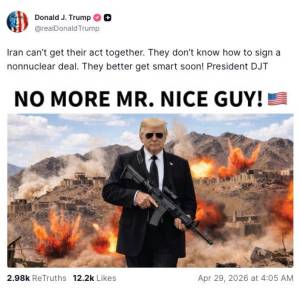
President Trump posted the self-portrait above illustrating his aggressive attitude, a frequent theme on his Truth Social website (April 29, 2026).
July 13, 2026. The permanent fence around Lafayette Square isn't just about security. It's the latest warning that oligarchy is preparing to defend itself from democracy…Friday afternoon the Trump administration released a formal proposal to ring Lafayette Square with a permanent fence up to ten feet tall and to install gates across Pennsylvania Avenue at 15th and 17th Streets, all of it designed so officials can seal off America’s most famous protest ground within minutes.News Roundups
July 13, 2026. It has been another extraordinary day of news. A second fatal ICE-involved shooting in America has now occurred, this time in Maine, and the videos emerging from the scene are deeply disturbing. Large protests have erupted as outrage grows. In Minnesota, state officials say they have finally obtained key evidence from the federal government as they investigate the ICE officers involved in the deaths of Alex Pretti and Renee Good. MeidasTouch Network, Monday Afternoon News Updates: Trump's Desperate Iran Plot, Another ICE Shooting, a Major Court Loss + More, Ben Meiselas, right,July 13, 2026. Here’s what we’re tracking today:He also posted a bizarre tribute to Lindsey Graham. Questions continue to swirl around Mitch McConnell’s health, with few in either party convinced by the recently released “proof of life” photo. And another ICE-related shooting has now occurred, this time in Maine.
Trump Team Opressions, Obsessions, Corruption
right, July 13, 2026. 'How big money trumps the people’s will — and how to reclaim democracy. I’ve written on a number of occasions about what I called, in yesterday’s primer, the downward spiral of oligarchy in America: The political power of the hyper-wealthy tilts policy in their favor, and this policy tilt reinforces the wealth and power of that tiny minority. In today’s post I’ll follow up by focusing on one especially clear example: The drastic fall over time in taxes on corporate profits, despite overwhelming popular opinion that corporate taxes are too low, not too high.July 13, 2026. Continued from above: The wholly-owned toadies on the Supreme Court have spent the last half-century legalizing the purchase of the American government, a story I tell at length in my new book "Who Killed the American Dream?" In 2024, the Court’s six corrupt Republicans ruled in Snyder v. United States that officials who take payments after performing favors have merely accepted legal “gratuities” rather than bribes. Yeah, billionaires can now legally give tips to judges and politicians.More On Iran War
U.S. Courts, Law, Crime, Immigration, Rights, Justice
July 13, 2026. A year ago, on July 17, 2025, Deputy Attorney General Todd Blanche hurried to an emergency evening meeting in the White House Situation Room with his fellow Trump administration apparatchiks. Its location might suggest it had to do with national security. It didn’t. It was about the political security of Donald Trump.Emptywheel, Analysis: Trump Fired Pam Bondi the Day After DOJ Agreed to Share Epstein Files with New Mexico, Emptywheel (Marcy Wheeler, right), July 13, 2026.Todd Blanche’s confirmation hearing in the Senate Judiciary Committee will take place on Wednesday and Thursday.More On U.S. Health, Governance
July 13, 2026. The United States is currently in the grip of an outbreak of the Cyclospora parasite, which causes severe diarrhea and has sickened more than 3,000 people across the U.S. Last August, Aria Bendix of NBC News reported that on July 1, 2025, the Centers for Disease Control and Prevention (CDC), overseen by Health and Human Services Secretary Robert F. Kennedy Jr., would no longer track infections caused by cyclospora and five other common causes of foodborne illnesses.July 13, 2026. The administration quietly delivers a huge win to corporate poultry processors, who have donated tens of millions to Trump and his allies, at the expense of family farmers.More On U.S. Elections, Politics
July 13, 2026. Democrats’ successes should not be ignored; plus a note on Senator Lindsey Graham. Sen. Lindsey Graham (R-SC) passed away suddenly Saturday night from an apparent tear in his aorta. Unfortunately, Senate colleagues and most legacy media outlets are avoiding the hard reckoning he deserves. Few American politicians have been as disastrously wrong in their advocacy for regime change in the Middle East, not just once but twice, or in their indulgence in an Israeli right-wing government that took Israel (and in turn, U.S. policy) down a morally abhorrent road of domestic reprehension of Palestinians. He supported authoritarian rule in derogation of Israel’s professed democratic values and reckless violence aimed at the utterly unattainable goal of obliterating military threats to Israel’s survival at the expense of attainable diplomatic solutions.More On U.S. Sen. Lindsey Graham's Death
More Global News
New York Times, A Robot Army Remakes Ground Warfare in Ukraine, Maria Varenikova, July 13, 2026. They began as supply mules. Now ground robots evacuate the wounded, hold trenches and even do the killing.Top Stories
President Trump posted the self-portrait above illustrating his aggressive attitude, a frequent theme on his Truth Social website (April 29, 2026).
The Hartmann Report, Opinion and Advocacy: The Oligarch's Warning: This Fall, America Decides Which of Russia's Four Futures to Follow, Thom Hartmann, right, July 13, 2026. The permanent fence around Lafayette Square isn't just about security. It's the latest warning that oligarchy is preparing to defend itself from democracy…
Friday afternoon the Trump administration released a formal proposal to ring Lafayette Square with a permanent fence up to ten feet tall and to install gates across Pennsylvania Avenue at 15th and 17th Streets, all of it designed so officials can seal off America’s most famous protest ground within minutes.
Congresswoman Eleanor Holmes Norton had already introduced legislation to stop Trump, warning that we shouldn’t leave “citizens peering at their democracy from behind permanent fences.”
Lafayette Square is where Alice Paul and her Silent Sentinels stood through freezing winters demanding that Woodrow Wilson support women’s suffrage, and where peaceful protesters were gassed and beaten in June of 2020 so Donald Trump could stroll across the park for a photo op, Bible in hand.
For over two centuries, every president since John Adams has had to look out his window at Americans exercising their First Amendment right to tell him exactly what they think of him.
This administration proposes to end that tradition with steel pickets spaced four inches apart, and to have the whole apparatus ready as we head toward a November election that could break the GOP’s grip on Congress or see open corruption of our election by Trump’s goons, which would inevitably lead to mass protests.
Governments that trust their own people don’t wall themselves off from them; fortress states do.
And by a remarkable coincidence, this was the same week that one of the richest men in Russia gave the world a sixty-hour guided tour of life inside a mature fortress state, along with a warning about where that road ends that every American should know about.
The Economist just published an extraordinary profile of Andrey Melnichenko, whose fertilizer, coal, energy, and logistics empire accounts for roughly one full percent of Russia’s entire GDP, and who was the richest man in the country when Putin invaded Ukraine.
For twenty years Melnichenko lived the bargain Putin offered Russia’s oligarchs: stay out of politics and you can keep your fortune, your yacht, your villa in Switzerland. Then came the Ukraine war, the sanctions, and finally the shakedown.
In 2023, Putin’s prosecutors moved to confiscate one of Melnichenko’s Siberian power companies, and the case quietly evaporated two weeks later, right after he donated 32 billion rubles, about $335 million, to a school for gifted children that operates under Putin’s personal patronage.
In a fully realized oligarchy — like Putin has established in Russia and Trump is trying to create here with pardons and government contracts essentially for sale — that’s what legal property rights become: a subscription service, renewable at the pleasure of the man at the top.
Melnichenko told The Economist that he can see only four possible futures for Russia if it stays on the current course Putin is pursuing, every one of them grim:
— It can crawl back to a victorious West as a defeated vassal, which he predicts would provoke the same revanchist rage that the Versailles treaty incubated in Germany a century ago and that led straight to World War II.— It can settle permanently into China’s orbit as a resource colony with a flag and faint appearance of independence.— It can fragment into civil conflict, with warlords fighting over the pieces of a nuclear-armed state.— Or it can finish its transformation into a continental North Korea, a garrison society sustained by rationing, repression, isolation, and what he describes as turning “external confrontation into a permanent instrument of domestic politics.”
That fourth scenario, which he says is under serious discussion inside the Kremlin, describes a government that identifies permanent enemies abroad and at home to justify permanent repression of its own citizens.
Anyone who’s watched masked federal agents disappearing people off American streets, or read this administration’s directives treating its domestic political opposition as a terrorist threat, or looked at the blueprints for that fence around Lafayette Square, has seen the early architecture of exactly that.
And Melnichenko’s preferred alternative for Russia against these four possibilities? He names it, with a candor you rarely hear from men of his class, as “oligarchy in the classical sense of the word.”
Rule by elites. Businessmen, technocrats, and nationalists would govern the country together, cutting deals among themselves because the four alternatives threaten their fortunes and their family dynasties, while ordinary Russians continue receiving what he frankly admits has so far been “a simulation of participation.”
Surprised that a billionaire’s best imaginable future for his nation is rule by billionaires?
Ours have been saying the same thing out loud for years about America. Peter Thiel, the money behind JD Vance’s entire political career, wrote for the Cato Institute back in 2009 that “I no longer believe that freedom and democracy are compatible,” and he and many of his morbidly rich colleagues have spent the years since funding politicians and projects built explicitly to act on that conviction. (Column continued below in section "Trump Team Oppressions, Obsessions, Corruption."
New York Times, Times Exclusive: Inside Israel’s Secret Operation to Cultivate Ahmadinejad, Mark Mazzetti, Julian E. Barnes, Farnaz Fassihi and Ronen Bergman, July 13, 2026. The yearslong effort to groom the former Iranian president as an intelligence asset culminated in a dramatic effort to take him to an Israeli safe house in the early days of the war. But the plan fell apart.
In early 2024, the rector of a university in Budapest received a startling request from a top Hungarian government official.
The official told the rector, Professor Gergely Deli, that Ludovika University of Public Service should hold a climate change conference and extend an invitation to an unlikely guest: Mahmoud Ahmadinejad, the widely reviled former president of Iran.
Even more shocking was the reason. The official told Mr. Deli that the conference was merely a front for Mr. Ahmadinejad to have secret discussions in Budapest with intelligence operatives from Israel, Mr. Ahmadinejad’s avowed enemy.
Mr. Deli knew that the invitation could tarnish both his own reputation and that of the university. But, he said in an interview, he believed he might be playing a role in saving lives.
“You have two enemies, and if these enemies want to talk with each other, then it’s best to do what you can to make them talk,” he said.
Mr. Ahmadinejad’s 2024 visit to the university and a second one the following year were part of a yearslong Israeli effort to groom him as an intelligence asset who, when the time came, could be installed as Iran’s new leader, according to both American and Iranian officials familiar with the operation, who spoke on the condition of anonymity to describe sensitive intelligence.
Recruiting Mr. Ahmadinejad was of such priority for Israel that the country’s then-spy chief David Barnea even traveled to the Hungarian capital in 2024 to meet with Mr. Ahmadinejad personally, according to former American officials. Soon afterward, they said, Mossad, Israel’s foreign intelligence service, notified the C.I.A. that it had been in contact with Mr. Ahmadinejad.
Israel’s decision to build a regime-change plan around Mr. Ahmadinejad is an extraordinary twist in the saga of the country’s relations with the former president, who was known for accelerating Iran’s nuclear program, calling regularly for the destruction of Israel and denying the Holocaust.
In recent years, according to American officials, Israel secretly paid money to Mr. Ahmadinejad for housing and travel, and Israeli operatives met him abroad on several occasions, including during his trips to Budapest.The effort culminated in late February of this year — during the first days of the U.S.-Israeli war on Iran — with an audacious operation to relocate the former leader, who had been living under strict surveillance in Tehran. The goal: to set in motion the plan to topple the current regime and install Mr. Ahmadinejad.
The plan failed.
On Feb. 28, an Israeli airstrike hit Mr. Ahmadinejad’s compound, targeting the building of his bodyguards and his armored vehicle. After the strike, according to four senior Iranian officials, a black Peugeot car arrived, picked up Mr. Ahmadinejad and whisked him away at high speed from the chaotic scene.
American and Iranian officials with knowledge of the operation said the car had been driven by Mossad operatives, who took Mr. Ahmadinejad to a secret safe house in Iran.Want to stay updated on what’s happening in Central America, Eastern Europe and the Middle East? Sign up for Your Places: Global Update, and we’ll send our latest coverage to your inbox.
But the former Iranian leader was upset about the frantic rescue operation, and he appeared to be disillusioned about the Israeli plan to return him to power, according to people with knowledge of what occurred.
He eventually left the safe house under circumstances that are still unclear. Mr. Ahmadinejad was not seen in public again until last Monday, when he made a brief appearance at the funeral procession for the slain supreme leader Ayatollah Ali Khamenei.
His current status remains uncertain. But four senior Iranian officials said that Mr. Ahmadinejad was in the custody of the Islamic Revolutionary Guard Corps’ intelligence wing, under house arrest now that Iran has learned about much of his interactions with Israel.
News Roundups
The Parnas Perspective, Evening News Update, Major Epstein News, ICE Kills Man Who Was Not Their Target, Trump Calls for Arrests of Socialists and Launches 'New' War, Aaron Parnas, right, July 13, 2026. It has been another extraordinary day of news. A second fatal ICE-involved shooting in America has now occurred, this time in Maine, and the videos emerging from the scene are deeply disturbing. Large protests have erupted as outrage grows. In Minnesota, state officials say they have finally obtained key evidence from the federal government as they investigate the ICE officers involved in the deaths of Alex Pretti and Renee Good.
Meanwhile, President Trump has formally declared what the White House describes as a new war with Iran and says the United States will intensify its bombing campaign. He also shared a video calling for the arrest and deportation of democratic socialists, including Sen. Bernie Sanders.
Here’s what you missed:
I have an exclusive Epstein PSA released by survivors ahead of Todd Blanche’s confirmation hearing.
Maine ICE Shooting:
An ICE agent fatally shot a 26-year-old Colombian man during an immigration enforcement operation in Biddeford after authorities say he attempted to flee in a vehicle “in the direction of the officer.” According to the Maine Attorney General’s Office, agents were carrying out an operation tied to a final order of removal when the shooting occurred shortly before 7:20 a.m. Monday. The victim was identified by immigration advocates as someone who was authorized to work in the United States. The Maine Attorney General is investigating the use of deadly force, while ICE and the Department of Homeland Security have released few details about the incident. Video footage was released by the Portland Press Herald this afternoon:
Witnesses described a chaotic and traumatic scene, including seeing the victim bleeding from the head after he was shot. Neighbors said the man’s family, including his 3-year-old daughter, arrived at the scene shortly afterward, adding to the emotional impact of the incident. Border Patrol said it was not involved in the enforcement operation but did offer medical assistance, which was ultimately not needed. Lawmakers, including Sen. Angus King and Rep. Chellie Pingree, said they have received little information from federal agencies and believe the agents involved were not wearing body cameras. More disturbing video from ScopeReport was released showing agents handcuffing the body of the man after killing him:
The shooting sparked protests across Biddeford and intensified demands for transparency and accountability. Sen. Angus King said the FBI is expected to investigate the shooting, while Biddeford Mayor Liam LaFountain said the victim’s family deserves compassion and a full explanation of what happened. Protesters gathered outside Sen. Susan Collins’ Biddeford office, and demonstrations continued throughout the day as community members called for answers. Residents also said they had noticed an increase in ICE activity in the area in recent weeks.
The fatal shooting has quickly become a flashpoint in Maine’s debate over immigration enforcement. Former Maine CDC Director Nirav Shah said he would oppose additional funding for ICE until the agency is reformed, even if it meant risking a government shutdown. Former Gov. Paul LePage urged the public to remain calm and allow investigators to complete a full and fair investigation before reaching conclusions. With multiple investigations now underway, state and federal officials are facing mounting pressure to release more information about one of the state’s highest-profile immigration enforcement incidents in recent years.
Trump’s Address to Nation:
Trump's Thursday speech is expected to focus on newly declassified intelligence reports that the White House says reveal plans by foreign nations to interfere in the 2020 election, according to two White House officials who spoke to MS NOW.
The Trump administration is expected to begin releasing classified intelligence and law enforcement documents related to the 2020 election as part of a new White House task force reviewing claims of election irregularities. The report says the effort is part of a broader push that includes Justice Department warnings to election officials, expanded federal election monitoring, and new FEMA requirements tied to election administration ahead of the midterms. Election experts and voting rights advocates warn the actions could undermine public confidence in elections and raise concerns about potential federal interference in state-run voting processes. State and local officials are reportedly being urged to prepare legal responses to any attempts by federal authorities to seize election materials or disrupt voting operations.
Iran:
According to a letter obtained by Politico, Trump has formally notified Congress that the United States has entered a “new” war with Iran, triggering a new 60-day War Powers clock that allows military operations to continue without congressional authorization. In a July 10 letter, Trump said the renewed conflict began with U.S. strikes on July 7 and that American forces remain prepared to take additional military action as needed. The announcement follows Trump's declaration that the ceasefire with Iran is over, as fighting intensifies around the Strait of Hormuz, where U.S. forces have struck more than 300 Iranian military targets in the past week. The move is expected to reignite congressional battles over presidential war powers after bipartisan majorities in both the House and Senate previously voted to oppose continued military action without explicit approval from Congress.
Trump said the United States will intensify its military campaign against Iran, declaring, “We’re gonna hit ‘em very hard tonight and we’re gonna hit ‘em hard tomorrow.” He added that Iran has no meaningful ability to respond, saying, “There’s not a damn thing they can do about it. They have nothing going other than they have big mouths.” The remarks signal an escalation in U.S. military operations as the renewed conflict with Iran continues.
Trump announced that the United States will become the "guardian of the Strait of Hormuz," saying the U.S. would protect the vital shipping lane while charging a 20% fee on cargo passing through it as reimbursement for providing security. The proposal marks a dramatic shift in U.S. policy and comes after renewed military exchanges between the United States and Iran ended a short-lived ceasefire. Trump's plan appears to conflict with longstanding international maritime law, as Secretary of State Marco Rubio previously acknowledged that no country can legally impose tolls on an international waterway like the Strait of Hormuz. The administration has not yet explained how such a policy would be implemented or enforced, raising significant legal and geopolitical questions.
U.S. Central Command announced that it will resume blockading maritime traffic entering and leaving Iranian ports at 4 p.m. ET on July 14. The renewed operation comes after the collapse of a memorandum of understanding that had temporarily halted the blockade. The agreement lasted less than a month before military tensions between the United States and Iran escalated again. The move signals a return to direct efforts to restrict Iranian maritime commerce as the conflict continues to intensify.
U.S. Central Command released footage showing Corsair sea drones striking an Iranian submarine facility and shipyard at Bandar Abbas as part of a broader campaign targeting more than 300 Iranian military sites since July 7. The operations, ordered by President Trump, have involved fighter jets, naval vessels, and one-way drones aimed at degrading Iran's ability to threaten commercial shipping through the Strait of Hormuz. Iran has responded by launching missile attacks on U.S. military sites across the region, while global oil prices climbed to about $79 a barrel amid concerns over disruptions to a waterway that handles roughly 20% of the world's oil supply. Despite ongoing diplomatic efforts to restore a ceasefire, both sides continue to accuse each other of violating previous agreements.
Other news:
Republican Ron Johnson says that the picture Mitch McConnell’s office released was an “old image.”
Trump shared a video on Truth Social calling for the criminalization of democratic socialism and the arrest and deportation of its leaders. The video, featuring conservative commentator Michael Savage, specifically targeted Sen. Bernie Sanders, New York City Mayor Zohran Mamdani, Sen. Elizabeth Warren, and the Democratic Socialists of America. Savage urged reviving the House Un-American Activities Committee and called for hearings followed by arrests and deportations, describing democratic socialism as a threat that "must be criminalized." Trump reposted the video without adding any comment, amplifying its message to his followers.
Crews have drained the Lincoln Memorial Reflecting Pool in Washington, D.C., to carry out sealant repairs, exposing the basin floor and liner as Atlantic Industrial Coating works on the project. On-site photos and observations show no visible 350-foot gash or other major damage matching former President Donald Trump’s claims about the pool. Instead, the liner appears to have problems including flaking “American Flag Blue” paint, air bubbles, and large creases, raising questions about the quality of the installation. The repairs come after repeated issues delayed completion of the high-profile renovation.
Nearly 20 FBI agents were seen entering Sen. Lindsey Graham's Capitol Hill residence Monday afternoon, alongside U.S. Capitol Police, according to NBC News. Two law enforcement sources said federal authorities are continuing to investigate Graham's death out of an abundance of caution, which is standard in the case of a sitting U.S. senator. The sources emphasized there is no new evidence suggesting foul play since Graham died Saturday night, and investigators have not indicated any change to the initial assessment of his death.
South Carolina Gov. Henry McMaster has appointed Darline Graham Nordone, the sister of the late Sen. Lindsey Graham, to serve the remainder of his Senate term through January. Nordone, who helped raise Graham after their parents died and frequently appeared alongside him during his political career, is expected to be sworn in Wednesday and will become the first woman to represent South Carolina in the U.S. Senate.
Flowers, handwritten notes, and other tributes have been placed outside Sen. Lindsey Graham’s Capitol Hill office as lawmakers, staff, and members of the public continue to mourn his death. The memorial has grown throughout the day, reflecting bipartisan expressions of respect for the longtime South Carolina senator and his decades of service in Congress.
A cyclospora outbreak has sickened more than 3,000 people in Michigan and Ohio, with dozens hospitalized, while additional cases have been reported across at least 31 states. Health officials have not yet identified the source, saying the investigation is complicated because symptoms often appear days after exposure and the parasite is difficult to detect and trace. Experts also warn that recent reductions in federal foodborne illness surveillance have slowed efforts to identify outbreaks and link cases. Officials say there is no nationwide food recall at this time and are urging people to wash produce thoroughly and follow food safety precautions while investigators continue searching for the source.
 Minnesota prosecutors say they have finally obtained key evidence in their investigations into the fatal shootings of protesters Renee Good and Alex Pretti, shown above, as well as the shooting of Julio Sosa-Celis, after federal officials had withheld it for months. The newly released materials include police body camera footage, witness statements, hard drives, physical evidence, and Good’s vehicle, allowing investigators to conduct a full review of the cases. Hennepin County Attorney Mary Moriarty said the evidence is critical for ensuring transparency and accountability, calling cooperation from federal authorities essential. Minnesota Attorney General Keith Ellison criticized the federal government for delaying access to the evidence for more than six months, saying it should never have taken that long for state investigators to obtain materials needed for their investigation.
Ukraine and 10 allied countries announced a new Integrated Anti-Ballistic Missile Coalition to jointly develop a European-backed missile defense system designed to complement existing air defenses and provide a lower-cost alternative to the U.S. Patriot system. The initiative comes as Russia intensifies ballistic missile attacks on Ukraine, leaving Kyiv critically short of interceptor missiles and increasing pressure on allies to bolster air defenses. Leaders meeting in Paris also discussed securing additional Patriot interceptors, expanding deployment of the Franco-Italian SAMP-T system, increasing sanctions on Russia, and targeting Moscow’s “shadow fleet” used to export sanctioned oil. The coalition additionally announced plans for joint military exercises and continued work on long-term security guarantees for Ukraine as part of broader efforts to strengthen Europe’s collective defense.
MeidasTouch Network, Monday Afternoon News Updates: Trump's Desperate Iran Plot, Another ICE Shooting, a Major Court Loss + More, Ben Meiselas, right, July 13, 2026. Here’s what we’re tracking today:
 Marco Rubio announces a campaign to dismantle the International Criminal Court
“The Guardian of the Strait”
Donald Trump announced this morning that the United States is going to “run” the Strait of Hormuz and charge every ship passing through a fee equal to 20% of its cargo. He’s calling the US the “Guardian of the Hormuz Strait,” in all caps.
Let’s be honest about what this is. The entire justification for this war was supposedly Iran’s nuclear program. Then it became regime change. Now the stated goal is apparently just seizing and monetizing an international waterway. That’s an admission that the mission has completely collapsed into something else.
Because here’s the truth. Iran is not backing down, the Strait is functionally closed right now, and the US Strategic Petroleum Reserve is creeping toward the exact level that used to be considered the point of no return. If that threshold gets crossed, there’s no longer a safety net between the American economy and total shock.
So Trump goes on Fox and gets asked about all this, and instead of addressing any of it, he starts talking about how “we’ll be reimbursed” and “we’re gonna get paid.” It;s “Mexico will pay for the wall” all over again.
Then he pivots to attacking Barack Obama, implying without quite saying it that Obama “sided with Iran” because of his faith, resurfacing the conspiracy theories he has pushed since day one.
Strikes, Counterstrikes, and a Region on Fire
Overnight, US forces hit Iran’s largest petrochemical hub in Mahshahr, in Khuzestan province, which is Iran’s main oil producing region. A water pumping station in the same area was also struck, killing one person and injuring four, according to local officials. This was the third round of US strikes in roughly 24 hours, and Iran’s response to the previous round had already been the largest in months.
Iran’s IRGC claims it hit back in phases. First, targeting fuel and munitions storage at a base in Jordan. Then hitting facilities at a US airbase in Bahrain, including a hangar reportedly housing a surveillance aircraft. Then striking fuel tanks and air defense systems at bases in Kuwait. We are awaiting full confirmation on all of this. But footage did show smoke rising over the US Navy’s Fifth Fleet headquarters in Bahrain, and Jordan suspended flights out of Amman after strikes reportedly hit an airbase there.
Meanwhile satellite trackers spotted something worth watching closely. A US Special Forces support ship called the Ocean Trader was found sitting at a port in Oman that Iran struck just days earlier. The aircraft carrier USS Abraham Lincoln has been tracked moving north in the Gulf of Oman without visible escort, well within range of Iranian missiles. And multiple Russian government aircraft, the kind normally used for top officials, have been flying from Moscow to Tehran. Add in a retired CENTCOM commander going on CBS to argue the US should consider seizing Iran’s Kharg Island as leverage in future negotiations, and you start to see the outline of something much bigger than airstrikes being floated.
The region is already spilling over. An Iranian plane carrying a Houthi delegation was blocked from landing in Yemen by Saudi airstrikes and had to divert. A suspected Iranian drone was spotted over Basra, possibly headed toward Kuwait. This is not staying contained.Oil Is Spiking and the Safety Net Is Almost Gone
US crude jumped nearly 5% today after Iran again declared the Strait closed, with prices near $75 a barrel. The Strategic Petroleum Reserve is reportedly within striking distance of the level considered the floor for emergency operations. Once that cushion is gone, there’s nothing left to absorb a real supply shock. And yet Trump posted this morning that his approval rating is at 59% and that gas prices are falling, both of which massive lies.Rubio Declares War on the World Court
Marco Rubio published an op-ed in the Wall Street Journal titled “Why We’re Dismantling the ICC,” arguing the court poses an existential threat to American sovereignty and could go after US military and law enforcement personnel. He accompanied it with a video framing the court as an unelected global tribunal trying to seize control of American law. This comes as the Trump regime faces growing scrutiny over its military conduct abroad and its immigration enforcement at home, and going after the institution that investigates war crimes while you’re actively expanding a war is not exactly subtle. They are terrified of real consequences when they are out of office. Rubio’s attacks on the ICC feel more like an admission of guilt than anything.Political Updates Surrounding Lindsey Graham’s Death
Trump is publicly pushing South Carolina’s governor to appoint Lindsey Graham’s sister, Darline, to fill his Senate seat, and reporting suggests that appointment is likely to happen. Governor of South Carolina Henry McMaster is holding an event later today to announce his pick to fill the seat temporarily. A special election for the permanent replacement will occur in August. McMaster is expected to select Trump’s choice of Graham’s sister.
A Judge Torches Trump’s Own IRS Lawsuit
A federal judge in Florida issued a scorching ruling against Trump’s lawsuit involving his own IRS and a so-called “Anti-Weaponization Fund” settlement, finding the whole arrangement was cooked up for the appearance of legitimacy rather than any real legal dispute. The judge pointed directly at the fact that Trump’s own former lawyers, now running the Justice Department, negotiated a settlement with Trump’s current lawyers, meaning there was never any actual adversity between the two sides to begin with. She’s opened the door to possible sanctions and bar discipline for the attorneys involved. Read more at Meidas News.Another ICE Killing and More Domestic News
In Biddeford, Maine, a man was shot and killed by ICE agents Monday morning. Immigrant rights groups identified him as a 26-year-old Colombian man who was authorized to work in the US. Witnesses described a chaotic scene, a car spinning out of control in an intersection, agents pulling the driver out, and no one immediately going to help him as he lay in the street. One witness said she watched him bleed out and heard him say he was trying to stop. ICE is again claiming the man tried to run them over in his car. Thus far, witness accounts and video contradict their story. Protests are already underway in Maine.
Senator Adam Schiff’s office uncovered new contracts showing even more taxpayer money went toward giant Trump banners on federal buildings in Washington, including a nearly $39,000 Interior Department contract and a $114,000 FAA contract. Schiff called it propaganda paid for by the public and argued it violates long-standing restrictions on using tax dollars to glorify a sitting president.
In a written statement accompanied by a new photo, Mitch McConnell’s office yesterday released a statement attributed to their boss, which says he was “briefly unconscious” after his fall last month but did not suffer a heart attack or stroke. McConnell says he’s now recovering in a rehabilitation center after also developing pneumonia and won’t return to the Senate floor until doctors clear him. Though the photo of McConnell includes a newspaper with yesterday’s date, many folks still aren’t buying the story being presented by his team.ImageDemocrats Making Moves
Governor Gavin Newsom signed legislation creating a $3,500 instant rebate for Californians buying their first electric vehicle, explicitly filling the gap left after Trump and Republicans killed the federal EV tax credit. He also signed a bill extending California’s CalCompetes business incentive program, which has already delivered over $1.8 billion in tax credits tied to tens of billions in investment and tens of thousands of jobs.
Newsom also made an announcement earlier to cut red tape in the state in order to build more housing.
Pete Buttigieg keynoted the Iowa Democratic Party’s annual dinner over the weekend, making the case for building a broader coalition rather than just talking to people who already agree, and tying pocketbook issues like diesel prices directly to the health of democracy itself.Twelve States Sue to Block a Media Mega-Merger
A coalition of a dozen Democratic-led states filed suit to block Paramount’s $111 billion acquisition of Warner Bros. Discovery, arguing it would hand one company, run by David Ellison, control over two news networks, two major studios, and two streaming services, while giving four companies control of more than 90% of top-grossing films. California’s attorney general is leading the effort and warning it would mean higher prices and less content for everyone from moviegoers to cable subscribers. Paramount says the deal raises no real antitrust concerns and plans to fight the suit.
That’s where things stand as of Monday afternoon. Let me know what you think in the comments, and thanks for spreading the word.
New York Times, Live Updates: Judge Says President’s Lawsuit With I.R.S. Was Self-Dealing, Andrew Duehren and Alan Feuer, July 13, 2026. What We’re Covering Today.
A judge issued a scathing ruling over Trump’s deal with the I.R.S.
A federal judge on Monday ruled that President Trump’s lawsuit against the Internal Revenue Service was an improper exercise in self-dealing and barred him from claiming that the extraordinary tax protections he received were part of a legitimate settlement agreement.
In the order, the judge, Kathleen M. Williams, also referred the lawyer who brought Mr. Trump’s case against the I.R.S. to the Florida bar for potential disciplinary proceedings. Judge Williams added that she would forward her decision to the New York bar, which is already investigating the acting attorney general, Todd Blanche.
The decision by the Judge Williams did not explicitly kill the deal that Mr. Trump had worked out with his own government to receive what amounted to amnesty from investigations into tax returns that he, his family and their businesses have already filed. But Judge Williams’s scathing ruling exposed the negotiations between Mr. Trump’s personal lawyers and senior officials at the Justice Department he controls for what she says they were: backroom dealings that did not arise from a legitimate legal process.
“The nature of the suit itself and the conduct of the parties and counsel from its filing make plain that this was an attempt to use the court to provide some legitimacy to an agreement to confer immunity to people and entities affiliated with the president and to earmark billions of dollars from American taxpayers to redress grievances not defined in the law,” the judge wrote.
The 56-page decision, issued in Federal District Court in Miami, came two months after the Justice Department released a pair of documents purporting to be formal agreements that settled Mr. Trump’s remarkable suit against the I.R.S. The documents laid out a pair of separate but shocking moves — one granting the president, his family and his businesses wide-ranging immunity from tax inquiries and the other creating a $1.8 billion fund aimed at compensating allies of Mr. Trump who say they were the victims of so-called government weaponization.
After outcry from Republicans on Capitol Hill, the acting attorney general, Todd Blanche, said the Justice Department would not move forward with the fund. But he said that Mr. Trump’s extraordinary protections from I.R.S. scrutiny would remain in place.
From the outset, Judge Williams, the Obama appointee who released the 56-page ruling in Federal District Court in Miami, had profound questions about the president’s suit. Because Trump was seeking damages from a part of the federal government that he controlled, the judge was concerned that he was effectively suing himself and was on both sides of the case.
The judge, Kathleen M. Williams, also referred the lawyer who brought President Trump’s case against the I.R.S. to the Florida bar for potential disciplinary proceedings. She added that she would forward her decision to the New York bar, which is already investigating the acting attorney general, Todd Blanche.
The agreement with the I.R.S. included a provision that gave President Trump, his family and his businesses potentially lucrative protection from agency investigations. In June, the acting attorney general, Todd Blanche, said the Justice Department stood by the provision.
The Parnas Perspective, Morning News and Commentary: Monday Update: Congress is Frozen as it Returns to DC, Another ICE Shooting, Trump Takes Over Strait, McConnell Health Questions, Aaron Parnas, right, July 13, 2026. Congress is back in session, with hearings on the Epstein files, the Supreme Court, and a renewed push to pass the SAVE Act. And right now, it is completely frozen.
Meanwhile, President Trump says the United States is taking over the Strait of Hormuz as the conflict with Iran escalates. He also posted a bizarre tribute to Lindsey Graham. Questions continue to swirl around Mitch McConnell’s health, with few in either party convinced by the recently released “proof of life” photo. And another ICE-related shooting has now occurred, this time in Maine.
I’ll be bringing you real-time updates throughout the week. We have interviews lined up with governors, Hakeem Jeffries, Epstein survivors, members of Congress, and more. Our next paid subscriber live event will be Wednesday evening at 7:45 p.m. ET, immediately following Todd Blanche’s confirmation hearing.
To say this will be a busy week is an understatement. If you want to support my live reporting, keep me caffeinated, and help independent journalism continue to grow, please subscribe or upgrade your subscription today. Your support makes this work possible, especially at a time when independent media is under increasing pressure.Subscribed
Here’s the news:
Congress returns to Session:
Congress returns to Washington this week as Senate Republicans scramble to replace the late Sen. Lindsey Graham, whose death has complicated the GOP’s legislative agenda. South Carolina Gov. Henry McMaster is expected to appoint an interim senator within days, with a special Republican primary scheduled for Aug. 11 to choose a nominee for the November election. Graham’s death also leaves Republicans down a key vote as they try to advance President Trump’s priorities, including a major reconciliation package, while Senate Budget Committee leadership is in transition. Combined with Sen. Mitch McConnell’s continued absence due to his month-long hospitalization, Republicans are effectively operating with two fewer senators as they try to move legislation through the chamber.
The Senate Judiciary Committee has scheduled two days of confirmation hearings this week for acting Attorney General Todd Blanche, though it remains unclear whether the death of committee member Sen. Lindsey Graham will affect the process. Meanwhile, the Senate Intelligence Committee has announced that the confirmation process for Clayton is back on track.
Republicans in both the House and Senate remain divided over President Trump’s renewed push for the SAVE America Act, which would restrict mail-in voting and impose new nationwide election rules. While the House previously passed the measure largely along party lines, it currently has no viable path through the Senate because of unified Democratic opposition and resistance from some Republicans.
Supreme Court Justices Amy Coney Barrett and Elena Kagan are scheduled to testify before Congress this week as the federal judiciary seeks nearly $9.7 billion in funding, including a significant increase for judicial security following a rise in threats against judges. Barrett is expected to speak from personal experience after multiple security incidents, including a swatting attempt at her home earlier this year and other threats targeting her family. Although the hearings are focused on the judiciary's budget, lawmakers are also expected to question the justices about ethics, court leaks, prediction markets, and recent Supreme Court rulings. Barrett could face scrutiny over her votes joining the majority in cases rejecting President Trump's attempts to end birthright citizenship and impose broad tariffs, decisions that have drawn criticism from some conservatives despite her generally conservative voting record.
Speaker Mike Johnson and House Budget Committee Republicans reportedly spent the weekend at Camp David trying to finalize a reconciliation package but left without reaching an agreement, according to Politico. Johnson and NRCC Chair Richard Hudson are expected to meet with President Trump at the White House today as negotiations continue. The talks have become even more complicated following the sudden death of Senate Budget Committee Chair Lindsey Graham, who had been leading the bill’s path through the Senate.
Sen. Elizabeth Warren has reportedly asked JPMorgan Chase CEO Jamie Dimon to explain the bank’s relationship with Jeffrey Epstein and detail his own knowledge of those ties. According to the Financial Times, Warren also asked whether Dimon sought advice from Epstein while lobbying against a U.K. tax on banker bonuses. The request comes as scrutiny of Epstein’s financial and political connections continues to intensify.
Trump posted, what many have called, a “bizarre” tribute to Sen. Lindsey Graham on Truth Social alongside a photo of himself wearing a "Make Iran Great Again" hat and holding a mock Wikipedia page labeling him the "Acting President of Venezuela," a reference to January's U.S. operation that captured Nicolás Maduro.
Trump reflected on his relationship with the late Sen. Lindsey Graham, saying Graham's only real misstep was his criticism after January 6. Trump recalled Graham later called him and said, "Did I really say that? I can't believe it," before taking it back, adding, "So I give him a 99.9 instead of 100."
South Carolina Gov. Henry McMaster now faces a pivotal decision after Sen. Lindsey Graham's death, as he will appoint an interim senator to serve until January while Republicans hold a special primary on Aug. 11 to choose a nominee for the November election. The compressed timeline favors well-known Republican candidates with strong political networks, and the eventual nominee will face Democratic candidate Annie Andrews, though the GOP remains heavily favored in the deep-red state. Rep. Joe Wilson has already expressed interest in the seat and is viewed as one of the potential contenders.
Iran News:
President Trump said the United States intends to maintain control over the Strait of Hormuz following recent military operations, declaring, "We're gonna keep the strait, and we'll probably run it. We'll become the guardian of the strait." He added that the U.S. should be compensated for that role, saying, "We should be reimbursed for that. When we do that, we're gonna be reimbursed. We're gonna get paid."
Donald Trump was on the verge of making more racist remarks about President Obama, but caught himself briefly. Trump criticized Obama over Iran, saying, "Obama was the worst of all because Obama actually went to their side," before cutting himself off and adding, "because, you know, he's a... well, let's not say. Let's leave that for another time."
Mitch McConnell
Senator Mitch McConnell’s office released the first photo of him since his June 14 hospitalization, along with a statement saying he was briefly unconscious after a fall but did not suffer a heart attack or stroke. The statement said he later developed a mild case of pneumonia, has been transferred to a rehabilitation center, and is continuing to recover. Despite the update, several individuals on the right and the left questioned the authenticity of the photo and statement, arguing that only an unedited video would prove McConnell’s condition. Some also cited previously reported emergency dispatch audio referencing CPR and accused his office of withholding information.
Kentucky Gov. Andy Beshear says he is “concerned” about Sen. Mitch McConnell’s month-long hospitalization, arguing that while elected officials deserve medical privacy, they also have a responsibility to keep the public informed. “If you’re in the hospital for an entire month, you owe it to the people who elected you to give them an update,” Beshear said.
Other news:
One person is dead after a shooting involving ICE agents in Biddeford, Maine, on Monday morning, according to Maine House Speaker Ryan Fecteau. Maine State Police are on the scene gathering details, and Fecteau said he expects the FBI to investigate the incident. Authorities have not yet released additional information about what led to the shooting or the identity of the person who was killed.
Japan is creating its first centralized intelligence agency since World War II as Prime Minister Sanae Takaichi seeks to strengthen the country's national security amid growing threats from China, Russia, and North Korea. The new agency will coordinate intelligence gathering across government departments, replacing Japan's long-fragmented system, and is being developed with advice from allies including the United States, Australia, and Germany. The effort is part of a broader push by Takaichi to expand Japan's defense capabilities, protect sensitive technologies, and counter espionage and foreign influence operations. Critics warn the agency could erode civil liberties and revive concerns about government surveillance, while supporters argue it is a necessary modernization to address increasingly complex security threats.
Sen. Adam Schiff says newly uncovered government documents show the Trump administration awarded additional taxpayer-funded contracts to produce and install large promotional banners featuring President Trump and "America First" branding on federal buildings in Washington, D.C. Schiff's office identified contracts worth roughly $39,000 at the Department of the Interior and more than $114,000 at the FAA, adding to previously reported banner spending. Schiff argues the expenditures violate longstanding federal prohibitions on using taxpayer money for government propaganda and self-promotion, and is calling for congressional oversight. The Trump administration has not publicly responded, and the legality of the spending has not been decided in court.
A new report from Physicians for Human Rights and UC Berkeley's Human Rights Center found that law enforcement officers misused crowd-control weapons in 412 verified incidents across 16 U.S. cities during protests against the Trump administration's immigration enforcement between June 2025 and May 2026. The report says the incidents resulted in at least 203 injuries and documented cases of officers firing projectiles at protesters' heads and deploying tear gas in enclosed spaces. Researchers said the highest concentration of alleged abuses occurred in cities where former Border Patrol commander Greg Bovino oversaw operations.
According to Reuters, the White House is preparing to bring together utility companies, data center developers, and state leaders to announce a voluntary pledge aimed at ensuring the rapid expansion of AI infrastructure does not raise electricity bills for households and businesses. The initiative builds on an earlier agreement signed by major tech companies, including Amazon, Google, Meta, Microsoft, OpenAI, Oracle, and xAI, committing to pay for the power generation and grid upgrades needed for their AI projects instead of shifting those costs onto existing ratepayers. The administration hopes expanding the pledge to utilities and other stakeholders will ease concerns that AI’s massive electricity demand could drive up consumer energy prices. The move is part of President Trump’s broader push to rapidly expand U.S. AI infrastructure while avoiding political backlash over rising utility bills.
Acclaimed New Zealand actor Sam Neill, best known for playing Dr. Alan Grant in the Jurassic Park franchise, has died at the age of 78, his family announced. They said his death was sudden and unexpected, though he remained cancer-free after undergoing treatment for a rare form of blood cancer. Neill appeared in more than 150 film and television productions over a career spanning five decades, including The Hunt for Red October, The Piano, Event Horizon, Peaky Blinders, and Hunt for the Wilderpeople. Tributes poured in from leaders including New Zealand Prime Minister Christopher Luxon and Australian Prime Minister Anthony Albanese, as well as fellow actors who praised his talent, humor, and lasting impact on the film industry.
Keystone pipeline operator South Bow has agreed to pay a $26.9 million civil penalty and spend about $40 million on safety improvements to settle allegations stemming from the massive 2022 oil spill in Kansas, one of the largest onshore crude pipeline spills in the U.S. in nearly a decade. The proposed settlement also requires more than $3 million for environmental restoration projects in Kansas. Federal officials said the spill released nearly 13,000 barrels of crude oil, harmed or killed more than 2,700 animals, and was linked to construction and soil-compaction failures dating back to the pipeline's installation.
Public health advocates are accusing the Trump administration of filling the EPA’s Science Advisory Committee on Chemicals with industry-aligned scientists who they say have financial conflicts of interest and could benefit from weaker chemical regulations. A coalition of environmental groups alleges at least 13 proposed appointees have ties to companies that manufacture or use chemicals the committee is expected to review, raising concerns the panel could help justify deregulation. The EPA rejected those claims, arguing that prior industry employment or consulting work does not automatically constitute a conflict of interest under federal law and that such experience can reflect scientific expertise.
The Lincoln Memorial Reflecting Pool is being drained again for additional repairs after President Trump's multimillion-dollar renovation ran into problems, including peeling paint, algae blooms, and alleged vandalism. The setback has disappointed tourists hoping to see the restored landmark, while Interior Secretary Doug Burgum said the latest work is also intended to clean up debris from the July 4 fireworks and repair vandalism. Trump has blamed vandals for damaging the pool's new liner, and one former Olympian has pleaded not guilty to federal charges alleging he caused about $1,000 in damage.
Trump Team Opressions, Obsessions, Corruption
Paul Krugman via Substack, Political-Economy Commentary: Oligarchy in Action: The Case of Corporate Tax Cuts, Paul Krugman, right, July 13, 2026. 'How big money trumps the people’s will — and how to reclaim democracy.
I’ve written on a number of occasions about what I called, in yesterday’s primer, the downward spiral of oligarchy in America: The political power of the hyper-wealthy tilts policy in their favor, and this policy tilt reinforces the wealth and power of that tiny minority. In today’s post I’ll follow up by focusing on one especially clear example: The drastic fall over time in taxes on corporate profits, despite overwhelming popular opinion that corporate taxes are too low, not too high.
As I pointed out in yesterday’s primer, the best available explanations for the huge rise in wealth concentration at the topof the distribution emphasize the large decline in tax progressivity since the 1970s, which greatly reduced tax rates on high-income individuals. In particular, lower taxes on income from capital made it possible for the already wealthy to accumulate ever more wealth.
A crucial change was a drastic fall in taxes on corporate profits, most of which indirectly fall on stockholders. Here is a chart from the most recent primer, which shows the change in corporate taxes as a share of profits over time:
This massive decline in corporate taxation – from 35% in the 1960s to around 12% today -- benefits the people who own corporations. Not surprisingly, equity ownership is highly concentrated among the wealthy. The Distributional National Accounts produced by Gabriel Zucman and colleagues include an estimate of the effective federal tax rate on the top 0.01% of the income distribution, broken down by the kind of tax. They find a drastic decline in taxes at the top, mainly driven by the decline in corporate taxes:
I should acknowledge that there is dispute both about just how much taxes for those at the top of the income distributionhave declined and about the sources of that decline, which largely rests on the question of the extent to which corporate tax cuts trickle down to workers and consumers. Zucman and colleagues assume very little trickle down. As I’ll explain in a moment, recent experience supports their view. But I should acknowledge that there is a dispute.
My main point, however, is that the big reductions in corporate taxes have taken place without broad public support — in fact, in the teeth of very broad public opposition.
Gallup has been surveying Americans about their views on taxes on a regular basis for more than 20 years. Public opinion on corporate taxes has barely changed over time. A huge majority consistently says that corporations pay too little, while hardly anyone says they pay too much:
Americans, then, overwhelmingly believe that corporate taxes should go up — yet they keep going down. Why?
Part of the answer is campaign finance, which was increasingly dominated by the interests of capital even before Citizens United unleashed a tsunami of billionaire money:
Another part of the answer is corruption. Before Trump 2.0 political corruption was generally disguised and implicit: Politicians and political staffers favored corporate interests because of incentives like the revolving door, in which they could expect to move on to well-paid employment as lobbyists. These days, thanks to Trump, political graft is open and direct: much of it is simply cash, crypto and sweetheart contracts that enrich politicians and their families.
In addition, big money has gained the ability to shape the information environment. Right-wing think tanks, subsidized “research” and captured media relentlessly push the interests of billionaires. This shifts the Overton Window, the range of policies conventional wisdom considers acceptable: even centrists often end up viewing billionaire-friendly policies as sensible and reasonable, while other policies — even policies that were considered perfectly normal in the past, like high taxes on profits — are viewed as radical and irresponsible.
A key part of the argument that corporate taxes must be kept low is the claim that the United States is competing with other nations for a limited pool of global capital, and that if we have higher corporate taxes than other nations, the capital will go elsewhere. Correspondingly, advocates of further cuts in corporate taxes claim that such cuts will generate huge inflows of capital from abroad, leading to higher economic growth and wages for workers.
So it’s worth pointing out that Trump did, in fact, slash corporate taxes in 2017. What happened as a result? Basically, nothing, except that corporations paid even less in taxes.
True, some corporations revised their accounting fictions, reassigning some profits they had booked with subsidiaries in Ireland and other low-tax nations back to the parent company. But there was no huge surge in US investment.
This experience convinced me that there is very little trickle-down from corporate tax cuts. Thus the huge decline in corporate tax rates since 1970 was, in fact, a huge indirect tax cut for wealthy individuals who own lots of stock. And this, as I noted earlier, fueled America’s spiral into oligarchy, in which growing concentration of wealth at the top generates the resources to further tilt economic and political policies in their favor.
Is the system rigged? Yes, it is. Can we unrig it? Yes, we can. If you look back at the chart showing the downward trend in tax rate on the top 0.01%, you will see that there were significant although temporary reversals in that trend under both Bill Clinton and Barack Obama (reflecting, in Obama’s case, tax hikes to pay for expanded healthcare.) Right-wingers predicted disaster from these tax hikes, which never materialized.
What we need going forward is for voters to elect candidates who are committed to reversing the downward spiral of oligarchy. Realistically this means electing Democrats who are committed to raising taxes on the wealthy. Beyond that, it means rejecting Democrats — like, alas, Sen. Gillibrand of New York — who accept tainted corporate campaign funds and sweetheart perks bestowed on themselves and family members. Furthermore, once in power, Democrats must pass laws that stop lawmakers and their family members from engaging in corrupt enrichment.
Perhaps in a perverse way we can thank Trump: things are so nightmarishly bad that we may have the best chance in decades of finally breaking out of the oligarchy trap.Paul KrugmanJul 13
The Hartmann Report, Opinion and Advocacy: The Oligarch's Warning: This Fall, America Decides Which of Russia's Four Futures to Follow, Thom Hartmann, right, July 13, 2026. Continued fromm above:
The Economist just published an extraordinary profile of Andrey Melnichenko, whose fertilizer, coal, energy, and logistics empire accounts for roughly one full percent of Russia’s entire GDP, and who was the richest man in the country when Putin invaded Ukraine.
For twenty years Melnichenko lived the bargain Putin offered Russia’s oligarchs: stay out of politics and you can keep your fortune, your yacht, your villa in Switzerland. Then came the Ukraine war, the sanctions, and finally the shakedown.
In 2023, Putin’s prosecutors moved to confiscate one of Melnichenko’s Siberian power companies, and the case quietly evaporated two weeks later, right after he donated 32 billion rubles, about $335 million, to a school for gifted children that operates under Putin’s personal patronage.
In a fully realized oligarchy — like Putin has established in Russia and Trump is trying to create here with pardons and government contracts essentially for sale — that’s what legal property rights become: a subscription service, renewable at the pleasure of the man at the top.
Melnichenko told The Economist that he can see only four possible futures for Russia if it stays on the current course Putin is pursuing, every one of them grim:
— It can crawl back to a victorious West as a defeated vassal, which he predicts would provoke the same revanchist rage that the Versailles treaty incubated in Germany a century ago and that led straight to World War II.— It can settle permanently into China’s orbit as a resource colony with a flag and faint appearance of independence.— It can fragment into civil conflict, with warlords fighting over the pieces of a nuclear-armed state.— Or it can finish its transformation into a continental North Korea, a garrison society sustained by rationing, repression, isolation, and what he describes as turning “external confrontation into a permanent instrument of domestic politics.”
That fourth scenario, which he says is under serious discussion inside the Kremlin, describes a government that identifies permanent enemies abroad and at home to justify permanent repression of its own citizens.
Anyone who’s watched masked federal agents disappearing people off American streets, or read this administration’s directives treating its domestic political opposition as a terrorist threat, or looked at the blueprints for that fence around Lafayette Square, has seen the early architecture of exactly that.
And Melnichenko’s preferred alternative for Russia against these four possibilities? He names it, with a candor you rarely hear from men of his class, as “oligarchy in the classical sense of the word.”
Rule by elites. Businessmen, technocrats, and nationalists would govern the country together, cutting deals among themselves because the four alternatives threaten their fortunes and their family dynasties, while ordinary Russians continue receiving what he frankly admits has so far been “a simulation of participation.”
Surprised that a billionaire’s best imaginable future for his nation is rule by billionaires?
Ours have been saying the same thing out loud for years about America. Peter Thiel, the money behind JD Vance’s entire political career, wrote for the Cato Institute back in 2009 that “I no longer believe that freedom and democracy are compatible,” and he and many of his morbidly rich colleagues have spent the years since funding politicians and projects built explicitly to act on that conviction.
Melnichenko is a useful analyst for this critical time in both Russian and American history precisely because he’s no cartoon villain, and he’s barely ideological at all.
Ammonia from his plants ends up in Russian munitions, he coordinates with Putin’s military and secret police to protect his factories from Ukrainian drones, and he explicitly avoids “moral judgments” about things like democracy because he considers them a “distraction” from “designing systems that work.” Sort of like when Elon Musk said:
“The fundamental weakness of Western civilization is empathy.“
Honoré de Balzac gets credit for the observation that, “Behind every great fortune lies a great crime,” and Melnichenko’s own history, which began with an illegal currency exchange run out of a Moscow State University dorm room and protected by moonlighting police cadets, fits the pattern comfortably.
His way of thinking is common among men who’ve accumulated billions: they deal in what works, what maintains stability, what’s most efficient, and who can be bought or brought along, while “esoteric” and “idealistic” concepts like democracy, individual rights, and “the pursuit of happiness” only enter the calculation as variables to be managed.
That same mindset built America’s modern oligarchy. Exxon’s own scientists, for example, predicted global warming with alarming internal memos starting in the late 1970s, and the company’s executives, having weighed the future of our planet and our children against their bottom line, spent the next four decades funding lies to keep us burning their product and filling their money bins.
It was nothing personal: they were simply setting aside empathy while optimizing their own incomes, and the habitability of our planet was simply a variable.
The blueprint for the larger project was drafted in 1971, when tobacco lawyer Lewis Powell, two months before Nixon put him on the Supreme Court, sent a confidential memorandum to the US Chamber of Commerce calling on American business to organize, fund, and capture the universities, the media, the courts, and the American political system itself.
Out of that memo grew the think tanks, the “scholars for hire,” and the vast rightwing media machines that have spent five decades teaching Americans to distrust their own government, oligarchs arguing essentially that oligarchy is preferable to democracy.
Reagan’s functional suspension of our anti-monopoly laws in the 1980s then let a handful of men amass fortunes larger than any human beings had ever held, morbidly rich on a scale even the pharaohs never dreamed of, and today those men fund virtually every Republican in Congress along with a distressing number of Democrats.
Their wholly-owned toadies on the Supreme Court have spent the last half-century legalizing the purchase of the American government, a story I tell at length in my new book Who Killed the American Dream?
The foundation was a fraudulent headnote slipped into an 1886 Supreme Court decision falsely claiming the Court had ruled that corporations are persons with rights under the 14th Amendment; Citizens United built on that fraud in 2010 by declaring that corporate and billionaire money is constitutionally protected speech.
But it gets worse: in 2024 the Court’s six corrupt Republicans ruled in Snyder v. United States that officials who take payments after performing favors have merely accepted legal “gratuities” rather than bribes. Yeah, billionaires can now legally give tips to judges and politicians.
And just two weeks ago the same six on-the-take justices struck down the post-Watergate limits on coordinated party spending, freeing the morbidly rich to invisibly pour unlimited money through the parties directly into their chosen candidates’ campaigns, four months before the midterms. Justice Kagan warned in dissent that the RNC and DNC can now simply function as an oligarch’s or corporation’s secret checking account for their selected candidates and the public will never know who bought their election and owns their politicians.
Putin’s oligarchs and ours arrived by opposite roads: his through a state that swallowed its billionaires and ours through billionaires who swallowed their state, but the citizens of both countries ended up in the same place under either arrangement: on the outside, holding a “simulation of participation” while men like Musk buy our elections and the favors our politicians can bestow.
So Americans should ask the question Melnichenko asked about Russia: What futures are actually on our menu? I can count four, and the parallels are uncomfortable.
The first is aristocratic dictatorship. America completes its realignment away from the world’s democracies and toward Moscow, Beijing, and the Gulf monarchies that Trump and Vance so visibly admire, and the world gets run as a cartel of strongmen and sovereign wealth funds while our Constitution becomes a mere decoration. Much of our current foreign policy already points in this direction.
The second is civil conflict that tears our country apart. Prominent voices on the right have been openly fantasizing about civil war for years, and a government that expects to be loved doesn’t need a ten-foot fence around Lafayette Square or gates across Pennsylvania Avenue. Building permanent infrastructure to wall off protest four months before a national election shouts at us that Trump and Vance are planning for a coming confrontation with the American people.
The third is slow imperial decline, the road Britain walked after the two world wars: a once-dominant nation growing gradually poorer, shabbier, and more irrelevant while its aristocracy extracts whatever’s left. This is oligarchy’s default trajectory, the one we’re already on if nothing dramatic intervenes, and it ends with our grandchildren living in a country that used to matter but is now subject to the whims of its oligarchs and more powerful nations.
The fourth is democratic renewal, the road Abraham Lincoln and Franklin Roosevelt opened and JFK and LBJ paved: breaking up concentrated wealth and power, taxing the morbidly rich, and building the healthcare, education, childcare, and retirement security that working people in Scandinavia and most of the rest of the developed world now take for granted.
Unlike the other three, this future has a living constituency and a vibrancy that’s been missing from the American political scene since the days of JFK.
Just three weeks ago, voters across New York swept young progressives and democratic socialists into Democratic nominations, toppling establishment incumbents despite millions in super PAC money arrayed against them, because ordinary Americans keep voting for economic democracy whenever somebody credible actually offers it.
Russia is probably too far down the road of tyranny to make a sudden transition like this back to democracy; its independent press is dead, its opposition leaders are in prison, in exile, or in the ground, and even its billionaire would-be reformer can’t imagine anything better than a politer class of elites running the place.
We’re not there yet. Our elections still mostly count, some of our courts still hold, our press is battered but breathing, and we still retain the right, for now, to stand in front of the White House and say, “No!” Every one of those things is on the ballot this November, and the people fencing off Lafayette Square understand that better than most.
Melnichenko offered one more observation that applies as much to Washington as to Moscow:
The Russian regime looked absolutely impregnable in 1913, and again in 1986, and both of those governments were gone within a few years. He quotes former Russian prime minister Yegor Gaidar’s line that, “Big changes come later than we think but earlier than we expect.”
That’s true of dictatorships, and it’s equally true of oligarchies as I point out in The Hidden History of American Oligarchy
Working people get angry when confronted with an exploitative rule by the rich and then rise up in revolt. We can see this happening in Argentina right this moment.
At that point, a nation’s leadership must choose between abandoning oligarchy and going back to democracy — as we did with Lincoln taking on the oligarchs of the Confederacy in 1861, and FDR’s New Deal presidency in 1933 — or bringing down the iron fist and converting the oligarchy into dictatorship, as Putin did in Russia.
Oligarchy, as I detail in that book, is always a transitional form of government that either reverts to democracy or transitions to dictatorship. It rarely last more than a single generation.
Thus, which kind of sudden change America experiences — the hard snap into strongman rule or the breaking of billionaire power over our government, purging dark money, and a restoration of democracy — will largely be decided by what we all do between now and the first Tuesday in November.
They’re building a fence around the town square, so our answer must be to make it useless by showing up everywhere they can’t fence. Call your senators and representative through the Capitol Switchboard at 202-224-3121 and demand they block the permanent fencing of Lafayette Square and pass real protections for the November election.
Check your voter registration today at vote.org, because purges are already underway in multiple Red states, and save the Election Protection hotline, 866-OUR-VOTE, in your phone right now.
Democracy, as Bernie said on my program every Friday for 11 years, has never been a spectator sport, and this is the year that old cliché becomes literal. If this article helped you see the stakes, please share it widely and support independent journalism by subscribing at hartmannreport.com; the oligarchs own their media, and we have to sustain our own.
U.S. Courts, Law, Crime, Immigration, Rights, Justice
Morning Shots via The Bulwark, Political Opinion: Give Blanche’s Hearing to the Epstein Survivoirs, William Kristol, right, July 13, 2026. A year ago, on July 17, 2025, Deputy Attorney General Todd Blanche hurried to an emergency evening meeting in the White House Situation Room with his fellow Trump administration apparatchiks. Its location might suggest it had to do with national security. It didn’t. It was about the political security of Donald Trump.
Ten days earlier, the Trump administration had tried to close the door on the Jeffrey Epstein matter. The Justice Department and the FBI had announced that the Epstein investigation was complete, that nothing further could or should be done, and no new documents would be made public. But that effort to stonewall was already falling apart. Now it had to be replaced with a more elaborate coverup.
Orchestrating that coverup was the point of the Situation Room meeting. A week later, Blanche flew to Florida to meet with Epstein co-conspirator Ghislaine Maxwell and ensure she continued not to talk. A week after that, Maxwell was transferred to a cushy federal prison. Since then, Blanche has since presided over the Justice Department’s non-compliance with the Epstein Files Transparency Act, as well as the botching of the legally required redactions of names of and details concerning several Epstein survivors. In short, Blanche has been central to the Epstein coverup.
This week Blanche will be appearing before the members of the Senate Judiciary Committee, making the case for his confirmation as attorney general.
There are, needless to say, many important issues to raise with Blanche, who has been shameless in turning the United States Justice Department into Trump’s personal law firm. But if Democratic senators want to stop him—or if, failing that, they at least want to weaken him and the Trump administration’s assault on the rule of law—the Epstein coverup should be their focus.
As we saw after the failed attempt to stonewall the Epstein case, and as we have seen since in the none-too-successful coverup, the Epstein case matters to the public. And the public isn’t pleased with what they’ve seen from the Trump administration.
We are also, to say the least, not pleased with what we’ve seen. That’s why we’re building a community dedicated to a better kind of politics. Join us.Subscribed
For example, a poll last month showed that seventy-five percent of Americans—including sixty-six percent of Republicans—believe that the federal government is continuing to hide information about Epstein and his clients. And just ten percent of Americans—and just twenty-one percent of Republicans—think the Trump administration has helped deliver justice in cases connected to Epstein.
And our colleague Sarah Longwell reports that “voters still bring up the files, often unprompted, in many of the focus groups we conduct. And it’s not just partisan Democrats; we hear it from all kinds of groups—men, women, young, old, Republicans of all stripes, from three-time Trump voters to Biden-to-Trump flippers.”
Here are a couple of examples from Sarah’s focus groups:
“Obviously it’s all a coverup from Trump originally being like he didn’t want it to be released,” said Allison, a 2024 Trump voter who now disapproves of the job the president is doing. “He was very dismissive about it. A reporter was mentioning Epstein, he’s like, ‘Why are we still talking about this guy?’ It’s like, why would we stop talking about him?”
And,
A 2024 Trump voter named Wednesday offered the most damning critique: “I watched the dozens of women victims go on TV, go on interviews, and beg this administration and this president for help. . . . Trump got on TV and called what they were saying and the Epstein files a ‘Democratic hoax.’”
Democratic senators can highlight Blanche’s leadership of the coverup and make him try to defend it. As Sarah puts it, “When voters scroll through their social media feeds after the hearing, Democrats should ensure that they get clip after clip of Blanche squirming to justify his handling of the Epstein files.”
It’s also likely that when Blanche testifies on Wednesday, Epstein survivors will be present. Will Blanche, who has refused to meet with them, acknowledge them? Will he apologize for the botched redaction process over which he presided that exposed them to further pain and harassment? Will he repudiate Trump’s dismissal of them?
On Thursday, Democrats intend to use their limited ability to call witnesses to have at least one courageous Epstein survivor appear. That testimony could be the highlight of the hearing.
Recent experience suggests that it will be difficult to persuade Republican senators to break with Trump—though Epstein is the one issue on which Republicans in Congress have notably done so. But if Republicans do stick with Trump and Blanche is confirmed, this will dramatically make the case for why Republicans need to be deprived of continued control of the Senate. If Susan Collins in Maine and Dan Sullivan in Alaska and Jon Husted in Ohio and Ashley Moody in Florida and Roger Marshall in Kansas vote for Blanche, voters in their states will have a chance this November to hold them accountable, and to ensure greater accountability over the next two years for the Trump administration.
And by the way, do John Cornyn and Thom Tillis and Bill Cassidy want to end their last terms in the Senate voting to enable the ongoing Epstein coverup?
It’s worth noting that defeating Blanche—and/or removing Republicans who would prevent serious oversight and legislation in 2027 and 2028—would not only mean a chance at justice for Epstein survivors and for the truth about Epstein. It would also weaken the Trump administration’s ability to continue its project of what NYU law professor Ryan Goodman calls “radical lawlessness,” which is intensifying and, if unchecked by Congress, will continue to intensify.
Democrats in Congress often lament their inability to affect the course of events in the era of Trump. This week’s confirmation hearing provides them a chance to act.

The U.S. Supreme Court, as portrayed by its official photo and in a 2024 magazine cover portrait, at top, by The New Yorker artist Anita Kunz illustrating the magazine's analysis "The Face of Justice" by Françoise Mouly.
New York Times, With Threats Rising, Supreme Court Asks Congress to Increase Security Funds, Ann E. Marimow, July 13, 2026. Justices Amy Coney Barrett and Elena Kagan are scheduled to make a rare appearance at the Capitol to testify about the court’s more than $200 million request.
The Supreme Court is asking for millions of dollars from Congress to draft plans for a new facility to screen visitors outside the court’s home on Capitol Hill, as security threats against the justices mount.
The $6.5 million proposal is preliminary but could result in visitors at the court being moved out of the building for screening, a setup similar to that adopted at the Capitol with the opening of a visitor’s center in 2008.
Budget documents show the justices asked for money to design a new facility as part of an overall $228 million request for the budget year that begins Oct. 1, an increase of about $20 million.
Justices Elena Kagan and Amy Coney Barrett are scheduled to make a rare appearance at the Capitol on Tuesday to defend the court’s budget before House and Senate subcommittees, the first time justices will have testified before Congress since 2019.
Threats against the justices, their families and other federal judges have risen dramatically in recent years, data from the U.S. Marshals show.
After a draft of the Supreme Court’s ruling to overturn Roe v. Wade was leaked in 2022, an armed man tried to assassinate Justice Brett M. Kavanaugh at his home.
In May, police said they determined that Justice Barrett’s Northern Virginia home had been the target of a “swatting” attack, in which a false tip reporting gunshots was called in to prompt a law enforcement response. Last year, police officers in South Carolina were dispatched to the home of one of Justice Barrett’s sisters because of a threat that there was a pipe bomb in her mailbox, which proved to be a hoax.ImageJustices Elena Kagan, second from left, and Amy Coney Barrett, at right, are scheduled to appear at the Capitol on Tuesday, the first time justices will have testified before Congress since 2019. Credit...Tierney L. Cross/The New York Times
The court’s budget proposal also requests an increase of $14.6 million to continue the expansion of the court’s in-house police force and for security when the justices travel outside the Washington area.
And the justices have asked for additional funding for a regional command post to be located outside the court complex for the officers responsible for securing the justices’ homes. The post is intended to “improve reaction time in case of an emergency,” according to budget documents. They’ve also requested $2.3 million to hire engineers and developers to protect the work of the justices from “quickly evolving cyberthreats.”
Congress has largely deferred to the justices on issues of security, and lawmakers have approved additional funding for them on a bipartisan basis. Lawmakers have until Sept. 30 to pass a new spending bill for the next fiscal year.
“I want to give them all of the security they need,” Representative Rosa DeLauro of Connecticut, the senior Democrat on the House Appropriations Committee, said this spring of the justices.
But, she added, “the court has to come up here, tell us what you’re doing. We have no idea what you spend the money on.”
That kind of request has resulted in Tuesday’s visit by the justices, who are scheduled to testify before a House subcommittee in the morning and in front of senators in the afternoon.
The Supreme Court’s budget request includes two parts — money for salaries and general operations and, separately, expenditures to maintain the court’s building and grounds, which includes the request for funds for a new courthouse visitor’s entrance.
Justices Kagan and Barrett are scheduled to discuss only the first part, though they could be asked about either.
And lawmakers’ questions on Tuesday could range beyond the budget. The justices could be asked about some of their more contested recent rulings, their decisions to take part in or recuse from key cases and more.
The Supreme Court’s decisions in recent years — especially the overturning of Roe and the grant of immunity to President Trump from prosecution for official acts — have led some Democrats to call for an overhaul of the court. Lawmakers and candidates have proposed term limits for the life-tenured justices and to add justices to the bench to restore “balance” on the nine-member court that now has six justices nominated by Republicans.
The testimony from Justice Kagan, a liberal, and Justice Barrett, a conservative, will come two weeks after the Supreme Court wrapped up a momentous term with rulings that frustrated both Republicans and Democrats in Congress. The court blocked Mr. Trump’s effort to end birthright citizenship for babies born in the United States to undocumented immigrants, but significantly weakened the landmark Voting Rights Act, clearing the way for Republicans throughout the South to redraw congressional maps.
Until recently, it was common for sitting Supreme Court justices to appear each year before Congress. Justices testified at least once every year from 1960 through 2011, according to a report from the Congressional Research Service.
More recently, the relationship between the Supreme Court and Congress has been occasionally fraught, particularly when the Democrats controlled the Senate and were pressuring the court to adopt a code of ethics specific to the nine justices.
Justices last appeared before Congress in 2019, when Justices Kagan and Samuel A. Alito Jr. were politely quizzed about their views on the possibility of televising the Supreme Court’s oral arguments and whether the justices would draft an ethics code.
But after revelations that Justice Clarence Thomas had failed to report gifts and luxury travel paid for by a Texas billionaire in 2023, Chief Justice John G. Roberts Jr. declined a request to appear before Congress.
Such appearances, the chief justice wrote at the time, are “exceedingly rare, as one might expect in light of separation of powers concerns and the importance of preserving judicial independence.” The invitation came from Senator Richard J. Durbin, Democrat of Illinois, who then led the Senate Judiciary Committee. Later that year, the justices issued a broad code of conduct that was praised as a first step but also criticized for lacking an enforcement mechanism.ImageA Fairfax County Police officer blocks the street for abortion-rights activists as they march toward the home of Justice Amy Coney Barrett in Falls Church, Va., in 2022.Credit...Nathan Howard/Getty Images
At Tuesday’s hearings, Justices Kagan and Barrett will likely strive to focus only on their budget request and court security, potentially touching on how the increase in threats has changed the daily lives of Supreme Court justices in the last decade.
Before the death of Justice Antonin Scalia, who was hunting in Texas without official security when he died in 2016, most of the justices drove themselves to and from work and were frequently spotted without a security detail while performing ordinary errands like grocery shopping.
But since protests erupted outside the justices’ homes after the leak of the abortion decision, they now have round-the-clock security, including at their homes, and are accompanied at all times by members of the court’s police force.
Justice Clarence Thomas spoke about the changes at a judicial conference in Florida in May.
“Because of security concerns, we’re not able to move around as much as I used to,” the justice said, describing how he no longer takes law clerks on an annual trip to Gettysburg, Pa., and spends more time at home making pulled pork.
In recent years, the court transitioned from relying on U.S. Marshals to protect the justices’ homes to assigning that role to the U.S. Supreme Court Police. The court has dramatically expanded the size of its in-house police force because of “evolving risks that require continuous protection,” according to another recent budget proposal.
A recruiting video says the police force includes “more than 200 sworn officers and growing” and advertises the role as: “The highest court. A higher calling.”
Data from the U.S. Marshals Service, which oversees security for the entire federal judiciary, showed there were more than 600 threats against judges in fiscal 2023, the year after the Supreme Court eliminated the constitutional right to an abortion. The U.S. Marshals reported a 57 percent increase in significant security incidents for judges in fiscal 2025 and the number was on track to rise again in fiscal 2026, according to the judiciary’s budget proposal.
Emptywheel, Analysis: Trump Fired Pam Bondi the Day After DOJ Agreed to Share Epstein Files with New Mexico, Emptywheel (Marcy Wheeler, right), July 13, 2026.Todd Blanche’s confirmation hearing in the Senate Judiciary Committee will take place on Wednesday and Thursday.
I’m pessimistic any Republican on the Committee will object to formally installing Trump’s defense attorney as Attorney General. Thom Tillis, who plays a big game of opposing January 6, doesn’t find Blanche’s coddling of terrorists (most recently with the dismissal of the Proud Boy leader verdicts against those who appealed) disqualifying.
But Blanche’s role in covering up the Epstein files may still incur a political cost. I’ve described Katie Phang’s attempts to force Blanche to adhere to the Epstein Transparency Act here; her response to Blanche’s excuses for not doing so is due today, with Blanche’s reply due next Monday, so all that may take too long to stave off a Senate vote. The survivors have taken out a billboard trying to hold him accountable.
Perhaps most interesting, though, is a letter that New Mexico Attorney General Raúl Torrez sent to Blanche last month, reported by MS-Now here, demanding that DOJ finally turn over files relevant to his investigation of Jeffrey Epstein’s crimes in the state. It laid out a timeline showing how DOJ has given him the runaround, promising cooperation but ultimately giving him none.
The timeline has all the trappings of bureaucratic blow-off.
But I am specifically interested in the affirmative commitment to cooperate in the normal fashion on April 1.
That was the day before Trump fired Pam Bondi on April 2.
And since then, DOJ has provided no formal response to Torrez’ Touhy letter, the means by which prosecutors make a formal request for materials from DOJ. Blanche’s office totally blew off requests for a meeting in early June.
Probably, the affirmative response to Torrez has nothing to do with the timing of Pam Bondi’s firing; Trump was ready to fire her anyway (though her failure to squelch the Epstein investigation was a key part of it). But Blanche’s commitment to serving Trump’s needs has ratcheted up on all issues since then.
Again, I don’t think any of this will prevent his confirmation. But (as this post from Sarah Longwell argues) it may well make it politically more damaging.
Incidentally, there’s someone who could offer some insight into why DOJ asked New Mexico to drop its investigation of Epstein: Maurene Comey, who made the ask back in 2019. I’m surprised Dems on Oversight have not yet asked James Comer to subpoena her.
More On U.S. Health, Governance
Letters from an American, Historical Commentary: July 12, 2026 [], Heather Cox Richardson, right, July 13, 2026. The United States is currently in the grip of an outbreak of the Cyclospora parasite, which causes severe diarrhea and has sickened more than 3,000 people across the U.S. Last August, Aria Bendix of NBC News reported that on July 1, 2025, the Centers for Disease Control and Prevention (CDC), overseen by Health and Human Services Secretary Robert F. Kennedy Jr., would no longer track infections caused by cyclospora and five other common causes of foodborne illnesses.
The CDC, the Food and Drug Administration (FDA), the U.S. Department of Agriculture (USDA), and ten state health departments covering about 54 million people have run a program called the Foodborne Diseases Active Surveillance Network, or FoodNet, since 1995. Until last July 1 it monitored eight pathogens. Now it monitors only salmonella and toxin-producing E. coli.
White House spokesperson Kush Desai said then: “The health and safety of the American people is the Administration’s utmost priority. USDA, HHS, FDA, and the CDC will continue to cooperate and maintain the highest vigilance to safeguard our food supply against pathogens.” But director of the Institute for Food Safety and Nutrition Security at George Washington University Barbara Kowalcyk called the decision to reduce FoodNet surveillance “very disappointing,” saying, “A lot of the work that I and many, many, many, many other people have put into improving food safety over the past 20 or 30 years is just going away.”
Meanwhile, the New World screwworm continues to spread in the U.S. and Central America, where Melody Schreiber of The Guardian reported today conservation cameras are showing the infestations spreading rapidly in deer, jaguars, peccaries, and even porcupines.
While Agriculture Secretary Brooke Rollins has repeatedly blamed former president Joe Biden for the arrival of the flesh-eating maggots, three former officials from the Agriculture Department, as well as another source, told Marcia Brown of Politico in June that Trump administration officials held up funding for the construction of a facility crucial to slowing the spread of the pest and also delayed funding for a $100 million research initiative to find new ways to stop the screwworm.
Trump administration cuts to staffing at the USDA meant that in 2025 the Animal and Plant Health Inspection Service staffing dropped by 25%. More than half of the area veterinarians retired or resigned.
Things aren’t going terribly well internationally, either.
Despite the repeated assertions of administration officials that the U.S. “holds all the cards” in its war with Iran, Edward Wong, Michael Crowley, and Eric Schmitt of the New York Times reported today that the memorandum of understanding Trump signed on June 17, 2026, formalized Iran’s power over the Strait of Hormuz. Former U.S. analysts and officials told the reporters that the agreement was dangerously vague and that Iran has interpreted its provision saying that Iran would “make arrangements using its best efforts for the safe passage of commercial vessels” through the strait as giving Iran control of the waterway.
As Iran has attacked ships trying to get through the strait near the Oman shoreline, Trump has ordered airstrikes on Iran. Over the weekend, Iran’s Navy said it was closing the strait “until the end of U.S. interference in the region.”
Today Tara Copp and Alex Horton of the Washington Post reported allegations from soldiers who survived the Iranian attack on Port Shuaiba in Kuwait that killed six U.S. military personnel and wounded dozens more that the generals in command ignored intelligence that Port Shuaiba was a probable target. The site was not adequately protected against drones, as scouts noted before the war when the Pentagon began to move troops off large bases onto smaller facilities to make them harder for Iran to target. Port Shuaiba’s emergency warning system wasn’t working, and the facility had no coverings to conceal personnel or hamper drones. Then troops were deployed there without weapons.
After the strikes, wounded soldiers sent to Germany’s Landstuhl Regional Medical Center discovered that they had neither been listed in the military’s database as seriously injured nor been recorded on the flight manifest as medical evacuees, so could not be admitted as patients. Doctors treated them as outpatients and sent them to barracks where they waited a week to be sent back to the U.S.
In June, Jonah Kaplan and Michael Kaplan of CBS News reported that wounded soldiers and their families say the Army downplayed their injuries. Secretary of Defense Pete Hegseth told reporters in March that almost 90% of the injuries 400 service members had sustained had been minor and that the wounded soldiers had returned to duty. One man the Army classified as “not seriously injured” sustained extensive shrapnel wounds, a concussion, hearing and vision loss, and lung damage. Another underwent multiple surgeries to remove shrapnel.
Wounded soldiers told Kaplan and Kaplan that the duty for which they had been cleared was an active order to recuperate from injuries in a specialized recovery unit.
An Army spokesperson explained that the classifications were military designations. The spokesperson explained that the Army classifies soldiers as “seriously injured” or “very seriously injured” only if they are at risk of dying from their wounds within the next 72 hours.
Tonight the U.S. military launched new strikes against Iran. In a brief interview with Reuters over the weekend, Trump said: “We’re beating them up.”
Senator Lindsey Graham (R-SC) died Saturday night at age 71, apparently from a rupture of his aorta due to cardiovascular disease. Graham had just returned from a trip to Kyiv, Ukraine, where he met with Ukraine president Volodymyr Zelensky. A former officer in the Judge Advocate General’s Corps (JAG Corps) in the U.S. Air Force, Graham was a staunch supporter of the North Atlantic Treaty Organization (NATO) and of Ukraine. In that, he stood apart from Trump.
In his earlier years in Congress, Graham was an establishment Republican who pushed for the impeachment of President Bill Clinton but was willing to work with Democrats personally. He once said of then-senator Joe Biden of Delaware: “If you can’t admire Joe Biden as a person, you’ve got a problem. He’s the nicest person I’ve ever met in politics. As good a man as God ever created.”
He objected to the takeover of the Republican Party by the MAGA Republicans. In December 2015 he called then-candidate Donald J. Trump “a race-baiting, xenophobic, religious bigot” and said: “He doesn’t represent my party. He doesn’t represent the values that the men and women who wear the uniform are fighting for.... I don’t think he has a clue about anything. He’s just trying to get his numbers up and get the biggest reaction he can.” “You know how you make America great again?” he said, “Tell Donald Trump to go to hell.”
In 2016, Graham said he voted for Independent Evan McMullin because “Voting for Hillary Clinton was always a non-starter and I couldn’t go where Donald Trump wanted to take the USA & [the Republican Party].”
But after a meeting with Trump in March 2017, Graham became a loyalist. As chair of the Senate Judiciary Committee, he ushered through Trump’s judicial nominees, and his fierce defense of Brett Kavanaugh during his confirmation hearings for a position on the Supreme Court has been credited with enabling Kavanaugh’s nomination to go through despite accusations of sexual assault.
Graham was a staunch enough Trump supporter that he urged Trump not to concede the 2020 presidential election because “[i]f Republicans don’t challenge and change the U.S. election system, there will never be another Republican president elected again.” He called Georgia secretary of state Brad Raffensperger over the votes in Georgia; Raffensperger believed Graham was suggesting he should throw out legal ballots.
Graham briefly turned against Trump after the president tried to overturn the results of the 2020 election, but then he came around to Trump again, supporting his 2024 presidential run.
Graham’s sudden death came as a surprise, but Trump was able to find Graham useful one last time. Although Graham’s top priority appears to have been working with Senator Richard Blumenthal (D-CT) to push more stringent economic sanctions on Russia, Trump told Kristen Welker of Meet the Press that he had spoken to Graham just before he died. According to Trump, Graham “said, ‘We’re all set for the SAVE America Act,’” the voter suppression act that Trump wants so badly. Trump continued: “He was pushing the SAVE America act like crazy…. And I said, ‘Well, we’re gonna get it done, Lindsey. We’re gonna get it done.’”
On May 3, 2016, Senator Lindsey Graham posted on social media: “If we nominate Trump, we will get destroyed…….and we will deserve it.”
Popular Information, Accountability Journalism: Massive giveaway to Trump donors buried in obscure government document, Judd Legum, right, July 13, 2026. The administration quietly delivers a huge win to corporate poultry processors, who have donated tens of millions to Trump and his allies, at the expense of family farmers.
Last week, the Trump administration published the Unified Agenda of Federal Regulatory and Deregulatory Actions. The purpose of the Unified Agenda is to detail all of the proposed rules and rescissions under consideration by the current administration. The voluminous document, which is so large it is no longer printed, contains 450 pages of narrative text and an additional 3,954 individual rule entries.
Many of these entries catalogue actions that were previously announced by individual agencies. But sprinkled throughout the text are genuinely new policy actions.
The Unified Agenda released last week includes a new massive giveaway to corporate poultry processors, who rank among Trump’s largest political donors.
Pilgrim’s Pride, the nation’s second-largest poultry processor, donated $5 million to President Trump’s 2025 inauguration — the single largest donation by any corporation or individual. Pilgrim’s Pride’s donation was more than the donations of Meta, Amazon, Google, and Apple CEO Tim Cook combined.
In the 2026 cycle, Ronald Cameron, the owner and chairman of Mountaire Farms, the nation’s fourth-largest poultry processor, donated about $5 million to the Congressional Leadership Fund (CLF) and the Senate Leadership Fund (SLF), the two super PACs devoted to maintaining Republican control of Congress. Since 2016, Cameron has donated about $29 million combined to the CLF and SLF.
In the 2024 cycle, Cameron donated $1 million to MAGA Inc, Trump’s main Super PAC, and $2 million to Preserve America, another super PAC supporting Trump. Cameron also made a critical $2 million donation to Rebuilding America Now, a Super PAC formed to support Trump’s candidacy, in August 2016. That donation came at a time when Trump was trailing in most polls and his political support was flagging.
The latest Unified Agenda reveals the Trump administration plans to repeal rules that protect farmers from abuses by large poultry processors, including Pilgrim’s and Mountaire.
Farmers who raise chickens are paid by companies like Pilgrim’s and Mountaire through the “tournament system.” Under this arrangement, the large poultry processors supply birds, provide feed, provision veterinary care, and dictate production methods. The farmers are paid a fee to raise the birds.
The tournament system compensates farmers based on how efficiently they convert feed to the weight of the birds. The most efficient farmers receive bonuses while less efficient farmers see their fees docked. (The bonuses are essentially funded by the reduced fees paid to some farmers.) This is seen as a rigged game that leaves the chicken farmers open to exploitation. After all, it is the poultry processors that control the inputs that largely determine the efficiency of the operation.
The Rural Advancement Foundation International called the tournament system “a manipulative scheme designed by poultry processing corporations to stabilize and control their own production expenses—in the form of prices paid to farmers—while transferring as much of the financial risk involved with growing chickens as possible onto growers they contract with.”
In February 2024, an Agriculture Department rule went into effect that required corporate poultry processors to provide more transparency to chicken farmers. Specifically, poultry processors were required to disclose the typical annual earnings of comparable farmers, a summary of the processor’s litigation and bankruptcy history, and company policies on depopulation events like disease outbreaks. This was a modest effort, but it did give farmers more information before contracting with companies like Pilgrim’s and Mountaire.
The National Chicken Council, which includes Pilgrim’s and Mountaire, “strongly“ opposed the disclosure rule. The new Unified Agenda revealed that the Trump administration is planning to repeal this rule. The Trump administration, according to the Unified Agenda, is also planning to repeal a related rule that prohibits poultry processors from retaliating against farmers that speak to regulators or join grower associations.
On July 1, another, more significant rule was supposed to take effect. The rule would have required corporate chicken processors to guarantee a base rate of pay to farmers and limited the amount of price variability that could be imposed with the tournament system. Under the current system, chicken processors can cut payments to farmers “by 50% or more.”
This rule had already been delayed by the Trump administration. The new Unified Agenda revealed that the Trump administration is planning to eliminate it entirely.
Although the rule reforming the tournament system was issued during the Biden administration, it is not a partisan issue. In a June 10 hearing, Senator Chuck Grassley (R-IA) questioned Agriculture Secretary Brooke Rollins on why the rule was being delayed.
“Going back 10 or 15 years, I’ve been involved in trying to help these poultry farmers not be screwed by the people that they’re producing the chickens for,” Grassley said. “So, how does this delay help our small family farmers, and does this delay help meatpackers more than family farmers?”
Rollins replied that she was focused on “making it better,” adding “I look forward to working with you on that.” But Grassley pressed. “How does the delay help the small family farmer?” he asked. “Can I circle back to you on that?” Rollins asked in response. “I want to get fully up to speed.” Rollins added that there were “real concerns with the way the Biden team wrote the rule” and “some real concerns with the profitability — and to ensure we are protecting all American agriculture.”
Less than a month later, Rollins’ department proposed scrapping the rule entirely. Grassley did not immediately respond to a request for comment.
The move was announced very quietly, buried amid thousands of other rules and rescissions. This may be because it could create political problems for Trump and his allies. Trump has sought to portray himself as a champion of the family farmer.
As Grassley intimated, this is a move to benefit corporate poultry processors at the expense of the family farmer.
The gift to Pilgrim’s Pride and other large poultry processors comes after these companies paid hundreds of millions of dollars over schemes to raise prices for consumers and shortchange farmers. In 2021, Pilgrim’s Pride pleaded guilty and was “sentenced to pay approximately $107 million in criminal fines for its participation in a conspiracy to fix prices and rig bids for broiler chicken products.” Separately, Pilgrim’s Pride paid “$75 million in 2021 to settle with poultry buyers over claims they colluded with Tyson Foods, and another $100 million in 2023 to resolve claims from poultry farmers alleging it colluded with rivals to underpay them through unfair tournament-style payment systems.”
Pilgrim’s Pride and Mountaire are also defendants in a long-running class action lawsuit, In re Broiler Chicken Antitrust Litigation, alleging that numerous large poultry processors have been conspiring to raise chicken prices since 2008. In 2025, Mountaire was among a group of defendants who paid $22.4 million to settle a portion of the claims brought by consumers. Pilgrim’s Pride was among a group of defendants who paid $181 million to settle consumer claims in 2021.
More On Iran War
New York Times, Live Updates: Iran Ramps Up Threats as It Retaliates Against U.S. Strikes, Hari Raj, Eric Schmitt, Jenny Gross and Leo Sands, July 13, 2026. Senior Iranian officials called for revenge against the United States and Israel for killing the late supreme leader, Ayatollah Ali Khamenei, as a new exchange of attacks pushed the region into deeper uncertainty.
Here’s the latest.
Senior Iranian officials ratcheted up their threats as the latest exchange of strikes with the United States spilled into Monday, with neither side showing signs of backing down from a cycle of attacks that is unraveling the cease-fire and pushing the region into deeper uncertainty.
Ali Bagheri Kani, the deputy secretary of the powerful Supreme National Security Council, was among the officials calling for revenge against the United States over the killing of former Supreme Leader Ayatollah Ali Khamenei, describing it as “the right of the Iranian nation,” according to the state broadcaster. Within Iran, he and other conservative hard-liners have in recent weeks increasingly become more vocal in their uncompromising stance toward the United States.
Early Monday, Iran’s military said it launched another barrage of strikes aimed at American military assets throughout the Middle East, targeting Jordan, Bahrain, Kuwait and Oman. Hours earlier, U.S. forces said they had launched more strikes on Iran aimed at stymying its ability to attack commercial ships in the Strait of Hormuz.
The latest exchange caps a nearly weeklong flare-up of attacks between the United States and Iran as they tussle over control of the strait, through which a fifth of the world’s oil and liquefied natural gas passed before the war.
With the prospects of an immediate diplomatic solution to the impasse looking ever dimmer, the hostilities pushed up the price of Brent crude, the global oil benchmark, to roughly $78 a barrel on Monday, an increase of about 3 percent.
A framework deal signed by President Trump and his Iranian counterpart last month included language that Tehran said gave it control over traffic through the strait, but the United States has insisted that the passage remain open to all shipping.
After a brief respite following last month’s truce, shipping through the strait plummeted again over the weekend after Iran attacked a Cypriot-flagged container ship on Saturday that it accused of “violating” its conditions for transiting the waterway, setting off the latest exchange of hostilities. Just 14 ships passed through the waterway on Sunday, the lowest level in a month, according to Kpler, a maritime data firm.
Here’s what else to know:
More On U.S. Elections, Politics
The Contrarian, Opinion: Anti-Democratic Party Hysteria Is Out of Sync With Reality, Jennifer Rubin, right, July 13, 2026. Democrats’ successes should not be ignored; plus a note on Senator Lindsey Graham.
Sen. Lindsey Graham (R-SC) passed away suddenly Saturday night from an apparent tear in his aorta. Unfortunately, Senate colleagues and most legacy media outlets are avoiding the hard reckoning he deserves. Few American politicians have been as disastrously wrong in their advocacy for regime change in the Middle East, not just once but twice, or in their indulgence in an Israeli right-wing government that took Israel (and in turn, U.S. policy) down a morally abhorrent road of domestic reprehension of Palestinians. He supported authoritarian rule in derogation of Israel’s professed democratic values and reckless violence aimed at the utterly unattainable goal of obliterating military threats to Israel’s survival at the expense of attainable diplomatic solutions.
Domestically, he played a small but critical role in trying to steal the 2020 election, assisting Donald Trump’s campaign to “find” nonexistent votes to swing Georgia’s election results. His role in demagoguing and running roughshod over now Justice Brett Kavanaugh’s alleged sexual assault victims marked a low point in Supreme Court confirmation hearings and helped steer the court toward its downward spiral into rank partisanship. More generally, his support for a corrupt, racist, conspiracy-mongering president who threatens the fiber of our democracy leaves a legacy of moral cowardice. As someone who formally supported comprehensive immigration reform, his indulgence of the rank racism and domestic campaign of terror against migrants exemplifies the rot at the core of the Republican Party.
We leave it to others to scrounge for redeeming features or accomplishments that contributed to the well-being of Americans and the advancement of our democratic values. His career should stand as a reminder that, in the end, access to power and electoral success mean little. History will judge him harshly for his role in the MAGA assault on democracy and America’s disastrous loss of international stature.
Republicans have stood by an adjudicated sexual abuser, grotesquely corrupt, and mentally deteriorating president. They nominated for Senate the scandal-drenched Texas Attorney General Ken Paxton, who gave a pedophile a slap on the wrist — and recently paraded around Britain on a 4th of July jaunt with his mistress, the center of his wife’s filing for divorce on “biblical grounds.” They are steadfastly backing the chief architect of the Epstein file cover-up and the slush-fund-for-insurrectionist schemes, Todd Blanche, for US attorney general. Yet, after reading or listening to a slew of legacy media pontificators and hand-wringing Democrats, you would think the Democratic Party is the one that “cannot go on like this,” as the New York Times editorial board intoned after Maine Senate nominee Graham Platner was forced out of the race.
Republicans’ utter lack of self-reflection, dissent, or remorse for their backing of serial miscreants and their refusal to break ranks on disastrous policies — e.g., unleashing murderous, rogue ICE shock troops; enabling a disastrous Iran war; taking healthcare coverage away from millions — or challenge Donald Trump’s reign of corruption earn a shrug from corporate media. Ho hum, “Republicans acting like Republicans.” Unflinching unity in the face of manifest malfeasance shields them from the level of scrutiny and condemnation commensurate with their conduct.
Democrats operate in a different universe. Moving in unison, albeit not as quickly as one would hope, to eliminate bad actors or to balance diverse parts of a big-tent coalition might not warrant applause. But the searing criticism that has followed responsible party action boggles the mind.
Democrats certainly could have collectively defused the Platner ticking time bomb months ago. But they did move swiftly in response to a credible rape allegation to dump him, just as they promptly chased former California congressman Eric Swalwell from the governor’s race in the face of allegations of his sexual assault.
To pretend there is any moral equivalence between the parties when it comes to handling moral depravity is to become an apologist for the party that has eschewed every standard of decency in favor of ruthless pursuit of power and cultist loyalty to a depraved narcissist.
For all the caterwauling about Democrats, their position heading into the midterms remains exceptionally strong. They have broken through on virtually every policy issue, from affordability to immigration/ICE abuse to forever wars.
The furor directed at “the Party” (as if there is a single locus of power directing a sprawling party’s primary choices in hundreds of races) and constant rage at the “establishment” has become farcical. For all the grousing about “the Party,” Democrats’ electoral success over the last year (e.g., a run of special election wins, stunning turnout in primaries, sweeping victories in November 2025) suggests they are doing something right. Democratic analyst and data guru Simon Rosenberg reminds us that Senate polling shows “establishment” Democrats backed by leadership (e.g., Roy Cooper, Mary Peltola, Sherrod Brown, Josh Turek) “outperforming 2024 by double digits throughout the battleground [states],” while Gallup shows Democratic Party ID at a 35-year high.(Credit: Douglas Rissing)
Generic congressional polling, if anything, seems to underestimate Democrats’ advantages in the races that matter. Last week’s polling, for example, shows that in a key swing race in the NY 17th, Republican Mike Lawler is down by 6 points, a 12-point swing from his victory in 2024. In the PA 7th, firefighter Bob Brooks has a small but decisive lead over Republican Rep. Ryan Mackenzie, who flipped the seat in 2024. Zeroing in on swing voters (the truly persuadable), Democrats have a 12-point lead.
The actual campaign landscape bears no resemblance to the gloom-and-doom commentary that Callais was going to ensure Republicans kept the House majority or that sniping about socialists winning in safe Blue seats spelled disaster (Democrats in disarray!).Subscribed
FiftyPlusOne’s massive data analysis concludes that if the election were held today (it isn’t, so take it with a grain of salt), “Democrats would take the House pretty comfortably with a median of 226 seats — well past the 218 they need for the majority.” Not bad for a party supposedly suffering from moral and political failure (according to the compulsive hand-wringers).
On the Senate front, replacing Platner with a noncontroversial Democrat will return the focus of the Maine race to Collins, an unpopular, weak figure whose refusal to stand up to Trump and role in putting MAGA justices on the Supreme Court to scuttle abortion rights obliterated her “moderate” façade. However they got there, Democrats’ decision to dump Platner spells trouble for Collins, whose campaign lost its best shot to cling to power.
Coupled with strong polling for Sherrod Brown in Ohio (and Jon Ossoff’s pulling away in Georgia), James Talarico’s impressive campaign — as evidenced by his fundraising juggernaut — in Texas, and Mary Peltola’s success in shifting Alaska into the “toss-up” column, Democrats should be cautiously optimistic about netting 4 seats to win the Senate majority.
Furthermore, Democrats’ prospects in governors’ races continue to improve in places like Arizona, Maine, Ohio, and Iowa. If Republicans are looking to the top of the ticket to help them out in down-ballot races, they are likely to be severely disappointed.
So, why the excessive gloom and doom, moral finger wagging at Democrats, and stunning lack of exacting coverage of Republicans’ habitual deceit about everything — from the health/functionality of its incumbents (e.g., Rep. Tom Kean, Jr., Sen. Mitch McConnell) to the disastrous results of the Iran war over which they abdicated responsibility?
Well, billionaire-owned media thrives on coverage that induces Democratic doom-scrolling and attempts to reassure Republicans that they get “fair” coverage (i.e., coverage that forgoes moral judgment, indulges in outlandish moral equivalence, and reduces all issues to process/horse-race politics). There is a ready-made market for Democratic hysteria mongers. But that does not mean the rest of us should buy into the “sky is falling” narrative.
It should not be so difficult to convey the real contrast between a flawed but decent pro-democracy party that polices its own and has made tremendous strides in sharpening its message, and a depraved “blood and soil” fascist movement reliant on scapegoating, lies, and violence devoted to propping up the most corrupt presidency in history. Fortunately for the fate of democracy, voters seem to have a better grasp than much of the punditocracy on the choice we’ll face in November.
Madness, Opinion: Voters want candidates to fight data centers, Thor Benson, July 13, 2026. Americans across the country have been pushing back against building new data centers for the past year or so, and it looks like this issue is not going away any time soon. As I wrote for Rolling Stone in May, this could become a defining battle of the midterms.
We've seen more evidence of this recently. According to a Heatmap poll from last month, 71 percent of Americans now oppose a data center being built in their community. The poll found that support for data center construction has drastically decreased across the political spectrum. This appears to be one of the more bipartisan issues out there.
A Guardian report from earlier this month detailed how voters are pushing back against data centers. One way they're doing that is by recalling politicians who don't take the right stance on this issue.
"In just May and June, voters in states including California, Florida, Michigan, Missouri, Oklahoma, Oregon and Texas launched efforts to recall elected officials over their handling of datacenter proposals," The Guardian writes.
There are multiple reasons why residents oppose these data centers. They range from increasing electricity costs to environmental concerns to opposition to the AI industry generally. It's also become clear that voters in many areas are quite upset about the damage data center construction can do to people's homes. This construction often involves the use of powerful explosives that send out shockwaves.
Many prominent Democrats are pushing back against data centers. Sen. Bernie Sanders (I-VT) and Rep. Alexandria Ocasio-Cortez (D-NY) have introduced a bill in Congress that would halt data center construction until industry regulations are created. Similar bills have been introduced in numerous states.Subscribe to Madness
While Donald Trump is actively boosting the AI industry, Republicans across the nation see that voters are angry. Many of them are also jumping on the anti-data center bandwagon. A recent Bloomberg analysis found that dozens of Republican candidates are now running ads that highlight their opposition to data center construction.
Electricity prices have been high for some time now, and they're not expected to go down anytime soon. As I said, that's one of the driving forces behind this fight. These data centers use a huge amount of energy, and residents are tired of the costs of that energy use being passed on to them.
I'm not saying the data center issue will decide who controls the House or the Senate on its own, but it's clearly a significant concern for many voters out there. A candidate's stance on this issue may also signal something to voters: They might decide that a candidate who supports data center construction cares more about corporations than the people.
It'll be interesting to see how candidates take on this issue in the coming months and how their decisions affect their poll numbers. The AI industry is spending a lot of money trying to influence the midterms, so that'll likely also play a role here.
New York Times, Maine Democrats to Chuck Schumer: Stay Out of Our Senate Race, Tim Balk, July 13, 2026. Local Democrats are warning the top Senate Democrat to keep away as they replace Graham Platner, and the candidates are giving his leadership in Washington low marks.Senator Chuck Schumer of New York is accustomed to getting his way in Democratic primaries for Senate.
But even as Mr. Schumer, the Democratic leader in the Senate for nearly a decade, has successfully recruited a number of nominees in marquee races this year, he is getting a clear message from his party’s voters, candidates and local leaders in all-important Maine: Stay away.
In Maine, a pivotal battleground in the fight for control of the Senate, Democrats are trying to flip the seat of Senator Susan Collins, a five-term Republican. In the spring, they soundly rejected Mr. Schumer’s choice, Gov. Janet Mills. Graham Platner, an oysterman running on a progressive and anti-establishment message, forced Ms. Mills out of the race weeks before Primary Day.
Now that Mr. Platner has ended his campaign after a rape allegation that he denies, voters and state party leaders are warning Mr. Schumer and other Democratic leaders in Washington, D.C., not to intervene in the process the state party is using to replace Mr. Platner. All the leading candidates running to replace Mr. Platner have signaled interest in replacing Mr. Schumer as leader after the midterms.
“Do you want Maine to decide for you if you vote in New York?” said Paige Zeigler, the chair of the Waldo County Democrats in Maine’s Midcoast region. “Do I want Washington to decide for me? No. Christ no.”
Mr. Schumer’s aides say he will accede to Maine Democrats’ requests.
“Leader Schumer has been clear that he will play no role in selecting Maine’s new Democratic nominee,” a spokeswoman for Mr. Schumer, Allison Biasotti, said in a statement. “He has full faith in Maine Democrats to choose their nominee. Once they do, Democrats will unite to defeat Susan Collins and take back the Senate.”
The replacement for Mr. Platner will be decided by about 600 delegates at an unusual nominating convention in late July.Some Democrats have said the implosion of Mr. Platner’s insurgent campaign supported an argument that experienced Washington hands should play a role in finding — and vetting — candidates. And Mr. Schumer’s favored candidates have won or are well on their way to the Senate nominations in competitive races in North Carolina, Iowa, Ohio and Alaska.
More On U.S. Sen. Lindsey Graham's Death
Morning Shots via The Bulwark, Political Opinion: LINDSEY GRAHAM, R.I.P., Benjamin Parker, right, July 13, 2026. There will be more to say in the coming days about the life and career of South Carolina Sen. Lindsey Graham, who died unexpectedly late Saturday night. One thing that’s hard not to notice, though, is the way in which his career arc so directly mirrors that of the modern Republican party. Even in an abbreviated life, he outlived the version of the GOP he worked in for so long.
Graham was elected to Congress in the “Republican Revolution” year of 1994, when the mainstream of the party were conscience conservatives, somewhat overlapping with but not yet dominated by the radically religious wing of the party. Graham rose quickly in this environment, becoming one of the House managers of Bill Clinton’s impeachment trial in just his second term in Congress.
But it was in the Senate that Graham made his real reputation. Joining the chamber in 2003, just months before the invasion of Iraq, he made his name as a neoconservative foreign policy hawk, especially regarding Middle Eastern issues. He was, famously, a consistent wingman for John McCain until the latter’s death in 2018.
Graham’s campaign for president in 2016 was pretty transparently just a gambit to win support for his style of foreign policy, in opposition to both Obama-era, lead-from-behind retrenchment in the Democratic party and Rand Paul-style libertarian isolationism then rising in the Republican party.
Graham was at that time a frequent, cogent, pointed, and sound critic of Donald Trump—so much so that Trump, in a pique of annoyance, gave out his cell phone number at a rally.
Throughout his Senate career, he was also a frequent exponent of bipartisan, comprehensive immigration reform—though never to much avail.
Graham’s most dogged pursuit, however, wasn’t any policy. It was electoral victory: both his own and his party’s. He went from Trump critic to Trump ally as soon as it was politically advantageous—then seemed to sour on Trump after January 6th before going right back to him. He once talked about Joe Biden as the kindest soul in politics, then participated in the savaging of the Biden family when it served Trump’s interest.
The full story of how Graham thought he could use Trump and Trumpism to his own ends—but was in turn used by Trump and his movement—has been told by Will Saletan. Will wrote that piece in 2023. But the end of Graham’s story is not much different from where he left off, except it’s now more certain.
Comprehensive immigration reform has never seemed less likely. Instead, the Republican party—Graham very much included—either cheered or meekly piped down as Trump’s mass deportations sent innocent people to foreign torture chambers and killed people—some American citizens, others trying to become American citizens—in the streets.
And this Republican president—whom Graham did so much to support, to legitimize, to try to influence—started a war in the Middle East that has resulted in the strengthening of a terroristic, tyrannical Islamist regime, a heavier burden on the people living under that regime, a rebalance of power in the region against the United States, a major rift between the United States and Israel, and a weaker American military posture around the world.
Graham tried, over a three-decade career in Washington, to be always at the center of his party. In that, at least, he never failed.
AROUND THE BULWARK
Quick Hits
LIFE’S A MITCH: Turns out Sen. Mitch McConnell was basically fine this whole time! At least, that’s the report the senator gave. McConnell (really, some aide) posted a photo of himself and his wife, former Secretary of Labor/Transportation Elaine Chao, along with a statement Sunday, explaining his recent weeks of hospitalization:
Last month, I took a fall which landed me in the hospital.
My doctors have confirmed that I didn’t break any bones or suffer a concussion. I didn’t have a heart attack or a stroke. I don’t have any tumors or hemorrhages. But I was briefly unconscious and was taken to the hospital. While receiving excellent care over the past several weeks, I’ve also had to deal with a mild case of pneumonia.
I can assure you that I’ve been a good patient. At my age, I tend to do what my doctors tell me to do. I’ve submitted to every test they can think of to help figure out what caused this incident. And I’m continuing to do everything they ask to speed my recovery. In fact, with signs of continued progress, I’ve been able to move from hospital care to a rehabilitation center where I’ll keep regaining my strength.
Usually it’s not a good sign when you have to list the diseases you don’t have—or when you find it appropriate to hold a copy of the latest issue of a newspaper to prove you’re still alive to this very day.
The tone of McConnell’s statement clearly suggests that, after this rough patch, everything will be just fine in no time. The photo—accompanied by no video or audio recording and quickly dissected by every wanna-be internet sleuth on X—probably won’t cut it.
CRIME AND ASTONISHMENT: Was January 6th an insurrection? The answer, up till the past two years, was obviously yes. It certainly was when federal prosecutors presented evidence to a jury, resulting in lengthy prison terms for several leaders of the Proud Boys, who led the storming of the Capitol that day.
But then Trump took office for the second time. And his Justice Department decided that, akshually, it wanted to drop the case post-conviction. Judge Timothy J. Kelly, while finding that he had no power to oppose the government’s motion, made it painstakingly clear that he thought it was—to use the legal jargon—horseshit:
First, there is little mystery about why the Government is moving to dismiss this case, or whether dismissal is in fact what the Executive seeks. President Trump’s views about the prosecution of those who attacked the U.S. Capitol on January 6—whether those views are based on fact or fiction—are well known, as is his intention to extend clemency to them . . .
All that said, because the decisions to issue the Executive Order and to abandon this prosecution—even after the Government secured convictions for serious crimes relating to the attack on the Capitol on January 6—are solely the Executive’s, no one should mistake the Court’s granting of the Government’s motion for its agreement with those decisions.
As the Court has said many times, the attack on the Capitol on January 6, 2021 was a perilous event. It was an attack on people, including police officers, many of whom were injured. It was an attack on a coordinate branch of government—Congress—that [the] Founders saw fit to give a place of primacy in Article I of the Constitution. And it was an attack on the Constitution’s mechanism to facilitate the peaceful transfer of power from one president to the next, what President Reagan called “nothing less than a miracle.” President Ronald W. Reagan, Inaugural Address (Jan. 20, 1981). Moving forward, if this Nation’s experiment in self-government is to last another 250 years, the American people—no matter their partisan preferences—will have to act together to preserve, protect and defend that miracle through our constitutional framework.
I know it feels like we do this every week, but it’s worth repeating, so say it with us: Judge Kelly was nominated by Donald Trump.
Mediaite, Trump Treasury Secretary Reportedly ‘Fielding Calls’ To Run For Lindsey Graham’s Seat, Jennifer Bowers Bahney, July 13, 2026. Trump Treasury Secretary Scott Bessent is said to be “fielding calls” from power brokers urging him to run for the Senate seat held by the late Sen. Lindsey Graham (R-SC).
Politico reported Sunday that Bessent is a South Carolina native, “who has maintained a house there during his time in Washington.”
 Bessent was “fielding calls from people asking him to run, according to a person familiar with the communications,” the report said. “Another person close to Bessent said his interest is staying on as Treasury secretary, a role he’s long wanted.”
Politico added, “A Treasury spokesperson had no immediate comment.”
Since word of Graham’s death broke early Sunday morning, Republicans have been scrambling over how to keep his Senate seat.
President Donald Trump told NBC News he had “someone in mind” for Graham seat, but didn’t elaborate.
Outgoing Rep. Nancy Mace (R-SC) told CNN that she was “not pursuing” an interim appointment that could be made by South Carolina Gov. Henry McMaster (R).
“I told the governor this morning that, I suggested that he should nominate himself,” Mace told Fredericka Whitfield. “He can do that, to be a sort of caretaker in between now and January 3rd. And then there would be a special election,” Mace said.
“I’m not pursuing it. I’m told that Joe Wilson’s not pursuing it, that interim appointment, because we need every vote that we can have for the president in the House as it stands today,” Mace said.
Mace added, “I would be remiss if I didn’t look at” running for the seat, “but right now, my focus is going to be on mourning Lindsey Graham and honoring his legacy.”
According to Politico, “A special candidate filing period will open up on July 21 for Republicans interested in running for Graham’s seat, and will remain open for a week, according to state law and the state Republican Party. A primary would be held on August 11, with a runoff if no candidate reaches 50 percent of the vote on Aug. 25.”
The winning Republican will face Dr. Annie Andrews (D) in November “for a full, six-year term that would start in January of next year,” the report added.
New: The Mediaite One-Sheet "Newsletter of Newsletters"Your daily summary and analysis of what the many, many media newsletters are saying and reporting. Subscribe now!
More Global News
New York Times, A Robot Army Remakes Ground Warfare in Ukraine, Maria Varenikova, July 13, 2026. They began as supply mules. Now ground robots evacuate the wounded, hold trenches and even do the killing.
While flying drones have grabbed the world’s attention and rewritten the rules of combat, a quieter revolution is crawling along beneath them on the battlefield in Ukraine.
Battalions of ground robots — tracked and wheeled machines that deliver supplies, haul ammunition, evacuate the wounded, lay mines and, increasingly, hold land — now conduct thousands of missions every month. That has made them an indispensable tool for Ukrainian infantrymen who spend monthslong rotations in buried bunkers hiding from flying drones.
At the cutting edge, unmanned ground vehicles are doing what once seemed a generation away: assaulting and capturing enemy trenches. In April, President Volodymyr Zelensky said Ukrainian forces had captured a Russian-held position using only land and aerial drones, without putting a single soldier on its own side in direct danger.
Ukraine is outrunning the world’s most advanced militaries, including Russia’s, in its development of ground robots. Leading the charge are not the software whizzes behind aerial drones, but welders and grease monkeys whose MacGyvered creations help with the grunt work of infantrymen.
New York Times, Lebanese Hold Fast to Their Land Despite Threat of Long Israeli Occupation, Abdi Latif Dahir, Visuals by Daniel Berehulak, July 13, 2026. Entire towns in southern Lebanon have been hollowed out by the war between Israel and Hezbollah. Some residents have stayed, fearing permanent displacement.
On summer mornings in the southern Lebanese town of Marjayoun, when wildflowers bloomed and the sky stretched clear across the horizon, life and business were usually good for Hikmat Farha. Travelers stopped at the gas station his family had owned for decades. Friends and relatives drifted in and out of his nearby home, where he brewed coffee and shared vegetables from his garden.
That routine has been completely upended this year.
Flare-ups of violence between Israel and the Iran-backed Lebanese militant group Hezbollah have transformed life in Lebanon’s south. In Marjayoun, near the border with Israel, many businesses have shuttered. Homes sit quiet behind padlocked gates. And the eerie silence is broken only by those who, like Mr. Farha, have chosen to remain, traversing town for groceries and medicine.
“We have stayed steadfast on the land, but Marjayoun is like a ghost town,” Mr. Farha, 73, said. “We want peace.”
July 12
Top Headlines

President Trump's nominee to become U.S. Attorney General Todd Blanche, is shown at right in a file photo showcasing his previous role in defending Trump from fraud charges before the convictions were voided because of the president's reelection.
July 12, 2026. Lindsey Graham’s death has created major challenges for Republicans, especially ahead of Todd Blanche’s confirmation hearing and the uncertain future of the SAVE America Act.Meanwhile, the United States continues its large-scale bombing campaign against Iran. New questions are also swirling about Mitch McConnell’s health, while troops are accusing military leaders of ignoring warnings before Iran’s deadly strike on an American base. And that’s just the beginning.
 New York Times, News Analysis: Contrasts in War: Trump Sought an Exit. Putin Pushed On. Now Both Are Stuck, Anton Troianovski and Paul Sonne, July 12, 2026. The Iran and Ukraine wars underline the common limits of military force in achieving political ends, but also the differences between a dug-in Russian president and a vacillating American one. New York Times, Fact Check: Trump Justifies Money Made as President With Inaccurate Claims, Linda Qiu, Videos by Jamie Leventhal, July 12, 2026 (print ed.). President Trump has wrongly attributed the $2 billion windfall he gained during his second term to a hot stock market and claimed that he was the only president to donate his salary.
More On Lindsey Graham Death

President Trump and U.S. Sen. Lindsey Graham, the South Carolina Republican who was one of Trump's harshest critics before becoming one of his greatest apologists and advocates (Reuters photo by Leah Mills).
 The Warning with Steve Schmidt, Opinion: The Warning with Steve SchmidtLindsey knew better. He chose worse, Steve Schmidt (commentator and the senior strategist for Republican 2008 Presidential Nominee John McCain, the late Arizona senator), July 12, 2026. Lindsey Graham was a lonely and unprincipled man who betrayed his country for power and his decency for attention.
 New York Times, Lindsey Graham, Republican Senator and Staunch Trump Ally, Dies at 71, Robert Jimison and Amelia Nierenberg, July 12, 2026. He died of “a brief and sudden illness” on Saturday evening, his office said. Over more than two decades in the Senate,he consistently pushed for the use of U.S. military power overseas.
Trump's Obsessions, Oppressions and Threat
 President Donald Trump, as portrayed in a graphic by columnist Lance Rosen, who argues that an increasingly deranged represents a serious world threat launching an apocolyptic vengence on the world congruent with Norse and Nazi-mythology visible also increasingly.
 July 12, 2026. The German word in the above headline is associated with composer Richard Wagner, and his famous “Ring Cycle” of staged musical operas. It is drawn from the Norse mythology of “Ragnarok” which has been popularized in modern times by video games and the cartoon character of “Thor” from Marvel’s “Avenger” series. Wagner, as many are aware, was Adolf Hitler’s favorite composer. Nazi ideology was rooted in the old Nordic myths, with their stories, symbols, Runes, and belief system that ascribed superpowers to those who carried their common ancestral heritage.
You have likely heard the popular expressions, “burn it all down,” and “going out with a bang.” You might also remember the explicitly Wagnerian ending to the James Cagney gangster film “White Heat,” where the character standing on top of a flaming gas refinery tank explodes the whole thing while screaming “top of the world Ma, top of the world!” That, in a nutshell, encapsulates the state of mind of the current President Of The United States, the person who holds the nuclear codes. He sees all of his Democratic liberal opponents as communist terrorists, as opposed to Jews being his main target. He is obsessed with the danger of his own assassination. He likely has never seen or understood a performance of Wagner. But he loves the idea of setting Valhalla on fire. The Strategic Issue At Hand.
 July 12, 2026. Trump-Glazing Bills Are Collapsing. His fellow Republicans have attempted a whole series of vanity, congratulatory legislation that might butter-up President Trump. With just a few in-session weeks remaining in the 119th Congress, the butter isn’t spreading.
U.S. Courts, Law, Crime, Immigration, Rights, Justice
Trump planned a special $5 tax on every American via Justice Department "settlement" for a special $1.8 billion slush fund to reward his Jan. 6 Capitol insurrectionists (some shown above).
 July 12, 2026. In 2024, Donald Trump vowed to be America’s “retribution.” He didn’t hide what he planned to do. He bragged about it. And voters elected him anyway.July 12, 2026. Last night the Department of Justice subpoenaed reporters from the New York Times over a story the newspaper published on Wednesday. Julian E. Barnes, Eric Lipton, Tyler Pager, and Eric Schmitt reported that the Secret Service had security concerns about the new Air Force One Boeing 747-8 given to the U.S. by Qatar. So, when tensions escalated with Iran while Trump was in Türkiye for the NATO summit, they asked the president to use one of the other, older, Air Force One planes for his return journey. Trump and White House officials pushed back strongly against the idea that the new plane had any security problems after pouring what appears to have been hundreds of millions of taxpayer dollars into renovating the plane.From the moment Trump posted a tweet claiming he was sending his Flying Bribery Palace back separately from the NATO summit in Ankara, the entire world knew there was a problem with the jet Qatar gifted him.Republicans on the Judiciary Committee could push for concessions from Todd Blanche, in line to be attorney general, though they did not appear in revolt.
More On Iran War
More Global News
U.S. Elections, Politics, Governance
and Jason Easley, July 12, 2026. Time is marching on, and staunch Trump allies like Lindsey Graham are dying in the ultimate reminder that the supposed movement that Trump built is also dying a little more every day.July 12, 2026.You’ll not hear me eulogizing him and there will be no praise coming from here for anything he did, though some will point to his stubborn defense of Ukraine as a good thing. His motives, even for that, were to a degree politically self-serving. He has been morally dead since the day he visibly lost his mind in the Senate during the Kavanaugh confirmation hearings. Dan E. Moldea, right, July 12, 2026. This month is the 33rd anniversary of a death that led to a cataclysmic upheaval in American history. The Foster case was an eye-opening, life-altering experience for me. Through my research, I collected clear evidence that a dishonest, money-grubbing cabal of Clinton haters—who shared information, covered up each other's mistakes, fabricated evidence, and received their funding from the same sources—had tried to portray Foster's suicide as a murder in a cynical effort to undermine the authority of the Clinton White House.
More On U.S. Media

Top Headlines
President Trump's nominee to become U.S. Attorney General Todd Blanche, is shown at right in a file photo showcasing his previous role in defending Trump from fraud charges before the convictions were voided because of the president's reelection.
The Parnas Perspective, Sunday Evening News Update and Comment: Graham's Death Creates Major Issues for Republicans, McConnell Proof of Life, Large-scale Iran Bombing, and More, Aaron Parnas, right, July 12, 2026. Lindsey Graham’s death has created major challenges for Republicans, especially ahead of Todd Blanche’s confirmation hearing and the uncertain future of the SAVE America Act.
Meanwhile, the United States continues its large-scale bombing campaign against Iran. New questions are also swirling about Mitch McConnell’s health, while troops are accusing military leaders of ignoring warnings before Iran’s deadly strike on an American base. And that’s just the beginning.
I will have more important Epstein Files reporting tomorrow and Tuesday, including critical interviews with survivors and members of Congress. I am also speaking with Kentucky Governor Andy Beshear’s team to learn more about the situation surrounding Senator McConnell’s health.
Now more than ever, I need your support to keep this work going. I will be reporting live from the ground throughout the week, cutting through the spin and covering what is actually happening, not just what makes the evening news.
Here’s the news:
Lindsey Graham’s Death:
Lindsey Graham’s death is expected to have immediate consequences for the Trump administration’s agenda, beginning with Acting Attorney General Todd Blanche’s confirmation hearing before the Senate Judiciary Committee on Wednesday. Republicans had counted on Graham, a key member of the committee, to provide a critical vote in support of Blanche’s nomination. With Graham gone, Republicans now have only a one-vote margin on the committee, meaning a single GOP defection could block the nomination from advancing. The White House will now face added pressure to keep every Republican in line, including persuading senators such as Thom Tillis, who has previously broken with the party on key votes.
According to Axios, after a phone call on Saturday, Sen. Lindsey Graham reportedly told someone he was not feeling well but planned to seek medical attention after his scheduled Sunday television appearance. He also reportedly joked, “I can't die now. I still need to do the Russia sanctions, get Iran sorted out and do Israeli-Saudi normalization.” His cause of death is below.
Trump ordered all flags across America to be flowing at “half mast.” This is not normal protocol as typically flags are flown at half staff following the passing of a member of Congress in Washington, D.C. and in their home state.
On Meet the Press, Trump said he spoke with Sen. Lindsey Graham “minutes before” his death and described Graham’s passing as “a big blow to the SAVE America Act,” acknowledging the loss could complicate Republicans’ legislative agenda. Trump also revealed he already has someone in mind to replace Graham but declined to name the person, saying it was too soon. When moderator Kristen Welker attempted to ask about Iran, Trump cut off the discussion, calling Iran’s leaders “very, very evil and sick people” before saying he did not want to discuss the issue because he wanted to honor Graham’s life. Here is the full interview:
 Trump closed his interview with CNN’s Jake Tapper after declining to discuss other topics out of respect for Sen. Lindsey Graham. Tapper invited Trump to return for another interview, saying there were many additional issues to cover. Trump replied, “Sure. We’re trying to have CNN go on a normal path,” prompting Tapper to respond, “Well I’m on a normal path right here, sir.” Trump ended the conversation by saying, “Good. You are.” This is in reference to Trump wanting to change leadership at CNN:
Rep. Nancy Mace said she is open to running for Sen. Lindsey Graham’s vacant South Carolina Senate seat, telling reporters, “I’ll certainly take a look at it.” Mace becomes one of the first prominent Republicans to publicly express interest in the race, which is expected to feature a crowded GOP primary after Graham’s death. With South Carolina remaining a strongly Republican state, the eventual GOP nominee will likely enter the general election as the favorite.
Sen. Mike Lee (R-UT) called on Senate Republicans to pass the SAVE America Act as a tribute to the late Sen. Lindsey Graham, arguing that advancing the legislation would honor Graham's legacy. Lee's comments come as Republicans face a razor-thin Senate majority following Graham's death, complicating the path forward for major GOP legislation.
Iran war:
The United States launched its largest round of strikes on Iran in weeks, hitting roughly 140 Iranian military targets overnight after blaming Iran for attacking a commercial vessel in the Strait of Hormuz. Iran responded by launching attacks targeting U.S. military bases across the Gulf, while Kuwait, Qatar, Oman, Jordan, and the United Arab Emirates all reported drone or missile activity, interceptions, or damage. The exchange marks a major escalation as diplomacy between Washington and Tehran continues to unravel. Pakistan, which has served as a mediator in recent negotiations, called on both sides to immediately de-escalate and return to dialogue. This is video from US strikes on Iran:
A Washington Post investigation reports that six Americans were killed in an Iranian drone strike on Kuwait's Shuaiba Port on March 1 after commanders allegedly failed to act on intelligence warning the facility was vulnerable. According to the report, interviews with 17 witnesses indicate the command center lacked adequate drone defenses and that its leaders ignored repeated warnings before the attack. Survivors also reportedly criticized the military's healthcare system and its handling of the aftermath. The allegations have not been independently verified, and the U.S. military has not publicly responded to the Post's findings.
Tensions remain high over the Strait of Hormuz, with Iran insisting it has effectively closed the strategic waterway while the United States says it remains open to lawful commercial traffic. Iran’s Revolutionary Guard said it attacked a merchant vessel and declared transit “not possible,” while U.S. Central Command and President Trump rejected those claims, insisting ships can still pass safely. Despite the conflicting statements, maritime tracking data shows shipping traffic through the strait has slowed dramatically, and a commercial vessel was damaged near the waterway after an attack that forced its crew to abandon ship. The dispute over the strait comes as both countries continue issuing contradictory public statements about the state of negotiations and regional security.
Trump said the United States struck Iran “very hard” after Tehran allegedly abandoned what he described as a nearly completed agreement and instead attacked a commercial ship with a drone. U.S. Ambassador to the United Nations Mike Waltz also rejected earlier suggestions that Iran’s attacks on merchant vessels were accidental, arguing the strikes reflected deliberate decisions by Iran’s leadership rather than rogue actions by lower-level officers. Meanwhile, additional attacks were reported across southern Iran, including military facilities near Bandar Abbas and Qeshm Island, as both sides continued exchanging strikes. The rapid escalation has left the region on edge, with Gulf nations increasing security measures while world powers continue urging restraint.
U.N. Secretary-General António Guterres warned that the escalating conflict in the Gulf is becoming increasingly dangerous, saying he is "deeply concerned" by Iran's attacks on commercial shipping in the Strait of Hormuz, U.S. strikes on Iran, and Tehran's attacks on neighboring countries. He urged all sides to halt the attacks immediately, warning that a full-scale regional war would have catastrophic consequences not only for the Middle East but also for global peace and the world economy.
Mitch McConnell Update:
Sen. Mitch McConnell has now been hospitalized for about a month, but his office still has not disclosed why he was admitted or provided details about his condition. His staff has only said that he is “continuing to improve” and remains engaged in Senate and Kentucky matters while recovering. The lack of information has fueled widespread speculation online, prompting calls for greater transparency from figures including Kentucky Gov. Andy Beshear. McConnell’s wife, Elaine Chao, did not immediately return from a planned trip to China, with her spokesperson saying his condition did not require her immediate return.
In a written statement accompanied by a new photo, Mitch McConnell says he was “briefly unconscious” after his fall last month but did not suffer a heart attack or stroke. He says he’s now recovering in a rehabilitation center after also developing pneumonia and won’t return to the Senate floor until doctors clear him.
Several top Republicans say they have spoken with McConnell in recent days, describing him as alert, engaged, and eager to return to work, even as questions about his health persist. Senate Majority Leader John Thune, Sen. John Barrasso, and CNN contributor Scott Jennings all said McConnell discussed policy and current events with them by phone, while President Trump said he has not spoken to him and does not know how he is doing. Reports citing emergency dispatch audio from the day of McConnell’s hospitalization referenced a cardiac arrest call and CPR at his residence, though CNN said it has not independently confirmed those details. McConnell has missed several key Senate votes during his absence, including votes on housing legislation and measures related to presidential war powers.
Other news:
MS NOW reports that two Atlanta-based FBI intelligence analysts, who are married, were fired after refusing to participate in the  Trump administration’s investigation into Georgia’s 2020 presidential election, arguing the probe was not justified under FBI and Justice Department policies. According to the report, the analysts were escorted from their office after declining the assignment, while the FBI said employees are expected to follow agency standards but did not confirm the firings. The investigation has reportedly mobilized about 260 FBI intelligence analysts nationwide, with some tasked with reviewing voter records and checking information on approximately 175,000 individuals. The probe has drawn criticism because multiple previous investigations found no evidence of fraud sufficient to change Georgia’s 2020 election results, and Sen. Mark Warner warned that redirecting FBI resources toward the case could undermine the bureau’s core mission ahead of the 2026 midterm elections.
According to Reuters, the United States and Canada have reached an agreement allowing the $4.7 billion Gordie Howe International Bridge between Detroit and Windsor to open on July 27 after months of delays tied to a dispute over toll revenue. Under the deal, the U.S. will reportedly receive 50% of bridge toll profits and gain veto power over toll increases exceeding 10%, while Canada will establish a 15-year regional economic development fund tied to bridge profits. President Trump claimed the revised agreement secured a "much better deal" for the United States after previously threatening to block the bridge's opening over financial concerns. The new crossing is expected to ease congestion at the busy Ambassador Bridge, reduce truck crossing times by about 20 minutes, and improve freight movement across the busiest U.S.-Canada commercial border crossing.
A tourist was seriously injured Friday evening after a bison tossed them roughly 8 feet into the air in Yellowstone National Park. Professional photographer Mike Macleod, who filmed the incident, said the animal was "angry, agitated and charging anything and everything" before the attack.
Russian troops mounted a YakB-12.7 helicopter machine gun on a fixed stand for a live-fire training exercise, but the drill quickly spiraled out of control. Video shows the weapon's extreme recoil overwhelming the improvised setup almost immediately. The exercise appears to end in chaos as the mounted gun becomes unstable during sustained fire. The footage has rapidly spread online as another example of unconventional battlefield improvisation.
Ukraine has launched one of its most consequential maritime campaigns of the war, forcing Russia to suspend shipping through the Sea of Azov after targeting roughly 90 vessels in less than a week. Ukrainian officials say overnight strikes hit 10 tankers, four ferries, and the Syzran oil refinery, while also damaging electrical infrastructure in occupied Crimea. The shutdown disrupts a critical Russian logistics corridor used to move oil, grain, steel, military supplies, and sanctioned exports through the Kerch Strait and Don-Azov Canal. Ukrainian officials argue the campaign is steadily isolating Crimea, degrading Russia’s military logistics, and shrinking Moscow’s so-called shadow fleet, although many battlefield claims from both sides remain difficult to independently verify.
 Israeli strikes in Gaza killed at least six Palestinians on Sunday, including 9-year-old Tala Abu Matar, while more than a dozen others were wounded, according to local health officials. The Israeli military said it targeted Hamas infrastructure and a weapons production site in Gaza City but said it was unaware of some reported civilian casualties. Although violence has declined since the October ceasefire, Israeli strikes continue almost daily, with Gaza’s Health Ministry reporting more than 1,000 Palestinians, including at least 260 children, killed since the truce took effect. Meanwhile, ceasefire negotiations remain stalled over Hamas’ disarmament and Gaza’s reconstruction, leaving most of the territory’s more than two million residents displaced and living in overcrowded camps or damaged buildings.
Experts are warning that the new world screwworm could become much harder to contain in the U.S. because the parasite has now become established in wildlife across parts of Central America, not just livestock. Researchers say illegal cross-border cattle trafficking has been the primary driver of its rapid spread north, allowing infected animals to bypass health inspections and transmit the parasite deep into forests. The U.S. is currently releasing about 100 million sterile flies to slow the outbreak, but scientists estimate roughly 500 million would be needed to push the screwworm back south and eradicate it. Experts also caution that today's larger cattle populations, widespread illegal livestock movement, and limited research on the pest make the current outbreak more challenging than the successful eradication campaign carried out in the 1960s.
At least 27 people were killed after a massive fire tore through a pub in Bangkok just after midnight, with firefighters taking about 30 minutes to bring the blaze under control. Thai Prime Minister Anutin Charnvirakul said the cause of the fire remains under investigation, while several survivors were transported to nearby hospitals. Videos from the scene showed flames engulfing the entrance as patrons fled and thick black smoke billowing into the night sky. The tragedy is the latest in a series of deadly nightclub fires in Thailand, including a 2022 pub fire that killed 14 people and the 2009 Santika nightclub fire that claimed 66 lives.
World No. 1 Jannik Sinner successfully defended his Wimbledon title, defeating Alexander Zverev in four sets, 6-7(7), 7-6(2), 6-3, 6-4, to capture his fifth career Grand Slam championship. The victory comes just weeks after Sinner’s disappointing French Open exit and marks his 10th straight win over Zverev, who appeared hampered by a knee issue after slipping in the third set.
U,S. President Trump and his Russian counterpart Vladimir Put are shown conferring at the G20 Summit in Hamburg, Germany on On July 7, 2017, one of many of their close communications, normally highly secret and seemingly mutually supportive as indicated by resulting publicly discernable actions by their respective governments.
New York Times, News Analysis: Contrasts in War: Trump Sought an Exit. Putin Pushed On. Now Both Are Stuck, Anton Troianovski and Paul Sonne, July 12, 2026. The Iran and Ukraine wars underline the common limits of military force in achieving political ends, but also the differences between a dug-in Russian president and a vacillating American one.
President Vladimir V. Putin is in his fifth year of trying to bomb a smaller country into submission. President Trump tried to pull the plug after six weeks, only to be drawn back in.
Neither man has come close to achieving his goals. But the contrast between the relentless killing by Mr. Putin’s Russia in Ukraine and Mr. Trump’s on-and-off bombing in Iran is the story of two leaders of major powers struggling to find their ways out of wars of choice.
Mr. Putin’s ground invasion of a neighboring democracy and Mr. Trump’s air war on a Middle East theocracy are difficult to compare, and each leader appears convinced that his war is just while the other’s is wrong. But the two conflicts intersect in numerous ways in global geopolitics, from energy markets and air-defense supplies to the diplomatic bandwidth of White House envoys.
Most broadly, they have both demonstrated the limits of military force in achieving political ends, while weakening the image of power that both the United States and Russia seek to project on the world stage. But they also underscore the differences between a dug-in Mr. Putin and a constantly shifting Mr. Trump.
To Mr. Trump’s hawkish critics, his difficulty negotiating with Iran on a long-term peace deal — as underlined by Iran’s attack on commercial ships last week, and U.S. retaliation — is evidence that he stopped his full-fledged bombing campaign too soon. Some even suggested after Mr. Trump’s initial cease-fire in April that Mr. Putin’s refusal to compromise could be something to learn from.ImageDamage from U.S.-Israeli airstrikes in Tehran this year. To Mr. Trump’s hawkish critics, his difficulty in negotiating a long-term peace deal is evidence that he ended the full-fledged bombing campaign too soon
“I really think that we lost our leverage by stopping the campaign,” Jack Keane, a retired general, said on Fox News’s “America’s Newsroom” back then. “I would have preferred to go into negotiations with the war continuing because we have leverage over them as the war is continuing. That’s kind of Putin’s playbook, isn’t it?”
In Russia, some commentators pointed to Mr. Trump’s preliminary memorandum of understanding with Iran as a sign of weakness, the latest signpost of American decline. But there were also whispers that Mr. Trump took a step some wished Mr. Putin would take, according to Tatiana Stanovaya, a specialist in Kremlin politics at the Carnegie Russia Eurasia Center. Mr. Trump looked ready to cut his losses in a war effort that went way off course.
“They bombed a little bit and figured it out,” Ms. Stanovaya said, channeling the feelings of some of her contacts in the Russian elite. “Will Putin figure it out?”
Last year, Mr. Trump appeared to offer Mr. Putin an offramp. The White House dangled sanctions relief and business deals in exchange for a cease-fire in his war, despite widespread criticism that the offer was rewarding Russia for its aggression.
But it was not good enough for Mr. Putin, who insisted that the “root causes” of the war be addressed before he stopped fighting — Kremlin-speak for Mr. Putin’s wide-ranging territorial and political demands, like keeping Ukraine out of NATO. Two people close to the Kremlin said the Russian president saw his war as his main leverage over Ukraine and the West. If he stopped without getting concessions first, they said, he was unlikely to get them with the military pressure off.
From Mr. Putin’s perspective, one of the people said, Mr. Trump made a mistake in starting the war on Iran, but Mr. Trump’s cease-fire in April was also a mistake in that it ran counter to Mr. Putin’s doctrine of maintaining military pressure on an opponent for as long as it took to extract lasting concessions. The two people spoke on the condition of anonymity for fear of reprisal for talking candidly about Mr. Putin.
To some of the Iran hawks in Mr. Trump’s circle, the contrast between Mr. Putin’s stubbornness and Mr. Trump’s vacillation represents a misreading by both men of their capabilities. General Keane, who received a Presidential Medal of Freedom from Mr. Trump in 2020, said the United States “made a choice to go to a cease-fire” in April when its military options against Iran far exceeded what Mr. Putin can do in Ukraine with conventional weapons.
“Putin, no matter what he does, is not going to achieve that kind of domination over Ukraine,” General Keane said in an interview. “That’s completely different from the U.S. situation where we really do have the capability to end this militarily if we desire to.”
New York Times, Fact Check: Trump Justifies Money Made as President With Inaccurate Claims, Linda Qiu, Videos by Jamie Leventhal, July 12, 2026 (print ed.). President Trump has wrongly attributed the $2 billion windfall he gained during his second term to a hot stock market and claimed that he was the only president to donate his salary.
The $2.2 billion windfall President Trump reaped since his second term has raised questions over potential conflicts of interest and whether he has profited from public office, but Mr. Trump has dismissed any notion of impropriety.
Some of Mr. Trump’s most lucrative ventures seemed to intersect directly with his administration’s policies like cryptocurrency and dealings with foreign governments.
But, Mr. Trump has argued, his personal financial gains reflected a stock market benefiting everyone; his investments and business dealings were in a blind trust, not unlike other presidents; and unlike his predecessors, he donated his presidential salary.
Except none of those assertions are true. Here’s a fact-check.
More On Lindsey Graham Death
President Trump and U.S. Sen. Lindsey Graham, the South Carolina Republican who was one of Trump's harshest critics before becoming one of his greatest apologists and advocates (Reuters photo by Leah Mills).
The Warning with Steve Schmidt, Opinion: The Warning with Steve SchmidtLindsey knew better. He chose worse, Steve Schmidt (commentator, Lincoln Project co-founder and senior strategist for Republican 2008 Presidential Nominee John McCain, the late Arizona senator), July 12, 2026. Lindsey Graham was a lonely and unprincipled man who betrayed his country for power and his decency for attention.
Let it be known for all time that he knew exactly what Donald Trump was from the very beginning, and chose him over his country:
If we nominate Trump, we will get destroyed ... and we will deserve it.
I believe Donald Trump would be an absolute, utter disaster for the Republican Party, destroy conservatism as we know it.
We would get wiped out and it would take generations to overcome a Trump candidacy.
Donald Trump is not going to be the nominee of the Republican party. If he is, that’s the end of the Republican Party.
Trump is an interloper and a demagogue of the greatest proportion.
When Donald Trump attacked America, and tried to burn down the republic built by Washington, saved by Lincoln and redeemed by King, he was aided by Lindsey Graham who supported the lies, dismissed the insanity and sought personal gain from it all.
Lindsey Graham was a pathetic man, a true cynic and a faithless servant of the Constitution.
He was a simple man to understand and a tragic one. He lacked a moral core and any sense of right and wrong. The great empty spaces of his life were filled with an insatiable need for “relevance.” He found it as a cast member in the most malignant reality show ever made.
Let there be no confusion about what Lindsey Graham was. There was no complexity to the man, nor much in the way to plumb and analyze about his journey to the bottom of the Trump sewer.
Lindsey Graham lived his life as a pilot fish, a parasitic sucker fish hovering about larger predators. He was a sidekick and the hollowest of hollow men. Here is what I once shared with Rolling Stone:
People try to analyze Lindsey through the prism of the manifest inconsistencies that exist between things that he used to believe and what he’s doing now. The way to understand him is to look at what’s consistent. And essentially what he is in American politics is what, in the aquatic world, would be a pilot fish: a smaller fish that hovers about a larger predator, like a shark, living off of its detritus. That’s Lindsey. And when he swam around the McCain shark, broadly viewed as a virtuous and good shark, Lindsey took on the patina of virtue. But wherever the apex shark is, you find the Lindsey fish hovering about, and Trump’s the newest shark in the sea. Lindsey has a real draw to power — but he’s found it unattainable on his own merits.
Let there never be any confusion over the choice Lindsey Graham made.
Now he’s dead, and Trump is his rotten legacy — and in that, he won’t be alone.
Lindsey Graham made his choice.
The high court of history will pass a brutal judgement about a man who knew better, but chose worse.
I won’t mourn Lindsey Graham’s death, but rather the country he helped break.
He was a most contemptible man.
New York Times, Lindsey Graham, Republican Senator and Staunch Trump Ally, Dies at 71, Robert Jimison and Amelia Nierenberg, July 12, 2026. He died of “a brief and sudden illness” on Saturday evening, his office said. Over more than two decades in the Senate, he consistently pushed for the use of U.S. military power overseas.
Senator Lindsey Graham, a South Carolina Republican and stalwart ally of President Trump who was a forceful advocate for an interventionist U.S. foreign policy, died on Saturday evening. He was 71.
He died of “a brief and sudden illness,” his office said in a statement early Sunday. No further details were provided about where he died or the cause. After recently returning from a trip to Ukraine, Mr. Graham had been scheduled to appear on NBC’s “Meet the Press” on Sunday morning.
Mr. Graham was first elected to the U.S. House of Representatives in 1994, before winning his Senate seat in 2002. Last month, he fended off five challengers to win the Republican primary in his bid for a fifth term.
Mr. Trump offered his condolences on social media early Sunday, calling Mr. Graham “one of the greatest people and Senators I have ever known.”
“He was always working, and was a true American Patriot,” Mr. Trump added. “Lindsey will be greatly missed!!!”
Gov. Henry McMaster of South Carolina, a Republican, can immediately appoint a temporary replacement to fill Mr. Graham’s Senate seat. Mr. Graham was set to face Annie Andrews, a Democrat and a pediatrician, in the general election in November.
Mr. Graham’s death comes as another influential Republican senator, Mitch McConnell of Kentucky, has spent several weeks in the hospital for undisclosed reasons. It leaves Senate Republicans without a senior lawmaker and reliable vote as they face pressure from Mr. Trump to continue advancing his legislative agenda.
Mr. Graham, who made a long-shot bid for the 2016 Republican presidential nomination that went to Mr. Trump, consistently argued for the use of American military power overseas. He was a fierce supporter of Israel and of Ukraine, making multiple trips to both countries, and he recently supported aggressive military action against Iran. He was a familiar face for many world diplomats and leaders, several of whom paid tribute to him on Sunday.
Prime Minister Benjamin Netanyahu of Israel, right, called Mr. Graham a “beloved friend” in a social media post.
“Lindsey understood that the security of Israel and America are inseparable,” Mr. Netanyahu wrote, adding, “Israel has lost one of its greatest friends.”
Mr. Graham helped navigate Ukraine’s strained relations with the Trump administration after Russia’s invasion in 2022 and had often visited Kyiv, the capital, despite regular Russian bombardment of the city. On his recent trip to Ukraine, his final visit overseas, Mr. Graham visited a drone factory and met with President Volodymyr Zelensky.
“Lindsey was a true defender of freedom and the values that make our world safer,” Mr. Zelensky wrote on social media on Sunday, saying he was “deeply saddened” by Mr. Graham’s death.
Mr. Graham was one of many powerful Republicans who changed their public position on Mr. Trump. As Mr. Trump was first rising in the 2016 presidential campaign, Mr. Graham lambasted him as a “demagogue” and a “race-baiting, xenophobic, religious bigot.”
“You know how you make America great again?” Mr. Graham said in a CNN interview in 2015. “Tell Donald Trump to go to hell.”
He said he had voted in the 2016 election for Evan McMullin, an independent candidate, rather than for Mr. Trump or the Democratic candidate, Hillary Clinton.
A decade later, though, he was regularly and effusively lauding Mr. Trump. In a speech celebrating his South Carolina primary victory last month, Mr. Graham joked, “Mr. President, you’re not far behind God.”
Over his Senate career, Mr. Graham rose to lead two influential committees, Judiciary (from 2019 to 2021) and Budget (starting in January 2025).
and Jason Easley, July 12, 2026. Time is marching on, and staunch Trump allies like Lindsey Graham are dying in the ultimate reminder that the supposed movement that Trump built is also dying a little more every day.July 12, 2026.You’ll not hear me eulogizing him and there will be no praise coming from here for anything he did, though some will point to his stubborn defense of Ukraine as a good thing. His motives, even for that, were to a degree politically self-serving. He has been morally dead since the day he visibly lost his mind in the Senate during the Kavanaugh confirmation hearings.U.S. Courts, Law, Crime, Immigration, Rights, Justice
Trump planned a special $5 tax on every American via Justice Department "settlement" for a special $1.8 billion slush fund to reward his Jan. 6 Capitol insurrectionists (some shown above).
Lincoln Square Media, Opinion: The Jan. 6 Insurrection Succeeded, Susan J. Demas, right, July 12, 2026. In 2024, Donald Trump vowed to be America’s “retribution.” He didn’t hide what he planned to do. He bragged about it. And voters elected him anyway.
There is something I haven’t wanted to say out loud for a long time.
The Jan. 6 insurrection succeeded.
 Not immediately. Not completely. Not in the way its architects hoped on the afternoon they watched a mob tear through the Capitol looking for members of Congress to kill. But in every way that ultimately matters — politically, legally, historically — the people who plotted to destroy American democracy on January 6, 2021, got what they desired. Donald Trump is back in the White House. His insurrectionists were pardoned. And a Supreme Court he stacked now holds that a president cannot be prosecuted for the acts of a president.
It worked. And we need to say so clearly before we can figure out what comes next.
Let me tell you what happened that day. Because the right-wing fan fiction has now metastasized into the marrow of our nation — albeit with deeply contradictory lore, ranging from crackpots insisting it was a false-flag operation run by Antifa and federal agents to Trump declaring that it was merely “a day of love.”
So we need to be blunt about the facts.
On Jan. 6, 2021, a horde of thousands — organized in part by the Proud Boys and other extremist groups, summoned to Washington by Donald Trump himself, and directed toward the Capitol by Trump in a speech that told them to “fight like hell” — overwhelmed Capitol Police and breached the building while Congress was certifying the 2020 election results. They came with weapons. They came with zip ties. They beat officers with flagpoles, fire extinguishers, and their fists.
Five officers died in connection with the attack — including Capitol Police Officer Brian Sicknick, who suffered a stroke after being attacked, and four officers who later died by suicide. More than 140 others were injured. So much for “Back the Blue.”
The mob chanted, “Hang Mike Pence.” Some of them were looking for Nancy Pelosi. Others left notes for the lawmakers they were hunting. This wasn’t spontaneous. It was planned.
Trump hadn’t arrived at Jan. 6 by accident. For months, he had filed and lost 61 of 62 post-election lawsuits — including before judges he had personally appointed, who found no evidence of fraud sufficient to change any outcome. He summoned GOP elected officials in Michigan and Pennsylvania. He called Georgia Secretary of State Brad Raffensperger and ordered him to “find 11,780 votes.” He pressured Pence to abandon his constitutional duty and refuse to certify the results.
The insurrection was not a riot that got out of hand. It was the tactical finale of a multi-front attempt to overturn a free and fair election.
When Joe Biden was certified as the 46th president on Jan. 7 — not the 6th, the date the Constitution stipulated — most of us, the Coalition of the Decent, let out a collective sigh of relief. The republic had held. The system had worked, barely, at great cost. Reasonable people thought Trump was finished.

U.S. Capitol Police Sgt. Aquilino Gonell (from left), officers Michael Fanone and Daniel Hodges of the Washington, D.C., Metropolitan Police Department, and Capitol Police Pfc. Harry Dunn are sworn in Tuesday before testifying before the House select committee investigating the Jan. 6 attack (Pool photo by Oliver Contreras via Getty Images).
Let us note, for the historical record, who told us we were hysterical for worrying about this in the weeks before it happened. Pundits. Republican officials. The conventional wisdom of a Washington press corps that had spent four years normalizing the abnormal and insisting that institutions would hold. They were wrong, as they had always been wrong about Trump — wrong about his willingness to do harm, wrong about the limits of his cruelty, wrong about the depths he would sink to hold power. They underestimated him because they needed to. The alternative was too unsettling to process.
The House voted to impeach Trump a second time on Jan. 13, 2021 — charging him with incitement of insurrection. It was the right thing to do, but only ten Republicans crossed the aisle. And, as I’ve argued, it didn’t happen fast enough. What followed in the Senate, however, was something else.
The upper chamber voted 57-43 to convict — a majority, a historic bipartisan rebuke — and yet, still ten votes short of the two-thirds required for removal. Forty-three Republican senators voted to acquit a man they had just watched attempt a coup. Most of them knew exactly what they were doing.
Senate Minority Leader Mitch McConnell, who may or may not be dead right now, delivered a scorching floor speech about Trump’s culpability immediately after voting to absolve him, saying he believed Trump was constitutionally disqualified from future office. But then he mournfully declared that the Senate lacked jurisdiction over a former president — a legal theory widely criticized as invented for the occasion. (And just to put a bow on this fiasco, a few years later, McConnell endorsed Trump for president. Again.)
What those 43 votes said to Trump, to his movement, and to the country was: this is acceptable. An insurrection is not disqualifying. Try harder next time.
The Republican Party spent the following two years trying to convince itself it could move on. Leaders lined up for the 2024 nomination. Ron DeSantis. Nikki Haley, who had served in Trump’s Cabinet and emerged after Jan. 6 as one of his sharpest critics. Vivek Ramaswamy, who briefly positioned himself as a rational tech-sector alternative and then ended up running DOGE during Trump II.
A significant portion of the party was looking for an exit ramp. They got a big assist in staying lost.
Merrick Garland, in normal times, might have been an excellent Attorney General. But these were not normal times. By the time Garland appointed Jack Smith as Special Counsel in May 2022 — sixteen months after the attack — Trump had already regained his footing in Republican politics. By the time Smith indicted Trump for Jan. 6 conspiracy in August 2023 — more than two-and-a-half years after the attack — Trump had already locked up the Republican nomination.
Garland’s caution, his determination to avoid any whiff of political maneuvering, meant Trump had time to turn the indictments into a campaign platform. Every charge became proof of persecution. Every delayed hearing became proof of exoneration by inertia.
Trump was ultimately charged with 91 felony counts across four criminal cases. He was convicted in New York on all 34 counts in May 2024. A civil jury found him liable for sexually abusing and defaming writer E. Jean Carroll, eventually awarding her $88 million in damages. He was a convicted felon with a civil finding of sexual abuse who had incited an insurrection and been impeached twice.
He won the presidency anyway.ArticlesFlinching from Power: Three Mistakes Democrats Need to OwnSusan J. Demas·Jul 5Flinching from Power: Three Mistakes Democrats Need to Own
In the spring of 2009, as millions of Americans were losing their jobs, homes, and retirement savings, the executives at AIG’s financial products division — the unit whose reckless bets had nearly brought down the global financial system — collected $165 million in bonuses
Part of what made that possible was the ultra-conservative Supreme Court, shown above.
On July 1, 2024, in a 6-3 ruling written by Chief Justice John Roberts, the Supreme Court held that former presidents enjoy at least presumptive immunity from criminal prosecution for official acts. Three of those six justices — Neil Gorsuch, Brett Kavanaugh, Amy Coney Barrett — sit on the court because Donald Trump appointed them. The ruling effectively neutered Smith’s Jan. 6 case, forcing prosecutors to strip out evidence related to Trump’s official actions before the case could proceed. By the time the decision came down, with the election months away, there was no longer any realistic path to a verdict before November.
For anyone who had been watching and wondering if maybe the charges against Trump were politically motivated — which is what Trump had been screaming for two years — the Supreme Court’s intervention was a permission slip.
The court, the highest legal authority in the country, had just said: It’s complicated. The criminal accountability the law promised turned fizzled out. And for a significant slice of undecided voters who were angry about inflation, exhausted from the pandemic, and looking for a reason to believe the charges were overblown, the court gave them exactly what they needed.
Trump won the 2024 election. He won all seven swing states, including Pennsylvania, Michigan, and Wisconsin — states Biden had carried in 2020. He won the popular vote with a plurality of 49.8 percent, the first Republican to win the popular vote since George W. Bush in 2004. His margin was wider than 2016, when he lost the popular vote and won only through an electoral bankshot. He won bigger after 91 criminal charges, after being convicted on 34 counts, after a civil jury found him liable for sexual abuse. He won despite Jan. 6.
Because of Jan. 6 might be more accurate — because the insurrection demonstrated that rules, norms, and laws were not going to stop him, and because the people who were supposed to enforce those rules largely didn’t, and because the rest of us were told for four years that we were being hysterical when we said the consequences for American democracy were dire.
On the first day of his second term, Trump pardoned nearly 1,500 people who participated in the Capitol attack. The historical record was already being erased before he signed the paperwork. A subsequent Lawfare study found that at least 97 of those pardonees have since been arrested for, charged with, or convicted of new crimes — including one man, freed from prison by the pardon, who was then convicted of child molestation and sentenced to life. The people who broke into the Capitol on Trump’s behalf weren’t waiting patiently to make amends. Most were just biding their time for Daddy Trump to erase the record of what they’d done.
Here is what I think we need to sit with, uncomfortably, for a while.
If you voted for Trump in 2024, you voted for a man you watched attempt a coup with your own eyes. You saw the violence on your television. You saw the zip ties and the beaten cops and the Confederate flags carried through the Capitol. You knew he had been impeached twice and found liable for sexual abuse. And you made the calculation — whether because of inflation, resentment, exhaustion, or genuine agreement with what he was doing — that all of that was acceptable.
That is a reckoning this country has to have. Not as an insult to Trump voters, many of whom have since expressed regret. But as an honest accounting of how a democracy survives — or doesn’t — we need to grabble with the fact that its citizens were given a clear choice in 2024 between democratic norms and the restoration of a man who violated them catastrophically. And millions of them choose the latter.
The insurrection succeeded because we let it. Because the Senate gave Trump a pass. Because Garland waited too long. Because the Supreme Court handed him immunity. Because enough voters decided that Jan. 6 was not, in the end, a dealbreaker.
Unless we are honest about how we got here, we will be here again. The next authoritarian won’t need to improvise a coup at the last minute. He will have the blueprint. He will have the immunity ruling. He will have the precedent.
The question is whether we are honest enough about what happened — and what we allowed — to build back a democracy that holds.
Status with Natalie Korach, The Times’ Subpoena Showdown, Natalie Korach, July 12, 2026. Mentioned in this edition: David Ellison, Kash Patel, Maggie Haberman, Jonathan Swan, Jake Tapper, Felice Belman, Graham Platner, and more. But first, The Sunday Spotlight.
 Behind the scenes, Status has learned, top New York Times executives have been in close contact with five reporters targeted by federal prosecutors, preparing the newsroom for a high-stakes fight over press freedom.
Over the last few days, as The New York Times braces for a potential precedent-setting legal showdown with the Trump administration over press freedom, the newspaper’s top leadership has been in close contact with the five reporters targeted by federal prosecutors, seeking to reassure them that the institution will mount an aggressive defense against the extraordinary effort to compel their testimony before a grand jury.
Behind the scenes, Status has learned, Times executives have held several conversations with the journalists, with Executive Editor Joe Kahn personally involved in the discussions as the newspaper prepares for what could become one of the most consequential press-freedom battles of Trump's second term. On Sunday, chief executive Meredith Kopit Levien brought that message to the broader newsroom and company. In an internal memo obtained by Status, Kopit Levien recirculated a Saturday note from Kahn that denounced the subpoenas. She added that leadership regards the action as “a brazen attempt to stifle independent reporting.” “As Joe says, the five colleagues who have been targeted—and our whole newsroom, which works hard every day to serve our mission and the public’s right to know—should know that they have the full weight of The Times, and each of us, behind them,” she wrote.
Together, the Times leadership’s actions underscore how seriously it views the administration’s move as a direct attack on the newspaper’s reporting and as a broader threat to press freedom.
The subpoenas, issued by the Southern District of New York, seek testimony from Times reporters Julian Barnes, Eric Lipton, Tyler Pager, Eric Schmitt, and Adam Goldman over their reporting on security concerns surrounding the Qatari-donated Boeing 747 that Trump has sought to use as the new Air Force One.
The journalists have been ordered to appear before a federal grand jury in Manhattan on Wednesday, setting up what is likely to become an expedited legal battle over whether reporters can be compelled to testify about confidential sourcing and newsgathering.
Renowned First Amendment attorney Ted Boutrous, who successfully represented CNN during Trump’s first term when the White House sought to exile Jim Acosta, told Status he expects The Times to move quickly to quash the subpoenas and that a judge will likely allow the newspaper to challenge them before any testimony is compelled.
“My expectation is that the district court will give the journalists and The Times an opportunity to be fully heard on these issues,” he said. “The idea that they’re going to have to go and testify on Wednesday seems highly doubtful.” But Boutrous added that the compressed timetable and the DOJ’s decision to serve the subpoenas directly at the reporters’ homes appeared designed to send a message. “To go to their houses and serve the subpoenas when they know where David McCraw is, they know where The Times is, they know the drill on this,” Boutrous said, referring to the newspaper’s longtime deputy general counsel.
“Instead, it’s really a bush league maneuver in so many ways. So unprofessional to serve these grand jury subpoenas without notice to anybody.” “
There are all these flashing red lights that say intimidation, harassment, retaliation for speech and journalism, and I think it's deeply troubling for the First Amendment and our democracy,” Boutrous added.
Kahn, for his part, projected confidence in the paper’s ability to prevail. “We have the best legal team in the business,” he wrote in his memo. “The Trump administration, with its impulsive subpoenas, used vague pretenses of a threat to national security to try to compel our reporters to appear before a grand jury. The law protects news gatherers from this sort of retaliatory abuse of prosecutorial power.”
The aggressive posture also reflects the extent to which The Times has emerged as one of the leading major news organizations confronting the Trump administration in court over issues of press freedom. In recent months, the paper has sued the Defense Department over restrictions on Pentagon access, countersued the Equal Employment Opportunity Commission, and now appears poised to mount another high-profile legal battle over its reporters' ability to protect confidential sources.
The stakes extend far beyond the Times journalists. If prosecutors succeed in forcing reporters to testify in a leak investigation, it could have a chilling effect, weakening long-standing protections surrounding confidential newsgathering and making sources significantly more reluctant to come forward.
Meanwhile, for the Trump administration, the subpoenas are the latest in a series of increasingly aggressive moves toward journalists and news organizations in Trump’s second term.
 In January, FBI agents searched the home of Washington Post reporter Hannah Natanson as part of a leak investigation, seizing her electronic devices. Later that month, former CNN anchor turned independent journalist Don Lemon was arrested by federal agents after covering a protest that disrupted a church service in Minnesota.
Elsewhere, Trump has used regulatory power to his advantage, putting pressure on news organizations to settle lawsuits, including ABC News and CBS News. Separately, Trump also sued The Times last year, accusing it of publishing stories to “sabotage” his 2024 presidential campaign and business interests.
This all comes as Trump prepares to attend the rescheduled White House Correspondents’ Association dinner, an event that specifically celebrates the role of the free press in American democracy.
 In a statement, WHCA president Weijia Jiang condemned the subpoenas and expressed support for the Times reporters, writing that they were “targeted for doing their jobs to uphold the public’s right to know how its government operates.”
“The WHCA condemns any act of intimidation against journalists, including attempts to pressure them into revealing sources,” she added. The juxtaposition is striking. Next Friday, July 24, Trump is expected to sit among journalists at the White House Correspondents' Association dinner. At the same time, his Justice Department is pursuing one of the most aggressive efforts in recent memory to force reporters to testify about their reporting and confidential sources.
New York Times, White House Directed Patel to Oversee Investigation Involving Times Reporting, Devlin Barrett, Maggie Haberman and Glenn Thrush, Updated July 12, 2026. The F.B.I. director spent about eight hours at the White House Friday focused on the effort, which led to the subpoenaing of several Times reporters who wrote about the security of Air Force One.
The White House directed Kash Patel, the F.B.I. director, to oversee a leak investigation into reporting by The New York Times about security issues with the new Air Force One, leading to a flurry of subpoenas to several Times reporters Friday night, according to people with knowledge of the situation.
 Mr. Patel, left, scuttled a planned trip to Chicago and spent roughly eight hours at the White House on Friday, running the investigation from there rather than F.B.I. headquarters — a major departure from historical practice. Mr. Patel also briefed senior administration officials on the investigation, two people said. The people spoke on the condition of anonymity to describe sensitive internal discussions.
The White House’s deep involvement in the case came after officials said that President Trump was enraged about the coverage of the Qatari-donated plane, which The Times reported Thursday lacks the same defensive countermeasures of the previous Air Force One.
Mr. Trump flew on the new jet to a NATO meeting in Turkey earlier in the week, but was forced to change to the old plane when he departed because of Secret Service concerns, as The Times reported on Wednesday.
Mr. Patel’s role in the investigation, in close coordination with top administration officials, reflects a further dismantling of the wall that had separated the White House and the F.B.I. in previous administrations. The government’s effort to immediately seek information from journalists, when such cases are typically centered first on identifying potential internal wrongdoing by officials, comes as the Trump administration has intensified pressure on news organizations.
In response to a request for comment, Steven Cheung, the White House communications director, said that “President Trump is laser focused on helping the American people and keeping them safe. That will always be his priority.”
Emily Covington, the director of the Justice Department’s Office of Public Affairs, sought to downplay the unusual nature of the subpoenas, some of which were delivered late Friday night directly to the doors of the reporters’ homes.
Letters from an American, Historical Commentary: July 6, 2026 [Trump Picks FBI Targets For Press Probe], Heather Cox Richardson, right, July 12, 2026. Last night the Department of Justice subpoenaed reporters from the New York Times over a story the newspaper published on Wednesday.
Julian E. Barnes, Eric Lipton, Tyler Pager, and Eric Schmitt reported that the Secret Service had security concerns about the new Air Force One Boeing 747-8 given to the U.S. by Qatar. So, when tensions escalated with Iran while Trump was in Türkiye for the NATO summit, they asked the president to use one of the other, older, Air Force One planes for his return journey.
Trump and White House officials pushed back strongly against the idea that the new plane had any security problems after pouring what appears to have been hundreds of millions of taxpayer dollars into renovating the plane. But, according to Adam Gramegna of Military . com, U.S. officials told CBS News that the speed with which the plane was rushed into service meant that it does not have the same protections as the older planes.
According to Devlin Barrett, Glenn Thrush, and Maggie Haberman of the New York Times, the story that his prized plane was not as good as the older ones enraged Trump, and the White House called in FBI director Kash Patel to find the two anonymous sources who leaked it. Patel spent about 8 hours on Friday running an investigation from the White House, rather than FBI headquarters, before the reporters received the subpoenas.
U.S. Attorney for the Southern District of New York Jay Clayton, whom Trump has nominated to be the next director of national intelligence, issued the subpoenas. The reporters are ordered to testify before a federal grand jury in Manhattan on Wednesday “in regard to an alleged violation of federal criminal law.” The Department of Justice said the subpoenas are related to “the crime of leaking national security information.”
The Justice Department emphasized that “reporters are not the targets. Those leaking classified information are.” But issuing subpoenas to U.S. journalists, who are protected from government interference by the First Amendment, is a huge red flag. As former Time magazine editor Rick Stengel noted: “The reporting that the Times journalists have been subpoenaed for is exactly the kind of journalism the First Amendment is designed to protect: matters involving national security and taxpayer dollars. Reporting that embarrasses a president is protected speech.”
David McCraw, senior vice president and deputy general counsel for the Times, said: “The appearance of Federal law enforcement agents on the doorstep of news reporters should shock the conscience of any American who believes in the Constitution and the press freedom it protects. Our journalists report the facts and advance the American public’s right to know how their government is operating and their taxpayer dollars are being used. This brazen act should be seen as nothing more than an attempt to prevent the public from knowing what is happening in their country by intimidating journalists from doing their jobs.”
By 11:18 PM on Friday, Trump’s fury had turned back to Iran. He posted on social media that if Iran tried to assassinate him, “Locked and Loaded” missiles would begin to rain down on the country “to completely decimate and destroy all areas of Iran—PRAISE BE TO ALLAH!”
Today he turned his anger toward those questioning his mental acuity, particularly New York Times journalist Maggie Haberman, who commented on MS NOW about his reference in Türkiye to the “Islamic State of Japan.” At 12:23 PM he lashed out at “Maggot Hagerman” and then, to refute her claims, wrote that he “just finished a perfect physical at Walter Reed, I do it every six months, and I requested another Cognitive Test, the only President to do so, three times, and I aced them all—Got every question right. Few people in Washington, D.C., could do so, including Maggot and her flunky associate, Jonathan Swan. I would be willing to bet they couldn’t get 50% of the questions right.”
The White House said Trump was referring to a physical he underwent in May.
Then, at 3:16, the president’s account posted a screed of almost 450 words complaining angrily that “I win the Election IN A LANDSLIDE against the entire Dumocrat Party,…against almost 100% negative press and Fake News,…especially Maggot Hagerman, one of the most unattractive people in the News “Business,” and her lightweight assistant, Jonathan Swan…. All I do is WIN, often against all odds,” yet no one compliments him on his great successes.
Here he may have had in mind Thursday’s news story from Catherine Rampell of The Bulwark about his claim on social media on Monday that Walmart would be “dropping the price of ground beef by almost 15 percent” “at my Administration’s request.” Rampell reported that a Walmart spokesperson told her a different story: the price cuts were part of usual summer rollbacks, which had begun the week before Trump took credit for them. Rampell noted that Trump “looks for opportunities to slap his name on politically useful things that companies were already planning to do—seasonal sales, major investments, hiring, et very much cetera.”
White House spokesperson Kush Desai clarified on social media that the president’s “announcement was that the sale is extending all summer long,” adding, “The media’s obsessive need to try to undermine any good news when it affects President Trump is pathological.”
A rant about the news media took up most of Trump’s long post, as he insisted that those reporting his bad poll numbers and policy failures “have no credibility…. If the Election was held again today, I would win by even more—Actually, much more!” he posted. “The Dumocrats don’t have what it takes, their Policies are wrong, and they are, generally, stupid people. They are going COMMUNIST because they are a desperately ‘sinking ship,’ and there’s not a thing they can do about it.
“Instead of writing inaccurate, false articles, for over 10 years now, shouldn’t it be time that they say, ‘We give up, we can’t beat him, there seems nothing we can do.’ Isn’t it time they say, ‘TRUMP IS THE BEST POLITICAL ATHLETE OF ALL TIME! CONGRATULATIONS, MR. PRESIDENT. YOU HAVE BEATEN US FOR 10 YEARS, AND WE ARE NOT GOING TO WASTE OUR TIME FIGHTING YOU ANY LONGER. WE CAN’T WIN. DO A GREAT JOB, SIR, RUNNING OUR COUNTRY. MAKE AMERICA GREAT AGAIN!’”
Journalist Aaron Rupar used a common meme often used to respond to unreasonably long posts. “I ain’t reading all that,” he commented. “I’m happy for u tho. Or sorry that happened.” Conservative lawyer George Conway wrote: “A severely mentally ill man has control of the launch codes for America’s nuclear arsenal, but it doesn’t seem that many people care.”
Almost 450 words evidently weren’t enough. At 4:54 he reiterated the themes of the long post in a shorter one, then a minute later, accused “the Dumocrats” of being communists. A minute after that, he claimed: “The Radical Left Lunatics, often referred to as Dumocrats, have lost control of their Party.”
Apparently, media criticism still stung. At 5:27, Trump took on reports of the high cost of his damaging renovations in Washington, D.C. Posting photos of what he said was “the horrible front of the White House,” he continued: “The Radical Left Dumocrats criticize me for spending so much time bringing our White House back to the Glory of 100 years ago—Actually, it will be far better than that, and they will not shame us for bringing our Great and Brilliant Monuments to the past and the future back to levels never seen before. This is what we are doing all over Washington, D.C., and, in different ways, with our Country, itself!”
But his confidence that American voters will support Republicans in the 2026 elections is shaky enough that he continues to call for the Senate to rig them. At 6:07 he reposted what purported to be a poll from right-wing loyalist Senator Mike Lee (R-UT) claiming that 97.2% of supporters want the Senate to take up the voter suppression SAVE America Act when it goes back into session next week, while only 2.8% want the Senate to take up “Anything else.”
Meanwhile, on Friday a Pentagon official told Rebecca Turco of WJLA 7News in Washington, D.C., that National Guard troops will stay activated in Washington through Inauguration Day 2029 “until law and order are fully restored in our Nation’s Capital.”
“So,” Bill Kristol of The Bulwark commented. “[M]ilitary troops under the direct control of Trump and Hegseth will be on the streets of our nation’s capital for the rest of Trump’s term. The rationale—they’re here to help with a crime emergency—is laughable. But of course the real reason is ominous.”
Emptywheel, Analysis and Opinion: Trump Confirms: Accepting a Flying Bribery Palace Made Him Less Safe, Emptywheel (Marcy Wheeler, right), July 11, 2026. From the moment Trump posted a tweet claiming he was sending his Flying Bribery Palace back separately from the NATO summit in Ankara, the entire world knew there was a problem with the jet Qatar gifted him.
That Trump offered a transparently stupid excuse — he wanted to show it off to the military — was no real fix. His expressed worry about being targeted by Iran only further confirmed that the Flying Bribery Palace might not stand up to an Iranian attack.
[W]hen pressed by reporters in Ankara about the reason for the change, Mr. Trump also repeatedly noted that he was Iran’s No. 1 target, and referred at one point to having seen or been briefed on a list of Tehran’s targets in recent days.
By the time NYT provided details of the Flying Bribery Palace’s shortcomings on Thursday, based in part on the observations of a former Air Force official, the outline of what they were had become fairly clear: The Flying Bribery Palace could not protect against an Iranian missile attack.
[O]fficials who have been briefed on the retrofitting of the Qatari jet, who spoke on the condition of anonymity to describe its security features, said it did not have the same counter-defensive capabilities of the previous model.
[snip]
The older planes that served as Air Force One included a defensive system designed to defeat heat-seeking missiles. That capacity is also planned to be included in the new Boeing planes, according to three former Pentagon officials.
Different parts of the defensive systems are visible on the old Air Force One, under the wing of the plane and on its tail. They are not observable in photographs of the new Qatari plane, according to a third former Air Force official, who spoke on the condition of anonymity to describe the security protocols. [my emphasis]
That Thursday story made clear that such shortcomings that had been discussed all along.
But in a statement it made when it announced that the donated jet was ready to transport the president, it acknowledged that the temporary plane did not have all the equipment usually found on an Air Force One.
“No risk was taken in security, safety or mission communications,” the Air Force said in a statement on June 19. “But the collective team made trades on some of the less commonly used mission sets that Boeing must deliver to support the next 40 years.”
To sum up:
Trump calls attention to a change in his plans by telling a transparent lie about it.His own comments confirm a concern about his safety.NYT provides one line about counter-defensive capabilities in a story relying in part on public observation and public statements.
And then Trump sent subpoenas to the four NYT journalists who worked on the story, thereby confirming that the story was correct — that Trump’s Flying Bribery Palace had inadequate equipment to counter a missile attack.
The subpoenas don’t do anything to alleviate the risk to Trump’s security he made clear by announcing the plane change. Indeed, the confirm, for all the world, that Trump’s Flying Bribery Palace is an easy target.
At each level of the story, Trump confirmed the story.
I don’t mean to minimize the abuse of subpoenaing the reporters. This is another alarming attack on the free press (and may be an attempt to find Congressional sources who have long pointed out the weaknesses of the Flying Bribery Palace).
But Trump is the one who disclosed his plane was inadequate to the task. The reporters only responded to Trump’s repeated signals that his plane was inadequate by filling in dots that had been in plane (ha!) sight since Trump accepted the bribe.
This is just like the arrests of people — including Davey Hearn, whom Jeanine Pirro indicted last week — who put their hands in Trump’s reflecting swamp: An effort to distract from the consequences of his own corruption.
Trump is criminalizing calling out his corruption. He sure as hell is not keeping anyone safe.
New York Times, Blanche Stares Down Confirmation Hurdle: Lingering G.O.P. Doubts, Glenn Thrush and Alan Feuer, July 12, 2026. Key Republicans on the Judiciary Committee could push for concessions from Todd Blanche, right, in line to be attorney general, though they did not appear in revolt.
Senator Thom Tillis, a North Carolina Republican undecided about Todd Blanche’s nomination as permanent attorney general, drew a red line last month: He would vote no if Mr. Blanche was too soft on the rioters who had ransacked the Capitol on Jan. 6.
Soon after, Mr. Tillis, a moderate on the Senate Judiciary Committee, said he had a “positive predisposition” after meeting with Mr. Blanche, despite the fact that the acting attorney general had recently signed off on a $1.8 billion fund that could have been funneled to those who stormed Congress.
Just a single no vote from a Republican would deadlock the committee and effectively sink the confirmation of Mr. Blanche, who became the Justice Department’s acting leader after Pam Bondi was fired in April. That gives Republicans on the panel rare leverage to extract concrete concessions from Mr. Blanche, 51.
Whether they will use that leverage is arguably the biggest wild card ahead of Mr. Blanche’s high-stakes confirmation hearing on Wednesday.
(It is not yet clear how the death of committee member Senator Lindsey Graham, a South Carolina Republican, who died late Saturday, will affect the timing of the hearing — or who will be chosen by leadership to replace him on the panel.)
“Blanche tries to dress it up, but at the end of the day, he’s just Donald Trump’s personal lawyer, and that is all he will ever be,” said Senator Chris Van Hollen, a Maryland Democrat who squared off in May against Mr. Blanche in a contentious hearing that centered on creation of the compensation fund.ImageBefore joining the Justice Department, Mr. Blanche was a defense lawyer for Mr. Trump.Mr. Blanche represented President Trump in his Manhattan trial over the falsification of business records to cover up a payment to Stormy Daniels.Credit...Dave Sanders for The New York Times
Republicans are not in revolt, but they are restless. During a testy confrontation in late May, Republican senators lambasted Mr. Blanche for agreeing to create what critics have described as a “slush fund.” The deal forced them to defend a related provision shielding Mr. Trump and his family from tax investigations that might be worth more than $100 million to the president.
Mr. Blanche quickly backtracked from the fund proposal, telling lawmakers, during a June 2 hearing before the House, “We are not moving forward with the fund, period.” But Democrats have pointed to his flat refusal to put his reversal in writing as an indication that he could devise an alternative.
In private meetings, Mr. Blanche has repeatedly told senators the fund plan was “dead,” at times repeating the word three times for emphasis, according to people familiar with the conversations. But he has given no indication that he intends to scrap the part of the agreement offering immunity on past I.R.S. audits.
The tax provision has emerged as a major sticking point for another Republican on the Judiciary Committee, Senator John Cornyn of Texas, who lost a primary election this spring.
Unlike Mr. Tillis, Mr. Cornyn has not yet indicated how he is leaning and has requested a follow-up briefing on the tax issue. “I will not make a decision on confirmation until after that briefing and completion of his hearing before the committee,” Mr. Cornyn wrote in a recent X post.
Mr. Cornyn and Mr. Tillis have also questioned Mr. Blanche’s independence from White House control. Mr. Tillis, who is retiring next year, warned Mr. Blanche during an interview on CNN that he would oppose his nomination if he detected “even a whiff of a lack of independence.”
Democrats say there has been a waft, not a whiff. They see the hearing as an opportunity for the committee’s Republican majority to reassert legislative authority over a department they regard as a cabal of Mr. Trump’s formal personal lawyers acting in his interests, rather than for the public good.“A lot depends on how much Trump baggage Republicans want to carry into the November election,” said Senator Sheldon Whitehouse, a Rhode Island Democrat who serves on the committee.
The committee, led by Senator Charles E. Grassley of Iowa, has pushed through Trump appointees, even those Republicans have criticized — like the F.B.I. director, Kash Patel — after extracting vague assurances from the nominees that they would safeguard the department’s tradition of independence and abide by the rule of law.ImageSenator Thom Tillis, Republican of North Carolina, last month will be a crucial vote in guaranteeing Mr. Blanche’s confirmation as attorney general.Senator Thom Tillis, Republican of North Carolina, speaking last month to reporters on Capitol Hill.Credit...Haiyun Jiang/The New York Times
Mr. Blanche is unique among recent cabinet nominees in that he is basically seeking confirmation for a job he has already been doing for a year and a half, first as the deputy attorney general, then as acting attorney general.
Allies of Mr. Blanche believed he could simultaneously restore stability and competence to the department in the wake of Ms. Bondi’s turbulent tenure — and take a handful of calibrated actions sufficiently drastic to convince Mr. Trump he was tough enough.
He has been a compliant if not always gung-ho executor of Mr. Trump’s demand that the department open investigations against his perceived enemies and let friends off the hook. He played a major role, along with Ms. Bondi, in protecting the president during the furor over the Jeffrey Epstein files, vetting documents for Trump-related material and personally interviewing Mr. Epstein’s longtime associate, Ghislaine Maxwell, in prison.
During his monthslong audition for the job, he trumpeted Mr. Trump’s false claims of election fraud and greenlit the prosecution of the former F.B.I. director, James B. Comey, for posting an image of seashells on a beach spelling out “86 47.” He oversaw the drafting of the $1.8 billion fund that spurred a powerful backlash in his own party.
Mr. Blanche has a mixed record when it comes to the attacks on the Capitol in the wake of Mr. Trump’s defeat in 2020, the issue Mr. Tillis has identified as dispositive for his support.
It is not clear what Mr. Blanche, a former federal prosecutor in Manhattan, thought of Mr. Trump’s decision to offer broad clemency or pardons to hundreds of rioters convicted of crimes. He has not talked about it much. But there is no indication he protested to anyone in the White House, and he has often diverted questions about its moral and political implications, citing Mr. Trump’s nearly unrestricted pardon power under the Constitution.
No one can last long in Mr. Trump’s orbit while offering frank criticism about the Jan. 6 rioters — or, for that matter, the riot itself.
But as Ms. Bondi’s deputy, he repeatedly clashed with the department’s most outspoken defender of the Jan. 6 rioters, Ed Martin, a right-wing lawyer from Missouri who raised money for many of the participants and even defended some in court.
New York Times, Guest Essay:This Is a Lot More Worrying Than the Supreme Court’s Ruling on Executive Power, David Lawrence, July 11, 2026 (print ed.). The Supreme Court last week expanded the powers of the unitary executive, raising fears among many that the presidency is becoming too strong. Yet as big as the ruling appears to be, it wasn’t even the most concerning news in the past month about the accumulation of unchecked power in the Oval Office.
The day after the court’s ruling, the Trump administration lifted restrictions it had imposed on access to top artificial intelligence models from Anthropic, a leading A.I. company, seemingly on the condition that the company submit to ongoing government oversight. On Tuesday, OpenAI finally announced that it will release broadly its new artificial intelligence model, GPT-5.6, access to which has been restricted at the request of the U.S. government. Only a limited set of customers — those approved by the Trump administration — have been allowed use of the A.I. tool.
These restrictions on the A.I. industry are the latest instance of the White House creating its own parallel administrative state, sidestepping Congress. Congress and the courts must push back
The right vigorously criticizes government control of private industry as a kind of communist central planning. Many Republicans objected to a rent freeze by New York’s mayor, Zohran Mamdani — a policy that is being imposed through the public processes of a legally created oversight board. The president’s unauthorized intervention in private business poses an even more direct threat to free enterprise.
True, the Supreme Court’s ruling last week gave the president more authority over agencies that Congress had wanted to insulate from political interference, such as the Federal Trade Commission. But agency leaders must still follow clear rules that Congress has written into the law. By contrast, the Trump White House’s ad hoc interference in private business decisions — exemplified by but not limited to its recent meddling in the A.I. industry — has come without congressional sanction. President Trump is planning product releases and choosing customers of a key industry in our ostensibly free-market economy.
No legislation authorizes the White House’s recent moves to effectively regulate domestic A.I. customers and model release timing. Congress has yet to pass comprehensive A.I. safety legislation, and the Trump administration has spent most of the past year and a half discouraging necessary lawmaking. The White House has filled the gap it helped create with whatever rules it sees fit to impose at any given moment.
 In a normal process, an agency such as the Federal Trade Commission exercises powers granted by Congress, subject to various forms of judicial review. If the agency exceeds the scope of its legal authority, the courts nullify its illegal actions. Only Congress writes the laws. The executive carries them out.
Justice Neil Gorsuch’s concurring opinion in last week’s ruling reminded us that the founders feared “when ‘the legislative and executive powers are united in the same person.’” Those fears should be especially great when unitary control is exerted over society-shaping technology.
On A.I., the White House has effectively created and put into effect its own mini-regulatory administration. The Trump administration’s directions to Anthropic and OpenAI follow its release last month of an executive order creating, by fiat, a regulatory framework for identifying “covered frontier models” and steering their release. The order contains some good ideas for Congress to consider, but it does not execute a law passed by Congress; it creates its own.
Apparently recognizing its lack of legal authority to do this, the Trump administration claims that compliance is “voluntary.” Yet few would believe a request from this White House is merely that. The Oval Office commands enormous power to threaten and cajole private companies into compliance. Indeed, the administration has already moved to exile Anthropic products from the Pentagon after the company failed to cooperate with the executive branch’s dictates.
After the Supreme Court ruling, the president has more power over the Federal Trade Commission and other agencies with oversight of these companies. The boost in presidential authority will enhance the White House’s ability to pressure businesses, which will want to avoid regulatory fights — even ones they are confident they would ultimately win in court. This dynamic, however, will not be new.
The A.I. business is not the only industry that Mr. Trump has subjected to his new form of unitary executive. Under pressure, the Japanese company Nippon Steel and U.S. Steel last year granted a special “golden share” to the American government as part of a national security review of Nippon Steel’s acquisition of the U.S. company. According to public reports, the White House now has authority over the company’s plant closures, headquarters moves and job transfers.
 Mr. Trump also pressured Intel into selling the government a 10 percent stake in the company and took a 15 percent cut of Chinese sales from the chipmakers Advanced Micro Devices and Nvidia. On his busy Truth Social account, the president has issued orders on the pricing of gasoline, where Apple should build phones and the content broadcast on late-night TV — each backed by threats to use state power to force compliance. This week Mr. Trump took credit for Walmart’s announcement that it would cut beef prices, saying the company was doing so “at my Administration’s request” to celebrate the country’s semiquincentennial.
The White House’s attempts to command the economy can and should be challenged in court. Model developers such as Anthropic and OpenAI may fear retribution too much to vigorously defend themselves. But those excluded from access to their products might have claims they can bring before judges.The need to rebalance power in Washington was clear before the Supreme Court’s latest round of rulings. It grows more urgent each time the executive writes and enforces its own rules.
And Congress must take more control. If the safety risks posed by artificial intelligence did not already spur lawmakers to pass a comprehensive A.I. bill, the president’s unbounded direction of the industry adds urgency. In the meantime, Congress should aggressively investigate the administration’s assertions of control over the economy, expose any favoritism or corruption and write laws as needed to provide cover to those who fear or incur retaliation for defying a presidential “request.”
David Lawrence oversaw antitrust policy at the Justice Department from 2019 to 2026. He departed the government in March and now conducts scholarship and technology development related to law, antitrust and artificial intelligence.
Trump's Obsessions, Oppressions and Threat
President Donald Trump, as portrayed in a graphic by columnist Lance Rosen, who argues that an increasingly deranged represents a serious world threat launching an apocolyptic vengence on the world congruent with Norse and Nazi-mythology visible also increasingly.
Lance’s Substack, Opinion: Richard Wagner’s “Götterdämmerung” And The Accelerating Psychological Breakdown Of Donald Trump, Lance F. Rosen, right, July 12, 2026.
Introduction: The German word in the above headline is associated with composer Richard Wagner, and his famous “Ring Cycle” of staged musical operas. It is drawn from the Norse mythology of “Ragnarok” which has been popularized in modern times by video games and the cartoon character of “Thor” from Marvel’s “Avenger” series.
Lance’s Substack is a reader-supported publication. To receive new posts and support my work, consider becoming a free or paid subscriber.Subscribed
“Das Niebelungen” is the last of four Wagner operas in the cycle, and the theme is both dark and apocalyptic, depicting the Nordic mystery religion allegory known as “The Twilight Of The Gods,” in which their version of heaven, Valhalla, must be burned entirely and then flooded with all of creation destroyed, in order to bring about renewal and new spiritual life.
Wagner had been greatly influenced at this stage of his work by the German philosopher Schopenhauer, for those who want to make a deep dive into this, and this was, according to the Wagner scholars, very much reflected in his work.
Wagner, as many are aware, was Adolf Hitler’s favorite composer. Nazi ideology was rooted in the old Nordic myths, with their stories, symbols, Runes, and belief system that ascribed superpowers to those who carried their common ancestral heritage.
Most of the earliest Nazi Party recruits were heavily indoctrinated in these Nordic mysteries by the teachings of a cult called the “Thule Society,” which sought to incorporate it into the Nazi’s political ideology of Aryan racial supremacy. A leading member of Wagner’s Bayreuth Circle was geopolitical philosopher and race theorist Lord Houston Stewart Chamberlain, who like Wagner, his wife Cosima, son Siegrfied, were all fanatical anti-semites.
Wagner actually wrote a long published essay on how Jews corrupted modern music. Chamberlain married Wagner’s daughter Eva, and his philosophical tracts were required reading for all of the Nazi’s early recruits.
Hitler himself was enraptured by Wagner’s granddaughter Winifred with whom he was a close friend.
The relationship between Hitler, Wagner’s music, the Bayreuth Festival, and Nazi propaganda was so interwoven and well-known that the proposal by conductor Daniel Barenboim of the Israeli Philharmonic to perform Wagner in Jerusalem some three decades ago was met by a storm of protest and was shut down beforehand.
The concept or gestalt associated with Götterdämmerung is that the world’s evils must in the end be solved with an apocalyptic event which purifies the world with fire and water. It was the Nazi’s metaphor for conquering and eliminating those people and cultures which they saw as biologically inferior or unfit through wars of annihilation.
You have likely heard the popular expressions, “burn it all down,” and “going out with a bang.” You might also remember the explicitly Wagnerian ending to the James Cagney gangster film “White Heat,” where the character standing on top of a flaming gas refinery tank explodes the whole thing while screaming “top of the world Ma, top of the world!”
That, in a nutshell, encapsulates the state of mind of the current President Of The United States, the person who holds the nuclear codes.
He sees all of his Democratic liberal opponents as communist terrorists, as opposed to Jews being his main target. He is obsessed with the danger of his own assassination. He likely has never seen or understood a performance of Wagner. But he loves the idea of setting Valhalla on fire. He told us as much yesterday.
The Strategic Issue At Hand
Our greatest vulnerability in this period is the way in which mainstream media’s corporate gamemasters manage our perceptions of reality. They will play upon popular opinion, old antagonisms, feelings of personal desperation or hopelessness, financial anxiety, divisions both ideological and identity-centered, and victimization, to weave fact-based but highly misleading fictional narratives and headline news coverage which puts clicks and ad revenue ahead of truth and reality.
One method by which this is done is to present news events as separate, without any attempt to provide coherency or context, as if they are unrelated, when precisely the opposite is true.
For example, take a few of the major stories from the last week.
1. Trump restarting the Iran War and renewing his blood-curdling threats to wipe that whole nation off of the face of the Earth, trashing his own Memorandum Of Understanding over what appears to have been a deliberately contrived and relatively insignificant incident.
2. Trump’s incoherent and embarrassing dysfunction at the Turkïye NATO Summit, calling Ukraine president Zelensky President “Putin” repeatedly, and railing about thousands of missiles being launched by the Islamic Republic Of Japan. Those are the incidents we know about, and surely there were more.
3. The conflicting and absurd stories by Trump and the White House regarding switching of his Air Force One Jet from the Qatari gifted plane to the original, at first claiming he wanted people in the UK to see the new plane, then him blurting out that its security was compromised.
4. Trump’s purge of the federal election agency commissioners whose job is to maintain free and fair elections.
5. The expanded use of the DOJ and Federal/State law enforcement to target his opposition through mass arrests and indictments of protesters.
6. The photos of Trump’s “cankles” having swelled to the point of extending over the sides of his shoes.
7. The new White House construction started this week for excessive gate and portico security, supposedly due to Iran sponsored assassination threats, when every security specialist will tell you that Iran can’t get near the White House or it’s current bunker.
These are not “five separate stories.” They are actually one story, singularities emerging out of one continuous manifold, reflecting a coherent, intelligible, dynamic process, which all lead to the same frightening conclusion.
We are witness to a complete, total, psychological and physical breakdown crisis involving the world’s most powerful person, under conditions where everyone surrounding him is too fearful, corrupt, compromised, or incompetent to maintain any effective control over him, or to force his resignation and/or removal from office through constitutional means.
What Can We Do?
If I and my wife Martha were organizing in the US right now, we would be hyper-focused on two things. Delivering a midterms landslide, because narrow victories will not be allowed to stand. And a campaign to invoke the 25th Amendment. There are other constitutional remedies out there being floated for removing the entire administration, some of which have merit, but in this context are virtually useless.
We have no time for drawn out legal scenarios and procedures. Many have their hopes set on a midterm sweep to regain the House and Senate, followed by a swift impeachment <next year>. Unfortunately those good folks are living in a Ken and Barbie Mattel Universe and in effect are engaged in doll-play. There isn’t going to be a “next year” if he is not removed now.
Trump will instruct his underlings to not recognize Democratic victories which flip GOP seats in close races. Democratic winners will likely be blocked from being seated. Trump might even act through Speaker Johnson to suspend the US House under a state of emergency on the model of Adolf Hitler after the Reichstag Fire. This in addition to the vast array of voter suppression and election rigging measures they are putting into play, including canceling mail-in votes and computer fiddle-faddle.
Even were the best election outcome to happen and Congress reconvenes lawfully, Trump will not comply with any impeachment process. He will start a full scale civil war before he would voluntarily leave the White House. The new security measures being built there, including his Hitler-style “Führerbunker,” is meant to protect himself from his American opposition, (including from within his own US Military command) not Iranian terrorists.
Once Again, The Vance Issue...A Quiet Gradual Coup Attempt-
As I have attempted to build the case recently, many signs point toward Vance being “phased in” as acting President through a noticeable increase in his role. The Iran negotiations should never have involved him, as he is among the most morally unqualified and conflicted persons in the regime. Yet there he was, in Pakistan, filming the sequel to “Chuckie Does Islamabad.”
 Vance, right, for the record, is an execrable and useless fleshblob of a human being, a cristo-fascist infection in the body politic. In his case, were he to assume the presidency, his job title acronym should just be shortened from POTUS to PUS, in order to accurately convey his destructive impact on our political life.
I. Don’t. Want. Vance. For. President. Some of you will argue that because I call for invoking the 25th Amendment that I do in fact want him to be my president. Please, just stop. You know better.
We are dealing with a madman. Never has any American President in the age of strategic nuclear deterrence been so insane that they have left deathbed last wishes to annihilate an entire nation in the event he is assassinated. Do people realize the door he has opened here?
What if Trump has a coronary due to being an obese symptomatic mess who won’t follow doctor’s orders, who won’t even wear compression socks? His Cabinet is comprised of lunatic paranoid conspirophiles who are just salivating to use the military to conduct mass arrests, trials, and executions. What stands in the way of them fabricating a Democratic assassination plot to poison him as his cause of death, or the use of microwave weapons among other esoteric theories. Or, to just hire a false-flag shooter to do the job and blame it on the Democrats, Iran, or some other targets of convenience? Who thinks that could never happen? Well, just add that to the list of things you never thought you’d live to see, but did.
The purpose of a public campaign to invoke the 25th is to unleash the American people on the sitting Congress and force the mass defections of Republicans who might, under the circumstances of Trump’s growing insanity, be moved. I call them “the head shakers.” They are the ones who know that Trump is insane but are too cowardly to say so. In private, when he says and does these things, they shake their heads and roll their eyes, and might even confide in a close colleague that he is way out of his mind.
A wave of mass defections from Trump/MAGA creates the optimal conditions under which Trump’s removal could happen. It is a longshot. But if anyone thinks that Democratic protests against Trump will move the needle, that, once again is a Ken and Barbie-world delusion, just as unlikely as that pair growing real genitalia and running off somewhere to make plastic babies. All they do is reinforce Trump’s paranoid insanity, and to provide a database for Flock cameras to assist the regime in their fascist foto-flockery.
We have to break off a huge chunk of Trump’s political support network, and there is no way around it. It was Republican defections which forced Nixon to resign over Watergate. We need more Thomas Massies. We have to make them, because they won’t spring up on their own.
That means you have to try and talk to them.
There are no guarantees or even likelihood that anything will work, the 25th, impeachment, the midterms, or 2028, and in fact those of us who are honest will admit that the US is pretty far gone. More Americans voted for Trump than Germans ever voted for Hitler in a free election.
Conclusion:
Our biggest obstacle is not “Dark Money” and billionaire corporate control of the media. It isn’t even Fox News. Kash Patel and Todd Blanche are not the greatest threat to our liberties, or the Supreme Court to our system of laws.
It is our own cynicism. Our willingness to argue over everything amongst our own allied forces. To choose division over unity. To listen to our fears in the present instead of the voices of future generations. Our choices to escape the current crisis by descending into mindless entertainment and distractions. Our decisions born of personal desperation and survival, instead of the common good.
No, it is our own efforts to shrink into littleness, to lay low, at a moment of great crisis in which future humanity’s fate hangs on what we do in the next four months, that is our greatest obstacle. Fear of prosecution or reprisals should not deter us from mobilizing for either the elections or the 25th Amendment. They can’t arrest everyone, but they do pick targets in order to scare the rest of us. That’s really all they have.
You all know there will be no end to Trump or MAGA’s reign of terror unless we organize a Republican opposition out of this cascading lunacy. But you won’t do it. You won’t even try because of your deeply ingrained cynicism. You don’t want to look at how the same crises affecting you might be affecting them, because you are haughty in the belief of your own intellectual and moral superiority to them. Too many of you hate them all now, and suffer from the same lack of empathy which you have smugly ascribed to them.
We still have time, in my view, to take stock, recalibrate, and make some urgently needed changes. But those changes should start with the person we see in the mirror. When we have a few spare minutes, we might want to begin that conversation sooner rather than later.
(Photos, top, Trump, Surtr, the Norse fire god, Richard Wagner, Houston Stewart Chamberlain, Winifred Wagner with Adolf Hitler)
Scott MacFarlane News, GOP's Trump-Adoration Legislation is Fading Into Obscurity, Scott MacFarlane, right, July 12, 2026. Trump-Glazing Bills Are Collapsing.
His fellow Republicans have attempted a whole series of vanity, congratulatory legislation that might butter-up President Trump.
With just a few in-session weeks remaining in the 119th Congress, the butter isn’t spreading. It’s melting!
A review of approximately a dozen pieces of Congressional legislation to honor Trump shows none is gaining any significant traction. Even amid a fierce GOP primary season, Republicans are largely avoiding any official position on the following POTUS-praising measures:
Some of the measures were introduced more than a year ago. But momentum is non-existent.Upgrade to paid
At least 218 votes are typically needed to ensure approval on the US House floor. The high-water mark for the legislation above are a paltry 29 for the Congressional Gold Medal bill. And there are 16 co-sponsors for the $250 Trump bill legislation.
Nearly all of the Trump-loving bills were announced with fanfare by their Republicans sponsors. But fanfare doesn’t win votes.
Rep Brandon Gill, the Texas Republican who sponsored the $100 Trump currency legislation touted his plan, “There has been no one who has done more to bring America into the golden age than President Trump. Featuring him on the $100 bill is a small way to honor all he will accomplish these next four years.” Only three of Gill’s colleagues agreed to co-sponsor the bill: Retiring Rep. Troy Nehls (R-TX), Rep. Lauren Boebert (R-CO) and Rep. Mike Collins (R-GA), who recently ran in a competitive GOP U.S. Senate primary.
When he tried to galvanize support for this “Trump Derangement Syndrome” research legislation, Rep. Warren Davidson (R-OH) argued, “TDS has divided families, the country, and led to nationwide violence—including two assassination attempts on President Trump. The TDS Research Act would require the NIH to study this toxic state of mind, so we can understand the root cause and identify solutions.”
Just one of Davidson’s colleagues is listed as an official co-sponsor in the House’s on-line database. It’s Rep. Barry Moore, an Alabama Republican who is favored to win a US Senate seat in November.
Perhaps none of these Trump-adoration bills was championed as demonstratively as Rep. Anna Paulina Luna’s (R-FL) legislation to etch Trump’s likeness into Mount Rushmore. Luna’s bill was formally introduced less than two weeks into Trump’s second term.
Luna proclaimed, “He will be forever remembered among the great like Presidents George Washington, Thomas Jefferson, Abraham Lincoln, and Theodore Roosevelt.”
Rep. Luna's Mt. Rushmore bill
It hasn’t worked for our Luna. There are ZERO listed co-sponsors, despite an ongoing jockeying by House Republicans to pay homage to Trump amid Congressional GOP primaries..
“Congressional Republicans continue to embarrass and debase themselves with their weak pandering to their sun king, Donald J. Trump,” said Rep. James Walkinshaw, a first-term Democrat from Virginia. Walkinshaw told me, “They seem to believe they exist merely to orbit and vie for his good graces. It’s the lowest of low.”
Walkinshaw’s Democratic colleague from Virginia also blistered the House GOP Trump-glazing bills. Rep. Suhas Subramanyam said, “Instead of lowering costs and making life better for their constituents, House Republicans have decided the only person they want to help is Donald Trump. They’ve looked the other way as he and his family line their pockets with taxpayer dollars, tried to give him millions for his gaudy ballroom and even attempted to name places after him, like Dulles Airport in my district.”
Subramanyam said, “They are in for a surprise in November when voters can finally tell Republicans what they think about this agenda.”
More On Iran War
New York Times, Live Updates: Iran Targets Gulf States After Night of Intense U.S. Strikes, Leo Sands, Sanam Mahoozi and Aaron Boxerman, July 12, 2026. U.S. Central Command said it had hit about 140 targets in Iran overnight after Tehran attacked a ship in the Strait of Hormuz. Iran’s military said it had responded by firing at U.S. targets in Jordan, Oman and Qatar. Here’s the latest.
Iran attacked U.S.-allied Persian Gulf Arab states on Sunday after American forces conducted some of their most intense strikes against Iran in weeks, with no signs of diplomatic progress to try to salvage a cease-fire that has been steadily unraveling.
The U.S. military’s Central Command said that the Iranian navy attacked a Cypriot-flagged container ship in the Strait of Hormuz overnight, and that it had hit about 140 Iranian military targets in response, capping nearly a week of back-and-forth attacks.
Iran confirmed that it had struck what it called a “violating” vessel in the strait, and said that in retaliation to the U.S. strikes overnight, it had targeted American military assets in Jordan, Oman and Qatar.
Kuwait also reported incoming fire, and on Sunday morning the United Arab Emirates’ defense ministry said that it was also intercepting missile and drone attacks from Iran.
Iran and the United States appear locked in a spiraling cycle of attacks, at the center of which is a tug of war over control of shipping through the Strait of Hormuz, a strategic waterway used to transport a large share of the world’s energy resources.
Although both sides agreed to restore access through the waterway in last month’s truce, Iran has insisted that all ships transiting the strait must travel through its territorial waters, as it seeks to use control over the waterway as leverage in peace talks. Washington has demanded that Tehran abandon its claim and say that all channels for crossing the strait are open. Neither side is backing down, putting their temporary truce in peril.
American officials had expressed optimism as recently as Friday that the strait could soon be reopened in full, but there was no sign of movement over the weekend toward a diplomatic breakthrough.
Here’s what else to know:
New York Times, Hard-Liners in Iran Want to Keep Fighting America, Neil MacFarquhar, July 12, 2026. With much of their leadership killed in the war, Iran’s conservatives have sought to fill the void and intensify the fight against the United States.
The striking prominence of red flags — a Shiite Muslim symbol for vengeance — among the sea of mourners attending the weeklong funeral of Iran’s late supreme leader was considered a none-too-subtle statement that the country should continue the war with the United States.
That is a demand of the ultra-hard-liners in the Islamic Republic, who want to maintain its 47-year confrontation with Washington. Analysts saw the flags as a telling example of the jockeying for position amid the newly fluid politics in Iran, ever since the war launched by the United States and Israel in February ushered in political uncertainty in Tehran by decapitating the leadership.
The hard-liners “are attempting to use the atmosphere of mourning, national insecurity and opposition to negotiations to narrow the range of politically acceptable debate and to portray compromise as both strategically dangerous and morally illegitimate,” said Saeid Golkar, a professor at the University of Tennessee at Chattanooga, who studies Iran’s security forces.
In any case, prospects for a compromise dimmed last week when the United States and Iran resumed military strikes. The fighting was prompted by the unsettled question of the extent of Iranian control over vital shipping lanes through the Strait of Hormuz.
The collapse of the cease-fire jeopardized the memorandum of understanding that the two sides signed on June 17 as a blueprint for future peace talks, including the fate of Iran’s nuclear program.
Fighting resumed Saturday evening and into Sunday, with strikes by both sides. Iran announced that the strait would be completely closed indefinitely, after its navy fired warning shots that halted a merchant vessel navigating without its permission, according to a statement carried by the official IRIB state broadcaster. U.S. Central Command said it was carrying out retaliatory strikes inside Iran.
The renewed warfare further cleaved differences over the wisdom of negotiating that have been evident in Iran since the talks began.
“There is tension between those who favor the primacy of the ‘battlefield’ and those the one of ‘diplomacy,’” said Ali Fathollah-Nejad, director of the Center for Middle East and Global Order, a think tank in Berlin. Those skeptical of diplomacy believe that Iran’s nuclear program, its ballistic missiles and its proxy forces across the Middle East are “indispensable pillars for regime survival, deterrence and power projection — and therefore nonnegotiable,” he said.Overall, the death of the supreme leader, Ayatollah Ali Khamenei, at the start of the war is believed to have strengthened the hand of the Islamic Revolutionary Guards Corps in running the country. The absence of his son and successor in public has helped feed the air of uncertainty.
More Global News
New York Times, Zelensky Announces Leadership Shuffle as War Turns in Ukraine’s Favor, Andrew E. Kramer, July 12, 2026. President Volodymyr Zelensky said Ukraine’s prime minister, Yuliia Svyrydenko, would step down amid a broader shake-up in Ukraine’s senior leadership.
President Volodymyr Zelensky announced on Sunday a shake-up of his top leadership, including the dismissal of the prime minister, in a personnel overhaul that comes as momentum in the war has shifted in Ukraine’s favor.
Mr. Zelensky said the personnel changes were needed to focus the government’s work on high-priority foreign and domestic policies, including relations with the United States, membership talks with the European Union, securing sufficient supplies of weaponry for the army, and supporting cities and towns near the front line.
“Ukraine is changing its political strategy,” Mr. Zelensky said in a statement about the overhaul. He said he would designate an official to oversee each priority policy.
Mr. Zelensky said that Prime Minister Yuliia Svyrydenko, a 40-year-old former minister of economy who had led a team of mostly young politicians in Mr. Zelensky’s government, would step down as prime minister.
“The Cabinet of Ministers needs to be renewed,” Mr. Zelensky said.
In the statement, he did not mention any other personnel changes. Earlier, Mr. Zelensky had said he planned changes in the diplomatic service in order to focus diplomacy on securing military supplies from allies. In the statement, he said he would also replace leaders of law enforcement agencies.
Political analysts will be watching two popular generals seen as potential rivals for the presidency in postwar elections, both of whom now work in Mr. Zelensky’s administration.
General Kyrylo Budanov, a former director of military intelligence, is currently chief of staff, and General Valery Zaluzhny is ambassador to Britain. Whether Mr. Zelensky keeps them inside the administration, and in which capacity, will partly define Ukraine’s postwar political lineup.
Mr. Zelensky said he would work with Parliament, which must approve ministerial changes, on the overhaul. Mr. Zelensky’s political party, Servant of the People, holds a majority in Parliament but has sometimes struggled to pass legislation or win confirmations, as lawmakers don’t always vote along party lines.
Mr. Zelensky last reshuffled the cabinet in July 2025, after a year and a half of gradual losses along the front line and as Ukraine suffered electrical blackouts as Russia hammered the country’s power grid.
He has replaced individual ministers in scandals over mismanagement and corruption, including a minister of national unity and minister of energy who were implicated by anti-corruption investigators in a kickback scheme.
The current political reshuffle comes after a shift in the tide in the war. Ukraine’s strategy of fighting with drones both on the front line and to hit targets deep in Russia is yielding results.
The Russian army is enduring huge casualties from exploding drones. U.S. and Ukrainian officials estimate about 30,000 of its soldiers a month are killed or injured just to maintain a mostly static front line. Russia is making slow gains in the eastern Donbas region but some months has a net loss of territory as Ukraine advances elsewhere.
Ukraine is also mass producing long-range exploding drones that have incapacitated about a quarter of Russia’s oil refining capacity. Ukraine claimed to have struck more than 90 ships in the Sea of Azov in the past week, in what would be a major security lapse for Russia in the sea.
U.S. Elections, Politics, Governance
PoliticusUSA, News and Opinion: Lindsey Graham's Passing Is Another Stage In The Death Of Trumpism, Sarah Jones, right, and Jason Easley, July 12, 2026. Time is marching on, and staunch Trump allies like Lindsey Graham are dying in the ultimate reminder that the supposed movement that Trump built is also dying a little more every day.
The corporate media’s reaction to the sudden death of Sen. Lindsey Graham (R-SC) overnight has not been to reflect on a complicated political legacy, which isn’t complicated upon examination, but it has been to give Graham what he always wanted.
All of those Sunday morning show appearances and never meeting a camera that he didn’t love mean that Graham is getting lionized by the corporate media because he played their game.
For those who don’t know, Graham’s death was announced overnight in a brief statement from his office:
On the evening of Saturday, July 11, U.S. Senator Lindsey Graham passed away from a brief and sudden illness. Senator Graham’s family appreciates prayers at this time and asks for privacy during this incredibly difficult period.
Graham has spent the past decade spending almost all of his time gluing himself to Donald Trump.
The president posted on his Truth Social account:
Senator Lindsey Graham, one of the greatest people and Senators I have ever known, is dead! He was always working, and was a true American Patriot. Lindsey will be greatly missed!!!
It is typical of Trump that the death of a man who trashed the legacy that he was building to serve him gets two sentences on social media. Trump has spent years going on longer rants about windmills on the platform, but Graham gets two sentences.
A special Republican primary must be held by August 11 to pick a new Senate nominee for the party, and South Carolina Gov. McMaster will appoint a temporary replacement to finish out the remainder of Graham’s term.
In the bigger picture, the death of Lindsey Graham is another political highway marker in the death of Trumpism.
Donald Trump’s political philosophy, what little of it there is, has never been about the future. Trumpism is about Trump and the present. Trumpism was never designed to have a long shelf life because it is centered on one man and his whims.
What is obvious, although the mainstream political press will never say it, is that Trumpism has been on the death clock since Trump won the 2024 election.
Lindsey Graham is an example of what is happening to the entire Trump legacy. Graham is most famous for being a sycophant for John McCain. After McCain’s death, Graham was a sycophant for Donald Trump.
Graham has no enduring policy legacy besides a perpetual bloodlust for endless war, especially in the Middle East.
Sen. Graham didn’t reshape the Senate or leave a lasting legacy for America.
Much like Trump, Lindsey Graham was always more interested in his own relevance than in being a lion of the Senate.
Graham always wanted to stay in the good graces of both the media cameras and those in power within the Republican Party.
Graham went from being an independent-minded Senator in the John McCain mode to being a Trump cheerleader because he was following the power for his own relevance and survival.
In the coming days, Lindsey Graham will be given the media’s polish job, but the real message behind Graham’s passing won’t be discussed.
Graham sold himself out for a movement that never really was, and that blip on the political radar will someday soon fade from view and be gone.
New York Times, Lindsey Graham Was Facing Re-election in November. What Happens Now? Bayliss Wagner, July 12, 2026. South Carolina law suggests his death triggers an Aug. 11 special Republican primary election, and the state’s governor can appoint a replacement to serve out the rest of his term, through early January.
The sudden death of Senator Lindsey Graham, Republican of South Carolina, comes less than four months before he was set to appear on the ballot as a strong favorite to win a fifth term.
Now, South Carolina Republicans are facing a fast-paced scramble to replace him on the general election ballot. (Mr. Graham won the Republican primary by a wide margin this year.)
South Carolina law sets out a timeline for replacing him on the ballot. Its provisions suggest a special primary election will be held on Aug. 11, according to the schedule set out in the law. If no candidate secures a majority, a runoff between the top two finishers would take place two weeks later, on Aug. 25.
Candidates can file for the seat as soon as July 21, the second Tuesday after Mr. Graham’s death, and the filing period will close on July 28. State law says that the election must happen on the second Tuesday after that deadline.
Lance’s Substack, Opinion: Lindsey Graham’s Passing Exposes A Painful Truth...About Us, Lance F Rosen, right, July 12, 2026.You’ll not hear me eulogizing him and there will be no praise coming from here for anything he did, though some will point to his stubborn defense of Ukraine as a good thing. His motives, even for that, were to a degree politically self-serving.
He has been morally dead since the day he visibly lost his mind in the Senate during the Kavanaugh confirmation hearings.
 You have all seen Graham’s famous quotes attacking Trump for his racism when he first ran, and then watched his utter capitulation when Trump was elected, becoming his worst flunky and slobbering court bootlicker. That will be his legacy, in a nutshell. But I can’t leave it at that, not in these times with all that is at stake.
It is easy to say he was compromised and that Trump had leverage on him for obvious reasons. I think there was always more to it.
Someone with that kind of power who held it for that long also has files of their own, a ton of compromising material on others, which is in part how they get where they are and stay there. There is always the threat of MAD, (Mutually Assured Destruction) if a political adversary threatens to bring your secrets out, that it will invite full retaliation. So, I never believed that Lindsey’s closet full of personal lifestyle secrets were the means by which Trump “broke him.”
It could be something else entirely, far worse, not just career ending but of a seriously corrupt nature from which he could never bounce back or evoke public sympathy, and would mean jail time. Not necessarily Epstein level crimes, but something government-related involving serious national security type of exposure. That part is just speculation based on prior experiences which can be taken with a grain of salt.
Of course, there are several governments which would know if there were anything like that, two of which covertly worked to bring Trump to the presidency twice, if that is where we want to look for a plausible explanation of his degeneration.
 One time Hillary Clinton, shown above in a file photo, in a moment of candor said of him, to paraphrase; “I have no idea what happened to Lindsey, I don’t think anyone does, I used to work with him in the Senate and he was friendly, cooperative, reasonable, nothing like he is now.” I think that Hillary, who was a centrist Democrat known for her bipartisanship going way back, speaks for many others. I would expect that Joe Biden feels the same, and in fact won’t be surprised at all if he goes to Lindsey’s funeral to pay tribute to his “old friend.” That part will be painful and bares a whole other layer of tragedy in our recent history.
A few Democratic Senators, many of whom we like and respect, will show up and extoll his virtues in a vain attempt to remind people of what he once was. (or seemed to be on the surface). He was the best friend of Senator John McCain, the bipartisan partner of Joe Biden, Hillary Clinton, Joe Lieberman and others. They’ll all try to avoid the touchy subject of how Graham did and said virtually nothing and refused to break with Trump when he trashed the war record and career of McCain both before and after he died. If there is such a thing as a point of no return, that was where Graham zoomed way past it.
There is a shared sense that Graham was at some point “turned.” Again, the easy explanation is that Trump blackmailed him. I think, however, that if we are to learn anything of value by looking at his public political life, as opposed to his private one, we need to examine the roots of his deep, and tragic moral flaw in character, which was his craven and flaming hypocrisy.
That hypocrisy was not just reflected in his bashing of LGBTQ persons and alignment with MAGA in trying to strip them of human rights and dignity. That hypocrisy extended into every area of his political life.
One example comes to mind, which is that he defended Ukraine when Putin invaded them and launched missile attacks on civilian targets like hospitals and schools, then kidnapped, starved, and murdered Ukrainian children, and Graham repeatedly led the way by voting to send the Ukranians arms to defend themselves. Yet he backed and voted to arm and defend Israel when Netanyahu committed the same or worse Putinesque level of war crimes against the civilian population of Gaza. It was as if he lived in two worlds simultaneously, which had separate sets of rules.
Graham’s corruption, which stood squarely at the center of his tragic and destructive end, was that he saw no contradiction or moral conflict whatsoever on a vast array of public policy issues where he was equally duplicitous.
He had no compunction at all in expressing a strong life-long core value in one policy or another, and then tossing it out the window in a pragmatic fashion when it was personally advantageous to himself or to his party.
When under the relatively positive influence of McCain, (who was indeed a war hero, but never a political hero for me personally in the Senate. I know too much) Graham was at least functional to the extent that as a GOP Senator he occasionally put country over party. He was one of these technocratic legislators who wanted to have a record of getting things done, to build up his resume for a possible presidential run, or more likely a Supreme Court nomination. His ambitions for the Court are reflected in his decades of fanatical power grabbing as a leading figure on the Senate Judiciary Committee, which was his bully pulpit.
Then all that went out the window. The same person who attacked candidate Trump for his arch-racism in 2016, then joined forces with him as president and helped him install three of history’s most racist Supreme Court Justices to work with the others in rolling back the progress of the 20th Century.
He was shameless in his willingness to stand on principles, then flush them away like a dead Goldfish.
That was his character flaw. He didn’t “change.” Nor was he broken by someone else. That flaw was always there. But as we have also seen in the case of the 80 plus million people who voted for Trump twice, Trump brought out the very worst in him, exploiting what was in effect a “pre-existing condition” of sociopathic beliefs.
In that sense, Lindsey Graham is all of MAGA, and they are him.
Think about the millions of Americans who you thought you knew and liked, or even loved, who “went to the dark side” over the last 12 years. People who identify as patriots, church people, hard workers, good neighbors, who would do good deeds and look after your kids. Now we hate them because we now know them as persons that believe in both people and ideas which are anathema to us, which conflict with our values, and support policies which we rightly describe as evil. Did they have a “secret life” which someone used as leverage to make them embrace the MAGA agenda? You tell me.
We console ourselves by believing that they somehow were changed from the outside. Influenced by bad actors. Brainwashed by Fox News. What we don’t want to think about is that the MAGA side of them was always there, lurking behind their closely guarded expressions and kept quiet through the careful avoidance of talking politics.
Trump gave his supporters permission to be their true selves. To open up, speak their minds, and dump their full load of grievances, resentments, even hatreds which they had bottled up for years. It all was legitimized and these people felt ok with saying it out loud because the president said it, and it was now considered acceptable behavior.
We, their friends and family, lied to ourselves and acted shocked when we saw that side of people. The side which was always there but we never wanted to see.
That is the story of Lindsey Graham that will not be told at his funeral, who he was.
Hillary Clinton, Joe Biden, and hundreds of other people who were close to him, didn’t want to look under the hood of the man who was Lindsey Graham to see what was wrong with his motor. And many of them were truly shocked by his apparent “breakdown.”
 U.S. Sen. Lindsey Graham, Republican of South Carolina and a longtime reputed closeted gay hypocrite, joyously posed with two UFC contestants at the June tournament President Trump organized outside the White House.
There will be an attempt to fixate on his alleged secret life and speculate as to whether his “change” was the result of blackmail. In my view this yet another example, (like Fetterman) of people rationalizing and defending their own willful blindness and delusion in refusing to delve beneath the surface and see things as they really are.
What are we defending when we rationalize our own awful judgment? We are announcing that we intend to change nothing and continue on the same path, doing the same things in the same way, rather than learning from it. To dwell on the surface of things. To avoid potentially stressful discussions. To avoid investigating certain matters which we prefer not to know about, because it interferes with our comfort zones. So we grab for the nearest available “simple” explanation, even though people are complicated and never simple.
As with alcoholics and addicts, every lie begins with the lie we tell ourselves. That is the ongoing tragedy of our MAGA friends and family. That is what is wrong with the Democrats who never imagined something like MAGA and Trump taking power, and were very much unprepared for it. We tell ourselves that our decisions are for the greater good. We ignore the symptoms of a total collapse of character and identity in a person because it is too painful to deal with, and then try to delude ourselves that they are the same person they always were.
And that self-deluding life of lies is what made Lindsey Graham’s motor run. He didn’t change. He was “broken” before he was anybody, and only one person apparently, his best friend, cared enough to try and fix him. Former POW John McCain knew as much about people being broken as any living person. He himself and his comrades endured incalculable suffering and he had deep insight into what was needed to overcome it.
So long as McCain lived, Graham was better able to access his better self, because his friend fought to strengthen what little was there. When he was gone, Graham became the worst version of himself. The one who betrayed his nation, his political principles, and his best friend.
That isn’t a scandal. It is a tragedy, because it was one he shared with tens of millions of Americans who were also to a degree broken by life. People who chose to embrace the worst versions of themselves because Donald Trump told them it was patriotic to lie, to hate, to divide, and to betray their own values.
No one should read into this anywhere that it is a defense or apology for a man whose balance sheet in life is heavily weighted toward the red. It is however vital to understand him if we are ever to fix the broken souls who walk amongst us that are just like him.
These are the thoughts which preoccupy me much more than “information,” or whatever is in the daily headlines. It is the subjective side of what makes people tick which matters most to me, because that is real history.
Postscript: Concretely in the short term Graham’s death hurts Ukraine. He was there with Zelensky negotiating the points of a Senate resolution to tighten the sanctions on Russia’s war economy, and had bipartisan support lined up for it. It was expected that Graham would lead the effort in the Senate to pass it. Now it is in doubt, between him and McConnell being dead for all intents and purposes. It will be up to Dem Richard Blumenthal to pick up the baton. If anyone has suspicions to raise about Graham’s COD and possible Russian involvement, I’ll not discourage the discussion.

MOBOLOGY, Investigative Commentary: The tragic suicide of Vincent Foster: The crime and the politics (Part 1), Dan E. Moldea, right,July 12, 2026.This month is the 33rd anniversary of a death that led to a cataclysmic upheaval in American history.
Introduction
In the midst of LAPD Detectives Tom Lange and Philip Vannatter's media war with Detective Mark Fuhrman, a convicted perjurer who had written his own book about the O.J. Simpson case, Fuhrman's right-wing publisher, Regnery Publishing approached me, as Lange and Vannatter’s co-author, to write a book about the death of Vincent Foster, President Bill Clinton’s deputy White House counsel who had been found dead at Fort Marcy Park in northern Virginia on July 20, 1993.
Regnery, who offered me a $100,000 advance, had recently rejected previous book proposals on the Foster case by Foster's secretary, Linda Tripp, and Fuhrman, who believed that Foster had been murdered. . . .
The Foster case was an eye-opening, life-altering experience for me. Through my research, I collected clear evidence that a dishonest, money-grubbing cabal of Clinton haters—who shared information, covered up each other's mistakes, fabricated evidence, and received their funding from the same sources—had tried to portray Foster's suicide as a murder in a cynical effort to undermine the authority of the Clinton White House.
My May 24 column detailed how I became involved in the investigation of Foster’s suicide, stemming from my work as the co-author with Tom Lange and Philip Vannatter of our book, Evidence Dismissed: The Inside Story of the O.J. Simpson Case (Pocket Books, 1997).
This is the first time that this updated story has been offered to Mobology subscribers.
Reed Irvine (DEM): Help from an unexpected source
Reed Irvine—the overlord of the right‑wing watchdog group, Accuracy in Media (AIM)—had probably spent more time than anyone investigating the alleged dark side of the Vincent Foster death case. In fact, Irvine was among those who believed that Foster was murdered.
After agreeing to write the Foster book, I made an appointment with Irvine to discuss the case. He was extremely cordial and wanted to help me—especially after hearing that I was under contract with Alfred Regnery, his conservative publishing soulmate.
 During our meeting about Foster, left, Irvine pulled a couple of files from a large box on the floor that was filled with thousands of pages of documents.
“What’s that?” I asked Irvine, pointing at the box.
“Believe it or not,” he replied, “this is where we keep our files on the Foster case.”
Irvine then invited me to come back the following day to look through the box.
The next morning, I returned to Irvine’s office, but he had not yet arrived. I went to his secretary, who remembered me from the day before. When I asked her for the box Irvine had shown me, she led me to it and offered to seat me in a room where I could go through the files. She even offered to photocopy a file or two.
I hoisted the box on my shoulder and followed her into the room. I sat on the couch, placing the box on a long table in front of me. The secretary smiled and returned to her desk.
As I leafed through this amazing archive, I discovered not only public documents but correspondences between and among Irvine and others in the right‑wing community who were involved in their own Foster investigations, as well as a stack of transcripts of taped conversations Irvine had recorded, some secretly, with several journalists, including Arthur Sulzberger, the owner of the New York Times, and Sixty Minutes correspondent Mike Wallace.
This, I immediately knew, was a gold mine.
A few minutes later, when Irvine’s secretary returned to check on me, she asked if I wanted her to photocopy anything. I laughed and said, “I want the whole box and everything in it. In fact, I’ll go to Kinko’s right now and Xerox everything myself. I can get it all back to you tomorrow. . . . Is that okay?”
She thought for a moment replied, “Yes, I think that’ll be all right. Just . . .”
Before she even finished speaking, I had the box back on my left shoulder and was on a dead sprint for the exit. Seeing Irvine, who had just entered his office, I quickly shook hands with him and told him that his secretary had given me permission to take and photocopy the entire box of documents, as long as I returned it the following day.
Irvine smiled and nodded, adding that he hoped the files would be useful.
That day, I spent nearly four hours copying Reed Irvine’s personal files about Vincent Foster and his death. Then, after returning the box of documents to Irvine’s office, I logged these and other files into my database on the Foster case.
Reading through only a handful of these records, I quickly realized that Irvine and others in the “Foster‑was‑murdered” crowd were obviously basing their entire case on a series of clearly innocent police mistakes and omissions, which had created a false portrait of what really happened.Kevin Fornshill points to where he discovered Foster’s dead body (DEM)Approaching the U.S. Park Police
The U.S. Park Police had jurisdiction in the Foster case and handled the crime‑scene investigation. That was my next stop.
But, at first, no one wanted to talk.
The Park Police had been hammered by everyone from right‑wing congressmen and senators to a variety of conspiracy theorists, like Reed Irvine, who were trying to prove that Foster was murdered. In short, the Foster case had brought this small but respected law‑enforcement agency nothing but trouble.
But through a local law-enforcement source and friend, I was introduced to and interviewed Kevin Fornshill of the U.S. Park Police. He was the officer who had received permission to leave his security post at CIA Headquarters on July 20, 1993, and to respond to a dead‑body call at nearby Fort Marcy Park, just off the George Washington Parkway in northern Virginia.
Fornshill, who had found Foster’s body in a hidden grove, personally gave me a tour of the area, which I videotaped, and a detailed account of what he saw and did.
After that, I was introduced to and interviewed the three USPP investigators at the crime scene—Cheryl Braun, John Rolla, and Renee Abt. I also had meetings with Pete Simonello, the criminalist assigned to the case, as well as Sergeant Pete Markland, who took over the case as its lead detective, and Captain Charles Hume, who headed the overall investigation.
During the next few months, I interviewed every Park Police officer and official who played any role in this case, including Robert Langston, the USPP chief. Through all of the official and unofficial investigations of Foster’s death, no one else could make that claim.
Early in my research—after, among other things, conducting my interviews and reviewing all of the investigative reports in the case, as well as the photographs taken at the crime scene and during the autopsy—I found the evidence to be overwhelming. . . . Foster had, indeed, committed suicide.
It was a dead-bang no-brainer.
I quickly realized that, after earlier writing four conspiracy books—about the corruption of Jimmy Hoffa (1978), a contract killing in Ohio (1983), Ronald Reagan and the Hollywood mob (1986), and the NFL and the Mafia (1989)—I was about to publish my third book in a row, telling readers what they already knew.
First, Sirhan acted alone, (1995). Then, O.J. acted alone, (1997). And, now, Foster acted alone, (1998).
On December 16, I had dinner with Al Regnery at the University Club. In the midst of our conversation, I pulled a computer disk from my suit jacket and handed it to my publisher. Attached was my cover letter, which read:
[T]he purpose of showing you this draft [of my manuscript] is two‑fold: one, to give you a heads‑up about the book and its contents; and, two, to give us a little time to resolve any potential editorial and/or political problems that this manuscript might cause. Specifically, I don’t want either one of us to be blindsided by anything after the others have seen it; i.e. I know how loyal Harry Crocker, whom I also respect and admire, is to Ambrose Evans‑Pritchard.
As you will see, this book is a dramatic contrast to those by Evans‑Pritchard and Christopher Ruddy.
Actually, Ruddy, a former reporter for the New York Post, had done well with his book. He was greatly helped by a surprisingly favorable review in the New York Times Book Review, which praised his questionable research and legitimized his dubious conclusions about Foster’s death that cast suspicion on the President and Hillary Clinton.
The Times assigned Richard Brookhiser, a senior editor at William Buckley’s conservative publication, National Review, to write the review. Brookhiser concluded:
You don’t have to believe in murder in high places to be unhappy with the way the Foster case has been handled. . . . [S]o many loose ends suggest that the initial Park Police investigation was sloppy and that all subsequent ones—which essentially began by accepting its conclusions—have been lazy. Zealous colleagues may have rifled Foster office; why not his body?
On December 22—nine days before my deadline—Regnery called me and said that he liked my manuscript very much and did not suggest any changes other than routine editing.
New York Times, The Democratic Socialists Winning Elections Far From New York City, Benjamin Oreskes and Mark Sommer, July 12, 2026. They won Democratic state legislative primaries in Buffalo and Syracuse, showing how the party’s messaging and ground game can work outside New York City.
As the national co-chair of the Democratic Socialists of America, Megan Romer has worked for plenty of campaigns and knocked on all sorts of doors across the country.
But for Ms. Romer, there is something special about Buffalo that made it “the best canvassing city in the country,” and it’s not just because she hails from nearby Cayuga County.
“Everybody has got a front porch,” she said. “It is such a nice place to spend a Saturday talking to voters.”
Ms. Romer speaks from recent experience. She was part of a volunteer team that knocked on around 25,000 doors in the western Buffalo area, helping Adam Bojak to a decisive win in last month’s three-way Democratic primary for a State Assembly seat. If Mr. Bojak wins in November, he will become the State Legislature’s first democratic socialist to represent western New York.
Roughly 150 miles to the east in nearby Syracuse, a similar army of fired-up volunteers knocked on thousands of doors in support of Maurice Brown, a democratic socialist. The effort paid off: Mr. Brown narrowly defeated Assemblyman William B. Magnarelli, a 28-year incumbent, by 82 votes in a primary that saw about 6,700 people cast their ballots.
More On U.S. Media
New York Times, Michael Cohen Helped Convict Trump. Now, He’s Making Nice Again Maggie Haberman and Ben Protess, July 12, 2026. A previously unreported encounter last summer set the stage for a rapprochement between the president and his former fixer, who has so far avoided the diatribes and prosecutions that President Trump has directed at other critics.
Last summer, as many one-time adversaries of President Trump sought to bury the hatchet with him, he met with someone who seemed like a intractable enemy: his former personal lawyer and fixer, Michael D. Cohen.
Mr. Cohen and Mr. Trump had a brief yet significant conversation at the president’s private, members-only golf club in Bedminster, N.J., breaking a yearslong estrangement marked by legal disputes and public acrimony, according to people with knowledge of the encounter, who discussed the private session on the condition of anonymity.
Their conversation, which has not been previously reported, provided Mr. Cohen a toehold into Mr. Trump’s orbit and set in motion a broader effort to make peace with the president. His private outreach also included a second, longer meeting with Mr. Trump this year and calls to some of the president’s closest allies.
Mr. Cohen’s public stance has shifted as well. Two years after serving as the star witness against Mr. Trump at the president’s criminal trial in New York — delivering testimony that helped secure his conviction for falsifying business records — Mr. Cohen has publicly assailed the prosecutors leading the case.
In an interview on Saturday, Mr. Cohen said his relationship with the president had improved in recent months after Mr. Trump had noticed a liberal backlash to his criticism of prosecutors.
“If Donald Trump and Michael Cohen can rekindle and reconcile their past relationship, then anyone should be able to,” he said.
Mr. Cohen stands to gain from the rapprochement. With the White House’s apparent blessing, he is debuting a radio show on Sunday on a Trump-friendly station in New York, WABC. He is filling former Gov. Andrew Cuomo’s slot during the summer, but he has said that he hopes to get a syndicated show eventually.
Unlike several prominent Trump critics who have legally sparred with the president, Mr. Cohen has not faced prosecution from Mr. Trump’s Justice Department, which has sought to bring charges against figures such as former F.B.I. director James Comey and New York attorney general Letitia James. Mr. Trump has not publicly attacked Mr. Cohen since retaking office.
The White House did not respond to requests for comment.
The truce represents a surprising third act in the tumultuous Trump-Cohen relationship
The two men, both known for their tough-guy personas and tendency to lash out at enemies, have worked together, betrayed each other and now might soon be chatting again in public: While promoting his new show, Mr. Cohen recently said that he expected Mr. Trump to call in as a guest in the coming weeks.
On his show, Mr. Cohen could continue to undermine his role as a witness at Mr. Trump’s criminal trial, if his most recent public remarks are any indication.
During the Manhattan district attorney’s investigation into Mr. Trump over a hush-money deal with a porn actress, Mr. Cohen said he was helping prosecutors because Mr. Trump “needs to be held accountable for his dirty deeds.” Mr. Cohen, who went to prison for his role in the hush-money deal, now contends that he “felt compelled and coerced to deliver what they were seeking.”
Mr. Trump — who has recently told aides and confidants that he felt sorry for his former fixer, lamenting his time in prison — could try to leverage Mr. Cohen’s recent criticism of prosecutors as he challenges the legal cases against him. His lawyers have already cited Mr. Cohen’s comments in court papers, part of a broader effort by the president to recast the past decade, including his refusal to acknowledge his loss in the 2020 election.
There is also potential peril in Mr. Cohen and Mr. Trump’s reconciliation. Mr. Cohen may not stick to Trump’s talking points, having already noted publicly that he does not agree with the president on everything.
The two-decadlong relationship between them was born from conflicts, one involving New York real estate, rather than presidential politics. After buying apartments in two of Mr. Trump’s New York buildings, Mr. Cohen caught Mr. Trump’s eye during a dispute with the condo board at Trump World Tower in New York in the mid-2000s.
Mr. Cohen, who had idolized Mr. Trump since his youth on Long Island, saw a potential mentor and patron. Mr. Trump saw a potential bulldog enforcer.
Mr. Cohen often delivered. He threatened Mr. Trump’s foes — Mr. Cohen once wrote that he served as Mr. Trump’s “designated thug” — and occasionally worked on real estate projects.
Mr. Cohen was not given a formal role in the 2016 campaign. But he found ways to be useful to the president politically.
During the 2016 presidential campaign, Mr. Cohen played a pivotal role in covering up a potential scandal that could have damaged Mr. Trump’s candidacy. When the porn actress Stormy Daniels threatened to go public with her story of a sexual encounter with Mr. Trump, Mr. Cohen bought her silence with a $130,000 payoff.
In 2018, Mr. Cohen pleaded guilty to several federal crimes, including for his role in the payoff, though he said Mr. Trump had directed him to make the secret payment.
Mr. Cohen was the only person to serve prison time for that deal. Released during the pandemic, the Trump administration threw him back behind bars when he would not sign papers ruling out writing a book. A judge ordered him released, saying the move was “retaliatory.”
Mr. Cohen emerged from prison angry, saying he was determined to set the record straight. He released books titled “Disloyal” and “Revenge,” as well as a podcast called “Mea Culpa.” He also met with the Manhattan district attorney’s office, which ultimately indicted Mr. Trump for his role in the hush-money deal.
Mr. Cohen took the witness stand in that case. He also testified in a civil case that Ms. James brought against Mr. Trump, who was found liable for fraud.
Mr. Trump called Mr. Cohen a “rat” and a “liar.” He even sued Mr. Cohen, ultimately dropping the case days before Mr. Trump was set to be deposed.
For years, Mr. Cohen did not back down. In social media and on cable news, he boasted of his role in holding Mr. Trump accountable, noting that he had voluntarily testified before Congress and met with prosecutors some 20 times. He likened Mr. Trump to a mobster.
“If the country won’t forgive me, how can I ever forgive myself?” he wrote on Twitter in 2021. “It’s why I have and will continue to cooperate with law enforcement; to ensure Trump and company are held responsible.”
Mr. Cohen nevertheless has said he had some misgivings about testifying at Mr. Trump’s criminal trial. And some of Mr. Cohen’s friends have contended that he never wanted to break up with Mr. Trump and would have preferred remaining in his orbit, rather than enduring years of testimony and receiving accolades as a hero of the left.
After Mr. Trump returned to office last year, Mr. Cohen began to seek out his former boss.
His effort gained traction last summer, when he met with Mr. Trump at Bedminster. Mr. Trump’s top personal legal adviser, Boris Epshteyn, was present for the conversation but did not arrange it, the people briefed on the matter said.
It is unclear who did; Mr. Cohen has declined to say, and a White House spokesman did not respond to multiple requests for comment. The president and his aides have yet to comment on Mr. Cohen’s change in tone publicly.
Still, according to the people briefed on the initial Bedminster conversation, it broke the ice, without cementing a new relationship. By late summer, Mr. Cohen began softening his tone about Mr. Trump in television appearances.
In January, Mr. Cohen made a vocal public turn: In a Substack essay, he argued that he was an involuntary participant in the cases against Mr. Trump, compelled to testify by subpoena. He also accused prosecutors of posing “inappropriate leading questions to elicit answers that supported their narrative.”
Mr. Cohen has said he received a swift and furious reaction from liberal readers. That’s when a Trump associate brought the backlash to the president’s attention, Mr. Cohen recently said when he appeared as a guest on a WABC radio show. The associate, Mr. Cohen added, relayed to him that the president had expressed sympathy for him.
So, Mr. Cohen said, he texted the president to thank him and express “my sincere hope that this long, exhausting feud could finally end.” Mr. Trump responded, Mr. Cohen said. According to people with knowledge of the matter, they met in Florida some time after the Substack essay. It all unfolded “about six, seven months ago,” Mr. Cohen said in the appearance.
“We rekindled our relationship because of a shared experience of betrayal,” he said.
Mr. Cohen also contacted a number of Trump allies, including one of his lawyers and his daughter-in-law, Lara Trump, who then had him on her podcast. There, he defended Mr. Trump from questions about past ties to the sex offender Jeffrey Epstein.
Eventually, he landed on WABC, a home to Trump acolytes including Roger Stone.
John Catsimatidis, the station’s owner and a longtime Trump supporter, told The New York Post that he had checked with the White House before giving Mr. Cohen the show. In a brief call with The New York Times, he declined to elaborate.
July 11
Top Headlines
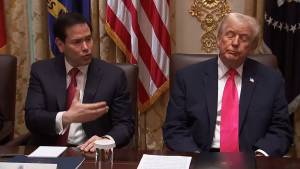 U.S. Secretary of State Marco Rubio, empowered by President Trump with vast powers over Venezuela after a United States commando team seized that nation's president this year, is shown above briefing Trump, who appeared to fall asleep at the time of the photo during the public event.
 July 11, 2026. In March 2025, Donald Trump tried to seize control of federal elections via a sweeping executive order. That order sought to commandeer the Election Assistance Commission — a bipartisan federal agency that assists state election officials — to execute his anti-voting scheme.
News Roundups
July 11, 2026.I promised you I would not stop, and this fight has now reached the Justice Department itself. Meanwhile, the Iranian government has again closed the Strait of Hormuz, there are major new developments involving ICE and the Department of Homeland Security, an update on Mitch McConnell, and much more.July 11, 2026. Trump is reportedly furious over revelations that the Qatari Air Force One jet does not meet U.S. security standards. Now, in what critics are calling a major assault on the First Amendment, his administration is subpoenaing journalists at their homes. At the same time, the administration is obstructing key Epstein investigations, Kash Patel has been summoned to the White House, and Trump is reportedly preparing for the possibility of his own death by ordering missiles locked and loaded at Iran as Tehran vows to avenge the Ayatollah’s death.July 11, 2026. Presumably afraid of investigations into his actions, President Donald J. Trump appears to have abandoned all pretense of governing for the good of the country and is focusing on rigging the 2026 election to keep Republicans in power.U.S. Courts, Law, Crime, Immigration, Rights, Justice
U.S. Governance

From the moment Trump posted a tweet claiming he was sending his Flying Bribery Palace back separately from the NATO summit in Ankara, the entire world knew there was a problem with the jet Qatar gifted him.U.S. Media, Education, Sports, Religion
More On Iran War
More On U.S. Elections, Politics, Governance
More On U.S. Immigration, Economy, Inflation, Jobs


Top Headlines
U.S. Secretary of State Marco Rubio, empowered by President Trump with vast powers over Venezuela after a United States commando team seized that nation's president this year, is shown above briefing Trump, who appeared to fall asleep at the time of the photo during the public event.
New York Times, How Marco Rubio is Running Venezuela From Afar, Tyler Pager and Anatoly Kurmanaev, July 11, 2026. The secretary of state effectively controls Venezuela’s finances, the distribution of its natural resources and its government. His grip on the country is a vivid manifestation of American power in the Trump era.
President Trump was sitting in the Oval Office earlier this year with Secretary of State Marco Rubio when an idea came to him.
 Maybe he should dispatch Mr. Rubio permanently to Caracas, the Venezuelan capital, where U.S. commandos had carried out the proudest foreign policy achievement of Mr. Trump’s second term: the capture of Nicolás Maduro, the country’s president.
Mr. Rubio could be the next leader of Venezuela, Mr. Trump suggested. And while the president’s aides say he was joking — and that he frequently teases Mr. Rubio about an overseas assignment — the fact is that Mr. Rubio does not need to move to Caracas.
He already runs Venezuela from Washington.
In the six months since U.S. forces blew open Mr. Maduro’s bedroom door and snatched him in the dead of night, Mr. Rubio has become the de facto viceroy of Venezuela, holding sway over a sovereign nation in a way that no American official has since L. Paul Bremer III arrived in Baghdad in 2003 to run U.S.-occupied Iraq.
 Mr. Rubio now effectively controls Venezuela’s finances, the distribution of its natural resources and its government, according to interviews with more than a dozen officials and people close to both governments in Washington and Caracas, who provided details about his involvement in steering the country’s policies. Many spoke on condition of anonymity to describe private interactions and internal discussions.

While he has not visited Venezuela in person since the U.S. took over, the secretary of state is deeply involved in the country’s day-to-day operations, keeping in close contact with Delcy Rodríguez (shown in a New York Times photo by Frances Robles), who was Mr. Maduro’s vice president and now leads her country on an acting basis, with the imprimatur of the United States. The two exchange messages in Spanish on WhatsApp, trading gossip, birthday greetings and selfies.
Despite the banter, the relationship between Mr. Rubio and Ms. Rodríguez is far from a partnership. It is a manifestation of Trump-era American power, in which the winner takes all regardless of sovereignty and international law.
Democracy Docket, Analysis and Advocacy: Trump just fired the agency that runs elections, Marc Elias, right, July 11, 2026. In March 2025, Donald Trump tried to seize control of federal elections via a sweeping executive order. That order sought to commandeer the Election Assistance Commission — a bipartisan federal agency that assists state election officials — to execute his anti-voting scheme.
My team and I immediately sued on behalf of the Democratic Party and won a swift victory. A federal judge held that "our Constitution does not allow the President to impose unilateral changes to federal election procedures."
 But Trump was not done. He believes he has found a shortcut to undermine the 2026 elections.
On Thursday, Trump fired the Democratic members of the EAC and the remaining Republican commissioner resigned. The agency, which certifies voting machines and publishes election guidance, no longer has any members. It is, for all practical purposes, defunct.
Over the last sixteen months, Trump has concocted new ways to accomplish his goal of restricting voting rights and spreading lies and disinformation.
He has used the Department of Justice to seize ballots. He has appointed a committed election denier to head the Office of the Director of National Intelligence. He has repeatedly claimed powers he does not have — including the power to control how states count ballots and certify elections.
Yet Trump's frustration has only grown.
His effort to rig the midterms through partisan gerrymandering fell short. His insistence that Congress pass the SAVE Act, a massive voter suppression law, has failed to produce a bill for him to sign.
His Department of Justice sued 30 states to access sensitive voter data. My law firm intervened to fight all these cases. We are undefeated so far. DOJ is 0-11, including five losses before judges Trump himself nominated.
At the Supreme Court, we recently beat a Republican National Committee lawsuit that would have limited voting by mail. Trump's latest executive order aimed at the U.S. Postal Service's handling of mail-in ballot delivery was recently halted by two different federal courts. Another judge blocked Trump's plan to have states use the federal SAVE database to disqualify voter registrations.
Nearly everywhere he turns, Trump sees his administration and his allies losing in court. His decision to fire the entire EAC took place against this backdrop.
Make no mistake: this is a dangerous development for free and fair elections and for democracy itself. Though the EAC's powers were limited, Trump's actions are a clear statement that he intends to strip all power he can from any entity he does not control directly — to remove all checks on his power, all experts who could question his statements, and all centers of authority that do not answer to him.
In the end, what will save democracy from Trump's authoritarian impulses is that the Constitution places the power to set voting rules and administer elections with the states. As the federal judge wrote in her opinion striking down Trump's first elections executive order, in terms of elections, the founders "assigned no role at all to the President."
This does not mean that Trump will not try to exploit his power to fire EAC commissioners to his advantage. It certainly does not mean he won't try to, once again, claim power he does not have.
But I can promise him this: If he tries to limit voting rights, we will sue. If he tries to take control over or impede voting, we will sue. And if he tries to seize ballots or tamper with vote counting or certification, we will sue.
I do not relish these fights, but I won't shy away from them. And history has shown that when we bring these cases — when democracy is on the docket — we win far more often than we lose.
But litigation alone will not save free and fair elections. I have often said that my job as a litigator is to buy time for democracy. We cannot, via the courts, stop Trump and his movement from launching their next attack; we can simply limit the damage of their last. We, as citizens and voters, are tasked with using that time effectively.
We need to demand our state legislatures strengthen and improve their own election laws now, rather than assume Washington will do it for them. We need civil society leaders — from Big Law to business leaders to the largest nonprofits — to stand up for democratic institutions. Most importantly, we need voters to do the thing Trump fears most: turn out in numbers too large for any of this to matter.
Donald Trump did not fire the EAC because he is winning. He fired it because he is losing — in Congress, in the courts, and increasingly in the court of public opinion. An administration confident in its ability to win a fair election does not need to disable the agency that helps run one.
I can promise that my team and I will keep suing. But eventually, it must be the American people, not any court, that ends Trump's ability to escalate his attacks on free and fair elections.
News Roundups
The Parnas Perspective, Saturday Night Update and Comment: I am Fighting With the Justice Department Over the Epstein Files, Aaron Parnas, right, July 11, 2026.I promised you I would not stop, and this fight has now reached the Justice Department itself. Meanwhile, the Iranian government has again closed the Strait of Hormuz, there are major new developments involving ICE and the Department of Homeland Security, an update on Mitch McConnell, and much more.
I will not stop pushing for answers. Thank you for your continued support as we report on the Epstein files and other stories that demand attention. The coming week will be especially busy with Todd Blanche’s confirmation hearing and interviews with Epstein survivors. When you subscribe, you’re supporting independent journalism grounded in verified facts, not speculation, and reporting that answers only to the truth. If you’re not yet a subscriber, I hope you’ll consider joining us today.Subscribed
Here’s the news:
Epstein:
The Department of Justice spent the day fighting with me on Twitter over the Epstein files and the fact that the DOJ is actively impeding the only criminal investigation into the Epstein files.
Photo by Aaron Parnas on July 11, 2026. May be a Twitter screenshot of text that says 'DOJ Rapid Response @DOJRR47 X.com We are x.com/dojrr47/status.. 47/status Aaron Parnas Not enough people are talking about this. @AaronParnas· 18h The Trump Administration is impeding the only active criminal investigation into Jeffrey Epstein. x.com/Reuters/status... status...'.
A court filing by Acting Attorney General Todd Blanche acknowledges that the Justice Department intentionally withheld handwritten notes from the Jeffrey Epstein investigation, arguing they are largely duplicative of typed FBI reports and more difficult to redact without exposing victims' identities. The admission came in response to a lawsuit seeking the release of all remaining Epstein files under the Epstein Files Transparency Act. The lawsuit argues the withheld notes may contain information omitted from the typed reports and therefore should be made public. The dispute is expected to become a major issue during Blanche's upcoming Senate confirmation hearing, where lawmakers are expected to question the DOJ's handling of the Epstein files.
Department of Homeland Security
A sweeping investigation describes a Department of Homeland Security gripped by fear as career officials say they were pressured to support immigration policies they believed were illegal or unethical or risk losing their jobs. More than three dozen current and former officials told investigators that dissenters were sidelined, blacklisted, reassigned, or pushed out while oversight offices responsible for refugees, asylum, and humanitarian protections were dismantled. Several officials said they eventually resigned because they felt they could no longer carry out their duties without compromising their principles. The report argues the changes fundamentally transformed DHS into an agency driven by political loyalty rather than professional expertise.
Multiple current and former DHS employees said they were subjected to lengthy polygraph examinations that they viewed as intimidation rather than legitimate security reviews. Some described being questioned for as long as six hours after being read their Miranda rights, leading them to believe they could be arrested despite never being told what they were accused of doing. Employees said refusing the exams could cost them their security clearances and careers, while many were later forced into reassignments far outside their areas of expertise. The report says these tactics created a climate where employees feared speaking out or challenging administration policies.
The investigation also details the human consequences of the administration’s immigration policies, including the dismantling of internal watchdog offices and humanitarian programs. One case highlighted the death of a three-year-old U.S. citizen after his deported mother was unable to take him with her to Honduras, despite repeatedly asking immigration officials for permission. Former officials and immigration advocates argue that the elimination of oversight offices left vulnerable families with nowhere to turn when problems arose. Current and former employees say the department continues to be directed largely from the White House, with Stephen Miller remaining the driving force behind its immigration agenda.
Trump’s health
Trump sparked fresh questions about his health after posting on Truth Social that he had “just finished a perfect physical at Walter Reed” and had requested another cognitive test, writing that he had taken it three times and “aced them all.” The White House later clarified he was referring to his physical from late May, not a new exam, despite Trump’s wording suggesting it had just occurred. Trump also claimed he undergoes physicals every six months and called himself “the only President” to have taken the cognitive test three times. The post renewed attention to his health because it came while he was golfing and appeared to describe a medical exam that had not actually taken place that day.
Trump lashed out on social media Monday morning, posting photos of the White House grounds and calling their condition "deplorable," comparing them to "our Country ... when I inherited it from Sleepy Joe Biden." The posts suggest Trump is frustrated with the appearance of the White House and is using the landscaping and maintenance as another contrast with the previous administration. His comments come amid broader efforts to reshape the White House grounds and ongoing renovations at several high-profile federal properties. The unusually personal complaints about the presidential residence quickly drew attention online as another example of Trump's focus on aesthetics and public image.
Freedom Fuel:
President Trump has promoted the new “Freedom Fuel Network,” a group of 25 gas stations in Pennsylvania and New Jersey selling gasoline for up to 50 cents below market prices, but the White House will not identify who is behind the company or explain how the discounts are being financed. Officials insist no outside entity is subsidizing the lower prices and claim the retailer is simply accepting smaller profit margins, even as industry experts say the economics do not add up.
The mystery has deepened because business records show the company was incorporated just days before Trump promoted it, many participating stations changed branding almost overnight, and fuel industry groups say they had never heard of the network before the White House announcement. Several participating stations sit on properties owned by affiliates of Blue Owl, although both the White House and Blue Owl deny the asset manager has any involvement.
Analysts say many of the stations appear to be selling gasoline at or below wholesale cost, raising questions about how long the discounts can last and whether the model is financially sustainable. The rollout comes as the administration faces pressure over rising fuel prices following the Iran conflict, while industry experts argue retailers are already operating on thin margins and cannot realistically maintain such steep discounts without another source of funding.
Other news:
In a major escalation, the Iranian military says it attacked a commercial vessel and has declared the Strait of Hormuz closed until further notice. The announcement came just hours after U.S. officials told reporters they expected Iran to publicly guarantee that the strait would remain open and safe for commercial shipping. Those expectations were widely reported as fact across much of the media without independent confirmation. Instead, Iran announced the opposite, dramatically raising tensions around one of the world's most critical maritime trade routes.
Image
The Daily Beast reports that one of Mitch McConnell's Washington, D.C., neighbors said they witnessed a troubling scene just days before the senator was hospitalized.
Democratic Sen. Sheldon Whitehouse says whistleblowers have alleged the Kennedy Center rushed renovations and ignored federal contracting standards so it would be ready for high-profile events, including Donald Trump receiving FIFA's "peace prize." The allegations include no-bid contracts, repainting work that is already failing, a reflecting pool that may need to be rebuilt, and a brand-new bathroom floor allegedly ripped out because Trump disliked the tile color. Whitehouse says the renovations prioritized Trump's personal preferences over legitimate maintenance and may have wasted taxpayer money, and he is demanding documents and answers from Kennedy Center leadership. The Kennedy Center denies the allegations, insisting its contracting practices were proper, while the White House says Trump is repairing years of neglect at the landmark.
Days after an ICE agent fatally shot 52-year-old Mexican immigrant Lorenzo Salgado Araujo during a traffic stop in Houston, local officials say federal authorities are refusing to share key evidence, including the work van at the center of the shooting, fueling concerns about transparency. ICE says Salgado Araujo rammed a federal vehicle and ignored commands, forcing an agent to fire in self-defense, but witnesses, passengers, family members, and several Texas Democrats dispute that account, insisting the van never struck officers and that agents never identified themselves. The Harris County district attorney says his office is being forced to learn details through social media instead of direct coordination with federal agencies and is considering seeking a court order to obtain evidence. Multiple investigations are now underway as Salgado Araujo's family, local officials, and Mexican authorities demand accountability and a full independent review of the fatal shooting.
MSNOW interviewed a neighbor who lives about five houses from where Lorenzo Salgado Araujo was killed. The resident said federal agents were searching his property for bullet casings even though the pursuit ended near the memorial behind the reporter. MSNOW questioned why investigators were combing through the grass outside that home if the shooting had occurred several houses away. The report raises new questions about the scope of the investigation and exactly where evidence may have been found.
In Kansas City, immigration officials are reportedly stopping people walking down the street and demanding proof of their legal status. There is no general legal requirement for people to carry proof of immigration status with them at all times. Civil liberties advocates and immigration attorneys have raised concerns about these kinds of street stops and the legal standards used to justify them. The reports are fueling a broader debate over immigration enforcement, constitutional protections, and the balance between public safety and individual rights.
Rep. Ro Khanna says he and his delegation were detained for about 90 minutes by armed Israeli settlers while visiting a Palestinian village in the occupied West Bank that had been damaged in previous settler attacks. Khanna said the settlers, carrying U.S.-made rifles, blocked their vehicle and that Israeli soldiers refused to intervene, leaving him feeling “powerless” despite being a member of Congress. He said the experience gave him firsthand insight into what Palestinians face under the occupation and criticized what he described as a culture of impunity for settler violence. The Israeli military said it responded to reports of settlers blocking vehicles, while Khanna said the group was only able to continue after contacting the U.S. Embassy and Israeli police.
X avatar for @RoKhanna Ro Khanna@RoKhannaIsraeli settlers, brandishing American made M4s, detained me & other Americans on my trip to Palestine. When the IDF arrived, they sided with the settlers & continued our detention. They made a huge mistake. You will be hearing more soon. nytimes.com/2026/07/11/us/…Image1:26 PM · Jul 11, 2026 · 263K Views418 Replies · 1.44K Reposts · 5.37K Likes
Martha Lillard, believed to be the last person in the United States who relied on an iron lung after contracting polio, has died at 78 in Oklahoma. Diagnosed with polio at age 5, she outlived doctors' predictions by decades, living a full life despite spending the last two years almost entirely inside the machine that helped her breathe. Her life spanned the era before and after the polio vaccine, which virtually eliminated the disease in the U.S. by 1979, and she became a living reminder of the devastating impact polio once had on thousands of American children. Her family said she ultimately died from chronic pulmonary failure and post-polio syndrome, with long Covid contributing to her declining health.
The Trump administration has finalized a major rollback of the Endangered Species Act by narrowing the definition of "harm," removing long-standing protections for habitats that endangered species depend on to survive. Environmental groups warn the change could open critical wildlife habitats to logging, mining, drilling, and development, threatening species including Florida manatees, monarch butterflies, and wolverines. Administration officials argue the previous rules unfairly burdened landowners and businesses and say direct harm to endangered animals will still be prohibited. Conservation organizations are preparing legal challenges, arguing the rollback contradicts decades of scientific research, public support, and Supreme Court precedent protecting endangered species' habitats.
Hunter Biden won a $1.7 million defamation judgment against former Overstock.com CEO Patrick Byrne after a federal judge found Byrne fabricated claims that Biden sought an $800 million bribe from Iran in exchange for influencing his father to unfreeze Iranian assets. The judge ruled Byrne acted with "actual malice," finding he had no credible evidence for the allegations and had intentionally misrepresented the story despite repeated opportunities to substantiate it. Byrne was also sanctioned after failing to appear for trial and repeatedly delaying the case, prompting the court to enter a default judgment against him. Biden's attorney said the ruling confirms the bribery accusations were entirely fabricated and warned Byrne could face additional legal action if he repeats them.
The Parnas Perspective, Morning News and Commentary: Important Epstein Update, Trump Targets Journalists, Iran Vows to Avenge Leader's Death as Trump Fears Possible Assassination, Aaron Parnas, right, July 11, 2026. Trump is reportedly furious over revelations that the Qatari Air Force One jet does not meet U.S. security standards.
Now, in what critics are calling a major assault on the First Amendment, his administration is subpoenaing journalists at their homes. At the same time, the administration is obstructing key Epstein investigations, Kash Patel has been summoned to the White House, and Trump is reportedly preparing for the possibility of his own death by ordering missiles locked and loaded at Iran as Tehran vows to avenge the Ayatollah’s death.
I also spoke today with Epstein survivor Lara Blume McGee ahead of Todd Blanche’s confirmation hearing. For the first time, she shares her story on camera and says this Department of Justice has done nothing to protect survivors or deliver justice.
I told you I would never stop talking about the Epstein files, and I meant it. More interviews are coming. I know some people unsubscribe because I spend so much time covering this story, but I cannot stop until survivors get the justice they deserve.
If you believe this reporting matters, subscribe today or upgrade your subscription. Your support helps me keep bringing these stories to millions of people and keeps the pressure on those in power.Subscribed
Here’s the news:
Epstein News:
New Mexico Attorney General Raúl Torrez accused the Justice Department of obstructing the state's reopened criminal investigation into Jeffrey Epstein's activities at Zorro Ranch by failing to provide requested unredacted federal records despite repeated requests since February. Torrez argues the withheld documents contain names of survivors, witnesses, and potential co-conspirators that are essential to pursuing state prosecutions, warning that delays are causing evidence to grow stale and investigative leads to disappear. While the Justice Department says it supports New Mexico's investigation and is prepared to assist, the dispute has complicated the state's renewed effort—which includes searches of the ranch, subpoenas, and a bipartisan truth commission—to fully investigate alleged crimes connected to Epstein's New Mexico property.
Reps. Ro Khanna (D-Calif.) and Thomas Massie (R-Ky.) urged acting Attorney General Todd Blanche to fully comply with the Epstein Files Transparency Act, arguing the Justice Department has failed to release all required unredacted Epstein records and has overused redactions without sufficient explanations. Their letter, sent ahead of Blanche’s Senate confirmation hearing, cites a recent court order requiring additional document disclosures and criticizes the DOJ for missing deadlines while maintaining it has already complied with the law. The lawmakers contend that protecting victim privacy should not be used to broadly withhold records, saying full compliance is necessary to ensure transparency, accountability, and justice for survivors.
First Amendment Attack:
Overnight, while many were asleep, the Trump administration issued subpoenas to several New York Times reporters following the newspaper’s reporting on security concerns involving President Trump’s new Qatari-donated Air Force One. The subpoenas seek to compel the journalists to testify before a federal grand jury in Manhattan about an alleged violation of federal criminal law, though they provide few details. In some cases, federal agents delivered the subpoenas directly to reporters’ homes, an unusual step that the newspaper described as an escalation in the administration’s actions toward the press. The reporting in question cited anonymous sources discussing sensitive national security matters related to the aircraft.
Before one of the stories was published, an FBI official asked The New York Times to delay publication, citing national security concerns, and requested that the newspaper identify its confidential sources. The Times declined to reveal its sources and proceeded with publication. The newspaper strongly criticized the subpoenas, arguing they threaten press freedom and the public’s right to independent reporting. Statement from The New York Times: “Our journalists report the facts and advance the American public’s right to know how their government is operating and their taxpayer dollars are being used. This brazen act should be seen as nothing more than an attempt to prevent the public from knowing what is happening in their country by intimidating journalists from doing their jobs.”
The subpoenas come amid broader tensions between the Trump administration and major news organizations. While both Democratic and Republican administrations have pursued leak investigations, subpoenas targeting journalists are relatively uncommon, and First Amendment advocates warn they may discourage investigative reporting. It also highlights other recent legal disputes involving The New York Times, including lawsuits over Pentagon access, an employment discrimination case that the newspaper says is retaliatory, and a separate defamation lawsuit brought by President Trump. Together, these events reflect an ongoing legal and political conflict between the administration and the news media.
Trump’s Death Planning:
Iran’s new Supreme Leader Mojtaba Khamenei vowed to avenge the death of his father, Ayatollah Ali Khamenei, saying revenge “must certainly be carried out,” while President Trump warned that any Iranian assassination attempt against him would trigger a massive U.S. military response, claiming he had already issued orders to “completely decimate and destroy all areas of Iran.”
It comes as fears grow in and around the White House about threats on Trump’s life. Trump said he has left standing "instructions" for the U.S. to respond with overwhelming military force if he is assassinated by Iran. In an interview with the New York Post, he claimed he has been a long-term target of Iranian threats and said that, if anything happens to him, the response should be to "literally bomb them at levels that they've never seen before." His comments come as the conflict with Iran continues into its fifth month and after he declared a recent ceasefire effectively over. Trump also repeated similar remarks he made earlier in his second term about Iran being "obliterated" if it carried out an assassination.
Overnight, Trump warned that if Iran carries out an assassination attempt against him, the U.S. military has standing orders to launch an overwhelming response, claiming "1000 Missiles are Locked and Loaded" and threatening to "completely decimate and destroy" Iran. His comments followed reports of an alleged Iranian assassination plot shared by Israeli intelligence and renewed threats from Iran's new Supreme Leader, while Trump said he has long been Iran's "No. 1 target" and confirmed he has already left instructions for a massive military retaliation if he is killed.
Israeli intelligence recently warned the United States of a specific alleged Iranian plot to assassinate President Trump, though U.S. officials had not independently verified the intelligence and some viewed it as potentially aimed at influencing Trump's decisions on Iran. U.S. intelligence has long assessed that Iran could target Trump in retaliation for the 2020 killing of General Qasem Soleimani, and officials say they continue to monitor multiple potential threats. The report comes as U.S.-Iran tensions remain high, with diplomacy continuing alongside military preparations despite the breakdown of a recent ceasefire.
Kash Patel:
According to MS Now, FBI Director Kash Patel abruptly canceled a planned trip to Chicago after being called to the White House, though administration officials disputed reports that he was summoned over internal frustration. According to the report, some White House officials were concerned about Patel's recent actions, including criticism over his use of FBI resources for travel, a combative social media post, and negative publicity surrounding trips tied to his girlfriend's performances.
Patel had planned to combine an official visit to the FBI's Chicago field office with attending his girlfriend's country music festival performance, prompting internal complaints that the work event was added to justify the travel. The White House said Patel's visit was for unrelated meetings, while the FBI declined to comment and defended his travel as compliant with federal rules. The report also says President Trump and some senior aides have grown frustrated with recurring controversies surrounding Patel because they believe they distract from the administration's broader agenda.
Patel responded to criticism over his reported use of government resources by posting on X, "Nah, my jet ski is gold plated… dumbass," after criticism that he should keep a lower profile amid growing scrutiny. Patel is facing questions from lawmakers about his travel, spending, and use of FBI resources, while the FBI has denied any wrongdoing and disputed the allegations. His social media response drew widespread criticism online, with many users arguing it reinforced concerns about his judgment and leadership rather than addressing the substance of the allegations.
Other news:
New York City Mayor Zohran Mamdani announced two consumer protection measures aimed at reducing hidden costs and subscription hassles: a Click-to-Cancel rule, taking effect October 1, that requires businesses to make canceling subscriptions as easy as signing up, and a proposed all-in pricing rule that would require upfront disclosure of total prices for services like hotels, event tickets, and deliveries. City officials estimate the cancellation rule could save New Yorkers up to $162.5 million annually, while businesses that violate the proposed pricing rule could face $525 fines and be required to issue refunds after a public hearing on August 7.
 A federal judge granted the Justice Department's request to permanently dismiss the remaining convictions of four Proud Boys leaders (some shown above) involved in the January 6, 2021, Capitol attack, following President Trump's 2025 pardons and sentence commutations for many Jan. 6 defendants. Although Judge Timothy Kelly approved the dismissal because the executive branch chose to abandon the prosecution, he emphasized that his ruling should not be interpreted as agreement with that decision, noting the convictions were for serious crimes. The ruling closes one of the last major Jan. 6 criminal cases, with the defendants and former Proud Boys leader Enrique Tarrio celebrating the outcome.
Dr. Mehmet Oz became the latest Trump administration official to post a workout video, demonstrating what he described as proper squat technique.
European governments are considering a proposal that would allow voluntary navigation service fees in the Strait of Hormuz, modeled on the Strait of Malacca, while rejecting any mandatory tolls that would give Iran control over international shipping. The discussions come as the U.S. presses Iran to publicly guarantee safe passage through the waterway, diplomatic efforts continue through Oman, and disagreements persist over the future governance of the strait following renewed U.S.-Iran tensions and recent attacks on commercial shipping.
Severe flooding in southeastern Missouri prompted the rescue of more than 200 children and staff from Camp Taum Sauk by National Guard Black Hawk helicopters after roads became impassable, while another 20 people were rescued from a campground where a building collapsed under floodwaters. Officials reported no confirmed fatalities, though one woman remained missing after her home was swept away, and Governor Mike Kehoe declared a state of emergency as rivers continued rising, major roads closed, and forecasters warned that additional heavy rain could worsen flooding.
Letters from an American, Historical Commentary: July 10, 2026 [Trump's Election Rigging Threat], Heather Cox Richardson, right, July 11, 2026. Presumably afraid of investigations into his actions, President Donald J. Trump appears to have abandoned all pretense of governing for the good of the country and is focusing on rigging the 2026 election to keep Republicans in power.
This morning, as the National Association of Realtors reported that U.S. home prices have hit an all-time high, he announced that he will not sign the housing bill, which was designed to address the unaffordability of housing and which passed Congress with strong bipartisan majorities, “in PROTEST over the fact that the United States Senate is not capable of passing THE SAVE AMERICA ACT.”
As the Lincoln Project summed it up, the Republican Party’s message four months before the midterms appears to be, “You’re not getting affordable housing unless you give up your voting rights.”
 His demand for the passage of a bill that most observers agree will suppress voting is only one of the ways that Trump is trying to rig the 2026 election.
After federal judges have repeatedly prohibited the administration from seizing state voter lists, apparently to run them through a program designed to identify noncitizens who are not eligible for certain federal programs (something federal judges have also prohibited), Trump’s appointees at the Department of Justice appear to have turned to trying to intimidate election officials.
On Tuesday the Department of Justice confirmed that it has sent letters to election officials in all fifty states and Washington, D.C., warning them that they could be criminally prosecuted if noncitizens vote. The letters came from Assistant Attorney General  Harmeet Dhillon, right, a Trump loyalist, and gave them five days to detail how they will maintain “clean voter lists.”
Utah lieutenant governor Deidre Henderson, a Republican, posted on social media: “Got another love letter this morning from the DOJ sprinkled throughout with threats of criminal prosecution. I’m sure I’m not the only chief election officer of a state who is being targeted for following state and federal laws by resisting DOJ’s demands for private voter data that have thus far been ruled illegal by at least a dozen courts. This is truly bizarre behavior by the federal agency that is supposed to be protecting civil rights.”
Last night, Trump fired the last two Democratic members of the Election Assistance Commission (EAC), an independent federal commission that helps state and local officials make sure elections are smooth and secure. Among other things, it certifies voting machines and maintains the national mail-voter registration forms. The only other current member of the EAC, a Republican, resigned. The fourth member of the EAC, a Republican, resigned earlier this year.
A White House official told Justin Papp of CNBC that the Supreme Court recognized Trump’s authority to fire the agency officials in its June 29 Trump v. Slaughter decision, which overturned more than 90 years of precedent to rubber stamp the president’s right to fire agency officials who are not aligned with his political agenda.
“The President, and head of the Executive Branch, reserves the right to remove individuals that may not be totally aligned with the important task of securing America’s elections and ensuring every legal vote is counted,” the official told Papp. “The Slaughter decision gives the President precedence to do so.”
Legal analyst Harry Litman says this interpretation of the Slaughter decision is a stretch. He noted that “[n]othing in the agency cases held that Trump could simply shut down an agency of Congress’s creation. That’s what he has done with the [E]lection Assistance [C]ommission which now lacks commissioners to act. It’s taking the court’s cases to the ultimate conclusion and just disabling an important agency.”
The nonpartisan, nonprofit League of Women Voters, which works to protect the right to vote, called the removal of the Election Assistance Commission officials “a direct attack on the independence of our nation’s election infrastructure…. The American people deserve elections administered by trusted professionals, not shaped by political interference. This is not a routine personnel decision—it is a dangerous escalation in the effort to weaken the safeguards that protect free and fair elections in the November midterms.”
This is the backdrop for the news from Betsy Klein and Kaitlan Collins of CNN today that the White House is fortifying the White House entrance at the North Portico during Trump’s renovation of the Ionic columns there.
In March, Trump’s appointee to the Commission on Fine Arts, which advises Trump on design matters, urged replacing the historic Ionic columns with more ornate Corinthian columns that would match the ones Trump picked out for his ballroom. The White House says the work on the North Portico is “standard restoration work,” but did not answer CNN’s question about whether there would be more substantial changes to the North Portico. Trump recently posted pictures of the Corinthian columns at his proposed ballroom, boasting that “When completed, there will be nothing like it anywhere in the World!”
While the focus has been on the historic columns and their possible replacement, it is not until now we have learned about the strengthening of the White House door. The portico is now covered with scaffolding that is covered with a drape, and a White House official told Klein and Collins that the renovations will include security enhancements at the request of the U.S. Secret Service.
Dan Diamond of the Washington Post also reported today that under the Trump administration, the Secret Service, the White House, and the Interior Department are seeking to place permanent eight- to nine-foot-tall fencing around Lafayette Square, where tourists and protesters congregate, in front of the White House. They are also considering fencing off the parts of Pennsylvania Avenue near the White House. In the past, when officials believed it was necessary to shut off access to Lafayette Square, they used temporary barriers to avoid the perception that they were restricting public access to what is known as the People’s House.
Eleanor Holmes Norton, the nonvoting congressional representative from the District of Columbia., objected. “More fencing around the President’s Park would send the wrong message to the nation and the world by continuing to transform our democracy from one that is accessible and of the people to one that is exclusive and fearful of its own citizens,” she said.
Tonight, at 11:59 PM, the housing bill became law without the president’s signature.
U.S. Courts, Law, Crime, Immigration, Rights, Justice
MSNOW, Advocacy and Opinion: The National Guard occupation that has been brutalizing Memphis must stop, Sheree Renée Thomas, July 11, 2026. Troops deployed to Memphis must recognize the dangerous absurdity of the mission. The strategies of a combat theater cannot be translated into civilian law enforcement or community life.
To walk through Memphis is to step into an eerie, simultaneous haunting, both visible and invisible. You see armed soldiers and federal agents everywhere in Memphis: an uncanny, disruptive presence woven into the mundane fabric of our daily lives. Since they arrived in September, they have become a disturbingly normalized fixture. Some roll through our neighborhoods in plain clothes, driving ordinary Sprinter vans, looking for all the world like tourists who got lost on their way to Beale Street. Others are suited out in khaki and camel-colored camouflage, standing like insolent, bored sentinels guarding the food court at the mall, or checking over shopping baskets at local chain stores. When they first arrived, they stood starkly in front of our small, independent businesses, their heavy presence strangling the life out of local commerce and destroying decades of hard-won community goodwill and trust.
The anger after Johnson’s homicide is an order of magnitude higher.
Even before the National Guard shot and killed 20-year-old Tyrin Johnson July 4 weekend, the reality of this dystopian visitation was laid bare by MLK50, which published dashcam and body camera footage documenting the seemingly pretextual traffic stop of 18-year-old Yasser Lopez Soza and three of his Memphis Business Academy classmates. The minors were headed to their season-opening soccer game when they were pulled over. The footage captures a Homeland Security agent riding shotgun inside a Memphis Police Department cruiser, evidence that exposed as a lie the city’s repeated vow that Memphis police would never assist in federal immigration dragnets.
 But the anger after Johnson’s homicide is an order of magnitude higher. It happened at nearly 4 a.m. Sunday, July 5, the tail end of a weekend where thousands of Memphians were out in the summer night celebrating the Fourth of July. At the intersection of Ida B. Wells and Gayoso Avenue, in the literal shadow of AutoZone Park — where the city’s minor league baseball team plays and crowds routinely gather — local police officers and National Guard members reportedly joined a foot pursuit after reports of gunfire.‘Insult to service members’: Senator says sending National Guard to Memphis is not the answerJune 17, 2026 / 06:04
Officials say Johnson fled on foot with a handgun and turned toward the soldiers who fired and hit him twice in the chest. Johnson was a 20-year-old former Tennessee State University student and father with no criminal history. His grandfather, who’s demanded video of the fatal encounter, told The Associated Press that Johnson started carrying a gun after being “jumped” in Nashville recently. He was killed while reportedly running through the labyrinth of an occupied city. Even soldiers within the ranks must recognize the dangerous absurdity of the mission. They are not trained for this or for de-escalation. The strategies of a combat theater cannot be translated into civilian law enforcement or community life.
Johnson’s killing is the tragic, inevitable harvest of this tactical mismatch.
Behind this military vanguard lies a broader, bureaucratic travesty of democracy. Neither Memphis Mayor Paul Young nor the Shelby County Government ever requested these troops. When local legislators and Shelby County Mayor Lee Harris sued to halt this occupation and won a temporary injunction from a judge who recognized the state’s unilateral overreach as unlawful, the state machine pushed back. The Tennessee Court of Appeals overturned the block and kept soldiers on our streets against the explicit, legal will of our elected local leadership.
The deployment of troops to Memphis is part of a larger pattern of exploitation.
The deployment of troops to Memphis is part of a larger pattern of exploitation. The state’s leaders have permitted unchecked corporate overreach. Thus, we have xAI’s Colossus data center pumping unpermitted pollutants near historically Black neighborhoods in Southwest Memphis, even as the company expands its reach across the state line into Southaven, Mississippi. Backed by a $20 billion incentive package from the state, they have constructed a massive new facility, provocatively dubbed MACROHARDRR, a juvenile play on a tech competitor’s name that can also be heard as a jarring, phonetic dog whistle that makes local Black communities the victims of the joke.
The 1820 Census registers the baseline human ledger of Memphis’ beginnings as 103 enslaved Africans forced to fell ancient oaks, obliterate ancient Indigenous mounds, pack the heavy mud into bricks and to turn the wilderness of a Mississippi River bluff into an empire of commerce.DOJ moves to dismiss NAACP’s pollution lawsuit against Musk’s AI companyJune 17, 2026 / 06:04
That means ours is a city built on layers upon layers of historical crime, where wealth was extracted from human flesh and auction squares were plotted directly into public parks.
The irony has come full circle, but so has the resolve. The descendants of the original 103 souls who cleared this bluff will not be quiet spectators to their own disenfranchisement.
Our grief for Tyrin Johnson is inextricably bound to our unyielding demand for autonomy. True public safety requires investment in our schools, our infrastructure and our collective well-being, instead of sending armed enforcers to occupy our neighborhoods and stamp out our future. They forgot that the high clay of this bluff belongs to the hands that shaped the bricks. We are still here, holding the ground we built, waiting out the occupation.
Sheree Renée Thomas is an award-winning author, poet and editor whose work is inspired by myth and folklore, natural science and the genius of the Mississippi Delta. Her most recent book is "Mojorhythm" (Third Man Books, 2025).
New York Times, ICE Killing in Houston Puts Focus on Surge in Immigration Arrests, Jazmine Ulloa, Hamed Aleaziz and Emiliano Rodríguez Mega, July 11, 2026 (print ed.). The shooting death of Lorenzo Salgado Araujo occurred as immigration enforcement has ramped up across the country, with thousands being arrested daily.
The fatal shooting of a man this week by Immigration and Customs Enforcement agents in Houston has brought into focus an aggressive ramp-up of immigration arrests across the country that has largely occurred outside the public eye.
From large cities like Chicago and Las Vegas to small suburbs outside Milwaukee and San Antonio, immigrants have been picked up and detained at courthouses, ICE check-ins and traffic stops, with daily arrests doubling in the last week of June and continuing to climb.
“The operations have purposely been done behind the scenes,” said Getsy Hernandez, a community organizer with Escucha Mi Voz Iowa, an immigrant-led advocacy group in Iowa City.
Then on Tuesday, federal immigration agents killed Lorenzo Salgado Araujo, a Mexican construction worker and father of three who had lived in the country for more than 30 years without legal status. However, Mr. Salgado Araujo was not the initial target of the agents.
In the days since, the killing has galvanized thousands of protesters, led to calls from local leaders and Latino civil rights groups for independent investigations and prompted promises of legal action from President Claudia Sheinbaum of Mexico.ImagePeople holding candles.A Wednesday night vigil for Lorenzo Salgado Araujo, an undocumented immigrant from Mexico who was shot by ICE officers during a traffic stop in Houston.Credit...Meridith Kohut for The New York Times
Mr. Salgado Araujo was killed during a traffic stop by immigration agents who had been searching for a different person, according to a Department of Homeland Security spokeswoman. When agents tried to stop the vehicle, the encounter quickly escalated, and an agent shot Mr. Salgado Araujo in the abdomen. He died at a hospital hours later.
Homeland Security officials said Mr. Salgado Araujo had tried to use his vehicle as a weapon, though three men who witnessed the killing disputed that account and said the victim had never tried to run over a federal agent. No video of the shooting has emerged. The agents were not wearing body cameras, the spokeswoman has said.
The Houston shooting has dragged ICE and the tactics used by immigration agents back into the national spotlight. Federal officials are defending their actions as part of highly focused operations, but Latino community leaders and immigration lawyers argue the incident follows a string of violent confrontations that have accompanied the surge in arrests. These clashes, they say, show federal agents are continuing to use their most aggressive tacticsFederal immigration agents have shot at more than 20 people since September, nearly all of them in their cars. Some of the shootings have been fatal.
The Trump administration is continuing to push for more deportations. A Republican-led package signed by President Trump last month has funded $31 billion for ICE activities, such as supporting local and state authorities that have signed cooperation partnerships with the agency, known as 287(g) agreements. For jurisdictions that refuse to cooperate, the funding package has earmarked another $350 million to expand enforcement operations.
In a period of five days at the end of June, ICE officers arrested more than 10,000 people, according to documents obtained by The New York Times. After a brief lull during the July 4 holiday weekend, arrests picked back up by Tuesday, the day Mr. Salgado Araujo was shot. From Tuesday through Thursday, ICE officers across the United States arrested more than 6,000 people, internal records show, a pace of about 2,000 arrests a day.
The effect of the push is being seen across the country.
In Chicago, immigrant rights groups and Hispanic community organizers in a news conference on Thursday had counted at least 70 people taken in three days, many around courthouses. Many of the immigrants apprehended had been charged with minor traffic violations or had been trying to make their appearances before immigration judges. Calls to one legal aid center alone had more than doubled to 1,700 in that time, organizers said.
U.S. Governance
New York Times, Whistle-Blowers Accuse Kennedy Center of Contracting Flaws Under Trump, Julia Jacobs and Zach Montague, July 12, 2026 (print ed.). Documents submitted to Congress detailed concerns about competitive bidding processes and a White House order to tear up new bathroom tile because of its color.
As the John F. Kennedy Center for the Performing Arts prepares for major renovations, former project managers there have sent Congress internal documents that they say show how the institution bypassed government contracting norms in work carried out under President Trump.
The documents — sent to a Senate and a House committee last month by lawyers for unidentified clients referred to as whistle-blowers — detail how vendors were selected for work without competitive bidding under rationales that are depicted as flawed.
In one case, a center official described a company chosen for flooring work as the “only identified firm on the Mid-Atlantic seaboard that maintains a fully vertically integrated model, vital for acoustic continuity, architectural uniformity, and operational agility.”
In a letter to the committees, lawyers for the former project managers say their clients question whether the business, located in South Carolina, was the only one available that was qualified to do the flooring work.
The letter says the center’s decision to skip bidding in another case was designed to help meet deadlines important to the president, such as the Kennedy Center Honors in December, which he hosted.
“Renovations were rushed to meet the deadlines driven by the president’s desire to host official events at the center,” the letter says. “Federal contracting laws and regulations were ignored.”
A statement from the Kennedy Center defended its practices, saying that the institution operates with rigorous financial oversight and that the assertions by the whistle-blowers that contracting standards had been bypassed were incorrect.
“As America’s cultural center, the institution makes every decision guided by responsible stewardship and an unwavering commitment to its patrons and the nation it proudly serves,” Roma Daravi, a spokeswoman, said in a statement. “We remain fully committed to transparency and to delivering the critical improvements that will preserve this institution for generations to come.”
Liz Huston, a White House spokeswoman, responded to the allegations by accusing past management of allowing the center to fall into disrepair.
“President Trump did what Democrats wouldn’t,” she said in a statement. “After decades of neglect, he committed the bold leadership and proper resources to fix the Kennedy Center and start the renovations of the finest performing arts facility in the world.”
Mr. Trump, a developer by trade, has taken an intense interest in remaking the center, helping to secure $257 million from Congress last year for renovations. In one case cited in the letter a new bathroom floor in one of the center’s three presidential boxes was ordered torn up last year and redone after the White House complained about the beige color of the tiles. (The email’s subject line was “tile emergency,” alongside a red siren emoji.)
“This is a big undertaking for my department to remove the floor tile that was just installed,” the Kennedy Center’s operations and maintenance director replied in a March 2025 email, noting that the beige tiles had been approved by a White House interior designer.
In a response email, a White House official confirmed the directive to replace the beige tile with white. (The work was unrelated to the South Carolina flooring company.)
The center said in a statement that the changes were a standard design adjustment that caused “zero unnecessary burden on the taxpayer.”ImagePresident Trump and Melania Trump in formal clothes on a red carpet.
The White House decided to remodel the presidential boxes days after Mr. Trump took over as chairman of the center’s board, according to the documents sent to Congress. The plans included gold plumbing fixtures in the bathrooms, gold covers for electric outlets, marble baseboards and the tile flooring paid for by the White House, with much of the labor provided by the center.
The 82-page submission to Congress was made under a law designed to protect federal employees who disclose allegations of wrongdoing from retaliation. The lawyers who sent it, David Seide and Dana Gold, work for a nonprofit that represents government whistle-blowers.
Senator Sheldon Whitehouse, the top Democrat on the Environment and Public Works Committee, which received the submission, wrote to the Kennedy Center on Thursday demanding information related to the renovations. Mr. Whitehouse, an ex officio member of the center’s board, said the submission raised “serious questions” about whether public funds were being spent properly.
Nothing in the submission suggests that the firms selected without bidding have any personal ties to Mr. Trump or his family, or that the vendors played any role in the decision-making process under which work was awarded.
Reached by phone, Kent Rogerson, who runs the South Carolina flooring company, declined to comment, citing a nondisclosure agreement.
Although the Kennedy Center is run as a nonprofit, it has, like Smithsonian museums, traditionally followed federal contracting rules because its building is federal property. But the documents include a new policy, adopted in November, that states the center was exempt from the federal rules and replaces them with new procedures.
Compared to federal contracting regulations, the new policy relaxes the requirements under which sole-source contracts can be awarded, according to several government procurement experts, by adding to the rationales for when it is permissible. Under the policy, contracts can be awarded without bidding when “circumstances beyond the center’s control require an immediate award” or “the requirement is unique or has a compelling business interest.”
The center said in its statement that it had confirmed with the Office of Management and Budget that, as an independent entity, it was not bound by federal contracting regulations and that it had updated its procurement policy to be both fair and agile when making renovations.
Mr. Trump announced that the center would be shuttered for two years for the project, starting around Independence Day. But a federal judge temporarily blocked the closure after finding that the center’s board, composed largely of the president’s aides and allies, had not properly scrutinized his plan before approving it. The White House statement on Friday accused the judge of being “radical” and allowing the center to remain in disrepair.
Kennedy Center officials have described renovations to address problems such as water leaks and outdated equipment as urgently needed. The president has said the work would elevate a “dilapidated” building to the “highest level of Success, Beauty, and Grandeur.”
Emptywheel, Analysis and Opinion: Trump Confirms: Accepting a Flying Bribery Palace Made Him Less Safe, Emptywheel (Marcy Wheeler, right), July 11, 2026. From the moment Trump posted a tweet claiming he was sending his Flying Bribery Palace back separately from the NATO summit in Ankara, the entire world knew there was a problem with the jet Qatar gifted him.
That Trump offered a transparently stupid excuse — he wanted to show it off to the military — was no real fix. His expressed worry about being targeted by Iran only further confirmed that the Flying Bribery Palace might not stand up to an Iranian attack.
[W]hen pressed by reporters in Ankara about the reason for the change, Mr. Trump also repeatedly noted that he was Iran’s No. 1 target, and referred at one point to having seen or been briefed on a list of Tehran’s targets in recent days.
By the time NYT provided details of the Flying Bribery Palace’s shortcomings on Thursday, based in part on the observations of a former Air Force official, the outline of what they were had become fairly clear: The Flying Bribery Palace could not protect against an Iranian missile attack.
[O]fficials who have been briefed on the retrofitting of the Qatari jet, who spoke on the condition of anonymity to describe its security features, said it did not have the same counter-defensive capabilities of the previous model.
[snip]
The older planes that served as Air Force One included a defensive system designed to defeat heat-seeking missiles. That capacity is also planned to be included in the new Boeing planes, according to three former Pentagon officials.
Different parts of the defensive systems are visible on the old Air Force One, under the wing of the plane and on its tail. They are not observable in photographs of the new Qatari plane, according to a third former Air Force official, who spoke on the condition of anonymity to describe the security protocols. [my emphasis]
That Thursday story made clear that such shortcomings that had been discussed all along.
But in a statement it made when it announced that the donated jet was ready to transport the president, it acknowledged that the temporary plane did not have all the equipment usually found on an Air Force One.
“No risk was taken in security, safety or mission communications,” the Air Force said in a statement on June 19. “But the collective team made trades on some of the less commonly used mission sets that Boeing must deliver to support the next 40 years.”
To sum up:
Trump calls attention to a change in his plans by telling a transparent lie about it.His own comments confirm a concern about his safety.NYT provides one line about counter-defensive capabilities in a story relying in part on public observation and public statements.
And then Trump sent subpoenas to the four NYT journalists who worked on the story, thereby confirming that the story was correct — that Trump’s Flying Bribery Palace had inadequate equipment to counter a missile attack.
The subpoenas don’t do anything to alleviate the risk to Trump’s security he made clear by announcing the plane change. Indeed, the confirm, for all the world, that Trump’s Flying Bribery Palace is an easy target.
At each level of the story, Trump confirmed the story.
I don’t mean to minimize the abuse of subpoenaing the reporters. This is another alarming attack on the free press (and may be an attempt to find Congressional sources who have long pointed out the weaknesses of the Flying Bribery Palace).
But Trump is the one who disclosed his plane was inadequate to the task. The reporters only responded to Trump’s repeated signals that his plane was inadequate by filling in dots that had been in plane (ha!) sight since Trump accepted the bribe.
This is just like the arrests of people — including Davey Hearn, whom Jeanine Pirro indicted last week — who put their hands in Trump’s reflecting swamp: An effort to distract from the consequences of his own corruption.
Trump is criminalizing calling out his corruption.
He sure as hell is not keeping anyone safe.
New York Times, Bipartisan Housing Bill Becomes Law Even Though Trump Refuses to Sign It, Michael Gold, Updated July 11, 2026. After a 10-day clock, the housing bill turned into law at midnight without the president’s signature. But his decision not to sign reflects a growing rift between him and Senate Republicans.
President Trump allowed a bipartisan housing bill to become law without his signature on Saturday, hours after he said he would refuse to sign it because Republicans had failed to pass an unrelated voting restriction bill that does not have enough support to clear the Senate.
“I will not sign the Housing Bill, which has been fully approved by Congress and sent to the White House, in PROTEST over the fact that the United States Senate is not capable of passing THE SAVE AMERICA ACT,” Mr. Trump wrote on social media, referring to the elections bill.
Mr. Trump’s inaction was symbolic. The measure, the first major legislative effort to address the nation’s housing crisis in more than three decades, became law at midnight after a constitutionally mandated period without the president vetoing the measure.
But Mr. Trump’s pronouncement is still a remarkable dismissal by a president of efforts by his own party to address a major political vulnerability. And it reflected the growing rift between the president and Senate Republicans over the elections bill, which contains strict voter identification requirements and a raft of other measures the president has demanded.
The housing measure adjusts a host of federal regulations to make it easier and less expensive to build housing. That approach won broad support from economists and policy experts, and the bill passed Congress last month with overwhelming bipartisan support, an increasingly rare accomplishment in a starkly polarized legislature.
The bill, known as the 21st Century ROAD to Housing Act, was poised to deliver congressional Republicans a significant victory ahead of November’s midterm elections, as they try to blunt Democrats’ attacks over rising costs.
But Mr. Trump clouded the achievement. Hours before a planned signing ceremony at the Capitol last month that he abruptly canceled, he dismissed the bill as “of minor importance” and said he would sign it only if Congress passed the voting measure.
Mr. Trump’s focus on the elections bill has already derailed Republicans’ congressional agenda. House leaders were forced to scrap votes twice last month after a group of far-right lawmakers refused to let legislation come to the floor unless the Senate took action on the voting measure.
Most Republicans back voter identification requirements, though Mr. Trump’s restrictions are far greater. The bill would require Americans to show proof of citizenship to register to vote and would severely curtail voting by mail, a popular practice in many Republican-held states and districts.
Senate Republicans, including the majority leader, Senator John Thune of South Dakota, have repeatedly said they do not have the 60 votes needed to overcome a Democratic filibuster against the bill. They have also acknowledged that there is not enough support in their caucus to overhaul the filibuster and find a way to push the bill through over Democratic opposition.
Republican leaders did not expect Mr. Trump to block the housing bill, and Speaker Mike Johnson sent it to his desk on June 29, starting a 10-day clock for the president to sign the bill, veto it or allow it to automatically become law.
U.S. Media, Education, Sports, Religion
New York Times, Times Journalists Subpoenaed as Trump Escalates Pressure on Media, Michael M. Grynbaum, July 11, 2026. The Justice Department is seeking to compel testimony from reporters who wrote about the new Air Force One. The Times called the move a “brazen act.”
The Trump administration issued subpoenas on Friday to several journalists for The New York Times, after the news outlet reported this week on security concerns involving President Trump’s new Qatari-donated Air Force One.
The subpoenas — which seek to force the reporters to testify before a federal grand jury in Manhattan on Wednesday — were an extraordinary escalation in President Trump’s efforts to threaten and intimidate independent news organizations.
In some cases, the subpoenas were delivered by federal agents who showed up at reporters’ homes.
The Times denounced the administration’s actions.
“The appearance of federal law enforcement agents on the doorstep of news reporters should shock the conscience of any American who believes in the Constitution and the press freedom it protects,” said David McCraw, The Times’s top newsroom lawyer, in a statement on Friday evening.
“Our journalists report the facts and advance the American public’s right to know how their government is operating and their taxpayer dollars are being used,” Mr. McCraw wrote. “This brazen act should be seen as nothing more than an attempt to prevent the public from knowing what is happening in their country by intimidating journalists from doing their jobs.”
The subpoenas contain few specifics, asking only that the journalists testify “in regard to an alleged violation of federal criminal law.” They were issued by Jay Clayton, the U.S. attorney in Manhattan. Mr. Clayton, who leads one of the country’s most prominent law enforcement offices, was recently nominated by Mr. Trump to serve as director of national intelligence.
Representatives for the White House and the U.S. attorney in Manhattan did not immediately respond to inquiries on Friday evening.
The Times journalists who received subpoenas included Julian E. Barnes, Eric Lipton, Tyler Pager and Eric Schmitt, who reported on Wednesday that Mr. Trump had departed Turkey on the old Air Force One as a security precaution at the urging of the Secret Service. On Thursday, The Times reported that the new Air Force One, a Qatari-donated Boeing 747-8, lacked some of the advanced security features of the older aircraft, including antimissile capabilities. Both articles cited sources who spoke on the condition of anonymity to discuss sensitive security issues.
Before the Wednesday article was published, a senior official at the Federal Bureau of Investigation contacted The Times to ask that the article be held, calling it an issue of national security, according to a person familiar with the conversation. The F.B.I. official spoke with a reporter and a senior editor in The Times’s Washington bureau; the official declined to explain the security issue when asked. (A spokesman for The Times, Charlie Stadtlander, confirmed the account.)lMr. Trump has long been a harsh critic of the news media. But in his second term in office, he has moved aggressively to use the immense powers of the federal government in his efforts to attack the press.
Earlier this year, the Justice Department sought to compel testimony from journalists at The Wall Street Journal and The Washington Post. The Justice Department withdrew the subpoenas after both news organizations fought back in sealed filings.
Both Democratic and Republican administrations have initiated leak investigations into the disclosure of classified information. But subpoenas aimed at journalists are not common, and First Amendment advocates say they can chill the work of news gathering.
In January, F.B.I. agents took the rare step of searching the home of a Washington Post reporter, Hannah Natanson, as part of an investigation into a government contractor’s handling of classified material. The agents seized phones, laptops and a smartwatch after executing a search warrant. Ms. Natanson had spent months speaking with government employees while reporting on the Trump administration’s efforts to shrink the federal work force.
The Times is a party to several lawsuits involving Mr. Trump and his administration.
The president sued The Times last year, accusing it of defaming him, disparaging his reputation and seeking to undermine his 2024 candidacy.
In December, The Times sued the Defense Department after it imposed restrictions on reporters who cover the military. The company sued again after the agency reduced reporters’ physical access to the Pentagon.
More On Iran War
New York Times, Israel Struck an Iranian Steel Facility. Was It a Valid Military Target? Yeganeh Torbati, July 11, 2026. l During the war, Israel attacked Iran’s steel plants, saying they provided forces with revenue and the means to make weapons, but it also hurt the civilian economy.
Over the course of the Iran war, U.S. and Israeli warplanes hit missile depots and launchers, security forces’ headquarters and air defense systems.
Yet not all of the targets during the six-week campaign were traditional military sites. On March 27, and again a few days later, Israeli airstrikes pounded a vast steel complex just outside Isfahan called Mobarakeh Steel, and another one in the southwest of the country.
Prime Minister Benjamin Netanyahu of Israel asserted that his country’s strikes had slashed Iran’s steel production capacity and eliminated revenue for the powerful Revolutionary Guards, whose repression underpins the Iranian government.
Companies like Mobarakeh illustrate the complexities inherent to Iran’s economy. While Iran’s clerical leadership and security forces are deeply enmeshed in the country’s most profitable and important businesses, those same companies are vital to the livelihoods of millions of ordinary Iranians, regardless of whether they have deep ideological allegiance to the government.
The attacks shut down major parts of the Isfahan plant for weeks, idling over 20,000 workers and choking off the supply of steel to domestic manufacturers. “I felt like my own home had been destroyed,” said Mostafa, a former employee, who asked to speak on condition of anonymity to avoid retribution by the government.
The United States and Iran have lurched between peace talks and exchanges of fire in recent weeks. Their negotiations were expected to cover the economic benefits Iran might receive in return for long-term limits on its nuclear program.
The interim cease-fire agreement, signed last month, could result in as much as $300 billion for Iran’s reconstruction and economic development. But that now seems a distant prospect, after President Trump said this week that he believed the temporary truce was “over.”
If any investment does flow to Iran, companies like Mobarakeh will undoubtedly come into focus because of their importance to Iran’s economy, as well as their affiliation with Iran’s most powerful security forces.
Mr. Trump has frequently threatened to attack Iranian infrastructure, and if war restarts, there will be scrutiny over any such strikes.
On Thursday, Iran’s Islamic Revolutionary Guards Corps accused the United States of striking a railway bridge that connected the country with Turkmenistan. A spokesman for U.S. Central Command confirmed that the United States struck the railway bridge, describing it as military logistics infrastructure that enabled a flow of weapons and other military supplies to key areas.
More On U.S. Elections, Politics, Governance
New York Times, Platner’s Rise and Fall Revives Old Questions About ‘Bernie Bros’ and Women, Patricia Mazzei and Kellen Browning, July 11, 2026. The collapse of Graham Platner’s Senate bid in Maine after a rape allegation renewed attention to a movement built by Senator Bernie Sanders that some say is too forgiving of male misconduct.
Last month, as accusations that Graham Platner of Maine had demeaned and threatened women consumed his Senate campaign, his left-wing allies closed ranks around him.
Representative Ro Khanna of California posted a video on social media sitting alongside Mr. Platner on a floating dock discussing “transformational politics.” Senator Bernie Sanders of Vermont said Mr. Platner had “gotten his life together” despite his troubling past.
“There are no saints in the United States Senate,” Mr. Sanders said at the time.
This week, after one of those women accused Mr. Platner of rape, those same politicians withdrew their support, and Mr. Platner, who denied the accusation, announced Wednesday that he was suspending his campaign. The collapse of his meteoric candidacy has turned what had been a triumph for progressives into a moment of political crisis.
It has also set off a broader debate among Democrats around the country about the movement that Mr. Sanders leads: Is its embrace of a blunt and brawny populism too dismissive of women — and too forgiving of male misconduct? The question is not new, but it has grown more urgent this year, when the party has elevated inexperienced and authentic candidates, such as the flannel-clad Mr. Platner, to stir average Americans.
“What I have an issue with is not the policies,” said Shannon Watts, the founder of Moms Demand Action, a gun-safety group, who was castigated online for not backing Mr. Platner. “It’s the lack of character. It’s being bombastic. It’s that you’re polarizing and alienating and, frankly, it’s also being denigrating toward women.”
Perhaps no one had as much riding on Mr. Platner’s stunning rise from small-town oyster farmer to candidate for Senate as Mr. Sanders, the best known figure of the political left, who has spent the past year helping catapult progressive newcomers in competitive midterm contests.
Mr. Platner’s collapse has left a blemish on that effort, and brought scrutiny to Mr. Sanders and others who embraced him.
How those leaders respond could determine not only the path forward for the progressive movement but also their own political trajectories. Mr. Sanders, who is 84 and serving his fourth term in the Senate, has been widely seen as attempting to burnish his legacy by anointing a new generation of leaders as he enters the final chapter of his own career.
Some of Mr. Platner’s backers have concluded publicly that they erred in backing a candidate whose personal history was riddled with warning signs.
“I made the wrong call,” Mr. Khanna said in an interview on Thursday. “I missed the signs. Are there any takeaways? Being even more sensitive to warning signs or red flags in candidates who may have those kinds of allegations show up.”
In a statement, Mr. Sanders admitted no missteps, though he seemed to acknowledge the criticism that is stirring up the left by noting that many of the candidates he has supported are women. This year, that group includes high-profile House candidates Rebecca Cooke in Wisconsin, Claire Valdez in New York and Melat Kiros in Colorado.
“The establishment is getting nervous,” Mr. Sanders said in the statement. “Working families across the country understand that we have a rigged economy and a corrupt campaign finance system. And that is why so many progressive candidates, including many talented women, are successfully taking on the greed of the billionaire class. Some of the outstanding members of Congress are women who I and the progressive movement have supported.”
Polls show that Mr. Sanders, an independent who caucuses with Democrats, is one of the most popular figures in Democratic politics at a time when the party is struggling with its branding. Mr. Sanders has frequently jabbed at the news media and political establishment for focusing on candidates’ personal lives over their support for policies such as his proposal for universal health care, which he calls Medicare for all.
Still, Mr. Sanders’s movement has weathered criticism over the years for fostering a culture that has at times seemed intolerant of women. When he first sought the presidential nomination in 2016, his army of online supporters, known widely as “Bernie bros,” were condemned for bullying those supporting his main adversary, Hillary Clinton. Mr. Sanders said he did not condone the behavior.
Then, as he geared up for his 2020 run, some female staffers from Mr. Sanders’s 2016 campaign said that they had faced mistreatment and pay disparities and that their supervisors had ignored their concerns. He did not face similar complaints after 2020.
Also that year, Senator Elizabeth Warren of Massachusetts, his progressive rival in the primary, confirmed a report that Mr. Sanders had privately questioned in 2018 whether a woman could win the presidency. Mr. Sanders denied making such a comment, calling the suggestion “ludicrous.”
Jessica Mackler, the president of Emily’s List, a group that works to elect Democratic women, said political strategists have at times rushed to create “magical” candidates — “the mythical bearded man that is the one that’s going to connect with working class voters”— at the expense of experienced women who know their communities and can win elections.
“The online echo chamber that exists and is where often times these personas are cultivated — that’s not organic,” she said. “That is being created around people and being served to voters.”
Paige Loud, who worked on the Platner campaign before running unsuccessfully for Congress, said she raised concerns while on his team about the potential for allegations against the candidate and what she described as a dismissive attitude toward women.
Men from across the political spectrum can mistreat women, said Ms. Loud, 29, who is now vying to replace Mr. Platner as the Democratic Senate nominee. But on the left, she said, “They can do terrible things but then go, ‘Oh, but I support Medicare for all.’”
Mr. Sanders’s supporters say his movement has come a long way since 2016. This year, a number of progressive women of color that Mr. Sanders endorsed, many of them young political newcomers, won congressional primaries in New York, New Jersey and Colorado over establishment candidates with longer résumés. Mr. Sanders has also championed issues many women care about, including abortion rights and climate change.
Nida Allam, a North Carolina progressive who narrowly lost a bid to oust a Democratic congresswoman this year, said Mr. Sanders had been decade-long mentor who opened doors for her.
Young female candidates are “always pushed onto the sideline — you’re too inexperienced or too young,” said Ms. Allam, 33. “But Senator Sanders says, ‘Yeah, we need Muslim women and we need working moms, because they have the lived experience of the everyday American.’”Listen · 9:49
More On U.S. Immigration, Economy, Inflation, Jobs
White House Chronicle, Opinion: A British Immigrant’s Defense of Immigration, Llewellyn King, above, July 11, 2026. Migration, people moving to new lands, is as old as human history, and as fraught. Today it is a global problem complete with layered hypocrisy, cruelty and, always, hope among those on the move. War and extreme poverty collude in driving people to seek a livable future.
There is no simple solution, no slogan that encompasses a fair and reasonable course of action for the receiving country.
I moved from a British African colony, Southern Rhodesia, to the homeland, Britain, when that was our birthright, and to America a few years later. I did that because it was the place I wanted to be, the happening place, the place of all possibility and challenge.
I didn’t plan to stay, and now it is more than 60 years later. And, yes, I was elated to become a citizen.
In those days, if you were British, immigration was no harder than filling in some forms and swearing that you weren’t a communist and wouldn’t live in “moral turpitude” when you got to America. That reprehensible state wasn’t described.
To me, America was more than a country; it was, and remains, a state of mind.
At its best, America is generous, caring, open and empathetic to the world and its hurts. Yet, how human a country! It is replete with hideous mistakes from the Palmer Raids, to McCarthyism and the Red Scare, to the Vietnam War. The gash of slavery hasn’t healed, and racism has left its mark.
America’s genius is that it realizes itself as a work in progress.
Our major weakness, it always seemed to me, was the obverse of our strength: wishing our ways on others; wanting them to see the light we see.
Like so many others, my attitudes are conflicted, hypocritical and without a simple, elegant defense. About 30 years ago, I first raised the issue of immigration’s effect on the nation. My concern then was that Spanish was becoming a second language. If that were to happen, I feared the country would enter into the same debilitating, two-nation status that has divided Canada and Belgium.
Also, I have argued against the way immigration has left its mark on Europe, especially from North African migrants who have set up enclaves where there is no attempt to integrate and where their religion has maintained them in isolation; angry minorities in their urban strongholds. That undermines the value of the journey both to the migrant and the host country.
I have come to believe that Spanish isn’t the threat it appeared at that time, and that our ability to absorb and prosper as a result of immigration is at a real and present danger of being wasted, denying us the talent flow that has made us a beacon to the world.
Never forget that every deportation is a human disaster: a life and a family sent into an unknown purgatory.
Recently, I had a weeklong stay at a Rhode Island hospital and marveled at doctors who were from distant lands, including Iran and Arab countries. In the late reaches of one night, I had a crisis. My room was flooded with nurses and their assistants, all helping and caring. From their accents, I was certain that at least four of my angels weren’t born here. I was glad of them.
Just as I am glad that we lead the world in high tech and, at the apex of its leadership, sit immigrants. They dominate at the top tech behemoths.
Not every immigrant has added to America’s greatness; some have brought with them creeds that are hard to accommodate, some have brought crime. Overall, each wave of immigrants has lifted America and its people to new heights.
From those early settlers to the German filmmakers, to the Scandinavians who planted the Great Plains, to the Irish who have informed our culture, to the Italian builders, to the German filmmakers, who came in the 1920s and 1930s and created the Hollywood we know and treasure, to the Jewish refugees from Europe who gave us everything from great music to the magic of Broadway, to high science and lifesaving medical research.
When I first arrived in New York, I wrote to a friend, “This is an extraordinary place, less of a mixing bowl and more of a stew, where all of the ingredients remain intact and yet work together in a kind of wondrous unity.” I wouldn’t withdraw or amend a word of that more than 60 years later.
People move because they aspire to a better life for themselves and their families. Grabbing those who slipped in and sending them to all they sought to leave behind is, to this grateful immigrant, un-American.
We are a big country, big-hearted, too, and we have room for these big contributors to our future.
July 10
Top Headlines

U.S. Defense Secretary Pete Hegseth, at top, rallies senior military leaders (shown above) looking on at Marine Corps Base Quantico on September 30, 2025 in Quantico, Virginia.
right,July 10, 2026. Trump manufacturing a crisis in the Strait of Hormuz? Also this morning: Trump says he will refuse to sign a key housing bill aimed at lowering housing costs, Trump fired the remaining bipartisan election officials in a late-night purge, Mitch McConnell was seen being taken away on a stretcher, and much more.More On U.S. Elections, Politics, Governance
July 10, 2026. Defending Free and Fair Elections. In the face of Donald Trump’s non-stop, increasingly desperate efforts to bully state and local officials and undermine confidence in free and fair elections, we see courageous lower court judges — as well as voting rights activists and their litigation teams— have stepped up to preserve the sanctity of our elections. While diligence is always advisable, Trump’s shameless campaign to prevent the normal, free, secure, and fair process of voting under the auspices of local and state officials has largely been a colossal failure. But it has not been without a struggle.More On Trump Team Waste, Obsessions, Oppressions

Photo illustration by Sarah Rogers for The Bulwark with photos via Wikimedia Commons.
The Daily with Sarah Jones via PoliticusUSA, News and Opinion: Trump Is Losing It As Midterm Election Defeat Approaches, Jason Easley and Sarah Jones, right,July 10, 2026. Trump makes a fresh bad decision that will come back to haunt his party in November, as the president lost it on Friday, as he is showing signs of breaking as a midterm defeat approaches.Trump Team Immigration Enforcement Horrors
Lorenzo Salgado Araujo was on his way to work when he was fatally shot by an Immigration and Customs Enforcement agent on July 7 in Houston, Texas, his family said (Family photo from Ronaldo Salgado).
July 10, 2026. The coverup of Tuesday’s killing of Lorenzo Salgado Araujo by an ICE officer in Houston seems to be coming apart. First we had the totally unsubstantiated ICE claim—so often a lie when we’ve heard it from ICE in the past—that Araujo had “weaponized his vehicle.” And we had the normal ICE stonewalling—a refusal to release any actual information about what happened or to cooperate with local law enforcement. Then we learned that the ICE officers had taken Lorenzo’s personal property from him, including his wallet and phone, before putting him in the ambulance to a hospital. Which is why he was admitted as a John Doe and the hospital couldn’t notify his family that he was there. But the indecency here isn’t the point. Buying time to organize a coverup was.New York Times, What We Know About the ICE Shooting of Lorenzo Salgado Araujo, Christina Morales, July 9-10, 2026, Mr. Araujo was a father, a husband and a business owner who had moved to the United States 35 years ago from Mexico.U.S. Courts, Law, Crime, Rights, Justice
 July 10, 2026. No one is safe. After a court appearance this morning, Norm Eisen, one of the attorneys representing former Olympian David Hearn, who was indicted by Jeanine Pirro’s Washington, D.C. U.S. Attorney’s Office on charges of vandalizing the already damaged Reflecting Pool, said: “Today, Davey Hearn pled not guilty. Because he is not guilty. If Mr. Hearn can be charged with a felony for touching the reflecting pool, every American is at risk and every American should be alarmed at this prosecution.” Even as evidence mounts that her team completely fabricated their case against Georgia Fort, in an effort to claim her office is not full of people who do such a thing, Harmeet just bragged about all the 100 people she hired at Civil Rights to replace the people who actually tried to defend civil rights before she removed them for that reason.July 10, 2026. Today marks the anniversary of a dramatic reworking of the U.S. constitutional order. On July 9, 1868, Americans changed the U.S. Constitution for the fourteenth time, adapting our foundational document to construct a new nation that brought the principles of the Declaration of Independence to life. They required the federal government to protect the equal rights of all American men.
More On Iran War
More On U.S. Elections, Politics, Governance
July 10, 2026. Defending Free and Fair Elections. In the face of Donald Trump’s non-stop, increasingly desperate efforts to bully state and local officials and undermine confidence in free and fair elections, we see courageous lower court judges — as well as voting rights activists and their litigation teams— have stepped up to preserve the sanctity of our elections. While diligence is always advisable, Trump’s shameless campaign to prevent the normal, free, secure, and fair process of voting under the auspices of local and state officials has largely been a colossal failure. But it has not been without a struggle.July 10, 2026. What I did yesterday. Today i want to give you some encouraging news about the state of the heartland. Well, actually New Jersey, but you got a problem with that? From nervous Haitians in Ohio to a grieving family in Texas, the real-world effects of Trump’s assault on immigrants.Top Headlines
U.S. Defense Secretary Pete Hegseth, at top, rallies senior military leaders (shown above) looking on at Marine Corps Base Quantico on September 30, 2025 in Quantico, Virginia.
New York Times, Two Days of U.S. Strikes in Iran Signal a Sharp Escalation, Eric Schmitt, July 10, 2026. U.S. forces hit more than 170 targets, including air defense systems, drone and missile storage sites, and military speedboats.
U.S. forces sharply ramped up their attacks against Iran this week, hitting more than 170 Iranian military targets on Tuesday and Wednesday, the Pentagon said. It was one of the most intense rounds of strikes since the war began more than four months ago.
Analysts said the Trump administration was sending a pointed message to the government in Tehran that the United States was willing to broaden its mission again and hit sites that have both military and civilian uses.
On Friday, President Trump said on social media that he had agreed to continue negotiating with Iran, but that “the Cease Fire is OVER!” It was unclear what his administration’s next steps might be.
The targets hit this week included air defense systems, drone and missile storage sites, and military speedboats along the southern coast of Iran near the Strait of Hormuz, a critical commercial shipping lane that has become a focus of recent fighting.
U.S. forces also appeared to hit a railway bridge in northeastern Iran more than 700 miles from the strait. Online video verified by The New York Times showed several people inspecting a crater at the site.
Current and former U.S. commanders and Pentagon officials said the strikes were a clear escalation as the United States and Iran appeared to edge closer to a return to full-scale war.
The attacks signaled that “Iran’s civilian infrastructure is vulnerable, and if Tehran continues to escalate, the U.S. military is capable, and willing, of targeting bridges and railways,” said Dana Stroul, the Pentagon’s top Middle East policy official in the Biden administration.
Mr. Trump made that point this week, saying U.S. forces could target civilian infrastructure in Iran, including electricity plants and bridges, even though that could constitute war crimes.
Capt. Tim Hawkins, a spokesman for Central Command, said in a phone interview that the United States struck Iranian military logistics infrastructure targets like the railway bridge that were far from the strait but that enabled Iran to flow weapons, munitions and other military supplies to the most contested area of the conflict.
The U.S. attacks killed at least 14 people and injured 78 others across five provinces, according to Iran’s Health Ministry.
Iran said it had responded by firing at U.S. military bases in Qatar, Bahrain and Kuwait. Jordan said it had also intercepted Iranian attacks.
This week’s spasm of tit-for-tat violence began after the Pentagon said Iran attacked three commercial ships, including a Saudi oil tanker and a Qatari vessel carrying liquefied natural gas. Iran has not claimed responsibility for the attacks.
Mr. Trump said on Wednesday that while the United States would probably hit Iran “hard,” he did not expect a return to all-out war. “I don’t think it’s going to start again,” he told reporters at a NATO summit in Turkey. “I think it’s going to go very quickly.”
But later in the day, he said in a social media post that if Iran attacked ships again, “it will get much worse!”
Congressional Democrats pounced on those remarks as evidence that the Trump administration has no coherent strategy to end the war.
“There has never been a true cease-fire,” Senator Jack Reed of Rhode Island, the top Democrat on the Armed Services Committee, said in a statement. “President Trump changes his mind on a daily basis, prolonging the conflict without a strategic plan to end it.”
Analysts said the skirmishes, sandwiched between negotiations, are likely to be the new normal, as both sides struggle for control of the strait.
“The Trump team calculated that the extremely generous sanctions relief in the M.O.U. would be enough of an incentive for Iran to permit free navigation through Hormuz,” said Ms. Stroul, who is now with the Washington Institute for Near East Policy. She was referring to the memorandum of understanding that the United States and Iran signed last month.
“But that’s not what has happened — the Iranians have attempted to exert control and intimidate shippers into only going through the Iran-approved route,” she added.
Conversely, Ms. Stroul said, Iran has also misjudged badly. “Members of the regime underestimated Trump, and led themselves to believe that if they escalated and caused a crisis in navigation, they could extract more financial concessions from the United States,” she said. “But that’s not what is happening.”
Iran’s retaliatory strikes have not appeared to have caused major damage. Iran’s military said on Thursday that it had targeted Muwaffaq Salti Air Base — a Jordanian base also used by U.S. forces — with ballistic missiles. Jordan’s military said in a statement that it had intercepted eight missiles in its airspace and that they had not caused material damage.
Kuwait said that it had intercepted three ballistic missiles, a cruise missile and 10 drones early Thursday morning and that falling debris had injured one person and caused material damage. Bahrain’s military said it had intercepted and destroyed several drones and missiles after Iran launched attacks on Thursday.
Meidas Touch Network, Friday Afternoon News Updates: Trump’s Gulf of Tonkin Moment? Ben Meiselas, right,July 10, 2026. Trump manufacturing a crisis in the Strait of Hormuz?
Here’s what we’re tracking today:
The West Palm Beach airport was just renamed….after TrumpOkay. Let’s get into it.
Is Trump Manufacturing His Own Gulf of Tonkin?
I want to start with the thing that worries me most, because I think it explains almost everything else going on right now.
Trump has canceled every public event at the White House for the next three days. Closed press, closed press, closed press. That follows him shutting things down yesterday too. At the same time, satellite trackers have spotted the USS Abraham Lincoln and the USS George H.W. Bush parked closer to the Iranian coast than they’ve been at any point since this war started over four months ago, a war Trump himself promised would wrap up in a matter of weeks.
Here’s my read on what’s happening, and I could be wrong, but the pattern is hard to ignore. Trump is running out of runway on this war. The Strategic Petroleum Reserve is approaching what analysts are calling functional tank bottom, meaning the country’s emergency supply cushion is nearly gone. Gas prices just broke an eight-week streak of declines and are now climbing toward $3.85 a gallon nationally. He bombed Iran hoping that would force a surrender. It didn’t. And now, with the reserves running thin and the economy at risk, he needs an excuse to escalate further, or an excuse to be seen as the one who was attacked rather than the one attacking.
That is exactly the shape of the Gulf of Tonkin incident from 1964, when the U.S. claimed North Vietnamese boats attacked American destroyers, an attack that turned out never to have happened, and used it to justify years of war. I’m not the only one raising this. Watching two of America’s largest carriers parked within 250 kilometers of Iran’s coast, with virtually no shipping traffic moving through the Strait of Hormuz right now, sure looks like a setup for something.
Meanwhile, Trump posted this morning claiming Iran asked to resume talks and that he agreed, but that the ceasefire is over regardless. Iranian officials are directly denying that any such request was ever made, calling it fake news. So somebody is lying, and it isn’t hard to guess who.
There is a real diplomatic effort underway too. Qatari negotiators have traveled into Iran, and officials from Turkey, Egypt, Saudi Arabia and Pakistan have been burning up the phone lines trying to walk this back from the edge. Whether that succeeds before Trump gets his pretext is the question keeping me up at night.
Renovating While Rome Burns
While all this plays out overseas, Trump is still finding time to obsess over White House aesthetics. Scaffolding has gone up, a tarp was dropped over part of the structure near the West Wing, and Trump proudly announced new signage. Our very own Scott MacFarlane caught the Lincoln Memorial Reflecting Pool still fenced off and still that same swampy green color it’s apparently going to stay. There’s also video from our other reporters showing brown water filling a fountain renovation project. Next up on the list, reportedly, are the White House columns.
Speaking of monuments to himself, the West Palm Beach airport was officially renamed after him this week. Eric Trump said his father put Palm Beach on the map. Perhaps from his days partying there with Jeffrey Epstein. Travelers weren’t shy about their reactions, calling it absurd and a waste of taxpayer money to celebrate someone currently sitting in the White House who is an adjudicated sexual abuser. There’s also now a Donald J. Trump Bridge in Tennessee, unveiled by Treasury Secretary Bessent this week. Republicans are sure focused on the important stuff! Definitely not a cult!
The Houston ICE Murder
I have to talk about Lorenzo Salgado Araujo. This is the man who was shot and killed by ICE agents in Houston while driving to work, a 35 year U.S. resident with a wife and three sons. His son Ronaldo has been out demanding an independent investigation,  saying his father deserved to live his life, not be reduced to a headline or another statistic.
Now the New York Times is reporting that DHS has admitted Salgado Araujo wasn’t even the person ICE agents were looking for. Agents without body cameras killed him while searching for two other men who weren’t even in the vehicle. There were three other witnesses in that van, and according to a representative for the families, the government is now pressuring those witnesses to self-deport. Kamala Harris, NYC Mayor Zohran Mamdani, and others have all spoken out. Mexican President Claudia Sheinbaum is reportedly pursuing criminal charges over the deaths of 17 Mexican nationals in ICE custody. ICE claimed originally that Araujo rammed into them with his car. Multiple eyewitnesses say that’s a lie. Completely made up. The officers say they didn’t have body cameras on. How convenient. This story is not going away, and it shouldn’t.
Data You Can No Longer Trust
Speaking of other agencies you can’t trust… Buried in all the chaos is a smaller story that matters more than it might seem. The USDA had to revise its own beef export numbers down 90 percent this week, after publishing numbers that were simply wrong. 90%. Reuters reports this follows serious staffing losses at the agency and comes after USDA already underestimated corn acreage last year and delayed a trade report that would have shown tariffs contributing to a bigger agricultural trade deficit. When you gut the people who collect the data, you lose the ability to trust the data. That’s not an accident. And it makes every piece of data that comes from this regime suspect.Freedom Fuel, or Just Expensive Gas With a Slogan
The White House bragged this week about a “Freedom Fuel” gas station in the Philadelphia area selling gas at $3.47 a gallon, as if that were some kind of victory. Except gas averaged $3.12 when Biden left office, and Google Street View shows this exact station selling gas for $3.05 back in April of last year. Commentators didn’t hold back, with one calling it an arsonist bragging about putting out a fire he started himself. Congressman Jim McGovern summed it up about as well as anyone: government subsidized grocery stores are apparently communism, but government branded gas stations are freedom.
The Housing Bill and the Midterms
Trump also announced he will not sign the bipartisan Housing Bill that Congress worked together to pass, saying he’s protesting the Senate’s failure to pass his voter suppression legislation instead. It’s worth remembering the bill still becomes law automatically at midnight unless he formally vetoes it, so this is mostly theater. But it’s also revealing. When Congress actually works together on something as basic as housing affordability, Trump would rather sabotage it than let it happen.
New polling from YouGov and The Economist shows just how unpopular all of this has made him, with negative approval numbers spreading even into states he won in 2024. Pennsylvania alone sits at negative 21 points, and that’s also the state where nearly 100,000 people just lost SNAP benefits as a direct result of the tax bill Republicans passed last year.
Meanwhile RNC Chair Joe Gruters is out there talking about Trump Derangement Syndrome and America Derangement Syndrome like those are real diagnoses, begging supporters for money and volunteer hours because, in his own words, the whole country is apparently under siege from socialism and the solution is to give your “treasure” to the Republican Party.
The Parnas Perspective, Morning News and Commentary: ICE Admits Killing Wrong Man as Narrative Falls Apart, Trump Purges Key Election Officials, Trump Boycotts Bipartisan Housing Bill, Aaron Parnas, right, July 10, 2026. There’s a lot of news to cover today. First, the story of Lorenzo Salgado Araujo, the 10th person shot and killed by ICE agents since January 2025. ICE’s narrative is falling apart. The agency admitted it killed the wrong man, witnesses say ICE is lying, and new details continue to emerge. Also this morning: Trump says he will refuse to sign a key housing bill aimed at lowering housing costs, Trump fired the remaining bipartisan election officials in a late-night purge, Mitch McConnell was seen being taken away on a stretcher, and much more.
All of the words of encouragement over the past 24 hours have meant so much to me. Thank you.
If you’re able, please consider subscribing, upgrading your subscription, or gifting one to someone else. Your support allows me to keep doing this work, expand my reporting, invest in the resources needed to protect myself and my family, and continue bringing independent news to millions of people every day. Thank you for being here and for standing with me.Subscribed
Here’s the news:
Lorenzo Salgado Araujo:
ICE fatally shot Lorenzo Salgado Araujo during a Houston immigration operation, and the Department of Homeland Security have now acknowledged that he was not the intended target of the enforcement action. According to DHS, agents were looking for different individuals and stopped Salgado Araujo because they believed someone in his white van resembled their target. ICE has maintained that an officer fired in self-defense after alleging Salgado Araujo used his van as a weapon, but the agency has not released evidence supporting that claim, and witness accounts dispute it. The shooting is under investigation by the DHS inspector general.
The Washington Post has confirmed that the undocumented migrants who were in the van with Lorenzo Salgado Araujo dispute the Department of Homeland Security’s account that he tried to run over ICE officers before being fatally shot during an immigration operation in Houston. Through their attorney, they said ICE vehicles boxed them in, an agent quickly opened fire from the side of the van, and no officer was ever in front of the vehicle or in danger of being struck. The men, who are now in immigration detention and facing removal proceedings, say Salgado Araujo—a father of three who had lived in the U.S. for decades without a criminal record—was shot despite not resisting, and they are calling for an independent investigation. The incident has intensified criticism of ICE’s enforcement tactics, particularly because there were reportedly no body cameras worn by the officers and the witnesses’ accounts directly conflict with DHS’s public statement. Here is a statement from Lorenzo’s son, who found out that he was shot from Facebook:
The Harris County Medical Examiner’s Office has ruled Lorenzo Salgado Araujo’s death a homicide, adding to calls for an independent investigation into the fatal shooting by ICE agents.
Lorenzo Salgado Araujo's fatal shooting by ICE agents in Houston marked the 10th fatal shooting by federal immigration officials since the start of President Trump's second term, reflecting a sharp rise in deadly encounters tied to the administration's immigration crackdown. Other victims include U.S. citizens Renée Good and Alex Pretti, who were killed during immigration enforcement operations in Minneapolis, and Ruben Ray Martinez, who was fatally shot by an ICE agent in Texas. In several of these cases, DHS initially claimed officers fired after victims used their vehicles as weapons, but those accounts were later challenged by video evidence or witness testimony. The growing number of fatal shootings has fueled calls from families, civil rights advocates, and elected officials for independent investigations and greater accountability from federal immigration agencies.
Election firings:
Donald Trump has removed the remaining members of the bipartisan U.S. Election Assistance Commission, leaving the independent agency without any commissioners just months before the 2026 midterm elections. The commission oversees election administration guidance, certifies voting systems, accredits testing laboratories, and maintains the national mail voter registration form. The White House has not explained how it plans to move forward, though the law establishing the commission allows the president to appoint replacements. The firings follow Trump’s continued efforts to reshape federal election policy after repeatedly challenging the administration of U.S. elections.
The move has drawn criticism from election officials, who warn it could disrupt election administration ahead of the midterms. Arizona Secretary of State Adrian Fontes called the decision “irresponsible and dangerous,” arguing it risks creating uncertainty for election officials nationwide. While the president has the authority to nominate new commissioners under the Help America Vote Act, it remains unclear when or whether those vacancies will be filled.
The Trump administration is escalating pressure on states to change election procedures by warning officials they could face criminal prosecution if noncitizens remain on voter rolls and by threatening to withhold portions of federal homeland security grants unless states adopt measures such as citizenship verification, expanded election audits, and a shift toward hand-marked paper ballots. The Justice Department has given states five days to explain how they will comply, while FEMA tied 20% of certain antiterrorism grants to meeting the election-related requirements.
Election law experts and Democratic state officials argue the moves exceed federal authority, revive unsubstantiated claims of widespread voter fraud, and could create confusion ahead of the 2026 midterm elections, though some Republican officials have defended the administration’s efforts as reinforcing existing election laws. The latest actions follow a series of legal setbacks for the administration, with multiple courts rejecting attempts to obtain voter and election worker data from states and the Supreme Court recently ruling that states may continue counting eligible mail ballots received after Election Day.
Mitch McConnell:
Newly obtained video by CNN and an eyewitness account show emergency responders loading Mitch McConnell, shown above in a years-old file photo, onto a stretcher and into an ambulance after being called to his Washington home on June 14 for what dispatch audio described as an unconscious person experiencing cardiac arrest. McConnell has remained hospitalized for about three weeks, but his office has not disclosed the reason for his hospitalization or provided details about his condition. A neighbor said emergency responders appeared calm and did not use sirens when leaving, while another witness reportedly identified the person on the stretcher as McConnell. Despite ongoing public speculation, several Republicans and associates say they have recently spoken with McConnell and that he sounded alert, though no official medical update has been released.
Mitch McConnell's prolonged hospitalization and absence from the Senate is complicating efforts to pass government funding bills ahead of the Sept. 30 deadline, particularly because he serves on the powerful Senate Appropriations Committee and chairs its defense subcommittee. Republicans and Democrats remain deadlocked over defense spending, including the Trump administration's request for an additional $87.6 billion tied largely to the war with Iran, and McConnell's absence leaves Republicans without their one-seat majority on the committee. Without his vote, tied committee votes could stall spending legislation, increasing the likelihood that Congress will need a temporary funding measure to avoid a government shutdown. McConnell has not voted since June 11, and while Senate leaders say they have spoken with him, his office has released few details about his condition, prompting calls for greater transparency from Kentucky Gov. Andy Beshear.
Other News:
Trump said he will refuse to sign the Housing Bill, despite it having already passed both chambers of Congress, unless the Senate approves his proposed SAVE AMERICA Act. Under the Constitution, however, the bill is set to become law tomorrow regardless of whether Trump signs it, because the 10-day period for presidential action will expire while Congress remains in session. Trump claimed he was withholding his signature as a protest over the Senate’s failure to pass the legislation, which he said has overwhelming support among Republicans.
Scott MacFarlane reported that the Lincoln Memorial Reflecting Pool remains fenced off and inaccessible after Trump's July 4 event, saying the water has retained a "swampy" green appearance despite beginning to reflect again. He described the pool as looking "almost like it's quarantined in its green-like state," indicating it has yet to return to normal condition.
Trump departed Turkey aboard the older Air Force One while his newly retrofitted, Qatar-donated jet flew ahead to England, with U.S. officials citing security concerns related to heightened tensions with Iran. Officials said the older aircraft, which was purpose-built for presidential travel, offers more established defensive and communications capabilities, while the newer plane was modified more quickly and is still viewed by some as less suited for high-risk international missions. Trump publicly denied there were specific security concerns, saying the Qatari jet was sent ahead so U.S. service members could tour it, though he later acknowledged that threats related to Iran could be a factor. The $400 million Qatari aircraft has faced ongoing legal, ethical, and national security scrutiny since it entered service, even as the Air Force maintains that it is safe and secure for presidential use.
Defense Secretary Pete Hegseth said he would “fix” the temporary grounding of eight South Carolina National Guard Apache helicopter pilots who were suspended after conducting low-altitude flybys over crowded beaches during a July 4 airshow. The South Carolina National Guard has described the suspensions as a routine, non-punitive safety review while it investigates whether the pilots complied with flight procedures.
According to CNN, U.S. officials say Israel recently shared intelligence alleging that Iran had developed a new plot to assassinate President Donald Trump, though U.S. agencies had not independently verified the specific threat. Officials noted that the U.S. has long assessed that Iran could seek retaliation against Trump for the 2020 killing of Iranian General Qassem Soleimani, but some believe the Israeli warning may also have been intended to influence Trump’s decisions on Iran. The report comes as tensions between the U.S. and Iran remain high, with military preparations continuing even as diplomatic efforts toward a nuclear agreement reportedly persist. Trump said he believes he is Iran’s top assassination target, while the White House pointed to his recent public comments rather than addressing the intelligence report directly.
China has become the second country after the United States to demonstrate recovery of an orbital-class rocket's first-stage booster through a controlled reentry and powered landing, with the Long March 10B booster landing on a recovery ship in the South China Sea using a net-and-hook system. The achievement marks a significant step in China's pursuit of reusable launch technology, though it still trails SpaceX, which has spent more than a decade advancing reusable rockets and is now focused on fully reusable Starship. The development underscores China's growing investment in closing the gap in launch capabilities. Meanwhile, Europe has lagged behind, with the European Space Agency and ArianeGroup's reusable rocket demonstrators—Themis and Callisto—still well behind both China's latest milestone and SpaceX's operational capabilities.
New York City will become the first U.S. city to ban deceptive subscription practices under a new rule taking effect Oct. 1, requiring businesses to provide a simple way for customers to cancel recurring charges or face fines of up to $525 per subscription. The New York City Department of Consumer and Worker Protection is also proposing a separate rule requiring businesses to advertise the full upfront price of goods and services, including mandatory fees, in an effort to eliminate so-called "junk fees." City officials say the measures are designed to stop companies from trapping consumers in unwanted subscriptions and hiding the true cost of products and services, including apartment rentals. The initiative, led by Mayor Zohran Mamdani and Consumer Commissioner Samuel A. A. Levine, is part of a broader push to reduce costs for residents and strengthen consumer protections.
A Utah judge will decide in the coming weeks whether the murder case against Tyler James Robinson will proceed to trial after a five-day preliminary hearing over the 2025 killing of Charlie Kirk at Utah Valley University. Prosecutors presented DNA evidence allegedly linking Robinson to the firearm used in the shooting, along with surveillance footage they say shows him entering the campus and climbing to a rooftop before the attack. The court also heard testimony from Robinson's former roommate and romantic partner, who said Robinson expressed remorse the day after the shooting, reportedly saying he wished he "hadn't done it." Robinson's attorneys challenged the reliability of the DNA evidence as they sought to undermine the prosecution's case, while Judge Tony Graf indicated the hearing's focus should remain on whether sufficient probable cause exists to send the case to trial.
Environmental groups are urging the Trump administration to relist Pacific gray whales under the Endangered Species Act after the population fell from about 20,000 whales in 2019 to fewer than 13,000 this year amid what scientists describe as a catastrophic mortality event. Researchers say climate change is shrinking Arctic sea ice and depleting the whales’ food supply, leaving many stranded whales emaciated from starvation, while ship strikes, oil development, pollution, harmful algal blooms, and Russian harvesting may also be contributing to the decline. Conservationists warn that thousands of whales may have died this year alone and argue stronger federal protections could help reduce preventable threats such as vessel collisions. If federal officials reject or ignore the petition, the advocacy group Public Employees for Environmental Responsibility says it plans to sue to force a decision.
More On U.S. Elections, Politics, Governance

New York Times, Trump Administration Fires Members of Independent Election Group, Erica L. Green, July 10, 2026. The firings and a resignation render the Election Assistance Commission useless. The moves come as President Trump seeks to impose control over how ballots will be counted in the midterms.
The Trump administration has forced out the three remaining members of an independent, bipartisan commission that supports states in administering their elections, the White House confirmed on Thursday. The move comes as President Trump seeks to cast doubt on the outcome of the upcoming midterms and impose control over how ballots are counted.
Mr. Trump terminated, effective immediately, Thomas Hicks and Benjamin Hovland, two members selected by congressional Democrats to serve on the ElectionAssistance Commission, and accepted the resignation of a Republican member, Christy McCormick.
The board has no other remaining members, as its fourth commissioner resigned this spring.
An unidentified White House official issued a statement saying that Mr. Trump reserved the right to remove individuals who “may not be totally aligned with the important task of securing America’s elections and ensuring every legal vote is counted.” The White House official cast the dismissals as part of the federal government’s strategy to work across agencies to safeguard elections from fraud and abuse.
The official pointed to the recent decision in which the Supreme Court ruled that Mr. Trump had the authority to fire most independent regulators for any reason, ushering in a vast expansion of presidential power. Mr. Trump had hailed the decision as “the Greatest Increase in Presidential Power in the last 100 years.”
Mr. Trump has been laying the groundwork for months to claim that Republicans would face a tough midterm election, not because of the broadly unpopular war in Iran and plummeting approval ratings on the economy, but because the country’s election system is fraudulent.
Mr. Trump, who has falsely claimed that the election he lost in 2020 was “rigged,” has been pushing legislation that would impose stringent voter identification requirements. He has called for significantly curtailing the use of mail-in ballots, which he has claimed without evidence that Democrats have used to cheat. (Mr. Trump voted by mail in a special election in Florida in March.)
The E.A.C., which was established in 2002, is a crucial guardrail for ensuring election security across the country. According to its website, it guides states in ensuring they meet voting requirements, oversees testing and certification of voting systems and disperses funding to help states meet requirements. It serves as a national clearinghouse for information on election administration and maintains the national mail voter registration form established by the National Voter Registration Act of 1993.
Last year, Mr. Trump issued an executive order that calls on the Election Assistance Commission to require people to show government-issued proof of U.S. citizenship to register to vote in federal elections and directs state or local officials to record and verify the information. It also seeks to require states to count ballots by Election Day. A judge permanently blocked the order, saying the president exceeded his authority.
Michael Waldman, the president and chief executive of the Brennan Center for Justice at the New York University School of Law, in a statement called the terminations “deeply concerning in light of President Trump’s relentless efforts to try to interfere in elections.”
The Contrarian, Opinion: Undaunted, Jennifer Rubin, right, July 10, 2026. Defending Free and Fair Elections.
In the face of Donald Trump’s non-stop, increasingly desperate efforts to bully state and local officials and undermine confidence in free and fair elections, we see courageous lower court judges — as well as voting rights activists and their litigation teams— have stepped up to preserve the sanctity of our elections. While diligence is always advisable, Trump’s shameless campaign to prevent the normal, free, secure, and fair process of voting under the auspices of local and state officials has largely been a colossal failure. But it has not been without a struggle.
Recent litigation stemming from the unprecedented, wholly illegitimate seizure of ballots in Fulton County is a case in point. In a stellar, searing rebuke of Trump shenanigans, U.S. Judge William M. Ray II of the North District of Georgia, a Trump appointee, quashed an absurd subpoena the Trump gang tried to issue through the auspices of a grand jury. It sought the “name, position/function, residential and email addresses, and personal telephone numbers” of every election official who:
[R]eviewed Mail-in Ballots, were assigned to the Voter Review Panel/Board, assigned to any Mobile Voting Location, were involved in the transferring of results or transportation of ballot stock or media, worked in or for the Fulton County Board of Registration and Elections generally, worked or volunteered on election day to review or tabulate ballots, worked or volunteered in the Risk Limiting Audit, worked or volunteered for the Recount, and/or served as precinct managers and assistant managers, for the November 2020 General Election in Fulton County.
Ray refused to play along with one of the higher-profile efforts to intimidate local officials and sow the seeds of chaos in advance of the midterms. Trump never came up with evidence to prove his cock-and-bull theory that he had been robbed of re-election — failing to get local officials to “find” 11,780 votes to make up the popular vote deficit — since, as Ray stressed, the election was long over and certified.
Even if these records led to the DOJ finding individuals who worked for Fulton County in the 2020 Election who support the theory that it was not free and fair, they would not yield “information that could be used to charge anyone with anything, at least not any viable charge,” Ray found.
Judge Ray also highlighted the authoritarian nightmare that awaits should courts permit this sort of fishing expedition: “Anyone in power (perhaps the next administration of a different party) could use the Grand Jury process similarly to subpoena personal information of citizens (perhaps that of their political opponents) with no legitimate law enforcement purpose,” Ray wrote. Were a private company to allow such information to be released, “such company would most likely be sued in a data breach class action lawsuit.”
Ray concluded that “everyone, whether you support the President or you do not, or whether you believe the 2020 Election was fair or believe that it was not, should be concerned about the DOJ’s ability to utilize the power of the Grand Jury to appropriate your private information without a legitimate purpose.”
He thus refused to become a handmaiden to Trump’s scheme to “investigate a time-barred crime, indict a defendant or defendants, and allow pretrial procedures to begin, when the conclusion is inevitable—the statute of limitations on the relevant crimes has run.”
For months, the Trump Justice Department goons have tried to create a phony, error-filled national voter roll, meddle with the U.S. Post Office’s delivery of ballots, and force states to turn over unredacted voter rolls (losing to date 0-11 in lower courts, 0-1 in appeals courts). Tenacious lower court judges have diligently defended the constitutional system in which states and localities have primary responsibility for the operation of elections.
This crucial work is all the more critical given the slim thread by which election law sanity hangs at the Supreme Court. Yes, it struck out at the Supreme Court in Watson v. Republican National Committee, allowing states to set their own rules regarding the deadline for receipt of mail-in ballots. But the closeness of the decision was beyond alarming. As Rick Hasen explained, Mississippi’s argument that it had the right to count ballots arriving soon after Election Day may have seemed “obvious,” but the four dissenters did not think it so obvious. In other words, we are one MAGA Supreme Court justice away from “a bonkers reading of a federal statute on the basis of voter-fraud fantasies… [that] would have signaled that the court would avoid text, history, and precedent to further constrict voting.”
Trump will not relent in his ever-more desperate scramble to find excuses for discrediting midterm elections that are threatening to wipe Republicans from power. He continues to bully, threaten, and extort local officials by, among other things, vowing to prosecute hardworking public servants and withhold funds for FEMA and other urgent purposes unless authorities turn their voting procedures upside down.
Given all this, John Keller and Chelsea Rice at Just Security point to the critical role federal magistrates now play in holding the line in defense of free and fair elections. It’s these judges who will review and, if common sense and the rule of law prevail, provide the “last meaningful check before a federal investigation can disrupt an election.”
As in so many other cases, the Trump regime should have forfeited the presumption of regularity (i.e., the benefit of the doubt that the government acts in good faith) through repeated, cynical, and outrageous maneuvers to disrupt the ordinary operation of elections. Keller and Rice advise judges “to apply heightened scrutiny: to ask whether the seizure is truly necessary, whether less intrusive means would serve the public’s interest, and whether approving a warrant without limiting the means of execution to copying and/or inspection would strip election officials of materials they need to count votes and certify results.”
When the MAGA regime is out of power, there will be ample opportunity to review and hold accountable Trump Justice Department flunkies’ gross illegality, professional malfeasance, and reckless disregard for democracy. In the meantime, Americans are in debt to judges such as William Ray, whose undaunted and courageous decisions have held the line against the most ludicrous attempts by any president to subvert elections and cling to power. They deserve our gratitude for serving as a critical line of defense for the most important elections of our lifetime.
More On Trump Team Waste, Obsessions, Oppressions
Photo illustration by Sarah Rogers for The Bulwark with photos via Wikimedia Commons.
 The Triad via The Bulwark, Opinion: The Red Menace Is Here! Jonathan V. Last, above, July 10, 2026. When socialism came to America, we got the worst of all worlds.
1. Commie Gas. By now you have heard about the new red peril that is taking over American politics. Socialism is ascendant and taking over one of our political parties! This is dangerous and un-American!
You realize we’re talking about Republicans, right?
The White House is promoting a chain of seemingly state-run gas stations selling gasoline at below-market costs.¹Who owns these gas stations? Why are the White House and Trump himself promoting them? How are they able to sell gas at a loss? Excellent questions!
Short answer: No one knows.
The White House comms office claims that the stations are privately owned and receive no government subsidies. But the White House has also claimed that Iran has no military capabilities—and yet we’re back in a shooting war with them. Which is to say: There is no reason to believe that the administration’s statements about Freedom Fuel are true.
The company itself is a mystery. It does not respond to press inquiries and accounts of its corporate structure differ—no one seems to know if it is a chain of independently owned operators or if the locations are all owned by a single entity.
The corporate parent, however, applied for its trademark on the same day Trump first posted about Freedom Fuel—which is either a remarkable coincidence or, you know, close coordination between the White House and this “private” business.
Also, the White House claims to know a great deal about the company’s business strategy:
A White House official told ABC News that the Freedom Fuel Network is a private company not associated with the president, that is “simply reducing their margin to make prices at the pump more affordable for drivers in Philadelphia and New Jersey.” . . .
"There is no other entity or person subsidizing the lower gasoline costs," the official said.
How would the White House official know this information? How would they know that Freedom Fuel stations are still profitable and that the cheap gas is only a reduction of profit margins? Or that no other person or entity was subsidizing a loss on sales?
Seems suspicious to me!
According to industry data reviewed by ABC News, selling gas at that price point, under the current market conditions, would likely eliminate any profit and potentially cost the 25 participating stations a total of more than quarter million dollars every month.
They’ll lose money on every sale, but make it up in volume?
In case you can’t tell, this looks like socialism to me. Someone—either the government or a private entity working in close conjunction with the government.—is subsidizing retail goods sold below market rates. They are doing so to serve what they see as a critical group of consumers whom they believe are being disadvantaged by structural problems in the local market.
Wait a minute. Where have I heard this before . . .
Share(Photo illustration by Sarah Rogers/The Bulwark | Photos: Wikimedia Commons)
You may recall that once upon a time Zohran Mamdani proposed opening five city-owned grocery stores in communities where a shortage of retail options made food prices disproportionately high. His idea was to increase access to affordable food, even if it meant subsidies and created a bit of distortion in the local market.
You may also recall that Republicans lost their ever-loving minds over this proposal.
And yet, here Trump is, doing the exact same thing—he’s just doing it under the cover of night.
I have not heard one word of complaint from the Friends of Adam Smith. Have you?
2. Better Dead than Red
And it’s worse than just the gas stations.
Trump has been doing real-deal, state control of business and markets since he walked back into office.
As a New Yorker headline quipped, it’s socialism . . . but make it Trump.
Trump is reportedly in talks to take a 5 percent share of OpenAI for the U.S. government when the company goes public later this year.
So that’s where we are with socialism, folks.
It is funny to me that when socialism—real socialism—finally came to America it wasn’t the lefty, Scandinavian version with universal health care and free college. Oh no. Instead, we got a command economy à la Chinese communism and it was ushered in by the right.
But the biggest joke is that, even as this happened, the American public still saw “socialism” as a dirty word and worried that a handful of House members and candidates who want Medicare for All are outside the political mainstream and a danger to the Democratic party.

The Daily with Sarah Jones via PoliticusUSA, News and Opinion: Trump Is Losing It As Midterm Election Defeat Approaches, JasonEasley and Sarah Jones, right, July 10, 2026. Trump makes a fresh bad decision that will come back to haunt his party in November, as the president lost it on Friday, as he is showing signs of breaking as a midterm defeat approaches.
On some level, Donald Trump understands that he is doomed. The president, who may be the most self-deluded in history, appears to sense the hurricane-force political winds that are blowing against his party in the midterm election.
That is the only way to explain why Trump is pushing Republicans so hard to pass the doomed SAVE America Act. The word doomed is not used lightly in this context. The Senate has held weeks and weeks of debate on Trump’s massive voter suppression bill and has made zero progress because a group of Republican Senators doesn’t want to give any president control of elections, which would run counter to the Constitution.
Senate Republicans also don’t want to kill the filibuster, which would be necessary to pass Trump’s anti-voting agenda.
Senate Majority Leader Thune has repeatedly told Trump and his supporters that the SAVE America Act is dead, so Trump announced he will not sign any legislation the Senate sends him until they pass his desired legislation.
Trump has refused to sign a bipartisan housing bill that isn’t a massive game-changer, but it is a piece of legislation that Republicans needed politically to have something to take to voters to show that they care about affordability.
Then Trump got involved and showed signs of completely coming unglued on Friday.
The president posted on his Truth Social account on Friday
I will not sign the Housing Bill, which has been fully approved by Congress and sent to the White House, in PROTEST over the fact that the United States Senate is not capable of passing THE SAVE AMERICA ACT, which is polling at 97% with the Republican Party, and very high with the non-politician Dumocrats.
The Act states, quite simply, that to Vote a person must show PHOTO VOTER I.D., PROOF OF CITIZENSHIP, AND THAT THERE WILL BE NO MORE CROOKED, CORRUPT, & DESTABILIZING MAIL-IN BALLOTS (EXCEPTIONS for Military, Disabled, Illness, and Travel!). THE SAVE AMERICA ACT’S non-passage is CRAZY, and a serious threat to any politician who votes against it! If the Dumocrats, or any RINO (or worse!) working with them, do not allow a positive Vote on SAVE AMERICA, TERMINATE THE FILIBUSTER, and pass this, and every other Bill that true Republicans have ever dreamt of (In addition to the upcoming Budget BOMB and the 1929 catastrophic style DEBT CEILING BILL!).
The Dumocrats will TERMINATE THE FILIBUSTER, if and when they ever get the chance to do so, in their very first hour - And I will no longer be able to call them Dumocrats again! The title of DUMB will revert to the Republicans who allowed this horrible calamity to happen to our Party, and our Nation, itself! MAKE AMERICA GREAT AGAIN!
The president’s post was a deranged tantrum.
How he described the SAVE America Act was inaccurate and left out the part where the legislation would allow him to compile a federal voter database and force the states to purge voters from their rolls.
That is why Trump really wants the bill to be passed. The legislation would federalize elections and give him control over who gets to vote.
Democrats aren’t going to completely eliminate the filibuster. That is a threat that Republicans made up all on their own. Democrats might make changes to it, but complete elimination does not seem to be on the table.
Trump is not going to get permission to rig the midterm, and it is causing him to melt down.
Trump is losing it because in a matter of months, he will be a lame duck presiding over a dying presidency as the nation moves on.
What do you think about Trump’s comments? Share your thoughts below.
Photo illustration by Sarah Rogers for The Bulwark with photos via Wikimedia Commons.
More On Iran War
New York Times, Iran’s Supreme Leader Remains Absent, a Void at the Top of the Regime, Yeganeh Torbati, July 10, 2026. Ayatollah Mojtaba Khamenei did not appear at his father’s funeral this week, fueling speculation about his physical condition and leaving a power vacuum in a divided country.
Iran is grappling with a devastated economy, a restive population and the ever-present threat of a return to all-out war. And yet, there is a looming absence at the top of the government, with Iranians still waiting to see or hear directly from their supreme leader.
Ayatollah Mojtaba Khamenei was appointed to the role in March, days after U.S.-Israeli strikes at the outset of the war killed his father and predecessor, Ayatollah Ali Khamenei, but he hasn’t been seen in public since. That has led some to wonder not only about the health of Mojtaba Khamenei, who was injured in the attack, but also whether he is really running Iran at this pivotal moment for the country.
He has offered no clear public guidance on a clash between the hard-liners who oppose any diplomacy with the United States, and the pragmatists, including Iran’s president and foreign minister, who agreed to a preliminary cease-fire deal with the United States last month.
Such fissures, while nothing new within the country’s fractured political class, are all the more urgent as Iran and the United States trade attacks and diplomacy efforts falter. They spilled into the open this week when Iran’s president, Masoud Pezeshkian, and foreign minister, Abbas Araghchi, appeared to be jeered and harassed during the elder Ayatollah Khamenei’s funeral procession.
The supreme leader is entrusted with commanding Iran’s military; deciding the head of the judiciary and various key positions; declaring war and peace; and other critical leadership functions. In Iran’s blended system of theocratic and republican elements, it is the office that holds ultimate primacy.
There was some expectation that Iran and the world would get their first glimpse of the new Ayatollah Khamenei this week, during his father’s funeral. But, on Thursday, the ceremonies concluded without an appearance.
Without a strong central authority like the elder Ayatollah Khamenei, it has become even more unpredictable which faction will eventually gain the upper hand — and how the country will navigate its many crises.
The Funeral of Iran’s Supreme Leader Ayatollah Ali KhameneiIran’s new leaders are commemorating Ayatollah Khamenei, who was killed on the first day of the U.S.-Israeli war against the country.July 4, 2026
Inherent in the peace talks are fundamental questions about the fate of the country. Those include the future of Iran’s relationship with the United States; its willingness to compromise on its nuclear program in order to secure relief from sanctions; and its effort to rebuild a long-struggling economy, now battered by war, that had already led to deep popular discontent.
“There’s no central authority in effect to reconcile the various factions that are fighting for control,” said Ali Ansari, a historian of Iran at the University of St. Andrews in Scotland.
New York Times, Mediators Trying to Pull U.S. and Iran Back From Brink, Officials Say, Adam Rasgon and Euan Ward, July 10, 2026. Days of strikes by the two countries have given way to an uneasy pause as Qatari mediators seek to salvage the tattered U.S.-Iran truce.
Regional mediators were scrambling again on Friday to pull the United States and Iran back from the brink of renewed war, as days of strikes by the two countries appeared to settle into an uneasy pause.
Qatar, which helped broker the U.S.-Iran truce last month, has been in talks with Washington and Tehran to de-escalate the crisis, according to two officials with knowledge of the matter, who requested anonymity to discuss sensitive diplomacy. In recent days, several other regional countries — Bahrain, Kuwait and Jordan, all of which host U.S. military facilities — said they had come under Iranian attack.
The recent strikes have all but shattered the truce and followed a now familiar pattern of hostilities: attacks blamed on Iran against commercial ships in the Strait of Hormuz, followed by American retaliation, Iranian counterattacks and then a return to fragile stalemate.
Even as the fighting appeared to subside on Friday, it remained unclear whether the latest mediation efforts could prevent that cycle from repeating. It has become a dangerous test of wills, with each side trying to show that it can absorb the other’s attacks and respond forcefully, without tipping the conflict back into full-scale war.
Iran threatened on Thursday to expand its attacks to other U.S. military facilities in the region, if American attacks continue. A day earlier, President Trump said he thought the cease-fire was “over,” even as he suggested that negotiations to reach a lasting settlement would continue.
At the center of the crisis is the Strait of Hormuz, one of the world’s most important energy corridors. The United States has accused Iran of targeting commercial vessels in the waterway, while Tehran has insisted that marine traffic adhere to a designated route through Iran’s territorial waters. The dispute has turned partly on the wording of the truce, which called on Iran to help arrange safe commercial passage through the strait, while leaving unclear exactly how.
The U.S. military said on Thursday that it had struck more than 170 targets in Iran during the previous 48 hours, a significant increase compared with earlier flare-ups during the cease-fire. The strikes were focused on military targets on the Iranian coast and were intended to degrade Iran’s ability to threaten commercial shipping in the strait, the military said.
The two days of attacks — which came during funeral ceremonies for Ayatollah Ali Khamenei, the supreme leader killed in U.S.-Israeli strikes on Feb. 28 — killed 14 people and injured 78 others, according to Iran’s health ministry, which did not give details about the victims.
Trump Team Immigration Enforcement Horror
Lorenzo Salgado Araujo was on his way to work when he was fatally shot by an Immigration and Customs Enforcement agent on July 7 in Houston, Texas, his family said (Family photo from Ronaldo Salgado).
New York Times, Man Killed by Federal Agent in Houston Was Not the Target of ICE Search, Edgar Sandoval and Hamed Aleaziz, Updated July 10, 2026. Officials say agents believed a passenger resembled one suspect, but the encounter quickly escalated into a fatal shooting.
Federal immigration agents who killed a man during a traffic stop in Houston on Tuesday had been searching for a different person, according to a Department of Homeland Security spokeswoman.
The targets of the ICE investigation were two people from Guatemala, one of whom the agents believed was in a white van being driven by the man, Lorenzo Salgado Araujo, according to two people with knowledge of the matter who were not permitted to speak about the case.
But the Guatemalan immigrants were not in the van. Mr. Araujo, a Mexican immigrant who had lived in the United States without authorization for 35 years, was on his way to work with three other men.
When agents tried to stop the vehicle, the encounter quickly escalated, and an agent shot Mr. Araujo in the abdomen. He died at a hospital hours later.
Homeland security officials said Mr. Araujo had tried to use his vehicle as a weapon, though no video or other evidence for that claim has emerged.
Federal agents had surveilled an address connected to one of the two Guatemalans weeks before and had seen two white vans at the property, the spokeswoman said in a statement. When they returned to the address on Tuesday, she said, “they observed a white van with an individual who resembled the target,” and initiated the traffic stop.
The agents were not wearing body cameras, according to the spokeswoman. Before trying to stop the van, the agents had looked into its owner and learned it was Mr. Araujo, who did not have legal status in the United States, according to the two people familiar with the case.
The shooting is part of a growing number of similar violent interactions involving civilians and immigration agents. More than 20 people have been shot at since September, nearly all of them in their cars. Some cases have been fatal. The shooting also comes as the Trump administration has ramped up its deportation campaign.
The killing of Mr. Araujo has incited outrage in Texas and beyond. Mr. Araujo’s sons said during a news briefing on Wednesday that they believed their father tried to get away because he was being chased by unmarked cars. Ronaldo Salgado, his oldest son, and a growing number of elected officials and immigration activists have demanded an independent inquiry.“This is outrageous to me, and this is ridiculous to hear that no one in that van was a target of any sort of investigation,” Mr. Salgado said in response to the news that his father was not being sought by federal agents
Morning Shots via The Bulwark, Political Opinion: The Coverup Unravels, William Kristol, right, July 10, 2026. The coverup of Tuesday’s killing of Lorenzo Salgado Araujo by an ICE officer in Houston seems to be coming apart.
First we had the totally unsubstantiated ICE claim—so often a lie when we’ve heard it from ICE in the past—that Araujo had “weaponized his vehicle.” And we had the normal ICE stonewalling—a refusal to release any actual information about what happened or to cooperate with local law enforcement.
Then we learned that the ICE officers had taken Lorenzo’s personal property from him, including his wallet and phone, before putting him in the ambulance to a hospital. Which is why he was admitted as a John Doe and the hospital couldn’t notify his family that he was there. But the indecency here isn’t the point. Buying time to organize a coverup was.
Then we learned that ICE thought Araujo was someone else when they tried to stop his work truck. ICE seems to have put out this piece of information themselves, perhaps figuring that some routine incompetence was a better story for the media to focus on than their malevolence.
Then we learned that ICE was doing its best to ensure the full story wouldn’t come out. Greg Sargent of the New Republic reported that the three people who were in the car with Araujo when the shooting took place and who remained in ICE’s custody were under pressure from ICE to sign self-deportation orders, presumably so they would be out of the country and less available to talk about what happened.
These three men have resisted the pressure and have courageously spoken out about what happened that Tuesday morning. It’s worth quoting at some length a Washington Post report from late last night:
The three men who were arrested during an immigration operation that resulted in the fatal shooting of Lorenzo Salgado Araujo said a federal officer fired at them almost immediately after exiting his vehicle and that at no point did the driver veer in his direction. . . . They spoke from immigration detention with attorney Hugo Balderas-Ibarra, who shared their written and oral accounts with The Washington Post.
DHS released a statement hours after the deadly shooting saying that Salgado Araujo had rammed an Immigration and Customs Enforcement vehicle and “weaponized” his white work van “in an attempt to run over an ICE law enforcement officer.”
“That is a lie,” wrote Jose Trinidad Rojas, 51, in a handwritten statement. “It is impossible for them to say that they were going to get run over. . . . There were no officers in front of or behind the vehicle. They were on the sides.”
Balderas-Ibarra spoke to Rojas, Daniel Tirado Pantoja, 43, and the shooting victim’s brother, Victor Salgado, 44, and said he heard the same story from each as he interviewed them separately. The men are not being housed together, the attorney said. . . . “All of them reiterated that there were never any ICE agents in front of the van,” Balderas-Ibarra said. “They came in and started shooting from the sides.”
[After being shot by an agent] Salgado Araujo was able to stop the van and place it in park, the men said, but the officer or officers continued to unload additional rounds from the sides of the vehicle.
Rojas described the agents violently pulling Salgado Araujo out of the driver seat and throwing him to the ground. They put handcuffs on their wrists and feet.
Victor Salgado said his brother was yelling for help as he was bleeding out.
The three men lay helpless as their boss lay dying.
“Se querían escapar, verdad?” Victor Salgado recalled an ICE agent saying to him in a mocking tone. He relayed that memory to Balderas-Ibarra. “You wanted to escape, right?”
None of the ICE agents involved has been identified. None has stepped forward to contradict the witnesses’ account. No video or witness accounts or evidence of any sort has been provided by ICE.
Body cameras could help resolve who’s telling the truth, you say? Well, it turns out that the ICE officers were not wearing bodycams that morning.
It’s horrifying. Surely it’s not too much to ask Democratic members of Congress to make cooperation on any issue—whether procedural or substantive, whether an appropriation or a confirmation—contingent on getting at the truth of what happened here, and on some accountability for this atrocity.
New York Times, What We Know About the ICE Shooting of Lorenzo Salgado Araujo, Christina Morales, July 9-10, 2026, Mr. Araujo was a father, a husband and a business owner who had moved to the United States 35 years ago from Mexico.
The killing of a Mexican man living in the United States by an Immigration and Customs Enforcement agent during a traffic stop in Houston has become the latest fatal encounter as the Trump administration continues its mass deportation campaign.
The man, Lorenzo Salgado Araujo, was killed while on his way to work. In recent weeks, President Trump has renewed the deportation effort, which had slowed in the spring.
“He wanted nothing else in life but to provide for his wife and see his sons become great people,” said Ronaldo Salgado, one of Mr. Araujo’s sons. “That’s how I want the world to know my father — not as someone who got shot and killed, but as a family man, a man who understood that good things come to those who put in hard work.”
Here’s what we know.ICE agents were searching for a different person.
Details of the interaction between Mr. Araujo and immigration agents were still murky on Thursday.
The federal authorities initially said that ICE agents stopped a vehicle around 6:50 a.m. on Tuesday and tried to arrest Mr. Araujo, whom they described as an “illegal alien.” They said he “weaponized his vehicle” and tried to run over an agent, who then fired at him.
Mr. Araujo suffered a gunshot to his abdomen and was taken to a hospital, where he died hours later, according to the Houston Fire Department.
But on Thursday, a spokeswoman for the Department of Homeland Security, which oversees immigration agents, said that Mr. Araujo was not the intended target of the operation. Federal officers had been looking for a Guatemalan man who they believed was in the passenger’s seat of a white van being driven by Mr. Araujo.
The authorities did not provide video footage of the encounter.
At the time of the stop, Mr. Araujo was on his way to work at a construction site with three others, including his brother. Victor Hugo Salgado Araujo, Mr. Araujo’s younger brother, remains detained at an immigration detention center in Conroe, Texas.
The Department of Homeland Security inspector general’s office is investigating. The F.B.I.’s Houston office is also investigating, but its inquiry will focus on the accusations that Mr. Araujo assaulted a federal officer.
Mr. Araujo’s family members and civil rights activists have called for an independent investigation and have asked the public for any new images or videos of the encounter.
The Bulwark Morning Shots, Opinion: The Quiet Before the Assault, by Jim Swift, July 10, 2026.
Springfield, Ohio: You’d think this town would be on the verge of panic.
It’s not. At least, not in public.
After the Supreme Court’s ruling in Mullin v. Doe two weeks ago paved the way for the Trump administration to deport from the United States perhaps hundreds of thousands of Haitian refugees, I came here to observe a rally for the city and its Haitian community and gauge the mood. It was somber but not despondent. But with today marking an important deadline—it’s the day on which work authorization under Temporary Protected Status is set to expire for refugees from Haiti and Syria—and the prospect of mass deportation drawing closer, I was curious to see if that mood had changed. How were people here adjusting to the fact that Springfield, which had built a future with its Haitian community, now has to wait to learn whether Washington will succeed in undoing it?
The people of Springfield—like many other cities across the country—now have to make some very difficult decisions. With those TPS work permits expiring today, employers will now have to choose between firing longtime employees or violating federal law.
And the temporary Ohio drivers licenses issued for those under TPS already expired earlier this week—which means that driving, for many of those people, is now illegal, and an easy way to get caught by DHS.
I visited the local branch of the Society of Saint Vincent de Paul, a Catholic charity dedicated to aid for the poor. Its thrift store is the engine for the organization’s community support hub next door, in a dated building with computer stations visible from the outside.
I noticed that the parking lot seemed pretty empty for a Wednesday afternoon. A multilingual sign explains the limit of items per customer in the free food pantry. I heard an employee named Chuck describe to the cashier what donations had just come in, as he lugged peanut butter and other goods toward the shelves.
Ohio Gov. Mike DeWine, who has longstanding ties to both Springfield and Haiti, told the local press earlier this week that the local Saint Vincent de Paul council was working to secure U.S. passports for the U.S.-born children of the Haitians here, as they are, without a doubt, U.S. citizens.
“A lot of great work has been done by a lot [of] good people in Springfield to help them do that,” DeWine said, emphasizing not only how good Ohio has been to these Haitians but how good the Haitians have been for Ohio. The surge of immigrants—estimated at upwards of 10,000—to Springfield from the earthquake-racked and violence-riddled Caribbean country was successfully absorbed thanks in large part to the local faith community and its charities.
That is, until 2024, when Donald Trump and JD Vance helped spread vile lies about Springfield’s Haitians supposedly eating their neighbors’ pets. Pastor Carl Ruby of Central Christian Church told me in February, “We [Springfield] typically get twenty . . . inquiries a year from businesses looking for a place to locate. We have not had a single one since the ‘cats and dogs’ comment.”
I visited with Rick, a Bulwark reader who has spent years walking alongside Springfield families during some of the most important moments of their lives, both in his day job in public health and in his faith community. That experience has given him a close view of the anxiety many are feeling.
Rick has counted the Haitians under TPS as both friends and neighbors. He’s learned a little French along the way, but told me that Springfield’s Haitians are “working really hard to assimilate and to learn the language and to do all the things that we so often say we expect of people.”
“They really want to be a part of a community,” Rick said, as we grabbed lunch at Charlo’s, a restaurant downtown.
He worried about biased news sources distorting people’s impressions of Springfield’s Haitians. “It’s hard to hear misinformation, knowing it’s harming people that I’ve met and have come to love,” he said. “We’re so isolated from each other. I feel like I can tell from day to day what news source people are watching.”
It’s not just the news media. The White House publishes its own alien-themed, error-laden website that the Ohio Immigrant Alliance says “creates a false impression of actual criminal activity.”
Some of the city’s Haitians have already been withdrawing from public life, stopping their attendance at church, or not appearing at work, according to people I interviewed. It’s not immediately clear if they’re staying home, like so many others across the United States from different communities fearing imminent deportation, or if they’ve left Ohio for other states, hoping to avoid the special scrutiny on this once-hopeful town. Thanks to the controversy over the Haitians in Springfield in particular—which, again, didn’t appear over more than a decade of immigration and assimilation, and really only exploded due to Trump and Vance’s agitation—the town has had to deal with bomb threats (mostly from abroad, it turns out), with school closures, hospital lockdowns, and general chaos.
The financial cost to Springfield if the city sees mass firings of its Haitian workers, let alone mass deportations conducted by DHS, will likely be hefty. According to one estimate, Ohio’s Haitian population has an economic output of $160 million per year, and contributes nearly $40 million in local, state, and federal taxes.
DeWine has stated that if DHS chooses to act, the state will get advance notice, and will not interfere. “We will do what the law tells us to do. We respect the law in Ohio.”
Nobody knows exactly what’s coming. But Rick is hopeful as we consider whether we’re dining in the last rays of this town’s latest golden age.
“I’m always hopeful,” he muses. I’m not sure it’ll thrive in the same way. . . . I just wonder if it won’t be what it could have been.”
As we prepared to head our separate ways, Rick brought up a song, “The Change” by Garth Brooks. He has returned to its message “again and again” in recent days. He remembered it coming out after the Oklahoma City bombing, when the images felt hopeless: rescue workers pulling people from the rubble.
“The chorus of the song says, ‘You’ll never change things. And no matter what you do, it’s still the same thing. But it’s not the world that I am changing. I do this so this world we know never changes me.’”
He paused for a moment before going on. “It does feel like the world is trying to overwhelm you. But we keep returning . . . not because we think we’re going to change anything, but because hopefully it won’t change us.”
U.S. Courts, Law, Crime, Immigration, Rights, Justice
Civil Discourse, Opinion: DOJ: Not Doing Justice, Joyce Vance, right, July 10, 2026. No one is safe.
After a court appearance this morning, Norm Eisen, one of the attorneys representing former Olympian David Hearn, who was indicted by Jeanine Pirro’s Washington, D.C. U.S. Attorney’s Office on charges of vandalizing the already damaged Reflecting Pool, said: “Today, Davey Hearn pled not guilty. Because he is not guilty. If Mr. Hearn can be charged with a felony for touching the reflecting pool, every American is at risk and every American should be alarmed at this prosecution.”
When she announced the charges, Pirro said that Hearn was “forcefully and violently” pulling up the liner of the pool. She claimed that he “damaged approximately two square feet of sealant from the bottom of the pool.” She also claimed he was “rude” to Park Service employees (not a crime last time I checked). But Hearn told ABC News he was arrested after he touched some of the  peeling blue pieces that are seen in the Reflecting Pool. "I did not remove, I did not damage, I did not rip, tear, break, destroy or harm any part of the Reflecting Pool," Hearn said.
We all know the story: Trump gave a $16 million no-bid contract to one of his Mar-a-Lago buddies to resurface the Reflecting Pool. But it began to turn green and the liner buckled almost as soon as it was painted, with algae and paint chips floating on the surface. And Trump drove down the Reflecting Pool in a motorcade of heavy vehicles, before the work had time to cure. So predictably, he tried to shift the blame onto “vandals” who he threatened with 10-year terms in prison.
ABC reported that “When asked if she could share a picture of the damage and the cuts, Pirro responded: ‘When I file a charge, I'll be happy to show you a picture, alright? What I'm trying to do, is we're trying to find out who did it, OK. And until we get to that point, I'm not going to be able to, you know, discuss anything more than there was tremendous damage that was caused.’" That evidence hasn’t surfaced so far. It wouldn’t be surprising to see DOJ try and slow-walk this case. It has its charges, but it seems unlikely they’ll be eager to try the case, which looks like yet another loser, brought to pacify the president, not to do justice.
The D.C. U.S. Attorney handles both federal and local cases. Hearn was arraigned on a single count of destruction of property amounting to more than $1,000 in damage.
“It is not a crime to touch the Reflecting Pool, to touch water in the United States of America,” Eisen said. The irony is rich, since Hearn’s Olympic career was touching water to represent his country. “This is a case that should never have been brought,” Eisen concluded.
Three other defendants were also arraigned yesterday. Cameron Thiers, Sophie Dennison-Gibby, and Justin Carreno were charged for allegedly removing pieces of paint from the Reflecting Pool.
Also today, we are learning more details about the death of Lorenzo Salgado Araujo, who was shot and killed by ICE agents on Tuesday. We discussed it first on the day it happened. At the time, I wrote, “This administration can no longer be trusted to clear its agents in civilian deaths before a full investigation is conducted. The government is supposed to be an extension of the people’s will, not an occupying, shooting force.”
Today’s news only confirms those concerns. None of the officers at the scene of Araujo’s death in Houston were wearing body cameras. That was according to two DHS officials and a source familiar with the investigation, which is being conducted by ICE’s Inspector General. ICE’s policy gives agents a lot of wiggle room over when body worn cameras must be used. But their absence in these circumstances gives rise to a whole host of questions.
Those questions appear to be borne out by the fact that video that emerged today contradicted ICE’s official version, which claimed Araujo “weaponized” his car and drove at agents. ICE said Araujo drove into an ICE vehicle and tried to run over an agent. But the van that was supposedly hit appears to be without any damage, or even marks, and the footage depicts ICE chasing Araujo and cutting him off. It feels like Minneapolis and Renee Good and Alex Pretti all over again.
The New York Times reported today that “Federal immigration agents who killed a man during a traffic stop in Houston on Tuesday had been searching for a different person, according to a Department of Homeland Security spokeswoman.” Nonetheless, Mr. Aruugo was shot in the abdomen by agents. The Times put his death in a larger context: “More than 20 people have been shot at since September, nearly all of them in their cars.”
Far too many Trump supporters on social media are making comments to the effect that because he was an “illegal alien,” he got what he deserved. I’m not going to dignify those comments with a response. But it’s worth noting that ICE frequently makes bad calls about who is and isn’t a U.S. citizen, and the rights of citizens have been routinely violated. No one is safe, whether it’s a Davey Hearn who touches the Reflecting Pool or a Lorenzo Salgado Araujo, who’s just trying to drive to work. In a world where neither of them is safe, none of us are either. Trump’s America.
Thanks for being here with me at Civil Discourse. Your support and paid subscriptions make all the difference. In a world where it’s hard to keep up with the unprecedented corruption, abuse of civil rights, and violation of the rule of law that are unfolding around us, independent journalism makes all the difference. Our community of smart, well-informed voices is essential to sharing what’s happening with the people around us.
 Award-winning journalist Georgia Fort, who received a bachelor's degree in business administration and management from the University of St. Thomas in 2010, is amplifying stories of racial justice. The Trump Justice Department has targeted her on criminal charges now being exposed in court as highly dubious and part of comprehensive plan under Assistant Attorney General Harmeet Dhillon, shown in a collage below, to to target those working in the civil rights field.
Emptywheel, Analysis: Harmeet DhillonDoxes the 100 People She Hired to Undermine Democracy, Emptywheel (Marcy Wheeler, right), July 10, 2026. Even as evidence mounts that her team completely fabricated their case against Georgia Fort, in an effort to claim her office is not full of people who do such a thing, Harmeet just bragged about all the 100 people she hired at Civil Rights to replace the people who actually tried to defend civil rights before she removed them for that reason.
That includes a picture of all the people being sworn in — which clearly identifies who these 100 people are.
This is the kind of public post that close chums of Harmeet — people like Bill Essayli — claim constitute criminal doxing (though Essayli had to drop the doxing charge against the Raygoza defendants because they had not, in fact, posted any real personal information about the ICE goon treated as a victim).
If you make any efforts to identify these 100 people, do not post the kind of restricted information — the Social Security number, the home address, home phone number, mobile phone number, personal email, or home fax number of — that might genuinely qualify as doxing under 18 USC 119, as Harmeet likes to charge people for doing the kinds of things she does herself.
But it would be really useful to identify what kinds of partisan riff raff she has brought in for her attack on democracy, as it will help demonstrate that she has no intent on enforcing the law equally (and indeed, Harmeet has done nothing to defends Muslims whom Trump and his top aides attack as Muslims even while squealing about any limits on Christian Nationalism).
In the very same thread, after all, she made clear she doesn’t care about their expertise. When a random person, self-identified as a “December grad,” asked if she was “interest[ed]” in a December grad to go to Minnesota, Harmeet seemed interested.
She wants the kind of people who’ll pursue her partisan goals — the kinds of people who might frame a journalist.
And even as she tries to criminalize Blue state election administration, she just got a bunch more of them.
Letters from an American, Historical Commentary: July 6, 2026 [14th Amendment Due Process Happy Anniversary], Heather Cox Richardson, right, July 10, 2026. Today marks the anniversary of a dramatic reworking of the U.S. constitutional order.
On July 9, 1868, Americans changed the U.S. Constitution for the fourteenth time, adapting our foundational document to construct a new nation that brought the principles of the Declaration of Independence to life. They required the federal government to protect the equal rights of all American men.
In 1865 the Thirteenth Amendment to the Constitution had prohibited slavery on the basis of race, but it did not prevent the establishment of a system in which Black Americans continued to be unequal. Backed by President Andrew Johnson, who had taken over the presidency after actor John Wilkes Booth murdered President Abraham Lincoln, white southern Democrats had done their best to push their Black neighbors back into subservience. So long as southern states had abolished enslavement, repudiated Confederate debts, and nullified the ordinances of secession, Johnson was happy to readmit them to full standing in the Union, still led by the very men who had organized the Confederacy and made war on the United States.
Northern Republican lawmakers refused to accept this caricature of freedom. There was no way they were going to rebuild southern society on the same blueprint as existed before the Civil War, especially since the upcoming 1870 census would count Black Americans as whole persons for the first time in the nation’s history, giving southern states more power in Congress and the Electoral College after the war than they had had before it. Having just fought a war to destroy the South’s ideology, they were not going to let it regrow in peacetime.
Congress rejected Johnson’s plan for Reconstruction.
But then congressmen had to come up with their own. After months of hearings and debate, they proposed amending the Constitution to settle the outstanding questions of the war. Chief among these was how to protect the rights of Black Americans in states where they could neither vote nor testify in court or sit on a jury to protect their own interests.
Congress’s solution was the Fourteenth Amendment.
It took on the infamous 1857 Dred Scott v. Sandford decision declaring that Black men “are not included, and were not intended to be included, under the word ‘citizens’ in the Constitution, and can therefore claim none of the rights and privileges which that instrument provides for and secures to citizens.”
The Fourteenth Amendment provides that “[a]ll persons born or naturalized in the United States and subject to the jurisdiction thereof, are citizens of the United States and of the State wherein they reside.”
The amendment also addressed the Dred Scott decision in another profound way. In 1857, southerners and Democrats who were adamantly opposed to federal power controlled the Supreme Court. They backed states’ rights. So the Dred Scott decision did more than read Black Americans out of our history: it dramatically circumscribed Congress’s power.
The Dred Scott decision declared that democracy was created at the state level, by those people in a state who were allowed to vote. In 1857 this meant white men, almost exclusively. If those people voted to do something widely unpopular—like adopting human enslavement, for example—they had the right to do so. People like Abraham Lincoln pointed out that such domination by states would eventually mean that an unpopular minority could take over the national government, forcing their ideas on everyone else, but defenders of states’ rights stood firm.
The Fourteenth Amendment overturned that idea, recognizing the federal government’s power to protect individuals even if their state legislatures passed discriminatory laws. “No State shall make or enforce any law which shall abridge the privileges or immunities of citizens of the United States; nor shall any State deprive any person of life, liberty, or property, without due process of law; nor deny to any person within its jurisdiction the equal protection of the laws,” it said. And it went on to say that “Congress shall have power to enforce, by appropriate legislation, the provisions of this article.”
The principles behind the Fourteenth Amendment were behind the 1870 creation of the Department of Justice, whose first job was to bring down Ku Klux Klan terrorists in the South.
Those same principles took on profound national significance in the post–World War II era, when the Supreme Court began to use the equal protection clause and the due process clause of the Fourteenth Amendment aggressively to apply the protections in the Bill of Rights to the states.
The civil rights decisions of the 1950s, 1960s, and 1970s, including the 1954 Brown v. Board of Education decision outlawing segregation in public schools, come from this doctrine. Under it, the federal government took up the mantle of protecting the rights of individual Americans in the states from the whims of state legislatures.
Opponents of these new civil rights protections quickly began to object that such decisions were “legislating from the bench,” rather than permitting state legislatures to make their own laws. They began to call for “originalism,” the idea that the Constitution should be interpreted only as the Framers had intended when they wrote it, an argument that focused on the creation of law at the state level. Famously, in 1987, President Ronald Reagan nominated Robert Bork, an originalist who had called for the rollback of the Supreme Court’s civil rights decisions, for a seat on that court.
Reacting to that nomination, Senator Ted Kennedy (D-MA) recognized the importance of the Fourteenth Amendment to equality: “Robert Bork’s America is a land in which women would be forced into back-alley abortions, Blacks would sit at segregated lunch counters, rogue police could break down citizens’ doors in midnight raids, schoolchildren could not be taught about evolution, writers and artists could be censored at the whim of the Government, and the doors of the Federal courts would be shut on the fingers of millions of citizens for whom the judiciary is—and is often the only—protector of the individual rights that are the heart of our democracy….”
At the time, Bork’s supporters expressed outrage at what they insisted was Kennedy’s smear campaign, for surely the right-wing attack on the protections of the Fourteenth Amendment would never so completely undermine modern society.
And yet in 2026, here we are.
More On U.S. Elections, Politics, Governance
The Contrarian, Opinion: Undaunted, Jennifer Rubin, right, July 10, 2026. Defending Free and Fair Elections.
In the face of Donald Trump’s non-stop, increasingly desperate efforts to bully state and local officials and undermine confidence in free and fair elections, we see courageous lower court judges — as well as voting rights activists and their litigation teams— have stepped up to preserve the sanctity of our elections. While diligence is always advisable, Trump’s shameless campaign to prevent the normal, free, secure, and fair process of voting under the auspices of local and state officials has largely been a colossal failure. But it has not been without a struggle.
Recent litigation stemming from the unprecedented, wholly illegitimate seizure of ballots in Fulton County is a case in point. In a stellar, searing rebuke of Trump shenanigans, U.S. Judge William M. Ray II of the North District of Georgia, a Trump appointee, quashed an absurd subpoena the Trump gang tried to issue through the auspices of a grand jury. It sought the “name, position/function, residential and email addresses, and personal telephone numbers” of every election official who:
[R]eviewed Mail-in Ballots, were assigned to the Voter Review Panel/Board, assigned to any Mobile Voting Location, were involved in the transferring of results or transportation of ballot stock or media, worked in or for the Fulton County Board of Registration and Elections generally, worked or volunteered on election day to review or tabulate ballots, worked or volunteered in the Risk Limiting Audit, worked or volunteered for the Recount, and/or served as precinct managers and assistant managers, for the November 2020 General Election in Fulton County.
Ray refused to play along with one of the higher-profile efforts to intimidate local officials and sow the seeds of chaos in advance of the midterms. Trump never came up with evidence to prove his cock-and-bull theory that he had been robbed of re-election — failing to get local officials to “find” 11,780 votes to make up the popular vote deficit — since, as Ray stressed, the election was long over and certified.
Even if these records led to the DOJ finding individuals who worked for Fulton County in the 2020 Election who support the theory that it was not free and fair, they would not yield “information that could be used to charge anyone with anything, at least not any viable charge,” Ray found.
Judge Ray also highlighted the authoritarian nightmare that awaits should courts permit this sort of fishing expedition: “Anyone in power (perhaps the next administration of a different party) could use the Grand Jury process similarly to subpoena personal information of citizens (perhaps that of their political opponents) with no legitimate law enforcement purpose,” Ray wrote. Were a private company to allow such information to be released, “such company would most likely be sued in a data breach class action lawsuit.”
Ray concluded that “everyone, whether you support the President or you do not, or whether you believe the 2020 Election was fair or believe that it was not, should be concerned about the DOJ’s ability to utilize the power of the Grand Jury to appropriate your private information without a legitimate purpose.”
He thus refused to become a handmaiden to Trump’s scheme to “investigate a time-barred crime, indict a defendant or defendants, and allow pretrial procedures to begin, when the conclusion is inevitable—the statute of limitations on the relevant crimes has run.”
For months, the Trump Justice Department goons have tried to create a phony, error-filled national voter roll, meddle with the U.S. Post Office’s delivery of ballots, and force states to turn over unredacted voter rolls (losing to date 0-11 in lower courts, 0-1 in appeals courts). Tenacious lower court judges have diligently defended the constitutional system in which states and localities have primary responsibility for the operation of elections.
This crucial work is all the more critical given the slim thread by which election law sanity hangs at the Supreme Court. Yes, it struck out at the Supreme Court in Watson v. Republican National Committee, allowing states to set their own rules regarding the deadline for receipt of mail-in ballots. But the closeness of the decision was beyond alarming. As Rick Hasen explained, Mississippi’s argument that it had the right to count ballots arriving soon after Election Day may have seemed “obvious,” but the four dissenters did not think it so obvious. In other words, we are one MAGA Supreme Court justice away from “a bonkers reading of a federal statute on the basis of voter-fraud fantasies… [that] would have signaled that the court would avoid text, history, and precedent to further constrict voting.”
Trump will not relent in his ever-more desperate scramble to find excuses for discrediting midterm elections that are threatening to wipe Republicans from power. He continues to bully, threaten, and extort local officials by, among other things, vowing to prosecute hardworking public servants and withhold funds for FEMA and other urgent purposes unless authorities turn their voting procedures upside down.
Given all this, John Keller and Chelsea Rice at Just Security point to the critical role federal magistrates now play in holding the line in defense of free and fair elections. It’s these judges who will review and, if common sense and the rule of law prevail, provide the “last meaningful check before a federal investigation can disrupt an election.”
As in so many other cases, the Trump regime should have forfeited the presumption of regularity (i.e., the benefit of the doubt that the government acts in good faith) through repeated, cynical, and outrageous maneuvers to disrupt the ordinary operation of elections. Keller and Rice advise judges “to apply heightened scrutiny: to ask whether the seizure is truly necessary, whether less intrusive means would serve the public’s interest, and whether approving a warrant without limiting the means of execution to copying and/or inspection would strip election officials of materials they need to count votes and certify results.”
When the MAGA regime is out of power, there will be ample opportunity to review and hold accountable Trump Justice Department flunkies’ gross illegality, professional malfeasance, and reckless disregard for democracy. In the meantime, Americans are in debt to judges such as William Ray, whose undaunted and courageous decisions have held the line against the most ludicrous attempts by any president to subvert elections and cling to power. They deserve our gratitude for serving as a critical line of defense for the most important elections of our lifetime.

Graham Platner, Maine Democrat running for a U.S. Senate seat, speaks during a campaign event.
MS Now, Why Democrats might be able to salvage the race after Platner’s collapse, Zeeshan Aleem, July 9, 2026. The party still has a decent chance at unseating Republican Sen. Susan Collins — if it behaves sensibly.Potential Platner replacement discusses future of senate race in Maine.
The collapse of Graham Platner’s Senate campaign in the wake of a sexual assault allegation has put Democrats in a bind. With Platner out of the race, the party only has until July 27 to find a replacement nominee for November’s election. But Democrats still have a decent chance at unseating Republican Sen. Susan Collins in this crucial midterm contest.
 The polling suggests that even before the political earthquake of the sexual assault accusation that Politico first reported — and Platner denied — on Monday, the upstart populist wasn’t showing the kind of strength in the general election that he had shown in the Democratic primary.
Polling expert G. Elliott Morris has observed that Platner had been polling “quite poorly” compared to other Democratic candidates and House and Senate races across the country even before the news came out. A New York Times/Siena poll of likely Maine voters conducted between June 19-26, for instance, found that Platner was leading Collins by just 2 points. Only 45% of Maine voters held a favorable opinion of Platner, while 50% held an unfavorable view. This very well may have been due, at least in part, to his constant aura of controversy. As the Times noted in its write-up of the findings, “a clear majority of registered voters — including 29 percent of his own supporters — say all the controversies make them question whether they can support him.” That relentless stream of scandals could have dampened turnout or deterred swing voters in the election.
Fresh energy from a broadly appealing progressive Democrat nominee could conceivably help restore voter trust in the state party.
Fresh energy from a broadly appealing progressive Democrat nominee could conceivably help restore voter trust in the state party. And such a candidate could ride on a wave of goodwill after months of scandals and hand-wringing on the left about Platner.
Paul Krugman via Substack, Political-Economy Commentary: An Encouraging Encounter With Real Americans, Paul Krugman, right, July 10, 2026. What I did yesterday.
Today i want to give you some encouraging news about the state of the heartland. Well, actually New Jersey, but you got a problem with that?
But I did something kind of different yesterday — which has prevented me from producing a usual analytical Substack post — and it was actually a very uplifting experience.
What i did yesterday was participate in jury selection in Mercer County, New Jersey, where i am still a legal resident.
That is something I’ve done before: back in 2020 I spent 16 weeks on a grand jury. It was done remotely, because it was the depths of Covid.
It was a New Jersey grand jury, which is not high profile cases. It’s actually very ordinary cases in which the police want to bring someone to trial but 23 citizens must agree that they have provided sufficient evidence to bring the case to trial. You don’t have to judge guilt or innocence but you have to judge that there is sufficient evidence to warrant bringing charges.
It was enlightening. I got to see a lot of the negative side of life, obviously, but it was just it was a pretty good experience on the whole.
So I was summoned again this year. I wouldn’t have been able to do it, but I had to participate in the selection in order to explain to the judge, if necessary, why I could not be available during the period of this grand jury — a bunch of already agreed to conferences and talks in Europe.
So it wasn’t going to be something I could do, but I did the right thing and went through the whole procedure of listening to the explanation, being pronounced present, and waiting to see the judge and explain the issue.
Now, as it turned out, I didn’t even have to do that. By the time they had reached the people who had said they could not do it, including me and 77 other people, they already had filled the jury. So it ended up that it was time-consuming, okay, not a terrible thing, but it was a procedure that had to be done. And I did my citizenly duty and was released well into the afternoon.
But what was interesting about it was that those of us who had said we couldn’t do it — 78 people in a Zoom room — had a long wait while the judge did whatever she needed to do with the rest. And after a little while some people unmuted themselves and we started having a conversation. This was by definition kind of a random sample of people — of course people who have felony convictions are not part of this, people are not us citizens are not part of it, and to be fair it’s Mercer County which includes Princeton although it also includes Trenton. Still, it’s on average an affluent, highly educated county so this was not exactly typical America but it wasn’t exactly the elite either: This wasn’t a virtual room full of Princeton professors.
So conversation started. Obviously people are not fools so it wasn’t about politics, it wasn’t about current events, it started with people saying “anybody want to recommend some books that I should read?” and then turned to TV shows and movies and then somehow or other we got involved in a discussion of AI and applications and learning. Because there were several school teachers.
Not everyone spoke up — most people didn’t — but everyone was listening, it seemed fairly attentively. And it was a great conversation! People were reasonable, they were either well informed or were happy to say “I don’t know about this.” There was actually some discussion about “how should I where should I go for news now that everything is so polarized” — nobody talked politics but they did talk about the fact that news is kind of hard to parse these days.
The book recommendations, the TV and movie recommendations to the extent that I know them were pretty good. And the whole tone was, wow, it was civilized. I felt a little bit as if I was in the middle of a Norman Rockwell painting.
By the way, yes, people did recognize me and a couple said you know I read your Substack and I talked a little bit but I made a deliberate effort to step back and not play the celebrity there.
And that was good, because I got to listen to other people who were really level-headed, interesting, pretty well informed about a bunch of stuff. Oh, and just to say that this was New Jersey, so it was a very diverse group of people — a random selection of people from New Jersey, which meant that it was multi-racial and multi-ethnic. The clerk had some trouble with pronouncing everybody’s name, which was okay — I mean everybody was very forgiving of that.
So it was very much America as I see it — a country of lots of people who look very different, who sound different (except a fair number of people did have New Jersey accents.)
And it was just a far more hopeful scene — at least I found it much more hopeful —about the state of the country. It turns out that ordinary Americans — this is, again ordinary Americans from Mercer County, New Jersey, but still — ordinary Americans are a lot nicer, more thoughtful, more willing to hold interesting discussions than you might think.
And it does seem to me, given all the political news, there’s a lot of people out there, I would say primarily on the right, but not only on the right, who fundamentally hold ordinary Americans in contempt, who believe that you have to go with cheap slogans and that you can appeal to the baser instincts of everybody’s nature and that’s the way that you win.
And obviously they do sometimes win. But it’s worth going out there a little bit.
I mean I’m never going to be the kind of person who travels around and has conversations with the person in the street and reports back on what I’ve learned about the real America. But I actually did have, by accident, a pretty good selection of real Americans — because we’re all real Americans — and came out of it feeling just much lighter in mood.
You know, this country is actually okay if we can just get past some of the people who are trying to take us down a dark path. We’re not bad people — we’re mostly good people. And there’s a lot there’s a lot of uplift out here if you’re willing to see it.
For once if I say I’m ending on a happy note, I really am.
Morning Shots via The Bulwark, Political Opinion: A Season of Death and Fear, Jim Swift, William Kristol, Andrew Egger and Benjamin Parker, July 10, 2026. From nervous Haitians in Ohio to a grieving family in Texas, the real-world effects of Trump’s assault on immigrants.
A report this morning from the Navigator polling outfit contains new data from a national survey on attitudes toward the 2026 FIFA World Cup and U.S. viewership. It confirms that our enthusiasm at Bulwark HQ for the World Cup doesn’t make us oddballs. As of June 30, nearly half of Americans had watched a World Cup game, with more planning to watch as the tournament continues. And the numbers are the same for Democrats and Republicans. Bipartisan enthusiasm for globalization, ftw!
So enjoy today’s and tomorrow’s games—and next week’s semifinals and final. Happy Friday.
AROUND THE BULWARK
DOJ’s demand for the names of every 2020 election worker in Fulton County.Quick Hits
THIS GUY: Graham Platner appears intent on running out every last second of his time in the political spotlight. The populist Democratic candidate for Senate in Maine announced Wednesday night that he was dropping his bid following reports that he had allegedly sexually assaulted an ex-girlfriend. But a video announcement saying you plan to leave the race is not the same as officially leaving the race. To do that, one needs to send in actual paperwork to the Maine secretary of state. According to press reports and his top aide, Platner is going to file that paperwork. But he’s apparently going to wait until Monday to do so. That is the drop-dead deadline for him to exit the race; were he to miss it, Democrats would lose the ability to run someone else on the party line for the Senate.
Technically, Platner has until 5 p.m. Monday to file the paperwork. He must also formally withdraw from the race by submitting a signed written notice to the elections office. But fret not: He doesn’t need to hitch a ride on an oyster boat or call an Uber to Augusta. According to the secretary of state’s office, the paperwork can be submitted without appearing in person.
Did someone forward you this newsletter? Get on the list to have Morning Shots delivered to your inbox for free every weekday:Subscribed
THAT GUY: A new report from the New York Times chronicles how local officials in the Sunshine State put a stop to Gov. DeSantis’s proposal to significantly reduce property taxes in the state.
In a speech last year, DeSantis was quoted as saying: “You buy a home, you pay off the mortgage, and yet, you still have to write a check to the government every year just for the privilege of living on your own private property. Is the property yours, or are you just renting it from the government?”
The idea of steeply cutting property taxes—which would take away a key source of funding for schools, fire departments, and other services in local communities across the state—is just the latest illustration of a larger movement among some conservatives to shift taxes away from income and property and toward consumption exclusively. Some even want to eliminate federal income taxes altogether in exchange for a national sales tax.
Were Florida’s proposal to go through, local leaders could find themselves in a position where they feel they must either go to the state shaking a tin cup or make cuts to essential services like police. DeSantis wants to offer those communities “grants.” But local Republicans like Jeff Brandes, a former state senator who now runs a think tank, saw right through that suggestion: “This was a pitch that started off as cutting taxes, but I don’t think it’s that anymore. I think it’s really shifted to control.”
DeSantis is now distancing himself from the measure, saying he would still vote in favor of it but likely won’t campaign for it.
Morning Shots via The Bulwark, Political Opinion: The Quiet Before the Assault, Jim Swift, right, July 10, 2026. Springfield, OhioYou’d think this town would be on the verge of panic.
It’s not. At least, not in public.
After the Supreme Court’s ruling in Mullin v. Doe two weeks ago paved the way for the Trump administration to deport from the United States perhaps hundreds of thousands of Haitian refugees, I came here to observe a rally for the city and its Haitian community and gauge the mood. It was somber but not despondent. But with today marking an important deadline—it’s the day on which work authorization under Temporary Protected Status is set to expire for refugees from Haiti and Syria—and the prospect of mass deportation drawing closer, I was curious to see if that mood had changed. How were people here adjusting to the fact that Springfield, which had built a future with its Haitian community, now has to wait to learn whether Washington will succeed in undoing it?
The people of Springfield—like many other cities across the country—now have to make some very difficult decisions. With those TPS work permits expiring today, employers will now have to choose between firing longtime employees or violating federal law.
And the temporary Ohio drivers licenses issued for those under TPS already expired earlier this week—which means that driving, for many of those people, is now illegal, and an easy way to get caught by DHS.
I visited the local branch of the Society of Saint Vincent de Paul, a Catholic charity dedicated to aid for the poor. Its thrift store is the engine for the organization’s community support hub next door, in a dated building with computer stations visible from the outside.
I noticed that the parking lot seemed pretty empty for a Wednesday afternoon. A multilingual sign explains the limit of items per customer in the free food pantry. I heard an employee named Chuck describe to the cashier what donations had just come in, as he lugged peanut butter and other goods toward the shelves.
Ohio Gov. Mike DeWine, who has longstanding ties to both Springfield and Haiti, told the local press earlier this week that the local Saint Vincent de Paul council was working to secure U.S. passports for the U.S.-born children of the Haitians here, as they are, without a doubt, U.S. citizens.
“A lot of great work has been done by a lot [of] good people in Springfield to help them do that,” DeWine said, emphasizing not only how good Ohio has been to these Haitians but how good the Haitians have been for Ohio. The surge of immigrants—estimated at upwards of 10,000—to Springfield from the earthquake-racked and violence-riddled Caribbean country was successfully absorbed thanks in large part to the local faith community and its charities.
That is, until 2024, when Donald Trump and JD Vance helped spread vile lies about Springfield’s Haitians supposedly eating their neighbors’ pets. Pastor Carl Ruby of Central Christian Church told me in February, “We [Springfield] typically get twenty . . . inquiries a year from businesses looking for a place to locate. We have not had a single one since the ‘cats and dogs’ comment.”
I visited with Rick, a Bulwark reader who has spent years walking alongside Springfield families during some of the most important moments of their lives, both in his day job in public health and in his faith community. That experience has given him a close view of the anxiety many are feeling.
Rick has counted the Haitians under TPS as both friends and neighbors. He’s learned a little French along the way, but told me that Springfield’s Haitians are “working really hard to assimilate and to learn the language and to do all the things that we so often say we expect of people.”
“They really want to be a part of a community,” Rick said, as we grabbed lunch at Charlo’s, a restaurant downtown.
He worried about biased news sources distorting people’s impressions of Springfield’s Haitians. “It’s hard to hear misinformation, knowing it’s harming people that I’ve met and have come to love,” he said. “We’re so isolated from each other. I feel like I can tell from day to day what news source people are watching.”
It’s not just the news media. The White House publishes its own alien-themed, error-laden website that the Ohio Immigrant Alliance says “creates a false impression of actual criminal activity.”
Some of the city’s Haitians have already been withdrawing from public life, stopping their attendance at church, or not appearing at work, according to people I interviewed. It’s not immediately clear if they’re staying home, like so many others across the United States from different communities fearing imminent deportation, or if they’ve left Ohio for other states, hoping to avoid the special scrutiny on this once-hopeful town. Thanks to the controversy over the Haitians in Springfield in particular—which, again, didn’t appear over more than a decade of immigration and assimilation, and really only exploded due to Trump and Vance’s agitation—the town has had to deal with bomb threats (mostly from abroad, it turns out), with school closures, hospital lockdowns, and general chaos.
The financial cost to Springfield if the city sees mass firings of its Haitian workers, let alone mass deportations conducted by DHS, will likely be hefty. According to one estimate, Ohio’s Haitian population has an economic output of $160 million per year, and contributes nearly $40 million in local, state, and federal taxes.
DeWine has stated that if DHS chooses to act, the state will get advance notice, and will not interfere. “We will do what the law tells us to do. We respect the law in Ohio.”
Nobody knows exactly what’s coming. But Rick is hopeful as we consider whether we’re dining in the last rays of this town’s latest golden age.
“I’m always hopeful,” he muses. I’m not sure it’ll thrive in the same way. . . . I just wonder if it won’t be what it could have been.”
As we prepared to head our separate ways, Rick brought up a song, “The Change” by Garth Brooks. He has returned to its message “again and again” in recent days. He remembered it coming out after the Oklahoma City bombing, when the images felt hopeless: rescue workers pulling people from the rubble.
“The chorus of the song says, ‘You’ll never change things. And no matter what you do, it’s still the same thing. But it’s not the world that I am changing. I do this so this world we know never changes me.’”
He paused for a moment before going on. “It does feel like the world is trying to overwhelm you. But we keep returning . . . not because we think we’re going to change anything, but because hopefully it won’t change us.”
July 9
Top Headlines
Bill Kristol, Benjamin Parker and Jim Swift, July 9, 2026. ICE ended Lorenzo Salgado Araujo’s American Dream.News Roundups
July 9, 2026. Today’s headlines are packed. America is slipping in literacy and increasingly becoming a post-literate society. On Capitol Hill, the Epstein investigation is accelerating ahead of Todd Blanche’s confirmation hearing. Democrats are calling it Trump’s Watergate, survivors are accusing a key witness of misleading Congress, and new developments continue to emerge. Overseas, the war with Iran is escalating, while Ukraine is intensifying its strikes deep inside Russia as pressure mounts on the Kremlin.July 9, 2026. After the U.S. resumed bombing Iran yesterday evening, Iranian forces retaliated early this morning with strikes on U.S. military facilities in Bahrain and Kuwait.More On Trump Administration Obssessions, Lies, Corruption, Oppression
 Heather Delaney Reese, Commentary: It’s a race to the bottom for Donald Trump, Heather Delaney Reese, right, July 8-9, 2026.
 At 3:43 p.m. local time in Turkey, the President of the United States grabbed the stairs to his plane with his swollen right hand while his bruised left hand hung motionless at his side.
More on U.S. Elections, Politics
July 9, 2026. We have one job now - the general election is here and we need remain focused on helping our battleground House and Senate candidates win. The proud, plucky patriots of this remarkable community gathered last night for our weekly get together, and as usual, it was a lively affair. A recording and rough transcript can be found here. More on Maine Successor To Scandal-Tainted Democratic Senate Nominee
Graham Platner, Maine Democrat running for a U.S. Senate seat, speaks during a campaign event.
U.S. Governance
They don't agree on politics. They do agree that the American Dream is slipping away, and that could change everything…More On U.S. Law, Courts, Crime
 Former Tallahassee Mayor Andrew Gillum arrives at the federal courthouse in Tallahassee, Fla., on April 17, 2023 (Photo by Alicia Devine for USA Today Network via Reuters Connect).
More On U.S. Immigration, Rights, Justice

Ronaldo Salgado, son of immigrant from Mexico slain by federal immigration agents, speaks Houston news conference (AP photo).
July 9, 2026. Lorenzo Salgado Araujo, killed by agents of our government while driving to work early Tuesday morning in Houston, was fond of telling his three sons, “Que siempre le echemos ganas en esta vida.” The Washington Post offers this rough translation: Give it your all, and never give up. Global Economy, Climate Change
 Measuring Temperature Change (Bloomberg chart).
July 9, 2026. And the cost of climate change is getting serious. Last Friday extreme heat forced early closure of Donald Trump’s Great American State Fair. Fortunately, the fair was sparsely attended. As some wags put it, tens of people had to be evacuated from the National Mall. Even so, 44 people received health assistance and 11 were taken to hospitals due to the heat. OK, shutting down Trump’s shabby, dreary exercise in self-aggrandizement was no great loss. Yet the disruption of Trump’s festivities is a harbinger of many disruptions to come. Top Stories
New York Times, Live Updates: U.S. and Iran Sink Into Violent Cycle After Latest Strikes, Tyler Pager, Shirin Hakim and Euan Ward, July 9, 2026. Attacks on ships were followed by new U.S. strikes on Iran, which responded by firing at Gulf nations. The pattern of hostilities has all but collapsed a cease-fire, with little sign that either side will step back.
Here’s the latest.
The United States and Iran exchanged fire for a second consecutive night on Thursday, extending a pattern of hostilities that has all but collapsed their fragile truce and left the Middle East neither at war nor at peace.
Since last month’s cease-fire, periods of uneasy calm have been punctured by attacks on commercial shipping, blamed on Iran, which are followed by retaliatory American and Iranian strikes, more threats, conflicting signals over negotiations, then another uneasy pause. That cycle repeated itself overnight, with little immediate sign that either is prepared to step back.
Hours before the strikes, President Trump said further talks on a long-term peace deal were “a waste of time.” Iran’s top negotiator, Mohammad Bagher Ghalibaf, warned, “Hit, and you’ll be hit.”
As oil markets wobbled, mediators scrambled yet again to prevent further escalation. Qatar’s prime minister, Sheikh Mohammed bin Abdulrahman al-Thani, spoke to Iran’s foreign minister and condemned the attacks on ships in the Strait of Hormuz, which Iran has sought to control.
In the latest flare-up of fighting, the U.S. military said overnight that it had struck around 90 targets in Iran in an effort to degrade Iran’s ability to attack commercial ships in the strait. Iran’s military said it had responded with drone and missile strikes at American military targets in Qatar, Kuwait and Bahrain, Gulf nations that have been repeatedly hit in the conflict. The Islamic Revolutionary Guards Corps threatened to expand its attacks to other American bases in the region, according to a statement carried on Iranian state media.
The Iranian authorities said that American strikes had hit a stretch of railway connecting Tehran to the northeastern city of Mashhad, where Iran’s slain supreme leader, Ayatollah Ali Khamenei, was expected to be buried later on Thursday. The U.S. military did not immediately comment on the claim.
Railway authorities said that buses would carry stranded passengers the rest of the way. The burial on Thursday follows days of funeral ceremonies for Ayatollah Khamenei, who was killed in U.S.-Israeli strikes at the start of the war. The events have been meticulously stage-managed by Tehran across several cities to project national unity and defiance to Iran’s enemies.
Mr. Trump said at a NATO summit in Turkey on Wednesday that the cease-fire was “over.” Hours later, as he flew back to the United States, he said that Iran had called because they “want to make a deal so badly.” Iran has not signaled that any new negotiations are underway.
Here’s what else to know:
Morning Shots via The Bulwark, Political Opinion: An American Life Cut Short, Bill Kristol, Benjamin Parker and Jim Swift, July 9, 2026. ICE ended Lorenzo Salgado Araujo’s American Dream.
Whoever said “brevity is the soul of wit” never ran for Senate in Maine. Days after he was accused of sexual assault—and weeks after the first reports of his suspect behavior towards women raised worries that more serious allegations could emerge—Graham Platner announced yesterday that he was suspending his campaign.
But, in keeping with the train-wreck-in-quicksand vibe, his announcement video was long and discursive, and devoid of self-reflection or apologies. Maine Democrats are now planning a last-minute convention of roughly six hundred representatives from around the state to choose who will replace Platner on the November ballot. Happy Thursday
News Roundups
The Parnas Perspective, Morning News and Commentary: Epstein Investigation Escalates, America Becomes 'Post-Literate Society,' Mexico Takes Legal Action against US for Immigrant Deaths, Aaron Parnas, right, July 9, 2026. Today’s headlines are packed. America is slipping in literacy and increasingly becoming a post-literate society. On Capitol Hill, the Epstein investigation is accelerating ahead of Todd Blanche’s confirmation hearing. Democrats are calling it Trump’s Watergate, survivors are accusing a key witness of misleading Congress, and new developments continue to emerge. Overseas, the war with Iran is escalating, while Ukraine is intensifying its strikes deep inside Russia as pressure mounts on the Kremlin.
I also woke up to find that I had lost multiple paid subscribers because I have spent so much time covering the Epstein files here on Substack.
That isn’t going to change. I will continue reporting on the Epstein files and giving survivors a platform because I believe this story deserves sustained scrutiny. Over the next week, I’ll be interviewing multiple survivors and providing comprehensive coverage of Todd Blanche’s confirmation hearing. When you subscribe, you’re supporting independent journalism grounded in verified facts, not speculation, and reporting that answers only to the truth. If you’re not yet a subscriber, I hope you’ll consider joining today.Subscribed
Here’s the news:
Mexico says it will pursue legal action against the United States after an ICE agent fatally shot a Mexican national during an immigration enforcement operation in Houston. Mexican President Claudia Sheinbaum condemned the killing, arguing that undocumented migrants should not lose their lives over immigration violations and vowing to take the case beyond diplomatic protests to international human rights bodies. ICE says the man, Lorenzo Salgado Araujo, rammed an agency vehicle and attempted to run over an agent, prompting the officer to fire in self-defense. The victim's family disputes the circumstances surrounding the shooting, noting he had lived in the United States for nearly 35 years and was working toward obtaining a legal work permit, while relatives and community leaders are calling for an independent investigation. This is from President Sheinbaum:
"Unfortunately, there has been another death of a Mexican national in the United States for being detained, when that person's only offense was lacking immigration documents, even though they had been hired by an American company"
America is increasingly becoming a post-literate society, where people consume more information than ever but spend less time engaging with long-form reading and critical analysis. Instead of books, newspapers, and in-depth reporting, information is increasingly absorbed through short videos, social media clips, podcasts, and AI-generated summaries, weakening attention spans and the ability to process complex ideas. The trend is reshaping politics, education, and public discourse by rewarding emotional, simplistic, and personality-driven communication over evidence-based reasoning. As one recent analysis argues, the challenge is no longer widespread illiteracy but "post-literacy"—a culture where sustained reading becomes a niche activity while deep comprehension, critical thinking, and independent analysis steadily erode.
A federal appeals court rejected President Donald Trump's emergency request to temporarily block the release of more than $5 million from the court registry to E. Jean Carroll's attorneys. The one-sentence order from the Second Circuit leaves in place Judge Lewis Kaplan's ruling, allowing the funds to be transferred while Trump's broader appeal continues. The decision does not resolve the merits of the underlying case but signals the appeals court saw no basis for granting immediate emergency relief. As a result, Carroll's legal team has already gained access to the funds while the litigation proceeds.
The Trump administration is preparing to host a meeting with officials from dozens of countries to discuss combating antifa, but the effort has sparked concern among some U.S. and European officials. Critics worry the initiative, led in part by counterterrorism official Sebastian Gorka, could expand the use of powerful counterterrorism authorities originally intended for foreign terrorist organizations to target left-wing activists inside the United States. Some administration officials have privately warned that creating such a precedent could allow a future Democratic administration to use the same authorities against conservatives. The White House rejected those concerns, saying it will not allow America’s counterterrorism capabilities to be weaponized for partisan purposes.
Epstein news:

Future President Trump, above right, with his onetime best friend Jeffrey Epstein, left, along with Trump's now-notorious birhday greeting to Epstein.
House Democrats are signaling that the Jeffrey Epstein investigation will become a major priority if they regain control of Congress after the 2026 midterms. Rep. Melanie Stansbury called the matter the Trump administration’s “Watergate,” arguing officials have helped shield the president from accountability and saying she wants key figures to testify under oath. Democrats point to the Oversight Committee’s decision to compel former President Bill Clinton to testify as a precedent that could support seeking testimony from other presidents, including Donald Trump. Trump has acknowledged knowing Epstein in the past but says they had a falling-out years before Epstein’s 2019 death, and he has not been charged with wrongdoing.
Republicans also expect the investigation to continue, though for different reasons. House Oversight Chair James Comer said each witness interview has produced additional leads, making it difficult to wrap up the probe. Lawmakers from both parties anticipate more depositions and subpoenas as investigators continue examining Epstein’s network, the Justice Department’s handling of the case, and whether any new evidence could warrant criminal referrals.
Multiple survivors of Jeffrey Epstein told CNN that his longtime assistant, Lesley Groff, gave false testimony during her June interview with the House Oversight Committee. Survivors said Groff personally met them on numerous occasions, discussed their ages, handled travel documents, distributed cash payments and Broadway tickets, and was present at Epstein’s New York townhouse—directly contradicting her claims that she never met the girls, never knew their ages, never handled passports, never paid them, and never entered the townhouse. The committee said it is reviewing Groff’s testimony against available evidence, while Democratic staff warned that lying to Congress is a crime.
Groff has never been charged with a crime, despite previously being identified as a potential co-conspirator in Epstein’s 2008 non-prosecution agreement, and she maintains that Epstein deceived her about his abuse. Survivors expressed frustration that, aside from Ghislaine Maxwell, few people connected to Epstein have been held accountable, saying repeated denials from former associates have hindered efforts to uncover the full truth. They argue Groff’s testimony minimizes her role and ignores years of firsthand interactions they say clearly demonstrated her awareness of Epstein’s operations. The House Oversight Committee has indicated it welcomes additional evidence as its investigation continues.
Iran war:
The United States and Iran exchanged another wave of major military strikes after President Trump declared the ceasefire “over” following Iranian attacks on commercial shipping in the Strait of Hormuz. The U.S. military said it struck roughly 90 Iranian military targets, including missile sites, air defenses, drone facilities, naval assets, and logistics infrastructure along Iran’s coast. Iranian state media reported additional U.S. strikes hours later, including explosions near the Bushehr nuclear power plant, while accusing Washington of targeting civilian infrastructure such as railway bridges. Iran’s Health Ministry said at least 14 people were killed and 78 wounded during two days of U.S. attacks.
According to Axios reporter Barak Ravid, citing a senior U.S. official, the U.S. Air Force deliberately bombed two railway bridges in Iran during Wednesday's strikes. The reported targets appear to match earlier reports of attacks on a rail line in Iran's northeastern Golestan Province near the border with Turkmenistan. The strikes suggest the U.S. expanded its campaign beyond military sites to include transportation infrastructure with potential strategic value. The U.S. has not publicly detailed the operational rationale for targeting the railway bridges.
Iran retaliated by launching attacks against U.S. allies across the Middle East, triggering security alerts in Qatar, Bahrain, Kuwait, and Jordan. Jordan said it intercepted eight Iranian missiles as the conflict spread beyond Iran itself. The renewed fighting has effectively frozen negotiations that began after the two sides signed a memorandum of understanding in June aimed at ending the war. Those talks are now on hold as Iran holds funeral ceremonies for Supreme Leader Ayatollah Ali Khamenei, who was killed earlier in the conflict. Here is a video of an Iranian missile strike on Bahrain:
Iran’s Islamic Revolutionary Guard Corps (IRGC) announced what it described as the first phase of a broader military campaign targeting U.S. military assets and regional partners. According to the IRGC, Iranian forces struck two U.S. bases in Kuwait, including Ali Al Salem Air Base, as well as U.S. military installations in Bahrain. The claims come as fighting between the United States and Iran continues to escalate following renewed U.S. strikes inside Iran. At the time of the announcement, there was no immediate confirmation from U.S. or Gulf officials regarding the reported attacks or the extent of any damage.
Trump defended the renewed military action, calling it retaliation for Iran’s attacks on shipping and warning that any further escalation would bring an even stronger response. While he questioned whether Iran could be trusted to honor any agreement, he also said Tehran still wants a deal and suggested negotiations could eventually resume. Analysts warned that both sides remain stuck in an unstable position where neither renewed war nor a lasting peace appears likely. Control of the Strait of Hormuz, through which roughly 20% of the world’s oil previously passed, remains one of the central disputes driving the conflict.
International news:
Ukrainian drones launched a new wave of strikes on Russian oil infrastructure, setting oil depots and two tankers in the Sea of Azov ablaze as Kyiv intensified its campaign to disrupt Russia's fuel supplies. President Volodymyr Zelenskyy called the attacks part of Ukraine's strategy of imposing "long-range sanctions" on Russia, while Moscow said the strikes would only prolong the war and expand its military objectives. The escalation came a day after President Donald Trump announced the U.S. would license Ukraine to manufacture Patriot air defense systems, though Ukrainian officials cautioned it could take a year or more before domestic production begins. Both sides continued exchanging drone and missile attacks overnight, underscoring that despite renewed diplomatic efforts, the conflict remains far from a negotiated settlement.
After the NATO summit in Ankara, Turkish President Recep Tayyip Erdoğan surprised world leaders by giving each of them an engraved vintage Turkish-made revolver, complete with live ammunition, as a showcase of Turkey’s growing defense industry. The unusual gifts created logistical challenges, with leaders taking different approaches to handling them, including turning them over to police, storing them at embassies, donating them to museums, or waiting for customs clearance. British Prime Minister Keir Starmer’s gift reportedly included a cleaning kit and 500 rounds of ammunition. Turkey has become one of the world’s largest exporters of small arms, and the gifts highlighted Ankara’s efforts to promote its domestic weapons industry on the global stage.
At least 39 people have died and nine remain missing after severe flooding triggered by Tropical Storm Maysak devastated southern China, including the partial collapse of a reservoir dam in Guangxi province. Rescue crews have evacuated about 130,000 people and are working to reach thousands still stranded, including more than 10,000 students and teachers. Floodwaters also swept animals into surrounding communities, leaving more than 100 zoo animals missing and prompting warnings after snakes escaped from a farm. As recovery efforts continue, China and Taiwan are now preparing for Typhoon Bavi, which is expected to bring another round of heavy rain and flooding this weekend.
At least five children were killed and several others injured after monsoon-triggered landslides swept through an Islamic school inside a Rohingya refugee camp in Bangladesh’s Cox’s Bazar district while classes were underway. Rescue crews continued searching the rubble, fearing additional victims remained buried. The tragedy comes just three days after separate landslides killed at least eight people in the same refugee camps, where more than one million Rohingya refugees live. Authorities have begun relocating more than 1,000 people from high-risk areas, but many refugees are reluctant to leave their makeshift homes despite forecasts of more heavy rain.
The International Criminal Court says it has made a major breakthrough in its investigation into war crimes and genocide committed during Sudan’s civil war in Darfur. Prosecutors say they have obtained new evidence linking atrocities in the cities of al-Geneina and al-Fashir to senior leadership, a critical step toward potentially bringing high-level officials to justice. Investigators have collected testimony describing executions, sexual violence, and attacks against non-Arab communities that U.N. experts say bear the hallmarks of genocide. While no new arrest warrants have been announced, the ICC says it is confident the investigation is moving toward concrete results in the coming months.
Other news:
A Trump-appointed federal judge ordered the release of Karina Alvarez San Juan, a nursing mother of four U.S. citizen children, after ruling that ICE failed to justify detaining her despite its own policy discouraging the detention of pregnant, postpartum, and nursing women. San Juan, who was arrested during a Florida traffic stop and transferred to a Louisiana detention center, had been separated from her three-month-old baby for more than three months while facing what her attorney described as poor detention conditions. The judge found the government failed to demonstrate compliance with its own policies, and the administration offered no additional evidence to support keeping her in custody. The case has intensified scrutiny of ICE's treatment of nursing mothers and family detention practices under the Trump administration.
As the U.S. resumed strikes on Iran, Trump briefly shifted attention to domestic matters by posting photos on Truth Social highlighting his latest renovations to the White House, including new West Wing signage, landscaping, and maple trees. The posts came amid a broader series of messages about the renewed military campaign, drawing criticism from opponents who questioned the timing and praised by supporters who welcomed the changes. The article also notes Trump's extensive redesign of the White House since returning to office, including changes to the Oval Office, Rose Garden, and other historic areas. Meanwhile, Trump continued to defend the renewed strikes on Iran, declaring the ceasefire effectively over while insisting Tehran still wants to negotiate despite the escalating conflict.
U.S. Olympian David Hearn is set to be arraigned on a felony destruction of property charge after prosecutors accused him of damaging the lining of the Lincoln Memorial Reflecting Pool during its controversial renovation. Hearn denies the allegations, saying he merely touched an already-detached piece of the pool’s peeling blue coating while observing the project and did not damage anything. He is one of four people charged in connection with removing pieces of the deteriorating liner from the recently renovated pool, which has faced criticism after algae problems and costs ballooned to more than $14 million. Three others charged with misdemeanor property damage have already pleaded not guilty.
A federal crime-fighting task force in Memphis was involved in its second fatal shooting in four days after a DEA agent shot and killed a man while serving a drug warrant at a hotel. Authorities initially said the suspect pointed a handgun at officers after they forced entry when he refused to open the door, though the Tennessee Bureau of Investigation later said only that the situation escalated before the agent fired. The incident follows Sunday’s fatal shooting of 20-year-old Tyrin Johnson by National Guard members assigned to the same Memphis Safe Task Force during a downtown pursuit. Both shootings are now under investigation by the Tennessee Bureau of Investigation, with findings to be reviewed by the local district attorney.
Bonnie Tyler, the legendary Welsh singer behind hits like "Total Eclipse of the Heart," "Holding Out for a Hero," and "It's a Heartache," has died at the age of 75 after weeks of hospitalization in Portugal. Tyler had recently undergone emergency surgery for a perforated intestine and had spent time in a medically induced coma before her condition worsened. Her signature raspy voice made her one of the defining pop stars of the 1970s and 1980s, earning global acclaim, Grammy nominations, and more than a billion streams for "Total Eclipse of the Heart." Tributes have poured in from across the U.K. and music world, celebrating her enduring legacy and decades-long impact on popular music.
A Brown University economics professor suspects widespread AI cheating after his class’s average score on a take-home midterm reached an unprecedented 96%, with 40 students earning perfect scores, far above the historical average of 65-80%. Believing many students had relied on ChatGPT, he switched the final exam to an in-person test, prompting 27 students to drop or skip the exam, including 22 who had previously scored 100%. Among those who took the final, the average score plummeted to just 48%, reinforcing his belief that generative AI had been used extensively on the midterm. The professor has criticized what he sees as a weak institutional response, warning that widespread AI-enabled cheating undermines learning and could contribute to a “failed society” if universities fail to address it.
Graham Platner has suspended his Democratic Senate campaign in Maine after a woman accused him of sexual assault, an allegation he denies. His withdrawal allows the Maine Democratic Party to replace him before the state's deadline, with party leaders now planning a nominating convention to choose a new candidate to challenge Republican Sen. Susan Collins. National Democratic leaders and several prominent progressives withdrew their support and warned the party would not invest in the race if Platner remained the nominee. The race is considered one of Democrats' best opportunities to flip a Republican-held Senate seat, making the search for a replacement especially significant in the battle for Senate control.
Patrick Dempsey says he will not run for the U.S. Senate in Maine, despite speculation that he could replace Democratic nominee Graham Platner after Platner's campaign collapsed. The "Grey's Anatomy" actor said he seriously considered a run but ultimately concluded he could have a greater impact through his charitable work with the Dempsey Center, which supports cancer patients and their families. His announcement comes as Maine Democrats scramble to find a new nominee after Platner suspended his campaign amid a sexual assault allegation he denies. The state Democratic Party will now hold a nominating convention to choose a replacement candidate to challenge Republican Sen. Susan Collins.
Letters from an American, Historical Commentary: July 9, 2026 [], Heather Cox Richardson, right, July 9, 2026. After the U.S. resumed bombing Iran yesterday evening, Iranian forces retaliated early this morning with strikes on U.S. military facilities in Bahrain and Kuwait.
In Ankara, Türkiye, for a NATO summit, President Donald J. Trump told reporters that Iranian leaders are “scum. They’re sick people. They’re led by sick people, and they’re, they’re vicious, violent people,” Trump said in his comments earlier Wednesday. “Far as I’m concerned, it’s just a waste of time dealing with them. They’re liars.… There’s something wrong with them. They’re cuckoo. As far as I’m concerned, [negotiations are] over.”
The U.S. then launched another round of strikes on Iran to “further degrade” its “ability to threaten freedom of navigation in the Strait of Hormuz.”
Oil prices spiked over the course of the day, and Trump appeared to walk back his earlier words, saying: “I think anything that happens is going to be over very quickly, and we’ll only make it safer, including for oil. Oil is going to be very free, very easy, and it’s going to happen very fast. We have the Hormuz Strait; the boats have pulled out. I mean there’s a gusher of oil right now, we have a lot of oil.”
As Tom Nichols noted in The Atlantic, the U.S. emphatically does not have the Strait of Hormuz. “Iran, Not Trump, Is in Control of This War,” the title of Nichols’s article reads. It goes on to say that the Iranians are calling the shots in the war and “are routinely humiliating the American president.” The so-called ceasefire was likely intended to calm oil markets, Nichols says; neither side ever stopped shooting.
Like many other observers, Nichols noted that Trump was “incoherent” in Ankara. He referred to Iran as the “Islamic Republic of Japan” and referred to Ukraine president Volodymyr Zelensky as “President Putin.” In an off-with-their-heads! moment, he also announced he had ordered Treasury Secretary Scott Bessent to cut off all trade with Spain.
According to Humeyra Pamuk and David Latona of Reuters, Trump repeatedly complained about Spain, whose leftist prime minister Pedro Sánchez refused to let the U.S. use its bases or airspace to attack Iran even though Spain has been dramatically increasing its NATO spending. Trump then told Bessent: “I don’t want to do any more trade with them, alright? Don’t even talk to them. They’re hopeless. They’re bad people.... They make so much money with us, and we’re going to see that they make a lot less. I want no business with them.”
As economist Paul Krugman notes in his newsletter, cutting off trade with Spain is simply not going to happen. First of all, Trump does not have the authority to do any such thing. Second, the U.S. actually does a lot of business with Spain, and American businesses would not accept any such cuts. But even more, it is impossible because Spain is part of the European Union. As Krugman notes, this declaration is rather like Europe declaring it is going to cut off all trade with Florida.
Trump’s declaration is a “non-event,” Krugman notes. It is “not something that is real.”
What we should take from it, he says, is that the statement was “completely crazy.” “In any kind of normally functioning political system,” he said, “in any kind of normally functioning party environment we would have a massive bipartisan call across the aisle, across almost everybody except for a handful of members of congress who are themselves crazy, to say okay this guy is non compos mentis. We cannot leave the fate of the United States or the world in the hands of somebody who is completely irrational, who is making demands and believing himself to have powers that he does not.”
Illinois governor J.B. Pritzker agrees. He reposted Trump’s reference to the Islamic Republic of Japan with the comment: “Donald Trump is suffering from dementia. Someone needs to step in before it’s too late.”
Meanwhile, Jack Detsch and Paul McLeary of Politico reported that European officials at the NATO summit reacted to Trump’s announcement of new attacks on Iran just a day after he had praised Iranian leaders with the recognition that they can no longer rely on the United States.
A European official told the Politico reporters: “After seeing what’s happening in Iran and Ukraine, we first of all, have to build our own military might, and then everybody will respect us: Americans, Russians, Iranians or Chinese. The more muscles you have, the less political anger you show.”
A German official was more succinct: “Europeans don’t take Trump seriously any longer.”
Meanwhile, Steven Rattner of MS NOW noted today that Trump’s son-in-law Jared Kushner and Trump’s sons have raised about $13 billion in investment capital from foreign governments, mostly in the Middle East, even as Kushner is working for Trump as special envoy to the region.
More On Trump Administration Obssessions, Lies, Corruption, Oppression
Heather Delaney Reese, Commentary: It’s a race to the bottom for Donald Trump, Heather Delaney Reese, right, July 8-99, 2026. At 3:43 p.m. local time in Turkey, the President of the United States grabbed the stairs to his plane with his swollen right hand while his bruised left hand hung motionless at his side.
This was not the plane he had arrived on; his newly refurbished Qatari Air Force One, but instead the older presidential aircraft he had used before. The change was sudden and unexpected, and multiple reports indicated it was related to security concerns with Iran, even as Trump denied that was the reason while simultaneously contradicting himself, telling reporters traveling with him, that they are “on a dangerous flight,” and, “I’m number one on their list, before you,” before adding, “But if I go, you go. Perhaps someday you want to change professions.”
This was just a few minutes in Donald Trump’s day. By the time the day was over, he had confused world leaders and countries. Sitting beside Ukrainian President Volodymyr Zelenskyy earlier in the day, Trump mistakenly referred to him as “President Putin.” And while discussing the conflict with Iran, he declared, “We had 111 missiles shot by the Islamic Republic of Japan.” He had also, once again, signaled his determination to seize territory from a fellow NATO ally, and told more easily verifiable lies than perhaps any sitting president in American history. It was another reminder to the world that the most powerful office on Earth is now occupied by a man whose physical and mental condition appears to be deteriorating at an alarming speed, leaving the entire planet in harm’s way.
The NATO summit was supposed to project strength and unity among the Western alliance. Instead, it became a stage for one man’s unraveling. Trump opened his morning by sitting beside NATO Secretary General Mark Rutte and declaring, in front of the international press, that he was “very upset with NATO.” He called Spain “a terrible partner” and “a wasted cause,” then turned to his Treasury Secretary and ordered him, on camera, to “cut off all trade with Spain, please, including visits.” He added, “Don’t even talk to them. They’re hopeless, bad people.”
He then renewed his demand that the United States take control of Greenland, a territory belonging to NATO ally Denmark. “Greenland is very important for the United States, but it’s not important for Denmark,” he said, before invoking the Nazi occupation: “When Denmark was overrun by the Nazis in less than one day, Hitler beat them out in one day, took over, they asked us to take care of Greenland. In fact, we took Greenland, and then stupidly we gave it back.” Danish Prime Minister Mette Frederiksen responded by saying her country was “ready to defend every inch of NATO including our own territory” and that Greenland is “not for sale.”
But the most consequential moment of the day had nothing to do with alliances or defense spending. It had to do with war. Just three weeks after celebrating the signing of a memorandum of understanding with Iran at the Palace of Versailles, a deal he had called a triumph of his personal diplomacy, Trump declared that the agreement was “over.” He called Iranian leaders “scum” and “sick people.” He said continuing to negotiate was “a waste of time.” And he announced that U.S. forces had struck more than eighty targets inside Iran overnight, with more likely coming. “We hit them very hard last night,” he said. “Probably hit them hard again tonight.” Oil surged more than six percent. The Dow dropped six hundred points.
In the same stretch of remarks, while discussing his relationship with Chinese President Xi Jinping, he suddenly blurted out, “You know who’s No. 1 on Tic Tac (sic)? I am. I’m number one on TikTok. And all I talk about is how bad communism is.” He claimed to have “like 4 billion views or something like that.” In reality, Trump has roughly sixteen million TikTok followers, which does not place him in the top fifty accounts on the platform. And when some reporters expressed concern about TikTok’s influence, he waved them off: “People have to get their priorities straight.”
That is the sentence that captured the entire day. While ordering strikes on a nation that shares a border with the country he was standing in, while threatening to destroy civilian water and electricity systems, while demanding territory from an ally, the President of the United States bragged about his social media following. He then told the rest of us to get our priorities straight, because we are not sufficiently impressed by his follower count on an app he cannot correctly pronounce.
And all of that happened before he boarded the plane. Aboard Air Force One, after the press had to keep their blinds drawn and the plane shut off their transponder, Trump walked to the press cabin and spoke for fourteen minutes. What came out was a flood of fabrications so constant and so detached from reality that it became difficult to track where one lie ended and the next began.
 He told reporters that “probably billions of votes” had disappeared in the Los Angeles mayor’s race. California has roughly twenty-three million registered voters. The entire population of Earth is eight billion. And this is the same man who demands voter ID to protect the integrity of our elections.
He claimed that prescription drug prices had come down “four hundred to five hundred to six hundred percent” under his leadership. A price cannot decline more than one hundred percent. One hundred percent means the price is zero.
Maybe the most telling moment was when he was talking about the conflict between the Democratic Republic of Congo and Rwanda. Trump said, “I settled after fourteen years and about fifteen million people had their heads chopped off.”
Fifteen million people did not have their heads chopped off. Not in Rwanda. Not in the Congo. Not anywhere on Earth, in any era of recorded history. Fifteen million is roughly the entire current population of Rwanda. The broader Congo conflicts, spanning three decades, killed an estimated five to six million people, overwhelmingly from disease, displacement, and starvation. And he called it a settled war, even though his own administration acknowledged in March that the conflict is still ongoing.
I can’t stop thinking about what it means for us as a society when the President of the United States invents fifteen million beheadings, and says billions of votes vanished. These are lies. And they are coming from the man who controls our nuclear arsenal, commands our military, and is actively waging a war without consideration for his allies or permission from Congress.
And what makes all of it worse, what makes it dangerous instead of just absurd, is that it is not only dishonesty; it is showcasing how quickly his decline is accelerating.
Today, at a NATO summit, on the world stage, the President of the United States called Iran “Japan.” He called Zelenskyy “Putin.” He called TikTok “Tic Tac.” He called the JCPOA the “JCPOC.” He called Erdogan the leader of a “great company.” He stumbled over the word ‘denuclearization,’ first calling it ‘d-nuking’ before finding the actual word. His feet were so swollen that his ankles spilled over the sides of his shoes. His left hand, bruised and covered in makeup, hung limp at his side as he climbed the stairs until it jerked backward in an unnatural motion that was caught on video and circulated around the world. He is eighty years old. And when the White House was asked about all of it, Press Secretary Karoline Leavitt issued a statement calling his performance “marathon” and “high-energy,” claiming the president “commanded every room.”
He did not command any room. He alarmed every room he entered. Retired Naval War College professor Tom Nichols said what so many are thinking: “There is something deeply wrong with him. His friends know it, his critics know it. His staff, I’m sure, knows it. The world knows it. World leaders know it. And most importantly, our enemies know it, which is why they don’t take him seriously.” Former Republican Congressman Joe Walsh called for invoking the Twenty-Fifth Amendment. Senator Chuck Schumer called it “an embarrassment to our country on the world stage.”
And still, no one around him acts. No one in his inner circle intervenes. No one invokes the constitutional mechanisms that exist for exactly this moment. Because what we are witnessing is not just a president in decline. It is the most significant cover-up and the deepest corruption our government has ever faced at this level. There is nothing in modern American history that compares. Every person propping him up knows exactly what we are all watching. Every enabler who stands behind him in that room. Every cabinet member who clears the press when he begins to lose coherence. Every Republican in Congress who looks the other way. They know. And they do it anyway, because they want to stay in power. That is the entire reason. They are not acting out of patriotism or principle. They are anti-American in the most fundamental sense of the word. They allow and enable all of this to stay close to power and profit.
And while they cover for him, he is destroying the architecture that has kept this country and its allies safe for generations. In a year and a half, he has shattered alliances that took nearly a century to build. Alliances that matter. Alliances that were forged on the graves of people who died to protect them. He called Spain’s people “hopeless” and ordered his Treasury Secretary to cut off all trade. He demanded Greenland from Denmark by invoking the Nazi occupation. He posted a mocking image of the Italian Prime Minister days before sitting across from her. He told the world he only attended this summit because his friend, the authoritarian leader of Turkey, was hosting it. He said he does not need NATO’s help. And he keeps saying it, over and over, that we are “far away” from the rest of the world, that “we have an ocean separating” us from danger.
We were not so far away when Pearl Harbor happened. We were not so far away when the towers fell. Things do not stay within imaginary borders. They never have. And what he is doing right now in Iran is not making us safer. He is attacking a country instead of helping its citizens free themselves from a regime that oppresses them. He is threatening to bomb infrastructure that provides water and electricity to ordinary people. And in doing so, he is creating the next generation of extremists who will grow up knowing that America destroyed their homes and their families. We will be the ones to pay for that. Not him or his enablers. Us. Our children and grandchildren. Our service members. The people who will be sent to fight the wars that his recklessness and his impairment have set in motion.
Thank you to those of you who support this work with a paid membership. Your $5 a month is what allows me to keep writing every day and, just as importantly, to keep these posts free and accessible to everyone. Those who can pay are the reason those who can’t still have access. And right now, with so much at stake heading into the midterms, that matters more than ever. If you’re in a position to join, I’d be grateful to have you with us.Subscribed
Because that is the truth no one around him will say out loud. He cannot govern this country. He simply cannot do the job. And the people who are supposed to protect us from exactly this kind of danger have chosen instead to protect themselves.
We simply must take back both chambers in November. And when we do, here is what becomes possible. Real subpoena power returns. Not just letters or requests. Not strongly worded statements released to the press and forgotten by morning. Subpoenas with the full force of congressional authority behind them, aimed at every decision, every contract, every military order that was issued by or on behalf of a president who was not capable of making them himself.
Impeachment and removal become possible. And the mechanism is specific. We remove Vance first. We leave the vice presidency empty. Then we remove Trump. And when he goes, the cabinet structure that has been propping him up collapses with him.
And then come the investigations. Not just into this president, but into every member of Congress who made this possible. Even the ones who are no longer serving and the ones who get voted out in November. We need to understand why they did what they did. Were they being threatened? Were their families being threatened? Were they promised money, positions, or protection? Or are they simply terrible people who wanted access to power and did not care what it cost their country? We need those answers. Because what they did was not a difference of opinion. It was not politics as usual. It was the deliberate abandonment of their oath of office and the willing destruction of the country they swore to serve. There must be accountability. Without it, the next version of this will be worse. And there will be a next version, unless we build the precedent now that what they did can never be done again.
We are watching a man who is physically breaking down, mentally unraveling, and morally bankrupt try to hold together a presidency that is being operated, behind the scenes, by people who were never elected and who answer to no one. The only thing standing between them and the future of this country is the midterm election. We have to remember that every seat and every vote matters.
And if today felt like nothing but darkness, look at what happened while Trump was stumbling through his NATO performance. A federal judge ordered the release of five point eight million dollars to E. Jean Carroll, the woman a jury found Trump sexually abused and defamed. Trump’s lawyers appealed within an hour. And then, hours later, the Second Circuit Court of Appeals denied his request to block the payment. He lost twice on the same case in a single day. Every court that has touched this case, from the trial court to the appeals court to the Supreme Court, has ruled against him. The system held.
And in Florida, the Eleventh Circuit Court of Appeals struck down Ron DeSantis’s “Stop WOKE Act,” ruling that restrictions on how race and gender can be taught in public universities violate the First Amendment. The court called it “a breathtaking assertion of power to ban unpopular ideas from public discourse.” And the judge who wrote that opinion was appointed by Donald Trump himself, during his first term. Even the judges he put on the bench are drawing the line.
On a day when his decline was visible to the entire world, when he embarrassed his country on the global stage, the courts back home still held firm. And that matters, because it sends a message to every loyalist, every enabler, every member of Congress who thinks they can ride this out and escape the consequences. He is not untouchable. And neither are they.
In November, they will be reminded that the power still belongs to the people. And that is why I still have hope for America. And you should, too.
More on U.S. Elections, Politics
Hopium Chronicles, Advocacy and Opinion: Trump Is Failing, He Is Wildly Unpopular, The Polls Are Encouraging, And We Have Elections To Win All Across The Country, Simon Rosenberg, right, July 9, 2026. We have one job now - the general election is here and we need remain focused on helping our battleground House and Senate candidates win.
The proud, plucky patriots of this remarkable community gathered last night for our weekly get together, and as usual, it was a lively affair. A recording and rough transcript can be found here. There were a few key themes we explored, together……
Trump Remains Wildly Unpopular, The Republican Party Is An Incredible Mess, And The Renewed War Will Remind Everyone Of His Many Failures - Renewed war, bad jobs numbers last week, inflation still raging, the ridiculous disappearance of Mitch McConnell, intense infighting, the damage done by the health care cuts becoming more apparent, escalating in your face corruption, Trump pushing absurd nominees - four months before the election the Republican thing is an epic disaster, and voters know it.
Here’s Economist/YouGov this week. Trump drops 5 points over the past week, is 21%-71% with independents, and is now at his lowest level in this poll this cycle:
Polling Is Very Encouraging, And We Need To Stay Focused On Helping Our Candidates Win - The same overperformance we’ve been seeing in local and special elections this cycle is now manifesting in the general election.
Even with a very hard map Democrats have put the Senate in play:
We’ve seen a huge surge in people identifying with the Democratic Party, and PartyID is now at one of the highest levels of the past 35 years:
While we don’t have a lot of House polling, the SuperPAC of the House Dems just released a new poll of NY-17 that tracks what we are seeing in the national and Senate polling - Cait Conley leads Mike Lawler 51%-45%. Lawler’s favorability is 39%-55%, Trump’s is 38%-60%. While this is a partisan poll the data tracks the kind of shifts we are seeing across the country.
There is a lot swirling around in our family right now but we cannot lose sight of the extraordinary opportunity in front of us to take power away and weaken MAGA all across the country. The general election is here. Most of our nominees have been chosen, and we need to do everything we can to help them win. Job one now is to help the 40 or courageous Democrats running in battleground Senate and House races win. Winning or losing will come down to these 40 or so races. We have great candidates - now our job is to help them win.
We Have To Heed Marc Elias’ Wise Words - When Marc came to speak to us a few weeks ago here is what he said:
“The best way to prevent Trump from screwing around with the election is to win by as big a margin as possible.”
Maine - Platner has dropped out, and the Maine Democratic Party is working hard to create a fair and transparent process to select a new nominee under incredibly challenging circumstances. I am proud of how aggressively and adroitly the Maine Democratic Party has acted in recent days for it is year of opportunity for us in Maine - our gubernatorial candidate leads by 15, the generic ballot is +11 Dem - and Susan Collins can be beaten.
We’ve launched a fundraising drive to help Maine Dems cover the costs of their upcoming Convention - an expensive and time consuming process that is draining time and money from their vital general election work. We hit our initial goal of $25,000 raised last night - thank you all. We’ve set a new goal of $50,000 - please consider donating today and help the intrepid leaders of the Maine Democratic Party make this critical process a successful one!
If you want to see who is leading the charge in Maine here is my interview with Maine Chair Charlie Dingman from last fall. He’s a great guy and doing a remarkable job under very challenging circumstances right now:
Lessons From The Platner Disaster - In a series of essays over the past few days I’ve written about some of the current debates happening in our family, including the significance of the emergence of a new, more muscular Platner/Fight Agency/DSA/Bernie brand of politics:
I encourage you to review them when you can, and I do go into depth about it all in my talk if you watch/listen. Here’s the bottom line - I believe there are real limits to Platnerism. While it may work well in Democratic primaries in blue places, it has not proven to be successful in battleground states and districts. Even at his best days of polling Platner had the worst polling of any battleground candidate relative to the partisan lean of his state this cycle, and depending on how you cut the data he may have been the weakest battleground Senate candidate we’ve had over the last three cycles. Abdul El-Sayed, another candidate in his new DSA/Bernie mold, is also underperforming the partisan lean of Michigan right now, as you can see in the Senate data above and also in G. Elliott Morris’ new analysis that I cite in these essays.
I am open to the idea that with Trump things have changed, and that new realities that are birthing a new politics for us. I remain open to it. But the data is the data. G. Elliott Morris estimates that given the partisan lean of Maine Platner should have been up by 15 points, as Hannah Pingree is now in the gubernatorial race. The generic ballot in the NYT’s Maine poll was 53%-42%, +11. Platner’s polling lead averaged 7 points before the primary, 4 points below a generic Democrat. Even at his highest point he was running below a generic Democrat, and was the only battleground candidate in 2026 where that was the case.
As I wrote yesterday of all the gaslighting and bullshitting of the Platner campaign - and we now know it was epic - one of their most pernicious false narratives was about the relative strength of Platner’s politics. For as dominant as we was in the primary he was never a high-performing general election candidate, and in fact, may have been our weakest battleground Senate candidate of the last three cycles relative to the partisan lean of his state.
More on Maine Successor To Scandal-Tainted Democratic Senate Nominee
Graham Platner, Maine Democrat running for a U.S. Senate seat, speaks during a campaign event.
New York Times, ‘A Slow-Rolling Disaster’: Inside the Implosion of the Platner Campaign, Lisa Lerer, Katie Glueck and Michael Kruse, Updated July 9, 2026. Graham Platner’s bid for the Senate inspired progressive Democrats. But the campaign, which he suspended Wednesday, was messy, disorganized and ultimately doomed by a steady drip of scandal. The reporters spoke to more than 30 people for this article, including current and former campaign advisers, Democratic officials and others familiar with Graham Platner and his run for office.
They told him that he was “the guy.”
Last July, in a small town in coastal Maine, a couple of progressive, self-styled recruiters of economic populists showed up at the blue-shingled house of Graham Platner, a little-known oyster farmer and Marine veteran who lived largely off government benefits.
They knew his name from local labor organizers and activists, and they had watched a video on the internet of him talking about oysters. Struck by his left-leaning ideology, his working-class affect and his gravelly voice, they became convinced that he could win a Senate seat in Maine — and quickly persuaded Mr. Platner of the same.
The initial headhunters, Dan Moraff and Leanne Fan, and then a third out-of-state operative they called up to Maine — Morris Katz — told Mr. Platner he was “the one,” a “hero of the movement,” “a historical figure” who could be “leading a revolution,” according to half a dozen people with knowledge of their conversations.
But a clutch of people who cared about Mr. Platner were telling him something else. They worried about his mental health, amid his ongoing efforts to heal from post-traumatic stress disorder after tours in Iraq and Afghanistan. They feared this trio of out-of-state operatives was a dangerous combination of inexperienced and overconfident. The worst-case scenario, they thought, wasn’t running for Senate and losing — it was destroying the life he worked hard to build.
Until recently, Mr. Platner had seemed to prove the worriers wrong. His campaign was pumping out viral videos and broadcasting scenes from crowded town halls. He easily pushed a sitting governor out of the Democratic primary as voters embraced his message of economic populism and overlooked his checkered past. Progressives across the country heralded him as a new left-wing hero and saw him as their best opportunity to defeat Senator Susan Collins, a Republican, in a race that could decide control of the Senate.
But behind the scenes, his campaign was messy, disorganized and haphazardly run. Mr. Platner did not disclose explosive, politically damaging secrets to key members of his team. And he was guarded by an insular and zealously protective inner circle of advisers who did not always seem to grasp the seriousness — or strangeness — of what quickly became a steady drip of scandal, according to party strategists, Democratic officials and former staff members.
Repeatedly, Mr. Platner promised there was nothing else damaging from his past to come. And each time, he was wrong.
Mr. Platner, said Ronald Holmes III, his former national finance director, was “seriously flawed.” But he faulted Mr. Platner’s team for failing to “ask the right questions and get honest answers.”
In a statement, the campaign disputed the idea that there was a lack of planning or infrastructure as “simply false,” and said that the team “built the operation, strategy, and organization needed to create one of the strongest grass-roots campaigns Maine has ever seen.”
This report is based on interviews with more than 30 people who interacted with the campaign or Mr. Platner, many of whom were granted anonymity to discuss sensitive matters.
In June, as rumors swirled about a damaging story coming from The New York Times featuring several of Mr. Platner’s ex-girlfriends, Mr. Katz called a top national Democratic strategist, insisting that there were no issues in Mr. Platner’s past concerning his treatment of women, according to a person with direct knowledge of the conversation.
Mr. Katz said he had asked Mr. Platner directly and repeatedly whether anyone had made sexual assault allegations against him and the candidate had said no, according to two people familiar with the discussion who described it on the condition of anonymity.
“It’s been a slow-rolling disaster instead of all happening at once — it’s been really drawn out and painful and difficult to watch,” added Mr. Holmes, who resigned last fall after raising concerns about the professionalism of the campaign’s senior leadership. “It’s like we’ve been watching a mile-long train derail at four miles an hour.”
That train finally crashed this week, when a woman who had dated Mr. Platner accused him of rape. He denied the allegation, but released a video saying he was taking time to “reflect” on his path forward.
Within roughly 24 hours, Democrats at every level had called for him to withdraw, and the Maine Democratic Party was on a war footing with its own nominee. Ambitious politicians were taking steps to try to succeed him on the ticket. And Democrats across the country wondered how one of their best chances to flip a Senate seat had imploded.A ‘Totenkopf’ tattoo
Before Mr. Platner became the Democrats’ biggest headache, his most ardent supporters spoke about him in strikingly lofty terms.
As his campaign was getting off the ground, Mr. Moraff likened him to Barack Obama in conversations with senior Democratic officials, according to two people with knowledge of the private conversations.
But there were early signs that Mr. Platner had serious political liabilities. Less than two weeks after he announced his bid, his wife, Amy Gertner, approached a top campaign aide. She wanted to disclose that Mr. Platner had been exchanging sexual messages with multiple women.
Mr. Platner was about to hold a campaign event with Senator Bernie Sanders, his first major endorser and a personal hero. Ms. Gertner told Genevieve McDonald, then the campaign’s political director, that she worried Mr. Sanders would think less of her husband if he later found out about the exchanges with other women, Ms. McDonald recalled.ImageAmy Gertner and Graham Platner walk arm in arm along the side of a road at night.Amy Gertner and Graham Platner canvassing in Ellsworth, Maine, last November. Credit...Robert F. Bukaty/Associated Press
Was that the extent of the controversy in Mr. Platner’s personal life or was there more to worry about? Campaign officials appeared not to know.
A top Platner adviser had promised a national Democratic strategist that they would not launch a campaign without completing a full investigation of Mr. Platner’s background. But, according to two people familiar with the campaign’s operations, no extensive effort was undertaken in one of the marquee races of the midterm cycle.
Instead, they conducted an expedited review, resulting in a short risk-assessment memo.
Mr. Platner’s campaign said that a research firm produced a vetting memo of nearly 50 pages that included searches of news reports, social media posts and public documents. They did not do exhaustive interviews with Mr. Platner.
“I said, ‘None of this will or should stop him from becoming a U.S. senator,’” Mr. Moraff told The Wall Street Journal.
But others had access to significantly more damaging information about Mr. Platner’s past.
In Northern Virginia, Lyndsey Fifield, a former girlfriend of Mr. Platner’s, texted a private group chat of friends last summer about a tattoo on his chest widely recognized as a Nazi symbol. He had gotten it while serving in the military and referred to it, she has said, as “my Totenkopf.”
The “Nazi tattoo on his chest,” Ms. Fifield suggested, was going to be a problem.
The existence of the tattoo, however, did not immediately become public. In the meantime, Mr. Platner’s campaign began to find an audience. He drew bigger and bigger crowds, crisscrossing the state for events and spending hours gabbing on podcasts.
Yet controversies kept arising. In October, CNN and other news outlets uncovered a trove of incendiary online posts that Mr. Platner had written between 2009 and 2021, which included dismissive comments about rape and sexual assault in the military.
Mr. Platner apologized, and has urged the public not to judge him for his worst moments on the internet.
The lack of disclosure about his past made Ms. McDonald, a former state legislator and lobbyist, uncomfortable. She quit the campaign in October.
Around the same time, photos of Mr. Platner’s tattoo from his wife’s Facebook account began leaking to news organizations.
The Platner team, hoping to defuse the potential damage, released video footage of a shirtless Mr. Platner with the tattoo visible to Pod Save America, a liberal podcast that supported his bid.
In a friendly interview, Mr. Platner dismissed the issue as little more than pearl-clutching by his opponents. “I am not a secret Nazi,” he said. “Lifelong opponent.”
At the time, Mr. Platner said in a statement that he did not know that his tattoo resembled a Nazi symbol until it became a campaign issue.
More staffers, including Mr. Holmes, left the campaign.“It’s not that complicated”
For months, there was little indication that any of the controversy was seriously hurting his candidacy.
As Mr. Platner’s star rose through the winter and early spring, Mr. Katz was privately promoting him as a future presidential candidate for as soon as 2028, if he won his Senate bid.
When Janet Mills, his chief Democratic primary opponent, produced tough ads featuring his comments about women and rape, it did little to change the trajectory of the race. Poll after poll showed Mr. Platner leading Ms. Mills, a two-term governor who was supported by national Democratic leaders, by double-digits.
Mr. Platner built a movement-like following, emerging as one of his party’s most powerful online fund-raisers. His campaign constructed an image of a working-class combat veteran who had returned to Maine to rebuild his life, who spoke movingly about the failings of American foreign policy and rallied voters with his promises to take on a political system dominated by corporations and billionaires. Democrats flocked to his town hall meetings.
Publicly, at least, the candidate expressed nothing but bravado.
In an April interview, he dismissed any jitters about going up against Ms. Mills — a former prosecutor — in a series of planned public debates.
The Triad via The Bulwark, Opinion: Progressives Are Mad at the Wrong People, Jonathan V. Last, right, July 9, 2026. The last Graham Platner piece we’ll ever have to muddle through together.
1. Platner Discourse. A certain type of progressive is very upset about the Graham Platner implosion.
Who are they upset at?
The Democratic party. Or Israel. Or oligarchs. Whatever. Some examples:Here’s more from Matt Stoller:
Let's be clear, the goal of pushing Platner aside is to destroy the agenda on which he was elected, which is about taming oligarchy and reorienting us from endless war. That is why the Maine Democrats aren't saying 'let's respect Platner voters and transition to someone else,' they are taking a sanctimonious 'he gets NO say in ANYTHING.' Those are not the actions of people who want to win a Senate seat, those are the actions of nasty insiders claiming factional power for themselves.
Here’s David Sirota:The bad guys in the Graham Platner saga are: corporate Democrats, oligarchs, Neera Tanden, AIPAC, Israel, the media, the elites, and the establishment.
I have a question: Why aren’t these people angry at Graham Platner?
There is one person and one person only to blame for the disaster unfolding in Maine: Graham Cunningham Platner.
This asshole knew who he was and what he’d done. He put himself forward anyway. He lied—over and over—to the public, to his supporters, to the media. He asked people to prostitute themselves for him and cover for him. He encouraged the Bernie Bro cult that coalesced around him.
Now everyone who went out on a limb for the guy is cut off. The Maine Democratic Party is in an impossible situation. And Susan Collins is seventeen weeks from her election and she doesn’t even have an opponent.
Think about that for a minute: In the single best chance to flip a Republican Senate seat, Democrats don’t even have a candidate.
This wasn’t a Neera Tanden–engineered coup. Graham Platner did it.
Whatever you want to call that wing of the progressive caucus—tankies, the Revolutionary Workers League, you pick—they ought be angry at Platner. He’s the guy they put their trust in; he’s the guy who did this.
Or maybe not? Maybe there are some other people who are responsible for the debacle?
The NYT has a postmortem on the Platner experiment and it wasn’t Platner’s idea to put himself forward. He was recruited by a trio of progressive operatives who saw him as a vehicle they could use to beat the Democratic establishment:
Last July, in a small town in coastal Maine, a couple of progressive, self-styled recruiters of economic populists showed up at the blue-shingled house of Graham Platner, a little-known oyster farmer and Marine veteran who lived largely off government benefits.
They knew his name from local labor organizers and activists, and they had watched a video on the internet of him talking about oysters. Struck by his left-leaning ideology, his working-class affect and his gravelly voice, they became convinced that he could win a Senate seat in Maine — and quickly persuaded Mr. Platner of the same.
The initial headhunters, Dan Moraff and Leanne Fan, and then a third out-of-state operative they called up to Maine — Morris Katz — told Mr. Platner he was “the one,” a “hero of the movement,” “a historical figure” who could be “leading a revolution,” according to half a dozen people with knowledge of their conversations.
But a clutch of people who cared about Mr. Platner were telling him something else. They worried about his mental health, amid his ongoing efforts to heal from post-traumatic stress disorder after tours in Iraq and Afghanistan. They feared this trio of out-of-state operatives was a dangerous combination of inexperienced and overconfident. The worst-case scenario, they thought, wasn’t running for Senate and losing — it was destroying the life he worked hard to build.
Yikes. This dovetails with earlier reporting from the New Yorker in September 2025. . .
“Within a few minutes of talking to him, I was, like, ‘This guy owes it to the country to run for Senate,’ ” [Morris] Katz recalled, of his first meeting with Platner.
. . . as well as our own Lauren Egan’s coverage from last month.
I understand getting excited about a new political figure and seeing the potential upsides. Especially if you’re an operative like Katz. That’s your livelihood. It’s why you get up in the morning.
But these progressive-labor-Bernie-Bro-whatevers were wrong. They picked a compromised guy. And instead of owning that fact and working to clean up the mess they made, they apparently tried to use Platner’s leverage to get another of their preferred candidates to succeed him. They had their candidate announcing his withdrawal yesterday and blaming his predicament on the “corporate media system” and “political establishment.”
Uh, no dude. You’re out of the race because you never should have run in the first place. You have no business holding political power. And the trio who asked you to run and claimed you were a world-historical figure waiting to happen were blinded by some combination of ideological interests, hubris, power-grabbing, or your mollusca kavorka.
I’m pretty pink when it comes to oligarchs, business regulation, and social-safety net stuff. But I do not trust anyone who talks about “the uniparty” and believes that there is no meaningful difference between the Republican and Democratic establishments.
The Democratic establishment is compromised in many ways—just as all establishments are. And during the Trump era it has frequently been unequal to the moment.
But it’s still a fundamentally liberal institution. It is committed to the rule of law, to pluralism, to processes.
There is a kind of progressive who views politics through a truly Marxist perspective in which everything is about the dialectic between capital and labor. And in this cosmic drama it hardly matters if Trump or Chuck Schumer is in charge because both of them are avatars of das Kapital.
In the view of these folks, defeating Republicans isn’t the point. The point is taking control of the Democratic party so that the workers can eventually win a glorious final victory.
In this way, these labor-progs are a lot like MAGA. They believe that seizing power from the Democratic party is the necessary first step—and if that means losing some winnable races to Republicans along the way, then so what? To these people, Susan Collins and Janet Mills are indistinguishable.
In normal times, this approach would merely be wrong. But we do not operate in normal times. We live under the shadow of an authoritarian attempt. Which makes such errors of judgment downright dangerous.
Leave a comment2. Not Always Right
Some people are dunking on me for a piece I wrote in May in which I argued that, if Platner beat Susan Collins, he would become an instant contender for the Democratic nomination.
I think maybe people didn’t actually read the piece? Because I certainly wasn’t saying that I wanted Platner to run for president or that he would be the nominee:
Right now, I give him something like a 1-in-3 chance to be the Democratic nominee. Before I make the case (and lay out some counterarguments), let me say this up front as clearly as I can: This is not a brief for (or against) Platner. I’m only trying to analyze what likely will happen, I’m not arguing for what should happen. . . .
Democrats like him and more than that, they seem to be invested in him. And not just in Maine. He’s the candidate Democrats all across the country are excited about this year. And for some of these folks, liking Platner is becoming a loyalty test. If you don’t love the guy, you’re suspect.
In this atmosphere, contrary evidence hardens his support. When people bring up, say, the Totenkopf tattoo, it is viewed by Platner supporters not as a reasonable caution flag, but as more of a reason to support him. They want to defend him.
That’s a powerful thing but I will be honest: I do not like it. Not one bit. I’ve seen that movie before. . . .
Is giving a guy from Maine who’s never won even a statewide election a 1-in-3 chance to be his party’s presidential nominee too bullish? Probably.
Maybe the right answer is 1-in-8. Or even 1-in-20. But the point is that thirty weeks from now, Graham Platner is likely to be a major national figure and one of perhaps fifty people in the country with a realistic shot to become president.
This was my conclusion: “If Platner beats Susan Collins like a drum—and I think he will—he goes straight to the head of the class of 2028 contenders and I don’t care what he says about his interests.”
Platner was not able to beat Susan Collins like a drum so I was wrong about that, the condition was not met. There’s an exception to every rule.
But I stand by the broader point that the Democratic base is champing at the bit for a fresh-faced outsider. Maybe someone else can fill that void or maybe nobody will emerge. But this was something the Platner team was clearly thinking about. And the fact that someone with this many red flags could get the support he did against a popular incumbent governor is evidence that the scenario I described is possible in 2028.
I think I was always pretty clear about my views of Platner, the man?
In June, I wrote this about him:
Platner is not—to our best knowledge and belief—a Nazi. He is not—to our best knowledge and belief—a rapist.
What is he? He’s somewhere on the scale between “jackass” and “sonofabitch.” At the least—the very least—he lied and continues to lie about knowing what his Nazi tattoo was. He was at one point a toxic boyfriend. Until recently he was betraying the trust of his wife.
That was true at the time and we can update it today: To our best knowledge and belief there now are credible allegations of rape against him.
Anyway: I am happy that Platner is gone and that the Great and Good People of Maine will not have to choose between sending a lying alleged rapist or a Trump enabler to the Senate.
U.S. Governance

New York Times, Can Trump’s Arch Be So Tall? A Panel May Redefine a Law to Get to Yes, Luke Broadwater, Emily Badger and Junho Lee, July 9, 2026. The proposed 250-foot arch would violate a height limit on Washington structures under the traditional reading of the law. But the panel, now led by the president’s allies, has other ideas.
For decades, the planning commission reviewing construction projects in Washington has stood by the principle that the federal law limiting the height of buildings in the capital applies to federal projects.
But now that President Trump has proposed building a giant Triumphal Arch, the commission, which is led by Trump allies, is considering a different, more lenient view.
On Thursday, the National Capital Planning Commission will consider a new interpretation of the 1910 Height of Buildings Act: that it was never meant to apply to federal projects, and certainly not to Mr. Trump’s 250-foot arch.
The act “does not reference federal buildings,” the Interior Department wrote in a memo submitted to the panel, arguing that “Congress did not intend” for the law to be interpreted the way the commission had read it for nearly 90 years.
The effort to get around the Height of Buildings Act is the latest attempt by the Trump administration to bypass federal law or norms in pursuit of the president’s breakneck construction spree, which involves more than $1 billion in construction. If the commission changes its interpretation of the height law to ease approval of the arch, that would likely prompt a new legal fight, adding to the numerous lawsuits already trying to stymie the president’s projects.
The panel is set to approve preliminary site and building plans for the arch. A final approval would come later, and the future of the project remains uncertain. A group of Vietnam War veterans has sued to stop construction, citing the lack of congressional approval for the project and arguing that the arch would obstruct the carefully composed views between the Lincoln Memorial, Arlington National Cemetery and Robert E. Lee’s home.How Trump’s Proposed Arch Would Change D.C.
The Times created a 3-D model of the 250-foot monument to show how it would affect a symbolic sightline.
Democrats have said that the project violates three federal laws, including the Commemorative Works Act, which governs monuments on federal land in Washington, and a 1912 law that says buildings or structures “shall not be erected” on federal land in the capital “without express authority of Congress.”
But the Height of Buildings Act, which generally does not allow buildings more than 130 feet tall in Washington, has become the latest complication.
Will Scharf, the Trump-appointed chairman of the commission who also serves as the White House staff secretary, surprised many planning and architecture experts in the city by arguing last month that the height law did not apply to the federal government, and should be viewed instead as part of Washington’s local zoning code. Since the law was passed, and since the planning commission began applying it in 1938, it has seldom if ever been treated that way.ImageThe 250-foot arch would vastly exceed the general 130-foot limit on the height of buildings in Washington under the 1910 Height of Buildings Act.Credit...Doug Mills/The New York Times
“For the vast majority of the history of the law, it only applied to the federal government,” said Harriet Tregoning, a former planning director for the city.
There was no locally elected government in Washington when the Height Act was passed in 1910. The city was run by federally appointed commissioners, and by Congress. Washington gained its current measure of local governance only in the 1970s. The idea that the height restrictions were a local zoning matter that the city imposed on the federal government — raising concerns about federal supremacy, in Mr. Scharf’s view — inverts that history. In fact, if the locally elected D.C. Council wanted to change the law today, it could not. Only Congress can.
The act has preserved the airy horizontal feel of the capital, where wide-open views and intentionally planned sightlines point to major civic buildings and monuments. The result has been the preservation of a rare major American city with no skyscraper — and few buildings taller than about 12 stories, even downtown.Buildings taller than 150 feet in Washington
The law has tied the height of buildings to the width of streets, allowing buildings up to 130 feet on the city’s broadest avenues. Buildings on narrower residential streets are capped at 90 feet, though local zoning laws often enforce lower heights. And buildings up to 160 feet are allowed on part of Pennsylvania Avenue between the Capitol and the White House. In 2014, a modest change to the law allowed an additional 20 feet of “penthouse” structures intended to be less visible from the street.
As a practical matter, it would have been hard for Congress to preserve the city’s low-slung skyline by limiting the height of buildings used by private businesses and local residents, but not the height of buildings used for federal purposes. Those uses can also shift over time. The Trump administration is currently working to offload a lot of federal property to private buyers.
The original text of the height act mentions no exception for federal buildings.
“What’s the citation that they are relying on?” said Nancy MacWood, a former chair of the Committee of 100 on the Federal City, a nonprofit advocacy group focused on planning and preservation in the capital. “I can’t find anything. Nobody else can find anything.”
The Interior Department memo points to an earlier 1899 law passed by Congress that did include an exception to height limits in the city for federal and municipal buildings. The 1910 law in force today repealed conflicting laws. But the administration argues that it did not explicitly repeal the federal exception, because it said nothing about federal buildings.Meghan Hottel-Cox, the general counsel for the National Capital Planning Commission, wrote her own memo explaining that the commission had consistently applied the law’s reference to “all buildings in the District of Columbia” to federal projects. And the commission has done that in a number of cases, including when reviewing the F.B.I. building on Pennsylvania Avenue that tops out at 160 feet.
A staff report prepared for Thursday’s meeting recommends that the commissioners ask the administration to revise the arch to comply with the law.
The staff suggested, however, that a 250-foot tall structure could still be possible. The dimensions would have to be adjusted, lowering the main structure to 130 feet, with a 20-foot observation level set back above it. The plan would shift more of the project’s height into the statue on top that would count as an architectural embellishment and not part of the building.
The Hartmann Report, Opinion: What Happens When Trump Voters Realize They Want the Same Thing Progressives are Working For?Thom Hartmann, right, July 9, 2026. They don't agree on politics. They do agree that the American Dream is slipping away, and that could change everything…
Democratic primary elections, in particular, are showing us America is both in the midst of a deep crisis and is on the verge of what could be transformational, positive, life-altering political and economic change comparable to FDR’s New Deal.
It became obvious, really, in the first minute of New Year’s Day this year, when two things happened at once vividly showing us all the contrast and the crises around where America stands right now.
In a long-abandoned subway station deep under lower Manhattan, progressive Democrat Zohran Mamdani was sworn in as mayor of New York City, largely on the simple promise that New York could once again become “a city we can afford.”
And at that very same midnight — because Republicans refused to extend them — the enhanced Obamacare subsidies expired for more than twenty million Americans, jacking their health insurance prices overnight into stratospheric amounts that are now pushing families to skip pills, skip meals, and skip the doctor entirely.
One honest man took office swearing that he’d help ordinary people afford to live, and at that same moment, millions of working class people lost the ability to afford their insurance because Republican politicians consistently put their morbidly rich individual and corporate donors above all else.
Even Newsweek, no one’s idea of a radical rag, noticed the thing our media generally misses: the same cost-of-living fury that carried Donald Trump back into the White House in 2024 was the same fury Mamdani rode to City Hall a year later.
When Louise and I lived in a boat in a marina in Washington, DC back during the 2016 election year, we knew quite a few people retired from the Navy and Coast Guard who generally called themselves Republicans, but were split between Trump and Bernie for their vote. Why? Because both were promising real, meaningful change.
I’ve told you before about my dad. Carl came home from the Second World War, finally got a good union job in a tool-and-die shop in Lansing, and on that one paycheck he raised us four boys, bought a house, put a new car in the driveway every couple of years, sent us toward college, took my mom on vacation, and retired with a pension that let the two of them travel the world.
That wasn’t wealth: that was the ordinary American middle class, and in 1981 — the year Reagan decided to destroy our unions, cut those “socialist benefits,” and freeze the minimum wage — two-thirds of us Americans lived in that middle class on a single income. Today it’s closer to only 40 percent of us, and it takes two full paychecks to reach what one paycheck used to buy.
Particularly over the past few years, America has politically bifurcated: One side is characterized by a guy in a red hat who’s dead certain that brown-skinned immigrants took his job and he wants them gone. The other is a young organizer knocking on doors for Medicare for All and tuition-free college.
Every cable network, every consultant, every party fundraiser will tell you these two are the opposite poles of our politics, the “far right” and the “far left” of our political spectrum. But in reality, they’re both looking at the same problem.
They’re both grieving the very same dead dream, reaching up for what my father had when I was a kid: a middle-class life. The difference is that one of them — the MAGA true believer — has been handed a Black/Hispanic/queer/female scapegoat while the other — the progressive — understands that we need to stop America’s oligarchs from their pillage.
But the financial pain underneath, the force driving both to want change, is largely identical, and it’s real.
The whole economic case Republicans made for mass deportation was that clearing out the immigrants would hand American workers a raise. It ignored the Republican destruction of the American union movement, and amplified the exploitable, often-nascent racism many in the GOP’s base already carried.
Trump’s own Treasury Secretary, Scott Bessent, put it plainly, insisting that illegal immigration had for years “artificially suppressed wages” and gutted the prospects of working-class Americans, especially young white men. That was the promise: a blue-collar wage boom, with a dose of cruelty to speed it up.
Then the receipts came in.
A Brookings analysis found that ICE operations wiped out roughly 668,000 jobs, and that somewhere between 51,000 and 297,000 of those jobs had belonged to workers born right here in the United States. Construction, hospitality, and food service, the very industries where those anxious young men actually work, got hit the hardest.
University of Colorado economists Chloe East and Elizabeth Cox went looking for the promised windfall from Miller’s imprisonment and deportation campaign and couldn’t find it. There was no boost in jobs or wages for U.S.-born workers.
If anything, the crackdown hurt working-class men in immigrant-heavy trades like construction, because when you rip a non-citizen bricklayer off a job site you also idle the American electrician and project manager who needed that wall to go up.
So the red-hat guy’s pain is real. His paycheck really did shrink, his rent really is crushing him, his kid really can’t afford the college my dad could.
But the story he was sold about who did it to him is a lie, the same lie they sold his great grandfather in the 1920s when they swore it was Black people coming for his job, or his father in the 1980s when Limbaugh said it was the “Feminazis” who wanted to displace him, now just repackaged with browner faces, tradwives, fake Christianity, and a border.
The pain of being a working person in an America — where Republicans have all but destroyed the union movement and bipartisan neoliberalism has moved millions of jobs overseas — is genuine: but the villain is manufactured. And it’s manufactured by the same people quietly emptying working people’s wallets.
You can see the shared wound the moment you take the labels off and ask people about what actual policies they support instead of which political tribe they belong to.
The Century Foundation surveyed working-class Americans, including the ones who voted for Trump in droves, alongside their college-educated neighbors who lean Democratic. On the policies that actually shape their economic lives the two groups were highly aligned, both of them overwhelmingly backing populist economics and hard limits on billionaire and corporate power.
The rest of the polling tells the same story. A CNN survey this spring found 76 percent of Americans naming the cost of living as their single biggest economic problem, with about three-quarters saying the system is rigged for the powerful and three-quarters saying it’s harder to get ahead than it was a generation ago.
A January New York Times and Siena poll found 65 percent of voters say a middle-class life is simply out of reach, and 77 percent say it’s harder to reach now than it was for their parents. That isn’t a “left” or “right” number: that’s my dad’s vanished paycheck and benefits, expressed as despair, across the whole country.
Which is precisely why the morbidly rich oligarchs and their lickspittle politicians, and the billionaire-owned media, work so hard to keep us in these neat little categories and at each others’ throats.
The irony is that while progressives have properly identified who killed the middle class (the title of my new book), Republican voters believe something entirely different, a story America’s oligarchs have spent literally billions to instill in them.
One rightwing story is that the enemy of the middle class are the Democratic politicians who Republicans are now calling communists: this very week, as I wrote yesterday, Trump is out branding Democrats as dangerous “communists” while democratic-socialist candidates keep winning primaries on Medicare for All, free college, and good union jobs.
And in a coarser corner of the rightwing world where racism is as much an animator (or more) than economic pain, the enemy Republicans are pushing are brown- or Black-skinned immigrants “poisoning the blood” of the country, eating your dogs and cats, and coming for your daughter and your job.
Both are aimed at the same exhausted, squeezed, frightened American who’s living in a rightwing bubble, trapped by Fox “News” as his information source or constantly spoon-fed rightwing outrage via the secret algorithms driving billionaire-owned social media.
Support Independent Reporting
And as long as those Americans are glaring sideways at a “democratic socialist” or an immigrant, they aren’t looking at the American oligarchs who actually ran off with all their money.
Because somebody did run off with it. The RAND Corporation added up the damage and found that roughly 50 trillion dollars was quietly shifted from the bottom 90 percent of us to the top 1 percent between 1975 and 2018. Since then it’s up to around $80 trillion.
If wages had simply kept pace with what American workers produce, the typical worker today would be pulling in well over a hundred thousand dollars a year instead of around fifty, and the economic force driving racism and bigotry would be much weaker.
That money didn’t evaporate. It didn’t get taken by a busboy or a barista or a bricklayer. It was hauled off, in broad daylight, by the architects of forty-five years of Reaganism and neoliberalism, the ones who broke the unions, shipped the factories overseas, and turned healthcare and college loans into profit centers.
That’s who took my father’s single paycheck: not the woman picking our lettuce. Not the kid who just wants to see a doctor or get an education without going bankrupt.
The entire con depends on voters on the right never turning around and realizing they’re mourning the same identical loss that progressive Democrats are trying so hard to repair.
The instant working people stop asking “who’s the enemy who looks, prays, or loves differently than I do” and start asking “who took my dad’s paycheck,” the whole game is over.
That’s the one conversation the billionaires and their bought-off lickspittle politicians are truly terrified of.
So have it. Have it at the summer picnic with your MAGA brother-in-law and your progressive niece sitting side by side, and watch what happens when you skip the slogans and ask them both what kind of country they actually want to live in.
You’ll find (outside of the unrepentant and largely unreachable racists) that they want the very same America back, the one where an honest week’s work bought a decent life.
Then stop grieving it and start organizing to take it back, because it was never lost. As I lay out in Who Killed The American Dream?, it was stolen, and stolen things can be recovered.

Michael Fanone Show, Opinion: Mitch McConnell is STILL Missing What the Hell is Going On? Michael Fanone and Peter Rothpletz, July 9, 2026. On Tuesday, I wrote about the bizarre information blackout surrounding Kentucky Senator and anthropomorphic turtle Mitch McConnell. He’s been hospitalized since June 14, with no diagnosis disclosed. Since then, the story has moved.
First, here’s where things stand. McConnell is now in his fourth week in the hospital. On the morning of June 14, emergency crews were dispatched to his Capitol Hill townhouse for an unconscious person, and dispatch audio indicated CPR was underway for a possible cardiac arrest. He’s 84, and hasn’t cast a vote since June 11.
His absence has already changed at least one outcome in the Senate — the resolution directing Trump to pull US troops out of the Iran war passed the Senate because McConnell wasn’t there to vote against it. His office’s cumulative public disclosures across 24 days amounts to three statements, the latest being that he “continues to improve, and is working closely with his staff on Kentucky and Senate matters.”
Now the new developments…
The governor of Kentucky has formally asked what’s going on. On Wednesday, Andy Beshear sent a letter to McConnell’s office requesting a health update. His language was careful and, frankly, hard to argue with: “As Governor — and a fellow public official who understands the commitment we’ve made to the people we serve — I am requesting the Senator provide an update on his current health status.” He added that “allowing speculation to continue in the media is not fair to the Senator or to Kentuckians,” and said Kentuckians have grown “increasingly concerned.” Note what Beshear is doing there: he’s offering McConnell’s office the friendliest possible exit. So far, no response.
The phone-call testimonials turn out to be a coordinated op. In my last piece, I noted that Scott Jennings’ twenty-minute call recap read like an over-rehearsed alibi. The Daily Caller obtained an email from McConnell’s own office showing that the strikingly similar statements from Senate Majority Leader John Thune (“lengthy and substantive conversation”), Majority Whip John Barrasso, and Jennings — each describing phone calls covering the same grab bag of national security topics and the Maine Senate race — were being collected and circulated by McConnell’s staff as part of a unified response. Even CNN’s own conservative commentator Brianna Lyman noticed this. Every one of these accounts covered everything except his medical condition, which she called “a weird talking point.”
His own colleagues say they’re in the dark. Senator Mike Lee, asked about the swirl of speculation, put it about as plainly as a member of the same party can: “Many of us aren’t speaking about Mitch McConnell’s condition because we know nothing about his condition.”
The scene at McConnell’s home is quiet — maybe too quiet… One of McConnell’s neighbors by his Capitol Hill townhouse told the Daily Beast she watched paramedics take him away on June 14 and has seen no one at the residence since — no staff, no visitors, no family. That tracks with earlier reporting that his wife, former Transportation Secretary Elaine Chao, remained in China during the initial weeks of his hospitalization, seeing no need for an immediate return. I’ll leave the family’s choices to the family, but none of it paints the picture of a man on the mend.
And the succession question has grown teeth. Under Kentucky’s 2024 vacancy law, a seat that opens before August 3rd triggers a special election, while a vacancy after it simply leaves the seat empty until the November winner, presumably Trump-endorsed Republican nominee Andy Barr, takes over in January. That’s because Kentucky has a law forbidding the governor from making appointments when a statewide office goes vacant.Subscribed
What’s new is that election-law experts are now flagging that the 2024 law may itself be unconstitutional. Section 152 of the Kentucky Constitution says the governor appoints when a statewide office goes vacant, and that conflict has never been tested in court. If the seat opens in the next few weeks, Kentucky could face an emergency state Supreme Court showdown.
Now, for all the “Massie is waiting in the wings” talk — including from Marjorie Taylor Greene, who’s endorsed him for the seat — Massie himself has not said he’d run in a special election, and whoever won one would serve only until January, when the November winner takes the seat anyway.
So that’s where things stand as we near the end of week four.
None of this requires believing any internet rumor about McConnell’s condition, and I don’t. The man served in that building for four decades, he’s entitled to privacy in a medical crisis, and I hope he recovers. But he is also one of a hundred votes in a 53–47 Senate, and Kentuckians — who are owed representation — deserve answers. And let’s be honest: I don’t believe for a second that Republicans would let this shit slide if a Democrat was behind it.
Public Notice, News and Opinion: Trump's red-baiting won't work, Paul Waldman, July 9, 2026. He's campaigning on an even dumber version of McCarthyism.
 into an unexpected win. Deploying his two favorite emotions — hate and fear — he used his bully pulpit to flood the media with warnings about a dire threat to all that Americans hold dear.
It was 2018, and the threat was “caravans” of migrants heading through Central America, supposedly on their way to lay waste to our nation and even murder you and your family.
But despite Trump’s unmatched ability to seize public attention, the voters just didn’t buy it, and the sweeping Democratic victory that had been predicted came to pass.
With this year’s midterms just four months away, Trump is trying it again. But instead of migrant caravans, this year’s terrifying menace is … communism!
Given how Trump has moved the word into such heavy rotation, it deserves the exclamation point. In a series of recent speeches, not to mention his off-the-cuff remarks to reporters, Trump has brought up communism dozens of times, in both broad terms (“America will never be a communist country. Won’t happen. Communism is a loser, and it always will be”) and specifically with regard to the opposition.
Democrats, Trump claims, “are turning communist themselves. It’s becoming a communist party. These are not social Dumocrats, these are hardcore, godless communists. They’re godless communists.”
Other Republicans are following his lead. According to the Washington Post, mentions of “communism” from prominent conservatives on podcasts and social media are up 43 percent so far this year, and that will only increase as Trump continues his red-baiting.
If the rhetoric sounds outdated, that may be because in Trump’s mind it’s still the 1980s, when the dashing young real estate investor was all over the tabloid gossip pages and Ronald Reagan was taking it to the Russkies. But for most Americans, communism is a story out of history books or a fading memory.
You’d have to be at least 50 to have been aware of communism when the Warsaw Pact still existed — which excludes almost two-thirds of Americans. Of the few remaining communist countries, China is in some ways more capitalist than we are, and no one sees Cuba or North Korea as a threat to take over America.
Nevertheless, Trump always argues that external adversaries pale next to the terrifying threat from within — that is, Americans who don’t support him. Now he’s presenting voters with a syllogism: There is an ascendant wing of populist leftists within the Democratic Party, some of whom call themselves socialist; those Democrats are actually not socialists but communists; therefore all Democrats are communists.
It’s ludicrous, sure — but so are many arguments Trump has made, some of which were persuasive to significant numbers of voters. But refighting the grand battle between communism and capitalism won’t be easy.Aaron Rupar @atrupar.comTrump really thinks he's cooking by running against "communism" and saying it over and over during his speechesSun, 05 Jul 2026 03:41:56 GMTView on Bluesky
First, that particular argument ended decades ago, and capitalism pretty much won. Even the Americans who today call themselves “socialist” or “democratic socialist” are mostly Scandinavian-style social democrats. They aren’t advocating the abolishment of private property and the creation of a Politburo to run the government; what they want is essentially a free enterprise system with more robust regulation and a more comprehensive system of social supports.
More importantly, the argument now is about which version of capitalism we ought to have — and Trump is trying to create what may be the worst possible one.
Look at the list of economic concerns that are putting Americans in such a sour mood. High prices top the list, and though governments of all kinds have struggled to keep inflation in check over the last few years, capitalism doesn’t seem to have an answer.
The cost of health insurance keeps rising — and thanks to budget cuts delivered by Trump and Republicans, millions of Americans can no longer afford coverage.
We have a housing affordability crisis, which is after all just a function of supply and demand. Even Republicans are trying to find a way for the government to step in and use its power to address the failure of the market (Trump called the bipartisan housing bill “a big yawn”).
The idea that the economic system is rigged in favor of powerful interests is so obvious that it’s almost impossible to deny; three-quarters of Americans in a recent CNN poll agreed that it’s rigged. While Trump himself made that argument in 2016, he has done everything he could to rig it even further: cutting taxes for the wealthy, slashing regulations on behalf of corporations, eliminating consumer protections, and targeting every program in sight that offers respite or benefit to those without power, from food stamps to rural development to protection for people with disabilities.A golden age for scammersA golden age for scammersPaul Waldman·July 5, 2025Read full story
At the same time, Trump has allied himself closely with the increasingly unpopular tech industry and its repellent leaders, including Elon Musk, Mark Zuckerberg and Jeff Bezos. The ludicrous wealth of these centibillionaires has become a symbol of capitalism’s injustice and tendency toward inequality, while Americans grow livid about rapacious tech companies planning to eliminate their jobs with AI and planting data centers on every available patch of land.
On top of that, Trump has rapidly accelerated almost every aspect of what we might call the Scam Economy. Crypto schemes, ubiquitous gambling, hidden fees for everything, a mountain of social media cons — this administration’s attitude is to let it all bloom (especially if Trump and his family can cash in).
To add insult to injury, he has pardoned a long list of thieves, fraudsters, and inside traders. Why not, when he himself is one of the biggest con artists of them all? His recent financial disclosures revealed that he made $636 million on his $TRUMP meme coin alone — yet the value of the coin collapsed by 97 percent, and nearly a million investors lost their money, totaling billions.Aaron Rupar @atrupar.comTrump: "Every time I see a crypto guy where they dropped an investigation, I said, 'You're lucky I'm president.'"Mon, 06 Jul 2026 14:33:51 GMTView on Bluesky
The rampant corruption of the administration sends a clear message: Rules are for suckers, and people with power get to grab whatever they can. At the same time, Trump wants to argue that his version of capitalism has delivered prosperity for all. Which has many voters saying, Really? It can’t get any better than this?
In Trump’s America, “capitalism” doesn’t necessarily mean the glorious promise of the American Dream, which 78 percent of Americans said in a recent poll is harder to attain than in the past. Instead, to many it means big corporations maximizing their profits at the expense of workers and consumers, while they keep a firm grip on government to ensure that their wealth keeps expanding.Trump vs. algae is the feud we deserveTrump vs. algae is the feud we deserveNoah Berlatsky·Jul 7Read full story
Capitalism’s advocates have some work to do, and they’re giving it their best shot. At the University of Iowa, for instance, all students will now be required to take courses offered by the Center for Intellectual Freedom, which was created by the state’s Republican legislature. Among its offerings is a course called “Why Capitalism Rocks!” taught by the CEO of a midwestern hospitality corporation.
“The reason why capitalism generally makes humans better people and why capitalism is more fun will be explored,” the course description reads.
That certainly sounds like the kind of cringy propaganda guaranteed to make young people roll their eyes. But don’t count the capitalists out; they have a long and successful history of convincing ordinary people that taxes should be low, regulation is bad, worker power is dangerous, and businessmen are the most virtuous among us.
That doesn’t mean, however, that braying about communist infiltration will produce Republican wins in the fall. With capitalism failing so many Americans, it’s not enough for Trump to just shout “Commies!” and assume that the votes will follow. Especially when, in all his corruption and greed, he is the living embodiment of capitalism as he wants it to be.
The electorate may not be itching for communism, but the specter of it probably isn’t keeping them up nights either. And a little socialism may not sound so bad.
Popular Information, Accountability Journalism: RFK Jr., Scientology, and the war on antidepressants, Rebecca Crosby and Noel Sims, July 9, 2026. Kennedy as an ongoing financial connection to a Scientology-linked law firm suing antidepressant manufactures.
he Trump administration has engaged in a lengthy campaign to discourage the use of antidepressants. The effort has been led by Health Secretary Robert F. Kennedy Jr., who has spent years spreading misinformation about these types of medications. The Trump administration has specifically targeted selective serotonin reuptake inhibitors (SSRIs), which include medications like Prozac, Lexapro, and Zoloft.
Kennedy’s claims about antidepressants mirror those of the Church of Scientology, which has a long history of disdain for psychiatry and has targeted psychiatric medications for decades. Kennedy has an ongoing financial relationship with a law firm connected to Scientology that has pursued numerous lawsuits against antidepressant manufacturers.
At a 2023 Scientology event, the church’s current leader, David Miscavige, described psychiatry as “the greatest evil on Earth.” Scientology’s main vehicle for targeting this “evil” is a nonprofit it founded called the Citizens Commission on Human Rights (CCHR). CCHR runs a museum in Los Angeles called “Psychiatry: Industry of Death” and has produced several documentaries. Among the group’s claims are that psychiatry was responsible for the Holocaust, ethnic cleansing in Bosnia and Kosovo, 9/11, and several mass shootings.
One documentary produced by CCHR focuses on the connection between antidepressants and mass shootings in the U.S. The documentary claims that many mass shooters take antidepressants and presents this as evidence that the medications are the cause. Experts say there is no evidence linking antidepressants to mass shootings. A study from Columbia found that around 4% of mass shooters had used antidepressants in their lifetime, which is less than the proportion of all adults in the U.S. who take antidepressants. The documentary also makes the false claim that “psychiatric drugs are among the most addictive on Earth” and compares some of them to cocaine.
Kennedy pushes many of the same myths about antidepressants. During his Senate confirmation hearing, Kennedy claimed that SSRIs were harder to quit than heroin. (Experts disagree with this comparison. “Antidepressants and heroin are in different universes when it comes to addiction risk,” Keith Humphreys, an addiction expert, told NPR.) Kennedy has also repeatedly suggested that SSRIs may be linked to mass shootings. In 2025, after a shooting at a school in Minnesota, Kennedy said in an interview on Fox News, “We’re launching studies on the potential contribution of some of the SSRI drugs and some of the other psychiatric drugs that might be contributing to violence.”
In 2024, Kennedy said he wanted to create free “wellness farms” in rural areas where people “can go to get off of illegal drugs, off of opiates, but also legal drugs, other psychiatric drugs,” including SSRIs. This is similar to Narconon, a program run by Scientologists to help patients get off prescription medications they claim are addictive. Narconon facilities have faced multiple lawsuits from patients and families of patients who attempted or died by suicide after being taken off their psychiatric medication.Kennedy’s financial stake in the anti-psychiatry movement
Kennedy’s connection to Scientology’s views on antidepressants is more than ideological — it’s financial.
In CCHR’s anti-SSRI documentary, a lawyer named R. Brent Wisner said, “There’s no question that there’s people right now who are in jail after committing violent crimes who never would have done that if they hadn’t taken these drugs. There’s no question that people right now are dead because of these drugs.”
Wisner’s law firm, Wisner Baum, has led dozens of lawsuits against the manufacturers of psychiatric medications and other psychiatric tools that Scientology has targeted. Kennedy referred clients to the firm and has a contingency fee agreement with them in which he receives a percentage of the payout if they win their cases. During his 2025 nomination process, Kennedy reported receiving over $850,000 in fees from Wisner Baum. He did not specify which cases generated those fees.
After senators criticized the arrangement, Kennedy said he would assign most of his payouts from Wisner Baum to “a non-dependent, adult family member,” rather than giving up the payments entirely. One of Kennedy’s sons, Conor Kennedy, also works at Wisner Baum as an attorney.Kennedy’s campaign against SSRIs
Under Kennedy’s leadership, the Trump administration has launched a war on antidepressants.
On May 4, the Department of Health and Human Services (HHS) announced multiple initiatives to stop “psychiatric overprescribing” and encourage providers to deprescribe patients when appropriate. In a “Dear Colleague” letter, HHS encouraged providers to utilize “nonmedication approaches, such as family support, psychotherapy, nutrition, and physical activity.”
SSRIs, which are used to treat mental health conditions such as depression and anxiety, can be life-saving. Around one in six adults in the U.S. are on some type of antidepressant medication. SSRIs are the most common type of antidepressant.
Overprescription, which can refer to issues such as patients taking medications longer than necessary, is a concern in the medical community. But while the American Psychiatric Association (APA) said it supported research on the issues with prescribing and deprescribing, it objected to the Trump administration “framing the nation’s mental health crisis as primarily a problem of ‘overmedicalization’ or ‘overprescribing,’” stating it “oversimplifies a complex crisis.” The APA noted that many patients already “cannot access timely, comprehensive care,” and the initiative fails to account for other factors such as “barriers to psychotherapy.”“Misrepresented evidence and spread misinformation”
The Trump administration efforts to discourage SSRI use began shortly after Trump started his second term. In a February 2025 order establishing Kennedy’s Make America Healthy Again Commission, President Trump instructed the commission to “assess the prevalence of and threat posed by the prescription” of SSRIs and other medications to children. Multiple “MAHA” reports have since promoted the idea of the “overmedicalization” of children, including the usage of SSRIs.
In July 2025, the Food and Drug Administration (FDA) hosted a panel discussion about the use of SSRIs during pregnancy. The majority of the panelists promoted claims that SSRIs can lead to serious health risks for the mother and baby. Multiple groups of healthcare providers condemned claims made by the panelists, stating that “it misrepresented evidence and spread misinformation,” NPR reported.
Two members of the panel have connections to Scientology through Wisner Baum or CCHR. David Healy is a psychiatrist who has served as an expert witness for Wisner Baum in their lawsuits against antidepressant manufacturers. Another member of the panel, psychologist Roger McFillin, has posted on Substack about the “mass psychiatric drugging of America’s poorest children,” citing data from FOIA requests that was shared with him by CCHR.“Scientology covert operative”
According to an article published by the Daily Beast, Wisner and Wisner Baum’s other partner, Michael L. Baum, are Scientologists. Popular Information could not independently verify their membership in the church, but there is evidence suggesting their involvement. Wisner is in the documentary produced by CCHR. Baum’s name appears in a stipulation of evidence from a criminal case against several prominent Scientologists over a 1970s conspiracy to steal records about Scientology and its founder, L. Ron Hubbard. The stipulation describes Baum as a “Scientology covert operative” and says he was directed to “make weekly entries into [an Interpol office] where [he was] to methodically examine each file cabinet for any Interpol documents.”
The Genetic Literacy Project (GLP), a science advocacy nonprofit, says it asked Wisner Baum in 2019 to explain the firm’s connection to Scientology. GLP says that Wisner Baum did not respond and instead posted an article attacking GLP.Scientology thanks Kennedy
Scientologists have praised Kennedy’s actions as HHS secretary to cast doubt on SSRIs.
The president of CCHR’s National Affairs Office called the May 4 initiative to stop “psychiatric overprescribing” an “extremely important step forward in correcting the nearly sole reliance on psychiatric drugs as mental health treatment—drugs which the latest scientific research finds do more harm than good.”
CCHR also issued a press release saying it “applauded the U.S. Department of Health and Human Services (HHS) for launching a significant initiative to address psychiatric drug prescribing,” though it encouraged HHS to go further.
Kennedy’s actions are a win a long time in the making for Scientologists.
Hubbard began waging war on the field of psychiatry in the mid-20th century after his book on the pseudoscientific psychological treatments at the core of Scientology was rejected by the medical establishment. In a 1969 article, Hubbard wrote that “the psychiatrist and his front groups operate straight out of the terrorist textbooks” and said that a psychiatrist “kidnaps, tortures and murders without any slightest police interference or action by western security forces.” He also wrote later that psychiatry was the cause of crime.
Today, Scientologists carry on Hubbard’s hatred of psychiatry. A page on the official Scientology website says “[psychiatry] is [a] staggeringly profitable business. But while psychiatrists rake in billions, society receives a new generation of life-long drug addicts and thus still more customers for psychotropic drugs.” The website claims the diseases antidepressants are meant to treat do not exist, calling it all “an elaborate and deadly hoax.”
More On Law, Courts, Crime, Immigration, Rights, Justice
Former Tallahassee Mayor Andrew Gillum arrives at the federal courthouse in Tallahassee, Fla., on April 17, 2023 (Photo by Alicia Devine for USA Today Network via Reuters Connect).
Associated Press via NBC News, Ex-Florida gubernatorial candidate Andrew Gillum arrested on drug possession charges, Staff Report, July 8-9, 2026. Gillum, who was mayor of Florida’s capital from 2014 to 2018, came within less than a percentage point of being elected the state’s first Black governor, losing to Ron DeSantis by fewer than 34,000 votes
Former Florida gubernatorial candidate Andrew Gillum has been arrested on drug possession charges in Alabama after police say they pulled him over for erratic driving and found marijuana and meth in his vehicle.
It’s the latest legal trouble for the ex-Tallahassee mayor, who narrowly lost to Republican Ron DeSantis for governor in 2018 and was once considered a rising star of the Democratic Party.
Gillum, 46, was arrested on July 2 in Daphne, about 11 miles (17.7 kilometers) east of Mobile on Alabama’s Gulf Coast. He is charged with marijuana possession and unlawful possession of a controlled substance, the Daphne Police Department said. Jail records show he was released on July 3.
Court records for Gillum’s case were not yet available, the Baldwin County Clerk of Court’s office said. Information on a lawyer who could speak on his behalf wasn’t immediately available.
A message seeking comment was left for the local district attorney’s office.
Gillum is a co-host of the politically themed Native Land Pod, which won the NAACP Image Award for Outstanding News and Information Podcast in 2025. A message seeking comment was left for the podcast’s production company.
In a news release, the Daphne Police Department said officers stopped Gillum’s vehicle around 10:45 p.m. and initiated a probable cause search after one of them noticed a glass pipe on the center console.
They found several rolled marijuana cigarettes and three packages of a substance that tested positive for methamphetamine, police said.
Gillum, who served as mayor of Florida’s capital from 2014 to 2018, came within less than a percentage point of being elected the state’s first Black governor, losing to DeSantis by fewer than 34,000 votes.For SubscribersFORSUBSCRIBERSWho could replace Graham Platner as Maine’s Democratic Senate nominee?FORSUBSCRIBERSSmithsonian pushes back on Trump’s criticism of the American History museum
In 2020, Gillum was found in a Miami Beach hotel room with a man who had apparently overdosed on drugs. Police said Gillum himself was too inebriated to talk about what happened.
The man survived and no one was ever charged with a crime for the overdose, but Gillum withdrew from public life for months afterward while seeking treatment for alcohol abuse and depression. Months later, he told a TV interviewer that he had to come to grips with what he had done.
“So much of my recovery has been about trying to get over shame,” Gillum said on the Tamron Hall talk show in September 2020.
In 2022, Gillum was indicted on federal conspiracy and wire fraud charges for allegedly funneling tens of thousands of dollars in campaign donations through third parties back to himself for personal use.
A 2023 trial ended in a hung jury on those charges and an acquittal on charges that Gillum lied to undercover FBI agents posing as developers who paid for a 2016 trip he took with his brother to New York, including hotel rooms, meals, a boat tour and a ticket to the hit Broadway show “Hamilton.”
Ronaldo Salgado, son of immigrant from Mexico slain by federal immigration agents, speaks Houston news conference (AP photo).
Morning Shots via The Bulwark, Political Opinion: What We Learn from Immigrants, William Kristol, right, July 9, 2026. Lorenzo Salgado Araujo, killed by agents of our government while driving to work early Tuesday morning in Houston, was fond of telling his three sons, “Que siempre le echemos ganas en esta vida.” The Washington Post offers this rough translation: Give it your all, and never give up.
This is a Mexican proverb. But who hasn’t heard similar sentiments expressed by other immigrants from other places at other times and in other languages? We native-born Americans often have it relatively easy. We can be quick to grumble when the going gets tough. It’s often our immigrants who remind us that the better response to life’s challenges is unstinting effort and determined perseverance.
And so it’s often immigrants who remind us about the importance of work. Ronaldo Salgado, Lorenzo’s eldest son, emphasized yesterday that his father was “a man who understood that good things come to those who put in hard work.”
It’s often immigrants who remind us about family. Araujo’s son said yesterday that his late father was “a family man” and that yesterday was “the first day without him for all of us, and it is heartbreaking to know that my mom did not make lunch for my dad before going to work—the first time in their 30+ year marriage.” Araujo worked hard throughout his three decades in the United States so that he could support his family and raise their three sons. “He wanted nothing else in life but to provide for his wife and see his sons become great people,” Ronaldo said.
And it’s often from immigrants that we learn about generosity. According to the Post, Araujo was known as someone whose door you could knock on if you were looking for work, and he would help you. “He deserved to live a quiet life as Lorenzo Salgado Araujo, a husband, father and a job creator for dozens of men who also wanted the American Dream,” Ronaldo Salgado said.
And it’s from immigrants that we often are reminded about the importance of education. Araujo and his wife had little formal education, but were determined that their three sons would go to college. Ronaldo told The Bulwark’s Adrian Carrasquillo that his father would remind him and his brothers “that we needed to do well in school so we don’t end up like him in the sun.” As Adrian reported, “Ronaldo, 29, graduated from the University of Houston; Lorenzo Jr., 27, from Tufts University; and their youngest brother is in college now.”
It is these young men who are calling for a full and honest investigation into why a peaceful and law-abiding man was killed while driving to work by agents of our government. It is they who are seeking the truth about what happened and asking the public to come forward with any new video or images that might shed light on their father’s death. It is they who are trying to hold our government to American standards of responsiveness and accountability and decency.
If you’re a fan of responsiveness and accountability and decency, join our pro-democracy community. Help us practice the kind of politics we wished everyone did.Subscribed
And it is our government that is stonewalling and covering up, refusing so far to provide any information at all about what happened Tuesday morning in Houston. It is our government that appears to be blocking independent investigations by the Justice Department or by local authorities. But not to worry: The Department of Homeland Security inspector general, we are assured, will add this case to the more than 600 complaints of misconduct by DHS employees that his office is now investigating.
We should be grateful that Ronaldo Salgado Araujo came to live here in the United States, to build houses for Americans, and to raise three American sons. Araujo was not yet an American citizen, though he had in the last eighteen months filled out paperwork and provided documentation, references, and fingerprints in an effort to regularize his immigration status. But he had lived as an American, de facto if not de jure, for the last thirty-five years. As his son said, he had sought to live the American Dream and to help others to do so.
His son also remarked, “My father was always a strong man and never wanted us to know if he was in pain. He never complained.” Our current government, by contrast, is led by weak men who constantly complain, and who benefit from exploiting other Americans’ weaknesses and anxieties. Our current leaders talk endlessly about American exceptionalism, while turning us into an unexceptional country presided over by thuggish apparatchiks.
I dare say Ronald Salgado Araujo was a better American than they are.
AROUND THE BULWARK
Vance and Rufo Want You to Know That Nixon Is Back, Baby, and He’s Better Than Ever… The disgraced former president is undergoing a revival among the aggro New Right types, who admire his worst features, reports MICHAEL KONCEWICZ.Quick Hits
IRAN WAR COSTS: There are many ways of tallying the costs of the Iran war. One is in the dollars it’s cost the U.S. government. Another is in the thirteen Americans who gave their lives and many more who sustained injuries. Iranians themselves are probably considering not only their own dead and wounded, but their oppressive government’s new sense of invincibility. The Pentagon is surely counting up the scarce munitions the war is eating up—as, no doubt, are the Iranians, the Chinese, the Russians, and others. One could point to the price of gas, or fraying American alliances in Europe, the Middle East, and Asia.
The International Monetary Fund has its own measure. The New York Times explains:
Global output growth is poised to fall to 3 percent in 2026 from 3.5 percent last year, according to an update for the I.M.F.’s World Economic Outlook. That is slightly slower than the fund’s April projection of 3.1 percent growth, underscoring the protracted nature of the conflict.
The global population is expected to grow much more slowly this year, at less than 1 percent. So overall GDP per capita will still probably rise, which is a good thing. But these estimates are all subject to, for example, renewed hostilities in and around the Strait of Hormuz, which seems to be a thing that happens about once a month, give or take.
As for the benefits of the Iran war, we’ll list those when there are some.
COME IN, MITCH: We wrote yesterday about the bizarre moment in which, in an apparent attempt to dispel Laura Loomer’s rumors¹ that Sen. Mitch McConnell was braindead, Sens. John Thune and John Barrasso told reporters that they had discussed Senate business and the Supreme Court with McConnell on the phone. “There is something inherently odd about all this,” we wrote yesterday. “McConnell could resolve a lot of confusion if he spoke publicly, even via a voice recording.”
Turns out we weren’t the only ones scratching our heads. So was Kentucky Gov. Andy Beshear, who sent a letter to McConnell yesterday that read, in part,
Over the last several weeks, Kentuckians have grown increasingly concerned about the health and well-being of Sen. McConnell. As Governor—and a fellow public official who understands the commitment we’ve made to the people we serve—I am requesting the Senator provide an update on his current health status. . .
Allowing speculation to continue in the media is not fair to the Senator or to Kentuckians, and my hope is that this provides him the opportunity to share the information in a transparent manner, direct from the source. I wish him a safe and speedy recovery. [Emphasis ours.]
As of publication time, McConnell had not responded. Nor, for that matter, had anyone else come forward to relay that they’d also spoken with him on the phone.
THE MULLAHS AND THE MONEY: CNN’s Aaron Blake has an analysis of why Trump’s Iran war feels like the same humiliating defeat over and over again:
[H]e seems to have repeatedly wagered that Iran was close enough to a deal that he could push their leaders over the finish line with some modest rhetorical concessions and just a little more time—only to be proven wrong over and over again.
There are countless signs of Trump’s misjudgment at this point. . . .
Perhaps most strikingly, he repeatedly threatened Iran with doom if it didn’t comply with his demands. But just about every time, those threats were revealed to be a bluff. Trump often claimed he was backing off because a deal was near, but that deal still hasn’t materialized in any lasting form. . . .
Trump said repeatedly a month ago that he feared Iran was “tapping us along.” And he signaled again Wednesday that might be the case.
“They’re saying they want to make a deal, but they don’t—you know, they ask for a timeout, they wanted to do the funeral of Khamenei, and I said give it to them,” he said at the NATO summit. “And they start shooting missiles. I mean, it’s a crazy thing.”
Read the whole thing. Yes, Trump definitely misread the Iranians’ capacity to endure pain against his own. But maybe, more precisely, he misidentified what kind of pain really hurt the Iranians by assuming it was the kind of pain that hurt him. Trump has repeatedly harped on Iran’s inability to sell oil because of the American blockade of Iran’s ports, threatened to seize Kharg Island with its oil export infrastructure, and boasted that “their economy is crashing” and “we’re making it fail.” He explained: “I hope it fails. . . . You know why? Because I want to win. You know, it takes getting pounded on by the military, I think, for more. But in addition to that, their—it is failing. You know, we have sanctions on them . . .”
Money clearly matters to Trump. It matters to every world leader to some extent, because it’s much easier to have it than not to. But a clique of violent religious fundamentalist fanatics who are willing to endure power shortages, water shortages, rampant inflation, and sanctions that the first Trump administration itself described as “maximum pressure” even before the war—those guys probably are less concerned about the profit/loss statement than Trump.
One way of thinking about the Iran war is that the austere religious zealots have been less sensitive to economic pain than the billionaire New York developer turned professional fraudster. Who’s surprised?
Global Economy, Climate Change
Measuring Temperature Change (Bloomberg chart).
Paul Krugman via Substack, Political-Economy Commentary: The Heat Is On, Paul Krugman, right, July 9, 2026. And the cost of climate change is getting serious.
Last Friday extreme heat forced early closure of Donald Trump’s Great American State Fair. Fortunately, the fair was sparsely attended. As some wags put it, tens of people had to be evacuated from the National Mall. Even so, 44 people received health assistance and 11 were taken to hospitals due to the heat.
OK, shutting down Trump’s shabby, dreary exercise in self-aggrandizement was no great loss. Yet the disruption of Trump’s festivities is a harbinger of many disruptions to come. The brutal heat wave in the northeastern US — an event that would have been “virtually impossible” without climate change — followed an even more brutal heat wave in Europe.
These disasters represent the leading edge of serious damage — social, human, and economic — from a warming planet.
Projections of future climate change are often expressed in terms of averages: By 2050 average global temperatures are expected to be above pre-industrial levels by around 2.5° C — 4 ½ degrees Fahrenheit, while sea levels will be 10 incheshigher.
We should all treat these predictions as highly credible. Although fossil-fuel-financed climate denialism pervades right-wing politics and media, climate scientists who warned decades ago about future warming have been overwhelmingly vindicated. Indeed, in many cases their predictions have closely matched the actual numbers. So when climate scientists predict much more warming ahead, we should believe them.
Focusing on the average temperature increase can, however, lead people to underestimate the damage that lies ahead. If the typical day is a few degrees warmer, if the waves on a typical day are a few inches higher, what’s the big deal?
The rejoinder is that what may look like a modest change in these averages implies a large change in the risk of extreme weather events. A few degrees of average warming correspond to a huge increase in the frequency of heat emergencies like the ones we just saw on both sides of the Atlantic. A few inches added to sea levels corresponds to a huge rise in the probability of catastrophic storm surges.
And these extreme events are exacting an ever-growing human and economic toll. Europe suffered thousands of excess deaths as a result of the recent heat wave. The U.S. toll was smaller, although not zero, because our heat wave was less severe and because of the pervasiveness of air conditioning. Yet we are facing a future in which death and destruction from extreme weather events are certain to rise everywhere as the planet continues to warm.
Inevitably, the economic costs of climate change are also certain to rise. As that left-wing rag the Wall Street Journal recently explained,
Individual events are just beginning to be large enough to have a noticeable macroeconomic impact. One study estimates that European heat waves in the summer of 2025 reduced European Union GDP by 0.26 percent. That may not seem like a huge number, but it’s a very big deal if it happens every year — which it almost certainly will. The costs of this year’s heat will probably be even bigger. For example, France has lost millions of chickens. And the damage from climate change is just getting started.
In the U.S., the most notable economic impact of the heat wave that closed down Trump’s fair was a spike in power prices:
In fact, I’m very worried about the future of US electricity. Air conditioning saves lives during heat waves. But it also consumes a lot of electricity, piling additional demand on an energy grid that is already stressed by the rise of AI and its energy-hungry datacenters. And this surge in electricity demand is colliding with policies that are strangling growth inU.S. generating capacity.
Donald Trump and his officials have a fanatical hatred for renewable energy and indeed of anything that even sounds like an acknowledgement that climate change is real. So they are doing all they can to block solar and wind projects, while trying to force America to burn more coal. (They won’t succeed.)
They’re pushing their drill, baby, drill agenda even though renewables are clearly the energy sources of the future. Indeed, solar and wind power now account for almost all growth in electricity generation in the rest of the world:
The economic consequences of the MAGA attempt to keep us stuck in the energy past will be dire, for three reasons.
First, the U.S. is still an important emitter of greenhouse gases. True, we now account for less than 13 percent of global carbon emissions. But every little bit of climate dereliction hurts.
Second, we’re ceding the energy future to other countries, especially China. Electrotech — electricity powered cars and more, with solar and wind supplying the electrons — will rule the world, even if we refuse to be part of it.
Third, while the economic costs of climate change, which are now coming into focus, will be large whatever we do, they will be much bigger if America turns its back on renewable energy. True, gas turbines can supply part of the energy America needs in the near future. But they’re polluting, and at least some analysts are warning that supply shortages may lead to rising gas prices.
In addition to doing all it can to accelerate climate change, the Trump administration is actively placing Americans at risk by shuttering programs that help the nation prepare and recover from climate change catastrophes. Deep cuts to FEMA and the National Weather Service, along with cuts for programs that help build resilience, will inevitably leave Americans poorer and undermine communities. It’s like burning down the hospital because you don’t like the diagnosis.
And did you hear about last week’s Thermostat War? It wasn’t a huge incident in itself, but it was, I believe, deeply revealing about how political dysfunction will undermine our response to climate change.
Here’s what happened: During the heat emergency, New York mayor Zohran Mamdani urged the city’s residents to limit the burden on the grid by keeping their air conditioners at 78 degrees. Right-wing commentators went wild, denouncing his request as left-wing extremism — apparently only Communists believe in conserving energy during a crisis. But MS-NOW, among other media outlets, quickly noted that Mamdani’s suggestion echoed longstanding federal guidance.
And the Department of Energy immediately closed down its web pages offering that guidance.
Whether we want to acknowledge it or not, climate change is going to impose large economic costs, some of which are already baked — and I mean baked — in. But the Trump administration’s rejection of both science and basic energy economics, along with vandalism of programs meant to help Americans prepare and survive climate catastrophes, will make the damage to America much worse than it should have been.
New York Times, A $3.2 Trillion Deal-Making Frenzy Is Spurred by the A.I. Economy, Lauren Hirsch, July 9, 2026. This year’s boom includes the most spent on global deal-making in a six-month period in a decade. But questions persist about whether it can continue.
An ebullient stock market, huge bets on artificial intelligence and an open regulatory environment have fueled one of the biggest six-month booms in deal-making in years.
Through the end of June, there were about $3.2 trillion in global deals, a 45 percent jump from a year earlier, according to Dealogic, a data provider. That was the most spent on deal-making over a half-year period in at least a decade.
The frenzy heavily favored large companies, with 44 deals announced that were larger than $10 billion, including takeovers and large-scale fund-raising in the private markets. Those blockbusters pushed the overall value of deals higher even though the total number of transactions fell about 1 percent from last year, as companies with less financial firepower or those more vulnerable to geopolitical uncertainties stayed on sidelines.
Executives of many large companies, however, have brushed aside the uncertainties posed by tariffs and the war in the Middle East to pursue takeovers that are more likely to be approved by regulators under the Trump administration than they were during previous administrations.
Many companies “perceive they have a window in which to attempt to affect something transformational, and now is really the time to try to do it,” Matt McClure, a global co-head of investment banking at Goldman Sachs, said in an interview.
Bankers insist this time is different from previous booms, like the record-low-interest era of the Covid-19 pandemic, the leveraged buyouts of 2007 and the dot-com bubble in the 1990s.
The companies driving this year’s deal-making surge are among the world’s largest and best funded, and many of them are aiming to transform their business by doing big mergers, rather than making smaller acquisitions.
Some of this activity is propelled by a need to simply keep pace in an economy dominated by only a handful of giant corporations. Consider that companies need to be about twice as large to enter the S&P 500 as they did five years ago. Exxon Mobil, once the most valuable company in the United States, is about one-eighth the size of the largest of the so-called Magnificent Seven technology companies.
“The definition of scale keeps moving, so companies need to be bigger and bigger, and big companies need to do bigger and bigger deals to have an impact,” said Ben Wilson, a co-head of North America mergers and acquisitions at J.P. Morgan.
NextEra’s $118 billion deal for Dominion Energy, which was announced in May, would create a utility giant aimed at supplying the increasing amounts of electricity needed to power artificial intelligence. SpaceX’s $60 billion acquisition last month of Cursor, a start-up that makes code-writing software, is aimed at helping Elon Musk’s rocket company build its A.I. models.
Typically, companies are reluctant to take on big deals in times of turmoil. Disruptions to oil supplies because of the war with Iran and the White House’s open hostility toward America’s biggest trading partners in Europe show no signs of abating. Questions also persist around the A.I. build-out, such as the costs for computer chips, supply constraints and potential delays on when these A.I. companies might reap profits.
“What makes the current boom a little counterintuitive is it appears to be associated with maybe not unprecedented, but top-quartile-level uncertainty and volatility,’’ said Jonathan Knee, a Columbia Business School professor and senior adviser at the investment bank Evercore.
The deal activity has been a boon for banks, too, with details likely to emerge when they announce earnings next week. Bank of America expects its investment banking revenue in the latest quarter to be up 28 percent from a year earlier, while JPMorgan Chase expects a 10 percent increase, according to a research note from Jefferies.
New York Times, As Consumers Pare Spending, Grocery Stores Race to Cut Prices, Julie Creswell and Kim Bhasin, July 9, 2026. While shoppers may get better deals on some items, it’s unlikely their overall grocery bill will fall.
Competing for strained consumers, America’s grocery stores are cutting prices on some key products. That doesn’t mean overall grocery bills will be lower.
Walmart, the nation’s largest retailer, said Monday that it would lower the price of ground beef rolls, fresh corn, cherries, potato chips and Coca-Cola as part of a slew of summertime discounts.
It’s the latest grocery chain to do so, increasing competition in a relatively low-margin industry reliant on people buying shopping carts packed with items, including some at more profitable prices.
The grocery industry has struggled over the past 18 months as higher food bills, reductions in food-stamp programs and the rise in the use of weight-loss medications has resulted in shoppers buying less. On top of that, elevated gas prices because of the war with Iran are also hitting shoppers’ wallets.
A May CNN poll found that 61 percent of Americans had changed which groceries they bought in order to stay within their budget.
High grocery prices have been a political issue for several years, so much so that President Trump sought to take credit for Walmart’s announcement, posting on social media that the retailer “will be lowering prices, by a lot, at my administration’s request to celebrate our great country’s 250th birthday.”
Walmart did not mention Mr. Trump or his administration in its press release.
But while shoppers may get better deals on some items, it’s unlikely their overall grocery bill will fall. Prices across all food categories are expected to rise 3.2 percent in 2026, according to the Department of Agriculture’s Economic Research Service.
While egg prices have dropped from last year’s record levels, the U.S.D.A. predicts that prices for beef, pork, poultry, sweets, nonalcoholic beverages, fresh vegetables and fresh fruit will increase this year. That comes on top of the 18 percent price increase in food consumed at home since the beginning of 2022, according to the U.S. Bureau of Labor Statistics. Beef prices continue to hit record levels this year; Walmart said it would reduce the price of its one-pound log of ground beef to $5.94 from $6.74.
July 8
Top Headlines

July 8, 2026. This isn't about economics, it's about mental health. Yesterday, Donald Trump ordered Scott Bessent, the Secretary of theTreasury, to cut off all trade with Spain. This is not going to happen. It was completely crazy, and that’s the story that we should be taking from this. It’s not really at this point about economics. It doesn’t even make sense to talk about Trump Administration policies, let alone ideology.Morning Shots via The Bulwark, Political Opinion: ICE Is Shooting People Again, Bill Kristol, Benjamin Parker and Jim Swift, July 8, 2026. Routinizing Trumpian cruelty. And so once more we’re at war. Maine Democrat Drops Senate Bid After Party Revolts At Rape Allegation
Graham Platner, Maine Democrat running for a U.S. Senate seat, speaks during a campaign event.
 July 8, 2026 (print ed.). Hopefully, by the time you read this, Graham Platner will have dropped out of the Senate race in Maine. If he hasn’t, he needs to, immediately. His campaign, which started with such excitement and inspired so many people in Maine, has become a shameful catastrophe. What’s left — besides finding a Democrat to run in his place — is figuring out what, if anything, can be learned from this debacle.New York Times, Democrats Grow Frustrated as Platner Resists Dropping Out Quickly, Bayliss Wagner and Lisa Lerer, July 8, 2026. Two days after a woman accused Graham Platner of rape, he had not given up his nomination for Senate in Maine, raising worries about whether and how his party might find a replacement.
News Roundups

Donald Trump’s shaky, confused arrival in Ankara for the NATO summit, where Turkish President Recep Tayip Erdogan had to physically guide him around (Osmancan Gurdogan pool photos via Reuters)
July 8, 2026. Trump is erupting at the NATO summit in Turkey, calling the Iran deal “over,” cutting off all trade with Spain while calling the country “hopeless,” confusing Zelenskyy with Putin as Zelenskyy sat beside him, and referring to Japan as the “Islamic Republic of Japan.”More On Iran War
More On Trump World
July 8, 2026. Who’s afraid of the big bad Trump? A recent report in the Wall Street Journal describes a tense meeting among European leaders early this year, convened after Donald Trump threatened to use military force to seize Greenland from Denmark. According to the Journal, heads of government were venting so emotionally about the 47th president that some of the nearly 30 leaders present would later call the session “therapy night.”July 8, 2026. In Ankara, Türkiye, for a two-day summit of the countries in the North Atlantic Treaty Organization (NATO), President Donald J. Trump told reporters he was “very disappointed with NATO” because it had not backed its war on Iran.U.S. Law, Courts, Immigration, Crime, Rights, Justice

A Manhattan jury awarded the multimillion-dollar judgment to the writer E. Jean Carroll in May 2023 (New York Times photo by Dave Sanders).
 All Rise News, No jail for former Judge Dugan, Adam Klasfeld, right, July 8, 2026. Former Judge Dugan spared jail and praised for her 'extraordinary life'Judge Adelman called Dugan an "otherwise good person" made a "bad decision in the moment."That was during Donald Trump’s first term in office. In his second term, the cruelty remains the point. But it has now been institutionalized and routinized in key agencies of the federal government. Trump’s personal and performative indecency has become an entire administration’s sustained and systematic indecency.accumulating evidence that Harmeet Dhillon’s team fabricated virtually their entire case against Georgia Fort in the Cities Church case.
U.S. Elections, Politics, Governance
U.S. Culture, Religion, Media, Education

Pope Leo XIV, a Chicago native and the first American-born Roman Catholic pope (Vatican Media photo).
July 8, 2026. Leo gets America. As a president second to none in blasphemous self-depiction and besotted by venomous white Christian nationalism, Donald Trump and his MAGA authoritarian enablers have attempted to supplant separation of church and state with an authoritarian-imposed neo-Confederacy — a theoretically mandated rigid hierarchy in which white males hold the power. Unexpectedly, Pope Leo was among those articulating the most historically genuine expression of America. More Global News
 Nigel Farange, above right, a longtime "populist"reform advocate who led the United Kingdom's vote for Brexit but who is now emersed in a financial scandal, faces as his next election opponent a comedian named "Binface," shown above left, whom other parties appear to be uniting behind to ensure Farange's defeat in his seat in Parliament.
his constituents, or the people he purports to champion. This is all about him and his money. He dislikes answering question about it, and is holding the by-election in protest. As I write, only one confirmed candidate will face him: Count Binface. He stood in Makerfield and captured the public imagination: a walking, comic, tin-hatted rebuke to the whole circus. Kemi Badenoch has told Good Morning Britain that Binface might even win. Ladbrokes has him at 5:1. Cometh the hour, cometh the bin. luxury resort near Zvernec, Albania could inflict on delicate natural habitats. The project is being developed by real estate partners of Jared Kushner.
Top Stories
New York Times, Live Updates: Trump Lashes Out at Europe at NATO Summit, Ben Hubbard, Steven Erlanger, Tyler Pager and Shawn McCreesh, July 8, 2026. President Trump assailed allies for not joining the war in Iran, called Spain “hopeless” and repeated his desire to control Greenland. His criticism cast a pall over a meeting critical for NATO’s future. Here’s the latest.
President Trump kicked off the second day of the NATO summit in Turkey on Wednesday by restating his “need” to control Greenland, blasting European allies as “hopeless” and threatening countries that did not support the U.S.-Israeli war on Iran.
The president called Spaniards “hopeless, bad people” and said he was cutting off trade with the country — even though the European Union’s 27 nations negotiate trade jointly. He mentioned France, Germany, Italy and Britain by name for not joining the war in Iran. He cast doubt on a temporary cease-fire aimed at ending the conflict and referred to Iran’s leaders as “evil, sick people” and “cancer.’’
“You know what you do?” he said. “You got to cut out cancer early.”
Mr. Trump’s remarks, in an extraordinary outburst to reporters as he sat next to Mark Rutte, the secretary general of NATO, cast a pall over a summit critical for the future of the military alliance.
In the run-up to the two-day leaders’ meeting in the Turkish capital, Ankara, NATO officials had sought to prevent blowups and keep the discussions focused on defense budgets and expanding the alliance’s military-industrial base. But Mr. Trump made clear on Wednesday that he was still angry that, as he sees it, the United States is doing and spending too much to protect allies who are doing and spending too little.
Before Mr. Trump’s spoke, NATO country officials told The New York Times that the alliance planned to issue a communiqué on Wednesday restating its commitment to collective defense and its support for Ukraine, promising $80 billion a year this year and next from Europe and Canada.
The communiqué was also expected to call for freedom of navigation, a nod to Iran’s effective blockade of the Strait of Hormuz during the war, according to the officials, who spoke anonymously to detail sensitive diplomacy.
After a gathering of NATO heads of state to discuss alliance business, Mr. Trump has further meetings scheduled Wednesday with President Volodymyr Zelensky of Ukraine and President Ahmed al-Sharaa of Syria. He is expected to address the news media again before departing for Washington.
On Tuesday night, hours after arriving in Turkey, the president ordered American forces to bombard targets in Iran, in retaliation for what the Pentagon said were new Iranian strikes on commercial ships in the Strait of Hormuz. Iran struck back on Wednesday, targeting U.S. military sites in Bahrain and Kuwait.
Here’s what else we’re covering:
Paul Krugman, Opinion: The Pain in Spain is Mainly in Trump's Brain, Paul Krugman, right, July 8, 2026. This isn't about economics, it's about mental health.
Yesterday, Donald Trump ordered Scott Bessent, the Secretary of theTreasury, to cut off all trade with Spain. Bessent said “Yes, sir.” Trump also said that this is because the Spaniards had stolen his strawberries.
Okay, I made up that second part, but he did in fact order Bessent to cut off all trade.
This is not going to happen.
Presidents have a lot of discretionary authority on tariffs and trade, more than they should, but you do not have the right as president to impose tariffs on a country just because you don’t like their defense spending or you think that they haven’t been nice enough to you.
So this would not fly even in the Trump administration. Even with a supine congress and a permissive Supreme Court this is not going to happen. Also Spain is part of the European Union. So this is like Europe declaring “we’re cutting off all trade with Florida”: they can’t do that. And also, there’s a lot of U.S. business with Spain. In fact, Spain is one of those countries with which we run a trade surplus. So U.S. business would be howling.
So this is all a non-event, this is is not something that is real. Except that the President of the United States did say this.
It was completely crazy, and that’s the story that we should be taking from this. It’s not really at this point about economics. It doesn’t even make sense to talk about Trump Administration policies, let alone ideology.
What we have is President Sundowner. I mean, this this is completely insane stuff. In any kind of normally functioning political system, in any kind of normally functioning party environment we would have a massive bipartisan call across the aisle, across almost everybody except for a handful of members of congress who are themselves crazy, to say okay this guy is non compos mentis. We cannot leave the fate of the United States or the world in the hands of somebody who is completely irrational, who is making demands and believing himself to have powers that he does not.
And of course, instead, not only does everybody pretend that he’s still a rational human being, but the Republican Party, the Trump administration, is full-on engaged in trying to build a personality cult.
What this says to me is that the problem is a lot bigger than Trump. Something is fundamentally wrong with America, and at this point you don’t have to go through complicated justifications. You can just say something is wrong with a country and a system that lets this guy remain in a position of power.
Morning Shots via The Bulwark, Political Opinion: ICE Is Shooting People Again, Bill Kristol, Benjamin Parker and Jim Swift, July 8, 2026. Routinizing Trumpian cruelty.
And so once more we’re at war. Central Command announced yesterday afternoon it had conducted “a series of powerful strikes against Iran to impose heavy costs for targeting and attacking commercial shipping crewed by innocent civilians in an international waterway. . . . a clear violation of the ceasefire.”
The reasons various parts of the administration provided for these strikes were stultifyingly stupid. One official told Axios’s Barak Ravid, “As President Trump and the administration have repeatedly affirmed, the MOU in effect with Iran is entirely performance-based. Iran will only reap benefits if they exhibit good behavior.” Another unnamed administration official told NewsHour correspondent Nick Schifrin that Iran has “clearly demonstrated they’re not listening. We’re turning up the volume.”
Usually when these anonymous quotes about more intense fighting appear, President Trump quickly tries to calm the markets. But in this case, even he seemed to concede that the ceasefire had ended, albeit while also inviting negotiations for a new ceasefire. From his remarks overnight:
To me, I think it’s over. I don’t want to deal with them anymore. They’re scum. You know what scum is? They’re scum. They’re sick people. They’re led by sick people. And they’re vicious, violent people. And if they had a nuclear weapon, they’d use it. As far as I’m concerned, it’s over. I’ll speak to our negotiators. They want to negotiate. They’re good people. Steve Witkoff. Jared Kushner. But they have to come back to me. As far as I’m concerned, it’s just a waste of time dealing with them. . . . There’s something wrong with them, they’re coo-coo. As far as I’m concerned, it’s over. . . . They can talk, but I think they’re wasting their time. They’re a bunch of lying guys.
One doesn’t have to read that many books to learn that bombs are remarkably inarticulate ways of sending messages, considering they always say the same thing and sometimes kill the people you want to receive the message. But if there were any administration that might actually be more articulate with high explosives than with words . . . Happy Wednesday.
News Roundups
Donald Trump’s shaky, confused arrival in Ankara for the NATO summit, where Turkish President Recep Tayip Erdogan had to physically guide him around (Osmancan Gurdogan pool photos via Reuters)
The Parnas Perspective, Morning News and Commentary: Trump Erupts at NATO Summit—Cuts Off Trade With Spain, Declares Iran Deal "Over," Appears Visibly Confused Throughout, Aaron Parnas, right, July 8, 2026. Trump is erupting at the NATO summit in Turkey, calling the Iran deal “over,” cutting off all trade with Spain while calling the country “hopeless,” confusing Zelenskyy with Putin as Zelenskyy sat beside him, and referring to Japan as the “Islamic Republic of Japan.”
Markets are tumbling as the U.S. prepares for another round of strikes on Iran. Meanwhile, the nation’s largest utility is warning Americans could face blackouts as early as next year because the power grid can’t keep up with AI data centers. The administration is draining the Lincoln Memorial Reflecting Pool again, Republican lawmakers are facing angry constituents, and there’s much more.
On a personal note, I wanted to share something exciting. A month ago, I filmed an episode of PBS’s new series Breaking the Deadlock, where I talked about why today’s leaders need to set a better example for young Americans. You can watch it here.
There is so much misinformation online. Sometimes I won’t be the first to post a story because I’m waiting for it to be fully verified. That’s intentional. If I report something, it’s because it’s been vetted. And if I ever get something wrong—or the facts change—I’ll tell you. That’s my commitment to you
Here’s the news:
Trump Erupts at the NATO Summit:
Trump erupted at the NATO summit: President Donald Trump declared that the ceasefire with Iran was effectively “over” after Tehran launched fresh attacks on U.S. bases and commercial shipping in the Gulf. Speaking in Ankara, Turkey, he lashed out at Iran, calling its leaders “scum” and dismissing continued negotiations as a “waste of time,” though he said U.S. negotiators could keep talking if they wished.
Trump also criticized NATO allies over Greenland and Iran while threatening to halt trade with Spain over alliance disagreements. His remarks overshadowed the summit and heightened concerns that the conflict in the Middle East could widen.
Trump intensified tensions at the NATO summit by calling for the U.S. to cut off all trade with Spain, accusing the country of failing to contribute enough to NATO defense spending and refusing to support U.S. operations related to the Iran conflict. He labeled Spain a “terrible partner,” claimed it relied on other allies for protection, and predicted Madrid would “come running back” if trade were halted. Spain dismissed the remarks as “business as usual” and said it would maintain its strong trade relationship with the United States, while the dispute underscored Trump’s broader push for NATO members to increase defense spending.
The renewed violence followed a rapid escalation between the United States and Iran, with Iran retaliating against new U.S. strikes by attacking American military sites in the Gulf and targeting commercial vessels near the Strait of Hormuz. The U.S. responded with additional strikes inside Iran, while Tehran declared that American and Israeli actions had undermined the agreement meant to end the war. Iranian officials also warned that any location supporting U.S. military operations would be considered a legitimate target. The exchange has cast serious doubt on prospects for a lasting ceasefire.
MAGA and those around the White House have grown concerned as Trump appeared visibly confused at times at the summit. During remarks, Trump appeared to misspeak, saying, "We had 111 missiles shot by the Islamic Republic of Japan," apparently confusing Iran with Japan while discussing the conflict in the Middle East. The gaffe quickly drew attention because Japan is a U.S. ally and has no connection to the missile attacks he was describing. Japan is also not an “Islamic Republic.”
Trump repeatedly referred to Ukrainian President Volodymyr Zelenskyy as "President Putin" during their meeting, appearing to confuse the Ukrainian leader with Russian President Vladimir Putin.
Trump struggled to recall the name of the Iran nuclear deal, referring to it as the “Obom” deal and “the JC... POC.”
Trump confirmed to Ukrainian President Volodymyr Zelenskyy suggesting the U.S. would let Ukraine manufacture Patriot missile systems, “We haven’t informed the company of that yet, but that’ll work out alright. I’m sure they’ll be thrilled.” The comment implied the administration had not coordinated with the manufacturer before discussing a potential production license, prompting questions about whether the proposal reflected official policy or was an impromptu remark.
Trump asked Ukrainian President Volodymyr Zelenskyy whether he would travel to Moscow, prompting Zelenskyy to quip, “It is difficult. There are lots of Ukrainian drones there. It’s dangerous.” The exchange drew attention as Zelenskyy used humor to underscore Ukraine’s expanding long-range drone campaign inside Russia, while highlighting the security risks posed by the ongoing war.
The deteriorating security situation rattled global markets and raised fears about energy supplies through the Strait of Hormuz, a critical route for worldwide oil shipments. Oil prices surged more than 6% after Trump’s comments, with Brent crude approaching $79 per barrel and U.S. crude climbing to around $75. International maritime officials condemned attacks on commercial ships, warning that innocent seafarers were being placed in grave danger. Governments across the Gulf region also condemned Iran’s missile and drone attacks on neighboring states.
NATO leaders faced mounting pressure as the summit became increasingly dominated by the Iran crisis instead of the alliance’s planned agenda. Trump met with NATO Secretary General Mark Rutte and was scheduled to hold talks with Ukrainian President Volodymyr Zelenskyy, while Denmark firmly rejected Trump’s renewed suggestion that the United States should control Greenland. European leaders emphasized support for regional stability and freedom of navigation, while expressing concern that the latest fighting had complicated already fragile peace negotiations. The summit highlighted growing tensions among allies over both security priorities and diplomacy.
Meanwhile, Iran continued nationwide funeral ceremonies for slain Supreme Leader Ayatollah Ali Khamenei, with massive processions taking place in Iraq’s holy cities as peace talks remained on hold. Iranian officials insisted they would not compromise on control of the Strait of Hormuz and defended their military actions as responses to U.S. attacks. Reports from inside Iran described additional strikes, casualties, and damage to military facilities, while neighboring countries intercepted missiles and drones without major losses. The combination of military escalation, political tensions, and economic disruption underscored the fragile and rapidly evolving state of the conflict. Watch this video from last night of the US strikes:
Energy Crisis
Electricity blackouts could begin as early as next year as the U.S. power grid struggles to keep pace with surging demand from AI data centers, according to Exelon CEO Calvin Butler. Butler warned, in an interview with the Financial Times, that power shortages in the Northeast and Midwest could force utilities to cut electricity to hundreds of thousands of customers during periods of extreme demand, noting the grid narrowly avoided widespread outages during last winter’s coldest days. Grid operator PJM is already projecting significant power supply deficits over the next decade, while U.S. electricity demand is expected to jump nearly 40% by 2035. Butler argued that without a rapid expansion of power generation and grid infrastructure, reliability risks will continue to grow.
Electricity costs are also set to rise as utilities seek billions of dollars to expand and modernize the grid to support AI-driven demand. Residential electricity prices have already climbed nationwide over the past two years, with some states—including New Jersey, Maryland, and Pennsylvania—seeing double-digit increases. Butler said higher utility bills are unavoidable because companies must invest in new transmission lines, aging infrastructure, and additional power capacity to meet growing demand. While politicians have pushed back against rate hikes and accused utilities of profiteering, Butler argued delaying increases would only result in even higher costs later.
The growing battle over who pays for the AI boom is becoming a major political and economic flashpoint. Butler said technology companies underestimated public resistance to the massive electricity demands of new data centers, leaving utilities to shoulder much of the criticism over rising power bills. He also argued current regulations discourage construction of new power plants because independent generators lack sufficient incentives to make long-term investments. Without policy changes to accelerate new generation and infrastructure spending, Butler warned lawmakers may not recognize the severity of the looming electricity crisis until widespread shortages and blackouts become a reality.
Other news:
 The Trump administration has begun draining the Lincoln Memorial Reflecting Pool for a second time in three months after persistent problems including algae blooms, damaged lining, and discoloration, with officials again blaming vandalism despite not publicly releasing evidence. Interior Secretary Doug Burgum, right, said crews will remove debris, repair the pool's lining, and refill it using the same contractor that previously received a more than $14 million no-bid contract. The renewed repairs have drawn scrutiny over the project's cost, repeated maintenance issues, and the administration's handling of the high-profile restoration.
House Speaker Mike Johnson is considering a vote on legislation aimed at ending "birth tourism"—the practice of pregnant women traveling to the U.S. to give birth so their children receive U.S. citizenship—as he tries to satisfy conservative Republicans demanding action on birthright citizenship. The measure would have little chance of becoming law because it would almost certainly fail in the Senate, but it would give House Republicans a symbolic vote after the Supreme Court rejected the Trump administration's effort to limit birthright citizenship. Johnson faces growing pressure from hard-liners over immigration, even as moderates warn that politically divisive immigration votes could hurt Republicans ahead of the midterm elections.
A federal judge dismissed Trump Media's $3.8 billion defamation lawsuit against The Washington Post, ruling the company failed to show the newspaper acted with "actual malice," the legal standard required for public figures to win defamation cases. The lawsuit challenged a 2023 article about Truth Social's ownership, but the court found insufficient evidence that the Post knowingly published false information or recklessly disregarded the truth. Trump Media said it is considering an appeal, while the ruling marks another legal setback in the company's broader campaign against major news organizations, several of which have seen similar lawsuits dismissed.
Embattled Maine Democratic Senate candidate Graham Platner is signaling he may drop out of the race, as his campaign confirmed it has contacted the state Democratic Party to discuss the process for selecting a replacement. Party leaders accused Platner's team of trying to influence who would replace him if he withdraws, while the campaign insisted it only wanted to ensure voters and volunteers—not the party establishment—have a voice in the decision. Platner has faced mounting pressure to exit after allegations of sexual assault, which he denies, and under Maine law the state Democratic Party would choose a new nominee if he withdraws before the deadline.
Former Wisconsin Judge Hannah Dugan is set to be sentenced after being convicted of felony obstruction for helping a Mexican immigrant evade federal immigration agents, in a case that became a flashpoint in President Trump's immigration crackdown. Prosecutors are seeking a "serious sentence," arguing Dugan abused her judicial authority and endangered law enforcement, while federal guidelines recommend 15 to 21 months in prison. Dugan's attorneys contend she has already suffered significant consequences—including resigning from the bench and facing threats—and are asking for no additional jail time while planning to appeal. The case has become a national symbol of the clash between the Trump administration's immigration enforcement efforts and judicial independence.
The creator of the satirical Instagram account @CatsOnACouch has sued the Trump administration, alleging she was barred from attending Vice President JD Vance’s public events because of her online criticism, violating her First Amendment rights. Amanda McGonigle claims Secret Service agents denied her entry to a White House-promoted event in Maine after recognizing her account, telling her, “we know where you stand.” Represented by the ACLU, she is seeking a court order preventing the administration from excluding her from future public events based on her political views, while the White House and Secret Service have not yet responded to the lawsuit.
A 37-story Manhattan high-rise under renovation was declared “stable” after buckling steel support columns triggered emergency evacuations and fears of a partial collapse near Grand Central Terminal. The former Pfizer headquarters, which is being converted into a 1,500-unit luxury apartment building, was evacuated along with several neighboring buildings after construction workers discovered structural damage on the 21st floor. City officials said no injuries were reported and engineers successfully stabilized the structure with temporary supports, though the building will continue to be closely monitored while repairs are completed.
Oregon is seeking to delay Paramount’s proposed $110 billion acquisition of Warner Bros. for 60 days, accusing the company of withholding records about its lobbying efforts and regulatory strategy. State Attorney General Dan Rayfield plans to ask a court to pause the merger while Oregon reviews documents related to the company’s internal “Project Warrior” campaign and its contacts with the Trump administration. Paramount argues the requested records are unrelated to antitrust concerns and insists the merger is lawful and pro-competitive, but Oregon joins several states preparing legal challenges over fears the deal could reduce competition and cost jobs across the media industry.
Former Jackson, Mississippi, Mayor Chokwe Antar Lumumba and former City Council President Aaron Banks pleaded guilty to conspiracy in a federal bribery scheme just one week before their trial was set to begin. Prosecutors alleged the officials accepted bribes from undercover FBI agents posing as real estate developers in exchange for helping approve a development project, with former District Attorney Jody Owens and two other local officials also pleading guilty in the case. Lumumba, who had previously called the prosecution politically motivated, now faces up to five years in prison, with sentencing scheduled for October.
German prosecutors say a network of mainly Chinese men used Telegram groups to share rape videos, exchange advice on  drugging women, and celebrate sexual assaults, in a case that has drawn comparisons to France's Gisèle Pelicot case. Investigators say the online groups, some with tens of thousands of members, used coded language to discuss attacks and led to multiple convictions, with additional suspects still on trial and more arrests possible. The investigation has also prompted broader international efforts to dismantle online networks promoting drug-facilitated sexual violence, while raising renewed scrutiny of Telegram over its failure to stop years of alleged criminal activity on its platform.
More On Iran War
New York Times, Iran Live Updates: Trump Casts Doubt on Future of Cease-Fire After Latest Strikes, Leo Sands, Eric Schmitt and Hari Raj, July 8, 2026. “I think it’s over,” President Trump said, referring to the preliminary truce, and threatened to strike Iran again. The two sides traded attacks as their truce appeared to edge closer to collapse.
Here’s the latest.
The U.S.-Iran truce that has been on shaky ground for weeks appeared to edge closer to collapse on Wednesday after the two sides traded new attacks and President Trump said he considered the deal to be over.
Speaking at the NATO summit in Ankara, Turkey, Mr. Trump struck a belligerent tone amid the seemingly unyielding cycle of attacks and counterattacks, threatening to hit Iran again “hard” and floating the possibility of reinstating the U.S. Navy’s blockade on Iranian ports.
The overnight hostilities and pessimistic rhetoric followed weeks of brewing tension over shipping access through the Strait of Hormuz and occasional strikes.
In response to a question about the state of the nominal cease-fire, Mr. Trump had earlier responded: “To me, I think it’s over.” Mr. Trump also disparaged Iran’s leadership as “cuckoo,” even as he added that he was open to further talks. Soon after, the price of oil jumped to its highest level in weeks.
Earlier on Wednesday, Iran’s armed forces said that they had attacked U.S. military sites in Bahrain and Kuwait. Before those attacks, the United States carried out airstrikes against several targets in Iran and reimposed sanctions on Iranian oil sales.
The preliminary U.S.-Iran agreement to cease hostilities, which was signed more than three weeks ago, was intended to reopen the Strait of Hormuz, a vital oil and gas shipping route, and allow more negotiations toward permanently ending the monthslong war.
As the countries have continued to exchange intermittent strikes, the United States has accused Iran of not adhering to its commitment to reopen the waterway. Iran has shown a consistent unwillingness to bend to the American demands, insisting that it maintain control over the strait.
The Pentagon said its earlier strikes were in response to Iranian attacks on three commercial ships in the Strait of Hormuz. Tehran has not claimed responsibility for the attacks.
The central command of Iran’s military called the U.S. strikes in Iran’s south an “overt act of aggression.” In remarks carried on Iranian state media on Wednesday, it also warned the United States against interfering in Tehran’s management of the strait.
Hours later, Iran’s Islamic Revolutionary Guards Corps said that it had targeted 85 U.S. military sites in Bahrain and Kuwait. The Iranian military also shot down an American MQ-9 drone in the attack, the Guards Corps said in a statement published in state media.
Mohammad Bagher Ghalibaf, Iran’s top negotiator and the speaker of its Parliament, on Wednesday accused the United States of major violations of the preliminary accord.
Negotiations between Iran and the United States had been paused until after the dayslong funeral ceremonies for Ayatollah Ali Khamenei, the supreme leader who was killed on the first day of the U.S.-Israeli attack on Iran.
Here’s what else to know:
New York Times, News Analysis: As Iran Cease-Fire Frays, Trump Faces a Muddled War and Unpalatable Options, David E. Sanger, July 8, 2026. The president appears to be confronting the consequences of a cease-fire deal cobbled together in haste, with little movement toward resolving the key issues driving the conflict
Just two weeks ago, opening the Great American State Fair, President Trump triumphantly declared: “For the first time in 3,000 years, we are going to have peace in the Middle East.”
It was typical bravado for Mr. Trump. But the “peace” he was celebrating — the cease-fire with Iran that on Wednesday he declared “over” after less than a month — was already beginning to unravel. The result was perhaps predictable for a 14-paragraph memorandum of understanding that skirted major issues and was hastily assembled so Mr. Trump could declare he had reached a deal, any deal.
Now Mr. Trump appears to be confronting the consequences of his haste, and of his assumption, born of his time in the real estate business, that his adversary would prize economic benefits over the revolutionary ideology that has driven its politics since the 1979 Iranian revolution. That has left him facing a range of unpalatable options amid seemingly intractable sticking points over the fate of Iran’s nuclear program — to say nothing of its missile program, its support for terrorist groups and its repression of its own people.
At the NATO summit in Ankara, Turkey, on Wednesday after the two sides had exchanged strikes, he threatened major new combat operations. Those included seizing a key Iranian oil processing island and attacking the country’s infrastructure and desalination plants, which experts have said could constitute a war crime. (Mr. Trump did say he was most hesitant to hit the desalination facilities.)
But Mr. Trump has made such threats without following through before, and he added on Wednesday that he did not anticipate a return to full-scale war. Such a move has little domestic support, and some of Mr. Trump’s Republican allies fear the economic and political consequences less than four months before the midterm elections. No one is more aware of that calendar, or Mr. Trump’s hesitation to repeat the experience of the spring, than the Iranian leadership.
The president could instead reimpose the American blockade of Iranian ports, an attempt to cut off the country’s economic lifeline. But that would require a continued, intense American presence in the region, and while Mr. Trump contended in April that it would lead to Iranian economic collapse, his earlier imposition of it did not.
Or he could elect to live in a world of neither war nor peace, an era of episodic skirmishes in the Persian Gulf, punctuated by periodic negotiations, with traffic through the Strait of Hormuz, a key oil-shipping route, greatly reduced from the 130 or so ships that passed through each day before the war. The energy markets would most likely adjust; to some degree they already have.
But for a president who promised a quick, cost-free confrontation with an old adversary — “four to six weeks” was the White House prediction in the opening weeks — an ongoing conflict would amount to near-total failure on the mission he initially set out upon. And the price would be staggering: The Pentagon has already asked Congress for about $70 billion to cover the early operations around Iran, and the cost rises every week.Ships in the Strait of Hormuz earlier this year. Iran has continued to use access to the strait, a key oil-shipping route, as a point of leverage.Credit...Reuters
“The problem is that all the options — endure, escalate or agree — are unattractive in different ways,” Richard Fontaine, the chief executive of the Center for a New American Security and a former aide to Senator John McCain, said on Wednesday. “The likeliest outcome is a continuing series of low-level, tit-for-tat attacks, followed by frantic diplomacy by mediators, the emergence of a new and fragile cease-fire, and then probably another round of strikes.
Mr. Fontaine added: “It will be a long oscillation between cold war and low-level hot war.”
Many of the problems Mr. Trump is facing today were exacerbated by the cease-fire deal itself. It left unresolved, for a later negotiation that Mr. Trump now says he has little interest in pursuing, the fate of Iran’s stockpile of near-bomb-grade nuclear fuel, the most prominent among the administration’s shifting reasons for attacking Iran on Feb. 28.
The agreement appeared to hand Iran at least some control over passage through the Strait of Hormuz, the superweapon that Tehran, and specifically the Islamic Revolutionary Guards Corps, has skillfully manipulated to drive up oil prices, and now has used to justify attacks on tankers and cargo ships not hewing to its new rules.
“What we’re seeing now is Iran, and more specifically the I.R.G.C., trying to exert control over the strait and declaring that this control is their sovereign right,” said Kevin Donegan, a retired Navy vice admiral who served as a Navy commander in the Middle East. “That’s the main card they have to play, and as a result we can expect they will continue to try to disrupt any ship traffic that uses routes different from the ones they have published.”
The deal was silent on Iran’s missile arsenal, the key issue for Israel. And it depended on a cease-fire in Lebanon, though the parties to that conflict, Israel and Hezbollah, were not signatories of the agreement. And it set an unrealistic deadline, 60 days, to deal diplomatically with those and other issues that months of active combat had failed to resolve.
There are, of course, many more turns ahead in this drama. Mr. Trump threatened again on Wednesday to try to seize Kharg Island, where giant tankers collect Iran’s oil and head to world markets. He may seek to seize the 60 percent enriched nuclear material deep underground at Isfahan, a mission for which Special Operations forces have trained extensively, though he dismissed the need for it on Wednesday.
“We’ve already got the nuclear material, because it’s so far underground,” he said, noting that the Iranians do not have the heavy equipment needed to unearth it.
If Mr. Trump is right about that, and many nuclear experts agree that the material would be enormously difficult to recover, it raises a fundamental question: If the nuclear fuel was successfully buried in the June 2025 American bombing of three major nuclear sites, why did he go to war to begin with? His statement on Wednesday, a repeat of comments he has made several times in recent months, undercuts the argument he made in the days after the initial attack in February that there was an “imminent” threat.
That initial justification has been overtaken by subsequent contradictions. Mr. Trump has periodically praised the new Iranian leadership, and even its new supreme leader, Mojtaba Khamenei, the son of the slain ayatollah, as more “reasonable.” He has said many times that, unlike their predecessors, the new leaders would open up the strait and dilute the nuclear stockpile because it will be in their economic interest.
Vice President JD Vance sounded exactly that note last month, when he was signing the memorandum of understanding in Switzerland.
“The coolest thing about the progress we’ve made over the last few weeks is that you see people within the Iranian system, senior leadership, even I.R.G.C. officials say, ‘You know what, we may have some animosity, we may have some mistrust, but we recognize the way that we’ve done business with the United States for 47 years is a mistake,’” he said.
On Wednesday, Mr. Trump had a different word for those leaders: “scum.”
“They are sick people. They’re led by sick people, and they’re vicious, violent people,” he said, adding: “As far as I’m concerned, it’s just a waste of time dealing with them.”
Popular Information, Guest Post on Accountability Journalism: The real cost of the Iran War: $103 billion in 120 days, Stephen Semler, July 8, 2026. Testifying before the House Appropriations Committee last week, Director of the Office of Management and Budget Russell Vought said the US had spent $30 billion on the Iran War. The real cost is over $100 billion.
The Trump administration has offered Congress lowball war cost estimates before. On May 12, Pentagon comptroller Jay Hurst, testifying alongside Secretary of War Pete Hegseth, said the war had cost $29 billion. On April 29, Hurst said it was $25 billion. Despite repeated congressional requests, neither Hurst nor Hegseth has provided supporting documentation for the estimate. Vought hasn’t either.
The Trump administration itself has admitted that the war has cost far more than $30 billion. On June 24 — a week before Vought’s testimony — the White House formally requested $88 billion in supplemental funding from Congress, including $72 billion for the Iran War. No doubt Vought was aware of this funding request; after all, he wrote it — his signature appears on the second page.
Throughout the conflict, the cost of the Iran War has been habitually understated. Establishment media have parroted Hegseth’s defactualized cost estimates and similarly low estimates from establishment think tanks. The estimate that came closest to the Trump administration’s requested $72 billion for the war came from Popular Information. In May, we estimated the Iran War had cost $71.8 billion.
But that estimate was just for the war’s first 60 days, and the Trump administration plans on funding additional war costs through another reconciliation bill. In short — not all war costs are accounted for in that $72 billion figure. Another cost assessment is needed.Despite de-escalation, costs continue to mount
Through four months, the US has spent more than $103 billion on the Iran War — larger than all but three countries’ military budgets. The figure refers only to direct war costs — the immediate budgetary costs directly tied to the war, including operations, personnel, and matériel.
This table provides an overview of the $103 billion in direct war costs incurred from February 28 to June 27, 2026.
Despite a lack of full-scale conflict, the US accrued $31 billion in war costs from days 60 to 120. Costs stem from US forces maintaining a wartime posture in the Middle East, enforcing a blockade of the Strait of Hormuz (after Iran had already shut down the Strait), and firing hundreds of munitions, including at least 49 Tomahawk cruise missiles during the June 10 strikes alone (FY2027 unit cost: $3.7 million). Iranian drones and missiles have inflicted additional damage to US military bases in the region and destroyed more US military equipment.
Other cost increases are related to data availability: New satellite imagery has revealed far more extensive damage to US military bases than previously known. (Under government pressure, US satellite imagery companies like Planet Labs have withheld imagery of large swaths of the Middle East, concealing damage to US military property.) The Trump administration’s supplemental funding request disclosed war costs incurred by nonmilitary US agencies, including for the State Department — $1.9 billion for diplomatic protection, civilian evacuation, embassy fortification, and equipment replacement — and the Department of Homeland Security — an additional $2 billion for operational costs incurred by the Coast Guard in assuming roles vacated by US military units to fight in the Iran War.¹
Neither the Trump administration nor congressional Republicans have a plan to “pay for” the Iran War, either through a commensurate increase in taxes or reduction in spending.
Apparently, they don’t believe they ought to. “War is never paid for when you fight it,” House Appropriations Committee Chair Tom Cole (R-OK) said in a March interview. “We didn’t pay for World War II or Korea or World War I ... so I don’t think [the cost of the Iran war] should be offset.”
Rep. Cole is wrong. Taxes were levied in 1914, 1916, 1917, and 1919 to fund World War I; in 1940, 1941, 1942, and 1944 for World War II; and in 1950 and 1951 for the Korean War. Cutting taxes during major conflicts and financing them with the national debt is a post-9/11 contrivance, unique to the US wars in Afghanistan, Iraq and now Iran. “How do you pay for it?” is a question imposed on many policies, but war is not one of them.
Interest on the national debt is an example of the Iran War’s indirect costs, which cover broader budgetary and economic costs like veterans care and inflation. Incorporating the full spectrum of war costs sends the Iran War’s total beyond $1 trillion over the next decade, according to Harvard University professor and public finance expert Linda Bilmes. Meanwhile, establishment media outlets like the New York Times are reporting $132 billion in combined direct and indirect war costs, not much higher than our $103 billion estimate for only the direct costs.
The $103 billion in direct costs itemized above has gone to what has become the most unpopular US war in history. Few Americans believe the Iran War is worth the cost.
A detailed methodology for the $103 billion estimate is available HERE.
War cost estimates from establishment think tanks tend to largely omit operational costs, claiming that nearly all the war’s operational costs are already budgeted for. They are not. If they were, the Trump administration’s supplemental funding request wouldn’t include more than $20 billion for operational war costs in 2026 (including “$17.3 billion for Operational Costs” for the War Department), nor would the Pentagon’s CFO have said in April that the Trump administration’s $1.5 trillion military spending request for 2027 excludes any funding for the Iran War.
More On Trump World

Paul Krugman via Substack, Political-Economy Commentary: Pathetic in Ankara, Paul Krugman, right, July 8, 2026. Who’s afraid of the big bad Trump?
A recent report in the Wall Street Journal describes a tense meeting among European leaders early this year, convened after Donald Trump threatened to use military force to seize Greenland from Denmark. According to the Journal,
heads of government were venting so emotionally about the 47th president that some of the nearly 30 leaders present would later call the session “therapy night.”
Yesterday, soon after he arrived in Ankara for the NATO Summit, Trump reiterated his demand that Denmark hand him control of Greenland. But reactions were subdued. As far as I can tell, our erstwhile allies are now treating Trump as the senile uncle who says crazy, outrageous things, but shouldn’t be taken seriously.
What has changed? According to the Journal, European leaders have largely given up on hopes that they can bring back the America they used to know, and are quietly, in effect, declaring independence:
American allies have begun pushing the gas pedal on an unprecedented experiment in de-Americanization. Authorities from France to the Netherlands are quietly removing American tech from their systems, adopting European open-source software and urging civil servants to no longer use Microsoft Teams or Office. Belatedly, they are spending hundreds of billions of dollars to try to boost Europe’s own private space firms, AI companies, and data centers, to avoid leaning on U.S. juggernauts.
Europeans are running studies on where they would store their data or process their payments should friction with the U.S. escalate, and how well their American-made weaponry would operate without Washington’s authorization. Nations whose empires once spanned the globe are now stuck trying to extricate themselves from their humbling dependency on American technology and military power, without provoking the U.S.
Their willingness to de-Americanize partly reflects recognition that reconciliation is hopeless: Trump is who he is, and a nation that elected him twice simply can’t be trusted.
However, Europe’s turn away from Trump also reflects plummeting perceptions of his power. At one time the world feared Trump although it never respected him. The silence that met his renewed demand for Greenland shows that the world no longer takes him seriously.
America remains an economic superpower with an enormous military budget. And the combination of a supine Republican Party, along with a Supreme Court that shamelessly greenlights Trump’s authoritarianism, has given this president more control over U.S. policy than any president has ever had, or ever should have. But while Trump is able to run roughshod over Americans, he can no longer bully the rest of the world. Thanks to Trump, the U.S. has seen its global influence plunge.
There are three big reasons for that precipitous decline.
First, there is the debacle in Iran. Not only did Trump’s war of choice fail in all its objectives, it revealed that U.S. military power is far more limited than almost anyone realized. The insistence by Trump and his lackeys that this humiliating defeat was a great victory shows that American foreign policy only serves to pander to Trump’s fragile ego. And when his ego meets reality, it slithers away.
In addition to showing the limits of U.S. military power, the war also showed the limits of U.S. financial power: It is increasingly easy for nations to bypass U.S. banks and the dollar using cryptocurrency — and Chinese yuan.
A second, in its way equally important, blow to U.S. prestige and influence has been Trump’s failure to deliver Ukraine to Vladimir Putin.
For make no mistake: everyone at that summit in Ankara knows that Trump, JD Vance and company both expected and hoped that their betrayal of Ukraine would lead to Russian victory. Surely, they imagined, Ukraine would be unable to hold off the onslaught from its much bigger neighbor without U.S. aid. To America’s everlasting shame, Trump told Volodymyr Zelenskyy that he didn’t “have the cards.”
Yet after Trump cut U.S. aid to Ukraine by 99 percent, Ukraine not only survived but began gaining the upper hand. Europe has stepped up financially, more or less replacing the lost American dollars. And Ukrainian military innovation has largely made up for the loss of American weapons.
The result has been to make the U.S. increasingly irrelevant. Put it this way: Iran taught foreign governments not to fear American might; China, along with the crypto industry, has taught rogue countries that they needn’t fear American financial control; and Ukraine has taught foreign governments that they don’t need American support.
Finally, Trump’s global power play rested on economics even more than on military force, above all on his belief that other nations would cower in fear at the prospect of facing U.S. tariffs. But Trump’s attempt to weaponize international trade has been a bust. Most notably, China’s economy has powered right through the Trump tariffs. Furthermore, it turns out that China has escalation dominance in the trade war: we need their rare earths more than they need access to our consumers.
And other nations — even Canada and Mexico, which have historically been highly dependent on the U.S. market — are moving to reduce their dependence. Canada’s move to build a new pipeline that will let it sell Alberta oil to Asia rather than the Midwest is just a highly visible symbol of a general world move toward bypassing America now that we have become an unstable, unreliable economic partner.
The combined effect of these humiliations for Trump and his minions has been a drastic reordering of America’s place in the world. For most of last year foreign leaders kept trying, desperately, to appease Trump. These days they’re mostly just humoring him, building a world in which his sundowning won’t matter.
It’s extremely unlikely that anything substantive will come out of this NATO meeting. And a year ago the prospect of a failed summit would have been a source of deep concern. Now it will be met with a shrug: Nobody expects anything but chaotic bluster from Trump, and what he does matters less and less.
Letters from an American, Historical Commentary: July 8, 2026 [], Heather Cox Richardson, right, July 8, 2026. In Ankara, Türkiye, for a two-day summit of the countries in the North Atlantic Treaty Organization (NATO), President Donald J. Trump told reporters he was “very disappointed with NATO” because it had not backed its war on Iran.
“We weren’t treated well because we did something in Iran,” he said. “We don’t need anybody’s help. I didn’t even want their help. They said they wouldn’t be there. And we’ve invested trillions of dollars in NATO. Why? To protect European countries and others, Canada, et cetera, but to protect people, countries from generally speaking, it used to be the Soviet Union, now it’s Russia, and I say that’s fine, but you would think that they’d be very willing to do something to help us, and they really weren’t.”
Trump went on to claim his beef with NATO began over Greenland, which he wants “because Greenland doesn’t help Denmark…but it’s an important part for the United States. And it’s surrounded by China ships and Russian ships And that’s not going to happen. The ships is, it’s not going to happen. It was Greenland that, in my, and it continues to be, that should be controlled by the United States, not by Denmark. And when they wouldn’t go along with it and with all the money we spend to help them with Russia and we don’t have to spend any money, we could remove all of our soldiers out of Europe because as you probably noticed, Europe’s a very different place than it was 20 years ago. A lot different. Much different. It’s a much different and they better be careful with immigration and energy. If they’re not careful with those two things, you’re not going to have a Europe anymore. Okay. Thank you very much everybody.”
NATO is the most effective alliance in human history. It is also a defensive, not an offensive, alliance.
Representatives from the the United States and eleven other nations in North America and Europe came together to sign the original NATO declaration on April 4, 1949. The alliance guaranteed collective security because all of the member states agreed to defend each other against an attack by a third party. At the time, their main concern was resisting Soviet aggression, but as Trump noted, with the fall of the Soviet Union and the rise of Russian president Vladimir Putin, NATO resisted Russian aggression instead.
The alliance is effective because it calls for collective defense. Article 5 of the treaty requires every nation to come to the aid of any one of them if it is attacked militarily. That article has been invoked only once: in response to the September 11, 2001, attacks on the United States, after which NATO-led troops went to Afghanistan.
On the day NATO went into effect, President Harry S. Truman said, “If there is anything inevitable in the future, it is the will of the people of the world for freedom and for peace.” In the years since 1949, his observation seems to have proven correct. NATO now has 32 member nations.
Crucially, NATO acts not only as a response to attack, but also as a deterrent, and its strength has always been backstopped by the military strength of the U.S., including its nuclear weapons. Trump has repeatedly attacked NATO and said he would take the U.S. out of it in a second term, alarming Congress enough that in 2023 it put into the National Defense Authorization Act a measure prohibiting any president from leaving NATO without the approval of two thirds of the Senate or a congressional law.
But as foreign policy specialist Anne Applebaum noted in The Atlantic in 2024, even though Trump might have trouble actually tossing out a long-standing treaty that has safeguarded national security for 75 years, the realization that the U.S. is abandoning its commitment to collective defense would make the treaty itself worthless.
In place of the powerful NATO alliance that has protected all nations’ sovereignty, Trump appears to want the sort of world called for by Russia’s president Vladimir Putin, in which great powers carve up the globe into spheres of influence.
 In January, Robert Kagan, right, warned that Trump’s destruction of the order that has underpinned global security for the past 80 years was creating the most dangerous world since World War II. With the end of open access to global resources, markets, and strategic bases and without reliable friends or allies, the U.S. will need more military spending than ever.
“Americans are neither materially nor psychologically ready for this future,” Kagan warned. They are accustomed to the “basically peaceful, prosperous, and open world” and have come to think it is “the normal state of international affairs, likely to continue indefinitely. They can’t imagine it unraveling, much less what that unraveling will mean for them.”
Everything will be up for grabs, Kagan wrote, with myriad “flash points for potential conflict.” “If Americans thought defending the liberal world order was too expensive,” Kagan wrote, “wait until they start paying for what comes next.”
Kagan published his article just two weeks after Trump had sent troops to Venezuela to seize the nation’s president and his wife and take control of the country’s oil fields. Since then, as Simon Romero of the New York Times reported yesterday, the Trump administration has taken an estimated $8 billion in oil revenue out of the country, although it has refused to say how it is using the funds.
In the wake of the devastating earthquakes that hit Venezuela on June 24, Romero reports that the U.S. has so far pledged only $300 million in aid. U.S. officials destroyed the U.S. Agency for International Development (USAID), through which it would have distributed aid in the past, so the assistance is being funneled through the Red Cross, the United Nations, and religious organizations. The top U.S. diplomat in Venezuela, John Barrett, told Romero the U.S. will continue to prioritize using Venezuela’s oil resources to rebuild the nation’s economy.
Less than six weeks after The Atlantic published Kagan’s article, Trump attacked Iran in strikes he appeared to think would mirror the strikes against Venezuela, enabling him to replace Iran’s leadership with men willing to work with the U.S. and perhaps enabling the U.S. to take a stake in Iran’s oil production.
Instead, Iran seized control of the Strait of Hormuz in the aftermath of the strikes, choking off about 27% of the world’s globally traded oil and about a third of the world’s seaborne fertilizer. Rather than a quick strike, Trump’s war on Iran is now stretching into its fifth month, and attempts to end it, even on terms worse than when it began, are faltering.
Tonight, at 5:15, as NATO leaders met in Türkiye, U.S. Central Command announced that U.S. forces had launched “a series of powerful strikes against Iran to impose heavy costs for targeting and attacking commercial shipping crewed by innocent civilians in an international waterway.” It said the strikes were a “response to Iranian attacks on three commercial vessels that were transiting the Strait of Hormuz. Iran’s demonstrated aggression was unwarranted, dangerous, and a clear violation of the ceasefire.”
It later said it had hit more than 80 targets.
New York Times, Drama and Spectacle as Trump Makes His NATO Entrance, Shawn McCreesh and Tyler Pager, July 8, 2026. The second President Trump landed in Turkey, the center of gravity shifted right to where he likes it best: himself.
When President Trump stepped off his plane in Ankara on Tuesday afternoon, he received an over-the-top welcome comparable only to the one the pope got when he visited Turkey late last year.
President Recep Tayyip Erdogan was there on the tarmac to greet him — the Turkish autocrat did this for none of the other more than 30 world leaders who arrived in Ankara for a NATO summit — accompanied by dozens of Turks on horseback. A band played “The Star-Spangled Banner” as cannons fired and fighter jets flew low overhead trailing streaks of red, white and blue smoke.
The second Mr. Trump landed on his Qatari-gifted jumbo jet, the center of gravity at the summit shifted right to where Mr. Trump likes it best: himself.
“He takes all the oxygen out of the room for everybody else,” Senator Mike Rounds, Republican of South Dakota, said Tuesday at a reception on the sidelines of the summit in the Turkish capital.
He added: “He’s bigger than life here.”
As usual, Mr. Trump’s idiosyncratic style of governing had ensured a spectacle on the world stage. Indeed, even before he arrived, he was creating big drama between himself and many of the people he would be coming face to face with here this week.Want to stay updated on what’s happening in Turkey? Sign up for Your Places: Global Update, and we’ll send our latest coverage to your inbox.
Last month, he said he would deign to take the 10-hour flight only because the summit was being hosted by his good friend Mr. Erdogan. And last week, he called the head of FIFA to ask him to review the red card given to the United States’ top goal scorer in the World Cup. The player was later reinstated for the game against Belgium, setting off fury in Brussels, the de facto capital of the European Union where NATO is headquartered.
Perhaps the most personal drama gripping NATO this week is Mr. Trump’s scrap with Italy’s prime minister, Giorgia Meloni — until very recently among the most Trump-aligned leaders in Europe. The president has been picking on her over her refusal to allow her country to be drawn into the war against Iran.
Mr. Trump has been all over the front pages of the Italian papers for weeks. “TRUMP È UN COGLIONE,” screamed the front page of the right-leaning newspaper Libero, using an Italian term of art that has many colorful translations — all of them vulgar.
But the feud really crescendoed this weekend, when Mr. Trump posted a doctored picture of Ms. Meloni staring at him longingly with the caption, “RESTRAINING ORDER NEEDED.”
It has all contributed to a carnivalesque quality at this year’s NATO.
After Mr. Trump arrived, he sat beside Mr. Erdogan at a bilateral meeting in the Turkish presidential complex and promptly stirred up some fresh drama. He criticized Denmark and reminded NATO leaders that he still had designs on Greenland; complained that Britain, France and Italy did not do enough to support the United States in its war against Iran; said Europe was a lot better 20 years ago; and mused on Ms. Meloni, characterizing his quarrel that has caused so much international agita as something verging on playful.
“I think she’s a nice person,” he said breezily. “I didn’t put a heavy press on her.”ImageMr. Trump and Mr. Erdogan seated in a formal room. A table with colorful flowers is prominent in the foreground.
U.S. Law, Courts, Immigration, Crime, Rights, Justice
A Manhattan jury awarded the multimillion-dollar judgment to the writer E. Jean Carroll in May 2023 (New York Times photo by Dave Sanders).
New York Times, Judge Orders $5 Million Trump Judgment Be Released to E. Jean Carroll, Abbie VanSickle and Benjamin Weiser, July 8, 2026. Ms. Carroll had asked a federal judge to order the president to pay the judgment after a jury found he sexually abused and defamed her.
A federal judge on Wednesday ordered that the writer E. Jean Carroll should promptly receive a $5 million jury award, days after the Supreme Court rejected an appeal by President Trump and despite his last-minute attempt to get the justices to reconsider.
In a two-page order, Judge Lewis A. Kaplan of Manhattan federal court cited the Supreme Court’s June 29 order denying Mr. Trump’s request that the justices review the matter. That cleared the way for the funds, which Mr. Trump had deposited with the court, to be released to Ms. Carroll.
A Manhattan jury awarded the multimillion-dollar judgment to Ms. Carroll in May 2023 after finding him liable for sexually assaulting her in a Manhattan department store in the 1990s. The jury also found that Mr. Trump defamed Ms. Carroll by calling her allegations against him “a Hoax and a lie” on social media. He has continued to deny assaulting Ms. Carroll.
The Supreme Court did not announce its reasons for rejecting Mr. Trump’s appeal last week, which is typical when the court declines a petition to take on a case, and no public dissents were noted. Under the court’s rules, if the justices deny a petition, the parties have 25 days to request a rehearing.
Lawyers for Mr. Trump filed such a request earlier on Wednesday, again urging the justices to hear his appeal and saying they should take up the matter alongside a separate appeal in a second case involving Ms. Carroll.
It is rare but not unheard-of for the justices to grant such requests. But legal experts say in this case it might have been a last-ditch effort to stall Ms. Carroll from getting the jury’s award.
Stephen I. Vladeck, a professor at Georgetown University Law Center, said that “some of this appears to be a transparent play for time.”
After the court’s rejection last week, Ms. Carroll had immediately asked a federal judge to order the president to pay her, asserting that Mr. Trump had “consistently sought to obstruct and delay payment” of the jury’s award.
The court wrapped up its term last week and is now in summer recess. Although the justices continue to hear emergency applications, they are not scheduled to meet to consider other cases until September. That is when the justices will convene as they prepare to begin a new term, which officially starts on the first Monday in October. As a result, they may not consider Mr. Trump’s new request for months.
By then, the court may also need to decide whether to review a second case related to Ms. Carroll and Mr. Trump. Lawyers for Mr. Trump said in their petition on Wednesday that the president “will imminently file” to ask the justices to step in and overturn the verdict of a separate jury, which in 2024 had ordered him to pay Ms. Carroll $83.3 million after concluding Mr. Trump had defamed her in 2019.
A Manhattan jury awarded the multimillion-dollar judgment to the writer E. Jean Carroll in May 2023.Credit...Dave Sanders for The New York Times
In the petition, Mr. Trump’s lawyers asserted that the two cases are intertwined and said the justices should decide whether to hear them both at the same time.
Mr. Trump’s lawyers on Wednesday filed a notice indicating they would appeal Judge Kaplan’s order.
O’Meara said that Dugan turned away a more lucrative career path to “defend the disabled, the oppressed, and those discriminated against.”
Then-Judge Hannah Dugan enters federal court in May 2025. (Photo by Scott Olson via Getty Images)
All Rise News, No jail for former Judge Dugan, Adam Klasfeld, right, July 8, 2026. Former Judge Dugan spared jail and praised for her 'extraordinary life'Judge Adelman called Dugan an "otherwise good person" made a "bad decision in the moment."
Former Milwaukee County Circuit Court Judge Hannah Dugan received a non-jail sentence following her conviction for obstructing the arrest of an undocumented immigrant in her courthouse.
Commenting on what she described as “myths” surrounding the case, Dugan said: “I have been cast as a scofflaw and as a hero.” Rejecting those characterizations, she said: “I am a public servant who is just trying to do my job.”
U.S. District Judge Lynn Adelman said of Dugan: “In short, this is a person who has done a lot of good in our community.”
Imposing a $5,500 fine, Adelman called Dugan an “otherwise good person” with “outstanding character” who made “a bad decision at the moment.”
Late last year, a federal jury delivered a surprising mixed verdict, clearing Dugan of a misdemeanor charge of concealing undocumented immigrant Eduardo Flores-Ruiz — but convicting her of obstructing the same person’s arrest.
The Trump Justice Department handcuffed and perp-walked her into two courthouses. Then-Attorney General Pamela Bondi called her “deranged,” and FBI director Kash Patel posted a photograph of her humiliation on social media.
Dugan’s attorney Steven Biskupic noted that the government tried to make her a “poster child” for judges defying ICE.
“What judge in the country is looking at this case and saying, ‘Yes, sign me up’?” Biskupic said.
Breaking her silence on the case for the first time during her sentencing, Dugan said: “My acts were not done with any malicious intent or to advance any personal interest.”
A devout Catholic, Dugan added that she acted “ in accordance with the Scriptures and my judicial oath.”
‘Passionate about the independence of the judiciary’
For many in Milwaukee County, Dugan’s trial became a reckoning on the Trump administration’s nationwide policy of ICE agents conducting arrests inside state, local and immigration courthouses. The jury heard testimony by the chief judge of her court that he feared the policy would chill immigrants from reporting crimes and accessing the system.
But First Assistant U.S. Attorney Richard Frohling said the case wasn’t about whether the policy was “laudable, appropriate, or reprehensible.”
Two Marquette University Law School professors spoke on her behalf: Janine Geske and Greg O’Meara, who is also a Jesuit priest.
A former Wisconsin Supreme Court justice, Geske said: “I know of no other judge in this state who’s more attached to this community.” She urged Judge Adelman to give Dugan consideration for the “extraordinary life she led.”
“She’s passionate about the independence of the judiciary and the importance of the rule of law,” Geske said.
Emptywheel, Analysis: Harmeet Dhillon’s Team Appears To Have Already Started Framing People, Emptywheel (Marcy Wheeler, right), July 8, 2026. I have laid out (one, two) the accumulating evidence that Harmeet Dhillon’s team fabricated virtually their entire case against Georgia Fort, a journalist shown above, in the Cities Church case.
To get warrants targeting Fort, they repeatedly claimed that she chanted along with protestors at the protest. DOJ has already confessed “The statement about Fort chanting was incorrect.”
Her attorneys laid out three more claims that — Fort’s attorneys claim — are false in the indictment:
The superseding indictment alleges that Ms. Fort purportedly engaged in “menacing and threatening behavior,” ECF 144, Overt Act #26, but that assertion is directly contradicted and disproven by video footage and numerous witness statements;The superseding indictment alleges that Ms. Fort attempted “to oppress and physically intimidate” the [redacted], ECF 144, Overt Act #35, but that contention is contradicted and disproven by video footage and his own statements; andThe superseding indictment alleges that Ms. Fort purportedly blocked a van while conducting an interview outside the church, ECF 144, Overt Act #41, but that averment is similarly contradicted and disproven by video footage and all available witness statements—all of which refer to a male doing so.
Not only did AUSA Robert Keenan waive any response to those complaints in his response to her motion to get grand jury transcripts, but a witness transcript (probably from the Pastor) seems wildly inconsistent those claims:
The witness said a man blocked the van which the indictment claims Fort blocked.
He said he did not feel physically threatened by Fort. He was not perturbed by Fort’s interview of him for fear of his personal safety, but because “they were blocking my view from seeing the rest of the church.” He “didn’t feel physically threatened,” a claim that not only is inconsistent with the indictment, but means DOJ has not met the required elements of the offense for either charged crime, at least with respect to Fort. And the witness viewed her, generally, as a journalist covering the protest, precisely what she says she was doing.
This appears to prove that the only claims made about Fort in the indictment — save her presence at it — are false:
Overt Act # 26: While inside the Church, defendants collectively oppressed, threatened, and intimidated the Church’s congregants and pastors, by physically occupying most of the main aisle and rows of chairs near the front of the Church, engaging in menacing and threatening behavior, (for some) chanting and yelling loudly at the pastor and congregants, and/or physically obstructing them as they attempted to exit and/or move about within the Church.
[snip]
Overt Act # 35: With other co-conspirators standing nearby, defendants LEMON, RICHARDSON, FORT, and BEUTE approached the pastor and largely surrounded him (to his front and both sides), stood in close proximity to the pastor in an attempt to oppress and intimidate him, and physically obstructed his freedom of movement while LEMON peppered him with questions to promote the operation’s message.
[snip]
Overt Act # 41: As a minivan full of congregants, including children, was preparing to depart from the Church, defendant KELLY walked in front of the minivan and angrily yelled at the congregants, and defendants ARMSTRONG and FORT stood in front of the minivan while FORT interviewed ARMSTRONG.
Having been told by two judges there was no probable cause to charge Fort (or Don Lemon), Harmeet Dhillon’s team went before a grand jury and made claims that appear to be entirely made up, fabricated to fit the elements of offense needed to charge the journalists.
Meanwhile, Harmeet [a Trump-backed high-level U.S. Justice Department official shown at right and ostensibly focused on protecting civil rights] is now threatening state officials with criminal prosecution if they do not engage in sufficient voter suppression to suit her partisan interests and North Carolina US Attorney Dan Bishop is improperly demanding lists of 2020 election workers from outside his district.
The fate of Georgia Fort matters well beyond Minnesota … because by all appearances, Harmeet’s team is preparing to make false claims to help right wing candidates in the election.

 Associated Pess via Politico, ‘Breathtaking assertion of power’: Appeals court slams door on Florida ‘Stop Woke’ law championed by DeSantis, Andrew Atterbury,July 8, 2026. The decision from a divided 2-1 panel of the U.S. Court of Appeals for the 11th Circuit is a devastating, possibly final blow to the so-called Stop WOKE act touted by the DeSantis administration.
Florida’s anti-woke law restricting how lessons on race and gender can be taught in colleges and universities — policies championed by Gov. Ron DeSantis, above — violates the free speech rights of professors, a panel of appeals court judges ruled Tuesday.
 The decision from a divided 2-1 panel of the U.S. Court of Appeals for the 11th Circuit is a devastating, possibly final blow to the so-called Stop WOKE Act touted by the DeSantis administration. The judges affirmed a 2022 decision that labeled Florida’s rules as “positively dystopian,” doubling down by arguing the law is “a breathtaking assertion of power to ban unpopular ideas from public discourse” in the very classroom space where students are supposed to “puzzle through ideas that are good and bad, easy and hard, ideally getting ever closer to the truth.”
“If the First Amendment offers any boundary of protection at all for public university classrooms, this statute crosses it,” Judge Britt C. Grant, an appointee of President Donald Trump, wrote in the opinion.
Grant was joined by Judge Charles R. Wilson, a Bill Clinton appointee, in the ruling. But another Trump-appointed judge, Barbara Lagoa — a former Florida Supreme Court judge picked by DeSantis — wrote a striking dissent of the decision, contending the First Amendment “does not compel all viewpoints to be worthy of state-sponsored endorsement.”
“This panel is not free to rewrite precedent simply because we dislike where it leads,” Lagoa wrote.
Florida’s Republican-led Legislature approved the “anti-woke” legislation, H.B. 7, or the Individual Freedom Act, in 2022. The state, though, has been blocked from enforcing the policies as it has been fighting in court ever since.
Directly inspired by DeSantis, the law expanded Florida’s anti-discrimination laws to prohibit schools and companies from leveling guilt or blame to students and employees based on race or sex. As such, it targets lessons over issues like “white privilege” by creating new protections for students and workers, including that a person should not be instructed to “feel guilt, anguish, or any other form of psychological distress” due to their race, color, sex or national origin. READ IN APP
A recent report in the Wall Street Journal describes a tense meeting among European leaders early this year, convened after Donald Trump threatened to use military force to seize Greenland from Denmark. According to the Journal,
heads of government were venting so emotionally about the 47th president that some of the nearly 30 leaders present would later call the session “therapy night.”
Yesterday, soon after he arrived in Ankara for the NATO Summit, Trump reiterated his demand that Denmark hand him control of Greenland. But reactions were subdued. As far as I can tell, our erstwhile allies are now treating Trump as the senile uncle who says crazy, outrageous things, but shouldn’t be taken seriously.
What has changed? According to the Journal, European leaders have largely given up on hopes that they can bring back the America they used to know, and are quietly, in effect, declaring independence:
Morning Shots via The Bulwark, Political Opinion: Did These Men Deserve to Die?, William Kristol, right, July 8, 2026. “The cruelty is the point,” Adam Serwer memorably wrote eight years ago.1 That was during Donald Trump’s first term in office. In his second term, the cruelty remains the point. But it has now been institutionalized and routinized in key agencies of the federal government. Trump’s personal and performative indecency has become an entire administration’s sustained and systematic indecency.
Yesterday morning, NBC News reported on the sudden death earlier this year of an Afghan national in the custody of Immigration and Customs Enforcement. Mohammad Nazeer Paktiawal, 41, had fought for a decade alongside U.S. Special Forces in Afghanistan. He was evacuated when U.S. troops pulled out in 2021 and entered the U.S. legally. He became a truck driver, worked at a market and bakery, and had requested asylum to remain here. That claim was pending when ICE seized him for deportation at his home in Richardson, Texas, on the morning of March 13, as he was getting his children ready for school.
Paktiawal died the next day in ICE custody. His death certificate says he died from “an adverse drug reaction” to an unidentified substance which triggered anaphylaxis and exacerbated his asthma, and his death was ruled an accident. We do know from his wife that he relied on an inhaler for asthma. We also know that ICE agents rejected her attempt to give them the device when he was taken into custody. We also know that Texas authorities have refused to release his autopsy report, arguing its disclosure would interfere with a pending criminal investigation.
Mohammed Nazeer Paktiawal was not a criminal. He was not here illegally. He was a threat to no one—except perhaps the Taliban. There was no reason for ICE to detain him—except to meet its arrest and deportation quotas. There is no reason for most of the fifty deaths in ICE detention during Trump’s second term except that the Trump administration is unsparing in pursuit of its mass deportation agenda, an agenda that is as irrational as it is cruel.
If you’re enjoying Morning Shots, but you haven’t joined the community in the comments, you’re missing out. It’s like nothing else on the internet. Come join us.
Soon after this NBC news report appeared, news broke of another death, this one yesterday morning, on the streets of Houston.
Here’s the Department of Homeland Security’s announcement of what happened:
On July 7, 2026, at approximately 6:50 AM CT, ICE law enforcement attempted to conduct a vehicle stop as part of a targeted enforcement operation to arrest an illegal alien. The driver of the vehicle, Lorenzo Salgado Araujo—an illegal alien from Mexico—attempted to evade arrest. From information we are receiving, he rammed an ICE law enforcement vehicle, refused to follow multiple verbal commands, and weaponized his vehicle in an attempt to run over an ICE law enforcement officer resulting in our officer firing his weapon in self-defense.
The driver was struck, and emergency services were immediately contacted. The driver was transported to the hospital where he passed away from his injuries. DHS-OIG is leading an investigation into the agent-involved shooting. FBI Houston is leading an investigation into the potential assault on a federal law enforcement officer. This is a developing situation, and we will update the public when more information is available.
As of now, DHS has provided no evidence for the claim that Araujo “weaponized his vehicle.” No details, no video, no firsthand testimony with a name attached. Just a vague reference to “information we are receiving.” But the claim of a “weaponized vehicle” is a familiar one. This is the same claim we heard about Renée Good six months ago in Minneapolis, and that has been made by DHS—and that has turned out to be false—in many other cases, as well.
DHS also describes Araujo as an “illegal alien from Mexico.” You wouldn’t know from DHS that Araujo lived here for 35 years, was working in construction to support his wife, mother, and three children, and that he was in fact on his way to a construction site early yesterday morning, driving peacefully through a residential neighborhood with three workers, including a brother, in his car, when he was stopped by the federal agents. This doesn’t seem like someone who would suddenly decide to try to kill a federal agent.A bouquet of flowers and a devotional candle are placed on the pavement where Lorenzo Salgado Araujo was fatally shot near the intersection of Wayside Drive and Canal Street in Houston, Texas, on July 7, 2026. (Photo by Reginald Mathalone/NurPhoto via Getty)
In fact, there doesn’t seem to have been any good reason for ICE to have stopped and tried forcefully to detain Araujo. There was, so far as one can tell, no reason to kill him. And based on past precedent, there’s no reason to believe ICE will tell the truth about what happened.
Araujo’s son, Ronaldo Salgado, wrote on Facebook yesterday,
My father, Lorenzo Salgado Araujo, a hardworking Mexican man, was the man killed this morning by ICE in the East End.
My father has been in this country for nearly 35 years, working in construction to provide for myself, my two brothers, and my mother.
He was in the process of obtaining his work permit through the legal process. He was on his way to work, picking up his workers.
My father did not deserve this.
Ronaldo Salgado is right. His father did not deserve to be killed by ICE agents. Mohammad Nazeer Paktiawal did not deserve to die in ICE custody. These deaths—and many others like them—are a direct effect of Trump’s mass deportation policy. That policy, more than any other, is the embodiment of the cruelty of the Trump administration. There had been, up to this point, twenty-one documented deaths of people in ICE custody in 2026 alone, as documented by Austin Kocher of the Newhouse School at Syracuse University.
But we should recall that Trump campaigned on mass deportation, and that we then elected him. We as a nation are responsible for what’s happened. We can never fully make up for the human cost of what has been done in our name. All we can do now is to act as quickly and unambiguously as possible to reject these policies, and to defeat decisively the spirit of indecency and inhumanity that lies behind them.
AROUND THE BULWARK
Many Gen Zers Rooted Against Team USA. Here’s Why. Some of the reasons were personal, but some were strongly political, writes RACHEL JANFAZA.Quick Hits
RAY OF CLARITY: Back in January, when Tulsi Gabbard was still director of national intelligence, she showed up in Fulton County, Georgia with a troop of FBI agents, who seized ballot records from the 2020 election—which, as you may recall, was decided by just 11,780 votes in the Peach State.
The Justice Department investigation into—well, uh, something—in Fulton County continues, but it hit a major roadblock yesterday as a federal judge blocked a grand jury subpoena for information on election workers in Georgia. In fact, “blocked” is an understatement. He nuked it from orbit. CNN has the story:
US District Judge William Ray called the breadth of the subpoena seeking information about Fulton County election workers “staggering.” . . .
“In this Court’s view, the DOJ does not possess a need to enforce the Subpoena greater than the burden of disclosure on Fulton County, and as such, the Court will not enforce it,” he said. . . .
“No evidence has been presented to the Court that the actual Grand Jury in the Northern District of Georgia seeks this information, as opposed to the out-of-district prosecutors who the DOJ has appointed to lead this inquiry who have served this Subpoena in the name of the Grand Jury,” the judge wrote.
It’s generally unseemly to point out what president nominated this or that judge any time there’s a noteworthy or politically fraught decision. But in many of these cases, it is germane, including this one: Ray was appointed by Donald Trump.
LE PEN AGAIN: Of the various foreign franchises of the Trump phenomenon, few are as noxious as France’s Marine Le Pen. Her political platform mostly focuses on immigration restrictions and the “de-Islamization” of France, though it also has room for complaints that Ukraine has been “subjugated” by the United States and calls for a special relationship with Russia. That last point shouldn’t be surprising, considering her party, the National Rally, took out a €6 million loan from a Russian bank, which it only paid back when the political embarrassment became too much.
In France’s last two presidential elections—2017 and 2022—Le Pen challenged Emanuelle Macron and lost. But in last year’s legislative elections, her party picked up 53 seats, bringing its total to 142. That made it the third-largest party in the National Assembly. And now Macron is term-limited.
Last year, Le Pen was convicted of corruption charges (shocking) and barred from running for office. But yesterday, a French court—while upholding her conviction—cleared the way for her to run for president again. “This evening, I am a candidate in the presidential election,” she announced without delay.
The next French presidential elections are next year. Bonne chance.
GET MITCH OR DIE TRYING: Sen. Mitch McConnell has been hospitalized since June 14, though the reason why isn’t public. Before his hospitalization, he was using a wheelchair to navigate the Capitol and his hands were increasingly bruised. Rumors that the 84-year-old former majority leader was on death’s door were rocketing around Trumpworld—mostly fed by Laura Loomer, who tweeted that McConnell was “brain dead” on Monday.
On Tuesday, things changed, though we’re not entirely clear if the situation has become more or less opaque. Majority Leader John Thune and Majority Whip John Barrasso said they had spoken to McConnell on the phone; so too did longtime McConnell ally Scott Jennings of CNN. Spokespeople for the two non-hospitalized senators were eager to emphasize how engaged and sharp McConnell was. Per Politico:
Thune and McConnell “had a lengthy and substantive conversation that covered a variety of topics, including national security,” a spokesperson for the majority leader said in a statement Tuesday.
Kate Noyes, a spokesperson for Barrasso, said the No. 2 leader and McConnell “had a lengthy conversation early this afternoon,” speaking by phone for roughly 20 minutes.
“They caught up about the latest news impacting Senate races, the Graham Platner scandal and the recent Supreme Court ruling on coordinated spending limits,” as well as the Senate agenda, she added. “Senator McConnell was fully engaged and is eager to get back to the Senate.”
There is something inherently odd about all this. It’s not just that McConnell could resolve a lot of confusion if he spoke publicly, even via a voice recording. It’s also the content of these calls. After McConnell was admitted to the hospital under alarming circumstances and remained there for several weeks, Thune and Barrasso spent their twenty minutes on the phone with him talking about Senate races and Supreme Court rulings on coordinated spending?
U.S. Elections, Politics, Governance
Graham Platner, Maine Democrat running for a U.S. Senate seat, speaks during a campaign event.
Maine Public, Graham Platner drops out of U.S. Senate race, opening narrow path to replace him, Steve Mistler, July 8, 2026. U.S. Senate candidate Graham Platner, the political upstart who overwhelmingly secured the Democratic nomination just one month ago, has ended his candidacy. His withdrawal from the race now sets up a frantic scramble to replace him on the November ballot.
Platner announced Wednesday that he's quitting the race in a defiant video statement blamed the political establishment for his downfall, saying that it conspired against him.
"We believe that for the movement to continue, it can't be me," he said. "And for that reason we are suspending campaign operations."
He also framed his plight as one shared with his base of supporters.
"We live in a political system that is not built for normal people. It is built structurally so that movements like ours cannot flourish, that if they begin to succeed they can be crushed," he said, adding, "What we have accomplished here you made possible ... and I have all the faith in the world that we could win if we continue to harness that. But the brutal political reality is that they're going to take everything away from us."
The moves followed a report by POLITICO that detailed allegations that he sexually assaulted a former girlfriend five years ago. The oysterman and combat veteran strongly denied the report, but it quickly led to a cratering of support from national and local Democrats who had endorsed him. That included leaders in the Maine Democratic Party who will now decide who will replace him on the November ballot to run against Republican Sen. Susan Collins.
Platner also lost support from congressional Democrats who endorsed him during the primary campaign. His biggest backer, Sen. Bernie Sanders, I-Vt., released a statement Tuesday saying Platner should withdraw from the race.
"I have spoken with Graham Platner about the best path forward for Maine," Sanders said in a statement. "In light of these very serious allegations, I have recommended that he step aside."
Platner's exit from the race is a remarkable development for a candidate who skyrocketed from political obscurity last summer and built a movement that swept him to the Democratic nomination in June, winning more votes than any previous Democratic senatorial candidate in state history. Along the way, he forced two-term Gov. Janet Mills out of the race and became the center of national media interest, first by intrigue then by scrutiny.
He also channeled Democrats' anti-establishment anger at a party that's failed twice to defeat President Donald Trump. That anger has become part of a factional fight over the direction of the Democratic Party between progressive firebrands and the centrist wing. His position there drew sharp criticism from establishment politicians and activists who repeatedly questioned his fitness to serve, especially as other controversies began accumulating last fall.
Under state law, party leaders now have until July 27 to choose another candidate, but they have yet to say exactly how that process will work. The stakes are high. The Maine Senate race is key to national Democrats retaking the majority next year and Platner's insurgent candidacy became a proxy fight between factions of the party jockeying for the upper hand in its future. Those same divisions could play out in the race to replace Platner, a progressive firebrand who was endorsed early by Sanders.
New York Times, Opinion: Lessons From the Graham Platner Disaster, Michelle Goldberg, right, July 8, 2026 (print ed.). Hopefully, by the time you read this, Graham Platner will have dropped out of the Senate race in Maine. If he hasn’t, he needs to, immediately.
His campaign, which started with such excitement and inspired so many people in Maine, has become a shameful catastrophe. What’s left — besides finding a Democrat to run in his place — is figuring out what, if anything, can be learned from this debacle.
As you probably know by now, Politico published a story on Monday about a woman, Jenny Racicot, who says that Platner raped her. According to Racicot, they’d been romantically involved, on and off, for more than two years when he showed up at her house drunk and uninvited one night in 2021, let himself in and forced himself on her.
She confided her ordeal to a man she dated after Platner, as well as to her therapist, and showed Politico text messages she sent in 2023 warning an acquaintance away from him. Her account is completely believable and completely devastating.
Platner denies Racicot’s accusations but seems to realize that his campaign may no longer be viable. In a video posted on social media, he said, “Regardless of the inaccuracy of the reporting, but mindful of the political reality it will inflict, we are taking the time to reflect on the best path forward.”
But that time needs to wrap up. According to Maine law, Platner has to drop out by next Monday for Democrats to replace him on the November ballot. The sooner this mess ends, the better.
The Platner campaign represented an electoral insurgency against the Democratic Party; now, there are going to be furious recriminations against those who launched it. There is plenty of blame to go around.
Most at fault, of course, is Platner himself. He allegedly victimized Racicot, and then his campaign victimized her again, putting her into a situation where she felt she had to go public. He betrayed his supporters by plunging into a campaign while knowing he had a closet full of skeletons and drawing people who believed in him into a doomed enterprise.
Maine Democrats were willing to overlook Platner’s Totenkopf tattoo, his terrible Reddit posts and his sexting with other women while he was married because they felt so invigorated by him and the movement he was creating. They went out on a limb for him, and he had every reason to know it was going to be sawed off.Also liable for this disaster are the progressive operatives who recruited Platner and were so infatuated with his identity — a gruff, handsome oysterman with social democratic politics — that they failed to do their due diligence.
The Wall Street Journal reported last month that Platner’s top strategist, Dan Moraff, didn’t want to spring for a thorough background check, which can take weeks and cost around $20,000. “Moraff asked for an expedited, cheaper review to be done within days,” The Journal said.
Moraff, who travels the country trying to recruit left-wing, working-class candidates, reportedly learned about some of Platner’s troubling Reddit posts but decided to charge forward anyway. “Part of our thesis here is that people do not want their candidates grown in vats,” he told The Journal.
He’s correct about the appetite for unconventional candidates, but that is no excuse for such willful sloppiness. Before blithely assuming that voters would forgive a candidate’s flaws, he had a responsibility to try to find out what those flaws were.
This fiasco might seem to vindicate the establishment that Platner railed against, but Chuck Schumer, the Senate minority leader, who wanted to stop Platner, is also partly culpable here. Schumer badly misread the Democratic electorate and tried to clear the field for his preferred candidate, Maine’s 78-year-old governor, Janet Mills, leaving a vacuum that Platner filled.
As NOTUS reported last week, Dan Kleban, a co-founder of Maine Beer Company, had been preparing to launch a populist, anti-Wall Street Senate bid last summer, but the Democratic Senatorial Campaign Committee tried to dissuade him. “He and his campaign were left with the impression that if he ran, Democrats in Washington would make it difficult because they were holding their support for Maine Gov. Janet Mills,” NOTUS wrote. Kleban ended up delaying the start of his campaign, not getting in until Platner had already caught fire.
While I’m assigning blame, I shouldn’t leave out myself. Last October, when stories about Platner’s tattoo and Reddit posts first broke, I went to Maine to write about him. I tried to convey what I saw: a campaign that was electrifying angry Maine voters. But I deeply regret that, impressed by Platner’s political charisma, I wrote that he was “nothing like the edgelord caricature I encountered online.” If anything, he seems to be significantly worse.
One person who tried to alert Democrats was Platner’s former political director, Genevieve McDonald. She quit when the first Platner scandals emerged and has been increasingly outspoken against him. Progressive operatives made her seem like a vindictive person eager to curry favor with Maine’s political establishment. In retrospect, she looks much more like someone who took a profound professional risk to do the right thing. I can’t be the only one who regrets not taking her more seriously.
If there’s a lesson here, it might be about the importance of listening hard to the people telling you what you don’t want to hear. Many Democrats, disgusted by their party’s failure to contain Donald Trump, want representatives as furious as they are, and they no longer trust their leaders to tell them who is electable. That opens space up for outsider candidates who wouldn’t have had a chance a few years ago. It also makes it easier for unfit characters to escape proper vetting.
Platner offered many on the left something they’re desperate for: working-class aesthetics married to uncompromising lefty politics. Many progressives want to believe that with a sufficiently populist message and style, they can win over voters alienated from the Democratic Party, obviating the need for ideological concessions. Platner seemed to embody this possibility, and that made a lot of people look past a lot of red flags until it was almost too late.
New York Times, Democrats Grow Frustrated as Platner Resists Dropping Out Quickly, Bayliss Wagner and Lisa Lerer, July 8, 2026. Two days after a woman accused Graham Platner of rape, he had not given up his nomination for Senate in Maine, raising worries about whether and how his party might find a replacement.
Democratic frustration and worries were growing on Wednesday as Graham Platner hung on to the party’s nomination for Senate in Maine nearly 48 hours after a woman accused him of rape.
Despite losing every prominent ally and major sources of party funding, Mr. Platner has seemed to hold out hope of influencing the choice of his replacement in the state’s crucial Senate race.
The Maine Democratic Party, which is facing a Monday legal deadline for him to drop out so it can pick a new nominee, has insisted he will have no say.
Mr. Platner plans to join a campaign staff call on Wednesday night and is expected to release a video indicating his path forward, according to a person briefed on the plans who spoke on the condition of anonymity to discuss the internal campaign discussions.
If Mr. Platner ends his bid, Maine Democrats face the daunting prospect of crunching down what would normally be a monthslong primary campaign into a rapid-fire nomination process by July 27, just under three weeks from now. Democrats are trying to unseat Senator Susan Collins, a longtime Republican, in a race widely viewed as one of the most important midterm contests.
“He needs to drop out so that the party and the voters of the state can move forward,” said David Farmer, a Democratic consultant in Maine. “The party can’t do anything until he withdraws.”
The conflict between the state party and Mr. Platner raged through Wednesday afternoon, when his campaign texted hundreds of volunteers asking for their feedback on the nomination process.
The campaign, which had denied in a statement on Tuesday night that it was trying to influence who would replace Mr. Platner, said it would collect responses for “the next 48 hours,” raising new questions about a timeline for his withdrawal.
“If the Democratic Party hopes to harness our movement,” Mr. Platner’s campaign manager, Ben Chin, wrote in the text, “it must consult the feedback and proposals of the people who built and sustained this.”
Minutes later, Devon Murphy-Anderson, the executive director of the Maine Democratic Party, said the party was “frustrated with Graham Platner’s continued efforts to manipulate this process” and assailed his campaign for “distracting from the job of defeating Susan Collins in November.”
But Ms. Murphy-Anderson — who a day earlier had released a direct-to-camera video declaring that Mr. Platner would have “no role” in the selection process — added that his supporters were “a vital part of our Party and deserve to participate in an open process to select Platner’s replacement.”
Many Democrats expected that Mr. Platner would drop out soon after Jenny Racicot accused him of sexually assaulting her in a Politico report published on Monday afternoon.
But some Platner allies moved to canvass national Democrats to assess whether he still had support. Former Senator Barbara Boxer of California said that a representative from the campaign reached out to her on Monday afternoon to see whether she would stand with Mr. Platner.
She refused.
As the party quibbles with Mr. Platner, several Maine politicians have begun jockeying for the nomination, including some who lost primary races in June for governor and for Maine’s Second Congressional District.
And major party figures are starting to push for influence. On Wednesday, Representative Ro Khanna of California — a former champion of Mr. Platner’s who has called on him to withdraw — endorsed Troy Jackson, a fellow progressive who came in third in the Democratic primary for governor in June.
Prominent figures in the state have had to quell speculation about a run, including the actor Patrick Dempsey of “Grey’s Anatomy” fame and Heather Cox Richardson, a historian and author of a popular political newsletter. A spokesman for Representative Jared Golden of Maine, who holds the most Republican-leaning seat of any Democrat in the House, told The New York Times on Tuesday night that he “would have put his name forward many months ago” if he wanted the nomination.
New York Times, The Low-Key Lawyer at the Center of the Search for a Platner Replacement, Tim Balk, July 8, 2026. Charles Dingman, chair of the Maine Democratic Party and a progressive, would play a key role in choosing the state’s Democratic Senate candidate if Graham Platner leaves the race.
If Graham Platner withdraws from the Senate race in Maine, the task of finding a new Democratic nominee will fall in part to Charles F. Dingman, below, a progressive with a soft-spoken, professorial style who is chair of the Maine Democratic Party.
Mr. Dingman, 72, a lawyer from rural Leeds, Maine, who enjoys hiking mountains — sometimes two a day — has been in his role for  about a year and a half.
But now, with Mr. Platner’s campaign upended by a rape allegation that he denies, Mr. Dingman’s position has taken on a new urgency.
Mr. Platner, who has quickly bled support from his most important backers, has suggested he is considering leaving the race. If he were to do so, Mr. Dingman would preside over the process of finding a new candidate to run against the vulnerable incumbent Republican, Senator Susan Collins, in a race that will help determine control of the Senate.
Mr. Platner has until July 13 to withdraw, a deadline dictated by state law. The state party would then have until July 27 to name a new nominee. It is uncharted territory: There is no set process by which the party must choose a replacement.ImageA man with a white beard, glasses, a red hat, a yellow shirt and a camera on one shoulder.Charles F. DingmanCredit...Maine Democrats
Mr. Dingman has already played a central role in the Democratic pressure campaign to push Mr. Platner out of the race, leading a statement urging Mr. Platner to go, hours after a Politico report on Monday that described the sexual assault allegation. Mr. Dingman was on vacation when the news broke and was driving back to Maine on Tuesday, said Kathie Purdy, the chairwoman of the York County Democrats.
The executive director of the Maine Democratic Party, Devon Murphy-Anderson, said in a video posted on social media late Tuesday that the party was working “around the clock” to develop an open and fair process to replace Mr. Platner. “Unfortunately, Graham Platner’s team has repeatedly reached out to us in an attempt to put their thumb on the scale of what this process looks like,” she said. “We have repeatedly reiterated to Graham Platner’s team that they have no role in determining our next Democratic nominee.”
There has been talk of a statewide convention or some form of caucuses to pick a candidate. Tony Buxton, a former Maine Democratic Party chair, suggested Mr. Dingman could perhaps simply pick a candidate unilaterally if Mr. Platner quit, though that was not expected.
Mr. Buxton, who worked at a law firm with Mr. Dingman for decades, described him as “very liberal” and “very dedicated to high principles.”
“He’s not a traditional Democratic state chairman,” Mr. Buxton said. “He’s not a politician.”
Mr. Buxton predicted that Mr. Dingman would be “very intent on respecting the constituency” that elevated Mr. Platner in the primary. He also said he expected Mr. Dingman would take a consensus-based approach to finding a nominee.
“He’s a low-key consensus builder,” David Farmer, a Democratic strategist, said of Mr. Dingman, describing him as a “cool headed” and kind.
U.S. Culture, Religion, Media, Education
Pope Leo XIV, a Chicago native and the first American-born Roman Catholic pope (Vatican Media photo).
The Contrarian, Opinion:What MAGA Could Learn About America From Pope Leo, Jennifer Rubin, right, July 8, 2026. Leo gets America.
As a president second to none in blasphemous self-depiction and besotted by venomous white Christian nationalism, Donald Trump and his MAGA authoritarian enablers have attempted to supplant separation of church and state with an authoritarian-imposed neo-Confederacy — a theoretically mandated rigid hierarchy in which white males hold the power. During his 250th Independence Day celebrations, we once again saw how dramatically that anti-constitutional, anti-American vision conflicts with our authentic democratic values expressed in our foundational documents and consistent with our deepest faith traditions.
Unexpectedly, Pope Leo was among those articulating the most historically genuine expression of America. Again, the leading voice to express to the world our constitutional traditions comes from the Vatican — by way of Chicago — not from the band at the White House, which remains temporarily occupied by constitutional ignoramuses and moral buffoons.
In his letter marking America’s Semiquincentennial, Pope Leo emphasized the creedal foundation of our nation: “that defining moment in the history of the United States of America, July 4, 1776, that gave enduring voice to the ideals of liberty, equality, the pursuit of happiness, justice and democratic self-government.” He explained that “among the principles that have guided the development of this country is the God-given dignity of every human life, each person being endowed with an inherent worth that calls for reverence, protection and care.”
One cannot imagine Trump grasping that concept, let alone expressing it to Americans, whom he treats as suckers and pawns in his game of self-enrichment.
Leo connected his guidance on America’s founding creed, as he has done throughout his papacy, to the defense of immigrants faced with Trump’s onslaught of abuse, violence, and dehumanization. Presumably by no coincidence, on July 4th, Leo visited the Sicilian island of Lampedusa, “the epicenter of Europe’s migration debate to honor the tens of thousands of people who have died trying to reach Europe to find freedom and prosperity,” the Associated Press reported. His seminal point addressed the willful disregard of immigration exclusionists: that America’s founding principle relies on the inherent value of all individuals, which obligates us to treat immigrants humanely and to continue incorporating them into our democratic experiment.
Pope Leo’s letter to America reiterated:
Defending human life also includes welcoming, protecting and assisting immigrants, whose hopes, sacrifices and contribution have formed part of the history of this country from its very beginning. In every generation, those who have arrived seeking freedom, opportunity and a place to belong have helped to shape the nation’s character. To receive them with compassion and generosity is not only an act of charity, but also a recognition of the dignity that belongs to every human person.
This is a complete and effective repudiation of the mean, racist, anti-historic, ungodly vision of America that Trump and his ilk advance. MAGA’s freakout in the wake of the Supreme Court’s ruling on birthright citizenship — threatening to bar pregnant women from entering America (!) — speaks to the moral insanity that has gripped its already warped ideology.Subscribed
In addition to Leo’s contribution to the 250th anniversary of America’s independence, Leo appeared remotely on July 3 to accept the Liberty Medal from the National Constitution Center. Again, the Pope’s deeper appreciation and understanding of the Constitution than the current Oval Office occupant speaks volumes about the latter’s utter unfitness for even temporary residence in the White House. With personal emotion that is entirely absent in the MAGA power elites, Leo spoke about his own connection to the Declaration:
From our youth, most of us have admired the eloquence of those words, with their resounding appeal to the law of nature and to nature’s God as the basis of their assertion that all men and women are created equal and endowed by their Creator with certain inalienable rights, including the right to life, liberty and the pursuit of happiness. While couched in the language of the Enlightenment, that claim is ultimately grounded in an understanding of the human person inspired by the great biblical vision of man and woman being created in the divine image. It is indeed here that we discover the basis of human dignity; dignity which precedes the establishment of any State, and whose custody constitutes its very purpose.
Without the arrogant denial of our nation’s imperfections or the harsh vitriol America’s critics use to skewer its imperfections — let alone rants against Communists or dehumanized migrants — Leo acknowledged that “the path to building a society that would embody those high ideals of liberty and justice for all was not always easy and, in many respects, is still a work in progress.” In calling for us to take up “anew in each generation and in the face of ever new challenges” of perfecting America, he speaks with humility about our obligations to one another, a sentiment that used to be entirely uncontroversial — until it was savaged by those who espouse a hateful, anti-democratic vision of exclusion and domination.
Leo paid a moving tribute to the message of E pluribus unum — another concept entirely beyond MAGA’s grasp and hence absent from Trump’s public discourse. “In order for a nation to flourish, it must be truly united; united not by goals bound to momentary endeavors, but by ideals that do not fade with the passing of time,” Leo explained. It’s those values, “a shared human dignity, equality and the rights laid out in the Declaration of Independence,” that Leo recognizes as the glue to bind Americans together. He understands that the American experience must be centered on values, not on power or wealth; in ideals, not personality; and in purpose, not in chest-thumping spectacle.
The core of the MAGA movement is utterly divorced from, indeed is hostile to, the uplifting, humanistic, and democratic vision that has been at the heart of the American experiment for 250 years. At the very least, many will find it karmically satisfying that an American Pope adept at public communication would come along at precisely the right time to demolish the bogus vision of a president entirely lacking in decency, humanity, or redeeming characteristics, yet who claims God spared him for the job.
On one hand, it is easy to be depressed by Americans’ folly in entrusting our precious democracy to Trump and his pack of moral, political, and intellectual dullards. On the other hand, the Pope’s ability to connect anew with millions of Americans on a plane that transcends politics (and utterly confounds Trump) gives one hope that we might find our way out of the thicket of hatred, corruption, and nonstop lies — and might one day move forward to a shared, treasured, and authentic understanding of America.
More Global News
Nigel Farange, above right, a longtime "populist"reform advocate who led the United Kingdom's vote for Brexit but who is now emersed in a financial scandal, faces as his next election opponent a comedian named "Binface," shown above left, whom other parties appear to be uniting behind to ensure Farange's defeat in his seat in Parliament.
Associated Pess via Politico, ‘Breathtaking assertion of power’: Appeals court slams door on Florida ‘Stop Woke’ law championed by DeSantis, Andrew Atterbury,July 8, 2026. The decision from a divided 2-1 panel of the U.S. Court of Appeals for the 11th Circuit is a devastating, possibly final blow to the so-called Stop WOKE act touted by the DeSantis administration.
Fraser Nelson's notebook, Opinion: Farage and the Binface factor, Fraser Nelson, July 8, 2026. Reform UK is starting to look like a plutoctatic version of the establishment it rails against
I normally credit Nigel Farage with courage, energy, judgment and entrepreneurial flair that made him one of the most consequential figures of the postwar era. He has spent years making fools out of his opponents. But sometimes, leaders go into meltdown and their judgement collapses.
Farage is now forcing a by-election - but not over an issue affecting his constituents, or the people he purports to champion. This is all about him and his money. He dislikes answering question about it, and is holding the by-election in protest. We’re told how angry he is - outraged, even - that anyone found out about the £5m “gift” wired to him from a Thai-based crypto king: a sum he did not disclose to others in Reform UK. He seems genuinely shocked that my newspaper, The Times, would run an investigation exposing the property portfolio that he failed to disclose to parliament. He has now been reprimanded 17 times for not abiding by Commons financial disclosure rules, bridling at the accountability that comes with public office. He seems appalled, at times enraged, by the scrutiny and transparency expected of MPs. It makes you wonder how on earth he’d cope with the pressure of bring PM.
I was on BBC Newsnight last night with Laila Cunningham, who I regard as one of the most effective Reform UK broadcast performers and one of their best signings. I feel for her having to defend this madness. When I said that Nigel Farage had called a “hissy-fit” by-election, she accused me of borrowing Kemi Badenoch’s words. I replied that I had been using this phrase for years: always to attack Conservatives who called by-elections in an explosion of ego. An egregious abuse of public office, forcing them into a by-election at your own whim costing the taxpayer £350,000.
“When the Tories started treating constituents as if they were props for their careers and whims (Nadine Dorries’ hissy-fit by-election over her non-peerage, Chris Skidmore’s pre-election job offer) it was a sign of the end,” I wrote. I’ve long seen such hauteur as indefensible abuse of public office. I accused Zac Goldsmith of a “hissy fit” in 2016 when he forced a by-election in protest over Heathrow’s third runway runway. A law needs to be passed, I argued, to stop MPs calling by-elections out of pique. Farage likes to say his critics are partisan. I’ve been attacking such egotistical explosion for years.
When MPs behave in this way with their constituents, it tends to mark the end. It shows either they have forgotten who serves whom, or they never understood in the first place. Why is Farage doing this to the people of Clacton? Are its voters really expected to become props in the great drama of Nigel and His Money? He seems to want to use his constituents as human shields to deflect questions about his financial links to convicted criminals and crypto kings. So he can say, when asked: ‘questions about my honesty were resolved in a by-election!’ This would not work for a second: but it’s the only card he seems to think he has left to play.Enter Count Binface
This time, I’m not sure that he thought this through. Did he really think the other parties would indulge him by fielding candidates - in a way most didn’t when the Tory MP David Davis pulled the same stunt in 2008?
As I write, only one confirmed candidate will face him: Count Binface. He stood in Makerfield and captured the public imagination: a walking, comic, tin-hatted rebuke to the whole circus. Kemi Badenoch has told Good Morning Britain that Binface might even win. Ladbrokes has him at 5:1. Cometh the hour, cometh the bin.
Britain does, after all, a long tradition of using humour and satire as a check to egotism and pomposity. When the Blair government wanted Hartlepool to choose a mayor in 2002, its voters thought this an absurd proposition and returned a candidate in a monkey suit. He served for ten years. Binface himself is named after Boaty McBoatface, the winner of a 2016 poll when people were asked to name an underwater drone. Readers of my vintage may remember droning, pompous Vienna by Ultravox in 1981: and declared a masterpiece and a shoo-in for No1. It was heroically kept off that slot by a popular support for Joe Dolce’s Shaddap You Face: vulgar, daft, irresistible and magnificently unserious. All very British. I’ve always see that Dolce moment as one that defines a unique part of our national character
If Farage asks Clacton to rise up and vindicate his great crusade against being asked to disclose where his money comes from, I’m not sure I’d bet against them choosing Count Binface to make a point. This, after all, is how Britain tends to deal with men who begin to confuse themselves with destiny: by ridicule. Binface offers the perfect vehicle. And after all, are Count Binface’s policies - £2 kebabs - any less ridiculous than Reform’s plans to save £234 billion (!) from cutting immigration?
Farage has always been at his best as the mocker, the jester, the licensed insurrectionist standing outside the castle walls. But in Clacton he risks becoming the thing he has always mocked: the grand, pompous man demanding a plebiscite on his own wounded dignity. He looks like he’s assembling not an insurgency but a rival elite: global, moneyed, in many cases crooked (with criminal convictions) and outraged at any challenge. He’s fighting for the right not of his constituents but his own right to trouser huge sums from sugar-daddies; the right to spend nights in undeclared Westminster penthouses, take cash from convicted criminals and run what’s starting to look like a global dirty-money operation.
When I made my Ch4 film on Reform UK I focused on its popular support, how it was giving hope to millions who loathed the Labour-Tory duumvirate. But Reform now starting to look like another crooked establishment, who loathe accountability so much, so viscerally, that they call by-elections in protest against it.
Against this, are we really so sure that Count Binface is the joke candidate? He gave a decent interview to Sky News. He represents the voter’s right to rebel: to same that some propositions are too absurd to be dignified with normal politics. A by-election held because the local is irritated by scrutiny is exactly such a proposition.
When the British are told that it is their role to rise to a national occasion, to play the clapping extras in the coronation of a musical or political monarch, they often revolt. With a monkey; a boat. With Joe Dolce. Or perhaps with a man wearing a dustbin on his head.
Farage says Reform UK will cover the £350k cost, which itself reminds us of the problem. It is, literally, trying to buy an election. And what kind of party has that cash to waste on a pointless by-election stunt? The offer to fund is an obvious red flag, a reminder that £3 in every £5 Reform spends is being wired from Bangkok by the crypto-king Christopher Harborne.
Reform UK started off as a party offering an alternative and hope to millions. It’s right about a failed consensus; right about the need for radical change. But what’s Farage going to the cross for here? Himself! His right to grift, his license for Farage Inc to operate under the guise of Reform UK. Only today the Bank of England governor confirmed that Farage has lobbied him against setting up å ‘Britcoin’ currency that would challenge the interests of Christopher “£5m gift” Harbone and Ben “£4m donation” Delo.
The Commons inquiry into that £5m - and, now, the George Cottrell money and the property empire - is a quasi-judicial process. It may lead to a by-election, a process that Farage seemed to wish to pre-empt by calling one now on his terms. “It’s a gamble,” he said yesterday. Quite so. Let’s see how it plays out.Skip to Main Content
New York Times, Work at Kushner-Linked Resort in Albania Could Affect Sensitive Landscape, Riley Mellen, Ainara Tiefenthäler, Alexander Cardia and Zach Caldwell, July 8, 2026. A New York Times analysis of satellite images shows the damage a proposed luxury resort near Zvernec, Albania could inflict on delicate natural habitats. The project is being developed by real estate partners of Jared Kushner.
New York Times, The Alluring Albanian Island Inspiring Ivanka’s Fantasy, Andrew Higgins, July 8, 2026. A former military base in the Adriatic Sea, the island is in a beautiful setting but it is strewed with snakes, crumbling buildings and land mines.
Ivanka Trump recently told a podcaster how she “found” Sazan Island off Albania’s southern coast, saying she swam there from a friend’s boat and hiked “barefoot all the way up to the top.”
She must have very tough feet.
The Albanian island — coveted by Ms. Trump and her husband, Jared Kushner, for a luxury hotel and resort development — is clogged with bramble, seeded with mines, and so stony that even its beaches, which are covered with pebbles, not sand, are difficult to walk on shoeless. It is also crawling with snakes, many of them venomous.
More plausible than Ms. Trump’s back-to-nature hiking reverie was her account that she and her companions “were just captivated” by the island’s beauty. It sits in the clear turquoise waters of the Adriatic Sea and is indeed a captivating place, splashed with bursts of bright pink by wild bougainvillea and scented with pine.
Uninhabited except for a dozen Albanian soldiers confined to ramshackle quarters next to the harbor, Sazan is an oasis of calm entirely free of the noisy restaurants, cafes and rapidly proliferating tourist hotels along the coast of the nearby city of Vlore on the Albanian mainland.
The only sound on Sazan other than the wind blowing in off the sea is the panting of day-trippers from Vlore hiking up the hill, none of them barefoot, and the barking of a black dog kept by the soldiers to keep trespassers away.
July 7
Top Headlines

Justice Department Threatens To Prosecute Top State Officials To Enforce Trump Election Demands
Evening News Roundup
Donald Trump and Jeffrey Epstein partying together at Mar-a-Lago, along with an artist's rendering of a birthday card that the Wall Street Journal reported that Trump sent Epstein in 2003 boasting of their shared secrets.

From left: American real estate developer Donald Trump and his girlfriend (and future wife), former model Melania Knauss, financier (and future convicted sex offender) Jeffrey Epstein, and British socialite Ghislaine Maxwell pose together at the Mar-a-Lago club, Palm Beach, Florida, February 12, 2000. Getty Images.
July 7, 2026. Trump Rushes to COVER UP Major Epstein Documents that Could SINK Justice Department.More On Trump Weakness, Obsession, Corruption, Oppression
Donald Trump’s shaky, confused arrival in Ankara for the NATO summit, where Turkish President Recep Tayip Erdogan had to physically guide him around (Osmancan Gurdogan pool photos via Reuters)
July 7, 2026. Headlines: Trump’s shaky, confused arrival in Ankara for the NATO summit, where Erdogan had to physically guide him around; Trump reviving his attacks on Greenland; Trump’s bizarre non-answer on his “restraining order” post about Italian PM Giorgia Meloni; Trump trashing NATO allies and hinting at further troop drawdowns from Europe; Trump announcing he’s lifting sanctions on Turkiye, contradicting his own Secretary of State’s sworn congressional testimony. Donald Trump got off the plane in Turkey and was so out of it that he started to wander off and had to be guided around by the Turkish president.July 7, 2026. The “Trump curse” is dominating headlines after Belgium defeated the United States in the World Cup. Belgian fans are relentlessly mocking Trump with his signature dance, and many are also reviving his 2016 comments describing Brussels as a “hellhole.” Meanwhile, Trump is in Turkey for the NATO summit, where he is once again raising the possibility of pulling the United States out of NATO and making new comments about Greenland. We’ll also cover another death in ICE custody, Planned Parenthood regaining Medicaid funding, and much more.July 7, 2026. From corporate personhood to Citizens United, the hidden story behind today's billionaire political power -- and what we can do about it…My new book, Who Killed the American Dream? The Greatest Political Crime Ever Told, is out today, and it plainly lays out why so much has gone wrong in this country since the Reagan Revolution and how the Supreme Court’s Citizens United decision came about.
 July 7, 2026. One thing about President Trump: He is consistent. He never surprises you on the upside. He has never been remotely interested in being the president of all the people, only his base. He never tries to win by addition, only by division — only by us versus them.
More On U.S. Law, Courts, Crime, Immigration, Rights, Justice

 July 6-7, 2026. This week, sitting and retired judges start a bus tour to fight distrust in the judiciary. Also, former Judge Dugan faces sentencing.
More On U.S. Elections, Politics, Governance
More On Iran War
July 7, 2026. ‘Freedom of navigation.’ Anyone outside White House vortex of spin and lies knew the die was cast as soon as Iran demonstrated its ability to seize the Strait of Hormuz and hold the world’s energy markets hostage. With that, the vaunted principle of “freedom of navigation” that the United States has stood behind not only in the Middle East but around the world was shattered. And, as we are now witnessing, a crack in a fundamental pillar of U.S. power has dire consequences for the U.S.’s stature in the world and the rules-based system that has largely preserved peace and ensured prosperity for the Free World.European Ultra-Right Corruption

 New York Times, Court Upholds Marine Le Pen’s Conviction, but Leaves Path to Presidency, Mark Landler and Ségolène Le Stradic,July 7, 2026. Though it confirmed Ms. Le Pen’s embezzlement conviction, the court also shortened a ban on her eligibility for elected office. That could allow the far-right leader to run for the presidency next year.New York Times, U.K. Live Updates: Farage Says He Will Resign as Lawmaker, Forcing Special Election, Stephen Castle, Updated July 7, 2026. Nigel Farage, leader of the populist right-wing party Reform U.K., has come under increasing pressure after a series of revelations about undisclosed gifts and donations.
Sex Assault Claim Pressures Upstart Maine Senate Democrat's Campaign
Graham Platner, Maine Democrat running for a U.S. Senate seat, speaks during a campaign event.
 July 7, 2026. Having sparked his fair share of intrigue and passion, scandals and uncertainty, intraparty debates and bitter online feuding, Graham Platner finally delivered a universally shared sentiment: He will not end up in the United States Senate.July 7, 2026. In the wake of a report that alleges Graham Platner sexually assaulted a partner five years ago, the entirety of the Democratic Party — as well as the lefty pundits who boosted him — is withdrawing their support of the Senate candidate.
More Global News
 ew York Times, As Israel Loses Support in the U.S., Rahm Emanuel Criticizes Netanyahu, David M. Halbfinger, July 7, 2026. The former Chicago mayor, a Democrat exploring a 2028 presidential run, is in Tel Aviv calling for an end to unconditional U.S. support of Israel.
 July 7, 2026. As is often the case, Donald Trump will attempt to direct the news in ways that benefit not the country, but him. The latest example involves the president interfering in the world’s biggest sporting event, soccer’s World Cup.
U.S. Media, Education, Sports, Religion

 came into Monday night’s round-of-16 matchup against Belgium with the chance to further galvanize a nation around their World Cup run and to get to a World Cup quarterfinal for the first time since 2002. Instead, the cohosts’ World Cup is over, and definitively at that. Despite playing with forward Folarin Balogun — who became the center of a controversy when he was given a reprieve by FIFA from his red-card suspension, with President Donald J. Trump weighing in — the U.S. saw its dreamy run end in a 4-1 loss to Belgium at Lumen Field.July 7, 2026. Last week, U.S. Men’s National Soccer Team forward Folarin Balogun, the team’s top scorer, received a red card in a World Cup match against Bosnia-Herzegovina, suspending him for today’s game against Belgium. Then, on Sunday, the Disciplinary Committee of the international soccer governing body FIFA made a surprise announcement, saying that Balogun would be allowed a year-long probation, enabling him to play on Monday.July 7, 2026. On Monday, a joint investigation by Popular Information and Public Notice revealed that Kalshi has been heavily promoted by CNN and CNBC since Kalshi inked a financial partnership with both networks in December. The existence of this financial relationship, however, is inconsistently disclosed to viewers.
July 7
Top Headlines
New York Times, Trump Administration Live Updates: President Renews Criticism of Allies Before NATO Summit, Tyler Pager and Shawn McCreesh, July 7, 2026. NATO Summit: President Trump again criticized European allies, saying they had not helped the United States in its war against Iran. “Italy turned us down, and Germany turned us down, and France turned us down,” he said during a meeting in Ankara with President Recep Tayyip Erdogan of Turkey, which is hosting this week’s NATO summit. Read more ›
President Trump once again said the United States should control Greenland, a comment that will surely frustrate NATO allies who had hoped they would not have to revisit this fissure at the summit.
“Well, that’s what hurt my relationship with NATO because Greenland doesn’t help Denmark,” he said. “Denmark doesn’t spend money or really help Greenland, but it’s an important part for the United States, and it’s surrounded by China’s ships and Russian ships.”
After several minutes of being pressed about many of the menacing or mocking things he’s said about various European nations over the last year and a half since he returned to office, President Trump grew testy at the end of his first appearance here at the NATO summit. “As you probably noticed, Europe’s a very different place than it was 20 years,” he says darkly. “They better be careful with immigration and energy, if they’re not careful with those two things you’re not going to have a Europe anymore.”
Justice Department Threatens To Prosecute Top State Officials To Enforce Trump Election Demands
New York Times, Justice Department Threatens Top Election Officials Over Noncitizen Voting, Nick Corasaniti, July 7, 2026. The letters come amid President Trump’s effort to tighten election rules to prevent a problem that doesn’t exist: widespread noncitizen voting.
The Justice Department sent letters to at least 10 states on Tuesday threatening criminal prosecution of top election officials if ballots cast by noncitizens were counted in upcoming elections.
The letters arrived in the midst of an ongoing campaign by President Trump and his allies to tighten election rules to prevent a problem that doesn’t exist: widespread noncitizen voting in American elections.
The effort has, however, continued to sow doubt and distrust in the electoral process, most notably among the president’s base of supporters. And his proposals could have the effect of making it more difficult for eligible voters to cast their ballots — an outcome that many voting-right activists say is the president’s real goal.
The letters sent on Tuesday came from Harmeet Dhillon, who runs the Justice Department’s civil rights division. They are largely identical, according to multiple copies obtained by The New York Times. The seven-page letters detail a host of federal election laws that prohibit noncitizens from voting in elections — laws that have been clear for decades.
“Any election officer, including the chief election officer of the state, who knowingly retains noncitizens on the state’s” voter list “or facilitates noncitizens in receiving and casting ballots could be subject to criminal liability,” Ms. Dhillon wrote.
The letters asked the election officials to respond to the Justice Department “within five days” with details on how their states intended to comply “with these federal laws both at the state and local level and how the Department can assist in those efforts.” It is unclear what would happen if a state does not respond in five days, as the letters are not subpoenas requiring a response.
Lt. Gov. Deidre Henderson, the top election official in Utah and a Republican, expressed frustration with the Justice Department’s tenor and tactics.
“Got another love letter this morning from the DOJ sprinkled throughout with threats of criminal prosecution,” Ms. Henderson wrote on social media. “I’m sure I’m not the only chief election officer of a state who is being targeted for following state and federal laws by resisting DOJ’s demands for private voter data that have thus far been ruled illegal by at least a dozen courts. This is truly bizarre behavior by the federal agency that is supposed to be protecting civil rights.”
At least 11 states, including Utah, confirmed to the Times that they received a letter from Ms. Dhillon on Tuesday.It is unclear whether every state received a letter, or just those that have not acquiesced to demands from the Justice Department to turn over unredacted state voter roll lists. Roughly 16 states have turned over their private voter information to the department, according to tracking done by the Brennan Center for Justice, a nonpartisan think tank focused on democracy and voting rights issues. Justice Department officials have said their purpose is to ensure compliance with federal law requiring states to maintain accurate voting rolls. Some voting-rights advocates have speculated that the department’s specific aim is to look for evidence of noncitizen voting or use voter roll data to challenge future election results.
Evening News Roundup
Donald Trump and Jeffrey Epstein partying together at Mar-a-Lago, along with an artist's rendering of a birthday card that the Wall Street Journal reported that Trump sent Epstein in 2003 boasting of their shared secrets.
From left: American real estate developer Donald Trump and his girlfriend (and future wife), former model Melania Knauss, financier (and future convicted sex offender) Jeffrey Epstein, and British socialite Ghislaine Maxwell pose together at the Mar-a-Lago club, Palm Beach, Florida, February 12, 2000. Getty Images.
The Parnas Perspective, Major News Evening News: White House Rushes to Block Major Epstein Files Release, War Erupts Again, Aaron Parnas, right, July 7, 2026. Trump Rushes to COVER UP Major Epstein Documents that Could SINK Justice Department.
I did a deep dive into the Trump administration’s effort to block the release of major Epstein files ahead of Todd Blanche’s confirmation hearing. War is erupting again between the United States and Iran.
A new report reveals Trump has what he calls the “Lewinsky room,” where he shows off memorabilia to visiting world leaders. Mitch McConnell is reportedly communicating with Senate leadership after weeks of speculation about his health. There has been another ICE shooting, new allegations that the U.S. shared confidential immigration information with Iran, accusations that Ken Paxton violated voting laws, and much more.
Get ready for some big Epstein news this week and next. Stay tuned…
I know some people get frustrated when I ask for subscriptions, but the truth is simple. Your subscriptions are what make this work possible. They keep the lights on, fund independent journalism, help protect my team and my family, and allow me to continue reporting without outside influence or corporate pressure.
Here’s the news:
Epstein:
The Justice Department is asking a federal court to reject an expedited Freedom of Information Act request seeking acting Attorney General Todd Blanche’s emails and messages related to Jeffrey Epstein before his Senate confirmation hearings. The lawsuit, filed by watchdog group American Oversight, argues the records are urgently needed because Blanche’s handling of the Epstein files isdirectly relevant to whether he should lead the Justice Department. The group requested communications mentioning Epstein, Ghislaine Maxwell, Trump, and other related terms. It asked for the records to be released before Blanche’s confirmation hearings on July 15 and 16. The request is part of growing scrutiny over Blanche’s role in handling the Epstein files.
In response, the Justice Department argued that expediting the request would unfairly allow one organization to skip ahead of other FOIA requesters and disrupt the normal records process. DOJ lawyers said granting the request would create a precedent encouraging groups to use high-profile events to jump the line for government records.
It comes as more than 1,200 former Justice Department employees who served under both Republican and Democratic administrations have signed a letter urging the Senate to reject Todd Blanche’s nomination for attorney general. They argue Blanche, right, has created a “culture of fear” within the DOJ, prioritized loyalty to President Trump over the rule of law, and undermined the department’s independence. The letter says an attorney general should serve the Constitution and the law, not the president personally.
The former DOJ officials also claim that under Blanche’s leadership, more than 16,000 Justice Department employees have left, with some allegedly fired without notice and others resigning rather than carry out what they viewed as unethical or unlawful orders. They argue the departures have hurt recruitment, weakened the department’s ability to carry out its mission, and left communities less safe and Americans’ rights less protected. The group points to cases involving Trump’s perceived political opponents as examples of Blanche carrying out the president’s agenda.
Europe and Trump:
According to a new Wall Street Journal report, European leaders developed surprisingly detailed strategies for managing interactions with President Trump, often tailoring their language and behavior to appeal to his communication style.
European officials reportedly workshopped text messages to Trump together, even debating which words should be written in ALL CAPS because they believed it would resonate better with him. NATO Secretary General Mark Rutte’s messaging style became a model, with leaders consciously mirroring Trump’s tone and hyperbole. Officials also began rebranding policies to fit Trump’s preferences, referring to proposed sanctions on Russia as “tariffs” after he objected to the term “sanctions.”
The report also recounts several unusual White House moments. During one meeting, Trump reportedly became frustrated when a video call with then-Canadian Prime Minister Justin Trudeau malfunctioned and threw the tablet across the Oval Office. On another occasion, Trump brought German Chancellor Friedrich Merz into a side office he referred to as the “Lewinsky room,” showed off stacks of MAGA merchandise, and encouraged Merz to take hats and other memorabilia, joking that their wives could sell the items for “thousands of dollars.”
Mitch McConnell
I want to start this section off by making clear: There is no confirmation Mitch McConnell has passed away. He could have. He could also be brain dead. But right now anyone who tells you McConnell has passed is just speculating. Once we know the status of his health, I will be the first to tell you.
Senate Republican leaders John Thune and John Barrasso said they each spoke with Sen. Mitch McConnell this week as questions continue about his health following his hospitalization on June 14. According to their offices, McConnell was "fully engaged," discussed national security, Senate business, key political developments, and said he is eager to return to work.
The calls come after online speculation intensified over McConnell's condition, fueled in part by reports of emergency radio traffic linked to his residence, though his office has not disclosed why he remains hospitalized. McConnell's staff has only said that he "continues to improve" and is working closely with his staff, without providing additional details about his medical condition.
Ken Paxton:
Texas Attorney General Ken Paxton, who has made election integrity a cornerstone of his political platform, is facing scrutiny after a Texas Tribune investigation found he may have voted in six elections using an address where he no longer lived. The report says Paxton continued voting from his former Collin County home even after his wife stated in divorce filings that he moved out in 2024, while evidence suggests he has been living at a home in neighboring Denton County. Election law experts told the reporters that Paxton may have violated the same Texas residency laws his office has aggressively enforced against other voters, though proving criminal intent in these cases is difficult. Paxton’s campaign denied wrongdoing, calling the investigation a “baseless” attack, but did not directly answer questions about why he remained registered at his former address.
Ken Paxton was also caught in a new video in London on the 4th of July during celebrations for America’s 250th:
Iran:
The U.S. military says it has launched a new round of strikes against Iran. According to a statement from U.S. Central Command (CENTCOM), U.S. forces have begun “a series of powerful strikes against Iran” in response to what it says were Iran’s recent attacks on commercial ships using the U.S.-protected shipping route near Oman through the Strait of Hormuz. The announcement follows multiple reported attacks on tankers earlier today that U.S. officials have attributed to Iran, including strikes on commercial vessels transiting the waterway. This marks another significant escalation in the conflict after the U.S. earlier revoked its sanctions waiver allowing Iranian oil and petrochemical sales, citing the same tanker attacks.
CNN reports that U.S. military commanders approved some strikes on Iran using intelligence that multiple sources said was years out of date after bypassing warnings that target information had not been updated before the conflict began. According to the report, the decision was made for "expediency" under pressure to quickly generate targets, and one of the strikes mistakenly hit a school, killing nearly 200 children and adults. Sources told CNN that military officials realized within days that the strike resulted from outdated intelligence, but the Pentagon has not yet publicly released its investigation into the incident. The Pentagon has not publicly responded to CNN's reporting, and the findings are based on unnamed sources familiar with the matter.
The threat level for commercial ships traveling through the Strait of Hormuz has been raised to "severe" after multiple Iranian attacks on tankers this week, according to the U.S.-led Joint Maritime Information Center. Officials warned that further deliberate hostile action by Iran is likely, with Tehran reportedly targeting ships using a U.S. Navy-protected shipping corridor near Oman despite an interim agreement guaranteeing safe passage. Qatar blamed Iran for an attack on one of its liquefied natural gas tankers and called on Tehran to stop endangering global energy supplies, while maritime security officials reported several separate attacks in or near the strait. Although shipping traffic has increased since the U.S. and Iran reached a temporary agreement in June, vessel traffic and oil exports through the critical waterway remain far below prewar levels as security concerns continue to disrupt global energy markets.
Oil prices climbed sharply Tuesday after multiple commercial vessels were reportedly attacked near the Strait of Hormuz, raising fears of further disruption to one of the world's most important energy shipping routes. A U.S. official told NBC News that Iran's Islamic Revolutionary Guard Corps fired missiles at two ships and struck a third with a drone, while U.S. forces intercepted additional Iranian drones. The attacks briefly rattled financial markets, sending oil prices above $70 per barrel, pushing Treasury yields higher, and contributing to a broader stock market decline. Technology stocks also came under pressure after Samsung shares fell despite strong earnings, with concerns about slowing AI-related growth and reports that China's DeepSeek is developing its own AI chips adding to the market sell-off.
The Trump administration has revoked the 60-day sanctions waiver that had temporarily allowed Iran to sell oil and petrochemical products, following today's attacks on multiple commercial tankers in and around the Strait of Hormuz. The move effectively restores U.S. restrictions on Iranian oil exports that had been eased as part of an interim agreement aimed at reducing tensions and advancing nuclear negotiations. The decision comes after U.S. officials blamed Iran for attacks on several vessels, including a Qatari LNG tanker, and condemned the strikes as unacceptable. Oil prices surged following the announcement as markets reacted to renewed fears of supply disruptions and escalating conflict in one of the world's most important energy shipping routes.
Other news:
The White House promoted a "Freedom Fuel" gas station as evidence that President Trump is lowering gas prices, highlighting regular gasoline selling for $3.47 per gallon. However, historical Google Street View images show the same station, when it was branded as a Sunoco, advertised gas for $2.99 per gallon in November 2024, before Trump took office. The MeidasTouch report also notes Trump repeatedly promised during his campaign to bring gas prices below $2 per gallon, making the promoted price higher than both the station's pre-presidency price and his campaign pledge.
A man was shot and killed by an ICE officer during an enforcement operation in Houston after authorities say he allegedly tried to flee in his vehicle and attempted to run over an officer. ICE identified the man as Lorenzo Salgado Araujo, a Mexican national whom the agency said was in the country illegally, and said the officer fired in self-defense after Araujo allegedly rammed an ICE vehicle and ignored repeated commands. Araujo was taken to a hospital, where he later died, and the FBI is leading the investigation into the shooting. Local officials, including Rep. Sylvia Garcia and Houston Councilwoman Alejandra Salinas, have called for a full, independent, and transparent investigation, including the release of any available body camera footage and other evidence.
A civil rights group has sued the Trump administration, alleging it secretly shared confidential immigration and asylum records of Iranian nationals with the Iranian government, potentially putting asylum seekers and their families at risk. The lawsuit claims the information included asylum applications, removal orders, and other sensitive immigration records belonging to Iranians in ICE custody, many of whom are pro-democracy activists, religious minorities, or LGBTQ individuals fleeing persecution. The Department of Homeland Security strongly denied the allegations, calling them "false" and saying ICE only works with foreign governments to obtain travel documents in accordance with U.S. law and policy. The lawsuit seeks to block the alleged information-sharing agreement and reopen affected immigration cases, arguing that disclosing asylum information to the government asylum seekers are fleeing could expose them to persecution, torture, or death if deported.
A federal judge has blocked the Trump administration from obtaining the names and contact information of everyone who worked the 2020 election in Georgia’s Fulton County, ruling that the Justice Department’s subpoena was overly broad and unreasonable. The subpoena was part of an investigation tied to President Trump’s longstanding, unsupported claims that widespread voter fraud in Fulton County cost him the 2020 election. Fulton County argued the request would intimidate election workers and discourage future participation, while the Justice Department said it wanted to identify people who might have relevant information. The judge agreed the government’s need for the records did not outweigh the burden on election workers and quashed the subpoena, though the broader federal investigation into the 2020 election in Fulton County is still ongoing.
A 37-story high-rise in Midtown Manhattan was evacuated Tuesday after two steel support columns on the 21st floor began buckling, prompting officials to warn the building remains structurally unstable and at risk of a localized collapse. The former Pfizer headquarters, which is being converted into a 1,500-unit luxury apartment building, was cleared along with seven neighboring buildings, and a large section of the surrounding area near Grand Central Terminal was shut down. New York City officials said engineers are working to stabilize the damaged floor before beginning repairs, while emphasizing the situation is changing minute by minute. No injuries were reported, all construction workers were safely evacuated, and authorities continue to monitor the building as they assess whether it is safe to begin reinforcement efforts.
Maryland Democrats announced they will hold a special legislative session in August to begin the process of potentially redrawing the state’s congressional districts before the 2028 elections. The move comes after recent court decisions weakening parts of the Voting Rights Act and amid Republican-led redistricting efforts in several Southern states. Lawmakers are expected to consider a constitutional amendment that would allow mid-decade congressional redistricting, but voters would still have to approve the change in a statewide referendum before new maps could be drawn. The proposal stops short of earlier calls from some Democrats to redraw Maryland’s districts before the 2026 midterms, reflecting concerns that doing so could violate the state constitution and be struck down in court.
Colombia's political crisis escalated after President-elect Abelardo de la Espriella suspended the transition of power, accusing  outgoing President Gustavo Petro of attempting a coup by refusing to recognize the results of the June 21 election. Petro alleged, without providing evidence, that the election was fraudulent, while de la Espriella, who also offered no evidence, claimed Petro was trying to cling to power and called on Colombia's military to defend the Constitution and reject any unlawful orders. In response, Petro's administration halted the formal transition process, deepening uncertainty ahead of the scheduled Aug. 7 inauguration. International election observers, including the European Union and the Carter Center, previously said Colombia's election was transparent and that the vote-counting process was reliable.
A cold case that went unsolved for more than 40 years has led to the arrest of a 62-year-old Ohio man in the 1985 killing of traveling salesman John Christopher Warren. Investigators say items belonging to the victim that were discarded behind a Cracker Barrel restaurant in Georgia, along with evidence from Georgia, Ohio, and Florida, were reanalyzed in 2019 using modern forensic techniques. The new analysis identified Randy Lane McAllister and a now-deceased alleged accomplice as suspects, resulting in an indictment for aggravated murder during a robbery. McAllister is being held on a $500,000 bond while prosecutors move forward with the decades-old case.
More On Trump Weakness, Obsession, Corruption, Oppression
Donald Trump’s shaky, confused arrival in Ankara for the NATO summit, where Turkish President Recep Tayip Erdogan had to physically guide him around (Osmancan Gurdogan pool photos via Reuters)
Meidas Touch Network, Tuesday Afternoon News Updates: Trump's Wobbly NATO Arrival, Ben Meiselas, right, July 7, 2026. Headlines:
 The Graham Platner situation in Maine, which is getting worse by the hour
Trump Guided by Erdogon Upon Arrival In Türkiye
Donald Trump landed in Ankara, Turkiye today for a high stakes NATO summit I want you to actually look at these photos and videos, because they tell the story better than I can. Erdogan, the president of Turkiye, is gripping Trump’s arm the entire way across the tarmac the way a nurse might guide a patient.
Even Fox News couldn’t really spin this one. Reporters covering the arrival described Erdogan clutching a wandering Trump to steer him along, and if you watch the video, you can see Trump looking unsteady, making strange faces, seemingly unsure of his footing.
Meanwhile his cabinet, Rubio, Hegseth, Bessent, are standing off to the side of the arrival ceremony looking like they’d rather be anywhere else. Given what came next, I don’t blame them.Wait, Sanctions Are Coming Off Now?
Turkiye has been under U.S. sanctions since 2019, after it bought a Russian S-400 air defense system over Washington’s objections. Those sanctions are why Turkiye got booted from the F-35 fighter jet program in the first place. It’s federal law, under the Countering America’s Adversaries Through Sanctions Act, and it’s why Turkiye has been locked out of buying America’s most advanced stealth fighter for seven years.
Just over a month ago, on June 3rd, Secretary of State Marco Rubio testified before Congress and told lawmakers, under oath, that the administration was legally bound to keep those sanctions in place. That’s what he said, on the record, to the House Foreign Affairs Committee.
Today, standing next to Erdogan, Trump announced he’s removing all the sanctions. He said America doesn’t sanction friends, that it was time to take them off, and that he’s working closely with Rubio and Treasury Secretary Scott Bessent to make it happen.
And it’s not just sanctions. Trump has also signaled he’s ready to hand Turkiye F-35 fighter jets, something Congress has explicitly restricted by law until Turkiye gives up its Russian missile systems entirely. There’s no indication Turkiye has done that. The jets are apparently just part of what Trump himself once called a “big gift” for Erdogan ahead of this summit.
This has triggered a real bipartisan backlash. Representative Dina Titus, along with Representatives Chris Pappas, Maggie Goodlander, and Grace Meng, sent a formal letter to House leadership warning that any F-35 sale would violate federal law and requesting a Joint Resolution of Disapproval if the administration tries to move forward without congressional authorization. Their letter lays out in detail how Turkiye has continued threatening Greece and Cyprus, propped up Azerbaijan against Armenia, and maintained a hostile posture toward Israel, all while Trump is out here talking about handing them the crown jewel of American military technology.
Even Israeli commentators are sounding alarms. Columnist Amit Segal wrote a lengthy piece walking through how Turkiye has kept every one of its Russian S-400 missile units, refused to sanction Russia over Ukraine, hosted Hamas leadership, and allegedly laundered money for Iran. He points the finger squarely at Tom Barrack, Trump’s ambassador to Turkiye and longtime friend, as the one pushing this deal through. Conservative radio and Fox host Mark Levin called it a mistake, asking why you’d hand advanced fighter jets to a country that was reportedly weighing whether to help Iran during the recent conflict.
Trump’s Greenland Obsession Returns, and He Trashes NATO to Its Face
As if selling out sanctions wasn’t enough for one afternoon, Trump also used his sit down with Erdogan to reignite his attacks on Greenland, again insisting the territory should belong to the United States rather than Denmark. This is a NATO summit, where the entire premise is allied cooperation, and Trump is sitting there threatening to take territory from a NATO member.
He then complained again that NATO countries didn’t help enough during the war with Iran, singling out Italy, Germany, France, and the UK, and suggested further American troop drawdowns from Europe were possible. He said that the only reason he even showed up to this summit was because it was hosted in Turkiye, where he has what he called a special relationship with Erdogan.
When a reporter asked him about his own bizarre social media post suggesting he wanted a restraining order against Italian Prime Minister Giorgia Meloni, Trump gave a rambling answer, saying the relationship soured because Meloni refused to let the U.S. use Italian bases to strike Iran alongside Israel.Trump Says He Has “No Concerns About Anything” as Five Tankers Get Hit in the Strait of Hormuz
While Trump was in Turkiye claiming zero concerns about Russian missile defense systems, actual escalation was happening in the Middle East. Five tankers were struck near the Strait of Hormuz in the past 24 hours, three of them identified by name, all linked to suspected IRGC action. This is happening at the same time massive crowds are turning out in Iran for the funeral of the Ayatollah, crowds so large you can see them from satellite footage, which analysts are pointing to as evidence the U.S. badly misjudged the level of domestic support for the Iranian regime going into this conflict.
Trump was asked directly about concerns tied to the sanctions relief for Turkiye and appeared to struggle to even understand the question, eventually saying he has no concerns about anything at all.Ukraine, the Economy, and Trump’s Lying Even More
Trump also repeated a claim he has now made in some form going back to December 2024, that Putin and Zelenskyy both want to make a deal to end the war. He’s said versions of this at least seven separate times over the past year and a half, and the war has only escalated. Meanwhile Ukraine has been striking deep into Russian territory, hitting oil refineries that supply the war machine, undercutting the idea that Russia is eager to wrap things up.
He also claimed the United States just had its best economic year ever, citing a made up figure of 19.2 trillion dollars in investment, a number that simply does not track with a labor market that just posted a mere 47,000 jobs last month, numbers that will likely be revised down further.Justice Department Turmoil and the Platner Updates in Maine
On the legal front, the Justice Department is fighting a lawsuit seeking Acting Attorney General Todd Blanche’s communications about the Epstein files, arguing his upcoming confirmation hearing doesn’t create urgency to release them. What are they so afraid of?
Separately, more than 1,200 former DOJ officials signed a letter to the Senate Judiciary Committee urging lawmakers to reject Blanche’s nomination, citing what they describe as politically motivated firings and the exodus of roughly 16,000 department employees under his leadership. Read more on Meidas News.
And in Maine, the Senate race is in freefall. Democratic nominee Graham Platner is facing a rape allegation from a woman named Jenny Racicot, who has now given detailed accounts to Politico and CNN. Bernie Sanders has called for him to step aside, the Maine Democratic Party has formally called for his withdrawal, and endorsements are dropping fast, including from Ro Khanna, Ruben Gallego, and Elizabeth Warren. Platner has until July 13th to withdraw under Maine law, and Democrats are increasingly worried about handing Susan Collins an easy path to reelection if this drags on.Trump’s World Cup Jinx and Ensuing Silence
In other news, Team USA got knocked out of the World Cup Round of 16, losing 4-1 to Belgium, right after Trump personally intervened with FIFA to get suspended star striker Folarin Balogun cleared to compete. Belgian players were seen mocking Trump’s signature dance after the win. Trump, who as very vocal before the game, has said absolutely nothing about the loss, choosing instead to focus on Turkiye, where NATO also just handed a massive surveillance aircraft contract to Sweden’s Saab over Boeing, a real embarrassment for American industry that barely registered a mention from the president either. More on that here.
PoliticusUSA, News and Opinion:Trump Is So Out Of It At The NATO Summit That He Is Being Guided Around By Hand, Jason Easley, right, July 7, 2026. Donald Trump got off the plane in Turkey and was so out of it that he started to wander off and had to be guided around by the Turkish president.
Remember, almost a decade ago, when Trump would meet with NATO allies and bluster and bully? Those days are long, long gone. Donald Trump of 2026 increasingly looks like a lost old man rather than the president of the most powerful nation in the world.
It was bad when Trump showed up in China looking disheveled and completely out of it, but his appearance in Turkey for the NATO summit was even worse.
Trump deboarded Bribe Force One and began looking at the assembled troops there to greet him. With no emotion, and to be honest, we can’t be totally certain that the president knew where he was or what he was looking at.
At one point, Trump just stopped walking and turned his head to look at something. The Turkish president, Erdogan, had to take Trump’s arm and stop the wandering president by directing him to keep walking forward.
This is the same Donald Trump who fell asleep on Monday during a 4th of July fireworks display that contained 850,000 munitions.
Trump obviously can’t handle anything close to a presidential schedule, but here he was showing up in Turkey and having to be guided around by the hand.
The president must have thought that he had something important to say that JD Vance couldn’t handle, so let’s see what he talked about. If you thought that Donald Trump was going to come to Turkey to meet with NATO and repair alliances, you haven’t been paying attention.
Trump went to Turkey to demand that Europe give him Greenland:
That's what hurt my relationship with NATO, because Greenland doesn't help Denmark. Denmark doesn't spend money to really help Greenland, but it's an important part for the United States, and it's surrounded by China ships and Russian ships, and that's not gonna happen.
The ships is... It's not gonna happen. It, it was Greenland that, uh, in my... And it continues to be. That should be controlled by the United States, not by Denmark. And when they wouldn't go along with it, and with all the money we spend to help them with Russia... And we don't have to spend any money.
We could remove all of our soldiers out of Europe, because as you probably noticed, Europe's a very different place than it was 20 years ago. A lot different, much different. It's a much different... And they better be careful with immigration and energy. If they're not careful with those two things, you're not gonna have a Europe anymore.
Trump isn’t projecting US power abroad. Trump isn’t representing American values. Trump projecting the image of America as old, broken down, and weak.
Donald Trump is never getting Greenland that has already been made clear over and over and over again. Trump’s threats inspire mocking instead of fear.
The whole specacle is more sad than intimidating, as the world is watching a president humiliate himself and an entire nation.
The Parnas Perspective, Morning News and Commentary: Belgium Mocks Trump After Victory, Americans Decry the "Trump Curse," Trump Attacks NATO at Summit, and More, Aaron Parnas, right, July 7, 2026. The “Trump curse” is dominating headlines after Belgium defeated the United States in the World Cup. Belgian fans are relentlessly mocking Trump with his signature dance, and many are also reviving his 2016 comments describing Brussels as a “hellhole.”
Meanwhile, Trump is in Turkey for the NATO summit, where he is once again raising the possibility of pulling the United States out of NATO and making new comments about Greenland. We’ll also cover another death in ICE custody, Planned Parenthood regaining Medicaid funding, and much more.
Thank you to everyone who reached out with kind words and encouragement after I shared the death threat I received yesterday. Your messages have meant more than you know, and they remind me why this community is so important. We’re going to keep pushing forward. Here’s the news:
NATO Summit:
Trump is considering abandoning NATO. At the alliance’s summit in Turkey, Trump said he has been “very disappointed” with NATO and suggested he might not have attended the meeting if it were not hosted by Turkish President Recep Tayyip Erdoğan. He criticized allies for not supporting the United States after its military operation against Iran and questioned why the U.S. has spent trillions defending Europe. Trump also declined to directly answer whether he is considering reducing U.S. troops in Europe, fueling fresh concerns about America’s commitment to the alliance.
Trump on Greenland: “That’s what hurt my relationship with NATO. Because Greenland doesn’t help Denmark. Denmark doesn’t spend money to really help Greenland, but it’s an important part for the United States. And it’s surrounded by China ships and Russian ships. Greenland should be controlled by the United States, not by Denmark. We could remove all our soldiers out of Europe. They better be careful.”
Ukraine and Russia remain a major focus of the summit. Trump said he believes both Russian President Vladimir Putin and Ukrainian President Volodymyr Zelenskyy want to negotiate an end to the war, pointing to recent phone calls with both leaders. At the same time, Ukraine launched more than 400 drones toward the Moscow region overnight, while Russian attacks recently killed dozens of people in the Kyiv region. NATO leaders are expected to discuss continued military support for Ukraine and broader European security.
Defense spending is taking center stage. Trump is again demanding that NATO members dramatically increase their military spending, while NATO leaders unveiled billions of dollars in new defense projects to demonstrate that allies are investing more in collective security. The alliance announced new surveillance aircraft, refueling planes, and drone programs as part of an effort to reassure Washington that Europe is strengthening its defenses. Defense Secretary Pete Hegseth has also launched a review of U.S. troop deployments in Europe, increasing pressure on allies to shoulder more of the burden.
Trump is also navigating diplomatic tensions with several allies. He is meeting with Belgian leaders after the U.S. men’s soccer team was eliminated from the World Cup by Belgium following the controversy surrounding Folarin Balogun’s overturned suspension. Trump is also expected to meet Italian Prime Minister Giorgia Meloni after a public dispute over his claim that she had “begged” him for a photo, which she strongly denied. Meanwhile, Trump signaled he is open to resuming U.S. sales of F-35 fighter jets to Turkey, calling the country a more loyal ally than many others.
Ahead of the NATO summit, Trump urged Congress to pass a massive spending package for the military:
The “Trump Curse”:

Belgium got its revenge after Trump personally intervened to help the U.S. before the biggest match of the tournament. Trump publicly acknowledged calling FIFA President Gianni Infantino to request a review of U.S. star Folarin Balogun’s red cardsuspension, and FIFA controversially reversed the ban, allowing him to play against Belgium. The unprecedented decision sparked accusations of political interference from Belgium, UEFA, and former FIFA President Sepp Blatter, with critics arguing that football should never be influenced by world leaders. But despite the intervention, Belgium dominated the U.S. 4-1, eliminating the Americans from the World Cup.
After the victory, Belgium openly mocked Trump and framed the win as payback. Belgian striker Romelu Lukaku and his teammates celebrated the fourth goal (as shown above)by performing Trump’s signature dance on the sideline, while Belgium’s national team social media account posted a photo of Lukaku celebrating with the caption, “Overturn this.”  Belgian officials had spent the previous day blasting FIFA’s decision to reinstate Balogun, saying it undermined fair play and raised serious questions about the integrity of the tournament. The celebration was widely viewed as Belgium sending a message that even with political intervention, the better team still won.
The match carried extra political symbolism beyond soccer. Many in Belgium viewed the game as an opportunity for revenge not only over the Balogun controversy but also after years of criticism from Trump dating back to his 2016 description of Brussels as a “hellhole.” Following the loss, social media exploded with jokes about the “Trump curse,” while commentators mocked the failed intervention and pointed out that Trump’s effort to influence the outcome ultimately ended in a lopsided defeat. Instead of becoming a story about Trump’s successful intervention, the match became a global embarrassment that fueled even more criticism and ridicule.
Other News:
An Afghan man who fought alongside U.S. Special Forces for a decade died from a severe allergic reaction while in U.S. Immigration and Customs Enforcement custody, according to his death certificate. Mohammad Nazeer Paktiawal, whose asylum case was still pending, was detained for deportation proceedings and died the next day after suffering anaphylaxis that worsened his asthma. His death has sparked outrage from advocates and lawmakers, who are demanding the release of his autopsy report and questioning what substance triggered the reaction and whether authorities have been fully transparent. ICE has defended detaining Paktiawal based on prior arrests, though he had not been convicted, while his family disputes claims that methamphetamine contributed to his death and continues to seek answers.
 Planned Parenthood and two smaller abortion providers have resumed billing Medicaid for non-abortion health services after being cut off from the program for most of the past year. The funding restriction, included in President Trump’s tax and policy law, was blamed for forcing multiple clinic closures and reducing access to services such as breast cancer screenings and STI testing. Medicaid reimbursement officially resumed on Sunday, allowing the providers to once again receive payment for eligible healthcare services. The change restores a key source of funding for routine medical care, though the broader restrictions on abortion funding remain in place.
An 18-year-old Mississippi college football player who disappeared during a Fourth of July trip to Horn Island has been found dead after a massive multi-agency search. Authorities recovered a body matching the description of Nolan Wells, an Ocean Springs High School graduate and rising sophomore at Southwest Mississippi Community College, near the western tip of the island where he was last seen. While officials are awaiting DNA confirmation for a positive identification, Wells' family publicly confirmed his death and thanked the community, first responders, and volunteers for their support during the search. Friends, coaches, and school officials remembered Wells as a kind, hardworking young man who was deeply respected, while counselors have been made available to help grieving classmates and teammates.
Blackstone-owned QTS has officially abandoned plans for the massive 2,100-acre Digital Gateway data center project in Virginia after years of lawsuits and community opposition. The proposed AI and cloud computing campus, which would have been the world’s largest, ultimately collapsed after courts ruled that local officials failed to properly notify the public before approving the project’s rezoning. Other developers had already withdrawn, and QTS has now dropped its final appeal, bringing the project to an end. The decision marks a major victory for local residents and preservation groups concerned about the impact on the nearby Manassas National Battlefield Park, while reflecting growing resistance to large AI data center developments over concerns about water use, electricity demand, noise, and environmental impacts.
 Explosions struck Damascus on Tuesday, injuring at least 18 people while French President Emmanuel Macron, right, was meeting Syrian President Ahmad al-Sharaa during the first visit by a major Western leader since the fall of Bashar al-Assad. Macron was not injured, and the meeting continued despite the attacks, which came just days after another deadly bombing in the capital; no group immediately claimed responsibility. During the visit, France and Syria agreed to restore diplomatic relations after more than a decade and signed agreements aimed at helping rebuild Syria's infrastructure, reform its financial system, and recover millions in assets tied to the Assad family. The bombings underscored the ongoing security challenges facing Syria's new government as it seeks international recognition, economic investment, and stability after years of civil war.
A French appeals court has ruled that Marine Le Pen can run in France's 2027 presidential election after shortening her ban from holding public office. However, the court upheld her conviction for misusing European Parliament funds and ordered her to serve part of her sentence under home detention with an electronic ankle monitor for one year. Le Pen has said she would not run if the ankle tag prevents her from campaigning freely, leaving her political future uncertain despite being legally eligible to stand. She can still appeal to France's highest court, while her party, National Rally, continues to back her potential candidacy.
Utah has revoked the license of the Provo Canyon School, the boarding school where Paris Hilton, shown in a 2009 file photo, says she was abused as a  teenager, citing repeated health and safety violations. State officials found the school failed to provide adequate care, pointing to issues including improper staff-to-student ratios, unnecessary physical restraints, neglect, and failures to complete employee background checks. Hilton, who has long alleged she was physically and emotionally abused during her time at the school, called the decision validation for survivors and said children currently at the facility would finally be protected. The school, now under different ownership than when Hilton attended, has 15 days to appeal the decision, and Utah has ordered all services at the campus to end by Aug. 6.
Ukrainian authorities say they have found the body of Anastasiia Berezovska, the woman wanted by Interpol in connection with last month’s bombing in Monaco targeting Ukrainian businessman Vadym Yermolaiev. Ukraine’s security service says a military intelligence officer confessed to killing Berezovska with help from a former law enforcement officer, claiming he acted without orders from his superiors. Investigators allege the suspects transferred cryptocurrency and money to Berezovska before the bombing and discovered what they described as a torture chamber during searches of one suspect’s property. Both men have been detained on murder charges, while Ukrainian authorities say they are continuing to investigate who organized and ordered the Monaco attack, which injured three people, including a child.
More On Trump Administration Corruption, Oppression
The Hartmann Report, New Book Commentary, The Lie That Changed America, Thom Hartmann, right, July 7, 2026. From corporate personhood to Citizens United, the hidden story behind today's billionaire political power - and what we can do about it…
My new book, Who Killed the American Dream? The Greatest Political Crime Ever Told, is out today, and it plainly lays out why so much has gone wrong in this country since the Reagan Revolution and how the Supreme Court’s Citizens United decision came about.
The timing turns out to be almost eerie. Just this week, in a Common Dreams op-ed about California’s Proposition 40, Congressman Ro Khanna posed the question that has become both urgent and existential for America: Are we actually willing to tax billionaire oligarchs, or are we only willing to talk about it?
Supreme Court Justice Louis Brandeis once tried to warn us about this very moment, a warning which has echoes throughout history and in dozens of nations:
“We must make our choice. We may have democracy, or we may have wealth concentrated in the hands of a few, but we can’t have both.”
Prop 40 is really just the tiniest start, it we’re serious about rescuing both our middle class and our democracy. It would put a one-time 5 percent tax on the wealth of California’s roughly 200 billionaire oligarchs to keep hospitals open as Trump’s Medicaid cuts tear through the state, and the tech billionaires who’d have to pay it are using the power Citizens United gave them to pour tens of millions of dollars into killing it.
Khanna, who’s teamed up with Bernie Sanders on a national version of the same idea, is exactly right to ask.
But there’s a deeper question sitting underneath this: how did a few hundred people get so unimaginably rich, and so powerful, that taxing them at all now feels like a radical act?
How did we arrive at a place where a handful of morbidly rich billionaire oligarchs can spend more on a single ballot measure than working class families will earn in a dozen generations, just to avoid chipping in to save their neighbors’ emergency room?
The answer starts in 1886, with a fraud committed in broad daylight: the greatest political crime ever told, and it was pulled off by the oligarchs of that era.
On a cold winter afternoon in 2002, I was in the Vermont Supreme Court’s law library six blocks from my then-home in Montpelier, because I wanted to read the actual words of a Supreme Court decision that every law student in America was taught to revere.
The case is Santa Clara County v. Southern Pacific Railroad, and the textbooks all said in 2002 that it’s where the Court ruled that corporations are “persons” entitled to constitutional rights, particularly and specifically under the 14th Amendment.
I pulled down the heavy leather-bound 1889-published volume, found the case on page 394, and discovered something that changed how I understood this entire country: The Court never ruled any such thing!
The decision itself was about railroad fence posts and California property tax, and the justices explicitly wrote that they were not deciding the corporate personhood question at all.
The lie was in the headnote, the little summary written not by a justice but by the Court’s reporter, a former railroad man named J.C. Bancroft Davis, working hand in glove with a corrupt justice named Stephen Field and the railroad barons who supported Field and were the fabulously rich versions in that era of Bezos, Musk, and Zuckerberg, et al today.
One reporter, one sentence, one lie, and 140 years of consequences for both democracy and working people.
That single fraudulent sentence lay like an unexploded hand grenade just below our political infrastructure until, between 1978 and 1981, it became the foundation stone for the Reagan Revolution.
Corporate lawyers built an entire cathedral of “rights” on top of it, one amendment at a time, until they reached the logical endpoint in 2010, when five corrupt, on-the-take Republican justices handed down Citizens United and effectively legalized the buying and selling of our government, putting the oligarchs in charge and transforming our republic into — as Jimmy Carter told me on my radio program — an oligarchy.
The seventy-year legal war that corporations had lost over and over before 1886, and then “won” by this fraud, is the reason those California billionaires can treat democracy itself as something to be purchased at retail. Money became First Amendment protected “free speech,” corporations became “persons” with rights under the Bill of Rights, and a fat enough money bin became the power to reshape American politics.
For about fifty years the hand grenade was largely unexploded, because we still had the political will to hold corporate power in check. From Roosevelt through Carter we taxed great fortunes, legalized and then protected unions, regulated the powerful, and built the largest middle class the world had ever seen, the first in history to include more than half a nation.

Then came 1981. Reagan didn’t simply cut taxes and gut regulations. Following the playbook of the billionaire-funded Heritage Foundation, he reached back and pulled the pin on that 1886 hand grenade, turning corporate constitutional rights into a weapon aimed straight at everything the New Deal and Great Society had built.
 The wreckage is measurable, and in the book I walk through it year by year.
In 1980, two-thirds of Americans were solidly middle class, and a single paycheck could buy a home, raise a family, cover college, and fund a dignified retirement. Today only about 40 percent of us are middle class, and it takes two full incomes to reach what one used to provide. If wages had simply kept pace with the productivity of American workers since Reagan took office, the typical worker today would be earning over a hundred thousand dollars a year instead of around fifty.
Measuring the result of this lie that “corporations are persons” and “money is free speech,” the RAND Corporation calculated that roughly $50 trillion was quietly transferred from the bottom 90 percent of us to the top 1 percent between 1975 and 2018, every dollar of it out of working families’ pockets.
I still remember my dad coming home from the tool-and-die shop smelling of machine oil, talking at the dinner table about his Machinists Union and the pension that was going to let him and my mom travel the world someday. That was the ordinary promise of American life for about two-thirds of us back then, and corporate constitutional rights took it away from families like the one I grew up in.
Oligarchs from Reagan’s day to today, and the Republicans they own, realized that as working people watched that security disappear, their anger had to be directed away from the morbidly rich and their corruption of the Supreme Court, so they gave us what I call the “deflection playbook,” decade after decade of it.
“Welfare queens,” “illegal” immigrants, “takers” versus “makers,” trans people in sports, Willy Horton, Swift Boat veterans, one manufactured culture war after another (and today “communism!”) all of it engineered to keep working people furious at each other instead of at the very small number of corporations and their oligarchs quietly emptying our wallets.
Which brings us back to Ro Khanna’s question. Taxing billionaires, whether through California’s Prop 40 or the national wealth tax Khanna and Sanders have proposed, is necessary and long overdue, and I hope both succeed.
But as long as that 1886 lie and its offspring stand, every tax and every reform we manage to pass can be litigated into oblivion or simply bought back, the way Clarence Thomas cast the deciding vote in Citizens United after years of lavish, undisclosed gifts from a Nazi-memorabilia-collecting billionaire with a stake in the outcome.
You can’t permanently tax a class of people who own the referees in Congress and the Supreme Court. That’s why the back half of my new book turns from the crime to the cure.
The real fix, the one that pulls the keystone out of the whole oligarchic arch, is a constitutional amendment declaring what the Founders always believed: that constitutional rights belong to human beings, not to artificial entities called corporations, and that spending money is not the same thing as free speech.
Move to Amend has already written the amendment, twenty-two states have already passed resolutions calling for it, and cities from Los Angeles to Boston have signed on.
Franklin Roosevelt gave us the vision for a new and progressive America back in 1944, when he proposed a Second Bill of Rights guaranteeing every American a job, a home, healthcare, an education, and security in old age. We came within sight of that promise once, and it was sabotaged by Reagan, the GOP, and the oligarchs who owned them both.
We can get there again, but first we have to undo the crime.
So please read the book, pick up a copy today (it’s free in libraries), and — after you’ve read it — share it with someone who’s given up on politics because they can’t quite figure out what went wrong. Identifying the origin of the crime, after all, is the first step toward reversing it.
Look up the amendment movement, find out whether your state is one of the twenty-two, and if it isn’t, go help make it the twenty-third.
The morbidly rich spent decades and untold fortunes keeping this story buried, so the least the rest of us can do is tell it to everyone we know.
New York Times, Opinion: Trump Is Fleecing Us, Thomas L. Friedman, July 7, 2026. One thing about President Trump: He is consistent. He never surprises you on the upside. He has never been remotely interested in being the president of all the people, only his base. He never tries to win by addition, only by division — only by us versus them.
As my newsroom colleague Shawn McCreesh reported from the mall: “Mr. Trump used the nation’s birthday to scaremonger about Democrats four months before the midterms (he talked a lot again about ‘communism’) and demand that Congress pass an act that would make it harder to vote.” Shawn continued, “What was meant to be the centerpiece of the nation’s 250th anniversary celebration was in some ways just another Trump rally.”
This very same Fourth of July, two other newsroom colleagues of mine, Eric Lipton and David Yaffe-Bellany, reported that nearly “1 million people who bought President Trump’s memecoin have lost money through the end of June, according to a report by the cryptocurrency analytics firm Nansen. Their losses total $3.81 billion.” My colleagues pointed out that the calculation came after Trump signed a financial disclosure revealing that the same crypto bet dealt him a $636 million payout. In all, his business ventures brought him at least $2.2 billion in 2025.
This is a big story, and my gut tells me that Trump also smells that this could be a big story: of how badly he fleeced his own supporters!
Since the start of Trump’s second term, it’s been widely reported that he has been exploiting the presidency for financial gain, but the story needed a real number and real victims. Now it has both — $2.2 billion in total gains for Trump and at least $3.81 billion in losses for his investors. That’s a bumper sticker. Trump famously boasted that he could shoot someone in the middle of Fifth Avenue and his supporters would still be with him. Will they also stick with him when he fleeces them?
And, have no doubt, he was targeting them, as The Times also reported: “Three days before his inauguration, Mr. Trump unveiled a second Trump-branded investment — the $Trump memecoin, a type of novelty currency with little practical value. ‘It’s time to celebrate everything we stand for: WINNING!’ Mr. Trump wrote on social media. ‘Join my very special Trump community. GET YOUR $TRUMP NOW!’ But that turned out to be bad advice.”
Trump is surely terrified that the Democrats will win the House or the Senate or both and launch investigations into how much he has used his office, and exploited his own supporters, for grotesque personal gain.
Therefore, to my mind, the right themes for Democrats going into the midterms are two: If they win, they will expose how much Trump has been ripping off his own supporters; and if they win they will make bringing the country together a priority.
I believe the quest for national unity is the most underestimated political force in the country today. It is not an accident that CNN reported last month that “nearly half of Americans say they don’t consider themselves a part of either major political party, the highest level of partisan independence measured by CNN polling in more than a decade.”
I am sure that is true because I heard the best political analyst I know make the same point. His name is Barack Obama. Which brings me to a third variation of “This Land Is Your Land.” It was Obama’s speech at the opening ceremony of his Presidential center in Chicago, which I attended. My favorite passage from Obama was this:
As algorithms keep feeding us a steady stream of distraction and outrage, as only the loudest, most extreme voices get attention, fanning our prejudices, appealing to our basest, most tribal instincts, it’s tempting to give in to cynicism and even despair, to stop trying. We start thinking that appeals to democracy and civic participation are corny and old-fashioned and boring and naïve, that the very idea of working on behalf of the common good is a sucker’s bet, and that in order for us to win, somebody else has got to lose. I get it. I am not immune to anger or doubt, but I do know this: When we lose faith in each other, when we stop believing that voting matters, that citizenship matters, that our collective voices matter, that how we treat each other no longer matters, and we give away our power to decide our own futures, we open the door to the most ruthless, or the most careless, or the most fearful among us, who see some groups and some people as more equal than others, and see government as nothing more than a way to divvy up the spoils and punish enemies and keep those who are different in their place.
The fact is, though, Obama continued, “I do not believe that is the story of America that prevails in the end. … I remain convinced that the overwhelming majority of Americans … aren’t looking for perpetual anger and division. They are looking for fairness and common sense and mutual respect, that deep in our gut we want to find a way to turn toward each other again, not further away.”
So, Democrats, you have your assignment. It’s to not let Trump bait you into blind rage and extreme ideas. He feeds off that. Just focus on how much he has been fleecing all of us while tearing us apart. And how much Democrats intend to pull the whole country together.
’Cause this land was made for you and me.
right, July 6, 2026. It's much bigger than the memecoin. Donald Trump has distinguished himself in many ways. One of them is that he is our first pump and dump president: The really extraordinary financial picture that we’re seeing under the current administration. the country succeeded, Bill Kristol, Benjamin Parker and Jim Swift, July 6, 2026. America’s 250th Survived Trump’s SabotageThe president tried to make the event all about himself. He failed. And for that, the country succeeded.July 6, 2026. Trump has proven you can never be skeptical enough.If I were Stephen Miller, I would resign on what other people call principle. After all, in humiliating fashion, Trump has acted to make it clear that America’s birthright citizens — in this case, Folarin Balogun, a striker playing with the US Ment’s soccer team — is crucial to US success. Balogun only represents the USA because of a quirk of his birth. And the irony is the nation’s prized striker is the type of person President Donald Trump says should not be eligible for citizenship under his hardline immigration agenda.July 6, 2026. A group of kids were brought into the Oval Office for an event promoting "Trump Accounts," but the president soon starting lying about the size of his crowd on the 4th of July.More On U.S. Law, Courts, Crime, Immigration, Rights, Justice
All Rise News, Legal Analysis This Week: Declarations of Judicial Independence, Adam Klasfeld, right, July 6-7, 2026. This week, sitting and retired judges start a bus tour to fight distrust in the judiciary. Also, former Judge Dugan faces sentencing.
In the wake of the birthright citizenship decision, the Trump administration’s misinformation and vilification campaign against the judiciary has taken on an apocalyptic tone.
Trump’s extremist senior advisor Stephen Miller declared that the Supreme Court had ordered the nation to “destroy itself.”
The claim, of course, is ludicrous: By a 5-4 margin, the justices upheld an understanding of the 14th Amendment that had been in place since its ratification more than 150 years ago, but they more generally affirmed a fundamental character of the nation since its founding. Chief Justice John Roberts illustrated in his majority opinion how the country inherited birthright citizenship from the English common law, and Justice Ketanji Brown Jackson emphasized how formerly enslaved people drew from that tradition in advocating for Reconstruction-era amendments to rebuild a “shattered empire” after the Civil War through a “Second Founding.” Jackson showed how the nearly successful attempt to change the fundamental character of the country hinged upon the “distortion of historical facts.”
Hysterical as Miller’s reaction to the Trump v. Barbara decision was, it paled in comparison to his rhetoric against district court judges more generally. Miller has accused federal judges of participating in a “judicial coup” of the government and labeled them “radical left.” He’s ratcheted up his demonization during a historic surge of threats against judges.
Ultimately, however, Donald Trump and Miller’s disinformation campaigns against an independent judiciary are hardly news. The judges’ response to these campaigns is.‘An extraordinary march’Attorney Danny Miller, one of the organizers, shows off the bus.
On Tuesday, sitting and retired judges from around the country respond to escalating attacks on the judiciary with a dramatic gesture to instill trust: They will be boarding a bus in western Pennsylvania and spend the next four days traveling through the Rust Belt, starting with the Keystone State before moving on to Ohio and Michigan to interact directly with communities.
The participants include a diverse spectrum of local, state, and federal judges, along with prominent attorneys. The Michigan Supreme Court’s sitting Chief Justice Megan Cavanagh and the Ohio Supreme Court’s retire Chief Justice Maureen O’Connor will be joining the tour, as will former two former federal judges. O’Connor, an elected Republican and the first woman to hold her position, was vilified by her party for casting the deciding vote to invalidate a partisan GOP gerrymander.
O’Connor has company: She’s traveling with her dog, Giancarlo Cappuccino.
Other participants, including former Third Circuit Judge Timothy K. Lewis and former North Carolina Supreme Court Judge Bob D. Orr, have vocally criticized Trump’s attacks on the judiciary.
Organized by the Keep Our Republic and Democracy Rising Collaborative, the groups’ co-founders Steve Silverman and Daniel Miller told All Rise News that defending judicial independence is nonpartisan and patriotic.
“This is happening a couple days after our 250th birthday,” Miller noted in a phone interview. “Some people are viewing this time with a measure of hopelessness, pain and despair. But I think it’s also an opportunity for us to reclaim the values upon which this nation was founded — and the values upon which this country still stands for — and to celebrate those values.”
The tour also has a global resonance: The bus drive is inspired by Poland’s Tour de Konstytucja.
“We were in Warsaw, Poland in October with the Carter Center, and there we learned about the Polish judges and their heroism,” Silverman explained. “They did an extraordinary march through the city of Warsaw in their robes, which was an incredible moment of coming down out of their courtrooms and engaging in the community and marching. And they were joined by hundreds and thousands of other people, including judges from all over Eastern Europe, Central Europe and Western Europe.”
The European tour first launched in 2021, when Poland’s ruling party had been dismantling judicial independence. Judges there traveled around in a Volkswagen Microbus, demystifying a judiciary to people in towns and villages. Poland experienced a remarkable democratic resurgence years later, and the judicial tour remains a regular summer event in that country.
In the U.S. and Poland, Miller said that having judges visit local communities helps illustrate how the rule of law is a “kitchen-table issue.”
“It really does matter every day in your life,” Miller told All Rise News. “When you go to the bank and your money’s there, that’s the rule of law. If you get hit by a car and you have recompense, an ability to make yourself whole, that’s the rule of law.”
Since this newsletter’s launch, All Rise News has charted how judges have been adapting and responding to attacks on the U.S. judiciary.
Months after Trump’s inauguration, attorneys across the United States renewed their oaths to the Constitution in front of courthouses for Law Day, an occasion that lawyers had traditionally marked — if at all — in banquet halls rather than the streets. The organizers of that event explained that they took that “unprecedented” step because they can “no longer stand idly by as judicial independence and the rule of law are systematically taken apart.”
The group Speak Up for Justice has been hosting regular events highlighting threats against judges. Increasingly, judges have become victims of so-called “pizza doxxing,” receiving deliveries at their home addresses to communicate that the sender knows where they live. Often, the deliveries are sent in the name of Daniel Anderl, the murdered son of U.S. District Judge Esther Salas.
As reported by ABC News, the U.S. Marshals Service recorded 564 threats against judges last year, and 241 threats were logged as of only March of this year.
Look out for more information about the dates, times, and locations of “Justice in Motion” events on its website here.
More On U.S. Elections, Politics, Governance
New York Times, Trump Administration: Businesses Fear Politicization as Trump Gains More Power Over U.S. Agencies, David McCabe and Steve Lohr, July 7, 2026. A Supreme Court ruling that presidents can fire independent regulators without cause has added volatility for industries that prefer stable enforcement.
Companies are bracing for the fallout of a decision by the Supreme Court last week that allows the president to fire members of federal regulatory boards for any reason, stripping those regulators of their independence from the White House.
The decision has implications for more than a dozen agencies that oversee power companies, railways, investment banks, labor disputes and the biggest technology companies. Now, corporate executives and lawyers are grappling with the potential for these agencies — which set the rules and enforce them — to become even more political.
The decision “enables a lot more mischief,” said Douglas Melamed, a former general counsel at the chip maker Intel and a former senior official at the Justice Department. “The president is totally free to micromanage things and really squeeze these agencies.”
The ruling adds to the unpredictability of doing business in the United States, where regulation has heavily depended on which party is in power. Republicans tended to loosen the rules, while Democrats tended to add restrictions.
Under the Biden administration, for example, regulators limited drilling on public lands, banned noncompete agreements and sued Adobe and Live Nation, arguing that the companies broke antitrust and consumer protection laws. After President Trump took office a second time, his appointees quickly reversed or abandoned those decisions and settled those lawsuits.
These policy swings tended to be moderated by the federal agencies, which have long held bipartisan leadership. And federal law forbade the president to fire the regulators without cause.
Now more volatile policy-making could lie ahead as a result of the court decision, former corporate executives, former regulators and legal experts warned. Many companies plan for expansions and investments years in advance, and regulatory uncertainty often stifles growth.
“Stability is the most important thing,” said Samuel J. Palmisano, a former chief executive of IBM and now a board member of a venture fund, America’s Frontier Fund. The decision “will slow down innovation.”
The independent agencies affected by the court’s decision include the Federal Trade Commission, which works to protect consumers from practices like deceptive advertising or those harmful to competition; the Federal Energy Regulatory Commission, which oversees interstate power lines, natural gas operations and regional power grid operators; the Surface Transportation Board, which regulates railroad rates; and the National Labor Relations Board, which resolves disputes between employees and employers.
Commissioners leading the agencies — traditionally a mix of Republicans and Democrats — are appointed by the president. In 1935, the Supreme Court ruled that the president could not fire the regulators over political or policy differences.
That held until last year, when Mr. Trump dismissed Democratic commissioners at agencies including the Federal Trade Commission, the National Labor Relations Board and the Surface Transportation Board.
Rebecca Kelly Slaughter, a fired F.T.C. member, took her case to the Supreme Court, saying she had been wrongfully terminated. The court ruled against her last week.
A spokesman for the F.T.C., Joe Simonson, said the agency offered “clarity for the business community that was under assault by the previous administration’s left-wing ideologues.” He added, “There is nothing novel about President Trump’s position as the rightful leader of the executive branch, which the court affirmed.”Trump Administration: Live UpdatesUpdated July 7, 2026, 2:08 p.m. ET1 hour ago
The fight centers on a deal to end the administration’s investigation into Yale’s admissions practices.A new lawsuit alleges the Trump administration gave Iran details on asylum seekers.Trump’s top air pollution regulator will resign.
Some regulatory experts and corporate advisers said it was unclear how much — if at all — the ruling might shift the agencies’ political agendas. Even when independent, most regulators adhered to the White House’s policies, they said.
“The notion that Slaughter is a big deal because it gives the president more composed power over the policy agenda is exaggerated,” said Joseph Grundfest, who was a commissioner at the Securities and Exchange Commission in the 1980s and is now a law and business professor at Stanford.
But the agencies have traditionally ignored politics when taking legal action, he said. The White House could now assert greater control over decisions like whether to sue a company over insider trading.
Companies are trying to plan ahead, said Matthew L. Schwartz, the chairman of the law firm Boies Schiller Flexner.
“They’re doing what smart people and smart companies do, which is solicit input from a lot of knowledgeable people about what might be coming around the corner so they can try and do some contingency planning,” said Mr. Schwartz, who has represented companies including the fantasy sports app DraftKings and the insurer AIG.
The president’s new ability to remove decision makers at federal agencies could lead to big changes in crucial sectors of the economy.
Two freight rail companies, Union Pacific and Norfolk Southern, last year proposed a merger that would create the nation’s first single network connecting the East and West coasts, a deal that requires approval by the Surface Transportation Board. Last year, Mr. Trump fired Robert E. Primus, a board member who had voted against another big rail merger in 2023.
New York Times, Trump Administration Live Updates: Law School Faculty Pushes Back on Deal to End Yale Inquiry, Alan Blinder and Michael S. Schmidt, July 7, 2026. The dean of Yale Law School and some of its faculty members have been trying to block a deal to end an inquiry into the university’s admissions practices that is part of the Trump administration’s efforts to remake higher education.
Two people familiar with the deliberations said the faculty members feared that a deal would jeopardize the school’s independence and threaten the rule of law.
The dean of Yale Law School and some members of its faculty are trying to stop a settlement between the university and the Trump administration, warning that an agreement could jeopardize Yale’s independence, according to two people familiar with the deliberations.
The dean, Cristina M. Rodríguez, and a group of law school faculty members have quietly lobbied top Yale leaders in recent days, arguing that the Trump administration cannot be trusted and that settling would threaten the rule of law and the university’s reputation. They have even explored whether the law school could be excluded from any settlement with the federal government.
So far, Yale’s leaders have continued to move forward with negotiations with the administration, according to one of the people. Yale’s leaders have privately contended that they may need to strike a deal to ensure the university continues to receive federal funding, the person said.
The Justice Department has been conducting an inquiry into Yale’s admissions practices for undergraduate programs, its medical school and the law school, expanding the Trump administration’s efforts to remake American higher education.
The Justice Department has already accused Yale of illegal discrimination in medical school admissions. But the investigation into the law school has not been completed. Some at the school are recoiling over the prospect of settling before the government has accused Yale of wrongdoing — and before Yale has had a chance to contest any findings.
The people familiar with the deliberations spoke on the condition of anonymity to describe internal discussions. Through a spokesperson, Ms. Rodríguez, who became dean this year, declined to comment.
The dean’s concerns mirror those of others at Yale, where students and alumni have been openly pressuring the university’s president, Maurie McInnis, not to sign an agreement with the Trump administration. Many of those people fear that a settlement would damage the university’s reputation.
Citing longstanding practice, a spokeswoman for Yale, Karen Peart, said the university would not discuss any ongoing legal matters.
“That said, we stand firm in the university’s commitment to students’ free expression, academic freedom, and Yale’s ability to determine who is admitted in accordance with the law,” she wrote in an email. “We take inspiration from our current students and our thousands of alumni. Their wide range of perspectives, talents, aspirations and experiences have deepened our community, and their achievements have confirmed the strength of Yale’s admissions.”
Asked about campus opposition to a potential settlement, Ms. Peart said, “We are committed to supporting the members of our community in their beliefs and values.”
The White House referred a request for comment to the Justice Department, which did not immediately respond.
The Trump administration has used pressure tactics, from funding cuts to legal threats, to secure settlements with six elite universities and thrust others into chaos, a pattern that many in academia regard as a dangerous precedent for political interference, especially at private institutions.
Some inside the law school believe an effort to reduce or eliminate funding would warrant a court challenge much like the one that Harvard brought last year to restore grant money.
Although students, alumni and professors have often disagreed openly with administrators over how to respond to President Trump, it is rare for debate among university leaders to come into public view.
But word of Ms. Rodríguez’s opposition has spread through Yale in recent days, according to the two people. Ms. Rodríguez was also examining whether it was possible for the law school, long known for its independence within Yale, not to be included in an agreement with the government.
It is not clear whether Yale or the government would agree to such an arrangement.
The government has not publicly accused Yale of wrongdoing in undergraduate or law school admissions. In May, it said Yale’s medical school had discriminated against white and Asian applicants and illegally favored Black and Hispanic students. In a letter announcing its findings about the medical school, the Justice Department told a lawyer for Yale that it wanted to reach “a voluntary resolution agreement with the university to ensure that admissions practices are brought into legal compliance.”
The New York Times reported in June that the Justice Department’s inquiry went beyond the medical school and that the university was considering a broader settlement. In the wake of the article, Ms. Rodríguez, who worked with the Justice Department during the Obama and Biden administrations, moved to register her concerns. It is unclear, though, whether her views are shaping Yale’s dealings with the federal government.
Robert C. Post, the law dean at Yale between 2009 and 2017, said in an interview that university leaders confronting thorny legal issues did not usually engage with the law school’s experts. But he said he wished they would.
“If they’re going to change our admission practices by way of a legal agreement, I would have hoped they would consult with us, and I would hope they would take our advice about what’s legally required and not and when we should fight legally and not,” said Dr. Post, who remains on Yale’s faculty. “But so far, to my knowledge, that hasn’t happened to law school faculty.”
Legal experts besides Ms. Rodríguez have also expressed skepticism.
A memo opposing a potential settlement — prepared by Serena Mayeri and Amanda Shanor, who earned law degrees from Yale and now teach constitutional law at the University of Pennsylvania — has been circulating on campus. Addressed to Dr. McInnis and Yale’s general counsel, the nine-page document argued that other schools’ settlements had not proven all that favorable and included troubling requirements.
For example, Dr. Mayeri and Dr. Shanor said that agreements had bound “schools to vague, shifting and contradictory definitions of prohibited conduct that go far beyond and may violate established law.” And, nodding to provisions requiring regular certifications from university officials about their schools’ compliance with settlement terms, they cautioned that “creation of possible personal civil and criminal liability for university leaders functionally ensures ongoing federal oversight and control.”
MSNOW, Opinion: Trump’s doomed midterms scare tactic, Zeeshan Aleem, July 7, 2026. Trump’s attacks on Democrats as ‘communists’ only show he’s out of touch.
President Donald Trump has a new favorite midterm strategy: painting the Democratic Party as a band of godless communists. It’s not going to pan out the way he wants.
During his speech Friday at Mount Rushmore, on the eve of Independence Day, Trump warned of a “resurgence of the communistmenace in our land, including from newcomers to our country who embrace ideas totally opposed to our way of life and our great success.” The line was an unsubtle reference to the election of New York Mayor Zohran Mamdani in 2025 and successful left-wing candidates in recent House primaries, including a Mamdani-backed trio that won contests in New York City.
During his remarks, Trump mentioned the term “communism” or “communist” 15 times. Right-wing influencers and Republicanshave also begun to use the term to attack the left more often in recent weeks. This effort is concerted, desperate and likely doomed.
It’s standard practice for a political party to use the opposition’s most ideologically radical members to paint the entire party with the same brush. Sometimes it can be effective as a messaging strategy. But trying to portray Democrats specifically as communist seems like a dead end.
More On Iran War
New York Times, Iranian Strikes on Ships Test Cease-Fire and Threaten Energy Flows in Gulf, Eric Schmitt, Qasim Nauman and Jenny Gross, July 7, 2026. A U.S. official said Iranian missiles struck two commercial ships. There was no immediate comment from Iranian officials on the reported attacks.
New Iranian strikes on commercial ships in the Strait of Hormuz presented another test of the cease-fire between the United States and Iran and threatened to interrupt a steady resumption of energy supplies in the region.
Iranian missiles hit two ships in the strait, but there were no casualties, a U.S. official said late Monday Eastern time.
According to a notice issued early on Tuesday by the United Kingdom Maritime Trade Operations organization, a monitoring center led by Britain’s Royal Navy, the crew of a tanker off the coast of Oman reported a strike by an unidentified projectile, which caused a fire on the vessel.
The notice did not identify the tanker or its cargo, and said that no casualties or environmental effects were reported. The tanker was near the eastern mouth of the strait when it was hit, according to the report.
Iran has said it expects ships to pass through the strait along its coast, not on the opposite side near Oman. The traditional route through the middle of the strait is considered dangerous because of the risk of mines laid by Iran’s military.
There was no immediate public comment from the authorities in Iran, where a dayslong program of funeral ceremonies is underway for Ayatollah Ali Khamenei, the supreme leader who was killed on the first day of the war. Negotiations between Iran and the United States have been paused until after the funeral.
President Trump, who was on his way to Turkey for a NATO summit where discussions about the war were expected, also did not immediately comment on the reports of strikes on ships in the strait. He has criticized NATO’s members for not supporting the United States in the war against Iran.
The strait, normally the conduit for a fifth of the world’s oil, was effectively blockaded by Tehran after the United States and Israel started the war with attacks on Iran in late February. The U.S. Navy also imposed its own blockade of Iranian ports. Economies around the world were hit by the energy supply crunch and rise in prices that followed.
The Contrarian, Opinion: Word & Phrases, Jennifer Rubin, right, July 7, 2026. ‘Freedom of navigation.’
Anyone outside White House vortex of spin and lies knew the die was cast as soon as Iran demonstrated its ability to seize the Strait of Hormuz and hold the world’s energy markets hostage. With that, the vaunted principle of “freedom of navigation” that the United States has stood behind not only in the Middle East but around the world was shattered. And, as we are now witnessing, a crack in a fundamental pillar of U.S. power has dire consequences for the U.S.’s stature in the world and the rules-based system that has largely preserved peace and ensured prosperity for the Free World.
There is no such thing as “partial” or “conditional” freedom of navigation of the world’s oceans and waterways. The diplomatic contortions the U.S. continues deploying are something to behold. “Any fees in the Strait of Hormuz would be voluntary,” suggested a diplomat from Oman, recently enlisted by Iran to obtain its pound of flesh from the Trump negotiators. Iran, however, was not playing along: Of course the payments would be mandatory. (Who would pay otherwise?) The New York Times explained:
“Call it voluntary if you like — Hormuz was completely open before this war, and now it isn’t,” said H.A. Hellyer, a senior associate fellow at the Royal United Services Institute, a research organization in London. “That is not Oman’s doing, they never wanted this. All this hassle is part of Washington’s bill for starting an ill-advised war.”
Secretary of State Marco Rubio, reliably disingenuous (unless he somehow believes the claptrap he parrots), insists that “the United States would oppose any scenario in which use of the strait was monetized, regardless of whether it was called ‘a fee or a toll or a donation.’” The U.S. can oppose it, but there is no reason to doubt that Donald Trump and his hapless negotiators will simply give way on this bedrock principle.
Donald Trump’s nonstop lies about our control of the Strait cannot alter the new power dynamic in the region, as Foreign Policy’s Keith Johnson details:
The United States expended a large portion of its munitions, both precision-guided bombs and missiles such as Tomahawks and advanced missile interceptors such as Patriots, in a multiweek burst of “epic fury” in order to create a situation where Iran believes it will remain in control of one of the world’s key shipping corridors (and may well do so), all while ensuring for itself sanctions relief and billions of dollars in economic oxygen.
While U.S. President Donald Trump still mulls the idea of restarting the war with Iran, few take that seriously because kinetic action achieved little except higher gasoline prices, and the U.S. midterm elections are now even closer. To get a short-term peace, Trump offered all carrots and no sticks. Even future carrots: The MOU actually commits the United States to refraining from future sanctions on Iran.
Sure enough, Trump’s flimsy memorandum of understanding has become Iran’s mechanism to exert its leverage over the Strait, angle for sanctions relief, pursue access to frozen funds, and haul in international reconstruction funds — all without making binding commitments to address the ostensible reason Trump launched his reckless war, its nuclear weapons program.Subscribed
Brookings Institution’s Burt Jones observed recently that “Iran [showed] that it can flex the major muscle that it has, which is to constrict shipping through Hormuz, and it can withstand the price that the West would impose on it.” Having accomplished that, nothing that will occur in post-war talks is likely to alter the new regional reality: Iran comes out of the war “in a stronger position than we went in.”
In reporting on Iran’s newfound negotiating partner, the New York Times reported last week:
Iran and U.S.-allied Oman are moving forward with plans to collect payment for ships transiting the Strait of Hormuz, despite public American objections, according to an Iranian official and four diplomats with knowledge of the matter.
If enacted, the plans would be a significant change from the prewar status in the strategic waterway, underscoring how the American-Israeli decision to attack Iran on Feb. 28 has changed the Middle East in far-reaching and unanticipated ways.
Demonstrating Iran’s newfound confidence, “Iran’s Islamic Revolutionary Guard Corps fired missiles at two commercial ships near the Strait of Hormuz early Tuesday,” the Wall Street Journal reported. It is just the latest sign that the shift in power in the region ohas become more profound as the war played out. Kari Heerman of the Brookings Institution explained: “Iran did not only assert control over the strait, it also experimented a little bit with politically conditioned access, offering discounts to its friends and higher rates to its enemies.” Heerman noted in analyzing how “freedom of navigation” has lost any meaning. “[T]hat’s a major departure from not only the status quo ante, it also presents major challenges for international maritime law.”
We hear each week that the talks are at risk of “collapsing” or that the “fragile truce” is at risk. Bunk. Iran, with Oman’s aid, is systematically asserting long-term control of the Strait. Trump has zero interest in returning to full-scale hostilities; the economic sanctions that have constrained Iran are already being unwound; and the entire topic is a political loser for Trump. As oil prices gradually drift downward, Trump is less inclined to restart major military operations. The war is over, as both sides know. The memorandum talks are merely the means of tallying the cost to U.S.’s international standing.
Given all this, much of the Iran coverage has taken on an air of unreality. The Trump regime pretends to be engaged in grown-up statecraft; legacy media coverage regurgitates the Trump team’s assertions that Iran is desperate for a deal. The headlines take at face value the threat that the U.S. would resume a full-scale fight; but no one engaged in the talks believes that is remotely possible.
Rather than frame the news of the day around what the Trump regime is saying about events (Trump ready to destroy Iran again!), coverage of the talks should lay out the facts to educate the public about the new balance of power (Iran using muscle to extract economic benefits from Strait of Hormuz).
The U.S. has sacrificed a cardinal principle of a rules-based international order, freedom of navigation of the seas, which is a strategic defeat of immense importance.
Meanwhile, the Republican Congress, having entirely abandoned its constitutional and oversight role in America’s disastrous war, is equally responsible for this debacle. Republicans have made the case better than the most esteemed constitutional scholars: allowing the president (especially one as ignorant and reckless as this) unchecked control of foreign policy is a recipe for constitutional chaos and national security ruin.
Democrats need to keep the pressure on, insisting on comprehensive hearings and definitive committee reports to document the serial blunders in launching and conducting the war, tally the human and financial costs, and assess the diplomatic, economic, and strategic consequences of Trump’s catastrophe. Republicans have disqualified themselves from holding power. It will be up to Democrats to reassert Congress’s role as a critical constitutional player in matters of war and peace — and deal with the consequences of the loss of freedom of navigation of critical waterways such as the Strait of Hormuz.
European Ultra-Right Corruption
New York Times, Court Upholds Marine Le Pen’s Conviction, but Leaves Path to Presidency, Mark Landler and Ségolène Le Stradic,July 7, 2026. Though it confirmed Ms. Le Pen’s embezzlement conviction, the court also shortened a ban on her eligibility for elected office. That could allow the far-right leader to run for the presidency next year.
Marine Le Pen, above, the French far-right leader and a front-runner to win next year’s presidential election, on Tuesday lost her appeal of an embezzlement conviction, prolonging more than a year of suspense over whether she will run for the presidency.
Though the court upheld the conviction, it shortened a previous ban on Ms. Le Pen running for office, which reopens the door to a potential campaign. But the decision means that she will have to wear an electronic bracelet that limits her movements — something she has previously said would make a candidacy impossible.
The verdict reverberated through French politics, scrambling the race to replace President Emmanuel Macron and shaking up one of Europe’s largest far-right parties, the National Rally, which is closer to gaining power than at any time in its half-century history.
 If Ms. Le Pen had been ruled ineligible to run, she would have immediately ceded her spot to Jordan Bardella, her 30-year-old protégé and the president of the party. With the implications of the ruling not completely clear, she is scheduled to announce her plans in a television interview on Tuesday evening.
At issue in the case was whether Ms. Le Pen, 57, oversaw a scheme to use European funds — intended to subsidize the salaries of the party’s aides at the European Parliament — to pay for other party activities. She denied involvement, though she acknowledged during her appeal that some of those aides may have unwittingly undertaken work unrelated to their jobs in Brussels.
Ms. Le Pen had previously lashed out against the charges, saying they were part of a political witch hunt and would deprive millions of French people of their votes in the next election. A three-time candidate for president, Ms. Le Pen won more than 41 percent of the vote in 2022, even as she lost to Mr. Macron.
New York Times, U.K. Live Updates: Farage Says He Will Resign as Lawmaker, Forcing Special Election, Stephen Castle, Updated July 7, 2026. Nigel Farage, leader of the populist right-wing party Reform U.K., has come under increasing pressure after a series of revelations about undisclosed gifts and donations.
Nigel Farage, the leader of the populist right-wing Reform U.K. party, on Tuesday said he would resign his seat in Parliament and run for re-election in his Clacton seat to answer criticism of his financial affairs.
The unexpected move comes after recent revelations about gifts and financial support received by Mr. Farage, both from a cryptocurrency billionaire and from a political ally who was once convicted of fraud in the United States.
“I have decided that the people of Clacton should be the judges of my actions,” Mr. Farage said in a statement that was broadcast on his party’s YouTube channel. “This will be a ‘people versus the establishment’ by-election,” he added, referring to a special parliamentary election.
The success of Mr. Farage, whose anti-immigration party has led in opinion polls for more than a year, was instrumental in destabilizing Prime Minister Keir Starmer, who announced his resignation last month.
But Mr. Farage has suffered several setbacks lately amid growing scrutiny of his financial affairs.
In May, it emerged that he had received an undisclosed gift of 5 million pounds (about $6.7 million) from a cryptocurrency billionaire, Christopher Harborne, a Briton who lives in Thailand.
Mr. Farage argues that the gift was unconditional, was made before he won a seat in Parliament in the general election in 2024 and there was no requirement to declare it. However, Daniel Greenberg, Parliament’s standards commissioner, has opened an investigation into whether the money should have been made public under rules that require new lawmakers to declare some financial benefits received in the 12 months before their election.
Over the weekend, the Sunday Times of London reported that Mr. Farage had separately failed to declare benefits provided by a political ally, George Cottrell, a convicted fraudster who served prison time in the United States.
According to the newspaper, Mr. Cottrell’s support included providing social media staff who worked for Mr. Farage in the year before he was elected, as well as the use of a property rented by Mr. Cottrell near Buckingham Palace.
Mr. Farage has insisted he followed all of the rules and has accused journalists of “despicable behavior” and of hounding his family.
However, in his statement on Tuesday, Mr. Farage suggested that the Sunday Times article had now triggered a second investigation, saying that, “Despite the fact that many of the things that were written in the article were inaccurate or irrelevant, yet another standards investigation is underway.”
If Mr. Greenberg finds that the gift from Mr. Harborne should have been declared, Mr. Farage might, under British parliamentary rules, have been suspended from Parliament and forced to fight for re-election in his parliamentary constituency of Clacton, in eastern England. So the announcement on Tuesday effectively pre-empts that possible outcome, although it would not stop the findings being published.
New York Times, Prince Harry Loses Privacy Lawsuit Against Daily Mail Publisher, Megan Specia, July 7, 2026. The case brought by Harry and other celebrities against Associated Newspapers was one of several legal battles that the prince has fought against British tabloids in recent years.
A judge in Britain has ruled against Prince Harry and several other celebrities in a lawsuit that accused the publisher of the Daily Mail of targeting them with unlawful information gathering.
The decision was handed down by a judge in a written statement on Tuesday.
The prince and several other high-profile figures had accused Associated Newspapers, the publisher of the Daily Mail, of phone hacking and of intruding into their private lives between 1993 and 2011. The newspaper group, which also owns several other titles that are not implicated in the case, had denied all of the accusations.
The lawsuit was the sole unresolved case among several that Harry has brought in recent years against British tabloids, most of them centering on accusations of unlawful media intrusion. He won damages in a case against the Mirror Group in 2023, with a judge ruling that his phone had been hacked. In 2025, Rupert Murdoch’s News Group Newspapers agreed to pay “substantial” damages to Harry and admitted for the first time to unlawful activities by private investigators working for The Sun.
The case against Associated Newspapers has been costly, with total legal expenses for the two and a half month trial estimated at around 40 million pounds, or $53.5 million, according to figures provided to the court by both sides and cited by the British press.
The trial began in London’s High Court in January and included testimony from the claimants on how the Daily Mail’s intrusive tactics had harmed them. In January, Harry became visibly emotional as he described his yearslong legal battle with Associated Newspapers, saying: “They continue to come after me, they have made my wife’s life an absolute misery.”
The other claimants included Elton John and his husband, David Furnish, the actresses Liz Hurley and Sadie Frost, a former British government minister, and a racial justice campaigner.
Harry lives in California with his wife and their children, but the ruling came as the prince was in Britain for a visit that has been overshadowed by drama and confusion over his family’s travel plans.
Sex Assault Claim Pressures Upstart Maine Senate Democrat's Campaign
Graham Platner, Maine Democrat running for a U.S. Senate seat, speaks during a campaign event.
New York Times, Abandoned by Allies, Platner Faces Pressure to End Senate Campaign, Lisa Lerer and Katie Glueck, July 7, 2026. After Graham Platner, the Democratic nominee in Maine, was accused of rape, much of the party and several key supporters turned against him.
A month after he captured the Democratic Senate nomination in Maine with a fiery populist message, Graham Platner was facing mounting pressure to leave the race after a woman accused him of rape.
The calls for his withdrawal came in rapid-fire succession, from liberal activists who had championed his bid online, crucial early endorsers and the highest-ranking figures in his party.
By Tuesday morning, it was clear the party had turned against him. Officials from the Democratic Senate campaign arm and an aligned super PAC — the most powerful engines of the party’s infrastructure — urged him to withdraw, and top party leaders in Maine called on him to abandon his bid.
“With so much at stake, the best path forward is for Graham Platner to step aside as the Democratic nominee and address these serious allegations outside this Senate race,” said Senator Elizabeth Warren, who had campaigned with Mr. Platner and championed his bid.
Her withdrawal of support was a major blow to Mr. Platner, underscoring how even the left wing of the party was pulling away from him.
In a private call with his campaign staff on Monday evening, Mr. Platner did not announce plans to withdraw but implied such a decision would be coming, according to three people familiar with the conversation. He said that he believed he still had leverage to influence which candidate would replace him on the ticket and wanted to ensure that the movement his campaign had built would continue, the people said.
Control of the Senate could very well rest on Maine, which offers Democrats one of their best chances of winning a Republican-held seat this fall. Senator Susan Collins, the Republican incumbent, is seeking re-election in a state that former Vice President Kamala Harris won by seven percentage points in 2024.
But she is also a seasoned incumbent who has dashed Democrats’ dreams for three decades. With Republicans holding 53 seats, Democrats must defend all the seats they hold and flip four more to win control in November.
In Maine, the Democratic Party [see statement below attacking Platner] faces a hard deadline to figure out how to deal with the chaos created by Monday’s allegation: Mr. Platner has until July 13 to withdraw from the race. If he does, the state Democratic Party has until July 27 to replace him on the ticket, according to Maine state law.
It’s unclear how much leverage Mr. Platner, who has battled a series of controversies throughout his nearly yearlong campaign, may have. The leaders of the Maine Democratic Party — not national officials — are taking the lead on structuring the process for selecting a new nominee, should Mr. Platner withdraw, according to a person familiar with the discussions.

Morning Shots via The Bulwark, Political Opinion: Platner and the Perils of Performative Populism, Sam Stein, right, July 7, 2026. Having sparked his fair share of intrigue and passion, scandals and uncertainty, intraparty debates and bitter online feuding, Graham Platner finally delivered a universally shared sentiment: He will not end up in the United States Senate.
In a new, devastating report from Politico on Monday, a woman who once dated Platner said he sexually assaulted her nearly five years ago. The details are both disturbing and well-documented. Her substantiation alone—Facebook messages supporting her account and corroboration from another ex-boyfriend whom she told about it—gives her account credibility. That Platner denied the accusation is far from convincing. At a certain point, the pattern of behavior becomes impossible to dismiss, even if the details are obscured by the fog of memory.
He cannot win. The question now is not so much whether Platner goes, but how he goes. “We’re taking the time to reflect on the best path forward,” he said in a video posted right as the Politico article dropped.
People relatively close to the campaign expect Platner not to try and brave this out, but to leave the race before July 13, giving the Maine Democratic Party the opportunity to pick a replacement. There is less than a week between now and then. What happens in that period is high-stakes. It’s not just control of the Senate at risk, but the equilibrium of the Democratic party and the larger message sent to voters about how seriously the party takes accusations of sexual assault.
Serious reflection is in order. Platner unquestionably tapped into the Democratic party’s id in ways that other candidates for office have not. His burn-it-down populism resonated among an electorate desperate for confrontation, both with Donald Trump and their own establishment. He had a fluency on the trail and online that belied his inexperience in politics.
But what did it say that the red flags got so obscured in the process? Why did the idea of better vetting get so casually dismissed? And how was it that political neophytism was treated as an asset and not a liability? Maybe having been through the ringer of an election is a value-add. Maybe having a political résumé should not be considered an opprobrium.
If you think politics can and should be about something more than tribal warfare, you belong in the best pro-democracy community on the internet. Join us.Subscribed
These are questions Democrats are asking now, not just because they want explanations for the mess that the party is currently facing but because they are desperate to not blow these midterms.
“As politics revolve more and more around who is the most effective communicator and who can connect with voters online, we will need to think about what we’re willing to accept in order to win,” Christina Reynolds, a longtime Democratic operative and former top official at EMILY’s List told me. “Elections are choices, of course, but there are a lot of critical elections out there right now, many with far less attention than this race, with candidates who don’t have these same issues and could win with a fraction of the attention and money aimed at this one Senate race.”
Reynolds’s point is a retrospective one. Too much wish-casting was made for Platner. There was too little willingness to acknowledge that his flawed (now fatally flawed) candidacy was costing Democrats time, money and credibility. It was selfish of him to go on, knowing there were other stories out there, knowing that he was asking everyone invested in stamping out this type of behavior to swallow their pride.
But that’s just one half of the puzzle Democrats have to solve. The other half involves what to do next in Maine. Switching candidates at this juncture is not a simple task. A chunk of that state’s electorate will look at what’s happening and find a conspiracy behind it. Others will recoil at the mere perception that the media or Democratic leadership are pushing Platner from the race. They will read the Politico story and declare it a he-said-she-said proposition. They will respond with some variation of: “Well, Republicans rallied around Donald Trump.”
Can we get to a place where these people aren’t totally disillusioned? Frankly, who knows? That some of Platner’s biggest supporters have said he needs to drop out should provide some relief to Democrats. But not much. Hasan Piker may be fine with Platner leaving the race. He also may hate who ends up replacing him.
But what are the other options?
It was notable on Monday that just minutes after the Politico story was published, Sen. Susan Collins tweeted about how the Treasury Department, at her urging, would be reopening Taxpayer Assistance Centers in Augusta and Bangor. The most endangered Republican in the field was chugging along doing classically insider stuff—the type of politics so causally downplayed by those arguing that a wave would simply overwhelm the Republican party—while an epic, self-made clusterfuck engulfed her opponent.
That’s the irony that Democrats are now dealing with. They are forced to engage in the insider politics that Platner ran so successfully against in order to save themselves from Platner’s implosion. They put it off too long. And now, they can’t any longer.
“I have been on Team We Get Behind The Nominee Until It’s Too Much,” Rob Flaherty, Joe Biden and Kamala Harris’s top digital guru, told me. “And this is too much. He very transparently can’t win this election. He should get off the ballot.”
But, Flaherty added, reflecting on his own experience in the 2024 campaign, “changing candidates mid-stream is difficult. As we saw, it doesn’t guarantee success. But in the last election Kamala Harris being the nominee materially saved a bunch of Senate seats. There were upsides even in losing. But you have to get him off the ballot.”
“The situation is,” he observed, “unbelievably fucked.”
AROUND THE BULWARK
clarify the purpose and value of professional discipline in the military, observes MARK HERTLING.
 Emptywheel, Analysis and Opinion: Republicans Have a Thee Too Problem ,Emptywheel (Marcy Wheeler, right), July 7, 2026. In the wake of a report that alleges Graham Platner, shown above at a campaign rally earlier this year, sexually assaulted a partner five years ago, the entirety of the Democratic Party — as well as the lefty pundits who boosted him — is withdrawing their support of the Senate candidate.
The dam has broken on Graham Platner’s candidacy.
Democratic leaders in Maine and Washington, along with a growing pack of Platner’s close supporters, abandoned his Senate campaign on Monday after POLITICO reported that a woman who dated him said he forced her to have sex with him. Platner called the allegation false.
Just hours after the story published, Senate Minority Leader Chuck Schumer called on Platner to “immediately withdraw” as the Democratic nominee in the Maine Senate race. The battleground contest is crucial for Democrats’ chances of winning the Senate in November.
Schumer was joined in that statement by Sen. Kirsten Gillibrand (D-N.Y.), the chair of the Democratic Senatorial Campaign Committee, which said last week it was in the process of opening a joint fundraising committee with Platner. On Monday the committee said it would no longer invest in the race if he stays on the ballot.
Ken Martin, the chair of the Democratic National Committee, which had been fundraising with Platner, said Monday that it was “time for him to end his campaign.” Senate Majority PAC, the largest super PAC backing Senate Democrats, said it is “redirecting resources away from the Maine Senate race” following the latest allegations.
That meant the three biggest Democratic groups trying to flip the Senate — Senate Democrats’ campaign arm, their biggest super PAC, and the DNC itself — had all dropped their nominee in a must-win race.
To be sure: Dems still have a chance to salvage the race, if Platner withdraws by the 13th (which is one reason Democrats are pulling support so aggressively); the Maine Democratic Party would pick a replacement.
But Democrats are cutting their losses — too late, undoubtedly, but they are doing it.
Meanwhile, a bunch of right wing hypocrites who would not make the same decision are suggesting that Democrats ignore misconduct.
That includes people who slavishly support Donald Trump — even when he betrays their signature issues, like hawkishness on China, in Tom Cotton’s case — who voted to confirm a drunk with extremist tattoos, serial infidelity, and a hush payment to cover up alleged rape, who also bankrupted a series of small non-profits — to head the largest military in the world.
 The list of people squealing about Swamp include propagandists who whitewashed both Pete Hegseth — devoting a whole shitty podcast on his so-called family values!! — and Donald Trump’s scandal, to say nothing of the trillionaire who welcomed actual Nazis back to the public sphere.
As we speak the leader of the Republican Party, who has bilked loyal followers to the tune of billions, is refusing to pay the $5 million, plus interest, he owes E Jean Carroll of sexually assaulting her in a Bergdorf Goodman dressing room, and then lying about it.
Now is a good time to demand that Whiskey Pete Hegseth and Donald Trump resign along with Graham Platner.
New York Times, Who Might Replace Platner if He Drops Out? Reid J. Epstein, July 7, 2026 (print ed.). Here’s What Could Happen.
Graham Platner can be replaced on the ballot if he withdraws in the next week. If he does, Maine Democrats would face an uncertain two-week race to choose a replacement.Graham Platner can be replaced as the Democratic nominee for Senate in Maine if he withdraws from the race by next Monday, and state law would then give the state Democratic Party until July 27 to name a replacement.
Maine Democrats would be in uncharted terrain if Mr. Platner does exit the contest after a Politico report that he sexually assaulted a woman he had dated. He denied the allegation but said he was taking time to “reflect” on his political path forward.
Maine law does not dictate what process the state Democratic Party would use to replace Mr. Platner should he step aside, according to Kate McBrien, the chief of staff to Shenna Bellows, Maine’s secretary of state.
The chairman of the Maine Democratic Party, Charles Dingman, and other Maine Democratic Party leaders posted a statement on social media calling on Mr. Platner to quit the race. Mr. Dingman did not immediately respond to messages on Monday afternoon.
Top Maine Democratic Party officials have discussed possible plans to replace Mr. Platner on the ballot, with options including a pop-up convention on the weekend of July 25 to choose a nominee, or holding a statewide caucus to effectively redo the party’s primary election, according to two people who have talked with the officials and spoke on the condition of anonymity to discuss internal party conversations.
Officials have ruled out having the state party’s committee, which includes about 100 members, choose the nominee, the people said.
Mr. Platner won Maine’s Democratic primary for Senate last month after his top rival, Gov. Janet Mills, suspended her campaign weeks earlier, citing poor fund-raising. Ms. McBrien said she was unaware of any precedent in which a Maine candidate had won their primary and then withdrawn before the general election.
Should Mr. Platner withdraw by next Monday, the leading candidates to replace him could potentially include the Democrats who ran for governor and did not win the primary.
They include Ms. Bellows, Troy Jackson, a former president of the Maine Senate, and Nirav Shah, a former director of Maine’s public health agency. Jordan Wood, who lost a primary for a House district covering northern Maine, is also a potential candidate.Ms. Mills is seen as less likely to be selected. She did not respond to messages on Monday.
More Global News

New York Times, Trump Expected to Tell Turkey He Is Ready to Restore Access to F-35 Jets, Tyler Pager and David E. Sanger, Updated July 7, 2026. The president, who is headed to a NATO summit in Ankara this week, had imposed the ban himself amid concerns that giving Turkey the jets could allow Russia to learn about their stealth technology
President Trump is expected to tell President Recep Tayyip Erdogan of Turkey, shown above, that he is prepared to restore the country to aprogram that would allow it to purchase F-35 stealth fighter jets, a move that would reverse a ban Mr. Trump himself imposed seven years ago on national security grounds.
But the shift by Mr. Trump, who is heading to a NATO summit in Ankara this week and has said he was preparing to bring a gift that would make Mr. Erdogan “very happy,” could face opposition in Congress, which could seek to block it.
Four senior administration officials described the coming change in policy, after weeks of behind-the-scenes work by national security officials to break the stalemate. Though officials differed some on the details of how Mr. Trump would seek to work around congressional and legal restrictions on his action, they said they expected Mr. Trump to at least signal his intent to get the fighter jets into Turkey’s hands — though it is uncertain when.
It is unclear exactly what Mr. Trump will say, and officials cautioned that he could change his mind. He is unpredictable even to his own staff. But administration officials suggested there could be an exchange of letters on the subject between the two leaders to get the process underway. When asked for comment, a White House spokeswoman pointed to the president’s past comments.
In 2019, during Mr. Trump’s first term, Turkey was thrown out of the F-35 program because it bought advanced S-400 antiaircraft systems from Russia. At the time, Washington’s fear was that Turkey could train the S-400s on the newly provided F-35s, and that Russia would learn how to deal with the fighter jet’s stealth and other missile-avoidance capabilities.
But Mr. Erdogan ranks among the strongmen leaders Mr. Trump most admires, and Vice President JD Vance recently indicated that Mr. Trump had ordered administration officials to find a way to get the Turkish leader the jets he has made clear he desires.
New York Times, As Israel Loses Support in the U.S., Rahm Emanuel Criticizes Netanyahu, David M. Halbfinger, July 7, 2026. The former Chicago mayor, a Democrat exploring a 2028 presidential run, is in Tel Aviv calling for an end to unconditional U.S. support of Israel.
Rahm Emanuel, the former Chicago mayor and White House chief of staff who is exploring a 2028 presidential run, landed in Israel this week with a stern tough-love message for America’s most embattled, isolated ally — a message that he hopes could point the way forward on one of the most divisive issues in U.S. politics.
Unconditional U.S. support of Israel should end, Mr. Emanuel bluntly warns in a speech he plans to give in Tel Aviv on Wednesday, demanding that Israel make major changes if it is to retain U.S. backing at its historic strength.
Above all, he says, Israel will need to allow again for the possibility of Palestinian sovereignty and give up on dreams of annexing all of the West Bank.
He says that Prime Minister Benjamin Netanyahu and his government have isolated Israel and led it “into a dead end” and claims that Mr. Netanyahu sees every security problem as a nail and military action as the only hammer.
“It should be obvious that strategic isolation is not a foundation for security,” Mr. Emanuel says. “It’s a countdown clock.”
At a time when Israel is hemorrhaging support in the United States, and especially in the Democratic Party, Mr. Emanuel is trying to chart a course between the anti-Israel left and the pro-Israel right.Want to stay updated on what’s happening in Israel? Sign up for Your Places: Global Update, and we’ll send our latest coverage to your inbox.
Not surprisingly, Mr. Emanuel, whose career in Democratic politics has involved considerable friction with the party’s left, positions himself in what he portrays as a realistic middle, between demonstrators chanting, “From the river to the sea, Palestine will be free,” and right-wing Israelis pushing to swallow up the West Bank as part of “Greater Israel.”
“Both are fantasies chanted by fanatics,” he says.
Mr. Emanuel’s ideas break little ground, however, and his overall rethinking of the U.S.-Israel relationship comes after many Democrats have already made a similar turn. A New York Times/Siena poll this spring found that 60 percent of Democratic supporters said they were more sympathetic to Palestinians than Israelis; only 15 percent were more supportive of Israel.
Like a growing number of Democrats — and like Mr. Netanyahu himself, of late — Mr. Emanuel calls for an end to U.S. military aid to Israel, saying bluntly that Israel is wealthy enough to buy weapons like any other ally. He says that he would use sanctions, much as former President Joseph R. Biden Jr. did, to fight both construction of illegal settlements and violence against Palestinians in the West Bank.
But Mr. Emanuel also has a carrot for Israelis who may be uneasy with their diminished international standing but are warier than ever, after the Oct. 7, 2023, Hamas-led attack on southern Israel, of a Palestinian state next door.
In his speech, he sketches out an idea for a new peace process aimed at a “23-state solution” whose broad contours resemble the Arab Peace Initiative proposed by Saudi Arabia in 2002. Israel would win recognition from and full diplomatic relations with all 22 members of the Arab League, who in turn would back the creation of a new Palestinian entity.Trump Administration: Live UpdatesUpdated July 7, 2026, 7:59 p.m. ET2 hours ago
A judge orders D.H.S. to restore four Republican-led states’ access to citizenship data.U.S. strikes Iran in retaliation for tanker attacks.U.S. Justice Department threatens top election officials over noncitizen voting.
How such an entity might achieve sovereignty, and how Israel’s security would be guaranteed, would all need to be negotiated, Mr. Emanuel said in an interview Tuesday night in Jerusalem. But he said he had yet to see better ideas for how to address Israel’s predicament and its plummeting support in the United States.
“You can’t beat something with nothing,” he said, quoting his onetime boss, former President Bill Clinton.
Mr. Emanuel says little about what he would do about Israel’s conflict with Iran, instead singing the praises of an international plan for an economic corridor linking India, the Middle East and Europe, as a way to bypass the Strait of Hormuz. He says it would turn Israel and several Gulf countries into “indispensable nodes” in the global supply chain.
But he criticizes Mr. Netanyahu for having campaigned against former President Barack Obama’s Iran nuclear deal, and then having persuaded President Trump to torpedo it.
“And look what happened,” he says in the speech. “You’ve lost ground. You’re less safe today, not more.”
Whether Israelis will heed him is uncertain, but Mr. Emanuel brings considerable credibility as a longstanding supporter of the country. His father was born in Jerusalem and fought in Israel’s war for independence. He was an adviser to Mr. Clinton during the signing of the Oslo accords in 1993 and, informally, during the Camp David peace talks in 2000.
And he is an equal-opportunity blame-placer, calling the Palestinian leadership corrupt and saying that Arab leaders who have “exploited Palestinian rights as a slogan for decades” now need to help create a new Palestinian entity capable of “accepting the historic Jewish connection to this land.”
But he expresses far more outrage toward the Israeli right, over land grabs and violence against Palestinians.
“Your government is complicit in the horrors now being inflicted on innocent families in the West Bank,” he says. “That undermines your international legitimacy at a time when you can least afford it.”
Adding that “we’ve done you no favors by averting our eyes from your misjudgments,” Mr. Emanuel says that he would impose sanctions on Israeli individuals who attack Palestinians or their property, and on Israeli officials who support such violence. Perhaps more significantly, he would impose them on construction companies or banks involved in illegal settlement construction.
Mr. Emanuel, who boasts of having incurred Mr. Netanyahu’s anger during the Obama administration, repeatedly attacks the prime minister. He partly blames U.S. policymakers over the years who believed “that the best thing Washington could do for Jerusalem was to blindly and silently stand behind your government.”
That, he says, produced a prime minister who could count on paying little price “if he ignored America’s concerns about settlements and sparked a regional war.” It allowed Israel to deny food and medical relief to suffering Gazans, “leaving the world to conclude that Israelis not only want to kill” them but are “indifferent to their death, destruction and suffering.” And it emboldened a governing coalition that learned that it could burn West Bank farmland and “terrorize Palestinian families without consequence.”
And he faults Mr. Netanyahu for refusing to plan for the day after the war in Gaza, leaving Israel stuck in a holding pattern of “occupation and isolation.”
“Hamas’s goal on Oct. 7 was not just to kill as many Israelis as possible — it was to extinguish the idea that Israelis and Palestinians could ever find common ground and live side by side,” he says in the speech. “The tragedy is that Netanyahu has helped Hamas achieve that objective.”pfarage
U.S. Media, Education, Sports, Religion
The Athletic via The New York Times, USMNT’s World Cup ends vs. Belgium with sloppy last-16 showing; Balogun non-factor after controversy, Paul Tenorio, Henry Bushnell and Tom Bogert, July 7, 2026 (print ed.). The U.S. men’s national team (USMT) came into Monday night’s round-of-16 matchup against Belgium with the chance to further galvanize a nation around their World Cup run and to get to a World Cup quarterfinal for the first time since 2002.
Instead, the cohosts’ World Cup is over, and definitively at that. Despite playing with forward Folarin Balogun — who became the center of a controversy when he was given a reprieve by FIFA from his red-card suspension, with President Donald J. Trumpweighing in — the U.S. saw its dreamy run end in a 4-1 loss to Belgium at Lumen Field.
The Americans played sloppy and ugly soccer in the first half, and Belgium overwhelmed the home side. Charles De Ketelaere scored twice, first capitalizing on a mistake in the back in the ninth minute when the U.S. allowed a ball to bounce in their box, then struck again less than two minutes after Malik Tillman’s 31st-minute free-kick equalizer. This time, the 25-year-old outjumped and bullied veteran center back Tim Ream to head in a cross from Leandro Trossard.
The outcome was sealed midway through the second half when goalkeeper Matt Freese made a massive mistake, coming out to win the ball outside of his box, but then giving it away horribly for an easy empty-net finish from Hans Vanaken in the 57th minute. Romelu Lukaku, who scored in extra time against the U.S. in this round 12 years ago, capped it with a stoppage-time finish off the bench.
It was an embarrassing stamp on a massively disappointing night for the U.S., which bows out in the round of 16 for the second consecutive World Cup. Belgium, meanwhile, advances to Friday’s quarterfinal vs. Spain at SoFi Stadium.
Our writers break down the key talking points and moments from a night that started with hope and ended in dismay:
Letters from an American, Historical Commentary: July 6, 2026 [], Heather Cox Richardson, right, July 7, 2026. Last week, U.S. Men’s National Soccer Team forward Folarin Balogun, the team’s top scorer, received a red card in a World Cup match against Bosnia-Herzegovina, suspending him for today’s game against Belgium. Then, on Sunday, the Disciplinary Committee of the international soccer governing body FIFA made a surprise announcement, saying that Balogun would be allowed a year-long probation, enabling him to play on Monday.
Almost immediately, Sophia Cai of Politico reported that White House FIFA World Cup Task Force executive director Andrew Giuliani, the son of Trump ally Rudy Giuliani, told President Donald J. Trump about the suspension. As officials from the U.S. Soccer Federation prepared and submitted an appeal to FIFA, Giuliani and Commerce Secretary Howard Lutnick offered White House lawyers and dug into the professional history of the referee who had made the red card call. Then, on Thursday, Trump called FIFA president Gianni Infantino, with whom he has been friendly for eight years.
On Sunday, FIFA cleared Balogun to play on Monday. The last, and only, time a red card went unpunished before was in 1962.
The suspension of the suspension has created an international outcry although, as the Associated Press pointed out, this is only the latest step in a pattern in which Infantino appears to have been interfering with the independence of FIFA’s judicial and disciplinary bodies.
The Belgian soccer federation is challenging the ruling. “Regardless of the sporting outcome of the match,” it said, it was “deeply concerned by the way these events have unfolded and will continue, in the hours, days and months ahead, to pursue every available avenue to uphold the fundamental principles of ethics, sporting fairness and the interests of football as a whole.”
The Union of European Football Associations (UEFA) has called the decision “incomprehensible and unjustifiable.” “When the certainty of rules is no longer guaranteed by its guardians, the integrity of the game is at stake and the credibility of a competition is undermined,” it said. “Football is the most loved sport in the world because it is a beautiful game and is trusted because it is played everywhere with the same laws.”
But a world in which playing fields are level is not the world Trump wants. He wants one in which people in power can ignore the rule of law for their own ends.
Today, at the White House, he told reporters: “So I saw the play. And I’m a person that loves sports and was a good athlete. And I understand sports really well. Really well. And that wasn’t a foul. That wasn’t even an infraction. That was two guys running full speed that happened to crash into each other…. No, these were two great athletes that got tangled up, and this referee, who— is a little bit suspect— if you check his, if you check his past.”
“[Balogun] didn’t do anything wrong, and he’s our best player or one of our best players, a very— vital player, and he gave him a red card. I didn’t know what that meant. I didn’t think it meant much. Then I started hearing that that means he can’t play in the next game, at least in the next game. I said, Boy, that’s a big— You know, if it happened to another player, it would have been unfair, but when they take your best player or just about, they have some great players, but, and they say, you can’t play. That’s very unfair. That’s, you know, it’s one thing to penalize somebody for the game. But how do you penalize them for a game that hasn’t been played yet? is very unfair. You can’t do that. So, yes, I asked for a review by FIFA.
“I spoke to a man who’s highly respected, and, by the way, whose level of respect has gone up tenfold, and he was good before this started. But, you know, he really pushed it in this country.” And then, Trump was back to his usual grievances. “I’m the one that got them to do it. It was not Biden. Biden was asleep. I got him to do it. In fact, it was very sad because I got him to do it. And if the progression was normal, I would have been retired. Now, the Democrats are saying, Man, we should have just let him have his way, he would have. We would have had him gone, but I said, you know, the saddest thing is, I got the Olympics, and I got the World Cup.”
The president of the United States pressuring the president of FIFA to change the rules for his favored player perfectly represents the way Trump thinks about the rule of law in the United States. And the rejection of a level playing field shows in the way Trump and the Republicans have skewed the U.S economy so only their team can win.
Almost exactly a year ago, on July 4, 2025, Trump signed into law what he called the “One Big Beautiful Bill.” It passed both the House and the Senate without a single Democratic vote, making it a signature piece of legislation for Trump and his party. As Shannon Pettypiece and Mike Hixenbaugh of NBC News reported on July 1, there was a “seismic shift” at the heart of the new law: it extended about $4.5 trillion in tax cuts to corporations and wealthy Americans over ten years while cutting about $1.1 trillion from healthcare and food assistance programs that serve poor and working-class Americans. It also adds about $4.7 trillion to the national debt over the next ten years.
Public policy scholar Chris Howard noted that the law so dramatically rolls back the modern government constructed during and after the Depression and World War II, from 1933 to 1981, that it amounts to “Robin Hood in reverse.” “It deliberately targets some of the most vulnerable members of society,” he told Pettypiece and Hixenbaugh, “while providing huge windfalls to the richest individuals and to big business.”
After the economic free-for-all of the 1920s led to the Great Crash and the Great Depression, President Franklin Delano Roosevelt and the Democrats began the process of creating a modern state that established a level economic playing field. They created a government that regulated business, provided a basic social safety net, promoted infrastructure, protected civil rights, and supported a rules-based international order. Then Republican president Dwight Eisenhower built on the foundation the Democrats built. Members of both parties supported such a system, recognizing that without a level economic playing field that made sure everyone had the ability to succeed, a few men would monopolize the nation’s wealth and power.
Their inspiration for creating a government that kept the economic playing field level came from those before them who had seen what happened when a few wealthy men controlled the government. In the early twentieth century, when corporations dominated the economy and their millionaire owners threw their weight into political contests, Republican president Theodore Roosevelt fulminated against that “small class of enormously wealthy and economically powerful men, whose chief object is to hold and increase their power.”
He insisted that America must break up this class in order to return to “an economic system under which each man shall be guaranteed the opportunity to show the best that there is in him.” He called for government to regulate business, prohibit corporate funding of political campaigns,
and impose income and inheritance taxes. He demanded a “square deal” for the American people.
In late 1901, financier J.P. Morgan joined the nation’s main railroad interest into a giant new conglomerate designed to get around antitrust legislation. In February 1902, Roosevelt’s attorney general told reporters that the formation of the Northern Securities Company was illegal and that he would be suing it. Businessmen were aghast, not only because Roosevelt was going after a business combination but also because he had acted without consulting Wall Street. When J. P. Morgan complained that he had not been informed, Roosevelt told him that that was the whole point. “If we have done anything wrong,” said the astonished Morgan, “send your man [the attorney general] to my man [one of his lawyers] and they can fix it up.” The president declined.
“We don’t want to fix it up,” explained the attorney general. “We want to stop it.”
As the Boston Globe put it: “‘Justice for all alike—a square deal for every man, great or small, rich or poor,’ is the Roosevelt ideal to be attained by the framing and the administration of the law. And he would tell you that that means Mr Morgan and Mr Rockefeller [sic] as well as the poor fellow who cannot pay his rent.”
And yet in 2026, Trump has taken to saying that those Americans calling for the government to maintain the rule of law to make sure the economic playing field is level, rather than working for corporations and the wealthy, are “communists.”
So he is looking to put a thumb on the scale of the midterm elections as he did in the FIFA match and the economy. Trump is demanding that Congress pass the so-called SAVE America Act, a massive voter suppression bill. Yesterday House speaker Mike Johnson (R-LA) told the Fox News Channel that he will try to get Congress to pass the measure by using the budget reconciliation process. Since such a process cannot be filibustered, Republicans might be able to pass it despite Democratic opposition.
Trump has repeatedly insisted that if the Republicans pass the measure, they won’t lose another election for a hundred years.
“The game tonight’s going to be amazing,” Trump said today about tonight’s match. “We’re going to have a full team and Belgium is going to have a full team. And you know what? If they beat us, then they can be really proud. The other way, if they beat us, we’ll say it was— I say it was rigged just like the election was rigged in 2020.”
Tonight, Belgium defeated the USA 4–1 in the World Cup match played in Seattle.
Popular Information, Accountability Journalism: UPDATE: Kalshi, CNBC, and CNN respond, Judd Legum, right, July 7, 2026. On Monday, a joint investigation by Popular Information and Public Notice revealed that Kalshi has been heavily promoted by CNN and CNBC since Kalshi inked a financial partnership with both networks in December. The existence of this financial relationship, however, is inconsistently disclosed to viewers.
CNN’s response was included in the initial article. But after the story was published and spread rapidly on social media, Kalshi and CNBC also weighed in.
All three responses had one thing in common: they argued that Kalshi prediction markets are newsworthy, like other data included in journalism. CNN said that Kalshi data is “a complement to other reporting and data sources.” CNBC said that Kalshi data is “part of the broader set of market indicators.” Kalshi said, “in a world of echo chambers and clickbait, wisdom-of-the-crowd data can add additional context and perspective.”
This raises the question: if this data is being featured because of its news value, why does Kalshi need to pay CNN and CNBC to feature it?
Kalshi data is public. In the absence of a deal, there is nothing preventing CNN or CNBC from including it in their broadcasts. It only makes sense for Kalshi to pay CNN and CNBC if that secures more coverage than the networks would otherwise provide. Kalshi hinted at this in its statement, saying the deal with CNN includes “featuring our odds on Harry Enten’s show, along with other mentions across their programming” and the deal with CNBC provides “integration across their platforms, including a dedicated CNBC curated page on Kalshi.”
The CNN deal is exclusive, meaning CNN cannot mention Polymarket odds, even though Polymarket generally has more robust markets outside of sports.
Contrast this arrangement with how CNN reports on polling, which prediction market coverage generally supplements or replaces. CNN regularly reports on polls produced by companies without any kind of financial relationship because these polls are genuinely considered newsworthy. It is also free to report on polls from any source, not just one favored polling firm that pays CNN a fee.CNBC discloses its financial relationship with Kalshi when it is “directly relevant to the story.”
The investigation by Popular Information and Public Notice documented more than 20 occasions where CNBC covered Kalshi on air or on its website but did not disclose their financial relationship. The deal between Kalshi and CNBC is extensive. CNBC invested in Kalshi and also receives a fee when it refers new users.
In response, CNBC says it “discloses commercial relationships when they are directly relevant to the story.” It defended the omissions, arguing that in those cases disclosure was not relevant
It is a puzzling position, because CNBC has included its disclosure in pieces that are substantively identical to pieces where the disclosure is omitted. For example, “As SpaceX IPO nears, traders think it’s a near-certainty Musk becomes the first trillionaire,” published May 29, includes the disclosure “CNBC and Kalshi have a commercial relationship that includes customer acquisition and a minority investment.” But “SpaceX won’t reach Mars this decade, Kalshi traders say,” published June 15, does not.
Similarly, “Nearly 40% chance of stagflation by end of 2026, traders say,” published May 14, includes the disclosure. But “Inflation peaked in May as energy prices fell in June, Kalshi traders think,” published July 1, does not.
Asked to clarify how CNBC determines when its financial deal with Kalshi is “relevant” to its audience and who makes that determination, the network did not respond.
According to Kalshi’s statement, “People aren’t dumb; they hear and see these disclosures and can choose to use our data as added context or choose not to.” Kalshi did not address the numerous documented cases where the relationship between Kalshi and cable networks was not disclosed.
July 6
Top Headlines

U.S. President Donald Trump has published many self-portraits like that above he published on Nov. 23, 2025, portraying himself as a king, a godlike figure or a warrior inflicting military and other violent reprisals on nations and political opponents. Australia's "60 Minutes" program, which is modelled upon but under different ownership of the CBS program by the same name, examined Trump's presidency with the help of two New York Times journalists who just published the best-sellar "Regime Change."

 Liz Hayes, right, July 5-6, 2026 (20:55 mins.). Think you know what Donald Trump is really like? Think again. Insiders reveal extraordinary details of what goes on in the Oval Office. The Trump administration took the unheard-of step of having the U.S. Patent and Trademark Office apply for Trump's trademark for the Board of Peace, but Democratic pressure stopped it dead. New York Times, Facing Threats, NATO Finds New Value in Turkey, Ben Hubbard, July 6, 2026. As President Trump cools on the alliance, its members see Turkey’s large military and vibrant defense sector as assets.
 Super Bowl champion celebrated their love in Midtown Manhattan, announcing both their union and their cultural domination. The Swift-Kelce union at Madison Square Garden has been described as an American version of a royal wedding. Coinciding with the 250th anniversary of our breakup with the British Empire, it’s worth asking what that means.
More On Trump Administration Corruption, Oppression
right, July 6, 2026. It's much bigger than the memecoin. Donald Trump has distinguished himself in many ways. One of them is that he is our first pump and dump president: The really extraordinary financial picture that we’re seeing under the current administration. the country succeeded, Bill Kristol, Benjamin Parker and Jim Swift, July 6, 2026. America’s 250th Survived Trump’s SabotageThe president tried to make the event all about himself. He failed. And for that, the country succeeded.July 6, 2026. Trump has proven you can never be skeptical enough.If I were Stephen Miller, I would resign on what other people call principle. After all, in humiliating fashion, Trump has acted to make it clear that America’s birthright citizens — in this case, Folarin Balogun, a striker playing with the US Ment’s soccer team — is crucial to US success. Balogun only represents the USA because of a quirk of his birth. And the irony is the nation’s prized striker is the type of person President Donald Trump says should not be eligible for citizenship under his hardline immigration agenda.July 6, 2026. A group of kids were brought into the Oval Office for an event promoting "Trump Accounts," but the president soon starting lying about the size of his crowd on the 4th of July. reigniting a diplomatic crisis for no apparent reason. President Trump took a shot at Italian Prime Minister Giorgia Meloni Sunday afternoon on Truth Social, posting a picture showing her looking up at him with the caption “restraining order needed.”
Sex Assault Claim Pressures Upstart Maine Senate Democrat's Campaign
Graham Platner, Maine Democrat running for a U.S. Senate seat, speaks during a campaign event.
Democratic Senate candidate Graham Platner has been plagued by scandals and allegations, but he should end his campaign as he has now been accused of rape.More On U.S. Courts, Law, Crime, Immigration, Rights, Justice
President Trump's nominee to become U.S. Attorney General Todd Blanche, is shown at right in a file photo showcasing his previous role in defending Trump from fraud charges before the convictions were voided because of the president's reelection.
 New York Times, Emil Bove Defended Trump in Court. Then Trump Made Him a Judge, Mattathias Schwartz, July 6, 2026. President Trump is appointing his former personal lawyers to judgeships, part of a larger effort to put his stamp on the federal courts.
News Roundups
July 6, 2026. This Monday is already off to a busy start. The White House has released a new report accusing the Smithsonian of promoting an activist interpretation of American history as the administration moves closer to reshaping language and exhibits in museums. Around the world, backlash is growing over President Trump’s alleged involvement in the World Cup, while some of his closest allies are urging him to declare a national emergency over elections.July 6, 2026. Going into the weekend during which Americans celebrated the 250th anniversary of the day on which the Second Continental Congress accepted the Declaration of Independence, President Donald J. Trump was facing a whole lot of bad news.is a lot to cover today, but before we get to it, I want to address something because so many of you have reached out. I understand. I know the news has been relentlessly heavy. I am tired of the nonstop political news cycle too, which is exactly why we make room for good news every week and why I have been investing more time in deeper, more meaningful reporting. I read your messages every day, and I do my best to respond whenever I can. Please know that I hear you, I understand how you feel, and I am here with you.U.S. Elections, Politics, Governance

July 6, 2026. He's run out of other cards. He can’t talk about the economy, because prices continue to rise faster than wages, which means most Americans are getting poorer. He can’t talk about foreign policy, because his war in Iran has been a debacle, his tariffs are an utter failure, and he obviously hasn’t settled the war in Ukraine on “Day 1.” He can’t talk about immigration, because his raids and mass deportations have become so unpopular.In Trump’s Second Midterm, Democrats Are Looking for Fighters, Tim Balk, July 6, 2026. Attitudes inthe party have shifted, Democrats say, with a growing appetite for outsider candidates vowing to overhaul the system. Some worry that the trend could be costly in November.July 6, 2026. The detailed battleground state polling we got from the NYT and Fox News last week confirmed that 2026 truly is a year of opportunity for Democrats. Here’s a recap of some of what they found along with some other recent battleground polling. I published three essays/analyses late last week diving into all this new data and what it means for the November elections, now just four months away.U.S. July Fourth, 250th Anniversary Celebrations, Reflections

July 6, 2026. The real divide isn't political: it's between those willing to normalize modern fascism's cruelty and those who refuse…  5-6, 2026. At 12:36 this morning, shortly after the fireworks had exploded overhead from America’s 250th birthday celebration, the President of the United States was already back on his personal social media platform, Truth Social, with his first post of the day, which seemed innocent enough. “Best fireworks show, EVER! President DJT.” July 6, 2026. Well, it’s July 6. And I think I can say this with some confidence: Donald Trump tried to hijack our 250th anniversary, and he failed. Both the Declaration of Independence and our subsequent history turned out to be too weighty and too elevated to yield easily to Trump’s insane grandiosity and insistent mediocrity
More On Iran War

A billboard of the slain supreme leader, Ayatollah Ali Khamenei, a day before his state funeral in Tehran, on Thursday (Arash Khamooshi photo for the New York Times via Polaris).
More Global News
New York Times, China Tests Long-Range Ballistic Missile in the Pacific, Angering Neighbors, Victoria Kim and Chris Buckley, July 6, 2026. China’s firing of a submarine-launched missile came as Australia secured more defense deals with Pacific Island nations. Countries expressed concern about the test.U.S. Economy, Inflation, Jobs, Markets
July 6, 2026. It's much bigger than the memecoin. Donald Trump has distinguished himself in many ways. One of them is that he is our first pump and dump president: The really extraordinary financial picture that we’re seeing under the current administration.U.S. Education, Media, Sports, Religion

and Aaron Rupar, July 6, 2026. In December 2025, CNN and CNBC struck landmark deals with Kalshi, a leading prediction market. Since then, both networks have promoted Kalshi to viewers extensively, frequently vouching for its accuracy. The existence of a financial relationship between the networks and Kalshi, however, is disclosed to viewers inconsistently.York Times, Taylor Swift and Travis Kelce’s American Royal Wedding Amanda Hess, Updated July 5, 2026. A mega-famous popstar and a Super Bowl champion celebrated their love in Midtown Manhattan, announcing both their union and their cultural domination. Epstein Files, Trump Team Coverup

 July 6, 2026. A congressman, a cancelled lecture, and Ghislaine Maxwell's sister on her attorney's payroll. Leah Saffian is a California based attorney who, by her own camp’s account, has represented Ghislaine Maxwell for roughly a decade, but did not try Maxwell’s 2021 criminal case. She assumed a more prominent public role after Maxwell's conviction and now serves as lead counsel on Maxwell’s pending habeas corpus petition before Judge Paul Engelmayer in the Southern District of New York. LPF’s prior piece, “Maxwell’s Lawyer, On the Record. Just Not the Way She’d Want,” reported that Leah Saffian’s identity and role as Ghislaine Maxwell’s attorney are real and confirmed, and that a recorded claim attributing coaching instructions to her is not. This piece goes further into who Saffian is, what her actual role in the Maxwell case has been, and what is and is not connected to her.
Top Stories
U.S. President Donald Trump has published many self-portraits like those above portraying himself as a king, a godlike figure or a warrior inflicting military and other violent reprisals on nations and political opponents. Australia's "60 Minutes" program, which is modelled upon but under different ownership of the CBS program by the same name, examined Trump's presidency with the help of two New York Times journalists who just published the best-sellar "Regime Change."
60 Minutes Australia via Nine Network, Investigative Commentary: What drives Donald Trump’s delusion that he rules the world? Host: Liz Hayes, right, July 5-6, 2026 (20:55 mins.). Think you know what Donald Trump is really like? Think again. Insiders reveal extraordinary details of what goes on in the Oval Office.
US President Donald Trump’s reputation for chaos and power flexing is well known, but the extent of his disregard  for political process and world order is staggering.
New York Times journalists Maggie Haberman and Jonathan Swan have pulled back the curtain to expose what’s really going on in Trump’s tumultuous second term.
The accounts collected from Trump’s inner sanctum are jaw dropping, from the fear and retribution to the deadly dangerous and the plain silly.
Regime Change: Inside the Imperial Presidency of Donald Trump takes us from the brink of economic abyss to the war in Iran to better understand what drives this American president who believes he rules the world.
 Over the past three years, the journalists conducted more than 1000 interviews with anonymous staffers, department officials, former aides, donors, friends and foes of the president, and even Trump himself.
Their highly anticipated account of what they uncovered has already raised the hackles of the commander in chief.
“If you want to understand how the most powerful country in the world is being run, how Donald Trump is operating with a tiny group of people, five or six people are running this country,” Swan said.
“And there are senior people in the US government who are at the State Department and the Pentagon and the intelligence community who have no earthly idea what’s actually being said and done in the Oval Office.”
The accounts collected from Trump’s inner sanctum are jaw dropping, from the fear and retribution to the deadly dangerous and the plain silly.
As an example, he said the number of people who saw the memorandum of understanding to end the Iran war before it was published was “microscopic.”
The war’s beginning was just as extraordinary.
On February 11, Israeli Prime Minister Benjamin Netanyahu was granted rare access to the highly secure Situation Room in the basement of the White House to make his pitch for a joint assault.
Certain Iran was already weakened by last year’s bombing raids, Trump was happy to be convinced by Netanyahu that a regime change would be sharp and swift. Advertisement
On February 11, Israeli Prime Minister Benjamin Netanyahu was granted rare access to the highly secure Situation Room in the basement of the White House to make his pitch for a joint assault. 60 Minutes
People within Trump’s administration did not agree.
With control of Congress, a favourable judiciary [six pro-Trump Republican justices on the U.S. Supreme Court are shown above] and complete disregard for due political process, the regime change has been much closer to home.
“He sent Delta Force into Caracas in Venezuela to snatch a foreign head of state out of his bedroom in his pyjamas in the middle of the night and change the leadership of that country. He didn’t even talk to Congress,” Swan said, adding it was the same for the war in Iran.
“He decided that fishing boats carrying cocaine were enemy combatants. He redefined them as enemy combatants, and he just killed them. He just bombed them.
“There was no authorisation for the use of military force. This was, he, he just, he said, ‘These are terrorists and we’re killing them’.”
Trump’s abuse of power and blatant disregard for the chaos he was causing was dramatically and chillingly evident early in his second term when he started slapping tariffs on countries around the world.
His formula of who should pay what was only devised the night before he announced the penalties on April 2 last year on what he called America’s Liberation Day.
Swan said Trump was “playing roulette with the global economy” and their reporting uncovered that behind the scenes it was “even more haphazard than people might have imagined”.
“For him to pull back. Yeah. I mean, it was really at the absolute, uh, last minute, uh, essentially,” Haberman said.
“And we describe in the book how terrified so many of his own advisors were about how close the car came to going over the cliff.
“And I think that it’s, it’s hard for them to look at sometimes. These are his decisions. And then you see what the aftermath is.”
He may be bombastic, juvenile and lawless but Swan and Haberman say he has also proven to be an effective leader.
Whether or not you like the policy, his success on border control is a measure of getting things done.
But Trump has also been a chaotic and vengeful president who has spent much of this second term seeking retribution against those who challenged him during his first administration, shamelessly quashing dissent.
Trump has taken to assaulting Haberman, even referring to her as "Maggot."
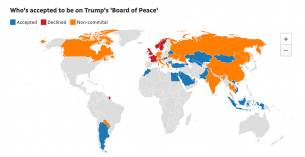
PoliticusUSA, News and Comment: Democrats Score A Big Win Against Shady Trump's Board Of Peace, Sarah Jones, right, and Jason Easley, July 6, 2026. The Trump administration took the unheard-of step of having the U.S. Patent and Trademark Office apply for Trump's trademark for the Board of Peace, but Democratic pressure stopped it dead.
You may have forgotten about Trump’s Board of Peace. The vanity organization created by Trump appears to have been put together as Trump’s vehicle for getting a Nobel Peace Prize by creating a front organization that he put himself in charge of that is supposed to be about solving conflicts and creating peace.
However, billions of dollars have been poured into the board, and nobody knows who is in control of the operation or where the money is going.
A big red flag went up when the U.S. Patent and Trademark Office applied for a trademark on the Board of Peace for Donald Trump.
Democrats in Congress have been quietly fighting this trademark because if Trump holds the trademark, he would be able to monetize the Board of Peace for financial gain.
House Judiciary Democrats have been pressuring the Patent and Trademark Office to drop the application, and they have.
House Judiciary Committee Ranking Member Rep. Jamie Raskin (D-MD) said in a statement:
The USPTO’s decision to abandon its disturbing trademark applications for the ‘Board of Peace’ is a welcome and necessary course correction. From the start, the USPTO’s Director’s baffling and unprecedented decision to apply for trademarks for President Trump raised serious concerns about its legality given that the Lanham Act forbids applications on behalf of another person unless you are their lawyer, which the Director specifically denied.
House Judiciary Committee Democrats have been aggressively investigating whether the USPTO is being manipulated and misused to conceal the true owner of what appears to be an unregulated global slush fund bankrolled by both foreign governments and U.S. taxpayers but effectively controlled by President Trump, the Board’s self-appointed ‘Chairman for Life.’
The structure and the shadiness of the Board of Peace should raise red flags, as the top House Judiciary Committee Democrat went on to explain.
Raskin said:
I pressed Director Squires repeatedly—in letters and under oath before the Judiciary Committee—to explain why the USPTO was acting as an extralegal custodian for Trump’s Board of Peace, stepping in as the Board’s agent to apply for a trademark on the Board’s behalf. No explanation ever came. USPTO’s role is to issue legitimate trademarks—not to apply for them on behalf of shadowy global slush funds. This inevitable retreat confirms what was clear all along: USPTO had no legal basis to stand in as a straw trademark holder for this shady scheme.
But America’s core questions about this mysterious venture remain unanswered. Billions of dollars have flowed or been pledged from foreign governments into this opaque entity, alongside at least $1.25 billion in taxpayer funds—yet the American people still have no idea what this entity actually is, who controls it, or under what legal authority it operates.
So who is ultimately in control of this foreign-funded operation? Who is controlling its accounts at J.P. Morgan? What legal structure—if any—governs it? Is it a for-profit enterprise, a not-for-profit enterprise or something else? What are its mechanisms of accountability and transparency? And was the USPTO enlisted to help shield the true ownership and financial architecture of what looks like a massive, unaccountable pool of foreign and domestic funds flowing outside any meaningful oversight?
Our oversight will continue until we get full and complete answers about what may be a glaring misuse of federal authority to facilitate and insulate another corrupt and foreign-backed Trump self-enrichment scheme.
The Board of Peace sure looks like a slush fund for Trump and his pals. The board is not a government organization and has no independent board oversight. If Trump had gotten the trademark, he could have monetized his Board of Peace and more openly used it to funnel money to himself and his family.
If Democrats take back all or part of Congress, they will be able to do more than use pressure campaigns to stop Trump's corruption.
The president’s corruption is not a victimless crime. Any money taken from taxpayers and given to the president and his allies will go to people who will go without healthcare, children who will go without food, and Americans who will pay more in taxes to subsidize the elite's grift.
Democrats got a win, and many more could be coming if they triumph in the midterm election.Morning all. Got a few things for you today:
The New Republic, Republicans Freak Out as Trump Hoards Cash Meant for Midterm Campaigns, Edith Olmsted, July 6, 2026. Donald Trump has not contributed to a campaign since March.
President Donald Trump is sitting on a more than $350 million war chest, but Republicans are starting to feel shortchanged, Politico  reported Monday.
MAGA Inc., a pro-Trump super PAC, hasn’t spent directly on a race since March, when it spent $17,900 to back Georgia Representative Clay Fuller’s campaign. Since then, MAGA Inc. has only given $560,000 to MAGA KY, which used it to back Ed Gallrein’s challenge against Kentucky Representative Thomas Massie.
Trump has openly mocked mounting concerns about affordability, and actively downplayed Republicans’ efforts to address it. Now, Republicans are frustrated that the president hasn’t spent a dime to convince voters that his party actually cares about them.
“We didn’t leave our most powerful missiles on the ships when we were trying to crush Iran. Money is the political equivalent in politics,” a GOP lobbyist and donor told Politico. “The electorate’s mindset on the economy is normally locked in stone by Labor Day after a summer of backyard conversations and paying for summer vacation gas.
“Now is the time to sell the message—America 250, the world loves America, the Democrats are crazy left again, and we sealed the border,” the lobbyist added.
Matthew Bartlett, Republican strategist and former Trump appointee to the State Department in the first administration, wasn’t optimistic that help was on the way.
“What makes you think they’re going to spend? We’ve been waiting for the cavalry,” Bartlett told Politico. “Every day matters about shaping sentiment and ideas, and when you have limited time, you should be attacking that early. So the notion of waiting is just inherently concerning … but even more of like, are you even actually going to be playing?”
Beyond sorely neglecting Republican candidates in November’s midterm elections, in some cases, Trump has actively undermined them.
New York Times, Deadly Russian Strikes Hit Kyiv on Eve of NATO Summit, Cassandra Vinograd and Carlotta Gall, Updated July 6, 2026. Ballistic missiles were fired into the capital of Ukraine as Russia launched its second major attack in less than a week. At least 12 people were killed, officials said.
Explosions rocked the Ukrainian capital of Kyiv early on Monday, the eve of a NATO summit, as Russia mounted its second major attack on the city in days.
President Volodymyr Zelensky of Ukraine, who is expected to attend the NATO summit, in Turkey, had warned of “a new massive strike,” and hours later, loud blasts shook Kyiv. The regional military administration said that ballistic missiles were flying, and Mayor Vitali Klitschko urged residents to stay in shelters.
Mr. Zelensky said in a social media post later in the morning that 12 people had been killed and 64 others wounded, including two children.
Thick, black smoke rose across the skyline as dawn broke. Mr. Klitschko said that emergency services were responding to multiple fires as well as attending at least one damaged apartment building where people were trapped. At least 15 residential buildings were destroyed or damaged in Kyiv overnight, the Ukrainian state emergency service said on social media.
In recent weeks, both Russia and Ukraine have intensified strikes on major cities in each other’s territory. Aiming to bring the war home to the Russian public, Ukraine has mounted a new and wide-ranging strategy of drone strikes into Russia. Kyiv has targeted oil refineries, causing fuel shortages across the country, as well as military production facilities.
Russia has increasingly targeted Ukraine’s large cities with missiles and swarms of drones, hitting factories and warehouses, but also apartment buildings, as its efforts to advance on the battlefront have largely stalled.
The two countries have doubled down on those attacks as peace talks have been largely set aside while the Trump administration has been occupied with the war with Iran.
Russia regularly launches barrages of various types of missiles and drones that overwhelm Ukraine’s air defenses. Ballistic missiles can only be intercepted by Patriot air defenses. Ukraine has made frequent pleas for new shipments of Patriot interceptors, suggesting that the remaining supply is low.
In the attack early on Monday, Russia launched 68 missiles and 351 drones against Ukraine in the attack overnight, with Kyiv the main target, according to Ukraine’s Air Force. It said that all the cruise missiles had been shot down but that none of the 23 ballistic missiles launched in the assault had been intercepted.
On Thursday, Russia pounded Kyiv with missiles and drones in a nearly 12-hour assault that killed 31 people and wounded more than 100 others.
The NATO meeting begins on Tuesday in Ankara, Turkey. It is set to be dominated by the alliance’s response to the war in Ukraine.
New York Times, Facing Threats, NATO Finds New Value in Turkey, Ben Hubbard, July 6, 2026. As President Trump cools on the alliance, its members see Turkey’s large military and vibrant defense sector as assets.
Just a few years ago, Turkey was seen as the bad boy of NATO.
It rankled allies by slow-walking bids from countries seeking to join the military alliance. It refused to apply Western sanctions on Russia over the war in Ukraine. President Recep Tayyip Erdogan referred to his Russian counterpart, President Vladimir V. Putin, as a “dear friend.” European and American officials worried about Mr. Erdogan’s strongman tendencies.
Now, global developments, including the wars in Ukraine and Iran and the return of President Trump to the White House, have dealt Turkey a new hand, increasing the country’s value in the eyes of its NATO allies, according to analysts and officials from a number of NATO countries.
When Mr. Erdogan welcomes NATO leaders in the Turkish capital, Ankara, this week for their summit meeting, it will be as the head of a country whose defense industry and large military are seen as critical for the alliance’s future, and as a leader with a unique ability to charm Mr. Trump.
“There is a recognition” of Turkey’s importance to NATO, Turkey’s foreign minister, Hakan Fidan, said in an interview with The New York Times the week before the summit. “There is an awakening in light of the new security and threat environment in Europe.”
Taylor Swift and Travis Kelce celebrated their marriage, and the culmination of a very public courtship, with a star-studded event at Madison Square Garden (Associated Press photo).
New York Times, Taylor Swift and Travis Kelce’s American Royal Wedding Amanda Hess, Updated July 5, 2026. A mega-famous popstar and a Super Bowl champion celebrated their love in Midtown Manhattan, announcing both their union and their cultural domination.
By all accounts, Taylor Swift and Travis Kelce are married. After a year of rumor, speculation and prediction-market prop-betting over where the couple would celebrate the event, they did it not at Swift’s seaside mansion in Rhode Island, nor at her TriBeCa compound. In the end, they decided to do it at work — inside the arena of sport and entertainment where Swift first performed at the age of 13.
The Swift-Kelce union at Madison Square Garden has been described as an American version of a royal wedding. Coinciding with the 250th anniversary of our breakup with the British Empire, it’s worth asking what that means.
“American royalty” rejects the idea of a hereditary line of figureheads, but it borrows the notion that one figure, through beauty, romance, talent and work, might rule over an adoring crowd. Our version plays out as an immersive simulated experience starring celebrity avatars. Royal weddings may unite bloodlines or merge empires, but they always revise and reassert a national identity. This one, between the pop star and the football player, is a crossover event that announces a hegemonic cultural power.
Of course, it’s also a private party, a celebration of the love between two human beings. This is an occasion that collapses the distinction between the public and the personal, the exclusive and the ubiquitous. Though staged in the heart of Midtown Manhattan, in the spot where three railroad networks converge, the festivities were obscured inside the arena’s fortified walls.
More On Trump Administration Corruption, Oppression
Paul Krugman via Substack, Political-Economy Commentary: Pump and Dump and Trump, Paul Krugman, right, July 6, 2026. It's much bigger than the memecoin. Donald Trump has distinguished himself in many ways. One of them is that he is our first pump and dump president: The really extraordinary financial picture that we’re seeing under the current administration.
Obviously no president has enriched himself from office the way that Trump has. That’s common knowledge. One of the things that is really amazing about it, however, is the way in which he enriched himself — a lot of which has to do with crypto.
So the New York Times had a report just the other day on Trumpcoin, the memecoin issued on Trump’s behalf which got a lot of buyers, a lot of money came flowing into it.
It should have been obvious from the beginning that the coin was inherently worthless, and at this point it essentially is worthless. It has lost 97 percent of its value. But a lot of people did buy in at the high prices.
What was special about the New York Times story was two things. First, they put a number on how much money naive investors have lost on the coin, which is 3.8 billion dollars. And even more surprising is the number of people who were in effect suckers here — almost a million.
That’s really amazing. I mean, I was completely cynical but I didn’t think there were that many suckers out there. But it turns out there were really a lot. A few people made money off the coin — basically insiders who got to buy it early and then were able to cash in before the broader retail market realized that this was a worthless token. There’s another token, the World Liberty Financial coin — which has also crashed, although the Times had difficulty in tracking down how many people have lost how much money. There’s the Melania coin.
Okay, all of this is amazing. As Trump would say, it’s like nothing anybody’s ever seen before. I think we should say, however, that this is a bigger story than just the Trump coin, and it’s a bigger story than just Trump himself.
What we’re witnessing is or has been a really enormous pump and dump scheme, I would argue, involving more or less all of crypto.
So if you don’t know the background, Trump used to be highly critical of cryptocurrency, saying it was worthless and a scam, which was true. But then when it became clear that there was money in it for him, he reversed course. And during the 2024 election, crypto interests contributed a lot of money to Trump. They then after the election poured a lot of money into his own enrichment, into his own projects. And the administration came in with a very pro crypto stance: deregulation encouraging uses of crypto, at least talk about a national bitcoin reserve, all of that. And the price of bitcoin doubled after the election; the valuation, the market cap of cryptocurrency in general went from a little over two trillion to more than four trillion.
And then starting last fall it all came crashing down. Not all the way to zero — the price of Bitcoin right now as I record this is about what it was on the eve of the 2024 election; it’s about half what it was at its peak. That’s also true, roughly speaking for the market cap. So we’ve seen about two trillion dollars of market valuation wiped out.
Why is this a pump and dump story? Well what is cryptocurrency good for? As you know, I’ve been on this for a long time. Bitcoin was introduced in 2009 — this is a seventeen year old idea which has yet to find any legitimate use cases. Illegitimate use cases, yes. There was also a report in the Wall Street Journal about the extent to which Iran and North Korea have been making use of cryptocurrency to evade U.S. sanctions, so there is that. But it’s still not enough to justify a multi-trillion dollar asset.
Anyway, it was trendy, it was exciting, it was fashionable and particularly after November 2024 it was pushed with the encouragement of the Trump Administration. It was just a heavy marketing campaign that had the advantage of also having the authority or whatever, the credibility — such as it was but among some people real —of Donald Trump behind it. They all evaporated.
I think we can say that to some extent what happened was that Trump kind of moved on to other things. There also is some distracted boyfriend meme: the guy looking over his shoulder. A lot of the excitable, fear of missing out, latest thing money has probably moved from crypto to AI. So that might have happened even without Trump. But the basic story is that Trump guided, pushed people into a whole asset class, crypto, of which a large part is Bitcoin, but other stuff as well.
We don’t know how much, or I don’t know, how much crypto was bought during this period, but it has to be substantial. And then it crashed. And at this point, essentially anybody who bought crypto during this era, since the 2024 election, has lost money.
It’s a lot of money; we know that on paper — it’s not really paper, but anyway — in principle two trillion dollars has been lost in crypto. Now a lot of that is probably money just given back, imaginary gains that took place during the run-up. But a substantial amount of additional money was from people who did buy in during this whole episode. So this has to be many times the size of the losses on the Trump coin. And it is, I would say, at a functional level another pump and dump scheme.
In this case the beneficiaries were people who were already in crypto. Clearly some of the crypto interests that bought themselves a president probably stayed fully invested. But others must have cashed out, and a lot of innocents — well a lot of a lot of suckers, let’s not mince words here — a lot of suckers clearly lost a lot of money.
It’s an extraordinary thing. There have been pump and dump schemes forever, probably going back to the Phoenicians or something. But this is on a scale we’ve never seen, and with the president of the United States in the center of it. Which I guess given everything else comes as no surprise.
Morning Shots via The Bulwark, Political Opinion:The president tried to make the event all about himself. He failed. And for that, the country succeeded., Bill Kristol, Benjamin Parker and Jim Swift, July 6, 2026. America’s 250th Survived Trump’s SabotageThe president tried to make the event all about himself. He failed. And for that, the country succeeded.
We trust everyone had an enjoyable Independence Day weekend—unless you were on the National Mall and had to deal with (in addition to the usual D.C. heat and humidity) the sad spectacle of the Great American State Fair, the torrential storms, the president’s egomaniacal insistence on being seen by crowds of inconvenienced people, and, well, the president himself. Happy Monday.
The Contrarian, Opinion: Founders Maybe Weren’t Geniuses, Jennifer Rubin, right, July 6, 2026. Trump has proven you can never be skeptical enough.
“Life, Larry, and the Pursuit of Unhappiness,” a 7-part sketch comedy series, delivers Larry David’s cynical, ornery take on American history. David appears Zelig-style at the center of famous, if highly fictionalized, historical events. He attempts to boot the hateful Mary Todd Lincoln from the White House after her husband’s assassination, lists complaints against King George III that didn’t make the Declaration, and steps in as Meriwether Lewis selling his boondoggle expedition to his wife. Sometimes he’s just “that guy” who annoys everyone — cutting in line at Depression-era soup kitchens, insulting Susan B. Anthony at her dinner party, whining at being left off the invite list to the Boston Tea Party. And just to show that Trump has killed satire, his July 3 anti-communist rant from Mt. Rushmore was not that far off the mark of Larry David’s sketch depicting Joe McCarthy’s crazed communist conspiracy-mongering that leaves his colleagues slack-jawed. In other settings, David reminds us that Americans’ obsession with technology comes with inescapable downsides (e.g., telephones that entrap us in pointless, interminable conversations; the petty, passenger-unfriendly rules of airline travel).
Plainly, Larry David is consumed with our current political nightmare. Throughout the series, he effectively drills down on a contradiction at the heart of our contemporary democracy: We lionize the Founding Fathers and fetishize our history, even as we recognize that their handiwork failed us in critical respects.
There is something deeply cathartic about watching Larry David as Democrat Samuel Tilden wig out (Episode 2) upon winning the popular vote but losing the Electoral College in 1876. “No, no, I won, I won…. What the f**k is an electoral college? …What kind of country is that? … No, it’s not a democracy! Who made this up, the Electoral College, the Founding f**cking Fathers, what a bunch of morons!”
Amid the hilarity, the point is powerful: We could do with less veneration of every aspect of a system that has led to such plainly destructive results. Democrats would certainly get credit from their frustrated base (and the country at large) if they would occasionally show genuine outrage in response to outcomes that defy common sense. Instead of treating every constitutional jot and title as sacred, they might actually suggest we are not permanently consigned to live with the Founding Fathers’ shortcomings. If we idolized the imperfect architects of our system a little less, we might utilize the amendment process (not to mention exercise some legislative leeway) to avoid democratic train wrecks.
As amusing as many of the sketches are, Larry David’s tour de force comes in a sketch (also from Episode 2) featuring George Washington’s announcement that he will not be seeking a third term. In furtherance of the cause of democracy, he states he will suggest that future presidents not serve more than two terms. David mulls about in the crowd, then asks what would happen if a subsequent president declined the suggestion. Ah, says Washington, not a problem! The Congress and the US Supreme Court could pass an amendment to prevent someone from serving more than two terms. Yeah, but we could end up with a “narcissistic asshole” who doesn’t care about the Constitution, David counters. And what if the Supreme Court turns out to be a bunch of “yes men” and Congress “a bunch of pussies who care more about party than country”?
Washington becomes mildly agitated by the notion that such future characters of such low character could upset the Founders’ best-laid plans. He recommends that after every election, we would simply have a peaceful transfer of power with the loser accepting the results and endorsing the winner! Again, David pops up to point out that this wouldn’t help if we get a “sociopath” who instead would foment a revolution, someone who would enrich himself and his family at the expense of others, send troops into cities who kill fellow Americans, attack universities and the press, and even cheat at golf. Jimmy Kimmel deadpans from the crowd that he doesn’t see how a president, like a big baby, would possibly take time to attack critics. Washington, unnerved, maintains that we would never elect a president of such poor character.
David presses on, raising the possibility that a future president could be so depraved as to have a pedophile as his best friend. David taunts the crowd: “What if he were a deeply corrupt con man; a pathological liar who preys on people’s prejudice?” Washington becomes incredulous, slow to grasp the risk that the American people could be a “collection of dupes” easily manipulated by a pathological narcissist. The crowd begins yelling at one another, a brawl breaks out, and a despondent Washington looks out on the crowd, finally concluding: “We’re f**cked.”Subscribed
The “sociopath” whom Larry David described has been popping up to torment us throughout the 250th celebration, reminding us of voters’ folly in electing such a charlatan and flaunting a system with limited, imperfect mechanisms to foil his efforts to sabotage our democracy. David’s comic brilliance helps distill the delicious interplay between, on one hand, the Founders — men of reason, skeptical of human nature…but perhaps not skeptical enough to anticipate the pure mendacity of a Donald Trump and the moral unseriousness of the masses — and, on the other hand, the realization of their worst nightmare in the person of Donald Trump.
For 250 years, we have relied excessively on the hope that democratic norms largely unsupported by legal coercion would hold the system together. But we aren’t obliged to keep gambling that our luck will hold, and that the villain at the center of our national trauma will self-destruct. We can cease to be passive observers constrained by an imperfect system that inherently favors the richest, most ruthless, and most corrupt. We would all benefit from a political system with more cranky, Larry David-esque provocateurs.
So we can thank him for a timely reminder: Greater irreverence and willingness to innovate a system created by very imperfect Founders may be precisely what we need to arrest our drift into an authoritarian dystopia.
Sex Assault Claim Pressures Upstart Maine Senate Democrat's Campaign
Graham Platner, Maine Democrat running for a U.S. Senate seat, speaks during a campaign event.
Politico, Exclusive: Woman who dated Graham Platner says he sexually assaulted her, Jessica Piper and Adam Wren, July 6, 2026. The Maine Democrat denied the allegations and said, “Any accusation of non-consensual behavior is categorically untrue.”
A woman who dated Maine U.S. Senate candidate Graham Platner says he forced her to have sex with him nearly five years ago despite her repeated objections, an allegation Platner denies.
The woman, a 41-year-old Maine resident named Jenny Racicot, detailed the alleged incident to POLITICO in three interviews over the past two weeks. POLITICO also spoke with a man Racicot dated and confided in the years after the alleged incident, and reviewed documents, including emails between Racicot and her therapist and messages between Racicot and an acquaintance whom she warned against getting involved with Platner years before he ran for office.
Racicot said she had an on-and-off relationship with Platner, who is now the Democratic Senate nominee in Maine, for more than two years before he entered her rural Maine home uninvited one night in late 2021, deeply intoxicated, and forced himself on her while she repeatedly told him to stop. She said she cut off contact with him after telling him the encounter was not consensual.
“I remember him grabbing my pelvis and being really forceful of me,” she said. “I remember the specific moment where I thought to myself, like, ‘This is no longer my choice.’”
Platner denied the allegations.
“These allegations are troubling, serious, and false. Any accusation of non-consensual behavior is categorically untrue,” he said in a statement.
Racicot previously described “reckless” and “unsettling” behavior by Platner to The New York Times, but says she didn’t go public with the specific assault claim because she didn’t want to be known as a rape victim.
Racicot said she later felt compelled to go public about her experience because the reaction to the Times story was dominated by controversy about another woman, Lyndsey Fifield, who alleged Platner mistreated her and faced attacks because of her ties to the Republican Party. (Contacted by POLITICO, Fifield stood by the allegations she made to the Times and declined to comment further.)
“My part of the story was just a read-over,” Racicot said in an interview. “And the story was Lyndsey, and the accusations of her being politically motivated.”
Racicot said she was torn over coming forward in part because she agrees with Platner politically.
“One of the reasons I didn’t come forward sooner was, the huge moral conflict that I had between supporting his politics, but not supporting him as a person,” she said. “I just want the truth out there. I just want people to have a whole scope of who he is as a person.”
In a statement, the Platner campaign reiterated his denial and accused critics of trying to drive him out of the race.
“These allegations are very serious and Graham vigorously denies them. They are also coached and coordinated by out of state establishment operatives. For a year, opponents of this campaign have thrown everything they can at Graham –– calling him a Nazi, a war criminal, and a communist. None of it has been true and this is no different. It is not a coincidence that this story comes a week before the ballot deadline, just as the previous false allegations came a week before the primary. Graham began this campaign to fight for a Maine where everyone is treated with dignity and where Mainers are put first, and no amount of desperate smears will stop this movement from seeing that vision through.”
Platner, an oysterman and political newcomer when he launched his Senate campaign last August, easily won the Democratic primary last month to face GOP Sen. Susan Collins in one of the nation’s most highly watched Senate races. His remarkable rise has been tainted by controversies, including offensive online comments and allegations of past mistreatment of women. He has not previously been accused of sexual assault.
The Iraq and Afghanistan war veteran has linked some of his behavior to mental health struggles and alcohol abuse. But he says he’s changed and has denied previous claims that he was abusive to women.
Racicot told POLITICO she connected with Platner on the dating app Bumble in 2019 and had consensual relations with him prior to the night he allegedly assaulted her.
That night in late 2021, she said she had exchanged text messages with him and told him not to come over, saying she wasn’t in the mood for company. Later that evening, she said she realized when she heard a sound on the stairs that he had let himself into her house, which was unlocked.
Platner came up the stairs, Racicot said, to where she was on a couch. He got on top of her and kept grabbing her, she said, while she repeatedly told him to stop and that she wasn’t interested. Racicot said she smelled alcohol on his breath and believed he was “almost blackout drunk” because Platner ignored her protests and continued to grab her after knocking over an antique sewing kit, spilling small needles everywhere.
“I had been telling him these words, like: ‘No, don’t,’” she recalled.
“And, the look on his face and realizing what was happening, I just realized that, like, I am in a situation where there’s no consent here,” she said.
Racicot said she tried to separate herself from Platner by telling him she couldn’t be in that room anymore, after which he followed her to her bedroom and had sex with her against her will. She said he also ejaculated inside of her despite her telling him not to, as she was not using birth control at the time.
She went to clean herself up, she said, and when she returned, Platner had fallen asleep. She contemplated waking him up to kick him out, but worried he could hurt someone driving in the state he was in.
The following morning, she said, Platner tried to put his arm around her and she pushed him away. She said she asked him whether he remembered what had happened the previous night; according to Racicot, Platner said he didn’t remember. Racicot said she told him to leave and never contact her again.
Racicot said she waited several weeks until she got her period to ensure she wasn’t pregnant, then sent Platner a private message on Instagram saying that the encounter was not consensual and she did not want to hear from him ever again. Racicot had no further contact with him after that, she said. Racicot said she later deleted all her texts and social media correspondence with Platner as she tried to move on from the assault, and said she has not been able to recover the Instagram messages she sent him about the incident.
In the weeks after the alleged assault, Racicot said she considered going to the police but struggled with shock and confusion about what had happened to her and did not file a police report. Even as time passed, she said she felt uncomfortable potentially telling a police officer about such a personal experience, and feared retaliation from Platner. At first, she confided only in her therapist, who she continues to see.
Racicot showed POLITICO recent emails with her therapist in which Racicot explained she was talking to the media about her relationship with Platner and the “sa/rape,” using an abbreviation for sexual assault. In the message, Racicot was not ready to go public and was seeking help corroborating her account in conversations she was having with reporters on condition of anonymity. Her therapist responded that Racicot shouldn’t have to speak publicly about a traumatic incident in order to be believed, without referencing details of any particular incident. The therapist, who POLITICO agreed not to name at her request, declined to comment when reached on Monday.
New York Tmes, Live Updates: Platner Will Take Time to ‘Reflect’ on Campaign After Sexual Assault Accusation, Lisa Lerer and Katie Glueck, July 6, 2026. Graham Platner, the Democratic Senate candidate in Maine, called the allegation “false.” He did not say if he would continue his campaign.
Here’s the latest.
Graham Platner, the Democratic Senate nominee from Maine, said he was taking time to “reflect” on his political path forward after a report that a woman had accused him of sexual assault, which he denied.
In a video posted on social media, Mr. Platner called the account “false.”
“Regardless of the inaccuracy of the reporting but mindful of the political reality it will inflict, we are taking the time to reflect on the best path forward,” he said.
It was not immediately clear whether Mr. Platner intended to continue his campaign against Senator Susan Collins, a Maine Republican. The Democratic Party has until July 13 to replace him on the ticket if he withdraws, according to Maine state law. Both parties see Maine as key to the battle for control of the Senate.
Jenny Racicot, who said she dated Mr. Platner casually off and on between 2019 and 2021, told The New York Times this spring about a 2021 incident in which she said he arrived at her house drunk after she had asked him not to come over. At the time, she declined to share further details of that encounter on the record, but she said she found his behavior “reckless” and “unsettling,” and cut off contact soon after that episode.
But in a new interview published in Politico on Monday, Ms. Racicot elaborated on her recollection of that night, saying Mr. Platner let himself into her home, climbed on top of her and kept grabbing her — even after she repeatedly told him to stop. He ignored her protests and followed her into the bedroom, where, she said, he had sex with her against her will.
“I had been telling him these words, like: ‘No, don’t,’” she told Politico.
“And, the look on his face and realizing what was happening, I just realized that, like, I am in a situation where there’s no consent here,” she said.
Mr. Platner called the allegations “troubling, serious, and false,” in the direct-to-camera video.
“Any accusation of non-consensual behavior is categorically false,” he said.
His statement came shortly after he had postponed several campaign events.
Ms. Racicot did not immediately respond to a request for comment.
PoliticusUSA, Opinion: It Is Time For Graham Platner To Go, Jason Easley, right, July 6, 2026. Democratic Senate candidate Graham Platner has been plagued by scandals and allegations, but he should end his campaign as he has now been accused of rape.
Progressives have been championing a theory of candidate recruitment that, at its core, believes that the key to winning back white working class voters, especially in red areas, is to run candidates from the working class.
Sen. Bernie Sanders (I-VT) is the modern champion of this theory, and even though it has proven to be effective, there is a segment of progressivism in the United States that tends to fall in love with candidate biographies and overlook red flags.
The Democratic Party put itself in a difficult position in the Senate primary in Maine when Senate Minority Leader Chuck Schumer backed Gov. Janet Mills in the Democratic primary. Mills is an older Democrat who, according to those in Maine, never expressed much interest in running in the primary, leaving a big opening for progressives in the state to win the Senate nomination.
I am not a Democrat or a Republican, so I have no dog in the fight over who should have been the party’s Senate nominee, but as a political scientist, I saw red flags around Graham Platner’s candidacy, and it was also understandable why he won the primary.
The problem is that those red flags have turned into a raging five-alarm fire.
The accuser is a Democrat who shares Platner’s views, and the more details there are, the more troubling the story becomes.
CNN reported on Jake Tapper’s interview with Racicot:
Racicot said one night in November or December 2021, Platner showed up drunk at her house after she asked him not to come and then forcibly had sex with her despite her repeated demands that he stop – at one point knocking over a sewing cabinet, which inadvertently left a needle stuck in her leg. When she confronted him the next morning, he said he did not remember what had happened, Racicot said.
Progressives have been championing a theory of candidate recruitment that, at its core, believes that the key to winning back white working class voters, especially in red areas, is to run candidates from the working class.
Sen. Bernie Sanders (I-VT) is the modern champion of this theory, and even though it has proven to be effective, there is a segment of progressivism in the United States that tends to fall in love with candidate biographies and overlook red flags.
The Democratic Party put itself in a difficult position in the Senate primary in Maine when Senate Minority Leader Chuck Schumer backed Gov. Janet Mills in the Democratic primary. Mills is an older Democrat who, according to those in Maine, never expressed much interest in running in the primary, leaving a big opening for progressives in the state to win the Senate nomination.
I am not a Democrat or a Republican, so I have no dog in the fight over who should have been the party’s Senate nominee, but as a political scientist, I saw red flags around Graham Platner’s candidacy, and it was also understandable why he won the primary.
Racicot said she did not report the incident to authorities at the time, and she broke off contact with him soon afterward. Asked if she now considered the incident a rape, Racicot said, “By definition yes, absolutely yes.”
As with Eric Swalwell, Democrats need to decide if they are going to stand by their principles or go the Trump GOP route and determine that sexual assault allegations don’t matter.
Women are the majority of the Democratic Party, so this party should police itself better than Donald Trump’s rural white male sausage festival party.
Platner has one week to withdraw as the Senate nominee, and he is suggesting that he might end his campaign, "So, regardless of the inaccuracy of the reporting, but mindful the political reality it will inflict, we are taking the time to reflect on the best path forward for the state that I love, the people that I love, the movement I belong to, and the goal of defeating Susan Collins.”
The allegations piling up against Platner are causing damage.
Susan Collins is the most vulnerable that she has ever been in her career, and all polls show that she is statistically tied with Platner, as Republicans prepare to spend hundreds of millions of dollars in Maine attacking Platner.
More telling is that Platner trails Collins by double digits with the white, blue-collar voters that progressives were hoping he could win over.
In my decades of covering the Senate elections of Susan Collins, I’ve seen this scene play out before. A flawed Democratic candidate looks close, but in the end, Collins, with the backing of a ton of money, wins another term.
Platner has a week before the deadline to withdraw from the race. There are many talented Democrats in Maine. Some of them already hold office and have been vetted.
Democrats need to ask themselves if Graham Platner is worth behaving like Donald Trump for?
If the answer is no, then Platner needs to go.
U.S. Courts, Law, Crime, Immigration, Rights, Justice
President Trump's nominee to become U.S. Attorney General Todd Blanche, is shown at right in a file photo showcasing his previous role in defending Trump from fraud charges before the convictions were voided because of the president's reelection.
New York Times, Emil Bove Defended Trump in Court. Then Trump Made Him a Judge, Mattathias Schwartz, July 6, 2026. President Trump is appointing his former personal lawyers to judgeships, part of a larger effort to put his stamp on the federal courts.
Not long after Emil Joseph Bove III first donned the robe as a federal appeals court judge in September, one of his new colleagues was surprised upon catching a glimpse of the background image on his iPhone. It was the photo of Donald J. Trump, bloodied by a would-be assassin’s bullet in Butler, Pa., with one fist raised in the air.
A former personal lawyer for Mr. Trump, Judge Bove is not the first jurist to hold on to a political memento or two from a past life.
But the Butler photo, which was described by three people with knowledge of it, caused discomfort on the close-knit 14-seat appeals court for Pennsylvania, New Jersey and Delaware. It touches on a central question about Judge Bove, who before joining the bench was known as an attack dog for Mr. Trump: whether his loyalty to the president might override his commitment to the rule of law.
Those concerns echo a broader issue facing the country’s judiciary, as Mr. Trump fills the 13 courts of appeal with judges who have voted overwhelmingly for his agenda. About a third of federal appellate judges are now Trump appointees.
Some of those who have worked closely with Judge Bove on the U.S. Court of Appeals for the Third Circuit, and who spoke on the condition of anonymity to describe internal matters, said the answer in his case is not yet clear. They offered a nuanced picture of how the young judge, 45, is acclimating to his new role. His jurisprudence has been broadly aligned with White House policies on diversity and immigration, but he has not yet ruled on a case that clearly involves Mr. Trump’s personal interests.ImageEmil Bove III sitting before microphones inside a congressional hearing room.At his confirmation hearing last year, Judge Bove said, “I’m not anybody’s henchman.”Credit...Tierney L. Cross/The New York Times
Beyond the photo on his phone, which has not been previously reported, Judge Bove has drawn public criticism for attending one of Mr. Trump’s campaign-style rallies in December. The incident led to an ethics complaint that is being considered by the chief judge of an appeals court.
Nancy Gertner, a retired federal judge, said Judge Bove’s attendance at the rally suggested that he still saw himself as Mr. Trump’s advocate. “When he was nominated, my concern was that he was not just the president’s lawyer, but a zealot,” she said. “He was doing and saying things that were inappropriate. And he’s continuing to do so now.”
As he approaches the end of his first year on the Third Circuit, Judge Bove’s rulings have been reliably conservative. On a bench that prides itself on a tradition of centrist collegiality, his acerbic solo dissents have irritated some judges and lawyers.
But he has also shown a knack for persuading others — mostly the court’s five other Trump appointees — to join his opinions. And he has recused himself from political matters he had touched while he was at the Justice Department in early 2025, which legal experts point to as an indication that he is cognizant of his ethical obligations.
In interviews, some who have worked closely with Judge Bove praised his work ethic and polite manner with other judges. By all accounts, he has thrown himself into the job, rising early to drive more than an hour to his chambers in Newark, N.J., and using a text-to-speech app to listen to books and opinions on the way.
A spokesman for the court said Judge Bove declined to comment. At his confirmation hearing last year, he insisted, “I’m not anybody’s henchman.”
Judge Bove, one of three of Mr. Trump’s former personal lawyers whom he has nominated for the appellate bench, pushed hard for Mr. Trump’s policy agenda as a senior official at the Justice Department. His age and résumé (two clerkships and nine years as a federal prosecutor) have also driven speculation that Mr. Trump might choose him to fill a potential Supreme Court vacancy.
To Mr. Trump’s supporters, Judge Bove’s elevation to the federal bench represents a course correction from the first Trump term. Then, nominations were guided by the leadership of the Federalist Society, a pipeline for conservative legal talent that has drawn fire from Mr. Trump when his nominees rule against him. Now he is reshaping the bench by turning to lawyers he feels would be more loyal to him and his agenda.
Robert Luther III, who advised Judge Bove during the confirmation process, said that his detractors had wrongly caricatured him as “some sort of unhinged monster, whereas in reality he is an extremely thoughtful, deliberate, soft-spoken guy.” At the same time, Mr. Luther added, “he certainly has the fight that Donald Trump wants.”‘Close to Crossing the Line’ImageTodd Blanche and Emil Bove III walking outside of a courthouse wearing dark suits and holding briefcases.Emil Bove III, right, and Todd Blanche, now nominated for attorney general, represented Mr. Trump in criminal cases, including the investigation into the Jan. 6, 2021, attack on the Capitol.Credit...Haiyun Jiang for The New York Times
Judge Bove’s legal career has been characterized by his desire to secure victories, a drive that has propelled his rise while generating friction with colleagues and judges.
He spent nine years as a federal prosecutor in the Southern District of New York, where he won guilty pleas or convictions of a Russian spy, two pipe-bomb terrorists, a Hezbollah operative and the brother of the president of Honduras.
But members of the defense bar complained about what they said was Judge Bove’s abrasive style. And in 2020, a federal judge harshly rebuked a team of prosecutors that he helped lead for failing to disclose exculpatory evidence to a defendant; he apologized at the time. Judge Bove left government the next year and joined a law firm with headquarters in New Jersey.
In 2023, he joined forces with Todd Blanche — now Mr. Trump’s pick for attorney general — to defend Mr. Trump from multiple criminal indictments. The move was a gamble. The former president was teetering on the brink of disgrace. During a trial stemming from Mr. Trump’s hush money payments to a porn star, Judge Bove and Mr. Blanche sparred vigorously with Judge Juan M. Merchan, who said they were “dangerously close to crossing the line of zealous representation.”
After Mr. Trump returned to office last year, he named Judge Bove to a top job at the Justice Department, where he quickly gained a reputation as a hard-driving enforcer.
One of Judge Bove’s old colleagues from the Southern District accused him of moving to dismiss a criminal indictment against Eric Adams, then the mayor of New York, as a reward for Mr. Adams’s supporting Mr. Trump’s policies. Judge Bove denied that charge to the Senate, and said the decision was made by Justice Department leadership.
Then, last summer, a former Justice Department official said that Judge Bove had raised the possibility of defying a court order amid a legal showdown over planes carrying deportees to El Salvador. The day after the meeting in which Judge Bove was accused of discussing defiance, the administration failed to comply with an order from Judge James E. Boasberg to turn the planes around.
Judge Bove has said he does not remember the remarks attributed to him but acknowledged in a court filing that he “contributed to privileged legal advice” in the case.
New York Tmes, Live Updates: Prosecutors Deploy Videos in Charlie Kirk’s Assassination Hearing, Jack Healy, Nicholas Bogel-Burroughs and Robert Draper, July 6, 2026. Erika Kirk, the victim’s widow, and Donald Trump Jr. are attending a hearing where a Utah judge is determining whether there is enough evidence to try the man accused of killing Mr. Kirk.
Prosecutors played videos for a Utah judge on Monday that showed the assassination of Charlie Kirk as they laid out their case against the 23-year-old man accused of murdering the conservative figure.
The judge, Tony Graf, flinched while watching one of the videos that captured the shooting last year. It was not shown publicly on the livestream of the proceeding.
The hearing that began on Monday in Provo, Utah, is not a trial, but rather a preliminary hearing where Judge Graf will decide whether prosecutors have enough evidence to go to trial against the defendant, Tyler Robinson, who could face the death penalty.
The videos came in addition to testimony from two police officers whom the prosecution called to describe what they witnessed last year on Sept. 10, the day of the shooting.
The first, Chris Bagley, who used to work for Utah Valley University, where Mr. Kirk was killed, described how officers mistakenly thought they had apprehended the gunman minutes after the shooting, but actually had the wrong person. Mr. Robinson was not taken into custody until the following night.
The hearing, similar to a grand jury proceeding in other states, will unfold throughout the week with the emotion and tension of a mini-trial in a case that has been dogged by delays and conspiracy theories. On cross-examination, Mr. Robinson’s defense lawyer, Kathryn Nester, sought to poke holes in the prosecution case and questioned whether the police had been adequately prepared for Mr. Kirk’s event. She objected repeatedly to showing the videos.
Mr. Robinson has yet to enter a plea, and his defense team has given few hints about its strategy.
Here’s what else to know:
The courtroom: Mr. Kirk’s widow, Erika Kirk, attended the hearing on Monday, as did his parents and several supporters, including Donald Trump Jr. The hearing is the first time that Ms. Kirk and Mr. Robinson have been in the same room.
The defendant: Mr. Robinson, who has been held in jail since he was arrested in September, is wearing a tie and has occasionally whispered to his lawyers and appeared to take notes with a red pen.
The prosecution: Prosecutors are expected to present surveillance videos, autopsy findings and witness statements, and to play a video interview with Lance Twiggs, Mr. Robinson’s former roommate and lover, that could shed light on the defendant’s motive. Mr. Twiggs has received immunity, according to court filings.
The defendant: Mr. Robinson’s family recognized him in surveillance images released by investigators, and arranged his surrender. He has been in jail ever since, and is expected to be in the courtroom all this week.
News Roundups

The Smithsonian headquarters in Washington, DC.
The Parnas Perspective, Morning News and Commentary: Trump Rewrites History in Smithsonians, World Erupts Over FIFA Pressure, National Emergency Over Elections, DOGE Shuts Down, Aaron Parnas, right, July 6, 2026. This Monday is already off to a busy start. The White House has released a new report accusing the Smithsonian of promoting an activist interpretation of American history as the administration moves closer to reshaping language and exhibits in museums. Around the world, backlash is growing over President Trump’s alleged involvement in the World Cup, while some of his closest allies are urging him to declare a national emergency over elections.
Meanwhile, millions have gathered in Iran for funeral ceremonies following the death of the country’s supreme leader, with anti-Trump imagery prominently displayed throughout the procession. And that’s just the beginning of today’s news.
This is shaping up to be another busy week. Our next paid subscriber live will be Wednesday night at 7:45 p.m. EST, so stay tuned.
If you can, please consider subscribing, upgrading your subscription, or gifting one to someone else. Your support keeps me caffeinated, keeps this work going, and makes it possible to bring accurate, independent news to millions of people every single day. I truly couldn’t do it without you.Subscribed
Here’s the news:
Smithsonian:
The White House released a report accusing the Smithsonian Institution, particularly the National Museum of American History, of promoting a politically biased and activist interpretation of American history, signaling the Trump administration may seek changes in its leadership. The report follows President Trump's executive order directing the Smithsonian to eliminate what he calls "divisive narratives" and restore what his administration describes as a more patriotic presentation of U.S. history. Smithsonian Secretary Lonnie Bunch defended the institution's mission, saying understanding both the nation's achievements and shortcomings is essential to telling America's full story. The administration's criticism is part of a broader effort to reshape cultural and educational institutions, including museums, universities, and historic sites, that it believes have adopted overly liberal viewpoints.
The White House report accuses the Smithsonian’s National Museum of American History of minimizing America’s Founding by lacking major exhibits dedicated to figures such as George Washington, Thomas Jefferson, or the Continental Congress. It argues that key founding documents, including the Declaration of Independence and the Constitution, are presented in ways that downplay themes of natural rights, equality, and liberty while placing greater emphasis on slavery, oppression, and colonialism. The report also criticizes museum exhibits for portraying Christianity primarily as a force of conquest and describing the Pilgrims and early European settlement in overwhelmingly negative terms. According to the report, these omissions present an incomplete and distorted account of American history.
The report claims museum leadership intentionally sought to “problematize” America’s 250th anniversary by emphasizing the nation’s historical shortcomings rather than celebrating its founding. It points to leadership statements about moving away from an “America First” perspective and notes that the museum did not hold special Independence Day programming in 2025 or 2026 despite the nation’s semiquincentennial. The report also highlights changes to the museum’s mission statement, arguing that references to “American history” were replaced with language focused on social justice and creating a more compassionate future. It concludes these decisions reflect a deliberate effort to reframe the nation’s founding rather than commemorate it.
The White House report further argues that the museum has shifted from historical scholarship toward political activism by organizing exhibits around themes such as race, gender, immigration, climate change, and inequality. It criticizes staff training materials, hiring practices, and exhibits addressing immigration and transgender issues, claiming they reflect ideological advocacy rather than neutral historical interpretation. The report also argues that, because the Smithsonian receives significant taxpayer funding, it has a responsibility to present history in a way that is accurate, unifying, and nonpartisan. It concludes that the National Museum of American History has become institutionally driven by activist ideology and recommends restoring what it describes as a more patriotic presentation of American history.
Trump National Emergency:
Peter Ticktin, a longtime friend of Donald Trump and attorney for several election deniers, is urging Trump to declare a national emergency over alleged foreign interference and take greater federal control of the 2026 midterm elections. He claims electronic voting machines remain compromised despite years of federal investigations finding no evidence that foreign governments altered the 2020 election. Election law experts warn such a move would trigger a constitutional crisis because the Constitution gives authority over elections to the states and Congress, not the president. Ticktin continues to push these claims while maintaining close ties to figures in the election denial movement.
Ticktin has represented former Colorado clerk Tina Peters, January 6 defendants, and other Trump allies who continue to dispute the 2020 election results. He has repeatedly promoted conspiracy theories about election fraud despite multiple investigations debunking those claims, and has faced court sanctions over false allegations made in litigation. He insists new evidence will eventually emerge to support his assertions, though none has been publicly produced. The article also details his controversial legal career and continued role in efforts to challenge U.S. election outcomes.
World Cup:
The controversy over Folarin Balogun's World Cup eligibility is continuing after Belgium was granted the right to appeal FIFA's decision to overturn his automatic one-match suspension before the United States' Round of 16 match. UEFA sharply criticized FIFA, saying it had "crossed a red line" by making an unprecedented exception to the tournament's red card rules and warning the decision threatens the integrity and consistency of the competition. Belgium argues FIFA contradicted its own regulations, while an independent FIFA appeals committee member is expected to hear the case, though it remains unclear whether a ruling will come before kickoff or if Balogun's suspension could be reinstated. The dispute stems from Balogun's controversial red card against Bosnia, which FIFA later suspended for a one-year probationary period instead of enforcing the mandatory one-match ban.
UEFA has sharply criticized FIFA's decision to lift Balogun's automatic one-match suspension, calling it "incomprehensible and unjustifiable" and arguing it undermines the integrity of the World Cup by creating an unprecedented exception to established rules. Belgium has formally appealed the ruling, while officials say they are considering legal action because FIFA has not fully explained the decision beyond citing a disciplinary rule allowing sanctions to be suspended. The controversy has intensified following reports that President Donald Trump personally urged FIFA President Gianni Infantino to reverse the ban, prompting criticism from European officials who argued that political leaders should not influence sporting decisions. FIFA has not publicly detailed its reasoning, while U.S. coach Mauricio Pochettino defended the reversal, maintaining Balogun's original red card was unfair.
DOGE:
DOGE has officially shut down after reaching the July 4 self-termination date established in Donald Trump’s executive order creating the temporary government efficiency office. The agency said it saved an estimated $215 billion by reducing federal spending, though that figure has been disputed and critics argue the full savings have not been independently verified. The White House praised DOGE’s efforts, calling it a major step toward reducing waste, fraud, and abuse across the federal government. Officials also confirmed there are no plans to release a final report summarizing the agency’s work. In its final public statement, DOGE said that while the organization has ended, its mission to promote government efficiency should continue.
One year after the Trump administration dissolved USAID as an independent agency and folded its remaining programs into the State Department, former USAID Administrator Samantha Power says the consequences have been severe, arguing that the abrupt cuts have contributed to hundreds of thousands of deaths by disrupting access to medicine, clean water, and humanitarian aid. Power acknowledged the agency needed reforms to reduce bureaucracy and speed up aid delivery, but said dismantling it entirely weakened a key tool of American diplomacy and global influence. She also warned that the U.S. retreat has created opportunities for geopolitical rivals like China to expand their influence, even if they are not replacing America's aid programs directly. The Trump administration has defended the restructuring as a necessary effort to eliminate inefficiency and improve oversight of foreign assistance.
The dismantling of USAID has been linked to a growing humanitarian crisis, with researchers estimating that the loss of U.S. foreign aid could contribute to the deaths of millions of children by disrupting access to food, HIV/AIDS treatment, malaria prevention, and maternal health care. Journalists reporting from countries including Liberia, South Sudan, Uganda, and Sierra Leone have documented cases of children and adults dying after lifesaving programs were abruptly cut. Aid organizations say the collapse of these programs has left vulnerable communities without essential medical care and emergency assistance, worsening hunger and preventable disease outbreaks. The humanitarian impact continues to grow as many of the affected health and relief programs remain shuttered.
Iran:
Millions of people gathered in Tehran for the funeral procession of Iran's late Supreme Leader Ali Khamenei, with crowds filling the streets during a lengthy state-organized ceremony. Mourners carried Iranian flags and banners, while chants calling for revenge against the United States and President Donald Trump were heard during the events. Iranian President Masoud Pezeshkian said the turnout demonstrated national unity and rejected claims that public displays of grief were staged. The funeral comes months after Khamenei was killed in an Israeli strike, with his son, Mojtaba Khamenei, having been named as his successor.
Iranian state media claimed more than 10 million people attended the procession in Tehran and projected that over 20 million people could participate in ceremonies held over several days across Iran and Iraq. Those figures have not been independently verified. The previous funeral of Iran's first Supreme Leader, Ayatollah Ruhollah Khomeini, in 1989, is also widely regarded as one of the largest funeral gatherings ever recorded.
Other news:
A 20-year-old man, Tyrin Johnson, was shot and killed by two Tennessee National Guard soldiers during an early Sunday morning patrol in Memphis after authorities said he pulled a gun while fleeing officers responding to reports of gunfire. The Tennessee Bureau of Investigation is investigating the shooting, and officials said National Guard medics attempted lifesaving measures before Johnson was pronounced dead at the scene. The deployment of National Guard troops to Memphis has been controversial since it began in 2025 under Gov. Bill Lee in support of Trump’s anti-crime initiative, despite opposition from local Democratic leaders who argued crime was already declining. Johnson’s family described him as a father, former Tennessee State University student, and aspiring construction business leader, and said they want to review the investigation before drawing conclusions.
Donald Trump amplified calls for a restraining order against Italy’s Prime Minister ahead of the NATO summit:
Donald Trump posted a racist image depicting Barack and Michelle Obama waving beside graffiti that reads “YES WE CAN,” “BLM,” and “OBAMA.”
Conservative organizations have filed petitions asking the Federal Communications Commission (FCC) to deny license renewals for ABC's eight owned-and-operated television stations, accusing the network of political bias, discriminatory employment practices, and failing to serve the public interest. The petitions come after the FCC, led by Chair Brendan Carr, required ABC to begin its license renewal process earlier than usual as part of an investigation into the network's diversity, equity, and inclusion policies. Groups including the Center for American Rights, Media Research Center, Article III Project, and America First Legal argue ABC has violated broadcasting standards through alleged partisan coverage, employment practices, and other editorial decisions. ABC will have an opportunity to respond before the FCC reviews the petitions, with the process potentially leading to hearings before an administrative law judge or the commissioners themselves.
At least 12 people were killed and more than 50 injured after Russia launched another wave of overnight missile strikes on Kyiv, damaging residential buildings across several districts. Following the attack, Ukrainian President Volodymyr Zelenskyy renewed his call for the United States and European allies to provide more Patriot air defense systems, arguing they are critical to protecting civilians. Zelenskyy warned that Russia is preparing additional large-scale strikes ahead of this week's NATO summit in Turkey and said stronger allied support is urgently needed. Kyiv officials declared a day of mourning as emergency crews continued searching through the rubble for survivors.
A new peer-reviewed study suggests that exposure to fine particulate air pollution (PM2.5) during infancy may contribute to childhood obesity by impairing impulse control. Researchers found that children exposed to higher levels of PM2.5 in their first year of life were more likely to develop difficulties with self-regulation, which was associated with higher body fat and BMI between ages 4 and 8. The study points to early brain development as a possible pathway linking air pollution to long-term health outcomes, though researchers note additional studies are needed to confirm the findings. The authors say the results underscore the importance of reducing air pollution exposure through both public policy and practical measures such as using high-efficiency air filters and avoiding heavy pollution when possible.
Colorado is battling five major wildfires that have scorched more than 190,000 acres, with the Aspen Acres Fire growing to 89,055 acres and becoming the seventh-largest wildfire in state history. Thousands of residents remain under evacuation orders across multiple counties as hundreds of homes have been destroyed and more than 3,000 firefighters are working to contain the blazes. Fire officials warn that hot temperatures, strong winds, and thunderstorms could worsen conditions, while wildfire smoke has triggered air quality alerts across much of the state. Federal funding has been approved to help fight the Willow Fire, and authorities continue urging residents to follow evacuation orders and avoid activities that could spark additional fires.
Wildfires fueled by record-breaking heat and strong winds are sweeping across southern Europe, forcing thousands of people to evacuate in France, Spain, Portugal, and Greece. In France, more than 10,000 residents fled as a wildfire in the Pyrenees burned roughly 5,000 hectares, prompting officials to ban spectators from a Tour de France stage for safety. Portugal is battling its largest blaze with more than 1,200 firefighters responding to a fire that has scorched about 13,000 hectares, while major fires have also spread through Spain, Greece, Croatia, and Albania. Officials warn that extreme heat linked to climate change has created dangerous "powder keg" conditions, with temperatures expected to climb again this week and increase the wildfire threat.

Donald Trump speaks down to Italian Prime Minister Giorgia Meloni at a G7 meeting in France on June 16 (Pool photo by Evelyn Hockstein via Getty Images).
The New Republic, Trump Escalates Feud With Italy’s Meloni With Deranged Post, Hafiz Rashid, July 6, 2026. Donald Trump is reigniting a diplomatic crisis for no apparent reason.
President Trump took a shot at Italian Prime Minister Giorgia Meloni Sunday afternoon on Truth Social, posting a picture showing her looking up at him with the caption “restraining order needed.”
Trump’s latest attempt to antagonize Meloni comes ahead of a NATO meeting in Turkey on Tuesday, which both leaders will be attending.
Last month, the president nearly sparked a diplomatic crisis by claiming to an Italian TV station that Meloni “begged” him for a picture with her at a G7 summit in France.
“She wanted a picture with me so badly. I wouldn’t have taken it, but I felt sorry for her,” Trump said. Meloni denied ever saying that, posting a video on X stating, “Neither I nor Italy ever beg,” in Italian.
“Donald Trump’s statements are completely made up,” Meloni said. “I am frankly astonished. I don’t know why the president of the United States behaves like this towards his allies: It is not the first time, moreover.”
After that, Italian Foreign Minister Antonio Tajani canceled a planned trip to the U.S., calling Trump’s remarks “serious and offensive.” Footage emerged from the summit of Meloni appearing to speak forcefully toward Trump, not appearing to beg at all.
Trump doubled down days later, claiming that Meloni asked for a picture “over and over” and telling NBC News that she “was a big fan” of his.
“But I don’t want her as a fan because she was not there―along with the NATO group―having to do with the strait,” Trump said, referring to Italy’s refusal to join in any efforts to retake the Strait of Hormuz along with other European allies of the U.S. He also mocked Meloni and claimed she needed a photo with him because “she is doing poorly in Italy with her level of popularity.”
“My popularity is none of your concern,” Meloni later replied. “I suggest you focus on yours.”
 What his intention is with his latest post, shown above, doesn’t make sense, and is likely to make things worse. He clearly has some kind of obsession with her, as he called her a “beautiful young woman” in an embarrassing moment at a peace summit in Egypt last year. She was less than impressed.
The New Republic, The Daily Blast: MAGA Wants to Force Women to Pee in Cups at Airports, Greg Sargent, July 6, 2026. As MAGA personalities start demanding a ban on women coming to the U.S. and having babies, a writer who covers Trumpism explains what this reveals about today’s right—and why we should take it seriously.
The following is a lightly edited transcript of the July 6 episode of the Daily Blast podcast. Listen to it here.
Greg Sargent: This is The Daily Blast from The New Republic, produced and presented by the DSR Network. I’m your host, Greg Sargent.
The right has long been obsessed with the idea that huge numbers of women come illegally to the United States only to have babies. But now Donald Trump’s top officials and the MAGA movement are giving this a new twist. They’re seriously talking about preventing pregnant women from entering the country. This is being discussed all over MAGA media. Some are talking about forced sterilization. Others are talking about pregnancy tests before entry.
Sarah Posner, a writer for Talking Points Memo, memorably summed this up with a single tweet: “So will every woman now have to pee in a cup at airports?” It’s a damn good question. And it’s all very ludicrous, except for one thing—it reflects an actual vision for the country, a vision that JD Vance and Donald Trump and a lot of significant MAGA personalities very much share. So we’re talking to Sarah Posner about all of it. Sarah, great to have you on.
Sarah Posner: Thanks for having me again, Greg.
Sargent: So the backdrop to all this is the Supreme Court ruling upholding birthright citizenship. This unleashed fury and anxiety among MAGA figures across the spectrum, who started to imagine the United States getting dramatically swamped by far more immigrant babies going forward. One leading MAGA figure said the possible ways forward now should include: “Deny entry to all pregnant foreigners,” “deny entry to all female foreigners,” “require sterilization of all foreign visitors prior to entry.”
Wow. What’s your immediate reaction to just the sheer level of fear and anxiety we’re witnessing here?
Posner: Well, I think we’re witnessing a sheer level of racism. The anxiety about birth tourism, and women coming to America from China or other places just so they could have a baby who would be an American citizen, has long been a talking point in the anti-immigrant right. So it’s not like it came out of nowhere.
But never have I seen the range of people talking about such extreme policy proposals, if you can call them that, to try to prevent this thing that can already be prevented by U.S. consulates, who investigate this sort of thing when they’re deciding whether to grant somebody a visa, and can turn down somebody’s visa based on that.
What these people are proposing is the idea that women would be potentially sterilized if they wanted to come to America. That’s insane. Or that testing women, giving women pregnancy tests before they come. I mean, it’s just so bananas. I can’t even believe that they’re not ashamed to talk about it on TV.
Sargent: Yeah, and they even seem to be enjoying it a whole lot as well. I want to read some quotes from leading MAGA figures. Here’s Mike Davis: “We need to get all illegals out of our country fast, and we need to start with birthing-aged women.”
Ben Shapiro: “If you’re coming in six months pregnant, we should not give you a four-month visa. We should give you a one-month visa and then kick your ass out, right?”
Sarah, one interesting thing here is that there’s always been this intense misogyny to MAGA. And here you’re seeing almost a conflation or a bundling of the misogyny and the hysterical hatred of immigrants and the great replacement theory, just really juiced up to the most hyperbolic and insane levels you can imagine. You’re good on the topic of MAGA misogyny. What do you make of that element of it?
Posner: Well, for one thing, MAGA has always been very interested in policing women’s bodies, whether it’s preventing them from having an abortion, preventing them from accessing birth control, or in this case, preventing them from being in the United States when they go into labor, right?
Like, all of these things are about making sure that they have control over women’s bodies and women’s reproductive freedom. So that is completely on brand for them, to be obsessed with this.
And then you add that to their obsession about immigrant, quote-unquote, “invasions”—that these invasions of immigrants are making the United States less pure, are contaminating us. And so you have a movement that’s at its core disgusted by women’s bodies. And that’s why they want to control them.
And here they add to that layer of disgust by talking about immigrant women as being—or, I mean, not just immigrant women, women in general, like women who are coming to the United States to visit family or go see the Empire State Building—you know, that they’re talking about them as being conniving and dirty and wanting to basically defraud America.
Sargent: And some leading MAGA women are getting into this act too. Here’s Megyn Kelly.
Megyn Kelly (voiceover): Would there be the possibility of cracking down on pregnant aliens who are coming over here—revoking visas, pregnancy tests, even? I mean, how far could we go with that?
Sargent: There seems to be this almost zealous desire to stop people from coming here at all. I really think at this point they just want the whole world to go away. Can you talk about that element of this?
The New Republic, It Sure Looks Like Trump Directly Influenced the World Cup, Edith Olmsted, July 6, 2026. Donald Trump appears to have intervened to increase the U.S.’s odds of defeating Belgium.President Donald Trump may have revealed just how corrupt FIFA’s 2026 World Cup really is.
Just hours after top U.S. Soccer scorer Folarin Balogun received a red card and a minimum automatic one-game suspension, Trump urged FIFA President Gianni Infantino to review the decision, four people told The New York Times.
FIFA announced Sunday that it had reversed Balogun’s suspension, making him eligible to play against Belgium on Monday as the U.S. tries to advance to the quarterfinals. This is the first time since 1962 that a player has been allowed to appear in a game after receiving a suspension.
The unprecedented decision has sparked serious concerns of favoritism. Earlier this year, Infantino shocked his own top officials by cooking up the FIFA World Peace Prize, apparently to placate Trump after his campaign for the Nobel Peace Prize crashed and burned.
It wasn’t just Trump who intervened—senior administration officials including Commerce Secretary Howard Lutnick and World Cup task force director Andrew Giuliani worked quickly to engage lawyers to help U.S. Soccer mount an appeal.
When FIFA delivered its decision, the organization offered no explanation for why Balogun was exempt from his suspension, sparking widespread outrage.
The Royal Belgian Football Association released a statement Monday arguing that FIFA had failed to follow its own rules in processing an appeal and that the RBFA was “investigating all potential options.” Shortly after, the federation announced it was challenging the decision.
The Europa League also released a statement saying the decision was “unprecedented, incomprehensible and unjustifiable,” and that FIFA had “crossed a red line.”
“When the certainty of rules is no longer guaranteed by its guardians, the integrity of the game is at stake and the credibility of a competition is undermined,” the football club said.
Meanwhile, Trump celebrated the decision. “Thank you to FIFA for doing what was right, and reversing a great injustice!” the president wrote in a post on Truth Social Sunday afternoon.
Emptywheel, Analysis and Opinion: Trump Loves Cheating More Than He Hates Birthright Citizenship, Emptywheel (Marcy Wheeler, right), July 6, 2026. If I were Stephen Miller, I would resign on what other people call principle.
After all, in humiliating fashion, Trump has acted to make it clear that America’s birthright citizens — in this case, Folarin Balogun, a striker playing with the US Ment’s soccer team — is crucial to US success.
Both before and after SCOTUS ruled that (on this matter, at least) the Fourteenth Amendment means what it says, news outlets had focused on how Balogun qualified to play with the US, in addition to England or Nigeria: birthright citizenship.
He announced himself at the World Cup with two goals for co-hosts the United States as they beat Paraguay in their opening game.
But Folarin Balogun only represents the USA because of a quirk of his birth.
And the irony is the nation’s prized striker is the type of person President Donald Trump says should not be eligible for citizenship under his hardline immigration agenda.
As Balogun prepares for their second group game against Australia in Seattle on Friday (20:00 BST), it comes against a backdrop of a World Cup already fraught with immigration and visa controversies.
The US Supreme Court is due to rule on the president’s executive order – and the fundamental meaning of citizenship – within weeks.
Balogun, 24, is a product of Arsenal’s youth academy and could have pledged his allegiance to England or Nigeria.
However, long before that, circumstances conspired to give him the opportunity to represent the US.
Balogun’s Nigerian parents were living in London when they took a trip to New York in the summer of 2001.
The trip proved fateful. Balogun’s mum was not allowed on the flight home when airline attendants realised she was heavily pregnant, and instead of being born in the English capital, he arrived into the world in Brooklyn, New York on 3 July 2001.
Being born in Brooklyn meant Balogun was automatically granted US citizenship under the country’s birthright citizenship laws – based on the 14th amendment to the US Constitution.
Balogun received a red card in the USMNT’s game against Bosnia and any immediate appeal failed.
But then Trump intervened three times with his partner in corruption, Gianni Infantino.
President Trump called Gianni Infantino, the president of FIFA, in the hours after the United States men’s soccer team played Wednesday and asked him to review the suspension of the team’s top goal scorer in the World Cup, Folarin Balogun, after he was given a red card, according to four people familiar with the conversation.
On Sunday, FIFA reversed the suspension, announcing that Mr. Balogun would be eligible to play Monday against Belgium.
The reversal is highly unusual and is the first time since 1962 that FIFA has allowed a player to appear in a game when they would have been suspended after being sent off in the World Cup. Mr. Infantino has spent years trying to curry favor with Mr. Trump. Last year, FIFA created and gave Mr. Trump the FIFA Peace Prize amid the president’s public, but failed, campaign to win the Nobel Peace Prize.
Shortly after Mr. Balogun’s red card, senior Trump administration officials, including Howard Lutnick, the commerce secretary, and Andrew Giuliani, the executive director of the White House task force on the World Cup, engaged lawyers to help the U.S. Soccer Federation try to appeal, despite FIFA’s rules against such appeals, according to two of the people familiar with the call.
U.S. Soccer officials argued the red card was improperly given to Mr. Balogun because the officials should not have used slow-motion video replay in determining the penalty, the people said. Use of video replays is common practice, and players have frequently been ejected after reviews.
It is not surprising that Trump would cheat to win over adhering to the stated principles that, just days ago, he claimed to hold dear.
He has, after all, just a single consistent value, or lack thereof.
 PoliticusUSA, News and Opinion:Not Even Children In The Oval Office Can Stop A Trump Meltdown, Jason Easley, right, July 6, 2026. A group of kids were brought into the Oval Office for an event Monday promoting "Trump Accounts," but the president soon starting lying about the size of his crowd on the 4th of July.
Believe it or not, there was a time during the 2016 presidential campaign when Donald Trump could stick to a message and make a point. I recently went back and looked at some of his speeches and rallies from a decade ago, and many of them, while still full of lies and misstatements, were in the 30-minute range. Trump appealed to people because he offered simple answers, which were not based in reality, to complicated problems.
Looking back on it, Trump’s decline started to show itself by 2018, and since then it has been like an avalanche down a mountainside.
In July of 2026, the United States has a president for whom the purpose of events and people in attendance is meaningless. His fractured mind is going to talk about whatever it wants.
No president has ever looked more uncomfortable around children in the television era than Donald Trump.
The event was supposed to be about new savings accounts for kids called Trump Accounts, but here was Donald Trump positioned beside children:
Trump is standing there rigid like Frankenstein’s monster and doesn’t look at or acknowledge the kids. When his head turns in their direction, the president looks above them, like they aren’t there.
The White House messaging was already off to a bad start, and then Trump spoke.
The president decided that what he really wanted to talk about was his crowd size on the 4th of July. Keep in mind that the estimated crowd size was 15,000 before the weather evacuation.
Trump said:
Beautiful people and speeches and tremendous crowds. We had the biggest crowd anyone's ever seen, that unfortunately lightning caused it to leave, and everybody said, "Well, we'll do it another time." When I heard that, I said, "No, we won't." Everybody had left. I said, "We're not doing it another time. We're doing it on the 4th of July."
And we actually started the speech on the 4th of July. We had to wait a little while, like a couple of hours, let the lightning pass, and, uh, everyone had left. And we came back, and they had 150,000 people came back from the... They took their car, they're going back home to Texas. They turned their car around and came back. You wouldn't believe it, 150. I think the 150 was more impressive than the 425 or whatever it was. It was pretty amazing.
There were never 150,000 people in the National Mall at any point on the 4th of July. The longest wait time to enter all day was 45 minutes, which wasn’t bad because there was full inauguration-level security on the National Mall.
Trump’s VIP section was only half full when he started his speech. Half of his own VIPs bailed on him.
Many of the people who left did not return, and the final attendance was estimated at in the thousands. If there had been hundreds of thousands of people in attendance, the White House and conservative media would have blasted the pictures and video out everywhere, but they didn’t because the crowd wasn’t there.
When a party holds the White House, that party’s messaging for the election comes from the top. It doesn’t matter if the president’s name is on the ballot or not. A president affects congressional elections while in office.
Republicans are very likely to lose the midterm because they have a president who sidetracks them, and even when they try to discuss issues, they end up in Trump’s fractured mind listening to ramblings about ballrooms, Reflecting Pool conspiracies, and crowd size.
Trump managed to wreck what should have been a softball photo-op with kids.
It is difficult to avoid the conclusion that Republicans are doomed because they didn’t have the guts to throw Trump overboard after 2020.
 Irish Star, Confused Trump brags about being number one on 'TikTak' in embarrassing blunder, Jack Hobbs, July 6, 2026. The flub came as president Trump boasted that he was more popular than Taylor Swift on the social media site.
 President Donald Trump made an embarrassing slip-up when he referred to the popular social media platform TikTok as "TikTak"
Trump made an appearance at an event on Monday to promote the Trump savings account, which has become a staple of his administration. In the midst of a lengthy rant, Trump boasted that he was more popular than Taylor Swift on the social media site.
"Now, there's a thing called TikTok. Have you heard of it?" He asked reporters. "I was watching a show this morning, Maria Bartiromo, she's fantastic."
 "And on her show, they were talking about the dangers of TikTok," he added. "And it's Chinese, you know, a whole thing with spying and what they're doing with it."
According to the president, new data was released showing that he had beaten Swift, 36, as the "number one person in TikTak." He added, "Like Taylor Swift was number 11. I'm number one on TikTak by far."
"And I said, well, you know, I'm hearing about how they influence," Trump added. "They're talking about their tremendous danger because they influence. If they influence so badly, I mean, I'm saying all things like I love our country."
"And the numbers just came out," he said. "And I said, well, you know, I'm hearing about how they influence."U.S. President Donald Trump rings a bell to mark the first day of trading for "Trump Accounts"View 3 Images
Trump made the announcement in front of nine children in the Oval Office(Image: Getty Images)
"tbf people around him probably whisper 'tic tac' a lot," one person commented on X. The comment enraged another person on the social media site as well.
"It’s not called Tic Tac, he’s not even remotely close to the most followed person or even in the top 50, and Taylor Swift is not number 11," a second person seethed. A third comment that the comment "made sense."Donald TrumpView 3 Images
Trump then boasted about allegedly being number one on TikTok(Image: AFP via Getty Images)
"There is, in fact, an Orange Tic Tac," they added.Red herring
Trump then mentioned his new favorite topic, the alleged rise in Communism. "We got to stop communism. We got to this and that," he told the assembled group.
"But I'm by far number one. It was sent to me by, you know, the list comes out," he rambled. "We're going to do a lot. We're doing a lot of things."
"Number one, number two. I was number one by a lot. So I guess maybe I don't know. Maybe they're bad. Maybe they're not," he said. "I know one thing. Great American people, tremendous business people and companies bought it."
Trump attempted to claim that his administration's dealings with TikTok helped him win the election.I'm number one on TikTok. I think it helped me win the election in a landslide, if you want to know the truth."
The New Republic, Trump Goes to War With Smithsonian Museum for Teaching History, Malcolm Ferguson, July 6, 2026. The Trump administration seems determined to sabotage the Smithsonian museums.
President Trump is once again attacking Smithsonian director Lonnie Bunch and the museum system, the latest development in his “war on wokeness.”
“The Smithsonian Institution, and the National Museum of American History in particular, under its current leadership and current interpretive ideology, cannot be trusted to tell America’s story honestly and in a way that is inspiring, unifying, and worthy of our great republic,” the White House Domestic Policy Council wrote in a report published the evening of July 4.
“As this report shows, confirmed in the words of Museum leadership, this ideological capture has moved the Museum’s mission away from straightforward historical education and scholarship toward an extreme political activism that seeks to transform our country,” the report continued. “By the intention and at the direction of current Museum and Smithsonian leadership, [the museum] has become subject to institutional capture by a radical, activist ideology that is fundamentally opposed to telling the noble, honest story of the great country we know and love.”
From the Kennedy Center to Ivy League schools to the National Park Service, Trump has made a concerted effort to imbue cultural institutions with a more whitewashed version of American history that minimizes the injustices suffered by minority groups while ignoring the well-documented sins and valid critiques of the country’s Founding Fathers. This is all tied to his “Restoring Truth and Sanity to American History” executive order signed upon his return to office.
“American history belongs to us all. Any attempt to erase history will fail. It lives in our very DNA,” former DNC Chairwoman Donna Brazile wrote on X.
Last spring, the National Park Service briefly removed a picture of African American slave and freedom fighter Harriet Tubman from its webpage on the Underground Railroad, changed the words “enslaved African Americans” to “enslaved workers,” and removed a section that discussed Benjamin Franklin being a slave owner.
“There’s not one individual narrative that a president gets about our history,” Pennsylvania governor and presidential hopeful Josh Shapiro said in a CNN interview aired the day after Trump’s report. “And any president should want to make sure that that full history is shared, that the American people are able to draw their own conclusions.… If we understand where we came from, we’re going to have a better path forward.”
Letters from an American, Historical Commentary: July 5, 2026 [America's Birthday Bash-Trump-Style], Heather Cox Richardson, right, July 6, 2026. Going into the weekend during which Americans celebrated the 250th anniversary of the day on which the Second Continental Congress accepted the Declaration of Independence, President Donald J. Trump was facing a whole lot of bad news.
There was the war on Iran. On Thursday, after U.S. Central Command said regional leaders in the Middle East were committed to the “free flow of commerce” in the Strait of Hormuz, Iran’s military command said that any ships trying to cross the strait on unapproved routes would be met with a “forceful response.” The U.S. has been urging ships to use a route close to Oman, but Iran’s warning caused ships to turn around.
Iran was part of the story of the economy. The choking off of the roughly 20% of the world’s oil that flowed through the Strait of Hormuz until Trump launched an attack on Iran has caused inflation to spike in the U.S. On Wednesday, July 1, Trump’s new hand-picked chair of the Federal Reserve, Kevin Warsh, told the European Central Bank Forum on Central Banking that “prices are too high.” With inflation over 4%, Warsh also reiterated that the Fed would continue to hold its goal of no more than 2% inflation, suggesting that the interest rate cuts Trump wants so badly are not going to happen any time soon. Currently there is talk of raising interest rates later this year.
In addition to concerns about stringency in the oil markets, Joe Hernandez of NPR reported on Friday that the shutdown of the Strait of Hormuz also affected transport of about one third of the world’s fertilizer transported by sea. Shortages hurt farmers around the world, including in the U.S., where farmers were hit with skyrocketing fertilizer prices during planting season. An April survey from the American Farm Bureau Federation reported that 70% of respondents said they couldn’t afford all the fertilizer they needed for the season.
Hernandez reports that higher fertilizer prices are just one of the reasons that consumers will see higher food prices this fall.
And then there were the stories about corruption. On Tuesday, new financial disclosures showed that Trump has made an eye-popping $1.4 billion in his family’s cryptocurrency ventures since he took office. On Thursday, Trump appeared to feel the need to defend those profits, telling CNBC: “There’s nothing illegal. There’s nothing wrong with it I could know.” Julia Manchester of The Hill noted that Trump went on to say that the nature of the presidency means that his children “have inside information” about almost any business decision they make. He said: “Almost anything they do, if they want to buy a truck, if they buy an energy efficient truck, they have inside information.”
There are specific legal prohibitions against using insider information for benefit in stock trades and financial transactions.
And Trump appears to have fleeced his own followers. On Saturday, Eric Lipton and David Yaffe-Bellany of the New York Times reported that as of the end of June, nearly a million people who bought Trump’s memecoin lost a total of $3.81 billion while Trump walked away with $636 million. Trump took transaction fees up front, so he made money no matter what happened with the coin. For his followers, though, his advice that “It’s time to celebrate everything we stand for: WINNING!” and to “Join my very special Trump community. GET YOUR $TRUMP NOW!” cost them dearly as the coin slid from trading at $75.35 to trading at $1.76, a drop of 97%.
On Thursday, Democrats on the House Committee on Natural Resources released a report accusing Trump of cheating the American people at large by diverting donations that donors intended to make to the nonpartisan America250 program to his own Freedom 250 organization. After failing to take over America250 entirely, the report charges, Trump’s people created Freedom 250 within the National Park Foundation. By using a known and popular public charity as cover, Freedom 250 could attract donations while operating outside the transparency and accountability rules Congress required for America250.
The report suggests that Trump officials gave donors intending to donate to the bipartisan America250 routing and account numbers for Trump’s Freedom 250. They also took most of the money Congress appropriated for the America 250 project; in June a spokesperson for the Department of the Interior told Michael Scherer of The Atlantic: “Spending taxpayer money on frivolous, poorly attended events and D.C. consultants who are trying to get rich off America’s 250th is the exact opposite of what was intended. This administration will not light taxpayer money on fire. Full stop.”
But Trump officials routed that money to favored contractors, including the firm that helped to organize Trump’s rally at the Ellipse on January 6, 2021, before attendees stormed the U.S. Capitol.
Representative Jared Huffman (D-CA), the highest-ranking Democrat on the House Committee on Natural Resources, told reporters: “I’m a lawyer, and I know better than to pronounce that a crime has been committed. But I do know the elements of fraud, and there is evidence of all those elements here.”
Meanwhile, Trump’s Freedom 250 focused on promoting his 250-foot-tall triumphal arch at his Great American State Fair on the National Mall. Recurring problems with Trump’s renovations to the Lincoln Memorial Reflecting Pool marred that celebration as the pool turned green with algae and then pieces of the pool’s new coating began to break loose. Administration officials accused vandals of causing the damage. They put fencing around the pool and had National Guard troops patrol it.
The Great American State Fair opened on June 25 after a number of musical acts backed out, saying they had been misled into thinking the event was backed by the bipartisan America 250. Once open, the fair was plagued with electrical issues, sparse exhibits, and heat. A model of the proposed triumphal arch looked cheap and quickly began to come apart. Visitors were few and far between, and CNN’s Kaitlan Collins reported that aerial images of the empty mall so enraged Trump that White House officials deleted them from official and personal social media accounts.
And on June 25, in response to a lawsuit by journalist Katie Phang, U.S. District Judge Emmet Sullivan ordered acting attorney general Todd Blanche to produce key documents from the Epstein files by July 2 or show cause why the Department of Justice is refusing. On July 2 it refused to produce the material, saying its redactions and omissions were within the scope of the requirements of the Epstein Files Transparency Act.
On July 3, Fifty Plus One, which tracks Trump’s job approval rating, reported that 59.1% of Americans disapprove of his performance while only 37.5% approve.
And so, on Friday night, the eve of the 250th anniversary of the Declaration of Independence, Trump flew to South Dakota to deliver a speech at Mt. Rushmore in which he claimed he and his supporters are at war against an enemy here at home: communists.
Before his trip to the state, Trump posted a video showing his own likeness on a golden sculpture of Mt. Rushmore, alongside the images of George Washington, Thomas Jefferson, Theodore Roosevelt, and Abraham Lincoln, with the voiceover saying: “I will be the greatest president for many, many years to come.” The video opens with the text “Art of the vision” spelled out over an American flag, an encapsulation—although perhaps an unintentional one—of how Trump has maintained political power by selling a false image to his followers.
Trump began his speech with a series of feel-good platitudes: “These are very, very special times. And this is a very special place. You live in a very special place. Congratulations, everybody…. We are a nation of dreamers and believers, warriors and explorers, doers and fighters…. There has never been anything like us anywhere on earth.” And then he tied together MAGA’s white nationalism with the claim that Trump’s political opponents want to destroy the economy.
Trump clearly thinks there is political gain in convincing his followers that his political opponents are communists, although this is a lie made up out of whole cloth after the victory of Democratic Socialists in Democratic primaries and the popularity of New York City mayor Zohran Mamdani. Communists call for the end of private ownership of the means of production, giving the state control of private enterprises. In today’s America, it is actually Trump, himself, who is taking government stakes in private enterprises.
Democratic Socialists are not communists or socialists, who want to see the end of private property. Democratic Socialists call for a robust system of private enterprise, alongside government control of the aspects of society required for people to participate in the economy on a level playing field. While Democratic Socialists embrace a wide range of policies, they generally don’t think schools, or medical care, or roads, should be profit-making industries.
In that, they echo Americans from the 1860s, when the Republicans established public colleges, or the 1900s, when Theodore Roosevelt called for public health insurance. Indeed, what today’s Democratic Socialists call for is much more limited than what the Republicans under President Dwight D. Eisenhower wanted in 1956, when the top income tax bracket in the United States was 91%.
Nonetheless, on Friday Trump tried to convince Americans that “there is now a resurgence of the communist menace in our land, including from newcomers to our country who embrace ideas totally opposed to our way of life and our great success.” “These are not mere political disagreements like differences over taxes or regulations,” he said. “Communism is a mortal threat to American liberty. It is the greatest threat to our country, including World War I, World War II, Pearl Harbor, or even 9/11.”
He went on to say: “They don’t want good. They don’t love God and they don’t want God. They don’t love religion and they don’t want religion and they won’t have it.… They have no respect for law, justice, principle, tradition, or your God-given rights. It’s an ideology of mass theft, mass control, mass lies, and mass murder…. You can be a communist or you can be a patriot. You cannot be both.”
His false vision of the U.S. is aimed at the midterm elections. “America will never be a communist country,” he said. “We can only lose the midterms if we allow ourselves to lose the midterms, if we are foolish, stupid, and unwise.” He went on to demand that the Senate end the filibuster and Congress pass the voter-suppression SAVE America Act. If they do, he said, “we will not lose an election for a hundred years.”
On July 4, hundreds of masked white supremacists in khakis and blue shirts, carrying Confederate flags and flags with the logo of the neofascist white supremacist group Patriot Front, marched in Washington, D.C., chanting “Reclaim America.” The White House did not respond to a query from Gloria Oladipo of The Guardian about whether Trump condemns the march.
Trump continued his attacks on “communists” in a late-night speech on the National Mall after thunderstorms temporarily shut down his planned rally. “[A]ll these talks from the communists, they haven’t got a chance,” he told the drenched audience members, “not even a chance. We don’t want communists in our country.”
Trump’s drop into an anticommunism that exaggerates even the excesses of the McCarthy era seems to indicate panic rather than confidence. Today, July 5, he began posting on social media at 1:21 AM and over the course of the day posted more than 100 times, attacking Democrats and boasting extravagantly of what he says are his own successes while demanding Congress pass the SAVE Act or lose the presidency forever.
Trump’s people appear to be trying to push Trump’s vision, but it doesn’t seem to be sticking.
Interior Secretary Doug Burgum made the rounds of the Sunday talk shows today, insisting that the problems with the Lincoln Memorial Reflecting Pool were the work of vandals who have gashed its surface in multiple cuts that equal the 350 feet Trump claims and that there is video evidence, although the administration, which is famous for spinning everything to its own advantage, is choosing not to show it.
When CNN’s Dana Bash asked whether they actually had photographs of people cutting a gash in the liner, Burgum danced away from the question after commenting, “I’m not sure why you and others in the media think that you want to keep trying to question whether or not…”
And so the 251st year of American democracy begins with reality reasserting itself. Happy 250th birthday, America.
The Parnas Perspective, Important Sunday Night News Update and Message, Aaron Parnas, right, July 5, 2026. There is a lot to cover today, but before we get to it, I want to address something because so many of you have reached out. I understand. I know the news has been relentlessly heavy. I am tired of the nonstop political news cycle too, which is exactly why we make room for good news every week and why I have been investing more time in deeper, more meaningful reporting. I read your messages every day, and I do my best to respond whenever I can. Please know that I hear you, I understand how you feel, and I am here with you.
Here’s the news:
Fifa World Cup Controversy:

FIFA President Gianni Infantino, right, a friend of U.S. President Donald Trump, gave the U.S. leader a so-called FIFA "Peace Prize" earlier this year (New York Times photo).
Donald Trump personally called FIFA President Gianni Infantino and asked him to review the suspension of U.S. striker Folarin Balogun after Balogun received a red card against Bosnia and Herzegovina. On Sunday, FIFA announced it had suspended the one-game ban on probation, making Balogun eligible to play against Belgium, marking the first time since 1962 that FIFA has allowed a player to compete despite what would normally have been a mandatory suspension. Trump praised the decision on social media, calling it the correction of "a great injustice," though he did not publicly mention his call with Infantino.
The decision has drawn attention because of FIFA's longstanding relationship with Trump and because Balogun is considered the United States' top scoring threat as the team attempts to reach its first World Cup quarterfinal in 24 years.
Belgium’s soccer federation says it is “astonished” by FIFA’s decision to make U.S. striker Folarin Balogun eligible for the World Cup round of 16 after his automatic one-match suspension was unexpectedly suspended. The federation argues the move contradicts FIFA’s own disciplinary code, World Cup competition regulations, and guidance previously given to all participating teams, all of which state that a red card carries an automatic suspension for the next match. Belgian officials say they are exploring all available options to protect what they call the principles of fair play and equal treatment.
America 250:
President Trump's July 4 speech celebrating America's 250th birthday drew noticeably smaller crowds than expected after severe thunderstorms forced an evacuation of the National Mall and many attendees never returned. Trump claimed that 150,000 of the roughly 350,000 people evacuated came back, but videos from the event showed large sections of empty seats as he spoke.
The president, who took the stage more than an hour late, acknowledged the difficult conditions and joked he would have given the speech even if only one person had stayed. The celebration unfolded in record-breaking 103-degree heat, with attendees enduring rain, delays, and lengthy security lines before the late-night address. Trump later watched the fireworks display with First Lady Melania Trump after delivering a speech focused on his administration's agenda and American patriotism.
Washington, D.C. experienced hazardous air quality after its massive July 4 fireworks display, with fine particulate pollution (PM2.5) pushing conditions into unhealthy and hazardous levels around the National Mall. Officials issued a Code Purple air quality alert, advising residents to limit time outdoors, especially those with respiratory conditions or other health risks. National Park Service planning documents had anticipated the temporary spike in pollution, which was also reported by The Washington Post. The smoke and particulate pollution lingered into the following morning, combining with an ongoing heat wave to worsen air quality across the region.
A Delta Air Lines flight arriving from Atlanta to Chicago Midway on the Fourth of July was struck by a firework while descending for landing. The flight crew reported hearing and feeling a “big bang,” believing the aircraft may have been hit by the firework’s mortar. Despite the impact, the Airbus A319 landed safely and taxied to the gate without further incident. Delta said the aircraft is being inspected and the incident remains under investigation, while Chicago police had not commented.
Iran:
Iran prepares for its largest day of mourning: Iran is set to hold the biggest funeral procession yet for Supreme Leader Ali Khamenei on Monday, with authorities expecting massive crowds as days of ceremonies continue. The events have featured public displays of defiance, chants against the United States and Israel, and calls for retaliation, while Khamenei’s son and successor, Mojtaba Khamenei, has yet to appear publicly. Despite the government’s messaging, some Iranians told CNN they are indifferent or frustrated with the elaborate ceremonies and questioned official attendance figures. The funeral will continue through July 9, when Khamenei is scheduled to be buried in his hometown of Mashhad.
Netanyahu downplays tensions with Trump over Iran: Israeli Prime Minister Benjamin Netanyahu said he and President Trump remain aligned on preventing Iran from obtaining nuclear weapons, dismissing suggestions of a serious rift between the two leaders. Netanyahu acknowledged there are occasional disagreements but said they resolve them privately and share the same strategic goals. He is expected to travel to Washington as early as next week for talks with Trump on Iran and a potential new U.S.-Israel security agreement. Meanwhile, Trump continues to pursue diplomacy with Iran while Israel has signaled it is prepared to resume military action if necessary.
Oil and shipping remain stable despite regional tensions: Traffic through the Strait of Hormuz has remained steady since the U.S.-Iran ceasefire, though shipping volumes have not returned to prewar levels as operators remain cautious. OPEC+ also announced another increase in oil production, marking the fifth consecutive output hike since the conflict began, as producers respond to improving market conditions. While attacks on commercial vessels have subsided, maritime security officials say the threat of renewed Iranian action still warrants heightened vigilance. NATO leaders are also expected to discuss protecting shipping through the strategically vital waterway at this week’s summit.
Other news:
The United States experienced 15 mass shootings in the past 24 hours:
Donald Trump spent the day posting hundreds of times on Truth Social, including amplifying calls for a restraining order from Italy’s leader:
Interior Secretary Doug Burgum contradicted President Trump’s claim that vandals caused the algae bloom in the Lincoln Memorial Reflecting Pool, saying the algae came from pipes as the pool was being refilled and has since been removed. Burgum continued to back Trump’s assertion that vandals damaged the pool’s protective coating, saying multiple gashes totaling about 350 feet will require repairs. The restoration project, which has ballooned from an estimated $2 million to nearly $15 million, remains unfinished after missing its July 4 deadline and will require the pool to be drained and recoated again. The administration has arrested several people in connection with alleged vandalism, including former Olympian David Hearn, who denies causing any damage.
Trump hopes to place the $400 million Boeing 747-8 gifted by Qatar on display at his future presidential library after leaving office, but he could face both political and logistical hurdles. Democratic lawmakers have previously tried to block the aircraft from being transferred to Trump's library and could renew those efforts if they regain control of the House after the midterm elections. Even if the transfer is approved, moving the massive jet into the planned library building would be a major engineering challenge, similar to the extensive disassembly and transport required for the aircraft displayed at the Ronald Reagan Presidential Library. The luxury jet is currently serving as a temporary Air Force One until new presidential aircraft are delivered in 2028.
Michigan State Sen. Mallory McMorrow has suspended her campaign for the Democratic U.S. Senate nomination, narrowing the Aug. 4 primary to Rep. Haley Stevens and former public health official Abdul El-Sayed. McMorrow did not endorse either candidate but pledged to support the eventual Democratic nominee against Republican Mike Rogers in November. The race is viewed as a key test between the party’s establishment wing, represented by Stevens, and its progressive wing, represented by El-Sayed, with recent polling showing El-Sayed gaining momentum. The winner will compete for the open Senate seat left by retiring Democratic Sen. Gary Peters in a race that could play a major role in determining control of the Senate.
An Arizona man is facing up to five years in prison after authorities say he illegally lived in the Tonto National Forest for about eight years, leaving behind roughly 1,000 pounds of trash and building multiple unauthorized structures. According to federal court filings, Forest Service officers described the campsite as one of the worst residential cases they had ever seen, citing fire hazards, environmental damage, and repeated violations despite numerous warnings and arrest warrants. Officials say long-term unauthorized camps can severely harm public lands through waste, pollution, and damage to vegetation. The man was arrested in late June, remains in custody, and is scheduled to appear before a federal judge on July 6.
A dangerous heat wave has been linked to at least 25 deaths and continues to affect roughly 40 million people across the East Coast, Southeast, and Southwest, with heat alerts remaining in effect. At least 18 record high temperatures were set on July 4, while New Jersey has reported 22 heat-related deaths, alongside fatalities in Mississippi and Illinois. The extreme heat is being followed by severe thunderstorms that threaten damaging winds, flash flooding, and travel disruptions across much of the eastern U.S., with millions also facing flood alerts through Monday. Forecasters expect temperatures to gradually ease this week in the East, but dangerous heat is forecast to intensify across parts of Arizona and California, where highs could reach 114 degrees.
U.S. Elections, Politics, Governance
Shown above is an example of scare-mongering during the "Red Scare" era of the late 1940s and early 1950s fostered by such demogogues as U.S. Sen. Joe McCarthy (R-Wisconsin) and his allies from the ultra-right. McCarthy died in disgrace following his censure by the U.S. Senate but his ally Roy Cohn, chief counsel for McCarthy's investigating subcommittee, lived on to become a highly influential private attorney using similar tactics -- and a mentor and close companion to his client Donald Trump before Cohn himself died in disgrace, disbarred and dying of AIDS suspected from his long-closeted gay lifestyle.
Robert Reich via Substack, Opinion: Why Is He Using the Communist Trump Card, Robert Reich, right, July 6, 2026. He's run out of other cards.
Trump has run out of cards to play in the midterm elections, which is why he’s now talking about the “communist menace.”
He can’t talk about the economy, because prices continue to rise faster than wages, which means most Americans are getting poorer. He can’t talk about foreign policy, because his war in Iran has been a debacle, his tariffs are an utter failure, and he obviously hasn’t settled the war in Ukraine on “Day 1.” He can’t talk about immigration, because his raids and mass deportations have become so unpopular.
So, facing the midterm elections, what’s left?
He’s resorting to the oldest of right-wing tropes — accusing Democrats (especially a rising generation of new, young, vigorous Democratic politicians) of being commies.
He kicked off America’s 250th anniversary celebrations on Friday with a speech at Mount Rushmore extolling American culture and warning of a resurgence of the “communist menace.” With the granite faces of four of his predecessors behind him, Trump took aim at what he called “radicals” and “extremists.”
“There is now a resurgence of the communist menace in our land, including from newcomers to our country who embrace ideas totally opposed to our way of life and our great success. You can be a communist, or you can be a patriot. You cannot be both.”
Oh, please.
For years, Trump has been trying to scare Americans about progressive Dems who advocate Medicare for All, universal childcare, free public higher education, and higher taxes on the super-wealthy to pay for them (all of which the rising young Democrats are advocating).
But he hasn’t gotten anywhere because these initiatives are supported by most Americans.
So now he’s throwing the commie label at the wall and seeing if it sticks.
Communism was the scare word used by right-wingers after World Wars I and II to crack the whip on the left. It provoked witch hunts and ruined careers.
It made former Wisconsin Senator Joe McCarthy a one-man bomb squad in the early 1950s, when he ridiculed the “pitiful squealing” of “those egg-sucking phony liberals” who “would hold sacrosanct those Communists and queers,” and forced American citizens to “name names.”
McCarthyism was a by-product of the Republican Party’s postwar effort to eradicate the New Deal. The GOP had portrayed the midterm election of 1946 as a “battle between Republicanism and communism,” and the Republican National Committee chairman claimed that the federal bureaucracy was filled with “pink puppets.”
Southern segregationist Democrats joined in the red-baiting. Mississippi senator Theodore Bilbo, a Klansman who filibustered to block anti-lynching legislation, described multiracial labor unions’ advocacy for civil rights as the work of “northern communists.” Representative John Elliott Rankin, a racist and antisemitic Mississippi Democrat who helped establish the House Committee on Un-American Activities, called labor unions’ Southern organizing campaign “a communist plot,” fearing it would result in more Black people voting. “We’re asleep at the switch,” he warned. “They’re taking over this country; we’ve got to stop them if we want this country.”
The red-baiting was temporarily successful. In the 1946 midterms, Democrats lost control of both chambers of Congress. Wisconsin sent Joe McCarthy to the Senate. California sent to the House a young Republican lawyer who had already figured out how to use red-baiting as a political tool: Richard Nixon. Four years later it sent Nixon to the Senate.
It’s likely that Trump’s earliest political memories are of Joe McCarthy’s red scare. Trump and I are the same age, and those are among my earliest memories.
On June 9, 1954, I sat at my father’s side on our living room couch watching the Army-McCarthy hearings. McCarthy had accused the U.S. Army of having poor security at a top-secret facility, hinting at communist subversion. He charged that one of the young attorneys on the staff of Joseph Welch, who was representing the Army, was a communist. The charge could destroy the young man’s career.
“Son-of-a-bitch!” my father shouted at McCarthy on television. I hid my head.
As McCarthy continued his attack on the young attorney, Welch broke in: “Until this moment, Senator, I think I never really gauged your cruelty or your recklessness.”
I was only 8 years old, but I was spellbound.
McCarthy didn’t stop attacking the young attorney.
“Son-of-a-bitch!” my father shouted, even louder.
At this point, Welch demanded that McCarthy listen to him. “Let us not assassinate this lad further, Senator,” he said. “You have done enough. Have you no sense of decency?”
Almost overnight, McCarthy imploded. Welch had aroused the decency of the American people. McCarthy’s national popularity evaporated. Three years later, censured by his Senate colleagues, ostracized by his party, and ignored by the press, McCarthy drank himself to death, a broken man at the age of 48.
During those hearings, McCarthy’s chief counsel was Roy Cohn, who had gained prominence as the Department of Justice attorney who successfully prosecuted Julius and Ethel Rosenberg for espionage, leading to their executions in 1953.
After McCarthy’s downfall, Cohn reinvented himself as a power broker in New York who survived scandals, indictments, and accusations of tax evasion, bribery, and theft — eventually to become Trump’s mentor.
So of course Trump would reach for the communist scare card when he has no other cards left to play.
The problem for Trump is that the new stars of the Democratic Party whom Trump wants to defile have nothing whatsoever to do with communism. They barely have anything to do with socialism.
New York’s Zohran Mamdani, AOC, Seattle’s Katie Wilson, Colorado’s Melat Kiros, and dozens of others — including many who have won recent primaries — are popular because they’re taking on corporate America, attacking political corruption by big money, and dealing with the real problems of ordinary Americans.
Labels are becoming irrelevant, anyway. In an Axios-Generation Lab poll of young Americans, 67 percent say they have a positive or neutral association with the word “socialism” compared with 40 percent who are positive or neutral toward “capitalism.” A new national survey from the Cato Institute finds Zoomers more supportive of socialism (53 percent) than capitalism (45 percent).
I can understand Gen Z’s growing disillusionment with capitalism. They can’t afford a home of their own. They struggle to afford health insurance. The job market is horrendous. They can’t afford to start a family. In many ways, capitalism — or whatever you want to call our current system — has failed them. And they’re the future of America.
So I doubt Trump’s resurgent red-baiting is going to help Republicans in the midterms.
To the extent Americans are thinking about the American system as a whole, they seem more concerned about Trump’s self-dealing than about socialism or communism. That same new Cato poll finds 56 percent of Americans worried that the U.S. could stop being a free country within the next 50 years because of corruption and abuses of power at the highest reaches of government.
Trump himself has no ideology, of course. He doesn’t give a fig about capitalism, and he’s not worried about communism or socialism. He’s a fanatical practitioner of narcissism, of the especially malignant variety.
New York Times, McConnell Has Been Hospitalized for 3 Weeks, and Aides Won’t Say Why, Catie Edmondson, July 6, 2026. Senator Mitch McConnell was admitted to the hospital on June 14, and his office has provided few updates about his condition. Here’s what we know.
Senator Mitch McConnell, Republican of Kentucky and the former majority leader, was hospitalized on June 14. Since then, his office has provided few updates about his condition.
The scant official statements have led to speculation around Washington and efforts to piece together information on what happened. Here’s what we know about the situation.What has Mr. McConnell’s office said?
The most recent statement from Mr. McConnell’s office, on Thursday, said that the senator “appreciates the outpouring of support he’s receiving while he continues his recovery in the hospital” and that he “continues to improve, and is working closely with his staff on Kentucky and Senate matters while the Senate is out of session.”
Aides to Mr. McConnell, 84, have not disclosed what prompted his hospitalization or what treatment he is receiving. Asked for updates on Monday, a spokesman referred to Thursday’s statement.
Shortly after Mr. McConnell was hospitalized, his spokesman released the short statement: “Senator McConnell was admitted to the hospital this morning. He is receiving excellent care.”What else do we know?
Emergency responders the morning the Kentucky Republican was hospitalized reported performing CPR on an unconscious individual undergoing cardiac arrest at the senator’s Washington address, according to recordings of dispatcher calls that were widely reported by news outlets last week and obtained by The New York Times. The recordings do not name Mr. McConnell as the individual.
Recordings of emergency dispatcher radio communications logged between 8:36 a.m. and 8:43 a.m. that Sunday indicate that dispatchers initially called for medics to respond to a report of an “unconscious” individual at Mr. McConnell’s Washington address. Six minutes later, a worker with the city’s Fire and Emergency Medical Services Department responded, asking that his supervisor be informed of “CPR in progress.”
Mr. McConnell’s office has declined to comment on the recordings, even after they were reported on by multiple news outlets.
The day after Mr. McConnell was hospitalized, the Senate’s two top Republicans, Senators John Thune of South Dakota, the majority leader, and John Barrasso of Wyoming, the whip, both told reporters that they had spoken to the senator.
Mr. McConnell is “clearly dialed into what’s going on,” Mr. Thune said at the Capitol. “He’s following the stuff we’re doing this week up here. Very much so.”What about Mr. McConnell’s health more generally?
The hospitalization is the latest in a series of health issues for Mr. McConnell in recent years. He was hospitalized in February for a week after experiencing flulike symptoms. He suffered a concussion in a serious fall in 2023 and was hospitalized and then transferred to an inpatient physical rehabilitation center.
Even before those hospitalizations, Mr. McConnell, who had polio as a child, had long walked with an uneven gait. He had in recent months used a wheelchair to travel from his office building to the Capitol, although days before his hospitalization he was able to walk on his own.
Senators are away from Washington on a scheduled holiday recess until July 13. Mr. McConnell’s absence prompted the Senate Appropriations Committee to postpone a planned hearing late last month meant to advance four spending bills. Republicans need his vote to overcome unanimous Democratic opposition on legislation.
Mr. McConnell is not seeking re-election and is set to retire from the Senate at the end of his term in early January. Representative Andy Barr of Kentucky won the Republican primary in May to succeed him.How common are these incidents on Capitol Hill?
Mr. McConnell’s situation is one of the latest incidents to underscore how little members of Congress often disclose about their health issues. Representative Thomas H. Kean Jr., a Republican who represents a key swing district in New Jersey, disappeared for 117 days and missed more than 100 votes in the House, before offering his constituents an explanation: that he was hospitalized to treat depression.
Kay Granger, a Texas Republican who once led the powerful Appropriations Committee, had missed months of House votes and was found to be living in an independent living facility months before she was set to retire. After that discovery, unearthed by a conservative news outlet in Texas, her son told The Dallas Morning News that she had been experiencing “dementia issues.”
Dianne Feinstein, then a Democratic senator representing California, did not disclose several complications related to her hospitalization for shingles in 2023, including a case of encephalitis. Her office at the time confirmed the condition only after The New York Times reported it, and released a statement from Ms. Feinstein that she continued to “work and get results for California.”
Hopium Chronicles, Pro-Democracy Advocacy, Dems' Strong Week Of Polling, McMarrow Drops Out, Putin Attacks Kyiv, "Trump Is Cultural Heroin," Simon Rosenberg, right, July 6, 2026. Stuart Stevens joins us live today at 1pm ET; The US Men play tonight at 8pm.
The detailed battleground state polling we got from the NYT and Fox News last week confirmed that 2026 truly is a year of opportunity for Democrats. Here’s a recap of some of what they found along with some other recent battleground polling:
I published three essays/analyses late last week diving into all this new data and what it means for the November elections, now just four months away:
New Battleground Polls Confirm That This Is A Year Of Opportunity For Democrats
It’s Time To Move On From The “Democrats Suck” Narrative - It’s Wrong, And We Have An Election To Win
More Notes On The Importance Of Character In The 2026 Elections
State Senator Mallory McMarrow dropped out of the US Senate race in Michigan yesterday, leaving our August 4th primary a contest between Rep. Haley Stevens and Dr. Abdul El-Sayed. We will be tracking the developments in this must win Senate race closely in the days ahead, but remember all - this is just one race among the dozens we need to win this November.Subscribed
On Friday Trump got a bad jobs report, just 57,000 net new jobs. It was an ugly reminder that not only has inflation surged on Trump’s watch but job growth has really slowed too:
Punchbowl News has a terrific overview of what a complete sh*tshow the Republican controlled Congress has become in recent weeks, and how little time left there is to do anything meaningful:
Time is truly running very short for the House and Senate Republicans. The House has just 24 legislative days until Election Day, with six of those fly-in days. Lawmakers will be out for all of August, a week in September, and all of October. So that means there are just 18 real legislative days before the midterm elections.
The Democrats on the House Natural Resources Committee have published a report that accuses Trump of corruptly hijacking the America at 250 celebrations:
As America’s birthday celebrations kick into high gear, so too do criticisms of the preeminent national group organizing them, Freedom 250.
Democrats on the House Natural Resources Committee published a 55-page report Thursday accusing the group of aiding President Trump in turning America’s milestone into a “hotbed of corruption and self-enrichment” through tactics that potentially amount to criminal fraud.
It’s titled “From Vanity to Insanity: How the White House Cheated the American People out of their 250th Birthday.”
Speaking of fraud The Atlantic celebrated our 250th birthday this weekend in part by revisiting an article it published ten days ago, on July 4th, 2016:
TEN YEARS AGO TODAY, in the middle of the presidential campaign, an essay in The Atlantic set out to explain the appeal of Donald Trump. Its author traced that appeal to the social decline and cultural trauma he had known firsthand, in an impoverished childhood.
The author, J. D. Vance, had only days earlier published Hillbilly Elegy, which went on to sell roughly 3 million copies and made him, almost overnight, the country’s designated interpreter of working-class grievances. And he was quite good at it.
In the July 4, 2016, essay, Vance described the places from which the pain came—factories that downsized or ceased to exist, along with the jobs they had provided; the aesthetic decline in once beautiful and vibrant towns; families that were shattering or never forming in the first place; and anger and frustration with a government that had broken the trust with the people it was meant to serve. “During this election season,” Vance wrote, “it appears that many Americans have reached for a new pain reliever.” His name was Donald Trump.
In the midst of a social crisis, Vance observed, Trump offered “an easy escape from the pain. To every complex problem, he promises a simple solution.” But, he argued, such promises were a cheap high. “He never offers details for how these plans will work, because he can’t. Trump’s promises are the needle in America’s collective vein.”
“Trump is cultural heroin,” Vance wrote. “He makes some feel better for a bit. But he cannot fix what ails them, and one day they’ll realize it.”
On the eve of the NATO Summit Trump will be attending in Ankara, Turkiye on Tuesday and Wednesday Russia launched a barbaric attack on civilian targets in Ukraine:
These attacks prompted our friend Dr. Phillips O’Brien to post this:
Finally, the World Cup. Two great matches yesterday. Congrats to England and Norway for their inspired wins! Today we have Portugal vs Spain at 3pm, and the US vs. Belgium tonight at 8pm. There will time to discuss FIFA’s shocking lifting of the suspension of our star striker, Folarin Balogun. Today I’m just going to do everything I can to root our remarkable team to victory tonight!
New York Times, In Trump’s Second Midterm, Democrats Are Looking for Fighters, Tim Balk, July 6, 2026. Attitudes in the party have shifted, Democrats say, with a growing appetite for outsider candidates vowing to overhaul the system. Some worry that the trend could be costly in November.
With President Trump’s second term in full swing and the midterm election four months away, a new kind of Democratic candidate is ascendant: the outsider vowing to overhaul the system.
The rise of these candidates shows a mood shift, many in the party say, from the midterms in Mr. Trump’s first term. Eight years ago, Democrats won the House after elevating scores of candidates calling for good government and incremental health care improvements. This time, many Democratic voters are making clear their hunger for systemic change — charting a course in the first half of the primary season that could point toward a different type of general election in the fall.
The party, which has often appeared rudderless since Mr. Trump’s return, is testing in real time whether it can go further in key races by running populist progressives who energize the base, or by choosing more traditional, centrist candidates.
In a marquee Senate race, Democrats picked a fiery, progressive Maine oysterman with scant political experience over a two-term governor. They sided with democratic socialists over House incumbents in deep-blue districts in New York and Colorado. They rejected the preferred candidates of the House Democratic campaign arm in battleground districts more than once. And they recently chose a state attorney general running as an outsider over a sitting senator in the race for Colorado governor.
The insurgents, often campaigning on progressive platforms, have injected new energy into a party still recovering from a crushing defeat in 2024. But they have also concerned some in the party establishment who worry that voters are choosing candidates with narrower general-election appeal or politically toxic positions that could hurt Democrats in November. Mr. Trump has stepped up his efforts to portray Democrats as extremists over the past week, falsely describing recent primary winners as communists.
In many other races, more traditional Democrats, including some familiar faces, have still found success. The centrist Josh Turek, the party’s Senate nominee in Iowa, beat a progressive primary rival. And the party is pinning its Senate hopes in Ohio on Sherrod Brown, a former senator, and in North Carolina on former Gov. Roy Cooper. The House Democratic campaign arm has gotten its preferred nominee in a range of targeted swing districts.
Morning Shots via The Bulwark, Political Opinion: America Lives Abroad, William Kristol, right, July 6, 2026. Well, it’s July 6. And I think I can say this with some confidence: Donald Trump tried to hijack our 250th anniversary, and he failed. Both the Declaration of Independence and our subsequent history turned out to be too weighty and too elevated to yield easily to Trump’s insane grandiosity and insistent mediocrity.
Before his July 3 speech at Mt. Rushmore, Trump posted a video that showed a kind of golden sculpture of the mountain, with his image added to those of George Washington, Thomas Jefferson, Abraham Lincoln, and Theodore Roosevelt. Trump’s voiceover on the video claimed, “I will be the greatest president for many, many years to come.” The president did protest too much, methinks. Deep down, or not even that deep down, he knows that in years to come, no one will think he is in their league. To say the least.
Then there was Trump’s July Fourth extravaganza. For all of his narcissism, even he knew it was a flop. As soon as he returned from the Mall, Trump turned frantically to Truth Social. He posted over 100 times on July 5, lauding his own achievements, attacking his opponents, and generally behaving like someone who sensed that the 250th anniversary, despite or because of his attempts to hijack it, made him look small. Former BBC foreign correspondent Nick Bryant , who covered American politics for decades, put it well: “On America’s 250th birthday, Donald Trump was dwarfed by history.”
And he was dwarfed by the World Cup. Trump’s 250th anniversary sport of choice was the ugly gladiatorial spectacle he hosted at the White House for his eightieth birthday on June 14. Three days later, the World Cup matches began throughout the United States, Canada, and Mexico. We’ve had three weeks of enjoyable and often memorable contests. Who now remembers the unpleasant cage matches on the South Lawn?
Begin the next quarter-millennium of American history by joining the best pro-democracy community on the internet, where we help each other be the kind of citizens our country needs.Subscribed
Trump’s behavior over the weekend was also dwarfed by the example set by the first American pope. On July 3, Pope Leo XIV accepted a Liberty Medal from the National Constitution Center in Philadelphia. He spoke live from the Vatican to a crowd gathered in front of Independence Hall, where the Declaration of Independence was adopted—and which Trump did not choose to visit.
As the chronicler of Pope Leo, Christopher Hale, points out, “The pope opened his remarks with a sentence no previous pope could have spoken: ‘As a son of this great country, founded by courageous men and women who dreamed of liberty and of a better life for themselves and for their children, I join you in asking God’s blessings upon America’s future.’” Leo continued by emphasizing that, in fulfillment of the Founders’ vision, America became “a byword for freedom, as the country opened its doors to successive waves of immigrants, enabling them and their children to play their part in shaping the future of the nation.”
On Independence Day itself, the Pope made a remarkable visit to the tiny Sicilian island of Lampedusa, where many migrants from Africa to Europe have landed—and in hopes of reaching which so many have perished. You can read Hale’s moving account of the pope’s visit and his remarks here.
I trust—but I also believe—that Leo’s vision of America will end up prevailing over Trump’s.
This evening, President Trump will fly to Ankara, Turkey, for the annual NATO summit. For more than 75 years, NATO has been a distinctive American contribution to world peace as well as being an instrument of American greatness. We’ll have to hope that Trump doesn’t do too much more damage to NATO or further embarrass the United States on the world stage.
But we’ll also be able to watch and listen to another president, Ukraine’s Volodymyr Zelensky, who embodies the principles of NATO and really of the United States, better than our president. After the summit, a bipartisan congressional delegation will head to Hungary to meet with new Prime Minister Péter Magyar, a recent example of a fighter for liberal democracy prevailing over its antagonists. Needless to say, Trump won’t be there.
The American founders. The first American Pope. Zelensky and Magyar. It is their spirit that captures the true meaning of our 250th anniversary. It is their spirit, if I can adapt William Faulkner’s line from his 1950 Nobel Prize address, that will not only endure but will prevail.
AROUND THE BULWARK
Quick Hits
RED CARD REVERSED: We laughed, collectively, when FIFA President Gianni Infantino bestowed upon Donald Trump the first ever peace prize issued by the soccer federation. But we’re crying with joy (though, let’s be honest, we’re all just a bit aghast) now that Trump has put his well-earned FIFA credentials to good use. The president reportedly called Infantino last week to talk about the red card given to U.S. striker Folarin Balogun during the game against Bosnia-Herzegovina. The card meant Balogun would be suspended for the round-of-sixteen match against Belgium.
Well, wouldn’t you know it, FIFA reversed the suspension citing its rules that lets its disciplinary committee “fully or partially suspend the implementation of a disciplinary measure” and place a player on probation instead.¹ Something like this hasn’t happened in a World Cup since 1962—which hasn’t gone unnoticed by THE REST OF THE WORLD, which is wondering what integrity is left in this tournament.
The White House is doing the bare minimum of spin right now, insisting it was not pressuring Infantino, so much as just trying to get a read on what had happened. But the actual level of resources and attention this behind-the-scenes effort involved makes you wonder if the planning for the Iran war received similar care. And Trump, predictably, couldn’t help but crow. After posting an old photo of himself and Macaulay Culkin at some press event featuring the World Cup trophy, he authored another bleet thanking “FIFA for doing what was right, and reversing a great injustice!”
THE YEAR OF EPSTEIN: It was one year ago today that the country finally received the answers it had been clamoring for about Jeffrey Epstein, his years-long criminal conspiracy, and his connections to powerful and influential people inside and outside the government. Trump’s FBI and Justice Department declared that:
[W]hile we have labored to provide the public with maximum information regarding Epstein and ensured examination of any evidence in the government’s possession, it is the determination of the Department of Justice and the Federal Bureau of Investigation that no further disclosure would be appropriate or warranted.
And with that, the entire controversy died down and no one asked any more questions, or even thought about it ever again. Certainly not the president, or the FBI director, or former Attorney General Pam Bondi, who lost her job because of her mishandling of the “modified limited hangout” strategy that culminated in that infamous July 6, 2025 memo.
And certainly not Todd Blanche, who was intimately involved in all of the strategizing around the release of the Epstein files, as documented most recently in the book Regime Change. Blanche, who was deputy attorney general at the time, is now up for confirmation to be attorney general. And his hearings in the Senate are next week. Let’s see how much scrutiny he comes under for his role in handling the Epstein scandal, or if Republicans mention it at all.
SOCIAL INSECURITY: Neither party understands Social Security—how it works, or why it’s in trouble. As Joe Perticone wrote last month, House Speaker Mike Johnson stumbled awkwardly on the “third rail of American politics” when he suggested the House might reform the program to maintain its solvency if Republicans keep control next year. But . . .
Johnson continued to leave it unclear exactly what he’d do about that waste, fraud, and abuse, which, frankly, is not as prevalent as he and other Republicans often insist. But any proposed reform would almost certainly involve further restricting eligibility for those programs to exclude more of their current beneficiaries—along the lines of what Republicans did with Medicaid last year.
Tackling “waste, fraud, and abuse” won’t cut it (so to speak). And neither will wishing the problem away. In the Atlantic, Jessica Reidl explains what both parties get wrong about Social Security:
Let’s start with progressives. Their framework argues that Social Security is primarily an anti-poverty program for senior citizens. And those benefits, the story goes, are endangered by an inexplicable quirk in the law that applies Social Security payroll taxes to only the first $184,500 in annual wages (a figure that rises annually with wage inflation). Eliminate the cap, apply Social Security taxes to all wage income, and Social Security will automatically be funded for generations and could even pay for large benefit expansions.
The first problem with this argument is math. . . .
The conservative misunderstanding of Social Security is widely available in Facebook memes. These voters will tell you that an individual’s Social Security payroll taxes are stored in a trust fund—an extensive government savings account—until they retire, when those savings are returned to them in monthly checks. And because seniors are simply being repaid from their earlier contributions, the system would never have run a budget deficit were it not for the greedy politicians who raided the trust fund or all of the illegal immigrants who stole trillions of dollars from the program. Thus, simply repaying the trust fund and deporting the immigrants would restore Social Security to permanent solvency.
Obviously, none of this is accurate.
U.S. July Fourth, 250th Anniversary Celebrations, Reflections
The Hartmann Report, Opinion: They're Shocked We Won't Pretend Anymore, Thom Hartmann, right, July 6, 2026. The real divide isn't political: it's between those willing to normalize modern fascism's cruelty and those who refuse…
The “partisan split” of Americans showed up in a big way at Fourth of July celebrations and backyard barbecues last week, but the media, while noting or even complaining about it, rarely mentions exactly why it’s happening.
A few weeks ago Louise and I were having coffee with an old friend who’s known us since the early days of the radio show, and somewhere between the second cup and the muffins she said something that’s been rattling around in my head ever since. Her sister, a three-time Trump voter, had finally called — after months of silence — and demanded to know why our friend had stopped returning her calls.
“It’s just politics,” the sister said. “Why are you taking this so personally?” Our friend, who is queer and married, listened for about thirty seconds and then said, very quietly, “Because you voted for the people who want me to disappear, and you knew that when you did it.”
Then she hung up. She told us she felt awful about it for about an hour, and then she felt nothing at all, and the nothing was almost worse than the guilt would’ve been.
I’ve heard variations on that story dozens of times in the past year, and apparently so have a lot of other people, because a piece making the rounds on Daily Kos a few weeks ago by the writer Vyan put words to something that’s been building in millions of American households since January of 2016.
The piece is bracing and worth reading in full, but the core observation is one that the right-wing media ecosystem genuinely can’t process: their voters are suddenly discovering that their daughters and sons and nieces and old college roommates no longer want to come to July 4th, Thanksgiving, and other holidays.
They’re treating this as some inexplicable “progressive cruelty,” as if the rest of us simply woke up one morning and decided to be petty.
Greg Gutfeld did a whole monologue on it on Fox “News.” The framing, of course, is that you’re the unreasonable one for refusing to “look past” a single political choice your father or your uncle made:
“Can’t you just love them anyway? Why are you being so hateful?”
Here’s the thing they can’t quite bring themselves to say out loud, because saying it out loud would require admitting what they actually did: they didn’t vote for lower egg prices, although that’s the cover story most of them have settled on by now.
They voted for a man who descended an escalator in 2015 and called brown-skinned Mexicans rapists, who described non-white immigrants as “vermin” who were “poisoning the blood of our country,” language historians of fascism noted at the time was lifted almost verbatim from Mein Kampf.
They voted for him again in 2024 knowing exactly who he was, knowing what he’d promised to do, knowing that Stephen Miller had spent two years describing on podcast after podcast a deportation operation that would, in Miller’s own words, require building “very large staging facilities” and deploying the military against the civilian population.
They knew.
The Heritage Foundation published a 900-page blueprint to, in my words, “Make America White Again.” Miller did the interviews. JD Vance called Trump “America’s Hitler” before he became his running mate, and then ran with him anyway, and the voters knew that, too.
So what they got is exactly the hate and racism they voted for, and now, seventeen months into the second Trump administration, more than 675,000 people have been deported, the ICE detention population has swelled to over 68,000 — a 70 percent increase over where it stood at the end of the Biden years — and people are dying inside those facilities at a rate this country has never seen before.
The Kaiser Family Foundation tracked 46 deaths in ICE custody between January 2025 and March 2026, with annual deaths roughly tripling from the eleven recorded in 2024 to thirty-three in 2025, and 2026 already on pace to exceed even that.
The ACLU now estimates someone is dying in immigration detention roughly every six days, and a CNN investigation a few weeks ago found that at least a dozen of those deaths were directly attributable to medical neglect, understaffing, and the cascading failures that happen when for-profit concentration camp operations double the detained population without doubling the doctors.
Three of the six deaths in a single recent month were suicides. The administration’s response has been to point out that the death rate, expressed as a percentage of the swollen detained population, comes to 0.009 percent, which is the sort of statistic you cite when you’ve already decided the people doing the dying aren’t quite people.
And Miller isn’t slowing down. He’s spoken openly about a vision of removing as many as 100 million people from the United States, a number that mathematically can’t just describe the undocumented, because there aren’t 100 million undocumented people in this country and there never have been.
That number describes naturalized citizens, mixed-status families, the U.S.-born children of immigrants, and anyone whose skin is dark enough that their presence Miller and his ideological allies consider an affront to what they keep calling “Heritage Americans,” aka “white people.”
Since the law changed in 1965 and we ended racial immigration quotas, the majority of immigrants to America have not been white, but white people (from South Africa, for G-d’s sake) are all the Trump administration now encourages to come into the US.
Too many Black and Brown people have already arrived from “shithole countries,” they say, and it’s time for them to leave. Stephen Miller’s white supremacist project to ethnically re-engineer the country runs faster every week.
If you’re a white person who voted for this administration and you’re now telling your gay nephew or your Korean-American daughter-in-law or your Mexican-American grandkids that you don’t see what the big deal is, you’re asking them to make peace with the fact that the people running the country have, on the record, in their own voices, described a future in which they don’t exist here.
The economic case the administration likes to make is that all of this cruelty is somehow “necessary” because immigrants are “draining the country.” But that, in particular, is simply an establishing lie.
The Institute on Taxation and Economic Policy found that undocumented immigrants paid $96.7 billion in federal, state, and local taxes in 2022 alone, and that in forty states they pay a higher effective state and local tax rate than the top one percent of households living alongside them. Every million undocumented people deported represents about $8.9 billion in lost annual tax revenue, money that funds the schools and hospitals and roads in the very communities now cheering ICE on.
And the criminal rationale, the one that animates every Fox “News” chyron about “foreign rapists,” collapses just as fast: ICE’s own fiscal year 2025 enforcement data shows 127 sexual offense arrests in a country where the FBI logged roughly 127,000 reported rapes by US citizens, and RAINN estimates closer to 443,000 actual incidents of sexual violence every year.
Meanwhile, Trump has issued an executive order labeling Americans dissenting from his racist, fascist, so-called “Christian” policies as domestic terrorists, and they’ve begun investigating, prosecuting, and imprisoning people for being anti-fascist or “Antifa” when the organization doesn’t even exist.
We’re dismantling due process, abandoning habeas corpus and the Fourth Amendment, and building concentration camps against a population that accounts for less than a tenth of one percent of the sexual violence in this country. The numbers don’t support the policy, though, because the economics were never the point, other than the number of Black and Brown people arriving on our shores since 1965.
This is why people are walking away from their relatives and didn’t show up for July 4th picnics, and why the people walking away aren’t, in fact, “being petty.”
When someone you love votes for a candidate who has promised, in plain English, to do something cruel and unconstitutional and historically catastrophic, and then he does exactly that, and they still defend him, the relationship isn’t being broken by your refusal to overlook it.
The relationship was broken when they cast the vote. You’re just the one acknowledging the damage.
Gutfeld and his colleagues want to frame all of this as “Trump Derangement Syndrome,” as a kind of emotional incontinence on the left. But there’s a much older word for refusing to extend warmth and intimacy to people who’ve signed off on the persecution of your neighbors and those who stand for democracy against authoritarianism, and it’s not derangement.
It’s conscience.
Heather Delaney Reese, Opinion: The ground is shifting beneath Donald Trump, Heather Delaney Reese, right, July 5-6, 2026. At 12:36 this morning, shortly after the fireworks had exploded overhead from America’s 250th birthday celebration, the President of the United States was already back on his personal social media platform, Truth Social, with his first post of the day, which seemed innocent enough. “Best fireworks show, EVER! President DJT.”
But less than twenty-four hours later, that post would mark one of Donald Trump’s most frantic social media spirals we have seen from him in a very long time. Over the course of the day, Trump posted or reposted more than 100 times, including 67 posts in just two hours. He shared content with white nationalist language, attacked a federal judge, shared an image of himself arm-wrestling a celebrity, reposted a racist caricature of Barack and Michelle Obama, declared that a “RESTRAINING ORDER IS NEEDED” against an American ally, a foreign leader who was once considered one of Trump’s closest European partners, and flooded his feed with pictures of his family from the early 1900’s and of his father who he claimed was his mentor.
But perhaps the most disturbing image of all appeared without warning: an unmistakable piece of authoritarian propaganda depicting Trump as a towering, shadowed military figure, arm outstretched as if commanding a nation toward war, while fighter jets roared overhead against a sky consumed by fire, smoke, and explosions.
This was not the behavior of a president in control, nor was it a show of strength. What we watched play out across more than one hundred social media posts on a single Sunday was a man in free fall, reaching for his phone because it is the only thing left that makes him feel powerful, even when the facts say that nearly everything he has done since taking office has been a disappointment or an embarrassment. Nothing has gone the way he planned. Nearly every grand promise, spectacle, announcement, and carefully choreographed moment has been a disaster, including what was supposed to be the triumphant celebration of America’s 250th birthday.
He was not just focused on domestic grievances either. He took his distractions global, posting a meme of himself and Italian Prime Minister Giorgia Meloni with the words “RESTRAINING ORDER NEEDED” splashed across the top, implying that the leader of one of America’s closest NATO allies was somehow obsessed with him. This is the same Giorgia Meloni who was once considered his closest European partner. This was the only EU leader invited to his inauguration, the same woman he recently claimed had “begged” him for a photo at the G7, a claim she publicly dismissed as “completely fabricated,” adding, “Neither I nor Italy ever beg.” The fallout from today’s post was swift. Italian media called it a “disturbing qualitative leap” from political disagreement to deliberate personal humiliation, describing it as a “theater of digital contempt orchestrated to publicly discredit an allied leader.” Opposition leader Carlo Calenda called Trump “a despicable bully of the worst kind” and offered full solidarity to Meloni. Even Deputy Premier Matteo Salvini, one of Trump’s closest ideological allies in Europe, warned that “personal attacks must not lead to compromising diplomatic and commercial relations.” The reaction in Rome transcended the usual political alignments. This was not partisan. It was a country recognizing that its dignity had been attacked.
And yet, just 48 hours before the two leaders are expected to be in the same room at a NATO summit in Ankara, with alliance cohesion and the future of Ukraine on the agenda, the President of the United States was posting schoolyard taunts instead of demonstrating the maturity expected of the commander in chief. NATO Secretary General Mark Rutte has spent weeks preparing substantive discussions on defense spending and military cooperation. None of that will matter now, because the only story coming out of Ankara will be whether these two leaders can share a room without it becoming an international incident. This was not diplomacy. It was not leadership. It was another distraction from an administration that has struggled to produce the victories it promised, substituting petty feuds and internet memes for the serious work of governing.
In that same minute, he posted a fake image of Barack and Michelle Obama waving from the stairs of Air Force One, except the plane had been altered to show graffiti spray-painted across its fuselage: “Yes We Can,” “BLM,” “Obama,” and Arabic text reading “alhamdulillah,” which translates to “praise be to God.” He attempted to associate the first Black president of the United States with vandalism, protests, and extremist language, triggering every racial and religious fear in the MAGA playbook simultaneously. This was the same president who, five months ago during the first week of Black History Month, posted a fake video depicting the Obamas as apes. That post was deleted after bipartisan backlash, blamed on a staffer, and never apologized for. And now, here he was again.
In those same 60 seconds, he also posted a side-by-side photo of Melania Trump and Hillary Clinton, both wearing hats, framed as a comparison. One woman is 56. The other is 78. It was designed to do exactly one thing: reduce a former United States Senator, Secretary of State, and the first woman to be nominated for president by a major party to her physical appearance, and then declare her the loser against a woman more than two decades younger. That is how he sees women. As objects to be ranked and to humiliate.
He went on to post a black billboard with white block letters that read: “IF NO ONE GOES TO JAIL FOR ELECTION FRAUD WHAT INCENTIVE IS THERE NOT TO CHEAT.” That was not a question. It was a threat. And it was aimed in two directions at once: at his base, it was pre-loading the justification for rejecting any midterm result that does not go his way, and at his opponents, it was a promise that people will be imprisoned for standing in his path.
And one minute later, at 4:52, came the image that sent a message to the world from the President of the United States. It was an unmistakable piece of authoritarian propaganda. Trump appeared as a towering black silhouette, dwarfing the fighter jets flying in formation beneath him, his arm stretched toward a horizon engulfed in fire, smoke, and explosions, as though directing the military toward its next target. There was nothing distinctly American about its visual language. Nothing democratic. Nothing subtle. It evoked the aesthetics of Soviet constructivist propaganda, Mussolini’s Italy, and the monumental cult-of-personality imagery that lines the boulevards of Pyongyang in North Korea. It did not project the image of a constitutional president accountable to the people, but of a leader elevated above them, commanding force from high above, beyond restraint, accountability, and beyond the rule of law.
That was two minutes of the president’s afternoon. During that same posting spree, Trump proudly declared himself “Number 1 on TikTok” after the platform’s CEO sent him a flattering infographic highlighting his enormous view count. Trump immediately reshared it, adding only, “Number 1 on TikTok!” with an exclamation point, as though being popular on a social media app were one of the defining achievements of an American president. It was another reminder that his need for praise has become far more important than the work of the presidency.
He also reshared, earlier that morning at 11:16, a post that deserves far more attention than it has received. It came from an account called Geiger Capital, and it read: “Just 100 years ago, England was the greatest empire the world had ever seen. A few generations later, they are a deindustrialized welfare zone unable to stop third-world men from invading on rubber boats. Decline happens fast. Weak leaders and suicidal empathy.”
The phrase “suicidal empathy” circulates in white nationalist and far-right spaces, and it means exactly what it sounds like: that compassion toward immigrants, toward refugees, toward people who are different from you is not just misguided but is an act of civilizational self-destruction. That caring about other human beings is a disease and that empathy itself is the enemy. The president of the United States amplified that message to millions of people on the morning after hundreds of white nationalists marched through the nation’s capital.
Thank you to those of you who support this work with a paid membership. Your $5 a month is what allows me to keep writing every day and, just as importantly, to keep these posts free and accessible to everyone. Those who can pay are the reason those who can’t still have access. And right now, with so much at stake heading into the midterms, that matters more than ever. If you’re in a position to join, I’d be grateful to have you with us.Subscribed
And then at 2:19 PM, he posted something that, beneath all the capitalization and run-on sentences, amounted to the most honest thing he has said in months. He wrote that if Democrats gain power and add states, expand representation, and eliminate the filibuster, “it will be impossible for a Republican to ever be elected President again.” He was not describing cheating. Adding states is constitutional. Eliminating the filibuster is a Senate rule change, not a crime. Expanding representation is democracy working as intended. What he was describing was a fair system. And he was telling you, in his own words, that his party cannot survive one. That if every American has equal representation, if every vote counts equally, it is over for them. He was not warning about a threat to the country. He was warning about a threat to his power. And his solution was to shout, in all caps, “GET SMART REPUBLICANS,” which in context means: keep the system tilted, maintain the structural advantages, and do whatever it takes to prevent the majority of Americans from being fully represented. What he wants is a rigged system.
He shared over 100 posts in one day. And not a single one of them was about making anyone’s life better. Not one was about healthcare, or wages, or housing, or the cost of groceries. Not one acknowledged the struggles of the people who voted for him. Because there is nothing to point to. Nothing has worked. His war with Iran did not produce the swift, decisive victory he promised. His Reflecting Pool renovation became a national embarrassment. His Great American State Fair was a ghost town in the heat. Congress will not pass his legislation and keeps leaving town. He has lost more cabinet members than he can afford. Many of the people he surrounds himself with have their own scandals and controversies. He is being publicly humiliated by an Italian prime minister who used to be considered one of his closest allies. His approval ratings continue to slide. And his own July 4th celebration, the centerpiece of the 250th anniversary, the one night that was supposed to showcase his vision of America, ended with his supporters stranded in a thunderstorm, locked out of the venue, sheltering in the very museum his administration has been trying to gut, while he waited until 11:15 PM to deliver a speech in which he misquoted the Declaration of Independence, replacing its language of equality and unalienable rights with “we are all made in the image of one almighty God.” On the 250th birthday of the republic, the president could not get the founding words right. That is what the 100 posts were trying to bury.
And while he was posting, the country he is supposed to lead was fracturing along the exact lines he needs it to fracture.
On Saturday morning, before the fireworks and the thunderstorm and the chaos, somewhere between 400 and 700 members of Patriot Front, a white nationalist organization founded in the aftermath of the deadly Unite the Right rally in Charlottesville, marched through the streets of Washington, D.C. Their website appeals to people “born to this nation of our European race” and calls for a “hard reset” on America.
When Interior Secretary Doug Burgum was asked on CNN this morning whether he condemns the group, he could not say yes. He said, “What they stand for is nothing that I could possibly agree with,” and then immediately pivoted to defending their free speech, compared them to anti-Trump protesters, and called the march a “rare example” while insisting that what we really saw this week was people “unifying around our country.” When Dana Bash pressed him directly, asking if he would recommend that the president condemn the group, he would not answer. Fox News host Laura Ingraham called the march fake, writing, “Looks more like Antifa in costume.” Former Republican Congressman Adam Kinzinger responded: “Yes of course. Fake. That’s the only defense you have to this? How about condemning it.”
The president said nothing. Over 100 posts, and not one word about what happened in his own backyard.
And in Newport Beach, California, a place I know well because I grew up in the area, a different kind of fracture showed itself. What began as a packed Fourth of July celebration ended in chaos. Large groups of mostly young people clashed with police, threw fireworks and bottles at them, damaged businesses, and looted a grocery store. More than one hundred people were arrested. Officers were injured. Businesses suffered damage. None of that should have happened. The people responsible should be held accountable.
But almost immediately, something else happened. The incident was folded into a familiar political narrative. Social media filled with claims about outsiders, immigrants, and people of color invading an affluent community, even though the videos circulating online do not clearly support many of those sweeping conclusions. It became less about what actually happened and more about reinforcing fears that were already waiting to be exploited.
The larger tragedy is that we’re going to see more moments like this, not fewer. When an entire generation grows up believing they’ll never own a home, never build the financial security their parents had, and never be able to afford the life they were told to work toward, hopelessness starts replacing optimism. That doesn’t excuse violence, vandalism, or theft. It never will. But pretending those feelings don’t exist won’t solve the problem either. And every time something like this happens, the people in power have an opportunity to point at the destruction instead of the conditions that helped create it. They tell us to fear each other instead of asking why so many young Americans have stopped believing the future has a place for them.
And while everyone argues over what happened in Newport Beach, Donald Trump gets exactly what he wants. The conversation shifts away from him and toward each other. Away from the failures of his presidency and toward our own anger. Away from the promises he made and never kept. We’re no longer asking why life hasn’t gotten better for the people he promised to help. We’re not asking why, after a year and a half of unified Republican control, so many of his biggest promises have ended in disappointment. We’re not asking why he spent Sunday posting more than one hundred times instead of solving the real issues affecting the American people.
Because division isn’t just a consequence of this presidency. It’s the only product it has consistently delivered. And he needs more of it now than ever.
The midterms are a little over four months away. Every conversation that convinces one more person to vote brings us one step closer to holding this administration accountable for the destruction it has caused and the corruption it has allowed. If Donald Trump believes higher voter participation is his greatest political threat, then our response should be simple: make sure more Americans vote than ever before.
The posting spree is not the behavior of a person who is winning. It is the behavior of a man who knows, somewhere beneath it all, that the ground is shifting beneath him. He is visibly declining, mentally and physically. Nearly everything he has done since taking office has ended in disappointment or embarrassment. And instead of spending his Sunday making life better for a single American, he spent it posting more than one hundred times, trying to make himself feel bigger.
We made it through the holiday weekend. We made it through feeling both immense pride in what this country could be and deep grief over what it is becoming. And we are going to make it through the next four months too. Then, in November, we will do the one thing he admitted he fears most: participate in a democracy where every eligible voice counts equally.
More On Iran War
A billboard of the slain supreme leader, Ayatollah Ali Khamenei, a day before his state funeral in Tehran, on Thursday (Arash Khamooshi photo for the New York Times via Polaris).
New York Times, Iran Live Updates: Huge Crowds Pack Tehran for Ayatollah’s Funeral Procession, Aaron Boxerman and Abdi Latif Dahir, July 6, 2026. Tens of thousands of Iranians came to view the casket of Ayatollah Ali Khamenei, who was exalted by some and despised by others. He was killed four months ago at the start of the U.S.-Israeli attacks.
Here’s the latest.
Huge crowds were amassing in the Iranian capital, Tehran, for the third consecutive day on Monday to mourn Ayatollah Ali Khamenei, the Iranian supreme leader, who ruled his country for decades with an iron fist before he was killed in the war with the United States and Israel.
The ayatollah’s body is expected to be carried through the city in a public procession. Later this week, it will be borne to several cities in Iran and neighboring Iraq that are significant to Shiite Muslims, before being buried in his hometown, Mashhad.Grieving supporters of Iran’s Islamic Republic have wept and called for revenge as they viewed the casket of the killed leader since the funeral ceremonies began on Saturday. On Sunday, tens of thousands of mourners, including senior Iranian officials, packed Tehran for prayers for the slain supreme leader.
Though he was exalted by many, Ayatollah Khamenei was also despised by numerous other Iranians for presiding over an authoritarian state that brutally crushed dissent. Earlier this year, Iranian security forces suppressed mass antigovernment protests, killing thousands, according to Iranian officials and human rights groups.
For Iran’s current leaders, the mass funeral has served in part as a show of national unity around the deceased leader. But his son and successor, Mojtaba Khamenei, has been conspicuously absent from the ceremonies.
Mojtaba Khamenei has not been seen in public since succeeding his father, who was killed when Israeli forces bombarded Ayatollah Khamenei’s compound on the first day of the war in late February. And his absence from the funeral ceremonies has emerged as a point of scrutiny for Iran’s leadership as they seek to project stability and continuity.
Here’s what else to know:
More Global News
New York Times, China Tests Long-Range Ballistic Missile in the Pacific, Angering Neighbors, Victoria Kim and Chris Buckley, July 6, 2026. China’s firing of a submarine-launched missile came as Australia secured more defense deals with Pacific Island nations. Countries expressed concern about the test.
China test-fired a long-range ballistic missile with a dummy warhead in the Pacific Ocean on Monday, the first such launch in almost two years, prompting alarmed countries to criticize the move as destabilizing.
Governments in the region were warned of the launch shortly beforehand. The overt display of China’s fast-expanding military capabilities threatens to further fan a defense buildup around the Pacific in the midst of anxieties about the strength of the U.S. commitment to the region.
The missile was launched from a Chinese nuclear-powered submarine and sent a “mock warhead” into the Pacific Ocean, according to a report from Xinhua, China’s official news agency.
“The missile landed accurately in the designated area,” the report said. The test launch at 12:01 p.m. Beijing time, Xinhua said, was “not directed against any specific country or target.”
It was not immediately clear where the missile was fired from or landed. The launch came as the leaders of Australia and Fiji announced a mutual defense treaty and a regional security alliance, the latest in a string of agreements Canberra has been striking with Pacific Island nations that are widely viewed as efforts to push back against China’s encroachment.Want to stay updated on what’s happening in East Asia and Oceania? Sign up for Your Places: Global Update, and we’ll send our latest coverage to your inbox.
In September 2024, China fired a nuclear-capable intercontinental ballistic missile carrying a dummy warhead across the Pacific Ocean into waters near French Polynesia, drawing condemnation from countries in the region. It marked China’s first-known ICBM test in the Pacific region in four decades.
New York Times, Facing Threats, NATO Finds New Value in Turkey, Ben Hubbard, July 6, 2026. As President Trump cools on the alliance, its members see Turkey’s large military and vibrant defense sector as assets.
Just a few years ago, Turkey was seen as the bad boy of NATO.
It rankled allies by slow-walking bids from countries seeking to join the military alliance. It refused to apply Western sanctions on Russia over the war in Ukraine. President Recep Tayyip Erdogan referred to his Russian counterpart, President Vladimir V. Putin, as a “dear friend.” European and American officials worried about Mr. Erdogan’s strongman tendencies.
Now, global developments, including the wars in Ukraine and Iran and the return of President Trump to the White House, have dealt Turkey a new hand, increasing the country’s value in the eyes of its NATO allies, according to analysts and officials from a number of NATO countries.
When Mr. Erdogan welcomes NATO leaders in the Turkish capital, Ankara, this week for their summit meeting, it will be as the head of a country whose defense industry and large military are seen as critical for the alliance’s future, and as a leader with a unique ability to charm Mr. Trump.
“There is a recognition” of Turkey’s importance to NATO, Turkey’s foreign minister, Hakan Fidan, said in an interview with The New York Times the week before the summit. “There is an awakening in light of the new security and threat environment in Europe.”
U.S. Economy, Inflation, Jobs, Markets
Paul Krugman via Substack, Political-Economy Commentary: Pump and Dump and Trump, Paul Krugman, right, July 6, 2026. It's much bigger than the memecoin. Donald Trump has distinguished himself in many ways. One of them is that he is our first pump and dump president: The really extraordinary financial picture that we’re seeing under the current administration.
Obviously no president has enriched himself from office the way that Trump has. That’s common knowledge. One of the things that is really amazing about it, however, is the way in which he enriched himself — a lot of which has to do with crypto.
So the New York Times had a report just the other day on Trumpcoin, the memecoin issued on Trump’s behalf which got a lot of buyers, a lot of money came flowing into it.
It should have been obvious from the beginning that the coin was inherently worthless, and at this point it essentially is worthless. It has lost 97 percent of its value. But a lot of people did buy in at the high prices.
What was special about the New York Times story was two things. First, they put a number on how much money naive investors have lost on the coin, which is 3.8 billion dollars. And even more surprising is the number of people who were in effect suckers here — almost a million.
That’s really amazing. I mean, I was completely cynical but I didn’t think there were that many suckers out there. But it turns out there were really a lot. A few people made money off the coin — basically insiders who got to buy it early and then were able to cash in before the broader retail market realized that this was a worthless token. There’s another token, the World Liberty Financial coin — which has also crashed, although the Times had difficulty in tracking down how many people have lost how much money. There’s the Melania coin.
U.S. Media, Education, Sports, Religion
New York Times, Editorial: A Great University Is Undermining Itself, The Editorial Board, July 6, 2026. Seven years ago, the University of California system appointed an 18-member committee to study the use of standardized tests in its undergraduate admissions. The committee included professors from all 10 campuses and a range of disciplines. They spent a year studying the issue and published a 225-page report full of evidence and recommendations.
The committee concluded that scores on the SAT and ACT, the main standardized tests for college admissions, did a better job measuring student readiness for college than high school grades. High test scores were particularly good at finding talented students from low-income families and underrepresented minority groups. For these reasons, the committee recommended the system continue to require applicants to submit SAT or ACT scores.
The university’s leaders disregarded the report.
A few months after its release, early in the Covid-19 pandemic, the system’s Board of Regents voted to stop using the tests in undergraduate admissions. Initially, the university planned to make the submission of SAT and ACT scores optional, as many other colleges did during the pandemic. Almost immediately, though, the University of California began refusing to accept SAT or ACT scores, even from students who wanted to submit them. The policy was known as “test blind.” University leaders wrongly claimed that it would make admissions fairer and more equitable.
The results have been terrible. At the University of California, San Diego, a faculty group last year reported “a steep decline in the academic preparation” among entering students. Last fall, for example, nearly 12 percent of first-year U.C.S.D. undergraduates were not qualified to take pre-calculus, a low-level class, up from only 0.5 percent in 2020. “The key problem is that many of the students coming in do not know algebra,” said Mina Aganagic, a Berkeley physics professor. More than half of entering Berkeley students who took a math placement test incorrectly answered basic questions (such as solving for x in x²> 4).
Reading and writing skills have also deteriorated, and professors say they must spend time teaching elementary skills. “After the SAT was dropped, I got students who could not write a sentence,” said Janet Sorensen, an English professor at Berkeley.
There have obviously been several recent worrisome education trends, including smartphone distraction, artificial intelligence cheating and Covid school closures. Yet the declines in preparedness among University of California students are larger than the regression elsewhere, which underscores the role of the test-blind policy. California’s top public universities have essentially randomized aspects of the admissions process, admitting unprepared students while rejecting many who could thrive there. The change has damaged the university’s mission of fostering social mobility and training the next generation of scholars. Some of the world’s greatest research institutions must increasingly focus on remediation.Sign up for the Opinion Today newsletter Get expert analysis of the news and a guide to the big ideas shaping the world every weekday morning. Get it sent to your inbox.
Hundreds of faculty members describe the situation as an emergency. More than 1,500 science and mathematics professors, including the chairs of more than 60 departments, have signed a letter asking the university to reinstate the test requirement. More than 700 humanities and social sciences professors have signed a similar letter. They noted that A.I. has made student essays a less useful part of a college application. “As faculty, we are best positioned to see the consequences of six years of test-blind admissions,” the professors wrote.
So far, the university’s leaders are ignoring the faculty’s plea for urgency. They instead plan to appoint a new committee to study the issue over the next year, saying they need more time to understand the data. This delay could lock in the current policy until 2029 because students tend to take the SAT and ACT during junior year of high school.
The university’s trustees, known as the regents, have the final word. When they next meet, on July 14, they should have the courage to admit they made a mistake six years ago and reverse it.
Even Janet Napolitano, who was the university president in 2020 and recommended a test-blind policy then, now favors its reversal. “It was a worthwhile experiment,” she told us, “but as the results come in, it is increasingly clear that the experiment needs to be revisited.”
California’s policy change was part of a national anti-testing push that has combined a vital concern with a fundamental misunderstanding. The concern is about the deep inequities in American education that particularly affect low-income, Black, Latino and Native students. Each of these groups scores below average on the SAT and ACT.
The misunderstanding is about the reason for these gaps. The critics claim that the two tests are biased and therefore a cause of inequities. The evidence indicates otherwise. Raj Chetty, a Harvard University economist, points out that other tests show similarly large economic and racial gaps. One example is the NAEP, a test of elementary and middle-school students for which almost nobody studies. This pattern suggests that SAT tutoring, which critics often blame for score gaps, plays only a limited role, perhaps because free tutoring is available from Khan Academy and elsewhere.
The SAT and ACT obviously have their limitations. They measure reading, math and related skills, not creativity, grit or leadership. Yet they do appear to measure preparedness for highly selective colleges better than almost any other indicator, research shows. (Advanced Placement exams are also helpful.)
Popular Information, Accountability Journalism: How Kalshi infects the news, Judd Legum, right, and Aaron Rupa, July 6, 2026. This is a special collaboration between Popular Information and Aaron Rupar of Public Notice. For more news and analysis from Aaron and his team, subscribe to Public Notice HERE.
In December 2025, CNN and CNBC struck landmark deals with Kalshi, a leading prediction market. Since then, both networks have promoted Kalshi to viewers extensively, frequently vouching for its accuracy. The existence of a financial relationship between the networks and Kalshi, however, is disclosed to viewers inconsistently.
Since December CNBC has published 58 articles that do little more than advertise the existence of a Kalshi market related to a news event. The headlines include “Traders predict Michael Jackson hits top Spotify after biopic,” “Kalshi traders don’t see Hormuz traffic normal until July,” and “Traders say Karen Bass and Spencer Pratt will advance to runoff in high-profile LA mayoral race.” (Pratt did not advance.)
Since April, CNBC has employed a dedicated reporter to produce these articles. CNBC also maintains a page on its website featuring Kalshi prediction markets selected by CNBC editors, along with its web coverage.
Some of CNBC’s reporting about Kalshi includes the disclosure, “CNBC and Kalshi have a commercial relationship that includes customer acquisition and a minority investment.” This means CNBC is paid every time it can convert a viewer to a Kalshi user. As an investor, the network also benefits if Kalshi’s overall valuation increases. CNBC is also paid directly by Kalshi for using its data, according to The Wrap.
In at least 22 cases, however, CNBC has written about Kalshi and not disclosed its financial conflict. In recent weeks CNBC has more frequently failed to include its Kalshi disclosure, including two pieces on June 10, one each on June 11, June 15, June 16, and June 23, three pieces on June 26, and one each on July 1, and July 2.
On air, where CNBC promotes Kalshi nearly every day, disclosure is also spotty.
 On June 26, during a Squawk Box interview with California Republican gubernatorial candidate Steve Hilton, host Andrew Ross Sorkin brought up the fact that Kalshi gives Hilton a 9.5% chance of winning the election. Producers then cut to a Kalshi graphic depicting those odds while a Kalshi QR code was displayed on the screen. The hosts never acknowledged CNBC’s financial relationship with Kalshi during the segment.
Similarly, during a news rundown on June 23, CNBC correspondent Contessa Brewer claimed that “prediction markets are hot, hot, hot” and mentioned that in recent days Kalshi and Polymarket “handled billions of dollars in trading volume” without disclosing CNBC’s business relationship with Kalshi.
CNBC’s Fast Money and Squawk Box each recently hosted Kalshi co-founder and CEO Tarek Mansour for extended soft-focus interviews. On June 24, for example, Squawk Box host Joe Kernen gave Mansour an open mic to portray Kalshi as a “pro-regulation company” that has kept its hands clean as “our competitors” have been mired in insider trading scandals.
While the interview did include the standard CNBC disclosure, Kernen did not ask Mansour about Kalshi’s recent insider trading scandals. Earlier that month, NPR reported former Congressman George Santos was under Department of Justice investigation for allegedly being involved with insider trading on Kalshi. Other high-profile incidents of insider trading on Kalshi involved political candidates and a MrBeast editor.
CNBC did not immediately respond to a request for comment.CNN aired at least 115 segments promoting Kalshi
Since December, CNN has featured Kalshi in a segment called “The Odds” at least 115 times. In these segments, Harry Enten, CNN’s chief data analyst, frequently suggests that Kalshi predictions are more accurate than other sources. While polling relies on volunteers, Enten repeatedly reminds CNN viewers that prediction markets are driven by people who “put their money where their mouth is.”
On January 7, Enten highlighted that, in six days, the odds on Kalshi that the United States would buy part of Greenland by the end of Trump’s first term increased from 12% to 36%. Enten said this was proof that “the people putting their money where their mouth is” are “absolutely taking this seriously.”
“Whoa… way up there now to 36%,” Enten exclaimed. “A tripling in less than a week. My goodness gracious.”
Enten and his co-host, John Berman, then discussed that another Kalshi market at the time showed a 43% chance that Trump would acquire part of Greenland by any means, including militarily. Berman described it as “a pretty high chance” and said that 43% odds on a Kalshi market meant “a lot of people made bets.” Enten agreed, calling it a “very high chance.”
Berman didn’t say how many people made bets because he does not know and that information is not disclosed by Kalshi. Politics markets represent just 4% of all trading on Kalshi, according to a May 2026 Pew Research study — a fact never mentioned on air. (Sports accounts for 80% of Kalshi trading volume.)
Enten and Berman promoted the 43% chance of Trump acquiring part of Greenland as reflective of people “putting their money where their mouth is.” But an analysis of Kalshi’s own data shows the price increased from 30% to 39% between January 3-5, 2026, on just $24,000 worth of “yes” trades. The market was so thin that, on January 4, the “yes” odds briefly spiked to 60%.
During most segments of “The Odds,” a special ticker scrolls across the bottom of the screen promoting Kalshi markets on a wide variety of topics.
According to reporting in The Wrap and The New Yorker, Kalshi pays for CNN to promote its data. The deal is exclusive, meaning that CNN cannot report on Polymarket odds, even though Polymarket has a much more robust market on political topics. These segments conclude with the tag, “The Odds, brought to you by Kalshi prediction market.”
That boilerplate language makes it sound like Kalshi is a typical advertiser, when its relationship with CNN is more extensive. Kalshi regularly clips and promotes CNN’s “The Odds” segments on X, but excludes CNN’s “brought to you by” tagline.
“Prediction markets offer just one source of data that journalists can use in telling a story,” a CNN spokesman said in response to a request for comment. “It is used as a complement to other reporting and data sources, such as polling. It is not a replacement for other sources and has no impact on editorial independence.”Political prediction markets are systemically flawed
Kalshi’s political markets, which dominate the coverage on CNN and are featured prominently on CNBC, are also the least accurate.
A February 2026 study by a researcher at the National Economics University in Vietnam analyzed 292 million trades across 327,000 contracts on Kalshi and Polymarket. The study, which has not yet been formally published, found that Kalshi’s political markets “compressed toward 50%,” meaning they systematically overvalue longshots and undervalue favorites. This is exactly what we saw with the coverage of Greenland, where a Trump pipe dream was promoted as something with a “very high chance” based on the Kalshi odds.
In another recent segment on CNN, Enten, citing Kalshi data, told viewers that Trump has an 8% chance of being featured on a $250 bill. That likely significantly overestimates the actual odds, since featuring a living person on U.S. currency has been illegal for the last 160 years. A bill to amend the law for Trump was introduced in February 2025, and although the Treasury Department has produced a mockup, no congressional action has been taken.
The author of the study theorizes that “political markets attract traders with strong, opposing convictions” which can drive the price “near 50–60% even when the true probability is substantially higher or lower.” The study argues that journalists and news consumers that take prediction market prices “at face value… are systematically misled.”
New York Times, Taylor Swift and Travis Kelce’s American Royal Wedding Amanda Hess, Updated July 5, 2026. A mega-famous popstar and a Super Bowl champion celebrated their love in Midtown Manhattan, announcing both their union and their cultural domination.
By all accounts, Taylor Swift and Travis Kelce are married. After a year of rumor, speculation and prediction-market prop-betting over where the couple would celebrate the event, they did it not at Swift’s seaside mansion in Rhode Island, nor at her TriBeCa compound. In the end, they decided to do it at work — inside the arena of sport and entertainment where Swift first performed at the age of 13.
The Swift-Kelce union at Madison Square Garden has been described as an American version of a royal wedding. Coinciding with the 250th anniversary of our breakup with the British Empire, it’s worth asking what that means.
“American royalty” rejects the idea of a hereditary line of figureheads, but it borrows the notion that one figure, through beauty, romance, talent and work, might rule over an adoring crowd. Our version plays out as an immersive simulated experience starring celebrity avatars. Royal weddings may unite bloodlines or merge empires, but they always revise and reassert a national identity. This one, between the pop star and the football player, is a crossover event that announces a hegemonic cultural power.
Of course, it’s also a private party, a celebration of the love between two human beings. This is an occasion that collapses the distinction between the public and the personal, the exclusive and the ubiquitous. Though staged in the heart of Midtown Manhattan, in the spot where three railroad networks converge, the festivities were obscured inside the arena’s fortified walls.
Epstein Files, Trump Team Coverup
Last Mile First, Investigative Commentary: Maxwell's Lawyer: Saffian, Raskin, and the Sister on the Payroll, Jana, right, July 6, 2026. A congressman, a cancelled lecture, and Ghislaine Maxwell's sister on her attorney's payroll.
PART ONE Contains the FULL audios.What You Need To Know
 Leah Saffian, shown at left in a file photo as part of the Ghislaine Maxwell legal team that also includes David Markus, standing at the microphone
Leah Saffian is a California based attorney who, by her own camp’s account, has represented Ghislaine Maxwell for roughly a decade, but did not try Maxwell’s 2021 criminal case. She assumed a more prominent public role after Maxwell's conviction and now serves as lead counsel on Maxwell’s pending habeas corpus petition before Judge Paul Engelmayer in the Southern District of New York.
Emails released as part of the Epstein files show that Saffian's office employed Isabel Maxwell, Ghislaine's sister, as a paralegal in 2021. That reflects a documented professional relationship between Saffian's law office and the Maxwell family beyond the attorney-client relationship. LPF is not aware of any allegation of wrongdoing connected to that arrangement. This is a documented, on-the-record fact about the structure of Maxwell's legal team, and it has not previously been reported as part of the Saffian story.
In November 2025, Saffian publicly clashed with Rep. Jamie Raskin after leaked Bureau of Prisons emails described ‘concierge-style’ treatment for Maxwell at Federal Prison Camp Bryan, including customized meals and after hours guard escorts. Saffian called for disciplinary action against Raskin and said BOP staff had been fired over the leak.
A habeas corpus lecture Saffian was scheduled to co-present to the Bar of Ireland in April 2026, titled ‘The Great Writ: Werewolves, Witch Hunts and Why Irish Habeas is Not a Fairy Tale,’ was cancelled after the sponsoring group said its promotional material failed to meet its code of conduct.
Separately, and not part of Saffian’s case: LPF has reviewed a 2021 court filing, Document 719 in the Maxwell docket, from Maxwell’s original trial team of Jeffrey Pagliuca, Christian Everdell, and Bobbi Sternheim, disputing a witness’s testimony about when Maxwell purchased her London home at 44 Kinnerton Street. That filing predates Saffian’s active role on the case and should not be read as material connected to her.
Additional material provided to LPF by a source with direct knowledge of the earlier audio release is described below. None of it is independently verified, and none of it names Saffian directly. It is presented as context on how the material has circulated, not as evidence against any individual.
Where Part One Left Off
LPF’s prior piece, “Maxwell’s Lawyer, On the Record. Just Not the Way She’d Want,” reported that Leah Saffian’s identity and role as Ghislaine Maxwell’s attorney are real and confirmed, and that a recorded claim attributing coaching instructions to her is not. This piece goes further into who Saffian is, what her actual role in the Maxwell case has been, and what is and is not connected to her.Ten Years, Not the Trial
Saffian’s own camp describes her as having represented Maxwell for roughly ten years. But she was not part of the defense team that tried the case in the Southern District of New York in 2021, that team was led by Bobbi Sternheim, with Jeffrey Pagliuca and Christian Everdell. Saffian’s public role sharpened afterward: she was present for Maxwell’s two day interview with Deputy Attorney General Todd Blanche in mid-2025, and she is now the attorney publicly speaking for Maxwell on the post-conviction habeas petition, the one Samantha Harris references throughout the recordings covered in Part One.
A decade of representation is not the same as trial counsel, and conflating the two, or attaching a 2021 trial filing to Saffian’s name, would be a factual error. It is also, on its own, a notable fact: a long personal and professional relationship with Maxwell that predates and outlasts the courtroom loss.The Sister on the Payroll
Emails released as part of the Epstein files show that Saffian’s office employed Isabel Maxwell, Ghislaine’s sister, as a paralegal in 2021. That is a direct professional and financial relationship between Saffian and the Maxwell family that exists apart from the standard attorney-client relationship. This is a documented, on-the-record fact about the structure of Maxwell’s legal team, and because it has not been reported as part of the Saffian story until now.
In November 2025, Rep. Jamie Raskin, the ranking member of the House Judiciary Committee (shown in a file photo), released whistleblower material  describing what he called preferential treatment for Maxwell at Camp Bryan: customized meals delivered to her, a service dog in training, escorted after-hours access to the exercise yard, and direct access to the warden. The material included emails between Maxwell and Saffian.
Saffian responded publicly, calling the release improper and arguing it disclosed privileged attorney-client communication in violation of Maxwell’s constitutional rights. She said Bureau of Prisons employees had been fired for improperly accessing the email system, and that Raskin’s conduct should be a matter for professional disciplinary review. She separately said Maxwell has not applied for a pardon or commutation.
Those responses focused on the release of the material rather than the underlying allegations about Maxwell's treatment; whether she received treatment inconsistent with standard federal custody classification remains a separate question. It does show that Saffian has been willing to go on the offensive against a sitting member of Congress over how information about her client's confinement became public.The Lecture That Got Cancelled
In April 2026, Saffian was scheduled to co-present a session to the Bar of Ireland with Irish barrister Matthew Holmes, part of a visit by the California Lawyers Association. The session’s title was “The Great Writ: Werewolves, Witch Hunts and Why Irish Habeas is Not a Fairy Tale,” and promotional material described Saffian as someone who has represented a client “often portrayed as a witch in media and photoshopped to resemble Cruella.” Saffian was expected to walk through the habeas petition itself, including claims of prosecutorial misconduct and juror dishonesty.
The event was cancelled days before it was scheduled to occur. The California Lawyers Association said the program did not meet its code of conduct and apologized for any offense caused, while stating that no attorney should be judged by a client’s conduct. Saffian did not comment publicly on the cancellation.
A Different Document, A Different Team
This section is not about Saffian, and it should not be read as if it were.
LPF has independently verified a 2021 filing in the Maxwell docket, Document 719, a letter brief from Maxwell’s trial counsel arguing that a 1996 property sale agreement for 44 Kinnerton Street should be admitted as impeachment evidence against a trial witness who testified she visited Maxwell at that address in 1994. The filing is signed by Jeffrey Pagliuca, Christian Everdell, and Bobbi Sternheim, not by Saffian. It is a real, publicly available court record, confirmed against the docket in United States v. Maxwell, 20-CR-330 (AJN), Southern District of New York.
Document 719, page 4 — United States v. Maxwell, 20-CR-330 (AJN), S.D.N.Y.
A related sworn declaration from Kevin Moran, a London pub owner who lived across the street from 44 Kinnerton Street, states that he first met Maxwell in early 1997, after she introduced herself as the new owner of the property, timing that the defense used to support its argument that Maxwell could not have lived there in 1994 as the witness testified.
Declaration of Kevin Moran, United States v. Maxwell, 20-CR-330 (AJN)
The December 2021 trial transcript shows the witness testifying that she visited Maxwell at a Kinnerton Street home in 1994, and being cross-examined about that timeline once the property records surfaced. The defense argued the government had public land registry records available to check the purchase date and did not do so before calling the witness.
This is worth documenting on its own terms: it shows the 2021 trial team’s impeachment strategy, built on property records and timeline, years before Saffian became the public face of Maxwell’s post-conviction effort.
What We Can’t Confirm Yet
LPF has also reviewed additional screenshots provided by a source with direct knowledge of the material covered in Part One. They are internal exchanges about how that earlier material was being handled, not statements from Saffian, Harris, or anyone named in this piece’s confirmed reporting. They are included here for transparency about how the underlying material has circulated, not as evidence of any claim.
One exchange shows a person questioning whether a document could be AI-generated and asking how it was obtained and by whom before it was used. Another shows a person stating that a claim could be logged as a lead worth watching, but explicitly not as something with proof behind it yet. LPF is including these because they show the material was treated with caution by the people closest to it, not because they confirm any underlying claim. Nothing in this section is adopted as fact, and none of it is connected to Saffian.Why This Matters
Maxwell’s habeas petition is active in federal court right now, and Congress is actively examining her custody and treatment. Leah Saffian is the attorney at the center of both threads: the legal argument for Maxwell’s release, and the public fight over how much scrutiny that argument deserves. A ten-year relationship with the Maxwell family, a paralegal role for Maxwell’s sister, a public clash with a sitting member of Congress, and a cancelled lecture promoted using language sympathetic to Maxwell are all facts about that attorney’s public conduct, not allegations. They provide documented context for Maxwell's current legal representation regardless of what is ever confirmed about the recordings in Part One.
The Kinnerton documents belong in the public record too, on their own terms, as part of the history of how Maxwell’s defense has used property records and timeline gaps to attack witness credibility since before this current petition existed.
Disclaimer: Material in this piece includes screenshots and court documents, some of which relate to recordings covered in LPF’s prior reporting. LPF did not create, obtain, solicit, or participate in the making of any recording referenced in that prior reporting, was not a party to any conversation contained in them, and played no role in their original release. Additional screenshots referenced here were provided to LPF by a source with direct knowledge of that earlier material. Where LPF has been given permission to reproduce material, that permission covers the provider’s own rights only; it does not verify the content, and it does not extend to the privacy interests of any other person who appears in it. Identities of individuals in this piece are as represented by their original publisher or source, except where LPF has independently verified them, as noted throughout. Claims made by individuals in this material are their own statements and are not adopted as fact by LPF except where separately confirmed against public record. Where a claim could not be verified, it is labeled as such.
July 5
Top Headlines
U.S. July Fourth, 250th Anniversary Celebrations, Reflections
U.S. Courts, Law, Crime, Immigration, Rights, Justice

Maj. Jason Watson of the U.S. Air Force was arrested after calling for the impeachment, conviction and removal of President Trump during a news conference at the U.S. Capitol on Wednesday. (Allison Bailey photo for NurPhoto via AP).
News Roundup
July 5, 2026. There is a lot to cover today, but before we get to it, I want to address something because so many of you have reached out. I understand. I know the news has been relentlessly heavy. I am tired of the nonstop political news cycle too, which is exactly why we make room for good news every week and why I have been investing more time in deeper, more meaningful reporting. I read your messages every day, and I do my best to respond whenever I can. More On Ukraine War
Carlotta Gall and Stanislav Kozliuk, July 5, 2026. Ukraine’s military has denied a Kremlin claim to have taken a city in the eastern Donetsk region, saying its troops are holding out against infiltrating Russians.More On Iran War, Power Transition
More Global News

Venezuelans Warned That Public Housing Towers Might Crumble in a QuakeResidents, construction experts and seismologists said for years that Venezuela’s public housing would be vulnerable in a natural disaster (New York Times image by Adriana Loureiro Fernandez).
 New York Times, Vatican Excommunicates Breakaway Group, in Biggest Schism in 156 Years, Elisabetta Povoledo, July 2, 2026. The move against the Society of St. Pius X followed its defiance of Pope Leo XIV by consecrating new bishops against his wishes.
U.S. Politics, Elections, Governance
 July 5, 2026. Despite a brutal heat wave gripping Washington, DC that sent many to emergency rooms on Friday with even worse weather forecasted for the 4th, Trump was determined to press forward and deliver his anti-communism speech to the MAGA faithful after a long series of military flyovers before a massive arsenal of fireworks were launched.and Jason Easley, July 5, 2026. Interior Secretary Doug Burgum was sent out to sell the Reflecting Pool vandalism story, but it was the Interior Secretary who came out damaged.
 Politico, McMorrow suspends campaign for Michigan Senate seat, Emilio Perez Ibarguen, July 5, 2026. The announcement leaves Rep. Haley Stevens and Abdul El-Sayed heading for an August primary some see as the next test of progressive power in the Democratic Party.
U.S. Sports, Culture, Media, Entertainment, Education
FIFA President Gianni Infantino, right, a friend of U.S. President Donald Trump, gave the U.S. leader a so-called FIFA "Peace Prize" earlier this year (New York Times photo).
The reversal is highly unusual and the first time since 1962 that FIFA has allowed a player to appear in a game when they would have been suspended. New York Times, Columbia University Has a New President. Again. This One Plans to Stay, Sharon Otterman, Updated July 1, 2026 Jennifer Mnookin will be the Ivy League university’s fifth president in four years. She describes herself as “a principled pragmatist.”
Top Stories
New York Times, At Trump’s Direction, Federal Agencies Are Abandoning Discrimination Cases, Erica L. Green and Niko Gallogly, July 5, 2026. President Trump has tried to scale back anti-discrimination regulations that date back decades. Federal agencies have heeded his call.
When Kenni Miller started as a shift manager in his local Sheetz convenience store in Altoona, Pa., he felt something that he rarely had as a Black man in the workplace.
He felt trusted. He felt appreciated.
When he was fired a few weeks later, in the summer of 2020 after a background check, Mr. Miller, then 27, was devastated. A nonviolent, felony drug conviction from his teenage years had never caused him to be denied a job before. And he already proved he could do the work.
“I was well spoken,” Mr. Miller told The New York Times in an interview. “They had me running the cash register, talking to people, all the customers. I’m doing these things, learning the whole store, so I’m equipped for the job. That’s not the issue here, right?”
In 2024, Mr. Miller was part of a class-action lawsuit against Sheetz filed by the Equal Employment Opportunity Commission, alleging that the company’s criminal background checks disproportionately screened out applicants of color.
But soon after President Trump took office, the E.E.O.C. abruptly dropped the case.
The agency cited an executive order by Mr. Trump that directed federal agencies to “deprioritize” cases like Mr. Miller’s, in which companies are scrutinized not for intentional discrimination, but for having policies that have an unintentional, “disparate impact” on minority applicants.
The result has been an abandonment of civil rights cases across the federal government, in departments including education, housing, trade, justice and the E.E.O.C. There is no public accounting of exactly how many cases have been closed, but legal advocates describe a generational void in civil rights enforcement.
“It is absolutely widespread, and it is absolutely devastating,” said Dariely Rodriguez, chief counsel at the Lawyers’ Committee for Civil Rights Under Law. “We know a lot of time with discrimination, there’s rarely a smoking gun. A lot of people don’t know that they’re being subjected to discrimination. We need our federal agencies to look into that hidden discrimination.”
For Mr. Trump, the directive against disparate impact litigation is part of a broader push to eradicate “diversity, equity and inclusion” — a catchall term increasingly used to describe policies that benefit anyone who is not white and male — from every part of American life.
He and other opponents of the cases argue that employers should not be penalized for the mere implication of discrimination, usually shown through statistics. Instead, they say, the focus should be directed at explicit and intentional discrimination.
Nick Ruffner, a spokesman for Sheetz, declined to comment on the E.E.O.C’s decision to dismiss its lawsuit. But he said in a statement, “Sheetz does not tolerate discrimination of any kind,” and the company wanted “to reaffirm our commitment to fairness, inclusivity, and treating every team member and customer with respect.”
The impact of the decision to abandon discrimination cases has been felt acutely by those who have turned to the E.E.O.C., the nation’s top enforcer of workplace discrimination laws.Sign up for the Race/Related Newsletter Join a deep and provocative exploration of race, identity and society with New York Times journalists. Get it sent to your inbox.
Under its new chair, Andrea Lucas, the agency has aggressively prioritized Mr. Trump’s goals, such as pursuing cases of white men who believe they have been discriminated against.
The agency declined to comment on specific lawsuits. But in a statement, Ms. Lucas said “rooting out race and sex discrimination has always been central to the E.E.O.C.’s mission.”
New York Times, Trump Administration Rolls Back Dozens of Gun Regulations, Aishvarya Kavi, July 5, 2026. Critics say the administration is weakening public safety. Proponents say regulations would be where they were before President Joseph R. Biden took office.
The Trump administration is scrapping more than three dozen firearms regulations, abandoning a crackdown on illegal sales, restoring gun rights to some people with mental illness and loosening oversight of private weapons transactions.
The drastic retrenchment at the Bureau of Alcohol, Tobacco, Firearms and Explosives, the federal agency responsible for enforcing the nation’s gun laws, was not entirely unexpected: President Trump campaigned as a champion of gun rights.
In the view of critics and even some A.T.F. veterans, the agency, in closely mirroring the demands made by gun owners and manufacturers to lighten their regulatory burden, is enacting changes at the expense of public safety. The moves, they worry, come as the bureau has already been weakened, with hundreds of its officials diverted to immigration enforcement.
Proponents of the changes point out that some of the reversals would return regulations to what they were only a few years ago, before President Joseph R. Biden took office. After a series of deadly mass shootings, Mr. Biden signed into law gun control measures, ending nearly three decades of gridlock over whether and how to regulate firearms.
The divisiveness illustrates the complicated landscape for gun policy.
“With the Biden regulations that we got and put in place, we advanced the ball,” said Kris Brown, the president of the Brady Campaign to Prevent Gun Violence, one of the country’s biggest gun control organizations.
But the Trump administration’s approach “takes us back 100 years,” she said. “It’s really decimating A.T.F.’s ability to regulate this industry.”
A White House official said the administration’s policies reflected Mr. Trump’s commitment to ensuring that Americans could exercise their Second Amendment rights, accusing the Biden administration of bypassing Congress and using the regulatory process to restrict gun rights.
U.S. July Fourth, 250th Anniversary Celebrations, Reflections
New York Times, America Marks Its 250th Birthday With Storms, Sweat and Fire, Campbell Robertson, July 5, 2026. Independence Day celebrations were canceled nationwide and the Brooklyn Bridge briefly caught fire. Yet Americans still found countless ways to celebrate.
America’s 250th birthday party on the Fourth of July extended into the early hours of the Fifth, with an enormous fireworks display that began seconds before midnight in its capital. That capped a coast-to-coast celebration that featured fighter jets, marching bands, dirt bikes and a parade of recalcitrant thunderstorms.
Lightning, record-breaking heat and wayward pyrotechnics brought a measure of unpredictability to a day that had been planned for years. That was a fitting tribute for a country that has proved, again and again, difficult to manage.
As the evening’s headline event was set to start in Washington — a presidential address followed by what organizers billed as “the largest pyrotechnics display in the history of the world” — the approach of severe storms forced a sudden and chaotic evacuation.s
Thousands of confused attendees sought shelter in nearby Smithsonian museums, the headquarters of the Internal Revenue Service and a McDonalds. The evacuation order was lifted two hours later, bringing the crowds back to wait in security lines that stretched for blocks.
President Trump, determined to give his address on the actual holiday, began speaking a little after 11 p.m. “After two and a half centuries, this American republic still stands tall and strong, and we love each other,” he said. “That showed tonight. You heard it was over, and what happened? You came back!”
The night also featured fires on the Brooklyn Bridge that were quickly extinguished. New York Police Department officials said it had “very likely” been caused by the Macy’s 4th of July Fireworks show.
As Mr. Trump’s patriotic but bluntly partisan speech bore out, this year’s Independence Day was always going to be shadowed by the nation’s stark polarization. But it began auspiciously enough.
People gathered in New York City to watch an armada of sloops and schooners sail up the Hudson River. Crowds waved at flag-draped tractors rolling through small towns, and listened to neighbors in ill-fitting wigs and breeches read aloud from the Declaration of Independence. Revolutionary War re-enactors drilled on Independence Mall in Philadelphia, and Queen Latifah hosted a giant block party in Los Angeles. Hundreds ran up and down a mountain in Seward, Alaska.Triple-digit temperatures and grueling humidity in much of the country did not seem to deter the crowds, though the heat did lead to the cancellation of parades and other events up and down the Eastern Seaboard. Some events that were going ahead as planned were called off because of the evening storms.
Out West, some fireworks shows were canceled over fears that they could set off wildfires.
New York Times, For America’s 250th, Trump Hosts a Celebration and Derides His Foes, Shawn McCreesh, July 5, 2026. A centerpiece address for the nation’s 250th anniversary celebration devoted time to American history, but had all the hallmarks of a Trump rally.
An hour before midnight on the Fourth of July, President Trump appeared on the National Mall to give a speech that blended American history, tales of old war heroes, happy patriotic talk and a handful of political chum.
As he did one night earlier at Mount Rushmore, Mr. Trump used the nation’s birthday to scaremonger about Democrats four months before the midterms (he talked a lot again about “communism”) and demand that Congress pass an act that would make it harder to vote.
While extolling the values that make this country special, he said: “Unlike so many others in the world, in this country we have freedom of speech, freedom of religion, equal justice under the law — although I wasn’t treated that well, but we won’t get into that.”
What was meant to be the centerpiece of the nation’s 250th anniversary celebration was in some ways just another Trump rally. The president who calls himself “the man who gets much larger audiences than Elvis in his prime” has a set list. He rarely deviates from it.
Even the warm-up acts were the same as usual. Mr. Trump got the tenor Christopher Macchio to sing “God Bless America.” Next up was Lee Greenwood. He sang “God Bless the USA.”
These were the singers the organizers could get after many other entertainers bolted, wanting nothing to do with the lawn parties that the Trump administration had planned for the nation’s anniversary.
It was a minor miracle the speech happened at all.
Days of extreme heat in Washington led to rolling storms and lightning bolts Saturday night. People who traveled from all over the country to stand in line for hours were forced off the mall by the authorities and told to take cover in government buildings shortly before the president was meant to appear.
A few minutes after 9 p.m., he posted online that the show would go on, even if it meant he had to speak at 2 in the morning. “Storms bring luck to whatever the occasion,” he wrote. “They also make events a little bit more exciting!”
About an hour later, he posted again: “I’M HERE!!!”
About an hour after that, he walked onstage.
“I want to thank everybody, because they did the right thing,” he said. “I said, ‘There’s no way, if we have to speak in front of one person at 4 o’clock in the morning, I’m going to be there!’ There’s no way we can be deterred.”
U.S. Courts, Law, Crime, Immigration, Rights, Justice
Maj. Jason Watson of the U.S. Air Force was arrested after calling for the impeachment, conviction and removal of President Trump during a news conference at the U.S. Capitol on Wednesday. (Allison Bailey photo for NurPhoto via AP).
New York Times, Air Force Detains Officer Who Called for Trump’s Impeachment at Capitol, Aimee Ortiz, July 3, 2026. An active-duty officer was placed into Air Force custody after he was arrested in uniform on Wednesday after an event in which he called for the impeachment, conviction and removal of President Trump and Vice President JD Vance.
The U.S. Capitol Police arrested the officer, Maj. Jason Watson, who identified himself as an active-duty service member, on the Capitol steps.
He was attending a news conference organized by the Removal Coalition, a grass-roots activist group. Representative Al Green, Democrat of Texas, who has filed articles of impeachment against Mr. Trump at least six times, also attended the event.
During his speech, Major Watson, who said he was not a member of the Democratic Party, accused the president and vice president of violating both the Constitution and their oaths of office.
“Congress remains unconvinced of the urgency and necessity for them to honor their oath,” he said, “so we must persuade them, with our unrelenting, uncompromising civil resistance.”
Major Watson ended his speech, in which he criticized the Trump administration’s immigration policies as well as its actions in Venezuela and Iran, by calling on Americans “to peacefully exercise your First Amendment rights.”
After the news conference, he stood on the Capitol steps holding a sign with the words “Impeach,” “Convict” and “Remove” stacked one atop the other. Shortly afterward, he was arrested on suspicion of “crowding, obstructing and incommoding,” the U.S. Capitol Police said in a statement on Friday.
“It is generally against the law for the public to demonstrate on the House steps unless they are with a member of Congress,” the police said. The statement noted that Major Watson had been “escorted to the House steps by a member of Congress” and that after the member left, “our officers gave the man lawful orders to stop the illegal demonstration.”
Jessica Denson, the founder of the Removal Coalition, said in an interview on Friday that the D.C. attorney general’s office elected not to prosecute Major Watson for his protest, but that he was “taken directly into custody by the Air Force yesterday.”
News Roundup
The Parnas Perspective, Important Sunday Night News Update and Message, Aaron Parnas, right, July 5, 2026. There is a lot to cover today, but before we get to it, I want to address something because so many of you have reached out. I understand. I know the news has been relentlessly heavy. I am tired of the nonstop political news cycle too, which is exactly why we make room for good news every week and why I have been investing more time in deeper, more meaningful reporting. I read your messages every day, and I do my best to respond whenever I can. Please know that I hear you, I understand how you feel, and I am here with you.
Here’s the news:
Fifa World Cup Controversy:
Donald Trump personally called FIFA President Gianni Infantino and asked him to review the suspension of U.S. striker Folarin Balogun after Balogun received a red card against Bosnia and Herzegovina. On Sunday, FIFA announced it had suspended the one-game ban on probation, making Balogun eligible to play against Belgium, marking the first time since 1962 that FIFA has allowed a player to compete despite what would normally have been a mandatory suspension. Trump praised the decision on social media, calling it the correction of "a great injustice," though he did not publicly mention his call with Infantino.
The decision has drawn attention because of FIFA's longstanding relationship with Trump and because Balogun is considered the United States' top scoring threat as the team attempts to reach its first World Cup quarterfinal in 24 years.
Belgium’s soccer federation says it is “astonished” by FIFA’s decision to make U.S. striker Folarin Balogun eligible for the World Cup round of 16 after his automatic one-match suspension was unexpectedly suspended. The federation argues the move contradicts FIFA’s own disciplinary code, World Cup competition regulations, and guidance previously given to all participating teams, all of which state that a red card carries an automatic suspension for the next match. Belgian officials say they are exploring all available options to protect what they call the principles of fair play and equal treatment.
America 250:
President Trump's July 4 speech celebrating America's 250th birthday drew noticeably smaller crowds than expected after severe thunderstorms forced an evacuation of the National Mall and many attendees never returned. Trump claimed that 150,000 of the roughly 350,000 people evacuated came back, but videos from the event showed large sections of empty seats as he spoke.
The president, who took the stage more than an hour late, acknowledged the difficult conditions and joked he would have given the speech even if only one person had stayed. The celebration unfolded in record-breaking 103-degree heat, with attendees enduring rain, delays, and lengthy security lines before the late-night address. Trump later watched the fireworks display with First Lady Melania Trump after delivering a speech focused on his administration's agenda and American patriotism.
Washington, D.C. experienced hazardous air quality after its massive July 4 fireworks display, with fine particulate pollution (PM2.5) pushing conditions into unhealthy and hazardous levels around the National Mall. Officials issued a Code Purple air quality alert, advising residents to limit time outdoors, especially those with respiratory conditions or other health risks. National Park Service planning documents had anticipated the temporary spike in pollution, which was also reported by The Washington Post. The smoke and particulate pollution lingered into the following morning, combining with an ongoing heat wave to worsen air quality across the region.
A Delta Air Lines flight arriving from Atlanta to Chicago Midway on the Fourth of July was struck by a firework while descending for landing. The flight crew reported hearing and feeling a “big bang,” believing the aircraft may have been hit by the firework’s mortar. Despite the impact, the Airbus A319 landed safely and taxied to the gate without further incident. Delta said the aircraft is being inspected and the incident remains under investigation, while Chicago police had not commented.
Iran:
Iran prepares for its largest day of mourning: Iran is set to hold the biggest funeral procession yet for Supreme Leader Ali Khamenei on Monday, with authorities expecting massive crowds as days of ceremonies continue. The events have featured public displays of defiance, chants against the United States and Israel, and calls for retaliation, while Khamenei’s son and successor, Mojtaba Khamenei, has yet to appear publicly. Despite the government’s messaging, some Iranians told CNN they are indifferent or frustrated with the elaborate ceremonies and questioned official attendance figures. The funeral will continue through July 9, when Khamenei is scheduled to be buried in his hometown of Mashhad.
Netanyahu downplays tensions with Trump over Iran: Israeli Prime Minister Benjamin Netanyahu said he and President Trump remain aligned on preventing Iran from obtaining nuclear weapons, dismissing suggestions of a serious rift between the two leaders. Netanyahu acknowledged there are occasional disagreements but said they resolve them privately and share the same strategic goals. He is expected to travel to Washington as early as next week for talks with Trump on Iran and a potential new U.S.-Israel security agreement. Meanwhile, Trump continues to pursue diplomacy with Iran while Israel has signaled it is prepared to resume military action if necessary.
Oil and shipping remain stable despite regional tensions: Traffic through the Strait of Hormuz has remained steady since the U.S.-Iran ceasefire, though shipping volumes have not returned to prewar levels as operators remain cautious. OPEC+ also announced another increase in oil production, marking the fifth consecutive output hike since the conflict began, as producers respond to improving market conditions. While attacks on commercial vessels have subsided, maritime security officials say the threat of renewed Iranian action still warrants heightened vigilance. NATO leaders are also expected to discuss protecting shipping through the strategically vital waterway at this week’s summit.
Other news:
The United States experienced 15 mass shootings in the past 24 hours:
Donald Trump spent the day posting hundreds of times on Truth Social, including amplifying calls for a restraining order from Italy’s leader:
Interior Secretary Doug Burgum contradicted President Trump’s claim that vandals caused the algae bloom in the Lincoln Memorial Reflecting Pool, saying the algae came from pipes as the pool was being refilled and has since been removed. Burgum continued to back Trump’s assertion that vandals damaged the pool’s protective coating, saying multiple gashes totaling about 350 feet will require repairs. The restoration project, which has ballooned from an estimated $2 million to nearly $15 million, remains unfinished after missing its July 4 deadline and will require the pool to be drained and recoated again. The administration has arrested several people in connection with alleged vandalism, including former Olympian David Hearn, who denies causing any damage.
Trump hopes to place the $400 million Boeing 747-8 gifted by Qatar on display at his future presidential library after leaving office, but he could face both political and logistical hurdles. Democratic lawmakers have previously tried to block the aircraft from being transferred to Trump's library and could renew those efforts if they regain control of the House after the midterm elections. Even if the transfer is approved, moving the massive jet into the planned library building would be a major engineering challenge, similar to the extensive disassembly and transport required for the aircraft displayed at the Ronald Reagan Presidential Library. The luxury jet is currently serving as a temporary Air Force One until new presidential aircraft are delivered in 2028.
Michigan State Sen. Mallory McMorrow has suspended her campaign for the Democratic U.S. Senate nomination, narrowing the Aug. 4 primary to Rep. Haley Stevens and former public health official Abdul El-Sayed. McMorrow did not endorse either candidate but pledged to support the eventual Democratic nominee against Republican Mike Rogers in November. The race is viewed as a key test between the party’s establishment wing, represented by Stevens, and its progressive wing, represented by El-Sayed, with recent polling showing El-Sayed gaining momentum. The winner will compete for the open Senate seat left by retiring Democratic Sen. Gary Peters in a race that could play a major role in determining control of the Senate.
An Arizona man is facing up to five years in prison after authorities say he illegally lived in the Tonto National Forest for about eight years, leaving behind roughly 1,000 pounds of trash and building multiple unauthorized structures. According to federal court filings, Forest Service officers described the campsite as one of the worst residential cases they had ever seen, citing fire hazards, environmental damage, and repeated violations despite numerous warnings and arrest warrants. Officials say long-term unauthorized camps can severely harm public lands through waste, pollution, and damage to vegetation. The man was arrested in late June, remains in custody, and is scheduled to appear before a federal judge on July 6.
A dangerous heat wave has been linked to at least 25 deaths and continues to affect roughly 40 million people across the East Coast, Southeast, and Southwest, with heat alerts remaining in effect. At least 18 record high temperatures were set on July 4, while New Jersey has reported 22 heat-related deaths, alongside fatalities in Mississippi and Illinois. The extreme heat is being followed by severe thunderstorms that threaten damaging winds, flash flooding, and travel disruptions across much of the eastern U.S., with millions also facing flood alerts through Monday. Forecasters expect temperatures to gradually ease this week in the East, but dangerous heat is forecast to intensify across parts of Arizona and California, where highs could reach 114 degrees.
More On Ukraine War
New York Times, Far From Kyiv and Moscow, Soldiers Stalk Ruins and Evade Drones on the Front, Carlotta Gall and Stanislav Kozliuk, July 5, 2026. Ukraine’s military has denied a Kremlin claim to have taken a city in the eastern Donetsk region, saying its troops are holding out against infiltrating Russians.
Even as Russia and Ukraine intensified missile and drone strikes on each other’s major cities in recent days, their forces fought relentlessly along hundreds of miles of the frontline.
In the sprawling industrial city of Kostiantynivka, in Ukraine’s eastern Donetsk region, Ukrainian and Russian forces have been battling for months. In recent days, officials on each side have disputed who had control.
A spokesman for the Ukrainian military on Saturday denied an earlier Kremlin claim that Russian troops had taken the city, and said Ukraine was still holding it. The Ukrainian military also published a string of video messages from soldiers on Saturday, standing amid damaged buildings, saying they were defending the city. The messages could not be immediately verified.
Russian forces have targeted it for months, seeing it as the gateway to Kramatorsk, the last stronghold of Donetsk Province coveted by President Vladimir V. Putin of Russia but still held by Ukraine.
In what the Kremlin said was a visit to troops on Friday, Mr. Putin reiterated his determination to keep fighting in Ukraine and even to expand his sights to a wider area, although independent analysts say Russian troops are largely stalled in their advance, and at the cost of staggering casualties.
President Volodymyr Zelensky of Ukraine said on social media that he spoke by phone with President Trump on Saturday and agreed to continue talking in person during the NATO summit on Wednesday. Mr. Trump also spoke with Mr. Putin by telephone for nearly 90 minutes, Yuri Ushakov, a Kremlin aide, said in comments made public early on Sunday.Want to stay updated on what’s happening in Russia and Ukraine? Sign up for Your Places: Global Update, and we’ll send our latest coverage to your inbox.
The fighting for Kostiantynivka has been slow and crushing. Russian forces have taken the area south of a river that dissects the town, and made advances along two prongs into the city.
More On Iran War, Power Transition
New York Times, Mourners Chant ‘Revenge’ at Funeral Prayers for Iran’s Slain Supreme Leader, Abdi Latif Dahir, July 5, 2026. On the second day of public mourning for Ayatollah Ali Khamenei, who was killed in February, there was still no sign of his son and successor, Mojtaba Khamenei.
Tens of thousands of mourners, including senior Iranian officials, packed Tehran on Sunday for funeral prayers for the slain supreme leader, Ayatollah Ali Khamenei, as crowds chanted calls for revenge.
Among those in attendance for the second day of mourning for his death, according to footage broadcast on state media, were the brothers of the country’s new supreme leader, Mojtaba Khamenei. But the leader himself has not been seen in public since succeeding his father, who was killed at the onset of the U.S.-Israeli war on Iran in late February.
Ahmad Vahidi, the head of the powerful Islamic Revolutionary Guard Corps, also attended the prayers. He emerged from the sprawling Grand Mosalla mosque complex to mourners, many clad in black, who surged toward him.
“Revenge, revenge,” they chanted, a scene that was observed by New York Times reporters near him. Mr. Vahidi briefly greeted people before security personnel whisked him away.
The absence of Mojtaba Khamenei has become a point of scrutiny in a political system where public appearances by senior figures often carry symbolic weight and are carefully choreographed to project authority and stability. It has fueled questions about his health and about the country’s internal political dynamics, particularly at a moment of heightened regional tension and uncertainty over Iran’s political future.
Still, long before dawn, mourners grieving his father had begun arriving at the Grand Mosalla mosque. Many carried photographs of Mr. Khamenei and held banners calling for his death to be avenged. So many people overflowed the mosque that some prayed outside, standing shoulder to shoulder in the heat of the day — men beside women, children beside parents.
“He stood for the ideas that he believed in, and he was killed for it,” said Mohamed Abdi, who said he flew from Paris for the commemoration. Originally from Abyaneh, some 90 miles southwest of the capital, he said Mr. Khamenei’s killing had transformed him from a mere political and religious leader into a martyr and a national symbol of conviction and strength.
“It is that strength and cause that brought me from Paris to Tehran and made me shed tears today,” he said. “He was someone who did the things that he really believed in.”
More Global News
Venezuelans Warned That Public Housing Towers Might Crumble in a QuakeResidents, construction experts and seismologists said for years that Venezuela’s public housing would be vulnerable in a natural disaster (New York Times image by Adriana Loureiro Fernandez).
New York Times, Venezuelans Warned That Public Housing Towers Might Crumble in a Quake, Julie Turkewitz, María Victoria Fermín and Adriana Loureiro Fernandez, Visuals by Adriana Loureiro Fernandez, July 5, 2026. Residents, construction experts and seismologists said for years that Venezuela’s public housing would be vulnerable in a natural disaster.
The soaring high rises between the mountain and the sea were a deliberate statement, built by Venezuela’s socialist president, Hugo Chávez, as a promise to house the poor in dignity.
But now, as residents claw through the rubble of the buildings after back-to-back earthquakes, many have turned their anger toward the government, accusing it of building shoddy apartments for political gain.
When the earthquakes ripped across Venezuela’s northern coast last month, public housing in the state of La Guaira, a gateway to Caracas, the capital, became some of the densest pockets of death.
Massive buildings, home to thousands of people, crashed to the ground, leaving valleys of dust and destruction. Town homes in a sprawling complex named for Mr. Chávez crumbled like toy houses. Some burst into flames.
The devastation has raised questions about the government’s role in the loss of so many lives in structures that building experts had been warned for years could not withstand a major earthquake.
Construction experts who know La Guaira have revived long-running concerns about the terrain the complexes were built on, the quality of their materials and the integrity of their design. Plans for the buildings began in 2011, just ahead of an election, and construction proceeded hastily, with design details and information about soil tests largely withheld from the public.
In 2017, Enzo Betancourt, then president of the Venezuela College of Engineers, called the structural integrity of the government-built units “a state secret.”Two days after the quakes hit, Juan Manuel Chirinos stood at the edge of a collapsed tower at one housing unit, looking for his son, also called Juan Manuel, 32. All around him, people were hammering away at the rubble, desperately trying to find signs of life.
“These people weren’t killed by the disaster,” said Mr. Chirinos, who was also searching for his son’s wife and their two children. “They were killed by the government because they built these buildings like garbage.”
The apartments were built under a state program named Misión Vivienda. It was a showcase piece of Mr. Chávez’s revolution, meant to “break the capitalist logic that commodified the home,” according to a state website.
The Venezuelan government, now run by Delcy Rodríguez, a leading figure in Mr. Chávez’s movement, says that more than 5.5 million homes were built, with more in the works.
“Beyond the number of homes,” says the site, “it is about quality.”
In La Guaira, where some buildings are now marked in red paint for demolition, Misión Vivienda buildings are far from the only apartments to have fallen. Homes built by private contractors for the wealthy and middle class, with names like Coral Beach and Coral Mar, also crashed to the ground, killing many and raising questions about their integrity.
The bishops newly consecrated by the Society of St. Pius X, in defiance of the Vatican, in Écône, Switzerland, on Wednesday (Associated Press photo by Baz Ratner).
New York Times, Vatican Excommunicates Breakaway Group, in Biggest Schism in 156 Years, Elisabetta Povoledo, July 2, 2026. The move against the Society of St. Pius X followed its defiance of Pope Leo XIV by consecrating new bishops against his wishes.
The Vatican on Thursday excommunicated the clergy of a breakaway conservative faction of the Roman Catholic Church, as well as any worshipers who do not leave the group. The expulsion came a day after the faction’s leaders defied a personal plea from Pope Leo XIV and consecrated four new bishops without his permission.
The decree against the Society of St. Pius X excommunicated at least 750 priests. It could also affect thousands of worshipers who have not been immediately expelled but, according to the Vatican, might still be punished if they do not leave the group and confirm their loyalty to Pope Leo, shown above, and adhere to the church and its teachings.
Historians said it was the biggest schism in the Catholic church since at least 1870, when a much smaller group of Catholics in Germany broke with the Vatican. The Society of St. Pius X does not keep full records of its followers, but officials estimated that they number between 300,000 and 600,000 people.
In an explanatory note about the decree, the Vatican said the society was barred from officiating marriages and hearing confessions, and it warned the society’s followers to stop attending its Masses and participating in its events.
The Vatican’s note added that all formal followers of the society “are to be considered schismatics and excommunicated” after its leaders consecrated the bishops in a ceremony in Switzerland on Wednesday “against the will of the Holy Father and in open violation of canon law.”
The society did not immediately comment on the excommunication.
The schism is the biggest internal crisis within the Catholic church since Leo became pope in May 2025. It is also a blow to his stated efforts to bridge divisions between Catholics who want to modernize the church, including by ordaining female priests, and conservatives, like followers of the Society of St. Pius X, who hold fast to tradition.
Experts said Leo’s decisiveness revealed that he would not maintain a superficial unity at all costs.
“He has learned from 20-plus years of make-believe reconciliation and rapprochement that never went anywhere,” said Massimo Faggioli, a professor of theology at Villanova University in Pennsylvania, where Leo studied. “He’s drawing some conclusions” that “there’s a schismatic reality and we have to say what it is,” Professor Faggioli said.
The Vatican’s decision heightened a decades-long standoff between the Church’s leadership and the society, which is widely known by the acronym S.S.P.X.
The society was founded in 1970 by Archbishop Marcel Lefebvre in protest against the church’s efforts to modernize after the Second Vatican Council, held between 1962 and 1965, including by allowing priests to hold services in vernacular languages instead of only in Latin. The society also objects to the council’s efforts to soothe tensions between Catholicism and other Christian faiths, and to take part in interreligious dialogue. And it insists on the primacy of the Roman Catholic Church even as it accuses the modern leaders of heresy.
Those tensions came to a head in 1988, when the society first consecrated four bishops without the permission of Pope John Paul II, who swiftly excommunicated them and Archbishop Lefebvre.
Relations thawed somewhat in 2009, under Pope Benedict XVI, who lifted the excommunications of the surviving bishops in a gesture of outreach to all Catholics still attached to celebrating the traditional Latin Mass. But one bishop had provoked outrage by denying the Holocaust.
That rapprochement ended on Wednesday, after the society defied Leo by proceeding with a consecration ceremony that the group said had brought some 17,000 worshipers to Écône, a small village in Switzerland where the society installed its first seminary in 1970.
The Vatican’s reaction on Thursday was harsher than in 1988, when it excommunicated only the society’s five senior prelates.
This time, the excommunication applies to all of the society’s priests and formal followers. The Vatican added that the sacraments administered by the society’s priests, including confession and matrimony, were invalid, reversing concessions that Pope Francis had made to the society in recent years.
“There was a lot of debate in the church about the real effect of that unilateral lifting by Pope Benedict in 2009, so now there’s full clarity,” said Professor Faggioli.
The Vatican’s decree left open the possibility of reconciliation for those who agree not to take part in the society, saying that “the church, as a caring mother, will welcome with sincere affection and lively solicitude all those who wish to return to full communion.”
On Thursday afternoon, the Vatican’s doctrine office issued a document with instructions for priests and faithful who wanted to return to communion with the church. For priests this included writing a letter asking for “the remission of the censures incurred as a result of having been ordained by an excommunicated or irregular bishop,” and would involve a trial period in a diocese.
In the case of lay worshipers, they are not automatically excommunicated, but would be evaluated “case by case,” the Vatican wrote. As with priests, removing the sanction would require signing a profession of faith — written in Latin.
The Rev. Ian Andrew Palko, an S.S.P.X. priest in Texas, said he did not expect the excommunication to lead to many defections. “There may be some who are uncomfortable with” excommunication, he said. But, he added, if the faithful “were worried, it would have already pushed them away.”
And the Rev. Paul Robinson, the society’s prior in Denver, said “I think there will still be contact with Rome,” as there was after the 1988 excommunications.
The Rev. Roberto Regoli, a church historian, said that the society was well-placed to survive because it had so many outposts across the world, including universities and schools.
U.S. Politics, Elections, Governance
Meidas Touch Network, This Weekend in Politics, Bulletin 412, Ron Filipkowski, right, July 5, 2026. Despite a brutal heat wave gripping Washington, DC that sent many to emergency rooms on Friday with even worse weather forecasted for the 4th, Trump was determined to press forward and deliver his anti-communism speech to the MAGA faithful after a long series of military flyovers before a massive arsenal of fireworks were launched.
This Bulletin is going to be different than my traditional Weekend Bulletin. As I said on Friday, since it is the Sunday after a holiday I wasn’t sure if I was going to be able to do this one or if there would be enough political news to do a normal Bulletin.
I also had to prep and pre-record with Anthony today our special edition of Uncovered focusing on the socialist movement in the Democratic Party as well as Trump and Republicans’ response to it heading into the midterms, and that took a considerable amount of time.
So what I decided to do was just make this Bulletin solely about Trump’s 4th of July event in DC since that dominated the news cycle this weekend.
We make the entire Weekend Bulletins available to free subscribers, who are also able to participate in the comments section. Tomorrow is also Ask the Editor where I answer 5 of your questions for the show. If you have a question or a topic you want me to talk more about, please submit it in the comments below.
If you missed Friday’s more traditional Bulletin, you can find it here.
… As the day began, the right-wing white national group Patriot Front showed up in big numbers to march through the area before departing the scene on the metro. Mitchell Miller with WTOP: “A group of masked men gathered at Union Station today and called for reclaiming the country and getting rid of immigrants. Some held Confederate flags. They have been marching across Capitol Hill.”
… Fox host Laura Ingraham posted: “I call fake. Looks more like Antifa in costume. No one should be allowed to cover their faces.”
… They used to claim that Patriot Front were undercover FBI agents conducting false flag operations to try to discredit MAGA. But now that Kash Patel has run the FBI for 18 months they needed a new story. So now they are apparently Antifa in disguise.
… Independent journalist Ford Fischer: “Pardoned J6er Jake Lang showed up at the Supreme Court along with his friend Jayden Scott holding a sign demanding ‘BAN WOMEN FROM THE SUPREME COURT.’”
… Trump’s new Qatar Force One did a flyover for the crowd - because nothing exhibits good old fashioned 4th of July American patriotism like flying a grifted Qatari jet over the US Capital.
… Health activist Bryan Johnson: “DC is giving itself a hazardous dose of toxins tonight:
… A woman protester was out there mocking Trump by passing out Reflecting Pool Jello Shots to attendees.
… Trump posted: “Despite the heat, which isn’t as bad as predicted, the crowds in DC are INCREDIBLE! The love of our Country has never been stronger! The Air Shows are at a level never seen before - What great pilots, what great equipment!!! See you all later! Speaking at around 10:00 P.M. at The Lincoln Memorial.”
… “The Reflecting Pool looks great, despite all it went through with the Vandal Thugs. Will quickly drain and fix the damage done right after this big weekend. Happy Independence Day. Our Country is Stronger than EVER!!!”
… As the festivities were ongoing and a large group of Trump supporters were gathering at the site of the speech, the weather got progressively worse as a vicious sandstorm kicked up, which was added to the oppressive heat and humidity. This came after a golf-ball size hail storm delayed Trump’s speech the night before at Mt. Rushmore.
… God is angry.
… Freedom 250 announcement: "The safety of our guests, performers, and staff is our top priority. Due to approaching severe storms, Freedom 250, US Secret Service, US Park Police, National Park Service, FEMA, and all public safety partners are asking all guests to evacuate event grounds and seek temporary shelter in a nearby building.”
… “Available shelter locations include the Dept of Commerce, Dept of Education, Department of Ag, IRS, VOA Building, Thomas Jefferson Memorial, National Museum of American History, National Museum of Natural History, the African American Museum, and the Ronald Reagan Building. Please remain calm, follow the directions of law enforcement and event staff, and stay tuned to Freedom 250's official channels for updates.”
… Local DC news anchor Jim Lokay: “From Freedom 250’s live feed: ‘Remaining flyovers canceled. Please depart event site.’ There were 4 more scheduled flyovers including a Golden Knights Twilight Jump.”
… Journalist Sami Gold: “Currently trying to evade the DC storm by staying in the African American Museum with 5,000 Trump supporters.”
… VA Senate president L. Louise Lucas: “God’s plan to educate them.”
… Gold with an update: “Someone just asked me to join a megachurch. I was singing the song ‘Tukoh Taka’ by Nicki Minaj and someone asked if I’m speaking in tongues (they blessed me).
The Daily with Sarah Jones via PoliticusUSA, News and Opinion: Sunday Disaster As Interior Secretary Falls Apart Faster Than Trump's Reflecting Pool Renovation, Sarah Jones, right, and Jason Easley, July 5, 2026. Interior Secretary Doug Burgum was sent out to sell the Reflecting Pool vandalism story, but it was the Interior Secretary who came out damaged.
There is a method to this madness. The constant chatter about communism coming from the president and the White House is about more than Republicans attempting to exploit and enflame what they hope are divides within the Democratic Party.
This is the same playbook that worked for Trump and his party in 2024, when Democrats blew an election against Trump because they became divided about Joe Biden remaining in the presidential race.
The only way that Republicans could win the 2026 midterm election is if Democrats become divided and dysfunctional, but this is only half of the picture.
The Trump administration is also trying to make the midterm election about something other than Donald Trump, and that is where the Lincoln Memorial Reflecting Pool enters the story.
On Sunday, the Trump administration deployed Doug Burgum to the Sunday shows to spread its story that the Reflecting Pool was vandalized.
Burgum, right, said:
 Well, the algae is all gone. I mean, that was a momentary thing. As they -- as it was being refilled, there was algae in the pipes. But the new technology, the nano-bubblers that have been installed, if you go down there today and look at it, it is completely clean and clear.
And so for the first time there's actual an solution that involves making sure that we have got an algae-free pond. It keeps being reported that this was paint. It was not paint. This was an industrial liner that was put into the pool for the very first time, multiple layers fixing, 2.5 miles of expansion.
CNN’s State Of The Union’s Dana Bash asked, “But it peeled off. Why did that happen? Do you know?”
Burgum then went into the vandalism tale, “It didn't peel off. There was there was vandalism. There was box cutters. There have been seven arrests. There was people literally trying to destroy part of a monument, the Reflecting Pool. It's not just a pool on the Mall. It is part of the Lincoln Memorial. And if anybody says that they're going to go and vandalize that, it's no different than if someone was throwing paint...”
Keep that comment about throwing paint in mind for later.
Bash asked if the Interior Secretary had proof, “And you're 100 percent sure that what happened with the liner was vandalism? You can prove it?”
Burgum answered, “Oh, yes absolutely, Dana. And we drain it, and we have got all the photographs, we can see. I mean, there's no possible way...”
Bash asked an important question, “There are photographs of a person or people cutting a 300- or 350-foot gash in the bottom of the Reflecting Pool?”
Burgum said, “Dana, I'm not sure why you and others in the media think that you want to keep trying to question whether or not -- think, this is an industrial liner. Every farmer and rancher in America that's had their pickup liner lined by this sprayed-on liner knows that you literally -- literally, it would never just like peel off or fall off. This is, like, a strong material.”
Sec. Burgum also denied that Trump broke the liner by driving over it, “No. I was with him when we came that night. He didn't take the beast. We were driving in a Cadillac Escalade. It is one of the presidential fleet of cars, but substantially lighter than what you're talking about. And at the time that we were there, they were still putting down -- the whole base level of this industrial rubber layer was not yet completed, and so there was no damage that night whatsoever. That was one of the questions we asked before we even brought the presidential motorcade there, but not a chance.”
Doug Burgum didn’t provide any evidence to support the administration’s vandalism claims, but the White House is trying to shape a narrative. Vandals who hate America attacked the Reflecting Pool. Communists are on the march in the United States. In their view, the midterm election is about America.
Trump wants voters not to focus on inflation and the cost of living, but to focus on all of those people who, he claims, hate America.
Burgum couldn’t provide any proof of vandalism because none exists. If it did, the White House would have splashed it all over Fox News.
Trump is trying to save his presidency by making the midterm about vandals and commies, but Doug Burgum’s face plant on CNN revealed that the flimsy argument is easy to cut through, and the odds are that the majority of voters won’t be distracted by it in November.
Politico, McMorrow suspends campaign for Michigan Senate seat, Emilio Perez Ibarguen, July 5, 2026. The announcement leaves Rep. Haley Stevens and Abdul El-Sayed heading for an August primary some see as the next test of progressive power in the Democratic Party.
Michigan state Sen. Mallory McMorrow announced Sunday that she is suspending her campaign for U.S. Senate, leaving Rep. Haley Stevens and Abdul El-Sayed to battle for the Democratic nomination for the seat being vacated by Sen. Gary Peters.
The announcement clears the way for the two remaining candidates — Stevens, a four-term representative aligned with the Democratic establishment, and El-Sayed, a progressive former public health official who recently nabbed an endorsement from Rep. Alexandria Ocasio-Cortez (D-N.Y.) — with just under a month to go until the state’s Democratic primary.
In a social media post Sunday afternoon, McMorrow wrote that she was grateful for “our thousands of volunteers, for everyone who donated what you could — building a campaign with zero corporate PAC dollars.” The state senator did not endorse Stevens or El-Sayed, writing that she would place her “full support” behind whichever candidate won the primary.
The biggest factor in the race, one senior campaign official said, has been the onslaught of outside spending — roughly $32 million across five groups — to support Stevens and establish her as the most viable mainstream candidate. The official added that $10 million in paid media had been spent before McMorrow had her first ad on the air.
It’s unclear which candidate would benefit more from the end of the bid by McMorrow, who had been polling in last place as recently as the end of June. But McMorrow staked out a lane somewhat between Stevens and El-Sayed in a manner that could leave both remaining candidates hopeful about their prospects of winning over some of her supporters.
El-Sayed has made the outside spending the McMorrow campaign official pointed to a target throughout the campaign, characterizing Stevens as a candidate propped up by the establishment. On Sunday, he wrote in a social media post that “we cannot allow the establishment to decide our nominee for us” and that he would welcome McMorrow’s supporters to “our movement to stand up against money in politics.”
Stevens, for her part, did not make a direct appeal to McMorrow’s supporters but wrote that she looks forward “to working with her in the future to build a stronger Michigan for everyone,” adding, “I’m excited to continue to make my case to Michiganders.”
The Senate primary in Michigan has come under scrutiny nationwide by Democrats, who are vying internally to decide whether the party should hew to the more traditional approach backed by national figures like Senate Minority Leader Chuck Schumer or embrace the leftist wing, helmed by figures like New York City Mayor Zohran Mamdani. While Stevens has seen the support of establishment groups that argue their methods are best equipped to take on former Rep. Mike Rogers, the presumed Republican nominee, El-Sayed and his backers have made the case that the energy lies with their movement.
El-Sayed has adopted a more aggressive posture on the campaign trail, such as in his modification of former first lady Michelle Obama’s famous line: “When they go low, we don’t go high,” El-Sayed has said. “We take them to the mud and choke them out.”
U.S. Sports, Culture, Media, Entertainment
FIFA President Gianni Infantino, right, a friend of U.S. President Donald Trump, gave the U.S. leader a so-called FIFA "Peace Prize" earlier this year (New York Times photo).
New York Times, Trump Asked FIFA to Review U.S. Top Scorer’s Suspension. He Is Now Eligible to Play, Tyler Pager and Tariq Panja, July 5, 2026. The reversal is highly unusual and the first time since 1962 that FIFA has allowed a player to appear in a game when they would have been suspended.
President Trump called Gianni Infantino, the president of FIFA, on Wednesday and asked him to review the suspension of the United States’ top goal scorer, Folarin Balogun, after he was given a red card in the team’s match that night against Bosnia and Herzegovina, according to three people familiar with the conversation.
On Sunday, FIFA announced that Mr. Balogun would be eligible to play Monday against Belgium after it reversed the suspension.
The reversal is highly unusual and the first time since 1962 that FIFA has allowed a player to appear in a game when they would have been suspended after being sent off in the World Cup. It also comes as Mr. Infantino has spent years trying to curry favor with Mr. Trump. Last year, FIFA created and gave Mr. Trump the FIFA Peace Prize amid the president’s public, but failed, campaign to win the Nobel Peace Prize.
FIFA did not immediately respond to a request for comment. Pascale Van Damme, the president of the Belgian federation, did not reply to a message seeking comment.
The White House referred to Mr. Trump’s post on Truth Social.
The president celebrated on his social media platform FIFA’s announcement that it would allow Mr. Balogun to play, though he did not say that he called Mr. Infantino nor did he take any credit for the decision.
“Thank you to FIFA for doing what was right and reversing a great injustice,” the president wrote on Truth Social.
Mr. Balogun was sent off the field in Wednesday match after receiving a red card for committing a foul against a defender for Bosnia and Herzegovina. The red card also carried a one-game suspension for Monday’s match against Belgium. But on Sunday, FIFA said Mr. Balogun could play.
Allowing Mr. Balogun to play advantages the United States, with the striker being the main goal threat as the U.S. tries to advance to the quarterfinals for the first time in 24 years.
It is not the first time FIFA has drawn scrutiny for altering rules that appear to favor certain teams or star players. Cristiano Ronaldo, one of the world’s most famous players, was cleared to play at the start of the World Cup when under regular rules he should have missed the first two games because of a red card before the tournament began.
New York Times, Taylor Swift’s Wedding Became a Marketing Moment for Brands Big and Small, Donna Kim and Sarah Lyon, July 5, 2026. At 7:30 p.m. on Friday, July 3, the screens outside Madison Square Garden in Manhattan flashed purple with a simple message: “JUST&T MARRIED!” Was it an ad for a telecommunications company, or a nod to the celebrity newlyweds Taylor Swift and Travis Kelce?
According to a release from Swift’s longtime publicist, Trina “Tree” Paine, it was the latter — though many on social media initially thought otherwise.
Around the same time, the Knot Worldwide, a technology and wedding-planning company, rolled out four digital billboard trucks near the arena displaying the messages “make your wedding the main event” and “cheers to the happy couple” alongside the company’s logo, turning one of the year’s biggest cultural moments into a well-timed marketing opportunity.
The Knot’s campaign was not a coincidence.
“Once we had confidence in N.Y.C. and M.S.G. as the likely venue, we mobilized quickly,” said Casey Moujaes, the company’s vice president of global vendor marketing, adding that the company had also secured a billboard near the arena for the week.
The frenzy surrounding Swift’s wedding did not surprise Ariane Lovell, a public relations executive and a founder of Trifecta Media Group.
“Taylor Swift, she’s not just a celebrity; she’s a cultural ecosystem,” said Lovell, who is based in Charleston, S.C. “I think when an event reaches that level of relevance, brands naturally see it as an opportunity to find a way in and participate.”Sign up for The Wedding Plan. A guide to planning a modern wedding, with tips on budgeting, timelines, and the tasks needed to create your ideal day. Get it sent to your inbox.
Other brands embraced the moment in both overt and subtle ways, using Swift’s wedding to market everything from multi-million-dollar venue spaces to beauty finds. The Barclays Center, for instance, posted a graphic on Instagram that read, “Ready to Tie the Knot?” alongside the caption: “Planning something special? Learn more about hosting your next private event with us.”
Sephora took a lighter approach, posing a question on Threads and Instagram that some fans may have been curious about: “But is she wearing a red lip to the wedding?”
In an era of A.I.-generated content, it’s unsurprising that the imagery surrounding the wedding would be repurposed for other forms of promotion. Shortly after the congratulatory message for Swift and Kelce appeared outside the arena, the White House social media account shared an altered version of the same billboard scene, replacing the original text with the message: “TRUMP IS YOUR PRESIDENT.”
On social media, retailers, local businesses and vendors large and small jokingly suggested that they had played a role in Swift and Kelce’s nuptials.
But Lovell cautioned brands against manufacturing connections to events that did not involve them.
“If your brand wasn’t part of the moment, don’t try to rewrite history with A.I.,” she said. “Consumers are increasingly savvy now. We can spot when a brand is manufacturing relevance instead of earning it.”
Some businesses flocked to social media using A.I.-generated content, while others deployed timely digital ads designed to capitalize on the frenzy surrounding this major celebrity event.
The Athletic via The New York Times, Commentary: WNBA must confront a bigger problem when hard fouls turn toxic, Brian Hamilton, July 2, 2026. The league once again erupted into toxic narratives and online player harassment after a skirmish last week between Alyssa Thomas and Caitlin Clark.
The day the WNBA truly arrives is the day a foul is a foul. Not an inciting event for troll armadas to threaten the people involved. Not an inspiration for craven pundits and politicians to use players as divisive avatars. Not even a reason for teams or coaches to fire blowtorches at each other. When everyone understands it’s all pretty much just basketball, it’ll all be pretty much just fine.
That day is not this day. There’s acid all over what should be a celebratory 30th anniversary season because, apparently, no one can process trash-talking and technical fouls and the occasional fist-to-throat as anything but a cultural reckoning. Death threats and doxxing and a siege on leadership — or lack thereof — are the discourse. Not, you know, wins and losses. A sport gone mad, in every sense.
Let’s go ahead and bring the temperature down. Way, way, way down. Throw the 2026 WNBA season into an ice bath and start reasonably appraising what is happening before our eyes. This is a game played and coached by competitive, passionate people. A game with noble intent and some obvious flaws. All true. But … it’s still a game. It would be great if everyone, including many people in the game itself, could keep that front of mind.
In sum, the lid blew off last week after the Indiana Fever and Phoenix Mercury faced each other twice. During the first game, the Fever’s Caitlin Clark and the Mercury’s DeWanna Bonner got tangled up, said some unkind things, and five players wound up with technical fouls in the aftermath. During the second game, the Mercury’s Alyssa Thomas – among those T’d up in the first meeting – wound up on top of Clark during a loose-ball scramble and then propped herself up using Clark’s neck. The officiating crew missed it in real-time, somehow. The league subsequently hit Thomas with a retroactive flagrant foul and one-game suspension.
In a world populated by people who have watched basketball games before, that could have been that. Should have been that. Even if it involved a player as intensely adored as Caitlin Clark. This was competitors at each other’s throats – sure, literally so is a bit much – and variously penalized for it. Maybe throw in a round of sports-yeller commentary, and then it evaporates. Move along. Nothing to see here but the same kind of occasionally rugged moment we’ve seen in sports for as long as sports have existed.
It was, uh, not that.
To scrape the bottom of the barrel as quickly as possible, a House of Representatives member from Tennessee – which, it should be noted, is not Indiana or Iowa, or even Arizona – called the play “trashy” and brought out his dog-whistle to declare that Clark receives “thug treatment” in the WNBA.Want more on this topic? Follow your interests to personalize your experience.
Meanwhile, Thomas said she’s received death threats. Bonner shared screenshots with The Athletic’s Annie Costabile of texts, direct messages and social media comments that included racial slurs and death threats to her family – some of which included her home address.
What a horrifying absurdity. What a wildly aggressive detachment from the reality of a basketball game. None of these comments were the work of people associated with the WNBA, but that is also kind of the point.The reason the WNBA always has controversiesYour browser does not support the video tag.
Importantly – crucially – one of the more recognizable WNBA voices addressed this Wednesday.
“I think as a league, as a whole, there’s been so much more toxicity, racism, homophobia, straight-out nonsense,” Fever coach Stephanie White told reporters. “And it is absolutely unacceptable. Most of this (is) coming from the online community. Most of this, in my heart of hearts, I believe is not coming from WNBA fans, Indiana Fever fans. I believe that this is people who are using our league, using our players to further divisive agendas.”
It was a needed reset, from the most outward-facing person in the corner of one of the most popular athletes in the world.
It ought also be a lesson for her and others in her spot.
Inescapably, White labeled the Thomas fist-to-neck “crazy” and a “cheap shot” and “dangerous” in the first place. She was defending a star player as any coach would. She was correct on the dangerous part. She also activated that very toxicity to a level she surely did not anticipate or wish upon anyone, especially Thomas, a player she once coached. It likewise didn’t help that Mercury coach Nate Tibbetts fired back at White’s comments and the league’s disciplinary process, both defending his own star player and simultaneously aggravating the throng already attacking Thomas and Bonner. Gas on a blaze, all of it.
For every breath you take, there’s a troll waiting to criticize how loudly you exhale. To expect a WNBA coach to put a halt to that is also detached from reality.
But the otherwise aggrieved fan can maybe … relax, a little? And, anyway, the volume here is what’s untenable. The vitriol had force multipliers. So when words lead to death threats, then words must be measured more carefully. Someday, the WNBA might be a place in which White can blast an egregious non-call on Clark and the rest of the world yawns. This day is not that day. This is still a time when most everyone must be mindful of the heat they’re bringing about.
Players may be rationally excused from this, as they’re the ones in the middle of the fray. Clark should be able to lambaste an official for what she deems an unfair whistle without worrying about the repercussions. Thomas and Bonner must call out their experiences to showcase the ugliness out there and, with any luck, prompt a more profound response from the league to the issue of harassment.
But league and team representatives have no such out. They have to understand how a common hard foul can be weaponized, like it or not. So what White said Wednesday was an unambiguous, necessary refresh. Here’s hoping everyone else occupying a leadership position in the league follows the Fever coach’s lead and takes a turn watching the thermostat.
Because, right now, everyone needs to chill all the way out.
The WNBA, like every other major professional sports operation, can pursue a greater impact and also avoid being a vessel for culture wars. The ideal interpretation of the sport can be that it’s a sport. What happens from here can be a significant step in that direction. Imagine the focus being on Olivia Miles’ breakout rookie season, the Las Vegas Aces’ quest to repeat as champions, the expansion Golden State Valkyries resetting the bar for the league at large, and so on.
There will be those who willfully or cynically refuse to see it that simply. They’ll start fires. In those moments, there’s a really easy trick to take care of everyone: Reach for a blanket and smother away.Brian Hamilton joined The Athletic as a senior writer after three-plus years as a national college reporter for Sports Illustrated. Previously, he spent eight years at the Chicago Tribune, covering everything from Notre Dame to the Stanley Cup Final to the Olympics.
New York Times, Columbia University Has a New President. Again. This One Plans to Stay, Sharon Otterman, Updated July 1, 2026 Jennifer Mnookin will be the Ivy League university’s fifth president in four years. She describes herself as “a principled pragmatist.”
In May 2024, a pro-Palestinian encampment formed on a campus lawn at the University of Wisconsin-Madison. When the students refused to leave, Jennifer Mnookin, who was then the chancellor of the flagship state university, called in the police to remove their tents. Thirty-four people were arrested.
But after the students set up their tents again, Dr. Mnookin pivoted. She decided “there were limits to the extent of policing that I was prepared to authorize,” she said, and spent the next nine days negotiating with the students.
The resulting agreement ended the encampment peacefully, in exchange for little more than a chance for the students to present their case for divestment from Israel to university decision makers. The student activists were later critical of the deal, but the crisis was averted.
Her confidence in handling that potential tinderbox, and others like it, impressed the trustees of Columbia University, who appointed Dr. Mnookin to be the 21st president, a role she starts on Wednesday. It is also emblematic of the deliberative leadership style she will seek to pursue at Columbia, she said in a wide-ranging interview last week.
“I am a principled pragmatist,” she said, “and I care about both parts of that sentence.”
Dr. Mnookin, 58, is arriving from the chancellorship of the University of Wisconsin-Madison with the belief that the tools of dialogue and negotiation — tools she honed as a lifelong academic and lawyer — will be integral to succeeding in her new role.
Columbia is emerging from an extraordinarily difficult few years. Its campus was shut down in May 2024 by its own pro-Palestinian encampment crisis, which resulted in more than 200 arrests. It is still navigating the highly divisive deal it struck with the Trump administration, in which it agreed to tighten protest rules and pay $200 million in exchange for the restoration of hundreds of millions in federal research funding.
July 4
Top Headlines


At left, President Trump speaking at Mount Rushmore on Friday (New York Times photo by Doug Mills). At right, a crowd recreated the shape of the Liberty Bell on Independence Mall in Philadelphia on Thursday, July 2 (New York Times photo by Rachel Wisniewski).
July 4, 2026. Today is the nation’s 250th anniversary. And it should be a day of celebration. But it won’t be. America’s 250th birthday will be a grim, glum affair. As far as I can tell, even MAGA enthusiasts are feeling depressed. They certainly aren’t turning out to visit Donald Trump’s sad, shabby state fair.More On Trump Team's Massive Corruption

 July 4, 2026. As America marks its 250th anniversary, a mandated disclosure reveals an unprecedented presidential windfall, fueled by a pardon for Binance’s founder and millions in media lawsuits.There’s no way our founders could have foreseen that on the 250th anniversary of the republic, a corrupt American president would have amassed billions of dollars in personal wealth in one year without so much as an iota of accountability.
News Roundups
 Belgian diamond industry gifts Trump with ring including 321 diamonds, 56 sapphires, 13 emeralds, and six rubies to commemorate America’s 250th anniversary.
The Parnas Perspective, Important Fourth of July Update: Red Scare Revived, Pope Calls for Compassion, White Nationalists March on DC, and More, Aaron Parnas, right,July 4, 2026. Today, as America marks its 250th anniversary, political and religious leaders are offering very different visions for the country’s future. Trump is reigniting a modern-day Red Scare with attacks on communism.More On Iran War
A billboard of the slain supreme leader, Ayatollah Ali Khamenei, a day before his state funeral in Tehran, on Thursday (Arash Khamooshi photo for the New York Times via Polaris).
More On Ukraine War
New York Times, Investigation: In Strike After Strike, Ukraine Is Bringing the War to Crimea, Marc Santora, Aric Toler and Josh Holder, July 4, 2026. Celebrating his seizure of Crimea in 2014, President Vladimir V. Putin later called the peninsula an “unsinkable aircraft carrier,” hailing Russia’s return there as a symbol of revanchist ambition.U.S. Elections, Politics, Governance
More Global News
New York Times, U.S. Officials Believed Israel Was Plotting to Kill Iranian Negotiators, Julian E. Barnes and Farnaz Fassihi, Updated July 4, 2026 (print ed.). Any Israeli attempt to kill Abbas Araghchi, the foreign minister, or Mohammad Ghalibaf, the Parliament speaker, would have derailed peace talks, American officials feared.U.S. July Fourth, 250th Anniversary Celebrations, Reflections
and to rebel. On the Fourth of July, Americans celebrate a rebellion. We are told today, by the men who would humiliate us, that America was founded in a spirit of innocence, that its leaders never did anything wrong, and that patriotism means insisting on our own blamelessness and assigning all evil to others. If we accept that offer, we not only get history wrong, but we cede our own power to change things for the better. We let the oligarchs steal our money and the fascists rob the greater treasure of our liberty.July 4, 2026. And on July 4, 1776, the Second Continental Congress adopted the Declaration of Independence, declaring: “We hold these truths to be self-evident, that all men are created equal, that they are endowed by their Creator with certain unalienable rights, that among these are Life, Liberty and the Pursuit of Happiness.”July 3-4, 2026. At 9:03 p.m. tonight, the 45th and 47th President of the United States took the stage beneath Mount Rushmore in Keystone, South Dakota, as the U.S. Air Force Academy Band played Hail to the Chief.July 4, 2026. If you are looking for some “uplift” or positive message about our national celebration today, given that it occurs with him occupying the presidency, you can stop right here. Spreading bullshit is not my job, and piling up “likes” and feel-good emojis is not my purpose.Top Stories
President Trump speaking at Mount Rushmore on Friday (New York Times photo by Doug Mills).
New York Times, At Mount Rushmore, Trump Veers From Patriotism to ‘Communism,’ Shawn McCreesh, Updated July 4, 2026. On the eve of July 4, President Trump extolled the nation’s founders while branding his opponents as “communists” in what seemed to be a warm-up for November.
Four months before tough midterm elections, President Trump used the backdrop of Mount Rushmore one night before the nation’s 250th birthday to characterize his political opponents as “godless,” “evil” communists.
“We can only lose the midterms if we allow ourselves to lose the midterms, if we are foolish stupid and unwise,” he said on Friday, demanding that Congress pass his so-called SAVE America Act, which would impose stricter voter ID rules that would make it harder to vote. He called for terminating the filibuster.
The larger purpose of the speech wasn’t hard to miss. He was sharpening a line of attack that the White House has started to use to head off a newly insurgent progressive wing of the Democratic Party that appears to be resonating with liberal voters.
Mr. Trump read from an apocalyptic script as the stony faces of Washington, Jefferson, Roosevelt and Lincoln looked on. He said the word “communism” so many times, you might’ve thought the Cold War was still on.
He was not subtle. Communism, he said, “is the enemy of July 4, 1776.” He called it a bigger threat than Pearl Harbor and even 9/11. He name-checked Karl Marx.
The speech began on an upbeat note. The president painted a proud and optimistic portrait of the United States, describing it as nothing short of the greatest society in the history of civilization. The whole first half of his speech boiled down to this line: “You live in a very special place — congratulations, everybody.” The crowd ate it up.
He soon began to pivot. There were people out there who didn’t want English to be the dominant language of the United States, he warned. There were people out there who wanted to take away everyone’s guns, he warned. He promised never to let that happen.
He warned of “newcomers to our country who embrace ideas totally opposed to our way of life and our great success.”
It was not the first time he’d used this backdrop to make a speech like this. Six years ago to the day, he spoke here at the end of his first term, when he was campaigning unsuccessfully for a second. Back then, the country was in the throes of the pandemic and gripped by civil unrest after the death of George Floyd, which inspired a national debate about statues and historical figures. Mr. Trump used his speech that night to warn of a “new far-left fascism” creeping up.
He switched ideologies in his second Rushmore speech on Friday.
“Communism is the exact opposite of life, liberty and the pursuit of happiness,” he declared. “It’s death, tyranny and the pursuit of evil.”
This massive and most American of monuments made for quite the stage for this speech. This president loves a production, and he made the most of it. Military helicopters flew back and forth in front of the mountain while AC/DC and Lynyrd Skynyrd blared (“Free Bird,” naturally), followed by a B52 bomber. As the sun dipped below the horizon, big bright spotlights flashed on the fine granite faces of the four presidents, illuminating every contour that had been dynamited into shape almost a hundred years ago.
Shortly before Mr. Trump touched down, storm clouds and bolts of lightning rolled through. The sweet smell of ponderosa pines drenched in rainwater filled the glade as hail the size of ping pong balls pelted the mountain. The presidents looked as though they were crying. The crowds down below ran for cover, ducking into a gift shop and a cafe.
Many of the White House’s friends in the media traveled to South Dakota for the spectacle. The Fox News anchor Bret Baier warmed up before Mr. Trump’s arrival by interviewing a Lincoln impersonator in a stovepipe hat. Laura Loomer arrived moments before the hail rained down. A Native American man in a feather headdress puffed on a wind instrument. Interior Secretary Doug Burgum and South Dakota’s governor, Larry Rhoden, wore cowboy hats.
Security was heavy. If you glimpsed, you could just make out the tiny silhouettes of men pacing atop Washington’s scalp like a scene out of “North By Northwest.”
A crowd recreated the shape of the Liberty Bell on Independence Mall in Philadelphia on Thursday, July 2, 2026 (New York Times photo by Rachel Wisniewski).
New York Times, How Do You Celebrate America’s 250-Year Experiment? However You Want, Richard Fausset, July 4, 2026. Away from the turmoil in Washington, Americans will mark July 4 in their own patriotic ways. Expect rodeos, line dancing, Tejano music and Led Zeppelin.
A quarter of a millennium into its experiment in self-governance, the United States finds itself living out twin realities.
The nation’s capital, mired in septic politics, has struggled to pull off a big Fourth of July party. There is algae in the Reflecting Pool, acrimony in the air, and a sense, in some quarters, that America is in deep peril if it cannot persuade the 80s poodle-rocker Bret Michaels to sing for its official 250th birthday celebration. Mr. Michaels and other performers bowed out for fear that President Trump had made the affair overly partisan.
But beyond Washington, thousands of Fourth of July celebrations will run today on an old, familiar muscle memory, unblemished by scandal, factionalism or questions about the attendance of boldface names.
In Seward, Neb., population 7,600, the day will start with a community buffet breakfast at the club for Veterans of Foreign Wars. At 10:30 a.m., there will be a pie-eating contest in the town band shell. The grand parade is scheduled for late afternoon.
“We’re not the Rose Bowl, and we’re not the Orange Bowl on parade — we are in Nebraska,” said Clark Kolterman, 75, a retired English teacher who has organized Seward’s celebration since 1969. “If you come to our parade, you’re going to see some brand new, big tractors and combines that the owners are very proud of.”
This is the other American reality, with its abundance of modest Rockwellian charm, suggesting a nation that will endure the current pall of angst — a place with a proclivity for innovation, a pretty good economy, and a competitive national men’s soccer team.
On Saturday, much of the patriotism will be site-specific, taking on the flavors of the vast land — “not merely a nation but a teeming nation of nations,” as Walt Whitman put it — where there is still much that is marvelous, innocent, lovely and weird.
Paul Krugman, Opinion: Bicentennial Memories, Paul Krugman, right, July 4, 2026. Today is the nation’s 250th anniversary. And it should be a day of celebration. But it won’t be. America’s 250th birthday will be a grim, glum affair. As far as I can tell, even MAGA enthusiasts are feeling depressed. They certainly aren’t turning out to visit Donald Trump’s sad, shabby state fair.
It’s a huge difference from the bicentennial, which I celebrated in an unusual but deeply memorable way.
You see, I spent the summer of 1976 in Portugal, which had had its own revolution (the Carnation Revolution) just two years earlier. That revolution overthrew the nation’s fascist dictatorship and created what has proved an enduring democracy.
I was there as part of a group of MIT graduate students working at the Banco de Portugal — the country’s equivalent of the Federal Reserve. And I spent the 4th at a picnic in a Lisbon park, thrown by the U.S. embassy.
It was a small affair. These days Lisbon is overrun with American tourists and expats, but back then there were very few of us around. Even the U.S. government had relatively few people there, because it was trying to keep a low profile in the face of widespread anti-Americanism: Many Portuguese at the time were still talking about how the U.S. had helped overthrow a democratically elected government in Chile three years earlier. There were graffiti around Lisbon saying “Morte à CIA” — although some of these had had “e ao KGB” added in fresher paint.
So the embassy filled out the picnic by inviting Americans it knew were in Lisbon along with staff from other friendly embassies. I remember chatting with a number of West Germans.
The picnic was a charming affair. We stood around munching hot dogs — God knows how they managed that in the land of salt cod and grilled sardines — and listened as the ambassador read a patriotic message from Gerald Ford. And I remember feeling very good about America.
Furthermore, I wasn’t the only American feeling cheerful at the bicentennial, which was somehow an uplifting occasion.
This sunniness may seem odd, given that the U.S. was troubled in many ways. We had just suffered a humiliating defeat in Vietnam. Our cities were a mess: New York had 1600 murders in 1976, more than 5 times the rate last year, and Times Square was an eyesore of drug addicts and porn shops. Oh, and the city had recently gone bankrupt.
Yet somehow Americans managed to have fun at the bicentennial festivities, and there was a surprising amount of optimism in the air.
One source of optimism was surely the end of the Vietnam War. Yes, it ended in defeat. But it did end, which meant that young Americans and their families no longer had to worry about the draft, and that the nightly news didn’t keep reporting on body counts.
Another source of optimism — something people like JD Vance will never understand — was the fall of Richard Nixon. Satisfaction about how Watergate brought Nixon down wasn’t mainly about partisanship. Instead, the Watergate saga felt like an affirmation of the American spirit. Reporters were heroes and the media did its job. So did Congress. Nobody would call Gerald Ford a great president, but he was clearly a decent human being. The powerful were held accountable. America, it seemed, still retained its soul.
Who would say that now?
On the eve of America’s 250th birthday we had confirmation of presidential corruption on a scale Nixon could never have imagined. That’s bad in itself. What’s worse is that nobody believes that there will be any consequences for Trump, his cronies, and their henchmen. In 1974 Republicans joined with Democrats to hold Nixon accountable. This time around they’re fully invested in magnifying Trump’s power and his cult of personality, despite knowing perfectly well who he is and what he is doing.
More On Trump Team's Massive Corruption
New York Times, Investigation: Nearly a Million Investors Lost a Total of $3.8 Billion on Trump Crypto Coin, Eric Lipton and David Yaffe-Bellany, July 4, 2026. A report from a cryptocurrency analytics firm details how those who bought the Trump memecoin have fared, with most retail investors having lost money while sophisticated traders did better.
An up-to-date tally of Trump followers turned crypto investors is in. And for them, the overall results are remarkably bad.
Nearly 1 million people who bought President Trump’s memecoin have lost money through the end of June, according to a report by the cryptocurrency analytics firm Nansen. Their losses total $3.81 billion.
The analytics firm’s assessment was calculated this week after Mr. Trump signed an annual financial disclosure showing that he walked away with a $636 million payout on the same crypto bet, part of a haul of at least $2.2 billion from all of his business ventures in 2025.
The odds were always in his favor. Mr. Trump profited whether the price of his memecoin went up or down. He collected returns whenever anyone traded the tokens, as he repeatedly pushed his followers to do, using his Truth Social account to promote the coin.
Once a crypto skeptic, Mr. Trump embraced the profit-making opportunity of digital currencies in 2024, while he was running for president. He and his sons founded a crypto start-up called World Liberty Financial, which soon began selling a coin called $WLFI that has also declined sharply.
Three days before his inauguration, Mr. Trump unveiled a second Trump-branded investment — the $TRUMP memecoin, a type of novelty currency with little practical value.
“It’s time to celebrate everything we stand for: WINNING!” Mr. Trump wrote on social media. “Join my very special Trump community. GET YOUR $TRUMP NOW!” But that turned out to be bad advice.
Most crypto transactions are publicly visible, recorded on a digital ledger called the blockchain. That allows analysts to trace purchases of digital coins from individual crypto accounts, known as wallets. Nansen’s data shows that, as of the end of June, 988,905 buyers of the $TRUMP memecoin have lost money, representing roughly two out of every three buyers.
Cumulatively, these 988,905 wallets have lost a total of $3.81 billion, including buyers who have held on to their stash and recorded paper losses, according to Nansen. The coin was trading at $1.76 as of Friday, down 97 percent from its peak price of $75.35.
Nicholas Pinto is among the losers. A frequent crypto trader who voted for Mr. Trump in 2024, Mr. Pinto said he invested a total of roughly $500,000 in the $TRUMP coin, and has now lost about half that investment.
“He is leveraging the power of being president to launch currencies, when he seems trustworthy in the public’s eye,” Mr. Pinto said in an interview. “It is kind of incredible. It is almost a legal scam.”
The White House this past week rejected any suggestion that Mr. Trump has cashed in at the expense of his followers. Since arriving at the White House, Mr. Trump and appointees have curtailed regulatory oversight of the industry, including policies related to memecoins.
“President Trump proudly made the United States the crypto capital of the world,” Anna Kelly, a White House spokeswoman, said in a statement to The New York Times after Mr. Trump’s annual report was made public on Tuesday. “All actions by President Trump and his administration are taken in the best interest of the American people.”
A representative for the $TRUMP memecoin venture did not respond to a request for comment. David Wachsman, a spokesman for World Liberty, blamed the plummeting value of $WLFI on broader market conditions that have forced down the prices of Bitcoin and other cryptocurrencies.
“No one can control the markets,” he said. “World Liberty stands behind the governance token WLFI, which has had increasing utility in a growing ecosystem since day one.”
Mr. Trump was not the only winner on the $TRUMP coin. After it launched, its price surged from less than $1 to more than $70, creating a window of opportunity for sophisticated crypto traders to extract a big profit.
These advanced traders, often using automated programs to purchase digital currencies, know that memecoins often skyrocket quickly in value and then crash, as the early buyers sell their holdings to less sophisticated, slower-moving investors hoping to get in on the action.
A little under 500,000 crypto wallets have recorded profits from $TRUMP, totaling $4 billion, according to Nansen. But that figure “reflects a small number of early buyers capturing enormous gains while the broad retail majority absorbed the losses,” the report said.
Lincoln Square Media, Opinion: Inside Trump’s $2.2 Billion Financial Disclosure: Crypto, Pardons, and Corporate Shakedowns, Frank Figliuzzi, right, July 4, 2026. As America marks its 250th anniversary, a mandated disclosure reveals an unprecedented presidential windfall, fueled by a pardon for Binance’s founder and millions in media lawsuits.There’s no way our founders could have foreseen that on the 250th anniversary of the republic, a corrupt American president would have amassed billions of dollars in personal wealth in one year without so much as an iota of accountability.
Nor could those visionaries have imagined that the institutions of government, including the Justice Department, the Pentagon, and Intelligence agencies, would willingly facilitate his corruption. Perhaps the founders would be most astonished, as we approach this momentous milestone, by the fact that at least half of Congress – the people’s representatives, went silently along for the ruinous ride.
This week, we learned that Donald Trump’s 2025 mandated financial disclosure reveals over $2.2 billion in income last year alone. Roughly half of that windfall to Trump and his family came from crypto currency investments, including Trump’s own memecoin ($TRUMP) – a product that left hundreds of thousands of Trump adoring investors with punishing losses.
The skids were greased for Trump’s foray into the nebulous netherworld of crypto when his handpicked Attorney General Pam Bondi announced she was disbanding the National Cryptocurrency Enforcement Team, responsible for prosecuting digital asset and money laundering crimes. Bondi also scrapped the DOJ’s Kleptocracy Asset Recovery Initiative, which tracks global leaders’ cash, pilfered from their nations, through cryptocurrency platforms.
Once Trump was freed from oversight, some of the world’s wealthiest investors moved quickly to curry favor with our government by lining the pockets of Trump and his family. Trump and his sons along with special envoy Steve Witcoff and his son, Zach, established World Liberty Financial, a “platform that operates decentralized finance assets (DeFi) and a dollar pegged stablecoin.”
Try explaining that concept to America’s founders. According to the Trump financial disclosure, the president pocketed almost $600 million from World Liberty Financial, and what the Wall Street Journal describes as “dubious deals with foreign actors that may have been trying to buy influence with the Administration.” Among the dubious were a crypto firm in the United Arab Emirates, the Pakistan government, and the sovereign wealth fund of Abu Dhabi.
Perhaps most dubious among the lot of investors an American president should have nothing to do with is Changpeng Zhao, co-founder of a firm called Binance. Zhao served prison time after he failed to block the flow of money linked to child sex abuse, terrorism, and drug trafficking. Binance pled guilty in 2023 to money laundering and violating Iran sanctions.
Zhao pled guilty to violating the Bank Secrecy Act – but President Trump pardoned him in October. Since those guilty pleas, Binance continued to route billions of dollars to finance the Iran regime, the same Iran we’re now at war with. The Binance founder poured millions into the Trump family’s World Liberty Financial giving it a major financial boost as it was getting off the ground.
When asked by a reporter about the pardon, Trump replied, “A lot of people say he wasn’t guilty of anything. I don’t know him, I don’t believe I’ve ever met him … so I gave him a pardon at the request of a lot of very good people.” Do you want to bet a bitcoin that Trump’s sons and/or Witkoff whispered Zhao’s name in Trump’s ear?
Frank Figliuzzi hosts The Frank Figliuzzi Show on Lincoln Square. He is an FBI Assistant Director (retired); 25-year veteran Special Agent; and author of the national bestseller, The FBI Way, and Long Haul: Hunting the Highway Serial Killers. Subscribe to his Substack.ArticlesPardon the CorruptionDon Moynihan·December 7, 2025Pardon the Corruption
The President of the United States has said that preventing the flow of drugs from South America into the U.S. is a national priority. On that basis, the U.S. military is killing allege…
If shady crypto deals accounted for about half of last year’s presidential profiteering, where did the other half come from? That portion came from a wide variety of questionable transactions as malodorous as the stench from the algae-ridden reflecting pool.
For example, Trump is still making millions from his properties. There’s nothing inherently wrong with profiting from real estate holdings, unless of course as President of the United States you wield the power and influence to steer business into those properties. Trump earned over $77 million last year from his Mar-a-Lago club, $27 million more than the previous year. He brought in over $120 million from his golf resort in Doral, Florida, where he hosted government or political events that not only bring in outside guests, but also earn money from Secret Service personnel who need to lodge there, as well as at his other properties.
Already in 2026, Trump hosted House Republicans at Doral in March, and a PGA tour championship in May. Being president has its perks, particularly if you exercise nearly complete control over the institutions that would otherwise hold you to the ethical and legal standards that you lack.
Trump also reported $86.5 million from settlements in five different lawsuits against ABC, CBS, YouTube, Meta, and Elon Musk’s media platform X. Trump may be free to sue whoever he wants in his attempts to strong arm what used to be a free press into submission. But when those outlets cave to a president’s strategy of litigating for fun and profit, the resulting cash in Trump’s ledgers only encourage their own suppression and destroy their credibility.
There was over $8 million in royalties from books and branded merch that his followers scarf up like discounted food at an all-you-can eat buffet. $4.7 million came in from Trump watches, and a rather paltry $200,000 from the God Bless the USA Bible – a special edition promoted with singer Lee Greenwood, the one-hit wonder.
As we ponder the present and future of the great American experiment, about half our population report that their financial situation is worse than a year ago. Costs have run ahead of wages, and credit card delinquencies are at the highest level in more than a decade. Yet, the president has profited while many of the same people who voted for him suffer.
Inevitably, our founders would ask us the obvious question – how did we let this happen, and when will we stop it?
Frank Figliuzzi hosts The Frank Figliuzzi Show on Lincoln Square. He is an FBI Assistant Director (retired); 25-year veteran Special Agent; and author of the national bestseller, The FBI Way, and Long Haul: Hunting the Highway Serial Killers.
New York Times, Trump Pardons Violators of the Clean Air Act and a Major Donor, Kenneth P. Vogel and Karen Zraick, July 4, 2026 (print ed.). The president used his clemency power to further undermine environmental laws and to help a political supporter who pleaded guilty in a fraud involving Jack Abramoff.
The White House announced on Friday that President Trump had issued pardons to 11 men, most of whom had been convicted of crimes related to the Clean Air Act, a bedrock environmental law.
The president also pardoned Adam Kidan, a major donor to Republicans, including Mr. Trump. He had served about two and a half years in prison for his role in a fraud scheme involving the disgraced former lobbyist Jack Abramoff.
The Clean Air Act pardons benefited people who had sold or installed devices for diesel trucks that defeated their emissions controls, making them far more polluting. It was the latest move by the Trump administration to undermine laws intended to fight climate change and curb air pollutants that harm human health.
Republicans and their allies in the business community have cast enforcement of the Clean Air Act as a hindrance to commerce and an undue burden to those who rely on diesel engines.
Mr. Trump, in a social media post announcing some of the pardons on Friday afternoon, echoed that framing, minimizing the scale of the crimes and casting the law, which was first enacted in 1963, as a tool used by his predecessor to target political enemies.
“It is my Great Honor to have just signed Pardons for six people who were persecuted by the Biden Administration, and were in, or being sent to, prison, for ‘fixing their car,’” Mr. Trump wrote on Truth Social.
A White House official subsequently provided a list of the pardon recipients. It included nine people who had been charged with infractions related to the Clean Air Act.
The systems that most of them were accused of disabling are intended to make tailpipe emissions cleaner.
But the systems put more strain on engines, and malfunctions can lead to engine shutdowns, particularly in cold weather. Some truck owners have turned to mechanics — like some of those who were pardoned — to install devices to defeat the systems.
In January, the Justice Department announced that it would stop prosecuting Clean Air Act violations as criminal offenses, describing such cases as an example of the “overcriminalization of federal environmental law.” The department said it would continue to pursue civil enforcement.
Mr. Trump went a step further on Monday, issuing a directive to the Environmental Protection Agency, which oversees enforcement of the act, that could pave the way for people to tweak emissions controls on their own vehicles without fear of civil penalty. The directive indicated that it was intended to “reduce or remove these burdensome regulations and decrease the rising costs that consumers face.”
A number of people who had been convicted criminally have been openly seeking clemency from Mr. Trump, including by enlisting Jeff Daugherty, a political consultant and lobbyist from Cheyenne, Wyo.
He had assisted Troy Lake, a diesel mechanic who served months in prison for a Clean Air Act violation before Mr. Trump freed him with a pardon in November.
Mr. Daugherty represented five of the men who were pardoned on Friday, according to lobbying filings.
“These guys should never have been felons, ever,” Mr. Daugherty said.
One of his clients who was pardoned on Friday was Mackenzie Spurlock, 31, the owner of Matanuska Diesel, a small shop in Wasilla, Alaska.
He was charged with collecting at least $30,000 for removing emissions controls from at least 20 vehicles.
He pleaded guilty last year and was sentenced to probation and fined $32,000. The conviction prevented him from rejoining the National Guard, where he spent six years as an aircraft mechanic.
“It’s a huge relief,” Mr. Spurlock said after the pardon was announced. He said he was grateful to the president as well as to Senator Dan Sullivan, Republican of Alaska, who had supported the clemency grant.
With the timing of the pardon the day before the 250th anniversary of the country’s independence, Mr. Spurlock said that “driving past, seeing flags wave today just hits completely differently.”
He said that he planned to re-enlist in the National Guard, and would like to work with federal agencies and manufacturers to address the persistent issues that lead vehicle owners to seek out so-called defeat devices.
He has argued that modern emissions control systems often render trucks inoperable in Alaska’s harsh winters, leaving drivers stranded in subzero temperatures. He said he was simply trying to help his customers by installing the devices.
But the cumulative effect of bypassing emissions systems adds up.
By 2020, the most recent numbers available, the E.P.A. estimated that the emissions controls had been removed from more than 550,000 diesel pickup trucks over the prior decade, or roughly 15 percent of all diesel trucks originally certified with those controls. The effect, the agency found, was the equivalent of adding more than nine million diesel pickups to American roads, spewing harmful nitrogen oxides at levels up to 300 times the legal limits.
Environmental groups immediately criticized the pardons.
“Making kids sicker with asthma by poisoning the air is unpardonable,” Dan Becker, director of the Safe Climate Transport Campaign at the Center for Biological Diversity, said in an email. “But that’s what Trump is crowing about on this 100F degree day in globally warming Washington as he issues get out of jail free cards for pollution cheaters!”
Mr. Kidan had pleaded guilty in 2005 to conspiracy and fraud charges involving his purchase of a casino boat fleet with Mr. Abramoff, who became a poster child for Washington corruption in the pre-Trump era.
Mr. Abramoff and Mr. Kidan were each sentenced to 70 months in prison and ordered to pay a total of $21.7 million in restitution related to the $147.5 million purchase of a cruise ship line in 2000.
Mr. Kidan served less than half of that prison sentence and became an executive in the staffing industry.
It is not clear whether he paid the full amount of the restitution. A pardon typically wipes away any remaining financial obligations.
He has donated millions of dollars to Republican campaigns and groups over the years, including more than $270,000 to Mr. Trump’s political committees in 2024, according to campaign finance records.
News Roundups
Belgian diamond industry gifts Trump with ring including 321 diamonds, 56 sapphires, 13 emeralds, and six rubies to commemorate America’s 250th anniversary.
The Parnas Perspective, Important Fourth of July Update: Red Scare Revived, Pope Calls for Compassion, White Nationalists March on DC, and More, Aaron Parnas, right, July 4, 2026. Today, as America marks its 250th anniversary, political and religious leaders are offering very different visions for the country’s future. Trump is reigniting a modern-day Red Scare with attacks on communism.
Pope Leo, the first American-born pope, is calling for compassion toward immigrants. Zohran Mamdani argues that patriotism means fighting to fulfill America’s founding ideals, not excluding newcomers. Meanwhile, America’s 250th celebrations in Washington are being disrupted by extreme heat, which has forced the cancellation of the Independence Day parade, even as white nationalist groups march through the nation’s capital. It is going to be a busy day.
I’ll be covering today’s events from start to finish, including Trump’s speech tonight, so you don’t have to.
I won’t stop doing this work because it matters. If you want to support independent journalism that holds those in power accountable, please subscribe or upgrade your membership today. We’re growing rapidly, and I need your help to continue building the kind of media people deserve.Subscribed
Here’s the news:
America 250 Celebrations
Pope Leo XIV marked the Fourth of July with a visit to the Italian island of Lampedusa, a major entry point for migrants crossing the Mediterranean, where he urged Americans to welcome immigrants with “compassion and generosity.” In a letter celebrating the United States’ 250th anniversary, the first American pope said immigrants have long helped shape the nation’s history and that protecting human life includes welcoming and assisting those seeking a better future. During his visit, he honored migrants who died attempting the crossing, visited a cemetery where migrants are buried, met with survivors, and celebrated Mass while calling on governments to better receive and integrate migrants. Catholic leaders said the pope’s visit sends a clear message about immigration as the U.S. continues to debate the issue.
The Guardian spoke with readers across the United States who said the country’s 250th anniversary is being overshadowed by deep political division, with many describing feelings of anxiety, embarrassment, and disillusionment about the nation’s direction under the Trump administration. Many respondents said they believe America has lost credibility internationally and pointed to concerns about civil rights rollbacks, immigration policies, free speech, corruption, and growing political polarization. Several said they no longer feel proud to display the American flag or celebrate Independence Day, while others described the anniversary as a missed opportunity for honest reflection on the country’s successes and failures.
New York City Mayor Zohran Mamdani used a speech marking America's 250th anniversary to offer a sharp contrast to President Donald Trump, celebrating immigrants as the people who built both New York City and the United States. Speaking from behind George Washington's historic desk and surrounded by newly naturalized citizens, Mamdani argued that patriotism means fighting to fulfill America's founding ideals rather than excluding newcomers. Without naming Trump directly, he criticized efforts to divide Americans based on race, birthplace, or accent, saying the country grows stronger by welcoming immigrants, not rejecting them. He also urged Americans to embrace "righteous dissent," arguing that protest and challenging injustice are expressions of patriotism, just hours before Trump was set to deliver his own America 250 address at Mount Rushmore National Memorial.
Washington, D.C.’s annual Fourth of July parade has been canceled because of dangerous heat, making it another major disruption to the nation’s 250th anniversary celebrations. The National Weather Service is forecasting temperatures around 102 degrees with a heat index between 110 and 115 degrees, prompting organizers to put safety first. The Great American State Fair has also been affected, with 44 people treated for heat-related illnesses on Friday, including 11 who were hospitalized and seven in serious condition. Despite the extreme conditions, President Trump is still expected to deliver a lengthy speech Saturday evening as military flyovers and a record-breaking fireworks display remain scheduled.
A group of masked demonstrators gathered at Washington's Union Station today carrying Confederate flags and chanting anti-immigrant slogans, calling for the country to be "reclaimed" and for immigrants to be removed. The group later marched across Capitol Hill as law enforcement monitored the demonstration. Videos circulating online show participants concealing their identities with masks while displaying Confederate imagery and nationalist messaging. This video is from Mitchell Miller:
Mount Rushmore Speech
Donald Trump used his America 250 speech at Mount Rushmore National Memorial to launch a partisan attack, warning that a "communist menace" now threatens the United States and calling communists "the enemy of July 4th, 1776." He linked that message to immigration, claiming some newcomers embrace communist ideas and pledging to "vanquish communism" by removing those he described as threats to the country. Trump also criticized progressive views of American history, rejected narratives that the nation was built on stolen land or by oppressors, and urged Congress to pass the SAVE America Act while arguing it would help Republicans win elections for decades. The speech stood in sharp contrast to earlier July 4 remarks by Zohran Mamdani, who celebrated immigration and argued that patriotism means expanding America's founding ideals rather than excluding people.
Ahead of Trump’s speech, hail disrupted events at Mount Rushmore:
Republicans near the White House suggested that someone was “geoengineering” the weather against the President:
Republicans are reviving Cold War-era anti-communist messaging ahead of the midterm elections as a new wave of democratic socialists wins Democratic primaries across the country. President Trump has called communism the nation’s greatest threat and is framing progressive Democrats as communists, while some Republicans have even suggested reviving anti-communist laws from the 1950s. Historians made clear that the strategy echoes the Red Scare and McCarthyism, but question whether it will resonate with younger voters who did not grow up during the Cold War. Polling shows younger Americans are more open to socialism than previous generations, though communism remains broadly unpopular nationwide.
Other news:
A Belgian diamond trade organization gifted President Trump a custom 18-karat gold ring covered with 321 diamonds, 56 sapphires, 13 emeralds, and six rubies to commemorate America’s 250th anniversary. The gift comes after Belgium’s diamond industry secured an exemption from Trump’s tariffs on polished diamond imports, though the industry says it did not directly lobby the administration. Independent jewelers estimate the ring is worth between $25,000 and $35,000, and it has not yet been formally presented to Trump. Ethics experts told the Associated Press the gift raises questions because it departs from the longstanding practice of presidents avoiding expensive personal gifts from outside groups.
The Trump administration's new "Trump Accounts" officially launch today, creating government-backed investment accounts for children born between January 2025 and December 2028. Every eligible child will receive a $1,000 federal contribution, with families able to add up to $5,000 annually, and the money will be invested in Wall Street index funds managed by firms such as State Street, with BlackRock and Vanguard expected to offer additional options. The program is closely tied to President Donald Trump, including IRS Form 4547, a reference to him being the 45th and 47th president. Republicans say the accounts will help families build wealth, while the rollout comes as the administration faces political pressure over the economy ahead of the midterm elections.
Iran has launched a six-day funeral for former Supreme Leader Ali Khamenei, drawing massive crowds to Tehran after he was killed in the U.S.-Israeli strikes earlier this year. Organizers claim as many as 30 million people could participate in ceremonies across Iran and Iraq, with mourners chanting “Death to America” and “Death to Israel” while calling for revenge. Iranian leaders are using the funeral to project national unity and resistance, but the article notes that many Iranians remain deeply frustrated by the country’s economic crisis and chose not to attend the ceremonies. Trump responded by saying that Iran is begging America to negotiate:
Two people were killed and a third was injured after a fight between two groups who knew each other escalated into a shooting at Fairlane Town Center mall in Dearborn, Michigan. The gunfire sent shoppers running, and one person was struck by a vehicle outside the mall while trying to flee. Police say members of both groups were armed with handguns and are questioning people believed to be involved, though no arrests had been announced. Authorities say the shooting was targeted, not a random attack, and the mall remains closed while investigators process the scene.
China has promoted two new generals as President Xi Jinping continues a sweeping anti-corruption purge that has removed several of the country's top military leaders. The shake-up is widely seen as an effort to strengthen loyalty to Xi and the ruling Communist Party while filling vacancies on the powerful seven-member Central Military Commission. One of the newly promoted generals, Zhang Shuguang, will oversee the military's anti-corruption investigations, while Air Force commander Wang Gang was also elevated. The commission has been reduced from seven members to just two after multiple senior officials were removed, with a broader leadership reorganization expected next year.
Ukraine launched one of its largest drone attacks on Russia overnight, striking oil infrastructure near St. Petersburg and the port of Vysotsk, according to Russian and Ukrainian officials. Ukrainian President Volodymyr Zelenskyy said the operation targeted facilities that generate revenue for Russia's war effort, including an important military site at Kronstadt. Russian officials said dozens of drones were intercepted and reported no casualties in St. Petersburg, though attacks elsewhere in Russia and occupied Crimea reportedly killed two people. The strikes are part of Ukraine's escalating campaign to hit Russian energy and military infrastructure deep inside Russian territory.
The Parnas Perspective, Evening News and Commentary: Power Grid at Risk as Energy Crisis Explodes, America 250 Celebrations Flop, School Forces Apology Videos for Diplomas, Aaron Parnas, right, July 3, 2026. America is facing an energy crisis today as record-breaking temperatures sweep across the country.
The Air Conditioning Contractors of America is warning that air conditioning has become a life-saving necessity. At the same time, the nation’s largest power grid ordered emergency electricity reductions after extreme heat, generator outages, overloaded transmission lines, and surging demand pushed the system to the brink.
It all comes as many Americans are asking what exactly they are celebrating during the country’s 250th anniversary. Fewer people are buying fireworks because they simply cannot afford them. They are watching a president put his name and signature on the $100 bill for the first time in history while many families struggle to pay their bills. And in Florida, a public university is reportedly forcing students to record apology videos over anti-ICE protests in order to receive their diplomas.
Meanwhile, people are calling for me to leave the country because of my reporting on the State Fair and America 250 celebrations.
Here’s the deal. I am going to keep focusing on the stories that affect your daily life, not celebrity weddings or manufactured distractions. I am going to keep covering the stories that people in power would rather you ignore. I won’t stop because people get angry. I won’t stop because I know I have you by my side.
If you want to support independent journalism that holds those in power accountable instead of chasing celebrity headlines, please subscribe or upgrade your membership today. We are growing rapidly, and I need your help to continue building the kind of media people deserve.Subscribed
Energy crisis & Heat:
The deadly heat wave continues to shatter records across the eastern United States, with Washington, D.C., surpassing a temperature record that had stood since 1872 as officials warn of dangerous conditions through the holiday weekend. The extreme heat has already forced the temporary closure of the Great American State Fair, canceled Philadelphia’s Independence Day parade, strained power grids, and left thousands without electricity in the New York City area. At least one heat-related death has been reported in Pennsylvania, while cities across the region are expanding cooling centers, hydration stations, and emergency medical resources to protect residents and visitors. Climate researchers say the intensity of this heat wave would have been “virtually impossible” without human-caused climate change, and forecasters warn dangerous temperatures and humidity will continue through the Fourth of July weekend.
The Air Conditioning Contractors of America is warning that air conditioning has become a life-saving necessity, especially as overnight temperatures remain too warm for people to recover from the daytime heat. The organization says functioning cooling systems are critical not only to prevent heat-related illnesses, but also to keep food from spoiling and preserve temperature-sensitive medications like insulin. HVAC contractors are reporting surging demand as they work to keep cooling systems operating during what officials describe as a major heat emergency.
Yesterday, the Trump administration celebrated that the PJM power grid was relying on fossil fuels instead of renewables, saying it was “keeping our air conditioners blasting.” Today, the nation’s largest power grid ordered emergency electricity reductions after extreme heat, generator outages, overloaded transmission lines, and surging demand pushed the system to the brink, forcing PJM to escalate emergency measures in an effort to prevent widespread blackouts.
The nation's largest power grid operator, PJM, ordered emergency electricity reductions Friday as extreme heat pushed power demand close to a 20-year record. The emergency measures were triggered by a combination of surging air-conditioning use, generator outages, and overloaded transmission lines, with industrial and residential customers enrolled in demand-response programs required to cut electricity consumption. PJM also warned neighboring power grids that electricity exports could be reduced to preserve reserves and prevent blackouts during peak demand. Wholesale electricity prices in parts of the Mid-Atlantic surged above $2,500 per megawatt-hour, compared with roughly $40 under normal conditions, highlighting the strain the prolonged heat wave is placing on the nation's power infrastructure.
Nearly 10,000 Con Edison customers in southwest Queens lost power Friday after extreme heat and surging electricity demand damaged electrical equipment. The utility temporarily shut off service in parts of Howard Beach, Ozone Park, Richmond Hill, and South Ozone Park to prevent more widespread outages while crews make repairs. Officials are urging residents to conserve electricity by limiting air conditioning and avoiding unnecessary use of high-energy appliances as New York's power grid remains under strain. Gov. Kathy Hochul said state officials are closely monitoring the grid and coordinating with utilities to prevent additional outages during the heat wave.
The Great American State Fair temporarily shut down Friday afternoon because of dangerous extreme heat in Washington, D.C., with organizers ordering all attendees to leave the National Mall and announcing the event would reopen at 5 p.m. Ground temperatures reportedly reached 135 degrees, while the heat index climbed to around 111 degrees, prompting officials to prioritize public safety. The heat has already disrupted multiple America 250 events, including canceled rodeo demonstrations and restricted access to Fourth of July concert rehearsals. The fair has also faced criticism over low attendance and reports of malfunctioning air conditioning as the extreme weather continues to affect the celebrations.
America 250
Donald Trump shared an image on Truth Social of a $100 bill displaying his signature above Treasury Secretary Scott Bessent's, as the administration moves forward with plans to make him the first sitting president in U.S. history to have his signature printed on American paper currency. Treasury officials say the change will be introduced as part of the nation's 250th anniversary celebrations and describe it as recognition of Trump's economic agenda. The move is part of a broader effort to place Trump's name and image on government documents and public landmarks, including commemorative passports, national park passes, and special investment accounts for babies. Meanwhile, some Republicans are also pushing legislation to create a $250 bill featuring Trump's portrait, though current law generally prohibits living individuals from appearing on U.S. currency.
Trump signed the following proclamation for America’s 250th.
New York City Mayor Zohran Mamdani used a speech marking America’s 250th anniversary to offer a sharp contrast to President Trump’s vision of the country, defending immigration and celebrating diversity without mentioning Trump by name. Speaking from City Hall behind George Washington’s desk and surrounded by recently naturalized U.S. citizens, Mamdani argued that America grows stronger by welcoming newcomers and rejected efforts to define the country by race or background. He framed the nation as an unfinished project that requires continual progress toward its founding ideals, saying every generation has a responsibility to expand freedom and equality. The speech came just hours before Trump was scheduled to deliver his own America 250 address at Mount Rushmore, highlighting two competing visions of patriotism and the nation’s future.
A federal appeals court ruled that the Trump administration can reinstall new historical panels at the President's House site in Philadelphia that reinterpret how slavery is presented at George Washington's former residence. The panels replace exhibits installed in 2010 that focused on the nine enslaved people who lived and worked in the home while Philadelphia served as the nation's capital. The administration says the new displays still discuss slavery but are intended to align with President Trump's executive order emphasizing America's achievements and avoiding material that it says "disparages" the nation's history. The City of Philadelphia is continuing its legal challenge, arguing the revised exhibits diminish the historical significance of slavery at one of the country's most important historic sites.
A reader in Milan, Tennessee shared photos showing fireworks tents still stocked with large fireworks just before the Fourth of July, despite steep discounts. In previous years, many of these items would have sold out weeks in advance. The tents were largely empty, suggesting fewer families are buying fireworks this year. For many Americans, it's not about celebrating less, it's about being unable to afford a tradition that has become too expensive.
Other news:
Florida International University is reportedly threatening to withhold the diplomas of students who participated in a silent anti-ICE protest during a graduation ceremony. According to the report, some students are being required to record videos about their participation as part of the university’s disciplinary process. Free speech advocates argue that forcing students to create these videos raises serious constitutional concerns and could amount to compelled speech. Constitutional experts cited in the report say punishing students for a peaceful, silent protest may violate the First Amendment. The controversy has intensified scrutiny over how Florida’s public universities are handling political expression on campus.
Trump is privately considering whether to pardon Sean "Diddy" Combs, right, according to multiple CBS News sources, though no  decision has been made. Combs is serving a federal prison sentence of just over four years after being convicted on two counts of transportation to engage in prostitution, while being acquitted of sex trafficking and racketeering conspiracy charges. Sources say Diddy's case is not expected to be included in the recommendations from the White House pardons team, but Trump has continued discussing the possibility behind the scenes. A White House official told CBS News that "President Trump is the ultimate decider on any clemency related actions."
According to a new financial disclosure, President Trump earned more than $2.2 billion last year, including roughly $1.1 billion from cryptocurrency ventures such as World Liberty Financial and CIC Digital. The Guardian surveyed more than 400 Americans about those earnings, and many respondents described them as evidence of corruption, conflicts of interest, and personal enrichment while in office, contrasting Trump’s growing wealth with Americans struggling to afford groceries, gas, healthcare, and housing. The White House denied any conflicts of interest, while Trump defended the earnings by saying he has “always made money” and that his son Eric manages his businesses. Many respondents also expressed concern that existing ethics laws do not adequately prevent a sitting president and their family from profiting from private business interests while serving in office.
The CDC is investigating a growing outbreak of cyclosporiasis, a parasitic illness that causes severe, often “explosive” watery diarrhea, after more than 400 cases were reported across 18 states. The illness spreads through food or water contaminated with human feces, most commonly fresh produce such as basil, cilantro, spinach, and berries, and has resulted in at least 20 hospitalizations, though no deaths have been reported. Michigan has been hit especially hard, with more than 300 cases since late June, while New York has reported more than 100 cases since May. The CDC and FDA are working to identify the source, but officials say there is currently no evidence of a single nationwide outbreak, and they are urging people to thoroughly wash fresh produce, practice good hygiene, and seek medical care if symptoms develop.
More than 120 people aboard the Princess Cruises ship Ruby Princess were sickened in a norovirus outbreak during a 20-day cruise from San Francisco to Canada and Alaska, according to the CDC. The outbreak affected 102 passengers and 23 crew members out of more than 4,100 people on board, with symptoms including vomiting, diarrhea, and stomach pain. Princess Cruises said it implemented enhanced sanitation measures and planned a full disinfection of the ship before its next voyage. The CDC said this is the seventh reported cruise ship illness outbreak this year, most of them linked to norovirus, and reminded travelers that frequent handwashing with soap and water is the best defense against infection.
An 18-month-old Arizona boy who was pronounced dead after a near-drowning was discovered alive and breathing nearly six hours later in a hospital morgue, prompting multiple investigations. Police have recommended child abuse charges against the boy's parents, alleging they may have been impaired by marijuana and failed to notice he had wandered into the family pool. The hospital conducted an internal review after officers and family members reported the child appeared to gasp for air even after a doctor declared him dead, but it has not released its findings. The toddler survived, has since been released from the hospital, and is expected to require ongoing medical monitoring and therapy, though his family says he avoided severe brain damage.
A Texas man has been charged with manslaughter after allegedly crashing his Tesla into a suburban Houston home while traveling 73 mph, killing a 76-year-old woman. The driver told police the vehicle was operating in Tesla's Full Self-Driving mode and that he passed out after adjusting the music, though Tesla disputes that account and says he manually overrode the system by pressing the accelerator. Investigators found the brakes were not applied in the minute before the crash, and no alcohol or common street drugs were detected in the driver's system. The victim's family has sued Tesla, alleging the company's self-driving technology is defective, while federal safety regulators continue investigating the crash.
Colorado’s Aspen Acres Fire has exploded to nearly 67,000 acres after making an overnight eight-mile run, becoming the ninth-largest wildfire in state history as hot, dry, and windy conditions continue to fuel extreme fire behavior. More than 350 firefighters, aircraft, and Super Scooper planes are battling the blaze, while mandatory evacuations remain in place for several communities southwest of Pueblo and at least 180 structures have already been destroyed. Officials say the fire was human-caused, though the exact cause remains under investigation, and warn that red flag conditions are expected to continue before cooler temperatures and possible monsoonal moisture arrive. The fire is one of several major wildfires burning across Colorado, with crews also working to contain large fires near Dolores, Ouray, Leadville, and Grand Junction.
More On Iran War, Iran's Slain Leader
A billboard of the slain supreme leader, Ayatollah Ali Khamenei, a day before his state funeral in Tehran, on Thursday (Arash Khamooshi photo for the New York Times via Polaris).
New York Times, Iran Live Updates: Huge Crowds Mass in Tehran for Ayatollah’s State Funeral, Abdi Latif Dahir, Aaron Boxerman, Yeganeh Torbati and James C. McKinley Jr., July 4, 2026. As days of public mourning ceremonies began, Iranians viewed the casket of Ayatollah Ali Khamenei, who was killed four months ago at the start of the U.S.-Israeli attacks.
Here’s the latest.
Huge crowds of Iranians gathered on Saturday to view the casket of Ayatollah Ali Khamenei at an elaborate state funeral for the Iranian supreme leader, who dominated Iran for decades before being killed in the U.S.-Israeli war in late February.
Tens of thousands of people began arriving at dawn at the Grand Mosalla mosque in the capital, Tehran, for the start of six days of public ceremonies. Millions are expected to participate in the funeral as Ayatollah Khamenei’s body is transported to cities across the country.
Journalists for The New York Times at the event saw grieving supporters erupt in tears at the sight of the caskets of Ayatollah Khamenei and of family members who were killed along with him. Encased in glass and draped in Iranian flags, the caskets were placed atop a stage, with the ayatollah’s coffin positioned above the others.
It is a turbulent moment for Iran, which has spiraled from crisis to crisis. Huge antigovernment protests earlier this year were met with a brutal government crackdown, followed by months of war with the United States and Israel. Israeli airstrikes killed Ayatollah Khamenei, along with other top Iranian leaders, on the first day of the conflict.
While Ayatollah Khamenei’s supporters mourn him, many other Iranians view the lengthy and expensive funeral program with anger. Over 37 years of authoritarian rule, he harshly repressed dissent and allowed economic mismanagement and corruption to fester.
His son, Mojtaba Khamenei, has been named the country’s new supreme leader, and his allies remain firmly entrenched in power. It is unclear whether the son would attend the funeral; he has not been publicly seen since his appointment.
Ayatollah Khamenei is only being buried now — more than four months after he was killed — in the wake of a cease-fire between the U.S. and Iran signed last month. Analysts say the Iranian authorities were likely wary of organizing a mourning event featuring senior leaders when the threat of U.S. or Israeli attacks loomed.
After a procession in Tehran on Monday, his body will be taken to the city of Qom and then on to Karbala and Najaf in Iraq; all three cities hold sacred significance for Shiite Muslims. On Thursday, his remains will be buried in his hometown, Mashhad.
A pro-government demonstration in Tehran last month where some of the women were partially veiled and some dressed more conservatively (Photo by Arash Khamooshi via Polaris for The New York Times).
The event in Tehran was intended as a show of strength for Iran’s Islamic Republic, which survived despite U.S. and Israeli hopes for regime change. Conservative supporters of Ayatollah Khamenei, like Ali Heydar, said they had slept in their cars overnight to avoid missing the ceremony.
But there were also signs of criticism from religious hard-liners who see the cease-fire with the United States as a capitulation. Some mourners carried a banner that read, “What happened to revenge for the blood of our martyred Imam?” a reference to the ayatollah, according to video posted by Iran’s state broadcaster.
Here’s what else to know:
More On Ukraine War
New York Times, Investigation: In Strike After Strike, Ukraine Is Bringing the War to Crimea, Marc Santora, Aric Toler and Josh Holder, July 4, 2026. Celebrating his seizure of Crimea in 2014, President Vladimir V. Putin later called the peninsula an “unsinkable aircraft carrier,” hailing Russia’s return there as a symbol of revanchist ambition.
Now the Ukrainian military is hammering Crimea with swarming drone attacks, seeking to transform it from a Russian-occupied fortress into a nightmare for the Kremlin to manage.
Crimea’s geography makes it an invaluable military prize but also a vulnerable target. The Kerch Strait Bridge is its lone direct connection to Russia, and Ukraine has hit it before.
Ukraine has ramped up attacks in recent weeks, trying to sever vital supply lines. It targeted bridges and roads last month, according to a New York Times analysis of satellite imagery and verified videos, many of which were posted by the Ukrainian military.
It began this wave of attacks by targeting air defense and radar systems across the peninsula.
The Ukrainian military has also battered the energy grid and fuel reserves, causing blackouts and starving Russian troops of resources.
All of this has shaken life in Crimea to the greatest extent since Russia illegally annexed the peninsula in 2014. It has also caused some Russian forces along the southern front to shift into defensive operations, according to Kostiantyn Mashovets, a Ukrainian military analyst.
Overnight Wednesday into Thursday, Russia bombarded Kyiv, Ukraine’s capital, killing at least 30, according to Ukrainian emergency services, in a deadly show of force after weeks of Ukrainian attacks.
Moscow has spent years fortifying Crimea, tripling its troop presence, deploying advanced air defenses and coastal batteries, and studding the land with missile launch systems. Fighter jets and bombers packed airfields, new vessels joined the Black Sea Fleet, and the $3.7 billion Kerch Strait Bridge gave Russia direct access to Crimea.
None of that could change geography.
Crimea juts out into the sea, leaving it initially vulnerable to Ukraine’s maritime drones. In the first years of the war, Ukraine targeted Russia’s naval headquarters in Sevastopol, drove its warships from Crimean ports and turned the peninsula’s waters into a hunting ground.
Its efforts to strike at Crimea, though, were limited by the weapons Ukraine had at the time. Now Ukrainian officials say their ever-evolving arsenal can inflict more pain, potentially enough, they hope, to bring Moscow back to the negotiating table.
“There's no place to hide in Crimea,” said Lt. Gen. Ben Hodges, a retired commanding general of U.S. Army Europe. “The Ukrainians have the ability to touch every single place where there’s an air defense weapon or a logistics hub or an airfield or headquarters.”Swarming Russia’s Air Defenses
The current Ukrainian campaign on Crimea at the outset targeted Russia’s air defense network.
In June alone, Ukraine claimed to target 31 air defense systems and radars, the most frequent military targets for its drone strikes.
The biggest success of these strikes, according to Ukraine, was what it called the destruction of the $100 million Neva-B radar system, an asset capable of tracking targets up to 370 miles away. A drone video posted by the Ukrainian military showed the attack on June 25. The New York Times could not independently verify if it was damaged, but military analysts said it appears it is not operational.
Ukraine’s 414th Unmanned Systems Brigade via Telegram
The attacks have exposed significant vulnerabilities in Russia’s defenses, which were originally built for traditional missiles and aircraft, not fleets of drones.Pounding Roads and Bridges
With air defenses weakened, Ukraine then went after supply lines.
After strikes on ships and the halt of ferry operations, Russia now depends solely on narrow land and bridge corridors. Ukrainian forces are trying to cut them off.
The attacks on bridges have created a cat-and-mouse dynamic, with Russia rushing to repair the damage and Ukraine striking again.
Ukraine damaged one such bridge, the Chonhar Bridge connecting Crimea to Ukraine’s southern Kherson region, on June 7. Russia quickly set up a temporary pontoon bridge; days later, Ukrainian drones struck the temporary bridge.
Over the past two weeks, Russia appears to have built a causeway, which could be harder for drones to take out, alongside the damaged bridge. Construction vehicles could be seen working on the causeway in images taken by Vantor, a satellite imaging company.
Along with bridges and railways, Ukrainian drones targeted cargo trucks, fuel tankers and trains throughout the month. The burning husks of large trucks transporting fuel and derailed train cars were filmed and photographed by civilians and Ukrainian military drones, highlighting supply chain disruptions.
Ukrainian military units posted numerous videos in June touting their strikes across Crimea. These clips, showing first-person views from drones striking military and logistical sites, have become a pillar of Ukraine’s wartime propaganda efforts to illustrate battlefield successes against Russia. The Times collected these videos, verified their locations and cross-referenced the strike locations with satellite imagery. The Times could not verify the full extent of the damage to Ukraine’s claimed targets.
Kateryna Stepanenko, an analyst at the Institute for the Study of War, said Russian forces were increasingly trying to counteract Ukrainian drone strikes by patrolling critical southern routes with drones and interceptor units.
“But they need more mobile air defense to blunt the impact of Ukrainian strikes,” she said.
Though the attacks have pushed some Russian forces into a defensive posture, Mr. Mashovets, the military analyst, cautioned that it could take weeks or months to degrade Russia’s combat capabilities to the point where they might be forced to pull back from positions in southern Ukraine.
“To achieve the final objective, this blockade must be intensified,” he said. “This situation must be maintained for a sufficiently long period of time.”
Nevertheless, Crimea’s faltering grid “exposed the peninsula’s systemic vulnerability,” said Hennadii Riabtsev, a Ukrainian energy analyst. “The occupiers’ attempts to fix the damage to key facilities — like the Tavria and Balaklava thermal power plants, major substations and fuel terminals — are running into complex technical and logistical problems,” he said.
The Ukrainian attacks have had a compounding effect, Mr. Riabtsev said, threatening to turn the peninsula into “a giant logistical mousetrap.”
U.S. Elections, Politics, Governance
New York Times, News Analysis: Trump Targets Not Just Georgia’s Vote, but Also Trust in Elections, Zolan Kanno-Youngs, July 4, 2026 (print ed.). The president has sent 260 F.B.I. analysts to Georgia, repeating his baseless claims of fraud in 2020. But critics say the intention is to undermine overall confidence in the electoral process.
At first glance, the Trump administration’s deployment of more than 200 F.B.I. analysts to Georgia this week seems to be another stubborn assault on a fact that has refused to budge: Despite the president’s baseless claims, no evidence of fraud in the 2020 election has ever surfaced there.
But critics contend that it is just one piece of a broader effort to sow doubt about the electoral process itself and the integrity of elections to come. And no matter how often President Trump loses in court, he continues to use the machinery of the federal government to investigate or try to overhaul the nation’s election infrastructure to his benefit.
The assigning of 260 investigative analysts from the F.B.I. to a “priority” investigation in Fulton County, Ga., came days after the Supreme Court ruled that states could count mail ballots that arrive after Election Day, rejecting Mr. Trump’s plans. And just last week, a federal judge permanently barred Mr. Trump from carrying out an early executive order that would have required people to show documentary proof of citizenship when they register to vote.
“It is incredibly concerning,” said Marisa Pyle, a senior staffer with All Voting Is Local, a nonpartisan advocacy organization. “We’re heading toward very consequential elections and they, whether intentionally or not, are using this both as a tool for relitigating past grievances and trying to undermine people’s confidence in the system to keep people from voting.”
As with the prosecutions of Mr. Trump’s political enemies, again front and center is the Justice Department, which has traditionally carried out investigations independent of a president’s wishes and grudges.
The Justice Department continues to conduct a criminal investigation into the 2020 election in Georgia. In January, the F.B.I. raided an election warehouse in Fulton County, seizing more than 600 boxes of election materials — including original ballots from the 2020 election.
That raid relied heavily on debunked claims about ballot anomalies in 2020, according to an unsealed affidavit, that have been revived by Kurt Olsen, an election denier who works in the Trump administration. In June, federal agents conducted searches on a group in Ohio that conducts voter registration drives.
Mr. Trump has also gutted the homeland security agency tasked with supporting states on election security, while officials across the federal government have undertaken dozens of actions aimed at insulating Republicans from potential losses in November.
As Mr. Trump’s popularity dips and as the primary season has ramped up, Mr. Trump has continued to amplify his rhetoric of rigged elections. He has tried to force Congress to pass legislation that codifies parts of his executive orders meant to change national elections, often justifying the legislation, again, with false claims of fraud.
Last month, he repeatedly attacked California’s slow counting of votes as evidence of fraud, even though voters in the state have long relied on mail-in balloting. (The president himself votes by mail.)
“I called up the very powerful, very good U.S. attorney in California and I said, ‘Do me a favor, take a look, they’re trying to steal that election, too,’” Mr. Trump said in an extraordinary admission during a Pennsylvania rally last month.
Richard L. Hasen, the director of the Safeguarding Democracy Project at the U.C.L.A. School of Law, said the totality of Mr. Trump’s actions had sent a “double whammy” effect on how two separate voting blocs view elections.
“The first thing he does is to try and convince his supporters that there’s fraud,” Mr. Hasen said. “And then by taking actions, whether that’s a lawsuit or an F.B.I. investigation, it convinces Democrats that he’s trying to steal the election. And so it actually undermines confidence in both sides.”
“So the public doesn’t believe elections are free and fair; they think that there’s problems,” Mr. Hasen added. “Public confidence in the elections has been volatile and plummeting.”
Abigail Jackson, a spokeswoman for the White House, said Mr. Trump was “committed to ensuring that Americans have full confidence in the administration of elections, and that includes totally accurate and up-to-date voter rolls free of errors and unlawfully registered noncitizen voters.”
“This campaign pledge from the president is why millions of Americans sent him back to the White House,” she added.
In the more than five years since the 2020 election, Mr. Trump’s false claims about election workers and his pushing of conspiracy theories have been investigated and debunked. But polling has shown that voter confidence in the election has diminished.
A PBS News-NPR-Marist poll from earlier this year found that the percentage of Americans who are confident their state and local government would run a fair and accurate election had dropped to its lowest since at least 2020.
The actions by the administration have raised alarm not just about voter confidence, but also about added pressure on election workers.
On Thursday, Jack Smith, the special counsel who indicted Mr. Trump over efforts to overturn the 2020 presidential election, expressed concern for those working to protect elections.
“I’m very concerned about what’s going to happen in the next election, absolutely,” Mr. Smith said in an interview with MS NOW.
Vanita Gupta, who was the associate attorney general in the Biden administration, said in an interview that Mr. Trump had a “need to redeem the false narrative that he won the 2020 election that is rooted in his retribution campaign.”
More Global News
New York Times, U.S. Officials Believed Israel Was Plotting to Kill Iranian Negotiators, Julian E. Barnes and Farnaz Fassihi, Updated July 4, 2026 (print ed.). Any Israeli attempt to kill Abbas Araghchi, the foreign minister, or Mohammad Ghalibaf, the Parliament speaker, would have derailed peace talks, American officials feared.
U.S. officials believed that Israel might have been plotting to kill Iran’s top negotiators while Washington was engaged with Tehran in delicate talks this spring to reach an interim peace deal, according to current and former American officials.
Killing senior Iranian leaders had been part of Israel’s strategy from the start of the war. But American concerns about the targeting of two particular Iranian officials — Abbas Araghchi, Iran’s foreign minister, and Mohammad Bagher Ghalibaf, the speaker of the Parliament — spiked during delicate cease-fire negotiations that began in April.
Fearful that an Israeli assassination effort would doom the negotiations, the United States, according to some of the officials, went so far as to ask other countries in the region to warn Iran about the possibility Israel could target the two officials
U.S. officials acknowledged that during the intense phase of the war, Mr. Araghchi and Mr. Ghalibaf, as senior government officials, could have been legitimate targets for Israel, which was intent on toppling Iran’s hard-line government. But after the negotiations started in earnest in April, American officials believed that any attempt to kill the Iranian leaders would end the talks and reignite the fighting.
The war began on Feb. 28 with an Israeli strike that killed the supreme leader, Ayatollah Ali Khamenei, and other top officials, based in part on U.S. intelligence.
While U.S. strikes focused on Iran’s navy and missile forces, Israel prioritized targeting the leadership in the early phase of the war, intent on killing as many high-ranking officials as it could.Want to stay updated on what’s happening in Iran and Israel? Sign up for Your Places: Global Update, and we’ll send our latest coverage to your inbox.
That included killing potentially more pragmatic leaders that the Trump administration had hoped to negotiate with, such as Ali Larijani, Iran’s top national security official, and Kamal Kharazi, a former Iranian foreign minister. Both men were involved in the negotiations with the United States when they were killed in Israeli airstrikes.ImageTehran is preparing for Ayatollah Ali Khamenei’s state funeral this weekend.Credit...Arash Khamooshi/Polaris for The New York Times
The Trump administration’s suspicions about the possible Israeli plot to kill the two top negotiators show how the U.S. and Israeli war aims, which were close at the very beginning of the war, quickly diverged radically. And while the United States wanted a peace agreement, Israel has been skeptical from the initial cessation of hostilities in April.
The initial two-week cease-fire in April was met with grudging Israeli official support and broad public concern in Israel that the United States was ending the war too early. Rather than being driven from power, the theocratic government of Iran had become even more hard-line and Iran’s Islamic Revolutionary Guards Corps had only consolidated its control over the country.
Mr. Araghchi and Mr. Ghalibaf have been the key officials negotiating with various countries in the region to reach a cease-fire and then a more lasting peace with the United States. In June, the United States and Iran reached a framework agreement that sought to open the Strait of Hormuz and set the outline for follow-on talks on Tehran’s nuclear program.
Officials and commentators in Israel viewed the initial agreement as a disaster, because it did not accomplish their country’s war aims of forcing regime change, destroying Iran’s proxy forces and seriously damaging its missile program. Israeli officials also worried the agreement would put billions of dollars into Iran, allowing it to quickly rebuild after the war and without meaningfully restricting its nuclear ambitions.
Wayne Madsen Report, Investigative Commentary: Khamenei funeral attendees in danger from Israeli assassination, Wayne Madsen, left, July 3, 2026. Foreign dignitaries in Tehran on edge after revelations that Israel planned to murder Iranian peace talks delegation.
As foreign dignitaries arrive in Tehran for the funeral of Ayatollah Ali Khamenei and members of his family — including his son-in-law, eldest daughter, 14-month-old granddaughter, and the wife of his son, Iran’s new Supreme Leader Ayatollah Mojtaba Khamenei, assassinated on February 28 during a joint Israeli-U.S. attack on Iran, tensions are running high as details emerge of an Israeli plan to assassinate the Iranian delegation while traveling back from Islamabad, Pakistan after holding peace talks with the Trump regime.
Washington was forced to ask Middle Eastern third parties to warn Iran that Israel was planning to assassinate Iran’s peace negotiation team as talks between Washington and Tehran got underway in early April in Islamabad between the Iranian delegation and a U.S. team that included Vice President JD Vance. The Israelis planned to assassinate the chief Iranian negotiators, Foreign Minister Abbas Araghchi and Parliament Speaker Mohammad Bagher Qalibaf. The Israelis had previously assassinated two Iranian officials involved in the early stage of talks with the United States, national security adviser Ali Larijani and former Foreign Minister Kamal Kharazi.
The Israeli air force planned to shoot down Araghchi’s and Qalibaf’s aircraft as it flew back to Iran from Islamabad. Two Israeli fighter planes entered Iranian airspace to carry out the aerial assassination but failed after the Iranian delegation’s plane made an emergency landing in Mashhad, near the Pakistani border.
Iran’s military and security services are on full alert as Iranian government and military officials arrive for the Khamenei family’s funeral. What makes the Iranians nervous are two factors: Israel remains intent on regime change in Iran and won’t hesitate to launch attacks on Khamenei’s funeral and the fact that the U.S. government is divided into two factions, with “War” Secretary Pete Hegseth in line with Israeli intentions on Iranian regime change.
Any Israeli or U.S. military action that places 35 million funeral attendees, including several foreign dignitaries, in jeopardy could result in renewed military actions with the possibility of a wider nuclear conflict. Leading the official Iranian government delegation at the funeral are President Masoud Pezeshkian, Speaker Qalibaf, Head of the Judiciary Gholam-Hossein Mohseni-Eje’i and Foreign Minister Araghchi
In Tehran for the funeral are former Russian president and prime minister and current deputy chairman of the Russian Security Council Dmitry Medvedev, Pakistani Prime Minister Shehbaz Sharif (a key intermediary between Iran and the U.S.), Chinese National People’s Congress Vice Chairman He Wei, Georgian President Mikheil Kavelashvili, Iraqi President Nizar Amidi and Parliament Speaker parliamentary speaker Haibet al-Halboosi, Kurdistan President Nechirvan Barzani, Armenian Prime Minister Nikol Pashinyan, Tajikistan President Emomali Rahmon, Afghan Taliban Deputy Prime Minister Abdul Ghani Baradar, Azerbaijan Parliament Speaker Speaker Sahiba Gafarova, Bangladesh Parliament Speaker Hafiz Uddin Ahmad, Belarus Parliament Speaker Igor Sergeenko, Egyptian Parliament Speaker Essam El-Din Farid, Kyrgyzstan Parliamentary Speaker Marlen Mamataliev, Qatar Shura Council Speaker Hassan bin Abdulla al-Ghanim, Turkish Vice President Cevdet Yılmaz, Chair of the People’s Council of Turkmenistan Gurbanguly Berdimuhamedow, and Uzbekistan Parliament Speaker Nuriddinjon Ismailov.
Other dignitaries include Kazakhstan Foreign Minister Ermek Köşerbaev, Burkina Faso Foreign Minister Karamoko Jean-Marie Traoré, Lebanese Defense Minister Michel Menassa, Nicaraguan Foreign Minister Valdrack Jaentschke, Sri Lanka Deputy Parliament Speaker Rizvie Salih, Bihar (India) Governor Lt. Gen. Syed Ata Hasnain, Indian Minister of State for External Affairs Pabitra Margherita, Pakistani army chief Field Marshal Asim Munir and Interior Minister Mohsin Naqvi, Afghan Taliban First Deputy Prime Minister Abdul Ghani Baradar, Agriculture Minister Mohamad Sabu of Malaysia, Saudi Deputy Foreign Minister Waleed Elkhereiji, Cuban Minister of Higher Education Walter Baluja García, Chairman of State Council of Oman Abdulmalik bin Abdullah Al Khalili, former Syrian President Bashar al Assad (who lives in exile in Russia), and Serbian Minister of Information and Telecommunications Boris Bratina.
The Indian Congress Party was represented by Salman Khurshid and the People’s Democratic Party of Jammu and Kashmir was represented by Mehbooba Mufti.
Other official dignitaries from Gambia, Tunisia, Democratic Republic of Congo, Myanmar, Thailand, Namibia, Bahrain, Nigeria, Tanzania, Hamas, and the Shanghai Cooperation Organization also were in attendance at the funeral. Family members of the late Lebanese Hezbollah leader Hassan Nasrallah, also assassinated by Israel, were also in attendance, along with Hezbollah and Shi’a Amal party leaders, including former Lebanese minister Mahmoud Qomati.
U.S. July Fourth, 250th Anniversary Celebrations, Reflections
Thinking About...., Commentary On Tyranny — Special 250th Edition, Timothy Snyder, right, July 4, 2026. With friends, on video, to recall and to rebel.
On the Fourth of July, Americans celebrate a rebellion.
Our official commemorations, organized by the White House, will instead.
We are told today, by the men who would humiliate us, that America was founded in a spirit of innocence, that its leaders never did anything wrong, and that patriotism means insisting on our own blamelessness and assigning all evil to others.
If we accept that offer, we not only get history wrong, but we cede our own power to change things for the better. We let the oligarchs steal our money and the fascists rob the greater treasure of our liberty.
If the republic has lasted so long, it is because it was radical in its beginnings. Insofar as it has thrived, it has been through successful and continual struggles against its own limits.
And that has only been possible because Americans have seen those limits, because they have chosen to see the truth about their history and themselves. I was thinking of self-recognition and self-correction ten years ago when I wrote On Tyranny; today, as a small part of a celebration our two hundred and fifty years, some friends of freedom have joined me to read its lessons aloud.
In On Tyranny, I wrote that “the precedent set by the founders demands that we examine history to understand the deep sources of tyranny.” The truth on which this country was founded is not that people are perfect, but that they are not. They -- we -- are vulnerable to those who amass wealth and deploy propaganda. We can be turned against one another. Because we are imperfect, said the founders, we place our trust not in any one person -- no kings, no tyrants -- but in a system of laws, checks and balances, and civic representation by voting that allows us to live in the dignified understanding that power arises from consent.
The rebellion of 1776, in other words, arose from ideas of what was right -- “life, liberty and the pursuit of happiness“ -- but no one thought that those good things could be established once and for all. The point was to create conditions under which we could see, at every moment, the problems that we tend to create ourselves, and under which we could find solutions to those problems. This included -- with time, with work, with suffering, with pain borne by some more than others -- the ability to see the humanity in one another, to see the horror of slavery for what it was, and to recognize that we all deserve an unhindered voice and an unhindered vote.
On the Fourth of July, 1776, nothing was completed. Something was undertaken, at great peril and risk. The founders did not think of themselves as great men whose faces should be on mountains, as demigods whose stone faces should invite us to submit to future tyrants. When, in the words of the Declaration of Independence, they pledged to one another “our lives, our fortunes and our sacred honor” it was in a cause that they believed was right, but it was also in a cause that was difficult, even desperate.
After victory in the Revolutionary War, the founders debated how to found a republic, conscious of the failures of liberty in history. They knew from the ancient Greeks that oligarchies -- rule by a few wealthy men -- easily coalesce. They understood from the Roman Stoics that freedom requires a self-discipline that defied the immediate circumstances. They saw from the failed republics of their own times that wealth easily captures institutions. And so in a second moment of insight, they added a Constitution to the Declaration of Independence.
Sadly, those who lead our official celebration today represent every threat to liberty that the founders named: arbitrary rule; indifference to law; undue accumulation of wealth; corruption of the government to attain that wealth; collusion with foreign powers to attain power. And we confront a spirit that is contrary to freedom, one that tells us that we should trade a history of freedom for the smoke of fireworks and a face mirrored on a mountain. The past is being used to tell us that we have no choice but to accept the present.
As Frederick Douglass reminds us, in a great speech on another Fourth of July, “the cause of liberty may be stabbed by the men who glory in the deeds of your fathers.” That is, sadly, exactly what is happening today. That is the essence of today’s official commemoration. As he understood, the founders, though wrong about many things, were rebels in their own time, people who took risks. To celebrate them justly is not to wish that the past return, or to worship them as flawless, or least of all to accept the aspiring tyrant who is undoing the best of their work.
To celebrate a rebellion means not to obey in advance, not to accept any of this as normal: not the lies told about the history by the people destroying our future, not the saccharine veneration of the Constitution by people who violate it every day, not the seizure of the mantle of revolution by a band of reactionary oligarchs. It is to be as courageous as you can: to speak the truth, to protect the elections we still have, and above all to organize in a great a joyful coalition.
History is not something that our oligarchs and fascists can take, try though they will today. History is what we make. It does not come to us. We come to it -- with what we know, what we say, and what we do. Nothing in history dooms us; and nothing in history saves us. In the months between now and the next elections, there will be much forecasting, speculating, and worrying. None of that matters. All that matters is organizing a great and joyful coalition.
All that matters is the work. If my words are useful, if the beautiful reading here of my words is useful, it is only because those words bring you to act.
To celebrate a rebellion is to know that, from a flawed world, we can make new things. We can hold on, we can find each other, and not just imagine but create a much better America.
PS: The lessons: (1) Do not obey in advance; (2) Defend institutions; (3) Beware the one-party state; (4) Take responsibility for the face of the world; (5) Remember professional ethics; (6) Be wary of paramilitaries; (7) Be reflective if you must be armed; (8) Stand out; (9) Be kind to our language; (10) Believe in truth; (11) Investigate; (12) Make eye contact and small talk; (13) Practice corporeal politics; (14) Establish a private life; (15) Contribute to good causes; (16) Learn from peers in other countries; (17) Listen for dangerous words; (18) Be calm when the unthinkable arrives; (19) Be a patriot; (20) Be as courageous as you can.
Letters from an American, Historical Commentary: July 3, 2026 [], Heather Cox Richardson, right, July 4, 2026. And on July 4, 1776, the Second Continental Congress adopted the Declaration of Independence, declaring: “We hold these truths to be self-evident, that all men are created equal, that they are endowed by their Creator with certain unalienable rights, that among these are Life, Liberty and the Pursuit of Happiness.”
For all the fact that the congressmen got around the sticky little problem of Black and Indigenous enslavement by defining “men” as “white men,” and for all that it never crossed their minds that women might also have rights, the Declaration of Independence was an astonishingly radical document. In a world that had been dominated by a small class of rich men for so long that most people simply accepted that they should be forever tied to their status at birth, a group of upstart legislators on the edges of a continent declared that no man was born better than any other.
America was founded on the radical idea that all men are created equal.
What the founders declared self-evident was not so clear eighty-seven years later, when southern white men went to war to reshape America into a nation in which African Americans, Indigenous Americans, Chinese, Mexicans, and Irish were locked into a lower status than white Americans. In that era, equality had become a “proposition,” rather than “self-evident.”
“Four score and seven years ago,” Abraham Lincoln reminded Americans, “our fathers brought forth on this continent, a new nation, conceived in Liberty, and dedicated to the proposition that all men are created equal.” In 1863, Lincoln explained, the Civil War was “testing whether that nation, or any nation so conceived and so dedicated, can long endure.”
It did, of course. The Confederate rebellion failed. The United States endured, and Americans began to expand the idea that all men are created equal to include Black men, men of color, and eventually women.
But just as in the 1850s, we are now, once again, facing a rebellion against our founding principle as a few people seek to reshape America into a nation in which certain people are better than others.
The men who endorsed the Declaration of Independence on July 4, 1776, pledged their “Lives, [their] Fortunes and [their] sacred Honor” to defend the idea of human equality. Ever since then, Americans have sacrificed their own fortunes, honor, and even their lives, for that principle.
Lincoln reminded Civil War Americans of those sacrifices when he urged the people of his era to “take increased devotion to that cause for which they gave the last full measure of devotion—that we here highly resolve that these dead shall not have died in vain—that this nation, under God, shall have a new birth of freedom—and that government of the people, by the people, for the people, shall not perish from the earth.”
Words to live by in 2026.
Heather Delaney Reese, Commentary, Donald Trump changed everything tonight, Heather Delaney Reese, right, July 3-4, 2026. At 9:03 p.m. tonight, the 45th and 47th President of the United States took the stage beneath Mount Rushmore in Keystone, South Dakota, as the U.S. Air Force Academy Band played Hail to the Chief.
As he approached the bulletproof glass, he stepped around it, waved to the crowd, and then stepped inside the protected enclosure, clapping his hands with a dazed look in his eyes. As he stood there waiting for the music to end, his mouth tightened and stretched as he repeatedly struggled to catch his breath. As he began to speak, it became clear this was not a celebration of America’s 250th birthday. It was the 2026 version of the Red Scare.
During the next thirty minutes, the inspiring and optimistic address Americans had been promised to celebrate 250 years of this nation never came. Instead, Donald Trump delivered one of the most radical and dangerous speeches of either of his presidencies, declaring that the Democratic Party was made up of communists, promising that communists would be sent into exile, and outlining a plan that he said would ensure Republicans “will not lose an election for a hundred years.”
White House press secretary Karoline Leavitt had previewed the speech on Air Force One, telling reporters that the President was “set to give an inspiring, an optimistic address tonight at Mount Rushmore, where he will answer the age-old question, ‘What does it mean to be an American?’” She promised it would “defend the ideas that make America the greatest country in the history of the world.” It was supposed to be about all of us. About 250 years of collective promise. About the country we have built together and the promise we leave for the next 250 years.
Instead, what Trump delivered was a declaration of political war against half the nation. It was McCarthyism, resurrected in real time, on the eve of America’s birthday, beneath the carved faces of the very men who built a republic founded on the right to dissent. And it was not subtle. It was not coded. He said it out loud, word by word, and what he laid out is a plan to dismantle the United States of America as we have known it and rebuild it in his image.
Here is what he said. He didn’t begin with threats. Like every authoritarian movement before it, the speech did not begin with punishment. It began with belonging. Before the word “exile” ever left his mouth, he first defined who counted as a “real” American.
“The birth and survival of the American nation under God is quite simply the best and most incredible thing ever to happen on this planet by human hands ever,” he said. “No other country has done more good for this world than the United States of America.”
He is appeasing people who want to reshape our country in the name of God. He is setting up Christian nationalism, the idea that this is a nation that belongs to one faith, tradition, and one set of people. And he said “no country has done more good,” as if every war he is alluding to was fought by Americans alone. He forgets, or he does not care, that we had allied forces standing beside us along the way. This is the same man who posted last night that NATO is “ridiculous” and “one sided.” He takes credit for collective achievements while dismantling collective defense.
“Americans did not bow before a king or a government, but kneelled only before Almighty God,” he continued.
And then he moved to culture. This is where the speech shifted from patriotic pageantry into something much darker, because he was no longer just celebrating America. He was defining who belongs in it.
“The identity of a nation is the destiny of a nation,” he said. “Here, the old world sent its bravest, boldest, and most resilient, its fiercest, most faithful, and freedom loving. These men and women brought values, traditions, and customs transmitted over the centuries in Britain and stretching back even further to Athens, Jerusalem, and Rome.”
Notice the places he names. Britain. Athens. Jerusalem. Rome. Now notice what he does not name. He does not mention Africa or the enslaved people. He does not mention Asia. He does not mention Central or South America. He does not mention the Indigenous nations that were here for thousands of years before any of those civilizations set foot on this continent. He is painting a picture of who built this country, and it is a picture that leaves out most of the people who actually did.
And then he said this: “On the grounds and granite hills and the rugged plains of this wide open continent, they forged a uniquely American character, a new breed of citizen.”
A new breed. That language is not an accident. It is straight out of eugenics. It is the language of racial hierarchy dressed up in patriotic clothing. And he said it on land that was stolen from the Lakota people, beneath a monument carved by Gutzon Borglum, a man with documented ties to the Ku Klux Klan.
He went further. “In America, we speak English because that is the language of our founding. And for a thousand years, that has been the language of freedom.” The Constitution does not specify an official language. Congress has never passed a law establishing one. Trump signed an executive order in 2025 designating English as the official language, but that was an executive action directed at federal agencies, not a constitutional or statutory designation. But this was never about history. It was about telling people with accents, people who speak Spanish, people who are not white, that they do not belong in his version of America. That is what this line was designed to do.
He also praised the four men on the mountain as the ones “most responsible for reaching this milestone.” Men of action. Men of ambition. Men of daring. Men of destiny. Not a single mention of the women who built this country alongside them. Not a word about Abigail Adams, Harriet Tubman, Sojourner Truth, Eleanor Roosevelt, or the millions of unnamed women whose labor, sacrifice, and courage made every one of those men’s achievements possible. That omission was deliberate. He wasn’t simply describing the past. He was defining who belongs in his version of America’s story and who does not. Project 2025 envisions rolling back women’s rights and limiting their autonomy. When women disappear from the story of America’s founding, it becomes easier to argue they should have a smaller place in its future. His vision of this country has no room for them on purpose.
And all of this, the God framing, the culture framing, the “new breed” language, the erasure of everyone who does not fit the picture, was the setup. Because once he defined who belongs, he was ready to name who does not.
“Yet, as we approach this magnificent anniversary,” he said, “we see our American identity under a renewed attack a generation after we fought and won the Cold War against the menace of communism. There is now a resurgence of the communist menace in our land, including from newcomers to our country who embrace ideas totally opposed to our way of life and our great success.”
And then he said something truly terrifying. “Communism is a mortal threat to American liberty. It is the greatest threat to our country, including World War I, World War II, Pearl Harbor, or even 911.” The President of the United States said that the threat facing this country right now is worse than the attack that killed nearly 3,000 people on September 11, 2001. Worse than Pearl Harbor. Worse than the wars that killed hundreds of thousands of Americans. And he had already told us who the threat is. Newcomers. Democrats. The people who disagree with him.
Like so many of us, September 11, 2001 was a defining moment in our lives. We are totally different people from the ones we were when we went to sleep the night before. The sense of safety and security that was taken from us, even those of us who were not there, have never fully come back. We saw the worst that day, but we also saw the best. The world stood heartbroken with us. The world rallied behind us.
And tonight, Donald Trump stood in front of Mount Rushmore and said that the people who vote differently than he does are a greater threat than not just what happened on Sept. 11th, but also those other dark days in our history. “Communism is the enemy of free people everywhere, everywhere in the world. Never works. It’s the enemy of the Constitution. Above all, it’s the enemy of July 4th, 1776. It is the enemy indeed.”
He called it “death, tyranny, and the pursuit of evil.” He said communists “don’t love God and they don’t want God.” He called it “an ideology of mass theft, mass control, mass lies, and mass murder.” And then he delivered the line that revealed what this entire speech was building toward. “You can be loyal to Karl Marx or you can be loyal to America. You can be a communist or you can be a patriot. You cannot be both.”
That is a loyalty test. Delivered on the eve of the 250th birthday of a nation founded on the right to dissent, the right to disagree with your government, the right to speak freely without being labeled an enemy of the state. The founders he was praising minutes earlier would have recognized this language immediately. It is the language of the thing they fought a revolution to escape.
And then came the line about stolen land. Standing on sacred Lakota territory in the Black Hills, beneath the peak the Lakota call the Six Grandfathers, land guaranteed to them by the Fort Laramie Treaty of 1868, land the U.S. government seized in violation of that treaty, land the Supreme Court itself ruled in 1980 was illegally taken, Trump said this: “As for those who peddle Marxist lies about our heritage, tell our children that we live on stolen land or that our heroes were oppressors. They’re doing something much worse than slandering our past. They are slandering and attacking our future.”
He called it a Marxist lie. On stolen land. The Oglala Sioux Tribe issued a formal resolution opposing tonight’s event, citing treaty violations, the desecration of sacred sites, and the detainment of their tribal members by ICE.
And then came the most dangerous words spoken by a sitting president in modern American history. “So on the eve of this 250th anniversary of American heritage, we resolve and swear for all to hear that the citizens of the United States of America will vanquish communism quickly. Don’t let them take too much of your time. You know they’re wasting your time, don’t you? But we’re not going to let them take too long or too much of our time as they play their games. and send them into exile. We will send them quickly away.”
He said he would send them into exile. On the eve of the 250th birthday of a nation founded by people who fled exile and persecution. People who crossed an ocean because they were told they did not belong. People who risked everything for the right to think, speak, and believe freely. And the man standing beneath the monument to those people had just promised to exile the ones who disagree with him. “America will never be a communist country,” he continued.
Thank you to those of you who support this work with a paid membership. Your $5 a month is what allows me to keep writing every day and, just as importantly, to keep these posts free and accessible to everyone. Those who can pay are the reason those who can’t still have access. And right now, with so much at stake heading into the midterms, that matters more than ever. If you’re in a position to join, I’d be grateful to have you with us.Subscribed
And then he explained how he intended to make sure his political opposition could never threaten his hold on power again. “We can only lose the midterms if we allow ourselves to lose the midterms. If we are foolish, stupid, and unwise. But if we terminate the filibuster, as we should do, and immediately vote for the Save America Act, then we will not lose an election for a hundred years.”
A hundred years. He wasn’t talking about persuading more Americans to support his agenda. He was talking about changing the rules of government in a way that he believes would lock his party into power for generations. Coming immediately after labeling his political opponents as communists and promising exile, the sequence matters. First he defines who belongs. Then he identifies the enemy. Then he threatens punishment. And finally, he lays out how that opposition can be kept from governing again.
And then he makes sure we all know exactly who the dangerous enemy is. “The Communist Party is made up of illegal immigrants, criminals, and everybody that doesn’t want to work.” This was after he labeled Democrats as communists.
This is not a celebration of America. This is the end of it if he succeeds. This is McCarthyism. In the 1950s, Senator Joseph McCarthy used the communist label to destroy the careers and lives of Americans who disagreed with him. He held hearings designed not to find truth but to force loyalty oaths. He demanded that Americans prove their patriotism by naming names. Artists, writers, professors, government employees, anyone who had ever attended a meeting or signed a petition or questioned the government was hauled before a committee and told: prove you are not the enemy. Lives were destroyed. Careers ended. People were blacklisted, imprisoned, and driven to ruin, not for anything they had done, but for what they believed.
And tonight, seventy years later, from Mount Rushmore, on the eve of America’s 250th birthday, Donald Trump brought it back. Axios reported just three days ago that far-right voices are already calling for the revival of the 1954 Communist Control Act, a law that literally banned a political party. Steve Bannon has argued for years that McCarthy was right. Tonight’s speech was the public launch of that strategy.
But here is what Donald Trump does not understand about this country. While he was traveling today, flying to South Dakota on a plane given to him by the Qatari royal family, another speech had already been delivered. Hours before Trump took the stage, New York City Mayor Zohran Mamdani, a naturalized citizen born in Uganda who came to New York at the age of seven, sat behind George Washington’s actual desk at City Hall. He was surrounded by recently naturalized citizens holding American flags. And without naming Trump once, he gave one of the most powerful addresses of the day.
“Those ideals upon which our nation was built,” Mamdani said, “they are strong enough to endure any authoritarian regime, but only if we reach for them.”
“For generation after generation, we have been told that when the world has sent its people to our shores, it has not sent its best,” he said, in a direct echo of Trump’s own language from years of rallies.
“America, they will tell you, belongs only to those with the right accent or the right shade of skin. The rest of us, they insist, should be grateful for merely being allowed to visit. How small they are. How weak, how unoriginal.”
And then he said the words that answer everything Trump said tonight: “It is precisely because we love this nation that we will not leave it.”
Trump called newcomers a communist menace. Hours earlier, a newcomer sat behind Washington’s desk and gave a more patriotic speech than the president. That is the difference. Trump sees America as something to be owned and ruled over, a bloodline reserved for a chosen few. The real America has always been an idea, shared, strengthened, and passed on by every generation willing to believe in it enough to build it.
And that is why tonight’s speech matters. It wasn’t just about communists. It was about convincing millions of Americans that anyone who challenges him is an enemy of the country. That is how authoritarian movements create permission for repression. They don’t begin by arresting critics. They begin by persuading their followers that critics deserve whatever comes next.
I have no doubt that what he said tonight is laying the groundwork to be used against people like me who speak out every single night. I have no doubt he will come after the media, investigative reporters, journalists, and writers, because we are among the greatest threats to authoritarianism. Every person reading this who refuses to stay silent is. We hold something he cannot easily control: the truth.
His desperate attempt to convince his followers that their fellow Americans are communists threatening their families and way of life is not about protecting the country. It is about manufacturing fear. Fear has always been the fuel authoritarian movements use to justify taking away freedom.
We are standing at one of the defining crossroads in American history. Moments like this do not ask whether we are comfortable. They ask whether we are willing to speak while we still can. We have that opportunity right now, and we cannot waste it. Because every time we tell the truth, we make it harder for propaganda to take root. Every time we refuse to be intimidated, we remind one another that democracy has always depended on ordinary people finding the courage to keep going.
We still have the midterms. But the next four months are not guaranteed. If Donald Trump is willing to resurrect the Red Scare, to stand beneath Mount Rushmore on the eve of our nation’s 250th birthday and say all of these deeply disturbing, racist, white nationalist, Christian nationalist, profoundly un-American things, then nothing is off the table for what comes next.
Please share what is happening. If you don’t have the words, borrow mine. Make them your own. But don’t let this speech disappear. Talk about it with anyone willing to listen. Post about it. Because right now we have to hold the line. We cannot allow fear to silence us. That is exactly what speeches like this are designed to do. Every authoritarian movement depends on convincing ordinary people that speaking the truth has become too dangerous. We cannot give him that victory.
And if tonight feels like one of the darkest moments in our history, I want to take you somewhere that reminds me why I still believe in this country.
On July 5, 1852, in Rochester, New York, Frederick Douglass stood before a largely white audience and delivered what many consider one of the greatest speeches in American history: What to the Slave Is the Fourth of July? Most people remember the indictment. He asked how a nation could celebrate liberty while millions of people remained enslaved. He held up a mirror to America’s hypocrisy. But that is not how he ended.
Douglass called the principles of the Declaration of Independence “saving principles.” He called the Constitution a “GLORIOUS LIBERTY DOCUMENT.” His argument was never that America was beyond redemption. It was that America’s founding ideals were greater than the failures of the men who first wrote them. He believed the promise of this country belonged to everyone, and that one day America would be forced to live up to its own words.
Tonight, Donald Trump declared it a “Marxist lie” to teach our children that this nation was built on stolen land or that some of our heroes committed terrible wrongs. Frederick Douglass spent his life insisting that loving America meant telling the truth about its past. He believed our founding principles were strong enough to withstand honesty. In fact, he believed they demanded it.
That is real patriotism. Not pretending our country has never failed, nor erasing people from our history. And certainly not threatening exile against those who disagree. Patriotism is loving this country enough to insist it become what it has always promised to be.
Zohran Mamdani, an immigrant who became an American citizen and then Mayor of New York City, sat behind George Washington’s desk and reminded us of something Trump never will understand. “It is precisely because we love this nation that we will not leave it.”
This is our promise to America on her 250th birthday. We will not let those hungry for power convince us to hate one another. We will not surrender to the lie that our neighbors are the enemy. We will never stop fighting for the country America has always been capable of becoming.
Public Notice, News and Opinion: Declaring War on The Declaration,Tom Schaller, July 4, 2026. How Trump is shredding our founding document 250 years later.
Today marks the 250th anniversary of the signing of the Declaration of Independence, a landmark moment in American and human history. Celebrations and fireworks aside, what does the Declaration mean two-and-a-half centuries later?
The Declaration is loaded with meanings, some of them inherently self-contradictory. Its opening paragraphs are spine-tinglingly profound, but the bulk of the document is a grievous rant. The document set a global standard for freedom and self-governance as naturally inherent human rights, yet bounded those rights to a privileged white, male minority. It is timeless yet also somewhat outdated for American politics today.
Unfortunately, the Declaration of Independence penned primarily by Thomas Jefferson allows self-interested parties to validate their agendas by importing into that sacred document their preferred interpretations of life, liberty, and the pursuit of happiness. Precisely because the Declaration is so ripe for political manipulation, having Donald Trump lead the nation during this semiquincentennial anniversary offers a fitting, if bleak, opportunity to litigate anew the Declaration’s political utility.
(Re)litigating the Declaration
The litigants are many. Netflix, for example, has leaned heavily into the revolutionary moment by releasing two new documentaries, plus biographical docudramas about presidents George Washington and Thomas Jefferson.
Produced and directed by Ken Burns, Sarah Botstein, and David Schmidt, “The American Revolution” is a fantastic, six-part series that focuses almost exclusively on the war. Burns and his team deftly use war narratives as a trojan horse to subtly — and sometimes not-so-subtly — smuggle onto viewers’ screens the message that women, slaves, and Native Americans also played vital roles in the fight for independence.
When “Revolution” was released last autumn, Burns made the rounds on Capitol Hill, cozying up to Republicans in ways that alarmed some critics. From a purely strategic standpoint, he shrewdly played Washington politics the same way contemporary lobbyists do when building coalitions to protect their interests, which in Burns’s case is ongoing federal support for PBS programming.
Although “Revolution” avoids mentioning Trump, its inclusive set of narrators and topics delivers an implicit corrective to the white-washed histories of the founding moment. “Revolution” is Burns’s anniversary gift, carefully but not too obtrusively wrapped with a multicultural bow.
Then, last month Netflix released a five-part series called “The American Experiment.” Shepherded by nearly a dozen producers headlined by Tom Hanks and directed by Brian Knappenberger, “Experiment” mixes recreations with interviews from both notable colonial scholars and contemporary politicians to explain the principles contained in the Declaration of Independence and Constitution. (The documentary includes an important, useful interlude about the failed and often forgotten first attempt at an American republic: the doomed Articles of Confederation.)The Declaration of Independence's warning for TrumpThe Declaration of Independence's warning for TrumpAaron Rupar and Thor Benson·April 18, 2025Read full story
“Experiment” arguably would’ve been stronger had it excluded the politicians, if only because tens of millions of Americans might blanche at the prospect of learning about the founding era from polarizing figures like Hillary Clinton, Al Gore, Ted Cruz, and Rand Paul. To its credit, however, the filmmakers are less subtle about addressing the threats that so worried the founders — the documentary directly addresses Trump and the domestic terrorist attack he led on the US Capitol on January 6, 2021.
Whom does “Experiment” elevate as the exemplary counterpoint to America’s current president? None other than George Washington, the predecessor whose name graces the nation’s capital Trump is presently corrupting and destroying.Washington, the anti-Trump
Historians and political scientists typically rank Abraham Lincoln and Franklin Delano Roosevelt as among the greatest US presidents. But Washington was the nation’s most indispensable chief executive, and for one reason: He relinquished power.
In a stunning rebuke of the precedent set by centuries of priests, kings, and authoritarians before him, Washington surrendered control of the continental army after the war and then voluntarily returned to his homestead in 1797 following two terms as America’s first president.American cesspoolAmerican cesspoolTom Schaller·Jun 25Read full story
Voiced in “Experiment” by the most famous TV president, Martin Sheen, Washington is glorified in the documentary for his foresight and forbearance. On December 23, 1783, in Annapolis, the imposing Virginian relinquished command over the revolutionary army he led to victory. In an event planned by his revolutionary cohorts Jefferson, James McHenry, and Elbridge Gerry (yes, that Gerry), Washington and his compatriots enjoyed a celebratory feast the night before his address.
The next day, Washington stood in the well of Maryland’s state senate chamber and, before 200 witnesses, declared, “Having now finished the work assigned me, I retire from the great theatre of action, and bidding an affectionate farewell to this august body, under whose orders I have so long acted, I here offer my commission, and take my leave of all the employments of public life.”
That last bit proved premature, of course. Six years later, following his presiding over the second Constitutional Convention in Philadelphia that produced a new US Constitution to replace the ill-fated Articles, Washington was unanimously chosen as America’s first president.Trump's hopeless tariffs confusion, explained by a historianTrump's hopeless tariffs confusion, explained by a historianAaron Rupar and Thor Benson·March 27, 2025Read full story
Washington was far from perfect. As the largest colonial landowner, freedom not only meant rescuing citizens from the royal thumb but liberating his vast acreage from trans-Atlantic control. He owned slaves. He used state power to put down the Shays’s Rebellion that, were somebody to replicate that act today, would send conservative populists into delirious denouncements of wealthy, elitist, coastal oppressors.
But Washington set the precedent for the exercise of power in a free nation. His refusal to consolidate control for himself remains a model for the United States and world.
Unfortunately, not everyone reveres Washington’s example.
In the months leading up to the 250th anniversary of the Declaration of Independence, many commentators noted the irony of Trump celebrating a document that delineates complaints about King George’s abuses of powers, many of which eerily mirror Trump’s own tyrannical actions.
In a cogent essay, William Becker, co-editor of “Democracy Unchained: How to Rebuild Government for the People,” provides a line-by-line comparison:
Trump’s tariff policy? The Declaration fumes: “He has been cutting off our trade with all parts of the world (and) imposing taxes on us without our consent.”
His ICE policies? Jefferson saw that problem from a mile away: “He has kept among us, in times of peace, Standing Armies without the Consent of our legislatures.”
How about January 6? An easy one, short and sweet: “He has excited domestic insurrections amongst us.”
By greedily attempting to expand and consolidate control over a nation forged by a Declaration and organized by the Constitution — neither of which he has probably read nor regards as sacred — Trump stains the founding documents. He believes in life, liberty, and the pursuit of happiness, but only for himself.Federalism can protect Americans from tyrannyFederalism can protect Americans from tyrannyDavid R. Lurie·Jan 27Read full story
Independence and freedom exist in the absence of tyranny and elevation of the rule of law over self-interested rulers. Trump threatens this core promise that Jefferson asserts in the Declaration. Modern American politicians who are neither blinded by partisanship nor drunk with their own power recognize that threat.
“I think the American people would do well to reflect in the 250th year since the signing of the Declaration … and to particularly encourage our elected representatives to take back the authority and the role that the founders intended,” warns one prominent US politician.
AOC? Elizabeth Warren? Jon Ossoff?
Nope, the quote above belongs to none other than Trump’s first vice president, Mike Pence, who got a front row seat to the abuses possible when an out-of-control president is unchecked by the supposed stewards of our democratic system.
🇺🇸 Subscribe to PN 🇺🇸United they stood
The Founders were hardly of one mind. They disagreed about the promise and perils of popular rule. They disagreed about how much power to concentrate in the national government or any branch within it. And, of course, they disagreed about civil liberties and rights — particularly who was and wasn’t entitled to such protections.
The one connective thread that bound together the revolutionary patriots was their opposition to, and fear of, absolute and unchecked rule perpetuated by autocrats. Sure, Alexander Hamilton was less wary about centralizing power in a strong presidency than his friendly nemesis Thomas Jefferson. But their disputes were more a matter of how, not whether, to best secure the blessings of liberty.A vote away from undoing the civil warA vote away from undoing the civil warLisa Needham·Jul 1Read full story
Were they alive today, and almost without exception, the revolutionary leaders would be appalled to see this anniversary presided over by a man who treats with contempt the project they risked their lives to bequeath to us. Almost daily, Donald Trump’s presidency dishonors their legacy by desecrating not only the White House, the National Mall, and the capital city during what should be a celebratory moment, but the rule of law itself.
The Atlantic magazine dedicated its entire November 2025 issue to the revolutionary era. More than a dozen articles from a range of scholars examine the war, the revolution’s leaders and ideals, the founding documents, even the patriotic cuisine. In “The Moral Foundation of America,” Princeton University emerita professor of religion Elaine Pagels concludes her essay with a chilling entreaty.
“The Founders knew that monarchy had been the norm for most of human history, and they saw how difficult that would be to change. The cruel and dangerous reversion to rule through fear and violence that we are seeing now was among their greatest concerns,” she writes. “Now is the time for those of us who love what the Founders entrusted to us to pledge anew — to one another, to our children, and to those who come after us — that we stand for their Declaration.”
To borrow from Jefferson, that truth ought to be self-evident. Sadly, in the Trump era it no longer is.
Lance's Substack, Opinion: Trump’s Mt. Rushmore 250th Speech Makes Me Want To Dig A Hole, Jump In, And Pull It In After Me, Lance F Rosen, right, July 4, 2026. If you are looking for some “uplift” or positive message about our national celebration today, given that it occurs with him occupying the presidency, you can stop right here. Spreading bullshit is not my job, and piling up “likes” and feel-good emojis is not my purpose.
Before going any further, I will divulge something which only my wife Martha knows. Since the year 2015 when Trump announced his candidacy, I have never once willingly listened to or watched video of Donald Trump speaking.
The sound of his voice alone makes me ill, and I have a physical reaction to it. But I also begin to think bad thoughts which should never be made public. So I won’t do it. This is why I never watch the videos which my friends send me on Messenger, because I don’t want to hear him even by accident. I become like the character “Alex” played by Malcolm McDowell in the film “Clockwork Orange,” the feeling of being strapped in a lab gurney with clips holding open my eyes to force me to watch something gruesome beyond measure. The bastard caused me to develop serious Anemia in 2020 from a bleeding ulcer.
So I read voraciously but won’t watch video.
It’s not a phobia, it is a personal public health measure. I have been in “Donald Trump lockdown” for eleven years, wearing a kind of internal eye and ear protection to shield myself from the foul image of his existence.Yet I have written 1208 articles for publication since November of 2019, approximately 98% of which are about him.
The Speech: I’m not going to quote him, recap or analyze it line by line or section by section, for the same reason I was never interested in studying forensic science and training for a career as a Coroner doing autopsies. Or working in a sewer.
It was that bad. We all knew it would be. That there would be no worse act of profanity anywhere that would do more to disgrace the US as a nation in the eyes of the rest of the world. People from other countries who have ever spread “Anti-Americanism” as a political view now have a piece of obscenity to work with which validates every ounce of the cynicism, disrespect, and denunciation which has ever been written or stated about us, even when exaggerated or false.
Trump is the leading engine of hatred in the world today, maybe in the last century. Therefore our 250th celebrations are a source of pain for any and all people who have ever looked to us as a defender of democratic values, or as an engine of progress.
I am especially conscious of this being retired and living in Mexico. I love my country, what it once was, the potential we had for spreading progress. Now I am truly ashamed of being an American, because this sickness known as Trump has held so much much destructive power in his hands for so long <with the consent> of roughly half the US voting population. The Americans who voted for Trump a second time are like a rapist that committed murder, then afterward returned to the scene of the crime to violate the corpse.
The only way in which I can think of myself as an American right now is to face the fact that our friends, neighbors, and family members who still support him are not even “American” at all. They are as opposite of what it means to be an American as is conceptually possible. They are the distillation of every ideological, moral, and psychological pathology that has ever been legally, politically, or socially manifest on the shores of this continent.
The cultists of MAGA are the actual foreign invaders who threaten our existence. If you take the combined history of every evil empire, every demented mass-murderous emperor, every bloody Crusader, Inquisitionist or witch-burner, conquerer, jihadist, slaver, mad King, Queen, or dictator, and Monsanto could somehow transplant it into American soil in a mad act of Genetically Modified Agriculture, (the ultimate carcinogenic GMO) or worse, something like his last hair replacement procedure, that is what this is.
I don’t mean this metaphorically. Donald Trump is, among other things, a Russian agent, transplanted into America’s political life. I don’t forget for one New York minute that he is a KGB/FSB project who was engineered from afar in order to destroy our constitutional system and plunge the US into chaos.
There is no one more far removed from the spirit of the noble words with which we declared our independence from the British Crown 250 years ago. There is no one more foreign, or antagonistic to the ministry of Jesus Christ, the Christian world’s Savior and “Lamb of God” in whose name he is trying to rule over us. If the sculptures of our Presidents on Mt. Rushmore, whose memories he defiled in a supreme act of vandalism yesterday, could come alive for a moment, they would collectively vomit 250 years of stored up disgust at what we have done to their noble experiment in allowing his movement to come to power.
As far as the speech, it could have been written by the US national leader of the Aryan Nation’s prison gang, like the one with the big Swastika tattoo depicted in the film “American History X.”
It is the full panorama of every despicable idea rooted in every type of hatred. Racial, religious, gender, ethnic, and class hatred, delivered with the cold malevolence of a serial rapist stalking his next set of victims.
If I had to write a tag line to introduce the movie version of this speech, I would write something like:
[”Donald Trump, reputed to be the product of a genetic experiment conducted by escaped Nazi war criminals in Brazil, using sperm samples scraped out of Hitler’s first edition of Mein Kampf found in the collection of Trump mentor Roy Cohn, spoke at Mt. Rushmore on July 4th about his plans to kill the American Revolution and create in it’s place a Fourth Reich.”]
See, one paragraph. Not an epic, a manifesto, or a long-winded point by point refutation or analysis. Not a deep dive into a cesspool while wearing goggles in an attempt to identify what is floating in it. Seriously folks, who needs it? As for myself, that’s all I need to say about it, not having watched or listened to a single fucking word.
Now, I’m looking forward to attending a local July 4th party with Martha and our friends here in Puerto Escondido. It is literally an anti-fascist event with live music (I’m playing Bongos) and a Hot Dog eating contest. (I’m helping to emcee and judging for it) It wasn’t my idea, but my pal Travis King came up with it and I love it.
It is the only way I could emotionally deal with celebrating July 4th. Which is to celebrate the hopefully impending political demise (or the other kind) of Trump and MAGA we are all fighting so hard to bring about. We’ll call it the “Real Second American Revolution,” to overthrow the “Trump Anti-American Revulsion.”
July 3
Top Headlines
July 3, 2026. The thing I can’t get over, with Trump’s Great American Fair, is that they set up a single ferris wheel, which multiple people describe continues to have technical issues.News Roundups
Here’s what we’re tracking today: The Great American State Fair shuts down and evacuates the National Mall for “heat related reasons,” hours after opening to nobody; Trump attacks NATO allies over defense spending; Trump’s bizarre Oval Office “storytime” interview circuit with Usha Vance; Mamdani’s America 250 speech; US Ambassador to Canada makes more threats; Strait of Hormuz tanker data undercuts administration’s shipping claims.July 3, 2026. An urgent warning has been issued to Poland that Russia may be preparing to test NATO’s resolve, raising concerns about a possible invasion, as Trump and Hegseth appear to be moving closer to abandoning key NATO allies. Meanwhile, extreme heat is threatening Washington, D.C., to the point that officials are reportedly concerned about people becoming seriously ill and even about President Trump’s health as he prepares to deliver a lengthy Fourth of July speech. We also have major Epstein news as the DOJ continues to stonewall the release of additional files. And the Air Force has launched an investigation into Major Jason Watson, the first active duty service member to publicly call for Trump’s impeachment.More On Russia's Invasion Of Ukraine, Threats To Europe
Trump's Special Envoys: His son-in-law Jared Kushner, left, and real estate business and golf colleague Steve Witkoff (shown in Pakistan negotiations over Trump's Iran War via a pool photo). Witkoff has met with Russian President Vladimir V. Putin of Russia seven times since President Trump returned to office.
are both vacant. Russia’s president has said he understands why the Trump administration is “distracted” by Iran. Ukraine’s president has lamented that his country is not the top U.S. priority, telling reporters, “unfortunately, we are in this queue of these wars.” In the meantime, Russia and Ukraine have escalated their attacks on each other’s territory to what experts describe as one of the most dangerous moments since Russia’s invasion began more than four years ago.U.S. Courts, Law, Crime, Immigration, Rights, Justice

July 3, 2026. Don Lemon prosecution, Weaponized DOJ.July 3, 2026. Not all the MAGA Supreme Court majority decisions this term are as morally and legally defective as Dred Scott.More On Iran War
U.S. Elections, Politics, Governance
 President Trump’s $2.2 billion in personal earnings during his presidency has been met largely with silence from his MAGA base, which has been increasingly willing to revolt against policies they view as an abandonment of his promises to put everyday Americans first. Few far-right voices aligned with Mr. Trump have criticized him over the scale of his personal haul, reported this week, or the conflict inherent in his status as a major cryptocurrency industry operator and its top policymaker.right, July 3, 2026. It's Wrong, And We Have An Election To Win.Happy Fourth All!!!!!!!!!!!!!!!!!!!!!!!!!!!!!!!!!!!!!!!!!!!!!!!uly 3, 2026. On July 2, 1776, the Second Continental Congress passed a “Resolution for Independence” declaring “That these United Colonies are, and of right ought to be, free and independent States, that they are absolved from all allegiance to the British Crown, and that all political connection between them and the State of Great Britain is, and ought to be, totally dissolved.”
More On Iran War
Global News
U.S. 250th Anniversary Celebrations, Historical Reflections

The Daily with Sarah Jones, News and Comment, Trump Is Holding 4th of July Fireworks Hostage To Get A Captive Rally Audience, Sarah Jones, right, and Jason Easley, June 30-July 1, 2026. It is impossible to definitely know when the 4th of July fireworks in Washington, D.C. will happen because Trump is giving a rally speech before, and no one knows how long he will talk.July 1, 2026. His life provides invaluable lessons for a troubled democracy. Everyone is entitled to my own opinion, Commentary: Donny’s ‘Freedom 250’ sucks, and no one is showing up for it, Jeff Tiedrich, right, June 28, 2026. Try not to laugh. ‘Freedom 250’ — Preznit's sleazy, for-profit attempt to hijack America’s 250th birthday and make it all about himself — is quickly turning into a huge, stinky pile.
More On Courst, Immigration, Crimes, Law, Rights
U.S. Entertainment, Culture, Transitions, Media
 Doomsday Scenario, Book Announcement: A project of hope and optimism for our 250th, Garrett Graff, July 1, 2026. "America 250" can't just be a tacky birthday party. It has to be a moment when we assess where our country has come — and where it still has to go.
More On Epstein Files, Trump Team Coverup
July 3, 2026. Gordon Getty is heir to the Getty Oil fortune. Gordon Getty is the fourth son of oil magnate J. Paul Getty, a billionaire composer, and one of the most prominent philanthropists in San Francisco, California. For six years, he was also on Jeffrey Epstein’s email list, introduced by a mutual friend already taking Epstein’s money. This is a story about Gordon Getty, personally, and the six years he spent funding the same small circle of evolutionary biologists Epstein was funding, on the other end of the same emails.Top Stories
New York Times, News Analysis: Trump’s Huge Windfall Has Few Known Global Precedents, Jason Horowitz, Updated July 3, 2026. President Trump’s earnings in office are at a level once unimaginable for any leader of a liberal democracy, particularly a sitting American president.
Silvio Berlusconi, the Italian prime minister and billionaire mogul who died in 2023, is often considered to have set the mold for President Trump with his mastery of the news media, gilded taste and, above all, legislative maneuvers that drew accusations of conflicts of interest.
Mr. Berlusconi passed laws that appeared tailor-made to protect and benefit his family’s vast business empire. And his annual earning disclosures showed he had been paid tens of millions of dollars while serving as prime minister.
This week, new financial disclosures suggested that Mr. Trump has broken that mold by making at least $2.2 billion in his first year back in the White House, including about $1.4 billion from his family’s cryptocurrency businesses.
Mr. Trump’s profits are a haul once unimaginable for any leader of a liberal democracy, particularly a sitting American president. No modern Western leader has ever publicly disclosed such big windfalls while in office.
The Trump family’s earnings, experts said, have moved him into an echelon of enrichment more associated with strongmen in Russia and Turkey.
His gains were all the more striking because the United States has long positioned itself as a standard-bearer for financial regulation, anti-graft measures and the rule of law. Yet his cryptocurrency earnings highlight an unusually glaring conflict: As president, Mr. Trump oversees the regulation of an industry that, as a businessman, he also greatly profits from.
The White House has denied that Mr. Trump or his family had engaged in conflicts of interest and he has personally brushed aside such concerns, saying this week: “I never speak to any of the people that run the money.”
That reluctance to acknowledge any conflict now makes it harder, experts said, for anti-corruption investigators in countries big and small to combat behavior that the United States, until Mr. Trump’s presidency, once condemned.
“How the U.S. behaved was quite influential in shaping international norms,” said Professor Liz David-Barrett, director of the Center for the Study of Corruption at the University of Sussex.
Now, Mr. Trump’s windfall has undermined the idea “that there is a standard to which we should all be aspiring,” she said. It was now easier for other global leaders to ask “‘why should I regulate my behavior?’ when the greatest power in the world” is not regulating its president, she added.
Mr. Trump is of course hardly alone when it comes to accusations of exploiting public office for private profit.I
Mr. Berlusconi himself, shown at right in a 2010 photo, came to power after a bribery scandal that removed Italy’s ruling class. Prime Minister Benjamin Netanyahu of Israel has defended himself against charges of bribery, fraud and breach of trust. He is accused of granting regulatory favors to prominent businessmen in exchange for gifts or sympathetic media coverage.
Spain’s former prime minister, José Luis Rodríguez Zapatero, has been placed under formal investigation on suspicion of influence peddling, which he denies. And its current prime minister, Pedro Sánchez, recently defended himself in Parliament amid corruption allegations against his wife, brother and former political allies.
But the immensity of the Trump family’s profits, experts said, put him into a different league to any of those leaders.
Mr. Trump and his family have not been accused of violating the law to achieve their windfall and he is exempt from laws that would otherwise require senior U.S. officials to sell holdings in companies that might be helped by their political decisions.
Still, the scale of the profits has instead drawn comparisons with President Vladimir V. Putin of Russia. Mr. Putin officially owns only a modest apartment, two vintage Soviet cars, a Lada S.U.V. and a Soviet camping trailer, but critics have claimed that he is the boss of a vast network of oligarchs and state power that have made him one of the richest people in the world.
An anti-corruption foundation led by Alexei A. Navalny, the Russian activist who died in a Russian jail in 2024, said that Mr. Putin had amassed a wide array of personal assets. The foundation alleged that those included estates across Russia to yachts in Europe and a sprawling, estimated $1.3 billion palatial complex on the Black Sea equipped with its own underground, multistory bunker system, with a tunnel to the beach, vast private luxury vineyards and a hockey rink. Mr. Putin denied owning the property.
In Africa, Sani Abacha of Nigeria, the general and former dictator who died in 1998, was accused by the Nigerian government of looting billions of dollars, including money taken from the central bank.
The Congolese dictator Mobutu Sese Seko, who took power in a coup in 1965, laundered vast sums through real estate in Europe before he died in 1997. That property included a mansion on the French Riviera and a lavish palace complex in his hometown.
Professor David-Barrett said that the Trump family’s business ventures also drew comparisons with political dynasties in Asia, where leaders had been accused of conflicts of interest between their political activities and their families’ business empires.
Mr. Trump’s family business, the Trump Organization, has licensed the Trump name to properties in countries that rely on the Trump administration’s support, including Saudi Arabia and Qatar. The White House has often rejected concerns over such issues, saying that Mr. Trump’s children run the organization, not the president.
The family of Thaksin Shinawatra, a telecom billionaire and the populist former prime minister of Thailand, is among the Asian dynasties that have been accused of abusing their proximity to power. He was jailed for having used his time in office to further enrich his family after, among other things, his wife bought a desirable plot of land from a government agency. Mr. Thaksin said the conviction was politically motivated.ImageA person in a dark coat, red tie, and a gold and black ribbon walks through a crowd. Others wear dark coats or military uniforms.President Vladimir V. Putin of Russia at the 2024 Victory Day parade in Moscow. Mr. Putin has been accused of holding vast wealth outside his official property, which he denies.Credit...Nanna Heitmann for The New York Times
Najib Razak, until 2018 the prime minister of Malaysia, presided over the systematic bilking of billions of dollars from the state sovereign wealth fund, which he helped co-found. It helped to finance a superyacht, fine art and hundreds of handbags found in his wife’s closets. He has been convicted of abuse of power, money laundering and breach of trust, among other charges, and sentenced to more than 20 years in prison so far.
Professor David-Barrett said that increasing polarization in many countries made it easier for leaders to escape accountability.
In a polarized society, voters often view accusations against their chosen political leaders as a politically motivated attack, rather than a legitimate source for concern — leading them to dismiss the claims’ relevance. Or even if voters believe the accusations, Professor David-Barrett said, their loyalty to their parties and leaders can allow them to turn a blind eye to their missteps.
As Mr. Trump said of his own deal making in January, “I found out that nobody cared.”
New York Times, U.S. Officials Believed Israel Was Plotting to Kill Iranian Negotiators, Julian E. Barnes and Farnaz Fassihi, Updated July 3, 2026. Any Israeli attempt to kill Abbas Araghchi, the foreign minister, or Mohammad Ghalibaf, the Parliament speaker, would have derailed peace talks, American officials feared.
U.S. officials believed that Israel might have been plotting to kill Iran’s top negotiators while Washington was engaged with Tehran in delicate talks this spring to reach an interim peace deal, according to current and former American officials.
Killing senior Iranian leaders had been part of Israel’s strategy from the start of the war. But American concerns about the targeting of two particular Iranian officials — Abbas Araghchi, Iran’s foreign minister, and Mohammad Bagher Ghalibaf, the speaker of the Parliament — spiked during delicate cease-fire negotiations that began in April.
Fearful that an Israeli assassination effort would doom the negotiations, the United States, according to some of the officials, went so far as to ask other countries in the region to warn Iran about the possibility Israel could target the two officials
U.S. officials acknowledged that during the intense phase of the war, Mr. Araghchi and Mr. Ghalibaf, as senior government officials, could have been legitimate targets for Israel, which was intent on toppling Iran’s hard-line government. But after the negotiations started in earnest in April, American officials believed that any attempt to kill the Iranian leaders would end the talks and reignite the fighting.
The war began on Feb. 28 with an Israeli strike that killed the supreme leader, Ayatollah Ali Khamenei, and other top officials, based in part on U.S. intelligence.
While U.S. strikes focused on Iran’s navy and missile forces, Israel prioritized targeting the leadership in the early phase of the war, intent on killing as many high-ranking officials as it could.Want to stay updated on what’s happening in Iran and Israel? Sign up for Your Places: Global Update, and we’ll send our latest coverage to your inbox.
That included killing potentially more pragmatic leaders that the Trump administration had hoped to negotiate with, such as Ali Larijani, Iran’s top national security official, and Kamal Kharazi, a former Iranian foreign minister. Both men were involved in the negotiations with the United States when they were killed in Israeli airstrikes.ImageTehran is preparing for Ayatollah Ali Khamenei’s state funeral this weekend.Credit...Arash Khamooshi/Polaris for The New York Times
The Trump administration’s suspicions about the possible Israeli plot to kill the two top negotiators show how the U.S. and Israeli war aims, which were close at the very beginning of the war, quickly diverged radically. And while the United States wanted a peace agreement, Israel has been skeptical from the initial cessation of hostilities in April.
The initial two-week cease-fire in April was met with grudging Israeli official support and broad public concern in Israel that the United States was ending the war too early. Rather than being driven from power, the theocratic government of Iran had become even more hard-line and Iran’s Islamic Revolutionary Guards Corps had only consolidated its control over the country.
Mr. Araghchi and Mr. Ghalibaf have been the key officials negotiating with various countries in the region to reach a cease-fire and then a more lasting peace with the United States. In June, the United States and Iran reached a framework agreement that sought to open the Strait of Hormuz and set the outline for follow-on talks on Tehran’s nuclear program.
Officials and commentators in Israel viewed the initial agreement as a disaster, because it did not accomplish their country’s war aims of forcing regime change, destroying Iran’s proxy forces and seriously damaging its missile program. Israeli officials also worried the agreement would put billions of dollars into Iran, allowing it to quickly rebuild after the war and without meaningfully restricting its nuclear ambitions.
Wayne Madsen Report, Investigative Commentary: Khamenei funeral attendees in danger from Israeli assassination, Wayne Madsen,  left, July 3, 2026. Foreign dignitaries in Tehran on edge after revelations that Israel planned to murder Iranian peace talks delegation.
As foreign dignitaries arrive in Tehran for the funeral of Ayatollah Ali Khamenei and members of his family — including his son-in-law, eldest daughter, 14-month-old granddaughter, and the wife of his son, Iran’s new Supreme Leader Ayatollah Mojtaba Khamenei, assassinated on February 28 during a joint Israeli-U.S. attack on Iran, tensions are running high as details emerge of an Israeli plan to assassinate the Iranian delegation while traveling back from Islamabad, Pakistan after holding peace talks with the Trump regime.
Washington was forced to ask Middle Eastern third parties to warn Iran that Israel was planning to assassinate Iran’s peace negotiation team as talks between Washington and Tehran got underway in early April in Islamabad between the Iranian delegation and a U.S. team that included Vice President JD Vance. The Israelis planned to assassinate the chief Iranian negotiators, Foreign Minister Abbas Araghchi and Parliament Speaker Mohammad Bagher Qalibaf. The Israelis had previously assassinated two Iranian officials involved in the early stage of talks with the United States, national security adviser Ali Larijani and former Foreign Minister Kamal Kharazi.
The Israeli air force planned to shoot down Araghchi’s and Qalibaf’s aircraft as it flew back to Iran from Islamabad. Two Israeli fighter planes entered Iranian airspace to carry out the aerial assassination but failed after the Iranian delegation’s plane made an emergency landing in Mashhad, near the Pakistani border.
Iran’s military and security services are on full alert as Iranian government and military officials arrive for the Khamenei family’s funeral. What makes the Iranians nervous are two factors: Israel remains intent on regime change in Iran and won’t hesitate to launch attacks on Khamenei’s funeral and the fact that the U.S. government is divided into two factions, with “War” Secretary Pete Hegseth in line with Israeli intentions on Iranian regime change.
Any Israeli or U.S. military action that places 35 million funeral attendees, including several foreign dignitaries, in jeopardy could result in renewed military actions with the possibility of a wider nuclear conflict. Leading the official Iranian government delegation at the funeral are President Masoud Pezeshkian, Speaker Qalibaf, Head of the Judiciary Gholam-Hossein Mohseni-Eje’i and Foreign Minister Araghchi
In Tehran for the funeral are former Russian president and prime minister and current deputy chairman of the Russian Security Council Dmitry Medvedev, Pakistani Prime Minister Shehbaz Sharif (a key intermediary between Iran and the U.S.), Chinese National People’s Congress Vice Chairman He Wei, Georgian President Mikheil Kavelashvili, Iraqi President Nizar Amidi and Parliament Speaker parliamentary speaker Haibet al-Halboosi, Kurdistan President Nechirvan Barzani, Armenian Prime Minister Nikol Pashinyan, Tajikistan President Emomali Rahmon, Afghan Taliban Deputy Prime Minister Abdul Ghani Baradar, Azerbaijan Parliament Speaker Speaker Sahiba Gafarova, Bangladesh Parliament Speaker Hafiz Uddin Ahmad, Belarus Parliament Speaker Igor Sergeenko, Egyptian Parliament Speaker Essam El-Din Farid, Kyrgyzstan Parliamentary Speaker Marlen Mamataliev, Qatar Shura Council Speaker Hassan bin Abdulla al-Ghanim, Turkish Vice President Cevdet Yılmaz, Chair of the People’s Council of Turkmenistan Gurbanguly Berdimuhamedow, and Uzbekistan Parliament Speaker Nuriddinjon Ismailov.
Other dignitaries include Kazakhstan Foreign Minister Ermek Köşerbaev, Burkina Faso Foreign Minister Karamoko Jean-Marie Traoré, Lebanese Defense Minister Michel Menassa, Nicaraguan Foreign Minister Valdrack Jaentschke, Sri Lanka Deputy Parliament Speaker Rizvie Salih, Bihar (India) Governor Lt. Gen. Syed Ata Hasnain, Indian Minister of State for External Affairs Pabitra Margherita, Pakistani army chief Field Marshal Asim Munir and Interior Minister Mohsin Naqvi, Afghan Taliban First Deputy Prime Minister Abdul Ghani Baradar, Agriculture Minister Mohamad Sabu of Malaysia, Saudi Deputy Foreign Minister Waleed Elkhereiji, Cuban Minister of Higher Education Walter Baluja García, Chairman of State Council of Oman Abdulmalik bin Abdullah Al Khalili, former Syrian President Bashar al Assad (who lives in exile in Russia), and Serbian Minister of Information and Telecommunications Boris Bratina.
The Indian Congress Party was represented by Salman Khurshid and the People’s Democratic Party of Jammu and Kashmir was represented by Mehbooba Mufti.
Other official dignitaries from Gambia, Tunisia, Democratic Republic of Congo, Myanmar, Thailand, Namibia, Bahrain, Nigeria, Tanzania, Hamas, and the Shanghai Cooperation Organization also were in attendance at the funeral. Family members of the late Lebanese Hezbollah leader Hassan Nasrallah, also assassinated by Israel, were also in attendance, along with Hezbollah and Shi’a Amal party leaders, including former Lebanese minister Mahmoud Qomati.
Find Out Podcast: Investigation: How Trump Hijacked America's 250th Birthday, Tim Fullerton and House Natural Resources Committee Democrats, July 2, 2026. Today, House Natural Resources Committee Ranking Member Jared Huffman (D-Calif.) released a new 55-page report following months of investigative work by Committee Democrats.
It exposed how Donald Trump hijacked what was supposed to be a unifying, non-political celebration of our country's 250th birthday and made it all about him – his vanity projects, his political and religious agenda, his business ventures, and his cronies who gorged on public funds under cover of a shadow corporation shielded from public scrutiny.
Emptywheel, Analysis and Opinion: Democrats Describe the Wire Fraud behind the Single Ferris Wheel and the Empty Fields of Glyphosate, Emptywheel (Marcy Wheeler, right,), July 3, 2026. The thing I can’t get over, with Trump’s Great American Fair, is that they set up a single ferris wheel, which multiple people describe continues to have technical issues.
A single ferris wheel.
Limerick puts on several fairs each year with a full panoply of carnival rides. Twice a year the same rides set up the next town over. Both are packed, because kids of a certain age can spend hours moving from one to another ride. The fair my Catholic Church in a tiny suburban town put on every year to raise money when I was growing up did the same. It too was packed.
You only throw a fair with a single ferris wheel if the ferris wheel is just a prop (which is good, in this case, on account of its technical problems), something placed there for the pictures.
I noted the other day that the only way Trump would continue to pay Event Strategies — the same event planning company that put on January 6 (competently, at least as to the event management) — for dogshit visuals like this is if it were a money-laundering vehicle.
And lo and behold, the Democrats on the House Natural Resources Committee put together a report, outlining just that, complete with this video from Jared Huffman.
I did a long thread on the report, but I wanted to point to just a few parts of it.
The report describes that after Freedom 250 usurped the role of America 250, it approached donors to raise funds, without making it clear they were different entities, differently conceived. The Dems argue this may be wire fraud, committed in DC.
Freedom 250 also moved to capture America250’s private supporters. According to sources interviewed by Committee Democrats, after Freedom 250’s launch, donors who had intended to support America250 came under pressure to redirect their giving to Freedom 250, and America250 began losing donors as a result. Some donors have pulled back on their existing commitments, and some who have donated have asked not to be announced, fearing reprisal from the Trump administration. According to sources familiar with the matter, prospective donors and sponsors have been told by the Trump administration that they do not have a “green light” to donate to America250. Freedom 250 itself has conducted aggressive outreach to America250’s corporate sponsors, making calls to the same donors to ask for millions of dollars to support its own programming—and confusing corporate executives in the process, who were not aware of the differences between America250 and Freedom 250.117
Most troubling, Committee Democrats have received confidential disclosures that America250 donors were affirmatively misled by fundraisers, including the President’s lead fundraiser, Meredith O’Rourke. According to sources interviewed by Committee Democrats, donors who intended to donate to America250 were instead given wire instructions with Freedom 250’s banking information—including its routing number and account number—so that contributions would instead flow to Freedom 250. A gift solicited in the name of the nation’s nonpartisan birthday commission could thus be redirected without the donor’s knowledge, by an entity created to serve the President’s priorities. If true, such actions could constitute violations of several laws, ranging from potential wire fraud and charitable solicitation fraud under federal law to charitable solicitation violations under the laws of the District of Columbia, where Freedom 250 is registered and operates as an LLC.
The same thing happened, more prominently, with musicians approached to play at the event. As described, this deceit was carried out, in part, through the use of middlemen hiding Trump’s role in the process.
This same pattern of deceit appeared again when Freedom 250 recruited artists for its programming. As part of the Great American State Fair—an event intended to showcase “the people, traditions, innovations, and spirit that make America the greatest nation on Earth” through exhibits from all 50 states and territories— Freedom 250 intended to host a series of concerts on the National Mall.118 The original roster of performers included Morris Day, Young MC, Milli Vanilli, The Commodores, Martina McBride, Bret Michaels, C+C Music Factory, Flo Rida, and Vanilla Ice.119 All but Vanilla Ice, Flo Rida, and one member of Milli Vanilli have withdrawn. Although it remains unclear exactly how these artists were solicited to perform, they were reportedly unaware until recently of Freedom 250’s political nature.120 Under the guise of a “state fair,” Freedom 250 booked the artists to perform at a seemingly nonpartisan, innocuous event celebrating states and the American people; while doing so, they neglected to provide sufficient detail to clarify the distinction between Freedom 250 and America250.
In the words of Young MC, he “was told one thing and then it was a bait-and-switch,” because the event was “presented to [the] artist[s]… as nonpolitical and nonpartisan.”121 Many of the artists have repeatedly emphasized that when they had asked questions of the event organizers, they were initially reassured that the concert series was nonpartisan. Martina McBride, for example, said that she “asked lots of questions and was assured this was a nonpartisan event that was meant to celebrate ALL 50 states.”122 Martina McBride, Young MC, and others claimed that they were never informed that there was political involvement in the event.123 It was only after the artists began receiving social media backlash and were informed through media reporting that it was “considered a ‘Trump-backed’ event,” that they chose to withdraw. All the artists who pulled out criticized the event’s organizers for presenting the performance as a “nonpolitical and nonpartisan” event, alleging that their agents and management were misled when they booked the event.124
According to sources interviewed by Committee Democrats, Freedom 250 achieved this deceit by using middlemen—including businessmen in the entertainment industry with past ties to President Trump—to conduct outreach to the artists and obscure Freedom 250’s political nature. According to those sources, Freedom 250 contracted an artist management group to help it handle the booking. Freedom 250 and the management group pressured artists’ agents with higher sums of money than usual in order to secure the artists’ contracts, leading the agents to do “little to no due diligence” on the event, one source said. When Freedom 250 and its middlemen reached out to agents to help book the event, the tight timeline was also a source of pressure, leading the agents to work as fast as possible and limiting the time they had to request more information about the event.
The social media pressure on musicians led them to (mostly) drop out — and the government even obscured that Flo Rida was playing last night, for some reason — which in turn cast a stench over the entire thing. It’s a key lesson: Trump has always craved approval from cultural icons, but always been stuck with Lee Greenwood (Amanda Marcotte wrote a great piece on why; update, and she does a victory lap about how much cooler the America 250 events in Blue cities are), and that remains a key point of leverage over him.
The report describes how Trump has used the privatized fundraising as a vehicle for kickbacks — precisely the money-laundering I surmised was there. The description of Scotts Miracle-Gro’s return is most evocative — because those benefits extended all the way to the corrupt Supreme Court.
The UFC arena constructed in the middle of the White House South Lawn also bypassed layers of NPS-mandated environmental review under the auspices of Freedom 250, saving the UFC significant time and money. The event’s aftermath, shaped in part by the lack of review that preceded it, also became a vehicle for corporate sponsorship. Freedom 250 “sponsor” Scotts Miracle-Gro pledged $1 million to restore the lawn to its original state, donating “a combination of monetary and product support” by re-sodding the South Lawn before reseeding it with a custom blend.
Ethics watchdog groups note that this arrangement is particularly concerning and reminiscent of the no-bid contract awarded to a Trump ally to repair the Lincoln Memorial Reflecting Pool, especially considering that the White House announced the donation on social media, which ethics watchdogs have called out for reading like an advertisement
Scotts Miracle-Gro’s investments have already borne fruit. The company serves as the “exclusive agent for the marketing and distribution of Roundup,” a line of herbicides that include glyphosate as the active ingredient.Glyphosate is a highly contested chemical that just had a victorious day in front of Trump’s hand-picked Supreme Court. After over a decade of lawsuits, the Supreme Court absolved the manufacturers of the product from the costs or potential loss of sales of having to place consumer safety warnings on the label, directly benefiting Scotts Miracle-Gro’s interest in continuing to market and sell Roundup.232 It remains to be seen what more in political access, goodwill or favorable treatment Scotts MiracleGro may expect in return for its efforts to curry favor with the President, and if the company will outperform the slipshod job performed at the Reflecting Pool and restore the once-verdant lawn.
One other piece of corporate corruption, what the report describes as a dry run for the corruption of the Freedom 250 event itself, is worth noting. Among the companies that donated money to the National Forest Foundation in support of the Army 250 event is a SNAP contractor, Chobani.
Four companies—Chobani LLC, Visa, Inc., John Deere, and Tractor Supply Company—each contributed between $100,000 and $499,999,33, routing the money to the “Secretary’s Priorities” fund, which gives the USDA Secretary wide latitude to spend on “initiatives that are directly aligned with the mission and priorities of the USDA Forest Service.”34
At least three of the four contributors held clear business interests before the government. Chobani holds over $12 million in contracts with USDA that are described as “commodities for [U.S. government] food donations” and are derived from the Supplemental Nutrition Assistance Program (SNAP) and Child Nutrition Programs, Food and Nutrition Service accounts.
Visa was fighting an antitrust lawsuit brought by the U.S. Department of Justice.36 John Deere was fighting an antitrust lawsuit brought by the Federal Trade Commission.The company had also been singled out in 2024 by then-candidate Trump with a threatened 200 percent tariff if John Deere moved its manufacturing to Mexico.
Put plainly, companies with matters pending before the federal government paid into a fund controlled by a Cabinet secretary, routed through a conservation charity that had to manufacture a forestry rationale to accept the checks. [my emphasis]
Brooke Rollins has, like most Trump flunkies, backed his fraudulent effort to claim to care about fraud, in her case focused on SNAP recipients. With Rollins, then, we have someone claiming to care about the fraud of average Americans, while engaging in blatant corruption herself.
Finally, one of the scariest parts of the report describes how it is all a data-mining operation for Brad Parscale, whom Trump has himself fired at a time when Parscale’s corruption had attracted legal scrutiny.
The page that handles registration for Freedom 250 events, www.events. freedom250.org, is powered by Campaign Nucleus, a firm founded by Brad Parscale, the digital operative behind President Trump’s 2016 and 2020 campaigns. It collects each registrant’s name, state, zip code, and mobile number for Freedom 250 events. President Trump, through the Executive Office of the President—the organizational home of the National Design Studio—awarded a non-competitive $66,000 blanket purchase agreement to be performed in Washington, D.C. to Campaign Nucleus. The contract pays Mr. Parscale’s firm for software described as “EVENT PLANNING,” mirroring the event-planning descriptions of other contracts related to Freedom 250. This contract was awarded on July 1st 2026, and is scheduled to end in 2031.263 Freedom 250’s organizational email is similarly managed by a Trump campaign-affiliated vendor, Dyspatchit Email and Text Services (Dyspatchit), which manages email and text marketing campaigns and inbox monitoring.264 Dyspatchit is registered to the same Florida address as Campaign Nucleus.265 Federal election records show Dyspatchit was paid by Donald J. Trump for President 2024, Inc. and Trump Save America Joint Fundraising Committee for “Email Services” during the 2024 election.266
[snip]
When an American registers to attend a Freedom 250 event—a celebration of the nation’s 250th birthday paid in part by taxpayer dollars—the name, location, and phone number they provide are deposited into a partisan data operation engineered to profile, score, and target voters, run by Brad Parscale, the President’s longtime digital strategist.
The implications are far-reaching; a recent example includes the ticketing process to enter a free FIFA World Cup Fan Zone hosted by Freedom 250 on the national mall, marketed as a fan experience to bring Americans together to watch the World Cup.
Thousands of unwitting fans, including D.C. residents, Americans visiting D.C. from other states, and international World Cup attendees unwittingly gave their personal information to a partisan political entity, potentially enabling future targeted marketing and campaign outreach by Republican campaigns.
This is all a model for a large project of looting, literally the replacement of governance with a Potemkin village where the single ferris wheels don’t even work.
But the shitty visuals (and the social media pressure on musicians and states) have focused more attention on that looting, and this report got a good deal of press.
In the end, Donald Trump’s attempt to hijack America’s Declaration of Independence may turn into a very easy way to expose his corruption.
News Roundups
MeidasTouch Network, News and Comment: Friday Afternoon News Updates: Trump Fair Suddenly Shuts Down, Ben Meiselas, July 3, 2026. Here’s what we’re tracking today:
Before I go any further, if you haven’t yet joined as a paid subscriber, consider doing so now by clicking here to support our work. This is how we grow. It will give you access to all recaps like this, our exclusive Ask-the-Editor series, and more. Plus, it is the best way to help support the growth of this network.
Now let’s get into it.
Meidas+ is a reader-supported publication. To receive new posts and support our work, consider becoming a free or paid subscriber.SubscribedThe Fair Nobody Came To Just Shut Down Entirely
Let’s start with the most fitting image of the week. Fox’s Bill Melugin posted breaking news just now that the National Mall is closing and the Great American State Fair has been postponed until at least 5 PM, with organizers citing heat. Everyone was told to head to the exits. The sign posted at the venue reads “EVENT POSTPONED, WE WILL REOPEN AT 5PM,” sitting behind empty barricades on a stretch of grass with, notably, still nobody around.Image
Here’s the thing though. This fair had already been sitting empty all morning before this closure happened. Fox’s own live shots from the National Mall showed the same thing: an empty field where a celebration was supposed to be happening. So the “heat related” closure of an event that already had zero attendance feels a little bit like shutting the doors on an empty restaurant. Plus, it’s not the first time this has happened this week. Nor the second.
This is the same energy we’ve seen from this regime over and over. Big declarations, empty rooms, and a state regime media apparatus desperately trying to convince you otherwise.Trump’s NATO Tantrum
Trump broke the silence with a rant about NATO, posting a graphic claiming the United States spends $999 billion on defense while allies like the UK, France, Italy, and Poland spend a fraction of that, and complaining the relationship “is not reciprocal.” He capped it off with “They were not there for us!!!”
Trump keeps pushing the false narrative that NATO is a one-sided rip-off sucking America dry, but the facts show otherwise. The US military budget of roughly $1 trillion funds global operations protecting American interests far beyond Europe. Meanwhile, NATO allies, the EU, and democratic partners are ramping up to nearly $1 trillion in combined defense spending, stepping up burden-sharing as Europe hits record highs above 2% of GDP.
But that NATO tantrum wasn’t even the strangest. After that, the regime dropped a prerecorded interview between Trump and Usha Vance. And Trump genuinely looked and sounded unwell.
Usha Vance asked him a simple question. Does he ever read for fun? His answer was that he mostly reads news stories about himself. Then, he starts flipping through a children’s history book and rambling about past presidents. He tells Usha Vance that William Taft was “a large man, very large,” our heaviest president, and that he has to be careful not to “supersede” that record himself. Then he pivots to Obama, says he doubts Obama is a good basketball player, insists Obama’s real sport is golf, and says that he won’t be playing in the Masters anytime soon. From there it’s Nixon, whom Trump says got “into trouble” through no fault of his own. Then he moves to JFK, calling him “a great guy, handsome,” calling him the second most good-looking president in history. He rambles about horseback riding, saying he’d like to try it but is scared of falling off. And then, he says he actually likes Bill Clinton, that Clinton’s a nice guy, and that he still does. Hmm.
I have thoughts about why Donald Trump might be thinking about Bill Clinton and depositions and Jeffrey Epstein all in the same week, and I’ll get into exactly why in a minute. But first, here’s what’s actually happening underneath all of this.
Trump’s Fourth of July speech is tomorrow night, and by his own admission, he’s promising to make it a long one, in what he says will be roughly 107 degree heat, just to prove that he can. His people are terrified nobody’s going to show up, and given what happened at his own state fair just hours ago, they have every reason to be nervous.Mamdani Delivers His America 250 Address
While Trump’s fair sat empty, New York City Mayor Zoran Mamdani delivered a powerful speech for America 250. Predictably, it sent the right-wing media apparatus into a tailspin. You can watch the full speech right here on the MeidasTouch YouTube channel.
Mamdani talked about what American exceptionalism has actually meant throughout our history, about the generations of immigrants this country was told were not its best, and about how the real story of America is that nothing here is fixed in place, that the work of living up to the values in the Declaration of Independence belongs to all of us, including the newest Americans standing beside him that day. He didn’t shy away from naming the contradictions either, pointing out that we’re the richest country in the history of the world while children go to bed hungry, while a small handful of oligarchs hoard more wealth than entire generations before them ever touched, and while masked agents drag away undocumented neighbors whose cooking half these same critics happily eat at restaurants across the city.
Fox News, naturally, framed this as Mamdani attacking the country. Former Trump press secretary turned Fox host Kayleigh McEnany said it made her “angry,” and claimed we need “more Fettermans and fewer Mamdanis,” expressing outrage that someone who benefited from the American dream would now be mayor of the country’s biggest city. Harris Faulkner declared “he is not my mayor.” Here’s the thing: most Americans actually agree with what Mamdani said. Just not the oligarchs who happen to own the network covering it.Canada Gets Threatened by U.S. Over Oil
Meanwhile Pete Hoekstra, Trump’s ambassador to Canada, took a shot at our neighbors to the north this week again, warning that if Canada decides to ship its oil elsewhere instead of to the US, that’s Canada’s call to make, but that America “is not going to wait” and will simply find oil somewhere else. This comes as Alberta is unveiling a new proposed pipeline route to the West Coast. It’s the same bullying posture we’ve come to expect.The Hormuz Numbers Don’t Add Up
I want to spend a minute on this, and that’s what’s actually happening in the Strait of Hormuz right now. A US official told Bloomberg this week that oil flows through the strait have surpassed 10 million barrels a day, with American military support supposedly driving a shipping surge. But tanker-tracking firm Kpler’s actual data tells a very different story. They recorded just 34, 48, and 38 tanker crossings over the past three days, compared to a prewar daily average of 125 to 140. Their numbers show roughly 5 million barrels a day exiting the strait in June, which is half of what that official claimed, and only a quarter of the roughly 20 million barrels a day that flowed through before Trump’s war began.
This is the exact same playbook we saw with the soybean deal, where Trump claimed a huge win on Chinese purchases that turned out to be a fraction of what was actually happening and a fraction of what China bought under the previous administration. Say a big number, let the headline run, hope nobody checks the math.
Respects Paid in Iran
Elsewhere, international delegations continued paying respects following the death of Iran’s Supreme Leader Ali Khamenei. Saudi Arabia’s deputy foreign minister and delegation showed up, notable because under the old US security arrangement in the region that almost certainly wouldn’t have happened. Pakistan’s Prime Minister Shehbaz Sharif and Army Chief Asim Munir were there too, given Pakistan’s role alongside Qatar in mediating the ceasefire agreement. It’s a real window into how much the regional diplomatic map has shifted.Unexpected arrival of Saudi Arabia's Deputy Foreign Minister at the funeral ceremony of Ayatollah KhameneiThe Polling for Trump Is Brutal
New IPSOS polling shows Trump’s approval among independents has cratered to 22 percent approve, 76 percent disapprove, a net negative 54 points, described as the highest disapproval ever recorded for him with this group. Not a typo. 22%. Since the start of 2025, monthly jobs numbers have been revised downward in 14 of the last 17 months, totaling more than 700,000 jobs erased from what were originally reported as strong numbers. Applying the average revision pattern to June’s reported 57,000 new jobs suggests the real number could be closer to just 15,000.The DOJ Tries to Bury the Epstein Files, Again
With mere hours left before the court deadline last night, the Justice Department filed an emergency motion asking a federal judge for a two-month delay in releasing additional Epstein files, in a lawsuit brought by MeidasTouch’s own Katie Phang. My colleague Scott MacFarlane broke the filing down, and the DOJ’s justification is that releasing more material risks exposing victims’ identities, which is rich, considering the Trump regime already did exactly that. And this would not do that.
I read through this filing closely, because I used to handle document review in massive litigation before starting MeidasTouch, and I know what a real privilege log looks like. What the DOJ produced is not that. It’s a vague summary claiming broad categories of privilege, executive privilege, attorney-client privilege, deliberative process privilege, without identifying a single document by name or explaining why any particular record is being withheld. That’s not compliance.
Buried in the filing is something genuinely disturbing. The DOJ argues that some individuals listed as coconspirators in the Epstein files should actually be treated as victims, and that their identities are being protected accordingly, simply because those individuals have claimed victim status themselves. Meanwhile the filing notes that redactions were removed for one associate, Lesley Groff, specifically because she had not claimed victim status. Sit with that for a second. The framework here appears to be that if you were allegedly involved in trafficking and you simply assert that you’re a victim, the DOJ shields your name. The actual, documented victims already had their identities exposed.
The DOJ is also refusing to hand over handwritten investigative notes, arguing they’re duplicative of typed reports covering the same material, an argument that doesn’t hold up under any standard document review practice I’ve ever seen. And they’re trying to argue that Katie’s lawsuit shouldn’t even be allowed to proceed under the Epstein Files Transparency Act at all, insisting FOIA is the only appropriate path, despite previously telling FOIA requesters the opposite.
Great work by Katie on this. We’ll keep bringing you the receipts as this plays out. She’s on Substack too, by there way.Leavitt Says the Quiet Part About What Trump and the GOP Think About Gen Z
In case you needed a reminder of how out of touch this White House is, Press Secretary Karoline Leavitt went on Fox with Jesse Watters this week and, when asked about young people complaining about affordability, said her own generation was raised with “silver spoons” in their mouths and suggested laziness is part of the problem. Watters floated sending them into the military if they misbehave, and Leavitt one-upped him, saying send them to Cuba or Iran. This, I guess, is the official position of the White House press office toward an entire generation struggling to afford groceries and housing.Newsom Keeps Swinging
Speaking of housing Governor Newsom sat down with us yesterday and didn’t hold back on the housing bill, saying bluntly that the only reason Trump would call it a “yawn” is that he can’t claim credit for it, since it wasn’t his idea. Newsom also laid out his read on the Democratic path forward heading into November, arguing the way back isn’t through the center, it’s through the fight, with clarity, conviction, and a real economic message for working families. He also flagged the recent dismissal of the DOJ’s case against Governor Walz, calling the entire effort to weaponize the department against him outlandish. Watch my full interview with Governor Newsom right here.Stay Cool Out There
One last thing. Washington DC hit record heat this morning, 89 degrees by 8 AM, on track for a high over 100 today, with the heat expected to continue right into tomorrow when Trump gives his outdoor Fourth of July address in what he himself predicts will be around 107 degrees. He’s already said he plans to make it a long speech just to prove he can. Given the fair couldn’t even survive the heat with an empty crowd, I’d genuinely love to know what the plan is for tomorrow.
That’s it for now, everybody. Have a great Fourth. We’ll see you back here later today with more.
The Parnas Perspective, Morning News and Commentary: Russia Prepares Poland Invasion to Test NATO, Concerns About Trump's Health During Speech In Extreme Heat, Epstein News, and More, Aaron Parnas, right, July 3, 2026. An urgent warning has been issued to Poland that Russia may be preparing to test NATO’s resolve, raising concerns about a possible invasion, as Trump and Hegseth appear to be moving closer to abandoning key NATO allies. Meanwhile, extreme heat is threatening Washington, D.C., to the point that officials are reportedly concerned about people becoming seriously ill and even about President Trump’s health as he prepares to deliver a lengthy Fourth of July speech. We also have major Epstein news as the DOJ continues to stonewall the release of additional files. And the Air Force has launched an investigation into Major Jason Watson, the first active duty service member to publicly call for Trump’s impeachment.
A couple of things. First, CNN referred to me as an independent journalist in its reporting today. That may not mean much to some people because I’ve always considered myself one, but to me it’s a sign that legacy media is recognizing the work we’re doing.
Second, I’ve seen more coverage from some legacy outlets about Taylor Swift’s wedding than about the Epstein files, Major Watson, and other stories with major public consequences. If you want to support media that focuses on holding those in power accountable instead of chasing celebrity headlines, please subscribe or upgrade your membership today.
Here’s the news:
Epstein news:
The Justice Department declined to release additional unredacted Epstein files by a court-ordered deadline, arguing that the remaining materials contain sensitive victim information or were properly withheld under the law. In a filing, Associate Attorney General Stanley Woodward asked for a 60-day delay or for the judge to accept the DOJ’s explanation for the redactions, including emails, handwritten interview notes, and portions of a 2007 indictment. The department also said it could not locate an unredacted version of one key document and defended withholding handwritten notes because they pose a greater risk of exposing victims’ personal information. The dispute follows a judge’s order requiring the DOJ to either produce more records or justify the redactions after ruling that the department had not fully complied with the Epstein Files Transparency Act.
Russia Plans to Attack Poland:
According to a report citing sources close to the Polish government, U.S. officials have warned Poland that Russia may be preparing a limited military provocation to test NATO’s resolve. The reported scenarios include drone or missile strikes on critical infrastructure, a small border incursion, or other hybrid attacks designed to pressure Western allies into reducing military support for Ukraine without triggering a full-scale conflict. Polish officials say Russia could portray any incursion as an accident, while seeking negotiations that would benefit Moscow politically. The report also notes that NATO countries have seen repeated Russian airspace incursions and suspected drone activity in recent years, fueling concerns that the alliance’s eastern flank could be tested again.
This comes as Trump as spent the past 24 hours attacking NATO on Truth Social:
He further went after NATO overnight:
Meanwhile, according to a report from The Wall Street Journal, Defense Secretary Pete Hegseth had planned to announce additional U.S. troop cuts in Europe at a NATO meeting, but the proposal was blocked after it was reviewed by senior Trump administration officials, including Marco Rubio. Instead of announcing immediate reductions, Hegseth said the Pentagon would conduct a six-month review of U.S. force posture in Europe. The report says the episode highlights internal disagreements within the administration over how quickly to reduce the U.S. military presence in Europe, with critics warning such cuts could weaken NATO and embolden Russia. The issue is expected to be a major topic when President Trump meets with NATO leaders at next week’s summit in Turkey.
Fourth of July Extreme Heat:
 A new analysis from climate researchers concludes the intense heat blanketing much of the United States this holiday weekend would have been “virtually impossible” without human-caused climate change. The heat dome is expected to bring dangerous temperatures to Washington, D.C., during the nation’s 250th anniversary celebrations and could also threaten World Cup matches, with some conditions meeting thresholds that player advocates say warrant delays or postponements. Researchers estimate a heatwave of this magnitude would have been extraordinarily rare without global warming but warn such events are becoming more likely as greenhouse gas emissions continue. They say the extreme weather highlights how climate change is already disrupting major public events and increasing health risks across the country.
Officials are warning that the extreme heat gripping Washington, D.C., poses a serious health risk during the America 250 celebrations, with temperatures expected to top 100 degrees and heat index values reaching as high as 111. Emergency officials have expanded medical staffing, first-aid stations, ambulances, hydration sites, and cooling measures amid concerns that attendees could suffer heat-related illnesses or even die from prolonged exposure. The dangerous conditions have already disrupted events, with one fairgoer requiring medical treatment after overheating and other activities being postponed or canceled because of the heat. There is also heightened attention on President Trump, who is 80 years old and has said he plans to give a lengthy outdoor speech despite the dangerous temperatures.
Washington, D.C., is expected to be hotter than 99% of the planet on Friday, with temperatures rivaling some of the world's most extreme environments. Only parts of the Sahara Desert, the Middle East, China's Gobi Desert, and portions of the U.S. Desert Southwest are forecast to be hotter. The dangerous heat comes as the capital hosts massive Fourth of July and America 250 celebrations, raising concerns about heat-related illnesses for attendees spending hours outdoors.
DC is officially the hottest city in the country:
An emergency planning bulletin reviewed by me warns that the planned America 250 fireworks display could trigger an unprecedented short-term air pollution event, with roughly 880,000 fireworks expected to be launched, more than 40 times a typical Washington, D.C., Fourth of July show. Officials are concerned that smoke, fine particulate matter, and heavy metal pollutants could push air quality beyond the EPA's maximum Air Quality Index scale of 500 in areas near the National Mall, creating hazardous conditions. The bulletin recommends N95 masks for staff and volunteers and warns that pollution could remain dangerous for hours, with some heavy metal particles lingering in the air for 14 hours or longer. Hospitals are also being advised to prepare for an increase in respiratory and cardiovascular emergencies both immediately after the event and in the days that follow.
New York City Mayor Zohran Mamdani is set to deliver a Fourth of July address marking America's 250th anniversary from City Hall, where he will speak behind George Washington's desk alongside recently naturalized U.S. citizens. Mamdani, himself a naturalized citizen, is expected to frame patriotism as striving to fulfill the country's democratic ideals rather than ignoring its flaws, echoing past remarks that America is "beautiful, contradictory, unfinished." His speech comes just days after the Supreme Court upheld birthright citizenship and will take place hours before President Trump delivers his own anniversary address at Mount Rushmore. The dueling speeches highlight sharply different visions of patriotism and the nation's future on Independence Day.
Other News:
Air Force Major Jason Watson was arrested on the Capitol steps after calling for the impeachment of President Trump and Vice President JD Vance, arguing they violated the Constitution through military actions, immigration policies, and other executive actions. Watson had initially been speaking alongside Rep. Al Green, but Capitol Police arrested him after Green departed because demonstrations on the Capitol steps require a member of Congress to be present. Green later praised Watson's actions as an act of courage, while Capitol Police said he was charged with crowding, obstructing, and incommoding. As an active-duty officer, Watson could also face military disciplinary action or a court-martial under the Uniform Code of Military Justice. The Air Force is now investigating:
Health officials are investigating a surge of cyclosporiasis, a parasitic foodborne illness that causes severe watery diarrhea, after more than 170 cases were reported in southeast Michigan, far above the state's typical annual total of about 50 cases. Nationwide, the CDC has identified at least 145 cases across 17 states and more than 20 hospitalizations, though no deaths have been reported, with the true number of infections likely higher. Investigators believe the illness is linked to contaminated fresh produce, but no single source or nationwide outbreak has been identified. The CDC is urging anyone experiencing severe gastrointestinal symptoms to seek medical care as officials continue working to trace the source of the infections.
Rescue efforts in Venezuela are increasingly shifting from searching for survivors to recovering victims after the devastating earthquakes, though rescuers celebrated the miraculous rescue of a 43-year-old security guard who survived nearly eight days trapped beneath rubble. The government says at least 2,295 people have died and more than 11,000 have been injured, while thousands remain missing and many survivors are living in overcrowded shelters, raising concerns about disease outbreaks.
Acting President Delcy Rodríguez rejected criticism that the government's response was slow, insisting authorities mobilized immediately despite widespread accounts that residents spent the first 48 hours digging through debris with their bare hands. Meanwhile, questions remain over Venezuela's political future as Rodríguez's interim mandate nears its expiration, while the Trump administration continues backing her government and has pledged more than $300 million in aid, even as transparency advocates call for closer oversight of how relief funds are spent.
A Tibetan activist identified by exile groups as Logba Rangzen died after setting himself on fire outside the United Nations headquarters in New York in what activists described as a protest for Tibetan independence. Police said they found the man with severe burns and are investigating the incident, while Tibetan organizations said he carried a Tibetan flag and made a live appeal before self-immolating. The protest came as the U.S. and European Union raised concerns over China's new ethnic unity law, which critics say strengthens Beijing's control over minority groups including Tibetans and Uyghurs. Tibetans have previously used self-immolation as an extreme form of protest against Chinese rule, which Beijing defends while rejecting accusations of repression.
Iran is preparing a massive, multi-day funeral for former Supreme Leader Ayatollah Ali Khamenei, who was killed in U.S. and Israeli strikes in February, with officials expecting millions of mourners to attend. The funeral is being framed as both a religious ceremony and a political show of strength, with Iran’s leadership hoping to demonstrate resilience despite the war and ongoing tensions with the United States. Events will take place across Tehran, Qom, Iraq, and Khamenei’s hometown of Mashhad, where he will be buried months after his death due to the conflict. Analysts say the funeral will also highlight the growing influence of Iran’s hardline Revolutionary Guard as the country navigates an uncertain political future under Khamenei’s successor and continues peace negotiations with the U.S.
Neil, a 2,200-pound elephant seal with 1.4 million TikTok followers, has returned to his birthplace in Tasmania and is once again causing chaos by knocking over traffic bollards, damaging fences, and even picking fights with parked cars. Wildlife officials are asking fans not to reveal his location or approach him, warning that his viral fame could put both people and the seal at risk. Experts say Neil's behavior is normal for a young male elephant seal practicing for future dominance battles, but they fear excessive attention could lead to dangerous encounters. Officials pointed to the 2023 euthanasia of Freya the walrus as a cautionary example, saying there is a real risk of "loving Neil to death" if crowds continue to flock to him.
A New Orleans grand jury indicted Louisiana Attorney General Liz Murrill on 16 counts, including intimidation and malfeasance, accusing her of threatening local officials who opposed a Republican-backed overhaul of the city's court system. Murrill has called the charges "retaliatory, meritless, and unconstitutional," vowed not to back down, and filed for an emergency stay with the Louisiana Supreme Court. Republican Gov. Jeff Landry immediately pledged to pardon her, calling the indictment politically motivated, while ordering a state police investigation into the grand jury process. The case stems from a dispute over legislation that eliminated a court clerk position won by exoneree Calvin Duncan, with prosecutors alleging Murrill unlawfully threatened New Orleans officials who tried to preserve the office.
More On Russia's Invasion Of Ukraine, Threats To Europe
Trump's Special Envoys: His son-in-law Jared Kushner, left, and real estate business and golf colleague Steve Witkoff (shown in Pakistan negotiations over Trump's Iran War via a pool photo). Witkoff has met with Russian President Vladimir V. Putin of Russia seven times since President Trump returned to office.
New York Times, As Ukraine War Escalates, Witkoff and Kushner Are Focused on Iran, Anton Troianovsk,i July 3, 2026 (print ed). Steve Witkoff and Jared Kushner are pivotal players at a moment when the posts of U.S. ambassador to Moscow and Kyiv are both vacant.
Russia’s president has said he understands why the Trump administration is “distracted” by Iran. Ukraine’s president has lamented that his country is not the top U.S. priority, telling reporters, “unfortunately, we are in this queue of these wars.”
In the meantime, Russia and Ukraine have escalated their attacks on each other’s territory to what experts describe as one of the most dangerous moments since Russia’s invasion began more than four years ago.
At the center of the disconnect between the increasing violence in Eastern Europe and the Trump administration’s seeming lack of focus on it are the president’s two main negotiators for both Iran and Ukraine: the special envoy Steve Witkoff and Jared Kushner, President Trump’s son-in-law. They traveled to Qatar this week for another round of Iran talks, even as Ukraine was launching more drones toward Moscow and as Russia was readying its latest barrage targeting Kyiv, where at least 21 people were reported killed Thursday in overnight attacks.
The last time Russian and Ukrainian officials are known to have met face to face was in Switzerland in February, with Mr. Witkoff and Mr. Kushner sitting between them. In the months since, the Iran war consumed the Trump officials’ attention, even as the fighting escalated between Russia and Ukraine — a conflict that Mr. Trump had promised to solve within 24 hours.
“We were focused on Iran,” Mr. Trump said last month, suggesting that the administration could renew its efforts to end the Ukraine war once Iran was “in the rearview mirror.”
The limited diplomatic bandwidth at Mr. Trump’s disposal has highlighted his extraordinarily slimmed-down approach to high-stakes diplomacy. The post of U.S. ambassador to Moscow has been vacant for more than a year, and the acting ambassador to Kyiv resigned in April. Secretary of State Marco Rubio and other top diplomats have played a limited role on Ukraine, leaving Mr. Trump’s two envoys as the pivotal players.ImageA cabinet meeting in the White House featuring several officials sitting around a large brown conference table with place settings in front of them and flags surrounding them.Mr. Witkoff, second from right, is considered a valuable line to the president by both Kyiv and Moscow.Credit...Doug Mills/The New York Times
To both Moscow and Kyiv, locked in a grinding war that has killed or wounded more than two million troops, Mr. Witkoff and Mr. Kushner are valuable contacts with direct lines to the American president. But they also represent a bottleneck, without the diplomatic teams that would normally lay the groundwork for high-level talks.
President Volodymyr Zelensky of Ukraine gave voice to frustration with the pair in comments to CBS News on Thursday, saying that he was still waiting for them to visit Ukraine.
“I understand that there are challenges in the Middle East,” he said, adding, “but we need more, more than words.”Want to stay updated on what’s happening in Russia and Ukraine? Sign up for Your Places: Global Update, and we’ll send our latest coverage to your inbox.
Mr. Witkoff and Mr. Kushner, who both helped broker a cease-fire in the war in Gaza last year, are real estate developers who describe themselves as deal makers who eschew the staid traditions of diplomacy. A senior U.S. official said that approach means they juggle multiple negotiations at a time, just as they did in their business careers and as Mr. Kushner did during Mr. Trump’s first term.
The official, speaking on condition of anonymity because of the sensitivity of the talks, said the two men had remained in touch with Ukrainian and Russian officials almost daily, and had held in-person meetings with them that have not been reported. The official said that Mr. Kushner and Mr. Witkoff were prepared to travel to Russia and Ukraine if there was something new to discuss, but that they would not travel “for a photo op.”
In Moscow, officials are also eager for Mr. Witkoff and Mr. Kushner to re-engage, according to two people close to the Kremlin and two former diplomats who visited Moscow last week.
The Russians are “desperately waiting for the return of Witkoff and Kushner,” said one of the former diplomats, Thomas Greminger, the head of a Swiss think tank who traveled to Moscow for a foreign policy conference. “There’s a lot of frustration about the two. At the same time, nobody has an alternative to U.S. facilitation.”
President Vladimir V. Putin of Russia values his relationship with Mr. Witkoff in particular, the two people close to the Kremlin said. Mr. Putin sees the close friend of Mr. Trump as a critical channel for accomplishing Kremlin goals that only the United States can deliver, including an arrangement keeping Ukraine out of NATO.
But Russian officials have been frustrated by the uneven nature of those visits and lack of follow-up, and have voiced a desire for a more structured diplomatic process, according to people familiar with the negotiations.
“If you’re going to move this process to resolution, it requires an intense diplomatic effort,” said Thomas Graham, a longtime American diplomat who managed a strategic dialogue with the Kremlin during the George W. Bush administration and was also at the Moscow conference. “The U.S. is the only country in a position to lead it, if they were so inclined.”
Mr. Witkoff has met with Mr. Putin seven times since Mr. Trump returned to office, most recently this past January and December, when he was joined by Mr. Kushner. He has yet to visit Ukraine. Mr. Putin said on Sunday that he expected the pair back in Moscow after the end “of the ‘hot phase’ on the Iranian track.” The diplomatic vacuum left by the United States has also been evident in Europe, where officials from across the continent have yet to resolve a debate over who among them might be the right person or group of people to talk to the Kremlin.
In January and February, Mr. Witkoff and Mr. Kushner convened a series of meetings that were among the first direct, in-person talks between Russia and Ukraine since the war’s first weeks in 2022. Those meetings ended after Mr. Trump went to war with Iran on Feb. 28, a conflict that thrust Mr. Witkoff and Mr. Kushner into the center of increasingly urgent efforts to negotiate an end to an unpopular war.
But while U.S. attention was consumed by Iran, the Ukraine war only intensified. Ukraine honed its long-range strike capabilities, assaulting Moscow, disrupting Russian fuel supplies and pressing a campaign to cut off the Russian-annexed peninsula of Crimea in an effort to change the tide of the war. Mr. Putin rejected a taunting meeting request from Mr. Zelensky and ramped up his strikes on Ukraine.
U.S. Courts, Law, Crime, Immigration, Rights, Justice
Public Notice, Investigative Commentary: E. Jean Carroll Beat Trump. Again, Liz Dye, July 2, 2026. As the cowards in Congress prostrate themselves, an 82-year-old woman took on the president and won.
On Monday, the Supreme Court denied Trump’s petition for certiorari in Trump v. Carroll with no noted dissents.
The 2023 jury verdict finding that Trump sexually abused and defamed advice columnist E. Jean Carroll is now final. The president is out of courts to shop this to, and he’ll get no more appeals. And since he had to prepay the judgment and deposit it with the court — along with interest! — Carroll won’t have to wait for him to cut the check.Courtroom crazytimes
There were actually two Carroll v. Trump cases, and confusingly Carroll II went to trial first.
The first lawsuit was filed in 2019, after New York Magazine published an excerpt of Carroll’s book “What Do We Need Men For?: A Modest Proposal,” in which she described being sexually assaulted in a Bergdorf Goodman dressing room in the 1990s by the sitting president.
Trump went berserk, spewing a tirade of revolting abuse and accusing her of concocting the story with the help of prominent Democrats.
“I’ll say it with great respect: Number one, she’s not my type. Number two, it never happened. It never happened, okay?” he sneered.The E. Jean Carroll case exposes the violence and lawlessness of Trump's GOPThe E. Jean Carroll case exposes the violence and lawlessness of Trump's GOPAaron Rupar and Noah Berlatsky·October 19, 2022Read full story
His followers barraged Carroll with threats and harassment, and she lost her longtime gig at Elle magazine. On the witness stand, she described the avalanche of hate every time Trump tweeted about her:
Just a wave of slime. It was very seedy comments, very denigrating. Almost an endless stream of people repeating what Donald Trump says, I was a liar and I was in it for the money, can't wait for the payoff, working for the democrats, over and over. But the main thing was “way too ugly.” It is very hard to get up in the morning and face the fact that you're receiving these messages you are just too ugly to go on living, practically.
Carroll sued for defamation in New York state court in 2019, but, immediately after the judge ordered Trump to submit to a DNA test, Attorney General Bill Barr swooped in to substitute the federal government as the defendant in Carroll I under the Westfall Act. That law protects federal employees from liability for torts committed in the course of their official duties. And because you can’t sue the government for defamation, swapping in the United States as defendant would have meant the end of the case.
But Judge Lewis Kaplan of the Southern District of New York ruled that Trump had not been doing official president stuff when he said Carroll was “not my type” and implied she was too unattractive to assault. Then Trump spent the next two years arguing the point in multiple courts, only to find himself back in front of Judge Kaplan with the same answer in 2023. By that point the president and his lawyer Alina Habba had thoroughly pissed off Judge Kaplan with their antics and would probably have been delighted to find themselves back in state court. But because federal removal under the Westfall Act is permanent, they were stuck.
In the meantime, Trump continued to spew bile about Carroll, even after he left office.
And in 2022, New York passed the Adult Survivors Act, a one-year window for adult victims of sexual abuse whose civil suits would otherwise be barred by statutes of limitation to sue. On Thanksgiving 2022, the very day the law went into effect, Carroll filed her second suit, alleging defamation and sexual abuse under the ASA.
That case, Carroll II, went to trial in the spring of 2023. After weighing testimony from two other women who’d separately accused Trump of sexual assault, the Access Hollywood tape, and Trump’s own videotaped depositions, the jurors found that Trump sexually abused Carroll and defamed her when he denied it. They awarded her $5 million in damages.
Because the Carroll II jury had already concluded that Trump sexually assaulted Carroll and that his prior comments about her were defamatory, those issues were not relitigated when Carroll I went to trial in 2024 — they were the “law of the case.” Functionally the only issue was how much money it would take to make Trump stop defaming Carroll — something he’d shown himself disinclined to do when the price tag was $5 million. The Carroll I jury returned an $83.3 million verdict, which is still on appeal over the same presidential immunity arguments that stalled it in the first place.
The Second Circuit panel affirmed the $5 million verdict from Carroll II, finding no abuse of discretion in any of the trial court’s rulings. The full Second Circuit declined to rehear the case en banc. And now the Supreme Court has declined to touch it, too — an important victory since overturning Carroll II would similarly undo Carroll I, which relied on the first jury’s conclusions of fact and law.
Trump famously stiffs his creditors, and so it’s rational to worry that he might try to do the same here. But it would be terrible public policy to allow the losing party to spend years forcing the winner to litigate appeals, and then refuse to pay the judgment in the end. And so courts give the loser a choice: pay up immediately, or post cash or a bond equal to the judgment plus interest, to be held by the court itself pending appeal.Trump's litigation extortion machineTrump's litigation extortion machineLiz Dye·Apr 15Read full story
Back in June 2023, Trump deposited $5,550,000 directly into the court’s own registry instead of buying a bond from a surety company. The parties stipulated that:
After the latest of (a) the mandate issued by the Second Circuit in connection with the Appeal; (b) a denial of a timely filed petition for writ of certiorari to the Supreme Court (if any) in connection with the Appeal; or (c) upon the Supreme Court' s granting of certiorari, an order of the Supreme Court in connection with the Appeal, Plaintiff may collect any moneys owed by Defendant to Plaintiff under the terms of the Judgment, as may be modified on appeal or court order, from the amount deposited with the Court by Defendant, inclusive of any interest earned on such funds less any fees;
Judge Kaplan signed off on this agreement, and option (b) has now come to pass. And yet … Trump says he doesn’t want to pay.Surprisingly, the Supreme Court declined to “review” a Fake Case brought against me by a woman I never met (Decades old celebrity photo line, standing with her husband, does not count!). I will continue the fight against this Weaponization and Lawfare Case against me, including the ridiculous claim of Defamation, with all of my power and strength. This Case is really against the United States of America, and all it stands for, and should never be allowed to happen to another President, or Candidate to be! New York State created a Law, for an instant speck of time, going back many decades, in order to wrongfully “nab” me. It was tailormade, and this Injustice cannot be allowed to stand! Thank you for your attention to this matter. President DONALD J. TRUMP
Within minutes of this post, Trump’s lawyers called their counterparts to ask whether Carroll would agree to yet another stay to allow Trump to petition the Supreme Court to reconsider its own denial of certiorari. The Court is now in recess and won’t have another conference until September 28, so this is request for Carroll to agree to wait at least 90 days (and possibly as much as a year) to get her money.
After they quit laughing, Carroll’s team declined and asked if Trump would just stipulate to releasing the cash, saving them all the cost of another round of pointless briefing when the result is foreordained. Trump’s counsel responded they couldn’t even give her an answer until Thursday, July 2.
At this point, Carroll’s lawyers have been dealing with Trump’s bad faith delay tactics for seven years, so they didn’t wait to be jerked around by Trump’s minions going into a three-day holiday weekend.A vote away from undoing the civil warA vote away from undoing the civil warLisa Needham·Jul 1Read full story
“At every step here (and Carroll’s related case against him), Defendant Trump has engaged in ‘litigation tactics [that] have had a dilatory effect and, indeed, strongly suggest that he is acting out of a strong desire to delay’ in this case,” her lawyers wrote to the court Tuesday, citing the judge’s prior rulings against Trump in this case. Carroll asked the court to release the $5.78 million, including $779,783 in post-judgment interest that’s piled up since 2023, and points out that the Supreme Court’s own rules say a cert denial isn’t paused while a rehearing petition is pending.
“Because the Supreme Court has now denied certiorari, Carroll is now entitled to disbursement of the funds necessary to satisfy the Judgment, including post-judgment interest,” they continued. “Defendant Trump’s suggestion that he intends to seek rehearing from the Supreme Court’s denial of certiorari does not change the result.”
Judge Kaplan, who has also been dealing with Trump’s bad faith delays for seven years, immediately granted Carroll’s request to expedite briefing on Trump’s final, pointless effort to avoid paying what he owes.
This week the Supreme Court did a lot of terrible things that will weaken the country and enable wholesale corruption of the government. Those conservative justices may yet blow up Carroll I by claiming that the president has an official duty to comment on news of the day by saying that a woman he assaulted is “not my type.” But that won’t change what happened this week.
As Republican politicians cower in fear, abandoning every principle they ever claimed to hold dear out of fear that Trump will use his cult-like hold over his voters to push them out of office, one incredibly brave woman stood up to the man who assaulted her. She did this with full knowledge that he would use every bit of firepower he could muster to destroy her.
And she won.
Donald Trump has been adjudicated, finally and forever, as a man who sexually abused E. Jean Carroll and then lied about it for years. And he’s about to have to pay for it.
New York Times, Olympian Is Indicted After Arrest at Washington’s Reflecting Pool, Campbell Robertson and Alan Feuer, July 3, 2026 (print ed.). David Hearn, a former canoeist, is accused of vandalizing the algae-challenged pool, which President Trump has said he would repair and beautify with fresh sealant. But the algae returned and the paint peeled.
A former Olympic canoeist who had been arrested in June on charges that he had vandalized the Lincoln Memorial Reflecting Pool has been indicted, according to court documents. He is charged with “destruction of property $1,000 or more,” a felony.
President Trump blamed vandals for the problems following a quick and costly makeover of the pool, and the canoeist, David Carter Hearn, 67, of Bethesda, Md., was among the first to be charged. The U.S. Park Police had arrested Mr. Hearn near the pool on June 19, and accused him of destroying government property.
Past administrations have wrestled with leaks and algae in the pool, but experts said the recent problems could have been caused by the pool’s hasty makeover. President Trump has blamed vandals, who he said — without offering evidence — had poured fertilizer into the water to nurture the algae and slashed the coating of blue liner on the pool’s bottom.
Mr. Hearn was not charged with doing either of those things. He is accused of pulling up a piece of the liner after the liner had already started to peel. The Park Service has provided photos of blade cuts in a different part of the repair work — strips of caulking, separate from the blue lining — but has not provided evidence that these cuts were caused by vandalism.
On Thursday, Jeanine Pirro, left, the U.S. attorney in Washington, said in a news briefing that prosecutors had “tremendous evidence” underpinning the indictment, and she condemned what she called “unchecked vandalism and civil disorder.”
“National Park Service employees observed Hearn actually forcefully and violently pulling up and removing the bottom liner with both hands,” she said. “According to witnesses, Hearn damaged approximately two square feet of sealant from the bottom of the pool.”
When a parks employee told him to stop, Ms. Pirro said, Mr. Hearn was “belligerent, rude and disrespectful.”
Norm Eisen and Mary Dohrmann, lawyers representing Mr. Hearn, said in a statement that he is innocent.
“These charges are outrageous and should be alarming to every American,” they said. “This indictment reflects the administration’s effort to shift blame for their own failures. On the eve of our nation’s Independence Day, Americans should be deeply concerned by the misuse of government power against an ordinary citizen.”
Mr. Hearn has acknowledged immersing his hand and touching the peeling sealant during a pause in a bike ride, but he has said that is all he did.Trump Administration: Live UpdatesUpdated July 2, 2026, 5:27 p.m. ETJuly 2, 2026
A judge demands answers about plans for Trump’s East Potomac Golf Course.JD Vance and Melania Trump Also Had Sharp Earnings Increases in 2025ICE launches a blitz of arrests across the U.S.
“I didn’t remove anything,” Mr. Hearn said in an interview last month, adding that he had reached in and felt a loose flap of sealant, as he had seen some news reporters doing.
“I was just a curious, concerned citizen,” he said. “I guess I was there at the wrong place, wrong time.”
In recent days, White House officials have tried to paint Mr. Hearn as an extremist. In a statement last week, Taylor Rogers, a White House spokeswoman, called him a “deranged individual suffering from a severe case of Trump Derangement Syndrome.”
On Thursday, Ms. Pirro described the case in the context of Mr. Trump’s efforts to refurbish Washington, which she said was undergoing “a renaissance like it has never experienced before, in both safety and in beauty.”
In April, President Trump announced that he would be fixing “the once beautiful Reflecting Pool.”
The administration awarded no-bid contracts to resurface the pool and add a new water-filtration system at a cost of $16.4 million, but by mid-June — days before Mr. Hearn’s arrest — it was already clear that something was off.
Chunks of sealant, which had been recently applied to the concrete slabs, were spotted floating in the water. And the water was turning a lively shade of green, proof that the algae was still present.
After the president raised the specter of vandalism, security officers quickly surrounded the area, an eternal draw for tourists. Federal officials have said that seven people, including Mr. Hearn, have been arrested on charges of vandalism.
Ms. Pirro said Thursday that her office was reviewing those cases and that some would likely result in misdemeanor charges and others in even lesser violations.
Thursday’s indictment came at a fraught moment for Ms. Pirro’s office, which has encountered trouble filing — and sustaining — charges against Washington residents who have protested Mr. Trump’s anti-crime efforts and immigration policies.
Under Ms. Pirro, prosecutors failed three times last summer to secure an indictment against a woman accused of assaulting an F.B.I. agent during a protest, and ultimately lost at trial.
In a similar case, grand jurors initially rejected efforts to win a felony indictment against a man accused of hurling a submarine sandwich at a federal officer on the street. Prosecutors dropped the case to a misdemeanor, which does not require an indictment, but lost at trial.
Gregory Rosen, a former prosecutor in Ms. Pirro’s office, raised questions about Thursday’s charges, especially given legal precedents.
“Malicious destruction of property has never meant just touching things,” he said. “The court has consistently required either an actual intent to cause the harm or wanton conduct and damage resulting from an accident or curiosity doesn’t qualify.”
Democracy Docket, Advocacy: Hillary Clinton: The Supreme Court Knows Its Own Rulings Are "Nonsensical," Defending Democracy Host Marc Elias interviews former U.S. Secretary of State and 2016 Democratic Presidential Nominee Hillary Clinton, July 1, 2026.
Former Secretary of State Hillary Clinton joins Marc Elias on Defending Democracy for a wide-ranging conversation on Trump's Justice Department and blatant corruption, the Supreme Court's assault on voting rights and the decades-long right-wing machine that made it all possible. Clinton, who has been on the front lines of these fights since the 1990s, pulls no punches on the institutions that have failed to push back and what Democrats need to do to win in 2026.
Hillary Clinton returns to Defending Democracy00:49 – Supreme Court's major rulings this term5:04 – Why Democrats fought Alito and Roberts11:03 – Voting Rights Act's long bipartisan history18:22 – Weaponizing government against political foes25:51 – Who stood up to Trump and who caved31:14 – Concerns over Bill Pulte and intelligence36:17 – Winning back the House and Senate in 202640:03 – Trump losing his grip on voters44:19 – The case for abolishing the Electoral College48:52 – Clinton's message to fight for democracy.

Trump's Assistant Attorney General Harmeet Dillon, lead prosecutor in the U.S. Justice Department's prosecution of journalists Don Lemon and Georgia Fort for covering a protest at a Minneapolis church of abuses by federal immigration employees of abusive anti-immigration enforcement tactics.'
Emptywheel, Analysis: Schrödinger’s Lemon: Harmeet Dhillon’s Team Treats “Organized Protest Activity” as a Crime, Emptywheel (Marcy Wheeler, right,), July 3, 2026. Don Lemon prosecution, Weaponized DOJ.
“It is not a crime to engage in ‘organized protest activity,'” page 36 of a motion to suppress materials seized from Don Lemon’s phone points out. It continues:
A lawyer does not expect to have to write such a sentence in a legal brief but here we are. To be clear, the First Amendment to the Constitution of the United States protects the rights of individuals to participate in “organized protest activity.” See U.S. Const., Amend. I (“Congress shall make no law . . . abridging the freedom of speech, or of the press; or the right of the people peaceably to assemble, and to petition the Government for a redress of grievances.”).
At issue is the request, made by HSI Agent Timothy Gerber and Civil Rights Counsel Orlando Sonza, to search Lemon’s phone for everything pertaining to organized protests during the entire month of January. It’s part of Abbe Lowell’s argument that Harmeet Dhillon’s team asked to seize information for which no nexus to a crime had been shown.
All told, Lowell lays out four or five problems with the warrant obtained on February 2 (three weeks before the two men unsuccessfully asked to seize the contents of Lemon’s YouTube channel). He argues they:
- Did not explain what tie Lemon’s phone had to a protest he videotaped using a camera and Meta smart glasses (in the later round of warrant requests, Magistrate Judge John Docherty denied a warrant targeting Ian Davis Austin’s phone for just that reason)
- Asked for materials totally unrelated to the protest, including Lemon’s contact list and internet activity and photos from any other organized protest activity during the month of January
 and Georgia Fort
It’s the latter point on which the motion to suppress focuses most closely. It shows how Gerber (whose slovenly habits were behind warrant denials weeks later) asserted that Lemon’s phone was in Minnesota even while — later in the warrant application — conceding that it was actually still in California.
Lowell argued that Gerber’s claim the phone was both in Minnesota even while acknowledging no it wasn’t, it was still in Los Angeles, where it was seized upon Lemon’s arrest, meant the magistrate had no authority to issue the warrant.
Federal magistrates derive their authority from statute. See 28 U.S.C. § 636(a). Rule 41(b) governs a magistrate judge’s authority to issue search warrants. Rule 41(b)(1) provides that “a magistrate judge with authority in the district” may issue a warrant to search for and seize a person or property “located within the district.” Fed. R. Crim. P. 41(b)(1).
The warrant to search Mr. Lemon’s iPhone violated Rule 41 because the government obtained the warrant from a magistrate judge in the District of Minnesota while the iPhone was located in the Central District of California. The warrant therefore exceeded the magistrate judge’s jurisdiction. See United States v. Horton, 863 F.3d 1041, 1048 (8th Cir. 2017) (holding that Rule 41 search warrant for property located outside of the magistrate judge’s district “exceeded the magistrate judge’s jurisdiction”). The government should have sought a warrant to search his phone from a magistrate judge in the Central District of California.
[snip]
This is not a case in which an agent overlooked a hidden jurisdictional fact. The affiant knew the cell phone was in California because he said so in the affidavit and Attachment A. Yet the government submitted an application to a magistrate judge in the District of Minnesota stating that the property was located in Minnesota. The plain language of Rule 41—the rule authorizing federal search warrants for physical property—made clear that the warrant had to be sought in the district where the property was located. The government therefore either deliberately ignored Rule 41’s territorial limitation or recklessly disregarded the procedure that Rule 41 required.
I will be unsurprised if prosecutors respond by claiming that they had already sent the phone to Minnesota — as Lemon notes elsewhere, his arrest 302 describes the phone being sent on February 2, the day Gerber obtained the warrant, albeit claimed to do so only after he obtained the warrant.
But that would raise other questions, questions Lowell hopes to answer if he is granted discovery about this warrant.
Testimony from the following witnesses, if necessary, would further develop the factual record: (1) Agent Gerber, the affiant who swore out the search warrant, represented in the application that the property was located in Minnesota, and later received the iPhone in Minnesota after the warrant was issued; (2) Orlando Sonza, the prosecutor who appears to have facilitated the warrant application in Minnesota and filed the sealing motion stating that the search warrant was issued on January 30, 2026; and (3) any other member of the investigative or prosecution team— including any prosecutors or agents in the Central District of California or Main Justice—who participated in the decision to apply for the search warrant in the District of Minnesota.
Should any additional proceedings be ordered, Mr. Lemon also requests that the Court order the government to produce targeted discovery concerning the decision to seek the warrant in Minnesota. That discovery should include documents and communications reflecting who decided to apply for the warrant in the District of Minnesota; whether any agent or prosecutor considered applying, or did apply, for a warrant in the Central District of California; communications among agents and prosecutors about where to apply for the warrant; any draft warrant applications, whether or not submitted to the magistrate judge; notes, emails, or memoranda discussing Rule 41; and communications relating to the approval process for the warrant, particularly in the case of a journalist-defendant.
[snip]
Curiously, the petition to seal the search warrant, submitted by prosecutor Orlando Sonza, stated that the warrant authorizing the search of the iPhone was issued on January 30, 2026. Ex. A at 46. The petition itself was also dated January 30, 2026. Id. at 49. This suggests that the government initially submitted the search warrant application for the magistrate judge’s consideration on January 30. It is unclear from the discovery whether the magistrate judge rejected the search warrant application on January 30 and/or whether the government submitted one or more revised search warrant affidavits between January 30 and February 2, when the magistrate judge signed the warrant. It is also unclear whether the government added the false allegation about Mr. Lemon chanting during this time.
Those questions are more interesting given two details Lowell relegates to footnotes. First, he notes that Robert Keenan only recently moved to Civil Rights Division from CDCA (and so, the footnote implies, he might know how magistrates there would respond to such a warrant request targeting a prominent journalist).
11 Ironically, one of the lead prosecutors assigned to this case was until recently an Assistant U.S. Attorney in the Central District of California.
And, also, that obtaining a warrant in California would mean different precedents would apply to the search.
13 An application for a search warrant from a magistrate judge in the Central District of California would also have been subject to Ninth Circuit law and search warrant protocols.
Note that Sonza is likely the prosecutor who presented the indictments to grand juries, so any testimony from him might also revealwhat kind of orders he was getting from Harmeet, right.
The other problem with the affidavit — in addition to the lack of nexus, the failure to warn the magistrate about the Privacy Protection Act, and the request for a warrant in Minnesota to search a phone in California — is one of the problems Georgia Fort first started complaining about in May, which is among a number of complaints she raised in her second (still pending) request for grand jury transcripts. These affidavits falsely claimed both she and Lemon chanted with protestors.
Special Agent Gerber also falsely stated that Don Lemon’s livestream depicted Ms. Fort participating in various chants, including “ICE Out!,” “Hands Up, Don’t Shoot!,” and “Stand Up, Fight Back!” Id. at ¶ 16. The agent’s statements about Ms. Fort are plainly contradicted by multiple livestreamed video streams from the church, including the Church’s own. In fact, those videos—and all other evidence produced so far by the government, including statements taken from eyewitnesses—shows the opposite, conclusively demonstrating that Ms. Fort did not chant with the agitators on January 18, 2026, and acted purely in her capacity as a journalist.
Regrettably, the government doubled down on these false assertions. For example, it repeated in numerous other investigative reports and sworn affidavits the allegation that “Broadcast video obtained from Cities Church shows” Ms. Fort “chanting with agitators,” including:
26-MJ-88-SGE;26-MJ-89-SGE;26-MJ-107-DJF;26-MJ-108-DJF;26-MJ-109-DJF;26-MJ-113-DJF; andJanuary 31, 2026 Pen-Trap submitted in E.D. of Pennsylvania.
Lemon’s motion to suppress provides before,
And after screen caps showing how, in the wake of Micko’s ruling that there was no probable cause that Fort and Lemon had engaged in a crime, Gerber fabricated a claim that had not been in the complaint that Micko denied, a claim not backed by any video.
Much of the motion describes what appears to have happened: That Harmeet was denied arrest warrants targeting two journalists, and then, in secret, her team started fabricating claims that — using the precedent applied to propagandists at January 6 — might disqualify them as journalists.
Reminder that Keenan’s reply to Fort’s grand jury request, which falsely claimed that Lemon had joined the motion, basically claimed no-harm-no-foul because this specific allegation did not appear, by name, in either indictment, even while asking to disclose to Fort two additional lines from the grand jury presentment.
The statement about Fort chanting was incorrect, but the error was due to simple inadvertence. The characterization of the camera as a weapon, though not ideal editing, is immaterial. Although the Government regrets any error and does its best to avoid them, mistakes are inevitable. When they occur, the Government discloses and fixes them in accordance with Department policy and the Court’s justifiably high expectations.
[snip]
However, in preparing its response to defendant Fort’s motion (but not Lemon’s), the Government has noted two lines of testimony that it believes should be disclosed in camera for the Court’s consideration.
In a request for a Franks hearing, Lowell asks for details about who added the false claim that Lemon and Fort were chanting, as well as communications that might implicate people like Harmeet.
At minimum, Mr. Lemon is entitled to a Franks hearing. He has made the required substantial preliminary showing that the affidavit and warrant materials contained false statements made knowingly or with reckless disregard for the truth. First, the government swore that video showed Mr. Lemon “chanting with agitators and obstructing parishioners’ path of travel,” when no such video exists and Mr. Lemon did not chant with the protestors. Second, the government submitted a sworn search-warrant application representing that the property to be searched was “located in the State and District of Minnesota,” even though the government’s own affidavit and Attachment A acknowledged that the iPhone was in the Central District of California.
Both false statements were material. The chanting allegation supplied the missing factual premise that two judges had already found absent: some basis to believe that Mr. Lemon crossed the line from protected reporting into engaging in criminal conduct. And the false statement about the cell phone’s location supplied the jurisdictional premise necessary for a Minnesota magistrate judge to issue the warrant at all. Without those misrepresentations, the affidavit did not establish probable cause and the warrant application did not establish the issuing court’s authority under Rule 41.
[snip]
The Court should therefore order a Franks hearing and, in advance of that hearing, require targeted discovery into the circumstances surrounding both false statements.
That discovery should include drafts of the complaint and search-warrant affidavits; communications among agents, line prosecutors, supervisory prosecutors, Main Justice officials, and any other DOJ officials involved in the warrant application or review process concerning Mr. Lemon’s alleged chanting or participation in the protest; communications concerning the prior no probable-cause determinations; communications about where the iPhone was located and where the warrant should be sought; any draft warrant applications identifying the phone as located in Minnesota or California; notes, emails, reports, or video-review materials reflecting who added the chanting allegation, when it was added, and what factual basis—if any—the government claimed to have for it; and communications or memoranda among agents, prosecutors, Main Justice officials, and other DOJ officials concerning Rule 41, the decision to seek the warrant in the District of Minnesota rather than the Central District of California, and the decision to include the false statement that the property to be searched was located in Minnesota.
These requests would, if granted, elicit any evidence that the reason Gerber invented a false claim that Fort and Lemon were chanting in order to start getting legal process targeting the journalists.
Remember, there are several other false claims Gerber made about Fort, claims that did make it into the indictment. I suspect Magistrate Judge Micko has and is currently reviewing the grand jury transcripts to find out how those false claims were presented to grand jurors.
Happy Birthday, America. May we reclaim it from those trying to silence the spirit of America.
New York Times, Professor Fired for Criticizing Charlie Kirk Reaches $1.9 Million Settlement, Madaleine Rubin, July 2, 2026 (priint ed.). Tamar Shirinian, a former professor at the University of Tennessee at Knoxville, was among those who lost their jobs over their posts about the slain conservative activist.
The University of Tennessee at Knoxville has agreed to pay $1.9 million to a former professor who was fired for a private Facebook post denigrating Charlie Kirk after he was assassinated, the latest in a series of legal settlements offered to employees dismissed or reprimanded after criticizing the conservative activist.
Tamar Shirinian, who was an anthropology professor at the university, sued the school and several top officials last year. She claimed that the university had violated her constitutional rights by penalizing her for comments that were made privately and protected by the First Amendment. Robb Bigelow, a Nashville-based lawyer who represented Ms. Shirinian, confirmed the settlement in an interview on Tuesday.
The settlement was approved on Monday during a meeting of the audit and compliance committee of the university’s board of trustees. Continuing the litigation would have required significant time and money — resources “better directed toward advancing the institution’s mission, vision and values,” the board chair John Compton said during the meeting.
The university’s lawyer could not immediately be reached for comment.
After Mr. Kirk was shot and killed on a Utah university campus last fall, people from a wide range of occupations — from service staff to lawyers and health care workers — were dismissed or otherwise rebuked for their comments about the activist.
The wave of repercussions raised questions about how much power employers can exercise over workers’ political expression outside of the workplace. In May, the Foundation for Individual Rights and Expression said that it was tracking 13 lawsuits in federal court from people who had been disciplined or terminated for their comments about Mr. Kirk.
Mr. Bigelow said that he hopes those cases will also succeed. “But it’s a bigger hope that people aren’t put in these situations again,” he said.
On Sept. 12, 2025, two days after Mr. Kirk was killed, Ms. Shirinian responded to a friend’s post on Facebook, calling the activist a “disgusting psychopath” and mentioning his wife and children. “The world is better off without him in it,” she wrote.
Representative Tim Burchett, Republican of Tennessee — who had already called for the termination of all employees working in public education who had criticized Mr. Kirk — was tagged in a social media post with a screenshot of Ms. Shirinian’s comments.
“On it,” Mr. Burchett wrote in response.
The University of Tennessee at Knoxville placed Ms. Shirinian on administrative leave days later, according to court documents. She was fired in February, after she had deleted her Facebook comment, apologized for her words and met with university representatives, Mr. Bigelow said.
Ms. Shirinian, who had been teaching at the university for five years, was just months from earning tenure — a lifelong pursuit, Mr. Bigelow said.
The Contrarian, Opinion: The Next Declaration of Independence, Jennifer Rubin, right, July 3, 2026. Not all the MAGA Supreme Court majority decisions this term are as morally and legally defective as Dred Scott.
That’s perhaps the most pathetic but accurate defense of the handiwork of a court that has entirely forfeited its credibility as a nonpartisan judicial body. Its reputation is in tatters, certain to decline further as it removes any lingering doubt as to its affiliation with the failing MAGA movement and antipathy toward modern pluralistic America.
Given its string of outrageous rulings, the public certainly does not believe our highest court is acting on the up and up. “[T]he Supreme Court is facing a crisis of confidence,” the Brennan Center explained in an April report on the collapse of the court’s credibility. “Americans’ favorable views of the Court hover at historic lows. Polling shows that only 22 percent of voters have a ‘great deal’ or ‘quite a bit’ of confidence in the Court.”
While the MAGA majority does not trample on precedent in every single case, it does engage in bad faith reasoning to justify preordained outcomes, misstate facts, misrepresent the issue before it, make hash of critical historical context, express animus toward political opponents, cause fundamental damage to the constitutional structure of our system, and aggrandize power to itself at the expense of the other branches. How much longer must the American people tolerate — as the Declaration of Independence phrased it — “a long train of abuses and usurpations. . . . design[ed] to reduce them under absolute Despotism?”
Frankly, we should be stunned that the most extreme, a-historic positions that would never have passed the straight-face test a few years back now come within a whisker of garnering 5 votes. “That some of those positions [like in the mail-in ballots case] were too extreme for the ‘middle’ of the Court doesn’t somehow prove that the Court is, in fact, ‘moderate’; it just suggests that, for as emboldened as right-wing litigants have become, the Court isn’t all the way there yet,” Steve Vladeck wrote this week. “That’s an important narrative, but it’s not one for which the justices deserve a participation trophy.”
To the contrary, the accelerating drift into judicial authoritarianism should serve as a shrieking siren: If the MAGA majority is allowed to continue down this road, all semblance of honest jurisprudence and respect for the right of the people to make ideological assessments and policy choices will vanish.
With arrogance typical of any thin-skinned despot, the MAGA justices think the problem is pesky critics calling attention to the court’s self-made credibility crisis, rather than their own insistence on imposing right-wing crackpottery on the country under the guise of legitimate constitutional interpretation. Simply because the robed MAGA partisans deign to allow us to keep a few crumbs of our liberty — the explicit guarantee of birthright citizenship, the right to count all votes cast when states deem it appropriate, the ability to maintain a central bank insulated from whims of a corrupt president, congressional authority over the power to lay tariffs (again, spelled out in the Constitution) — does not mean we are obliged to endure serial constitutional outrages.Upgrade to paid
We are reaching the point of no return, which nicely aligns with the inflection point 250 years ago that inspired the Declaration of Independence’s indictment of the tyrannical excesses of King George III. The principles enunciated in our founding document apply whether the villain is an English monarch or a judicial majority. When either becomes destructive of the ends of freedom, the people are obliged to act.
As with King George, the current MAGA majority deserves at least a partial listing of the wrongs justifying a dramatic alteration in our government:
It eviscerated a 50-year precedent establishing women’s bodily autonomy, a fundamental component of full citizenship;
It reimposed Jim Crow in violation of the unequivocal text of the Voting Rights Act and in violation of the plain reading of the 14th and 15th Amendments, which empower Congress to implement the post-Civil War amendments’ promises of equality;
It doled out virtual blanket criminal immunity to Donald Trump, directly contradicting the historical and constitutional framework on which the country was founded;
It inhumanely stripped the protected status and all due process rights from hundreds of thousands of refugees whose deportation could result in torture, persecution, untold hardship, and even death;
It cooked up in the chaos-producing Slaughter decision, wiping out 90 year precedent (Humphrey’s Executor) that allowed “certain agencies tasked with certain responsibilities some independence from presidential control,” as Justice Sonia Sotomayor wrote, a decision so lacking in intellectual rigor that Justice Amy Coney Barrett was left to bemoan that the exception carved out of thin air for the Federal Reserve made no sense: “How can history support both a categorical rule and a carve-out?”;
Justices repeatedly failed to comply with financial disclosure requirements, received lavish gifts from parties with interests in business before the court, and refused to adopt mandatory ethical guidelines, including rules for recusal that all other federal court judges must follow;
Justices have made a variety of remarks in public settings evidencing bias against political liberalism and castigating good faith critics of the court in highly partisan and personal terms;
Justices have declined to recuse themselves to avoid the appearance of glaring impropriety stemming from spouses’ overt engagement in political extremism.
Whether you think the current situation is simply classic corruption (i.e., capture of the court by massive corporate interests under the tutelage of dark money impresario Leonard Leo) or part of an ongoing white Christian Nationalist crusade to roll back the entire post-Reconstruction era, we undoubtedly face a standoff. On one hand, we have elite power determined to impose — by anti-democratic means — a peculiar vision of America unacceptable to most Americans. On the other hand, we have those who adhere to the commitment to self-government that was articulated 250 years ago.
Fortunately, the current confrontation between democratic self-government and judicial tyranny, as acute as it has become, does not require a violent revolution. We have the means to inform the country, compile a bold array of reforms, and push for their enactment with a Democratic president and congressional majorities in 2029. We have within our grasp the power to return the court to its constitutionally assigned role, and to reassert Americans’ responsibility for self-rule.
It will require assembling a robust, comprehensive package with attainable limitations. They include stringent ethical guardrails, term limits, court expansion, restrictions on the shadow docket, fast-tracked congressional votes to override erroneous statutory interpretation, radical transparency (including FOIA application to Supreme Court documentation), rolled-back jurisdiction to prevent second-guessing technical administrative rulemaking — the so-called major questions doctrine — for which the court lacks technical/scientific expertise, and restoration of Bivens, which allowed victims of governmental abuse to pursue civil remedies.
After a court term punctuated by outlandish attacks and instances of childish, injudicious conduct, no time can be spent twiddling our thumbs while our democracy burns. The timing is ideal for a Declaration of Independence from Judicial Tyranny and a new chapter in our quest for a more perfect nation.
Have a safe and joyful Independence Day, as we prepare to embark together on the next 250 years of the American experiment in self-government.
The Independent, Trump shuts down program that reviewed possible wrongful convictions, Minn AG say, Kanishka Singh, July 3, 2026.Minnesota Attorney General Keith Ellison said on Wednesday he was shutting down his office's Conviction Review Unit that looked into potential wrongful convictions.
 Minnesota Attorney General Keith Ellison said Wednesday he is suspending the state's Conviction Review Unit after the Trump administration declined to renew the federal grant that funded the program.
Ellison said the Justice Department's decision left his office unable to continue operating the unit without diverting resources from other core responsibilities.
 "Following the Trump administration's refusal to renew federal grant funding that supported the program, my office is suspending our Conviction Review Unit," Ellison, right, said in a statement. "Current budget constraints do not allow the program's costs to be absorbed without compromising other core responsibilities."
The unit was established in 2020 and began reviewing applications in 2021 to examine potential wrongful convictions. Ellison said it initially received a $300,000 federal grant to fund an attorney position, followed by a $500,000 renewal for another two years. He said the Justice Department denied the latest request to extend the funding.
The closure comes as the Trump administration has sought to reduce or withhold federal funding from a range of programs and Democratic-led states as part of broader policy disputes.
Minnesota has been among the states affected by those efforts, which have included attempts to freeze federal funding and an expanded immigration enforcement campaign.
The administration says its immigration policies are intended to strengthen public safety and curb illegal immigration. Civil rights organizations have challenged several of those actions, arguing they infringe on constitutional protections, including free speech and due process, and have raised concerns about racial profiling.
Earlier this year, federal immigration operations in Minnesota sparked widespread protests after federal agents fatally shot two U.S. citizens.
The Trump administration has also pursued efforts to suspend or condition federal funding for universities, school districts, and Democratic-led states over issues including transgender policies, diversity initiatives, climate programs, and campus protests related to the war in Gaza.
New York Times, MAGA Base Stays Quiet After Trump Reports Billions in Personal Gains, Emily Davies, July 3, 2026 (print ed.). A new mandatory disclosure revealed that the president has earned $2.2 billion during the first year back in the White House.
President Trump’s $2.2 billion in personal earnings during his presidency has been met largely with silence from his MAGA base, which has been increasingly willing to revolt against policies they view as an abandonment of his promises to put everyday Americans first.
Far-right members of Congress, prominent media pundits and grass-roots activists have criticized Mr. Trump’s war with Iran and openly broken ranks to demand the release of the Jeffrey Epstein files. They have accused him of prioritizing his own interests over the needs of the voters who elected him to office.
But few far-right voices aligned with Mr. Trump have criticized him over the scale of his personal haul, reported this week, or the conflict inherent in his status as a major cryptocurrency industry operator and its top policymaker.
Some described his earnings as a validation of the business acumen they have long admired in him.
“Nobody who voted for Donald Trump — a guy with skyscrapers with his name on it, with a plane that has his name on it — is suspect of him making money,” Joe Borelli, the former New York City Council Republican leader and managing director of Chartwell Strategy Group, a lobbying firm, told CNN. “He made his whole career talking about how much money he makes.”
Mr. Trump earned about $1.4 billion from his family’s cryptocurrency businesses, new mandatory financial disclosures show. A significant portion of that came in 2025, when an investment firm tied to the United Arab Emirates bought nearly half of the Trump family’s main crypto company, World Liberty Financial. He also collected hundreds of millions of dollars from sales of his $TRUMP memecoin and World Liberty’s sale of its own digital tokens.
Mr. Trump both benefits from the crypto industry and dictates policy that shapes it. He has insisted he does not direct the people who run his private enterprises.
Kelley Koch, chair of an Iowa group called MAGA Nation, said Mr. Trump’s earnings were proof of his ability to navigate the complicated new frontier of digital finance.
“We live in a free country — capitalism,” Ms. Koch said. “He’s extremely smart. He’s a businessman. My kids follow Bitcoin, Polymarket, Kalshi, all of this new tech stuff. If you don’t, you’re going to be left behind.”
Democrats, however, seized on the financial disclosures to start a campaign accusing Mr. Trump of corruption, looking to draw contrast between his wealth and the economic reality experienced by most Americans.Editors’ Picks
Feel That Thumping Bass? You May Be in Warsaw.
How Do I Stop Guests From Bringing Their Children to My Parties?
Horror Fans Bid a Bittersweet Farewell to an Empty Mall Full of Zombies
“Donald Trump stands with the billionaire class,” Representative Haley Stevens of Michigan, who is in a competitive Democratic Senate primary, said on X. “He has no idea what it’s like to live on a Social Security check, and he’s shown he doesn’t care.”
Gov. Gavin Newsom of California, widely thought to be a 2028 presidential contender, wrote on social media that “Donald Trump is the most corrupt president in America history.”
While most Republican officials remained silent on the topic on Thursday, Republicans who have become alienated from Mr. Trump said the revelations from his financial gains validated their belief that he had abandoned his populist platform.
Former Representative Marjorie Taylor Greene, who has formally broken with the Republican Party, said Mr. Trump’s personal enrichment was further proof that MAGA voters needed to abandon the G.O.P.
“The GOP is a disaster,” she wrote on X. “The Republican Party hijacked MAGA, pretended to be America First and MAHA, and then sold us all out. Then Trump rubber stamped the entire con job while taking checks from literally everyone.”
Ms. Koch said the president’s personal enrichment had not been a topic of conversation among her friends in Iowa, who love Mr. Trump but are also willing to disagree with him. Most recently, they have been frustrated by his decision to sign an executive order that protects production of glyphosate, a pesticide that they believe is causing soaring cancer rates in the state.
But Mr. Trump’s billions of dollars in profit did not inspire any outrage — especially not during this time of the year, she said.
“Let’s just be honest, people are checked out right now,” Ms. Koch said. “It’s the Fourth, schools are out, and it’s hot here in Iowa.”
More On Iran War
New York Times, It’s Day 1 of the Supreme Leader’s Funeral, and Allies Gather in Iran, Abdi Latif Dahir and Yeganeh Torbati, July 3, 2026. Foreign dignitaries paid their respects to Ayatollah Ali Khamenei on Friday as days of ceremonies got underway.
Four months after its supreme leader was killed in U.S.-Israeli airstrikes, Iran’s government began a week of elaborate events to mourn and bury Ayatollah Ali Khamenei, sending a message of stability and unity to the world — and to its enemies.
It sets the stage for a series of ceremonies, which will continue on Saturday with a public viewing of Ayatollah Khamenei’s casket. After a procession in Tehran on Monday, his body will be taken to holy Shiite cities in Iraq before he is buried in his hometown, Mashhad, in Iran.
The casket, decorated with the Iranian flag, was topped by a black turban and a black-and-white checked scarf like one he often wore, which in Iran is associated with the country’s Basij militia force. The black turban signifies that he was a cleric descended from the Prophet Muhammad.
Friday’s ceremony took place in Tehran’s Grand Mosalla, a large prayer complex where Ayatollah Khamenei gave many important addresses during his reign. State news reports said his casket was surrounded by those of family members who were killed along with him.
U.S. Elections, Politics, Governance
Democracy Docket, Advocacy and Opinion: Gazing into the redistricting crystal ball, Jen Rice, July 3, 2026. Some folks find it annoying when people talk about the 2028 election cycle before the 2026 elections have even happened. But, in truth, when it comes to redistricting, we need to know what to expect next. And in some Democratic-controlled states, fighting back on redistricting is truly an all-hands-on-deck, multi-year process. So it has to start now.
This week, the Colorado Supreme Court killed a plan to ask voters to counter GOP gerrymanders in other states for 2028. Having déjà vu, yet? But this time, the ruling might not stop Dems from trying again. Also, the Republican Party’s top mapmaker just gave an interview and dropped some hints about what’s coming for the next cycle. I listened to it so you don’t have to.
ReporterIcon-Banner_NEWS2Colorado Supreme Court blocks redistricting ballot measures
The Colorado Supreme Court has blocked a set of proposed ballot measures aimed at drawing a new congressional map to counter GOP gerrymanders in other states. The court found that the measures violated procedural requirements of the state constitution.
Unlike similar initiatives in California and Virginia, this one didn’t come from lawmakers passing legislation and then going to voters for approval. Instead, Colorado redistricting supporters tried to put the measures to voters by gathering signatures for a ballot initiative. If they hadn’t been blocked, the next step would have been to submit signatures to qualify for the ballot.
The group Coloradans for a Level Playing Field wanted to get the proposal on the ballot this November. But the court’s decision means that, if they want to try again, they will need to pass two separate ballot measures, likely requiring multiple successive elections.
Currently, the Colorado House delegation has four Democrats and four Republicans. Former Vice President Kamala Harris won the state in 2024 with 54% of the vote.
By Kincaid’s estimation, the GOP has netted 10 U.S. House seats from the redistricting war. And though he previously estimated the Texas gerrymander would net three to five new GOP seats, Kincaid is now confidently saying he believes they can win all five.
The Republican mapmaker also shared some clues about what to expect for 2028.
He thinks Georgia, Mississippi, Alabama and Louisiana will all draw new congressional maps next year. So will Indiana, where the GOP holdouts who blocked it the last time around have now lost their primaries, and South Carolina, where Trump’s redistricting push failed. Kincaid also predicts national Republicans will again ask New Hampshire, Nebraska and Kansas to redistrict.
A redistricting plot twist in the Lone Star State
Last summer, Democracy Docket was closely monitoring a mid-decade redistricting scheme playing out in Tarrant County, Texas. It turned out to be a real canary in the coal mine, coming just before Trump began an unprecedented redistricting war.
The quick recap: Texas Republicans rammed through an unnecessary partisan redraw that dismantled one county-level commissioner seat where minority voters had been able to elect their candidate of choice. Outraged residents argued it was a gerrymander aimed at undermining nonwhite Texans. Minority voters sued. Courts let the map stand.
But here’s the plot twist. Alisa Simmons, the Democratic commissioner whose district was dismantled, decided to run against Republican Tarrant County Judge Tim O’Hare, the county executive who led the redistricting effort. Now, a new poll shows Simmons and O’Hare in a statistical tie — meaning she could have the last laugh in November.
We’ve published over 100 articles since the redistricting fight began — and we’re not slowing down.
Letters from an American, Historical Commentary: July 2, 2026 [American Colonies: Final Break With British Crown], Heather Cox Richardson, right, July 3, 2026. On July 2, 1776, the Second Continental Congress passed a “Resolution for Independence” declaring “That these United Colonies are, and of right ought to be, free and independent States, that they are absolved from all allegiance to the British Crown, and that all political connection between them and the State of Great Britain is, and ought to be, totally dissolved.”
Also known as the “Lee Resolution,” after Virginia delegate Richard Henry Lee, who had proposed it, the resolution was the final break between the king and the thirteen colonies on the North American continent that would later become the United States of America.
The path to independence had been neither obvious nor easy.
In 1763, at the end of what was known in the colonies as the French and Indian War, there was little indication that the colonies were about to start their own nation. The war had brought an economic boom to the colonies, and with the French giving up control of land to the west, Euro-American colonists were giddy at the prospect of moving across the Appalachian Mountains. Impressed that the king had been willing to expend such effort to protect the colonies, they were proud of their identity as members of the British empire.
That enthusiasm soon waned.
To guard against another expensive war between colonists and Indigenous Americans, the king’s ministers and Parliament prohibited colonists from crossing the Appalachians. Then, to replenish the treasury after the last war, they passed a number of revenue laws. In 1765 they enacted the Stamp Act, which placed a tax on printed material in the colonies, everything from legal documents and newspapers to playing cards.
The Stamp Act shocked colonists, who saw in it a central political struggle that had been going on in England for more than a century: could the king be checked by the people? Colonists were not directly represented in Parliament and believed they were losing their fundamental liberty as Englishmen to have a say in their government. They responded to the Stamp Act with widespread protests.
In 1766, Parliament repealed the Stamp Act but linked that repeal to the Declaratory Act, which claimed for Parliament “full power and authority to make laws and statutes…to bind the colonies and people of America…in all cases whatsoever.” This act echoed the 1719 Irish Declaratory Act, which asserted that Ireland was subordinate to the British king and Parliament. It also imposed new taxes.
As soon as news of the Declaratory Act and the new taxes reached Boston in 1767, the
Massachusetts legislature circulated a letter to the other colonies standing firm on the right to equality in the British empire. Local groups boycotted taxed goods and broke into warehouses whose owners they thought were breaking the boycott. In 1768, British officials sent troops to Boston to restore order.
Events began to move faster and faster. In March 1770, British soldiers in Boston shot into a crowd of men and boys harassing them, killing five and wounding six others. Tensions calmed when Parliament in 1772 removed all but one of the new taxes—the tax on tea—but then, in May 1773, it tried to bail out the failing East India Company by giving it a monopoly on tea sales in the colonies. The result would be cheaper tea in the colonies, convincing people to buy it and thus establishing Parliament’s right to impose the tax.
Ships carrying the East India tea sailed for the colonies in fall 1773, but mass protests convinced the ships headed to every city but Boston to return to England. In Boston the royal governor was determined to land the cargo. On December 16, 1773, men dressed as Indigenous Americans boarded the Dartmouth, tied to a wharf in Boston Harbor, and tossed the tea overboard. Parliament promptly closed the port of Boston, strangling its economy.
In fall 1774, worried colonial delegates met as the First Continental Congress in Carpenters’ Hall in Philadelphia to figure out how to stand together against tyranny. In Massachusetts a provincial congress stockpiled weapons and supplies in Concord and called for towns to create companies of men who could be ready to fight on a minute’s notice.
British officials were determined to end the rebellion once and for all. They ordered General Thomas Gage to arrest Boston leaders Samuel Adams and John Hancock, who were rumored to be in Lexington, and to seize the supplies in Concord. On the night of April 18, 1775, the soldiers set out. The next morning, on the Lexington town green, the British regulars found several dozen minutemen waiting for them. The locals began to disperse when ordered to, but then a shot cracked through the darkness. The regulars opened fire. Eight locals were killed, another dozen wounded.
The regulars marched on to Concord, where they found that most of the supplies had been removed. Then, when they turned to march back to Boston, they found their retreat cut off by minutemen firing from behind boulders, trees, and farmhouses. Seventy-three regular soldiers were killed, another 174 were wounded, and 26 were missing. There were 96 colonial casualties: 49 killed, 41 wounded, and 5 missing.
Before disbanding the year before, the First Continental Congress had agreed to meet again if circumstances seemed to require it. After the events at Lexington and Concord, the delegates regrouped in Philadelphia in late spring 1775, down the street from Carpenters’ Hall in the Pennsylvania State House, a building that we now know as Independence Hall.
The Second Continental Congress agreed to pull the military units around Boston into a Continental Army and put George Washington of Virginia in charge of it. But delegates also wrote directly to the king, emphasizing that they were “your Majesty’s faithful subjects.” They blamed the trouble between him and the colonies on “many of your Majesty’s Ministers,” who had “dealt out” “delusive presences, fruitless terrors, and unavailing severities” and forced the colonists to arm themselves in self-defense. They begged the king to use his power to restore harmony with the colonies. By the time the Olive Branch Petition made it to England in fall 1775, the king had already declared the colonies to be in rebellion.
In January 1776 a 47-page pamphlet, published in Philadelphia by newly-arrived immigrant Thomas Paine, provided the spark that inspired his new countrymen to make the leap from blaming the king’s ministers for their troubles to blaming the king himself. “In the following pages I offer nothing more than simple facts, plain arguments, and common sense,” Paine wrote.
Paine rejected the idea that any man could be born to rule others, and he ridiculed the idea that an island should try to govern a continent. “Where…is the King of America?” Paine asked in Common Sense. “I’ll tell you Friend…so far as we approve of monarchy…in America THE LAW IS KING. For as in absolute governments the King is law, so in free countries the law ought to be King; and there ought to be no other.
“A government of our own is our natural right: And when a man seriously reflects on the precariousness of human affairs, he will become convinced, that it is infinitely wiser and safer, to form a constitution of our own in a cool deliberate manner, while we have it in our power, than to trust such an interesting event to time and chance. If we omit it now, some [dictator] may hereafter arise, who laying hold of popular disquietudes, may collect together the desperate and the discontented, and by assuming to themselves the powers of government, may sweep away the liberties of the continent like a deluge.”
“We have it in our power,” Paine wrote, “to begin the world over again.”
As Common Sense swept the colonies, people echoed Paine’s call for American independence. By April 1776, states were writing their own declarations of independence, and a Virginia convention asked the Second Continental Congress to consider declaring “the United Colonies free and independent States, absolved from all allegiance to, or dependence upon, the Crown or Parliament of Great Britain.” On June 7, Lee put the resolution forward. Four days later, the Congress appointed a committee to draft such a declaration.
Congress left time for reluctant delegates to come around to the resolution, so it was not until July 2 that the measure passed. “The Second Day of July 1776, will be the most memorable Epocha, in the History of America,” Massachusetts delegate John Adams wrote to his wife, Abigail. While we celebrate Congress’s approval of the final form of the Declaration of Independence two days later, the adoption of the Lee Resolution marked the delegates’ ultimate conviction that a nation should rest not on the arbitrary rule of a single man and his hand-picked advisors, but on the rule of law.
Hopium Chronicles, Advocacy and Opinion: It's Time To Move On From The "Democrats Suck" Narrative, Simon Rosenberg, right, July 3, 2026. It's Wrong, And We Have An Election To Win.Happy Fourth All!!!!!!!!!!!!!!!!!!!!!!!!!!!!!!!!!!!!!!!!!!!!!!!
Morning all. Before I get into the guts of my post a reminder that we had two meaningful conversations this week that I encourage you to get to if you haven’t gotten to them yet:
We also released new interviews with three really terrific candidates working to flip red seats blue this November - Rebecca Cooke (WI-3), Jamie Ager (NC-11), and Sarah Trone Garriott (IA-3).
Now, let’s get to it. My talk this week generated a spirited discussion in our chat yesterday about what I will call for today the “Democrats suck” narrative that ripples through/poisons our discourse every day. Fighting what I have believed to be false and overly negative narratives about the Democratic Party - and America more broadly - was a central reason I started Hopium back in 2023. Here is what I wrote in that very first Hopium post:
I am calling it Hopium Chronicles because I want this to be a journey guided by hope and optimism, of belief in ourselves, of love of country and a clear understanding of the nature of the conflict we are in. I have become convinced that part of Greater MAGA’s strategy is to intentionally poison our discourse with negative sentiment every day. They want us to feel bad about America, our democracy, our leaders, our institutions, our success, each other, ourselves. We cannot let them do that any more. While they talk American down every day, we need to talk it up. While they spread lies, we respond with truth and data. Hopium is a rejection of the darkness they are trying to spread. It is a way of standing up for our great country and its remarkable people. It is the key to how we win.
Throughout the 2024 election cycle each month I showed a presentation called With Democrats, Things Get Better (link) that shows, conclusively, how much better things get for the American people when Democrats are in charge. That the two parties are not the same. That when we are in power things get better for the America people, something that cannot be said when Republicans have been in the White House. The most recognizable bit of data from that presentation was cited by Bill Clinton at the Democratic Convention in 2024:
In With Dems I go through lots of data including that under Biden we had the lowest uninsured rate in American history, the lowest poverty rate in American history, the lowest unemployment rate in a peacetime American economy since WWII, and the most robust growth of new businesses ever recorded. The contrast to all that progress we made under Biden and Obama and Clinton and what is now happening under Trump could not be more stark.
I want to be clear that the goal of this kind of work is not to be pollyannish, but to forcefully challenge the facile, overly negative narratives about this great country and the Democratic Party itself. To create a more rounded, and more accurate in my mind, picture. So, let’s bring this sensibility to present day and this election.
Right now Democrats have one of our strongest Party ID advantage of the post-Cold War era, and our largest lead since 2008. This directly challenges the "we are only doing well because Trump is unpopular and Democrats suck” narrative that flows through our discourse right now.
Another direct challenge to that narrative is what’s happening in the Senate battlegrounds. Look at how many of our candidates have hit 50+% in recent polls - that is an affirmative vote for them. 6 of our candidates are running more than 10 points ahead of Harris in 2024 - extraordinary performances by our candidates right now. This is not data consistent with a “weak party.”there is no reliable recent independent polling in Florida
Additionally, the anger and disappointment among Democrats towards the Party and its leaders is overstated. Look at this June YouGov data, favorable/unfavorable, among registered Democrats:
84%-13% - Democrats in Congress
86%-14% - The Democratic Party
Here’s their most recent data on Leaders Schumer and Jeffries among Democrats (adults), favorable/unfavorable:
45%-36% - Leader Schumer
56%-23% - Leader Jeffries
What this data tells us is that among Democrats right now the number of people with expressly negative or unfavorable views of the Party, Congressional Democrats, or our Congressional Leaders is a small minority. Small, but yes very vocal and very organized. And of course Trump aligned powers, foreign and domestic, are going to do everything they can to amplify these voices to make this sentiment appear far more pervasive than it really is, and weaken us as we head into the general election. I have already seen a significant uptick of this kind of inauthentic amplification on my YouTube channel.
So far the DSA and/or Bernie aligned candidates who have been successful this year have been so in very Democratic, non-battleground electorates. We will learn how that politics will play in battleground electorates through a variety of races this November, including in the Maine Senate race, and perhaps Michigan too. Given the data we’ve seen this week from Maine so far this experiment is not going very well. In the NYT Maine poll released this week Platner is running 9 points below the generic ballot, which is 53% Dem - 42% GOP; and in the Fox poll he is running 10 points below Harris. He is the only battleground Senate nominee to be running underneath Harris right now in the whole country. Greg Sargent has more on the new Platner polling in a new article in the New Republic.
In Michigan while Abdul El-Sayed may win his primary for him to win the general election he will need the support of those Democrats - a majority - who are not angry at the Democratic Party and Senator Schumer. He will also need tens of millions of party money and the party infrastructure to run his field operations. So while this angry, Democratic Party sucks politics can win in very Democratic electorates, I believe that it is not a good fit right now for general election candidates in the battleground states we need to win this November. But we will see.
And let’s be very clear about one thing - if you think the Democratic Party sucks, and you say so, you are giving people permission to not vote for us this November. For why should anyone vote for a party that sucks? Which is why this ongoing sustained attack on “Establishment Democrats” in this moment of opportunity for us is so reckless, and also I believe a misread of the broader trends in our politics right now.
“Establishment Democrats” have been winning elections and overperforming in hundreds of critical election since early 2025. Establishment Democrats had one of the strongest off year performances in 2025 of any party in recent memory. Establishment Democrats have one of the largest Party ID leads in the last 50 years of American politics; our Senate candidates are putting in some of the most remarkable battleground performances in recent memory; and are viewed favorably by 86% of Democratic voters. Establishment Democrats won the 2018 mid-terms by 8.6 pts and flipped the House. Establishment Democrats took the Presidency away from Trump in 2020 and flipped the Senate; we had the best mid-term performance by a party in power in 2022 in almost 100 years; and in 2024 our Senate candidates outperformed Harris throughout the battleground and won, and we gained a seat in the House. Let us be very clear - absent a rancid North Carolina redistricting in 2023 Hakeem Jeffries would be Speaker right now. The SCOTUS/GOP alliance that has rigged the system is why we do not control the House, not our electoral performance in a tough year in 2024.
I am not saying we should be content with where we are. I understand the disappointment, the frustration, the legitimate fear we all have about what Trump is doing to the country and our future. Everyday here at Hopium I am calling for us to be stronger, to fight harder, to make No Kings the very heart of our offering to voters and not just kitchen table issues. For there is one bit of data from the 2024 Exit Polls that should be informing everything we do as a Party:
Voters must believe that we are strong enough to “bring needed change.” It simply isn’t enough for our hearts to be in the right place, or have a good agenda. We must be seen as being strong enough to deliver for the American people when in power; to overcome the oligarchs, the inertia, the corruption, doomerism, to truly deliver for them. And the only way that happens is by taking on tough battles, fighting, and winning again and again and again, starting with winning this election this November. We must not only be right we must also be strong and willing to fight.
And the fight that matters most right now is for us to beat Republicans in the battlegrounds and take back control of Congress.
All the focus now has to be on beating Republicans, not beating up on and defeating other Democrats. The general election is here. Ads are flying. Early voting begins in eleven weeks. We are going to be outspent. Trump is going to do whatever it takes to keep Republicans in power. This is not going to be easy, and we need to get on with it now…..
U.S. 250th Anniversary Celebrations, Historical Reflections
The New Yorker, Donald Trump Celebrates America’s Two-Hundred-and-Fiftieth Birthday, Antonia Hitchens, July 3, 2026. At the Great American State Fair, in Washington, D.C., and at the opening of the Theodore Roosevelt Presidential Library, in North Dakota, the President casts himself as the rightful heir to American greatness.
When George Washington signed legislation, in 1790, to create the District of Columbia, a federal capital along the Potomac, the place that we now call Washington was little more than a collection of forest and marshlands. It has been periodically renovated since then.
Last week in Washington, to kick off the Great American State Fair, Trump told attendees on the National Mall that “the city named in honor of George Washington” had been “turned into a national disgrace.” He had returned to office with promises to “beautify” it; now, to mark the country’s two-hundred-and-fiftieth anniversary, he was conducting his own round of renovations. “The great civilizations of history did not wallow in aging ruins of the past,” Trump told the crowd. “They created new monuments.”
Visitors arriving to celebrate the occasion have found a city full of cranes, scaffolding, and fencing. It’s not just the Lincoln Memorial Reflecting Pool, which has been painted, or the East Wing of the White House, which has been reduced to rubble to make room for a massive ballroom that Trump is building. On my way to the Great American State Fair, I walked past a poster detailing a “deep energy retrofit" of William Jefferson Clinton Federal Building. The sign bore the logo for “Freedom 250,” which, it announced, was “building for the people of the United States of America in honor of our 250th anniversary.”
In the past year, marketing for Freedom 250, the group organizing events for the semiquincentennial, has covered the city, becoming nearly as ubiquitous as the ads for the defense-technology company Anduril.
A group called America250, a bipartisan, congressionally mandated nonprofit, was initially tasked with planning the anniversary in 2016, but, in 2025, Trump diverted funds from it to create Freedom 250, his reimagining of the commission. He signed an executive order a few days into his term ordering Freedom 250 to be the primary branding for America’s anniversary. This new iteration, characterized more by photos of Trump captioned with “America Is Back” than by actual American flags, would focus on things such as the U.F.C. fight at the White House in celebration of his eightieth birthday, a sculpture garden called the National Garden of American Heroes, featuring life-sized statues of Trump’s favorite historical figures, and an IndyCar race later this summer. (He had hoped to have the triumphal arch he aims to build—an arch for “me,” as he put it—ready in time for the anniversary.)
In Washington, a Freedom 250 banner of George Washington (“America's First”) hangs next to a banner of Trump (“America First”). The Great American State Fair was the latest event to emerge from the struggle between the original group and Trump’s new directives. Instead of featuring gently patriotic nonpartisan content, the event was a pure reflection of Trump-branded America. (The First Amendment was displayed as part of a promotion for Truth Social, the President’s social network.) Some states chose not to send representatives; several of them cited disagreements with the partisan mission.
When I visited the fair, on a hazy, drizzly Sunday morning, a few families in matching Smithsonian rain slickers passed through the security checkpoint ahead of me. “I have a Yeti bottle, and they won’t let me in,” one attendee said, deciding to skip it. A man came up to me and asked if I’d like to put on an American-flag sticker that said “product of the USA.” My first visit was to a large booth advertising Trump Accounts, tax-advantaged investment accounts for children seeded by the federal government. Power banks were available to borrow. “The power is in your hands: Trump Accounts are free, just like the charging stations below.” Above me, a light-up screen flashed with the event sponsors: Salesforce, Boeing, Lockheed Martin, U.F.C.
Fake façades of old buildings had been put up to host exhibits from each state and federal department, but it was more like a job fair or a corporate expo—officers from the Secret Service handing out flyers about how to join, table after table of defense contractors and military recruiters.
By the time I visited, there had been no shortage of cynical coverage. The Ferris wheel got stuck; the power went out; the fair was nearly empty. Trump had fumed online in response. “Do you think people appreciate what a fantastic job we did in building and operating the Great American State Fair at the National Mall, packed with happy people, and everybody loving it? Ask yourself this simple question, ‘DO YOU THINK THAT OBUMA OR SLEEPY JOE BIDEN COULD HAVE DONE IT?’ THE ANSWER IS NO!”
When I left the fair, guards were telling visitors that their entrance—one of two—was closed because of some sort of technical issue; attendees gamely turned around and left. I walked north, past a homeless veteran camped under his umbrella; a few blocks further up, U.S. Park Police officers were handcuffing a man outside the Willard Hotel.
A couple of days later, Trump flew to Medora, North Dakota, for a Freedom 250 event at the new Theodore Roosevelt Presidential Library. Since Trump decided to attend, the library opening had essentially turned into a campaign rally. People started lining up at dawn for shuttle buses up to the Burning Hills, in the Badlands. Some of those on board banged on the windows as they passed the “fake-news media”; there were chants of “Let’s go, Brandon.”
The trip was Trump’s first flight on the plane donated by the government of Qatar, last year. “It’s the best plane ever built,” Trump said, of the new Air Force One. It had undergone months of modifications to make it secure for his use. “They made it appropriate for a President,” he said. “We’re very proud of it.” (The press section’s seats now have a massage function and a screen equipped with AppleTV set to Fox News.)
Trump said that his teleprompters weren’t working. “The one on my left is a waste of time. It’s a little like politics.”
Onstage, Trump complained about how often weather forecasts are wrong, even though meteorology is so expensive. He told attendees that he knew it would be very hot in Washington for the upcoming July 4th celebration, where the yearly fireworks show had been delayed till 11 P.M., because he planned to make remarks as part of a Freedom 250 event. “It’s going to be approximately a hundred and seven degrees out, and I’m going to go and make a really long speech, just to show that I can do anything,” he said.
The Triad via The Bulwark, Opinion: America at 250: We Had a Good Run, Jonathan V. Last, July 3, 2026. It’s not a celebration. It’s a vigil.
My mother-in-law, Peggy, is one of the most important people in my life. She is precious to me. In a few days she will celebrate her birthday, if she is still here. She has been in hospice the last few months. As I write, she is on the home stretch of the final lap of her race.
When she is gone, she will leave a hole in our hearts.
Peggy appeared to be in excellent health until last fall. A year ago she drove twelve hours (solo) to North Carolina for the family vacation and, upon arrival, jumped into the swimming pool while fully dressed to the delight of her grandchildren—a tradition she began almost two decades ago. In October, she didn’t feel right. She went to the doctor. Her doc ordered a same-day MRI. Peggy woke up that Tuesday not feeling great; by dinnertime she’d been told there was a tumor the size of a baseball in her lung.
Nine months later she was in a bed in the middle of my family room, being anointed by our priest. That was this past Monday.
This beloved woman, the center of our family, had a cancer growing in her that no one could see. And in the blink of an eye she went from health to hospice so that now, a few days shy of her birthday, her children and grandchildren sit, round the clock, keeping vigil over her.
As metaphors go, it’s uncanny.
I am unable to disentangle Peg’s experience from the journey my country has been on for the last decade.
We were fine. Maybe better than fine. We’d won the Cold War and reached the end of history, where liberalism was the inevitable conclusion of human affairs. Everything seemed good. We’d even elected a black president.¹
But beneath the surface a cancer was growing. And here, on the eve of our nation’s birthday, the America we knew is in hospice. After the cancer of illiberalism first presented itself, we chose a difficult course of treatment and beat it back for a few years. But then it returned, stronger and more aggressive. The illiberalism metastasized.
July 4, 2026 is not the celebration of a vital and prospering liberal society. It is a deathbed vigil.
My best friend is fond of quoting William Seward’s line about America:
“There was always just enough virtue in this republic to save it; sometimes none to spare, but still enough to meet the emergency.”
That’s a nice sentiment, but I don’t think it’s right. For one thing: How would we know if the republic hasn’t been saved?
A nation called “The United States of America” would still exist. It would still have books full of laws, and McDonald’s, and the Postal Service. Just as a for-instance: If Donald Trump’s attempted coup had worked in 2021, “America” as a place, a thing, would have persisted, even if the liberal republic as we had known it was gone.
Maybe Seward’s line should be read like the parable of the Chinese farmer: Has the republic been saved? Too soon to tell.
From this vantage point, no outcome is ever determinative. You can’t say, “Well, there wasn’t enough virtue to save America in 2016. Or 2024.” Because the story never ends and there is no “emergency.” There is only life; there is only struggle. Which rolls in endlessly, like the tides.
That version of Seward is a little better. It’s certainly more fitting for our age. But it’s Pollyannaish. If you think it’s always “too soon to tell” then you don’t believe that America always has enough virtue for liberalism to prevail.
Because you don’t think that “prevailing” is a thing.
My own suspicion is that the hour is late. Liberalism in America as it was even ten years ago is gone. “The republic” still exists. It just isn’t the same thing we once loved.
2. The Arc of History
Maybe that’s all too dyspeptic.
I won’t recapitulate what America has become—if you are a regular reader of this newsletter, then you know the state of liberalism in this moment.
But America has always had its problems, right?
We were founded in genocide and then our new nation institutionalized slavery. We didn’t do (much) colonialism, but we did practice a brutal mercantilism. Even after the Civil War, we allowed authoritarianism to persist in half the country. Our hands have never been entirely clean.
And yet, no nation or people has ever had hands free of dirt.²
America was exceptional because, uniquely, it was formed around an idea: liberalism. And even though the American practice of liberalism was compromised from the start, the ideal was still pursued. America was never perfect; it could never be perfected. But for 240 years, more or less, the arc of our nation’s political history bent toward liberalism.
That’s what I loved about it. I grew up knowing that my country might never be what I wanted it to be—but that it would tilt a little bit closer to the American idea with each passing age.
And that, finally, is what makes this moment different.
America is not more unjust or illiberal today than it was in 1800; or 1850; or 1950. But we have moved decidedly backwards: We are a great deal more illiberal in 2026 than we were in 2000, or 2008, or 2016.
What worries me most about the regression is that our lurch toward illiberalism is not the result of hardship or privation—it is the product of success. Americans did not turn to a corrupt strongman because they were suffering through a Great Depression or a World War. Illiberalism was not undertaken out of desperation.
If that had been the case, then we could make excuses for our fellow citizens and hope that, once peace and prosperity return, the illiberal impulse would fade.
Instead, this age is marked by something unseen in the history of our once-great nation: A surge toward illiberalism born of tranquility and wealth.3. The Day After Tomorrow
So what happens next? At some point the vigil will end and we will make peace with the reality that the America we knew and loved has passed.
But we’ll still be here. A placed called America will still be here. Life will go on.
What are we supposed to do?
The same thing we do when any loved one passes. We live.
Americans make a fetish of the idea that they are, by dint of philosophy, geography, history, and/or Providence, exceptional. I certainly used to venerate this idea. Perhaps you did, too.
Seeing that we are no more exceptional than Venezuela, Turkey, or Hungary³—other democracies that fell to strongmen—is bracing.
But maybe it can be liberating, too.
Because despite what the pickup-truck commercials say, America isn’t an inevitable juggernaut of freedom. It is compromised and vulnerable and we will have to figure out how to live here anyway. Just like the Venezuelans, the Turks, and the Hungarians have done for a generation.
Maybe—and I’m just thinking out loud here—we can be at peace knowing that Seward was wrong. There isn’t always enough virtue to save the day. The triumph of liberalism is not inevitable. It can fail. And then, if we are bold, unrelenting, and lucky, it can be won back.
Maybe this knowledge—stripping America bare of her pieties—can make us less fatalistic and more eager to fight.
Because to struggle is to live.
Other Coverage:
The Daily with Sarah Jones, News and Comment, Trump Is Holding 4th of July Fireworks Hostage To Get A Captive Rally Audience, Sarah Jones, right, and Jason Easley, June 30-July 1, 2026. It is impossible to definitely know when the 4th of July fireworks in Washington, D.C. will happen because Trump is giving a rally speech before, and no one knows how long he will talk.July 1, 2026. His life provides invaluable lessons for a troubled democracy.Everyone is entitled to my own opinion, Commentary: Donny’s ‘Freedom 250’ sucks, and no one is showing up for it, Jeff Tiedrich, right, June 28, 2026. Try not to laugh. ‘Freedom 250’ — Preznit's sleazy, for-profit attempt to hijack America’s 250th birthday and make it all about himself — is quickly turning into a huge, stinky pile.Michael Fanone, Opinion: Nobody Came to Trump's Birthday Party, Michael Fanone, July 3, 2026. The Empty Mall on America's 250th is the Perfect Portrait of a Failed PresidencyMichael Fanone and Peter RothpletzJul 3READ IN APP
America turns 250 this weekend, and her president threw her a party she declined to attend.
Consider the scene on the National Mall, where the “Great American State Fair” has sprawled across two miles of sacred civic ground for the better part of a fortnight.
There is a Ferris wheel.
There is a rodeo.
There is a scale model of the 250-foot triumphal arch the president dreams of erecting near Arlington, a monument to himself masquerading as a monument to us.
What there is not, conspicuously, is a crowd.
Viral aerial photographs showed acres of empty grass. Lines at the food stands were minimal. The wait for the Ferris wheel, the fair’s marquee attraction, ran reportedly under five minutes. Reporters wandering the grounds described school-play infrastructure, half-empty state pavilions, and booths abandoned when the air conditioning failed.
On the eve of the Fourth, with Washington baking in triple-digit heat, organizers simply shut the whole thing down for the afternoon and asked guests to leave.
The president, we are told, is fucking livid.
More On Epstein Files, Trump Team Coverup
New York Times, How the Heat Is Upending Plans for America’s 250th Birthday, Adeel Hassan, John S.W. MacDonald and Amy Graff, July 3, 2026. A parade in Philadelphia, one of the largest in its history, was canceled on Friday, and the Great American State Fair on the National Mall in Washington closed for several hours.
The oppressive heat wave that has enveloped much of the United States upended plans for the nation’s 250th birthday that were years in the making.
In Philadelphia, where the Declaration of Independence was signed, the extreme heat pushed organizers to scrap a parade on Friday that was shaping up to be one of the biggest in the city’s history. More than 50 marching bands and about 20 floats were to participate in the event, which had been set to begin at noon.
Organizers canceled the parade, which had already been delayed, as the afternoon high in Philadelphia was expected to reach 104. It could feel like 112 with the heat index, a measure of how hot the air feels based on temperature and humidity.
In Washington, organizers of the Great American State Fair on the National Mall, one of President Trump’s marquee events celebrating the country’s 250th birthday, temporarily closed the grounds to the public, citing the extreme heat. Daytime programming that was set to begin at 10 a.m. was postponed to 5 p.m.
As of 3 p.m., Washington had hit 100 degrees with a heat index of 112. By 5 p.m., when the fair grounds are scheduled to reopen, the temperature is still expected to be above 100, with the heat index even higher.ImageEmergency responders wheel away a visitor suffering from heat exhaustion on a stretcher.As of 3 p.m., Washington had hit 100 degrees with a heat index of 112. By 5 p.m., when the fair grounds are scheduled to reopen, it is still expected to be above 100, with the heat index even higher.Credit...Amid Farahi/Agence France-Presse — Getty Images
“The safety and well-being of our guests, volunteers, performers, vendors, and staff is our highest priority,” the fair’s organizers said on social media. “Conditions are expected to improve later.”
The blistering heat that settled over much of the eastern half of the country in recent days put a damper on efforts to bring people together to celebrate a milestone birthday for the nation, which finds itself embroiled in a deeply unpopular war with Iran at a time of extreme political polarization.
The long-lasting heat wave has brought dangerously high temperatures across the central and eastern United States. On Friday, the sticky, hot weather was focused in an area stretching from Ohio to New York and south into Georgia. As temperatures soared into the mid-90s to low 100s, around 180 million people were under extreme heat warnings or heat advisories on Friday, with forecasters warning people to avoid going outdoors during the hottest part of the day.Editors’ Picks
Is a ‘Frictionless’ Society a Trap?
You Should Know How Your House Works. Here’s a Guide.
Feel That Thumping Bass? You May Be in Warsaw.
The operator of the nation’s largest electrical grid, which covers 13 Mid-Atlantic states and Washington, D.C., issued alerts urging power producers to ensure that energy supplies were at a maximum through the day on Friday as demand approached critical levels.
There were some power disruptions. Con Edison, which provides power for most of New York City, temporarily shut off power for about 9,800 customers in southwest Queens because of overheated equipment and heavy demand. The affected neighborhoods include Ozone Park and Richmond Hill. The utility said it would distribute dry ice to people who have lost power at the Resorts World Casino until 10 p.m. or until supplies run out.
New York Times, Trump’s National Guard Deployment in Washington Expands Ahead of Holiday, John Ismay, July 3, 2026. Nearly 5,000 Guard troops are in the capital, double the number initially deployed. Many have passed the time washing off graffiti and picking up trash.
Last August, President Trump ordered hundreds of soldiers and airmen from the National Guard to duty in the capital. He claimed he would “rescue” the city from “crime, bloodshed, bedlam and squalor,” even though violent crime had fallen to a 30-year low.
They soon began appearing at landmarks on the National Mall, in other tourist areas and around some subway stations, mostly replanting grass, washing off graffiti and picking up bags of trash.
Now, nearly 5,000 Guard troops are in Washington — roughly equivalent to about eight Army battalions. They are still mostly in tourist areas and are expected to be on hand for the Fourth of July celebrations, with temperatures forecast to reach around 100 degrees.
The Guard troops deployment now is about 30 percent more troops than Gen. Douglas MacArthur commanded in the city when he crushed the Bonus Army veterans protests on the National Mall in 1932, and more than triple the number of Guard troops who confronted the largest anti-Vietnam War protests in Washington during the May Day protests of 1971.
And according to the National Guard, about 4,500 Guard troops were in the city during the 2020 protests that followed the police killing of George Floyd in Minneapolis.National Guard presence in Washington, D.C., increases ahead of America’s 250th
There have been roughly 2,000 National Guard troops in Washington, D.C., since late 2025, but in June 2026, that number ticked up to 4,800.
The largest deployment of Guard forces in Washington came in response to the Jan. 6, 2021, insurrection at the Capitol, when 20,000 troops were called to the city to provide security through the inauguration of President Joseph R. Biden Jr.ImageGroups of soldiers in uniform sleeping on the floor of the Capitol Visitors Center.National Guard troops sleeping in the Capitol days after the Jan. 6 insurrection.Credit...Erin Schaff/The New York Times
Given that Washington lacks statehood and is federal land, Mr. Trump has the power to deploy troops in the capital. The D.C. attorney general’s office tried to stop him last year, but a federal appeals court ruled in Mr. Trump’s favor.
The first wave of about 800 National Guard troops came from the D.C. National Guard, which mostly draws from men and women who live in the city or nearby suburbs in Maryland and Virginia.
On Aug. 22, Defense Secretary Pete Hegseth ordered troops to bring their weapons with them and patrol the streets while armed.
According to data from the National Guard task force in Washington, by October, with roughly 2,500 troops in Washington, the portion that came from the city’s own National Guard contingent was down to about 40 percent.ImageA National Guard soldier in uniform removing a trash bag from a public cafe.Troops have been seen removing garbage and replanting grass.Credit...Nathan Howard/Reuters
The contingent of Washingtonians patrolling their own streets in 2026 continues to dwindle as the Guard mission grows and drags on with no end in sight.
Last month, the official in charge of Mr. Trump’s Washington task force announced a surge of federal law enforcement agents to the city ahead of the July 4 festivities to celebrate the nation’s 250th anniversary.
At the time, nearly 2,500 Guard troops were in Washington. By June 8, there were nearly 3,500. And at the end of the month, there were more than 4,800 — only 12 percent of whom are members of the D.C. Guard. The remainder are from 24 states and the territories of Puerto Rico and the U.S. Virgin Islands.
More recently, Guard personnel have been seen at the Great American State Fair on the National Mall, a 16-day event organized by Freedom 250, a Trump-backed group.
Daily Beast, Trump’s Struggling State Fair Abruptly Kicks Everyone Out, Vic Verbalaitis, July 3, 2026. HEAT WAIVEThe president’s extravaganza has suffered its latest of many setbacks.
President Donald Trump’s Great American State Fair abruptly booted out attendees on the eve of the July Fourth celebrations.
Freedom250, the Trump-allied organization behind the president’s disastrous state fair, announced Friday afternoon that the festival would be postponed until 5 p.m. due to safety concerns.
“Due to the heat, and in coordination with public safety officials, the Great American State Fair will be temporarily closed until 5:00 p.m. today,” the organization said in a statement shared to social media just before 1:30 p.m.
“The safety and well-being of our guests, volunteers, performers, vendors, and staff is our highest priority,” the statement continued. “Conditions are expected to improve later this afternoon, and we look forward to welcoming everyone back at 5:00 p.m. as preparations continue for this evening’s festivities.”freedom250 great american state fair heat postponementThe weather has continued to hinder the already low turnout at the president's fair. Freedom250/X
As a sweltering heatwave continues to rock the East Coast, weather forecasts indicate that temperatures in D.C. will remain around 100 degrees Fahrenheit even after 5 p.m. on Friday.
Reached for comment on whether the fair would still resume if heat continued to pose a safety concern after 5 p.m., a Freedom250 spokesperson shared the above statement.Kaitlan Collins Savages Trump’s Flop Fair From Empty FieldTOO HOT TO HANDLECameron AdamsKaitlan Collins visits Donald Trump's empty State Fair.
The Daily Beast has reached out to the White House for comment.
Some of the president’s children, including his son Donald Jr. and his daughter Tiffany, were spotted at the fair on Friday morning before guests were asked to leave, according to Newsmax correspondent Alana Austin.TMZ document how empty Trump's State Fair was on Monday.TMZ documented how empty Trump's State Fair was on Monday. TMZ
Fox News correspondent Mark Meredith reported live that organizers “pushed everybody to the exits” after the heat postponement and noted that on the National Mall, “there is nowhere to hide from the sun.”
The weather has proven a major obstacle to Trump’s 16-day festival, with several delays, cancellations, and other mishaps due to climate-related concerns.A model of U.S. President Donald Trump's proposed triumphal arch during The Great American State Fair on the National Mall in Washington D.C., U.S., June 27, 2026.A record heatwave has threatened to exacerbate the embarrassingly low attendance at Trump's state fair. Daniel Heuer/REUTERS
Last week, the event was shut down twice due to inclement weather, with one rainy evening even canceling the rest of the day’s activities, including a performance by “Ice Ice Baby” singer Vanilla Ice, last Friday.
Excessive heat coupled with a power outage also caused food vendors’ ice cream to melt on June 25.Empty State Fair Steals Spotlight From Top Trump GoonANYONE THERE?Julia OrnedoFox News
Trump, 80, has repeatedly hyped up his upcoming Independence Day speech and festivities, which include military flyovers and what organizers have called the “world’s largest fireworks display.”
Though the festival was initially supposed to open to the public at 1 p.m. on Saturday, Freedom250 announced that it would be pushed back to 5 p.m. due to the heat advisory.National MallThe Ferris wheel, the event's only ride, has been plagued with issues. Win McNamee/Getty Images
Despite the record-high heat, the 80-year-old president has insisted that he will be just fine.
“On July 4th, it’s going to be approximately 107 degrees out,” he told supporters in North Dakota on Wednesday, “and I’m going to make a really long speech just to show that I can do anything. It’s gonna be 107!”Vic VerbalaitisVic Verbalaitis
Global News
Enforcer News, Reports: Putin PREPARES To Attack NATO Territory; Russia Military BEGINS Crimea Evacuation, Staff Reports, July 3, 2026. This morning, US intelligence has warned Poland that Russia is preparing to attack Polish territory in the immediate future and warns that a ground incursion involving missile attacks may be imminent.
And now a Polish response appears to be likely amid this very serious threat.
Meanwhile, Russia has now begun an evacuation in Crimea this morning and military officials are now moving documents and equipment away from Russian bases for removal back to mainland Russia. And this comes as Ukraine knocked out the power in several areas of Crimea last night — And this is currently a developing story.
Meanwhile, Russian farmers are collapsing as farmers warn that they are unable to harvest their crops due to a lack of fuel — and sources believe massive crop losses and food shortages are only a matter of time. And also in Ukraine, we have just received horrifying footage showing fire tornados breaking out in the highly radioactive Chernobyl exclusion zone causing a large emergency response from Ukraine.
U.S. Media, Whistleblowing
OpEdNews, Whistleblowers Celebrate America's 250th Anniversary at the 14th Annual Whistleblower Summit & Film Festival, Michael McCray, right,  June 29, 2026. Every year, journalists win awards for stories that whistleblowers made possible, often at the cost of their careers, their families, and their freedom. The 14th Annual Whistleblower Summit & Film Festival exists to change that story.
From July 24-August 2, 2026, Capitol Hill and the National Press Club in Washington, D.C. will host the most comprehensive gathering of whistleblower advocates, documentary filmmakers, and investigative journalists in the country, timed to coincide with America's 250th anniversary and National Whistleblower Appreciation Day on July 30th.
 This year's summit, themed "America 250 - Unity in the Community," often features legendary whistleblowers like Frank Serpico or Jeff Wigand alongside national policy makers like Senator Charles Grassley, Former Representative Jackie Speier, and 80+ filmmakers from12 countries presenting 40 films across four categories.
ACORN 8 is proud to partner with African American Women in Cinema (AAWIC) and the Justice Integrity Project (JIP) to present this year's award-winning event. "ACORN 8 was the first NGO to promote National Whistleblower Appreciation Day by hosting the Whistleblower Summit for Civil & Human Rights on Capitol Hill (www.WhistleblowerSummit.com), focusing on whistleblower policy and legislation more than a decade ago," said summit Co-Founder and Festival Director Marcel Reid. "This year, we are pleased to celebrate America's 250th anniversary and introduce National Whistleblower Appreciation Day to a wider national audience through the Whistleblower Summit & Film Festival, which highlights whistleblower advocates in journalism, investigative reporting, and documentary and narrative filmmaking."
The summit will explore the relationship (and tension) between sources and investigative journalists, a dynamic essential to enterprising reporting. "Whistleblowers pay a very high price for speaking truth to power and for having integrity," said summit Co-Founder and Managing Director Michael McCray. "Publishers win Pulitzers, reporters become bestselling authors, but whistleblowers often risk their lives and livelihoods with little or nothing in return."
Festival programming will feature films about whistleblowers and the First Amendment, as well as films touching on human rights issues including freedom of expression, women's rights, and discrimination. This year's slate showcases a broad array of storytelling and emerging talent from around the world.
2026 Whistleblower Summit & Film Festival -- Official Selections
Short Films
Say Can You See -- directed by Alan J. ChriestD!SoRd3rEd -- directed by Corey AllenPoisoned Skies -- directed by Caroline FriendBulosan: On American Democracy, Part 3 -- directed by Andres LuzVoices of Myanmar -- directed by Constantin SimonBacha Bareesh, Shadows of Innocence -- directed by Najia KhaanAmazônia Xam BR -- directed by Rodrigo PedrozaHealthy Smiles, Healthy Lives -- directed by Airic Hughes
Login/Register Login | RegisterMost Popular Choices
Share on Facebook 1 Printer Friendly Page More Sharing SummarizingExclusive to OpEdNews:Life Arts 6/29/2026 at 1:04 PM EDT H3'ed 6/29/26 Whistleblowers Celebrate America's 250th Anniversary at the 14th Annual Whistleblower Summit & Film FestivalBy Michael McCray (Page 2 of 2 pages) Become a premium member to see this article and all articles as one long page. 1 comment
Michael McCrayFollow Me on Twitter Message Michael McCrayBecome a Fan(4 fans)
Documentary
Where's My Coffee Cup? -- directed by Yehuda SharimThe Protocol of Peace -- directed by Thomas PickarskiVindication to Victory -- directed by Matthew Brundige70% Informals -- directed by Felipe IbarguenThe Missing 4min 7sec -- directed by Junghyun Oh10-Year Record on Korean Lonely Deaths -- directed by Myeong Suk Kim, Hyo Eun Ahn, and Su Min ChoThe Green Glitch -- directed by Jason B. TremkoFall of the Boogaloo (Episode 1) -- directed by Ford FischerSet Her Free -- directed by JLove Calderón
Feature-Length Documentary
Follow the Dog -- directed by Cayce MellChina's Stealth Invasion -- directed by Tobias ElvhageMission Investigate: Why Did They Take Malin's Baby? -- directed by Marja Grill and Sven BergmanThe Standard -- directed by Marvin A. Banks Jr.U S M S T -- directed by Pacifica J. SauerScent Evidence -- directed by Zuzana PiussiKama Kawa -- directed by Abid Virani and Jake ChiricoBeneath the Badge -- directed by Editha Zaragosa CaduayaWhen Cops Become Robbers -- directed by Viktorija Razevska HillThe Bad Guardian -- directed by Claudia MyersMy Father and Qaddafi -- directed by Jihan K.Bribe, Inc. -- directed by Peter W. KleinBerkeley Days -- directed by Clifford Kai Kwong ChoiAsh and Crayons -- directed by Evgeny AfineevskyClaim the Sky: We Shall Overcome -- directed by Isaias Gamboa
Scripts & Screenplays
The Final Fight -- written by Todd J. SteinThe Fourth Psalm -- written by John Martins IIIIce Valley -- written by Joshua ReisCovert -- written by Guilherme Augusto OliveiraA Safe Place -- written by Vee (Vijaya) G. KumariSerpentine -- written by Arinjoy MajumderAmerican Disclosure -- written by Nick FullerRaw Milk -- written by Rich Dow
"I hope the festival will continue to draw attention to whistleblowers, their powerful stories, their tremendous bravery, and their importance to the U.S. Constitution," said Reid.
The summit opens on Capitol Hill, where attendees will have the opportunity to meet noted whistleblowers such as Frank Serpico or Jeff Wigand, as well as political leaders including Senator Charles Grassley and Former Representative Jackie Speier. The event culminates with the Pillar Awards Presentation at the National Press Club on July 30th, National Whistleblower Appreciation Day.
Doomsday Scenario, Book Announcement: A project of hope and optimism for our 250th, Garrett Graff, July 1, 2026. "America 250" can't just be a tacky birthday party. It has to be a moment when we assess where our country has come — and where it still has to go.
I’m excited today to tell you a bit about my next book and project. This week, as you surely know, marks the nation’s 250th birthday — or at least the birthday of its founding document, the Declaration of Independence. It’s also been a tough week democracy-wise and rights-wise, as the Republican majority on the Supreme Court has attacked cornerstones of our country and came yesterday a single vote from undoing the constitutional right to “birthright citizenship.”
American history shows us that these two stories — the advance and retrenchment of freedom — are the same story.
As part of the mouthful that is the “semiquincentennial,” we’re all going to hear a lot about the Founding — the magic of 1776, the brilliance of Jefferson, Franklin, and Madison, the honor of George Washington, the droning debates and arguments that unfolded inside that cramped, hot Independence Hall in Philadelphia — and celebrate the moment quills touched parchment in July two hundred and fifty years ago. But “America 250” can’t just be a tacky birthday party — a state fair on the National Mall, a UFC fight on the White House lawn, and big fireworks display — and it isn’t just about the American Revolution. It has to be a moment when we assess where America has come and where it still has to go.
We began with a document that proclaimed “all men are created equal,” but the reality was that the vast majority of Americans weren’t originally counted in that phrase, at least as Thomas Jefferson intended it. We were from the start better at aspiring to freedom than we were in achieving it. We were born with an unfulfilled promise.
I’ve spent the last year writing about what came next and about all that’s unfolded since 1776 — and what we still have to do.
Coming in November!
My new book, “America in 25 Revolutions,” traces the story of how generations of Americans have made the Founders’ vision their own. It’s the story of the idea they left and how the American idea has been lived and shaped by all the generations since. For the great many of the inhabitants of the new United States, then and in the generations to come, who were excluded from realizing the freedom and ideals expressed in that oh-so revolutionary government, July 4, 1776, wasn’t their “Founding.”
Their “revolution” and “founding moments” were still to come.
America is the story of revolutions, plural.
Time and again across the last 250 years, we have had other “founding moments” when the circle that defines “who is American” was erased and drawn larger.
This is a subject I’ve been fascinated with for years — inspired in part by Imani Perry’s amazing book South to America, which in turn inspired a commencement address I gave in 2022 that in the years since has grown into this book.
Across 25 chapters, I trace what the subtitle calls “the 250-year quest of an imperfect country to be a more perfect union,” chapter by chapter exploring how Americans who were left out of that the Founders’ early vision have pushed for change and expanded and rewritten it to include themselves. This is a core part of our story.
America has been always been imperfect — but we strive to be better. As the country celebrates its 250th anniversary, it’s important to remember this dichotomy. The story of our collective history is of a country that strives, generation after generation, to get closer to our founding promise of a nation where all are created and treated equal.
While many focus on the idea the Founders’ birthed, this book tells a slightly different story: How their idea set off centuries of ripples and repercussions that they never could imagined as subsequent generations — including how many people the Founders didn’t consider “citizens” at the time, either legally or morally, seized their idea, made it their own, and wrote themselves into the American story.
You can preorder a signed copy of the book here, if you’re interested, from Phoenix Books, the independent bookstore here in Burlington, Vermont.
Some of these 25 stories, like women’s suffrage or the Civil Rights Act of 1964, will be familiar to you — but many won’t. And even among some of the stories you’ve heard of, you may not realize how transformative and revolutionary they really were; not many people, for instance, realize the Americans with Disabilities Act was actually the most far-reaching civil rights legislation the US ever passed.
Each of these stories, familiar and unfamiliar, is filled with the hope, optimism, anger, and courage of Americans who took that vision of a land where “all men are created equal” and wrote themselves into the Founders’ vision. They made America bigger and better and a country that more closely resembled the aspirations of those founding documents. You will walk away with a whole new list of people who can and should be considered “Founders” in their own right — people like John Bingham, Sarah Winnemucca, Luis Muñoz Rivera, Lewis Hine, Alice Paul, Frank Kameny, Patsy Mink, and Justin Dart, Jr., who forced America to be better.
Recent years have seen big fights over “expanding” our history — that somehow having factually accurate conversations about the Founders or re-centering women, Blacks, Native Americans, or countless others into our primarily white-male-heavy stories of history somehow is “un-patriotic.” But to me writing new people into the familiar American story that we’re used to — telling new stories about new lives previously forgotten or overlooked — doesn’t take anything away from the role, bravery, or importance of the people we’re used to celebrating. Bringing new people into the story of America doesn’t take anything away from those who places in history have already been told and secured. The American story is big enough to encompass all of us.
Taken together, the 25 “revolutions” in this book illustrate the leaps forward of a country that’s often more grudging in its freedoms than we’d like to remember or celebrate. But what makes this country worth fighting for is our collective and individual capacity for improvement. We can make ourselves better, we can make each other better, we can make our country better.
We’re suffering through a national crisis of judicial “Originalism” right now (literally even this week!). Right-wing politicians and the conservative majority on the Supreme Court has invented and embraced in recent decades the myth that the US Constitution was meant to be a fixed point on the map — that discerning the rights and liberties available in an age where we can send spaceships to other planets should be limited to the imagination of white men for whom wooden-wheeled horse-drawn carriages represented cutting-edge transportation, or that freedom and privacy in the computer age should be dictated by the ink of quill pens. To me, the great sin of Originalism is how it overlooks the animating principle of our country since day one: The first thing the Founders sat down to do after creating the Constitution was to change it — to start writing a Bill of Rights.
That Bill of Rights is where my new book starts (and it’s not exactly the gauzy, inspiring story you probably think it is!), and in the 24 chapters that follow, in stories about the fight for rights and equality for Blacks, Asians, women, gays, Native Americans, Jewish people, workers, and more — as well as the push for what one might call more “qualitative” rights, for food safety, consumer safeguards, and environmental protections — we see the myriad different ways that change and improvement and the expansion of rights can happen: Supreme Court decisions, yes, but also constitutional amendments, executive orders, congressional legislation, regulatory shifts, social movements, and even the choices of private institutions.
Today, much of our country would astound the Founders. That’s a good thing. That’s, in fact, the best thing about the United States.
Working on this book has been an enormously hopeful and optimistic project — and I hope reading it will be too. America has always been an imperfect country — and it still is. America has dark chapters — sometimes long dark chapters. But dark chapters don’t last forever if we choose to write a different future. Change and progress is hard — and it’s not guaranteed. Rights once won don’t always stay won; the story of retrenchment and regression is as much a part of American history as the story of freedom and progress.
Starting later this month and stretching through this fall, we’re going to publish ten chapters from the book online, week by week, to help mark this summer’s celebration of the 250th. The full book itself will come out for the holidays, right after the election in November, when — whatever happens — we’re sure to be deep into a conversation about how we move forward from this moment we’re in right now.
All of these stories and revolutions help tell us about this moment we’re living through right now. You will see the shadows and echoes of today’s culture wars in chapter after chapter. Studying the past with open eyes, historian Nancy Isenberg says, helps “make it possible to better appreciate the gnawing contradictions still present in modern American society.”
My hope is that through this project, you’ll emerge inspired to carry forward the hard work, done by generations before us, to make this country better.
As we turn 250, there are plenty more chapters of the America story still to write — and revolutions still to win.
More On Epstein Files, Trump Team Coverup
AlterNet America, Ivana Trump Was Epstein’s Other Madam, Says Beauty Queen, Ryan Rose, July 3, 2026. Trump is pardoning pollution violators, a Secret Service agent was Googling a Butler rooftop the exact moment a gunman opened fire from it, and Louisiana's AG has been charged with 16 felonies.
A former Miss Switzerland now says Ivana Trump funneled women into Epstein’s orbit the same way Ghislaine Maxwell did. Trump is poised to pardon a slate of people convicted of tampering with diesel pollution controls. A Secret Service operator was at his desk Googling a rooftop in Butler, Pennsylvania at the exact moment a gunman opened fire from that rooftop. And Louisiana’s attorney general was indicted on 16 felony counts, and the governor is already promising to pardon her.
Before we get into it: AlterNet has no advertisers, no billionaire owner, and no broadcast license anyone in Washington can threaten to pull. We are funded by readers, which is the only arrangement that lets us cover the people who would very much prefer we didn’t. If you want this work to continue, become a paid subscriber today.Upgrade to paid
Now, let’s dive in.Ivana Trump Was Epstein’s Other Madam, Says Beauty Queen
Turns out the scariest part of a 1990s beauty pageant wasn’t the swimsuit portion.
Beatrice Keul, 55, a former Miss Switzerland and Miss Europe contestant said that Ivana Trump funneled young women into Epstein’s orbit at high-end events where his circle could scout and later isolate them.
“Ivana played a major role in this whole cosmos, bringing in women in the same way as Maxwell,” Keul said. “Was Maxwell a madam or an enabler? However you would describe her, Ivana was the same.”
The claims have not been independently verified, and no evidence suggesting Ivana knew of or took part in any crimes has been released. Ivana, the mother of Don Jr., Ivanka, and Eric, died in 2022 at 73 and was never charged.
Keul previously alleged that Trump, then 47, groped her at his 1993 American Dream Pageant when she was a 23-year-old banking executive, and threatened her if she spoke. She also says Epstein once told her she was his intended “prey.”
Trump has denied all allegations, calling them “unequivocally false.” The White House says he “has been totally exonerated on anything relating to Epstein.” You’d think a “totally exonerated” man would be racing to release those files, not sitting on them.
Legal AFL, Analysis: Trump ORDERS DOJ to Attack Epstein Victims as WILLING PARTICIPANTS in their OWN ABUSE!!! Michael Popok,.July 3, 2026. In breaking news, the DOJ just filed its response to Katie Phang's suit and the Judge's order granting her preliminary injunction to release more Epstein files, by BLAMING the victims again and calling them "complicit" in their own sex abuse (!?!), while at the same time "outing" Epstein's 18 year executive assistant Leslie Groff as a potential CO-CONSPIRATOR!
Last Mile First, Investigative Commentary: Gordon Getty’s Echo Chamber, Jana, right, July 3, 2026. Gordon Getty is heir to the Getty Oil fortune.
Gordon Getty is the fourth son of oil magnate J. Paul Getty, a billionaire composer, and one of the most prominent philanthropists in San Francisco, California. For six years, he was also on Jeffrey Epstein’s email list, introduced by a mutual friend already taking Epstein’s money, in direct correspondence with Epstein within weeks, and meeting him in person within four months. By 2018, a foundation bearing Getty’s name was sitting in a published funding acknowledgment next to Epstein’s, and Getty had heard Epstein’s name attached to “relations with minors” and answered, on the record, that they all had similar kinds of problems.
This is a story about Gordon Getty, personally, and the six years he spent funding the same small circle of evolutionary biologists Epstein was funding, on the other end of the same emails.Robert Trivers - Penguin Books Australia
Robert Trivers
The bridge between them was Robert Trivers, the Rutgers evolutionary biologist behind the theory of reciprocal altruism. Getty had been quietly bankrolling Trivers’ Biosocial Research Foundation for years before Epstein ever entered the picture — fieldwork in Jamaica studying body symmetry and sprinting speed. On November 5, 2013, Trivers wrote to Getty to tell him Epstein had just kicked in another $20,000 toward the same sprinting project Getty was funding, and to vouch for him personally:
“I recommend him warmly to you — I find no fault in him and always enjoy his company.” - EFTA01949374
Epstein didn’t wait to be introduced twice. Sixteen days later he emailed Getty directly, unprompted, opening with a page of unsolicited critique of an economics manuscript Getty had circulated: “your simplified formulas in large part, ignore the past 50 years,” and inviting him to talk further whenever he liked.
EFTA00976753
Within three weeks Getty’s assistant, Yvette Robbins, was coordinating a possible lunch or dinner for the two men in San Francisco.
EFTA01943497
They met in person on March 23, 2014. Epstein’s own travel schedule for that day shows the appointment sandwiched between a flight into Oakland and a 5 p.m. meeting with Reid Hoffman in Palo Alto. Getty was a stop, not a special trip.
EFTA00284956
The same week’s schedule, days before and after, runs through Leon Black, Jes Staley, Larry Summers, Tom Pritzker, and Boris Nikolic. Whatever Gordon Getty was to Jeffrey Epstein, he wasn’t singled out. He was one name on a list that already included the men this publication has spent months documenting.
Epstein followed up the next day: “thank you for your time, your presents and your thoughts.”
EFTA00986249
He told Trivers separately that he’d “spent some time with gordon getty, a very nice sweet and talented man.”
EFTA00985807
The correspondence continued for years. Getty read drafts of Epstein’s economic theories and got detailed notes back; Epstein sent condolences when Getty’s son died in 2015; Trivers kept both men updated on each other’s moods. In November 2017, Trivers reported back to Epstein that he’d had “a wonderful evening with Gordon Getty,” who’d asked Trivers to “send his personal regards” and called Epstein “energetic, bright and personable.”
EFTA02572229
The clearest documented exchange came on May 3, 2018. Trivers wrote to Epstein, marked “PERSONAL AND CONFIDENTIAL” asking him to help fund a legal threat against Chapman University, where Trivers had been pushed out, modeled on a similar shakedown he’d run against Rutgers. In the same letter, Trivers reported that Getty had asked him directly whether Epstein was “the same Jeffrey accused of relations with minors.”
Trivers said yes.
Getty’s reply: “well, we ALL have similar kinds of problems.” Getty then told Trivers, for the first time, about the second family he’d kept secret for years — a wife and four sons in San Francisco, and three daughters by another woman in Los Angeles, neither family aware of the other until Getty introduced them to each other that same year. Trivers closed by telling Epstein he believed Epstein had “acted with integrity” toward the women involved, and called Getty “a very forgiving and wise man.”
EFTA00816165
The financial relationship didn’t stay seperate, but became cooperative. In October 2018, Epstein wrote to Getty directly: “any suggestions? on how we can help trivers.”
EFTA01020478
And in a peer reviewed paper on lower body symmetry in elite Jamaican sprinters, published under Trivers’ name, the acknowledgments read: “We are most grateful for the personal interest of Jeffrey Epstein and Gordon Getty.” The funding section lists the Ann and Gordon Getty Foundation in the same line as the Biosocial Research Foundation, the entity that had also taken Epstein’s money. That’s not an email between two men managing their own reputations, it’s a permanent line in the published scientific record.
EFTA01202924
The correspondence kept going. Getty remained on group email threads with Epstein and Trivers as late as April 2, 2019, five months after the Miami Herald’s investigation had reignited public scrutiny of Epstein, and three months before his final arrest.
EFTA01034565
What all this shows is a six year financial and personal relationship that didn’t end when Getty learned exactly who Epstein was — and a moment, captured in writing, where Getty’s response to hearing about “relations with minors” was to reach for his own secret as the nearest comparison.Have a tip? A lead you want to share?
Submit a Tip
This work is entirely reader supported. No grants, no advertisers, no editorial board — just primary documents and the time it takes to read them. If you want to keep this going, donating is the most direct way to help. Thank you so much for your support.
U.S. Entertainment, Culture, Transitions, Media
New York Times, Live Updates: Taylor Swift and Travis Kelce’s Starry Guests Begin to Arrive at M.S.G., Jesse McKinley and Madison Malone Kircher, July 3, 2026. The pop star, football player and 1,000 of their closest and most famous friends are set to celebrate pop culture’s most anticipated union.
Here’s what to know about the festivities.
The long-awaited wedding festivities for Taylor Swift and Travis Kelce are underway at Madison Square Garden. The multiday event is expected to draw a constellation of celebrities from around the world for the secretive celebration of the pop star and her football player fiancé.
The event has been shrouded in secrecy for months, but on Friday, there were signs of a starry party in the works, with an anticipated performance by Stevie Nicks. Guests in black tie, the dress code, were seen en route to the event, an A-list including Bradley Cooper, Gigi Hadid, and Dakota Johnson.
A four-block stretch of Seventh Avenue, a major downtown-bound thoroughfare, was closed, with roughly 1,000 people are expected at the Garden on Friday, according to an internal police memo obtained by The New York Times. Dozens of cars, often with tinted windows, were being waved into the event through a tall, black curtain set up outside the building.
Extra security has been brought in, as Swifties have been making pilgrimages to the Garden, where workers have been busy for days, unloading cargo including food, décor and party supplies during a heat wave currently smothering in the city.
The choice of the arena was a surprise to some who thought Swift, 36, a first-time bride, might choose a far-flung destination, but it has allowed for privacy for an event that has been likened to a royal wedding. Kelce, also 36, is a star in his own right, a three-time Super Bowl champion with the Kansas City Chiefs.
The celebration is occurring during a weekend marking America’s 250th birthday, which has only intensified the symbolism: In 2019, Swift wrote a social commentary song in the character of the disillusioned “Miss Americana,” and has been known to hold star-studded events around the holiday.
At the same time, President Trump is hoping to draw the nation’s attention to a “TRUMP RALLY” he is holding on the National Mall on Saturday in Washington. On Thursday and Friday, The White House’s official feed featured a pair of posts nodding to Swift, including a faux poster featuring the president, titled “America’s Eras Tour” — a reference to the singer’s wildly successful world tour.
Swift and Kelce began dating in 2023 and announced their engagement last summer. Exact details about the timing and place of their actual vows, however, have not been determined or released.
Here’s what we’re covering:
Fans — and police officers from several agencies — have descended on the Garden, seemingly undeterred by a suffocating heat wave. Mayor Zohran Mamdani has also confirmed he is a fan.
The guest list has been a closely guarded secret, but sightings around town, and near and at the Garden, have included Selena Gomez, Lena Dunham, and Jack Antonoff. Actresses Emma Stone, the model Karlie Kloss and the Haim sisters, musicians, are also expected to attend on Friday.
Stevie Nicks, the Fleetwood Mac legend, who has performed with Swift in the past, is said to be performing at the celebration on Friday, according to a person with knowledge of the event who spoke to The New York Times on condition of anonymity because they were not authorized to speak publicly. Swift and Nicks had participated in a sound check inside the Garden earlier on Friday, the person said.
July 2
Top Headlines
 Sargent, right, July 2, 2026. As new polling shows Trump in abysmal shape across six key Senate battlegrounds, MS NOW’s Steve Benen explains how he’s already using government resources to try to boost GOP candidates.New York Times, JD Vance and Melania Trump Also Had Sharp Earnings Increases in 2025, Andrea Fuller, July 2, 2026. But the revenue brought in by the vice president, right, and the first lady paled in comparison to that of President Trump. As President Trump took in a staggering haul from his cryptocurrency and real estate empire last year, earnings for the vice president and first lady also sharply increased, federal disclosures show. However, each earned a fraction of the minimum $2.2 billion that Mr. Trump reaped.Morning Shots via The Bulwark, Political Opinion: This July 4th, Ignore Trump. Listen to Gerald Ford, Bill Kristol, Andrew Egger and Jim Swift, July 2, 2026. Our past Republican presidents understood that we are proudly a nation of immigrants.
News Roundups
Lots of news to cover today, much of it centered on America 250, the Great American State Fair, and the upcoming Fourth of July celebrations. I obtained exclusive footage of the Fourth of July stage literally falling apart, while newly uncovered internal documents warn that the massive fireworks display could create hazardous air pollution across the D.C. region. Meanwhile, the Trump administration announced that every baby born for the rest of the year will receive a Social Security card bearing a Freedom 250 insignia. Trump’s Justice Department has also secured a grand jury indictment against a U.S. Olympian, though the subsequent press conference has already raised questions. Plus, Jack Smith is speaking out.July 2, 2026. Major allegations of fraud have emerged surrounding Trump’s America 250 celebrations, including claims of pay-to-play schemes, wire fraud, and the collection of Americans’ personal data to build a voter database.More On Iran War
Trump Derangement: Not a Syndrome?
July 2, 2026. On Tuesday, President Donald Trump released his 927-page financial disclosure. The filing, which reveals the sources of his income, shows that Trump made at least $2.2 billion in his first year in office. While Trump is known for being a real estate developer, the filing shows that most of his income now comes from his crypto ventures. According to the report, Trump earned around $1.4 billion from crypto-related businesses. In comparison, Trump “reported over $620 million in real estate, hotel and golf-related income.” 2026. Today President Donald J. Trump took his first flight on the new Air Force One, a gift from Qatar. The Constitution prohibits presidents from accepting gifts from foreign governments without the consent of Congress, so Trump’s announcement he would accept the $400 million plane from a foreign country raised a bipartisan outcry.afternoon, Donald Trump walked onto the stage in Medora, North Dakota, having arrived in the small western town after flying into Bismarck on his inaugural ride aboard the 400 million dollar retrofitted Qatari jet that now serves as Air Force One. In another shocking moment, one where he didn’t seem to realize what he was saying, after describing how Theodore Roosevelt and his son were one of only two father-son pairs to receive the Medal of Honor, Trump looked over at Don Jr. and Eric sitting in the audience, and the crowd audibly gasped after what he said. “Now, as I see my two beautiful sons sitting there, I think I’m going to give one to myself, one to them, and we’ll have a threesome. Okay, I’ll pick out one of the two. I’ll give them the Congressional Medal of Honor for something for their genius at hunting. And I’ll get one for taking on Russia, Russia, Russia or something.” He then added, “But I actually said a few times that I’ve seriously thought of giving myself the Congressional Medal of Honor.”More On U.S. Elections, Politics
Paul Krugman via Substack, Political-Economy Commentary: There Are Very Few Socialists in America, Paul Krugman, right,July 2, 2026. But most of us are social democrats.and mindless hot takesthat have nothing to do with real voters or with the serious demands of constructing a winning, pro-democracy coalition. So cut yourself a break, and absolve yourself of the temptation to dwell on two of the least enlightening and most annoying non-issues of the moment.some breaking news this morning: Trump is a vainglorious idiot!!!!!!!!!!!!!!!!!!!U.S. Law, Courts, Immigration, Crime, Rights, Justice
More On July Fourth, U.S. 250th Anniversary, World Cup Celebrations
PoliticusUSA, News and Comment: Fox News Is Unintentionally Highlighting Trump's Failed Great American State Fair, Jason Easley, right, July 3, 2026. Fox News has been trying to push Trump's Great American State Fair propaganda. Instead, the network has documented his failure. July 2, 2026. When we read the Declaration of Independence this July 4th weekend, we’ll surely focus on its second paragraph, with its famous beginning.July 2, 2026. Searching for what should be celebrated at our 250th anniversary. As we prepare to mark the nation’s 250th birthday, I hope you’ll forgive me if I fill part of your inbox today with some thoughts about what’s worth celebrating — the American common good.July 2, 2026. The USMNT [U.S. Men's National Team] got it done last night, beating Bosnia 2-0. It’s the first time we have won three games at a World Cup, and only the second time we’ve ever won a knock out round game. Top Headlines
New York Times, The Many Ways Trump Is Trying to Tip the Scales for the Midterms, Karen Yourish, Nick Corasaniti and Charlie Smart, July 2, 2026. Each represents one election-related federal agency action directed by Trump.
President Trump is trying to use the levers of the federal government, along with personal influence over state and local lawmakers, to reshape the rules governing the 2026 midterms and future elections in extraordinary ways.
Many of these efforts have been blocked by courts, stymied by the Constitution or stopped in Congress. But the relentless assault by the president on the electoral process — both administratively and rhetorically — is likely to sow doubt and lay groundwork for extensive challenges to election results.
Agencies and officials across the federal government have, at the direction of Mr. Trump, undertaken dozens of actions grounded in novel strategies and aimed at insulating Republicans from potential losses in November. Those actions fall into six major categories (and some fall into more than one).
Issued proposed rule to control mail-in ballots
At least 14 actions
Filed lawsuits against Utah and other states for failing to produce voter registration lists
The United States Constitution puts control over elections in the hands of the states and grants Congress the ability to pass federal election legislation. It gives no explicit authority to the executive branch.
But in early February, Mr. Trump said he wanted the Republican-led federal government to “nationalize” or “take over” the running of elections. “A state is an agent for the federal government in elections,” he said.
Mr. Trump had already, in March 2025, signed an executive order seeking broad authority over elections. The order required documentary proof of citizenship to register to vote and mandated the return of mail ballots by Election Day. Those were almost universally blocked by courts, which found that the order clearly violated the separation of powers and exceeded the president’s authority.
But another provision, which instructed the U.S. attorney general to hunt for and prosecute election crimes, has been used to justify sprawling efforts by the Justice Department related to elections.
The Justice Department began demanding the complete voter files — state databases of registered voters that include sensitive personal identifying information — from every state as it worked to compile the largest set of national voter roll data it has ever collected.
More than half the states — many under Democratic control but some run by Republicans, too — have resisted this effort. In response, the Justice Department has sued at least 30 states and territories, seeking to force them to turn over their unredacted voter rolls. At least 16 states have provided or indicated an intention to turn over their lists, according to tracking from the Brennan Center for Justice.Photo of election workers sorting mail-in ballots in Phoenix during the presidential primary election in March 2024.
Election workers sorting mail-in ballots in Phoenix during the presidential primary election in March 2024. Rebecca Noble for The New York Times
In January, Pam Bondi, then the attorney general, requested that Minnesota turn over its voter rolls to “bring back law and order” amid protests against the Trump administration’s immigration crackdown. Minnesota officials dismissed the request as “outrageous.”
Though the Justice Department has yet to win a single lawsuit — it has lost at least 10 so far, as well as one federal appeal — election officials and Democrats fear the battle over voting records may be used in a post-election effort to challenge, discredit or spread disinformation about midterm results.
Acting on the same executive order, the Department of Homeland Security has been combing voter rolls for noncitizens who have voted. It has not found evidence of widespread fraud, and a federal judge barred the administration from letting states use a federal citizenship data tool to screen their voter rolls.
In March 2026, Mr. Trump signed a second executive order regarding voting policy, this time seeking to create state-by-state lists of citizens that would be used to determine voting eligibility and restrict the use of mail ballots. It was immediately challenged by nearly half the states and multiple voting rights groups. A federal judge sided with the states’ argument, blocking key provisions of the executive order.
Before that court decision, the United States Postal Service proposed a rule that would allow the agency to refuse to deliver mail ballots in states that didn’t turn over voter rolls to the federal government. The postmaster general has said the service will abide by any court order.
Separate from the executive orders, senior Justice Department officials last year began exploring whether they could bring criminal charges against state or local election officials if the administration determined they had not sufficiently safeguarded their computer systems.
Democrats fear that the president could weaponize federal agencies on or after Election Day. Mr. Trump told The New York Times last year that he regretted not seizing voting machines after the 2020 election.
Abigail Jackson, a spokeswoman for the White House, defended the president’s actions and policies regarding elections.
“President Trump is committed to ensuring that Americans have full confidence in the administration of elections, and that includes totally accurate and up-to-date voter rolls free of errors and unlawfully registered noncitizen voters,” she said in a statement. Ms. Jackson also pointed to a few specific examples of noncitizens who were charged with illegal voting and noted other ongoing investigations. She reiterated the president’s desire to pass federal voting legislation that would enshrine many of his voting objectives into law.
“Noncitizens voting is a crime,” Ms. Jackson said. “Anyone breaking the law will be held accountable.”
The New Republic, Trump Blurts Out Vile Scheme to Rig Midterms as Polls Take Brutal Turn, Greg Sargent, right, July 2, 2026. As new polling shows Trump in abysmal shape across six key Senate battlegrounds, MS NOW’s Steve Benen explains how he’s already using government resources to try to boost GOP candidates.
In today’s episode, MS NOW’s Steve Benen makes a strong case that Donald Trump has corrupted the process of awarding disaster aid to states. Trump has been rejecting aid requests from blue states at a lopsided rate.
But this week, Trump announced that he’s awarding aid to Democratic-run swing states with critical gubernatorial, Senate, and House races.
But here’s the key: As Benen details, in these announcements, Trump openly linked the awarding of aid right to his preferred candidates, even suggesting voters should reward them for securing the money. Trump blurted out the scheme, which Benen calls “breathtaking” in its “brazenness.”
It all comes as New York Times polls find Democrats highly competitive in six key Senate races that no one expected to be close. Trump’s numbers are abysmal across these battlegrounds, particularly on the economy, even though he won five of them in 2024. Benen explains why Trump’s scheme matters, why the new polling is brutal for him, and why both developments neatly capture this moment. Listen to this episode here. A transcript is here.
New York Times, Immigrant Arrests Surge to 10,000 in 5 Days as ICE Clamps Down, Hamed Aleaziz, Updated July 2, 2026. The agency has doubled its daily arrest numbers without the fanfare of last year’s large urban operations, sowing fear in immigrant communities.
Federal immigration officials have detained more than 10,000 people in the last five days, a major surge that has stemmed from a push within Immigration and Customs Enforcement to increase arrest rates.
Agency leaders in recent days ordered top ICE officials to focus more of their officers’ efforts on picking up immigrants they want to deport, according to documents obtained by The New York Times and interviews with federal officials. ICE officers have arrested people at check-ins with immigration authorities, during traffic stops and on the street. The push has apparently yielded results, with recent arrest numbers roughly doubling from the 1,000 picked up each day earlier this year.
ICE officials were told that the White House wanted an increase in arrests, according to three officials with knowledge of the conversations. One of the officials said that it was unclear how long the pace could continue, but that ICE officials had been told that 2,000 arrests a day was the new standard for enforcement.
The surge has occurred without the fanfare of highly visible operations last year, in which officials announced their intentions ahead of time to target cities, including Chicago and Los Angeles, and send officers pouring into the streets. Markwayne Mullin, the homeland security secretary, pledged to mount a quieter enforcement campaign following the chaos of a monthlong operation in Minnesota, where federal officers killed two U.S. citizens.
The rise in arrests suggests that President Trump is determined to meet his pledge of mass deportations, a goal that is popular among his conservative supporters but that has fueled a political backlash amid the administration’s heavy-handed tactics. The Trump administration has promised more aggressive actions, particularly after the Supreme Court in recent days expanded the president’s power to set federal immigration policy, but undercut his effort to eliminate birthright citizenship for the children of illegal immigrants and visitors.
“Our message is clear: If you come to our country illegally, we will find you, we will arrest you and we will deport you,” Lauren Bis, a Department of Homeland Security spokeswoman, said in a statement.
Word of an uptick in arrests has started to trickle out, sowing fear in immigrant communities and among advocates already on edge after the Supreme Court ruled that Mr. Trump could end deportation protections for people from disaster- and war-torn countries under the Temporary Protected Status program.
New York Times, Live Updates: Russia Hammers Ukraine’s Capital in Deadly Attacks, Cassandra Vinograd, July 2, 2026. At least 18 people were killed in Kyiv, the local authorities said. Ukraine’s president had warned that Moscow was preparing a “massive strike” as his country’s forces have hit deeper into Russian territory.
The Russian military blasted Ukraine’s capital, Kyiv, with waves of ballistic missiles and drones that lasted into Thursday morning, a deadly show of force after weeks of Ukrainian attacks within Russia that have heaped pressure on President Vladimir V. Putin.
At least 18 people were killed and more than 30 injured in the attacks, Ukrainian officials said, as firefighters raced to extinguish blazes in several districts of the capital. Several apartment buildings were partially destroyed and an unknown number of people were trapped in the rubble, according to the local authorities.
The Russian barrage was the latest in the deadliest spring for Ukraine since Moscow’s full-scale invasion in 2022, as Ukrainian strikes prompt Mr. Putin to respond militarily. Ukraine has been bringing the war home to Russia by using long-range drones and cruise missiles to attack fuel facilities and military installations deep inside Russia and in occupied Crimea.
These attacks have caused widespread fuel shortages and have eroded Mr. Putin’s ability to insulate large parts of his country, including Moscow, the capital, from the war.
Ukraine’s strategy on the battlefield rests on forcing the Russian military to pay a heavy price for every mile of land it seizes while raising the economic costs for the Kremlin. Moscow believes it can outlast Kyiv’s outnumbered forces on the front while inflicting such a heavy human and economic toll that it breaks the will of civilians, according to Western military analysts.
In a statement on Thursday, Russia’s defense ministry called the strikes on Kyiv a response to Ukraine’s recent attacks inside Russia.
Many Kyiv residents had been bracing for a large-scale Russian assault in part because about two weeks had passed since the last one, giving Moscow time to stockpile missiles and drones. President Volodymyr Zelensky of Ukraine had warned in recent days that Russia was preparing another “massive strike,” and he urged people to be “especially careful.”
Here’s what else we’re covering:
New York Times, Rash of Drone Incursions Shows European Vulnerability, Experts Say, Nicholas Kulish and Lara Jakes, July 2, 2026. A new study, backed up by analysts and political leaders, says frequent drone flights over NATO military assets mark a Russian campaign to probe defenses and gather information.
A drone soars toward a French nuclear-powered aircraft carrier. Twenty drones maneuver over the Danish port of Koege, used for military deployments. The Dutch military tries to bring down drones over Volkel air base in the Netherlands.
Far from the battlefields of Ukraine, drones are forcing European countries to change their thinking about national defense. Despite repeated provocations, NATO members appear ill-prepared for the new drone era, as Russia probes their defenses, seemingly at will.
From August 2024 to February 2026, there were 144 incidents of suspicious drones over a dozen European countries, according to a new report released Thursday by the London-based International Institute for Strategic Studies.
They included the sighting off the coast of Sweden, where a drone near the French carrier was jammed by Swedish forces in February, as well as the ones over Denmark and the Netherlands last year. These did not involve store-bought quadcopters operated by hobbyists or malfunctioning Ukrainian drones straying into NATO airspace, but often complex reconnaissance aircraft flying over military bases and critical infrastructure.
The report’s authors wrote that they “assess it is highly likely” that Moscow carried out a drone campaign in the European skies employing “Russian-linked vessels” in the North Sea and Baltic Sea to launch the aerial drones.
“We see it as a coordinated approach,” Charlie Edwards, one of the report’s lead authors, told reporters at a briefing this week. “We believe the campaign operated with substantial impunity and represents kind of a series of tactical successes for the Kremlin, but a strategic failure of allied defense.”
Individual European countries have named the threat. “We suspect that Russia is behind most of these drone flights,” German Chancellor Friedrich Merz said in October, after a significant increase in drone sightings.
New York Times, JD Vance and Melania Trump Also Had Sharp Earnings Increases in 2025, Andrea Fuller, July 2, 2026. But the revenue brought in by the vice president and the first lady paled in comparison to that of President Trump.
As President Trump took in a staggering haul from his cryptocurrency and real estate empire last year, earnings for the vice president and first lady also sharply increased, federal disclosures show.
However, each earned a fraction of the minimum $2.2 billion that Mr. Trump reaped.
All told, Mr. Vance, right, earned between $1.4 million and $7.4 million in 2025, including his investment income. That was up from a range of roughly $213,000 to $1.3 million the prior year, though the form does not reflect his salary as a U.S. senator.
The bulk of Mr. Vance’s income came from royalties and advances associated with his autobiography, “Hillbilly Elegy,” published in 2016. He earned between about $1.2 million and $5.2 million from the book, compared with less than $100,000 in 2024.
The financial disclosure indicates that Mr. Vance sold his stake in a fund called Rise of the Rest, which brought him at least $100,000. Mr. Vance helped launch the investment fund in 2017 with AOL co-founder Steve Case at the venture firm Revolution.
The form does not show any income for Mr. Vance’s wife, Usha. She stepped down from her job at a law firm during the 2024 campaign.
The income of the first lady, Melania Trump, surpassed that of the vice president, with her business earnings totaling between roughly $17.3 and $18.2 million last year. She took in less than $1 million in 2024, federal disclosures show.
The bulk of her revenue came from a $10.7 million licensing agreement related to the “Melania” movie, which was acquired and promoted by Amazon. The company’s founder, Jeff Bezos, has multiple business interests that could be affected by administration policies. Last year, Amazon agreed to pay $2.5 billion to settle a Federal Trade Commission lawsuit claiming that it tricked customers to sign up for its Prime membership program.
The first lady also earned $6 million from sales of her memecoin and roughly $500,000 from the publication of her autobiography, “Melania.”
Morning Shots via The Bulwark, Political Opinion: This July 4th, Ignore Trump. Listen to Gerald Ford, Bill Kristol, Andrew Egger and Jim Swift, July 2, 2026. Our past Republican presidents understood that we are proudly a nation of immigrants.
A so-so June jobs report dropped this morning, with the U.S. economy adding 57,000 non-farm jobs last month—about half as many as economists had expected. What’s more, April and May’s job reports were revised down a combined 74,000 jobs. The unemployment rate, however, ticked down from 4.3 percent to 4.2 percent. Basically, bleh.
In other news, Folarin Balogun did nothing wrong and he must be freed to help the U.S. men’s national team destroy Belgium. Can’t Donald Trump, recipient of the FIFA Peace Prize, give us an executive order here or something? What’s the point of a president who runs the government like a mob boss when he won’t come through when it really matters? Happy Thursday.
News Roundups
The Parnas Perspective, News and Comment: Major Thursday Night News, Aaron Parnas, right, July 2, 2026. Lots of news to cover today, much of it centered on America 250, the Great American State Fair, and the upcoming Fourth of July celebrations.
I obtained exclusive footage of the Fourth of July stage literally falling apart, while newly uncovered internal documents warn that the massive fireworks display could create hazardous air pollution across the D.C. region.
Meanwhile, the Trump administration announced that every baby born for the rest of the year will receive a Social Security card bearing a Freedom 250 insignia. Trump’s Justice Department has also secured a grand jury indictment against a U.S. Olympian, though the subsequent press conference has already raised questions. Plus, Jack Smith is speaking out.
I’m also continuing to shine a light on the active-duty Air Force major arrested after calling for Trump’s impeachment, a story many major outlets have largely ignored.
Here’s the news:
State Fair Issues and 4th of July Fireworks:
Internal National Park Service documents obtained by The Washington Post warn that Trump’s planned July 4 fireworks show, billed as the largest pyrotechnic display in history with roughly 850,000 fireworks, is expected to create hazardous air pollution across Washington, D.C. The agency’s own modeling predicts dangerous PM2.5 pollution levels around the National Mall and “very unhealthy” air quality across central D.C., Arlington, and Capitol Hill. Officials warn pollution could remain elevated for three to six hours after the show and advise people to avoid prolonged exposure. The Trump administration has not responded to questions about the findings.
The Park Service’s internal guidance recommends people wear N95 masks outdoors and remain inside during and after the fireworks because fine particulate pollution can penetrate deep into the lungs and bloodstream. Health experts say the expected pollution levels are comparable to or exceed those seen during major fireworks displays, with worst-case projections surpassing anything previously documented. Fireworks release hazardous particles and metals, including copper used to create colors, which can trigger asthma attacks and other respiratory problems. Experts urged people, especially those with underlying health conditions, to minimize exposure.
The internal documents also acknowledge potential environmental justice concerns because the fireworks will be launched near neighborhoods with large Black and lower-income populations, where respiratory and cardiovascular illnesses are already more common. While Park Service guidance tells staff not to treat race or income as risks by themselves, outside experts say those communities are statistically more vulnerable to the health impacts of air pollution. The event comes just days after a federal court ruled against the Trump administration on air pollution limits, adding to scrutiny over the environmental impact of the record-breaking celebration. Critics argue the administration is moving forward despite its own internal warnings about public health risks.
This afternoon, I was sent the following video of the stage at the upcoming 4th of July celebrations literally falling apart. Thankfully no one was injured:
Olympian Indicted:
U.S. Olympic canoeist David “Davey” Hearn has been indicted on a felony charge of destruction of property after prosecutors allege he tore up part of the liner in the Lincoln Memorial Reflecting Pool, causing more than $1,000 in damage. Prosecutors say National Park Service employees saw Hearn pull up the pool’s sealant with his bare hands and ignore orders to stop, while Hearn denies damaging the pool and says he only touched an already-detached piece of coating out of curiosity. His attorneys argue the case is politically motivated and accuse the Trump administration of trying to shift blame for problems with the recently renovated pool. The indictment comes after Trump blamed vandalism for the pool’s deterioration, though photos showed the new blue coating peeling and algae growing shortly after the $14 million renovation, and officials say several other vandalism-related cases remain under investigation.
During a tense exchange with reporters, U.S. Attorney Jeanine Pirro repeatedly insisted that Olympic canoeist Davey Hearn caused more than $1,000 in damage to the Lincoln Memorial Reflecting Pool, saying prosecutors would prove it with expert testimony. When asked how someone could allegedly cause that much damage using only their bare hands, Pirro said investigators believe Hearn used both hands and no tools. Reporters repeatedly pressed her on whether the pool had already been damaged before Hearn arrived, but Pirro declined to answer directly, instead repeatedly stating, “He damaged the pool.” The exchange highlighted unanswered questions about the condition of the newly renovated Reflecting Pool before Hearn’s arrest.
During the same press conference, a reporter asked U.S. Attorney Jeanine Pirro how prosecutors could justify aggressively pursuing Olympic canoeist Davey Hearn over alleged damage to the Lincoln Memorial Reflecting Pool while more than 1,000 Jan. 6 defendants who caused extensive damage to the U.S. Capitol were pardoned. Pirro refused to engage with the comparison, interrupting the reporter with, “Are you really talking about January 6th? I’m not!” She then cut the exchange short, saying, “Who’s next? Not you!” before moving on to another reporter without answering the question.
America 250:
Democratic staff on a House oversight subcommittee released an interim report alleging that the Trump administration turned the nation's 250th anniversary celebration into a vehicle for political fundraising, self-promotion, and partisan organizing. The report alleges potential wire fraud, charitable solicitation fraud, and pay-to-play practices, claiming donors were redirected to a Trump-backed entity called Freedom 250 while sponsors were offered high-dollar access to the president. Investigators also allege the organization collected attendees' personal information through event registrations and funneled it into a Republican campaign data operation, while steering tens of millions of dollars in federal contracts to Trump allies. The findings have not been adopted by the full committee, and the White House had not responded to the allegations at the time of publication.
The Trump administration announced that babies born in the United States between July 2 and Dec. 31 will receive limited-edition Social Security cards featuring the "Freedom 250" logo as part of the nation's 250th anniversary celebrations. The commemorative design will only appear on original Social Security cards issued to newborns during that period, not on replacement or duplicate cards. The move is part of the administration's broader Freedom 250 initiative, which has organized anniversary events including the Great American State Fair, Patriot Games, and other celebrations. Critics argue Freedom 250 has injected partisan politics into what was intended to be a nonpartisan national commemoration, while the administration says the events and commemorative materials are open to all Americans.
Jack Smith Interview:
Jack Smith: "I'll give you an example from my own life. After I resigned as special counsel, I knew I needed a lawyer because the president had publicly said he wanted to jail me for doing my job. As soon as I hired legal counsel, the president and the Justice Department targeted that law firm. They did it because they didn't want me to have representation. They didn't want anyone willing to defend me."
Smith: "When you talk about the pardons for people convicted for the violence on January 6, there are real costs. These are people who committed crimes in Donald Trump's name, and he returned the favor by pardoning them. That sends a message not only to those individuals, but also to law enforcement. Supporting law enforcement should never be a partisan issue."
Smith: “I travel around, and people often come up to me because they don’t expect to see me. I have to say, the vast majority thank me for my service and for the work our team did. Those interactions remind me that many Americans still value the rule of law and the people who defend it.”
Other news:
Donald Trump has made massive amounts of money from crypto:
When asked about the large amount of money his family earned from cryptocurrency ventures disclosed in his financial filings, President Trump said he did not know about them. “I could know about it. I didn’t,” Trump said, before adding, “There’s nothing illegal with that. I could know.”
And from other personal ventures:
A top Washington, D.C., historic preservation official is urging the Trump administration to move its proposed 250-foot “triumphal arch” away from Memorial Circle near Arlington National Cemetery, warning the project would damage one of the nation’s most significant historic landscapes and become a divisive symbol. Instead, the official recommended placing the monument near Nationals Park and Audi Field, arguing it would better fit the surrounding area without disrupting historic views. The proposal is already facing lawsuits from veterans and preservation groups, who argue the arch would harm the character of nearby memorials and Arlington National Cemetery. The administration is pushing an accelerated construction timeline, while critics say the public review process has been rushed and excluded key preservation experts.
A dangerous heat wave is peaking across the Northeast just as millions prepare for Fourth of July celebrations, with temperatures reaching the upper 90s and low 100s and heat index values climbing above 110 degrees in parts of the Interstate 95 corridor. More than 160 million Americans are under major or extreme heat alerts, thousands of New York City residents have already lost power, and cities including Washington, D.C., Philadelphia, Boston, and New York have opened cooling centers, shortened public events, and expanded emergency resources. Officials are warning that the combination of extreme heat and high humidity could make this one of the most dangerous weather events of the year, with little overnight relief for residents.
According to CNN, the FBI has assigned an additional 260 intelligence analysts to its investigation into Georgia’s 2020 election, dramatically expanding what an internal memo describes as a “priority” probe. The move comes as the Trump administration intensifies its efforts to reexamine the election that Trump has repeatedly and falsely claimed was stolen from him. The expanded investigation follows the FBI’s seizure of roughly 700 boxes of election materials from Fulton County earlier this year and broader Justice Department efforts targeting election workers and voter records. The FBI has declined to comment on the personnel surge or the scope of the investigation.
Two Russian “rooftoppers,” Angela Nikolau and Ivan Kuznetsov, were arraigned after allegedly climbing to the top of the Empire State Building, where they staged an apparent marriage proposal, unfurled a peace banner, and kissed. Prosecutors charged the pair with burglary, reckless endangerment, criminal trespass, criminal mischief, criminal tampering, disorderly conduct, and possession of burglary tools. The couple, who have millions of social media followers and are known for scaling skyscrapers around the world, were arrested by NYPD emergency service officers after the stunt. Investigators are still determining how they reached the building’s 1,454-foot summit, while the Empire State Building reminded visitors that its observation deck offers a much safer place for marriage proposals.
Russia launched an 11-hour barrage of nearly 500 drones and more than 70 missiles against Kyiv overnight, killing at least 21 civilians and injuring more than 90 in one of the deadliest attacks on the Ukrainian capital in recent months. The assault damaged more than 30 locations, including apartment buildings, and forced more than 50,000 people to shelter in subway stations as emergency crews searched through the rubble for survivors. Moscow said the strikes were retaliation for Ukraine's increasingly effective long-range attacks on Russian oil facilities, while Ukrainian officials called it a "night of horror" and renewed appeals for more Patriot air defense systems from Western allies. The attack came as diplomatic efforts to end the war have stalled and ahead of next week's NATO summit, where President Donald Trump and Ukrainian President Volodymyr Zelenskyy are both expected to attend.
According to the New York Times, U.S. officials reportedly feared Israel was planning to assassinate two of Iran's top negotiators, Foreign Minister Abbas Araghchi and Parliament Speaker Mohammad Bagher Ghalibaf, while the Trump administration was engaged in delicate peace talks with Tehran. According to the report, Washington believed killing either official would have collapsed the negotiations, prompting U.S. officials to ask regional partners to quietly warn Iran about the potential threat. The concerns highlighted growing tensions between U.S. efforts to secure a ceasefire and Israel's broader objective of weakening or toppling Iran's leadership. Despite the security fears, the negotiations continued and ultimately produced a framework agreement in June to reopen the Strait of Hormuz and lay the groundwork for further nuclear talks.
In a remarkable rescue, 43-year-old security guard Hernán Alberto Gil Flores was pulled alive from beneath nearly 30 feet of rubble eight days after Venezuela’s devastating twin earthquakes. International rescue teams from several countries spent more than 70 hours carefully tunneling through unstable debris while keeping him alive with water, food, medication, and fluids delivered through a hose. Gil was rescued conscious and in stable condition, with paramedics saying his vital signs remained normal throughout the operation. The rescue came as Venezuela’s earthquake death toll climbed above 2,295, with search and recovery efforts continuing across the hardest-hit areas.
The Parnas Perspective, Morning News and Commentary: Major Fraud Exposed Over Trump's America 250 Events, Trump Declares Food Supply Emergency, Cardiac Arrest and Mitch McConnell, Aaron Parnas, right, July 2, 2026. Major allegations of fraud have emerged surrounding Trump’s America 250 celebrations, including claims of pay-to-play schemes, wire fraud, and the collection of Americans’ personal data to build a voter database.
It comes as Trump plans to deliver a speech in record-breaking heat for as long as possible to prove a point. Meanwhile, job growth has slowed to a near standstill, even as Trump declares a national food supply emergency. We also learned that paramedics responded to Mitch McConnell’s home on a cardiac arrest call before his hospitalization.
Tonight at 7:45 PM EST, we’ll have our next paid subscriber live. You can join us here.
One story that deserves far more attention is the arrest of Air Force Major Jason Watson. The active duty service member is facing prison time after becoming the first known active duty member of the U.S. military to publicly call for Trump’s impeachment. Most major media organizations have barely covered it. I will.
I will always cover the stories others ignore because that is why independent journalism matters.
Here’s the news:
Many mainstream news organizations have barely covered this story, so I think it's important to highlight it. Air Force Maj. Jason Watson became the first known active duty service member to publicly call for President Trump's impeachment while in uniform, accusing Trump and Vice President JD Vance of multiple constitutional violations before holding a sign reading, "Impeach. Convict. Remove." He was arrested on the Capitol steps shortly after his speech for demonstrating in a restricted area. The case is drawing attention because it raises questions about military dissent, free speech, and the unprecedented nature of an active duty officer publicly calling for the impeachment of a sitting president.
America 250 Bombshell:
House Democrats released an investigative report accusing the Trump administration of engaging in wire fraud with taxpayer funds by allegedly diverting money intended for the nonpartisan America250 celebration into a White House-backed group called Freedom 250. The report alleges donors were misled into sending money to Freedom 250 instead of America250, potentially violating federal wire fraud and charitable solicitation laws. Investigators also claim the administration took control of the National Park Foundation to operate outside normal transparency rules while using a tax-exempt nonprofit to advance Trump’s political agenda. The report has not been formally adopted by the House committee, and the allegations have not been adjudicated in court.
The report also alleges Freedom 250 became a pay-to-play operation, offering corporate sponsors access to President Trump through donation packages ranging from $500,000 to more than $10 million. Investigators point to a White House UFC event celebrating Trump’s birthday, claiming companies facing federal regulation received prominent sponsorship opportunities while government resources provided extensive security. The report further alleges that firms tied to Trump allies received tens of millions of dollars in federal contracts connected to Freedom 250 events. Democrats argue taxpayer-funded celebrations were repurposed to benefit Trump’s political allies and private interests.
Investigators also accuse the administration of using Freedom 250 events to collect Americans’ personal information for political purposes and reshape the country’s 250th anniversary around a partisan message. The report alleges event registration data flowed through Republican campaign technology linked to former Trump campaign officials, potentially creating a voter database using attendees at public events. It also claims federally funded exhibits promoted Christian nationalist themes while minimizing or removing historical information about slavery, Indigenous peoples, and climate change. Democrats say the administration transformed what was intended to be a nonpartisan national celebration into a political operation centered on Trump.
Trump said he plans to deliver an unusually long speech on July 4 despite temperatures expected to reach about 107 degrees, saying he wants to prove that he "can do anything."
Visitors are also pointing out the quality of the construction at Trump’s Great American State Fair. Caulk is visibly oozing from the columns of the temporary “Arc de Trump” installation, with uneven seams and exposed sealant clearly visible up close. The structure has become another target of criticism from attendees, who say the taxpayer-funded event looks hastily assembled despite its high-profile billing.
Attendees at Trump’s Great American State Fair said the event felt more like a political rally than a true celebration of America’s 250th anniversary. One visitor who had attended state fairs across the country called it “terrible” and described it as “a program-length advertisement for the president.” Another said they were “totally underwhelmed,” criticizing the fair as “part-political” and pointing to displays promoting what they called one of Trump’s vanity projects. The comments add to growing criticism that the taxpayer-funded event prioritized Trump’s political branding over the kind of broad, nonpartisan celebration many visitors expected.
More news:
Donald Trump declared a national food supply emergency and temporarily suspended tariffs on phosphate fertilizer imports from Morocco for up to eight months, arguing the move is necessary to ensure U.S. farmers have enough fertilizer and protect domestic food production. The administration said global conflicts and trade disruptions have threatened fertilizer supplies and framed the tariff pause as a short-term measure while expanding domestic production. The White House also highlighted recent agriculture initiatives, including invoking the Defense Production Act to boost phosphorus production and signing an executive order to accelerate agricultural technology. The suspension is part of a broader effort the administration says is aimed at strengthening food security and supporting American farmers.
The U.S. economy added just 57,000 jobs in June, far below economists' expectations of 100,000 and down from 129,000 jobs in May, signaling a significant slowdown in hiring. The unemployment rate dipped slightly from 4.3% to 4.2%, but the weak jobs report raised fresh concerns about the health of the labor market. The leisure and hospitality sector lost 61,000 jobs, reflecting weaker-than-expected seasonal hiring and softer consumer spending. Economists say the labor market is facing mounting headwinds, including an aging workforce, the rapid adoption of AI, and higher oil prices tied to the war in the Middle East.
According to the New York Times, Colorado Gov. Jared Polis, right, fired two members of his clemency board after they publicly criticized  his decision to commute the sentence of Tina Peters, the former county clerk convicted of tampering with voting machines while trying to prove false claims that the 2020 election was rigged. The board members said the panel had twice voted unanimously against shortening Peters' sentence, but Polis overruled them after months of public pressure from Trump. Polis said the members violated confidentiality rules by revealing the board's votes, while the fired officials argued the public had a right to know how the decision was made. Peters has since appeared at conservative events, continued promoting election conspiracy claims, and met with Trump in the Oval Office.
Doug DePodesta, the Special Agent in Charge of the FBI's Chicago Field Office, announced he has been removed from his position and will leave the bureau on July 6. In a message to colleagues, DePodesta wrote, "I've never backed down from a fight, as long as it meant our personnel could continue serving the FBI's mission. Unfortunately, that has proven unpopular over time, and my departure is a consequence of that." The reason for his abrupt departure has not been disclosed. The leadership shakeup comes just days before FBI Director Kash Patel is scheduled to visit Chicago on July 10, and I have requested comment from the FBI's Chicago field office and will provide updates as more information becomes available. His full quote:
"I've never backed down from a fight, as long as it meant our personnel could continue serving the FBIs mission. Unfortunately, that has proven unpopular over time and my departure is a consequence of that. My last day with the FBI will be next Monday, July 6."
Newly obtained police scanner audio reviewed by NBC News indicates paramedics responded to Sen. Mitch McConnell's Washington, D.C., home on June 14 for a reported "cardiac arrest" involving an "unconscious" person. McConnell's office has not disclosed the reason for his hospitalization, saying only that he is receiving "excellent care" and continuing to recover while working with staff. The 84-year-old former Senate Republican leader has not been seen publicly since entering the hospital and has experienced several significant health issues in recent years, including hospitalizations, falls, and episodes where he froze while speaking.
Trump posted an AI-generated “Dr. Trump” video mocking celebrities including Julia Roberts, portraying them as suffering from “Trump Derangement Syndrome” (TDS), a term frequently used by Trump and his supporters to dismiss critics of the president. In the video, the fictional “Dr. Trump” claims the cure is prayer and drinking Diet Coke. The post is the latest example of Trump using AI-generated content to ridicule political opponents and public figures who have criticized him.
The FBI has reportedly ordered a nationwide surge of personnel to support what Director Kash Patel has designated a “priority” investigation into Georgia’s 2020 election. According to internal memos obtained by MS NOW, more than 260 intelligence analysts from FBI field offices across the country, along with dozens of agents, have been directed to work overtime, including weekends and holidays, to conduct tens of thousands of records checks by mid-July. Sources told the outlet analysts are being instructed to search for potentially derogatory information on investigation subjects by examining social media activity, business records, travel, and personal associations. The investigation centers on long-debunked claims of widespread election fraud in Georgia, where Joe Biden defeated Donald Trump by 11,779 votes in 2020.
Rep. Alexandria Ocasio-Cortez endorsed Abdul El-Sayed in Michigan's Democratic Senate primary, marking her first endorsement in a contested Senate race this cycle and aligning herself with the party's progressive wing. The endorsement puts her at odds with Chuck Schumer, who is backing Rep. Haley Stevens. Ocasio-Cortez argued El-Sayed has built the strongest grassroots coalition and is best positioned to win the battleground state, while progressives see the race as a key opportunity to reshape Democratic leadership. The winner of the Aug. 4 primary will face Republican Mike Rogers in one of the most closely watched Senate races of 2026.
Russia launched one of its largest overnight attacks on Kyiv, firing ballistic missiles, cruise missiles, and drones that killed at least 20 people and injured 85 others, with widespread damage to homes and civilian infrastructure across the city. Ukrainian President Volodymyr Zelenskyy had warned of a possible “massive strike” before the attack and cut short a trip to Ireland as residents took shelter in metro stations. Rescue crews responded to fires, collapsed apartment buildings, and dozens of damaged sites, while officials warned the death toll could continue to rise. Ukraine is urging allies to accelerate deliveries of air defense systems as Russia has intensified its attacks on Kyiv in recent weeks.
A separatist group in Indonesia’s Papua region claimed responsibility for killing American pilot Nicholas F. Goselin, alleging he was transporting Indonesian troops into a conflict zone before his aircraft was set on fire. Indonesian authorities said they have not yet confirmed the fate of the pilot or the seven passengers aboard and are continuing to investigate. The separatist group said it considers civilian aircraft supporting Indonesian military operations to be legitimate targets and warned of additional attacks. The incident comes amid a decades-long separatist conflict in Papua that has intensified over the past year, with growing violence involving rebels, security forces, and civilians.
The FBI said it is still treating the disappearance of 84-year-old Nancy Guthrie, the mother of TODAY co-anchor Savannah Guthrie, as a kidnapping-for-ransom case and is continuing to investigate several ransom notes as potentially legitimate. While some notes have been dismissed as extortion attempts, others remain under active review as investigators pursue every lead. Authorities have also identified an armed, masked man captured on doorbell camera footage outside Guthrie’s Arizona home the morning she disappeared as a suspect. Savannah Guthrie has repeatedly pleaded publicly for her mother’s safe return, telling the kidnappers her family is willing to pay and urging anyone with information to come forward.
The FDA upgraded a recall of about 650,000 bags of Utz potato chips to a Class I recall, its most serious designation, because of the potential risk of salmonella contamination. The recall affects several Zapp’s and Dirty potato chip varieties made with seasoning containing dry milk powder from a third-party supplier, although Utz says no salmonella has been found in its products and no illnesses have been reported. A Class I recall means the FDA believes there is a reasonable probability that consuming the product could cause serious health consequences or death. Consumers are being urged not to eat the affected chips and to discard them or contact Utz for a refund.
More On U.S. Elections, Politics, Governance
New York Times, G.O.P. Senate Candidates Quietly Move to Gain an Extra Cash Edge, Theodore Schleifer, July 2, 2026. Most of the party’s top candidates are starting their own super PACs instead of relying on a powerful group run by Washington leaders. The move allows them to seize control of their financial destinies.
For the last decade, Republican nominees for Senate have been given stern warnings about seeking too much of their own money.
When those candidates explored organizing their own super PACs — which would allow them to accept checks with unlimited zeros — they were usually dissuaded from doing so by allies of a powerful Republican super PAC tied to party leaders in Washington. That group, the Senate Leadership Fund, functionally oversaw general-election spending for Republican Senate nominees.
But a quiet change has unfolded in the world of big money in the 2026 midterm elections.
For the first time, most Republican nominees in battleground states are drawing support from their own well-funded super PACs. The little-noticed shift allows them to raise more money, adding to the party’s advantage in super PAC cash over Democrats. That edge could prove important in the midterms, even if the Supreme Court’s major recent campaign-finance decision shakes up how much candidates rely on super PACs.
The move could also make Republican candidates less reliant on the Senate Leadership Fund. There is often drama each fall when the group makes difficult decisions about which states to prioritize — or abandon.
“Not all, but many, campaigns are going to need their own super PACs,” said Mark Harris, a top adviser on David McCormick’s Senate campaign in Pennsylvania in 2024. A former hedge fund executive, Mr. McCormick won with help from his own well-funded super PAC. “In a big Senate race,” Mr. Harris added, “you need everything you can get.”
In Maine, Iowa, Alaska, Ohio, North Carolina and Michigan — which have six of the top Senate races this year — the Republican nominees or presumptive nominees have big-spending super PACs, advertising records show.Sign up to get Theodore Schleifer's articles emailed to you. Theodore Schleifer is a political reporter covering billionaires and their impact on the world. Get it sent to your inbox.
The change also reflects turnover at S.L.F. Under the 11-year reign of Steven Law, a former chief of staff to Senator Mitch McConnell of Kentucky, the main Senate Republican super PAC covered most of a nominee’s general-election spending. But that norm has loosened under Alex Latcham, a former aide to President Trump who succeeded Mr. Law after the 2024 election.
Mr. Latcham said that he was generally OK with candidates having their own super PACs. It’s not clear that he could stop them, anyway, in a Trump-led party where the president has his own enormous super PAC.
“Our mission is to beat Democrats, and any efficient, competent efforts that aid in this goal are welcomed,” he said. But, he added, “Everyone wants a super PAC until it’s time to raise the money.”
Mr. Law’s logic had been to not only oversee the chess board, but also protect the interests of major Republican donors who often needed S.L.F.’s expertise on where to spend money.
The main Democratic Senate super PAC, called Senate Majority PAC and aligned with Senator Chuck Schumer of New York, the minority leader, generally still operates this way. Democratic nominees in top races this year do not have their own well-funded super PACs.
Mr. Law said in an interview that at the outset, S.L.F. had “really followed the Chuck Schumer model, frankly, which was to strongly discourage people from forming candidate-specific super PACs, and equally discourage donors from dissipating resources.”
More On Iran War
New York Times, Mass Mournings,6 Days and 2 Countries: Iran Prepares to Bury Supreme Leader, Yeganeh Torbati, July 2, 2026. Long-delayed funeral ceremonies for Ayatollah Ali Khamenei, killed during U.S.-Israeli strikes at the war’s outset, are set to begin Friday. For the regime, it is a critical moment to demonstrate that it has endured.
There are few analogues in history for the size, scale and import of the funeral that Iran’s government is preparing to hold for its slain supreme leader, Ayatollah Ali Khamenei.
Starting Friday, and running for nearly a week, with ceremonies planned in at least five cities across Iran and Iraq, the funeral is expected to draw tens of millions of people, government officials have said.
Perhaps more striking than the funeral’s complexity and scope is its symbolism at this moment. It comes more than four months after Mr. Khamenei was killed in February at the outset of the U.S.-Israeli war on Iran, and six months after Iran was gripped by nationwide protests calling for an end to his government.
While millions of mourners are expected to turn out next week, many Iranians remain deeply dissatisfied with what Mr. Khamenei’s reign brought to their country, over nearly four decades of authoritarian rule. He oversaw brutal repression, including the imprisonment, torture and killing of dissidents, and presided over widening corruption and the increasing control of much of Iran’s wealth by its security forces.
When it became clear that he had been killed, some in Iran celebrated openly, at great risk to themselves.
Mr. Khamenei was not only Iran’s head of state. As the leader of its theocratic system, he also presented himself as an authoritative Shiite Muslim cleric, with devoted followers across Iraq, Lebanon, Pakistan and other countries with Shiite populations. And he commanded the Islamic Revolutionary Guards Corps, an ideological military force that has backed Shiite militant groups, like Hezbollah, across the Middle East.ImageThree people walk in front of a painted wall featuring a large black-and-white portrait and two Iranian flags. The two women wear dark head coverings.People walking by a wall with paintings of Mr. Khamenei, in Tehran on Wednesday. It is highly unusual in Muslim culture for burial to be delayed for so long after death.Credit...Arash Khamooshi/Polaris for The New York Times“We do not consider the funeral procession, farewell and burial of the martyred leader of the revolution to be the end of the road,” Iman Attarzadeh, the spokesman for the funeral planning committee, said Wednesday on social media. “Rather, we view it as the beginning of a new era in the Islamic republic.”
It is highly unusual in Muslim culture for burial to be delayed for so long after death. That in itself was an indicator of the extraordinary circumstances that Iran faced after Mr. Khamenei’s death, amid weeks of heavy bombardment. Officials have denied rumors that Mr. Khamenei’s body was temporarily buried and have said that it was kept in accordance with religious requirements.
Now, Iran’s government is seeking to present the funeral as a moment of national unity and shared grief, a display of bureaucratic competence and a show of resistance against an outside enemy. The emblem of the funeral, shared by the official planning body, is Mr. Khamenei’s closed fist alongside a slogan: “We must rise.”
The ceremonies will also be an opportunity for the government to demonstrate Iran’s regional influence and transnational religious ties, with plans for large-scale mourning events in Iraq, which also has a large population of Shiite Muslims and is home to Shiite militias backed by Iran.
U.S. Elections, Politics, Governance
New York Times, G.O.P. Senate Candidates Quietly Move to Gain an Extra Cash Edge, Theodore Schleifer, July 2, 2026. Most of the party’s top candidates are starting their own super PACs instead of relying on a powerful group run by Washington leaders. The move allows them to seize control of their financial destinies.
For the last decade, Republican nominees for Senate have been given stern warnings about seeking too much of their own money.
When those candidates explored organizing their own super PACs — which would allow them to accept checks with unlimited zeros — they were usually dissuaded from doing so by allies of a powerful Republican super PAC tied to party leaders in Washington. That group, the Senate Leadership Fund, functionally oversaw general-election spending for Republican Senate nominees.
But a quiet change has unfolded in the world of big money in the 2026 midterm elections.
For the first time, most Republican nominees in battleground states are drawing support from their own well-funded super PACs. The little-noticed shift allows them to raise more money, adding to the party’s advantage in super PAC cash over Democrats. That edge could prove important in the midterms, even if the Supreme Court’s major recent campaign-finance decision shakes up how much candidates rely on super PACs.
The move could also make Republican candidates less reliant on the Senate Leadership Fund. There is often drama each fall when the group makes difficult decisions about which states to prioritize — or abandon.
“Not all, but many, campaigns are going to need their own super PACs,” said Mark Harris, a top adviser on David McCormick’s Senate campaign in Pennsylvania in 2024. A former hedge fund executive, Mr. McCormick won with help from his own well-funded super PAC. “In a big Senate race,” Mr. Harris added, “you need everything you can get.”
In Maine, Iowa, Alaska, Ohio, North Carolina and Michigan — which have six of the top Senate races this year — the Republican nominees or presumptive nominees have big-spending super PACs, advertising records show.Sign up to get Theodore Schleifer's articles emailed to you. Theodore Schleifer is a political reporter covering billionaires and their impact on the world. Get it sent to your inbox.
The change also reflects turnover at S.L.F. Under the 11-year reign of Steven Law, a former chief of staff to Senator Mitch McConnell of Kentucky, the main Senate Republican super PAC covered most of a nominee’s general-election spending. But that norm has loosened under Alex Latcham, a former aide to President Trump who succeeded Mr. Law after the 2024 election.
Mr. Latcham said that he was generally OK with candidates having their own super PACs. It’s not clear that he could stop them, anyway, in a Trump-led party where the president has his own enormous super PAC.
“Our mission is to beat Democrats, and any efficient, competent efforts that aid in this goal are welcomed,” he said. But, he added, “Everyone wants a super PAC until it’s time to raise the money.”
Mr. Law’s logic had been to not only oversee the chess board, but also protect the interests of major Republican donors who often needed S.L.F.’s expertise on where to spend money.
The main Democratic Senate super PAC, called Senate Majority PAC and aligned with Senator Chuck Schumer of New York, the minority leader, generally still operates this way. Democratic nominees in top races this year do not have their own well-funded super PACs.
Mr. Law said in an interview that at the outset, S.L.F. had “really followed the Chuck Schumer model, frankly, which was to strongly discourage people from forming candidate-specific super PACs, and equally discourage donors from dissipating resources.”
More On Iran War
New York Times, Mass Mournings,6 Days and 2 Countries: Iran Prepares to Bury Supreme Leader, Yeganeh Torbati, July 2, 2026. Long-delayed funeral ceremonies for Ayatollah Ali Khamenei, killed during U.S.-Israeli strikes at the war’s outset, are set to begin Friday. For the regime, it is a critical moment to demonstrate that it has endured.
There are few analogues in history for the size, scale and import of the funeral that Iran’s government is preparing to hold for its slain supreme leader, Ayatollah Ali Khamenei.
Starting Friday, and running for nearly a week, with ceremonies planned in at least five cities across Iran and Iraq, the funeral is expected to draw tens of millions of people, government officials have said.
Perhaps more striking than the funeral’s complexity and scope is its symbolism at this moment. It comes more than four months after Mr. Khamenei was killed in February at the outset of the U.S.-Israeli war on Iran, and six months after Iran was gripped by nationwide protests calling for an end to his government.
While millions of mourners are expected to turn out next week, many Iranians remain deeply dissatisfied with what Mr. Khamenei’s reign brought to their country, over nearly four decades of authoritarian rule. He oversaw brutal repression, including the imprisonment, torture and killing of dissidents, and presided over widening corruption and the increasing control of much of Iran’s wealth by its security forces.
When it became clear that he had been killed, some in Iran celebrated openly, at great risk to themselves.
Mr. Khamenei was not only Iran’s head of state. As the leader of its theocratic system, he also presented himself as an authoritative Shiite Muslim cleric, with devoted followers across Iraq, Lebanon, Pakistan and other countries with Shiite populations. And he commanded the Islamic Revolutionary Guards Corps, an ideological military force that has backed Shiite militant groups, like Hezbollah, across the Middle East.ImageThree people walk in front of a painted wall featuring a large black-and-white portrait and two Iranian flags. The two women wear dark head coverings.People walking by a wall with paintings of Mr. Khamenei, in Tehran on Wednesday. It is highly unusual in Muslim culture for burial to be delayed for so long after death.Credit...Arash Khamooshi/Polaris for The New York Times“We do not consider the funeral procession, farewell and burial of the martyred leader of the revolution to be the end of the road,” Iman Attarzadeh, the spokesman for the funeral planning committee, said Wednesday on social media. “Rather, we view it as the beginning of a new era in the Islamic republic.”
It is highly unusual in Muslim culture for burial to be delayed for so long after death. That in itself was an indicator of the extraordinary circumstances that Iran faced after Mr. Khamenei’s death, amid weeks of heavy bombardment. Officials have denied rumors that Mr. Khamenei’s body was temporarily buried and have said that it was kept in accordance with religious requirements.
Now, Iran’s government is seeking to present the funeral as a moment of national unity and shared grief, a display of bureaucratic competence and a show of resistance against an outside enemy. The emblem of the funeral, shared by the official planning body, is Mr. Khamenei’s closed fist alongside a slogan: “We must rise.”
The ceremonies will also be an opportunity for the government to demonstrate Iran’s regional influence and transnational religious ties, with plans for large-scale mourning events in Iraq, which also has a large population of Shiite Muslims and is home to Shiite militias backed by Iran.
More Global News
Popular Information, Accountability Journalism: “Pump and dump”: How Trump made $636 million — and left his supporters holding the bag, Judd Legum, right, July 2, 2026. On Tuesday, President Donald Trump released his 927-page financial disclosure. The filing, which reveals the sources of his income, shows that Trump made at least $2.2 billion in his first year in office.
While Trump is known for being a real estate developer, the filing shows that most of his income now comes from his crypto ventures. According to the report, Trump earned around $1.4 billion from crypto-related businesses. In comparison, Trump “reported over $620 million in real estate, hotel and golf-related income.”
Much of Trump’s crypto-related income is from his most frivolous venture — the Trump meme coin, $TRUMP. Trump launched his meme coin, which is a type of crypto token tied to a celebrity or joke, on January 17, 2025, just days before his inauguration for his second term.
According to the financial disclosures, Trump’s meme coin business, CIC Digital LLC, “generated $636 million in income,” with the majority of it coming from “royalties from a license agreement with Celebration Coins,” Bloomberg reported. The income from Trump’s meme coin business includes money collected from the initial sale of 200 million tokens plus transaction fees that are siphoned off of each trade.
Trump’s reported earnings from the $TRUMP coin prove that the token is great for Trump. But investors in the coin are not reaping the same benefits. Since it first launched, the coin has lost around 97% of its value. The token reached a peak value of over $74 shortly after it launched, but, as of Wednesday, it sits at $1.66, according to Coinbase.
While the companies behind $TRUMP don’t disclose revenue, a Reuters investigation that used blockchain data found that buyers have plowed at least $1.2 billion into $TRUMP. But, based on the price of the coin as of April 30, these holdings were worth only $521 million. This amounted to “a loss of more than $700 million for buyers.” (The value of a $TRUMP token was around $2.40 on April 30, so investor losses are even larger today.)
A software project engineer, Fatime Elrgdawy, told Reuters that she put $2,000 of her savings into $TRUMP after her friend told her about an online post from Trump promoting the launch of the coin. Elrgdawy thought that “it must be a legitimate investment” if Trump was putting his name on it. But as of the end of May, her $TRUMP tokens were worth less than $120. Elrgdawy told Reuters that she now thinks the Trump meme coin “was just a pump and dump scheme.”“I LOVE $TRUMP!!”
The $TRUMP coin has lost much of its value despite numerous efforts by the Trump family to revive interest. Trump has posted multiple times about the coin since its launch. “My NEW Official Trump Meme is HERE!” Trump wrote on X on January 17, 2025. “It’s time to celebrate everything we stand for: WINNING! Join my very special Trump Community. GET YOUR $TRUMP NOW.”
On January 31, 2025, Trump advertised the meme coin on Truth Social, writing, “I LOVE $TRUMP!!” On March 23, 2025, Trump promoted the token again on the platform, posting, “I LOVE $TRUMP — SO COOL!!! The Greatest of them all!!!!!!!!!!!!!!!!”The $TRUMP coin has also been promoted by Trump’s sons. On January 18, 2025, Eric Trump wrote on X that “$Trump is currently the hottest digital meme on earth.” The following day, Donald Trump Jr. echoed the same message.
Trump has also held multiple events to promote sales of his meme coin. On May 22, 2025, Trump held an event at his golf club in Virginia for the top owners of $TRUMP. The top 220 buyers of the coin were invited to a dinner with Trump at the golf club, “while the top 25 would attend a more intimate gathering with the president before dinner and go on a tour of the White House.” Trump promoted the event in a post on Truth Social. In April of this year, Trump held a crypto and business conference for top buyers of his meme coin at Mar-a-Lago.Trump ends legal action against crypto exchanges that list $TRUMP
Since coming back to office, Trump has made a major effort to deregulate the crypto industry. A 2025 investigation by the New York Times found that, under the second Trump administration, the Securities and Exchange Commission (SEC) “had eased up on more than 60 percent of the crypto cases that were ongoing when Mr. Trump returned to the White House.”
The Trump administration has dropped prosecutions and investigations against crypto exchanges that have been favorable to his own crypto ventures. In February 2025, for example, the SEC announced that it was dismissing an enforcement case against Coinbase. In May 2025, the SEC dropped a lawsuit against Binance. The SEC also dropped a case against Kraken and an investigation into Robinhood’s crypto arm.
All of these companies have listed $TRUMP on their exchanges and promoted the token, dramatically increasing volume and boosting Trump’s returns.
Letters from an American, Historical Commentary: June 30, 2026 [], Heather Cox Richardson, right, July 2, 2026. Today President Donald J. Trump took his first flight on the new Air Force One, a gift from Qatar. The Constitution prohibits presidents from accepting gifts from foreign governments without the consent of Congress, so Trump’s announcement he would accept the $400 million plane from a foreign country raised a bipartisan outcry.
The Pentagon then stepped in to say it would accept the plane. So, officially Qatar gave the plane to the Pentagon, but a source told Aileen Graef of CNN they expect the plane, newly painted in red, white, and blue like Trump’s private jet, to leave the service of the United States when Trump leaves the White House, going to Trump’s presidential library.
Trump told reporters he was “excited about the first flight. Nobody’s ever seen anything like it. They just completed it, they made it appropriate for a president—that means the security and all the different bells and whistles they put on—very complex stuff. But it’s really quite something.”
“Frankly,” he said, “we couldn’t build a plane like this because we wouldn’t be willing to spend the kind of money necessary. They spent top dollars.” As Marina Dunbar of The Guardian noted, the plane is a retrofitted Boeing 747-8, built in the United States.
Yesterday Sarah Blaskey and Jonathan O’Connell of the Washington Post reported that last summer, White House officials awarded a no-bid contract for $500 million for the construction of a ballroom where the East Wing of the White House used to be. In turn, the company that got the contract, Clark Construction, told the White House it would award no-bid contracts to at least eleven subcontractors for services including demolition, fencing, excavation, and so on.
To avoid requirements for competitive bidding, the White House said the ballroom was covered by the office of the Executive Residence, which is responsible for routine repairs, buying furniture, and paying entertainment expenses. A federal judge has rejected this same justification for the demolition of the East Wing in the first place, saying the president’s authority to make changes to the White House does not include knocking down one of its wings and building a ballroom in its place.
At one point, Trump said officials from Clark Construction had offered to build his ballroom for free, but for months after he first knocked down the East Wing, he insisted that private donations would pay for the ballroom. On March 31, Trump told reporters: “This is taxpayer-free. We have no taxpayer putting up 10 cents.”
But on June 16, Blaskey and O’Connell reported that more than three weeks before Trump made that announcement, Clark had provided the White House an estimate of $600 million for the project, with more than half of it coming from taxpayers.
On June 28, Paul Sonne and Eric Lipton of the New York Times reported on a deal from September 2025 in which Commerce Secretary Howard Lutnick and Trump secured from the president of Kazakhstan access to one of the largest untapped reserves of tungsten in the world.
An obscure U.S. company, Kaz Resources, won access to resources of a metal the U.S. needs for missile warheads, fighter jets, and computer chips. Before the deal went through, officials from the Trump administration advanced applications for as much as $1.6 billion in federal funding for the company.
Then an investment firm partly owned by Trump’s sons Don Jr. and Eric took a 20% stake in a corporate entity related to the project, and the investment firm run by Lutnick’s sons Brandon and Kyle, Cantor Fitzgerald, helped to raise $210 million for a related entity, likely pocketing millions in fees.
The deal was signed on November 6.
Sonne and Lipton used the Kazakhstan deal to illustrate the self-dealing of the Trumps and Lutnicks, identifying at least fourteen companies with ties to the Trumps and Lutnicks that are working with the federal government on mining deals for materials on which the U.S. depends. The administration has either provided or is considering providing more than $8.9 billion in taxpayer money to those companies.
White House spokesperson Kush Desai denied any impropriety in the dealmaking, saying in a statement: “The only special interest guiding the Trump administration’s decision-making is the best interest of the American people. Securing and reshoring America’s critical supply chains has been a top priority for President Trump, and Secretary Lutnick along with the rest of the administration continue to take historic action to safeguard America’s national and economic security.”
The Trumps have also done well over the past 18 months in the cryptocurrency business.
Yesterday a federal filing showed that Trump took in about $1.4 billion from cryptocurrency ventures last year. Bernard Condon of the Associated Press reports that Trump made more than $500 million from the World Liberty Financial venture with his sons and Zach Witkoff, who is the venture’s chief executive officer and the son of Trump’s special envoy to the Middle East, Steve Witkoff. Much of that money came when an investment fund associated with the leadership of the United Arab Emirates bought almost half of World Liberty Financial.
Trump also made more than $600 million from meme coins stamped with his face.
In office, Trump has pushed policies that help the cryptocurrency industry and avoid regulations.
In her [citation needed] newsletter, financial journalist Molly White noted that “[e]ven the jaw-dropping $1.4 billion figure is only a partial view into Trump’s opaque crypto empire.” She points out that the phrase “value not readily ascertainable” shows up more than 100 times in yesterday’s filing.
Donald Shaw of Sludge, an outlet dedicated to examining special interest spending in politics, reported today that the day before Trump paused his tariffs for 90 days, his investment accounts took advantage of the market lows caused by the tariffs to buy as much as $12.8 million worth of stocks. His announcement of the pause caused a huge spike in stock values, with the S&P jumping nearly 10%, one of the biggest gains in the history of that index. Trump neglected to report the transactions for almost a year past the required deadline, but the penalty for a late filing, Shaw notes, is only $200.
Journalist White notes that Trump is “essentially day trading,” including in companies operating in sectors where “the Trump administration is actively focused on setting policy.” She notes that Trump owns between $12.5 million and $58 million in NVIDIA and between $9.5 million and $46.5 million in Amazon, both companies “whose fortunes rise and fall based on decisions made in the White House.”
Yesterday’s filings also showed that Trump took out a loan for more than $50 million last year, but as Zach Everson of Public Citizen noted, we don’t know why he needed the money, how he used it, what assets he used as collateral, how much he borrowed, or when it’s due.
White House spokesperson Anna Kelly said: “Neither the President nor his family has ever engaged—or will ever engage—in conflicts of interest…. All actions by President Trump and his administration are taken in the best interest of the American people.”
Using information from Reuters, economic analyst Steve Rattner graphed the gains and losses of the Trump family and investors in crypto ventures. The numbers show the Trumps taking about $2.3 billion in income since the beginning of Trump’s second presidency. The numbers show investors in those ventures losing about the same amount.
Eric Lipton, Andrea Fuller, and David Yaffe-Bellany of the New York Times broke some of the cryptocurrency numbers down, noting that the Trump family structured its crypto ventures so Trump made money on the front end, taking hundreds of millions of dollars in transaction fees, for example. Then, when his coins plummeted in value, the investors who were left holding the bag suffered vast losses.
Cryptocurrency expert Lee Reiners, who used to examine Federal Reserve Banks, told the reporters: “It is hard to wrap your head around that the president of the United States would engage in this level of self-enrichment at the expense of so many of his supporters. This is a president of the United States who has made more money off crypto since he took office than he made in any prior year in his entire business career.”
On June 23, 2026, Senator Chris Murphy (D-CT) outlined the “unprecedented corruption of [the] Trump White House” in the first 500 days of the president’s second term. “This is a national crisis,” Murphy said, “and we should start acting like it.”
“The pay-to-play schemes. The pardons for donors. The contracts for friends. The favors for Trump’s children. The use of inside information to make money. This is not a disconnected series of scandals. This is a system.
“Government is supposed to serve us. It is supposed to lower costs, supposed to protect our families, strengthen our schools, make life better for people.
“But Donald Trump believes that government exists to serve him—to make him richer, to protect his friends, to reward his donors.
“That is why he doesn’t have time for you. He doesn’t have time to solve real problems because he’s making money for himself and his friends.
“And he’s betting that the corruption will be so constant that we stop hearing it. That the outrage will just turn into exhaustion, and the exhaustion will just turn into acceptance.
“We can’t let that happen.
“Because once corruption becomes normal, it becomes permanent.
“The White House is not a business opportunity. The presidency is not a license to steal from the American people. The government of the United States doesn’t exist to make Donald Trump rich.
“It belongs to the American people. And after 500 days of corruption, Democrats and Republicans in this body, along with the American people, should start acting like it.”
Heather Delaney Reese, Opinion: Donald Trump is rapidly declining, Heather Delaney Reese, right, July 2, 2026. At 3:13 this afternoon, Donald Trump walked onto the stage in Medora, North Dakota, having arrived in the small western town after flying into Bismarck on his inaugural ride aboard the 400 million dollar retrofitted Qatari jet that now serves as Air Force One.
His signature song, Lee Greenwood’s “God Bless the USA,” blasted through the speakers as he fist-pumped to the crowd, taking breaks every few steps before continuing toward the podium. Behind him stood men dressed up in Rough Rider reenactment costumes, with matching blue chambray shirts and cowboy hats. The presidential seal hung from the podium. An American flag waved nearby. Just beyond the stage sat the Theodore Roosevelt Presidential Library, a new museum near the entrance to Theodore Roosevelt National Park, set to officially open to the public on July 4, the 250th anniversary of the Declaration of Independence.
As the song came to an end, he began speaking, pausing often as he continued struggling to catch his breath before launching into a troubling and increasingly incoherent speech that lasted over an hour. During it, he told the crowd he “had a conversation with Theodore Roosevelt.” Roosevelt died in 1919. Trump was born in 1946. One can only imagine that he was talking about an AI chatbot he interacted with inside the museum, but he described the exchange to the crowd as though it had been a real conversation.
In another shocking moment, one where he didn’t seem to realize what he was saying, after describing how Theodore Roosevelt and his son were one of only two father-son pairs to receive the Medal of Honor, Trump looked over at Don Jr. and Eric sitting in the audience, and the crowd audibly gasped after what he said. “Now, as I see my two beautiful sons sitting there, I think I’m going to give one to myself, one to them, and we’ll have a threesome. Okay, I’ll pick out one of the two. I’ll give them the Congressional Medal of Honor for something for their genius at hunting. And I’ll get one for taking on Russia, Russia, Russia or something.” He then added, “But I actually said a few times that I’ve seriously thought of giving myself the Congressional Medal of Honor.”
He was there for the dedication and ribbon-cutting of the Theodore Roosevelt Presidential Library. A ceremony meant to honor one of America’s most consequential presidents and reflect on the role Theodore Roosevelt played in shaping our country’s history, both the good and the bad. Instead, it became something much different. Less a celebration of Theodore Roosevelt’s legacy than another campaign-style rally built around the current president and his recycled talking points.
But what most Americans will remember is the ribbon-cutting, museum, or even the speeches about Theodore Roosevelt. They’ll remember watching a president whose mental struggles appear to be accelerating at an alarming pace. Because the rest of what he said and did over that hour was just as alarming. And in some cases, far more dangerous.
When the teleprompters broke early in the speech, he announced it himself: “I have two teleprompters that aren’t working. And here I stand.” And then later, without realizing what he was admitting, he turned the malfunction into a political metaphor. “It’s appropriate the one on my right is slightly better than the one on my left. The one on my left is a waste of time. It’s a little like politics. The one on my right is a little bit, it’s not great. I’d give it about a two on the scale of 10.”
He set up the comparison himself. The left is a waste of time and the right is only a two out of ten. He was so deep in that he did not hear what he had just said about his own party. He gave the Republican Party a two out of ten.
Even without a working teleprompter, he spoke for over an hour, struggling to hold a single thought. He pivoted from a story about Roosevelt chasing criminals to attacking the Biden administration’s border policies. From Roosevelt fighting the Spanish in Cuba in 1898 to threatening present-day Spain over the Iran war. He went from the Panama Canal to Venezuela to Iran in three sentences. He called Roosevelt “a great He-Man.” He told a long story, again, about a police officer whose wife thought he was an idiot until his 401(k) went up 84 percent. He said he knew more about the museum than the people who built it after a two-hour tour. He promised to give a “really long speech” on July 4th in 107-degree heat “just to show that I can do anything.” And then he attacked Biden’s cognitive fitness in a sentence that itself collapsed mid-thought: “They didn’t have people that didn’t couldn’t they had no idea where they were. They didn’t have people that couldn’t walk up the steps. See those steps? They didn’t have people that had no idea where the hell they were.”
He also lied about the UFC fight at the White House, an event that took place three weeks ago, on his own birthday. “This was one of the highest rated fights in history,” he said. “It was on CBS National on a Sunday night, not a Saturday night. Saturday nights are called Death Valley for television. I know a lot about ratings, but Sunday night’s very good. And it was broadcast on CBS, a network, and it got among the highest ratings any fight has ever gotten.”
It was not broadcast on CBS. Dana White himself announced on June 9 that the event would not be televised on CBS and would air exclusively on Paramount+, a paid streaming service. He either cannot remember how his own event was broadcast three weeks ago or he is fabricating it on purpose. Neither possibility is reassuring from the man who holds the nuclear codes. He closed the presidential library dedication by singing along to “Y.M.C.A.” on stage.
But here is the thing about the rambling and the lies. What they revealed was not just confusion, it was conviction. And that is where this stops being absurd and starts being terrifying. Because he was consistent with them. And at times what he said was profoundly racist.
Talking about how Roosevelt’s son also received the Medal of Honor, Trump said this: “His son was brave. It’s genetics. You know, it’s like the racehorse theory, right? Fast horses. “That phrase, “racehorse theory,” is not something most people say by accident. It is not a figure of speech. It is a term rooted in the eugenics movement, the pseudoscientific belief that some human bloodlines are genetically superior to others. Trump’s father, Fred Trump, raised him on this idea. Trump biographer Michael D’Antonio has said the Trump family has a “very deep” attraction to eugenics, including what he called the “racehorse theory of human development.” And Trump has invoked it publicly for years. In 2020, he told a nearly all-white crowd in Minnesota: “You have good genes, you know that, right? You have good genes. A lot of it is about the genes, isn’t it, don’t you believe? The racehorse theory.” In 2024, he told another audience: “We’ve got a lot of bad genes in our country right now.”
And here is where the Roosevelt connection cuts deeper than most people realize. Theodore Roosevelt himself was one of the most prominent proponents of eugenics in American public life. The eugenics movement he championed helped pass the Immigration Act of 1924, which prevented immigration from Asia and severely restricted it from Eastern and Southern Europe for forty years. The theory itself was built on the analogy of breeding animals. Francis Galton, the man who invented the term eugenics, argued that what breeders do with horses and dogs, society should do with humans, writing that it would be “quite practicable to produce a highly gifted race of men by judicious marriages during several consecutive generations.” That is the origin of racehorse theory. Not a figure of speech. A founding principle. And when Trump invoked it at Roosevelt’s library, he was not making an awkward analogy. He was standing at the intersection of two men, a century apart, who share the same poisoned belief that some bloodlines are worth more than others.
You can support this work and help it reach more people with a paid membership. Your $5 a month is what allows me to keep writing every day and, just as importantly, to keep these posts free and accessible to everyone. Those who can pay are the reason those who can’t still have access. And right now, with so much at stake heading into the midterms, that matters more than ever. If you’re in a position to join, I’d be grateful to have you with us.Subscribed
And then there was this, on affirmative action: “Our country now is based again on merit. So, if you’re a student with very average marks and you looked a certain way or you acted a certain way or whatever and you get into the finest school in the world and then you’re somebody else that looked a certain way or acted a certain way and you have all A+’s and you have all great marks and board numbers that are through the roof, way above other people, but you don’t get in, they get in. It’s all over with.”
“Looked a certain way” is doing the work of saying race without saying race. In a speech that also invokes racehorse theory and argues that the 14th Amendment was only for “the babies of slaves,” the racial architecture is not subtle. It is consistent.
Throughout the speech, he branded all political opposition as communist. “They said they’re social democrats. Doesn’t it sound pretty? They’re actually communists.” He told the crowd that communism is “the biggest threat to our country, including World War I, World War II, Pearl Harbor, September 11th.” Labeling all opposition as communist is not a policy position. It is a foundational move of authoritarian regimes. And the targets of this label are disproportionately people of color.
Trump praised Theodore Roosevelt throughout the speech without fully understanding who he really was or what he spent his presidency fighting for. Roosevelt believed conservation wasn’t just about protecting beautiful places. He believed America’s public lands belonged to future generations, not corporations looking to profit from them. He championed breaking up monopolies, strengthening the federal government’s ability to protect ordinary Americans, preserving wildlife, and building institutions that served the public instead of political patronage. Those weren’t side projects. They were principles that defined his presidency. They are also principles this administration has spent months dismantling.
Roosevelt’s own great-grandson, Theodore Roosevelt IV, who serves on The Wilderness Society’s Governing Council, has publicly opposed what Trump and his Interior Secretary Doug Burgum are doing. He told the Star Tribune: “Unfortunately, the Republican Party no longer seems to care about conservation as it did during the time of Presidents Grant, Lincoln and the old lion.” The old lion. That is what Roosevelt’s own family calls him. And they are watching this administration dismantle his legacy while wrapping itself in his name.
The Center for Western Priorities put it even more plainly: “Teddy Roosevelt ended the Gilded Age. Donald Trump and Doug Burgum are using their power to do the opposite.” The irony is almost impossible to miss. Trump spent the afternoon celebrating Theodore Roosevelt while championing policies that undermine many of the very institutions Roosevelt helped build. He praised Roosevelt’s legacy while celebrating a Supreme Court decision that weakens the independence of the federal government Roosevelt believed should serve the public. He spoke admiringly of Roosevelt’s conservation ethic while his administration continues opening public lands to drilling, mining, and private development. He invoked Roosevelt’s name over and over again, just not Roosevelt’s values.
But history is rarely that simple. Theodore Roosevelt was a deeply complicated man and president. He was a visionary conservationist and trust-buster, but he also held racist views that reflected and reinforced what some might call the white supremacist thinking of his era. He embraced American imperialism, celebrated military conquest, and believed the United States had a duty to project its power beyond its borders. Those parts of his legacy deserve to be remembered too. We don’t honor history by sanding off its rough edges.
And that is what made the next part of Trump’s speech so revealing. In some ways, Trump wasn’t departing from Roosevelt’s legacy at all. He was echoing one of its darkest chapters.
Because layered atop everything else were a series of imperial claims. On Cuba, Trump said: “After many, many decades, it’s coming our way. Coming our way.” This comes as the United States imposes a fuel blockade on Cuba, and Trump has already suggested he could launch a military invasion. On Spain, pivoting without pause from the Spanish-American War of 1898 to a live threat against a NATO ally over its refusal to support the Iran war, he said the Spanish are “not very good members of NATO” and added: “They are not behaving nicely. But they will learn soon.” On Venezuela: “A little bit like Venezuela. We did a good job in Venezuela.” On Iran: “I’m prosecuting a war, which we’re winning very easily, by the way.” Four countries and threats or claims of conquest. Said during a one-hour speech.
It was a reminder that Roosevelt’s legacy contains both inspiration and warning. Trump seemed to admire the parts of Roosevelt’s presidency centered on projecting American power, while ignoring the parts devoted to protecting the nation’s land, strengthening its institutions, and serving the public interest. He embraced the empire. He discarded the stewardship.
Three days from now, this country turns 250 years old. I have been thinking about that number for months. A quarter of a millennium. And I keep coming back to what it is supposed to feel like. It is supposed to feel like something. Pride, maybe. Gratitude. A moment to stop and look back at how far we have come and how far we still need to go. I think about the people who built this country, not the men on the currency but the ones who never got credit. The ones who were told they did not belong here and stayed anyway. The ones who fought to make this place match its promises. And I think about what they would feel if they could see the man who will stand on the National Mall on Friday and speak on their behalf. A man who invokes eugenics at a library. Who fantasizes about awarding himself medals he did not earn. Who cannot finish a sentence or tell the truth about an event on his own lawn three weeks ago. Who will represent all of us, every dream this country ever had about itself, in front of the entire world. That is the weight of this moment. Not just what he is doing to the country, but what he is doing to the meaning of it.
And as sad as that realization is, we have to keep the faith that better days are coming. When Democrats take back Congress, and yes, I believe they will, every committee, hearing, and investigation will have his own words and actions as proof. We won’t have to depend on secondhand accounts or anonymous sources. Because his own words will carry him to the consequences of his own actions. The case is building itself every single time he gives a speech or a press conference. And when the reckoning comes, he will have written it himself. That is why I still have hope for America. And you should, too.
Paul Krugman via Substack, Political-Economy Commentary: There Are Very Few Socialists in America, Paul Krugman, right, July 2, 2026. But most of us are social democrats.
He was trying to stop Medicare
Fox News has a poll supposedly showing “socialism gaining ground with young voters.” But I don’t believe it. Young people may be more receptive to the word socialism, but that’s only because right-wingers constantly use that word to smear policies that have nothing to do with real socialism — i.e., government ownership of the means of production.
The fact is that very few Americans — even among politicians who call themselves “democratic socialists” — are really socialists. What many, I’d say a majority, of Americans support is what Europeans call social democracy — an ideology that is OK with living in a mostly market-driven economic system in which some people make much more money than others, but one that advocates policies to tame markets and inequality with progressive taxation, safety net programs, and regulations.
America already has an extensive range of social-democratic policies, although they are weaker than those in most other rich countries. And sustaining social democracy — indeed, making U.S. social democracy stronger — has very broad support, even among Republicans. Actual socialism, by contrast, has little public appeal.
Why, then, does it look as if socialism is on the rise? Mainly because right-wing propagandists continually smear social democratic policies as socialist, trying to make popular, mainstream policy ideas sound extreme. And some Americans who are basically social democrats in effect respond by saying, “Well, if that’s socialism, I guess I’m OK with socialism.”
Right-wingers often try to portray social democratic policies as somehow un-American. But social democracy is as American as sliced bread, invented in 1928. The Social Security Act, which created a safety net for the disabled and the unemployed as well as retirees, was passed just a few years later, in 1935. A national minimum wage was established in 1938. The big healthcare programs, Medicare and Medicaid, weren’t established until 1965 — but even that was 60 years ago.
So very few Americans even remember a nation that didn’t have a large, expensive social safety net — albeit one with some big holes in it. (In Texas, 19 percent of the population under 65 and 14 percent of children lack health insurance.)
Progressive taxation has also been around for a very long time. In fact, taxes on high incomes were much higher in the 1950s than they are today:
At each stage of the expansion of U.S. social democracy, the right has screamed “socialism.” There was hysterical opposition to the creation of unemployment insurance in the 1930s; that opposition is the context for FDR’s famous 1936 Madison Square Garden speech, in which he declared of the forces of “organized money”,
They are unanimous in their hate for me—and I welcome their hatred.
The picture at the top of this post comes from Operation Coffee Cup, a 1961 effort to head off what would soon become Medicare by getting doctors’ wives to invite their friends over to drink coffee and listen to a recording of Ronald Reagan explaining that government health insurance would destroy American freedom.
Yet Social Security and Medicare exist and are immensely popular. Indeed, while Americans continue to have a generally unfavorable view of socialism, they are strongly supportive not just of existing social democratic programs but of proposed expansions of the government’s role. From the latest YouGov poll:
Which brings me back to polls showing a rise in acceptance of “socialism.” What do they mean?
It’s safe to say that they don’t represent a groundswell of public support for actual socialism. Even politicians who call themselves socialists really aren’t.
It’s misleading even to call this a lurch to the left. As analysts like G. Elliott Morris have shown at length, most voters don’t think about politics in terms of left versus right. For the most part they think about kitchen-table issues, without strong ideological frameworks.
There is, however, a real groundswell of dismay over an economy that increasingly favors a tiny group of billionaires, and a political system that all too often works on these oligarchs’ behalf. When people say that they favor socialism, surely what they are often really saying is that they are angry about the rise of oligarchy. They are not demanding a dictatorship of the proletariat.
And while there are, of course, left-wing radicals in America, they have no realistic prospect of getting their way. So it’s important to understand what the current uproar over socialism is really about. For the most part, it’s an attempt to distract from the danger posed by the important radical movement in America — that of right-wing radicals who want to dismantle both social democracy and democracy itself.
Hopium Chronicles, Pro-Democracy Advocacy,New Battleground Polls Confirm That This Is A Year Of Opportunity For Democrats, Simon Rosenberg, right, July 2, 2026. Next, some breaking news this morning: Trump is a vainglorious idiot!!!!!!!!!!!!!!!!!!!
Before we get to my weekly talk we are going to spend time with new data and some charts.
We got the June jobs and wage numbers this morning and they weren’t good - 57,000 new jobs in June, significant downward revisions in April and May, 3.5% wage growth over the past year. Let’s create some context around these numbers.
First, here is the real measurable impact of what Trump’s tariffs and war have done to job growth. It’s not good:
Here’s a chart comparing Trump’s job creation record compared to other recent Presidents. Simply, he has the worst jobs record of any President since Hoover. Note that Democratic Presidents have created jobs at almost three times the rate of Republicans from FDR through Trump.
As for wages, inflation is now running much higher than wage growth, meaning that people are now earning less in real terms than they were even a few months ago. Note the trend lines - wages are trending down (tariff, war) and inflation is expected to stay above 4% through the rest of the year. So while wealthy people have had their taxes cut and are seeing their wealth increase due to stock market gains every day Americans are falling behind. Trumponomics - more for him, less for all of us!!!!!!!!!!!!!!!!!!
In recent days the NYT and Fox News have released battleground Senate polls, giving us an important window into the state of the 2026 election. Ossoff and Cooper have leads outside of the margin of error, and everything is close and competitive. Given how Republican many of these states are this data is very encouraging, and it confirms how much the national battleground has titled towards us. We got a shot people!
Keep in mind that if these races stay close, and our candidates keep these races competitive, we should be able to main significant down ballot gains in these states, including in critical battleground House races. Yes, 2026 has clearly become a year of opportunity for us.
My third bit of data is this - despite the ending of the war and decline of gas prices Trump has not yet seen any uptick in his approval rating. It may come but right now the guy is still in terrible shape:
I addressed four main topics in my talk last night:
Greater MAGA - Trump, Putin, Bibi - have all seen their political projects take big hits, and this is good news for freedom loving people everywhere.
We should be optimistic about the election given the data we continue to see, and the great candidates our party is fielding in the battlegrounds (that we keep meeting each week); and that Job One for all us is to do everything we can get to win as many of these battleground Senate and House election as possible. The election is four months away. Early voting starts in Virginia in eleven weeks. Everyone now needs to be turning their networks and communities towards these winning races - it’s the whole game now.
Trump is desperate and scared, and is going to do whatever it takes to keep us from taking back power next January. The two ways we here at Hopium are going to respond to his growing desperation is by 1) helping us win the election by as big a margin as possible 2) create Vote Early campaigns in our communities across the country. For more on this see my new interview with democracy warrior Marc Elias.
We are seeing a new Democratic Party emerge before our eyes. Our goal here at Hopium is to work hard to ensure that this new Party that we are building is better than what came before, and not just new and different; that it fields candidates who fit their states and districts, and can best represent their own constituencies; and that we must strive to be both warriors for working people and defenders of freedom and democracy, here and everywhere. I call this embracing the rainbow, an acknowledgement that our party must be diverse to be successful; that there is no one path forward for us but many; that as we go forward we must hang together or we will hang separately; and that we must at all times as we build this next party be respectful of one another, inform and not inflame, listen more and shout less, and welcome the debate about our future and not run from it.
That’s what we talked about last night. It was a lively discussion. Get to it when you can, hit like so more will see it, share it with others, and keep working hard all.
The Contrarian, Opinion: Non-stories You Can Ignore, Jennifer Rubin, right, July 2, 2026. Two invented storylines can safely be disregarded.
In the 125-day run-up to the midterm elections, there’s been an overabundance of legacy sanewashing and mindless hot takes that have nothing to do with real voters or with the serious demands of constructing a winning, pro-democracy coalition. So cut yourself a break, and absolve yourself of the temptation to dwell on two of the least enlightening and most annoying non-issues of the moment:
Socialists under the bed (in Manhattan; someplace): Last year, as New York Mayor Zohran Mamdani burst on the scene, juiced turnout, and comfortably won the race with a message that resonated well beyond New York City, a smattering of angst-ridden establishment Democrats, egged on by their billionaire donors, freaked out. They imagined Mamdani would somehow generate ill will toward the party, which already suffers from a good deal of ill will in swing-seat races.
How dare “socialists” win with a broadly appealing message and engage a whole generation of new voters just as the national party was revving up for the midterms! Republicans — who would never have dreamt up a pretext to discredit progressives — will now get to paint the entire party as a bunch of commies!
Instead, throughout 2026, Democrats enjoyed record turnout, overperformed in scores of special elections, put into play Senate seats in red America, and drove Donald Trump’s approval numbers into the ground. They are (still) the prohibitive favorites to win the House. Those socialists sure made life miserable for Democrats, right?
Not embarrassed by their prior freakout, centrist hysterics are at it again in the wake of two socialist primary elections in safe, deep blue Manhattan districts. The ancient James Carville, who hasn’t run an election in decades, renounced the lefties. Rep. Tom Suozzi (D-N.Y.) and a batch of self-identified moderates (whose names likely will not ring a bell outside their districts or the consultants’ offices they paid to help orchestrate this) wrote an outraged but vapid declaration announcing they were capitalists (good for them!), anti-crime, and for secure borders (is anyone not?). Heavy on platitudes and light on any actual policy ideas, the letter puzzled political players who wondered why the authors had bothered and why they were so disturbed about candidates with alternative views running far from their districts. (Interestingly, many of the signatories are allegedly associated with dark money groups pushing toxic AI and AIPAC proposals that have turned off voters nationwide.)
Democratic operatives who have created a brand attacking progressives insisted these wild-eyed New Yorkers’ ideas “won’t fly in places like Georgia or other, more moderate parts of the U.S.” (Where they are not running.) How two socialists’ elections give Republicans “a very potent weapon to fire at” moderates in middle America defies logic. Mamdani’s victories did not impede moderate Democrats’ gubernatorial wins in Virginia or New Jersey nor hinder Democrats from wrenching a slew of issues, including immigration, away from MAGA extremists.
Centrists’ paranoia actually reveals an acute lack of political judgement. Mamdani’s reminded them:
We’ve delivered free child care for two-year-olds for the first time in New York City history. We’ve delivered tens of millions of dollars back to tenants who were taken advantage of by bad landlords. We’ve delivered 165,000 potholes being paved. And we’ve done all of these things while also delivering the lowest recorded crime in our city’s history. That’s what it looks like to have democratic socialism.
It’s no wonder people with lackluster views freaked out when other Democrats came up with compelling ideas for governance.
What explains this bizarre impulse to attack other successful elements in the party, as the party is attempting to forge the broadest pro-democracy coalition in modern political history? Well, raising money from easily unnerved billionaire Democrats is always a motive for sending irate open letters. But this is another self-own from insular establishment figures who consistently fail to read the political moment, heap scorn on grassroots organizing, and find solace in consultants willing to tell them excessive boldness is their greatest worry.
On this, Sen. Chris Murphy (D-CT) nailed it: “Right now the biggest threat to this country is not a handful of House candidates in New York, it is the president of the United States who is trying to destroy American democracy.”
So, do yourself a favor: Skip reaction pieces from political has-beens who haven’t run — let alone won — elections in decades. Ignore “centrist Democrats worry” pieces (they are always worried) and feel free to roll your eyes at every mention of how “New York results create new Democratic rift.”Subscribed
Who is Trump’s favorite?
We’ve also seen an unfortunate steady stream of legacy media stories concerning the decaying lame-duck president, who spends endless time fretting about his successor. He supposedly is squeamish (as are many of us) about passing the baton to Vice President JD Vance in 2028.
Trump supposedly peppers advisers and allies about their views on Vice President JD Vance and Secretary of State Marco Rubio. Do they prefer a socially awkward, Pope-lecturing, anti-immigrant-venom-spewing envoy to European fascists who went from Iran war objector to Iran war apologist? Or are they more inclined to line up behind the Secretary of State, who plays second fiddle to Jared Kusher and Steve Witkoff (and their mound of conflicts of interest and self-enrichment schemes), justifies the most disastrous Middle East War since the last one he supported, has helped throw Ukraine under the bus (no thanks to him, Ukraine has miraculously turned the tide against Russia), insists that ending USAID did not kill any kids (an egregious lie even for the Trump crowd), and presides over the crackup of NATO and the decline of U.S. international leadership?
Such a tough choice.
Trump’s obsessive interest in a primary fight over a year away does not make this a real or meaningful story. But legacy media remains determined — in the midst of our acute democratic crisis — to chase after every horse-race political process it can concoct.
Even for endemically frivolous, billionaire-owned political media, this story fails to pass the straight face test for several reasons:
1.) If Trump’s presidency continues to implode, no one associated with the administration is going to appeal;
2.) Vance is a particularly unlikeable bully and one of the least respected vice presidents in memory, so he may not run or be beyond presidential rescue from his intensely unpopular boss;
3.) Trump notoriously follows the MAGA crowd (as he did in Texas by hoisting himself on the Ken Paxton bandwagon days before the runoff), so it’s possible Trump won’t be the one making the call.
Such coverage really isn’t about who will get the 2028 nod or who Trump will pick, but rather is more evidence that the mentally and emotionally decrepit president is trying desperately to remain relevant and appear in command. Sadly, the accounts also reflect the incessant dumbing down and ongoing gamification of political media coverage. As with “socialists under the bed” catastrophizing, feel free to bypass this entire genre of political noncoverage.
U.S. Law, Courts, Immigration, Crime, Rights, Justice
Raw Story, Trump admin suffers major court loss as judge finds gambit 'a complete fantasy,' David Edwards, July 2, 2026. A federal appeals court ruled Thursday that the Trump administration's legal strategy for detaining longtime undocumented residents without bond hearings is "a complete fantasy."
 The Fifth Circuit Court of Appeals affirmed, 2-1, the release of three men who had been locked up without any hearing to contest their detention.
The three — Ignacio Sosnava Rodriguez, Alejandro Villegas Angel, and Miguel Angel Gomez Alvarado — had lived in the United States for 22, 15 and 14 years, respectively, according to the Texas Tribune.
They are fathers of U.S. citizen children with no criminal records, each stopped in a routine Texas traffic stop before being transferred to Immigration and Customs Enforcement custody.
For 29 years, the government allowed people in their situation to seek bond hearings. In 2025, the Department of Homeland Security reversed that policy, treating them as subject to mandatory detention with no bond and no hearing.
Immigrants have filed 57,657 habeas corpus petitions — legal challenges to their detention — since January 2025, more than in the past three administrations combined, ProPublica found as of publication. The government has called it a "tsunami."
"The answer to those difficulties cannot include ignoring the Constitution," Circuit Judge Leslie Southwick wrote in the ruling.
The administration's core argument rested on a Supreme Court case involving a man caught just 25 yards inside the border — and people who crossed decades ago and built lives here.
Politico, Supreme Court snubs reporter in subpoena contempt fight, Josh Gerstein, July 2, 2026. Former Fox News journalist Catherine Herridge faces $800-a-day fines after the justices turned down her emergency appeal.
The Supreme Court has rejected an emergency bid by former Fox News reporter Catherine Herridge to stave off an $800-a-day fine she faces for failing to identify her source for a story alleging that a Virginia training firm patronized by Pentagon officials had ties to the Chinese military.
Chief Justice John Roberts put a temporary hold on the fine last week, but he referred the emergency appeal to the full court. On Thursday, the court turned down Herridge’s bid to escape the fines.
The court issued no explanation for its ruling, but did indicate that Justice Brett Kavanuagh would have granted Herridge’s request.
The high court’s action Thursday is unlikely to be the final chapter in the fight. In a signal of a major legal showdown, former Solicitor General Paul Clement recently entered the dispute on Herridge’s behalf. He did not respond to a request for comment Thursday.
 Herridge can still petition the Supreme Court to take up the lower court rulings requiring her to disclose her source for the stories. But the daily fines are likely to accrue in the meantime. There’s also a possibility they could be increased or that she could be jailed in an effort to coerce her to reveal her source.
“Protecting the confidentiality of journalistic sourcing and the integrity of the newsgathering process is fundamental to a free and functioning democracy,” Fox News said in a statement Thursday. “While we are deeply disappointed by the Court’s decision, our commitment to defending these critical First Amendment principles remains unwavering and we will be reviewing our options to further fight this injustice.”
The subpoena to Herridge stems from a lawsuit filed against the U.S. government in 2018 by Yanping Chen, the founder of the University of Management and Technology, an Arlington, Virginia-based school providing post-secondary and graduate education programs that drew many U.S. military personnel.
Chen, a naturalized U.S. citizen born in China, alleged in her suit that one or more government officials violated the Privacy Act by disclosing information about an FBI investigation into her and the school to Herridge. After depositions and document demands in the suit failed to identify the alleged leaker, Chen’s attorneys subpoenaed Herridge. She sat for a deposition but refused to name her sources.
Chen’s attorney, Andrew Phillips, welcomed the Supreme Court decision in a statement and said he hoped it would lead to a resolution of the matter.
“Dr. Chen, like any other American citizen, is entitled to discover the identity of the federal official(s) who abused their access to an American’s private information and leaked it to cause her harm,” Phillips said. “That type of corrupt, unlawful conduct is exactly what the Privacy Act was designed to address.”
In 2023, U.S. District Judge Christopher Cooper, an Obama appointee, rejected Herridge’s First Amendment arguments and ordered her to identify her sources. He later held her in contempt and imposed the $800-a-day fine, but put it on hold pending an appeal. A federal appeals court upheld Cooper’s ruling.
Herridge left Fox in 2019 and joined CBS News, but was laid off from that network in 2024. She is now an independent reporter and podcaster.
"It is a complete fantasy," Southwick wrote, rejecting that equivalence.
The court also found the government had selectively quoted that same Supreme Court case, omitting language that "changes the meaning of the selected" passage.
Circuit Judge James Graves concurred but called for even faster hearings — within 30 days, not 90. He wrote of "an appalling lack of humanity shown to our fellow human beings," noting the men had "started families, raised children, and contributed to their communities."
Circuit Judge Cory Wilson dissented, warning the ruling "deputizes every district court" to remake immigration law and would invite "even more chaos" into already overwhelmed dockets.
The ruling gives the government 90 days to justify each detention or release the detainee.
The Supreme Court has already agreed to hear a related detention case, Genalo v. Black, which could unsettle Thursday's decision.
PoliticusUSA, News and Comment: Fox News Is Unintentionally Highlighting Trump's Failed Great American State Fair, Jason Easley, right, July 3, 2026. Fox News has been trying to push Trump's Great American State Fair propaganda. Instead, the network has documented his failure.
The Great American State Fair has been a great Trump flop. The combination of extreme summer heat and an event that was not very attractive to average Americans has resulted in a fair that was designed to make Trump the center of the 4th of July look like a yard sale in the rain.
Fox News has been broadcasting live from Trump’s event daily and doing its best to beg people to come out, but its broadcasts are also serving to document how empty the event is.
Here is what it looked like at Trump’s fair on Thursday morning:
There were fewer people there on Thursday that there have been all week.
It has gotten so bad that Fox News is even asking Trump administration officials like Agricultural Secretary Brooke Rollins, where are the people at?
Rollins answered by claiming that everything is fine and she thinks the crowds will show up this weekend:
So from my perspective, it is hitting exactly every mark that we had hoped it would hit at this point.
I do think this weekend we're gonna see massive, massive crowds, but, you know, my goal is that people can come and walk and experience it. And 150,000 people coming to celebrate the Great American State Fair over the last five or six days, I call that a huge success.
The people are coming, really, they are. Trust us, seems to be the administration’s wishful thinking.
Fox News kept saying there are “patriots” at the fair only to have to walk it back.RLConsider that attendance had not gotten better by Thursday evening, but Fox News was reporting from the scene:
Here's the thing, we're celebrating, of course, all 50 United States, which is great, but the temperatures are also here to party. The current temperature outside right now, by the way, 101 degrees. You factor in the humidity, and it feels like 110 degrees outside right now. We have excessive heat warnings that are in effect not just today, but through tomorrow, meaning that at times, get this Bret, it could feel like 115 degrees.
But let me tell you something, that does not stop our true patriots. You can see them out here celebrating on the National Mall. All right? Now, here's the thing, the heat though certainly keeping the crowds at bay at the Great American State Fair. Plenty of folks still braving the heat to be a part of America's 250th birthday. And hey, if you're thinking about taking a train in, budget some extra time.
As the Fox News cameras showed the crowd, just a few people were milling about:
New York Times, Texas Governor Appoints Former Hard Right Critic to Key Post, J. David Goodman, July 2, 2026. Gov. Greg Abbott appointed a firebrand former opponent, Don Huffines, to be state comptroller, underscoring a G.O.P. push for unity ahead of the midterms.
Gov. Greg Abbott of Texas on Thursday appointed an immigration hard-liner and former political rival to be state comptroller, his latest move to unify the Republican Party by embracing its increasingly ascendant hard right faction.
The former rival, Don Huffines, has long been a figure on the right flank of Texas politics. He is a former state senator and Dallas-area real estate magnate who unsuccessfully challenged Mr. Abbott for re-election in 2022 by arguing that the governor was not sufficiently conservative.
But with Democrats newly energized behind what they believe will be a favorable national political moment this fall, Mr. Abbott and other Texas Republicans are attempting to put their intraparty fights behind them.
Mr. Huffines is also currently the Republican Party’s nominee for comptroller, having emerged from the Republican primary field in March. He defeated the acting comptroller, Kelly Hancock, whom Mr. Abbott endorsed in the race. Mr. Hancock said this week that he would step down from the post at the end of the month.
In the announcement Thursday, Mr. Abbott said that Mr. Huffines brought “the right mix of business experience and conservative principles to this vital office” and had been a “proven conservative leader who puts taxpayers first.”Sign up to get J. David Goodman's articles emailed to you. J. David Goodman is a Houston-based reporter covering the people and politics of Texas. Get it sent to your inbox.
The office of comptroller, a statewide position that oversees the public accounts, has grown in political importance to the governor. It oversees Mr. Abbott’s signature and contentious new program of providing public money for private school education. The voucher program, strongly opposed by Democrats and some rural Republicans, has been ramping up for its first school year this fall.
Mr. Huffines was one of several primary candidates who defeated those backed by the governor. In the wake of the primary, Mr. Abbott, already a fervent conservative, has increasingly embraced the rising hard-line tide within the party. He spoke at the activist-led Republican Party of Texas convention last month for the first time in nearly a decade. He has also staked out hard right positions, including criticizing the Supreme Court’s birthright citizenship decision this week.
Mr. Huffines also condemned the court’s decision, saying that as comptroller he would “use every legal option to work around” the decision.
“Your tax money has gone to educating, incarcerating, & giving ‘free’ healthcare to illegal aliens,” he wrote on social media. “As Comptroller, I’ll use every tool I have to stop it!”
By appointing Mr. Huffines ahead of the election, Mr. Abbott may also be attempting to smooth over his relationship with him and avoid future clashes. Mr. Huffines is likely to win in the fall — a Republican has not lost a statewide race in Texas since 1994.
During the campaign, Mr. Abbott endorsed Mr. Hancock and suggested that Mr. Huffines was the far weaker candidate in a general election.
“I want a candidate who will actually win the election, not someone who has already lost an election to a Democrat,” Mr. Abbott said in his endorsement at the time. (Mr. Huffines lost his re-election bid for state senator after one term to a Democrat during the last big Democratic wave in Texas in 2018.)
State Senator Sarah Eckhardt, the Democrat running for comptroller, said in an interview that the appointment would help her campaign by giving Texas voters a chance to see firsthand what Mr. Huffines would do in the office.
“This has elevated this race as nothing else could,” she said. “I think they’re trying to make him look statesmanlike, and I think it’s going to backfire.”
More On July Fourth, U.S. 250th Anniversary, World Cup Celebrations
Robert Reich, Is there an American Common Good? Robert Reich, right, July 2, 2026. Searching for what should be celebrated at our 250th anniversary.
As we prepare to mark the nation’s 250th birthday, I hope you’ll forgive me if I fill part of your inbox today with some thoughts about what’s worth celebrating — the American common good.
America’s common good consists of our shared values about what we owe one another as citizens bound together in the same society — the norms we voluntarily abide by, and the ideals we seek to achieve. It is a way of thinking quite opposite to that of Donald Trump, Elon Musk, and several other of today’s more notorious business and political leaders.
A concern for our common good is a moral attitude. It recognizes that we’re all in it together.
Unlike many other nations with millennia of common history, culture, language, and heritage — we’re united by a common good. “To be an American is an idea, while to be a Frenchman is a fact,” as political scientist Carl Joachim Friedrich put it. If there is no common good, there is no America.
Anyone who lived through the first half of the 20th century experienced our common good through depression and war. After World War II, we financed all sorts of public goods — schools and universities, a national highway system, and healthcare for the aged and poor (Medicare and Medicaid). We rebuilt war-torn Europe. We sought to guarantee the civil rights and voting rights of Black Americans. We opened doors of opportunity to women.
Not only does the American common good exist, but it is essential for America to function. Without adherence to a set of common notions about right and wrong, daily life would be insufferable. We would be living in a jungle where only the strongest, cleverest, and most wary could hope to survive. This would not be America, at least not the America most of us care about.
I. The common good in how we deal with our disagreements
Americans sharply disagree about exactly what we want for ourselves and for the nation. But we must agree on how we deal with our disagreements.
We depend, for example, on people’s widespread and voluntary willingness to abide by laws, even if they disagree with them. Consider what would happen if everyone behaved like Trump — not voluntarily obeying the law without first calculating what they could gain by violating it. We’d be living in bedlam.
If everyone behaved like Trump, much of our time and attention would have to be devoted to outwitting or protecting ourselves from others. We would have to assume everyone else was out to exploit us, if they could. Every interaction would need to be carefully hedged. Penalties would need to rise and police enforcement to increase, in order to prevent the Trumps among us from calculating they might have more to gain by violating the law and risking the penalty.
And because laws can’t possibly predict and prevent every potential wrong, they would have to become ever more detailed and exacting in order to prevent the Trumps among us from circumventing them.
Even then we’d be in trouble. We couldn’t rely on legislators to block or close every small loophole because the Trumps among us would bribe legislators to keep the loopholes open, and Trumpian legislators would be open to taking such bribes. Even if we managed to close every loophole, we couldn’t rely on police to enforce the laws because the Trumps among us would bribe the police not to, and Trumpian police would accept the bribes.
Those who glorify the “free market” and denigrate “government” are fooling themselves if they think the “free market” gets them off this Trumpian hook. The market is itself a human creation — a set of laws and rules that define what can be owned and traded, and how. Government doesn’t “intrude” on the “free market.” It creates the market. Government officials — legislators, judges, administrators, and regulators — must decide on and enforce such laws and rules in order for a market to exist.
Without norms for the common good, officials have no way to make these decisions other than their own selfish interests. But if Trumps were making and enforcing such laws, they’d be based on whatever it took for these Trumpian officials to gain personal wealth and power. The “free market” would be a sham, and most people would lose out in it. (Something close to this is in fact occurring.)
II. Truth as part of America’s common good
Truth itself is a common good. Through history, one of the first things tyrants do is attack independent truth-tellers — philosophers (Plato), scientists (Galileo), and the free and independent press — thereby confusing the public and substituting their own “facts.” Without a shared truth, democratic deliberation is hobbled.
“Alternative facts” are an open invitation to what George Orwell described as “doublethink,” in which the public is so confused it cannot recall the past, assess the present, or contemplate the future. As poet and philosopher Václav Havel put it, “If the main pillar of the system is living a lie, then it is not surprising that the fundamental threat to it is living in truth.”
Yet in a world populated by people like Trump, we could not trust anyone to be truthful if they could do better for themselves by lying. We couldn’t count on any claim by sellers of any product or service. Internet-based “reputational ratings” would be of little value because Trumpian raters would be bribed. Transparency would be impossible because the Trumps among us would hide the truth and mess with all indicators of it.
Journalists would shade their reports for their own selfish advantage, taking bribes from advertisers or currying favor with politicians. Teachers would offer lessons to satisfy wealthy or powerful patrons. Historians would alter history if by doing so they gained wealth or power. Scientists would doctor evidence for similar selfish motives. The truth would degenerate into a cacophony of competing factual claims.
We couldn’t trust doctors or pharmacists to give us the right medications. We couldn’t trust bankers and accountants not to fleece us, restaurants not to poison us, lawyers not to hoodwink us. All ratings would be gamed. Professional ethics would be meaningless. If we couldn’t believe anything we heard, we would find ourselves in a permanent state of bewilderment.
America’s common good is especially imperiled when a president of the United States alleges that millions of unauthorized immigrants vote illegally, when there’s no evidence they do, and that his journalistic critics peddle “fake news,” without evidence of such duplicity.
Such baseless claims mislead and confuse the public. They erode trust. They fuel conspiracy theories. They can lead to a vicious cycle in which opportunists use the prevailing distrust to propagate more lies, for their own purposes. Alex Jones, best known for suggesting that 9/11 was an inside job and that the Sandy Hook Elementary School shooting was “completely fake,” has said, “The public doesn’t have any trust in the system. They believe the social contract is broken” — which is exactly what has enabled people like Jones to gain influence.
III. Trust as part of America’s common good
The American common good depends on people trusting that most others in society will also adhere to the common good, rather than lie or otherwise take advantage of them. In this way, civic trust is self-enforcing and self-perpetuating.
As James Madison put it when advocating the Bill of Rights, the mere knowledge of its existence would “extinguish from the bosom of every member of the community any apprehensions, that there are those among his countrymen who wish to deprive them of the liberty for which they valiantly fought and honorably bled.”
History has shown that the more commitment to the common good, the more willing are people to accept disruptions that inevitably accompany new ideas, technologies, opportunities, trade, and immigration. That’s because people are more likely to trust that the disruptions won’t unfairly burden them and that they stand to gain more than lose by them.
This sort of virtuous circle has been an important feature of America, at least until recently, because our commitments to political equality and equal opportunity. People who have an equal voice in setting the rules and an equal chance to get ahead naturally feel more assured that their concerns will be addressed and that economic changes can work to their advantage.
But when that trust is undermined — as has happened in recent years — any disruptive economic change, such as AI, can generate widespread anger and fear and even political upheaval. Under these circumstances, virtuous circles can reverse themselves and become vicious cycles.
If those who feel left behind view the system as rigged against them, they can turn open societies into closed and autocratic ones. Where a sense of common good is lacking, demagogues use the anger and fear accompanying disruptive change to turn people against one another. Sound familiar?
Polls tell us that a majority of today’s Americans worry that the nation is losing its national identity. Why is that? The core of our identity has never been “we’re better than anyone else” nationalism. Nor has it been the whiteness of our skin or the uniformity of our religion or ethnicity. It has not been white male Christian nationalism.
Our core identity — the most precious legacy we have been given by generations who came before us — is the ideals we share, the good we hold in common. If we are losing our national identity, it is not because we are becoming browner or speak in more languages than we once did. It is because we are losing our sense of common good.
IV. World leadership and America’s common good
“We’re better than anyone else” nationalism tinged with racism emerges in countries where demagogues build their base of power by fueling fears of others outside the nation’s borders. Fear-based nativism was behind the assertion made in 2017 by Marine Le Pen, leader of France’s National Front, that the major political contest in today’s world is between globalism and patriotism. Fear-based nativism is behind much of what Trump and his lackey Stephen Miller have promoted.
Trump’s “America First” rallying cries in the 2016 and 2024 presidential elections echoed earlier nativist calls in America (in the 1850s, 1890s, and 1920s) for the nation to shut itself off to the rest of the world.
Fear-based nativism is the opposite of John F. Kennedy’s call to put selfishness aside and invest in the world’s common good. JFK called for American leadership in the world — relying on our “soft” power and generosity.
Trump calls on Americans to prevent the rest of the world from encroaching on us. “We will … not allow other countries to take advantage of us like they’ve been doing to a level that’s hard to believe,” he said in his surly inauguration speech. “Nobody — nobody — can beat us. Nobody. We are Americans, and the future belongs to us.”
Early in his first administration, Trump’s foreign policy team flatly rejected the idea that the world is a “global community” in favor of the zero-sum fallacy that the world is “an arena where nations, nongovernmental actors, and businesses engage and compete for advantage.”
But we are not in a zero-sum game with the rest of the world. America’s common good is inextricably bound up in the good of the rest of the planet. America understood this explicitly in the decades after World War II, when we helped rebuild war-torn Europe and Japan, and led the world to lower tariffs so that we all prospered together.
America’s common good has nothing whatever to do with the United States being “the best.” It’s not about securing borders, erecting walls, and keeping others out. It is not xenophobic. It doesn’t focus on exclusion at all. To the contrary, America’s common good is about inclusion — joining together to achieve common goals.
“We’re better than anyone else” nationalists typically don’t know or care about the rest of the world. As George Orwell dryly observed, a nationalist, “although endlessly brooding on power, victory, defeat, revenge, is typically uninterested in what happens in the real world.”
True American patriots, by contrast, are deeply curious about, and open to, the rest of humanity. Their sense of the common good doesn’t end at the nation’s borders.
Daniel Fried, who joined the U.S. Foreign Service in 1977 and served America with distinction for 40 years, said on his retirement in February 2017, “We are not in an ethno-state, with identity rooted in shared blood. The option of a White Man’s Republic ended at Appomattox … We have, imperfectly, and despite detours and retreats along the way, sought to realize a better world for ourselves and for others, for we understood that our prosperity and our values at home depend on that prosperity and those values being secure as far as possible in a sometimes dark world.”
America’s original sin was not the exclusion from citizenship of people born outside the nation’s borders. It was the exclusion of many people who had lived here even before the start of the Republic — in particular, Native Americans and Black Americans.
For most of its existence, America found it easy to assimilate foreigners. By the 1840s, every major seaport teemed with inhabitants from around the globe — “Feegeeans, Tongatobooarrs, Erromanggoans, Pannangians, and Brighggians” and other “wild specimens of the whaling-craft,” as Herman Melville described the streets of New Bedford, Massachusetts, in Moby-Dick. Until the early 1920s, almost anyone from around the world could come to America and become a citizen.
Yet from its inception, America refused to include Native Americans and Black Americans as equal citizens. In Dred Scott v. Sandford (1857) a majority of the Supreme Court shamefully held that Black Americans could not become the fellow citizens of white Americans because they were “an altogether inferior race fit for nothing but chattel slavery.”
Dred Scott was overruled, but the fight for equal justice in America — for a more inclusive “We the People”— has continued.
V. Understanding what we owe each other as essential to America’s common good
It is possible — in fact, necessary — to acknowledge America’s faults and yet still love the country and commit oneself to making it better.
The poems of Walt Whitman and Langston Hughes and the songs of Woody Guthrie express loving devotion to America — while turning that love into a demand for justice. “This land is your land, this land is my land,” sang Guthrie. “Let America be America again,” pleaded Hughes: “The land that never has been yet— / And yet must be—the land where everyone is free. / The land that’s mine—the poor man’s, Indian’s, Negro’s, ME—.”
Patriotism based on the common good does not pander to divisiveness. True patriots don’t fuel racist or religious or ethnic divisions. They aren’t homophobic or sexist or racist. To the contrary, true American patriots confirm the good we have in common. They seek to strengthen and celebrate the “We” in “We the people.”
A love of America based on the common good entails obligations to each other, not to national symbols. Instead of demanding displays of respect for the flag and the anthem, it requires that all of us take on a fair share of the burdens of keeping the nation going — that we pay taxes in full rather than seek tax loopholes or squirrel away money abroad, that we volunteer time and energy to improving the community and country, serve on school boards and city councils, refrain from political contributions that corrupt our politics, and blow the whistle on abuses of power even at the risk of losing our job.
This duty to each other has sometimes required the supreme sacrifice. We are the descendants of Nathan Hale, soldier and spy for the Continental Army during the Revolutionary War, who famously declared just before being executed by the British in 1776 that his only regret was having “but one life to lose for my country.”
Franklin D. Roosevelt, in the midst of the Great Depression of the 1930s, called upon America’s wellspring of generosity and sacrifice for each other. “If I read the temper of our people correctly,” he said,
“We now realize as we have never realized before our interdependence on each other; that we cannot merely take but we must give as well; that if we are to go forward we must move as a trained and loyal army willing to sacrifice for good of the common discipline, because without such discipline no progress is made, no leadership becomes effective. We are, I know, ready and willing to submit our lives and property to such discipline, because it makes possible a leadership which aims at a larger good.”
This sense of an American common good embraces public education — not as a personal investment in getting a good job after the education is complete, but as a public good that builds the capacity of America to wisely govern itself.
Democracy depends on citizens who are able to discern the truth, analyze and weigh alternatives, and civilly debate their future, just as it depends on citizens who have an equal voice and equal stake in it.
Without an educated populace, the common good cannot even be discerned. This is fundamental. When education is viewed as a private investment yielding private returns, there’s no reason why anyone other than the “investor” should pay for it. But when understood as a public good underlying our democracy, all of us have a responsibility to ensure that it is of high quality and available to all.
Our central obligation as citizens is to preserve, fortify, and protect our democratic form of government — not inundate it with big money and buy off politicians. We must defend the right to vote and ensure that more citizens are heard, not fewer.
We can’t hate our government, for it is the means by which we can come together to help solve our common problems. We may not like everything the government does, and we justifiably worry when special interests gain too much power over it, but our obligation is to work to improve government, not undermine it.
Although Americans have strong disagreements about the size and scope of government, most of us still believe in our system of government. We’re often angry and disappointed at how far it falls short of our ideals, and we can be incensed when the system appears to be rigged against us, but most of us agree with its ideals, and we’re angry at the riggers — not at the system.
As citizens, we must be committed to the Constitution and the rule of law, to democracy based on the consent of the governed. We’re committed to the Bill of Rights; to an independent judiciary; to separation of powers among the executive, legislature, and courts; and to checks and balances among those three branches. We believe in federalism, giving states and localities significant responsibilities. We believe in freedom of speech. We are committed to a free and independent press.
VI. Political equality as central to America’s common good
Most fundamentally, we must be committed to political equality. Citizens should have an equal right to vote and no one’s vote should count more than anyone else’s. We believe in equality before the law and that no one should be above the law. We don’t want government to discriminate against racial or ethnic minorities.
The genius of a system based on political equality is that it doesn’t require us to agree on every issue but only to agree to be bound by decisions that emerge from the system. Some of us may want to prohibit abortions because we believe life begins at conception; others of us believe women should have the right to determine what happens to their bodies; some of us want stricter environmental protections; others, more lenient.
We are free to take any particular position on these and any other issues. But as political equals, we are bound to accept the outcomes even if we dislike them.
This requires enough social trust for us to regard the views and interests of those with whom we disagree as equally worthy of consideration to our own.
When Americans ask, “What is the right or decent thing to do?” they necessarily draw upon understandings of our mutual obligations. While our Trumpian culture of self-promotion, iPhones, selfies, and personal branding churns out a fair number of narcissists, it is our loyalties and attachments that define who we are.
Those loyalties and attachments — the duties we owe to each other — are at the core of the American common good. Trump, Musk, and other prominent Americans today may disagree, but these mutual obligations have been essential to the greatness of this nation.
Morning Shots via The Bulwark, Political Opinion: Our Nation, Richly Rewarded, William Kristol, right, July 2, 2026. When we read the Declaration of Independence this July 4th weekend, we’ll surely focus on its second paragraph, with its famous beginning:
We hold these truths to be self-evident, that all men are created equal, that they are endowed by their Creator with certain unalienable rights, that among these are life, liberty and the pursuit of happiness.
As the philosopher Leo Strauss put it, “[This] passage has been frequently quoted, but, by its weight and its elevation, it is made immune to the degrading effects of the excessive familiarity which breeds contempt and of misuse which breeds disgust.” And so that passage, and the rest of the paragraph that develops its implications, are very much worth dwelling on.
But we might also take a minute to look at what follows that paragraph—the list of the charges against King George III that are “submitted to a candid world” to justify the revolution. Many of them have particular resonance in our current circumstances. One is that:
He has endeavored to prevent the population of these States; for that purpose obstructing the laws for naturalization of foreigners; refusing to pass others to encourage their migration hither. . . .
The Declaration is in favor of “the naturalization of foreigners” and “their migration hither.” It is pro-immigration.
The Trump administration is not, to say the least, pro-immigration. It’s pro-mass deportation. Its nativists even toy with dreams of “de-naturalization” and “remigration.”
And so it’s fitting that in the run-up to July 4th, the Trump administration has launched a new anti-immigration push. This crackdown doesn’t target criminals or those who are somehow burdens on the nation. It’s about hitting numbers. As the New York Times reports, Immigration and Customs Enforcement officials “were told that the White House wanted an increase in arrests . . . ICE officials had been told that 2,000 arrests a day was the new standard for enforcement.” And so ICE agents have detained more than 10,000 people in the last five days, arresting people “at check-ins with immigration authorities, during traffic stops and on the street.”
The forcible deportation of peaceful and law-abiding residents who have chosen to come and live here is the July 4th priority of the Trump administration. It makes sense. Mass deportation is key to its policy agenda and vision of America: A walled fortress with gates locked, the drawbridge up, and masked agents scouring our neighborhoods to forcibly expel outsiders—especially those who in some way look or sound different from what “heritage Americans” imagine Americans should look and sound like.
This, sadly, is America at 250.
It was not always so.
Fifty years ago, on the occasion of our bicentennial, President Gerald Ford made it a point to travel on July 5th to Thomas Jefferson’s home in Monticello to speak at a naturalization ceremony. His remarks are worth quoting at some length:
I am very proud to welcome all of you as fellow citizens of the United States of America. I invite you to join fully in the American adventure and to share our common goal and our common glory. . . . You have given us a birthday present beyond price—yourselves, your faith, your loyalty, and your love. We thank you with full and friendly hearts.
The patriots of 1776 . . . wanted to build in this beautiful land a home for equal freedom and opportunity, a haven of safety and happiness, not for themselves alone, but for all who would come to us through centuries. How well they built is told by millions upon millions who came and are still coming.
Immigrants came from almost everywhere, singly and in waves. . . . Such transfusions of traditions and cultures, as well as of blood, have made America unique among nations and Americans a new kind of people. . . . We offered citizenship to all, and we have been richly rewarded.
Ford celebrated America as a land of immigrants. He didn’t merely respond to nativist attacks. He wasn’t defensive. He made the case for immigration. He argued that we were “richly rewarded” for being a nation of immigrants. And so, addressing the new American citizens, Ford said:
You came as strangers among us and you leave here as citizens, equal in fundamental rights, equal before the law, with an equal share in the promise of the future. . . . We have gained far, far more than we have given to the millions who made America their second homeland.
Thirteen years later, on January 19, 1989, the man whom Ford defeated in 1976 for the Republican nomination for president, Ronald Reagan, gave his last public address as president. In it, he discussed what he saw as “one of the most important sources of America’s greatness”:
We lead the world because, unique among nations, we draw our people—our strength—from every country and every corner of the world. And by doing so we continuously renew and enrich our nation. While other countries cling to the stale past, here in America we breathe life into dreams. We create the future, and the world follows us into tomorrow. Thanks to each wave of new arrivals to this land of opportunity, we’re a nation forever young, forever bursting with energy and new ideas, and always on the cutting edge, always leading the world to the next frontier. This quality is vital to our future as a nation. If we ever closed the door to new Americans, our leadership in the world would soon be lost.
It is bold men and women, yearning for freedom and opportunity, who leave their homelands and come to a new country to start their lives over. They believe in the American dream. And over and over, they make it come true for themselves, for their children, and for others. They give more than they receive. . . . But their greatest contribution is more than economic, because they understand in a special way how glorious it is to be an American.
This July 4th, I for one will try to put our current administration (at least briefly!) out of mind. I’ll remind myself that we have done better, that we can be better, and that we surely will do better again.
AROUND THE BULWARK
How Trumpism Betrays the Declaration of Independence… Cherry-picking Lincoln, the MAGA New Right tries to rewrite—or discard altogether—the promise of human equality, writes LAURA K. FIELD.Quick Hits
UKRAINE SUFFERS ON: With Russians souring on his war on Ukraine, Russian President Vladimir Putin is showing less restraint than ever in how he prosecutes the conflict. Russia hammered Ukraine’s capital Kyiv with ballistic missiles and drones overnight, killing at least 18 people, injuring at least 80 more, and demolishing several apartment buildings. The New York Times has more:
The Russian barrage was the latest in the deadliest spring for Ukraine since Moscow’s full-scale invasion in 2022, as Ukrainian strikes prompt Mr. Putin to respond militarily. Ukraine has been bringing the war home to Russia by using long-range drones and cruise missiles to attack fuel facilities and military installations deep inside Russia and in occupied Crimea.
These attacks have caused widespread fuel shortages and have eroded Mr. Putin’s ability to insulate large parts of his country, including Moscow, the capital, from the war.
The Times also got a remarkable quote from a Kyiv resident who experienced the night of terror:
“We could hear the explosions clearly — it wasn’t far away,” said Olena Rudenkova, a resident of [Kyiv’s Darnytsia] district. What has changed, she said, is not the fear but the response to it. “I don’t think anyone cries anymore, not even the children,” she said. “Everyone becomes as focused and angry as possible.”
We are four years and four months into this war, which Putin envisioned would take only a matter of days. There is little end in sight.
HIS OWN PERSONAL PIGGY BANK: It’s astonishing enough that Donald Trump banked roughly $1.4 billion last year in crypto deals, a state of affairs that obliterates all existing norms about ethics and conflicts of interest. What might be even more astonishing is how much of that money was bilked directly from his most loyal supporters. The Wall Street Journal notes that nearly two thirds of investors in Trump’s memecoin have lost money on their purchases:
Morten Christensen made a big bet on digital tokens sold by the Trump family’s World Liberty Financial last year, hoping that a surge in value might be enough to help him retire.
Instead, the value of those tokens tanked. While Christensen and many like him lost big, the president made a fortune, netting $800 million from that crypto project, according to a financial disclosure he filed this week.
“In crypto, people say a game is a game,” the digital-asset entrepreneur said. “He played a better game than I did.”
It has been clear for some time that President Trump’s forays into the crypto world have been lucrative, but the stunning disclosure that those ventures earned him some $1.4 billion last year underscored the different reality the president is living in from many of the investors who have embraced digital assets alongside him.
The president raked in cash by issuing new assets—World Liberty tokens and memecoins. But those who bought them at high prices had to suffer as their value went belly up, part of a wider crash in crypto. Political followers and crypto true believers who bought into the Trump brand were left holding the bag. A crypto summer for the president was a crypto winter for them.
We’d be shocked if there’s another politician alive who could survive a story like this with his career intact. It’s so audacious and such a bad look that no one in the business of trying to court public opinion would even contemplate trying it. And yet we’ll be shocked if people are still talking about this one by next week. Read the whole thing.
DEMOCRACY IS WHEN WE SEIZE POWER: Just how “democratic” are the Democratic Socialists of America? At the Atlantic, Jonathan Chait writes about how recent factional fights within the organization, which holds more sway in Democratic party politics than ever, have led the DSA further from actual democratic commitments:
 Left-wing factions have realigned the organization in firm opposition to liberal democracy. In 2021, the DSA joined the São Paulo Forum, a communist-led international network—a move that would, one DSA member protested at the time, “support authoritarian governments who systematically violate the basic tenets of democratic socialism.” It proclaimed its solidarity with Venezuela under the dictatorship of Nicolás Maduro, and with Cuba under that of the Castro brothers. The DSA now locates its vision of the ideal society in the world’s most despotic regimes.
The organization is still called democratic socialists, of course, but the term does not necessarily mean “liberal democracy” as Americans have traditionally defined it. Many socialist thinkers define what they call “true democracy” as a system in which capitalism has been overturned and the proletarian classes have seized political power through their representative vanguard (that is, them). Totalitarian states such as the Democratic People’s Republic of North Korea and the German Democratic Republic (East Germany) accordingly labeled themselves “democratic.”
Read the whole thing.
And if you want to get further sense of where on the spectrum DSA stands on certain issues—and just how difficult a sell it might be to voters—check out their foreign policy platform online, specifically the part about immigration:
Allow workers to freely migrate between countries to seek employment without restrictive immigration controls. Demilitarize the border, end all immigrant detention and deportations, immediate amnesty for all immigrants regardless of current immigration status, and provide access to jobs, labor rights, and social services to all immigrants.
Hopium Chronicles, Sports Team Advocacy: Big win for the US Men's team!!!!!!!!!!!!!!!!!!!!!!!!!!!!!!!!!!!!!!!!!!!!!!!!!!!!!!!!!!!!!!!!!!!!!!!!!!!!!, Simon Rosenberg, right, July 2, 2026. The USMNT [U.S. Men's National Team] got it done last night, beating Bosnia 2-0. It’s the first time we have won three games at a World Cup, and only the second time we’ve ever won a knock out round game.
It’s a remarkable achievement by our team and their great coach Mauricio Pochettino. Our next match is Monday night at 8pm ET against Belgium, currently the 9th ranked team in the world (we are currently ranked 15th). And yes, the red card against our star striker Falorin Balogun was ridiculous, one of the worst calls I’ve seen in my many, many decades of watching soccer. My son Willie had a bunch of his high school friends over last night and it was a rowdy and joyous night at our house - so I start the day with a little extra pep in my step……….
July 1
Top Headlines
News Roundups
July 1, 2026. The White House is reportedly scrambling to boost attendance for President Trump’s Fourth of July speech after he was said to be “livid” over the small crowd at his recent State Fair appearance.More On U.S. Courts, Law, Crime, Immigration, Rights, Justice
right, July 1, 2026. On January 20, 2025, the day he took the oath of office a second time, President Donald J. Trump signed an executive order titled “Protecting the Meaning and Value of American Citizenship.” Fulfilling a campaign promise, the order declared that, contrary to the Fourteenth Amendment, individuals born in the United States are not citizens if their parents do not have legal permanent status.U.S. 250th Anniversary Celebrations, Historical Reflections
The Daily with Sarah Jones, News and Comment, Trump Is Holding 4th of July Fireworks Hostage To Get A Captive Rally Audience, Sarah Jones, right, and Jason Easley, June 30-July 1, 2026. It is impossible to definitely know when the 4th of July fireworks in Washington, D.C. will happen because Trump is giving a rally speech before, and no one knows how long he will talk.July 1, 2026. His life provides invaluable lessons for a troubled democracy.U.S. Elections, Politics, Governance
July 1, 2026. Georgia Congressman Mike Collins is using public funds to pay a political ad firm — the same firm that makes his Senate campaign ads.More On Iran War
More Global News
U.S. Weather, Heat, Climate, Health
U.S. Entertainment, Media, Culture
Epstein Files, Trump Coverup

right, July 1, 2026. A recorded conversation appears to show Tonks describing, in his own words, the conduct a federal judge already restricted him from repeating.More On Trump World
right, July 1, 2026. Reader question and reply: "Trump uses the insult 'low IQ' almost exclusively for people of color, especially women. It's all racial eugenics, mixed with a full dose of serial rapist-level misogyny and narcissistic personality disorder. He always references his own “great genetics” as underlying his personal success. He doesn't even try to hide or low key it.Top Stories
New York Times, Trump Pulled in at Least $2 Billion After Returning to the White House, Ben Protess, Andrea Fuller, Eric Lipton and David Yaffe-Bellany, July 1, 2026 (print ed.). The release of a mandatory financial disclosure for 2025 shows that the Trump family’s holdings, particularly the president’s crypto businesses, were stunningly lucrative.
President Trump, wearing a white cap and white polo shirt, enters a doorway, partly obscured by Secret Service officer wearing a black uniform.President Trump entering the White House on Sunday. His mandatory financial disclosure report for 2025 pulled back the curtain on his secretive business operations.
President Trump reaped a stunning windfall in his first year back in the White House, including about $1.4 billion from his family’s cryptocurrency businesses, a new filing shows.
All told, the president pulled in at least $2.2 billion, a figure that includes other parts of his vast holdings, such as his real estate assets. That compares to a minimum of $622 million his enterprises pulled in for all of 2024, before he returned to the presidency.
The President’s Financial Disclosures
One of his biggest hauls in 2025 came when an investment firm tied to the United Arab Emirates bought nearly half of the Trump family’s main crypto company, World Liberty Financial, a transaction that blurred the line between foreign policy and private enterprise.
Mr. Trump also collected hundreds of millions of dollars from sales of his $TRUMP memecoin and World Liberty’s sale of its own digital tokens.
The results, detailed in Mr. Trump’s mandatory financial disclosure report for 2025 and released on Tuesday, pulled back the curtain on the president’s business operations. His crypto ventures, the report shows, are now some of his most lucrative enterprises, a remarkable turnabout for a man who once slammed crypto as a haven for drug dealers and scammers.
The president’s finances, which had been something of a mystery, highlight a conflict in his crypto business: Mr. Trump is a major crypto industry operator and its top policymaker.
It is hardly the only issue to arise from having a businessman serve as president. The president’s family business, the Trump Organization, has also capitalized on Mr. Trump’s popularity in certain parts of the world, licensing the Trump name to properties in countries that are crucial to U.S. foreign policy interests, including Saudi Arabia and Qatar.
Those two deals alone generated more than $14 million for Mr. Trump last year, the filing shows.
The White House did not immediately respond to a request for comment, though in the past, Mr. Trump has noted that he is exempt from federal conflict of interest laws.
Anna Kelly, a White House spokeswoman, said in a recent statement that Mr. Trump “only acts in the best interests of the American public,” and that “there are no conflicts of interest.”
Although the report released on Tuesday offered revenue figures for Mr. Trump’s crypto and real estate ventures, it did not reveal whether all of the businesses turned a profit or a loss, which is consistent with his previous filings.
The report also offers little clarity on the president’s net worth, much of which is tied to estimated property values and the fluctuating paper worth of crypto assets and his stock portfolio. For his largest assets, including cryptocurrency and real estate, Mr. Trump reported a minimum valuation of $50 million with no upper limit.
New York Times, Trump’s Moneymaking Run: Unrivaled in Presidential History, Eric Lipton, July 1, 2026 (print ed.). The president’s move to open new business ventures, rather than eliminate potential conflicts, defies a long-held tradition.
President Lyndon B. Johnson’s wife owned a profitable radio station. George W. Bush was on the board of an oil company while his father was in the White House. And Hunter Biden was paid by a Ukrainian natural gas company while his father was vice president.
But never before in American history has there been anything like Donald J. Trump, a president who in his first year back in office has collected about $1.4 billion in new revenues from cryptocurrency businesses that directly benefited from his actions as president, a financial disclosure report made public on Tuesday shows.
Overall, Mr. Trump’s revenue in 2025 jumped to at least $2.2 billion, compared with a minimum of $622 million in 2024 before he returned to office.
“It is completely unprecedented,” said Megan Gorman, a tax attorney and the author of a recent book, “All the Presidents’ Money,” that studied the history of presidential wealth dating back 250 years.
Generally, throughout history, Ms. Gorman and other historians said, American presidents have taken actions to try to separate themselves from corporate entanglements that might create conflicts.
“Public office, if anything, was a source of debt, not a source of revenue,” said Lindsay M. Chervinsky, a historian and the executive director of the George Washington Presidential Library at Mount Vernon.
Mr. Trump and his family have done the opposite, creating new business ventures that are profiting from actions Mr. Trump has taken since he returned to the White House.
Those include the pardon Mr. Trump issued in October to Changpeng Zhao, the richest man in crypto, who founded the company Binance, which has been a critical business partner to the Trump family’s own crypto venture. They also include legislation that Mr. Trump signed last July to promote a form of cryptocurrency called stablecoins, four months after his family-backed firm introduced its own stablecoin.Editors’ Picks36 Hours in Vilnius, LithuaniaTurtles All the Way Down to … What Exactly?Commuting in a Sheer Top and Toe ShoesImageA line of people along a walkway bordered by grass.Investors in Mr. Trump’s memecoin at the White House last year after a tour and dinner the previous evening at the Trump National Golf Club in Virginia.Credit...Jason Andrew for The New York Times
In many ways, Ms. Gorman said, his acts are “a betrayal of the American social contract: that those who lead the country prioritize country over self — a premise that goes back to George Washington.”
The White House and Trump family have repeatedly dismissed any questions about the president’s moneymaking while in office, arguing that Mr. Trump’s two oldest sons, Eric Trump and Donald Trump Jr., run the family business operations and that, as a result, there are no conflicts of interest.
“President Trump only acts in the best interests of the American public” Anna Kelly, a White House spokeswoman, said in late May when asked about profit-making stock purchases made on behalf of Mr. Trump in companies like Dell Technologies since he returned to office. “Which is why they overwhelmingly re-elected him to this office, despite years of lies and false accusations against him and his businesses from the fake news media.”
The bulk of the new revenue for Mr. Trump comes from the cryptocurrency industry, which the family aggressively moved into starting in late 2024, just as Mr. Trump was about to be re-elected to a second term.
Mr. Trump served as a co-founder of his family’s crypto firm, World Liberty Financial. That business has now generated $799 million for the president, the financial disclosure made public on Tuesday shows, a significant share of which came from a payment from the government of the United Arab Emirates, which bought a stake in the company.
Three days before Mr. Trump was inaugurated, he separately helped launch a memecoin, $TRUMP, a kind of collectible version of a crypto token. That business has generated another $636 million for Mr. Trump, the disclosure shows, equal to slightly more than the entire amount of money Mr. Trump made from all his other business operations worldwide in 2024.
His memecoin business directly benefited from a February 2025 statement from the Securities and Exchange Commission notifying the industry that such tokens would no longer be subject to the agency’s oversight, reversing the position taken by the agency’s chairman during the Biden administration.
Real estate deals with a Saudi Arabia-based developer, including one that involves the Saudi government, have also brought tens of millions of dollars in new revenues to Mr. Trump and his sons, as have real estate deals in other parts of the world, including Vietnam and Romania.
This does not include business endeavors by Mr. Trump’s sons like recent investments in military contractors, or predictions market companies or companies pursuing billions of dollars of federal assistance to build mines that supply critical minerals — all of which stand to generate new profits for the Trump family, but not Mr. Trump directly.
New York Times, The Key Ways Trump’s Financial Interests Intersect With Government Policy, Ben Protess, Andrea Fuller and Eric Lipton, July 1, 2026. President Trump’s business holdings, which garnered him more than $2 billion last year, create potential conflicts of interest surpassing any predecessor.
When President Trump’s annual financial disclosure was released on Tuesday, it showed that he reaped at least $2.2 billion from his various businesses last year, a singular haul for a president. Many of the gains stemmed from ventures that intersect with his administration, posing unparalleled potential conflicts of interest.
The White House rejected the idea the president is using his power for his personal benefit. “Neither the president nor his family has ever engaged — or will ever engage — in conflicts of interest,” said Anna Kelly, a White House spokeswoman.
Here are some of the biggest moneymakers for Mr. Trump and how they could be affected by his administration’s policies:Cryptocurrency
The Trump administration has eased enforcement of crypto companies and rolled back regulations, even as the president and his family have embraced the industry and launched their own crypto company. In 2025, Mr. Trump made $1.4 billion from his family’s cryptocurrency businesses, the bulk of his overall revenue.World Liberty Financial
Last year, an investment firm tied to the United Arab Emirates, a key U.S. ally, bought nearly half of the Trump family’s main crypto company, World Liberty Financial. Four months later, the Emiratis struck a deal with the Trump administration — over the objections of some national security officials — for the export of valuable computer chips that power artificial intelligence.
The earnings from foreign investment were $263 million.$TRUMP memecoin sales
Mr. Trump launched his own memecoin three days before his inauguration as his supporters and top industry executives gathered in Washington for an event dubbed the Crypto Ball. In the following months, the S.E.C. issued two statements announcing that the novelty digital assets are not subject to regulatory oversight because they are not considered securities.
The earnings were $636 million.Stablecoin
In March 2025, World Liberty launched a digital currency called a stablecoin, a form of cryptocurrency pegged to an actual asset like the U.S. dollar. Two months later, a U.A.E. firm transferred $2 billion into the new coin, the largest single stablecoin transaction in the industry’s history, boosting profits from the Trump family and its investors. In July 2025, Mr. Trump signed legislation promoting stablecoins.
The earnings related to the stablecoin, which includes the U.A.E. investment, were $205 million.Real estate
Unlike his first term, when the Trump family business swore off all new foreign deals, the company has had almost no restrictions on deal-making in his second term, opening the door to an array of overseas ventures.
New York Times, Colorado Governor Fires Officials Who Opposed Freeing Election Denier, Jack Healy, July 1, 2026. Gov. Jared Polis commuted the sentence of Tina Peters, who tampered with voting machines in an attempt to show that the 2020 election had been rigged against President Trump.
Gov. Jared Polis of Colorado on Wednesday fired two members of his clemency board after they spoke out against his decision to commute the prison sentence of the election denier Tina Peters.
The board members, Hannah Seigel Proff and Azra Taslimi, had objected to Mr. Polis’s decision in May to release Ms. Peters from prison after pressure from President Trump.
After the commutation, Ms. Proff and Ms. Taslimi revealed that the board — appointed by Mr. Polis — had twice voted unanimously to reject Ms. Peters’s application for a shortened sentence. Mr. Polis, a Democrat, has the final decision, and overruled the board.
The board normally operates in secret, and does not disclose the pardon and commutation recommendations it makes to the governor. Ms. Proff and Ms. Taslimi said they had been compelled to pierce that veil of secrecy in Ms. Peters’s case.
On Wednesday, they said they had paid the price. They received a letter from the governor saying they were being dismissed for violating the board’s confidentiality standards.
“You breached the required duty of confidentiality by publicly divulging board members’ votes,” Mr. Polis wrote to each of the women, who shared the letters with The New York Times.
Ms. Peters, a former county clerk in conservative western Colorado, had been sentenced to nine years in prison after being convicted in 2024 in a plot to tamper with voting machines under her control in an attempt to show that the 2020 election had been rigged against Mr. Trump.
Mr. Trump spent months attacking Mr. Polis and demanding that he free Ms. Peters, but Mr. Polis has said that the president’s harangues played no part in his commutation decision.ImageA woman in a head scarf and a woman in a suit with round glasses.Azra Taslimi and Hannah Seigel Proff spoke out against the governor and then were dismissed. Credit...Chet Strange for The New York Times
On Wednesday, Ms. Proff and Ms. Taslimi said they had known that they might be removed. The women, who are former public defenders now working as lawyers in Denver, said the public had a right to know how the governor’s clemency board had grappled with one of the most consequential cases to ever cross its desk.
Still, they said they were disappointed in Mr. Polis.
“He’s saying the public doesn’t have the right to know his own advisory board told him no — twice,” Ms. Taslimi said. “He’s not protecting a process. He’s protecting himself from scrutiny.”
Ms. Peters has hardly stayed in the shadows since getting paroled. She has appeared on right-wing podcasts and a conservative “Freedom Fest” event in Colorado, where she continued to promote election conspiracies. This week, she met with Mr. Trump in the Oval Office.
Ms. Proff and Ms. Taslimi said they were concerned with how their dismissal would affect the operation of the board, which faces a backlog of hundreds of cases.
“We spoke up about this because it shows the process punishes people without power, and protects the people with it,” Ms. Taslimi said. “Speaking out has a cost, and here we are.”
Eric Maruyama, a spokesman for Mr. Polis, said that the women’s decision to discuss the panel’s recommendations “threatens the credibility of the board, colors future deliberations by the board, and breaks clearly stated confidentiality policy.”
On Wednesday, Mr. Polis’s office sent out a long list of appointments to state commissions and boards, including two new appointees to the clemency board, to fill spots “occasioned by a vacancy.”
New York Times, How the Iran War Ignited a Clash Between Trump and the Saudi Crown Prince, Edward Wong, July 1, 2026. Crown Prince Mohammed bin Salman pressed President Trump earlier to cripple Iran. But as Iran asserted its power, the prince urged a cease-fire, and is now pursuing his security priorities.
President Trump and his military commanders were in a bind.
They had announced the start of a new mission to help guide commercial ships through the Strait of Hormuz, which Iran had effectively closed early in the war. U.S. naval and air power would ward off any Iranian attacks during a tentative cease-fire, the commanders said.
But U.S. Central Command was caught by surprise when officials from Saudi Arabia said American forces could not use the kingdom’s air space for the mission, which the Pentagon was calling Project Freedom. The Americans had not consulted the Saudis.
That set off a flurry of tense and urgent phone calls between Washington and Crown Prince Mohammed bin Salman, the leader of Saudi Arabia. An outraged Mr. Trump spoke with him on May 4, the first day of the operation, and on the next two days as well, U.S. officials said.
Vice President JD Vance talked to the prince in a separate call, as did Steve Witkoff, the special envoy to the Middle East, and Jared Kushner, Mr. Trump’s son-in-law. Marco Rubio, the White House national security adviser, spoke to his counterpart.
But the crown prince stood his ground, fearing that the American plan could reignite war. The Trump administration was forced to shut down Project Freedom less than 48 hours after it had begun.ImageShips anchored in a body of water in the dark, with lights from a city and a mountainous landscape visible behind them.“The moment Iran closed the Strait of Hormuz, the whole psychology of the Gulf changed,” said Michael Ratney, a career diplomat.Credit...Elke Scholiers/Getty Images
“They had lost confidence in the administration, and they thought if they let the U.S. use their airspace, they would get hit even harder by Iran,” said Hussein Ibish, a scholar at the Arab Gulf States Institute in Washington.
The all-hands campaign by the White House to sway Prince Mohammed, which has not previously been reported, and other crucial moments during the war revealed American and Saudi officials becoming increasingly at odds over how to approach security in the region, particularly with regard to Iran and Israel.
And more and more, the Saudis see the U.S. government as unreliable and even on occasion a risk to Gulf Arab nations.
Since the United States and Israel attacked Iran on Feb. 28, Saudi Arabia has tried to chart a middle course to protect its interests. It gave military and diplomatic support to the United States, and was attacked by Iran.Want to stay updated on what’s happening in Iran, Israel and Saudi Arabia? Sign up for Your Places: Global Update, and we’ll send our latest coverage to your inbox.
But the kingdom has also opposed Mr. Trump at critical moments, flexing its muscles when it sensed greater dangers resulting from American and Israeli aggression.
As Mr. Trump tries to navigate diplomacy with Iran, with a focus on Tehran’s nuclear program, Saudi Arabia continues to carry out its own initiatives, veering away from American priorities and moving to strengthen ties with other nations. That includes Pakistan and China, which helped broker a diplomatic opening between the kingdom and Iran in 2023. The Saudi foreign minister is visiting China this week.
Because of that opening, Saudi officials are speaking directly to their Iranian counterparts about Iran’s control of the strait, missile arsenal and support for regional militias — all of which the Saudi leadership considers to be a bigger threat than the nuclear issue.
Edward Wong has reported from Washington on U.S. policy in the Middle East over three administrations. He covered the Iraq War from that country for three and a half years.July 1, 2026, 10:25 a.m. ET
President Trump and his military commanders were in a bind.
They had announced the start of a new mission to help guide commercial ships through the Strait of Hormuz, which Iran had effectively closed early in the war. U.S. naval and air power would ward off any Iranian attacks during a tentative cease-fire, the commanders said.
But U.S. Central Command was caught by surprise when officials from Saudi Arabia said American forces could not use the kingdom’s air space for the mission, which the Pentagon was calling Project Freedom. The Americans had not consulted the Saudis.
That set off a flurry of tense and urgent phone calls between Washington and Crown Prince Mohammed bin Salman, the leader of Saudi Arabia. An outraged Mr. Trump spoke with him on May 4, the first day of the operation, and on the next two days as well, U.S. officials said.
Vice President JD Vance talked to the prince in a separate call, as did Steve Witkoff, the special envoy to the Middle East, and Jared Kushner, Mr. Trump’s son-in-law. Marco Rubio, the White House national security adviser, spoke to his counterpart.
But the crown prince stood his ground, fearing that the American plan could reignite war. The Trump administration was forced to shut down Project Freedom less than 48 hours after it had begun.ImageShips anchored in a body of water in the dark, with lights from a city and a mountainous landscape visible behind them.“The moment Iran closed the Strait of Hormuz, the whole psychology of the Gulf changed,” said Michael Ratney, a career diplomat.Credit...Elke Scholiers/Getty Images
“They had lost confidence in the administration, and they thought if they let the U.S. use their airspace, they would get hit even harder by Iran,” said Hussein Ibish, a scholar at the Arab Gulf States Institute in Washington.
The all-hands campaign by the White House to sway Prince Mohammed, which has not previously been reported, and other crucial moments during the war revealed American and Saudi officials becoming increasingly at odds over how to approach security in the region, particularly with regard to Iran and Israel.
And more and more, the Saudis see the U.S. government as unreliable and even on occasion a risk to Gulf Arab nations.
Since the United States and Israel attacked Iran on Feb. 28, Saudi Arabia has tried to chart a middle course to protect its interests. It gave military and diplomatic support to the United States, and was attacked by Iran.Want to stay updated on what’s happening in Iran, Israel and Saudi Arabia? Sign up for Your Places: Global Update, and we’ll send our latest coverage to your inbox.
But the kingdom has also opposed Mr. Trump at critical moments, flexing its muscles when it sensed greater dangers resulting from American and Israeli aggression.
As Mr. Trump tries to navigate diplomacy with Iran, with a focus on Tehran’s nuclear program, Saudi Arabia continues to carry out its own initiatives, veering away from American priorities and moving to strengthen ties with other nations. That includes Pakistan and China, which helped broker a diplomatic opening between the kingdom and Iran in 2023. The Saudi foreign minister is visiting China this week.
Because of that opening, Saudi officials are speaking directly to their Iranian counterparts about Iran’s control of the strait, missile arsenal ad support for regional militias — all of which the Saudi leadership considers to be a bigger threat than the nuclear issue.
New York Times, The Birthright Decision Was Surprisingly Close, Some Legal Scholars Say, Amy Qin, July 1, 2026. A bare majority of Supreme Court justices ruled that President Trump’s executive order was unconstitutional, reflecting a conservative shift on the issue.
On the final day of its term, the Supreme Court issued a majority opinion with a clear message: Birthright citizenship is a right guaranteed by the 14th Amendment of the Constitution.
That decision on Tuesday, striking down President Trump’s executive order limiting birthright citizenship, reaffirmed decades of legal thought and practice. But some civil rights advocates, lawyers and legal scholars were surprised that four justices — Clarence Thomas, Brett M. Kavanaugh, Samuel A. Alito Jr. and Neil M. Gorsuch — said that they did not see birthright citizenship as a constitutional right for certain groups.
(Justice Kavanaugh agreed with the majority’s decision to strike down Mr. Trump’s executive order, but based his reasoning on a federal statute rather than on the 14th Amendment.)In the end, birthright citizenship as a constitutional right survived by one vote — the latest sign of how far the conservative legal movement has shifted on the issue.
“This should have been a 9-0 decision,” said Bethany Li, executive director of the Asian American Legal Defense and Education Fund, which filed an amicus brief against the president’s order.
For more than a century, there was broad consensus among most legal scholars and the courts that the 14th Amendment extended citizenship not just to the children of formerly enslaved people, but also to nearly all babies born within the United States. It was only when Mr. Trump began running for office, in 2015, that a once-fringe academic theory — that the 14th Amendment was only about slavery, and did not cover the children of temporary visitors — started to gain political and legal traction.
The momentum culminated in Mr. Trump’s executive order on his first day back in office last year to end birthright citizenship for the children of undocumented immigrants and some temporary foreign residents.
Morning Shots via The Bulwark, Political Opinion: Pay No Attention to the War Behind the Curtain, Bill Kristol, Andrew Egger and Jim Swift, June 29, 2026. This is how the world ends, not with a bang, but with a wimp.
Feels like you can’t turn around these days without tripping over some brand new story of staggering, jaw-dropping White House corruption. The New York Times reports on a meeting last September between Donald Trump, Commerce Secretary Howard Lutnick, and the president of Kazakhstan—a meeting that resulted in an exclusive deal for the American company Kaz Resources to mine tungsten in the country. Both the Trump and Lutnick families soon announced highly lucrative business connections to the deal.
“The arrangement is hardly an outlier,” the Times reports. “One or both families have financial ties to at least 14 companies that are actively working with the federal government on critical mining deals, including the Kazakhstan project.” Total federal funding to these companies, per the Times, exceeds $8.9 billion. Happy Monday.
News Roundups
The Parnas Perspective, Morning News and Commentary: Trump 'Livid' Over Crowd Sizes at State Fair, EPA Approves Cancer-Linked Chemicals for Crops, ICE Detains Catholic Nun, and More, Aaron Parnas, right, July 1, 2026. The White House is reportedly scrambling to boost attendance for President Trump’s Fourth of July speech after he was said to be “livid” over the small crowd at his recent State Fair appearance.
Trump will also use the Qatari-gifted Air Force One jet for the first time today while continuing to dismiss concerns about personally profiting from the presidency. The EPA has approved the use of new cancer-linked “forever chemicals” on major U.S. crops. We’ll also break down the key election results out of Colorado and much more.
Our next paid subscriber-only live stream is tomorrow evening at 7:45 p.m. ET. I can’t wait to see you all there.
A lot of you have asked what motivates me to do this every single day without missing a day or taking a break. The answer is simple: I want to help build a better world for my daughter, one where facts matter, accurate journalism thrives, and misinformation doesn’t win. Every person who subscribes helps make that mission possible. If you haven’t already, subscribe or upgrade your subscription today. Let’s keep building something meaningful together.Subscribed
Here’s the news:
President Trump and White House officials are reportedly “livid” that this week’s July 4 celebration on the National Mall could draw disappointing crowds after last week’s kickoff rally and the Great American State Fair saw sparse attendance. Trump was said to be angry after seeing aerial photos showing empty areas at his rally, prompting internal finger-pointing over poor turnout and efforts to ensure a fuller audience for his Independence Day speech through free ticketing. The fair has also faced logistical problems, including performers backing out, weather disruptions, uneven state exhibits, and security restrictions that have discouraged attendance. Trump previously claimed that the speech was packed:
The America 250 celebration has become closely tied to Trump’s personal political image, with the president viewing it as a key part of his legacy alongside events like the World Cup. Advisers say Trump has long envisioned using the nation’s semiquincentennial as a defining moment of his presidency, but critics argue his polarizing role has complicated planning and participation. Several states declined to fully participate, some exhibits were sparsely decorated, and controversies including a Confederate flag display and an arrest at the fair added to the event’s challenges. According to CNN, historians said Trump sees the anniversary as an opportunity to leave a lasting personal mark on American history.
Organizers claim, without evidence, that more than 150,000 people have attended the Great American State Fair so far, but concerns remain about turnout for Trump’s July 4 speech because of extreme heat, tight security, and a late-night schedule. Visitors have faced restrictions on bringing food and water into the event, while temperatures are expected to approach 100 degrees during the holiday festivities.
Organizers are planning a large fireworks display and other attractions, but even Trump acknowledged concerns about attendance, joking that the media would focus on any empty seats. The fireworks are now set to start after 11 PM:
A Catholic nun in South Texas was released from ICE custody after she was detained while walking to church in her religious habit, following intervention from members of Congress. Sister Leticia Ugboaja, a registered nurse and volunteer at her local parish, was arrested near the U.S.-Mexico border before being released and returning home. Church officials thanked lawmakers, including Rep. Monica De La Cruz, for helping secure her release after the case drew public attention. The incident comes as faith leaders say heightened immigration enforcement has made many immigrants afraid to attend religious services or leave their homes.
The Trump administration's EPA approved several new pesticide uses, including two new fluorinated pesticides that the Center for Biological Diversity argues are PFAS, or "forever chemicals," for use on major crops such as corn, soybeans and wheat. The group says the approvals could increase long-term environmental contamination and human exposure, citing concerns about persistent PFAS byproducts, groundwater pollution and potential health risks, including cancer and reproductive harm. The EPA disputes labeling the new pesticides as PFAS under its regulatory definition, while the environmental group argues they meet a broader scientific definition used by many researchers and states. The approvals also include the first U.S. food use of chlormequat on wheat, barley and oats, a pesticide the group says has been linked in studies to reproductive and developmental health concerns.
Pressed about a financial disclosure showing he earned at least $1.4 billion from cryptocurrency ventures in 2025, Trump claimed, “I don’t get involved,” despite having publicly promoted his crypto businesses and associated products. When asked how he responds to criticism that he is personally profiting from the presidency, Trump replied, “Everybody is profiting.” The exchange comes as his financial disclosures have intensified scrutiny over potential conflicts of interest between his official role and his private business interests.
Trump is set to make the first official presidential flight aboard the nearly $400 million Boeing 747 gifted by Qatar, using it as the new Air Force One for a trip to North Dakota and upcoming July 4 celebrations. The aircraft was rapidly modified and tested by the Air Force to serve as a temporary "bridge" until new presidential planes are delivered in 2028, with the administration insisting it meets required safety and security standards. The gift has sparked continued criticism over ethics, national security, and potential conflicts of interest because of Trump's business ties to Qatar and the unusually fast timeline for converting the foreign-owned aircraft. Former officials have questioned whether the jet has the same communications and defensive capabilities as a traditional Air Force One and argued the U.S. should provide its own presidential aircraft rather than rely on a foreign government's gift.
Trump praised the Boeing aircraft provided by Qatar for use as Air Force One, calling it "the greatest commercial plane ever built" and saying he has "the privilege of flying it." Trump defended the arrangement amid ongoing criticism over Qatar's gift of the aircraft, which has raised ethical and security concerns among lawmakers from both parties. The administration has maintained that the plane is being accepted and modified in accordance with applicable legal and security requirements.
Vice President JD Vance said his Christian faith makes him skeptical of relying on “low wage foreigners” to fill jobs, arguing that immigration policies should prioritize higher wages and opportunities for American workers. Vance framed the remarks as part of his broader view that businesses should invest in domestic workers rather than depend on low-wage immigrant labor, comments that have drawn criticism from immigration advocates and supporters of expanded immigration.
E. Jean Carroll is asking a federal judge to require Trump to immediately pay nearly $5.8 million, including interest, after the Supreme Court of the United States declined to hear Trump’s appeal of the 2023 civil verdict finding he sexually abused and defamed her. Carroll’s lawyers argue Trump has repeatedly delayed payment through unsuccessful appeals and continues to publicly attack her despite the jury’s verdict. Trump has indicated he will seek reconsideration of the Supreme Court’s decision, while Carroll’s legal team says there is no further justification for postponing payment. Trump is also separately appealing an $83 million defamation judgment awarded to Carroll in a different case.
Election results:
Melat Kiros defeated longtime Representative Diana DeGette in Colorado's Democratic primary for the 1st Congressional District, marking another victory for the Democratic Party's insurgent progressive wing over an established incumbent. Kiros, a 29-year-old democratic socialist endorsed by Bernie Sanders and progressive groups, argued Democrats need a more aggressive response to Trump and campaigned on policies including Medicare for All, abolishing ICE, and ending U.S. military funding for Israel. DeGette, who had represented the Denver-based district for 30 years, emphasized her progressive record but was unable to overcome anti-establishment sentiment among Democratic primary voters. Kiros is heavily favored to win the general election in the solidly Democratic district.
Senator John Hickenlooper defeated progressive challenger Julie Gonzales in Colorado's Democratic Senate primary, winning roughly 57% of the vote and advancing to the general election. Gonzales argued Democrats needed a new generation of leadership and criticized Hickenlooper for confirming some of President Donald Trump's Cabinet nominees and opposing Medicare for All. Hickenlooper defended his bipartisan approach, highlighting his work on healthcare, affordability, and opposing parts of the Trump administration's agenda while vastly outspending Gonzales. He will face Republican state Sen. Mark Baisley in November and is considered the favorite in the Democratic-leaning state.
Phil Weiser won Colorado’s Democratic primary for governor, defeating longtime U.S. Senator Michael Bennet in an upset after a campaign focused on who would be more effective at challenging President Donald Trump. Weiser, who ran as an anti-establishment candidate, criticized Bennet as a Washington insider and highlighted his record of filing dozens of lawsuits against the Trump administration. Bennet argued Weiser had not been aggressive enough as attorney general and pointed to his own record opposing many of Trump’s policies, but his campaign failed to overcome voter frustration with the political establishment. Weiser will now advance to the general election to succeed term-limited Governor Jared Polis in a state that has not elected a Republican governor in more than 20 years.
Other news:
Venezuela's response to last week's devastating twin earthquakes is falling far short of the humanitarian need, according to the International Rescue Committee, as the chances of finding survivors continue to diminish after the critical 72-hour rescue window. Officials report at least 1,943 deaths, thousands of injuries, and roughly 16,000 people left homeless, while opposition figures estimate around 43,000 people remain missing. Rescue efforts have been hampered by limited resources, with many families searching through rubble on their own, as the United Nations warns that tens of thousands urgently need food, shelter, and medical care. Aid agencies are also warning of potential disease outbreaks, appealing for emergency funding as Venezuela's healthcare system struggles with damaged hospitals and overwhelmed rescue operations.
Nearly 500,000 New Yorkers are losing their health insurance beginning July 1 as a result of cuts in the Republican-backed “One Big Beautiful Bill,” marking the first major wave of expected coverage losses. The law reduced federal health spending by hundreds of billions of dollars, eliminated funding for New York’s Essential Plan expansion, and forced many moderate-income residents to seek more expensive marketplace coverage or go uninsured. Health advocates warn that many families cannot afford the higher premiums and deductibles, with some expected to forgo insurance entirely or rely on emergency rooms for care. Analysts estimate up to 1.1 million New Yorkers and roughly 10 million Americans could lose health coverage over the next decade as additional provisions of the law take effect.
Vice President Kamala Harris has privately reached out to New York City Mayor Zohran Mamdani, progressive leaders, and pro-Palestinian activists in recent months, fueling speculation that she is laying the groundwork for a potential 2028 presidential campaign. According to Axios, Harris has held private conversations with figures tied to the Uncommitted Movement and other advocates to discuss Gaza, foreign policy, and the future of the Democratic Party. The outreach comes after criticism from progressives over her alignment with the Biden administration’s Israel policy during the 2024 campaign, though Harris has said she privately urged Biden to show more empathy for Palestinians. While she remains an early frontrunner in 2028 Democratic polls, Harris continues to face skepticism from both the party’s left wing and other Democrats about her political direction and electability.
A new United Nations report warns that the rapid expansion of artificial intelligence could deepen global inequality, with the United States and China dominating AI development while many countries fall behind. The report says access to AI alone is not enough, arguing that nations dependent on foreign AI models and infrastructure risk losing control over standards, security, and local needs. It recommends investing in local AI infrastructure, education, safety oversight, and measures to combat disinformation while acknowledging the environmental costs of expanding data centers. The report also highlights language barriers and limited internet access as major obstacles, warning that poor AI translations and unequal access could have serious real-world consequences, including in healthcare.
A new analysis found the National Labor Relations Board has dismissed significantly more unfair labor practice complaints under the Trump administration than in 2024, with dismissal rates rising for both union-filed and worker-filed cases. The report attributes the increase to staffing shortages, procedural changes, budget cuts, and the board operating for months without a quorum after President Trump fired a board member. Labor advocates argue the new policies make it harder for workers and unions to pursue claims, requiring more evidence upfront and emphasizing settlements over litigation. The NLRB declined to comment on the findings.
Idaho has officially made the firing squad its primary method of execution, becoming the first state to do so as states increasingly move away from lethal injection due to legal and logistical challenges. Supporters argue the method is fast and reliable, but forensic experts and death penalty opponents point to several recent executions they say were botched, causing prolonged pain and raising concerns about possible intentional misfires. The text highlights allegations that shooters in some cases missed the heart, resulting in inmates remaining conscious longer than expected, though state officials deny those claims. Critics also warn that the secrecy surrounding firing squad executions makes it difficult to determine whether they are carried out humanely.
Danny Glover revealed that he has been living with Alzheimer’s disease for several years in an emotional interview with Lester Holt, saying he wanted to share his diagnosis on his own terms. The 79-year-old actor said he knows his condition will progress but remains active with the support of his family, who said they hope speaking publicly will help reduce the stigma surrounding Alzheimer’s. Glover also reflected on his decades-long acting career and lifelong commitment to civil rights and humanitarian work, crediting his parents for inspiring his activism. He said he continues to encourage young people to get involved in their communities, adding that “justice is our collective responsibility.”
More On U.S. Courts, Law, Crime, Immigration, Rights, Justice
New York Times, News Analysis: Despite Some Losses for Trump, Supreme Court Delivers Enduring Conservative Wins, Ann E. Marimow and Abbie VanSickle, July 1, 2026. The justices pushed back on some of President Trump’s signature moves, but they also expanded presidential power and supplied victories on long-sought conservative goals.
In the consequential Supreme Court term that ended on Tuesday, the justices rejected some of President Trump’s marquee policies that were personally important to the president.
Chief Justice John G. Roberts Jr. and two justices appointed by Mr. Trump joined with the three liberals to invalidate the president’s sweeping tariffs. The court struck down Mr. Trump’s order to end the guarantee of birthright citizenship for the U.S.-born babies of undocumented immigrants and temporary visitors. And the justices prevented him from immediately firing a leader of the influential Federal Reserve.
But even as the justices chose key moments to push back on Mr. Trump, the court’s conservative supermajority delivered generational, long-sought wins, including by expanding executive power, as the court that Mr. Trump remade in his first term continued a project of pushing the law to the right.The Supreme Court’s growing divide
How often members of each of the court’s ideological blocs voted for a liberal result20%40%60%80%100% 19551965197519851995200520152025 19%85% Republican nomineesDemocratic nomineesDespite Some Losses for Trump, Supreme Court Delivers Enduring Conservative Wins
The court endorsed Republican-backed efforts to lift limits on campaign financing, expanded presidential reach over immigration policy and the federal bureaucracy, and dealt a major blow to the Voting Rights Act of 1965, a landmark civil rights law.
“The headline might be ‘Court checks Trump,’ but the through line is a concentration of power towards the presidency, towards the court itself and away from Congress, federal agencies and voters,” said Deepak Gupta, a plaintiffs’ lawyer who regularly argues before the court. Mr. Gupta said the decisions could “fundamentally change the relationship between citizens and their government.”‘Running the Table’
In the final days of a contentious term that began in October, the conservative majority overruled a 90-year-old precedent, clearing the way for Mr. Trump and future presidents to fire independent regulators over policy disagreements despite laws passed by Congress intended to insulate agencies from political pressure.
That 6-to-3 ruling upends the structure of the federal government and weakens Congress’s ability to restrain the president. It also raises questions about whether such agencies will continue to operate independently of whomever occupies the White House to regulate major parts of American life, from labor disputes to broadcast television to workplace discrimination.
There was one exception: The court shielded the independence of the Federal Reserve by blocking Mr. Trump from immediately firing one of its governors, Lisa D. Cook, over unproven allegations of mortgage fraud.Editors’ Picks36 Hours in Vilnius, LithuaniaTurtles All the Way Down to … What Exactly?Commuting in a Sheer Top and Toe Shoes
The majority also fulfilled another long-held goal of the chief justice, who joined the bench in 2005, when it agreed in April to significantly weaken the Voting Rights Act. The ruling cleared the way for a Republican push throughout the South to redraw congressional maps, carving up voters and dismantling majority-Black districts in Alabama, Louisiana and Tennessee.
“Conservatives are the running the table,” said Daniel Epps, a law professor who clerked for Justice Anthony M. Kennedy, a Republican nominee who was considered an unpredictable swing vote before his retirement in 2018.
Letters from an American, Historical Commentary: June 30, 2026 [What U.S. Citizenship Means], Heather Cox Richardson, right, July 1, 2026. On January 20, 2025, the day he took the oath of office a second time, President Donald J. Trump signed an executive order titled “Protecting the Meaning and Value of American Citizenship.” Fulfilling a campaign promise, the order declared that, contrary to the Fourteenth Amendment, individuals born in the United States are not citizens if their parents do not have legal permanent status.
With the help of the American Civil Liberties Union (ACLU) and other partners, three families who represented the many people endangered by this order sued the administration. Barbara, for whom the case of Trump v. Barbara is named, is an applicant for asylum from Honduras whose baby was due after the order was set to go into effect.
Trump has called for ending birthright citizenship since his first term as part of his appeal to his racist supporters who want to end Black and Brown equality in the United States. But his argument would overturn the central idea of the United States articulated in the Declaration of Independence, that we are all created equal.
The Fourteenth Amendment that established birthright citizenship came out of a very specific moment and addressed a specific problem. After the Civil War ended in 1865, former Confederates in the American South denied their Black neighbors basic rights. To remedy the problem, the Republican Congress passed a civil rights bill in 1866 establishing “[t]hat all persons born in the United States and not subject to any foreign power, excluding Indians, not taxed, are hereby declared to be citizens of the United States; and such citizens of every race and color…shall have the same right[s] in every State and Territory in the United States.”
But President Andrew Johnson, who was a southern Democrat elected in 1864 on a union ticket with President Abraham Lincoln, a Republican, vetoed the 1866 Civil Rights Bill. While the Republican Party organized in the 1850s to fight the idea that there should be different classes of Americans based on race, Democrats tended to support racial discrimination. In that era, not only Black Americans, but also Irish, Chinese, Mexican, and Indigenous Americans, faced discriminatory state laws.
In contrast to the Democrats, Republicans stated explicitly in their 1860 platform that they were “opposed to any change in our naturalization laws or any state legislation by which the rights of citizens hitherto accorded to immigrants from foreign lands shall be abridged or impaired; and in favor of giving a full and efficient protection to the rights of all classes of citizens, whether native or naturalized, both at home and abroad.”
When Republicans tried to enshrine civil rights into federal law in 1866, Johnson objected that the proposed law “comprehends the Chinese of the Pacific States, Indians subject to taxation, the people called Gipsies, as well as the entire race designated as blacks” as citizens, and he noted that if “all persons who are native-born already are, by virtue of the Constitution, citizens of the United States, the passage of the pending bill cannot be necessary to make them such.” And if they weren’t already citizens, he wrote, Congress should not pass a law “to make our entire colored population and all other excepted classes citizens of the United States” when eleven southern states were not represented in Congress.
When Congress wrote the Fourteenth Amendment to the Constitution, it took Johnson’s admonition to heart. It did not confer citizenship on the groups Johnson outlined; it simply acknowledged that the Constitution had already established their citizenship. The first sentence of the Fourteenth Amendment reads: “All persons born or naturalized in the United States, and subject to the jurisdiction thereof, are citizens of the United States and of the State wherein they reside.”
The Fourteenth Amendment became part of the U.S. Constitution in 1868. Then, in 1882, during a period of racist hysteria, Congress passed the Chinese Exclusion Act agreeing that Chinese immigrants could not become citizens. Nonetheless, even then the Supreme Court upheld the citizenship of their children.
Wong Kim Ark was born around 1873, the child of Chinese parents who were merchants in San Francisco. In 1889 he traveled with his parents when they repatriated to China, where he married. He then returned to the U.S., leaving his wife behind, and was readmitted. After another trip to China in 1894, though, customs officials denied him reentry to the U.S. in 1895, claiming he was a Chinese subject because his parents were Chinese.
Wong sued, and his lawsuit was the first to climb all the way to the U.S. Supreme Court, thanks to the government’s recognition that with the U.S. in the middle of an immigration boom, the question of birthright citizenship must be addressed. In the 1898 U.S. v. Wong Kim Ark decision, the court held by a vote of 6–2 that Wong was a citizen because he was born in the United States.
Immigration scholar Hidetaka Hirota of the University of California, Berkeley, explains that the government went even further to protect children born in the U.S. In 1889 the Treasury Department—which then oversaw immigration—decided that a native-born child could not be sent out of the country with her foreign-born mother. Nor did the government want to hurt the U.S. citizen by expelling her mother and leaving her without a guardian. So it admitted the foreign-born mother to take care of the citizen child.
The Treasury concluded that it was not “the intention of Congress to sever the sacred ties existing between parent and child, or forcibly banish and expatriate a native-born child for the reason that its parent is a pauper.”
It seemed the law was settled.
Then, in May 2023, then–presidential candidate Donald J. Trump released a video promising that on “Day One” of a new presidential term, he would issue an executive order that would end birthright citizenship. He claimed that the understanding that anyone born in the United States is automatically a citizen is “based on an historical myth, and a willful misinterpretation of the law by the open borders advocates.” His assertion came from recent writings by right-wing operatives claiming that the accepted understanding of the Fourteenth Amendment is wrong.
As soon as he took office, he issued the executive order saying that individuals born in the United States are not citizens if their parents do not have legal permanent status.
One judge after another has sided against Trump on this issue, and on April 1, 2026, when the Supreme Court held oral arguments on the case, Trump became the first president ever to attend such arguments, breaking precedent to take a seat in the front row of the Supreme Court’s public seating area alongside then–attorney general Pam Bondi and Commerce Secretary Howard Lutnick. He apparently showed up at the Supreme Court to try to intimidate the three judges who owe their seats on the bench to him, pressuring them into supporting his own radical reworking of one of the key principles of our nation. He left after an hour and a half, before Cecillia Wang, the ACLU lawyer arguing for the plaintiffs, began to speak.
Today the Supreme Court under Chief Justice John Roberts upheld birthright citizenship. But, as Jonathan V. Last of The Bulwark notes, the Supreme Court should never have taken this case. The lower court judges who heard the case were appalled that the administration was attacking the clear terms of the Constitution. Judge John Coughenour, who was appointed by President Ronald Reagan, called Trump’s executive order “blatantly unconstitutional” and said: “I’ve been on the bench for over four decades. I can’t remember another case where the question presented was as clear as this one is. This is a blatantly unconstitutional order.”
And yet the vote to uphold the Fourteenth Amendment was not unanimous; it was 6 to 3. And one of those six justices upholding birthright citizenship, Brett Kavanaugh, wrote that his objection to Trump’s attack on birthright citizenship was based not in the Constitution, but rather in his belief that Trump’s executive order violates a law. If Congress rewrote that law, he wrote, he would be willing to overturn birthright citizenship.
Four of nine Supreme Court justices are willing to rewrite the Constitution by fiat.
Although the court’s decision simply upheld the conditions that have been in place for more than a century, MAGA is treating it as a dramatic and dangerous change. “Now that [the Supreme Court] has opened the floodgates for foreign invaders to flock across our borders and spawn, the only choice we have is to triple down on immigration enforcement,” wrote right-wing podcast host Matt Walsh. “Militarize the border. Mass deportations. Round every illegal up. Don’t pull back when the lesbian activists start screeching about it. Use whatever force is necessary. There is no other option.”
U.S. 250th Anniversary Celebrations, Historical Reflections
The Daily with Sarah Jones, News and Comment, Trump Is Holding 4th of July Fireworks Hostage To Get A Captive Rally Audience, Sarah Jones, right, and Jason Easley, June 30-July 1, 2026. It is impossible to definitely know when the 4th of July fireworks in Washington, D.C. will happen because Trump is giving a rally speech before, and no one knows how long he will talk.
Donald Trump’s Great American State Fair has been a disaster. Day after day, there are no crowds at Trump’s big event. After the musical acts left the opening concert of the fair in droves, Trump held a rally to be his own headliner, and it drew a sparse crowd.
Apparently, Trump is doing everything possible to keep an audience for his speech.
It is the 250th anniversary of the Declaration of Independence, and Donald Trump is trying to make the anniversary all about himself.
Trump had his idea to give a speech on the 4th of July before the fireworks, before a record heatwave arrived.
The Daily is outside the Beltway journalism that is focused on democracy and civil rights. Please support us by becoming a subscriber.Subscribed
American families who may have been thinking about spending the 4th of July in DC and wanted to check out the fireworks are now going to have to endure a speech by an 80-year-old declining president first.
The worst part is that the fireworks were already delayed from their usual start time of 9:30 PM to 10:30 PM, and now the fireworks might not start until 11 PM, and officials aren’t ruling out the possibility that the fireworks won’t start until the early morning hours of July 5th, which is not the anniversary of anything, but Donald Trump wants to make himself the center of attention on the 4th of July.
Axios reported:
One big reason why D.C.’s July 4 fireworks show is being pushed later: President Trump is scheduled to give a 45-minute speech on a National Mall stage, a source involved in the planning tells Axios.
With temperatures expected to hit 102 and inauguration-level security on the Mall, every delay ripples through the evening — keeping people in the heat longer, slowing trips home and pushing bedtimes.
….
Trump is supposed to begin speaking at 9:50pm, according to a Secret Service official who wasn’t able to go on the record because plans are, well, very much in flux.
“He could take a half hour, he could take” more, the official added.
…
A past-midnight, July 5 fireworks show isn’t out of the realm of possibility, the official said.
The real reason why the 4th of July fireworks have turned into a complete cluster is that Donald Trump wants an audience on the 4th of July, and if people do show up for the fireworks, Trump is going to do what he does, which is meander and drone on endlessly, because he needs all eyes to be on him.
It will be an embarrassment if the 4th of July fireworks happen on July 5th because Donald Trump will not shut up. The fact that Trump is making his cabinet and staff attend the speech does not bode well for the fireworks being on time.
The odds are that people will stay away from the National Mall due to the heat, restrictions on bringing coolers and drinks, and Trump’s presence.
Americans may stay away in droves, and Trump may be forced to give a speech to a nearly empty National Mall on the 4th of July
The Contrarian, Opinion: George Washington Is Still Indispensable, Jennifer Rubin, right, July 1, 2026. His life provides invaluable lessons for a troubled democracy.
While Donald Trump seems to have perfected the art of turning America’s 250th birthday into a phantasmagoria of self-indulgence, bad taste, and garish dictatorial pomp, neither the occasion nor the country is his.
The national celebration belongs to all of us and, thankfully, offers us much more than a cheesy spectacle. We are fortunate to have an outpouring of uplifting and illuminating media programming that allows Americans to engage with our history and to consider for themselves the real meaning of the American experiment.
One of the best in the batch of media offerings, the 2020 series Washington, is available on Netflix. Co-executive produced by Doris Kearns Goodwin, its three well-paced episodes feature remarkable commentary from top-flight Washington scholars (e.g., Joseph Ellis, Jon Meacham, JW Brands, Joanne Freeman, Ed Lengel, Mount Vernon CEO Doug Bradburn), unique insights from prominent political figures (e.g., Colin Powell on leadership amid battlefield carnage; Bill Clinton, raised by a single mother, on Washington’s childhood under a powerful single mother), and well-choreographed historical re-enactments. The series takes us from Washington’s early (and large, disastrous) military career to his considerable trials and tribulations as he rose to command of the Continental Army, through his election to the presidency, and finally to his singular role in shaping the office and the country.
This is hardly the first Washington biography to tackle the challenge of illuminating arguably the most remote, austere, and formidable of our Founders. His unsmiling visage — the result of an excruciating dental disease — has made the task of excavating a relatable figure that much harder. However, by focusing heavily on the details of his military career, including his not infrequent stumbles, setbacks, and blunders, this series successfully presents him as a three-dimensional character navigating unprecedented circumstances, rather than as a stock grade-school character. It turns out that a warts-and-all Washington is all the more impressive.Subscribed
The series begins with his blunder en route to Pittsburgh in 1754, where, in over his head in dealing with Native peoples and European political intrigue, he winds up assassinating a French officer in Jumonville who was leading a diplomatic scouting party. Washington’s blunder, which nearly ended his career before it began, helped trigger the onset of the French and Indian War. In the aftermath, Washington is trapped at Fort Necessity, loses a slew of men, signs a surrender, and confesses to killing Jumonville (amounting to a war crime). In what we hardly think of as Washington-type conduct, he then engages in a frantic PR damage-control operation to avoid reputational ruin. And yet the experience did not end his career.
Washington emerges from the ordeal sobered by battlefield chaos. When thrust into another military disaster in the making at Fort Duquesne, he maintains his presence of mind, effectively takes charge after Major-General Edward Braddock is killed, and helps extract the remainder of the British troops (gaining him the exaggerated distinction as the “Hero of the Monongahela”). The transition from a callow twenty-something obsessed with obtaining a commission as a British officer (which he never attained) to a seasoned leader is well underway.
It’s hardly Washington’s last brush with disaster that might have permanently derailed his career. His military career is pockmarked with setbacks, bad decisions, and miraculous escapes. His disastrous 1776 New York campaign, where he is forced to abandon Manhattan, foolishly divides his troops, gets defeated at Brooklyn Heights, and only narrowly escapes capture thanks to his flight from Long Island, does not finish him off. He survives, and by year’s end, stages the triumphal crossing of the Delaware and surprise victory against the Hessians at Trenton. Washington’s stature grows not because he is a flawless leader, but because he has the uncanny ability to compose himself, maintain the confidence of his troops, press ahead, and find the next opportunity to press his advantage.
Likewise, Pennsylvania’s losses the following year (e.g., his defeat at Brandywine, the abandonment of Philadelphia) do not overwhelm him. His setbacks, in retrospect, make his feat in keeping the army together at Valley Forge that winter even more impressive. His ability to withstand adversity and to inspire his men under the worst conditions only builds his reputation (as does his iron will in implementing cruel, uncompromising military justice, without which the military cannot survive).
But arguably Washington’s unique and irreplaceable contributions to the Revolution come from his supreme self-discipline and devotion to the cause of self-government (e.g., staring down the 1783 Newburgh Conspiracy, the invitation to launch a military coup, and resigning his commission at the end of the war) and his ability to inspire the loyalty of young talents, including Alexander Hamilton, Nathaniel Green, and Henry Knox. He defined public leadership in the service of democracy and thereby made America possible.
Coming from a modern perspective, when public protestations of modesty are routinely and reasonably dismissed as phony, and grotesque ego glorification has become the norm, Washington’s rejection of an invitation to undertake a coup and later to refuse a kingship or even a third term baffles modern sensibility. But Washington’s character, coupled with his determination to preserve honor and personal reputation, turned out to be America’s providential blessing. Without those character traits forged in long years on the battlefield with considerable reversals, the American experiment would never have gotten off the ground.
Our current political agonies may help the country collectively to appreciate Washington’s true genius. We know all too well how 230 years after Washington warned in his Farewell Address to be wary of “cunning, ambitious, and unprincipled men… [eager] to subvert the power of the people and to usurp for themselves the reins of government,” can manipulate their countrymen “to seek security and repose in the absolute power of an individual.” We have all witnessed a power-hungry conman — whose character is the antithesis of Washington’s — severely endanger our experiment in democratic self-governance. When we cast aside public virtue and give way to cynicism about public leaders, we put our freedom at risk.
The Washington series, in other words, is the perfect antidote to Trumpian nihilism. More generally, we might treat the country’s 250th celebration and its essential collection of historical materials as a national wake-up call: Our ability to preserve democracy requires that we cultivate and elevate public virtues (e.g., honesty, empathy, self-restraint), without which we never would have gained and sustained our independence. In that regard, a crash course in the American Revolution and its indispensable founding figures could not have come at a better time.
U.S. Elections, Politics, Governance
New York Times, Democratic Outsiders Keep Rolling: 5 Takeaways From Colorado’s Primaries, Kellen Browning, July 1, 2026. A democratic socialist ousted a veteran congresswoman in Denver, and a U.S. senator lost his bid for governor. But the state’s other senator fended off a progressive primary challenger.
The insurgent progressive movement jolting the Democratic Party rolled through Colorado on Tuesday evening in the latest test of the left’s ability to oust establishment politicians and usher in generational change.
In two primary battles between mainstream figures and candidates running to their left as Washington outsiders, the more liberal candidates prevailed. Melat Kiros, a 29-year-old lawyer and democratic socialist, toppled a veteran congresswoman in Denver, while Phil Weiser, the state attorney general, stopped Senator Michael Bennet’s bid to move from Congress to the governor’s mansion.
But in a third key primary race, Senator John Hickenlooper staved off a progressive challenger.
Here are five takeaways from the night in Colorado, where Democrats will be favored in all three races in November.Even older progressives are falling to young left-wing challengers.
Representative Diana DeGette, who lost to Ms. Kiros, sported legitimate progressive credentials. She was a strong backer of “Medicare for all,” and she ran a television advertisement featuring prior praise from Representative Alexandria Ocasio-Cortez, who did not pick a side in Tuesday’s primary.
Nevertheless, she met her match in Ms. Kiros, who centered her campaign on calls for generational change — Ms. DeGette, 68, was first elected to Congress the year before Ms. Kiros, 29, was born — and on opposition to Israel over the war in Gaza.
Ms. DeGette said last year that she opposed the sale of “offensive weapons” to Israel, but in the past she had called herself a “strong supporter of Israel.” Ms. Kiros was far more outspoken in her opposition to the war and her calls to end U.S. military aid to Israel.Socialists are racking up victories around the country.
Ms. Kiros adds to a growing number of socialist candidates expected to enter Congress next year, including Claire Valdez and Darializa Avila Chevalier of New York and Chris Rabb of Pennsylvania.
Running in a deep-blue Denver district, Ms. Kiros did not shy away from her socialist label. She welcomed support from the Democratic Socialists of America and Hasan Piker, a provocative left-wing livestreamer who is popular with young progressives but controversial with the party establishment.
Her victory is likely to further embolden the ascendant movement, which has aspirations beyond deep-blue cities.
New York Times, Colorado’s Attorney General Upsets Bennet in Primary for Governor, Jack Healy, July 1, 2026 (print ed.). Phil Weiser beat Senator Michael Bennet in the Democratic primary, presenting himself as the stronger foil for President Trump.
Phil Weiser, the Democratic attorney general of Colorado, won an upset victory in the state’s primary election for governor on Tuesday, according to The Associated Press, defeating a sitting United States senator who had far more money and establishment support.
A year ago, Mr. Weiser was trailing his Democratic rival, Senator Michael Bennet, by as many as 30 percentage points. But he prevailed by running a dogged upstart campaign, arguing that Colorado’s next governor needed to be a fighter who would take on President Trump and defend the Democratic-controlled mountain state from a barrage of administration attacks.
As attorney general, Mr. Weiser filed more than 66 lawsuits against the Trump administration. The suits challenged funding cuts aimed at Colorado, the decision to relocate the U.S. Space Command headquarters from Colorado to Alabama and President Trump’s immigration crackdown and tariffs.
Mr. Weiser is heavily favored to win Colorado’s November general election. The state has not elected a Republican governor in more than 20 years, and Mr. Trump is deeply unpopular with independent voters across Colorado.
The race for the Republican Party nominee had not yet been called on Tuesday night. Barbara Kirkmeyer, a state lawmaker supported by many mainstream Republicans, was in a tight race with Victor Marx, a far-right pastor who has drawn scrutiny for claims about his ministry and his life story, including that at age 7 he was forced to kill a man.
Despite years of Democratic control in Colorado, Mr. Weiser and Mr. Bennet both argued that the state needed a new direction. Both men acknowledged that the soaring costs of housing and health care were driving families and businesses away, and they promised to reduce regulations to jump-start home building and revive the state’s economy.
Many voters had to squint to see much difference between the two men’s plans. Some liked Mr. Bennet’s call for a state-run health care system or cap on polluting emissions. Others said Mr. Weiser would be a better advocate for teachers and public schools.
“They look alike on a lot of things,” said Danielle Varda, a former school board member in the Denver suburb of Jefferson County who was running for the state legislature, and voted for Mr. Weiser.
But the race got nasty as it tightened over the last few months. Donations poured in from super PACs and out-of-state donors — including Michael R. Bloomberg, a billionaire and former mayor of New York City, who supported Mr. Bennet.
The men put out a barrage of campaign ads attacking each other — and then attacking those attacks.
Although Mr. Weiser has served two terms as attorney general and was the dean of the University of Colorado’s law school before that, he managed to cast himself as the underfunded outsider in a race against Mr. Bennet, who has spent 17 years in the Senate.Listen · 3:05 min
New York Times, Left-Wing Insurgent Ousts 15-Term Congresswoman in Colorado, Emily Davies, July 1, 2026. Melat Kiros, a 29-year-old democratic socialist, unseated Representative Diana DeGette in a Democratic primary to represent the Denver area.
Melat Kiros, a 29-year-old democratic socialist, defeated Representative Diana DeGette on Tuesday in the Denver area, according to The Associated Press, in a show of force for the progressive wing of the Democratic Party.
The triumph by Ms. Kiros unseats a 15-term incumbent and further propels the insurgent coalition that swept a series of congressional contests last week in New York.
Ms. Kiros, an immigrant and first-time candidate, was born the year after Ms. DeGette, 68, took office. Her victory in the solidly Democratic district all but ensures her election in November.
A lawyer and doctoral student in public affairs, Ms. Kiros cast herself as a political outsider capable of addressing the affordability crisis that she argued the Democratic establishment had failed to resolve. Her opposition to U.S. support for Israel was also a cornerstone of her campaign and central to her political identity.
Her grass-roots campaign overcame a fund-raising advantage held by Ms. DeGette, who was helped by a last-minute influx of spending from outside groups. Early Wednesday, Ms. Kiros was leading by nearly 10 percentage points with more than 90 percent of votes counted.
In her campaign biography, Ms. Kiros highlighted the fact that the Manhattan law firm where she once worked had fired her in 2023 after she refused to take down a letter that raised questions about Israel’s historical legitimacy, defended pro-Palestinian campus protesters and challenged the firm’s response to activist law students.
She has faced criticism for declining to call antisemitic a fatal firebombing attack in Boulder, Colo., on people who were marching in support of Israeli hostages.
Her victory “is part of a pattern of our democratic socialist politics resonating across the country,” said Ashik Siddique, a co-chairman of the Democratic Socialists of America, of which Ms. Kiros is a member. “It just shows that Americans want politicians who are going to address the cost of living with universal policies that apply to everybody.”
If she prevails in November, as she is expected to do, Ms. Kiros will join a growing group of left-wing Democrats in Congress who want to see universal, single-payer health care, bans on corporate donations to political campaigns and an end to American support for Israel. Her campaign was bolstered by an endorsement from Senator Bernie Sanders of Vermont.Editors’ PicksWhen Sly Stone Got Married at M.S.G., He Had 20,000 Fans There With HimFeel That Thumping Bass? You May Be in Warsaw.Is It Worth It to Build That A.D.U.?
A longtime progressive, Ms. DeGette leads a powerful subcommittee overseeing health care and had said she would push to pass “Medicare for all” if Democrats retook the House. She campaigned heavily on her liberal credentials, running a TV ad that featured Representative Alexandria Ocasio-Cortez of New York praising her support of universal health care. Ms. Ocasio-Cortez did not endorse anyone in the race.
But Ms. DeGette appeared to find herself increasingly at odds with her own district on issues including American support for Israel and the acceptance of corporate donations to her campaign.
New York Times, G.O.P. Revolt Paralyzes the House, Stalling Trump Agenda, Robert Jimison, Carl Hulse and Michael Gold, June 30, 2026. A Republican blockade derailed a Pentagon policy bill and other legislation as the far right pressed for action on a voting bill championed by President Trump.
Far-right House Republicans blocked consideration of the annual defense policy bill on Tuesday, solidifying a legislative blockade and forcing an early holiday recess as they agitated for action on a voting restriction bill President Trump has championed.
The rebellion paralyzed the House for a second consecutive week and dealt yet another blow to Speaker Mike Johnson, who has struggled to corral his fractious majority to act on legislation on the Pentagon, spending and other matters.
Ultimately, Republican leaders were forced to abandon the rest of the week’s legislative schedule and send lawmakers home for the Independence Day recess earlier than planned and without the achievements they hoped to notch.
It was the latest flare-up of a fight in the G.O.P. over Mr. Trump’s demand that Congress deliver him a sweeping measure to crack down on mail-in voting and impose strict new voter registration and identification requirements.
While most Republicans back the idea in general and the House has passed the bill, it lacks the necessary support to advance in the Senate, and many G.O.P. lawmakers in both chambers have said Congress should move on and focus on other issues.
But Mr. Trump has refused to do so, and a faction of conservative members of Congress have balked at conducting any other business until the voting measure moves, effectively freezing the House floor in an effort to pressure the Senate. Tuesday’s confrontation began after some of those lawmakers demanded that House Republican leaders attach the election bill to the defense policy measure.
Mr. Johnson instead tried to address the demand through a maneuver that would have combined the two measures after the Pentagon legislation had passed. After meeting with the speaker last week when the blockade began, Mr. Trump had posted on social media to urge recalcitrant Republicans not to shut down the House floor and thwart their party’s legislation.
But the speaker’s gambit and the president’s exhortation failed. On a vote of 224 to 198, the House rejected the measure that would have allowed the defense bill and other legislation, including a foreign aid spending measure, to be considered.
Several conservatives withheld their support, saying they had little confidence the Senate would ever take up the elections bill.
New York Times, Control of the Senate Is Up for Grabs, Times/Siena Polls Find, Shane Goldmacher, Ruth Igielnik and Camille Baker, July 1, 2026. Republicans are defending seats in Alaska, Iowa, Maine, North Carolina, Ohio and Texas as they try to maintain their majority. Democrats are competitive in all six states — but not leading in enough to take the chamber.
If this year’s general election for the U.S. Senate were held today, which candidate would you be more likely to vote for?N
Among likely voters. Shaded areas represent margins of error.
Based on New York Times/Siena polls of 593 voters in Alaska, 600 voters in Iowa, 601 voters in North Carolina, 601 voters in Ohio and 656 voters in Texas and on a New York Times/Portland Press Herald/Siena poll of 608 voters in Maine.
Democrats face an uphill battle to win control of the Senate but have pulled within striking distance of enough Republican-held seats to put the majority in play this fall, according to new New York Times/Siena polls in six Senate battleground states.
Republicans are hampered by the unpopularity of President Trump and his diminished standing on the economy, while most of the Democratic candidates are so far running ahead of their party’s own struggling brand, the polls show.
Winning the Senate remains a stiff challenge for Democrats. Republicans hold 53 seats, meaning that Democrats would need to flip at least four seats while defending all of their own vulnerable ones.
The Times/Siena polls looked at the six states that are considered to be the Democratic Party’s best shots at flipping Republican-held seats: Alaska, Iowa, Maine, North Carolina, Ohio and Texas. The surveys found that while all six states are close enough to be competitive, if the election were held today Republicans would be favored in enough states to keep control of the Senate.
But the new polls suggest that Democrats have a path.
Mr. Trump carried five of the states in 2024, and if all six states were considered together he won them by an average of eight percentage points. In the polls, the average of the Senate races in those six states was a tie, with 47 percent for both Republicans and Democrats. The shift shows how far the political environment has tilted in the Democrats’ direction ahead of the midterm elections.
The Times/Siena polls show Democrats with a slim edge in Maine and a more substantial lead in North Carolina. Republican candidates lead narrowly in three states: Alaska, Iowa and Ohio. Texas is tied.
[See all publicly released polls in Alaska, Iowa, Maine, Ohio, North Carolina and Texas.]
Voters across all six battlegrounds were thoroughly frustrated by rising prices — and many blamed Mr. Trump. Only 36 percent of voters approved of his handling of cost-of-living issues, including an abysmal 24 percent among independent voters.
“I’m confronted with it every day,” said Christian Privett, a 57-year-old retired independent voter, from Durham, N.C. about rising costs. “It’s insane. A box of cereal, it’s, like, almost $8 today.”
In North Carolina, Roy Cooper, the Democratic former two-term governor, has opened a seven-point lead over Michael Whatley, a former Republican National Committee chairman, who was the least well known of any of the candidates in any of the states. Democrats last won a Senate race in the state nearly two decades ago, in 2008.
Mr. Privett, who described himself as a former Republican “set adrift without a party,” said he planned to vote for Mr. Cooper. “I just want to get back to that, where you don’t wake up every morning wondering what is going to come out of a politician’s mouth to roil the markets or to start a protest or to cause upset,” he said.
In recent years, both parties have struggled to win Senate contests in states that have voted for the other party in presidential elections. Democrats hold zero seats in states that Mr. Trump has won all three times he has been on the ballot — a group that includes all of the states in the new round of Times/Siena polls except for Maine. Republicans are targeting several Democratic-held states, including two that Mr. Trump won in 2024, Georgia and Michigan.
In the poll, Mr. Trump’s average overall approval rating stood at 43 percent, with 54 percent disapproving.
Economic frustrations appear to have at least cracked open the door of opportunity for Democrats in 2026.
Voters in each state said the most important issues to them — by far — were jobs, the economy, inflation and the cost of living. And on those measures, Mr. Trump’s image is deeply damaged.
By a 14-percentage point margin, voters in these Senate battlegrounds said that Mr. Trump’s policies have hurt more than helped.
The view among crucial independent voters was even bleaker: 52 percent said Mr. Trump’s policies had hurt, while only 22 percent said they had helped.
Democrats were up by 14 percentage points among voters who said the economy was the most important issue to them. And they are winning 63 percent of the vote among those who said the economy is fair or poor, while Republicans are winning 75 percent of those who said the economy is excellent or good.
The fundamental problem for Republicans: More voters think the economy is bad than good.
Popular Information, Accountability Journalism: GOP Senate candidate spent $400,000 of taxpayer money on campaign-style ads, Judd Legum, right, July 1, 2026. Georgia Congressman Mike Collins is using public funds to pay a political ad firm — the same firm that makes his Senate campaign ads.
GOP Senate candidate spent $400,000 of taxpayer money on campaign-style adsGeorgia Congressman Mike Collins is using public funds to pay a political ad firm — the same firm that makes his Senate campaign ads.Judd LegumJul 1READ IN APPRepublican U.S. Senate candidate Mike Collins speaks to supporters at a primary night event on May 19, 2026 in Jackson, Georgia. (Photo by Jason Allen/Getty Images)
Congressman Mike Collins (R-GA), the Republican nominee for a hotly contested U.S. Senate seat in Georgia, spent over $400,000 of taxpayer money designated for office expenses on TV ads that are virtually indistinguishable from his campaign ads.
Collins paid for these ads using funds provided for the operation of his congressional office. Although it is permissible for such funds to be used for “mass communications” to constituents, the House Communications Standards Manual states that such communications “should not be used for political or personal business.” Further, the manual states that mass communications paid for with office funds should contain “no campaign content” and “no content laudatory of a Member on a personal or political basis.”
“Congressman Mike Collins. Mike you were fantastic,” President Trump says at the beginning of one ad paid for with Collins’ office funds. A narrator then states, “Mike Collins is protecting Georgia by working with President Trump to pass the Laken Riley Act.” The 30-second ad concludes by playing Trump’s praise of Collins again. “He loves this state and he took this very personally,” Trump says. “Thank you, Mike.” The only indication that the ad is not a campaign ad appears in small type for four seconds: “PAID FOR WITH OFFICIAL FUNDS BY THE OFFICE OF MIKE COLLINS.”
Indeed, Collins’ Senate campaign is currently running an ad that is substantively identical. Both ads include the exact same quote from Trump praising Collins, paired with the same video. In his taxpayer-funded ad, a narrator says Collins is “protecting Georgia by working with President Trump to pass the Laken Riley Act.” In his campaign ad, Collins says he “wrote the Laken Riley Act… to protect Georgia families.”
Another reason why these ads were so similar: it appears they were created by the same political ad firm, Smart Media Group. On its website, Smart Media Group says it “powers winning campaigns” and is “trusted by all the top Republican committees.” The firm says it leverages data to produce ads that “help campaigns win elections.” The House Communications Standards Manual also prohibits the distribution of “content developed using campaign resources.”
According to the House Statement of Disbursements, where each member must report their office expenses on a quarterly basis, Collins’ House office paid Smart Media Group over $400,000 between October 2025 and March 2026. This includes a payment for $307,160 on March 16, 2026.
To put that figure in perspective, over the same six-month period, the average Congressional office spent about $33,000 on all mass communications. A Popular Information review of the spending of every House member from 2020 to the present found that the payment of over $300,000 to Smart Media by Collins’ office was the single largest recorded payment for advertising.
Meanwhile, on May 1, 2026, Collins’ Senate campaign paid Smart Media Group $400,910 for an ad buy.
Unsolicited mass communications paid for with Congressional office funds are prohibited within 60 days of an election. Collins’ taxpayer-funded ad ran through March 18, 2026, just before that 60-day cutoff ahead of the May 19 primary in Georgia.
Collins’ office did not respond to a request for comment.
All unsolicited mass communications, including Collins’ ads, must receive an advisory opinion from the House Communications Standards Commission. Collins’ ads were approved, but the process is a rubber stamp handled by commission staff. There is no public record of any communication being rejected — or even elevated to the six-member commission for a vote.
The use of office funds to run TV and other video advertisements is a relatively recent phenomenon. Prior to 2000, mass communications by Congressional offices were limited to mail. Since the 18th century, members were permitted to send mail using their signature as postage, a process known as “franking.” This was seen as a crucial mechanism “to convey information to their constituents about the operations of government and policy matters before Congress.”
In 2000, the definition of mass communications in the House was formally expanded to encompass “mailings, advertisements, automated phone calls, video or audio communications, and emails.” This opened the door to the kind of taxpayer-funded ads Collins is running.
Several other members of the House, Democrats and Republicans, produce video ads with office funds. One of the more brazen examples is Congressman Brad Sherman (D-CA), who is a member of the House Communications Standards Commission. Collins’ conduct, however, stands apart due to the amount of taxpayer money he is spending, his use of campaign consultants, and the similarity of his taxpayer-funded communications to his campaign advertisements.
If Collins defeats incumbent Senator Jon Ossoff (D-GA) in the general election, he will have to change his conduct. There is no framework in the Senate that allows for the use of office funds for television ads.
PoliticusUSA, Trump Gifts Democrats The Election By Holding A Midterm Convention, Jason Easley, June 30, 2026. Democrats are getting the best gift ever as Do.nald Trump has announced that he is holding a midterm convention so that the election can be all about him.
As Trump was pushing Republicans to hold a midterm election convention, Democrats were ruling it out, as they saw little benefit in holding a convention for an election that is made up of hundreds of district and state-level contests to determine control of Congress.
Donald Trump is the least popular president in the history of polling. Republicans who are running for House and Senate seats need to be getting as far away from this orange anchor as they can.
No matter how much Republicans think that they can hold an election where Donald Trump is not the issue in their states and districts, the president continues to hijack the midterm election and make it all about himself.
Trump announced that the least popular president in the history of polling is going to rub his stink of failure all over Republican candidates from coast to coast by holding a midterm election convention.
Coming off of the failed Great American State Fair, Trump unleashed his latest bad idea.
Trump posted on Truth Social:
BIG NEWS! For the first time ever, the Republican Party will hold a MIDTERM CONVENTION. It will be in Dallas, Texas — One of my favorite places in the World. It will be fantastic! It has never been done before, and will be a truly Historic Event. We are going to celebrate the GREAT AMERICAN COMEBACK, and the incredible successes of the American People who transformed our Country through the America First Agenda — NO TAX ON TIPS, NO TAX ON OVERTIME, NO TAX ON SOCIAL SECURITY, STRONGER BORDERS, SAFEST EVER COMMUNITIES, LOWER COSTS AND REAL AFFORDABILITY, MORE JOBS, AMERICAN ENERGY DOMINANCE, AND SO MUCH MORE!
So, Trump is holding a convention to tell America that everything is great? Yeah, this should go over well.
Trump had more delusional fantasies to share about how great things are going:
Oil Prices are dropping sharply, even as we Denuclearize Iran. We are delivering on the promises that politicians talked about for decades, but never got done. At the Event, we will have hardworking Americans, our Great Innovators, Entrepreneurs, Manufacturers, First Responders, and Job Creators who are powering our Nation's Golden Age, and proving that America's best days are still ahead of us. We will also have lots of Great Entertainment — It will be a RALLY like none other!
There it is. Trump is going to hold a convention so that he can be the center of attention. Trump is apparently also going to try to play concert promoter again after the Great American State Fair debacle, so prepare yourself for multiple performances of Proud To Be An American by Lee Greenwood.
Just in case you were curious, Trump is dedicating two nights to sinking Republican chances in the midterm election:
America's 250th Birthday is approaching, and together, we are building the foundation for the NEXT 250 YEARS of American Greatness. Dallas will take center stage on September 9th and 10th as we celebrate our Nation, our achievements, and our bright future. THE GOLDEN AGE OF AMERICA HAS ONLY JUST BEGUN!
More On Iran War
New York Times, After Trading Attacks, U.S. and Iran Edge Back Toward Diplomacy, Euan Ward, July 1, 2026. Negotiators are in Qatar for indirect talks and ship traffic has risen in the Strait of Hormuz, even as Tehran and Washington remain far apart on key issues.
After Iran and the United States traded a series of attacks across the Persian Gulf over the past week, the two sides appear to be turning back to diplomacy to try to stave off further escalation.
Attention has now shifted to Doha, the Qatari capital, where American and Iranian negotiators are set to hold indirect talks via mediators on Wednesday. Oil prices have fallen and ship traffic has risen in the Strait of Hormuz, a critical waterway for oil exports, on hopes that negotiations could lead to a more enduring cease-fire.
The recent upsurge of violence was the most serious test yet of a preliminary U.S.-Iran agreement signed last month, which halted the war but deferred discussions about many of the thorniest issues.
The deal, which gave the two countries 60 days to negotiate a comprehensive agreement, has left much unresolved, particularly around the Strait of Hormuz, where a standoff around commercial shipping rapidly escalated into the recent military confrontation.
Here’s what to know.
Diplomacy has resumed — but indirectly. Direct talks between top U.S. and Iranian officials took place in Switzerland last week, but, no face-to-face or high-level meetings are expected this week in Qatar. Instead, the two sides are expected to hold indirect talks via Pakistani and Qatari mediators on Wednesday, according to a U.S. official.
Steve Witkoff and Jared Kushner, two of President Trump’s closest advisers, met with Qatar’s prime minister, Sheikh Mohammed bin Abdulrahman Al Thani on Tuesday. They discussed the preliminary deal and broader “efforts aimed at promoting security and stability,” according to Qatar’s Foreign Ministry.
The Iranian Foreign Ministry said its delegation’s meeting with mediators in Qatar would focus on carrying out the terms of the preliminary agreement, including the release of frozen Iranian assets held overseas. Tehran has insisted that no meeting with American officials had been scheduled “at any level.”
The lack of face-to-face talks underscores the distrust that remains between the two sides, and their conflicting interpretations of what was agreed to last month.Tensions remain over the Strait of Hormuz.
Traffic through the strait has rebounded since hostilities over the weekend’s, but the dispute that set off the fighting is not resolved, leaving shipping vulnerable to another flare-up.Editors’ PicksWhen Sly Stone Got Married at M.S.G., He Had 20,000 Fans There With HimFeel That Thumping Bass? You May Be in Warsaw.Is It Worth It to Build That A.D.U.?
The United States says the preliminary agreement should restore unrestricted commercial navigation through the waterway. Iran, however, claims it has authority over how ships move through it, including which routes they use, and it has threatened vessels that do not follow its instructions.
More Global News
New York Times, News Analysis: U.S. Mobilizes for Venezuela Despite Trump’s Disdain for Foreign Aid, Michael Crowley and Edward Wong, July 1, 2026 (print ed.). The State Department has promised $100 million in new funds to aid groups, after President Trump was criticized for an anemic response to an earthquake in Myanmar last year
The Trump administration has mobilized money, personnel and military equipment in response to the earthquakes in Venezuela, in what aid experts say is a major U.S. disaster relief effort.
An American response on that scale, which includes $100 million in new funds for partner aid organizations, would typically be unsurprising. But it comes from an administration that has slashed foreign aid budgets and maintained that the United States should bear a lighter humanitarian burden worldwide.
At the same time, President Trump has an incentive to assist Venezuela, where he is trying to foster an American-driven oil production boom after his military seized Nicolás Maduro, the country’s strongman leader, in January. Soon afterward, Mr. Trump said he expected that the United States would be running the country and extracting its oil for years.
Secretary of State Marco Rubio has rejected complaints about last year’s dismantling of the U.S. Agency for International Development and deep cuts to other foreign aid programs by insisting that other wealthy nations, like China, must contribute more than they do.
But after a pair of powerful quakes last Wednesday in Venezuela, he boasted about America’s response. “It’ll be big; it’ll be fast; and it’ll be effective,” he told reporters last week.
The most urgent priority after an earthquake is the deployment of search-and-rescue teams able to find survivors, who have just hours to live if trapped in rubble. The State Department has sent three such teams totaling 300 people. The teams are from Los Angeles, the Miami area and Fairfax, Va.
The size and speed of the U.S. deployment to Venezuela were on par with previous efforts, said Jeremy Konyndyk, the president of Refugees International and a director of disaster response at U.S.A.I.D. during the Obama administration.
“It seems like the system has worked the way it was meant to work,” he said. “They just borrowed from the systems that U.S.A.I.D. had developed over the decades.”ImageSecretary of State Marco Rubio, wearing a blue suit and red tie, gestures while sitting in front of a microphone at a table.
New York Times, Trump Suggestion of a Syrian Crackdown on Hezbollah Confounds Many in Mideast, Christina Goldbaum and Raja Abdulrahim, July 1, 2026. During peace talks, President Trump repeatedly floated the idea that Syria could help subdue Hezbollah in Lebanon. The proposal revived bitter memories.
When the Israel-Hezbollah conflict in Lebanon was threatening to unravel the U.S.-Iran peace deal, President Trump repeatedly floated an idea that took many in the region by surprise.
Neighboring Syria, whose relatively new government is no friend to Hezbollah, could help subdue the Iran-backed Lebanese militia.
The proposal revived bitter memories in Lebanon, which the Syrian military occupied for nearly three decades. It also baffled Syrians, whose government has made clear over and over again that it has no interest in meddling in its neighbors’ affairs or entering into more wars.
President Ahmed al-Sharaa reiterated that stance last week, rebuffing the notion that his U.S.-allied government was preparing to intervene militarily in Lebanon.
A solution for Lebanon that involves Syria “does not mean war and does not mean the old image of Syrian tutelage over Lebanon under the former regime,” Mr. al-Sharaa said in an interview on al-Mashhad TV, a Pan-Arab network based in Dubai. “We tried war, and we do not wish it on anyone.”
His stance reflects the geopolitical sea change that came with the toppling of President Bashar al-Assad by Mr. al-Sharaa’s rebel coalition in December 2024.
U.S. Weather, Heat, Climate, Health
New York Times, Heat Wave Trudges East on Wednesday, Putting Millions More at Risk, Nazaneen Ghaffar, Erin McCann and Amy Graff, July 1, 2026. More than 160 million people are under extreme heat warnings or heat advisories ahead of the Fourth of July weekend.
A significant heat wave that has broiled much of the Midwest this week is spreading farther east on Wednesday, bringing the potential for record-breaking high temperatures to millions more people. Little relief is expected for much of the country until the weekend.
More than 160 million people are under extreme heat warnings or heat advisories, and for many it was the second or third straight day of severe warnings to avoid being outside in the warmest parts of the day.
Triple-digit temperatures are being made worse by high levels of humidity, leading to oppressive heat index readings. Many emergency officials and meteorologists say the heat index is a more accurate measure of what if feels like outside than temperature alone.
And on Tuesday, the heat index was brutal: 106 in Chicago on Tuesday; 113 just north of Milwaukee; 103 in Cleveland; 113 in Southern Illinois. On Wednesday, the Weather Service said, cities from Kansas City to Boston will likely record heat index values between 100 and 115 degrees.
Radley Horton, a professor at Columbia University’s Climate School, said this particular heat wave has been characterized by especially high humidity.
“And when the amount of moisture in the air is particularly high, it tends to make nights that much warmer,” Dr. Horton said. “Temperatures don’t change as much between daytime and nighttime.”
U.S. Entertainment, Media, Culture
New York Times, Victor Willis, Village People Frontman, Dies at 74, Alex Marshall and Isabella Kwai, July 1, 2026. Often performing dressed as a helmeted police officer, he co-wrote the group’s biggest hits including “Y.M.C.A.” and “Macho Man.”
Victor Willis, the Village People lead singer who co-wrote high-camp disco-era songs that became icons, including “Y.M.C.A.” and “Macho Man,” died on Monday. He was 74.
The group announced his death in a short statement posted to social media and said the cause was “a short but aggressive illness,” but provided no further details.
The Village People became global stars in the 1970s by singing in the garb of sexualized male stereotypes, with Mr. Willis often wearing the helmet and outfit of a police officer or performing dressed as a naval officer.
The critic John Rockwell, reviewing one of the group’s performances for The New York Times in 1979, described Mr. Willis as the only “overt musician” in the group, bringing, Mr. Rockwell said, “a husky gospel fervor” to the high-energy numbers.
The Village People had widespread popular success in the late 1970s, with “Y.M.C.A.” reaching No. 2 on the Billboard Hot 100 chart and “In the Navy” hitting No. 3.
More recently, Mr. Willis become a polarizing figure because of his association with President Trump, who regularly plays the group’s music at his rallies — “Y.M.C.A.” became a classic Trump finale — and has appeared onstage dancing with the band.
On Wednesday, Mr. Trump posted a tribute to Mr. Willis on social media. “He was a great and happy guy who loved that I used his group’s song, YMCA, at my Rallies,” Mr. Trump said.
“We will think of Victor every time YMCA is played, like today, and all throughout this July Fourth Birthday week,” he added.
Last year, Mr. Willis wrote at length on Facebook to explain why the band had agreed to perform at an event for President Trump’s second inauguration. It was not an endorsement of Mr. Trump’s policies, “no matter what you say to the contrary,” Mr. Willis wrote. He said that the group’s members believed that music should be shared across the political spectrum “and not preserved for one political side.”ImageVictor Willis points toward President Trump as the two stand together before an audience in an arena.Mr. Willis with Donald J. Trump at rally a day before the president’s second inauguration last year.Credit...Carlos Barria/Reuters
By then, Mr. Willis was the only original member of the Village People still performing with the group, which has regularly cycled through different lineups. For much of its life, Mr. Willis was not part of the band and was involved in legal proceedings to secure royalties for his contribution to its hits.
In 2024, Mr. Willis also made headlines when he threatened to sue any media outlets that described “Y.M.C.A.” as a gay anthem. Mr. Willis wrote on Facebook that he didn’t mind gay people adopting the song, the lyrics of which include a call to “hang out with all the boys.” However, he said, he held the news media to a higher standard. When he wrote the song, Willis added, he had no knowledge of any homosexual activity at Y.M.C.A. establishments.
Outside of its use at political rallies, “Y.M.C.A.” has long been a cultural touchstone — a favorite at wedding receptions and in karaoke bars. In 2020, it was added to the National Recording Registry of the Library of Congress.
Victor Edward Willis was born on July 1, 1951, in Texas and grew up in the Haight Ashbury neighborhood of San Francisco. His father was a Baptist minister, and Mr. Willis’s earliest involvement with music included singing gospel songs at his father’s church.
As a teenager, he performed with a high school band called the Ballads and opened for the Temptations at the Fillmore Auditorium in San Francisco. “I was 15 and it was exciting,” Mr. Willis told the San Diego Union-Tribune in 2015. “It was a glimpse of what was to be,” he added.Editors’ Picks36 Hours in Vilnius, LithuaniaTurtles All the Way Down to … What Exactly?Commuting in a Sheer Top and Toe Shoes
Later, Mr. Willis moved to New York and frequented a Y.M.C.A. on West 63rd Street close to the Empire Hotel, where he lived. That situation helped inspire the lyrics to “Y.M.C.A.”
“I imagined somebody coming in town and, you know, maybe having blown all their money,” Mr. Willis said in a 2020 interview with the Library of Congress about the song, in which the lyrics start with a call to a depressed young man to “pick yourself off the ground” and head to the Y.M.C.A. for a good time. Mr. Willis said that he pictured the new arrival “just sitting there not knowing which way to go with their life.”
“So that was the first line,” he added.
Epstein Files, Trump Coverup
Last Mile First, Investigative Commentary: George Tonks Confirms the Campaign Against Maria Farmer, Jana, right, July 1, 2026. A recorded conversation appears to show Tonks describing, in his own words, the conduct a federal judge already restricted him from repeating.
The Admission
On a recording reviewed and independently transcribed by Last Page First, a man identified as George Bing Tonks says the following, in reference to Maria Farmer and her sister Annie Farmer: “I know the lies that they said about Ghislaine because I sat through orchestrating the lies with Annie Farmer, Maria Farmer in Virginia.”
Tonks goes on, in the same recording, to say he does not believe Ghislaine Maxwell “did anything else” beyond introducing girls to Jeffrey Epstein — which he separately acknowledges “would be considered trafficking.”
This is not some stranger’s allegation. This is Tonks, on tape, describing his own role in producing material against Maria Farmer — the same conduct a federal judge already found reason to restrict him from repeating.
If you are unfamiliar with who George Bing Tonks is, the below is a mandatory read. "George B. Tonks: Named In The Files," Jana, May 31, 2026.
This did not begin with a recording. It began with a federal court record.
September 6, 2023: U.S. District Judge Steven C. Seeger, presiding over Tonks’s federal supervised release in the Northern District of Illinois, issued a no-contact, no-write order after Maria Farmer emailed the court directly. The order followed a sealed special supervision report filed two weeks earlier that the court itself described as raising “troubling questions.” The order confirms the court had read Farmer’s email of September 4, 2023, titled “for the judge.”
Three days earlier, September 10, 2023: Substack writer Jessica Reed Kraus published a piece titled “Exposing Maria Farmer,” built entirely on allegations from a single undisclosed source: Tonks, Farmer’s former friend. Epstein survivor Virginia Giuffre later identified all three names involved — Tonks, the attorney central to the allegations, and Kraus — in a text message she submitted to the FBI as evidence.
 April 20, 2025: Five days before Virginia’s death, Maria Farmer, shown at right in a file photo, filed a 41-page evidentiary dossier with the FBI naming Tonks, alongside Lady Victoria Hervey, as part of a coordinated effort to discredit Epstein survivors. That document is preserved in the DOJ Epstein Files Transparency Act archive as EFTA01652208. Our piece below covers this extensively.In Their Own Words: The 41 Page Dossier Maria Farmer Filed With the FBI Five Days Before Virginia DiedJana·Mar 30In Their Own Words: The 41 Page Dossier Maria Farmer Filed With the FBI Five Days Before Virginia Died
This piece discusses suicide and contains descriptions of harassment and abuse. If you or someone you know is struggling, call or text 988 (US Suicide and Crisis Lifeline) Outside the US, visit befrienders.org
Maria Farmer reported Tonks’s conduct to the Department of Justice, the Chicago Police Department, and the New York Police Department. She put it in the federal record three separate times. Tonks continued posting about her after the September 2023 order, including a March 31, 2025 post calling her a “con artist” on what he described as her “deathbed.”
None of that required this recording to be true. It was already documented. What the recording adds is Tonks’s own account of how the campaign against Maria Farmer was built.What the Tape Adds
“Orchestrating” is not a word that describes passive belief. It describes construction, the deliberate assembly of a narrative. Tonks uses it himself, about himself, describing his role in producing the material that became the basis for the Kraus piece and, ultimately, the conduct that led a federal judge to bar him from writing about Maria Farmer anywhere on the internet.
The same recording shows the belief system underneath that conduct. Tonks says he does not believe Maxwell did anything beyond introducing girls to Epstein — while acknowledging that act alone “would be considered trafficking.” He says Maxwell “was framed.” This is the same worldview that produced the allegations against Maria Farmer: reframing documented trafficking conduct as victimhood, and recasting the people who reported it as the wrongdoers.
The tape does not introduce a new allegation. It closes the distance between what the court already found and what Tonks is willing to say out loud.
The Same Machine, Other Targets
The recordings reviewed by LPF extend beyond Maria Farmer. The same network, in the same period, applied the same method to other Epstein-connected witnesses — most prominently Anouska De Georgiou, a witness at Ghislaine Maxwell’s criminal trial, and survivor advocate Lisa Phillips.
In one recording, a woman identified as Samantha Harris describes wanting a retrial with “real people” and calls trial witnesses liars who should be exposed for “extortion of money.” Listen:Listen now · 0:45
We have also covered Samantha Harris, for more context on her, please read:The Unfinished Sentence: The Epstein Survivor Smear Network Piers Morgan Tried To Stop Live On AirJana·May 23The Unfinished Sentence: The Epstein Survivor Smear Network Piers Morgan Tried To Stop Live On Air
Read full story
More On Trump World
Lance's Substack, Opinion: The Debased Ideologies And People Reviving The Modern Nazi Pseudo-Science of Racial Eugenics, Lance F Rosen, right, July 1, 2026. Reader question and reply.
I have wondered repeatedly why Trump constantly refers to IQ. As a lifelong educator, I think of IQ as only one measure of human intelligence. There are others. But Trump with his constant references to IQ and his demeaning of people as being stupid, dumb, low IQ, that gives the whole thing away. And maybe now I have an answer to the question, why is the government buying up warehouses and building more warehouses in which to contain and likely get rid of people deemed low IQ.
Is this spelled out in project 2025? Or does everything in there point in this direction? I kept asking, but what is really going on here? Authoritarian takeover, a huge money grab… what do these people want? It’s almost too large to contemplate.
My Reply:
"Trump uses the insult 'low IQ' almost exclusively for people of color, especially women. It's all racial eugenics, mixed with a full dose of serial rapist-level misogyny and narcissistic personality disorder. He always references his own “great genetics” as underlying his personal success. He doesn't even try to hide or low key it.
I mentioned in an earlier reply to another reader the following:
“In addition to espousing eugenics many of these billionaires are Ayn Rand cult members like the recently deceased Alan Greenspan, who was literally the world's worst economic forecaster. Her followers, who are also Social Darwinists, believe that the very idea of the “General Welfare” embedded in our Constitution's Preamble violates the natural order of things. They say, only the most fit should survive, become wealthy, and serve as society's leaders, that “Big Government” must be demolished because it keeps the wrong kind of people alive, allows the biologically unfit to overbreed. That is why they demonize and slander social democracies as "communist."
The Libertarians believe in ending the “administrative state,” which protections once removed, allows for nature itself to weed out the "weak" whom they consider a burden to those who are the elites, the “doers and the entrepreneurs" who according to them build and invent everything important. Along these lines Elon Musk calls the rest of us parasites, and in this belief he is both explicit and insistent.
The racial eugenicists are also followers of Thomas Malthus, aka the "Neo-Malthusians," who believe government should facilitate and institutionalize an accelerated death rate for the “unwashed masses.” The most influential of them were Lord Bertrand Russell, (who endorsed spreading bubonic plague every few generations to cull the population) the Huxleys, Thomas and his sons Julian (head of UNESCO) and Aldous (author of eugenics manifesto Brave New World) and sci-fi writer H.G. Wells. (Protege of Thomas Huxley and one time informal head of British Intelligence)
The Neo-Malthusian's goal of reducing human population, only possible through contrived genocides, is best achieved through deliberately initiated wars, famine, and controlled epidemics under conditions of urban overcrowding and deep poverty. The purpose of this mass murder by "natural causes" is to keep mortality rates high and thereby maintain the proper “balance” between human society, some arbitrary objective limit to feeding and housing the human population, and the mythical “carrying capacity” of our natural world. Their view of science and the solutions it offers to the population/resource crisis is that scientific progress reached its peak in 1970, due to "Limits To Growth." (See: Forrester and Meadows, MIT, "Club Of Rome.") Therefore, their solution is to draw up a global triage list, and decide who lives or dies before they become too unruly.
Henry Kissinger fits into this group, bringing eugenics into US strategic doctrine in the 70's. Under Nixon, he authored National Security Study Memorandum 200, calling for the US to use "the food weapon" to compel a list of 13 key developing Third World nations to self-impose draconian population control measures, including mass involuntary sterilization. Mass involuntary sterilizations (judged a Nuremberg crime after the war) indeed were funded and carried out in secrecy under State Department policy in India, Puerto Rico, and elsewhere in South America throughout Kissinger's watch, some of it under USAID and a misdirected Peace Corps, and otherwise through UN NGOs. Kissinger certainly did his bit to reduce the population of Southeast Asia in Vietnam, then in Cambodia when he installed genocidalist dictator Pol Pot, who murdered 4 million of his own people in two years.
Throughout the 1960's and 1970's, George H. W. Bush was advocating population control in the US, and testified in Congress as to his agreement with racist Stanford Professor Dr. William Shockley, (a physicist and eugenics advocate) who argued that social welfare programs were causing a "downbreeding of the quality of the U.S. population" by encouraging higher birth rates among lower-income or marginalized groups. This is hardly surprising, as Bush's father Prescott funded racial eugenics and the Nazis in the 1920's and 30's, in league with his financial partners of the Harriman banking family. (See photo below, poster ad for their International Eugenics Congress 1932) If you think a "Death's Head" tattoo is a bad thing, how about two US Presidents belonging to a secret society at Yale called "Skull and Bones" led by Hitler-loving eugenics-supporting bluebloods?
We are looking into the possible role of Bush in advising the Mao-era China “One Child” forced abortion/infanticide program during the period he served as Nixon's and Kissinger's special envoy when Kissinger was opening up his “China Card” geopolitical strategy. Why else would Bush have been sent to China, one could ask? Population policy was his bailiwick.
The deceased Prince Phillip, Charles' father and founder of the World Wildlife Fund with the Hitler sympathizer Prince Bernhard of the Netherlands, (who signed his personal correspondence "HH" during wartime) were famous modern spokesmen for the Neo-Malthusians. The same Prince Phillip, who when asked if he believed in reincarnation, and if so, how would he like to spend his next life, famously said:
"If I could be reincarnated, I would choose to come back as a deadly virus in order to contribute to solving the problem of overpopulation."
That was how he earned the nickname, "Prince Virus."
Not to be ignored in the eugenics area is the fundamentalist Christian fake "pro-life" movement, which has been turned into a movement to reverse the decline of the white birthrate and resulting demographic downturn, the basis for the Nazi-inspired "Great Replacement" hoax promoted by the Christian nationalist movement. Their efforts to boost the white birthrate include not only abortion bans, but Hitler/Mussolini-style economic and financial bonuses to reward families based on numbers of natural born children, heavily skewed to favor white property owners. They have pushed this in Texas and Florida, the laboratories for MAGA-fascist social experiments launched by theocracy-minded Red states. Call it an "American Lebensborn" policy of incentivized breeding, eugenics through the enslavement of women. There is nothing pro-life about these MAGA-fascists.
Then throw in the so-called fiscal conservative branch of "anti-government extremists," the Chicago/Austrian economics schools of Ludwig Von Mises, Friedrich Von Hayek, and Milton Friedman, all monetarists, who espouse “creative destruction” under the rubric of more “economic freedom.”
Von Mises is considered the intellectual founding father of the Heritage Foundation, the architects of Project 2025.
Loosely translated, they argue that human progress in itself, more and better paying jobs, along with a rising living standard, and protections for labor, are all inherently inflationary, therefore, a regime of brutal austerity is necessary to stop inflation. (through budget cuts, dismantling of public services, selling off of vital infrastructure under privatization, slashing health services, etc) This amounts to a mass bloodletting which they actually call "shock therapy," that they claim is necessary in cycles to reduce said inflation. Their actual priority is to maintain and increase the fictitious financial paper values of the shareholder class, to fuel financial speculation, the hoarding of physical goods, asset stripping, and price-gouging.
Not coincidentally, these monetarists are big fans of Dr. Hjalmar Horace Greeley Schacht, the American born Finance Minister and Central Bank head for Adolf Hitler's Nazi regime. (Later tried and acquitted at Nuremberg) They think he did a great job whipping inflation in Germany. (German inflation was brought down through their concentration camp slave labor-based economy and wars of conquest, not Schacht's monetary reforms. Fact)
Regardless, each and every "Friedmanite" monetarist experiment in "shock therapy," from the UK under Margaret Thatcher, to Augusto Pinochet's Chile, to Israel under the Likud Party and Menachim Begin, to post-Soviet Russia under Yeltsin, up to the present with Donald Trump, required a dictatorship in order to carry it out because the devastating hardships affecting their people produced social explosions which they had to either put down internally with force, or distract from via wars of choice. (Falklands, Lebanon, Chechnya, Venezuela, Iran, with more coming.)
Austerity regimes are by definition anti-democratic in nature, and they always cause an economic/demographic collapse which most of all affects those people living at a marginal survival-level existence. That is the form of eugenics which is imposed through economic triage.
They put people last. Everything else comes first, starting with themselves on top.”]
(Photo above: poster International Eugenics Congress in New York, circa August 1932. Speaker was Dr. Ernst Rudin, Hitler's race science adviser, architect of Nuremberg laws on race.)
Addendum--
Do the powerful racist perpetrators of this philosophy have any role model in history that was actually successful? A utopia for the few accomplished after the submission and destruction of the many?Seems to me it's a false fantasy as it's never turned out that way.Beyond my reach to expound on something that's been tried thru violence and in the end failed. Seriously how can they think their philosophy would prevail against historical evidence?"]
My Reply-
"Great question. For them, the ideologies of power and control are their form of religion, and the worst of them are blind fanatics. They revise history to fit their narrative.
They point to old civilizations that practiced infanticide as a form of eugenics like the Spartans, whom they romanticize, also human sacrifice, and forced euthanasia, and try to make a case for why they were historically successful or necessary. The arguments they use are rooted in lifeboat ethics and cultural relativism.
But their main thrust of propaganda has been through movies and published fiction.
Folks might remember one narrative in the 70's when the Neo-Malthusians were proselytizing on campuses was the story of the Soccer team whose plane crashed in the Andes, and they survived through cannibalism. There was a book titled "Alive," and a movie. They really milked that tragedy with dramatized accounts of these victim's painful decisions made in the name of survival. The argument was made that it was a metaphor for our world crisis today, that our population was in excess of our supplies of food, therefore "difficult choices" lie in our future if we are to survive. Population reduction (ie; eugenical selection) was offered as the only alternative to the worst case survival tactic, global cannibalism.
Also the film "Soylent Green" was another propaganda piece, (made around the time of the first “Earth Day”) drawing out a dystopian future of over-population and a global warming catastrophe, making state sponsored industrial scale cannibalism and involuntary mass euthanasia necessary society didn't get busy with the task of “culling the human herd.” In other words, they gave us the Hobbesian choice of dealing with environmental disasters through either Nazi-style compulsory population control or a Nazi-style Holocaust. This was how they controlled the debate.
The Nazis practiced eugenics with gas chambers, guns, and mass sterilization. Today's Nazis have learned how to do it with DOGE computers, lawsuits, cult indoctrination, deregulation, and mass deportation. One is reminded of the famous Star Trek episode where the enterprise crew found a civilization which fought their wars via computer gaming, and those marked as casualties walked into disintegration chambers in order to minimize the economic damage of war.
They are indeed utopian monsters, in character just like the Nazis in their hatreds and rejection of empathy. A different bottle filled with the same poison, no matter how you look at it.
See our News Reports section for earlier clips during this unusually heavy news period.

Page 6 of 37

Click below to watch, share and like the latest interview at these sites or others (via audio or video), and sign up for future shows!
District Insiders on YouTube @districtinsiders, Amazon, Apple Podcast, PodBean, Spotify

Andrew Kreig
JIP Editor
The Justice Integrity Project (JIP) researches official misconduct

Broadcast and lecture audiences can count on the Project's director to deliver blunt, entertaining and cutting-edge commentary about public affairs, with practical tips for the millions of Americans caught up in unfair litigation or regulation.
Based in Washington, DC, Andrew Kreig is an accomplished fighter for the public interest. Learn from his decades of reporting, analysis and advocacy:
• Shocking tales of recent corruption, deception and cover-up by both parties in communities ranging from small towns to world capitals; and
• Practical how-to tips for reformers on action that brings real-world results.
To book guest broadcast appearances on your station, write:
Advertisements
(adsbygoogle = window.adsbygoogle || []).push({});
© Justice-Integrity Project LLC. All rights reserved.


