

Several major media trends are seriously undermining American democracy and other quality of life issues. Among these developments are:
 Government censorship, falsehoods, restrictions of access or covert manipulation;
- Financial cutbacks in newsrooms eroding professional standards;
- Slanted or otherwise manipulative "news" techniques;
- Heavy-handed political control, increasingly with partisan agendas, over schools, colleges, textbooks
- Outright "fake news" that makes scant pretense of honest coverage.
To counter such practices, we link to significant news reports and commentary below. The materials are in reverse chronological order and are drawn primarily from large news organizations and expert commentators. Most focus on U.S. mass media, but some items related to global press freedom, education, high tech, religion, sports and other entertainment.
-
Andrew Kreig / Justice Integrity Project editor 
The Justice Integrity Project's editor (shown above during a 2014 lecture shown on C-SPAN, is a public affairs commentator, author and attorney in the communications field
Andrew Kreig, the editor of the materials excerpted below, is a former newspaper reporter, magazine editor and columnist. Also, he was the president / CEO (from 1996 to 2008) of the Wireless Communications Association, a Washington, DC-based trade association that advocated for wireless Internet services and advanced applications on behalf of members that included leading communications companies. For years, he edited its daily bulletins and supervised its conventions that gathered prominent government officials, companies, educators and other thought leaders in advanced communications.
Also, he is the author of two books addressing problems in the news media that harm civic life. Read more.
Based on such experience, the news excerpts below are chosen to illustrate important news and trends. The excerpts cite language from the outlets except for subheads and an occasionally clearly marked 'Editor's note.'
2024
Note: This segment of our near-daily summary of Media News encompasses news stories that began in 2021. For previous periods extending back to 2018, kindly visit these links: 2018, 2019, 2020, 2021, 2022, 2023
December 2004
Dec. 30
 New York Times, Investigation: The Men Who Use Instagram to Groom Child Influencers, Jennifer Valentino-DeVries and Michael H. Keller, Dec. 30, 2024. Photographers and other men offer to build online followings for young girls, but some are pedophiles who work with parents to sexualize them.Everyone had an idea about how the 12-year-old girl should pose in a G-string bikini as they assembled in an Airbnb rental home in a small Louisiana town.
The photographer was new to the business of shooting child influencers, so he welcomed suggestions, he later explained in an interview.
The girl’s mother, swiping through images of women from men's magazines on her phone, recommended that she stand with one leg raised provocatively on a bed, he recalled. The girl, he said, proposed imitating a scene from an erotic film she had watched — she would lie on her back with her hands grasping for the bedposts.
In the end, several shots positioned her “head on a pillow and her buttocks raised in the air,” and in one, the camera focused on her “barely covered” genitals. That was the description in court documents, written by federal authorities who charged the photographer and mother with crimes related to child sexual abuse material.
“We just provided what we knew that men wanted to purchase,” the photographer, Grant Durtschi, said by telephone from a jail outside Baton Rouge.
For the past year, The New York Times has been investigating how a drive for online fame has created a marketplace on Instagram of girl influencers who are managed by their parents — Instagram does not allow children under 13 to have their own accounts — and frequently draw an audience of men.
Some of the parents, like the Louisiana mother, develop monetary relationships with the men, selling them images of the girls. Others also offer chat sessions with them and even their worn leotards.
Those looking to supercharge their daughters’ online presence sometimes tap into an established network of men, The Times found, many of them convicted of sex crimes or accused of pedophilia, who participate in the grooming of children under the guise of working as social media professionals.
Among them was Mr. Durtschi, who pleaded guilty in March 2023 to producing child sexual abuse imagery, sometimes legally known as child pornography, during the photo shoot with the 12-year-old. He had been arrested a year earlier in San Francisco.
The men present themselves to parents — almost always mothers — as photographers, social media experts or web technicians who can create photo-selling sites for them. Some go even further, working with mothers to produce ever more sexualized content as they cultivate inappropriate relationships of their own with the daughters.
In rare cases, people like Mr. Durtschi and the 12-year-old’s mother are prosecuted. But The Times found multiple instances in which allegations of pedophilia and possible criminal conduct circulated widely in the child-influencer world or had been reported to law enforcement with no known consequences.
New York Times, Social Media Companies Face Global Tug-of-War Over Free Speech, Cecilia Kang and Adam Satariano, Dec. 30, 2024. Donald Trump’s picks for the F.C.C. and F.T.C. have vowed to remove censorship online. That conflicts with European regulators pushing for stricter moderation.
President-elect Donald J. Trump and his allies have vowed to squash an online “censorship cartel” of social media firms that they say targets conservatives.
Already, the president-elect’s newly chosen regulators at the Federal Communications Commission and the Federal Trade Commission have outlined plans to stop social media platforms like Facebook and YouTube from removing content the companies deem offensive — and punish advertisers that leave less restrictive platforms like X in protest of the lack of moderation.
“The censorship and advertising boycott cartel must end now!” Elon Musk, the owner of X, whom Mr. Trump has appointed to cut the federal budget, posted on his site last month.
In Europe, social media companies face the opposite problem. There, regulators accuse the platforms of being too lax about the information they host, including allowing posts that stoked political violence in Britain and spread hate in Germany and France.
Mr. Trump’s return to the White House is expected to widen the speech divide that has long existed between the United States and Europe, setting up parallel regulatory systems that tech policy experts say could influence elections, public health and public discourse. That’s putting social media companies in the middle of a global tug of war over how to police content on their sites.
“What you are seeing is conflicting laws emerging from the world’s democracies, and consumers in the end suffer,” said Kate Klonick, an associate professor of property and internet law at St. John’s University School of Law. The result could be a fractured internet experience where people see different content based on the laws where they live, she said.
Free speech is core to making America great, said Morgan Ackley, a spokeswoman for Mr. Trump. “President Trump is committed to protecting this right for all Americans,” she added.
The cross-Atlantic regulatory clash stems from distinctly different global views on free speech. The United States, which has the First Amendment, also passed a law in 1996, known as Section 230, that shields companies from liability for content posted online — meaning it is largely up to social media sites to decide what to remove.
Dec. 29
New York Times, Charles Dolan, Cablevision Founder Who Sat Atop a Media Empire, Dies at 98, Richard Goldstein, Dec. 29, 2024. His business choices were diverse and prolific: He founded HBO, bought Madison Square Garden and the New York Knicks, and took over a Long Island newspaper.
Charles F. Dolan, who bought a group of small cable TV systems on Long Island in 1973, merged them into a network he called Cablevision and amassed a fortune building an innovative communications, entertainment and sports empire that included HBO and Madison Square Garden and its professional teams, died on Saturday. He was 98.
A representative for Mr. Dolan’s family confirmed the death on Sunday in a statement, which did not say where he died.
Cablevision Systems Corporation had 1,500 customers when Mr. Dolan founded it. It was serving three million cable TV households in the New York metropolitan area and providing internet and digital telephone service when he reached a deal in September 2015 to sell it to Altice, a European media company, for $17.7 billion. Altice USA now runs it under the Optimum brand.
Mr. Dolan “helped establish cable television as an economic, social and cultural force in the United States during the final quarter of the 20th century,” Douglas Gomery, a mass communications scholar, wrote in the 2004 edition of “Encyclopedia of Television,” a publication of the Museum of Broadcast Communications in Chicago.
The deal with Altice, completed in June 2016, included the Long Island-based Newsday and Mr. Dolan’s News 12 cable stations providing news from the New York metropolitan area. But the Dolan family regained control of Newsday two weeks later, buying back a 75 percent interest for an undisclosed sum.
In August 2018, Newsday announced that Mr. Dolan’s son Patrick, who had been the president and majority owner of the Newsday Media Group, had acquired the remaining shares to become the sole owner of Newsday. (Patrick Dolan continued as president of the News 12 stations when Altice obtained them from Cablevision, but later stepped down and was named a senior adviser of the network.)
The Dolan family also remains a powerful presence on the New York sports and entertainment scenes. It owns the Madison Square Garden Entertainment Corporation, which operates the arena; the Madison Square Garden Sports Corporation, whose properties include the arena’s teams, the Knicks and the Rangers; and the MSG sports-programming cable TV stations. All are run by Charles Dolan’s son James.
Dec. 28
The Guardian, Trump’s threat to defund all US public media has NPR and PBS on the back foot, Cecilia Nowell, Dec. 28, 2024. President-elect’s agenda and Project 2025 playbook align in stripping Corporation for Public Broadcasting’s license.
On the campaign trail this year, Donald Trump routinely criticized US media. The president-elect called for CBS to be stripped of its broadcast license after it aired an interview with Kamala Harris, refused to participate in an interview with 60 Minutes and routinely called journalists the “enemy of the people”.
But perhaps no American media has attracted as much ire from the president-elect as the Corporation for Public Broadcasting – a non-profit corporation created by federal law in 1967 to distribute funding to public media organizations like PBS and NPR.
“NO MORE FUNDING FOR NPR, A TOTAL SCAM!” Trump wrote in a post on Truth Social in April. “THEY ARE A LIBERAL DISINFORMATION MACHINE. NOT ONE DOLLAR!!!”
As the Trump prepares to take office next month, public media organizations – such as NPR and PBS, which have aired longtime favorites such as Curious George and All Things Considered – are readying themselves for funding cuts and other attacks against their programming. After Trump was re-elected in November, NPR member stations circulated a report warning that “it would be unwise to assume that events will play out as they have in the past” where funding is concerned, the New York Times reported Friday, and PBS board members received an update from political consultants earlier this month.
Trump and his allies have repeatedly called for the federal government to cut all funding to public media. In March 2017, Trump called for Congress to cut all funding to the Corporation for Public Broadcasting in the first proposed budget of his presidency – a call he repeated throughout his presidency.
In response to a 2020 effort to defund public media, the PBS president and CEO, Paula Kerger, issued a statement noting that “PBS and our member stations have earned bipartisan Congressional support because of the vital role that public television plays in homes and communities across the country. For 50 years, PBS has served as a trusted source for educational and thought-provoking programming, including school readiness initiatives for children, support for teachers and caregivers, public safety communications and lifelong learning across broadcast and digital platforms.”
But the conservative playbook Project 2025 has continued echoing conservative calls to cut funding to PBS and NPR, stating that the new Trump administration should strip public media of federal funding and licenses for noncommercial education stations.
“Not only is the federal government trillions of dollars in debt and unable to afford the more than half a billion dollars squandered on leftist opinion each year, but the government should not be compelling the conservative half of the country to pay for the suppression of its own views,” Mike Gonzalez, a Heritage Foundation senior fellow, wrote in the document, repeating a common conservative refrain that public media leans to the left.
In recent months, Trump allies such as Elon Musk have taken up the call to defund public media. In April 2023, NPR moved off Twitter after Musk labeled the news organization “state-affiliated media”, the same term it uses for propaganda outlets in Russia and China. After NPR quit the platform, Musk posted a tweet saying “Defund @NPR”.
In November, shortly after Trump won the 2024 presidential election, Musk coauthored an op-ed in the Wall Street Journal with Vivek Ramaswamy (the two have been tasked with leading a “department of government efficiency”, an agency Trump claims he will create). In it, the pair identified the $535m Congress allocates each year to the Corporation for Public Broadcasting as one line item they would cut to reduce federal expenditures. As recently as this week, Musk posted on X that “legacy media must die”.
Although these attacks against public media are growing more concerted, they’re not new. Every Republican administration has aimed to defund public media since the Corporation for Public Broadcasting was founded.
American public media traces its origins to the Public Broadcasting Act of 1967, passed under Lyndon B Johnson’s administration. A public-private partnership, the Corporation for Public Broadcasting connects 1,190 public radio stations and 356 public television stations with federal grants, allowing those stations to maintain editorial independence and also raise funds from members and sponsorships. Today, 99% of the US population lives within listening range of at least one public media station.
Yet, the US spends considerably less on public media than its peer nations. A 2021 study from the University of Pennsylvania found that Germany spends $142.42 a person on its public media, Norway spends $110.73, the UK $81.30, and Spain $58.25, while the US spends just $3.16.
In 2005, while defending against a Bush administration attempt to defund public media, then representative Ed Markey said: “What parents and kids get from public TV is an incredible bargain. The question is not: ‘Can we afford it?’ but rather: ‘Can we afford to lose it?’”
Although Republican-sponsored bills to eliminate federal funding of public media are already before Congress (including the No Propaganda act and the Defund NPR act), two details may slow those efforts: the Corporation for Public Broadcasting is funded two years in advance and many local public media stations run emergency alerts, a crucial system that would have to be transferred elsewhere.
Efforts to defund public media are likely to affect local newsrooms the most in rural areas where Trump was the favored candidate, as federal grants can make up a significant portion of a member station’s budget.
“The most vulnerable stations serving the most vulnerable people are going to be the ones that are hurt the hardest,” Eric Nuzum, a former NPR executive and a co-founder of the audio consulting and production company Magnificent Noise, told the New York Times. “We’re talking about very rural parts of the United States.”
Dec. 27
New York Times, Trump Urges Supreme Court to Pause TikTok Ban So He Can Weigh In, Adam Liptak, Dec. 27, 2024. President-elect Trump took no position on the app’s First Amendment challenge to the law, which sets a Jan. 19 deadline to sell or close the popular platform. President-elect Donald J. Trump filed an unusual brief on Friday asking the Supreme Court to block a law that requires TikTok to be sold or shut down by Jan. 19.
The deadline falls a day before Mr. Trump is to be inaugurated, and the brief asks the justices for the delay so that he may address the matter.
“President Trump opposes banning TikTok in the United States at this juncture,” the brief said, “and seeks the ability to resolve the issues at hand through political means once he takes office.”
The brief took no position on the legal question that the justices are set to consider when they hear arguments in the case next month: whether Congress violated the First Amendment by effectively banning TikTok. Adopting a distinctive tone at odds with the sober and measured arguments more typical in Supreme Court advocacy, the brief instead touted Mr. Trump’s expertise.
“President Trump alone possesses the consummate deal-making expertise, the electoral mandate and the political will to negotiate a resolution to save the platform while addressing the national security concerns expressed by the government — concerns which President Trump himself has acknowledged,” the brief said.
Mr. Trump, the brief added, is particularly knowledgeable about social media in general and TikTok in particular.
“President Trump is one of the most powerful, prolific and influential users of social media in history,” the brief said. “Consistent with his commanding presence in this area, President Trump currently has 14.7 million followers on TikTok with whom he actively communicates, allowing him to evaluate TikTok’s importance as a unique medium for freedom of expression, including core political speech.”
 Patrick Soon-Shiong (shown in a Los Angeles Times photo).Los Angeles Times, Patrick Soon-Shiong’s controversial shakeup at the L.A. Times: ‘Bias meter,’ opinion upheaval and a call for growth, James Rainey, Dec. 15, 2024. Patrick Soon-Shiong’s controversial shakeup at the L.A. Times: ‘Bias meter,’ opinion upheaval and a call for growth.
Talking Feds Substack, Commentary: No Middle Ground: Reflections on My Resignation from the LA Times Three Weeks Later, Harry Litman, law professor, former high-ranking Justice Department official,right, Dec. 27,  2024. Three weeks ago, I explained in these pages why I was leaving my position as senior legal editor at the LA Times. The response has been far stronger than I anticipated. Many of you shared thoughtful comments and subscribed to the Substack, and coverage of the resignation appeared in unexpected places.
The resignation ordinarily would have been a non-event, but it happened to catch a wave at a critical point in history for both our media and our politics. The wave is powered in part by deep concern over where Trump is already taking the country and in part by deep disquiet over the apparent capitulation to it within traditional media organizations.Why I Just Resigned From The Los Angeles Times Why I Just Resigned From The Los Angeles TimesHarry Litman · Dec 5Read full story
 I think we are in a fairly dark spot as a country, so I want to begin with the silver lining of your amazing response. The Substack is quite young, but it feels as if I’ve stumbled into a fantastic community of patriots who are eager to engage and push back against authoritarianism however they can. It’s hard not to feel crestfallen—or exhausted—in the wake of the election. But it’s clear that many people are resolved to dust themselves off and get back in the fight. I’m immensely grateful to have connected with so many of you who share this resolve and determined, for my part, to live up to your support.
Two things seemed clear at the time, and they have only gotten clearer since. The first is that we are watching a genuine crisis play out in real time as Trump moves to break down the constitutional and cultural protections against authoritarianism. The majority of the country doesn’t seem to share that alarm, which is deeply disappointing but only increases the urgency.
The second is that Trump’s successful attacks on a series of critical guardrails make it all the more crucial for media to fulfill its traditional role as vigorous defenders of the public’s right to know.
That means, at a bare minimum, distinguishing between truth and falsity—or, more to the point, calling out the lies that escape Trump’s lips on an hourly basis. It is media’s bedrock responsibility to point out that the emperor has no clothes and ignore the chirping of his courtiers about how well-dressed he is.
That urgency doesn’t diminish as Trump adds to his landspeed record for lies by a president. The country has never experienced such a steady diet of falsehoods as Trump supplies. Sometimes it feels as if his lies are ignored because they are so constant, or they’re dismissed as “just Trump being Trump.” But that’s a dangerous non sequitur. The 1,001st lie is no less false—and possibly more damaging to the country—and it’s no less important to call it out.
The news from just the last few weeks sharpens the concerns. Without dragging the LA Times through the mud again, a quick report of recent developments demonstrates that the project of placating Trump is in full bloom in El Segundo, where the paper now publishes. The owner reportedly blocked an editorial that was critical of Trump; he then insisted on reviewing drafts of any editorials about him; he ordered that editorials critical of Trump (but not other topics) be accompanied by favorable ones; and most recently, he issued an edict against writing about Trump at all.
It’s clear that the forced friendliness to Trump can’t be defended as a course correction or an epiphany about Trump’s policies. Going easy on Trump means going easy on lies. The owner has declared (on Fox News, in fact) that the paper’s coverage will be more “fair and balanced,” but nobody has pointed to any inaccurately negative reporting that calls out for revision. The rebalancing is just a euphemism for an artificial increase in coverage that placates Trump, accuracy (and public awareness) be damned.
Trump’s menacing gestures toward media to make nice or face his wrath is no great surprise. In fact, it’s directly out of the authoritarian playbook. But it is a profound disappointment that media has begun to fall in line.
Compare the way the press stepped up during Watergate in the face of direct threats from the White House. John Mitchell, Nixon’s Attorney General, famously warned the Washington Post in response to its aggressive reporting that “Katie Graham’s [the Post’s publisher] tit is gonna get caught in a wringer.” But the Post didn’t buckle, and along with other outlets, it played perhaps the principal role in forcing Nixon’s resignation.
The post-election response to Trump’s victory on the part of some of the country’s most prominent outlets revealed a structural weakness most of us hadn’t previously contemplated: vulnerability to Trump’s pressure based on corporate holdings apart from the news organization itself. That’s part of an overall difficult trend in journalism—big cable players and most of the largest newspapers are part of umbrella corporate consortiums with multiple holdings. The owners of the Washington Post and LA Times, unlike many more struggling media organizations, have the financial wherewithal to fight back against Trump’s influence, but they have their other holdings to worry about, which may have competing interests.
This was the takeaway lesson of the ABC settlement, which shifted the power balance between Trump and the media one more notch in Trump’s direction. It’s near certain that ABC would have vigorously fought the defamation case Trump brought against it and George Stephanopoulos anytime in the last 50 years until a few months ago. But the sweetheart settlement was decided in the boardroom of Walt Disney, a massive entertainment conglomerate, which, like every other company, is figuring out how to make its way with a new boss in town.Et Tu, ABC? Et Tu, ABC?Harry Litman · Dec 16Read full story
You can be certain that every smaller outlet in the country took notice of the conduct of the big players and wondered if they could afford to be on the front guard in the media pushback against Trump, when one defamation suit—even meritless—could ruin them.
But if the hope is that a modicum of capitulation will induce him to play nice, legacy media is kidding itself. Trump’s goodwill lasts only until the latest perceived slight. The most recent case in point: Trump’s preposterous lawsuit against the Des Moines Register for publishing a poll that, as it turned out, understated his eventual support in Iowa. The lawsuit has nothing to do with recovering damages—there are none—and everything to do with bringing the press to heel and making them shy away from truthful negative coverage.
These developments are alarming, but they are also clarifying. The primary lesson they drive home is that the survival of democratic rule in this country is intimately tied to truthful reporting. That may mean looking to new sources of reporting that are fully independent. They are out there, and this Substack will remain one. It’s a lot easier to be scrappy when there’s no boardroom to answer to.
Calling out lies—and there’s always a lie to call out where Trump’s power-mongering is concerned—is a journalist’s perennial first responsibility. But I think more is required of the media in our current straits. That is not to capitulate to assaults on democratic norms. Daily life feels largely unchanged, and it can be hard to appreciate the import of Trump’s constitutional abuses as they are happening. So it’s urgent for people with a platform to sound the alarm, and sound it again and again. It feels like a somewhat upstream impulse when Trump is getting a pass—or at least indifference—from many quarters for his baldly authoritarian maneuvers. No matter: this is a time for choosing. It’s Trump or truth, and Trump or constitutional rule. There is no “fair and balanced” middle ground.
Dec. 22
Lance's Substack, Political Commentary:The Democrats And Media (With A Few Exceptions) Are Not In The Real World, Or Are Lying Through Their Teeth,  Lance F Rosen, Dec. 22, 2024. Trump has been obsessed with having the power to use the military domestically to crush his enemies since he entered politics. Remember that he told General Kelly "Hitler did some good things," and later "I wish my Generals were as loyal to me as Hitler's were for him."
He knows that his program will produce rioting and violence in reaction, because that is what he and his team of fascist thugs want. He said as much when discussing the mass deportations, which he said would be "bloody." His worldview was literally influenced by reading Hitler's speeches, and being mentored by his KKK- supporting father.

His other influences were J. Edgar Hoover, The John Birch Society, Nixon and Roy Cohn (shown above at right), who was Joe McCarthy's lawyer and later the Gambino mob family lawyer. When Nixon ok'd the Governor of Ohio James Rhodes deploying the National Guard in 1971 to Kent State University and those students were shot, that put an end to anti-war demonstrations for the most part, while the draft-evading bone spur victim Trump supported it fully and never forgot the lesson from that. It was a formative event for him. Ordering protesters shot amounts to a psycho-sexual obsession which he has always carried, because the thrill of putting people to death who oppose him stands at the center of his aspirational fantasy life.
So his personal history is a road map for what he intends to do. He wanted to use the military to shoot social justice protesters in June of 2020 but Secretary Of Defense Esper and JCOS Chairman General Milley blocked him. (Remember he symbolically put the Missouri would-be vigilante gun brandishing couple on the RNC speakers list) This is one reason Trump will put Milley on trial for treason and try to have him executed. The point being there won't be anyone in this incoming White House team like Generals Milley and Kelly with the balls and honesty to oppose him.
The ruling by SCOTUS on immunity said that the President has the power to order Seal Team Six to murder his opponents because it is considered an "official act." The only conservative Justice who fussed a little bit was Barrett, but that was just an ass-covering dance routine which amounts to nothing. And be sure that Trump and Musk, along with their compliant Attorney General Bondi intend to push the envelope as far as possible starting the moment this blasphemous lunatic puts his hand on that Bible and lies like a pig when he swears to uphold the Constitution.
Trump has consulted with Vladimir Putin for years in direct conversations, (the number of which is both substantial but unknown) asking him for advice on many things. During the George Floyd demonstrations in front of the White House, a scared shitless Trump called him to ask how he would handle it. Reportedly Putin told him in effect, "you can't let people think that you appear weak." That was roughly when he tried to invoke the 1807 Act and deploy the military, and became the infamous "bunker boy" who descended into his underground lair, just like Hitler in his final days, to scream at his Generals and give out orders to non-existent Army groups.
So these commentators who are cheerleading for GOP moderates and celebrating their factional brawls, in effect watching all of this, both-sidesing most of his nominees, "eating popcorn" and arguing that there should be "no worries," that the moderates and MAGAs will devour each other, that Trump will become envious of Musk and dump him, are absolutely in a delusional fantasy state. None of those things, even to the extent they are real, will succeed in stopping the Trump fascist counterrevolution against democracy.
We are still in the transition, and everything changes when these maniacs get their hands on the reins of government. The Democratic establishment and media, with a few exceptions, are spinning every possible political scenario to give people the excuse to sit on the sidelines and watch, because they are themselves too scared to face what Trump will do or act upon it.
Trump loves violence. He is an adjudicated rapist. He derived a sexual thrill watching his supporters on TV beating Capitol Police to death on January 6th. He egged on his campaign rally attendees last Summer to physically attack the press covering his speech when he actually praised one nut who tried to do just that after a Trump rant that the press were "the enemies of the people."
So most of the political spin people are consuming is meant to help them avoid thinking about the day of reckoning on January 20th, "Day One," where he pledged to invoke the 1807 Act for the national "border" emergency."
It is similar to how Hitler used the contrived "Reichstag Fire" emergency to suspend the Weimar Constitution, as he plans to deploy the military and US law enforcement to "Democrat cities" in blue states to start the mass roundup. And the point of it is not just to imprison and deport immigrants. It is to provoke opposition by his political adversaries so he can have a pretext for arresting them and putting them in jail.
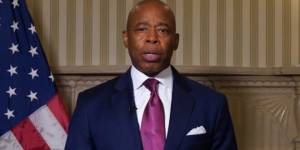 This is why the corrupt craven Mayor Adams of New York, above, is bending over to lick Trump's bone spurs in exchange for a pardon. New York is likely to be second on the list for Trump's domestic invasions by the military after Chicago. The mass deportations are in fact intended as a cover for his "retribution" campaign against everyone who ever stood in his way, prosecuted him, or criticized him.
Seriously, what else do people think is being discussed as an operational plan? They have already mapped all of this out in Project 2025, but our opposition "leadership" are acting like the blind fools who read Hitler's Mein Kampf in the 1920's and 30's and said "he can't be serious, nobody would ever try to do something like that...especially not that incompetent clown." Yes, people actually said that.
 The media is afraid of being shut down and being given the same treatment. So Bezos caved on the Harris endorsement, ABC paid Trump a ransom to leave them off his retribution list, and the media kingpins are lining up to give Trump millions for the inaugural, hoping that paying out a little "protection" like a frightened store owner to a local gang leader would buy them some safety and time.
And our problem now is that our people are putting more energy into thinking about their personal survival and possibly leaving the US than are thinking about how to resist Trump's plans. So they are sitting at home on their phones and tablets posting memes and cheering for the "moderate" Republicans whose heads are all going to be stuffed and mounted at Mar-a-Lago in three months.
The fear factor is what is running the show right now. We are going to have to take a page from the 1960's Civil Rights movement when they organized and stood up to Jim Crow, Klan lynchings, firebombings, police brutality in the form of mass arrests, attack dogs, fire hosing and tear gassing. We are there, because we have the power-hungry insane son of a Klansman and a doubly insane son of a pro-Apartheid Afrikkaner, both of whom are fanboys of the Putin dictatorship in Russia, coming in to run the White House.
The Democratic strategy as it now stands is to lay back and let it all happen, because they think Trump will have to own his destruction and carnage and this will propel the Democrats victory in the mid-terms, and after that "on to 2028."
This is more or less what the German Social Democrats did in 1932-33. They said "let Hitler have his run, and he'll make such a mess of things that we will come back to power in the next elections."
The next German election came 12 years later, after a Holocaust and world war that left 50 million dead, half the world in rubble, with tens of millions displaced and made into refugees.
This is what the so-called Democratic leadership is doing, repeating step by step the catastrophically tragic decisions of those delusional fools who paved the way for Hitler.
I refuse to lie to my readers to help them feel reassured, or to keep up morale. I am glad when I hear from people who appreciate that and have the guts to do some tough reading and face these difficult problems.
I have no "plan" on what to do, other than stating that there has to be one and that those who refuse to change their proven dysfunctional strategies which are leading us to Hell need to get out of the way and make room for those who want to fight, and fight effectively, instead of just "letting it all happen" and trying to pick up the pieces afterwards.
Think about what I said about what Trump and Musk intend to do. And ask yourselves, is sending out cards and letters commensurate with that? Does hyping Mitch McConnell and other Republicans as Trump opposition leaders mean a damned thing, knowing what Trump intends to do with his immunity power on "day one?"
The first step toward fighting and defeating this insanity is to face reality. My job is to serve it up to my readers in heaping portions, and to help our new leadership come forward in response to it.
Those who can't handle it should take a break or leave. It's only going to increase in intensity once the shit show starts. It is decision time.
Going Deep with Russ Baker via Substack, Investigative Commentary on The Epoch Times: Epic Crimes: The Spectacular Grift of a Trump Propaganda Rag,  Russ Baker, right, best-selling author, longtime media critic and founder of the WhoWhatWhy investigative reporting site. June 9, 2024, republished Dec. 22, 2024. Their worst crimes, sadly, are not prosecutable.
In case you missed this extraordinary story: A highly visible “news organization” that is a key backer of Donald Trump and continuous source of disinformation turns out to be… run by criminals.
Here are quick details:
The Epoch Times , a strange publication that, backed by a religious cult, started small and grew explosively into a behemoth of disinformation, was involved with large-scale money laundering.
The CFO and unnamed members of his “Make Money Online” team are charged with money laundering and bank fraud between 2020 and 2024. The transnational scheme involved using cryptocurrency to buy crime proceeds — fraudulently obtained unemployment insurance benefits and prepaid debit cards — at a discount and depositing the money into bank accounts opened with stolen personal identification, then transferring the money into Epoch Times accounts. This stratagem had the effect of hiding the criminal activities that generated the funds in the first place.
But their worst crimes, sadly, are not prosecutable: their unconscionable spreading of disinformation on deadly diseases, and deadly climate change, and their propagandistic promotion of the man whose rule would perpetuate these possibly fatal conditions.
And their reach is wide and deep. The Epoch Times was the second-largest funder of pro-Trump Facebook advertising after the Trump campaign itself — until Facebook banned it in 2019. As NBC News put it, “By hiding its multimillion-dollar dark money ad spend, the organization bypassed Facebook’s political advertising transparency rules.” Yet the ads continued to run, but under other names — e.g., Honest Paper, Patriots of America, Pure American Journalism — until they, too, were disabled.
I know these maniacs — to whose madness there is, unfortunately, a determined method — because they fill my inbox with constant, grotesque lies on a nonstop, turbocharged basis. I’ve never seen anything like it, and, given what I see daily, that’s saying a lot. Stop the Steal. Photo credit: ATTRIBUTION_GOES_HERE
I bring up the Epoch Times indictment as a coda to last week’s examination of the criminal mindset increasingly taking over the Republican Party and a significant portion of the populace.
This week only underlined that point: One of America’s two political parties has turned largely into a refuge for those inclined toward committing illegal, immoral, and unethical acts — or at least refusing to speak openly against them.
Committing crimes, cheating, lying, stealing, harming others is… absolutely fine. Even to be admired. High five! Laugh. Drinks all around.
The criminal mindset and complete lack of a moral compass expand into a kind of gleeful lunacy that also punishes the perps, who cannot see beyond short-term, ill-gotten gains.
For the rest of us, it feels like being strapped into the back seat of a car being driven at high speed by Thelma and Louise.
Robert F. Kennedy Jr., always available for his disinformation cameo, says The Epoch Times is among his most trusted news sources: “They’re very courageous and it’s real journalism.”
The Epoch Times’s mission, according to tax filings, is — and I love this — independent journalism, “outside of political interests and the pursuit of profit, for the public benefit and to be truly responsible to society.”
The criminal levels of dishonesty exhibited by The Epoch Times are, unsurprisingly, similar to that captured in the emails the Trump campaign sends out. For example, this one, which I just received:
I’d go to jail AGAIN AND AGAIN if that’s what it took to Save America.
So, not only is he a criminal, but he takes himself and his crime — which had zero to do with “saving America” and everything to do with self-interest — and wraps them in the flag.
Related Story:
Mediaite, Feds Indict Far-Right Media Exec in Massive Money Laundering Scheme, Alex Griffin, June 3, 2024. Bill Guan, the chief financial officer of the far-right Epoch Times, was indicted Monday on charges of allegedly participating in a massive money laundering scheme.
 The Southern District of New York released a statement saying, “Bill Guan, 61, of Secaucus, New Jersey, is charged with one count of conspiring to commit money laundering, which carries a maximum sentence of 20 years in prison, and two counts of bank fraud, each of which carries a maximum sentence of 30 years in prison. The charges do not relate to the Media Company’s newsgathering activities.”
 Guan is alleged to have laundered some $67 million in funds. The Epoch Times was founded in 2000 by John Tang and is associated with the Chinese Falun Gong new religious movement. The paper, which is part of the Epoch Media Group, is known for its conspiratorial articles, vehement opposition to the Chinese Communist Party, and socially conservative values.
NBC News reported in late 2023, based on subscriber count, the paper has the 4th largest circulation in the U.S. “The nonprofit has amassed a fortune, growing its revenue by a staggering 685% in two years, to $122 million in 2021, according to the group’s most recent tax record,” noted NBC of the publication’s wild success.
Dec. 21
 White House Chronicle, Opinion: The Crisis in Journalism — More Reporting Needed , Llewellyn King, Dec. 21, 2024. There is a lot of dither about the future of journalism. Make no mistake, it is the essential commodity.
If you know what is going on in Gaza, Ukraine or Syria, it is because brave journalists told you. Not the government, not some academic institution, not artificial intelligence, and not hearsay from your friends or from a political party.
The crisis in journalism isn’t that it failed analytically in the last election, or that we — an irregular army of individualists — failed, but that journalism has run out of money and its political enemies have found that the courts (and the fear of libel prosecution) can terrorize the companies that own the media.
 In 2016, the gossipy site Gawker was sued by the pro wrestler and political figure Hulk Hogan. The lawsuit was financed by the billionaire investor Peter Thiel, left.
Now come two suits, filed by President-elect Donald Trump: One that he won against ABC News, and one to be filed against the  Des Moines Register. It is reported that conservative interests plan a series of these legal interventions against the media.
This will have a frightening effect on news coverage. When there is fear of prosecution, there is less likely to be investigative news coverage.
So far, the most troublesome of the prosecutions has been the one against ABC News. The network caved in early. It agreed to pay $15 million plus legal fees into a fund for what will be the first Trump presidential library.
Could it be that ABC is owned by Disney, and Disney wants good relations with the incoming administration?
However, a much bigger problem faces the media than the fear of prosecution. It is that the old media, led by local and regional newspapers, is dying. Although there are thousands of podcasts, they don’t take up the slack.
You could listen to an awful lot of podcasts and not know what is going on. State houses and local courts aren’t being covered. The sanitizing effect of press surveillance has been withdrawn and, frankly, God help the poor defendants in a local court where there is a disproportionate desire to plead cases, to avoid honest trials even when there is conspicuous doubt.
I never tire of repeating what Dan Raviv, former CBS News correspondent, said to me once, “My job is simple. I try to find out what is going on and tell people.”
Quite so. However, there is a problem: Journalism needs to be concentrated in a newspaper or a broadcast outlet where there is enough revenue to do the job. Otherwise, you get what I think of as the upside-down pyramid of more and more commentary, based on less and less reporting.
We are awash in commentary, some of it very good and some of it trash. It is all based on news gathered by those news organizations that can afford to employ a phalanx of reporters.
Regional newspapers used to have Washington bureaus and foreign bureaus. At one time, the Baltimore Sun had 12 overseas bureaus. Now it has none.
This is the story nationwide. Fewer people actually cover the news, digging, checking and telling us what they have found.
Throughout the history of journalism, technology has been disruptive, sometimes advantageously and sometimes less so. Modern printing presses developed at the end of the 19th century were important boosters, as was the invention of the Linotype machine in 1884.
On the negative side, television killed off evening papers, and podcasts are taking a toll on radio. Now, the internet and tech companies have siphoned off most of the revenue that supported newspapers, radio and television.
As one can’t have a free and fair society without vibrant journalism, we clearly need a new paradigm which is internet-based news organizations that are large enough and rich enough to do the job in the time-honored way with reporters asking questions, whether it is at the courthouse, the White House or on the battlefield.
There is a clear choice: News and informed analysis, or rumor and conspiracy.
Llewellyn King is executive producer and host of "White House Chronicle" on PBS. Read this column on: White House Chronicle or Inside Sources.
White House Chronicle, Commentary: My Frightening, Splendid Christmas in the ER, Llewellyn King, Dec. 20, 2024. Most people have horror stories about emergency rooms. Whether in Boston, Washington or Los Angeles, the stories are appalling. Gurneys, sometimes with critically ill patients, lined up and left unattended along walls. Hurting people waiting for hours because of a shortage of staff, beds and a prevailing shortage of resources. Systems that are stressed and seem […]
Llewellyn King is executive producer and host of “White House Chronicle."
Dec. 18
Politico, Trump is already delivering on his promise to go after the press, Josh Gerstein, Dec. 18, 2024 (print ed.). First Amendment advocates worry about an emboldened Trump using civil litigation to target journalists he dislikes.
Media lawyers are bracing for an onslaught of lawsuits from Donald Trump and his political allies in the wake of ABC’s decision to pay $16 million to settle a defamation case Trump filed against the network.
Many First Amendment advocates see the settlement as a capitulation by ABC that handed Trump both a lucrative victory and a legal roadmap. They worry it will embolden him to escalate his use of private civil litigation against his media critics when he returns to power next month.
These private lawsuits would be separate from anything Trump does as president to deploy official levers of power against the press. And even if the lawsuits lack merit, they can still have a chilling effect.
“It’s extremely troubling,” said David Schulz, who runs a media law clinic at Yale Law School. “It’s going to fuel the perception that the media is unfair to Trump and to incentivize more litigation — and more baseless litigation.”
No modern president — including Trump in his first term — has made a habit of personally suing the media while in the Oval Office. But speaking to reporters on Monday, Trump promised more lawsuits against journalists and pundits he doesn’t like.
Later that day, he followed through on his pledge: He sued the Des Moines Register and its veteran pollster, Ann Selzer, over a preelection poll that showed Trump trailing Kamala Harris in Iowa shortly before last month’s election.
“I feel I have to do this,” Trump said in a press conference at Mar-a-Lago. “I shouldn’t really be the one to do it. It should have been the Justice Department or somebody else. I have to do it. It costs a lot of money to do it. We have to straighten out the press.”
Dec. 16
 Hartford Business, Former Hartford Courant HQ headed to auction block, Greg Bordonaro, Dec. 16, 2024. It could soon be the start of a new era for the Hartford Courant’s former Broad Street headquarters.
The 289,392-square-foot former home of the nation’s oldest continuously published newspaper is going up for auction.
The 285 Broad St. office and industrial property has been listed on the online auction website Ten-X with a starting bid price of $700,000. The auction is scheduled for Jan. 27, 2025.
The property has been on the sales block since March 2021, when it was listed for $6 million. It was put up for sale just months after the Hartford Courant announced it would shut down its brick-and-mortar operations and continue to operate on a remote basis.
The Broad Street property is currently 23% occupied and remains the home of WTIC FOX-61. Real estate services firm Newmark is the listing broker.
The property’s current owner, according to city records, is 285 Broad Street Hartford LLC, which is controlled by Jason Piel, who lists a Stamford business address.
According to his LinkedIn page, Piel is a controller at Twenty Lake Holdings, a subsidiary of New York-based Alden Global Capital, which owns the Hartford Courant and several other U.S. newspapers.
285 Broad Street Hartford LLC acquired the property in 2018 for $6.9 million from Tribune Real Estate Holdings LLC, city records show.
According to the Ten-X listing, “285 Broad Street is a Hartford landmark,” with Class B office and industrial space that offers an “excellent value-add repositioning opportunity with the flexibility for a variety of end uses.”
The property, built in 1928, is equipped with three power feeds, three passenger elevators, two freight elevators, an atrium lobby, conference rooms, and training facilities, the listing said. It has 175,000 square feet of office space and 120,000 square feet of industrial space.
Dec. 15

Former advice columnist E. Jean Carroll, center, at federal court with her lawyer Roberta Kaplan, left, on April 25 in New York City (Associated Press photo by Seth Wineg).

Former President Donald Trump is shown in a photo collage with columnist E. Jean Carroll, who won a jury verdict that he sexually attacked her three decades ago.

Disclosures in the E. Jean Carroll sexual assault lawsuit echoed Trump's words in "Hollywood Access" videotape, reported upon above, that arose during the 2016 presidential campaign. Shown Then: The front page of a 2016 New York Daily News edition contrasts with President Trump's claimed innocence in the Carroll case.
New York Times, ABC to Pay $15 Million to Settle a Defamation Suit Brought by Trump, Michael M. Grynbaum and Alan Feuer, Dec. 15 2024 (print ed.). ABC News is set to pay $15 million to settle a defamation lawsuit brought by Donald J. Trump.
The outcome of the lawsuit marks an unusual victory for President-elect Donald J. Trump in his ongoing legal campaign against national news organizations.Listen to this article · 6:03 min Learn more
The agreement was a significant concession by a major news organization and a rare victory for a media-bashing politician whose previous litigation efforts against news outlets have often ended in defeat.
Under the terms of a settlement revealed on Saturday, ABC News will donate the $15 million to Mr. Trump’s future presidential foundation and museum. The network and its star anchor, George Stephanopoulos, also published a statement saying they “regret” remarks made about Mr. Trump during a televised interview in March.
ABC News, which is owned by the Walt Disney Company, will pay Mr. Trump an additional $1 million for his legal fees.
The outcome is an unusual win for Mr. Trump, who has frequently sued news organizations for defamation and frequently lost, including in litigation against CNN, The New York Times and The Washington Post.
Several experts in media law said they believed that ABC News could have continued to fight, given the high threshold required by the courts for a public figure like Mr. Trump to prove defamation. A plaintiff must not only show that a news outlet published false information, but that it did so knowing that the information was false or with substantial doubts about its accuracy.
“Major news organizations have often been very leery of settlements in defamation suits brought by public officials and public figures, both because they fear the dangerous pattern of doing so and because they have the full weight of the First Amendment on their side,” said RonNell Andersen Jones, a professor of law at the University of Utah.
“What we might be seeing here is an attitudinal shift,” she added. “Compared to the mainstream American press of a decade ago, today’s press is far less financially robust, far more politically threatened, and exponentially less confident that a given jury will value press freedom, rather than embrace a vilification of it.”
ABC News did not elaborate on Saturday about its precise reasons for settling. “We are pleased that the parties have reached an agreement to dismiss the lawsuit on the terms in the court filing,” a network spokeswoman said. A lawyer for Mr. Trump declined to comment on the agreement.
Mr. Trump sued ABC and Mr. Stephanopoulos in March, after the anchor asked Representative Nancy Mace, Republican of South Carolina, who has spoken publicly about being raped as a teenager, why she had continued to support Mr. Trump after he was found “liable for rape” in a 2023 civil case in Manhattan.
In that case, a federal jury found Mr. Trump liable for sexually abusing and defaming the writer E. Jean Carroll, but it did not find him liable for rape. Still, the judge who oversaw the proceeding later clarified that because of New York’s narrow legal definition of rape, the jury’s verdict did not mean that Ms. Carroll had “failed to prove that Mr. Trump ‘raped’ her as many people commonly understand the word ‘rape.’”
In his lawsuit, Mr. Trump accused Mr. Stephanopoulos of harming his reputation by saying multiple times on-air that he had been found liable for raping Ms. Carroll. (Mr. Trump was ordered by a jury in the Carroll case to pay her damages of $83.3 million. He is appealing the verdict.)
The settlement agreement in the defamation case, filed in Federal District Court in Miami, was signed on Friday, the same day that a judge ordered Mr. Trump to sit for a deposition in the case next week in Florida. Mr. Stephanopoulos was also on the verge of being deposed.
Tensions ran high between ABC News and Mr. Trump’s camp throughout the 2024 campaign.
Mr. Trump denounced ABC as “terrible” for its handling of his sole debate against Vice President Kamala Harris, faulting the moderators, David Muir and Linsey Davis, for fact-checking his answers and musing about stripping the network of its broadcasting license.
Debra OConnell, the Disney executive who directly oversees ABC News, dined with Mr. Trump’s incoming chief of staff, Susie Wiles, in Palm Beach last Monday, according to two people briefed on their interaction. The dinner was part of a visit by several ABC News executives to Florida to meet with Mr. Trump’s transition team.
News networks typically arrange such meetings ahead of a new presidential administration to discuss subjects like booking and day-to-day coverage. Another person familiar with the meeting said its purpose was to discuss Mr. Trump’s White House transition, not the pending defamation case.
Under the settlement terms, ABC agreed to place an editor’s note at the bottom of an online article about the interview with Ms. Mace. The note reads: “ABC News and George Stephanopoulos regret statements regarding President Donald J. Trump made during an interview by George Stephanopoulos with Rep. Nancy Mace on ABC’s This Week on March 10, 2024.”

Meidas Touch Network, Commentary on Legal AF,: Bye Bye George Stephanopoulos… You Sold Out!, Ben Meiselas, Dec. 15, 2024. I once admired ABC host George Stephanopoulos (shown above in a 2009 file photo). I thought he was smart and fearless. Silly me. So many people I admired are revealing themselves as cowards now. It’s pathetic.
 One day after ABC and Stephanopoulos settled with Trump for $15 million, Stephanopoulos deleted his X (formerly Twitter) account. He was getting mocked on X by MAGA accounts for kissing the ring. Stephanopoulos doesn’t have a Threads or Bluesky account, but he is also getting roasted by MAGA accounts on his Instagram. He is swarmed with comments on his Instagram.
This is why you never obey in advance. As I say, I prefer to die once than to have my soul ripped apart and die a thousand deaths in a lifetime for being a coward like so many journalists now.
Stephanopoulos looks like a total coward to those who oppose the settlement, and he has been beclowned by MAGA, who treat him as a pathetic loser.
I wonder if he will delete his Instagram soon as well.
I’ve heard some try to say it’s not Stephanopoulos’ fault that ABC settled since he works for them.
This is wrong. Stephanopoulos makes $15 million a year from ABC. By the way, if you wanted to know how Trump arrived at the $15 million settlement amount, that’s a hint right there.
Stephanopoulos was not forced into the settlement agreement. He has the right to his own lawyers, and ABC’s insurance would be obligated to pay for his defense if he didn’t settle.
Stephanopoulos’ net worth is probably close to $100 million. He has more money than anyone needs in multiple lifetimes. He could do what Harry Litman did at the LA Times and resign. If he believed in his talents, I’m sure he could land another job somewhere, or he could start his own show.
 But Stephanopoulos is a company guy who wanted to stay employed at ABC to keep those fat $15 million-a-year checks. So he settled as well when ABC/Disney cut Trump a $15 million check.
Stephanopoulos literally signed on the dotted line of the settlement agreement. He has free will. He exercised it the way he did, and now he is compromised. MAGA mocks him, while pro-democracy fans of his are fans no longer.
Look, here is my promise to you: MeidasTouch Network will never obey. We will never cave. Trump attacked us in a recent court filing, and I couldn’t care less. There is nothing he or MAGA could do to us to ever make us submit.
We need to rebuild media from its ashes. We are doing that now. This fight is not going to be easy.
New York Times, Trump and His Picks Threaten More Lawsuits Over Critical Coverage, David Enrich (David Enrich’s latest book, to be published in 2025, is about the weaponization of libel law and the campaign to limit press freedoms), Dec. 15, 2024. The small flurry of threatened defamation suits is the latest sign that Donald Trump’s administration may do what it can to crack down on unfavorable media coverage.
The legal threats have arrived in various forms. One aired on CNN. Another came over the phone. More arrived in letters or emails.
All of them appeared aimed at intimidating news outlets and others who have criticized or questioned President-elect Donald J. Trump and his nominees to run the Pentagon and F.B.I.
The small flurry of threatened defamation lawsuits is the latest sign that the incoming Trump administration appears poised to do what it can to crack down on unfavorable media coverage. Before and after the election, Mr. Trump and his allies have discussed subpoenaing news organizations, prosecuting journalists and their sources, revoking networks’ broadcast licenses and eliminating funding for public radio and television.
Actual or threatened libel lawsuits are another weapon at their disposal — and they are being deployed even before Mr. Trump moves back into the White House.
It is notoriously difficult for public figures like Mr. Trump to win defamation lawsuits. Under longstanding Supreme Court precedent — which Mr. Trump and some of his allies want to see weakened or overturned — plaintiffs must prove that a publisher knew a defamatory statement was false or acted with reckless disregard for its accuracy.
But that high bar has not stopped a wide range of politicians, business leaders and others from threatening or filing such suits — a strategy that often seems tailored to cause news outlets and individuals to rein in aggressive coverage of the public figures.
The strategy can pay other dividends as well.
On Saturday, ABC News said it had agreed to give $15 million to Mr. Trump’s future presidential foundation and museum to settle a defamation suit that Mr. Trump filed against the network and one of its anchors, George Stephanopoulos. Mr. Trump sued in March after Mr. Stephanopoulos inaccurately said the former president had been found “liable for rape” in a civil trial. In fact, Mr. Trump had been found liable for sexual abuse.
The settlement followed months of attacks by Mr. Trump and his allies on ABC News, with the once and future president going so far as to say that the network should lose its federal broadcast license.
The deal set off criticism of ABC News by those who perceived the network as needlessly bowing down to Mr. Trump. And it led some legal and media experts to wonder whether the outcome would embolden Mr. Trump and others to intensify their assault on the media, at a moment when many news organizations are struggling with declining public trust and deteriorating finances.
Even before the settlement was reached, Elizabeth McNamara, a prominent media lawyer, said she expected that the trend “is only going to increase,” given the political environment.
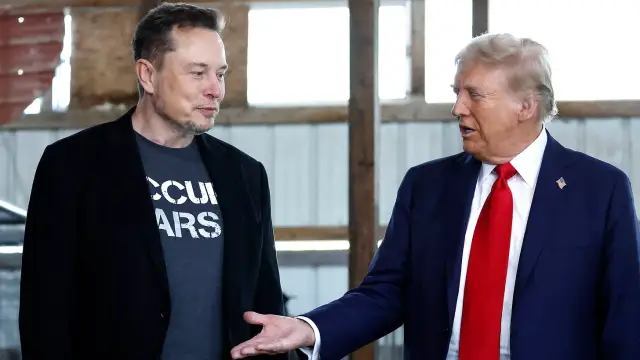
 Washington Post, Investigation: Elon Musk put $277 million into the election. He’s $200 billion richer this year, Faiz Siddiqui and Trisha Thadani, Dec. 15, 2024. Elon Musk’s net worth has climbed by more than $200 billion in 2024, a massive increase in the same year that the world’s richest person spent at least $277 million backing Donald Trump and other Republican candidates.
Trump’s election sent stock in electric automaker Tesla, a company central to Musk’s wealth and where he is CEO, soaring. Shares were trading at prices around 70 percent higher on Friday than on Election Day.
As of Friday, Musk’s fortune was about $442 billion, according to the Bloomberg Billionaires Index. That estimate includes a pay package from Tesla worth more than $50 billion that is held up in court after a Delaware judge ruled to strike it down in January and upheld her decision this month. Tesla has pledged to appeal.
Trump has indicated he will be friendly to businesses and investors of all kinds when he returns to office. Musk’s empire is poised to especially benefit from the president-elect’s promised cuts to regulation — and potentially also overt favors to the tech billionaire, who has become a loyal political lieutenant.
 Trump picked Musk to co-chair a nongovernmental advisory group on cuts to federal spending and regulation known as the “Department of Government Efficiency,” or DOGE, potentially allowing the tech entrepreneur to shape policies that affect his businesses. Musk did not respond to a request for comment.
“Elon Musk is a once in a generation business leader and our federal bureaucracy will certainly benefit from his ideas and efficiency,” said Brian Hughes, a spokesman for the Trump-Vance Transition. He described Musk and Trump as “great friends and brilliant leaders working together to Make America Great Again.”
Musk launched his entrepreneurial career in 1995 when he abandoned a graduate program at Stanford to found a start-up later called Zip2 that created online city guides. It was sold for about $300 million in 1999.
He went on to co-found an online banking company, X.com, that merged with another start-up to create PayPal. Auction site eBay acquired PayPal in 2002 for $1.5 billion.
Patrick Soon-Shiong (shown in a Los Angeles Times photo)
Los Angeles Times, Patrick Soon-Shiong’s controversial shakeup at the L.A. Times: ‘Bias meter,’ opinion upheaval and a call for growth, James Rainey, Dec. 15, 2024. Patrick Soon-Shiong’s controversial shakeup at the L.A. Times: ‘Bias meter,’ opinion upheaval and a call for growth.
Patrick Soon-Shiong had become accustomed to making the news.
He was the doctor and medical technology innovator who built a fortune, the striving South African immigrant who bought a piece of the Lakers and the L.A. billionaire who brought the Los Angeles Times back under local control when he purchased it in 2018.
But none of that created the public tempest like the one that has surrounded Soon-Shiong’s recent actions: First when he blocked the Times editorial board, which he oversees, from endorsing Vice President Kamala Harris for president. Then he suggested the newspaper had become an “echo chamber” for the political left. And, this month, he announced The Times would create a digital “bias meter” to alert readers about the ideological tilt of the paper’s content.
An estimated 20,000 subscribers dropped The Times after the non-endorsement in the presidential race and its aftermath. Soon-Shiong’s pledges of a more “fair and balanced” approach triggered more dismay from many and charges of a capitulation to President-elect Donald Trump. But the new stance also brought praise from others for what they saw as a long-overdue recalibration of coverage in the West’s most prominent newspaper.
In his first extended interview about the furor, Soon-Shiong depicted himself as an unflinching protector of journalistic balance, one who is betting that a moderate, nonideological viewpoint is the best path forward. He also spoke at length about his hopes for the future of the paper.
The Times significantly increased its number of paying digital subscribers after Soon-Shiong purchased the paper. He added more than 150 people to a newsroom that had been slashed for two decades, making The Times a bright spot in an industry beset by massive downsizing as revenues cratered, following the flight of advertising to digital giants like Facebook and Google.
For The Times and virtually every other paper in America, incremental increases in online subscriptions have not been enough to fill gaping budget holes. The Times has been losing tens of millions of dollars a year and went through two rounds of painful layoffs — erasing most of the staffing gains that followed the Soon-Shiong acquisition.‘I’m extremely proud’
In last week’s interview with The Times, the medical doctor and former transplant surgeon expressed pride in much of the journalism in the newspaper. He vowed to protect the independence of the newsroom, even as he pledged to become more involved in the outlet’s editorial and opinion pages.
“I’m extremely proud of work we’ve done right,” he said, “and we’ve done a lot right,” he said, pointing to six Pulitzer Prizes the paper has won during his ownership, among other honors.President Trump and Kamala Harris
But he said it was essential to build a bigger audience, which he described as key to securing the 143-year-old newspaper’s future.
“I think that’s our goal,” Soon-Shiong said. “The only way you can survive is to not be an echo chamber of one side.”
He said he intends on introducing more moderate and conservative commentators on the newspaper’s opinion pages, where liberal writers have been dominant for years.
Soon-Shiong made it clear he also wants editors and reporters who produce news stories to be alert for ideological imbalance and fairness, though he said he has no intention of meddling in decisions made by The Times’ newsroom leaders about how to cover the news.
Soon-Shiong acknowledged he had paid less attention to The Times for much of the first 6½ years of his ownership as he focused on several other businesses, with particular attention to an immunotherapy treatment that won FDA approval this spring.
With the demands of his biomedical career slightly reduced, the entrepreneur said that he “emphatically” intends to become more involved in finding a sustainable path forward for The Times.
“Staying strong and resolute to transform the paper and drive a rebirth @LATimes,” he recently declared on X. “We laid out the path for the LA Times to report just the facts when we publish ‘news.’ “Big investment, big losses
Many civic leaders and everyday readers hailed Soon-Shiong when he bought the newspaper in 2018, rescuing it from a cost-cutting owner and a possible sale to chains known for operating bare-bones news operations. Since that initial $500-million investment to buy The Times and the San Diego Union-Tribune, Soon-Shiong said he has set aside $250 million to renovate the El Segundo headquarters and to build a museum and auditorium, which are under construction.
But, like other media outlets, The Times saw already floundering ad revenue take another big hit with the onset of the COVID-19 pandemic. The owner said he provided his newspaper with operating capital of “another $40 [million], $50 million a year,” declining slightly last year, when he said he paid $30 million to fill the gap between revenue and expenditures.
With total outlays of about $1 billion, Soon-Shiong has made one of the largest investments in local journalism in America. He said he has not wavered in his commitment, but made clear that he expects more progress in building the audience, particularly online.
“Unless we build a paper that can engage and increase the readership, what are we doing?” he said.
Recent Related Story:

Dr. Patrick Soon Shiong, owner of the Los Angeles Times, with his daughter Andrea Chang shown in a 2018 Los Angeles Times photo via the Associated Press).
Talking Feds Substack, Opinion: Why I Just Resigned From The Los Angeles Times, Harry Litman, right, Dec. 5, 2024. I have been a contributor to the Los Angeles Times op-ed page in some fashion for more than 15 years. For the last three years, I have been the Senior Legal Columnist, writing regular weekly columns about Trump’s legal troubles, the Supreme Court, and a wide range of other topics. The Times also permitted me to cover Trump’s trial in New York and the 2024 Democratic convention.
My editors have been skilled, quick, and fair. I have been able to write whatever I like, including blistering criticism of Donald Trump.
I’ve been proud of my work and proud to be part of the Times, the most prominent and storied newspaper west of the Mississippi. It’s got gravitas—and 45 Pulitzers to show for it—combined with a California flair that complements the constant variety and zaniness of my adopted state.
But I have written my last op-ed for the Times. Yesterday, I resigned my position. I don’t want to continue to work for a paper that is appeasing Trump and facilitating his assault on democratic rule for craven reasons.
Dec. 14

The Mercury News, OpenAI whistleblower found dead in San Francisco apartment, Jakob Rodgers, Dec. 14, 2024. Suchir Balaji, 26, claimed the company broke copyright law.
 A former OpenAI researcher known for whistleblowing the blockbuster artificial intelligence company facing a swell of lawsuits over its business model has died, authorities confirmed this week.
Suchir Balaji, 26, was found dead inside his Buchanan Street apartment on Nov. 26, San Francisco police and the Office of the Chief Medical Examiner said. Police had been called to the Lower Haight residence at about 1 p.m. that day, after receiving a call asking officers to check on his well-being, a police spokesperson said.
The medical examiner’s office determined the manner of death to be suicide and police officials this week said there is “currently, no evidence of foul play.”
Information he held was expected to play a key part in lawsuits against the San Francisco-based company.
Balaji’s death comes three months after he publicly accused OpenAI of violating U.S. copyright law while developing ChatGPT, a generative artificial intelligence program that has become a moneymaking sensation used by hundreds of millions of people across the world.
Its public release in late 2022 spurred a torrent of lawsuits against OpenAI from authors, computer programmers and journalists, who say the company illegally stole their copyrighted material to train its program and elevate its value past $150 billion.
The Mercury News and seven sister news outlets are among several newspapers, including the New York Times, to sue OpenAI in the past year.
In an interview with the New York Times published Oct. 23, Balaji argued OpenAI was harming businesses and entrepreneurs whose data were used to train ChatGPT.
“If you believe what I believe, you have to just leave the company,” he told the outlet, adding that “this is not a sustainable model for the internet ecosystem as a whole.”
Balaji grew up in Cupertino before attending UC Berkeley to study computer science. It was then he became a believer in the potential benefits that artificial intelligence could offer society, including its ability to cure diseases and stop aging, the Times reported. “I thought we could invent some kind of scientist that could help solve them,” he told the newspaper.
But his outlook began to sour in 2022, two years after joining OpenAI as a researcher. He grew particularly concerned about his assignment of gathering data from the internet for the company’s GPT-4 program, which analyzed text from nearly the entire internet to train its artificial intelligence program, the news outlet reported.
The practice, he told the Times, ran afoul of the country’s “fair use” laws governing how people can use previously published work. In late October, he posted an analysis on his personal website arguing that point.
No known factors “seem to weigh in favor of ChatGPT being a fair use of its training data,” Balaji wrote. “That being said, none of the arguments here are fundamentally specific to ChatGPT either, and similar arguments could be made for many generative AI products in a wide variety of domains.”
Reached by this news agency, Balaji’s mother requested privacy while grieving the death of her son.
In a Nov. 18 letter filed in federal court, attorneys for The New York Times named Balaji as someone who had “unique and relevant documents” that would support their case against OpenAI. He was among at least 12 people — many of them past or present OpenAI employees — the newspaper had named in court filings as having material helpful to their case, ahead of depositions.
Generative artificial intelligence programs work by analyzing an immense amount of data from the internet and using it to answer prompts submitted by users, or to create text, images or videos.
When OpenAI released its ChatGPT program in late 2022, it turbocharged an industry of companies seeking to write essays, make art and create computer code. Many of the most valuable companies in the world now work in the field of artificial intelligence, or manufacture the computer chips needed to run those programs. OpenAI’s own value nearly doubled in the past year.
News outlets have argued that OpenAI and Microsoft — which is in business with OpenAI and also has been sued by The Mercury News — have plagiarized and stole its articles, undermining their business models.
“Microsoft and OpenAI simply take the work product of reporters, journalists, editorial writers, editors and others who contribute to the work of local newspapers — all without any regard for the efforts, much less the legal rights, of those who create and publish the news on which local communities rely,” the newspapers’ lawsuit said.
OpenAI has staunchly refuted those claims, stressing that all of its work remains legal under “fair use” laws.
“We see immense potential for AI tools like ChatGPT to deepen publishers’ relationships with readers and enhance the news experience,” the company said when the lawsuit was filed.
Dec. 13
Inside Sources (via Redmond, WA Spokesman), Commentary: My newspaper days (and television,too), Llewellyn King (shown above in a screenshot from his weekly show, White House Chronicle, and below in a photo by JIP editor Andrew Kreig at the National Press Club during his lecture to the Club's Owls). Updated Dec. 13, 2024.
On Dec. 13, I received an award and give a dinner talk at the National Press Club in Washington, recognizing my 68 years as a journalist and my 58 years as a club member.
This recognition is from a club subsection known as the Owls. Silver Owls have roosted at the club for 25 years or longer; Golden Owls, 50 years or more; and Platinum Owls, 60 years or longer.
The hot-type days in newspapers are long past, along with black-and-white television. They maybe, but the denizens of that time live on — or some of us do.
 We crowded the storied National Press Club ballroom to raise a glass to the time when headlines had to fit an exact letter count and when wire services moved the news over teleprinters at 64 words a minute. It could be the biggest story in the world, but it would be moved slower than the speed of reading.
The trick was to break the news into very short takes and move it on several printers. The principal teleprinter of the news services — UPI, AP and Reuters — was equipped with a“bulletin” bell that rang when the biggest news, like an assassination, broke. In the composing room, where “metal” (you dared not call it lead, even though it was predominantly lead with some tin and antimony) was cast into type and into “furniture,” the rules and the spacing bars that went between the lines of type, craftsmanship ruled.
At one side of that great hive were the Linotype machines, operated by skilled people who could change fonts and type sizes by levering up or down the brass boxes that contained the dies of the type. They were the kings and queens of that art, secure and unflappable.
Each Linotype machine contained a thousand parts, according to the Museum of Printing inHaverhill, Massachusetts. In a rush, the printers (note to laymen: printers set and handled the type; the people who ran the presses were pressmen) could assemble a whole page in minutes. If news had broken or, heaven forbid, a page had been “pied” (dropped, type all over the floor), then everything had to be reset and assembled.
Television — when I first worked in it in London, in the days of black-and-white — had its foibles and culture, and the love of a glass of something.
The equivalent of the printers were the film editors, craftsmen and craftswomen all. One of the most skilled, who had had a long career in movies, would entertain us at the in-house bar in the BBC news studios in North London by swinging a full pint mug of beer over his head without spilling any. With the same dedication, he would slice and link the celluloid on deadline. He was the man who would save the day, especially if the film came in late. Tape was in its infancy.
In the newspapers’ newsroom, tactically one floor above the composing room, there were the journalists — that irregular army of misfits and egotists who made up a subculture unique tothemselves. In Britain, they were referred to as “the shabby people who smell of drink.”
That was true of journalists all over the world in those days. I can attest, bear witness. I was there.
Among the journalists, writers, editors, cartoonists, columnists, photographers, designers,secretaries and librarians was a cast of characters who were almost always the same in every newsroom, print or television. There was the Beau Brummell, the lover, the agony aunt, the gossip, the budding author, and the drunk (who wrote better than anyone else and was tolerated because of that). Then, sadly, the gambler.
The drinkers had camaraderie and laughter; the gamblers, just losses.
That began to change about 1970 when I was at The Washington Post. There were still drinkers who did the deed at the New York Lounge, a hole in the wall next to the more famous but less used by us, the Post Pub. The drinking was definitely down. Among the younger members ofthe staff, pot was the recreational drug. The older ones still favored a drink.
In London, the prominent newspapers and the BBC maintained bars in their offices. It made iteasy to find people when they were needed. At the venerable New York Herald Tribune, after the first edition closed at 7:30 p.m., the entire editorial staff, it seemed, went downstairs and around the block to the Artist and Writers, also called Bleaks. It wasn’t known for the quality of its carbonated water unless that was mixed with something brown.
At the Baltimore News-American, there was a secret route through the mechanical departments, enabling thirsty scribblers to reach the nearest bar undetected.
At the Washington Daily News, which belonged to the Scripps Howard chain of newspapers, the editor favored the nearest bar, an Irish establishment called Matt Kane’s.
At the National Press Club celebration, we raised one to the days of wine and roses, great stories and wordsmithing, and the fabulous adventure of it — the bad food, terrible hours, poor pay, long stakeouts, days far from home, and always, as my late first wife and great journalist Doreen King said, “the inner core of panic” about getting things right.
We do care, more than our readers and viewers know. There is, for all of its tribulations, no greater, more exciting place to be than in a newsroom asbig news is breaking.You are there, inside history.
Llewellyn King is executive producer and host of “White House Chronicle."
Dec. 12
New York Times, Kari Lake Is Trump’s Pick to Lead Voice of America, Minho Kim, Dec. 12, 2024 (print ed.). Donald J. Trump chose Kari Lake, the former TV news anchor turned election denier who lost races for senator and governor of Arizona, to lead Voice of America, a federally funded broadcaster that aims to offer unbiased news to audiences around the world. The announcement came as Mr. Trump made a flurry of picks for administration positions on Wednesday night.
 President-elect Trump chose the former TV news anchor turned election denier who lost political races in Arizona to lead the federally funded broadcaster.
 Lake, shown at right in a Gage Skidmore photo, campaigned for governor on false claims that Trump had won the 2020 presidential election and baselessly accused Katie Hobbs, her Democratic opponent, of unspecified election crimes. After narrowly losing to Hobbs in 2022, she refused to concede. This year, after Ruben Gallego defeated her in the Senate race by a wider margin, she only hinted at a concession. “I will never stop fighting for the state I love,” she said, in a video posted on her social media.

Washington Post, Judge rejects sale of Infowars to satirical news site the Onion, Kim Bellware and Niha Masih, Dec. 11, 2024. Alex Jones (shown above in a 2020 file photo) was forced to sell the platform to help pay the roughly $1.5 billion in damages he owes families of the victims of the Sandy Hook Elementary School shooting, which he called a “hoax.”
A federal bankruptcy judge has rejected the sale of Alex Jones’s Infowars platform to satirical news website the Onion, ruling Tuesday that the November court-ordered auction of Jones’s website lacked transparency.Get concise answers to your questions. Try Ask The Post AI.
The decision capped a two-day hearing that stretched late into the night in U.S. Bankruptcy Judge Christopher Lopez’s Houston courtroom.
“I don’t think anyone acted in bad faith here. I think everyone was trying to buy an asset and put their best foot forward and play by the rules,” Lopez said as he delivered his decision. The judge took issue with the lack of transparency from the sealed bidding process selected by the court-appointed trustee Christopher Murray, who was overseeing the sale of Jones’s assets. The judge added that he was troubled that the process, however well intended, “did not maximize value in any way, based on the record before me.”
“I don’t think it was enough money,” Lopez said of the winning bid, adding that he did not think the backup bid was high enough, either.
Lopez said he does not want another complex auction, but he deferred to Murray on how to proceed with fetching top dollar for Jones’s assets.
Global Tetrahedron, the Onion’s parent company, was named the winning bidder of a Nov. 13 auction to acquire Infowars. The platform was among the assets Jones was forced to sell to help pay the roughly $1.5 billion in damages he owes to families of the victims of the 2012 Sandy Hook Elementary School shooting who sued for defamation after Jones claimed the massacre was a “hoax.”
Minutes after the verdict, Jones appeared live on X, telling more than 440,000 viewers: “A judge followed the law.”
In a statement, the Onion’s CEO, Ben Collins, expressed disappointment that the ruling did not clear a path forward for any bidder, but he indicated it would continue its efforts toward acquiring Infowars. “It is part of our larger mission to make a better, funnier internet, regardless of the outcome,” the statement said.
Chris Mattei, an attorney for the Connecticut families, said in a statement they were disappointed with Lopez’s ruling but would not abandon their fight to hold Jones accountable.
“This decision doesn’t change the fact that, soon, Alex Jones will begin to pay his debt to these families and he will continue doing so for as long as it takes,” Mattei said.
Lopez paused the Onion’s acquisition of Infowars a day after the auction. Jones, on air and in court filings, had decried the process as “rigged.”Skip to end of carouselThe Style sectionStyle is where The Washington Post explains what’s happening on the front lines of culture — including the arts, media, social trends, politics and yes, fashion — with wit, personality and deep reporting. For more Style stories, click here. To subscribe to the Style Memo newsletter, click here.End of carousel
First United American Companies (FUAC), a group affiliated with Jones’s supplements business that was the runner-up bidder, quickly challenged the validity of the Onion’s bid, drawing concerns from Lopez about the transparency of the bidding process.
FUAC’s $3.5 million bid was about double the Onion’s bid of $1.75 million cash, plus credit from some of the Sandy Hook plaintiffs, according to court documents. Plaintiffs from the Connecticut-based defamation suit against Jones agreed to forgo a portion of their award to boost the Onion’s bid, which would raise the overall payout to Sandy Hook families who were plaintiffs in a Texas-based suit against Jones.
FUAC argued that its higher cash bid should have won the auction and said the auction’s court-appointed trustee improperly selected the Onion’s bid.
National Public Radio (NPR), Top 'Washington Post' editor kills article on deputy's departure, David Folkenflik, Dec. 9, 2024. Washington Post Managing Editor Matea Gold, a veteran newsroom leader, is headed to the rival New York Times. Acting Post Executive Editor Matt Murray blocked the publication of a story about her decision to leave, questioning why the paper should cover itself. Her departure has shaken colleagues and caps a year of crises for the Post  involving its leadership and its finances.
As the Washington Post newsroom awaits the appointment of a new top editor, its acting news chief intervened to block an article about the departure of its second-highest-ranking editor, a contender for the position, according to several people with knowledge of events.
Managing Editor Matea Gold, a veteran of 11-and-a-half years at the Post who has built up deep loyalty among staffers, had been herself considered a top internal candidate to run the newsroom. According to associates, it became clear that Post Publisher and Chief Executive Will Lewis was poised to pass over her.
She is instead headed to be second-highest ranking leader of the New York Times Washington bureau, as the Times announced today.
The internal tensions over the selection of the Post's new executive editor are capping a series of crises for Lewis, including tensions over the paper's reporting on its own issues.The Washington Post's new publisher and CEO, Will Lewis, announced a newsroom leadership shakeup during a staff meeting on Monday.The 'Washington Post' in crisis'Washington Post' CEO tried to kill a story about himself. It wasn’t the first timeActing editor says Post should not report on itself
On Saturday, Acting Executive Editor Matt Murray told editors that the paper should not cover itself, according to four people with knowledge.
This is not how the Post has handled past developments about itself or its leaders. Last year, it covered the retirement of Senior Managing Editor Cameron Barr and in 2015, it published an article about Managing Editor Kevin Merida's decision to leave for ESPN.
Murray did not respond to NPR's request for comment and Gold declined comment.
NPR spoke to nine people with ties to the Post for this article. They requested anonymity in order to speak candidly about sensitive internal matters at the paper.
A Washington Post Co. spokesperson declined to answer questions for this story, but said, "The Washington Post newsroom is editorially independent and operates in service of our community and national interest."
Murray previously worked under Lewis at the Wall Street Journal, where Lewis served as publisher and chief executive from 2014 to 2020.Former British Prime Minister Gordon Brown says Rupert Murdoch's U.K. tabloids hacked into his voicemails and documents to learn private information about him and his family. A 2011 police memo shows Washington Post CEO Will Lewis, then working for Murdoch, cited a security threat involving Brown as a reason to delete company emails.The 'Washington Post' in crisisFormer U.K. Prime Minister says Bezos should reconsider 'Washington Post' publisher
Gold is highly regarded inside the Post newsroom, especially as a stabilizing figure. In a social media post, Associate Editor and columnist Karen Tumulty called Gold "deeply respected and deeply beloved" there. Six colleagues tell NPR they believe Lewis's decision not to choose Gold helped push her into the arms of its leading competitor, compounding a sense of frustration internally.
Owner Jeff Bezos blocked 'The Washington Post' from endorsing a presidential candidate less than two weeks before Election Day. The editorial board had drafted an endorsement for Kamala Harris.
Gold was not granted an interview with Bezos for the top position, according to colleagues. Beyond Murray, Clifford Levy, deputy publisher of the New York Times Co., Wirecutter and Athletic sites is believed to be in contention for the editor's job.
 Media magnate Rupert Murdoch, 93, married for the fifth time in August 20124, his corporation, News Corp, confirmed Sunday. Murdoch and Elena Zhukova, a 67-year-old Russian-born retired molecular biologist, wed Saturday in a ceremony at his vineyard estate in Bel Air, California. Photographs of the newly married couple were released by News Corp. The couple announced their engagement in March.
Washington Post, Commissioner rejects Rupert Murdoch’s effort to change family trust, Jeremy Barr and Sarah Ellison, Dec. 10, 2024 (print ed.). Murdoch wanted to change the terms of his family’s trust to ensure that his son Lachlan would be his successor upon his death.
Rupert Murdoch, right, has faced a setback in his bid to cement his son Lachlan’s future control of his media empire, after a Nevada probate commissioner  rejected his bid to change his family’s trust, according to a source familiar with the case who spoke on the condition of anonymity because they are not authorized to speak publicly about the case.Get concise answers to your questions. Try Ask The Post AI.
Murdoch, 93, initiated the effort to change the terms of the trust last year to preserve the conservative orientation of his sprawling media empire, which includes U.S. businesses Fox News and the Wall Street Journal. As first reported by the New York Times this summer, the elder Murdoch was concerned that a “lack of consensus” among his three other older children would have financial consequences for the company.
 But probate commissioner Edmund “Joe” Gorman Jr. ruled against the effort, deeming it a “carefully crafted charade,” the New York Times reported on Monday afternoon. The case will now move to a district judge who could choose to affirm the recommendation, deny it or send it back for additional inquiry.
“We welcome Commissioner Gorman’s decision and hope that we can move beyond this litigation to focus on strengthening and rebuilding relationships among all family members,” a spokesperson representing Prudence, Elisabeth and James Murdoch told The Washington Post in a statement.
The three siblings strongly objected to their father’s effort, which set off the current legal battle. The trust had been set up as part of divorce proceedings between Murdoch and his second wife, the former Anna Murdoch Mann.
Lachlan is ideologically aligned with his father and would be expected to continue the editorial positioning that has made the company successful. There was concern that his three siblings could choose to reorient the company in a more moderate direction after their father’s passing. James, in particular, has become a vocal supporter of liberal causes since he formally exited his father’s media company in 2020, citing “disagreements over certain editorial content published by the Company’s news outlets and certain other strategic decisions.” But the three other siblings have not publicly expressed any desire to replace Lachlan or to change the company’s editorial direction.
Lachlan, 53, who has flitted in and out of the Murdoch media fold, became his father’s most likely successor after he was named chairman and CEO of the Fox Corporation in 2019. His grasp on that position only tightened after his father announced last fall that he would step down as chairman of Fox Corporation and News Corp., which includes the company’s newspaper and publishing portfolio.
Lachlan was the only one of the patriarch’s four older children who attended their father’s fifth wedding in June to retired molecular biologist Elena Zhukova, a sign of the deep-seated family tensions at play.
The drama in Nevada was almost entirely hidden from the public and the media by dint of the commissioner, who determined that the trust battle was a private matter, rejecting efforts by a coalition of media companies — including The Post — to open up the case. Sealed hearings in the case were held in September. While no decisions in the case have been made public, the online docket now shows the status of the case to be “pending inactive.”
The elder Murdoch has been backed in his legal efforts by William P. Barr, who served as attorney general during Donald Trump’s first presidential term. Previous attempts at a settlement that would have resolved the dispute without a court case were unsuccessful, though they could continue.
Murdoch’s company is still facing a host of legal challenges, including a defamation lawsuit filed by voting technology company Smartmatic and shareholder lawsuits alleging that Fox executives were deficient in preventing defamatory content from airing on the network.
Politico, Matt Gaetz gets his own TV show on OAN, Kimberly Leonard, Dec. 10, 2024. Gaetz, who was President-elect Donald Trump's original pick to be attorney general, has been teasing his next move for weeks.
 Former Rep. Matt Gaetz (R-Fla.) has a found an outlet for his sharp tongue and yearning for the limelight: far-right broadcaster One America News Network.
 The former lawmaker from Florida's Panhandle and MAGA provocateur will soon host his own hourlong political talk show on OAN, which heavily supports President-elect Donald Trump. OAN promoted the show in a series of graphics on Tuesday and called Gaetz a "powerhouse" in a release, describing the hire as a "mega MAGA investment" that will air weeknights at 9 p.m.
It is yet another high-profile, public platform for Gaetz, a firebrand Republican who made no shortage of enemies in the House before President-elect Donald Trump announced plans to nominate him to be attorney general. Gaetz immediately resigned from the House after Trump's announcement, a move that also came just before the House Ethics Committee planned to meet regarding a probe into allegations against him regarding illegal drug use and sex with a 17-year-old.
New York Times, Opinion: My Last Column: Finding Hope in an Age of Resentment, Paul Krugman, right, Dec. 10, 2024 (print ed.). This is my final column for  The New York Times, where I began publishing my opinions in January 2000. I’m retiring from The Times, not the world, so I’ll still be expressing my views in other places. But this does seem like a good occasion to reflect on what has changed over these past 25 years.
What strikes me, looking back, is how optimistic many people, both here and in much of the Western world, were back then and the extent to which that optimism has been replaced by anger and resentment. And I’m not just talking about members of the working class who feel betrayed by elites; some of the angriest, most resentful people in America right now — people who seem very likely to have a lot of influence with the incoming Trump administration — are billionaires who don’t feel sufficiently admired.
It’s hard to convey just how good most Americans were feeling in 1999 and early 2000. Polls showed a level of satisfaction with the direction of the country that looks surreal by today’s standards. My sense of what happened in the 2000 election was that many Americans took peace and prosperity for granted, so they voted for the guy who seemed as if he’d be more fun to hang out with.
In Europe, too, things seemed to be going well. In particular, the introduction of the euro in 1999 was widely hailed as a step toward closer political as well as economic integration — toward a United States of Europe, if you like. Some of us ugly Americans had misgivings, but initially they weren’t widely shared.
Of course, it wasn’t all puppies and rainbows. There was, for example, already a fair bit of proto-QAnon-type conspiracy theorizing and even instances of domestic terrorism in America during the Clinton years. There were financial crises in Asia, which some of us saw as a potential harbinger of things to come; I published a 1999 book titled “The Return of Depression Economics,” arguing that similar things could happen here; I put out a revised edition a decade later, when they did.
Still, people were feeling pretty good about the future when I began writing for this paper.
Why did this optimism curdle? As I see it, we’ve had a collapse of trust in elites: The public no longer has faith that the people running things know what they’re doing, or that we can assume that they’re being honest.
New York Times, Opinion: Paul Krugman retires as Times columnist, Kathleen Kingsbury (New York Times opinion editor), Dec. 6, 2024. After nearly 25 years as an Opinion columnist, Paul is signing off.
I want to take you back to Jan. 2, 2000, a day when Y2K was in the rearview mirror and the dot-com bubble burst was just around the corner, when the Dow stood at a mighty 11,500 and a New York Times Opinion columnist debuted on the scene with the first of many prescient arguments and ideas about economics and government.
“Beginnings are always difficult: Even the most tough-minded writer finds it hard to avoid portentousness,” Paul Krugman wrote in his inaugural column nearly 25 years ago. “And since this is a quadruple beginning (new year, new century, new millennium and, for me, new column), I won’t even try. What follows are some broad opening-night thoughts about the world economy.”
That lede and the column were signature Krugman: The authoritative voice. The lively writing. The direct style. The clear hand guiding readers through a thicket of policy, data and trade-offs. The big ideas — in that column, they were about the First Global Economy and the Second Global Economy and how the interplay of political and economic questions would shape life worldwide in the 21st century. In little time, Paul became an essential read in Opinion, helping countless readers become more fluent in and mindful of how trade, taxes, technology, the markets, labor and capital intersected with political leadership, ideology and partisanship to shape the lives of people across America and the world.
Beginnings are always difficult, as Paul said, and so are endings. I’m writing to let you know that he has decided to retire from The Times at the end of the year. He plans to write a final column soon — though he will forever be a friend of Opinion.
Paul is an important figure in the recent history of Times Opinion. Time and again, he took on the big fights, grappled with policy deeply and seriously, held the powerful to account and spoke hard truths — sometimes as a lonely voice arguing unfashionable positions. He was a strong, clear, early opponent of the American invasion of Iraq and spent years shining a light on the lies and consequences involved with that war. He was a principled critic of George W. Bush’s leadership and many of his policy priorities and, with lucid prose, helped readers understand the implications of the Bush tax cuts and his proposed privatization of Social Security. And Paul was plenty tough on Bush’s successor, too: Barack Obama hadn’t even taken office in 2009 when Paul memorably took apart the president-elect’s prescription for the Great Recession: “The economic plan he’s offering isn’t as strong as his language about the economic threat,” Paul wrote. “In fact, it falls well short of what’s needed.”
And through the Trump era and the Biden presidency, Paul was ever-sharp about the critical stakes facing the country, not least the threat to democracy posed by Donald Trump and how his plans could radically harm the economy. A few weeks before this year’s election, Paul took a deep dive into Trump’s tariff plans, laying out for readers in clear and urgent writing why his economic policy ideas could do enormous damage to American society. He ended the essay with a classic Krugman kicker, where he summarized the cons of Trump’s tariffs in one graf and then wrote in the final graf, “Pros: I can’t think of any.”
Nick Fox, one of Paul’s editors over the years, said: “Twenty-five years ago, who could have imagined that a column by an expert in economics (yawn!) would become addictive for millions of Americans? Paul made the complex clear, cut through double talk and obfuscation and wrote in the voice of a tough but beloved teacher. It was remarkable that he could write so enjoyably and insightfully as many as four times a week.”
Ezra Klein, who has had his fellow Opinion columnist on his podcast over the years, said: “I don’t know that there’s anyone alive I have read more words from than Paul Krugman. A beacon of clear, moral and inventive analysis for decades now. What a gift his work has been.”
Among the many things we appreciate about Paul is that he’s always been game to engage with readers. Liriel Higa, Opinion’s Audience director, put it this way: “Despite being a Nobel winner, Paul was incredibly accessible. He responded to readers in comments on his articles; he touted the benefits of air fryers in an Opinion TikTok; he loved his cats.”
And on that Nobel: It really has been an honor and a privilege to work with someone of Paul’s stature but also an inspiration to see the deep care and strong work ethic that he devotes to his journalism.
Please join me in congratulating our colleague for so many great columns and a ride at The Times worthy of the best bull market. We wish you all the best, Paul.
Dec. 9
Washington Post, Colleges scramble to shield programs amid growing hostility from GOP, Susan Svrluga, Laura Meckler and Hannah Natanson, Dec. 9, 2024. Endowments, research funding and DEI initiatives are expected to be among many possible targets of the incoming Trump administration.
For years, conservatives have seen colleges and universities as unwelcoming and disdainful of their values. Tensions between Republicans and higher education have been rising over questions of free speech, the cost of college, diversity, race and more.
Now that rift has become a rupture.
As President-elect Donald Trump prepares to take office, many colleges are preparing for threats to research funding, endowments, diversity efforts, student financial aid, visas for foreign students and more.
“I think it’s an extremely worrisome time for universities, extremely so,” said L. Rafael Reif, the president emeritus of MIT.
It’s a dizzying and upsetting place for universities which had become accustomed to reverence for their contributions to society and now find themselves tarred as “the enemy.” The shift is not just political, but cultural, with a hardening skepticism of expertise and academia, rather than faith in research, science and scholarship.
New York Times, Taylor Swift’s Eras Tour Grand Total: A Record $2 Billion, Ben Sisario, Dec. 9, 2024. Over 21 months, the pop superstar’s culture-dominating stage show doubled the gross of its closest competitor, according to ticket sales figures.
For the last 21 months, Taylor Swift’s Eras Tour has been the biggest thing in music — a phenomenon that has engulfed pop culture, dominated news coverage and boosted local economies around the world.
Now we know exactly how big.
Through its 149th and final show, which took place in Vancouver, British Columbia, on Sunday, Swift’s tour sold a total of $2,077,618,725 in tickets. That’s two billion and change — double the gross ticket sales of any other concert tour in history and an extraordinary new benchmark for a white-hot international concert business.
Those figures were confirmed to The New York Times for the first time by Taylor Swift Touring, the singer’s production company. While the financial details of the Eras Tour have been a subject of constant industry speculation since tickets were first offered more than two years ago — through a presale so in-demand it crashed Ticketmaster’s system — Swift has never authorized disclosure of the tour’s numbers until now.
The official results are not far from the estimates that trade journalists and industry analysts have been crunching for months. But they solidify the enormous scale of Swift’s accomplishment. Just a few months ago, Billboard magazine reported that Coldplay had set an industry record with $1 billion in ticket sales for its 156-date Music of the Spheres World Tour — a figure that is just half of Swift’s total for a similar stretch of shows in stadiums and arenas.
The Eras Tour was sold out, and spare tickets were scalped at eye-popping prices — or traded within the protective Swiftie fan community, often at face value.
Dec. 7
 The Hartmann Report, Commentary: Is Tucker Carlson the carrier pigeon between Trump and Putin? Thom Hartmann, right,
 The Best of the Rest of the News.
Russian media is bragging that Tucker Carlson could be shuttling secret messages between Trump and Putin.
 This is the role that was apparently played during the last Trump administration by Senator Rand Paul. Three weeks after Trump’s July 16, 2018 meeting with Putin in Helsinki, Senator Paul made a solo trip to Moscow to personally hand-deliver a document or package of documents from Trump to Putin. Its contents are still unknown, although Paul told the press it was a “personal” letter of some sort. Senator Paul then often took Trump’s and Putin’s side with regard to the Ukraine war: he single-handedly blocked a $40 billion military aid package in the Senate. When the FBI searched Mar-a-Lago, Paul responded with a call for the repeal of the Espionage Act. He further suggested the FBI may have “planted” Secret documents at Mar-a-Lago. Most concerning, ten days after Paul’s trip to Moscow, The New York Times reported that the CIA was worried because their sources inside Moscow had suddenly “gone silent.”
Now it’s apparently Carlson’s turn. “While the former Fox host is positioning himself as a dove of peace, toiling to prevent a nuclear war, Putin’s acolytes say he is also acting as a carrier pigeon for the Russian president and privately delivering his messages to Trump,” wrote Russian media expert Julia Davis for The Daily Beast.
Davis reports that a Russian expert on American politics, Malek Dudakov, was blunt in an appearance on Russian TV. “What is important here is that the man [Tucker Carlson] who came to talk to [Russian Foreign Minister] Lavrov spent the last six months shoulder-to-shoulder with Trump. Obviously, he didn’t just come to conduct an interview. He has something to say. Apparently, he has a message that he is bringing.”
It gets worse, and appears to be an echo of the message from Russia right after Trump’s election was declared in November when the Kremlin released nudie pictures of Trump’s wife Melania by way of threatening Trump and then, a day later, issued a statement that, “To achieve success in the election, Donald Trump relied on certain forces to which he has corresponding obligations. As a responsible person, he will be obliged to fulfill them.”
On the Russian TV show this week, Dudakov bragged, “Yes, we currently see quite a few similar emissaries [to Tucker]. It seems Viktor Orbán is again planning to meet with Trump, and after that, he may come to Russia once again. There are people who are willing to pass messages back and forth, indirectly. Trump will understand what his plan is only after he personally meets with Putin.”
Where is America’s mainstream media on reporting this stuff that’s right out there in public to see?!? And if the Kremlin is openly boasting that Trump must dance to Putin’s tune, America’s intelligence agencies must be freaking out. Which makes Trump’s appointment of Tulsi Gabbard, who’s been taking Putin’s side on various issues for years, a lot easier to understand. Trump must live in terror of Putin…and apparently our media does, too…
— Will Joe pardon “the enemy within”? Andy Borowitz joked yesterday in his Substack newsletter that President Biden has issued a blanket pardon for all 70+ million Democratic voters except for “Joe Scarborough and Mika Brzezinski, adding, ‘They’re on their own now.’”
The humor references a very real discussion that’s going on in the Biden White House right now, according to some press reports. Jimmy Carter issued a blanket pardon for Vietnam War resisters, similar to Lincoln’s blanket pardon of former Confederate soldiers; could Biden be considering a large pardon or amnesty (like for the hundreds of thousands of “Dreamers”) or specific pardons for a few dozen or even a few hundred people who may be in Trump’s revenge cross-hairs? Presumably that would include members of the January 6th Congressional panel, Jack Smith and the attorneys and FBI agents who worked with him, and some of the others who testified at his various impeachment hearings and trials. One hopes Biden has the guts to do it.

New York Times, Guest Essay: Bluesky Is Different From X. For Now, Clay Shirky (an associate professor of journalism at New York University and the author of “Cognitive Surplus: How Technology Makes Consumers Into Collaborators”). Dec. 7, 2024. Liberals moving away from X are giving up on the 20th-century ideal of a public sphere, best described by Hannah Arendt as a place that “gathers us together and yet prevents our falling over each other.”
Bluesky, the destination of the moment, is experiencing a post-election surge of new users as millions of mostly liberal users of X (nee Twitter) have moved over to the Twitter-like platform, which opened to the public last year. The platform had 13 million users by early November; 10 million more joined over the next month.
Now that social media is ubiquitous, growth in one platform often means lost users for another. The Bluesky migration suggests that the broader the “us” gathered together, the harder it is to prevent our falling on another. (Owners of giant social media platforms often imagine they can get good moderation for many users with little effort, when that is a distinctly “pick two” choice.)
On social media, the political is personal; migrating Bluesky users are signaling political separation from an increasingly conservative X and giving up on the idea of a town square that holds all voices simultaneously.
It’s obvious why liberal users might want to leave X. Since Elon Musk acquired Twitter in 2022 (and renamed it in 2023), he has reshaped the platform to be more welcoming to racism, misogyny and anti-immigrant and antitrans sentiment than even the old freewheeling Twitter. Abandoning early promises to not reinstate barred users without the judgment of a review board, Mr. Musk reversed previous suspensions and bans for Nick Fuentes, an admirer of Hitler; James Lindsay, an anti-L.G.B.T.Q. activist; and, of course, Donald Trump, who was barred after the Jan. 6 insurrection.
Mr. Musk hasn’t just made X more conservative; he has also made it harder for users to ignore far-right and MAGA content, dismantling tools they had relied on to filter out those voices. X was originally a rebranding of Twitter, but over time, the service has become, in internet parlance, a Nazi bar.
Before last month’s election, though, that political transformation was not enough to cause massive defections (though several million users did abandon the platform). When Mr. Musk bought Twitter, he seems to have guessed, mostly correctly, that even users who disliked reactionary politics would not leave. Social media’s proposition is access to other people; for any individual user, moving to a new platform means abandoning friends and followers, the source of social media’s so-called stickiness. Mere personal dissatisfaction was not enough to persuade people to move; some synchronizing event was required.
Mr. Trump’s election was that event. Staying on X suddenly seemed intolerable to many, but they still needed a place to go. Before the election, it was not obvious that Bluesky was the best destination. Threads, which is owned by Meta (alongside Facebook and Instagram), had many times the number of users. If liberals on X were just looking for a populous new home, Threads would have been the logical choice. But Threads reportedly has plans to accept ads, and like most ad-supported services, it will have an incentive to fill users’ feeds with content they have not sought out, one of the issues with X as well.
The shift to Bluesky could falter. Bluesky could fail to find a workable business model. Conservatives joining Bluesky, the better to own the libs, could swamp the conversation. But movement toward a more communal platform has already been swift and vast. Demand for social spaces that are organized around user preferences instead of advertiser preferences or owners’ whims may serve as a model for better spaces for political speech and a move away from “scale at all costs” business models.
Washington Post, Appeals court upholds nationwide TikTok ban-or-sale law, Eva Dou, Drew Harwell and Cristiano Lima-Strong, Dec. 7, 2024 (print ed.). The D.C. Court of Appeals made the expedited decision ahead of the ban’s looming Jan. 19 deadline, in a high-profile case pitting national security concerns against free speech.
 The U.S. Court of Appeals for the D.C. Circuit on Friday sided with the Justice Department, which argued that the U.S. government has the authority to ban TikTok based on the national security risk that TikTok could be pressured by the Chinese government to expose Americans’ data or influence what they see. TikTok’s parent, ByteDance, is based in China.
TikTok had argued to the three-judge panel, unsuccessfully, that the ban must be struck down for infringement on the free speech rights of the app’s users and owners under the First Amendment of the Constitution.
“The Government has offered persuasive evidence demonstrating that the Act is narrowly tailored to protect national security,” the court wrote in its opinion.
TikTok is expected to ask the Supreme Court to take up the case before the sale deadline ends Jan. 19, or to first request that all the judges on the appeals court review the panel’s decision.
“The Supreme Court has an established historical record of protecting Americans’ right to free speech and we expect they will do just that on this important constitutional issue,” TikTok spokesperson Michael Hughes said in a statement. He criticized the ban-or-sale law as being based on “inaccurate” information and said it was “resulting in the outright censorship of the American people.”
The appeals court on Friday said years-long bipartisan investigations into the app, and the government’s willingness to consider TikTok’s alternatives, weighed in favor of the law.
“The First Amendment exists to protect free speech in the United States,” Judge Douglas Ginsburg wrote for a three-judge panel. “Here the Government acted solely to protect that freedom from a foreign adversary nation.”
However, the judges said they rejected the government’s “ambitious argument” that the law did not “implicate the First Amendment at all,” saying that it would impose a “disproportionate burden on TikTok, an entity engaged in expressive activity.” The government had suggested that TikTok’s ownership by a foreign company left it without First Amendment rights, despite it having roughly 170 million U.S. accounts.
The D.C. Court of Appeals made the expedited decision ahead of the ban’s looming Jan. 19 deadline, in a high-profile case pitting national security concerns against free speech.By Eva Dou, Drew Harwell and Cristiano Lima-StrongUpdated 45 minutes ag
The decision sets up a potential showdown with President-elect Donald Trump. Having backed a ban during his first term in the White House, he is expected to try to halt it, people familiar with his views on the matter told The Washington Post in early November, speaking on the condition of anonymity to discuss private conversations.
Dec. 6

New York Times, The Guardian Sells U.K.’s Oldest Sunday Paper to a Media Start-Up, Eshe Nelson, Dec. 6, 2024. The Guardian Media Group said it had struck a deal to sell The Observer to Tortoise Media, shortly after a 48-hour strike by journalists had ended.
The Observer, a British Sunday newspaper that has been running for more than two centuries, will be sold to the digital media start-up Tortoise Media, the publication’s owner, the Guardian Media Group, said Friday, despite staff protests.
The boards of the Guardian Media Group, which also publishes The Guardian, and the Scott Trust, the owner of the Guardian Media Group, have agreed “in principle” to the deal, which is expected to be signed in the next few days. The announcement came shortly after journalists at the two news outlets waged a 48-hour strike, calling the deal “rushed” and a risk to the journalism of both newspapers.
The Guardian’s parent company, which bought The Observer in 1993, did not disclose the sale price. But it said the Scott Trust, a 1.3 billion-pound ($1.7 billion) fund, would invest in Tortoise Media and become one of its largest shareholders. The trust will also have representatives on the company and editorial boards of Tortoise Media, which said it had raised £25 million to invest in The Observer.
“We knew we needed the right combination of resources and commitment to build a new platform for The Observer,” Ole Jacob Sunde, the chair of the Scott Trust, said in a statement. “It required an ally to be sufficiently funded, long-term in nature, and respect editorial independence and liberal values. I believe we have found this in Tortoise Media.”
When the proposed sale came to light in September, it was a surprise to the papers’ journalists, who raised concerns about the ability of Tortoise Media, a six-year-old company that has not recorded a profit, to preserve the future of The Observer.
Amid pressure from the staff to reconsider the deal, the Scott Trust pushed to have some say in the editorial direction of The Observer after the sale. Journalists at both newspapers walked off the job on Wednesday and Thursday, hoping to delay the deal. It was the first strike in the newsroom in more than 50 years.
New York Times, Her Wrestling Empire Was Said to Harm Children. Trump Chose Her for Education, Stephanie Saul, Zach Montague and Sharon Otterman, Updated Dec. 2, 2024. Linda McMahon, whose résumé mainly rests on running World Wrestling Entertainment, has faced questions for years over whether she is suitable for important education posts.
 Appointees to the State Board of Education usually sail through the confirmation process in Connecticut’s House of Representatives, but a 2009 choice, Linda E. McMahon, drew intense pushback.
Andrew Fleischmann, who then chaired the House Education Committee, remembers being offended by her selection and leading the opposition.
“She had no involvement whatsoever in education,” Mr. Fleischmann, a Democrat, said in a recent interview. “She’s made tens or hundreds of millions of dollars pushing violence and sexualization of young women. She was a real force for doing ill to kids in our country.”
Ms. McMahon’s company, World Wrestling Entertainment, was criticized for promoting violence, steroid use and sexualized content. In the early 2000s, Ms. McMahon would go so far as to engage in the W.W.E.’s theatrics herself. She kicked her husband, Vince McMahon, the company’s co-founder, in the groin in one routine. In another, she appeared to slap her daughter, Stephanie, and knock her to the floor.
After a contentious floor debate, the House voted to approve Ms. McMahon by a vote of 96-45, an unusual split for a minor appointment in Connecticut.
Ms. McMahon may soon face another confirmation, this time as President-elect Donald J. Trump’s nominee for Secretary of Education.
Dec. 5
Dr. Patrick Soon Shiong, owner of the Los Angeles Times, with his daughter Andrea Chang shown in a 2018 Los Angeles Times photo via the Associated Press).
Talking Feds Substack, Opinion: Why I Just Resigned From The Los Angeles Times, Harry Litman, right, Dec. 5, 2024. I have been a contributor to the Los Angeles Times op-ed page in some fashion for more than 15 years. For the last three years, I have been the Senior Legal Columnist, writing regular weekly columns about Trump’s legal troubles, the Supreme Court, and a wide range of other topics. The Times also permitted me to cover Trump’s trial in New York and the 2024 Democratic convention.
My editors have been skilled, quick, and fair. I have been able to write whatever I like, including blistering criticism of Donald Trump.
I’ve been proud of my work and proud to be part of the Times, the most prominent and storied newspaper west of the Mississippi. It’s got gravitas—and 45 Pulitzers to show for it—combined with a California flair that complements the constant variety and zaniness of my adopted state.
But I have written my last op-ed for the Times. Yesterday, I resigned my position. I don’t want to continue to work for a paper that is appeasing Trump and facilitating his assault on democratic rule for craven reasons.
Talking Feds Substack is a reader-supported publication. To receive new posts and support my work, consider becoming a free or paid subscriber.
My resignation is a protest and visceral reaction against the conduct of the paper’s owner, Dr. Patrick Soon-Shiong. Soon-Shiong has made severalmoves to force the paper, over the forceful objections of his staff, into a posture more sympathetic to Donald Trump. Those moves can’t be defended as the sort of policy adjustment papers undergo from time to time, and that an owner, within limits, is entitled to influence. Given the existential stakes for our democracy that I believe Trump’s second term poses, and the evidence that Soon-Shiong is currying favor with the President-elect, they are repugnant and dangerous.
Soon-Shiong’s most notorious action received national attention. The paper’s editorial department had drafted an endorsement of Democratic presidential candidate Kamala Harris. Soon-Shiong ordered them to spike it and make no endorsement in the election. (Soon-Shiong later implied he had just ordered up a factual analysis of both candidates’ policies, but that’s at best a distortion: he plainly blocked an already drafted Harris endorsement.) It is hard to imagine a more brutal, humiliating, and unprofessional treatment of a paper’s professional staff. Three members of the editorial page resigned in protest and 2,000 readers canceled their subscriptions.
Owners participate in setting overall editorial direction. But it’s a grave insult to the independence and integrity of an editorial department for an owner to force it to withdraw a considered and drafted opinion. And of course, this was no ordinary opinion. The endorsement of a presidential candidate is an editorial department’s most important decision, so the slight was deep.
It was also a deep insult to the paper’s readership. Like any major paper, the Times has a coherent and consistent line of reasoning to its editorial decisions. That can include idiosyncratic departures on particular issues. Where Trump was concerned, the paper had presented to its readers a long series of opinions that set out, with force and nuance, the great dangers of his return to office. That line of analysis culminated logically in the endorsement of Harris. For the Times to lead its readers to the finish line only to step off the track was bizarre and disrespectful.
By far the most important problem with Soon-Shiong’s scrapping of the editorial was the apparent motivation. It is untenable to suggest that Soon-Shiong woke up with sudden misgivings over Harris’s criminal justice record or with newfound affection for Trump’s immigration proposals. The plain inference, and the one that readers and national observers have adopted, is that he wanted to hedge his bets in case Trump won—not even to protect the paper’s fortunes but rather his multi-billion-dollar holdings in other fields. It seems evident that he was currying favor with Trump and capitulating to the President-elect’s well-known pettiness and vengefulness.
Trump has made it clear that he will make trouble for media outlets that cross him. Rather than reacting with indignation at this challenge to his paper’s critical function in a democracy, Soon-Shiong threw the paper to the wolves. That was cowardly.
And his decision had a sort of force multiplier effect with the similar conduct by Washington Post owner Jeff Bezos, who rammed a similar non-endorsement decision down the throat of his editorial staff. There as well, there was no argument that the intervention was based on sensible policy contrast between Trump and Harris. History will record it as a self-serving protection of other holdings, which, as in the case of Soon-Shiong’s, dwarf the newspaper itself.
Before joining the Times, I was a contributing commentator for the Post. We used to say there, tongue-in-cheek, that our billionaire was better than their billionaire, meaning Bezos was more aware of his public responsibility and more hands-off in his oversight. As it turns out, both billionaires flinched when the chips were down, choosing to appease, not oppose, a criminal President with patent authoritarian ambitions.
Before he has even taken office, Trump has faced down two of the country’s most prominent newspapers, inducing them to back off longstanding, well-reasoned editorial opposition. That is terrifying.
As a commentator, especially one dedicated to constitutional norms and the rule of law, I have spent much of the last couple of years arguing that Trump is a genuine menace to our constitutional system. November 5 showed that a narrow majority of Americans who voted disagree or don’t care.
Yet here in Southern California and in Washington, D.C., we have evidence of tangible erosion of social guardrails in real time. Trump is in the process of commandeering and corrupting institutions of government and civil society that we have always counted on to nurture our democracy.
Look closely at this already deeply eroded landscape: all the electoral branches are not only Republican but firmly within Trump’s fist and dedicated to loyalty to him over any principle of governance. The Supreme Court has assisted his authoritarian initiatives in ways that the legal profession and society as a whole have condemned. His current nomination process is seeking openly to cut the Senate, even its Republican members, out of their constitutional advice-and-consent role.
For the moment, the best hopes for desperately needed pushback lie with federal law enforcement, the lower federal courts, the military, and (an economically weakened) mainstream media. All this is material for another Substack, but Trump has taken dead aim at imposing loyalty to him as the defining feature of the first three, including a proposal to permit him to discharge generals who are not, as he put it, sufficiently like “Hitler’s generals.”
So the role and responsibility of the media have never been greater. And if major outlets can be bought off and made to cower, the impact on our liberty—and freedom of thought—is in grave jeopardy.
Thus far, I have analyzed only Soon-Shiong’s most notorious and visible action of scuttling the endorsement. That put him in lock step with Bezos. But he has combined it with a general program of cozying up to Trump, especially since the election. Soon-Shiong ordered the shelving of a multi-part series, intended to run with the endorsement but broader and of a piece with the editorial page’s opinion over the last several years, which had been entitled, “The Case Against Trump.” His spiking of the series was part of the explanation given by the editorial board members who resigned.
There is more: Soon-Shiong went on Fox News after the election to talk about the paper’s editorial direction. He advocated “diverse perspectives” in the editorial pages and voices from across the political spectrum to avoid creating an "echo chamber." Most alarmingly, and escaping the notice of no one, he pandered to Fox and Trump by saying he wanted to make the Times more “fair and balanced.”
Soon-Shiong followed up by hiring a noted pro-Trump commentator, Scott Jennings, for some as yet ill-defined role of “balancing out” the views on the editorial page. Then most recently, during an interview on CNN in which he was asked about the Jennings hire, the normally mild-mannered Soon-Shiong went full Trump, labeling the CNN correspondent a "so-called reporter" before abruptly ending the interview.
Soon-Shiong’s argument for all these moves is to create “balance” on the editorial page, which still remains unstaffed and in chaos, and a neutral, “just the facts” approach to news. It sounds banal, but in fact, it is pernicious; and it goes to the heart of my reasons for leaving.
First, the idea of balance is fundamentally misplaced when on one side of the balance is a sociopathic liar like Donald Trump. The media has struggled for years to figure out how to call out Trump’s incessant lies while still covering the contentious issues of the day. There’s good reason to think that the propagation of those lies, some of which Trump simply picks up from fringe social media sites and Fox News, influenced the results of the election. The people who voted for Trump were fed a relentless false account of issue after issue, including Trump’s signature distortions about immigrants (eating pets, committing a disproportionate number of violent crimes), which Fox News and right-wing social media parroted relentlessly.
In that context, the bromide of just being balanced is a terrible dereliction of journalists’ first defining responsibility of reporting the truth. Soon-Shiong apparently would have the Times deliver an on-the-one-hand, on-the-other-hand presentation to readers. But there is no “other hand.” Trump is an inveterate liar, and journalists have a defining responsibility to call that out.
These are not normal times. Look around. We are in the political, cultural, and legal fight of our lifetimes. Trump’s conduct since winning the election only reinforces his determination to replace constitutional rule with some form of authoritarian rule. That needn’t be 1933 Germany, an analogy that typically draws counter-charges of excessive drama (though the existence of certain overlapping features is inescapable). There are other models of democratic demise, ones that Trump obviously wants to emulate, such as Hungary’s slide toward authoritarianism over the last 20 years.
So the neutral posture that Soon-Shiong uses to justify his violence to the paper is exactly, fundamentally wrong. This is no time for neutrality and disinterest. It’s rather a time for choosing. And a choice for true facts and American values is necessarily a vigorous choice against Donald Trump.
I don’t pretend that my resignation is any kind of serious counter-blow to the damage of Soon-Shiong’s cozying up to Trump. And I see, and I thought about, the argument that my most constructive role would be to stay on and continue to use my one voice as forcefully as I could to explain to Times readers the grave dangers on the horizon.
But the cost of alliance with an important national institution that has such an important role to play in pushing back against authoritarian rule, but declines to do so for spurious and selfish reasons, feels too great. And Soon-Shiong’s conscious pattern of détente with Trump has in fact recast the paper’s core identity to one of appeasement with an authoritarian madman. I am loath to affiliate with that identity in any way.
My growing misgivings about the Times are one of the reasons I started this Substack two weeks ago. I’ve been blown away by the response and the number of followers and subscribers in just the first two weeks: thank you to everyone. Having this outlet for my thoughts about where Trump 2.0 is taking us makes it easier to leave.
I’m not going anywhere. I will continue to do my best to identify and analyze the dangers that might be hard to see, but for now, here on Substack. I may surface elsewhere, too. Stay tuned! I hope you will follow me here and think about becoming a subscriber.
I’ll close by quoting admiringly my former colleague and the former editorial editor at the Times, Mariel Garza: “I want to make it clear that I am not OK with us being silent. In dangerous times, honest people need to stand up. This is how I’m standing up."
Dec. 4
New York Times, Google Introduces A.I. Agent That Aces 15-Day Weather Forecasts, William J. Broad, Dec. 4, 2024. GenCast, from the company’s DeepMind division, outperformed the world’s best predictions of deadly storms as well as everyday weather.
 In the 1960s, weather scientists found that the chaotic nature of Earth’s atmosphere would put a limit on how far into the future their forecasts might peer. Two weeks seemed to be the limit. Still, by the early 2000s, the great difficulty of the undertaking kept reliable forecasts restricted to about a week.
Now, a new artificial intelligence tool from DeepMind, a Google company in London that develops A.I. applications, has smashed through the old barriers and achieved what its makers call unmatched skill and speed in devising 15-day weather forecasts. They report in the journal Nature on Wednesday that their new model can, among other things, outperform the world’s best forecasts meant to track deadly storms and save lives.
“It’s a big deal,” said Kerry Emanuel, a professor emeritus of atmospheric science at the Massachusetts Institute of Technology who was not involved in the DeepMind research. “It’s an important step forward.”
The Hill, White House press corps recoils at Trump’s threat to shake up briefing room, Dominick Mastrangelo, Dec. 4, 2024. Signals from President-elect Trump’s team that a shake-up of the White House press briefing room could be coming are roiling journalists preparing to cover his second term.
People close to Trump have said in recent days he should dramatically change who gets access to the president, suggesting podcasters, internet personalities and media deemed more friendly to him could replace outlets like the major television networks, The New York Times and The Washington Post in the room’s front rows.
Reporters covering The White House, in conversations with The Hill this week, described a feeling of annoyance, frustration and dread at such an idea.
Several reporters declined to comment on the record or requested anonymity to speak candidly about the possibility of a drastically changed press room and the likely kerfuffle it would spark.
“It would be a total mess,” one White House reporter told The Hill this week. “I would expect people would probably boycott the briefings, though that would put certain outlets in a tough spot deciding if they want to go along with what the Trump people are trying to pull.”
Traditionally, the first row of the James Brady Briefing Room has been occupied by the four major networks of NBC, CBS, ABC and Fox; The Associated Press; CNN; and Reuters.
Other larger outlets such as The Wall Street Journal, CBS News Radio, NPR, The New York Times, The Washington Post and Bloomberg have seats in the second row, while some news organizations do not have formal seats in the room. The Hill has a seat in the fourth row.
During President Biden’s administration and Trump’s first term, seat assignments were reviewed and determined by a committee of four members of the White House Correspondents’ Association (WHCA) board.
But the White House communications office ultimately decides which reporters from which outlets receive standing credentials or short-term “day passes” to cover the president.
Karoline Leavitt, Trump’s pick to be White House press secretary for his second term, raised eyebrows among members of the Washington press corps with comments telegraphing she could take a sterner approach when dealing with press coverage and during briefings.
“We hope there will be decorum, certainly, and we will try to instill that,” she said during a recent Fox News appearance. “But we’re not shy of the hostile media.”
Donald Trump Jr., the president’s eldest son, went a step further days later, saying during a podcast episode that the incoming president is considering “opening up the press room to a lot of these independent journalists.”
“If The New York Times has lied, they’ve been averse to everything, they’re functioning as the marketing arm to the Democrat Party … why not open it up to people who have larger viewerships, stronger followings?” he said.
When Leavitt was asked directly if she would bring “different voices into the press briefing room” and change rules for press briefings, she said, “We are looking at those options. And, ultimately, it’s about serving the American people and getting President Trump’s message across to them.”
Neither the WHCA nor its president, Eugene Daniels of Politico, responded to a request for comment on the suggested changes to the briefing room or how the board would respond to mainstream outlets losing their privileges in the West Wing.
Several reporters told The Hill they have not yet heard from the board about an updated seating chart for once Trump takes office.
“I’m sure the association is looking at all of its options, as are individual outlets — at least the smart ones — if and when the Trump administration disrupts the day-to-day logistics of covering the White House,” another veteran White House reporter told The Hill. “What they may discover, though, is friendly coverage quickly can turn into, ‘Why aren’t you keeping your promises?’ coverage.”
Trump and his aides showed a willingness to punish media outlets that covered him aggressively during his first term.
The White House yanked the credential of CNN’s then-chief White House correspondent Jim Acosta after he and Trump argued during a 2018 press conference.
November
Nov. 29
Washington Post, Opinion: Democrats need ‘shortcuts’ to reach low-information voters, Jennifer Rubin, Nov. 29, 2024. President-elect Donald Trump’s  margin of victory was greatest among those who consume little or no news. “Americans with less formal education tend to rely more on friends and family for election information, while those with higher education and income are more likely to prefer the news media,” one report found.
The problem is getting worse over time, as the Washington Monthly pointed out in March:
The share of Americans who say they are following any kind of news closely dropped 13 points in the past eight years to just over one-third. And a segment of voters takes almost no notice of what’s happening at all, particularly when it comes to politics. According to studies conducted by pollster Ian Smith, up until a couple of months before an election, “people spend as little as ten minutes a week absorbing political news.” That’s 0.1 percent of voters’ time, about the same amount they spend brushing their teeth.
We shouldn’t be surprised when most Americans can’t name a Supreme Court justice or when they’re shocked to learn that Obamacare is the same thing as the Affordable Care Act, upon which they rely. (One wonders what is the point of asking such voters their view on policy issues — or which candidate does better on handling an issue — when they do not follow political news.)
This does not mean that voters don’t learn about candidates during the campaign or cannot be stirred on issues near and dear to them. After all, when seniors hear about potential cuts in Medicare or Social Security, you hear a chorus of protests.
Simply put, only a certain stratum of Americans prioritize learning about politics. That poses a problem for Democrats who love to flash their policy credentials and often rely on substantive arguments (e.g., tariffs are effectively the same as a sales tax). Democrats are missing a large and increasingly critical segment of voters.
There is a vast range of literature about how voters who know little about the issues develop “shortcuts” to identify candidates. They take clues such as the politicians’ profession (e.g., business mogul), party image (Democrats defend voting rights) and viral moments (Ronald Reagan, “I am paying for this microphone!”) to decide who they prefer.
Democrats might pine for a country of high-information voters fostered by civics education and responsible social media platforms that elevate truthful policy statements. However, they shouldn’t hold their breath. Even if those efforts might make a difference at the margins (more likely improving the acuity of already-informed voters), the mass of low-information voters will remain happily oblivious to policy and political details.
Still, Democrats can do a much better job of reaching less politically engaged voters. For starters, they need to reduce and simplify the values that define the party (e.g., protecting the little guy, letting you choose your own life) and pound away at them for years, using every medium available (podcasts, nonpolitical TV shows, social media, etc.).
Second, Democrats would be wise to frame Trump and Republicans in direct, clear terms, which they can emphasize daily (e.g., the culture of corruption, the party of fat cats, reckless with your health and security). Each time Trump and his Republican acolytes do something that fits into one of these categories, Democrats must highlight their behavior and amplify it (requiring more facility with online influencing and new media).
For example: Nominating an anti-vaccination mandates, loony conspiracy theorist for secretary of the Department of Health and Human Services shows reckless disregard for Americans’ health; or Republicans recklessly passed forced-birth laws that resulted in women’s deaths and serious health incidents. They are not looking out for you and your family.
And finally, Democrats must be scrupulous in tying Republicans to the consequences of their policies. Controlling the White House and both houses means Republicans will not have the luxury of blaming others (although they will try). If voters do not understand how bad policy choices are impacting their lives, they will have no reason to hold Republicans accountable.
In sum, Democrats certainly need to keep coming up with good policy ideas and selling them to voters who care about such things. But they also need spend more time and effort improving communication with everyone else. Shaping shortcuts to help voters understand the fundamental differences between candidates should be a priority.Distinguished persons of the week
Other studies and literature have confirmed the prevalence of low-information (also sometimes categorized as “ignorant” or “disengaged” voters) who know shockingly little about government, policy and their fellow Americans (e.g., wildly overestimating the size of some groups, assessing the state of the economy, understanding basic facts about the Constitution).
Moreover, political reporters and pundits — who cannot fathom someone might never read a newspaper or know the three branches of government — consistently overestimate voters’ knowledge. They nag politicians (as they did with Vice President Kamala Harris) to provide reams of policy detail that these voters never hear — or care to learn about. Pundits’ pleas were especially misplaced considering Harris needed to appeal to the very voters whose policy knowledge and interest was the lowest.

Politico, Elon Musk’s X tells the EU: We’re a safe space for free speech, Mathieu Pollet, Nov. 29, 2024 (print ed.). The Elon Musk-owned social media platform touts its moderation efforts in a risk assessment submitted to the Commission.
Social media giant X "strives to be the town square of the internet by promoting and protecting freedom of expression," the Elon Musk-owned company told the European Commission in a legally mandated risk assessment made public on Wednesday.
Under the Digital Services Act, very large online platforms (VLOPs) must evaluate and report on how they crack down on “systemic” risks, ranging from illegal content to threats to electoral integrity and users' safety, stemming from the way their services are designed.
In its analysis, dated September 2023 and published only this week in a redacted form, X asserted that the "existing controls bring down the level of risk for most areas to a low to medium level." It praised its security safeguards and transparency features, such as the so-called community notes and the verified checkmarks.
The platform defended its new approach to content policing and "mission to promote open conversation" implemented since Musk's 2022 takeover, which, some longtime users attest, has turned the platform into a breeding ground for fake news and hate speech.
X said it had moved from a "binary, absolutist take down/leave up moderation framework … to a more reasonable, proportionate and effective moderation process." In practical terms, this means the platform would rather demote posts and accounts than ban them altogether.
There is still a high "residual risk" of terrorist content, as "extremists" learn to bypass moderation efforts, and of disinformation, especially around elections, on the platform as "tactics evolve continuously and rapidly," the company wrote, citing generative AI.
Ellen Judson, an investigator at the nonprofit Global Witness, found it "extraordinary to see X itself admit that its services pose a high risk to democratic processes, even with its safety measures in place."
"They were aware of this risk ahead of a slew of elections across the EU. These revelations must be at the forefront of [the] European Commission’s ongoing investigation into X," she said.
The social media giant has already landed in the Commission's crosshairs. The EU executive opened a first-of-its-kind probe in late 2023 over X's suspected failure to crack down on toxic content and disinformation and in July formally charged it with breaching several key provisions of the DSA.
European Parliament lawmakers have also accused Musk of boosting his own profile on X, where he vocally championed Donald Trump in the U.S. presidential election.
The audit of the risk assessment by consultancy FTI, published at the same time and independently conducted as provided in the DSA, resulted in an overall negative opinion of the platform's moderation efforts, citing a "not rigorous enough" process and pointing to potential noncompliance.
New York Times, Opinion: Supporting Local News, Michelle Goldberg, right, Nov. 29, 2024. The political devolution that led Americans to elect Donald Trump again has many causes, but one of them is the collapse of local news.
 By reporting on things that people can see and experience in their own communities, small and midsize papers once fostered a common culture and a shared sense of reality, while drawing attention to important stories missed by outlets lacking local knowledge.
In the absence of strong local journalism, conspiracy theories and demagogy have flourished. Politico found that in 2016, Trump did especially well in the communities with the lowest number of news subscribers, even when controlling for education and employment. In the most recent election, according to polling by Data for Progress, he dominated among those who said they don’t follow political news at all.
Trump will return to office at a moment of weakness and instability for the journalism business. With fewer resources, many media institutions will find it harder to stand up to him, especially if and when he targets their owners’ other business interests.
 In this climate, the work of the nonprofit, donor-supported news organization ProPublica is more important than ever. In 2021 and 2022, ProPublica used an enormous tranche of leaked I.R.S. data to document how billionaires like Elon Musk and Jeff Bezos avoid paying their fair share of income taxes. In 2023, it revealed how billionaire donors funded lavish perks for the Supreme Court justice Clarence Thomas. This year, it’s documented how abortion bans led to the deaths of women in Georgia and Texas.
Besides taking on major national stories, ProPublica is trying to fill some of the void left by the implosion of local news. Through its Local Reporting Network, it pays the salary of journalists who want to undertake expensive, time-consuming investigations that their home outlets can’t afford. In Idaho, for example, a probe into the state’s crumbling school buildings, done in concert with The Idaho Statesman, led the state’s Republican government to approve $2 billion to fix or replace them. Such work may not drive clicks, but by spurring tangible improvements in people’s lives, it may be the best way to start rebuilding trust in the news.
Washington Post, Opinion: I’m done with Democratic purity tests, Seth Moulton, Nov. 29, 2024. Seth Moulton, a Democrat, represents Massachusetts’s 6th Congressional District in the House of Representatives.
 Since Election Day, I’ve learned two things about the Democratic Party: The word police will continue to patrol no matter how badly we lose, and a growing number of us are finally ready to move beyond them to start winning again.
Two days after Donald Trump’s victory, I gave an example of how Democrats spend too much time trying not to offend anyone, even on issues where most Americans feel the same way. Speaking as a dad, I said I didn’t like the idea of my two girls one day competing against biological boys on a playing field. My main point, though, is what I said next: “As a Democrat, I’m supposed to be afraid to say that.”
The blowback, which was swift, included the chair of a local Democratic committee calling me a Nazi “cooperator” and about 200 people gathering in front of my office to protest a sentence. My unimpeachable record of standing up for the civil rights of all Americans, including the trans community, was irrelevant.
What has amazed me, though, is what’s happening behind the scenes. Countless Democrats have reached out, from across the party — to thank me. I’ve heard it again and again, from union leaders to colleagues in the House and Senate; from top people from the Obama, Biden and Harris teams to local Democrats stopping me on the street; from fellow dads to many in the LGBTQ+ community: “Thank you for saying that!”
The question of whether to have reasonable restrictions on transgender women’s participation in women’s sports wasn’t their point — though most agree — just as it wasn’t mine. They were simply glad that a fellow Democrat would violate the moratorium on speaking our minds. Voters want elected officials to give voice to their concerns, not tell them what they should think.
Until not so long ago, we were the party of free speech. We welcomed real, rigorous debate when orthodox conservatives in the Republican Party were afraid of change. We raised the struggles of the working class to become national issues.
White House Chronicle, Commentary: My Newspaper Days (Television, too), Llewellyn King, Nov. 29, 2024. On Dec. 13, I will receive an award and give a dinner talk at the National Press Club in Washington, recognizing my 68 years as a journalist and my 58 years as a member of the club.
This recognition is from a club subsection, known as the Owls. Silver Owls are those who have roosted at the club for 25 years or longer; Golden Owls, 50 years or more; and Platinum Owls, 60 years or longer.
You may think the hot type days in newspapers are long past, along with black-and-white television. They may be, but the denizens of that time live on — or some of us do.
We will crowd the storied National Press Club ballroom to raise a glass to the time when headlines had to fit to an exact letter count, when wire services moved the news over teleprinters at 64 words a minute: It could be the biggest story in the world, but it would be moved slower than the speed of reading.
The trick was to break the news into very short takes and move it on several printers. The principal teleprinter of the news services, UPI, AP and Reuters, was equipped with a “bulletin” bell which rang when the biggest news, like an assassination, broke.
In the composing room, where “metal” (you dared not call it lead, even though it was predominantly lead with some tin and antimony) was cast into type and into “furniture,” the rules and the spacing bars that went between the lines of type, craftsmanship ruled.
At one side of that great hive were the Linotype machines, operated by skilled people who could change fonts and type sizes by levering up or down the brass boxes that contained the dies of the type. They were the kings and queens of that art, secure and unflappable. Each Linotype machine contained a thousand parts, according to the Museum of Printing in Haverhill, Massachusetts.
In a rush the printers (note to laymen: printers set and handled the type), the people who ran the presses were pressmen, could assemble a whole page in minutes. If news had broken or, heaven forfend, a page had been “pied” (dropped, type all over the floor) then everything had to be reset and assembled.
Television — when I first worked in it in London, in the days of black-and-white — had its own foibles and culture, and the love of a glass of something.
The equivalent of the printers were the film editors, craftsmen and women all. One of the most skilled, who had had a long career in movies, would entertain us at the in-house bar in the BBC news studios in North London, by swinging a full pint mug of beer over his head without spilling any.
With the same dedication, he would slice and link the celluloid on deadline. He was the man who would save the day, especially if film came in late. Tape was in its infancy.
In the newsrooms on newspapers, tactically just one floor above the composing room, there were the journalists — that irregular army of misfits and egotists who made up a subculture unique to themselves. In Britain, they were referred to somewhere as “the shabby people who smell of drink.” That was true of journalists all over the world in those days. I can attest, bear witness. I was there.
Among the journalists, writers, editors, cartoonists, columnists, photographers, designers, secretaries and librarians were a cast of characters that was almost always the same in every newsroom, print or television. There was the Beau Brummell, the lover, the agony aunt, the gossip, the budding author, and the drunk (who wrote better than anyone else and was tolerated because of that). Then sadly, the gambler.
It seemed to me the drinkers had camaraderie and laughter, the gamblers just losses.
That began to change about 1970, when I was at The Washington Post. There were still drinkers who did the deed at the New York Lounge, a hole in the wall next to the more famous but less used by us Post Pub. But the drinking was definitely down. Among the younger members of the staff, pot was the recreational drug. The older ones still favored a drink.
In London, the big newspapers and the BBC maintained bars in their offices. It made it easy to find people when they were needed.
At the venerable New York Herald Tribune after the first edition closed at 7:30 p.m., the entire editorial staff, it seemed, went downstairs and around the block to the Artist (cq) and Writers, also called Bleaks. It wasn’t known for the quality of its carbonated water, unless that was mixed with something brown.
At the Baltimore News-American, there was a secret route through the mechanical departments, enabling thirsty scribblers to reach the nearest bar undetected.
At the Washington Daily News, which belonged to the Scripps Howard chain of newspapers, the editor was known to favor the nearest bar, an Irish establishment called Matt Kane’s.
At the National Press Club celebration, we will raise one to the days of wine and roses, great stories and wordsmithing, and the fabulous adventure of it — the bad food, terrible hours, poor pay, long stakeouts, days far from home, and always, as my late first wife and great journalist, Doreen King, said, “the inner core of panic” about getting things right. We do care, more than our readers and viewers know.
There is, for all of its tribulations, no greater, more exciting place to be than in a newsroom as big news is breaking.
You are there, inside history.
Llewellyn King is executive producer and host of “White House Chronicle."
Nov. 28
Washington Post, Analysis: X is Elon’s world. Threads is a mess. Is Bluesky any better? Maura Judkis, Nov. 28, 2024. The virtual town square, once framed by Twitter, is now fragmented as people flee to bluer pastures.
The day after the election, many people started to talk about moving to a better place. A place where liberals could thrive and speak freely without fear. A place where people were just nicer.
Canada? No, they were talking about the social media site Bluesky, which nearly doubled its userbase in the past month, exceeding 20 million users total.Get concise answers to your questions. Try Ask The Post AI.
Underneath the leadership of Elon Musk, X (formerly Twitter) had become MAGA World. So people left with the digital equivalent of only the clothes on their back — abandoning their followings, taking only their usernames — and decided to make a new life on Bluesky. If that sounds dramatic, well, for many of them, it was. And they did not hesitate to post about it.
People declared themselves “Twitter Quitters” or “#Ex-X.”
“I spent yrs building up my Twitter account to have a large & engaged following,” posted one user, mournfully, as though she had to abandon a chest of the family’s heirlooms in the Old Country.
Still, they were happy to have escaped the ravages of the culture war over there. They began their journey to this new, promised land, not yet colonized by trolls and incels and bitcoin miners. Even just the name seemed to hint at a utopia. Blue skies. Fresh air. Here they were, with brand-new accounts and big first-day-of-school vibes and bios featuring lines like: “Guess I’m here now.” “Giving this a try!” “Twitter refugee.” “Here to make friends and spread happiness.” “Starting fresh here. Love it!”
“It’s just kind of feel-good. No more doomscrolling,” says Jenn Takahashi, a San Francisco publicist and early adopter of the site. “I really do think that this is the death of Twitter.” That’s an event she’s been tracking. Takahashi is the person behind Best of Dying Twitter, an account that pokes fun at Musk and chronicles what she sees as the site’s missteps since his takeover. She started the account on X, but she’s already exceeded her follower count with the same handle on Bluesky.
Since buying the site in 2022, Musk has elevated right-wing voices and decreased moderation for hate speech. Once he boosted and barnacled himself to Donald Trump, participating in X, for some people, felt like endorsing Musk’s worldview.
People are “making decisions about what kind of communication infrastructure they’re going to use based on the political preferences of the owner of those platforms” and how those preferences are built into the platform’s design, says Joan Donovan, a Boston University media professor and founder of the Critical Internet Studies Institute. “In a way, to adopt X is to also adopt Musk’s political positions.”
Even at its peak, Twitter never had the pull of Instagram or Facebook, whose user base vastly outnumbers it. But it did have an addictive quality that kept its superusers highly engaged: A 2019 Pew study found that 80 percent of all tweets came from only 10 percent of the site’s users.
Bluesky, which launched as a Twitter research initiative in 2019 and became an independent company in 2021, was invitation-only until it opened to the public this past February. Its functionality is similar to X — post short, quippy thoughts and images for the whole world to see! — and it gives users options to view feeds that are personally curated or algorithmically driven. Unlike X, it does not offer a paid option to verify one’s profile and boost posts’ reach.
That similarity to pre-Musk Twitter is what seems to have given it the edge over other competitors. Mastodon is too complicated. Threads, owned by Meta, throttles political speech and seems to boost strange tales of woe, leading Substacker Max Read to call it “The gas-leak social network” because “Everyone on the platform, including you, seems to be suffering some kind of minor brain damage.” (Posts that popped up on this reporter’s recent login to Threads included a post from a total stranger commemorating the 14th anniversary of their leg amputation, and another stranger inquiring what the human equivalent of dog food would be, because they were sick of cooking every single day.)
“The only reason I go on Threads really is to post, ‘Hey, just a reminder, I’m on Bluesky,’” Takahashi says. “My whole algorithm I think is just, unfortunately for Threads, it’s all people saying, ‘Hey Bluesky is way better.’”
A quick Bluesky primer: Content has a 300-character limit. Those entries are officially called posts, though some have taken to calling them “skeets” — a portmanteau of sky + tweets, though that word has an alternate, vulgar definition, which is part of the joke for people who use it. The site also has a function called “starter packs,” user-generated topical lists of other users, which people can follow en masse. It’s helped build up users’ followings rather quickly, and many new Blueskiers post about how much more engagement their posts get here, as compared to X or Threads, and how nice and earnest people were in the replies. (Maybe a little too earnest for some X-fried, sardonic brains: “sorry I’m being such a hater but the vibe on bluesky rn is people who say ‘notorious RBG,’” posted one X user.)
In fact, a scan of many November conversations on Bluesky seemed to often be about how great Bluesky was. And how Blueskiers had to do whatever they could to keep it that way.
The tipping point for Nichole Martino was when she saw a poll on X that asked users whether they would rather vote for Vice President Kamala Harris or Hitler. “And Hitler won, by 90 percent,” says the 35-year-old stay at home mom, a former daily X user who posted frequently about liberal politics. “It scared me.”
She joined Bluesky after the election “and honestly, I wish I had known about it sooner,” she says. “Everyone is so educated. Everyone talks to each other like we’re people.”
The problem, she says, is figuring out how to protect that vibe and the people who cultivate it. Once liberals began to depart for Bluesky, the accounts that exist to antagonize them began to migrate, too.
How do Blueskiers keep this walled garden tidy? Martino and many others have been posting screenshots of accounts that they believe joined Bluesky to be trolls, urging people to block them.
“I have to find every mean person that’s on here and make sure that all nice people know there’s a meanie in our midst,” Martino says. “I definitely think that we can keep that out if that’s what we continue to want.”
“The openness of these platforms is the thing that eventually becomes what’s exploited,” Donovan says. “Whenever a social media company does scale, there are lots of trade-offs. And one of them is the capacity for communities to protect themselves from either surveillance or disruptive others.”
Bluesky can’t be an online utopia forever. Where attention goes, commercial interests follow. The bitcoin scammers have already started. Brands and politicians are following. Bluesky is currently funded through venture capital and is exploring a subscription model for the site, which is currently free to use. Donovan cites internet scholar Cory Doctorow’s theory of “enshittification,” the slow decline of social media sites as they promote commercial interests over user experience.
“With those incentives also come much broader challenges to the — you could call them vibes, but just the ability for communities to talk to one another,” says Donovan.
The criticism is that because it lacks a diverse political spectrum of voices, Bluesky will become — or already is — an echo chamber. But as Rep. Alexandria Ocasio-Cortez (D-New York), an early adopter of the site, posted on Bluesky: “An echo chamber just won a presidential election.”
Donovan has a better analogy.
“I have often thought about social media as much more akin to a fast-food restaurant at 2 a.m.,” she says. “You’re going to be able to get away with a lot of things. But if the manager catches you, you’re out.”
Nov. 27

New York Times, F.T.C. Launches an Antitrust Investigation Into Microsoft, David McCabe, Nov. 27, 2024. U.S. regulators are demanding information from the company on its cloud computing, artificial intelligence and cybersecurity products.
The Federal Trade Commission has opened an investigation into whether Microsoft has violated antitrust law in multiple segments of its wide-ranging business, according to two people familiar with the inquiry, the latest salvo in a battle by the government to rein in the most powerful tech companies.
The agency recently sent a long and detailed formal request for information to the company asking about its cloud computing, artificial intelligence and cybersecurity products, the people said. Of particular interest to the F.T.C. is the way that Microsoft bundles its cloud computing offerings with office and security products, they added, alongside the company’s growing power in the artificial intelligence space.
 The aggressive move by the F.T.C. comes as its chair, Lina Khan, is probably heading out the door with less than two months left in the Biden administration. Ms. Khan, 35, has pushed the agency to police big companies and has tried to get ahead of fast-moving changes in the technology industry.
Ms. Khan is expected to leave her post as part of the transition to the administration of President-elect Donald J. Trump, after which the focus of tech regulation could change.
The inquiry into Microsoft continues the Biden administration’s scrutiny of the biggest tech companies over the way people consume information, communicate and shop online. Already, the F.T.C. has sued Amazon and Meta, accusing them of anticompetitive behavior and stifling rivals. The Justice Department has also sued Google over its dominance in advertising technology, and Apple for making it difficult for consumers to leave its tightly knit universe of devices and software.
Microsoft, one of the most valuable companies in the world, with a disparate business that includes its Windows operating software, social media platform LinkedIn and video game platform Xbox, had largely escaped the recent ramp-up in antitrust scrutiny.
But in the late 1990s, the government attempted to break up the company over the dominance of its operating system and its efforts to stymie rivals to its own web browser. A judge ordered the breakup of the company, but an appeals court overturned his decision.
New York Times, Mark Zuckerberg Meets With Trump at Mar-a-Lago, Mike Isaac, Jonathan Swan, Maggie Haberman and Theodore Schleifer, Nov. 27, 2024.  The president-elect has long been critical of Mr. Zuckerberg’s social media platforms, saying they censor conservative viewpoints.
Mark Zuckerberg met on Wednesday with President-elect Donald J. Trump in a rare face-to-face encounter, the latest attempt by the Meta chief executive to establish a positive rapport with Mr. Trump.
 The meeting, confirmed by three people with knowledge of the matter, was initiated by Mr. Zuckerberg, who has had a strained relationship with Mr. Trump over the past decade. Mr. Trump, who has long maintained that Meta has unfairly restrained him and other conservatives across its social media apps, has lobbed broadsides against Mr. Zuckerberg on social media and during stump speeches.
Mr. Zuckerberg flew into West Palm Beach, Fla., on Tuesday evening before joining Mr. Trump at his hotel and club, Mar-a-Lago, on Wednesday, according to the people, who spoke on the condition of anonymity because they were not authorized to discuss the meeting. The two men largely exchanged pleasantries, with Mr. Zuckerberg congratulating Mr. Trump on winning the presidency.
What you should know. The Times makes a careful decision any time it uses an anonymous source. The information the source supplies must be newsworthy and give readers genuine insight.Learn more about our process.
After the early afternoon meeting, Mr. Trump and Mr. Zuckerberg planned to have dinner at Mr. Trump’s hotel later that evening, the people said.
“It’s an important time for the future of American innovation,” a Meta representative said in a statement. “Mark was grateful for the invitation to join President Trump for dinner and the opportunity to meet with members of his team about the incoming administration.”
But Mr. Zuckerberg’s overtures come as the chief executive seeks to insulate Meta — which owns Facebook, Instagram and WhatsApp — from any potential blowback from the incoming administration. Meta has long been a target of conservatives in Washington; some in Congress have called for reining in what they see as censorship of conservative viewpoints. And Mr. Trump has personally called for Mr. Zuckerberg to be jailed in retaliation for “plotting against” him during the 2020 election.
As executives at Meta recognized Mr. Trump’s potential for victory in the 2024 election, Mr. Zuckerberg has spent the past 18 months trying to repair the relationship.
New York Times, The Land That Allowed Ken Burns to ‘Raise the Dead,’ Rukmini Callimachi, Nov. 27, 2024. Rukmini Callimachi spent half a day interviewing Ken Burns at his home in Walpole, N.H., and interviewed one of his daughters, his brother, film historians and some of his closest collaborators.
The award-winning filmmaker has slept in the same bedroom for over four decades. He credits his home with allowing him to make the films everyone said he couldn’t.
While numerous additions have been made to the original house, he proudly points out that the bedroom, where his first and second daughters were born 42 and 38 years ago, hasn’t changed. (Immediately, he corrects himself to mention that the mattress has changed.)
The white colonial and a barn are flanked by an apple orchard in the electric green hills of New Hampshire in a town called Walpole.
It’s this house and this piece of land that gave him the financial freedom to make the films of his choosing.
He moved here out of necessity: In 1979, Mr. Burns’s landlord raised the rent on his fifth-floor, walk-up apartment in Manhattan from $275 to $325 — a sum now so quaint that it’s hard to imagine how consequential it was for the beginning filmmaker. The increase meant that he would need to get a day job, and he had a vision of himself decades later, returning haggard from the office, the reels of his unfinished documentary atop the refrigerator.ImageKen Burns sits on a leather couch. He is wearing a fleece with a zipper and is holding a coffee mug. In the background, a colorful blue and red quilt hangs on the wall.Ken Burns, 71, describes his life’s calling as “raising the dead.”Credit...Tony Cenicola/The New York Times
In a move that seemed rash then and remains unconventional now, he rented the white colonial, then heated by a wood-burning stove, and bought it a few years later for $94,000.
The decampment to the small town — a pinprick of a village a 3½-hour drive from Manhattan that then had a population just over 3,000 — allowed Mr. Burns to explore, gave him peace and shut him out from the rest of world so he could see it more clearly.
Once a young filmmaker who had to convince skeptics to invest in his approach to historical documentaries, Mr. Burns, now 71, has been called “America’s storyteller” and “America’s biographer” — even an American Homer. His technique of panning and zooming over still images was immortalized as the “Ken Burns Effect” by Steve Jobs, who named a feature on Apple’s iMovie software after the filmmaker.

Capitol Hill Jan. 6 protester Ray Epps and his wife (New York Times photo by Alan Feuer).
Washington Post, Judge dismisses lawsuit against Fox News over Jan. 6 coverage, Jeremy Barr, Nov. 27, 2024. Ray Epps had argued that he was falsely accused of being a federal informant who played a role in fomenting the riot.
A Delaware judge Wednesday dismissed a defamation lawsuit filed last year by Ray Epps, an Arizona man who sued Fox News for comments made on the air about him that suggested he was an undercover federal agent who played a role in fomenting the violence at the Capitol on Jan. 6, 2021.Get concise answers to your questions. Try Ask The Post AI.
While Epps protested outside the Capitol that day, he was not among the people found to have breached the complex. But hosts such as Tucker Carlson, who at the time hosted a prime-time show on Fox, highlighted video evidence of Epps outside the Capitol to suggest his presence was planned. In one 2022 broadcast, Carlson told viewers that Epps “helped stage-manage the insurrection.” Carlson also highlighted the fact that Epps had not been charged with a crime as evidence that he was a government asset. (Ultimately, Epps was charged with a misdemeanor offense — disorderly conduct on restricted grounds — and given probation.)
Fox, in its defense against the lawsuit, argued that its on-air hosts were entitled by the protections of the First Amendment to raise questions about why Epps had not been charged. The network also argued that hosts had issued protected opinions about Epps rather than factual assertions, an argument that was also made to defend against the defamation lawsuit filed against it by Dominion Voting Systems over its coverage of the 2020 election.
In a statement, Fox also celebrated the recent dismissals of two other defamation lawsuits against the network or its employees. One was filed against Fox News host Jessica Tarlov by Tony Bobulinski, a former associate of Hunter Biden, over a comment she made about his legal defense being paid for by a pro-Donald Trump group. Another was filed by disinformation expert Nina Jankowicz, who argued that she had been smeared on the network and had her career damaged.
“Following the dismissals of the Jankowicz, Bobulinski, and now Epps cases, Fox News is pleased with these back-to-back decisions from federal courts preserving the press freedoms of the First Amendment,” the network said Wednesday afternoon.
Fox News still faces a $2.7 billion defamation lawsuit filed by voting technology company Smartmatic, which is expected to go to trial next year.
In her ruling Wednesday, District Court judge Jennifer L. Hall tossed the defamation case for “failure to state a claim.”
New York Times, Transgender Activists Question the Movement’s Confrontational Approach, Jeremy W. Peters, Nov. 27, 2024 (print ed.). Facing diminishing public support, some activists say all-or-nothing tactics are not working. “We have to make it OK for someone to change their minds.”
New York Times, Judge Allows San Jose State Transgender Volleyball Player to Compete, Rachel Nostrant and Kate Selig, Updated Nov. 26, 2024. A federal judge ruled that the player, who is at the center of a controversy over transgender athletes, can participate in a women’s volleyball conference tournament this week.
Nov. 26
The Hartmann Report, Political Opinion: Is Democratic Leadership Missing in Action as Trump Tightens His Grip? Thom Hartmann, Nov. 26, 2024.Q Democrats have a long and illustrious history of strong leadership: FDR, Truman, Kennedy, LBJ, Clinton, Obama. Where is this generation’s leader?
Nobel Peace Prize winner Maria Ressa — the first journalist to win the prize since 1935 when it was awarded to Carl von Ossietzky, then a prisoner in a German concentration camp — makes this point over and over in her brilliant new book How To Stand Up To A Dictator.
The Philippine journalist writes that the war against democracy in her own country was fought “on two fronts: President Rodrigo Duterte’s drug war and Mark Zuckerberg’s Facebook.” Noting that in 2016 “most of Donald Trump’s Facebook likes came from outside the United States and one in every twenty-seven Trump followers was from the Philippines,” she writes:
“[T]he absence of rule of law in the virtual world is devastating. We live in only one reality, and the breakdown of the rule of law globally was ignited by the lack of a democratic vision for the internet in the twenty-first century. Impunity online naturally led to impunity offline, destroying existing checks and balances.”
We saw the same thing here in the United States over the past year. Billionaire Elon Musk turned Xitter into a massive rightwing echo chamber, allegedly spreading lies and Russian propaganda in service of Trump’s election and his own rise to political power.
Several hundred other rightwing billionaires poured a tsunami of cash into the world’s first $20 billion election (thanks to five corrupt Republicans on the Supreme Court), saturating the airwaves with the message that Kamala Harris only cared about trans people in jail, while “Donald Trump cares about you!”
Not only did the Harris campaign fail to respond before the election — just like the Dukakis campaign failed to respond to Bush Sr.’s vicious, racist Willie Horton ads — but for almost four years both President Biden and Vice President Harris have been almost completely absent from the American media scene.
Biden, practicing the “normal” politics of the pre-social-media era, relied on the occasional speech or signing ceremony and the nation’s legacy media to carry the message of all the extraordinary — and they were extraordinary — accomplishments of his administration.
Thus, as a result of his and his advisors’ failure to exploit the media, 59 percent of Americans (and 88 percent of Republicans) falsely believed the Fox “News” lies that America was in a recession and inflation was still out-of-control as they went to the polls.
And, as history vividly shows, when there’s a recession during a presidential election the party in power almost always loses.
What this election taught us is that reality is no longer important in this social media-controlled world: perception is. And the GOP controlled the economic perception all year with their relentless appearances in media and on social media.
As incompetent as the Biden/Harris administration was on bragging on their economy, Trump and his billionaire supporters had a massive success in their effort to gaslight Americans about both Biden’s and the Trump-presidency’s economy.
While Trump’s economy had never been as good as, for example, Obama’s (and was far behind Biden’s), fully 69 percent of voters who pulled the lever for Trump this year falsely believed the economy during his presidency was better than either of those two Democratic presidents.
How did Trump pull this off?
He and his social media army (many from outside the US pretending to be Americans) hit the ’net and the airwaves literally every day of the week bragging about how well things were doing, even during the depths of the pandemic and the recession it provoked.
Fox “News” and 1,500 rightwing radio stations provided the chorus, along with rightwing newspapers owned by the Murdoch family from Australia, and hundreds of rightwing “news” websites funded by petro- and other billionaires.
While Biden spent almost 4 years only occasionally talking with the press, during Trump’s four years he did a mini-press-conference (often on his way to playing golf) virtually every single day. All the billionaire oligarchs and social media trolls had to do was amplify that message (which they did, as CBS’ CEO Les Moonves bragged), and it became widely believed.
While Biden and Harris did a marvelous job of getting meaningful legislation that aided working people through Congress and into law, neither ever did even a fraction of the self-promotion that Trump has proven is so necessary to build media narratives in this short-attention-span news era.
Biden and Harris apparently think that leadership means getting things done; how quaint is that almost childlike belief that it’s still the 1970s! Trump knows that in this era of social and electronic media, of newsletters and podcasts, repetition and outrage that triggers social media algorithms are the name of the game of leadership.
Trump’s mantra could easily be: “You’re not a leader if you’re not seen in the media daily.” And it appears that, in our modern era, he’s right.
Biden and Harris thought the media would stand up for democracy; the editor of The New York Times argued instead that advocating for democracy was “partisan” and he “won’t do it.” Leadership, even in the media, the Times would apparently argue doesn’t involve defending Jeffersonian principles of democracy.
By that definition, the Democratic Party is currently — and has been since 2015 — without leadership.
Think about it. Who stands up daily for Democratic priorities? Who hits the media several times a week to accuse Republicans and their billionaire owners of class warfare and theft from the middle class? Who’s all over social media fighting the good fight?
Was it DNC Chair Jaime Harrison? President Biden? Vice President Harris? Sadly, No.
Outside of Harris’ carefully-scripted campaign events, Bernie Sanders, Elizabeth Warren, and Alexandria Ocasio-Cortez (AOC) were far more visible in the media than any of them.
And so when AOC reached out to voters in her district who voted both for her and Trump and asked them why, the answers she got validated Trump’s “speak out bluntly and often” approach to leadership in the 21st century:
— “It’s real simple… Trump and you care for the working class.”— ”Trump is going to get us the money and lets men have a voice. You’re brilliant and have amazing passion!”— “I feel like Trump and you are both real.”— “You are focused on the real issues people care about. Similar to Trump populism in some ways.”
Meanwhile, Trump not only built his own social media site, but with Elon’s and Saudi Arabia’s help his followers and the overall right wing and Nazi movements took over a substantial presence on Twitter. Trump’s name has appeared in headlines on virtually every major social, online, and legacy media outlet virtually every single day for the past nine years.
Another part of the Democrats’ problem is that there isn’t one single message; the party ranges from solid progressives to sellout “problem solvers” eager to suck up to corporate donors to those pandering to (or afraid of) AIPAC and Netanyahu.
In addition, the Overton window embraced by mainstream media has shifted hard to the right, largely the result of billions invested over the past 40 years in think-tanks and media silos.
But none of that should excuse the Biden administration and the DNC for having ignored the media all these years.
And what has happened to our champion, Kamala Harris? She seems to have vanished during her family vacation in Hawaii. That’s not leadership during a time of crisis, and if Trump’s plans for his presidency aren’t a crisis then the word has lost its meaning.
Democrats have a long and illustrious history of strong, visible leadership: FDR, Truman, Kennedy, LBJ, Clinton, Obama. Where is this generation’s??
If Trump is successful in going after “the enemy within,” the window for Democratic activism may close soon, much as it once did in Argentina, Chile, Germany, Hungary, Italy, Spain, the Philippines, Egypt, Russia, Turkey, and every other democracy once taken over by strongman authoritarians.
Where is our clear leader? Our Donald Trump? The Democratic Party needs to get its media act together right away.
Define its message. Identify unambiguously the “enemies” of American democracy and call them out daily. Fully embrace the American working class. Declare class warfare. Express outrage, offer opposing policies, and point out GOP hypocrisy. Stop “obeying in advance.”
And they must do it now, before it’s too late. There’s still time…but it won’t last long…

Lance's Substack, Political Opinion: Tripping Without Mushrooms...Is House Minority Leader Hakeem Jeffries High, Delusional, Or Just Reading Off A Corporate-written Script? Lance F. Rosen, right, longtime political organizer, Nov. 26, 2024.In a speech delivered at Ohio State University sponsored by his brother, Professor Hasan Jeffries, Minority Leader Jeffries, above, came out with his action plan for dealing with Trump's and Speaker Johnson's open agenda of destroying the most essential functions of government.
This includes the slashing of Federal spending by three trillion dollars in programs while cutting taxes for billionaires, conducting fascist purges of the Civil Service and military, dismantling the social safety net, ending protections for labor, voting rights, the environment, the marginalized, and what amounts to the ethnic cleansing of Mexicans living and working in America through mass deportations, (a Nuremberg crime, btw) and plans to put the entire Biden and Obama administration on trial and endless revenge-driven investigations. And not least, the House Republicans additionally intend to make the world safe for Russian hegemony by dismantling the FBI, US national defenses and NATO.
Here are the words of the Democratic Party's dynamic new young leader as to his plan going forward.
"We'll be a lean, mean fighting machine to defend American values. And that's how we're going to approach this thing," Jeffries said.
Specifically, Jeffries said the Democrats plan to develop their own "message delivery system" that will reach every American and combat disinformation, and they'll reach across the aisle to work with Republicans.
"We will find bipartisan common ground with our Republican colleagues in the incoming administration on any issue, whenever and wherever possible, in order to solve problems for hardworking American taxpayers to deliver real results to get things done, particularly as it relates to lowering the dramatically high cost of living for everyday Americans," Jeffries said."
His strategy long-term? Build up for the mid-terms.
Well, thank you Congressman,, your first message is delivered, and as they say in spanish, “huele a gas.” (It smells like gas”)
If you find this shocking, demoralizing, confusing, tragic, my heart is beating right next to yours, brothers and sisters.
If this sounds like almost a copycat of the German Social Democrats in the immediate aftermath of Hitler's appointment as Chancellor by President Paul Von Hindenburg, you would not be mistaken. They too said they would try to "manage" Hitler, try to deal with the Nazis and conservatives, and plan for the next German elections. THE ONE THAT NEVER HAPPENED. Germany was a full-fledged dictatorship within a month of the Reichstag Fire, and the Weimar Constitution simply cancelled. And the Social Democratic leadership? Either they flew the coop, were in concentration camps, or dead.
To put a fine point on it, I honestly could not care less what my readers think of Hakeem Jeffries as a person or a politician. In a way, he is secondary to the larger issue. As the one chosen to replace Speaker Pelosi, he is a spokesman for the shared views of the faceless power bloc which funds, runs, and determines the policies of the Democratic Party at the top. The group which raised 1.4 billion dollars for the campaign, which they somehow pissed away on ads which served to produce nothing but information overload, lost 16 million Democratic voters, while they had Kamala on parade with Liz Cheney trying to win over Republican suburban women while Democrats were hermorraghing youth, minorities and Latinos, among others.
The Democratic Party power structure ran with the same corporate centrist authored losing game plan which Biden's disgraced adviser Anita Dunn had imposed on the campaign for four years, the one which produced the lowest approval ratings possible for Joe, contributing to the end of his candidacy.
The utter inanity, the complete disconnect from reality, the wholesale bankruptcy of Jeffries public remarks in Columbus indicate to me that this very same corporate centrist Democratic billionaire cabal which sabotaged Kamala and virtually threw the elections to Trump and MAGA, is still in charge. They are doing damage control to protect themselves by misidentifying the causes of her loss, and are putting forward what can only be described as a pathetically impotent and useless strategy in response.
It is the historical equivalent of the nearly two year period of Britain's "Phoney War" with Hitler after he invaded Poland, in which all they managed to do was strand their Army at Dunkirk nearly losing the whole lot of them.
For Jeffries to even discuss "bipartisanship" with the monstrosity of Trump's MAGA is obscene, an insult to the sensibilities and intelligence of those of us who worked to elect Kamala, who understand the nature of MAGA’s unmitigated evil, and therefore his remarks need to be immediately rescinded, reversed, and the damage undone by announcing a real strategy for stopping them.
When the impact of Trump's policies hit home "upclose and personal" early next Spring, there will be violence and rioting in response which will make the Summer of George Floyd look like Woodstock in comparison. This is what Trump wants so he can use the Army to impose his dictatorship and rule by decree. Jeffries knows this.
So the question is, why go through all the trouble with his brother of publicly blowing smoke up everyone's ass and continuing with the discredited and DOA Anita Dunn model of "triangulating" with the rabid pack of Russian-allied ultra-Nazified filth which comprises this administration? (Anyone who disagrees with that characterization is either tripping, has a brainworm of their own, or hasn't looked at the news for three weeks to read about Trump's appointees)
It is because Democratic Party politics is all about appearance, a perception game. They know that you, the reader, love following attractive, charismatic and seemingly high-achieving celebrities. You follow them on Instagram and Facebook, watch them while bingeing on Netflix, read them and listen to their podcasts religiously, and because most citizens have little real-world working knowledge of the "House Of Cards" universe of Washington politics, choose for your heroes people who give you a good feeling by talking up the issues you care about.
The Democratic Party is not a fighting opposition party as it is currently set up. It is a marketing/sales organization, meant to service "consumers" of political information and services. That has been their “game” as it has evolved in our intellectually shallow era of the internet. Now, they have lost everything, so the only thing they have left to "market" is smoke, along with a few mirrors.
Those of you reading this have to demand they become their own opposite, and quickly. With one very loud voice, we need to say, "we are at war with MAGA, Trump's "Team Of Nazi Rapists" and that we want leaders who will obstruct, disrupt, sabotage, combat the entirety of their agenda without any shred of compromise, at all. I want a House Democratic leader who takes off his expensive fucking "sales-blade" suit so that we can see if it was ever anything but empty, and who instead wears Camos to work like Zelensky with fire coming out of his ears.
That what you deserve. Go out and get yourself some real leaders, we will be needing every single one of them.
New York Times, Transgender Activists Question the Movement’s Confrontational Approach, Jeremy W. Peters, Nov. 26, 2024. Facing diminishing public support, some activists say all-or-nothing tactics are not working. “We have to make it OK for someone to change their minds.”
To get on the wrong side of transgender activists is often to endure their unsparing criticism.
After a Democratic congressman defended parents who expressed concern about transgender athletes competing against their young daughters, a local party official and ally compared him to a Nazi “cooperator” and a group called “Neighbors Against Hate” organized a protest outside his office.
When J.K. Rowling said that denying any relationship between sex and biology was “deeply misogynistic and regressive,” a prominent L.G.B.T.Q. group accused her of betraying “real feminism.” A few angry critics posted videos of themselves burning her books.
When the Biden administration convened a call with L.G.B.T.Q. allies last year to discuss new limits on the participation of transgender student athletes, one activist fumed on the call that the administration would be complicit in “genocide” of transgender youth, according to two people with knowledge of the incident.
Now, some activists say it is time to rethink and recalibrate their confrontational ways, and are pushing back against the more all-or-nothing voices in their coalition.
“We have to make it OK for someone to change their minds,” said Rodrigo Heng-Lehtinen, executive director of Advocates for Transgender Equality. “We cannot vilify them for not being on our side. No one wants to join that team.”
They cite tactics, especially on social media, that became routine for devoted backers of the movement: Attempts to police language, such as excising the words “male” and “female” from discussions of pregnancy and abortion; decrying the misidentification of a transgender person as violence; insisting that everyone declare whether they prefer to be referred to as he, she or other pronouns.
New York Times, Judge Allows San Jose State Transgender Volleyball Player to Compete, Rachel Nostrant and Kate Selig, Updated Nov. 26, 2024. A federal judge ruled that the player, who is at the center of a controversy over transgender athletes, can participate in a women’s volleyball conference tournament this week.
The decision by a federal judge in Colorado came two days before a conference tournament involving the team was set to begin. It is the latest chapter in the fierce national debate about whether transgender athletes, particularly transgender women, should be allowed to compete on teams that align with their gender identity.
Players for other colleges in San Jose State’s conference, the Mountain West, had filed a lawsuit seeking to bar the player from competition. They were joined by some people affiliated with San Jose State, including a current co-captain of the team, former players and a recently suspended assistant coach.
The plaintiffs argued that allowing the player to participate in the tournament would discriminate against women by denying them equal opportunities. The plaintiffs requested an injunction to stop the player from competing.
The defendants named in the lawsuit are the Mountain West Conference and its commissioner, two administrators at San Jose State, the school’s head volleyball coach and the board of trustees of the California State University System.
San Jose State has said that it followed all N.C.A.A. eligibility guidelines.
Nov. 25

Barbara Taylor Bradford in her Park Avenue apartment in 2015. “I’m not going to go down in history as a great literary figure,” she said. “I’m a commercial writer — a storyteller” (New York Times photo by Nancy Borowick).
New York Times, Barbara Taylor Bradford, Best-Selling Romance Novelist, Dies at 91, Robert D. McFadden, Nov. 25, 2024. Her own rags-to-riches story mirrored those of many of her heroines, and her dozens of books helped her amass a fortune of $300 million.
Barbara Taylor Bradford, one of the world’s best-selling romance novelists, who captivated readers for decades with chronicles of buried secrets, raging ambitions and strong women of humble origins rising to wealth and power, died on Sunday. She was 91.
She died after a short illness, her publisher, HarperCollins, said on Monday. No other details were provided.
Beginning with the runaway success of her 1979 debut novel, “A Woman of Substance,” Ms. Bradford’s 40 works of fiction sold more than 90 million copies in 40 languages and were all best sellers on both sides of the Atlantic, according to publishers’ reports.
Ten of her books were adapted for television films and mini-series, and the author, a self-described workaholic whose life mirrored the rags-to-riches stories of many of her heroines, achieved global celebrity and amassed a $300 million fortune.
She was born in England into a working-class family whose grit inspired some of her stories. Her father lost a leg in World War I, her mother was born out of wedlock, and her grandmother once labored in a workhouse for the poor. She quit school at 15, became a journalist, married an American film producer and lived for 60 years in New York. She was a self-taught novelist, publishing her first when she was 46.
Exploiting exotic locales and an arsenal of steamy liaisons, mysterious deaths and feasts of betrayal and scandal, Ms. Bradford spun tales of love and revenge, infidelity and heartbreak that lofted resolute women into glittering lives with handsome men, mansions in London or Manhattan and the board rooms of global corporations. Empires were born in her pages, and sequels turned into dynasties.
New York Times, Universities Crack Down on Pro-Palestinian Activism, Isabelle Taft, Nov. 25, 2024. Stricter rules over campus protests in the U.S. seem to be working, with just under 950 protest events this semester, compared to 3,000 in the spring.
Colleges and universities have tightened rules around protests, locked campus gates and handed down stricter punishments after the disruptions of pro-Palestinian demonstrations and encampments last spring.
The efforts seem to be working.
Universities have seen just under 950 protest events this semester so far, compared to 3,000 last semester, according to a log at the Nonviolent Action Lab at Harvard University’s Ash Center. About 50 people have been arrested so far this school year at protests on higher education campuses, according to numbers gathered by The New York Times, compared to over 3,000 last semester.
When students have protested this fall, administrators have often enforced — to the letter — new rules created in response to last spring’s unrest. The moves have created scenes that would have been hard to imagine previously, particularly at universities that once celebrated their history of student activism.
Harvard temporarily banned dozens of students and faculty members from libraries after they participated in silent “study-ins” — where protesters sit at library tables with signs opposing the war in Gaza — though a similar protest did not lead to discipline in December 2023. At Indiana University Bloomington, some students and faculty members who attended candlelight vigils were referred for discipline under a new prohibition on expressive activity after 11 p.m. University of Pennsylvania administrators and campus police officers holding zip ties told vigil attendees to move because they had not reserved the space in compliance with new rules.
And at Montclair State University in New Jersey, police officers often outnumber participants in a weekly demonstration where protesters hold placards with photos of children killed in Gaza and the words “We mourn.”
“They say it’s to keep us safe, but I think it’s more to keep us under control,” said Tasneem Abdulazeez, a student in the teaching program.
The changes follow federal civil rights complaints, lawsuits and withering congressional scrutiny accusing universities of tolerating antisemitism, after some protesters praised Hamas and called for violence against Israelis.
Some students and faculty have welcomed calmer campuses. Others see the relative quiet as the bitter fruit of a crackdown on pro-Palestinian speech. They worry President-elect Donald J. Trump, who as a candidate called for universities to “vanquish the radicals,” could ratchet up the pressure.
In many cases, universities are enforcing rules they adopted before the school year began. While the specifics vary, they generally impose limits on where and when protests can occur and what form they can take
Nov. 22
National Press Club, National Press Press Freedom Center gets official launch at Club on Monday, Emily Wilkins (Club President), Nov. 22, 2024. Throughout this past year, the National Press Club leadership has been working to formalize and bolster the press freedom work the Club has done through the Press Freedom Center at the National Press Club.
 While I have discussed this initiative during the Club's general membership meetings and with individual members, I wanted to provide a Q&A to all members, giving details on this new Center, why we’ve chosen to do it now and how it will fit into the wider Club.
On Monday, Nov. 25, at 6:30 p.m. there will be an official launch of the Press Freedom Center, held at the Club.
Why a Press Freedom Center?
Throughout the Club’s history, we have aided journalists through advocacy, support and resources. In recent years, we have become a leader in advocating for the safe return of detained American journalists — and once free, we support them as they recover. We help journalists who have been exiled from their home countries find stable footing to continue their reporting in the U.S. And throughout it all, we continue to dedicate ourselves to helping journalists in America with press freedom issues.
Our work is critical, but it is also ad hoc. There has been no dedicated staff or funding for our press freedom initiatives.
As threats to journalists and news organizations grow, the time has come to solidify, formalize and strengthen the Club’s commitment in press freedom so we can continue to be a beacon for journalists for decades to come.
What is the mission of the Press Freedom Center?
Our mission statement: The Press Freedom Center at the National Press Club defends press freedom by assisting detained, threatened or exiled journalists through advocacy, direct support and community.
So is the Center just formalizing the work we’re already doing, or is there new stuff?
A few new things are in the works, including grants to exiled reporters and relationships with outside groups who can help exiled reporters with things like legal assistance, careers, housing, transportation, food and other needs. We also hope to boost our efforts to ensure journalists who are detained or exiled have the protections they need.
Why is the Center needed? How is it different from other press freedom organizations?
There are a number of excellent press freedom organizations helping journalists and advocating for press freedom worldwide. Each has an area where they specialize, and we are grateful for their work on this common cause.
Through the work the Club has done over the past decade-plus, we identified at least two important unmet needs: advocating for detained American journalists and supporting them after they return home and assisting exiled reporters in the U.S. Our work has already made us a leader in these areas and the structure of the Center will allow us to do more than ever before.
Who is running the Center?
Bill McCarren, right, will be the Center’s director. During his time as the Club’s executive director, Bill helped cultivate the relationships and used the Club’s  power to help numerous journalists who were imprisoned, facing serious threats, or in need of assistance. Bill’s deep ties in Congress, the White House, the executive branch and among stakeholders, news organizations and with press freedom groups have helped channel the Club’s influence into helping journalists in need. A key part of Bill’s role as director is succession planning so the Club can remain a leader in press freedom for decades to come.
Jason Rezaian is also involved, right?
 Yes! We are grateful to have Jason as part of the Press Freedom Center. Jason, left, is a consultant for the Press Freedom Center and is also the chair of the Advisory Board, a non-governing board made up of individuals to assist the Center in its goals. Jason and Bill have worked together to help dozens of journalists over the past decade, and Jason also will be a key part of the Center’s fundraising.
Jason’s full-time role at The Washington Post as director of press freedom initiatives is complementary to his role with the Press Freedom Center. Jason has the Post’s full support as he helps launch this new initiative.
How is this being funded?
Throughout its history, the Club has been the main funder of its press freedom activities. By opening up a pathway to work with outside organizations, we will amplify our ability to help journalists in need.
The Club has made an investment of $500,000, and the Institute, in addition to being the fiscal sponsor, will be investing another $100,000. This is meant to cover costs as the Center launches and gets established.
Is the Rockwell Find being touched?
Nope. The Club is using cash reserves to cover the cost.
Is the Club going to be making regular donations to the Center like it does the Institute?
At this time, that is not part of the plan. We anticipate outside donations will help cover future costs.
How is the Center organized?
The National Press Club Journalism Institute, a 501(c)(3), acts as the fiscal sponsor for the Center. The Center itself is an LLC within the Institute — this means the Center is able to accept tax-deductible donations.
The Center is governed by a Steering Committee of five leaders: the president and executive director of the Press Club, the president and executive director of the NPCJI and one other Press Club member — currently the vice president of the Club.
The director will report to the Steering Committee on a regular basis with updates and financial information, much like the executive directors of the Club and Institute report to their boards.
What is the relationship between the Center and the National Press Club Journalism Institute?
Both entities will coordinate with each other, but are separate in some key respects. They will have independent staff, budgets and bank accounts, and be responsible for their own fundraising. We expect the Center and Institute to coordinate or work together on some grants or projects.
Donations can be made directly to the Press Freedom Center, but the acknowledgment letter will come from the Journalism Institute as part of the arrangement between the two organizations.
You said the Center will be doing fundraising. Isn’t the Institute also fundraising? Are the two now in competition?
The goal in creating the Press Freedom Center was to benefit both the Club and Institute. Under the fiscal sponsorship agreement, the Institute will receive a fee for the work they do for the Center. Both have a clear mission — the Journalism Institute to offer programming and training to promote quality journalism, and the Press Freedom Center to assist journalists in need.
A task force of Club and Institute leaders developed guidelines on how the Center and Institute will collaborate on fundraising to ensure the best results for all. This is also a part of the reason the Press Freedom Center exists within the Institute.
How has membership been a part of developing this Center?
The Center was first conceptualized in the Club’s most recent strategic plan, which included a survey of members who indicated that press freedom was a top priority. The Center was highlighted during the January 2024 general membership meeting at which the strategic plan was approved.
From there, leaders of both the Club and Institute worked on the foundational documents for the Center. Both boards voted to unanimously approve the Center’s structure. Throughout this time, updates have been given at general membership meetings and respective board meetings. Bill also met with the Press Freedom Team to discuss how the Team will work and collaborate within the Center.
Further questions can be sent to Emily Wilkins (
The Hartmann Report, Opinion: The End of Left-Leaning News? Is Progressive Journalism Being Systematically Destroyed? Thom Hartmann, Nov. 22, 2024. Private equity, billionaire agendas, and GOP-funded attacks are driving a stake through the heart of American media diversity…
Without the rightwing media juggernaut, Donald Trump probably wouldn’t be president next year and wouldn’t have won in 2016. That said, the progressive media landscape looks like it might be about to get a whole lot worse.
Comcast, which owns NBC and its subsidiaries CNBC and MSNBC (among other media outlets) announced this week that they’ll be spinning off MSNBC (among others) next year.
And the consequences are already showing up. It was reported this week that Rachel Maddow just took a substantial annual pay-cut because of the uncertain future of the network.
In part, this probably reflects a belt-tightening at Comcast, but is also an indication of how legacy media — which now includes cable properties — are taking a hit from newer digital media, from social media to podcasts to web-based networks and programs.
The principal analyst and VP of content for the market research company eMarketer, Paul Verna, told the AP that:
“The writing is on the wall that the cable TV business is a dwindling business,” and, the AP noted, is “predicting future consolidation of the networks or acquisitions through private equity.”
Private equity (like Bain Capital) and large media operation acquisitions have a long history of gutting media properties to increase their profitability; often this includes what a study by Stanford University researchers described as a trend to “substitute coverage of local politics for coverage of national politics, and use more conservative framing.”
Air America radio (for which I wrote the original business plan and which carried my program) was on the air in virtually every major market in the United States, having leased over 50 major, high-powered radio stations from Clear Channel.
My program regularly beat Rush Limbaugh in the ratings: When I was invited to the Obama White House following that election, one person associated with the campaign noted to me privately that they believed Air America had played a meaningful role in Obama’s 2008 election.
That same year, Mitt Romney’s private equity company, Bain Capital, acquired Clear Channel and, in 2009, began reclaiming their stations, replacing Air America content with mostly sports. By coincidence, around that same time it appears Romney decided he’d run against Obama in the next election.
As Air America lost station after station, its ability to earn revenue through selling advertising collapsed. By 2010, the entire network was bankrupt just in time for Romney to run for president.
Will the same thing happen to MSNBC? Stay tuned.
Similarly, Republicans in Congress are salivating over Elon Musk’s rhetorical war with NPR after the network stopped using Xitter when Musk labeled the news network as “state-affiliated” media.
As the headline on Fox Business notes:
“Elon Musk renews calls to defund NPR after clip of CEO resurfaces on X: 'Your tax dollars' are paying for this.’”
Musk, of course, will be in charge of identifying those parts of government or institutions funded by government which can be cut to help pay for Trump’s planned $4 trillion in tax cuts for billionaires.
As my old friend and the former CEO/founder of Air America, Jon Sinton, noted on his excellent “reluctant” Substack newsletter:
“The left-wing silo is barren. A couple of old line newspapers and magazines. MSNBC and a handful of smallish digital platforms and shows. Pod Save America stands nearly alone as a left-leaning podcast with a large audience.
“By contrast, the right-wing silo is vast and deep. It houses YouTubians, TikTokkers, broadcasters on Fox, Newsmax, Sinclair TV stations, and talk radio stations; posters on social media; and narrowcasters on myriad podcasts.”
All, I would add, heavily supported by rightwing billionaires. As Politico reported in 2014, the Heritage Foundation used to give $1 million a year to Sean Hannity and $2 million a year to Rush Limbaugh alone.
A close acquaintance who was, for years, a mid-level rightwing talk show host told me how a dozen or more times a year he’d give a speech at a random high school and would receive a check for $20,000-$30,000 by a rightwing foundation as a “speaking fee” each time. It was their way of supporting conservative talk radio.
Again, there is literally nothing like that on the left. Not even close.
Nov. 21
New York Times, U.S. Proposes Breakup of Google to Fix Search Monopoly, David McCabe, Nov. 21, 2024 (print ed.). In a landmark antitrust case, the government asked a judge to force the company to sell its popular Chrome browser.
The Justice Department and a group of states asked a federal court late Wednesday to force Google to sell Chrome, its popular web browser, a move that could fundamentally alter the $2 trillion company’s business and reshape competition on the internet.
 The request follows a landmark ruling in August by Judge Amit P. Mehta, left, of the U.S. District Court for the District of Columbia that found Google had illegally maintained a monopoly in online search. Judge Mehta asked the Justice Department and the states that brought the antitrust case to submit solutions by the end of Wednesday to correct the search monopoly.
Beyond the sale of Chrome, the government asked Judge Mehta to give Google a choice: either sell Android, its smartphone operating system, or bar Google from making its services mandatory on phones that use Android to operate. If Google broke those terms, or the remedies failed to improve competition, the government could force the company to sell Android at a later date.
In a sweeping filing, the government also asked the judge to stop Google from entering into paid agreements with Apple and others to be the automatically selected search engine on smartphones and in browsers. Google should also be required by the court to allow rival search engines to display the company’s results and access its data for a decade, the government said.
The proposals are the most significant remedies requested in a tech antitrust case since the Justice Department asked to break up Microsoft in 2000. If Judge Mehta adopts the proposals, they will set the tone for a string of other antitrust cases that challenge the dominance of tech behemoths, including Apple, Amazon and Meta.
New York Times, How Google Spent 15 Years Creating a Culture of Concealment, David Streitfeld, Nov. 21, 2024 (print ed.). Trying to avoid antitrust suits, Google systematically told employees to destroy messages, avoid certain words and copy the lawyers as often as possible.
In late 2008, as Google faced antitrust scrutiny over an advertising deal with its rival Yahoo and confronted lawsuits involving patent, trademark and copyright claims, its executives sent out a confidential memo.
“We believe that information is good,” the executives told employees in the memo. But, they added, government regulators or competitors might seize on words that Google workers casually, thoughtlessly wrote to one another.
To minimize the odds that a lawsuit could flush out comments that might be incriminating, Google said, employees should refrain from speculation and sarcasm and “think twice” before writing one another about “hot topics.” “Don’t comment before you have all the facts,” they were instructed.
The technology was tweaked, too. The setting for the company’s instant messaging tool was changed to “off the record.” An incautious phrase would be wiped the next day.
The memo became the first salvo in a 15-year campaign by Google to make deletion the default in its internal communications. Even as the internet giant stored the world’s information, it created an office culture that tried to minimize its own. Among its tools: using legal privilege as an all-purpose shield and imposing restraints on its own technology, all while continually warning that loose lips could sink even the most successful corporation.
How Google developed this distrustful culture was pieced together from hundreds of documents and exhibits, as well as witness testimony, in three antitrust trials against the Silicon Valley company over the last year. The plaintiffs — Epic Games in one case, the Department of Justice in the other two — were trying to establish monopoly behavior, which required them to look through emails, memos and instant messages from hundreds of Google engineers and executives.
The exhibits and testimony showed that Google took numerous steps to keep a lid on internal communications. It encouraged employees to put “attorney-client privileged” on documents and to always add a Google lawyer to the list of recipients, even if no legal questions were involved and the lawyer never responded.

Politico, Johnson announces policy barring transgender women from Capitol women's bathrooms, Anthony Adragna, Nov. 21, 2024 (print ed.). “All single-sex facilities in the Capitol and House Office Buildings — such as restrooms, changing rooms, and locker rooms — are reserved for individuals of that biological sex,” the speaker said.
Speaker Mike Johnson, right, has banned transgender women from using women’s bathrooms in the House portion of the Capitol building.
 “All single-sex facilities in the Capitol and House Office Buildings — such as restrooms, changing rooms, and locker rooms — are reserved for individuals of that biological sex,” Johnson said in a statement Wednesday.
He added: “It is important to note that each Member office has its own private restroom, and unisex restrooms are available throughout the Capitol. Women deserve women’s only spaces.”
Rep. Nancy Mace (R-S.C.) had pushed for Johnson to enact a ban, threatening to force a floor vote if he didn't take action. According to the House rules, speakers have “general control of the Hall of the House, the corridors and passages in the part of the Capitol assigned to the use of the House.”

New York Times, House Republicans Target McBride With Capitol Bathroom Bill, Annie Karni, Nov. 20, 2024 (print ed.). Republicans are trying to bar Sarah McBride, above, who will be the first transgender member of Congress, from using women’s rooms on Capitol Hill.
When Representative-elect Sarah McBride, a Delaware Democrat, won her race for the House this month, becoming the first openly transgender person elected to Congress, she knew she would face attacks from hard-right Republicans over her identity.
She just didn’t expect they would start before she had even been sworn in.
In Washington this week for new member orientation, Ms. McBride was still sitting through mandatory cybersecurity trainings, setting up her payroll, selecting district offices and learning how to introduce a bill when her new Republican colleague, Representative Nancy Mace of South Carolina, announced plans to introduce a measure to bar transgender women from using women’s restrooms and changing rooms in the Capitol complex.
Ms. Mace did not try to pretend that she was doing anything other than targeting one individual with her resolution, even though it would apply to all employees and officers of the House.
Nov. 20
New York Times, House Republicans Target McBride With Capitol Bathroom Bill, Annie Karni, Nov. 20, 2024 (print ed.). Republicans are trying to bar Sarah McBride, who will be the first transgender member of Congress, from using women’s rooms on Capitol Hill.
When Representative-elect Sarah McBride, a Delaware Democrat, won her race for the House this month, becoming the first openly transgender person elected to Congress, she knew she would face attacks from hard-right Republicans over her identity.
She just didn’t expect they would start before she had even been sworn in.
In Washington this week for new member orientation, Ms. McBride was still sitting through mandatory cybersecurity trainings, setting up her payroll, selecting district offices and learning how to introduce a bill when her new Republican colleague, Representative Nancy Mace of South Carolina, announced plans to introduce a measure to bar transgender women from using women’s restrooms and changing rooms in the Capitol complex.
Ms. Mace did not try to pretend that she was doing anything other than targeting one individual with her resolution, even though it would apply to all employees and officers of the House.
“Sarah McBride doesn’t get a say,” she told reporters on Monday night. “I mean, this is a biological man.” She said that Ms. McBride “does not belong in women’s spaces, women’s bathrooms, locker rooms, changing rooms — period, full stop.”
The move by Ms. Mace, one of the more attention-seeking members of the House, was straight out of the political playbook Republicans have long employed on transgender issues, which they see as an effective wedge to divide Democrats.
In the final days of the campaign, President-elect Donald J. Trump hammered Vice President Kamala Harris on her stance on transgender rights. And in the days since Democrats lost the White House and both chambers of Congress, there has been much hand-wringing among them about whether their position on the issue cost them with voters.
In the House, Republicans have spent the last two years routinely proposing legislation seeking to roll back the rights of transgender people. And across the country, Republican-led state legislatures have tried to pass laws requiring people in government buildings to use bathrooms associated with their sex assigned at birth.
But with Ms. McBride’s arrival in Washington, House Republicans for the first time have a transgender colleague to target in their own workplace.
Nov. 17

Washington Post, Brendan Carr, who laid out agenda in Project 2025, picked as FCC chairman, Eva Dou, Nov. 17, 2024. President-elect Donald Trump said he was naming Brendan Carr as the next Federal Communications Commission chairman on Sunday.
Carr, the senior Republican commissioner on the FCC, has laid out an aggressive agenda in Project 2025, a conservative proposal for Trump’s second term developed by the Heritage Foundation, and has vowed in recent days to take on what he called a “censorship cartel” including Facebook, Google, Apple and Microsoft.
“Commissioner Carr is a warrior for Free Speech, and has fought against the regulatory Lawfare that has stifled Americans’ Freedoms, and held back our Economy,” Trump said in a statement Sunday evening. “He will end the regulatory onslaught that has been crippling America’s Job Creators and Innovators, and ensure that the FCC delivers for rural America.”
Carr has worked at the FCC since 2012 and was appointed a commissioner in 2017 by Trump.
Carr wrote in the FCC section of Project 2025 that Big Tech posed a threat through its “attempts to drive diverse political viewpoints from the digital town square.”
“The FCC has an important role to play in addressing the threats to individual liberty posed by corporations that are abusing dominant positions in the market,” Carr wrote.
New York Times, Bluesky Is Growing Up. Maybe Too Fast, Mike Isaac, Nov. 17, 2024. The fledgling social media site has been flooded by people seeking alternatives to Facebook, X and Threads. It hasn’t all been easy.
In February 2023, a half-dozen techies introduced a social network prototype in an invitation-only launch. They deliberately debuted their creation, Bluesky, with little fanfare so that they could closely manage its growth.
But lately, it has been anything but slow and steady.
Over the past week, Bluesky’s growth has exploded, more than doubling to 15 million-plus users as people seek alternatives to X, Facebook and Threads. It has rocketed to the top of Apple’s and Google’s app stores as the most downloaded free app. Its ascent has been so rapid that the company has been forced to grow up practically overnight.
Bluesky’s 20 full-time employees have been working around the clock to deal with the issues that come with hyper-growth: site outages, glitches in the code and content moderation issues. Most importantly, they have been trying to keep early users happy as new members have flooded in.
“We as a team take pride in our ability to scale quickly,” Jay Graber, 33, the chief executive of Bluesky, said in an interview. “But there’s always some growing pains.” She added that the app — which is still dwarfed by Facebook, Instagram and X — was adding more than one million new users a day.
Bluesky is surging amid upheaval in the social media world. After Elon Musk bought Twitter in 2022, he morphed it into X, changing many of its functions and alienating some of its most loyal users. Threads, an app similar to X that Meta introduced last year, relies mostly on an opaque algorithmic curation that excises politics from people’s feeds. That has caused some people to head to other networks, including Bluesky, to discuss hot-button social issues.From its beginning, Bluesky aimed to separate itself from other social media. The project grew out of an idea from Jack Dorsey, a founder of Twitter, who said he hoped to build a “decentralized” social network.
That meant building the app with an “open protocol,” which keeps the social network’s power and decision making out of the hands of any one company or group of people. Mr. Dorsey called the project “Bluesky,” and it eventually became a public benefit corporation, a type of for-profit company that aims to have a positive impact on society rather than focus on maximizing shareholder value.
Bluesky was initially financed with a grant from Twitter under Mr. Dorsey; Mr. Musk cut ties with the Bluesky team after he bought Twitter. Bluesky later raised more than $23 million in two rounds of venture funding from private investors.
From there, a team of about a half dozen, led by Ms. Graber, began building the “AT protocol.” That is a technical term for the code that would essentially let independent developers create their own social networks atop it, while allowing people to carry their digital identities and information across different platforms. Using this technology, Bluesky executives say, people can tailor their own algorithms to show themselves the kinds of social media posts they want to see.
In contrast, Facebook and TikTok lock people into their platforms and make it difficult for them to migrate to competitors. The apps are known as “walled gardens,” meaning that what is posted on individual platforms remains only on that platform. (In March, Meta loosened this stance by allowing users to turn on an option that syndicates their Threads posts to other social networks, like Mastodon.)
With Bluesky, “you’re no longer tied to a dominant algorithm that promotes either the most polarizing posts and/or the biggest brands,” Rose Wang, Bluesky’s chief operating officer, said in a recent video explaining the site to new users. She added, “It’s built by the people, for the people.”
Bluesky gained traction after Mr. Musk began making major changes to X, including promoting accounts that paid for “blue check” verification status and eliminating content moderation rules. As he put fewer limits on speech across X, some people sought a less noxious online atmosphere in Bluesky.
In September, Bluesky’s popularity rose after X was banned in Brazil when Mr. Musk refused to comply with a court order to suspend certain accounts. More than three million people joined Bluesky during the three weeks that X was banned in the country, before Mr. Musk reversed course.
New York Times, Liberals Are Left Out in the Cold as Social Media Veers Right, Sheera Frenkel, Nov. 17, 2024. If the election underscored anything about the internet, it was the ascendancy of social platforms for the right. That puts Democrats at a disadvantage.
After Donald J. Trump won the election this month, his supporters gravitated to a panoply of online destinations to celebrate.
Hundreds of thousands of posts lauding Mr. Trump’s victory filled Truth Social, the social platform that the president-elect owns. Speculation about what the new administration would accomplish ran rampant on X, which is owned by Elon Musk. Gab, Parler and other right-wing social media sites were flooded with thousands of memes glorifying Mr. Trump.
No similar spaces existed for the left. Meta’s Instagram, Threads and Facebook had publicly de-emphasized politics leading up to the election. Mr. Musk had transformed Twitter into X and shifted it to the right. And no other tech platform had gained momentum as a public square for liberals.
“It has become starkly evident that the left, the Democrats, do not have the same social media platforms to push their agenda,” said Phillip Walzak, a political consultant based in New York. “It has left Democrats in a huge deficit.”
New York Times, The Mysterious Resignation of a Star University President, Stephanie Saul, Nov. 17, 2024. Florida’s star president, Ben Sasse (shown above in an AP file photo by Al Drago), was among the best paid university presidents ever. He promised a conservative overhaul, but then he resigned, leaving controversy and an embarrassing drop in the U.S. News rankings.
Ben Sasse, the Nebraska senator, arrived in Florida in February 2023 to help cement a conservative makeover of one of the nation’s top five public universities.
The University of Florida had lured the senator with an unusual $10 million, five-year contract, possibly the most lucrative ever for a public university president. Gov. Ron DeSantis applauded the selection of a fellow Republican, calling Dr. Sasse a “deep thinker on education policy.”
Then, in July, just 17 months into his contract at the Gainesville university, Dr. Sasse resigned, sparking a host of questions about what went wrong.
Dr. Sasse cited his wife’s deteriorating health as the reason for his departure. But observers of the university knew there were a number of other possible factors.
The former senator had never quite won over many professors or students. After he announced his resignation, there were revelations about questionable hiring practices and spending.
There were also signs that Dr. Sasse faced another problem that has haunted college leaders everywhere: the school’s U.S. News & World Report rankings.
Before Dr. Sasse took over the school, the University of Florida had been proudly ranked among the country’s top five public universities. Just months into Dr. Sasse’s tenure, though, the school fell to No. 6, prompting the removal of the No. 5 banners that had hung from lampposts throughout campus.
Dr. Sasse didn’t have much respect for the U.S. News & World Report rankings, but the university’s politically connected board of trustees very much did.
Nov. 16

Infowars founder Alex Jones shown during one of his many court appearances (Pool photo by Briana Sanchez).
Washington Post, Judge pauses the Onion’s takeover of Infowars over auction concerns, Laura Wagner, Nov. 16, 2024 (print ed.). The satirical news site won Alex Jones’s Infowars in a bankruptcy auction. A judge put the sale on hold while he reviews the bidding process.
A previous version of this story incorrectly stated that the Onion bid $3.5 million for Infowars.
A federal bankruptcy judge has paused the Onion’s acquisition of Alex Jones’s Infowars pending a court review of the auction process, after lawyers for Jones and the company affiliated with him complained about how the auction was conducted and how their $3.5 million bid was handled.Get concise answers to your questions. Try Ask The Post AI.
The Onion, which planned to relaunch the conspiracy-minded Infowars as a parody website, was named the winner of the bankruptcy auction held in Houston on Thursday. Jones, who also sells dietary supplements, was forced to put Infowars and other assets up for sale after a judge ruled in June that he had to pay roughly $1.5 billion in damages for claiming the 2012 mass shooting at Sandy Hook Elementary School was a hoax. A group of Sandy Hook families who filed the defamation lawsuit against Jones agreed to accept a smaller payout to increase the overall value of the Onion’s bid, according to the families’ lawyers.
But Judge Christopher Lopez said Thursday that he had concerns about how the bidding process played out and ordered a hearing for next week to review how the auction was conducted.
At the court hearing Thursday, the trustee overseeing the bankruptcy auction said the Onion did not have the highest bid, but that the Sandy Hook families’ agreement to forgo some of their defamation award to pay off Jones’s other creditors made the Onion’s bid the best overall deal, according to the Associated Press. The trustee, Christopher Murray, did not share the dollar amount of the Onion’s bid, but said he followed the rules laid out by the judge that allowed him to skip a round of bidding that would have let interested parties try to outbid each other.
Nov. 15
 Associated Press via Politico, What happens next in The Onion’s effort to buy Alex Jones’ Infowars, Staff Report, Nov. 15, 2024. The Onion’s winning bid for Alex Jones’ Infowars platform is under review by a federal bankruptcy judge after Jones and his lawyers complained about how an auction was conducted.
The satirical news outlet was announced as the winning bidder on Thursday in an auction that is part of Jones’ personal bankruptcy. Hours later, Infowars headquarters in Austin, Texas and its websites were shut down and Jones was broadcasting from a new studio he had set up before the bankruptcy auction. By Friday morning, Infowars and its websites were back up and running for reasons that were not entirely clear.
At a hastily called court hearing in Houston on Thursday, Judge Christopher Lopez ordered another hearing to be held next week. He wants to know what happened with the auction and how the bankruptcy trustee chose The Onion over the only other bidder — a company affiliated with a Jones product-selling website.
A court hearing is typically held after a bankruptcy auction to finalize the winning bids and sales, and to hear any objections, so the process in Jones’ case hasn’t strayed far from the usual — yet.
Here’s a look at the bankruptcy auction and what could happen next:
Politico, Bad day for Alex Jones as The Onion buys Infowars, Irie Sentner, Nov. 15, 2024. The satirical site will immediately shut down the infamous conspiracy platform and work with leading gun safety organization to turn it into humor site.
No joke, this time.
Satirical publication The Onion has purchased Infowars and all of its assets at auction, dealing a final blow to internet rabble-rouser Alex Jones’ conspiracy empire.
The acquisition, announced Thursday, came with the support of families of children who were killed in the Sandy Hook school shooting, who had previously won a $1.4 billion defamation verdict against Jones, whose radio show promoted conspiracies claiming the massacre was a “hoax” involving paid “crisis actors.”
Twenty children and six adults were killed by a shooter during the 2012 school shooting in Newtown, Connecticut.
The Onion said it will immediately shut down Infowars — which peddled a litany of conspiracy theories while also hawking supplements — and work with the gun safety organization Everytown for Gun Safety to transition it into a humor site, which it said would launch in January.
“The Onion is proud to acquire Infowars, and we look forward to continuing its tradition of scaring the site’s users with lies until they fork over their cold, hard cash,” said CEO Ben Collins. He added: “We hope the Sandy Hook families will be able to marvel at the cosmic joke we will soon make InfoWars.com.”
The sale price was not disclosed.
Jones, an ardent supporter of U.S. President-elect Donald Trump, confirmed the acquisition Thursday, calling the sale “tyranny of the new world order” in a video posted to X and promising legal challenges.
“I’m gonna be in here until they come in here and turn the lights off,” he said.
New York Times, Editor Resigns After Calling Some Trump Supporters ‘Fascists,’ Kate Christobek, Nov. 15, 2024. Laura Helmuth, the editor in chief of Scientific American, apologized and attributed her comments, which she shared on social media, to “shock and confusion about the election results.”
The editor in chief of Scientific American, the oldest continuously published magazine in the United States, has resigned more than a week after she posted comments on social media that called some supporters of President-elect Donald J. Trump “bigoted” and “fascists.”
On election night, Laura Helmuth, who served as editor in chief of the publication for more than four years, posted a series of expletive-laden comments on Bluesky, a social platform.
In one comment, she apologized to younger voters for Generation X being full of “fascists.” In another, she wrote, “Solidarity to everybody whose meanest, dumbest, most bigoted high-school classmates are celebrating early results,” according to screenshots of the posts.
The posts, which have since been deleted, drew outrage from Trump supporters across social media. Many, including Elon Musk, accused her of failing to act as an impartial journalist and instead engaging in political activism. Some demanded her resignation.
On Thursday, Ms. Helmuth said that she would be leaving the magazine to “take some time to think about what comes next” and, she added, “go bird-watching.” Her resignation announcement, which she shared on Bluesky, did not reference her previous posts.
Ms. Helmuth had previously apologized for her posts, which she said were “offensive and inappropriate.” She attributed her comments to “shock and confusion about the election results” and said that they did not reflect the position of Scientific American or her colleagues.
Scientific American, which was founded in 1845 and reaches more than 10 million people around the world each month, has at times weighed in on American politics. In 2016, it ran an editorial warning of Mr. Trump’s “disregard, if not outright contempt,” for science but stopped short of endorsing Hillary Clinton.
Huffington Post, Is The Great X Migration Finally Happening? Njera Perkins, Nov. 15, 2024. Users are exiting the Elon Musk-owned platform in droves and seeking alternatives over concerns that the app has become too “toxic” to use.
 X may soon be dead in the water. Two years after Elon Musk’s controversial takeover of the platform formerly known as Twitter, users are threatening to leave (again) — this time for good.
It’s no secret that Musk has given X users numerous reasons to want to exit the social media app over the years, starting with the peculiar “X” rebrand and reported uptick of hate speech under the Tesla CEO’s reign. However, Musk’s involvement in the 2024 election — during which he served as a massive donor and echo chamber for President-elect Donald Trump and his Republican campaign — and new changes to his platform seemingly sealed the deal for many who have already declared their exit.
On Wednesday, Don Lemon announced that he’s quitting X after realizing it is no longer “a place for honest debate and discussion, transparency, and free speech” as he once believed it was, per a public statement. In an accompanying video, the former CNN anchor also mentioned alarming updates to X’s terms of service — which include directives that all legal disputes be “brought exclusively in the U.S. District Court for the Northern District of Texas or state courts located in Tarrant County, Texas,” beginning Nov. 15 — as another reason for his departure.
That same day, Jamie Lee Curtis posted a screenshot on Instagram showing that she successfully deactivated her X account, although she didn’t explain why.
Public figures aren’t the only ones denouncing their use of the X platform. This week, The Guardian told its readers it would no longer post content from their official X accounts, largely due to Musk’s impact on the “toxic media platform” and for using “its influence to shape political discourse,” which The Guardian said includes amplifying “far-right conspiracy theories and racism.” Add to that an influx of X users seeking refuge on alternative platforms they deem less volatile than X, like Meta’s Threads.
But why the seemingly sudden change?
This isn’t the first or second time X users have threatened to take their social media activity elsewhere. It’s also not the first time Musk’s actions have contributed to X’s declining reputation. However, the deciding factor this time seemed to be Trump’s second election win, as anyone who was still on the fence about remaining on X took his victory as a sign to log off permanently.
After Election Day, Similarweb, which tracks website traffic, reported that X experienced a record number of users who shut down their accounts (roughly 115,000), marking the biggest drop since Musk purchased the app in October 2022. Since then, a new platform has quickly gained popularity, Bluesky, which functions similarly to X but has more liberal sensibilities than its divisive competitor. Per The Verge, about 1 million new users have migrated to Bluesky in the last week alone, and the platform recently crossed the 16 million user mark, remaining No. 1 in the iOS app store.
Nov. 13
The Guardian, ‘Go to hell’: Project 2025 chief kicks Guardian reporter out of book event, Adam Gabbatt, Nov. 13, 2024. Heritage Foundation staff, introducing Kevin Roberts to the reporter, says: ‘You’ve got two minutes with our best friend Adam from the Guardian.’
Kevin Roberts, the head of the influential rightwing thinktank the Heritage Foundation, told a Guardian reporter to “go to hell” at the launch of Roberts’s new book on Tuesday night, then threw the reporter out of the venue, apparently in response to reporting on the organization.
The Guardian was invited last week to Roberts’s book events in New York and Washington DC. They were billed as an opportunity “to celebrate Dawn’s Early Light: Taking Back Washington to Save America” – Roberts’s new book, which features a foreword by the vice-president-elect, JD Vance.
Roberts, the chief architect of Project 2025, the infamous rightwing plan for Donald Trump’s presidency which would crack down on immigration, dismantle LGBTQ+ and abortion rights and diminish environmental protections, spoke briefly at the event, held in the lavish Kimberly Hotel in midtown New York City, before mingling with the crowd.
Approached by the Guardian, a staff member at the Heritage Foundation said Roberts would be available for a brief interview. The Guardian waited patiently before being introduced to Roberts, who was tidily dressed in a suit, tie and cowboy boots.
“You’ve got two minutes with our best friend Adam from the Guardian,” the Heritage Foundation employee told Roberts.
Roberts said to the Guardian: “Make it good, the first one [question], otherwise you’re going to pound sand.”
It was quite loud in the venue and the Guardian misheard the word “sand”. Asked for clarification, Roberts repeated the phrase.
The Guardian said: “I don’t know what that means,” which seemed to upset Roberts. He reacted angrily.
“It means you’re a bunch of liars, is what it means. So make it good or we’re done,” Roberts said. The Guardian asked if Roberts could elaborate on his “liars” comment, which seemed to upset the Heritage Foundation president further.
“No, we’re done, I’m not talking to you,” Roberts said.
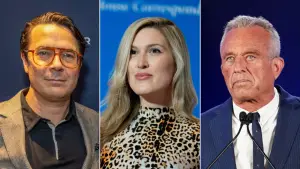
New York Times, Political Reporter Olivia Nuzzi Drops Protective Order Against Ex-Fiancé, Katie Robertson, Nov. 13, 2024 (print ed.). Ms. Nuzzi, shown above at center, a former writer for New York magazine embroiled in a scandal involving Robert F. Kennedy Jr., right, had accused her ex-fiancé Ryan Lizza, left, of harassment and blackmail.
Olivia Nuzzi, the high-profile New York magazine writer whose entanglement with Robert F. Kennedy Jr. set off a scandal, has withdrawn a request for a protective order against her former fiancé, the Politico correspondent Ryan Lizza.
Ms. Nuzzi, who left her role at New York magazine last month, filed a motion to dismiss the civil protection order on Friday in the Superior Court of the District of Columbia. She had been granted a temporary protection order against Mr. Lizza on Oct. 1 after she claimed in a complaint that he had blackmailed and harassed her.
Mr. Lizza, who is Politico’s chief Washington correspondent and a co-author of the Playbook newsletter, has vehemently denied all the accusations. He said in a statement on Tuesday that Ms. Nuzzi had “taken the only course available to her and withdrawn her fabricated claims.”
Ms. Nuzzi, who was until recently the Washington correspondent for New York magazine, was placed on leave on Sept. 19 after her editors found out about a relationship between her and Mr. Kennedy, who had been a candidate for president. Ms. Nuzzi had told them that the relationship had turned personal but was never physical. The magazine said in a note to readers that it was “a violation of the magazine’s standards around conflicts of interest and disclosures.”
Nov. 11
Steady, Tune In. Not Out.We disengage from the Donald at our own risk, Dan Rather and Team Steady, Nov, 11, 2011. If you have turned  on a television or opened a browser or a newspaper — I know, a quaint notion — in the past six days, you have been bombarded with dozens of reasons why
 Kamala Harris lost and the Democrats are flailing. The finger-pointing and recriminations are only adding to the despondency so many are feeling right now.
Those feelings are valid, and wanting to disengage is an understandable reaction. After all, many of you were hyper-engaged for an exhausting nine years, and now, we are here. But to disengage completely would notch another win for Donald Trump. The less people know and understand what he is doing, the better for him. Writing off the country, moving overseas, binge-watching every “Real Housewives” episode — whatever disengagement looks like to you, it plays right into his hands.
Exit polls showed that the more attention voters paid to political news, the more likely they were to vote for Harris, by wide margins. Harris +13 for voters who paid a great deal or a lot of attention. Trump +23 for votes who paid little or none at all.
So, as soon as you are able, we all need to focus on his far-right MAGA agenda. Ignorance is not bliss.
While the loss in the presidential race wasn’t quite as dramatic as first thought, the trends are troubling, with traditional and sure-thing voting blocs moving away from Democrats and toward Trump. The solutions are more nuanced than simply moving more to the left, or to the center, or rejecting the “woke” agenda.
Whether it was the economy, or the border, or identity politics, the biggest problem for the Democrats was and is messaging — how voters perceived those issues. In a double-blind poll conducted in October, voters preferred Harris’s policies to Trump’s when they weren’t told whose policies were whose. Read that again.
Forwarded this email? Subscribe here for moreTune In. Not Out.We disengage from the Donald at our own riskDan Rather and Team SteadyNov 11 READ IN APP Credit: Getty Images
If you have turned on a television or opened a browser or a newspaper — I know, a quaint notion — in the past six days, you have been bombarded with dozens of reasons why Kamala Harris lost and the Democrats are flailing. The finger-pointing and recriminations are only adding to the despondency so many are feeling right now.
Those feelings are valid, and wanting to disengage is an understandable reaction. After all, many of you were hyper-engaged for an exhausting nine years, and now, we are here. But to disengage completely would notch another win for Donald Trump. The less people know and understand what he is doing, the better for him. Writing off the country, moving overseas, binge-watching every “Real Housewives” episode — whatever disengagement looks like to you, it plays right into his hands.
Exit polls showed that the more attention voters paid to political news, the more likely they were to vote for Harris, by wide margins. Harris +13 for voters who paid a great deal or a lot of attention. Trump +23 for votes who paid little or none at all.
So, as soon as you are able, we all need to focus on his far-right MAGA agenda. Ignorance is not bliss.
While the loss in the presidential race wasn’t quite as dramatic as first thought, the trends are troubling, with traditional and sure-thing voting blocs moving away from Democrats and toward Trump. The solutions are more nuanced than simply moving more to the left, or to the center, or rejecting the “woke” agenda.
Whether it was the economy, or the border, or identity politics, the biggest problem for the Democrats was and is messaging — how voters perceived those issues. In a double-blind poll conducted in October, voters preferred Harris’s policies to Trump’s when they weren’t told whose policies were whose. Read that again.
The Democrats need to radically change how they communicate and thus campaign and ultimately govern. It is head-spinning to many who cover American politics that somehow Republicans are now perceived as the party of working people. That is a major messaging failure by Democrats.
The Republicans have been masterfully playing the communications long game, and it’s paid off in a huge way. They orchestrated an asymmetry in news coverage. It started with Rupert Murdoch’s New York Post, which gave birth to his Fox “News” with Roger Ailes as puppet master. Next came Newsmax and its ilk. Now the right has two huge social media networks: Truth Social and X. The thing that is so remarkable about the right-wing media is the cohesiveness of its voice — which doesn’t speak the truth.
The rest of the media landscape doesn’t speak with one voice — nor should it, not in a healthy democracy. But if you are trying to combat a right-wing media monster, it is a big disadvantage.
The Democrats, who have been using an outmoded communications playbook for far too long, are also speaking in an echo chamber, not able to reach people outside their core constituencies. Preaching to the choir was never more obvious than this election cycle.
Post-election social media has seen a surge in stories of Trump voters surprised to hear that tariffs will raise prices. And Trump voters are shocked to learn that their undocumented relatives could be deported. There was no shortage of stories about the dangers of tariffs and mass deportations, but the information wasn’t getting to the people who needed to hear it.
How do the Democrats get them to hear it, or see it, or read it?
According to Democratic strategist Dan Pfeiffer, the right wing has found a way to infiltrate non-political social media “on topics like comedy, gaming, gambling, and wellness,” he wrote in Media Matters on Substack. “We haven’t incubated our progressive political media enough, nor have we been willing to go into the non-political spaces where the most critical segment of voters are getting their info.”
If they can figure out how, they will have a great opportunity the moment Trump is inaugurated. He has said his first piece of legislation will be a huge corporate tax cut, given to the very companies who are gouging consumers at the grocery store. The Democrats need to communicate the real ramifications of this tax cut, whom it will hurt and whom it will help. To do so, they need to pop the liberal information bubble.
Please know, all is not lost. This election wasn’t a blowout like Reagan’s 1984 result (he won by 18 points) or even Obama in 2008. Just over 2 points separated Trump and Harris. In many states, voters backed Trump but also backed ballot initiatives that are counter to the MAGA agenda: abortion rights, paid family leave, and raising the minimum wage. In Missouri, 12 percent of voters chose Trump and abortion rights. While the Democrats have an enormous hill to climb, they aren’t starting at the bottom of it.
Nov. 10

The Trump - MAGA "Traction -- People's Convention" poster for a June 16-18 event in Detroit, Michigan.
Conference in Meidas Touch Network, Commentary: The Right Supports a Network of Conferences, Podcasters & Rallies; the Left has MSNBC, Ron Filipkowski, Nov. 9,  2024. It's time for Democrats to rethink their approach to grass roots organizing.
Imagine every week, somewhere in America, there is an event featuring nationally prominent Democratic elected officials, TV personalities, celebrities, artists, state and local officials, candidates, podcasters, journalists, and social media influencers. A one-day or weekend event, sponsored and hosted by different organizations, each with their own group of speakers, in different states, all year round. That is what the Republican Party has had in place for a decade to recruit, build, inspire, organize and motivate their base.
The Democrats have MSNBC.
Since I have attended, watched and covered these events on the Right for years now, I am often asked why the Right has embraced these so enthusiastically while the Left has virtually nothing equivalent. My theory always was that Republicans enjoy doing things in groups and Democrats are more individualistic. But every time I would mention that while speaking to a group of activists, their response was always the same - 'I would go to something like that!'IMG_1887
Democrats do some of this in the final few months of major election campaigns, but it is nothing like the network that the Right has created. Sure, we have all made fun of these events. Many of the speakers at right-wing conferences are nutty conspiracy theorists, christian nationalists, charlatans and grifters, and people who attend them can be fairly culty, but they are effective. While Democrats laugh at them or criticize them for what is taking place, they are doing nothing of their own to counter it.
Let's say, in a few months after the mourning period is over for 2024, a major conference was announced in a major city of a swing state that featured Gavin Newsom, Gretchen Whitmer, Wes Moore, Andy Beshear, Eric Swalwell, Jared Moskowitz, Jasmine Crockett, AOC, along with a few celebrities of the entertainment industry, TV news commentators, journalists, podcasters and social media influencers. Would you go if that was in your state? IMG_1890
Although the formats vary, most of these conferences on the Right play out a similar way using the CPAC / Turning Point USA model pioneered by Matt Schlapp and Charlie Kirk. Early on they feature panels of 3-4 speakers discussing a specific topic for 30-60 minutes, taking questions from the audience. Then speakers begin with local officials, then podcasters/influencers, then TV hosts, then celebrities, then the headliner politicians being featured. They talk about what is on their mind, what they think people need to do, propose new ideas and vision.
Panel topics for one of these conferences on the Left could be: Why Are We Losing Men under 40? Why are Latino Voters Disillusioned With Democrats? How Can We Talk About Abortion in a Way That Doesn't Alienate Christians? Democrats Need to Articulate a Border Policy, What Should It Look Like? Trans Athletes and Competitive Sports. I'm sure we each could think of many more. And the panelists could be chosen who are experts in these areas, but also have diversity of thought on them.
It would be critically important for every attendee to feel that they can share their thoughts and ideas without being shouted down or attacked. Honestly, that is a serious problem on the Left. If you step out of line with a certain orthodoxy, people are often branded racist, misogynist, transphobic, homophobic, or that they don't care or empathize with a particular person's group or plight because they have a different opinion about an issue that person is passionate about.
These conferences need to be a safe space where orthodoxies and conventional wisdom can be challenged and debated. People can disagree, argue their points passionately, hash things out, and still part as friends. Those kinds of debates happen on the Right, not so much on the Left where people have great ideas, new approaches, different perspectives, but are afraid to share them for fear of being shouted down, scorned, ostracized, or tagged with a odious label.
The Right invests in these conferences and events. Spends millions of dollars on them on advertising, venues and speaker's fees. But over time they have been so well attended, with attendees buying tickets and advertisers and sponsors lining up, that they now turn a healthy profit for the people who run them. While you don't have to pay for an elected official or candidate who just wants face time with activists, speakers lower down the food chain need their travel paid for and modest fees for their time.
People don't even have to attend in person anymore. These events are all livestreamed on X, Instagram, Facebook Live, Rumble, YouTube, and get lots of coverage from Fox, Newsmax, Real America's Voice, Right Side Broadcasting and other right-wing channels. Hundreds of thousands of people on the Right watch these conferences from home and on their phones, week after week after week.
Although the formats vary, most of these conferences on the Right play out a similar way using the CPAC / Turning Point USA model pioneered by Matt Schlapp and Charlie Kirk. Early on they feature panels of 3-4 speakers discussing a specific topic for 30-60 minutes, taking questions from the audience. Then speakers begin with local officials, then podcasters/influencers, then TV hosts, then celebrities, then the headliner politicians being featured. They talk about what is on their mind, what they think people need to do, propose new ideas and vision.
Panel topics for one of these conferences on the Left could be: Why Are We Losing Men under 40? Why are Latino Voters Disillusioned With Democrats? How Can We Talk About Abortion in a Way That Doesn't Alienate Christians? Democrats Need to Articulate a Border Policy, What Should It Look Like? Trans Athletes and Competitive Sports. I'm sure we each could think of many more. And the panelists could be chosen who are experts in these areas, but also have diversity of thought on them.
Washington Post, For legal disputes, Elon Musk’s X picked a venue far from Texas HQ, Tobi Raji, Nov. 10, 2024. Tech billionaire Elon Musk has chosen a sprawling federal court district in northern Texas to resolve all lawsuits filed against X, the social media platform he owns that was formerly known as Twitter.The decision ensures that such lawsuits will be heard in courthouses that are a hub for conservatives, which experts say could make it easier for X to shield itself from litigation and punish critics.
It’s typical for companies to specify in their terms of service where lawsuits against them may be filed. But the businesses usually have a clear connection to the chosen court district, experts say. For example, Instagram, headquartered in Menlo Park, California, says all lawsuits against the company should be filed in the U.S. District Court for the Northern District of California or a state court located in San Mateo County, California, which is home to Menlo Park.
But under X’s new terms of service, which take effect Nov. 15, lawsuits against the social media platform must be filed in the U.S. District Court for the Northern District of Texas — not the Western District of Texas, where the company is headquartered.
Mass protests and crackdowns that engulfed colleges in the spring have dissipated, and campuses are far calmer and quieter this fall. But at some schools, student groups have struck a strikingly more militant tone.
Earlier messages were not gentle — Israel’s actions were regularly dubbed “genocide” — but until recently few had openly endorsed Hamas and its leaders.
To some, including many in the Jewish community, it’s an alarming shift. But to others, the new rhetoric is the natural evolution of a movement responding to a brutal war now in its second year, with no end in sight. By changing his company’s terms of service, Musk has ensured that lawsuits against X will be heard in courthouses that are a hub for conservative judges.Georgetown University law professor Steve Vladeck accused Musk of “quintessential forum shopping” — the practice of identifying a court or district where one believes they will receive a favorable ruling. He noted that 10 of the 11 active judges in the Northern District were appointed by a Republican president, compared with six of 11 judges in the Western District of Texas.
“Whoever wrote these terms of service appears to believe that conservative judges are more likely to rule for X in the typical case than randomly selected judges across the country,” Vladeck said.
Nearly a dozen legal and tech experts, lawyers and court watchers said X’s decision to steer all lawsuits to northern Texas is indicative of a broader effort by companies to find favorable venues, an issue that has plagued lawmakers and advocacy groups for years.
 Meidas Touch Network, Commentary: WTF! CNN CAUGHT CHEERLEADING for Trump, Ben Meiselas, Nov. 10, 2024.Warner Bros. Discovery CEO David Zaslav revealed.
Washington Post, Opinion: Retreat is not an option, Dana Milbank, right, Nov. 10, 2024 (print ed.). What I’d really like is to head to the countryside and never again write the  name “Donald Trump.
When Trump triumphed in 2016, I, and most of those in my world, felt shock and fear. This time, what I feel — and what I hear from other journalists, as well as public servants and progressives — is, primarily, exhaustion. He has dominated our public life for a decade now. He has generated countless abusive messages and death threats toward journalists — “the enemy of the people” — and now we are sure to experience more, with his vague threats to have the Justice Department go after us and his assurance to the violent that “I don’t mind” if journalists are shot. As CNN’s Brian Stelter wrote Thursday, many journalists are “questioning if they have it in them to report on another Trump cycle.”
On top of this, Tuesday’s results make it feel as though all the years of pointing out the incessant lies, as well as the routine destruction of decency and democratic norms, have made no difference. Now, with fewer guardrails than the first time, he’ll have four more years of power — and that’s if he doesn’t make good on his fantasy to be “president for life” or his assurance to his voters that “you’re not going to have to vote” ever again.
A week ago in this space, I wrote: “By our votes, or by failing to cast our votes, we are stating unequivocally who we are as a people.” Now we know. A majority of us — a very slim majority, but a majority, with votes still being counted — have declared themselves okay with the vulgarity, the explicit racism, the disinformation, the erratic pronouncements, and the talk of suspending the Constitution, imprisoning critics and using the U.S. military to attack Americans who dissent. In response to the popular chant at Kamala Harris rallies, Americans said: We are going back.
The usual recriminations and finger-pointing have begun on the left.
Harris didn’t lose the race as much as Trump won it. He persuaded two-thirds of Americans that the economy stinks and the country under a deeply unpopular Biden is heading in the wrong direction; that’s not necessarily reality (plentiful jobs, growing wages, moderate inflation, stock-market records), but it’s where we are.
Let’s not overstate Tuesday night’s verdict. Trump is on course for the barest majority of the popular vote, which will be reflected in a nearly 50-50 House. Ballot initiatives protecting abortion rights were resoundingly successful. In Maryland and Delaware, Black women were elected to the Senate. A Jewish man became governor of North Carolina, which rejected extreme right-wing candidates running for statewide office.
Yes, progressives and Democrats will, over time, need to rethink their strategy for the future, in particular the belief that demographics, and the increasingly multiracial composition of America, would inevitably favor them. Latinos in particular appear to be following the Irish, Italians and other immigrant groups in becoming part of the dominant “White” culture. Democrats will need to find new ways to appeal to men, and they will need to reclaim their populism, somehow heisted by a billionaire who has given huge tax breaks to the rich.
I don’t pretend to know the answers, but I resolve to join the search.
Nov. 8
RawStory, 'They need to be burned': Project 2025 chief calls for destruction of Boy Scouts, Brad Reed, Nov. 8, 2024. 'They need to be burned': Project 2025 chief calls for destruction of Boy Scouts.
 Kevin Roberts, the architect of the controversial Project 2025, writes in his soon-to-be-released book that he wants to conduct a "slow burn" of multiple American institutions.
The Guardian has obtained a copy of the book, which is titled "Dawn’s Early Light: Taking Back Washington to Save America," and calls for setting presumably metaphorical fire a wide variety of institutions that are insufficiently right wing.
 "Many of America’s institutions have been completely hollowed out," Roberts contends. "Decadent and rootless, these institutions serve only as shelter for our corrupt elite. Meanwhile, they block out the light and suck up the nutrients necessary for new American institutions to grow. For America to flourish again, they don’t need to be reformed; they need to be burned."
Roberts's list of institutions in need of a fiery cleanse includes both traditional conservative bogeymen such as the media and Ivy League universities but also some institutions that were once seen as staunchly conservative, including the FBI, "80% of ‘Catholic’ higher education," and even "The Boy Scouts of America."
Also on Roberts's list is the asset management firm BlackRock, which The Guardian notes "has been a key investor in Trump Media & Technology Group, the president-elect’s social media company."
The Guardian also says that Roberts's obsession with fire is evident throughout the entire book, as he offers philosophical musings on the virtues of burning things.
"That’s the funny thing about fire. It is so fleeting, a flame flickering from moment to moment, yet in its evanescence, it is eternal," he writes at one point. "Of all the elements, fire is most associated with transformation, renewal, and change. You can’t have a blaze without some kind of sacrificial transformation of fuel into fire. Yet precisely for this reason, fire demands an attention to continuity. Unlike any of the other elements, fire dies … a fire must be continually tended.”
Meidas Touch Network, Commentary: On Election Night, Trump Hosted a MAGA Billionaire Accused of Pressuring Workers to Perform Sex Acts, J.D. Wolf,  Nov. 8, 2024. Trump's troubling alliance with Steve Wynn.
When former President Donald Trump hosted his election night party at Mar-a-Lago Tuesday, he welcomed a guest whose presence raised serious ethical concerns: billionaire casino mogul Steve Wynn, right. Known for his lavish lifestyle and political influence, Wynn has also been the subject of multiple sexual harassment allegations, which have cast a long shadow over his business and public image.
Meidas Touch Network, Commentary: Trump Calls for Investigation into Truth Social Stock Dump Rumors, J.D. Wolf, Nov. 8, 2024. Trump claims he has no intention of selling his Truth Social stock Truth Social stock has been volatile. It has fluctuated between its high of $79.38 and its low of $11.75 and experienced trading halts multiple times. Trump's Twitter clone has been criticized for not having a business model that makes financial sense, taking in less profit than its expenditures by a large margin.
Some have suspected Trump was looking to pump up the price of his stock and then dump it as other founders of his social media app have done. In a Truth Social post, Trump claims he doesn't intent to sell his stock, and in a show of authoritarianism, is calling for authorities to immediately investigate that those who are behind these rumors.
Trump's post communicates his intention to continue to maintain businesses while holding the presidency. Trump likely hopes the using the app while president will drive his social media app into profitability.
Nov. 7

Washington Post, Elon Musk says Trump win is just the start of his political ambitions, Trisha Thadani and Elizabeth Dwoskin, Nov. 7, 2024 (print ed.). Trump called the billionaire a ‘new star’ during his victory speech and Musk announced plans to push GOP candidates in the 2026 midterms and beyond.
Elon Musk played a video game on his private jet as it hurtled toward Palm Beach, Florida, where he was due to watch election results with former president Donald Trump. As aircraft engines whirred in the background, the CEO of Tesla and SpaceX told thousands of listeners that the 2024 presidential campaign was just the start of his political ambitions.
America PAC, the pro-Trump political group Musk formed and funded with at least $118 million of his own money, “is going to keep going after this election, and prepare for the midterms and any intermediate elections,” Musk said on a live stream on his social media platform X. In the next round of races for the House, the Senate and even some local offices, he said his super PAC “is going to aim to weigh in heavily.”
Later, as Musk hung out at Mar-a-Lago with other wealthy donors and a Trump victory appeared guaranteed, his posts on X became increasingly triumphant. “The future is gonna be fantastic,” he wrote over a picture of a SpaceX rocket launching on a pillar of flame.
Musk’s presence at Trump’s side Tuesday night marked an inflection point in an unprecedented metamorphosis, as the world’s richest man vowed to turn his erratic but visionary ethos more fully to the nation’s politics. Since endorsing Trump in July, Musk — once known primarily for pushing boundaries in electric vehicles and rockets — has become a prominent force in the conservative political movement set to return to the White House.
As the election results poured in, Musk tweeted about his excitement about working with Trump on a commission to slash government spending. He posted a picture of himself deep in conversation with the former president and Ultimate Fighting Championship CEO Dana White at the Trump watch party, adding a fire emoji and four American flags. And over a meme of himself holding a ceramic sink in the Oval Office, he wrote: “Let that sink in.”
Trump added to the sense of destiny, fawning over Musk, his rockets and his satellite internet service as he declared victory early Wednesday. “We have a new star,” Trump said. “A star is born — ELON!”
Wealthy donors have long used fat pocketbooks to shape the political landscape, but Musk has unique power and appeal, longtime Republican strategists said. In addition to his immense wealth — Bloomberg estimates his net worth at over $260 billion — Musk has an avid online following of hundreds of millions, control of a major social media platform and a willingness to push political and legal boundaries, allowing him to redefine notions of how a business tycoon can engage with politics.
Hollywood Reporter, Media’s Crisis Point: It’s Losing Relevance and Scorned in Trump Era, Alex Weprin, Nov. 7, 2024. A Reboot May Be Next.
 Former President Trump’s decisive victory Tuesday led to a shock wave that was felt in newsrooms across Washington, D.C., and New York. Everyone knew the polls were close and that a Trump win was a strong possibility, sure, but the scale of Trump’s win left one senior producer at a broadcast network stunned: “We are questioning our relevance right now,” they said Wednesday morning.
It was a sentiment shared by former Sen. Claire McCaskill, who lamented on MSNBC‘s Morning Joe: “I think we have to acknowledge that Donald Trump knows our country better than we do.”
Indeed, there are blaring red warnings signs for traditional media everywhere you look. Ratings for the broadcast and cable news channels saw steep declines in ratings from Nielsen (finals showed an average of 42.3 million people, down from nearly 57 million four years ago), with the lowest ratings in decades. The steepest drop was felt at CNN, which saw its numbers fall below MSNBC for the first election night since that channel launched nearly three decades ago. (A caveat: Network PR reps note that readership and viewership online spiked on Election Day, more in keeping with modern consumption patterns. But the value in someone watching a 20 second CNN clip on X or a stream on Roku Channel is much different than someone who tunes in on TV.)
Meanwhile, emergent platforms and programs outside of the traditional media thrived, some for Harris, (her interview on Alex Cooper’s Call Her Daddy generated millions of views and listens), but it was a strategy that Trump went all-in on, and during his victory speech, his friend and UFC CEO Dana White used the opportunity to call out some of those personalities.
“I want to thank some people real quick. I want to thank the Nelk Boys, Adin Ross, Theo Von, Bussin’ With the Boys, and last but not least, the mighty and powerful Joe Rogan,” White said.
It’s a group of people who are not uniformly fans of Trump (Rogan did not endorse him until Monday), united by factors that are a little harder to square. Steve Krakauer, a media contributor to NewsNation and columnist for The Hill, who also works as Megyn Kelly’s executive producer for SiriusXM, says that things like the MAHA movement (Make America Healthy Again) may be worth exploring for a dejected media.
“Show some interest in it, cover it critically, but take it seriously, because clearly that point of view has resonated with people that are not typically Trump fans,” he says.
On Tuesday night, Fox News host Sean Hannity declared “legacy media” to be “dead” once it became clear that Trump was on pace to win. “The decline of its influence has been evident for years. This is proof of it,” Fox analyst Brit Hume added.
Fox, of course, is not immune to the business challenges facing the rest of TV news, so the problems facing many of its competitors with differing views or approaches will still need to be navigated by the Murdoch-controlled outlet. But there is no doubt that a strategy that involved effectively ignoring the mainstream media seems to have worked. And the celebrity endorsements seem to have had no impact, either.ADVERTISEMENT
“That a president-elect could win so overwhelmingly in popular vote + electoral college while ignoring the New York Times, Washington Post, NPR, CBS News, NBC News, & CNN (while spending hours with Joe Rogan) should be a moment of self-reflective reckoning for ‘mainstream’ media,” wrote Michael Socolow, a former broadcast journalist who now teaches at the University of Maine.
Indeed, inside the halls of media power, that reckoning is already taking place, with executives, editors, on-air talent and producers wondering what the next four years will bring. While Trump himself has long been an avid fan of traditional media — Rupert Murdoch’s New York Post, which endorsed him, has been a staple — his campaign increasingly turned away from even friendly traditional outlets in favor of pairing the mogul with influencers.
And while there is plenty of hyperbole to be found (see investor Bill Ackman’s post that “half of America woke up to the reality that they have been manipulated by the media. This should lead to an abandonment by many of the MSM as their primary source of information”), there are real lessons to be gleaned.
Some outlets will lean into the “resistance” mindset that generated big ratings and major subscriber gains in 2016-20, but the election results suggest that the market for that type of programming or content has a natural limit.
Nov. 4

Meidas Touch Network, Commentary: MLK's Daughter Blasts Trump's "Meme Team" Deepfake Video, J.D. Wolf, Nov. 4, 2024. MAGA is spreading a fake video depicting the civil right leader pushing MAGA talking points and endorsing Trump
The account "MAGA Resource" embedded the video from it's original source, "Ramble Rants" which posted the video during Black History Month and claimed: "If Martin Luther King, Jr. was alive today, he'd support President Trump #DilleyMemeTeme #BlackHistoryMonth"
"Ramble Rants" is part of the Dilley Meme Team, also known as "Trump's Online War Machine." The account has asked its followers to complain to Twitter about the "deepfake" community note warning on the post by "MAGA Resource."Ramble Rants
The Dilley Meme Team is a controversial group that has been used by Trump to promote his MAGA agenda. In August, Trump posted a video meme from the Dilley Meme Team using a parody of Alanis Morissette's song Ironic that had a verse suggesting Kamala Harris performed oral sex in exchange for political power.
The New York Times has described the Dilley Meme Team as group as "a team of meme-makers" that are "flooding social media with pro-Trump posts riddled with sexist and racist tropes." The newspaper also reported that Trump has played video from the pro-Trump "troll army" at his own rallies.
The New York Times said the group has "effectively served as a shadow online ad agency" for Trump's campaign. The group doesn't have any problem pushing misinformation and deepfakes, like the Martin Luther King, Jr. Trump "endorsement" video.Trump with Reanna and Brenden Dilley.
In August, the group's leader, Brenden Dilley, a former Republican House candidate, was a guest in Trump's box suite at the Poinsetta Bowl, according to a Twitter post by Dilley. Trump also sent Dilley an autographed news article thanking him for his help in defeating GOP rival Ron DeSantis.
The Dilley Meme Team's fake Martin Luther King video is disgusting and doesn't honor the legacy of the civil rights leader. This is exactly the type of content that Trump has encouraged.
 Nieman Lab at Harvard University, The Washington Post isn’t alone: Roughly 3/4 of major American newspapers aren’t endorsing anyone for president this year, Joshua Benton, Nov. 4, 2024. Led by risk-averse corporate owners, dozens of the biggest U.S. newspapers have decided their editorials should express opinions on everything except who should be president..
I can’t remember the last time I was as shocked by a news-industry number as I was by 200,000. Specifically, the 200,000 Washington Post subscribers who NPR’s David Folkenflik reported cancelled their subscriptions in the days after the paper announced it wouldn’t be endorsing in the 2024 presidential race. (Not long after, the number grew to “more than 250,000” — a number the Post’s own reporters later confirmed.)
I have all the respect in the world for Folkenflik, but my brain refused to believe it at first. 2,000? Sure. 8,000? Okay. Even 20,000? Those seemed within the realm of possibility. But 200,000 was consumer action on a scale unseen in the modern news business — and without any organized force pulling the strings. All this at an outlet that had, only weeks earlier, been chuffed about an increase of 4,000 subs so far in 2024. Post owner Jeff Bezos, the man behind the non-endorsement call, didn’t help things with a tone-deaf op-ed packed with C-minus arguments.1
Perhaps Bezos thought he would avoid customer outrage because declining to endorse for president is a growth industry in America — and has been since Donald Trump first came down that escalator. I first wrote about this two years ago when it became clear that the country’s largest newspaper chains — all either private equity-owned or -adjacent — were growing allergic to making the call. Using a database of newspaper endorsements from The American Presidency Project at UC Santa Barbara, I tracked how many of the 100 highest-circulation newspapers had declined to endorse for president. The trend line is rather clear:
In five election cycles, endorsing for president went from a “nearly everybody” thing to a “barely half” thing. You can find all the details in that story, but the tl;dr is that, in 2016, newspapers overwhelmingly backed Hillary Clinton against Donald Trump and faced enormous blowback from Trump supporters — in the form of cancellations and, in some cases, threats that led to papers hiring extra security for their employees. That, combined with the continued decline in the U.S. newspaper business — which led some publishers to question the value of annoying any sliver of their remaining customers — led to a widespread abandonment of endorsements in 2020. Papers that had endorsed Clinton in states that Trump won were the most likely to bail.
And not long after 2020, even more publishers began to announce their intention to exit the arena — citing a mixture of tight budgets and a sudden belief that editorial pages should have an opinion on every issue under the sun except for who should be in charge of the country.
So, one day before the nth-consecutive “most important election of our lifetimes,” how much more retrenchment has there been? A lot.
We’re looking at a universe of 95 newspapers.2 Of those papers, here’s how their endorsements broke down in 2016:61 endorsed Hillary Clinton1 endorsed Donald Trump3 endorsed Gary Johnson2 endorsed “anyone but Trump”21 endorsed no one7 are unknown3
Move ahead to 2020 and the shift is clear:44 endorsed Joe Biden7 endorsed Donald Trump44 endorsed no one
And what about 2024? According to my hunting through dozens of newspaper opinion sections, here’s where we stand just before election day:22 endorsed Kamala Harris2 endorsed Donald Trump71 endorsed no one
That’s right: Three-quarters of the nation’s largest newspapers have declined to endorse anyone for president this cycle. That’s despite one candidate who — completely in character — volunteered yesterday that he wouldn’t mind if a gunman would “shoot through the fake news” at his rallies. Or who has called for all three major broadcast networks to lose their “licenses”4 because he doesn’t like things they’ve said about him. Or this, or this, or the ten thousand other links I could put here.
Who are the biggest culprits in this trend? The nation’s four largest newspaper chains: Alden Global Capital (through its control of MediaNews Group and Tribune Publishing), Gannett, Lee Newspapers, and McClatchy.
There are 15 Alden-controlled newspapers in this dataset (in New York, Chicago, Boston, Denver, San Diego, San Jose, Orlando, Ft. Lauderdale, Hartford, Orange County, St. Paul, Hampton Roads, Allentown, Reading, and Newport News). In 2020, seven of those endorsed Joe Biden; one, the Boston Herald, endorsed Donald Trump. This year, none of them endorsed for president, after corporate determined that “picking a candidate may alienate more readers than it persuades.”
Of the 19 Gannett newspapers in the dataset, seven endorsed Biden in 2020 (none endorsed Trump). But the chain decided it wanted less opinion in its opinion sections and that it would “returned to our roots as a facts-forward, down-the-center survey of our nation.” No endorsements for president this time around.
McClatchy has eight newspapers in the dataset, and none of them endorsed for president in 2020, with its new hedge-fund owners saying only papers that conducted individual editorial-board interviews with the candidates could make an endorsements.5 But while six of the eight newspapers continued their non-endorsement this cycle (Miami, Fort Worth, Sacramento, Fresno, Lexington, and Kansas City), its two North Carolina newspapers — the Raleigh News & Observer and Charlotte Observer — broke ranks and endorsed Harris.6
The last major chain, Lee, had a more mixed showing. Of its eight newspapers in the dataset, seven had endorsed Biden in 2020 (with one abstention). This year, four endorsed, all picking Harris: St. Louis, Buffalo, Madison, and Tucson.7 Others kept their silence. (Here’s Omaha: “After debate, research and consideration, our editorial board has concluded we serve our readers best by not endorsing candidates for office or weighing in on ballot initiatives directly. You don’t need our opinion on whether Donald Trump or Kamala Harris would make a better president.” Quad Cities: “After thoughtful discussion, the board has decided informing voters is better than picking a side. The process, a long-standing tradition of newspapers, does not appear our best method of serving readers in 2024.”)
Outside the big chains, other papers declining to endorse include the Tampa Bay Times, the Minnesota Star-Tribune, and the Baltimore Sun — along with the two that caught national attention, the L.A. Times and Washington Post.
Interestingly, while most of the new non-endorsers went for Biden in 2020, several of that year’s Trump endorsers have also zipped their lips. The Spokane Spokesman-Review stopped all endorsements after its owner backed Trump to some controversy four years ago. The Toledo Blade, which has spent 2024 in a family battle for corporate control, “opted to stay neutral” this year. The Arkansas Democrat-Gazette doesn’t seem to have endorsed this year (though it’s also said it didn’t really endorse Trump last time, either). Only two major papers — the Las Vegas Review-Journal (owned by Miriam Adelson, who has given $100 million to a pro-Trump super PAC) and the New York Post (Rupert Murdoch) — appear to have come out for Trump this time.
So, big picture: Roughly 3 out of 4 major American newspapers have stopped endorsing for president — something that nearly all of them did just twenty years ago. A trend that began in 2012 has accelerated in every cycle since and now overtaken most of the industry.
In fact, it’s been happening long enough that we can ask bigger questions. Have the papers who have stopped reaped any sort of trust dividend — the sort that Jeff Bezos would have you believe was one non-endorsement away? Have Trump supporters rallied to support any of the papers who have preemptively kept their mouths shut? Has anyone sensibly explained why newspapers should have a dedicated section devoted to expressing opinions on everything except who should be leader of the free world? I think the only honest answers here are no all around — and I suspect there are at least 250,000 people who might agree.
New York Times, New York Times Passes 11 Million Subscribers, Katie Robertson, Nov. 4, 2024. The Times reported steady growth in digital subscriptions in the third quarter and a profit for The Athletic for the first time since it acquired the sports site in 2022.
The New York Times added roughly 260,000 paid digital subscribers in the third quarter of the year, the company said on Monday, crossing the threshold of 11 million total subscribers for the first time.
The company’s adjusted operating profit for the quarter, which ran from July through September, rose 16.1 percent to $104.2 million, from $89.8 million a year before. Overall revenue increased 7 percent to $640.2 million, compared with the same period in 2023.
The Times has a stated goal of reaching 15 million subscribers by the end of 2027. It had 11.09 million subscribers at the end of the third quarter, 10.47 million of which were to digital products only, not the print newspaper.
Early Monday before the earnings were released, the Times Tech Guild, which represents more than 600 of the company’s tech workers, went on strike. The union and the company are negotiating over pay increases and other issues.
Meredith Kopit Levien, the president and chief executive of The New York Times Company, said in a statement accompanying the earnings announcement, that more than five million of the 11 million subscriptions were now either for multiple Times products, which include digital news, Cooking, Games, Wirecutter and The Athletic, or a bundle of all products offered.
New York Times, Quincy Jones, Giant of American Music, Dies at 91, Ben Ratliff, Nov. 4, 2024. As a producer, he made the best-selling album of all time, Michael Jackson’s “Thriller.” He was also a prolific arranger and composer of film music.
Quincy Jones, shown at right in a 2014 photo,one of the most powerful forces in American popular music for more than half a century, died on Sunday in California. He was 91.
His death was confirmed in a statement by his publicist, Arnold Robinson, that did not mention a cause. The statement said that he had died peacefully at his home in Bel Air.
Mr. Jones began his career as a jazz trumpeter and was later in great demand as an arranger, writing for the big bands of Count Basie and others; as a composer of film music; and as a record producer. But he may have made his most lasting mark by doing what some believe to be equally important in the ground-level history of an art form: the work of connecting.
Beyond his hands-on work with score paper, he organized, charmed, persuaded, hired and validated. Starting in the late 1950s, he took social and professional mobility to a new level in Black popular art, eventually creating the conditions for a great deal of music to flow between styles, outlets and markets. And all of that could be said of him even if he had not produced Michael Jackson’s “Thriller,” the best-selling album of all time.
Mr. Jones’s music has been sampled and reused hundreds of times, through all stages of hip-hop and for the theme to the “Austin Powers” films (his “Soul Bossa Nova,” from 1962). He has the third-highest total of Grammy Awards won by a single person — he was nominated 80 times and won 28. (Beyoncé’s 32 wins is the highest total; Georg Solti is second with 31.) He was given honorary degrees by Harvard, Princeton, Juilliard, the New England Conservatory, the Berklee School of Music and many other institutions, as well as a National Medal of Arts and a National Endowment for the Arts Jazz Master fellowship.
New York Times, Quincy Jones’s Legacy in 14 Essential Songs, Ben Sisario, Nov. 4, 2024. Quincy Jones, who died at 91 on Sunday, was a colossus of American music, leaving a profound influence on nearly every genre he touched, from the 1950s on — jazz, funk, soundtracks, syrupy R&B and chart-topping pop.
The scope of his career is so vast, it seems almost impossible that it’s the work of a single person. He cut his teeth as a trumpeter in Lionel Hampton’s touring band in the early ’50s, then studied in Paris under the great classical pedagogue Nadia Boulanger. He produced jazz albums for Mercury Records, made fast friends with Frank Sinatra — who called him “Q,” a nickname that stuck — and recorded “It’s My Party,” a No. 1 hit by a teenage Lesley Gore.
Then came gorgeously textured movie scores, slithery funk and a fantastically successful partnership with Michael Jackson, whose 1982 LP “Thriller,” produced by Jones, is the biggest seller of all time. And it didn’t end there. In 2018 documentary, “Quincy,” Kendrick Lamar, the reigning rap laureate, is seen bumping fists with Jones and crediting him as the inspiration for “combining hip-hop and jazz.”
New York Times, New York Times Passes 11 Million Subscribers, Katie Robertson, Nov. 4, 2024. The Times reported steady growth in digital subscriptions in the third quarter and a profit for The Athletic for the first time since it acquired the sports site in 2022.
The New York Times added roughly 260,000 paid digital subscribers in the third quarter of the year, the company said on Monday, crossing the threshold of 11 million total subscribers for the first time.
The company’s adjusted operating profit for the quarter, which ran from July through September, rose 16.1 percent to $104.2 million, from $89.8 million a year before. Overall revenue increased 7 percent to $640.2 million, compared with the same period in 2023.
The Times has a stated goal of reaching 15 million subscribers by the end of 2027. It had 11.09 million subscribers at the end of the third quarter, 10.47 million of which were to digital products only, not the print newspaper.
Early Monday before the earnings were released, the Times Tech Guild, which represents more than 600 of the company’s tech workers, went on strike. The union and the company are negotiating over pay increases and other issues.
Meredith Kopit Levien, the president and chief executive of The New York Times Company, said in a statement accompanying the earnings announcement, that more than five million of the 11 million subscriptions were now either for multiple Times products, which include digital news, Cooking, Games, Wirecutter and The Athletic, or a bundle of all products offered.
Nov. 3
New York Times, How Elon Musk’s Own Account Dominates X, Kate Conger, Aaron Krolik, Santul Nerkar and Dylan Freedman, Nov. 3, 2024. The billionaire has effectively become the star of his social media platform, transforming X into a reflection of his personal views before the election.
Days ahead of the presidential election, Elon Musk’s centrality to his social media platform, X, has become more pronounced.
Mr. Musk has posted more than 3,000 times on the site in the last month, according to a tally by The New York Times, campaigning heavily for former President Donald J. Trump. The tech mogul has also shared dozens of unfounded claims about the election, including that votes will be rigged against his preferred candidate.
All of his posts have traveled further and resounded more widely than ever as Mr. Musk’s X account has come to dominate the platform, effectively making him the host of his own social media site. His account is the most popular on X by a significant margin, with more than 202 million followers. It drives the platform’s daily conversation and nudges discussion to the right, according to independent research and an analysis by The Times. And engagement with his posts — including likes and reposts — has doubled over the past year, according to X’s metrics.
The repercussions of Mr. Musk’s pre-eminence on X — especially as he casts doubt on the integrity of the election — could be profound.
“It’s so consequential that someone who is such a partisan figure is inhabiting that piece of digital real estate,” said Emerson Brooking, a senior fellow at the Atlantic Council’s Digital Forensic Research Lab, a group that studies online disinformation.
Mr. Musk and X did not respond to requests for comment. Last month, Mr. Musk posted that X products were the “best thing on the Internet for truth.”
Here’s how his account has taken center stage at X.The Most-Followed by Far
Mr. Musk bought X, then known as Twitter, for $44 billion in 2022, vowing to make it a public town square. He swiftly became the most powerful super-user on the site.
Mr. Musk overtook former President Barack Obama in March 2023 to become the most-followed person on the platform, with 133 million followers. Since then, his count has risen 52 percent.
Mr. Obama’s following, in contrast, has decreased slightly, by about two million, to just over 131 million followers. (Bot accounts exist on X and may be a factor in some of the tallies.)
Alongside Mr. Musk’s ballooning follower count, engagement with his posts has mushroomed. During a two-week period in October, Mr. Musk’s 1,220 posts generated nearly 65,000 engagements on average, according to the Times analysis of Mr. Musk’s posts over the past year that tallied likes and reposts. In a similar stretch a year ago, his posts averaged around 30,000 engagements.

On Saturday evening, Nov. 2, 2024, Vice President Kamala Harris unexpectedly headed to New York to appear alongside Maya Rudolph, left, on “Saturday Night Live” (New York Times photo by Haiyun Jiang).
New York Times, Kamala Harris Joins ‘S.N.L.’ for a Pep Talk With Maya Rudolph, Katie Rogers, Nicholas Nehamas and Maggie Haberman, Nov. 3, 2024 (print ed.). Appearing in a mirror opposite her longtime impersonator, the vice president gave a little positive encouragement to her comedic reflection.
The vice president gazed into the mirror, reached out her hand and told her comedic reflection that she had this election thing in the bag.
“I’m just here to remind you — you got this,” the actual vice president said to Maya Rudolph, the comedian who has portrayed Kamala Harris for years on “Saturday Night Live.” She then added a jab about former President Donald J. Trump’s fumbled attempt to enter a garbage truck this week: “Because you can do something your opponent cannot do. You can open doors.”
It wasn’t cringe, which is the only bar that needs clearing for a high-risk live television appearance during the final hours of a breakneck presidential campaign.
And maybe it was not viral comedy gold, either. That is a feat more easily achieved by someone like the veteran comedian Dana Carvey, who played a rhetorically unburdened President Biden in the first minutes of the show’s cold open. Or by James Austin Johnson, who portrayed former President Donald J. Trump and joked about his tactile relationship with a microphone and his volatile relationship with his former vice president, Mike Pence.
But Ms. Harris’s appearance, which came later in the opening sketch and was delivered across a fictional dressing-room mirror from Ms. Rudolph, contained a solid riff that poked some fun at Mr. Trump. Her segment was also rife with puns designed to assist in the pronunciation of the vice president’s first name: mamala, palmala, rom-comala, pajamala … the list goes on and onala.
Ms. Harris’s appearance on the vaunted live sketch comedy show had been discussed by advisers for the better part of this week, according to a person familiar with the plans, but the vice president did not confirm that she would attend until midweek. Her aides had kept her Saturday evening plans open while they deliberated.
In the end, after a day spent campaigning in Georgia and North Carolina, two top battleground states, Ms. Harris took a surprise flight to New York City. Her plans were kept secret until shortly before her motorcade pulled up outside 30 Rockefeller Plaza.
Appearing on live television is a gamble for a presidential candidate, or for any celebrity, without acting experience, but previous contenders have rolled the dice, including Mr. Trump and Hillary Clinton in 2015 and Barack Obama in 2007. (Mrs. Clinton also appeared in 2008.) Few have done so in the waning days of a campaign.
When Ms. Harris first appeared behind the mirror, the audience clapped and screamed. She had been introduced by Ms. Rudolph, who was wishing she could speak to someone “who’s been in my shoes — a Black, South Asian woman running for president, preferably from the Bay Area.”
“Saturday Night Live,” now in its 50th season, has maintained an unusual cultural potency during election cycles, with viewers clamoring to see which comedians will be chosen to lampoon the candidates. In 2015, Mr. Trump and Mrs. Clinton both appeared on the show during their parties’ primary races, and Alec Baldwin and Kate McKinnon morphed into their late-night comedic alter egos along the way.
Mrs. Clinton appeared in a single sketch, as a bartender serving the version of herself played by the actress Kate McKinnon, and poked gentle but toothless fun at herself.
Mr. Trump — who, as the former host of “The Apprentice,” has significant show-business experience — hosted an entire episode that year, although the sketches were tame and not seen as particularly hilarious.
But this year, the unexpected campaign of Ms. Harris, along with her choice of Gov. Tim Walz of Minnesota as her running mate, sent the perennial speculation into overdrive. The comedian Jim Gaffigan was selected to play Mr. Walz, and Ms. Rudolph reprised her portrayal of Ms. Harris to much acclaim.Editors’ PicksMucus: It’s Snot What You ThinkKwame Onwuachi Is a Whole New Kind of Celebrity ChefA Poem About Waiting, and Wishing You Had a Drink
Even the vice president has praised her impression. “She’s so good,” Ms. Harris said last month on the ABC talk show “The View,” adding, “She had the whole thing — the suit, the jewelry, everything.”
On “Saturday Night Live,” Ms. Harris and Ms. Rudolph chatted long enough to mock Mr. Trump but also for the vice president to laugh at herself: “I don’t really laugh like that, do I?” she asked Ms. Rudolph after the comedian let loose one of Ms. Harris’s full-throated peals.
“Little bit,” Ms. Rudolph replied.
Then they stepped out from behind the mirror, faced the crowd and embraced before the fictional Ms. Harris told the real Ms. Harris that the vice president had her vote. “I’m going to vote for us,” Ms. Rudolph said.
“Any chance you are registered in Pennsylvania?” Ms. Harris asked cheekily, before the two closed out the cold open with the one line that never needs any rehearsing.
And before the night was through, Ms. Harris was not the only politician to show up onstage.
Senator Tim Kaine of Virginia, a Democrat who is up for re-election on Tuesday, appeared in a sketch game show called “What’s That Name,” in which neither the contestants nor the host could remember whom he was.
“Not only does he look exactly like Tim Walz, his name is also Tim,” said the game show’s host, played by Michael Longfellow. Mr. Kaine jumped in. “My name is still Tim,” he said. “I exist. I’m a senator representing Virginia.”
The Hill, FCC commissioner claims Harris on ‘SNL’ violates ‘equal time’ rule, Tara Suter, Nov. 3, 2024. A Federal Communications Commission (FCC) commissioner has claimed that Vice President Harris’s recent appearance on “Saturday Night Live,” commonly known as “SNL,” violates the “equal time” rule.
“This is a clear and blatant effort to evade the FCC’s Equal Time rule,” Commissioner Brendan Carr posted on the social platform X on Saturday in response to a post from The Associated Press about Harris being on the show that night.
“The purpose of the rule is to avoid exactly this type of biased and partisan conduct — a licensed broadcaster using the public airwaves to exert its influence for one candidate on the eve of an election. Unless the broadcaster offered Equal Time to other qualifying campaigns,” Carr, a Trump appointee, continued.
The FCC’s “equal time” rules let rival candidates ask for equal air time.
Carr, the senior Republican on the commission, was appointed by former President Trump.
During her appearance on this week’s episode of “SNL,” Harris joined comedian Maya Rudolph, who often impersonates her, for a cold open sketch. While Rudolph was playing the vice president, Harris began her “SNL” debut on the other side of a mirror from the comedian.
“I’m just here to remind you, you got this, because you can do something your opponent can’t do — you can open doors,” Harris told Rudolph, seemingly referring to a video from earlier in the week in which former President Trump had a hard time grabbing the handle of a garbage truck door.
The executive producer of “SNL,” Lorne Michaels, had said in a past interview that neither Harris nor Trump would make appearances on his show during this election cycle.
“You can’t bring the actual people who are running on because of election laws and the equal time provisions,” he said to The Hollywood Reporter two months ago. “You can’t have the main candidates without having all the candidates, and there are lots of minor candidates that are only on the ballot in, like, three states, and that becomes really complicated.”
In an emailed statement to The Hill, a spokesperson for the FCC said the agency “has not made any determination regarding [political] programming rules, nor have we received a complaint from any interested parties.”
Harris joins former Secretary of State Hillary Clinton, former President Obama and former President Trump as one of the many politicians who have become guest stars of “SNL.”
Meidas Touch Network, Commentary: MeidasTouch Hits 5 Billion YouTube Views – Fox Is Mad, Ben Meiselas, Nov. 3, 2024. Meidas Is Averaging 1 Billion Views Every 90 Days.
MeidasTouch Network has just surpassed 5 billion views on YouTube. Yes, that’s billion with a “b.” We’re now averaging 1 billion views every 90 days. No wonder Fox has been attacking our network and our Editor-in-Chief, Ron Filipkowski. With this momentum, MeidasTouch has become the most-watched network on YouTube – not just in news, but in any category, surpassing major channels like Netflix and the NBA. That’s right, we’re beating the NBA! And, of course, we’re dominating Fox in ratings. David vs. Goliath!!!
Now is the time to accelerate our growth, not slow down. At MeidasTouch Network, we have zero outside investors. We’re powered by people – truly grassroots! This Substack supports our growth and operations, so please, if you can, become a paid subscriber and let’s grow together at this pivotal moment! Let’s make history!
New York Times, Jason Kelce Exchanges Slur With Penn State Fan Who Insulted Travis Kelce and Taylor Swift, Lauren Merola, Nov. 3, 2024 (print ed.).  Jason Kelce slammed a Penn State football fan’s phone on the ground after taunts and a homophobic slur were said toward him on Saturday ahead of the Nittany Lions’ matchup against Ohio State at Beaver Stadium.
While walking behind Jason, a fan can be heard saying: “Kelce, how does it feel that your brother is a fa— for dating Taylor Swift?”
After appearing to hear the question, Jason turned around and appeared to take the phone of the fan who said the slur and throw it on the ground. The fan then demanded Jason give him the phone back, to which Jason said: “Who’s the fa— now?”
New York Times, The Daily Beast Tries to Claw Its Way Back to Relevance, Katie Robertson, Nov. 3, 2024. Can Joanna Coles and Ben Sherwood revive the once-buzzy news site and reclaim their perches atop the New York media world? Their own staff isn’t sure.
On a sunny morning in early October, Joanna Coles, clad in a stylish tomato-red coat, and Ben Sherwood, dressed more demurely in a corduroy jacket, convened at their regular breakfast spot, the no-frills Star on 18 diner on Manhattan’s Far West Side.
 The two veteran media executives were talking about their ambitious plans for The Daily Beast, the 16-year-old money-losing news website, in which they jointly acquired a minority stake in April.
But along with the predictable optimism about the mission they are taking on and enthusiasm about early signs of audience uptick and subscriber growth, Ms. Coles, a former chief content officer of Hearst Magazines, and Mr. Sherwood, a onetime president of ABC News and Disney TV chief, also conveyed a sense of frustration.
Frustration that they weren’t greeted by the staff they inherited as warmly as they expected. Frustration that the site’s tech problems meant they’ve had to buy multiple subscriptions just to log in. Frustration that convincing the newsroom of their editorial vision has been an uphill climb.
Less than three weeks after the pair’s takeover, New York magazine published a detailed report on the friction between reporters and Ms. Coles over story suggestions that they deemed ridiculous, including an investigation into whether former President Donald J. Trump was having stress-induced flatulence during his criminal trial and a list of the most obese members of Congress. (Neither article ran.)
It was clear that many of the sources for the report were inside the organization, with one unnamed staff member bluntly criticizing the new owners’ “warped vision” of the news site.
“This thing came within a day of being sold to the private equity knacker’s yard, where it would have been stripped,” Ms. Coles said later in an interview at The Beast’s offices in Chelsea, using a British term for a junkyard. “In what way is it helpful to tape our conversations and to proudly boast that you are not going to even attempt to look at the stories that your new bosses are asking you to look at?”
“To me, that’s just, like, ‘No wonder the place is going out of business,’” she added.
For his part, Mr. Sherwood was aghast that Beast journalists had anonymously complained about a Daily Beast article on plans by Barron Trump, Mr. Trump’s youngest son, to attend New York University. The article relied on a source of Ms. Coles and was published without a byline.
“That happens to be something that she knew stone cold — her source was solid,” Mr. Sherwood said. “The organization went into a convulsion over this because Joanna did not reveal her source and no one could stand this up with any of their sources.
But, he asked, “where is Barron Trump at school now?” Indeed, the 18-year-old was spotted on the New York University campus for the start of the school year in September. Mr. Sherwood wrote a Beast article confirming the April scoop.
The Daily Beast, launched in 2008 by the longtime magazine editor Tina Brown and backed by Barry Diller’s IAC, became known over the years as a cheeky and aggressive tabloid with reporting on politics and national security that often had an impact belying the relatively small size of its newsroom. In recent years, it published a series of damaging scoops on the Republican Senate candidate Herschel Walker and broke the news of the arrest of the sex trafficker Jeffrey Epstein.
Named for the fictional newspaper in Evelyn Waugh’s “Scoop,” The Daily Beast gave a platform to a new generation of writers, like Taylor Lorenz, Jamelle Bouie and Molly Jong-Fast. When Ms. Brown started the site — after stints editing Vanity Fair, The New Yorker and, less successfully, Talk magazine — she preached a mix of “high-low” stories.
“The Daily Beast at its best was mischievous, subversive and absolutely 100 percent dedicated, often to the point of sociopathy, to breaking big news,” said Noah Shachtman, its editor in chief from 2018 to 2021. “If you look back at this moment in previous election cycles, The Beast played an incredible role.”
But the outlet continuously lost money, and audience traffic has declined over the last two years.
Fed up with the losses, Mr. Diller tried to offload The Daily Beast, at one point considering a deal with the Hollywood publication The Ankler and then looking to sell to a private-equity-backed publisher before landing on the partnership with Mr. Sherwood and Ms. Coles.
“It was imminent: We were selling The Beast,” Mr. Diller said in an interview. But after meeting with Mr. Sherwood and Ms. Coles, he felt their plan made sense.
“I want to give it a last chance,” Mr. Diller said. “It’s very early in the process, but I am more than pleased that we made that decision.”
October
Oct. 28
Washington Post, Some billionaires, CEOs hedge bets as Trump vows retribution, Jeff Stein, Jacqueline Alemany and Josh Dawsey, Oct. 28, 2024. With the race tight, some business elites are toning down past criticism of the former president.
With the White House appearing increasingly up for grabs, and especially as polls have tightened, numerous billionaires and other leading executives have taken steps in recent months to stay out of the race — even if they had criticized Trump after the Capitol insurrection of Jan. 6, 2021, calling his encouragement of the riot a threat to American democracy. Others who previously backed Democrats have stayed silent this election, which some critics and Trump supporters alike have interpreted as a peace offering to the GOP presidential nominee
During his first term as president, Trump exploited the power of the federal government to try to punish a wide range of perceived enemies in the business community who he thought were defying him in various ways. He has also told some corporate figures that he would help them if he returns to the Oval Office — while urging them to donate to his campaign, as he did with oil executives during a private April meeting at Mar-a-Lago. And he has frequently talked about retribution during the campaign, telling TV host Dr. Phil in June that “sometimes revenge can be justified.”
“Trump has had no issue calling out political enemies by name and threatening to use the force of government for retribution, and apparently that is intimidating a lot of wealthy targets,” said Brian Riedl, a senior fellow at the Manhattan Institute, a center-right think tank. “It is a very scary sign that government intimidation works.”
Two Trump campaign advisers, who also spoke on the condition of anonymity to reflect private conversations, said numerous executives have been trying to reach out to the former president’s team late in the race.
The Hartmann Report, Commentary: Democracy Dies in Their Wallets: When Oligarchs Buy the News, Thom Hartmann, right, Oct. 28, 2024. From Bezos to Musk, America’s richest are using media control to shape politics and grow profits...
The big mistake John D. Rockefeller made back in the day — that Jeff Bezos and Elon Musk appear committed to not repeating — was not buying a media outlet like a newspaper. Had John D. had that sort of a vehicle to mold public opinion, American history may be very different.
By 1880, Rockefeller’s Ohio-based company controlled over 90 percent of the nation’s oil, owned 4,000 miles of pipelines, and employed over 100,000 people. As Rockefeller’s oil empire got larger and larger, eating alive hundreds of smaller operations, ruthlessly driving up prices, destroying his competitors, and throwing workers out of a job, public outrage grew.In 1887, Ohio sued him, arguing that he was operating in ways that were detrimental to the state and its citizens and businesses; in 1892 the Ohio Supreme Court ordered his company dissolved.
As I lay out in detail in Unequal Protection: How Corporations Became “People,” this led Rockefeller to move Standard Oil to New Jersey after that state changed its corporation laws to allow for his monopolistic behavior. Which brought in the federal government; in 1890, Ohio Senator John Sherman introduced and saw passed into law the Sherman Anti-Trust Act, which provided not just fines but jail sentences against people like Rockefeller who were committed to destroying competition and owning entire markets.
The law was flawed with a few loopholes and ambiguities, so it was amended in 1914 with the Clayton Anti-Trust Act.Nonetheless, in 1906 progressive Republican Teddy Roosevelt’s administration filed an antitrust action against Rockefeller that went to the Supreme Court in 1911 during the administration of progressive Republican President William Howard Taft. The behemoth was broken up into 34 separate companies, an action that, like the breakup of AT&T by Jimmy Carter and Ronald Reagan, led to an explosion of competition in the marketplace and a dramatic increase in shareholder value.
But back to Jeff Bezos and his 2013 purchase of The Washington Post. It was reporters and editors for the hundreds of independent newspapers during the First Gilded Age (1880-1900) era that led the crusades against Rockefeller and his fellow monopolists. Investigative journalism was all the rage then, and it fed public demand for a return to competition and the de-throning of that age’s oligarchs.The vast majority of workers were struggling and they worked for a very small 10 percent of the population who controlled most of the nation’s wealth (a situation we’re at again).
The result was constant strife, strikes, and the murder of labor leaders; entire towns were in arms (and sometimes ablaze) with labor conflict. The “problem of labor”was the number one issue of the day.
As President Grover Cleveland — the only Democrat elected during that period — proclaimed in his 1887 State of the Union address: “As we view the achievements of aggregated capital, we discover the existence of trusts, combinations, and monopolies, while the citizen is struggling far in the rear or is trampled to death beneath an iron heel. Corporations, which should be the carefully restrained creatures of the law and the servants of the people, are fast becoming the people’s masters.”
There was a broad consensus across American society that those “Robber Barons” were feathering their own nests at the expense of the American public, hurting both working class people and small businesses. The Supreme Court endorsed breaking up Standard Oil in 1911, and even broke up the Associated Press in 1944.
The law was so rigorously enforced — so the game of business could be played by all comers, not just the “big boys” — that in the 1960s the Supreme Court barred the merger of the Kinney and Buster Brown shoe companies because the new combined company would control a mere 5 percent of the shoe market.
Back in the ’60s every mall and downtown in America was filled with small, locally-owned businesses; there might be a Sears to anchor the shopping center or a retail part of town, but most shops, restaurants, and hotels were family-owned.
But then Reagan, in 1983, ordered the DOJ, SEC, and FTC to stop enforcing the Sherman Act, which is why today Nike, for example, controls about a fifth of the entire nation’s shoe market.
It’s the same across industry after industry, from retail to grocery stores to railroads to computer software to social media to chip manufacturing to airlines to hotels…and on and on. In virtually every industry, a handful of massive companies control 80 percent or more of the market.
The Biden administration is the first to seriously try enforcement of the nation’s anti-trust laws since Carter broke up AT&T, going after Google and blocking mergers in multiple industries. It’s led a bunch of American billionaires to demand that the Federal Trade Commission’s head, Lina Kahn, be fired.
Kahn and her FTC went after Bezos last year, suing Amazon for running a monopoly that price-gouges customers and blocks out competition. The trial is scheduled for 2026 if Kahn keeps her job; a Trump administration would fire her immediately, and pressure from major corporate donors and billionaires is building on Harris to do the same.Bezos also must remember well when he got on the wrong side of then-President Trump because of the Post’s coverage of the orange oligarch’s lies and crimes; Trump, in a fit of pique, awarded a $10 billion Pentagon contract for cloud computing to Microsoft, shocking analysts across the industry.
Bezos is also working for his Blue Origin spaceship company to get more billions in NASA and Pentagon contracts. He and his companies also own billions in Google and AirBNB stock as well as owning outright almost a hundred other companies. Might be a good time to own one of the two most influential newspapers in America, eh?
Similarly, billionaire oligarch Elon Musk, in addition to apparently taking orders from Russian President Vladimir Putin, is fighting numerous government efforts to regulate his companies (which exist in large part because Obama bailed out Tesla in 2010 with $465 million, and NASA is now pouring hundreds of millions into SpaceX):
— Tesla is fighting the National Labor Relations Board (NLRB) over union-related issues, with Musk taking a lawsuit to the Supreme Court alleging government protections of unions are unconstitutional.
— SpaceX is battling the NLRB over employee firings.
— The SEC is investigating Musk’s acquisition of Twitter (now X) and his “funding secured” tweets about taking Tesla private.— The FTC is investigating X’s compliance with a $150 million privacy settlement.
— The Federal Communications Commission recently denied SpaceX’s Starlink a $886 million rural broadband award.
— The Equal Employment Opportunity Commission is suing Tesla over alleged racial harassment.
— The FAA is in conflict with SpaceX over launch licensing and environmental reviews.
— The EPA has fined SpaceX for water-related violations.
— The National Highway Traffic Safety Administration has opened multiple investigations into Tesla’s vehicle safety and Autopilot system.
— SpaceX faces scrutiny over its environmental impact at its Texas launch site.
To avoid the Rockefeller mistake, Musk — with the apparent help of two Russian oligarchs and the leader of Saudi Arabia — purchased Twitter, the online digital equivalent of our nation’s largest newspaper.
And he’s now using it to try to get Trump and Republicans into office, presumably so they can gut the FTC, FCC, SEC, NLRB, and any other regulator that might take him on to protect workers, the public, and the national interest.We took on the superrich with success during the First Gilded Age, and our enforcement of antitrust laws lasted all the way to 1983, when Reagan blocked them, leading to the “merger mania” of the 1980s and bringing us today’s oligarchic business empires across multiple industries.
Now that we’re in America’s Second Gilded Age — with today’s billionaires vastly richer than Rockefeller’s wildest dreams — we confront a similar crossroads to that of previous generations.
Is it okay, for example, for billionaires to own media properties they can use to manipulate politics and government agencies to amplify their other business interests? Or that five corrupt Republicans on the Supreme Court have ruled that our morbidly rich plutocrats can own judges and politicians?
Most Americans would probably say “No” to both.At some point, America is going to have to confront its oligarch problem. And the sooner the better, if we don’t want darkness to entirely subsume our democracy.
The Hartmann Report is a reader-supported publication. To receive new posts and support its daily work to rescue America from fascists and the morbidly rich, please consider becoming a free or paid subscriber.
 The Bulwark, Journalism in an Autocratic Age, Jonathan V. Last, right, Oct. 28, 2024. How to build and protect media institutions robust enough to stand against fascism.
If you want to cancel your subscription to the Washington Post, that’s between you and your God. I’ll just tell you that I didn’t cancel my subscription. And I’d like to explain why.
 The problem isn’t the Washington Post. It’s the owner of the Post. And realistically, there is no way to send Jeff Bezos a message about your disagreement with his choices for the simple fact that the WaPo is not a revenue stream for him. The Post’s operating losses/profits exist on a small scale: In 2023 the paper lost $77m. That same year Amazon’s net profits were $30b. With a “b.” Bezos himself is worth $205b.
If the Post simply stopped charging anyone for subscriptions, Bezos might not even notice it on his balance sheets.
What’s more: I suspect Bezos doesn’t want to own the Post anymore. It has proved to be more trouble for him than he expected. I suspect that if he could unload it tomorrow, he would.
The problem is that there’s no one to sell it to.Bezos bought the Post in 2013 for $250m. He didn’t pay that money because the Post was a thriving business. It was a rescue mission and $250m was a token payment—a sign of respect for the Graham family. The real purchase price was that Bezos committed to take on the Post’s liabilities and absorb its future losses.
Who in their right mind would take on such responsibilities today in the era of Trumpism? Anyone with enough money to float the Post will be either (1) a Trump crony or (2) vulnerable to pressure from Trump. As Timothy Snyder said over the weekend, “A problem with the very wealthy is that, alas, the least vulnerable have a tendency to think of themselves as the most vulnerable.”
2. The Business of MediaIn an autocratic age, journalism takes on heightened importance. But journalistic institutions cannot rely on billionaire benefactors, because, as Snyder says, those benefactors view themselves as vulnerable.
Which means that the only way to protect journalistic institutions is for them to be profitable. The catch is that it also matters how they achieve profitability. If revenues are dependent on advertising, then publications are driven not by ideas but an existential need for popularity. No, the only way to build a media institution robust enough to stand against authoritarianism is for it to be a profitable business supported primarily by its readers. That’s it. That’s the ball game
.A publication which is solvent and supported by a distributed network of readers—each contributing a relatively small amount of money—is the only way for a media institution to stand against the onslaught. ¹You may have noticed that this is how we built The Bulwark. It wasn’t an accident.
I have a number of thoughts about the intersection of journalism, business, and liberal democracy. One of them is that any institution which is not explicitly anti-authoritarian will eventually be coopted or conquered by authoritarians.
Another is that scale matters. The larger the scale of a media organization, the harder it is to maintain an anti-authoritarian ethos. But those are for another time.
Suffice it to say that if you look closely at the business of the The Bulwark you will notice that we are designed—from tip to tail—to resist authoritarian pressure. Again: This did not happen by chance. We built this place in the shadow of the first Trump administration and we knew what we were doing.
What I want to hammer home for you is something I believe in my bones: Community is the only way to resist fascism .This maxim means different things in different contexts. In the context of media it means:In an autocratic age, it is not enough to be a consumer of media. You must be a stakeholder in it. You must support the institutions you want to exist in the world. You must help build those institutions. And then you must participate in their defense. All of which is why we started The Bulwark. It’s also why I subscribe to a few dozen publications—from the Atlantic, to the New Yorker, to Plough. From Heather Cox Richardson, to Judd Legum, to the UnPopulist.
And it’s why I still subscribe to the Washington Post. I want the Post to be as financially strong as possible so that some day—hopefully soon—it won’t have to rely on Jeff Bezos. Your mileage may vary. But to my mind, making the Post more reliant on its billionaire underwriter only deepens the problem.
Obviously, not everyone has the time or money to support dozens of publications. I work in this space, which is how I justify it to myself. We all have to prioritize as best we can. So if you decided to cancel your WaPo subscription so that you could support, say, Arc Digital, I understand that. But my larger point remains: We no longer have the luxury to be passive consumers of media. We have to support the media institutions that we want to exist in the world. In an autocratic age, everyday acts of civic responsibility—like reading the newspaper or voting—take on out-sized importance and require commitment, intentionality, and courage.A nd the best way to foster those virtues is in community with others who remain committed to the liberal project.
New York Times, How Donald Trump Is Making Big Promises to Big Business, Shane Goldmacher, Maggie Haberman and Jonathan Swan, Oct. 27, 2024 (print ed.). Crypto. Big Oil. Tobacco. Vaping. The former president has been making overt promises to industry leaders, a level of explicitness rarely seen in modern presidential politics.
On a Friday in late September, Donald J. Trump took time off the campaign trail for a closed-door meeting at Mar-a-Lago with officials representing the vaping industry.
The vaping emissaries talked about loosening regulations and told the former president he had “saved” the industry in the past. The group — including Mr. Trump’s 2016 campaign manager, Kellyanne Conway, and another 2016 campaign aide, Michael Rubino — showed him mock-ups of mailers they were sending out through Election Day. Mr. Trump asked for input on what he could say on social media about a complicated regulatory issue.
Within hours, Mr. Trump had posted about his allegiances to the embattled e-cigarette sector. “I saved Flavored Vaping in 2019,” Mr. Trump wrote on social media. “I’ll save Vaping again!”
The head of the Vapor Technology Association, Tony Abboud, who was also in the meeting, quickly declared he was “pleased” that Mr. Trump was “continuing to fight for vapers.” The vaping industry has not been a significant contributor in the presidential race, but the Vapor Technology Association has been quietly sending versions of those mailers to voters in battleground states warning that Democrats want “to steal vapes from freedom-loving Americans.”
As Mr. Trump seeks a return to the White House, he has come a long way from his 2016 campaign pitch that he was so rich he was incorruptible. Back then, he mocked the G.O.P.’s donor-lobbyist class and boasted in his announcement speech, “I don’t need anybody’s money.” Today, Mr. Trump is looking everywhere for cash: asking small donors online, pressing fellow billionaires over private meals in Trump Tower and lobbying for donations from industries regulated by the government.
As he does so, he is sometimes making overt promises about what he will do once he’s in office, a level of explicitness toward individual industries and a handful of billionaires that has rarely been seen in modern presidential politics.
In some cases, Mr. Trump has sought to shake loose cash from industries like oil and energy that have long aligned with his deregulation agenda. In others, Mr. Trump has flipped his positions, such as on crypto.
Not long ago, he was warning that cryptocurrencies seemed “like a scam” that could facilitate crimes, and he supported stiff regulation. Now, he is aggressively courting the industry, promising to make America “the crypto capital of the planet” and to fire its most hated regulator on Day 1.
Millions of dollars in crypto-industry contributions have followed.
“Former President Trump has a ‘For Sale’ sign around his neck and appears to be willing to sell basically any policy in exchange for campaign contributions,” said Dennis Kelleher, president of Better Markets, a nonprofit that seeks stronger regulations.
The Trump operation had feared being outspent when it was competing against President Biden. But the matter of raising money became especially urgent once he was running against Vice President Kamala Harris, who raised twice as much as him over the summer.
In a statement, Karoline Leavitt, a Trump campaign spokeswoman, said the former president had proposed policies to help people “struggling from the weak and terrible policies” of the current administration.
“President Trump only takes his cues on policy from one group of people: the American people,” Ms. Leavitt said. She said he was supported by “people who share his vision of American energy dominance” as well as “crypto innovators and others in the technology sector” who are “under attack.”
In 2016, Mr. Trump vowed to “drain the swamp,” though he was not initially enamored with the phrase. “A little hokey,” he called it. But crowds roared, and he kept repeating it.
As president, he did no such thing. Far from it: He hired top executives from Wall Street firms like Goldman Sachs and from the fossil fuel and pharmaceutical industries. He ended the practice of making public White House visitor logs. His family operated a for-profit hotel blocks from the White House that became a den of lobbying activity and a must-stay place for those looking to curry favor. People who paid pricey membership dues to join his private club at Mar-a-Lago had easy access to Mr. Trump as he dined on the patio, often taking the opportunity to pitch their pet interests.
“Trump was the first transactional president,” said Scott Reed, a longtime Republican consultant and former top political strategist for the United States Chamber of Commerce. “He’s now taken it to a new level.”
The Bulwark, Opinion: Bezos, Trump, and the Failure of Democracy, Jonathan V. Last, right, Oct. 27, 2024. We are witnessing a watershed moment. Democracy is failing because the rule of law has been broken. And everyone is about to realize it. All at once.
People seem to be both misdiagnosing and underestimating what happened at the Washington Post. This isn’t about censorship or the media. It’s catastrophic failure of the rule of law.
This is a watershed moment that suggests we are in greater danger than we realized.
It’s time to get organized and get ready. To prepare for what’s to come. That’s what we’re doing at The Bulwark, every day. I hope you’ll join us. There’s power in community.
ON FRIDAY, after the Washington Post’s publisher announced that the paper was suddenly abandoning the practice of the editorial page endorsing presidential candidates, news leaked that—on the very same day—Donald Trump met with executives from Blue Origin.
Blue Origin, of course, is the rocket company owned by Jeff Bezos, who also owns the Washington Post.
This was neither a coincidence nor a case of Bezos and Trump being caught doing something they wished to keep hidden. The entire point of the exercise, at least for Trump, was that it be public.
What we witnessed on Friday was not a case of censorship or a failure of the media. It had nothing to do with journalism or the Washington Post. It was something much, much more consequential. It was about oligarchy, the rule of law, and the failure of the democratic order.
When Bezos decreed that the newspaper he owned could not endorse Trump’s opponent, it was a transparent act of submission borne of an intuitive understanding of the differences between the candidates.
Bezos understood that if he antagonized Kamala Harris and Harris became president, he would face no consequences. A Harris administration would not target his businesses because the Harris administration would—like all presidential administrations not headed by Trump—adhere to the rule of law.
Bezos likewise understood that the inverse was not true. If he continued to antagonize Trump and Trump became president, his businesses very much would be targeted.
So bending the knee to Trump was the smart play. All upside, no downside.
What Trump understood was that Bezos’s submission would be of limited use if it was kept quiet. Because the point of dominating Bezos wasn’t just to dominate Bezos. It was to send a message to every other businessman, entrepreneur, and corporation in America: that these are the rules of the game. If you are nice to Trump, the government will be nice to you. If you criticize Trump, the government will be used against you.
Which is why Trump met with Blue Origin on the same day that Bezos yielded. It was a demonstration—a very public demonstration.
But as bad as that sounds, it isn’t the worst part.
The worst part is the underlying failures that made this arrangement possible.
My friend Kristofer Harrison is a Russia expert who runs the Dekleptocracy Project. This morning he emailed,
America’s oligarch moment makes us more like 1990s Russia than we want to believe. Political scientists can and will debate what comes first: oligarchs or flaccid politicians. 1990s Russia had that in spades. So do we. That combination corroded the rule of law there, and it’s doing so here.
Russian democracy died because their institutions and politicians were not strong enough to enforce the law. Sound familiar? I could identify half a dozen laws that Elon Musk has already broken without enforcement. Bezos censored the Post because he knows that nobody will enforce the law and keep Trump from seeking political retribution. And on and on. The corrosive effect on the rule of law is cumulative.
The Bezos surrender is our warning bell about entering early-stage 1990s Russia. No legal system is able to survive when it there’s a class not subject to it because politicians are too cowardly to enforce the law.
And that’s the foundational point. The Bezos surrender isn’t just a demonstration. It’s a consequence. It’s a signal that the rule of law has already eroded to such a point that even a person as powerful as Jeff Bezos no longer believes it can protect him. So he has sought shelter in the embrace of the strongman. Bezos made his decision because he calculated that Trump has already won—not the election, but his struggle to break the rule of law.
Oct. 27


Everyone is entitled to my own opinion, Commentary: Washington Post endorses fascism, Jeff Tiedrich, Oct. 27, 2024. The useless press has already capitulated to Elderly Dictator.
Jeff Bezos, the gazillionaire....is not a newspaper guy — he’s a businessman. To him, the Washington Post is just a line-item on a spreadsheet. More importantly, Bezos is also a government contractor. He’s the founder of Blue Origin, the aerospace company behind those dick-shaped rockets.
 Hey, you know who else makes dick-shaped rockets? This dude. That’s right, Dickley McBezos and the Space Nazi (above) are competitors.
So he phones up the Washington Post and tells them that’s it, there will be no endorsement of Kamala Harris — and sure enough, twenty minutes after the announcement was made, this happened:
"Former President Trump met with leaders from the Jeff Bezos-owned aerospace company Blue Origin following his speech in Austin, Texas. The Republican had a short meeting with the aerospace company CEO David Limp and vice president of government relations Megan Mitchell, according to The Associated Press (AP)."
Is that a rat you’re smelling right now? Well, you’re in good company. Here’s former Post editor-at-large Robert Kagan, right, who quit his job after the news  broke that the WaPo wouldn’t be endorsing Kamala.
“Trump waited to make sure that Bezos did what he said he was going to do, and then met with the Blue Origin people,” he reportedly said.
“Which tells us that there was an actual deal made, meaning that Bezos communicated, or through his people, communicated directly with Trump, and they set up this quid pro quo.”
Bezos’s non-endorsement of Kamala Harris is actually a ringing endorsement of fascism. Capitulating in advance to a bully because you’re afraid of something that might happen is literally how fascism works.
Donny isn’t the president right now. There’s an excellent chance that Donny will never again be president — but Bezos is kowtowing to Donny as if he were already in power.
Here’s a super-fun story about what happens when your country becomes a kleptocracy. In the summer of 2000, good old Vlad Putin summoned 21 of Russia’s richest oligarchs to the Kremlin.
Putin offered the oligarchs a deal: bend to my authority, stay out of my way, and you can keep your mansions, superyachts, private jets, and multibillion-dollar corporations (corporations that, just a few years before, had been owned by the Russian government). In the coming years, the oligarchs who reneged on this deal and undermined Putin would be thrown into a Siberian prison or be forced into exile or die in suspicious circumstances. The loyalists who remained — and the new ones who got filthy rich during Putin's long reign — became like ATM machines for the president and his allies.
 One of the attendees, oil baron Mikhail Khodorkovsky, right, thought Vlad was just blowing smoke. He continued to criticize Putin, and even mused aloud about running against him for president. You’ll never guess what happened next.
In 2003, masked agents stormed Khodorkovsky's private jet during a refueling stop and arrested him at gunpoint. Authorities charged him with fraud and tax evasion. They imprisoned him in Siberia, where he would languish for the next decade. The government took over his oil empire and handed the keys to one of Putin’s longtime associates, Igor Sechin.
Hey, Bezos, how you would you feel about the Space Nazi taking over all your dick-rockets? Oh, you wouldn’t like that very much? Well then keep your fucking mouth shut and toe the line.
 Say what you want about New York Times’ nepo-publisher Arthur Gregg Sulzberger, right — and believe me, I’ve had nothing good to say about him — at least he’s a newspaper guy. He doesn’t have any penis-spaceship companies to worry about.
The Times is proudly endorsing Kamala.
It is hard to imagine a candidate more unworthy to serve as president of the United States than Donald Trump. He has proved himself morally unfit for an office that asks its occupant to put the good of the nation above self-interest. He has proved himself temperamentally unfit for a role that requires the very qualities — wisdom, honesty, empathy, courage, restraint, humility, discipline — that he most lacks.
Politico, Second Post columnist resigns while others defend publication, Greta Reich, Oct. 27, 2024. Backlash — and backlash to the backlash — keeps coming for The Post’s non-endorsement.
Michele Norris announced her resignation from The Washington Post in a social media post Sunday following the newspaper’s decision not to endorse a presidential candidate this election cycle, making her the second columnist to leave after Robert Kagan.
Norris called the non-endorsement a “terrible mistake” and “an insult to the paper’s own longstanding standard of regularly endorsing candidates since 1976.” Norris has been connected to The Post since 1988 when she was a reporter. She was also the first Black female host for NPR and has been an opinion columnist at The Post since 2019.
However, other journalists inside and outside the organization have been coming to The Post’s defense — not for the editorial board or their decision, but for the reporters and editors who work at The Post and are suffering the consequences of canceled subscriptions and loss of trust.
David Maraniss, a longtime associate editor at The Post, initially reacted to the announcement that The Post wouldn’t be endorsing a candidate by calling the move “contemptible.” He wrote in a Facebook post on Friday, “This is the bleakest day of my journalism career.”
But in another Facebook post published Sunday, he explained some of his reflection, writing that while he understands the dismay, he’s “come out on the other side.”
“First let me ask: Why have all of you not quit Facebook? Do you think Mark Zuckerberg is good for democracy? Why on the other platform have so many people who cancelled subscriptions announced their actions on X? Do they think Elon Musk is good for democracy? Those questions are both rhetorical and real. I think we all know the reasons. Tradeoffs,” Maraniss wrote.
He praised The Post’s reporters and editors who “have done one helluva lot more than anything on Facebook or X to uncover and illuminate the dangerous politics of the moment and the threats to democracy - and will continue to do so despite the craven cowardice of the owner and publisher.”
Non-Washington Post journalists have shared similar messages. CNN anchor Jake Tapper wrote in a post on X that “canceling a newspaper subscription helps politicians who don’t want oversight, does nothing to hurt the billionaires who own the newspapers and make decisions with which you may disagree, and will result in fewer journalists trying to hold the powerful to account.”
New York Times, New-York Historical Society Gets a New Name and a New Wing, Robin Pogrebin, Oct. 27, 2024. The museum will now be called the New York Historical and will name a new Wing for American Democracy after two major benefactors, H.M. Agnes Hsu-Tang and Oscar L. Tang.
After 220 years of existence, New-York Historical Society is changing its name to the New York Historical, and will christen a new wing devoted to American democracy after H.M. Agnes Hsu-Tang and Oscar L. Tang, in honor of their $20 million gift, the museum announced on Sunday.
Oct. 26

Washington Post Publisher William Lewis (shown above in a Washington Post photo by Elliott O'Donovan).
Washington Post, The Washington Post says it will not endorse a candidate for president, Manuel Roig-Franziaand Laura Wagner, Oct. 26, 2024 (print ed.). Publisher William Lewis (shown above in a Washington Post photo by Elliott O'Donovan) explained the decision as a return to the newspaper’s roots.
The Washington Post’s publisher said Friday that the paper will not make an endorsement in this year’s presidential contest, for the first time in 36 years, or in future presidential races.
The decision, announced 11 days before an election that most polls show as too close to call, drew immediate and heated condemnation from a wide swath of subscribers, political figures and media commentators. Robert Kagan, a longtime Post columnist and editor-at-large in the opinion department, resigned in protest, and a group of 11 Washington Post columnists co-signed an article condemning the decision. Angry readers and sources flooded the email inboxes of numerous staffers with complaints.
In a column published on The Post’s website Friday, publisher and CEO William Lewis described the decision as a return to the newspaper’s roots of non-endorsement. The Post did not begin regularly endorsing presidential candidates until 1976, when the paper endorsed Jimmy Carter “for understandable reasons at the time,” Lewis wrote.
“We recognize that this will be read in a range of ways, including as a tacit endorsement of one candidate, or as a condemnation of another, or as an abdication of responsibility. That is inevitable,” Lewis wrote. “We don’t see it that way. We see it as consistent with the values The Post has always stood for and what we hope for in a leader: character and courage in service to the American ethic, veneration for the rule of law, and respect for human freedom in all its aspects.”
Lewis also portrayed the decision as a “statement in support of our readers’ ability to make up their own minds.”
 Within hours of the announcement, a group of Washington Post columnists, including Pulitzer Prize winner Eugene Robinson, right, and former deputy editorial page editor Ruth Marcus, called the decision “a terrible mistake,” writing, “This is a moment for the institution to be making clear its commitment to democratic values, the rule of law and international alliances, and the threat that Donald Trump poses to them — the precise points The Post made in endorsing Trump’s opponents in 2016 and 2020.”
 Washington Post legends Bob Woodward, shown in a 2016 photo at left, and Carl Bernstein issued a statement saying: “We respect the traditional independence of the editorial page, but this decision 12 days out from the 2024 presidential election ignores the Washington Post’s own overwhelming reportorial evidence on the threat Donald Trump poses to democracy. Under Jeff Bezos’s ownership, the Washington Post’s news operation has used its abundant resources to rigorously investigate the danger and damage a second Trump presidency could cause to the future of American democracy and that makes this decision even more surprising and disappointing, especially this late in the electoral process.”
The Post decision marks the second time this week that a major media organization has declined to issue an endorsement in the race between the Republican nominee, former president Donald Trump, and his Democratic opponent, Vice President Kamala Harris, after years of making such endorsements. Earlier this week, Patrick Soon-Shiong, the billionaire owner of the Los Angeles Times, blocked a planned endorsement of Harris, prompting the resignation of the newspaper’s editorials editor.
National Public Radio, Special Series On Washington Post in crisis: U.K. police reviewing accusations against 'Washington Post' publisher, David Folkenflik, Aug. 1, 2024. Over the past year, the Post has struggled financially, laid off staff, and brought in a new CEO and publisher who has appointed former colleagues to top roles.
Scotland Yard has opened a preliminary inquiry into allegations that Washington Post publisher and chief executive Will Lewis obstructed justice 13 years ago as he helped Rupert Murdoch grapple with an escalating phone-hacking scandal at his U.K. tabloids.
Former Prime Minister Gordon Brown, himself a target of hacking by the tabloids, announced the news in a piece in the Guardian.
“Blazoned across the top of every edition of the Washington Post is the statement, ‘Democracy dies in darkness’,” Brown wrote. “But what if the publisher himself is a master of the dark arts?”
Washington Post, Opinions: Post columnists respond, By 17 Post Opinions columnists, Oct. 25-26, 2024. The Washington Post’s decision not to make an endorsement in the presidential campaign is a terrible mistake. It represents an abandonment of the fundamental editorial convictions of the newspaper that we love.
This is a moment for the institution to be making clear its commitment to democratic values, the rule of law and international alliances, and the threat that Donald Trump poses to them — the precise points The Post made in endorsing Trump’s opponents in 2016 and 2020.
There is no contradiction between The Post’s important role as an independent newspaper and its practice of making political endorsements, both as a matter of guidance to readers and as a statement of core beliefs. That has never been more true than in the current campaign. An independent newspaper might someday choose to back away from making presidential endorsements. But this isn’t the right moment, when one candidate is advocating positions that directly threaten freedom of the press and the values of the Constitution.
- Karen Attiah
- Perry Bacon Jr.
- Matt Bai
- Max Boot
- Kate Cohen
 E.J. Dionne Jr., right
- Lee Hockstader
- David Ignatius
- Heather Long
- Ruth Marcus
- Dana Milbank
- Alexandra Petri
- Eduardo Porter
- Catherine Rampell
- Molly Roberts
- Eugene Robinson
- Jennifer Rubin
- Karen Tumulty
- Erik Wemple

Washington Post Owner Jeff Bezos, who founded such major companies as Amazon.com and the space exploration company Blue Origin, is shown in a photographic via Semafor. Famed also for his social life, he is shown below with his companion Lauren Sanchez at the 2022 opening of the film "The Lord of the Rings: The Rings of Power" (Shutterstock photo by D. Free).

Meidas Touch Network, Commentary: Legacy Media Begins Self-Censorship in Preparation for Trump Takeover, Troy Matthews, Oct 26, 2024. Long complicit in the creation of Donald Trump, American media has now initiated a shutdown of free speech to protect themselves in a fascist Trump presidency
This week The Washington Post -⎻ the paper that broke the Watergate scandal, long the symbol of the independence of American media -⎻ buckled under the fear of the looming fascism of Donald Trump.
The paper refused to endorse a candidate for president on the orders of billionaire owner Jeff Bezos; the first time The Post hasn't endorsed a presidential candidate in 36 years. It has been reported that The Post's editorial team had already drafted their endorsement of Kamala Harris.
Following the announcement, several Post columnists, including Pulitzer Prize winner Eugene Robinson and former deputy editorial page editor Ruth Marcus, called the decision "a terrible mistake," writing, "This is a moment for the institution to be making clear its commitment to democratic values, the rule of law and international alliances, and the threat that Donald Trump poses to them ⎻ the precise points The Post made in endorsing Trump’s opponents in 2016 and 2020."
Only days before, the Los Angeles Times also shut down its editorial board on the eve of their Harris endorsement, on the orders of their billionaire owner Patrick Soon-Shiong, who purchased the paper in 2018.
The intervention of the paper's owner to not endorse, despite the L.A. Times endorsing in every election since Barack Obama in 2008, and in every prior election from 1881 to 1972, prompted L.A. Times editorials chief Mariel Garza to resign, setting off a stream of editor resignations in both papers, and a firestorm of subscription cancellations, particularly for The Washington Post, after several celebrities including Mark Hamill and Rob Reiner publicly announced they were cancelling.
"In these dangerous times, staying silent isn’t just indifference, it is complicity," Garza said in an interview with Columbia Journalism Review. "I’m standing up by stepping down from the editorial board. Please accept this as my formal resignation, effective immediately."
Given what has happened this week, it's becoming clear Garza intended her words to be taken literally, not stark cliche. What we are seeing is the first of corporate legacy media hitting self-destruct on free speech on the orders of oligarchs who have spent years cultivating control of the press. It is indeed complicity, not indifference.
This is not to suggest some conspiracy between the billionaire class and Donald Trump to kill the free press in anticipation of a Trump dictatorship (with Elon Musk as the probable exception, as it was reported that Musk is actively suppressing content on X that would hurt Trump's chances at victory). When journalism is swallowed by capitalism, free press is held to a cost-benefit analysis: if maintaining free press comes up against keeping the dollars coming in, the billionaire will choose the latter every time.
But something is deeper and uglier about the The Post and L.A. Times reactions to a potential Trump win. After decades of propping up Donald Trump and capitalizing on his image as a "successful" businessman, and then as an unmissable train-wreck candidate that was good for ratings, media companies are now battening down the hatches for what they perceive as the coming storm in his second term.
Right on schedule, Donald Trump came out with an announcement that arrests would begin of his political enemies after his election in a post on Truth Social. Trump warned that he intends to pursue mass arrests and severe legal action against anyone he believes is involved in "cheating" or "skullduggery" in U.S. elections. This list extends beyond traditional candidates to include lawyers, political donors, election officials, and "illegal voters."
The list of those who could face legal action under Trump’s proposed post-election crackdown includes anyone he deems involved in "unscrupulous behavior" and "corrupt" activity, hinting at a broad interpretation of election-related offenses. As MeidasTouch editor-in-chief Ron Filipkowski states, "If you use his 2020 standard, that would mean people like Ruby Freeman, Shaye Moss, Marc Elias, Zuckerberg, and hundred of others would be jailed."
If maintaining the free press means facing violent backlash from the muscle of the state, the complicit will preemptively silence themselves.
Earlier this week, former NBC marketing executive John Miller wrote an op-ed apologizing for his portrayal of Donald Trump as a successful businessman while working on "The Apprentice." Miller admitted the image of Trump as a titan of business was purely for ratings and said point blank, "I helped create a monster."
Those who have long criticized legacy media for their complicity in Trump's rise; their seemingly incomprehensible and enduringly low standards for covering his career as a president and as a candidate, have often lamented out loud that these so-called journalists couldn't be serious. Don't they know that if Trump wins they will be the first on the line of Trump's violent vengeance campaign?
It's now clear that the heads of these media companies weren't stupid, as we all assumed. They simply had a fail-safe in their back pocket the whole time. If things got really bad in the face of Trump fascism, they would simply disavow that they ever stood for free speech whatsoever.
Or, what is more likely in the case of Musk and Bezos: they are leveraging the media they control for deals in a Trump-led government to benefit their other companies. Not 24 hours after Jeff Bezos' The Washington Post declined to endorse Kamala Harris, Trump met with executives from Blue Origin, the space exploration company owned by, yes, Bezos, possibly in a move to challenge Musk's Space X for control of lucrative government contracts for the next wave of space travel.
Decades of forced marriage between billionaires and the free press, from Ted Turner and Rupert Murdoch, to Elon Musk and Jeff Bezos, has resulted in a reality few could have expected until it was here mere days from the possible election of Donald Trump to his dark second term: the free press is voluntarily shutting down. And if the election doesn't go the right way, they are shutting down for good.
Washington Post, Investigation: Elon Musk, enemy of ‘open borders,’ launched his career while working illegally, Maria Sacchetti, Faiz Siddiqui and Nick Miroff, Oct. 26, 2024 (print ed.). Investors in Musk’s first company worried about “our founder being deported” and gave him a deadline for obtaining a work visa.
Elon Musk, enemy of ‘open borders,’ launched his career while working illegallyInvestors in Musk’s first company worried about “our founder being deported” and gave him a deadline for obtaining a work visa.
Long before he became one of Donald Trump’s biggest donors and campaign surrogates, South African-born Elon Musk worked illegally in the United States as he launched his entrepreneurial career after ditching a graduate studies program in California, according to former business associates, court records and company documents obtained by The Washington Post.
Musk in recent months has amplified the Republican presidential candidate’s claims that “open borders” and undocumented immigrants are destroying America, broadcasting those views to more than 200 million followers on the site formerly known as Twitter, which Musk bought in 2022 and later renamed X.
What Musk has not publicly disclosed is that he did not have the legal right to work while building the company that became Zip2, which sold for about $300 million in 1999. It was Musk’s steppingstone to Tesla and the other ventures that have made him the world’s wealthiest person — and arguably America’s most successful immigrant.
Daily Beast, Ex-WaPo Editor: This Is a Straight Bezos-Trump ‘Quid Pro Quo,’ Lily Mae Lazarus, Oct. 26 2024. DIRTY DEAL.Robert Kagan tells the Daily Beast that Donald Trump’s meeting with Blue Origin executives the day its founder Jeff Bezos killed his paper’s Kamala Harris endorsement is proof of a backroom deal.LThe Washington Post’s outgoing editor-at-large and longtime columnist has made explosive claims that its owner Jeff Bezos struck a deal with Donald Trump in order to kill the newspaper’s endorsement of Kamala Harris.
Robert Kagan, right, who resigned from his position on Friday after more than two decades at the publication, told the Daily Beast that Trump’s meeting with executives of Bezos’ Blue Origin space company the same day that the Amazon founder had killed a plan to support Harris was proof of the backroom deal. “Trump waited to make sure that Bezos did what he said he was going to do, and then met with the Blue Origin people,” he said on Saturday. “Which tells us that there was an actual deal made, meaning that Bezos communicated, or through his people, communicated directly with Trump, and they set up this quid pro quo.”
The alleged collusion between Bezos and Trump, Kagan says, “is just the beginning” and that if the former president wins a second term, there will be “a lot of self censorship [in the media] and a lot of changing course just to be sure that they’re not going to be punished.”
Kagan became a vocal anti-Trump voice in 2016, writing about the dangers of authoritarianism in the event of a second Trump presidency and how the former president could jeopardize American democracy.
In 2023, Kagan warned about Trump’s potential influence on the media, arguing that “Media owners will discover that a hostile and unbridled president can make their lives unpleasant in all sorts of ways.”
Bezos knows first hand the consequences of criticizing the former president. The Post’s 2016 endorsement of Hillary Clinton is widely thought to have led to him losing out on a $10 billion cloud computing defense contract awarded by the Trump administration. And, throughout the former president’s first term, he repeatedly attacked Bezos and Amazon, accusing them of scamming the United States Postal Service.
Politico Magazine, Commentary On Ben Bradlee’s Posthumous Advice to Jeff Bezos: You Need to Sell The Washington Post, John F. Harris, Oct. 26, 2024. A spiked editorial puts the owner’s conflicts in a sharp light. And the uproars are only going to keep coming. Jeff Bezos would be better off, and so would The Washington Post, if he sold the property or somehow put it in the hands of a truly independent nonprofit entity, Politico's John Harris writes.
Amazon founder Jeff Bezos, one of the world’s wealthiest men, is now at the center of an angry storm — fanned by both Post employees and readers — over his startling last-minute intervention to spike an editorial endorsing Kamala Harris over Donald Trump.
The uproar puts the larger arc of his ownership in a sharp light. Eleven years ago, most of my old colleagues at the Post were sad to see the Graham family go but thrilled to see Bezos arrive. He confessed he didn’t know much about journalism but spoke of his pride to own a storied institution and pledged to give the paper “runway” to figure out a new publishing strategy. Runway was gratefully interpreted at the paper as a willingness to invest, and tolerance for near-term losses. Over the past decade, Bezos has made good on both counts, though it is hardly clear whether the paper has found a durable publishing model. In recent years, according to press accounts, the company has sustained annual losses approaching a hundred million dollars.
There are two primary factors that keep the Post from becoming just another metropolitan daily newspaper — one of a couple dozen or so — with a distinguished past, troubled present, and dark future.
The first factor is the mystique of the Post.
The second factor is far from vague: Bezos’ status as a fantastically rich titan of technology, as well as a globe-trotting, yacht-owning celebrity with personal and financial interests that span from retail to entertainment to commercial exploitation of space. Surely someone like that has the wallet and wisdom to write a new chapter for the Post.
What’s become steadily clear over the past decade — and glaringly obvious over the past couple of days — is that those two factors are in tension with one another. Long-term, they are probably irreconcilable. The job of a news organization, and especially Washington-based ones, is to cover power. Bezos is too powerful — and has too many diverse interests across too many spheres — for any news organization he owns not to be plausibly compromised in the minds of its employees and its audience.
 The big technology companies — including Amazon, Apple, Microsoft and the owners of Google, Facebook and Elon Musk’s X — in the modern global economy have a reach that more nearly approximates some nation-states than traditional companies.
Moreover, they penetrate the daily lives of customers — what they buy, where they go, what they read and watch — in ways that are far more intimate than the reach of any non-totalitarian government. How to balance these companies’ innovative power and astonishing ability to anticipate and satisfy consumer demand on one hand, with their ability to spy on and manipulate users and bully competitors on the other, is one of the great policy questions of the age. The Post has a breathtaking conflict at the center of what should be its news agenda.
The problem is that media ownership is a serious obligation. It involves steady support of the work that journalists do and willingness to stand up to the pressures from government and corporate interests who don’t like that work. Even more, in the present era of disruption, it requires steady engagement with the task of harnessing a viable editorial model with a viable business model.
There’s scant evidence the Post has achieved this. There’s also scant evidence that Bezos is preoccupied with the question, nor, given the turmoil in recent year at the top ranks of the Post, that he has found the right people to be preoccupied on his behalf.
Bezos is an awesomely accomplished business leader — one of the largest figures on the global stage over the past generation — but he is impossibly far from that standard. He would be better off, and so would the Post, if he sold the property or somehow put it in the hands of a truly independent nonprofit entity. Uproars of the sort we saw this week are only going to keep coming.
John Harris is founding editor and global editor-in-chief of POLITICO. His Altitude column offers a regular perspective on politics in a moment of radical disruption.
Threads, Commentary by Josh Marshall on Washington Post's Suppressing Endorsement Column, Josh Marshall, right, Oct. 26, 2024. I think the brand  damage to the Post may be greater than people realize and go beyond the near term hit on subs.
A big slice of America is living in a climate of bewilderment. It’s basically Blue America or the more politicized part of Blue America and it’s tied to the role of billionaires in public life, Trump's role in our public life. The recent revelations about Elon Musk have confirmed the way that he now exists way outside even the most limited sort of public accountability.
This isn’t new info. But Musk has raised it to the level of a kind of performance art. You can’t not see it. Just as you can’t not see the fact that Trump is running around the country acting like a degenerate fascist madman and the country may be about to send him back to the White House.
In this climate of bewilderment there is both an intense desire or demand to find the people or institutions which follow the set of rules that govern how these people think American society is supposed to operate. And in the frenzied intensity of these final days of the 2024 election there’s a spiraling impatience spilling into rejection of those that don’t.
A lot of the country is convinced that a second Trump presidency will push America into the kind of elective autocracy that we see in country’s like Russia, Turkey, India. That brings with it all the expected curtailments of press and other civic freedoms. But here we seem to see billionaires who own press operations on the side maybe deciding it’s easier to pull up stakes in advance, get out of the way of the freight train, lay down in advance before Trump has even won the election.
Frankly, I’M surprised at the intensity of the reaction. But seeing it it makes sense. It’s a whose side are you on moment, sides which transcend partisan politics. And Bezos has rung a bell I’m not sure he can unring.
Dr. Patrick Soon-Shiong walking with Andrea Chang, a staff member, at the Los Angeles Times newsroom in 2018. (Los Angeles Times photo by Irfan Khan via Associated Press).
New York Times, Daughter of L.A. Times Owner Says Endorsement Decision Stemmed From Harris Stance on Gaza War, Soumya Karlamangla and Shawn Hubler, Oct. 26, 2024 (print ed.). After the paper canceled its planned endorsement of Kamala Harris, the owner, Patrick Soon-Shiong, said his daughter didn’t speak for the organization. But many staff members questioned his motives.
As the nation counted down this fall to a bitterly polarized election, the editorial board of The Los Angeles Times drew up a detailed outline for an endorsement that seemed obvious for an institution that had leaned liberal for generations: Vice President Kamala Harris should be the next president of the United States.
A California native and resident of Los Angeles, Ms. Harris was not only a unifying and inspiring generational figure, in the board members’ view, but also an important bulwark between Donald J. Trump and democratic institutions. They were unaware, however, that a different and more powerful group had been meeting — the family of Dr. Patrick Soon-Shiong, the newspaper’s owner — with far different plans for the newspaper’s voice.
This week, the biotech billionaire who had bought the paper in 2018 for $500 million acted on those plans with scant internal or public explanation, abruptly vetoing the planned endorsement, informing the board through an intermediary that The Los Angeles Times would make no recommendation in the presidential race.
For days, readers in overwhelmingly liberal Southern California speculated angrily about a decision that was widely regarded as a favor to Mr. Trump and a vote of no confidence in Ms. Harris.
Thousands of readers canceled subscriptions. Three members of the editorial board resigned. Nearly 200 staff members signed an open letter to management demanding an explanation, complaining that the decision this close to the election had undermined the news organization’s trust with readers. The Times’s News Guild, the newsroom’s union, lodged a protest. In social media posts and subsequent interviews with his own news organization, Dr. Soon-Shiong framed the choice as an attempt at neutrality.
But in a statement on Saturday that was swiftly challenged by the paper, his daughter, Nika Soon-Shiong, 31, a progressive political activist who has frequently been accused of trying to meddle in the paper’s news coverage, said the decision was motivated by Ms. Harris’s continued support for Israel in its war in Gaza.
“Our family made the joint decision not to endorse a Presidential candidate. This was the first and only time I have been involved in the process,” Ms. Soon-Shiong, who has no formal role at the paper, said in a statement to The New York Times. “As a citizen of a country openly financing genocide, and as a family that experienced South African Apartheid, the endorsement was an opportunity to repudiate justifications for the widespread targeting of journalists and ongoing war on children.”ImageA tall building bearing the name of the Los Angeles Times is silhouetted against the sky.The Los Angeles Times building.Credit...Mark Abramson for The New York Times
In a statement, Dr. Soon-Shiong said the daughter did not speak for the paper.
“Nika speaks in her own personal capacity regarding her opinion, as every community member has the right to do,” the owner said, according to a spokeswoman. “She does not have any role at The L.A. Times, nor does she participate in any decision or discussion with the editorial board, as has been made clear many times.”
The editor of editorials, who was among those who have resigned, said she was taken aback by the daughter’s assertion.
“If that was the reason that Dr. Soon-Shiong blocked an endorsement of Kamala Harris, it was not communicated to me or the editorial writers,” Mariel Garza, who resigned on Tuesday, said in a statement. “If the family’s goal was to ‘repudiate justifications for the widespread targeting of journalists and ongoing war on children,’ remaining silent did not accomplish that.”
Over the past six years, writers and editors have increasingly chafed at interference by Dr. Soon-Shiong, 72, and his family in the newsroom, where owners are generally regarded less as proprietors with the right to impose their personal views than as guardians of a public trust.
In January, Kevin Merida stepped down as executive editor after clashing with Dr. Soon-Shiong over an unpublished article about an acquaintance of the newspaper owner, as well as other conflicts in the newsroom. Just a few weeks later, the publication carried out its most widespread layoffs in more than a decade, cutting 115 journalists in a move that slashed the newsroom by more than 20 percent.
But the dispute over the endorsement — echoed two days later when The Washington Post announced that it would also not make an endorsement in the race — prompted urgent new questions about what had motivated the decision.
Speaking this week on the cable news outlet Spectrum, which regularly carries Los Angeles Times content, Dr. Soon-Shiong was asked about a possible political motivation. “I want us desperately to air all the voices on the opinion side, on the op-ed side,” he said. He said he did not know whether readers viewed him or his family as ultra-progressive or not. “But I’m an independent.”
New York Times, Musk Wins Appeal Over Tweet He Had to Delete About Union Push, Brooks Barnes, Oct. 26, 2024 (print ed.). The Fifth Circuit court ruled that the 2018 post was protected speech. It also vacated an order to reinstate a pro-union Tesla worker who was fired.
A federal appeals court handed Elon Musk a victory in a freedom-of-speech case on Friday by overturning an earlier ruling in a dispute between the billionaire and the National Labor Relations Board.
Oct. 24
Washington Post, L.A. Times editorials editor resigns after owner blocks Harris endorsement, Kelsey Ables and Laura Wagner, Oct. 24, 2024. The head of editorials at the Los Angeles Times, Mariel Garza, resigned Wednesday after the paper’s billionaire owner Patrick Soon-Shiong vetoed the editorial board’s planned endorsement of Kamala Harris in the presidential election, a move that the Trump campaign has seized on to attack the Democratic nominee.
In a resignation letter published in full by the Columbia Journalism Review, Garza wrote that “staying silent isn’t just indifference, it is complicity” and expressed concern that the move “makes us look craven and hypocritical, maybe even a bit sexist and racist.”
“How could we spend eight years railing against Trump and the danger his leadership poses to the country and then fail to endorse the perfectly decent Democrat challenger — who we previously endorsed for the U.S. Senate?” she wrote.
The largest newspaper in Harris’s home state, the Times has endorsed a Democratic candidate for president in every general election since Barack Obama’s 2008 campaign.

Tom Condon (Courtesy: Garret Condon)
Poynter Center, Obits for a paper’s long-time staffer underline new approaches to media competition and collaboration, Bill Mitchell, Oct. 24, 2024. Tom Condon wrote for the Hartford Courant for 45 years. Another news organization wrote his obit.
The Hartford Courant, the oldest continuously published newspaper in the U.S., published two obituaries last month for Tom Condon, perhaps the paper’s most accomplished journalist over the past half-century. Before retiring in 2015, he spent 45 years with the paper as, among other roles, an investigative reporter, a columnist of two decades and chief editorial writer.
He died Sept. 10, at age 78, after a recurrence of cancer.
Apart from publishing the obits, the Courant had nothing to do with either one.
One of the obits ran first in The Connecticut Mirror, written by managing editor Stephen Busemeyer. Like Condon, Busemeyer is a former Courant staffer. The Mirror is a nonprofit startup launched in 2010 to fill some of the gap left by the state’s dwindling news resources. The Courant published the obit by Busemeyer later the same day under a syndication agreement it has with the Mirror. Originally accessible, it is now behind a paywall.
The other obit was written by the Condon family. In addition to appearing on the Courant’s website, the family obit is also published on Legacy.com.
Historically, obits have often been described as one of the best-read sections of newspapers. And Poynter’s Kristen Hare has done extensive reporting on the value of obits to newspapers’ future.
Paid obits, often written by and paid for by family members, have been boosting the sagging revenues of newspapers for a couple of decades. (The Courant charges about $1,200 for an obit the length of the one submitted by the Condon family, with an extra charge for a photo.)
In the obit published initially in The Connecticut Mirror and picked up later that day by the Courant, Busemeyer wrote:
Condon’s career in journalism was almost entirely conducted at The Hartford Courant, where he started work in 1970 after a short tour in Vietnam. He retired from The Courant at the end of 2015 and wrote regularly for The Connecticut Mirror since then.
Condon was the rare journalist who was deeply respected and admired by colleagues, readers and elected officials alike. Former colleagues described him at various points in his career as “The Courant’s Rock of Gibraltar,” the “wit and conscience” of The Courant and “a Connecticut institution.” He won award after award, including the Yankee Quill and membership in the New England Newspaper Hall of Fame, and the editorial he wrote on Dec. 14, 2012 after the Sandy Hook shooting was described as “a masterpiece.”
When Busemeyer succeeded Condon as chief editorial writer at the Courant, he recalled Condon giving him only one piece of advice: “Do your own reporting.”
So when Tom’s wife, Anne, asked him to write the obit, Busemeyer sat down with Tom and said: “You want me to write the obit, I’m going to have to do my own reporting.” They spoke for two hours.
 The obit appeared in the Courant as part of a content-sharing policy that the Mirror relies on to syndicate its content for a fee to for-profit companies like the Courant. The Courant is owned by Tribune Publishing and Alden Global Capital, the investment fund that acquired Tribune in 2021. Nonprofit news organizations are invited to republish Mirror stories without charge.
Mirror publisher Bruce Putterman declined to say how much the Courant pays but said the Mirror’s syndication rates range from $50 a month for a for-profit hyperlocal site to $2,000 for a much larger operation.
He noted that the $40,000 a year that the Mirror generates from its syndication service does not represent a significant share of its $3 million revenue budget. But he described the service as an important boost to the Mirror’s mission to “inform as many people as possible about what’s going on in their state.”
Across North America, the Institute for Nonprofit News reports that 347 of its members published their content on about 15,000 other outlets in 2023, roughly double the republication total from the year before. Jonathan Kealing, INN’s chief network officer, says the 347 represents the portion of its 475 members that provided data to INN, so total republication is likely somewhat higher.
Wisconsin Watch, a nonprofit launched in 2009, tracked 448 news organizations republishing or citing their work in 2023. That compares with 256 republications/cites in 2019. According to managing editor Jim Malewitz, free republication serves the organization’s mission of “informing people in Wisconsin so they can make good decisions.”
Several papers have announced content-sharing arrangements with The Associated Press in recent months.
In Connecticut, the Mirror’s Busemeyer said he alerted the Courant to Condon’s death shortly after he got a call with the news from Anne. Busemeyer then phoned Courant executive editor Helen Bennett and alerted her that his obit would be forthcoming later that day.
“They were relieved,” Busemeyer said of the Courant staff. “There’s nobody left over there who knew Tom very well.”
I emailed Bennett at the Courant with several questions about her decision to use the Mirror obit and, more generally, about the Courant’s use of Mirror stories. Her response: “Like many news orgs in Connecticut, we partner (with) the Mirror. As they are a partner, we chose to use their story on Tom.”
I was a few years behind Condon at the same high school and college and admired his work from afar for decades. Unaware of the cancer he was dealing with, I was surprised not to hear back from an email I sent him a few months ago.
I learned of his death via email from a friend who sent along a link to the Mirror obituary as it appeared in the Courant. A couple of weeks later, she sent me the link to one more instance of Condon’s story spreading across digital media: the link to an appreciation by Lisa McGinley, a member of the editorial board at The Day in New London, where Condon grew up and went to high school.
I wasn’t able to get to Tom’s funeral in Hartford, but The Franciscan Center for Urban Ministry livestreamed the service. Its YouTube recording has attracted more than 300 views.
In his eulogy, Condon’s brother, Garret, recalled a recent conversation:
“Tom said, ‘I’ve had such a great life, I wish I could will it to somebody.”
He may not have figured out a way to “will” his life to somebody, but his friends and family did find effective ways of sharing it.
As Garret said from the pulpit in concluding his remarks: “Tom, you wanted to find a way to pay it all forward, a way for us to inherit the goodness of your life. Look around. You did it.”
Bill Mitchell is the former CEO and publisher of the National Catholic Reporter.
Washington Post, Opinion: Tucker Carlson has weird ideas on the role of spanking in democracy, Monica Hesse, right, Oct. 24, 2024. At a rally, he likened  Donald Trump to a daddy preparing to dish out corporal punishment.5 minTucker Carlson, seen here speaking at the Republican convention in July, spun a telling metaphor on a different stage this week.
On Wednesday night, speaking to an arena of fans at a Turning Point USA rally in Georgia, Tucker Carlson reached into a metaphor bag of nightmares and announced that if daddy Donald Trump returned to the White House, he would give — Kamala Harris? The Democrats? The country? — a “vigorous spanking.” Trump’s opponents, you see, are much like a “hormone-addled 15-year-old girl [who] like, slams the door to her bedroom.” She needs discipline.
“There has to be a point at which Dad comes home,” Carlson said to rapturous applause. “Yeah, that’s right.” And when Trump came home, Carlson continued, he would tell his daughter, “You’ve been a bad girl. You’ve been a bad little girl and you’re getting a vigorous spanking, right now.”
God, I love a good piece of literary symmetry. So thank you, Tucker, for delivering unto us the same kind of October rhetorical environment where we found ourselves eight years ago, when the “Access Hollywood” tape broke a few weeks before Election Day. From grabbing we were born, to spanking we shall return.
Let’s see, what else? There is no subtext left to unpack. Nobody is misspeaking, nobody is misunderstanding. Carlson presumably wrote his remarks with care and intention, then stood in that arena in front of God and country — a stage upon which Trump himself appeared Wednesday — and declared that what petulant girls need is a 78-year-old man to whack their fannies.
And then the audience, primed to agree with so much bizarre crap at this point that you wonder whether they even so much as arched an eyebrow, seemed to agree with this, too. Yes! Spank her!
Just once I would like to turn on the television this week and not encounter Donald Trump or one of his surrogates alluding to private parts. But no. There was Trump in Pennsylvania, honoring the late golfer Arnold Palmer by repeatedly implying that he had a really large endowment. “When he took showers with the other pros, they came out of there, they said, ‘Oh, my God, that’s unbelievable,’” Trump informed his audience.
A few days before that, he’d told a conservative podcast host that he “was so amazed that Harvey Weinstein got schlonged” — as in, prosecuted and shamed. (Trump in the past has insisted that he doesn’t associate “schlonged” with genitalia, but some of us remember middle school.)
What a fitting finale for the Gender Election. In the exact same minute that someone texted me a link to Carlson’s speech, I was watching a new Kamala Harris ad on television featuring a Texas woman named Ondrea who, 16 weeks into a much longed-for pregnancy, suffered a miscarriage that turned into an infection. According to the ad, doctors at her Texas hospital, hamstrung by the state’s post-Roe abortion ban, would not perform the medical procedure that would have ended her misery. The photos of Ondrea’s abdomen, shown on screen, are some of the most gruesome, enraging images I have ever seen. She nearly died. She may never be able to get pregnant again.
NBC News, Vince McMahon and WWE accused of allowing 'rampant' sexual exploitation of young boys by announcer in new lawsuit“ Patrick Smith, Oct. 24,  2024. Defendants were fully aware of the systemic and pervasive abuse and did nothing to prevent or stop it,” the law firm representing the claimants said.
Vince McMahon and the WWE have been accused of knowing about and failing to stop the sexual exploitation of young boys by a ringside announcer, in a lawsuit filed on behalf of five alleged victims Wednesday.
The suit, filed in Baltimore County, accuses McMahon and his wife, Linda McMahon, and World Wrestling Entertainment and its parent company, TKO Holdings, of allowing the "open, rampant abuse" of so-called "ring boys" as young as 12 who acted as assistants to ringside announcer Melvin Phillips Jr. in the 1980s and 1990s.
NBC News has contacted the McMahons, TKO and the WWE for comment; none have so far responded or commented on the case publicly. Phillips died in 2012.
Law firms DiCello Levitt and Murphy, Falcon & Murphy, which filed the lawsuit, said in a statement: "The underaged Ring Boys were groomed, exploited, and sexually abused by Phillips, who targeted children from broken homes."
The alleged sexual assaults against the five unidentified claimants happened at wrestling events but also at hotels and other venues, the suit said. Phillips "lured and manipulated" 12- and 13-year-old boys with the promise of meeting wrestling stars.
The suit alleges that Phillips would abuse the claimants in his dressing room while filming it with a video camera. Two of the claimants are from Massachusetts, two are from Pennsylvania and one is from Florida — they are referred to as John Does.
The suit accuses the McMahons of long knowing of Phillips’ “peculiar and unnatural interest” in young boys.
Greg Gutzler, a partner at DiCello Levitt, who is leading the litigation, said that it was “simply unconscionable” that so many were allegedly aware of the abuse and doing nothing to stop it.
National Press Club, Press Club Statement On Safety of Al Jazeera Journalists in North Gaza, Bill McCarren, Oct 24, 2024. The following is a statement from Emily Wilkins, 117th President of the National Press Club regarding the safety of six Al Jazeera journalists working in Northern Gaza who have been accused by the Israeli Defense Forces of being terrorists.
“The Al Jazeera team working in North Gaza are journalists.
“Al Jazeera vehemently denies all claims to the contrary. We are very concerned that IDF are once again smearing Al Jazeera journalists as they have done in the past. We fear for the safety of these six Al Jazeera journalists. IDF has killed four Al Jazeera journalists since Oct. 7. Just last week they wounded two other Al Jazeera journalists who were wearing clearly marked press emblems and were working. One is paralyzed from the shooting and the other severely injured.
“We call for the U.S. government to speak out publicly and privately at the highest levels against the targeting of these journalists and to do everything in their power to ensure the safety of all reporting on the war.
“The timing on this is notable, as Al Jazeera has just come out with a program looking at atrocities committed during the campaign in Gaza. These journalists have operated in Gaza since the beginning of the conflict and now, after the program on atrocities airs, they are named with photos and called terrorists. We call on all in the journalism community to raise their voices now so that no harm comes to these Al Jazeera journalists who are doing their jobs under difficult circumstances.”
The Nation, Commentary: Media Elites Are the Last People to Ask About the Future of Journalism, Chris Lehmann, Oct. 23, 2024. And New York magazine’s latest cover package does just that.
 It’s an admittedly minor wrinkle in the mass derangement building up to the 2024 election, but future historians will be at a loss to explain why New York magazine chose this moment to roll out a cover package that ballyhoos the deep thoughts of media industry executives.
The quote-stravaganza, assembled by the magazine’s apparently indefatigable processor of PR copy, media columnist Charlotte Klein, is a long and numbing cri de coeur from the C-suites—the very bosses who have irredeemably fouled up the underlying business model for mainstream journalism are tasked here with divining the industry’s path forward. The whole exercise is a bit like canvassing the designer of the Hindenburg on the future of air travel.
Then there’s the question of timing: the lords of the press are holding forth on how their prestige outlets will survive at the precise moment they’re fucking up coverage of the 2024 election on an epic scale.
Any intelligible understanding of the press’s role has to start with the mandate the country’s founders formalized in the First Amendment—the pivotal need to cultivate and sustain an informed citizenry. Not surprisingly, neither Klein nor her battery of 57 pop-up news managers have word one to say about this function of the press. That’s likely because a significant number of them are deeply enmeshed in normalizing the demented, fascistic candidacy of Donald Trump, and generally treating a critical election cycle as a glorified reality TV spectacle.
Indeed, in an awkward karmic coincidence, New York unleashed its future-of-the-media package just as it officially severed ties with its star politics reporter, Olivia Nuzzi, for carrying out digital intimacies with Robert F. Kennedy, the antivax conspiracy impresario now shilling for Trump. (Nuzzi’s prior drinking bouts with neo-Nazi Richard Spencer or her fangirl worship of Ann Coulter weren’t dealbreakers for New York’s top brass, but that’s a sermon for another occasion.)
In lieu of any topic of civic interest, the moguls’ discussion is stalwartly platform-and-revenue addled—the same dipshit calculation that led this same professional caste to hand their basic business model over to Facebook circa 2008. That move ensnared them in a shameful race to the bottom when the monarchs of Silicon Valley told them to form a herd and pivot to video, with no empirical basis whatsoever. It turned out that no news readers wanted more video content; advertisers alone did—the whole farcical escapade even harmed Facebook’s own business model.
But who ever said the gatekeepers of information should learn anything from their own past? Klein and her squad of editorial assistants instead breezily canvas them on executive preoccupations ranging from the gnat-strainingly trivial (“Who will be the Walter Cronkite of YouTube?”) to the abjectly subliterate (“What’s the point of print?”). As a result, the level of discourse is less a considered view of how journalism can lift the country out of its present authoritarian nightmare than an afternoon spent watching a cat chasing a laser pointer.
 Does inept Trump-enabling CEO Jeff Zucker, left, who famously aired acres of unfiltered Trump rally footage during his tour atop CNN, deliver meaningless platitudes? You bet! Here’s the maestro’s sage read on the news business’s future: It’s “going to look very different over the next five years than it did for the previous fifty.”
The executive chorus sings hosannas over the New York Times—which is now perpetrating some of the most disgraceful political coverage in recent memory while toeing Netanyahu’s line on the genocide in Gaza—for its market savvy in acquiring Wordle, and a host of regular return readers in the bargain. “As the rest of the industry scrambles for scraps,” Klein burbles in her summation of elite opinion, “the Times has become the Amazon of legacy media—an everything store for blue-state America’s information needs (and more).”
Of course, the unrivaled market dominance of a sole player is what’s known as a monopoly—an arrangement that’s toxic for a sanely ordered political economy, and disastrous for a formal democracy. But why be detained by such dull wonkery? Tee up another Jeff Zucker quote! “They figured it out first—how to make a killing off recipes and games that could sustain the rest of their journalism,” the brains behind The Apprentice enthuses.
The mood of unearned media self-love runs throughout the feature, leaving readers trapped in a cocktail party they wouldn’t dream of crashing. Matt Yglesias, the man who’s converted brain-dead centrism into a $1.4 million Substack payday, enthuses thusly of fellow media hustlers Ezra Klein and Bari Weiss: “The stars of 2024. This is their year.” Glenn Greenwald hymns the genius of Ben Shapiro’s MAGA outlet The Daily Wire, but I can’t bring myself to quote him.
The only real revelation of note in this gaseous colloquium is how comically clueless the press lords of the 21st century truly are.
Washington Post, How Scott Jennings became CNN’s go-to GOP pundit — and pugilist, Jeremy Barr, Oct. 24, 2024. The political operator and Mitch McConnell acolyte once called Donald Trump an “authoritarian,” but now he’s the network’s resident Trump proponent.
The 10 p.m. show on CNN hosted by journalist Abby Phillip is meant as a platform for freewheeling debate, with commentators of all political stripes duking it out over heated topics. But even longtime viewers of the show had to be surprised when, on Oct. 7, Republican pundit Scott Jennings angrily pointed his finger at two fellow panelists and intoned, “I don’t answer to you!”
One of the panelists, the academic Michael Eric Dyson, had seemed to anger Jennings by asking him whether he was disturbed by “any lies that Donald Trump is telling” before another panelist, the writer Jay Michaelson, asked Jennings for a specific example.
Even Dyson, who has a history of doing battle with Jennings, seemed taken aback by his outburst. “We’re having a conversation, Scott,” he said. “I’m just asking a question.” (Another panelist, former senator Al Franken, said “I don’t point my finger at people.”)
A former Bush administration staffer and a longtime adviser to Sen. Mitch McConnell (R-Kentucky) with a smooth Kentucky drawl, Jennings, 46, has risen the ranks over the past seven years to become CNN’s go-to Republican commentator. But while he began his tenure playing  the role of “Reasonable Republican” on a network accused by conservatives of liberal bias, Jennings has emerged as something of a MAGA champion, dropping his “happy warrior” persona and harshly lampooning Democrats, who he said recently appear to “care more about dudes who want to become women than dudes who just want to be dudes.”
When Jennings, shown at right in a Gage Skidmore photo, is not defending Trump — or explaining him, depending on your perspective — he regularly takes on Trump’s opponents, often accusing them of hypocrisy.
That’s what happened during the Oct. 7 segment. Rather than taking on Trump’s comments, Jennings instead pointed out that Vice President Kamala Harris and her running mate, Minnesota Gov. Tim Walz, have made their own share of misstatements.
Jennings, who did not agree to an interview for this story, previously used the same language on air when pushing back against CNN commentator Ana Navarro, who asked him whether comments made by Trump were racist. “I’m not going to sit here and answer for somebody,” he said. “... And I don’t answer to you, either.”
Although it can be hard to decipher between good television and real conflict on cable news, Jennings’s on-air clashes can get decidedly uncomfortable.
Oct. 23
The Nation, Commentary: Media Elites Are the Last People to Ask About the Future of Journalism, Chris Lehmann, Oct. 23, 2024. And New York magazine’s latest cover package does just that.
It’s an admittedly minor wrinkle in the mass derangement building up to the 2024 election, but future historians will be at a loss to explain why New York magazine chose this moment to roll out a cover package that ballyhoos the deep thoughts of media industry executives.
The quote-stravaganza, assembled by the magazine’s apparently indefatigable processor of PR copy, media columnist Charlotte Klein, is a long and numbing cri de coeur from the C-suites—the very bosses who have irredeemably fouled up the underlying business model for mainstream journalism are tasked here with divining the industry’s path forward. The whole exercise is a bit like canvassing the designer of the Hindenburg on the future of air travel.
Then there’s the question of timing: the lords of the press are holding forth on how their prestige outlets will survive at the precise moment they’re fucking up coverage of the 2024 election on an epic scale.
Any intelligible understanding of the press’s role has to start with the mandate the country’s founders formalized in the First Amendment—the pivotal need to cultivate and sustain an informed citizenry. Not surprisingly, neither Klein nor her battery of 57 pop-up news managers have word one to say about this function of the press. That’s likely because a significant number of them are deeply enmeshed in normalizing the demented, fascistic candidacy of Donald Trump, and generally treating a critical election cycle as a glorified reality TV spectacle.
Indeed, in an awkward karmic coincidence, New York unleashed its future-of-the-media package just as it officially severed ties with its star politics reporter, Olivia Nuzzi, for carrying out digital intimacies with Robert F. Kennedy, the antivax conspiracy impresario now shilling for Trump. (Nuzzi’s prior drinking bouts with neo-Nazi Richard Spencer or her fangirl worship of Ann Coulter weren’t dealbreakers for New York’s top brass, but that’s a sermon for another occasion.)
In lieu of any topic of civic interest, the moguls’ discussion is stalwartly platform-and-revenue addled—the same dipshit calculation that led this same professional caste to hand their basic business model over to Facebook circa 2008. That move ensnared them in a shameful race to the bottom when the monarchs of Silicon Valley told them to form a herd and pivot to video, with no empirical basis whatsoever. It turned out that no news readers wanted more video content; advertisers alone did—the whole farcical escapade even harmed Facebook’s own business model.
But who ever said the gatekeepers of information should learn anything from their own past? Klein and her squad of editorial assistants instead breezily canvas them on executive preoccupations ranging from the gnat-strainingly trivial (“Who will be the Walter Cronkite of YouTube?”) to the abjectly subliterate (“What’s the point of print?”). As a result, the level of discourse is less a considered view of how journalism can lift the country out of its present authoritarian nightmare than an afternoon spent watching a cat chasing a laser pointer.
Does inept Trump-enabling CEO Jeff Zucker, left, who famously aired acres of unfiltered Trump rally footage during his tour atop CNN, deliver meaningless platitudes? You bet! Here’s the maestro’s sage read on the news business’s future: It’s “going to look very different over the next five years than it did for the previous fifty.”
The executive chorus sings hosannas over the New York Times—which is now perpetrating some of the most disgraceful political coverage in recent memory while toeing Netanyahu’s line on the genocide in Gaza—for its market savvy in acquiring Wordle, and a host of regular return readers in the bargain. “As the rest of the industry scrambles for scraps,” Klein burbles in her summation of elite opinion, “the Times has become the Amazon of legacy media—an everything store for blue-state America’s information needs (and more).”
Of course, the unrivaled market dominance of a sole player is what’s known as a monopoly—an arrangement that’s toxic for a sanely ordered political economy, and disastrous for a formal democracy. But why be detained by such dull wonkery? Tee up another Jeff Zucker quote! “They figured it out first—how to make a killing off recipes and games that could sustain the rest of their journalism,” the brains behind The Apprentice enthuses.
The mood of unearned media self-love runs throughout the feature, leaving readers trapped in a cocktail party they wouldn’t dream of crashing. Matt Yglesias, the man who’s converted brain-dead centrism into a $1.4 million Substack payday, enthuses thusly of fellow media hustlers Ezra Klein and Bari Weiss: “The stars of 2024. This is their year.” Glenn Greenwald hymns the genius of Ben Shapiro’s MAGA outlet The Daily Wire, but I can’t bring myself to quote him.
The only real revelation of note in this gaseous colloquium is how comically clueless the press lords of the 21st century truly are.
Oct. 21
New York Times, U.S. Agencies Fund, and Fight With, Elon Musk. Trump Could Give Him Power Over Them, Eric Lipton, David A. Fahrenthold, Aaron Krolik and Kirsten Grind, Oct. 21, 2024 (print ed.). Mr. Musk, who holds billions in federal contracts, wants to be in charge of the regulators that oversee him if Donald Trump wins. Elon Musk’s influence over the federal government is extraordinary, and extraordinarily lucrative.
Mr. Musk’s rocket company, SpaceX, effectively dictates NASA’s rocket launch schedule. The Defense Department relies on him to get most of its satellites to orbit. His companies were promised $3 billion across nearly 100 different contracts last year with 17 federal agencies.
His entanglements with federal regulators are also numerous and adversarial. His companies have been targeted in at least 20 recent investigations or reviews, including over the safety of his Tesla cars and the environmental damage caused by his rockets.
Oct. 20
Letters From An American, Commentary: October 19, [Trump, Arnold Palmer, Profane Insults], Heather Cox Richardson, right, historian, author, Oct. 20, 2024.  Trump spoke at a rally in Latrobe, Pennsylvania, where he told a long, meandering story about golfing legend Arnold Palmer that ended with praise for Palmer’s… anatomy.
He went on to call Vice President Kamala Harris—whose name he deliberately mispronounced—“a sh*t vice president. The worst. You’re the worst vice president. Kamala, you’re fired. Get the hell out of here, you’re fired. Get out of here. Get the hell out of here, Kamala.”
As Trump’s remarks got weirder and weirder, the Fox News Channel cut away and instead showed Harris being cheered at a packed, exuberant, super-charged rally in Georgia.
Trump’s speech comes on top of his repeated backing out of interviews and his bizarre appearances. Last night, his advice to an audience in Detroit to vote took its own wild turn: “Jill, get your fat husband off the couch,” he said. “Get that fat pig off the couch. Tell him to go and vote for Trump, he’s going to save our country. Get that guy the hell off our— get him up, Jill, slap him around. Get him up. Get him up, Jill. We want him off the couch to get out and vote.”
Trump’s performances over the past few days seem to confirm that the 2024 October surprise is the increasingly obvious mental incapacity of the Republican candidate for president.
It seems clear that a vote for Trump is really a vote for his running mate, Ohio senator J.D. Vance, who if he becomes president will be the youngest American president in our history. At 40 years old, he is two years younger than Theodore Roosevelt was when he took office in 1901 at 42. Vance would also be one of the least experienced presidents ever. His 18 months in the Senate has given him only slightly more experience in office than Chester Alan Arthur, who succeeded James Garfield in 1881. Arthur was a political operative who had never held elected office at all before becoming vice president.
Oct. 19
 Donald J. Trump, as portrayed as a capable businessman in the hit TV show "The Apprentice" two decades ago while his real life was plagued by scandals, six bankruptcies, mob ties and risk-taking with the cooperation of government officials and foreign intrigues.
Politics Done Right, Commentary: NBC’s The Apprentice Fmr Marketing Exec ‘We created a monster’ Trump’s business success, fake!, Egberto Willies, right, author, blogger, radio host, engineer, Oct. 19, 2024.  John D. Miller, former chief marketing officer for NBC and NBCUniversal, apologized for helping create Donald Trump, a monster whose fake business success persona was created for The Apprentice show.
:A former NBC marketing executive, John D. Miller, has expressed regret for his role in creating the false narrative of Donald Trump as a successful businessman through The Apprentice.
He explains how the show exaggerated Trump’s business acumen, leading many Americans to believe Trump could run the country like a corporation mistakenly.
Miller’s confession reveals the harmful consequences of this manufactured persona, which many voters still hold as true.• The Apprentice heavily exaggerated Trump’s business success by crafting a false narrative for television.
 Trump’s real businesses experienced multiple bankruptcies, contradicting his TV persona.• Many voters believed Trump’s television image and supported him, thinking he could “run the country like a business.”• Miller expressed regret, calling Trump’s false narrative a “dangerous” myth that has impacted the U.S. politically.
Miller came forward to correct this narrative before Trump’s potential future political ambitions, feeling it was his patriotic duty.John D. Miller’s confession underscores how media manipulation can have dangerous political consequences. Trump’s fraudulent business image, built for entertainment, deceived voters into trusting a man fundamentally unfit for leadership. This highlights the need for a more informed electorate, unshackled by myths peddled by corporate media, and a greater focus on leadership that prioritizes the common good over personal profit.
Donald Trump’s rise from reality TV star to U.S. President has always hinged on one central claim: that he is a successful businessman capable of running the country like a corporation.
This image, however, did not emerge organically. In recent years, the architects behind Trump’s TV persona have come forward, expressing regret over the role they played in creating what they now view as a harmful and misleading narrative.In a startling admission, former NBC marketing executive John D. Miller, who was instrumental in promoting The Apprentice, reflected on the exaggeration of Trump’s business acumen.
Miller explained that the show depicted Trump as a highly successful executive, an image that resonated with millions of viewers across the country. But in a confession as revealing as it is damning, Miller admitted that much of this portrayal was a “substantial exaggeration” at best and a “false narrative” at worst.
 The Lincoln Project, Opinion: Donald Trump Is A Nazi, Rick Wilson, right, Oct. 19, 2024. I’m through dancing around this. I’m tired of the media saying it’s just his supporters. I don’t care that he dances around to the Village People. He’s making it clear every week now, and somehow, this race is still close.
 It’s time that Americans knew: Donald Trump is a f**king Nazi.I mean seriously. If anyone else hosted an event where their guests were walking around wearing swastikas, they’d be canceled in two seconds.
Why? Because it’s NOT normal to hang around people who wear one of the few internationally-recognized symbols of hate out in public. It’s also notnormal to say that people who do this are “very fine people.” He said that YEARS ago, and people are still backing him?
It’s not like the evidence wasn’t there before, either. The dude supposedly keeps a book full of Hitler’s speeches on his bedside table? The most murderous dictator in the history of humanity? He’s quoting him at rallies? He’s leading chants that were screamed at Nazi rallies in the 1930s? Can somebody else realize this? (For the record, JD Vance totally realizes it and is totally into it…)
This man is running for President of the United States. He’s the nominee of the MAGA-fied Republican Party. If he gets into office, he’s told us that he wants to be a dictator. He’s told us that he’s out for revenge. He’s literally said that he’s going to “fix” the government to the point where we won’t have another election. You and I can’t be the only people who see what’s going on here, right? Right?
Last week he held a boat rally, and surprise surprise, a bunch of his cult members showed up with swastika flags. Did he denounce them? Of course not. Why? Because he’s a Nazi. A fascist. He’s into it. In the weirdest way possible.
So please, help us spread the word so we don’t end up with a Nazi in the White House. America can survive a lot, but I’m not sure it can survive a Hitler-worshiper in the Oval Office and another one eagerly drafting up a 25th Amendment claim to move from next fascist in line to the HMFFIC (Head MF’ing Fascist in Charge).
You know our mission. Stop Trump. Stop MAGA. Save America. And sure, let’s stop the fascist Nazis too. Because that’s totally something we should all still have to do in 2024. Sigh. I can’t believe I’m asking you to help us stop a fascist Nazi from becoming President. But I am. Because that’s what he is.Yeah, it’s insane. But wishing doesn’t make it so. The only way to stop them is to beat them like a drum. Full stop.
New York Times, Trump’s Meandering Speeches Motivate His Critics and Worry His Allies, Oct. 19, 2024 (print ed.). Some of Donald Trump’s advisers and allies are concerned about his scattershot style on the campaign trail as he continues to veer off script.
Oct. 18
The Hartmann Report, Commentary: How Fox "News" Became the "Greatest Cancer on Democracy, Thom Hartmann, Oct. 18, 2024. Eleanor Roosevelt famously said, “With freedom comes responsibility.” That includes the responsibility of media outlets that use the word “news” to present factual information…
We all saw it on Wednesday night. Bret Baier, the multimillionaire supposed “real news” guy at Fox, angrily and rudely lied to the face of the Vice President of the United States and his millions of viewers, presenting an edited version of Trump’s most fascistic remarks that turned truth on its head.
This is just the most recent example of the deadly toxants Fox “News” has been spreading across the American media and political landscape for decades.
The soil in which a democracy grows and flourishes is truthful information held as common knowledge by the majority of the population. Lies, when presented as news or as truth-based information, become a poison that severely injures and can even kill a democracy.
Particularly when those lies are packaged and sold just to make a buck. Or, in the case of the Murdoch empire, billions of bucks.
American, British, and Australian democracy have suffered for decades under the assault of a daily diet of lies, half-truths, and misleading omissions from news operations run by the Murdoch family, and now imitated by the hundreds of others on radio, TV, and social media to which they’ve given example and license.
Oct. 17

Republican Presidential Nominee Donald J. Trump at an Oct. 14 event in Oaks, Pennsylvania advertised as a "Town Hall" for voters, moderated by South Dakota Gov. Kristi Noam, a Republican above right who strongly supports Trump (Photo via Rumble).
Meidas Touch Network Investigation: Busted! Former Republican Candidates Posed As Constituents at Trump's Town Hall, J.D. Wolf, Oct. 17, 2024. Trump's Pennsylvania town hall was fake and staged.
At Trump’s bizarre town hall in Oaks, Pennsylvania on Monday, not many questions were asked after audience members fainted while others in the crowd shouted for Trump to turn on the air conditioning. Trump cut the event short and played recorded songs instead of taking additional questions in a puzzling display weeks away from Election Day.
Town halls are a format designed for constituents to be able to ask questions of politicians. In this format, politicians can be asked questions that are not expecting or be asked to address something they wish to avoid.
This format can be more authentic, but poses a risk for the candidate, especially if multiple questions can be asked. At Trump's town hall, only four individuals, who were only identified by first name (Reed, Angelina, Yanni, and Heather), were able to ask questions in Trump's town hall format.Trump
 Donald Trump and former GOP candidate Angelina Banks, center, posing as an ordinary Pennsylvania voter at a Town Hall hosted by South Dakota Gov. Kristi Noam in Oaks, PA Oct. 14, 2024 (Photo via Rumble)
MeidasTouch has been able to identify two of these four constituents, Angelina Banks (above and right) and Yanni Lambros, as being former MAGA Republican political candidates. In other words, Trump's campaign had MAGA Republican operatives posing as regular voters asking questions as hisPennsylvania town hall event, a move that mitigates his risk of holding a town hall.
One thing striking about all four individuals, often reading from notecards, was that the questions they asked were written in a way that were very favorable to Trump, allowing him to hit on his favorite topics like the economy, inflation, and immigration. Two of the four individuals used their questions to attack the Biden / Harris administration, and the two others mentioned leaving the Democratic Party. Trump BodegaBusted! Trump's Harlem Bodega Visit Was Organized by Pro-Trump Republican GroupRead More
Trump's town hall was not hosted by a news organization, but by the Trump campaign itself. Admitted puppy killer Kristi Noem served as Trump’s town hall moderator and introduced these constituents as “American patriots” who “want to ask you some questions.”
Kristi Noem: “Mister President, as you can see we’ve got a lot of American patriots here tonight that want to ask you some questions.”
Noem introduced the individuals by name starting with Reid. The man, wearing a black hoodies in supporting of the Philadelphia Eagles, was sitting in the audience. Reid asking a question at Trump's town hall
Reid asked Trump a question about home ownership which included an attack on the Biden / Harris administration:
"Good evening, Mr. President. My name is Reid. I'm a single father and Iraq war veteran. I dream of owning a home for me and my son, but mortgage rates under the Biden / Harris administration have made that impossible. What can you do to help make home ownership affordable again?"
Trump praised Reid's question as a "great question" and used it to attack Kamala Harris.
Noem later introduced Angelina, who MeidasTouch has been able to identify as Angelina Banks, a former MAGA Republican candidate in Pennsylvania.
 Banks appeared on stage with Trump and implied she left the Democratic Party she grew up in, and hit on Trump's favorite topics of immigration, inflation, and specifically mentioned "dangerous cities," all topics the Trump campaign emphasizes:
"My name is Angelina and I was raised in a Philadelphia Democrat household, a union household. As a mother of a blended family, my top issues are the same issues that face all Americans. Illegal immigration hurts Black Americans. Inflation hurts Black Americans, and dangerous cities hurt Black Americans. Like my fellow Americans, my grocery bill has not gone down. Everything is still so very expensive. What steps will your administration take to help American families suffering from this inflation?"
Trump called Banks question, "such a great question," and used it to brag about himself, attack Kamala Harris, and claim migrants are taking jobs from Black people.
In 2022, Banks ran for both Township Commissioner and State Representative in Pennsylvania and was endorsed by the Montgomery Country GOP. The Montgomery County GOP tweeted confirmation that Banks asked Trump a question at his town hall on Monday.Montgomery County GOP
The Montgomery GOP promoted Banks' campaign events in 2022. Banks also has promoted other candidates for the GOP such as Dr. Oz and Dave McCormick and has appeared on air on a local pro-Trump radio show.
In July, Banks was at the RNC as part of the Pennsylvania Delegation where she served as an alternate delegate. Banks also appeared on stage with JD Vance at a Moms for American event on Tuesday.Angelina Banks GOP ActivityAngelina Banks 89Gallery9 Images
The next person Noem introduced was Yanni, who MeidasTouch has been able to identify as Yanni Lambros, another former MAGA Republican  candidate who ran for Lansdale Council Ward 1 (as shown in a flyer at left) and runs the Landsdale Republican Club.
Lambros asked his question from the audience area, a question that was very Trump-friendly, attacking both the economy and the Biden / Harris administration:
"Thank you for being here today, Mr. President to answer questions from all the voters of Pennsylvania and just to work hard and show support. I appreciate that. I'm a small business owner in Landsdale. I have a small breakfast / lunch restaurant, Koffee Korner. ...and to be honest, Mr. President, I really am, you know, praying for you to get in there and change the policies. Ever since the gas prices started spiking I noticed literally everything started spiking from deliveries to services, goods, even maintenance, overall maintenance. Everything's spiked up and it's really hurting small businesses, small business owners, and those who work within them. So, my question is, what's you plan to help bring common sense back and help small businesses that got destroyed by Democrats after COVID and the Biden administration?"
Yanni Lamdros: "To be honest, Mr. President, I really am, you know, praying for you to get in there..."
Trump called Lambros' question, "great" and then used it to launch an attack on electricity and push his ideas on energy
 On Twitter, Lambros posted a picture of himself at the town hall near the empty stage. According to a candidate interview in 2023, Lambros is a realtor at Berkshire Hathaway and runs the breakfast and lunch restaurant called Koffee Korner, which he also revealed in his town hall question
Lambros, who has ran at least twice for office, said he was running because, "Republicans in Lansdale have not had representation of policy and ideas for years" and he "would like to be a voice for them." Lamdros indicated he was helping rebuild the Republican Party in Lansdale, but according to Patch, lost his race for borough council, Ward 1 in 2023 .
Lastly, Noem introduced Heather, who also indicated she left the Democratic Party. When the crowd booed, Trump stated that Heather is "on our side."Heather asking a question at Trump's town hall
Heather, who was sitting next to Lambros, also offered up a Trump-friendly question allowing him to address one of his favorite topics, immigration:
"Yes, I saw the light. I no longer identify with the Democratic Party. They've put criminals and foreign enemies ahead of American citizens. The border is the issue of this election because if we can't secure the border we won't have a country. We know you're going to finish the wall, but how are you going to handle the deportation of criminals?"
There were four "constituents" at Trump town hall which was ran by the Trump campaign and MeidasTouch identified two of them as MAGA Republican candidates who work to elect Republicans. Trump has staged delivering pizzas to firefighters, had MAGA Republican operatives waiting for him at an Atlanta Chick-fil-A, held a fake union rally at a non-union shop with non-union workers holding union signs, and visited a bodega that was full of members of a Republican club.
CNN reported that Fox News failed to disclose that their hosted town hall for Trump was stuffed with Trump's supporters. Trump's campaign events continue to prove themselves to be fake and staged. This is just the latest installment.
The Hartmann Report, Investigative Commentary: America’s Descent into Darkness: Trump’s 2025 Takeover Strategy, Thom Hartmann, right, Oct. 17, 2024. From internment camps to abolishing free press—how Trump could make his worst threats real…
Given that we’re in the midst of a vote that will determine the fate and future of democracy in America, let’s review what Donald Trump has already said he will do if he gets back into the White House.
In theory many of these things would also require a compliant House and Senate, but with the recent Supreme Court rulings about presidential power he may be able to do many or even most of them by executive order or simply by fiat.
If lower courts rule his actions as criminal, the Roberts Court has already given him immunity from prosecution, so nothing short of a military coup against him or, like four years ago, the refusal of his subordinates to act, could stop him. And he’s going to make sure that doesn’t happen again.
Everything mentioned here is based on statements Trump, Vance, or people close to them have already made. And it’s important to realize that most of these things will not directly impact the lives of average working class people so, like when these same things happened in Russia, Hungary, Turkey, etc., so the pushback will most likely not be strong or immediate.
His first step would be to gut the press, because the more widespread his actions are publicized the more they’re likely to stir up opposition. He’s already told us how he’ll do this: change the nation’s libel laws so he, his administration’s officials, and his billionaire friends can sue reporters and media outlets for “defaming” and “libeling” them with negative reporting or opinion pieces.
This is a well-trod path; both Putin and Orbán did the same. Much like the way JD Vance’s billionaire mentor went after Gawker when it outed him, the lawsuits will both put out of business the publications and bankrupt the individual reporters and writers. Just like in Russia and Hungary, once the nation’s media outlets are crippled, the billionaires close to Trump will buy them for a song and turn them all into the equivalents of Fox “News.”
Now, like Putin and Orbán, he can work in darkness, or at least have friendly media “explain the necessity” of the unpopular steps he takes.
He begins by firing the entire senior staffs of the DOJ, FBI, and across all branches of the US military and the Department of Defense. They’re all replaced with Trump sycophants who will prevent junior officers or enlisted people from speaking out or taking action to preserve our democracy.
He then orders the indictment and arrest of Joe Biden, Kamala Harris, Alvin Bragg, Fani Willis, Leticia James, Jack Smith, and the entire senior staffs in the various prosecutors’ offices that worked with them to “go after” him. As Trump told a TV interviewer:
“Doing what they did — using the DOJ & FBI to go after their political opponent, that means that I can do it too. In other words, the Pandora’s box is open, and that means that I can do it too.”
And his plans are already well-formed. As Citizens for Responsibility and Ethics in Washington (CREW) reported:
“In one post about Special Counsel Jack Smith’s investigation, he warned there will be ‘repercussions far greater than anything that Biden or his Thugs could understand’ and that if the investigations continue, it would open a ‘Pandora’s Box’ of retribution. In another post, Trump wrote that his federal indictments are ‘setting a BAD precedent for yourself, Joe. The same can happen to you.’ In July Trump reposted rally coverage quoting him that ‘Now the gloves are off.’ ‘When will Joe Biden be Indicted for his many crimes against our Nation?’”
Next, as promised, Trump invokes the Alien Enemies Act of 1798, which was used during the war of 1812 and to inter American citizens of Japanese ancestry during WWII. This weekend he said he would immediately launch “Operation Aurora” to begin rounding up “illegals” and “the enemy within”:
“Can you imagine? Those were the old days when they had tough politicians, have to go back that long. Think of that, 1798. Oh, it’s a powerful act. You couldn’t pass something like that today.”
Private prison contractors begin building massive concentration camps capable of holding over ten million people as Trump’s ICE officers — their ranks swelled into the hundreds of thousands — along with state and local police departments begin going house-to-house looking for people who appear Hispanic and can’t immediately produce their citizenship papers.
He’ll also go after Haitians and other legal immigrants from “shithole countries”; the only immigrants and naturalized citizens who’ll be safe will be those of European origin with white skin. Or, as Trump said:
“We should have more people from Norway.”
Large sections of the detention camps are reserved for “the enemy within,” including people like “Adam Schiff” and other “Marxists and communists and fascists.” As he told Fox “News”:
“We have the outside enemy, and then we have the enemy from within, and the enemy from within, in my opinion, is more dangerous than China, Russia and all these countries.”
The FBI begins examining the records of social media companies, which then begin restricting posts. The feds subpoena the social media habits of “suspicious” Americans and begin making arrests of those who have spoken out against Trump; it plays out just like in Hungary and Russia where people who have posted negatively about Orbán or Putin get arrested.
The new leaders of Trump’s military order the former soldiers he considers disloyal — like General Mark Milley and former Defense Secretary Mark Esper — back to active duty so they can be court martialed. Hundreds are rounded up to “cleanse” the ranks of our current and former members of the armed forces as the firing squads Trump has said he wants back begin to operate daily.
The new, all-pro-Trump media assures us, like they do on every channel daily in Hungary and Russia, that it’s all a “difficult” and “unfortunate” but a “necessary effort” to “stabilize America” and “preserve the Constitution.” Nothing to worry about here.
In a repeat of his attack on Portland, Oregon in 2020, Trump sends tens of thousands of federal officers without any uniforms or identification in unmarked vans into “liberal” cities where they begin kidnapping and beating civilians. As he told a Fox “News” town hall, comparing American cities with large Black populations to the poorest parts of big cities in Honduras and Guatemala:
“We have cities that are worse—in some cases, far worse. Take a look at Detroit. Take a look at what’s happening in Oakland. Take a look at what’s happening in Baltimore. And everyone gets upset when I say it. They say, ‘Oh, is that a racist statement?’ It’s not. Frankly, Black people come up to me and say, ‘Thank you. Thank you, sir, for saying it.’ They want help. These cities, it’s like living in hell.”
Abortion ends: Trump’s Vice President, JD Vance, personally oversees the enforcement of the Comstock Act with the approval of six Republicans on the Supreme Court. The law is already on the books, bans all abortions (and pornography) nationwide, and Vance has already written a 2023 letter to Attorney General Merrick Garland demanding it be enforced immediately.
Physicians and companies running health apps are required to report fertile women and girls’ menstrual periods to a national database; those who resist are arrested or their companies or apps are taken over and handed to Vance allies to run.
Trump then pulls the US out of NATO and announces America is forming a strategic alliance with Russia, China, and North Korea. India, Turkey, Argentina, Saudi Arabia, and Hungary quickly join. Ukraine is overwhelmed and falls to Putin, who then invades Latvia and Lithuania to re-establish his old Baltic Soviet ports. Europe’s NATO countries, lacking the support of the US and hindered by objections from Hungary and Turkey, dither and pray he won’t take Poland, Estonia, and Finland next.
Jared Kushner begins developing “beachfront properties” on the land previously known as Gaza.
All US efforts to mitigate climate change and shift away from a carbon-based economy are ended as a gift to Trump’s fossil fuel donors; high internal and foreign import tariffs are put on electric vehicles, solar panels, and wind power systems. All tax breaks for green energy are ended, while those for oil and gas are expanded.
Claiming that America’s unionized public school teachers are a threat to our country, and Randi Weingarten, the head of the American Federation of Teachers, is “the most dangerous person in the world,” the Trump administration outlaws teachers’ unions (much like Scott Walker did in Wisconsin) and puts into place a national clearinghouse for school vouchers, paving the way for virtually all elementary and secondary education to be provided by churches and for-profit operations. Trump University reboots itself in collaboration with a nationwide Christian chain.
Citing nationwide college student protests against his policies, Trump — repeating his promise that “I will not subsidize the creation of terrorist sympathizers” in our colleges — orders a one-year moratorium on university education in all institutions that he deems “still hire or employ subversive professors.” Conservative or Christian/Catholic institutions of higher education become the only option for young people who can afford them and want a degree.
Pointing to the Bill of Rights, Trump fulfills his promise to “roll back every Biden attack on the Second Amendment.” Armed militias of Trump followers sporting their trademark red hats and AR15s — led by January 6th “patriots” pardoned by Trump — begin “the great purge” of America, rousting and sometimes burning down the homes (as was done in Hungary against Roma people) of their “liberal” or “subversive” neighbors, often with the assistance of local police.
Trump decrees that American law will only recognize two genders and, with the assistance of six Republicans on the Supreme Court, reverses all legal protections for the queer community, including voiding all gay marriages and adoptions by gay parents (as Putin recently did). The question of criminalizing birth control is, per Clarence Thomas, returned to the states just like abortion was, and within two weeks several former Confederate states end access to contraception.
Criminal law and restraints on police are altered to allow “shoot to kill” orders against anybody caught committing a property crime in any American city. As Trump told a crowd in Anaheim, California recently:
“Very simply: If you rob a store, you can fully expect to be shot as you are leaving that store. The word that they shoot you will get out within minutes, and our nation, in one day, will be an entirely different place. There must be retribution for theft and destruction and the ruination of our country.”
Citing comments by John Roberts that there is no longer racism in America and Clarence Thomas’ opposition to affirmative action programs, Trump issues an executive order declaring all laws against racial and religious discrimination null and void. He reverses the Civil Rights Act and the Voting Rights Act.
Churches, stores, restaurants, and hotels begin putting back up the “Whites Only” signs they were forced to take down in the 1960s and 1970s.
Widespread arrests begin and Louise and I, along with thousands of others in politics and the media, flee the country or go into hiding.
New York Times, The Vice President Arrived for a Fox Interview. She Got a Debate, Michael M. Grynbaum, Oct. 17, 2024 (print ed.). Kamala Harris’s sit-down with Bret Baier was her most contentious meeting with a journalist since becoming the Democratic nominee.
Vice President Kamala Harris may not get another debate with former President Donald J. Trump, but on Wednesday, she got one with Bret Baier.
In an interview that turned contentious almost the instant it began, Mr. Baier, Fox News’s chief political anchor, repeatedly pressed the Democratic presidential nominee on illegal immigration, taxpayer support for gender-transition surgery and other areas that closely aligned with Mr. Trump’s regular attacks against her.
At one point, Mr. Baier wondered if the vice president considered Mr. Trump’s supporters “stupid.” (“I would never say that about the American people,” she replied.) At another point, he asked if she would apologize to the mother of a murdered 12-year-old Texas girl whose death is frequently invoked by Mr. Trump because two recent Venezuelan migrants were charged with the crime.
Mr. Baier’s aggressive demeanor was consistent with the kind of tough coverage of Ms. Harris that blankets Fox News’s daily programming. Lots of viewers were surely eager to hear how she would respond when confronted head-on.
Frequently, however, Mr. Baier did not give viewers that chance. Instead, looking frustrated, he cut off several of Ms. Harris’s answers after a few seconds. His first interruption came within the first half-minute of their exchange.
“May I please finish responding?” Ms. Harris asked at one point. “I’m in the middle of responding to the point you’re making, and I’d like to finish.”
A veteran interviewer, and the face of Fox News’s relatively nonpartisan 6 p.m. newscast, Mr. Baier was eager to shake Ms. Harris off her usual talking points, including playing a Trump campaign ad and asking her to respond. That approach yielded dividends. Pressed on differences between herself and President Biden, Ms. Harris issued one of her clearest comments yet creating distance from the current administration: “My presidency will not be a continuation of Joe Biden’s presidency,” she said.
Still, in his eagerness to prevent a filibuster, Mr. Baier’s follow-up questions sometimes resembled rebuttals. Afterward, on a political roundtable with Fox commentators, Mr. Baier sounded a touch defensive. “I tried to redirect numerous times without interrupting too much, but at some point, you kind of have to redirect to get back in the game,” he said.
Any high-stakes interview is a high-wire act, and Mr. Baier later acknowledged that he had been frustrated before the encounter had even begun. He said the taping had been scheduled to start at 5 p.m., less than an hour before his newscast, and described what he called last-minute shifts by the Harris campaign.
“We were going to do 25 or 30 minutes. They came in and said, ‘Well, maybe 20,’ so it was already getting whittled down,” Mr. Baier said. “Then the vice president showed up about 5:15. We were pushing the envelope to be able to turn it around for the top of the 6 o’clock. So that’s how it started, and I could tell when we started talking that she was going to be tough to, you know, redirect, without me trying to interrupt.”
He said he eventually had “four people waving their hands” in the room, telling him to wrap up.
For weeks, Ms. Harris has faced criticism for avoiding adversarial meetings with journalists. (Mr. Trump has mostly done the same.) Agreeing to her first-ever Fox News interview was an effort by the Harris campaign to allay those concerns, and to share her viewpoints directly with an audience that may not often hear them.
Her aides declared themselves pleased with the results.
“We feel like we definitely achieved what we set out to achieve, in the sense that she was able to reach an audience that has probably been not exposed to the arguments she’s been making on the trail,” Brian Fallon, Ms. Harris’s campaign communications director, told reporters on Air Force Two. “She also got to show her toughness in standing tall against a hostile interviewer.”
Mr. Baier’s colleagues on Fox News praised his performance — “It was amazing that you were the interviewer,” Dana Perino said — while sounding far less impressed by Ms. Harris. The anchor Martha MacCallum deemed Ms. Harris’s answers “thin” and told Mr. Baier, her co-host on election nights, “You really asked the questions that a lot of Americans want answers to.”
Mr. Trump has refused to participate in another debate with Ms. Harris — even on Fox News, whose attempt to host a prime-time meeting of the candidates later this month was quickly rejected by the former president’s campaign.
For now, Mr. Baier’s grilling on Wednesday evening may have to stand in.
New York Times, Inside the $700 Million Ad-Testing Factory for Kamala Harris, Theodore Schleifer and Shane Goldmacher, Oct. 17, 2024. Future Forward has ascended to the top of the Democratic political universe, but it has also drawn scrutiny and second-guessing.
The biggest super PAC in American politics is in the middle of an unparalleled spending spree, unleashing more money on television advertising in the closing weeks of the 2024 race than the campaigns of Donald J. Trump and Kamala Harris combined.
The group, known as Future Forward, has ascended to the pinnacle of the Democratic political universe with remarkable speed, winning over some of the world’s richest people with grand promises of a “Moneyball” method to political advertising that it has pitched as the most sophisticated ever undertaken.
 The group is, in some ways, an ad-making laboratory masquerading as a super PAC, testing thousands of messages, social media posts and ads in the 2024 race, ranking them in order of effectiveness and approving only those that resonate with voters. Ad makers produce roughly 20 potential commercials for every spot that ever airs. And Future Forward has conducted nearly four million voter surveys since Ms. Harris entered the race — and more than 10 million since January.
“They’re probably the most analytics- and evidence-driven PAC I’ve ever seen,” said David Nickerson, a political scientist who ran the experiments division of Barack Obama’s 2012 presidential campaign.
Publicly, Ms. Harris and Democratic leaders are appreciative of the group’s work. But Future Forward’s insular approach to spending the staggering $700 million it has raised in combination with its affiliated nonprofit group has led to suspicion and second-guessing, including inside Ms. Harris’s headquarters.
The story of Future Forward’s rise and its central if mostly hidden role in 2024 is based on interviews with more than four dozen Democratic strategists, donors and aides to Ms. Harris and the group, many of whom insisted on anonymity to share closely held information. The New York Times also reviewed internal Future Forward records and donor presentations.
Founded by a group of wonkish Obama campaign veterans, Future Forward is animated by the idea that a blend of data science, political science and testing can usher in a new era of rigor in advertising. The group’s ads were widely praised in 2020, and Future Forward earned the coveted designation as the official super PAC first for President Biden and then for Ms. Harris.
But throughout the year, some top party strategists have worried about the consolidation of so much money and decision-making in a single group. They warn of succumbing to what some describe as a tyranny of testing and about what they see as an almost dogmatic belief by Future Forward in the power of late advertising — to the detriment of other methods of reaching voters.
In September, the Harris campaign made an unusual public statement suggesting donors back other groups devoted to get-out-the-vote operations.
The Bulwark, Commentary: Fair and Malice, Both candidates appeared on Fox News yesterday, Andrew Egger, Oct. 17, 2024. The respective broadcasts said everything about the state of the race.
Fox News aired events with both presidential candidates yesterday. If you squint, you can spot a few subtle differences.
Kamala Harris sat for a primetime interview with news anchor Bret Baier, who hit her with a relentless barrage of questions taking her to task for various failures of the Biden administration. The entire first third of the interview focused exclusively on immigration policy, while the closing third focused on Harris’s assessment of Joe Biden’s cognitive abilities and record. In between, Baier tried to talk about trans surgeries for prisoners and to lure Harris into taking a “deplorables”-style shot at Trump supporters. (She didn’t bite.) The economy barely came up; abortion didn’t come up at all.
Hours earlier, Trump got a somewhat different treatment. At a Georgia event billed as an “all-women town hall,” host Harris Faulkner worked hard to help the ex-president patch up his ill reputation among female voters.
But his biggest boost came from Fox’s production team. The network had quietly taken pains both to stock the audience with Trump-loving women and to obscure that fact in the actual broadcast. CNN reported that one woman’s question was edited to remove her statement that “I proudly cast my vote for you today. I hope they count it.” Meanwhile, the Georgia Federation of Republican Women posted on Facebook that they were “super excited for the opportunity of hosting this event!” After CNN asked them about it, they edited their post: Now they were merely “excited for the opportunity of attending” the event.
None of this was exactly surprising. Fox News favors Trump, more at 11. But it was emblematic of the two candidates’ diverging media strategies as the race enters its closing stretch. And it blows a hole in the MAGAville argument that Harris is the one getting the kid glove treatment from the fourth estate.
Harris knew she was going into deeply hostile territory when she agreed to the Fox interview. As we noted when the news was announced, there may not have been a riskier interview she could have agreed to than Bret Baier, who was going to be relentless in his questioning but also disciplined enough to give her few opportunities to turn the tables. This proved true: Baier minimized Harris’s chances to hit the strong points she wanted, often literally holding up his hand to her in an effort to get her to stop talking. Harris had to hustle hard to wedge them in. Occasionally, she couldn’t.
Still, she accomplished what she wanted to in that setting: Puncturing the right-wing caricature of her, regularly pumped out to Fox’s primetime audience, as an insipid airhead with no ability to think on her feet. Aides to her campaign were pleased with the result. The official Harris X account shared numerous clips from the sit down.
But it was the contrast with Trump, not Harris’s own performance in a silo, that may prove most telling. Fresh off his disastrous attempt Tuesday to survive a neutral-party interview with Bloomberg’s John Micklethwait, the former president had retreated to a curated-audience Fox tongue-bath.
Harris’s best moment came when she had a chance to juxtapose the two events. After she denounced Trump’s recent attacks on his political opponents as “the enemy from within,” Baier played a clip from Fox’s Trump town hall meant to imply that Trump was walking back those comments.
But the clip conveniently left out the moment, from seconds earlier, where Trump had doubled down on his “enemy from within” remarks:
It is the enemy from within. And they’re very dangerous. They’re Marxists and communists and fascists, and they’re sick. I use a guy like Adam Schiff . . . They’re dangerous for our country. We have China, we have Russia, we have all these countries—if you have a smart president they can all be handled. The more difficult are, you know, the Pelosis—these people, they’re so sick and they’re so evil.
Harris was ready. “Bret, I’m sorry, and with all due respect, that clip was not what he has been saying about ‘the enemy within’—that he has repeated, when he is speaking about the American people. That’s not what you just showed.”
Then she really unloaded:
And here’s the bottom line. He has repeated it many times, and you and I both know that. And you and I both know that he has talked about turning the American military on the American people. He has talked about going after people that are engaged in peaceful protest. He has talked about locking people up because they disagree with them. This is a democracy. And in a democracy, the president of the United States, in the United States of America, should be willing to be able to handle criticism without saying he’d lock people up for doing it. And this is what is at stake.
If any moment from the night will be remembered—and, let’s be real, we may not be thinking about any of this in a week—it will be that one: Harris, in hostile territory, denouncing her opponent for his appearance on that same network hours prior.
Going on Fox was a risk. (Though we continue to maintain it would have been smart for Harris to do this all along!) But it also turned out to have rewards.
And the Harris campaign should recognize that and react accordingly. There’s a whole world of vaguely to explicitly right-wing shows and podcasts out there. Over the next three weeks, she could have her pick of the litter. These are places mainstream media and Democratic messengers simply do not reach—but Harris could. Why let Trump wholly command their narratives? And why not continue to drive the contrast with Trump’s own risk-averse media strategy?
The sky is the limit! Kamala Harris: Go on Joe Rogan!
Lance’s Substack, Opinion: Thank you Professo [Dr. Heather Cox Richardson], an excellent analysis, Lance Rosen, Link to her October 15th letter below) Vance would function as an acting Prime Minister under Trump's modern monarchy, (like William Pitt under Mad King George) in effect running the White House and functioning as the technocrat in charge of implementing Project 2025.
Trump's apparent cognitive decline simply magnifies his lifelong immersion in criminal behavior. Lying and deception as a strategy, as a way of life, is something he learned from his father and later his mentor Roy Cohn. He always knew he was lying about mostly everything, and developed it into an art form. He was even conscious in repeating what he knew to be his "Biggest Lie" about the 2020 stolen election.
The problem he has now is that his dementia symptoms have made it more difficult for him to lie effectively because he is so disassociated he can't even make his lies plausible. Plus he has lost any semblance of a filter, and now gives full voice to his long and deeply held paranoid delusions. Which means that he now fully believes in his own lies. And he has grown progressively worse since his serious bout with covid in the Autumn of 2020, which people tend to forget. So his cognitive decline has raised the curtain, so to speak, on the full set of criminal psychopatholgies which are rooted in his pre-existing personality disorders, such as his malignant narcissism and sadism.
Because he is a cult leader, he is bringing his followers down the same path into a shared psychosis, reminiscent of Hitler's descent into the bunker underneath his Reichschancellory with his hard core followers as he was losing the war and surrounded on both fronts. Dr. Walter Langer, the Chief of Psychiatry at Harvard during WW2 who was the head of the OSS team that prepared the report mentioned the other day in your previous letter on "The Mind Of Hitler," predicted Hitler would go underground and kill himself when faced with defeat, rather than be captured and humiliated like Mussolini and his Mistress. (A deeply Oedipal symptom, attempting to go back into the womb.) Folks might remember Trump's similar behavior, descending into the White House bunker during the events of June 2020 and the George Floyd demos out in Lafayette Park. I read the OSS report decades ago after it was declassified, and the congruencies between Hitler, Trump, and history's other authoritarians based upon this profile are undeniable.
The other thing which is striking is that "the biggest lie" which underlies all of the other Trumpworld lies, is the conscious deception that they stand for "freedom," or a patriotic concept of "liberty." The billionaires you mentioned, Thiel and Musk, and those others like Betsy DeVos, the Mercers, and the Koch family, identify as "Libertarians." Everything they promote comes under the rubric of "freeing" Americans from oppressive "big government." Yet, they are textbook fascists and greedy social darwinists, who assert the fake law of nature, "survival of the fittest," and only want freedom for a select group of wealthy oligarchs who are considered the top tier of the genetic food chain. They are eugenics advocates and their policies have an underlying basis in their racial world-vision. Therefore, they are in fact Nazis who try to mask it by underplaying their anti-semitism, (with the exception of Musk who lately flaunts it) and they parade under the banner of "freedom."
The "Libertarian" anti-government proposals in Project 2025 will cause mass murder, not through gas chambers, but by dismantling the most important life sustaining functions of our government, and purging those individuals who are most effective at making government work, starting with the social safety net. This is how they plan to get rid of "the unfit," their version of "untermenschen." Mass triage.
This is why Trump wants to use the military domestically, and in effect to federalize all US, state, county, and municipal law enforcement in the name of carrying out "mass deportations." His campaign to forcibly expel 12 million people is the pretext to get top down control of a police state apparatus in order to eliminate his domestic political opposition. Cities and states which elect his opponents and critics will face either naked blackmail or a cut off of most government funding and services, or disaster aid for that matter. He did this before with respect to covid and California wildfires, you all might remember. Any entity that fails his personal loyalty test will be liquidated through economic means, under threat of mass arrests and show trials for any who resist. Those who believe that Trump's authoritarian nightmare will only affect "illegals," criminals, and his personal enemies, are tragically deluded. No one will be "safe," including his own supporters.
It is truly Orwellian. The Libertarians are the worst fascists, the greatest actual threat to liberty, as well as life and happiness.
Washington Post, Politics: Trump says he is the ‘father of IVF’ at all-women town hall event, Andrew Jeong and Patrick Svitek, Oct. 17, 2024. The GOP nominee and his party have struggled with reproductive issues since Roe v. Wade was overturned. Vice President Kamala Harris called his remark “bizarre.”
Former president Donald Trump described himself as the “father of IVF” during an all-female town hall event in Georgia, telling attendees that he would support in vitro fertilization should he be elected to a second term.Cut through the 2024 election noise.
“I’m the father of IVF, so I want to hear this question,” he said at the Fox News town hall, which aired Wednesday but was taped the previous day. Trump also lauded “the courage of six Supreme Court justices” — three of whom he appointed — for overturning Roe v. Wade, the 1973 Supreme Court decision that legalized abortion, two years ago.
Vice President Kamala Harris (D), speaking to reporters Wednesday in Detroit, described Trump’s comments as “quite bizarre,” given his role in Roe’s overturning, which opened the door for conservative attempts to limit access to IVF.
Gwen Walz, wife of Harris’s running mate, Minnesota Gov. Tim Walz (D), said Trump was “more like the father of Georgia’s abortion bans,” an apparent reference to the state Supreme Court’s recent reinstatement of a six-week ban on the procedure in a long-running legal battle sparked by the end of Roe.
Trump and other Republicans have struggled to navigate reproductive issues since Roe was overturned, a landmark decision that cast uncertainty over other reproductive procedures. In September, Senate Republicans blocked a bill to expand access to IVF, prompting Democrats to warn voters that Republicans could seek to ban abortion nationwide and that even non-abortion procedures such as IVF could be at risk.
In February, the Alabama Supreme Court ruled that frozen embryos are children, meaning that people could be held liable for destroying them. The decision limited access to IVF treatments in the state and compelled the Republican-dominated state legislature to quickly pass a bill that protected those seeking the procedure.
New York Times, Opinion: Let’s Take the Republican Policy Challenge, David French, right, Oct. 17, 2024. If you live in Red America, as I do, you’re familiar  with two conceptually incompatible arguments for Donald Trump. We’ll call them the MAGA argument and the Republican argument.
The MAGA argument can be summed up in three words: Burn it down. Trump’s core supporters are convinced that the American establishment is irretrievably corrupt, that America is in its last days and that only the most dramatic action can save the Republic. They think the Trump of Stop the Steal and Jan. 6 is the real Trump, and they can’t wait to see him unleashed.
The Republican argument is different. These are the voters who still think they belong to a party of limited government and individual liberty. They look back at the first two years of Trump’s term — when he nominated conventional Republican members to his cabinet, selected conventional conservative judges to the federal bench and passed a conventional Republican tax cut — and think that will happen again.
These Republicans look at Jan. 6 as an aberration. They’ll tell me that concerns about democracy are overblown and that what they really want is cheaper groceries at home and less chaos overseas.
“I’m voting for Trump’s policies,” they tell me, “not his tweets.”
In other words, one set of voters is voting for Trump with great joy and enthusiasm because they absolutely, positively take him seriously. Another set of voters is voting for him in part because they don’t take him seriously at all.
Both sets of voters can’t be right.
So let’s take the Republican policy challenge. Are his policies actually better than his tweets?
No, they are not. For Republicans to believe that Trump will govern responsibly, they have to believe that his campaign is a lie. Because if you actually listen to Trump, he’s not promising peace and prosperity. He’s promising conflict, chaos and economic policies that make no sense if inflation is a prime concern.
If you take Trump’s words seriously (and we should take every presidential candidate’s words seriously), his proposed policies mean more inflation, worse debt, greater international instability, incompetent or corrupt appointees, disruptive mass deportations and the deployment of military force against domestic opponents. That is not a formula for peace, prosperity or stability. It’s a formula for precisely the economic and international chaos that Republicans say they want to avoid.
For traditional Republicans to feel at home in Trump’s G.O.P., they have to make a leap of faith. They have to assume that Trump is lying to his base. They have to assume that he’s running on a fake platform. But knowing what we know now, their faith is misplaced. Trump’s tweets are his policies, and there is no one left in the Republican Party to stand in his way.
New York Times, Guest Essay: America Is Sleepwalking Into an Economic Storm, Daron Acemoglu (a professor at the Massachusetts Institute of Technology, received the Nobel in economic science this year), Oct. 17, 2024.
Inflation seems under control. The job market remains healthy. Wages, including at the bottom end of the scale, are rising. But this is just a lull. There is a storm approaching, and Americans are not prepared.
Barreling toward us are three epochal changes poised to reshape the U.S. economy in coming years: an aging population, the rise of artificial intelligence and the rewiring of the global economy.
There should be little surprise in this, since all these are evolving slowly in plain sight. What has not been fully understood is how these changes in combination are likely to transform the lives of working people in ways not seen since the late 1970s, when wage inequality surged and wages at the low end stagnated or even fell.
Together, if handled correctly, these challenges could remake work and deliver much higher productivity, wages and opportunities — something the computer revolution promised and never fulfilled. If we mismanage the moment, they could make good, well-paying jobs scarcer and the economy less dynamic. Our decisions over the next five to 10 years will determine which path we take.
Our dysfunctional political system, which is increasingly short-termist in its vision for the country, is unlikely to prepare us for these changes. Neither Vice President Kamala Harris nor former President Donald Trump is focusing on them with any seriousness in their election campaigns. Nor do we see comprehensive plans from either party to make the investments necessary to equip the American work force to deal with the coming challenges.
The U.S. work force has never aged like this. In 2000, there were about 27 Americans above the age of 65 for every 100 Americans of prime working age (between the ages of 20 and 49). By 2020, this number had increased to 39. By 2040, it will have risen to 54. Because these changes are driven mostly by a decline in fertility, the U.S. work force will also soon begin to grow more slowly. If immigration into the United States is reduced, as seems likely no matter who wins the election, this will only contribute to the aging problem.
New York Times, L.A. Archdiocese Agrees to Pay $880 Million to Settle Sex Abuse Claims, Ruth Graham and Orlando Mayorquín, Oct. 17, 2024 (print ed.). It was the highest single payout by an archdiocese, experts said, and brings Los Angeles’s cumulative payout in sex abuse lawsuits to more than $1.5 billion.
The Archdiocese of Los Angeles, the nation’s largest, has agreed to pay $880 million to 1,353 people who say they were sexually abused as children by Catholic clergy. The settlement, which experts said was the highest single payout by a diocese, brings Los Angeles’s cumulative total in sex abuse lawsuits to more than $1.5 billion.
The settlement was announced on Wednesday in a joint statement by lawyers for the plaintiffs and the archdiocese.
“I am sorry for every one of these incidents, from the bottom of my heart,” Archbishop José H. Gomez said in a statement. “My hope is that this settlement will provide some measure of healing for what these men and women have suffered.”
The settlement tops the previous high for a diocese, from 2007, when L.A. agreed to pay $660 million in lawsuits brought by 508 people, said Terence McKiernan, the president of BishopAccountability.org, a watchdog group that has tracked clergy abuse reports for decades.
“There are a lot more dominoes in California to come down,” he said, referring to other dioceses that have not reached settlements or protected themselves by filing for bankruptcy.
The agreement represents the near conclusion to decades of litigation against the archdiocese, with only a few suits remaining. Over the years, the archdiocese has sold off real estate, liquidated investments and taken out loans to cover the staggering costs of litigation.
Oct. 16
New York Times, Megan Marshack, Who Was With Nelson Rockefeller at His Death, Dies at 70, Alex Traub, Oct. 16, 2024 (print ed.). She was at the center of rumors about the former vice president’s last moments, but she remained silent about their association until she wrote her obituary.
 Megan Marshack, who as a young aide to Nelson A. Rockefeller found herself at the center of sensational conjecture about the circumstances of his sudden death in 1979, died on Oct. 2 in Sacramento. She was 70.
Her death, at a live-in medical facility, was announced in an obituary that her brother, Jon Marshack, said she had written herself last year and that was posted by a Sacramento funeral home on its website. Mr. Marshack, her sole immediate survivor, said the cause was liver and kidney failure.
The obituary represented Ms. Marshack’s first public comment about Mr. Rockefeller, the former Republican vice president and New York governor, since she witnessed his death, also at 70, on Jan. 26, 1979. Ms. Marshack, who was widely believed to have  been romantically involved with Mr. Rockefeller, had for decades remained silent about the circumstances of the death.
In its aftermath, she found herself in the odd position of a journalist avoiding journalists. As an editor of syndicated television news, she wished not to be in the spotlight herself, but reporters followed her on the street and even into the subway, hoping she would say something about Mr. Rockefeller’s last night.
Ms. Marshack’s self-written obituary disclosed some previously unreported details about her association with Mr. Rockefeller but did not mention a romance — although it ended suggestively, quoting from the 1975 musical “A Chorus Line.” Ms. Marshack wrote that she “won’t forget, can’t regret what I did for love.”
New York Times, Columbia Bars Vocal Pro-Israel Professor From Campus, Vimal Patel and Sharon Otterman, Oct. 16, 2024. The university said that Shai Davidai has repeatedly harassed and intimidated employees. He said that the university has not done enough to crack down on pro-Palestinian protests.
 Columbia University has temporarily barred a vocal pro-Israel professor from campus, saying he repeatedly harassed and intimidated the school’s employees.
Shai Davidai, an assistant professor in the business school, has been a polarizing presence on campus since Oct. 7, 2023, when Hamas led an attack on Israel that has turned Gaza into a battlefield. He has accused Columbia of not doing enough to crack down on pro-Palestinian protests, which he says are broadly antisemitic and support terrorism. He often makes videos of student activists and administrators and posts them online, actions his critics say blow past the boundaries of civility and policy.
In recent days, Professor Davidai has used his X account, which has more than 100,000 followers, to accuse several student groups of supporting terrorism; posted the name and email address of a Columbia professor he suggested was “OK with rape, murder, torture and kidnapping”; and falsely called Rashid Khalidi, a respected Palestinian scholar at Columbia who is retiring, a “spokesperson for Hamas.”
Last week, on the one-year anniversary of the Hamas attack on Israel, Professor Davidai posted videos of himself following around Cas Holloway, the university’s chief operating officer, for several minutes with a camera and peppering him with questions about why pro-Palestinian protests were allowed on campus that day.
Professor Davidai, an Israeli citizen, declined an interview request, but posted an expletive-laden video on social media on Tuesday night in which he suggested he would sue the university for its decision and that he was “not going anywhere.”
The temporary restriction from campus does not affect Professor Davidai’s employment or salary. Professor Davidai, who was not teaching this semester, can continue to advise students and perform research, university officials said. He can return after he “undertakes appropriate training on our policies governing the behavior of our employees,” the statement said.
Oct. 15
New York Times, Mark Robinson Sues CNN Over Report Linking Him to Lewd Comments on Porn Site, Eduardo Medina, Oct. 15, 2024. Mr. Robinson’s campaign for governor of North Carolina has been in crisis since the report, which the lawsuit calls “recklessly false.”
Lt. Gov. Mark Robinson of North Carolina, the embattled Republican nominee for governor, filed a defamation lawsuit on Tuesday against CNN, which published an article last month linking him to lewd and offensive comments made years ago on a pornography website.
Mr. Robinson said at a news conference in Raleigh, N.C., that he had not made the comments that the CNN report attributed to him.
The report said that in posts on a porn site called Nude Africa, Mr. Robinson, who is running as a social conservative, described himself as a “black Nazi,” defended slavery and wrote that he enjoyed watching transgender porn.
While the lawsuit described the CNN article as “recklessly false,” it did not offer evidence to support that claim, besides saying that Mr. Robinson had previously been the victim of “multiple data breaches.”
CNN declined to comment on the lawsuit. The network has said that it connected the porn-site comments to Mr. Robinson by matching his email address and the username “minisoldr” to other online accounts belonging to him. CNN also reported that the “minisoldr” account had discussed topics that corresponded with Mr. Robinson’s interests and biographical information, such as his age and the length of his marriage.
Oct. 14

Rap singer R. Kelly is shown in a file photo as a judge denies bail on pending charges.
Washington Post, R. Kelly’s daughter alleges singer sexually abused her as a child, Samantha Chery, Oct. 14, 2024 (print ed.). In a new documentary, musical artist Buku Abi recalls an incident with her father that “changed who I was as a person and changed the sparkle I had and the light I used to carry.”
Buku Abi, R. Kelly’s eldest daughter, has previously spoken out in support of her father’s victims. She is now alleging that she, too, was sexually abused by her father as a child, which was revealed in a documentary last week.
 Abi, 26, whose legal name is Joann Kelly, said in the TVEI documentary “R. Kelly’s Karma: A Daughter’s Journey” that the disgraced R&B singer molested her when she was 8 or 9 years old.
“For a long time, I didn’t even want to believe that it happened. … I was too scared to tell anybody,” she said between sobs. “... I really feel like that one millisecond completely just changed my whole life and changed who I was as a person and changed the sparkle I had and the light I used to carry.”
R. Kelly was throwing a party at the time, and Abi said she didn’t want to be far from her father, so she decided to sleep in his office near the party instead of in her room. Then, around 3 or 4 a.m., she said, “I just remember waking up to him touching me. And I didn’t know what to do, so I just kind of laid there and pretended to be [asleep].”
She told her mom, Andrea Kelly, in 2009, and they reported it to police. But according to an unsealed court filing obtained by WBEZ Chicago, Andrea said the Illinois Department of Children & Family Services investigated the accusation, and the agency said it was “unfounded.”
“The DCFS caseworker/investigator … specifically and personally advised Jane Doe’s mother that despite the fact that [the caseworker] believed that the events occurred, she had no choice but to deem the matter unfounded based on the length of time between the events occurring and Jane Doe reporting the incident,” the filing stated.
R. Kelly’s lawyer did not immediately respond to a request for comment.
Oct. 9
Washington Post, Officials face antisemitic attacks over Hurricane Helene response Will Oremus and Maxine Joselow, Oct. 9, 2024 (print ed.). A report finds Elon Musk’s X is fueling falsehoods and conspiracy theories that risk undermining rescue efforts — and preparations for Hurricane Milton.
Top officials in North Carolina and at the Federal Emergency Management Agency responding to Helene are being subjected to a flurry of antisemitic attacks, causing some of them to fear for their safety as they prepare for another hurricane to strike Florida.Ask your climate questions. With the help of generative Al, we'll try to deliver answers based on our published reporting.
The attacks, which include wild claims that Jewish officials are conspiring to orchestrate the disasters, sabotage the recovery or even seize victims’ property, are being fomented largely on Elon Musk’s X. Antisemitic tropes have commingled on the site with false rumors and conspiracy theories amid the chaos of the recovery effort, according to a report released Tuesday by the nonprofit Institute for Strategic Dialogue (ISD).
The online vitriol is compounding the challenges facing emergency management officials dealing with the aftermath of Helene and readying a response to Milton, a Category 5 hurricane barreling toward Florida. The volume and virulence of the X posts have dismayed experts who warn that they risk undermining lifesaving response measures.
“We’re seeing an alarming trend of antisemitism being included now in false narratives around pretty much any breaking news event,” said Isabelle Frances-Wright, ISD’s director of technology and society. “This portends a grim outlook for the information ecosystem, both on X itself but also on other platforms where these narratives trickle into and evolve.”
Washington Post, Election 2024: Harris launches unscripted interview blitz after cautious rollout, Michael Scherer, Tyler Pager and Jonathan O'Connell, Oct. 9, 2024 (print ed.). After taking over the Democratic ticket, picking a running mate, staging a convention and turning in a strong debate performance, Vice President Kamala Harris is now embracing potentially the riskiest test of a presidential campaign — the day-to-day grind of unscripted interviews.
This week alone, Harris is appearing on CBS News’s “60 Minutes,” at a Univision town hall, with Howard Stern on Sirius XM, on “Late Night with Stephen Colbert” and on the “Call Her Daddy” podcast. Her running mate, Minnesota Gov. Tim Walz, is rounding out a West Coast swing with an appearance on the “SmartLess” podcast and a taped appearance with “Jimmy Kimmel Live.”
From podcasts to town halls to late night shows and network sit-downs, Harris and Walz plan to spend much more of the final month before the election in situations they cannot fully control — after an initial two months when the vice president agreed to few such events.
At the core of the strategy is a reality that Democrats inside and outside her campaign have accepted: Harris is locked in a margin-of-error race, despite vastly outspending her opponent Donald Trump in advertising and field operations. Her campaign will soon lock in all its spending plans for the closing weeks. One of the few levers she has left to pull is putting herself before the audiences of other media outlets and influencers.
Such appearances always carry the risk of a misstep or ill-chosen phrase, but Harris’s supporters say that with so little time left there is not much alternative. “Everything in politics is a risk. The risk you run now is people don’t understand what is really at stake here,” said Democratic strategist James Carville. “I would encourage them to be more aggressive and less risk averse.”
Like President Joe Biden, Harris has long been cautious and deliberate in her on-the-record press availability. As vice president, she conducted a few traditional sit-down interviews, but other events, sponsored by the White House, came with the benefit of prescreened questions and carefully chosen audiences. When Harris visited college campuses in 2023, her advisers regularly requested lists of prepared questions from students that she could preselect, according to emails obtained by The Washington Post via the Freedom of Information Act.
Even after the reelection campaign started, she was still undergoing media training and showing reluctance to face reporters without substantial preparation. But advisers say she has more recently embraced the need to go on more shows, and some recent appearances, including the friendly “Call Her Daddy” podcast interview, were considered notable successes by the campaign.
Advisers say the heightened focus on media exposure is part of a strategy in the campaign’s closing weeks to spark the attention of voting blocs that have not yet fully engaged or who still feel there is more to be learned about Harris. The campaign has declined interview requests from most traditional news outlets, because aides say their audiences tend to comprise voters who have already locked in their votes.
Instead, the Harris team has sought out media outlets popular with pivotal — and, it hopes, persuadable — groups such as younger voters, older Americans and Black and Latino audiences.
“If you consume political info, you want to consume political info,” Harris deputy campaign manager Rob Flaherty wrote Monday on social media. “Most of the remaining voters we need to talk to don’t.”
The campaign may stage other events like last month’s online town hall with Oprah Winfrey and has been exploring major advertising purchases outside the traditional 30- or 60-second variety.
Through the first full month of her campaign, Harris benefited from a tightly run operation, but one that was hamstrung by the suddenness of Biden’s decision to drop out. It took weeks to put together a new senior team, develop a policy platform and roll out a message, leaving the candidate little time on television to take open-ended questions, aides say.
Oct. 8
Washington Post, States sue TikTok, saying its addictive features hook children, Cristiano Lima-Strong, Oct. 8, 2024. More than a dozen states are filing lawsuits in a bipartisan salvo that amplifies the social platform’s legal perils as it tries to stave off a federal ban.
Updated 8 minutes ago /More than a dozen states are filing lawsuits Tuesday accusing TikTok of harming the well-being of children by using addictive product features that keep them hooked on the platform, in a bipartisan salvo that amplifies the company’s legal perils as it tries to stave off a federal ban.
Attorneys general from 13 states and the District of Columbia are alleging in a series of lawsuits that TikTok violated local consumer protection laws by designing its wildly popular video-sharing app in ways that lead to compulsive use, exposing young users to mental and physical risk. And they claim the company, which is owned by China-based tech giant ByteDance, has misled the public about how safe its platform is for children.
The complaints represent the second multistate attempt to hold a major social media company accountable over claims they are contributing to a youth mental health crisis in the United States, following a flurry of similar lawsuits against Facebook and Instagram owner Meta last year.
The nascent legal approach — linking how companies design their products to addictive or harmful behavior among youth — reflects mounting concern across the political spectrum that social media companies are prioritizing their profits over the safety of their youngest users.
New York Times, Brazil Unblocks X After Musk Backs Down, Jack Nicas and Ana Ionova, Oct. 8, 2024. Brazil's Supreme Court said Elon Musk’s social network could return in the country after a monthlong ban because the company had complied with court orders.
 Brazil lifted its ban on the social network X on Tuesday after its owner, Elon Musk, capitulated in his fight with the country’s Supreme Court, ending a five-week suspension of the platform across the nation of 200 million.
Brazil’s Supreme Court said X had complied with the court’s orders to take down certain accounts, which the court called necessary to protect Brazil’s democracy and which Mr. Musk called illegal censorship. The company also complied with other orders, including paying fines and naming a new representative in the country.
Oct. 5

From left: Zeppo, Groucho, Chico and Harpo Marx in "The Cocoanuts" (Photo from Paramount via Allstar).
The Guardian, Books: ‘This guy was shady’: Zeppo Marx’s underworld links revealed in new book, Dalya Alberge, Oct. 5, 2024. The youngest Marx brother mingled as easily with mobsters as with movie stars and was on a mission to make money
Zeppo Marx was said to be the funniest of the Marx Brothers off screen, yet he was overshadowed by his siblings Groucho, Chico and Harpo in comic masterpieces such as Duck Soup and Monkey Business.
His own life was no laughing matter, however. A new biography reveals the extent of Zeppo’s involvement with organised crime and mobsters who were involved in high-stakes gambling, drugs, prostitution, burglary and murder.
Zeppo: The Reluctant Marx Brother will be published in the UK in December. The author, Robert S Bader, told the Observer: “This guy was really shady. It’s hard to believe, but he was on this driven mission to make more money than his brothers, and he didn’t care how he did it. But he never killed anybody, as far as I know.”
Born Herbert Marx in 1901, Zeppo was the youngest of the five brothers and appeared in the first five Marx Brothers films. He went on to became a successful talent agent, representing famous actors, and was friends with Frank Sinatra, who later had an affair with Zeppo’s second wife, Barbara.
But Bader found that Zeppo’s associates also included mobsters Gus Greenbaum and Moe Sedway – whose names were combined for the gangster character Moe Greene in the The Godfather. Greenbaum, who took over the Flamingo Hotel in Las Vegas after the murder of co-founder Bugsy Siegel in 1947, was himself murdered by mobsters who suspected him of stealing their money.
Another associate was Pat DiCicco, who worked for Charlie “Lucky” Luciano, the underworld’s notorious drug dealer.Zeppo and Groucho at the American Film Institute’s tribute to Orson Welles in 1975.Zeppo and Groucho at the American Film Institute’s tribute to Orson Welles in 1975. Photograph: Marx Brothers Inc
Bader said: “One night at a boxing match in Los Angeles, DiCicco got into an argument with Zeppo, who punched him in the face and knocked him out. If anybody else had done that to Pat DiCicco, they probably would have been killed. But Zeppo was so well connected that it was overlooked. They didn’t do anything to him. He was not frightened at all. He was one of them.”
Bader has spent years researching his book, speaking to people who knew Zeppo and studying court records. Zeppo was called before a grand jury in 1958 to testify over missing funds in a gambling syndicate, but never named his good friend Greenbaum, the biographer said. “Zeppo said that he just went to Las Vegas and paid some man who told him how much he owed. It was pretty obvious it was Greenbaum. Shortly after Zeppo’s testimony, the mob paid Greenbaum a visit with a butcher’s knife. Greenbaum was killed because he was skimming casino profits.”
Bader said Zeppo’s brothers were so worried about the company he kept and his high-stakes gambling that they considered disowning him. “He would lose $100,000 playing cards and the next night he’d win $200,000. The Marx brothers were frightened of this … They didn’t want to have any connection to his debt.”
But the brothers were torn because they adored Zeppo. Bader said: “They were always personally close. They called each other almost every day … That’s the way they were.”
Zeppo was such a funny, gifted raconteur that he would have Groucho crying with laughter. But, away from the family, he mixed as easily with mobsters as movie stars.
Oct. 4
New York Times, Country Music Star Garth Brooks Is Accused of Rape and Assault in Lawsuit, Ben Sisario, Oct. 4, 2024 (print ed.). Garth Brooks, one of country music’s biggest stars, has been accused of sexual assault by a woman who said he raped her in a Los Angeles hotel room and subjected her to repeated unwanted sexual advances over a period of about two years, according to a lawsuit filed in a California court on Thursday.
 The woman was not named in court papers but was described as a hair and makeup stylist who worked with Mr. Brooks from 2017 to about 2020. In that time, her suit says, he repeatedly harassed her, describing graphic sexual fantasies and in one instance placing her hands on his genitals when he came out of a shower.
In a statement on Thursday night, Mr. Brooks said that for the last two months, he had been “hassled to no end with threats, lies and tragic tales of what my future would be if I did not write a check for many millions of dollars.”
“Hush money, no matter how much or how little, is still hush money,” he added. “In my mind, that means I am admitting to behavior I am incapable of — ugly acts no human should ever do to another.”
Mr. Brooks, 62, is a star of the highest order in the world of country music and beyond, a household name who has sold tens of millions of albums and, decades into his career, still plays to stadiums full of adoring fans. He has also long been devoted to charitable organizations, particularly those focused on children and local relief after natural disasters.
But the suit accuses him of preying on a woman working for him and then trying to silence her.
Oct. 3

New York Times, The Private Life of Telegram’s Founder Adds to His Troubles, Adam Satariano and Paul Mozur, Oct. 3, 2024. Irina Bolgar, the former partner of the messaging app’s creator, Pavel Durov, above, filed a criminal complaint against him and discussed their opulent lifestyle.
For many of their nearly 10 years as romantic partners, Irina Bolgar said, she and Pavel Durov enjoyed a luxurious lifestyle. The extravagance grew as Telegram, the messaging app Mr. Durov created, became a worldwide hit and cemented him as a billionaire and one of the world’s most powerful tech executives.
During the summers, they would spend about $1 million for a month at a 116-acre resort in Sardinia. In Dubai, they stayed in a beachside penthouse with its own elevator. Private planes ferried them to Paris, Italy and Monaco.
But something changed during that period, according to Ms. Bolgar, who is now entangled in a legal dispute with Mr. Durov. She said he morphed from a principled entrepreneur whom she admired into an increasingly arrogant, controlling and finally abusive adversary.
According to a Swiss criminal complaint Ms. Bolgar made last year against Mr. Durov, he abused their youngest son five times in 2021 and 2022. On one occasion, Mr. Durov struck the child in the back, sending him across the room, she said. In another, he shook him so hard the boy’s shoes came off. Later, he grabbed the child by the leg and said he would kill him.
The details are included in public documents related to the criminal case, which was previously reported by Forbes. The files do not list the names of Mr. Durov, Ms. Bolgar and the children, but there are a number of identifying factors, including the case number for a civil child custody complaint made by Ms. Bolgar.
Washington Post, A reporter keeps asking about Caitlin Clark. Players want her banned, Ben Strauss, Oct. 3, 2024 (print ed.). In a thrilling but delicate moment for the WNBA, a journalist’s focus on Clark is stirring tension among players and the press.
One day last week, with her team, the Connecticut Sun, in a first-round playoff series against WNBA star Caitlin Clark’s Indiana Fever, guard DiJonai Carrington was surrounded by a group of reporters. Carrington had swatted Clark in the face while reaching for the ball in the previous game, leaving her with a black eye.
 USA Today columnist Christine Brennan had a question: Did you do that on purpose?
No, Carrington said.
Brennan followed up: Were you laughing about it later in the game?
“I just told you I didn’t even know I hit her,” Carrington said.
The exchange came at a thrilling but tense moment for the league, which has long been powered by women of color but has seen its recent success largely attributed to Clark. The attention on the league has never been greater, but players during the series were subject to upticks in online harassment, and security was added at Connecticut’s home arena.
It was with this backdrop that the questions didn’t sit well in the Connecticut locker room, and a few minutes later, the Sun’s DeWanna Bonner confronted Brennan.
Brennan repeatedly tried to introduce herself and explain what she said as Bonner implored the columnist to treat her teammates like humans. After nearly two minutes of mostly talking past each other, Bonner returned to the locker room. (Brennan confirmed the confrontation to The Washington Post.)
Brennan, who is working on a book about Clark and routinely appears on TV, approached the other reporters and remarked that something like that wouldn’t happen in the NFL. She asked why the WNBA was so sensitive and told multiple reporters that if anyone had questions about her awareness of the racial dynamics at play, they should read her coverage of former NFL quarterback and activist Colin Kaepernick, among other work stretching back decades. (Brennan is White; Carrington is Black.)
Three days later, the Women’s National Basketball Players Association issued a statement calling for the league to revoke the credential of Brennan, one of the most recognizable sports journalists in the country.
“To unprofessional members of the media like Christine Brennan: You are not fooling anyone. That so-called interview in the name of journalism was a blatant attempt to bait a professional athlete into participating into a narrative that is false and designed to fuel racist, homophobic, and misogynistic vitriol on social media. You cannot hide behind your tenure,” the statement read. It added: “You have abused your privileges and do not deserve the credentials issued to you.”
Brennan, in an interview, called her questions “journalism 101.”
“It’s something that I have done in the entirety of my career,” she said, “and I think every other journalist has done the entirety of his or her career.”
Other journalists, including her boss at USA Today, agreed.
“We reject the notion that the interview perpetuated any narrative other than to get the player’s perspective directly,” USA Today executive sports editor Roxanna Scott said in a statement.
But the saga has nonetheless become a major storyline of the WNBA playoffs, at a time when Clark’s enduring stardom and the league’s unprecedented growth are testing the league’s relationship with the media.
“When I saw the video [of the questions to Carrington], my heart dropped,” Terri Jackson, the executive director of the players union, said in an interview. “I was so upset because we already have people looking to attack these players. We’re talking about being safe at work.”
A WNBA spokesman did not reply to a request for comment. Neither did Scott.
Brennan, 66, is a pioneer in sports journalism. She was the first president of the Association for Women in Sports Media in the 1980s (when she worked for The Washington Post). She remembers going to her editors and asking why the paper didn’t cover the major women’s golf tournaments or the women’s Final Four — and promptly got some of those assignments.
“I cannot tell you the number of times my male colleagues — and some of them dear friends — have teased me or ridiculed me for my coverage of women’s sports,” she said.
Brennan said her upcoming book, “On Her Game: Caitlin Clark and the Revolution in Women’s Sports,” is “unauthorized” and that she has not done a sit-down interview with Clark. It’s expected to be published next season. Its scope goes beyond Clark, but she is its driving force.
Clark helped the league secure a huge increase in its new broadcast deals and her games have set attendance records and driven TV ratings spikes. Fox Sports executive Mike Mulvihill posted on social media recently that the audience for Clark’s national TV games during the regular season averaged 1.178 million but was 394,000 for all others.
Washington Post, DirecTV agrees to buy satellite rival Dish, Aaron Gregg, Oct. 1, 2024 (print ed.). The companies say the deal will improve the viability of satellite services in an industry now dominated by streaming providers.
DirecTV unveiled plans Monday to buy Dish Network, bringing together two satellite TV rivals at a time when both are rapidly losing market share to streaming platforms.
Under the terms of the deal, DirecTV will pay a nominal consideration of $1 and assume billions of dollars in debt held by Dish owner EchoStar. The deal also would transfer majority ownership of DirecTV from AT&T to the private equity firm TPG Capital, which took a 30 percent stake in 2021.Get a curated selection of 10 of our best stories in your inbox every weekend.
The two companies said the deal will improve the viability of satellite television by allowing them to potentially cut at least $1 billion in costs and deliver lower prices for consumers.
The combined company will be better able to “work with programmers to realize our vision for the future of TV, which is to aggregate, curate, and distribute content tailored to customers’ interests,” DirecTV chief executive Bill Morrow said in a statement, as well as help it realize “operating efficiencies.”
The two companies said they expect the deal to close in the fourth quarter of 2025.
Both satellite providers have struggled to grow as Americans embraced cord-cutting amid a proliferation of streaming platforms such as Netflix, Disney Plus, Amazon Prime and Hulu, which offer lower prices than cable. (Amazon founder Jeff Bezos owns The Washington Post.)
DirecTV was thought to have around 11.3 million subscribers at the end of 2023, according to an estimate from Fitch Ratings. That’s a 25 percent drop from the 15.1 million reported in 2014, when AT&T bought the TV provider for $47.1 billion.
September
Sept. 30
Washington Post, Pete Rose, baseball’s controversial all-time hits leader, dies at 83, Michael S. Rosenwald, Sept. 30, 2024. Known as Charlie Hustle for his aggressive style of play, he was banned from baseball for gambling on his own team as a manager.
Pete Rose, who won two World Series titles with his hometown Cincinnati Reds on his path to breaking the all-time hits record but whose stardom disintegrated after he was caught gambling on his team as manager, leading to his banishment from the game and exclusion from the Hall of Fame, died Sept. 30 in Clark County, Nev. He was 83.
His death was confirmed by the county medical examiner’s office, which did not share additional details.
Known as Charlie Hustle for his aggressive and showy style of play — diving headfirst into bases, sprinting to first base after a walk — Mr. Rose was also one of baseball’s most popular, versatile and polarizing players during his 24-year playing career.
After stints with the Cincinnati Reds, Philadelphia Phillies and Montreal Expos, Mr. Rose retired as a player in 1986 with 4,256 hits and a career batting average of .303, hitting above .300 15 seasons. Most baseball historians and stat aficionados presume that the combination of Mr. Rose’s skill and longevity — the average MLB career is about six years — will make his hits record impossible to beat. Mr. Rose played almost everywhere in the field — first, second, third, and in both corners of the outfield. He collected three batting titles, was an All Star 17 times, and won the World Series three times, including back-to-back titles in 1975 and 1976 for the Reds in Cincinnati, where in 1985, in front of 47,000 jubilant fans, he broke Ty Cobb’s Major League Baseball record for hits. It had stood since 1928.
Sept. 29
New York Times, Coppola’s ‘Megalopolis’ Plays to Near-Empty Theaters, Brooks Barnes, Sept. 29, 2024. Francis Ford Coppola spent roughly $140 million on the film, which debuted to an estimated $4 million in weekend ticket sales.
Francis Ford Coppola, wearing a tan jacket, leans on a white table. Behind him are rows of photographers.Francis Ford Coppola at the 2024 Cannes Film Festival, where “Megalopolis” premiered to a 10-minute standing ovation.Credit...Guillaume Horcajuelo/EPA, via Shutterstock
There is no kind way to put it: Francis Ford Coppola’s “Megalopolis” died on arrival over the weekend.
Mr. Coppola, 85, spent decades on the avant-garde fable, ultimately selling part of his wine business to raise the necessary funds — about $120 million in production costs and another $20 million or so in marketing and distribution expenses. But moviegoers rejected the film: Ticket sales from Thursday night through Sunday will total roughly $4 million in North America, according to analysts, slightly below worst-case scenario prerelease projections.
“Megalopolis” played in nearly 2,000 theaters in the United States and Canada. As of Saturday evening, it was on pace to place sixth in the weekend box office derby, behind even “Devara Part 1,” a poorly reviewed, three-hour, Telugu-language action drama that was available in around 1,000 theaters.
“Megalopolis” is about a brilliant architect (played by Adam Driver) who wants a society to lift itself out of the gutter. Ticket buyers gave the film a D-plus grade in CinemaScore exit polls. It is rare for a big-budget movie from a major director to get less than a B-minus.
Adam Fogelson, the top movie executive at Lionsgate, which distributed “Megalopolis,” said the company was “proud to partner” with Mr. Coppola to give the film “the wide theatrical release it deserves.”
In the 1980s, when Mr. Coppola first began to develop the film, “Megalopolis” may well have had a chance in theaters. It was a time in Hollywood when ambitious films for thinking people could be eased into a few theaters and allowed to build an audience over months, adding more screens week by week and sometimes playing for a year or more. Hollywood could afford to take it slow in part because moviegoing dominated leisure time: Not only was there no internet yet, cable TV and video games were still in their relative infancy.
Today, movies are typically booked into as many theaters as possible as quickly as possible, especially if reviews are weak. Studios use this distribution tactic to capitalize on expensive marketing campaigns, which are intended to open a narrow window of interest from consumers. If the masses do not immediately materialize, theater chains redirect screens toward other movies. (On Friday, the Warner Bros. sequel “Joker: Folie à Deux” will arrive in more than 4,000 theaters.)
“Megalopolis” almost didn’t make it into theaters. In the spring, when Mr. Coppola began shopping for a distributor, every big studio turned him down. Some executives from these studios admired the movie for its artistic risks. But none saw much hope for it in theaters. (Eventually, Lionsgate agreed to distribute the film for a fee.) More and more, original films are sent directly to streaming services — if they get made at all. Theaters are increasingly for remakes and sequels.
“Like it or not, movie theaters are not where this audience gets this kind of entertainment any more,” David A. Gross, a film consultant who publishes a newsletter on box office numbers, said in an email.
Mr. Coppola is the second Hollywood legend in three months to learn this lesson the hard way. Over the summer, Kevin Costner’s costly “Horizon: An American Saga — Chapter 1” flatlined at the box office. Plans to release the second chapter in theaters were canceled.
In Hollywood, where backbiting and schadenfreude run rampant, some agents and publicists have privately referred to “Megalopolis” as “Megaflopolis” for months. The film seemed to be snakebit from the start, suffering from offscreen problems that included crew firings in the middle of production, a libel suit and a bungled promotional trailer.
But most of the film industry winced at the dismal weekend turnout. Many people in leadership positions in Hollywood were inspired to pursue cinema as a career because of Mr. Coppola’s masterpieces from the 1970s, including “The Godfather” and “Apocalypse Now.” To see one of their heroes from that era crash and burn is a painful reminder of how much the movie business has atrophied.
For the weekend, the No. 1 movie in North America was “The Wild Robot” (Universal/DreamWorks Animation), which was on pace to collect a sturdy $35 million over its first three days in theaters. “The Wild Robot” cost $78 million to make. It received euphoric reviews.
“Beetlejuice Beetlejuice” (Warner Bros.) was second, taking in about $16 million, for a four-week domestic total of roughly $250 million. “Transformers One” (Paramount) was third, collecting an estimated $9 million, for a two-week domestic total of about $40 million.
Recent Relevant Headlines
 New York Times, In a First Among Christians, Young Men Are More Religious Than Young Women
- New York Times, Sean Combs’s Arrest Has the Music World Asking: Is Our #MeToo Here?
- Politico, Technology Judge sharply criticizes lawyers for authors in AI suit against Meta
- New York Times, Qualcomm Asked Chip Rival Intel if It Would Consider a Sale
- New York Times, Sean Combs’s New Home: A Troubled Brooklyn Jail
- Washington Post, Charges against Combs allege 16 years of abuse and crimes
- New York Times, The Star-Making Machine That Created ‘Donald Trump’
- Washington Post, Amid calls for Tua Tagovailoa to step away, his coach calls for patience
- New York Times, Axel Springer Strikes Deal With KKR to Split Up Publishing Giant,
August
Aug 28
New York Times, Sarah Palin Is Granted New Libel Trial Against The New York Times, David Enrich, Aug. 28, 2024. A federal appeals court said the judge overseeing the original trial, which Ms. Palin lost, had wrongly excluded evidence and might have swayed jurors as they were deliberating.
A federal appeals court on Wednesday ordered a new trial in a long-running and closely watched libel lawsuit that Sarah Palin, the former governor of Alaska and Republican vice-presidential nominee, brought against The New York Times.
The court found that Ms. Palin’s original trial against The Times, which she lost in 2022, had been tainted by problematic rulings by the presiding judge.
The suit, which Ms. Palin first filed in 2017, accused The Times of defaming her in an editorial that wrongly suggested that she had incited a 2011 shooting at a political event in Arizona. Ms. Palin said the editorial had damaged her reputation, even though The Times had swiftly corrected and apologized for the piece.
A federal jury in New York City ruled for The Times. Ms. Palin appealed, arguing in part that the judge hearing the case had wrongly excluded evidence. She also argued that the jury may have been swayed when the judge announced that he planned to throw out the lawsuit even as the jury was continuing to deliberate.
The three-judge appeals panel in New York sided with Ms. Palin, saying the trial judge, Jed S. Rakoff, had made a number of errors that “impugn the reliability” of the verdict. The appeals court called for a new trial.
 “Governor Palin is very happy with today’s decision, which is a significant step forward in the process of holding publishers accountable for content that misleads readers and the public in general,” Shane Vogt, Ms. Palin’s lawyer, said.
“This decision is disappointing,” Charlie Stadtlander, a spokesman for The Times, said. “We’re confident we will prevail in a retrial.”
As a politician, Ms. Palin (shown in a file photo by David Shankbone) often made media-bashing part of her rhetoric. Her lawsuit — as well as the 10-day trial in February 2022 — put her toe to toe with one of the country’s most prominent mainstream news organizations.
The case was also freighted with extra significance because Ms. Palin’s lawyers hoped to use it as a vehicle to overturn the Supreme Court’s landmark First Amendment decision in New York Times v. Sullivan. That 1964 ruling, as well as a handful of subsequent cases, has made it much harder for public figures like Ms. Palin to win libel lawsuits.
While many view the Sullivan decision as a linchpin of the free press, a growing chorus of mostly conservative critics, including Justice Clarence Thomas, have argued in recent years that the precedent unfairly shields news organizations from accountability when they harm people’s reputations.
The appeals court’s 56-page ruling on Wednesday did not engage with the argument by Ms. Palin’s side that the Sullivan precedent was obsolete. Instead, the three judges — all appointed by Republican presidents — faulted Judge Rakoff’s handling of the trial. (In 2019, the same appeals court reversed his decision to dismiss the lawsuit before trial.)
Among other things, the appeals panel said Judge Rakoff had improperly prevented jurors from hearing evidence that might have shown that James Bennet, who at the time oversaw The Times’s editorial board and edited the piece in question, knew or should have known that Ms. Palin did not incite the 2011 shooting in Tucson, Ariz.
That rampage, which left six people dead and gravely wounded a Democratic congresswoman, Gabby Giffords, came after Ms. Palin’s political action committee published a map with cross hairs over several Democrat-controlled congressional districts, including Ms. Giffords’s. The gunman, Jared Lee Loughner, was later found to have severe mental illness, and no evidence emerged that he had been motivated by politics.
Mr. Bennet’s state of mind matters because under the Sullivan precedent, a public figure can prevail in a libel lawsuit only if she proves that a publisher acted with “actual malice,” meaning that the publisher knew that what was written was false or acted with reckless disregard about the statement’s accuracy.
Mr. Bennet, who left The Times in 2020, said at the trial that he had not intended to convey in the editorial that the map had caused the shooting.
The appeals court concluded that Judge Rakoff could preside over the retrial. “We are confident that the district judge will adhere to the principle of complete impartiality, and its appearance, in fulfilling his future judicial responsibilities in this case,” the three judges wrote.
Politico, Zuckerberg’s new Washington game, Brendan Bordelon, Aug. 28, 2024 (print ed). Meta has largely won its legal battles over social media bias — and now its CEO is hedging his bets against a potential Trump presidency.
On the surface, the apologetic letter Meta CEO Mark Zuckerberg sent to congressional Republicans on Monday looks like a capitulation in the long-simmering political wars over social media.
But tech observers on both sides of the aisle say that in the wake of this summer’s Supreme Court decisions on speech and social platforms, it also represents a shrewd political calculation — a surprise move by a CEO who wants to spend the next four years out of the political winds.
In the letter, Zuckerberg openly admitted that the Biden administration pressured Meta to “censor” certain content, particularly posts related to Covid-19. He expressed frustration that the company ultimately complied with those requests, and said it’s “ready to push back” next time.
Some conservatives rallied around the letter as welcome evidence that President Joe Biden had overstepped — a reaction that, unlike in the past, seemed to absolve Meta and Zuckerberg of their role in the process. In posts on X, Reps. Bob Latta (R-Ohio) and Mariannette Miller-Meeks (R-Iowa) attacked the Biden administration for what they both called an “abuse of power” — but neither lawmaker took particularly pointed shots at the company or its CEO.
Adam Candeub, a former Trump official who led the administration’s crusade against big tech’s alleged anti-conservative bias in 2020, suggested GOP lawmakers who believe Zuckerberg has had a change of heart risk being snookered.
“You have the head of one of the major social media companies who shamelessly admits that he colludes with government to limit the free speech rights of American citizens,” Candeub said. “And not only that — he admits to it, but then he gets ‘nice guy’ points by promising that he won’t do it [again].”
Nu Wexler, a former Democratic congressional staffer and ex-spokesperson for several top tech firms in Washington, including Meta, sees Zuckerberg’s letter as an attempt to tamp down longstanding Republican ire over Meta’s perceived anti-conservative bias ahead of November — which could see Trump return to office and exact revenge on tech platforms that purportedly wronged him.
“Like most other large companies before a toss-up election, Meta is probably hedging its bets here,” he said.
Though the looming election might seem like a good reason to hedge those bets, Wexler and others see another reason for Zuckerberg’s timing.
Earlier this summer, Meta’s takedown of covid-related posts — the very behavior that caused Zuckerberg to express regret — was also being litigated in front of the Supreme Court, giving Meta a disincentive to tilt the scales with any public statements.
“I can definitely see not wanting to rock the boat” while that case was pending, said Daphne Keller, director of the Program on Platform Regulation at Stanford’s Cyber Policy Center.
 Founder and CEO of Telegram Pavel Durov delivers a keynote speech during the Mobile World Congress in Barcelona in 2016 (Reuters photo by Albert Gea/Reuters).
New York Times, Telegram’s Loudest Defender: The Global Crypto Industry, David Yaffe-Bellany, Aug. 28, 2024 (print ed). When the messaging app’s founder, Pavel Durov, was arrested, he received a flood of support from a multitrillion-dollar industry that relies on it.
 Shortly after Pavel Durov, the founder of the messaging app Telegram, was arrested in France on Saturday, the chief executive of the cryptocurrency company Tether called the situation “very concerning.” Crypto enthusiasts pledged to support Mr. Durov, posting the hashtag #FreeDurov. Others investors declared that the arrest was an assault on free speech.
“Can’t even imagine a day without Telegram,” one crypto user wrote.
The wave of support for Mr. Durov was a reflection of the multitrillion-dollar crypto industry’s heavy reliance on Telegram. For years, it has been the chat app of choice for crypto entrepreneurs and venture capitalists, including prominent figures like Justin Sun, the founder of the crypto platform Tron.
In the industry, Telegram has become a popular forum for big-money deal-making, marketing outreach to traders and even crisis management by failed companies like Three Arrows Capital and FTX. A digital coin linked to Telegram is one of the 15 most valuable cryptocurrencies in circulation, according to CoinMarketCap, the crypto data tracker.
“I know a lot of founders and a lot of V.C.s in the crypto space that do most of their work in Telegram,” said Brad Nickel, who founded the crypto platform Kilroy.
Mr. Durov was detained by the French authorities after he landed at Le Bourget Airport near Paris. His arrest was part of a sweeping investigation into criminal activity on Telegram, including money laundering and the distribution of child sexual abuse imagery. He has not been formally charged and remained in custody on Tuesday. Telegram has said that it abides by European laws and that Mr. Durov has “nothing to hide.”
The app has 900 million users globally and exercises limited oversight over the content shared on its platform. It is popular in countries like Ukraine and India, where people use it to text each other and get independent news. It has also become a crucial tool for people looking for safe ways to communicate in nations run by authoritarian governments.
There has long been a natural kinship between Telegram and the crypto industry. Crypto devotees have gravitated to the app’s freewheeling culture, with its emphasis on free expression and resistance to government oversight — the same philosophical values espoused by early crypto enthusiasts.
In turn, the company has dabbled in its own crypto projects. In 2018, Telegram developed a cryptocurrency called Grams, according to legal records. The company agreed to pay $18.5 million in 2020 to settle charges by the Securities and Exchange Commission that it had illegally marketed the digital coins to finance its business.
After the settlement, a variation of the cryptocurrency continued circulating, outside Telegram’s direct control. Telegram now allows users to make payments on its app with Toncoin, a cryptocurrency that is overseen by a separate organization, the Open Network Foundation. The value of Toncoin in circulation totals roughly $13 billion, according to CoinMarketCap.
Aug. 27
Politico, France extends detention of Telegram chief Pavel Durov, Elena Giordano, Aug. 27, 2024 (print ed.). Telegram said its CEO “has nothing to hide” as his surprise detention became an online flashpoint over free speech.
French judicial authorities on Sunday extended the detention of Pavel Durov, the Russian-born founder of Telegram whose surprise arrest at a Paris airport has sparked an outcry among so-called free speech advocates including Elon Musk.
Durov was detained after his private jet arrived at Le Bourget airport on Saturday night, as part of an inquiry into accusations of fraud, drug trafficking, organized crime, terrorism promotion and cyber-bullying on the messaging platform.
Telegram pushed back strongly against any suggestion of wrongdoing in an online statement on Sunday, saying it abides by all EU laws and its founder “has nothing to hide."
"It is absurd to claim that a platform or its owner are responsible for abuse of that platform," the company said in the statement.
The investigative magistrate overseeing the case decided to prolong Durov's detention beyond Sunday night, Le Monde reported. Under the French system, this initial questioning period can last up to 96 hours. Once it is over, the judge can decide whether to release him or file charges and keep him in custody.
Russian's embassy in Paris requested access to Durov, who has French and United Arab Emirates citizenship, but said French officials were "refusing to cooperate" with their diplomatic inquiries, Russian state media reported.
In addition to being a potential diplomatic flashpoint, Durov's arrest sparked an outcry online, with some prominent advocates of free online speech claiming it was an attempt at censorship.
Billionaire tech tycoon Musk used his own platform, X, to repost clips of an interview with Durov by Tucker Carlson in April, in which the Telegram CEO praised X under Musk's leadership. "#FreePavel," Musk wrote.
Aug. 26
Washington Post, Telegram founder Pavel Durov reportedly detained in France, Mary Ilyushina and Rachel Pannett, Aug. 26, 2024 (print ed.). The Russian-born tech billionaire was being investigated for failing to help French authorities on an array of law-enforcement issues, according to French media.
Russian-born tech mogul Pavel Durov, founder and CEO of the popular platform Telegram, has been detained in France over alleged offenses related to the messaging app, French media reported late Saturday.
The Russian embassy in Paris said early Sunday that it had requested consular access to Durov and demanded that the French authorities “ensure the protection of his rights.”
“As of today, the French side has so far avoided cooperation on this issue,” the embassy said in a statement posted on Telegram, adding that officials are in touch with Durov’s lawyer.
Paris prosecutors said in response to a request from the Russian state news agency Tass that a statement regarding Durov’s reported detention will be issued Monday.
Durov was once viewed as a Russian Mark Zuckerberg. But he left the country in 2014 after he lost control of his social network because he refused to hand over Ukrainian opposition organizations’ data to security agencies.
French TV channel TF1 broke news of Durov’s reported arrest on Saturday night, reporting that the billionaire was detained as he was traveling back from Azerbaijan aboard a private jet, which landed at the Bourget airport outside the capital.
Russia then sent a diplomatic note demanding access to Durov, foreign ministry spokesperson Maria Zakharova said Sunday on Russian state TV, adding that the French government views his French citizenship as his primary nationality.
Durov lives in Dubai and is a dual citizen of the United Arab Emirates and France, according to Telegram. It’s not clear whether he renounced his Russian citizenship. The 39-year-old’s fortune is estimated by Forbes at about $15.5 billion.
The French newspaper Le Monde reported that authorities detained Durov as part of a preliminary investigation that focused on the lack of moderation on Telegram and its role in allegedly enabling criminal activity. The probe is looking at Telegram’s failure to cooperate with law enforcement on issues ranging from child pornography to cyberscams to organized crime, the newspaper said.
The French Interior Ministry and Justice Ministry did not respond to requests for comment. Telegram also did not reply to a message seeking the company’s response.
The online chat app’s unmoderated messaging services have provided a platform for groups posting content that might be banned on other major social media networks, from right-wing groups to organized crime figures and militant groups.
Telegram is also popular with criminal syndicates and terrorist groups because of its encrypted messaging, which makes it hard for law enforcement authorities to monitor any illegal activities.
Hamas, for example, has posted grisly first-person videos of the conflict in Gaza to help build a narrative that its militants are freedom fighters justified in their killing and abduction of Israeli civilians. Visceral footage from body-worn GoPro cameras flooded its Telegram channels during the Oct. 7 Hamas terrorist attack on Israel. (The app also hosts groups that claim the attacks were a “false flag” operation staged by Israel.)
Russia attempted to ban Telegram in 2018 over Durov’s refusal to share encryption keys and give access to users’ messages to the country’s security services under laws passed by the Russian government to curb internet freedoms. But Russia has also used Telegram’s online messaging services to post regular battleground updates — at times graphic and misleading — since its invasion of Ukraine in 2022. Ukrainian officials, including President Volodymyr Zelensky, have countered with their own version of the conflict.
Other governments have considered banning Telegram, also citing content-moderation concerns. The German government, for example, weighed that option during a 2022 debate over coronavirus vaccines, citing Telegram’s role in spreading anti-vaccine conspiracy theories.
In previous interviews with The Washington Post, Western officials have said Telegram has also been a useful tool for Russian military intelligence agency GRU to recruit for sabotage campaigns across Europe, including attempted disruptions and surveillance of supply lines used by NATO to transport supplies for Ukraine. In addition, Telegram had become a primary platform for Russia to disseminate disinformation in Europe and Ukraine, a senior European security official told The Post.
For his part, Durov has countered these allegations by arguing that his app, which passed 900 million monthly active users in 2024, should remain neutral and abstain from geopolitics.
Aug 25
Founder and CEO of Telegram Pavel Durov delivers a keynote speech during the Mobile World Congress in Barcelona in 2016 (Reuters photo by Albert Gea/Reuters).
Washington Post, Telegram founder Pavel Durov reportedly detained in France, Mary Ilyushina and Rachel Pannett, Aug. 25, 2024. The Russian-born tech billionaire was being investigated for failing to help French authorities on an array of law-enforcement issues, according to French media.
Russian-born tech mogul Pavel Durov, founder and CEO of the popular platform Telegram, has been detained in France over alleged offenses related to the messaging app, French media reported late Saturday.
The Russian embassy in Paris said early Sunday that it had requested consular access to Durov and demanded that the French authorities “ensure the protection of his rights.”
“As of today, the French side has so far avoided cooperation on this issue,” the embassy said in a statement posted on Telegram, adding that officials are in touch with Durov’s lawyer.
Paris prosecutors said in response to a request from the Russian state news agency Tass that a statement regarding Durov’s reported detention will be issued Monday.
Durov was once viewed as a Russian Mark Zuckerberg. But he left the country in 2014 after he lost control of his social network because he refused to hand over Ukrainian opposition organizations’ data to security agencies.
French TV channel TF1 broke news of Durov’s reported arrest on Saturday night, reporting that the billionaire was detained as he was traveling back from Azerbaijan aboard a private jet, which landed at the Bourget airport outside the capital.
Russia then sent a diplomatic note demanding access to Durov, foreign ministry spokesperson Maria Zakharova said Sunday on Russian state TV, adding that the French government views his French citizenship as his primary nationality.
Durov lives in Dubai and is a dual citizen of the United Arab Emirates and France, according to Telegram. It’s not clear whether he renounced his Russian citizenship. The 39-year-old’s fortune is estimated by Forbes at about $15.5 billion.
Moderation rules under investigation
The French newspaper Le Monde reported that authorities detained Durov as part of a preliminary investigation that focused on the lack of moderation on Telegram and its role in allegedly enabling criminal activity. The probe is looking at Telegram’s failure to cooperate with law enforcement on issues ranging from child pornography to cyberscams to organized crime, the newspaper said.
The French Interior Ministry and Justice Ministry did not respond to requests for comment. Telegram also did not reply to a message seeking the company’s response.
The online chat app’s unmoderated messaging services have provided a platform for groups posting content that might be banned on other major social media networks, from right-wing groups to organized crime figures and militant groups.
Telegram is also popular with criminal syndicates and terrorist groups because of its encrypted messaging, which makes it hard for law enforcement authorities to monitor any illegal activities.
Hamas, for example, has posted grisly first-person videos of the conflict in Gaza to help build a narrative that its militants are freedom fighters justified in their killing and abduction of Israeli civilians. Visceral footage from body-worn GoPro cameras flooded its Telegram channels during the Oct. 7 Hamas terrorist attack on Israel. (The app also hosts groups that claim the attacks were a “false flag” operation staged by Israel.)
Russia attempted to ban Telegram in 2018 over Durov’s refusal to share encryption keys and give access to users’ messages to the country’s security services under laws passed by the Russian government to curb internet freedoms. But Russia has also used Telegram’s online messaging services to post regular battleground updates — at times graphic and misleading — since its invasion of Ukraine in 2022. Ukrainian officials, including President Volodymyr Zelensky, have countered with their own version of the conflict.
Other governments have considered banning Telegram, also citing content-moderation concerns. The German government, for example, weighed that option during a 2022 debate over coronavirus vaccines, citing Telegram’s role in spreading anti-vaccine conspiracy theories.
In previous interviews with The Washington Post, Western officials have said Telegram has also been a useful tool for Russian military intelligence agency GRU to recruit for sabotage campaigns across Europe, including attempted disruptions and surveillance of supply lines used by NATO to transport supplies for Ukraine. In addition, Telegram had become a primary platform for Russia to disseminate disinformation in Europe and Ukraine, a senior European security official told The Post.
For his part, Durov has countered these allegations by arguing that his app, which passed 900 million monthly active users in 2024, should remain neutral and abstain from geopolitics.
 MeidasTouch Network, Commentary, Pro-Trump "Undecided" Panelist Says CNN Knew He Supported Trump, J.D. Wolf, Aug. 25, 2024. Bryant Rosado, above, reveals how he ended up on CNN's panel, conflicting with CNN's reporting.
Bryant Rosado now claims that he informed CNN of his support for Donald Trump and his intention to vote for Trump a week before the network placed him on its “undecided” panel of Pennsylvania voters. This panel was featured following Vice President Kamala Harris’ speech at the Democratic National Convention. MeidasTouch uncovered Rosado's pro-Trump tweets, which span back years, and the story quickly went viral on social media.
After the story broke, Rosado locked down his Instagram and Facebook accounts. In a Twitter post on Saturday night, Rosado, posting from his "Real Estate Guy" account, blew the whistle on CNN:
"Crazy part is that CNN invited me knowing I was a trump supporter... then they said it'll be VOTERS that are undecided NOT DEMOCRATS... they told me to keep an open mind and to give Kamala a chance after the speech since she's the new candidate after Biden...so I did! #trump #cnn"
In a series of tweets on Saturday, Rosado revealed more details about how he ended up on CNN's panel. He emphasized that CNN described the group as "undecided voters" and appeared upset about reactions to the MeidasTouch story.
Rosado interacted with replies from Twitter user Jeff Clarke, who asked him about the process of getting on CNN's panel:
Jeff Clarke: "It sure didn't seem like you were undecided... I'm just curious. How did they find you? You answered a poll undecided? Were you rethinking Trump support? I'm actually not mad at you. I just wanted to understand the process for these things."
Bryant Rosado: "I'd be glad to answer... I was at a restaurant having a drink with a buddy and the reporter came to our table and asked who are we voting for and we both said trump... then he asked if I'm willing to have an open mind and give Kamala a chance and I said absolutely then invited."
Rosado said he told "the reporter" at the restaurant, which Rosado confirmed was CNN's Gary Tuchman, the host of the panel, that both he and his friend were Trump supporters planning to vote for Trump. Despite this, Tuchman later reported that "none of these people before tonight had made a decision about who they will vote for in November."
Rosado and his friend responded, "Trump." The reporter then asked if Rosado would be willing to keep an open mind and give Kamala Harris a chance, to which Rosado answered, "Absolutely."
Rosado's statements are alarming if CNN knew he was a Trump supporter but asked him to present himself as an undecided voter on national television, as he now claims.
Aug. 24
New York Times, How Elon Musk Got Tangled Up in Blue, Ryan Mac and Kate Conger (Ryan Mac and Kate Conger are the co-authors of Character Limit: How Elon Musk, above, Destroyed Twitter, from which this article is adapted), Aug. 24, 2024. Twitter Blue, a revamped subscription service that let users buy verified badges, was the first big test for the platform’s new owner. It didn’t go well.
By Nov. 9, 2022, anxiety was high among the Twitter employees gathered at the company’s San Francisco headquarters. They had spent part of that morning trying to gently explain to their new boss, Elon Musk, that the service they had just launched was dangerous.

 Twitter Blue, a subscription service that now allowed users to buy one of the platform's coveted verified badges, had been live for only a few hours when Mr. Musk — who had bought the company two weeks earlier and would later rename it X — stepped out of the glass-walled conference room with views of San Francisco City Hall to speak with an assistant. With Mr. Musk out of earshot, the welcoming, deferential mood in the room immediately changed. The employees knew that users relied on the verified check marks to ensure that information on the platform — including bus times or hurricane evacuation orders or a pop star’s musings — was indeed real.
“All these other people around the world rely on a label of some kind, a badge of some kind, to tell them this is the real account to listen to,” said Esther Crawford, a director of product management, according to three people in attendance. “And they will be hijacked.”
Christian Dowell, a company lawyer, chimed in, suggesting that accounts that bought the badges could start a harassment campaign, using the credibility of verification to, for instance, direct SWAT teams to people’s homes. “Somebody could die, actually,” he said.
When Mr. Musk re-entered the room, the chatter died. No one had expected him to be with them for so long on launch day, but he picked through the snacks — at one point eating half a doughnut in a single bite. He encouraged employees who raised concerns to be “adventurous.”
“We’re going to be shooting from the hip in real time,” Mr. Musk said, fashioning his hands into a pair of finger guns.
Previously, Blue had been a small part of the company’s business, which relied on advertising for 90 percent of its revenue. Blue allowed a few thousand die-hard users to pay for premium features, like the ability to edit their tweets and customize the Twitter app on their phones, but it never gained much traction. To Mr. Musk, a Twitter obsessive who had purchased the company for $44 billion, the service represented an untapped financial opportunity.
Mr. Musk’s attempt to rescue a company he saw as a sinking ship was premised on the idea that he could persuade people — millions of them — to pay for Twitter Blue. That scheme, however, was doomed from the start by the haphazard planning and capriciousness of Twitter’s owner, whose nearly two-year stewardship of the company has cratered its finances and sullied his reputation as a generational entrepreneur.
During his time at the helm, Mr. Musk has cycled through periods of supreme confidence and self-doubt, making abrupt decisions only to reverse himself. The tumult of his takeover was exemplified in his handling of Blue, which he shut down the day after its unveiling, amid a torrent of criticism, but made available once again a month later. Since then, the site’s check marks have become a hodgepodge of paid, free and fake identifiers signifying little more than confusion.
The book from which this excerpt is drawn is based on more than 100 interviews with people who worked at Twitter or for Mr. Musk. It also relies on internal company documents, contemporaneous notes, recordings and court records. Mr. Musk did not respond to requests for interviews for this book or this excerpt.
Mr. Musk’s plan for Blue centered on selling Twitter’s verification check marks as part of the subscription. The badge, which featured a check mark outlined in blue, was a status symbol on Twitter. In the past, the company gave them out at its own discretion, distinguishing high-profile accounts from impostors. Justin Bieber and Barack Obama had check marks, as did more than 420,000 other users.
Mr. Musk came to hate what he saw as Twitter’s two-tiered class system of the verified and unverified, and to him, selling off the check marks was the ultimate democratization of the site. Soon after completing his acquisition, he assigned Ms. Crawford to assemble a team and gave her a deadline of Nov. 7, 2022, for Blue’s relaunch. She had 10 days to deliver or risk being fired, three people with knowledge of the conversations said.
Many of the employees on the Blue team came to view the project as pointless at best and, at worst, something that could undermine trust. If everyone could be verified, then no one would truly be verified.
As one Blue worker later wrote in a journal: “It was such an obvious train wreck, that the main job of everyone on the team was to make sure it was the safest train wreck possible.”
New York Times, Elon Musk’s X Is Leaving San Francisco. City Officials Say Good Riddance, Heather Knight and Kate Conger, Aug. 24, 2024. The company, founded in the city as Twitter, is moving its headquarters to Texas as a shadow of its former self.
San Francisco’s long relationship with X is nearly over — and city officials are far from heartbroken.
Elon Musk is shuttering his social media company’s headquarters in a gritty downtown neighborhood in the coming weeks and will move its last employees based there south to offices in Palo Alto and San Jose. New headquarters will be set up in Texas.
But city officials are not lamenting the exit. X bears little resemblance to the company that San Francisco wooed with a tax break more than a decade ago, when it was Twitter, to help anchor a budding tech hub in a downtrodden neighborhood near City Hall known as Mid-Market. The pandemic, and Mr. Musk’s 2022 acquisition of the company and subsequent gutting of its work force, reduced the headquarters to a ghost town.
“I share the perspective that most San Franciscans have, which is good riddance,” said City Attorney David Chiu, who as a member of the city’s Board of Supervisors backed the tax break that lured Twitter to Mid-Market in 2012.
Twitter once symbolized San Francisco’s status as a start-up capital. But the city’s nonchalant response to the move — amid public posts from Mr. Musk about San Francisco’s inflexible tax policies and liberal politics — shows officials are now less willing to cater to companies considering a move.
Aug. 24
New York Times, Opinion: Billionaire Donors Have It Out for This Legal Prodigy, but President Harris Will Need Her, Michelle Goldberg, right, Aug. 24, 2024. Until about a week ago, a big question in Democratic politics was whether a potential President Kamala Harris would keep Lina Khan (above) — the pathbreaking young lawyer loved by progressives and loathed by some of Harris’s billionaire donors — as chair of the Federal Trade Commission, the agency that enforces antimonopoly law.
Some wealthy Harris backers have called for Khan’s replacement, including the LinkedIn co-founder Reid Hoffman, who donated $10 million to a Democratic super PAC this year. On the financial news network CNBC, Barry Diller, chair of IAC and Expedia Group, said he’d lobby Harris to get rid of Khan, whom he called a “dope.” He later apologized for the insult, but not the promise to use his influence against her.
 Because Harris’s economic views seemed fuzzy and her ties to Silicon Valley are strong, some on the left worried she might give in to the pressure. Those fears were heightened when Gov. Wes Moore of Maryland, left, a close ally of the vice president, was asked on CNBC about jettisoning Khan, and suggested that Harris might break from President Biden’s aggressive approach to antitrust. “There are going to be different dynamics that are going to require different philosophies,” said Moore.
But it increasingly looks as if anti-Khan forces might be disappointed. As the broad outlines of Harris’s economic approach have emerged over the last week, it seems at least as populist as Biden’s.
Her plan to combat price gouging features an aggressive role for the F.T.C. At the Democratic convention, especially on the opening night, “corporate greed” was a scourge, and speaker after speaker sought to link “freedom,” the central theme of Harris’s campaign, to programs that protect the middle class from the depredations of concentrated wealth.
Even the ordinarily pro-business secretary of commerce, Gina Raimondo, blasted “monopolies that crush workers and small businesses and start-ups.” And as Lauren Feiner pointed out in The Verge, the Democratic platform mentions “competition” 18 times, twice as often as it did four years ago, and emphasized policies that Khan has been closely involved with. Suddenly, Khan seems more likely to be a linchpin of a potential Harris presidency than a casualty of it.
To grasp why she matters so much, you have to understand how Khan, a 35-year-old legal wunderkind, became both so revered and so abhorred. Khan is a heroine to many on the left; Pramila Jayapal, chair of the Congressional Progressive Caucus, told me that Khan is her caucus’s favorite guest speaker. But she’s also respected by many populist conservatives, including Senator Josh Hawley of Missouri, Representative Matt Gaetz of Florida and the vice-presidential candidate JD Vance, who called her “one of the few people in the Biden administration that I think is doing a pretty good job.” What brings Khan’s fans together is suspicion of Big Business, Big Finance and Big Tech, even if the reason for their suspicion differs.
“She’s been obviously a strong, committed person for consumers in ways that we’ve rarely seen,” Senator Bob Casey, Democrat of Pennsylvania, told me at the Democratic National Convention. “Too often, I think consumers were often shoved aside by many administrations.”
Khan’s fame dates to her time in law school, when a paper she wrote, “Amazon’s Antitrust Paradox,” helped revolutionize her field’s approach to technology behemoths. As F.T.C. chair, she’s focused on the manifold ways that big corporations and big finance abuse individuals. “How people experience power in their day-to-day lives is usually in their economic relationships, right?” she told me last week, when we met in the F.T.C.’s Manhattan offices. “If you’re being coerced and bullied in these economic relationships, that’s going to affect, really fundamentally, whether you do or don’t feel free in our country.”
This sort of bullying is most clear when companies stifle competition to raise prices. One of Khan’s big wins came after her office challenged so-called junk patents — an underhanded method used by pharmaceutical companies to fend off the creation of generics — leading the price of some inhalers to fall to $35 from hundreds of dollars. But she’s also working to fight corporate coercion in other ways. Under Khan, the F.T.C. moved to ban the use of noncompete agreements for most employees, challenging a practice that prevents workers from taking jobs at rival companies. (A judge appointed by President Donald Trump enjoined enforcement of the ban this week.) She’s brought lawsuits against data brokers trafficking in geolocation data, which red-state prosecutors could use to track women going to abortion clinics.
Before she went to law school, Khan worked as a business journalist; she was introduced to antitrust while investigating monopoly practices in the poultry industry. Today, she brings reportorial skills to her work at the F.T.C. “One thing that’s been a big focus of my time at the agency is just wanting to make sure — and this goes back to my time as a journalist as well — that we’re actually understanding the reality of how markets are working, and not just relying on models and theories and assumptions that are detached from that reality,” she said.
Aug. 23
New York Times, Google Joins $250 Million Deal to Support Newsrooms in California, Karen Weise and Shawn Hubler, Aug. 23, 2024 (print ed.). The agreement includes $70 million from the state, which needs legislative approval. But some lawmakers want a more comprehensive solution with tech companies.
Google, a news industry trade group and key California lawmakers announced a first-in-the-nation agreement on Wednesday aimed at shoring up newsrooms in the state with as much as $250 million.
Through a mix of funding from Google, taxpayers and potentially other private sources, the five-year deal would let Google avert a proposed state bill that could force tech companies to pay news organizations when advertising appeared alongside articles on the tech company’s platform.
The announcement was packed with praise for the effort to stabilize the news industry, which has faced layoffs and shuttered newsrooms as readership has shifted online.
“The deal not only provides funding to support hundreds of new journalists but helps rebuild a robust and dynamic California press corps for years to come, reinforcing the vital role of journalism in our democracy,” Gov. Gavin Newsom said in a statement.
The trade group, the California News Publishers Association, called the agreement “a first step toward what we hope will become a comprehensive program to sustain local news in the long term.” The author of the bill, Assemblymember Buffy Wicks, praised it for being a “cross-sector commitment” and called it “just the beginning.”
A union representing journalists, however, denounced the deal as a “shakedown,” and lawmakers who had been working for months on more comprehensive proposals criticized its scope. Also, the president pro tempore of the State Senate, Mike McGuire, questioned legislative support for the state’s share of the deal, which would require approval as part of the annual budget process.
“We have concerns that this proposal lacks sufficient funding for newspapers and local media, and doesn’t fully address the inequities facing the industry,” said Senator McGuire, a Democrat. He added that “the Senate was pursuing a global solution that would hold all of these companies accountable.”
The deal would establish a News Transformation Fund administered by the Graduate School of Journalism at the University of California, Berkeley, to preserve and expand California-based journalism. Twelve percent of the funding for the News Transformation Fund would be reserved for locally focused publications and those aimed at underrepresented groups.
Under the agreement, California taxpayers would provide the new fund $30 million in the program’s first year and $10 million in each of the next four years, to be allocated by the Legislature in budget bills. Google would contribute $15 million to the fund in the first year and at least $10 million in each of the following years, according to a summary provided by Ms. Wicks’s office.
Google would also provide $62.5 million over five years to create a National A.I. Innovation Accelerator, which would provide “organizations across industries and communities” with funding and other support to experiment with artificial intelligence “to assist them in their work,” according to the announcement. And the company would maintain $10 million a year in existing programs it has to support journalism.
Aug. 19
New York Times, Phil Donahue, Talk Host Who Made Audiences Part of the Show, Dies at 88, Clyde Haberman, Aug. 19, 2024. Stalking the aisles with microphone in hand, he turned “The Phil Donahue Show” into a participation event, with topics including human rights and orgies.
 Phil Donahue, right, who in the 1960s reinvented the television talk show with a democratic flourish, inviting audiences to question his guests on topics as resolutely high-minded as human rights and international relations, and as unblushingly lowbrow as male strippers and safe-sex orgies, died on Sunday at his home on the Upper East Side of Manhattan. He was 88.
His death was confirmed by Susan Arons, a representative of the family.
“The Phil Donahue Show” made its debut in 1967 on WLWD-TV in Dayton, Ohio, propelling Mr. Donahue on a 29-year syndicated run, much of it as the unchallenged king of daytime talk television.
Almost from the start, “The Phil Donahue Show” dispensed with familiar trappings. There was no opening monologue, no couch, no sidekick, no band — just the host and the guests, focused on a single topic.
At the time, audiences were expected to be seen and not heard, unless prompted to applaud. Mr. Donahue changed that. He quickly realized from chatting with audience members during commercial breaks that some of them asked sharper questions than he did. And so he began his practice of stalking the aisles, microphone in hand, and letting those in the seats have their say. He also opened the telephone lines to those watching at home. Electronic democracy, as some called it, had arrived.
Few subjects, if any, were off limits for Mr. Donahue, who was said to have told his staff, “I want all the topics hot.” It mattered little that at times the subjects made some viewers, and local station managers, squirm. His very first guest was guaranteed to stir controversy: Madalyn Murray O’Hair, at the time America’s most famous, and widely unpopular, atheist.
Across the years — he moved from Dayton to Chicago in 1974, and then to New York in 1985 — he interviewed presidential candidates and Hollywood stars, consumer advocates and feminist pioneers. He also televised a child’s birth, an abortion, a reverse vasectomy and a tubal ligation. From inside a maximum-security prison in Ohio, he examined the American penal system. He was among the first television hosts to explore the AIDS epidemic of the 1980s, and the first Western journalist to go to Chernobyl, in Ukraine, after the 1986 nuclear accident there.
And there was sex, lots of it — more and more as the years passed. Not every conversation qualified as lofty discourse, not with Mr. Donahue donning a dress and stockings to study cross-dressing, or interviewing lesbian go-go dancers, or exploring the merits of dressing up like a baby for sexual pleasure.
He offered no apologies for his frequent traipses down the low road. “This is a medium that rewards popularity, and I don’t want to be a dead hero,” he told The New York Times in 1984. “Besides, it doesn’t do any good to talk if nobody’s listening.”
People indeed listened for a long time, through more than 6,000 episodes that won a total of 20 Daytime Emmy Awards. (He himself won a lifetime achievement Emmy in 1996.) At its peak in the late 1970s and early ’80s, “Donahue” — the title shortened to a single word in the mid-1970s — was syndicated to more than 200 stations around the country, with an average viewership of eight million. People waited 18 months for studio tickets. For a while, Mr. Donahue also had a regular interview segment on NBC’s “Today” show.
Graced with pleasing looks, his eyes a vivid blue and his thick hair a slate gray turning to white, Mr. Donahue posed questions that were deliberately provocative, sometimes to the point of shameless. “I would be afraid I’m going to die if someone told me I had leukemia,” he asked a dying child. “Aren’t you?”
His appeal to women was unmistakable. He treated them like the adults they were, and on many days they made up 90 percent of his studio audience. “The average housewife is bright and inquisitive,” he said in 1979, but television had treated her for too long “like some mental midget.”
Mr. Donahue was an ardent feminist as far back as the late 1960s. Critics detected a healthy measure of self-satisfaction about him. But admirers tended to agree with Nora Ephron’s assessment in her 1983 novel, “Heartburn.” “If Sigmund Freud had watched Phil Donahue,” she wrote, “he would never have wondered what women want.”
In 2002, Mr. Donahue tried a comeback with a nightly talk show on MSNBC. Barely six months in, the program was canceled. He said later that network executives were unhappy with his fervent liberalism and his opposition to the looming war in Iraq. (In 2007, he co-produced and co-directed an antiwar documentary, “Body of War.”) It hardly helped that his ratings lagged far behind those of competitors on Fox News and CNN.
OpedNews, Honoring OEN Sr. Ed. the late Joan Brunwasser, Meryl Ann Butler, Aug. 19, 2024. OpEdNews Senior Editor Joan Brunwasser, shown below right, passed away on July 30, 2024 in Skokie, Illinois, after a long illness. She started writing for OpEdNews in 2005, submitting over a thousand articles and nearly 5,000 article links, which have had over three million views.
 OpEdNews Editor-in-Chief, Rob Kall, said, "Joan was an essential part of the evolution and growth of OpEdNews who also became a good friend...I miss her."
In 2013, when Joan's readership hit one million page views in 2013, OpEdNews Managing Editor Meryl Ann Butler interviewed her in Million Milestone for OEN's Joan B.
Joan was a co-founder of Citizens for Election Reform (CER) which "since 2005 existed for the purpose of raising the public awareness of the critical need for election reform." Joan had been Election Integrity Editor for OpEdNews beginning in December 2005.
OpEdNews earned the 2013 Pillar Award for Community Activism and Journalism at the National Whistleblowers Conference in great part due to Joan's 27 articles and interviews in her whistleblower series which included: Edward Snowden, the Don Siegelman case and the related Gary White case of political assassinations, air safety, prisons, the pharmaceutical industry, and more.
After working together by phone on our articles over the years, Joan and I finally met in person when we attended the 2017 Images and Voices of Hope (IVOH) Media Summit and Retreat together at Peace Village in New York.
Aug. 17
Washington Post, After criticism, MSNBC skips airing Trump’s news conference, Jeremy Barr, Aug. 17, 2024 (print ed.). The network faced internal and external criticism for airing Trump’s speech on Aug. 8, including from host Lawrence O’Donnell.
MSNBC opted against airing Donald Trump’s news conference on Thursday afternoon, after host Nicolle Wallace told viewers that Trump’s recent comments “have been less about the issues and the news lately, as if they ever were, and more about threats and lies and demeaning people.”
The decision marked an about-face for the network, which aired Trump’s Aug. 8 news conference in its entirety, drawing a rebuke from MSNBC host Lawrence O’Donnell.
During that speech, which was held at Mar-a-Lago, Trump made 162 “misstatements, exaggerations and outright lies,” according to an NPR review.
“They’re calling it a news conference, his second in as many weeks, and if today’s event is anything like last [week], than you can understand why we’re choosing not to broadcast here it in real time,” Wallace said before Thursday’s speech began, telling viewers the network would monitor the speech “and pass along anything news-related or true.”
Meanwhile, CNN dropped coverage of the speech after about 20 minutes. “What was supposed to be a news conference so far — he hasn’t answered one question, he hasn’t taken any questions,” anchor Wolf Blitzer said.
But the network came back to the event when Trump started taking questions from reporters at around 5:25 p.m.
Fox News aired Trump’s remarks in their entirety for the second week in a row.
Last week, O’Donnell suggested that news networks — including his own — learned nothing from 2016, when outlets faced criticism for airing Trump’s rallies in full, with cameras trained on his empty podium before he began speaking.
“Donald Trump spoke at his home in Florida for over an hour and all of the cable news networks, including this one, carried it live just like they all did repeatedly in 2016,” O’Donnell said. “It would be hard to find a sentence in what Donald Trump said today that did not include at least one lie.”
He also criticized television networks for not fact-checking the speech in real time. “Every network has the capacity, especially with these wide screens we now have at home, to run a live scroll at the side of the screen fact-checking many of Donald Trump’s lies,” he said, arguing that it was “way too late and utterly useless” to fact-check Trump’s comments after it ended.
In the nine years since Trump first ran for president, television networks have regularly faced scrutiny for their decision-making about whether to air his remarks live. MSNBC, in particular, has faced critiques from within.
In April 2020, several of the network’s top hosts — including Rachel Maddow, Joe Scarborough and Chris Hayes — criticized MSNBC for airing the Trump administration’s daily coronavirus task force briefings.
There was a shift in programming strategy after Trump left office, however. When Trump declared his third run for the presidency in November 2022, none of the major broadcast networks opted to air the speech. MSNBC skipped it entirely, while CNN carried the first 25 minutes and Fox News dropped out near the end of the speech.
Aug. 17

Former San Francisco Mayor Willie Brown, left, and former California Gov. Jerry Brown (no relation).
New York Times, Willie Brown to Donald Trump: Mention My Name Again and Get Sued, Heather Knight and Shawn Hubler, Aug. 18, 2024 (print ed.). The former president has falsely claimed that he nearly died in a helicopter ride with Mr. Brown, and that Mr. Brown said “terrible things” about Kamala Harris.
Willie Brown, the former mayor of San Francisco, had a message for former President Donald J. Trump on Saturday afternoon: Keep my name out of your mouth or get sued.
He stood with his longtime lawyer, Joe Cotchett, on a sidewalk in downtown San Francisco, outside John’s Grill, the Saturday spot on Mr. Brown’s lunchtime rotation, and told reporters that he would sue Mr. Trump for slander and defamation if he repeated his concocted helicopter story one more time.
“He’s never brought a lawsuit in his life,” Mr. Cotchett said of Mr. Brown. “But you know who’s pushing him to it? A guy by the name of Trump.”
Mr. Trump and Mr. Brown have been verbally sparring since Mr. Trump falsely claimed at a news conference on Aug. 8 at his Mar-a-Lago club in Florida that he had once nearly died in a helicopter ride with Mr. Brown.

Wayne Madsen Report (WMR), Special Report. Trump wants to take America back a hundred years. That can't happen, Wayne Madsen, left, author of 24 books and former Navy intelligence officer and NSA analyst, Aug 16-17, 2024. We  can’t go back, especially to the 1930s. 100 years after failing the first time, the far-right aims to create a neo-feudal tyranny in the United States.
Activism on a scale even greater than that of the 1930s and 40s is needed to protect American democracy from the likes of Trump, JD Vance, Thiel, Musk, and the others who want to bring about an Orwellian techno-fascist dictatorship that will usher into being a neo-feudalistic society where only the upper one percent have access to cryptocurrency, resources, information, and technology.
Hitler documented his plan for a “thousand year” Third Reich in his book Mein Kampf. Today, the plans for an American fascist dictatorship are contained in the Heritage Foundation’s 2025 Presidential Transition Project, known simply as Project 2025.
 From Project 2025, Donald Trump, America’s modern-day Hitler, has culled the main objectives for his Agenda 47. As if Project 2025 is not enough of a slap in the face of democracy, the Heritage Foundation is re-writing history by suggesting that the pro-Nazi Germany America First Committee and Hermann Goering friend Charles Lindbergh were correct in their appeasement of Nazi Germany all along.
- Wayne Madsen Report, Investigative Commentary: The Wall Street/Silicon Valley mafia behind the fascist takeover of America, Wayne Madsen.Aug 1, 2024.
 Meidas Touch Network, Commentary: Project 2025 Architect Says Trump 'Blessed' Their Work, Troy Matthews, Aug. 16, 2024. Russ Vought wants a Christian theocracy in the United States. He will likely also be Trump's next chief of staff.
Russell Vought, one of the principal architects of the infamous Project 2025 policy plan, said Donald Trump "blessed" the organization’s work in hidden camera footage obtained by a UK nonprofit posing as British journalists. Vought can be seen discussing the process of drawing up the Project 2025 plans, stating Trump is "very supportive of what we do."
The hidden camera interview took place on July 24th, one week after the RNC, at the presidential suite of the Rosewood Hotel in D.C. In the footage, Vought says his organization has been prepping for a second Trump term by secretly drafting hundreds of executive orders, regulations, and memos that would lay the groundwork for rapid action on Trump’s plans if he wins, including the creation of "shadow" agencies lying in wait to take control on inauguration day.
Vought then revealed his key role in drafting up the Project 2025 plans to gut the non-partisan federal work force and replace them with MAGA loyalists.
New York Times, How Trump Would Use Soldiers Against Riots, Crime and Migrants on U.S. Soil, Charlie Savage, Jonathan Swan and Maggie Haberman, Aug. 18, 2024 (print ed.). Donald Trump’s vision of deploying the military to enforce the law domestically would carry profound implications for civil liberties.
Associated Press via Politico, X announces suspension of Brazil operations, alleging ‘censorship orders’ from Supreme Court justice, Staff Report, Aug. 17, 2024. X is removing all remaining Brazil staff in the country “effective immediately,” though the company said service will still be available to the people of Brazil.
Social media platform X said Saturday it will close its operations in Brazil, claiming Brazilian Supreme Court Justice Alexandre de Moraes threatened to arrest its legal representative in Brazil if they did not comply with orders.
X is removing all remaining Brazil staff in the country “effective immediately,” though the company said service will still be available to the people of Brazil. The company did not clarify how it could claim to suspend operations while continuing to provide services to Brazilians.
Earlier this year, the company clashed with de Moraes over free speech, far-right accounts and misinformation on X. The company said his most recent orders amounted to censorship, and shared a copy of the document on X.
The Supreme Court’s press office didn’t immediately respond to Associated Press email requests seeking comment, or to confirm the veracity of the document, on Saturday.
Brazil’s political right has long characterized de Moraes as overstepping his bounds to clamp down on free speech and engage in political persecution.
Whether investigating former President Jair Bolsonaro, banishing his far-right allies from social media, or ordering the arrest of supporters who stormed government buildings on Jan. 8, 2023, de Moraes has aggressively pursued those he views as undermining Brazil’s young democracy.
“Moraes has chosen to threaten our staff in Brazil rather than respect the law or due process,” the company said in a statement on X.
In a tweet Saturday morning, the self-proclaimed “free speech absolutist” and owner of X, Musk, said de Moraes “is an utter disgrace to justice.”
Aug. 16

New York Times, Matthew Perry’s Assistant and Doctors Charged With Getting Him Ketamine, Matt Stevens, Aug. 16, 2024 (print ed.). The authorities charged Mr. Perry’s personal assistant, two doctors and others with crimes, including conspiracy to distribute ketamine, in the actor’s death.
Matthew Perry’s personal assistant, two doctors and two others have been indicted and charged with providing the ketamine that caused the death of Mr. Perry, the “Friends” star, in October, the authorities said on Thursday.
In documents filed in federal court in California, prosecutors said that Mr. Perry’s assistant and an acquaintance had worked with two doctors and a drug dealer to procure thousands of dollars worth of ketamine for Mr. Perry, who had long struggled with substance abuse and addiction, in the weeks leading up to his death.
The actor, who gained sitcom superstardom as Chandler Bing on the show “Friends,” was discovered floating face down in a hot tub at his home in Los Angeles on Oct. 28; the Los Angeles County medical examiner’s office said in an autopsy report released in December that Mr. Perry, 54, had died of “acute effects of ketamine.”
An indictment filed in federal court on Wednesday detailed grand jury charges against Jasveen Sangha, who prosecutors said was known as “the Ketamine Queen,” and Salvador Plasencia, known as “Dr. P.” Ms. Sangha maintained a “stash house” in North Hollywood, the indictment said. Dr. Plasencia, a physician at an urgent care center, was among those who worked to get the ketamine to Mr. Perry despite knowing he had a history of drug abuse, according to the indictment.
The charges against them include conspiracy to distribute ketamine; distribution of ketamine resulting in death; possession with intent to distribute methamphetamine; and altering and falsifying records related to a federal investigation.
Officials said three others have already pleaded guilty in the case.
Mr. Perry’s personal assistant, Kenneth Iwamasa, 59, pleaded guilty to one count of conspiracy to distribute ketamine causing death. Officials said he admitted to repeatedly injecting Mr. Perry with ketamine, including multiple injections on Oct. 28, the day Mr. Perry died.
Another doctor, Mark Chavez, 54, of San Diego, pleaded guilty to one count of conspiracy to distribute ketamine. Dr. Chavez admitted to selling ketamine to Dr. Plasencia, 42, including some he had diverted from his former ketamine clinic, officials said. Dr. Chavez also obtained ketamine by making false representations to a wholesale ketamine distributor and by submitting a fraudulent prescription in the name of a former patient, officials said.
Erik Fleming, 54, an acquaintance of Mr. Perry’s, pleaded guilty to one count of conspiracy to distribute ketamine and one count of distribution of ketamine resulting in death, officials said. They said he admitted to obtaining the ketamine from Ms. Sangha and distributing 50 vials of ketamine to Mr. Iwamasa, half of them four days before Mr. Perry’s death.


Project 2025 advocate Russell Vought, right, is shown with then President Donald Trump in a White House photo during the Trump Administration.
Proof, Investigative Commentary: Yes, Donald Trump Has Formed a Shadow Government, Seth Abramson, left, author, attorney and commentator, Aug 16, 2024. Shadow ambassadors. Entire shadow agencies. Tens of thousands of participants, plus a rapidly growing military arm and a 900-page plan to legitimize it all. So what could possibly go wrong?
 The polls have shifted. Democrats are now in the driver’s seat of the 2024 U.S. election. The party is even gaining significant ground with non-college-educated white voters — formerly known as the MAGA base.
Donald Trump’s much-heralded return to Elon Musk’s Twitter was a technical and political disaster. A Trump ally claims the nearly eighty-year-old man is suffering from PTSD following The Butler Incident in July—and in fact, reports that the former POTUS is suffering from a serious mental illness that (without treatment) make it dangerous for him to have a finger on the nuclear trigger are everywhere. See here, here, here, here and here.
Within the last 24 hours, the seemingly traumatized Trump’s secret negotiations with Benjamin Netanyahu over the very issue (hostage returns) that is seemingly keeping the Israel-Gaza War going — which negotiations are likely a criminal violation of The Logan Act, and perhaps worse if Trump is interfering with U.S. foreign policy for his own political profit during a war in which the United States is providing Israel with arms — have been reported on by major media. Nor is it the first time Trump and his old family friend Netanyahu have been found having secret talks both men now deny that could well be intended to wrench Netanyahu’s war crimes to Trump’s advantage.
As the Trump campaign tries and fails to respond to the new momentum enjoyed by the Democratic nominee for president, Vice President Kamala Harris, Vanity Fair reports that the man himself seems to be as focused on what he will do if he loses as how he can try to collect himself and win. Some allies even suggest he’s sabotaging his own campaign, as his plan for how to react when he loses a U.S. presidential election seems to be much better formed in his mind than how to actually win one (keeping in mind that he’s never once won the U.S. popular vote, or even come close to doing so).
 In his wildly over-ballyhooed Twitter-return conversation with Musk — which saw him lisping and slurring his words bizarrely — Mr. Trump said he will flee the United States for political asylum in the Kremlin-backed, dictator-run Venezuela if he loses in November, a plan consistent with the Proof Project’s 2020 revelation that he was secretly working with Nicolás Maduro’s socialist government as president (Maduro is shown at right).
Trump fleeing the country if and when he loses his re-election bid on Election Day — an outcome long discussed as plausible here at Proof, and indeed one that remains far more plausible than many admit given that Trump’s federal criminal trial in D.C. over his participation in the events of January 6 could well be scheduled for jury selection in December or January — is consistent with speculation among his inner circle that the FBI and DOJ are planning the continued expansion of their infamously “bottom-up” federal January 6 probe, which speculation has been used as an implicit or even explicit self-justification for Trumpworld plotting to arrest its enemies on trumped-up charges if it regains power in America.
Meanwhile, Trump has also begun floating rhetoric that even his allies concede is a prelude to calling the 2024 election stolen — not in court, where his argument that the Harris campaign is “unconstitutional” will find no purchase — but rather in the court of public opinion, where false claims by Trump that Harris’s candidacy was the result of a criminal conspiracy by the Democratic Party (one that purportedly left him with no chance of winning reelection in November) has found a ready and willing audience.
Aug. 14
New York Times, Google’s Stock Falls as the Government Weighs Breaking Up the Company, Andrew Ross Sorkin, Ravi Mattu, Bernhard Warner, Sarah Kessler, Michael J. de la Merced, Lauren Hirsch and Ephrat Livni, Aug. 14, 2024. The Justice Department could force the technology group to split after a landmark court ruling that the search giant is an illegal monopoly.
Shares in Alphabet, Google’s parent company, were down in premarket trading on Wednesday on news that the Justice Department is said to be considering breaking up the technology giant for maintaining an illegal search monopoly.
That would be a devastating blow for the company, but it could also have huge ramifications for the broader tech sector, with Apple, Amazon and Meta all facing their own antitrust battles with the government.
A recap: In a ruling last week, Judge Amit Mehta, left, of the U.S. District Court for the District of Columbia agreed with the government and multiple states that Google’s dominance in search was constraining competition. Google said it would appeal.
Mehta has asked both parties to submit suggested remedies by Sept. 4, with a hearing set to take place two days later.
Aug. 13
Washington Post, Trump returns to X with technical glitches, softball questions from Musk, Marianne LeVine, Faiz Siddiqui, Hannah Knowles,
Trisha Thadani and Drew Harwell, Aug. 13, 2024 (print ed.). The revival of the former president’s account on X potentially offers him a bigger audience and also provides a boost for Elon Musk’s platform.
Donald Trump’s much anticipated conversation on the social media platform X with owner Elon Musk, right, was marred by technical errors Monday evening,  starting more than 40 minutes late as more than a million users tuned in to the event. It was the latest mishap for the Republican nominee as he has sought to regain his footing amid a surge in Democratic enthusiasm for his new rival, Vice President Kamala Harris.
The joint appearance was also a high-profile embarrassment for Musk’s X, which has faced numerous outages since the entrepreneur’s takeover and suffered from a server meltdown during a presidential campaign launch last year.
Musk billed the conversation with Trump as “unscripted with no limits on subject matter.” But during much of the discussion, he focused on comfortable topics for Trump, such as undocumented immigration. He also allowed the former president to deliver his preferred talking points and a stream of false statements, giving the chat some of the hallmarks of Trump’s signature campaign rallies.
The friendly conversation came after Trump reacted combatively to challenging questions at the National Association of Black Journalists convention — and as the GOP nominee is also attacking Harris for not doing interviews since she announced her campaign for president. Trump reiterated that criticism of Harris on the X Space and repeated his frequent claim that Harris’s rise to the top of the Democratic ticket amounted to a “coup.”
Musk opened the Spaces apologizing for the delay, saying that “we unfortunately had a massive distributed denial of service” attack on the site that “saturated all our data lines.” He did not immediately provide evidence for his claim. “As this massive attack illustrates, there’s a lot of opposition to people just hearing what President Trump has to say,” he said.
Some engineers said it didn’t make sense that the rest of X was functioning well while users struggled to access the stream. Distributed denial of service attacks often look like an excess of regular traffic. With millions of people expected to listen in, ordinary traffic would have been high, and one way to prepare, adding bandwidth capacity, would also absorb most DDoS attacks.
An X adviser in a position to know said he saw no evidence of an attack, but cautioned that he could not immediately rule out a stealthier offensive and noted that Musk would be privy to additional information on any attack. The person spoke on the condition of anonymity to discuss internal company matters.
At the start of their discussion, Musk said he was honored to speak with Trump, who congratulated Musk on “breaking every record in the book tonight,” seeking to spin the technical glitches positively.
Much of Trump’s interview with Musk echoed his previous speeches, including attacking Harris on immigration and touting his relationships with Russian President Vladimir Putin and North Korean leader Kim Jong Un. He added that “the people from within” the United States often pose a bigger threat than those countries.
When Musk criticized undocumented immigration but said he believes most unauthorized migrants are not “bad,” Trump responded in agreement: “Hundred percent.” Yet the Republican nominee has vilified undocumented immigrants throughout his campaign, saying without evidence that countries around the world are emptying their jails and mental institutions to send people into the United States en masse. Trump repeated those unsubstantiated claims on Monday night.
At one point, Trump reiterated his assertion that a chart on immigration numbers had saved his life — because Trump was looking toward it when a gunman tried to assassinate him. Trump was grazed but not seriously injured. “Illegal immigration saved my life,” Trump joked on Monday. He and Musk chuckled.
Musk, who endorsed Trump after the attempted assassination, praised Trump’s in-the-moment response. “You can’t fake bravery under such circumstances. … I think a lot of people admire your courage under fire there,” Musk told Trump.
Trump also repeated his hope to shut down the Education Department, a longtime goal for some conservatives. He said he wants to “move education back to the states” but conceded that “not every state will do great.” He predicted that maybe 35 of them would “do great.”
The former president’s speech during the interview sounded different from his usual delivery, drawing the attention of many social media users and an attack from Harris’s campaign. Some on social media said it sounded like he was slurring his words. The Trump campaign did not immediately respond to a request for an explanation.
Barron's Market Watch, DJT Stock Falls After Trump, Musk Talk on X. What It Means for Truth Social, Elsa Ohlen, Aug. 13, 2024. DJT stock fell early Tuesday following a conversation between former U.S. President Donald Trump and Elon Musk held on the Tesla CEO’s X social-media platform.
The chat appears to have left Trump Media investors downbeat as its shares fell 3.1% to $24.1 in premarket trading Tuesday.
Stock in the Truth Social parent had closed about 5% lower on Monday in anticipation of the event, which started 40 minutes late due to what Musk referred to as a “massive DDOS attack.”
Musk was referring to distributed denial-of-service, which is a term for the disruption of a network’s traffic by maliciously overwhelming it with a flood of internet traffic which prevents regular users from coming through.
The pair discussed topics ranging from the assassination attempt on the former president to geopolitics and the economy.
The fact that the conversation took place on X—formerly Twitter—a platform owned by Musk and a rival to Trump Media’s Truth Social, may have reminded investors the latter remains a niche player in the social-media landscape.
Trump was banned from Twitter in 2021 after an attack on the Capitol building in Washington, D.C. largely led by people who said they had supported him in the preceding presidential election, which he lost. His account was reinstated by Musk in 2022.
“By returning to X, Trump is essentially admitting that Truth Social, the platform he launched following his bans from Facebook, Instagram, Twitter and YouTube, does not have the reach he initially hoped,” Louis Gave at Gavekal Research said in note on Tuesday.
For Trump to make this admission, there must be something for him on the other side, Gave added. For example, he might use it to reach a broader audience—the former president has 89 million followers on X, compared with about 7.5 million on Truth Social—and persuade them that Kamala Harris would be a disaster.
Trump has received the Republican Party nomination to run for president in November’s election and will face Harris, who replaced incumbent Joe Biden as the Democratic candidate.

New York Times, Paramount Lays Off 15 Percent of U.S. Employees, Benjamin Mullin, Aug. 13, 2024. The company is cutting staff ahead of its merger next year with the Hollywood studio Skydance.
Paramount, the parent company of CBS, Nickelodeon and MTV, told its employees on Tuesday it was beginning a series of long-scheduled job cuts that would winnow its staff by roughly 15 percent in the United States.
The company’s three co-chief executives said in an internal note that the cuts — which would be “incredibly hard” — were necessitated by shifts in the entertainment industry.
“The industry continues to evolve, and Paramount is at an inflection point where changes must be made to strengthen our business,” said the note from Brian Robbins, the head of Paramount Pictures; George Cheeks, the head of CBS; and Chris McCarthy, the head of Showtime and MTV Entertainment Studios.
The layoffs, which will affect thousands of employees, are the latest in a series of cutbacks by major media players. Warner Bros. Discovery, the parent of CNN, TNT and HBO, has slashed its staff routinely in recent years as it pays down billions in debt. Disney laid off more than 100 employees in its TV division last month.
The sweeping cuts at Paramount will affect many functions across the company, as it seeks to reduce its annual costs by roughly $500 million. They will largely be completed by the end of September, the chief executives said in their note.

Former GOP Colorado elections official Tina Peters, left, and Colorado Attorney General Jena Griswold, whose office secured election fraud convictions against Peters for her illegal efforts to help Donald Trump's 2020 candidacy.
Washington Post, Former Colorado official found guilty for role in election equipment tampering, Yvonne Wingett Sanchez and Patrick Marley, Aug. 12, 2024. Tina Peters, a former county clerk, was accused of helping copy election information after Trump lost the 2020 presidential election.
A Colorado jury on Monday found a former county election official guilty of seven charges connected to allowing a purported computer expert to copy election data from her office as Donald Trump and his allies spread false claims that the 2020 election was stolen and searched for evidence to prove it.
Tina Peters, the former Mesa County clerk, was found guilty on seven of 10 charges, including several counts of attempting to influence a public servant and conspiracy to commit criminal impersonation. She will be sentenced on Oct. 3 and could face prison time.
Peters is one of the few officials to face consequences for using their positions in local elections offices to try to prove false claims that took root after Trump’s defeat.
The verdict comes three months ahead of the 2024 presidential election and as Trump is already seeking to sow doubt about the fairness of the electoral outcome. As election officials around the nation have confronted years of hostility and suspicion about their work from those outside their offices, they have also sought to prevent — and prepare — threats from people working within.
Election experts have cited the breach in Mesa County as a consequence of falsehoods spread about voting systems. Peters has been embraced and championed by many of those who continue to falsely claim the 2020 presidential election was rigged.
Peters stood as 21st Judicial District Judge Matthew Barrett warned those gathered in his courtroom against verbal outbursts before he read the verdict. The decision came about four hours after closing arguments in the closely watched trial, which lasted more than a week. Peters did not show visible emotion as the verdict was read or as the judge ordered her to report to a probation office on Tuesday.
The jury found her not guilty of three counts: criminal impersonation, a count of conspiracy to commit criminal impersonation and identity theft.
 Prosecutors charged Peters in 2022 and accused her of helping secretly copy Dominion Voting Systems hard drives by sneaking a former professional surfer and purported computer expert into secure areas of her office in 2021 using someone else’s security badge. Within months, data from her office appeared online and was featured at a symposium held by Mike Lindell, the MyPillow CEO who continues to trumpet false claims about elections and seeks to end the use of machines that count ballots.
Closing arguments in the case began Monday, with prosecutors telling jurors that Peters tricked election workers and other public employees to let an outsider take images of the county’s election system hard drive to cast herself as a hero at a Lindell event.
“This case is simply about crimes committed by her in concert with others that were simply designed to be a coverup — and that this case is a simple case centered around the use of deceit to commit a fraud,” said prosecutor Robert Shapiro. “It’s not about computers, it’s not about election records. It’s about using deceit to trick and manipulate others … who were simply trying to do their job.”
Her attorney, John Case, maintained that Peters was seeking to save records to help determine if foreign individuals had accessed voting systems while ballots were still being tabulated.
He told jurors on Monday morning that they were the only thing “that stands between Clerk Peters and that government semi” truck. He sought to cast doubt that Peters stood to gain anything of value for her actions and said that she sought to find purpose in her job and community after her son died.
Letters From An American, Commentary: August 12, 2024 [Bizarre GOP Election News], Heather Cox Richardson, right, historian and author, Aug. 13, 2024. The  2024 election is shaping up to be bizarre on the Republican side.
The party’s presidential nominee, former president Donald Trump, has largely stayed home and posted on social media while his vice presidential running mate J.D. Vance has been trying to cover the campaigning for the team. Indeed, Vance’s offer on Wednesday during a rally in Eau Claire, Wisconsin, to debate Democratic presidential candidate Kamala Harris suggests that Vance is not unwilling to be seen as the face, if not the leader, of the Republican ticket.
The actual presidential nominee appears even more unstable than usual, and it certainly appears that his handlers are trying to keep him off stage. As Tom Nichols of The Atlantic noted yesterday, “When Trump is on TV a lot, his approval goes down. When he’s in hiding and his surrogates are rearranging his bonkers crazypants word salads into something like real thoughts, his approval goes up.”
Observers, including Jackie Calmes of the Los Angeles Times, have been clear that “Donald Trump’s state of mind should be under debate.” “Trump’s fire hose of cray-cray has inured Americans to his outrages,” Calmes wrote today. “But now that President Biden, a normal and empathetic man, has been pushed out of the 2024 race over concerns about his age and mental acuity, Trump’s more manifest unfitness for office should be ignored no longer—by the media, former advisors and military leaders who remain silent and, yes, Republicans.”
Trump held a surprise “press conference” on Thursday, where, according to a team of reporters and editors at NPR, he misstated things, exaggerated, or lied outright at least 162 times in 64 minutes, a rate of more than two times a minute.
He said that the United States “is in the most dangerous position it’s ever been in from an economic standpoint,” and warned we could end up in another depression like the Great Depression of the 1930s. In fact, the economy is strong and growing at a faster rate than it did in three of the four years of Trump’s presidency.
He warned of a national crime wave although crime has been plummeting after a surge in 2020, during Trump’s term, and said that we are “very close to a world war,” which illustrates that Trump’s main lever to turn out voters is fear. With the successes of the Biden-Harris administration having neutralized the economic fears that worked in the past, and with the goals of antiabortion activists achieved in 2022 with the Dobbs v. Jackson Women’s Health Organization decision, Trump is apparently going for broke with the threat of World War III.
Altogether, the event did Trump no favors.
Poll numbers for Harris and her running mate Minnesota governor Tim Walz have climbed since President Joe Biden announced on July 21 he would not accept the Democratic nomination, and observers have reported that Trump’s anger is leading him into unforced errors, picking fights with allies and seemingly unable to let go of his focus on the lie that the 2020 election was stolen from him, a focus that his advisors warn is turning off voters.
Trump has repeatedly seemed to fantasize that Biden will return to the head of the Democratic ticket, and on Sunday, seemingly frantic about Harris’s huge rallies while he can no longer attract big crowds, released a rant accusing Vice President Harris of using AI to create fake footage showing large groups of supporters greeting her airplane.
Faking crowds with AI is a technique we know Trump uses, but there is no evidence Harris does. Immediately, people who attended her events released their own videos proving the size of the crowds, and political pundits openly questioned Trump’s mental health.
Then, this morning, Trump posted on his social media channel: “I’m doing really well in the Presidential Race, leading in almost all of the REAL Polls, and this despite the Democrats unprecedentedly changing their Primary Winning Candidate, Sleepy Joe Biden, midstream.” He went on until his closing: “We are going to WIN BIG and take our Country back from the Radical Left Losers, Fascists, and Communists. We will, very quickly, MAKE AMERICA GREAT AGAIN!” This afternoon, Five Thirty Eight showed Harris up 2.7 points in the national polling average.
Aug 12

Meidas Touch Network, Commentary: Trump Media Loses $16 Million in Q2, Ron Filipkowski, Aug. 12, 2024. The stock price is taking a beating.
Trump Media's stock price continues to tumble as the company continues to show that it is incapable of turning a profit under the leadership of Donald Trump and CEO Devin Nunes.
Trump Media recently reported a net loss of $16.3 million for the second quarter of 2024. The company took in a pitiful sum of just $826,900 in total revenue during those three months, and the company has now reported a total loss of $343.9 million this year. Trump owns 60% of the total stock in the company, and is prohibited from selling his shares until September.
Meidas Touch Network, Commentary: Trump is Now Running Ads on Twitter, J.D. Wolf, Aug. 12, 2024. One ad implies an endorsement from Ronald Reagan and uses AI.
Ahead of Trump’s interview with Elon Musk on Twitter, Trump is running campaign ads from his personal @realDonaldTrump account. Twitter is heavily promoting an interview Monday night with the hashtag “Trump on X,” X being the name Elon Musk has given Twitter after purchasing the platform.
One of Trump’s ads attempts to frame his legal woes as political attacks against him. Trump’s ad, which doesn’t appear on Trump page, states, “They’re coming after you” and “I just happen to be standing in their way.”
Another Trump video ad implies an endorsement from Ronald Reagan. Reagan’s son has previously said his father would be “horrified” by Trump’s presidency, calling his children, “grifters.”
The ad depicts Reagan’s voice encouraging an alternative choice in voting and then displays an old picture of Trump shaking Reagan's hand.
In an article titled, "Ronald Reagan A.I. Narrates Latest Trump Campaign Ad," Newsmax reports this same ad uses an AI narrator. MeidasTouch has also uncovered that Reagan's words have been slightly manipulated.
Trump's ad uses Reagan's famous comments delivered during a 1980 debate asking if voters are better off. A transcript of the debate states that Reagan said:
"Next Tuesday all of you will go to the polls. You'll stand there in the polling place and make a decision."
Trump's ad manipulates the text, perhaps using AI as Newsmax reports, to make Reagan's "next Tuesday all of you will go to the polls" sound like it says "to all of you will go to the polls." The "to" could have been clipped down from the word "Tuesday."
New York Times, Tales of Tim Walz as a High School Football Coach, Alec Lewis, Jon Krawczynski and more, Aug. 12, 2024. The vice presidential candidate’s former players and fellow coaches agreed that he “was definitely the most animated coach we had.”
Seth Greenwald, a linebacker on a southern Minnesota high school team called Mankato West that won a state championship 25 years ago, glanced at his buzzing phone earlier this week. The caller ID flashed with a location: Paris.
Greenwald answered. A reporter introduced himself over the phone, then asked if he could interview Greenwald about one of his former coaches, a man named Tim Walz. Greenwald laughed. You’re in Paris to cover the Olympics, and you want to talk to me?
He would find out that this wasn’t an outlier. Last Tuesday, Walz was selected as a running mate to Vice President Kamala Harris for her 2024 presidential campaign. Since then, many members of the 1999 Class 4A title-winning Mankato West Scarlets are getting to relive old glory days. They’ve received calls from TMZ, The Daily Beast, CNN and Newsweek. Another former player, now an insurance salesman, chuckled when looking at his normally mundane email inbox, suddenly flooded with messages about a prospective vice presidential candidate they all knew. Many of them began texting and calling each other.
“It feels like we’re the ‘72 Dolphins or something,” said Eric Stenzel, the team’s star linebacker, referencing the only undefeated team in NFL history.
“I’m pouring my morning coffee, and I look at my email, and I’m, like, ‘Am I getting pranked?’” said Miles Haefner, a safety on that team.
“We’re talking about an assistant football coach who taught history,” said Mitch Salsbery, another former linebacker.
Before he was elected governor of Minnesota, before he represented the state’s first district in Congress and long before he became a candidate for vice president, Walz was a coach and social studies teacher in the Midwest, first in Nebraska and then in Minnesota. The night he introduced himself on the national stage in Philadelphia, many of his fellow coaches and former players at Mankato West thought back to sticky fall evenings as they listened to their old defensive coach, who used to light them up in the film room and challenge them on the practice field 25 years ago.
“I think if they had given him a helmet,” said Salsbery, “he probably would have played in practice.”
“I still hear the cadence,” said John Considine, an offensive lineman on those West teams at the turn of the century.
New York Times, Atop ABC, a Personal Connection to Kamala Harris, Michael M. Grynbaum and Brooks Barnes, Aug. 12, 2024 (print ed.). The candidate is a longtime friend of Dana Walden, a senior Disney executive whose portfolio includes ABC News, the host of the next debate.
On paper, the potential for a conflict of interest seems obvious: ABC News, the host of next month’s high-stakes presidential debate, falls under the purview of a top corporate executive at Disney who happens to be longtime friends with the Democratic nominee.
The executive, Dana Walden, first met Kamala Harris in 1994. Their husbands, Matt Walden and Doug Emhoff, have known each other since the 1980s. The Waldens — “extraordinary friends,” per the vice president — have donated money to Ms. Harris’s political campaigns since at least 2003, when she ran for district attorney in San Francisco.
“In many ways, Dana and Matt are responsible for my marriage,” Ms. Harris joked at a fund-raiser in April 2022 at the Waldens’ home in Brentwood, a wealthy Los Angeles enclave where Ms. Harris and Mr. Emhoff also own a residence. The Waldens, Vice President Harris explained, set up a couple who in turn had set her up with Mr. Emhoff on a blind date.
Ms. Harris’s Republican opponent, former President Donald J. Trump, recently sued ABC News for defamation, and he and his allies are often quick to accuse news organizations of bias when they are displeased by coverage.
ABC News says that any perception of a conflict involving Ms. Walden is not reality. The company says that the executive, who oversees 18 businesses across the sprawling Disney empire, is only involved in the news division’s corporate matters (like budgets and staff size) and that she has no say in editorial decisions.
Aug. 11
New York Times, Bari Weiss Knows Exactly What She’s Doing. Matt Flegenheimer, Aug. 11, 2024. The founder of The Free Press has built a new media empire by persuading audiences that she is a teller of dangerous truths.
 Bari Weiss, right, has long been blessed with two superpowers, those close to her say: She knows how to make useful enemies, and she knows how to make useful friends.
As the founder, public face and heat-seeking curator of The Free Press, a new media company with ambitions to overtake the old media, Ms. Weiss, 40, has identified a mélange of reliable foils: the illiberal left; diversity, equity and inclusion programs; opponents of Israel; The New York Times, where Ms. Weiss worked until 2020.
For her sins against groupthink, Ms. Weiss has suggested, she faced eviction from the media “cool kids’ table,” without regret.
“I don’t need to be with the beautiful people,” she said at a conference in San Diego recently, hosted by an asset management executive who describes himself as her devoted groupie. “I’m OK being with the nerds.”
In fact, luminaries from both camps appear to enjoy her company.
With her news and opinion site (characteristic headlines: “Camping Out at Columbia’s Communist Coachella,” “The Secret Service Failed. What’s That Have to Do With DEI?”), a popular podcast (“Honestly with Bari Weiss”) and a lucrative turn on the speechmaking circuit, Ms. Weiss has amassed high status in what might be considered the no-tribes tribe of American power.
She has created, or at least created space at, a cool kids’ table all her own, positioning herself as a teller of dangerous truths while becoming a kind of brand ambassador for the views and passions of her audience, which often seem to track neatly with her own: that elite universities have lost the plot; that legacy outlets have lost their minds; that Ms. Weiss knows the way forward.
Aug. 11
New York Times, Why Schools Are Racing to Ban Student Phones, Natasha Singer, Aug. 11, 2024. As the new school year starts, a wave of new laws that aim to curb distracted learning is taking effect in Indiana, Louisiana and other states.
Cellphones have become a school scourge. More than 70 percent of high school teachers say student phone distraction is a “major problem,” according to a survey this year by Pew Research.
That’s why states are mounting a bipartisan effort to crack down on rampant student cellphone use. So far this year, at least eight states have passed laws, issued orders or adopted rules to curb phone use among students during school hours.
The issue isn’t simply that some children and teenagers compulsively use apps like Snap, TikTok and Instagram during lessons, distracting themselves and their classmates. In many schools, students have also used their phones to bully, sexually exploit and share videos of physical attacks on their peers.
But cellphone restrictions can be difficult for teachers to enforce without schoolwide rules requiring students to place their phones in lockers or other locations.
Now state lawmakers, along with some prominent governors, are pushing for more uniform restrictions in public schools.
With the new school year already underway this month in some states, those new rules are kicking in. Here’s what to know.
Aug. 9
New York Times, 2 Teenagers Planned Attacks on Taylor Swift’s Vienna Concerts, Officials Say, Sarah Maslin Nir and Christopher F. Schuetze, Aug. 9, 2024 (print ed.). A suspect confessed to a plot using explosives and other weapons to kill attendees, officials said. The singer’s three-concert Vienna run was canceled.
Less than 24 hours after the arrest of two teenagers who the Austrian authorities say planned to attack a Taylor Swift concert in Vienna, security officials outlined a picture of a terrorist assault designed to kill as many people as possible. She is shown in a file photo at right.
Barracuda Music, the promoter for the singer’s three-concert Vienna run, canceled the gigs on Wednesday night. The events, which were scheduled to start Thursday, had been expected to draw more than 200,000 fans from across the world.
The main suspect is a 19-year-old man who was radicalized online and swore an oath of allegiance to the Islamic State, Franz Ruf, the head of public safety in Austria, told a news conference on Thursday. Mr. Ruf said the suspect had confessed to the plans shortly after being arrested, giving the police a detailed insight into his intended acts, which included using explosives and weapons to kill as many concert attendees as possible.
 Searching the man’s home, where he lived with his parents, the police found explosives, timers, machetes and knives, Mr. Ruf said.
A 17-year-old suspected of being an accomplice was known to the police and had recently started a job for a events service provider that was working at the Ernst Happel Stadium, where Ms. Swift was scheduled to play. He was arrested on Wednesday at the stadium, Mr. Ruf said.
A 15-year-old boy who was also brought in for questioning confirmed many details of the main suspect’s confession, Mr. Ruf said, adding that the police believed that the boy was not an active participant in the plot, but knew of its details.
With the suspects in custody, Mr. Ruf said there was no longer an imminent threat.
Omar Haijawi-Pirchner, the director of Austria’s domestic intelligence agency, distanced himself from the promoter’s decision to cancel the concerts, saying that although his agency understood the decision, it had never pushed for a cancellation.
Gerhard Karner, Austria’s interior minister, said that “the situation was serious,” noting that Austria had been on a heightened terrorism response level since the Oct. 7 Hamas-led attack on southern Israel. “The danger from Islamist extremism in Europe has increased significantly following the terrible terrorist attack by Hamas on Israel,” he said.
Concerts have been the targets of attacks elsewhere in Europe in recent years. In 2015, three gunmen attacked a concert venue in Paris, killing more than 90 people and wounding hundreds. In 2017, a suicide bombing at an Ariana Grande concert in Manchester, England, killed 22 people. And in March, four men attacked a concert venue in Moscow, killing more than 100. All three of those attacks were carried out by men who were inspired by or linked to the Islamic State.
Aug. 8
New York Times, Elon Musk Clashes With Keir Starmer Over Riots in Britain, Eshe Nelson, Aug. 8, 2024 (print ed). The billionaire, shown above, has posted incendiary comments about violent protests on the social media platform he controls, drawing the ire of the prime minister.
 As he tries to quell violent outbreaks across Britain, Prime Minister Keir Starmer, left,l is also embroiled in a war of words with Elon Musk, the tech billionaire and owner of the social media platform X.
 Over the past few days, Mr. Musk has posted incendiary comments and shared memes and videos about the riots in Britain to his more than 193 million followers on X. Violence has flared in towns across the country over the past week amid widespread misinformation after a deadly stabbing attack in Southport, England, last week, in which three girls died at a dance class.
“Civil war is inevitable,” Mr. Musk posted on X on Sunday in response to a video that showed small fires in the streets, fireworks being set off and rioters confronting the police.
A spokesperson for Mr. Starmer said there was “no justification” for Mr. Musk’s comments. Since then, Mr. Musk has continued to post comments directed at the prime minister.
“Why aren’t all communities protected in Britain? @Keir_Starmer,” Mr. Musk posted on Tuesday. He added “#TwoTierKeir,” a reference to the far-right claim that there is a policy of two-tier policing in which far-right groups are policed more heavily than others. (A government minister on Wednesday rejected those accusations.)
On Tuesday, Mr. Musk replied to a post on X that said “Britain is turning into the Soviet Union,” adding, “Seriously.”
The comments fit a wider effort by Mr. Musk to influence politics in several countries, including the United States, Italy and Venezuela, and at times sow discontent. Mr. Musk has become a loud critic of immigration policies in particular. He has become popular among far-right figures and has helped expand some of their platforms by reinstating the accounts of people previously banned on Twitter, as X was known before Mr. Musk bought it, including Tommy Robinson, an anti-Islam agitator who founded the English Defense League.
On Monday, Mr. Starmer posted on X, “We will not tolerate attacks on mosques or on Muslim communities,” after holding an emergency response meeting to the violent disorder over the weekend. Mr. Musk, replied to the video, “Shouldn’t you be concerned about attacks on *all* communities?”
Some British lawmakers have said they would consider calling Mr. Musk in front of a parliamentary committee to answer questions about X’s role in the violence. After the stabbing, misinformation quickly spread online claiming the attacker was an asylum seeker from Syria and arrived in Britain illegally by boat. Despite police and government officials pushing back against false claims and the decision to release the name of the 17-year-old suspect in the attack, who was born in Wales, violence has still taken place, fueled by online comments.
Britain passed a sweeping online safety law last year, but like other countries, it has struggled to effectively hold social media companies to account for misinformation and other inflammatory content on their platforms. European Union laws require platforms to have robust content moderation, but tech companies’ internal policies and enforcement are patchy.
In the past week, rioters started fires at hotels that were housing asylum seekers, looted stores and targeted immigrant-owned businesses. More than 400 arrests have been made. On Wednesday, the police were preparing for possible riots amid reports that more than 30 gatherings had been planned.
New York Times, Here’s what to know about the violence that has left Britain on edge, Lynsey Chutel, Aug. 8, 2024 (print ed). The authorities in Britain were bracing for more potential unrest on Wednesday after days of violent rioting spurred by disinformation around a deadly stabbing rampage.
Protests over the weekend devolved into violence in more than a dozen towns and cities, and with messages on social media calling for wider protests and counterprotests on Wednesday, the British authorities were on high alert.
Prime Minister Keir Starmer’s cabinet held emergency meetings to discuss what has become the first crisis of his recently elected government, and thousands of police officers fanned out across the country.
Here’s what we know as the country girds for more potential violence.
Protesters over the weekend took to the streets of a dozen cities across Britain, most of them in England. Trouble broke out from Aldershot in the south to Sunderland in the north and Liverpool in the west. Belfast, in Northern Ireland, was also drawn into the fray.
In some cases, the protesters were merely unruly, but in others the violence was far more pronounced.
New York Times, What Do Conspiracy Theorists Do When Proved Wrong? Double Down or Move On, Stuart A. Thompson, Aug. 8, 2024 (print ed.). An outlandish idea that President Biden was dead or nearly dead was quickly refuted. Few of the accounts that had spread it online recanted.
A podcaster said President Biden was “dying or possibly already dead.” A host on Newsmax requested “proof of life.” And a former Republican congressman simply asked: “Anyone else think Biden is dead?”
When Mr. Biden appeared again late last month after a brief isolation from Covid-19 — still very much alive — many didn’t backtrack or correct their false implications.
NewsGuard, a company that monitors online misinformation, identified 19 prominent accounts on X that in July shared the idea that Mr. Biden was potentially dead or close to death. The New York Times followed those accounts to see how they handled news that Mr. Biden was alive and found that most ignored it or stoked more conspiracy theories. Only a few admitted they had gotten it wrong.
The frenzied conversation over Mr. Biden’s health offered a glimpse, however brief, into how outlandish speculation and conspiracy theories can come and go in a flash — and how even those that are shown to be false are rarely recanted.
Conversation about Mr. Biden on X that featured the word “dead” or “died” received nearly half a million mentions and more than four million interactions over a one-week period last month, according to NewsGuard. Two of the most popular posts advancing the conspiracy theory together received more than 85 million views.
The Times reached out to all 19 accounts for comment. Terrence K. Williams, a comedian on NewsGuard’s list, still believes that “Joe Biden is dying,” he said. Laura Loomer, a right-wing influencer, said in an interview that “I stand by my reporting” and clarified that when she wrote that Mr. Biden was “terminally ill,” she meant he had “a year or less” to live. A spokesman for Charlie Kirk, a podcaster, said that Mr. Kirk’s post was based on police speculation and that “Charlie assumed he was very much alive.” Stew Peters, an influencer and radio host, said in a statement that Mr. Biden’s administration still had not provided “legitimate proof of life.” The other 15 people did not immediately respond to a request for comment.
Ten accounts sowed additional doubts
Several of the 19 accounts continued to sow doubts about Mr. Biden even after his public appearances, suggesting that he was terminally ill or that his handlers were using a body double. Mentions of the term “body double” on X from July 23 to 25 jumped 74 percent from the two previous days, according to Sarah Komar and Jack Brewster, a reporter and an editor at NewsGuard, who produced the report.
Charlie Kirk, the right-wing personality whose podcast consistently ranks among the most popular in the United States, was among the first to popularize the idea on X that Mr. Biden was dead or dying after sharing a convoluted story in a post on July 22 viewed more than 24 million times.
After Mr. Biden’s national address on July 24, Mr. Kirk stoked some doubts again, suggesting that the president had left much unsaid and asked: “Why did Biden bow out?”
All the accounts tracked by The Times and NewsGuard increased their follower counts since July 22, with some generating large spikes after their posts went viral.
Mr. Kirk gained nearly 50,000 followers on X in the two days after he posted on July 22, an increase from an average of about 2,000 in the previous days, according to data from Social Blade, a company that monitors social media.
“These influencers don’t seem to lose influence when they get it blatantly wrong,” said Darrell West, a senior fellow at the Brookings Institution’s Center for Technology Innovation. “It just shows that people like to believe false information — even when they find out it’s inaccurate — if it confirms their existing prejudices or their prior beliefs.”
Aug. 7
New York Times, X, Owned by Elon Musk, Brings Antitrust Suit Accusing Advertisers of a Boycott, Kate Conger, Aug. 7, 2024 (print ed.). The company claimed that members of the Global Alliance for Responsible Media coordinated to dissuade brands from advertising on X.
X filed a lawsuit on Tuesday against the Global Alliance for Responsible Media, a coalition of major advertisers, claiming that it had violated antitrust laws by coordinating with brands to dissuade them from spending money on the social media platform.
The suit, filed in federal court in Texas, claims that the coalition, known as GARM, “conspired” with leading brands, including CVS, Unilever, Mars and the Danish energy company Orsted, to “collectively withhold billions of dollars in advertising revenue” that were owed to X, then known as Twitter, in the wake of Elon Musk’s takeover of the social media company in 2022.
“The illegal behavior of these organizations and their executives cost X billions of dollars,” wrote Linda Yaccarino, X’s chief executive, in an open letter to advertisers. “People are hurt when the marketplace of ideas is undermined and some viewpoints are not funded over others as part of an illegal boycott.”
With the lawsuit, X effectively declared war on advertisers, which provide the bulk of the social media company’s revenue. Since Mr. Musk acquired the company and promised to usher in a new era of unfettered free speech, many advertisers have limited their spending on X, concerned by reports of rising hate speech and misinformation there. By pursuing legal action against GARM, Mr. Musk continued to break with the leaders of other social media companies, who have forged close relationships with advertisers and been responsive to their concerns about offensive online content.
“We tried being nice for 2 years and got nothing but empty words,” Mr. Musk wrote Tuesday in a post on X. “Now, it is war.” He added in a separate post that he encouraged any company that faced a boycott to file a lawsuit.
“To the extent that Elon hadn’t already burned all bridges and ties with the entire advertising community, I don’t see how this will get any advertisers to come back to X,” said Ruben Schreurs, the chief strategy officer at Ebiquity, a marketing and media consulting firm. “It’s a last-ditch effort to force brands who don’t want to be in the cross hairs of this kind of legal action to return to the platform.”
GARM, which represents major brands that are responsible for more than 90 percent of global advertising spending, encouraged advertisers to avoid X after Mr. Musk bought it. In the wake of the takeover, 18 GARM members stopped advertising on the platform altogether, according to the lawsuit. Dozens of others reduced their spending by 70 percent or more, the filing said.
The effects on X’s revenue have been severe. In the second quarter of this year, X earned $114 million in revenue in the United States, a 25 percent decline from the first quarter and a 53 percent decline from the same period the previous year, according to internal documents obtained by The New York Times. The company aims to reach $190 million in U.S. revenue during the third quarter, bolstered by advertising associated with the Olympics, football and political campaigns, the documents said — but that target would still set X’s quarterly earnings at 25 percent less than they were last year.
Because of reduced advertiser spending, X was forced to drop the price of its ads, the lawsuit said. But even though its ads were inexpensive compared with other social media platforms, advertisers did not come back.
In the lawsuit, X argued that advertisers’ refusal to return was anticompetitive. “By refraining from purchasing advertising from X, boycotting advertisers are forgoing a valuable opportunity to purchase low-priced advertising inventory on a platform with brand safety that meets or exceeds industry standards,” the lawsuit said.
Several major brands left X or reduced their spending there after Mr. Musk restored hundreds of banned accounts and researchers documented a surge in hate speech and misinformation on the platform. To advertisers, the accusations in the lawsuit sound “so far-fetched and frankly ridiculous,” Mr. Schreurs said.
After Mr. Musk’s takeover, the company allowed its membership in GARM to lapse, but X recommitted to the coalition in July. “X is committed to the safety of our global town square and proud to be part of the GARM community,” the company said in a statement that month.
Aug 6
New York Times, Judge Rules Google Violated Antitrust Laws, David McCabe, Aug. 6, 2024 (print ed). ‘Google Is a Monopolist’ in Online Search, Ruling Says.
Google acted illegally to maintain a monopoly in online search, a federal judge ruled on Monday, a landmark decision that strikes at the power of tech giants in the modern internet era and that may fundamentally alter the way they do business.
Judge Amit P. Mehta, left, of U.S. District Court for the District of Columbia said in a 277-page ruling that Google had abused a monopoly over the search business. The Justice Department and states had sued Google, accusing it of illegally cementing its dominance, in part, by paying other companies, like Apple and Samsung, billions of dollars a year to have Google automatically handle search queries on their smartphones and web browsers.
“Google is a monopolist, and it has acted as one to maintain its monopoly,” Judge Mehta said in his ruling.
The ruling is a harsh verdict on the rise of giant technology companies that have used their roots in the internet to influence the way we shop, consume information and search online — and indicates a potential limit of Big Tech’s power. It is likely to influence other government antitrust lawsuits against Google, Apple, Amazon and Meta, the owner of Facebook, Instagram and WhatsApp. The last significant antitrust ruling against a tech company targeted Microsoft more than two decades ago.
“This is the most important antitrust case of the century, and it’s the first of a big slate of cases to come down against Big Tech,” said Rebecca Haw Allensworth, a professor at Vanderbilt University’s law school who studies antitrust. “It’s a huge turning point.”
The decision is a major blow to Google, which was built on its search engine and has become so closely associated with online search that its name has become a verb. The ruling could have major ramifications for Google’s success, especially as the company spends heavily to compete in the race over artificial intelligence. Google faces another federal antitrust case over ad technology that is scheduled to go to trial next month.
Monday’s ruling did not include remedies for Google’s behavior. Judge Mehta will now decide that, potentially forcing the company to change the way it runs or to sell off part of its business.
What the Judge Said in His Ruling
After having carefully considered and weighed the witness testimony and evidence, the court reaches the following conclusion: Google is a monopolist, and it has acted as one to maintain its monopoly.”
Judge Mehta’s ruling capped a yearslong case — U.S. et al. v. Google — that resulted in a 10-week trial last year. The Justice Department and states sued in 2020 over Google’s dominance in online search, which generates billions in profits annually. The Justice Department said Google’s search engine conducted nearly 90 percent of web searches, a number the company disputed.
The company spends billions of dollars annually to be the automatic search engine on browsers like Apple’s Safari and Mozilla’s Firefox. Google paid Apple about $18 billion for being the default in 2021, The New York Times has reported.
“This landmark decision holds Google accountable,” Jonathan Kanter, the top Justice Department antitrust official, said in a statement. “It paves the path for innovation for generations to come and protects access to information for all Americans.”
Kent Walker, Google’s president of global affairs, said the company would appeal the ruling.
“This decision recognizes that Google offers the best search engine, but concludes that we shouldn’t be allowed to make it easily available,” he said. “As this process continues, we will remain focused on making products that people find helpful and easy to use.”
During the trial, Microsoft’s chief executive, Satya Nadella, testified that he was concerned that his competitor’s dominance had created a “Google web” and that its relationship with Apple was “oligopolistic.” If Google continued undeterred, it was likely to become dominant in the race to develop artificial intelligence, he said.
Google’s chief executive, Sundar Pichai, countered in his testimony that Google created a better service for consumers.
Users choose to search on Google because they find it useful, and the company has continued to invest to make it better, the company’s lawyers said.
“Google is winning because it’s better,” John Schmidtlein, Google’s lead courtroom lawyer, said during closing arguments, which were held months later in May.
The government argued that by paying billions of dollars to be the automatic search engine on consumer devices, Google had denied its competitors the opportunity to build the scale required to compete with its search engine. Instead, Google collected more data about consumers that it used to make its search engine better and more dominant.
BIG, a newsletter on the politics of monopoly power, Commentary: Judge Rules Google Is a Monopolist, Matt Stoller, right, Aug. 6, 2024. Judge Amit Mehta ruled  that Google violated the Sherman Antitrust Act by excluding rivals from the general search engine market in order to maintain its monopoly. What happens now?
Today is a big day for American business.
"After having carefully considered and weighed the witness testimony and evidence,” wrote Judge Amit Mehta in his decision of the case United States of America vs Google LLC, “the court reaches the following conclusion: Google is a monopolist, and it has acted as one to maintain its monopoly. It has violated Section 2 of the Sherman Act."
Fifteen years after it was first investigated, search giant Google is finally going to be held accountable for unfairly thwarting competition. In this piece, I’m going to discuss the complaint against Google, why it lost, the next steps, and what this case means for American business going forward.
Make no mistake, this decision is huge for Google, the web, and the revival of monopolization law against giants across the economy. It’s also a big deal for the BIG community. We’ve been writing about this case, covering antitrust law, filing comments, contacting policymakers and pushing for aggressive enforcement for almost five years. Subscribers to BIG helped finance the special site Big Tech on Trial, where we hired a reporter to cover the case and helped ensure that the judge didn’t keep key evidence behind closed doors.
So this victory is not just for the public, it is in a sense by the public.
What Happened?
The government’s case against Google was simple. The search giant pays tens of billions of dollars a year to companies that distribute search engines - Apple, LG, Motorola, Samsung, AT&T, T-Mobile, Mozilla, Opera, UCWeb, and Verizon - to make sure it was the only search engine consumers saw. A colleague described the case in 2020:
The government is saying that Google put its search engine in front of consumers so rivals – like Bing or DuckDuckGo – never get a chance to compete. The most important way to distribute search engines is to be the preset default general search engine on a device; most consumers simply never change their defaults. To take advantage of this dynamic, Google has agreements with mobile phone companies like Apple and Samsung, wireless carriers like AT&T and Verizon, and browser companies like Mozilla to gain default status for Google.
In other words, it bought up all the shelf space. Such a tactic, a monopolist paying off partners to prevent distribution of a rival, is called “monopoly maintenance.”
In digital markets, monopolization is meaningful for a specific reason. When a search engine gets a lot of users, it learns what users click on, and can tweak results to make them better and more relevant. In other words, the use of the product actually improves the product. So Google’s ability to deny scale and data to rivals meant that no one could get enough information to produce a sufficiently high quality service to foster actual competition.
- New York Times, The U.S. has more lawsuits in the pipeline trying to rein in the tech giants, Aug. 5, 2024.
New York Times, This Is How Simone Biles Changed Gymnastics, Juliet Macur, Aug. 6, 2024 (print ed.). She sealed her legacy with four medals at the Paris Games. She created it by being herself and going at her own pace.
 To end the Olympics she once thought would never happen for her, Simone Biles began her floor exercise routine on Monday and did what she was made to do: flip and twist and thrill an arena filled with people there to watch her.
Every time Biles, right, the most decorated gymnast in history, landed one of her wildly difficult tumbling passes, the crowd seemed to shout, “Wow!” all at once. And when she was done, standing alone on the floor in her sparkly leotard, the spectators rose to honor her — perhaps as much for her entire career as for a brilliant but flawed floor routine.
 Biles stepped out of bounds twice during the routine, which was by far the most difficult that any of the finalists attempted. As a result, she did not win, as expected. Instead, she received the silver medal, while Rebeca Andrade of Brazil, her rival, won the gold by just over three one hundredths of a point. The American Jordan Chiles, one of Biles’s close friends, won the bronze.
When Chiles’s bronze medal was announced, she cried — and Biles smiled and laughed while hugging her.
Three years earlier, Biles withdrew from nearly all of her events at the Tokyo Games after becoming disoriented in the air, a moment that prompted her to consider quitting the sport. On Monday, she finished the Paris Games with three gold medals and one silver. (Earlier in the day, she finished fifth on the balance beam after losing points because of a fall.)
Her imperfect final performances did little to dull her luster at these Games. On each day she competed, celebrities dotted the stands, making gymnastics — already a marquee sport of the Olympics — seem like the hippest club in Paris. There were Lady Gaga, Tom Cruise and Ariana Grande, and sports legends like Serena Williams, Michael Phelps and Stephen Curry. After a day at the water polo venue, Flavor Flav, the rapper, said how much he admired Biles and wanted “to meet her, shake her hand and give her a hug and tell her how proud I am of her.”
Aug. 5
New York Times, Washington Post C.E.O.’s Last Company Lost Millions Betting on Gen Z, Benjamin Mullin, Katie Robertson and Justin Scheck, Aug. 5, 2024 (print ed.). The Post is creating a division under Will Lewis, its C.E.O., to find valuable audiences in new places. His last company shows that’s a tough road.
In late 2020, a news start-up began pitching investors on a bold vision: By creating content native to social media for Gen Z audiences — and later acquiring brands like The Daily Mail — the company would begin to create “the Amazon of News” within five years.
“We must create a movement,” read a pitch deck for the company viewed by The New York Times. “A movement hungry for the facts and thirsty for the truth.”
That company, which eventually became known as The News Movement, was co-founded by Will Lewis, a media executive who was named chief executive of The Washington Post last year.
In early June, Mr. Lewis announced a new division in the newsroom that would focus in part on “social media journalism” to help turn around its ailing finances. The announcement, made alongside the news that the paper’s executive editor was leaving, ultimately led to internal strife and questions about Mr. Lewis’s leadership and ethics.
Yet The News Movement may provide a cautionary tale about how difficult it is to make money from the oceans of viewers who consume news on social media platforms like TikTok and Instagram.
Since it was founded in 2021, The News Movement has struggled to wring profits from its more than one million followers on social media, according to interviews with current and former employees and documents obtained by The Times. In 2023, Mr. Lewis’s last year at the company, it lost millions of dollars and slashed its staff, and this year it did not renew an important partnership with The Associated Press. (Mr. Lewis still holds an undisclosed stake in The News Movement.)
The News Movement has sharply reduced the revenue it expects to generate from social platforms such as TikTok this year, to $6,100 per month from $15,800 — “to be more realistic” — and still often misses that reduced target by a wide margin, according to a financial document. Midway through last year, it projected losses of $9.5 million in 2023, according to another document.
Now, the company is in talks to sell a controlling stake to Antenna Group, a Greek media company partly owned by MBC Group, a broadcaster partially owned by the government of Saudi Arabia, according to two people briefed on the discussions.
Ramin Beheshti, chief executive of The News Movement, declined to comment on any specific deal negotiations. Antenna did not respond to a request for comment.
But Mr. Beheshti said in an interview that the company had always looked beyond social media platforms for financial growth. The company operates a content studio that is independent from its newsroom and fickle social networks like TikTok, and it has made videos for clients including Amazon.
“Once we’ve got that following, there are numerous ways that we will be able to monetize our scale,” Mr. Beheshti said. “We know that social platform monetization is not something to be relied on.”
In a statement, The Washington Post said that it has seen “tremendous engagement” from its yearslong efforts to reach users on social media.
“We will deepen our abilities to reach new audiences with additional products and formats and are currently setting up the structure and plans for this next era of growth at The Post,” said a Washington Post spokeswoman, Kathy Baird.
The News Movement, which has raised $15 million and employs about 50 people, is the latest in a long line of digital media start-ups that have struggled to deliver significant profits from online news. BuzzFeed News, Vice Media and Mic.com all either shut down, filed for bankruptcy or dramatically cut staff as a result.
By focusing on building an audience through social media, The News Movement took a similar tack to those companies — years after they ran into major problems.
The News Movement was conceived by Mr. Lewis in 2020, not long after he stepped down as chief executive of Dow Jones, the publisher of The Wall Street Journal. The idea was to create an alternative to legacy media, which was “shackled by regulation,” according to a pitch deck. Mr. Lewis, a veteran of Rupert Murdoch’s media empire, said traditional outlets were polarized by “Foxification” or “stultified by pernicious ‘balance,’” citing the BBC as an example.
“Most stories from traditional newsrooms go unread or unwatched in large numbers: the industry’s dirty secret,” the pitch said.
Aug. 2

President Biden on Thursday with family members of those released in the prisoner swap (New York Times photo by Eric Lee Aug. 1, 2024).
New York Times, A Triumphant President Biden Welcomes 3 Freed Americans Home, Katie Rogers, Aug. 2, 2024. A Biden aide called the deal “vintage Joe Biden” diplomacy.
As he greeted the Americans, the president seemed intent on showing what that meant. The former Marine poked his head out of the jet and then lifted his hand in salute. The Wall Street Journal reporter greeted his waiting colleagues with a wide grin and open arms. The Russian American editor rushed into the arms of her sobbing daughter.
In the middle of the emotional scene that unfolded on the tarmac at Joint Base Andrews late Thursday was President Biden. Hours earlier, Mr. Biden had triumphantly announced that his administration’s diplomatic efforts had secured the release of three American prisoners held by Russia. Paul Whelan, Evan Gershkovich and Alsu Kurmasheva deplaned and were greeted by cheers, applause and family members.
“It feels wonderful,” Mr. Biden told reporters. “I was absolutely convinced we would get it done. I meant what I said: Alliances make a difference.”
The enthusiastic greetings that played out over about half an hour in the dark of a steamy Maryland night offered a moment of unbridled joy in a world of foreign affairs that has more often thrown fire and chaos at the president. And for Mr. Biden, they provided a seeming vindication of the type of patient, multilateral diplomacy that he proudly practices but that has so far proved unable to halt wars in Gaza and Ukraine.
Jake Sullivan, Mr. Biden’s national security adviser, had held back tears as he told reporters earlier in the day that a multicountry agreement, which released 24 prisoners from the United States, Germany, Poland, Slovenia, Norway and Russia, had been a “vintage Joe Biden” act of statecraft.
As he took question after question from waiting reporters, Mr. Biden seemed intent on reminding everyone what exactly that meant.
He repeatedly focused on the importance of international alliances: “Everybody thinks I talk about the notion of relationships and foreign policy with other countries,” he said. “It matters if other leaders trust you, you trust them and you get things done.”
He praised the Slovenians and the Germans for participating in the deal: “I asked them to do some things that were against their immediate self-interest, and it was difficult for them to do.”
And he reiterated the importance of family: “My dad used to say, family is the beginning, the middle and the end. And it really is. It’s about who we are. It’s about who we are as a country.”
At one point, Mr. Biden took an American flag pin off his lapel and pinned it on Mr. Whelan. Mr. Whelan, 54, is a former U.S. Marine who told reporters on Thursday that he had sung the American national anthem every day in custody. He also knew the precise number of days he had been held captive: “Five years, seven months, five days.” His first moments back on American soil were spent hugging the president and Vice President Kamala Harris.
Mr. Gershkovich, 32, a Wall Street Journal reporter who had spent 16 months in a Russian prison, deplaned and hugged Ms. Harris and Mr. Biden. He swept his mother, Ella Milman, into a hug, lifting her off the ground. And then he strode casually over to a group of reporters.
“Evan, how does it feel to finally be home?” one of them called out.
“It’s not bad,” he replied.
Letters From An American, Commentary: August 1, 2024 [Biden's Prisoner Swap With Russia], Heather Cox Richardson, right, historian and author, Aug. 2, 2024. “This is a very good afternoon,” President Joe Biden said today. “[A] very good afternoon.”
“Today, we’re bringing home Paul, Evan, Alsu, and Vladimir—three American citizens and one American green-card holder.
 “All four have been imprisoned unjustly in Russia…. Russian authorities arrested them, convicted them in show trials, and sentenced them to long prison terms with absolutely no legitimate reason whatsoever. None.”
In a complicated prisoner swap involving the U.S., Russia, and at least seven other countries, Americans Paul Whelan, Evan Gershkovich, and Alsu Kurmasheva and British-Russian activist Vladimir Kara-Murza, who openly opposed the invasion of Ukraine, came home from Russia. Four German citizens who had also been wrongfully detained—meaning they had not broken laws but were being held as political bargaining chips—were also part of the exchange, along with a fifth who was released from Belarus.
Foreign affairs journalist Anne Applebaum noted that “a group of brave journalists and democracy activists are being exchanged for a group of brutal spies.” The exchange included no money or sanctions relief. Excerpt continued below.
The U.S. had been calling for the freedom of Russian opposition leader Alexei Navalny as part of the negotiations when he died abruptly in Russian custody in February 2024. His death briefly derailed the negotiations that had been going on since shortly after Biden took office. Even before he took office, he had asked his national security team to dig into all the cases of hostages being wrongfully detained, which they were inheriting from the previous administration. “I wanted to make sure we’d hit the ground running,” Biden said today, “and we did.”
He noted that with today’s releases, his administration “has brought home over 70 Americans who were wrongfully detained and held hostage abroad, many since before I took office.” National Security Advisor Jake Sullivan later noted that the administration has reclaimed U.S. citizens from “Afghanistan, Burma, Gaza, Haiti, Iran, Russia, Venezuela, Rwanda, and elsewhere.”
Asking Germany to release Krasikov was a big ask, but the government was willing to exchange him for Navalny. After Navalny’s death, it seemed likely the deal could not be revived. But Sullivan believed he saw a way forward, and Biden called German chancellor Olaf Scholz and asked him to continue to move forward. “For you, I will do this,” Scholz said. The president told Sullivan to get it done. In April President Biden sent a formal request to Scholz asking him to make the complicated swap that transpired today. When a reporter today asked Biden what Scholz had demanded in return, Biden answered: “Nothing.”
In his remarks today, Biden emphasized that the deal was “a feat of diplomacy and friendship—friendship. Multiple countries helped get this done. They joined difficult, complex negotiations at my request. And I personally thank them all again. And I’ve thanked them personally, and I’ll thank them again.”
“This deal would not have been made possible without our allies Germany, Poland, Slovenia, Norway, and Turkey. They all stepped up, and they stood with us. They stood with us, and they made bold and brave decisions, released prisoners being held in their countries who were justifiably being held, and provided logistical support to get the Americans home. So, for anyone who questions whether allies matter, they do. They matter.
“And today is a powerful example of why it’s vital to have friends in this world—friends you can trust, work with, and depend upon, especially on matters of great consequence and sensitivity like this.
“Our alliances make our people safer.”
Sullivan was clear about where specific praise was due. “Today’s exchange is a feat of diplomacy that honestly could only be achieved by a leader like Joe Biden,” he said at a press conference this afternoon.” He directed the team and was personally engaged in the diplomacy necessary. “There is no more singular or concrete demonstration that the alliances that the president has reinvigorated around the world matter to Americans—to the individual safety of Americans and to the collective security of Americans,” Sullivan said. “And honestly, guys, I can just say this was vintage Joe Biden, rallying…American allies to save American citizens and Russian freedom fighters and doing it with intricate statecraft, pulling his whole team together to drive this across the finish line.”
Tearing up, Sullivan added, “Today…was a very good day.”
This deal was in the works during the weeks when the press was hounding the president and suggesting he was not fit to do the work of the office. In fact, a senior administration official briefing reporters this morning pointed out that on July 20, an hour before he announced to the nation that he would not accept the Democratic nomination for president, Biden “was on the phone with his Slovenian counterpart, urging them to make the final arrangements and to get this deal over the finish line.”
This is the largest prisoner swap since the collapse of the Soviet Union.
The administration warned journalists that no one should think that there has been a breakthrough in the relationship between the U.S. and Russia or that tensions have eased. Putin’s continuing attacks on Ukraine and the North Atlantic Treaty Organization and our European partners, as well as his growing defense relationship with China, North Korea, and Iran, all mean that “you will not see a policy change from President Biden or the administration when it comes to standing up to Putin’s aggression as a result of this,” an official said.
But the deal does suggest that Putin might be finding it in his own interest to look like he might be willing to negotiate on different issues going forward, a reflection of the damage the Ukraine war has inflicted on his own society. Russia has recently pulled its ships from the Sea of Azov, Russian mercenaries just suffered big losses in Mali, and today, Russian media reported that the country’s largest oil refinery was on fire. Putin might also be seeing that Trump’s path to the White House has gotten dramatically steeper in the past couple of weeks.
Indeed, Putin’s decision to go ahead with the swap was a blow to Trump. Gershkovich was a Wall Street Journal reporter when he was taken into custody in March 2023, and the Wall Street Journal covered the negotiations in quite some depth today. Reporters Joe Parkinson, Drew Hinshaw, Bojan Pancevski, and Aruna Viswanatha noted that Trump got wind that a deal was coming together and began to insist at his rallies and in interviews that Putin would free Gershkovich only for him.
New York Times, Behind the Swap: Spies, a Killer, Secret Messages and Unseen Diplomacy, Mark Mazzetti, Anton Troianovski, Michael D. Shear and Peter Baker, Aug. 2, 2024. The negotiations that led to the prisoner exchange and the freeing of Americans wrongfully held in Russia required patience and creativity.
A turning point came on June 25, when a group of C.I.A. officers sat across from their Russian counterparts during a secret meeting in a Middle Eastern capital.
The Americans floated a proposal: an exchange of two dozen prisoners sitting in jails in Russia, the United States and scattered across Europe, a far bigger and more complex deal than either side had previously contemplated but one that would give both Moscow and Western nations more reasons to say yes.
Quiet negotiations between the United States and Russia over a possible prisoner swap had dragged on for more than a year. They were punctuated by only occasional glimpses of hope for the families of the American prisoners — including Evan Gershkovich, a reporter for The Wall Street Journal, and Paul Whelan, an American security contractor — growing increasingly impatient for their ordeal to end. Those hopes were always dashed when one of the two sides balked.
But the June meeting changed things, according to accounts from American and Western officials and other people familiar with the long process of bringing the deal to fruition.
The Russian spies took the proposal back to Moscow, and only days later the C.I.A. director was on the phone with a Russian spy chief agreeing to the broad parameters of a massive prisoner swap. On Thursday, seven different planes touched down in Ankara, Turkey, and exchanged passengers, bringing to a successful close an intensive diplomatic effort that took place almost entirely out of public view.
The deal between longtime adversaries — negotiated mostly by spies and sometimes through secret messages hand-delivered by couriers — secured the release of Mr. Gershkovich, Mr. Whelan and 14 other Americans, Russians and Europeans imprisoned in Russia.
 The deal also freed, among others, a Russian hit man, Vadim Krasikov, right. He had been jailed in Germany since 2019 for the murder of a Chechen former separatist fighter in a park in Berlin. He was the prize most sought by President Vladimir V. Putin of Russia, who had publicly praised the killing as an act of patriotism and for years had insisted that Mr. Krasikov be part of any swap.
The stunning deal took place against the geopolitical backdrop of the bloody war in Ukraine, where the United States is sending deadly weapons to the battlefront aimed at killing as many Russian troops as possible.
And it reached its conclusion even as President Biden, who got personally involved in the negotiations at key points, was slowly losing hope of continuing his re-election bid following a disastrous televised debate that took place two days after the C.I.A. gave the Russians what proved to be the decisive new offer.
On the morning of Sunday, July 21, Mr. Biden, sick with Covid, placed a call from his vacation home in Delaware to Slovenia’s prime minister to nail down one of the last pieces of the prisoner agreement. Less than two hours later, he announced he was withdrawing from the presidential race.
“The deal that made this possible was a feat of diplomacy and friendship,” Mr. Biden said on Thursday in brief remarks from the White House, flanked by family members of the prisoners. He praised America’s allies, saying that “they stood with us, and they made bold and brave decisions, released prisoners being held in their countries.”
“This is a very good afternoon,” said Mr. Biden, who has had few of those in the past several months. “A very good afternoon.”
American officials on Thursday insisted that the prisoner swap was by no means the advent of a new détente between Washington and Moscow. Instead, they maintained, it was a deal driven by cold calculations of national interest, a deal in which every side got something it wanted.
If it demonstrated the potential of diplomacy, it also carried a more chilling message from Mr. Putin, the former spymaster: He could succeed in snatching and holding Americans and other Westerners hostage in the service of recovering those he sends abroad to do the dirty work of the Russian state.
President Biden and Vice President Kamala Harris greeting one of the freed Americans, Paul Whelan, as he arrived at Joint Base Andrews in Maryland late Thursday.Credit...Eric Lee/The New York Times
New York Times, Russia released 16 prisoners, Ivan Nechepurenko, Aug. 2, 2024. Hundreds of others, including Americans and Russian political activists, are still being held. For the 16 people released from Russian captivity on Thursday in a landmark prisoner swap, the exchange brought a moment of momentous relief. But many others were left behind.
Hundreds of prisoners in Russia — including Americans and prominent Russian political activists, journalists and artists — are still waiting, hoping that another diplomatic agreement or turn of events might secure their release.
One of them is Marc Fogel, an American history teacher who worked for almost a decade at the Anglo-American school in Moscow. In 2021, when trying to enter Russia, Mr. Fogel was arrested and accused of smuggling drugs after a small amount of medical marijuana was discovered in his luggage. His relatives have said it was to treat severe pain.
In June 2022, Mr. Fogel, a native of Western Pennsylvania, was sentenced to 14 years in prison for drug smuggling. In Russia, lesser sentences have often been given to convicted murderers.
On Thursday, upon hearing the news of the prisoner swap, Mr. Fogel’s spouse, Jane, and the couple’s two sons, Ethan and Sam, objected to Russian nationals being released before some Americans. Of the 16 prisoners released by Russia, three were American, six were from other Western countries and seven were Russian.
In an emailed statement, Ms. Fogel and her sons said that it was “inconceivable” to them that “Russian dissidents would be prioritized over U.S. citizens in a prisoner exchange.”
“Marc has been unjustly detained for far too long and must be prioritized in any swap negotiations with Russia, regardless of his level of notoriety or celebrity,” the statement said.
Mr. Fogel, 63, was tried by the same court as Brittney Griner, an American W.N.B.A. star who was exchanged in December 2022 for Viktor Bout, a convicted Russian arms dealer. Ms. Griner was accused of a similar crime as Mr. Fogel and sentenced to nine years in a penal colony.
Mr. Fogel’s family has been campaigning for his release, pointing out that his case was similar to Ms. Griner’s and arguing that the U.S. government has not paid enough attention to his situation. They said that Mr. Fogel had been suffering from “severe health issues” and that “this may be our last opportunity to bring him home and save him from potentially dying in a Russian prison.”
Apart from Mr. Fogel, many other Westerners are still being held in Russian custody.
Ksenia Karelina, 32, a Russian American citizen, was detained in February and accused of state treason for donating about $52 to a Ukrainian charity in the United States. In June, a court in Yekaterinburg, about 850 miles east of Moscow, began hearing her case.
That same month, Russian investigators detained Laurent Vinatier, a French national, on suspicion of collecting intelligence about Russian military activities.
In July, Michael Travis Leake, an American rock musician, was sentenced to 13 years after prosecutors accused him of organizing a drug-trafficking ring.
Scores of Russian prisoners have also been sent to penal colonies across the country on what rights activists describe as politically motivated charges.
More than 300 people are considered to be political prisoners in Russia, according to Memorial, a prominent Russian human rights group. At least 400 have been prosecuted for their religious beliefs, the group said. At least 3,000 people are implicated in politically motivated criminal cases, according to OVD-Info, a Russian human rights and legal aid group that tracks them.
New York Times, Who Is the Russian Assassin Freed as Part of a Sweeping Prisoner Swap? Neil MacFarquhar, Aug. 2, 2024 (print ed.). Vadim Krasikov was sentenced to life in prison in Germany for a brazen assassination in a downtown park in Berlin. Now he is free.
The assassination took place in broad daylight in a downtown Berlin park. The Russian gunman pedalled up on a bicycle before shooting a former Chechen separatist fighter in the head as children and their parents looked on.
Vadim Krasikov, the man sentenced to life in prison in Germany for that brazen 2019 killing, was later described as a patriot by President Vladimir V. Putin of Russia.
On Thursday, he was freed as part of the largest prisoner exchange between Russia and the West since the Cold War. In total, three Americans — Evan Gershkovich, a Wall Street Journal reporter; Alsu Kurmasheva, another journalist, and Paul Whelan, a former U.S. Marine and corporate security executive — were among the 16 people who were freed in the deal. The deal also included numerous Russian political dissidents that the Kremlin released from jail, while Western nations traded eight Russian prisoners.
Mr. Krasikov, in his late 50s, appeared to be the linchpin of the multifaceted deal, since Mr. Putin himself indicated that was whom he wanted.
In a television interview last February, Mr. Putin noted that the intelligence services of the United States and Russia were in contact concerning Mr. Gershkovich and that an agreement was possible “if our partners take reciprocal steps.”
Mr. Putin did not mention Mr. Krasikov by name, but it was clear whom he was talking about when he said “a person, due to patriotic sentiments, eliminated a bandit in one of the European capitals,” adding that the events were linked to matters in the Caucasus.
The man shot dead, Zelimkhan Khangoshvili, 40, was an ethnic Chechen from Georgia who had commanded a militia during the separatist wars in Chechnya. Mr. Khangoshvili had moved to Germany with his family after several failed assassination attempts against him in Georgia.
The German judge in the case suggested that the assassination order that Mr. Krasikov had carried out could have come from Mr. Putin himself, an assertion that Russia rejected. Russia passed a law in 2006 allowing for the extrajudicial killing abroad of those it considers extremists or terrorists.
After stalking and shooting his victim in Tiergarten Park, Mr. Krasikov threw his bike, his Glock pistol and a bag containing his disguise into the Spree River, the court found. Witnesses called the police, who arrested him nearby, and investigators found his fingerprints on some of the items retrieved by police divers.
Mr. Krasikov denied the killing, never wavering from his story that he was a mere tourist named Vadim A. Sokolov, the name on his Russian passport. That kind of loyalty is much prized by Mr. Putin, himself a former K.G.B. agent who was once stationed in Berlin. So in Thursday’s prisoner exchange, there was also an element of rescuing a colleague in the trade.
Washington Post, Evan Gershkovich was first U.S. reporter accused of spying in Russia since Cold War, Manuel Roig-Franzia. Aug. 2, 2024 (print ed.). On March 29, 2023, the Wall Street Journal ran a front-page story about how Russia’s economy was teetering on the edge of disaster as its invasion of Ukraine entered its second year. An oligarch delivered the oh-wow quote: “There will be no money next year.”
Landing a piece on the front page of the Journal should have meant a celebratory day for one of the article’s co-authors, a gregarious 32-year-old Moscow correspondent named Evan Gershkovich.
Instead, it marked the start of Gershkovich’s Kafkaesque nightmare.
As Journal readers were being treated to his front-page work, Gershkovich was being detained by Russian security forces while working on another story in Yekaterinburg, a city about 1,000 miles east of Moscow. Russia’s Federal Security Service said he had been arrested on suspicion of trying to obtain secrets about the Russian military on behalf of the American government, making him the first American journalist taken into custody and accused of spying in the country since the Cold War.
Washington Post, Press freedom groups respond to early reports of releases, ‘Overjoyed,’ Elahe Izadi and Ben Brasch, Aug. 2, 2024 (print ed.). Groups dedicated to the rights of journalists were celebrating early reports of the releases.
 Some mentioned Evan Gershkovich, a reporter for the Wall Street Journal, and Alsu Kurmasheva, right, a journalist with Radio Free Europe/Radio Liberty.
“Evan and Alsu have been apart from their families for far too long,” Jodie Ginsberg, chief executive of the Committee to Protect Journalists, said in a statement amid early reports of their releases. Ginsberg wrote that the journalists were held on “spurious charges intended to punish them for their journalism and stifle independent reporting. Their reported release is welcome — but it does not change the fact that Russia continues to suppress a free press.”
Reporters Without Borders was “hugely relieved” by the reports that Gershkovich had been released, said campaigns director Rebecca Vincent, adding that he never should have spent a day in prison.
“Journalists are not spies, and they must never be targeted for political purposes. We remain deeply concerned by the continued detention of more than 40 other journalists in Russia,” she wrote.
Liesl Gerntholtz, director of the PEN/Barbey Freedom to Write Center, said they were “overjoyed,” and echoed the early calls to release other journalists detained in Russia.
“The Putin regime’s attempts to silence and intimidate brave journalists, writers, and dissidents has never succeeded in dimming the light of inspiration they offer the world,” Gerntholtz wrote.
Washington Post, Turkish intelligence agency says it helped facilitate exchange, Dan Rosenzweig-Ziff, Aug. 2, 2024 (print ed.). Reporter covering national breaking news.
The Turkish National Intelligence Organization (MIT) said in a statement that it facilitated the exchange, after the negotiating countries met in Turkey in July. Of the seven aircraft used in the exchange, two were from the United States, the Turkish statement said, and Germany, Poland, Slovenia, Norway and Russia each had one.
 In addition to Evan Gershkovich and Paul Whelan (shown above), German Rico Krieger, who had been sentenced in Belarus to death over terrorism charges but then pardoned, was also to be freed, along with Russian dissidents, according to the statement from the Turkish presidential administration.
The intelligence agency said it took all the prisoners off the planes in Ankara. Health checks were scheduled for the more than two dozen prisoners, it said, and the prisoners would then be placed on planes to return to their countries.
- Washington Post, Evan Gershkovich lived his journalism dream before his nightmare began, Aug. 1, 2024.
- Washington Post, Vladimir Kara-Murza was jailed in Russia, but it didn’t silence him, Aug. 1, 2024.
Aug. 1

Washington Post, Gershkovich, others to be freed in U.S.-Russia prisoner swap, Turkey says, Wire and Staff Reports, Aug. 1, 2024. In the largest prisoner exchange since the height of the Cold War, officials of the United States, Russia, Germany and other countries met on an airfield tarmac in Ankara, Turkey, on Thursday and were swapping at least two dozen people, the Turkish presidency said — capping months of painstaking diplomacy involving negotiations at the highest levels of multiple governments.
Those to be released included American journalist Evan Gershkovich of the Wall Street Journal, above, who was accused of espionage without any known evidence, and Paul Whelan, a former Marine jailed for more than five years after an espionage conviction the United States called baseless, as well as several Russian dissidents who demanded freedom and democracy or criticized the war in Ukraine, including Vladimir Kara-Murza, a Pulitzer Prize-winning Washington Post Opinions contributor.
The prisoners were released from the jails of seven countries: the United States, Germany, Poland, Slovenia, Norway, Russia and Belarus, the Turkish presidential office said, adding that they were brought to Turkey by seven planes, two from the United States and one each from Germany, Poland, Slovenia, Norway and Russia.
Prisoners Released (New York Times Report):
Released by Russia:
-
- Three American citizens: Evan Gershkovich, Alsu Kurmasheva, right, and Paul Whelan
- Six other Western prisoners
- Four political prisoners and human rights advocates
- Three Russians with ties to Aleksei Navalny
Released by the West:
-
- Eight prisoners, including Vadim Krasikov, who assassinated a Chechen separatist in Berlin
New York Times, Who Is the Russian Assassin Freed as Part of a Sweeping Prisoner Swap? Neil MacFarquhar, Aug. 1, 2024. Vadim Krasikov was sentenced to life in prison in Germany for a brazen assassination in a downtown park in Berlin. Now he is free.
The assassination took place in broad daylight in a downtown Berlin park. The Russian gunman pedalled up on a bicycle before shooting a former Chechen separatist fighter in the head as children and their parents looked on.
Vadim Krasikov, the man sentenced to life in prison in Germany for that brazen 2019 killing, was later described as a patriot by President Vladimir V. Putin of Russia.
On Thursday, he was freed as part of the largest prisoner exchange between Russia and the West since the Cold War. In total, three Americans — Evan Gershkovich, a Wall Street Journal reporter; Alsu Kurmasheva, another journalist, and Paul Whelan, a former U.S. Marine and corporate security executive — were among the 16 people who were freed in the deal. The deal also included numerous Russian political dissidents that the Kremlin released from jail, while Western nations traded eight Russian prisoners.
Mr. Krasikov, in his late 50s, appeared to be the linchpin of the multifaceted deal, since Mr. Putin himself indicated that was whom he wanted.
In a television interview last February, Mr. Putin noted that the intelligence services of the United States and Russia were in contact concerning Mr. Gershkovich and that an agreement was possible “if our partners take reciprocal steps.”
Mr. Putin did not mention Mr. Krasikov by name, but it was clear whom he was talking about when he said “a person, due to patriotic sentiments, eliminated a bandit in one of the European capitals,” adding that the events were linked to matters in the Caucasus.
The man shot dead, Zelimkhan Khangoshvili, 40, was an ethnic Chechen from Georgia who had commanded a militia during the separatist wars in Chechnya. Mr. Khangoshvili had moved to Germany with his family after several failed assassination attempts against him in Georgia.
The German judge in the case suggested that the assassination order that Mr. Krasikov had carried out could have come from Mr. Putin himself, an assertion that Russia rejected. Russia passed a law in 2006 allowing for the extrajudicial killing abroad of those it considers extremists or terrorists.
After stalking and shooting his victim in Tiergarten Park, Mr. Krasikov threw his bike, his Glock pistol and a bag containing his disguise into the Spree River, the court found. Witnesses called the police, who arrested him nearby, and investigators found his fingerprints on some of the items retrieved by police divers.
Mr. Krasikov denied the killing, never wavering from his story that he was a mere tourist named Vadim A. Sokolov, the name on his Russian passport. That kind of loyalty is much prized by Mr. Putin, himself a former K.G.B. agent who was once stationed in Berlin. So in Thursday’s prisoner exchange, there was also an element of rescuing a colleague in the trade.
Washington Post, Evan Gershkovich was first U.S. reporter accused of spying in Russia since Cold War, Manuel Roig-Franzia. On March 29, 2023, the Wall Street Journal ran a front-page story about how Russia’s economy was teetering on the edge of disaster as its invasion of Ukraine entered its second year. An oligarch delivered the oh-wow quote: “There will be no money next year.”
Landing a piece on the front page of the Journal should have meant a celebratory day for one of the article’s co-authors, a gregarious 32-year-old Moscow correspondent named Evan Gershkovich.
Instead, it marked the start of Gershkovich’s Kafkaesque nightmare.
As Journal readers were being treated to his front-page work, Gershkovich was being detained by Russian security forces while working on another story in Yekaterinburg, a city about 1,000 miles east of Moscow. Russia’s Federal Security Service said he had been arrested on suspicion of trying to obtain secrets about the Russian military on behalf of the American government, making him the first American journalist taken into custody and accused of spying in the country since the Cold War.
Washington Post, Press freedom groups respond to early reports of releases, ‘Overjoyed,’ Elahe Izadi and Ben Brasch, Aug. 1, 2024. Groups dedicated to the rights of journalists were celebrating early reports of the releases.
Some mentioned Evan Gershkovich, a reporter for the Wall Street Journal, and Alsu Kurmasheva, a journalist with Radio Free Europe/Radio Liberty.
“Evan and Alsu have been apart from their families for far too long,” Jodie Ginsberg, chief executive of the Committee to Protect Journalists, said in a statement amid early reports of their releases. Ginsberg wrote that the journalists were held on “spurious charges intended to punish them for their journalism and stifle independent reporting. Their reported release is welcome — but it does not change the fact that Russia continues to suppress a free press.”
Reporters Without Borders was “hugely relieved” by the reports that Gershkovich had been released, said campaigns director Rebecca Vincent, adding that he never should have spent a day in prison.
“Journalists are not spies, and they must never be targeted for political purposes. We remain deeply concerned by the continued detention of more than 40 other journalists in Russia,” she wrote.
Liesl Gerntholtz, director of the PEN/Barbey Freedom to Write Center, said they were “overjoyed,” and echoed the early calls to release other journalists detained in Russia.
“The Putin regime’s attempts to silence and intimidate brave journalists, writers, and dissidents has never succeeded in dimming the light of inspiration they offer the world,” Gerntholtz wrote.
Washington Post, Turkish intelligence agency says it helped facilitate exchange, Dan Rosenzweig-Ziff, Aug. 1, 2024. Reporter covering national breaking news.
The Turkish National Intelligence Organization (MIT) said in a statement that it facilitated the exchange, after the negotiating countries met in Turkey in July. Of the seven aircraft used in the exchange, two were from the United States, the Turkish statement said, and Germany, Poland, Slovenia, Norway and Russia each had one.
In addition to Evan Gershkovich and Paul Whelan (shown above), German Rico Krieger, who had been sentenced in Belarus to death over terrorism charges but then pardoned, was also to be freed, along with Russian dissidents, according to the statement from the Turkish presidential administration.
The intelligence agency said it took all the prisoners off the planes in Ankara. Health checks were scheduled for the more than two dozen prisoners, it said, and the prisoners would then be placed on planes to return to their countries.
- Washington Post, Evan Gershkovich lived his journalism dream before his nightmare began, Aug. 1, 2024.
- Washington Post, Vladimir Kara-Murza was jailed in Russia, but it didn’t silence him, Aug. 1, 2024.
July
July 28
 Former President Donald J. Trump, right, and his new running mate, Senator JD Vance of Ohio, at a campaign rally in Grand Rapids, Mich., on Saturday, July 20, 2024 (New York Times photo by Haiyun Jiang).
Washington Post, Inside the powerful Peter Thiel network that anointed JD Vance, Elizabeth Dwoskin, Cat Zakrzewski, Nitasha Tiku and Josh Dawsey, July 28, 2024. A small influential network of right-wing techies orchestrated Vance’s rise in Silicon Valley — and then the GOP. Now the industry stands to gain if he wins the White House.
In the weeks before former president Donald Trump announced his vice-presidential pick, some of tech’s biggest names launched a quiet campaign to push for one of their own: Ohio Sen. JD Vance.
The former president fielded repeated calls from tech entrepreneur David Sacks, Palantir adviser Jacob Helberg, and billionaire venture capitalist Peter Thiel, Vance’s former employer and mentor, imploring him to add the one-time Silicon Valley inve—stor to the ticket, according to three people familiar with the entreaties, who spoke on the condition of anonymity to describe the private conversations.
Vance’s most forceful Silicon Valley advocates are euphoric about the former never Trumper’s rise in the GOP. They see Vance as their emissary in Washington, spreading a doctrine that government and entrenched corporate giants from Google to Lockheed Martin stifle innovation, while nimble, bold-thinking start-ups — especially their own — can propel the national interest. And while the ascendance of Vice President Harris has invigorated many left-leaning tech leaders, some in Thiel’s network would stand to benefit from having Vance in the White House — a new asset for venture capitalists who until recently shunned Washington.
“WE HAVE A FORMER TECH VC IN THE WHITE HOUSE GREATEST COUNTRY ON EARTH BABY,” Delian Asparouhov, a partner at Thiel’s Founder’s Fund, wrote on X after the announcement of Vance’s nomination. Excerpt continued below.
For Thiel, Vance’s presence on the ticket is the payoff on a prescient bet placed a decade ago, when he embraced the Yale Law School graduate with Rust Belt roots as his protégé — joining a roster that included Meta CEO Mark Zuckerberg and OpenAI founder Sam Altman.
 Especially after the publication in 2016 of his memoir Hillbilly Elegy, Vance impressed Thiel’s rarefied Silicon Valley set with what they saw as an omnivorous intellect, mild manner and outsider story of growing up working class in Ohio — a narrative that resonated after the 2016 election, as tech elites sought to understand how their obsession with building the future was leaving so many Americans behind.
Thiel made him wealthy, setting him up to invest in companies that became popular with the MAGA set. He shepherded Vance’s entry into politics, bankrolling, alongside other Silicon Valley donors, his successful bid for the U.S. Senate in 2022.
“For Peter,” said one of the people familiar with his thinking, “Vance is a generational bet.”
But Vance’s connections in the business world — along with his stances on social issues such as abortion and gay marriage — have also opened him up to criticism. Critics have called him a “shillbilly,” arguing that his relationship to the Thiel network could become a pay-to-play scenario.
“The best way for them to [instate] their elitist scheme and reactionary views is regulatory capture,” investor Del Johnson posted on X, using a term to describe the private sector’s control of the regulatory process. “You haven’t seen anything yet if you let the VC class get into the presidency.”
This report is based on 17 interviews with people familiar with Vance’s rise in the Valley, his relationship with Thiel, and the tech world’s ambitions for him should he win the country’s second highest political office, many of whom spoke on the condition of anonymity to protect their relationships.
Thiel declined to comment. Vance did not respond to comment requests.
Though Thiel became a Trump megadonor during the 2016 campaign, he ultimately was disappointed by the disorganization of his administration, as well as the lack of focus on science and innovation, according to several people with knowledge of his thinking.
Vance is the first prominent tech venture capitalist to win a spot on a major party presidential ticket, a sign of the industry’s growing influence.
Though Silicon Valley was built on government support stretching back to the 1950s, its leaders have eschewed Washington — and defense contracts in particular — in recent decades. But since the pandemic, as financial returns have fallen and China and global instability have become bigger threats, the government has become a sought-after customer.
Vance, who has championed breaking up Google while advocating for a hands-off approach to nascent technologies like cryptocurrency, is widely seen within tech as one of the few politicians who understands that Silicon Valley doesn’t lobby as a monolith.
If Vance wins the vice presidency, “Little Tech and Medium Tech is going to have someone there,” said Evan Swarztrauber, a senior fellow at the Foundation for American Innovation, who previously worked for Trump’s Federal Communications Commission Chair Ajit Pai. The debate is “so dominated by the largest players.”
But the Vance pick is helping Thiel warm to Trump. And Trump’s selection coincides with a newly sharpened focus on issues of central importance to the tech world. The former president has embraced industry-friendly messages on electric vehicles, cryptocurrency, and artificial intelligence. Trump appeared last month on Sacks’ All-In podcast, where he called his Silicon Valley donors “geniuses.” And at this month’s Republican National Convention, he praised electric vehicle pioneer Elon Musk, saying, “We have to make life good for our smart people.”
Sacks hosted Trump and Vance at his San Francisco home for a $500,000-per-head fundraiser in June, where the pair met more than 50 technology executives and other wealthy donors, according to a list of attendees reviewed by The Washington Post.
At the RNC, Sacks could be seen talking with Vance in Trump’s private box. Others present said they had never seen the event so flooded with donors, lobbyists and others from the technology industry.
July 27
The Hartmann Report, Commentary: Trump chickens out on debating Kamala, proving once & for all, that even roosters have their limits, Thom Hartmann, right, July 27, 2024. Project 2025 mastermind's alarming ties to radical catholic sect Opus Dei revealed.
The Catholic Church spends, both directly and indirectly, billions of dollars a year in America, much of it devoted to influencing public policy, particularly around abortion and birth control.
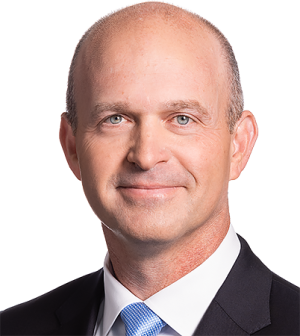 Now, reporting in The Guardian discloses that Kevin Roberts, right, the head of the Heritage Foundation that’s spearheaded Project 2025, is (along with Leonard Leo and possibly several members of the Supreme Court) a member of the little-known and secretive Catholic group Opus Dei (“work of God” in Latin). A book by Roberts, Burning Down Washington to Save America, is shown below right.
One of Opus Dei’s cornerstone principles, according to the report, is that there should be no such thing as a wall of separation between church and state. And a read of Sam Alito’s Dobbs decision shows that he agrees with that sentiment, taking the specifically Catholic view — and imposing it on America — that a human is a human upon conception, rather than, for example, the legal definition under Roe v Wade or the definitions of other major world religions, that a fetus is a human when viable outside the mother’s womb or at birth.
 Is it “anti-Catholic” to point out that every current Republican appointee to the Court is Catholic and appears devoted to imposing the Catholic religion’s perspective about “life” (and, according to Clarence Thomas, homosexuality, marriage, and birth control) on America?
Not a chance, although I often hear from Catholics who think it’s wrong that I point out what their church is doing.
Frankly, I’ll stop mentioning the Church’s involvement in American politics and public policy when they stop inserting themselves into our politics and public policy.
Until then, there needs to be more mention of this rather than less; imagine if it were Moonies on the Court imposing the late Reverend Moon’s religious views on America. Or hardcore Muslims arguing that women should be wearing hijabs and prevented from driving? There would be hell to pay in the media. The fact that the Catholic Church is so rarely mentioned is another example of how deeply it’s penetrated the halls of power in America. George Washington, Ben Franklin, Thomas Jefferson, James Madison, and Thomas Paine wouldn’t have stood for this intrusion of organized religion into our politics and policy, and neither should we.
- Is JD Vance the new Dan Quayle? Vance, a recent (2019) convert to hard-right Catholicism, wondered out loud what would happen if “every day (Jewish) George Soros sends a 747 to Columbus to load up disproportionately Black women to get them to go have abortions in California. … [I]f that happens, do you need some federal response to prevent it from happening?” He added, “And I’m pretty sympathetic to that actually.”
- Setting aside the racism implicit in the question (we already get that he’s probably a racist; he’s a Republican), it raises an interesting question: how is he proposing federal authorities should police this?
- Should every woman going through TSA screening also have a quick ultrasound or X-ray to determine if she’s pregnant? A urine test (maybe a long row of porta-potties could be placed along the TSA line)? Or just fill out a form “under penalty of criminal perjury” certifying that they’re not pregnant?
- That last would fit with Vance and Ted Cruz’s letter to HHS Secretary Javier Becerra demanding that police gain the legal right to demand health, menstruation, and abortion records from the physicians of every woman in America to catch Red state women heading to Blue states for abortions; they could just later compare the records with the forms and imprison those women who committed perjury by claiming they weren’t pregnant when they got on the plane. But how will they enforce this when women just drive across state lines? Or take busses or Amtrak where there’s no TSA? Inquiring minds want to know. Increasingly, as more and more of Vance’s history and worldview become known, it’s appearing that Trump made a blunder of epic proportions in throwing this not-too-bright political newbie into the wild world of presidential politics. Dan Quayle — who convinced Mike Pence not to accept the fake electors and overturn the election — is looking better every day. (Last minute addendum: Anthony Scaramucci, who knows Trump well from having served in his administration, says he fully expects Trump to dump Vance any day: “It’s just a question of how many Scaramuccis J.D. is going to last.” Stay tuned…)
- House Democrats Launch Bold Crusade to Elevate American Workers to New Heights. America’s first middle class, which emerged in the years after WWII because of changes in labor and tax laws put into place by President Franklin D. Roosevelt’s administration, was largely created by the power of organized labor. The main reason our middle class shrank over 15 percent between 1981 and 2020 was the relentless war on unions Republicans waged and Democrats (until Biden) generally failed to fight. To rebuild our middle class, Democrats in the House of Representatives just introduced the Labor Enforcement to Securely (LET’S) Protect Workers Act that would tighten child labor standards (which Republicans and Democrat Jared Golden have worked to weaken), penalize employers who deny workers family and medical leave, and protect the right to join a union. It won’t pass this year because Republicans control the House, but getting legislation like this into the hopper in case Democrats can pull a clean sweep this fall is a top priority. The leaders of this effort are Representatives Bobby Scott, Mark Pocan, Debbie Dingell, Donald Norcross, and Steven Horsford.
- Trump runs afowl: Chickens out of debate with Kamala. Claiming that “Barack Hussein Obama” is concerned that “Kamala Harris is a Marxist fraud who cannot beat President Trump, and they are still holding out for someone ‘better,’” Donald Trump posted to his Nazi-infested social media site that he’s pulling out of the debate scheduled for September 10th with ABC. Obama, of course, loudly and proudly endorsed Harris, as did his wife Michelle, but Trump either didn’t get the memo or is simply lying through his teeth (or typing fingers) as usual. In any case, he’s chickened out and deserves every bit of ridicule that will be coming his way. If there’s anything that terrifies this guy, it’s a strong woman who’s sent rapists and con men like him to jail.
- United Nations Secretary-General António Guterres called out the United States, the United Kingdom, Canada, Australia, and Norway for expanding fossil fuel production. As heat waves, both on land and in the oceans, and severe weather break records around the world, the UN chief was explicit: “I must call out the flood of fossil fuel expansion we are seeing in some of the world’s wealthiest countries. In signing such a surge of new oil and gas licenses, they are signing away our future. The leadership of those with the greatest capabilities and capacities is essential. Countries must phaseout fossil fuels—fast and fairly.” The world has now pretty much exceeded the 1.5 degrees Celsius “danger point” the IPCC identified years ago, and will continue warming for decades even if we were to stop all fossil fuel use today. If you’d like to see the worst-case scenario we could be headed toward (unlikely, but increasingly possible), check out this 12-minute video that Leonardo and George DiCaprio and I put together a few years back. Let your legislators know it’s time to cut fossil fuel use and production.
- Shocking Murder of Sonya Massey Exposes Urgent Need for Police Reform. When Louise and I lived in Germany and traveled extensively across Europe, we discovered that cops in most European countries are well-paid, tightly regulated, and must meet very, very high standards to get a job on the force. We had interactions with several, and they were always polite and professional. In some countries the training period is well over a year, whereas in America many police go from being hired to carrying a gun in a matter of days, weeks, or a month or two. The cop who shot Sonya Massey in the face after she called 911 because she though there was a prowler near her house was, we now learn, discharged dishonorably from the Army for “serious” infractions and had bounced from police department to police department before ending up in Sangamon County, Illinois. He never should have been given a badge and a gun. The United States is one of the few (perhaps the only) countries in the developed world that doesn’t have federal standards for law enforcement officers. It’s time to impose them, now.
New York Times, How Do You Solve a Problem Like Elon? Kate Conger, July 27, 2024. Linda Yaccarino, the chief executive of X, has pushed hard to fix the platform’s business. But Elon Musk is always a whim away from undoing her work.
 Late last year, Linda Yaccarino reached out to Don Lemon’s agent with an offer.
Ms. Yaccarino, the chief executive of X, a powerhouse advertising executive who had been hired away from NBC about seven months earlier, pitched the agent on bringing the former CNN anchor’s new web-based show to the social media platform, citing its massive reach, political influence and connections with advertisers.
Soon after, Mr. Lemon, right, became one of the first high-profile names to sign onto Ms. Yaccarino’s plan to help save the company’s sagging advertising business with video and TV-like programming.
Elon Musk, who owns X, agreed to be Mr. Lemon’s first guest.
The interview was held at the Tesla headquarters in Austin, Texas, which, Mr. Musk quickly pointed out to Mr. Lemon, was “about three times larger than the Pentagon.” The two men sat on white Eames-like swivel chairs, a small white table between them. Mr. Musk was in a black T-shirt, Mr. Lemon in a white spread-collar shirt and a dark blue sweater.
The interview started out awkwardly, with Mr. Musk, right, acknowledging that he hadn’t really watched Mr. Lemon when he anchored a 9 p.m. show on CNN. (“I’ve seen a few segments.”) It grew increasingly contentious over the next hour, and Mr. Musk became visibly frustrated with questions about his politics and drug use. “It’s pretty private,” Mr. Musk said when Mr. Lemon asked him about his prescription for ketamine, which Mr. Musk had posted about on X in 2023.
Mr. Lemon brought up complaints of sexual harassment at Tesla and SpaceX, both run by Mr. Musk, then asked if he had advantages in society as a white man. Mr. Musk raised an eyebrow. “You keep putting words in my mouth,” he objected. And when Mr. Lemon asked about the advertiser exodus from X, Mr. Musk shook his head: “Don, I have to say, choose your questions carefully. There’s five minutes left.” As the interview ended, Mr. Musk shot up from his chair, offering an abrupt handshake to the anchor.
The next day, he texted Mr. Lemon’s agent: “Contract canceled.”
A day after Mr. Musk called off the deal, Ms. Yaccarino called Mr. Lemon to find out what went wrong. She seemed confident she could patch things up between him and her boss. But Mr. Musk remained firm; Mr. Lemon had to be dismissed. The deal died — and with it, yet another attempt by Ms. Yaccarino to chart a profitable course for the troubled site.
Time and again, Ms. Yaccarino has faced similar situations, as Mr. Musk is always one whim away from undoing her work. Ms. Yaccarino’s task of repairing and remaking X’s business over the past year has been complicated by Mr. Musk’s seeming disregard for the advertising industry and his constant unraveling of her efforts, according to interviews with more than a dozen advertising executives, X employees, former colleagues and friends.
After the Oct. 7 attack on Israel, for instance, Ms. Yaccarino told several major advertisers that she and X would work to fight antisemitism. The next month, Mr. Musk approvingly replied to an antisemitic theory on the site.
On Nov. 18, Ms. Yaccarino called on advertisers to come back to X to show their solidarity with the social media platform’s commitment to free speech. Shortly afterward, in a fit of petulance, and with Ms. Yaccarino sitting a few feet away, Mr. Musk went onstage at The New York Times’s DealBook Summit and used an expletive — three times — to tell advertisers in the audience that they could take their business elsewhere.
It’s almost like a game of corporate Whac-a-Mole, which Ms. Yaccarino is doing her best to master.
If Ms. Yaccarino is frustrated by Mr. Musk’s actions, she isn’t showing it, at least not publicly. By all accounts, she seems to have accepted that this is the way Mr. Musk operates (in that phone call to Mr. Lemon, she said X was “Elon’s baby”) and that they have enough of a shared vision for X that she can grit her teeth and bear it. Over and over, Ms. Yaccarino has defended Mr. Musk’s actions behind the scenes.
July 26
Big, Analysis: Billionaire Orders Kamala Harris to Fire Lina Khan, Matt Stoller, right, July 25-26, 2024. LinkedIn founder Reid Hoffman gave $10 million to Harris' campaign and demanded an end to Biden's tariff and antitrust policies exemplified by Federal Trade Commission Chair Lina Khan, above. Bernie Sanders reacted angrily.
As I’ve written, for the last few weeks, there has been a campaign among big business advocates to eliminate the new trade, antitrust, and labor policies put in place over the last five years or so. When Kamala Harris took over the Democratic nomination from Joe Biden, that campaign ramped up.
A few days ago, billionaire LinkedIn founder Reid Hoffman gave $10 million to the Kamala Harris effort, and promised a lot more. Hoffman is a Silicon Valley titan, part of the “PayPal mafia” that includes Peter Thiel and Elon Musk, though Hoffman sits on the Democratic side of the aisle. This morning, Hoffman went on CNN and issued demands. Harris must end Biden’s tariff and antitrust regimes, he said, and fire Federal Trade Commission Chair Lina Khan.
This appearance was followed by reporting that there’s a Silicon Valley fundraising tour for Harris being planned by none other than… Reid Hoffman. Ok, so it’s pretty stunning for an oligarch like Hoffman, with a net worth of a couple billion dollars, to publicly make such a demand. So why is he doing it? One reason is that there’s a lot of money involved. As the Lever reported, Hoffman is on the board of Microsoft, which is right now being sued and investigated by the FTC. It’s a pretty good gig, if you get to fire the law enforcer investigating your misdeeds.
Still, there’s another reason. Hoffman is a sophisticated operator who wants to be a kingmaker in politics. The money is real enough, but he’s likely leaking the fundraising tour as a means of forcing Harris to be seen to do his bidding. Hoffman wants Harris to get rid of Biden policies which protect workers through trade and antitrust so that big business can do what they want. And he’s going to supply the financing for Harris’ campaign if she does what she’s told.
It seems like the Harris campaign might be listening, despite Harris a few days ago hitting Trump over very similar arguments about taking money from oil titans and doing favors in return. Yesterday, the New York Times wrote a campaign story on the candidate’s links to big business. Here’s the key passage:
As vice president, Ms. Harris has voiced support for regulating artificial intelligence. But she has expressed skepticism of Ms. Khan’s expansive view of antitrust powers, according to a donor who has spoken privately with the vice president.
An anonymous secondhand conversation with a donor isn’t great evidence for Harris’ policy instincts. But one possibility is that the Harris campaign set up these reporters with sources, and is trying to imply that she’s open to the demands of executives so that she can collect more campaign money from billionaires and dealmakers. There are other possibilities as well.
July 25
Washington Post, Judge throws out Gateway Pundit’s bankruptcy claim, Sarah Ellison, July 25, 2024. The denial paves the way for defamation suits against the site by two Georgia election workers and a former Dominion Voting Systems executive to continue.
A federal judge in Florida threw out a bankruptcy case filed by the Gateway Pundit, ruling that the site, which is known for spreading conspiracy theories, sought bankruptcy protection in “bad faith” to avoid having to pay potential damages in defamation suits related to the site’s reporting on the 2020 election.
The Thursday ruling from U.S. bankruptcy judge Mindy Mora in the Southern District of Florida means that defamation cases from two Georgia election workers, as well as one from a former Dominion Voting Systems executive, can proceed. The defamation cases had been held up while the bankruptcy case was ongoing.
Gateway Pundit wrote a series of articles about the 2020 presidential election amplifying claims that the election workers Ruby Freeman and Shaye Moss and former Dominion executive Eric Coomer helped rig the 2020 election in favor of Joe Biden. Gateway Pundit denies wrongdoing and previously said it was seeking bankruptcy protection to fight against “progressive liberal lawfare attacks” against the site.
“We are pleased that the Court today saw through The Gateway Pundit’s transparent attempt to abuse the bankruptcy process to avoid accountability and granted our motion to dismiss the bankruptcy case,” Brittany Williams, a lawyer at Protect Democracy, said in a statement. The organization is representing Freeman and Moss along with several private law firms and attorneys and the Yale Law School’s Media Freedom and Information Access Clinic.
Gateway Pundit published an article responding to the judge’s decision, which the organization plans to appeal. The piece alleged, referencing an unnamed anonymous source, that the Department of Justice had intervened in the case to influence the judge.
“In this unusual bankruptcy case, truth is at the center of all disputes. Lack of truthful disclosure, theories based upon half-truths, claims for which truth could provide a defense — all possibilities are on display,” Mora wrote in her decision. “Litigation about truth pushed [Gateway Pundit] to file bankruptcy, but that unusual twist does not alter the Court’s duty to remain focused on bankruptcy issues.”
Mora wrote that, far from being financially insolvent, Gateway Pundit’s assets were “eye-catching.” She noted that the company’s assets were 22 times the size of its liabilities. The company reported more than $3 million in revenue in 2023, higher than the previous year, and was on track to continue that trajectory in 2024.
The judge wrote that the “publication of sensational stories has generated healthy revenues” for Gateway Pundit, but that “the viability of that strategy as a long-term business plan … is now in question.” The defamation cases challenge what the judge described as a “brash (and allegedly not fact-checked) reporting style.”
The judge went on to say that if a court ruled against the site in a defamation suit, “then the Gateway Pundit might choose to adopt a more restrained editorial style. That choice could lead to fewer website views, which would likely soften revenue.”
“TGP remains both balance sheet and cash flow solvent. There is no present financial distress, no looming foreclosure sale, no prospect of a market crash,” Mora wrote. The only financial strain resulted from the defamation suits. “That’s not a basis for bankruptcy relief; it’s the justice system in operation.”
Jim Hoft, owner and founder of the Gateway Pundit, has said he started blogging as a hobby in 2004, overseeing significant growth in the site’s traffic, particularly following the 2020 election, which Hoft and his small staff covered extensively.
July 24

New York Times, The Secret Battle for the Future of the Murdoch Empire, Jim Rutenberg and Jonathan Mahler, July 24, 2024. Rupert Murdoch, the patriarch, has moved to change the family’s irrevocable trust to preserve his media businesses as a conservative force. Several of his children are fighting back.
Rupert Murdoch is locked in a secret legal battle against three of his children over the future of the family’s media empire, as he moves to preserve it as a conservative political force after his death, according to a sealed court document obtained by The New York Times.
Mr. Murdoch, 93, set the drama in motion late last year, when he made a surprise move to change the terms of the Murdochs’ irrevocable family trust to ensure that his eldest son and chosen successor, Lachlan, would remain in charge of his vast collection of television networks and newspapers.
The trust currently hands control of the family business to the four oldest children when Mr. Murdoch dies. But he is arguing in court that only by empowering Lachlan to run the company without interference from his more politically moderate siblings can he preserve its conservative editorial bent, and thus protect its commercial value for all his heirs.
Those three siblings — James, Elisabeth and Prudence — were caught completely off-guard by their father’s effort to rewrite what was supposed to be an inviolable trust and have united to stop him. Lachlan has joined on Mr. Murdoch’s side. Remarkably, the ensuing battle has been playing out entirely out of public view.
Last month, the Nevada probate commissioner found that Mr. Murdoch could amend the trust if he is able to show he is acting in good faith and for the sole benefit of his heirs, according to a copy of his 48-page decision.
A trial to determine whether Mr. Murdoch is in fact acting in good faith is expected to start in September. Hanging in the balance will be the future of one of the most politically influential media companies in the English-speaking world.
Representatives for the two sides declined to comment. Both have hired high-powered litigators. The three Murdoch siblings are represented by Gary A. Bornstein, the co-head of litigation at Cravath, Swaine & Moore. Mr. Murdoch is represented by Adam Streisand, a trial lawyer at Sheppard Mullin who has been involved in estate disputes concerning Michael Jackson and Britney Spears.
Rupert Murdoch and Elena Zhukov, whom the media mogul married earlier in 2024.
Few media stories have been watched as closely as the succession battle over the Murdoch empire, both because of the irresistibly Shakespearean nature of the drama, and because of the empire’s outsize political influence. Mr. Murdoch’s decision in 2018 to formally designate Lachlan as his heir put to rest years of speculation over his wishes for the company.
What it did not do, though, was ensure that Mr. Murdoch’s wishes would survive him: The existing trust gives all four of his oldest children an equal voice in the company’s future.
The Murdoch family has been divided before. James and Elisabeth at one point competed with each other and Lachlan to eventually take over the company, and at various times they have clashed with one another and their father. James, who once helped run the company with Lachlan, left it in 2019 and now oversees an investment fund. Elisabeth runs a successful movie studio, Sister, and has for years sought to position herself as the “Switzerland” of the family, maintaining good relations with all. Prudence, Murdoch’s oldest child and the only one from his first marriage, has been the least involved in the family business and has remained the most private of the children.
But given Mr. Murdoch’s advanced age, this battle has all of the makings of a final fight for control of his sprawling media conglomerates, which own Fox News, The Wall Street Journal, The New York Post and major newspapers and television outlets in Australia and Britain. It has already driven a new wedge into the famously fractured family.
Politics, and power, are at the root of the struggle. Since Mr. Murdoch designed the trust nearly 25 years ago, the family’s political views have diverged sharply. During Donald J. Trump’s rise, Mr. Murdoch and Lachlan became more closely aligned, pushing the company’s most influential outlet, Fox News, further to the right, making the other three children increasingly uncomfortable.

Associated Press via Politico, Southern Baptist agency tangles itself in knots over Biden’s ‘selfless act,’ Staff Report, July 24, 2024 (print ed.). Brent Leatherwood was reportedly fired for praising the president, then very publicly not fired.
In under 48 hours, the head of the staunchly conservative public-policy arm of the Southern Baptist Convention rankled fellow Baptists by applauding President Joe Biden’s “selfless act” of withdrawing his candidacy for reelection. Then, his agency reported he was fired — and now they have reaffirmed his leadership.
The head-spinning series of events started Sunday, but by Tuesday morning, the SBC’s Ethics and Religious Liberty Commission announced that no, leader Brent Leatherwood wasn’t fired. Rather, he has the full support of his top board members — though its chair resigned and apologized for the erroneous announcement.
 On Monday, the commission issued a statement that the ERLC’s executive committee had removed Leatherwood in accordance with its bylaws.
But on Tuesday, it said, “There was not an authorized meeting, vote, or action taken by the Executive Committee. Kevin Smith has resigned as Chair of the Executive Committee.”
Leatherwood “has our support moving forward,” the executive committee statement said.
Smith, a Florida pastor, resigned both as chair and as a board member, and he apologized Tuesday, according to a statement on Baptist Press, the denomination’s official news agency.
“After multiple conversations with Executive Committee members of the ERLC, I was convinced in my mind that we had a consensus to remove Brent Leatherwood as the president of the ERLC,” Smith’s statement said. “It is a delicate matter and, in an effort to deal with it expeditiously, I acted in good faith but without a formal vote of the Executive Committee. This was an error on my part, and I accept full responsibility. At this time, the Executive Committee does not wish to move forward with my course of action. ”
The previous ERLC vice chair, Tony Beam, is now chair.
Leatherwood posted on X, formerly known as Twitter, Tuesday morning: “I deeply appreciate everyone who has reached out, especially our trustees who were absolutely bewildered at what took place yesterday and jumped in to set the record straight.”
Leatherwood had led the embattled agency through three years as the policy spokesman for the nation’s largest Protestant denomination, but he had not joined in the increasingly public support among many Southern Baptists for former President Donald Trump.
After Biden’s announcement Sunday that he would not seek re-election, Leatherwood called it a “selfless act.”
“We should all express our appreciation that President Biden has put the needs of the nation above his personal ambition,” Leatherwood said.
Leatherwood’s statement prompted fierce blowback on social media from some within the denomination who had already targeted his agency for criticism amid a larger battle to pull the already-conservative denomination even further to the right.
Clint Pressley, the SBC’s newly elected president, joined in belittling the idea that Biden acted on principle.
“Sounds right,” Pressley posted on X in response to a post by a Southern Baptist professor. That professor, Andrew Walker, said Biden’s withdrawal was not an “act of valor” but rather a case of “ultra-powerful” Democrats forcing him out.
Leatherwood came to his job three years ago with conservative credentials. He was a former executive director of the Tennessee Republican Party. He was also a director of communications and policy strategy in the Tennessee General Assembly and worked for several years on Capitol Hill in Washington.
Leatherwood is the father of three children who were at the Covenant School in Nashville, last year when it was attacked by a gun-wielding assailant who killed three adults and three other children. Leatherwood joined some other Covenant parents in an unsuccessful effort to advocate for legislation that would keep firearms away from people who could harm themselves or others.
Former President Donald J. Trump, right, and his new running mate, Senator JD Vance of Ohio, at a campaign rally in Grand Rapids, Mich., on Saturday, July 20, 2024 (New York Times photo by Haiyun Jiang).
The Hartmann Report, Commentary: J.D. Vance's Elegy Grift, Thom Hartmann, right, July 24, 2024. Vance’s career and his life story are a grift. Just like most all of Donald Trump’s businesses. Republican policies, in fact, have been one long grift for more than half a century.
Minnesota Governor Tim Walz yesterday blasted JD Vance for being a “grifter,” because Vance claimed he was some sort of a hillbilly who grew up in rural Appalachia when, in fact, he grew up in the suburbs of Cincinnati. Governor Walz, on the other hand, grew up in a town of 400 people with “24 kids in my graduating class” where “12 were cousins.”
In Vance’s autobiography Hillbilly Elegy, he trash-talks his poor relatives, essentially accusing them of not being successful in life because of moral defects like laziness and addiction; he doubled down on these memes in his RNC speech, pointing out his own mother’s drug use.
In fact, they’re victims of Republican policies that make the rich richer and keep poor people poor; his mother’s addiction is a symptom, not a cause.
Vance, of course, “nobly” rose above it all with the help of our socialist GI Bill (which Republicans opposed) paying his way through Yale, and with help from rightwing billionaires who took Vance under their wings and helped him set up a hedge fund that made him fabulously rich.
Often, the media refers to his life as a true “Horatio Alger story.”
When I was a kid, my dad was the national president of the book-collecting group The Horatio Alger Society: Vance’s is a story right out of Alger’s books. Alger wrote stories about poor young men being lifted up into business success by wealthy older men, although he’s now out of favor because was busted as a gay predator. Even the Horatio Alger story itself, it turns out, was a grift.
Just like Vance’s career and his life story are a grift. Just like most all of Donald Trump’s failed businesses. Just like Nixon’s racist “law and order” grift. And Reagan’s tax-cut-for-the-rich “supply side” grift. And Bush and Cheney’s oil-grabbing Iraq “weapons of mass destruction” grift.
July 20
New York Times, Struggles From Microsoft Outage Persist Without an End in Sight, Adam Satariano, Derrick Bryson Taylor, Remy Tumin and Danielle Kaye, July 20, 2024 (print ed.). Companies across the world reported disruptions, citing technical issues from a cybersecurity software update.
Airlines, health care systems, banks and scores of other businesses and services around the world began to slowly recover on Friday from severe disruptions caused by a global technology outage. But issues persisted throughout the day with no clear end in sight, as  businesses manually updated their systems and airlines struggled to get crews and planes to where they were needed.
The outage was attributed to a software update issued by CrowdStrike, a cybersecurity firm whose software is used by myriad industries around the world. The disruption, which reached what some experts called “historic” proportions, was a stunning example of the global economy’s fragile dependence on certain software, and the cascading effect it can have when things go wrong.
New York Times, Tech Outage Grounds Flights and Disrupts Businesses Around the World, Adam Satariano and Derrick Bryson Taylor, July 20, 2024 (print ed.). Airlines, banks and broadcasters were among the companies reporting disruptions, citing technical issues.
A massive global technology outage on Friday took down airlines, medical services, TV broadcasts, banks and scores of other business and services around the world, a stunning example of the fragile dependence the global economy has on certain software and the cascading effect it can have when things go wrong.
The outage was attributed to CrowdStrike, a cybersecurity firm whose software is used by scores of industries around the world to protect against hackers and outside breaches. A software update issued by CrowdStrike appeared to be at the root of the problem, resulting in crashes of machines running the Microsoft Windows operating system.
“This is not a security incident or cyberattack,” said George Kurtz, the chief executive of CrowdStrike. “The issue has been identified, isolated and a fix has been deployed.”
Here’s how the spillover effects are being felt all over the world:
U.S. airlines were reporting major disruptions across the country. At least five U.S. airlines — Allegiant Air, American, Delta, Spirit and United — had grounded all flights for a time, according to the Federal Aviation Administration.
The issues were also being felt at airports around the world, including Hong Kong International Airport, Sydney Airport, Berlin Brandenburg Airport, Schiphol Airport in Amsterdam and Denver International Airport. At the Manchester Airport in Britain, there were long lines in the departures area as many machines at check-in counters were not working. Ryanair, one of the largest airlines in Europe, said it was experiencing disruption because of a third party IT outage that is “entirely out of our control.”
In the U.S., the outage appeared to be affecting emergency 911 lines in multiple states, the U.S. Emergency Alert System said on social media. It said people experiencing emergencies should call the number for their local police or fire department.
In Britain, the National Health Service was experiencing a loss of access to its computer systems across a number of hospitals and doctors offices.
Many television broadcasters also reported problems. In France, TF1 and Canal+, among the most watched, said in posts on X that it couldn’t go on air. “We’re all onstage, but there’s a gigantic breakdown in the control room” making it impossible to go live, Christophe Beaugrand-Guerrin, a TF1 presenter, wrote on X.
New York Times, When Tech Fails, It’s Usually With a Whimper Instead of a Bang, David Streitfeld and Kate Conger, July 20, 2024. While in some corners of Silicon Valley people worry about the risks of A.I., a simple failed software update caused a worldwide outage.
This week’s global software outage, immediately proclaimed as the biggest in history, was not caused by terrorists or A.I. or rogue hackers demanding billions in ransom. It wasn’t even done as a lark by some off-the-charts smart teenager. Those are the Hollywood versions. Instead, it was a routine upgrade that somehow went off the rails.
CrowdStrike, a Texas company, specializes in protecting corporate clients from cyberthreats. It has been very successful at this. This time, though, the threat came from CrowdStrike itself, a problem for which it seemed unprepared.
The trouble began with a small Windows software update CrowdStrike sent to its customers on Thursday night. For some reason, this crashed every computer it touched. “Your PC ran into a problem,” users were cheerily informed. “It looks like Windows didn’t load correctly,” messages announced. The backdrop was the color of a perfect sky, also known as the Blue Screen of Death.
Any system can fail, and usually in unexpected ways. The Great Blackout of 1965, another contender for the greatest technology stumble of all time, shut off the electrical grid for 30 million people on the Eastern Seaboard. Silicon Valley couldn’t be blamed because Silicon Valley barely existed, but the culprit — a bad relay at a Canadian power station that caused a cascade of issues that broke the system — was equally mundane.
Living in the modern world is an act of faith. Most of the time we don’t think about it. Then the airplane we’re on shakes with turbulence. Or we read about how a door blew off. Or how planes crashed. Or — and this happened to people on thousands of flights on Friday — we can’t even get on the plane. It was worldwide pandemonium.
Planes are for obvious reasons a central theater of anxiety when technology is having a breakdown. But even those who weren’t trying to travel were upset on Friday. The computers couldn’t manage to get out of the passive voice to assign responsibility for their collapse, much less fix themselves, and the humans, at least initially, were not much better.
“It’s a mess,” Brody Nisbet, an executive at CrowdStrike, wrote on X as he suggested a possible workaround. “I’ve no further actionable help to provide at the minute.” He added a disappointed face emoji: 😞.
The message was later deleted.
CrowdStrike likely failed to do its due diligence, programmers said. Trying the patch out on a variety of Windows machines before sending it out to customers could have helped detect the issue.
“They should have had a test machine to emulate some of their clients’ old boxes and they would have seen the Blue Screen of Death,” said Matt Mitchell, a hacker and founder of CryptoHarlem, a cybersecurity education and advocacy organization.
CrowdStrike is not some tiny start-up. Founded in 2011, it has 8,000 employees and a stock market valuation that was heading to $100 billion, at least before the outage caused some investors to jump ship. CrowdStrike shares closed down 11 percent Friday.
If the company doesn’t have the name recognition of some bigger tech firms, it has its share of arrogance. A portion of its website is devoted to trash-talking its competitors. “Microsoft’s security products can’t even protect Microsoft. How can they protect you?” CrowdStrike asks. Avoid Palo Alto Networks, it demands: “Don’t settle for a high-cost platform that’s hard to use, hard to deploy, and hard to manage.”
A message Friday from George Kurtz, the chief executive, seemed to minimize the outage, calling it “a defect found in a single content update for Windows hosts.” People complained that Mr. Kurtz was slow to offer an apology. (Hours later, he said, “I want to sincerely apologize directly to all of you for today’s outage.”) CrowdStrike did not respond to a request for further comment.
IT workers at affected companies were faced with a choice: walk around to each offline machine and remove the bit of flawed code, or wait and hope for a solution from CrowdStrike.
“The workaround works if you can walk to every laptop, type on the keyboard, and reboot it manually,” said Mikko Hypponen, a security expert and chief research officer at WithSecure, a cybersecurity company. “The problem that this poses is that normally large enterprises, which is what CrowdStrike customers are, maintain their fleet” with centralized controls.
In other words, the traditional way to fix a balky computer — turning it off and then turning it on again — was still the only solution, even as the computers themselves are now increasingly woven into worldwide networks. But the travelers trapped at the airport could not reboot those screens that were preventing them from flying.
New York Times, Analysis: The latest tech chaos wasn’t caused by an adversary, but it raised fresh concerns about America’s digital resilience, David E. Sanger, July 20, 2024. With each cascade of digital disaster, new vulnerabilities emerge. The latest chaos wasn’t caused by an adversary, but it provided a road map of American vulnerabilities at a critical moment.
New York Times, The Data That Powers A.I. Is Disappearing Fast, Kevin Roose, July 20, 2024 (print ed.). New research has found a dramatic drop in content made available to the collections used to build artificial intelligence, Kevin Roose writes.
For years, the people building powerful artificial intelligence systems have used enormous troves of text, images and videos pulled from the internet to train their models.
Now, that data is drying up.
Over the past year, many of the most important web sources used for training A.I. models have restricted the use of their data, according to a study published this week by the Data Provenance Initiative, an M.I.T.-led research group.
The study, which looked at 14,000 web domains that are included in three commonly used A.I. training data sets, discovered an “emerging crisis in consent,” as publishers and online platforms have taken steps to prevent their data from being harvested.
The researchers estimate that in the three data sets — called C4, RefinedWeb and Dolma — 5 percent of all data, and 25 percent of data from the highest-quality sources, has been restricted. Those restrictions are set up through the Robots Exclusion Protocol, a decades-old method for website owners to prevent automated bots from crawling their pages using a file called robots.txt.
The study also found that as much as 45 percent of the data in one set, C4, had been restricted by websites’ terms of service.
“We’re seeing a rapid decline in consent to use data across the web that will have ramifications not just for A.I. companies, but for researchers, academics and noncommercial entities,” said Shayne Longpre, the study’s lead author, in an interview.
Data is the main ingredient in today’s generative A.I. systems, which are fed billions of examples of text, images and videos. Much of that data is scraped from public websites by researchers and compiled in large data sets, which can be downloaded and freely used, or supplemented with data from other sources.
Learning from that data is what allows generative A.I. tools like OpenAI’s ChatGPT, Google’s Gemini and Anthropic’s Claude to write, code and generate images and videos. The more high-quality data is fed into these models, the better their outputs generally are.
For years, A.I. developers were able to gather data fairly easily. But the generative A.I. boom of the past few years has led to tensions with the owners of that data — many of whom have misgivings about being used as A.I. training fodder, or at least want to be paid for it.
New York Times, The Push to Develop Generative A.I. Without All the Lawsuits, Nico Grant and Cade Metz, July 20, 2024 (print ed.). Companies like Getty have begun developing A.I. models with their own data, part of an effort to build artificial intelligence with licensed content.
Companies like Google and OpenAI built their artificial intelligence chatbots and image generators by gobbling content from the web, spurring legal fights over copyright claims.
Now, some of those copyright holders are trying to get in on the A.I. boom. The major stock photo suppliers Getty Images and Shutterstock, among others, are building A.I. image generators with their own data, bypassing the legal worries that have shadowed the industry.
While the largest tech companies have been locked in a dizzying A.I. race, visual media marketplaces, content creators and artists are pushing for licensing so that they can be paid for work that helps train A.I. models and influences the technology they worry could one day displace them. It’s part of a larger effort to transform how A.I. models are developed, one that would train them with licensed data rather than with content that is scraped without permission.
While many image generators are often used by consumers for amusement, like creating the viral image of the pope in a white puffer jacket, the tech industry has coalesced around the idea that more advertising agencies and other companies would use these tools for marketing if there was no legal uncertainty surrounding them.
July 19

Washington Post, Russian foreign minister confirms talks to free reporter Evan Gershkovich, Robyn Dixon, July 19, 2024 (print ed.). Russian Foreign Minister Sergei Lavrov all but declared jailed Wall Street Journal reporter Evan Gershkovich, above, to be guilty of spying but confirmed talks for a potential exchange.
As Russia’s trial of American journalist Evan Gershkovich for alleged spying resumed this week, the country’s foreign minister, Sergei Lavrov, all but declared the Wall Street Journalist correspondent guilty — echoing earlier Kremlin remarks although authorities have not made public any evidence to support their allegations.
“We have got irrefutable evidence corroborating that Gershkovich was involved in some espionage activities,” Lavrov said Wednesday at a news conference at the United Nations in New York, where Russia is currently chairing the Security Council.
Gershkovich, the Wall Street Journal, and the Biden administration have vehemently denied that there is any basis to Russia’s allegations and that he has essentially been taken hostage. Russia previously has arrested Americans, such as WNBA star Brittney Griner, on what appear to be minor charges, and then used them as bargaining chips to win the release of Russians imprisoned for serious crimes in the West.
New York Times, Ben Sasse Will Step Down as President of University of Florida, Anemona Hartocollis, July 19, 2024. The former senator from Nebraska cited the health of his wife, who has been diagnosed with epilepsy.
 Ben Sasse, the president of the University of Florida and a former Republican senator from Nebraska, announced Thursday that he was resigning his position so he could dedicate more time and attention to his ailing wife.
Dr. Sasse, 52, took office in early February 2023. His resignation will be effective July 31. Mori Hosseini, the chair of the university’s board of trustees, said in a separate announcement that the board would work quickly to appoint an interim president and would begin the search for a new president.
In a long and heartfelt message on X, Dr. Sasse said that his wife, Melissa, who had an aneurysm and a series of strokes in 2007, was in recent months diagnosed with epilepsy and had been “struggling with a new batch of memory issues.”
Although his two daughters are in college, his son is just turning 13, he said in the post.
“I’ve got two spectacular callings in life right now: First, I’m a husband and dad,” Dr. Sasse wrote. “Second, I’ve been blessed to serve as president of the best dang public university in America — Go Gators! — and I’ve loved the challenge of giving this university everything I’ve got. But here’s the bottom line: Those callings are significantly at odds with each other right now.”
Dr. Sasse said that his family would continue living in Gainesville, Fla., and that he would remain as president emeritus and as a professor continuing to teach classes.
New York Times, Lou Dobbs, Former Fox Business Host and Trump Booster, Dies at 78, Alex Williams and Michael Levenson, July 19, 2024 (print ed.). He used his platforms on CNN and Fox Business to share baseless conspiracy theories. His tenure at Fox ended after the network was sued for defamation over claims of voting machine fraud.
 Lou Dobbs, the conservative television and radio host who loomed large over the cable news landscape for decades at CNN and Fox Business, and later used his platform to promote baseless conspiracy theories and to lend unwavering support to former President Donald J. Trump, has died. He was 78.
His death was confirmed on Thursday on Mr. Dobbs’s website and social media accounts after Mr. Trump announced it on the Truth Social platform. No cause of death was given, and where or when he died was not immediately clear. Mr. Dobbs had been absent from “The Great America Show,” his podcast on the iHeartRadio network, for several weeks.
With his boyish face and authoritative demeanor, Mr. Dobbs had an on-air presence that could swing from folksy and avuncular to stridently indignant. He began his climb to cable news stardom as the host of “Moneyline” when CNN was founded in 1980.
Rising in prominence along with the skyrocketing Nasdaq during the dot-com boom of the late 1990s, Mr. Dobbs presided over a show that, as Ken Auletta wrote in a 2006 profile in The New Yorker, “served as a sort of video clubhouse for corporate America.”
July 17

Selina Cheng, the newly elected chair of the Hong Kong Journalists Association, spoke to reporters after her employment contract with the Wall Street Journal was terminated, in Hong Kong on Wednesday (Reuters photo by Tyrone Siu). Hong Kong's skyline is shown below in a photo via Wikimedia.

Washington Post, Wall Street Journal fires Hong Kong reporter who headed embattled press club, Shibani Mahtani, July 17, 2024. The Hong Kong Journalists Association has been accused in recent weeks by state-run media outlets in Hong Kong and China of destabilizing the city.
A Hong Kong-based reporter for the Wall Street Journal was terminated by the newspaper soon after she was elected as chair of the Hong Kong Journalists Association.
The HKJA, a press advocacy association, has been accused in recent weeks by state-backed and state-run media outlets in Hong Kong and China of destabilizing the city.
Selina Cheng, the reporter, said in a news conference Wednesday that she believes the termination is related to her role as chair of the organization. She said she came under pressure from her employer to quit the association.
 The day before the HKJA election, Cheng said, her supervisors directed her to withdraw her candidacy and to leave HKJA’s board, of which she has been a member since 2021. She declined their requests.
“[I] was immediately told it would be incompatible with my job,” said Cheng. “The editor said employees of the Journal should not be seen as advocating for press freedom in a place like Hong Kong, even though they can in Western countries, where it is already established.”
The HKJA is considered a trade union, and under Hong Kong law, it is legal to be an officer of a union, a right guaranteed by the Basic Law, the city’s mini-constitution.
In an emailed response, a spokesman for Dow Jones, the parent company of the Wall Street Journal, confirmed it made “personnel changes” on Wednesday but said it could not comment on specific individuals.
“The Wall Street Journal has been and continues to be a fierce and vocal advocate for press freedom in Hong Kong and around the world,” the spokesman added.
The termination, if linked to Cheng’s position at HKJA, would be the latest indication of how even large, well-resourced international media organizations are wary about the risks of operating in Hong Kong, a once-freewheeling city that has increasingly come to resemble mainland China in its suppression of civil liberties, including press freedom.
July 16
Washington Post, Opinion: Serious coverage of political violence has never been more critical, Jennifer Rubin, right, July 16, 2024. The media should reembrace journalism’s mission of informing the citizenry about vital issues.
After the horrible assassination attempt against former president Donald Trump, President Biden spoke eloquently Sunday about the need to lower the temperature, to renounce violence and to engage in peaceful political debate. “There is no place in America for this kind of violence,” he implored viewers. “We can’t allow this violence to be normalized. … It’s time to cool it down. And we all have a responsibility to do that.” He nevertheless stressed the need for vigorous debate.
His admonition might have been to politicians and voters, but the media should pay close attention as well. The constant focus on polling and predicting (almost invariably incorrectly) the implications of unprecedented events only makes the media look small, unserious and irrelevant in a historic test of our democracy. Hysterical predictions and nonstop handicapping misunderstand the public’s perception of politics. (Hence, such reports are often met with a yawn by average voters and without any appreciable movement in polls.) Worse, such jabber crowds out essential coverage of genuine threats to democracy and the visions of the two parties.
Instead, the shooting at the Trump rally in Butler, Pa., should prompt the media to raise the level of discourse and reembrace the mission of journalism: to inform the citizenry about critical issues. Grading Trump’s speeches on style points and admiring his technique in playing to the crowd, as opposed to highlighting his efforts to subvert democratic norms, does not help create an informed electorate; rather, it conceals the essential case, based on the record and the GOP’s avowed policy aspirations, that the campaign poses a danger to our constitutional system.
Responsible media coverage should focus on several substantive topics. For starters, the shooting should be placed in the context of our intolerable gun culture. As former classmates of the shooter have noted, high school students live in fear of mass shootings by their peers. Hard questions about the shooter’s access to a weapon of war, about age limits on such weapons and, yes, about Republican resistance to curbing access to such weapons should be a topic of coverage. Responsible media outlets should press Republicans to explain their insistence that “all it takes to stop a bad guy with a gun is a good guy with a gun.” Here, the shooting was not prevented by a slew of highly armed law enforcement officials.
Washington Post, Former DCist staff launch the 51st, new local news site for Washington, Elahe Izadi, July 16, 2024. The worker-run newsroom will attempt to fill a niche its founders say opened when WAMU closed DCist.
A group of D.C. journalists who worked at a local news site that was abruptly shuttered by NPR affiliate WAMU earlier this year are launching their own nonprofit devoted to covering community news of Washington.
They are calling it the 51st — a nod to the District of Columbia’s lack of statehood — and say it will deliver hyperlocal Washington news relevant to District residents.
Initially, their coverage will focus on topics such as the cost of living in D.C. and how to navigate city services, as well as on accountability reporting.
The idea for the site first arose days after the unexpected closure of DCist, a beloved local news site that had been acquired by WAMU six years ago. When former staff gathered at a downtown restaurant to commiserate, the wake quickly turned into a business-development strategy session.
“Worker-run newsroom: When?” Maddie Poore asked her old co-workers that night, only half-joking. “When are we going to do this? We need this as a city.”
That pipe dream eventually led to a core group of six colleagues talking to local journalism start-up experts from around the country, drawing up business plans and filing legal paperwork.
On Tuesday, they will debut their project, along with a fundraising campaign that they hope will propel it into a sustainable future.
“All six of us have been working in a volunteer capacity putting just love, sweat and dreams into it,” Poore said. “We are spending our own money to stand this up, like we’re digging into our dwindling savings accounts.”
As local newspapers across the country have shriveled — victims of changing readership habits, an evaporating ad business and corporate cost-cutting — some enterprising journalists have attempted to keep coverage of their communities alive through independent start-ups.
July 15
New York Times, Richard Simmons’s Radical Promise: Exercise Is for Everybody, Danielle Friedman, July 15, 2024. By preaching that you didn’t have to  already be slim to work out, Mr. Simmons, shown at right in a 2007photo — who died on Saturday at 76 — reshaped the fitness industry.
If you lived in Los Angeles in the late 1970s, your choices for an aerobic workout class were truly slim. You could go to Jane Fonda’s studio in Beverly Hills, where everyone breaking a sweat was “feather-to-lightweight,” according to one observer. You could try a few dance studios where the professionally beautiful — actresses, models, media personalities — willed their bodies to become even more so. If building muscle was your goal, you could stop by Gold’s Gym or other palaces of pump, where an almost entirely male clientele strove for hard bodies in the image of Arnold Schwarzenegger.
It was against this backdrop of fitness exclusivity that Richard Simmons kicked, shouted and shimmied to the forefront of the workout scene, inviting the people he encountered to move with him — first at his Los Angeles studio and then in their own living rooms, through his home workouts on TV and VHS.
With his trademark crown of frizzy hair, sequined tank tops, short-shorts and guy-next-door physique, Mr. Simmons, who died on Saturday at 76, “did not look like a god, and he spoke to those who didn’t aspire to look like a god,” said Daniel Kunitz, the author of the book “Lift: Fitness Culture, From Naked Greeks and Acrobats to Jazzercise and Ninja Warriors.”
While other fitness evangelists promoted the idea that exercise was for every body, Mr. Simmons danced the dance, so to speak, and “helped break down barriers for all sorts of people who didn’t see themselves reflected in the fitness cultures of the time,” Mr. Kunitz said.
And yet, despite his embrace of the overweight and overlooked, Mr. Simmons was singularly focused on helping his followers shed pounds, seemingly convinced that while you didn’t need to aspire to look like a supermodel to be happy, losing weight was ultimately the key to health and well-being.
July 14
Washington Post, Ruth Westheimer, sex therapist known to millions as ‘Dr. Ruth,’ dies at 96, Emily Langer, July 14, 2024 (print ed.). Her frankness on her long-running radio and TV call-in shows made her a go-to guide for tips on lovemaking.
Described as the first superstar sex therapist, Dr. Westheimer was over 50 when she debuted in 1980 on New York’s WYNY with “Sexually Speaking.” The radio program initially aired in 15-minute installments and was later syndicated and extended to two hours to accommodate the onslaught of queries she received from callers. More than a few listeners professed that she had saved their marriages.
NBA.com, Steve Kerr on shooting at Donald Trump rally: ‘A terrible, sad spectacle,’ Shaun Powell, July 14, 2024. Team USA coach Steve Kerr reacted to the shooting while in Abu Dhabi preparing for the Olympics.
 News can hit home even when you’re not home, when you’re half a world away, and sound asleep at that.
As it were, in the early morning hours here, Steve Kerr heard from family members about the assassination attempt on former President Donald Trump, and the Team USA coach had only one thought:
“Such a demoralizing day for our country.”
Kerr added: “A terrible, sad spectacle […] Yet another example of not only our political division, but also our gun culture.”
This registered with Kerr, unfortunately, because of his family history and tragedy. It’s well-documented how Malcolm Kerr, while serving as president of the American University of Beirut, was shot by gunmen in 1984.
Malcolm’s son has been a flag-bearer for gun control ever since, using his voice to roust the topic among politicians and speaking out whenever there’s a mass shooting, the frequency of which has almost made him hoarse.
Kerr and the American men’s basketball team are in Abu Dhabi for two showcase games against Serbia and Australia as Team USA continues to ramp up for the Paris Olympics. Kerr mentioned how the team’s visibility and ambassadorship are suddenly heightened in this situation.
“I feel very proud to represent our country, wear USA on our chest,” he said. “We talk to the players about how important it is to show the best version of us, as human beings, to represent our country in a respectable and dignified manner.
“It makes you want to do it even more so. What we’re doing is very trivial, we’re playing basketball. But we want to put our best selves out there, try to give people a glimpse of what our country can be about.”
This was echoed by Steph Curry, who said: “We’re going to use it as a unifying moment. To use this platform and opportunity to represent ourselves, our families, our country to the best that we can, and hopefully that channels the right energy back home.
“It’s very sad, all the conversation around the election, the state of politics in our country, to have a situation like this. It evokes a lot of emotion around things we as a people need to correct, obviously gun control first and foremost.”
Kerr said the loss of life to gun violence, once again, is causing unnecessary pain.
“You can only imagine what their family and friends today are feeling. Thank God Trump wasn’t killed. It’s just demoralizing in every which way.”
July 15
Washington Post, Musk, other pro-Trump billionaires have helped shape shooting narrative, Elizabeth Dwoskin and Faiz Siddiqui, July 15, 2024 (print ed). The right-learning business community on Twitter, including Elon Musk and hedge fund billionaire Bill Ackman, used their megaphones to endorse Trump and fuel storylines about Saturday’s attack.
A chorus of right-leaning tech and business leaders, led by X owner Elon Musk, left, used their online megaphones in the wake of Saturday’s attack to criticize the Secret Service’s diversity initiatives, condemn Democratic donor Reid Hoffman, and make unsubstantiated allegations about the shooting.
The claims by powerful business leaders with large online followings helped influence the direction of platform itself, as well as the storylines viewed by millions of people. Musk’s post endorsing Trump after the shooting received the most engagement of any post on X related to the attempted assassination, said Graham Brookie, the Atlantic Council’s vice president for technology programs and strategy. The post received more than 118 million views and 332,000 retweets, surpassing a post from Barack Obama that said there was “no place” for violence in democracy. By Saturday night, the terms “Deep State” and “antifa” were among the top trending topics across X, formerly known as Twitter.
Brookie said the political moment marked a “return to primacy” for X — a platform that saw an exodus of left-leaning users after Musk’s acquisition of the service. X, meanwhile, lavished in the attention it had received in the hours after the shooting, posting the words “global town square.”
Musk took to X to formally endorse former president Donald Trump’s candidacy after the shooting Saturday, as did billionaire hedge fund owner Bill Ackman, a longtime supporter of Democratic candidates who has been critical of President Biden. Members of Musk’s inner circle, including venture capitalists David Sacks and Shaun Maguire, have thrown their weight behind Trump in recent months, but Musk appeared to hold out. Like Ackman, he supported Biden in 2020, and the shift from both men underscores how significantly the political landscape in business and tech has transformed in just a few short years.
Musk, turning to a familiar refrain of his, appeared to point the finger for the security breach at Diversity, Equity and Inclusion efforts — amplifying a post that ridiculed the U.S. Secret Service’s director for what it called “diversity hires.” The argument is being made on many right-wing political accounts, which have also called out individual female secret service agents. Musk had previously directed that argument at the airline industry, drawing condemnation over the insinuation that diversity efforts left the skies less safe, news outlets reported.
July 13
 Actor and author Alec Baldwin, openly weeping, and his wife, Hilaria Baldwin, embraced after the case against him was dismissed (Pool photo by Ramsay de Give on July 12, 2024).
New York Times, ‘Rust’ Case Against Alec Baldwin Is Dismissed Over Withheld Evidence, Julia Jacobs, July 13, 2024 (print ed.). The involuntary manslaughter trial came to an end after an envelope of ammunition that the prosecution had not shown the defense was brought into the courtroom.
A judge in New Mexico dismissed the case against Alec Baldwin on Friday after finding that the state had withheld evidence that could have shed light on how live rounds got onto a film set where the cinematographer was fatally shot.
The dismissal was with prejudice, meaning that the prosecution of Mr. Baldwin is over. If he had been convicted of involuntary manslaughter, Mr. Baldwin would have faced up to 18 months in prison.

Judge Mary Marlowe Sommer put on blue latex gloves to examine new evidence in the case: ammunition that had not been shared with the defense (Pool photo by Ramsay de Give on July 12, 2024).
“There is no way for the court to right this wrong,” Judge Mary Marlowe Sommer said in court as Mr. Baldwin wept.
 It was a stunning end to the trial of Mr. Baldwin, right, who was rehearsing with a gun on the “Rust” film set in 2021 when it fired a live round, killing Halyna Hutchins, the movie’s cinematographer. Mr. Baldwin had been told the gun was “cold,” meaning it had no live ammunition. The dismissal followed a dramatic scene when the lead prosecutor, Kari T. Morrissey, went from questioning witnesses to taking the stand herself. She gave an account of why a batch of ammunition that had been turned in to the state several months ago by a witness who claimed it was related to the “Rust” shooting had been put in an entirely different case file and was not handed over to the defense.
“It was my impression that they did not match the live rounds from the set of ‘Rust,’” Ms. Morrissey said on the stand, saying that she had only viewed a photo of the ammunition.
But when the ammunition was brought into the courtroom earlier Friday at the judge’s request it became clear that some of the rounds resembled those found on the “Rust” set.
The new evidence was brought into the courtroom in a manila envelope. Judge Marlowe Sommer put on blue latex gloves, cut it open with a pair of scissors and got down from the bench to examine the ammunition inside in the well of the courtroom as the prosecution and defense surrounded her. The examination determined that three of the rounds did, in fact, resemble the live rounds found on the set of “Rust” after the shooting.
“I never saw them until today,” Ms. Morrissey testified when she took the stand.
The failure to disclose the ammunition posed a major legal problem because the state is required to turn over key evidence to the defense.
“They buried it,” Luke Nikas, a lawyer for Mr. Baldwin, said in court. “They put it under a different case with a different number.”
The judge’s order lifted a significant weight from Mr. Baldwin, a television and movie star whose life and career has been under a shadow of potential criminal liability for nearly three years, as the case against him has gone through a series of twists and turns.
Mr. Baldwin still faces civil lawsuits, including one from Ms. Hutchins’s husband, Matthew Hutchins. Although a settlement was announced in that case, it has not been fully resolved.
“We respect the court’s decision,” a lawyer for Mr. Hutchins, Brian J. Panish, said in a statement on Friday. “We look forward to presenting all the evidence to a jury and holding Mr. Baldwin accountable for his actions in the senseless death of Halyna Hutchins.”
Mr. Baldwin has vehemently denied responsibility for Ms. Hutchins’s death, saying that he had no reason to believe that the gun he was handed on set that day could have been loaded with live ammunition. Live rounds are generally banned on film sets, and witnesses said that the gun was declared “cold.”
Lawyers for Mr. Baldwin fought the criminal prosecution at every turn, filing motions to dismiss over the grand jury proceedings, the legal theory of the case and the F.B.I. testing that broke key internal parts of the gun. But the judge rejected each of their attempts, until the latest one.
Ms. Morrissey had blamed the movie’s armorer, Hannah Gutierrez-Reed, for the live rounds, which the armorer denied. Ms. Gutierrez-Reed was convicted of involuntary manslaughter for loading the live round into the gun that Mr. Baldwin was rehearsing with, and is currently serving 18 months in prison.
The ammunition examined in court on Friday came from a man named Troy Teske, a friend of Ms. Gutierrez-Reed’s stepfather, Thell Reed, who is a well-known Hollywood armorer.
He first surfaced in the trial on Thursday, as Mr. Baldwin’s defense team questioned a crime scene technician. It emerged that Mr. Teske, a retired police officer, had gone to the Santa Fe County Sheriff’s Office around the time of Ms. Gutierrez-Reed’s trial and handed over some ammunition that he believed was related to the case.
Ms. Morrissey said in court that, after viewing a photo provided by Mr. Teske, she had determined that the ammunition was not relevant to the “Rust” investigation because it did not look similar to the live rounds that were collected on the movie set. “This has no evidentiary value whatsoever,” she said in court. And under questioning from Ms. Morrissey on Thursday, Ms. Poppell said the rounds that Mr. Teske had brought to the sheriff’s office looked dissimilar to the live rounds found on the “Rust” set.
But when the ammunition was brought into court, and it became clear that some resembled the ammunition collected on the set, Judge Marlowe Sommer sent the jury home for the weekend and continued the hearing on whether the evidence had been mishandled. She found that it had.
“The state’s willful withholding of this information was intentional and deliberate,” Judge Marlowe Sommer said. “If this conduct does not rise to the level of bad faith, it certainly comes so near to bad faith as to show signs of scorching prejudice.”
While on the stand, Ms. Morrissey acknowledged that the other special prosecutor, Erlinda O. Johnson, had resigned from the case. Ms. Johnson walked out of the proceedings earlier Friday, the third day of the trial, after conferring with the judge; she did not immediately respond to a request for comment.
As Ms. Morrissey left the courthouse on Friday, she told a crowd of reporters and TV cameras that “there is absolutely no evidence that any of that ammunition is related to the incident involving Ms. Hutchins.”
She added, “I understand that the court disagrees with me, and I respect the court’s decision.”
That decision was the latest twist in a case that has had many. After Mr. Baldwin was first charged in January 2023, the manslaughter charge was downgraded as prosecutors acknowledged that it was based on a law that did not exist at the time of the shooting.
Then, the special prosecutor handling the case stepped down after Mr. Baldwin’s lawyers argued that her appointment violated the State Constitution because she also served in another branch of government, as a state lawmaker.
A new prosecution team took over, and it temporarily dismissed the charges against Mr. Baldwin after his lawyers argued that the gun might have been modified in such a way that made it more likely to discharge without pulling the trigger. When a forensic report undermined that claim, the new prosecution team, led by Ms. Morrissey, decided to take the case to a grand jury, which indicted Mr. Baldwin on a charge of involuntary manslaughter.
There had been signs of tensions behind the scenes and criticism of the investigation. Robert Shilling, a former chief of the New Mexico State Police who worked as an investigator for the district attorney’s office before being removed from the case, sharply criticized the investigation in an email to prosecutors that later became public.
“The conduct of the Santa Fe County Sheriff’s Office during and after their initial investigation is reprehensible and unprofessional to a degree I still have no words for,” he wrote in the email. “Not I or 200 more proficient investigators than I can/could clean up the mess delivered to your office in October 2022 (1 year since the initial incident … inexcusable).”
During the court proceedings on Friday, as it looked increasingly possible that the new evidence could disrupt the case, Mr. Baldwin seemed to relax somewhat after two days of trial that had drawn dozens of journalists to the courthouse and thousands more spectators to the livestream of the trial online.
When the case was dismissed, Mr. Baldwin, openly weeping, turned around and embraced his wife, Hilaria Baldwin, before walking out of court a free man.
This is what we know about the trial and why it was dismissed.
July 12
New York Times, AT&T Says Phone Data of ‘Nearly All’ Customers Was Breached in 2022, Jenny Gross and Danielle Kaye, July 12, 2024. More than 100 million customers’ phone records were exposed, but the breach did not include contents of calls, texts or data such as Social Security numbers and passwords.
 A cyberattack on the telecommunications giant AT&T exposed phone records from “nearly all” of its customers but did not compromise the content of calls or texts, the company said Friday.
“We have taken steps to close off the illegal access point,” AT&T said in a statement. The company said that it was working with law enforcement to identify those involved and that at least one person had been arrested.
The compromised data included files containing AT&T records of calls and texts from more than 100 million cellular customers, wireless network customers and landline customers from May 2022 through October 2022, and records from Jan. 2, 2023, for a small number of customers, the company said.
The records identify the telephone numbers an AT&T cellular number interacted with during those periods, but do not contain the content of calls or texts or information such as Social Security numbers and passwords, the company said. While the data does not include customer names, it is possible to link a name to a phone number using online searches.
“At this time, we do not believe that the data is publicly available,” AT&T said. The company will notify current and former customers whose information was involved in the breach, it added.
Chris Pierson, chief executive of the cybersecurity company BlackCloak, said the incident appears to pose more of a national security concern than a risk to individual consumers. Through data broker records, phone numbers can be traced back to individuals, which could expose communication networks for people in national security roles.
“The most likely beneficiary of this specific data are foreign nation states or foreign actors,” Mr. Pierson said.
AT&T has contracts to provide communications services for several federal agencies, including the State Department, Department of Homeland Security and the Department of Defense. The company did not immediately respond to a request for comment on how federal customers’ phone logs may have been affected by the breach.
The Federal Communications Commission said on social media that it was investigating the breach and coordinating with law enforcement.
AT&T, like other telecommunications companies, has struggled to prevent data breaches. In March, in a separate incident, AT&T said it had reset the passcodes of 7.6 million customers after it determined that a breach had affected roughly 70 million past or present customers. At the time, it said that compromised customer data that may have included Social Security numbers and the full names of customers was “released on the dark web.”
New York Times, If you are an AT&T customer, here’s what you need to know about the breach, Hank Sanders, July 12, 2024. Although the company said the breach did not expose the contents of calls or texts or information such as Social Security numbers, passwords or other personally identifiable information, the information that was exposed can still threaten customers’ security.
If you are an AT&T customer, here is what you need to know about the breach.
AT&T will contact you by text, email or U.S. mail if your account was affected by the cyberattack, the company said.
But AT&T also said that “nearly all” customers had been affected by the breach. So if you were a customer from May 1, 2022, to Oct. 31, 2022, or on Jan. 2, 2023, your phone logs were most likely exposed.
The phone numbers that you texted and called, as well as how frequently you interacted with them, were exposed by the breach, the company said.
Customers’ personal details, such as Social Security numbers and dates of birth, were not exposed. Nor were the contents of the calls and texts. Although customers’ names were not exposed by the breach, “there are often ways to find a name associated with a phone number using publicly available online tools,” AT&T said.
Wisconsin Sports Heroics, Breaking: Former Green Bay Packers QB Brett Favre Suffers Major Loss In Federal Trial, McQuade Arnold, July 12, 2024. Former Green Bay Packers QB Brett Favre Suffers Major Loss.
 Brett Favre, right, the former Green Bay Packers quarterback, is attempting to prove his innocence after he was named in the 2021 report accusing him and former Mississippi Gov. Phil Bryant of misappropriating state welfare funds for the construction of a volleyball stadium at his daughter’s school. Bryant and Favre have maintained their innocence throughout the entire legal investigation, lawsuit, and trial process.
In fact, Bryant has sued the news outlet that broke the story. The court has ordered Anna Wolfe and Adam Ganucheau to produce documents that reveal their confidential sources’ identities as part of their suit. It is possible that both parties will be sent to jail if they fail to turn in these documents.
However, Favre himself has now suffered a major loss in this trial.
In a scathing order handed down by a Mississippi judge, Brett Favre’s lead defense lawyer has lost the ability to represent the Hall of Fame quarterback.
Hinds County Circuit Court Judge E. Faye Peterson, who is presiding over the lawsuit to recover millions in misspent welfare funds, wrote that multiple recent filings by Favre’s legal team have had a “pattern and practice of delicate deception with ongoing misapplication of this State’s case law.”
In her Thursday order, she revoked New York–based attorney Daniel Koevary’s admission to practice law in the case, and she demanded Koevary pay “costs and expenses” for the motions within 10 days.
“The most recent actions and filings by counsel appear to have been designed to be dilatory and not necessary for the representation of his client,” Peterson wrote. “The motions presented herein were deliberately and tacitly designed to undermine the authority of the Court and demonstrate either a misunderstanding of the proper procedures and processes of the rules and the laws of the State of Mississippi or an effort to manufacture issues with the Judiciary.”
July 11
New York Times, Dan Collins, 80, Author Who Rejected View of Giuliani as a 9/11 Hero, Dies, Sam Roberts, July 11, 2024. A muckraking journalist, he helped write a revisionist account of Rudolph Giuliani’s role as mayor before and after the terrorist attacks.
Dan Collins, a journalist who co-wrote a scathing revisionist account of Mayor Rudolph W. Giuliani’s actions before and after the 2001 terrorist attacks on the World Trade Center, died on Tuesday in Manhattan. He was 80.
His death, in a hospital, was caused by complications of pneumonia and Covid, said his wife, Gail Collins, the opinion columnist for The New York Times.
Mr. Collins, who had worked for United Press International and CBS News, wrote several books, the most prominent of which was Grand Illusion: The Untold Story of Rudy Giuliani and 9/11 (2006), a collaboration with Wayne Barrett, a veteran investigative reporter for The Village Voice.
In damning detail, the authors documented how the Giuliani administration had failed to heed the warnings from an earlier attack on the World Trade Center, the bombing in 1993. That lapse, they wrote, had left the city unprepared for the attacks of Sept. 11, 2001.
Further, they wrote, while basking in accolades about his leadership during the crisis, Mr. Giuliani, after his second term ended that December, cashed in as a “hero for hire” by forming a consulting firm that specialized in security and crisis management.
Assessing Grand Illusion in The New York Times Book Review, Jonathan Mahler, a contributing writer for The Times Magazine, was more forgiving. Providing some context for Mr. Giuliani’s behavior, he wrote that before the attack, for which the entire nation was unprepared, the mayor was preoccupied with reducing crime and that afterward, in his zeal to heal the city, some ill-advised decisions were made.
Mr. Mahler wrote that the authors were on “firmer ground when they dissect Giuliani’s post-9/11 performance, in particular his reluctance to acknowledge any mistakes.” And he said they were right in regarding as a major mistake Mr. Giuliani’s decision to situate “the vaunted Office of Emergency Management in 7 World Trade Center, across the street from an obvious terrorist target.” The building collapsed after the Twin Towers fell.
Another mistake, the authors said, was that in setting a 180-day deadline to clean up ground zero, the mayor failed to recognize that the site contained potentially lethal toxins.
Their book, which was written with research by Anna Lenzer, challenged the widespread lionizing of Mr. Giuliani as “America’s mayor” as he contemplated his political future.
Mr. Collins had originally considered writing an authorized biography of Mr. Giuliani while he was a swashbuckling federal prosecutor. But they parted ways when Mr. Giuliani first ran for mayor, in 1989.
Mr. Giuliani might have been forewarned: With Arthur Browne of The Daily News and Michael Goodwin of The Times, Mr. Collins had written I, Koch: A Decidedly Unauthorized Biography of the Mayor of New York City, Edward I. Koch (1985). That book was a muckraking account of official turpitude and other imperfections during the Koch administration.
July 10
Hartmann Report, Commentary: Dear NY Times: Our Founders Explain Why the Press Must Defend Democracy, Thom Hartmann, right, July 10,  2024. From the founding of our republic, protecting the power of the press to call out anti-democratic behavior has been a firewall, protecting our form of government. It is their job.
Donald Trump and many of his supporters have explicitly promised to overturn American democracy, using Viktor Orbán’s “illiberal democracy” Hungarian model — where the press is controlled, political opposition sidelined or imprisoned, and oligarchs run the government — as their model.
But you rarely hear that from our media.
 Back on May 5th, Semafor’s Ben Smith interviewed New York Times Editor Joe Kahn, right, who echoed a perspective that seems widespread across America’s mainstream media newsrooms: that their job is to report what they consider “news,” but not to defend democracy itself.
His exact quote was:
“One of the absolute necessities of democracy is having a free and fair and open election where people can compete for votes, and the role of the news media in that environment is not to skew your coverage towards one candidate or the other, but just to provide very good, hard-hitting, well-rounded coverage of both candidates, and informing voters. If you believe in democracy, I don’t see how we get past the essential role of quality media in informing people about their choice in a presidential election.
“To say that the threats of democracy are so great that the media is going to abandon its central role as a source of impartial information to help people vote — that’s essentially saying that the news media should become a propaganda arm for a single candidate, because we prefer that candidate’s agenda.”
Kahn has been extensively criticized for his and the Times’ unwillingness to use their ability to choose and frame news stories that highlight Trump’s naked threat to democracy and Biden’s robust defense of it, presenting them instead as merely two “normal” candidates’ agendas.
Which raises a vital question, beyond all the political and partisan sturm und drang: Does the American press have a historic and even constitutional obligation to defend democracy and explicitly call out threats to it?
There is only one industry that is specifically protected — or even mentioned — by the Framers in the Constitution. It’s not the defense industry, the transportation business, or even banking, all necessary and foundational to the development of a safe nation and thriving business economy: Exclusively, it’s the press.
The Founders and Framers did this because they explicitly believed that a free and independent press was a necessary prerequisite to a functioning democratic republic. That it was as essential as a functioning legislative, executive, or judicial branch of government. That, in fact, none of those three could truly be held to account when they crept or bolted toward upending democracy without a press explicitly defending our form of government itself.
Trump, his MAGA movement, and Project 2025 represent an explicit threat to American democracy.
From the founding of our republic, protecting the power of the press to call out anti-democratic behavior has been a firewall, protecting our form of government. It is their job.
Hopefully, somebody will tell The New York Times and other major media.
Washington Post, CBS News President Ingrid Ciprián-Matthews resigns, Jeremy Barr, July 10, 2024. Her departure comes days after word that the network’s parent company, Paramount, would merge with Skydance Media.
 Ingrid Ciprián-Matthews, who has served as president of CBS News since August, resigned Wednesday morning, just three days after the network’s parent company, Paramount, agreed to merge with the production company Skydance Media.
The announcement was sudden, if not unexpected, considering the many changes that are expected to come throughout CBS in the wake of the merger, including significant expected cost-cutting.
“We all know our industry and company are going through a transformation and a number of short- and long-term decisions need to be made,” Ciprián-Matthews wrote in a memo to CBS News employees. “I do not want to be disingenuous with any of you about who should drive these decisions. I’ve always leaned into my integrity and my values and I felt it was important to be transparent at this juncture about my plans.”
Ciprián-Matthews will remain with the network through the election as a senior editorial adviser, “given the historical significance of this election and the current political moment.”
One of the network’s chief rivals, ABC News, is also in a state of extreme flux with just four months to go before the presidential election. Kim Godwin resigned as president of the network in May, and her deputy, Stacia Deshishku, followed her out the door last month.
Ciprián-Matthews has worked at CBS News since 1993. In her memo, she said she plans to “write [her] next chapter,” but did not share further details.
“Over the past four decades, from NPR and CNN to more than 30 years at CBS, I’ve been able to see much of the world, cover most of the major news events of our lifetimes, and, most of all, work with all of you, in the field, in bureaus, on shows, and from the front office,” she wrote. “I am so thankful for each and every one of you and am filled with gratitude for what we have accomplished.”
July 9
Meidas Touch Network, Commentary: DOJ Shuts Down Russian Bot Operation on X, Ron Filipkowski, right, July 9, 2024. They made the announcement today.The US Department of Justice, in conjunction with their counterparts in the Netherlands and Canada, has seized the domains and searched the Twitter (X) social media accounts of a Russian bot operation spreading pro-Putin propaganda.
A statement from DOJ said that the bot farm was being operated by the Russian state media company RT using AI to spread Russian disinformation in the US on Twitter:
"The social media bot farm used elements of AI to create fictitious social media profiles — often purporting to belong to individuals in the United States — which the operators then used to promote messages in support of Russian government objectives, according to affidavits unsealed today."
The statement went on to note that X has suspended all the bot accounts for violating the company's terms of service.
Attorney General Merrick Garland, FBI Director Christopher Wray, and Deputy AG Lisa Monaco each made the following statements about the operation:
“With these actions, the Justice Department has disrupted a Russian-government-backed, AI-enabled propaganda campaign to use a bot farm to spread disinformation in the United States and abroad,” said Garland.
“As the Russian government continues to wage its brutal war in Ukraine and threatens democracies around the world, the Justice Department will continue to deploy all of our legal authorities to counter Russian aggression and protect the American people.”
“Today’s action demonstrates that the Justice Department and our partners will not tolerate Russian government actors and their agents deploying AI to sow disinformation and fuel division among Americans,” said Deputy Attorney General Lisa Monaco.
“As malign actors accelerate their criminal misuse of AI, the Justice Department will respond and we will prioritize disruptive actions with our international partners and the private sector. We will not hesitate to shut down bot farms, seize illegally obtained internet domains, and take the fight to our adversaries.”
“Today’s actions represent a first in disrupting a Russian-sponsored Generative AI-enhanced social media bot farm,” said FBI Director Christopher Wray.
“Russia intended to use this bot farm to disseminate AI-generated foreign disinformation, scaling their work with the assistance of AI to undermine our partners in Ukraine and influence geopolitical narratives favorable to the Russian government. The FBI is committed to working with our partners and deploying joint, sequenced operations to strategically disrupt our most dangerous adversaries and their use of cutting-edge technology for nefarious purposes.”
The DOJ said that the operation began in April 2022. Most of the posts made by bot accounts posing as American citizens were replies to tweets seeking to justify or defend Putin's actions in Ukraine. There were two examples contained in the affidavit:
ricardo_abbott_bot_farm_picture_2
sue_williamson_bot_farm_picture_1
A total of 968 Twitter accounts were shut down in this operation. While this is a positive development, there are still thousands of obvious Russian and other foreign bot accounts operating on Twitter. Many of these accounts pay for blue check verification so their replies go to the top of most posts under Musk's algorithm.
Virtually every pro-Zelensky post is swarmed by blue-checked bots posting Russian disinformation. My recent post where Zelensky challenged Trump to reveal his secret plan to end the war received hundreds of replies from them. Almost all of these replies either posted the fake story that Zelensky's wife recently purchased a $4.5 million Bugatti in France with US aid money, or that Zelensky was a cocaine addict. All used the same terminology, indicating an obvious bot farm operation.
Of course, there are plenty of legit MAGA and pro-Trump accounts with huge followings on Twitter who continue to spread Russian disinformation for Putin. They have been subjected to so much Russian propaganda from influencers and right-wing media that they operate in a dystopian online world of dangerous and destabilizing un-American and anti-democratic fiction.
If Putin can use these bot farms to get Trump elected, then that will go a long way towards ending the war in Ukraine with a Russian victory, as Trump clearly intends to cut off aid. If Trump attempts to pull the US out of NATO, as many of his advisors and supporters have advocated, he will help Putin fulfill his lifelong dream.
Achieving victory using bot farms is a lot cheaper and easier than doing it on the battlefield with missiles, aircraft, tanks, and blood.
July 8
Washington Post, Biden’s gameplan against tech giants faces new legal dangers, Cristiano Lima-Strong and Eva Dou, July 8, 2024 (print ed). A Supreme Court ruling curbing agencies’ powers threatens efforts on net neutrality, privacy and worker rights.
The Biden administration’s aggressive attempt to regulate tech and telecom giants like Google, Meta and Verizon has relied on the power of federal agencies, which have proposed sweeping rules for the internet age amid inaction in Congress.
 The dynamic has granted outsize influence to enforcers at the Federal Trade Commission and Federal Communications Commission, among other agencies, who have pressed to rein in alleged misconduct by industry titans.
The strategy is now under threat after the Supreme Court curtailed agencies’ powers in a landmark ruling, overturning a decades-old legal precedent giving agencies greater leeway to interpret ambiguous federal laws. The court’s decision Loper Bright Enterprises v. Raimondo last week, striking down a principle known as the Chevron deference, has given business and industry groups ammunition to thwart tighter tech regulations proposed by the administration — imperiling some of the most significant actions ever by the U.S. government to check the world’s most powerful companies. If they succeed in slowing regulation, it could put the United States further behind its counterparts in Europe, who have moved more swiftly to set new rules.
Agencies are advancing a raft of proposals to increase oversight of the tech and telecom sectors, including restoring the Obama-era net neutrality regulations, imposing new data privacy regulations on companies and requiring that gig economy workers be treated as employees.
The decision’s full impact is unclear and likely to play out over many years, but it’s poised to pressure Congress to legislate on tech instead — a prospect many view as far-flung.
New York Times, Paramount Agrees to Merge With Skydance, Benjamin Mullin and Lauren Hirsch, July 8, 2024 (print ed.). The deal, approved by Paramount’s board, ushers in a new chapter for the company, which owns CBS and the movie studio behind “Top Gun.”
Paramount’s board on Sunday signed off on a deal to merge with Skydance, according to two people familiar with the negotiations, ushering in a new era for CBS, Nickelodeon and the film studio behind the “Top Gun” and “Mission: Impossible” franchises.
 The deal is a turning point for the Redstone family, whose fortunes have been intertwined with the rise and fall of the traditional entertainment industry during the decades of its tumultuous ownership of Paramount and its predecessors. Ms. Redstone, Paramount’s board chair, is cashing in much of her ownership in the company she fought to preserve and control.
The merger will anoint a new mogul in Hollywood. David Ellison, the tech scion behind Skydance, will become the top power broker at Paramount. The deal is in some ways the story of media writ large, with a family that made its fortune in traditional entertainment largely replaced by one enriched by technology — Mr. Ellison is the son of the Oracle founder Larry Ellison. The Ellisons’ considerable resources was a major selling point for the Redstones, who were seeking to fortify Paramount for the long-term.
In recent years, Paramount has become the poster child of a traditional media industry that has been limping along in the shadows of the streaming giant Netflix and tech companies like Amazon, which have plenty of cash to spend on their media bets. Paramount has tried to replace its fading cable TV enterprise with streaming businesses like Paramount+, but those efforts are still nowhere near as profitable as traditional TV operations.
The full value of the merger was not immediately clear because the deal is complex. Skydance and its financial backers will acquire National Amusements, the company that holds the Redstone family’s voting stock in Paramount, for roughly $1.75 billion. Paramount is also merging with Skydance, leaving the studio and its backers in charge of a media empire that includes film, TV and news properties.
Paramount’s market capitalization — the value the stock market places on the company — is around $8.2 billion. Skydance’s last disclosed valuation was north of $4 billion.
A tender offer from Skydance will allow many holders of Paramount’s nonvoting stock to cash out at roughly $15 per share. Investors who own voting stock will be able to sell at $23 per share. This will allow investors who feel shortchanged by the Skydance deal — there are many — to get rid of the company’s stock at a premium to its current price of $11.81.
The merger with Skydance closes a chapter for Ms. Redstone, 70, who took over from her father, Sumner, and fought to keep the family media empire intact.
Skydance’s takeover of Paramount has been a drama worthy of a summer blockbuster. Since the beginning of the year, Ms. Redstone, Paramount and Mr. Ellison have been in engaged in semipublic negotiations that frequently leaked to the press and curdled the good will on both sides.
Executives appeared to be close to a deal last month. But the renegotiated terms reduced the value of Ms. Redstone’s controlling stake. Just as a special committee of Paramount’s board was preparing to make it official, Ms. Redstone’s lawyers emailed them to kill the deal, saying they couldn’t agree on “noneconomic terms.”
With the deal on ice, other suitors emerged to court Ms. Redstone, including the billionaire Barry Diller and Steven Paul, the producer best known for the “Baby Geniuses” movie franchise. But the Skydance deal came back last week, with Skydance improving its offer for Ms. Redstone’s stake and offering firmer protections against litigation.
Those provisions may help reduce the challenge posed by investors who have opposed the deals with Skydance, saying they would enrich Ms. Redstone at the expense of other shareholders. All the Skydance merger deals that have been considered have guaranteed her an extra payout in exchange for her voting clout — typically called a control premium — which some shareholders have argued is unfair. A small number have threatened to sue.
New York Times, Meet David Ellison, Paramount’s future boss and Hollywood’s newest mogul, Benjamin Mullin, July 8, 2024 (print ed.). He left college to try out acting. Now, he’s set to become one of the most powerful people in Hollywood.
David Ellison’s Hollywood career has been defined by high-octane blockbusters filled with suspense, stunts and improbable plot twists.
But on Sunday he landed his biggest cliffhanger yet, striking a deal to merge with Paramount after months of negotiations with the company and its controlling shareholder, Shari Redstone. If the deal closes, he will be in charge of a sprawling media empire that includes CBS, MTV and the Paramount movie studio.
Though Mr. Ellison, 41, joined the cast of Hollywood’s power players more than a decade ago, he hasn’t taken center stage until now. Here’s a look at his career.
A quick perusal of Mr. Ellison’s page on the Internet Movie Database shows a relatively undistinguished acting career, with minor roles in films like the fighter drama “Flyboys” and teen comedy “The Chumscrubber” (in which he played “Student No. 1”). It wasn’t until he became a producer that his star in Hollywood began to rise.
After he dropped out of the University of Southern California and gave up on acting, Mr. Ellison turned to producing. His family’s considerable influence — he is the son of the Oracle founder Larry Ellison — helped him bankroll big-budget films like “Mission: Impossible — Ghost Protocol” and “Star Trek Into Darkness.”
Along the way, the valuation of Mr. Ellison’s company Skydance Media ballooned to more than $4 billion, after private-equity firms like RedBird Capital Partners and KKR invested in it. Mr. Ellison, the chief executive of Skydance, has co-produced hits like “Top Gun: Maverick” and “G.I. Joe: Retaliation” with Paramount, giving him an entree to the company’s executives and its most valuable franchises.
Long before he produced “Top Gun: Maverick,” Mr. Ellison was something of a daredevil himself. In 2022 he told The New York Times that he started flying planes in his adolescence and competed in acrobatic air shows into his 20s.
How is Mr. Ellison’s family involved in Hollywood?
Larry Ellison — who had a cameo in “Iron Man 2” — is personally backing Skydance’s bid for Paramount, throwing his wealth and tech expertise behind the deal.
David Ellison’s sister, Megan Ellison, is also a Hollywood fixture: In 2011, she founded Annapurna, which produced “Her” and “American Hustle.” Mr. Ellison’s wife, Sandra Lynn, is also in showbusiness: She’s the country singer-songwriter behind songs like “I Think of You” and “Somebody Kissed Me at a Bar.” Neither Megan Ellison nor Sandra Lynn are on Skydance’s executive team.

Canadian author Alice Munro in 2013, the year was awarded the Nobel (Photo by Chad Hipolito for the Canadian Press via Associated Press).
New York Times, Weeks After Alice Munro’s Death, Daughter Tells of Dark Family Secret, Elizabeth A. Harris, July 8, 2024 (print ed.). Andrea Skinner said in the Toronto Star that her stepfather sexually abused her at age 9, and that her mother stayed with him after she learned of it.
Andrea Robin Skinner, a daughter of the Canadian Nobel laureate Alice Munro, said that her stepfather sexually abused her as a child — and that her mother knew about it, and chose to stay with him anyway.
Skinner, who is now an adult, detailed these accusations in an essay in the Toronto Star on Sunday. According to a separate article in the Toronto Star, Skinner went to the Ontario police, and in 2005, her stepfather, Gerald Fremlin, was charged with indecent assault against her. He pleaded guilty.
By then, he was 80 years old. He got a suspended sentence and probation for two years. Munro stayed with him until he died in 2013.
Because of her mother’s fame, Skinner wrote, “the silence continued.” Munro died on May 13 at 92.
“What I wanted was some record of the truth, some public proof that I hadn’t deserved what had happened to me,” Skinner wrote of going to the police in 2005, about 30 years after the abuse began.
“I also wanted this story, my story, to become part of the stories people tell about my mother,” Skinner continued. “I never wanted to see another interview, biography or event that didn’t wrestle with the reality of what had happened to me, and with the fact that my mother, confronted with the truth of what had happened, chose to stay with, and protect, my abuser.”
Attempts to reach Skinner on Sunday were unsuccessful.
Skinner wrote that the abuse began in 1976, when she was 9 years old and went to visit Fremlin, then in his 50s, and her mother, who was in her 40s. She said he climbed into the bed where she was sleeping and sexually assaulted her. Skinner said she told her stepmother, who then told Skinner’s father. Her father did not confront Munro.
During the next several years, Skinner wrote, Fremlin exposed himself to her in car rides, described her mother’s sexual needs and “told me about the little girls in the neighborhood he liked.” According to the article in the Toronto Star, he lost interest in Skinner when she became a teenager.
Washington Post, Meta’s Threads is struggling to win over content creators, Taylor Lorenz, July 8, 2024. Threads launched a year ago Friday but has a fraction of the users of Meta’s other platforms. Content creators say they don’t consider it important.
The power of online content creators has made them darlings of corporate marketing crucial to the launch of new products. Meta knows better than most how influential creators can be, but has failed to convince many to embrace its newest social network Threads, which launched a year ago Friday.
“It’s an auxiliary thing, I don’t think any of the creators I have even post on Threads,” said Keith Dorsey, founder and CEO of Young Guns Entertainment, a social media talent management company in Atlanta that works with hundreds of content creators with large followings across multiple platforms. “We’d forget it’s there if it wasn’t for the automatic notifications.”
Threads, a text-centric service launched by Meta last year in a bid to usurp Twitter after its acquisition by Elon Musk, needs people like Dorsey and his clients if it is to succeed. Adam Mosseri, the executive overseeing Threads, recently told The Washington Post he wants it to be a place for real-time discussions of events happening in the world, from sports to TV. But content creators who spoke with The Post said they are struggling to understand the platform.
“Threads still seems like a platform in search of a mission,” says Lia Haberman, an independent digital strategist and author of the ICYMI newsletter on marketing and the creator economy. “The focus isn’t news. It’s not about visual creativity or video, like Instagram or TikTok. So what is it?”
Threads’ lack of a distinct identity could be seen in a report Meta issued this week outlining the most popular tags on the platform in its first year. More than 50 million Tags have been created since the platform’s inception, but the five most popular were related to generic lifestyle topics: photography, books, gym workouts, art and TTPD, the tag for discussing Taylor Swift’s Tortured Poets Department album. Swift joined Threads to promote the album in April, with support from Meta, but did not become a regular user of the platform.
On Wednesday, Meta CEO Mark Zuckerberg announced on Threads that it has more than 175 million monthly users, up 25 million since April. That’s a drop in the bucket compared to Instagram’s 2 billion monthly users, or Facebook’s over 3 billion.
Meta’s clout as the world’s dominant social media company means many in the content creator industry said they felt compelled to get familiar with the new platform. But influencers who spoke with The Post said that they invest much less time and effort there than on the platforms that provide the bulk of their income. On Meta’s text-centric and lightly trafficked service, there’s no pressure to write a script, set up lighting or perfect their hair and makeup.
Christal Luster, a content creator with more than 870,000 followers on TikTok and over 65,000 on Threads, said that she enjoys the freedom posting text updates offers. “Threads is focused on conversation so I’m not going to get lost in the visual,” she said. Luster uses the service to test reactions to certain topics, and to document her regular trips to Target, things she doesn’t do on her primary social channels.
“I use Threads like a journal. I just put my thoughts there,” said V Spehar, a news content creator with 3.1 million followers on TikTok and 110,000 on Threads. “Everything on TikTok has to have intention, and it’s going to be taken seriously. Threads is low stakes. I can just say whatever I want and have fun.”
Some creators do take Threads seriously — and Meta is trying to incentivize more into doing so.
Haley Kalil’s viral comedic posts have won her 686,000 followers on Threads and also helped boost her Instagram following, in part thanks to Meta promoting Threads content in Instagram users’ feeds. Meta is also offering certain creators cash payouts for Threads posts that perform well, and brands are experimenting with the app.
“Apparently creators are getting paid dumby money on threads so hi!!!!,” content creator and trends forecaster Coco Mocoe, who has more than 1 million TikTok followers, posted on Threads last Friday. “Get ready to be sick of me hehe.”
In April, Instagram content creators began receiving in-app notifications that they could earn cash bonuses for generating engagement on Threads. “Make a profile and post threads or replies that get 10,000 or more views to earn money,” the notification read.
However, by July, some creators claimed that it was possible to maximize Meta’s payouts simply by posting generic replies to low quality meme posts going viral on Threads, instead of formulating new, thoughtfully crafted content.
“We’re still testing a new bonus program that rewards creators for their creativity on Threads,” a Meta spokesperson said. “This small, invite-only program will run for a limited time, and creators invited to participate can find their individualized requirements for receiving their bonus when onboarding to the program.”
Meta says that its research with users of Threads shows it has won over some people who never had aspirations of becoming social media stars until they joined the platform and established an audience there. “Threads has given creators a fresh space to start growing their platforms,” the company said.
New York Times, Jon Landau, Producer of ‘Titanic’ and ‘Avatar,’ Yan Zhuang and Amanda Holpuch, Dies at 63, July 8, 2024 (print ed.). In a decades-long collaboration with the director James Cameron, he produced three of the highest-grossing films of all time.
Jon Landau, an Oscar-winning producer and longtime collaborator of the director James Cameron who helped bring to life three of the highest-grossing films of all time, “Titanic" and the two “Avatar” movies, died on Friday in Los Angeles. He was 63.
His death was announced by his family in a statement released by Disney Entertainment. It did not give a cause of death.
Mr. Landau and Mr. Cameron’s decades-long collaboration made box office history. The first film they made together, “Titanic,” became the first movie to gross more than $1 billion globally after its 1997 release. Its total earnings record, $1.84 billion, was broken by the next film they made together, the science-fiction epic “Avatar” (2009).
“Titanic” was nominated for 14 Oscars and won 11, including for best picture, an award Mr. Cameron and Mr. Landau shared.
“I can’t act and I can’t compose and I can’t do visual effects, so I guess that’s why I’m producing,” Mr. Landau said in his acceptance speech.
Jon Landau was born on July 23, 1960, in New York City. His first exposure to filmmaking was through his parents, Ely and Edie Landau, who together produced ambitious independent films for a mass audience, including adaptations of stage plays by Eugene O’Neill, Edward Albee and Bertolt Brecht.
New York Times, A Philadelphia radio station has parted ways with a host who used questions provided by the Biden campaign, Simon J. Levien, July 8, 2024 (print ed.). WURD said that the interview with President Biden was not up to its standards and that the host, Andrea Lawful-Sanders, had resigned in a mutual decision.
The Philadelphia radio station WURD has parted ways with a host who interviewed President Biden on Wednesday using questions provided to her by the Biden campaign, after the station said the interview violated its journalistic independence.
WURD said in a statement on Sunday that “agreeing to a predetermined set of questions jeopardizes” its listeners’ trust. The host, Andrea Lawful-Sanders, resigned in a mutual agreement, according to WURD.
Ms. Lawful-Sanders asked Mr. Biden questions that could be considered softballs in his first interview with a journalist since his uneasy debate performance the previous week. Many observers tuned in to the station, which has a large Black following, to hear how he would respond to questions about the debate and found that the interview did not fully address the concerns.
The station said the interview and questions were independently arranged by the host for her program, “The Source.” Ms. Lawful-Sanders did not respond to a request for comment.
She told CNN on Saturday that she had received prepared questions from the White House before the interview.
“The questions were sent to me for approval,” she said. “I approved them.” The Biden campaign later clarified that it had sent the questions, not the White House.
It is not uncommon for political communications staff members to provide a list of suggested topics for media appearances, but Ms. Lawful-Sanders’s use of specific questions screened beforehand has drawn criticism.
Earl Ingram, the host of “The Earl Ingram Show,” which broadcasts on WAUK in Waukesha, Wis., also interviewed the president last week and told The Associated Press that he had received a list of prepared questions. The queries and responses in the two interviews are remarkably similar.
The Biden campaign said it would not suggest questions for future interviews.
July 5
Washington Post, Biden’s gameplan against tech giants faces new legal dangers, Cristiano Lima-Strong and Eva Dou, July 5, 2024. A Supreme Court ruling curbing agencies’ powers threatens efforts on net neutrality, privacy and worker rights.
The Biden administration’s aggressive attempt to regulate tech and telecom giants like Google, Meta and Verizon has relied on the power of federal agencies, which have proposed sweeping rules for the internet age amid inaction in Congress.
The dynamic has granted outsize influence to enforcers at the Federal Trade Commission and Federal Communications Commission, among other agencies, who have pressed to rein in alleged misconduct by industry titans.
The strategy is now under threat after the Supreme Court curtailed agencies’ powers in a landmark ruling, overturning a decades-old legal precedent giving agencies greater leeway to interpret ambiguous federal laws. The court’s decision Loper Bright Enterprises v. Raimondo last week, striking down a principle known as the Chevron deference, has given business and industry groups ammunition to thwart tighter tech regulations proposed by the administration — imperiling some of the most significant actions ever by the U.S. government to check the world’s most powerful companies. If they succeed in slowing regulation, it could put the United States further behind its counterparts in Europe, who have moved more swiftly to set new rules.
Agencies are advancing a raft of proposals to increase oversight of the tech and telecom sectors, including restoring the Obama-era net neutrality regulations, imposing new data privacy regulations on companies and requiring that gig economy workers be treated as employees.
The decision’s full impact is unclear and likely to play out over many years, but it’s poised to pressure Congress to legislate on tech instead — a prospect many view as far-flung.
July 2
Emptywheel, Analysis: Preprison Interviews Give Bannon a Chance to Pitch Fascism, Cover-Up His Fraud, Emptywheel (Marcy Wheeler), right, July 2,  2024. Because Steve Bannon is powerful — or perhaps because he has an effective publicist — multiple outlets decided to magnify Bannon’s views as he set off for prison for refusing to tell Congress about his role in planning an insurrection.
NBC’s interview largely gave Bannon the opportunity to undermine the integrity of any Democratic win in 2024. When Vaughn Hillyard asked Bannon to defend his claim that the Mar-a-Lago search had been an attempt to assassinate Trump, Hillyard never bothered to ask Bannon how that could happen, given that Trump was in New Jersey.
David Brooks’ interview gave Bannon opportunity to boast of his ties to European fascists (though like NBC, Brooks called Bannon’s work “populism,” not fascism).
STEVE BANNON: Well, I think it’s very simple: that the ruling elites of the West lost confidence in themselves. The elites have lost their faith in their countries. They’ve lost faith in the Westphalian system, the nation-state. They are more and more detached from the lived experience of their people.
On our show “War Room,” I probably spend at least 20 percent of our time talking about international elements in our movement. So we’ve made Nigel a rock star, Giorgia Meloni a rock star. Marine Le Pen is a rock star. Geert is a rock star. We talk about these people all the time.
Like NBC’s, Jon Karl’s interview consisted, substantially, of trying to get Bannon to admit he was calling for violence, with Bannon responding that it was all metaphor, figurative, Roman rhetoric.
All these journalists seem to think they’re going to get Bannon to admit he’s sowing violence, as if being just clever enough will get him to give up the game.
Bannon did say something interesting. When asked to describe Trump’s plans for a second term, Bannon described his plan to “end forever wars” to include the South China Sea:
• Seal the border and mass deportations
• Renew tax cuts for super wealthy
• End US power projection in Ukraine, Israel, and the South China Sea, which he called ending “forever wars”
The last bullet point is a plan to cede power to authoritarian countries — Russia, Saudi Arabia and the Emirates, and China — at least some of which are suspected of funding Bannon if not his long-time associate, Guo Wengui.
But none of these interviewers asked Bannon about Guo, about Guo’s ties to UAE and his suspected ties, still, to the Chinese state. They sure as hell didn’t ask him about DOJ’s treatment of Bannon as a co-conspirator in Guo’s alleged fraud against his rabid followers.
More remarkable still, none of these interviewers asked Bannon about his upcoming fraud trial, the fraud for which all his charged co-conspirators are already doing prison time.
Steve Bannon stands accused of bilking rabid Trump supporters to support his lavish lifestyle. DOJ says his whole shtick is a fraud — fraud that serves his pocketbook, a fraud that serves the elite, a fraud that serves fascism, a fraud that might even serve the very countries he claims to oppose.
And multiple journalists decided to interview Bannon is if an accused fraudster would ever tell them the truth.
June
June 30

Personal attacks overshadowed policy discussions between former President Donald J. Trump and President Biden during the debate. (New York Times photo by Kenny Holston).
Meidas Touch Network, Commentary: For the Good of the Country, It's Time for Some Pundits to Retire, Ron Filipkowski, right, June 30, 2024. Why calls for Biden to step down now from pundits are counter-productive.
The political punditry class, largely ensconced in their New York City and DC enclaves, continues to demonstrate that they are out of step with the issues that concern most Americans.
Many of them have been at it for decades.
While experience and expertise is often valuable, so is the ability to understand the mood and concerns of different segments of the population. Rural, suburban and urban. Black, white, hispanic, asian, and the kaleidoscope of places of ethic origin that make up the most diverse nation on the planet. Gen Z, millennials, Gen X. Too often, Boomers in the wealthy, urban northeast simply fail to understand what concerns, troubles, and motivates people in the rest of the country.
Some in the elite pundit class have distant roots outside the places they have inhabited for the past several decades. But their reference points to those places stretch back to the 1970s and 80s, and the people they grew up with have either moved away like they have, or their current views passed onto the punditry class consist of a random text from a geriatric uncle or a conversation at a 50th high school reunion.
Assessments on the tenor of the country derived from anecdotes used by the out of touch. Not useful.
The reason why I stopped watching cable news last year is because I found that I was being subjected to the opinions of the same people day after day, month after month. I watched many of these very same people when I was a political junkie in high school and college in the 1980s and 90s. They are still there, and still in Boston, NYC, and DC, while I have lived in urban, suburban and rural areas in the northeast, west coast, and deep south.
When I listen to them now, I see the clear and obvious disconnect between the talking heads on TV and the pulse of the people they claim to be reading.
I also saw the pack or herd mentality that easily and quickly drives some of them in a particular direction. So few of their opinions were original. A consensus would form sparked by thought from an analyst who managed to come up with a witty and semi-original take. News content took the form of a herd consensus versus a small handful of contrarians, but too often packaged for entertainment purposes only. None of it felt real or authentic, nor did it reflect my experience of the views of people in the hinterlands.
And the polls.
Where would they be without their polls? Polls are their lifeline. Since their daily lives don't put them in contact with the views and opinions of the various communities in this incredible diverse country, they depend almost entirely on the polling industry and the occasional text from Uncle Larry in Omaha. So much of political punditry is based around the latest poll results generated by a media company, with analysis based entirely on those results.
But what if the polling industry is wrong?
What if their traditional and time-tested models for reading the true opinions of the public has become irrelevant in the social media online age, where people either shun them or are unreachable from the methods they use? Increasingly, the polling industry over-samples older segments of the population that utilize traditional means of communication. Political pundits who rely on polls to provide them accurate information on the views of the electorate are stuck relying on data that has been demonstrably more flawed with each passing year. Until pollsters figure out how to accurately measure the views through more sophisticated modeling, the punditry class is forced to work with imperfect tools.
Which brings me to the last presidential debate.
Biden was bad. There is no sugarcoating that. Whenever people said to me that Biden should not debate Trump this cycle because that conferred legitimacy and normalcy on a criminal, my response was always that perhaps another incumbent president in this situation would be able to get away with that, but not Biden. That is because the main concern undecided voters had with Biden was his ability to do this for four more years. Ducking debates would only worsen that perception. He had to debate and show those voters that he had what it takes to do the toughest job in the world for four more years.
On that score he failed.
He looked old, tired, and struggled to maintain focus and to express himself forcefully and coherently. It was certainly cause for serious concern, and I don't completely dismiss those who expressed theirs. But there is a vast difference between expressing disappointment, frustration and concern, and calling for an incumbent president to drop out of the race after he has secured the nomination. Those are the people I am talking about right now.
While I don't agree with some Biden supporters that this was an aberration (he had had some moments like this before at campaign events), it is also worthy to note that at the majority of events -- including critically the State of the Union speech and his speech in North Carolina the day after the debate -- he was energized, focused, and put on a strong performance.
We also have to consider the wretched performance of Donald Trump. While he certainly had more energy and vigor during the debate, he also spewed a firehose of lies, racism, and hate. He failed to answer one policy question after another. His response about climate change was to talk about hordes of mentally ill migrant criminals living amongst us. His response to every policy question was to either conjure up images of future migrant terrorist attacks or to talk about his golf game. The frustrating part was that the debate format did not permit live fact-checking from moderators, and Biden was largely incapable of doing it himself.
With all of that said, what would be the pathway forward to replacing Biden at this point? When you game out scenarios, none seems entirely satisfactory. All will fracture the Democratic base. So you make a seismic, panicked move to assuage the pundit class and small group of fickle undecided voters who may not like the replacement any better? In what way is that productive? It would also cause a number of serious issues for Democratic candidates in critical House and Senate races across the country.
Ron Filipkowski is a former federal and state prosecutor. A Marine and former Republican, Filipkowski has amassed a massive following for his reporting exposing those who threaten American democracy. Filipkowski is the editor-in-chief of MeidasTouch.com and co-hosts the hit podcast 'Uncovered' on the MeidasTouch Network.
Proof, Investigative Commentary, By Obsessing Over TV Visuals Rather Than Listening to Word s, Voters Just Got Conned By Donald Trump—Again, Seth Abramson, left, best-selling author of a investigative trilogy about Donald Trump, author and professor, June 29-30, 2024. This report analyzes what President Biden actually said at the debate, rather than how he looked saying it. What we see in doing so—in focusing on how to govern rather than how to perform—is stunning.
There’s a reason Donald Trump slathers on cheap Swiss bronzer daily—often missing key spots on his face, most commonly around his ears—and why he allows a bizarre hair confection to sit atop his head which (semi-regularly-applied neon yellow hair dye excepted) takes hours daily to arrange and keep arranged, time some feel might be better spent on substantive matters.
There’s a reason Trump wears an absurdly long red tie every day that makes him look clownish; it’s intended to cover his gut, which is the same reason the onetime leader of the free world is the only world leader known to tape down his tie with Scotch tape: the alternative would be revealing his belly. And that belly would of course belie the many doctored medical reports—some written, incredibly, by Trump himself—that he has foisted on the American voting population as supposed proof of his robust health.
While all of America watched Joe Biden running shirtless on a beach or biking with friends, the morbidly obese Trump was driving illegally on golf-course fairways to avoid carrying his clubs, or strategizing with a soon-to-be-stiffed-on-tip caddy over how to ignore his many drives into the woods and give himself yet another secret mulligan. While Biden was racing up and down steps at events to the point that his penchant for doing so became a meme, Trump was holding onto the arm of a soldier like a British grand dame to walk down a wheelchair-accessible ramp at West Point.
Biden got perfect bills of health from real doctors while Trump used sycophants with borderline medical degrees to deceive Americans about both his height and his weight, producing medical reports that read like North Korean hagiographies and that no one took seriously.
And why did Trump do all this, at the risk of being called a “fat liar” by any leftist willing to wade into the sort of rhetorical mud MAGAs throw with such ease online? Simple: Mr. Trump did these because he believes Americans are obsessed with image and care little about substance or truth. And you know what? He’s right.
Emptywheel, Analysis: NYT 2016: “But Her Emails” NYT 2024: “But His Debate,” Rayne, June 29-30, 2024. Welcome to NYT's 2024 election FUD operation: “But His Debate.”
Remember back in 2016 when Hillary Clinton’s emails were all The New York Times could write about? Flooding its front page instilled FUD – fear, uncertainty, and doubt, a well-known and frequently used tactic to undermine opposition.
We’re watching a reprise of a FUD flood right now, this time with NYT’s uppermost management in on the effort. It was so bad it became a joke memorialized in a meme.
That was then, this is now. Welcome to NYT’s 2024 election FUD operation: “But His Debate.”
Meanwhile, the one-man crime spree goes on. Former Assistant AG for New York State and MSNBC commentator Tristan Snell nailed it:
Two stories. That’s it. Nothing the day before about the trial. NYT’s Editorial Board published an op-ed – Donald Trump, Felon – in which the NYT made no call for Trump to step down as the GOP candidate.
That’s it. It’s on us, the voters. Don’t expect the NYT to sully itself with informing voters about candidate’s policy positions, they’ll be too busy trying to tank Biden’s candidacy for re-election.
It’s nearly impossible at this point to come to any conclusion except that the NYT has been and remains in the tank for Trump based on its history of coverage of Trump and his opponents Hillary Clinton in 2016 and Biden in 2024.
Now we may lose a candidate for re-election who’s managed to fix many of the fuck-ups Trump generated, who’s ensured the U.S. economy has thrived in spite of pandemic pressures.
It’d be laughable if the stakes weren’t so high. Trump’s engaged in criminal behavior which included not only trying to overthrow an election but the willful unlawful retention of classified materials including national defense information?
NYT: *yawn*
Trump says he wants to be a dictator on Day One, ordering a concentration camp for undocumented immigrants?
NYT: *bigger yawn*
Biden, suffering from a cold, has a poor showing at the first debate?
NYT: Oh we can’t have that! Biden must step aside!
I really thought it was the Washington Post which was racing to the basement with its hiring of Will Lewis and abortive hiring of Robert Winnett. Nope. WaPo has nothing on the NYT.
June 29
Proof, Investigative Commentary: The Extremely Simple Reason MAGA Wants President Joe Biden to End His Campaign, Seth Abramson, left, best-selling author of a investigative trilogy about Donald Trump, author and professor, June 28-29, 2024. If you’re a Democratic or independent voter who’s been suckered into the idea that Biden ending his campaign would  do anything but ensure a second Trump term, it’s time to awaken from the fever dream.
Let’s cut to the chase: President Joe Biden is not going to end his 2024 campaign over a single poor debate performance, any more than Donald Trump did in 2020 after a first-in-the-cycle debate performance that voters conclusively told pollsters was worse than the one yesterday by this sitting president.
President Biden will stay in the race not simply because he’s already the nominee; not simply because there’s no mechanism to force him to exit; not simply because major media’s and politicos’ hyperventilating response to his debate performance yesterday—about 40% of voters appear to think he won the debate, and only 5% said it changed their vote (a sentiment unlikely to survive beyond a day in any case)—fails to take into account that the president had a cold, is a lifelong stutterer, performed much better as the debate went along, told a fraction of the number of lies his rival did, and saw his intermittent “old  man” optics repeatedly belied by his conspicuous command of facts, policy, and history (check the transcript of the debate if you doubt this); no, Joe Biden will not step away from the 2024 election cycle because it would hand the presidency, beyond any doubt, to a confirmed rapist, serial sexual assailant, active insurrectionist, convicted felon, pathological liar, malignant narcissistic sociopath, gleeful adulterer, career criminal, unrepentant con man, traitorous would-be U.S. dictator, misogynist, antisemite, racist, homophobe, transphobe, Islamophobe, and budding war criminal.
Why would a Biden exit ensure a Trump victory? Let us zoom through some reasons:
(1) Nobody now polls, or has ever polled, better against Trump than Biden. Rightly or not, it appears that at present American independents prefer one particular old white man to Donald Trump over any other option available to them. It is true now, and it was true in 2018 when Joe Biden first floated a presidential run and behind the scenes Trump and his team concluded that Biden was the biggest threat to his re-election. Team Trump thought so then—and turned out to be right—and it thinks so still. Why?Because all the polls say so. No poll has anyone else close to Trump, and Republicans are well aware of this.
(2) Biden has beat Trump before. Even if we ignore polls, we cannot ignore results. Joe Biden beat the pants off Trump in the popular vote and Electoral College in 2020, and the results weren’t that close. Biden picked up states Democrats thought they couldn’t get, more than doubled Hillary Clinton’s popular-vote margin over Trump, and did all this while, well, old. Was he less old in 2020 than today? Yes, of course. But he was still a stutterer who sometimes loses his train of thought, misspeaks, and underperforms in many debates and interviews. Nevertheless, voters decided that they liked him, trusted him, and believed he’d surrounded himself with great advisers. Which he did.
(3) Biden has had—unlike Trump—a successful presidency. Nonpartisan historians now universally rank President Biden in the Top 20 presidents ever. Yes, really; feel free to Google it. They do this because the Biden administration has gotten results, even when and as they have not been widely reported by the media. But the results are there even if you’re not a historian: inflation is easing, the economy is healthy, crime is down, COVID-19 is under control, we’re out of Afghanistan, NATO is stronger than ever, and the Executive Order the president just signed on the border has clearly had a major and immediate effect on reducing border crossings. Unemployment’s low and Biden has avoided any major scandals. Foreign leaders like him and trust him. By comparison, nonpartisan historians universally rank Donald Trump among the worst five presidents in American history due to his rank incompetence, deceit, corruption, and moral depravity. Why would the Democrats trade a Top 20 president for some as-yet unnamed pol who is untested on the national stage and has no POTUS track record?

Jill Biden, the first lady, and President Biden after the presidential debate on Thursday. She understood he had performed poorly but told him that they had been counted out before (New York Times by Kenny Holston).
New York Times, Jill Biden Could Make or Break Biden’s Campaign. She Says She’s All In, Katie Rogers, June 29, 2024 (print ed.). If President Biden seriously considered departing the race, the first lady would be the most important figure other than Mr. Biden himself in reaching that decision.
President Biden knew immediately after stepping off the stage in Atlanta on Thursday night that the debate had gone wrong. In those first stricken moments after a raspy, rambling and at times incoherent performance, he turned to his wife, Jill Biden.
Whatever was going to happen next in Mr. Biden’s last presidential race, after perhaps the worst moment of his long political life, was always going to come down to her. His wife of 47 years had entered his life all those decades ago, reluctant to get into politics but fully embracing his dreams and his belief that he would one day reach the White House.
Now, her 81-year-old husband looked at her after a disastrous 90 minutes onstage.
The first lady’s message to him was clear: They’d been counted out before, she was all in, and he — they — would stay in the race. Her thinking, according to people close to her, was that it was a bad night. And bad nights end.
“To say they’ve been in foxholes together doesn’t even begin to explain their bond,” said Elizabeth Alexander, the first lady’s communications director, who has been with Mr. Biden since his Senate days.
So Dr. Biden spent the 24 hours after the debate putting her decades as a political spouse to the test, projecting confidence and normalcy while effusively praising her husband. But, like the president, she is an intuitive political messenger who can sense the mood of a crowd. She knows that along with the cheering supporters, there are legions of people suddenly accusing her of forcing an old man to put one weary foot in front of the other.
If Mr. Biden were to seriously consider departing the race, allowing a younger candidate to replace him, the first lady would be the most important figure — other than the president himself — in reaching that decision.
“Jill is the final and most important voice. She knows him and loves him with a passion. She also knows everything about him. Most big decisions are made with Valerie and Jill in the end,” said John Morgan, one of Mr. Biden’s top donors, referring to the president’s younger sister, who has run nearly all of his political campaigns.
Indeed, as major Democratic Party donors connected Friday, by text, by phone or in person, one of the most immediate questions they asked one another was whether any of them knew how to get a meeting or a conversation with the first lady.
After nearly a half-century in politics, the Bidens view themselves as long-game people. And right now, neither wants the story of the president’s long political career — one defined by tragedy, resilience and unceasing ambition — to end on a stage in Atlanta, across the podium from former President Donald J. Trump, a man they both revile.
“He wants to win and she wants that for him, and for the country,” Ms. Alexander said. “She’s his biggest supporter and champion, because she believes in him, and she fears for the future of our country if it goes the other way.”
In front of supporters on Friday, the first lady embraced the talking points espoused by Democratic Party leaders, including the vice president, Kamala Harris, that Mr. Biden’s bad performance did not erase years of successful legislating.
New York Times, Opinion: Democrats: Stop Panicking, Stuart Stevens, June 29, 2024. Mr. Stevens, right, is a former Republican political  consultant who is an adviser to the Lincoln Project.
As a former Republican who spent decades pointing out flaws in the Democratic Party, I watch the current Democratic panic over President Biden’s debate performance with a mix of bafflement and nostalgia.
It’s baffling that so many Democrats are failing to rally around a wildly successful president after one bad night. But it does remind me of why Republicans defeated Democrats in so many races Republicans should have lost.
Hopium, Commentary: Lawrence On Getting Back Up, Simon Rosenberg, right, June 29, 2024. Early Data Shows Little Movement In The Election. I  am grateful for the spirited debate we are having in our paid subscriber chat about Joe Biden’s struggles this week and Donald Trump’s epically bat-shit crazy debate performance.
Many of you have commented that yesterday in a campaign event in North Carolina we saw a strong, fierce, energetic, compelling Joe Biden. I think the best way to watch the video that’s been making the rounds is to watch this 20 minute segment from the great Lawrence O’Donnell last night which includes an extended clip of this now famous Raleigh rally. In a time of challenge for the country, Lawrence has really stepped up, and has become one of our valued and important commentators. The time I get to spend with him on MSNBC a few times a month is the part of my work these days that I look forward to most. I always, always learn from him. So set aside 20 minutes today and watch this video. It is likely to be the most important thing you do this weekend (other than help make June count!):
As Lawrence mentions, we know about 30% of those likely to vote this fall watched or streamed the debate on Thursday night. The historically small audience that checked in was likely very hard partisans on both sides, particularly given that CNN allowed Fox to run a simulcast of the debate on its network, giving Trump supporters a safer way to watch. That so few undecided or persuadable voters checked into the debate could explain why a new 538/Ipsos poll taken yesterday, entirely after the debate, found almost no movement (and well within margin of error) from a previous poll of the very same people. Note Biden leads here today by 3.2 pts, 47%-44%.
Other early data suggests the debate did not hurt Biden. A new Morning Consult poll - a credible, independent pollster - taken entirely after the debate has Biden leading 45-44, which is a 1 point gain for Biden since their last poll earlier this week.
June 28
Letters from An American, June 27, 2024 [Biden-Trump Debate Commentary], Heather Cox Richardson, right, historian, June 28, 2024. Tonight was the first debate between President Joe Biden and presumptive Republican presidential nominee Donald Trump, and by far the most striking thing about the debate was the overwhelming focus among pundits immediately afterward about Biden’s appearance and soft, hoarse voice as he rattled off statistics and events.
Virtually unmentioned was the fact that Trump lied and rambled incoherently, ignored questions to say whatever he wanted; refused to acknowledge the events of January 6, 2021; and refused to commit to accepting the result of the 2024 presidential election, finally saying he would accept it only if it met his standards for fairness.
Immediately after the debate, there were calls for Biden to drop out of the race, but aside from the fact that the only time a presidential candidate has ever done that—in 1968—it threw the race into utter confusion and the president’s party lost, Biden needed to demonstrate that his mental capacity is strong in order to push back on the Republicans’ insistence that he is incapable of being president. That, he did, thoroughly. Biden began with a weak start but hit his stride as the evening wore on. Indeed, he covered his bases too thoroughly, listing the many accomplishments of his administration in such a hurry that he was sometimes hard to understand.
In contrast, Trump came out strong but faded and became less coherent over time. His entire performance was either lies or rambling non-sequiturs. He lied so incessantly throughout the evening that it took CNN fact-checker Daniel Dale almost three minutes, speaking quickly, to get through the list.
Trump said that some Democratic states allow people to execute babies after they’re born and that every legal scholar wanted Roe v. Wade overturned—both fantastical lies. He said that the deficit is at its highest level ever and that the U.S. trade deficit is at its highest ever: both of those things happened during his administration. He lied that there were no terrorist attacks during his presidency; there were many. He said that Biden wants to quadruple people’s taxes—this is “pure fiction,” according to Dale—and lied that his tax cuts paid for themselves; they have, in fact, added trillions of dollars to the national debt.
Dale went on: Trump lied that the U.S. has provided more aid to Ukraine than Europe has when it’s the other way around, and he was off by close to $100 billion when he named the amount the U.S. has provided to Ukraine. He was off by millions when he talked about how many migrants have crossed the border under Biden, and falsely claimed that some of Biden’s policies—like funding historically Black colleges and universities (HBCUs) and reducing the price of insulin to $35 a month—were his own accomplishments.
There is no point in going on, because virtually everything he said was a lie. As Jake Lahut of the Daily Beast recorded, he also was all over the map. “On January 6,” Trump said, “we had a great border.” To explain how he would combat opioid addiction, he veered off into talking points about immigration and said his administration “bought the best dog.” He boasted about acing a cognitive test and that he had just recently won two golf club tournaments without mentioning that they were at his own golf courses. “To do that, you have to be quite smart and you have to be able to hit the ball a long way,” he said. “I can do it.”
Personal attacks overshadowed policy discussions between former President Donald J. Trump and President Biden during the debate. (New York Times photo by Kenny Holston).
New York Times, Analysis: Biden Struggles as Trump Blusters in Contentious Debate, Peter Baker, right, Updated June 28, 2024. Democrats  Talk About Replacing Biden on the Ticket.
President Biden hoped to build fresh momentum for his re-election bid against Donald Trump. Instead, his performance prompted a wave of panic in his party.
President Biden hoped to build fresh momentum for his re-election bid by agreeing to debate nearly two months before he is to be formally nominated. Instead, his halting and disjointed performance on Thursday night prompted a wave of panic among Democrats and reopened discussion of whether he should be the nominee at all.
Over the course of 90 minutes, a raspy-voiced Mr. Biden struggled to deliver his lines and counter a sharp though deeply dishonest former President Donald J. Trump, raising doubts about the incumbent president’s ability to wage a vigorous and competitive campaign four months before the election. Rather than dispel concerns about his age, Mr. Biden, 81, made it the central issue.
 Democrats who have defended the president for months against his doubters — including members of his own administration — traded frenzied phone calls and text messages within minutes of the start of the debate as it became clear that Mr. Biden was not at his sharpest. Practically in despair, some took to social media to express shock, while others privately discussed among themselves whether it was too late to persuade the president to step aside in favor of a younger candidate.
“Biden is about to face a crescendo of calls to step aside,” said a veteran Democratic strategist who has staunchly backed Mr. Biden publicly. “Joe had a deep well of affection among Democrats. It has run dry.”
“Parties exist to win,” this Democrat continued. “The man on the stage with Trump cannot win. The fear of Trump stifled criticism of Biden. Now that same fear is going to fuel calls for him to step down.”
A group of House Democrats said they were watching the debate together, and one, who spoke on the condition of anonymity, acknowledged that it was a “disaster” for Mr. Biden. The person said the group was discussing the need for a new presidential nominee.
Mark Buell, a prominent donor for Mr. Biden and the Democratic Party, said after the debate that the president had to strongly consider whether he is the best person to be the nominee. “Do we have time to put somebody else in there?” Mr. Buell said.
He added that he was not yet calling for Mr. Biden to withdraw but that “Democratic leadership has a responsibility to go to the White House and clearly show what America’s thinking, because democracy is at stake here and we’re all nervous.”
Mr. Biden’s goal in accepting a general election debate earlier than ever held in presidential history was to recalibrate the contest as a choice between himself and a felon who tried to overturn an election and would in his view destroy American democracy if given the power of the presidency again. Mr. Biden left the CNN studio in Atlanta instead facing a referendum on himself and his capacity that will reverberate for days if not longer.
Mr. Trump, 78, appeared to coast through the debate with little trouble, rattling off one falsehood after another without being effectively challenged. He appeared confident while avoiding the excessively overbearing demeanor that had damaged him during his first debate with Mr. Biden in 2020, seemingly content to let his opponent stew in his own difficulties.
While Mr. Trump at times rambled and offered statements that were convoluted, hard to follow and flatly untrue, he did so with energy and volume that covered up his misstatements, managing to stay on offense even on issues of vulnerability for him like the Jan. 6, 2021, attack and abortion.
Mr. Biden appeared on defense much of the time and either did not use lines teed up for him by his campaign’s predebate advertising or mumbled them in passing in such a way that they barely registered.
Philadelphia Inquirer, Editorial: "To serve his country, Donald Trump should leave the race, Editorial Board, June 28, 2024. Biden had a horrible night Thursday. But the debate about the debate is misplaced. The only person who should withdraw from the race is Trump."
Letters from An American, June 27, 2024 [Biden-Trump Debate Commentary], Heather Cox Richardson, right, historian, June 28, 2024. Tonight was the first debate between President Joe Biden and presumptive Republican presidential nominee Donald Trump, and by far the most striking thing about the debate was the overwhelming focus among pundits immediately afterward about Biden’s appearance and soft, hoarse voice as he rattled off statistics and events.
Virtually unmentioned was the fact that Trump lied and rambled incoherently, ignored questions to say whatever he wanted; refused to acknowledge the events of January 6, 2021; and refused to commit to accepting the result of the 2024 presidential election, finally saying he would accept it only if it met his standards for fairness.
Immediately after the debate, there were calls for Biden to drop out of the race, but aside from the fact that the only time a presidential candidate has ever done that—in 1968—it threw the race into utter confusion and the president’s party lost, Biden needed to demonstrate that his mental capacity is strong in order to push back on the Republicans’ insistence that he is incapable of being president. That, he did, thoroughly. Biden began with a weak start but hit his stride as the evening wore on. Indeed, he covered his bases too thoroughly, listing the many accomplishments of his administration in such a hurry that he was sometimes hard to understand.
In contrast, Trump came out strong but faded and became less coherent over time. His entire performance was either lies or rambling non-sequiturs. He lied so incessantly throughout the evening that it took CNN fact-checker Daniel Dale almost three minutes, speaking quickly, to get through the list.
Trump said that some Democratic states allow people to execute babies after they’re born and that every legal scholar wanted Roe v. Wade overturned—both fantastical lies. He said that the deficit is at its highest level ever and that the U.S. trade deficit is at its highest ever: both of those things happened during his administration. He lied that there were no terrorist attacks during his presidency; there were many. He said that Biden wants to quadruple people’s taxes—this is “pure fiction,” according to Dale—and lied that his tax cuts paid for themselves; they have, in fact, added trillions of dollars to the national debt.
Dale went on: Trump lied that the U.S. has provided more aid to Ukraine than Europe has when it’s the other way around, and he was off by close to $100 billion when he named the amount the U.S. has provided to Ukraine. He was off by millions when he talked about how many migrants have crossed the border under Biden, and falsely claimed that some of Biden’s policies—like funding historically Black colleges and universities (HBCUs) and reducing the price of insulin to $35 a month—were his own accomplishments.
There is no point in going on, because virtually everything he said was a lie. As Jake Lahut of the Daily Beast recorded, he also was all over the map. “On January 6,” Trump said, “we had a great border.” To explain how he would combat opioid addiction, he veered off into talking points about immigration and said his administration “bought the best dog.” He boasted about acing a cognitive test and that he had just recently won two golf club tournaments without mentioning that they were at his own golf courses. “To do that, you have to be quite smart and you have to be able to hit the ball a long way,” he said. “I can do it.”

New York Times, Former President Trump’s attacks were frequently false, lacked context or were vague enough to be misleading, Michael Gold, June 28, 2024. For most of Thursday night’s debate, former President Donald J. Trump verbally pummeled President Biden, painting his political opponent as an ineffective leader with a torrent of attacks that were frequently false, lacked context or were vague enough to be misleading.
Mr. Trump went directly after Mr. Biden’s personal character, calling him “weak” and little respected by global leaders who were “laughing” at him.
He tried to accuse Mr. Biden of corruption, dubbing the president as a “Manchurian candidate” who was “paid by China,” a nod to frequent accusations of undue influence for which there is no evidence.
He directly blamed Mr. Biden for a wave of immigrants “coming in and killing our citizens at a level we’ve never” seen, a hyperbolic claim that is not backed up by available statistics.
And in a wild misrepresentation of facts, Mr. Trump claimed falsely that Mr. Biden “encouraged” Russia to attack Ukraine, even though Mr. Biden has consistently tried to rally support for Ukraine and his administration took active steps to warn President Vladimir V. Putin of Russia not to invade.
New York Times, For U.S. allies, the debate renewed concerns about America’s stability, Motoko Rich, Updated June 28, 2024. Across Asia, there was little talk about winning, and more concern about American stability — both domestically and on crucial foreign policy issues.
During Thursday night’s debate, President Biden told former President Donald J. Trump that the United States is the “envy of the world.”
After watching their performance, many of America’s friends in Asia beg to differ.
In Seoul, Singapore, Sydney and beyond, the back-and-forth between the blustering Mr. Trump and the halting Mr. Biden set analysts fretting — and not just about who might win.
“That whole thing was an unmitigated disaster,” wrote Simon Canning, a communications manager in Australia, on X. “A total shambles, from both the candidates and the moderators. America is in very, very deep trouble.”
Countries that have hoped the United States could balance a rising China and deter North Korea’s nuclear ambitions spent the past four years trying to rebuild ties after Mr. Trump’s first term deeply rattled alliances in the region. The debate on Thursday night immediately resurfaced serious questions about how U.S. politics might affect stability across Asia.
Chan Heng Chee, who served as Singapore’s ambassador to the United States from 1996 to 2012, said the quality of the debates has deteriorated compared with previous ones. Mr. Biden’s disjointed performance and Mr. Trump’s repeated attacks and factual inaccuracies unsettled those who rely on the U.S. to act as a trusted global partner.
“Now everyone is watching for visuals,” Ms. Chan said. “Do the candidates look like they are able to do the job, or is age a problem? Facts do not matter now, and civility has totally gone out of the window.”
In Japan and South Korea, analysts detected a shift in the political winds toward Mr. Trump, and it prompted renewed questions about Mr. Biden’s age and ability to project strength.
“It was clearly a Trump win and a nail in the coffin for the Biden campaign,” said Lee Byong-chul, a professor at the Institute for Far Eastern Studies at Kyungnam University in Seoul. “Trump looked healthy compared with Biden, who came across as an old, stammering hard-to-hear grandfather. We must now brace ourselves for a second Trump administration.”
New York Times, President Biden brushed off concerns about his performance: “It’s hard to debate a liar,” Peter Baker, Updated June 28, 2024. During brief remarks to reporters after his showdown with former President Donald J. Trump, Mr. Biden said he felt he “did well” but noted that he had a sore throat.
President Biden brushed off Democrats’ complaints about his performance at the debate with former President Donald J. Trump and indicated that he had no plans to rethink his candidacy.
“I think we did well,” he told reporters during a stop at a Waffle House in Atlanta shortly after midnight. Asked about Democrats’ concerns about his showing and calls for him to consider dropping out of the race, he said: “No. It’s hard to debate a liar.”
He indicated that his raspy voice stemmed from a minor ailment. “I have a sore throat,” he said. His aides said he had been fighting a cold.
Mr. Biden then headed to an Air Force base for a late-night flight to Raleigh, N.C., where he plans to hold a rally on Friday.
Semafor, Liberal commentators turn on Biden, Max Tani, June 28, 2024. Prominent liberal media voices turned hard on Joe Biden as he stumbled through Thursday’s debate.
New York Times columnist Nick Kristof called on Democrats to “fix this,” MSNBC’s Joy Reid said panicked Democrats are circulating rules for replacing the nominee at the convention, and The New Republic went with “Ditch Biden” as their lead story.
Wall Street Journal editor Emma Tucker, meanwhile, took a victory lap for a controversial story on Biden’s mental acuity, saying her team “took a lot of grief for covering a story that needed to be covered and that no other mainstream publishers were willing to touch.”
CNN’s Mark Thompson told Max that the debate was a success, and dodged a question on whether the hosts should have fact-checked the candidates.
Palmer Report, Analysis: So that debate was… something, Bill Palmer, right, June 27, 2024. President Joe Biden got off to slow start in tonight’s  debate, suffering from some kind of laryngitis and seemingly initially unsure of how to hit Donald Trump. But debates aren’t decided by their totality.
 They’re decided by the handful of moments that end up going viral. As the debate went on, Biden seemingly managed to make a few of those moments happen.
At one point Biden managed to get under Trump’s skin by bringing up the fact that Trump called fallen U.S. soldiers “suckers and losers.” Trump took the bait and made the quote the focus of the debate for a few key minutes, thus putting the story back in the minds of the public.
At another point Trump inexplicably claimed that “everybody” wanted Roe v. Wade overturned. This is a moment that Biden and the Democrats will use against Trump in TV ads for months to come.
But this was an ugly, messy crapfest of a debate – and the fault for that lies with the people who were running it. Trump told literally hundreds of lies during this debate (and it’s still not over as I’m writing this), and at no point did the moderators pushback against a single one of them. Trump falsely claimed that Democrats want abortions performed after babies are born, and the moderators did nothing. Trump falsely claimed that Nancy Pelosi confessed to being at fault for January 6th, and the moderators did nothing. The debate was halfway over and the moderators still hadn’t brought up the fact that one of the two candidates is a recently convicted felon awaiting trial.
New York Times, Who Won the Debate? Biden Stumbles Left Trump on Top, Alan Rappeport, Updated June 28, 2024. A halting debate performance by President Biden left Democratic strategists reeling, raising questions about his fitness to stay in the race.
In the first presidential debate of the year between the leading Democratic and Republican candidates, President Biden and former President Donald J. Trump clashed on inflation, taxes, Ukraine and the future of democracy.
A halting performance from Mr. Biden and a relatively steady and measured delivery by Mr. Trump left Democrats deeply concerned about Mr. Biden’s prospects. Personal attacks overshadowed discussions of policy during the debate, with the candidates sparring over who had a better golf game, their respective cognitive abilities and their legal problems.
On cable news and social media, strategists from both parties wondered if Mr. Biden could continue in the race against Mr. Trump. Few Democrats could muster an upbeat assessment of the president’s performance.
Here is a sampling of the reaction.
“It was a really disappointing debate performance from Joe Biden. I don’t think there’s any other way to slice it. His biggest issue was to prove to the American people that he had the energy, the stamina — and he didn’t do that,” Kate Bedingfield, Mr. Biden’s former White House communications director, said on CNN.
“Biden is even whiffing on his easy pitches — abortion and Jan. 6. I mean, my God,” said Matt Gorman, a Republican strategist and former senior adviser to the presidential campaign for Senator Tim Scott of South Carolina.
“Look, I debated Joe 7 times in 2020. He’s a different guy in 2024,” Andrew Yang, a Democratic presidential candidate in 2020, said on the social media platform X, adding the hashtag #swapJoeout.
“Former President Trump stuck to his factually incorrect messaging points tonight, but President Biden wasn’t capable of counteracting them in real time in a convincing way,” said Henrietta Treyz, managing partner and director of economic policy research at the consulting firm Veda Partners.
“The silver lining is that Trump provided a metric ton of problematic sound bites tonight and we can expect those to be used in ads on every medium from here to the moon over the next four months. Every woman in America will see ads on TV, mobile and on mailers reminding them of Trump taking credit for overturning Roe v. Wade,” said Caitlin Legacki, a Democratic strategist and former adviser to Commerce Secretary Gina Raimondo.
“Joe Biden lost the country tonight, and will not get it back. If Trump is a threat and democracy is on the line, then Biden must step aside. His duty, oath and legacy require an act of humility and selflessness,” said Steve Schmidt, a former Republican political strategist who co-founded the anti-Trump Lincoln Project.
Washington Post, CNN moderators didn’t fact-check. Not everyone is happy about it, Jeremy Barr, June 28, 2024 (print ed.). The network’s political director said a debate “is not the ideal venue for a live fact-checking exercise.” Jake Tapper and Dana Bash stuck to that.
Earlier this week, CNN’s political director said not to expect much fact-checking, if any, from moderators Jake Tapper and Dana Bash during Thursday’s debate.
“The venue of a presidential debate between these two candidates is not the ideal venue for a live fact-checking exercise,” David Chalian told The Washington Post.
That was borne out during the debate, when the two veteran anchors chose not to correct any misstatements made by either President Biden or former president Donald Trump. Instead, the moderators largely stayed out of the fray, only interjecting a handful of times.
June 28
Washington Post, CNN moderators didn’t fact-check. Not everyone is happy about it, Jeremy Barr, June 28, 2024 (print ed.). The network’s political director said a debate “is not the ideal venue for a live fact-checking exercise.” Jake Tapper and Dana Bash stuck to that.
Earlier this week, CNN’s political director said not to expect much fact-checking, if any, from moderators Jake Tapper and Dana Bash during Thursday’s debate.
“The venue of a presidential debate between these two candidates is not the ideal venue for a live fact-checking exercise,” David Chalian told The Washington Post.
That was borne out during the debate, when the two veteran anchors chose not to correct any misstatements made by either President Biden or former president Donald Trump. Instead, the moderators largely stayed out of the fray, only interjecting a handful of times.
That was in line with the mission Tapper laid out at the start of the debate. “Our job is to facilitate a debate between the two candidates tonight,” he said.
Throughout the broadcast, the network came under criticism on social media for not correcting false statements — particularly those made by Trump.
Washington Post, Turmoil at the Daily Beast has staffers headed for the exits, Will Sommer, June 28, 2024 (print ed.). Two new high-profile media executives at the helm try to gin up fresh buzz for the digital-news survivor. But some journalists have had enough.
Weeks into former president Donald Trump’s criminal trial this spring, Joanna Coles — one of two veteran media bosses trying to inject new life into the Daily Beast — had a story idea.
Like many digital-era editors, she sometimes thinks of story ideas in terms of their headline appeal. In this case, Coles had a very specific request, according to three people who attended the meeting who spoke on the condition of anonymity to preserve confidences:
She wanted a story with a headline asking whether Trump would get raped in prison.
Even at the Beast — a news site known for its aggressive reporting and irreverent tabloid-style tendencies — the idea of writing a story speculating about an ex-president being sexually assaulted would’ve been unheard of before April, when Coles and former ABC executive Ben Sherwood took over the company. But by the time of the meeting, Daily Beast reporters were used to these kind of ideas from Coles, the former editor of Cosmopolitan who is now the Beast’s chief creative and content officer.
There had been the story idea about the most obese members of Congress. And a plan to investigate whether Trump was passing gas in court and, if so, why. Like the prison-rape idea, those stories never ran.
But even as staffers adjust to the Beast’s heat-seeking new “Boanna” era — their nickname for a new executive team — they are grappling with the brutal economics of the media industry.
After years of relative stability, dozens of staffers are headed for the exits this week. Twenty-two people — roughly 60 percent of the site’s unionized journalists — have accepted a buyout package. And eight nonunion staffers, including several editors, were laid off Thursday. (The author of this article worked at the Daily Beast from 2018 to 2023.)
In an email to staffers Thursday, Sherwood described the move as a measure of “new financial discipline to reposition and reset the Beast.”
Sherwood, who is publisher and CEO, said his team will unveil a new strategy Monday, along with a new newsroom and business structure in mid-July, when they’ll mark roughly 100 days in charge of the site.
“While this has been painful, we have now met the target that we set for reducing our overall spending,” Sherwood wrote to employees.
Since its founding in 2008 by former New Yorker and Vanity Fair editor Tina Brown, the Daily Beast has competed with better-funded competitors for news, landing scoops on entertainment, national security and the Trump administration. In 2022, the site produced bombshell reporting on abortion and domestic violence allegations against Georgia Republican Senate candidate Herschel Walker.
As larger rivals such as Vice News and BuzzFeed News ceased to exist amid a business downturn for digital media, the Daily Beast — nestled within the tech-and-media conglomerate IAC — managed to avoid layoffs.
But the site did lose millions of dollars for its parent company, and it was put up for sale in 2023. This spring, Coles and Sherwood purchased a combined 49 percent stake in the company, while IAC kept 51 percent.
Several current and former staffers at the Daily Beast soon found themselves alternately baffled and alarmed by the pair’s management style. In their first meeting with staff, Sherwood grew argumentative after a reporter asked him how the pair would avoid the mistakes of the Messenger, the short-lived news start-up centered around massive online traffic plays that blew through tens of millions in dollars before folding in January.
Sherwood, who spoke to the Post on behalf of himself and Coles, argues that the pair have a proven record in the media business, pointing to his experience running ABC News and the Disney ABC Television Group, and Coles’s work at Cosmopolitan and Marie Claire and as chief content officer of Hearst Magazines.
June 26
Washington Post, Supreme Court allows White House contacts with social media firms, Ann E. Marimow, June 26, 2024. In a 6-3 ruling, the majority said the challengers did not have legal grounds — or standing — to bring the case against the Biden administration.
The Supreme Court on Wednesday rejected a Republican-led effort to sharply restrict White House officials and other federal employees from pressuring social media companies to remove posts from their platforms that the U.S. government deems problematic, saying the challengers did not have legal standing to bring the case.
State leaders in Missouri and Louisiana, in addition to individual social media users, filed a lawsuit accusing the Biden administration of violating the First Amendment by operating a sprawling federal “censorship enterprise” to improperly influence platforms to modify or take down posts related to public health and elections.
In a 6-3 ruling, the court said the states and individuals could not show they were directly harmed by the communication between federal officials and social media platforms.
Writing for the majority, Justice Amy Coney Barrett said companies such as Facebook and YouTube have long-standing content-moderation policies that place warning labels on certain posts and delete others. The challengers, Barrett wrote, did not demonstrate that the companies’ actions to remove posts were traceable to the government.
Barrett said a lower court got it wrong when it “glossed over complexities in the evidence” by attributing to the Biden administration every company decision to remove or moderate content.
“While the record reflects that the Government defendants played a role in at least some of the platforms’ moderation choices, the evidence indicates that the platforms had independent incentives to moderate content and often exercised their own judgment,” she wrote.
Justice Samuel A. Alito Jr, joined by Justices Clarence Thomas and Neil M. Gorsuch, dissented.
Alito criticized his colleagues in the majority for failing to address the underlying free speech questions at issue in the case, calling efforts by the government to police content it sees as problematic a form of “coercion.”

Jeremy Strong, left, as Roy Cohn and Sebastian Stan as Donald Trump in “The Apprentice.” (Mongrel Media/Shutterstock)
Washington Post, Inside the battle to release controversial Trump movie ‘The Apprentice,’ Jada Yuan, June 26, 2024 (print ed.). Ex-NFL owner and Trump backer Dan Snyder is a funder of the production company that helped produce the Cannes hit, which stars Sebastian Stan and Jeremy Strong. Is the company also blocking the film’s U.S. distribution?
Controversy was near-constant for Daniel Snyder during the 24 years he owned the NFL’s Washington Commanders. Now, a year after he sold his stake in the team, Snyder has landed in a different kind of dispute: Kinematics, a film-production company largely funded by Snyder, is attempting to block the U.S. release of a pot-stirring movie about Donald Trump, five people close to the production say.
“The Apprentice,” a docudrama about Trump’s years as a New York real estate mogul, made its buzzy debut at the Cannes Film Festival in May. The BBC called Sebastian Stan, who plays a young Trump, “excellent,” while Rolling Stone said it was “the most brutal Donald Trump biopic imaginable.”
The movie, which serves as a Trump origin story, centers on his almost filial relationship with notorious fixer Roy Cohn (Jeremy Strong), who, according to the film, taught him the political playbook that he uses to this day.
But so far, the film — which includes a rape allegation made by Ivana Trump that she later recanted — has failed to pick up an American distributor. Even Francis Ford Coppola’s eccentric epic, “Megalopolis,” which also premiered at Cannes and is considered a tough sell for general audiences, has gotten American distribution. The holdup is notable because, judging by the rapt audience at its premiere and intense media coverage, interest in “The Apprentice” is high, and the timing around its release in an election year is crucial to its box office success.
Snyder and Kinematics declined to comment for this article.
Complicating matters is the possibility of a defamation lawsuit from Trump, who issued such a threat shortly after the movie debuted. A number of major studios have already declined to distribute “The Apprentice.”
Now the film has finally secured an interested U.S. partner: Briarcliff, an independent distributor whose founder, Tom Ortenberg, has a history of taking on hot-button movies, such as Michael Moore’s “Fahrenheit 11/9” and the Oscar-winning “Spotlight.”
Yet the deal has stalled, say the five people close to the production, who spoke on the condition of anonymity due to the sensitive nature of ongoing distribution negotiations, because Snyder, the principal lender to production company Kinematics, doesn’t like the movie.
“The lesson is that if you are going to criticize a powerful person, you’d better have another powerful person who will protect you,” director Ali Abbasi, who could not speak about details of the negotiations for legal reasons, told The Washington Post.
According to a person close to Kinematics, who also spoke on the condition of anonymity due to the ongoing negotiations, these allegations are untrue. Snyder is a hands-off lender, this person says, and has had no say in the making of or the release of the film. This isn’t about trying to stifle a movie that is critical of Trump, the person adds, but rather a more mundane Hollywood story about a production company that simply has different financial aims than its producing partners — as well as a strident disagreement over the inclusion of the rape scene — and is using its power to negotiate a better deal.
June 24
New York Times, Guest Essay: I Know What America’s Leading C.E.O.s Really Think of Donald Trump, Jeffrey A. Sonnenfeld, June 24, 2024 (print ed.). Dr. Sonnenfeld, right, is the president of the Yale Chief Executive Leadership Institute.
Recent headlines suggest that our nation’s business leaders are embracing the presidential candidate Donald Trump. His campaign would have you believe that our nation’s top chief executives are returning to support Mr. Trump for president, touting declarations of support from some prominent financiers like Steve Schwarzman and David Sacks.
That is far from the truth. They didn’t flock to him before, and they certainly aren’t flocking to him now. Mr. Trump continues to suffer from the lowest level of corporate support in the history of the Republican Party.
I know this because I work with roughly 1,000 chief executives a year, running a school for them, which I started 35 years ago, and I speak with business leaders almost every day. Our surveys show that 60 to 70 percent of them are registered Republicans.
The reality is that the top corporate leaders working today, like many Americans, aren’t entirely comfortable with either Mr. Trump or President Biden. But they largely like — or at least can tolerate — one of them. They truly fear the other.
If you want the most telling data point on corporate America’s lack of enthusiasm for Mr. Trump, look where they are investing their money.
Not a single Fortune 100 chief executive has donated to the candidate so far this year, which indicates a major break from overwhelming business and executive support for Republican presidential candidates dating back over a century, to the days of Taft and stretching through Coolidge and the Bushes, all of whom had dozens of major company heads donating to their campaigns.
Mr. Trump secured the White House partly by tapping into the anticorporate, populist messaging of Bernie Sanders, who was then a candidate, a move that Mr. Trump discussed with me when I met him in 2015. The strategy might have won voters but did little to enhance Mr. Trump’s image with the business community. And while a number of chief executives tried to work with Mr. Trump as they would with any incumbent president and many celebrated his move to cut the corporate tax rate, wariness persisted.
Several chief executives resented Mr. Trump’s personal attacks on businesses through divide-and-conquer tactics, meddling and pitting competitors against each other publicly. Scores of them rushed to distance themselves from Mr. Trump’s more provocative stances, resigning en masse from his business advisory councils in 2017 after he equated antiracism activists with white supremacists. Dozens of them openly called for Mr. Trump’s impeachment in 2021 after the Jan. 6 insurrection.
June 23

New York Times, New Book Paints Trump as Wounded, Forgetful and Hung Up on Hollywood, Shawn McCreesh, June 23, 2024 (print ed.). In the dark months following the Jan. 6 attack, Donald J. Trump opened up to an entertainment journalist, revealing his fixation with celebrity, acceptance and the TV show that made him.
It was May 2021, and Donald J. Trump was wounded. Four months earlier, his supporters had ransacked the Capitol. He had departed Washington, disgraced, defeated and twice impeached. His party had abandoned him, however temporarily, and he’d been kicked off his social media accounts. He holed up inside Trump Tower and stewed.
An entertainment journalist named Ramin Setoodeh came knocking. He told Mr. Trump he wanted to write a book, not about the unpleasantness of the previous four years, but about that prelapsarian period before Mr. Trump entered politics. Then, he was merely the star of “The Apprentice,” the reality TV show that aired on NBC beginning in 2004 and “changed television,” as Mr. Setoodeh put it to the former president.
Mr. Trump was sold. He granted the reporter several long, recorded interviews. “He was at his lowest then,” Mr. Setoodeh, 42, said over lunch in Manhattan’s West Village on Friday. “I think talking about ‘The Apprentice’ allowed him to feel comfort.”
Mr. Trump became so excited about the book that he offered to promote it at his rallies, saying that the merchants who follow his traveling roadshow would help peddle it. “You’ll sell 10,000 books at one rally,” he told Mr. Setoodeh. “Let’s see how this works out.”

Washington Post, Trump cranks up false, inflammatory messages to rake in campaign cash, Josh Dawsey and Isaac Arnsdorf, June 23, 2024 (print ed.). Fundraising experts say the solicitations are aggressive even by the standards of Trump’s frequently hyperbolic language. President Biden’s campaign condemned the messages as laying the groundwork for more violence.
The fundraising pitch from Donald Trump was neither accurate nor subtle.
It read: “1 MONTH UNTIL ALL HELL BREAKS LOOSE! THEY WANT TO SENTENCE ME TO DEATH.”
The message blasted out to his supporters was a reference to the former president’s sentencing scheduled for July 11, when he faces fines or possible jail time after being convicted on 34 charges of business fraud in connection with hush money paid to an adult-film star. A death sentence is not under consideration in the case. Neither is a “GUILLOTINE,” as another fundraising pitch suggested last week.
The incendiary emails are part of a concerted strategy that has allowed the campaign to erase a financial lead that President Biden’s campaign had opened up in recent months, according to people close to the former president who spoke on the condition of anonymity because they weren’t authorized to speak for the campaign. But experts in small-dollar fundraising say the solicitations are aggressive even by the standards of Trump’s frequently hyperbolic and inflammatory language.
“I think those are clearly an escalation over and above some incredibly heated rhetoric and some irresponsible rhetoric we’ve seen over time,” said Matthew Hindman, a professor at George Washington University who studies digital emails. “The fact that those messages continue to be sent out tell us about something. The rhetoric has been driven by user response and user donations. If this extreme rhetoric continues to generate funds, it’s going to be rewarded with an even more extreme response next time.”
The Biden campaign condemned the messages as laying the groundwork for more violence. “Convicted felon Donald Trump is so obsessed with his own election loss that he’s become unhinged,” spokeswoman Sarafina Chitika said. “The American people have had enough of Trump’s dangerous rhetoric.”
Campaign finance records filed Thursday showed the Trump campaign, the Republican National Committee and an allied super PAC raised $171 million in May. The surge left Trump and the RNC with more cash on hand than Biden and the Democratic National Committee, the reports showed.
June 22

Manhattan District Attorney Alvin Bragg speaks during a press conference to discuss his indictment of former President Donald Trump, outside the Manhattan Federal Court in New York on April 4, 2023 (Angela Weiss photo via AFP, Getty Images and TNS).
New York Times, Bragg Asks Judge to Extend Trump’s Gag Order, Citing Deluge of Threats, Jesse McKinley and Kate Christobek, June 22, 2024 (print ed.). Donald J. Trump claims the order has unfairly restricted his free speech rights ahead of his sentencing on 34 felony counts. He has nonetheless attacked the judge, prosecutor and justice system.
Manhattan prosecutors said Friday that a judge should keep in place major elements of the gag order imposed on Donald J. Trump before his criminal trial, citing dozens of threats that have been made against officials connected to the case.
The gag order, issued before the trial began in mid-April, bars Mr. Trump from attacking witnesses, jurors, court staff and relatives of the judge who presided over the trial, Juan M. Merchan, among others.
Since his conviction late last month on 34 felony counts, Mr. Trump’s calls for the order to be lifted have only grown louder. But in a 19-page filing on Friday, prosecutors argued that while Justice Merchan no longer needed to enforce the portion of the order relating to witnesses, he should leave its other provisions in place ahead of Mr. Trump’s sentencing on July 11.
While the gag order does not prohibit Mr. Trump from criticizing Justice Merchan or Alvin L. Bragg, the Manhattan district attorney who brought the case, it does preclude attacks on prosecutors and their relatives, including Mr. Bragg’s.
And on Friday, prosecutors said those protections from Mr. Trump’s public attacks remained necessary to protect the integrity of an ongoing criminal proceeding.
The New York Police Department has logged 56 “actionable threats” against Mr. Bragg, his family, and employees at the district attorney’s office since early April, according to an affidavit provided with the filing.
Such threats, evidently made by supporters of Mr. Trump, included a post disclosing the home address of one of Mr. Bragg’s employees, and bomb threats made on the first day of the trial targeting two people involved in the case.
Prosecutors said the threats were “directly connected to defendant’s dangerous rhetoric,” and cited several examples, including a post that depicted cross hairs “on people involved in this case.”
Others were homicidal messages directed at Mr. Bragg or his employees, including, “We will kill you all,” “You are dead” and “Your life is done.” Four of the threats were referred for further investigation, according to the police affidavit.
The 56 threats, prosecutors said, did not include hundreds of harassing emails and phone calls received by Mr. Bragg’s office, which the police are “not tracking as threat cases.”
All told, prosecutors argued that the threats “overwhelmingly outweighed” the “expressive interest” of Mr. Trump, especially considering that he had yet to be sentenced.

Defendant Donald Trump, center, with defense attorney Todd Blanche, at right, at the New York City state courthouse for his trial on election interference charges relating to hush money payments adult film star Stormy Daniels (Pool photo May 7, 2024).
During his seven-week trial, Mr. Trump, the former president and presumptive Republican nominee, repeatedly attacked Mr. Bragg and Justice Merchan. He was also cited 10 times for violating his gag order with online postings and comments excoriating jurors or witnesses.
The violations led Justice Merchan to impose a $10,000 fine and threaten Mr. Trump with jail time.
Mr. Trump’s vitriol flared again on Friday morning, before the district attorney’s filing, with a post on his Truth Social account.
“I DID NOTHING WRONG on the D.A. Alvin Bragg case, it was only because my name is TRUMP that they went after me,” he wrote, citing an article in The Wall Street Journal.
New York Times, How Mark Zuckerberg’s Meta Failed Children on Safety, Natasha Singer, June 22, 2024. The chief executive and his team drove efforts to capture young users and misled the public about the risks, lawsuits by state attorneys general say.
In April 2019, David Ginsberg, a Meta executive, emailed his boss, Mark Zuckerberg, right, with a proposal to research and reduce loneliness and compulsive use on Instagram and Facebook.
In the email, Mr. Ginsberg noted that the company faced scrutiny for its products’ impacts “especially around areas of problematic use/addiction and teens.” He asked Mr. Zuckerberg for 24 engineers, researchers and other staff, saying Instagram had a “deficit” on such issues.
A week later, Susan Li, now the company’s chief financial officer, informed Mr. Ginsberg that the project was “not funded” because of staffing constraints. Adam Mosseri, Instagram’s head, ultimately declined to finance the project, too.
The email exchanges are just one slice of evidence cited among more than a dozen lawsuits filed since last year by the attorneys general of 45 states and the District of Columbia. The states accuse Meta of unfairly ensnaring teenagers and children on Instagram and Facebook while deceiving the public about the hazards. Using a coordinated legal approach reminiscent of the government’s pursuit of Big Tobacco in the 1990s, the attorneys general seek to compel Meta to bolster protections for minors.
A New York Times analysis of the states’ court filings — including roughly 1,400 pages of company documents and correspondence filed as evidence by the State of Tennessee — show how Mr. Zuckerberg and other Meta leaders repeatedly promoted the safety of the company’s platforms, playing down risks to young people, even as they rejected employee pleas to bolster youth guardrails and hire additional staff.
In interviews, the attorneys general of several states suing Meta said Mr. Zuckerberg had led his company to drive user engagement at the expense of child welfare.
New York Times, These Grieving Parents Want Congress to Protect Children Online, Cecilia Kang, June 22, 2024. A group is using the Mothers Against Drunk Driving playbook, sharing personal tragedies, to lobby for the Kids Online Safety Act.
Deb Schmill has become a fixture on Capitol Hill. Last week alone, she visited the offices of 13 lawmakers, one of more than a dozen trips she has made from her home near Boston over the past two years.
In each meeting, Ms. Schmill talks about her daughter Becca, who died in 2020 at age 18. Ms. Schmill said Becca had died after taking fentanyl-laced drugs bought on Facebook. Before that, she said, her daughter was raped by a boy she had met online, then was cyberbullied on Snapchat.
“I have to do what I can to help pass legislation to protect other children and to prevent what happened to Becca from happening to them,” Ms. Schmill, 60, said. “It’s my coping mechanism.”
Ms. Schmill is among dozens of parents who are lobbying for the Kids Online Safety Act, or KOSA, a bill that would require social media, gaming and messaging apps to limit features that could heighten depression or bullying or lead to sexual exploitation. The bill, which has the greatest momentum of any broad tech industry legislation in years, would also require the tech services to turn on the highest privacy and safety settings by default for users under 17 and let youths opt out of some features that can lead to compulsive use.
June 20
William Lewis, the embattled new publisher of the Washington Post (Washington Post photo by Elliott O'Donovan).
CNN, Pulitzer Prize-winning Washington Post journalists call for leadership change amid publisher scrutiny, Oliver Darcy, June 20, 2024. Two Pulitzer Prize-winning journalists at The Washington Post went on the record late Wednesday, calling for leadership change at the storied newspaper as questions swirl over the integrity of its new publisher and chief executive, Will Lewis.
“I don’t know a single person at the Post who thinks the current situation with the publisher and supposed new editor can stand,” David Maraniss, an associate editor who has worked at The Post for nearly five decades and won two Pulitzer  Prizes at the newspaper, wrote in a candid Facebook post. “There might be a few, but very very few.”
Maraniss, shown at right in a 2012 photo, also zinged Jeff Bezos, the billionaire owner of The Post who installed Lewis, writing that he is “not of and for the Post or he would understand.”
Scott Higham, another Pulitzer Prize-winning journalist at The Post, echoed Maraniss’ call for Lewis to exit the newspaper.
“Will Lewis needs to step down for the good of The Post and the public,” Higham replied in a comment on Maraniss’ post. “He has lost the newsroom and will never win it back.”
 Spokespersons for Bezos, shown at left in a file photo, and The Post did not immediately comment.
The backlash from The Post’s journalists comes after serious questions were raised about Lewis, who has been the subject of several explosive reports in recent days scrutinizing his journalistic integrity.
The New York Times reported over the weekend that, in his Fleet Street days, Lewis assigned an article that was based on stolen phone records. And The Post itself reported in a 3,000-word front page expose Sunday that a “thief” who used deceptive tactics to obtain private  material had ties with Lewis’ hand-picked incoming top editor, Robert Winnett, right.
- New York Times, Washington Post Publisher and Incoming Editor Are Said to Have Used Stolen Records in Britain, Justin Scheck and Jo Becker
The stories, which landed like a one-two punch in The Post’s newsroom, followed reports that Lewis tried to suppress stories at The Post and NPR about his role cleaning up Rupert Murdoch’s UK phone hacking scandal, when he served as a lieutenant to the right-wing media mogul (shown in a file photo at left).
In response to the reports earlier this month, Lewis initially lashed out, criticizing his own media reporters and attacking veteran NPR media correspondent David Folkenflik, who he referred to as an “activist, not a journalist.” Lewis later sent a memo to staffers, striking a notably different tone. But the note failed to quell the growing disapproval within the newspaper’s ranks.
Inside The Post’s newsroom, morale has plunged as staffers express alarm over Lewis’ conduct and worries over the future direction of the newspaper under his leadership. Interviews with nearly a dozen Post staffers and others.
June 19
New York Post, Fired CNN anchor Brian Stelter claims billionaire John Malone wanted network to be ‘more like Fox,’ Thomas Barrabi, April 19, 2023. Fired CNN anchor Brian Stelter doubled down on his decision to call out billionaire John Malone on-air last year — asserting that the influential WarnerBros. Discovery shareholder wants the network to be “more like Fox.”
NewsNation anchor Dan Abrams pressed Stelter on whether he regretted criticizing Malone, given the fact that his show “Reliable Sources” was unceremoniously canceled just a few months later.
“No, not at all,” Stelter said during a Tuesday appearance on NewsNation. “I think we were reporting what was going on. Malone was saying CNN should be more like Fox. And I think we see today more than ever before what Fox actually is.”
The Post has reached out to CNN and WarnerBros. Discovery representatives for comment.
Stelter was fired last year as part of an ongoing shakeup at CNN led by network president Chris Licht — who, at the direction of WarnerBros. Discovery CEO David Zaslav, is leading an effort to adopt a fact-driven, nonpartisan approach to coverage.
Malone is a member of CNN parent WarnerBros. Discovery’s board of directors. He is also a close confidant of Zaslav.
In a November 2021 interview with CNBC, Malone raised some eyebrows by publicly declaring his preference that CNN shift away from the opinion-based content for which it was known under the network’s disgraced former boss, Jeff Zucker.
“I would like to see CNN evolve back to the kind of journalism that it started with, and actually have journalists, which would be unique and refreshing,” Malone said at the time.
Stelter fired back at Malone during a segment on his now-canceled show “Reliable Sources” in February 2020 — just a few months before he was forced out at CNN.
“Many CNN staffers found that to be offensive,” Stelter said during the segment, referring to Malone’s remarks. “Jeff Zucker found that to be quite disturbing because he’s looking at that, thinking, what is Discovery’s key shareholder going to do to CNN?”
After Stelter’s firing last August, Malone said he had “nothing to do with” CNN’s decision to cancel his show and oust him from the network.
At the time, Malone told the New York Times that he wanted “the ‘news’ portion of CNN to be more centrist,” but noted he was “not in control or directly involved” in its programming decisions.
During his appearance on NewsNation, Stelter was adamant that he still doesn’t know for sure why he was fired.
“I really, truly don’t know,” Stelter said. “I know I had a popular show by CNN standards and I know it was pretty cheap to produce, but I also know every show gets canceled eventually.”
June 17

New York Times, Surgeon General Calls for Warning Labels on Social Media Platforms, Ellen Barry, June 17, 2024. Dr. Vivek Murthy, shown above in a file photo, said he would urge Congress to require a warning that social media use can harm teenagers’ mental health.
The United States Surgeon General, Dr. Vivek Murthy, announced on Monday that he would push for a warning label on social media platforms advising parents that using the platforms might damage adolescents’ mental health.
Warning labels — like those that appear on tobacco and alcohol products — are one of the most powerful tools available to the nation’s top health official, but Dr. Murthy cannot unilaterally require them; the action requires approval by Congress. No such legislation has yet been introduced in either chamber.
A warning label would send a powerful message to parents “that social media has not been proved safe,” Dr. Murthy wrote in an essay published in The New York Times opinion section on Monday.
In his essay, he cast the effects of social media on children and teenagers as a public health risk on par with road fatalities or contaminated food.
 “Why is it that we have failed to respond to the harms of social media when they are no less urgent or widespread than those posed by unsafe cars, planes or food?” Dr. Murthy wrote. “These harms are not a failure of willpower and parenting; they are the consequence of unleashing powerful technology without adequate safety measures, transparency or accountability.”
Dr. Murthy pointed to research that showed that teens who spent more than three hours a day on social media faced a significantly higher risk of mental health problems, and that 46 percent of adolescents said social media made them feel worse about their bodies.
U.S. teens are spending an average of 4.8 hours per day on social media platforms like YouTube, TikTok and Instagram, according to a Gallup survey of more than 1,500 adolescents released last fall.
June 15
William Lewis, the embattled new publisher of the Washington Post (Washington Post photo by Elliott O'Donovan).
New York Times, Washington Post Publisher and Incoming Editor Are Said to Have Used Stolen Records in Britain, Justin Scheck and Jo Becker, June 15, 2024. Years before becoming the Post’s publisher, Will Lewis assigned an article based on stolen phone records, a former reporter said.
The publisher and incoming editor of The Washington Post used fraudulently obtained phone and company records in newspaper articles as journalists in London, according to a former colleague, the published account of a private investigator and an analysis of newspaper archives.
Will Lewis, The Post’s publisher, assigned one of the articles in 2004 as business editor of The Sunday Times. Another was written by Robert Winnett, right, whom Mr. Lewis recently announced as The Post’s next executive editor.
Mr. Lewis has maintained that his only involvement in the controversy was helping to root out problematic behavior after the fact, while working for Rupert Murdoch’s News Corporation. Murdoch is show below, left, in a file photo.
But a former Sunday Times reporter said on Friday that Mr. Lewis had personally assigned him to write an article in 2004 using phone records that the reporter understood to have been obtained through hacking.
After that story broke, a British businessman who was the subject of the article said publicly that his records had been stolen. The reporter, Peter Koenig, described Mr. Lewis as a talented editor — one of the best he had worked with. But as time went on, he said Mr. Lewis changed.
“His ambition outran his ethics,” Mr. Koenig said.
A second article in 2002 carried Mr. Winnett’s byline, and a private investigator who worked for The Sunday Times later publicly acknowledged using deception to land the materials.
Both articles were produced during a period when the newspaper has acknowledged paying the private detective explicitly to obtain material surreptitiously. That would violate the ethics codes of The Post and most American news organizations. The Sunday Times has said repeatedly that it has never paid anyone to act illegally.
A New York Times review of Mr. Lewis’s career also raised new questions about his decision in 2009, as editor of The Daily Telegraph in Britain, to pay more than 100,000 pounds for information from a source. Paying for information is prohibited in most American newsrooms.
In a meeting with Post journalists in November, Mr. Lewis defended the payments, saying that the money had been put into an escrow account to protect a source. But the consultant who brokered the deal said in a recent interview that there had been no escrow account and that he had doled out the money to sources himself.
A Washington Post spokeswoman said that Mr. Lewis declined to answer a list of questions. The paper has previously said, “William is very clear about the lines that should not be crossed, and his track record attests to that.” In a series of discussions with Post journalists this week, Mr. Lewis has said that as publisher, his role is to create an environment where great journalism can flourish and that he will never interfere.
June 14

Washington Post, Stanford’s top disinformation research group collapses under pressure, Joseph Menn, June 14, 2024. The Stanford Internet Observatory, which published some of the most influential analysis of the spread of false information on social media during elections, has shed most of its staff and may shut down amid political and legal attacks that have cast a pall on efforts to study online misinformation.
Just three staffers remain at the Observatory, and they will either leave or find roles at Stanford’s Cyber Policy Center, which is absorbing what remains of the program, according to eight people familiar with the developments, some of whom spoke on the condition of anonymity to discuss internal matters.
The Election Integrity Partnership, a prominent consortium run by the Observatory and a University of Washington team to identify viral falsehoods about election procedures and outcomes in real time, has updated its webpage to say its work has concluded.
Two ongoing lawsuits and two congressional inquiries into the Observatory have cost Stanford millions of dollars in legal fees, one of the people told The Washington Post. Students and scholars affiliated with the program say they have been worn down by online attacks and harassment amid the heated political climate for misinformation research, as legislators threaten to cut federal funding to universities studying propaganda.
Alex Stamos, the former Facebook chief security officer who founded the Observatory five years ago, moved into an advisory role in November. Observatory research manager Renée DiResta’s contract was not renewed in recent weeks.
New York Times, Expletive-Laden Rants Part of Fauci’s ‘Complicated’ Relationship With Trump, Sheryl Gay Stolberg, June 14, 2024. In a new book, Dr. Anthony Fauci recounts a career advising seven presidents. The chapter about Donald Trump is titled “He Loves Me, He Loves Me Not.”
 Three months into the coronavirus pandemic, Dr. Anthony S. Fauci, shown at right on the cover of his new memoir, was at home in northwest Washington when he answered his cellphone to President Donald J. Trump screaming at him in an expletive-laden rant. He had incurred the president’s wrath by remarking that the vaccines under development might not provide long-lasting immunity.
That was the day, June 3, 2020, “that I first experienced the brunt of the president’s rage,” Dr. Fauci writes in his forthcoming autobiography.
Dr. Fauci has long been circumspect in describing his feelings toward Mr. Trump. But in the book, “On Call: A Doctor’s Journey in Public Service,” he writes with candor about their relationship, which he describes as “complicated.”
In a chapter entitled “He Loves Me, He Loves Me Not,” Dr. Fauci described how Mr. Trump repeatedly told him he “loved” him while at the same time excoriating him with tirades flecked with four-letter words.
“The president was irate, saying that I could not keep doing this to him,” Dr. Fauci wrote. “He said he loved me, but the country was in trouble, and I was making it worse. He added that the stock market went up only 600 points in response to the positive Phase 1 vaccine news, and it should have gone up 1,000 points, and so I cost the country ‘one trillion dollars.’” (The president added an expletive.)
“I have a pretty thick skin,” Dr. Fauci added, “but getting yelled at by the president of the United States, no matter how much he tells you that he loves you, is not fun.”
The book, which will be released on June 18, traces the arc of Dr. Fauci’s life, from his boyhood in Brooklyn as a son of first-generation Italian Americans (his father was a pharmacist, and the family lived above the “Fauci Pharmacy”) through his 54-year career at the National Institutes of Health, 38 of them as the director of the National Institutes of Allergy and Infectious Diseases.
It is 450 pages long, and Dr. Fauci devotes about 70 of them to the first year of the coronavirus pandemic, when Mr. Trump was in office. His criticisms of Mr. Trump and his White House are at times blunt and at other times oblique, leaving readers to draw their own conclusions.
Dr. Fauci served under seven presidents, shepherding the nation through infectious disease threats including AIDS, swine flu, anthrax and Ebola. But the coronavirus pandemic turned him into a polarizing public figure and a target of Republicans, particularly Mr. Trump’s most ardent supporters.
During a tense hearing this month before the House Select Subcommittee on the Coronavirus Pandemic, Dr. Fauci forcefully denied Republican allegations that he had helped fund research that started the pandemic or had covered up the possibility that it originated in a laboratory. He called the accusations “absolutely false and simply preposterous.”
In Dr. Fauci’s telling, the Trump White House was different than any other he had experienced, not least because of its passing relationship with the truth. Mr. Trump, he wrote, “shocked me on Day 1 of his presidency, with his disregard of facts such as the size of the crowd at his inauguration” and his “aggressive disrespect for the press.”
New York Times, Opinion: The Chilling Reason You May Never See the New Trump Movie, Michelle Goldberg, right, June 14, 2024. This week I finally got to see “The Apprentice,” an absorbing, disturbing movie about the relationship between the red-baiting mob lawyer Roy Cohn and a young Donald Trump.
The film, which was received with an extended standing ovation and mostly appreciative reviews when it premiered at Cannes last month, is a classic story of a mentor and his protégé, chronicling how Trump first learned from and later surpassed his brutal, Machiavellian fixer.
Its performances are extraordinary. The “Succession” star Jeremy Strong captures both Cohn’s reptilian menace and, eventually, his pathos, as he’s wasted by AIDS but, closeted to the end, refuses to admit it. Just as impressive is Sebastian Stan, who makes Trump legible as a human being rather than the grotesque hyperobject we all know today.
Unfortunately, you may not get a chance to anytime soon, at least in the United States. Distributors have bought the rights to “The Apprentice” in Canada, Britain, France, Germany, Japan and many other countries. But the filmmakers have yet to secure a deal to release it here, either in theaters or on streaming services.
Negotiations are ongoing, and domestic distribution could still come together. Yet the possibility that American audiences won’t be able to see “The Apprentice” isn’t just frustrating. It’s frightening, because it suggests that Trump and his supporters have already intimidated some media companies, which seem to be pre-emptively capitulating to him.
It’s common to read about movies that are shown in most of the world but not released in, say, Russia or, more often, China. Should “The Apprentice” end up widely available globally but not, for political reasons, in the United States, it will be a sign of democratic decay, as well as an augur of greater self-censorship to come. After all, if anxiety about enraging Trump is already shaping what you can and cannot watch, it’s probably bound to get even worse if he actually returns to power.
New York Times, Judge Orders Sale of Jones’s Personal Assets but Keeps Infowars in Business, Elizabeth Williamson, June 14, 2024. The ruling will allow Alex Jones to continue broadcasting, while the Sandy Hook families continue to pursue payment of $1.4 billion in damages awarded them.
A Houston bankruptcy judge on Friday ordered the personal assets of the Infowars conspiracy theorist Alex Jones to be liquidated and sold, with the proceeds distributed among the Sandy Hook families. But the judge spared Mr. Jones from having to shutter his Infowars business empire.
The ruling will allow Mr. Jones to continue broadcasting on Infowars, while the families continue to pursue payment of the enormous defamation damages awarded them.
The outcome sharply divided the Sandy Hook families. Families who sued Mr. Jones in Texas favored Friday’s decision, which will keep Mr. Jones on the air but allow them to potentially receive more in damages from the Infowars income. Families who sued Mr. Jones in Connecticut favored settling for less money and shutting Mr. Jones down, although they acknowledged he would not be silenced entirely.
Mr. Jones is appealing the judgments against him, a fight that is expected to take years.
Estimates in court filings place the value of Mr. Jones’s personal assets at less than $5 million, nowhere near the $1.4 billion that juries in Texas and Connecticut awarded the families in late 2022.
June 13
Emptywheel, Analysis: Denial and Forgetting at the Hunter Biden Trial, Emptywheel (Marcy Wheeler), right, June 13, 2024. Journalists have utterly disappeared one key aspect of Hunter Biden's conviction: It would never have happened without the partisan interventions of John Paul Mac Isaac, Rudy Giuliani, and Bill Barr.
Consider the levels of denial and forgetting that it takes to write this paragraph the week that Hunter Biden, charged by a Trump US Attorney turned Special Counsel using evidence significantly sourced from a laptop handed over by John Paul Mac Isaac, stood trial.
While president, Mr. Trump repeatedly told aides he wanted the Justice Department to indict his political enemies. The Justice Department opened various investigations of Mr. Trump’s adversaries but did not ultimately bring charges — infuriating Mr. Trump and contributing to a split in 2020 with his attorney general, William P. Barr. Last year, Mr. Trump promised that if elected again, he would appoint a “real special prosecutor” to “go after” Mr. Biden and his family.
Five years ago, Donald Trump was impeached for extorting Ukraine to announce an investigation into Hunter Biden. The press covered it — and the way Rudy Giuliani continued to solicit such dirt from known Russian spies as impeachment loomed — with seriousness.
The following year, when Rudy rolled out a “laptop” once associated with Hunter Biden’s Apple account days before the 2020 election, media outlets including WSJ and Fox exercised some skepticism about the story of Hunter Biden abandoning a laptop with a blind computer repairman who would then share it with the guy who had been seeking just such a laptop for almost two years. Even at the NYPost, some reporters withheld their byline.
Yet that caution, and the details disclosed by past diligent reporting, has disappeared. It seems that, over the course of the last five years, Hunter Biden has become icky, leading almost all interest in the source of this investigation that led to his conviction to disappear. And Hunter Biden has become icky precisely through the process of the unprecedented GOP hit job against him.
Even Judge Maryellen Noreika bought into the icky storyline, dismissing the claim that Rudy Giuliani had any impact on this prosecution by claiming that texts that only existed publicly thanks to Rudy Giuliani instead appeared in Hunter Biden’s memoir.
That process of making Hunter Biden icky enough that his due process didn’t matter simply got whitewashed in the trial.
June 8

From left, Mark Thompson of CNN, Emma Tucker of The Wall Street Journal and Will Lewis of The Washington Post. All have their roots in British journalism. Credit...Elliott O'Donovan for The Washington Post, via Getty Images, Sanjit Das/Bloomberg, Matthias Balk/Picture Alliance, via Getty Images
New York Times, The British Aren’t Coming. They’re Here, Michael M. Grynbaum, June 8, 2024. As a historic presidential election looms, several of America’s largest and most powerful newsrooms are now being led by British journalists. Why?
The news business is in upheaval. A presidential election is barreling down the pike. Facing financial challenges and political division, several of America’s largest news organizations have turned over the reins to editors who prize relentless reporting on a budget.
And they all happen to be British.
Will Lewis, a veteran of London’s Daily Telegraph and News UK, is now the chief executive of The Washington Post, where reporters have raised questions about his Fleet Street ethics. He recently ousted the paper’s American editor and replaced her with a former colleague from The Telegraph, dumbfounding American reporters who had never heard of him.
Emma Tucker (formerly of The Sunday Times) took over The Wall Street Journal last year, shortly after Mark Thompson (formerly of the BBC) became chairman of CNN, where he has ordered an American remake of the long-running BBC comedy quiz show “Have I Got News for You.”
They joined a slew of Brits already ensconced in the American media establishment. Michael Bloomberg, a noted Anglophile, hired John Micklethwait (former editor of the London-based Economist) in 2015 to run Bloomberg News. Rupert Murdoch tapped Keith Poole (The Sun and The Daily Mail) to edit The New York Post in 2021, the same year that The Associated Press named an Englishwoman, Daisy Veerasingham, as its chief executive.
“We are the ultimate trophies for American billionaires,” joked Joanna Coles, the English-born editor who in April became head of The Daily Beast, the online news outlet itself named after a newspaper in an Evelyn Waugh novel. Ms. Coles has not hesitated to recruit more of her compatriots, installing a Scot as editor in chief and a Guardian reporter as Washington bureau chief.
“We are loading up on Brits,” she said in an interview.
Theories abound as to the enduring appeal of British editors to American proprietors. The accent has its own worldly allure. But hard-nosed, scrappy journalism is a cherished tradition in Britain, where broadsheets and tabloids have battled it out for decades, often on budgets dwarfed by American rivals.
British journalists tend to be lower paid than their American counterparts, an advantage for many news organizations already facing cutbacks. And while Fleet Street has a reputation for fuzzy ethics, that goes hand in hand with a reader-pleasing willingness to scorch sacred cows.
“I do think that the British press is much less self-important, and what I call the elite press in the U.S. is far more sententious about their place in the world,” Tina Brown, the former editor of Vanity Fair, The New Yorker and The Daily Beast, said in an interview.
“Americans think we’re less expensive and more cutthroat,” Ms. Wintour, the editor of Vogue since 1988 and chief content officer of Condé Nast, wrote in an email. “It’s also true that news is so much a part of British culture that it’s in our blood — a bit like football, or humor, or Shakespeare.
“British journalists also tend to be hardened. News is a rough-and-tumble business in the U.K. — has been for centuries — and so when American media companies feel they need to fight to stay relevant, or profitable, it’s perhaps natural that they’d look across the Atlantic.”
Ms. Coles agreed with that assessment. “British people tend to be good with fewer resources,” she said. “The industry’s in crisis, and Brits are unflappable in crises.”
But while British journalists are used to intense competition, their journalistic rule book is not always in line with American standards. At The Washington Post, the home of Woodward and Bernstein, some of Mr. Lewis’s behavior has unsettled the newsroom.
The New York Times reported on Wednesday that Mr. Lewis had urged The Post’s former editor, Sally Buzbee, to not cover a court decision concerning his involvement in Rupert Murdoch’s phone-hacking scandal in Britain. (A spokeswoman for Mr. Lewis has said that account of the conversation was inaccurate.) An NPR reporter then disclosed that Mr. Lewis had offered an exclusive interview if the reporter agreed to drop an article about the scandal. (The spokeswoman said that Mr. Lewis had spoken with NPR before joining The Post, and that after he joined The Post interview requests were “through the normal corporate communication channels.”)
New York Times, Washington Post Shake-Up Brings Fresh Eyes to an Old Scandal, Justin Scheck, Eshe Nelson and Tariq Panja, June 8, 2024 (print ed.). The newspaper’s new publisher, Will Lewis, argued against coverage of British phone hacking. Instead, he has invited renewed scrutiny.
In 2011, Rupert Murdoch’s media empire, News Corporation, faced a grave threat in Britain. Reporters at one of his tabloid newspapers were exposed for hacking the phones of celebrities, private citizens and, in one case, a murdered child for information.
Other misdeeds soon emerged, including the revelation that for years, tabloid reporters had paid for information from police officers and government officials.
Desperate to stop the scandal and appease prosecutors in Britain and abroad, News Corp tapped Will Lewis, a former editor of The Daily Telegraph, to clean up the mess.
He did just that. In his telling, he cooperated with the authorities, revealed wrongdoing and helped set the operation on a new course. Some former colleagues and hacking victims, though, long believed that he helped News Corp cover up the extent of the wrongdoing.
Those accusations — nearly 15 years old and unproven — suddenly have fresh currency and have complicated Mr. Lewis’s new job as publisher of The Washington Post.
June 6
 Hunter Biden's Criminal Trial Kicks Off in Delaware: Here's What to Know About the Federal Gun Charges. President Biden's son, Hunter Biden, above, arrives for the first day of his federal gun trial on June 3, 2024, accompanied by his wife, Melissa Cohen Biden (AFP Photo by Ryan Coller of via Getty Images).
Emptywheel, Analysis: How to Think about the Hunter Biden “Laptop,” Emptywheel (Marcy Wheeler), right, June 6, 2024. In the depths of his addiction, Hunter Biden exercised almost no digital security, meaning his girlfriends, his drug dealers, his sex workers, and even the junkies he partied with all had easy means to compromise his devices. And every time Hunter lost a device — it would present the opportunity for someone to take over his digital identity as a bunch of right-wing Trump supporters have since and tamper with it.
With all that said, I want to address all the reasons why no one should be admitting Hunter Biden’s digital data into a criminal trial without proving the provenance of each message. We know from the hard drives shared publicly that that laptop included means to access Hunter’s iCloud, an iPad backed up exclusively to the laptop, the phone from which the most important texts used in his trial were extracted (protected by password), and the cookies and passwords to get into much of the rest of his digital life.
What everyone knows as the [multiple hard drives] copied from the laptop is better thought of as a set of a significant chunk of Hunter’s digital activity (much of it unavailable elsewhere), as well as keys that a sophisticated actor could use to access what was stored in the cloud.
And a whole lot of dick pics.
If we believe John Paul Mac Isaac, then he delivered that entire package of Hunter Biden’s digital life plus another two laptops to the Mac Shop on April 12, 2019. (Remember that there’s another laptop in the wild, which purportedly was left at Keith Ablow’s guest cottage during the period some of this data was being assembled.)
Whether you believe that part of the story or not is not actually all that important. Except insofar as it raises the chances that what went into JPMI’s store was packaged up to maximal damage. Except insofar as right wingers and gossip columnists posing as journalists claim it gives them license to do anything they want with the data. Indeed, the way that story has been used as license to do something grotesque is about all that story does, whether true or not.
Which may be the point.
JPMI has made it clear he started snooping long before he claims his terms and conditions gave him property rights over the device (even if that extended to the data on the device, which Hunter’s team argues it does not). JPMI’s claims about what alarmed him enough to reach out the FBI and Congress and Donald Trump’s personal lawyer aren’t backed by the documents on the laptop. JPMI’s claims about what laptops he received that day don’t match the laptop shared with the FBI.
In other words, there are gaping holes all over JPMI’s story, which differs from the FBI’s story about what they did with the laptop in key ways.
And yet, that didn’t lead the FBI to validate the laptop associated with the iCloud account of the (then) former Vice President’s son beyond confirming that some but not all of the data matched what was in Hunter’s iCloud.
Whether you believe JPMI or not, he has copped to giving Rudy Giuliani, members of Congress, and through them, the whole world, the gateway to Hunter Biden’s digital life. There’s no defense of that, and yet virtually the entire DC press corps likes to pretend they’re doing ethical journalism if they whitewash it.
New York Times, Costco Plans to Stop Selling Books Year-Round, Elizabeth A. Harris and Alexandra Alter, June 6, 2024 (print ed.). The decision, which will be implemented in January 2025, could significantly impact publishers.
In a blow to publishers and authors, Costco plans to stop selling books regularly at stores around the United States, four publishing executives who had been informed of the warehouse retailer’s plans said on Wednesday.
Beginning in January 2025, the company will stop stocking books regularly, and will instead sell them only during the holiday shopping period, from September through December. During the rest of the year, some books may be sold at Costco stores from time to time, but not in a consistent manner, according to the executives, who spoke anonymously in order to discuss a confidential business matter that has not yet been publicly announced.
Costco’s shift away from books came largely because of the labor required to stock books, the executives said. Copies have to be laid out by hand, rather than just rolled out on a pallet as other products often are at Costco. The constant turnaround of books — new ones come out every Tuesday and the ones that have not sold need to be returned — also created more work.
June 4
New York Times, Harvard’s Largest Faculty Division Will No Longer Require Diversity Statements, Alan Blinder and Jennifer Schuessler, June 4, 2024 (print ed.). The Faculty of Arts and Sciences said that applicants would no longer have to detail their “efforts to encourage diversity, inclusion and belonging” to be hired.
Harvard’s Faculty of Arts and Sciences said on Monday that it would no longer require job applicants to submit “diversity, inclusion and belonging” statements to be hired at the university’s largest faculty division.
Instead, the division will require applicants to describe their “efforts to strengthen academic communities” and discuss how they would promote a “learning environment in which students are encouraged to ask questions and share their ideas,” Nina Zipser, the dean for faculty affairs and planning, said in an email to faculty members.
The decision is a sharp break from the university’s recent practices and comes less than six months after Claudine Gay, Harvard’s first Black president, resigned amid accusations of plagiarism and that the university was not doing enough to combat antisemitism on campus.
Harvard said in a statement that its Faculty of Arts and Sciences had “expanded its approach to learning about candidates being considered for academic appointments by requesting broader and more robust service statements as part of the hiring process.”
June 3
Mediaite, Feds Indict Far-Right Media Exec in Massive Money Laundering Scheme, Alex Griffin, June 3, 2024. Bill Guan, the chief financial officer of the far-right Epoch Times, was indicted Monday on charges of allegedly participating in a massive money laundering scheme.
The Southern District of New York released a statement saying, “Bill Guan, 61, of Secaucus, New Jersey, is charged with one count of conspiring to commit money laundering, which carries a maximum sentence of 20 years in prison, and two counts of bank fraud, each of which carries a maximum sentence of 30 years in prison. The charges do not relate to the Media Company’s newsgathering activities.”
Guan is alleged to have laundered some $67 million in funds. The Epoch Times was founded in 2000 by John Tang and is associated with the Chinese Falun Gong new religious movement. The paper, which is part of the Epoch Media Group, is known for its conspiratorial articles, vehement opposition to the Chinese Communist Party, and socially conservative values.
NBC News reported in late 2023, based on subscriber count, the paper has the 4th largest circulation in the U.S. “The nonprofit has amassed a fortune, growing its revenue by a staggering 685% in two years, to $122 million in 2021, according to the group’s most recent tax record,” noted NBC of the publication’s wild success.
U.S. Attorney Damian Williams, who brought the charges, added:
As alleged, Bill Guan, the Chief Financial Officer of a global newspaper and media company, conspired with others to benefit himself, the media company, and its affiliates by laundering tens of millions of dollars in fraudulently obtained unemployment insurance benefits and other crime proceeds. When banks raised questions about the funds, Guan allegedly lied repeatedly and falsely claimed that the funds came from legitimate donations to the media company.
Media magnate Rupert Murdoch, 93, has married for the fifth time, his corporation, News Corp, confirmed Sunday. Murdoch and Elena Zhukova, a 67-year-old Russian-born retired molecular biologist, wed Saturday in a ceremony at his vineyard estate in Bel Air, California. Photographs of the newly married couple were released by News Corp. The couple announced their engagement in March.
Washington Post, Rupert Murdoch got married (again), Herb Scribner, June 3, 2024 (print ed.). The media mogul proposed to his now-wife in March and married at his California winery this weekend.
Rupert Murdoch tied the knot for a fifth time Saturday, marrying Elena Zhukova, a retired scientist from Russia.
The wedding reportedly took place at Murdoch’s Moraga vineyard in California. Pictures from the ceremony published by U.K. newspaper the Sun showed Murdoch, 93, in a dark suit and yellow tie, while Zhukova, 67, wore a white dress. The Daily Mail reported that New England Patriots owner Robert Kraft and News Corp. chief executive Robert Thomson were among the guests at the ceremony.
The couple got engaged in March after they reportedly met at a family event hosted by one of Murdoch’s ex-wives in summer 2023, according to the Guardian. Photos of Murdoch and Zhukova on a yacht soon followed, adding more fuel to the relationship rumors.
There are few details about Zhukova’s history, though multiple reports suggest that she is the mother of Dasha Zhukova, the ex-wife of former Chelsea Football Club owner Roman Abramovich, who has been described as a well-connected Russian oligarch.
Washington Post, Investigation: News site editor’s ties to Iran, Russia show misinformation’s complexity, Joseph Menn, June 3, 2024 (print ed.). Documents reveal that leaders of a news site aimed at Americans received money from Russian and Iranian government media outlets, showing how geopolitical alliances are making it harder to identify foreign influence operations.
Recently unearthed documents reveal that leaders of an online news site aimed at Americans have received money from both Russian and Iranian government media outlets, showing how widening geopolitical alliances are making it harder to identify and trace foreign influence operations.
The files appear to show that the Iranian broadcaster paid a Washington-based reporter for occasional contributions to its programming in 2020 and 2021 while he was working as a correspondent for Russia’s Sputnik news outlet.
That reporter, Wyatt Reed, had nine bylines in the online publication Grayzone in 2019 and 2020, followed by a gap of 2½ years. He has had 24 more Grayzone bylines since mid-2023, when he was identified as managing editor.
Grayzone posts content on the web, X and YouTube and has been highly critical of Iran’s regional enemy Israel and its supporters in the United States. Reed did not respond to repeated requests for comment. Grayzone top editor Max Blumenthal did not answer emails seeking comment.
The First Amendment guarantees free speech rights even for Americans believed to be spreading foreign propaganda. But current and former intelligence officials also say that Americans’ tolerance for information paid for by foreign actors has made disinformation one of the most critical threats to U.S. democracy. Foreign support for ostensibly independent publications gives other countries deniability for disinformation as well as protection from internet platforms’ labeling the output as coming from state-sponsored outlets.
Reed is not the only Grayzone author to have worked for Russian outlets. Grayzone contributor and London journalist Mohamed Elmaazi wrote full-time for Sputnik between 2019 and 2021, he says on his LinkedIn profile. Regular Grayzone freelancer Jeremy Loffredo was full-time at RT in the same years, according to his LinkedIn. Neither responded to requests for comment.
The payments to Reed documented in the hacked Press TV documents came before last year, when the Iranian outlet was singled out for U.S. sanctions that went beyond the general ban on imports from and exports to Iran that was set by presidential executive order in 1995. But Press TV’s parent, state-owned Islamic Republic of Iran Broadcasting, was specially sanctioned in 2013, which attorneys said automatically barred transactions with subsidiaries without special permission.
Attorneys who deal regularly with Iran sanctions issues said U.S. journalists who were paid by sanctioned Iranian media entities could be in legal jeopardy unless they were granted waivers by the U.S. Treasury Department. The United States has granted some limited exceptions for state media employees sent to cover events in the country.
New York Times, Sally Buzbee, Washington Post Editor, to Leave Role, Katie Robertson and Benjamin Mullin, June 3, 2024 (print ed.). The Post greatly expanded its editing ranks under Sally Buzbee, announcing the addition of roughly 41 positions in 2021, and revamping its vaunted Style section.
The executive editor of The Washington Post, Sally Buzbee, will leave her role, a major and sudden change at one of the nation’s pre-eminent news organizations.
Matt Murray, the former editor in chief of The Wall Street Journal, will take her place through the presidential election, the company said on Sunday night. He will start in the role immediately. Robert Winnett, a deputy editor of the Telegraph Media Group in Britain, will take over after the election.
Mr. Murray will then transition to a new role, the company said in a news release, building a new division of The Washington Post focused on service and social media journalism.
At that point, Mr. Winnett, Mr. Murray and David Shipley, who oversees the opinion section at The Post, will each report independently to Will Lewis, the chief executive and publisher.
The executive editor of The Washington Post, Sally Buzbee, will leave her role, a major and sudden change at one of the nation’s pre-eminent news organizations.
Washington Post, Sally Buzbee steps down as editor of The Washington Post, Elahe Izadi and Amy Argetsinger, June 3, 2024 (print ed.). The departure of the first woman to run the nearly 150-year-old news operation was sudden and followed the arrival in January of a new publisher.
Sally Buzbee, the executive editor of The Washington Post since 2021, has stepped down, publisher and CEO William Lewis announced late Sunday.
She will be replaced by Matt Murray, the former editor in chief of the Wall Street Journal, Lewis said. After the presidential election in November, Robert Winnett, most recently the deputy editor of Telegraph Media Group, will take over in a newly created role of editor. Both have previously worked with Lewis.
The abrupt shakeup at the top of the Post — which Lewis announced alongside ambitious plans for a new division of the newsroom — is the biggest move by far from the British-born journalist since he took over as CEO in January. Buzbee, previously the executive editor of the Associated Press, was the first woman to lead the nearly 150-year-old newspaper.
The announcement surprised many in the newsroom. Buzbee appeared on stage at a companywide meeting less than two weeks ago where Lewis told staff that about a plan to create new tiers of subscription offerings, in a bid to enhance revenue.
She had been hired in May 2021 by The Post’s then-publisher and CEO Fred Ryan, who stepped down almost a year ago after a rare round of layoffs and public clashes with the newsroom’s union.
When Lewis was named as the next publisher late last year, he told the Post he was “a huge fan” of Buzbee, whom he had gotten to know when he was a member of the Associated Press’s board, and that he was "100 percent” committed to her remaining in the job.
Lewis also did not immediately respond to requests for comment.
Buzbee’s departure comes at an already tumultuous time for The Post, which lost $77 million over the past year, Lewis recently acknowledged, and offered buyouts to a couple hundred staffers at the end of 2023 in order to bring costs in line.
In his Sunday night email to staff, Lewis also announced plans to launch “a new division of the newsroom” later this year focused on “service and social media journalism” and aimed at audiences who “want to consume and pay for news differently from traditional offerings.”
Murray will oversee this new division after the election, Lewis said. Winnett, meanwhile, will oversee “core coverage areas,” such as politics, investigations, business, technology, sports and features. David Shipley will remain the head of The Post’s opinions section, which has traditionally operated
June 2

Celtics Blog, The luckiest guy in the world, Rich Jensen, June 2, 2024. With the passing of Bill Walton, above, this week, we are reminded that it is mind truly over matter.
He was a genius who loved to play the fool. He was a card-carrying member of the counterculture, yet one of his closest friends was born before World War I and was as establishment as they come. He took over campus buildings to protest the Vietnam War while adhering to the UCLA basketball code for dress and decorum. He lived a life that was simultaneously full of joy and full of pain.
He was shaped by those around him, so much so that one of his favorite lines was, “Thank you for my life,” but he shaped the lives of those around him as well. He seemed to have almost as many best friends as he had friends.
Bill Walton was a man of contradictions, so much so that perhaps his greatest accomplishment — even greater than going 21 of 22 in an NCAA championship game when he was just 20 years old — was that he found a way to combine those contradictions into a whole individual, rather than being torn apart by them.
New York Times, President Biden Dons Kansas City Helmet to Celebrate Its Super Bowl Victory, Aishvarya Kavi, June 2, 2024 (print ed.). Taylor Swift was not at the White House to celebrate with Travis Kelce, but Harrison Butker, who recently drew controversy for a commencement speech, attended.
On Friday, President Biden urgently called for an end to the war in Gaza. He solemnly discussed the rule of law after former President Donald J. Trump’s criminal conviction. And he donned a shiny red helmet to the whoops and cheers of a pack of football players and fans.
The visit to the White House by the Kansas City Chiefs to celebrate their second straight Super Bowl win gave the president a few moments of frivolity in a week replete with sobering events.
“Winning back-to-back — I kind of like that,” Mr. Biden said, hinting at the tough re-election bid he faces in his rematch with Mr. Trump. He added, “When the doubters question if you can pull it off again, believe me, I know what that feels like.”
The South Lawn celebration was a blip on the president’s schedule, squeezed between a meeting with the prime minister of Belgium and his weekend plans in Rehoboth Beach, Del., during a month with an endless string of campaign events. Yet, with some of the National Football League’s most famous names, it carried a certain celebrity wattage.
New York Times, A 9/11 Charity Provides a Financial Safety Net to a Giuliani Company, David A. Fahrenthold and Eileen Sullivan, June 2, 2024 (print ed.). Five months after filing for bankruptcy, Rudy Giuliani disclosed his company’s income from a foundation established to honor a firefighter.
Because of his efforts to overturn the 2020 election, Rudolph W. Giuliani has been indicted in two states and hit with a $148 million defamation judgment that forced him to seek bankruptcy protection.
Through all of that, he has kept a reliable financial ally: a charity founded to honor the memory of a firefighter killed on Sept. 11, 2001. The problem, according to his creditors’ lawyers, is that he has withheld that detail throughout his first five months of bankruptcy proceedings.
In a filing last week, attorneys for Mr. Giuliani said that one of the former New York City mayor’s companies, Giuliani Communications, receives about $16,300 per month in income from his internet show “America’s Mayor Live.” Mr. Giuliani’s attorney said that money comes “mainly” from the Sept. 11 charity, the Stephen Siller Tunnel to Towers Foundation.
The revelation of the revenue stream comes after months of deeply contentious arguments from creditors about the state of Mr. Giuliani’s personal finances, with complaints that much of it remains deliberately incomplete and opaque. Only recently did creditors learn, through social media, that Mr. Giuliani had a contract to earn money from a new branded coffee line.

New York Times, ‘2,000 Mules’ Producer Apologizes to Man Depicted Committing Election Fraud, Ken Bensinger, June 2, 2024 (print ed.). Salem Media Group, which co-produced the 2022 film, issued the apology to a Georgia man who was falsely depicted as stuffing a ballot box near Atlanta.
The conservative media company Salem Media Group has apologized to a Georgia man who was falsely depicted as having committed election fraud in the film “2,000 Mules,” which Salem co-produced and released in 2022.
The documentary, written and directed by the right-wing commentator Dinesh D’Souza, claimed that Democrats had conspired with nonprofit groups to rig the 2020 election in favor of President Biden by using “mules” who stuffed ballot boxes in swing states.
More than a million people watched “2,000 Mules” in just the first two weeks after its release in May 2022, and the film grossed over $10 million. Its unfounded allegations became an article of faith for an untold number of Americans convinced that the election had been stolen. Five months later, Salem released a companion book.
The film features surveillance video of the man from Georgia, Mark Andrews, as he places ballots into a drop box near Atlanta, along with voice-over commentary by Mr. D’Souza calling the action “a crime” and adding, “These are fraudulent votes.”
Although Mr. Andrews’s face is blurred in the images, the film’s producers used unblurred versions of the same video to promote the film on a variety of conservative news outlets, including Tucker Carlson’s former show on Fox News and a show hosted by Charlie Kirk, a founder of Turning Point USA, and produced by Salem.
Russian Influence Operations: The F.B.I. cut ties to at least a handful of informants and issued warnings about dozens of others after an internal review prompted by concerns that they were linked to Russian disinformation.
Political Fight Online: A new group intends to fight what its leader and others have described as a coordinated campaign by conservatives and their allies to undermine researchers who study disinformation.
Influencing the Election: Researchers say that covert Chinese accounts are masquerading online as American supporters of Donald Trump, promoting conspiracy theories, stoking domestic divisions and attacking President Biden.
Taking Political Lies to Court: A small but growing cadre of lawyers is deploying defamation, the legal concept of false information, against a tide of political disinformation in the Trump era.
Mr. Andrews sued Mr. D’Souza, along with Salem and two individuals associated with the right-wing election-monitoring group True the Vote, for defamation in October 2022. State investigators in Georgia have since found that Mr. Andrews committed no crime and that he had legally deposited the ballots for himself and several members of his family.
“It was never our intent that the publication of the ‘2,000 Mules’ film and book would harm Mr. Andrews,” Salem said in a statement on Friday. “We apologize for the hurt the inclusion of Mr. Andrews’s image in the movie, book and promotional materials have caused Mr. Andrews and his family.”
Salem, one of the largest radio broadcasters in the country, with 115 stations, also syndicates radio and podcast content, operates several websites and publishes a number of conservative Christian-themed magazines. It said on Friday that it had taken “2,000 Mules” off its platforms and that it would no longer distribute the film and the book.
As the 2022 midterm elections approached, the film became a touch point for a variety of institutions and individuals alleging that the presidency had been stolen from Donald J. Trump, who for his part called it “the greatest and most impactful documentary of our time.”
June 1
New York Times, Elon Musk Lobbies on X for His $46.5 Billion Tesla Pay Package, Kate Conger and Jack Ewing, June 1, 2024 (print ed.). The Tesla chief executive is taking to his social media company to press shareholders to vote for a critical pay package on June 13.
Elon Musk, Tesla’s chief executive, offered a personal tour of the electric carmaker’s factory in Austin, Texas, to select shareholders this week.
“Please let us know if you have any questions about voting your Tesla shares!” Mr. Musk wrote on X, the social media platform he owns.
It was just one of at least a dozen posts that Mr. Musk has published on X in recent weeks as Tesla’s shareholders have been voting on a $46.5 billion pay package for him.
To encourage approval of the package, Mr. Musk has shared on X a sizzle reel of Tesla’s vehicles speeding through deserts at dusk. He has said he needs enough shares in the company to maintain control over it, especially as it ramps up its artificial intelligence efforts. And he has lashed out at investors who have said they will oppose his pay.
The messages on X underline how crucial the pay package is for Mr. Musk after a Delaware judge voided it in January. The judge ruled in favor of a dissident shareholder who had sued Tesla, claiming Mr. Musk’s compensation was excessive.
Now Tesla is campaigning to get shareholders to reapprove the pay for Mr. Musk, who has helped build the company into the most valuable automaker in the world. Tesla has been posting on his behalf, too, and the company’s board has publicly supported Mr. Musk’s campaign, saying his performance merits the compensation.
National Press Club, Press Club Statement On Wrongful Detention of Alsu Kurmasheva, Emily Wilkins, June 1, 2024. Following is a statement from Emily Wilkins. president of the National Press Club, on Russia's decision to extend the wrongful detention of journalist Alsu Kurmasheva, shown below.
“The action taken by a Russian court today in Kazan is a disgrace. Instead of going home to her family, Alsu Kurmasheva will now be held in jail until at least Aug. 5. This is a cruel and disturbing outcome. Alsu is a journalist, an American and a mom. She has already been kept from her family for 227 days. That is 227 days too many.
“We call, again, for the U.S. government to do the right thing and declare Alsu wrongly detained. Doing so would send a strong message that Alsu's government is fully behind her. She deserves no less. She is currently not receiving visits from our Ambassador. She cannot make even one phone call to her daughters. These conditions would likely change were her detention declared wrongful. It is long past time for the U.S. to step up and make this declaration. We call for action on this matter today. It would be a fitting response to the outrageous extension of Alsu's detention.”
Founded in 1908, the National Press Club is the world’s leading professional organization for journalists. The Club has 3,000 members representing nearly every major news organization and is a leading voice for press freedom in the United States and around the world.
May
May 31
Fort Lauderdale Sun Sentinel, Commentary: After 56 years of adrenaline-pumping journalism, a Grimm farewell, Fred Grimm, May 31, 2024. So long.
Not that it hasn’t been fun chronicling Florida’s descent into a waterlogged, python-infested, uninsurable, hurricane-pummeled, book-banning, gay-bashing authoritarian dystopia, but I’m outta here.
Unless Mad Magazine lures me out of retirement, my 56-year journalism career, (seven newspapers in four states) ends with this column.
I’m not quite sure what convinced me the jig was up. Maybe old age. At 76, my arthritic fingers no longer dance along the keyboard.
Newspapering has been a five-decade adrenaline rush, covering civil-rights marchers in Mississippi, the prison uprising in Atlanta, drug wars in South Florida, gang killings in Liberty City, Haitian refugees arriving on tattered wooden sailboats, sex offenders forced to live rough under the Julia Tuttle Causeway and riots in Miami.
Another factor has sucked the joy out of journalism.
A nasty, mutant strain of populism has taken hold of Florida and the rest of red-state America. Facts don’t matter. Medical science is rejected. Literary masterpieces are banned. Abortion is outlawed. Teachers are persecuted. Disney is villainized. MAGA pols, up to their shins in sunny-day flooding, deny that we’re in the throes of global warming.
Meanwhile, MAGA heroes’ lies, sexual misdeeds and financial shenanigans are dismissed as media inventions. Jury verdicts and fair elections are disparaged as leftwing conspiracies.
Violent insurrection has become OK. Vladimir Putin is a role model. Homophobia, racism and xenophobia provide the subtext of the new politics. And a majority of white, working class Americans, including most of my relatives back in West Virginia, embrace politicians who promise to pummel elites and demean minorities.
When journalists report the unseemly doings of Donald Trump and Ron DeSantis, their campaign operatives instantly repackage media criticism into fund-raising appeals. Some days, it was as if I was working for the DeSantis campaign.
My reservoir of adrenaline has gone dry. Time to leave this space to writers of the glass-half-full kind. Goodbye. Good luck. I’ll miss you.
May 30
Politico, AI is shockingly good at making fake nudes — and causing havoc in schools, Dana Nickel, May 30, 2024 (print ed.). Several states have passed laws penalizing the dissemination of nonconsensual AI-generated deepfake nudes, but when the deepfakes are discovered, what happens next in schools varies depending on the state.
Angela Tipton was disgusted when she heard that her students were circulating a lewd image around their middle school. What made it far worse was seeing that the picture had her face on someone else’s naked body.
For Tipton, a classroom teacher for 20 years who lives in Indianapolis, the incident with an AI-generated deepfake drove her to change jobs. She now works with an alternative program within her city’s public school system that lets her help students one-on-one or in small groups.
“The way it impacted my career is indescribable,” Tipton said of the picture in an interview. “I don’t know if I’ll ever be able to stand in front of a classroom in Indianapolis again.”
K-12 educators, school administrators and law enforcement were already struggling with how to address rare instances of the realistic-looking fake images that cause real damage. But the explosion of sophisticated, easy-to-access artificial intelligence apps is making deepfakes a disturbingly common occurrence in schools.
Twenty states have passed laws penalizing the dissemination of nonconsensual AI-generated pornographic materials, according to data from MultiState, a Virginia-based state and local government relations firm. Still, when the fake images and videos of students and educators are discovered, what happens next in schools — who gets disciplined, how minors are treated and who is responsible for taking images to the police — varies widely depending on the state.
“I don’t know if I’ll ever be able to stand in front of a classroom in Indianapolis again.”
Several pieces of legislation in Congress designed to limit deepfakes have not advanced largely because lawmakers don’t agree on who should be held responsible. In the absence of federal action, some school systems aren’t mandated to report deepfake incidents to law enforcement, and administrators say they need help.
A new Title IX rule finalized this year requires schools to address online sex-based harassment that happens within a school program or activity. The rule provides examples of online sex-based harassment that would fall under Title IX — including “nonconsensual distribution of intimate images that have been altered or generated by AI technologies.” It also states that schools will be required to address off-campus behavior stoked online if they created a hostile environment in the school, the spokesperson said.
The White House Task Force to Address Online Harassment and Abuse released a final report earlier this month that laid out prevention, support and accountability efforts for government agencies combating image-based sexual abuse. The report indicates that the Education Department will issue “resources, model policies and best practices” for school districts to promote digital literacy and prevent online harassment.
With Washington divided and power increasingly shifting to the states, governors and mayors are making crucial decisions that are shaping our future. While many states are building on child abuse protections or revenge porn laws, there are limitations: The statutes typically do not specify how schools should discipline students when these incidents happen.
Washington Post, Giant pandas are returning to D.C.’s National Zoo. Meet Bao Li and Qing Bao, Michael E. Ruane, May 30, 2024 (print ed.). D.C.’s National Zoo said China has agreed to lease it two new pandas — Bao Li, 2, a male, and Qing Bao, 2, a female. They are set to arrive later this year. Giant pandas are coming back to Washington.
The Smithsonian’s National Zoo announced Wednesday that two new giant pandas — Bao Li, 2, a male, and Qing Bao, 2, a female — will be arriving from China later this year.
The announcement was a surprise, given the tense relationship between the United States and China, which owns and leases all giant pandas in U.S. zoos, and the short period of time since the departure of Mei Xiang, Tian Tian, and their son, Xiao Qi Ji, late last year.
The new pandas are coming on a 10-year lease, ending in April 2034, during which the zoo will pay the China Wildlife and Conservation Association $1 million a year, the zoo said in its announcement. All cubs born in U.S. zoos are, by agreement, sent to China around the age of 4. Mei Xiang, 25, and Tian Tian, 26, went back because the term of their lease was up.
The zoo said its David M. Rubenstein Family Giant Panda Habitat is being renovated for the first time in more than a decade. A new rock landscape with shallow pools, as well as bamboo stands for foraging, and climbing structures are being added.
Washington Post, MLB incorporates stats from Negro Leagues, altering record books, Chelsea Janes, May 30, 2024 (print ed.). For example, Josh Gibson, the Homestead Grays star with legendary power whose career was cut short when he suffered a stroke and died at 35, will now be at the top of several lists.
 Baseball history will change forever Wednesday. Major League Baseball plans to officially incorporate Negro Leagues statistics into its record book, according to a person familiar with the plans who spoke on the condition of anonymity Tuesday night because MLB was planning an announcement for Wednesday morning.
The move comes 3½ years after MLB said it would consider the Negro Leagues as major leagues, meaning all Negro leaguers would be considered major leaguers from that point forward. On Wednesday, the players from Negro Leagues in operation from 1920 to 1948 will be fully incorporated into MLB’s statistical record.
Just one example: When looking up the highest career batting averages in MLB’s record book, the leader will be Josh Gibson, whose average of .372 in Negro Leagues play is higher than the .367 Ty Cobb posted to lead all MLB players.
May 28
The Hartmann Report, Commentary: The Press: What Has Happened to the Lifeblood of our Democracy? Thom Hartmann, May 28, 2024. How did America reach this point where about half our country thinks up is down, black is white, and Republicans are best trusted with our money and national security?
The fifteen or twenty percent of Americans who follow actual news reporting are dumbfounded:
— Only about half of Americans know that Trump set up and wanted the end of Roe v Wade while one-in-five think President Biden is responsible for it,
— More trust Republicans with the economy than Democrats and 46% say Trump can fix the economy compared to 32% for Biden,
— Only a third of Americans know that Republicans appointed the majority on the Supreme Court,
— 46% of Americans say a second Biden presidency will weaken American democracy,
— More than half (55%) of Americans believe the economy is shrinking and we’re in a recession (when it’s growing faster than under any president since FDR and has been for three-plus years),
— When President Biden came into office in 2021, almost two-thirds of Americans approved of his handling the economy and foreign affairs; today that number is fewer than a third,
— Almost half (49%) think the stock market is down for the year when in fact the S&P 500 was up 24% last year and is up more than 12% this year,
— About three-quarters (72%) are sure that inflation is up right now, when the rate has fallen from 9.1% to a current low of 3.4%, far better than the lowest inflation number Reagan had at 4.1% in his entire 8 years in office,
— While unemployment is lower than it’s been in over 50 years, half of Americans (49%) say “unemployment is at a 50-year high,”
— Only 34% of Americans can name the three branches of government while 69% of Republicans believe the 2020 election was stolen from Trump,
— As violent weather tears apart America, only 23% of Republicans consider climate change a major threat to our nation’s well-being,
— Today, 58% of Americans say the economy is getting worse daily because of mismanagement by Biden and Democrats in Congress,
— Almost half of Americans (44%) think Social Security will be gone by the time they retire,
— Fully 44% of Americans say the media and politicians are “making too much” of the January 6th assault on our capitol.
How did America reach this point where about half our country thinks up is down, black is white, and Republicans are best trusted with our money and national security?
The first imperative for any dictatorial regime is to seize control of the press. Hitler not only shut down all the opposition press and turned all of Germany’s newspapers into propaganda outlets, but ordered Leni Riefenstahl’s propaganda masterpiece Triumph of the Will played in every theater in Germany before every movie. The first thing his soldiers did upon occupying every country he conquered was to seize the offices of the local newspapers and radio stations.
Orbán destroyed the free press in Hungary by changing that nation’s libel and defamation laws in the same way Trump is today advocating, setting up libel lawsuits against virtually every press outlet that had ever criticized him and bankrupting them and their owners and editors with lawsuits. His oligarch buddies then bought the media properties out of bankruptcy for pennies on the dollar.
Putin did the same in Russia, and Modi is pursuing a similar effort in India.
Here in America, though, the rightwing billionaires who overwhelmingly own our media didn’t need the heavy hand of libel laws to seize control of this nation’s news and information channels (although Trump promises to do so anyway).
Zuckerberg built Facebook by buying out and shutting down or taking over his competitors in defiance of anti-trust laws that haven’t been used (until recently) since Reagan’s famous 1983 order to stop their enforcement.
Musk brought in cash from Saudi Arabia to help finance his purchase of Twitter, turning it into a rightwing cesspool that has become one of America’s premier sources of misinformation tilted toward Trump and hard-right Republicans.
Billionaire Jeff Bezos owns The Washington Post, and the wealthy owner of The New York Times, some argue, is pushing that paper to hammer Biden’s age because the president won’t do a sit-down interview with him.
From the 1930s, media monopoly laws prevented the consolidation of TV and radio stations and newspapers into a few rich hands. That ended when Bill Clinton signed the Telecommunications Act of 1996, which discarded those ownership restrictions: within a decade virtually all of America’s media (in terms of reach) was in the hands of fewer than a dozen corporations.
A few years ago, I met with the billionaire owner of 900 or so radio stations, many of them carrying rightwing talk radio. We were in the offices of a US Senator, who pointed out to the billionaire that my show was regularly beating Rush Limbaugh in the ratings and asked the media mogul if he’d ever considered balancing his programming with some progressive shows, which make just as much money for their stations as do conservative hosts.
The billionaire laughed at the senator and said, simply, “I’ll never put anybody on the air who wants to raise my taxes.”
Ever since Reagan’s deregulation of the financial sector legalized the private equity scam, these predatory companies have bought up, sucked dry, and driven into bankruptcy more than half of America’s small local newspapers.
It’s the same strategy they used to drain hundreds of billions from Red Lobster, J.Crew, Neiman Marcus, Toys “R” Us, Sears, 24 Hour Fitness, Aeropostale, American Apparel, Brookstone, Charlotte Russe, Claire’s, David’s Bridal, Clear Channel, Deadspin, Fairway, Gymboree, Hertz, KB Toys, Linens ’n Things, Mervyn’s, Mattress Firm, Musicland, Nine West, Payless ShoeSource, RadioShack, Shopko, Sports Authority, Rockport, True Religion, and Wickes Furniture (among hundreds of others).
The fact that information is the lifeblood of democracy and news media is the only industry explicitly named and protected by the Constitution is as irrelevant to these parasites as it is to Supreme Court justices Alito and Thomas, who the billionaire owners of such firms regularly spiff with luxury vacations and other gifts.
Political and economic commentators seem baffled. Last week, Steve Rattner did a long-form charts-and-graphs presentation for Joe Scarborough’s show demonstrating how the economy, by almost every measure, is better than any time since World War II but — bafflingly — Americans are convinced it’s in the tank and getting worse. He didn’t once, however, mention the role played by the media.
When large numbers of the people of any nation believe things that are objectively untrue, it’s a huge warning sign that something is awry with that nation’s media.
Almost half of Americans get all or most of their news from social media, which is dominated by two rightwing billionaires and the Chinese Communist Party, all of them apparently fans of Trump and his dreamed-of autocracy.
The rest of us get our news from radio, TV, cable, and other online sources, again dominated by billionaire interests who put keeping their tax rates low above threats to our democratic system of government.
Back in the 1980s, when the media told the truth about Reagan’s massive tax cuts, deregulation, gutting public education, and selling off public lands for pennies on the dollar, rightwing strategists began a unified chant about “liberal media bias.” Other than being unhappy about news outlets telling the truth, the one twig they could hang onto was the fact that most journalists were college graduates and colleges were then considered bastions of liberalism.
Rush Limbaugh debuted in 1988, claiming his show was a necessary antidote to liberal media bias even though it was the “liberal media” that made him famous and promoted his show to the top of the ratings. By the end of the ’80s the “liberal media” had become the GOP’s go-to meme under almost all circumstances.
At the 1992 Republican nominating convention, everybody from Barbara Bush to Marilyn Quayle was trashing the so-called leftwing media. GOP Chairman Rich Bond told The Washington Post that this was, in fact, a coordinated effort to influence coverage by intimidating reporters and their editors:
“But there is some strategy to it. I’m a coach of kids’ basketball and Little League teams. If you watch any great coach, what they try to do is ‘work the refs’ — meaning the media. Maybe the ref will cut you a little slack on the next one.”
It’s high time for Democrats and advocates for democracy to begin working the refs, and pushing for legislation to outlaw media monopolies, eliminate Section 230 liability limitations on social media, and end the destruction of local news by private equity.
If we don’t, America will continue to look more and more like Hungary or Russia and it could soon be too late to do anything about it.
May 27
New York Times, Bill Walton, one of basketball’s most eccentric characters, dies at 71, Jason Quick, May 27, 2024. Bill Walton, a Hall of Fame center who authored a career that was triumphant and tragic, as well as colorful and controversial, died Monday at the age of 71 after abattle with cancer, the NBA announced.
Walton, shown above in a f le photo, was regarded as one of the most dominant and versatile centers to ever play, which translated to two state titles with Helix High in La Mesa, Calif., two NCAA titles at UCLA and two NBA titles, one with the Portland Trail Blazers in 1977 and one with the Boston Celtics in 1986. In 1993, he was elected into the Naismith Hall of Fame, and in 1997, the NBA named him one of the Top 50 players of all time.
New York Times, Musk’s A.I. Firm Raises $6 Billion in Race With Rivals, Jason Karaian, May 27, 2024. Mr. Musk, above, who founded xAI last year, has said the business “still has a lot of catching up to do” as it looks to compete with well-funded companies like OpenAI.
Elon Musk’s artificial intelligence company, xAI, said on Sunday that it has raised $6 billion, helping to close the funding gap with OpenAI, Anthropic and other rivals in the red-hot industry.
The funds would be used “to take xAI’s first products to market, build advanced infrastructure, and accelerate the research and development of future technologies,” the company said in a statement.
Mr. Musk, who founded xAI in July, said in a social media post the funding round valued the company at $18 billion, not including the new money. Investors included the Silicon Valley heavyweights Andreessen Horowitz and Sequoia Capital, along with Saudi Arabia’s Prince Alwaleed bin Talal.
May 24
New York Times, University Leaders Face a Long, Complex Summer, Jeremy W. Peters, May 24, 2024. Many officials may be confronting federal investigations, disputes over student discipline — and the prospect that anti-war protests start again in the fall.
May 23

The Warner brothers (Photo via Margaret Herrick Library/Academy of Motion Picture Arts and Sciences)
New York Times, Opinion: What Does Hollywood Owe Its Jewish Founders? May 23, 2024. In a dated black and white photo, four men in dark suits sit around a desk in a sparsely decorated office.
The Jews who founded Hollywood — and make no mistake, the big studio heads were overwhelmingly Jewish — shared several things: ambition, creative vision and killer business instincts.
But more than anything else, the men who were the driving forces behind Paramount, 20th Century Fox, Warner Brothers, Universal, Columbia and Metro-Goldwyn-Mayer shared a very 20th-century sense of being Jewish in America. They were assimilationists who considered themselves American above all else and who molded Hollywood to reflect and shape their American ideals.
“Above all things, they wanted to be regarded as Americans, not Jews,” Neal Gabler wrote in his definitive 1988 history, “An Empire of Their Own: How the Jews Invented Hollywood.” Louis B. Mayer, a co-founder of MGM, went so far as to claim that his birth papers had been lost during immigration and to declare his birthday henceforth as the Fourth of July.
It was troubling, then, that when the Academy Museum of Motion Pictures opened in 2021, it neglected to integrate Jews into its portrayal of Hollywood’s early days and later successes despite obvious attentiveness to other ethnic and racial groups. Beyond a few brief mentions, including Billy Wilder fleeing Nazi Germany, a photo of the MGM mogul and academy founder Louis B. Mayer looming over Judy Garland, and a few scoundrels in an exhibit on #MeToo, Jews were absent. Jewish studio heads, business leaders and actors were almost entirely shut out, an oversight that led to much outcry.
“It’s sort of like building a museum dedicated to Renaissance painting and ignoring the Italians,” the Hollywood historian and Brandeis University professor Thomas Doherty told Rolling Stone at the time.
New York Times, A Billionaire Gave Graduates $1,000 in Cash, With One Request, Jenna Russell, May 23, 2024. Rob Hale, a part owner of the Boston Celtics, gave the 1,200 graduates of the University of Massachusetts Dartmouth a gift. He asked them to give, too.
Until the final minutes of their commencement ceremony last Thursday, the 1,200 graduates of the University of Massachusetts Dartmouth thought they knew what they would remember most about it: the supremely bad weather during the outdoor ceremony, where they sat drenched and shivering in a torrential rainstorm.
Then, as they prepared to collect their diplomas, their commencement speaker, Rob Hale, a billionaire philanthropist from Boston, returned to the dripping podium. He brought along two cash-stuffed duffel bags, he announced, and would hand every graduate $1,000 as they crossed the stage — $500 to keep for themselves, and $500 to give to any good cause.
“My friends and I were looking at each other like, no way,” Ali McKelvey, one of the students, said. “We were like, this has to be a joke.”
It wasn’t. Mr. Hale, the co-founder and chief executive of Granite Telecommunications, ranks as one of the country’s wealthiest people and most generous benefactors. He and his wife, Karen, gave away $1 million every week in 2022, to both well-known and unheard-of causes.
Still, as he told the graduates at UMass Dartmouth, he has never forgotten the experience of losing everything, when the first company he built went bankrupt in the dot-com crash more than 20 years ago.
Deadline, Media Matters For America Undergoes Round Of Layoffs, Ted Johnson, May 23, 2024. Media Matters for America, the progressive watchdog journalism organization, underwent a round of layoffs today, as its president cited the shifting media landscape as well as its defense against legal action.
 A spokesperson said that more than a dozen staffers were impacted. Staffers turned to X/Twitter to post news of their layoffs.
Angelo Carusone, president of Media Matters, said in a statement, “We’re confronting a legal assault on multiple fronts and given how rapidly the media landscape is shifting, we need to be extremely intentional about how we allocate resources in order to stay effective. Nobody does what Media Matters does. So, we’re taking this action now to ensure that we are sustainable, sturdy and successful for whatever lies ahead.”
Elon Musk, the owner of X/Twitter, sued Media Matters last year, alleging that the organization “manipulated the algorithms” of the social media platform so that racist images and incendiary content appeared next to blue chip advertisements. The lawsuit came amid an exodus of major brands from Musk’s platform, but there also had been attention paid to Musk’s own amplification of antisemitic material.
At the time, Carusone said, “This is a frivolous lawsuit meant to bully X’s critics into silence. Media Matters stands behind its reporting and looks forward to winning in court.”
Texas Attorney General Ken Paxton also opened an investigation of Media Matters, but a federal judge last month granted the organization a preliminary injunction to essentially halt the investigation, citing the First Amendment.
One of those laid off was Katherine Abughazaleh, a senior video producer known as Kat Abu on X/Twitter, who wrote, “Bad News: I’ve been laid off from @mmfa, along with a dozen colleagues. There’s a reason far-right billionaires attack Media Matters with armies of lawyers: They know how effective our work is, and it terrifies them (him).”
Media Matters was founded in 2004 by activist David Brock.
New York Times, U.S. Plans to Sue Ticketmaster Owner, Accusing It of Defending a Monopoly, David McCabe and Ben Sisario, May 23, 2024 (print ed.). Live Nation Entertainment, the concert giant that owns Ticketmaster, faces a fight that could reshape the multibillion-dollar live music industry.
The Justice Department and a group of states plan to sue Live Nation Entertainment, the concert giant that owns Ticketmaster, as soon as Thursday, accusing it of illegally maintaining a monopoly in the live entertainment industry, said three people familiar with the matter.
The government plans to argue in a lawsuit that Live Nation shored up its power through Ticketmaster’s exclusive ticketing contracts with concert venues, as well as the company’s dominance over concert tours and other businesses like venue management, said two of the people, who declined to be named because the lawsuit was still private. That helped the company maintain a monopoly, raising prices and fees for consumers, limiting innovation in the ticket industry and hurting competition, the people said.
The government will argue that tours promoted by the company were more likely to play venues where Ticketmaster was the exclusive ticket service, one of the people said, and that Live Nation’s artists played venues that it owns.
Live Nation is a colossus of the concert world and a force in the lives of musicians and fans alike. Its scale and reach far exceed those of any competitor, encompassing concert promotion, ticketing, artist management and the operation of hundreds of venues and festivals around the world.
The Ticketmaster division alone sells 600 million tickets a year to events around the world. According to some estimates, it handles ticketing for 70 percent to 80 percent of major concert venues in the United States.
New York Times, TikTok moved to limit Russian and Chinese media’s reach on the platform in a big election year, Sapna Maheshwari, May 23, 2024. The platform will keep state-affiliated media accounts out of users’ feeds if they “attempt to reach communities outside their home country on current global events and affairs.”
TikTok said on Thursday that it was introducing new measures to limit the spread of videos from state-affiliated media accounts, including Russian and Chinese outlets, as the company deflects criticism that it could be used as a propaganda tool in a major election year.
The company in 2022 started labeling state-affiliated media accounts — like those from RT, the global Russian television network, and People’s Daily, the official newspaper of the Chinese Communist Party. It said it would no longer allow videos from such accounts into users’ main feeds if they “attempt to reach communities outside their home country on current global events and affairs.”
TikTok also said the accounts would not be permitted to advertise on TikTok outside their home countries, to further reduce their reach.
Social media platforms, including Meta, YouTube and X, are grappling with misinformation in a year when as much as half the global population will vote in major elections. Political news on TikTok, which is owned by a Chinese company, ByteDance, is under particular scrutiny after the passage of a law that would force ByteDance to sell the company or face a ban in the United States. Lawmakers and intelligence officials have said TikTok is a threat to national security, partly because of how the Chinese government could use it to spread propaganda.
TikTok, which is suing the federal government over the law, has vehemently pushed back on such concerns.
But fears about the presidential election in the United States helped build support for the new law. Officials like Lisa Monaco, the U.S. deputy attorney general, met with individual lawmakers before the bill was introduced, saying TikTok could be used to disrupt U.S. elections.
New York Times, The Increasing Trumpification of TikTok, Anjali Huynh, May 23, 2024. An internal analysis found nearly twice as many pro-Trump posts as pro-Biden ones since November, a sign of the right’s use of the platform.
And he may not need to be, as his allies and surrogates transform it in his favor. The social-media platform, though still regarded as a hub for Democratic voices and liberal causes, has seen an uptick of right-wing, pro-Trump influencers since the last presidential election.
The increase comes as President Biden signed legislation that would force a sale of TikTok by its Chinese owner or would have it banned in the U.S. That law has triggered a backlash from young voters who backed Mr. Biden overwhelmingly in 2020, some of whom are also opposing his administration’s support of Israel’s war in Gaza. An internal analysis within TikTok found nearly twice as many pro-Trump posts as pro-Biden ones on the platform since November: 1.29 million pro-Trump posts versus 651,000 pro-Biden posts.
“If we allow the Democrats and the leftist organizations and leftist influencers to have a monopoly on the content that’s produced on TikTok, we will lose the next generation of Americans,” said C.J. Pearson, a social-media influencer with nearly 149,000 followers on TikTok who co-chairs the Republican National Committee’s youth advisory council.
But TikTok still presents challenges as the former president seeks to regain the White House.
Among the right, TikTok’s reach remains overshadowed by that of other social media platforms. Although a super PAC backing Mr. Trump joined TikTok this month, it remains unclear whether his unpopularity with young voters, who are on the platform in large numbers, will make it difficult for him to find widespread support. And Republican politicians — including Mr. Trump — have largely resisted joining the platform, with many having vocally opposed it.
New York Times, A.I. Promised to Upend the 2024 Campaign. It Hasn’t Yet, Shane Goldmacher, Tiffany Hsu and Steven Lee Myers, May 23, 2024. The political uses of A.I. appear to be more theoretical than transformational. “This is the dog that didn’t bark,” a political adviser said.
Artificial intelligence helped make turnout predictions in the Mississippi elections last year, when one group used the technology to transcribe, summarize and synthesize audio recordings of its door knockers’ interactions with voters into reports on what they were hearing in each county.
Another group recently compared messages translated by humans and A.I. into six Asian languages and found them all to be similarly effective. A Democratic firm tested four versions of a voice-over ad — two spoken by humans, two by A.I. — and found that the male A.I. voice was as persuasive as its human equivalent (the female voice outperformed her A.I. equivalent).
The era of artificial intelligence has officially arrived on the campaign trail. But the much-anticipated, and feared, technology remains confined to the margins of American campaigns.
New York Times, Some Prominent Silicon Valley Investors Shift to the Right, Erin Griffith, May 23, 2024. Marc Andreessen, Chamath Palihapitiya and several other tech venture capitalists are increasingly criticizing President Biden and making their disaffection known in an election year.
In 2021, David Sacks, a prominent venture capital investor and podcast host, said former President Donald J. Trump’s behavior around the Jan. 6 riot at the U.S. Capitol had disqualified him from being a future political candidate.
At a tech conference last week, Mr. Sacks said his view had changed.
“I have bigger disagreements with Biden than with Trump,” the investor said. Mr. Sacks said he and his podcast co-hosts were working on hosting a fund-raiser for Mr. Trump, which could include an interview for their “All In” show. They also extended an invitation to President Biden, he said, but the Trump camp was more open to it.
Such public support for Mr. Trump used to be taboo in Silicon Valley, which has long been seen as a liberal bastion. But frustration with Mr. Biden, Democrats and the state of the world has increasingly driven some of tech’s most prominent venture capitalists to the right.
Some investors, like Chamath Palihapitiya of Social Capital, backed Democrats in the past. (He is set to co-host the fund-raiser for Mr. Trump alongside Mr. Sacks.) Others, like Marc Andreessen of Andreessen Horowitz and Shaun Maguire of Sequoia Capital, have criticized Mr. Biden without expressing support for Mr. Trump. Still others, like Keith Rabois of Khosla Ventures, are focusing their efforts on electing Republicans to Congress.
The activity may amount to more noise than formal support or personal donations for Mr. Trump’s campaign. And it is by no means everyone. Much of Silicon Valley, including prominent donors like the investors Reid Hoffman and Vinod Khosla, remains loyal to Democrats. Peter Thiel, the investor who backed Mr. Trump in the past, has said he is disillusioned with politics and plans to stay out of the 2024 race.

New York Times, Jrue Holiday Is the N.B.A.’s Ultimate Teammate. His Wife, Lauren, Made Sure of It, Jared Weiss, May 23, 2024. When Jrue Holiday, above, was a teenager, he needed to make some extra money.
He had a knack for bagging groceries, arranging cans of soup alongside bags of grapes to maximum efficiency. So, he went to his mother, Toya, the athletic director at his school, Campbell Hall in Los Angeles, and asked if he could apply for a job at his local grocer Vons.
“I wanted to go to the movies and get something to eat and not look lame. I had to have a little extra chicken on me,” Holiday said. “So, I tried. But my mom was like, ‘No, school is your job.’ So I ended up not having a job.”
But, when the women’s tennis team was looking for a manager, Toya volunteered her son. At the time, Holiday couldn’t tell a drop shot from a kick serve.
Holiday was one of the best basketball players in the country, but this was a new experience. He was no longer a star player. His job was to grab sandwiches and pack bags. He learned to sacrifice and do the things no one else wanted to do for the betterment of the team.
“We got out of school early, we’d go to Santa Barbara all the time, and I’m around a bunch of women, so I’m not mad,” Holiday said. “I got a state ring out of it. It was fun.”
As tennis manager, Holiday wasn’t on the court, so he had to find ways to build bonds away from it. By the time he got to the NBA years later, it was natural.
The Celtics brought him in to win the title. Playing to win and sacrificing for the team, is what Holiday has built his career on.
Holiday’s mom knew bagging groceries would get him a little extra money to go out, but managing the tennis team would pay off in the long run. He might finally get his wish. But, as always, it won’t just be for him.
Like so many others he’s guided over the years, he’ll try to show his kids the way. Then they’ll forge their own path.
“Maybe I’ll take my kids with me,” Holiday said. “They need a little hard living. My kids are really spoiled, so maybe they need to go and serve other people more. I do my best to try to get them to, but you know how kids are. They end up doing their own thing. You never know.”
May 21

Washington Post, Investigation: Why this is a massive month for the future of college sports, Jesse Dougherty, May 21, 2024 (print ed.). The NCAA and power conferences are set to vote on whether to settle an antitrust lawsuit, which would have far-reaching implications.
More changes are coming to college sports. Or more accurately, some major, major changes should be kick-started next week, when the NCAA and power conferences are set to vote on whether to settle an antitrust lawsuit that could cost them more than $2.7 billion in damages.
A settlement in House v. NCAA is expected. That much is clear. But beyond those damages — which would be paid to past athletes who sued over not being compensated for the use of their names, images and likenesses (NIL) in television broadcasts — a settlement also would establish a system for schools to share revenue directly with athletes for the first time. According to multiple reports, revenue sharing would be a choice for each school and initially capped at around $20 million per year. And that’s where everything would get more complicated.
“When a number like $2.7 billion gets thrown around in a settlement and a number like $20 million a year gets thrown around as the number that the school can directly share with the athletes, kids and parents are going to care, and they’re going to have a lot of questions,” said Jim Cavale, the founder and CEO of Athletes.org, one of the organizations hoping to represent athletes in future bargaining talks. As of now, though, discussions have not included collective bargaining rights for athletes, meaning the plaintiffs’ lawyers are negotiating the next iteration of college sports.
“They’re going to be asking the schools: Why $20 million?” Cavale continued. “Who gets what? How much does football get? How much does each player get? What about Title IX? Scholarships?”
‘Athletes are going to get paid’
If the sides agree on a settlement in the near future, the process would be far from over. Judge Claudia Wilken would have to approve it. From there, it would still take months to iron out the finer points. And if a House settlement does establish revenue sharing — which would include money from television deals, ticket sales and sponsorships — it wouldn’t begin until the fall of 2025.
In the meantime, here’s a look at how and why this month became such an inflection point (based on conversations with more than a dozen people in the industry, including conference commissioners, athletic directors, athlete advocates and lawyers):
-- The House defendants — the NCAA, SEC, Big Ten, ACC, Big 12 and Pac-12 — want to settle for two main reasons. The first is that, if they go to trial in January and lose, any damages would be tripled and they would be on the hook for a much bigger number than $2.7 billion. And the second is that, in that scenario, the damages would probably be due right away. According to Yahoo Sports and ESPN, the proposed settlement would allow the NCAA and its schools to instead pay the damages over a 10-year period. The NCAA, conferences and schools much prefer that avenue.
-- Because the potential damages are so high and because a trial loss could bankrupt the NCAA, the plaintiffs have leverage to negotiate for a revenue sharing model for current and future athletes. Again, this would be optional for schools, though the idea is it would be necessary to stay competitive in at least football and men’s and women’s basketball. According to Yahoo Sports and ESPN, proposed revenue share caps — that $20 million figure — were calculated by taking about 22 percent of the average power conference school’s main revenue streams (including TV money and ticket sales, excluding donations). It is expected that the caps would rise with revenue over time.
-- House is not the only major antitrust case facing the NCAA. That’s very important here. Jeffrey Kessler, one of the lead plaintiffs’ attorneys, is also the lead lawyer for Hubbard v. NCAA (which seeks back compensation for before athletes were allowed to receive education-related payments) and Carter v. NCAA (which challenges current rules about athlete compensation). The House settlement would include Hubbard and Carter, according to multiple people familiar with the discussions. But another antitrust case, Fontenot v. NCAA, matters, too.
New York Times, C. Gordon Bell, Creator of a Personal Computer Prototype, Dies at 89, Glenn Rifkin, May 21, 2024. It cost $18,000 when it was introduced in 1965, but it bridged the world between room-size mainframes and the modern desktop.
C. Gordon Bell, a technology visionary whose computer designs for Digital Equipment Corporation fueled the emergence of the minicomputer industry in the 1960s, died on Friday at his home in Coronado, Calif. He was 89.
The cause was pneumonia, his family said in a statement.
Called the “Frank Lloyd Wright of computers” by Datamation magazine, Mr. Bell was the master architect in the effort to create smaller, affordable, interactive computers that could be clustered into a network. A virtuoso at computer architecture, he built the first time-sharing computer and championed efforts to build the Ethernet. He was among a handful of influential engineers whose designs formed the vital bridge between the room-size models of the mainframe era and the advent of the personal computer.
After stints at several other startup ventures, Mr. Bell became the head of the National Science Foundation’s computers and information science and engineering group, where he directed the effort to link the world’s supercomputers into a high-speed network that led directly to the development of the modern internet. He later joined Microsoft’s nascent research lab, where he remained for about 20 years before being named researcher emeritus.

Washington Post, Scarlett Johansson says OpenAI copied ‘Her’ voice after she said no, Nitasha Tiku, Pranshu Verma and Gerrit De Vynck, May 21, 2024 (print ed.). The actress, shown above in a file photo, alleges OpenAI CEO Sam Altman tried to hire her, then copied her voice when she said no.
Actress Scarlett Johansson is threatening legal action against OpenAI, alleging the artificial intelligence start-up copied her voice after she refused to license it to the company.
 OpenAI CEO Sam Altman, shown at right in a file photo, asked Johansson in September to be the voice of the company’s conversational AI system, the actress said in a statement provided to The Washington Post.
Johansson declined. In May, two days before OpenAI planned to demonstrate the technology, Altman contacted her again, asking her to reconsider, she said. Before she could respond, OpenAI released a demo of its improved audio technology, featuring a voice called “Sky.” Many argued the coquettish voice — which flirted with OpenAI employees in the presentation — bore an uncanny resemblance to Johansson’s character in the 2013 movie “Her,” in which she performed the voice of a super-intelligent AI assistant.
Washington Post, Controversial Donald Trump movie ‘The Apprentice’ depicts him as rapist, Jada Yuan, May 21, 2024 (print ed.). A dark new biopic starring Sebastian Stan as a young Trump is the talk of Cannes.
Had a movie called “The Apprentice” about a young Donald Trump’s rise to power premiered in America — during an election year in which said protagonist is the front-runner for the Republican nomination for president — one imagines there might have been protests and police in riot gear.
Instead, this Monday evening at the Cannes Film Festival, the film received the usual reverential treatment: a gala audience in gowns and tuxedos and star Sebastian Stan posing for photos on the red carpet. (Jeremy Strong, who plays the ruthless lawyer and political fixer Roy Cohn, is on Broadway; during the eight-minute standing ovation, Iranian Danish director Ali Abbasi held up a still photo of the actor in his dressing room with his fingers in a peace sign.)
The film follows Trump in his years as a New York real estate mogul, as he strikes up an almost filial relationship with Cohn (and then abandons him as Cohn contracts AIDS), and falls in and out of love with his first wife Ivana (Maria Bakalova of “Borat Subsequent Moviefilm”).
Washington Post, Book Review: A dewy-eyed look at the life and death of Carolyn Bessette-Kennedy, Roxanne Roberts, May 21, 2024 (print ed.). “Once Upon a Time” delves lovingly into the life story of JFK Jr.’s wife 25 years after her death in a plane crash.
In 1996, Sotheby’s auctioned more than 5,500 items from the estate of Jacqueline Kennedy Onassis, who had died two years earlier. The winning bids shattered all presale estimates: A monogrammed silver tape measure went for $48,875, a faux pearl necklace for $211,500. The four-day total topped an astonishing $34 million. “Most of the items were not exceptional works of art or craftsmanship, nor were they even from the White House era,” Elizabeth Beller writes in a new book. “They were all Jackie.”
The enduring romance and glamour of Camelot cannot be overstated. The Kennedys were the closest this country gets to a royal family, and Jackie’s beloved son — handsome, playful, adored — was America’s crown prince and most eligible bachelor. When John Jr. married Carloyn Bessette a few months after the auction, the fashion publicist was transformed into an international celebrity overnight.
They were a beautiful couple. She was a tall, elegant blonde with a cool reserve that complemented his effortless charm. Many people believed that one day John Jr. would become president and she would be first lady. That dream ended tragically when John, Carolyn and her sister died in a plane crash in the summer of 1999.
Now, 25 years later, Beller has written a biography, “Once Upon a Time: The Captivating Life of Carolyn Bessette-Kennedy.” The writer, who never met Carolyn, very much wants her subject to be remembered as extraordinary in her own right, not an ordinary young woman pulled into the Kennedy orbit. To underscore her point, the book opens with an author’s note: Beller says she wants to defend the “slanderous” rumors that Carolyn was shallow, difficult and manipulative, characterizations she attributes to a “dysfunctional culture,” the anti-feminist patriarchy and the media. Her decision to write this book “was not so much a choice as a compulsion.”
New York Times, Book Review on Sex, Drugs and Economics: The Double Life of a Conservative Gadfly, Dwight Garner, May 18, 2024. The professor and social commentator Glenn Loury opens up about his vices in a candid new memoir.
Glenn C. Loury’s new book, Late Admissions, is unlike any economist’s memoir I have ever read. Most don’t mention picking up streetwalkers. Or smoking crack in a faculty office at Harvard’s Kennedy School — or in an airplane at 30,000 feet. Or stealing a car. Or having sex on a beach in Israel with a mistress and attracting the attention of the Israel Defense Forces. Or later being arrested and charged with assaulting her. Or cuckolding a best friend.
Or abandoning children born out of wedlock. Or becoming estranged from the children that weren’t. Or writing computer code to win at blackjack. Or having a porn addiction. Or keeping a bachelor pleasure dome decorated with a bearskin rug, a brass four-poster bed and a fat marijuana plant. Or sidling around in a paisley smoking jacket with a matching ascot because it “radiated suave sophistication and Hefneresque cool.” Or sneaking into dorm rooms as a professor to suck face with much younger women. Or entering detox clinics, finding God when it was convenient, appearing on “The 700 Club,” then ditching God.
I’m surely missing a few things. My note-taking pen ran out of ink, shortly after I scribbled something about how all this would make for a monster screenplay if only there were a conservative Spike Lee to direct it.
Loury, 75, is a theoretical economist who has taught at Harvard and Brown, among other elite colleges and universities, though he is probably best known as a conservative Black (he prefers a lowercase “b”) commentator on social issues. The economist and the opinion-maker in him comprise one half of his person.
There is a second Glenn C. Loury, he proposes. This Loury needs people to know he is “a black Harvard professor who can hang on the corner.” He is a “Player,” a seducer, a working-class product of Chicago’s South Side, a pool shark and a “Master of the Universe” on multiple and interlocking levels. One of Loury’s uncles once told him that getting laid was all that mattered in life, and he took his uncle at his word.
Late Admissions passes the Orwell Test. “An autobiography is only to be trusted when it reveals something disgraceful,” Orwell wrote. “A man who gives a good account of himself is probably lying, since any life when viewed from the inside is simply a series of defeats.” The annihilating level of detail in Loury’s book convinces you that he is aiming for straight talk, even if candor and honesty aren’t quite the same thing.
It’s among this book’s drawbacks that the two Glenn Lourys aren’t persuasively synthesized.
May 20

New York Times, Julian Assange Can Appeal U.S. Extradition, English Court Rules, Megan Specia, May 20, 2024. The WikiLeaks founder, shown above, won his bid to appeal his extradition on espionage charges, opening a new chapter in a prolonged legal saga.
A London court ruled on Monday that Julian Assange, the embattled WikiLeaks founder, could appeal his extradition to the United States, a move that opens a new chapter in his prolonged fight against the order in Britain’s courts.
Two High Court judges said they would allow an appeal to be heard on a limited number of issues.
In March, the judges said that the court would grant a request to appeal unless the American government gave “a satisfactory assurance” that Mr. Assange would be afforded protections under the U.S. Constitution, would not be “prejudiced by reason of his nationality,” and that “the death penalty is not imposed.”
The U.S. Embassy in Britain provided assurances on those issues in a letter sent in April, but Mr. Assange’s legal team had argued in court that they did not all go far enough to meet the court’s request.
Mr. Assange, 52, has been held in Belmarsh, one of Britain’s highest-security prisons, in southeastern London since 2019 as his fight against the extradition order has proceeded through the courts.
He faces charges in the United States under the Espionage Act related to WikiLeaks’ publication of tens of thousands of secret military and diplomatic documents leaked to the site by Chelsea Manning, an Army intelligence analyst, in 2010.
In June 2012, Mr. Assange entered the Ecuadorean Embassy in London, where he stayed for the next seven years over fears that he could be arrested. He was eventually evicted from the embassy in 2019 and was promptly arrested.
The U.S. Justice Department had charged Mr. Assange with 18 counts of violating the Espionage Act by participating in a criminal hacking conspiracy and by encouraging hackers to steal secret material. In 2021, the extradition order for Mr. Assange was denied by a British judge, who ruled that he would be at risk of suicide if sent to a U.S. prison, but the High Court later reversed that decision. In 2022, Priti Patel, Britain’s home secretary at the time, approved the extradition request.
An earlier request from Mr. Assange’s legal team for an appeal was rejected by a judge, before the two judges who made Monday’s decision decided that his appeal could go ahead.
Since his arrest in 2019, Mr. Assange has rarely been seen, and in his final hearing on Monday he decided not to attend the hearing for undisclosed health reasons, according to his legal team. Throughout his time in prison, his lawyers and his wife, Stella Assange, have warned about his diminishing physical and mental health. In 2021, Ms. Assange had a small stroke. Speaking ahead of the final hearing, Ms. Assange said her concerns for his mental health were “very serious.”
Last month, President Biden said that the administration was considering a request from Australia that Mr. Assange be allowed to return there and not face prison, prompting speculation that Washington could be rethinking the case.
Supporters have long argued that Mr. Assange’s life could be at risk if he were sent to the United States for trial. While Mr. Assange’s lawyers say that he could face up to 175 years in prison if convicted, lawyers for the U.S. government have said that he would be more likely to be sentenced to four to six years.
May 19
The Athletic via New York Times, Oleksandr Usyk’s legacy-defining win over Tyson Fury cements him as an all-time great, Jacob Tanswell, May 19, 2024 (print ed.). Oleksandr Usyk’s greatness extended into new territory after he became a two-weight undisputed world champion on Saturday night.
Usyk inflicted the first defeat of Tyson Fury’s professional career with a split-decision victory in Riyadh, Saudi Arabia. It was an exhibition of intelligent, in-fight adjustments and a reminder, if one was needed, that Usyk defies heavyweight conventions.
The Ukrainian, in six heavyweight fights, has collected all four belts. Having stepped up from cruiserweight in 2019 where he became the division’s undisputed champion, Usyk has banished the notion he was too small or was a big man at a lower weight who would fear mixing it with giants.
Usyk, 37, has beaten Anthony Joshua twice to win the IBF, WBA and WBO titles and, after taking down Fury, has claimed the WBC belt, too. He is the first heavyweight since Lennox Lewis beat Evander Holyfield 25 years ago to become the undisputed heavyweight world champion.
May 18
New York Times, Sean Combs’s Legal Troubles: What We Know, Julia Jacobs and Ben Sisario, May 18, 2024. In March, agents raided his homes in connection with a federal inquiry. On Friday, video surfaced that appeared to show him assaulting an ex-girlfriend.
Since federal agents raided two of Sean Combs’s homes in Los Angeles and the Miami area on March 25, the investigation into the hip-hop mogul has become the subject of intense public interest and speculation.
The raids were conducted by Homeland Security Investigations, which has said very little about the focus of its inquiry. No criminal charges have been filed against Mr. Combs, right, in relation to the case.
But the footage of federal officers brandishing weapons while entering Mr. Combs’s sprawling Los Angeles mansion, where they confiscated computers and other devices, has raised questions about the nature of the investigation and how it might relate to a series of civil sexual assault lawsuits filed against Mr. Combs in recent months.
Mr. Combs — a high-profile music producer and artist for decades who has been lauded as one of the architects of hip-hop’s commercial rise — has vehemently denied all the accusations, and his lawyer called the raids a “witch hunt based on meritless accusations made in civil lawsuits.”
As details about the federal investigation gradually emerge, here is what we know about Mr. Combs’s legal troubles.
A federal official said the inquiry into Mr. Combs was at least in part a human trafficking investigation. Homeland Security Investigations often leads inquiries into trafficking. It’s not clear exactly how the federal investigation relates to the civil lawsuits filed against Mr. Combs, but all of the civil suits accused him of violating sex trafficking laws.
The dramatic raids on Mr. Combs’s properties follow a series of lawsuits, in which four women have accused him of rape and sexual assault and a man accused him of unwanted sexual contact.
Several of the lawsuits accused Mr. Combs of human trafficking, with two of the plaintiffs accusing him of forcing them to participate in sexual encounters with prostitutes.
May 12
New York Times, Elon Musk’s Diplomacy: Woo Right-Wing World Leaders. Then Benefit, Ryan Mac, Jack Nicas and Alex Travelli, May 12, 2024. Mr. Musk has courted numerous heads of state, including Argentina’s Javier Milei and India’s Narendra Modi, to push his politics and expand his empire.
Minutes after it became clear that Javier Milei had been elected president of South America’s second-largest nation in November, Elon Musk posted on X: “Prosperity is ahead for Argentina.”
Since then, Mr. Musk has continued to use X, the social network he owns, to boost Mr. Milei. The billionaire has shared videos of the Argentine president attacking “social justice” with his 182 million followers. One doctored image, which implied that watching a speech by Mr. Milei was better than having sex, is among Mr. Musk’s most viewed posts ever.
Mr. Musk has helped turn the pugnacious libertarian into one of the new faces of the modern right. But offline, he has used the relationship to press for benefits to his other businesses, the electric carmaker Tesla and the rocket company SpaceX.
“Elon Musk called me,” Mr. Milei said in a television interview weeks after taking office. “He is extremely interested in the lithium.”
May 11

New York Times, Giuliani Is Suspended by WABC, and His Radio Show Is Canceled, Nicholas Fandos, May 11, 2024 (print ed.). The radio station disciplined Rudolph W. Giuliani, shown above in a file photo, after he violated company policy by trying to discuss the legitimacy of the 2020 election on the air.
Rudolph W. Giuliani was suspended by WABC radio on Friday and his daily talk show was abruptly canceled after the station said he violated its policy by trying to discuss discredited claims about the 2020 presidential election on air.
John Catsimatidis, the billionaire Republican businessman who owns the station, said he had made the decision after Mr. Giuliani refused to avoid the topic despite repeated warnings.
“We’re not going to talk about fallacies of the November 2020 election,” Mr. Catsimatidis said in a brief phone interview. “We warned him once. We warned him twice. And I get a text from him last night, and I get a text from him this morning that he refuses not to talk about it.”
“So,” Mr. Catsimatidis continued, “he left me no option. I suspended him.”
Mr. Giuliani, a former New York City mayor, was one of the leading figures in former President Donald J. Trump’s attempts to contest and overturn the 2020 election results. He was Mr. Trump’s personal lawyer at the time and helped coordinate legal challenges to Mr. Biden’s victory in several states in a bid to keep Mr. Trump in office.
Mr. Giuliani’s removal from WABC, one of his only current sources of income, is almost certain to add to the mounting legal and financial woes that have engulfed him in the years since. The suspension will deny him one of his last mainstream public platforms.
Mr. Giuliani has been criminally charged in two states, Georgia and Arizona, for this role in the effort to overturn the 2020 results and has been targeted in a number of recent lawsuits. He has also been besieged by creditors, including two Georgia election workers to whom he owes $148 million after a court found that he had defamed them.
In a statement, he called WABC’s policies “a clear violation of free speech.” He disputed that he had been aware of any policy related to what he could say on air about the 2020 election, and said he only learned he had been fired when contacted by The New York Times.
New York Times, Sudden Resignations. A Leaked Letter. What’s Happening Inside Miss USA? Madison Malone Kircher, May 11, 2024 (print ed.). Noelia Voigt’s announcement this week that she was stepping down as Miss USA set off a string of departures and prompted larger questions about the inner workings of the organization.
When the reigning Miss USA, Noelia Voigt, announced this week she would be resigning from her position, she cited her mental health and wrote about her gratitude for the opportunity.
“As individuals, we grow through experiencing different things in life that lead us to learning more about ourselves,” she wrote on Instagram on Monday. But an internal resignation letter by Ms. Voigt to Miss USA leadership and the Miss Universe Organization, obtained on Friday by The New York Times, presented a much darker picture.
In the eight-page letter, Ms. Voigt, who represented the state of Utah and was crowned in September, described “a toxic work environment within the Miss USA Organization that, at best, is poor management and, at worst, is bullying and harassment.” She also complained in her letter that the organization had delayed making good on her prize winnings.
May 8
Washington Post, Boy Scouts rebrands as Scouting America, dropping gendered name, Kim Bellware, May 8, 2024 (print ed.). After 114 years of being known as the Boy Scouts of America, the nation’s largest scouting organization is changing its name to the more inclusive Scouting America.
The major rebrand, announced Tuesday, comes after years of turmoil for the organization, as well as major changes meant to stem the tide of declining membership. The new Scouting America name is also a reflection of the organization’s biggest change: the decision five years ago to welcome girls into its ranks at all levels.
Visitors to the Boy Scouts of America website Tuesday were greeted by a pop-up message explaining that the forthcoming name change was made to be more welcoming of the entire scouting community and would take effect Feb. 8, 2025.
“Though our name will be new, our mission remains unchanged: we are committed to teaching young people to be Prepared. For Life,” Roger A. Krone, president and chief executive of Scouting America, said in a statement Tuesday. “This will be a simple but very important evolution as we seek to ensure that everyone feels welcome in Scouting.”
For years, the Boy Scouts have faced pressure from progressive members and outside groups to be more accepting, not just of girls but of LGBTQ scouts and troop leaders. The Boy Scouts ended its longtime ban on openly gay Scouts in 2013 and its prohibition on gay troop leaders in 2015. Two years later, the organization announced that it would allow transgender boys in its ranks.
The organization is officially nonsectarian but asks members to affirm a belief in God. The changes to allow gay Scouts and troop leaders caused rifts with some religious groups. The Church of Jesus Christ of Latter-day Saints, one of the Scouts’ biggest partners, cut ties with the organization when it began to accept gay Scouts and leaders. At the time, roughly 20 percent of Scouts were Mormon.
Washington Post, The iPad lost. Smartphones won, Shira Ovide, May 8, 2024 (print ed.). Steve Jobs predicted iPads could become as widespread as cars. Instead, they’re a niche. When Steve Jobs introduced the first iPad 14 years ago, he said there was a place for a third device that was between a laptop and a smartphone — as long as that in-between gadget did some essential tasks better than each of the others.
For some of you, the iPad is exactly that. It’s more comfortable than a phone or computer to watch YouTube videos, dash off an email or distract your kiddo.
 On Tuesday, Apple released updated iPad models that the company expects to perk up its sagging sales. Apple also boasted about the company’s artificial intelligence capabilities, an area where Apple is under pressure to prove itself.
But the iPad has not become as widespread as computers and, especially, smartphones. As the iPhone and other smartphones became more capable, larger and globally ubiquitous, they made the iPad irrelevant.
Many of you love your iPads. Great! Even technology that doesn’t reach its hoped-for potential can still be useful. The iPad might have changed your habits but it and other tablets didn’t have a broad impact.
The iPad’s history shows that technology founders like Jobs who are revered for seeing the future can get it wrong sometimes. That’s a useful lesson when executives like Elon Musk or OpenAI’s Sam Altman blare predictions about the future of transportation or AI.
Months after the iPad debuted in 2010, Jobs made an analogy involving cars and trucks.
Personal computers, he said in an interview, would still be useful for many people but would increasingly become a niche, as trucks did once Americans moved to cities and fewer people needed a workhorse vehicle on farms.
Each year, there are about 1.1 billion new smartphones sold globally. There were about 260 million computers sold last year, according to research firm IDC. There were nearly 130 million iPads and other tablets sold in 2023, IDC estimates.
IDC research manager Jitesh Ubrani says that thanks to a pandemic-related purchase binge for iPads — which also affected computers — slightly more people own iPads today than they did when new iPad sales peaked a decade ago.
May 7
New York Times, The New York Times and The Washington Post Win 3 Pulitzers Each, Michael M. Grynbaum, May 7, 2024 (print ed.). The prize for public service went to ProPublica for coverage of the Supreme Court. The Pulitzer board also issued a special citation for journalists covering the Middle East.
The New York Times and The Washington Post received three Pulitzer Prizes each on Monday for a wide array of journalism that spanned conflict and injustice around the globe, including the plight of child migrant workers in the American Midwest, the lethal consequences of war in the Middle East and the brutal repression of dissent in Vladimir Putin’s Russia.
The prize for public service, considered the most prestigious of the Pulitzers, went to ProPublica for exposing a web of questionable financial entanglements involving Justice Clarence Thomas of the U.S. Supreme Court. The series, which revealed that Justice Thomas failed to disclose lavish gifts he had received from wealthy supporters, prompted the court to issue a new ethical code of conduct.
The prize for investigations went to Hannah Dreier of The Times, for an exposé of migrant child labor in the modern United States, and the governmental blunders and disregard that have allowed the illegal practice to persist. This was the second Pulitzer awarded to Ms. Dreier, who won the 2019 feature writing prize for her coverage of the criminal gang MS-13 for ProPublica.
The Times received the international reporting prize for its coverage of the war in the Middle East. The newspaper’s foreign staff produced an array of stories that encompassed the immediate aftermath of the Oct. 7 attack by Hamas, the errors by Israeli defense forces that left its citizens vulnerable and the consequences for Palestinian civilians of Israel’s subsequent military campaign in Gaza.
The Pulitzer board also issued a special citation for journalists covering the conflict, noting that “under horrific conditions, an extraordinary number of journalists have died in the effort to tell the stories of Palestinians and others in Gaza.” The citation comes at a moment when the Middle East reporting of many media outlets, including The Times, has become a focus of criticism from activists on all sides of the conflict.
The Washington Post shared the prize for national reporting for “Terror on Repeat,” an examination of the AR-15 rifle, a widely available weapon commonly used in deadly mass killings that is capable of firing hundreds of bullets in rapid succession. The Post described how the rifle had “given assailants the power to instantly turn everyday American gathering places into zones of gruesome violence.”
Reuters was the other winner for national reporting, for its examination of troubling practices at workplaces controlled by Elon Musk, the billionaire entrepreneur, including the rocket company SpaceX and Tesla, the manufacturer of electric cars.
The Post was also recognized twice for its opinion journalism. The commentary prize went to Vladimir Kara-Murza, a Russian activist and journalist who had contributed columns from a jail cell in Russia, where he has been detained by the government of President Putin. David E. Hoffman of The Post won the editorial writing prize for a series on authoritarians’ use of digital technology to squash dissent.
The New York Times Magazine received the award for feature writing for “The Mother Who Changed: A Story of Dementia,” by Katie Engelhart, a portrait of how two sisters navigated their mother’s diagnosis of Alzheimer’s disease. The article addressed knotty questions of medical ethics and how to compassionately care for loved ones in the grip of mental decline.
The New Yorker received two prizes. Sarah Stillman, a staff writer, was recognized in the explanatory reporting category for her examination of felony murder, a legal doctrine that often leads to draconian consequences for Black and young Americans. Medar de la Cruz, a contributor, won the illustrated reporting prize for a visual story set in New York City’s Rikers Island jail complex. The story, which drew on the author’s experience as a library worker at the jail, was the first piece that he had submitted to the magazine.
Justin Chang, who joined The New Yorker this year, received the criticism prize for film reviews written at his previous employer, The Los Angeles Times. Greg Tate, a writer who died in 2021 and whose influential criticism and essays on hip-hop helped establish the genre as an elevated art form, received a special citation.
Started in 1917, the Pulitzer Prizes are presented annually by Columbia University for excellence in journalism and letters. In its presentation on Monday, the Pulitzer board acknowledged the ongoing turmoil in the news industry that has led to thousands of job losses and raised existential questions about the sustainability of the industry.
One nonprofit journalism organization, the Chicago-based Invisible Institute, received two prizes. It won the local reporting prize for an investigation into missing Black girls and women in Chicago, in partnership with City Bureau, another nonprofit newsroom. The audio reporting prize went to the Invisible Institute and USG Audio for a series on a hate crime in Chicago in the 1990s.
Two major wire services received photography prizes. The Associated Press was recognized for images of migrants traveling from Colombia to the southern border of the United States. Reuters won for the photographs it produced, on deadline, of the Hamas attack on Israel on Oct. 7, and the early weeks of Israel’s military campaign in Gaza.
Lookout Santa Cruz, a digital-only start-up in California that aims to eliminate so-called news deserts in communities where traditional media outlets have closed, won the breaking news prize for coverage of damaging floods and mudslides in the region.
In the prizes for arts and letters, the Pulitzer board recognized several works addressing the Black experience in America.
“King: A Life,” a biography of the Rev. Dr. Martin Luther King Jr. by Jonathan Eig, shared the award for biography with “Master Slave Husband Wife: An Epic Journey From Slavery to Freedom,” by Ilyon Woo, an account of slaves who escaped Georgia in 1848 and became leading abolitionists in the North. The history prize went to Jacqueline Jones for “No Right to an Honest Living: The Struggles of Boston’s Black Workers in the Civil War Era.”
The Middle East conflict figured in the prize for general nonfiction, which was awarded to “A Day in the Life of Abed Salama: Anatomy of a Jerusalem Tragedy,” by Nathan Thrall, which profiles a Palestinian father in the West Bank whose young child dies in a school bus crash.
A saxophone concerto by Tyshawn Sorey won the music prize. “Night Watch,” a novel by Jayne Anne Phillips set in the aftermath of the Civil War, won for fiction. “Primary Trust,” a play by Eboni Booth, won the drama prize. And the prize for memoir was awarded to Cristina Rivera Garza for “Liliana’s Invincible Summer: A Sister’s Search for Justice,” an account of the murder of the author’s sister.
May 6
New York Times, A FAFSA Fiasco Has Students Still Asking: Which College Can They Afford? Colbi Edmonds and Bernard Mokam, May 6, 2024 (print ed.). The new application for federal tuition aid was meant to be easier. High schoolers say it has been anything but, and some are still unsure of their plans.
By this time of year, college-bound high school seniors are usually celebrating their choices, researching dorms and even thinking of their majors. This year, that’s not necessarily the case.
Because of a disastrous rollout of the new application for federal tuition aid, many still don’t know how much tuition they would be paying and so have not decided where they can afford to go.
New York Times, Madonna Brings Massive Free Concert to Rio, Capping Celebration Tour, Flávia Milhorance and Julia Jacobs, May 6, 2024 (print ed.). The pop superstar performed a final date on her global trek marking four decades of hits: a set on Copacabana Beach before the largest live crowd of her career.
 When Madonna, shown in a file photo, stepped out onto the mammoth stage constructed on Rio de Janeiro’s Copacabana Beach on Saturday night in a gleaming halo headpiece and black kimono, she was greeted by the largest live crowd of her four-decade career.
The free show, announced in late March, was a grand finale to the pop superstar’s latest world tour, which has delivered 80 performances since last October. Without ticket data, concert crowd sizes can be difficult to gauge; Riotur, the municipality’s tourism department, estimated that 1.6 million people flooded onto the 2.4-mile stretch of sand on Saturday that had been turned into a roughly $12 million playground surrounding the 8,700-square-foot stage.
It was the culmination of days of Madonna-mania in the city, where talk of the singer, 65, was inescapable. Her songs spilled out of stores and car stereos. Fans assembled outside her hotel and shouted her name. Updates about the concert, which was broadcast on the network Globo TV, dominated local media reports.
The spectacle in Rio was a milestone in Madonna’s career: the victory lap for her first stage retrospective, called the Celebration Tour, in which she chronicled her rise to stardom, performing hits like “Into the Groove,” “Like a Prayer” and “Ray of Light” with a cadre of dancers, four of her six children, and a wardrobe of elaborate costuming that recalled some of her most memorable looks.
“Here we are, the most beautiful place in the world,” Madonna announced early in the concert, indicating the ocean and the mountains around her. “This is magic.” Later, she expounded on her gratitude for her Brazilian fans. “You have always been there for me,” she said. “That flag: that green-and-yellow flag, I see it everywhere. I feel it in my heart.”
The two-plus-hour Rio show hewed closely to the Celebration show, with a few exceptions: Madonna added her 2000 track “Music” to the set list, rearranged as a samba with live drummers and a special guest, the Brazilian drag star Pabllo Vittar. “Live to Tell,” staged as a tribute to victims of AIDS, included photographs of the Brazilian musicians Cazuza and Renato Russo, and the actress Sandra Bréa. For “Vogue,” Madonna appeared in a sparkly dress in the colors of the Brazilian flag and was joined by the pop sensation Anitta, who helped “judge” the competitors strutting down the runway.
May 4
Associated Press via Politico, Democratic officials criticize Meta ad policy, saying it amplifies lies about 2020 election, Staff Report, May 4, 2024. The secretaries of state said allowing ads that claim the 2020 presidential election was stolen will further erode trust in elections.
Several Democrats serving as their state’s top election officials have sent a letter to the parent company of Facebook, asking it to stop allowing ads that claim the 2020 presidential election was stolen.
In the letter addressed to Meta CEO Mark Zuckerberg, the secretaries of state from Colorado, Maine, New Jersey, Oregon, Rhode Island, Washington and Vermont said allowing such ads will further erode trust in elections and fuel threats of political violence against election workers, which already has led some to leave the profession. Also signing the letter was Wisconsin Secretary of State Sarah Godlewski, who does not oversee elections.
“Meta is allowing extremists and election deniers to further undermine our elections,” the secretaries wrote in the letter, which was emailed to the tech giant on Thursday. “As Secretaries of State, we are strongly opposed to Meta’s decision to allow ads promoting election denialism and urge you to repeal this policy before it inflicts more damage.”
Nearly four years later, conspiracy theories surrounding the 2020 election and false claims of widespread fraud and manipulation of voting machines persist. Former President Donald Trump continues to insist, despite no evidence of widespread fraud, that he won that election as he seeks a return to the White House.
Reviews, recounts and audits in the swing states where he disputed his loss have all affirmed Democrat Joe Biden’s victory, and even Trump’s former attorney general said there was no fraud on a scale that could have tipped the election. In an interview this week with the Milwaukee Journal Sentinel, Trump falsely claimed he won Wisconsin despite losing to Biden by about 21,000 votes. Trump told the news outlet he would accept the results of the November election “if everything’s honest.”
Since the 2020 election, election workers across parts of the country have faced death threats and harassment. A recent survey by the Brennan Center for Justice at NYU found that 34% of local election officials said they knew of one or more local election officials or election workers who left their job at least in part because of safety fears, threats or intimidation. The environment has led to a historic turnover of election workers throughout the country.
YouTube, the Google-owned video service, announced a policy similar to Meta’s last year in which it said it would stop removing content that falsely claimed previous U.S. presidential elections were tainted by fraud.
Meta has defended the work it’s doing to protect elections globally. A company spokesperson provided details about how the company views elections, referencing its 2022 plan for the midterm elections in which the company said it will “continually review content to determine if it violates our community standards, including our policies on election and voter interference, hate speech, coordinating harm and publicizing crime, and bullying and harassment.”
As part of its work, Meta said it would remove election-related content that includes misinformation about the “dates, locations, times and methods of voting” along with calls for violence related to voting or the outcome of an election. In that plan, the company specified it would reject ads calling into question the legitimacy of an upcoming or ongoing election.
But it’s the ads related to the 2020 election that have the group of Democratic secretaries of state concerned, including various campaign ads earlier this year repeating false claims that the election was rigged. The letter was organized by the Democratic Association of Secretaries of State, a political action committee affiliated with the Democratic National Committee, and was circulated only among Democrats.
“When people believe an election was stolen they are less likely to have confidence in the system, and that depresses turnout,” Maine Secretary of State Shenna Bellows said in an interview Friday. “We want voters to know the truth about elections and feel empowered to participate.”
May 2
Washington Post, Russian state media ramping up English, Spanish presence on TikTok, study finds, Joseph Menn, May 2, 2024. A Brookings Institution report predicts Russia’s use of TikTok will increase as the November election nears.
While fears that China would push propaganda on TikTok fueled an unprecedented law to force its sale, it is not the only country to invest in getting messages across on the popular platform.
 New research shows that Russian state media are posting English and Spanish videos to TikTok and have doubled last year’s engagement on their posts, which include attacks on President Biden’s Israel policy and his age as well as promotion of far-right commentator Tucker Carlson’s Russia coverage.
A report published Thursday by the nonprofit Brookings Institution documents the trend and predicts that it will accelerate as the November election nears.
Brookings fellow Valerie Wirtschafter said that as she tracked the accounts in the first three months of this year, “it felt like I was seeing the process evolve, and the recognition that this is an emerging space they should devote resources to.”
May 1
The Hartmann Report, Commentary: Would "Dictator" Trump Kill his Rivals? Thom Hartmann, right, May 1, 2024. Trump has unleashed his inner psychopath and if he wins this election it’s going to get uglier here in America than most people today can imagine…
 Time Magazine reporter Eric Cortellessa spent hours interviewing Donald Trump, producing ashocking cover story this week. Converting one of his opening paragraphs into bullet points for readability, he summarized that Trump fully plans:
— “To carry out a deportation operation designed to remove more than 11 million people from the country, Trump told me, he would be willing to build migrant detention camps and deploy the U.S. military, both at the border and inland.
— “He would let red states monitor women’s pregnancies and prosecute those who violate abortion bans.
— “He would, at his personal discretion, withhold funds appropriated by Congress, according to top advisers.
— “He would be willing to fire a U.S. Attorney who doesn’t carry out his order to prosecute someone, breaking with a tradition of independent law enforcement that dates from America’s founding.
— “He is weighing pardons for every one of his supporters accused of attacking the U.S. Capitol on Jan. 6, 2021, more than 800 of whom have pleaded guilty or been convicted by a jury.
— “He might not come to the aid of an attacked ally in Europe or Asia if he felt that country wasn’t paying enough for its own defense.
— “He would gut the U.S. civil service, deploy the National Guard to American cities as he sees fit, close the White House pandemic-preparedness office, and staff his Administration with acolytes who back his false assertion that the 2020 election was stolen.”
While each and every one of Cortellessa’s points gleaned from Trump’s admissions and brags have the potential to transform America into a nation more closely resembling Russia or Saudi Arabia than anything seen here since the violence of the Confederacy, the reporter failed to ask Trump about his most troubling threat: to use assassination as a political weapon the way Putin and MBS do routinely.
Along those lines, CNN and the rest of America learned this past weekend that Bill Barr heard Trump repeatedly call for the murder of people he dislikes, but Barr says he thinks it’s all just bluster. Like that January 6th “bluster” that almost led to Mike Pence and Nancy Pelosi ending up dead, and killed at least eight other individuals, including police officers.
Historians will tell you that dictators throughout history started just this same way, making vague threats to whip up their followers and engaging in “bluster.” And then, when the blood starts flowing, people realized, too late, that they should have been taking that all rhetoric seriously.
Killing his political rivals has been a theme with Donald Trump for years, and now that he’s promising to be a “dictator on day one” and to engage in “revenge” and “retribution” it’s past time to take him seriously.
Back in 2016, he bragged that he could shoot somebody on 5th Avenue and his followers would still vote for him.
Proof, Investigative Commentary: Are Far-Right Insurrectionists Infiltrating the Pro-Ceasefire Protests As Part of the Run-Up to the November Political Violence Trump Just Hinted at in Time Magazine? Seth Abramson, left, professor, best-selling Trump biographer and attorney, May 1, 2024. On social media, whispers have become chatter, chatter a chorus of concern. Is some percentage of these Gaza protests attributable to MAGA stagecraft? The evidence of inorganic mass action is growing.
Introduction: Proof adamantly rejects the post-January 6 conspiracy theorizing of the insurrectionist far right—which, without evidence, said that the armed attack on the United States Capitol that day was both instigated and carried out by FBI agents—so we begin our consideration of the 2024 Gaza Protests by stating unequivocally that a great many of the protesters demanding a ceasefire in the Israel-Gaza War at scores of colleges and universities across America are indeed leftists.
Proof would even add that the overwhelming majority of them are leftists, but candidly—as this report shows—that would be journalistic overreach, as we simply don’t know anything about the majority of the protesters, let alone an “overwhelming” majority.
What we do know is this:
Supporters of Donald Trump have already begun to verbalize online their view that these protests, which have been largely nonviolent, are in fact terrifically violent; that these protests, which are animated first and foremost by a desire to save Gazan children from being killed in a conflict they have nothing to do with, is in fact a domestic terror operation; and that in view of these two false claims, MAGAs are entitled to engage in nationwide political violence if Trump loses this November because they would merely be doing the same as leftists are doing now.
Trump supporters in government are almost universally calling for aggressive law enforcement responses to these largely nonviolent protests, despite knowing that such aggressive responses often lead to violence that would not otherwise have occurred (and despite knowing that government suppression of protected speech is in many cases a free speech violation, which one would expect conservatives to know after years of them falsely calling a free speech issue non-government actors like Twitter engaging in content moderation under their publicly posted Terms of Service).
The closer a demagogue is to real power in the Trumpist GOP—whether it be Governor Greg Abbott in Texas or Glenn Youngkin in Virginia, Republican Party leaders in Congress like Mike Johnson and Elise Stefanik or the hundreds of online influencers atop the MAGA “movement”—the more likely that person is to be advocating for actions in response to the campus protests that any public policy or law enforcement expert would tell you are far more likely to enflame the situation on college and university campuses in America than resolve them.
Trump just told Time magazine that he cannot promise that his supporters won’t get violent if he loses, and that he will not instruct them to remain peaceful. In fact, Trump, who has consistently said that if he doesn’t win the election handily it by definition was rigged against him, has made clear that the only guarantee of a peaceful transition in 2025 is a Trump victory. All this puts him in a precarious legal position, as he’s already under federal indictment over January 6 at the state and federal levels (and an unindicted co-conspirator in at least Michigan and Arizona so far) but has under six months to prepare his followers for the violence he’s now implicitly expecting of them; how can he incite another armed rebellion without facing new charges? In 2021, he and his followers justified January 6 by pointing to the 2020 George Floyd protests—a miniscule percentage of which became violent when they were infiltrated (per a Just Security report submitted into the congressional record) by organized crime, white supremacists, apolitical anarchists, and suspected 4chan trolls—and seem to be positioning themselves now to justify a second round of post-election violence using the Gaza protests. This means that Trump, his associates inside the Republican Party apparatus, and his rank-and-file followers all see a benefit in the Gaza protests turning violent.
A Supreme Court ruling just upheld the most serious abridgment of Freedom of Assembly in America in generations, though thankfully the decision for now only affects Texas, Mississippi, and Louisiana. Under the new legal regime in these three red states, it only takes one far-right agitator infiltrating a left-wing protest for the leader(s) of that protest to face legal repercussions that could destroy their lives forever. This, despite the evidence that the far right has engaged in exactly these sorts of infiltrations this decade.
Unsurprisingly, this attack on the First Amendment garnered absolutely no complaints whatsoever from supposed far-right First Amendment “absolutists” like Elon Musk. So what does this have to do with the Gaza protests? Well, it means that at many of the campus protests—especially the several now ongoing in Texas and Louisiana—there is a significant potential benefit to far-right agitators who are able to successfully infiltrate the protests that goes well beyond just possible rhetorical cover for post-election violence in November and December of this year, as it also could extend to efforts to decimate the organized left in an election year through new lawsuits targeting left-leaning political organizers.
And it’s in the context of the items above that two further observations must be made:
 We don’t know how many American and Israeli Jews now saying that the campus protests are threatening them are supporters of Trump or his friend Benjamin Netanyahu, right. This is not to say that there haven’t been documented instances of antisemitism at some of the now-ongoing Gaza protests, as there certainly have been), but simply that we can’t ignore the context in which these protests are occurring: months of efforts by far-right billionaires to attack higher education through overheated claims of antisemitism against the nation’s top academic institutions, accompanied by a concerted effort by the far-right Likud Party in Israel (and the Trumpist GOP in America) to equate any complaint against the Netanyahu administration with not just antisemitism but terroristic antisemitism. Just recently, Netanyahu described young people in America exercising their constitutional right to free speech en masse as nothing more than the “horrific” actions of “antisemitic mobs” that have (and it’s not clear what he’s actually referring to here) “taken over leading universities [in America]” (emphasis added). Netanyahu went on to lie about what has been happening during these protests, describing a fanciful epidemic of physical “attacks” on Jewish students and faculty and using such an imaginary portrait of ongoing mass violence in America as grounds to compare America in 2024 to “1930s Germany.” Netanyahu calls these exercises of free speech “unconscionable” and demands that they be “stopped”, taking great care to excoriate presumptively left-leaning college administrators and praise presumptively right-leaning government “officials” for their response to the protests (he seems to refer to Governors Abbott and Youngkin particularly). And in his most shameful incitement of all, Netanyahu claimed that the student protesters broadly writ want to “kill Jews wherever they are.” That’s outrageous.
As the data below confirms, over 50% of those participating in the largest campus protests now ongoing have no affiliation with the campuses on which the protests are occurring. To be clear—and as is confirmed below with major-media sourcing—Proof is not saying that the majority of those who are participating in the Gaza protests aren’t students at the colleges and universities where the largest protests are occurring, Proof is saying (again, with the benefit of hard data) that a majority of those at these protests have no affiliation with the campuses on which these protests are occurring whatsoever. They aren’t students or faculty or staff or administrators or longstanding contractors or alumni; they are, in fact, totally anonymous. This means we know nothing about their backgrounds, their motivations, or, yes, even their political affiliations.
So there’s ample data and precedent to support the idea that some number of Trumpist agitators could be infiltrating these protests to discredit them, inflame them, direct them toward violence, build from inside them a supposed precedent for future far-right political violence, direct otherwise peaceful leftists toward actions that could put them out of commission during the upcoming political organizing season, and, above all else, seed within their ranks an utter hatred of President Joe Biden and the Democratic Party that we already know the Republican Party is angling for because it’s more or less all their leaders talk about anymore inside or outside of Washington.
New York Times, 8 Daily Newspapers Sue OpenAI and Microsoft Over A.I., Katie Robertson, May 1, 2024 (print ed.). The suit, which accuses the tech companies of copyright infringement, adds to the fight over the online data used to power artificial intelligence.
Eight daily newspapers owned by Alden Global Capital sued OpenAI and Microsoft on Tuesday, accusing the tech companies of illegally using news articles to power their A.I. chatbots.
 The publications — The New York Daily News, The Chicago Tribune, The Orlando Sentinel, The Sun Sentinel of Florida, The San Jose Mercury News, The Denver Post, The Orange County Register and The St. Paul Pioneer Press — filed the complaint in federal court in the U.S. Southern District of New York. All are owned by MediaNews Group or Tribune Publishing, subsidiaries of Alden, the country’s second-largest newspaper operator.
In the complaint, the publications accuse OpenAI and Microsoft of using millions of copyrighted articles without permission to train and feed their generative A.I. products, including ChatGPT and Microsoft Copilot. The lawsuit does not demand specific monetary damages, but it asks for a jury trial and said the publishers were owed compensation from the use of the content.
The complaint said the chatbots regularly surfaced the entire text of articles behind subscription paywalls for users and often did not prominently link back to the source. This, it said, reduced the need for readers to pay subscriptions to support local newspapers and deprived the publishers of revenue both from subscriptions and from licensing their content elsewhere.
“We’ve spent billions of dollars gathering information and reporting news at our publications, and we can’t allow OpenAI and Microsoft to expand the Big Tech playbook of stealing our work to build their own businesses at our expense,” Frank Pine, the executive editor overseeing Alden’s newspapers, said in a statement.
An OpenAI spokeswoman said in a statement that the company was “not previously aware” of Alden’s concerns but was engaged in partnerships and conversations with many news organizations to explore opportunities.
New York Times, Meta Faces E.U. Investigation Over Election Disinformation, Adam Satariano, May 1, 2024 (print ed.). The inquiry is intended to pressure the tech giant to more aggressively police Facebook and Instagram ahead of the European Union’s closely watched elections in June.
Meta, the American tech giant, is being investigated by European Union regulators for the spread of disinformation on its platforms Facebook and Instagram, poor oversight of deceptive advertisements and potential failure to protect the integrity of elections.
 On Tuesday, European Union officials said Meta did not appear to have sufficient safeguards in place to combat misleading advertisements, deepfakes and other deceptive information that is being maliciously spread online to amplify political divisions and influence elections.
The announcement appears intended to pressure Meta to do more ahead of elections across all 27 E.U. countries this summer to elect new members of the European Parliament. The vote, from June 6-9, is being closely watched for signs of foreign interference, particularly from Russia, which has sought to weaken European support for the war in Ukraine.
The Meta investigation shows how European regulators are taking a more aggressive approach to regulate online content than authorities in the United States, where free speech and other legal protections limit the role the government can play in policing online discourse. An E.U. law that took effect last year, the Digital Services Act, gives regulators broad authority to rein in Meta and other large online platforms over the content shared through their services.
New York Times, U.S. Rowing Rescinds Ted Nash’s Honors After Abuse Investigation, Juliet Macur, May 1, 2024 (print ed.). A law firm examining accusations that Ted Nash sexually abused Jennifer Fox — when she was 13 and he was her 40-year-old running coach — found that her claims were credible.
 A 16-month investigation made public on Tuesday determined that child sexual abuse accusations against Ted Nash, a two-time Olympic medalist and nine-time Olympic coach for the United States who had mythic status in his sport over decades, were credible and that his main accuser had no motive to lie about the abuse.
The 154-page report by the law firm Shearman & Sterling, which U.S. Rowing, the sport’s governing body in the United States, asked to examine claims against Mr. Nash (shown in a 1972 photo), found that Jennifer Fox, now 64 and a filmmaker who lives in Manhattan, was believable when she said that Mr. Nash had sexually abused her more than 50 years ago. Ms. Fox claimed that he had groomed her for a sexual relationship and sexually assaulted her multiple times when she was 13 and he was her 40-year-old running coach.
The abuse, which lasted several months and included his coercing her to have sex with him multiple times, ended in 1973, said Ms. Fox, whose 2018 film “The Tale” depicted her memories of the abuse but did not name Mr. Nash. He died at 88 in 2021.
Jan Nash, his widow, did not immediately respond to voice messages and texts seeking comment. Last year, she told The New York Times that she was shocked and saddened by the accusations and said that “it’s just not fair” for Ms. Fox to name Mr. Nash now that he can’t defend himself.
April
April 30
New York Times, Opinion: Class of 2024, It’s Not in Your Head: The Job Market Is Tough, Peter Coy, right, April 30, 2024  (print ed.). Here is a brutal fact for the college class of 2024: There aren’t enough college-level jobs out there for all of you.
Some of you will snag them. Others will have to settle for jobs that don’t require a college education. And history shows that many of those who start out in a job that doesn’t require a college education are still toiling in that kind of job a decade later.
The best way to avoid underemployment is to pick a major that employers want and to complete an internship, Burning Glass found. If you didn’t do those things and you’re a few weeks from commencement without a job lined up … um, potentially not good.
Meidas Touch Network, Commentary: "If Only!"— Pro-Trump Host Expresses Desire for Allowing Only White Men to Vote, J.D. Wolf, April 30, 2024. Ben Bergquam is a reporter for Real America's Voice.
Ben Bergquam is one of Trump and MAGA Republicans' voices in right wing media. He's covers Trump rallies, MAGA events, the border, and protests. In 2019, Bergquam was present with Marjorie Taylor Greene when their group confronted AOC's office and Greene kept flipping the mail slot on AOC's office door.
On his Instagram Story Wednesday, Bergquam shared a map of the United States indicating a resulting Trump victory if only white men were allowed to vote. Bergquam added the comment "if only" to the original post, implying approval of allowing only white men to vote and thus resulting in a Trump victory.
MAGA Republicans are often criticized for being racist. During a 2019 interview panel with Marjorie Taylor Greene, Bergquam once joked about putting on blackface to get into the White House.
Bergquam, who has been part of the MAGA scene for a long time, has tons of pro-Trump pictures and on his social media pages. Here is Bergquam at Trump's Mar-a-Lago club and residence.
Politico, This liberal crusader helped convince America Covid came from a lab, Carmen Paun, April 30, 2024. Gary Ruskin, founder of U.S. Right to Know, says the government is covering it up.
Congressional Republicans are banking on a blockbuster hearing Wednesday on the origins of Covid-19 to show once and for all that U.S. scientists, working with a Chinese lab, caused a devastating pandemic.
To counter the view of many scientists that Covid originated naturally among wild animals, the Republicans will rely on evidence uncovered by a tiny nonprofit in Oakland, California, led by a disciple of consumer activist Ralph Nader.
U.S. Right to Know and its founder, Gary Ruskin, have proven “more successful than any of us in getting information from the administration,” said Sen. Rand Paul (R-Ky.) after introducing Ruskin at a March hearing.
Meidas Touch Network, Commentary: "If Only!"— Pro-Trump Host Expresses Desire for Allowing Only White Men to Vote, J.D. Wolf, April 30, 2024. Ben Bergquam is a reporter for Real America's Voice.
Ben Bergquam is one of Trump and MAGA Republicans' voices in right wing media. He's covers Trump rallies, MAGA events, the border, and protests. In 2019, Bergquam was present with Marjorie Taylor Greene when their group confronted AOC's office and Greene kept flipping the mail slot on AOC's office door.
On his Instagram Story Wednesday, Bergquam shared a map of the United States indicating a resulting Trump victory if only white men were allowed to vote. Bergquam added the comment "if only" to the original post, implying approval of allowing only white men to vote and thus resulting in a Trump victory.
MAGA Republicans are often criticized for being racist. During a 2019 interview panel with Marjorie Taylor Greene, Bergquam once joked about putting on blackface to get into the White House.
Bergquam, who has been part of the MAGA scene for a long time, has tons of pro-Trump pictures and on his social media pages. Here is Bergquam at Trump's Mar-a-Lago club and residence.
April 29

New York Times, Right-Wing Network Retracts False Story About Key Witness in Trump Trial, Maggie Haberman and Katie Robertson, April 29, 2024. Michael D. Cohen’s lawyers took on OAN over the false story. The settlement came as right-wing news outlets face a barrage of defamation suits.
One America News, a right-wing cable news network, on Monday retracted a report claiming that Donald J. Trump’s former fixer had been the person who actually had an affair with the porn star whose claims of a sexual relationship with Mr. Trump are key to his criminal trial.
The retraction came after the fixer, Michael D. Cohen, hired a leading defamation lawyer to address the false report, which was posted on the network’s website on March 27.
The lawyer, Justin Nelson, had represented Dominion Voting Systems in a suit against Fox News that cost that network $787.5 million to settle. Mr. Nelson worked with Mr. Cohen’s longtime lawyer, Danya Perry, in what was a remarkably quick about-face by OAN.
There are no monetary damages, but the story is being removed from the website “and all social media,” the network said in a statement on Monday.
“This retraction is part of a settlement reached with Michael Cohen,” the statement said. “OAN apologizes to Mr. Cohen for any harm the publication may have caused him.”

Wells College, founded in 1868 and exclusively for women until 2004, sits on the eastern shore of Cayuga Lake in Aurora, north of Ithaca. This aerial view is courtesy of Wells College.
14850 Magazine, Wells College says it will close at the end of the spring semester, Mark H. Anbinder, April 29, 2024. A letter from the Wells College board chair and president released Monday morning says the college will close at the end of the spring 2024 academic semester. The letter says the college’s trustees “have determined after a thorough review that the College does not have adequate financial resources to continue.”
Wells has made arrangements for students to finish their undergraduate educations with “preferred teach-out partner” Manhattanville University or additional partners Excelsior University, Hobart and William Smith Colleges, Keuka College, Le Moyne College, Mercy University, and SUNY Brockport.
Most staff and faculty will find their jobs ending, though “Wells College has sufficient financial resources to meet any payroll obligations for retained individuals,” and they are working to wind down operations “as humanely and respectfully as possiblem,” the college says.
The closure comes just a year after Cazenovia College announced it would close just shy of its 200th anniversary, saying “a combination of financial challenges were more than the College could overcome and consequently, the College announced it would not be enrolling students for the Fall 2023 semester.”
New York Times, With Paramount in Chaos and Its Future Uncertain, Its Chief Steps Down, Benjamin Mullin and Lauren Hirsch, April 29, 2024. Bob Bakish was once a staunch ally of Shari Redstone, Paramount’s controlling shareholder. His departure comes as the company considers a major merger.
Shari Redstone, the controlling shareholder of Paramount, has tried to resist the erosion of her media empire over the last decade as she confronted the death of cable TV, the rise of streaming and even a failed boardroom coup from a longtime ally.
By her side through it all has been Bob Bakish, Paramount’s chief executive. For years, she saw him as a loyal lieutenant who could navigate the treacherous entertainment industry with the financial dexterity of the management consultant he once was. As Paramount’s share price sagged, she was patient with him — even as she steered the company toward an eventual sale that he had reservations about.
That patience officially ran out on Monday.
Mr. Bakish is stepping down effective immediately, Paramount announced on Monday, a stunning shake-up in the top ranks of the company as it considers a major merger.
Mr. Bakish, 60, will be replaced by an “office of the C.E.O.” run by three executives: Brian Robbins, head of the Paramount movie studio; George Cheeks, chief executive of Paramount’s CBS division; and Chris McCarthy, chief executive of Showtime and MTV Entertainment Studios.
Looming over Mr. Bakish’s exit are broader questions about the future of Paramount. Like many media companies, Paramount has struggled in recent years to get its streaming business off the ground as audiences for its cable channels have diminished. As a result, it has long been considered an acquisition target by rivals looking to build up their content libraries and increase their leverage in cable negotiations.
New York Times, Opinion: Can Nonprofit News Save the South From Itself? Margaret Renkl, April 29, 2024. When I moved here in 1987, Nashville had two daily newspapers: a morning paper, The Tennessean, whose editorial page leaned left; and an evening paper, the Nashville Banner, whose editorial page leaned right. I still a subscribe to The Tennessean, but the Banner is long gone. In 1998, The Tennessean bought its longtime competitor and shut it down.
I recall with fondness that venerable newspaper, no matter that its editorial page did not align with my own politics. Some of the local journalists I most admire got their start at the Banner. And a city with competing newsrooms, each determined to get the news first and to get it right, is protected by a powerful bulwark against extremism and governmental mischief. In a democracy, the only way to be sure there isn’t a fox watching the henhouse is to set a whole bunch of reporters the task of watching the foxes.
Today less than a dozen U.S. cities have two competing daily newspapers, and many communities have no local news source at all. Nashville, like many other midsize cities, still has television news channels, an alternative newsweekly (the Nashville Scene) and various online publications to do some of that henhouse-watching. Nevertheless, the combined ranks of reporters covering crucial beats like state and local politics, education, criminal justice and the like, are dramatically smaller than they were in the days when the Tennessean and the Banner, each fully staffed and fully funded, were scrapping for scoops.
Meidas Touch Network, Commentary: Hunter Biden Intends To Sue Fox News: Report, Jordy Meiselas, April 29, 2024. The lawsuit is expected imminently.
According to a new report by NBC News, Hunter Biden is preparing to file a lawsuit against Fox News "imminently." NBC News obtained a letter from earlier this month that put Fox News Channel and Fox News Digital on notice for the network's alleged “conspiracy and subsequent actions to defame Mr. Biden and paint him in a false light, the unlicensed commercial exploitation of his image, name, and likeness, and the unlawful publication of hacked intimate images of him.”
This latest news comes as Fox News has repeatedly brought on guests that have attacked Hunter Biden. It also comes at a precarious time for the network. Recently, Fox News agreed to pay nearly $800 million to Dominion Voting Systems following the company's defamation claims. Fox also agreed to pay $12 million in a separate settlement with a former employee, and is currently facing a massive, $2.7 billion lawsuit filed by Smartmatic, another voting-related company. That lawsuit stems from similar allegations as the Dominion suit.
Biden's attorney, Mark Geragos, gave the following statement to NBC News regarding the possibility of a lawsuit against Fox News:
“For the last five years, Fox News has relentlessly attacked Hunter Biden and made him a caricature in order to boost ratings and for its financial gain. The recent indictment of FBI informant Smirnov has exposed the conspiracy of disinformation that has been fueled by Fox, enabled by their paid agents and monetized by the Fox enterprise. We plan on holding them accountable.”
April 19
New York Times, How an Obscure Chinese Real Estate Start-Up Paved the Way to TikTok, Mara Hvistendahl and Lauren Hirsch, April 19, 2024 (print ed.). Court records tell a story about the birth of ByteDance, its bumpy road to success and the role of the Republican megadonor Jeff Yass’s firm.
In 2009, long before Jeff Yass became a Republican megadonor, his firm, Susquehanna International Group, invested in a Chinese real estate start-up that boasted a sophisticated search algorithm.
The company, 99Fang, promised to help buyers find their perfect homes. Behind the scenes, employees of a Chinese subsidiary of Mr. Yass’s firm were so deeply involved, records show, that they conceived the idea for the company and handpicked its chief executive. They said in one email that he was not the company’s “real founder.”
As a real estate venture, 99Fang ultimately fizzled. But it was significant, according to a lawsuit by former Susquehanna contractors, because of what it spawned. They say that 99Fang’s chief executive — and the search technology — resurfaced at another Susquehanna venture: ByteDance.
ByteDance, the owner of TikTok, is now one of the world’s most highly valued start-ups, worth $225 billion, according to CB Insights, a firm that tracks venture capital. ByteDance is also at the center of a tempest on Capitol Hill, where some lawmakers see the company as a threat to American security. They are considering a bill that could break up the company. The man picked by Susquehanna to run the housing site, Zhang Yiming, became ByteDance’s founder.
Court documents reveal a complex origin story for ByteDance and TikTok. The records include emails, chat messages and memos from inside Susquehanna. They describe a middling business experiment, founder-investor tension and, ultimately, a powerful search engine that just needed a purpose.
The records also show that Mr. Yass’s firm was more deeply involved in TikTok’s genesis than previously known. It has been widely reported in The New York Times and elsewhere that Susquehanna owns roughly 15 percent of ByteDance, but the documents make clear that the firm was no passive investor. It nurtured Mr. Zhang’s career and signed off on the idea for the company.
Susquehanna has tens of billions of dollars at stake as lawmakers debate whether TikTok gives its Chinese owner the power to sow discord and spread disinformation among Americans. As Susquehanna’s founder, Mr. Yass potentially has billions riding on the outcome of the debate.
Mr. Yass, a former professional poker player, is also the single largest donor this election cycle, with more than $46 million in contributions through the end of last year, according to OpenSecrets, a research group that tracks money in politics.
Susquehanna has turned over Mr. Yass’s emails as part of the case, according to court documents. But those emails are not included in the trove that was made public, leaving Mr. Yass’s personal involvement in ByteDance’s formation unknown.
- New York Times, A trove of ByteDance records mistakenly went public. Here’s what they say.
New York Times, Google fired 28 employees involved in the protest of an Israeli cloud contract, Nico Grant, April 19, 2024 (print ed.). The dismissals escalated longstanding tensions between company leaders and activist employees opposed to supplying technology to Israel’s government.
Google on Wednesday fired 28 workers after dozens of employees participated in sit-ins at the company’s New York and Sunnyvale, Calif., offices to protest the company’s cloud computing contract with the Israeli government.
A day earlier, nine employees were arrested on charges of trespassing at the two offices.
 “Physically impeding other employees’ work and preventing them from accessing our facilities is a clear violation of our policies, and completely unacceptable behavior,” a Google spokeswoman said in a statement.
Years before the dismissals, tensions had been simmering between the company’s management and some activist employees over Project Nimbus, a $1.2 billion Google and Amazon deal to supply the Israeli government with cloud services, such as artificial intelligence.
That discord had deepened since the war in Gaza began in October. Google recently fired an employee who disrupted an Israeli technology conference in New York. And the company is even planning to make changes to a corporate forum because employees were bickering about the conflict.
Google said it would continue to investigate the Tuesday protests. In Sunnyvale, employees refused to leave the office of Thomas Kurian, the chief executive of Google Cloud.
Google employees affiliated with the group that organized the sit-ins, called No Tech For Apartheid, said in a statement that the firings were “a flagrant act of retaliation.”
“Google workers have the right to peacefully protest about terms and conditions of our labor,” the employees said. They added that some of the employees Google fired had not participated in the sit-ins.
The Nimbus contract, announced in 2021, was to supply various Israeli government ministries with cloud software. Since the contract’s inception, some Google employees have expressed concern that the company was aiding Israel’s military.
A Google spokeswoman said that Nimbus “is not directed at highly sensitive, classified, or military workloads relevant to weapons or intelligence services.”
In 2018, Google workers successfully pushed the company to end a deal with the U.S. Defense Department. Called Project Maven, it would have helped the military analyze drone videos.
Employees who have taken part in Nimbus activism said in their statement that they would continue protesting “until the company drops Project Nimbus.”
- New York Times, A trove of ByteDance records mistakenly went public. Here’s what they say.
April 19
New York Times, Legal Fight Over Trump Media’s Ownership Adds to Its Woes, Matthew Goldstein and David Yaffe-Bellany, April 19, 2024 (print ed.). Two ex-contestants on “The Apprentice” sold Donald Trump on the idea of a social media platform. Now, the company and the pair are wrangling over their stake.
Twenty years ago, Wes Moss and Andy Litinsky met Donald J. Trump as contestants on his reality TV show, “The Apprentice” — a connection that led them to help launch the former president’s social media platform, Truth Social, with his blessing.
Now, they might as well be starring in an episode of “Family Feud.”
For weeks, Mr. Moss and Mr. Litinsky have been fighting with Trump Media & Technology Group, the parent company of Truth Social, over their roughly 8 percent stake in the company. In February, they sued the company, claiming that Trump Media — which made its trading debut last month at an $8 billion valuation — was trying to deprive them of the full value of their shares. Now they also claim the company is trying to prevent them from selling those shares.
New York Times, Right-Wing Apps Falter, David Yaffe-Bellany and Matthew Goldstein, April 19, 2024 (print ed.). Donald Trump’s social media platform has outdistanced similar conservative sites such as Parler and Gettr, even as it lags far behind X and others.
After former President Donald J. Trump was kicked off Twitter in 2021, conservative entrepreneurs rushed to promote social media alternatives tailored to him and his supporters.
There were Parler and Gab, Twitter-like sites popular among the people who stormed the U.S. Capitol on Jan. 6. Then came Gettr, a social media app created by one of Mr. Trump’s former advisers.
That crowded field has now narrowed, giving an edge to Truth Social, the platform that Mr. Trump’s company owns and where he is the main attraction.
In March, Truth Social recorded 1.5 million unique visitors in the United States as its parent company started trading on the public markets, up 130 percent from the previous month, according to Similarweb, a data firm that tracks web traffic. While the app’s visitor count was minuscule compared with mainstream social sites, it was 13 times the size of the combined total recorded by Parler and Gettr.
New York Times, How an Obscure Chinese Real Estate Start-Up Paved the Way to TikTok, Mara Hvistendahl and Lauren Hirsch, April 19, 2024 (print ed.). Court records tell a story about the birth of ByteDance, its bumpy road to success and the role of the Republican megadonor Jeff Yass’s firm.
In 2009, long before Jeff Yass became a Republican megadonor, his firm, Susquehanna International Group, invested in a Chinese real estate start-up that boasted a sophisticated search algorithm.
The company, 99Fang, promised to help buyers find their perfect homes. Behind the scenes, employees of a Chinese subsidiary of Mr. Yass’s firm were so deeply involved, records show, that they conceived the idea for the company and handpicked its chief executive. They said in one email that he was not the company’s “real founder.”
As a real estate venture, 99Fang ultimately fizzled. But it was significant, according to a lawsuit by former Susquehanna contractors, because of what it spawned. They say that 99Fang’s chief executive — and the search technology — resurfaced at another Susquehanna venture: ByteDance.
ByteDance, the owner of TikTok, is now one of the world’s most highly valued start-ups, worth $225 billion, according to CB Insights, a firm that tracks venture capital. ByteDance is also at the center of a tempest on Capitol Hill, where some lawmakers see the company as a threat to American security. They are considering a bill that could break up the company. The man picked by Susquehanna to run the housing site, Zhang Yiming, became ByteDance’s founder.
Court documents reveal a complex origin story for ByteDance and TikTok. The records include emails, chat messages and memos from inside Susquehanna. They describe a middling business experiment, founder-investor tension and, ultimately, a powerful search engine that just needed a purpose.
The records also show that Mr. Yass’s firm was more deeply involved in TikTok’s genesis than previously known. It has been widely reported in The New York Times and elsewhere that Susquehanna owns roughly 15 percent of ByteDance, but the documents make clear that the firm was no passive investor. It nurtured Mr. Zhang’s career and signed off on the idea for the company.
Susquehanna has tens of billions of dollars at stake as lawmakers debate whether TikTok gives its Chinese owner the power to sow discord and spread disinformation among Americans. As Susquehanna’s founder, Mr. Yass potentially has billions riding on the outcome of the debate.
Mr. Yass, a former professional poker player, is also the single largest donor this election cycle, with more than $46 million in contributions through the end of last year, according to OpenSecrets, a research group that tracks money in politics.
Susquehanna has turned over Mr. Yass’s emails as part of the case, according to court documents. But those emails are not included in the trove that was made public, leaving Mr. Yass’s personal involvement in ByteDance’s formation unknown.
- New York Times, A trove of ByteDance records mistakenly went public. Here’s what they say.
April 18
New York Times, The House is moving toward a vote on a measure that would ban TikTok in the United States unless ByteDance sells it, David McCabe and Sapna Maheshwari, April 18, 2024 (print ed.). The House on Wednesday made another push to force through legislation that would require the sale of TikTok by its Chinese owner or ban the app in the United States, accelerating an effort to disrupt the popular social media app.
Speaker Mike Johnson has indicated that he intends to package the measure, a modified version of a stand-alone bill that the House passed last month, with foreign aid for Ukraine, Israel and Taiwan.
While the new legislation would still require TikTok’s parent company, ByteDance, to sell the app to owners that resolved national security concerns, it includes an option to extend the deadline for a sale to nine months from the original six months, according to text of the legislation released by House leadership. The president could extend the deadline by another 90 days if progress toward a sale was being made.
House lawmakers are expected to vote Saturday on a package of legislation that includes the TikTok ban and other bills popular with Republicans, a maneuver intended to induce lawmakers to vote for the foreign aid. If the package passes, the measures will be sent as a single bill to the Senate, which could vote soon after. President Biden has said he’ll sign TikTok legislation into law if it reaches his desk.
The move “to package TikTok is definitely unusual, but it could succeed,” said Paul Gallant, a policy analyst for the financial services firm TD Cowen. He added that “it’s a bit of brinkmanship” to try to force an up-or-down vote without further negotiation with the Senate.
New York Times, How A.I. Tools Could Change India’s Elections, Suhasini Raj, April 18, 2024. Avatars are addressing voters by name, in whichever language they speak. Experts see potential for misuse in a country already rife with disinformation.
For a glimpse of where artificial intelligence is headed in election campaigns, look to India, the world’s largest democracy, as it starts heading to the polls on Friday.
An A.I.-generated version of Prime Minister Narendra Modi that has been shared on WhatsApp shows the possibilities for hyperpersonalized outreach in a country with nearly a billion voters. In the video — a demo clip whose source is unclear — Mr. Modi’s avatar addresses a series of voters directly, by name.
New York Times, The House is moving toward a vote on a measure that would ban TikTok in the United States unless ByteDance sells it, David McCabe and Sapna Maheshwari, April 18, 2024 (print ed.). The House on Wednesday made another push to force through legislation that would require the sale of TikTok by its Chinese owner or ban the app in the United States, accelerating an effort to disrupt the popular social media app.
Speaker Mike Johnson has indicated that he intends to package the measure, a modified version of a stand-alone bill that the House passed last month, with foreign aid for Ukraine, Israel and Taiwan.
While the new legislation would still require TikTok’s parent company, ByteDance, to sell the app to owners that resolved national security concerns, it includes an option to extend the deadline for a sale to nine months from the original six months, according to text of the legislation released by House leadership. The president could extend the deadline by another 90 days if progress toward a sale was being made.
House lawmakers are expected to vote Saturday on a package of legislation that includes the TikTok ban and other bills popular with Republicans, a maneuver intended to induce lawmakers to vote for the foreign aid. If the package passes, the measures will be sent as a single bill to the Senate, which could vote soon after. President Biden has said he’ll sign TikTok legislation into law if it reaches his desk.
The move “to package TikTok is definitely unusual, but it could succeed,” said Paul Gallant, a policy analyst for the financial services firm TD Cowen. He added that “it’s a bit of brinkmanship” to try to force an up-or-down vote without further negotiation with the Senate.
New York Times, How an Obscure Chinese Real Estate Start-Up Paved the Way to TikTok, Mara Hvistendahl and Lauren Hirsch, April 18, 2024. Court records tell a story about the birth of ByteDance, its bumpy road to success and the role of the Republican megadonor Jeff Yass’s firm.
In 2009, long before Jeff Yass became a Republican megadonor, his firm, Susquehanna International Group, invested in a Chinese real estate start-up that boasted a sophisticated search algorithm.
The company, 99Fang, promised to help buyers find their perfect homes. Behind the scenes, employees of a Chinese subsidiary of Mr. Yass’s firm were so deeply involved, records show, that they conceived the idea for the company and handpicked its chief executive. They said in one email that he was not the company’s “real founder.”
As a real estate venture, 99Fang ultimately fizzled. But it was significant, according to a lawsuit by former Susquehanna contractors, because of what it spawned. They say that 99Fang’s chief executive — and the search technology — resurfaced at another Susquehanna venture: ByteDance.
ByteDance, the owner of TikTok, is now one of the world’s most highly valued start-ups, worth $225 billion, according to CB Insights, a firm that tracks venture capital. ByteDance is also at the center of a tempest on Capitol Hill, where some lawmakers see the company as a threat to American security. They are considering a bill that could break up the company. The man picked by Susquehanna to run the housing site, Zhang Yiming, became ByteDance’s founder.
Court documents reveal a complex origin story for ByteDance and TikTok. The records include emails, chat messages and memos from inside Susquehanna. They describe a middling business experiment, founder-investor tension and, ultimately, a powerful search engine that just needed a purpose.
The records also show that Mr. Yass’s firm was more deeply involved in TikTok’s genesis than previously known. It has been widely reported in The New York Times and elsewhere that Susquehanna owns roughly 15 percent of ByteDance, but the documents make clear that the firm was no passive investor. It nurtured Mr. Zhang’s career and signed off on the idea for the company.
Susquehanna has tens of billions of dollars at stake as lawmakers debate whether TikTok gives its Chinese owner the power to sow discord and spread disinformation among Americans. As Susquehanna’s founder, Mr. Yass potentially has billions riding on the outcome of the debate.
Mr. Yass, a former professional poker player, is also the single largest donor this election cycle, with more than $46 million in contributions through the end of last year, according to OpenSecrets, a research group that tracks money in politics.
Susquehanna has turned over Mr. Yass’s emails as part of the case, according to court documents. But those emails are not included in the trove that was made public, leaving Mr. Yass’s personal involvement in ByteDance’s formation unknown.
- New York Times, A trove of ByteDance records mistakenly went public. Here’s what they say.
April 18
New York Times, How A.I. Tools Could Change India’s Elections, Suhasini Raj, April 18, 2024. Avatars are addressing voters by name, in whichever language they speak. Experts see potential for misuse in a country already rife with disinformation.
For a glimpse of where artificial intelligence is headed in election campaigns, look to India, the world’s largest democracy, as it starts heading to the polls on Friday.
An A.I.-generated version of Prime Minister Narendra Modi that has been shared on WhatsApp shows the possibilities for hyperpersonalized outreach in a country with nearly a billion voters. In the video — a demo clip whose source is unclear — Mr. Modi’s avatar addresses a series of voters directly, by name.
April 14
Washington Post, Frescoes buried by volcano uncovered in ancient dining room in Pompeii, Victoria Bisset, April 14, 2024 (print ed.). Archeologists in Pompeii, Italy, found a banquet hall with frescoes showing mythological figures including Helen of Troy and Apollo.
In the ancient city of Pompeii, which was preserved under a blanket of ash and smoke from Mount Vesuvius volcano eruption in 79 A.D., archaeologists have uncovered a banquet room decorated with beautiful frescoes of mythological characters inspired by the Trojan War.
Washington Post, It’s no Cannes or Venice, but Gettysburg just had a sold out film festival, Michael E. Ruane, April 14, 2024 (print ed.). Ken Burns, Martin Sheen and Sam Waterston came out for the Gettysburg Film Festival, which organizers hope will grow into a regular celebration of movies and documentaries with a connection to history.
Filmmaker Ken Burns was sitting in the research room of the Adams County Historical Society talking about the sadness of his early life and the power of movies.
“My family … had lots of illness in it,” he said. “My mom was dying.” Yet his father never seemed to cry. “He never cried when she was sick or when she died, or at the funeral.”
His mother, Lyla, died in 1965 at age 42. Not long after, he and his father, Robert, were watching the 1947 movie “Odd Man Out” on TV. A tragic story about the Troubles in Northern Ireland, it made his father cry.
Burns was 12. He said he realized that the film gave his father “a safe haven” for his emotions. “I knew how much I loved movies,” he said. “I knew how much I loved seeing movies with him. I knew how much they moved me.”
The award-winning filmmaker, now 70, was in town last weekend for the Gettysburg Film Festival. A version of the event began last year, on a smaller scale, and organizers hope it will grow into a regular celebration of movies and documentaries with a connection to history.
“It’s all a little bit of an evolution,” said festival director Jake Boritt. “And we don’t want to overstretch ourselves or over promise. But … it’s kind of crazy, the enthusiasm for it the past few days, which is wonderful.”
The Majestic Theater in Gettysburg, Pa., where films by Ken Burns were shown during the Gettysburg Film Festival this month. (Michael E. Ruane/The Washington Post)
The festival featured screenings of Burns’s films at Gettysburg’s venerable Majestic Theater, and conversations with Burns, actors Martin Sheen and Sam Waterston, and author Susan Eisenhower, granddaughter of President Dwight D. Eisenhower.
Burns brought along his 13-year-old daughter, Willa.
Waterston was the voice of Abraham Lincoln in Burns’s 1990 blockbuster documentary “The Civil War.” Sheen played Confederate General Robert E. Lee in the 1993 movie “Gettysburg.”
All events were sold out, said Andrew Dalton, festival producer and executive director of the Adams County Historical Society.
“There doesn’t appear to be another American history film festival in the United States,” he said. “It’s a large opportunity for Gettysburg to become a place that’s known, not just for a battlefield and a speech, but also for a film festival.”
He said in an email later that an object of the festival was to increase the interest in history.
“It’s also to bring Americans together through storytelling,” he added. “There’s so much emphasis on division and disagreement. I hope what we’re doing can remind people of what we have in common.”
Burns has helped make films on World War II, baseball, jazz, the Holocaust, the Vietnam War and Muhammad Ali, among many others.
During the Civil War, Gettysburg was where the Union army defeated Confederate forces in July 1863, and where, four months later, Lincoln delivered his famous address calling for a new birth of freedom for all Americans.
“This town … is central to the whole United States,” Burns said in a media briefing last Friday. “Everything kind of led up to this in the Civil War, and everything comes out of it.”
Many big film festivals are held in exotic locales such as Cannes, in France, Venice, and Telluride, in Colorado. Gettysburg is in the rural apple-growing country of southern Pennsylvania.
April 13

Wayne Madsen Report, Opinion: Wikipedia finally gets something right, Wayne Madsen, left, April 13-14, 2024. While WMR will continue to criticize the on-line encyclopedia Wikipedia as the greatest source of disinformation since the Great Soviet Encyclopedia, we can point outthat it finally got something right. Wikipedia now lists Donald Trump as one of the most notorious fraudsters in history.
And that is exactly how history and social studies teachers around the country should refer to him in their lesson plans.
Rather than compare Trump to all of the other presidents, who, compared to the grifter from Queens, were all honorable men -- including Andrew Jackson and Richard Nixon -- Trump is better suited to be in the company of fellow fraudsters and swindlers like Bernie Madoff, Ken Lay, and Charles Ponzi, the latter of Ponzi scheme infamy.
Trump's final con during his sordid career tops those performed by all of his fellow crooks. That was, of course, being elected President of the United States.
Although historians now agree that Donald Trump ranks as the worst president in history, when it comes to swindlers, grifters, and crooks, he ranks right up there with George Parker, the man who repeatedly "sold" the Brooklyn Bridge to the unwary, and "Crazy Eddie" Antar, the tri-state consumer electronics salesman who made famous the money laudering scheme nicknamed the "Panama pump."
Wikipedia describes fraudster Trump as follows: "Real-estate purchaser and hospitality venue operator found by a State of New York Supreme Court justice to have provided fraudulent statements of financial condition that vastly overstated his wealth. Victims included the Government of the United States, which relied on the documents when awarding Trump a contract to convert and operate the Old Post Office (Washington, DC) as a hotel, and borrowers and insurers who relied on the documents to provide favorable rates for which he was not actually entitled. The court ordered Trump's ill-gotten gains disgorged and placed a roughly $354 million judgment, plus interest, against him and his two adult sons."
Trump now finds himself in the company of such rogues as Madoff, whose grift totaled $17.179 billion; Scientology minister and Earthlink co-founder Reed Slatkin, who defrauded mostly other Scientologists of $593 million; Marc Dreier, who swindled $740 million mainly by selling fraudulent promissory notes; and Ponzi, who lent his name to later fraudulent investment schemes, including those concocted by Madoff and Trump, as well as by Shimon Hayut, aka Simon Leviev, who conned unwary investors of $100 million. Hayut was the focus of the Netflix series titled "The Tinder Swindler."
Meidas Touch Network, Commentary: Trump Violates Gag Order in NY Criminal Case With Attack on Michael Cohen, Brett Meiselas, April 13-14, 2024. A panicked Donald Trump continues to test the legal system as his first criminal trial approaches in Manhattan.
With just days before his New York criminal trial, Donald Trump sent a flurry of panicked messages on his social media app, with one in particular clearly violating his gag order. The post attacked his former attorney, Michael Cohen, a key witness in the case.
 In this screenshot from a video posted to Twitter, a law student, Malak Afaneh, and a professor, Catherine Fisk, tussle over a microphone.
New York Times, At Berkeley, a Protest at a Dean’s Home Tests the Limits of Free Speech, Vimal Patel, April 13, 2024 (print ed.). Pro-Palestinian supporters disrupted a dinner for law students. There was a tussle over the microphone and conflicting claims of harm.
Erwin Chemerinsky has supported speech rights for pro-Palestinian students. But this incident shows how the Israel-Hamas war has complicated the debate. Credit...Carolyn Fong for The New York Times
The dean of Berkeley’s law school is known as a staunch supporter of free speech, but things became personal for him when pro-Palestinian students disrupted a celebratory dinner party for some 60 students at his home.
Erwin Chemerinsky, the law school dean, hosted the dinner on Tuesday night in the backyard of his Oakland, Calif., home. The party was supposed to be a community building event, open to all third-year law students, with no speeches or formal activities.
But a third-year law student and a Palestinian activist, Malak Afaneh, stood up at the event, holding a microphone, and launched into a speech.
As she began to talk, Mr. Chemerinsky, a noted Constitutional scholar, can be seen shouting, “Please leave our house! You are guests in our house!”
Catherine Fisk, another Berkeley law professor and Mr. Chemerinsky’s wife, can be seen with her arm around Ms. Afaneh, trying to yank the microphone away and pulling the student up a couple steps.
Ms. Afaneh and other student protesters described Ms. Fisk’s struggle for the microphone as a disproportionate and violent response. Students, they said, had a right to speak at a university gathering.
Mr. Chemerinsky said the dinner was paid for by the university. But he said that the students, who brought their own microphone and amp, had no such free speech rights in a private home, at a dinner with no planned remarks.
In the past, Mr. Chemerinsky has supported speech rights for pro-Palestinian students, including the right to block Zionists from speaking to their groups. But this latest incident shows how the Israel-Hamas war has intensified and complicated the free speech debate. As pro-Palestinian students stage sit-ins and disrupt events at campuses across the country, some administrators, pressed by donors and politicians, have cracked down on unruly behavior, arresting and suspending students.
The moment has been especially fraught for the University of California, Berkeley, long a hotbed of leftist activism and the home of the ’60s Free Speech movement. As protests there continue over the Middle East conflict, some Jewish students and alumni have criticized university officials, saying that the school has tolerated activism that veers into antisemitic speech.
On Thursday night, about 15 protesters returned to Mr. Chemerinsky’s home for another student dinner, this time staying outside the house for about 90 minutes, Mr. Chemerinsky said.
“They were carrying signs and had drums,” he wrote in an email message. “They stood in front of our house chanting (some quite offensive) and banging their drums.”
Washington Post, Robert MacNeil, urbane anchor who founded ‘PBS NewsHour,’ dies at 93, Harrison Smith, April 13, 2024 (print ed.). He forged a two-decade partnership with Jim Lehrer, his co-anchor on public television. Robert MacNeil, a Canadian-born broadcast journalist who built what is now “PBS NewsHour” and served for two decades as its urbane, evenhanded co-anchor, died April 12 at a hospital in Manhattan. He was 93.
His daughter Alison MacNeil confirmed the death but did not cite a cause.
Mr. MacNeil, known as Robin, and Jim Lehrer, a former Texas newspaperman, formed one of television journalism’s most successful and enduring partnerships in 1975, when they launched what became “PBS NewsHour.” As the news world transformed around them with the arrival of 24-hour cable news and combative political talk shows, they maintained a reputation for sober, straightforward reporting and analysis.
The duo met in 1973 while anchoring public television’s gavel-to-gavel coverage of the Senate Watergate hearings. Teaming up again two years later, they decided to offer a sophisticated supplement to the network nightly news, focusing on a single issue each night that they addressed in interviews with experts.
April 11
New York Times, Akebono, First Foreign-Born Sumo Grand Champion, Dies at 54, Victoria Kim, Hisako Ueno and Yan Zhuang, Updated April 11, 2024. Born in Hawaii, he moved to Japan in 1988 and won 11 grand championships. His success drove a resurgence in the sport’s popularity.
He died of heart failure in early April while receiving care at a Tokyo hospital, according to a statement from his family that was distributed by the United States military in Japan on Thursday.
When he became Japan’s 64th yokozuna, or grand champion sumo wrestler, in 1993, he was the first foreign-born wrestler to achieve the sport’s highest title in its 300-year modern history.
April 9
Washington Post, OpenAI prepares to fight for its life as legal troubles mount, Cat Zakrzewski, Nitasha Tiku and Elizabeth Dwoskin, April 9, 2024. The company has hired more than two dozen in-house lawyers and adopted a new Washington playbook.
As OpenAI’s top executives huddled with world leaders this past summer — touting the benefits of its ChatGPT with Indian Prime Minister Narendra Modi and French President Emmanuel Macron — comedian Sarah Silverman was preparing to take the company to court.
Silverman’s suit, which alleged the company stole her work when it used her memoir, “The Bedwetter,” to train its artificial intelligence products, was at the bleeding edge of a legal blitz that has exploded in recent months.
OpenAI has been hit with more than a dozen high-profile lawsuits and government investigations since Silverman’s complaint. Top authors including Jodi Picoult and media companies including the New York Times have also alleged that the company violates copyright law by training the algorithms that power popular services like ChatGPT on their work. Billionaire Elon Musk sued OpenAI for diverging from its original nonprofit mission. And government agencies in the United States and Europe are investigating whether the company ran afoul of competition, securities and consumer protection laws in multiple regulatory probes.
- Washington Post, Analysis: Hundreds of groups urge Big Tech CEOs to step up fight against AI-fueled lies, Naomi Nix, April 9, 2024.
Washington Post, Colorado GOP ousts reporter from event, claiming ‘unfair’ coverage, Anumita Kaur, April 9, 2024. As a veteran journalist in Colorado, it wasn’t Sandra Fish’s first time reporting on the state GOP assembly. But it was her first time getting kicked out.
The Colorado Republican Party expelled Fish from its event in Pueblo, Colo., on Saturday after she was told the party chairman finds her reporting “very unfair.”
Colorado GOP Chairman Dave Williams, a Donald Trump supporter who is running for a seat in the U.S. House, said he stands by the ejection.
“We make no apologies for kicking out a fake journalist,” Williams said in a text message Monday, echoing Trump’s oft-used epithet of “fake news.” Williams added that the Colorado Sun, a nonprofit news outlet founded in 2018, “is just an extension of the Democrat Party’s PR efforts.”
Colorado Sun editor Larry Ryckman said it’s “a sad day when politicians get to decide who can and cannot report for the American people,” according to the paper. He defended Fish’s reporting, calling her an “experienced, accomplished journalist,” the Sun reported.
April 6
New York Times, How Tech Giants Cut Corners to Harvest Data for A.I., Cade Metz, Cecilia Kang, Sheera Frenkel, Stuart A. Thompson and Nico Grant, April 6, 2024. OpenAI, Google and Meta ignored corporate policies and altered their own rules as they sought information to train their newest artificial intelligence systems.
In late 2021, OpenAI faced a supply problem.
The artificial intelligence lab had exhausted every reservoir of reputable English-language text on the internet as it developed its latest A.I. system. It needed more data to train the next version of its technology — lots more.
So OpenAI researchers created a speech recognition tool called Whisper. It could transcribe the audio from YouTube videos, yielding new conversational text that would make an A.I. system smarter.
Some OpenAI employees discussed how such a move might go against YouTube’s rules, three people with knowledge of the conversations said. YouTube, which is owned by Google, prohibits use of its videos for applications that are “independent” of the video platform.
Ultimately, an OpenAI team transcribed more than one million hours of YouTube videos, the people said. The team included Greg Brockman, OpenAI’s president, who personally helped collect the videos, two of the people said. The texts were then fed into a system called GPT-4, which was widely considered one of the world’s most powerful A.I. models and was the basis of the latest version of the ChatGPT chatbot.
April 4
New York Times, TikTok Turns to Nuns, Veterans and Ranchers in Marketing Blitz, Sapna Maheshwari, April 4, 2024. The video app is spending millions on ads as Congress considers a bill that could lead to a U.S. ban.
In a TV commercial, Sister Monica Clare, a nun in northern New Jersey, walks through a church that’s bathed in sunlight and sits in a pew, crossing herself. Her message: TikTok is a force for good.
“Because of TikTok, I’ve created a community where people can feel safe asking questions about spirituality,” she says in the advertisement.
Sister Monica Clare is one of several fans of TikTok — along with drawling ranchers, a Navy veteran known as Patriotic Kenny and entrepreneurs — whom the company is highlighting in commercials as it faces intense scrutiny in Washington.
New York Times, Disney Fends Off Activist Investor for Second Time in 2 Years, Brooks Barnes, April 4, 2024 (print ed.). Nelson Peltz had campaigned for two seats on Disney’s board of directors, as he sought to shake up the company’s growth plan.
The activist investor Nelson Peltz and Ike Perlmutter, the former chairman of Marvel Entertainment, have failed to infiltrate Disney’s board for the second time in two years, losing a tensely fought contest for support of the company’s shareholders as part of a campaign to alter its direction.
 The Walt Disney Company said on Wednesday that shareholders had voted to elect its entire slate of board nominees by a “substantial” margin — thus rejecting a demand by Mr. Peltz’s hedge fund, Trian Partners, for two seats and endorsing a growth plan that the company’s chief executive, Robert A. Iger, has laid out.
Trian controls about $3.5 billion in Disney stock, a vast majority of which is owned by Mr. Perlmutter. He and Mr. Peltz, both 81, had also tried to shake up the Disney board last year, abandoning the effort after Mr. Iger unveiled a sweeping turnaround plan.
“With the distracting proxy contest now behind us, we’re eager to focus 100 percent of our attention on our most important priorities: growth and value creation for our shareholders and creative excellence for our consumers,” Mr. Iger said.
Mr. Peltz received 31 percent of the vote from shareholders who thought he should join the company’s board, according to a preliminary count. In a statement, Trian said that it was “disappointed” with the outcome but that it was “proud of the impact we have had in refocusing this company on value creation and good governance.”
April 3
New York Times, Regulators Force Another Microsoft Split, Andrew Ross Sorkin, Ravi Mattu, Bernhard Warner, Sarah Kessler, Michael J. de la Merced, Lauren Hirsch and Ephrat Livni, April 3, 2024 (print ed.). The tech giant is unbundling Teams from its Office software suite, as it faces mounting scrutiny on both sides of the Atlantic.
April 2
 Publishers Daily, Gannett CEO Mike Reed Returns To His Previous Rate, Ray Schultz, April 2, 2024. Gannett CEO Mike Reed is being called out for taking a high salary even as the publishing company aggressively cuts expenses.
Reed earned $3.9 million in 2023, 14% more than the prior year, according to the Boston Business Journal.
That’s 76 times the median pay of $50,856 per employee, the Business Journal reports, based on analysis of a proxy report filed with the SEC. The average employee salary fell by $179, it adds.
A look at the proxy report shows that Reed’s base compensation was restored to $900,000 in 2023. In addition, there was a bonus of $1.3 million and $1.7 million in stock awards, the Business Journal adds.
Reed had taken a large pay cut in 2022, bringing his total pay down to $4.5 million, versus $12 million in 2021, according to 2022 reports.
Apparently he is making it up.
Gannett declined to comment on executive salaries, the Business Journal continues.
The question is: are the salary rates fair?
And is Reed helping or hurting the news business?
Total head count at Gannett fell by 11% last year, the Business Journal continues. And while newsroom staffs are being reduced, the chain has also eliminated Associated Press. None of this can help the free flow of information.
Additionally, Gannett has reduced its real estate, resulting in adoption of a hybrid work model in some locations.
Of course, disproportionate CEO salaries are not unique to the publishing industry. And Reed is not the only highly paid executive at Gannett – CFO Douglas E. Horne’s base salary was hiked to $775,000 based on his increased responsibilities and performance, the proxy report states. Neither are in the very top tier of executive salaries.
March
March 31
The Hartmann Report, Commentary: The Early Days of Fox: Losing Money to Gain Political Power, Thom Hartmann, right, March 31, 2024. Excerpt from one of Thom Hartmann's bestselling book, "The Hidden History of Monopolies: How Big Business Destroyed the American Dream."
Conservative commentator Brit Hume noted, in a 1999 interview with PBS, “This operation [Fox News] loses money. It doesn’t lose nearly as much as it did at first, and it’s—well, it’s hit all its projections in terms of, you know, turning a profit, but it’s—it will lose money now, and we expect for a couple more years. I think it’s losing about $80 million to $90 million a year.”
But that loss wasn’t viewed by these right-wing billionaires as a “loss”—rather, it was an investment.
It’s what Reverend Moon believed, as his Washington Times newspaper lost hundreds of millions of dollars but spread right-wing perspectives that influenced the nation. It’s how the Koch brothers have referred to the hundreds of millions they shower on right-wing politicians and causes. And it’s what the people who started Air America Radio believed, although they couldn’t get big funders to understand the stakes.
March 29
New York Times, Opinion: Government Clampdowns on Social Media Are Not the Answer, David French, right, March 29, 2024 (print ed.). My entire life I’ve seen a similar pattern. Older generations reflect on the deficiencies of “kids these days,” and they find something new to blame. The latest technology and new forms of entertainment are always bewitching our children. In my time, I’ve witnessed several distinct public panics over television, video games and music. They’ve all been overblown.
This time, however, I’m persuaded — not that smartphones are the sole cause of increasing mental health problems in American kids, but rather that they’re a prime mover in teen mental health in a way that television, games and music are not. No one has done more to convince me than Jonathan Haidt. He’s been writing about the dangers of smartphones and social media for years, and his latest Atlantic story masterfully marshals the evidence for smartphones’ negative influence on teenage life.
At the same time, however, I’m wary of government intervention to suppress social media or smartphone access for children. The people best positioned to respond to their children’s online life are parents, not regulators, and it is parents who should take the lead in responding to smartphones. Otherwise, we risk a legal remedy that undermines essential constitutional doctrines that protect both children and adults.
I don’t want to minimize the case against phones. Haidt’s thesis is sobering:
Once young people began carrying the entire internet in their pockets, available to them day and night, it altered their daily experiences and developmental pathways across the board. Friendship, dating, sexuality, exercise, sleep, academics, politics, family dynamics, identity — all were affected.
The consequences, Haidt argues, have been dire. Children — especially teenagers — are suffering from greater rates of anxiety and depression, and suicide rates have gone up; and they spend less time hanging out with friends, while loneliness and friendlessness are surging.
Neither smartphones nor social media are solely responsible for declining teen mental health. The rise of smartphones correlates with a transformation of parenting strategies, away from permitting free play and in favor of highly managed schedules and copious amounts of organized sports and other activities. The rise of smartphones also correlates with the fraying of our social fabric. Even there, however, the phones have their roles to play. They provide a cheap substitute for in-person interaction, and the constant stream of news can heighten our anxiety.
I’m so convinced that smartphones have a significant negative effect on children that I’m now much more interested in the debate over remedies. What should be done?
That question took on added urgency Tuesday, when Ron DeSantis, the governor of Florida, signed a bill banning children under 14 from having social media accounts and requiring children under 16 to have parental permission before opening an account. The Florida social media bill is one of the strictest in the country, but Florida is hardly the only state that is trying to regulate internet access by minors. Utah passed its own law; so have Ohio and Arkansas. California passed a bill mandating increased privacy protections for children using the internet.
So is this — at long last — an example of the government actually responding to a social problem with a productive solution? New information has helped us understand the dangers of a commercial product, and now the public sector is reacting with regulation and limitation. What’s not to like?
Quite a bit, actually. Federal courts have blocked enforcement of the laws in Ohio, Arkansas and California. Utah’s law faces a legal challenge and Florida’s new law will undoubtedly face its day in court as well. The reason is simple: When you regulate access to social media, you’re regulating access to speech, and the First Amendment binds the government to protect the free-speech rights of children as well as adults.
Wall Street Journal reporter Evan Gershkovich is shown via an Associated Press photo in the prisoner's area during a sham proceeding in Russia's prosecution of him on spy charges.
New York Times, Russia-Ukraine War: It Has Been One Year Since Russia Put Evan Gershkovich in Jail, Katie Robertson, March 29, 2024. In a high-security prison, The Wall Street Journal reporter stays in touch with supporters through letters as they keep up the pressure for his release.
One year ago on Friday, Ella Milman and Mikhail Gershkovich received a chilling phone call from the managing editor of The Wall Street Journal. Their son, Evan, a foreign correspondent for The Journal who was on a reporting assignment in Russia, had missed his daily security check-in.
“We were hoping this was some kind of error, that everything is going to be fine,” the older Mr. Gershkovich recalled. But the stunning reality became clear: The Russian authorities had detained Evan and accused him of spying for the American government, making him the first American reporter to be held on espionage charges in Russia since the end of the Cold War.
Since his arrest, Mr. Gershkovich, 32, has been held in the notorious high-security Lefortovo prison in Moscow, the same facility holding the people accused in the deadly attack at a concert venue in the city this month. The Journal and the U.S. government have vehemently denied that Mr. Gershkovich is a spy, saying he was an accredited journalist doing his job.
On Tuesday, Mr. Gershkovich’s detention was extended for yet another three months. A trial date has not been set.
“Every day is very hard — every day we feel that he is not here,” Ms. Milman said. “We want him at home, and it has been a year. It’s taken a toll.”

More than three dozen journalists and other supporters gathered Thursday on Freedom Plaza to call for the release of Wall Street Journal reporter Evan Gershkovich, who has been wrongfully detained in Russia for a year, and whose sister, Danielle Gershkovich, is portrayed at front, center. Justice Integrity Project editor Andrew Kreig, a member of the National Press Club Press Freedom Committee, is at top center. Photo by Kate Helster for the National Press Club.
National Press Club, D.C. journalists stand with Evan Gershkovich in Washington on Thursday, Staff report, March 29, 2024. Washington-based journalists gathered at Freedom Plaza Thursday to mark one year of Wall Street Journal reporter Evan Gershkovich being jailed on bogus charges in Russia.
Carrying signs saying, "#IStandWithEvan," about 40 people stood on the plaza with the Capitol in the background. Several members of the National Press Club, led by President Emily Wilkins, front row at right,were among them. So too were Gershkovich's sister, Danielle, and Paul Beckett, the Journal associate editor leading the efforts to free him.
 The photo will be used to support the Journal's efforts to free Gershkovich, who was arrested while working and has been held without trial for a year.
Former Club Executive Director Bill McCarren, who helped organize the event and is shown at front row center, noted on X that it was the Club's ninth event in support of Gershkovich since his arrest. Among others in the photo are
National Press Club, Imprisoned Wall Street Journal reporter Evan Gershkovich could get a hearing in Russia next week, Gwen Flanders, March 21, 2024. Almost a year into reporter Evan Gershkovich's imprisonment by Russian uthorities, his friends, family and Wall Street Journal colleagues are redoubling their efforts to secure his release.
Panelists at a briefing Thursday at the National Press Club, calling attention to the one-year anniversary of Gershkovich's arrest on March 29, expressed optimism tempered with caution. Jason Conti, general counsel for Dow Jones, the Journal's parent company, said Russian prosecutors have obtained several extensions of Gershkovich's hearing, saying they need more time to investigate the espionage charges against him -- which are baseless, according to Gershkovich, The Wall Street Journal and the U.S. State Department. The last extension ends March 30, which could result in a hearing next week. After that would be a trial held in secret.
"Nobody thinks that the legal route is the path to get Evan free," Conti said. "The conviction rate is 99 percent plus in Russia. ... This is going to get resolved in diplomatic channels."
He noted "an expressed willingness" by Russian President Vladimir Putin "to do a trade of some sort."
"It's quite a difficult business, this business of trading humans," Conti said.
Nobody on the panel Thursday discussed particulars, but news reports have speculated that Putin may want to swap Gershkovich for a Russian who was convicted of murder in Germany.
 Meanwhile, press conferences and other public events keep the case visible. Many journalists wear "#ISTANDWITHEVAN" buttons.
The tone at the news conference was optimistic. Danielle Gershkovich, Evan's sister, expressed appreciation for the "incredible community of journalists" who have rallied to keep his cause in the public eye. She also talked about his ability to maintain his sense of humor, making jokes in their weekly exchange of letters.
Jason Rezaian, a Washington Post journalist who was imprisoned in Iran from July 22, 2014, to Jan. 16, 2016, described the deprivation of imprisonment in an autocratic country, especially being unable to access the internet or "witness the people who have stepped up for him."
Eventually, Gershkovich could be tried, said Paul Beckett, whose current title at The Wall Street Journal is "associate editor/Evan," and he worries about the challenge for journalists to report a conviction factually. A headline saying "Wall Street Journal reporter convicted of spying ... would be grossly misleading."
Proof, Investigative Commentary: Elon Musk’s Many Years As An Illegal Immigrant, Seth Abramson, left, March 28, 2024. This carefully researched and sourced series investigating Musk’s immigration status from 1988 through his receiptof US citizenship in 2002 reveals shocking new details about the world’s richest man.
Introduction: It’s hard for me not to feel bad for Elon Musk biographer Ashlee Vance.
As a Donald Trump biographer and presidential historian who wrote three national bestsellers on the most prolific liar in American political history, I had to decide early on that I would never cite—at least not for the truth of the matter—any source with a clear and consistent reputation for deceit unless the source in question was making what we criminal defense attorneys would call “a statement against [self-]interest.”
But when Vance was writing his 2015-published Musk biography in the early- to mid-2010s, he couldn’t have known—as really, far fewer of us in journalism did than would be the case today—that he was using as his foremost source a man who may well be the most prolific liar in the history of American business (with some consideration of this question accessible via these reports by Gizmodo, The Washington Post, Jalopnik, CNN, The Verge, The Los Angeles Times, Inc, The Wrap, Yahoo News, CBS News, Le Monde, The Times of India, Business Insider, Forbes, WIRED, NDTV, Boing Boing, India Today, HuffPost, Philanthropy News Digest, Fortune, Drive, WIRED (again), Yahoo Finance, Road and Track, Platformer, MIT Technology Review, Cheapism, The Associated Press, The American Genius and Techdirt, to name just a few of hundreds).
The result of Musk consistently pulling the wool over Vance’s eyes, as Musk has done to so many people across the world over the last 25 years, is that a bestselling book (Elon Musk: Tesla, SpaceX, and the Quest for a Fantastic Future) is filled with claims and timelines that make no sense whatsoever. Some of these should have been detected by Vance’s editors at Ecco—I know from thirty years of experience as a working author that it can difficult to catch your own errors and false presumptions—but others are quite simply the product of a now decades-long disinformation campaign that’s been waged by the world’s second-richest man against journalists purely out of spite.
Ashlee Vance was, in my estimation, an unwitting mark for and victim of this spite, not a willing accomplice.
Even so, what this entry in the ongoing Proof series analyzing Elon Musk’s years as an illegal immigrant aims to do is tease out some of the worst lies Musk appears to have told Vance. Most of these apparent lies have one thing in common: they obscure Mr. Musk’s immigration status during a decade-long period in his life: from 1988 to 1997.
These (at best) misstatements and (at worst) deliberate deceptions were—and are—essential to Musk’s self-made mythology because (a) they enable him to demagogue on Twitter on a daily basis the political question of U.S. immigration policy without his highly inflammatory rhetoric being ignored due to his evident hypocrisy on the matter of illegal immigration; (b) they help ensure that few or no questions will be asked of either Elon or his brother Kimbal Musk about whether they lied on federal forms to gain their U.S. citizenship (with any such lies causing problems for Elon’s status as a U.S. citizen and perhaps his status as one of the leading federal contractors with the Department of Defense, as that position is threatened by a contractor’s vulnerability to blackmail); and (c) they give him a jumping-off point for performing a sinister breed of racism and white identity politics that clearly appeals to him personally but also bolsters his newest quest, that being to re-elect Donald Trump—a bigot whose return to the White House would ensure Musk remains a federal government contractor in good standing, a presidential adviser who is actually listened to (rather than a pariah in the eyes of the Biden administration), and an influential mover-and-shaker behind the party that would rule Washington in the event of a return to power by Mr. Trump.
Musk’s two primary goals—making money and being loved—are both served, and served best, by backing MAGA demagogues in 2024. And right now those people are focused on a topic that clearly means little to Musk personally: illegal immigration.
But to stand alongside MAGA demagogues on immigration as Trumpism continues its decade of expansion in American politics, Musk has had to ensure that articles and books about him published during The MAGA Era—which began in June 2015—don’t encourage enterprising journalists or citizen researchers to look at the possibility that Musk was a longtime crypto-illegal immigrant himself. Which, as it happens, he was.
How the Bestselling Vance Book Devolved Into a Scam
Elon’s fellow South African-born techie, Ashlee Vance, neither authored nor intended to advance a scam with his book. But Musk also had no problem with his own actions—his deceit in his many interviews with Vance—creating precisely that appearance.
While Elon Musk: Tesla, SpaceX, and the Quest for a Fantastic Future is well-written, well-researched, and even accurate as to much it details—though this last feature is finally impossible to gauge, given how much of the book is Musk’s self-reporting (and given how often Vance says Musk shut him down from investigating certain topics further)—some portions of it are nevertheless credulous to the point of being embarrassing.
To hear Musk tell it, he was the smartest child anyone had ever seen; he was bullied by comically evil adversaries; South Africa wasn’t big enough to contain his intellect; when he failed in certain subjects in school, it wasn’t for any lack of intelligence or aptitude but simply a lack of interest; and he displayed endless ingenuity in all of his hobbies and other pursuits, most of which lay beyond the ken, interest, or capacity of normal children.
What Vance (and Musk) are at greater pains to explain or justify, however, are several events that the latter clearly wishes not to revisit. Perhaps foremost among these is the question of why he would choose, at age 10 or 11, to live with his psychologically abusive father, Errol Musk—a man who happened to be, it turns out, an international gem smuggler—rather than his loving mother, Maye, after she and Errol divorced.
(His younger brother Kimbal, his junior by about a year, made the same decision four years later—perhaps tellingly, right around the time Errol Musk’s life had changed dramatically due to his recent purchase of a stake in several Zambian emerald mines.)
What exactly did the “alpha male”-obsessed (Vance pg. 34, Amazon Kindle version) Elon and Kimbal hope to gain by living with an international jet-setting criminal who was not only a multimillionaire, not only smuggled and sold off fabulously valuable Zambian emeralds in illicit deals around the world, but was willing to whisk his boys off with him on these seat-of-your-pants globe-trotting adventures?
Washington Post, Opinion: Trump’s Bible grift is going to backfire, Eugene Robinson, March 28, 2024. Donald Trump could be making a big mistake hawking the “God Bless the USA” Bible to his MAGA supporters. Some of them might actually read it.
This latest grift might well flop, like Trump Steaks and those hideous gold-colored “Never Surrender” sneakers he’s trying to sell for $399. For its opportunistic timing alone — the rollout is happening during Holy Week, the most sacred time on the Christian calendar — the Bible venture deserves to be smitten by a wrathful marketplace.
If the MAGA faithful do buy those Bibles and look inside, however, they will find myriad reasons to forsake their profoundly flawed political hero.
They need only read as far as Exodus 20, in which Moses comes down from the mountain and pronounces the Ten Commandments. “Thou shalt not commit adultery” is an injunction Trump has bragged about habitually violating, as heard on the “Access Hollywood” tape. In that same recording, he also boasted about violating another commandment — “Thou shalt not covet thy neighbor’s wife” — by saying he “did try and f---” a married woman.
Trump is scheduled to be tried in a New York courtroom next month on felony charges that stem from a brief sexual liaison with adult-film star Stormy Daniels. At the same time, he is appealing an $83 million civil judgment against him for defaming writer E. Jean Carroll, whom he sexually abused in a department store dressing room, according to the court’s findings. I could go on and on.
“Thou shalt not bear false witness against thy neighbor” is yet another commandment Trump routinely ignores. Of the tens of thousands of documented lies he has told, many have been falsehoods about his real or perceived enemies. Just this week, he has been telling lies about the daughter of the judge who presides in his impending criminal trial — and who angered Trump by issuing a gag order prohibiting him from lying about witnesses, prosecutors, jurors and court staff.
Of course, the commandments are found in the Old Testament, where God’s judgments can be harsh and definitive. The New Testament tells us that we all are sinners — and that we all can be saved.
That is the theological basis on which Trump’s unlikeliest loyal followers — evangelical Christians and their pastors — justify looking past the way Trump scoffs at so many of the Bible’s instructions. Yes, he is far from perfect, they tell themselves; but like all of us, he can find salvation through Jesus Christ. As we give him our campaign contributions and our votes, we can also pray for his redemption.
Anyone who forks over $59.99 for a “God Bless the USA” Bible and reads it, however, will see that Jesus — whose resurrection Christians celebrate this weekend, on Easter Sunday — gave detailed instructions for believers to obey. They are encapsulated in the Sermon on the Mount as related in Matthew 5-7.
“Blessed are the meek: for they shall inherit the earth,” Jesus said. “… Blessed are the merciful: for they shall obtain mercy. Blessed are the pure in heart: for they shall see God. Blessed are the peacemakers: for they shall be called the children of God.”
March 27

Washington Post, NBC reverses decision to hire Ronna McDaniel after on-air backlash, Jeremy Barr, March 27, 2024 (print ed.). Political analyst Chuck Todd and MSNBC hosts Rachel Maddow and Joe Scarborough were among those who lambasted the hiring of the former Republican National Committee chair, shown above left.
Amid a chorus of on-air protest from some of the network’s biggest stars, NBC announced Tuesday night that former Republican National Committee chair Ronna McDaniel will no longer be joining the network as a paid contributor.
In a memo, NBCUniversal News Group Chairman Cesar Conde told staff that he had listened to “the legitimate  concerns” of many network employees. “No organization, particularly a newsroom, can succeed unless it is cohesive and aligned,” he wrote. “Over the last few days, it has become clear that this appointment undermines that goal.”
The network had only just announced four days earlier that they were bringing McDaniel on board to provide “expert insight and analysis” on politics. “It couldn’t be a more important moment to have a voice like Ronna’s on the team,” one NBC News executive told staff at the time.

New York Times, Julian Assange Extradition On Hold Until U.S. Gives More Assurances, Megan Specia, March 27, 2024 (print ed.). Judges asked the U.S., which wants to try the WikiLeaks founder, shown above in a file photo, on espionage charges, for more guarantees about his treatment.
The High Court in London ruled on Tuesday that Julian Assange, the embattled WikiLeaks founder, cannot be immediately extradited to the United States, saying American authorities must offer assurances about his treatment first, including over his First Amendment rights and protection from the death penalty.
The decision had been highly anticipated as the moment the court would decide if Mr. Assange had exhausted his challenges within British courts. Instead, in a nuanced ruling, two judges determined that clarity on his fate would again be on hold.
The two High Court judges said that the court “will grant leave to appeal” on narrow grounds, “unless a satisfactory assurance is provided by the government of the United States of America.”
The court has given the United States three weeks “to give satisfactory assurances” that Mr. Assange “is permitted to rely on the First Amendment to the United States Constitution (which protects free speech), that he is not prejudiced at trial (including sentence) by reason of his nationality, that he is afforded the same First Amendment protections as a United States citizen and that the death penalty is not imposed.”
If those assurances are not given by April 16, then Mr. Assange will be granted a full appeal hearing. If the United States does provide the requested assurances, there will be a further hearing on May 20 to decide if they “are satisfactory, and to make a final decision on leave to appeal.”
While the United States has already provided some assurances over the treatment of Mr. Assange if he was extradited, the High Court judges asked for additional guarantees.
Proof, Investigative Commentary: ICYMI: Elon Musk Has Been Outed As A Former Illegal Immigrant By His Brother Kimbal Musk, Seth Abramson, left, March 26-27, 2024. In a 2013 interview, Kimbal Musk admitted that he and Elon were in the United States illegally when they secured millions in investments to launch their careers. And he shut down Elon’s lies about it.
In 2013, the Milken Institute conducted a 45-minute interview with Elon Musk and Kimbal Musk, two extremely wealthy South Africans who came to the United States in the early 1990s to try to become even more wealthy. (As Proof will exhaustively detail in an upcoming book-chapter excerpt, much of the Musk Family’s wealth came from several illegal, Apartheid-era Zambian emerald mines partly owned by Errol Musk, Elon and Kimbal’s father and a rather virulent racist who would have had minimal concern about the exploitation of cheap Black labor in Zambia in the 1980s and 1990s.)
During this long-since-forgotten interview, Elon’s brother Kimbal confesses that when the two sought—and received—millions of dollars in investments for their first start-up, Zip2, the company that launched their careers and ultimately made both of them (for the first time, apart from their father Errol) multi-millionaires, they were hiding from those investors they were pitching to that they were illegal immigrants.
Now Musk spends his days attacking poor, nonwhite men, women, and children who are fleeing violence and poverty in their home countries—reasons considerably more noble than Musk’s own for entering or remaining in the United States without proper documentation.
Indeed, under the not just strident but wildly inflammatory view of illegal immigration Musk has advanced in postings online and in interviews, he shouldn’t just be deported from the United States to South Africa, he should also lose any contracts (particularly taxpayer-funded ones with the Department of Defense) requiring him to be a citizen and go to the very back of the very long line for legal re-entry to America—an arduous process that possibly would take Musk until he was in his seventies to fully complete.
Washington Post, Exclusive: Qatari royal invested about $50 million in pro-Trump network Newsmax, David Kenner, Sarah Ellison and Jonathan O'Connell, March 26, 2024. A member of the Qatari royal family invested roughly $50 million in Newsmax, according to documents and representatives for the media company and the royal, in a moment of acute Middle East tensions during the Trump administration.
 The investment bolstered a key conservative media outlet at a time when Qatar was facing intense diplomatic pressure from its neighbors and seeking allies in the United States.
At the time the investment was made, a coalition of countries led by Saudi Arabia and the United Arab Emirates had established a diplomatic and economic blockade against Qatar, accusing it of supporting terrorist groups across the Middle East. Qatar had counted on its relationship with the United States for protection, but President Donald Trump initially sided with its regional rivals, praising their move in 2017 and criticizing Qatar for funding terrorism.
In 2019 and 2020, Sheikh Sultan bin Jassim Al Thani, a former Qatari government official and the owner of a London-based investment fund, Heritage Advisors, invested in Newsmax. The investment has not been previously reported.
Newsmax had been looking for outside investors to better compete with its much larger rival, Fox News, according to people who spoke at the time with its founder and CEO, Christopher Ruddy. Before and after the investment, senior newsroom leaders urged Newsmax staff to soften coverage of Qatar, current and former employees said. A representative for Newsmax strongly disputed that the network “slanted coverage to be favorable to Qatar,” and that Ruddy had told staff not to criticize the country.
Newsmax and Heritage Advisors confirmed the investment after being presented with documents detailing the transaction, which show that Sultan subsequently transferred his stake to a Cayman Islands-based corporate structure. The $50 million investment represents a significant minority stake in Newsmax, a privately held media company estimated to be worth between $100 million and $200 million, according to S&P Global Market Intelligence.
The documents came from a trove of roughly 100,000 leaked files from Genesis Trust, a Cayman Islands-based financial services provider, which were obtained by the International Consortium of Investigative Journalists and reviewed by The Washington Post
New York Times, E.U. Takes Aim at Alphabet, Apple and Meta in Wide-Ranging Investigations, Adam Satariano and Tripp Mickle, March 26, 2024 (print ed.). The inquiries signal the bloc’s intention to tightly enforce sweeping new competition rules that took effect this month.
Alphabet, Apple and Meta were told by European Union regulators on Monday that they were under investigation for a range of potential violations of the region’s new competition law.
The inquiries are the first that regulators have announced since the Digital Markets Act took effect on March 7, and they signal the bloc’s intention to tightly enforce the sweeping competition rules. The law requires Alphabet, Apple, Meta and other tech giants to open up their platforms so smaller rivals can have more access to their users, potentially impacting app stores, messaging services, internet search, social media and online shopping.
The investigations in Brussels add to the regulatory scrutiny the largest tech companies are facing globally. Last week in Washington, the Justice Department sued Apple for breaking antitrust laws with practices that were intended to keep customers reliant on their iPhones and less likely to switch to a competing device. Google and Amazon are also facing federal antitrust lawsuits.
The E.U. investigations center on whether Apple and Alphabet, the parent company of Google, are unfairly favoring their own app stores to box out rivals, particularly restrictions that limit how app developers can communicate with customers about sales and other offers. Google is also being investigated over the display of search results in Europe, while Meta will be questioned about a new ad-free subscription service and the use of data for selling advertising.
The European Commission, the European Union’s executive arm, can fine the companies up to 10 percent of their global revenue, which for each runs into the hundreds of billions of dollars annually. The commission has 12 months to complete its investigations.
March 25
Washington Post, Former RNC chair Ronna McDaniel faces sharp criticism after NBC hiring, Drew Harwell, March 25, 2024 (print ed.). Former Republican National Committee chair Ronna McDaniel, above left, said on March 24 that President Biden had legitimately won the 2020 election.
March 24
New York Times, Peter Angelos, Owner of the Baltimore Orioles, Dies at 94, Emmett Lindner, March 24, 2024 (print ed.). Mr. Angelos, who built a fortune as a class-action lawyer, endeared himself to fans by investing in free agents to bolster the team. Mr. Angelos’s death came as his family awaited approval by Major League Baseball owners to sell the team — valued, along with its assets, at $1.725 billion, according to The Baltimore Sun — to David Rubenstein, the president of Inner Harbor Sports.
New York Times, The Man Who Helped Redefine Campus Antisemitism, Vimal Patel, March 24, 2024. Kenneth Marcus has tried to douse what he says is rising bias against Jews at U.S. colleges. Some see a crackdown on pro-Palestinian speech.
In the early 2000s, as the uprising known as the second intifada instilled fear in Israelis through a series of suicide bombings, Kenneth Marcus, then an official in the U.S. Department of Education, watched with unease as pro-Palestinian protests shook college campuses.
“We were seeing, internationally, a transformation of anti-Israel animus into something that looked like possibly a new form of antisemitism,” Mr. Marcus recalled in an interview, adding that U.S. universities were at the forefront of that resurgence.
Ever since, Mr. Marcus, perhaps more than anyone, has tried to douse what he sees as a dangerous rise of campus antisemitism, often embedded in pro-Palestinian activism.
He has done it as a government insider in the Bush and Trump administrations, helping to clarify protections for Jewish students under the 1964 Civil Rights Act and broadening the definition of what can be considered antisemitic.
He has also been an outside agitator, filing and promoting federal claims of harassment of Jews that he knows will garner media attention and put pressure on college administrators, students and faculty.
The impact of his life’s work has never been more felt than in the last few months, as universities reel from accusations that they have tolerated pro-Palestinian speech and protests that have veered into antisemitism.
Since the Oct. 7 Hamas attacks on Israel, the Department of Education’s Office for Civil Rights has opened dozens of investigations into allegations of antisemitism at colleges and K-12 schools, a dramatic increase from previous years.
The bar for starting an investigation is low, but the government has opened cases into institutions as varied as Stanford, Wellesley, the New School and Montana State University.
Mr. Marcus’s nonprofit, the Brandeis Center, initiated only a handful of these complaints, but his tactics have been widely copied by other groups.
Mr. Marcus is “the single most effective and respected force when it comes to both litigation and the utilization of the civil rights statutes” to combat antisemitism, said Jeffrey Robbins, a visiting professor at Brown University, who once served on the Brandeis Center board.
Few, if any, would take issue with the Office for Civil Rights extending protections to students facing antisemitic harassment. But critics say that Mr. Marcus’s larger ambition is to push a pro-Israel policy agenda and crack down on speech supporting Palestinians.
His complaints have often included ugly details, like swastikas being scrawled on doors, and a university’s indifference to them. Those claims, however, have been mingled with examples of pro-Palestinian speech, which some critics say is not antisemitic, even if it makes Jewish students uncomfortable.
One recent complaint against American University includes an example of a student who said that she overheard suite mates “accusing Israel of committing genocide against the Palestinians.” In November, his center filed a complaint against Wellesley College, stating that panelists at an event “minimized the atrocities committed by Hamas.”
The whole point, free-speech supporters contend, is to stir the pot and put colleges under the microscope of a federal investigation. Many universities have since taken an aggressive stance against some forms of speech and protest, moves often decried by academic freedom groups. Columbia, Brandeis University and George Washington University have suspended their chapters of Students for Justice in Palestine.
March 23
New York Times, U.S. Sues Apple, Accusing It of Maintaining an iPhone Monopoly, David McCabe and Tripp Mickle, March 22, 2024 (print ed.). The lawsuit caps years of regulatory scrutiny of Apple’s popular devices and services, which have fueled its growth into a nearly $3 trillion company.
The Justice Department joined 16 states and the District of Columbia to file an antitrust lawsuit against Apple on Thursday, the federal government’s most significant challenge to the reach and influence of the company that has put iPhones in the hands of more than a billion people.
In an 88-page lawsuit, the government argued that Apple had violated antitrust laws with practices that were intended to keep customers reliant on their iPhones and less likely to switch to a competing device.
The tech giant prevented other companies from offering applications that compete with Apple products like its digital wallet, which could diminish the value of the iPhone, the government said. Apple’s policies hurt consumers and smaller companies that compete with some of Apple’s services, in the form of “higher prices and less innovation,” the lawsuit said.
“Each step in Apple’s course of conduct built and reinforced the moat around its smartphone monopoly,” the government said in the lawsuit, which was filed in the U.S. District Court for the District of New Jersey.
The lawsuit caps years of regulatory scrutiny of Apple’s wildly popular suite of devices and services, which have fueled its growth into a nearly $2.75 trillion public company that was for years the most valuable on the planet. It takes direct aim at the iPhone, Apple’s most popular device and most powerful business, and attacks the way the company has turned the billions of smartphones it has sold since 2007 into the centerpiece of its empire.
By tightly controlling the user experience on iPhones and other devices, Apple has created what critics call an uneven playing field, where it grants its own products and services access to core features that it denies rivals. Over the years, it has limited finance companies’ access to the phone’s payment chip and Bluetooth trackers from tapping into its location-service feature. It’s also easier for users to connect Apple products, like smartwatches and laptops, to the iPhone than to those made by other manufacturers.
New York Times, The Trustbuster Who Has Apple and Google in His Sights, David McCabe, March 23, 2024 (print ed.). Jonathan Kanter, the head of the Justice Department’s antitrust division, has made his boldest move by accusing Apple of violations.
Shortly after Jonathan Kanter took over the Justice Department’s antitrust division in November 2021, the agency secured an additional $50 million to investigate monopolies, bust criminal cartels and block mergers.
To celebrate, Mr. Kanter bought a prop of a giant check, placed it outside his office and wrote on the check’s memo line: “Break ’Em Up.”
Mr. Kanter, 50, has pushed that philosophy ever since, becoming a lead architect of the most significant effort in decades to fight the concentration of power in corporate America. On Thursday, he took his biggest swing when the Justice Department filed an antitrust lawsuit against Apple. In the 88-page lawsuit, the government argued that Apple had violated antitrust laws with practices intended to keep customers reliant on its iPhones and less likely to switch to competing devices.
That lawsuit joins two Justice Department antitrust cases against Google that argue the company illegally shored up monopolies. Mr. Kanter’s staff has also challenged numerous corporate mergers, including suing to stop JetBlue Airways from buying Spirit Airlines.
“We want to help real people by making sure that our antitrust laws work for workers, work for consumers, work for entrepreneurs and work to protect our democratic values,” Mr. Kanter said in a January interview. He declined to comment on the Google cases and other active litigation.
At a news conference about the Apple lawsuit on Thursday, Mr. Kanter compared the action to past Justice Department challenges to Standard Oil, AT&T and Microsoft. The suit is aimed at protecting “the market for the innovations that we can’t yet perceive,” he said.
March 22
Politico, Judge permits Gaetz, Greene to sue California cities that canceled their events, Kyle Cheney, March 22, 2024. But the judge blasted the GOP lawmakers for “pure conjecture” and “conspiracy theory” against civic groups.
A federal judge on Friday cleared the way for Reps. Matt Gaetz and Marjorie Taylor Greene to sue two California cities that canceled their political events in 2021.
But the judge excoriated the two pro-Trump firebrands for attempting to blame the cancellation on a slew of liberal advocacy groups — from the NAACP to the League of Women Voters to LULAC, who the pair accused of conspiring with Anaheim and Riverside, Calif., to shut down their planned rallies.
The lawsuit by the two GOP lawmakers is “utterly devoid of any specifics plausibly alleging such an agreement,” wrote U.S. District Judge Hernan Vera in a 22-page opinion, calling it “both legally and literally, a conspiracy theory that relies purely on conjecture.”
In fact, he said, Gaetz and Greene had attempted with their lawsuit what they accused the groups of doing to them: seeking to punish political rivals for speaking out against them.
“[H]aling nine civil rights groups into federal court for speaking out against an event … should shock in equal measure civic members from across the political spectrum,” Vera wrote.
The opinion arose from a little-noticed lawsuit that has been pending for months in the Central District of California’s federal courthouse. Gaetz and Greene filed suit in July, seeking damages and a court order prohibiting similar cancellations in the future. Their complaint stemmed from their multiple attempts to book rallies, first in Riverside and then in Anaheim, only to have venues yanked from them at the last minute amid pressure from city officials.
Notably, their attorneys in the suit include John Eastman, an architect of Donald Trump’s bid to remain in power despite losing the 2020 election and who is facing a potential disbarment ruling as soon as next week.
The city officials who pushed their local venues to cancel Gaetz and Greene’s events were responding, in part, to a political backlash from civic groups and their members, who complained that the local venues would host the far-right political events.
Vera, a Biden appointee, agreed that Gaetz and Greene had at least a plausible case against both cities, which appeared to lean on the venues to cancel the events, in large part because of “viewpoint discrimination.” But attempting to punish the civic groups for speaking out and mobilizing their members was a bridge too far, Vera concluded.
“All that is left to aver against the Nonprofit Defendants are the unremarkable allegations that they exercised their own First Amendment rights to lobby for the cancellation of the event,” he wrote. “That is protected.”
New York Times, The A.C.L.U. Said a Worker Used Racist Tropes and Fired Her. But Did She? Jeremy W. Peters, March 22, 2024. The civil liberties group is defending itself in an unusual case that weighs what kind of language may be evidence of bias against Black people.
Kate Oh was no one’s idea of a get-along-to-go-along employee.
During her five years as a lawyer for the American Civil Liberties Union, she was an unsparing critic of her superiors, known for sending long, blistering emails to human resources complaining about what she described as a hostile workplace.
She considered herself a whistle blower and advocate for other women in the office, drawing unflattering attention to an environment she said was rife with sexism, burdened by unmanageable workloads and stymied by a fear-based culture.
Then the tables turned, and Ms. Oh was the one slapped with an accusation of serious misconduct. The A.C.L.U. said her complaints about several superiors — all of whom were Black — used “racist stereotypes.” She was fired in May 2022.
The A.C.L.U. acknowledges that Ms. Oh, who is Korean American, never used any kind of racial slur. But the group says that her use of certain phrases and words demonstrated a pattern of willful anti-Black animus.
In one instance, according to court documents, she told a Black superior that she was “afraid” to talk with him. In another, she told a manager that their conversation was “chastising.” And in a meeting, she repeated a satirical phrase likening her bosses’ behavior to suffering “beatings.”
Did her language add up to racism? Or was she just speaking harshly about bosses who happened to be Black? That question is the subject of an unusual unfair-labor-practice case brought against the A.C.L.U. by the National Labor Relations Board, which has accused the organization of retaliating against Ms. Oh.
A trial in the case wrapped up this week in Washington, and a judge is expected to decide in the next few months whether the A.C.L.U. was justified in terminating her.
If the A.C.L.U. loses, it could be ordered to reinstate her or pay restitution.
The heart of the A.C.L.U.’s defense — arguing for an expansive definition of what constitutes racist or racially coded speech — has struck some labor and free-speech lawyers as peculiar, since the organization has traditionally protected the right to free expression, operating on the principle that it may not like what someone says, but will fight for the right to say it.
The case raises some intriguing questions about the wide swath of employee behavior and speech that labor law protects — and how the nation’s pre-eminent civil rights organization finds itself on the opposite side of that law, arguing that those protections should not apply to its former employee.
March 21
New York Times, U.S. Sues Apple, Accusing It of Maintaining an iPhone Monopoly, David McCabe and Tripp Mickle, March 21, 2024. The lawsuit caps years of regulatory scrutiny of Apple’s popular devices and services, which have fueled its growth into a nearly $3 trillion company.
The Justice Department joined 16 states and the District of Columbia to file an antitrust lawsuit against Apple on Thursday, the federal government’s most significant challenge to the reach and influence of the company that has put iPhones in the hands of more than a billion people.
In an 88-page lawsuit, the government argued that Apple had violated antitrust laws with practices that were intended to keep customers reliant on their iPhones and less likely to switch to a competing device.
The tech giant prevented other companies from offering applications that compete with Apple products like its digital wallet, which could diminish the value of the iPhone, the government said. Apple’s policies hurt consumers and smaller companies that compete with some of Apple’s services, in the form of “higher prices and less innovation,” the lawsuit said.
“Each step in Apple’s course of conduct built and reinforced the moat around its smartphone monopoly,” the government said in the lawsuit, which was filed in the U.S. District Court for the District of New Jersey.
The lawsuit caps years of regulatory scrutiny of Apple’s wildly popular suite of devices and services, which have fueled its growth into a nearly $2.75 trillion public company that was for years the most valuable on the planet. It takes direct aim at the iPhone, Apple’s most popular device and most powerful business, and attacks the way the company has turned the billions of smartphones it has sold since 2007 into the centerpiece of its empire.
By tightly controlling the user experience on iPhones and other devices, Apple has created what critics call an uneven playing field, where it grants its own products and services access to core features that it denies rivals. Over the years, it has limited finance companies’ access to the phone’s payment chip and Bluetooth trackers from tapping into its location-service feature. It’s also easier for users to connect Apple products, like smartwatches and laptops, to the iPhone than to those made by other manufacturers.
Washington Post, Trump Media, launched after an insurrection, faces rebellion of its own, Drew Harwell, March 22, 2024 (print ed.). Four lawsuits involving the founding boosters of Truth Social threaten to erode former president Donald Trump’s grasp on a massive financial haul.
When former president Donald Trump’s Trump Media & Technology Group and its proposed merger partner, Digital World Acquisition, announced last month a shareholder vote on their long-delayed deal, it marked a final step for the owner of Truth Social to become a public company potentially worth billions of dollars — most of which is owned by Trump himself.
But in the lead-up to Friday’s vote, both companies have been rocked by legal warfare. Their leaders, past and present, have traded heated accusations of deception and impropriety across four lawsuits in three states. And the cases threaten to erode Trump’s grasp on a stake in the post-merger company potentially worth hundreds of millions of dollars — a possible financial lifeline, given that he owes more than $500 million in legal fines.
Washington Post, Two major newspaper chains dropped the AP. What will it mean for readers? Laura Wagner, March 22, 2024 (print ed.). Both Gannett and McClatchy say they will have no trouble filling their pages with news, but some observers warn that the cost-saving move will rob readers of a reliable source of reporting.
Since the Mexican-American War of 1846, newspapers large and small have turned to the Associated Press for reporting from places inaccessible to their own reporters.
With more than 200 bureaus around the globe, the AP remains the biggest brand name among what came to be known as the wire services, transmitting its articles and images to news outlets for a licensing fee. Some smaller papers came to rely so heavily on its content that “AP” was their single most frequent byline.
But now, two major American newspaper chains have said they will no longer use the AP for news. Gannett, the publisher of USA Today and more than 200 local newspapers, and McClatchy, which publishes the Miami Herald and Kansas City Star among more than two dozen other newspapers, said this week that they were ending their content relationship with the AP.
National Press Club, Imprisoned Wall Street Journal reporter Evan Gershkovich could get a hearing in Russia next week,Gwen Flanders, March 21, 2024. Almost a year into reporter Evan Gershkovich's imprisonment by Russian authorities, his friends, family and Wall Street Journal colleagues are redoubling their efforts to secure his release. He is shown above at a sham proceeding in Russia.
Panelists at a briefing Thursday at the National Press Club, calling attention to the one-year anniversary of Gershkovich's arrest on March 29, expressed optimism tempered with caution.
Jason Conti, general counsel for Dow Jones, the Journal's parent company, said Russian prosecutors have obtained several extensions of Gershkovich's hearing, saying they need more time to investigate the espionage charges against him -- which are baseless, according to Gershkovich, The Wall Street Journal and the U.S. State Department. The last extension ends March 30, which could result in a hearing next week. After that would be a trial held in secret.
"Nobody thinks that the legal route is the path to get Evan free," Conti said. "The conviction rate is 99 percent plus in Russia. ... This is going to get resolved in diplomatic channels."
He noted "an expressed willingness" by Russian President Vladimir Putin "to do a trade of some sort."
"It's quite a difficult business, this business of trading humans," Conti said.
Nobody on the panel Thursday discussed particulars, but news reports have speculated that Putin may want to swap Gershkovich for a Russian who was convicted of murder in Germany.
Meanwhile, press conferences and other public events keep the case visible. Many journalists wear "#ISTANDWITHEVAN" buttons.
The tone at the news conference was optimistic. Danielle Gershkovich, Evan's sister, expressed appreciation for the "incredible community of journalists" who have rallied to keep his cause in the public eye. She also talked about his ability to maintain his sense of humor, making jokes in their weekly exchange of letters.
Jason Rezaian, a Washington Post journalist who was imprisoned in Iran from July 22, 2014, to Jan. 16, 2016, described the deprivation of imprisonment in an autocratic country, especially being unable to access the internet or "witness the people who have stepped up for him."
Eventually, Gershkovich could be tried, said Paul Beckett, whose current title at The Wall Street Journal is "associate editor/Evan," and he worries about the challenge for journalists to report a conviction factually. A headline saying "Wall Street Journal reporter convicted of spying ... would be grossly misleading."
The Committee to Protect Journalists says that as of Dec. 1, 2023, 320 journalists are imprisoned around the world.
Panel moderator Bill McCarren of the Press Club made a point of naming two other U.S. citizens in prison in Russia: Paul Whelan, let,a former Marine who was convicted of espionage in 2020 and given a 16-year sentence, and Radio Free Europe/Radio Liberty journalist Alsu Kurmasheva, right, held since Oct.19, 2023, on charges of spreading false information about the Russian military and failing to register as a foreign agent.
March 19

The official portrait of the U.S. Supreme Court
New York Times, Supreme Court Is Wary of Bid to Limit Federal Input on Social Media Posts, Adam Liptak, March 19, 2024 (print ed.). The justices tried to distinguish between persuading sites to take down posts, which is permitted, and coercing them, which violates the First Amendment.
A majority of the Supreme Court seemed wary on Monday of a bid by two Republican-led states to limit the Biden administration’s interactions with social media companies, with several justices questioning the states’ legal theories and factual assertions.
Most of the justices appeared convinced that government officials should be able to try to persuade private companies, whether news organizations or tech platforms, not to publish information so long as the requests are not backed by coercive threats.
The dispute was the latest in an extraordinary series of cases this term requiring the justices to assess the meaning of free speech in the internet era.
Justices Brett M. Kavanaugh and Elena Kagan, both former White House lawyers, said interactions between administration officials and news outlets provided a valuable analogy. Efforts by officials to influence coverage are, they said, part of a valuable dialogue that is not prohibited by the First Amendment.
Members of the court also raised questions about whether the plaintiffs — Missouri and Louisiana, along with five individuals — had suffered the kind of injury that gave them standing to sue. They also suggested that a broad injunction prohibiting contacts between many officials and the platforms was not a proper remedy in any event.
“I don’t see a single item in your briefs that would satisfy our normal tests,” Justice Kagan told J. Benjamin Aguiñaga, Louisiana’s solicitor general.
Justice Sonia Sotomayor accused the states of distorting the record in the case. “I have such a problem with your brief,” she told Mr. Aguiñaga. “You omit information that changes the context of some of your claims. You attribute things to people who it didn’t happen to.”
Mr. Aguiñaga apologized “if any aspect of our brief was not as forthcoming as it should have been.”
The justices peppered Mr. Aguiñaga with hypothetical questions about national security, doxxing of public officials and contests that could endanger teenagers, all suggesting that there is a role for vigorous efforts by the government to combat harmful speech.
Justice Samuel A. Alito Jr., the member of the court who appeared most sympathetic to the states’ position, urged his colleagues to remain focused on the case before them.
“Whatever coercion means,” he said, “whatever happened here is sufficient.”
The case arose from a barrage of communications from administration officials urging platforms to take down posts on topics like the coronavirus vaccines and claims of election fraud. Last year, a federal appeals court severely limited such interactions.
March 18
Proof, Investigative Commentary: Ten Stunning Revelations From the Hour-Plus Interview Between Elon Musk and Don Lemon, Seth Abramson, left, March 18, 2024. The interview confirms that Elon Musk should not be a federal contractor, should not be CEO of any publicly traded company, and should not be controlling satellites and social media platforms in 2024. The Introduction to this report is free to the public; its remainder is for full Proof subscribers. To access this report and all 250+ reports at Proof for free for a week, click the button below.
Introduction: Proof is aware that most Americans aren’t going to be willing to listen to Elon Musk speak for an hour, whether it’s with ex-CNN anchor Don Lemon or anyone else.
Nor should they.
Musk is—this Musk biographer has found, in hundreds of hours of listening to and reading him—inarticulate, ill-informed, and irritable in a way that is hard to watch.
So Proof has summarized the key takeaways from the lengthy Lemon-Musk Interview.
Why read such a summary here on Proof? Well, for a few reasons: (1) I’m writing a book on Musk and have thus become a Musk biographer, which gives me a unique perspective on the man; (2) Musk himself reads my work (often with evident anger, as he calls he an “unreadable nonsense machine”) so this analysis is one he’ll almost certainly be reviewing and taking seriously if not, in any sense, accepting as factual; (3) I’m an attorney and was for many years a working trial attorney, which means I review and summarize both depositions and interviews professionally; (4) I’m a former federal criminal investigator as well, which again underscores how seriously I take reviewing depositions and interviews for their most important revelations; (5) I’m a journalist with thirty years of experience working in the field and more than half a decade spent as a journalism professor, so my ethoi with respect to a journalism are well-established; and (6) perhaps the only thing both Proof readers and Proof critics agree on is that I’m an obsessive researcher, so there can be nothing casual about me writing a report like this one.
With that in mind, this Proof report focuses on what is new—and newsworthy—in this new interview, not what’s redundant to statements previously made by Elon Musk.
Washington Post,∙RBG Award gala canceled after Ginsburg family criticizes honorees, Maura Judkis, March 18, 2024. Elon Musk, Rupert Murdoch had been among the announced recipients of this year’s award, which previously honored women.
An award given in the name of Ruth Bader Ginsburg has been abruptly canceled after the family of the late Supreme Court justice and others objected that this year’s slate of recipients do not reflect her values.
 The Dwight D. Opperman Foundation last week announced that it would award the prize to Elon Musk, Martha Stewart, Rupert Murdoch, Michael Milken and Sylvester Stallone. Critics couldn’t help but observe that these “five iconic individuals” — as the awards news release described them — included among them convicted felons and conservative billionaires who own right-wing media enterprises.
In a seven-paragraph statement released Monday afternoon, Julie Opperman — chairperson of the foundation named after her late husband — addressed the criticism that erupted in the wake of the announcement.
“The Foundation is not interested in creating controversy. It is not interested in generating a debate about whether particular honorees are worthy or not. And while Justice Ginsburg’s concept of EQUALITY for women was very controversial for most of her life, the Foundation does not intend to enter the fray. Indeed, Justice Ginsburg was known for her civility,” Opperman wrote.
Jim Ginsburg, the liberal justice’s son, told The Washington Post via email that he is “relieved” that the awards will not proceed.
Semafor, ‘Very few have balls’: How American news lost its nerve, Max Tani, March 17, 2024. There’s too much to read and watch, too many places to read and watch it. It’s enough to distract you from the biggest news in journalism right now: In 2024, it’s harder than ever to get a tough story out in the United States of America.
A landscape of gleefully revelatory magazine exposés, aggressive newspaper investigations, feral online confrontations, and painstaking television investigations has been eroded by a confluence of factors — from rising risks of litigation and costs of insurance, which strapped media companies can hardly afford, to social media, which has given public figures growing leverage over the journalists who now increasingly carry their water.
The result is a thousand stories you’ll never read, and a shrinking number of publications with the resources and guts to confront power.
One recent example illustrates the difficulty of getting even a modestly negative revelation about a popular public figure into print. Last year, freelance reporter John McDermott discovered that Jay Shetty, a massively popular lifestyle podcaster who recently interviewed President Joe Biden, had fudged biographical details about his life. But months after he began his reporting for Esquire, he wondered: Would any outlet publish it?
Esquire lost interest as the piece took on a critical tone. He then approached The Hollywood Reporter — as did Shetty’s publicists, who delivered a litany of complaints about the journalist, arguing that he had a conflict of interest. More than a year after its conception, McDermott’s story was eventually published by The Guardian, prompting British education officials to demand Shetty remove false references to them from his website.
“Very few owners have balls any more,” the former Vanity Fair and New Yorker editor Tina Brown told Semafor, “a very sorry fact for journalism.”
There are at least five major factors putting journalists on their heels.
Darkening legal climate. The American right kicked off the assault on reporters who cross powerful people, beginning in earnest with Peter Thiel’s success in shuttering Gawker in 2016. That year, future President Donald Trump promised to “open up the libel laws.”
But media lawyers say plaintiffs attorneys have also been emboldened by the massive $788 million settlement that Fox agreed to pay Dominion Voting Systems for its on-air lies about the company.
Magazines lose their swagger. At a moment of economic fragility in the media industry, there’s also simply less of an appetite for stories that could damage important business relationships. This has been a particularly challenging balance for glossy entertainment and lifestyle magazines, whose audiences long ago moved online and who now rely heavily on the businesses they cover.
March 16
New York Times, Bill to Force TikTok Sale Slows, David McCabe and Sapna Maheshwari, March 16, 2024 (print ed.). Legislation to force TikTok’s Chinese owner to sell the app or face a U.S. ban sailed through the House, but the Senate has no plans to move hastily.
After a bill that would force TikTok’s Chinese parent company to sell the app or face a nationwide ban sailed through the House at breakneck speed this week, its progress has slowed in the Senate.
Senator Chuck Schumer of New York, the Democratic leader who determines what legislation gets a vote, has not decided whether to bring the bill to the floor, his spokesman said. Senators — some of whom have their own versions of bills targeting TikTok — will need to be convinced. Other legislation on the runway could be prioritized. And the process of taking the House bill and potentially rewriting it to suit the Senate could be time consuming.
Many in the Senate are keeping their cards close to their vest about what they would do on the TikTok measure, even as they said they recognized the House had sent a powerful signal with its vote on the bill, which passed 352 to 65. The legislation mandates that TikTok’s parent company, ByteDance, sell its stake in the app within six months or face a ban.
Washington Post, Ginsburg family blasts plan to give RBG Award to Musk, Murdoch, others, Samantha Chery, March 16, 2024 (print ed.). The family of the late Ruth Bader Ginsburg and some of the Supreme Court justice’s former colleagues have denounced this year’s slate of honorees for an award that a philanthropic foundation bestows in the name of the liberal icon (shown below left in a 2014 photo at the National Press Club by Noel St. John).
In a statement Friday, the family called the Dwight D. Opperman Foundation’s plans to give its “Ruth Bader Ginsburg Leadership Award” to conservative billionaires Elon Musk and Rupert Murdoch, among others, “an affront to the memory of our mother and grandmother.”
Without specifically criticizing any of the honorees — who also include Martha Stewart, Sylvester Stallone and financier Michael Milken — the Ginsburg family said the foundation “has strayed far from the original mission of the award and from what Justice Ginsburg stood for.” For its first four years, the prize was styled as a “Woman of Leadership” award and presented to individual women of prominence.
“Her legacy is one of deep commitment to justice and to the proposition that all persons deserve what she called ‘equal citizenship stature’ under the Constitution,” the Ginsburg family statement said. “She was a singularly powerful voice for the equality and empowerment of women, including their ability to control their own bodies.”
March 15
New York Times, Down the Rabbit Hole in Search of a Few Frames of Irish American History, Dan Barry, March 15, 2024. The silent film “The Callahans and the Murphys” was pulled after an uproar over stereotyping. What happened next tantalized one fan of old movies.
One moment I am sprawled on a couch in my New Jersey home, lost in another classic old movie. The next, I am falling through the floorboards and tumbling like Alice into the wondrous unknown, only to land in a bunkerlike government structure built into the side of a Virginia mountain.
Yes, I had gone down a rabbit hole, down into the black-hole past. As I plummeted, I learned about “lost” movies, an unlikely box office star, a secure facility where national memories are stored — and a silent film whose comic Irish stereotypes once caused uproars in theaters.
Follow me down, why don’t you?
I am a first-generation Irish American who is fairly steeped in the reflections of me and mine in popular culture — from the simian Irish caricatures of Thomas Nast to Christopher’s nightmare in “The Sopranos” that hell is an Irish bar called the Emerald Piper. But my ignorance of The Callahans and the Murphys sent me deeper into the well of curiosity.
Released in June 1927, the comedy initially received encouraging reviews. But several Irish American organizations lodged complaints about the depiction of Irish life as one long, intoxicated slugfest. MGM blithely defended the film as good-natured fun, only to realize that an intractable Hibernian grudge was taking hold, as this internal studio telegram reflects:
As black-and-white ghosts cavorted across the screen, I could only wonder what my mother from Galway — who never acted like that! — might have said about this silent comedy, Irish stereotypes and a son lost again down another rabbit hole.
March 14

New York Times, Gerald Levin, Time Warner Chief in a Merger Debacle, Dies at 84, Chris Kornelis, March 14, 2024. He was called a visionary in cable television, but his foray into the world of the internet, in a marriage with AOL, proved disastrous.
Gerald M. Levin, a “visionary” media executive, as he was often described, who became chief executive of the world’s largest media company, Time Warner, and an architect of its merger with America Online, widely considered the worst corporate marriage in American history, died on Wednesday. He was 84.
Jake Maia Arlow, a grandchild of Mr. Levin’s, confirmed the death, in a hospital, and said he lived in Long Beach, Calif. No other details were provided. Mr. Levin had been diagnosed with Parkinson’s disease.
Mr. Levin was Time Warner’s chief executive when he and his counterpart at AOL at the time, Steve Case, devised what was then the largest business merger in U.S. history. When the deal was announced on Jan. 10, 2000, Time Warner was the world’s largest media company, and America Online was the largest internet company, with a combined market value of roughly $342 billion (the equivalent of about $600 billion today).
The merger, creating AOL Time Warner, was heralded as a watershed moment — the union of old and new media, a storied 20th-century American company whose origins could be traced to the publishing baron Henry Luce and the Hollywood boss Jack Warner, hitching up with a Virginia tech company for a ride into the World Wide Web. Instead, it became shorthand for the excesses of the turn-of-the-century dot-com bubble and the era of so-called synergy.
Richard Parsons, who succeeded Mr. Levin as chief executive of AOL Time Warner in 2002, said in a phone interview for this obituary in 2022 that Mr. Levin was “one of the smartest guys in the media and entertainment space,” a “visionary” who saw the digital wave coming and understood how the internet would transform Time Warner’s business.
“He saw the merger with AOL as making Time Warner digital by injection,” Mr. Parsons said. “What AOL brought to the party was instant access and competence in terms of how to access the internet world.”
New York Times, House Passes Bill to Force TikTok Sale From Chinese Owner or Ban the App, Sapna Maheshwari, David McCabe and Annie Karni, March 14, 2024 (print ed.). The legislation is likely to escalate a showdown between Beijing and Washington over the control of technologies. The bill faces a tough road in the Senate.
The House on Wednesday passed a bill with broad bipartisan support that would force TikTok’s Chinese owner to sell the hugely popular video app or be banned in the United States. The move escalates a showdown between Beijing and Washington over the control of technologies that could affect national security, free speech and the social media industry.
Republican leaders fast-tracked the bill through the House with limited debate, and it passed on a lopsided vote of 352-65, reflecting widespread backing for legislation that would take direct aim at China in an election year.
The action came despite TikTok’s efforts to mobilize its 170 million U.S. users against the measure, and amid the Biden administration’s push to persuade lawmakers that Chinese ownership of the platform poses grave national security risks to the United States.
The result was a bipartisan coalition behind the measure that included Republicans, who defied former President Donald J. Trump in supporting it, and Democrats, who also fell in line behind a bill that President Biden has said he would sign.
The bill faces a difficult road to passage in the Senate, where Senator Chuck Schumer of New York, the majority leader, has been noncommittal about bringing it to the floor for a vote and where some lawmakers have vowed to fight it.
TikTok has been under threat since 2020, with lawmakers increasingly arguing that Beijing’s relationship with TikTok’s parent company, ByteDance, raises national security risks. The bill is aimed at getting ByteDance to sell TikTok to non-Chinese owners within six months. The president would sign off on the sale if it resolved national security concerns. If that sale did not happen, the app would be banned.
Representative Mike Gallagher, the Wisconsin Republican who is among the lawmakers leading the bill, said on the floor before the vote that it “forces TikTok to break up with the Chinese Communist Party.”
March 9

Convicted Kremlin spy Maria Butina, above, was a onetime associate of former Russian bank co-owner Maurice “Hank” Greenberg, belowright — the father and  former boss of new Trump financial patron Evan Greenberg, whose Chubb Limited now hopes to back the nearly bankrupt criminal defendant to the tune of over $91 million dollars.
Former President Donald Trump is shown in a photo collage with columnist E. Jean Carroll, who won civil suits against him in New York City on claims of sexual battery and defamation.
Proof, Investigative Commentary: The New Questions Federal Investigators Must Ask on An Emergency Basis About Trump’s Eleventh-Hour — Whose Apparent Kremlin Connections Increase By the Hour, Seth Abramson, left, March 9, 2024. Authored by a former federal criminal investigator, this list gives the NYC federal court overseeing E. Jean Carroll case’s against Trump details on what’s gravely wrong about his proposed bond.
Introduction: Most major-media reporting on Donald Trump’s proposed $91.6 million supersedeas bond from Chubb, a large insurance carrier, emphasizes that Chubb’s CEO is a former Trump adviser, Evan Greenberg—and that Greenberg, left, who spent four years (2018 to 2022) working on the President Trump-created Advisory Committee for Trade Policy and Negotiations, almost  certainly signed off on the massive financial risk for Chubb that it stands on the cusp of assuming and objectively makes no business sense for the firm.
See here, here, here, here, here, here, here, and here for examples of such coverage.
Perhaps because Trump has so many other major professional milestones coming up—he’s likely to clinch the Republican Party presidential nomination this week; he goes to trial on 34 felonies in New York City in 16 days; and he faces a deadline to pay $454 million in yet another civil suit related to his tortious conduct in New York state on the very same day his criminal trial begins, March 25—or perhaps because Greenberg did the bare minimum we would expect of any American after the January 6 armed rebellion (as the Washington Post approvingly notes, but without the italics mindfully added by this author, Trump’s new lender “condemned efforts to keep Trump in power after the January 6 insurrection”), it seems that many in major media are ready to move on from Trump’s bizarre, eleventh-hour procuring of what indisputably is one of the strangest bond proposals in the history of civil litigation in the United States.
So before we address the additional major breaking news about this bond proposal in exhaustive detail—including revealing harrowing new details about its relationship to key past events involving Donald Trump and Vladimir Putin’s Kremlin—some added background on what U.S. major media inexplicably isn’t telling its readers is required.
Trump’s Dodgy Bond Proposal Has Not Been Accepted By the Court
Nearly every major-media report this author could find on Trump’s bond falsely said that the bond had been “posted”—suggesting that it’s a done deal about which there is no purpose in media continuing to report. But in fact accepting the bond as already conclusively posted is exactly whatU.S. District Court Judge Lewis Kaplan didn’t do.
In a strange juxtaposition, the New York Times simultaneously reports that Trump has “posted” bond and that Trump’s legal team has in fact merely “asked Judge Kaplan to approve the bond.” As an attorney as well as a journalist and a longtime journalism professor, this author can report that only the latter framing is accurate: while Trump has indeed secured a bond with an insurance carrier, he has not actually posted a bond.
This distinction is due, however, to a quirk of this particular case that the Times (again without any obvious explanation) somehow both reports on and fails to account for in its reporting. That is, the Times is correct to imply that an uncontested bond is usually reported on as “posted” as soon as it’s “secured”—which is the practice the Times has adopted here—but the problem is that Trump isn’t the conventional litigant, and as a result his second civil-suit loss to journalist E. Jean Carroll isn’t a typical legal defeat.
Trump has a long and well-documented history of lying to courts, lenders, and party opponents in civil cases—and for that reason Judge Kaplan, as the Times does correctly note, on Friday (yesterday) “gave [E. Jean] Carroll until 11AM [on] Monday to file any response to the proposed bond, and said that if she had any opposition to its form or amount, the judge would hold a hearing that afternoon [March 11] on the matter.”
This is an astounding development that could easily have led major-media coverage of Trump’s bond situation rather than, as was the case with the Times, getting relegated to the thirteenth paragraph of the relevant reporting. Why? Well, for several reasons:
As noted, it means Trump hasn’t “posted bond” in this historic case, and every headline claiming otherwise—which, sadly, is nearly all of them—is incorrect.
In fact, Trump has “proposed a bond” in his case, which means it is the duty of every major media outlet to report on whether his proposal is legally sound. By not accurately reporting on the major national news story in this way, some in media have abandoned their duty to professionally analyze Trump’s new bond proposal via research, legal analysis, and historic contextualization of the bond proposal within Trump’s astonishingly checkered legal and financial history.
The biggest open question in the United States this weekend is therefore whether E. Jean Carroll and her attorney Roberta Kaplan will challenge Trump’s proposal as they have been invited to do by Judge Kaplan (no relation). Because U.S. major media has fewer journalistic resources to bring to bear on weekends—for the obvious reason that employees are entitled to a weekend break—it’s convenient for media to pretend that this major weekend news story with significant national security implications isn’t happening at all. I can confirm, having been a working journalist for thirty years and having worked also as a journalism professor for many years (during which period the study of corporate media was one of my academic foci), the hope within American corporate media is likely that (a) Carroll won’t challenge the Trump bond proposal, making any work it could and should be doing this weekend seemingly moot, or (b) if she does challenge the proposal, most readers of major media won’t notice or care that major media launched its coverage of that stunningly significant story several days after it actually began.
 Judge Kaplan, left, almost certainly doesn’t regularly issue orders like the one he did yesterday, which makes the order itself worthy of discrete reporting rather than it being buried amongst a story that inaccurately claims Trump already “posted” bond (adding then, in the fine print, that Trump lawyer Alina Habba has merely “proposed” a bond). In my years of experience as a trial attorney, judges do not see a need to invite parties to object to bonds through written orders because that invitation is always tacit. Parties can always object via motion to any action taken by the party opposite if they believe it was for some reason legally infirm. The reasoning behind Judge Kaplan issuing his Friday order is therefore, more than likely, because he understands that Trump has a uniquely rich and sordid history of attempting to escape his debts via subterfuge.
For a federal court to implicitly acknowledge this with respect the presumptive Republican Party nominee for President of the United States isn’t just unprecedented and therefore astounding but could itself warrant a second discrete course of reporting from major media that we as American news consumers curiously aren’t getting this weekend. The effect of this non-reportage is obfuscation of the fact that the federal court system understands Donald Trump to be a scofflaw of highly irregular proportion and scope.
Seth Abramson, shown above and at right, is founder of Proof and is a former criminal defense attorney and criminal investigator who teaches digital journalism,  legal advocacy, and cultural theory at the University of New Hampshire. A regular political and legal analyst on CNN and the BBC during the Trump presidency, he is a best-selling author who has published eight books and edited five anthologies.
Abramson is a graduate of Dartmouth College, Harvard Law School, the Iowa Writers' Workshop, and the Ph.D. program in English at University of Wisconsin-Madison. His books include a Trump trilogy: Proof of Corruption: Bribery, Impeachment, and Pandemic in the Age of Trump (2020); Proof of Conspiracy: How Trump's International Collusion Is Threatening American Democracy (2019); and Proof of Collusion: How Trump Betrayed America (2018).

New York Times, Britt Faces Accusations of Misleading on Border in State of the Union Response, Ken Bensinger, March 9, 2024. The Alabama senator, shown above in her nationwide address, used a story about sex trafficking to criticize the Biden administration’s border policies. But the events appear to have occurred in Mexico years ago.
In her rebuttal to President Biden’s State of the Union speech Thursday night, Senator Katie Britt, Republican of Alabama, told a story about a Mexican woman who was a victim of sex trafficking at the age of 12, laying blame at the feet of the current administration.
“President Biden’s border policies are a disgrace,” she said.
The story, while wrenching, was highly misleading.
Although Ms. Britt did not name the victim in her speech, she has previously shared the story of a woman who appears to be the same individual based on congressional testimony, news releases and news reports.
That woman, Karla Jacinto Romero, is a Mexican citizen who does not live in the United States and who has spoken frequently about her experiences of being forced into sexual slavery for four years. In 2023, Ms. Jacinto participated in an event near the Texas border with Mexico that was also attended by three senators, including Ms. Britt. In a video released shortly after that trip, Ms. Britt discussed Ms. Jacinto’s experiences.
In her speech Thursday, Ms. Britt talked about the harrowing story as part of a critique of President Biden’s border policies, saying that “we wouldn’t be OK with this happening in a third-world country.” She added that “this is the United States of America, and it is past time, in my opinion, that we start acting like it.”
 In fact, as first reported by the independent journalist Jonathan Katz, above, on TikTok on Friday, Ms. Jacinto’s experiences did not happen in the United States. She has testified that she was kidnapped in Mexico City and that her shocking experience of being raped thousands of times took place entirely in Mexico. Moreover, she has said the kidnapping occurred in 2002 and she was rescued in 2006. Ms. Jacinto continues to live in Mexico and does not appear to have ever lived in the United States or to have sought asylum here.
In other words: None of this happened during President Biden’s administration, nor does it appear to have anything to do with his policies regarding the U.S. border with Mexico. But that didn’t stop the first-term senator from strongly implying that the president could have somehow prevented it from happening, using rhetoric that seemed calibrated to inflame public fears about immigration.
“We know that President Biden didn’t just create this border crisis,” she said. “He invited it.”
Ms. Jacinto did not immediately respond to requests for comment. A spokesman for Ms. Britt, Sean Ross, stood behind her speech.
“The story Senator Britt told was 100 percent correct,” he said in a statement. “And there are more innocent victims of that kind of disgusting, brutal trafficking by the cartels than ever before right now. The Biden administration’s policies — the policies in this country that the president falsely claims are humane — have empowered the cartels and acted as a magnet to a historic level of migrants making the dangerous journey to our border.”
He did not immediately respond to a follow-up question about what direct responsibility Mr. Biden had for what Ms. Jacinto experienced or what an anecdote about sex trafficking entirely within another country has to do with U.S. border policies.
Washington Post, Fact Checker Analysis: Katie Britt’s false linkage of a sex-trafficking case to Joe Biden,  Glenn Kessler, right, March 9, 2024.
“We know that President Biden didn’t just create this border crisis. He invited it with 94 executive actions in his first 100 days. When I took office, I took a different approach. I traveled to the Del Rio sector of Texas. That’s where I spoke to a woman who shared her story with me. She had been sex trafficked by the cartels starting at the age of 12. She told me not just that she was raped every day, but how many times a day she was raped.  The cartels put her on a mattress in a shoe box of a room, and they sent men through that door over and over again for hours and hours on end. We wouldn’t be okay with this happening in a Third World country. This is the United States of America, and it is past time, in my opinion, that we start acting like it. President Biden’s border policies are a disgrace.”
— Sen. Katie Boyd Britt (R-Ala.), right, in the Republican response to the State of the Union address, March 7
If you were watching Britt’s speech on Thursday night, you likely would have thought she was talking about a recent victim of sex trafficking who was abused in the United States and suffered because of President Biden’s policies.
If you did, you would have been wrong. Sean Ross, Britt’s communications director, confirmed that she was talking about Karla Jacinto Romero — who has testified before Congress about being forced to work in Mexican brothels from 2004 to 2008. (A viral TikTok by journalist Jonathan Katz first revealed that Britt was speaking about Romero.) In a phone conversation and a statement, Ross disputed that Britt’s language was misleading.
We disagree. Let’s take a look.
Britt’s account of Romero’s experience was a centerpiece of her rebuttal to Biden’s address. The way Britt sets up the story, there is no indication that she is talking about a woman who was working in brothels in Mexico during the George W. Bush administration. This is how the passage unfolds.
She first blames Biden for the surge of migrants at the border.
Then she says she visited the border shortly after she took office. That would be 2023.
At length, she details the story of an unnamed victim that she says she met on her trip. The implication is that the woman recently crossed the border — because of “sex trafficking by the cartels.”
She strongly suggests that her abuse took place in the United States: “We wouldn’t be okay with this happening in a Third World country. This is the United States of America, and it is past time, in my opinion, that we start acting like it.”
She ends by reinforcing that such alleged trafficking is Biden’s fault: “President Biden’s border policies are a disgrace.”
But Biden has nothing to do with Romero’s story. As she testified nine years ago, her mother threw her out of her house at age 12 and she “fell prey to a professional pimp.” She says she then spent the next four years in brothels before a regular client helped her escape when she was 16 years old. There is no indication in her story that drug cartels were involved, though Britt said that in the State of the Union response and has made a similar claim on at least one other occasion. Romero was never trafficked to the United States; instead, she says many men who paid to have sex with her were “foreigners visiting my city looking to have sexual interactions with minors like me.”
In a YouTube video, Britt features images of her hugging Romero during her 2023 trip to the border. “If we as leaders of the greatest nation in the world are not fighting to protect the most vulnerable, we are not doing our job,” she said in the video. The implication again is that this happened on Biden’s watch.
When Donald Trump was president, he regularly decried human trafficking that he claimed was happening at the border, including that “thousands of young girls and women” were being smuggled across the border for prostitution. In 2019, we investigated that claim and found no evidence to support it. Most human trafficking prosecutions generally involve legal border crossings, visa fraud and travel into the United States on airplanes. Victim organizations say there are relatively few cases that involve forced kidnapping across the border. This might be one reason Britt regularly cites a case that happened long ago and did not involve crossing the border.
Ross, Britt’s spokesman, said that Romero’s story was indicative of trafficking that is now happening at the border and that should be clear from Britt’s framing in the speech.
He said the reference to a “Third World country” was generic and was not intended to refer to Mexico, which he said is not a Third World country. Third World is a dated Cold War-era term previously used to refer to poor or developing countries. Global South, indicating low income and high poverty, is a more common expression today. Mexico is considered part of the Global South, though it is also a member of the Organization for Economic Co-operation and Development.
In a written statement, Ross said:
“The story Senator Britt told was 100% correct. And there are more innocent victims of that kind of disgusting, brutal trafficking by the cartels than ever before right now. The Biden administration’s policies — the policies in this country that the President falsely claims are humane — have empowered the cartels and acted as a magnet to a historic level of migrants making the dangerous journey to our border. Along that journey, children, women, and men are being subjected to gut-wrenching, heartbreaking horrors in our own backyard. And here at home, the Biden administration’s policies are leading to more and more suffering, including Americans being poisoned by fentanyl and being murdered. These human costs are real, and it’s past time for some on the left to stop pretending otherwise.”
The Pinocchio Test
In a high-profile speech like this, a politician should not mislead voters with emotionally charged language. Romero’s story is tragic and may be evocative of other Mexican girls trapped in the sex trade in that country. But she was not trafficked across the border — and her story has nothing to do with Biden. Britt’s failure to make that clear earns her Four Pinocchios.
March 8
Associated Press, Fake images made to show Trump with Black supporters highlight concerns around AI and elections, Matt Brown and David Klepper, March 8, 2024. At first glance, images circulating online showing former President Donald Trump surrounded by groups of Black people smiling and laughing seem nothing out of the ordinary, but a look closer is telling.
Odd lighting and too-perfect details provide clues to the fact they were all generated using artificial intelligence. The photos, which have not been linked to the Trump campaign, emerged as Trump seeks to win over Black voters who polls show remain loyal to President Joe Biden.
The fabricated images, highlighted in a recent BBC investigation, provide further evidence to support warnings that the use of AI-generated imagery will only increase as the November general election approaches. Experts said they highlight the danger that any group — Latinos, women, older male voters — could be targeted with lifelike images meant to mislead and confuse as well as demonstrate the need for regulation around the technology.
In a report published this week, researchers at the nonprofit Center for Countering Digital Hate used several popular AI programs to show how easy it is to create realistic deepfakes that can fool voters. The researchers were able to generate images of Trump meeting with Russian operatives, Biden stuffing a ballot box and armed militia members at polling places, even though many of these AI programs say they have rules to prohibit this kind of content.
The center analyzed some of the recent deepfakes of Trump and Black voters and determined that at least one was originally created as satire but was now being shared by Trump supporters as evidence of his support among Blacks.
Social media platforms and AI companies must do more to protect users from AI’s harmful effects, said Imran Ahmed, the center’s CEO and founder.
“If a picture is worth a thousand words, then these dangerously susceptible image generators, coupled with the dismal content moderation efforts of mainstream social media, represent as powerful a tool for bad actors to mislead voters as we’ve ever seen,” Ahmed said. “This is a wake-up call for AI companies, social media platforms and lawmakers – act now or put American democracy at risk.”
The images prompted alarm on both the right and left that they could mislead people about the former president’s support among African Americans. Some in Trump’s orbit have expressed frustration at the circulation of the fake images, believing that the manufactured scenes undermine Republican outreach to Black voters.
What to know about the 2024 Election
“If you see a photo of Trump with Black folks and you don’t see it posted on an official campaign or surrogate page, it didn’t happen,” said Diante Johnson, president of the Black Conservative Federation. “It’s nonsensical to think that the Trump campaign would have to use AI to show his Black support.”
New York Times, In the Republican response, Senator Katie Britt of Alabama delivered tonally jarring remarks, Michael C. Bender and Kayla Guo, Updated March 8, 2024. The Alabama senator, 42, who has been floated as a possible running mate for Donald Trump, gave a tonally jarring speech that toggled between strained cheerfulness and a fierce glare.
With a sunny, inviting smile, Senator Katie Britt of Alabama, shown above, welcomed Americans into her kitchen on Thursday night.
Many soon backed away nervously.
In the Republican Party’s official response to President Biden’s State of the Union address, Ms. Britt delivered a jarring speech that toggled between an increasingly strained cheerfulness and a fierce glare as she gave ominous warnings about illegal immigration.
Ms. Britt, 42, has been seen as a rising Republican star and floated as a possible running mate for former President Donald J. Trump. But in the biggest moment of her fledgling political career, she delivered a tonally uneven speech that was made more unusual by the setting of her own house in Montgomery, Ala., where she sat at her kitchen table and painted a dark picture of an America in decline.
“Our commander in chief is not in command,” Ms. Britt said. “The free world deserves better than a dithering and diminished leader.”
Her comments were in line with messages Republicans have increasingly used to criticize Mr. Biden at the start of the election year, but her 17-minute speech seemed likely to be remembered more for her disconcerting performance. She spoke in grim detail about a child victim of sex trafficking by drug cartels and the recent killing of a Georgia nursing student in which a Venezuelan migrant has been charged.
“That could’ve been my daughter,” Ms. Britt said. “It could’ve been yours.”
Previous State of the Union rebuttals have been delivered from behind a lectern in official settings, but Ms. Britt chose a domestic backdrop, trying to underscore her argument that Mr. Biden represents a threat to prosperity for American families.
But the scene seemed to confuse viewers on social media, where Ms. Britt was mocked by some for using a dramatic, breathy voice to deliver critiques of the president.
“Under his administration, families are worse off — our communities are less safe, and our country is less secure,” she said. “I just wish he understood what real families are facing around kitchen tables just like this one.”
Mr. Trump praised her speech.
“Katie Britt was a GREAT contrast to an Angry, and obviously very Disturbed, ‘President,’” he wrote on his social media site. “She was compassionate and caring, especially concerning Women and Women’s Issues. Her conversation on Migrant Crime was powerful and insightful. Great job Katie!”
March 8

New York Times, What the ‘Rust’ Jury Heard About How Live Rounds Got on a Film Set, Julia Jacobs, March 8, 2024 (print ed.). Here is what emerged during the trial about the live ammunition, and where it may have come from.
Ever since a real, live bullet discharged from the gun that Alec Baldwin was rehearsing with on the set of the film “Rust” in 2021, killing the cinematographer and wounding the director, one question has vexed everyone involved: How did live ammunition end up on a film set, where — all agree — it absolutely should never have been?
The film’s armorer, Hannah Gutierrez-Reed, shown above, was found guilty on Wednesday of involuntary manslaughter in the death of the cinematographer, Halyna Hutchins, and faces up to 18 months in prison. The jury found that Ms. Gutierrez-Reed, 26, had behaved negligently by failing to check that all of the rounds she loaded into Mr. Baldwin’s revolver were dummies, which are inert rounds that look real but cannot be fired.
The question of where the live ammunition came from in the first place has hung over the case from the start. The original investigation by the Santa Fe County Sheriff’s Office did not reach a conclusion on where the live rounds had come from.
During the trial, prosecutors sought to convince jurors that it was Ms. Gutierrez-Reed who was responsible for bringing the rounds onto the set. The defense asserted that Ms. Gutierrez-Reed, who did not testify, was not at fault, and tried to focus attention on the movie’s primary weapons and ammunition supplier, Seth Kenney, who took the stand and denied responsibility.
Here is what emerged during the trial about the live ammunition, and where it may have come from.
When investigators arrived at the chaotic scene shortly after the shooting, on Oct. 21, 2021, Ms. Gutierrez-Reed showed a lieutenant from the Santa Fe County Sheriff’s Office a cart where she kept guns and ammunition and drew his attention to a box of ammunition where she said that she had retrieved the rounds she put in Mr. Baldwin’s revolver.
“So here’s the box that I got them out of,” Ms. Gutierrez-Reed, visibly shaken, told the lieutenant, Tim Benavidez, according to body-camera footage that was shown to the jury.
On the witness stand, Lieutenant Benavidez said that Ms. Gutierrez-Reed had shown him a rectangular white box labeled “45 LONG COLT DUMMIES.” Jurors were shown a photograph of the box that was taken in his patrol vehicle.
New York Times, No More No. 2 Pencils: The SAT Goes Fully Digital, Dana Goldstein, March 8, 2024. The new format cuts nearly an hour out of the exam and has shorter reading passages.
With adolescent anxiety surging and attention spans challenged, high school students will take a revamped version of the SAT on Saturday, which has been designed in part to reduce stress, according to the College Board, which administers the test.
The exam will be briefer — two hours and 14 minutes instead of three hours — and students will have more time for each question. The reading passages will be much shorter, and test-takers will now be able to use an online graphing calculator for the entire math section of the exam.
And after 98 years of students scratching answers on paper, the SAT will now be fully digital for the remote-learning generation.
March 7
Politico, Johnson Backs Tik-Tok Ban Bill, Olivia Beavers and Rebecca Kern, March 7, 2024. Speaker Mike Johnson is publicly supporting a bipartisan bill that aims to kick TikTok off U.S. app stores while it's owned by a parent company linked to the Chinese government. The company would have to sell it in order to reverse the ban.
“It’s an important bipartisan measure to take on China, our largest geopolitical foe, which is actively undermining our economy and security,” Johnson said in a statement first provided to
Congressional offices are getting bombarded with calls from TikTok users, according to multiple staffers, as the House is poised to move on a bill that would force the sale of the social media app by its Chinese owner or face a ban from app stores.
Multiple House GOP staffers say they are being bombarded with calls — mostly from people they believe are teenagers — who are concerned that the bill would shut down the popular video app entirely. While the legislation does not call for an outright ban, that hasn’t stopped TikTok officials from peddling that claim to rally its users.
TikTok even has a pop-up on its app encouraging users to call lawmakers to stop a “total ban” of the app, arguing that it will infringe on their freedom of expression and damage millions of businesses, according to a screenshot of the pop-up provided to POLITICO. That pop-up even directs the user to their own elected representative, assumedly based on their location.
“It’s so so bad. Our phones have not stopped ringing. They’re teenagers and old people saying they spend their whole day on the app and we can't take it away,” one House GOP staffer told POLITICO, granted anonymity to speak candidly.
Another House GOP staffer observed that “most of the callers are unaware of why they’re even calling, with several agreeing with the bill but calling to continue using the app.” That staffer predicted their office would "easily surpass" receiving "1,000 calls today.”
A third House GOP staffer said some of the younger callers were using false and sometimes vulgar names, such as “Mr. Ben Dover.”
Rep. Mike Gallagher (R-Wisc.), cosponsor of the TikTok bill, said the video app's pop-up alert is lying about his bill. “If you actually read the bill, it's not a ban. It's a divestiture.”
He said his bill puts the decision “squarely in the hands of TikTok to sever their relationship with the Chinese Communist Party.” If its Beijing-based owner ByteDance sells the app then “TikTok will continue to survive,” he said. Speaker Mike Johnson announced Thursday morning that he supported the legislation.
“But the basic ownership structure has to change. That’s the message we’ve heard from every single national security official in the Biden administration right now,” he added.
One well-connected Republican said they are hearing the TikTok campaign to call lawmakers is "backfiring," incensing members who were on the fence and are now leaning towards voting for Gallagher's bill.
New York Times, Taylor Swift encouraged her 282 million Instagram followers to vote, without saying for whom, Rebecca Davis O’Brien, March 5, 2024. After months of anticipation, Taylor Swift made her first foray into the 2024 election on Tuesday morning, encouraging her 282 million followers on Instagram to make a plan to vote in the presidential primaries.
 The message was brief and nonpartisan, and did not include any endorsements. It was directed at voters in the more than a dozen states and territories — including Tennessee, where she owns at least one home — that are holding primaries on Tuesday.
“I wanted to remind you guys to vote the people who most represent YOU into power,” she wrote. “If you haven’t already, make a plan to vote today.”
The message has the potential to provoke outrage on Fox News and among the fringes of the Make America Great Again contingent, which in recent months have promoted theories that Ms. Swift is part of an elaborate plot to spread Democratic propaganda — or rig the Super Bowl, or force people to be vaccinated against Covid-19, or do something else that is not entirely clear.
A person familiar with Ms. Swift’s plans said she had already voted, by mail, ahead of Tuesday’s contests, and that she is registered to vote in Tennessee. Ms. Swift, 34, has not endorsed a candidate in the 2024 election. In 2020, she endorsed Joseph R. Biden Jr., and she is high on his aides’ wish list for another endorsement this year.
March 5
Wayne Madsen Report, Investigative Commentary: Beware of Russian-generated fake financial newsletters, Wayne Madsen, left, author of 24 books and former Navy intelligence officer, March 5, 2024. Russian on-line disinformation factories have embarked on a different approach to plant anti-Joe Biden and pro-Donald Trump fake news items in the American infosphere.
After having baited unsuspecting news consumers with fake news stories purporting to have originated with actual news media organizations, from The Guardian of the UK, Der Spiegel of Germany, and The Washington Post, Russian troll farms are currently inundating email in-boxes with fake financial investment newsletters pushing such false stories as the imminent collapse of the U.S. dollar, a series of U.S. bank failures, and other claptrap aimed at hurting President Biden's re-election chances.
In opting to unsubscribe from such newsletters, recipients are unwittingly signalling to the newsletter originators' servers that a valid email address is receiving the unwanted newsletter. That, in turn, results in receiving dozens more unsolicited newsletters. Unsubscribing to them merely results in inclusion on additional mailing lists of countless newsletters in a never-ending cycle.
One recent fake newsletter, said to be headquartered in Milton, Delaware, hyped a recent "war game" of Russia and China in the Sea of Japan. It noted that the Russian and Chinese war gamers successfully sank a "hostile submarine, read that as American, in the war game and that this is a prelude to a Chinese military attack on Taiwan."
Another bogus newsletter, claiming to be based in Palm Beach, Florida, warned that the checking accounts of Americans will soon become worthless  as banks switch to "digital dollars." Five banks are singled out in this respect: U.S. Bank, Wells Fargo, Bank of America, Citigroup, and JP Morgan Chase. Another newsletter, claiming to be headquartered in Palm Beach Garden, Florida, states that the Federal
 Reserve Board has new powers to track every checking account in the nation. These "warnings," of course, are nonsense but they play into Vladimir Putin's hand in creating doubts about the rising U.S. economy in order to benefit Trump.
The Federal Trade Commission and Federal Election Commission could jointly shut down these bogus newsletters. However, the incessant Republican attack on federal regulatory agencies has stymied enforcement of existing laws and regulations.
Salon, Commentary: There is something wrong at the New York Times, Lucian K. Truscott IV, March 5, 2024. From presidential polls to refusing to report on Trump’s stumbles, things aren’t adding up at the Gray Lady.
 Two things — check that, three things — appear to have gone off the rails at the paper we used to call the Gray Lady. First, whoever is in charge of the paper’s polls is not doing their job. Second, whoever is choosing what to emphasize in Times coverage of the campaign for the presidency is showing bias. Third, the Times is obsessed with Joe Biden’s age at the same time they’re leaving evidence of Donald Trump’s mental and verbal stumbles completely out of the news.
Let’s start right there. At a rally on Saturday night in Virginia, Trump confused Barack Obama, who left office seven years ago, with President Biden for the third time over the last six months. “Putin has so little respect for Obama that he’s starting to throw around the nuclear word,” Trump said, as his crowd of rabid supporters suddenly fell silent. “You heard that. Nuclear. He’s starting to talk nuclear weapons today.” You won’t find that verbal stumble and the crowd’s stunned reaction in the Times coverage of the campaign over the weekend. You’ll have to read other publications — for example, Salon or maybe the Guardian — if you want to learn how often Trump is losing his way mid-sentence at rallies and just mumbling incoherently.
The Times on Sunday, however, had this headline ready for your morning coffee: “Majority of Biden’s 2020 Voters Now Say He’s Too Old to be Effective.” It’s another grab from the New York Times/Siena College poll they published on Saturday that is so outrageously flawed, a cottage industry has sprung up to pick apart its methodology and point out its glaring contradictions and straight-up bias.
A favorite of poll skeptics is its sampling bias. How did the New York Times come up with a polling sample that included 36 percent rural voters when the 2020 proportion of rural voters was 19 percent? Somehow, the poll’s sample of female voters was equally skewed. The poll found Trump winning the female vote by one percent, when Biden carried women in 2020 by 11 points. The Times wants you to ignore that in between, all three of Trump’s Supreme Court justices quarterbacked the Dobbs decision overturning women’s constitutional right to abortion, followed almost immediately by states banning abortion all over the country, many with no exceptions for rape or incest. The Times doesn’t say how it squares its poll numbers with the fact that women turned out in huge numbers to help win referendums confirming a right to abortion, including in such Republican strongholds as Kansas and Kentucky, and handed every special election to Democratic candidates in the bargain. They just want you to believe there’s been a 12-point swing toward Trump among women, with no evidence except, poof! It happened!
If you’re getting off the subway anywhere near 8th Avenue and 42nd Street, hold your nose. There’s something fishy at the New York Times.
The truly incredible thing is that the New York Times provides the evidence that would cause any other reasonable journalistic enterprise to question the accuracy of its own poll. The poll shows that Trump still has the support of nearly every Republican who voted for him in 2020 — this in the face of the fact that between 30 and 40 percent of primary voters have chosen another candidate than Trump. Those people are not poll respondents. They’re voters. The Times/Siena poll also somehow comes up with 12 percent support among Democrats for Rep. Dean Phillips, who has yet to get more than two percent of the vote in a primary. Even Phillips himself posted a tweet that said “When the NYT/Siena poll shows me at 12%, you better believe it’s flawed. Only 5% even know who I am.” The poll also shows that among respondents who described themselves as unhappy with both candidates, they favor Biden over Trump by 12 points. So Biden has the utterly disaffected vote and carries independents by four points, and he’s losing to Trump by four points?
It just doesn’t add up.
Why is the New York Times missing the red flags in its own polls? More important, why has the paper decided to give its own deeply biased poll results such heavy play? I don’t want to bring up but her emails, but for crying out loud, why is the New York Times so clearly making the same mistakes of bias and emphasis they made in 2016 covering Hillary Clinton all over again? The Times was down on Clinton for months because of her so-called email scandal that wasn’t a scandal at all, and when Russian intelligence leaked Democratic Party emails through WikiLeaks in the fall of 2016, reading the Times you would think that each and every DNC email that nobody bothered reading was a smoking gun. None of the daily drumbeat of manufactured “news” added up to even a pinprick of a scandal, but as the Times did with Whitewater and the rest of the made-up Clinton scandals, the paper simply couldn’t resist filling its front page with negative stories about the Democratic candidate for president.
There are no scandals with the name Biden attached to them, unless you consider the lies Russian spies supplied the so-called impeachment committee with. So The New York Times has apparently devoted half a floor in its Eighth Avenue headquarters to a search for bad news about Biden, and then they reserve a space nearly every day above the fold on the front page for whatever grain of grim shit the Biden hunters have managed to come up with. They’re probably working on a story on how Biden is losing the pro-choice vote as we speak, while pointing out the wild success of Trump’s “move to the middle” on abortion with “centrist” voters.
If you’re getting off the subway anywhere near Eighth Avenue and 42nd Street, hold your nose. There’s something fishy at the New York Times.

Washington Post, ISIS executed her son. Her new book describes confronting his kidnapper, Jonathan Edwards, March 5, 2024. Diane Foley’s book, “American Mother,” examines her frustrations with the U.S. government after her son James Foley was captured, and her activism since his death.
None of her immediate family wanted to meet one of the men who had helped take her son hostage and then posted a terrorist propaganda video of him being brutally beheaded. But Diane Foley felt compelled to talk to him.
In late 2021, over seven years after millions watched freelance journalist James Foley forcibly read about how his imminent execution was the fault of the “complacent criminality” of the U.S. government, she wanted to speak with the Islamic State member who had written her son’s last words — to tell him about Jim’s empathy for others, to possibly glean information about where his remains might be, to honor the goodness of a son who would have wanted the man involved in his killing to be heard.
Over the course of about 10 hours across two days at a federal courthouse in Alexandria, Va., she talked with Alexanda Kotey. She did not find the monster that people had warned her about. She discovered someone who minimized his role in her son’s torture and execution, but also cried when he spoke of his daughters.
Advertisement
“All of us are capable of incredible evil and also incredible good,” she said, “so it was interesting to see that confirmed.”
Foley’s conversation with Kotey starts “American Mother,” a memoir she co-wrote with novelist Colum McCann that Etruscan Press published on Monday. The 256-page account documents how Foley learned her son had been taken hostage by the Islamic State while covering the civil war in Syria as a freelance journalist and videographer and scrambled to save him during his 21 months in captivity. She details learning of her son’s execution after a video of it was posted online and how she has coped by diving into activism aimed at changing how the U.S. government handles negotiations for Americans who are taken hostage or wrongfully detained.
As Foley travels Europe and the United States on book tours, she tells would-be readers how her family struggled to navigate the disjointed and, what she perceived to be, deceptive efforts by the U.S. government to rescue her son. She praises the ways officials’ approach has improved since her son’s death and how it can get better as hostile countries turn to kidnapping Americans as a way to gain leverage over the United States.
“It’s a real threat to our national security,” Foley said. “We still have a lot of work in front of us.”
Washington Post, Artificial Intelligence: Authors decry an ‘explosion’ of knockoff books on Amazon, Will Oremus, March 5, 2024. On Amazon, new books such as Kara Swisher’s memoir now routinely vie with imitators in search results. Some authors are fed up.
 Weeks before the release of her new memoir, recalls tech journalist Kara Swisher, right, her wife noticed something odd as she searched for the book on Amazon. “She was like, ‘What is this picture of you? It’s weird!’,” Swisher said.
Swisher looked at the screen and saw a book claiming to be a new biography of her, with an image on the cover that she immediately pegged as an AI-generated fake. While the book promised the inside story of Swisher’s life, the author was someone she’d never heard of. A closer look suggested that the book itself might be largely or entirely AI-generated, substituting generic descriptions of Swisher for factual details or anecdotes. Swisher was irritated but brushed it off, she said.
But when she looked at Amazon again this week, she saw spammy clone biographies of her had proliferated, as the tech blog 404 Media first reported. Each bore a slightly different title, author, and fake image of her on its cover. “There were dozens and dozens,” Swisher said. “I was like, ‘What is happening here, and why aren’t they stopping it?’”
Swisher is just the latest author to find that selling a new book on Amazon these days often means competing for readers’ attention with knockoffs that bear signs of having been generated largely or entirely by artificial intelligence tools. Nearly 10 months after The Washington Post reported on one of the first known examples of these impostors, authors say the problem appears to be getting worse.
March 4
New York Times, Opinion: Why Elon Musk Is the Second Most Important Person in MAGA, David French, right, March 4, 2024 (print ed.). One of the most remarkable developments of the new century has been the concentration of right-wing power and adulation in two men. Donald Trump is the obvious one, the unquestioned king of the American right. But easier to miss if you’re outside the MAGA world is the central importance of Elon Musk.
We’re familiar with Trump’s arc, of course. But why is Musk so important to the right? Why is a reported illicit drug user and unmarried father of 11 children by three women, a man whose social media site, X, is overrun with hatred and pornography, celebrated across the length and breadth of the new right, including parts of the Christian right?
The answer is that if Trump is MAGA’s champion, Musk is its gatekeeper. He doesn’t just use his immense reach (he has 174 million followers on X) to fight the left; he owns the right wing’s public square. This is because outside of X, the public isn’t reading the right. And as a result, X now shapes the right as much as even Fox News.
On Feb. 22, a website called The Righting released an analysis using Comscore data to compare web traffic at top right-wing sites from January 2020 to January 2024. The findings are surprising: Right-wing media appears to be struggling even more than mainstream media. Of the top right-wing sites in 2020, only Newsmax gained audience over the past four years. Every other right-wing site lost visitors, and most lost a staggering percentage of them.
For example, The Righting reports that The Washington Examiner lost 66 percent of its visitors. The Washington Times lost 82 percent. Breitbart lost 87 percent and The Daily Wire 73 percent. Aside from Newsmax and Fox News (which lost only 24 percent of its visitors), every other right-wing site has lost at least half its visitors in four years. Some have lost so many that The Righting could no longer measure their reader numbers.
In fact, the loss is so profound that there are individual articles and columns in The New York Times that get more visitors than all of the content that many of these sites post for an entire month. As a practical matter, this means that social media — and principally Musk’s X — becomes the central way in which many right-wing figures reach the public.
There are several consequences of this reality. It’s altering the way the right speaks. People will be naturally prone to focus most of their efforts on the medium through which they interact with the most people. A vast majority of people who interact with my work, for example, do so by reading my pieces, not by viewing my social media posts. My written work is the central focus of my professional life, while my social media posts are essentially an afterthought.
New York Times, Apple Fined $2 Billion by E.U. for Using App Store to Thwart Competition, Tripp Mickle and Adam Satariano, March 4, 2024. Apple said it would appeal the penalty, the latest in a series of regulatory setbacks for the tech giant.
Apple on Monday was fined 1.8 billion euros ($1.95 billion) by European Union regulators for thwarting competition among music streaming rivals, a severe punishment levied against the tech giant in a long-simmering battle over the powerful role it plays as gatekeeper of the App Store.
The penalty, announced by the E.U. antitrust regulator, is the culmination of a five-year investigation set in motion by one of its biggest rivals, Spotify. Regulators said Apple illegally used its App Store dominance to box out rivals.
“For a decade, Apple abused its dominant position in the market for the distribution of music streaming apps through the App Store,” said Margrethe Vestager, the European Commission executive vice president who oversees competition policy.
“From now on,” she said in a news conference, “Apple will have to allow music streaming developers to communicate freely with their own users.” The size of the fine, she added, “reflects both Apple’s financial power and the harm that Apple’s conduct inflicted on millions of European users.”
The action by the European Commission, the E.U. executive branch, is the latest in a series of regulations and penalties to target the App Store. Most of the disputes are because Apple requires that apps use its in-app payment service for sales. It takes as much as a 30 percent commission on each transaction, a fee that many developers say is excessive.
Regulators in the Netherlands and South Korea have passed laws or orders to force Apple to allow alternative payment services, but Apple has largely disregarded the regulators’ challenges. In those countries it is allowing alternatives but charging a 27 percent commission, a solution that regulators in the countries are contesting.
March 3
JFK Facts, Review and Commentary: Zapruder Film Features in Netflix 'American Conspiracy' Series, Peter Voskamp, March 3, 2024. Casolaro Researcher Says She Was Shown a Different Version of JFK Film.
Netflix just released a new series entitled “American Conspiracy: The Octopus Murders,” a four-part inquiry into the 1991 death of investigative reporter Danny Casolaro, and the story that so obsessed him and perhaps led to his demise.
The case of Casolaro has long beguiled and befuddled. He had gone to see a source in West Virginia but ended up being found dead in a Sheraton Hotel bathtub with both his wrists slit multiple times, some slashes deep enough to sever a tendon. The death was ruled a suicide, though his family didn’t accept the finding.
Casolaro had been deep in his investigation of a surveillance software called PROMIS created by a company called INSLAW. In the process of his investigation, Casolaro reportedly fell down a rabbit hole of competing high-powered interests — the Department of Justice, intelligence agencies, foreign agents, drug dealers and mobsters — “a Bermuda Triangle of spooks, guns, drugs and organized crime,” as Richard Fricker wrote in Wired magazine. Casolaro called it the “Octopus” and had planned to write a book about his findings, which included links to the alleged October Surprise, Iran Contra, and the BCCI bank.
‘Nothing is as it appears to be’
The Netflix series was directed by Zachary Treitz and follows his friend, photojournalist Christian Hansen, as he carries out his own investigation into Casolaro’s fate while also trying to advance the story Casolaro had already started.
As reported by Joe McGovern of the TheWrap, in one episode they speak to Cheri Seymour, who was also looking into Casolaro’s death. In 1992, she met with a mysterious “government facilitator” named Robert Booth Nichols, a figure with whom Casolaro had also met. Nichols told her that no journalist had done enough work “to deserve to know” why Casolaro died. He then, Seymour claims, showed her “the real” Zapruder film, in which the driver of JFK’s limousine turns and shoots the president himself.
Nichols went on to show her the “public” Zapruder film and pointed out a tree with a section of its trunk missing, indicative, he said, of the film having been tampered with.
“Nothing is as it appears to be,” Seymour says Nichols declared. She went on to say that “my ability to see the truth or report the facts kind of goes out the window when you start describing that film, especially if you say you believed it.”
February
Feb. 22

Washington Post, Biden administration cancels $1.2 billion in student loans with new repayment plan, Danielle Douglas-Gabriel, Feb. 22, 2024 (print ed.). President Biden will start notifying 153,000 student loan borrowers enrolled in the Save repayment plan that their debts — totaling $1.2 billion — have been forgiven. Starting Wednesday, President Biden will email 153,000 student loan borrowers enrolled in his signature repayment plan to let them know their debts — totaling $1.2 billion — have been forgiven.
The notice makes good on the administration’s promise to accelerate forgiveness for borrowers with low original balances who are enrolled in the Saving on a Valuable Education (Save) plan. Rather than wait 20 to 25 years for relief through other income-driven repayment plans, enrollees in the Save plan who borrowed less than $12,000 can have their debt wiped clean after 10 years of payments. The Education Department had originally planned to begin forgiveness in July but started identifying eligible borrowers this month.
People who are notified do not need to take any further action to receive loan forgiveness. Student loan servicers, the middlemen who collect payments on the federal government’s behalf, will begin discharging the debt in coming days, according to the department. Next week, the agency plans to directly contact borrowers who would be eligible for early cancellation under the Save plan but are not currently enrolled.
New York Times, At Harvard, Some Wonder What It Will Take to Stop the Spiral, Anemona Hartocollis, Feb. 22, 2024 (print ed.). At a summit of university presidents, the talk was about Harvard and its plummeting reputation.
When 70 university presidents gathered for a summit at the end of January, the topic on everyone’s mind was the crisis at Harvard.
The hosts of the summit treated the university, battered by accusations of coddling antisemitism, as a business-school case study on leadership in higher education, complete with a slide presentation on its plummeting reputation.
The killer slide: “Boeing & Tesla Have Similar Levels of Negative Buzz as Harvard.”
In other words, Harvard, a centuries-old symbol of academic excellence, was generating as much negative attention as an airplane manufacturer that had a door panel drop from the sky and a car company with a mercurial chief executive and multiple recalls.
Jeffrey Sonnenfeld, a professor at Yale’s School of Management, organized the summit. “Despite near 400 years of history, the value of brand equity is nowhere near as permanent as Harvard trustees think it is,” he said in an interview. “There used to be a term in the industry of something being the Cadillac of the industry. Well, Cadillac itself is, you know, sadly not the Cadillac of the industry anymore.”
Many of the presidents attending the summit saw the erosion of Harvard’s brand as a problem not only for the school, but also by extension for the entire enterprise of higher education. If Harvard could not protect itself, then what about every other institution? Could Harvard’s leadership find an effective response?
There was a hint of a more assertive approach by Harvard on Monday, when the university announced that it was investigating “deeply offensive antisemitic tropes” posted on social media by pro-Palestinian student and faculty groups. The groups had posted or reposted material containing an old cartoon of a puppeteer, his hand marked by a dollar sign inside a Star of David, lynching Muhammad Ali and Gamal Abdel Nasser.
Harvard took the action at a time when the House Committee on Education and the Workforce has begun to scrutinize its record on antisemitism. On Friday, the committee issued subpoenas to Harvard’s interim president, the head of the school’s governing board and its investment manager, in a wide-ranging hunt for documents relating to the university’s handling of campus antisemitism claims. The threat of the subpoenas led PEN America, a writers’ group that defends academic freedom, to warn against a fishing expedition.
There is also a lawsuit against Harvard, calling the university “a bastion of rampant anti-Jewish hatred and harassment,” as well as federal investigations into charges that the university ignored both antisemitism and Islamophobia on campus.
Washington Post, How everything became a ‘psyop’ for conservative media, Jeremy Barr, Feb. 22, 2024. It’s not just Taylor Swift. Right-wing pundits are branding everything from climate change to the Hunter Biden case a ‘psyop,’ though the conspiracy-tinged phrase is losing grip on an actual definition.
It’s not just Taylor Swift. Right-wing pundits are branding everything from climate change to the Hunter Biden case a ‘psyop,’ though the conspiracy-tinged phrase is losing grip on an actual definition.
Lately, it’s become popular in conservative media circles to brand certain things as a psychological operation, or “psyop.”
Climate change, for example. Or covid. Or the media coverage of Donald Trump. Or even the prosecution of Hunter Biden.
Technically, “psyop” is a U.S. military term, referring to various kinds of campaigns to get inside the heads of adversaries. In a classic psychological operation during the Vietnam War, the U.S. government blasted messages over loudspeakers that were meant to urge Viet Cong soldiers to defect. Ahead of the 2003 invasion of Iraq, it was millions of leaflets dropped on cities to undermine support for then-President Saddam Hussein. “Who needs you more? Your family or the regime?” one flier asked.
But conservative media personalities have begun using the term in vaguer and wilder ways, seemingly to allege government conspiracies targeted at American citizens — something that would be illegal, even if any of these theories were remotely plausible.
Washington Post, Vice, former digital-media darling, to end website, lay off hundreds, Elahe Izadi and Will Sommer, Feb. 22, 2024. Once valued at more than $5 billion for its vaunted appeal to younger audiences, the company filed for bankruptcy last year
 Vice, the swashbuckling media upstart once valued at more than $5 billion for its vaunted appeal to young audiences, is effectively shuttering its independent news operations.
Bruce Dixon, chief executive of Vice Media Group, told employees Thursday that “several hundred” positions will be eliminated, and the company will no longer publish at its flagship website, Vice.com, although he left open the possibility of Vice providing content through other media organizations.
“It is no longer cost-effective for us to distribute our digital content the way we have done previously,” he wrote in a memo. “Moving forward, we will look to partner with established media companies to distribute our digital content, including news, on their global platforms, as we fully transition to a studio model.”
The downfall of Vice represents one of the biggest media busts in recent memory, as the company went from darling of the digital media era to bankruptcy. Last year, Vice Media Group filed for bankruptcy and was sold for $350 million to its former lenders, led by giant investment firm Fortress Investment Group.
Journalists who had done work for Vice spent the day furiously trying to save their work after hearing rumors that the site could imminently shut down. As of Thursday evening, the site was still accessible, and employees were told they would learn more about their fate early next week.
“We are out of the daily news business,” said a person familiar with Fortress’s thinking, speaking on the condition of anonymity to frankly discuss personnel matters but offering no specifics on how many people would remain. “This company was built in such a way that no longer works as part of the media landscape.”
Vice Media Group also includes other brands, such as Refinery29, a digital site aimed at young women, which will continue to operate, although executives “are in advanced discussions to sell this business, and we are continuing with that process,” with more news expected in the coming weeks, Dixon wrote in the memo.
Tampa Bay Times, Tampa media figure Tim Burke indicted on conspiracy charges, Justin Garcia, Dan Sullivan and Jay Cridlin, Feb. 22, 2024. Burke, a nationally recognized media consultant, was released after appearing in federal court Thursday in Tampa.
Tampa media consultant Tim Burke was charged Thursday with 14 federal crimes related to alleged computer hacks at Fox News.
Federal law enforcement officials arrested Burke, 45, on Thursday morning. He appeared in handcuffs in a Tampa federal courtroom Thursday afternoon, wearing a brown sweater, white collared shirt and dark jeans, and was released on his own recognizance shortly thereafter.
The indictment charges Burke with one count of conspiracy; six counts of accessing a protected computer without authorization; and seven counts of intercepting or disclosing wire, oral or electronic communications.
Burke runs Burke Communications, a media and political consulting company. He produces a wide range of video content, including for high-profile media clients like HBO and ESPN. He previously worked for the online news outlets Deadspin and the Daily Beast.
According to the indictment, Burke and an unnamed person used “compromised credentials” to access and save protected commercial broadcast video streams, then disseminate specific clips after taking steps to mask where they came from and how they were obtained.
Burke is married to Tampa City Council member Lynn Hurtak, who was present when Burke was led into the courtroom. In a statement provided by an aide, Hurtak defended Burke, who also managed her 2023 campaign for office.
“I am confident in my husband’s innocence, and I support him completely,” Hurtak stated. “I will not be making additional statements regarding this matter.”
FBI agents last May searched the Seminole Heights home where Burke and Hurtak live. The agents took electronic devices and computers he used for his media business.
New York Times, John Avlon, CNN Commentator, Enters Race for Long Island Swing Seat, Nicholas Fandos, Feb. 22, 2024 (print ed.). Mr. Avlon, a Democrat who helped found the centrist political group No Labels, is seeking to unseat the Republican incumbent, Representative Nick LaLota.
John Avlon, a Democrat and former CNN political analyst, announced on Wednesday that he would enter a crowded congressional primary to try to flip a Republican-held swing seat on Long Island.
A moderate who once worked for Rudolph W. Giuliani and helped found the centrist political group No Labels, Mr. Avlon emerged in recent years as a piercing critic of former President Donald J. Trump and the Republican Party he has refashioned in his image.
In an interview, Mr. Avlon, 51, said he felt compelled to step from journalism into the political fray to help “break this fever” and oust “MAGA minions who are not even trying to solve problems in the national interest.”
“The seriousness of the times really sunk into me,” he said.
Winning the Suffolk County district will be no easy task for a Democrat. It is currently held by Representative Nick LaLota, a first-term Republican. Though President Biden won the district by 0.2 percentage points in 2020, Mr. LaLota sailed to an 11-point victory two years later.
Democrats in Washington do not currently consider the district a top-tier target on par with more favorable suburban swing seats elsewhere in New York. But that could still change, as Democrats in Albany weigh whether to use a rare mid-decade court-ordered redistricting process to draw a more favorable congressional map.
Mr. Avlon has deep connections in New York City politics and journalism. He served as Mr. Giuliani’s policy adviser and chief speechwriter during his mayoralty and presidential campaign, or, as Mr. Avlon said, “when he was sane.” Mr. Avlon later joined The Daily Beast as a columnist, and rose to be its editor in chief before joining CNN as an on-air commentator full time in 2018.
But his ties to the district are shallower. A longtime Manhattan resident, he bought a house in 2017 in Sag Harbor, the wealthy Hamptons enclave, with his wife, Margaret Hoover. She is a conservative who hosts “Firing Line,” the PBS talk show. Voting records show that Mr. Avlon voted in Suffolk County for the first time in 2020.
Critics in both parties waited only moments to pounce on Thursday.
Ms. Goroff was more diplomatic, saying she would “welcome anyone who is ready to join the fight.” But behind the scenes, her allies were already sharpening attacks on Mr. Avlon’s residency and his political history with Republicans that are likely to burst into the open in the coming months.
Feb. 21
Washington Post, Virginia labor unions come out against plan for new Caps, Wizards arena, Teo Armus, Gregory S. Schneider and Laura Vozzella, Feb. 21, 2024 (print ed.). A group of labor unions said on Tuesday they oppose a proposal to move the Washington Capitals and Wizards from downtown D.C. to Alexandria, Va., dealing another blow to a plan that is already facing increasingly tall hurdles among legislators in Richmond.
Officials behind the plan as well as Monumental Sports & Entertainment, the teams’ owner, had said they would commit to hiring union labor at the new arena. But the Northern Virginia AFL-CIO — which represents construction laborers as well as concession stand employees at the teams’ current home at Capital One Arena — said the plan lacks necessary labor protections for the workers who would build it — or similar union commitments for private development projects in the entertainment district that would go around the Alexandria facility.
“Taxpayers should not make a massive investment in a project that is only going to create more low-wage jobs for local workers,” Virginia Diamond, president of the AFL-CIO’s Northern Virginia arm, said in a statement.
The unions’ stance — which follows a breakdown in their negotiations with state officials and Monumental — is likely to influence state and local lawmakers who have said labor support is essential for the $2 billion project.
Inside Ted Leonsis’s decision to move Wizards, Capitals to Virginia
Virginia state lawmakers and the Alexandria City Council must approve the proposal for it to move forward, and several Democrats in the legislature and on the council said they would vote no if organized labor was opposed.
“If they’re against it, then the arena deal is probably going to have a very difficult time,” said Virginia House Speaker Don L. Scott Jr. (D-Portsmouth). “If it dies, it dies.”
But a public statement of opposition from organized labor does not mean that the deal is dead. The final weeks of the legislative session are likely to see intense negotiating, and labor leaders may continue to try to work out a deal with Monumental and state officials.
- Washington Post, Va. Senate budget scraps Metro funding, arena — setting up battle with House, Gregory S. Schneider and Laura Vozzella, Feb. 19, 2024 (print ed.).
Washington Post, A reporter investigated neo-Nazis. Then they came to his house in masks, Will Sommer, Feb. 21, 2024 (print ed.). The chilling visit to Raw Story reporter Jordan Green’s home represents an increasingly common tactic by extremist groups.
Jordan Green reports on extremists for the news website Raw Story, where his stories have included alleged neo-Nazis joining the U.S. military or protesting at drag shows. For the past few months, he has worked on an investigation into a teenage gang that local police had linked to a spate of racist vandalism, including a brick attack on a Jewish center in Pensacola, Fla.
As Green prepared to publish his story, neo-Nazis came to his house.
Green’s reporting had found that the Pensacola gang was part of a larger online network known as 2119 Blood and Soil Crew, with members operating in several states. On Feb. 10, five people connected to 2119 appeared outside his home in Greensboro, N.C., according to Green, as well as photos the group itself shared on social media.
Some wore skull face masks, a common accessory for violent neo-Nazi groups, according to the photos they posted on Telegram, a social media messaging app popular with far-right extremists. One had a shirt with a skull and a message praising the Einsatzkommando, German death squads in the Holocaust. Another held a sign aimed at Green: “Freedom of press does not equal freedom from consequences.”
Before leaving, the group held up lit flares and made “sieg heil” gestures, the photos showed. Afterward, members of the group posed happily in a picture posted to social media at a marker for the “Greensboro Massacre,” the site where white supremacists fatally shot five labor organizers in 1979.
“Opposition move freely when they feel immune,” a member posted on the group’s Telegram account. “Remove that privilege.”
The intended message was obvious to Green: Stop reporting on 2119. But Green hasn’t been deterred. On Tuesday, Raw Story published Green’s investigation into 2119, as well as Green’s account of the attempted intimidation.
The attacks on Green represent an increasingly common tactic by extremist groups against journalists who seek to uncover their activities.
In 2020, federal prosecutors charged five alleged members of the neo-Nazi group Atomwaffen Division with intimidating a ProPublica reporter and other journalists covering the group by “swatting” them, or faking emergency calls to police to provoke a violent response against their targets. In 2023, the former head of another neo-Nazi group was charged with making death threats toward a reporter, which included allegedly sending an image of a gun aimed at the reporter’s face.
Feb. 20
National Press Club, Press Club leaders condemn Russian court ruling on Alsu Kurmasheva’s detention, call on U.S. leaders to take action, Bill McCarren, Feb. 20, 2024. Following is a statement from Emily Wilkins, president of the National Press Club, and Gil Klein, president of the National Press Club Journalism Institute, on a Russian court’s ruling on Tuesday that American journalist Alsu Kurmasheva, an editor for Radio Free Europe, will remain in pretrial detention.
“We are appalled by the Russian government’s unjust detention of Radio Free Europe journalist Alsu Kurmasheva, a U.S. citizen, on politically motivated charges for more than four months. We condemn the senseless cruelty of today’s decision by the Supreme Court of Russia's Republic of Tatarstan keeping Alsu in pretrial detention. Alsu’s lawyers had requested that she be transferred to house arrest due to issues including her state of health.”
“We call for the Russian government to immediately release Alsu, along with Wall Street Journal reporter Evan Gershkovich. Every day they remain in prison is an outrage.”
“The world cannot stand idly by and allow journalists to be used as political pawns by the Russian government. The United States government can do more to help secure Alsu’s release, and we call on the Biden Administration to take action.”
“The U.S. State Department has yet to designate Alsu as wrongfully detained as it has other U.S. citizens held in Russia. The designation would raise the profile of the case against Alsu, effectively labeling it as politically motivated.”
“We call on the State Department to immediately designate Alsu as wrongfully detained. Secretary Blinken must act now. Every day of inaction is another day too long.”
Feb. 19

Washington Post, Sinclair’s recipe for TV news: Crime, homelessness, illegal drugs, Sarah Ellison, Feb. 18, 2024 (print ed.). The local news powerhouse, whose chairman recently bought the Baltimore Sun, focuses on fear in broadcasts that often align with Donald Trump’s view of cities.
Every year, local television news stations owned by Sinclair Broadcasting conduct short surveys among viewers to help guide the year’s coverage.
A key question in each poll, according to David Smith, the company’s executive chairman: “What are you most afraid of?”
The answers are evident in Sinclair’s programming. Crime, homelessness, illegal drug use, failing schools and other societal ills have long been core elements of local TV news coverage. But on Sinclair’s growing nationwide roster of stations, the editorial focus reflects Smith’s conservative views and plays on its audience’s fears that America’s cities are falling apart, according to media observers, Smith associates, and current and former staffers who spoke on the condition of anonymity to discuss internal company matters.
Smith, an enthusiastic supporter of Republican presidential front-runner Donald Trump who has built Sinclair into one of the largest television station operators in the country, purchased the Baltimore Sun last month. In a private meeting with the Sun’s journalists, he urged them to emulate coverage at the local Sinclair station, Fox45, which in 2021 produced a documentary titled simply “Baltimore Is Dying.”
Sinclair’s local network of 185 stations across the country makes it an influential player in shaping the views of millions of Americans, especially at a time when local newspapers are rapidly being gutted — or closed altogether.
As Sinclair increasingly fills the void, it offers its viewers a perspective that aligns with Trump’s oft-stated opinion that America’s cities, especially those run by Democratic politicians, are dangerous and dysfunctional.
Washington Post, Paramore rejects Tenn. honor after Allison Russell denied same recognition, Jonathan Edwards and Tobi Raji, Feb. 19, 2024 (print ed.). Tennessee state Rep. Justin Jones (D) brought two resolutions to the floor of the lower chamber on Monday, both of them congratulating Nashville-area musicians on winning their first Grammy awards the week before.
One was for Paramore, a Tennessee-based emo-pop band that had won Grammys for best rock album and best alternative music performance. The other was for Allison Russell, a folk musician who had won the Grammy for best American roots performance.
The resolutions were so perfunctory that they were placed on the chamber’s consent calendar, a grouping of noncontroversial bills that representatives pass en masse.
But Rep. Jeremy Faison (R) had a problem with one of them. With an objection, he removed the resolution honoring Russell from the consent calendar, while not doing the same for the one honoring Paramore. Jones responded that singling out Russell, who is Black, is a “shameful” example of “Jim Crow thinking.” Paramore, whose members are White, rebuked Faison’s objection as “blatant racism.”
In a statement sent by the Tennessee House Republican Caucus, Faison said that, as a member of the Republican leadership, he had been approached by several members with questions about Russell, “which made it appropriate for us to press pause on that particular resolution.”
Feb. 18
Washington Post, Tucker Carlson faces new backlash over Putin interview after Navalny death, Adela Suliman and María Luisa Paúl, Feb. 18, 2024 (print ed.). Former Fox News host Tucker Carlson is facing a fresh wave of criticism over his controversial interview with Russian President Vladimir Putin last week — and his subsequent comments that “every leader kills people” — following the death of Russian opposition leader Alexei Navalny on Friday.
 Navalny died suddenly in an Arctic Russian prison colony Friday, collapsing after he felt “unwell” after taking a walk, Russia’s prison service said. Russian opposition figures, and some global leaders, called it a state-sponsored murder.
On Feb. 8, just over a week before Navalny’s death, Carlson made global headlines when he aired a two-hour interview with Putin. He framed it as a media coup — even as critics noted that Putin dominated the interview, offering rambling accounts of Russian history while Carlson spent most of the time in silence.
For Putin nemesis Alexei Navalny, long-feared death arrives in Arctic prison
Then on Monday, Carlson was questioned at the World Government Summit in Dubai, asked by Egyptian journalist Emad Eldin Adeeb why he did not challenge Putin on Navalny, freedom of speech in Russia, or restrictions on the opposition ahead of upcoming elections.
Feb. 17
Politico, Trump’s Truth Social nears Wall Street listing that could yield millions, Declan Harty, Feb. 17, 2024 (print ed.). The deal could inject some $300 million into the company, which operates Trump’s social media bullhorn, Truth Social.
Donald Trump may be finally headed for Wall Street.
The Securities and Exchange Commission has signed off on one of the last outstanding hurdles to a more than two-year-old planned merger to take the former president’s media venture public, according to the companies behind the deal, Trump Media & Technology Group and Digital World Acquisition Corp.
Now, pending final approval from investors, Trump Media would join the ranks of thousands of other public companies trading in the U.S. The deal could inject some $300 million into the company, which operates Trump’s social media bullhorn, Truth Social. And Trump himself will gain a major stake in the company.
“I never thought it would get to this point,” said Julian Klymochko, CEO of Accelerate Financial Technologies, which operates a fund focused on so-called blank-check companies like Digital World that seek to acquire private companies to take them public. “Deals die on the vine, but this one somehow managed to survive despite seemingly everything going against it.”
The SEC’s green light is a surprising turn for the beleaguered deal — injecting new hope into Trump’s next act in business, just as the presumptive GOP nominee’s campaign against President Joe Biden heats up.
Shares in Digital World Acquisition Corp., or DWAC, skyrocketed more than 25 percent on the news Thursday.
Since the beginning, the planned union has been mired in regulatory issues, market volatility and looming deadlines that have posed existential threats to the deal.
The SEC began investigating the transaction soon after its unveiling in late 2021, resulting in insider trading charges against a trio of Florida men involved in the deal as well as a separate settlement with Digital World over the company’s disclosures. Digital World agreed to pay $18 million last year to resolve the allegations.
Executives for Digital World and Trump Media have had to push investors repeatedly for more time to complete the deal.
Feb. 15
New York Times, Terrorists Are Paying for Check Marks on X, Report Says, Kate Conger, Feb. 15, 2024 (print ed.). The report shows that X has accepted payments for subscriptions from entities barred from doing business in the U.S., a potential violation of sanctions.
X, the social media platform owned by Elon Musk, above, is potentially violating U.S. sanctions by accepting payments for subscription accounts from terrorist organizations and other groups barred from doing business in the country, according to a new report.
The report, by the Tech Transparency Project, a nonprofit focused on accountability for large technology companies, shows that X, formerly known as Twitter, has taken payments from accounts that include Hezbollah leaders, Houthi groups, and state-run media outlets in Iran and Russia. The subscriptions, which cost $8 a month, offer users a blue check mark — once limited to verified users like celebrities — and better promotion by X’s algorithm, among other perks.
The U.S. Treasury Department maintains a list of entities that have been placed under sanctions, and while X’s official terms of service forbid people and organizations on the list to make payments on the platform, the report found 28 accounts that had the blue check mark.
“We were surprised to find that X was providing premium services to a wide range of groups the U.S. has sanctioned for terrorism and other activities that harm its national security,” said Katie Paul, the director of the Tech Transparency Project. “It’s yet another sign that X has lost control of its platform.”
Mr. Musk has said that he wants X to be a haven for free speech and that he will remove only illegal content.
Since Mr. Musk’s acquisition of Twitter in 2022, the company has made drastic changes to the way it does business — in some cases spurning advertising in favor of subscription dollars. It has also restored thousands of barred accounts and rolled back rules that once governed the site.
Mr. Musk also did away with Twitter’s verification policy, in which staff members vetted politicians, celebrities, journalists and others, granting them a blue check mark to show they were real. Instead, people now pay for those badges, and popular paid accounts are eligible to receive a cut of the revenue for ads displayed next to their posts. Subscriptions for organizations cost $1,000 per month, a tier that comes with additional perks and a gold check mark.
(X still denotes official government accounts with a complimentary check mark, now gray.)
It is unclear how the organizations and people highlighted in the report skirted X’s rules to pay for their premium status. (Mr. Musk has laid off roughly 80 percent of X’s staff.) Because X no longer verifies the identities of users before granting check marks, it is also possible that the accounts discovered by the Tech Transparency Project belong to impersonators.
Congressional legislation known as the Berman amendments provides for the free flow of information, without penalties, between the United States and countries that it has placed under sanctions. Internet companies have previously leaned on the amendments, including in 2020 when TikTok argued that they protected the app from an effort by President Donald J. Trump to block U.S. citizens from downloading it. But it’s unclear whether the argument would cover financial transactions on a social media service.
Feb. 13
Covert Action Magazine, Hugh Aynesworth: CIA Media Asset, FBI Informer, Friend of Lyndon Johnson White House and Media’s Darling JFK Assassination “Lone Nutter” Journalist Dies at 92, Jeremy Kuzmarov, Feb. 13, 2024. In 1967, the CIA issued a memo to its army of media “assets” instructing them on how to counter so-called “conspiracy theorists” who challenged the veracity of the Warren Commission report, which determined that Lee Harvey Oswald was the lone assassin of President John F. Kennedy.
One of the CIA’s “assets” is believed to have been Hugh G. Aynesworth, a long-standing reporter for The Dallas Morning News who made a career of trying to invalidate the claims of so-called JFK conspiracy theorists.
Aynesworth died on December 23 at his home in Dallas, Texas, at the age of 92.
Texas television station KERA published a laudatory obituary heralding Aynesworth, who started working at The Dallas Morning News in 1960, describing him as a “renowned Dallas journalist and bestselling author.” The article went on to quote Robert Mong, the former editor-in-chief at The Dallas Morning News, who said: “Personally, I don’t know that there’s ever been a better reporter to come out of Dallas, really.”
But according to noted JFK researcher Robert Morrow, “Hugh did the same thing to truth and the JFK assassination as [serial killer] Ted Bundy did to the Florida State University Chi Omega house on January 15, 1978, except Aynesworth [producer of a Netflix documentary on Ted Bundy] did his butchering for 60 years.”
A native of Clarksburg, West Virginia, who started his journalism career as freelancer for the Clarksburg Exponent-Telegram and sports writer for the Fort Smith (Arkansas) Times Record, Aynesworth claimed to have been the only reporter present in both Dealey Plaza, when Kennedy was fatally shot, and the Texas Theatre when police arrested Lee Harvey Oswald.
Aynesworth also claimed to have been present in the basement of the Dallas Police Headquarters when Jack Ruby shot Oswald and was the first newspaperman to get an interview with Oswald’s widow, Marina, whom he bragged about having an affair with.[4]
In a May 1967 Newsweek article “The JFK Assassination Conspiracy,” which he sent an advanced copy to White House Press Secretary George Christian, Aynesworth accused New Orleans District Attorney Jim Garrison of engaging in bribery to advance what Aynesworth considered to be conspiratorial theories about the JFK assassination.
Feb. 10
 Media Matters for America, Investigative Commentary: James O’Keefe is using dating apps to find targets for undercover videos and recruiting followers to sell it as “journalism,” Audrey McCabe, Research contributions from Jack Winstanley, Feb. 10, 2024. O’Keefe, above, has offered to pay $5,000 for usable footage obtained with the same tactic.
James O’Keefe, the ousted founder of Project Veritas who is now trying to build up O’Keefe Media Group as a new outlet for his right-wing sting operations, has been targeting Democratic officials and high-level corporate employees through dating apps, luring them to meet up, and secretly recording them speaking about their jobs. O’Keefe is also trying to recruit followers to employ the same tactics, promoting a $20 webinar and claiming that he will pay $5,000 for usable footage from fake dates with targets.
After being ousted from Project Veritas last year, O’Keefe is trying to build up O’Keefe Media Group through sting operations targeting political opponents and videotaping them on fake dates. O’Keefe has released videos of at least four sting operations that were based on footage obtained under the cover of dates. [NPR, 2/21/23; Twitter/X, 1/25/23; YouTube, 6/22/23, 1/24/24, 1/31/24]
O’Keefe has introduced a “D.C. Swamp Exposed” series, releasing two videos on January 24 and 31 that purport to expose political corruption. Both videos — the first with a Capitol Hill intern and the second with a White House cybersecurity official — were captured on fake dates, at least one of which was set up using Tinder. [YouTube, 1/24/24, 1/31/24]
O’Keefe claimed, “Tinder has just gotten rid of my profile, ladies and gentlemen. Tinder has shut down James O’Keefe’s dating profile.” He then said, “I guess I’m going to use Grindr from now on.” [Twitter/X, 1/31/24]
O’Keefe claimed that O’Keefe Media Group plans to release a new investigation every Wednesday. He also said he intends to expand the program by recruiting followers to set up their own stings. [Real America’s Voice, War Room, 2/1/24; Twitter/X, 10/30/23]
Letters from an American, Commentary: Feb. 10, 2024, Heather Cox Richardson, right, Feb. 10, 2024. A key story that got missed yesterday was that the Senate voted 64–19 to allow a bill that includes $95.34 billion in aid for Ukraine, Israel, and Taiwan to advance a step forward. In terms of domestic politics, this appears to be an attempt by those who controlled the Republican Party before Trump to push back against Trump and the MAGA Republicans.
MAGA lawmakers had demanded border security measures be added to a national security supplemental bill that provided this international aid, as well as humanitarian aid to Gaza, but to their apparent surprise, a bipartisan group of lawmakers actually hammered out that border piece. Trump immediately demanded an end to the bill and MAGA obliged on Wednesday, forcing the rest of the party to join them in killing the national security supplemental bill. House Republicans then promptly tried to pass a measure that provided funding for Israel alone.
At stake behind this fight is not only control of the Republican Party, but also the role of the U.S. in the world—and, for that matter, its standing. And much of that fight comes down to Ukraine’s attempt to resist Russia’s invasions of 2014 and 2022.
Russian president Vladimir Putin is intent on dismantling the rules-based international order of norms and values developed after World War II. Under this system, international organizations such as the United Nations provide places to resolve international disputes, prevent territorial wars, and end no-holds-barred slaughter through a series of agreements, including the United Nations Charter, the Universal Declaration of Human Rights, the U.N. Genocide Convention, and the Geneva Conventions on the laws of war.
CBS News via Yahoo, Social welfare organization or political party? Why No Labels may need a label, Cristina Corujo, Updated Feb. 10, 2024. For months, the group No Labels has mounted an aggressive ballot access drive, aiming to put a candidate on the 2024 presidential ballot in as many states as possible. No Labels says it wants to give American voters "a better choice" than what seems increasingly likely to be available from the major parties: a rematch between former President Donald Trump and President Joe Biden.
Though the group has succeeded in obtaining a ballot line in 14 states, critics have raised questions about how No Labels, which is not a political party, plans to run a candidate in the 2024 presidential race.
What is No Labels?
No Labels was founded in 2009 by Nancy Jacobson — the wife of Mark Penn, who was Hillary Clinton's chief strategist on her Senate and first presidential campaigns — as a 501(c)(4) organization. This tax designation means No Labels is a social welfare organization, a group that "may engage in political campaigns on behalf of or in opposition to candidates for public office provided that such intervention does not constitute the organization's primary activity," according to the IRS. Initially, No Labels aimed to unite Democrats and Republicans trying to solve some of Congress' most intractable problems.
But by 2021 its mission had evolved. No Labels began working on a nationwide ballot access project to "enable the potential nomination of an independent Unity ticket in 2024," its website says.
In pursuing ballot access in all 50 states and Washington, D.C., No Labels has raised a backlash from Democratic leaders and groups that fear the group's candidate could take votes from President Biden and hand the presidency to Trump.
Some Democratic members of Congress and groups have also accused No Labels of acting like a political party, despite its tax-exempt social welfare organization status.
No Labels chief strategist Ryan Clancy said that No Labels is not acting like a party because it is "not specifically advocating for or against [a] candidate."
"A group like No Labels has a right to get on the ballot without being considered a political committee," he said.
But in some states where it has obtained a ballot line, No Labels has already been recognized as a political party. Maine's secretary of state recently recognized it as an official political party early this year after it reached the signature threshold necessary, the state's election commission said.
William Galston, one of the group's co-founders, told CBS News that he decided to part ways with the movement when its "mission shifted" and started working on its possible independent presidential movement for 2024.
"I decided that this was such an important issue for me that I can no longer in good conscience remain in a fairly senior and visible advisory position inside No Labels," Galston said.
Two No Labels donors accused group of "bait and switch"
That alleged shift in mission is already the subject of a lawsuit in the New York State Supreme Court. In January, two members of the Durst family, one of New York City's most prominent real estate families, accused the group of a "bait and switch," contending No Labels diverged from its original mission of encouraging bipartisan legislation to pursue a possible 2024 third-party presidential bid.
The lawsuit says No Labels solicited funds nearly a decade ago pitching "bipartisan activism aimed at achieving common-sense solutions that appeal to the average American." It was a goal that convinced Douglas and Jonathan Durst to donate $145,000 to the group. But the Durst cousins now regret it, claiming No Labels "has lost its way, abandoned its original mission, and fundamentally betrayed its donors' trust in the process."
No Labels' finances have also been questioned in recent months because its organization as a social welfare organization means it is not required to disclose its donors. Political parties, however, must regularly disclose who their donors are and how much they donated.
The group says it will address this. In a press briefing last year, Clancy said once a campaign with a candidate is announced, No Labels would be "subject to every campaign finance requirement." No Labels spokeswoman Martini clarified that it would be the ticket — the presidential and vice presidential candidate, and not No Labels — that would be subject to campaign finance laws, and the ticket "would be entirely separate from the No Labels 501(c)(4) organization."
When will No Labels announce its presidential candidate?
No Labels is still considering whether it should proceed with its presidential unity ticket. Clancy says the group should reach a decision on this "somewhere in mid-March."
Although No Labels has offered scant information about its candidate selection process, it has said it will hold a virtual convention and then announce a nominee. The group has not said who, if anyone, would be eligible to run but has mentioned that the selection process will be conducted by its own members.
Galston believes that although the group claims to be bipartisan, the influence of former Maryland Gov. Larry Hogan over No Labels shows that the group prefers "to put a Republican on the top of the ticket, [rather] than a Democrat." Hogan resigned from the board of No Labels early this year and endorsed GOP presidential candidate Nikki Haley. He announced Friday that he's running for Senate.
Haley was commended by No Labels founding chairman and former independent Sen. Joseph Lieberman as someone who "really deserves serious consideration" when asked by CBS News about putting her at the top of a No Labels ticket.
"If we decide to put forth a ticket, we'll have full details on exactly how that ticket will be selected," Clancy said. "Our focus is making sure we can just get on the ballot, because that's really everything if you're not on the ballot, this whole discussion is academic," he added.
Where has No Labels qualified for the ballot?
No Labels has been able to qualify for the ballot in 14 states so far: Alaska, Arizona, Arkansas, Colorado, Florida, Hawaii, Kansas, Maine, Mississippi, Nevada, North Carolina, Oregon, South Dakota and Utah.
Clancy says No Labels is expected to be able to obtain ballot access in 32 states because some states will only allow the group to qualify "as a placeholder" for a candidate.
For this reason, Martini said that regarding roughly dozen and a half states, that it's the candidate who would be pursuing the qualification because of state requirements that there be an actual candidate or because "the ballot access requirement is far less burdensome for the candidate to pursue than for No Labels to pursue without the candidate." She pointed out that in Massachusetts, for example, the state would require 60,000 signatures from an organization like No labels, "but only 10,000 from a candidate."
Thirteen states require a named candidate: Connecticut, Georgia, Illinois, Indiana, Iowa, Kentucky, New Hampshire, New Jersey, New York, Pennsylvania, Virginia, Washington and West Virginia.
Feb. 9

Washington Post, Putin interview with Tucker Carlson shows Kremlin outreach to Trump’s GOP, Robyn Dixon and Natalia Abbakumova, Feb. 8, 2024 (print ed.). As Russian state television propagandists salivated over Tucker Carlson’s interview with President Vladimir Putin (shown above in a file photo), the first of Carlson’s falsehoods about his visit to Moscow was punctured, fittingly enough, by Kremlin spokesman Dmitry Peskov, who presumably helped arrange the whole strange venture.
Carlson, right, the conservative former Fox News host with a history of airing bogus “news,” claimed — falsely — that prominent U.S. newspapers and television outlets had refused to interview Putin since his invasion of Ukraine and were ignoring Russia’s perspective. Carlson labeled Western media as “corrupt” and accused them of lies on Tuesday in a video confirming that he was in Moscow for a Q&A with the president.
 “Mr. Carlson is wrong,” Peskov, left, said during his daily briefing for reporters. “We receive many requests for interviews with the president.”
Peskov conceded that the Kremlin routinely blocked media interview requests from large Western outlets, but he said it gave Carlson the nod because “his position is different” from the major “Anglo-Saxon media.” (Anglo-Saxon is a common blanket jab at the West even when mostly Americans are involved.)
Carlson’s assertion was astonishing, given that two journalists who are U.S. citizens are now jailed in Russia: Evan Gershkovich, of The Wall Street Journal, who was accused of espionage and seized by Federal Security Service agents last year during a reporting trip to Yekaterinburg, and Alsu Kurmasheva, of Radio Free Europe/Radio Liberty, who has dual U.S. and Russian citizenship and who was arrested in October while visiting Russia from Prague where she had been living.
The Kremlin’s decision to allow the interview demonstrated Putin’s interest in building bridges to the disruptive MAGA element of the Republican Party, and it seemed to reflect the Kremlin’s hope that Donald Trump would return to the presidency and that Republicans would continue to block U.S. military aid to Ukraine.
- Politico, Tucker Carlson faces media fury over Putin interview, Claudia Chiappa, Feb. 8, 2024 (print ed.). The controversial pundit is interviewing the Russian leader. Now other journalists are raging at “this SoB.”
Halting aid from the United States, which is Ukraine’s biggest Western supporter, could provide Russia with a path to victory in the nearly two-year war. Although the war is largely at a stalemate, Ukraine is facing critical shortages of soldiers, ammunition and weapons as it battles a much larger and better-equipped Russian force.
Putin portrays himself as a guardian of traditional conservative values, showing common cause with MAGA conservatives, who have opposed gender-neutral bathrooms. Putin has made repeated, derisive references about the West’s promotion of transgender rights.
Wayne Madsen Report, Investigative Commentary:Tucker Carlson: the perfect candidate for Logan Act prosecution, Wayne Madsen, left, Feb. 9, 2024. Tucker Carlson's sycophantic interview of Vladimir Putin in the Kremlin marks an additional violation of the 1799 Logan Act by the fired Fox host and promoter of fascist strongmen around the world.
The Logan Act bars private U.S. citizens from engaging in their own foreign policy. The act is particularly useful in curbing private citizens from treating with foreign governments that are either at war with the United States or its allies, subject to economic and political sanctions by the United States and its allies, or pose a national security threat to America. By fluffing for Putin in a two-hour conspiracy-laden interview during which the Russian strongman suggested that President Biden was not in charge of the government but fronting for some deep state cabal, Carlson showed himself to be the type of person the framers of the Logan Act had in mind when they enacted the law.
Violations of the Logan Act are felonies. The two 19th century prosecutions under the act involved individuals not involved in criminal conspiracies against the U.S. government. Other threatened Logan Act prosecutions involved sitting members of the U.S. Senate and House of Representatives acting in their constitutional capacities. The threatened prosecution of former Secretary of State John Kerry by the Trump Justice Department was rejected by the U.S. Attorneys for the Southern District of Manhattan and the District of Maryland for being a political misuse of the Logan Act.
Carlson presents a wholly different case. He has become a virtual roving ambassador for the American far-right in currying favor with fascist leaders around the world. He championed the government of far-right Hitler- and Mussolini-praising former President Jair Bolsonaro of Brazil. Carlson praised Bolsonaro supporters who, in January 2023, violently stormed Brazilian government buildings in the capital of Brasilia to prevent the inauguration of the man who defeated Bolsonaro in the 2022 election, Luiz Inacio Lula da Silva. Repeating the same fascist tripe he used in January 2021 when the U.S. Capitol was stormed by the far-right to prevent the certification of Joe Biden as president, Carlson echoed Bolsonaro's charge that the 2022 election was rigged in Lula's favor.
Likewise, Carlson's fawning interviews of Hungarian fascist Prime Minister Viktor Orban, Argentina's far-right and unhinged President Javier Milei, and Alberta's far-right secessionist Premier Danielle Smith fit in nicely with what can only be described as a fascist shadow foreign policy regime that also involves Steve Bannon, Elon Musk, Fox's Lachlan Murdoch, Sebastian Gorka, and other fascism-loving cockwombles.
Carlson is not a journalist but a fascist provocateur. He has been seen on the streets of Madrid protesting alongside Spanish fascist Vox Party leader Santiago Abascal against amnesty for Catalan independence leaders. Carlson, along with Bannon, has praised far-right xenophobe street brawlers in Ireland who have protested against the government of Prime Minister Leo Varadkar.
Washington Post, Putin, in rambling interview, barely lets Tucker Carlson get a word in, Francesca Ebel, Feb. 9, 2024. Russian President Vladimir Putin spent the first 30 minutes of his two-hour interview with former Fox News host Tucker Carlson giving a revisionist historical tirade on the founding myths of Russia and Ukraine, the breakup of the Soviet Union and NATO expansionism.
From there, admonishing Carlson when he interrupted, Putin pontificated on everything from the war in Ukraine and relations with the United States, the case of imprisoned American reporter Evan Gershkovich, and even on artificial intelligence.
By the end of the conversation, it was clear that Putin had no intention of ending his brutal war against Ukraine. But Carlson, who was sacked from Fox last year, seemed ready to surrender. Putin offered to keep talking. Carlson, evidently exhausted by the Russian leader’s long-winded conspiracy theories and grievances against the West, thanked him and called it quits — far short of the media coup that he had been touting.
Analysts said Putin’s choice to talk to Carlson was based partly on his perceived sympathy — the former Fox host has repeatedly dismissed criticism of Putin over the years — and the opportunity to appeal to the more MAGA reaches of the Republican Party during an election year. That could boost Donald Trump’s chances of reelection and convince Republicans to continue to block U.S. military aid to Ukraine.
Carlson spent most of the interview in silence, or looking confounded.
He did not ask a single question about Russia’s attacks on civilian areas or critical infrastructure in Ukraine, which have killed thousands. There was no mention of the war crime allegations facing the Russian leader or the forced deportation of Ukrainian children. Absent too were questions on Russia’s sweeping political crackdowns on Putin’s critics or the long jail sentences meted out to ordinary Russians staging antiwar protests.
Instead, Carlson posed increasingly esoteric questions — including whether any world leader could be a true Christian — and at times appeared to goad Putin into alleging a U.S. deep state and promote other conspiracy theories.
At several moments, when Carlson tried to interject, he was chastised by the president.
“I’ll tell you, I’m coming to that. This briefing is coming to an end. It might be boring, but it explains many things,” said Putin in a condescending tone.
“It’s not boring. [I’m] just not sure how it’s relevant,” said Carlson.
Putin’s domination of the interview with Carlson was a stark contrast with a grilling that the Russian leader received from Austrian news anchor Armin Wolf, who won acclaim in 2018 by repeatedly challenging him and putting him on the defensive.
Carlson himself appeared to acknowledge the challenges of interviewing an increasingly reclusive autocrat with a 24-year history of dodging questions and dominating interviews.
Ruminating on the interview afterward in a gilded antechamber at the Kremlin palace, Carlson said that the start of the interview had taken him by surprise, with “an extremely detailed history going back to the 9th century of the formation of Russia.”
Washington Post, Analysis: The big problem with the hyped interview, Will Sommer, Feb. 9, 2024. It was none other than Putin himself, whom the erstwhile cable-news star somehow let ramble to the point of tedium.
Tucker Carlson’s interview with Russian President Vladimir Putin in Moscow should have been a big win for both of them.
For Putin, it was a chance to explain his justification for the Russian invasion of Ukraine to a sympathetic voice in American conservatism, just as congressional Republicans are considering whether to approve a Ukrainian aid package. For Carlson, it was an opportunity to bolster his relevance after being fired from Fox News last year — and promote his new media venture at the same time.
But Carlson’s much-touted interview, recorded on Tuesday and released on Thursday evening, ran into a problem as soon as it began. In his attempt to justify the invasion, Putin spent a significant part of the interview focused on a tedious recounting of Russian and Ukrainian history, to the point that Carlson became irritated and two began to clash.
Putin’s lengthy version of the history between the two countries — which he’s laid out before, and has been criticized as a revisionist pretext for war by some historians — went back as far as the 9th century, namechecking the likes of “Prince Rurik” and “Prince Yaroslav the Wise” in an attempt to argue that Ukrainians are actually Russian.
But that rambling account seems unlikely to resonate with Carlson’s die-hard conservative audience in the United States.
There was a sense even among some of Carlson’s allies that the interview had failed to reach its full promise. On X, former Trump national security adviser Michael Flynn — who pleaded guilty in 2017 to lying about his own contacts with the Russian government — said viewers should understand that Carlson was probably subjected to negotiated terms about the interview.

Michael Mann, then-professor of atmospheric science at Penn State, arrives at the “Before the Flood” premiere on day 2 of the Toronto International Film Festival at the Princess of Wales Theatre on Sept. 9, 2016, in Toronto. A jury on Thursday, Feb. 8, 2024, said Mann was defamed 12 years ago when a pair of conservative writers compared his depictions of global warming to a convicted child molester. (File Photo by Evan Agostini via Invision and AP.)
Associated Press, Jury awards climate scientist Michael Mann $1 million in defamation lawsuit, Suman Naishadham, Feb. 9, 2024 (print ed.). A jury on Thursday awarded $1 million to climate scientist Michael Mann who sued a pair of conservative writers 12 years ago after they compared his depictions of global warming to a convicted child molester.
Mann, a professor of climate science at the University of Pennsylvania, rose to fame for a graph first published in 1998 in the journal Nature that was dubbed the “hockey stick” for its dramatic illustration of a warming planet.
The work brought Mann wide exposure but also many skeptics, including the two writers that Mann took to court for comments that he said affected his career and reputation in the U.S. and internationally.
“It feels great,” Mann said Thursday after the six-person jury delivered its verdict. ”It’s a good day for us, it’s a good day for science.”
In 2012, a libertarian think tank named the Competitive Enterprise Institute published a blog post by Rand Simberg, then a fellow at the organization, that compared investigations into Mann’s work to the case of Jerry Sandusky, a former assistant football coach at Penn State University who was convicted of sexually assaulting multiple children. At the time, Mann worked at Penn State University, too.
Mann’s research was investigated after his and other scientists’ emails were leaked in 2009 in an incident that brought further scrutiny of the “hockey stick” graph, with skeptics claiming Mann manipulated data. Investigations by Penn State and others found no misuse of data by Mann, but his work continued to draw attacks, particularly from conservatives.
“Mann could be said to be the Jerry Sandusky of climate science, except for instead of molesting children, he has molested and tortured data,” Simberg wrote. Another writer, Mark Steyn, later referenced Simberg’s article in his own piece in National Review, calling Mann’s research “fraudulent.”
The jury in Superior Court of the District of Columbia awarded Mann $1 in compensatory damages from each writer; it also awarded punitive damages of $1,000 from Simberg and $1 million from Steyn. It announced its verdict after four weeks of trial and one day of deliberations.
Washington Post, Seiji Ozawa, groundbreaking Asian conductor, dies at 88, Tim Page, Feb. 9, 2024. In the 1970s, at the Boston Symphony Orchestra, his studiously hip, turtle-necked, love-beaded image made him seem a new sort of music director for a new age.
Seiji Ozawa, the shaggy-haired, high-voltage maestro who served as music director of the Boston Symphony Orchestra for almost 30 years and was widely considered the first Asian conductor to win world renown leading a classical orchestra, died Feb. 6 at his home in Tokyo. He was 88.
The Seiji Ozawa International Academy Switzerland announced the death on its webpage but did not provide an immediate cause.
Mr. Ozawa, who underwent treatment for esophageal cancer in 2010, had been in fragile health for years. He was expected to conduct the Boston Symphony in July 2016 but pulled out that May because of what was described as a “lack of physical strength.”
It was a melancholy coda for a man who had arrived in Boston in the early 1970s as a long-haired and fashionably clad maestro who exuded youthful energy. He seemed a sharp contrast to the middle-aged, tuxedoed Northern Europeans who had long dominated the podium in classical music.

The March 2024 cover of British Vogue. (Steven Meisel/British Vogue)
Washington Post, Perspective: For British Vogue’s editor in chief, the March cover is a mic drop, Robin Givhan, Feb. 9, 2024. Edward Enninful’s final cover for the magazine celebrates diversity in all its forms and challenges the fashion industry to keep aiming for full inclusion.
When Edward Enninful became editor in chief of British Vogue in August 2017, he made history as the first man and the first Black person to lead the century-old glossy publication. He arrived with a significant amount of good will within the fashion industry along with the burden of high expectations. British Vogue was known for its substantial prose, its upper-crust lineage and its mostly White staff and cover models.
Enninful ends his time at the magazine with the March issue; Chioma Nnadi took over as head of editorial content in October. His final cover image — a group photograph that is a feat of logistics and synergy — looks back at Enninful’s accomplishments, but it also challenges the industry to keep moving forward and aiming for full inclusion, not just on the runways and in advertising, but in retail, design studios and on corporate boards.

Federal Communications Commission Chair Jessica Rosenworcel (Feb. 8, 2024 po+ol photo by Oliver Contreras).
Associated Press, The FCC is outlawing AI-generated voices in robocalls as concerns grow around their ability to deceive voters, Ali Swenson, Feb. 9, 2024 (print ed.). The Federal Communications Commission on Thursday outlawed robocalls that contain voices generated by artificial intelligence, a decision that sends a clear message that exploiting the technology to scam people and mislead voters won’t be tolerated.
The unanimous ruling targets robocalls made with AI voice-cloning tools under the Telephone Consumer Protection Act, a 1991 law restricting junk calls that use artificial and prerecorded voice messages.
The announcement comes as New Hampshire authorities are advancing their investigation into AI-generated robocalls that mimicked President Joe Biden’s voice to discourage people from voting in the state’s first-in-the-nation primary last month.
Effective immediately, the regulation empowers the FCC to fine companies that use AI voices in their calls or block the service providers that carry them. It also opens the door for call recipients to file lawsuits and gives state attorneys general a new mechanism to crack down on violators, according to the FCC.
 “Bad actors are using AI-generated voices in unsolicited robocalls to extort vulnerable family members, imitate celebrities, and misinform voters,” the agency’s chairwoman, Jessica Rosenworcel, right, said in a news release. “We’re putting the fraudsters behind these robocalls on notice.”
Under the consumer protection law, telemarketers generally cannot use automated dialers or artificial or prerecorded voice messages to call cellphones, and they cannot make such calls to landlines without prior written consent from the call recipient.
The new ruling classifies AI-generated voices in robocalls as “artificial” and thus enforceable by the same standards, the FCC said..
Those who break the law can face steep fines, maxing out at more than $23,000 per call, the FCC said. The agency has previously used the consumer law to clamp down on robocallers interfering in elections, including imposing a $5 million fine on two conservative hoaxers for falsely warning people in predominantly Black areas that voting by mail could heighten their risk of arrest, debt collection and forced vaccination.
Feb. 8
New York Times, New York Times Co. Added 300,000 Digital Subscribers in Fourth Quarter, Katie Robertson, Feb. 8, 2024 (print ed.). At the end of the year, The Times had 10.36 million subscribers, 9.7 million of them digital-only.
The New York Times Company added 300,000 paid digital subscribers in the fourth quarter of 2023, the company said on Wednesday, helping to push annual revenue for digital subscriptions above $1 billion for the first time.
The Times reported total revenue of $676.2 million in the last three months of the year, essentially flat compared with a year earlier. Adjusted operating profit increased 8.5 percent, to $154 million.
It was “a strong year for The Times that showcased the power of our strategy to be the essential subscription for every curious person seeking to understand and engage with the world,” Meredith Kopit Levien, the company’s president and chief executive, said in a statement.
The company has focused in recent years on pushing a bundle of products to subscribers: its core news report as well as games like Wordle and Spelling Bee; its product review site, Wirecutter; a recipe app; and The Athletic, its sports news website.
The Athletic, which The Times bought two years ago for $550 million, continued to lose money in the fourth quarter. But its operating loss shrank to $4.4 million, from $9.6 million a year earlier. Revenue at The Athletic grew 31.3 percent, to $38.5 million.
At the end of the year, The Times had 10.36 million subscribers, 9.7 million of them digital-only. The company has a stated goal of 15 million subscribers by the end of 2027.
Feb. 7
Politico, Tucker Carlson faces media fury over Putin interview, Claudia Chiappa, Feb. 8, 2024 (print ed.). The controversial pundit is interviewing the Russian leader. Now other journalists are raging at “this SoB.”
Tucker Carlson, right, is interviewing Russian President Vladimir Putin. The reaction has been apoplectic.
Carlson, a conservative pundit and former Fox News anchor who has repeatedly questioned support for Ukraine’s war effort, announced Tuesday night his plans to sit down with the Russian president during his trip to Moscow.
In a video that racked up more than 60 million views by Wednesday morning, Carlson said he was interviewing Putin “because it’s our job. We’re in journalism. Our duty is to inform people.”
But Carlson’s monologue, in which he lambasted Western media and claimed it wasn’t making an effort to hear Putin’s side of the story, has sparked backlash from American and Russian journalists.
“Many journalists have interviewed Putin, who also makes frequent, widely covered speeches,” wrote Anne Applebaum, an American journalist and historian, on X (formerly Twitter). “Carlson’s interview is different because he is not a journalist, he’s a propagandist, with a history of helping autocrats conceal corruption.”
Carlson, who was ousted by Fox last year, said the interview would be published “unedited” and “not behind a paywall” on his personal website. Kremlin spokesperson Dmitry Peskov on Wednesday confirmed that the interview had already taken place, but did not share when it would air.
While Western media outlets have done “scores of interviews” with Ukrainian President Volodymyr Zelenskyy, Carlson said, “not a single Western journalist has bothered to interview the president of the other country involved in this conflict, Vladimir Putin.”
“Most Americans have no idea why Putin invaded Ukraine or what his goals are now,” he said. “They’ve never heard his voice. That’s wrong.”
While it’s true that Carlson will be the first American to interview Putin since the start of Moscow’s full-scale invasion of Ukraine almost two years ago, journalists from major outlets in the United States and Europe were quick to point out that this is not for lack of trying.
“Does Tucker really think we journalists haven’t been trying to interview President Putin every day since his full-scale invasion of Ukraine?” Christiane Amanpour, CNN’s chief international anchor, railed on X. “It’s absurd — we’ll continue to ask for an interview, just as we have for years now.”
Politico, Commentary: Tucker Carlson joins long line of ‘useful idiot’ journalists helping tyrants, Jamie Dettmer, Feb. 9, 2024 (print ed.). The notorious Walter Duranty of the New York Times and Nazi broadcaster Lord Haw-Haw offer cautionary tales.
Tucker Carlson is far from being the first Western journalist to have aligned himself with the enemy. There’s a long tradition of the likes of Hitler and Stalin finding pliable Brits and Americans to do their propaganda for them.
Russian President Vladimir Putin can be confident he won’t be facing any zingers in his interview with Carlson, due to be broadcast on Thursday night in the U.S. It will probably be more an exercise in sycophancy akin to the softball encounter between Carlson and Donald Trump last August. Indeed, it could be an attempt to map out the contours of another Trump-Putin love-in.
After all, Carlson nailed his colors to Putin’s mast long ago. He’s argued Washington should take Russia’s side in its war on Ukraine and dubbed Ukraine’s Volodymyr Zelenskyy a “dangerous authoritarian” — not a description, apparently, he thinks applicable to the Russian leader. He has also always been in tune with Putin’s calls for “traditional values” — which in Russia tends to mean the abuse of LGBTQ+ rights.
The most obvious parallel with Carlson’s fawning approach to a Russian despot is arguably the New York Times reporter Walter Duranty, bureau chief in Moscow from 1922 to 1936.
After proving his loyalty and writing glowing accounts of the Communists’ Five-Year Plan he was granted an exclusive interview by Stalin. He failed to report on the Holodomor, the famine that killed millions of Ukrainians in 1932 and 1933, and attacked those who tried to get the word out, including Gareth Jones, a Welsh journalist. “Any report of a famine in Russia is today an exaggeration or malignant propaganda,” Duranty noted in one false article.
Historian Mark von Hagen later wrote that Duranty’s reporting was just rehashed Soviet propaganda at odds with the “experience of the peoples of the Russian and Soviet empires.” But it had impact. Sally Taylor, author of a critical biography, argued Duranty’s reporting was a factor in U.S. President Franklin D. Roosevelt’s decision in 1933 to grant official recognition to the Soviet Union. Later, when Stalin’s atrocities became public knowledge, Duranty said: “You can’t make an omelet without breaking a few eggs.”
That attitude didn’t do the New York Times any favors over the years and Duranty was repeatedly wheeled out as such an egregious example of malpractice, not least by Ukrainians. The paper concedes the coverage that won him a Pulitzer Prize in 1932 is “largely discredited.”
Duranty was a true believer, insisting the ends justified the means. Much like American socialist reporter John Reed, author of 10 Days That Shook the World, who worked for the People’s Commissariat for Foreign Affairs, translating decrees and news about the Bolshevik government in the early days around the 1917 revolution.
Feb. 6
Washington Post, The school bus is disappearing. Welcome to the era of the school pickup line, Andrew Van Dam, Feb. 6, 2024. Parent drop-offs at school soared during the pandemic, and bus use fell, but only among kids whose parents graduated from college. What’s going on?
The yellow school bus must be the most iconic means of transportation in American history. But the operative word in that sentence is “history.” For the first time on record, most American students are whisked to school in a private vehicle.
In 2022, youths of almost every age shifted from bus to Buick, with 53 percent of U.S. students getting dropped off at school or driving themselves, according to our analysis of the recently revamped National Household Travel Survey. The survey, from the fine folks at the Federal Highway Administration, collects detailed transportation data, including trip logs, from about 17,000 Americans in about 8,000 households.
Washington Post, Opinion: Newspapers cried wolf at the dawn of the internet. AI is the real wolf, Jim Albrecht (senior director of news ecosystem products at Google from 2017 to 2023), Feb. 6, 2024. ChatGPT and its cousins constitute a real threat to news organizations. The courts — or Congress — need to act fast to stop them.
The news publishing industry has always reviled new technology, whether it was radio or television, the internet or, now, generative artificial intelligence. After all, newspapers long had a monopoly on the distribution of information, and each innovation pared back the exclusiveness of that franchise.
The news industry’s problem has also been my problem. For the past seven years, I ran a team at Google focused on making the web ecosystem more hospitable to news publishers. We built products to make the production of expensive journalism cheaper (giving them cutting-edge AI document analysis and transcription tools), to make it easier for people to buy subscriptions, and to let publishers showcase their editorial viewpoints and thus find their audiences more effectively. In aggregate, these things delivered billions of dollars of value to publishers around the world.
But they did not fundamentally alter the fact that the internet had hollowed out the value of the daily newspaper. Back in the day, if you wanted to know a sports score, a stock quote, a movie showtime, where the garage sales were or what concerts were coming up, you looked in the newspaper. Now, the web allows you to find this information more quickly elsewhere. So, if consumers once had 20 reasons to buy a newspaper, now they had only one: news — the labor-intensive, expensive work of reporting and writing the news — which isn’t a thing advertisers are especially excited to be associated with.
To combat this turn of affairs, news publishers, first in Europe but increasingly around the world, began turning to regulators and legislators to restore their past dominance — or at least their profitability. And I had to figure out how Google would respond to these demands.
Washington Post, Bluesky, a trendy rival to X, finally opens to the public, Will Oremus, Feb. 6, 2024. The upstart social network has been by invitation only since its launch last year.
When Jack Dorsey, then Twitter’s CEO, tweeted in 2019 that he planned to create a new, “decentralized” form of social media, most people scratched their heads. But Jay Graber immediately got excited.
An idealistic, former software developer who had tried unsuccessfully to build her own social media system, Graber, then 28, saw Twitter’s involvement as the key to making the idea a reality. She applied and was chosen in August 2021 to lead the project, called Bluesky, and soon convinced Twitter honchos that it would work best as an independent organization, so that it wouldn’t be dependent on Dorsey for support.
Tech is not your friend. We are. Sign up for The Tech Friend newsletter.
“I didn’t see the future,” Graber said in an interview Monday, referring to the subsequent ouster of Dorsey as Twitter’s CEO and sale of the company to Elon Musk. “But as I like to say, the captain can always sink the ship.”
Today, Bluesky is opening to the public after nearly a year as an invitation-only app, with Graber as its CEO. With a little over 3 million users, it’s mounting a long-shot bid to take on the company that spawned it — and to set social media on a course that no single captain can control.
On the surface, Bluesky looks familiar to anyone who has used Twitter or Meta’s Threads, with a feed full of text posts and images from people you follow. Underneath, however, the company is building what Graber calls “an open, decentralized protocol” — a software system that allows developers and users to create their own versions of the social network, with their own rules and algorithms. She compared the idea to email, where users of different apps like Gmail, Outlook and Yahoo Mail can interact freely because they all run on the same underlying technology.
That system is a work in progress. So far, Bluesky is the only social network using its protocol. But it already has some features that set it apart.
For instance, users can subscribe to feeds where algorithms prioritize the most popular posts overall or the posts most popular among the people they follow. There are also options for feeds geared to their specific areas of interest, such as science or art. And users can toggle personal moderation settings that either “hide,” “warn” or “show” categories of content such as nudity, violence, spam and hate-group iconography.
Washington Post, Toby Keith, country superstar from ‘Honkytonk U,’ dies at 62, Harrison Smith, Feb. 6, 2024. Keith sold more than 40 million albums, mixing flag-waving anthems such as “Courtesy of the Red, White and Blue” with easygoing drinking songs such as “Red Solo Cup.”
Toby Keith, a former rodeo hand, oil rigger and semipro football player who became a rowdy king of country music, singing patriotic anthems, wry drinking songs and propulsive odes to cowboy culture that collectively sold more than 40 million records, died Feb. 5 at 62.
His death was announced on his official website, which did not give further details. Mr. Keith announced in June 2022 that he had been diagnosed with stomach cancer, adding that he had received chemotherapy, radiation and surgery.
A brawny singer-songwriter with piercing blue eyes and an Oklahoma twang, Mr. Keith cultivated a persona as “the big, bad outlaw who hides a big, soft heart,” as music critic Stephen Thomas Erlewine once put it. He could be ornery, cantankerous, self-deprecating and sensitive, recording mournful ballads about heartbreak and desire, as well as party songs about raising hell, drinking whiskey from a paper cup and getting high with his friend Willie Nelson.
New York Times, Fake and Explicit Images of Taylor Swift Started on 4chan, Study Says, Tiffany Hsu, Feb. 6, 2024 (print ed.). The lewd images probably originated as part of a challenge on one of the internet’s most notorious message boards, according to researchers.
Images of Taylor Swift that had been generated by artificial intelligence and had spread widely across social media in late January probably originated as part of a recurring challenge on one of the internet’s most notorious message boards, according to a new report.
Graphika, a research firm that studies disinformation, traced the images back to one community on 4chan, a message board known for sharing hate speech, conspiracy theories and, increasingly, racist and offensive content created using A.I.
The people on 4chan who created the images of the singer did so in a sort of game, the researchers said — a test to see whether they could create lewd (and sometimes violent) images of famous female figures.
The synthetic Swift images spilled out onto other platforms and were viewed millions of times. Fans rallied to Ms. Swift’s defense, and lawmakers demanded stronger protections against A.I.-created images.
Graphika found a thread of messages on 4chan that encouraged people to try to evade safeguards set up by image generator tools, including OpenAI’s DALL-E, Microsoft Designer and Bing Image Creator. Users were instructed to share “tips and tricks to find new ways to bypass filters” and were told, “Good luck, be creative.”
Sharing unsavory content via games allows people to feel connected to a wider community, and they are motivated by the cachet they receive for participating, experts said. Ahead of the midterm elections in 2022, groups on platforms like Telegram, WhatsApp and Truth Social engaged in a hunt for election fraud, winning points or honorary titles for producing supposed evidence of voter malfeasance. (True proof of ballot fraud is exceptionally rare.)
Rules posted by 4chan that apply sitewide do not specifically prohibit sexually explicit A.I.-generated images of real adults.
New York Times, Dartmouth College Will Again Require the SAT for Applicants, David Leonhardt, Feb. 6, 2024 (print ed.). The change will go into effect starting next year. Here’s why other selective colleges may follow Dartmouth’s lead.
 Dartmouth College announced this morning that it would again require applicants to submit standardized test scores, starting next year. It’s a significant development because other selective colleges are now deciding whether to do so. In today’s newsletter, I’ll tell you the story behind Dartmouth’s decision.
Like many other colleges during the Covid pandemic, Dartmouth dropped its requirement that applicants submit an SAT or ACT score. With the pandemic over and students again able to take the tests, Dartmouth’s admissions team was thinking about reinstating the requirement. Beilock wanted to know what the evidence showed.
Three Dartmouth economists and a sociologist then dug into the numbers. One of their main findings did not surprise them: Test scores were a better predictor than high school grades — or student essays and teacher recommendations — of how well students would fare at Dartmouth. The evidence of this relationship is large and growing, as I explained in a recent Times article.
A second finding was more surprising. During the pandemic, Dartmouth switched to a test-optional policy, in which applicants could choose whether to submit their SAT and ACT scores. And this policy was harming lower-income applicants in a specific way.
The researchers were able to analyze the test scores even of students who had not submitted them to Dartmouth. (Colleges can see the scores after the admissions process is finished.) Many lower-income students, it turned out, had made a strategic mistake.
They withheld test scores that would have helped them get into Dartmouth. They wrongly believed that their scores were too low, when in truth the admissions office would have judged the scores to be a sign that students had overcome a difficult environment and could thrive at Dartmouth.
Washington Post, Opinion: Pray for the Baltimore Sun, Erik Wemple, Feb. 6, 2024 (print ed.). Will the Baltimore Sun morph into urban apocalypse porn?
That’s an open question now that David Smith, the 73-year-old executive chairman of the sprawling Sinclair Broadcast Group, purchased the daily. As reported in the Baltimore Banner, Smith, who grew up in Baltimore, suggested in a staff meeting that Sun reporters mimic the work of Fox Baltimore (WBFF/Fox45), a Sinclair property famous for its dramatized coverage of crime. So, it bears considering: What would a Sinclairized Baltimore Sun look like?
The Sun is a storied American daily founded in 1837 and the winner of 16 Pulitzer Prizes, not to mention the largest newspaper in Maryland.
There’s an ideological gap at the heart of this story. The editorial board of the Baltimore Sun, like those of many American newspapers, leans to the left. Though many TV stations in the country are driven solely by ratings — and they’re happy to bash politicians of every stripe — Sinclair has upended the industry by inserting a conservative bent to coverage, including persistent pro-Trump commentary.
Even when newspapers are gasping for breath and reducing staff, the Sun doesn’t need a business model powered by fearmongering, conflicts of interest and, in fairness, a history of investigative work. Could that formula even migrate to a daily newspaper?
Unlikely.
Feb. 5
New York Times, Google’s Once Happy Offices Feel the Chill of Layoffs, Nico Grant, Feb. 5, 2024. Job cuts, which could continue throughout the year, have created a glum mood at what was arguably Silicon Valley’s most exuberant workplace.
When Diane Hirsh Theriault’s co-worker returned from lunch to Google’s Cambridge, Mass., office one afternoon in October, his work badge couldn’t open a turnstile. He quickly realized it was a sign that he had been laid off.
Ms. Hirsh Theriault soon learned that most of her fellow Google News engineers in Cambridge had also lost their jobs. More than 40 people in the news division were cut, a company union said, though a number of them were later offered jobs elsewhere inside Google.
Ms. Hirsh Theriault’s experience is increasingly common at Google, where rolling job cuts in recent months, after a year of significant layoffs, have employees on edge. The layoffs have slowed down projects and prompted employees to spend working hours trying to learn which work groups have been hit and who could be next, said 10 current and former Google employees, including some who asked for anonymity so they could speak candidly about their jobs.
What’s more, the layoffs have shifted the narrative that long defined working at Google; that it was more of a tinkerer’s community than a workaday office, where creativity and thinking out of the box was encouraged. That it was a fun, different kind of place to work.
Sundar Pichai, Google’s chief executive, said more than a year ago that the company would cull 12,000 jobs, or 6 percent of the work force, describing it as “a difficult decision to set us up for the future.”
Those cuts have trickled into this year in what Mr. Pichai said could be much smaller, rolling layoffs throughout the year. Since early January, the company has cut more than a thousand jobs, affecting its ad sales division, YouTube and employees working on the company’s voice-operated assistant.
Washington Post, The U.S. economy is booming. So why are tech companies laying off workers? Gerrit De Vynck, Danielle Abril and Caroline O'Donovan, Feb. 5, 2024 (print ed.). Google, Amazon, Microsoft and a raft of others fired thousands of workers in January, continuing a layoff wave that began in 2022.
The first time Julian Chavez got laid off from his job as a digital ad sales rep at web.com didn’t turn him off from the tech industry. Neither did the second time when he was laid off from ZipRecruiter. By the third time, though, Chavez had had enough.
Tech is not your friend. We are. Sign up for The Tech Friend newsletter.
“I really loved what I did,” said Phoenix-based Chavez in a text message. “But the layoffs got me jaded.” Now he’s pursuing a graduate degree in psychology.
Chavez is one of hundreds of thousands of tech workers who’ve been laid off in the past two years in what now seems like a never-ending wave of cuts that has upended the culture of Silicon Valley and the expectations of those who work at some of America’s richest and most powerful companies.
Last year, tech companies laid off more than 260,000 workers according to layoff tracker Layoffs.fyi, cuts that executives mostly blamed on “over-hiring” during the pandemic and high interest rates making it harder to invest in new business ventures. But as those layoffs have dragged into 2024 despite stabilizing interest rates and a booming job market in other industries, the tech workforce is feeling despondent and confused.
The U.S. economy added 353,000 jobs in January, a huge boost that was around twice what economists had expected. And yet, Google, Amazon, Microsoft, Discord, Salesforce and eBay all made significant cuts in January, and the layoffs don’t seem to be abating. On Tuesday, PayPal said in a letter to workers it would cut another 2,500 employees or about 9 percent of its workforce.
The continued cuts come as companies are under pressure from investors to improve their bottom lines. Wall Street’s sell-off of tech stocks in 2022 pushed companies to win back investors by focusing on increasing profits, and firing some of the tens of thousands of workers hired to meet the pandemic boom in consumer tech spending. With many tech companies laying off workers, cutting employees no longer signaled weakness. Now, executives are looking for more places where they can squeeze more work out of fewer people.
Feb. 4
Washington Post, Joe Madison, radio host who merged talk format and activism, dies at 74, Brian Murphy, Feb. 4, 2024 (print ed.). Calling himself the Black Eagle, Mr. Madison was an influential voice for decades in Washington and later on satellite radio.
 Joe Madison, a civil rights activist who found his voice as an influential talk radio host known as the Black Eagle and whose decades on the air often pushed listeners to action with his tagline: “What are you going to do about it?,” died Jan. 31 at his home in Washington. He was 74.
Mr. Madison, shown in a 2016 photo at the National Press Club, had prostate cancer, said his daughter, Monesha Lever.
During an era when mainstream talk radio became increasingly dominated by conservative views, Mr. Madison pushed hard in the other direction since the 1980s. He worked the microphones at Black-oriented stations including Washington’s WOL — and later exclusively on satellite radio — with a passion he said was instilled as a young NAACP leader in Detroit.
“I’m in the media, but I’m not a journalist,” he once said. “I’m an advocate and activist who has a talk show.”
His audiences gravitated to his uncompromising style, relished his biting retorts and cheered on his personal crusades such as hunger strikes to protest Republican-led attempts to block federal voting rights legislation. When the bills died in the Senate, he called off the fast in late January 2022. His weight had dropped from 194 pounds to below 165. He also learned his cancer, once in remission, had returned and spread.
He often called his work “staying on the battlefield.” His radio studio, he said, was his way of honoring the lunch counter protests in the South during the civil rights movement or the bus seat in Montgomery, Ala., that Rosa Parks refused to give up for a White passenger in 1955. This was a powerful niche Mr. Madison carved out, said Michael Harrison, editor of Talkers magazine, which covers talk radio and similar formats.
Many of Mr. Madison’s causes were part of the wider spotlight: raising alarms about gentrification in traditional minority neighborhoods; probing police shootings involving Black suspects; and opposing Sudan’s battles against separatists in what became the new nation of South Sudan in 2011.
Feb. 3
White House Chronicle, Commentary: Denigration of the Media Has Become a Political Mainstay, Llewellyn King (executive producer and host of "White House Chronicle" on PBS), Feb. 3, 2024. In the 1990s, someone wrote in The Weekly Standard — it may well have been Matt Labash — that for conservatives to triumph, they had to attack the messenger rather than the message. His advice was to go after the media, not the news.
Attacking the messenger was all well and good for the neoconservatives. Still, their less-thoughtful successors, MAGA supporters, are killing the messenger.
The press — always identified as the “liberal media” — is now often seen, due to relentless denigration, as a force for evil, a malicious contestant on the other side.
No matter that there is no liberal media beyond what has been fabricated from political ectoplasm. Traditionally, most proprietors have been conservative, and many, but not most reporters, have been liberal.
It surprises people to learn that when you work in a large newsroom, you don’t know the political opinions of most of your colleagues. I have worked in many newsrooms over the decades and tended to know more about my colleagues’ love lives than their voting preferences.
This philosophy of “kill the messenger” might work briefly, but down the road, the problem is no messenger, no news, no facts. The next stop is anarchy and chaos — you might say, politics circa 2024.
Add to that social media and its capacity to spread innuendo, half-truth, fabrication and common ignorance.
The political turmoil we are going through is partly a result of media denigration. People believe what they want to believe; they can seize any spurious supposition and hold it close as a revealed truth.
This is a trade of imperfect operators but an essential one. For better or for worse, we are the messengers.
New York Times, Bill Ackman and Mark Zuckerberg Fail to Land Candidates on Harvard’s Board of Overseers, Anemona Hartocollis, Feb. 3 2024 (print ed.). The candidates had promised to challenge the university’s leadership, but failed to collect enough signatures to get on the ballot for the board.
It’s hard to get into Harvard, even if you’ve done it before.
Mark Zuckerberg, head of Meta, and Bill Ackman, head of the Pershing Square hedge fund, discovered as much, in their failed push to get dissident candidates onto the Harvard Board of Overseers, one of the university’s two governing bodies.
The candidates — a slate of four backed by Mr. Ackman and one candidate backed by Mr. Zuckerberg — said on Friday that they had not collected enough petition signatures to get on the April ballot for election to the board.
“We are disappointed but greatly appreciate all the support,” Zoe Bedell, an assistant U.S. attorney, who ran on the Ackman slate, said in a statement on Friday. “We look forward to trying again next year.”
Their failure raised the question of how much support existed for Mr. Ackman’s persistent campaign against Harvard’s leadership over the past few months.
Mr. Ackman touted the candidates’ military experience, and Mr. Zuckerberg’s candidate, Sam Lessin, is a venture capitalist and a former employee of Facebook (as Meta was formerly known).
But they could not surmount the first hurdle: collecting the 3,238 signatures from Harvard alumni to get their names on the ballot for the April election.
Feb. 2
New York Times, Can This A.I.-Powered Search Engine Replace Google? It Has for Our Columnist, Kevin Roose, Feb. 2, 2024 (print ed.). A start-up called Perplexity shows what’s possible for a search engine built from scratch with artificial intelligence, Kevin Roose writes. Kevin Roose used the Perplexity search engine for several weeks to report this column.
For my entire adult life, whenever I’ve had a question about the world or needed to track down something online, I’ve gone to Google for answers.
But recently, I’ve been stepping out on Google with a new, A.I.-powered search engine. (No, not Bing, which is dead to me after it tried to break up my marriage last year.)
It’s called Perplexity. The year-old search engine, whose founders previously worked in A.I. research at OpenAI and Meta, has quickly become one of the most buzzed-about products in the tech world. Tech insiders rave about it on social media, and investors like Jeff Bezos — who was also an early investor in Google — have showered it with cash. The company recently announced that it had raised $74 million in a funding round led by Institutional Venture Partners, which valued the company at $520 million.
Many start-ups have tried and failed to challenge Google over the years. (One would-be competitor, Neeva, shut down last year after failing to gain traction.) But Google seems less invincible these days. Many users have complained that their Google search results have gotten clogged with spammy, low-quality websites, and some people have started looking for answers in places like Reddit and TikTok instead.
Intrigued by the hype, I recently spent several weeks using Perplexity as my default search engine on both desktop and mobile. I tested both the free version and the paid product, Perplexity Pro, which costs $20 per month and gives users access to more powerful A.I. models and certain features, such as the ability to upload their own files.
Hundreds of searches later, I can report that even though Perplexity isn’t perfect, it’s very good. And while I’m not ready to break up with Google entirely, I’m now more convinced that A.I.-powered search engines like Perplexity could loosen Google’s grip on the search market, or at least force it to play catch-up.
I’m also scared that A.I. search engines could destroy my job, and that the entire digital media industry could collapse as a result of products like them. But I’m getting ahead of myself.
New York Times, The biggest impact of generative A.I. will be in banking and tech, a new report says, Steve Lohr, Feb. 2, 2024 (print ed.). A new generation of artificial intelligence is poised to turn old assumptions about technology on their head.
For years, people working in warehouses or fast food restaurants worried that automation could eliminate their jobs. But new research suggests that generative A.I. — the kind used in chatbots like OpenAI’s ChatGPT — will have its biggest impact on white-collar workers with high-paying jobs in industries like banking and tech.
A report published Thursday by the Burning Glass Institute, a nonprofit research center, and SHRM, formerly the Society for Human Resource Management, stops short of saying the technology will do away with large numbers of jobs. But it makes clear that workers need to better prepare for a future in which A.I. could play a significant role in many workplaces that until now have been largely untouched by technological disruption.
For people in tech, it means they may be building their A.I. replacements.
“There’s no question the workers who will be impacted most are those with college degrees, and those are the people who always thought they were safe,” said Matt Sigelman, president of the Burning Glass Institute.
For hundreds of corporations, the researchers estimated the share of payroll spending that goes to workers employed in the 200 occupations most likely to be affected by generative A.I. Many of those jobs are held by affluent college graduates, including business analysts, marketing managers, software developers, database administrators, project managers and lawyers.
Companies in finance, including Goldman Sachs, JPMorgan Chase and Morgan Stanley, have some of the highest percentages of their payrolls likely to be disrupted by generative A.I. Not far behind are tech giants like Google, Microsoft and Meta.
Getting A.I. to do human work could result in big savings for those companies. The research estimates that banks and some tech companies spend 60 to 80 percent of their payrolls, or more, on workers in occupations most likely to be affected by the new technology.
The retail, restaurant and transportation industries are least likely to be affected by generative A.I., the report found. Companies like Walmart, McDonald’s and Delta Air Lines mostly employ workers without college degrees who perform roles like helping customers, stocking shelves, cooking food and handling baggage. They spend less than 20 percent of their payrolls on employees in occupations most likely to be affected by generative A.I.
New York Times, Universal Music Group Pulls Songs From TikTok, Ben Sisario, Feb. 2, 2024 (print ed.). The music giant, home to stars like Taylor Swift and Drake, had threatened to withdraw licenses for its tracks if they failed to come to a new agreement.
The music giant, home to stars like Taylor Swift, right, and Drake, had threatened to withdraw licenses for its tracks to the social media juggernaut if they failed to come to a new agreement.
Videos on TikTok began to go silent early Thursday, after combative licensing negotiations broke down this week between the popular social media platform and Universal Music Group, the giant company that releases music by artists like Taylor Swift, Drake, U2 and Ariana Grande.
On Tuesday, a day before its licensing contract with TikTok was set to expire, Universal — the largest of the three major record companies — published a fiery open letter accusing TikTok of offering unsatisfactory payment for music, and of allowing its platform to be “flooded with A.I.-generated recordings” that diluted the royalty pool for real, human musicians.
TikTok confirmed early Thursday that it had removed music from Universal, and videos on the app began to show the effects of the broken partnership. Recordings by Universal artists were deleted from TikTok’s library, and existing videos that used music from Universal’s artists had their audio muted entirely. Universal songs were also unavailable for users to add to new videos.
A video posted by Kylie Jenner in September, for example, using a song by Lana Del Rey, who is signed to a Universal label was silent, with a note saying, “This sound isn’t available.” (Commenters to the video had remarked on the music.) Other videos carried similar statements, including “Sound removed due to copyright restrictions.”
When users went to the official profiles for Universal artists like Swift and Grande — who is scheduled to release a new album next month — the tabs that would normally display dozens of tracks that users could add to their own clips were either entirely bare or reduced to a handful of brief snippets.

Sylvester Stallone, left, and Carl Weathers in the 1976 film “Rocky.” (Michael Ochs Archives/Getty Images)
Washington Post, Carl Weathers, ‘Rocky’ nemesis who became action star, dies at 76, Staff and wire reports, Feb. 2, 2024. The onetime NFL linebacker played Apollo Creed in four installments of the “Rocky” franchise.
 Politico, Fetterman expresses support for striking and laid-off journalists, Samantha Latson, Feb. 2, 2024. This month has been off to a trying start for the news business.
Sen. John Fetterman, above, on Friday expressed support for journalists who have taken to picket lines or have been laid off from their jobs in the past few weeks.
“A living wage and a fair contract are necessary to maintain a free press, and that’s what we need to maintain a functioning democracy,” Fetterman (D-Pa.) said in the statement.
His statement came a day after more than 200 journalists from the Chicago Tribune and seven other newsrooms staged 24-hour walkouts across the country on Thursday, demanding fair wages and contract negotiations. Fetterman specifically pointed to a local outlet that participated: the Morning Call in Lehigh Valley, Pennsylvania, whose website calls it the “the third largest newspaper in Pennsylvania.”
It wasn’t the first media walkout of the year. Two weeks ago, members of the Los Angeles Times Guild walked out of newsrooms following an announcement from management about plans to lay off a “significant” portion of its journalists.
2024 has been off to a trying start for the news business. Over 500 journalists were laid off from newsrooms in January alone, according to a report by Challenger, Gray & Christmas. That number doesn’t account for layoffs announced at The Messenger and The Wall Street Journal this week as well.
The Messenger announced plans to shut down on Wednesday — less than a year after its launch — with founder Jimmy Finkelstein citing financial difficulties. Fetterman took aim at the “billionaire owners of The Messenger” who “shut down the news site and fired hundreds of workers with zero notice.”
Fetterman urged a resolution to ongoing contract negotiations.
“Management needs to stop dragging their feet and give these workers what they deserve,” he added. “We’ve seen through the historic United Auto Workers deal, the SAG-AFTRA agreement, and so many other labor actions over the last year just how powerful workers can be when they stand together and demand their fair share.”
Feb. 1
Reveal, Merger of Mother Jones, The Center for Investigative Reporting Is Official, Staff Report, Feb. 1, 2024. The merger of two of the country’s most storied and trusted investigative news organizations, Mother Jones and The Center for Investigative Reporting (CIR), took effect Feb. 1, forming a news outlet that reaches millions of people each month through in-depth reporting across social media, websites, video, radio, podcast, and print.
“This is a moment of tremendous urgency for journalism and for democracy,” said Monika Bauerlein, CEO of the newly merged organization. “By merging, we can shine a light into more dark corners, and reach more people with investigative reporting on the issues that matter most.”
The integrated newsroom will continue to produce Mother Jones’ magazine and website, the Reveal radio show and podcast, and documentary films such as The Grab, which investigates efforts to control the planet’s supply of food and water.
Leadership of the organization includes Bauerlein; Clara Jeffery, Editor-in-Chief; Reveal host Al Letson; and Robert J. Rosenthal, CEO emeritus. The organization currently reaches an audience of 10 million per month, including 3.5 million across digital platforms, 1.8 million on radio and podcasts, and nearly 500,000 print or newsletter subscribers.
Mother Jones was founded in 1976, and CIR in 1977, and they have frequently produced joint reporting projects over the years, including an investigation last year about how the nation’s largest chain of psychiatric hospitals harms foster kids; a report in 2022 about national efforts to restrict people’s ability to vote; and an investigation in 2021 about labor abuses at sugarcane plantations in the Dominican Republic.
The Center for Investigative Reporting is a national nonprofit news organization that produces Mother Jones magazine and website, and Reveal radio show and podcast, which combined reach a monthly audience of 10 million across TV, radio, podcasts, print, websites, social media, and newsletters. The organization is headquartered in San Francisco, and operates additional offices in New York City and Washington, D.C.
Feb. 2
New York Times, Universal Music Group Pulls Songs From TikTok, Ben Sisario, Feb. 2, 2024 (print ed.). The music giant, home to stars like Taylor Swift and Drake, had threatened to withdraw licenses for its tracks if they failed to come to a new agreement.
The music giant, home to stars like Taylor Swift, right, and Drake, had threatened to withdraw licenses for its tracks to the social media juggernaut if they failed to come to a new agreement.
Videos on TikTok began to go silent early Thursday, after combative licensing negotiations broke down this week between the popular social media platform and Universal Music Group, the giant company that releases music by artists like Taylor Swift, Drake, U2 and Ariana Grande.
On Tuesday, a day before its licensing contract with TikTok was set to expire, Universal — the largest of the three major record companies — published a fiery open letter accusing TikTok of offering unsatisfactory payment for music, and of allowing its platform to be “flooded with A.I.-generated recordings” that diluted the royalty pool for real, human musicians.
TikTok confirmed early Thursday that it had removed music from Universal, and videos on the app began to show the effects of the broken partnership. Recordings by Universal artists were deleted from TikTok’s library, and existing videos that used music from Universal’s artists had their audio muted entirely. Universal songs were also unavailable for users to add to new videos.
A video posted by Kylie Jenner in September, for example, using a song by Lana Del Rey, who is signed to a Universal label was silent, with a note saying, “This sound isn’t available.” (Commenters to the video had remarked on the music.) Other videos carried similar statements, including “Sound removed due to copyright restrictions.”
When users went to the official profiles for Universal artists like Swift and Grande — who is scheduled to release a new album next month — the tabs that would normally display dozens of tracks that users could add to their own clips were either entirely bare or reduced to a handful of brief snippets.
New York Times, ‘Your Product Is Killing People’: Tech Leaders Denounced Over Child Safety, Cecilia Kang and David McCabe, Feb. 1, 2024 (print ed.). Senators criticized the chief executives of Meta, TikTok, Snap, X and Discord for not doing enough to prevent child sexual abuse online.
Lawmakers on Wednesday denounced the chief executives of Meta, TikTok, X, Snap and Discord, accusing them of creating “a crisis in America” by willfully ignoring the harmful content against children on their platforms, as concerns over the effect of technology on youths have mushroomed.
In a highly charged 3.5-hour hearing, members of the powerful Senate Judiciary Committee raised their voices and repeatedly castigated the five tech leaders — who run online services that are very popular with teenagers and younger children — for prioritizing profits over the well-being of youths. Some said the companies had “blood on their hands” and that users “would die waiting” for them to make changes to protect children. At one point, lawmakers compared the tech companies to cigarette makers.
“Every parent in America is terrified about the garbage that is directed at our kids,” Senator Ted Cruz, Republican of Texas, said.
The tech chiefs, some of whom showed up after being forced by subpoena, said they had invested billions to strengthen safety measures on their platforms. Some said they supported a bill that bolsters privacy and parental controls for children, while others pointed to the faults of rivals. All of the executives emphasized that they themselves were parents.
In one blistering exchange with Senator Josh Hawley, Republican of Missouri, Mark Zuckerberg, Meta’s chief executive, stood up and turned to address dozens of parents of online child sexual exploitation victims.
“I’m sorry for everything you have all been through,” Mr. Zuckerberg said. “No one should go through the things that your families have suffered.” He did not address whether Meta’s platforms had played a role in that suffering and said the company was investing in efforts to prevent such experiences.
The bipartisan hearing encapsulated the increasing alarm over tech’s impact on children and teenagers. Last year, Dr. Vivek Murthy, the U.S. surgeon general, identified social media as a cause of a youth mental health crisis. More than 105 million online images, videos and materials related to child sexual abuse were flagged in 2023 to the National Center for Missing and Exploited Children, the federally designated clearinghouse for the imagery. Parents have blamed the platforms for fueling cyberbullying and children’s suicides.
- New York Times, Here are six takeaways from the contentious hearing, Feb. 1, 2024 (print ed.).
January 2024
Jan. 31
Washington Post, Judge orders Tesla to undo pay package that helped make Musk world’s richest person, Faiz Siddiqui, Rachel Lerman and Will Oremus, Jan. 31, 2024 (print ed.). The ruling by a Delaware court stems from a Tesla shareholder lawsuit over the tech billionaire’s 2018 compensation package
 A Delaware judge on Tuesday ruled that Elon Musk’s generous 2018 compensation package, which helped make the tech entrepreneur the world’s richest person, was unfair and should be undone.
The $56 billion package, advanced by shareholders and Tesla’s board, entitled Musk to stock options in the company as it hit specific performance targets. Shareholders sued Musk, alleging the process that led to the package was improper.
The decision was earlier reported by Chancery Daily, which tracks Delaware Chancery Court matters, on Threads.
Musk issued a stern reaction on X, the social media site he bought in 2022, when it was known as Twitter.
“Never incorporate your company in the state of Delaware,” he said.
The ruling comes at a particularly tense juncture for the Tesla CEO. He has asked for 25 percent control over the company — which went on to become the world’s most valuable automaker after the pay package was implemented — after he sold off billions worth of stock to help fund his $44 billion acquisition of Twitter. Investors, including some who were enthusiastic about the 2018 package, are skeptical of Musk’s request for additional control.
Jan. 30
Associated Press, 4 NHL players have been charged with sexual assault in a 2018 case in Canada, their lawyers say, Stephen Whyno, Jan. 30, 2024. NHL players Carter Hart of the Philadelphia Flyers, Michael McLeod and Cal Foote of the New Jersey Devils and Dillon Dube of the Calgary Flames have been charged with sexual assault in connection with an alleged assault by several members of Canada’s 2018 world junior team.
Attorneys representing Hart, McLeod, Foote and Dube said Tuesday that each player has been charged with sexual assault by police in London, Ontario. They denied any wrongdoing on behalf of their clients.
Hart’s lawyers, Megan Savard and Riaz Sayani, said their client is facing one count of sexual assault, adding, “He is innocent and will provide a full response to this false accusation in the proper forum, a court of law.”
Legal teams representing McLeod and Dube said the players would be pleading not guilty.
“(We) will vigorously defend the case,” McLeod’s attorneys, David Humphrey and Seth Weinstein, said in a statement. “We ask that the public respect Mr. McLeod’s privacy, and his family’s privacy. Because the matter is now before the court, we will not comment further at this time.”

New York Times, Joel Embiid Wants the African Diaspora to Flourish Onscreen, Emmanuel Morgan, Jan. 30, 2024. “I’ve always been passionate about storytelling,” said the N.B.A. star, above, whose production studio will create a documentary about Memphis Depay’s success on the Dutch soccer team.
Joel Embiid knew as early as his rookie season in the National Basketball Association that he eventually wanted to enter the media industry.
Seven years later, he is now at the pinnacle of the sport — the league’s reigning most valuable player, Embiid set a Philadelphia 76ers record last week by scoring 70 points in a game — and is ready to take on that new challenge.
Embiid, 29, who moved from Cameroon to the United States as a teenager, has created a production studio, Miniature Géant, that he hopes will amplify the culture of his home continent. The studio intends to profile athletes and entertainment figures of African descent, with an initial goal of selling content to streaming services.
“We’re dabbling in a lot of different spaces, but the common denominator is Africa and the joys and the quest of African people and the African diaspora,” said Sarah Kazadi-Ndoye, who is the studio’s lead creative executive and was born in the Democratic Republic of Congo.
Miniature Géant’s first documentary will explore themes of race and identity as it follows Memphis Depay, a Dutch soccer player who was born to a white mother from the Netherlands and a Ghanaian father. The studio is also having exploratory conversations with the Cameroonian mixed martial arts fighter Francis Ngannou, a former Ultimate Fighting Championship heavyweight champion. In addition to coverage of athletes, the studio hopes to also explore the entertainment world.
Embiid is one of several athletes to enter the world of content creation. The basketball player Giannis Antetokounmpo recently announced the start of a production company with the ESPN analyst Jay Williams. The retired National Football League quarterbacks Tom Brady and Peyton Manning created similar organizations and have released projects with ESPN and Netflix.
New York Times, Chita Rivera, Electrifying Star of Broadway and Beyond, Is Dead at 91, Robert D. McFadden, Jan. 30, 2024. Appearing in scores of stage productions, she dazzled audiences for nearly six decades, most memorably starring as Anita in “West Side Story.” Chita Rivera’s dancing sometimes overshadowed her thrillingly dramatic way with a song, our theater critic writes.
 Chita Rivera, the fire-and-ice dancer, singer and actress who leapt to stardom in the original Broadway production of “West Side Story” and dazzled audiences for nearly seven decades as a Puerto Rican lodestar of the American musical theater, died on Tuesday in New York. She was 91.
To generations of musical aficionados, Ms. Rivera was a whirling, bounding, high-kicking elemental force of the dance; a seductive singer of smoky ballads and sizzling jazz; and a propulsive actress of vaudevillian energy. She appeared in scores of stage productions in New York and London, logged 100,000 miles on cabaret tours and performed in dozens of films and television programs.
On Broadway, she created a string of memorably hard-edged women — Anita in “West Side Story” (1957), Rosie in “Bye Bye Birdie” (1960), the murderous floozy Velma Kelly in “Chicago” (1975) and the title role in “Kiss of the Spider Woman” (1993). She sang enduring numbers in those roles: “America” in “West Side Story,” “One Boy” and “Spanish Rose” in “Bye Bye Birdie,” and “All That Jazz” in “Chicago.”
New York Times, At Penn, Tensions May Only Be Growing After Magill’s Resignation, Stephanie Saul, Jan. 30 2024 (print ed.). Professors at the University of Pennsylvania have begun to organize, fearing what they view as a plan by the billionaire Marc Rowan to upend academic freedom.
Campus protests are not usually aimed at a single person. But last week at the University of Pennsylvania, professors staged a rally targeting Marc Rowan, the New York private-equity billionaire.
A Penn alumnus and a major benefactor of the university, Mr. Rowan deployed his formidable resources in a relentless campaign against Penn’s president, M. Elizabeth Magill, leading to her resignation in December.
But it was what happened next that spurred the protest. Mr. Rowan sent a four-page email to university trustees titled “Moving Forward,” which many professors interpreted as a blueprint for a more conservative campus.
Amy C. Offner, a history professor who led the protest, called the document a proposed “hostile takeover of the core academic functions of the university.”
The protest of about 100 people was a sign that the discord on campus would probably continue despite Ms. Magill’s resignation, which many members of Penn’s community hoped would quell the outrage over testimony she gave at a congressional hearing that seemed to equivocate over whether students would be disciplined if they called for the genocide of the Jews.
Instead, Penn, now operating under an interim president, Dr. J. Larry Jameson, is facing a lineup of alumni, donors and students who argue that universities have been taken over by a liberal orthodoxy that tolerates or even promotes antisemitism.
Jan. 28

New York Times, Harry Connick Sr., New Orleans D.A. Criticized for Overreach, Dies at 97, Adam Nossiter, Jan. 28, 2024. The city’s top prosecutor from 1973 to 2003, he led an office that sent hundreds of Black men to prison and became known for its record of wrongful convictions.
Harry Connick Sr., a long-serving district attorney in New Orleans whose office gained national notoriety for prosecutorial overreach that eventually resulted in many reversed convictions, died on Thursday at his home in New Orleans. He was 97.
His death was announced by his son, the singer Harry Connick Jr., in a statement.
The older Mr. Connick (shown above on an album cover) was a singer himself and became locally renowned for his nightclub performances in the French Quarter. But his national reputation as a district attorney was much darker, particularly after a 2011 dissent by Supreme Court Justice Ruth Bader Ginsburg that blasted the Orleans Parish district attorney’s office, under his leadership, for singular incompetence and misconduct.
Justice Ginsburg found that Mr. Connick’s subordinates systematically hid evidence that could aid the defense, in violation of the Constitution. Mr. Connick, she said, had “created a tinderbox in Orleans Parish” in which violations of the defendant’s right to be given evidence were “nigh inevitable.”
The justice excoriated Mr. Connick for his “cavalier approach,” noting that he himself acknowledged that he had “stopped reading law books” and “looking at opinions” after first being elected in 1973.
Louisiana has routinely had one of the world’s highest incarceration rates, and the Orleans Parish district attorney’s office bears much of the responsibility.
According to the Innocence Project of New Orleans, which works to free the wrongfully convicted, 32 of those convicted during Mr. Connick’s time in office, from 1973 to 2003, were “factually innocent” and later exonerated. In 27 of those cases there was prosecutorial misconduct by Mr. Connick’s assistants, the group’s director, Jee Park, said in an email.
New Orleans under Mr. Connick had “the highest known wrongful conviction rate in the world,” Ms. Park said. “I do not know of any other former or current district attorney in the country with such a devastating record.”
Race was at the heart of it. An overwhelming majority of those wrongfully convicted by Mr. Connick’s office, 96 percent, were Black, according to the Innocence Project.
“You are in the South,” said Calvin Johnson, the former chief judge of the Orleans Parish Criminal District Court, who heard dozens of cases brought by Mr. Connick’s office in 17 years on the bench. “All that was happening, it was centered around race.”
Mr. Connick was “embedded in the attitudinal thing of prosecuting to the fullest extent of the law,” Mr. Johnson said in a phone interview — which meant, for instance, sending people to jail for 10 years for possessing marijuana.
The effect on New Orleans of all those prosecutions and convictions, over Mr. Connick’s decades in office, has been “absolutely horrific,” the former judge said. “You’ve had the traumatic impact of that,” he added. “New Orleans has not gotten over that.”
A genial man in person, Mr. Connick appeared nonplused in his later years over a reputation that had been severely tainted.
“Would you make it the legacy of Hank Aaron or Babe Ruth that they struck out a lot?” he asked in an interview with The Times-Picayune in 2012. “I have to look at myself and say this is who I am. This is what I’ve done. Perfect? No. But I’ve done nothing to go to confession about in that office. At all.”
His sudden fall appeared to him all the more bewildering because, for years, he had been one of the city’s principal local power brokers. He was elected five times to six-year terms, mostly without difficulty, and his endorsement was eagerly sought by powerful politicians, Black and white, in New Orleans.
Yet his hands-off approach to the district attorney’s office had become proverbial. Even before he began a once-a-week stint at a French Quarter club, in imitation of his son’s blossoming international career, “Connick left the courtroom work to his assistants, an ill-paid, hard-driving group, mostly men, mostly white,” the journalist Jed Horne wrote in “Desire Street” (2005), a book about the case of Curtis Kyles, whose 1984 murder conviction was overturned by the U.S. Supreme Court in 1995 because Mr. Connick’s assistants withheld evidence.
“The office locked up mostly Black men, mostly poor people, in ways that required them to hide the evidence they were supposed to disclose,” Denise LeBoeuf, a New Orleans lawyer, said in an interview. “It was under his watch. That will always be on him.”
In 1973, after working as a federal prosecutor, he ran for district attorney in New Orleans against Jim Garrison, who had received national attention for his quixotic, and unsuccessful, attempt to prove a far-flung conspiracy in the assassination of John F. Kennedy. (That effort was the basis of the Oliver Stone movie “JFK.”)
For years, few in New Orleans questioned the hardball tactics of Mr. Connick and his prosecutors, even as crime remained high, the city’s economy declined and its population ebbed and grew poorer. He was even re-elected after being charged with racketeering by federal prosecutors in 1990, on allegations that he had returned betting records to a convicted bookmaker.
New York Times, Statue of Jackie Robinson Stolen From Kansas Park, Aimee Ortiz, Jan. 28, 2024 (print ed.). A bronze, life-size statue of the baseball player who broke racial barriers was cut at its ankles, leaving behind just its shoes and the statue’s base.
Robinson, who had been a young star with the Kansas City Monarchs in the Negro leagues, broke the color barrier and became the first Black player to play in Major League Baseball when he stepped onto Ebbets Field during his debut for the Brooklyn Dodgers on April 15, 1947.
Robinson became a symbol of hope for racial equality in the country. After he retired from baseball, he continued working on civil rights issues and went on to break barriers in advertising, broadcasting and business.
Mr. Robinson “used his prestige as a star athlete to garner support for the civil rights movement,” according to the Martin Luther King Jr. Research and Education Institute. Dr. King said that Robinson “made my success possible,” according to the Baseball Hall of Fame. “Without him, I would never have been able to do what I did.”
New York Times, Truman Capote Cashed In on His Friends’ Secrets. It Cost Him Everything, Ginia Bellafante, Jan. 28, 2024 (print. ed.). The rarefied social circle that embraced the writer, and then banished him, is up for re-evaluation in a new TV series, our columnist writes.
In 1979, five years before he died and four years after his exile from the Upper East Side’s social cockpit, Truman Capote appeared on a talk show as a friend of the common man. The host, David Susskind, remained unpersuaded. “You are always on people’s yachts” and in “great mansions on Long Island,” he pointed out. “The thing in Spain with the Pamplona bull runs.” Come on.
Capote gave up, reverting to a defense of his affection for the moneyed class. It had come to define him as much as his written work, the output of which had notoriously stalled after the publication of In Cold Blood in 1966. “I like rich people,” Capote said, “because they aren’t always trying to borrow something from me.”
The joke sprang from the underbrush, inadvertently poignant. If Capote was not on loan, he was there — at the most rarefied parties and dining halls, as the favored guest at Cap Ferrat — to be bartered. The terms of the exchange were relatively simple: his wit and company, his brocaded stories and dazzlingly foul mouth, traded for the devotion of the thin, beautiful, unhappily married women, up and down Fifth Avenue, who were still wearing white gloves past Stonewall and Woodstock, past Watergate and the fall of Saigon.
This world and the writer’s place in it has come up for re-evaluation with the arrival of Feud: Capote vs. the Swans” an eight-part television series on FX. The impressive cast includes Naomi Watts, Demi Moore and Diane Lane as women who contained their subversions to bed, sleeping with men who were not their husbands, and to lunch with Truman — “Tru” — Manhattan’s most celebrated gay confidant.
Whatever implicit contract existed among them was violated to very unhappy consequence in 1975, with the publication of Capote’s “La Côte Basque, 1965” in Esquire magazine. A short story that bears almost no adherence to the form, it was meant to exist as a chapter of “Answered Prayers,” the novel that famously went unfinished.
At just under 12,000 words, the story is all chatter, plotless and full of vulgar cruelties. Capote had betrayed his friends who, perhaps naïvely, did not think of themselves as material. And he had done it in service of a piece of literature that in language and sentiment reads like a set of story-meeting notes for an episode of “As the World Turns.”
Jan. 27
New York Times, Explicit Deepfake Images of Taylor Swift Swamp Social Media, Kate Conger and John Yoon, Jan. 27, 2024 (print. ed.). Fans of the star and lawmakers condemned the images, probably generated by artificial intelligence, after they were shared with millions online.
Fake, sexually explicit images of Taylor Swift likely generated by artificial intelligence spread rapidly across social media platforms this week, disturbing fans who saw them and reigniting calls from lawmakers to protect women and crack down on the platforms and technology that spread such images.
One image shared by a user on X was viewed 47 million times before the account was suspended on Thursday. X suspended several accounts that posted the faked images of Ms. Swift, but the images were shared on other social media platforms and continued to spread despite those companies’ efforts to remove them.
While X said it was working to remove the images, fans of the pop superstar flooded the platform in protest. They posted related keywords, along with the sentence “Protect Taylor Swift,” in an effort to drown out the explicit images and make them more difficult to find.
Reality Defender, a cybersecurity company focused on detecting A.I., determined with 90 percent confidence that the images were created using a diffusion model, an A.I.-driven technology accessible through more than 100,000 apps and publicly available models, said Ben Colman, the company’s co-founder and chief executive.
As the A.I. industry has boomed, companies have raced to release tools that enable users to create images, videos, text and audio recordings with simple prompts. The A.I. tools are wildly popular but have made it easier and cheaper than ever to create so-called deepfakes, which portray people doing or saying things they have never done.
New York Times, Los Angeles Times Owner Clashed With Top Editor Over Unpublished Article, Ryan Mac, Benjamin Mullin and Katie Robertson, Jan. 27, 2024. When Dr. Patrick Soon-Shiong, the billionaire owner of The Los Angeles Times, hired Kevin Merida to be the newspaper’s top editor nearly three years ago, he hailed the journalist as someone who would maintain the publication’s high standards and journalistic integrity.
By this winter, the professional warmth between the two men had chilled. Their relationship was strained in part by an incident in December when Dr. Soon-Shiong tried to dissuade Mr. Merida from pursuing a story about a wealthy California doctor and his dog, three people with knowledge of the interactions said. The doctor was an acquaintance of Dr. Soon-Shiong’s, the people said.
The previously unreported incident occurred as The Los Angeles Times, the largest news organization on the West Coast, struggled to reverse years of losses amid a difficult market for newspapers. Mr. Merida resigned this month. Shortly afterward, the company laid off roughly 115 journalists, or about 20 percent of its newsroom.
It is not unheard-of for the owner of a publication to be consulted on sensitive reporting, particularly if it could jeopardize the newspaper legally or financially. But it is unusual for an owner or a publisher to pressure editors to stop reporting on a story well before publication, especially in cases that do not put government secrets or human lives at risk.
In a statement on Friday, Dr. Soon-Shiong disputed the characterization of how he had acted, calling it “factually incorrect.” The Los Angeles Times said in a statement that Dr. Soon-Shiong, who bought the newspaper in 2018, had made a request for “truthful, factual reporting” on the story.
In a note to staff this month, Mr. Merida said he had decided to step down after “considerable soul-searching about my career at this stage.” Dr. Soon-Shiong said at the time that it had been “mutually agreed” that Mr. Merida would leave.
Dr. Soon-Shiong’s confrontation with Mr. Merida over the unfinished article stemmed from work that a business reporter was doing on Dr. Gary Michelson, a California surgeon who made his fortune with medical patents, the three people with knowledge of the situation said.
The reporter was looking into dueling lawsuits that involved Dr. Michelson and accusations that his dog had bitten a woman at a Los Angeles park. In a suit filed by Dr. Michelson in May, he said the woman had tried to extort him. The woman filed a personal injury lawsuit against Dr. Michelson.

New York Times, Pennsylvania Governor Proposes to Overhaul the State University System, Stephanie Saul, Jan. 27, 2024 (print. ed.). Gov. Josh Shapiro, declaring that the system is broken, plans to place most schools under the same system and lower tuition for low- and middle-income students.
Jan. 25
Washington Post, Opinion: We did not help build women’s tennis for it to be exploited by Saudi Arabia, Chris Evert and Martina Navratilova (Chris Evert and Martina Navratilova are members of the International Tennis Hall of Fame. Between 1974 and 1991, each won 18 Grand Slam singles titles), Jan. 25, 2024. The WTA must stand for human rights. It should not hold its finals in Saudi Arabia.
Lately, we seem to be so inseparable that you might as well call us Evertilova. We have not always been so in step with each other; one of us is quiet, the other unquiet. But there is a matter on which we have always been perfectly united. Over many years we were opponents, sometimes in matches with an intensity that felt personal. Then we became friends, and then we met cancer together. Over the years, 50 of them now, no matter what occurred on the court or in our lives, we shared an understanding that we were engaged in a common cause, one that connected our hearts and amounted to our life’s work: the building of a Women’s Tennis Association tour founded on equality, to empower women in a male-dominated world.
That work is now imperiled. WTA Tour officials, without adequate consultation with the players who are the very foundation of the sport, are on the verge of agreeing to stage the WTA Finals in Saudi Arabia. This is entirely incompatible with the spirit and purpose of women’s tennis and the WTA itself.
We fully appreciate the importance of respecting diverse cultures and religions. It is because of this, and not despite it, that we oppose the awarding of the tour’s crown jewel tournament to Riyadh. The WTA’s values sit in stark contrast to those of the proposed host. Not only is this a country where women are not seen as equal, it is a country where the current landscape includes a male guardianship law that essentially makes women the property of men. A country which criminalizes the LGBTQ community to the point of possible death sentences. A country whose long-term record on human rights and basic freedoms has been a matter of international concern for decades.
Staging the WTA final there would represent not progress, but significant regression.
Under Saudi law, a woman must have a male guardian to marry, and when she does, the guardianship passes to her husband. Wives are required to “obey” their husbands in such matters as whether to travel together, where to live, and the frequency of sexual relations. The unequal status of women remains deeply embedded in Saudi law, and women who actively protest this injustice risk indefinite imprisonment — for they need a male guardian’s permission to leave prison even after they have served their sentences.
We can’t sit back and allow something as significant as awarding a tournament to Saudi Arabia to happen without an open, honest discussion. To clarify and ensure transparency on these issues, we make the following common-sense recommendations.
Jan. 23
Politico, LA Times slashes newsroom as paper struggles under billionaire owner, Sarah Grace Taylor, Jan. 23, 2024. The union said cuts fell disproportionately on Black, Latino and Asian employees.
The Los Angeles Times on Tuesday laid off at least 115 people, including about a quarter of its newsroom, in a stunning second round of major layoffs in less than a year that underscored broader challenges facing the news business.
Cuts included reporters, editors and columnists, according to the union that represents the newsroom and social media posts from individual journalists. Layoffs fell disproportionately on Black, Latino and Asian employees who tend to have less seniority, the Guild said in a statement.
“Slashing a quarter of the newsroom is devastating by any measure — to our members and their families, to our morale, to the quality of our journalism, to the bond with our audience, and to the communities that depend on our work,” the Guild said.
The action did not come as a surprise. Members of the union staged a one-day walkout on Friday in an attempt to pressure the paper’s billionaire owner, Dr. Patrick Soon-Shiong, from cuts that some warned could be even more drastic.
The layoffs also follow the recent resignation of Executive Editor Kevin Merida, along with other senior newsroom managers, and difficult conditions for news organizations even with deep-pocketed owners.
Still, it was painful for journalists across the country — some of whom announced their status on social media shortly after learning their fate.
Soon-Shiong said in a story published on the Times website that the cuts were necessary because the paper could no longer lose $30 million to $40 million a year without more progress toward increasing revenue and readership, the Times reported.
Jan. 22
New York Times, Critics Protest Harvard’s Choice to Lead Antisemitism Task Force, Anemona Hartocollis, Jan. 22, 2024. Bill Ackman and Lawrence Summers protested the choice of a professor of Jewish history who had signed a letter describing Israel as an apartheid regime. A Harvard task force on antisemitism has gotten off to a rocky start, with complaints that the professor chosen to help lead the panel had signed a letter that was critical of Israel, describing it as “under a regime of apartheid.”
Harvard’s new interim president, Alan Garber, announced the formation of two “presidential task forces” forces on Friday, one to combat antisemitism and the other to combat Islamophobia. The move came less than a month after his predecessor, Claudine Gay, was forced to step down over plagiarism accusations and criticism that she was weak on reining in antisemitism.
Dr. Garber’s choice for co-chair of the antisemitism task force, Derek J. Penslar, a professor of Jewish history at Harvard, met with immediate opposition from Lawrence H. Summers, a former Harvard president, and Bill Ackman, a hedge fund manager whose relentless criticism of Dr. Gay helped bring about her downfall.
Dr. Penslar was among nearly 2,900 academics, clergy members and other public figures who signed an open letter in early August, before the Oct. 7 Hamas attack, condemning the Israeli government and saying it was determined to “ethnically cleanse all territories under Israeli rule of their Palestinian population.” The letter said that “Meanwhile, American Jewish billionaire funders help support the Israeli far right.”
The open letter was updated in December with a call for a cease-fire and an exchange of hostages and prisoners; Dr. Penslar did not sign that version.
Jan. 21
New York Times, Harvard Defends Its Plagiarism Investigation of Its Former President, Anemona Hartocollis, Jan. 21, 2024. In a report to a congressional committee, released on Friday, Harvard gave its most detailed account yet of its handling of the plagiarism accusations against Claudine Gay, who resigned this month as the university’s president.
The basic outlines of the saga were known, but Harvard had not disclosed many details, which had led to questions about the impartiality and rigor of its investigation.
In its account, Harvard defended the thoroughness of its plagiarism review. It said an outside panel had found Dr. Gay’s papers to be “sophisticated and original,” with “virtually no evidence of intentional claiming of findings” that were not hers, even as it found a pattern of duplicative language in three papers.
But its account also shows a university governing board that was slow to do a full accounting of her work. Instead, over several weeks, Harvard scrambled to investigate a steady drip of plagiarism accusations, unable to give an immediate, authoritative response to questions about Dr. Gay’s scholarship.
The report is part of a broader submission of documents by Harvard, made in response to a Dec. 20 letter from the House Committee on Education and the Workforce, which is investigating plagiarism and antisemitism accusations against universities. That committee held the now notorious hearing on campus antisemitism at which Dr. Gay and two other college presidents were criticized for their legalistic answers to questions about antisemitism.
Jan. 20

Washington Post, OpenAI suspends bot developer for presidential hopeful Dean Phillips, Elizabeth Dwoskin, Jan. 20, 2024. It’s the ChatGPT maker’s first known action against the use of its technology in a political campaign.
The artificial intelligence company OpenAI banned the developer of a bot mimicking long shot Democratic presidential hopeful Rep. Dean Phillips, above — the first action that the maker of ChatGPT has taken in response to what it sees as a misuse of its AI tools in a political campaign.
Dean.Bot was the brainchild of Silicon Valley entrepreneurs Matt Krisiloff and Jed Somers, who had started a super PAC supporting Phillips (Minn.) ahead of the New Hampshire primary on Tuesday. The PAC had received $1 million from hedge fund manager Bill Ackman, the billionaire activist who led the charge to oust Harvard University president Claudine Gay.
The bot was powered by OpenAI’s ChatGPT conversational software, which the company has made available to outside developers.
The super PAC, called We Deserve Better, had contracted with AI start-up Delphi to build the bot. OpenAI suspended Delphi’s account late Friday in response to a Washington Post story on the SuperPAC, noting that OpenAI’s rules ban the use of its technology in political campaigns. Delphi took down Dean.Bot after the account suspension.
“Anyone who builds with our tools must follow our usage policies,” OpenAI spokeswoman Lindsey Held said in a statement. “We recently removed a developer account that was knowingly violating our API usage policies which disallow political campaigning, or impersonating an individual without consent.”
- Washington Post, Silicon Valley insiders are trying to unseat Biden with help from AI
Dean.Bot, which could converse with voters in real-time through a website, was an early use of an emerging technology that researchers have said could cause significant harm to elections.
The bot included a disclaimer explaining that it was an AI tool and not the real Dean Phillips, and required that voters consent to its use. But researchers told The Post that such technologies could lull people into accepting a dangerous tool, even when disclaimers are in place.
Proponents, including We Deserve Better, argue that the bots, when used appropriately, can educate voters by giving them an entertaining way to learn more about a candidate.
Without disclaimers, experts have said, the technologies could enable mass robocalls to voters who think they’re talking to actual candidates or supporters. AI systems can also produce disinformation in ads or content, such as fake websites, at scale.
- Washington Post, OpenAI won't let politicians use its tech for campaigning
After The Post asked We Deserve Better about OpenAI’s prohibitions on Thursday, Krisiloff said he had asked Delphi to remove ChatGPT from the bot and instead rely on open source technologies that also offer conversational capabilities that had gone into the bot’s design.
The bot remained available to the public without ChatGPT until late Friday, when Delphi took the bot down in response to the suspension, Krisiloff said. Krisiloff is a former chief of staff to OpenAI CEO Sam Altman. Altman has met with Phillips but has no involvement in the super PAC, Krisiloff said.
Jan. 19
New York Times, Billionaires Wanted to Save the News Industry. They’re Losing a Fortune, Benjamin Mullin and Katie Robertson, Jan. 19, 2024 (print ed.). Time magazine, The Washington Post and The Los Angeles Times — owned by Marc Benioff, Jeff Bezos, and Dr. Patrick Soon-Shiong — are still losing money.
There’s an old saying about the news business: If you want to make a small fortune, start with a large one.
As the prospects for news publishers waned in the last decade, billionaires swooped in to buy some of the country’s most fabled brands. Jeff Bezos, the founder of Amazon, bought The Washington Post in 2013 for about $250 million. Dr. Patrick Soon-Shiong, a biotechnology and start-up billionaire, purchased The Los Angeles Times in 2018 for $500 million. Marc Benioff, the founder of the software giant Salesforce, purchased Time magazine with his wife, Lynne, for $190 million in 2018.
Each time, the newsrooms greeted their new owners with cautious optimism that their business acumen and tech know-how would help figure out the perplexing question of how to make money as a digital publication.
But it increasingly looks like the billionaires are struggling just like nearly everyone else. Time, The Washington Post and The Los Angeles Times all lost millions of dollars last year, people with knowledge of the companies’ finances have said, after considerable investment from their owners and intensive efforts to drum up new revenue streams.
“Wealth doesn’t insulate an owner from the serious challenges plaguing many media companies, and it turns out being a billionaire isn’t a predictor for solving those problems,” said Ann Marie Lipinski, the curator of the Nieman Foundation for Journalism at Harvard University. “We’ve seen a lot of naïve hope attached to these owners, often from employees.”
The losses may have the most immediate impact at The Los Angeles Times, where journalists are bracing for bad news. Kevin Merida, the newspaper’s widely respected editor, announced last week that he was resigning, a decision that came after tension with Mr. Soon-Shiong over editorial and business priorities, according to two people familiar with the matter.'
Inside the Media Industry
- The Baltimore Sun: The largest newspaper in Maryland has been sold to David Smith, the executive chairman of the nationwide Sinclair network of television stations and other media.
- ESPN: Pat McAfee, the Indianapolis Colts punter turned new-media shock jock, has not faced any discipline after criticizing an ESPN executive by name on the air, showing a power shift at the network.
- Jeff Zucker’s Latest Bet: The former CNN president is investing in Media Res, the independent Hollywood studio behind the hit prestige dramedy “The Morning Show” on Apple TV+.
- The New York Times: The newspaper sued OpenAI and Microsoft for copyright infringement, opening a new front in the increasingly intense legal battle over the unauthorized use of published work to train A.I.
Washington Post, Sports Illustrated lays off most of its staff, threatening iconic brand’s future, Ben Strauss, Jan. 19, 2024. Much of the SI staff, and possibly all remaining writers and editors, received layoff notices Friday, which could spell the end of a publication that for decades was considered the gold standard of sports journalism.
Much of the staff of Sports Illustrated, and possibly all remaining writers and editors, received layoff notices Friday, which essentially could spell the end of a publication that for decades was the gold standard of sports journalism.
The stunners. The cheers. The home runs, hat tricks and gameday magic. Don’t miss out with The Sports Moment, a newsletter for the biggest sports news.
The union of the staff tweeted Friday that it would continue to fight for the publication of the magazine but that its future is now in the hands of the magazine’s owner, Authentic Brands Group.
“This is another difficult day in what has been a difficult four years for Sports Illustrated under Arena Group (previously The Maven) stewardship,” the union said in a statement. “We are calling on ABG to ensure the continued publication of SI and allow it to serve our audience in the way it has for nearly 70 years.”
ABG has owned the magazine since 2019 and sold the publishing rights to a company called the Arena Group. The Arena Group missed a recent payment for those publishing rights, prompting ABG to pull the publishing license and putting the future of Sports Illustrated in jeopardy.
Jan. 12
 Edward Jay Epstein in 1966, the year he turned his master’s thesis into a best-selling book on the Kennedy assassination (Photo by Marc Green for Viking Press)..
New York Times, Edward Jay Epstein, Author and Stubborn Skeptic, Dies at 88, Sam Roberts, Updated Jan. 12, 2024. He questioned the findings of the Warren Commission, called Edward Snowden a prized Russian asset and exposed the diamond industry’s economic impact.
Edward Jay Epstein, an iconoclastic author whose deeply researched books challenged conventional wisdom about controversies ranging from whether John F. Kennedy was killed by a lone assassin to whether the whistle-blower Edward Snowden was really a Russian spy, has died in Manhattan. He was 88.
The cause was complications of Covid, his nephew Richard Nessel said. He said Mr. Epstein was found dead in his apartment on Tuesday.
A professional skeptic, Mr. Epstein wrote more than two dozen nonfiction books, many involving allegations of government conspiracies and corporate dereliction. Some raised more questions than they answered.
In an improbable start to a prolific career, he debuted as an author early in 1966 when he transformed his master’s thesis at Cornell University into a book, Inquest: The Warren Commission and the Establishment of Truth. The New York Times called it “the first book to throw open to serious question, in the minds of serious people,” the conclusions reached by the presidential panel appointed to investigate President Kennedy’s assassination in Dallas on Nov. 22, 1963.
That very day in 1963, Mr. Epstein had borrowed his stepfather’s car and driven from New York City to the Cornell campus in upstate Ithaca, N.Y., to try to wangle his way back into school after having flunked out seven years earlier.
“The entire campus seemed eerily deserted,” he recalled in his memoir, Assume Nothing: Encounters With Assassins, Spies, Presidents, and Would-Be Masters of the Universe (2023), until he encountered a lone student, who informed him of Kennedy’s death.
Thanks to a mentor, the political scientist Andrew Hacker, whose class was one that Mr. Epstein had aced, he was readmitted and encouraged to write his thesis on the assassination. In doing so he gained access to every member of the seven-man Warren Commission except its leader, Chief Justice Earl Warren.
His book raised doubts about the commission’s finding that Kennedy was killed by a lone assassin, basing them largely on what Mr. Epstein considered serious deficiencies in the panel’s investigation. “Inquest” was published a few months before “Rush to Judgment” by Mark Lane, another in a tsunami of books suggesting that the commission had been hampered by time constraints, by limited resources and access, and by Justice Warren’s demand for unanimity to make its conclusions more credible.
“It was the only master’s thesis I know of that sold 600,000 copies,” Professor Hacker, who now teaches at Queens College, said in a phone interview.
A decade after “Inquest” was published, the House Select Committee on Assassinations conducted a much more thorough forensic investigation. Its report suggested the possibility of more than one shooter and a possible conspiracy, but concluded unequivocally: “Lee Harvey Oswald fired three shots at President John F. Kennedy. The second and third shots he fired struck the president. The third shot he fired killed the president.”
Mr. Epstein accepted the findings, acknowledging that they answered the questions he had raised. “In the light of the methodical and open nature of this examination, there was no mystery left,” he wrote.
Among his subsequent books were News From Nowhere: Television and the News (1973); The Rise and Fall of Diamonds (1982), which exposed the economic impact of the diamond industry in southern Africa; Deception (1989), based on his interviews with the Central Intelligence Agency’s former chief of counterintelligence James Jesus Angleton; The Assassination Chronicles: Inquest, Counterplot, and Legend”(1992); and The Secret History of Armand Hammer (1996), which detailed ties between that American businessman and the Soviet government in the 1920s and ’30s.
He also wrote How America Lost Its Secrets: Edward Snowden, the Man and the Theft (2017), in which he detailed how Mr. Snowden, as a young U.S. intelligence contractor, had disclosed hundreds of American classified documents to news organizations, becoming one of the world’s most hunted fugitives. Mr. Epstein concluded that in Mr. Snowden’s defection to Russia and contact with Russian agents, he was less a heroic whistle-blower than a prized intelligence asset for Moscow.
While most of Mr. Epstein’s books won plaudits for their meticulous research, Nicholas Lemann, in The New York Times Book Review, wrote that the Snowden one was “an impressively fluffy and golden-brown wobbly soufflé of speculation, full of anonymous sourcing and suppositional language.”
Mr. Epstein’s memoir, Assume Nothing, is littered with dropped names (some 650 in the index, many of whom he actually knew). They include Jeffrey Epstein (no relation), the disgraced financier and registered sex offender, with whom Mr. Epstein palled around at one point.
In his New York Times Magazine column, William Safire once described Mr. Epstein as “the leading writer in the gray world of spies and moles.”
Sam Roberts is an obituaries reporter for The Times, writing mini-biographies about the lives of remarkable people.
New York Times, ESPN Used Fake Names to Secure Emmys for ‘College GameDay’ Stars, Katie Strang, Jan. 12, 2024 (print ed.). The network returned 37 Emmy statues after an investigation found it had falsified information to give awards to on-air talent ineligible to receive them.
 In March 2023, Shelley Smith, who worked 26 years as an on-air reporter for ESPN, received a call from Stephanie Druley, then the network’s head of studio and event production. Druley said she wanted to talk about something “serious” that needed to stay between the two of them, Smith recalled. She then told Smith that Smith needed to return two sports Emmy statuettes that she had been given more than a decade earlier.
That request was one of many ESPN made of some of its biggest stars last year after the National Academy of Television Arts & Sciences (NATAS), the organization that administers the Emmys, uncovered a scheme that the network used to acquire more than 30 of the coveted statuettes for on-air talent ineligible to receive them. Since at least 2010, ESPN inserted fake names in Emmy entries, then took the awards won by some of those imaginary individuals, had them re-engraved and gave them to on-air personalities.
Kirk Herbstreit, Lee Corso, Chris Fowler, Desmond Howard and Samantha Ponder, among others, were given the ill-gotten Emmys, according to a source briefed on the matter, who was granted anonymity because the individual is not authorized to discuss it publicly. There is no evidence that the on-air individuals were aware the Emmys given to them were improperly obtained.
“I think it was really crummy what they did to me and others,” said Smith, who worked at ESPN from 1997 until her contract expired last July.
The fraud was discovered by NATAS, which prompted an investigation by that organization and later by ESPN. Those probes resulted in sanctions beyond the return of the trophies. While it is not known who orchestrated the scheme, Craig Lazarus, vice president and executive producer of original content and features, and Lee Fitting, a senior vice president of production who oversaw “College GameDay” and other properties, were among the ESPN employees NATAS ruled ineligible from future participation in the Emmys.
In a statement, ESPN said: “Some members of our team were clearly wrong in submitting certain names that may go back to 1997 in Emmy categories where they were not eligible for recognition or statuettes. This was a misguided attempt to recognize on-air individuals who were important members of our production team. Once current leadership was made aware, we apologized to NATAS for violating guidelines and worked closely with them to completely overhaul our submission process to safeguard against anything like this happening again.
New York Times, Indiana University Cancels Major Exhibition of Palestinian Artist, Zachary Small, Jan. 12, 2024 (print ed.). Samia Halaby, an 87-year-old artist, has been outspoken in her support of Palestinians during the Israel-Gaza war.
The first American retrospective of Samia Halaby, regarded as one of the most important living Palestinian artists, was abruptly canceled by officials at Indiana University in recent weeks.
Dozens of her vibrant and abstract paintings were already at the school when Halaby, 87, said she received a call from the director of the university’s Eskenazi Museum of Art. The director informed her that employees had shared concern about her social media posts on the Israel-Gaza war, where she had expressed support for Palestinian causes and outrage at the violence in the Middle East, comparing the Israeli bombardment to a genocide.
Halaby later received a two-sentence note from the museum director, David Brenneman, officially canceling the show in Bloomington, Ind., without a clear explanation.
“I write to formally notify you that the Eskenazi Museum of Art will not host its planned exhibition of your work,” Brenneman wrote in the Dec. 20 letter, which was reviewed by The New York Times.
A few months earlier, Brenneman had applauded the artist’s “dynamic and innovative approach to art-making” in promotional materials, where he said the exhibition would demonstrate how universities “value artistic experimentation.”
The show’s cancellation is the latest example of the heavy scrutiny that artists and academics have faced since the war began in October. Magazine editors have been fired, artists have seen their work censored and university presidents have resigned under pressure.
“It is clearly my freedom of expression that is under question here,” said Halaby, who earned a master’s degree at Indiana University and later taught students there. She said concerns about her exhibition had been raised by a museum employee.
The retrospective, which was to open Feb. 10, had taken more than three years to organize in partnership with Michigan State University’s Broad Art Museum; agreements were already signed with grant-making foundations and museums that lent artworks to Indiana University from around the country. Halaby was also preparing to unveil a new digital artwork for the exhibition, in addition to previously unseen works like a 1989 painting called “Worldwide Intifadah.”
Jan. 11
New York Times, In Florida, New School Laws Have an Unintended Consequence: Bureaucracy, Dana Goldstein, Jan. 11, 2024 (print ed.). Under recent rules, some students can’t take a vision test or get a Band-Aid without permission slips. And it’s up to schools to hunt them down.
Got a cut and need a Band-Aid? Want to be called Will instead of William? Or get your vision checked?
Across Florida, hundreds of thousands of students need permission slips for what was once routine in schools.
Educators in the state say recent laws and regulations around parental consent have created an entirely new bureaucracy, filled with forms and nagging phone calls to parents. The requirements have made it more difficult to provide services to children who need them — even services like vision and hearing tests.
“Nurses are spending most of their time trying to obtain permission” from parents, said Lisa Kern, director of the Florida Association of School Nurses. That permission does not always come, as busy parents — particularly those who work several jobs or do not speak English — sometimes do not respond.
The well-being of children, Ms. Kern said, “is taking a hit.”
New laws and regulations under Gov. Ron DeSantis, including his signature Parental Rights in Education Act, are intended to push back against what many conservatives see as liberal orthodoxies embedded in the school system — especially around gender and race — and that they say undermine the role of parents.
But some of the state regulations are vaguely written, school staff said, leading to confusion about exactly which school activities require written consent.
The state’s 67 districts have interpreted the laws differently. Because violating the rules could result in lawsuits or school staff members losing their jobs, many districts have proceeded cautiously, requiring permission slips for an ever-expanding list of activities and services.
Jan. 10
New York Times, Editor of The Los Angeles Times Steps Down, Benjamin Mullin, Jan. 10, 2024 (print ed.). Kevin Merida, who took over the job in 2021, said in an internal note that his last day would be on Friday.
When he joined The Los Angeles Times as its top editor nearly three years ago, Kevin Merida was hailed as a leader who would restore calm to a newsroom that had been buffeted by cost-cutting and corporate ownership battles.
Now, he’s exiting with little warning, an abrupt departure that leaves the largest news organization in the West in a state of flux.
Mr. Merida told staff members on Tuesday that he was stepping down “after considerable soul-searching about my career.”
He did not specify exactly why he was leaving, but he did say that his last day would be on Friday.
Patrick Soon-Shiong, the biotechnology billionaire who owns The Times, said in a note to the newspaper’s staff that he and Mr. Merida had “mutually agreed” that Mr. Merida should leave.
“Given the persistent challenges we face, it is now imperative that we all work together to build a sustainable business that allows for growth and innovation,” Dr. Soon-Shiong wrote.
In recent months, Mr. Merida has been at odds with members of the Soon-Shiong family on a variety of matters, including editorial decisions and business priorities, according to two people with knowledge of the situation.
Mr. Merida and the Soon-Shiong family have clashed over his decision to restrict journalists who signed a letter condemning Israel’s response to the Oct. 7 attacks from covering the conflict in Gaza, the people said.
Some members of the Soon-Shiong family raised objections to Mr. Merida’s decision, one of the people said, and they were unable to reach a resolution with Mr. Merida and even discussed selling the newspaper.
Mr. Merida, 66, was named the top editor of The Times in May 2021, after previously working as a top editor at The Washington Post and ESPN. At the time, he was viewed as a stabilizing force in the newsroom, which had been buffeted by the painful erosion of its traditional business model and its stature as the pre-eminent news organization on the West Coast.
Under his leadership, the news organization won three Pulitzer Prizes, including two in 2023, for breaking news reporting and feature photography. Still, like some of its peers in the media industry, The Times has struggled to offset the declines in its print business with digital subscriptions and advertising.
Those problems were exacerbated last year in Los Angeles, where one of the major industries, Hollywood, was shut down for many months because of the actors’ and writers’ strikes. That took a toll at The Los Angeles Times: The newspaper reported on Tuesday that it had fallen short of its digital-subscriber targets.
Mr. Merida was handpicked by Dr. Soon-Shiong, who purchased the company in 2018 for $500 million. The purchase was greeted with relief by many journalists at the newspaper, who had been through years of cost-cutting at the behest of corporate owners including Tronc.
Dr. Soon-Shiong said he was acquiring the newspaper for social reasons and promised to restore it as a civic institution for the people of Southern California.
But the going has been difficult for the Soon-Shiongs, as the paper has grappled with headwinds that have afflicted the entire media industry. The family sold The San Diego Union-Tribune, a sister paper, to Alden Global Capital, a financial firm known for its cost-cutting. At one point, The Wall Street Journal reported that Dr. Soon-Shiong was exploring a sale of The Los Angeles Times, which the company denied.
In June, The Los Angeles Times announced it was cutting more than 10 percent of its newsroom staff of more than 550, citing economic headwinds.
In his note to the staff on Tuesday, Dr. Soon-Shiong said that The Times would undertake a search for Mr. Merida’s successor that would include internal and external candidates.
In the meantime, he wrote, the newspaper’s existing leadership team would continue to oversee the newsroom.
Jan. 8

Hedge fund billionaire and Harvard critic Bill Ackman, whose criticism of Harvard's recent president on "woke" and plagiarism grounds led to her resignation, shown with his wife, Neri Ackman, a formerly tenured professor also recently exposed as having committed what was reputed to be plagiarism in adequately citing sources (photos via CNN).
Washington Post, Business Insider story on Harvard antagonist’s wife draws owner’s scrutiny, Will Sommer, Jan. 8, 2024. Axel Springer plans to review a Business Insider story about alleged plagiarism by Neri Oxman, wife of billionaire hedge fund manager Bill Ackman.
Business Insider and its German parent company appear to be at odds over its reporting on plagiarism allegations against the wife of a high-profile hedge fund manager.
 The financial news site published two stories last week alleging that Neri Oxman, a prominent former Massachusetts Institute of Technology professor, had plagiarized repeatedly in her academic work, including lifting from Wikipedia more than a dozen times in her dissertation.
Those stories came after her husband, billionaire investor Bill Ackman, spent weeks pressuring his alma mater, Harvard University, to oust its president — initially over his contention that she had mishandled incidents of antisemitism on campus but later over reports that she had committed plagiarism earlier in her career. At one point, Ackman wrote that a Harvard student who committed “much less” plagiarism than Claudine Gay would be forced out of the university. Gay, right, resigned from the presidency last week.
 But when Business Insider raised plagiarism concerns about his wife’s work, Ackman excoriated the publication, accusing it of unethical journalism, promising to review its writers’ work and predicting that it would “go bankrupt and be liquidated.” In one social media post, he implied that Business Insider’s investigations editor (whom he called “a known anti-Zionist”) may have been “willing to lead this attack” because Oxman is Israeli.
Neither Ackman nor Oxman, whose companies didn’t respond to requests for comment, have pointed to any factual errors in the articles.
Still, Ackman’s complaints seemed to get the attention of Axel Springer, the German media giant that owns Business Insider. On Sunday, the company released an unusual statement saying it would “review the processes” that led up to the articles’ publication, while acknowledging that the stories were not factually wrong.
“While the facts of the reports have not been disputed, over the past few days questions have been raised about the motivation and the process leading up to the reporting — questions that we take very seriously,” the statement read.
Business Insider staffers were surprised by the Axel Springer statement, which many had not realized was coming until a New York Times reporter shared it online, according to a Business Insider employee who spoke on the condition of anonymity because they are not authorized to speak publicly. A person familiar with Axel Springer’s operations who spoke on the condition of anonymity to preserve company confidences disputed that, saying Business Insider was involved in the drafting of the statement.
In a Sunday afternoon email to employees that was reviewed by The Washington Post, Business Insider global editor in chief Nicholas Carlson appeared to push back on the idea that the stories needed a review. Carlson wrote that he would “welcome” the review but argued for the news value of the stories given Oxman’s position as what he called a “well-known academic” and start-up founder.
“I made the call to publish both these stories,” Carlson wrote. “I stand by our story and the work that went into it. I know that our process was sound. I know our newsroom’s motivations are truth and accountability.”
Business Insider has a history of reporting aggressively on the wealthy and powerful, including a 2022 story alleging that Elon Musk exposed himself to a flight attendant, which Musk called a “politically motivated hit piece.” At least publicly, that reputation hasn’t been an issue for Axel Springer, which purchased the site in 2015 for $450 million and also owns Politico.
 But the dispute over the Oxman stories appears to touch upon an issue of major importance to Axel Springer and its CEO, Mathias Döpfner (right, shown in a 2011 photo): Israel.
The company supports Israel openly in a way that would be unusual for a nonpartisan American media firm. Axel Springer employees in Germany — though not at its U.S. properties — must sign a mission statement that affirms Israel’s right to exist, among other issues. In 2021, the Israeli flag flew for a week in front of the company’s offices after Döpfner mandated it as a statement against antisemitism, telling anyone who had a problem with the flag to leave the company.
The person familiar with Axel Springer’s discussions said company leaders are concerned that the reporting on Oxman could have been antisemitic or anti-Zionist — even though it consists primarily of straightforward comparisons between Oxman’s publications and the texts she allegedly plagiarized from.
While Ackman hasn’t raised factual issues with the articles, he has claimed that the outlet didn’t give him and his wife enough time to comment on the second story, about Wikipedia plagiarism, with a space of roughly two hours on late Friday afternoon between when his spokesman was asked for comment and when the story was published. But Ackman first went public with the Wikipedia allegations roughly an hour before the story was published by posting on social media about the impending article, which may have affected Business Insider’s publication schedule.
While Ackman boosted the plagiarism allegations against Gay, he has questioned whether the lifting of numerous paragraphs from Wikipedia can even count as plagiarism. In a 5,100-word series of posts on X on Saturday night, Ackman compared some forms of plagiarism to spelling errors, saying it’s important to consider whether plagiarism is “pervasive” in an academic’s work.
“It does not strike me as plagiarism, nor do I think it takes anything away from her work,” he wrote of his wife’s alleged Wikipedia plagiarism.
The Axel Springer statement prompted concern from some reporters over what it said about Business Insider’s future ability to pursue investigations. In a post on social media, Julia Black, a former Business Insider reporter, said she was “extremely disturbed” and concerned that reporters covering the wealthy wouldn’t be supported by the company.
“I really hope this can become a mistake we learn from rather than a new precedent,” Black wrote.
Jan. 5
Recently resigned Harvard President Claudine Gay (Associated Press file photo by Steven Senne).
New York Times, For Harvard’s First Black President, Race Became the Unavoidable Issue, Kurt Streeter, Jan. 5, 2024 (print ed.). Claudine Gay celebrated her history making appointment. But after she resigned, she spoke very differently about her experience.
In her late September inauguration, Claudine Gay looked out at a packed audience and spoke of her pride in making history as the first Black president of Harvard in its 387 years.
“I stand before you on this stage, in this distinguished company and magnificent theater,” she intoned before continuing, “with the weight and honor of being a ‘first’ — able to say, ‘I am Claudine Gay, the president of Harvard University.’”
After her resignation on Tuesday, she talked about race very differently. “Those who had relentlessly campaigned to oust me since the fall often trafficked in lies and ad hominem insults, not reasoned argument,” she wrote in a Wednesday opinion piece in The New York Times. “They recycled tired racial stereotypes about Black talent and temperament. They pushed a false narrative of indifference and incompetence.”
The painful and startling story of Dr. Gay’s brief presidency is igniting discussions of plagiarism, fairness, antisemitism and leadership. But also at its core is the unavoidable American question of race, and what role it plays in who gets ahead and how they are judged.
Her appointment came as the country was debating how to balance racial diversity and academic merit, frame history lessons about slavery and racism, and address the needs of Black and poor students.
Just as Dr. Gay took over at Harvard in July, the Supreme Court banned race-conscious admissions at colleges and universities, a decision that sprung from a lawsuit aimed at Harvard.
State legislators have enacted laws limiting what can be taught about America’s racial history. Conservative politicians and activists have targeted university programs seeking to boost diversity, equity and inclusion, and roughly 30 states are considering legislation to curb such efforts.
With its $50 billion endowment, Harvard might seem like it could soar over such battles. But the school’s elite status and the symbolism that it carries have dragged Harvard, and its leadership, straight into the fray.
“I am saddened by the inability of a great university to defend itself against an alarmingly effective campaign of misinformation and intimidation,” Randall Kennedy, a prominent Harvard legal scholar, wrote in a text message.
When Dr. Gay was installed as president of Harvard, supporters hailed her as the fresh, bold face of change. The school would now be led by the Black daughter of Haitian immigrants, a radical departure for a university with a past marred by racism and a lineage of presidents who were exclusively white and, in all but one instance, male.
Dr. Gay “embodies the path that Harvard is on,” said Natalie Sadlak, a medical student who spoke at the September inauguration. The new president, Ms. Sadlak said, represented a blending of the university’s “future and its past, a mixture of the legacy of the university and the promise of new perspectives.”
But from her earliest days in her new role, Dr. Gay operated under heightened scrutiny, with critics eager to question her qualifications and embrace of diversity and equity programs.
Opponents of efforts to diversify American campuses reacted to her promotion scornfully. Yes, since 2015, she had been a powerful administrator at the school, most recently the dean of the sprawling Faculty of Arts and Sciences. But critics argued that her scholarship was relatively thin compared with former Harvard presidents.
Adding to an already toxic brew: the clash over campus culture and politics. And Dr. Gay made enemies quickly.
In 2019, as dean, she issued a two-year, unpaid suspension to Roland Fryer, a Black economist and recipient of a MacArthur “genius grant” who was accused of sexual harassment and creating an unwelcome environment in his education research lab.
Though he has returned to the university, his research lab has been disbanded. Critics say Dr. Gay targeted Dr. Fryer because he published work that went against liberal orthodoxy.
She also had a run in with Ronald Sullivan, a Black Harvard law professor and criminal defense lawyer. Students had protested his decision to represent the film producer Harvey Weinstein against rape and related charges. This role, they claimed, disqualified him from serving as dean of Winthrop House, an undergraduate residency hall.
Harvard decided not to renew his appointment and Dr. Gay criticized him, sparking outrage from the law school faculty and leading conservatives who said that the university had caved to overly sensitive undergraduates.
Dr. Gay might still be president, however, if not for her clumsy handling of the campus conflict over the Hamas attacks in Israel on Oct. 7 and the war in Gaza. Asked at a congressional committee hearing in December whether calling for the genocide of Jews would be harassment under Harvard’s code of conduct, Dr. Gay equivocated and lapsed into legalese.
“It can be,” she said, “depending on the context.”
Her missteps galvanized her opponents.
Bill Ackman, a Harvard graduate and financier, claimed on social media that in their search for president, Harvard’s board members had considered only candidates like Dr. Gay who fit neatly into the university’s goals to become more diverse.
He claimed this filtering was likely common at elite universities. Such a practice, he said, was “not good for those awarded the office of president who find themselves in a role that they would likely not have obtained were it not for a fat finger on the scale.”
A few days after the congressional hearing, accusations that Dr. Gay had plagiarized words and phrases in her scholarship handed her opponents further ammunition.
“She is hardly a ‘scholar’s scholar’, as the university magazine tried to portray her,” wrote Christopher Rufo, the conservative activist who helped make critical race theory a conservative rallying cry. He went on to attack her as a “dutiful racialist, skilled at the manipulation of guilt, shame and obligation in service of institutional power.”
Dr. Gay tried to weather the plagiarism charges. But what began as a drumbeat became a chorus of clamoring doubt that was impossible to ignore, especially as more lapses in her work surfaced.
“I see Gay as getting her post at Harvard because she was a diversity, equity and inclusion candidate, not on the basis of strong academic qualifications,” read a Dec. 21 statement by Vernon Smith, a Harvard graduate and winner of the 2002 Nobel Prize in economics. “There are plenty of accomplished blacks who need no such ‘help.’”
“She is a discredit to Harvard,” he added.
What becomes of Dr. Gay now? She says she plans to return to her role as a Harvard professor.
Even then, she may well carry a weight familiar to many African Americans. She is now a symbol — scorned by some, hailed by others, caught in a whipsawing argument over merit, rights and race that seems to have no end.
Jan. 3
New York Times, Opinion: The Persecution of Harvard’s Claudine Gay, Charles M. Blow, Jan. 3, 2024. Claudine Gay, the president of  Harvard who announced her resignation on Tuesday after her problematic congressional testimony about antisemitism and mounting questions about missing citations and quotation marks in her published work, was, in part, pushed out by political forces beyond academia and hostile to it.
But the campaign against her was never truly about her testimony or accusations of plagiarism.
It was a political attack on a symbol. It was a campaign of abrogation. It was and is a project of displacement and defilement meant to reverse progress and shame the proponents of that progress.
As Janai Nelson, the president of the NAACP Legal Defense and Educational Fund Inc., posted online, “The project isn’t to thwart hate but to foment it thru vicious takedowns.”
When Gay and the presidents of M.I.T. and the University of Pennsylvania botched their responses before Congress, some on the political right sensed a weakness, and it quickened them. This was their chance not only to burn a witch but to torch a coven.
The presidents’ failure to provide clear, simple answers to questions whose answers would seem obvious — opting instead for halting, overlawyered responses — was pilloried as a symptom of a disease, the descent of liberalism into a form of cultural insanity driven by an obsession with identities and protection of the perverse.
When Bill Ackman, a billionaire investor and Harvard alumnus, published a Nov. 4 letter to then-President Gay, a month before the congressional testimony, he gave away the game with a swipe at Harvard’s Office for Equity, Diversity, Inclusion and Belonging, complaining that it “does not support Jewish, Asian and non-L.G.B.T.Q.I.A. white students.”
Diversity, equity and inclusion, or D.E.I. — the effort to assist and support the underrepresented — turns out to be the ultimate target.
And to underscore that the vilification of the college presidents was about something more than their remarks about antisemitism, just two weeks after Ackman published his letter, he defended Elon Musk, saying that the controversial electric car maker “is not an antisemite,” even after Musk replied approvingly, on his social media platform, X, to the statement that Jewish communities “have been pushing the exact kind of dialectical hatred against whites that they claim to want people to stop using against them.”
New York Times, Analysis: How a Proxy Fight Over Campus Politics Brought Down Harvard’s President, Nicholas Confessore, Updated Jan. 3, 2024. Amid plagiarism allegations and a backlash to campus antisemitism, Claudine Gay became an avatar for broader criticisms of academia.
The resignation of Harvard’s president, Claudine Gay, on Tuesday followed a lengthening catalog of plagiarism allegations that appeared to steadily sap her support among the university’s faculty, students and alumni. But for many of Dr. Gay’s critics, her departure was also a proxy victory in the escalating ideological battle over American higher education.
Taking down Dr. Gay was a “a huge scalp” in the “fight for civilizational sanity,” Josh Hammer, a conservative talk show host and writer, wrote on the social media platform X.
“A crushing loss to D.E.I., wokeism, antisemitism & university elitism,” wrote the conservative commentator Liz Wheeler.
“This is the beginning of the end for D.E.I. in America’s institutions,” said the conservative activist Christopher Rufo, who had helped publicize the plagiarism allegations.
Until last month, conservative-inspired efforts to remake higher education had unfolded primarily at public universities in right-leaning states such as Florida and Texas, where G.O.P. lawmakers and state officials could exercise their legislative and executive powers to ban diversity offices, set up right-leaning academic centers and demand changes to curriculum.
But Dr. Gay’s resignation on Tuesday secured their movement a signal victory at the country’s most storied private university, which had for weeks resisted calls for a change in leadership.
“I think there are major problems with higher education, and Harvard represents a lot of those problems,” said John D. Sailer, a senior fellow at the National Association of Scholars, a conservative education nonprofit. “To the extent those problems have been exposed, and skepticism increases towards the current best instantiation of higher education, I think that puts a lot of wind in the sails of reform.”
Dr. Gay’s defenders seemed to agree, warning that her resignation would encourage conservative interference in universities and imperil academic freedom. (Though some experts have rated Harvard itself poorly on campus free speech during Dr. Gay’s tenure in leadership.)
“This is a terrible moment,” said Khalil Gibran Muhammad, a professor of history, race and public policy at the Harvard Kennedy School. “Republican congressional leaders have declared war on the independence of colleges and universities, just as Governor DeSantis has done in Florida. They will only be emboldened by Gay’s resignation.”
Barely a month had passed since Dr. Gay had appeared, along with the presidents of the Massachusetts Institute of Technology and the University of Pennsylvania, at a congressional hearing on campus antisemitism, where their lawyerly defense of a student’s right to engage in anti-Jewish speech provoked national outrage. Some Jewish students, faculty and donors also felt Dr. Gay had been too timid in her response to the Oct. 7 attacks on Israel by Hamas, as well as to complaints over antisemitism on campus.
Two of the three presidents who spoke at the hearing are now out of office. (The second of those is M. Elizabeth Magill, who resigned as the University of Pennsylvania president just four days after she testified before Congress.)
New York Times, Harvard named Alan Garber as its interim president. Here’s what to know about him, Jacey Fortin, Jan. 3, 2024 (print ed.). Dr. Garber is an economist and physician who told The Harvard Crimson that he regretted the university’s initial statement in response to the Israel-Hamas war.
Alan M. Garber, an economist and physician who is Harvard’s provost and chief academic officer, will now serve as its interim president.
The Harvard Corporation described Dr. Garber as “a distinguished and wide-ranging scholar” in a statement on Tuesday. “We are fortunate to have someone of Alan’s broad and deep experience, incisive judgment, collaborative style, and extraordinary institutional knowledge to carry forward key priorities and to guide the university through this interim period,” the Corporation said.
Dr. Garber, who was appointed provost in 2011, has a Ph.D. in economics from Harvard and an M.D. from Stanford. He is a member of the Association of American Physicians, the American Academy of Arts and Sciences and the National Academy of Medicine.
Lawrence H. Summers, a former Harvard president and former Treasury secretary, said in an email that Dr. Garber, “who is universally liked, admired, and respected, is a superb choice as interim president.”
In an interview with The Harvard Crimson in November, Dr. Garber said that he regretted the university’s initial statement in response to the war in Israel and Gaza. The statement was denounced by politicians, academics and Jewish groups who said that it did not condemn Hamas strongly enough, and he spoke positively about a more forceful statement that followed from Dr. Gay, which condemned Hamas for “terrorist atrocities.”
Dr. Garber added that the crisis over the university’s response to the war has been the most serious that Harvard has faced during his tenure as provost.
“The community was immediately divided, and that is not true of every crisis that we face,” he told The Crimson. “It is a combustible situation, and one in which many people are grieving.”
Jan. 2
Associated Press, Harvard president Claudine Gay resigns amid plagiarism claims, backlash from antisemitism testimony, Steve LeBlanc and Collin Binkley, Jan. 2, 2024. Harvard University President Claudine Gay resigned Tuesday amid plagiarism accusations and criticism over testimony at a congressional hearing where she was unable to say unequivocally that calls on campus for the genocide of Jews would violate the school’s conduct policy.
Gay is the second Ivy League president to resign in the past month following the congressional testimony. Gay, Harvard’s first Black president, announced her departure just months into her tenure in a letter to the Harvard community.
Following the congressional hearing, Gay’s academic career came under intense scrutiny by conservative activists who unearthed several instances of alleged plagiarism in her 1997 doctoral dissertation. Harvard’s governing board initially rallied behind Gay, saying a review of her scholarly work turned up “a few instances of inadequate citation” but no evidence of research misconduct.
Days later, the Harvard Corporation revealed that it found two additional examples of “duplicative language without appropriate attribution.” The board said Gay would update her dissertation and request corrections.
The Harvard Corporation said the resignation came “with great sadness” and thanked Gay for her “deep and unwavering commitment to Harvard and to the pursuit of academic excellence.”
Alan M. Garber, provost and chief academic officer, will serve as interim president until Harvard finds a replacement, the board said in a statement. Garber, an economist and physician, has served as provost for 12 years.
Gay’s resignation was celebrated by the conservatives who put her alleged plagiarism in the national spotlight. Christopher Rufo, an activist who has helped rally the GOP against critical race theory and other cultural issues, said he’s “glad she’s gone.”
“Rather than take responsibility for minimizing antisemitism, committing serial plagiarism, intimidating the free press, and damaging the institution, she calls her critics racist,” Rufo said on X, formerly Twitter. Rufo added that “this is the poison” of diversity, equity and inclusion ideology.
Critical race theory is a way of thinking about America’s history through the lens of racism. Scholars developed it during the 1970s and 1980s in response to what scholars viewed as a lack of racial progress following the civil rights legislation of the 1960s. It centers on the idea that racism is systemic in the nation’s institutions, which function to maintain the dominance of white people in society.
Gay, in her letter, said it has been “distressing to have doubt cast on my commitments to confronting hate and to upholding scholarly rigor — two bedrock values that are fundamental to who I am — and frightening to be subjected to personal attacks and threats fueled by racial animus.”
But Gay, who is returning to the school’s faculty, added “it has become clear that it is in the best interests of Harvard for me to resign so that our community can navigate this moment of extraordinary challenge.”
Gay and the presidents of MIT and the University of Pennsylvania came under fire last month for their lawyerly answers to a line of questioning from New York Rep. Elise Stefanik, who asked whether “calling for the genocide of Jews” would violate the colleges’ code of conduct.
The three presidents had been called before the Republican-led House Committee on Education and the Workforce to answer accusations that universities were failing to protect Jewish students amid rising fears of antisemitism worldwide and fallout from Israel’s intensifying war in Gaza, which faces heightened criticism for the mounting Palestinian death toll.
Gay said it depended on the context, adding that when “speech crosses into conduct, that violates our policies.” The answer faced swift backlash from Republican and some Democratic lawmakers as well as the White House. The hearing was parodied in the opening skit on “Saturday Night Live.”
Recently resigned Harvard President Claudine Gay (Associated Press file photo by Steven Senne).
Associated Press, Harvard president Claudine Gay resigns amid plagiarism claims, backlash from antisemitism testimony, Steve LeBlanc and Collin Binkley, Jan. 2, 2024. Harvard University President Claudine Gay resigned Tuesday amid plagiarism accusations and criticism over testimony at a congressional hearing where she was unable to say unequivocally that calls on campus for the genocide of Jews would violate the school’s conduct policy.
Gay is the second Ivy League president to resign in the past month following the congressional testimony. Gay, Harvard’s first Black president, announced her departure just months into her tenure in a letter to the Harvard community.
Following the congressional hearing, Gay’s academic career came under intense scrutiny by conservative activists who unearthed several instances of alleged plagiarism in her 1997 doctoral dissertation. Harvard’s governing board initially rallied behind Gay, saying a review of her scholarly work turned up “a few instances of inadequate citation” but no evidence of research misconduct.
Days later, the Harvard Corporation revealed that it found two additional examples of “duplicative language without appropriate attribution.” The board said Gay would update her dissertation and request corrections.
The Harvard Corporation said the resignation came “with great sadness” and thanked Gay for her “deep and unwavering commitment to Harvard and to the pursuit of academic excellence.”
Alan M. Garber, provost and chief academic officer, will serve as interim president until Harvard finds a replacement, the board said in a statement. Garber, an economist and physician, has served as provost for 12 years.
Gay’s resignation was celebrated by the conservatives who put her alleged plagiarism in the national spotlight. Christopher Rufo, an activist who has helped rally the GOP against critical race theory and other cultural issues, said he’s “glad she’s gone.”
“Rather than take responsibility for minimizing antisemitism, committing serial plagiarism, intimidating the free press, and damaging the institution, she calls her critics racist,” Rufo said on X, formerly Twitter. Rufo added that “this is the poison” of diversity, equity and inclusion ideology.
Critical race theory is a way of thinking about America’s history through the lens of racism. Scholars developed it during the 1970s and 1980s in response to what scholars viewed as a lack of racial progress following the civil rights legislation of the 1960s. It centers on the idea that racism is systemic in the nation’s institutions, which function to maintain the dominance of white people in society.
Gay, in her letter, said it has been “distressing to have doubt cast on my commitments to confronting hate and to upholding scholarly rigor — two bedrock values that are fundamental to who I am — and frightening to be subjected to personal attacks and threats fueled by racial animus.”
But Gay, who is returning to the school’s faculty, added “it has become clear that it is in the best interests of Harvard for me to resign so that our community can navigate this moment of extraordinary challenge.”
Gay and the presidents of MIT and the University of Pennsylvania came under fire last month for their lawyerly answers to a line of questioning from New York Rep. Elise Stefanik, who asked whether “calling for the genocide of Jews” would violate the colleges’ code of conduct.
The three presidents had been called before the Republican-led House Committee on Education and the Workforce to answer accusations that universities were failing to protect Jewish students amid rising fears of antisemitism worldwide and fallout from Israel’s intensifying war in Gaza, which faces heightened criticism for the mounting Palestinian death toll.
Gay said it depended on the context, adding that when “speech crosses into conduct, that violates our policies.” The answer faced swift backlash from Republican and some Democratic lawmakers as well as the White House. The hearing was parodied in the opening skit on “Saturday Night Live.”


