

Editor's Choice: Scroll below for our monthly blend of mainstream and alternative December 2024 news and views
Note: Excerpts are from the authors' words except for subheads and occasional "Editor's notes" such as this.
Dec. 20
Top Headlines
- Washington Post, With shutdown deadline hours away, House GOP offers new plan without Trump’s debt limit demand
 Washington Post, Opinion: As Musk forces a shutdown, the Trump presidency is already collapsing into chaos, Dana Milbank
 New York Times, Government Shutdown Looms as G.O.P. Rebels Against Trump
- New York Times, Trump Transition: Republican Plan to Avoid Shutdown Fails in the House
- New York Times, Dozens of House Republicans Defy Trump in Test of His Grip on G.O.P.
- New York Times, Investigation: They Entered Treatment. Drugs, Overdoses and Deaths Followed, Alissa Zhu, Jessica Gallagher and Meredith Cohn
- New York Times, Investigataion: How Drug Overdose Deaths Have Plagued One Generation of Black Men for Decades, Josh Katz, Margot Sanger-Katz and Nick Thieme
- New York Times, Where Does a ‘Remarkable’ U.S. Economy Go From Here?
 New York Times, Dominique Pelicot and 50 Others Guilty in Rape Trial That Horrified France,
- New York Times, Critic's Notebook: The Face of Courage, Vanessa Friedman
- New York Times, Biden, Headed to the Exit, Sets an Aggressive Climate Goal for the U.S.
- Washington Post, Fani Willis disqualified from Trump election case by Georgia appellate cour
- Washington Post, Syria’s new leaders struggle to contain revenge killings after Assad
- New York Times, Analysis: Europe Has a Leadership Vacuum. How Will It Handle Trump? Mark Landler and Jim Tankersley
- Washington Post, Senate passes Pentagon policy bill that set off transgender-care debate
- Washington Post, Court records point to troubled home life for Wisconsin school shooter
- New York Times, Investigation: Giant Companies Took Secret Payments to Allow Free Flow of Opioids, Chris Hamby
- New York Times, Insurers Are Deserting Homeowners as Climate Shocks Worsen
- New York Times, California Declares an Emergency Over Bird Flu
- New York Times, Inside a Huge Spending Deal: Disaster Money, a Football Stadium and More
- New York Times, Senior U.S. Diplomats Arrive in Syria to Meet With Governing Militias
- New York Times, Zelensky Meets With European Leaders to Discuss Ukraine’s Future
- New York Times, Russia-Ukraine War: Ukrainians Mourn the Loss of a Young Journalist and Her Stories
- New York Times, Russia-Ukraine War: Russia Detains a Man It Says Killed a General on Ukraine’s Orders
- Washington Post, Opinion: Does Trump want Putin to get Ukraine’s $26 trillion in gas and minerals? Marc A. Thiessen
 Washington Post, Fed cuts interest rates a third time, points to inflation as challenge for 2025,
- New York Times, Power, Intimidation and the Resurrection of Trump’s Support for Pete Hegseth
- New York Times, Ukraine Says It Assassinated Russian General in Moscow
- New York Times, Who Was Gen. Igor Kirillov?
- Meidas Touch Network, Commentary: Former FBI Informant Alexander Smirnov Pleads Guilty To Lying About Biden Family, Jordy Meiselas
U.S. Government Shutdown Threats
- New York Times, Trump Transition Live Updates: Republican Plan to Avoid Shutdown Fails in the House
- Steady, U.S. Political Commentary: Is Trump Really Calling the Shots? Dan Rather
- New York Times, Trump Tossed a Debt Limit Grenade Into Spending Talks. Here’s Why
- Politico, GOP strikes a new spending deal that includes disaster aid and raising the debt limit
- Politico, Jeffries says 'hell no' to GOP funding deal, ratcheting up chances of a shutdown
- New York Times, Government Shutdown Grows Closer as Trump Tells G.O.P. to Kill Spending Deal
- Politico, Trump, Vance call for streamlined CR and debt ceiling debate
- New York Times, What Happens Next in the Spending Fight in Congress
- Politico, GOP lawmakers air doubts about Trump's last-minute spending demands
More On Trump's Billionaire Allies, Their Rangs & Their Contracts
- The Bulwark, Political Opinion: The World’s Richest Man Wants to Burn It All Down, Bill Kristol and Andrew Egger
 The Bulwark, Political Opinion: The Kent Brockman Republicans, William Kristol
 The Hartmann Report, Political Opinion: When Corporations Kneel: How CEOs Are Funding America’s Dangerous Shift to Fascism, Thom Hartmann
- Washington Post, Investigation: Elon Musk put $277 million into the election. He’s $200 billion richer this year, Faiz Siddiqui and Trisha Thadani
- Egberto Off The Record, Opinion: Spineless greedy parasitic CEOs are sucking up to Trump, a clear and present danger to all, Egberto Willies
- Proof, Investigative Commentary: The Truth About Musk, From His Biographer, Seth Abramson
- Politico, Tech billionaires prepare to invade the Pentagon
- New York Times, Trump’s Suit Over Iowa Poll Is His Latest Action Against News Media
- The Bulwark, Political Opinion: It’s the Silent Surrenders That Should Scare You, Andrew Egger
- New York Times, Musk and SpaceX Face Reviews After Violations of Security Reporting Rules
- New York Times, Jeff Bezos Prepares to Close the Gap in Space Race With Elon Musk
- New York Times, ABC to Pay $15 Million to Settle a Defamation Suit Brought by Trump
- New York Times, Trump and His Picks Threaten More Lawsuits Over Critical Coverage, David Enrich
- Meidas Touch Network, Commentary on Legal AF,: Bye Bye George Stephanopoulos… You Sold Out!, Ben Meiselas
- New York Times, In Display of Fealty, Tech Industry Curries Favor With Trump
Trump Transition News, Commentary
- Mother Jones Magazine, Donald Trump Will Need a Police State to Implement His Agenda, David Corn
- New York Times, Trump Mentions Drones, Pardons and Wars in 1st Post-Election News Conference
- New York Times, Hegseth’s Guard Left the Army After the Beating of a Civilian During Training
- New York Times, Power, Intimidation and the Resurrection of Trump’s Support for Pete Hegseth
- Washington Post, Trump to nominate ex-NFL star Herschel Walker as Bahamas ambassador
Trump's Cases, Allies, Vengence, Threats
- The Hartmann Report, Commentary: A Call to Arms? Trump’s Pardon Pledge and the Rise of Militant Extremism, Thom Hartmann
 New York Times, Judge Denies Trump’s Bid to Throw Out Conviction Over Immunity Ruling
- Politico, Opinion: You Should Worry About Kash Patel Running the FBI, Ankush Khardori
- New York Times, News Analysis: Why Wray’s Resignation May Signal a Shift in F.B.I. Tradition, Devlin Barrett
- New York Times, Trump Transition: F.B.I. Director to Step Down
More On U.S. Public Health, Transition, Fears

President-elect Donald Trump with Robert F. Kennedy Jr., Trump's nominee to become U.S. Secretary of Health and Human Services (Photo via Getty Images)
- The Bulwark, Political Opinion: Preferring Not to See, Andrew Egger
- Washington Post, Trump’s CDC pick wouldn’t let go of false theory that vaccines cause autism
- New York Times, Kennedy’s Lawyer Has Asked the F.D.A. to Revoke Approval of the Polio Vaccine, Christina Jewett and Sheryl Gay Stolberg
- Washington Post, Polio survivor Mitch McConnell criticizes efforts to undermine vaccine
- Politico, Trump taps Brooks to lead HHS landing team

More On Health Care CEO's Murder

 New York Times, Suspect in C.E.O.’s Killing Withdrew From a Life of Privilege and Promise
- New York Times, Police Seek Motive in Shooting at Wisconsin Christian School
- New York Times, UnitedHealthcare C.E.O. Shooting: Police Have Suspect’s Notebook Describing Rationale for C.E.O. Killing
- New York Times, UnitedHealthcare C.E.O. Shooting: The Prominent Maryland Family of the Suspect in the C.E.O. Killing
- Washington Post, Person of interest in UnitedHealthcare shooting arrested in Pa., police say
 ABC News, What we know about Luigi Mangione, Ivy League grad and suspect in CEO's murder,
- Salon, Alleged UnitedHealthcare assassin praised Elon Musk for battle against “woke mind virus"
More U.S. Politics, Governance, Elections


 Washington Post, Gaetz report to be released by House Ethics Committee, in a reversal for the panel
- New York Times, An Epidemic of Vicious School Brawls, Fueled by Student Cellphones
- Washington Post, Investigation: Elon Musk put $277 million into the election. He’s $200 billion richer this year, Faiz Siddiqui and Trisha Thadani
- Washington Post, Trump eyes privatizing U.S. Postal Service, citing financial losses
- Washington Post, Opinion: The road back to power for Democrats, Rahm Emanuel
More On Middle East Crises: Syria, Israel, Lebanon
 At the country’s most notorious prison, Syrians confront their worst fears: that they will never know what happened to the loved ones who disappeared (New York Times photo).
- New York Times, Syria Shudders as Bashar al-Assad’s Prison Atrocities Come Into the Light
- New York Times, Guest Essay: Bibi Netanyahu Is Failing Ever Upward, Noa Landau
 New York Times, Syria’s New Leader Calls on Countries to Drop Terror Designation
- Washington Post, Middle East Conflict: Biden team uses fall of Assad to defend Mideast record; critics say it doesn’t eclipse horrors in Gaza
More On South Korean Crisis

 New York Times, After Impeachment, South Korea Is Left With No Elected Leader
- New York Times, South Korea’s President Is Impeached Over Martial Law Crisis
- New York Times, How the President Alienated South Korea, One Group at a Time
- New York Times, South Korea’s President Is Still in Office. This Man Intends to Push Him Out
- New York Times, South Korea Bars President From Traveling Abroad
- New York Times, Opposition to South Korea’s President Grows as He Faces Impeachment
- The Hartmann Report, Commentary: The Warning from Seoul: Democracy at Risk in an Age of Authoritarian Power, Thom Hartmann
More On U.S. Foreign Policy, Defense, Tariffs
 New York Times, Power, Intimidation and the Resurrection of Trump’s Support for Pete Hegseth
- Washington Post, Trump to nominate ex-NFL star Herschel Walker as Bahamas ambassador
- Washington Post, Opinion: McConnell has the chutzpah to complain about Trump’s ‘America First,’ Jennifer Rubin
- The Bulwark, Political Opinion: WTF Is Happening In Canada? 51st State? Trudeau on the Outs? Bowing to Trump?
- New York Times, What We Know About Drone Sightings in New Jersey and New York
- Letters from an American, Historical Commentary: {December 11 [Human Rights Day History, Implications] Heather Cox Richardson
- New York Times, Commerce Dept. Is on the Front Lines of China Policy
- New York Times, As Donald Trump Threatens Tariffs, Europe and South America Strengthen Ties
- New York Times, China Just Showed Washington How It Plans to Fight the Next Trade War
More On Presidential Pardons, Cases
- Meidas Touch Network, Commentary: Former FBI Informant Alexander Smirnov Pleads Guilty To Lying About Biden Family, Jordy Meiselas
 Lance's Substack, Political Commentary and Opinion: Why Biden must issue Sweeping Preemptive pardons For Trump Retribution Targets, Lance F. Rosen
- Washington Post, Opinion: Biden must ignore pardon myths and protect Patel’s and Trump’s targets, Jennifer Rubin
- Washington Post, Opinion: Biden’s clemency for ‘kids for cash’ judge is a big mistake, Heather Long
- New York Times, President Biden Commutes the Sentences of 1,500 Americans, a Record for One Day
- Politico, Biden commutes nearly 1,500 sentences, promises ‘more steps in the weeks ahead’
- Emptywheel, Analysis: Judge Mark Scarsi’s Umbrage: Do Not Go Gentle into that Good Night, Emptywheel (Marcy Wheeler)
- Talking Feds Substack, Commentary: Night of the Hunter, Harry Litman
Russian War Against Ukraine
- The Guardian, Dmitry Medvedev says editors of the Times are ‘legitimate military targets’
- New York Times, What North Korea Gains From Its Alliance With Russia, and What It Risks
 Politico, Russia has learned how to influence elections, EU’s top diplomat warns
- New York Times, Ukraine Says It Assassinated Russian General in Moscow
- New York Times, Who Was Gen. Igor Kirillov?
- New York Times, What North Korea Gains From Its Alliance With Russia, and What It Risks
- NBC News, Russian oil tankers split in two by strong storms in the Black Sea
- Enforcer News, Massive Russian Ships SINK In Black Sea; MAJOR Rescue Operation Underway
- New York Times, Ukraine Asks if Telegram, Its Favorite App, Is a Sleeper Agent
- New York Times, 43,000 Ukrainian Soldiers Killed Since Russia Invaded, Zelensky Says
- Washington Post, Spies are secretly at war with Russian drones. But Moscow is fighting back — with lots of lousy weapons, Joby Warrick and Serhiy Morgunov
- Washington Post, Faltering Russian drones point to modest successes in Western sanctions to block Moscow’s access to technology
- Washington Post, Biden surges arms to Ukraine, fearing Trump will halt U.S. aid
Global Politics, War, Famine, Human Rights
 New York Times, German Government Collapses at a Perilous Time for Europe
 New York Times, Canada’s Deputy Prime Minister Resigns, in Blow to Trudeau’s Hold on Power
- The Bulwark, Political Opinion: WTF Is Happening In Canada? 51st State? Trudeau on the Outs? Bowing to Trump?
- New York Times, Hundreds Feared Dead After Cyclone Hits French Islands Off Africa
- Washington Post, Syphilis ravaged Renaissance Europe but may have origins in Americas
- New York Times, Security Strategy of Recruiting Cheap Militiamen Backfires in Burkina Faso
- New York Times, After Impeachment, South Korea Is Left With No Elected Leader
- New York Times, As Ambassador, Rahm Emanuel Says His Impatience Nudged Japan Forward
- New York Times, How Will the Rebels Rule Syria? Their Past Offers Clues
- Washington Post, Opinion: Macron names François Bayrou as French prime minister after government collapse
- New York Times, France’s Marine Le Pen Takes Aim at the Top
- New York Times, Brazilian Police Arrest Close Ally of Ex-President Bolsonaro, Official Says
- Washington Post, Middle East Conflict: Assad’s fall to Islamist rebels in Syria unsettles region’s autocrats
- New York Times, Middle East Crisis: Netanyahu Finally Takes the Stand in His Corruption Trial
- New York Times, In Georgia Protests, Echoes of Ukraine’s Past Revolutions
- New York Times, Taiwan Says China Has Deployed Largest Fleet of Ships in Decades
- New York Times, Desperate Haitians Who Fled to the Dominican Republic Are Being Sent Back in Cages
U.S. Defense, Foreign Policy, Security
- Politico, Tech billionaires prepare to invade the Pentagon
- New York Times, As Ambassador, Rahm Emanuel Says His Impatience Nudged Japan Forward
- New York Times, Commerce Dept. Is on the Front Lines of China Policy
- The Hartmann Report, Commentary: Is Tucker Carlson the carrier pigeon between Trump and Putin? Thom Hartmann
- The New Yorker, Investigation: Pete Hegseth’s Secret History, Jane Mayer
- Politico, Cybersecurity: The White House struggles to contain massive Chinese telco hacks
- New York Times, Russian General Calls U.S. Chairman of Joint Chiefs
More U.S. Legal News
- New York Times, A Constitutional Convention? Some Democrats Fear It’s Coming
- New York Times, Trump Says He Would Consider Pardoning Eric Adams
- Mother Jones Magazine, Donald Trump Will Need a Police State to Implement His Agenda, David Corn
- Associated Press via Politico, New charges target ex-Miami congressman for lobbying on behalf of sanctioned Venezuelan tycoon
- New York Times, Supreme Court to Hear TikTok’s Challenge to Law That Could Ban It
- New York Times, Justices to Hear Case on South Carolina’s Bid to Defund Planned Parenthood
- New York Times, America Lost a 20-Year Drug War in Afghanistan. The Taliban Won Theirs in 2
- Washington Post, U.S. repatriates three Guantánamo detainees, leaving 27 at prison
- Washington Post, FTC issues rules requiring hotels, ticket sellers to reveal ‘junk fees’
- Washington Post, The ‘perfect’ predator: How a police chief groomed a Texas town
- Politico, Watchdog faults DOJ in Trump’s first term for secretly obtaining records of lawmakers and journalists, Josh Gerstein and Kyle Cheney
- Washington Post, In Ohio, an immigrant community prepares for Trump’s crackdown
- New York Times, Carlos Watson, Ozy Media Co-Founder, Is Sentenced to Almost 10 Years in Prison
- New York Times, Young Republicans Gather, Ready to Make America Vengeful Again
U.S. Immigration

- Washington Post, In Ohio, an immigrant community prepares for Trump’s crackdown
- Washington Post, Immigration: Hundreds more migrants have died in Rio Grande crossings than U.S., Mexico reported
- New York Times, Recent Immigration Surge Has Been Largest in U.S. History
- Washington Post, Many targeted for removal by Trump can’t be deported, ICE data shows

- Washington Post, Youngkin: Jordanians ‘crashed’ Quantico. Feds: It was an Amazon delivery
Sex Assault, Trafficking, #MeToo, Abortion, Women's Health
 Washington Post, Gaetz report to be released by House Ethics Committee, in a reversal for the panel
- New York Times, Power, Intimidation and the Resurrection of Trump’s Support for Pete Hegseth
- New York Times, ABC to Pay $15 Million to Settle a Defamation Suit Brought by Trump
- New York Times, Trump and His Picks Threaten More Lawsuits Over Critical Coverage, David Enrich
- New York Times, Opinion: The Trouble Began When #MeToo Became #ChurchToo, David French
- New York Times, Texas Attorney General Sues New York Doctor for Mailing Abortion Pills
 New York Times, Crystal Mangum, who accused Duke lacrosse players of rape in 2006, says she lied
- New York Times, Leader of Polygamist Sect in Arizona Gets 50 Years in Child Sex Ring Case
- New York Times, Jay-Z, Accused in Suit of Raping Minor With Sean Combs, Calls It Blackmail
- The New Yorker, Investigation: Pete Hegseth’s Secret History, Jane Mayer
U.S. Economy, Jobs, Pensions
- Washington Post, Skyrocketing car-insurance premiums are pushing inflation higher
- New York Times, U.S. Inflation Ticks Up Slightly Ahead of Fed Meeting
- New York Times, Job Updates: U.S. Employers Add 227,000 Jobs, a Big Rebound
- The Hill, Powell calls for ‘change’ in ‘unsustainable’ fiscal path
Energy, Environment, Transportation, Climate Change, Disasters
- New York Times, Automakers Thrived in the Pandemic. Many Are Now Struggling
- Washington Post, Investigation: Elon Musk put $277 million into the election. He’s $200 billion richer this year, Faiz Siddiqui and Trisha Thadani
- New York Times, E.P.A. Bans Cancer-Causing Chemicals Used in Dry Cleaning
- Washington Post, Skyrocketing car-insurance premiums are pushing inflation higher
Media, High-Tech, Culture, Education
- The Guardian, Dmitry Medvedev says editors of the Times are ‘legitimate military targets’
- Politico, Trump is already delivering on his promise to go after the press
- New York Times, ABC to Pay $15 Million to Settle a Defamation Suit Brought by Trump
- New York Times, Trump and His Picks Threaten More Lawsuits Over Critical Coverage, David Enrich
- Meidas Touch Network, Commentary on Legal AF,: Bye Bye George Stephanopoulos… You Sold Out!, Ben Meiselas
- The Bulwark, Political Opinion: Never Trumpers Were Right, Actually, Jonathan V. Last
- New York Times, Megan Thee Stallion Seeks Restraining Order Against Tory Lanez
- Washington Post, Opinion: How much abuse can a local newspaper reporter take? Erik Wemple
- New York Times, An Epidemic of Vicious School Brawls, Fueled by Student Cellphones
Top Stories
 Washington Post, With shutdown deadline hours away, House GOP offers new plan without Trump’s debt limit demand, Staff Report, Dec. 20, 2024. Speaker Mike Johnson (R-Louisiana) said Friday that the House would vote on a new spending plan without President-elect Donald Trump’s demand to suspend the debt limit.
 Emerging from a two-hour GOP meeting, Johnson, right, said he was finalizing the details. “I’ve got one more little detail to work out, but we should be having a vote here soon.” he said, adding, “We will not have a government shutdown.”
The bill would require the support of Democrats and it was unclear whether they would agree. The legislation would extend current fiscal levels until mid-March, provide $110 billion relief bill to help natural disaster survivors and aid farmers and grant an extension for the farm bill which must be reauthorized.
At the White House, press secretary Karine Jean-Pierre lashed out at Republicans who had agreed to a bipartisan deal and then abandoned it. “This is a mess that Speaker [Mike] Johnson created, that is his mess to fix,” she told reporters at the daily briefing, adding that there was “still time” for Republicans to “do the right thing.”
The Office of Management and Budget alerted federal agencies Friday morning to prepare for an imminent government shutdown.
The Peter G. Peterson Foundation, a budget-focused think tank, is calling on Congress to avert a shutdown but is also warning about the implications of raising the debt ceiling as part of any deal.
Washington Post, Opinion: As Musk forces a shutdown, the Trump presidency is already collapsing into chaos, Dana Milbank, right, Dec. 20, 2024. Lies, conspiracy theories and middle-of-the-night rants are no way to run a country.
They’re baaaack.
Just six weeks ago, voters elected Donald Trump by the slimmest of margins in hopes that he would lower the cost of living. But Trump quickly walked back that promise, saying “it’s very hard” to reduce prices.Make sense of the latest news and debates with our daily newsletter
Instead, he has already returned the country to the unrelenting chaos, and the government to the ludicrous dysfunction, that dominated his first term. And he hasn’t even taken office yet. This week alone, Trump:
- Announced, in a 3:23 a.m. social media post, his interest in annexing Canada. Spread unfounded paranoia about UFOs invading the East Coast. (“The government knows what is happening. … Something strange is going on.”)
- Signaled, in another middle-of-the-night post, his desire to have the FBI probe prominent Trump critic Liz Cheney for violating “numerous federal laws” in the congressional investigation of the Jan. 6, 2021, insurrection.
- Declared that he was suing the Des Moines Register — because the Iowa newspaper’s election poll was wrong.
- Suggested, via Robert F. Kennedy Jr., that he would limit access to abortion medication.
And then, the pièce de résistance: Trump, and the man he tapped to police government spending, Elon Musk, killed a painstakingly negotiated, bipartisan spending package at the 11th hour, sending the federal government hurtling toward a Christmas shutdown — which would be the first time the government is forced to turn out the lights since, well, the last time Trump was in charge.
 New York Times, Government Shutdown Looms as G.O.P. Rebels Against Trump, Catie Edmondson and Qasim Nauman, Dec. 20, 2024. Speaker Mike Johnson is trying to find a spending plan that will satisfy both Republicans and Democrats. He has less than a day to do it.
With a possible government shutdown looming at day’s end, President-elect Donald J. Trump early Friday renewed his demand that Congress  suspend the debt ceiling, intensifying a face-off with lawmakers from his own party as Republicans run short of options before a midnight deadline.
Congress failed to pass a spending bill on Thursday night, after Republicans rejected a Trump-backed proposal that included suspending the debt limit for two years. Hours after that vote, Mr. Trump urged lawmakers to “get rid of, or extend out to, perhaps, 2029, the ridiculous Debt Ceiling.”
“Without this, we should never make a deal,” Mr. Trump posted on his Truth Social platform. “Remember, the pressure is on whoever is President.”
Congress has not passed any individual spending bills, and after a roller-coaster week of negotiations, it is unclear what plan could pass both the bitterly divided House and the Democratic-controlled Senate. If the House speaker, Mike Johnson, right, a Republican, cannot find a way forward before 12:01 a.m. Saturday, the government will shut down.
 Some House Republicans on Thursday night were quietly floating the idea of a very short-term funding measure — with no other provisions attached — to avert a shutdown and move the problem into January.
“There are a number of different options that the speaker is considering,” said Representative Dusty Johnson, Republican of South Dakota.
Here is what to know:
- Thursday vote: The hastily produced plan failed by a vote of 235 to 174, with 38 Republicans and 197 Democrats voting no. Right-wing lawmakers balked at increasing the government’s borrowing limit, something many of them have long pledged not to do without spending cuts to keep the debt from ballooning further. House Democrats refused to back the deal because it would allow Mr. Trump and his allies to push through tax cuts for the wealthy.
- Defying Trump: Conservative Republicans who normally align themselves with Mr. Trump’s philosophy voted against his wishes, raising questions about his supposed hammerlock on his party. Whether this reflects some loss of his control over the party or merely a hiccup may not be known until he puts a razor-thin Republican majority to the test next year after he returns to the White House.
- Debt ceiling: A failure to raise the borrowing limit could cause a default on the national debt. This current limit is expected to be reached in January, although many think it could be stretched into the spring. Mr. Trump has made clear that he does not want to be responsible for raising it, and wants to do it while President Biden’s in office.
- Shutdown shock: While most government agencies have developed contingency plans for this scenario, a shutdown would have widespread effects across the United States, including travel disruptions. Benefits including Medicare and Social Security will continue without interruption because Congress authorizes them separately, with laws that do not need annual renewals.
New York Times, Trump Transition: Republican Plan to Avoid Shutdown Fails in the House, Staff Report, Dec. 20, 2024 (print ed.). The House rejected a new Republican proposal to avert a shutdown, a day after President-elect Donald J. Trump torpedoed a spending deal that House Speaker Mike Johnson had struck with Democrats.
The new, Trump-endorsed plan would have tied an extension of government funding to a two-year suspension of the federal debt limit. Some Republicans joined Democrats in voting it down.
New York Times, Dozens of House Republicans Defy Trump in Test of His Grip on G.O.P., Michael D. Shear, Dec. 20, 2024 (print ed.). Thirty-eight Republican lawmakers resisted President-elect Trump’s support of a spending and debt deal, showing that some were willing to buck his leadership.
Writing on social media, Mr. Trump had told Republicans to “vote ‘YES’ for this Bill, TONIGHT!” He said it was vital to pass a bill that extended spending until early next year and suspended the nation’s debt limit until 2027, well into his next term.
For the better part of a decade, that kind of dictate has usually been enough for Mr. Trump, who has methodically seized control of the Republican Party at all levels. But with just a month left before he returns to office, Mr. Trump found out that at least some of his followers were willing to buck his leadership in the right circumstances. The rebel Republicans, combined with most House Democrats, sank that legislation, leaving the nation about a day away from a government shutdown.
The defiance came not from the handful of moderate Republicans who have previously earned the president-elect’s ire. This time, it was conservatives who would normally align themselves with Mr. Trump’s philosophy who voted against his wishes.
New York Times, Investigation: They Entered Treatment. Drugs, Overdoses and Deaths Followed, Alissa Zhu,Jessica Gallagher and Meredith Cohn, Dec. 20, 2024. Baltimore addiction programs attract patients with free housing while collecting millions. Some say one company offered little help.
PHA Healthcare collects millions of dollars a year to treat hundreds of people struggling with addiction.
But many of its patients have not gotten better. Instead, placed by the company in what are effectively government-funded drug houses, they have relapsed, fallen deeper into addiction and sometimes died, an investigation by The New York Times and The Baltimore Banner has found.
New York Times, Investigataion: How Drug Overdose Deaths Have Plagued One Generation of Black Men for Decades, Josh Katz, Margot Sanger-Katz and Nick Thieme, Dec. 20, 2024. In dozens of cities, the recent rise of fentanyl has put older Black men in particular jeopardy.
Young Black men in cities across America died of drug overdoses at high rates in the 1980s and 1990s. During the recent fentanyl crisis, older Black men in many cities have been dying at unusually high rates.
They’re all from the same generation.
An investigation of millions of death records — in a partnership between The New York Times, The Baltimore Banner, Big Local News and nine other newsrooms across the country — reveals the extent to which drug overdose deaths have affected one group of Black men in dozens of cities across America at nearly every stage of their adult lives.
New York Times, Senior U.S. Diplomats Arrive in Syria to Meet With Governing Militias, Edward Wong and Christina Goldbaum, Dec. 20, 2024. The U.S. officials also plan to look for signs of Austin Tice, a missing American journalist, as well as other U.S. citizens.
Senior American diplomats traveled through Damascus, the Syrian capital, on Friday to meet with militias controlling the country and with civil society groups, and to look for signs of the journalist Austin Tice and other missing U.S. citizens, the State Department said.
They are the first American diplomats to enter Damascus since the crumbling of the old government, and they aim to help shape the political landscape of Syria after the rapid fall this month of Bashar al-Assad, the longtime autocratic leader. The United States broke off diplomatic ties with Syria in 2012, the year after Mr. al-Assad ordered his forces to carry out mass atrocities during the country’s civil war.
The visit represents a tentative step toward engagement in Syria, a nation in which U.S. policy in recent years has usually involved the military, not diplomacy. The Biden administration has been in contact with militia leaders but has wrestled with how to directly engage, in part because the United States has designated the lead rebel group, Hayat Tahrir al-Sham, as terrorists.
The visit was the latest in a flurry of meetings between rebel leaders and Western officials looking to gradually open channels to the new Syrian authorities. Since Mr. al-Assad’s ouster this month, diplomats from Britain, France, Germany, Switzerland and elsewhere have come to Damascus. Qatar and Turkey are also in the process of reopening their embassies there.
 Fani Willis, left, is the district attorney for Atlanta-based Fulton County in Georgia. Her office began probing in 2021 then-President Trump's claiming beginning in 2020 of election fraud in Georgia and elsewhere.

Washington Post, Fani Willis disqualified from Trump election case by Georgia appellate court, Holly Bailey, Dec. 20, 2024 (print ed.). The decision, which Fulton County District Attorney Fani T. Willis (D) is likely to appeal to the Georgia Supreme Court, is a major victory for President-elect Donald Trump and his co-defendants and could doom the high-profile prosecution.
A Georgia appellate court overturned a judge’s ruling allowing Fulton County District Attorney Fani T. Willis (D) to remain in charge of the criminalracketeering case against Donald Trump and several allies charged with conspiring to overturn Trump’s 2020 election loss in the state — a decision that could doom the high-profile prosecution.Get the latest election news and results
 In a 31-page written opinion published Thursday, the Georgia Court of Appeals sided with Trump and eight co-defendants who sought to overturn a March order by Fulton County Superior Court Judge Scott McAfee, right. His order rejected a motion to disqualify Willis and her office after she was accused of having an inappropriate relationship with an outside attorney she hired to lead the election interference case.
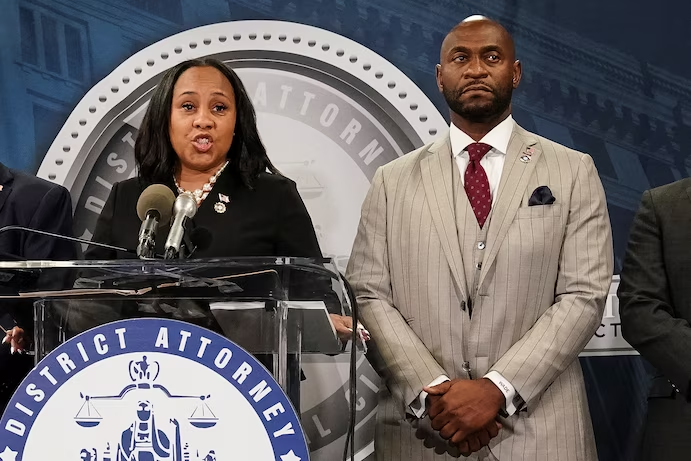
She and the attorney, Nathan Wade, are shown above in a Reuters file photo by Elijah Nouvelage.
“After carefully considering the trial court’s findings in its order, we conclude that it erred by failing to disqualify DA Willis and her office,” the decision said.
The court said McAfee’s “remedy … did nothing to address the appearance of impropriety that existed at times when DA Willis was exercising her broad  pretrial discretion about who to prosecute and what charges to bring.”
“While we recognize that an appearance of impropriety generally is not enough to support disqualification, this is the rare case in which disqualification is mandated and no other remedy will suffice to restore public confidence in the integrity of these proceedings,” the ruling said.
However, the appellate court denied a motion from Trump and his co-defendants to dismiss the indictment entirely, saying it “cannot conclude the record also supports the imposition” of that “extreme sanction.”
The appellate decision, which Willis is likely to appeal to the Georgia Supreme Court, is a major victory for Trump and his co-defendants, who have repeatedly sought to derail the case. If the decision is not overturned, a state agency that advises Georgia prosecutors would be tasked with finding a prosecutor unaffiliated with Fulton County to take on the matter — a move that many believe would ultimately lead to the dismissal of the case.
A spokesman for Willis did not immediately respond to a request for comment.
The appellate order comes two weeks after Trump asked the court to have the Georgia charges against him thrown out as he prepares to return to the White House after his November election victory.
Steve Sadow, Trump’s lead attorney in Georgia, has argued that if Trump regained the presidency, the case against his client would have to be delayed until 2029. “Under the supremacy clause and its duty to the president of the United States, this trial would not take place at all until after he left his term of office,” Sadow said.
But Willis had strongly implied in the past that she will continue to pursue her office’s case against Trump unless a court blocks her — an unprecedented legal challenge that could play out even as Trump assumes the presidency.

Washington Post, Syria’s new leaders struggle to contain revenge killings after Assad, Loveday Morris, Suzan Haidamous, Louisa Loveluck, Nilo Tabrizy and Imogen Piper, Dec. 20, 2024 (print ed.). Hay’at Tahrir al-Sham, the Islamist rebel group that led the charge on Damascus and is now trying to consolidate its rule, has pledged to protect minorities and restore security to Syria after a brutal 13-year civil war.
But in Latakia, and across the country, HTS is struggling to contain revenge attacks, as vigilantes seize on the chaos of the moment to settle personal and sectarian scores.
Over the past week, Washington Post reporters saw evidence of extrajudicial killings in Damascus and Hama province, and verified two videos showing fighters executing alleged members of Syria’s state security forces. While the violence so far appears scattered and disorganized, preventing it from spiraling will be a key test for HTS as it seeks to unite a fractured country only loosely controlled by different armed factions.
Washington Post, The U.S. seized a Russian super-yacht. Now taxpayers are footing the bill, Jeff Stein, Stephanie Hays, Nate Jones and Federica Cocco, Dec. 20, 2024 (print ed.). Documents released by the Justice Department show how taxpayers are paying to maintain the vessel seized as part of a U.S. sanctions campaign against Russian oligarchs.
In response to a Freedom of Information Act lawsuit filed by The Washington Post, the Justice Department divulged more than 1,300 pages of records showing how the government has maintained the $325 million Russian super-yacht since it was seized in Fiji in May 2022.
New York Times, Dominique Pelicot and 50 Others Guilty in Rape Trial That Horrified France, Catherine Porter, Dec. 20, 2024 (print ed.). A court sentenced Mr. Pelicot to 20 years after he admitted to drugging and raping his wife, Gisèle, for nearly a decade, and inviting strangers to join him.
Dominique Pelicot, 72, who admitted to drugging his wife for almost a decade and inviting dozens of strangers he met on the internet to join him in violating her, was convicted on Thursday of aggravated rape and other charges and sentenced to the maximum 20 years in prison. The verdict capped a trial that has horrified France, prompted profound discussions about rape culture and toxic masculinity, and turned Gisèle Pelicot, his wife of 50 years, into a feminist hero.
Outside the packed courtroom in Avignon, France, Ms. Pelicot expressed “profound gratitude” for the support she has received from across France and beyond since the trial began in September, and said she had never regretted opening the trial to the public.
The court also convicted the 50 other defendants, most of them on rape charges. In addition, Mr. Pelicot was found guilty of raping the wife of one of the men who was convicted, and of taking and distributing illicit photos of Ms. Pelicot; their daughter, Caroline; and two daughters-in-law.
The case has reverberated worldwide as its shocking details came to light. From the moment of his arrest in late 2020, Mr. Pelicot has admitted to crushing sleeping pills into his wife’s food and drink before he and other men raped her as she lay nearly comatose in their bedroom in the town of Mazan. He took thousands of video clips and photos of the encounters, which the police later used to identify and track down other perpetrators.
Ms. Pelicot, 72, who has divorced her husband, waived anonymity to make the trial public, and her poise and courage have made her widely admired in France. Her face has appeared on nightly newscasts, the front pages of newspapers, graffitied walls and signs held up by protesters around the country. She has renounced her former surname but used it during the trial.
Here is what else to know:
- Sentencing: Most of the other defendants received sentences of eight to 10 years, less than the 10- to 18-year terms that the public prosecutor had recommended. Jean-Pierre Maréchal, who pleaded guilty to following Mr. Pelicot’s model and drugging his own wife to rape her, was sentenced to 12 years; the prosecutor had recommended 17. Some of the men will go free because of time already served.
- Sentencing: Most of the other defendants received sentences of eight to 10 years, less than the 10- to 18-year terms that the public prosecutor had recommended. Jean-Pierre Maréchal, who pleaded guilty to following Mr. Pelicot’s model and drugging his own wife to rape her, was sentenced to 12 years; the prosecutor had recommended 17. Some of the men will go free because of time already served.
- Criminal code: The trial also set off a fierce debate over the definition of rape in the French criminal code, with some feminist lawmakers arguing that the law should be changed to say explicitly that sex without consent is rape.
- Notorious predator: Judges and lawyers in the trial have tried to grasp the enigma that is Mr. Pelicot. The court heard that he was an attentive grandfather, father and husband who had been besotted with Ms. Pelicot since they met at 19. But therapists testified to another side of him that was perverse, manipulative, incapable of empathy and addicted to sex, and that he said was rooted in a violent childhood.
- Other defendants: The French news media have labeled the 50 other defendants “Monsieur Tout-le-monde,” or Mr. Every Man, because of how varied and ordinary they appear — short, tall, flabby, lean, cleanshaven, bearded, bald, ponytailed. All but 14 were employed, in jobs that reflect the spectrum of middle- and working-class rural France: truck drivers, carpenters and trade workers, a prison guard, a nurse, an I.T. expert working for a bank, a local journalist.

Gisèle Pelicot, the woman at the center of rape trial that has transfixed France (Clement Mahoudeau photo for Agence France-Presse via Getty Images and the New York Times).
New York Times, Critic's Notebook: The Face of Courage, Vanessa Friedman, Dec. 20, 2024 (print ed.). The trial is over. The verdicts have been levied. And Gisèle Pelicot’s image has become a symbol of female strength around the world, our critic writes.
Until Sept. 2, 2024, most of the world did not really know what Gisèle Pelicot looked like.
There were almost no photographs of Ms. Pelicot, a 72-year-old grandmother, online. She wasn’t on social media. No one except her friends and family knew she had an orange Louise Brooks bob and a penchant for round John Lennon sunglasses.
But by Thursday, as Ms. Pelicot stood with her head held high in a courtroom in Avignon, France, as the verdicts in the harrowing four-month rape trial of her ex-husband and 50 other men were read, she had become the image of bravery across the globe.
Her face has stared out from posters in protests across France and been pasted on the sides of buildings. It graced the digital cover of Vogue Germany and was used on a mock cover of Time’s person of the year issue. It has become the symbol of her own horrific experience, of course, but also that of every woman who was rendered helpless, lied to and abused. As one of her lawyers, Stéphane Babonneau, said, Ms. Pelicot’s face, with its seeming lack of artifice, has become the physical expression of the fact that “the shame has switched sides.”
New York Times, Biden, Headed to the Exit, Sets an Aggressive Climate Goal for the U.S., Brad Plumer and Lisa Friedman, Dec. 20, 2024 (print ed.). President Biden on Thursday announced an aggressive new climate goal for the United States, saying that the country should seek to slash its greenhouse gas emissions by at least 61 percent below 2005 levels by 2035.
The target is not binding and will almost certainly be disregarded by President-elect Donald J. Trump, who has called global warming a “scam.” But Biden administration officials said they hoped it would encourage state and local governments to continue to cut the emissions that are rapidly heating the planet, even if the federal government pulls back.
The announcement caps four years of climate policies from a president who has sought to make global warming a signature focus of his administration. In a video address from the White House, Mr. Biden said his efforts, including pumping billions of dollars into clean energy technologies and regulating pollution from power plants and automobiles, amounted to “the boldest climate agenda in American history.”
Mr. Biden said he expected progress in tackling climate change to continue after he had left office. “American industry will keep inventing and keep investing,” he said. “State, local, and tribal governments will keep stepping up. And together, we will turn this existential threat into a once-in-a-generation opportunity to transform our nation for generations to come.”
New York Times, Analysis: Europe Has a Leadership Vacuum. How Will It Handle Trump? Mark Landler and Jim Tankersley, Dec. 20, 2024 (print ed.). With Germany and France both in political turmoil, President-elect Trump will take office at a time of instability for the continent.
When President Volodymyr Zelensky of Ukraine met European leaders for dinner in Brussels on Wednesday, the shadow of President-elect Donald J. Trump hung over the gathering. But it is not just Mr. Trump’s return to the White House that has scrambled Europe’s response to the war in Ukraine.
It is also the political disarray across the continent — a wave of instability that is depriving Europe of robust leadership at the very moment that Mr. Trump is challenging its deeply felt support for Ukraine and its hard-fought resistance of Russian aggression.
From Germany, where the government of Chancellor Olaf Scholz just collapsed, to France, where President Emmanuel Macron has been gravely weakened by months of domestic political turmoil, Europe’s big powers are on the back foot as they confront a resurgent Mr. Trump.
“We’re not well equipped, that’s for sure,” said Wolfgang Ischinger, who served as Germany’s ambassador to the United States during the Iraq War. “It is a horribly bad moment for my own country to be in the midst of an election campaign, with a rather polarizing political debate.”
Politico, Trump, Vance call for streamlined CR and debt ceiling debate, Mia McCarthy and Nicholas Wu, Dec. 19, 2024 (print ed.). They want to scrap the proposed package as a shutdown looms.
 Donald Trump and JD Vance injected themselves further into an escalating fight over federal spending, demanding that House Republicans scrap a plan that would avert a government shutdown within days.
Trump and Vance issued a statement Wednesday insisting that Congress raise the nation’s debt ceiling and cut a range of spending proposals instead of passing the package that Speaker Mike Johnson and House Republicans had negotiated with their Democratic counterparts.
The Congressional Resolution released Tuesday gives “the Democrats everything they want,” the president-elect and vice president-elect said in a joint statement.
“The most foolish and inept thing ever done by Congressional Republicans was allowing our country to hit the debt ceiling in 2025. It was a mistake and is now something that must be addressed,” Trump and Vance said in their statement posted on Vance’s X account.
The two also said they wanted the debt ceiling debate to occur while President Joe Biden was still the president.
 “Increasing the debt ceiling is not great but we’d rather do it on Biden’s watch,” they added. “If Democrats won’t cooperate on the debt ceiling now, what makes anyone think they would do it in June during our administration? Let’s have this debate now.”
Since the bill text’s release on Tuesday night, Republicans started saying they would vote against the bill, especially over a lack of spending offsets and provisions like a congressional pay raise and disaster aid.
“Republicans want to support our farmers, pay for disaster relief, and set our country up for success in 2025,” Trump and Vance said in the statement. “The only way to do that is with a temporary funding bill WITHOUT DEMOCRAT GIVEAWAYS combined with an increase in the debt ceiling. Anything else is a betrayal of our country.”
Senate Majority Leader Chuck Schumer, in response to the statement and putting debt ceiling negotiations back into the bill, said “Let’s see what the House does.” House Minority Leader Hakeem Jeffries said that “House Republicans have been ordered to shut down the government and hurt working class Americans that they claim to represent.”
“The Republicans are going to have the president, the Senate and the House,” Jeffries said. “They have to demonstrate the ability to govern in a responsible fashion, and if they're going to breach a bipartisan agreement, then they own the damage that they do to the American people, entirely on their own.”
Democrats are unlikely to lend their votes to a stopgap funding bill if negotiated provisions like disaster aid and funding to repair the collapsed Francis Scott Key Bridge fall out of the agreement. This could leave Republicans in the lurch as a Friday shutdown deadline looms.
Politico, GOP lawmakers air doubts about Trump's last-minute spending demands, Katherine Tully-McManus, Nicholas Wu and Jordain Carney, Dec. 18, 2024. Most Republican lawmakers don't have the appetite for a government shutdown and don't think they have time to address the debt ceiling before Friday.
President-elect Donald Trump is opening the door to a government shutdown a week before Christmas. Republican lawmakers don’t appear to be on board.
Facing a Friday night funding deadline, Republican leaders were already struggling to build support for passage of a bipartisan catch-all bill to punt the funding fight into March. Now Trump and incoming Vice President JD Vance are publicly excoriating the deal, calling on Speaker Mike Johnson and other Republicans to pass a funding bill without any Democratic priorities — even if it means a shutdown. They also want the debt ceiling raised along with that legislation, a complicated issue lawmakers hadn’t planned to deal with for months.
As GOP members streamed into Johnson’s office to pick up gifts and stop by an ironically timed Christmas party, they didn’t voice enthusiasm for Trump’s demands. Recent debt limit negotiations have taken months and take up a lot of oxygen on Capitol Hill. Clearing it in days is a tall order, especially with lawmakers eager to leave town for the holidays.
Rep. Mike Rogers (R-Ala.) answered “no” to questions about both if he’s interested in launching debt limit talks at this point and if he thinks linking debt limit to spending is possible before the deadline.
“You’d love to have [a comprehensive spending deal] with the debt ceiling and then be done with it,” said Rep. Kevin Hern (R-Okla.). “That's not going to happen. There aren't votes for that. But, you know, if you have a CR with the debt limit, at least, you get part of the problem done.”
Asked if it was realistic to try to add a debt ceiling increase to the spending bill, Hern responded: “Every time you change something, it’s a challenge.”
Republicans are likely to need Democratic support to move any type of spending patch at this point. While GOP leaders were considering trying to pass a “clean” stopgap that left off the unrelated additions like disaster aid, they’re nervous that pulling those would mean they lose even more support on both sides of the aisle.
“If Congressional leaders intend to leave DC before the holidays without passing disaster recovery, they should be prepared to spend Christmas in the Capitol. I'll use every tool available to block a CR that fails Western North Carolina communities in need of long-term certainty,” Sen. Thom Tillis (R-N.C.) said on social media.
If Republicans opt to use a fast-track legislative procedure to bypass committees and get a funding patch to the floor, known as suspension, it would require a two-thirds majority to pass. That means a large number of Democrats would have to vote for it — and many of them had planned to back Johnson’s existing plan that includes the additions.
“Great question,” said Rep. Blake Moore (R-Utah) when asked what incentives Democrats would have to help pass a bill with many of their priorities removed.
Top Democrats signaled they weren’t in any mood to bail Republicans out of their debt-and-spending predicament, which could leave the House majority in the lurch as the Friday government shutdown deadline draws closer. House Democrats were scheduled to meet for a closed-door caucus meeting Thursday morning as they charted their path forward.
Washington Post, Senate passes Pentagon policy bill that set off transgender-care debate, Abigail Hauslohner, Dec. 18, 2024. Several Democrats refused to support the annual bill after House Speaker Mike Johnson’s late intervention to include a provision barring the use of federal funds for specialized medical treatment.
 The Senate on Wednesday passed an $895.2 billion defense policy bill that sparked controversy when House Speaker Mike Johnson amended the legislation with language forbidding the use of federal funds to cover specialized medical care for the transgender children of U.S. military personnel.Sign up for Fact Checker, our weekly review of what's true, false or in-between in politics.
The annual National Defense Authorization Act (NDAA) was approved by a vote of 85 to 14, with several Democrats opposing. It will now go to the president, who is expected to sign it into law.
Over the objections of most House Democrats and some Republicans, Johnson (R-Louisiana) upended what historically is an overwhelmingly bipartisan vote to approve the NDAA.
The House last week passed the bill 281-140, with fewer than half of the chamber’s Democrats voting in favor of it. Many, including some who played key roles drafting the sprawling national security package, expressed bitterness that months of good-faith negotiation between members of both political parties from the House and Senate had been tainted.
The anger this week spilled over into the Senate, where Sen. Tammy Baldwin (D-Wisconsin) led 20 other senators in a largely symbolic effort to strike Johnson’s provision from the legislation. On Tuesday, she said she was so appalled by its inclusion that she would vote against the NDAA for the first time in her Senate career — “a position I do not take lightly,” she added.
“It’s flat-out wrong,” she said on the Senate floor, blasting a policy that “guts our service members’ rights” simply “to score cheap political points.” If not for that provision, Baldwin said, “I would have been proud to support it.”
New York Times, Insurers Are Deserting Homeowners as Climate Shocks Worsen, Christopher Flavelle reported from Silver City, N.M. Data analysis and graphics by Mira Rojanasakul. Photography and video by Paul Ratje, Dec. 18, 2024. Without insurance, it’s impossible to get a mortgage; without a mortgage, most Americans can’t buy a home.
The insurance crisis spreading across the United States arrived at Richard D. Zimmel’s door last week in the form of a letter.
Mr. Zimmel, who lives in the increasingly fire-prone hills outside Silver City, N.M., had done everything right. He trimmed the trees away from his house,and covered his yard in gravel to stop flames rushing in from the forest near his property. In case that buffer zone failed, he sheathed his house in fire-resistant stucco, and topped it with a noncombustible steel roof.
None of it mattered. His insurance company, Homesite Insurance, dumped him. “Property is located in a brushfire or wildfire area that no longer meets Homesite’s minimum standard for wildfire risk,” the letter read. (Homesite did not respond to a request for comment.)
Mr. Zimmel has company. Since 2018, more than 1.9 million home insurance contracts nationwide have been dropped — “nonrenewed,” in the parlance of the industry. In more than 200 counties, the nonrenewal rate has tripled or more, according to the findings of a congressional investigation released Wednesday.
As a warming planet delivers more wildfires, hurricanes and other threats, America’s once reliably boring home insurance market has become the place where climate shocks collide with everyday life.
New York Times, California Declares an Emergency Over Bird Flu, Apoorva Mandavilli, Dec. 18, 2024. Gov. Gavin Newsom’s announcement was a stark acknowledgment of the increasing seriousness of the contagion’s spread among the state’s dairy cattle.
Gov. Gavin Newsom of California declared on Wednesday that the outbreak of bird flu among the state’s dairy cattle constituted an emergency, a stark acknowledgment of the increasing seriousness of the contagion’s spread.
California was not among the first states to detect the bird flu virus, H5N1, in dairy cattle. But since the first identification of an infected herd in late August, the state’s agriculture department has found the virus in 645 dairies, about half of them in the past 30 days alone.
The announcement followed news that an individual in Louisiana had been hospitalized with bird flu, the first severe case of infection in a human identified so far in the United States.
New York Times, Inside a Huge Spending Deal: Disaster Money, a Football Stadium and More, Catie Edmondson, Dec. 18, 2024. The mammoth year-end federal funding measure congressional leaders agreed on does far more than just keep the government running.
The stopgap spending bill congressional leaders agreed on this week began as a simple funding measure to keep government funds flowing past a Friday night deadline and into early next year, long after House Republicans elect a speaker and President-elect Donald J. Trump is sworn in.
But by the time it was rolled out to lawmakers on Tuesday night, it had transformed into a true Christmas tree of a bill, adorned with all manner of unrelated policy measures in the kind of year-end catchall that Republicans have long derided. It is a 1,547-page behemoth of a package with provisions spanning foreign investment restrictions, new health care policies and a stadium for the Washington Commanders.
End-of-year spending bills often become magnets for unrelated measures, fueled by last-minute spasms of deal-cutting by lawmakers who recognize it could be their last chance to get something done. That was even more true this year with Democrats bracing for a Republican governing trifecta come January, and Speaker Mike Johnson arriving at the negotiating table sapped of leverage because a large group of his members refuses to vote for any spending measure.
Mr. Johnson had another incentive to allow the package to balloon: He could satisfy some longstanding bipartisan desires with minimal Republican fingerprints, merely blaming a Democratic Senate and White House for any bloat in the deal. He will not have that luxury in a few weeks, when Republicans control all of Congress and Mr. Trump is in the White House.
New York Times, Zelensky Meets With European Leaders to Discuss Ukraine’s Future, Jenny Gross and Steven Erlanger, Dec. 18, 2024. As Donald J. Trump prepares to take office in the United States, President Volodymyr Zelensky will attend a meeting hosted by the NATO chief to plot the path forward in the war with Russia.
Mark Rutte, the head of NATO, met with President Volodymyr Zelensky of Ukraine at Mr. Rutte’s residence in Brussels on Wednesday evening to discuss the deteriorating situation in the war with Russia and how Europe can offer more support to Kyiv. Several other European leaders were expected to join them later on Wednesday.
The meeting came at an uncertain moment for Ukraine as it faces U.S. President-elect Donald J. Trump’s push for an accelerated timetable for peace negotiations with Moscow. Mr. Zelensky is scheduled to address European Union leaders during a full summit meeting on Thursday.
Mr. Rutte has argued that any serious negotiations on a cease-fire or settlement would require convincing President Vladimir V. Putin of Russia that he has little further to gain in Ukraine. And that, Mr. Rutte has noted, requires stepped-up Western support for Kyiv.
“What we should focus on now is making sure that Ukraine gets to a position of strength,” Mr. Rutte said on Wednesday, suggesting it was premature to say whether European peacekeepers would be involved in any future deal. “If we now start to discuss amongst ourselves what a deal could look like, we make it so easy for the Russians.”
New York Times, Russia-Ukraine War: Ukrainians Mourn the Loss of a Young Journalist and Her Stories, Maria Varenikova, Dec. 20, 2024. Viktoria Roshchyna died in September in Russian custody. The reporter had been well-known for her stories about life in parts of occupied Ukraine.
Viktoria Roshchyna reported from places most other Ukrainian journalists would not go. She was one of the last to report openly from the territory in Ukraine forcibly taken by Russian troops. And then she went further and entered Russia.
Ms. Roshchyna, known as Vika, was arrested her father said, and died in September, more than a year later. The circumstances of her death remain unclear, as is what she intended to do in Russia. Some have suggested she planned to travel through Russia into occupied Ukraine. She was 27.
Ukrainians have widely mourned Ms. Roshchyna’s death, for the tragic loss of a young life, but also because of the stories she wrote from parts of the country where many had been forced to flee, losing everything. Her stories had been an important lifeline for them.
Ms. Roshchyna was known as a brave, stubborn and driven journalist. Soon after Russia’s full-scale invasion of Ukraine in February 2022, she joined a humanitarian convoy and tried to cross into the besieged southeastern port city of Mariupol, as almost everyone else was trying to leave. Russian forces captured her in March. They released her a week later, after beating her, she said.
Washington Post, Opinion: Does Trump want Putin to get Ukraine’s $26 trillion in gas and minerals? Marc A. Thiessen, Dec. 18, 2024. Kyiv controls vast gas and mineral deposits. Does Trump want those flowing west, or to Russia and China?
Donald Trump often says that liberating Iraq without getting its oil resources was one of America’s biggest foreign policy blunders. He has a chance to avoid a similar mistake in Ukraine.
Ukraine is not only the breadbasket of Europe; it is also a mineral superpower with some of the largest reserves of 117 of the 120 the most widely used minerals in the world. Of the 50 strategic minerals identified by the United States as critical to its economy and national security, many of which are quite rare yet key to certain high-value applications, Ukraine supplies 22.Make sense of the latest news and debates with our daily newsletter
Ukraine possesses the largest reserves of uranium in Europe; the second-largest reserves of iron ore, titanium and manganese; and the third largest reserves of shale gas — as well as large deposits of lithium, graphite and rare earth metals, according to a 2022 report by the Canadian geopolitical risk-analysis firm SecDev. These minerals are essential to the production of vital goods ranging from airplanes, cellphones and electric vehicles to steel and nuclear power.
The question for the president-elect is: Does he want Russia and China to get that treasure trove of natural resources? Or does he want to develop them with Ukraine to the benefit of the American people?
One of the main reasons Russian President Vladimir Putin invaded Ukraine (aside from his delusional historical fantasies about how Ukrainians and Russians are “one people”) was to seize these natural resources, which are valued at an estimated $26 trillion, according to SecDev.
That effort nearly succeeded. In early 2022, Russian forces reached the outskirts of Kyiv and came close to taking the capital and installing a puppet regime. But with U.S. assistance — including the Javelin missiles that Trump supplied (reversing Barack Obama’s lethal weapons ban) — Ukraine forced Russia back. In so doing, it not only liberated its citizens from brutal Russian occupation; it also successfully defended roughly 80 percent of Ukraine’s known mineral deposits, according to the SecDev report — including 73 percent of its iron ore, 75 percent of its lithium and graphite, 90 percent of its titanium, and 92 percent of its uranium and other radioactive elements.
Washington Post, Fed cuts interest rates a third time, points to inflation as challenge for 2025, Andrew Ackerman, Dec. 18, 2024. The central bank signals just two rate cuts in 2025, down from four.
The Federal Reserve lowered interest rates by an additional quarter percentage point and signaled a slower pace of cuts next year, as inflation proves to be a bigger challenge than they estimated just a few months ago.Get a curated selection of 10 of our best stories in your inbox every weekend.
The Fed penciled in just two rate cuts for 2025, down from four forecasted in September.
The vote was 11-1, with a lone dissent from Cleveland Fed president Beth Hammack. She preferred to keep rates unchanged, the Fed said.
“In considering the extent and timing of additional adjustments to the target range for the federal funds rate, the Committee will carefully assess incoming data, the evolving outlook and the balance of risks,” the Fed said in a statement.
Inflation has weighed heavily on Americans, especially middle and lower-income, and drove voters to the polls in November to elect Donald Trump, exit polling showed. Despite the recent rate cuts, mortgage rates have actually increased and housing inflation remains a challenge.
Wednesday’s cut, which was widely expected, comes about a month before Trump’s return to the White House. His promises around immigration, regulation, tax and spending policies could shift expectations for the economy and ultimately shift the central bank’s future stance on rates. Interest rate cuts trickle through the financial sector to make an array of consumer and business loans cheaper, influencing mortgage rates and other types of loans.
The Federal Reserve also downgraded its view of how inflation will progress next year. Now officials expect “core” inflation to be around 2.5 percent increase, which is up from an earlier estimate of 2.2 percent. Core inflation excludes volatile food and energy categories, which can surge and fall depending on outside factors.
New York Times, Investigation: Giant Companies Took Secret Payments to Allow Free Flow of Opioids, Chris Hamby, Dec. 18, 2024 (print ed.). Drugmakers including Purdue Pharma paid pharmacy benefit managers not to restrict painkiller prescriptions, a New York Times investigation found.
In 2017, the drug industry middleman Express Scripts announced that it was taking decisive steps to curb abuse of the prescription painkillers that had fueled America’s overdose crisis. The company said it was “putting the brakes on the opioid epidemic” by making it harder to get potentially dangerous amounts of the drugs.
The announcement, which came after pressure from federal health regulators, was followed by similar declarations from the other two companies that control access to prescription drugs for most Americans.
The self-congratulatory statements, however, didn’t address an important question: Why hadn’t the middlemen, known as pharmacy benefit managers, acted sooner to address a crisis that had been building for decades?
One reason, a New York Times investigation found: Drugmakers had been paying them not to.
For years, the benefit managers, or P.B.M.s, took payments from opioid manufacturers, including Purdue Pharma, in return for not restricting the flow of pills. As tens of thousands of Americans overdosed and died from prescription painkillers, the middlemen collected billions of dollars in payments.
The details of these backroom deals — laid out in hundreds of documents, some previously confidential, reviewed by The Times — expose a mostly untold chapter of the opioid epidemic and provide a rare look at the modus operandi of the companies at the heart of the prescription drug supply chain.
The P.B.M.s exert extraordinary control over what drugs people can receive and at what price. The three dominant companies — Express Scripts, CVS Caremark and Optum Rx — oversee prescriptions for more than 200 million people and are part of health care conglomerates that sit near the top of the Fortune 500 list.
The P.B.M.s are hired by insurers and employers to control their drug costs by negotiating discounts with pharmaceutical manufacturers. But a Times investigation this year found that they often pursue their own financial interests in ways that increase costs for patients, employers and government programs, while driving independent pharmacies out of business. Regulators have accused the largest P.B.M.s of anticompetitive practices.
New York Times, Russia-Ukraine War: Russia Detains a Man It Says Killed a General on Ukraine’s Orders, Anatoly Kurmanaev, Dec. 18, 2024. The Russian prosecutor’s office said the suspect, a 29-year-old citizen of Uzbekistan, confessed to planting the bomb on the orders of Ukrainian agents.
The Russian authorities said on Wednesday that they had detained a suspect in the killing of a senior military officer, Lt. Gen. Igor Kirillov,, right, a major  development in the most prominent political assassination case in the country since the start of the war in Ukraine.
The suspect, a 29-year-old citizen of Uzbekistan whose name was not released, was detained in a village outside Moscow, a spokeswoman for Russia’s prosecutor’s office said.
The spokeswoman said the detainee had confessed that Ukrainian intelligence agencies recruited him to kill General Kirillov, 54, who was in charge of the Russian military’s nuclear and chemical weapons protection forces.
 An official with Ukraine’s security service, known as the S.B.U., said on Tuesday that Ukraine had been responsible for the killing, which took place in central Moscow on Tuesday. He discussed sensitive intelligence on the condition of anonymity.
The detainee traveled to Moscow and placed a bomb under a scooter near the general’s home, the prosecutor’s office spokeswoman said.
He also installed a camera inside a parked rental car that transmitted the general’s movements to intelligence agents in Ukraine, she added. He was promised $100,000 and safe passage to Europe for carrying out the plot, she said. An aide to the general was also killed when the bomb was detonated.
 “We got more proof that the Kyiv regime does not stop at anything, including terrorism,” Dmitri S. Peskov, the Kremlin’s spokesman, told reporters on Wednesday. He added that President Vladimir V. Putin had offered condolences to the general’s family.
General Kirillov was the most senior Russian official to have been assassinated away from the battlefield since the start of the war. Previous assassination attempts have targeted Russian propagandists and more junior military officers.
On Wednesday, Russia’s foreign ministry spokeswoman, Maria Zakharova, said the country would raise the killing of General Kirillov at the scheduled meeting of the United Nations Security Council on Friday.
“We are certain that all the organizers and executors of the murder of Igor Kirillov will be found and punished, whoever they are and wherever they may be,” Ms. Zakharova said.
The general’s killing is the latest embarrassment for Russia’s domestic intelligence agency, the F.S.B., which has assumed greater power and influence since the start of the war in Ukraine nearly three years ago.
The F.S.B. has blamed Ukraine for most terrorist attacks and major accidents in the country since the invasion, usually without providing evidence.
Critics have said such tactics have allowed Russia’s intelligence agencies to deflect the blame for their own failures to detect domestic threats, often associated with Islamist groups.support for confirmation.
The Guardian, Dmitry Medvedev says editors of the Times are ‘legitimate military targets,’ Pjotr Sauer, Dec. 18, 2024. Former Russian president’s Telegram post follows paper’s editorial about assassination of a Russian general.
 The Russian security council deputy head, Dmitry Medvedev, has described the editors of the Times newspaper in Britain as “legitimate military targets” in response to the newspaper’s coverage of the assassination of a Russian general.
Medvedev’s vitriolic comments on Wednesday followed a Times editorial in which the newspaper described the assassination of Lt Gen Igor Kirillov as “a legitimate act of defence” by Ukraine, which has claimed responsibility for the killing.
Kirillov, head of the military’s chemical, biological and radiological weapons unit, was killed along with his assistant when a device attached to an escooter exploded as the two men left a building in a residential area in south-east Moscow on Tuesday morning. Kirillov is the most senior Russian military official to be killed in an assassination away from the frontlines since the start of the Kremlin’s offensive in Ukraine nearly three years ago.
“Those who carry out crimes against Russia … always have accomplices. They too are now legitimate military targets. This category could also include the miserable jackals from The Times who cowardly hid behind their editorial. That means the entire leadership of the publication,” Medvedev, who served as Russia’s president between 2008 and 2012, wrote on his Telegram channel.
In a thinly veiled threat, the hawkish former president added that journalists at the Times should “be careful” as “anything goes in London”.
Responding to Medvedev’s post, the UK foreign secretary, David Lammy, wrote on X that his “gangster threat against Times journalists smacks of desperation”.
“Our newspapers represent the best of British values: freedom, democracy and independent thinking,” Lammy wrote alongside a picture of himself reading the Times.
Asked about Medvedev’s comments, the UK prime minister’s official spokesperson said they were “simply the latest in a series of desperate rhetoric coming from Putin’s government.”
The spokesperson added: “Unlike in Russia, a free press is a cornerstone of our democracy and we take any threats made by Russia incredibly seriously.”
In the same post on Wednesday, Medvedev also threatened Nato officials assisting Ukraine.
“There’s a whole legion of them. There’s not even enough space to list them, but all these individuals can and should be considered legitimate military targets for the Russian state. And for all Russian patriots for that matter,” he wrote.
New York Times, Ukraine Says It Assassinated Russian General in Moscow, Anton Troianovski and Constant Méheut, Dec. 18, 2024 (print ed.). Igor Kirillov, who was in charge of Russia’s nuclear and chemical weapons protection forces, was killed by a bomb on a street in the capital.
New York Times, Who Was Gen. Igor Kirillov? Staff Report, Dec. 18, 2024 (print ed.). The general had faced sanctions for using chemical weapons in Ukraine.
Igor Kirillov, a general in charge of Russia’s military’s nuclear and chemical weapons protection forces, was killed on Tuesday by a bomb in Moscow, the Russian authorities said.
An official with Ukraine’s security service, known as the S.B.U., said that Ukraine was responsible for the killing. The official, who spoke on the condition of anonymity to discuss a sensitive intelligence operation, confirmed the details of the assassination given by Russia.
Meidas Touch Network, Commentary: Former FBI Informant Alexander Smirnov Pleads Guilty To Lying About Biden Family, Jordy Meiselas, Dec. 16, 2024. Smirnov lied about a bribery scheme that became a critical part of the Republican effort to impeach Joe Biden.
 Alexander Smirnov has officially pled guilty to lying about a bribery scheme that involved President Joe Biden and his son Hunter that became central to the Republican attempt to impeach President Biden.
Smirnov entered a guilty plea to a felony charge related to the fake bribery story along with other criminal tax charges related to his concealment of millions of dollars of income.
In 2020, Smirnov first made claims that the Bidens had been involved in a bribery scheme related to Burisma and Ukraine. At the same time, Smirnov expressed bias about President Biden as a candidate.
An FBI office investigated Smirnov's allegations but closed the case in August 2020, and there has been no evidence that President Biden acted corruptly or accepted any bribes as President or Vice President.
At the time, it was unknown that Smirnov's allegations were the basis of a Republican attempt to launch an impeachment inquiry into President Biden. And we now know that the story premising the impeachment inquiry was false.
Prosecutors agreed to a deal with Smirnov and recommended that he serve between four and six years in prison. The ultimate sentencing decision will be made by a federal judge at a later date.
Steady, U.S. Political Commentary: Is Trump Really Calling the Shots? Dan Rather, Dec. 19, 2024. Just when you think it can’t get weirder or more dysfunctional …
 Welcome to a preview of coming attractions — your U.S. government (not) at work. The new administration is a month away from taking office, and it feels a lot like they’re already in power … except for the small problem that there may be no government to run as a Republican-led shutdown looms.
We’ve seen this movie before, but now we have a new lead actor. Move over Donald Trump and make way for the Ambassador of Chaos, Elon Musk. It would be funny if it weren’t so troubling.
While almost every Steady these days could don the headline ‘You Can’t Make It Up,’ today’s raises the bar to new heights.
Now the machinations of the U.S. Congress tend to be a pretty dry subject, but bear with me. It’s worth your time.
Speaker of the House Mike Johnson has spent the past few weeks working with both House Republicans and Democrats to negotiate a spending bill to keep the federal government open and running.
According to Politico, Donald Trump was given the broad strokes of the deal over the weekend, and he reportedly had no objections.
Late Tuesday, Johnson, right, announced a deal that would keep the government funded for three months.
Wednesday morning, a disgruntled Elon Musk began a tweet-a-thon in opposition to the spending bill. Musk, who has no official role yet, is unelected, and will not need Senate confirmation, decided he didn’t like the bill. He let everyone know it with more than 100 posts on his social media platform, X.
“SHUT IT DOWN,” Musk posted; followed by “Folks, American Democracy is in TROUBLE,” said unironically.
He falsely claimed that shutting down the government would hurt no one.
“Just close down the govt [SIC] until January 20th. Defund everything. We will be fine for 33 days,” Musk wrote on X.
Tell that to the hundreds of thousands of federal workers who would be furloughed and therefore not paid until there’s a deal. For context, when the government shut down for three weeks in 2018-19, the Congressional Budget Office said it cost the U.S. economy $3 billion. That estimate does not include lost productivity. But what’s a billion or three to someone worth 440?
Musk also threatened political retribution, saying he will financially back any primary opponent of Republicans in Congress who supported the original deal.
Share
His beef with the bill is too much pork, which is the appropriation of funds for pet projects of individual House and Senate members. Pork is included in spending bills to appease members and guarantee their vote. It is how budgets are made and have been made since the dawn of American democracy.
The bill also includes $100 billion for disaster relief and billions for American farmers.
By the end of the day, Musk’s social media temper tantrum had worked. Trump, who as a reminder is not yet president, put out a statement noting his sudden displeasure with the bipartisan spending bill that he was just fine with until Musk. Long story slightly shorter, that bill is dead, as are Speaker Johnson’s chances of remaining Speaker Johnson. More on that in a minute.
Who exactly is calling the shots? It doesn’t sound like it’s the president-elect. It does sound like it is the richest man in the world, who paid an enormous amount of money to ride in Donald Trump’s sidecar.
“The fact that Donald Trump has been completely AWOL during these negotiations to the point where only after Elon Musk publicly tweets about his displeasure, about this budget deal, all of a sudden Donald Trump, chief of staff to Elon Musk, comes trotting in and blows up the deal,” Democratic Congressman Daniel Goldman said on MSNBC.
Senator Bernie Sanders asked on X, “Are Republicans working for the American people or taking orders from ‘President Musk’?”
This morning Trump called, yes called, NBC to do damage control. During the phone interview he said he had spoken with Musk before the X owner went on his rant and that their views are “very much on track.”
So, now what? Late today, Speaker Johnson says he has a new deal, one that apparently makes Musk and Trump happy, but perhaps few others. Minority Leader Hakeem Jeffries says it’s an unserious proposal and would be dead on arrival. The new bill is a pared-down version of the original with a debt ceiling increase.
Without boring you to the point that you scroll to the end of this piece, let me quickly explain. The debt ceiling is a limit on how much Congress can borrow to pay its bills. If the ceiling isn’t raised and the government can’t pay, it will be in default. If that happens, there will be actual hell to pay. The consequences for the U.S. economy could be catastrophic.
The Council of Economic Advisers said that if the government defaults on its obligations, “the economy would quickly shift into reverse, with the depth of the losses a function of how long the breach lasted.”
And now a twist no one expected. After Musk’s muscle flex over the continuing resolution, Republican Senators Rand Paul and Mike Lee have floated the idea of Musk replacing Johnson as speaker of the House. Yup, you read that right. The Constitution does not require a speaker to be a sitting member of the House of Representatives, though every speaker has been.
Several months ago, The Washington Post reported that Musk, who is originally from South Africa, was actually in the U.S. illegally for a time after dropping out of Stanford to start a business. He later became a citizen. Who would have thought that someone who has railed against undocumented immigrants was perhaps one himself, and now could be speaker of the House … the world’s richest person, and answerable to absolutely no one?
These are serious matters for the future of our country. Strange and perilous times, my friends.
New York Times, Trump Tossed a Debt Limit Grenade Into Spending Talks. Here’s Why, Alan Rappeport, Dec. 19, 2024. President-elect Donald J. Trump injected debt limit politics into already-fraught congressional spending talks this week, urging lawmakers to lift the debt limit or abolish it entirely before he takes office next month.
The re-emergence of the debt limit comes 18 months after Republicans and Democrats staved off a fiscal crisis and agreed to suspend a cap on how much the government can borrow until after the 2024 presidential election. That was supposed to clear the decks and sidestep a politically difficult vote during the heat of campaign season.
But now the problem is waiting for Mr. Trump. As he prepares to push an agenda of tax cuts and border security, Mr. Trump fears that a debt limit fight next year could interfere. His plans are expected to cost trillions of dollars, much of which will most likely need to come from borrowed funds. A drawn-out debt limit fight next year could force Mr. Trump and Republicans to bow to the demands of Democrats and could consume the congressional calendar.
“This is a nasty TRAP set in place by the Radical Left Democrats!” Mr. Trump wrote on social media on Wednesday night.
Politico, GOP strikes a new spending deal that includes disaster aid and raising the debt limit, Jennifer Scholtes, Katherine Tully-McManus and Meredith Lee Hill, Dec. 19, 2024. The news caught Democrats by surprise Thursday afternoon.
Republicans have struck a deal on a short-term government spending patch and potential debt limit increase, according to two GOP lawmakers meeting in Speaker Mike Johnson's office Thursday afternoon.
“There is an agreement,” said Rep. Stephanie Bice (R-Okla.). Appropriations Chair Tom Cole (R-Okla.) confirmed there was a deal among Republicans, though the news caught House Democrats by surprise.
The plan Johnson is expected to put on the House floor later Thursday includes, according to three Republicans familiar with the deal, a stopgap measure that funds the government through mid-March, a clean farm bill extension, the $110 billion disaster aid package previously negotiated with Democrats, clean health care provision extenders and a two-year suspension of the debt limit, kicking a new deadline into January 2027.
Bice said she expects Donald Trump and Elon Musk to support the deal, after the two derailed Johnson’s plan to pass a more than 1,500-page catch-all measure he negotiated with top Democrats earlier this week to avert a government shutdown, deliver more than $100 billion in disaster aid and enact a slew of unrelated policy priorities.
The goal is for the House to vote Thursday, Bice added. The government shutdown deadline is Friday at midnight.
Given House Democrats did not appear to be read in on the deal, it wasn't immediately clear if they will support it, and Johnson will almost certainly need their votes to pass it through the chamber. Shortly after the agreement was announced, Rep. Chip Roy (R-Texas) already said he was opposed to the plan — an attitude other conservatives are certain to share.
"It's a water-downed version of the same crappy bill people were mad about yesterday," he said on The Sean Hannity Show.
Politico, Jeffries says 'hell no' to GOP funding deal, ratcheting up chances of a shutdown, Nicholas Wu and Daniella Diaz, The package would need a lot of Democratic support to get out of the House.
House Democrats were skeptical of an emerging Republican-led funding deal as they walked into a closed-door caucus meeting Thursday afternoon, meaning it's almost certainly doomed on the House floor, with less than 36 hours to go until a shutdown deadline.
“The Musk-Johnson proposal is not serious. It’s laughable. Extreme MAGA Republicans are driving us to a government shutdown,” House Minority Leader Hakeem Jeffries said to reporters as he walked into the meeting.4640182134416795 07/29 sec. 279
Speaking privately to members of his caucus minutes later, Jeffries told lawmakers: “I’m not simply a no. I’m a hell no,” according to three people familiar with his remarks, granted anonymity to speak about the meeting.
Other Democratic lawmakers also expressed doubts about the legislation, which Republican leaders were teeing up for a vote Thursday evening. It would suspend the debt ceiling through early 2027, fund the government through March, and include billions in disaster relief funds, a top Democratic priority.
The vote on the bill is scheduled to come up via a process called suspension, which means it needs to meet a two-thirds vote threshold to pass. If Democrats are roundly against it, it will fail on the floor — leaving Congress without an obvious solution to avoid a shutdown.
“This was done on short notice,” said Rep. Richard Neal (D-Mass.), the top Democrat on the Ways and Means Committee, who said he was opposed. “We reached an agreement on a bipartisan basis between the respective leadership and the membership of both parties, only to have an interruption take place and then a veto occurs after the agreement has been rendered and reached.”
President-elect Donald Trump and Elon Musk worked to spike the original deal on Wednesday, sending the House careening down an alternate path with a deadline looming.
“Elon Musk is not my constituent. My constituents are hard-working people who work very hard every day for every dime they have, and I'm sure as hell not bailing out on them in the final week,” said Rep. Ann McLane Kuster (D-N.H.), chair of the centrist New Democrat Coalition.
Top Democrats weren’t involved in the drafting of the legislation, and the unveiling caught senior lawmakers by surprise.
“All I know is it was just reported by the press. We have not been involved in anything that they have done,” said Rep. Rosa DeLauro (D-Conn.), the top Appropriations Committee Democrat.
Republicans argue the burden is now on Democrats to justify any opposition to a continuing resolution — “CR” for short — that averts a government shutdown and also prevents the U.S. from defaulting on its more than $36 trillion in debt next year.
“Fundamentally, Democrats are going to have to explain why a clean CR with disaster relief, keeping the government functioning and open — and doing, by the way, exactly what they argued a year ago — why they wouldn’t support that,” Rep. Marc Molinaro (R-N.Y.) said as he left Johnson’s office Thursday afternoon.
Those policies are typically something Democrats would support, GOP lawmakers note, without acknowledging that backing the plan threatens Democrats’ negotiating power going forward
New York Times, Government Shutdown Grows Closer as Trump Tells G.O.P. to Kill Spending Deal, Catie Edmondson and Carl Hulse, Dec. 19, 2024. President-elect Trump weighed in against the spending package after Elon Musk warned Republicans not to support it, leaving the compromise on life support.
Mr. Trump issued a scathing statement ordering Republicans not to support the sprawling bill, piling on to a barrage of criticism from Elon Musk, who spent Wednesday trashing the measure on social media and threatening any Republican who supported it with political ruin.
It was not yet clear how Speaker Mike Johnson planned to proceed as the package, which was stuffed full of unrelated policy measures as well as tens of billions of dollars in disaster and agricultural aid, appeared to be hemorrhaging support. Some Republicans suggested he was mulling stripping the bill of everything but the spending extension and putting it to a vote, but the fate of such a measure was also very much in doubt.
New York Times, What Happens Next in the Spending Fight in Congress, Chris Cameron, Dec. 19, 2024. President-elect Donald J. Trump’s denunciation of a bipartisan spending bill all but buried that deal while leaving unclear what form a new agreement could take.
New York Times, Where Does a ‘Remarkable’ U.S. Economy Go From Here? Jeanna Smialek and Ana Swanson, Dec. 19, 2024. America’s economy is far outstripping its peers, but there are serious risks, including from the president-elect.
The U.S. economy is pulling ahead of its global peers. Inflation is moderating, and the Federal Reserve is cutting interest rates.
Add in a decrease in unlawful southern border crossings and revved-up domestic production in several critical industries and they amount to a rough list of Donald J. Trump’s campaign promises.
It’s a list of economic wins that Mr. Trump is inheriting in large part because of policies that the Federal Reserve and Biden administration have pursued in recent years.
The economy is doing better than most economists predicted a few years ago. Forecasters widely warned that the Fed would seriously harm the economy as it tried to control runaway inflation by sharply raising interest rates in 2022 and 2023. Instead, price increases have come down substantially without a broader implosion. The unemployment rate is low. Consumers are spending.
“The U.S. economy has just been remarkable,” Jerome H. Powell, the Fed chair, said during a news conference on Wednesday, after the Fed cut rates for a third time this year.
But a variety of risks — some sheer happenstance, some floated by Mr. Trump — could interfere with that rosy outcome just as the newly re-elected president takes office.A Fed Risk
Mr. Powell’s news conference underscored that one economic wild card is central bank policy, which hinges on the outlook for inflation.
After moderating sharply in 2023 and through much of 2024, price increases have been stickier than expected in recent months. That was one factor that prodded Fed officials to revise their inflation forecasts higher for next year.
But recent lackluster progress on price gains isn’t the only reason to worry about the inflation outlook. One-off shocks have repeatedly pushed up price increases in recent years and remain a concern: For instance, egg prices have been heading up again amid a bout of bird flu.Economists have also warned that Mr. Trump’s own policies could lift inflation.
In particular, the president-elect has promised to slap large tariffs on American trading partners, particularly China, a move that could raise consumers prices for imported goods.
Fed officials do not have a good sense yet of what Mr. Trump’s policies will encompass or how much they might add to inflation. But if they push up prices, that could prevent officials from cutting interest rates as much as they would otherwise.
The Fed lowered its policy rate to 4.4 percent on Wednesday in its third and final cut of 2024. That is down notably from 5.3 percent three months ago, but still higher than it was at any point in Mr. Trump’s first term. It is unclear how much more the Fed will be able to cut, but it seems all but guaranteed that there will be fewer rate cuts than were expected just three months ago.
Because higher Fed rates help to keep mortgage rates and other consumer borrowing costs higher, rates that linger near their current levels are likely to feel uncomfortable for Americans looking to buy a house or finance a car.
And families are already seeing the early impact on their stock portfolios. Equity prices plunged on Wednesday as investors braced for a period of sustained higher borrowing costs. The S&P 500 index fell nearly 3 percent, its worst tumble since August. The Dow Jones industrial average fell for a 10th straight day, its longest losing streak since October 1974.
Recent Relevant Headlines
- New York Times, Government Shutdown Grows Closer as Trump Tells G.O.P. to Kill Spending Deal
- Politico, Trump, Vance call for streamlined CR and debt ceiling debate
- New York Times, What Happens Next in the Spending Fight in Congress
- Politico, GOP lawmakers air doubts about Trump's last-minute spending demands
More On Trump's Billionaire Allies, Their Rants & Their Contracts
The Bulwark, Political Opinion: The World’s Richest Man Wants to Burn It All Down, Williaml Kristol and Andrew Egger, Dec. 19, 2024. We knew Elon liked strategic acquisitions. We didn’t know the spines of House Republicans came quite so cheap.
 Per NBC News, the Republicans who welcomed Elon Musk into their tent as a key decision-maker and thought leader are having an excellent time:
Musk helped lead a revolt Wednesday to try to stop a bipartisan funding bill in a direct challenge to the authority of House Speaker Mike Johnson, R-La., and others in Republican leadership who helped craft the measure. And in a remarkable turn, the revolt appeared to succeed at least for a day, throwing budget negotiations into chaos and increasing the odds of a government shutdown this weekend. . .
Musk posted to X about the funding bill more than 100 times over the course of the day. He repeatedly called the bill “criminal” and asked his followers to call their representatives . . . Musk also issued a midday warning: “Any member of the House or Senate who votes for this outrageous spending bill deserves to be voted out in two years!”
The Bulwark, Political Opinion: The Kent Brockman Republicans, William Kristol, right, Dec. 19, 2024. Yesterday’s chaos on Capitol Hill was primarily a story about Donald Trump and Elon Musk, these two unfit humans who will, more than anyone else, influence the fate of the world’s oldest democracy and only superpower over the next four years.
But let’s take a moment to note the other players on stage, the neglected players with minor roles, what one might call the extras. I’m speaking of course about our elected representatives—in particular our elected Republican representatives. They played their part in yesterday’s theater of the absurd, in which an agreement their own House leader had crafted to fund the government was blown up by Musk’s disapproval of it, and then Trump’s 11th-hour demand to add a debt ceiling hike to it.
Their capitulation was necessary to the success of Trump’s and Musk’s willful bullying.
One might note that these representatives actually hold current government office, unlike Trump and Musk. They have actual responsibilities, unlike Trump and Musk. Indeed they have sworn an oath to the Constitution that they will “well and faithfully discharge the duties of the office” they hold.
Yet, needless to say, their priority isn’t to well and faithfully discharge their duties. Their priority is to listen closely so that when Trump and Musk say, “Jump,” they promptly ask, “How high?”
They are the Kent Brockman Republicans. As you will recall, in a 1994 episode of The Simpsons, Brockman, the pompous local news anchor, was convinced that the Earth was about to be invaded and conquered by giant space ants. He fearfully announces his willingness, his eagerness, to submit to the invaders:
One thing is for certain: There is no stopping them; the ants will soon be here. And I for one welcome our new insect overlords. I’d like to remind them that as a trusted TV personality, I can be helpful in rounding up others to toil in their underground sugar caves.
Brockman presumably feared for his life. Or feared the terrible torture of enraged ants. What do these Republican representatives fear?
Loss of office through primary challenges. That was Musk and Trump’s threat on social media: “Any Republican that would be so stupid as to do this [support the continuing resolution to keep the government open] should, and will, be Primaried [sic].”
Is the prospect of a primary challenge as awful as being devoured by ants? Apparently so, judging from the behavior of our Republican representatives.
One could try to reason with those elected representatives, pointing out that any primaries are over a year away; that it’s unclear Trump would even follow through on this threat, let alone win scores of primaries against incumbent Republican members; that their voters may actually be more upset if they willingly shut down the government over the holidays at the behest of the world’s richest man. But making such arguments would be in vain. When fear has taken over, reason goes out the window.
The House Republicans fear their incoming insect overlords. So they capitulate to them before they’ve even taken office.
Forwarded this email? Subscribe here for moreThe World’s Richest Man Wants to Burn It All DownWe knew Elon liked strategic acquisitions. We didn’t know the spines of House Republicans came quite so cheap.William Kristol and Andrew EggerDec 19 READ IN APP
Per NBC News, the Republicans who welcomed Elon Musk into their tent as a key decision-maker and thought leader are having an excellent time:
Musk helped lead a revolt Wednesday to try to stop a bipartisan funding bill in a direct challenge to the authority of House Speaker Mike Johnson, R-La., and others in Republican leadership who helped craft the measure. And in a remarkable turn, the revolt appeared to succeed at least for a day, throwing budget negotiations into chaos and increasing the odds of a government shutdown this weekend, . . .
Musk posted to X about the funding bill more than 100 times over the course of the day. He repeatedly called the bill “criminal” and asked his followers to call their representatives . . . Musk also issued a midday warning: “Any member of the House or Senate who votes for this outrageous spending bill deserves to be voted out in two years!”
The now-dead continuing resolution that would have kept the government funded became a target of MAGA ire for a lot of fuzzy reasons, but maybe the silliest was that it would have given lawmakers their first pay raise since 2009. When a producer for Tucker Carlson accused Rep. Dan Crenshaw (R-Tex.) of “spearheading” that effort, Crenshaw blew up at him: “Yeah or maybe you’re a f—ing lying piece of s— . . . whatever gets you pathetic bottom feeders your click bait.”
This, of course, drew other MAGA influencers like moths to a flame: “Dan Crenshaw is the America-last, Ukraine-first war pig who doesn’t need a raise because of all the money he makes when he miraculously became a stock expert since joining Congress,” wrote the thought leader who goes by “Catturd.”
This all might sound pretty harsh, but don’t worry—this is actually just the process by which great legislation is made.
The Hartmann Report, Political Opinion: When Corporations Kneel: How CEOs Are Funding America’s Dangerous Shift to Fascism, Thom Hartmann, right, Dec. 17, 2024. From Disney to big business: Corporations are aligning with Trump to avoid punishment and secure their place in the authoritarian future…
“Any person or company investing ONE BILLION DOLLARS, OR MORE, in the United States of America, will receive fully expedited approvals and permits, including, but in no way limited to, all Environmental approvals.”
— Donald Trump, Dec. 10, 2024
The 1986 American Heritage Dictionary defines fascism as: “fascism (făsh'ĩz'am) n. A system of government that exercises a dictatorship of the extreme right, typically through the merging of state and business leadership, together with belligerent nationalism.”
We’re about to be there.
The power of government to both reward and punish is awesome. No other entity can legally take money away from citizens at gunpoint and hand it to others it favors. No other entity has the power to deprive people of their freedom and even their lives. No other entity can use both of those powers to regulate how business must be conducted.
 When Disney, a $248 billion dollar company, decided to give a $15 million donation to Donald Trump’s presidential library slush fund, they didn’t do so because they were worried about losing a defamation lawsuit.
To the contrary, they would have easily won the case. The judge in Trump’s New York trial came right out and said, in front of God and the whole world:
“The finding Ms. Carroll failed to prove she was ‘raped’ within the meaning of the N.Y. Penal Law does not mean she failed to prove Mr. Trump ‘raped’ her as many people commonly understand the word ‘rape’. Indeed, as the evidence at trial… makes clear, the jury found Mr. Trump in fact did exactly that.”
It’s also extraordinarily difficult for a public figure to sue for defamation, per the Supreme Court’s 1964 Times v Sullivan case, which requires proof of “actual malice,” a very, very high legal standard.
An article in The New York Times this past weekend added this gem of a paragraph, although ABC insists the meeting wasn’t arranged to discuss the defamation claim:
“Debra OConnell, the Disney executive who directly oversees ABC News, dined with Mr. Trump’s incoming chief of staff, Susie Wiles, in Palm Beach last Monday, according to two people briefed on their interaction. The dinner was part of a visit by several ABC News executives to Florida to meet with Mr. Trump’s transition team.”
Whether OConnell and Wiles discussed the defamation case or not is almost beside the point; the reasonable assumption is that Disney didn’t decide to pay off Trump because they were concerned about the lawsuit but, instead, because they wanted to be on the inside, rather than the outside, of the group of corporations that will make up the “friends of Trump” as he takes over the reins of government. Disney has already gotten their nose bloody by trying to stand up to Trump’s Mini-Me, Ron DeSantis; they’ve learned their lesson well.
This is, classically, how fascists work. In fascist states, corporations and wealthy individuals fall all over themselves to gain the favor of the fascist strongman leader or they lose out big.
When Putin took over Russia, he essentially said to the richest of the Russian oligarchs, “You can be with me or against me, but there is no middle ground.” Ditto for Hungarian strongman Viktor Orbán (who met with Trump in Florida last week), Turkey’s dictator Recep Tayyip Erdoğan (who Trump praised this week), and history’s fascist strongmen from Tojo, Franco, Hitler, and Mussolini to more recent versions like Pinochet, el-Sisi, and Ceaușescu.
And now America. Soon to be the newest fascist state in the world.
This goes way beyond ignoring fascism’s chronicler Timothy Snyder’s warning not to “obey in advance”: The companies whose CEOs are making the pilgrimage to Mar-a-Lago right now are actively trying to get on the inside with Trump by nakedly supporting him.
They both fear his punishments (he’d called for ABC to lose its broadcast licenses, for example) and hope for his largess when he instructs his federal agencies to start cutting regulations and going easy on corporate mergers and tax evasion.
For over 240 years, America was administered by presidents who adhered to the idea that they should govern, as then-New York Times publisher Adolph S. Ochs wrote in 1896, “without fear or favor.”
Not only did they not direct the government to help or harm any specific companies or industries, those elected to the White House over the past century or so even put their own personal wealth into blind trusts to avoid even the appearance of using government to enrich themselves.
All of that came to a screeching halt when the most corrupt (and richest) president in American history came into office in 2017. Now, empowered by having gotten away with encouraging outright sedition (among other crimes), Trump is doubling down as he accepts million-dollar “donations” from corporate CEOs.
While it’s unlikely oligarchs who refuse to go along with Trump will begin to fall out of 14th floor windows like in Russia, Trump has already made it clear he’ll use regulatory agencies and the courts to punish them like Orbán does.
This is not the American way. It is, instead, how fascist nations that inevitably morph into dictatorships work. It’s a huge warning signal to us and the world.
It also sets a terrible example for other republics around the world that aspire to our (former) ideals of democracy and fair play in business and government. And it sets our country up to become a sleazy tinpot dictatorship, descending to the ethics and credibility standards of Third World caricatures.
History is taking careful note of those CEOs who are energetically brown-nosing Trump, just as it did with Thyssen and Krupp, who were prosecuted for war crimes in the 1940s.
And to compound this evil, these businesses are adding to the power that Trump is rapidly accumulating as, one after another, they, politicians of both parties, and people across the media bow their heads and bend their knees.
Any company so willing to engage with such tainted government leadership should alarm us all: Going forward, the honesty, reliability, and safety of their products may well be corrupted by their praetorian relationship with Trump’s regulators, rather than responding to the competitive forces of the actual marketplace.
Which is also why, going forward, we’d all do best to avoid their programs, products, and services.
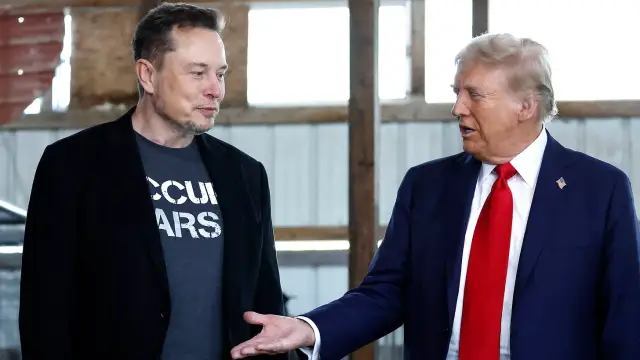 Washington Post, Investigation: Elon Musk put $277 million into the election. He’s $200 billion richer this year, Faiz Siddiqui and Trisha Thadani, Dec. 16, 2024 (print ed.). Elon Musk’s net worth has climbed by more than $200 billion in 2024, a massive increase in the same year that the world’s richest person spent at least $277 million backing Donald Trump and other Republican candidates.
Trump’s election sent stock in electric automaker Tesla, a company central to Musk’s wealth and where he is CEO, soaring. Shares were trading at prices around 70 percent higher on Friday than on Election Day.
As of Friday, Musk’s fortune was about $442 billion, according to the Bloomberg Billionaires Index. That estimate includes a pay package from Tesla worth more than $50 billion that is held up in court after a Delaware judge ruled to strike it down in January and upheld her decision this month. Tesla has pledged to appeal.
Trump has indicated he will be friendly to businesses and investors of all kinds when he returns to office. Musk’s empire is poised to especially benefit from the president-elect’s promised cuts to regulation — and potentially also overt favors to the tech billionaire, who has become a loyal political lieutenant.
Trump picked Musk to co-chair a nongovernmental advisory group on cuts to federal spending and regulation known as the “Department of Government Efficiency,” or DOGE, potentially allowing the tech entrepreneur to shape policies that affect his businesses. Musk did not respond to a request for comment.
“Elon Musk is a once in a generation business leader and our federal bureaucracy will certainly benefit from his ideas and efficiency,” said Brian Hughes, a spokesman for the Trump-Vance Transition. He described Musk and Trump as “great friends and brilliant leaders working together to Make America Great Again.”
Musk launched his entrepreneurial career in 1995 when he abandoned a graduate program at Stanford to found a start-up later called Zip2 that created online city guides. It was sold for about $300 million in 1999.
He went on to co-found an online banking company, X.com, that merged with another start-up to create PayPal. Auction site eBay acquired PayPal in 2002 for $1.5 billion.
Proof, Investigative Commentary: The Truth About Musk, From His Biographer, Seth Abramson, left, best-selling author, attorney, former journalism professor, Dec. 14, 2024. A viral Bluesky thread introduced tens of  thousands around the world to a first glimpse of a forthcoming biography of Elon Musk. Here—in a single essay—is some of what the world just learned.
 Elon Musk may be an unelected plutocrat, but in six weeks he’ll become co-President of the United States. Unfortunately, many people around the world are only just now beginning to research who Musk really is—not the mythos he spent decades carefully weaving about himself like a cloak, but the hard realities that define the actual man.
Most of what people think they know about Elon Musk is manifestly false. This essay, written by an Elon Musk biographer and based on OSINT research, reveals the truth—or at least a significant part of it. Rest assured that none of what remains is any better.
I’ve been a Musk biographer for two years now. In that time I’ve published hundreds and hundreds of pages of professionally researched content about the man—well over a book’s worth—here at Proof, an independent media outlet at Substack that ranks as a Top 25 U.S. Politics substack worldwide.
The longest report that I’ve published about Elon Musk so far is March 28. It’s a novella in and of itself, despite being just one of many fully sourced reports on Musk authored by a bestselling historian and biographer whose focus before now was the political career—and political scandals—of Donald Trump.
As you will soon see, the parallels between the lives of Trump and Musk are jarring.
Recent Relevant Headlines
 New York Times, Opinion: Crony Capitalism Is Coming to America, Paul Krugman
- New York Times, Trump Tax Cuts Won’t Help the Economy Grow, Budget Office Finds
- The Hill, Powell calls for ‘change’ in ‘unsustainable’ fiscal path
- New York Times, A Potential Fight Over the Fed’s Future Ramps Up
- Washington Post, Investigation: Elon Musk put $277 million into the election. He’s $200 billion richer this year, Faiz Siddiqui and Trisha Thadani
- Proof, Investigative Commentary: The Truth About Musk, From His Biographer, Seth Abramson
- Politico, Tech billionaires prepare to invade the Pentagon
- New York Times, Trump’s Suit Over Iowa Poll Is His Latest Action Against News Media
- The Bulwark, Political Opinion: It’s the Silent Surrenders That Should Scare You, Andrew Egger
- New York Times, Musk and SpaceX Face Reviews After Violations of Security Reporting Rules
- New York Times, Jeff Bezos Prepares to Close the Gap in Space Race With Elon Musk
- New York Times, ABC to Pay $15 Million to Settle a Defamation Suit Brought by Trump
- New York Times, Trump and His Picks Threaten More Lawsuits Over Critical Coverage, David Enrich
- Meidas Touch Network, Commentary on Legal AF,: Bye Bye George Stephanopoulos… You Sold Out!, Ben Meiselas
- New York Times, In Display of Fealty, Tech Industry Curries Favor With Trump
Trump Transition News, Commentary

Mother Jones Magazine, Donald Trump Will Need a Police State to Implement His Agenda,  David Corn, right, Dec. 16, 2024. It’s going to get very ugly.
"Mr. Smith, please come in, have a seat. Our records show you’ve been with the State Department for 17 years, the past five in the Bureau of National Security and Nonproliferation. Now it has come to our attention through an anonymous tip to the America First Compliance Program that you made a derogatory comment about the president. A subsequent internal investigation discovered your wife donated $125 to Hillary Clinton’s 2016 campaign. Through further inquiry—with the assistance of the TrumpX social media team—we located a deleted post from your daughter’s timeline that included a photograph of her and your wife knocking on doors in west Philadelphia for Kamala Harris. Under the new Loyal Americans in Government executive order, we are terminating your employment as of this moment. As you might know, your position has been reclassified and no longer enjoys the civil service protections of the past. There is no right of appeal. My secretary will provide you the separation paperwork. You may leave now."
Donald Trump has many plans for his return engagement at the White House. Several will require police-state tactics.
During his 2024 campaign, Trump repeatedly and enthusiastically declared he would order the mass deportation of 11 million or so undocumented immigrants. At his rallies, diehard fans excitedly waved signs proclaiming the slogan they chanted: “MASS DEPORTATION NOW!” Such a program would require deploying a paramilitary force—or even the National Guard or the military—to locate migrants, apprehend them, and guard them in a network of prisons and detention camps. (Executives at private prison, security, and surveillance software companies are already salivating.) This system would depend on Trump ramping up monitoring of workplaces and neighborhoods, and on anonymous tip lines susceptible to abuse and false leads. (Have a problem with a neighbor? Report ’em.) Perhaps the forces rounding up migrants will be afforded special powers to evade civil liberties protections. As in East Germany during the Cold War, an atmosphere of terror and intimidation will pervade.
Expect something similar within the federal workforce. Months before he left office at the end of his first term, Trump issued an executive order that would have removed employment protections from civil servants deemed disloyal to the president and that could have required expressions of allegiance before being hired—in other words, loyalty oaths for Trump. The order created a new employment category called Schedule F, to be applied to perhaps tens of thousands of federal workers (maybe more), permitting them to be fired without cause. President Joe Biden rescinded the order upon entering the White House and, in October, his administration issued final rules aimed at preventing a future president from reinstating it. But Trump has vowed to bring the plan back on “day one” and turn a large section of the federal workforce into a Trump corps—a stated goal of Steve Bannon and other MAGA schemers.
 Reviving Schedule F, Rep. Gerry Connolly (D-Va.), right, has warned, would be a “direct threat to our national security and our government’s ability to function.” Under such a regime, a broad range of federal employees—say, lawyers at the EPA who work on climate change, scientists at the CDC who prepare for pandemics, or analysts at the CIA who watch the Kremlin—could be dumped at will if they raise questions about a Trump position or don’t pay him obeisance. And the threat of a pink slip would not only silence dissent; it could be used to press government employees to take inappropriate actions—maybe jigger statistics to make Trump’s economic policies look good, or slow-walk disaster aid destined for blue states.
Independent, fact-based, and expertise-driven work across the executive branch would be threatened. Picture a world in which ratting on colleagues is encouraged and snitches roam the hallways of federal agencies looking for signs of disloyalty to Trump. The federal bureaucracy will become a frightening place for many public servants, likely triggering an immense brain drain.
There could be pressure to award government contracts, impose or lift regulations, or conduct investigations based on Trump’s lists of friends and foes. With this power, Trump would be able to threaten corporations, organizations, and people who piss him off. He could sic the IRS on them. He could order the imposition of tariffs to hinder specific firms and sectors. Most notably, Trump could instruct FBI agents and Justice Department prosecutors to investigate his rivals, even when there is no legitimate case. In the past, he has called for initiating criminal probes against Joe Biden, Alvin Bragg, Liz Cheney, Hillary Clinton, James Comey, Kamala Harris, Letitia James, Barack Obama, Nancy Pelosi, and many others. Were he to demand such investigations, it would turn the Justice Department into an agency of retribution, serving Trump’s revenge fantasies and shifting resources from legitimate endeavors. That would be good news for real criminals.
And what of the agencies that Congress has long intended to be insulated from presidential interference? The infamous Project 2025 policy blueprint—expected to be the basis of many Trump actions—calls for ending the independence of these powerful and important regulators, including the Securities and Exchange Commission, the Federal Communications Commission, and the Federal Trade Commission. The Supreme Court would probably need to okay such a bold expansion of presidential power, but conservative groups recently took one challenge designed to provoke such a decision all the way to the high court. While the justices this past October declined—for now—to hear the case, Trump and his allies have mused about seizing control of these bodies, and Trump has openly discussed using the FCC to punish troublesome newscasters by pulling broadcasting licenses.
There are protections against spying on Americans. But with the Supreme Court ruling a president has wide-ranging immunity, what’s to stop him?
The military, too, might not be immune. In mid-November, the news leaked that Trump advisers were weighing an executive order that would create a “warrior board” of former senior military personnel to vet three- and four-star officers and recommend removals of any deemed unfit for leadership. Such a board would permit Trump to purge the military of leaders tied to DEI programs—whom he previously assailed as “woke generals”—or those he deems to be insufficiently devoted to him, creating a chilling effect throughout the Pentagon.
And there’s another way the military could be politicized. Trump allies have urged the revival of the Insurrection Act, which permits a president to use the military “to suppress, in a State, any insurrection, domestic violence, unlawful combination, or conspiracy.” Trump loyalists have claimed he could declare undocumented migrants an invading army and set the military upon them.
Politico, The Catholics in Trump’s administration could take GOP in whole new direction, Megan Messerly, Dec. 16, 2024 (print ed.). The president-elect has nominated at least a dozen Catholics to top positions.
Joe Biden will leave the White House in January as only the second Catholic to occupy it. But a number of Catholics are expected to soon fill the ranks of Donald Trump’s administration.
Trump, who was raised as a Presbyterian but now considers himself non-denominational, has nominated at least a dozen Catholics to top positions in his administration, including his own vice president JD Vance, left, a Catholic convert, and Robert F. Kennedy Jr., right,  his pick for Health and Human Services Secretary.
Their faith could play a direct role in shaping public policy, from pro-union policies and new tariffs to expanding the child  tax credit and more tightly regulating the food and drug industries — and also help carve a new path forward for the Republican Party.
In interviews, several conservative practicing Catholic leaders said they see a close alignment between many of Trump’s second-term policy priorities and a conservative read of Catholic social teaching, which goes far beyond abortion. It’s also focused on promoting marriage and having children, giving parents wide discretion on everything from school content to health care and empowering non-governmental institutions like churches and nonprofit organizations for social support.
“No one’s walking into the administration ready to mount a crusade or anything,” said Rachel Bovard, vice president of programs at the Conservative Partnership Institute, a Trump-aligned think tank. But “there’s a very specific sort of Catholic paradigm that you may begin to see.”
It comes after decades of influence of a more individualistic evangelical Protestantism on the Republican Party that, among other things, strongly embraced individual liberty and free market capitalism.
“The market is not an end unto itself. The market has a purpose — and that is to create a free and flourishing society. If the family is not doing well, society is not doing well. We need to make sure our public policy is helping family to function,” Bovard added.
A spokesperson for the Trump transition did not respond to a request for comment.
In his nearly decade of political prominence, Trump has already dramatically reshaped the GOP, and it’s clear that the Republican Party’s future likely won’t be found in Ronald Reagan’s three-legged stool of conservatism, which was fiscally conservative, socially conservative and hawkish.
Where Republicans have long been skeptical of government intervention, some in the party increasingly see the government as a tool to reshape social policy. Republicans who long embraced “pro-life” policies, like restricting abortion access and supporting crisis pregnancy centers, are now leaning into a broader set of what they call pro-family policies that range from tax policies encouraging people to get married and have children to restrictions on kids accessing online porn. They are also now starting to turn a skeptical eye toward big businesses, including Big Pharma, Big Ag and Big Tech.
New York Times, News Analysis: Why Wray’s Resignation May Signal a Shift in F.B.I. Tradition, Devlin Barrett, Dec. 13, 2024 (print ed.). Mr. Wray’s voluntary departure could usher  in a new era at the nation’s premier law enforcement agency, one in which the job of director changes with the administration.
Christopher A. Wray, right, had considered resigning as F.B.I. director before. More than once, confronted with angry demands from President Donald J. Trump and his allies, he contemplated calling it quits.
When Mr. Wray on Wednesday announced his intent to do so, it was because he believed staying on the job into a second Trump term risked significant disruptions to the work force and its mission.
 Mr. Trump had already declared his plan to replace him with Kash Patel, a tough-talking loyalist who has vowed to force out bureau leaders and empty its Washington headquarters.
In conceding to the reality of raw power, Mr. Wray’s voluntary departure could usher in a new era at the nation’s premier law enforcement agency, one in which the job of director is more of a political post that changes with the administration.
For decades, F.B.I. directors have been appointed to 10-year terms to insulate them from the shifting winds of politics. Few F.B.I. directors stay a full decade, and the circumstances of Mr. Wray’s departure after seven years suggest that insulation has worn thin.
Washington Post, Trump eyes privatizing U.S. Postal Service, citing financial losses, Jacob Bogage, Jacqueline Alemany and Jeff Stein, Dec. 14, 2024 Trump feuded with the mail agency in his first term. Privatizing it could shake up consumer shipping and business supply chains.
 President-elect Donald Trump has expressed a keen interest in privatizing the U.S. Postal Service in recent weeks, three people with knowledge of the matter said, a move that could shake up consumer shipping and business supply chains and push hundreds of thousands of federal workers out of the government.
Trump has discussed his desire to overhaul the Postal Service at his Mar-a-Lago estate with Howard Lutnick, his pick for commerce secretary and the co-chair of his presidential transition, the people said. Earlier this month, Trump also convened a group of transition officials to ask for their views on privatizing the agency, one of the people said.
Trump’s specific plans for overhauling the Postal Service were not immediately clear. But he feuded with the nation’s mail carrier as president in 2019, trying to force it to hand over key functions — including rate-setting, personnel decisions, labor relations and managing relationships with its largest clients — to the Treasury Department.

New York Times, Devin Nunes, Pugnacious Trump Loyalist, to Lead Espionage Advisory Board, Charlie Savage, Dec. 15, 2024 (print ed.). As chair of the House Intelligence Committee (shown above), he attacked the Russia inquiry and Donald J. Trump’s first impeachment. Now, Mr. Nunes runs Mr. Trump’s social media company.
President-elect Donald J. Trump announced on Saturday that he would appoint Devin Nunes, a former member of Congresswho had used his role as chairman of the House Intelligence Committee to try to delegitimize the Trump-Russia investigation, to head an independent advisory board on espionage policy.
The organization — the President’s Intelligence Advisory Board — dates back to the early Cold War and consists of private citizens with top-level security clearances who are supposed to help the White House analyze spy agency effectiveness and planning. Its members do not need Senate confirmation, so presidents can pick whomever they want for it.
In a statement, Mr. Trump praised Mr. Nunes — who is currently the chief executive of the Trump Media & Technology Group, which runs the Truth Social platform — for his counterinvestigation into the Trump-Russia inquiry in 2017-18, when Mr. Nunes led the House Intelligence Committee as a Republican congressman from California.
“While continuing his leadership of Trump Media & Technology Group, Devin will draw on his experience as former chairman of the House Intelligence Committee, and his key role in exposing the Russia, Russia, Russia Hoax, to provide me with independent assessments of the effectiveness and propriety of the U.S. Intelligence Community’s activities,” Mr. Trump wrote in his announcement.
New York Times, Trump Names Richard Grenell for ‘Special Missions’ Role, Elizabeth Williamson, Dec. 15, 2024 (print ed.). A combative loyalist and the president-elect’s former ambassador to Germany, Mr. Grenell had hoped to be secretary of state.
 President-elect Donald J. Trump named Richard Grenell, his former ambassador to Germany and former acting director of national intelligence, as his “envoy for special missions,” Mr. Trump wrote on his Truth Social platform on Saturday.
A loyalist known for unbridled social media attacks on Mr. Trump’s perceived critics and many others, Mr. Grenell led a shambolic effort to challenge the 2020 election results in Nevada after Mr. Trump’s loss, and he has lobbied assiduously for a diplomatic job in the new administration.
He got his start in government before Mr. Trump’s rise, as a spokesman for the U.S. mission to the United Nations under multiple presidents. But his online toxicity, foreign business contacts and tendency toward biting personal attacks on political opponents and the media turned off many centrist conservatives, helping propel him toward Mr. Trump, a man he denounced in 2016 as “dangerous.”
“Ric will continue to fight for Peace through Strength, and always put AMERICA FIRST,” Mr. Trump wrote in his announcement.
Mr. Grenell did not immediately reply to a texted question about his priorities for the role, which does not currently exist. Mr. Trump outlined it as: “Ric will work in some of the hottest spots around the World, including Venezuela and North Korea.”
The role is a far cry from secretary of state, the job Mr. Grenell coveted, but to which Mr. Trump plans to appoint Senator Marco Rubio, the Republican from Florida. Being named for a lower-profile White House envoy job could help Mr. Grenell avoid persistent questions about his paid work for foreign clients, including luxury hotel development projects he has pursued in the Balkans with Jared Kushner, the president-elect’s son-in-law.
During the first Trump administration, Mr. Grenell was ambassador to Germany. His abrasiveness and partisanship alarmed diplomats on both sides of the Atlantic, particularly after he told Breitbart London that he planned to “empower” German conservatives opposing “the failed policies of the left.”
In 2020, Mr. Trump named Mr. Grenell to temporarily replace the acting director of national intelligence, Joseph Maguire, whom Mr. Trump had fired.
New York Times, In Display of Fealty, Tech Industry Curries Favor With Trump, Theodore Schleifer and David Yaffe-Bellany, Dec. 15, 2024 (print ed.). It was a week of frenzied activity as Silicon Valley billionaires and their companies brandished checks and compliments for President-elect Trump.
The $1 million donations came gradually — and then all at once.
Meta. Amazon. OpenAI’s Sam Altman. Each of these Silicon Valley companies or their leaders promised to support President-elect Donald J. Trump’s inaugural committee with seven-figure checks over the past week, often accompanied by a pilgrimage to Mar-a-Lago to bend the knee.
The procession of tech leaders who traveled to hobnob with Mr. Trump face-to-face included Sundar Pichai, Google’s chief executive, and Sergey Brin, a Google founder, who together dined with Mr. Trump on Thursday. Tim Cook, Apple’s chief executive, shared a meal with Mr. Trump on Friday. And Jeff Bezos, the founder of Amazon, planned to meet with Mr. Trump in the next few days.
This was the week when many tech companies and their top executives, as reluctant as they may have been, acknowledged the reality of getting business done in Mr. Trump’s Washington. With their donations, visits and comments, they joined a party that has already raged for a month, as a cohort of influential Silicon Valley billionaires, led by Elon Musk, began running parts of Mr. Trump’s transition after endorsing him in the campaign.
While businesses frequently try to get on an incoming president’s good side, the frenzy of tech activity stood out from other industries. Until President Obama’s administration, the tech industry had largely stayed aloof from politics. Some wrote just small checks for Mr. Trump’s first inauguration.
New York Times, Trump’s Night-Owl Tendencies Set Stage for After-Hours Diplomacy, Michael D. Shear,.Dec. 15, 2024 (print ed.). At Mar-a-Lago, President-elect Trump has been hosting diplomatic dinners, announcing cabinet picks and texting his aides — all after the sun goes down.
It was past midnight in Florida this week when President-elect Donald J. Trump decided to mock Justin Trudeau on social media, calling the prime minister of America’s neighbor the “governor” of “the Great State of Canada.”
The middle-of-the-night jest was the latest reminder that Mr. Trump, a well-known night owl, seems to rev up after the sun goes down. He has been the president-elect (again) for 37 days, but he has been most active in the evenings, hosting lavish dinners, announcing nominations and firing off texts to his aides.
Of the more than 80 personnel announcements Mr. Trump has made since Election Day, 45 have been announced in social media posts and emails that he has sent after 6 p.m. Many have come after 10 p.m., prompting a wave of social media chatter and television coverage that sometimes continues throughout the night and into the early morning hours.
Recent Relevant Headlines
- New York Times, A Constitutional Convention? Some Democrats Fear It’s Coming
- New York Times, Trump Says He Would Consider Pardoning Eric Adams
- New York Times, Trump Hails a SoftBank Investment That Echoes 2016
- Politico, Tech billionaires prepare to invade the Pentagon
- The Bulwark, Political Opinion: The Real Scandal of Our Media Tycoons, Bill Kristol & Andrew Egger
- Politico, The Catholics in Trump’s administration could take GOP in whole new direction
- New York Times, Devin Nunes, Pugnacious Trump Loyalist, to Lead Espionage Advisory Board
- New York Times, Trump Names Richard Grenell for ‘Special Missions’ Role
- Washington Post, Trump eyes privatizing U.S. Postal Service, citing financial losses
- New York Times, Why Democrats Lost More Seats in Vermont Than Any Other State
- New York Times, Trump’s Night-Owl Tendencies Set Stage for After-Hours Diplomacy
Trump's Cases, Allies, Vengence, Threats

New York Times, Trump’s Suit Over Iowa Poll Is His Latest Action Against News Media, Zolan Kanno-Youngs, Maggie Haberman, David Enrich and Alan Feuer, Dec. 18, 2024 (print ed.). Donald J. Trump sued The Des Moines Register for running a poll before the election that showed him trailing Vice President Kamala Harris, escalating his threats to seek retribution against the mainstream media and his political enemies.
Mr. Trump has long said that people he claims have wronged him should be prosecuted, including President Biden and his family; Jack Smith, the special counsel who charged Mr. Trump with trying to overturn the 2020 election and mishandling classified documents; and Liz Cheney, the former representative from Wyoming who helped lead the House investigation into Mr. Trump’s efforts to cling to power in 2020.
In recent months, he has filed various legal actions against the media that amount to a warning shot about what sort of retaliation journalists, in particular, might face.
As he prepares to take office again, Mr. Trump will have at his disposal the levers of government, a Republican Party that is more pliant than it was four years ago and a well-funded external political apparatus.
“It’s clear that Trump is waging war on the press,” said Samantha Barbas, a professor at the University of Iowa College of Law whose book, “Actual Malice,” is about the Supreme Court’s most famous defamation case. “Trump and his lawyers are going to use any legal claim that they think has a chance of sticking. They’ll cast a wide net to carry out this vendetta.”
Ms. Barbas added that prevailing in court may be beside the point. The lawsuits “are not so much geared toward winning as much as threatening,” she said.
Many of Mr. Trump’s lawsuits go nowhere, including one that accused Hillary Clinton and a group of other Democrats of being part of a racketeering conspiracy against him. That particular suit resulted in nearly $1 million in fines issued by the judge against Mr. Trump’s lawyer.

Lance's Substack, Political Commentary and Opinion: Why Biden must issue Sweeping Preemptive pardons For Trump Retribution Targets, Lance F. Rosen,  right, Dec. 15, 2024. Kash Patel Is A Lunatic.
This MSNBC article by author and writer Jay Michaelson makes a strong case for Biden to carry out sweeping pre-emptive pardons to protect those targeted for revenge prosecutions by Trump and his incoming "Himmler," Kash Patel, left.
The counterarguments by legalists, MAGA fascists and several Biden-bashing liberal media pundits are fairly well refuted, and in fact shown to be bogus in each example.
Americans by and large are letting their fears affect their judgment, and are either blocking out the Trump/Patel threat to our constitutional system and targeted individuals, or have resigned themselves to it and are retreating into a psychological bunker mentality.
The only remedy is effective political action. Throwing junk memes up against your Facebook wall is no solution and represents a net negative as far as wasted time and energy. Facebook is part of the apparatus which will be deployed to identify us and pick us off, one by one. Be clear that this is a devolving Orwellian type of platform designed to neutralize Trump's political opposition.
I should not have to make this case. You all saw what Facebook did with their algorithm to spike most of the posts about Project 2025 when that became the leading issue in the campaign. And of course it was soon determined that the corporate figure who designed that algorithm in charge of so-called “community guidelines” was a Trump guy.
 And now you have Zuckerberg crawling to Mar-a-Lago to kiss Trump's bone spurs, then funding his inaugural to the tune of 1 million, with who knows what other kinds of backroom deals were struck to keep Trump off his back. Same with Bezos.
My days here are numbered. You also saw this week that my page was hijacked and I lost all but a handful of my 1400 readers. My wife posted a notice on my timeline to notify everyone that I have a new page, and how to find it. That message was removed, either by Facebook or the hijacker.
So this place is a dead end for those resisting the regime. That is where we are. I'm taking steps this weekend to backup and safeguard my Substack archive of a 1000 articles going back six years. Others who are writers and posters should consider taking similar steps to preserve their data.
Don't block on this, we are headed into dark territory.

Former President Donald J. Trump, in a blue suit, sits with his attorneys shortly before arraignment in New York City's state court on 34 felony charges of falsifying business records related to the 2016 presidential campaign season, reportedly involving in part hush money to women ((Associated Press photo by Seth Wong). Below, the presiding judge in the case was Juan Merchon, below left.

New York Times, Judge Denies Trump’s Bid to Throw Out Conviction Over Immunity Ruling, Ben Protess and Kate Christobek, Dec. 16, 2024. Justice Juan Merchan thwarted one of several attempts by President-elect Trump to clear his record of 34 felonies before returning to the White House.
A judge on Monday rejected Donald J. Trump’s argument that a recent Supreme Court ruling had nullified his criminal case in New York, upholding the former and future president’s felony conviction for falsifying records to cover up a sex scandal.
The judge’s ruling preserves, at least for now, the stain of Mr. Trump’s criminal conviction. And if the decision withstands an appeal, Mr. Trump could become the first felon to serve as president.
The ruling, which addressed the Supreme Court’s decision to grant presidents broad immunity for their official actions, thwarted only the first of several legal maneuvers Mr. Trump has concocted to clear his record of 34 felonies before returning to the White House.
Prosecutors had argued that the Supreme Court’s decision had “no bearing on this prosecution,” noting that Mr. Trump was convicted of orchestrating a scheme involving a personal and political crisis that predated his presidency.
But Mr. Trump’s lawyers seized on a particularly contentious portion of the high court’s ruling, which prohibited prosecutors from introducing evidence involving a president’s official acts even in a case about private misconduct. They argued that testimony from former White House employees had contaminated the verdict.
In the first significant interpretation of that polarizing opinion, the New York judge who oversaw the trial sided with prosecutors, concluding that the testimony centered on Mr. Trump’s unofficial conduct.
“The People’s use of these acts as evidence of the decidedly personal acts of falsifying business records poses no danger of intrusion on the authority and function of the executive branch,” the judge, Juan M. Merchan, wrote in a 41-page decision.
And even if the evidence was “admitted in error, such error was harmless,” he added, noting the “overwhelming evidence of guilt” introduced at trial.
A spokesman for Mr. Trump, Steven Cheung, criticized the ruling, calling it “a direct violation of the Supreme Court’s decision on immunity.”

Manhattan District Attorney Alvin Bragg speaks during a press conference to discuss his indictment of former President Donald Trump, outside the Manhattan Federal Court in New York on April 4, 2023 (Angela Weiss photo via AFP, Getty Images and TNS).

Porn star Stormy Daniels and former President Donald J. Trump, who allegedly hid hush payments to her via The National Enquirer newspaper during the 2016 presidential campaign to hide their affair from election finance officials and the public.
Politico Magazine, Opinion: You Should Worry About Kash Patel Running the FBI, Ankush Khardori, Dec. 14, 2024. The days of J. Edgar Hoover may be over, but Patel’s nomination is deeply worrisome all the same.t national legal affairs and the political dimensions of the law at a moment when the two are inextricably linked.
Some key pieces appear to be snapping neatly into place for Donald Trump’s much-feared prosecutorial revenge tour as the year draws to a close.
Trump’s new nominee to lead the Justice Department, Pam Bondi, is a staunch loyalist who predicted last year that after Trump’s reelection, “the prosecutors will be prosecuted — the bad ones.” Trump told NBC News that the members of the Jan. 6 committee should “go to jail” (even as he claimed that he would not direct his appointees to prosecute them). And his plan to install Kash Patel, right, as FBI director was made easier after Christopher Wray, himself a Trump appointee, announced he would resign despite having more than two years left on his term.
Trump’s decision to nominate Patel has proven particularly controversial, since his principal qualification appears to be his sycophancy toward Trump. (A Trump transition spokesperson said, “Kash Patel has served in key national security positions throughout the government. He is beyond qualified to lead the FBI and will make a fantastic director.”)
Many observers, including former federal law enforcement officials, oppose Patel’s nomination on the grounds that he would likely use the FBI to pursue Trump’s political opponents and that he might substantially corrupt the culture and professionalism of the bureau. To some, Patel calls to mind the specter of J. Edgar Hoover, the infamous FBI director whose nearly 50-year stint running the agency until 1972 was marked by egregious abuses of power — including illegal surveillance, blackmail and the harassment of political dissidents.
Patel clearly lacks the qualifications, experience and temperament to lead the agency. But how worried should the American public really be about him at the helm of the FBI?
The truth is that there are stronger internal and external safeguards in place against law enforcement abuses than during the Hoover era. He will indeed face some constraints because of the culture and bureaucracy of the FBI. But they may not contain him. And he will have plenty of opportunity to damage the bureau and its work — and to use and abuse the FBI for political ends. His nomination poses a considerable and unjustifiable risk to the country.
New York Times, Young Republicans Gather, Ready to Make America Vengeful Again, Shawn McCreesh, Dec. 17, 2024 (print ed.). At a gala on Wall Street for the New York Young Republican Club, attendees were looking forward to retribution from the next Trump era, and musing on another run in 2028. Late Sunday night, in a banquet hall inside the grand old Merchants’ Exchange building on Wall Street, the Republican operative Stephen K. Bannon was putting on one of his over-the-top, apocalyptic performances.
It was the annual gala hosted by the New York Young Republican Club — prom for pro-Trump provocateurs — and Mr. Bannon, 71, was the keynote speaker. Standing onstage, beneath soaring Corinthian columns and a vaulted ceiling, he looked out upon a sea of baby-faced acolytes in black tie and outlined the way forward for them and for the Trump restoration.
Donald J. Trump “is a leader of all the people,” Mr. Bannon said. “He’s got a kind heart and big soul. But that’s not us, right? We want retribution. And we’re going to get retribution.” The Young Republicans cheered.
Mr. Bannon added: “I don’t know, maybe we do it again in ’28. Are you guys down for that? Trump ’28? Come on, man!” And they all roared some more.
Asked later if he thought Mr. Bannon was being serious about Mr. Trump making an unconstitutional run for a third term in 2028, the club’s 30-year-old leader, Gavin Wax, waved it off. “I think that was more of a light-handed remark to make fun and be a little jovial, but let’s focus on these four years and making the best of it,” he said.
That’s often how it goes with this crowd of Trump true believers. Like the man himself, they say outrageous things, and nobody knows how seriously to take them. They often don’t even seem to know how seriously to take themselves.

New York Times, Trump Transition: F.B.I. Director to Step Down, Adam Goldman and Devlin Barrett, Dec. 12, 2024 (print ed.). Wray told F.B.I. employees he wanted to keep the focus on the bureau’s work.
The F.B.I. director, Christopher A. Wray, right, told bureau employees on Wednesday that he intended in January, bowing to the reality that President-elect Donald J. Trump had publicly declared his desire to replace him.
Mr. Wray made the disclosure while addressing employees Wednesday afternoon, according to two people familiar with the meeting. Mr. Wray added that he wanted to keep the focus on the bureau’s work.
 The announcement comes after Mr. Trump said in late November that he intended to nominate Kash Patel, a longtime loyalist, to run the F.B.I., and more than two years before Mr. Wray’s 10-year term would have expired.
Over more than seven years, Mr. Wray oversaw one of the most consequential and tumultuous periods in the bureau’s history, juggling high-profile criminal investigations of political figures, heated congressional inquiries and two attempted assassinations of Mr. Trump.
Even as he fended off Mr. Trump’s relentless criticisms of the F.B.I., Mr. Wray supervised a wide array of national security issues that included terrorism, escalating cyberattacks and threats from geopolitical rivals like China, Iran and Russia. He also had to grapple with a spate of mass shootings and the rise of right-wing extremism while managing an agency with 35,000 employees and a budget of more than $10 billion.
 But it was the bureau’s scrutiny of Mr. Trump that almost certainly cut short Mr. Wray’s tenure.
His F.B.I. repeatedly investigated Mr. Trump, including by searching the president-elect’s Mar-a-Lago estate in 2022 for classified documents, examining his widespread efforts to overturn the results of the 2020 election and delving into the possible links between his 2016 campaign and Russian intelligence operatives engaged in election interference.
“He invaded Mar-a-Lago,” Mr. Trump told NBC News in an interview broadcast on Sunday. “I’m very unhappy with the things he’s done.”
Under Mr. Wray’s watch, agents also investigated the current president, Joseph R. Biden Jr., over his handling of sensitive records after he left the vice presidency. They undertook several other politically charged cases that made the agency the subject of sharp partisan scrutiny, including its inquiry into Hunter Biden.
In the face of intense political cajoling, second-guessing and condemnation, Mr. Wray frequently urged his agents to “keep calm and tackle hard,” and preached a strict adherence to the investigative process that has been the agency’s calling card for decades.
His apparent successor could not be more different. Mr. Patel, a former federal prosecutor and public defender, is a fierce critic of the F.B.I. and has vowed to fire its leadership, empty its headquarters and root out the president-elect’s perceived enemies in what he calls the “deep state.”
“If Kash gets in, he’ll be taking somebody’s place, and that somebody is the man you’re talking about,” Mr. Trump said in the interview with NBC News, referring to Mr. Wray.
Mr. Wray became the bureau’s eighth director in August 2017, after Mr. Trump fired James B. Comey from the job in 2017 in the middle of the Russia investigation.
At the start, Mr. Trump called Mr. Wray “a man of impeccable credentials.” But the president quickly soured on him.
Mr. Wray withstood extraordinary pressure from Mr. Trump to leverage the powers of law enforcement to damage his perceived enemies and later to play down the threats of right-wing violent extremism and Russian election interference.
The rift between the men grew as Mr. Wray waved off false claims the president peddled about voter fraud and left-wing extremists. His tenure became increasingly tenuous after William P. Barr resigned as attorney general in December 2020, in part because he had fallen out of favor with the president. Mr. Barr was said to have argued against firing the F.B.I. director, shielding Mr. Wray from Mr. Trump’s fury.
Mr. Trump’s allies also took aim at Mr. Wray, faulting him for not speaking out vociferously against the Russia investigation or the botched wiretap of a former Trump campaign adviser.
During the 2024 campaign, Mr. Trump publicly declared that Mr. Wray should resign, and it was clear his antipathy had only intensified, partly because of the 2022 search of his Florida home.
After an assassination attempt in July at a rally in Butler, Pa., Mr. Trump lashed out at the F.B.I. because the bureau did not definitively say he had been shot in the ear.
“No wonder the once storied F.B.I. has lost the confidence of America!” Mr. Trump wrote on social media.
In leaving before Mr. Trump is sworn in, Mr. Wray may avoid the kind of public standoff that marked some firings during the first Trump administration.  But the turbulence at the F.B.I. is all but certain to continue if Mr. Patel, right (and author of the book Government Gangsters, shown at left, is confirmed and Mr. Trump tries to make sweeping changes at the agency.
Mr. Trump has vowed to investigate and possibly prosecute his perceived enemies, whom he accuses of unfairly prosecuting him. He has also called for investigations of prosecutors, judges and politicians.
In his first term, Mr. Trump sought to weigh in on F.B.I. operations and at times expressed frustration that presidents typically stayed out of the bureau’s business.
“I am not supposed to be involved with the F.B.I.,” Mr. Trump said in 2017. “I’m not supposed to be doing the kind of things that I would love to be doing. And I’m very frustrated by it.”
Relevant Recent Headlines
- New York Times, Amid Rumors of a Breakup, Kimberly Guilfoyle Is Appointed Ambassador to Greece, Jesse McKinley
- New York Times, Musk’s Foundation Gave Away Less Money Than Required in 2023
- New York Times, Trump’s Choice to Run Energy Says Fossil Fuels Are Virtuous
- New York Times, Health Insurance Workers Fearful Amid Public Anger After Slaying of C.E.O.
- The Bulwark, Political Opinion: Trump World’s Confirmation Playbook: Speak Loudly and Unleash the MAGA Dogs, Marc A. Caputo
 Deadline, Donald Trump, On ‘Meet The Press,’ Again Pledges To Pardon January 6th Rioters, Says Liz Cheney And Other Committee Members “Should Go To Jail
- New York Times, Political Opinion:Threatened With Jail, Cheney Condemns Trump’s ‘Assault on the Rule of Law'
- Politico, Transition of Power: Adam Kinzinger: I’m not afraid of Trump’s jail threats
More On Health Care Exec's Murder
New York Times, Suspect in C.E.O.’s Killing Withdrew From a Life of Privilege and Promise, Corey Kilgannon, Mike Baker, Luke Broadwater and Shawn Hubler, Dec. 10, 2024 (print ed.). Luigi Mangione, above, charged in the death of an executive in New York, was an Ivy League graduate who had recently suffered physical and psychological pain.
Luigi Mangione, the online version of him, was an Ivy League tech enthusiast who flaunted his tanned, chiseled looks in beach photos and party pictures with blue-blazered frat buddies.
He was the valedictorian of a prestigious Baltimore prep school who earned bachelor’s and master’s degrees at the University of Pennsylvania and served as a head counselor at a pre-college program at Stanford University.
With his credentials and connections, he could have ended up one day as an entrepreneur or the chief executive of one of his family’s thriving businesses. Instead, investigators suspect, he took a different path.
The police now believe that Mr. Mangione, 26, is the masked gunman who calmly took out a pistol equipped with a suppressor on a Midtown Manhattan street last week and assassinated Brian Thompson, the chief executive of UnitedHealthcare. He was arrested in Altoona, Pa., on Monday after an employee at a McDonald’s recognized him and called the police. Officers said they found him with fake identification, a weapon similar to the one seen in video of the killing and a manifesto decrying the health care industry.
Later on Monday, Mr. Mangione was charged in Manhattan with murder, along with additional counts of forgery and illegal weapons possession. And in the hours after his apprehension, his baffling journey from star student to murder suspect began to come into focus.
Washington Post, Person of interest in UnitedHealthcare shooting arrested in Pa., police say, Mark Berman and Shayna Jacobs, Dec. 10, 2024 (print ed.). Luigi Mangione faces gun charges and other counts. He was denied bail after his arraignment in Altoona, Pa.police commissioner, said at a news briefing.
Thompson, 50, right, the chief executive of UnitedHealthcare, was shot and killed Wednesday outside a Hilton hotel in Midtown Manhattan, a stunning act of early-morning violence in one of New York’s busiest areas.
Police said it appeared that the suspect they were seeking escaped the city shortly after the shooting. Law enforcement officials said they were scouring reams of video footage and tips, but they pleaded with the public for more help, sharing several images of a person they said was wanted in connection with the killing.
ABC News, What we know about Luigi Mangione, Ivy League grad and suspect in CEO's murder, Aaron Katersky, Mark Crudele, Josh Margolin, and Meredith Deliso, Dec. 9, 2024. Mangione, above, was located in Pennsylvania nearly a week after Brian Thompson's death.
Salon, Alleged UnitedHealthcare assassin praised Elon Musk for battle against “woke mind virus," Russell Payne, Dec, 9, 2024. Not so fast, what kind of "anti-capitalist" is praising Elon Musk and retweeting Peter Thiel?
 On Monday afternoon, police announced that they had arrested a person of interest in the investigation into the killing of UnitedHealthcare chief executive Brian Thompson, who was shot outside his hotel in midtown Manhattan last week.
According to police, Luigi Mangione was arrested around 9:15 a.m. in Altoona, Pennsylvania with a ghost gun and suppressor that New York Police Commissioner Jessica Tisch said was “consistent with the weapon used in the murder.”
Relevant Recent Headlines
- New York Times, An N.Y.P.D. Manhunt Caught a Subway Shooter. This Time, It’s Different
- New York Times, The ‘Chilling’ Fatal Shooting of a C.E.O. Has Business Leaders on Edge
- New York Times, UnitedHealthcare C.E.O. Shooting: Torrent of Anger for Health Insurance Industry Follows C.E.O.’s Killing
- Washington Post, NYPD searches for gunman after fatal shooting of UnitedHealthcare CEO
- Emptywheel, Analysis Zeynep Tufekci’s Two Blind Spots Cross at DOGE, Emptywheel (Marcy Wheeler)
 Letters from an American, Commentary: December 5, 2024 [Health Care CEO's Murder], Heather Cox Richardson
- New York Times, Torrent of Anger for Health Insurance Industry Follows C.E.O.’s Killing
- New York Times, Was Brian Thompson’s Killer a Hit Man? Unlikely, Experts Say
Public Health, Scandal, #MeToo, Trafficking, Abortion.
President-elect Donald Trump with Robert F. Kennedy Jr., Trump's nominee to become U.S. Secretary of Health and Human Services (Photo via Getty
The Bulwark, Political Opinion: Preferring Not to See, Andrew Egger, Dec. 19, 2024. Robert F. Kennedy Jr. hasn’t exactly hidden his anti-vaccine views over the years, as hundreds of hours of video footage, numerous books, and many documentaries show. And yet, on the cusp of being considered for the top health post in the country, Senate Republicans are suggesting they’re reassured Kennedy has moderated his views based on their brief, one-on-one conversations.
“I think he’s done a good job of answering a lot of the questions about his views on vaccines,” incoming Senate Majority Leader John Thune (R-S.D.) told CNN after meeting with Kennedy this week. “I think he understands the values and benefit that vaccines play and have played through the years preventing disease.”
We don’t know exactly what Thune and Kennedy discussed. (Neither party opted to fill me in, although I did ask.) But come on!
Kennedy may well have denied—as he has in public for years—that he is truly “anti-vaccine.” Like many other anti-vaxxers, Kennedy prefers to be thought of as a stickler for vaccine safety.
 But one would have to be deliberately obtuse or willingly naïve to think that Kennedy has suddenly seen the light about the benefits of vaccines. He has spent years arguing that the vaccines currently on the market are harming more people than they help. And he’s actively campaigning against their continued use, pending a brand-new regimen of placebo-controlled testing.
In one interview, Kennedy made the case against the measles vaccine by noting what a great time he had when he and his siblings caught the disease, which can have gruesome complications including brain swelling (you don’t say?), gastrointestinal issues and fever, sepsis, and septicemia.
“My 11 brothers and sisters, we all had measles and it was a great week” he said, describing the cure for measles as “chicken soup and vitamin A.”
He has declared that “the polio vaccine does not work” and argued that it in fact could be responsible for a wave of cancers “that killed many, many, many, many, many more people than polio ever did.”
In 2021, he told podcaster Alec Zeck that he tries to actively convince people not to get their kids vaccinated. “I see somebody on a hiking trail carrying a little baby and I say to him, ‘Better not to get him vaccinated.’”
Last year, he went further while speaking to podcaster Lex Fridman: “There is no vaccine that is safe and effective.”
A few months later, in a CNN appearance, he tried to clean those comments up:
"What I meant—which was a bad use of words in this—none of the vaccines that are currently on the mandated schedule for children, the 72 vaccines for children, have ever been tested in a pre-licensing safety study. What that means is that we do not know what the risk profile is for those products."
When Kennedy argues that he just wants to “test” vaccines—or when Donald Trump says, as he did last weekend, that “there are problems” surrounding pediatric vaccination and “we’re going to find out what those problems are”—what he is saying is actually quite drastic.
In the worst case, Kennedy could try to suspend authorizations of these vaccines pending the outcomes of such trials. Even if he were to leave those authorizations in place in the interim, he’d still be calling for new large-scale vaccine trials involving hundreds to thousands of participant children, half of whom would be getting saline injections instead of the shots that we’ve already known have been safe and effective for years.
Thune and his compatriots should, and probably do, know all this. It’s all just a Google search away.
But Republican senators appear enormously motivated to find their way to “yes” on Kennedy’s nomination. Trump suggested over the weekend that he could support primary challenges to those who oppose his nominees; and as I reported last week, his fervent acolytes in right-wing media are doing a lot more than suggesting.
So it’s easier for everybody involved for Kennedy to sit down with senators and paper over his clear record while they nod along. Everyone wins. Including measles.
THE FANFIC CAUCUS: Rand Paul is here to remind us things could always get stupider: “The Speaker of the House need not be a member of Congress,” the senator observed this morning. “Nothing would disrupt the swamp more than electing Elon Musk . . . not to mention the joy at seeing the collective establishment, aka ‘uniparty,’ lose their ever-lovin’ minds.”
He wasn’t the only one writing congressional-procedure fan-fiction. “Someone suggested the following plan to me,” former Rep. Matt Gaetz shared yesterday. Gaetz mused that he could show up to Congress on January 3, participate in the speaker election (“I was elected to the 119th Congress, after all”), take his oath of office, file a motion “to expose every ‘me too’ settlement paid using public funds,” and then resign in time to start his first broadcast on One America New Network. Quite the plan, if Gaetz hadn’t already resigned from the next Congress in advance!
SPEAKING OF GAETZ: Here’s news we honestly didn’t see coming: CNN reported yesterday that the House Ethics Committee secretly voted earlier this month to release its ethics report into Gaetz after all: “The report is now expected to be made public after the House’s final day of votes this year as lawmakers leave Washington for the holidays.”
It’s a remarkable and welcome about-face, given the committee initially seemed poised to sit on its own report after Gaetz resigned from Congress last month. Still, one can’t help but be a little cynical about the timing. The committee seemed more reluctant to take action that could shine light on Gaetz’s alleged misbehavior when Donald Trump wanted to make him attorney general. It then decided to go ahead and release the thing once Trump had moved on and Gaetz was on his way out of government. Shouldn’t that have been the other way around?
EVERYTHING IS GOING WELL: The now-dead continuing resolution that would have kept the government funded became a target of MAGA ire for a lot of fuzzy reasons, but maybe the silliest was that it would have given lawmakers their first pay raise since 2009. When a producer for Tucker Carlson accused Rep. Dan Crenshaw (R-Tex.) of “spearheading” that effort, Crenshaw blew up at him: “Yeah or maybe you’re a f—ing lying piece of s— . . . whatever gets you pathetic bottom feeders your click bait.”
This, of course, drew other MAGA influencers like moths to a flame: “Dan Crenshaw is the America-last, Ukraine-first war pig who doesn’t need a raise because of all the money he makes when he miraculously became a stock expert since joining Congress,” wrote the thought leader who goes by “Catturd.”
This all might sound pretty harsh, but don’t worry—this is actually just the process by which great legislation is made.
The Bulwark, Political Opinion: Never Trumpers Were Right, Actually, Jonathan V. Last, right, Dec. 18, 2024. A response to Bret Stephens. Plus drone talk from the  front lines.
Bret Stephens has a column today in which he renounces his Never Trump patrimony and castigates Trump critics for being overheated and wrong about so many things.
You should read his piece to get the full breadth of his argument. But I’ll give you a taste:
Never Trumpers also overstated our case and, in doing so, defeated our purpose. We warned that Trump would be a reckless president who might stumble into World War III. If anything, his foreign policy in his first term was, in practice, often cautious to a fault. We hyperventilated about his odd chumminess with Vladimir Putin. But the collusion allegations were a smear, and Trump’s Russia policy — whether it was his opposition to the Nord Stream 2 pipeline or his covert aid to Ukraine — was much tougher than either Barack Obama’s or (at least until Russia invaded Ukraine) President Biden’s.
With respect: This is silly.
First, Stephens uses arbitrary temporal windows to make his argument. For instance: Biden was softer on Russia until Russia invaded Ukraine.
Maybe?¹ But Russia did invade Ukraine in February 2022. Three-quarters of Biden’s presidency has taken place since then and during that period Biden inflicted more pain on Russia than any American president, ever.
Then Stephens says that Trump’s economy was great right up until the pandemic hit. But the pandemic did hit. That is a real thing that happened and it took up a quarter of Trump’s presidency and was the last thing Trump did on his way out the door.
So on Russia, we are supposed to judge Biden by the policies of his first year while on the economy we are supposed to ignore the outcomes during Trump’s final year. Cool, cool.
Stephens castigates liberal elites for getting COVID restrictions wrong. And fair enough. In some localities governments experiencing a global pandemic for the first time in a century did not choose optimal public health policies. For instance, in some places, parks were closed and they shouldn’t have been. In some places, schools stayed closed longer than they should have.
On the other side of the ledger, the net result of Trump’s quarterbacking of COVID was a million dead Americans.
How can this not even be mentioned by Stephens?
Conventional wisdom among people like Stephens seems to be that the public policy mistakes of COVID were all on the side of state and local governments who were too hawkish. No one seems to remember that the most consequential mistakes came from the federal government and that the price of these mistakes was—again—one million dead people.
I feel like I’m taking crazy pills, but this is the conventional wisdom these days. When people talk about the “mistakes” of COVID, they are referring exclusively to any mistakes made in attempts to mitigate viral spread. No one seems to have any interest in the mistakes made by people who opposed public health measures.
New York Times, Kennedy’s Lawyer Has Asked the F.D.A. to Revoke Approval of the Polio Vaccine, Christina Jewett and Sheryl Gay Stolberg, Dec. 14, 2024 (print ed.). Aaron Siri, above, who specializes in vaccine lawsuits, has been at Robert F. Kennedy Jr.’s side reviewing candidates for top jobs at the Department of Health and Human Services
The lawyer helping Robert F. Kennedy Jr. pick federal health officials for the incoming Trump administration has petitioned the government to revoke its approval of the polio vaccine, which for decades has protected millions of people from a virus that can cause paralysis or death.
That campaign is just one front in the war that the lawyer, Aaron Siri, is waging against vaccines of all kinds.
Mr. Siri has also filed a petition seeking to pause the distribution of 13 other vaccines; challenged, and in some cases quashed, Covid vaccine mandates around the country; sued federal agencies for the disclosure of records related to vaccine approvals; and subjected prominent vaccine scientists to grueling videotaped depositions.
Much of Mr. Siri’s work — including the polio petition filed in 2022 — has been on behalf of the Informed Consent Action Network, a nonprofit.
Washington Post, Polio survivor Mitch McConnell criticizes efforts to undermine vaccine, Maegan Vazquez, Dec. 14, 2024. The statement is the first time the Senate minority leader has publicly weighed in on the nomination process beyond acknowledging meeting with some of Trump’s picks for his administration.
Senate Minority Leader Mitch McConnell (R-Kentucky), who battled polio as a child, warned on Friday that anyone seeking a Senate confirmation should “steer clear” of associating with any efforts to undermine public confidence in the polio vaccine.Get the latest election news and results
“The polio vaccine has saved millions of lives and held out the promise of eradicating a terrible disease. Efforts to undermine public confidence in proven cures are not just uninformed — they’re dangerous,” McConnell said in a statement. “Anyone seeking the Senate’s consent to serve in the incoming Administration would do well to steer clear of even the appearance of association with such efforts.”
Several people Donald Trump has tapped for high-level roles in his incoming administration have expressed vaccine skepticism, most notably Robert F. Kennedy Jr., whom the president-elect picked to lead the Department of Health and Human Services.
The Washington Post on Friday confirmed that Aaron Siri, an ally of Kennedy’s who has a history of seeking to expand vaccine exemptions, petitioned the government in 2022 to reconsider its approval of a widely used polio vaccine. Siri has been working as a top adviser for Kennedy as he builds out his staffing and plans for HHS, a person with direct knowledge who spoke on the condition of anonymity to be candid told The Post. The New York Times first reported the polio petition.
Katie Miller, a Trump transition spokeswoman for Kennedy, said Siri “has never had a conversation about these petitions with Mr. Kennedy or any of the HHS nominees at any point.” The vaccine, she added, “should be investigated and studied appropriately. We should be as transparent as possible, as it relates to vaccines, but it should be available to the public.”
Washington Post, Trump’s CDC pick wouldn’t let go of false theory that vaccines cause autism, Lena H. Sun, Fenit Nirappil and Aaron Schaffer, Dec. 16, 2024 (print ed.). Dave Weldon’s long record of promoting the disproven link between vaccines and autism raises concerns among some public health experts about his ability to run the CDC.
The world’s most respected infectious-disease agency needed a new leader. Anti-vaccine activists knew just the man: Dave Weldon, a Florida physician and former seven-term Republican congressman who had for years expressed concerns about the safety of vaccines.You are what you read. Reveal your 2024 reader type with Newsprint.
The year was 2017.
Weldon didn’t get the job then, but, seven years later, President-elect Donald Trump has tapped the 71-year-old former Army doctor to run the Centers for Disease Control and Prevention. The CDC is charged with protecting the United States from health threats at home and abroad. That includes making vaccine recommendations — work that has come under fire from Robert F. Kennedy Jr., the longtime vaccine skeptic whom Trump has picked to lead the Department of Health and Human Services, which has oversight over the CDC.
Kennedy proposed Weldon for the job, according to a person involved in the process who spoke on the condition of anonymity to share a private conversation.
Weldon’s past record of promoting the disproven link between vaccines and autism in the face of overwhelming scientific evidence attesting to the safety and efficacy of vaccines raises concerns among some public health experts about his ability to run the CDC. If confirmed, Weldon could undermine confidence in the lifesaving shots at a time when infectious-disease threats such as measles and whooping cough are on the rise, they say.
New York Times, Kennedy’s War on Corn Syrup Brings a Health Crusade to Trump Country, Jonathan Weisman, Dec. 10, 2024. When Donald Trump said Robert Kennedy Jr. could “go wild” on health, he might not have expected him to go to battle against the president-elect’s own voters.
The Archer Daniels Midland wet mill on the outskirts of Decatur, Ill., rises like an industrial behemoth from the frozen, harvested cornfields of Central Illinois. Steam billowed in the 20-degree cold last week, as workers turned raw corn into sweet, ubiquitous high-fructose corn syrup. Three miles away, a Primient mill, which sprawls across 400 acres divided by North 22nd Street, was doing the same.
To Robert F. Kennedy Jr., President-elect Donald J. Trump’s nominee for secretary of health and human services, this bedraggled city — set deep in Trump country — is the belly of the agribusiness beast, churning out products that he says poison America, rendering its children obese and its citizens chronically ill.
New York Times, Three-Quarters of Earth’s Land Got Drier in Recent Decades, U.N. Says, Raymond Zhong, Dec. 10, 2024 (print ed.). Global warming helped increase dry conditions on every continent, scientists said, as talks on halting desertification were underway in Saudi Arabia.
From the American West to eastern China, more than three-quarters of Earth’s land became persistently drier in recent decades, according to a new United Nations report that called the shift a “global, existential peril.”
Industrial emissions of planet-warming gases were a major culprit, the report said. If nations don’t stop the rise in temperatures, the drying is likely to expose more places to sand and dust storms, wildfires, water shortages, crop failures and desertification.
The report was released on Monday at a U.N. summit taking place this month in Riyadh, Saudi Arabia, where nations are discussing how to stop more habitable surfaces from turning into barren wastelands.
Nearly one in three people live in moisture-deprived areas, up from one in five in 1990, the report said.
The Hartmann Report, The Medicare Advantage Trap: What They Don’t Tell You, Thom Hartmann, Dec. 5, 2024. Save your healthcare and dump Medicare Advantage before it’s too late. Here’s why you should return to real Medicare if you still can...
Washington Post, Opinion: What is going on with Cheryl Hines? Monica Hesse,  Dec. 5, 2024. It’s time to accept that the actress and RFK Jr. are a package deal.
I’m as baffled by this as the rest of you, but I’m going to have to subject us all to a close analysis of Cheryl Hines’s recent Instagram story featuring her naked husband, RFK Jr.
The video takes place in the Hines/Kennedy bathroom. Cheryl is in the foreground, holding a linen spray and some kind of cream that she would like you to buy. Robert F. Kennedy Jr. is taking a shower. His bottom half is covered by his wife’s strategically located head, and, as he stands under the water, she giggles uproariously and says: “No, you can’t take a shower, I’m doing a video!” He continues showering; she continues giggling. “No, no. No. You’ve got to give me a second, I’m doing a video for Hines and Young!”
Some logistical questions:
If Hines was already in the bathroom filming when her husband entered, why did she wait until he came in, took off all his clothes, turned on the shower and started hosing himself down before she decided to tell him that she was filming?
And if he was in the shower to begin with, why didn’t she notice that before she started advertising a holiday sale? Why did the couple not, at that point, sort out who needed to be naked and who needed to hawk merchandise, and agree to do those things in different rooms? Why leave the camera running? Why post the results?
Hines was advertising products from the wellness company she runs with her daughter, but she was also advertising her marriage. Which is to say, she would like you to know that the couple is fine. They are flirty. He wants to remove fluoride from public drinking water, but she will still caption videos with, “Oh Bobby!”
The number of times in the past two years that I have thought, Well, now she’ll divorce him has been … many. The couple has been married for more than a decade, but she is, after all, a successful actress with 12 seasons of “Curb Your Enthusiasm” under her belt. Not A-list, maybe, but running in circles with Larry David and J.B. Smoove would seem to provide enough glamour and financial independence that she shouldn’t need to put up with any crap.
Washington Post, Potential conflicts of interest may haunt Dr. Oz’s confirmation to run Medicare, Medicaid, Desmond Butler, Lauren Weber and Caitlin Gilbert, Dec. 2, 2024. Mehmet Oz has extolled Ozempic’s promise for weight loss. Now Medicare may cover it.
Recent Relevant Headlines

- New York Times, Kennedy’s Views Mix Mistrust of Business With Unfounded Health Claims
- Washington Post, Opinion: What is going on with Cheryl Hines? Monica Hesse
- Washington Post, Potential conflicts of interest may haunt Dr. Oz’s confirmation to run Medicare, Medicaid, Desmond Butler, Lauren Weber and Caitlin Gilbert
- New York Times, Trump Transition: Kennedy’s Inheritance: How Addiction and Trauma Shaped a Turbulent Life
- New York Times, How Kennedy Has Worked Abroad to Weaken Global Public Health Policy, Selam Gebrekidan, Justin Scheck, Sarah Hurtes and Pete McKenzie
- Washington Post, NYPD searches for gunman after fatal shooting of UnitedHealthcare CEO
 The Bulwark, Opinion: RFK Jr. Said the Government May Have Planned COVID, Sam Stein and Andrew Egger
- Politico, Kennedy's 'MAHA transition team' includes anti-vax activists
- New York Times, Five Ways R.F.K. Jr. Could Undermine Lifesaving Childhood Vaccines, Emily Anthes and Emily Baumgaertner
- Washington Post, The New Administration: Millions may not have health coverage if subsidies return to pre-Biden level
- New York Times, Dr. Martin Makary, a Frequent Fox News Commentator, Is Chosen to Head F.D.A.
 Politico, Health Care: Trump transition closes in on picks for top health posts
 The Hill, Medicare Advantage gets ally in Dr. Oz
- Politico, Kennedy's 'MAHA transition team' includes anti-vax activists
- Politico, Progressive groups share many of RFK Jr.’s goals. They’re opposing him anyway
- Politico, Transition of Power: Project 2025 author rejected for top health position
- Washington Post, Trump selects Robert F. Kennedy Jr., a vaccine skeptic, as health secretary
Trump Cases, Convictions, Reprisals, Allies
A scene from the Trump-inspired Jan. 6 insurrection attacking the U.S. Capitol (Reuters photo).
Politico, Trump promised Jan. 6 pardons. His post-election silence is making loyalists nervous, Kyle Cheney, Nov. 30, 2024. His die-hard supporters — as well as some federal judges — are left to speculate about his clemency plans.
Donald Trump campaigned on a pledge to pardon a vast swath of supporters who stormed the Capitol on Jan. 6, 2021. But his silence on the matter since winning the election has begun unsettling some fervent allies awaiting even the slightest signal from Trump about how he intends to turn his campaign rhetoric into reality.
Federal judges overseeing Jan. 6 cases have been left to guess at Trump’s plans. As a result, they have allowed nearly all cases to proceed, saying Trump’s clemency plans are merely “speculative.” Meanwhile, federal prosecutors have brought a handful of new Jan. 6 felony cases since Election Day, and they’ve argued repeatedly against efforts by defendants to delay their cases to await Trump’s inauguration.
The Justice Department has charged more than 1,500 people for their roles in the riot. Throughout the 2024 campaign, Trump repeatedly said he would pardon many of them. But he left the specifics unclear, and never said whether he might leave in place some prosecutions, particularly against people who assaulted police.
Now that he’s president-elect, his failure to say more has begun nagging at some of his die-hard supporters, who have engaged in a public guessing game on X about Trump’s intentions.
“[H]onestly people have suffered for 4 years and many are still in flux and terrified. A word of reassurance from the top would go a long way for people,” wrote Brandon Straka, a prominent Trump ally who spent three months in home detention after pleading guilty to Jan. 6 misdemeanors. “The silence on the issue just exacerbates the victims’ anxiety. Hopefully some kind of messaging comes soon.”
Adding to the anxiety expressed by some Jan. 6 defendants is a statement from Trump’s transition team that hinted at a far more limited approach than the sweeping pardons that many in Trump’s base have demanded.
“President Trump will make pardon decisions on a case-by-case basis,” incoming White House press secretary Karoline Leavitt said in the statement.
The meaning of “case-by-case” has morphed into a raging debate among Jan. 6 defendants and their allies.
“It is just a phrase. ‘Case by case,’ It isn’t a policy, or a strategy, or anything,” wrote Suzzanne Monk, a longtime advocate for Jan. 6 defendants. “It is a catch phrase the media is using to push the ‘only some will be pardoned’ narrative.”
Politico, Trump picks Kash Patel to lead FBI, Megan Messerly, Dec. 1, 2024 (print ed.). The position will require Senate confirmation.
President Donald Trump announced Saturday night that he has picked staunch Trump loyalist Kash Pate, shown above,l as the next director of the Federal Bureau of Investigation.
Patel, a Trump transition insider, has been one of Trump’s most visible and vocal allies, showing up at his criminal trial in Manhattan, perpetuating conspiracy theories about the 2020 election. He worked as chief of staff to the secretary of Defense during the first Trump administration, and has been outspoken about calling for a purge of Trump’s enemies from the Justice Department, FBI and other intelligence agencies.
If confirmed, Patel will replace current FBI Director Chris Wray, whom Trump nominated in 2017 after firing James Comey, cutting his 10-year term short. Wray’s term is not set to expire until 2027, so Trump will have to fire Wray to install Patel, if Wray doesn’t resign first.
Trump, in a post to Truth Social, called Patel a “brilliant lawyer, investigator, and ‘America First’ fighter who has spent his career exposing corruption, defending Justice, and protecting the American People.”
“He played a pivotal role in uncovering the Russia, Russia, Russia Hoax, standing as an advocate for truth, accountability, and the Constitution,” the president-elect added, referring to the role Patel played as a staffer in crafting House Republican responses to the investigation into Trump and Russian interference in the 2016 election.
At the time, Patel was an aide to Republican Rep. Devin Nunes (Calif.), then the top Republican on the House Intelligence Committee, a position that helped raise his profile in Trump’s inner circle.
Patel was also angling to be deputy director of the CIA, a position that would not have required Senate confirmation, unlike the FBI director post, which does. It’s unclear whether Patel, who is a divisive figure even among Trump loyalists, will have the votes needed in the Senate to be confirmed.
When Trump floated naming Patel deputy director of the FBI during his first administration, then-Attorney General Bill Barr responded “over my dead body,” according to reporting at the time. CIA Director Gina Haspel also threatened to quit over the  move.
Patel is a former federal public defender and former federal prosecutor in the Justice Department’s national security division. A staunch Trump defender, Patel has been assisting the president-elect in compiling a list of candidates to join the Justice Department.
Patel has also promised to investigate and potentially prosecute journalists.
“We’re going to come after you. Whether it’s criminally or civilly, we’ll figure that out,” Patel said last year.
 The president-elect also announced Chad Chronister, sheriff of Hillsborough County, Florida, as administrator of the Drug Enforcement Agency. Chronister, a 32-year veteran of the Hillsborough County Sheriff’s Office, joins a long line of Floridians Trump has picked to join his administration.
Trump, in a Truth Social post, said Chronister would work with Pam Bondi, his appointee for attorney general, to “secure the Border, stop the flow of Fentanyl, and other Illegal Drugs, across the Southern Border, and SAVE LIVES.”
Chronister was first appointed to the post by then-Florida Gov. Rick Scott.

Donald J. Trump, left, then as a former president defending himself in New York earlier this year, appears with his attorney Todd Blanche in a court-designated media availability site at the courthouse
Washington Post, Trump picked his lawyer for a top Justice Dept. job. Does it matter? Mark Berman, Nov. 29, 2024 (print ed.). If confirmed as deputy attorney general, Todd Blanche should recuse from Justice Department matters related to cases where he represented Donald Trump, experts say.
Soon after winning the presidential election, Donald Trump announced that he wanted to install Todd Blanche, one of his criminal defense attorneys, as the No. 2 official in the Justice Department.
Blanche would fix “a broken System of Justice,” Trump declared in a statement.
Days later, Blanche was hard at work in his current role, signing a court filing that derided one of the cases against Trump as “politically-motivated and fatally flawed” and argued that it should be dismissed.
Blanche — Trump’s pick to be the deputy attorney general — faces an uneasy balancing act, particularly given the president-elect’s stated desire to seek retribution against his investigators and political foes.
If Blanche is confirmed, his previous work representing Trump in multiple criminal cases would raise ethical concerns unless he recuses himself from anything at the Justice Department that might touch on those matters, according to interviews with several legal experts.
Recusal is “an obvious call,” said Eli Wald, a law professor at the University of Denver who specializes in legal ethics. He said Blanche overseeing anything that touches on his previous defense of Trump in either state or federal court would create a clear “appearance of impropriety.”
The Justice Department has “lots of excellent lawyers,” Wald said. “Why would we want one person that Americans can correctly identify with being President Trump’s lawyer to be … making decisions about the same matters in which he represented the president? That would defy common sense.”
Washington Post, Analysis: Trump’s plans for disruption, retribution explained through Cabinet picks, Amber Phillips, Nov. 29, 2024 (print ed.). On some choices, his strategy is clear: Disruption and retribution.
President-elect Donald Trump has quickly put together his Cabinet picks. Loyalty to him has been a major factor.
But Trump is also sending a mixed message with his choices: Will his administration be more of a traditional Republican one, or one that shakes up the system as much as it can?
And despite saying during the presidential campaign that he had nothing to do with Project 2025, the policy blueprint coordinated by the conservative Heritage Foundation, Trump picked one of its architects to a top government job.
“On a lot of this, we just don’t know what to make of it,” Michael Strain, an economist at the conservative-leaning American Enterprise Institute, said of Trump’s Cabinet announcements.
Here are some broad trends behind the Cabinet picks so far.On some, Trump is clear: He wants disruption and retribution.
MSNBC Alex Wagner Tonight, Commentary: DOJ braces for corruption of department as Trump prioritizes revenge, Nov. 27, 2024. David Rohde, national security editor for NBC News, discusses how prosecutors at the Justice Department are preparing to be the subject of weaponized investigations at the hands of Pam Bondi to appease Donald Trump's desire for revenge for efforts to hold him accountable.
Newsweek, Adam Schiff Questions If Trump's AG Will Target Jurors Who Indicted Him, Sonam Sheth, Nov. 26, 2024. Schiff Reminds His GOP Colleagues The Outcome Of Trump Hush Money Trial.
 California U.S. Representative Adam Schiff, shown above in a file photo, questioned on Tuesday whether President-elect Donald Trump's next attorney general will go after the grand jurors who voted to indict Trump. "Is she also going to go after the grand jurors who found there was probable cause to believe he was engaged in multiple crimes?" Schiff said on MSNBC, referring to Trump'sattorney general nominee, Pam Bondi, shown below.

Special counsel Jack Smith's office secured two grand jury indictments against Trump: one in Washington, D.C., in connection to his activities surrounding efforts to subvert the 2020 election results and in the subsequent attack on the U.S. Capitol; and another in Florida, related to Trump's handling of classified documents.
Smith's office this week moved to dismiss the January 6 case, and prosecutors also dropped an appeal to the dismissal of the classified documents case.A jury in New York also returned an indictment charging Trump with 34 felony counts of falsifying business records. He was convicted of all 34 charges earlier this year, but his sentencing has been indefinitely postponed.
And the president-elect and several of his allies were indicted in Fulton County, Georgia, on racketeering charges, but that case has been placed on hold amid a legal challenge to Fulton County District Attorney Fani Willis' role in the case.
 During his MSNBC interview on Tuesday, Schiff, who recently won his Senate race in California, mentioned special counsel John
 Durham, left, who was tapped to investigate the Justice Department's inquiry into Russia's interference in the 2016 U.S. election. Durham did not secure convictions in any of the cases.
"You can very well see a lot of prosecutors, like Durham, who spend millions of taxpayer dollars to come up with nothing," Schiff told MSNBC's Nicolle Wallace. "Pam Bondi [shown in a 2016 file photo below] follows through with what she's pledged to do, which is to investigate nonexistent voter fraud, for example, or to go after the prosecutors."
[MSNBC Host Nicolle Wallace, shown below in a file photo, responded: "It’s clear that Trump wants a whole bunch of John Durhams in the Justice Department.”]


A 1798 political cartoon's depiction of the XYZ Affair with America as a female being plundered by Frenchmen
The Hartmann Report, Historical Commentary: Truth vs. Tyranny: How Americans Have Stood Against Lies Before, Thom Hartmann, right, Nov. 28, 2024. From Jefferson’s era to today, history proves democracy’s defenders can still win…
It’s probably, politically and spiritually, the darkest Thanksgiving for our nation in my lifetime. So how about a quick story out of America’s earliest history that somewhat echoes this moment and may give us some hope?
Donald Trump has told us he’s going to use the 1807 Insurrection Act to declare a state of emergency, which will allow him to round up not only undocumented immigrants but also his political opponents, who he refers to as “the enemy within.” He came to power using Willie Horton-like ads trashing trans people and is happy to demonize anybody else who stands up to his hunger for absolute power.
In an age-old technique usually employed during wartime, Trump regularly uses the rhetoric America has employed against foreign enemies to characterize Americans who disagree with him and his policies. Remember the “raghead” slurs against Arabs from the Afghan and Iraqi wars? Or politicians referring to Vietnamese in the 1970s as “slants” and “gooks”?
My dad, who volunteered to fight in WWII straight out of high school, called Germans and Japanese “krauts” and “Japs” to his dying days; American propaganda during wartime encouraged popular usage of these racist characterizations.
In this regard, Trump’s trying to lie us into a war. But not an external war; this time he’s pushing for something very much like a 21st century version of a second civil war. A war by Americans against Americans.
New York Times, Maps Pinpoint Where Democrats Lost Ground Since 2020 in 11 Big Cities, Robert Gebeloff, Eli Murray, Elena Shao, Charlie Smart and Christine Zhang, Nov. 28, 2024 (interactive). A Times analysis shows where Kamala Harris got fewer votes compared with Joe Biden and which voting blocs drove each city’s red shift.

New York Times, Analysis: Musk’s Slashing of the Federal Budget Faces Big Hurdles, David A. Fahrenthold, Alan Rappeport, Theodore Schleifer and Annie Karni, Nov. 28, 2024 (print ed.). The so-called Department of Government Efficiency, with Elon Musk as co-leader, has advantages that past budget-cutters did not, but changes could still be slow.
 New York Times, What’s a Democratic Billionaire to Do Now? Theodore Schleifer, Nov. 27, 2024. The party’s donor class is still wrestling with Donald Trump’s victory, worried about retribution and sluggish liberal energy. (Shown at right, Linked In Founder Reid Hoffman.
Recent Relevant Headlines
 Washington Post, Pam Bondi, Trump’s attorney general pick, said ‘prosecutors will be prosecuted'
- Newsweek, Adam Schiff Questions If Trump's AG Will Target Jurors Who Indicted Him
- Washington Post, Trump plans to fire Jack Smith’s team, use DOJ to probe 2020 election, Amy Gardner, Josh Dawsey, Ashley Parker and Perry Stein
- Washington Post, Special counsel Jack Smith moves to dismiss Trump’s D.C. prosecution, Perry Stein and Spencer S. Hsu
- The Hartmann Report, Political Opinion: Is Democratic Leadership Missing in Action as Trump Tightens His Grip? Thom Hartmann
- New York Times, Opinion: Trump Evaded Jack Smith and the Rule of Law, Jesse Wegman
- New York Times, They Attended Trump’s Trial. Now He’s Offering Them High-Profile Jobs
- New York Times, Trump’s Sentencing in New York Is Officially on Hold
 New York Times, Pam Bondi, Former Florida Prosecutor, Is Trump’s New Attorney General Pick
- New York Times, Pam Bondi Is Trump’s New Choice for Attorney General. Here’s What to Know About Her
- Washington Post, Matt Gaetz withdraws bid to be attorney general in Trump administration
- The Hartmann Report, Historical Commentary: Truth vs. Tyranny: How Americans Have Stood Against Lies Before, Thom Hartmann
More On Presidential Pardons
Washington Post, Opinion: Biden must ignore pardon myths and protect Patel’s and Trump’s targets, Jennifer Rubin, Dec. 17, 2024. Patel issued unprecedented threats. Biden must respond.
Since President Joe Biden began seriously considering an amnesty for people at risk of retribution from President-elect Donald Trump and his FBI pick (who comes armed with an enemies list), the pearl clutching and myth-spinning about pardons have spread. Biden should pay attention to history and case law, not misinformed critics.Make sense of the latest news and debates with our daily newsletter
The first myth: A broad amnesty would be unprecedented, an intrusion into the rule of law. That is categorically false. More than a dozen presidents dating back to George Washington have granted amnesty to a defined, large group of Americans. As legal scholar Frank O. Bowman III pointed out:
George Washington issued pardons in 1794 to defuse the lingering tensions of the defeated Whiskey Rebellion. President Andrew Johnson made extensive (and controversial) use of the pardon power to civilly rehabilitate former Confederates. A century later, Gerald Ford issued a conditional amnesty and Jimmy Carter a full pardon to Vietnam draft evaders.
Presidential amnesties for categories of people have been commonplace. After Washington, President John Adams issued a broad pardon for those involved in the Fries Rebellion in 1799 in Pennsylvania (i.e., prosecutions of “any person or persons by reason of their being concerned in the said insurrection”). With a small exception, President James Buchanan, for example, pardoned Brigham Young and his Mormon followers who had engaged in a conflict with the U.S. military. In the 19th century, Benjamin Harrison and Grover Cleveland also issued pardons to Mormon polygamists.
The White House Historical Association recounts that presidents from Thomas Jefferson to Warren G. Harding granted amnesty or commutation to various groups of Americans — citizens convicted under the Alien and Sedition Acts for Jefferson, and 24 political prisoners (including Eugene V. Debs) for Harding.
Moreover, the association explains, “As decided in Ex Parte Garland (1866), presidents may issue pardons at any time after the commission of a federal offense, even before federal charges have been filed or a sentence has been imposed.”)
What is entirely unique is that an incoming president and a would-be FBI director nominee have explicitly named people and groups (e.g., prosecutors) they want to go after. To meet that unique threat, Biden should issue amnesty to the most vulnerable group of Americans: witnesses against Trump whom Trump and Kash Patel have already threatened.
The second myth: Some people might not want amnesty. Again, this is not a valid reason to refuse to extend it to those who very much do want and need protection. Some individuals enjoy immunity from prosecution on other grounds so won’t need additional protection; they would be excluded from the amnesty. House members on the Jan. 6 committee immune under the speech and debate clause, along with and federal and state prosecutors operating under the color of law, almost certainly cannot be prosecuted.
But that leaves some ordinary Americans, primarily witnesses and those who provided material to courts, grand juries, Congress and federal investigators, to twist in the wind. It’s small comfort that such people would eventually be exonerated. Criminal trials and appeals can cost millions of dollars and ruin reputations as well as likely increase the physical threats many of these figures already face.
The third myth: Amnesty would not completely protect the recipients. It is correct that such an amnesty would not protect recipients from criminal investigation for future conduct, from civil suits or from IRS audits. It is an imperfect solution to the problem of a rogue, irresponsible president-elect empowering intended nominees to seek vengeance. However, by limiting the pardon to a discrete group of people, making clear this is essentially a witness protection program to insulate the recipients from Trump’s wrath, Biden can spare some conscientious citizens and alert the public to the dangers Trump and Patel pose.
The fourth myth: Accepting amnesty is an admission of guilt. This is false. The most recent case on the scope of pardons, 2021’s Lorance v. Commandant, held that the defendant’s acceptance of a full and unconditional presidential pardon did not amount to an admission of guilt, and therefore the defendant did not waive his habeas rights upon acceptingit.
Lorance also dealt with a common misperception concerning a Supreme Court case, 1915’s Burdick v. United States, which seemed to suggest that accepting a pardon constituted “a confession” of guilt. However, Lorance explained that that statement referred to how the pardon recipient might feel. In other words, though acceptance might make the recipient “look guilty” in the eyes of some, it does not make the recipient legally guilty.
Biden in his amnesty statement can underscore that acceptance is no admission of wrongdoing but rather confirmation that the incoming president poses extreme and unprecedented threats to political enemies — something indicative of an authoritarian regime, not a great democracy.
The fifth myth: This would open the door to pardon abuses by Trump and/or mar Biden’s legacy. The first is laughable given Trump’s pardon track record (e.g., Michael Flynn, Sheriff Joe Arpaio) and his plans to pardon those convicted of violent crimes on Jan. 6, 2021. He needs no excuse to flout democratic norms. (By the way, Biden might not have considered amnesty had not Trump recently repeated his threats and chosen Patel for FBI director with barely a whisper of complaint from Republicans. If Trump renounced revenge and found a fit nominee, none of this might be necessary.)
As for Biden, his Hunter Biden pardon statement explained that he acted because “raw politics has infected this process and it led to a miscarriage of justice.” It certainly follows that he should act to keep raw politics — unabashedly announced in advance — from leading to a miscarriage of justice.
If ordinary citizens face retribution for daring to testify against powerful bullies, few will do so. To preserve the justice system, to encourage people to provide evidence, Biden should grant them amnesty — in effect setting up a witness protection program. It is the least he can do for selfless Americans.
Washington Post, Opinion: Biden’s clemency for ‘kids for cash’ judge is a big mistake, Heather Long, Dec. 16, 2024 (print ed.). It’s also yet another reminder of how broken the presidential pardon process is.
My jaw dropped when I saw Michael Conahan, a former judge involved in a notorious “kids for cash” scandal in Pennsylvania, among the nearly 1,500 people President Joe Biden granted clemency to last week. The White House portrayed the mass clemency as a historic moment for justice. But Conahan’s commutation only underscores how broken the presidential pardon clemency is.
I don’t know much about most of the people on Biden’s list, but I do know a fair amount about Conahan. I started my career as a journalist in Pennsylvania and had a front-row seat when the scheme — one of the worst corruption scandals in U.S. juvenile justice history — came to light in 2008 and 2009.
Conahan and fellow judge Mark Ciavarella Jr. were accused of receiving cash kickbacks in exchange for helping to construct two for-profit juvenile detention facilities in Luzerne County and then sentencing young people to those facilities to keep them full. In total, they received more than $2.8 million, court documents show. They didn’t do this a handful of times. They did it to more than 2,500 juveniles over five years.
And the worst part? To maximize the payout, they often gave kids the harshest possible sentence. Young people who were first-time offenders and probably should have received a warning or community service would end up locked up. Some were younger than 13. What the judges did caused tremendous harm to thousands of young people and their families. One young man died by suicide. Many youths became depressed and dropped out of high school.
They finally got caught only because one distraught family contacted the Juvenile Law Center, a nonprofit legal aid group in Philadelphia. In an early example of data sleuthing, the center compared the numbers with those of the 66 other counties in Pennsylvania and realized something very wrong was occurring in Luzerne County. It unearthed that half of these youngsters had no legal representation, and 60 percent were removed from their homes. That’s how the judges got away with it for so long: There was literally no one watching.
The revelations shook the state. The story broke as the Great Recession was in full swing, with high unemployment and home foreclosure rates. Luzerne County is a proud coal-mining community full of Catholic churches that sell delicious Polish pierogi out of their basements. But the community had fallen on hard times as coal’s reign was ending. The judges were getting rich by exploiting — and making harder — the struggles of working-class families.
In 2011, Conahan was sentenced to 17.5 years in prison for racketeering conspiracy and Ciavarella to 28 years for racketeering, money laundering and conspiracy to defraud the United States, among other crimes. A lot of Pennsylvanians didn’t think that was sufficient punishment. I was deputy opinion editor of The Patriot-News in Harrisburg. We named the Juvenile Law Center Pennsylvania’s “Best of 2009” — our version of Time magazine’s person of the year award. The center not only uncovered the scandal; it also successfully pushed the state Supreme Court to clear the records of more than 2,200 of its victims.
The White House portrayed last week’s clemency decisions as helping nonviolent offenders who had done sufficient time and remediation. In 2020, as pandemic raged, Conahan successfully petitioned to be released to home monitoring in Florida due to a high risk of complications if he contracted the virus. This year, he sought an early end to his sentence. Now 72, Conahan was supposed to serve until the summer of 2026. He told the judge he had reformed and helped others in prison with their cases. But Senior U.S. District Judge Robert D. Mariani denied Conahan’s request, arguing that he had done “irrevocable harm” to his victims and that releasing him early “would undermine respect for the law and would not adequately deter such conduct.”
When I reached out to the White House, an administration official said this wasn’t a case-by-case decision. The Biden team set broad criteria, and Conahan matched them. The plan was clemency for nonviolent offenders who were seen as low-risk and had been released to home confinement after a legal review process.
That explanation isn’t going down well with many in Pennsylvania. Democratic Gov. Josh Shapiro called the clemency “absolutely wrong.” Some victims are speaking out in shock. There’s similar disbelief in Illinois that Rita Crundwell — the former comptroller of the city of Dixon who orchestrated a $54 million embezzlement scheme — was also on Biden’s sentence-reduction list. Crundwell was supposed to serve time until 2028.

Emptywheel, Analysis: You Can’t Pardon America’s Way Out of Trump’s Assault on Rule of Law, Emptywheel (Marcy Wheeler), Dec. 6, 2024. The NYT has matched Jonathan Martin’s  reporting that Biden’s aides are considering pardoning some subset of the people who will be targeted by Trump.
Those who could face exposure include such members of Congress’ Jan. 6 Committee as Sen.-elect Adam Schiff (D-Calif.) and former GOP Rep. Liz Cheney of Wyoming. Trump has previously said Cheney “should go to Jail along with the rest of the Unselect Committee!” Also mentioned by Biden’s aides for a pardon is Anthony Fauci, the former head of the National Institute of Allergy and Infectious Diseases who became a lightning rod for criticism from the right during the Covid-19 pandemic.
The West Wing deliberations have been organized by White House counsel Ed Siskel but include a range of other aides, including chief of staff Jeff Zients. The president himself, who was intensely focused on his son’s pardon, has not been brought into the broader pardon discussions yet, according to people familiar with the deliberations.
The conversations were spurred by Trump’s repeated threats and quiet lobbying by congressional Democrats, though not by those seeking pardons themselves. “The beneficiaries know nothing,” one well-connected Democrat told me about those who could receive pardons.
Smart lefty commentators are embracing the concept.
With the possible exception of Mark Milley, I think this is an exceedingly stupid idea. It’s the kind of magical pony thinking that led people to demand Merrick Garland, with no effort from them, make Trump go away, thereby ceding the ground for Trump to claim he was prosecuted in a witch hunt.
And it won’t work.
Biden’s pardon won’t even save Hunter Biden
Start with the fact that Biden’s pardon won’t even save his own son.
Sure, it’ll save him from going to prison for the crimes for which he was convicted. But it might not even insulate him and his team from further harassment. That’s true, first of all, because prosecutors have continued to pursue an investigation — no doubt facilitated by the House investigation into Hunter — into whether Kevin Morris’ support for Hunter in 2020, as he was trying to sustain sobriety, amounted to a campaign benefit for Joe Biden.
Relevant Recent Headlines
- Emptywheel, Analysis: Judge Mark Scarsi’s Umbrage: Do Not Go Gentle into that Good Night, Emptywheel (Marcy Wheeler)
- Emptywheel, Analysis: How Jeff Bezos Smothered Pete Hegseth News because Hunter Biden Was Pardoned of Already Declined, Emptywheel (Marcy Wheeler)
- Emptywheel, Analysis: america Just Failed the Test of Responding to Trump's Politicized Prosecutions, Emptywheel (Marcy Wheeler)
- Emptywheel, Analysis: Joe Biden Pardons Hunter, Dec. 1, 2024. Emptywheel (Marcy Wheeler)
- Emptywheel, Analysis: How Trump Rolled Out this Kash Patel Pick Is Part of Spinning False Claims about Rule of Law, Emptywheel (Marcy Wheeler)
U.S. Politics, Governance, Elections
Washington Post, Gaetz report to be released by House Ethics Committee, in a reversal for the panel, Jacqueline Alemany and Marianna Sotomayor, Dec. 19, 2024 (print ed.). The release is expected within the week. The long-running investigation is focused on allegations of sexual misconduct and illegal drug use by Matt Gaetz, above left and below right, a former congressman.
The House Ethics Committee is set to release its report on former congressman Matt Gaetz (R-Florida) this week, a reversal for the panel that last month voted along party lines not to release the results of a long-running investigation into allegations of sexual misconduct and drug use.
The panel voted this month to release the report, which will be made public as soon as House lawmakers take their final vote for the year, according to two people familiar with the matter who spoke on the condition of anonymity to discuss confidential deliberations. CNN first reported on the panel’s secret vote to release its report.
The committee’s turnaround was the culmination of a contentious debate over whether to release the report after Gaetz had resigned from Congress and withdrawn from consideration for attorney general. A majority vote of the committee is required to publicly release a report, meaning that at least one Republican lawmaker joined with Democrats on the matter.
The 10-member panel initially voted to table the report after Trump named Gaetz as his pick for the nation’s top law enforcement official. The Florida lawmaker submitted his resignation shortly thereafter — and days before the committee was expected to meet to vote on the release of the investigation.
Rep. Michael Guest (Mississippi), the committee chairman, along with other prominent Republicans, argued against disclosing the report since Gaetz was no longer in Congress or Trump’s nominee, but Democrats still pushed for its release.
House Republicans successfully quashed a resolution introduced by Rep. Sean Casten (D-Illinois) that would have forced all House lawmakers to vote to make the report public and another resolution by Rep. Steve Cohen (D-Tennessee) that asked the panel to preserve all documents investigating Gaetz.
Gaetz has denied all of the allegations, and the Justice Department did not bring charges in a 2022 trafficking investigation.
But the House Ethics Committee investigation, opened in 2021, continued with the committee announcing this summer that it had identified new lines of inquiry that merited review, including whether Gaetz had “dispensed special privileges and favors to individuals with whom he had a personal relationship, and sought to obstruct government investigations of his conduct.”
Last month, new details emerged about Gaetz’s conduct, including testimony provided to the panel by a woman who said she witnessed him having sex with a 17-year-old at a drug-fueled party.
Washington Post, Opinion: The road back to power for Democrats, Rahm Emanuel (right, U.S. Ambassador to Japan, a Democrat and former Mayor of Chicago and  Chief of Staff to President Obama), Dec. 17, 2024. It begins with messengers and messages that meet the moment.
When Donald Trump declared, “I am your warrior. I am your justice. And for those who have been wronged and betrayed, I am your retribution,” he was channeling a nation’s fury. The online cheerleading for the killer of a health-care insurance CEO in New York City is just more evidence of this seething, populist anger.
In contrast, the Democratic Party has been blind to the rising sea of disillusionment. In today’s America, aspiration and ambition have been supplanted by anger and animosity. Talk about missing the moment.
This groundswell of resentment had been simmering for years. Trump just seized on it. So, we shouldn’t be surprised that he also drew support from large numbers of Democrats’ own “coalition of the ascendant” — minorities, young urbanites and women so successfully mobilized by President Barack Obama. From 2020 to 2024, Trump doubled his share of the Black vote to 16 percent, while the Latino vote rose from 35 percent to 43 percent.
To many voters, the nation’s elite has overseen a system that is rigged in favor of the powerful. And for the first time in American history, there is a generation of voters who believe that their children won’t be better off than them.
The disenchantment started in 2003 with the Iraq War, dubbed a “disaster” by Vice President-elect JD Vance. Sold on deceit and deception, with thousands of Americans dead, damaged and disfigured, the conflict’s architects now sit on corporate boards and hold chairs at prestigious universities. So much for justice.
A handful of years later, “liar loans” and unchecked greed led to the collapse of the global financial system, with homes and small businesses lost and livelihoods destroyed. Not only was no one held accountable, but the same bankers who engineered the crisis were aggrieved at the suggestion of diminished bonuses and government intervention. It was a mistake not to apply Old Testament justice to the bankers during the Obama administration, as some had called for at the time.
Why would an American electorate put its faith in the same establishment that had overseen two calamitous events, with those responsible getting off scot-free? The bonds of trust between the establishment and the public had been severed, and too many in our party failed to appreciate it.
In fact, during the pandemic, Democrats abandoned their antiestablishment credentials and enthusiastically morphed into the establishment. In “following the science,” we shuttered schools and the economy.
Meanwhile, our language and priorities have reinforced the “aloof elite” stereotype. With inflation stinging, school absenteeism skyrocketing and students’ academic scores plummeting, Democrats consumed themselves in debates over pronouns, bathroom access and renaming schools and adopted terms such as “care economy” and “Latinx” to win over voters. It was a hermetically sealed conversation with ourselves, and we appeared much as we sounded: distant and detached.
Trump, on the other hand, captured the underlying zeitgeist. Rather than using his messaging against the Kamala Harris of 2024, he depicted her as the senator of the 2020 primaries, whose positions left her looking out of touch. Sure, his unfiltered words were crude — and often derogatory — but they reflected people’s feelings of abandonment.
Democrats have been here before. The road back out of the wilderness begins with messengers and messages that meet the moment.
Far from draining the swamp, Trump and his administration will soon be bathing in it. We need to reveal the populist Trump as a plutocrat. The hypocrisy will be there in the upcoming tax legislation and slashed regulations for the powerful — all paid for by the middle class.
With everyone from Big Oil to Big Pharma lining up for their share of the spoils, we will need to be strategic in how we strip away Trump’s populist veneer. By returning to our roots as the voice of the middle class, we can unite both moderates and progressives in a fight against the well-heeled and well-connected.
Second, we can no longer tiptoe around the issues that have people worried. Crime, immigration, homelessness and a fentanyl crisis are, understandably, on the minds of millions. When car jackings are up and everything in pharmacies is locked down, you can’t recite crime statistics to deny people’s everyday experiences.
Americans want to see respect for the laws that govern our borders and to live in communities that are safe and secure. That shouldn’t be hard to appreciate. People prefer order over disorder. Trump was successful on these issues because his words tapped the public’s frustration. Ours communicated permissiveness.
Third, if Democrats are to be relevant again, finding and supporting the right candidates for the 2026 midterm elections will be critical. In 2006, 2008 and 2018, we recruited candidates whose biographies conveyed authenticity. They were war veterans, sheriffs, small business owners and former football players. Crucially, they weren’t career politicians.
The strategy worked again last month, with Democrats flipping six House seats in New York and California. Candidates such as Derek Tran, a son of Vietnamese refugees and an Army veteran, and aerospace executive George Whitesides had credentials that lent them legitimacy and receptivity among swing voters. The personal is political.
November was a jarring reminder that misjudging the mood of a nation can be catastrophic. If Democrats are to make the most of the next election, they must ready their message and messengers, abandon failed orthodoxies and embrace strategies with a record of delivering seats, success and real prosperity.
d weakened the country and gave Hamas an opening. Absent from both story lines was the profound failure of Mr. Netanyahu to protect the border.
New York Times, A Constitutional Convention? Some Democrats Fear It’s Coming, Heather Knight and Kate Selig, Dec. 17, 2024 (print ed.). Some Republicans say it is overdue. Many Democratic-led states have rescinded their calls for one, and California will soon consider its position.
As Republicans prepare to take control of Congress and the White House, among the many scenarios keeping Democrats up at night is an event that many Americans consider a historical relic: a constitutional convention.
The 1787 gathering in Philadelphia to write the Constitution was the one and only time state representatives have convened to work on the document.
But a simple line in the Constitution allows Congress to convene a rewrite session if two-thirds of state legislatures have called for one. The option has never been used, but most states have long-forgotten requests on the books that could be enough to trigger a new constitutional convention, some scholars and politicians believe.
Some Democratic officials are more concerned than ever. In California, a Democratic state senator, Scott Wiener, introduced legislation on Monday that would rescind the state’s seven active calls for a constitutional convention, the first such move since Donald J. Trump’s election to a second term.
Mr. Wiener, who represents San Francisco, and other liberal Democrats believe there is a strong possibility of a “runaway convention.” They say that Republicans could call a convention on the premise, say, of producing an amendment requiring that the federal budget be balanced, then open the door for a free-for-all in which a multitude of other amendments are considered, including some that could restrict abortion access or civil rights.
“I do not want California to inadvertently trigger a constitutional convention that ends up shredding the Constitution,” Mr. Wiener said in an interview.
Representative Jodey Arrington, a Republican from West Texas and the chairman of the House Budget Committee, has been a leading convention proponent. He has introduced legislation that would require the head of the National Archives to track state applications and has said that a convention should have been called in 1979 when, he believes, enough states had requested one.
Since 2016, the year Mr. Trump was elected president the first time, nine states that had Democratic-controlled legislatures have been concerned enough that they rescinded their decades-old requests for constitutional amendments, sometimes with support from their fellow Republican legislators. They feared that they were leaving open the door for a Republican-led Congress and state legislatures to pursue a conservative revision of the laws underpinning national governance.
The founding fathers set almost no rules governing how such a constitutional convention would work. Article V of the Constitution says that the document can be amended if legislatures in two-thirds of states — now 34 out of 50 — agree to convene for the purpose. But it does not set guidelines for how the gathering would function. If the convention produces a proposed amendment, the change would still need to be ratified by three-fourths of the state legislatures.
Following last month’s election, 28 state legislatures will be controlled by Republicans, 18 by Democrats and the rest will be split, according to the National Conference of State Legislatures.
The founding document does not say whether 34 states need to agree on the specific amendment topic or whether signaling that they want a convention for any reason is enough to trigger proceedings. There is no explanation of whether each state at the convention would get one vote or more, whether topics not on the agenda can be raised, whether lobbyists or special interest groups could participate, or who would referee disagreements. Constitutional scholars are unclear how even the most basic questions would be resolved.
More than 34 states appear to have standing requests to change the Constitution, some dating back more than 150 years, according to the Article 5 Library, a bare-bones website that scholars pointed to as the best known repository of applications to change the Constitution.
New York Times, Trump Says He Would Consider Pardoning Eric Adams, Emma G. Fitzsimmons, Dec. 17, 2024 (print ed.). President-elect Donald J. Trump’s comment reflects an unusual relationship that Mr. Adams, the New York mayor, has encouraged as his federal corruption trial nears.
The question has hung over New York City politics for months: If Mayor Eric Adams was convicted on federal corruption charges, would Donald J. Trump pardon him?
On Monday, Mr. Trump said he would consider it.
Mr. Trump was asked at a wide-ranging news conference in Florida whether he would consider pardoning Mr. Adams, and he replied yes. The president-elect said that the mayor of New York had been treated “pretty unfairly” by federal prosecutors.
“Being upgraded in an airplane many years ago — I know probably everybody here has been upgraded,” Mr. Trump said.
Mr. Adams, a Democrat, was indicted on federal corruption charges in September and is expected to go on trial in April.Mr. Adams, a Democrat, was indicted on federal corruption charges in September and is expected to go on trial in April.
The mayor is accused of receiving thousands of dollars’ worth of travel benefits from Turkish officials over several years, including flight upgrades on Turkish Airlines. Mr. Adams was also accused of soliciting illegal foreign campaign donations and helping obtain approvals for a new Turkish Consulate despite fire safety concerns.
Mr. Adams has found a political ally in Mr. Trump, a Republican who has defended Mr. Adams and said that both men were “persecuted” by federal prosecutors.
The mayor said at a news conference on Monday held shortly after Mr. Trump’s comments that he should not have been charged.
“I have an attorney that is going to look at every avenue to ensure I get justice,” he said. “I did nothing wrong.”
The mayor’s defense lawyer, Alex Spiro, has also represented Elon Musk, a top adviser and donor to Mr. Trump.
Mr. Adams added that both Mr. Trump and President Biden agreed with him that the Justice Department has been politicized — an argument Mr. Adams has made in the past in reference to Mr. Biden’s pardon of his son, Hunter Biden.
Washington Post, Opinion: McConnell has the chutzpah to complain about Trump’s ‘America First,’ Jennifer Rubin, Dec. 15, 2024. Mitch McConnell bears great responsibility for the return of Trump and his foreign policy.
Washington Post, Opinion: Progressives should defend Biden’s legacy to protect their future, E.J. Dionne Jr.,,right, Dec. 16, 2024 (print ed.). Trump’s victory should  not be used to erase Biden’s policy achievements.
Besides the president and his staff, who should care about how Joe Biden’s policy legacy is judged? Everyone who believes that government should invest in the future and defend the interests of workers and those stuck at the bottom of the income heap — that’s who.Make sense of the latest news and debates with our daily newsletter
The trickiest problem for Democrats and progressives in the coming months will not be finding a new electoral strategy. There’s plenty of time for that, and the 2024 outcome was close enough to allow multiple paths to the White House. A far more pressing imperative is to prevent Donald Trump’s victory from discrediting Biden’s genuinely impressive accomplishments and the course he set for the country, which was broadly correct.
Washington Post, Trump eyes privatizing U.S. Postal Service, citing financial losses, Jacob Bogage, Jacqueline Alemany and Jeff Stein, Dec. 17, 2024. Trump feuded with the mail agency in his first term. Privatizing it could shake up consumer shipping and business supply chains.
President-elect Donald Trump has expressed a keen interest in privatizing the U.S. Postal Service in recent weeks, three people with knowledge of the matter said, a move that could shake up consumer shipping and business supply chains and push hundreds of thousands of federal workers out of the government.
Trump has discussed his desire to overhaul the Postal Service at his Mar-a-Lago estate with Howard Lutnick, his pick for commerce secretary and the co-chair of his presidential transition, the people said. Earlier this month, Trump also convened a group of transition officials to ask for their views on privatizing the agency, one of the people said.
Told of the mail agency’s annual financial losses, Trump said the government should not subsidize the organization, the people said. The people spoke on the condition of anonymity to reflect private conversations.
Trump’s specific plans for overhauling the Postal Service were not immediately clear. But he feuded with the nation’s mail carrier as president in 2019, trying to force it to hand over key functions — including rate-setting, personnel decisions, labor relations and managing relationships with its largest clients — to the Treasury Department.

New York Times, Nancy Pelosi Has Hip Replacement Surgery After Fall, Karoun Demirjian, Dec. 14, 2024. Representative Nancy Pelosi, Democrat of California, had hip replacement surgery on Saturday after falling while on an official trip to Luxembourg, her office said in a statement.
New York Times, What We Know About Drone Sightings in New Jersey and New York, Alyce McFadden, Dec. 14, 2024 (print ed.). Reports of flying objects continue to occur throughout the region. State and local officials say they do not pose a threat but have provided few answers.

New York Times, Agriculture Department to Require Testing of U.S. Milk Supply for Bird Flu Virus, Apoorva Mandavilli and Emily Anthes, Dec. 7, 2024 (print ed.). The new rules call for testing unpasteurized milk from dairies across the country and for farm owners to provide details that would help officials identify and track cases more easily.
Politico, Federal judge preserves Naval Academy’s race-conscious admissions, Bianca Quilantan, Dec. 6, 2024. A federal judge argues that pursuing diversity in the military is a national security interest.An entrance to the U.S. Naval Academy campus in Annapolis, Maryland, is seen.
A federal judge on Friday upheld the U.S. Naval Academy’s consideration of race in admissions arguing that pursuing diversity in the military is a national security interest.
The ruling is an early blow to Students for Fair Admissions’ latest attempt to extend the scope of its Supreme Court win against Harvard University and the University of North Carolina at Chapel Hill that gutted the use of race in college admissions. The ruling also comes while the Naval Academy’s admissions process is underway for its next class.
Politico, Eric Adams doesn’t rule out switch to the GOP: ‘Cancel me,’ Joe Anuta, Dec. 6, 2024. The New York City mayor has been at odds with national Democrats over immigration.Eric Adams walks in a parade.
New York City Mayor Eric Adams, a Democrat who has taken a soft touch with President-elect Donald Trump, left open the possibility of switching to the Republican Party in a pair of Friday morning interviews.
Adams was a member of the GOP from 1995 through 2002, and was asked during an appearance on NY1 whether he would return to the party. He did not rule out the possibility.
Relevant Recent Headlines
- New York Times, Director of ‘2000 Mules’ Acknowledges the Conspiratorial Film Was Flawed
- New York Times, Analysis: Is the Urban Shift Toward Trump Really About Democratic Cities in Disarray?
- Hopium Chronicles, Political Advocacy, Adam Gray Wins CA-13, Fighting Trump's Unacceptable 4, Biden's Economy Is The "Envy Of The World, Simon Rosenberg
 Politico, Ocasio-Cortez launches bid for top role on Oversight, as some Dems predict she’ll win
- New York Times, After Democratic Losses, a Little-Known Lawmaker Wants to Be the ChairNew York Times, Supreme Court Appears Inclined to Uphold Tennessee Law on Transgender Care
- New York Times, Nadler to Relinquish Top Judiciary Post, Bowing to Calls for Change
- New York Times, Detroit’s Mayor, a Democrat, Will Run for Michigan Governor as an Independent
- New York Times, America’s Hidden Racial Divide: A Mysterious Gap in Psychosis Rates
- New York Times, Why Republicans Might Oppose Trump’s Push to Undo Biden’s Triumphs
- The Hartmann Report, Political Commentary: Privatizing the Vote with Voting Machines, Thom Hartmann
- Democracy Docket, Daily Docket: New SCOTUS cases could upend electionsew York Times, For Rising Democrats, the Quiet Race to Lead the Party Began Months Ago
Middle East Wars, Reactions
 Travis Timmerman, shown in an AFP photo via Getty Images.
New York Times, Syrian Rebels Storm Another Major City, Ben Hubbard, Dec. 5, 2024. Opposition forces advanced on the city of Hama as their startling offensive moved quickly in the direction of the capital, Damascus.
Syrian rebels stormed into the city of Hama on Thursday as government forces withdrew, bringing the rebels one step closer to the capital Damascus, the seat of power of President Bashar al-Assad.
The swift advance on Hama, one of Syria’s largest cities, and the retreat of government forces were confirmed by both the rebels and the government. The advance came just days after the rebels extended their control over Aleppo, a major hub in northern Syria.
In a video circulated by the rebel group leading the offensive, their leader, Abu Mohammed al-Jolani, jubilantly calls for the rebels to push on toward other Syrian cities, including the capital.
“The people of Homs, prepare yourselves,” he said in the video, which his group said was filmed on Wednesday. “The people of Damascus, the people of Dara’a, the people of Deir al Zour. Victory for all, God willing.” The New York Times could not independently confirm the authenticity of the video or when it was filmed.
The sudden rebel advance has shifted the front lines in Syria’s 13-year-old civil war for the first time in years, adding a new layer of unpredictability to a conflict that has ravaged the country, opened voids exploited by jihadist groups, drawn in world powers including Russia and the United States and created a long-term refugee crisis for neighboring countries.
Hama is one of the few major Syrian cities where rebels had yet to seize significant control during the civil war, which began with a popular uprising aimed at ousting Mr. al-Assad in 2011.
The city’s name is synonymous with one of the most notorious massacres in the Middle East. In 1982, security forces serving the president’s father and predecessor, Hafez al-Assad, massacred thousands of people there during an anti-government uprising led by the Muslim Brotherhood.
New York Times, Fighting Rages in Syria as Rebels Advance, Muhammad Haj Kadour and Vivian Yee, Dec. 1, 2024. Forces opposed to President Bashar al-Assad control the Aleppo airport and are attacking Hama, local officials and a U.K.-based war monitor say.
New York Times, A Power Vacuum in Gaza Could Empower Warlords and Gangs, Amanda Taub, Dec. 1, 2024. Hamas's weakened position could leave the territory without any governing institutions, our columnist writes.
New York Times, Police and Protesters Clash in Georgian Capital, Cassandra Vinograd, Dec. 1, 2024. The government’s decision to suspend its bid for European Union membership has driven thousands of protesters onto the streets.
Protesters clashed with the police in the Republic of Georgia’s capital late Saturday during the third consecutive night of demonstrations over the government’s suspension of its bid to join the European Union.
 Thousands of people have rallied in the capital, Tbilisi, since Thursday night after Prime Minister Irakli Kobakhidze said the country was putting the process of E.U. accession on hold until 2028 and would decline all grants from the bloc. The police have responded with water cannons, tear gas and stun grenades.
 Georgia’s Interior Ministry said on Sunday morning that protests overnight had “evolved into violence.” It claimed that protesters “threw pyrotechnics” and “ignited objects” toward police officers and at Parliament, causing a fire to break out. Windows were smashed by “stones and various objects,” the ministry added in a statement, saying that protesters also had damaged protective iron barriers around the building.
 More than 100 people had been arrested as of Saturday night, according to the ministry, which also said that several police officers were wounded and that 42 of its employees had been injured since the protests began.
The Associated Press reported that its journalists had seen police officers chasing and beating protesters; it was not immediately clear how many protesters suffered injuries.
Georgia has been gripped by political crisis since the disputed victory of the Georgian Dream party in October’s parliamentary elections. The governing party has been pivoting Georgia more toward Russia and China. Georgia’s opposition, which says the election was rigged and has boycotted the new sitting of Parliament, seeks closer ties with the West.
Recent Relevant Headlines
 Israeli Prime Minister Benjamin Netanyahu and then Israeli Foreign Minister Yoav Gallant (File pool photo).
- Washington Post, Turkey using ‘war on terror’ tactics, such as abductions and secret detentions, on critics in other countries
- Washington Post, Israeli government approves plan to expand settlements on occupied Golan
- New York Times, Putin Stays Silent on Syria, With Russia’s Future There in Question
- New York Times, U.S. Says Its Airstrikes Killed 12 Islamic State Operatives in Syria
- New York Times, Tice’s Mother Asks Netanyahu for Pause in Syria Strikes Amid Search for Son
- New York Times, How Will the Rebels Rule Syria? Their Past Offers Clues
- Washington Post, Middle East Conflict: Biden team uses fall of Assad to defend Mideast record; critics say it doesn’t eclipse horrors in Gaza
- Washington Post, Turkey using ‘war on terror’ tactics, such as abductions and secret detentions, on critics in other countries
 Washington Post, Israeli government approves plan to expand settlements on occupied Golan
- New York Times, United States in Direct Contact With Rebels Who Took Over Syria
- Washington Post, Opinion: With Iran’s guard down, the U.S. and Israel face an urgent choice, David Ignatius
- New York Times, Antony Blinken Meeting Arab Ministers Amid Uncertainty Over Syria Transition
- New York Times, Russian Military Appears to Be Packing Up Some Equipment in Syria
- New York Times,Middle East War Updates: International Criminal Court Issues Arrest Warrants for Netanyahu and Gallant
Middle East Crises: Syria, Israel, Gaza, Palestine, Lebanon
New York Times, Syria Shudders as Bashar al-Assad’s Prison Atrocities Come Into the Light, Christina Goldbaum, Photographs by Daniel Berehulak (as shown above), Dec. 15, 2024 (print ed.). At the country’s most notorious prison, Syrians confront their worst fears: that they will never know what happened to the loved ones who disappeared.
People came by the thousands the day after the rebels arrived in Damascus, racing down the once desolate stretch of road, up a jagged footpath cut into the limestone hillside and through the towering metal gates of Syria’s most notorious prison. They flooded the halls lined with cells, searching for loved ones who had disappeared into the black hole of torture prisons under Bashar al-Assad’s government.
Some tore through the offices of the prison, Sednaya, looking for maps of the building and prisoner logs. One woman shoved a photograph of her missing son toward others walking by, hoping someone had found him. “Do you recognize him?” she pleaded. “Please, please, did you see him?”
In the entrance hall of one section, dozens of men with sledgehammers and pickaxes tore up the floors, convinced there were secret cells with more prisoners deep underground. Crowds swelled around them as people clambered to see what they found, pausing only when Israeli airstrikes landed close enough to shake the prison’s walls.
“Move back, move back!” one man, Ahmad Hajani, 23, yelled. “Let them work!”
Since a rebel coalition overthrew the Assad government last week, unchaining a country ruled by the iron fist of the Assad family for more than 60 years, thousands of Syrians in Damascus, the capital, have taken to the streets to revel in the city’s newfound freedom.
New York Times, Guest Essay: Bibi Netanyahu Is Failing Ever Upward, Noa Landau (the deputy editor in chief of Haaretz), Dec. 19, 2024. Just before Thanksgiving, the International Criminal Court in The Hague issued an unusual set of arrest warrants: one for Prime Minister Benjamin Netanyahu of Israel, one for his former defense minister Yoav Gallant and one for the deceased Hamas military chief Muhammad Deif. Each man is accused of crimes against humanity and war crimes related to the ongoing conflict in Gaza.
The warrant for Mr. Netanyahu calls for any of the 124 countries that are signatories to the I.C.C. to arrest the Israeli leader should he arrive on their soil. And yet in Israel, the threat has made only the barest ripple on the domestic front. Israelis seemed far more concerned by how, more than two weeks earlier, on the night of the American election, Mr. Netanyahu took advantage of a distracted Washington and fired Mr. Gallant, the last remaining political centrist in his cabinet. Thousands of Israeli protesters took to the streets over the dismissal, blocking a major highway in Tel Aviv with bonfires and shouting, “Bibi is a traitor!”
The protests weren’t just about Mr. Gallant, or even the kind of war he led as defense minister. They were about Mr. Netanyahu himself, a man who has overtly put his own political survival above his nation again and again. Over the past year, Mr. Netanyahu has risen, phoenixlike, from the political ashes of the nation’s greatest security failure on Oct. 7, 2023, to become a bolder, more aggressive version of himself — a man willing to ignore longtime allies, including many American Jews, brush off international opprobrium and shed a long history of war skepticism in favor of a full-blown, multifront regional war. Hamas, Hezbollah and Syria are now badly damaged. The last (original) man standing is Mr. Netanyahu, something few would have predicted one year ago.
Mr. Netanyahu managed to wait out the Biden administration’s unsuccessful efforts to bring an end to the war in Gaza, bring home the hostages and curtail civilians’ bloodshed. With Donald Trump poised to re-enter the White House, ushering in a slate of new regional envoys who show no interest in limiting Israel, it seems Mr. Netanyahu’s gamble has paid off. Even finally being forced to take the witness stand in his trial for corruption, which began this month, does not seem to have dimmed his political power — as shown in recent polls.
The Israeli prime minister’s endurance can be traced back to several political factors, including a decade of echo-chamber building within Israeli media and Bibi’s own sophisticated and cynical exploitation of Israelis’ deep yearning for unity after Oct. 7. But perhaps the strongest force keeping Mr. Netanyahu in power is the most basic: his fractured, increasingly nonexistent opposition. The vast majority of those who loathe him as a leader do not oppose the war itself, nor the way it has been conducted. They want him out of power but they have no coherent alternative vision. For the past year, all Mr. Netanyahu has had to do was hold on to power — and pass the blame.Sign up for the Opinion Today newsletter Get expert analysis of the news and a guide to the big ideas shaping the world every weekday morning. Get it sent to your inbox.
Since Oct. 7, Mr. Netanyahu and his inner circle of advisers, ministers and supporters have successfully deflected their own responsibility and culpability for the nation’s worst security breach in its 76-year history. A day after the Hamas attacks, some Netanyahu supporters started planting the idea within his political base that the catastrophic security failure that led to Hamas’s murder of more than 1,200 people was the fault of his opponents. Over the course of the year before, tens of thousands of protesters had taken to the streets to reject the prime minister’s efforts to meddle with the independence of the judiciary and threaten to stop volunteering for military reserve duty if the judicial overhaul bills he was proposing were approved. Social media users floated gross conspiracies about anti-Netanyahu military officials assisting Hamas.
This message was dispersed on several media outlets that are part of a new digital Netanyahu-sympathetic ecosystem, including Channel 14, a would-be version of Fox News. As Israeli society has swung ever rightward, it has developed a media world that reflects back to itself the messages it would like to promote. These messages appear on pro-Netanyahu social media accounts, like-minded Telegram channels and closed WhatsApp groups — and are then rebroadcast on TV and radio.
All the while, Mr. Netanyahu has been openly blaming the rest of the media for being biased against him. Two of his corruption and criminal cases are about the prime minister’s alleged attempts to receive favorable coverage in the media. (He has denied wrongdoing.) His cabinet has made moves to privatize and potentially shut down the public broadcaster’s television and radio departments. And in late November, as punishment for coverage of Oct. 7 deemed too critical, as well as for comments made by the publisher of Ha’aretz, my newspaper, at an event, his cabinet approved a slate of sanctions against Ha’aretz, forbidding any government advertising and canceling subscriptions for state workers.
Pro-Netanyahu propaganda efforts were quickly referred to as the “poison machine” by the Israeli opposition — both political parties and civil society. But, as I have written for Ha’aretz, there was a “honey machine” at work at the same time. One after another, coordinated initiatives and petitions emerged in Israel with a mission to promote ideas of “unity,” “reconciliation” and preventing “division” within society. The seemingly disparate agendas — the undercurrent of blatant propaganda and the tide of false optimism — shared the thesis that the political rift in the months leading up to Oct. 7 ha
Washington Post, Middle East Conflict: Biden team uses fall of Assad to defend Mideast record; critics say it doesn’t eclipse horrors in Gaza, Yasmeen Abutaleb, Dec. 16, 2024 (print ed.). The Biden administration is seeking to reframe a beleaguered policy as a success.
The White House is seizing on the fall of Syrian President Bashar al-Assad to mount a new defense of its often criticized policy in Gaza and the wider Middle East, arguing that President Joe Biden’s staunch support of Israel and his approach to the region paved the way for events that ultimately led to Assad’s ouster and could bring a new era of cooperation.Get the latest election news and results
Biden’s handling of Israel’s war in Gaza is viewed by progressives and a growing number of Democrats as a major foreign policy failure, with some in the party saying his unwillingness to rein in Israel and avoid a humanitarian catastrophe in Gaza will tarnish his long-term legacy. Biden and his aides are now working to reframe his largely unconditional support of Israel as a resounding success, saying it led to the weakening of two powerful militant groups, Hamas and Hezbollah, which in turn made the fall of Assad possible.
Many Middle East experts and analysts agree that the Biden administration deserves credit for preventing an all-out regional war that could have drawn in the United States directly, and for providing Israel with military aid that helped it degrade Hezbollah and Hamas. But they also say the administration’s narrative assigns too much credit to the United States for events that were largely driven by actors in the region.
And humanitarian groups say that however beneficial Assad’s fall, it does not eclipse the death and devastation in Gaza. During the war, the Biden administration repeatedly said Israel was not doing nearly enough to limit civilian casualties, but did little to pressure the country to change course. Israel has now sealed off northern Gaza and may be preparing for an indefinite occupation there, diplomats said, while some 2 million Palestinians are crammed into the southern half of the tiny enclave amid destitute conditions as aid remains sharply limited.
Washington Post, Turkey using ‘war on terror’ tactics, such as abductions and secret detentions, on critics in other countries, Greg Miller, Dec. 16, 2024 (print ed.). Turkey has drawn extensively from the U.S. counterterrorism post-9/11 playbook to go after exiled political enemies, in particular the Gulen movement.
- Washington Post, Israeli government approves plan to expand settlements on occupied Golan, Dec. 15, 2024.
New York Times, How Will the Rebels Rule Syria? Their Past Offers Clues, Neil MacFarquhar and Justin Scheck, Dec. 15, 2024. The Islamist rebels who ousted Syria’s dictator ran a pragmatic and disciplined administration in the territory they controlled. They also jailed their critics.
Since 2017, Hayat Tahrir al-Sham and its affiliated organizations, driven by a hunger for broader power, created a certain level of stability in Idlib, governing with pragmatism and discipline. While the group retained overall control, it governed through a civilian authority with 11 ministries, which allowed it to concentrate on rebuilding its militia as a more structured force.
In Idlib, Hayat Tahrir al-Sham maintained a robust internal security force to confront other military factions and domestic critics, prompting regular protests against what were seen as authoritarian methods and against harsh jail conditions.
 The primary question is whether these rebels, who are now trying to form a national government, can scale up what they achieved in Idlib, a poor, agrarian region with a relatively small population.
In Idlib, ministers who dealt with outside aid organizations could never make a decision on the spot, they always had to consult first with Hayat Tahrir al-Sham leaders, according to one representative of a humanitarian organization who asked not to be named because of the sensitivity of aid operations in the area. Such tight control might work in a small governorate, but could prove unwieldy in a large country.
With its roots in the Islamic State and Al Qaeda, Hayat Tahrir al-Sham modified and moderated its own jihadist orientation starting around 2016. While it enforced some conservative Islamic practices, they did not resort to the strictures imposed by the Islamic State terrorist group when it ruled parts of Syria.
Still, Hayat Tahrir al-Sham remains designated as a terrorist organization by the United States, the United Nations, Turkey and others. Because that designation blocked overt outside support, the group found new ways to sustain itself financially and militarily.
It levied fees on all kinds of goods and enterprises, including crops, border crossings, construction, trade, shopkeeping and craftwork. In addition, companies linked to the group enjoyed a monopoly on providing fuel, electricity, water and garbage collection.
“H.T.S. exemplifies adaptability in conflict economics,” said Mark Nakhla, the chief research officer at Kharon, an open-source analytics firm that advises companies on complying with sanctions against armed groups and other hostile actors.
He has been tracking Hayat Tahrir al-Sham since its jihadist days, and has watched it go through what he called a “strategic rebranding” and a shift from relying financially on wealthy foreign donors to sustaining military and civilian operations through local taxation and governance.
New York Times, Antony Blinken Meeting Arab Ministers Amid Uncertainty Over Syria Transition, Matthew Mpoke Bigg, Dec. 14, 2024. Secretary of State Antony J. Blinken was in Jordan to confer with Arab foreign ministers on the ouster of the longtime Syrian dictator Bashar al-Assad.
Secretary of State Antony J. Blinken was meeting on Saturday with Arab leaders in Jordan to discuss how to assist a political transition in Syria, nearly a week after rebels toppled the dictatorship of Bashar al-Assad.
The abrupt demise of the Assad government has prompted celebrations in Syria along with uncertainty over how the new administration under a caretaker prime minister, Mohammed al-Bashir, can manage a transition in a country shattered by decades of war and repression.
It is a new upheaval in a region already reeling from more than a year of war and has set in motion a realignment with implications for Israel, Iran and Lebanon, as well as Russia, a stalwart ally of Mr. al-Assad.
Mr. Blinken was expected to meet in the coastal city of Aqaba with foreign ministers from Jordan, Saudi Arabia, Iraq, Lebanon and Egypt, as well as the secretary general of the Arab League, Ahmed Aboul Gheit, according to a statement by Jordan’s Foreign Ministry. Turkey, the United Nations and the European Union would also participate.
New York Times, United States in Direct Contact With Rebels Who Took Over Syria, Michael Crowley, Matthew Mpoke Bigg and Steven Erlanger, Dec. 14, 2024. Secretary of State Antony Blinken said the U.S. was communicating with Hayat Tahrir al-Sham, the rebel faction, despite its designation as a terrorist group.
The United States has been in direct contact with the Syrian rebel group Hayat Tahrir al-Sham, which overthrew the dictatorship of Bashar al-Assad a week ago, Secretary of State Antony J. Blinken said on Saturday.
His remarks were the first official confirmation that Washington is communicating with a group that it designated a terrorist organization several years ago but whose behavior Washington hopes to influence now that the group controls Syria’s interim government.
“We’ve been in contact with H.T.S. and with other parties” in Syria, Mr. Blinken said, referring to the rebel group, after a meeting with Arab ministers in Aqaba, Jordan, to discuss how to assist Syria’s political transition.
He said that the United States had communicated a set of governing principles that it is urging Hayat Tahrir al-Sham to adopt, including respect for human rights and rejecting extremism. The United States has also stressed the importance of finding and returning Austin Tice, a freelance American journalist kidnapped in Syria seven years ago.
Washington Post, Opinion: With Iran’s guard down, the U.S. and Israel face an urgent choice, David Ignatius, Dec. 14, 2024. Israel’s former defense minister says there is “a window to act” — and the clock is ticking.
Iran appears to be at the most precarious moment in its modern history. Its proxy armies have been crushed in Gaza, Lebanon and Syria. And it appears to be nearly naked to attack after a wave of pinpoint Israeli airstrikes on its air defense system in October.Make sense of the latest news and debates with our daily newsletter
“We showed that Iran is vulnerable,” argued Yoav Gallant, who was Israel’s defense minister and led most of this year’s military campaigns against Iran and its proxies. Gallant explained during a briefing with me in Washington this week that Israel’s devastating but relatively little-discussed bombing campaign on Oct. 26 created “a window to act against Iran” before it produces a nuclear weapon.
U.S. decisions about how to exploit Iran’s weakness — whether by negotiating a binding nuclear agreement or, failing that, taking decisive military action — will fall to President-elect Donald Trump. Asked last month about the possibility of war with Iran after he takes office on Jan. 20, Trump told Time magazine, ominously, that “anything can happen.”
Global attention has shifted to Trump, but senior Biden administration officials tell me they also recognize the opportunity ahead for “coercive diplomacy” about nuclear issues with a weakened Iran. Though Israel played the decisive role in humbling Iran, President Joe Biden provided an important backstop by deploying U.S. carriers, planes, submarines and other forces.
Israel’s Oct. 26 assault was calculated to leave Iran unprotected against a future attack. An astonishing wave of 120 jets took part in the raid, an Israeli military source said. The Israeli planes targeted air defense radars and antiaircraft batteries protecting Tehran as well as key factories producing fuel for Iranian ballistic missiles. The attack was in retaliation for Iran’s Oct. 1 bombardment of Israel with about 200 ballistic missiles — but the planning began many months before.
New York Times, Russian Military Appears to Be Packing Up Some Equipment in Syria, Ben Hubbard and Raja Abdulrahim, Dec. 14, 2024. Satellite images reveal military movements that could be a possible prelude to Moscow’s withdrawal. An American found in Damascus this week was handed over to U.S. forces.
New York Times, Syria Shudders as Bashar al-Assad’s Prison Atrocities Come Into the Light, Christina Goldbaum, Photographs by Daniel Berehulak, Dec. 14, 2024. At the country’s most notorious prison, Syrians confront their worst fears: that they will never know what happened to the loved ones who disappeared.
People came by the thousands the day after the rebels arrived in Damascus, racing down the once desolate stretch of road, up a jagged footpath cut into the limestone hillside and through the towering metal gates of Syria’s most notorious prison. They flooded the halls lined with cells, searching for loved ones who had disappeared into the black hole of torture prisons under Bashar al-Assad’s government.
Some tore through the offices of the prison, Sednaya, looking for maps of the building and prisoner logs. One woman shoved a photograph of her missing son toward others walking by, hoping someone had found him. “Do you recognize him?” she pleaded. “Please, please, did you see him?”
In the entrance hall of one section, dozens of men with sledgehammers and pickaxes tore up the floors, convinced there were secret cells with more prisoners deep underground. Crowds swelled around them as people clambered to see what they found, pausing only when Israeli airstrikes landed close enough to shake the prison’s walls.
“Move back, move back!” one man, Ahmad Hajani, 23, yelled. “Let them work!”
Since a rebel coalition overthrew the Assad government last week, unchaining a country ruled by the iron fist of the Assad family for more than 60 years, thousands of Syrians in Damascus, the capital, have taken to the streets to revel in the city’s newfound freedom.
But amid the celebrations, the country has also found itself in the opening chapter of a nationwide reckoning over the horrors that Syrians endured under Mr. al-Assad’s government as they come face to face with the network of prisons, police stations and torture chambers at the center of his family’s brutal rule.
In that time, hundreds of thousands of Syrians were swallowed up by the Assad security forces’ vast apparatus. Over the past 13 years, after the failed rebel uprising and subsequent civil war, Mr. al-Assad wielded the long arms of that system as never before to stamp out every last inkling of dissent.
Protesters, activists, journalists, doctors, aid workers and students were snatched from their shops, plucked from university classrooms and yanked from their cars at checkpoints by the secret police — never to be heard from again.
Many ended up in Sednaya, the notorious prison on the outskirts of Damascus that was often the last place detainees were dumped after months of interrogation in other detention centers. The sprawling prison with three wings became a haunting symbol of Mr. al-Assad’s ruthlessness and the center of some of the worst atrocities committed during his rule.
Tens of thousands of people were crammed into the overcrowded cells, tortured, beaten and deprived of food and water. More than 30,000 detainees were killed, many executed in mass hangings, according to rights groups. Amnesty International called Sednaya a “human slaughterhouse.”
Their relatives lived in an agonizing limbo for years, unsure if their loved ones were alive. They went to local security officials every few months to beg for information and paid thousands of dollars in bribes to government officials to track down their relatives’ whereabouts. If security officers told them their disappeared relative was dead, many refused to believe them.
“They were liars,” one woman, Aziza Mohammed Deek, said of those in Mr. al-Assad’s government. “They were all liars.”
New York Times, Antony Blinken Meeting Arab Ministers Amid Uncertainty Over Syria Transition, Matthew Mpoke Bigg, Dec. 14, 2024. Secretary of State Antony J. Blinken was in Jordan to confer with Arab foreign ministers on the ouster of the longtime Syrian dictator Bashar al-Assad.
Secretary of State Antony J. Blinken was meeting on Saturday with Arab leaders in Jordan to discuss how to assist a political transition in Syria, nearly a week after rebels toppled the dictatorship of Bashar al-Assad.
The abrupt demise of the Assad government has prompted celebrations in Syria along with uncertainty over how the new administration under a caretaker prime minister, Mohammed al-Bashir, can manage a transition in a country shattered by decades of war and repression.
It is a new upheaval in a region already reeling from more than a year of war and has set in motion a realignment with implications for Israel, Iran and Lebanon, as well as Russia, a stalwart ally of Mr. al-Assad.
Mr. Blinken was expected to meet in the coastal city of Aqaba with foreign ministers from Jordan, Saudi Arabia, Iraq, Lebanon and Egypt, as well as the secretary general of the Arab League, Ahmed Aboul Gheit, according to a statement by Jordan’s Foreign Ministry. Turkey, the United Nations and the European Union would also participate.
“The talks will focus on supporting a comprehensive, Syria-led political process aimed at achieving a transitional solution,” the Jordanian statement said. A later statement on Saturday said the meeting was about to begin. It made no mention of any Syrian representative to attend.
Turkey has emerged in recent days with greater influence, given its years of support for the Hayat Tahrir al-Sham rebel group that led the offensive out of its bases in the northwest in recent weeks to take power.
The Turkish government made plans this week to reopen its embassy in Damascus, which has been closed for almost 13 years, and it also conducted military operations, including airstrikes, in northern Syria against Kurdish militants whom it considers a threat.
On Friday, the Turkish foreign minister, Hakan Fidan, issued a stark warning to members of the Kurdish militia that controls northeastern Syria, the People’s Protection Units, or YPG.
“It is our strategic target to eliminate the YPG,” he said in an interview with Turkish broadcaster NTV. He said that any members who are not Syrian should leave the country as soon as possible, and added: “The entire command level of YPG should leave the country too. The remaining ones should continue living as they lay down their weapons.’’
The Kurdish-led forces in Syria have been key partners with the United States in the fight against the terrorist group Islamic State in Syria. The U.S. and Turkey are NATO allies.
Turkey, at the same time, has funded and trained a Syrian rebel force, the Syrian National Army, which provided security for Turkish military bases in northern Syria and helped it fight Kurdish-led forces in the country.
The commander of Syria’s largest Kurdish militia accused the United States this week of abandoning its Kurdish allies in Syria.
Mr. Blinken is in Jordan as part of a tour of the Middle East that has included stops in the Turkish capital, Ankara, and the Iraqi capital, Baghdad, as the United States assesses the fallout from Mr. al-Bashar’s ouster.
American officials have expressed concern that instability across Syria, where various armed groups with competing agendas are active, could threaten its neighbors.
The outbreak of civil war in Syria in 2011 helped to fuel the rise of Islamic State, which conquered large swaths of Syria and Iraq and took years to defeat.
Israel has also seized an opportunity created by the collapse of the Assad dynasty, bombing weapons stores and other targets in Syria to eliminate what it says are potential threats and also seizing territory in the country near the disputed Golan Heights.
Syria on Friday condemned Israel’s attack and called on the United Nations Security Council to compel the Israeli government to cease any further attacks.
Syria’s ambassador to the United Nations, Koussay Aldahhak, said the Security Council should “compel Israel to respect international law,” and not allow it to benefit from Syria’s transition.
New York Times, Russian Military Appears to Be Packing Up Some Equipment in Syria, Ben Hubbard and Raja Abdulrahim, Dec. 14, 2024. Satellite images reveal military movements that could be a possible prelude to Moscow’s withdrawal. An American found in Damascus this week was handed over to U.S. forces.
The Russian military appeared to be packing up equipment at one of its most critical bases in Syria on Friday, in what could be a prelude to Moscow’s military withdrawal from an important strategic foothold in the Middle East.
The movements of Russian equipment came as jubilant crowds gathered in cities across Syria for the first Friday Prayers since rebels toppled President Bashar al-Assad.
People celebrating the collapse of a long authoritarian dynasty waved revolutionary flags and posed for photographs with friends as one of the largest crowds in memory filled the marble courtyard of the historic Umayyad Mosque in Damascus, where al-Assad security forces had long suppressed antigovernment demonstrations with brutal violence. Not all the chants were religious, reflecting the country’s newfound sense of liberty; in Damascus and in Idlib, a city that has long been rebel territory, people sang, “Raise your head high, you are a free Syrian!”
The largely celebratory mood in Damascus, the capital, belied the monumental challenges facing Syria’s new leaders as they try to bring order to a country wracked by sectarian divisions, the bloody legacy of the Assad era and the competing interests of an array of armed groups that fought in a 13-year civil war that human rights groups estimate killed hundreds of thousands of people.
Also on Friday, Travis Timmerman, an American citizen who was found outside Damascus earlier this week, was handed over to U.S. forces by Syrian opposition representatives. Mr. Timmerman, who said he had been imprisoned while Bashar al-Assad was in power, is now in Jordan, according to a U.S. official who spoke on condition of anonymity because they were not authorized to speak publicly about the matter.
Politico, Has Syrian rebel leader al-Golani really shaken off his al Qaeda past? Jamie Dettmer, Dec. 12, 2024 (print ed.). The leopard claims he has changed his spots, but will he bring stability to the devastated nation
In the not so distant past, Syrian rebel leader Abu Mohammed al-Golani, shown at right in a U.S. State Department photo, sported a long unkempt beard, wore a style of turban favored by jihadis and looked like he was auditioning for the role of a young Osama bin Laden.
But the man who toppled the regime of Bashar Assad on Sunday cuts a very different figure today. Like a political chameleon, he wears green fatigues in the style of Ukrainian President Volodymyr Zelenskyy or preppy blazers and chinos, and his beard is neatly trimmed. He even recently dropped his nom de guerre and reverted to using his real name, Ahmed Hussein al-Shar’a.
But how convincing is the makeover? Should Syrians be worried that a man who once made the pledge of allegiance — or bay’ah — to al Qaeda, and fought Western forces in Iraq, is now the most powerful man in their country, and is poised to play a major role in the transition from the 54-year-long autocracy of the Assad dynasty?
He could even lead the country.
Is this a case where the apparel really does proclaim the man? Has the Damascus medical school dropout genuinely transitioned from being a jihadi, or is his embrace of toleration a ruse?
Those are the questions Western leaders and officials are also grappling with as they plot their next steps. France and Germany have promptly agreed to work with the Syrian opposition groups that took power in Damascus, while the U.S. and Britain are deliberating whether to delist Hayat Tahrir al-Sham (HTS), the main insurgent Islamist faction led by al-Golani that swept into Damascus, as a terrorist organization.
For now, everyone is watching and waiting, piecing together clues about who al-Golani really is and what future HTS has planned for Syria — an inclusive, democratic one embracing the country’s diversity, its religious sects and ethnic minorities, including Christian, Alawite, Druze and Kurds; or an Islamist state that oppresses, restricts and elevates the Sunni majority? Or somewhere in-between?
New York Times, Syria Live Updates: Israel Says Its Troops Will Stay in Seized Territory for Now, Aaron Boxerman and Michael Crowley, Dec. 12, 2024. Here are the latest developments.
As countries in the Middle East and beyond work out how to respond to the sudden fall of the Assad government, Israel said on Thursday that its military would stay in Syrian territory it seized until “a new force” was established that met its security demands.
“The collapse of the Syrian regime created a vacuum on Israel’s border and in the buffer zone,” said Benjamin Netanyahu, the Israeli prime minister, in a statement. “Israel will not permit jihadi groups to fill that vacuum and threaten Israeli communities.”
Mr. Netanyahu said Israeli soldiers would deploy in Syrian territory only “temporarily,” but did not give any clear timeline for their departure.
Recent Relevant Headlines
- New York Times, Antony Blinken Meeting Arab Ministers Amid Uncertainty Over Syria Transition
- New York Times, Russian Military Appears to Be Packing Up Some Equipment in Syria
- New York Times, Man Found in Syria Appears to Be a Missing American
- Politico, Has Syrian rebel leader al-Golani really shaken off his al Qaeda past?
- New York Times, Syria Live Updates: Israel Says Its Troops Will Stay in Seized Territory for Now
- Consortium News, Analysis: The End of Pluralism in the Middle East, Craig Murray
- New York Times, Syria’s Civil War: Syria’s New Leaders Balance Huge Struggles Amid Disorder
 New York Times, Assad Flees Syria as Rebels Claim Damascus
- New York Times, Rebels Assert Control in Damascus as Questions Loom Over Their Plans
- New York Times, Iran Makes ‘Dramatic’ Leap to Produce Near-Bomb-Grade Fuel, but to What End?
- New York Times, Opinion: Conversations and insights about the moment, Thomas L. Friedman
- New York Times, Opinion: The Winners and Losers Following the Fall of Assad, Nicholas Kristof
- New York Times, Syria Updates: Rebels Enter Damascus, Threatening al-Assad’s Rule
- Update from Ukraine, Commentary: Assad is over; Damascus fallen; Russians are running away from Syria, Denys Davydov
- Times Radio, Commentary: Collapse of Assad is 'humiliation' for Putin and will weaken him on Ukraine, Bill Browder
- New York Times, In the Syrian Regime’s Hour of Need, Its Patron Iran Makes an Exit
- New York Times, As Syrian Rebel Advance Accelerates, Nervous Neighbors Close Their Borders
- New York Times, Leader of Syria’s Resurgent Rebels Lays Out Strategy to Oust Assad, Raja Abdulrahim
- New York Times, Syria’s Rebel Offensive: Syrian Rebels Push South, Despite Efforts to Slow Them
South Korean Crisis
New York Times, South Korea’s President Is Impeached Over Martial Law Crisis, Choe Sang-Hun, Jin Yu Young, Victoria Kim and Qasim Nauman, Dec. 15, 2024 (print ed.). Celebrations broke out in Seoul after lawmakers voted to oust President Yoon Suk Yeol, right. He vowed to fight removal in the country’s Constitutional Court.
 South Korea’s National Assembly voted to impeach President Yoon Suk Yeol on Saturday, suspending him from office after his stunning declaration of martial law earlier this month caused widespread outrage and plunged the country into a constitutional crisis.
With the impeachment vote, Mr. Yoon has been suspended from office.
Excerpt Continued Below.
New York Times, How the President Alienated South Korea, One Group at a Time, Agnes Chang and Pablo Robles, Dec. 15, , (print ed.). Ever since Yoon Suk Yeol took office, the public had been infuriated with near-constant scandals and unpopular decisions. Angry rice farmers. Striking doctors. A $2,200 Dior bag.
South Korea’s president, Yoon Suk Yeol, may have sealed his political fate on Dec. 3, when he declared martial law, triggering public outrage. And on Saturday, the National Assembly voted to impeach Mr. Yoon, who was then suspended from office.
New York Times, After Impeachment, South Korea Is Left With No Elected Leader, Choe Sang-Hun, Dec. 15, 2024. The suspension of President Yoon Suk Yeol’s powers left a seasoned but unelected prime minister in charge of a country facing challenges at home and abroad.
President Yoon Suk Yeol’s impeachment and suspension from office has left South Korea, one of the United States’ most important allies, without a strong elected leader to tackle challenges like a belligerent North Korea and a deepening political polarization at home.
By voting to impeach Mr. Yoon on Saturday, the National Assembly delivered a crushing vote of no confidence in a leader who had been unpopular through his term. Outside the legislature, people danced in the streets, celebrating Mr. Yoon’s peaceful removal from office less than two weeks after his declaration of martial law as proof of the resilience of the country’s democracy.
Yet, despite their euphoria, the political turmoil and uncertainty unleashed by Mr. Yoon’s botched attempt on Dec. 3 to place his country under military rule for the first time in 45 years remained unresolved.
His impeachment has created a political vacuum at the top. Prime Minister Han Duck-soo, the No. 2 official in the government hierarchy, has stepped in as the interim leader, but he has no electoral mandate. A new government cannot be born until the Constitutional Court decides whether to reinstate or formally oust Mr. Yoon.
The Hartmann Report, Commentary: The Warning from Seoul: Democracy at Risk in an Age of Authoritarian Power, Thom Hartmann, right, Dec. 4, 2024. How Yoon’s State of Emergency and Trump’s Strategies Are Eroding Global Freedoms.
South Korean President Yoon Suk Yeol, whose declaration of a state of emergency yesterday shocked the world, has often been referred to (both within and outside of his country) as “South Korea’s Donald Trump.” A political outsider, he came to power with anti-establishment and often outrageously inflammatory rhetoric, trash talking women’s rights, “reforming” their healthcare system, and pushing hard for a neoliberal agenda that included raising the workweek from 52 to 69 hours.
In that, he reflects a growing trend among advanced democracies around the world, as decades of neoliberalism have weakened multiple nations’ abilities to sustain middle class lifestyles while enriching an oligarch class that’s now reaching out — worldwide — to seize control of democratic governments to their own financial benefit.
Of all the events in world news over the past weeks — even more than the escalation of Putin’s murderous crimes against Ukraine — Trump and his authoritarian colleagues down at Mar-a-Lago are probably carefully watching what’s happening to Yoon and gaming out how a similar “emergency” action here in America might be recalibrated to have ultimate success.
Yoon has now backed down in the face of opposition from the South Korean parliament; he couldn’t get one single vote from his own party in Parliament, and is now facing demands that he resign or be impeached.
The challenges Yoon faced included a 17% approval rating, the legislature having been captured by the opposition party, and, most importantly, that he had never forced the members of his own party to degrade themselves and perform acts of obedience in front of him.
Thus, when he tried this strongman move of declaring a state of emergency but had not, in fact, first set himself up as a strongman, it failed.
Trump’s goal will be to avoid Yoon’s outcome and instead — like Putin and Orbán did in Russia and Hungary — ensure there won’t be any meaningful opposition within the GOP to his most extreme measures when they come.
Relevant Recent Headlines
- New York Times, Lawmakers Move to Impeach South Korean Leader After Failed Martial Law Bid
- New York Times, What to Know About the Situation in South Korea
- New York Times, Read President Yoon’s Speech Declaring Martial Law
- Thinking about...Commentary: South Korea's President Invokes Martial Law, Timothy Snyder
- Letters from an American, Historical Commentary: December 3, 2024 [South Korea's Attempted Coup], Heather Cox Richardson
- New York Times, Opinion: Can Martial Law Happen in America? David French
- New York Times, South Korean Lawmakers Vote to Defy President, Demanding End to Martial Law
- New York Times, What to Know About the Situation in South Korea
- New York Times, Read President Yoon’s Speech Declaring Martial Law
More Global News
New York Times, German Government Collapses at a Perilous Time for Europe, Christopher F. Schuetze and Jim Tankersley, Dec. 17, 2024 (print ed.). Chancellor Olaf Scholz lost a confidence vote, deepening the political turbulence in one of the continent’s most powerful country.
The German government collapsed on Monday as Chancellor Olaf Scholz lost a confidence vote in Parliament, deepening a crisis of leadership across Europe at a time of mounting economic and security challenges.
The war in Ukraine has escalated, with Russia issuing increasing dire threats against Kyiv and its supporters. President-elect Donald J. Trump is set to take office in the United States, raising new questions over Europeans’ trade relations and military defense. The government of France — Germany’s partner in leading Europe — fell earlier this month.
And now, Europe’s largest economy will be in the hands of a caretaker government, ahead of elections early next year.
On Monday, German lawmakers voted to dissolve the existing government by a vote of 394 to 207, with 116 abstaining.
The Bulwark, Political Opinion: WTF Is Happening In Canada? 51st State? Trudeau on the Outs? Bowing to Trump? Dec. 16, 2024. Tim Miller is joined by JJMcCullough to breakdown what's going on in Canada, from Finance Minister Chrystia Freeland resigning to Donald Trump's tariff plans, and Trump's taunts at Justin Trudeau about making Canada an America
New York Times, Trump Hails a SoftBank Investment That Echoes 2016, Maureen Farrell and Michael J. de la Merced, /Dec. 16, 2024. President-elect Trump announced that the Japanese technology company SoftBank had pledged to invest $100 billion in U.S. projects.
President-elect Donald J. Trump’s first news conference since the election covered a wide range of topics, but it began with an eye-catching pledge: a $100 billion investment in the United States by SoftBank, a Japanese technology company.
Standing beside SoftBank’s chief executive, Masayoshi Son, at his Mar-a-Lago estate, Mr. Trump announced a pledge that echoed a $50 billion commitment SoftBank made after his victory in 2016. That promise was followed by investments in a host of fledgling startups — some that surged and others that ran into trouble, including the co-working company WeWork and a company called Zume that used robots to make pizza.
According to Mr. Trump, SoftBank’s investment is intended to create 100,000 jobs. Trump transition officials said the investment will focus on technology and artificial intelligence over the next four years.
SoftBank doesn’t have $100 billion in cash on hand. The money is expected to come partly from its balance sheet but also from money raised alongside partners, according to a person familiar with SoftBank’s plans.
New York Times, Syria’s New Leader Calls on Countries to Drop Terror Designation, Ben Hubbard, Matthew Mpoke Bigg and Thomas Fuller, Dec. 16, 2024. Ahmed al-Shara stressed diplomacy in an interview. In a statement said to be from Bashar al-Assad, he defended his decision to leave Syria for Russia.
Ahmed al-Shara, the leader of the rebel coalition that swept into Damascus last week and ousted the Assad regime, urged the United States and other nations to remove sanctions imposed on the country, saying in an interview on Monday that all constraints needed to be lifted so that Syria could rebuild.
The rebel leader spoke in Damascus, the Syrian capital, on the same day that Syria’s deposed dictator, Bashar al-Assad, seemed to break his silence about his decision to flee to Russia. In a statement posted to social media accounts he had used while in office, Mr. al-Assad said he had wanted to stay and fight, but was evacuated by Russian forces as the rebels bore down on the city.
Mr. al-Assad said that Syria was now in the “hands of terrorism.”
The comments by the two men, the past and present faces of a country decimated by a 13-year civil war, came as the rebel alliance sought to fill the power vacuum left by the collapse of Mr. al-Assad’s authoritarian government, and foreign governments and Syria’s minorities looked for indications of the country’s new direction.
Mr. al-Shara appears to be making rapid progress toward international recognition, with a parade of officials from the United Nations, Europe and the Middle East descending on Damascus to meet with him or reopen embassies.
New York Times, Putin Stays Silent on Syria, With Russia’s Future There in Question, Anton Troianovski, Dec. 16, 2024. In a televised meeting with his top military brass, Vladimir Putin left Syria unmentioned and made it clear that winning in Ukraine was his top priority.
For an hour on Monday, President Vladimir V. Putin and his defense minister presided over a televised, annual meeting of the Russian military’s top brass. They held forth on NATO, Ukraine and issues as obscure as mortgages for service members.
But one topic went unmentioned: Syria.
Mr. Putin has yet to say anything in public about the collapse of his close ally, Bashar al-Assad, in Syria more than a week ago, even as Russia struggles to salvage what influence it can in the Middle East. The silence underscores the uncertainty surrounding the future of Russia’s military bases in Syria — and the overwhelming priority for the Kremlin that the war in Ukraine has become.
Mr. al-Assad’s fall is a painful topic right now in Moscow, said Anton Mardasov, a Moscow-based military analyst focusing on the Middle East. “It’s better not to say anything.”
Things were very different just a year ago, when Sergei K. Shoigu, then the defense minister, boasted at the same annual meeting that Russian troops remained deployed both in Syria and Nagorno-Karabakh, the Armenian-populated enclave that Azerbaijan recaptured from Armenia last year.
- New York Times, U.S. Says Its Airstrikes Killed 12 Islamic State Operatives in Syria, Dec. 16, 2024.
New York Times, Tice’s Mother Asks Netanyahu for Pause in Syria Strikes Amid Search for Son, Adam Entous and Patrick Kingsley, Dec. 16, 2024.
The mother of the missing American journalist Austin Tice has told Prime Minister Benjamin Netanyahu of Israel in a letter that her family has “credible information” that Mr. Tice may be held in a prison outside the Syrian capital, Damascus, and urged the Israelis to pause military strikes in the area to allow rescuers to search the site.
Mr. Tice’s mother, Debra Tice, said in the letter, dated Dec. 14 and addressed to Mr. Netanyahu, that the prison was under a Syrian military museum in the mountainous Mount Qasioun area and had a tunnel that was connected to a neighborhood and a government palace.
“We are aware that your military has an active campaign in the area, preventing rescuers from approaching and accessing the prison facility,” Ms. Tice wrote in the letter, a copy of which was obtained by The New York Times.“We have no way of knowing if the prisoners there have food and water. We urgently request you pause strikes on this area and deploy Israeli assets to search for Austin Tice and other prisoners. Time is of the essence.”
Gal Hirsch, the Israeli government’s lead envoy for hostage affairs, confirmed he had received the letter, and he said that he was coordinating on a daily basis with U.S. officials, including Roger D. Carstens, the U.S. government’s special presidential envoy for hostage affairs.
“We will do everything possible in assisting the United States of America to bring the hostages and missing persons back home,” Mr. Hirsch said.
Mr. Tice was abducted in 2012 outside Damascus as the country descended into civil war. The United States has said it believes he was being held by the government of Bashar al-Assad. The Assad regime had long maintained that it was not holding Mr. Tice and had no information about him.
New York Times, Canada’s Deputy Prime Minister Resigns, in Blow to Trudeau’s Hold on Power, Matina Stevis-Gridneff and Ian Austen, Dec. 16, 2024. The departure of Chrystia Freeland poses a threat to Prime Minister Justin Trudeau as Canada prepares for the incoming Trump administration.
Prime Minister Justin Trudeau’s hold on power was threatened on Monday after the deputy prime minister who led Canada’s response to the first Trump administration resigned abruptly, in a stinging rebuke to the country’s leader.
The high-profile departure of the minister, Chrystia Freeland, comes at a treacherous moment for Canada. President-elect Donald J. Trump has warned that he will impose 25 percent tariffs on goods from Canada and Mexico unless the two countries do more to curb the flow of undocumented migrants and drugs into the United States.
Ms. Freeland, who has helped steer the Trudeau government through many challenges, had been playing a prominent role in forming Canada’s response to the incoming Trump administration, leading a team of government officials preparing for the transition.
In her letter of resignation, Ms. Freeland accused Mr. Trudeau, who is deeply unpopular at home, of engaging in “costly political gimmicks” instead of focusing on countering the grave threat of tariffs.
New York Times, Hundreds Feared Dead After Cyclone Hits French Islands Off Africa, Aurelien BreedenAmelia Nierenberg and Isabella Kwai, Dec. 16, 2024. Officials Officials in the archipelago of Mayotte said the number of people killed by Tropical Cyclone Chido could be much higher than the 21 now confirmed dead.

New York Times, France’s Marine Le Pen Takes Aim at the Top, Adam Nossiter, Dec. 10, 2024. After helping to oust the prime minister last week, the far-right leader, above, has made clear her next target is President Emmanuel Macron.
The one-on-one duel that has shaped French political life for nearly a decade ratcheted up a notch last week, with the far-right leader Marine Le Pen claiming one big scalp, and giving notice of going after a bigger one, President Emmanuel Macron.
No one doubted that she was calling the shots. Yet by Monday, Mr. Macron, right, had relegated Ms. Le Pen and her party, the anti-immigrant National Rally, to  “pariah” — her word — status. He did not deign to meet with her in his search for a new prime minister to replace the one she had largely ousted last week.
Leaders of other parties had tête-à-têtes with Mr. Macron at the presidential palace; but not Ms. Le Pen, who was excluded because she is part of the “anti-Republican front” — his words.
That could turn out to be a big mistake. Last week, Ms. Le Pen announced the demise of the hapless prime minister, Michel Barnier, in Parliament; sure enough he was overthrown in a no-confidence vote soon after.
Mr. Barnier had tried to force through a budget proposal without a vote, and above all he had barely consulted with Ms. Le Pen, who has the largest bloc  of parliamentarians and cannot be ignored.
She has suggested successive Macron governments could fall, until he steps down — making clear she is after a more consequential trophy: the president himself.
Mr. Macron was barely off the plane from Saudi Arabia as she spoke last Wednesday night. As the bemused parliamentarians listened, she promised “deliverance” for France from its woes, “maybe, very soon.”
That seemed as much promise as threat.
It all rested on one man’s decision, she said, avoiding Mr. Macron’s name while suggesting she was pushing him toward the exit. Her target was clear.
“It’s up to the person concerned, by himself, to decide whether he should stay,” she said. “It’s on his conscience, to determine whether he should sacrifice public policy, and France’s fate, for the sake of his own pride.”
New York Times, Middle East Crisis: Netanyahu Finally Takes the Stand in His Corruption Trial, Patrick Kingsley and Aaron Boxerman, Dec. 10, 2024. Prime Minister Benjamin Netanyahu of Israel is accused of bribery, fraud and breach of trust in a trial that began four years ago. He has denied the charges.
Outside the courthouse, he is one of the most powerful men in the Middle East, overseeing Israel’s military campaign in Gaza, its occupation of southern Lebanon and recent strikes in Syria.
 As he stepped into a cramped and sweltering underground courtroom in Tel Aviv on Tuesday morning, Prime Minister Benjamin Netanyahu of Israel morphed into the defendant in Case 67104-01-20 — charged with bribery, fraud and breach of trust.
Eight years after the police started investigating him and four years after his trial began, Israel’s longest-serving prime minister was taking the stand for the first time to respond to accusations of corruption that have defined and disrupted Israeli public life for nearly a decade.
“Like everyone who is brought to the witness stand, you are charged with speaking the truth, the whole truth and nothing but the truth,” said Rivka Friedman-Feldman, one of three judges hearing the case.
An audience of roughly 100 journalists, lawmakers, government ministers and lawyers craned their necks to catch his response.
“I have waited eight years for this moment — to tell the truth, the truth as I remember it,” replied Mr. Netanyahu, gripping the sides of a wooden lectern as he stood to the left of the judges.
It was a humbling moment — a sitting prime minister, forced to answer accusations of graft, before a courtroom filled with his peers. It was also a moment Mr. Netanyahu seemed determined to transcend.
“I am shocked by the magnitude of this absurdity,” Mr. Netanyahu said.
“I am the prime minister, I am running a country, I am running a war,” he continued. “I am not occupying myself with my future, but rather with that of the state of Israel.”
For nearly a decade, the corruption charges against Mr. Netanyahu have divided Israel, leading to years of political turmoil. The electorate has been roughly evenly split on the question of whether Mr. Netanyahu should remain in office while he stands trial — a dynamic that has created an electoral stalemate, leading to five elections in less than four years.
Apart from a brief court appearance to plead not guilty in 2021, Mr. Netanyahu had rarely been affected by the day-to-day proceedings of the trial.
Prosecutors and defense lawyers spent years interviewing witnesses instead of the defendant himself. The hearing on Tuesday — 1,661 days since the trial began — was set to be Mr. Netanyahu’s first full day in court.
Mr. Netanyahu had sought to delay his testimony by several months, arguing that his management of the war campaign had disrupted his preparations. But the court agreed to a postponement of only a few days.
While his appearance on Tuesday provided a crescendo in the judicial process, it was also, to many Israelis, anti-climactic. The charges against Mr. Netanyahu have been a part of Israeli discourse for so long that the spectacle of a prime minister on trial no longer seems as shocking as it once did.
“The public has completely accepted the idea that we have a sitting prime minister who has been investigated, indicted and is now on trial — even in the middle of a war,” said Dahlia Scheindlin, a political analyst who attended the hearing on Tuesday.
“What would have been unimaginable 10 years ago has been completely normalized,” she added.
Mr. Netanyahu is charged with bribery, fraud and breach of trust in three separate but related cases. The charges center on claims that he gave regulatory favors and diplomatic support to prominent businessmen in exchange for gifts and sympathetic media coverage.
The trial is expected to continue for years, and Mr. Netanyahu will likely take the stand several times a week for several months.
New York Times, In Georgia Protests, Echoes of Ukraine’s Past Revolutions, Jeffrey Gettleman, Dec. 10, 2024. The former Soviet Republic has been rocked by demonstrations over the same issues that hurtled Ukraine into war: its relationship with Europe and Russia.
On the streets of Georgia, it’s starting to look a little like the Ukraine of 10 years ago, before the war, when tensions with Russia started brewing.
- An increasingly authoritarian government in a former Soviet republic cools to the European Union and drifts closer to Moscow.
- Enormous protests erupt, calling for the government’s ouster.
- Riot police respond.
- Young demonstrators are beaten up and dragged away.
- Each side digs in, raising the specter of a major crisis in a country that has long struggled to break away from Russian dominance.
On the continent’s far eastern edge, embracing the European Union can be a risky move, threatening vested interests, especially those of Russia, which is wary to lose any of its regional influence.
These tensions have been playing out to different degrees in recent years in Georgia, Moldova and, in the most extreme example, Ukraine. All three are former Soviet republics and Russian troops occupy different slices of each.
In Georgia, what concerns people here and beyond are the unmistakable echoes of Ukraine’s popular revolution in 2014 that succeeded in pulling the country away from Moscow but ultimately resulted in a devastating war.
“The government is trying to turn the country back to the Russian sphere of influence against the will of the people, who were moving toward the West,which felt almost inevitable,” said Cristina Florea, a historian at Cornell University who specializes in Eastern Europe.
“It is creepily similar to what happened in Ukraine,” she said, and “so, so worrying.”
Ever since the ruling party announced in late November it was postponing its effort to join the European Union, thousands of outraged, pro-Europe Georgians have poured into the streets of Tbilisi, the capital, provoking a brutal response.
Lazare Maglakelidze, a 20-year-old computer science student, said men in unmarked black uniforms snatched him from a recent protest, dragged him into a van, pummeled his face, broke his nose and threatened to rape him. He shared medical records and video footage corroborating much of his account.
Still, in an interview, speaking through a mask of medical tape, he said he wasn’t discouraged and found the Ukraine parallel inspiring.
“Ukraine is where we see people fighting for their dignity, dedicating their lives to the highest of high concepts that anybody can imagine,” he said.
“Yes, there’s a risk to standing up to Russia,” he went on. “But it’s better to die fighting, to die with dignity, than to live a miserable, unworthy, unholy life.”
New York Times, Taiwan Says China Has Deployed Largest Fleet of Ships in Decades, David Pierson and Amy Chang Chien, Dec. 10, 2024. Taiwan is on high alert in response to China’s unannounced deployment of naval and Coast Guard ships, as tensions rise over U.S. support for the island.
Taiwan said on Tuesday that China was conducting its largest maritime operations in nearly three decades, sending nearly 90 naval and coast guard vessels into waters stretching from the southern Japanese islands to the South China Sea.
 Taiwanese defense officials said the scope of the deployment suggested that China was not only trying to show that it could choke the self-governed island, but also that it could block American allies in the region like Japan and the Philippines from coming to Taiwan’s defense.
China has “extended their military strength outward,” Gen. Hsieh Jih-sheng, a senior official in Taiwan’s ministry of defense told reporters. “The numbers are indeed astonishing,” he said, referring to the surge of Chinese vessels in the waters. Sun Li-fang, a  spokesman for Taiwan’s defense ministry, said the maritime operations were the largest that Taiwan has seen since 1996.
The officials said that Taiwan was on high alert in response to the Chinese ships, many of which were in waters off Taiwan’s southwest, east and northwest coasts.
China’s intentions were not immediately clear. There were no official announcements from Beijing that its forces were holding exercises. A foreign ministry spokeswoman, asked on Tuesday if China was conducting drills near Taiwan, deflected the question.
Speculation had been growing for days that China would launch war games in retaliation for visits made by Lai Ching-te, Taiwan’s president, to Hawaii and the U.S. territory of Guam last week while on his way to the Pacific islands.
More On U.S. Foreign Policy, National Security, Tariffs
New York Times, As Ambassador, Rahm Emanuel Says His Impatience Nudged Japan Forward, Motoko Rich, Dec. 15, 2024. Patience, Rahm Emanuel likes to say, is a waste of time.
The former congressman, chief of staff to President Barack Obama and mayor of Chicago is brash, a touch cocky and frequently profane. Above all, he wants to get things done. Yesterday.
As the United States ambassador to Japan, a country where change typically follows a long process of quiet consensus-building referred to as “nemawashi,” Mr. Emanuel, 65, was initially seen as an unorthodox appointment. But maybe, he suggests, he was just what Japan needed.
“I think on a lot of things, Japan was ready to go,” said Mr. Emanuel, referring to a recent cascade of bold revisions to the country’s defense policy. In the past three years, Japan has doubled the amount earmarked for military spending, acquired Tomahawk missiles from the United States and, in a reversal of postwar restrictions on weapons exports, agreed to manufacture American-designed Patriot missiles to sell to the U.S. government.
Although he acknowledged the groundwork was laid before he arrived, Mr. Emanuel said these changes didn’t simply coincide with his term as American envoy to Tokyo.
“While I was here, they did more, went faster and farther and deeper than I think they themselves originally thought,” he said during an interview late last month in the library of his residence in Tokyo. “Did I contribute to that?” Mr. Emanuel said. “Uh, yeah.”
Just how much credit should go to Mr. Emanuel is a matter of perspective.
“Ambassador Emanuel shared various ideas with me and offered advice,” the former prime minister, Fumio Kishida, who left office in early October, said in an interview late last month in his parliamentary office in Tokyo. But “it was the Japanese government that made the decisions.”
Letters from an American, Historical Commentary: {December 11 [Human Rights Day History, Implications] Heather Cox Richardson, right, historian, author, Dec. 11, 2024. Today is Human Rights Day, celebrated internationally in honor of the day seventy-six years ago, December 10, 1948, when the United Nations General Assembly announced the Universal Declaration of Human Rights (UDHR).
In 1948 the world was still reeling from the death and destruction of World War II, including the horrors of the Holocaust. The Soviet Union was blockading Berlin, Italy and France were convulsed with communist-backed labor agitation, Greece was in the middle of a civil war, Arabs opposed the new state of Israel, communists and nationalists battled in China, and segregationists in the U.S. were forming their own political party to stop the government from protecting civil rights for Black Americans.
In the midst of these dangerous trends, the member countries of the United Nations came together to adopt a landmark document: a common standard of fundamental rights for all human beings.The United Nations itself was only three years old. Representatives of the 47 countries that made up the Allies in World War II, along with the Byelorussian Soviet Socialist Republic, the Ukrainian Soviet Socialist Republic, and newly liberated Denmark and Argentina, had formed the United Nations as a key part of an international order based on rules on which nations agreed, rather than the idea that might makes right, which had twice in just over twenty years brought wars that involved the globe.
Part of the mission of the U.N. was “to reaffirm faith in fundamental human rights, in the dignity and worth of the human person, in the equal rights of men and women and of nations large and small.” In early 1946 the United Nations Economic and Social Council organized a nine-person commission on human rights to construct the mission of a permanent Human Rights Commission. Unlike other U.N. commissions, though, the selection of its members would be based not on their national affiliations but on their personal merit.
The UDHR remains aspirational, but it is a vital part of the rules-based order that restrains leaders from human rights abuses, giving victims a language and a set of principles to condemn mistreatment. Before 1948 that language and those principles were unimaginable.
In a proclamation today, the White House recommitted to “upholding the equal and inalienable rights of all people.” It noted that in the U.S., the Biden administration established “the White House Gender Policy Council to advance the rights and opportunities of women and girls across domestic and foreign policy [and] rejoined the United Nations Human Rights Council to highlight and address pressing human rights concerns.” It has “worked to protect the rights of LGBTQI+ people” and to expand “accessibility for people with disabilities.”
New York Times, China Bans Rare Mineral Exports to the U.S., David Pierson, Keith Bradsher and Ana Swanson, Dec. 4, 2024 (print ed.). The move comes a day after the Biden administration expanded curbs on the sale of advanced American technology to China.
China said on Tuesday that it would begin banning the export of several rare minerals to the United States, an escalation of the tech war between the world’s two biggest powers. The move comes a day after the Biden administration tightened Chinese access to advanced American technology.
The ban signals Beijing’s willingness to engage in supply chain warfare by blocking the export of important components used to make valuable products, like weaponry and semiconductors.
Politico, Trump threatens BRICS nations with 100 percent tariff, Ari Hawkins, Nov. 30, 2024. Trump also said: “There is no chance that the BRICS will replace the U.S. Dollar in International Trade, and any Country that tries should wave goodbye to America.”
New York Times, Trudeau Flies to Mar-a-Lago to See Trump Amid Tariff Concerns, Matina Stevis-Gridneff, Nov. 29, 2024. Prime Minister Justin Trudeau of Canada is the first G-7 leader to visit since the election. He is under pressure to persuade President-elect Trump to back down from his tariff threat.
The visit makes Mr. Trudeau the first foreign head of government from the Group of 7, a key forum of global coordination consisting of the world’s wealthiest democracies, to visit the president-elect.
Mr. Trudeau and Mr. Trump were to dine together on Friday evening, one official said, along with a delegation of senior Trump allies poised for top trade and security positions in his new administration.
Washington Post, Trump, Mexican president talk border, migrant caravans amid tariff threats, Mary Beth Sheridan and Niha Masih, Nov. 29, 2024 (print ed.). Mexican President Claudia Sheinbaum spoke to President-elect Donald Trump after he threatened to impose tariffs and she hinted at retaliation in a letter.
 Mexican President Claudia Sheinbaum, left, assured President-elect Donald Trump in a phone call Wednesday that migrant caravans are no longer reaching the U.S.-Mexican border, after Trump’s threat earlier this week to impose a 25 percent tariff on imports from her country if it could not halt irregular migrants and fentanyl from crossing the U.S. border.Get concise answers to your questions. Try Ask The Post AI.
 “We discussed the Mexican strategy for the phenomenon of migration, and I shared that caravans are not arriving at our northern border, because we deal with them in Mexico,” Sheinbaum wrote on X after the call.
She described the conversation as “excellent.” Trump, posting about the call on Truth Social, his social media platform, said the conversation was “very productive.”
The conciliatory tone on both sides followed a tense exchange Tuesday: In a letter, Sheinbaum responded angrily to Trump’s tariff warning, threatening tariffs of her own. But they diverged in how they described the conversation.
Trump said Sheinbaum had agreed to “stop Migration through Mexico,” which would mean “effectively closing our Southern Border.” In a second post he said this would be come into effect immediately, prompting another tweet from Sheinbaum in which she said: “Mexico’s stance is not to close borders but to build bridges,” adding that her country would offer assistance to migrants, including caravans, before they could reach the northern border.
New York Times, Trump May Find Things to Like About Biden’s ‘Horrible’ Foreign Policy, Michael Crowley, Nov. 29, 2024. The world is braced for disruption from President-elect Trump, but he may find more common ground with President Biden than many assume.
President-elect Donald J. Trump comes to office with a view of America’s place in the world that is dramatically different from his predecessor’s.
Branding President Biden’s foreign policy as “historically horrible,” Mr. Trump is vowing to reinstate an America First approach that in his first term swept away years of policy consensus and shook U.S. alliances around the world.
He wants friendly relations with President Vladimir V. Putin of Russia, may slash U.S. support for Ukraine and has threatened to withdraw from the North Atlantic Treaty Organization. He admires foreign autocrats and shows little interest in Mr. Biden’s goal of championing democracy abroad. He is hostile to international organizations and treaties including the United Nations and the Paris climate accord.
But amid the many areas of potential disruption, Mr. Trump will also find plenty of things to like in Mr. Biden’s policies. Beyond the glaring exceptions of Europe and his plans for Russia and Ukraine, Mr. Trump’s initial approach could bear a surprising resemblance to the Biden status quo.
One reason is that abrupt foreign policy swerves are rare and difficult to execute, analysts say. America’s military, economic and political power tends to provide a fairly fixed amount of leverage over other countries. Pressure from allies, Congress and the federal bureaucracy push commanders-in-chief toward consensus views.
New York Times, How China Became the World’s Largest Car Exporter, Agnes Chang and Keith Bradsher, Nov. 29, 2024. President-elect Trump has promised to impose new tariffs, but they are unlikely to undercut China’s dominance given its advantages in automaking.
Relevant Recent Headlines
- Washington Post, Trump, Mexican president talk border, migrant caravans amid tariff threats
- New York Times, Trump Threatens 25% Tariff on Canada and Mexico, Potentially Crippling Trade
- Meidas Touch Network, Commentary: Mexico's President Promises Retaliatory Tariffs on U.S.
 The Bulwark, Political Opinion: Trade Wars Are Good, And Easy to Win, Andrew Egger
- New York Times, Trump’s Tariff Threat Pits Canada Against Mexico
- New York Times, After Tariff Threat, Is a China Currency War Next?
- Politico, Grassley: Trump’s new tariff threats are just ‘negotiating tool’ — for now
- New York Times, After Tariff Threat, Is a China Currency War Next? Keith Bradsher
- Politico, Grassley: Trump’s new tariff threats are just ‘negotiating tool’ — for now, Meredith Lee Hill
Trump Legal Cases, Strategies, Allies
New York Times, Devin Nunes, Pugnacious Trump Loyalist, to Lead Espionage Advisory Board, Charlie Savage, Dec. 15, 2024 (print ed.). As chair of the House Intelligence Committee (shown above), he attacked the Russia inquiry and Donald J. Trump’s first impeachment. Now, Mr. Nunes runs Mr. Trump’s social media company.
President-elect Donald J. Trump announced on Saturday that he would appoint Devin Nunes, a former member of Congresswho had used his role as chairman of the House Intelligence Committee to try to delegitimize the Trump-Russia investigation, to head an independent advisory board on espionage policy.
The organization — the President’s Intelligence Advisory Board — dates back to the early Cold War and consists of private citizens with top-level security clearances who are supposed to help the White House analyze spy agency effectiveness and planning. Its members do not need Senate confirmation, so presidents can pick whomever they want for it.
In a statement, Mr. Trump praised Mr. Nunes — who is currently the chief executive of the Trump Media & Technology Group, which runs the Truth Social platform — for his counterinvestigation into the Trump-Russia inquiry in 2017-18, when Mr. Nunes led the House Intelligence Committee as a Republican congressman from California.
“While continuing his leadership of Trump Media & Technology Group, Devin will draw on his experience as former chairman of the House Intelligence Committee, and his key role in exposing the Russia, Russia, Russia Hoax, to provide me with independent assessments of the effectiveness and propriety of the U.S. Intelligence Community’s activities,” Mr. Trump wrote in his announcement.
New York Times, Trump Names Richard Grenell for ‘Special Missions’ Role, Elizabeth Williamson, Dec. 15, 2024 (print ed.). A combative loyalist and the president-elect’s former ambassador to Germany, Mr. Grenell had hoped to be secretary of state.
President-elect Donald J. Trump named Richard Grenell, his former ambassador to Germany and former acting director of national intelligence, as his “envoy for special missions,” Mr. Trump wrote on his Truth Social platform on Saturday.
A loyalist known for unbridled social media attacks on Mr. Trump’s perceived critics and many others, Mr. Grenell led a shambolic effort to challenge the 2020 election results in Nevada after Mr. Trump’s loss, and he has lobbied assiduously for a diplomatic job in the new administration.
He got his start in government before Mr. Trump’s rise, as a spokesman for the U.S. mission to the United Nations under multiple presidents. But his online toxicity, foreign business contacts and tendency toward biting personal attacks on political opponents and the media turned off many centrist conservatives, helping propel him toward Mr. Trump, a man he denounced in 2016 as “dangerous.”
“Ric will continue to fight for Peace through Strength, and always put AMERICA FIRST,” Mr. Trump wrote in his announcement.
Mr. Grenell did not immediately reply to a texted question about his priorities for the role, which does not currently exist. Mr. Trump outlined it as: “Ric will work in some of the hottest spots around the World, including Venezuela and North Korea.”
The role is a far cry from secretary of state, the job Mr. Grenell coveted, but to which Mr. Trump plans to appoint Senator Marco Rubio, the Republican from Florida. Being named for a lower-profile White House envoy job could help Mr. Grenell avoid persistent questions about his paid work for foreign clients, including luxury hotel development projects he has pursued in the Balkans with Jared Kushner, the president-elect’s son-in-law.
During the first Trump administration, Mr. Grenell was ambassador to Germany. His abrasiveness and partisanship alarmed diplomats on both sides of the Atlantic, particularly after he told Breitbart London that he planned to “empower” German conservatives opposing “the failed policies of the left.”
In 2020, Mr. Trump named Mr. Grenell to temporarily replace the acting director of national intelligence, Joseph Maguire, whom Mr. Trump had fired.
New York Times, An Epidemic of Vicious School Brawls, Fueled by Student Cellphones, Natasha Singer (Natasha Singer reported from Revere, Mass., and reviewed more than 400 student fight videos from schools in 15 states), Dec. 15, 2024. Cafeteria melees. Students kicked in the head. Injured educators. Technology is stoking cycles of violence in schools.
Ricardo Martinez, an 11th grader, was in his high school lunchroom in April when a mass brawl erupted.
He watched, horrified, as a dozen teenage boys rampaged through the cafeteria, pummeling and kicking one another, overturning tables and chairs. Other students jeered and jostled to film the fight on their phones.
“It was like a stampede of videos,” said Mr. Martinez, now 18 and a senior. “Everyone was trying to get the best angle.”
But the pandemonium at Revere High School in Revere, Mass., was just beginning.
Within minutes, students in other parts of the building began receiving text messages about the lunchroom brawl. Suddenly, teachers said, dozens of riled-up teenagers started racing down hallways and careening down stairways with their phones to get to the fight.
New York Times, How Will the Rebels Rule Syria? Their Past Offers Clues, Neil MacFarquhar and Justin Scheck, Dec. 15, 2024. The Islamist rebels who ousted Syria’s dictator ran a pragmatic and disciplined administration in the territory they controlled. They also jailed their critics.
Since 2017, Hayat Tahrir al-Sham and its affiliated organizations, driven by a hunger for broader power, created a certain level of stability in Idlib, governing with pragmatism and discipline. While the group retained overall control, it governed through a civilian authority with 11 ministries, which allowed it to concentrate on rebuilding its militia as a more structured force.
In Idlib, Hayat Tahrir al-Sham maintained a robust internal security force to confront other military factions and domestic critics, prompting regular protests against what were seen as authoritarian methods and against harsh jail conditions.
The primary question is whether these rebels, who are now trying to form a national government, can scale up what they achieved in Idlib, a poor, agrarian region with a relatively small population.
In Idlib, ministers who dealt with outside aid organizations could never make a decision on the spot, they always had to consult first with Hayat Tahrir al-Sham leaders, according to one representative of a humanitarian organization who asked not to be named because of the sensitivity of aid operations in the area. Such tight control might work in a small governorate, but could prove unwieldy in a large country.
With its roots in the Islamic State and Al Qaeda, Hayat Tahrir al-Sham modified and moderated its own jihadist orientation starting around 2016. While it enforced some conservative Islamic practices, they did not resort to the strictures imposed by the Islamic State terrorist group when it ruled parts of Syria.
Still, Hayat Tahrir al-Sham remains designated as a terrorist organization by the United States, the United Nations, Turkey and others. Because that designation blocked overt outside support, the group found new ways to sustain itself financially and militarily.
It levied fees on all kinds of goods and enterprises, including crops, border crossings, construction, trade, shopkeeping and craftwork. In addition, companies linked to the group enjoyed a monopoly on providing fuel, electricity, water and garbage collection.
“H.T.S. exemplifies adaptability in conflict economics,” said Mark Nakhla, the chief research officer at Kharon, an open-source analytics firm that advises companies on complying with sanctions against armed groups and other hostile actors.
He has been tracking Hayat Tahrir al-Sham since its jihadist days, and has watched it go through what he called a “strategic rebranding” and a shift from relying financially on wealthy foreign donors to sustaining military and civilian operations through local taxation and governance.
New York Times, After Impeachment, South Korea Is Left With No Elected Leader, Choe Sang-Hun, Dec. 15, 2024. The suspension of President Yoon Suk Yeol’s powers left a seasoned but unelected prime minister in charge of a country facing challenges at home and abroad.
President Yoon Suk Yeol’s impeachment and suspension from office has left South Korea, one of the United States’ most important allies, without a strong elected leader to tackle challenges like a belligerent North Korea and a deepening political polarization at home.
By voting to impeach Mr. Yoon on Saturday, the National Assembly delivered a crushing vote of no confidence in a leader who had been unpopular through his term. Outside the legislature, people danced in the streets, celebrating Mr. Yoon’s peaceful removal from office less than two weeks after his declaration of martial law as proof of the resilience of the country’s democracy.
Yet, despite their euphoria, the political turmoil and uncertainty unleashed by Mr. Yoon’s botched attempt on Dec. 3 to place his country under military rule for the first time in 45 years remained unresolved.
His impeachment has created a political vacuum at the top. Prime Minister Han Duck-soo, the No. 2 official in the government hierarchy, has stepped in as the interim leader, but he has no electoral mandate. A new government cannot be born until the Constitutional Court decides whether to reinstate or formally oust Mr. Yoon.
New York Times, As Ambassador, Rahm Emanuel Says His Impatience Nudged Japan Forward, Motoko Rich, Dec. 15, 2024. Patience, Rahm Emanuel likes to say, is a waste of time.
The former congressman, chief of staff to President Barack Obama and mayor of Chicago is brash, a touch cocky and frequently profane. Above all, he wants to get things done. Yesterday.
As the United States ambassador to Japan, a country where change typically follows a long process of quiet consensus-building referred to as “nemawashi,” Mr. Emanuel, 65, was initially seen as an unorthodox appointment. But maybe, he suggests, he was just what Japan needed.
“I think on a lot of things, Japan was ready to go,” said Mr. Emanuel, referring to a recent cascade of bold revisions to the country’s defense policy. In the past three years, Japan has doubled the amount earmarked for military spending, acquired Tomahawk missiles from the United States and, in a reversal of postwar restrictions on weapons exports, agreed to manufacture American-designed Patriot missiles to sell to the U.S. government.
Although he acknowledged the groundwork was laid before he arrived, Mr. Emanuel said these changes didn’t simply coincide with his term as American envoy to Tokyo.
“While I was here, they did more, went faster and farther and deeper than I think they themselves originally thought,” he said during an interview late last month in the library of his residence in Tokyo. “Did I contribute to that?” Mr. Emanuel said. “Uh, yeah.”
Just how much credit should go to Mr. Emanuel is a matter of perspective.
“Ambassador Emanuel shared various ideas with me and offered advice,” the former prime minister, Fumio Kishida, who left office in early October, said in an interview late last month in his parliamentary office in Tokyo. But “it was the Japanese government that made the decisions.”
New York Times, Security Strategy of Recruiting Cheap Militiamen Backfires in Burkina Faso, Elian Peltier, Photographs by Arlette Bashizi, Dec. 15, 2024. By arming civilians who are poorly trained and have little respect for human rights, the military has brought the nation to the brink of civil war.
Burkina Faso, a nation that once prided itself on tolerance and peaceful interethnic relations, is now home to one of the deadliest conflicts in West Africa. Since the current military leader, Capt. Ibrahim Traoré, seized power in a coup in 2022, he has escalated a war against Islamist insurgents that has now killed tens of thousands of people and displaced nearly three million others.
To beef up the ranks of his embattled military, Captain Traoré’s government recruited tens of thousands of men into a civilian militia, known as the Volunteers for the Defense of the Homeland. The militia was created by a previous leader to protect communities against the insurgents. But under Captain Traoré, it has spread unchecked violence and pitted local populations against each other, with minority ethic groups being brutally targeted in what some analysts fear will lead to a civil war.
Acts of violence against local populations involving militiamen have more than doubled since Captain Traoré’s coup, according to data compiled by the Armed Conflict Location & Event Data Project. The militiamen have carried out executions, forced disappearances or looting every six days on average, the data shows.
Arming civilians who have poor training and little respect for human rights and then giving them near total impunity is not unique to Burkina Faso.
In northeast Nigeria, members of a civilian militia assisting the country’s fight against Boko Haram have been accused of sexual violence, child recruitment and summary executions. In Sudan, the militia known as the Rapid Support Forces triggered a war that has caused the world’s largest humanitarian crisis.
New York Times, How Will the Rebels Rule Syria? Their Past Offers Clues, Neil MacFarquhar and Justin Scheck, Dec. 15, 2024. The Islamist rebels who ousted Syria’s dictator ran a pragmatic and disciplined administration in the territory they controlled. They also jailed their critics.
Since 2017, Hayat Tahrir al-Sham and its affiliated organizations, driven by a hunger for broader power, created a certain level of stability in Idlib, governing with pragmatism and discipline. While the group retained overall control, it governed through a civilian authority with 11 ministries, which allowed it to concentrate on rebuilding its militia as a more structured force.
In Idlib, Hayat Tahrir al-Sham maintained a robust internal security force to confront other military factions and domestic critics, prompting regular protests against what were seen as authoritarian methods and against harsh jail conditions.
The primary question is whether these rebels, who are now trying to form a national government, can scale up what they achieved in Idlib, a poor, agrarian region with a relatively small population.
In Idlib, ministers who dealt with outside aid organizations could never make a decision on the spot, they always had to consult first with Hayat Tahrir al-Sham leaders, according to one representative of a humanitarian organization who asked not to be named because of the sensitivity of aid operations in the area. Such tight control might work in a small governorate, but could prove unwieldy in a large country.
With its roots in the Islamic State and Al Qaeda, Hayat Tahrir al-Sham modified and moderated its own jihadist orientation starting around 2016. While it enforced some conservative Islamic practices, they did not resort to the strictures imposed by the Islamic State terrorist group when it ruled parts of Syria.
Still, Hayat Tahrir al-Sham remains designated as a terrorist organization by the United States, the United Nations, Turkey and others. Because that designation blocked overt outside support, the group found new ways to sustain itself financially and militarily.
It levied fees on all kinds of goods and enterprises, including crops, border crossings, construction, trade, shopkeeping and craftwork. In addition, companies linked to the group enjoyed a monopoly on providing fuel, electricity, water and garbage collection.
“H.T.S. exemplifies adaptability in conflict economics,” said Mark Nakhla, the chief research officer at Kharon, an open-source analytics firm that advises companies on complying with sanctions against armed groups and other hostile actors.
He has been tracking Hayat Tahrir al-Sham since its jihadist days, and has watched it go through what he called a “strategic rebranding” and a shift from relying financially on wealthy foreign donors to sustaining military and civilian operations through local taxation and governance.
New York Times, Man Found in Syria Appears to Be a Missing American, Ben Hubbard and Amelia Nierenberg, Dec. 12, 2024. The man told reporters that his name was Travis Timmerman and that he had entered Syria on a religious pilgrimage. He said that he had been detained for months.
The Syrian authorities said on Thursday that a foreign man who had been imprisoned while Bashar al-Assad was in power had been found outside Damascus and handed over to the rebel group that now controls the capital.
In interviews with international news media, the man appeared to identify himself as Travis Timmerman, an American who is believed to have gone missing from Budapest, Hungary, this year. In a video aired on Thursday by the news channel Al Arabiya, someone is heard asking the man if his name is Travis Timmerman. The man says, “That’s right.”
Hisham al-Eid, the mayor of Al-Thihabiyeh, a poor, partly rural town east of Damascus, said that the man had been found on Thursday morning on a main road. He was barefoot and cold but otherwise seemed to be in good health, Mr. al-Eid said.
The man told reporters that he had entered Syria from Lebanon on a Christian pilgrimage, and had been detained for several months. He said he had received food and water while in detention, and was allowed to go to the bathroom three times a day.
Justice Department Special Prosecutor Jack Smith, left, and former President Donald Trump, shown in a collage via CNN.
Washington Post, Special counsel Jack Smith moves to dismiss Trump’s D.C. prosecution, Perry Stein and Spencer S. Hsu, Nov. 26, 2024 (print ed.). The special counsel filed a motion to dismiss Donald Trump’s election-obstruction case without prejudice, which means the case could be revived in the future.
Special counsel Jack Smith asked U.S. District Judge Tanya S. Chutkan on Monday to dismiss the federal election interference charges against President-elect Donald Trump, putting an end to a lengthy investigation that never made it to trial.Sign up for Fact Checker, our weekly review of what's true, false or in-between in politics.
Smith’s motion seeks to dismiss the case without prejudice, acknowledging that Justice Department policy prohibits prosecuting a sitting president. If she does that, it leaves open the possibility that prosecutors could again bring charges once Trump leaves office after his second White House term.
But legal experts said it’s possible that once Trump is in office, he could try to do something that has never been tested before: pardon himself to foreclose the possibility of legal jeopardy in the future.
Trump faces four counts related to conspiring to obstruct the 2020 election results. Smith’s filing acknowledges that the Justice Department has longed believed a sitting president cannot stand trial, and says prosecutors conferred with Trump’s attorneys and that they did not oppose the request to dismiss the case.
Russian War Against Ukraine
New York Times, Ukraine Says It Assassinated Russian General in Moscow, Anton Troianovski and Constant Méheut, Dec. 18, 2024 (print ed.). Igor Kirillov, who was in charge of Russia’s nuclear and chemical weapons protection forces, was killed by a bomb on a street in the capital.
A general in charge of the Russian military’s nuclear and chemical weapons protection forces was killed by a bomb on a Moscow street on Tuesday, in one of the most brazen assassinations since Russia’s full-scale invasion of Ukraine nearly three years ago.
The general, Igor Kirillov, 54, right, died along with an aide after an explosive device planted in a scooter was detonated on Tuesday morning near the entryway to a residential building, Russia’s Investigative Committee, a law enforcement agency, said in a statement.
An official with Ukraine’s security service, known as the S.B.U., said that Ukraine was responsible for the killing. The official, who spoke on the condition of anonymity to discuss a sensitive intelligence operation, confirmed the details of the assassination given by Russia.
The S.B.U. considered General Kirillov a legitimate target, the official said.
A day before the general’s killing, Ukraine had accused him of criminal activity, saying he was responsible for the “massive use of banned chemical weapons” in Ukraine. The security service said that Russian troops had dropped ammunition with toxic compounds onto Ukrainian positions in efforts to force Ukrainian soldiers out of their trenches.
According to the Russian military, the division that General Kirillov oversaw carries out specialized tasks like protecting Russian troops when chemical and nuclear weapons are used, as well as offensive operations like attacks with incendiary weapons.
New York Times, Who Was Gen. Igor Kirillov? Staff Report, Dec. 18, 2024 (print ed.). The general had faced sanctions for using chemical weapons in Ukraine.
Igor Kirillov, a general in charge of Russia’s military’s nuclear and chemical weapons protection forces, was killed on Tuesday by a bomb in Moscow, the Russian authorities said.
An official with Ukraine’s security service, known as the S.B.U., said that Ukraine was responsible for the killing. The official, who spoke on the condition of anonymity to discuss a sensitive intelligence operation, confirmed the details of the assassination given by Russia.How was he killed?
General Kirillov, 54, died along with an aide after an explosive device planted in a scooter was detonated on Tuesday morning near the entryway to a residential building, Russia’s Investigative Committee, a law enforcement agency, said in a statement.
The explosion occurred at about 6:12 a.m. and shattered windows in a building across the street, according to RIA Novosti, a Russian state news agency.Why was he targeted?
A day before his killing, Ukraine had accused General Kirillov of criminal activity, saying he was responsible for the “massive use of banned chemical weapons” in Ukraine. The security service said that Russian forces had used chemical weapons on the battlefield more than 4,800 times since the war began, on General Kirillov’s orders. Russia denied Ukraine’s accusations during a July meeting of the Organization for the Prohibition of Chemical Weapons.
Ukraine has said the chemical weapons used by Russia often include combat grenades equipped with the irritant chemical agents CS and CN. Those tear gases, most commonly used by riot police officers to control crowds, are banned in warfare under the Chemical Weapons Convention, an arms control treaty ratified by more than 150 countries, including Russia.
The U.S. State Department said this spring that Russia had used chloropicrin, a choking agent widely used in World War I, as well as tear gas on the battlefield. Britain imposed sanctions on General Kirillov this fall, citing his responsibility in deploying chemical weapons in Ukraine.

New York Times, What North Korea Gains From Its Alliance With Russia, and What It Risks, Choe Sang-Hun, Dec. 18, 2024 (print ed.). Sending troops to fight against Ukraine has gotten North Korea much-needed cash and diplomatic leverage. But there may be hidden costs, too.
Kim Jong-un, above, the leader of North Korea, has taken his boldest diplomatic gamble by supplying an estimated 11,000 troops and stockpiles of weapons to Russia to support its war against Ukraine.
 The deployment provides timely foreign aid for Russia’s war efforts, with North Korean troops fighting alongside Russian forces in the Kursk region to help them retake territories lost to Ukraine. On Monday, Maj. Gen. Pat Ryder, the Pentagon spokesman, said the Pentagon had seen “indications” that an unspecified number of North Korean soldiers had been killed and wounded there.
Sending the troops brings a range of benefits for North Korea, including much-needed cash and diplomatic leverage. Mr. Kim is receiving billions of dollars’ worth of food, oil, cash and advanced weapons systems from Russia that will help his regime endure international sanctions and upgrade its conventional armed forces, analysts say.
Mr. Kim had been in desperate need of such a breakthrough.
A triple whammy of incidents has rocked his dynastic regime over the past decade. First, American-led U.N. sanctions devastated North Korea’s economy by banning all its major exports, including coal, seafood, textiles and workers, as well as sharply curtailing its oil imports. Mr. Kim sought to lift the sanctions through direct diplomacy with former President Donald J. Trump. But the negotiations collapsed without an agreement in 2019, tarnishing Mr. Kim’s domestic image as an infallible leader. Then, the pandemic further crippled the North’s economy.Pyongyang provides troops, missiles and howitzers.
North Korea looked more isolated than ever when it saw opportunities opening up as President Vladimir V. Putin’s invasion of Ukraine dragged on. Russia was using up troops and ammunition, and North Korea had plenty of both to offer. Its military is one of the world’s largest conventional armed forces, with 1.3 million members. And it kept huge stockpiles of artillery shells, rockets and other conventional weapons — many of them outdated — as well as new ballistic missiles it developed under Mr. Kim’s ambitious arms-buildup program.
The new stream of revenues and weapons technologies from Russia will cushion North Korea from U.N. sanctions and embolden Mr. Kim’s postures toward Washington and its allies. It remains to be seen if President-elect Trump seeks to resume his personal diplomacy with Mr. Kim.What are the risks for Mr. Kim?
But the deployment also carries several risks for Mr. Kim.
The North Korean special forces have been fighting alongside Russian paratroopers and marines to help Russia retake territories lost to Ukraine in its Kursk region, South Korean intelligence officials said.
The drain on its supplies may weaken North Korea at home.
Some South Korean analysts doubt that collaboration between Pyongyang and Moscow will endure. The two economies have so little to offer each other that Russia would account for less than 2 percent of North Korea’s international trade other than arms deals, while China accounts for more than 90 percent, according to a report by researchers at the Korea Institute for International Economic Policy.
But even bilateral trade between North Korea and China slowed to $1.5 billion in the first nine months of the year, down from $1.6 billion during the same period a year ago.
That may reflect another gamble by Mr. Kim. North Korea has long sought to play Beijing against Moscow, but some analysts say that North Korea’s deepening military ties with Russia could damage its relations with China.
Enforcer News, Massive Russian Ships SINK In Black Sea; MAJOR Rescue Operation Underway, Dec. 15, 2024. Today, 2 Massive Russian Ships have sunk in the Black Sea resulting in a major disaster for the Russians as they mount a full-scale rescue operation to save the men onboard.
The ships were carrying thousands of tons of petroleum (estimated at 5,000 tons apiece)which if fully released into the sea, would result in the worst disaster in the history of the Black Sea.
Putin is furious and demanding answers from top officials. We also received news that Ukraine attacked the special forces headquarters in Grozny, Chechnya with a full size Ukrainian FoxBat drone which evaded all of Ramzan Kadyrov's air defenses. Meanwhile we also received news from the Ukrainians that the North Korean soldiers are taking extremely heavy losses as they begin to retreat/run in major swarms from the frontline. We also got some news coming out of Syria as well. Please like and subscribe for more daily short war updates!
- NBC News, Russian oil tankers split in two by strong storms in the Black Sea, Dec. 15, 2024.
New York Times, Ukraine Says It Assassinated Russian General in Moscow, Anton Troianovski and Constant Méheut, Dec. 18, 2024 (print ed.). Igor Kirillov, who was in charge of Russia’s nuclear and chemical weapons protection forces, was killed by a bomb on a street in the capital.
A general in charge of the Russian military’s nuclear and chemical weapons protection forces was killed by a bomb on a Moscow street on Tuesday, in one of the most brazen assassinations since Russia’s full-scale invasion of Ukraine nearly three years ago.
The general, Igor Kirillov, 54, died along with an aide after an explosive device planted in a scooter was detonated on Tuesday morning near the entryway to a residential building, Russia’s Investigative Committee, a law enforcement agency, said in a statement.
An official with Ukraine’s security service, known as the S.B.U., said that Ukraine was responsible for the killing. The official, who spoke on the condition of anonymity to discuss a sensitive intelligence operation, confirmed the details of the assassination given by Russia.
The S.B.U. considered General Kirillov a legitimate target, the official said.
A day before the general’s killing, Ukraine had accused him of criminal activity, saying he was responsible for the “massive use of banned chemical weapons” in Ukraine. The security service said that Russian troops had dropped ammunition with toxic compounds onto Ukrainian positions in efforts to force Ukrainian soldiers out of their trenches.
According to the Russian military, the division that General Kirillov oversaw carries out specialized tasks like protecting Russian troops when chemical and nuclear weapons are used, as well as offensive operations like attacks with incendiary weapons.
New York Times, Who Was Gen. Igor Kirillov? Staff Report, Dec. 17, 2024. The general had faced sanctions for using chemical weapons in Ukraine.Igor Kirillov, a general in charge of Russia’s military’s nuclear and chemical weapons protection forces, was killed on Tuesday by a bomb in Moscow, the Russian authorities said.
An official with Ukraine’s security service, known as the S.B.U., said that Ukraine was responsible for the killing. The official, who spoke on the condition of anonymity to discuss a sensitive intelligence operation, confirmed the details of the assassination given by Russia.How was he killed?
General Kirillov, 54, died along with an aide after an explosive device planted in a scooter was detonated on Tuesday morning near the entryway to a residential building, Russia’s Investigative Committee, a law enforcement agency, said in a statement.
The explosion occurred at about 6:12 a.m. and shattered windows in a building across the street, according to RIA Novosti, a Russian state news agency.Why was he targeted?
A day before his killing, Ukraine had accused General Kirillov of criminal activity, saying he was responsible for the “massive use of banned chemical weapons” in Ukraine. The security service said that Russian forces had used chemical weapons on the battlefield more than 4,800 times since the war began, on General Kirillov’s orders. Russia denied Ukraine’s accusations during a July meeting of the Organization for the Prohibition of Chemical Weapons.
Ukraine has said the chemical weapons used by Russia often include combat grenades equipped with the irritant chemical agents CS and CN. Those tear gases, most commonly used by riot police officers to control crowds, are banned in warfare under the Chemical Weapons Convention, an arms control treaty ratified by more than 150 countries, including Russia.
The U.S. State Department said this spring that Russia had used chloropicrin, a choking agent widely used in World War I, as well as tear gas on the battlefield. Britain imposed sanctions on General Kirillov this fall, citing his responsibility in deploying chemical weapons in Ukraine.
New York Times, What North Korea Gains From Its Alliance With Russia, and What It Risks, Choe Sang-Hun, Dec. 17, 2024. Sending troops to fight against Ukraine has gotten North Korea much-needed cash and diplomatic leverage. But there may be hidden costs, too.
Kim Jong-un, above, the leader of North Korea, has taken his boldest diplomatic gamble by supplying an estimated 11,000 troops and stockpiles of weapons to Russia to support its war against Ukraine.
The deployment provides timely foreign aid for Russia’s war efforts, with North Korean troops fighting alongside Russian forces in the Kursk region to help them retake territories lost to Ukraine. On Monday, Maj. Gen. Pat Ryder, the Pentagon spokesman, said the Pentagon had seen “indications” that an unspecified number of North Korean soldiers had been killed and wounded there.
Sending the troops brings a range of benefits for North Korea, including much-needed cash and diplomatic leverage. Mr. Kim is receiving billions of dollars’ worth of food, oil, cash and advanced weapons systems from Russia that will help his regime endure international sanctions and upgrade its conventional armed forces, analysts say.
Mr. Kim had been in desperate need of such a breakthrough.
A triple whammy of incidents has rocked his dynastic regime over the past decade. First, American-led U.N. sanctions devastated North Korea’s economy by banning all its major exports, including coal, seafood, textiles and workers, as well as sharply curtailing its oil imports. Mr. Kim sought to lift the sanctions through direct diplomacy with former President Donald J. Trump. But the negotiations collapsed without an agreement in 2019, tarnishing Mr. Kim’s domestic image as an infallible leader. Then, the pandemic further crippled the North’s economy.Pyongyang provides troops, missiles and howitzers.
North Korea looked more isolated than ever when it saw opportunities opening up as President Vladimir V. Putin’s invasion of Ukraine dragged on. Russia was using up troops and ammunition, and North Korea had plenty of both to offer. Its military is one of the world’s largest conventional armed forces, with 1.3 million members. And it kept huge stockpiles of artillery shells, rockets and other conventional weapons — many of them outdated — as well as new ballistic missiles it developed under Mr. Kim’s ambitious arms-buildup program.
The new stream of revenues and weapons technologies from Russia will cushion North Korea from U.N. sanctions and embolden Mr. Kim’s postures toward Washington and its allies. It remains to be seen if President-elect Trump seeks to resume his personal diplomacy with Mr. Kim.What are the risks for Mr. Kim?
But the deployment also carries several risks for Mr. Kim.
The North Korean special forces have been fighting alongside Russian paratroopers and marines to help Russia retake territories lost to Ukraine in its Kursk region, South Korean intelligence officials said.
The drain on its supplies may weaken North Korea at home.
Some South Korean analysts doubt that collaboration between Pyongyang and Moscow will endure. The two economies have so little to offer each other that Russia would account for less than 2 percent of North Korea’s international trade other than arms deals, while China accounts for more than 90 percent, according to a report by researchers at the Korea Institute for International Economic Policy.
But even bilateral trade between North Korea and China slowed to $1.5 billion in the first nine months of the year, down from $1.6 billion during the same period a year ago.
That may reflect another gamble by Mr. Kim. North Korea has long sought to play Beijing against Moscow, but some analysts say that North Korea’s deepening military ties with Russia could damage its relations with China.
New York Times, Ukraine Asks if Telegram, Its Favorite App, Is a Sleeper Agent, Paul Mozur and Adam Satariano, Dec. 9, 2024. The messaging app’s popularity has soared during the war with Russia, leading Ukrainian officials to weigh Telegram’s upsides against its security risks.
In the nearly three years since Russia’s invasion of Ukraine, the messaging app Telegram has been a lifeline for millions of Ukrainians. It provides information about coming attacks and helps communities organize food, medical aid and other support.
But what has been a salvation has increasingly turned into a major source of concern. In recent months, Ukrainian officials have become more alarmed by the country’s dependence on Telegram, as worries that the app was used as a vector of disinformation and a spying tool for Russia have mushroomed.
Ukraine is now trying to disentangle itself from Telegram. In September, authorities ordered the military, government officials and those working on critical infrastructure to limit their use of the app on work phones. More sensitive communications have been moved to encrypted apps like Signal. Some senior officials have proposed new restrictions for Telegram, including rules to disclose who is behind anonymously run channels with large followings.
“We understand we are dependent,” said Yaroslav Yurchyshyn, a member of Ukraine’s Parliament who has drafted a law to tighten regulation of Telegram. “It’s a problem for us.”
New York Times, 43,000 Ukrainian Soldiers Killed Since Russia Invaded, Zelensky Says, Constant Méheut, Dec. 9, 2024 (print ed.). President Volodymyr Zelensky said on Sunday that 43,000 Ukrainian soldiers had been killed and 370,000 wounded since Russia’s full-scale invasion began nearly three years ago. It was the first time in months that he had disclosed military casualty figures, a highly sensitive topic in Ukraine, particularly as Kyiv’s forces lose more ground to Russian troops.
The Ukrainian leader’s tally could not be verified independently, and it differs sharply from estimates by U.S. officials and military analysts, who have put the number of dead much higher. U.S. officials said in August 2023 that close to 70,000 soldiers had been killed, a figure that has probably increased significantly since then.
Yuri Butusov, a Ukrainian journalist with close ties to the army, shared a similar figure last week, adding that 35,000 soldiers were also missing in action.
Mr. Zelensky also noted that about half of the wounded soldiers return to the battlefield after treatment. This suggests that Ukraine has suffered a total of about 230,000 irreplaceable losses, comprising those killed and those permanently incapacitated by injuries.
It was not immediately clear why Mr. Zelensky chose to release casualty figures now, but his statement came just a few hours after President-elect Donald J. Trump said that Ukraine had lost 400,000 soldiers, without specifying the number of dead or wounded. Mr. Trump, who also said that Russia’s casualties were close to 600,000 soldiers, said the high toll of the war underscored the need for an immediate cease-fire and the start of peace negotiations.
Washington Post, Biden surges arms to Ukraine, fearing Trump will halt U.S. aid, Michael Birnbaum, Missy Ryan and Siobhán O'Grady, Dec. 3, 2024 (print ed.). The president’s Ukraine directive has stirred debate, as some officials worry it will cut too deeply into American stockpiles and jeopardize military needs elsewhere.
The Biden administration is engaged in an 11th-hour scramble to provide Ukraine with billions of dollars in additional weaponry, a massive effort that is generating concerns internally about its potential to erode U.S. stockpiles and sap resources from other flash points, officials said.Sign up for Fact Checker, our weekly review of what's true, false or in-between in politics.
The lame-duck initiative was spurred in part by Russia’s battlefield momentum and a fear among Ukraine’s fiercest advocates that once President-elect Donald Trump takes office Jan. 20, there will be an abrupt shift in U.S. policy toward the war.
Yet some in the administration have taken the view that no matter what Washington does, Kyiv’s military will remain outmatched without far more soldiers to sustain its fight. And even as they accelerate arms shipments, there is growing frustration with Ukraine’s leaders, who have resisted U.S. calls to lower the country’s draft age from 25 to 18.
In recent weeks, Russian forces have captured Ukrainian territory at the fastest pace since 2022, causing alarm in Washington. Administration officials say their end-of-term weapons push — accompanied by President Joe Biden’s decision to green-light missile strikes deep into Russian territory and the deployment of antipersonnel land mines long criticized by human rights groups — can give Kyiv some breathing room. But they are urging Ukrainian leaders to use the moment to expand their military beyond the 160,000 recruits Kyiv says it needs
“We’re absolutely going to keep sending Ukraine weapons and equipment. We know that’s vital. But so, too, is manpower at this point,” White House spokesman John Kirby said last week. “In fact, we believe manpower is the most vital need they have. So we’re also ready to ramp up our training capacity if they take appropriate steps to fill out their ranks.”
Mr. Biden’s decision is a major change in U.S. policy. The choice has divided his advisers, and his shift comes two months before President-elect Donald J. Trump takes office, having vowed to limit further support for Ukraine.
Ukraine Matters, HORROR Spreads in Russian Force: Ukraine War Map Update, Georgi, Dec. 2, 2024. Crises in Russian conscripts, Syria, Georgia, and Ukraine military as impacting Russian war against Ukraine.
New York Times, Russian General Calls U.S. Chairman of Joint Chiefs, Helene Cooper and Eric Schmitt, Dec. 4, 2024. In an unusual call, the two men “discussed a number of global and regional security issues, to include the ongoing conflict in Ukraine,” a spokesman said.
 Gen. Valery V. Gerasimov, shown at left in a 2017 photo, the architect of President Vladimir V. Putin’s invasion of Ukraine, called President Biden’s top military adviser last week and talked about how to manage escalation concerns between the two countries, according to defense and military officials.
The rare phone call took place last Wednesday, the day before Thanksgiving and just six days after Russia launched a new, nuclear-capable, intermediate-range ballistic missile at Ukraine that Mr. Putin said was in response to Ukraine’s use of American and British weapons to strike deeper into Russia.
During the call, General Gerasimov told Gen. Charles Q. Brown Jr., the chairman of the Joint Chiefs of Staff, that the Oreshnik ballistic missile launch had been planned long before the Biden administration agreed to allow Ukraine to use American ATACMS to strike deeper into Russia, officials said.
Though the Oreshnik missile carried only conventional warheads, using it signaled that Russia could strike with nuclear weapons if it chose. The missile struck a Ukraine weapons facility in Dnipro.
Capt. Jereal Dorsey, a spokesman for General Brown, said in a statement after he was approached by a reporter about the call that “at the request of General Gerasimov, General Brown agreed to not proactively announce the call.”
The two men “discussed a number of global and regional security issues, to include the ongoing conflict in Ukraine,” Captain Dorsey said.
The call came at a tense time. Mr. Putin had escalated an already tense showdown with the West, asserting that Russia had the right to strike the military facilities of countries “that allow their weapons to be used against our facilities.”
New York Times, Russia-Ukraine War: Russia, Targeting Ukraine’s Grid, Moves to Cut Off Its Nuclear Plants, Constant Méheut, Nov. 29, 2024. Moscow has increasingly hit critical substations linked to nuclear power plants in an effort to disconnect them. The assaults risk a disaster, experts said.
New York Times, Russia Launches Record Number of Drones in Overnight Attack, Ukraine Says, Constant Méheut, Nov. 27, 2024 (print ed.). The assault, which the Ukrainian Air Force said involved 188 drones, came as both sides intensify air bombardments.
The Ukrainian Air Force said that it had shot down 76 of the drones in the “massive attack” but that nearly all the rest had disappeared from radar. It was unclear how many of those drones had been intercepted by other means, such as electronic interference, and how many had struck targets.
Some critical infrastructure was hit and residential buildings were damaged in several regions, according to the Ukrainian Air Force. Damage to the power grid in Ternopil, a city in western Ukraine, caused electricity and water outages, the local authorities said.
New York Times, The Global Profile: As Russia Advances in Ukraine, a Cop Has to Flee City After City, Constant Méheut, Nov. 27, 2024 (print ed.). For Volodymyr Nikulin, being a wartime police officer means aiding evacuees, surviving a shrapnel wound and tackling looters. It also means quickly switching cities when one falls to the invaders.
The belongings of Volodymyr Nikulin, a Ukrainian police officer stationed near the country’s eastern front line, boil down to this: a shrapnel-riddled car, a small sack stuffed with sweaters and pants, and two plastic bags filled with basic food and medicine.
Keeping it simple is essential for Mr. Nikulin, who has had to leave three cities to escape the advance of Russian forces in the country’s eastern Donbas region, losing his home each time. So he has learned to live with little, and to be ready to pack up on short notice.
He has barely bothered to settle into the friend’s apartment he currently occupies in Sloviansk, a city 15 miles from the combat zone, leaving the bedroom untouched and sleeping instead in a small office. The distant rumble of Russian bombing regularly echoes through the walls, a reminder he may soon have to leave everything behind, again.
“Who knows where I’ll be in a few months?” Mr. Nikulin said on a recent morning last month in Sloviansk, acknowledging that Russian forces in the area were creeping closer. He joked that he could at least count on his damaged car, recalling how it had helped him escape several Russian attacks.
Recent Relevant Headlines
- New York Times, Russia-Ukraine War: Ukraine Says Russia Struck It With New Missile; ICBM Claim Is Disputed
- New York Times, A Misstep by Ireland’s Prime Minister Muddies Election Race
- New York Times, The World Seeks an End to Plastic Pollution at Talks in South Korea
- New York Times, Ultranationalist Wins First Round of Romania’s Presidential Election
- Washington Post, Opinion: The Sahel is now the world’s terrorism hot spot. Trump should pay attention, Keith B. Richburg
- New York Times, Climate Talks Teeter, With Rich and Poor Countries in a Tug of War
- New York Times, Investigation: To Quit Their Jobs, Sugar Workers Risk Kidnapping, Assault and Murder, Qadri Inzamam, Megha Rajagopalan and Saumya Khandelwal, Photographs by Saumya Khandelwal
- New York Times, What is Debt Bondage? And How Does It Lead to Coerced Hysterectomies in India? Megha Rajagopalan
- New York Times, Trump Vows to Deport Millions of Migrants. Canada Is On Alert
 New York Times, Biden and Xi Meet, Delivering Messages Seemingly Intended for Trump, Zolan Kanno-Youngs
- New York Times, Why Trump’s Space for Deal-Making in the Middle East Has Shrunk
- New York Times, Airstrikes Hit Central Beirut for First Time in Weeks
- Washington Post, Top Hezbollah spokesman killed; Israeli strikes kill 70 in north Gaza, official says
- Washington Post, Why hydropower is failing this nation — and could fail others
Global Politics, War, Famine, Human Rights
NBC News, Russian oil tankers split in two by strong storms in the Black Sea, Dec. 15, 2024.
Enforcer News, Massive Russian Ships SINK In Black Sea; MAJOR Rescue Operation Underway, Dec. 15, 2024. Today, 2 Massive Russian Ships have sunk in the Black Sea resulting in a major disaster for the Russians as they mount a full-scale rescue operation to save the men onboard.
The ships were carrying thousands of tons of petroleum (estimated at 5,000 tons apiece)which if fully released into the sea, would result in the worst disaster in the history of the Black Sea.
Putin is furious and demanding answers from top officials. We also received news that Ukraine attacked the special forces headquarters in Grozny, Chechnya with a full size Ukrainian FoxBat drone which evaded all of Ramzan Kadyrov's air defenses. Meanwhile we also received news from the Ukrainians that the North Korean soldiers are taking extremely heavy losses as they begin to retreat/run in major swarms from the frontline. We also got some news coming out of Syria as well. Please like and subscribe for more daily short war updates!
New York Times, Security Strategy of Recruiting Cheap Militiamen Backfires in Burkina Faso, Elian Peltier, Photographs by Arlette Bashizi, Dec. 15, 2024. By arming civilians who are poorly trained and have little respect for human rights, the military has brought the nation to the brink of civil war.
 Burkina Faso, a nation that once prided itself on tolerance and peaceful interethnic relations, is now home to one of the deadliest conflicts in West Africa. Since the current military leader, Capt. Ibrahim Traoré, seized power in a coup in 2022, he has escalated a war against Islamist insurgents that has now killed tens of thousands of people and displaced nearly three million others.
To beef up the ranks of his embattled military, Captain Traoré’s government recruited tens of thousands of men into a civilian militia, known as the Volunteers for the Defense of the Homeland. The militia was created by a previous leader to protect communities against the insurgents. But under Captain Traoré, it has spread unchecked violence and pitted local populations against each other, with minority ethic groups being brutally targeted in what some analysts fear will lead to a civil war.
Acts of violence against local populations involving militiamen have more than doubled since Captain Traoré’s coup, according to data compiled by the Armed Conflict Location & Event Data Project. The militiamen have carried out executions, forced disappearances or looting every six days on average, the data shows.
Arming civilians who have poor training and little respect for human rights and then giving them near total impunity is not unique to Burkina Faso.
In northeast Nigeria, members of a civilian militia assisting the country’s fight against Boko Haram have been accused of sexual violence, child recruitment and summary executions. In Sudan, the militia known as the Rapid Support Forces triggered a war that has caused the world’s largest humanitarian crisis.
New York Times, How Will the Rebels Rule Syria? Their Past Offers Clues, Neil MacFarquhar and Justin Scheck, Dec. 15, 2024. The Islamist rebels who ousted Syria’s dictator ran a pragmatic and disciplined administration in the territory they controlled. They also jailed their critics.
Since 2017, Hayat Tahrir al-Sham and its affiliated organizations, driven by a hunger for broader power, created a certain level of stability in Idlib, governing with pragmatism and discipline. While the group retained overall control, it governed through a civilian authority with 11 ministries, which allowed it to concentrate on rebuilding its militia as a more structured force.
In Idlib, Hayat Tahrir al-Sham maintained a robust internal security force to confront other military factions and domestic critics, prompting regular protests against what were seen as authoritarian methods and against harsh jail conditions.
The primary question is whether these rebels, who are now trying to form a national government, can scale up what they achieved in Idlib, a poor, agrarian region with a relatively small population.
In Idlib, ministers who dealt with outside aid organizations could never make a decision on the spot, they always had to consult first with Hayat Tahrir al-Sham leaders, according to one representative of a humanitarian organization who asked not to be named because of the sensitivity of aid operations in the area. Such tight control might work in a small governorate, but could prove unwieldy in a large country.
With its roots in the Islamic State and Al Qaeda, Hayat Tahrir al-Sham modified and moderated its own jihadist orientation starting around 2016. While it enforced some conservative Islamic practices, they did not resort to the strictures imposed by the Islamic State terrorist group when it ruled parts of Syria.
Still, Hayat Tahrir al-Sham remains designated as a terrorist organization by the United States, the United Nations, Turkey and others. Because that designation blocked overt outside support, the group found new ways to sustain itself financially and militarily.
It levied fees on all kinds of goods and enterprises, including crops, border crossings, construction, trade, shopkeeping and craftwork. In addition, companies linked to the group enjoyed a monopoly on providing fuel, electricity, water and garbage collection.
“H.T.S. exemplifies adaptability in conflict economics,” said Mark Nakhla, the chief research officer at Kharon, an open-source analytics firm that advises companies on complying with sanctions against armed groups and other hostile actors.
He has been tracking Hayat Tahrir al-Sham since its jihadist days, and has watched it go through what he called a “strategic rebranding” and a shift from relying financially on wealthy foreign donors to sustaining military and civilian operations through local taxation and governance.
New York Times, Brazilian Police Arrest Close Ally of Ex-President Bolsonaro, Official Says, Ana Ionova, Dec. 14, 2024. Gen. Walter Braga Netto was Jair Bolsonaro’s running mate. The arrest was for meddling in an investigation into a plot to stage a coup, the police said.
Brazilian police on Saturday arrested Gen. Walter Braga Netto, a close ally of former President Jair Bolsonaro and his running mate in 2022, according to a police official, accusing him of meddling in their investigation into a plot to stage a coup after Mr. Bolsonaro lost the election.
The federal police said in a statement that they had carried out an arrest and two search warrants against people for “hindering the free production of evidence during the criminal proceedings.”
The police official confirmed that General Braga Netto was the target of the arrest, which the police said in the statement was “to prevent the repetition of illegal actions.” The official spoke on the condition of anonymity because he was not authorized to comment on the matter. The targets of the search warrants were not identified.
Washington Post, Opinion: Macron names François Bayrou as French prime minister after government collapse, Ellen Francisand Anthony Faiola, Dec. 14, 2024 (print ed.). The new prime minister, a Macron ally, must try to assemble a government, regain control of France’s deficit and satisfy warring political factions.
French President Emmanuel Macron named François Bayrou, a centrist ally, as prime minister on Friday, in a bid to restore stability after a no-confidence vote toppled the shortest-serving government in the modern French republicGet concise answers to your questions. Try Ask The Post AI.
The new prime minister must now try to cobble together a government and get a handle on France’s spiraling deficit and debt burden — in a way that satisfies enough of the warring political factions to keep everything from crashing down again.
European allies are looking for France and neighboring Germany, also in political and financial turmoil, to get their affairs in order at a time when President-elect Donald Trump is threatening to launch a trade war and to pivot the U.S. position on Russia’s war in Ukraine.
The appointment of 73-year-old Bayrou — a well-known name in French politics and a longtime Macron ally — came after a nearly two-hour meeting with the president at the Élysée Palace on Friday morning.
“No one knows the difficulty of the situation better than I do,” Bayrou said during a red-carpet ceremony for the transition of power at the prime minister’s official residence. He acknowledged the extent of the challenges that lie ahead, called for reconciliation of acrimonious divisions and described curbing debt as not only a financial priority but a “moral” issue.
Facing backlash over the political turmoil, Macron has called on the country’s fractious parties to make compromises in the national interest. He held consultations with the leaders of different blocs in the lead-up to Friday’s announcement. The far-right and far-left parties that pushed for the no-confidence vote have not been included in the talks.
France has alternated through periods of political chaos and paralysis since June, when Macron announced early legislative elections. Strategic coordination between a left-wing alliance and centrist parties blocked a far-right win, but the election resulted in a bitterly divided legislature. And the government that took office in September was threatened with collapse at any moment — its fate ultimately resting in the hands of far-right leader Marine Le Pen.
Last week, Le Pen decided to wield her sword. Her party added its votes to those of the left-wing New Popular Front in an unusual combination to overthrow the government.
Whether she will maintain as much power over the next administration will depend on whether Bayrou can garner a broader base of support — and his odds of lasting longer than his predecessor were not immediately clear.
Le Pen said Friday that the new prime minister would have to “listen to the opposition to build a reasonable and thoughtful budget.” Otherwise, she said, he risked “impasse and failure.”
Le Pen, who has long sought the presidency, is among the Macron critics on the far right and far left who have called on him to resign. He has pledged to serve out his term, which ends in 2027. But if his opponents manage to bring down successive governments, that would pile further pressure on the president.
Le Pen, meanwhile, is awaiting a verdict in a trial accusing her of misusing European funds, and if found guilty, she could be banned from running for president.
To secure wider support and strip Le Pen of some influence, the new prime minister is expected to try to win over some on the left and will probably have to offer concessions on the budget. “Much will depend on the success or failure of his overtures,” said Mujtaba Rahman, managing director for Europe at the Eurasia Group consultancy.On the left, Friday’s announcement brought mixed reactions. The hard-left France Unbowed, a key force in the broad left-wing alliance and a fierce opponent of Macron, rejected Bayrou as “a continuation” of the president’s policies.
The Socalists criticized Macron for picking from his own camp, while suggesting that the new government could avoid collapse if it doesn’t force through changes without a vote or “place itself under the dependence” of the anti-immigrant National Rally.
New York Times, India’s Luxury Property Market Is a Boon to Donald Trump’s Business, Alex Travelli and Suhasini Raj, Dec. 9, 2024. The Trump Organization has found a warm welcome in the country, where status-hungry home buyers clamor for a famous American brand.
New York Times, How a Criminal With Close Ties to China Became a New York Power Broker, Michael Forsythe, Bianca Pallaro, Jay Root and Benjamin Weiser, Dec. 9, 2024. John Chan was a Chinatown gangster before remaking himself into a powerful force in New York politics — one closely aligned with the Chinese Communist Party. On a Monday in March, in the heart of China’s capital, more than 2,000 delegates of a rubber-stamp advisory body to the authoritarian government of President Xi Jinping gathered for their annual meeting.
One mission of the men and women in attendance was to spread the global influence of China’s Communist Party. Of the throngs of party officials, generals and business executives who watched as Mr. Xi took the stage, just 20 people had been invited to represent the country’s vast diaspora, including a single person from the United States: a 69-year-old man from Brooklyn named John Chan.
Mr. Chan’s participation reflected a remarkable proximity to the highest levels of power in China, experts said, and marked him as a person on whom the country’s leaders might call for favors. But it was remarkable, too, because of his position at home: He has operated as a power broker in America’s largest city, with immense sway over an important subset of New York politics.
Mr. Chan, now 70, has not been accused of any wrongdoing in the investigations. But against the backdrop of recent events, he has stood out nonetheless, both for his overt connections to the Chinese government and for his ability to influence American elections up and down the ballot.
New York Times, Desperate Haitians Who Fled to the Dominican Republic Are Being Sent Back in Cages, Hogla Enecia Pérez and Frances Robles, Dec. 10, 2024 (print ed.). Relations between the neighboring countries have long been frosty. They are now complicated by up to 10,000 deportations a week.
New York Times, Massacre in Haiti’s Capital Leaves Nearly 200 Dead, U.N. Says, Frances Robles, Dec. 9, 2024 (print ed.). The killings, which appeared to target practitioners of voodoo in a Port-au-Prince slum, were ordered by a gang leader, a human rights organization said.
New York Times, South Korea Bars President From Traveling Abroad, Victoria Kim and Choe Sang-Hun, Dec. 9, 2024. President Yoon Suk Yeol cannot leave as an investigation unfolds into whether he led an insurrection last week when he briefly imposed martial law.
New York Times, France’s First Big #MeToo Case Goes to Trial, Catherine Porter and Ségolène Le Stradic, Dec. 9, 2024. The actress Adèle Haenel has accused the director Christophe Ruggia of sexually assaulting her when she was 12. He has repeatedly denied the allegations.
She accused him of isolating her during rehearsals and filming. Of grooming her for three years, when on Saturday afternoons he would touch her sexually. When it began, he was 36. She was 12.
Five years ago, the French actress Adèle Haenel shocked the country’s film world when she spoke out about the director Christophe Ruggia, who had cast her as the lead actor in a 2002 film about an incestuous relationship.
On Monday, the case went to court, marking the first major #MeToo accusations in France to proceed to trial. Mr. Ruggia, 59, is charged with aggravated sexual assault against a minor. If he is found guilty, he faces up to 10 years in prison as well as a fine of up to 150,000 euros, about $190,000.
Mr. Ruggia has repeatedly denied the allegations, saying that his relationship with Ms. Haenel was strictly platonic and that he never sexually harassed or touched her inappropriately. His lawyer Fanny Colin had refused to speak publicly before the trial, but had said that Mr. Ruggia intended to plead not guilty.
After Ms. Haenel first told her story to the French investigative outlet Mediapart in 2019, it inspired heated conversations about the country’s film industry and sex with minors, and how the French justice system treats sexual abuse complaints.
At the time, Ms. Haenel was a rising star, praised for fierce yet sensitive performances that had earned her two Césars — the French equivalent of the Oscars. In the United States she rose to fame with “Portrait of a Lady on Fire,” her final role before she announced her decision to boycott the industry.
New York Times, France’s Prime Minister Loses No-Confidence Vote and Is Expected to Resign, Adam Nossiter, Dec. 4, 2024. Prime Minister Michel Barnier, above, is likely to remain as a caretaker until a replacement is named. But the vote could create a wider opening for the far right.
French lawmakers passed a no-confidence measure against Prime Minister Michel Barnier and his cabinet on Wednesday, sending the country into a fresh spasm of political turmoil that leaves it without a clear path to a new budget and threatens to further jolt financial markets.
France’s lower house of Parliament passed the measure with 331 votes, well above the majority of 288 votes that were required, after Marine Le Pen’s far-right National Rally joined moves by the chamber’s leftist coalition to oust the government. Mr. Barnier is expected to resign soon.
It was the first successful no-confidence vote in France in over 60 years and made Mr. Barnier’s three-month-old government the shortest-tenured in the history of France’s Fifth Republic.
The vote comes at a difficult time for France, which is struggling with high debt and a widening deficit, challenges that have been compounded by two years of flat growth. France’s strong backing for Ukraine faces a challenge with the United States’ election of Donald J. Trump, and its partner in leading Europe, Germany, is weaker politically and economically than it has been in years.
President Emmanuel Macron, the nation’s top leader, remains in power but support for him is shaky. His stature has been severely diminished following his surprise decision last summer to call a snap parliamentary election. His party and its allies lost many seats to the far right and the left, competing forces that bitterly oppose him.
New York Times, France’s Prime Minister Is on the Block, and Marine Le Pen Holds the Blade, Adam Nossiter, Dec. 1, 2024. The end of Michel Barnier’s government looks inevitable, even imminent, and would add to the country’s political malaise. How long can he last?
The French fascination with the guillotine has found a new focus over the last week. The man under the knife is France’s silver-haired prime minister, Michel Barnier, (shown above in an AP photo), known for composure on previous scaffolds.
His political life could even be over this week, or possibly before Christmas, a prospect prompting ghoulish speculation about financial chaos, American-style government shutdown and unpaid salaries for the fifth of France’s work force on the public payrolls. That the country might soon be without a government is adding to the French malaise — a soup of industrial layoffs, strikes, demonstrating farmers, anemic growth and a yawning deficit.
The prospect of a government collapse sent French borrowing costs soaring relative to Germany’s last week, pushing them almost to the level of Greece’s. A showdown could come as early as Monday, when Mr. Barnier might try to force through a budget bill on government health care and other social spending.
Even Mr. Barnier, a veteran politician who negotiated a tough Brexit deal for the European Union and served four times as a minister in previous governments, concedes that he is living on borrowed time. The woman in control of the blade is Marine Le Pen, left, leader of the far-right populist National Rally, which has more seats in the lower house of the French Parliament than any other party.
She doesn’t like Mr. Barnier’s budget of some $60 billion in tax increases and spending cuts. She doesn’t like his cuts to some medical reimbursements and increases in electricity fees — “violent, unjust, inefficient,” she told reporters on Tuesday — and she has suggested that her party will censure him if he forces his budgets through without a vote in Parliament. Mr. Barnier gave ground on the electricity fees on Thursday, but Ms. Le Pen said that was not enough.
Bypassing the lower house of Parliament — a French oddity, permitted under the Constitution — often provokes cries of autocracy and outrage among lawmakers. Led by the left, and joined by the far right, they will almost definitely put the government to a confidence vote.
Nearly as certain, that would mean the end for Mr. Barnier and his government, forcing him and his ministers to resign.
“To get out of this impasse, he’s counting on the National Rally,” said Sylvain Crépon, an expert on the French far right at the University of Tours. “So that means it is omnipotent. It’s the party that will save him.”
But, Mr. Crépon added, “I don’t think they want to save him.”
Recent Relevant Headlines
- Emptywheel, Analysis: How Ireland's Sherlock Beat the Mobster with the Bad Hair, Emptywheel (Marcy Wheeler)
- New York Times, Trudeau Flies to Mar-a-Lago to See Trump Amid Tariff Concerns
 New York Times, Syrian Rebels Breach City of Aleppo, in Biggest Advance in Years
- New York Times, Could a Deadly Offensive in Syria Reignite a Stalled Civil War?
- New York Times, British Lawmakers Vote to Legalize Assisted Dying in Landmark Decision
- Politico, Opinion: Irish America wants a united Ireland. And it's ready to fund it, Suzanne Lynch
- New York Times, Philippines President Slams Vice President’s Assassination Plot
- New York Times, Moscow Expels 2 German Journalists, Accusing Berlin of Closing Russian TV Bureau
- New York Times, As Threat of Trump Tariffs Looms, Europe’s Leaders Seek Greater Unity
U.S. Law, Cases, Courts
Washington Post, Court records point to troubled home life for Wisconsin school shooter, Sarah Blaskey, Patrick Marley, Hannah Natanson and Reis Thebault, Dec. 18, 2024 (print ed.). Court records show Natalie “Samantha” Rupnow’s parents had divorced and remarried multiple times.
The 15-year-old girl who killed two people and wounded six others at her small Christian school here Monday had a turbulent home life, according to court records, which show that her parents divorced and remarried multiple times and that she had been enrolled in therapy.You are what you read. Reveal your 2024 reader type with Newsprint.
 Natalie Rupnow, who also went by Samantha, died of an apparent self-inflicted gunshot wound after police say she opened fire in a study hall classroom at Abundant Life Christian School.
The academy’s tight-knit community was still stunned Tuesday, grieving the student and teacher who were killed and searching for answers to explain the latest act of violence to strike an American campus.
Police have released few details about Rupnow beyond her name, and they said they were investigating a possible motive behind the shooting. With much still unknown, a Washington Post review of court records points to an unsettled childhood for Rupnow, whose parents’ custody agreements sometimes forced her to move between their homes every two or three days.
“There are always signs of a school shooting before it occurred,” Madison Police Chief Shon Barnes said at a Tuesday news conference, where he asked the public for patience as authorities investigated Rupnow’s social media activity and state of mind leading up to the rampage.
The teen is one of just nine female school shooters in the last 25 years, according to a database maintained by The Post. She is also among the younger recent shooters: Just over a month removed from her 15th birthday, she was about a year younger than the median age of school shooters. And the violence unfolded at a small K-12 school with a religious affiliation, an uncommon site for such incidents, researchers say.
“A lot of this is quite surprising,” said Jillian Peterson, the executive director of the Violence Prevention Project Research Center at Hamline University.
Rupnow’s mother and father, Mellissa and Jeff Rupnow, did not respond to repeated requests for comment. Police said they have been cooperating with the investigation.
Rupnow’s father is a Christian who often shared pictures of his dogs and his daughter, according to a review of his Facebook profile. The Post confirmed the account as Jeff Rupnow’s by verifying its authenticity with a person who attended school with him and by comparing the page’s contents to public records.
His posts celebrate his daughter’s achievements, such as the time she earned a purple belt in karate, and mark big life moments, like the day he bought a house. But one post, from August, has attracted more scrutiny than others.
In it, a photo appears to show Natalie Rupnow wielding a gun and taking aim at a firing range, which her father identifies as North Bristol Sportsman’s Club in nearby Sun Prairie. In a comment accompanying the post, Jeff Rupnow wrote that he and his daughter had joined the club early this year and “we have been loving all every second of it!”
In the photograph, Natalie Rupnow is wearing a T-shirt bearing the letters “KMFDM,” an apparent reference to the German rock band whose lyrics were posted on the website of one of the shooters in the 1999 Columbine High School massacre.
Authorities declined to comment on social media posts, saying they were still investigating Natalie Rupnow’s online activity. Police have not disclosed how Rupnow was able to acquire the handgun they say she used in Monday’s shooting.
“How does any 15-year-old get ahold of a gun?” Barnes, the police chief, said Monday, adding that his team was working with federal authorities to answer that question. He did not elaborate at the news conference Tuesday.
Washington Post, Supreme Court to hear challenge to a TikTok ban in U.S., scheduling arguments for January, Ann E. Marimow and Eva Dou, Dec. 18, 2024. The justices said they will quickly take up the constitutionality of a federal law that would shutter TikTok next month unless the company divests from Chinese ownership.month unless the company divests from Chinese ownership.
The justices said they would consider whether the law, passed with bipartisan support to address national security concerns, violates the First Amendment rights of millions of TikTok users and the owners of the video-sharing platform.Get the latest election news and results
In a sign of the significance of the issue, the court added a special hearing to its calendar, scheduling two hours for oral argument Jan. 10. A ruling could come any time after that.
TikTok had asked the high court to intervene before Jan. 19, the deadline Congress set for TikTok’s China-based parent company, ByteDance, to sell the platform or be barred in the United States. The company wants the justices to put on hold a lower-court ruling that clears the way for the law, which was signed by President Joe Biden.
President-elect Donald Trump, who will take office Jan. 20, has suggested he could try to retain access to the app, adding to the uncertainty surrounding the ban-or-sale law.
Lawmakers passed the measure in response to concerns from U.S. officials that TikTok could be pressured by the Chinese government to covertly manipulate public opinion in the United States or to provide access to Americans’ data.
Washington Post, Syphilis ravaged Renaissance Europe but may have origins in Americas, Carolyn Y. Johnson, Dec. 18, 2024. For centuries, scientists have disputed the origins of the disease. A new study of ancient DNA suggests it emerged in the Americas before Columbus arrived.
In 1495, a devastating infection began to sweep across Europe, causing pustules and sores to erupt on people’s bodies and faces. Accusatory finger-pointing about the scourge, syphilis, began almost immediately. The Italians called it “the French disease”; the French called it “the Neapolitan disease”; the Russians called it “the Polish disease.”You are what you read. Reveal your 2024 reader type with Newsprint.
The sexually transmitted disease remains a public health menace today, despite the fact that it is easily cured with antibiotics. But the scientific debate still rages about the ancient origins of syphilis — including why the wave of illness that swamped Renaissance Europe was so virulent.
Did syphilis initially emerge in the Americas and arrive in Europe in early 1493 when explorer Christopher Columbus returned to Spain, in the reverse of so many other illnesses that wiped out Indigenous peoples? Or was it a much older “pre-Columbian” disease that has been infecting humanity much longer — one that flew under the radar, perhaps mistaken for leprosy or another ailment in Medieval Europe?
In a study published Wednesday in the journal Nature, an international team studied ancient DNA harvested from lesion-ridden bones or teeth of five people who lived in Peru, Chile, Argentina and Mexico either before or around the time of Columbus. They found that early versions of the microbe, Treponema pallidum, that causes syphilis and related diseases were already diverse and widespread. Their analysis suggests that syphilis emerged in the Americas within the last 8,000 years and spread across the globe fueled by European colonization.
Washington Post, Trump to nominate ex-NFL star Herschel Walker as Bahamas ambassador, Staff Reports, Dec. 18, 2024. President-elect Donald  Trump plans to nominate Herschel Walker, the former professional football player and Heisman Trophy winner who lost a scandal-ridden bid for Senate in 2022, as ambassador to the Bahamas.
Trump, meanwhile, moved closer to returning to the White House as the electoral college convened in all 50 states Tuesday and elected him to be the 47th president of the United States over Vice President Kamala Harris by a vote of 312 to 226.

Washington Post, U.S. repatriates three Guantánamo detainees, leaving 27 at prison, Karen DeYoung Dec. 18, 2024. Two Malaysians charged with Southeast Asia bombings will serve additional sentences in their own country; a Kenyan charged with belonging to al-Qaeda in East Africa was sent home.
Three of the last remaining 30 prisoners at the Guantánamo Bay detention center have been repatriated to their home countries — two to Malaysia and one to Kenya, the Pentagon announced Wednesday.
Malaysians Mohammed Farik bin Amin and Mohammed Nazir bin Lep pleaded guilty in January before a U.S. military commission to charges of murder, conspiracy and other offenses as lieutenants of the man known as Hambali, the leader of Jemaah Islamiya, the al-Qaeda affiliate in Southeast Asia blamed for a number of deadly bombing attacks in the region in the early 2000s.Sign up for Fact Checker, our weekly review of what's true, false or in-between in politics.
They were arrested in 2003 in Thailand along with Hambali, an Indonesian whose real name is Encep Nurjaman. All three were held in the CIA’s “black sites,” a secret overseas prison network, until 2006, when they were transferred to Guantánamo.
As part of a plea agreement, the two Malaysians agreed in January to provide depositions for use in proceedings against Nurjaman and will serve additional “confinement for approximately five years” in their home country, according to a Pentagon statement issued after their scheduled departure early Wednesday.
The third repatriated prisoner, Mohammed Abdul Malik Bajabu, was sent to Kenya on Tuesday. Arrested by Kenyan authorities in 2007 and accused of belonging to al-Qaeda’s branch in East Africa, Bajabu was among the last five detainees to arrive at the U.S. facility in Cuba, established after the 9/11 attacks in 2001, that once held hundreds of alleged al-Qaeda operatives.

Washington Post, FTC issues rules requiring hotels, ticket sellers to reveal ‘junk fees,’ Tony Romm, Dec. 18, 2024 (print ed.). The industries must display the full price of a hotel room, concert ticket or sporting event up front to customers or face potential federal punishment.
The Federal Trade Commission on Tuesday issued long-awaited rules requiring companies to display the full price of a hotel room, concert ticket or sporting event up front to customers, rather than hiding any extra charges — often called “junk fees” — until the very end of the checkout process.
The new regulations, which are slated to take effect next year, seek to crack down on “bait and switch” pricing practices, according to FTC Chair Lina Khan, who said the agency has received a groundswell of complaints about service charges, amenity fees and a raft of other potentially obscure, last-minute additions to consumers’ bills.
The FTC’s rules still allow companies to impose fees, so long as they are clearly displayed. The agency also focused its prohibition on just the lodging and live-event industries, not the fuller array of firms — from airlines to internet giants — that have similarly stoked public anger.
While the FTC initially proposed broader regulations, Khan narrowed the agency’s scope in a bid to secure bipartisan support among her five-member commission, which approved the proposal on a 4-1 vote. The lone opponent was Andrew Ferguson, a Republican, whom President-elect Donald Trump intends to nominate to lead the FTC next year.
It is unclear how Ferguson would enforce the agency’s hidden-fees ban if he is confirmed by the Senate. In a dissenting statement, he blasted the agency for issuing rules “it will never enforce,” with Trump set to take office in January, but did not say how he might approach the issue as chairman.
Washington Post, The ‘perfect’ predator: How a police chief groomed a Texas town, Jenn Abelson, Alice Li, Jessica Contrera, Tucker Harris and Carolyn Van Houten, Dec. 18, 2024. The people of Maypearl, Texas, trusted Police Chief Kevin Coffey. Then they learned he was a sexual predator with a troubled past.
New York Times, Police Seek Motive in Shooting at Wisconsin Christian School, Julie Bosman, Dan Simmons, Mitch Smith and Devlin Barrett, Dec. 17, 2024 (print ed.). It’s not clear if the shooter, a student, targeted the teenage student and a teacher who were killed at the Abundant Life Christian School in Madison, the police said. At least six others were injured. Survivors described a fearful ordeal.
A teenage student opened fire at a Christian school in Madison, Wis., on Monday, killing another student and a teacher, the authorities said. At least six other people were injured in the shooting at the school, Abundant Life, where the youngest students fled from the building into the cold without coats, holding each others’ hands for safety.
Madison police identified the shooter on Monday night as Natalie Rupnow, 15, who went by Samantha. She was a student at the school, said the police chief, Shon F. Barnes, at an evening news conference. She was pronounced dead on the way to the hospital, and the evidence suggested she died of a self-inflicted gunshot wound, Chief Barnes said.
Here’s what we’re covering:
- Search for answers: The Madison police chief, Shon F. Barnes, said investigators were looking for a possible motive and had searched the suspect’s home on Monday afternoon. Family members were cooperating, he said. The chief said investigators were not yet sure if the victims had been specifically sought out by the shooter. “Whether they were targeted or not would speak to motivation, and we don’t know that answer just yet,” he said.
- Terror inside: “Everybody started freaking out,” said Breken Ives, a sixth grader, who said he was first alerted to the shooting by an intercom message blaring: “Lockdown. This is not a drill.” His teacher quickly ordered the students into the corner, where a shooter would not be able to see them from the door. From inside the classroom, Breken could hear bangs and screaming outside.
- Dead and injured: The police briefly reported a higher death toll during a news conference early Monday afternoon, then corrected that number in a statement, putting the toll at three including the shooter. Of the six people who were injured, Chief Barnes said that two, both students, had suffered life-threatening injuries and remained in critical condition on Monday evening. Two other victims were released from the hospital.
- The weapon: A 9-millimeter pistol was apparently used in the shooting, according to two law enforcement officials familiar with early information gathered by investigators. Chief Barnes said that a handgun was recovered at the scene, that the police did not know anything yet about the gun’s origin but that federal investigators would help identify where and when it had been purchased.
-
 Associated Press via Politico, New charges target ex-Miami congressman for lobbying on behalf of sanctioned Venezuelan tycoon, Raúl Gorrín, Staff Report, Dec. 18, 2024. The indictment unsealed on Wednesday alleges that Rivera lobbied U.S. officials to remove sanctions.
A federal grand jury in Washington has returned an indictment against former Congressman David Rivera for failing to register as a foreign agent of a sanctioned Venezuelan media tycoon on whose behalf the Miami Republican allegedly lobbied the Trump administration.
The indictment is the second set of criminal charges to examine Rivera’s relationship with Raúl Gorrín, a billionaire businessman charged in 2018 and again in 2024 with bribing senior Venezuelan officials in corrupt deals to embezzle state funds from Nicolas Maduro’s administration.
The indictment unsealed on Wednesday alleges that Rivera, between June 2019 and April 2020, lobbied U.S. officials, including an unnamed senior official in the executive branch, to remove sanctions against Gorrín.
Rivera was allegedly aided in that effort by another unnamed former U.S. official and resident of New York, who he allegedly paid $125,000 from the over $5.5 million he received from Gorrín or on his behalf, prosecutors from the U.S. Justice Department’s National Security Division said.
Rivera was charged with money laundering and failing to register under the Foreign Agents Registration Act, as required when lobbying U.S. officials on behalf of foreign individuals and companies.
To promote his criminal activities, Rivera allegedly created fake shell companies registered in Delaware using names associated with a law firm and with the unnamed official, as well as the official’s hometown, to give the false appearance that the shell companies were legitimate, according to the indictment. Prosecutors said the official was unaware the companies were using his or her name and hometown.
Ed Shohat, a Miami defense attorney who represents Rivera, declined to comment, saying he hadn’t had time to discuss the indictment with his client.
New York Times, Supreme Court to Hear TikTok’s Challenge to Law That Could Ban It, Adam Liptak and Sapna Maheshwari, Dec. 18, 2024. The company and its Chinese parent invoked the First Amendment in urging the justices to step in before a Jan. 19 deadline to sell or be shut down.The Supreme Court agreed on Wednesday to hear TikTok’s challenge to a law that could ban its U.S. operations, putting the case on an exceptionally fast track that will culminate in oral arguments next month.
In setting aside two hours for the argument on Jan. 10, the justices signaled that they viewed the questions in the case as exceptionally critical, pitting the Constitution’s protection of free expression against the government’s assertions of threats to national security.
The court’s move came only two days after TikTok and ByteDance, its Chinese parent company, filed an emergency application asking the justices to temporarily block the law. In another break with its usual practices, the court did not ask the government to respond to the application, instead treating it as a petition seeking review and granting it.
New York Times, Justices to Hear Case on South Carolina’s Bid to Defund Planned Parenthood, Adam Liptak, Dec. 18, 2024. The issue in the case is whether Medicaid beneficiaries may sue under a law that lets them choose care from any provider qualified to perform the required services.The Supreme Court agreed on Wednesday to consider whether South Carolina may eliminate Medicaid funding for any medical services offered by Planned Parenthood because it performs abortions.
Medicaid gives federal money to states to provide medical care for poor people, but it sets some conditions. One is that eligible participants may obtain assistance from any provider qualified to perform the required services.
Planned Parenthood clinics in Charleston and Columbia provide counseling, physical exams, contraception and screenings for cancer and sexually transmitted infections. Abortions are banned in South Carolina after six weeks of pregnancy, and, even then, federal law prohibits the use of Medicaid funding except in life-threatening circumstances or in cases of rape or incest.
In 2018, South Carolina’s governor, Henry McMaster, a Republican, ordered state officials to deny Medicaid funds to Planned Parenthood, saying that “payment of taxpayer funds to abortion clinics, for any purpose, results in the subsidy of abortion and the denial of the right to life.”
Planned Parenthood and a patient who sought contraception sued, and a federal trial judge blocked the directive, saying that it ran afoul of Medicaid’s provision offering a free choice of provider.
The litigation that followed was convoluted and circuitous, focusing largely on whether the provision created a right that individuals could enforce.
In the latest decision, in March, a unanimous three-judge panel of the U.S. Court of Appeals for the Fourth Circuit, in Richmond, Va., ruled that the lawsuit was proper.
“This case is, and always has been, about whether Congress conferred an individually enforceable right for Medicaid beneficiaries to freely choose their health care provider,” Judge J. Harvie Wilkinson III wrote for the panel. “Preserving access to Planned Parenthood and other providers means preserving an affordable choice and quality care for an untold number of mothers and infants in South Carolina.”
New York Times, America Lost a 20-Year Drug War in Afghanistan. The Taliban Won Theirs in 2, Azam Ahmed, Photographs by Bryan Denton,Dec. 18, 2024. To fund a war with the U.S., the Taliban reaped millions from towns trading opium, heroin and meth. Once victorious, the group crushed the trade.
Washington Post, In Ohio, an immigrant community prepares for Trump’s crackdown, Joanna Slater, Dec. 16, 2024 (print ed.). President-elect Donald Trump’s pledge to carry out mass deportations could target places like Painesville, a small city in northeastern Ohio whose population has been transformed by immigration.
Veronica Isabel Dahlberg looked out at dozens of familiar faces gathered in a new community center on a recent Monday evening, all of them anxious for answers she didn’t have.
What would happen to the immigrants and farmworkers in this swath of northeastern Ohio?You are what you read. Reveal your 2024 reader type with Newsprint.
Dahlberg, who has worked with the community for nearly three decades, couldn’t say whether President-elect Donald Trump would follow through on his pledge to carry out mass deportations. But she reminded the audience what his first term looked like here.
The ramped-up deportations, not of “bad guys” or criminals, but mothers and fathers pulled over for routine traffic stops. The people so frightened of being detained they sought sanctuary in local churches. The raids on a flower nursery and meat processing plant in the region.
What was coming would be at least as bad and possibly much worse, Dahlberg thought. She had read about Trump’s promises to build detention camps and use the military to expand deportations. She wondered who she could count on to help. As the head of HOLA Ohio, a local nonprofit, she had built relationships with elected officials, employers, police officers and school administrators.
“I don’t believe that they would just stand by and let our community get destroyed,” she said.
She paused. “But I could be wrong.”
Across the country, immigration advocates are racing to prepare for a crackdown on unauthorized immigrants that could be unlike anything the nation has witnessed in decades. Trump has promised to deport the country’s undocumented residents, a population estimated to number 11 million people as of 2022, according to the most recent data available. Such an operation would face considerable hurdles: during Trump’s first term, deportations peaked at 347,240 in the 2019 fiscal year.
The consequences of Trump’s new push will unfold not just in areas close to the southern border or in major metropolises, but in places like Painesville, a small city of 20,000 near the shore of Lake Erie whose population has been transformed in recent decades by immigration, primarily from Mexico.
An estimated 130,000 undocumented immigrants live in Ohio. Most of those in Painesville have been in the country for more than a decade, mirroring the national trend, and nearly all of them live in “mixed-status” families — families that also include U.S.-born children, naturalized citizens or legal immigrants.
For such families, deportations nearly always separate parents from their children. Dahlberg saw it happen dozens of times in Trump’s first term. Last month, during her presentation at the community center, she reviewed the details of those cases.
New York Times, Carlos Watson, Ozy Media Co-Founder, Is Sentenced to Almost 10 Years in Prison, Danielle Kaye, Dec. 16, 2024. A federal jury in July found Mr. Watson, who started the digital media company in 2013, guilty of trying to defraud investors and lenders.
Carlos Watson, a co-founder of the now-defunct digital media company Ozy Media, was sentenced on Monday to almost 10 years in prison for trying to defraud investors and lenders by lying about the company’s finances.
The sentence came five months after a federal jury convicted Mr. Watson and Ozy Media of conspiracy to commit securities and wire fraud. The jury also convicted Mr. Watson of identity theft, following a two-month trial during which witnesses detailed an impersonated phone call, fabricated contracts and misleading claims about Ozy’s earnings from 2018 to 2021.
Mr. Watson, who had pleaded not guilty and continued to assert his innocence up until his sentence of 116 months, faced a maximum of 37 years in prison. Government prosecutors had requested a 17-year sentence and $65.6 million in forfeiture to the government, though exactly how much Ozy will have to forfeit has yet to be determined.
“The fact that we’re here in this circumstance is tragic,” said Judge Eric Komitee of the U.S. District Court for the Eastern District of New York, who presided over the case and imposed the sentence. “But it’s a tragedy of Mr. Watson’s own making.”
Politico, Republicans cry foul with some judges ‘unretiring’ before second Trump term, Anthony Adragna, Dec. 16, 2024. A circuit court judge out of North Carolina rescinded his planned retirement, prompting GOP outrage.Anthony Adragna
With little more than a month to go before Donald Trump’s second term in the White House, a set of federal judges who previously announced retirements are pulling back those decisions. And Republicans are none too pleased.
Most prominent among the federal jurists to reverse a retirement announcement is Judge James Wynn of the 4th Circuit Court of Appeals. His name vanished from a list of pending vacancies over the weekend, joining two district court judges in North Carolina — Algenon Marbley and Max Cogburn — in pulling back their decisions once it became clear President Joe Biden would not be able to appoint their successors.
In a letter to Biden, Wynn wrote “that, after careful consideration, I have decided to continue in regular active service” on the bench. All three were appointed by Democratic presidents.
Their decisions serve to deny Trump further bench vacancies to fill as he hopes to capitalize on his push to move the federal judiciary rightward. Though judges routinely time retirements to allow a desired president to appoint their successors, the GOP backlash has been consistent and heated.
Big, The Newsletter of Antitrust, Monopoly Round-Up Commentary: FTC Revives the "Magna Carta of Small Business," Matt Stoller, right, Dec. 15, 2024. The Federal Trade Commission went after the middleman economy. Plus, Kid Rock may keep the Ticketmaster antitrust suit alive, and other news of the week.
There’s lots of monopoly related news this week, like Kid Rock lobbying against Ticketmaster, Trump musing on eliminating the FDIC that protects against bank runs, and recriminations as Kroger and Albertsons execs point fingers at each other while desperately trying to not get fired. That part of the round-up is after the paywall.
The big news itself of the week is that the Federal Trade Commission finally attacked illegal price discrimination, after forty years of neglect. The FTC used an old and often neglect antitrust law, the Robinson-Patman Act, to sue a dominant liquor distributor you’ve likely never heard of, a company called Southern Glazer. Somewhere, Wright Patman is smiling down upon Federal Trade Commissioners Lina Khan, Alvaro Bedoya, and Rebecca Kelly-Slaughter for this historic move. And it is historic.
Southern Glazer is the tenth largest private company in the U.S., with $26 billion of revenue, and it is the exclusive distributor in certain states of a host of liquors, such as Hennessy, Tanqueray, Bacardi, Captain Morgan, Grey Goose, Jameson, and Johnnie Walker. And the FTC’s allegation is Southern Glazer gives better prices to big stores than small ones.
Since at least 2018 and continuing today, Southern has repeatedly discriminated in price between disfavored independent purchasers—which include neighborhood grocery stores, local convenience stores, and independently owned wine and spirits shops—and favored large chain purchasers of wine and spirits, such as Total Wine & More, Costco, and Kroger.
Still, the allegation doesn’t sound, on first blush, illegal. I mean, doesn’t a business have the right to choose its prices? And also, on some level, who cares? Don’t big stores just get volume discounts? That’s just how things work, right?
Well, no. Price discrimination, like gambling, usury, or even liquor itself, is the kind of political question that used to provoke deep reservoirs of anger and righteousness, a touchstone of the American character. “Let’s keep Hitler’s methods of government and business in Europe,” said Wright Patman in 1940, noting that consolidation wrought by price discrimination had the potential to turn America fascist. He was not alone. “I would rather have thieves and gangsters than chain stores in Louisiana,” echoed Huey Long. Chain stores, wrote Louis Brandeis in 1933, were “converting independent tradesmen into clerks” and “sapping the resources, the vigor and the hope of the smaller cities and towns.”
Former FTC Chair Paul Rand Dixon once said of the law barring price discrimination, “I think it compares favorably with the Magna Carta or the Sherman Act.” Heady stuff.
From the other side, the antitrust bar has always hated the Robinson-Patman Act. Robert Bork called it the “Typhoid Mary of Antitrust,” Herb Hovenkamp said it was “irritating to almost anyone who is serious about antitrust,” and law professor Jerrold G. Van Cise said it was a “roughly hewn, unfinished block of legislative phraseology.” Its revival was a point of bitterness at last year’s American Bar Association Antitrust Section Spring conference, prompting sputtering at FTC Commissioner Alvaro Bedoya, who defended the use of the law. To understand the debate, let’s start with why Walmart is so cheap. It’s not because it’s some super efficient entity, it’s simply because it gets better prices from producers and distributors. Walmart sells something like 8-10% of all groceries in America, so when Walmart says jump, its suppliers ask how high? We routinely hear from independent stores and chains that they buy from their wholesaler for more than Walmart sells at retail, which is impossible unless Walmart is just getting better pricing for the same good.
And it’s not just the little guy who suffers, of course. Take the Kroger-Albertsons failed merger. One of the nuggets that came out in the case is that Albertsons, a massive supermarket chain, buys basic staples wholesale for less than Walmart sells it retail. Albertsons, even though it’s really really big, is a relative minnow, and sought to sell itself off rather than try and compete.
Price discrimination is the reason that Walmart and Amazon exist as the giants they are. Between 1997 and 2012, after we had stopped enforcing the law, roughly 108,000 local grocers and other retailers disappeared and rural poverty skyrocketed. The rise of Walmart stores, which are a result of Walmart getting better prices than rivals, even spurred a jump in obesity.
I bring up this dynamic all the time on BIG. The prevalence of price discrimination is a key reason we had shortages during Covid, why our shipping industry is a cartel, why drug prices are out of control, why small businesses are dying, why bike stores are consolidated, and why radicalism is the order of the day in politics.
From the other side, antitrust lawyers and executives think the law is unworkable and ridiculous. They think businesses must charge different prices to different customers, there are rebates, fees, bundles, and a whole set of arrangements that simply cannot be subjected to micro-management by a law like the Robinson-Patman Act. But their real argument is that they believe it’s their right to discriminate among customers and suppliers. Might makes right.
So what happens now? Well the vote to bring the case was 3-2, with the two Republicans opposed. However, Andrew Ferguson, who will be the new chair, wrote in his dissent that he supports the use of the Robinson-Patman Act, and another Republican FTC nominee, Mark Meador, also supports enforcing the law. Ferguson’s objection to the case was due to his belief that the case wasn’t particularly strong, but it would be unusual to withdraw a case brought by a previous administration. Is it a strong case? Probably. The FTC complaint is based on a 2022 private case that is going to trial in 2026, brought by a law firm that is generally well-respected and specializes in the law.
Much of the FTC’s complaint is redacted, but it seems pretty clear that Southern Glazer was engaged in price discrimination. I mean, the law was a dead letter for decades, so it would be weird if corporations across the economy weren’t violating it.At any rate, I’m guessing we’ll see more private and state enforcement around this law, and adjacent state laws.
Letters from an American, Historical Commentary: December 15, 2024 [Safe Drinking Water Act, Heather Cox Richardson, historian and author, Dec. 15, 2024. Tomorrow, December 16, is the fiftieth anniversary of the Safe Drinking Water Act, signed into law on December 16, 1974, by President Gerald R. Ford, a Republican.
The measure required the Environmental Protection Agency to set maximum contaminant levels for drinking water and required states to comply with them. It protected the underground sources of drinking water and called for emergency measures to protect public health if a dangerous contaminant either was in or was likely to enter a public water system.
To conduct research on clean drinking water and provide grants for states to clean up their systems, Congress authorized appropriations of $15 million in 1975, $25 million in 1976, and $35 million in 1977.
The Safe Drinking Water Act was one of the many laws passed in the 1970s after the environmental movement, sparked after Rachel Carson’s 1962 book Silent Spring explored the effect of toxic chemicals on living organisms, had made Americans aware of the dangers of pollution in the environment.
That awareness had turned to anger by 1969, when in January a massive oil spill off Santa Barbara, California, poured between 80,000 and 100,000 barrels of oil into the Pacific, fouling 35 miles of California beaches and killing seabirds, dolphins, sea lions, and elephant seals. Then, in June, the chemical contaminants that had been dumped into Cleveland’s Cuyahoga River caught fire.
In February 1970, Republican President Richard M. Nixon sent to Congress a special message “on environmental quality.” “[W]e…have too casually and too long abused our natural environment,” he wrote. “The time has come when we can wait no longer to repair the damage already done, and to establish new criteria to guide us in the future.” He called for “fundamentally new philosophies of land, air and water use, for stricter regulation, for expanded government action, for greater citizen involvement, and
By 2015, almost 77 million Americans lived in regions whose water systems did not meet the safety standards of the Safe Drinking Water Act. In addition, more than 2 million Americans did not have running water, and many more rely on wells or small systems not covered by the Safe Water Drinking Act.
The Biden administration began to address the problem with an investment of about $22 billion to upgrade the nation’s water systems. The money removed lead pipes, upgraded wastewater and sewage systems, and addressed the removal of so-called forever chemicals and proposed a new standard for acceptable measures of them.
What this will mean in the future is unclear. President-elect Donald Trump has vowed to increase production of oil and gas—although it is currently at an all-time high—and such projects are often slowed by environmental regulations. On Tuesday, December 10, he posted on social media, “Any person or company investing ONE BILLION DOLLARS, OR MORE, in the United States of America, will receive fully expedited approvals and permits, including, but in no way limited to, all Environmental approvals. GET READY TO ROCK!!!”
“[B]y ignoring environmental costs we have given an economic advantage to the careless polluter over his more conscientious rival,” Trump’s Republican predecessor Nixon told the nation in 1970. “While adopting laws prohibiting injury to person or property, we have freely allowed injury to our shared surroundings.” When he signed the Safe Drinking Water Act in 1974, President Ford added simply: “Nothing is more essential to the life of every single American than clean air, pure food, and safe drinking water.”—
Politico, Anti-slavery movement charts its path forward, Emily Schultheis, Dec. 14, 2024. An unlikely setback in progressive California has activists working to remove slavery exceptions from state constitutions grappling with the best way to draft future ballot measures.A California prison inmate with the Prison Industry Authority cleans one of the newly installed headstones.
The national movement to close a so-called slavery loophole in state constitutions was riding a wave of momentum after voters in eight states — including deep-red Alabama and Tennessee — removed exceptions to post-Civil War bans on slavery and involuntary servitude.
But the movement was handed an unexpected defeat this year in progressive California, where the failure of a ballot measure explicitly packaged as a ban on forced prison labor has left activists nationwide grappling with how best to draft such constitutional amendments in the up to 14 states where they could appear on ballots in 2026.
The movement’s lawyers want detailed language delineating what constitutes involuntary servitude so courts can be compelled to defend prisoners’ rights against forced labor. At the same time, campaigners confronting voters breaking right on questions of criminal justice want to see simply worded anti-slavery provisions free of specifics about what they mean for the incarcerated people who stand to benefit.
“That’s been a big part of our fight, making sure the language is correct,” said Dennis Febo, the New Jersey-based lead organizer for the Abolish Slavery National Network. “The more we’ve done on this question, the more we understand how complicated it is.”
New York Times, President Biden Commutes the Sentences of 1,500 Americans, a Record for One Day, Zolan Kanno-Youngs and Mark Landler, Dec. 13, 2024 (print ed.). Many of those being granted clemency had been placed in home confinement during the coronavirus pandemic.
President Biden is commuting the sentences of nearly 1,500 people and pardoning 39 convicted of nonviolent crimes, the largest grant of clemency by an American president in a single day, the White House announced in a statement on Thursday.
The commutations affect mostly those who had been released from prison and placed in home confinement during the coronavirus pandemic. The people who received pardons were convicted of nonviolent crimes, including possession of marijuana.
A pardon wipes out a conviction, while a commutation leaves the guilty verdict intact but reduces some or all of the punishment.
The announcement came two weeks after Mr. Biden issued a pardon for his son, Hunter, who had been convicted of gun possession and income tax evasion. That decision was harshly criticized by both Republicans and Democrats because Mr. Biden had long ruled out clemency for his son.
Politico, Biden commutes nearly 1,500 sentences, promises ‘more steps in the weeks ahead,’ Andrew Howard, Dec. 13, 2024 (print ed.). The second largest single-day act of clemency was by Barack Obama, with 330.
President Joe Biden commuted the sentences of almost 1,500 people and pardoned another 39, the most ever in a single day, the White House announced on Thursday.
The White House said in its announcement that those receiving clemency “have shown successful rehabilitation and a strong commitment to making their communities safer.” The 39 pardon recipients had all committed non-violent crimes, and the commutations were for people who were placed in home confinement during the pandemic.
“America was built on the promise of possibility and second chances,” Biden said in a statement. “As President, I have the great privilege of extending mercy to people who have demonstrated remorse and rehabilitation, restoring opportunity for Americans to participate in daily life and contribute to their communities, and taking steps to remove sentencing disparities for non-violent offenders, especially those convicted of drug offenses.”
Following Biden’s pardon of his son, Hunter, he faced pressure from some Democrats, as well as outside advocacy groups, to use his clemency powers more widely before his term ends in January. Biden indicated in his statement that he “will take more steps in the weeks ahead.” “My Administration will continue reviewing clemency petitions to advance equal justice under the law, promote public safety, support rehabilitation and reentry, and provide meaningful second chances.”
Rep. Ayanna Pressley (D-Mass.), who was one of the Democrats pressuring Biden to issue pardons, praised the president’s decision, calling it a “meaningful and historic action.”
“Thanks to President Biden, today a near 1,500 families will have their lives changed forever and I congratulate each and every family on this new beginning,” she said in a statement.
Still, Pressley is pushing for more clemency actions before Biden’s term ends.
“With 39 days remaining in his presidency, President Biden has the power to continue to use his clemency authority to change and save the lives of many, many other Americans behind the wall,” she said. “It is the right thing to do, it is the moral thing to do, and it is a matter of legacy.”
The progressive group Popular Democracy in Action struck a similar tone, praising Biden’s decision but also telling the president “do not stop now.”
Politico, Watchdog faults DOJ in Trump’s first term for secretly obtaining records of lawmakers and journalists, Josh Gerstein and Kyle Cheney, Dec. 11, 2024 (print ed.).. During leak investigations, Trump’s DOJ obtained phone and email records of two House Democrats and dozens of congressional staffers.
The Justice Department during Donald Trump’s first term failed to comply with its own procedures when it sought journalists’ phone and email records in leak investigations, according to a DOJ watchdog report released Tuesday.
And the department never conducted any high-level review as it swept up the records of 43 congressional staffers and two Democratic House members, the report found.
DOJ Inspector General Michael Horowitz, left, said he also found no evidence that federal prosecutors got express approval from then-Attorney General Bill Barr or told federal courts that the subpoenas were for records of lawmakers and their aides, despite the  potential for the probes to intrude on legitimate oversight efforts by Congress.
Obtaining the records of lawmakers and their staff during criminal investigations “risks chilling Congress’s ability to conduct oversight of the executive branch,” Horowitz wrote in his 91-page report.
Barr told POLITICO in 2021 that he did not know the Justice Department sought any lawmaker’s records in the leak probes, which involved disclosures about the FBI’s investigation into 2016 Trump campaign aide Carter Page and ties between that campaign and Russia.
Barr declined to be interviewed by Horowitz’s team, but the report says investigators found no indication the issuance of subpoenas for lawmakers or their aides was raised to Barr’s level. Indeed, the report concludes that — at the time — there was no policy in place to require added review of subpoenas and similar demands for information about lawmakers and their staff.
The inspector general launched the review in June 2021 after President Joe Biden took office and press reports revealed that investigators probing leaks of classified information obtained court orders to access phone records of two prominent Democrats on the House Intelligence Committee: Reps. Adam Schiff and Eric Swalwell.
Horowitz said the Justice Department’s decision to include Schiff and Swalwell in the investigation was based on a claim from a Democratic staffer who suspected them of having a role in the leak of classified intelligence. The department later determined that the staffer’s contentions lacked any “evidentiary support” and were found to be “of uncertain credibility.”
Horowitz’s report, which does not identify the lawmakers by name, did not turn up indications that the two outspoken Trump critics were targeted because of their political views or affiliation.
“We did not find any evidence of retaliatory or political motivation by the career prosecutors who issued the compulsory process we reviewed,” the report said.
The Justice Department during the Trump administration also faced scrutiny for efforts to access the email account of then-House Intelligence Committee aide Kash Patel. Patel, who is now Trump’s pick to lead the FBI, has long decried the intrusion by Justice Department officials, which he claimed was retaliation for his effort to undermine the investigation of Trump’s 2016 ties to Russia.
Last year, Patel sued top Justice Department officials over the grand jury subpoena, and his suit was dismissed in September by U.S. District Judge Amit Mehta.
Patel was one of the 43 congressional staffers whose phone or email logs were pursued by investigators — a number higher than previously known. The review found that 21 of them were affiliated with Democrats, 20 with Republicans and two were in nonpartisan positions. The Justice Department did not seek or obtain the content of their communications, but only details such as which phone numbers or email accounts they were in contact with and when, Horowitz found.
Around the same time the existence of subpoenas aimed at lawmakers was reported, it emerged that prosecutors also sought phone or email records for journalists at the Washington Post, the New York Times and CNN as part of the same leak investigations.
Barr did approve the subpoenas aimed at reporters, but the department never convened an internal panel that a policy in place at the time said should examine all such requests, the watchdog report found.
“This deviation from the Department’s own requirements indicates a troubling disparity between, on the one hand, the regard expressed in Department policy for the vital role of the news media in American democracy and, on the other hand, the Department’s commitment to complying with the limits and requirements that it intended to safeguard that very role,” Horowitz wrote.
Biden called the tactic aimed at reporters “simply wrong” and vowed it would not continue under his administration. Attorney General Merrick Garland issued a memo banning the practice and he later formalized that policy in DOJ regulations.
Horowitz was particularly critical of the Justice Department’s handling of gag orders it obtained on companies like Apple and Google. Those orders prevented the firms from telling targets about the demands.
Last year, the Justice Department issued a policy on subpoenas aimed at lawmakers, requiring high-level approvals at DOJ. Horowitz’s report reveals that DOJ quietly updated that policy again in September after getting a draft of the review. Among the latest requirements: Prosecutors must inform the judge or magistrate that the requests target a member of Congress or congressional staff.
The incoming Trump administration is expected to roll back the protections Garland adopted for journalists and perhaps even to eliminate earlier limits Democratic and Republican administrations had put on such demands. Legislation pending in Congress could block those moves, but last month Trump urged Republican lawmakers to “kill” the measure, known as the PRESS Act.
Horowitz said the past and current policies encourage prosecutors to seek lawmakers’ records because getting subpoenas for journalists’ emails or phone records required high-level approval, which has been basically impossible to get since 2021. He noted that even the latest Justice Department policy doesn’t require prosecutors to exhaust other avenues before demanding email and phone providers turn over lawmakers’ records.
Most of the leaks did not result in criminal charges, but one staffer swept up in one round of phone and email records searches — Senate Intelligence Committee Security Director James Wolfe — pleaded guilty to lying to FBI investigators about his dealings with journalists. A judge sentenced Wolfe to two months in prison.
Another long-awaited report is expected from Horowitz’s office in the coming days: a review of the Justice Department’s actions in the days leading up to the attack on the Capitol by a mob of Donald Trump supporters on Jan. 6, 2021. That review has been pending for nearly four years. Horowitz recently acknowledged that work on it was frozen for about two years while prosecutors pursued some of the most serious criminal cases stemming from the attack.
Horowitz’s release of the long-awaited investigations comes as Horowitz and other inspectors general across the government face the possibility of being removed or even fired by the incoming Trump administration. Some Trump allies have urged him to install his own appointees in the independent watchdog roles at federal agencies, although traditionally most inspectors general have not resigned during a change of administration or of partisan control of the White House.
Some lawmakers, like Sen. Chuck Grassley (R-Iowa) have vowed to oppose any attempt by Trump to oust the experienced watchdogs.
Medias Touch Network, Commentary: Manchin and Welch Introduce Amendment for SCOTUS Term Limits, Troy Matthews Dec 10, 2024. 70% of Americans favor ending lifetime appointments for Supreme Court justices.
Sens. Joe Manchin (I-WV) and Peter Welch (D-VT) have introduced a constitutional amendment to impose term limits on Supreme Court justices. The move is aimed at restoring confidence in the Court, as the approval rating for SCOTUS is at its lowest point in history, with only 16% of Americans reporting "a great deal of confidence" in the highest Court.
The Manchin-Welch amendment would impose single 18-year, non-renewable terms for Supreme Court justices. Each 18-year term would be staggered every two years. Current justices will not be held to term limits, but blocks of 18-year terms will begin to cycle every two years once the amendment is ratified. When a current justice retires, their replacement will be assigned the remainder of the current 18-year block, until every justice on the Court is term limited.
Medias Touch Network, Commentary: Manhattan Prosecutors Oppose Dismissing Trump's Criminal Case, Aaron Parnas Dec 10, 2024. Prosecutors are pressing forward with the case even with Trump becoming President again.
This afternoon, the Manhattan District Attorney's Office has filed an opposition to Donald Trump's request to immediately vacate the guilty verdicts against him and to dismiss the criminal case given the results of the November 5th election. Prosecutors had been considering whether to make this move for several weeks, and have officially decided to oppose any dismissal on several grounds.
First, prosecutors argue that the Manhattan court should reject Trump's motion to immediately dismiss the case given the fact that he has not yet been sworn in and does not enjoy immunity from criminal prosecution while President-elect.
The opposition goes on to highlight how even after he is sworn into office, the case should not be dismissed because the temporary immunity Trump will enjoy over the next four years does not justify wiping out the jury's verdict, especially as Trump's team does not dispute that the 34 felonies he was convicted of deal with purely unofficial conduct.
Prosecutors note that "at most, [Trump] should receive temporary accommodations during his presidency to prevent this criminal case form meaningfully interfering with his official decision-making."
Prosecutors listed several alternative remedies to a complete dismissal including a stay of proceedings during his term in office if judgment is not entered before January 20th. The decision will now ultimately be up to Justice Merchan who will decide whether or not to dismiss the criminal charges against Trump.
New York Times, In Penny Verdict, a Flashpoint in the Debate Over Crime and Mental Illness, Hurubie Meko and Anusha Bayya, Dec. 10, 2024. A New York jury acquitted Daniel Penny in the death of Jordan Neely. Republican politicians hailed the verdict. But some New Yorkers found it deeply disturbing.
Outside the Manhattan criminal courthouse on Monday, a scuffle broke out among demonstrators, their chants amplified over bullhorns.
On one side were supporters of Daniel Penny, a former Marine who was charged with fatally choking a fellow subway rider, Jordan Neely, on an uptown F train last year. They held signs, including one that said, “Daniel Penny deserves a prize not a prison.” On the other side were people protesting on behalf of Mr. Neely. Upset, they grabbed a sign and ripped it up.
As the sides exchanged barbs and police officers erected a barrier to separate them, inside the courthouse 12 New Yorkers were coming to a unanimous decision. Mr. Penny, they concluded, was not guilty.
If the death of Mr. Neely, a 30-year-old homeless man who had struggled with mental health problems, had left New Yorkers unnerved and divided, the verdict quickly became yet another flashpoint in the nation’s debate over how best to address issues of crime and justice, homelessness and mental illness.
Republican political figures including Vice President-elect JD Vance, Donald Trump Jr. and former Mayor Rudolph W. Giuliani praised the jury and criticized the district attorney, Alvin Bragg, for pursuing the case.
“Thank God justice was done in this case,” Mr. Vance said on social media. “It was a scandal Penny was ever prosecuted in the first place.”
Mr. Giuliani called Mr. Penny a hero who deserved a medal.
But in New York, some found the verdict deeply troubling. “This decision highlights a deep-seated societal discomfort with unhoused individuals in need of support, and effectively green-lights ‘vigilante justice’ against the most vulnerable New Yorkers,” leaders of the City Council’s Black, Latino, and Asian Caucus said in a statement.
Washington Post, Appeals court upholds nationwide TikTok ban-or-sale law, Eva Dou, Drew Harwell and Cristiano Lima-Strong, Dec. 7, 2024 (print ed.). The D.C. Court of Appeals made the expedited decision ahead of the ban’s looming Jan. 19 deadline, in a high-profile case pitting national security concerns against free speech.
 The U.S. Court of Appeals for the D.C. Circuit on Friday sided with the Justice Department, which argued that the U.S. government has the authority to ban TikTok based on the national security risk that TikTok could be pressured by the Chinese government to expose Americans’ data or influence what they see. TikTok’s parent, ByteDance, is based in China.
TikTok had argued to the three-judge panel, unsuccessfully, that the ban must be struck down for infringement on the free speech rights of the app’s users and owners under the First Amendment of the Constitution.
“The Government has offered persuasive evidence demonstrating that the Act is narrowly tailored to protect national security,” the court wrote in its opinion.
TikTok is expected to ask the Supreme Court to take up the case before the sale deadline ends Jan. 19, or to first request that all the judges on the appeals court review the panel’s decision.
“The Supreme Court has an established historical record of protecting Americans’ right to free speech and we expect they will do just that on this important constitutional issue,” TikTok spokesperson Michael Hughes said in a statement. He criticized the ban-or-sale law as being based on “inaccurate” information and said it was “resulting in the outright censorship of the American people.”
The appeals court on Friday said years-long bipartisan investigations into the app, and the government’s willingness to consider TikTok’s alternatives, weighed in favor of the law.
“The First Amendment exists to protect free speech in the United States,” Judge Douglas Ginsburg wrote for a three-judge panel. “Here the Government acted solely to protect that freedom from a foreign adversary nation.”
However, the judges said they rejected the government’s “ambitious argument” that the law did not “implicate the First Amendment at all,” saying that it would impose a “disproportionate burden on TikTok, an entity engaged in expressive activity.” The government had suggested that TikTok’s ownership by a foreign company left it without First Amendment rights, despite it having roughly 170 million U.S. accounts.
The D.C. Court of Appeals made the expedited decision ahead of the ban’s looming Jan. 19 deadline, in a high-profile case pitting national security concerns against free speech.By Eva Dou, Drew Harwell and Cristiano Lima-StrongUpdated 45 minutes ag
The decision sets up a potential showdown with President-elect Donald Trump. Having backed a ban during his first term in the White House, he is expected to try to halt it, people familiar with his views on the matter told The Washington Post in early November, speaking on the condition of anonymity to discuss private conversations.
Recent Relevant Headlines

Jose Ibarra listens through an interpreter during his trial at Athens-Clarke County Superior Court, Nov. 20, 2024, in Athens, Ga. (Atlanta Journal-Constitution pool photo by Hyosub Shin via Associated Press).
- Associated Press via Politico, Man convicted of killing Laken Riley sentenced to life in prison without parole
- Medias Touch Network, Commentary: Manchin and Welch Introduce Amendment for SCOTUS Term Limits, Troy Matthews
- Medias Touch Network, Commentary: Manhattan Prosecutors Oppose Dismissing Trump's Criminal Case, Aaron Parnas
- New York Times, Leader of Polygamist Sect in Arizona Gets 50 Years in Child Sex Ring Case
- New York Times, Daniel Penny Is Acquitted in Death of Jordan Neely on Subway
- New York Times, In Penny Verdict, a Flashpoint in the Debate Over Crime and Mental Illness
Sex Assault, Trafficking, #MeToo, Abortion, Women's Health
New York Times, Texas Attorney General Sues New York Doctor for Mailing Abortion Pills, J. David Goodman and Pam Belluck, Dec. 14, 2024 (print ed.). The lawsuit appeared to be among the first attempts to stop doctors from mailing the medication to states that ban abortions.
The Texas attorney general opened a new front in the contentious battle over access to abortion this week by suing a New York doctor for sending abortion pills into Texas. It appeared to be among the first attempts to stop the mailing of such medication into states that ban abortion.
The lawsuit from Attorney General Ken Paxton — filed on Thursday in state court in Collin County, north of Dallas — pits the laws of Texas, which has a near-total ban on abortion, against those of New York, where lawmakers have taken steps to shield doctors from out-of-state prosecution.
 Under shield laws, states like New York will refuse to cooperate with attempts by other states to prosecute or sue abortion providers who prescribe and send pills across state lines. Such laws exist in eight states and have allowed doctors there to send more than 10,000 abortion pills per month to women in states with bans.
But legal experts say they expect Texas to try to pursue its case even if it is rebuffed by New York’s law. Such an effort could wind up in federal court, potentially imperiling the ability of women in other states with bans to receive abortion pills by mail, and becoming a major test of whether states can enforce contradictory laws across state lines.
“It’s a huge deal,” said Mary Ziegler, a law professor at the University of California, Davis. “Shield doctors mailing pills into ban states was always going to be, I think, both the most consequential in terms of access to abortion and the highest risk.”

New York Times, Opinion: The Trouble Began When #MeToo Became #ChurchToo, David French, right, Dec. 15, 2024. l When did we know that the #MeToo moment was truly over?
At its most compelling, #MeToo tried to change a culture that both concealed and enabled the illegal abuse of women and imposed hypocritical double standards, holding women to one standard of behavior while celebrating and elevating unscrupulous men.
But events in 2024 have told us loudly and clearly that the moment has passed.
Perhaps it was when reports emerged that Pete Hegseth, Donald Trump’s choice to be the next secretary of defense (shown above and at left), had paid an accuser to  settle a sexual assault claim. He denies wrongdoing, but his defense — that he had consensual sex with a married woman — was still dreadful. His philandering and mistreatment of women have been so egregious that his mother called him an “abuser of women,” in an email to him (she has since disavowed her statement) — and yet somehow his chances of being confirmed by the Senate appear to be increasing.

Perhaps it was when Robert F. Kennedy Jr., above right, who is married to the actress Cheryl Hines, allegedly had an improper “personal relationship” via smartphone with Olivia Nuzzi, center, ,a political reporter who is much younger, and she lost her job (and disputed with her ex, reporter Ryan Lizza, while he was picked to run the Department of Health and Human Services.
But I think it happened earlier, when a jury found Donald Trump responsible for sexual abuse, and he was ultimately re-elected to the presidency. After years of rightfully arguing that combating sexual assault and sexual abuse can’t override due process, many conservatives not only disregarded the jury verdict, they actually reveled in how little his voters cared about the scandal, or just dismissed it as another instance of “lawfare” against Trump.
I distinctly remember the mood on the right when the #MeToo movement got going. There was a sense of schadenfreude. The morally bankrupt, sexualized culture of Hollywood and the liberal media had finally been exposed. For all their talk about feminism and respecting women, many famous liberals proved to be dangerous hypocrites — or much, much worse.
Yes, there was leakage into right-wing media. Roger Ailes was pushed out at Fox News in 2016, and Bill O’Reilly suffered the same fate after my Times colleagues Emily Steel and Michael Schmidt reported that O’Reilly or Fox had paid $13 million to settle claims of sexual misconduct made by five different women against him.
All that happened before my colleagues Jodi Kantor and Megan Twohey published their Pulitzer Prize-winning reporting on Harvey Weinstein. But the early wave of #MeToo revelations was heavily concentrated in traditionally liberal institutions.
When #MeToo became #ChurchToo, though, that was the beginning of the end. In a remarkably short period of time, the narrative changed. No longer was sexual abuse and exploitation a “Hollywood problem” or a “secular problem,” it was also an evangelical problem, and it was a problem in many of the most important institutions of the church.

The Southern Baptist Convention, the nation’s largest Protestant denomination, faced a sexual abuse “apocalypse,” a series of scandals that my friend Russell Moore, the former head of the S.B.C.’s Ethics and Religious Liberty Commission, called “a reality far more evil and systemic than I imagined it could be.”

Liberty University, one of the largest Christian universities in the world, faced its own sexual scandals. Its president, Jerry Falwell Jr., stepped  aside after a sordid series of allegations that involved him, his wife and a pool-boy-turned-business associate [and his wife's assistant, shown above].
At the same time that the school was sheltering a corrupt president, it was also mishandling claims of sex abuse against students, including by turning the school’s code of conduct, called the Liberty Way, against sex abuse victims. If they’d violated a school policy, by drinking, for example, that could be used against them in the schools’ disciplinary proceedings.
The hypocrisy was stark. The Christian president of a Christian university was imposing standards on students — including victims of abuse — that he was flouting himself.
There’s an easy answer for understanding the end of #MeToo, one that has the benefit of being largely true — American society (including the American church) is still rife with misogyny. As with race, the fact that America has come quite far in respecting the legal rights of women does not mean that we don’t still have far to go to achieve true cultural equality and respect.
But misogyny was never a complete explanation, especially given the fact that sex abuse isn’t confined to men abusing women and girls. Something else is at work, something that also represents a deep and profound moral flaw. A person might value vulnerable people in the abstract — or might even declare a strong commitment to justice — but very few people will sacrifice anything they truly value to correct an injustice that doesn’t involve them immediately and directly.
My wife’s story helped me understand. When she was 12 years old, a vacation Bible schoolteacher abused her in her own home. Decades later, her pastor, by then retired, told her that the same person had abused at least a dozen other women and girls in the church.
The abuser was never held accountable — either by church leaders or law enforcement. Instead, he moved to a town in Kentucky and became a high school girls’ basketball coach. He lost his teaching certificate in 2023 after there were multiple reports of misconduct.
The abuser’s father was a powerful person in the church and in Nancy’s small town. Confronting his son carried a cost, and the simple fact is that very few people were willing to bear that cost, including people who were very close to Nancy. Not even their love for her could overcome their fear of the social risk.
Yes, people want justice. They want abuse to stop, but they also don’t want to poison their relationships with friends and colleagues or undermine their social status. They don’t want to say no to kids who ask to go back to their favorite summer camp. They don’t want to lose an election. Any sacrifice, no matter how attenuated, is too much.
That’s a bleak truth — one that is very hard to face — and so there is a temptation to rationalize, to say that #MeToo was a valuable movement until it went too far. Rationalizations are often rooted in a measure of truth. At its height, #MeToo was too quick to rush to judgment, too reliant on rumors and too dismissive of due process, especially due process on campus.
Even so, one can and should be able to raise awareness of a terrible social evil without undermining fundamental fairness or discarding constitutional values.
There are always excessive responses to genuine problems, and the existence of the excessive response shouldn’t blind us to the underlying reality. The fact that defunding the police was a terrible idea — or that rioters burned buildings during the summer of 2020, for example — doesn’t mean that American police officers have no problems with brutality.
And so here we are, with the nation about to be led by a man found liable for sexual abuse, with key members of his chosen senior team beset by their own gross scandals, voted into office on the strength of overwhelming white evangelical support (according to 2024 exit polls, he won white evangelicals by 65 points and lost everyone else by 18 points). And all too many Christians still celebrate his victory — and their indispensable support — as a triumph of good over evil.
When I was younger and more naïve, I wondered why so many historical injustices persisted for so long in the United States. Now I have my answer.
Crystal Mangum in 2011 (Photo by Chuck Liddy of the Raleigh News & Observer / Tribune News Service via Getty Images).
New York Times, Crystal Mangum, who accused Duke lacrosse players of rape in 2006, says she lied, Jenna West, Dec. 14, 2024 (print ed.). / Crystal Mangum, a woman who accused three Duke lacrosse players of rape in 2006, publicly said for the first time that she lied about the allegations.
“I testified falsely against them by saying that they raped me when they didn’t, and that was wrong,” Mangum said on an episode of the podcast “Let’s Talk with Kat” released this week. “And I betrayed the trust of a lot of other people who believed in me.”
The episode was recorded in November at the North Carolina Correctional Institution for Women, where Mangum is serving time after being convicted of second-degree murder for stabbing her boyfriend in April 2011.
 “I made up a story that wasn’t true because I wanted validation from people and not from God,” Mangum told podcast host Kat DePasquale about the Duke case, “and that was wrong when God already loved me for who I was regardless.”
The Duke case made national headlines after Mangum, a Black woman, accused lacrosse players David Evans, Collin Finnerty and Reade Seligmann of raping her at a party where she was hired to perform as a stripper. It caused the cancellation of the lacrosse team’s 2006 season, and Duke forced coach Mike Pressler to resign.
The North Carolina attorney general’s office reviewed the case and declared Evans, Finnerty and Seligmann innocent in 2007. The attorney general’s office said the charges should not have been brought against the three players and there was no DNA or evidence to corroborate the allegations.
District Attorney Mike Nifong was disbarred for ethics violations, including making false statements and lying about withholding evidence. Prosecutors declined to press charges against Mangum for making false allegations.
Also in 2007, Evans, Finnerty and Seligmann reached an undisclosed settlement with Duke for the school’s handling of the allegations.
“I want them to know that I love them, and they didn’t deserve that, and I hope that they can forgive me,” Mangum said of the players.
New York Times, Texas Attorney General Sues New York Doctor for Mailing Abortion Pills, J. David Goodman and Pam Belluck, Dec. 14, 2024 (print ed.). The lawsuit appeared to be among the first attempts to stop doctors from mailing the medication to states that ban abortions.
The Texas attorney general, right, opened a new front in the contentious battle over access to abortion this week by suing a New York doctor for sending abortion pills into Texas. It appeared to be among the first attempts to stop the mailing of such medication into states that ban abortion.
 The lawsuit from Attorney General Ken Paxton — filed on Thursday in state court in Collin County, north of Dallas — pits the laws of Texas, which has a near-total ban on abortion, against those of New York, where lawmakers have taken steps to shield doctors from out-of-state prosecution.
Under shield laws, states like New York will refuse to cooperate with attempts by other states to prosecute or sue abortion providers who prescribe and send pills across state lines. Such laws exist in eight states and have allowed doctors there to send more than 10,000 abortion pills per month to women in states with bans.
But legal experts say they expect Texas to try to pursue its case even if it is rebuffed by New York’s law. Such an effort could wind up in federal court, potentially imperiling the ability of women in other states with bans to receive abortion pills by mail, and becoming a major test of whether states can enforce contradictory laws across state lines.
“It’s a huge deal,” said Mary Ziegler, a law professor at the University of California, Davis. “Shield doctors mailing pills into ban states was always going to be, I think, both the most consequential in terms of access to abortion and the highest risk.”
In a statement on Friday, Gov. Kathy Hochul of New York said that she was “committed to maintaining New York’s status as a safe harbor for all who seek abortion care.”
“Make no mistake,” she added. “I will do everything in my power to enforce the laws of New York State.”
Ms. Ziegler said that the case could play out in several ways. She said that New York’s shield law had a provision that allows the doctor being sued, or possibly the state, to countersue against Texas, so the case could end up with dueling lawsuits.
If, as expected, the case ends up in federal court, she said, Texas might argue that shield laws cannot be enforced because the full faith and credit clause of the U.S. Constitution requires states to respect other states’ laws. But, Ms. Ziegler said, some legal experts who support shield laws say the laws constitute a “public policy exception” to that clause.
The use of abortion medication has grown since the Supreme Court overturned Roe v. Wade in 2022. One study found that medication is now used in nearly two-thirds of all abortions.More in U.S.
Already, abortion providers have become concerned that a 151-year-old federal anti-vice law known as the Comstock Act could be revived by the incoming Trump administration. The law, which has been rarely enforced, prohibits the mailing of “obscene, lewd or lascivious” materials, like pornography, or any item “intended for the prevention of conception or procuring of abortion.”
In 2022, the Justice Department concluded that abortion medication could be sent by mail if the sender did not intend for the recipient to use them unlawfully. Abortion opponents have been pushing for the incoming administration to rescind that interpretation and say that the act bans all mailing of abortion pills.
In the Texas suit, Mr. Paxton said that Dr. Margaret Daley Carpenter of New Paltz, N.Y., provided two medications to a 20-year-old woman in Texas that “resulted in a medical abortion” over the summer. The two medications, mifepristone and misoprostol, are widely used together to end pregnancies up to 12 weeks.
In July, the woman asked the “biological father of her unborn child” to take her to the emergency room because of “severe bleeding,” and it was there that he first learned that she was nine weeks pregnant, according to the lawsuit.
The man “suspected that the biological mother had in fact done something to contribute to the miscarriage,” the suit said, and he went back to their home in Collin County, where he “discovered the two above-referenced medications from Carpenter.”ImagePiles of white pills on a table. Two hands wearing medical gloves are on the table, and one is hovering over a pile.Misoprostol, which is used to end pregnancies.Credit...Sophie Park for The New York Times
Dr. Carpenter specializes in reproductive health and is a co-founder of the Abortion Coalition for Telemedicine, an organization that assists doctors in states where abortion is legal with interstate telemedicine in order to “close the abortion accessibility gap,” according to the group’s website.
She is not licensed to practice medicine in Texas, according to the suit. A colleague of Dr. Carpenter’s said on Friday that Dr. Carpenter would not be commenting on the case.
But the colleague, Dr. Linda Prine, who has been open about prescribing abortion pills under New York’s shield law, said: “Maggie has been providing legally protected abortion care, protected by the State of New York, to people who are greatly in need. Texas has no jurisdiction over us in New York State. Abortion is a human right.”
Mr. Paxton said he was seeking to have the court stop Dr. Carpenter from continuing to provide abortion medication to patients in Texas, and to apply Texas’ ban on abortion to her. The ban carries a penalty of at least $100,000 for each violation.
It was not clear how Mr. Paxton would seek to enforce the state law against a New York doctor. His office did not respond to a request to discuss the suit.
David S. Cohen, a law professor at Drexel University who has helped draft and lobby for shield laws, including New York’s, said the suit was precisely what the shield laws were meant to cover.
“Texas has no jurisdiction over Maggie Carpenter,” Mr. Cohen said. “She is not physically present there. The courts cannot order her to do anything, and they cannot get the assistance of the New York courts to order her to do anything because of the shield law.”
But anti-abortion groups were already celebrating the legal challenge.
“If Texas wins, this case could open the door for the state to take further legal action against one of the largest organizations in the illegal abortion cartel: Aid Access,” said Kimberlyn Schwartz, director of media and communication for Texas Right to Life, referring to the Europe-based organization that has been at the forefront of telemedicine abortion and has shield-law providers in several states.
Katie Daniel, the director of legal affairs for Susan B. Anthony Pro-Life America, applauded Mr. Paxton for “leading the charge to hold out-of-state abortion businesses accountable for preying on Texas’ unborn children and their mothers.”
It is not the first time that Mr. Paxton has tried to stretch Texas’ ban beyond state borders. He fought in court this year to reverse a rule by the Biden administration that prevents investigators from inspecting the medical records of women who travel out of state for abortions. It was not clear if Mr. Paxton had been seeking such records.
Ms. Ziegler says the new lawsuit also sets up an interstate battle that is “kind of giving the lie to the whole idea that each state is going to be left to do its own thing,” she said. “That was the winning recipe for the G.O.P. — every state can make its own policy.”
But with abortion pills being mailed across state lines, she said, the conflicts between conservative and liberal states don’t go away. Instead, they become heightened.
“The whole ‘each state is going to leave each other state alone’ thing is not an accurate depiction of what any of the states are doing or want to do,” she said.
New York Times, Leader of Polygamist Sect in Arizona Gets 50 Years in Child Sex Ring Case, Michael Levenson, Dec. 10, 2024 (print ed.). Samuel R. Bateman, 48, of Colorado City, Ariz., right, who claimed to have more than 20 “wives” including 10 “brides” under 18, pleaded guilty in April to two felony conspiracy charges.
 The self-proclaimed leader of a polygamist sect in Arizona who amassed more than 20 “wives,” including 10 “brides” under 18, was sentenced on Monday to 50 years in prison in connection with what prosecutors described as an interstate child sexual abuse ring, according to the U.S. Attorney’s Office in Arizona.
Federal prosecutors said that the man, Samuel R. Bateman, 48, of Colorado City, Ariz., led a group that victimized girls as young as 9.
Using his status as a self-declared prophet of the Fundamentalist Church of Jesus Christ of Latter-day Saints, Mr. Bateman forced his child “brides” to participate in sexual activities with him and with other adult men and women, prosecutors wrote in a sentencing memorandum.
New York Times, Daniel Penny Is Acquitted in Death of Jordan Neely on Subway, Hurubie Meko and Anusha Bayya, Dec. 10, 2024 (print ed.). Mr. Penny choked Mr. Neely in a minutes-long struggle on the floor of a New York subway car. The case reflected the pathologies of post-pandemic New York.
Daniel Penny, a former Marine who choked a fellow subway rider on an uptown F train last year, was acquitted on a charge of criminally negligent homicide on Monday, ending a case that had come to exemplify New York City’s post-pandemic struggles.
The jurors decided that Mr. Penny’s actions were not criminal when he held the rider, Jordan Neely, in a chokehold as the two men struggled on the floor of a subway car on May 1, 2023. Mr. Neely, who was homeless and had a history of mental illness, had strode through the subway car that afternoon, yelling at passengers and frightening them, according to witnesses.
After the forewoman announced the verdict, the courtroom erupted, with some people cheering the outcome and others responding with anger.
Upon hearing the words “not guilty,” Mr. Penny’s lawyer, Thomas A. Kenniff, slapped his palm on the defense table and turned to hug Mr. Penny, who had a large grin on his face. Another of his lawyers, Steven Raiser, stood and kissed his client on the cheek.
Mr. Neely’s father, Andre Zachery, lashed out at supporters of Mr. Penny, and the judge asked him to leave the room.
The jurors had spent more than three days trying to come to a unanimous decision on whether Mr. Penny, 26, was guilty of manslaughter — a higher charge — in the death of Mr. Neely, 30. On Friday, the jurors sent two notes to the judge overseeing the trial saying that they had deadlocked.
After the jurors — seven women and five men — sent the first note that morning, the judge, Maxwell T. Wiley, instructed them to resume their deliberations. When the jurors sent the second note in the afternoon, telling Justice Wiley that they were still unable to reach an agreement, he granted the prosecution’s request to dismiss the charge. He sent the jurors home for the weekend, telling them to prepare to begin deliberating on the lesser  charge, criminally negligent homicide, on Monday. Ultimately, they decided to acquit Mr. Penny.
The decision was a defeat for the office of Alvin L. Bragg, left, Manhattan’s district attorney. In a statement on Monday, Mr. Bragg said that the jury “has now spoken.”
“We deeply respect the jury process and we respect their verdict,” he said.
In his statement, Mr. Bragg also noted that prosecutors and their families had been “besieged with hate and threats — on social media, by phone and over email” throughout the trial. “Simply put, this is unacceptable, and everyone, no matter your opinion on this case, should condemn it,” he said.
New York Times, Youth Pastor Is Charged With Nearly 200 Sex Crimes Going Back Decades, Billy Witz, Nov. 27, 2024. Many of the victims were the West Virginia pastor’s relatives, the police said, including five nieces who filed a complaint against him in 2004.
The state police in West Virginia are continuing to investigate a longtime youth pastor who has now been charged with nearly 200 counts of sexual abuse crimes involving children, many of them his relatives, dating back more than three decades.
The pastor, John W. Radcliff II, was arrested a second time last week after officers investigating a complaint filed against him in September revisited a case from 2004, when five of Mr. Radcliff’s nieces told the police that he had abused them.
“I have no idea what happened, but we never saw charges pressed,” said one niece, Carla Rinehart, whose mother is Mr. Radcliff’s sister.
Ms. Rinehart, 38, said that growing up, she did not know that her relatives had endured the same type of abuse that she says her uncle had committed against her. But when Ms. Rinehart was hospitalized at 17 after a mental breakdown, she began to share her story with family members. Her sister recounted a similar experience at the time, and then their cousins did the same.
A local TV station, citing court documents in Lewis County, W.Va., on the 2004 case, reported that Mr. Radcliff had forced the girls to perform sexual acts on him from 1987 to 1996, and sexually assaulted them in other ways until they were about 12. The victims are all now adults, the news outlet reported.
Lewis is one of four counties where Mr. Radcliff has been charged with abuse.
Recent Relevant Headlines
- New York Times, Leader of Polygamist Sect in Arizona Gets 50 Years in Child Sex Ring Case
- New York Times, Jay-Z, Accused in Suit of Raping Minor With Sean Combs, Calls It Blackmail
- The New Yorker, Investigation: Pete Hegseth’s Secret History, Jane Mayer
- Ms. Magazine, Christian Nationalism’s First Item on the Agenda: Repeal Women’s Right to Vote, Emma Cieslik
- The Bulwark, The Sexual Assault Administration! (w/ Sarah Longwell and Jonathan V. Last, "JVL"), with Tim Miller
- USA TODAY, Exclusive: Former babysitter to RFK Jr.'s kids speaks about sexual assault allegation, Erin Mansfield
- Washington Post, Antiabortion groups plan new crackdowns, emboldened after election
- Washington Post, House panel was told Gaetz paid two women $10,000, in part for sex, Jacqueline Alemany, Liz Goodwin and Leigh Ann Caldwell
- New York Times, Lawyer Says Client Testified She Saw Matt Gaetz Have Sex With Underage Girl, Maggie Haberman
- Timothy Snyder's Substack Thinking About...., Commentary: Men and Women Perform, Timothy Snyder
U.S. Immigration
Washington Post, Immigration: Hundreds more migrants have died in Rio Grande crossings than U.S., Mexico reported, Arelis R. Hernández, Melissa del Bosque, Charles Boutaud, Monica Camacho, Sarah Cahlan, Jack Sapoch and Miriam Ramirez, Dec. 8, 2024. An investigation by The Washington Post; Lighthouse Reports, an investigative news organization, and the El Universal newspaper in Mexico found that hundreds more people have drowned than the U.S. and Mexican governments have reported.
And nowhere in Texas have more people died than in Eagle Pass, where Republican Gov. Greg Abbott’s $11 billion border security initiative, Operation Lone Star, is concentrated.
Washington Post, Many targeted for removal by Trump can’t be deported, ICE data shows, Nick Miro, Dec. 8, 2024. Nearly half of the 1.4 million people in the U.S. immigration system who have pending deportation orders cannot be sent back to their home countries, according to internal Immigration and Customs Enforcement data, posing one of several looming obstacles to President-elect Donald Trump’s pledge for a mass removal campaign.
Some orders can’t be carried out because the would-be deportee’s home country won’t take them or limits cooperation with ICE. Others identified for deportation are serving prison terms, or have received a reprieve or deferral from an immigration judge, due to a medical condition, a credible persecution threat or another extenuating factor.
An array of other logistical and legal impediments also could constrain mass deportations, according to current and former ICE officials.
Trump promises to brush aside hurdles and mount a campaign modeled after the harsh roundups of the Eisenhower administration, when the U.S. government expelled hundreds of thousands of migrant workers to Mexico.
“We will begin — and we have no choice — the largest deportation operation in American history,” he said on the campaign trail.
Trump’s aides describe the anticipated campaign as an enforcement blitz that will leverage the power and resources of the U.S. military to roll back the effect of record numbers of illegal border crossings under President Joe Biden. Criminals and those with outstanding deportation orders will be the administration’s priority as of Trump’s inauguration, Jan. 20, aides say.
Washington Post, Youngkin: Jordanians ‘crashed’ Quantico. Feds: It was an Amazon delivery, Laura Vozzella and Salvador Rizzo, Dec. 8, 2024. Virginia’s governor, shown above in a file photo, has used the arrest of two undocumented men who misunderstood directions to stop at a check-in station to inflame fears over illegal immigration.
There are two versions of a May 3 incident at Marine Corps Base Quantico in Virginia involving two Jordanian men, both undocumented immigrants, who pulled up to the entrance in a box truck.
 There’s the mundane account given by federal prosecutors about some confusion over where to check in during an Amazon delivery stop. And there’s the one that Gov. Glenn Youngkin (R) has been telling for the past six months that makes it sound like two foreigners stormed the gates at the fortified military installation.
“We have folks that have crashed the — illegal immigrants — that have crashed the front gate at Quantico in a box truck, trying to gain access to Quantico,” Youngkin told CNN’s Jake Tapper on Oct. 14 in one of multiple national television appearances — plus speeches at the National Republican Convention and a rally in Virginia with then-Republican nominee Donald Trump — where he has invoked the episode to criticize the Biden administration’s border policies.
Federal prosecutors — who initially charged the pair with misdemeanor trespassing, but later dropped those charges — say that, while the Jordanians were in the country illegally and are in the process of being deported, they did not crash the gate or intend to do any harm at Quantico.
Mohammad Dabous, working for an Amazon subcontractor, was trying to make a delivery to the post office in the town of Quantico, which can only be accessed through the gates of the military base, Special Assistant U.S. Attorney Alexander Amico, who handled the case, said in a court filing. Hasan Hamdan was a passenger in the truck.
“Marine Corps … agents spoke with Mr. Dabous’s supervisor at the subcontractor delivery company, who confirmed Mr. Dabous’s employment and verified the scheduled authorized delivery to the Northern Virginia town of Quantico on May 3, 2024,” Amico wrote in a motion filed Sept. 13 in U.S. District Court for the Eastern District of Virginia.
The same filing noted that neither man had any known terrorist links. “The FBI has not identified any national security concerns regarding either defendant,” wrote Amico, who also said he consulted the Department of Homeland Security and Immigration and Customs Enforcement. “Neither defendant is on the watch list.”
Quantico officials issued Dabous and Hamdan citations for trespassing, a petty offense punishable by a maximum six months in jail and a $5,000 fine. They then turned the pair over to ICE because of their immigration status. The men were later released on bond from ICE custody.
The U.S. attorney’s office dropped the charges Oct. 3, but the deportation proceedings continue.
Recent Relevant Headlines
- Egberto Off The Record, Opinion: Mass deportation is just another Trump con to line the pockets of his friends and himself, Egberto Willies
- New York Times, Trump’s Incoming Border Czar Sees Texas as a ‘Model’ for Enforcement
- New York Times, The Migrant Caravans Trump Derides Rarely Make It Close to the U.S.
- New York Times, In California’s Heartland, Some Latino Immigrants Back Trump’s Border Stance
- New York Times, The Hidden Truth Linking the Broken Border to Your Online Shopping Cart
- New York Times, Biden Policies Offer a Starting Point for Trump’s Border Crackdown
- New York Times, ‘An Earthquake’ Along the Border: Trump Flipped Hispanic South Texas
- New York Times, Trump Has Made His View of Migrants Clear. Will It Stop Them From Coming?
- New York Times, ‘An Earthquake’ Along the Border: Trump Flipped Hispanic South Texas
- RawStory, 'People are going to try to do the impossible': Canada prepping for folks fleeing Trump
U.S. Jobs, Investment, Economy, Pensions
Washington Post, Skyrocketing car-insurance premiums are pushing inflation higher, Andrew Ackerman and Federica Cocco, Dec. 14, 2024. Auto insurance costs in particular are making the Federal Reserve’s job more difficult.
Soaring insurance premiums, particularly for autos, are fueling rising consumer prices and complicating policymakers’ attempts to beat back inflation.
Inflation cooled for much of the year before picking up this fall, with insurance prices for autos, homes and medical care contributing to a 15 percent of the increase in overall consumer prices, economists say. A double-digit spike in auto-insurance prices drove the vast majority of that rise.Get a curated selection of 10 of our best stories in your inbox every weekend.
Indeed, November’s hotter annual inflation gain of 2.73 percent would have been much lower, closer to a 2.37 percent inflation rate, without the outsize increase to auto insurance.
“It is punching well above its weight for that contribution,” said Josh Hirt, a senior economist at Vanguard.
Insurance premiums are among a handful of stubborn costs that have yet to yield much relief for consumers, in addition to shelter costs and other services like medical care.
Car insurance has remained elevated, and it has a bigger influence on overall inflation than other types of insurance because it’s required to drive in most states. And that cost can multiply with more than half of households owning two or more cars, according to census data.
Since just before the pandemic in December 2019, consumers have seen a roughly 51 percent jump in auto-insurance prices, Hirt said.
Car insurance prices revolve around the supply of cars available for purchase, which has been trending far more expensive as manufacturers funnel resources into souped-up versions of pricey models and cut back on cheaper options. New technologies have made vehicles safer, but the costs are higher to replace these more expensive parts. Labor costs to repair cars have also skyrocketed.
Rising accident frequency and severity is another factor, said Loretta Worters, a spokeswoman for the Insurance Information Institute, fueled by distracted and reckless driving. “As a result, we are seeing more fatalities and injuries, leading to increased attorney involvement in claims,” she said.
Kyle Morrison, 52, of Seattle, was taken aback by the sharp rise in insurance premiums on his 2017 Kia Forte, which jumped to about $200 per month in December from roughly $130, he said.
Initially, Morrison, a transportation contractor with a clean driving record, thought the price hike by his insurer, Safeco, stemmed from a recent move to a new neighborhood, he said. But his insurance representative told him it largely had to do with price increases “across the board and from all insurance carriers,” Morrison said.
Recent Relevant Headlines
- New York Times, Opinion: Crony Capitalism Is Coming to America, Paul Krugman
- New York Times, Trump Tax Cuts Won’t Help the Economy Grow, Budget Office Finds
- The Hill, Powell calls for ‘change’ in ‘unsustainable’ fiscal path
- New York Times, A Potential Fight Over the Fed’s Future Ramps Up
- The Bulwark, Political Opinion: Trade Wars Are Good, And Easy to Win, Andrew Egger
- New York Times, For Investors, the Trump Market Is High Risk, High Reward
- New York Times, Biden Administration to Lend $6 Billion for Rivian E.V. Factory
- The Hartmann Report, The Great Dismantling: Trump’s Coming Attack on America’s Economic Backbone, Thom Hartmann
- New York Times, What Trump’s Win Means for Fed Independence, Jeanna Smialek
- Politico, Bernie Sanders blasts Democratic Party following Harris loss
- Politico, DNC chair hits back at Sanders over party criticism: 'Straight up BS'
Energy, Transportation, Climate Change, Environment, Space
New York Times, Automakers Thrived in the Pandemic. Many Are Now Struggling, Jack Ewing, Dec. 15, 2024. A few years ago, automakers were celebrating record profits as the pandemic created shortages of new cars, allowing them to raise prices. Now the hangover is setting in.
Nissan, the Japanese automaker, is laying off 9,000 employees. Volkswagen is considering closing factories in Germany for the first time. The chief executive of the U.S. and European automaker Stellantis, which owns Jeep, Peugeot, Fiat and other brands, quit after sales tumbled. Even luxury brands like BMW and Mercedes-Benz are struggling.
Recent Relevant Headlines
- New York Times, Guest Essay: New Orleans Knows It May Not Live Forever. We Could All Take a Cue, Nathaniel Rich
- New York Times, Biden Administration to Lend $6 Billion for Rivian E.V. Factory
- New York Times, Trump Transition: How Trump Could Upend Electric Car Sales
- New York Times, Trump Promised to Halve Energy Costs in 18 Months. Experts Have Doubts,
- New York Times, Climate Talks Teeter, With Rich and Poor Countries in a Tug of War
- New York Times, SpaceX Starship Launch Ends With a Dramatic Water Landing
- New York Times, As Elon Musk Moved to the Right, His Businesses Moved to Texas, J. David Goodman
Media, High Tech, Culture, Education
New York Times, Megan Thee Stallion Seeks Restraining Order Against Tory Lanez, Matt Stevens, Dec. 18, 2024. Megan Thee Stallion has asked a court in Los Angeles to issue a restraining order against the rapper Tory Lanez, who is currently in prison serving a 10-year sentence for shooting her in 2020. Her lawyers said he had been waging a “campaign of harassment” against her from behind bars.
In court papers filed Tuesday in Superior Court in Los Angeles, Mari Henderson, a lawyer for Megan Thee Stallion, said that Mr. Lanez had sought to traumatize her by employing bloggers to spread defamatory statements about her online.
Her lawyers also said that Mr. Lanez had filed court papers claiming that his legal rights had been violated one day before a documentary on Megan Thee Stallion was set to premiere. Taken together, they say in court papers that the harassment has caused Megan Thee Stallion emotional distress and harmed her reputation.
Her lawyers said Mr. Lanez had facilitated a “campaign of harassment” from prison, where he is serving a 10-year sentence after being convicted of shooting her.
Washington Post, Opinion: How much abuse can a local newspaper reporter take? Erik Wemple, Dec. 18, 2024. Republicans claim Tom Lisi’s reporting is lies to promote a liberal agenda. How should he respond?
On Feb. 1, Tom Lisi took a seat in Courtroom 12 of the Lancaster County Courthouse. He was looking into a possible story on how prosecutors handle criminal cases, a routine outing on his beat as county reporter for LNP/Lancaster Online, which is a daily newspaper of 70 newsroom positions in south-central Pennsylvania that shares ownership with Harrisburg-based public broadcaster WITF.
After settling into his seat, Lisi received some not-so-routine attention from a deputy sheriff, who yanked the journalist from the courtroom and inquired about the topic of his reporting.
Totally uncool.
In a letter to the court, the Reporters Committee for Freedom of the Press called the incident “an appalling and chilling First Amendment violation.” LNP Executive Editor Tom Murse, in his own letter, wrote that Lisi had been subject to harassment and threats “in the course of doing his job,” though the missive didn’t specify the harassers.
Flare-ups of this sort go down in courthouses across the country from time to time. Though troubling, they’re not national news. What happened next has broader implications.
Lancaster County Board of Commissioners Chairman Joshua G. Parsons, a Republican with a long history of service in the county, took an interest in the ruckus. He wanted details about the alleged threats that Lisi had faced, on the reasoning that if a county employee was mistreating a reporter, action should be taken. An executive with LNP’s parent company later wrote a letter to Parsons clarifying that Lisi has faced such behavior over the course of his career.At a county board meeting nearly a week after the incident, Parsons attempted to pluck Lisi from his spot in the public seating area. “I would like for you to come up today and tell us who is harassing and threatening you,” Parsons told Lisi. “We can sit here and wait, Tom. This question is for Tom Lisi, LNP. … Please come up and state who that is that’s harassing and threatening you.”
Layering actual harassment on top of alleged harassment, Parsons kept going: “Please come up and state who is harassing and threatening you,” he said. As the commissioner continued his ambush, no one in the room cut him off — not his fellow commissioners, not any member of the public. The scene was pure municipal cringe, as Parsons progressed from entreaty to accusation. “You are refusing to answer, which tells me it’s not true,” he said.
New York Times, ABC to Pay $15 Million to Settle a Defamation Suit Brought by Trump, Michael M. Grynbaum and Alan Feuer, Dec. 15 2024 (print ed.). ABC News is set to pay $15 million to settle a defamation lawsuit brought by Donald J. Trump.
The outcome of the lawsuit marks an unusual victory for President-elect Donald J. Trump in his ongoing legal campaign against national news organizations.Listen to this article · 6:03 min Learn more
 The agreement was a significant concession by a major news organization and a rare victory for a media-bashing politician whose previous litigation efforts against news outlets have often ended in defeat.
Under the terms of a settlement revealed on Saturday, ABC News will donate the $15 million to Mr. Trump’s future presidential foundation and museum. The network and its star anchor, George Stephanopoulos, also published a statement saying they “regret” remarks made about Mr. Trump during a televised interview in March.
ABC News, which is owned by the Walt Disney Company, will pay Mr. Trump an additional $1 million for his legal fees.
The outcome is an unusual win for Mr. Trump, who has frequently sued news organizations for defamation and frequently lost, including in litigation against CNN, The New York Times and The Washington Post.
Several experts in media law said they believed that ABC News could have continued to fight, given the high threshold required by the courts for a public figure like Mr. Trump to prove defamation. A plaintiff must not only show that a news outlet published false information, but that it did so knowing that the information was false or with substantial doubts about its accuracy.
“Major news organizations have often been very leery of settlements in defamation suits brought by public officials and public figures, both because they fear the dangerous pattern of doing so and because they have the full weight of the First Amendment on their side,” said RonNell Andersen Jones, a professor of law at the University of Utah.
“What we might be seeing here is an attitudinal shift,” she added. “Compared to the mainstream American press of a decade ago, today’s press is far less financially robust, far more politically threatened, and exponentially less confident that a given jury will value press freedom, rather than embrace a vilification of it.”
ABC News did not elaborate on Saturday about its precise reasons for settling. “We are pleased that the parties have reached an agreement to dismiss the lawsuit on the terms in the court filing,” a network spokeswoman said. A lawyer for Mr. Trump declined to comment on the agreement.
Mr. Trump sued ABC and Mr. Stephanopoulos in March, after the anchor asked Representative Nancy Mace, Republican of South Carolina, who has spoken publicly about being raped as a teenager, why she had continued to support Mr. Trump after he was found “liable for rape” in a 2023 civil case in Manhattan.
In that case, a federal jury found Mr. Trump liable for sexually abusing and defaming the writer E. Jean Carroll, but it did not find him liable for rape. Still, the judge who oversaw the proceeding later clarified that because of New York’s narrow legal definition of rape, the jury’s verdict did not mean that Ms. Carroll had “failed to prove that Mr. Trump ‘raped’ her as many people commonly understand the word ‘rape.’”
In his lawsuit, Mr. Trump accused Mr. Stephanopoulos of harming his reputation by saying multiple times on-air that he had been found liable for raping Ms. Carroll. (Mr. Trump was ordered by a jury in the Carroll case to pay her damages of $83.3 million. He is appealing the verdict.)
The settlement agreement in the defamation case, filed in Federal District Court in Miami, was signed on Friday, the same day that a judge ordered Mr. Trump to sit for a deposition in the case next week in Florida. Mr. Stephanopoulos was also on the verge of being deposed.
Tensions ran high between ABC News and Mr. Trump’s camp throughout the 2024 campaign.
Mr. Trump denounced ABC as “terrible” for its handling of his sole debate against Vice President Kamala Harris, faulting the moderators, David Muir and Linsey Davis, for fact-checking his answers and musing about stripping the network of its broadcasting license.
Debra OConnell, the Disney executive who directly oversees ABC News, dined with Mr. Trump’s incoming chief of staff, Susie Wiles, in Palm Beach last Monday, according to two people briefed on their interaction. The dinner was part of a visit by several ABC News executives to Florida to meet with Mr. Trump’s transition team.
News networks typically arrange such meetings ahead of a new presidential administration to discuss subjects like booking and day-to-day coverage. Another person familiar with the meeting said its purpose was to discuss Mr. Trump’s White House transition, not the pending defamation case.
Under the settlement terms, ABC agreed to place an editor’s note at the bottom of an online article about the interview with Ms. Mace. The note reads: “ABC News and George Stephanopoulos regret statements regarding President Donald J. Trump made during an interview by George Stephanopoulos with Rep. Nancy Mace on ABC’s This Week on March 10, 2024.”
New York Times, An Epidemic of Vicious School Brawls, Fueled by Student Cellphones, Natasha Singer (Natasha Singer reported from Revere, Mass., and reviewed more than 400 student fight videos from schools in 15 states), Dec. 16, 2024 (print ed.). Cafeteria melees. Students kicked in the head. Injured educators. Technology is stoking cycles of violence in schools.
Ricardo Martinez, an 11th grader, was in his high school lunchroom in April when a mass brawl erupted.
He watched, horrified, as a dozen teenage boys rampaged through the cafeteria, pummeling and kicking one another, overturning tables and chairs. Other students jeered and jostled to film the fight on their phones.
“It was like a stampede of videos,” said Mr. Martinez, now 18 and a senior. “Everyone was trying to get the best angle.”
But the pandemonium at Revere High School in Revere, Mass., was just beginning.
Within minutes, students in other parts of the building began receiving text messages about the lunchroom brawl. Suddenly, teachers said, dozens of riled-up teenagers started racing down hallways and careening down stairways with their phones to get to the fight.
New York Times, Kari Lake Is Trump’s Pick to Lead Voice of America, Minho Kim, Dec. 11, 2024. Donald J. Trump chose Kari Lake, the former TV news anchor turned election denier who lost races for senator and governor of Arizona, to lead Voice of America, a federally funded broadcaster that aims to offer unbiased news to audiences around the world. The announcement came as Mr. Trump made a flurry of picks for administration positions on Wednesday night.
President-elect Trump chose the former TV news anchor turned election denier who lost political races in Arizona to lead the federally funded broadcaster.
Lake campaigned for governor on false claims that Trump had won the 2020 presidential election and baselessly accused Katie Hobbs, her Democratic opponent, of unspecified election crimes. After narrowly losing to Hobbs in 2022, she refused to concede. This year, after Ruben Gallego defeated her in the Senate race by a wider margin, she only hinted at a concession. “I will never stop fighting for the state I love,” she said, in a video posted on her social media.
The Mercury News, OpenAI whistleblower found dead in San Francisco apartment, Staff Report, Dec. 14, 2024. Suchir Balaji, 26, claimed the company broke copyright law.
 A former OpenAI researcher known for whistleblowing the blockbuster artificial intelligence company facing a swell of lawsuits over its business model has died, authorities confirmed this week.
Suchir Balaji, 26, was found dead inside his Buchanan Street apartment on Nov. 26, San Francisco police and the Office of the Chief Medical Examiner said. Police had been called to the Lower Haight residence at about 1 p.m. that day, after receiving a call asking officers to check on his well-being, a police spokesperson said.
The medical examiner’s office determined the manner of death to be suicide and police officials this week said there is “currently, no evidence of foul play.”
Information he held was expected to play a key part in lawsuits against the San Francisco-based company.
Recent Relevant Headlines

- Washington Post, Brendan Carr, who laid out agenda in Project 2025, picked as FCC chairman
- The Hartmann Report, Opinion: The End of Left-Leaning News? Is Progressive Journalism Being Systematically Destroyed? Thom Hartmann
- National Press Club, National Press Press Freedom Center gets official launch at Club on Monday, Emily Wilkins
- Washington Post, Opinion: Informed voters are increasingly an endangered species. ProPublica’s nonprofit model could help save them, Jennifer Rubin
- New York Times, Opinion: My Last Column: Finding Hope in an Age of Resentment, Paul Krugman
- National Public Radio (NPR), Top 'Washington Post' editor kills article on deputy's departure, David Folkenflik
- Politico, Matt Gaetz gets his own TV show on OAN
- Washington Post, Colleges scramble to shield programs amid growing hostility from GOP
- New York Times, Taylor Swift’s Eras Tour Grand Total: A Record $2 Billion
- New York Times, Spying on Student Devices, Schools Aim to Intercept Self-Harm Before It Happens
- New York Times, Jay-Z, Accused in Suit of Raping Minor With Sean Combs, Calls It Blackmail
- The Hartmann Report, Commentary: Is Tucker Carlson the carrier pigeon between Trump and Putin? Thom Hartmann
- Steady, Commentary: 'Blue Velvet': A Reason To Smile, Dan Rather
Dec. 19
Top Headlines
- New York Times, Trump Transition Live Updates: Republican Plan to Avoid Shutdown Fails in the House
- New York Times, Where Does a ‘Remarkable’ U.S. Economy Go From Here?
- New York Times, Dominique Pelicot and 50 Others Guilty in Rape Trial That Horrified France,
- New York Times, Critic's Notebook: The Face of Courage, Vanessa Friedman
- New York Times, Biden, Headed to the Exit, Sets an Aggressive Climate Goal for the U.S.
- Washington Post, Fani Willis disqualified from Trump election case by Georgia appellate cour
- Washington Post, Syria’s new leaders struggle to contain revenge killings after Assad
- New York Times, Analysis: Europe Has a Leadership Vacuum. How Will It Handle Trump? Mark Landler and Jim Tankersley
- Washington Post, Senate passes Pentagon policy bill that set off transgender-care debate
- Washington Post, Court records point to troubled home life for Wisconsin school shooter
- New York Times, Investigation: Giant Companies Took Secret Payments to Allow Free Flow of Opioids, Chris Hamby
- New York Times, Insurers Are Deserting Homeowners as Climate Shocks Worsen
- New York Times, California Declares an Emergency Over Bird Flu
- New York Times, Inside a Huge Spending Deal: Disaster Money, a Football Stadium and More
- New York Times, Zelensky Meets With European Leaders to Discuss Ukraine’s Future
- New York Times, Russia-Ukraine War: Russia Detains a Man It Says Killed a General on Ukraine’s Orders
- Washington Post, Opinion: Does Trump want Putin to get Ukraine’s $26 trillion in gas and minerals? Marc A. Thiessen
- Washington Post, Fed cuts interest rates a third time, points to inflation as challenge for 2025,
- New York Times, Power, Intimidation and the Resurrection of Trump’s Support for Pete Hegseth
- New York Times, Ukraine Says It Assassinated Russian General in Moscow
- New York Times, Who Was Gen. Igor Kirillov?
- Meidas Touch Network, Commentary: Former FBI Informant Alexander Smirnov Pleads Guilty To Lying About Biden Family, Jordy Meiselas
U.S. Government Shutdown Threats
- New York Times, Trump Transition Live Updates: Republican Plan to Avoid Shutdown Fails in the House
- Steady, U.S. Political Commentary: Is Trump Really Calling the Shots? Dan Rather
- New York Times, Trump Tossed a Debt Limit Grenade Into Spending Talks. Here’s Why
- Politico, GOP strikes a new spending deal that includes disaster aid and raising the debt limit
- Politico, Jeffries says 'hell no' to GOP funding deal, ratcheting up chances of a shutdown
- New York Times, Government Shutdown Grows Closer as Trump Tells G.O.P. to Kill Spending Deal
- Politico, Trump, Vance call for streamlined CR and debt ceiling debate
- New York Times, What Happens Next in the Spending Fight in Congress
- Politico, GOP lawmakers air doubts about Trump's last-minute spending demands
More On Trump's Billionaire Allies, Their Rangs & Their Contracts
- The Bulwark, Political Opinion: The World’s Richest Man Wants to Burn It All Down, Bill Kristol and Andrew Egger
- The Bulwark, Political Opinion: The Kent Brockman Republicans, William Kristol
- The Hartmann Report, Political Opinion: When Corporations Kneel: How CEOs Are Funding America’s Dangerous Shift to Fascism, Thom Hartmann
- Washington Post, Investigation: Elon Musk put $277 million into the election. He’s $200 billion richer this year, Faiz Siddiqui and Trisha Thadani
- Egberto Off The Record, Opinion: Spineless greedy parasitic CEOs are sucking up to Trump, a clear and present danger to all, Egberto Willies
- Proof, Investigative Commentary: The Truth About Musk, From His Biographer, Seth Abramson
- Politico, Tech billionaires prepare to invade the Pentagon
- New York Times, Trump’s Suit Over Iowa Poll Is His Latest Action Against News Media
- The Bulwark, Political Opinion: It’s the Silent Surrenders That Should Scare You, Andrew Egger
- New York Times, Musk and SpaceX Face Reviews After Violations of Security Reporting Rules
- New York Times, Jeff Bezos Prepares to Close the Gap in Space Race With Elon Musk
- New York Times, ABC to Pay $15 Million to Settle a Defamation Suit Brought by Trump
- New York Times, Trump and His Picks Threaten More Lawsuits Over Critical Coverage, David Enrich
- Meidas Touch Network, Commentary on Legal AF,: Bye Bye George Stephanopoulos… You Sold Out!, Ben Meiselas
- New York Times, In Display of Fealty, Tech Industry Curries Favor With Trump
Trump Transition News, Commentary
- Mother Jones Magazine, Donald Trump Will Need a Police State to Implement His Agenda, David Corn
- New York Times, Trump Mentions Drones, Pardons and Wars in 1st Post-Election News Conference
- New York Times, Hegseth’s Guard Left the Army After the Beating of a Civilian During Training
- New York Times, Power, Intimidation and the Resurrection of Trump’s Support for Pete Hegseth
- Washington Post, Trump to nominate ex-NFL star Herschel Walker as Bahamas ambassador
Trump's Cases, Allies, Vengence, Threats
- The Hartmann Report, Commentary: A Call to Arms? Trump’s Pardon Pledge and the Rise of Militant Extremism, Thom Hartmann
- New York Times, Judge Denies Trump’s Bid to Throw Out Conviction Over Immunity Ruling
- Politico, Opinion: You Should Worry About Kash Patel Running the FBI, Ankush Khardori
- New York Times, News Analysis: Why Wray’s Resignation May Signal a Shift in F.B.I. Tradition, Devlin Barrett
- New York Times, Trump Transition: F.B.I. Director to Step Down
More On U.S. Public Health, Transition, Fears
President-elect Donald Trump with Robert F. Kennedy Jr., Trump's nominee to become U.S. Secretary of Health and Human Services (Photo via Getty Images)
- The Bulwark, Political Opinion: Preferring Not to See, Andrew Egger
- Washington Post, Trump’s CDC pick wouldn’t let go of false theory that vaccines cause autism
- New York Times, Kennedy’s Lawyer Has Asked the F.D.A. to Revoke Approval of the Polio Vaccine, Christina Jewett and Sheryl Gay Stolberg
- Washington Post, Polio survivor Mitch McConnell criticizes efforts to undermine vaccine
- Politico, Trump taps Brooks to lead HHS landing team
More On Health Care CEO's Murder
- New York Times, Suspect in C.E.O.’s Killing Withdrew From a Life of Privilege and Promise
- New York Times, Police Seek Motive in Shooting at Wisconsin Christian School
- New York Times, UnitedHealthcare C.E.O. Shooting: Police Have Suspect’s Notebook Describing Rationale for C.E.O. Killing
- New York Times, UnitedHealthcare C.E.O. Shooting: The Prominent Maryland Family of the Suspect in the C.E.O. Killing
- Washington Post, Person of interest in UnitedHealthcare shooting arrested in Pa., police say
- ABC News, What we know about Luigi Mangione, Ivy League grad and suspect in CEO's murder,
- Salon, Alleged UnitedHealthcare assassin praised Elon Musk for battle against “woke mind virus"
More U.S. Politics, Governance, Elections
- Washington Post, Gaetz report to be released by House Ethics Committee, in a reversal for the panel
- New York Times, An Epidemic of Vicious School Brawls, Fueled by Student Cellphones
- Washington Post, Investigation: Elon Musk put $277 million into the election. He’s $200 billion richer this year, Faiz Siddiqui and Trisha Thadani
- Washington Post, Trump eyes privatizing U.S. Postal Service, citing financial losses
- Washington Post, Opinion: The road back to power for Democrats, Rahm Emanuel
More On Middle East Crises: Syria, Israel, Lebanon
At the country’s most notorious prison, Syrians confront their worst fears: that they will never know what happened to the loved ones who disappeared (New York Times photo).
- New York Times, Syria Shudders as Bashar al-Assad’s Prison Atrocities Come Into the Light
- New York Times, Guest Essay: Bibi Netanyahu Is Failing Ever Upward, Noa Landau
- New York Times, Syria’s New Leader Calls on Countries to Drop Terror Designation
- Washington Post, Middle East Conflict: Biden team uses fall of Assad to defend Mideast record; critics say it doesn’t eclipse horrors in Gaza
More On South Korean Crisis
- New York Times, After Impeachment, South Korea Is Left With No Elected Leader
- New York Times, South Korea’s President Is Impeached Over Martial Law Crisis
- New York Times, How the President Alienated South Korea, One Group at a Time
- New York Times, South Korea’s President Is Still in Office. This Man Intends to Push Him Out
- New York Times, South Korea Bars President From Traveling Abroad
- New York Times, Opposition to South Korea’s President Grows as He Faces Impeachment
- The Hartmann Report, Commentary: The Warning from Seoul: Democracy at Risk in an Age of Authoritarian Power, Thom Hartmann
More On U.S. Foreign Policy, Defense, Tariffs
- New York Times, Power, Intimidation and the Resurrection of Trump’s Support for Pete Hegseth
- Washington Post, Trump to nominate ex-NFL star Herschel Walker as Bahamas ambassador
- Washington Post, Opinion: McConnell has the chutzpah to complain about Trump’s ‘America First,’ Jennifer Rubin
- The Bulwark, Political Opinion: WTF Is Happening In Canada? 51st State? Trudeau on the Outs? Bowing to Trump?
- New York Times, What We Know About Drone Sightings in New Jersey and New York
- Letters from an American, Historical Commentary: {December 11 [Human Rights Day History, Implications] Heather Cox Richardson
- New York Times, Commerce Dept. Is on the Front Lines of China Policy
- New York Times, As Donald Trump Threatens Tariffs, Europe and South America Strengthen Ties
- New York Times, China Just Showed Washington How It Plans to Fight the Next Trade War
More On Presidential Pardons, Cases
- Meidas Touch Network, Commentary: Former FBI Informant Alexander Smirnov Pleads Guilty To Lying About Biden Family, Jordy Meiselas
- Lance's Substack, Political Commentary and Opinion: Why Biden must issue Sweeping Preemptive pardons For Trump Retribution Targets, Lance F. Rosen
- Washington Post, Opinion: Biden must ignore pardon myths and protect Patel’s and Trump’s targets, Jennifer Rubin
- Washington Post, Opinion: Biden’s clemency for ‘kids for cash’ judge is a big mistake, Heather Long
- New York Times, President Biden Commutes the Sentences of 1,500 Americans, a Record for One Day
- Politico, Biden commutes nearly 1,500 sentences, promises ‘more steps in the weeks ahead’
- Emptywheel, Analysis: Judge Mark Scarsi’s Umbrage: Do Not Go Gentle into that Good Night, Emptywheel (Marcy Wheeler)
- Talking Feds Substack, Commentary: Night of the Hunter, Harry Litman
Russian War Against Ukraine
- The Guardian, Dmitry Medvedev says editors of the Times are ‘legitimate military targets’
- New York Times, What North Korea Gains From Its Alliance With Russia, and What It Risks
- Politico, Russia has learned how to influence elections, EU’s top diplomat warns
- New York Times, Ukraine Says It Assassinated Russian General in Moscow
- New York Times, Who Was Gen. Igor Kirillov?
- New York Times, What North Korea Gains From Its Alliance With Russia, and What It Risks
- NBC News, Russian oil tankers split in two by strong storms in the Black Sea
- Enforcer News, Massive Russian Ships SINK In Black Sea; MAJOR Rescue Operation Underway
- New York Times, Ukraine Asks if Telegram, Its Favorite App, Is a Sleeper Agent
- New York Times, 43,000 Ukrainian Soldiers Killed Since Russia Invaded, Zelensky Says
- Washington Post, Spies are secretly at war with Russian drones. But Moscow is fighting back — with lots of lousy weapons, Joby Warrick and Serhiy Morgunov
- Washington Post, Faltering Russian drones point to modest successes in Western sanctions to block Moscow’s access to technology
- Washington Post, Biden surges arms to Ukraine, fearing Trump will halt U.S. aid
Global Politics, War, Famine, Human Rights
- New York Times, German Government Collapses at a Perilous Time for Europe
- New York Times, Canada’s Deputy Prime Minister Resigns, in Blow to Trudeau’s Hold on Power
- The Bulwark, Political Opinion: WTF Is Happening In Canada? 51st State? Trudeau on the Outs? Bowing to Trump?
- New York Times, Hundreds Feared Dead After Cyclone Hits French Islands Off Africa
- Washington Post, Syphilis ravaged Renaissance Europe but may have origins in Americas
- New York Times, Security Strategy of Recruiting Cheap Militiamen Backfires in Burkina Faso
- New York Times, After Impeachment, South Korea Is Left With No Elected Leader
- New York Times, As Ambassador, Rahm Emanuel Says His Impatience Nudged Japan Forward
- New York Times, How Will the Rebels Rule Syria? Their Past Offers Clues
- Washington Post, Opinion: Macron names François Bayrou as French prime minister after government collapse
- New York Times, France’s Marine Le Pen Takes Aim at the Top
- New York Times, Brazilian Police Arrest Close Ally of Ex-President Bolsonaro, Official Says
- Washington Post, Middle East Conflict: Assad’s fall to Islamist rebels in Syria unsettles region’s autocrats
- New York Times, Middle East Crisis: Netanyahu Finally Takes the Stand in His Corruption Trial
- New York Times, In Georgia Protests, Echoes of Ukraine’s Past Revolutions
- New York Times, Taiwan Says China Has Deployed Largest Fleet of Ships in Decades
- New York Times, Desperate Haitians Who Fled to the Dominican Republic Are Being Sent Back in Cages
U.S. Defense, Foreign Policy, Security
- Politico, Tech billionaires prepare to invade the Pentagon
- New York Times, As Ambassador, Rahm Emanuel Says His Impatience Nudged Japan Forward
- New York Times, Commerce Dept. Is on the Front Lines of China Policy
- The Hartmann Report, Commentary: Is Tucker Carlson the carrier pigeon between Trump and Putin? Thom Hartmann
- The New Yorker, Investigation: Pete Hegseth’s Secret History, Jane Mayer
- Politico, Cybersecurity: The White House struggles to contain massive Chinese telco hacks
- New York Times, Russian General Calls U.S. Chairman of Joint Chiefs
More U.S. Legal News
- New York Times, A Constitutional Convention? Some Democrats Fear It’s Coming
- New York Times, Trump Says He Would Consider Pardoning Eric Adams
- Mother Jones Magazine, Donald Trump Will Need a Police State to Implement His Agenda, David Corn
- Associated Press via Politico, New charges target ex-Miami congressman for lobbying on behalf of sanctioned Venezuelan tycoon
- New York Times, Supreme Court to Hear TikTok’s Challenge to Law That Could Ban It
- New York Times, Justices to Hear Case on South Carolina’s Bid to Defund Planned Parenthood
- New York Times, America Lost a 20-Year Drug War in Afghanistan. The Taliban Won Theirs in 2
- Washington Post, U.S. repatriates three Guantánamo detainees, leaving 27 at prison
- Washington Post, FTC issues rules requiring hotels, ticket sellers to reveal ‘junk fees’
- Washington Post, The ‘perfect’ predator: How a police chief groomed a Texas town
- Politico, Watchdog faults DOJ in Trump’s first term for secretly obtaining records of lawmakers and journalists, Josh Gerstein and Kyle Cheney
- Washington Post, In Ohio, an immigrant community prepares for Trump’s crackdown
- New York Times, Carlos Watson, Ozy Media Co-Founder, Is Sentenced to Almost 10 Years in Prison
- New York Times, Young Republicans Gather, Ready to Make America Vengeful Again
U.S. Immigration
- Washington Post, In Ohio, an immigrant community prepares for Trump’s crackdown
- Washington Post, Immigration: Hundreds more migrants have died in Rio Grande crossings than U.S., Mexico reported
- New York Times, Recent Immigration Surge Has Been Largest in U.S. History
- Washington Post, Many targeted for removal by Trump can’t be deported, ICE data shows
- Washington Post, Youngkin: Jordanians ‘crashed’ Quantico. Feds: It was an Amazon delivery
Sex Assault, Trafficking, #MeToo, Abortion, Women's Health
- Washington Post, Gaetz report to be released by House Ethics Committee, in a reversal for the panel
- New York Times, Power, Intimidation and the Resurrection of Trump’s Support for Pete Hegseth
- New York Times, ABC to Pay $15 Million to Settle a Defamation Suit Brought by Trump
- New York Times, Trump and His Picks Threaten More Lawsuits Over Critical Coverage, David Enrich
- New York Times, Opinion: The Trouble Began When #MeToo Became #ChurchToo, David French
- New York Times, Texas Attorney General Sues New York Doctor for Mailing Abortion Pills
- New York Times, Crystal Mangum, who accused Duke lacrosse players of rape in 2006, says she lied
- New York Times, Leader of Polygamist Sect in Arizona Gets 50 Years in Child Sex Ring Case
- New York Times, Jay-Z, Accused in Suit of Raping Minor With Sean Combs, Calls It Blackmail
- The New Yorker, Investigation: Pete Hegseth’s Secret History, Jane Mayer
U.S. Economy, Jobs, Pensions
- Washington Post, Skyrocketing car-insurance premiums are pushing inflation higher
- New York Times, U.S. Inflation Ticks Up Slightly Ahead of Fed Meeting
- New York Times, Job Updates: U.S. Employers Add 227,000 Jobs, a Big Rebound
- The Hill, Powell calls for ‘change’ in ‘unsustainable’ fiscal path
Energy, Environment, Transportation, Climate Change, Disasters
- New York Times, Automakers Thrived in the Pandemic. Many Are Now Struggling
- Washington Post, Investigation: Elon Musk put $277 million into the election. He’s $200 billion richer this year, Faiz Siddiqui and Trisha Thadani
- New York Times, E.P.A. Bans Cancer-Causing Chemicals Used in Dry Cleaning
- Washington Post, Skyrocketing car-insurance premiums are pushing inflation higher
Media, High-Tech, Culture, Education
- The Guardian, Dmitry Medvedev says editors of the Times are ‘legitimate military targets’
- Politico, Trump is already delivering on his promise to go after the press
- New York Times, ABC to Pay $15 Million to Settle a Defamation Suit Brought by Trump
- New York Times, Trump and His Picks Threaten More Lawsuits Over Critical Coverage, David Enrich
- Meidas Touch Network, Commentary on Legal AF,: Bye Bye George Stephanopoulos… You Sold Out!, Ben Meiselas
- The Bulwark, Political Opinion: Never Trumpers Were Right, Actually, Jonathan V. Last
- New York Times, Megan Thee Stallion Seeks Restraining Order Against Tory Lanez
- Washington Post, Opinion: How much abuse can a local newspaper reporter take? Erik Wemple
- New York Times, An Epidemic of Vicious School Brawls, Fueled by Student Cellphones
Top Stories
New York Times, Trump Transition Live Updates: Republican Plan to Avoid Shutdown Fails in the House, Staff Report, Dec. 19, 2024. The House rejected a new Republican proposal to avert a shutdown, a day after President-elect Donald J. Trump torpedoed a spending deal that House Speaker Mike Johnson had struck with Democrats. The new, Trump-endorsed plan would have tied an extension of government funding to a two-year suspension of the federal debt limit. Some Republicans joined Democrats in voting it down.
If a spending deal is not passed by Congress and signed by the president, government funding lapses at 12:01 a.m. Saturday.The House on Thursday rejected a hastily produced plan to avert a shutdown by tying a government funding extension to a two-year suspension of the federal debt ceiling, as conservative Republicans defied President-elect Donald J. Trump’s orders to support it.
The vote sent Speaker Mike Johnson, right, back to the drawing board ahead of a Friday night deadline to find a way to keep government funding flowing. Right-wing lawmakers balked at increasing the government’s borrowing limit.
They were joined by Democrats who savaged Republicans for reneging on a bipartisan spending deal and refused to back a plan they said would be used to finance extensive tax cuts for the wealthy at the expense of working people.
The vote was 235 to 174, with one member voting “present.”
Even before the measure hit the House floor, it appeared doomed to fail. It was made public roughly two hours before the vote was held, and Mr. Johnson used a special procedure to fast-track it to a vote that required two-thirds of lawmakers voting in support to push it across the finish line. In the end, it did not come close to drawing even a simple majority.
Like the original bipartisan deal Mr. Johnson struck with Democrats, which Mr. Trump blew up on Wednesday in a hail of criticism, the bill would extend government funding at current levels through mid-March, and provide $100 billion in disaster aid and $10 billion in direct payments to farmers. It would also extend the expiring farm bill for a year. The measure omits an array of other policy changes that had been included in the initial deal.
But by far the biggest change was the addition of a two-year suspension of the debt ceiling, a demand that Mr. Trump abruptly issued on Wednesday — two days before the shutdown deadline — and then insisted that Republicans include in any measure to keep government spending flowing.
The proposal was at odds with the stated position that many G.O.P. lawmakers have held for years — that they would never back an increase in the government’s borrowing limit without spending cuts to slow the growth of the national debt.
“You never have any ounce of self-respect,” Representative Chip Roy, Republican of Texas, said in heated remarks to his G.O.P. colleagues on the House floor. “To take this bill and congratulate yourself because it’s shorter in pages, but increases the debt by $5 trillion, is asinine.”
He added that he was “absolutely sickened by a party that campaigns on fiscal responsibility” but was prepared to support legislation that would pave the way for so much more debt.
Mr. Johnson’s original plan to avert a shutdown imploded on Wednesday amid a backlash by G.O.P. lawmakers that was fueled by Elon Musk, who spent much of the day trashing the measure on social media and threatening the political future of any Republican who supported it. Mr. Trump later joined in with his debt limit demand, saying he would rather raise it while President Biden is still in office than be responsible for doing so next year after he takes office and Republicans are in full control of Congress.
Representative Rosa DeLauro of Connecticut, the top Democrat on the Appropriations Committee, tore into Republicans for rejecting the deal Mr. Johnson negotiated with her party, arguing that G.O.P. leaders had caved to Mr. Musk.
“We must unequivocally reject the illegitimate oligarchy that seeks to usurp the authority of the United States Congress and of the American people,” Ms. DeLauro said.
The bill officially fails, 174 to 235. One lawmaker, Representative Marcy Kaptur, Democrat of Ohio, voted present. Thirty-eight Republicans voted against the measure, which Trump had called on his party to back.
Fani Willis, left, is the district attorney for Atlanta-based Fulton County in Georgia. Her office began probing in 2021 then-President Trump's claiming beginning in 2020 of election fraud in Georgia and elsewhere.
Washington Post, Fani Willis disqualified from Trump election case by Georgia appellate court, Holly Bailey, Dec. 19, 2024. The decision, which Fulton County District Attorney Fani T. Willis (D) is likely to appeal to the Georgia Supreme Court, is a major victory for President-elect Donald Trump and his co-defendants and could doom the high-profile prosecution.
A Georgia appellate court overturned a judge’s ruling allowing Fulton County District Attorney Fani T. Willis (D) to remain in charge of the criminalracketeering case against Donald Trump and several allies charged with conspiring to overturn Trump’s 2020 election loss in the state — a decision that could doom the high-profile prosecution.Get the latest election news and results
In a 31-page written opinion published Thursday, the Georgia Court of Appeals sided with Trump and eight co-defendants who sought to overturn a March order by Fulton County Superior Court Judge Scott McAfee, right. His order rejected a motion to disqualify Willis and her office after she was accused of having an inappropriate relationship with an outside attorney she hired to lead the election interference case.
She and the attorney, Nathan Wade, are shown above in a Reuters file photo by Elijah Nouvelage.
“After carefully considering the trial court’s findings in its order, we conclude that it erred by failing to disqualify DA Willis and her office,” the decision said.
The court said McAfee’s “remedy … did nothing to address the appearance of impropriety that existed at times when DA Willis was exercising her broad pretrial discretion about who to prosecute and what charges to bring.”
“While we recognize that an appearance of impropriety generally is not enough to support disqualification, this is the rare case in which disqualification is mandated and no other remedy will suffice to restore public confidence in the integrity of these proceedings,” the ruling said.
However, the appellate court denied a motion from Trump and his co-defendants to dismiss the indictment entirely, saying it “cannot conclude the record also supports the imposition” of that “extreme sanction.”
The appellate decision, which Willis is likely to appeal to the Georgia Supreme Court, is a major victory for Trump and his co-defendants, who have repeatedly sought to derail the case. If the decision is not overturned, a state agency that advises Georgia prosecutors would be tasked with finding a prosecutor unaffiliated with Fulton County to take on the matter — a move that many believe would ultimately lead to the dismissal of the case.
A spokesman for Willis did not immediately respond to a request for comment.
The appellate order comes two weeks after Trump asked the court to have the Georgia charges against him thrown out as he prepares to return to the White House after his November election victory.
Steve Sadow, Trump’s lead attorney in Georgia, has argued that if Trump regained the presidency, the case against his client would have to be delayed until 2029. “Under the supremacy clause and its duty to the president of the United States, this trial would not take place at all until after he left his term of office,” Sadow said.
But Willis had strongly implied in the past that she will continue to pursue her office’s case against Trump unless a court blocks her — an unprecedented legal challenge that could play out even as Trump assumes the presidency.
Washington Post, Syria’s new leaders struggle to contain revenge killings after Assad, Loveday Morris, Suzan Haidamous, Louisa Loveluck, Nilo Tabrizy and Imogen Piper, Dec. 19, 2024. Hay’at Tahrir al-Sham, the Islamist rebel group that led the charge on Damascus and is now trying to consolidate its rule, has pledged to protect minorities and restore security to Syria after a brutal 13-year civil war.
But in Latakia, and across the country, HTS is struggling to contain revenge attacks, as vigilantes seize on the chaos of the moment to settle personal and sectarian scores.
Over the past week, Washington Post reporters saw evidence of extrajudicial killings in Damascus and Hama province, and verified two videos showing fighters executing alleged members of Syria’s state security forces. While the violence so far appears scattered and disorganized, preventing it from spiraling will be a key test for HTS as it seeks to unite a fractured country only loosely controlled by different armed factions.
Washington Post, The U.S. seized a Russian super-yacht. Now taxpayers are footing the bill, Jeff Stein, Stephanie Hays, Nate Jones and Federica Cocco, Dec. 19, 2024. Documents released by the Justice Department show how taxpayers are paying to maintain the vessel seized as part of a U.S. sanctions campaign against Russian oligarchs.
In response to a Freedom of Information Act lawsuit filed by The Washington Post, the Justice Department divulged more than 1,300 pages of records showing how the government has maintained the $325 million Russian super-yacht since it was seized in Fiji in May 2022.
New York Times, Dominique Pelicot and 50 Others Guilty in Rape Trial That Horrified France, Catherine Porter, Dec. 19, 2024. A court sentenced Mr. Pelicot to 20 years after he admitted to drugging and raping his wife, Gisèle, for nearly a decade, and inviting strangers to join him.
Dominique Pelicot, 72, who admitted to drugging his wife for almost a decade and inviting dozens of strangers he met on the internet to join him in violating her, was convicted on Thursday of aggravated rape and other charges and sentenced to the maximum 20 years in prison. The verdict capped a trial that has horrified France, prompted profound discussions about rape culture and toxic masculinity, and turned Gisèle Pelicot, his wife of 50 years, into a feminist hero.
Outside the packed courtroom in Avignon, France, Ms. Pelicot expressed “profound gratitude” for the support she has received from across France and beyond since the trial began in September, and said she had never regretted opening the trial to the public.
The court also convicted the 50 other defendants, most of them on rape charges. In addition, Mr. Pelicot was found guilty of raping the wife of one of the men who was convicted, and of taking and distributing illicit photos of Ms. Pelicot; their daughter, Caroline; and two daughters-in-law.
The case has reverberated worldwide as its shocking details came to light. From the moment of his arrest in late 2020, Mr. Pelicot has admitted to crushing sleeping pills into his wife’s food and drink before he and other men raped her as she lay nearly comatose in their bedroom in the town of Mazan. He took thousands of video clips and photos of the encounters, which the police later used to identify and track down other perpetrators.
Ms. Pelicot, 72, who has divorced her husband, waived anonymity to make the trial public, and her poise and courage have made her widely admired in France. Her face has appeared on nightly newscasts, the front pages of newspapers, graffitied walls and signs held up by protesters around the country. She has renounced her former surname but used it during the trial.
Here is what else to know:
- Sentencing: Most of the other defendants received sentences of eight to 10 years, less than the 10- to 18-year terms that the public prosecutor had recommended. Jean-Pierre Maréchal, who pleaded guilty to following Mr. Pelicot’s model and drugging his own wife to rape her, was sentenced to 12 years; the prosecutor had recommended 17. Some of the men will go free because of time already served.
- Sentencing: Most of the other defendants received sentences of eight to 10 years, less than the 10- to 18-year terms that the public prosecutor had recommended. Jean-Pierre Maréchal, who pleaded guilty to following Mr. Pelicot’s model and drugging his own wife to rape her, was sentenced to 12 years; the prosecutor had recommended 17. Some of the men will go free because of time already served.
- Criminal code: The trial also set off a fierce debate over the definition of rape in the French criminal code, with some feminist lawmakers arguing that the law should be changed to say explicitly that sex without consent is rape.
- Notorious predator: Judges and lawyers in the trial have tried to grasp the enigma that is Mr. Pelicot. The court heard that he was an attentive grandfather, father and husband who had been besotted with Ms. Pelicot since they met at 19. But therapists testified to another side of him that was perverse, manipulative, incapable of empathy and addicted to sex, and that he said was rooted in a violent childhood.
- Other defendants: The French news media have labeled the 50 other defendants “Monsieur Tout-le-monde,” or Mr. Every Man, because of how varied and ordinary they appear — short, tall, flabby, lean, cleanshaven, bearded, bald, ponytailed. All but 14 were employed, in jobs that reflect the spectrum of middle- and working-class rural France: truck drivers, carpenters and trade workers, a prison guard, a nurse, an I.T. expert working for a bank, a local journalist.
Gisèle Pelicot, the woman at the center of rape trial that has transfixed France (Clement Mahoudeau photo for Agence France-Presse via Getty Images and the New York Times).
New York Times, Critic's Notebook: The Face of Courage, Vanessa Friedman, Dec. 19, 2024. The trial is over. The verdicts have been levied. And Gisèle Pelicot’s image has become a symbol of female strength around the world, our critic writes.
Until Sept. 2, 2024, most of the world did not really know what Gisèle Pelicot looked like.
There were almost no photographs of Ms. Pelicot, a 72-year-old grandmother, online. She wasn’t on social media. No one except her friends and family knew she had an orange Louise Brooks bob and a penchant for round John Lennon sunglasses.
But by Thursday, as Ms. Pelicot stood with her head held high in a courtroom in Avignon, France, as the verdicts in the harrowing four-month rape trial of her ex-husband and 50 other men were read, she had become the image of bravery across the globe.
Her face has stared out from posters in protests across France and been pasted on the sides of buildings. It graced the digital cover of Vogue Germany and was used on a mock cover of Time’s person of the year issue. It has become the symbol of her own horrific experience, of course, but also that of every woman who was rendered helpless, lied to and abused. As one of her lawyers, Stéphane Babonneau, said, Ms. Pelicot’s face, with its seeming lack of artifice, has become the physical expression of the fact that “the shame has switched sides.”
New York Times, Biden, Headed to the Exit, Sets an Aggressive Climate Goal for the U.S., Brad Plumer and Lisa Friedman, Dec. 19, 2024. President Biden on Thursday announced an aggressive new climate goal for the United States, saying that the country should seek to slash its greenhouse gas emissions by at least 61 percent below 2005 levels by 2035.
The target is not binding and will almost certainly be disregarded by President-elect Donald J. Trump, who has called global warming a “scam.” But Biden administration officials said they hoped it would encourage state and local governments to continue to cut the emissions that are rapidly heating the planet, even if the federal government pulls back.
The announcement caps four years of climate policies from a president who has sought to make global warming a signature focus of his administration. In a video address from the White House, Mr. Biden said his efforts, including pumping billions of dollars into clean energy technologies and regulating pollution from power plants and automobiles, amounted to “the boldest climate agenda in American history.”
Mr. Biden said he expected progress in tackling climate change to continue after he had left office. “American industry will keep inventing and keep investing,” he said. “State, local, and tribal governments will keep stepping up. And together, we will turn this existential threat into a once-in-a-generation opportunity to transform our nation for generations to come.”
New York Times, Analysis: Europe Has a Leadership Vacuum. How Will It Handle Trump? Mark Landler and Jim Tankersley, Dec. 19, 2024. With Germany and France both in political turmoil, President-elect Trump will take office at a time of instability for the continent.
When President Volodymyr Zelensky of Ukraine met European leaders for dinner in Brussels on Wednesday, the shadow of President-elect Donald J. Trump hung over the gathering. But it is not just Mr. Trump’s return to the White House that has scrambled Europe’s response to the war in Ukraine.
It is also the political disarray across the continent — a wave of instability that is depriving Europe of robust leadership at the very moment that Mr. Trump is challenging its deeply felt support for Ukraine and its hard-fought resistance of Russian aggression.
From Germany, where the government of Chancellor Olaf Scholz just collapsed, to France, where President Emmanuel Macron has been gravely weakened by months of domestic political turmoil, Europe’s big powers are on the back foot as they confront a resurgent Mr. Trump.
“We’re not well equipped, that’s for sure,” said Wolfgang Ischinger, who served as Germany’s ambassador to the United States during the Iraq War. “It is a horribly bad moment for my own country to be in the midst of an election campaign, with a rather polarizing political debate.”
Politico, Trump, Vance call for streamlined CR and debt ceiling debate, Mia McCarthy and Nicholas Wu, Dec. 18, 2024. They want to scrap the proposed package as a shutdown looms.
Donald Trump and JD Vance injected themselves further into an escalating fight over federal spending, demanding that House Republicans scrap a plan that would avert a government shutdown within days.
Trump and Vance issued a statement Wednesday insisting that Congress raise the nation’s debt ceiling and cut a range of spending proposals instead of passing the package that Speaker Mike Johnson and House Republicans had negotiated with their Democratic counterparts.
The Congressional Resolution released Tuesday gives “the Democrats everything they want,” the president-elect and vice president-elect said in a joint statement.
“The most foolish and inept thing ever done by Congressional Republicans was allowing our country to hit the debt ceiling in 2025. It was a mistake and is now something that must be addressed,” Trump and Vance said in their statement posted on Vance’s X account.
The two also said they wanted the debt ceiling debate to occur while President Joe Biden was still the president.
“Increasing the debt ceiling is not great but we’d rather do it on Biden’s watch,” they added. “If Democrats won’t cooperate on the debt ceiling now, what makes anyone think they would do it in June during our administration? Let’s have this debate now.”
Since the bill text’s release on Tuesday night, Republicans started saying they would vote against the bill, especially over a lack of spending offsets and provisions like a congressional pay raise and disaster aid.
“Republicans want to support our farmers, pay for disaster relief, and set our country up for success in 2025,” Trump and Vance said in the statement. “The only way to do that is with a temporary funding bill WITHOUT DEMOCRAT GIVEAWAYS combined with an increase in the debt ceiling. Anything else is a betrayal of our country.”
Senate Majority Leader Chuck Schumer, in response to the statement and putting debt ceiling negotiations back into the bill, said “Let’s see what the House does.” House Minority Leader Hakeem Jeffries said that “House Republicans have been ordered to shut down the government and hurt working class Americans that they claim to represent.”
“The Republicans are going to have the president, the Senate and the House,” Jeffries said. “They have to demonstrate the ability to govern in a responsible fashion, and if they're going to breach a bipartisan agreement, then they own the damage that they do to the American people, entirely on their own.”
Democrats are unlikely to lend their votes to a stopgap funding bill if negotiated provisions like disaster aid and funding to repair the collapsed Francis Scott Key Bridge fall out of the agreement. This could leave Republicans in the lurch as a Friday shutdown deadline looms.
Politico, GOP lawmakers air doubts about Trump's last-minute spending demands, Katherine Tully-McManus, Nicholas Wu and Jordain Carney, Dec. 18, 2024. Most Republican lawmakers don't have the appetite for a government shutdown and don't think they have time to address the debt ceiling before Friday.
President-elect Donald Trump is opening the door to a government shutdown a week before Christmas. Republican lawmakers don’t appear to be on board.
Facing a Friday night funding deadline, Republican leaders were already struggling to build support for passage of a bipartisan catch-all bill to punt the funding fight into March. Now Trump and incoming Vice President JD Vance are publicly excoriating the deal, calling on Speaker Mike Johnson and other Republicans to pass a funding bill without any Democratic priorities — even if it means a shutdown. They also want the debt ceiling raised along with that legislation, a complicated issue lawmakers hadn’t planned to deal with for months.
As GOP members streamed into Johnson’s office to pick up gifts and stop by an ironically timed Christmas party, they didn’t voice enthusiasm for Trump’s demands. Recent debt limit negotiations have taken months and take up a lot of oxygen on Capitol Hill. Clearing it in days is a tall order, especially with lawmakers eager to leave town for the holidays.
Rep. Mike Rogers (R-Ala.) answered “no” to questions about both if he’s interested in launching debt limit talks at this point and if he thinks linking debt limit to spending is possible before the deadline.
“You’d love to have [a comprehensive spending deal] with the debt ceiling and then be done with it,” said Rep. Kevin Hern (R-Okla.). “That's not going to happen. There aren't votes for that. But, you know, if you have a CR with the debt limit, at least, you get part of the problem done.”
Asked if it was realistic to try to add a debt ceiling increase to the spending bill, Hern responded: “Every time you change something, it’s a challenge.”
Republicans are likely to need Democratic support to move any type of spending patch at this point. While GOP leaders were considering trying to pass a “clean” stopgap that left off the unrelated additions like disaster aid, they’re nervous that pulling those would mean they lose even more support on both sides of the aisle.
“If Congressional leaders intend to leave DC before the holidays without passing disaster recovery, they should be prepared to spend Christmas in the Capitol. I'll use every tool available to block a CR that fails Western North Carolina communities in need of long-term certainty,” Sen. Thom Tillis (R-N.C.) said on social media.
If Republicans opt to use a fast-track legislative procedure to bypass committees and get a funding patch to the floor, known as suspension, it would require a two-thirds majority to pass. That means a large number of Democrats would have to vote for it — and many of them had planned to back Johnson’s existing plan that includes the additions.
“Great question,” said Rep. Blake Moore (R-Utah) when asked what incentives Democrats would have to help pass a bill with many of their priorities removed.
Top Democrats signaled they weren’t in any mood to bail Republicans out of their debt-and-spending predicament, which could leave the House majority in the lurch as the Friday government shutdown deadline draws closer. House Democrats were scheduled to meet for a closed-door caucus meeting Thursday morning as they charted their path forward.
Washington Post, Senate passes Pentagon policy bill that set off transgender-care debate, Abigail Hauslohner, Dec. 18, 2024. Several Democrats refused to support the annual bill after House Speaker Mike Johnson’s late intervention to include a provision barring the use of federal funds for specialized medical treatment.
The Senate on Wednesday passed an $895.2 billion defense policy bill that sparked controversy when House Speaker Mike Johnson amended the legislation with language forbidding the use of federal funds to cover specialized medical care for the transgender children of U.S. military personnel.Sign up for Fact Checker, our weekly review of what's true, false or in-between in politics.
The annual National Defense Authorization Act (NDAA) was approved by a vote of 85 to 14, with several Democrats opposing. It will now go to the president, who is expected to sign it into law.
Over the objections of most House Democrats and some Republicans, Johnson (R-Louisiana) upended what historically is an overwhelmingly bipartisan vote to approve the NDAA.
The House last week passed the bill 281-140, with fewer than half of the chamber’s Democrats voting in favor of it. Many, including some who played key roles drafting the sprawling national security package, expressed bitterness that months of good-faith negotiation between members of both political parties from the House and Senate had been tainted.
The anger this week spilled over into the Senate, where Sen. Tammy Baldwin (D-Wisconsin) led 20 other senators in a largely symbolic effort to strike Johnson’s provision from the legislation. On Tuesday, she said she was so appalled by its inclusion that she would vote against the NDAA for the first time in her Senate career — “a position I do not take lightly,” she added.
“It’s flat-out wrong,” she said on the Senate floor, blasting a policy that “guts our service members’ rights” simply “to score cheap political points.” If not for that provision, Baldwin said, “I would have been proud to support it.”
New York Times, Insurers Are Deserting Homeowners as Climate Shocks Worsen, Christopher Flavelle reported from Silver City, N.M. Data analysis and graphics by Mira Rojanasakul. Photography and video by Paul Ratje, Dec. 18, 2024. Without insurance, it’s impossible to get a mortgage; without a mortgage, most Americans can’t buy a home.
The insurance crisis spreading across the United States arrived at Richard D. Zimmel’s door last week in the form of a letter.
Mr. Zimmel, who lives in the increasingly fire-prone hills outside Silver City, N.M., had done everything right. He trimmed the trees away from his house,and covered his yard in gravel to stop flames rushing in from the forest near his property. In case that buffer zone failed, he sheathed his house in fire-resistant stucco, and topped it with a noncombustible steel roof.
None of it mattered. His insurance company, Homesite Insurance, dumped him. “Property is located in a brushfire or wildfire area that no longer meets Homesite’s minimum standard for wildfire risk,” the letter read. (Homesite did not respond to a request for comment.)
Mr. Zimmel has company. Since 2018, more than 1.9 million home insurance contracts nationwide have been dropped — “nonrenewed,” in the parlance of the industry. In more than 200 counties, the nonrenewal rate has tripled or more, according to the findings of a congressional investigation released Wednesday.
As a warming planet delivers more wildfires, hurricanes and other threats, America’s once reliably boring home insurance market has become the place where climate shocks collide with everyday life.
New York Times, California Declares an Emergency Over Bird Flu, Apoorva Mandavilli, Dec. 18, 2024. Gov. Gavin Newsom’s announcement was a stark acknowledgment of the increasing seriousness of the contagion’s spread among the state’s dairy cattle.
Gov. Gavin Newsom of California declared on Wednesday that the outbreak of bird flu among the state’s dairy cattle constituted an emergency, a stark acknowledgment of the increasing seriousness of the contagion’s spread.
California was not among the first states to detect the bird flu virus, H5N1, in dairy cattle. But since the first identification of an infected herd in late August, the state’s agriculture department has found the virus in 645 dairies, about half of them in the past 30 days alone.
The announcement followed news that an individual in Louisiana had been hospitalized with bird flu, the first severe case of infection in a human identified so far in the United States.
New York Times, Inside a Huge Spending Deal: Disaster Money, a Football Stadium and More, Catie Edmondson, Dec. 18, 2024. The mammoth year-end federal funding measure congressional leaders agreed on does far more than just keep the government running.
The stopgap spending bill congressional leaders agreed on this week began as a simple funding measure to keep government funds flowing past a Friday night deadline and into early next year, long after House Republicans elect a speaker and President-elect Donald J. Trump is sworn in.
But by the time it was rolled out to lawmakers on Tuesday night, it had transformed into a true Christmas tree of a bill, adorned with all manner of unrelated policy measures in the kind of year-end catchall that Republicans have long derided. It is a 1,547-page behemoth of a package with provisions spanning foreign investment restrictions, new health care policies and a stadium for the Washington Commanders.
End-of-year spending bills often become magnets for unrelated measures, fueled by last-minute spasms of deal-cutting by lawmakers who recognize it could be their last chance to get something done. That was even more true this year with Democrats bracing for a Republican governing trifecta come January, and Speaker Mike Johnson arriving at the negotiating table sapped of leverage because a large group of his members refuses to vote for any spending measure.
Mr. Johnson had another incentive to allow the package to balloon: He could satisfy some longstanding bipartisan desires with minimal Republican fingerprints, merely blaming a Democratic Senate and White House for any bloat in the deal. He will not have that luxury in a few weeks, when Republicans control all of Congress and Mr. Trump is in the White House.
New York Times, Zelensky Meets With European Leaders to Discuss Ukraine’s Future, Jenny Gross and Steven Erlanger, Dec. 18, 2024. As Donald J. Trump prepares to take office in the United States, President Volodymyr Zelensky will attend a meeting hosted by the NATO chief to plot the path forward in the war with Russia.
Mark Rutte, the head of NATO, met with President Volodymyr Zelensky of Ukraine at Mr. Rutte’s residence in Brussels on Wednesday evening to discuss the deteriorating situation in the war with Russia and how Europe can offer more support to Kyiv. Several other European leaders were expected to join them later on Wednesday.
The meeting came at an uncertain moment for Ukraine as it faces U.S. President-elect Donald J. Trump’s push for an accelerated timetable for peace negotiations with Moscow. Mr. Zelensky is scheduled to address European Union leaders during a full summit meeting on Thursday.
Mr. Rutte has argued that any serious negotiations on a cease-fire or settlement would require convincing President Vladimir V. Putin of Russia that he has little further to gain in Ukraine. And that, Mr. Rutte has noted, requires stepped-up Western support for Kyiv.
“What we should focus on now is making sure that Ukraine gets to a position of strength,” Mr. Rutte said on Wednesday, suggesting it was premature to say whether European peacekeepers would be involved in any future deal. “If we now start to discuss amongst ourselves what a deal could look like, we make it so easy for the Russians.”
Washington Post, Opinion: Does Trump want Putin to get Ukraine’s $26 trillion in gas and minerals? Marc A. Thiessen, Dec. 18, 2024. Kyiv controls vast gas and mineral deposits. Does Trump want those flowing west, or to Russia and China?
Donald Trump often says that liberating Iraq without getting its oil resources was one of America’s biggest foreign policy blunders. He has a chance to avoid a similar mistake in Ukraine.
Ukraine is not only the breadbasket of Europe; it is also a mineral superpower with some of the largest reserves of 117 of the 120 the most widely used minerals in the world. Of the 50 strategic minerals identified by the United States as critical to its economy and national security, many of which are quite rare yet key to certain high-value applications, Ukraine supplies 22.Make sense of the latest news and debates with our daily newsletter
Ukraine possesses the largest reserves of uranium in Europe; the second-largest reserves of iron ore, titanium and manganese; and the third largest reserves of shale gas — as well as large deposits of lithium, graphite and rare earth metals, according to a 2022 report by the Canadian geopolitical risk-analysis firm SecDev. These minerals are essential to the production of vital goods ranging from airplanes, cellphones and electric vehicles to steel and nuclear power.
The question for the president-elect is: Does he want Russia and China to get that treasure trove of natural resources? Or does he want to develop them with Ukraine to the benefit of the American people?
One of the main reasons Russian President Vladimir Putin invaded Ukraine (aside from his delusional historical fantasies about how Ukrainians and Russians are “one people”) was to seize these natural resources, which are valued at an estimated $26 trillion, according to SecDev.
That effort nearly succeeded. In early 2022, Russian forces reached the outskirts of Kyiv and came close to taking the capital and installing a puppet regime. But with U.S. assistance — including the Javelin missiles that Trump supplied (reversing Barack Obama’s lethal weapons ban) — Ukraine forced Russia back. In so doing, it not only liberated its citizens from brutal Russian occupation; it also successfully defended roughly 80 percent of Ukraine’s known mineral deposits, according to the SecDev report — including 73 percent of its iron ore, 75 percent of its lithium and graphite, 90 percent of its titanium, and 92 percent of its uranium and other radioactive elements.
Washington Post, Fed cuts interest rates a third time, points to inflation as challenge for 2025, Andrew Ackerman, Dec. 18, 2024. The central bank signals just two rate cuts in 2025, down from four.
The Federal Reserve lowered interest rates by an additional quarter percentage point and signaled a slower pace of cuts next year, as inflation proves to be a bigger challenge than they estimated just a few months ago.Get a curated selection of 10 of our best stories in your inbox every weekend.
The Fed penciled in just two rate cuts for 2025, down from four forecasted in September.
The vote was 11-1, with a lone dissent from Cleveland Fed president Beth Hammack. She preferred to keep rates unchanged, the Fed said.
“In considering the extent and timing of additional adjustments to the target range for the federal funds rate, the Committee will carefully assess incoming data, the evolving outlook and the balance of risks,” the Fed said in a statement.
Inflation has weighed heavily on Americans, especially middle and lower-income, and drove voters to the polls in November to elect Donald Trump, exit polling showed. Despite the recent rate cuts, mortgage rates have actually increased and housing inflation remains a challenge.
Wednesday’s cut, which was widely expected, comes about a month before Trump’s return to the White House. His promises around immigration, regulation, tax and spending policies could shift expectations for the economy and ultimately shift the central bank’s future stance on rates. Interest rate cuts trickle through the financial sector to make an array of consumer and business loans cheaper, influencing mortgage rates and other types of loans.
The Federal Reserve also downgraded its view of how inflation will progress next year. Now officials expect “core” inflation to be around 2.5 percent increase, which is up from an earlier estimate of 2.2 percent. Core inflation excludes volatile food and energy categories, which can surge and fall depending on outside factors.
New York Times, Investigation: Giant Companies Took Secret Payments to Allow Free Flow of Opioids, Chris Hamby, Dec. 18, 2024 (print ed.). Drugmakers including Purdue Pharma paid pharmacy benefit managers not to restrict painkiller prescriptions, a New York Times investigation found.
In 2017, the drug industry middleman Express Scripts announced that it was taking decisive steps to curb abuse of the prescription painkillers that had fueled America’s overdose crisis. The company said it was “putting the brakes on the opioid epidemic” by making it harder to get potentially dangerous amounts of the drugs.
The announcement, which came after pressure from federal health regulators, was followed by similar declarations from the other two companies that control access to prescription drugs for most Americans.
The self-congratulatory statements, however, didn’t address an important question: Why hadn’t the middlemen, known as pharmacy benefit managers, acted sooner to address a crisis that had been building for decades?
One reason, a New York Times investigation found: Drugmakers had been paying them not to.
For years, the benefit managers, or P.B.M.s, took payments from opioid manufacturers, including Purdue Pharma, in return for not restricting the flow of pills. As tens of thousands of Americans overdosed and died from prescription painkillers, the middlemen collected billions of dollars in payments.
The details of these backroom deals — laid out in hundreds of documents, some previously confidential, reviewed by The Times — expose a mostly untold chapter of the opioid epidemic and provide a rare look at the modus operandi of the companies at the heart of the prescription drug supply chain.
The P.B.M.s exert extraordinary control over what drugs people can receive and at what price. The three dominant companies — Express Scripts, CVS Caremark and Optum Rx — oversee prescriptions for more than 200 million people and are part of health care conglomerates that sit near the top of the Fortune 500 list.
The P.B.M.s are hired by insurers and employers to control their drug costs by negotiating discounts with pharmaceutical manufacturers. But a Times investigation this year found that they often pursue their own financial interests in ways that increase costs for patients, employers and government programs, while driving independent pharmacies out of business. Regulators have accused the largest P.B.M.s of anticompetitive practices.
New York Times, Russia-Ukraine War: Russia Detains a Man It Says Killed a General on Ukraine’s Orders, Anatoly Kurmanaev, Dec. 18, 2024. The Russian prosecutor’s office said the suspect, a 29-year-old citizen of Uzbekistan, confessed to planting the bomb on the orders of Ukrainian agents.
The Russian authorities said on Wednesday that they had detained a suspect in the killing of a senior military officer, Lt. Gen. Igor Kirillov,, right, a major development in the most prominent political assassination case in the country since the start of the war in Ukraine.
The suspect, a 29-year-old citizen of Uzbekistan whose name was not released, was detained in a village outside Moscow, a spokeswoman for Russia’s prosecutor’s office said.
The spokeswoman said the detainee had confessed that Ukrainian intelligence agencies recruited him to kill General Kirillov, 54, who was in charge of the Russian military’s nuclear and chemical weapons protection forces.
An official with Ukraine’s security service, known as the S.B.U., said on Tuesday that Ukraine had been responsible for the killing, which took place in central Moscow on Tuesday. He discussed sensitive intelligence on the condition of anonymity.
The detainee traveled to Moscow and placed a bomb under a scooter near the general’s home, the prosecutor’s office spokeswoman said.
He also installed a camera inside a parked rental car that transmitted the general’s movements to intelligence agents in Ukraine, she added. He was promised $100,000 and safe passage to Europe for carrying out the plot, she said. An aide to the general was also killed when the bomb was detonated.
“We got more proof that the Kyiv regime does not stop at anything, including terrorism,” Dmitri S. Peskov, the Kremlin’s spokesman, told reporters on Wednesday. He added that President Vladimir V. Putin had offered condolences to the general’s family.
General Kirillov was the most senior Russian official to have been assassinated away from the battlefield since the start of the war. Previous assassination attempts have targeted Russian propagandists and more junior military officers.
On Wednesday, Russia’s foreign ministry spokeswoman, Maria Zakharova, said the country would raise the killing of General Kirillov at the scheduled meeting of the United Nations Security Council on Friday.
“We are certain that all the organizers and executors of the murder of Igor Kirillov will be found and punished, whoever they are and wherever they may be,” Ms. Zakharova said.
The general’s killing is the latest embarrassment for Russia’s domestic intelligence agency, the F.S.B., which has assumed greater power and influence since the start of the war in Ukraine nearly three years ago.
The F.S.B. has blamed Ukraine for most terrorist attacks and major accidents in the country since the invasion, usually without providing evidence.
Critics have said such tactics have allowed Russia’s intelligence agencies to deflect the blame for their own failures to detect domestic threats, often associated with Islamist groups.support for confirmation.
The Guardian, Dmitry Medvedev says editors of the Times are ‘legitimate military targets,’ Pjotr Sauer, Dec. 18, 2024. Former Russian president’s Telegram post follows paper’s editorial about assassination of a Russian general.
The Russian security council deputy head, Dmitry Medvedev, has described the editors of the Times newspaper in Britain as “legitimate military targets” in response to the newspaper’s coverage of the assassination of a Russian general.
Medvedev’s vitriolic comments on Wednesday followed a Times editorial in which the newspaper described the assassination of Lt Gen Igor Kirillov as “a legitimate act of defence” by Ukraine, which has claimed responsibility for the killing.
Kirillov, head of the military’s chemical, biological and radiological weapons unit, was killed along with his assistant when a device attached to an escooter exploded as the two men left a building in a residential area in south-east Moscow on Tuesday morning. Kirillov is the most senior Russian military official to be killed in an assassination away from the frontlines since the start of the Kremlin’s offensive in Ukraine nearly three years ago.
“Those who carry out crimes against Russia … always have accomplices. They too are now legitimate military targets. This category could also include the miserable jackals from The Times who cowardly hid behind their editorial. That means the entire leadership of the publication,” Medvedev, who served as Russia’s president between 2008 and 2012, wrote on his Telegram channel.
In a thinly veiled threat, the hawkish former president added that journalists at the Times should “be careful” as “anything goes in London”.
Responding to Medvedev’s post, the UK foreign secretary, David Lammy, wrote on X that his “gangster threat against Times journalists smacks of desperation”.
“Our newspapers represent the best of British values: freedom, democracy and independent thinking,” Lammy wrote alongside a picture of himself reading the Times.
Asked about Medvedev’s comments, the UK prime minister’s official spokesperson said they were “simply the latest in a series of desperate rhetoric coming from Putin’s government.”
The spokesperson added: “Unlike in Russia, a free press is a cornerstone of our democracy and we take any threats made by Russia incredibly seriously.”
In the same post on Wednesday, Medvedev also threatened Nato officials assisting Ukraine.
“There’s a whole legion of them. There’s not even enough space to list them, but all these individuals can and should be considered legitimate military targets for the Russian state. And for all Russian patriots for that matter,” he wrote.
New York Times, Ukraine Says It Assassinated Russian General in Moscow, Anton Troianovski and Constant Méheut, Dec. 18, 2024 (print ed.). Igor Kirillov, who was in charge of Russia’s nuclear and chemical weapons protection forces, was killed by a bomb on a street in the capital.
New York Times, Who Was Gen. Igor Kirillov? Staff Report, Dec. 18, 2024 (print ed.). The general had faced sanctions for using chemical weapons in Ukraine.
Igor Kirillov, a general in charge of Russia’s military’s nuclear and chemical weapons protection forces, was killed on Tuesday by a bomb in Moscow, the Russian authorities said.
An official with Ukraine’s security service, known as the S.B.U., said that Ukraine was responsible for the killing. The official, who spoke on the condition of anonymity to discuss a sensitive intelligence operation, confirmed the details of the assassination given by Russia.
Meidas Touch Network, Commentary: Former FBI Informant Alexander Smirnov Pleads Guilty To Lying About Biden Family, Jordy Meiselas, Dec. 16, 2024. Smirnov lied about a bribery scheme that became a critical part of the Republican effort to impeach Joe Biden.
Alexander Smirnov has officially pled guilty to lying about a bribery scheme that involved President Joe Biden and his son Hunter that became central to the Republican attempt to impeach President Biden.
Smirnov entered a guilty plea to a felony charge related to the fake bribery story along with other criminal tax charges related to his concealment of millions of dollars of income.
In 2020, Smirnov first made claims that the Bidens had been involved in a bribery scheme related to Burisma and Ukraine. At the same time, Smirnov expressed bias about President Biden as a candidate.
An FBI office investigated Smirnov's allegations but closed the case in August 2020, and there has been no evidence that President Biden acted corruptly or accepted any bribes as President or Vice President.
At the time, it was unknown that Smirnov's allegations were the basis of a Republican attempt to launch an impeachment inquiry into President Biden. And we now know that the story premising the impeachment inquiry was false.
Prosecutors agreed to a deal with Smirnov and recommended that he serve between four and six years in prison. The ultimate sentencing decision will be made by a federal judge at a later date.
Steady, U.S. Political Commentary: Is Trump Really Calling the Shots? Dan Rather, Dec. 19, 2024. Just when you think it can’t get weirder or more dysfunctional …
Welcome to a preview of coming attractions — your U.S. government (not) at work. The new administration is a month away from taking office, and it feels a lot like they’re already in power … except for the small problem that there may be no government to run as a Republican-led shutdown looms.
We’ve seen this movie before, but now we have a new lead actor. Move over Donald Trump and make way for the Ambassador of Chaos, Elon Musk. It would be funny if it weren’t so troubling.
While almost every Steady these days could don the headline ‘You Can’t Make It Up,’ today’s raises the bar to new heights.
Now the machinations of the U.S. Congress tend to be a pretty dry subject, but bear with me. It’s worth your time.
Speaker of the House Mike Johnson has spent the past few weeks working with both House Republicans and Democrats to negotiate a spending bill to keep the federal government open and running.
According to Politico, Donald Trump was given the broad strokes of the deal over the weekend, and he reportedly had no objections.
Late Tuesday, Johnson, right, announced a deal that would keep the government funded for three months.
Wednesday morning, a disgruntled Elon Musk began a tweet-a-thon in opposition to the spending bill. Musk, who has no official role yet, is unelected, and will not need Senate confirmation, decided he didn’t like the bill. He let everyone know it with more than 100 posts on his social media platform, X.
“SHUT IT DOWN,” Musk posted; followed by “Folks, American Democracy is in TROUBLE,” said unironically.
He falsely claimed that shutting down the government would hurt no one.
“Just close down the govt [SIC] until January 20th. Defund everything. We will be fine for 33 days,” Musk wrote on X.
Tell that to the hundreds of thousands of federal workers who would be furloughed and therefore not paid until there’s a deal. For context, when the government shut down for three weeks in 2018-19, the Congressional Budget Office said it cost the U.S. economy $3 billion. That estimate does not include lost productivity. But what’s a billion or three to someone worth 440?
Musk also threatened political retribution, saying he will financially back any primary opponent of Republicans in Congress who supported the original deal.
Share
His beef with the bill is too much pork, which is the appropriation of funds for pet projects of individual House and Senate members. Pork is included in spending bills to appease members and guarantee their vote. It is how budgets are made and have been made since the dawn of American democracy.
The bill also includes $100 billion for disaster relief and billions for American farmers.
By the end of the day, Musk’s social media temper tantrum had worked. Trump, who as a reminder is not yet president, put out a statement noting his sudden displeasure with the bipartisan spending bill that he was just fine with until Musk. Long story slightly shorter, that bill is dead, as are Speaker Johnson’s chances of remaining Speaker Johnson. More on that in a minute.
Who exactly is calling the shots? It doesn’t sound like it’s the president-elect. It does sound like it is the richest man in the world, who paid an enormous amount of money to ride in Donald Trump’s sidecar.
“The fact that Donald Trump has been completely AWOL during these negotiations to the point where only after Elon Musk publicly tweets about his displeasure, about this budget deal, all of a sudden Donald Trump, chief of staff to Elon Musk, comes trotting in and blows up the deal,” Democratic Congressman Daniel Goldman said on MSNBC.
Senator Bernie Sanders asked on X, “Are Republicans working for the American people or taking orders from ‘President Musk’?”
This morning Trump called, yes called, NBC to do damage control. During the phone interview he said he had spoken with Musk before the X owner went on his rant and that their views are “very much on track.”
So, now what? Late today, Speaker Johnson says he has a new deal, one that apparently makes Musk and Trump happy, but perhaps few others. Minority Leader Hakeem Jeffries says it’s an unserious proposal and would be dead on arrival. The new bill is a pared-down version of the original with a debt ceiling increase.
Without boring you to the point that you scroll to the end of this piece, let me quickly explain. The debt ceiling is a limit on how much Congress can borrow to pay its bills. If the ceiling isn’t raised and the government can’t pay, it will be in default. If that happens, there will be actual hell to pay. The consequences for the U.S. economy could be catastrophic.
The Council of Economic Advisers said that if the government defaults on its obligations, “the economy would quickly shift into reverse, with the depth of the losses a function of how long the breach lasted.”
And now a twist no one expected. After Musk’s muscle flex over the continuing resolution, Republican Senators Rand Paul and Mike Lee have floated the idea of Musk replacing Johnson as speaker of the House. Yup, you read that right. The Constitution does not require a speaker to be a sitting member of the House of Representatives, though every speaker has been.
Several months ago, The Washington Post reported that Musk, who is originally from South Africa, was actually in the U.S. illegally for a time after dropping out of Stanford to start a business. He later became a citizen. Who would have thought that someone who has railed against undocumented immigrants was perhaps one himself, and now could be speaker of the House … the world’s richest person, and answerable to absolutely no one?
These are serious matters for the future of our country. Strange and perilous times, my friends.
New York Times, Trump Tossed a Debt Limit Grenade Into Spending Talks. Here’s Why, Alan Rappeport, Dec. 19, 2024. President-elect Donald J. Trump injected debt limit politics into already-fraught congressional spending talks this week, urging lawmakers to lift the debt limit or abolish it entirely before he takes office next month.
The re-emergence of the debt limit comes 18 months after Republicans and Democrats staved off a fiscal crisis and agreed to suspend a cap on how much the government can borrow until after the 2024 presidential election. That was supposed to clear the decks and sidestep a politically difficult vote during the heat of campaign season.
But now the problem is waiting for Mr. Trump. As he prepares to push an agenda of tax cuts and border security, Mr. Trump fears that a debt limit fight next year could interfere. His plans are expected to cost trillions of dollars, much of which will most likely need to come from borrowed funds. A drawn-out debt limit fight next year could force Mr. Trump and Republicans to bow to the demands of Democrats and could consume the congressional calendar.
“This is a nasty TRAP set in place by the Radical Left Democrats!” Mr. Trump wrote on social media on Wednesday night.
Politico, GOP strikes a new spending deal that includes disaster aid and raising the debt limit, Jennifer Scholtes, Katherine Tully-McManus and Meredith Lee Hill, Dec. 19, 2024. The news caught Democrats by surprise Thursday afternoon.
Republicans have struck a deal on a short-term government spending patch and potential debt limit increase, according to two GOP lawmakers meeting in Speaker Mike Johnson's office Thursday afternoon.
“There is an agreement,” said Rep. Stephanie Bice (R-Okla.). Appropriations Chair Tom Cole (R-Okla.) confirmed there was a deal among Republicans, though the news caught House Democrats by surprise.
The plan Johnson is expected to put on the House floor later Thursday includes, according to three Republicans familiar with the deal, a stopgap measure that funds the government through mid-March, a clean farm bill extension, the $110 billion disaster aid package previously negotiated with Democrats, clean health care provision extenders and a two-year suspension of the debt limit, kicking a new deadline into January 2027.
Bice said she expects Donald Trump and Elon Musk to support the deal, after the two derailed Johnson’s plan to pass a more than 1,500-page catch-all measure he negotiated with top Democrats earlier this week to avert a government shutdown, deliver more than $100 billion in disaster aid and enact a slew of unrelated policy priorities.
The goal is for the House to vote Thursday, Bice added. The government shutdown deadline is Friday at midnight.
Given House Democrats did not appear to be read in on the deal, it wasn't immediately clear if they will support it, and Johnson will almost certainly need their votes to pass it through the chamber. Shortly after the agreement was announced, Rep. Chip Roy (R-Texas) already said he was opposed to the plan — an attitude other conservatives are certain to share.
"It's a water-downed version of the same crappy bill people were mad about yesterday," he said on The Sean Hannity Show.
Politico, Jeffries says 'hell no' to GOP funding deal, ratcheting up chances of a shutdown, Nicholas Wu and Daniella Diaz, The package would need a lot of Democratic support to get out of the House.
House Democrats were skeptical of an emerging Republican-led funding deal as they walked into a closed-door caucus meeting Thursday afternoon, meaning it's almost certainly doomed on the House floor, with less than 36 hours to go until a shutdown deadline.
“The Musk-Johnson proposal is not serious. It’s laughable. Extreme MAGA Republicans are driving us to a government shutdown,” House Minority Leader Hakeem Jeffries said to reporters as he walked into the meeting.4640182134416795 07/29 sec. 279
Speaking privately to members of his caucus minutes later, Jeffries told lawmakers: “I’m not simply a no. I’m a hell no,” according to three people familiar with his remarks, granted anonymity to speak about the meeting.
Other Democratic lawmakers also expressed doubts about the legislation, which Republican leaders were teeing up for a vote Thursday evening. It would suspend the debt ceiling through early 2027, fund the government through March, and include billions in disaster relief funds, a top Democratic priority.
The vote on the bill is scheduled to come up via a process called suspension, which means it needs to meet a two-thirds vote threshold to pass. If Democrats are roundly against it, it will fail on the floor — leaving Congress without an obvious solution to avoid a shutdown.
“This was done on short notice,” said Rep. Richard Neal (D-Mass.), the top Democrat on the Ways and Means Committee, who said he was opposed. “We reached an agreement on a bipartisan basis between the respective leadership and the membership of both parties, only to have an interruption take place and then a veto occurs after the agreement has been rendered and reached.”
President-elect Donald Trump and Elon Musk worked to spike the original deal on Wednesday, sending the House careening down an alternate path with a deadline looming.
“Elon Musk is not my constituent. My constituents are hard-working people who work very hard every day for every dime they have, and I'm sure as hell not bailing out on them in the final week,” said Rep. Ann McLane Kuster (D-N.H.), chair of the centrist New Democrat Coalition.
Top Democrats weren’t involved in the drafting of the legislation, and the unveiling caught senior lawmakers by surprise.
“All I know is it was just reported by the press. We have not been involved in anything that they have done,” said Rep. Rosa DeLauro (D-Conn.), the top Appropriations Committee Democrat.
Republicans argue the burden is now on Democrats to justify any opposition to a continuing resolution — “CR” for short — that averts a government shutdown and also prevents the U.S. from defaulting on its more than $36 trillion in debt next year.
“Fundamentally, Democrats are going to have to explain why a clean CR with disaster relief, keeping the government functioning and open — and doing, by the way, exactly what they argued a year ago — why they wouldn’t support that,” Rep. Marc Molinaro (R-N.Y.) said as he left Johnson’s office Thursday afternoon.
Those policies are typically something Democrats would support, GOP lawmakers note, without acknowledging that backing the plan threatens Democrats’ negotiating power going forward
New York Times, Government Shutdown Grows Closer as Trump Tells G.O.P. to Kill Spending Deal, Catie Edmondson and Carl Hulse, Dec. 19, 2024. President-elect Trump weighed in against the spending package after Elon Musk warned Republicans not to support it, leaving the compromise on life support.
Mr. Trump issued a scathing statement ordering Republicans not to support the sprawling bill, piling on to a barrage of criticism from Elon Musk, who spent Wednesday trashing the measure on social media and threatening any Republican who supported it with political ruin.
It was not yet clear how Speaker Mike Johnson planned to proceed as the package, which was stuffed full of unrelated policy measures as well as tens of billions of dollars in disaster and agricultural aid, appeared to be hemorrhaging support. Some Republicans suggested he was mulling stripping the bill of everything but the spending extension and putting it to a vote, but the fate of such a measure was also very much in doubt.
New York Times, What Happens Next in the Spending Fight in Congress, Chris Cameron, Dec. 19, 2024. President-elect Donald J. Trump’s denunciation of a bipartisan spending bill all but buried that deal while leaving unclear what form a new agreement could take.
New York Times, Where Does a ‘Remarkable’ U.S. Economy Go From Here? Jeanna Smialek and Ana Swanson, Dec. 19, 2024. America’s economy is far outstripping its peers, but there are serious risks, including from the president-elect.
The U.S. economy is pulling ahead of its global peers. Inflation is moderating, and the Federal Reserve is cutting interest rates.
Add in a decrease in unlawful southern border crossings and revved-up domestic production in several critical industries and they amount to a rough list of Donald J. Trump’s campaign promises.
It’s a list of economic wins that Mr. Trump is inheriting in large part because of policies that the Federal Reserve and Biden administration have pursued in recent years.
The economy is doing better than most economists predicted a few years ago. Forecasters widely warned that the Fed would seriously harm the economy as it tried to control runaway inflation by sharply raising interest rates in 2022 and 2023. Instead, price increases have come down substantially without a broader implosion. The unemployment rate is low. Consumers are spending.
“The U.S. economy has just been remarkable,” Jerome H. Powell, the Fed chair, said during a news conference on Wednesday, after the Fed cut rates for a third time this year.
But a variety of risks — some sheer happenstance, some floated by Mr. Trump — could interfere with that rosy outcome just as the newly re-elected president takes office.A Fed Risk
Mr. Powell’s news conference underscored that one economic wild card is central bank policy, which hinges on the outlook for inflation.
After moderating sharply in 2023 and through much of 2024, price increases have been stickier than expected in recent months. That was one factor that prodded Fed officials to revise their inflation forecasts higher for next year.
But recent lackluster progress on price gains isn’t the only reason to worry about the inflation outlook. One-off shocks have repeatedly pushed up price increases in recent years and remain a concern: For instance, egg prices have been heading up again amid a bout of bird flu.Economists have also warned that Mr. Trump’s own policies could lift inflation.
In particular, the president-elect has promised to slap large tariffs on American trading partners, particularly China, a move that could raise consumers prices for imported goods.
Fed officials do not have a good sense yet of what Mr. Trump’s policies will encompass or how much they might add to inflation. But if they push up prices, that could prevent officials from cutting interest rates as much as they would otherwise.
The Fed lowered its policy rate to 4.4 percent on Wednesday in its third and final cut of 2024. That is down notably from 5.3 percent three months ago, but still higher than it was at any point in Mr. Trump’s first term. It is unclear how much more the Fed will be able to cut, but it seems all but guaranteed that there will be fewer rate cuts than were expected just three months ago.
Because higher Fed rates help to keep mortgage rates and other consumer borrowing costs higher, rates that linger near their current levels are likely to feel uncomfortable for Americans looking to buy a house or finance a car.
And families are already seeing the early impact on their stock portfolios. Equity prices plunged on Wednesday as investors braced for a period of sustained higher borrowing costs. The S&P 500 index fell nearly 3 percent, its worst tumble since August. The Dow Jones industrial average fell for a 10th straight day, its longest losing streak since October 1974.
Recent Relevant Headlines
- New York Times, Government Shutdown Grows Closer as Trump Tells G.O.P. to Kill Spending Deal
- Politico, Trump, Vance call for streamlined CR and debt ceiling debate
- New York Times, What Happens Next in the Spending Fight in Congress
- Politico, GOP lawmakers air doubts about Trump's last-minute spending demands
More On Trump's Billionaire Allies, Their Rants & Their Contracts
The Bulwark, Political Opinion: The World’s Richest Man Wants to Burn It All Down, Williaml Kristol and Andrew Egger, Dec. 19, 2024. We knew Elon liked strategic acquisitions. We didn’t know the spines of House Republicans came quite so cheap.
Per NBC News, the Republicans who welcomed Elon Musk into their tent as a key decision-maker and thought leader are having an excellent time:
Musk helped lead a revolt Wednesday to try to stop a bipartisan funding bill in a direct challenge to the authority of House Speaker Mike Johnson, R-La., and others in Republican leadership who helped craft the measure. And in a remarkable turn, the revolt appeared to succeed at least for a day, throwing budget negotiations into chaos and increasing the odds of a government shutdown this weekend. . .
Musk posted to X about the funding bill more than 100 times over the course of the day. He repeatedly called the bill “criminal” and asked his followers to call their representatives . . . Musk also issued a midday warning: “Any member of the House or Senate who votes for this outrageous spending bill deserves to be voted out in two years!”
The Bulwark, Political Opinion: The Kent Brockman Republicans, William Kristol, right, Dec. 19, 2024. Yesterday’s chaos on Capitol Hill was primarily a story about Donald Trump and Elon Musk, these two unfit humans who will, more than anyone else, influence the fate of the world’s oldest democracy and only superpower over the next four years.
But let’s take a moment to note the other players on stage, the neglected players with minor roles, what one might call the extras. I’m speaking of course about our elected representatives—in particular our elected Republican representatives. They played their part in yesterday’s theater of the absurd, in which an agreement their own House leader had crafted to fund the government was blown up by Musk’s disapproval of it, and then Trump’s 11th-hour demand to add a debt ceiling hike to it.
Their capitulation was necessary to the success of Trump’s and Musk’s willful bullying.
One might note that these representatives actually hold current government office, unlike Trump and Musk. They have actual responsibilities, unlike Trump and Musk. Indeed they have sworn an oath to the Constitution that they will “well and faithfully discharge the duties of the office” they hold.
Yet, needless to say, their priority isn’t to well and faithfully discharge their duties. Their priority is to listen closely so that when Trump and Musk say, “Jump,” they promptly ask, “How high?”
They are the Kent Brockman Republicans. As you will recall, in a 1994 episode of The Simpsons, Brockman, the pompous local news anchor, was convinced that the Earth was about to be invaded and conquered by giant space ants. He fearfully announces his willingness, his eagerness, to submit to the invaders:
One thing is for certain: There is no stopping them; the ants will soon be here. And I for one welcome our new insect overlords. I’d like to remind them that as a trusted TV personality, I can be helpful in rounding up others to toil in their underground sugar caves.
Brockman presumably feared for his life. Or feared the terrible torture of enraged ants. What do these Republican representatives fear?
Loss of office through primary challenges. That was Musk and Trump’s threat on social media: “Any Republican that would be so stupid as to do this [support the continuing resolution to keep the government open] should, and will, be Primaried [sic].”
Is the prospect of a primary challenge as awful as being devoured by ants? Apparently so, judging from the behavior of our Republican representatives.
One could try to reason with those elected representatives, pointing out that any primaries are over a year away; that it’s unclear Trump would even follow through on this threat, let alone win scores of primaries against incumbent Republican members; that their voters may actually be more upset if they willingly shut down the government over the holidays at the behest of the world’s richest man. But making such arguments would be in vain. When fear has taken over, reason goes out the window.
The House Republicans fear their incoming insect overlords. So they capitulate to them before they’ve even taken office.
Forwarded this email? Subscribe here for moreThe World’s Richest Man Wants to Burn It All DownWe knew Elon liked strategic acquisitions. We didn’t know the spines of House Republicans came quite so cheap.William Kristol and Andrew EggerDec 19 READ IN APP
Per NBC News, the Republicans who welcomed Elon Musk into their tent as a key decision-maker and thought leader are having an excellent time:
Musk helped lead a revolt Wednesday to try to stop a bipartisan funding bill in a direct challenge to the authority of House Speaker Mike Johnson, R-La., and others in Republican leadership who helped craft the measure. And in a remarkable turn, the revolt appeared to succeed at least for a day, throwing budget negotiations into chaos and increasing the odds of a government shutdown this weekend, . . .
Musk posted to X about the funding bill more than 100 times over the course of the day. He repeatedly called the bill “criminal” and asked his followers to call their representatives . . . Musk also issued a midday warning: “Any member of the House or Senate who votes for this outrageous spending bill deserves to be voted out in two years!”
The now-dead continuing resolution that would have kept the government funded became a target of MAGA ire for a lot of fuzzy reasons, but maybe the silliest was that it would have given lawmakers their first pay raise since 2009. When a producer for Tucker Carlson accused Rep. Dan Crenshaw (R-Tex.) of “spearheading” that effort, Crenshaw blew up at him: “Yeah or maybe you’re a f—ing lying piece of s— . . . whatever gets you pathetic bottom feeders your click bait.”
This, of course, drew other MAGA influencers like moths to a flame: “Dan Crenshaw is the America-last, Ukraine-first war pig who doesn’t need a raise because of all the money he makes when he miraculously became a stock expert since joining Congress,” wrote the thought leader who goes by “Catturd.”
This all might sound pretty harsh, but don’t worry—this is actually just the process by which great legislation is made.
The Hartmann Report, Political Opinion: When Corporations Kneel: How CEOs Are Funding America’s Dangerous Shift to Fascism, Thom Hartmann, right, Dec. 17, 2024. From Disney to big business: Corporations are aligning with Trump to avoid punishment and secure their place in the authoritarian future…
“Any person or company investing ONE BILLION DOLLARS, OR MORE, in the United States of America, will receive fully expedited approvals and permits, including, but in no way limited to, all Environmental approvals.”
— Donald Trump, Dec. 10, 2024
The 1986 American Heritage Dictionary defines fascism as: “fascism (făsh'ĩz'am) n. A system of government that exercises a dictatorship of the extreme right, typically through the merging of state and business leadership, together with belligerent nationalism.”
We’re about to be there.
The power of government to both reward and punish is awesome. No other entity can legally take money away from citizens at gunpoint and hand it to others it favors. No other entity has the power to deprive people of their freedom and even their lives. No other entity can use both of those powers to regulate how business must be conducted.
When Disney, a $248 billion dollar company, decided to give a $15 million donation to Donald Trump’s presidential library slush fund, they didn’t do so because they were worried about losing a defamation lawsuit.
To the contrary, they would have easily won the case. The judge in Trump’s New York trial came right out and said, in front of God and the whole world:
“The finding Ms. Carroll failed to prove she was ‘raped’ within the meaning of the N.Y. Penal Law does not mean she failed to prove Mr. Trump ‘raped’ her as many people commonly understand the word ‘rape’. Indeed, as the evidence at trial… makes clear, the jury found Mr. Trump in fact did exactly that.”
It’s also extraordinarily difficult for a public figure to sue for defamation, per the Supreme Court’s 1964 Times v Sullivan case, which requires proof of “actual malice,” a very, very high legal standard.
An article in The New York Times this past weekend added this gem of a paragraph, although ABC insists the meeting wasn’t arranged to discuss the defamation claim:
“Debra OConnell, the Disney executive who directly oversees ABC News, dined with Mr. Trump’s incoming chief of staff, Susie Wiles, in Palm Beach last Monday, according to two people briefed on their interaction. The dinner was part of a visit by several ABC News executives to Florida to meet with Mr. Trump’s transition team.”
Whether OConnell and Wiles discussed the defamation case or not is almost beside the point; the reasonable assumption is that Disney didn’t decide to pay off Trump because they were concerned about the lawsuit but, instead, because they wanted to be on the inside, rather than the outside, of the group of corporations that will make up the “friends of Trump” as he takes over the reins of government. Disney has already gotten their nose bloody by trying to stand up to Trump’s Mini-Me, Ron DeSantis; they’ve learned their lesson well.
This is, classically, how fascists work. In fascist states, corporations and wealthy individuals fall all over themselves to gain the favor of the fascist strongman leader or they lose out big.
When Putin took over Russia, he essentially said to the richest of the Russian oligarchs, “You can be with me or against me, but there is no middle ground.” Ditto for Hungarian strongman Viktor Orbán (who met with Trump in Florida last week), Turkey’s dictator Recep Tayyip Erdoğan (who Trump praised this week), and history’s fascist strongmen from Tojo, Franco, Hitler, and Mussolini to more recent versions like Pinochet, el-Sisi, and Ceaușescu.
And now America. Soon to be the newest fascist state in the world.
This goes way beyond ignoring fascism’s chronicler Timothy Snyder’s warning not to “obey in advance”: The companies whose CEOs are making the pilgrimage to Mar-a-Lago right now are actively trying to get on the inside with Trump by nakedly supporting him.
They both fear his punishments (he’d called for ABC to lose its broadcast licenses, for example) and hope for his largess when he instructs his federal agencies to start cutting regulations and going easy on corporate mergers and tax evasion.
For over 240 years, America was administered by presidents who adhered to the idea that they should govern, as then-New York Times publisher Adolph S. Ochs wrote in 1896, “without fear or favor.”
Not only did they not direct the government to help or harm any specific companies or industries, those elected to the White House over the past century or so even put their own personal wealth into blind trusts to avoid even the appearance of using government to enrich themselves.
All of that came to a screeching halt when the most corrupt (and richest) president in American history came into office in 2017. Now, empowered by having gotten away with encouraging outright sedition (among other crimes), Trump is doubling down as he accepts million-dollar “donations” from corporate CEOs.
While it’s unlikely oligarchs who refuse to go along with Trump will begin to fall out of 14th floor windows like in Russia, Trump has already made it clear he’ll use regulatory agencies and the courts to punish them like Orbán does.
This is not the American way. It is, instead, how fascist nations that inevitably morph into dictatorships work. It’s a huge warning signal to us and the world.
It also sets a terrible example for other republics around the world that aspire to our (former) ideals of democracy and fair play in business and government. And it sets our country up to become a sleazy tinpot dictatorship, descending to the ethics and credibility standards of Third World caricatures.
History is taking careful note of those CEOs who are energetically brown-nosing Trump, just as it did with Thyssen and Krupp, who were prosecuted for war crimes in the 1940s.
And to compound this evil, these businesses are adding to the power that Trump is rapidly accumulating as, one after another, they, politicians of both parties, and people across the media bow their heads and bend their knees.
Any company so willing to engage with such tainted government leadership should alarm us all: Going forward, the honesty, reliability, and safety of their products may well be corrupted by their praetorian relationship with Trump’s regulators, rather than responding to the competitive forces of the actual marketplace.
Which is also why, going forward, we’d all do best to avoid their programs, products, and services.
Washington Post, Investigation: Elon Musk put $277 million into the election. He’s $200 billion richer this year, Faiz Siddiqui and Trisha Thadani, Dec. 16, 2024 (print ed.). Elon Musk’s net worth has climbed by more than $200 billion in 2024, a massive increase in the same year that the world’s richest person spent at least $277 million backing Donald Trump and other Republican candidates.
Trump’s election sent stock in electric automaker Tesla, a company central to Musk’s wealth and where he is CEO, soaring. Shares were trading at prices around 70 percent higher on Friday than on Election Day.
As of Friday, Musk’s fortune was about $442 billion, according to the Bloomberg Billionaires Index. That estimate includes a pay package from Tesla worth more than $50 billion that is held up in court after a Delaware judge ruled to strike it down in January and upheld her decision this month. Tesla has pledged to appeal.
Trump has indicated he will be friendly to businesses and investors of all kinds when he returns to office. Musk’s empire is poised to especially benefit from the president-elect’s promised cuts to regulation — and potentially also overt favors to the tech billionaire, who has become a loyal political lieutenant.
Trump picked Musk to co-chair a nongovernmental advisory group on cuts to federal spending and regulation known as the “Department of Government Efficiency,” or DOGE, potentially allowing the tech entrepreneur to shape policies that affect his businesses. Musk did not respond to a request for comment.
“Elon Musk is a once in a generation business leader and our federal bureaucracy will certainly benefit from his ideas and efficiency,” said Brian Hughes, a spokesman for the Trump-Vance Transition. He described Musk and Trump as “great friends and brilliant leaders working together to Make America Great Again.”
Musk launched his entrepreneurial career in 1995 when he abandoned a graduate program at Stanford to found a start-up later called Zip2 that created online city guides. It was sold for about $300 million in 1999.
He went on to co-found an online banking company, X.com, that merged with another start-up to create PayPal. Auction site eBay acquired PayPal in 2002 for $1.5 billion.
Proof, Investigative Commentary: The Truth About Musk, From His Biographer, Seth Abramson, left, best-selling author, attorney, former journalism professor, Dec. 14, 2024. A viral Bluesky thread introduced tens of thousands around the world to a first glimpse of a forthcoming biography of Elon Musk. Here—in a single essay—is some of what the world just learned.
Elon Musk may be an unelected plutocrat, but in six weeks he’ll become co-President of the United States. Unfortunately, many people around the world are only just now beginning to research who Musk really is—not the mythos he spent decades carefully weaving about himself like a cloak, but the hard realities that define the actual man.
Most of what people think they know about Elon Musk is manifestly false. This essay, written by an Elon Musk biographer and based on OSINT research, reveals the truth—or at least a significant part of it. Rest assured that none of what remains is any better.
I’ve been a Musk biographer for two years now. In that time I’ve published hundreds and hundreds of pages of professionally researched content about the man—well over a book’s worth—here at Proof, an independent media outlet at Substack that ranks as a Top 25 U.S. Politics substack worldwide.
The longest report that I’ve published about Elon Musk so far is March 28. It’s a novella in and of itself, despite being just one of many fully sourced reports on Musk authored by a bestselling historian and biographer whose focus before now was the political career—and political scandals—of Donald Trump.
As you will soon see, the parallels between the lives of Trump and Musk are jarring.
The reason the report linked to above is so long is because it covers many different topics and subtopics.
One of its foci was on how Elon Musk got rich in business—a separate topic from how he had the money to break into the business world in the first place, a topic I’ll get to further along in this essay.
The simple fact is that Zip2, which brought Elon the massive financial haul he needed to do literally anything else in business in the United States, arose from an idea that he appears to have stolen. I say “appears” to have stolen because there are three separate potential sources for the idea for Zip2—and only one is Elon and his brother Kimbal.
The key one is a phonebook salesman, and another an entrepreneur who actually sued Elon for stealing the idea for Zip2. Both these well-documented claims are credible, even as the attempts by the Musk boys to discredit them and center themselves in the story of Zip2 are half-hearted and, in the judgment of this biographer, even laughable.
Indeed, these two claims are so credible that after Elon and Kimbal for years told the story of the phonebook salesman in a way that—if you can believe it—made it pretty clear that they took an idea he was pitching to the company Elon was then interning for wholesale, they suddenly realized how reciting historical events in this way came off and changed the origin story of Zip2 a hundred and eighty degrees. Suddenly, they were the heroes of it and (apparently to drive the coverup home) the salesman who’d conceived of the concept Zip2 would instantiate was a dope the Musk boys laughed at.
They’ve since enlisted family members to try to help them date the Zip2 idea as theirs; none of those claims are credible. Worse still, their own admission is that as they were materializing the Zip2 idea—again, an idea that sure seems stolen—they were acting wildly unprofessionally, in fact in ways that would make the jaw drop of anyone who has ever entered a professional workplace.
Both Musk boys knew their father was a contemptible figure the likes of which no one in Silicon Valley would ever condone, so they lied about everything: their immigration status; the source of their startup money; their ability to conduct themselves in an office setting as professionals; even their personal politics, which were far right (Elon a bit more so than Kimbal), a fact they knew would never be accepted in California.

Former advice columnist E. Jean Carroll, center, at federal court with her lawyer Roberta Kaplan, left, on April 25 in New York City (Associated Press photo by Seth Wineg).
Former President Donald Trump is shown in a photo collage with columnist E. Jean Carroll, who won a jury verdict that he sexually attacked her three decades ago.

Disclosures in the E. Jean Carroll sexual assault lawsuit echoed Trump's words in "Hollywood Access" videotape, reported upon above, that arose during the 2016 presidential campaign. Shown Then: The front page of a 2016 New York Daily News edition contrasts with President Trump's claimed innocence in the Carroll case.
New York Times, ABC to Pay $15 Million to Settle a Defamation Suit Brought by Trump, Michael M. Grynbaum and Alan Feuer, Dec. 15, 2024 (print ed.). ABC News is set to pay $15 million to settle a defamation lawsuit brought by Donald J. Trump.
The outcome of the lawsuit marks an unusual victory for President-elect Donald J. Trump in his ongoing legal campaign against national news organizations.Listen to this article · 6:03 min Learn more
The agreement was a significant concession by a major news organization and a rare victory for a media-bashing politician whose previous litigation efforts against news outlets have often ended in defeat.
Under the terms of a settlement revealed on Saturday, ABC News will donate the $15 million to Mr. Trump’s future presidential foundation and museum. The network and its star anchor, George Stephanopoulos, also published a statement saying they “regret” remarks made about Mr. Trump during a televised interview in March.
ABC News, which is owned by the Walt Disney Company, will pay Mr. Trump an additional $1 million for his legal fees.
The outcome is an unusual win for Mr. Trump, who has frequently sued news organizations for defamation and frequently lost, including in litigation against CNN, The New York Times and The Washington Post.
Several experts in media law said they believed that ABC News could have continued to fight, given the high threshold required by the courts for a public figure like Mr. Trump to prove defamation. A plaintiff must not only show that a news outlet published false information, but that it did so knowing that the information was false or with substantial doubts about its accuracy.
“Major news organizations have often been very leery of settlements in defamation suits brought by public officials and public figures, both because they fear the dangerous pattern of doing so and because they have the full weight of the First Amendment on their side,” said RonNell Andersen Jones, a professor of law at the University of Utah.
“What we might be seeing here is an attitudinal shift,” she added. “Compared to the mainstream American press of a decade ago, today’s press is far less financially robust, far more politically threatened, and exponentially less confident that a given jury will value press freedom, rather than embrace a vilification of it.”
ABC News did not elaborate on Saturday about its precise reasons for settling. “We are pleased that the parties have reached an agreement to dismiss the lawsuit on the terms in the court filing,” a network spokeswoman said. A lawyer for Mr. Trump declined to comment on the agreement.
Mr. Trump sued ABC and Mr. Stephanopoulos in March, after the anchor asked Representative Nancy Mace, Republican of South Carolina, who has spoken publicly about being raped as a teenager, why she had continued to support Mr. Trump after he was found “liable for rape” in a 2023 civil case in Manhattan.
In that case, a federal jury found Mr. Trump liable for sexually abusing and defaming the writer E. Jean Carroll, but it did not find him liable for rape. Still, the judge who oversaw the proceeding later clarified that because of New York’s narrow legal definition of rape, the jury’s verdict did not mean that Ms. Carroll had “failed to prove that Mr. Trump ‘raped’ her as many people commonly understand the word ‘rape.’”
In his lawsuit, Mr. Trump accused Mr. Stephanopoulos of harming his reputation by saying multiple times on-air that he had been found liable for raping Ms. Carroll. (Mr. Trump was ordered by a jury in the Carroll case to pay her damages of $83.3 million. He is appealing the verdict.)
The settlement agreement in the defamation case, filed in Federal District Court in Miami, was signed on Friday, the same day that a judge ordered Mr. Trump to sit for a deposition in the case next week in Florida. Mr. Stephanopoulos was also on the verge of being deposed.
Tensions ran high between ABC News and Mr. Trump’s camp throughout the 2024 campaign.
Mr. Trump denounced ABC as “terrible” for its handling of his sole debate against Vice President Kamala Harris, faulting the moderators, David Muir and Linsey Davis, for fact-checking his answers and musing about stripping the network of its broadcasting license.
Debra OConnell, the Disney executive who directly oversees ABC News, dined with Mr. Trump’s incoming chief of staff, Susie Wiles, in Palm Beach last Monday, according to two people briefed on their interaction. The dinner was part of a visit by several ABC News executives to Florida to meet with Mr. Trump’s transition team.
News networks typically arrange such meetings ahead of a new presidential administration to discuss subjects like booking and day-to-day coverage. Another person familiar with the meeting said its purpose was to discuss Mr. Trump’s White House transition, not the pending defamation case.
Under the settlement terms, ABC agreed to place an editor’s note at the bottom of an online article about the interview with Ms. Mace. The note reads: “ABC News and George Stephanopoulos regret statements regarding President Donald J. Trump made during an interview by George Stephanopoulos with Rep. Nancy Mace on ABC’s This Week on March 10, 2024.”
New York Times, Trump and His Picks Threaten More Lawsuits Over Critical Coverage, David Enrich (David Enrich’s latest book, to be published in 2025, is about the weaponization of libel law and the campaign to limit press freedoms), Dec. 16, 2024 (print ed.).
The small flurry of threatened defamation suits is the latest sign that Donald Trump’s administration may do what it can to crack down on unfavorable media coverage.
The legal threats have arrived in various forms. One aired on CNN. Another came over the phone. More arrived in letters or emails.
All of them appeared aimed at intimidating news outlets and others who have criticized or questioned President-elect Donald J. Trump and his nominees to run the Pentagon and F.B.I.
The small flurry of threatened defamation lawsuits is the latest sign that the incoming Trump administration appears poised to do what it can to crack down on unfavorable media coverage. Before and after the election, Mr. Trump and his allies have discussed subpoenaing news organizations, prosecuting journalists and their sources, revoking networks’ broadcast licenses and eliminating funding for public radio and television.
Actual or threatened libel lawsuits are another weapon at their disposal — and they are being deployed even before Mr. Trump moves back into the White House.
It is notoriously difficult for public figures like Mr. Trump to win defamation lawsuits. Under longstanding Supreme Court precedent — which Mr. Trump and some of his allies want to see weakened or overturned — plaintiffs must prove that a publisher knew a defamatory statement was false or acted with reckless disregard for its accuracy.
But that high bar has not stopped a wide range of politicians, business leaders and others from threatening or filing such suits — a strategy that often seems tailored to cause news outlets and individuals to rein in aggressive coverage of the public figures.
The strategy can pay other dividends as well.
On Saturday, ABC News said it had agreed to give $15 million to Mr. Trump’s future presidential foundation and museum to settle a defamation suit that Mr. Trump filed against the network and one of its anchors, George Stephanopoulos. Mr. Trump sued in March after Mr. Stephanopoulos inaccurately said the former president had been found “liable for rape” in a civil trial. In fact, Mr. Trump had been found liable for sexual abuse.
The settlement followed months of attacks by Mr. Trump and his allies on ABC News, with the once and future president going so far as to say that the network should lose its federal broadcast license.
The deal set off criticism of ABC News by those who perceived the network as needlessly bowing down to Mr. Trump. And it led some legal and media experts to wonder whether the outcome would embolden Mr. Trump and others to intensify their assault on the media, at a moment when many news organizations are struggling with declining public trust and deteriorating finances.
Even before the settlement was reached, Elizabeth McNamara, a prominent media lawyer, said she expected that the trend “is only going to increase,” given the political environment.

Meidas Touch Network, Commentary on Legal AF,: Bye Bye George Stephanopoulos… You Sold Out!, Ben Meiselas, Dec. 15, 2024. I once admired ABC host George Stephanopoulos (shown above in a 2009 file photo). I thought he was smart and fearless. Silly me. So many people I admired are revealing themselves as cowards now. It’s pathetic.
One day after ABC and Stephanopoulos settled with Trump for $15 million, Stephanopoulos deleted his X (formerly Twitter) account. He was getting mocked on X by MAGA accounts for kissing the ring. Stephanopoulos doesn’t have a Threads or Bluesky account, but he is also getting roasted by MAGA accounts on his Instagram. He is swarmed with comments on his Instagram.
This is why you never obey in advance. As I say, I prefer to die once than to have my soul ripped apart and die a thousand deaths in a lifetime for being a coward like so many journalists now.
Stephanopoulos looks like a total coward to those who oppose the settlement, and he has been beclowned by MAGA, who treat him as a pathetic loser.
I wonder if he will delete his Instagram soon as well.
I’ve heard some try to say it’s not Stephanopoulos’ fault that ABC settled since he works for them.
This is wrong. Stephanopoulos makes $15 million a year from ABC. By the way, if you wanted to know how Trump arrived at the $15 million settlement amount, that’s a hint right there.
Stephanopoulos was not forced into the settlement agreement. He has the right to his own lawyers, and ABC’s insurance would be obligated to pay for his defense if he didn’t settle.
Stephanopoulos’ net worth is probably close to $100 million. He has more money than anyone needs in multiple lifetimes. He could do what Harry Litman did at the LA Times and resign. If he believed in his talents, I’m sure he could land another job somewhere, or he could start his own show.
But Stephanopoulos is a company guy who wanted to stay employed at ABC to keep those fat $15 million-a-year checks. So he settled as well when ABC/Disney cut Trump a $15 million check.
Stephanopoulos literally signed on the dotted line of the settlement agreement. He has free will. He exercised it the way he did, and now he is compromised. MAGA mocks him, while pro-democracy fans of his are fans no longer.
Look, here is my promise to you: MeidasTouch Network will never obey. We will never cave. Trump attacked us in a recent court filing, and I couldn’t care less. There is nothing he or MAGA could do to us to ever make us submit.
We need to rebuild media from its ashes. We are doing that now. This fight is not going to be easy.
Politico, Trump taps Brooks to lead HHS landing team, David Lim and Adam Cancryn, Dec. 18, 2024 (print ed.). The pick lends policy heft to the president-elect's health team.
President-elect Donald Trump has tapped John Brooks to lead his HHS landing team, three people familiar with the selection granted anonymity to discuss government transition efforts told Politico.
The elevation of Brooks, a former senior Medicare official during Trump’s first term who went on to advise former HHS Secretary Alex Azar on drug pricing policy, lends policy heft to a Trump health team that has faced scrutiny over its top nominees' lack of government experience.
The landing team — which is tasked with preparing the incoming administration to hit the ground running — consists of several Trump allies led by Brooks, though the identities of those enlisted has been closely held within the health department, according to one of the people granted anonymity.
"As per the Transition MOU with the Biden Administration, the White House is receiving the names of those serving on landing teams. The landing team members are connecting with their counterparts at the departments and agencies,” Brian Hughes, spokesman for the Trump-Vance transition, said in a statement.
Brooks spent three years in the first Trump administration, where he did stints at the White House's Domestic Policy Council and as a top aide to then-Medicare and Medicaid Director Seema Verma before taking over as one of Azar's close advisers. Since leaving government, he has run a health policy research and consulting firm.
Brooks did not respond to a request for comment.
HHS secretary pick Robert F. Kennedy Jr. is on Capitol Hill this week meeting with a slew of Republican senators as part of an effort to lock down
The Bulwark, Political Opinion: The Real Scandal of Our Media Tycoons, Bill Kristol, right & Andrew Egger, Dec. 17, 2024. They’re rich, powerful, and increasingly antagonistic to the journalism they fund.
Quote of the year so far, from Donald Trump at Mar-a-Lago yesterday: “In the first term, everyone was fighting me. This time, everybody wants to be my friend.” Amazing how many friends you can make with just a few well-chosen threats of vengeance against your remaining enemies!
The Bulwark, Political Opinion: It’s the Silent Surrenders That Should Scare You, Andrew Egger, Dec. 17, 2024. It’s no surprise media owners are rushing to make good with Donald Trump; they know he’s eager to hit them where it hurts. Trump hasn’t just vowed to punish media orgs that displease him¹, he’s also made it clear that owning such institutions is enough to earn a mogul his economic and political enmity.
If you’re a newspaper owner or a corporation with a cable channel in your portfolio, the cost of subsidizing media that tells the truth about Trump has been jacked up tremendously. Say goodbye to that tariff waiver; good luck with that attempted merger.
Before Trump, owning a media outlet was often considered a luxury piece for the mega-rich. You made your money in tech or healthcare or finance—the major newspaper or TV network was the gaudy bauble you picked up on the side, a conspicuous way to be seen as “giving back.” Now, though, you’re realizing the president-elect is going to make your real job way harder because your bauble really pisses him off. It’s a lot more than you bargained for when you bought it.
Some owners are currying favor more blunderously than others. Over at the Los Angeles Times, owner Patrick Soon-Shiong’s meddling with the paper’s editorial coverage is getting more overbearing by the day. As Oliver Darcy of Status News reports, Times opinion staffers are now accusing Soon-Shiong of prohibiting editorials criticizing Trump on any issue unless they are paired with another piece representing the “opposing view.” He is also reportedly requiring the text of every editorial to be emailed to him in advance.
This sort of thing sucks—especially for the good people who work at the LA Times—but it’s not apocalyptic. Today’s opinion journalism is a broadly distributed property; if nothing else, humble little Substack properties like ours [Editor’s note: SUBSCRIBE, YOU FOOLS], to say nothing of America’s federated legions of bloggers and posters, will keep to the gritted-teeth task of talking through the actual costs and consequences of Donald Trump’s actions.
The more worrisome costs of media-mogul quiescence to Trump aren’t the messy public fights that spill out between owners and the takesters they employ. They’re the quiet decisions of owners who sit down to look at the future of their paper and think: Is it really in my interest to beef up my news teams right now? Why chase scoops about the new administration when they might put a target on my back?
Think back, for a second, to this moment in 2016, when there was an immense sense of mission and purpose in the news industry. Accountability for an incoming Trump administration was not just a moral imperative, it was a business opportunity. News outlets saw an influx of readers and media moguls envisioned great ROIs on buffing up their operations.
None of that is happening now. We’re sputtering out 2024 at the end of the grisliest two-year run for media layoffs in a decade. Owners are skittish about drawing Trump’s eye. While not everyone is taking aggressive steps à la Soon-Shiong, virtually all of them seem uninterested in investing their prodigious wealth into expanding their journalistic footprint.
Instead, they seem inclined to cut, slash, and let their unprofitable newsrooms continue to wither into inoffensive obscurity. The civic purpose that they claimed to possess when they purchased their outlets has seemingly vanished.
This, more than handcuffed editorial boards, is what should really alarm us. Your favorite substacker can turn an argument as well as a credentialed editorializer. But when it comes to holding power to account and shining the disinfectant of sunlight around, nothing beats the newsgathering power of a big newsroom. The danger isn’t that this or that paper won’t react with sufficient scandal to the latest Trump outrage. It’s that there won’t be anybody around to discover the outrage happened at all.
New York Times, Musk and SpaceX Face Reviews After Violations of Security Reporting Rules, Kirsten Grind, Eric Lipton and Sheera Frenkel, Dec. 17, 2024. Federal agencies have opened at least three reviews into whether the company led by Elon Musk complied with protocols intended to protect state secrets.
Elon Musk and his rocket company, SpaceX, have repeatedly failed to comply with federal reporting protocols aimed at protecting state secrets, including by not providing some details of his meetings with foreign leaders, according to people with knowledge of the company and internal documents.
Concerns about the reporting practices — and particularly about Mr. Musk, who is SpaceX’s chief executive — have triggered at least three federal reviews, eight people with knowledge of the efforts said. The Defense Department’s Office of Inspector General opened a review into the matter this year, and the Air Force and the Pentagon’s Office of the Under Secretary of Defense for Intelligence and Security separately initiated reviews last month.
The Air Force also recently denied Mr. Musk a high-level security access, citing potential security risks associated with the billionaire. Several allied nations, including Israel, have also expressed concerns that he could share sensitive data with others, according to defense officials.
Internally, SpaceX has a team that is expected to ensure compliance with the government’s national security rules. Some of those employees have complained to the Defense Department’s Office of Inspector General and other agencies about the lax reporting, which goes back to at least 2021, four people with knowledge of the company said. SpaceX was awarded at least $10 billion in federal contracts with the Pentagon and NASA from 2019 to 2023, making it a major contractor.
Mr. Musk is facing scrutiny as he wields increasing power around the world through his myriad businesses — particularly SpaceX but also the social media company X and the electric carmaker Tesla. While the 53-year-old has long blown past norms and conventions that do not suit him or his companies, the stakes are arguably higher when it comes to national security matters.
For years, SpaceX workers responsible for upholding disclosure rules grudgingly allowed Mr. Musk to disregard many of the reporting procedures, as they did not want to lose their jobs, the people with knowledge of the company said. But the issue has reached a tipping point as Mr. Musk’s influence is set to escalate. An ardent supporter of President-elect Donald J. Trump, he was named last month to help lead an effort to winnow the federal bureaucracy and has joined calls that Mr. Trump has held with foreign leaders.
Some SpaceX workers have become concerned about Mr. Musk’s ability to handle sensitive information, especially as he posts openly on X about everything from video games to diplomatic meetings, the people said. The fears have been compounded because Mr. Musk has a top secret security clearance at SpaceX, which makes him privy to classified material such as advanced U.S. military technology.
Under security clearance rules, Mr. Musk must report information about his private life and foreign travel, among other details, to the Defense Department as part of a process known as “continuous vetting.” That allows the government to evaluate whether someone with a high-level security clearance should continue handling sensitive information.
New York Times, Jeff Bezos Prepares to Close the Gap in Space Race With Elon Musk, Karen Weise, Dec. 17, 2024. A new rocket from Mr. Bezos’ company Blue Origin and a satellite system from Amazon could heat up competition with SpaceX, owned by Mr. Musk.Elon Musk and Jeff Bezos have become the two wealthiest men in the world thanks to their breakthrough technology companies. But Mr. Musk, through SpaceX, has long held a big lead in the pursuit closest to their hearts: colonizing space.
Now, their space race is entering a new era as Mr. Bezos approaches two milestones that, if successful, could chip away at Mr. Musk’s dominance.
Mr. Bezos’ rocket company, Blue Origin, is planning to soon launch New Glenn, a massive rocket that will compete directly with SpaceX’s reusable Falcon 9 rockets. Then Amazon — founded by Mr. Bezos, who serves as its board’s executive chair — is preparing to deploy Project Kuiper, the company’s network of satellites that will challenge SpaceX’s Starlink network in providing internet access from space in low Earth orbit.
Together, New Glenn and Project Kuiper are perhaps the most ambitious attempt in years to take on SpaceX’s tight grip on the commercial space market.
The new rocket and satellites also represent a new chapter in the longtime rivalry between the billionaires behind Amazon and Tesla. Amazon has become one of the most recognizable retail brands in the world as Tesla has dominated the market for electric cars. But Mr. Musk has been far more successful in space.
SpaceX has reshaped how rockets are built and launched since Mr. Musk started it about two decades ago. Its reusable rocket boosters have reduced the cost and increased the frequency that payloads can be shot into orbit. For transporting things like satellites as well as cargo and crew headed to space stations, governments and other customers at times have few other options.
With launches every few days, SpaceX carried about 85 percent of all orbital mass put into space in the most recent quarter — 12 times as much as the next-largest launcher, China’s primary government contractor. SpaceX has completed more than 130 launches this year and is testing an even bigger rocket, named Starship.
SpaceX’s Starlink network has more than 6,000 satellites positioned above the globe. It serves more than four million customers and has become a critical provider of internet to off-the-grid places as varied as battlefields in Ukraine and recreational vehicles in rural Virginia.
Mr. Bezos also founded his space company around two decades ago, but it has not yet launched a single thing into orbit. Though it has ferried small groups of celebrities and wealthy passengers on brief trips to the edge of space, Blue Origin has had limited commercial effect so far.
“The only reason we are taking Blue Origin more seriously is because Bezos is bankrolling it,” said Chad Anderson, a start-up investor at Space Capital. “They have spent a ridiculous amount of money.” By his estimate, that’s $14 billion.
Blue Origin’s New Glenn rocket is enormous, as tall as a 32-story building, and designed to repeatedly haul satellites and other cargo into space. With a reusable booster, New Glenn is now standing at Blue Origin’s launch site at Cape Canaveral, Fla., and is expected to fly in the next few weeks.
“It’s literally on the pad now waiting for regulatory approval,” Mr. Bezos said this month at the DealBook Summit, an annual gathering of leaders in business, politics and culture hosted by The New York Times.
Project Kuiper was supposed to begin launching its constellation of 3,232 satellites before the end of this year, but it was bumped from the schedule of its rocket provider, United Launch Alliance, a joint venture between Boeing and Lockheed Martin, in favor of government missions. The launch is now delayed to “early 2025,” according to Amazon. (Project Kuiper did successfully test two satellites in orbit this year.)
Egberto Off The Record, Opinion: Spineless greedy parasitic CEOs are sucking up to Trump, a clear and present danger to all, Egberto Willies, Shamelessly,  America’s parasitic CEOs are sucking up to Donald Trump to curry favor. Corporate executives are living up to the nature of many of them, parasites that take and offer no value.
The video discusses the alarming trend of corporate CEOs aligning with Donald Trump despite his authoritarian tendencies, corruption, and lies, highlighting their greed and willingness to undermine democracy for profit. It criticizes both the media’s failure to challenge Trump’s falsehoods and the systemic flaws of capitalism, which empower parasitic billionaires. The piece calls for grassroots organizing and independent media to combat the creeping fascism enabled by this dangerous alliance.
Recent Relevant Headlines
- New York Times, Opinion: Crony Capitalism Is Coming to America, Paul Krugman
- New York Times, Trump Tax Cuts Won’t Help the Economy Grow, Budget Office Finds
- The Hill, Powell calls for ‘change’ in ‘unsustainable’ fiscal path
- New York Times, A Potential Fight Over the Fed’s Future Ramps Up
- Washington Post, Investigation: Elon Musk put $277 million into the election. He’s $200 billion richer this year, Faiz Siddiqui and Trisha Thadani
- Proof, Investigative Commentary: The Truth About Musk, From His Biographer, Seth Abramson
- Politico, Tech billionaires prepare to invade the Pentagon
- New York Times, Trump’s Suit Over Iowa Poll Is His Latest Action Against News Media
- The Bulwark, Political Opinion: It’s the Silent Surrenders That Should Scare You, Andrew Egger
- New York Times, Musk and SpaceX Face Reviews After Violations of Security Reporting Rules
- New York Times, Jeff Bezos Prepares to Close the Gap in Space Race With Elon Musk
- New York Times, ABC to Pay $15 Million to Settle a Defamation Suit Brought by Trump
- New York Times, Trump and His Picks Threaten More Lawsuits Over Critical Coverage, David Enrich
- Meidas Touch Network, Commentary on Legal AF,: Bye Bye George Stephanopoulos… You Sold Out!, Ben Meiselas
- New York Times, In Display of Fealty, Tech Industry Curries Favor With Trump
Trump Transition News, Commentary
Mother Jones Magazine, Donald Trump Will Need a Police State to Implement His Agenda, David Corn, right, Dec. 16, 2024. It’s going to get very ugly.
"Mr. Smith, please come in, have a seat. Our records show you’ve been with the State Department for 17 years, the past five in the Bureau of National Security and Nonproliferation. Now it has come to our attention through an anonymous tip to the America First Compliance Program that you made a derogatory comment about the president. A subsequent internal investigation discovered your wife donated $125 to Hillary Clinton’s 2016 campaign. Through further inquiry—with the assistance of the TrumpX social media team—we located a deleted post from your daughter’s timeline that included a photograph of her and your wife knocking on doors in west Philadelphia for Kamala Harris. Under the new Loyal Americans in Government executive order, we are terminating your employment as of this moment. As you might know, your position has been reclassified and no longer enjoys the civil service protections of the past. There is no right of appeal. My secretary will provide you the separation paperwork. You may leave now."
Donald Trump has many plans for his return engagement at the White House. Several will require police-state tactics.
During his 2024 campaign, Trump repeatedly and enthusiastically declared he would order the mass deportation of 11 million or so undocumented immigrants. At his rallies, diehard fans excitedly waved signs proclaiming the slogan they chanted: “MASS DEPORTATION NOW!” Such a program would require deploying a paramilitary force—or even the National Guard or the military—to locate migrants, apprehend them, and guard them in a network of prisons and detention camps. (Executives at private prison, security, and surveillance software companies are already salivating.) This system would depend on Trump ramping up monitoring of workplaces and neighborhoods, and on anonymous tip lines susceptible to abuse and false leads. (Have a problem with a neighbor? Report ’em.) Perhaps the forces rounding up migrants will be afforded special powers to evade civil liberties protections. As in East Germany during the Cold War, an atmosphere of terror and intimidation will pervade.
Expect something similar within the federal workforce. Months before he left office at the end of his first term, Trump issued an executive order that would have removed employment protections from civil servants deemed disloyal to the president and that could have required expressions of allegiance before being hired—in other words, loyalty oaths for Trump. The order created a new employment category called Schedule F, to be applied to perhaps tens of thousands of federal workers (maybe more), permitting them to be fired without cause. President Joe Biden rescinded the order upon entering the White House and, in October, his administration issued final rules aimed at preventing a future president from reinstating it. But Trump has vowed to bring the plan back on “day one” and turn a large section of the federal workforce into a Trump corps—a stated goal of Steve Bannon and other MAGA schemers.
Reviving Schedule F, Rep. Gerry Connolly (D-Va.), right, has warned, would be a “direct threat to our national security and our government’s ability to function.” Under such a regime, a broad range of federal employees—say, lawyers at the EPA who work on climate change, scientists at the CDC who prepare for pandemics, or analysts at the CIA who watch the Kremlin—could be dumped at will if they raise questions about a Trump position or don’t pay him obeisance. And the threat of a pink slip would not only silence dissent; it could be used to press government employees to take inappropriate actions—maybe jigger statistics to make Trump’s economic policies look good, or slow-walk disaster aid destined for blue states.
Independent, fact-based, and expertise-driven work across the executive branch would be threatened. Picture a world in which ratting on colleagues is encouraged and snitches roam the hallways of federal agencies looking for signs of disloyalty to Trump. The federal bureaucracy will become a frightening place for many public servants, likely triggering an immense brain drain.
There could be pressure to award government contracts, impose or lift regulations, or conduct investigations based on Trump’s lists of friends and foes. With this power, Trump would be able to threaten corporations, organizations, and people who piss him off. He could sic the IRS on them. He could order the imposition of tariffs to hinder specific firms and sectors. Most notably, Trump could instruct FBI agents and Justice Department prosecutors to investigate his rivals, even when there is no legitimate case. In the past, he has called for initiating criminal probes against Joe Biden, Alvin Bragg, Liz Cheney, Hillary Clinton, James Comey, Kamala Harris, Letitia James, Barack Obama, Nancy Pelosi, and many others. Were he to demand such investigations, it would turn the Justice Department into an agency of retribution, serving Trump’s revenge fantasies and shifting resources from legitimate endeavors. That would be good news for real criminals.
And what of the agencies that Congress has long intended to be insulated from presidential interference? The infamous Project 2025 policy blueprint—expected to be the basis of many Trump actions—calls for ending the independence of these powerful and important regulators, including the Securities and Exchange Commission, the Federal Communications Commission, and the Federal Trade Commission. The Supreme Court would probably need to okay such a bold expansion of presidential power, but conservative groups recently took one challenge designed to provoke such a decision all the way to the high court. While the justices this past October declined—for now—to hear the case, Trump and his allies have mused about seizing control of these bodies, and Trump has openly discussed using the FCC to punish troublesome newscasters by pulling broadcasting licenses.
There are protections against spying on Americans. But with the Supreme Court ruling a president has wide-ranging immunity, what’s to stop him?
The military, too, might not be immune. In mid-November, the news leaked that Trump advisers were weighing an executive order that would create a “warrior board” of former senior military personnel to vet three- and four-star officers and recommend removals of any deemed unfit for leadership. Such a board would permit Trump to purge the military of leaders tied to DEI programs—whom he previously assailed as “woke generals”—or those he deems to be insufficiently devoted to him, creating a chilling effect throughout the Pentagon.
And there’s another way the military could be politicized. Trump allies have urged the revival of the Insurrection Act, which permits a president to use the military “to suppress, in a State, any insurrection, domestic violence, unlawful combination, or conspiracy.” Trump loyalists have claimed he could declare undocumented migrants an invading army and set the military upon them.
Politico, The Catholics in Trump’s administration could take GOP in whole new direction, Megan Messerly, Dec. 16, 2024 (print ed.). The president-elect has nominated at least a dozen Catholics to top positions.
Joe Biden will leave the White House in January as only the second Catholic to occupy it. But a number of Catholics are expected to soon fill the ranks of Donald Trump’s administration.
Trump, who was raised as a Presbyterian but now considers himself non-denominational, has nominated at least a dozen Catholics to top positions in his administration, including his own vice president JD Vance, left, a Catholic convert, and Robert F. Kennedy Jr., right, his pick for Health and Human Services Secretary.
Their faith could play a direct role in shaping public policy, from pro-union policies and new tariffs to expanding the child tax credit and more tightly regulating the food and drug industries — and also help carve a new path forward for the Republican Party.
In interviews, several conservative practicing Catholic leaders said they see a close alignment between many of Trump’s second-term policy priorities and a conservative read of Catholic social teaching, which goes far beyond abortion. It’s also focused on promoting marriage and having children, giving parents wide discretion on everything from school content to health care and empowering non-governmental institutions like churches and nonprofit organizations for social support.
“No one’s walking into the administration ready to mount a crusade or anything,” said Rachel Bovard, vice president of programs at the Conservative Partnership Institute, a Trump-aligned think tank. But “there’s a very specific sort of Catholic paradigm that you may begin to see.”
It comes after decades of influence of a more individualistic evangelical Protestantism on the Republican Party that, among other things, strongly embraced individual liberty and free market capitalism.
“The market is not an end unto itself. The market has a purpose — and that is to create a free and flourishing society. If the family is not doing well, society is not doing well. We need to make sure our public policy is helping family to function,” Bovard added.
A spokesperson for the Trump transition did not respond to a request for comment.
In his nearly decade of political prominence, Trump has already dramatically reshaped the GOP, and it’s clear that the Republican Party’s future likely won’t be found in Ronald Reagan’s three-legged stool of conservatism, which was fiscally conservative, socially conservative and hawkish.
Where Republicans have long been skeptical of government intervention, some in the party increasingly see the government as a tool to reshape social policy. Republicans who long embraced “pro-life” policies, like restricting abortion access and supporting crisis pregnancy centers, are now leaning into a broader set of what they call pro-family policies that range from tax policies encouraging people to get married and have children to restrictions on kids accessing online porn. They are also now starting to turn a skeptical eye toward big businesses, including Big Pharma, Big Ag and Big Tech.
New York Times, News Analysis: Why Wray’s Resignation May Signal a Shift in F.B.I. Tradition, Devlin Barrett, Dec. 13, 2024 (print ed.). Mr. Wray’s voluntary departure could usher in a new era at the nation’s premier law enforcement agency, one in which the job of director changes with the administration.
Christopher A. Wray, right, had considered resigning as F.B.I. director before. More than once, confronted with angry demands from President Donald J. Trump and his allies, he contemplated calling it quits.
When Mr. Wray on Wednesday announced his intent to do so, it was because he believed staying on the job into a second Trump term risked significant disruptions to the work force and its mission.
Mr. Trump had already declared his plan to replace him with Kash Patel, a tough-talking loyalist who has vowed to force out bureau leaders and empty its Washington headquarters.
In conceding to the reality of raw power, Mr. Wray’s voluntary departure could usher in a new era at the nation’s premier law enforcement agency, one in which the job of director is more of a political post that changes with the administration.
For decades, F.B.I. directors have been appointed to 10-year terms to insulate them from the shifting winds of politics. Few F.B.I. directors stay a full decade, and the circumstances of Mr. Wray’s departure after seven years suggest that insulation has worn thin.
Washington Post, Trump eyes privatizing U.S. Postal Service, citing financial losses, Jacob Bogage, Jacqueline Alemany and Jeff Stein, Dec. 14, 2024 Trump feuded with the mail agency in his first term. Privatizing it could shake up consumer shipping and business supply chains.
President-elect Donald Trump has expressed a keen interest in privatizing the U.S. Postal Service in recent weeks, three people with knowledge of the matter said, a move that could shake up consumer shipping and business supply chains and push hundreds of thousands of federal workers out of the government.
Trump has discussed his desire to overhaul the Postal Service at his Mar-a-Lago estate with Howard Lutnick, his pick for commerce secretary and the co-chair of his presidential transition, the people said. Earlier this month, Trump also convened a group of transition officials to ask for their views on privatizing the agency, one of the people said.
Trump’s specific plans for overhauling the Postal Service were not immediately clear. But he feuded with the nation’s mail carrier as president in 2019, trying to force it to hand over key functions — including rate-setting, personnel decisions, labor relations and managing relationships with its largest clients — to the Treasury Department.
New York Times, Devin Nunes, Pugnacious Trump Loyalist, to Lead Espionage Advisory Board, Charlie Savage, Dec. 15, 2024 (print ed.). As chair of the House Intelligence Committee (shown above), he attacked the Russia inquiry and Donald J. Trump’s first impeachment. Now, Mr. Nunes runs Mr. Trump’s social media company.
President-elect Donald J. Trump announced on Saturday that he would appoint Devin Nunes, a former member of Congresswho had used his role as chairman of the House Intelligence Committee to try to delegitimize the Trump-Russia investigation, to head an independent advisory board on espionage policy.
The organization — the President’s Intelligence Advisory Board — dates back to the early Cold War and consists of private citizens with top-level security clearances who are supposed to help the White House analyze spy agency effectiveness and planning. Its members do not need Senate confirmation, so presidents can pick whomever they want for it.
In a statement, Mr. Trump praised Mr. Nunes — who is currently the chief executive of the Trump Media & Technology Group, which runs the Truth Social platform — for his counterinvestigation into the Trump-Russia inquiry in 2017-18, when Mr. Nunes led the House Intelligence Committee as a Republican congressman from California.
“While continuing his leadership of Trump Media & Technology Group, Devin will draw on his experience as former chairman of the House Intelligence Committee, and his key role in exposing the Russia, Russia, Russia Hoax, to provide me with independent assessments of the effectiveness and propriety of the U.S. Intelligence Community’s activities,” Mr. Trump wrote in his announcement.
New York Times, Trump Names Richard Grenell for ‘Special Missions’ Role, Elizabeth Williamson, Dec. 15, 2024 (print ed.). A combative loyalist and the president-elect’s former ambassador to Germany, Mr. Grenell had hoped to be secretary of state.
President-elect Donald J. Trump named Richard Grenell, his former ambassador to Germany and former acting director of national intelligence, as his “envoy for special missions,” Mr. Trump wrote on his Truth Social platform on Saturday.
A loyalist known for unbridled social media attacks on Mr. Trump’s perceived critics and many others, Mr. Grenell led a shambolic effort to challenge the 2020 election results in Nevada after Mr. Trump’s loss, and he has lobbied assiduously for a diplomatic job in the new administration.
He got his start in government before Mr. Trump’s rise, as a spokesman for the U.S. mission to the United Nations under multiple presidents. But his online toxicity, foreign business contacts and tendency toward biting personal attacks on political opponents and the media turned off many centrist conservatives, helping propel him toward Mr. Trump, a man he denounced in 2016 as “dangerous.”
“Ric will continue to fight for Peace through Strength, and always put AMERICA FIRST,” Mr. Trump wrote in his announcement.
Mr. Grenell did not immediately reply to a texted question about his priorities for the role, which does not currently exist. Mr. Trump outlined it as: “Ric will work in some of the hottest spots around the World, including Venezuela and North Korea.”
The role is a far cry from secretary of state, the job Mr. Grenell coveted, but to which Mr. Trump plans to appoint Senator Marco Rubio, the Republican from Florida. Being named for a lower-profile White House envoy job could help Mr. Grenell avoid persistent questions about his paid work for foreign clients, including luxury hotel development projects he has pursued in the Balkans with Jared Kushner, the president-elect’s son-in-law.
During the first Trump administration, Mr. Grenell was ambassador to Germany. His abrasiveness and partisanship alarmed diplomats on both sides of the Atlantic, particularly after he told Breitbart London that he planned to “empower” German conservatives opposing “the failed policies of the left.”
In 2020, Mr. Trump named Mr. Grenell to temporarily replace the acting director of national intelligence, Joseph Maguire, whom Mr. Trump had fired.
New York Times, In Display of Fealty, Tech Industry Curries Favor With Trump, Theodore Schleifer and David Yaffe-Bellany, Dec. 15, 2024 (print ed.). It was a week of frenzied activity as Silicon Valley billionaires and their companies brandished checks and compliments for President-elect Trump.
The $1 million donations came gradually — and then all at once.
Meta. Amazon. OpenAI’s Sam Altman. Each of these Silicon Valley companies or their leaders promised to support President-elect Donald J. Trump’s inaugural committee with seven-figure checks over the past week, often accompanied by a pilgrimage to Mar-a-Lago to bend the knee.
The procession of tech leaders who traveled to hobnob with Mr. Trump face-to-face included Sundar Pichai, Google’s chief executive, and Sergey Brin, a Google founder, who together dined with Mr. Trump on Thursday. Tim Cook, Apple’s chief executive, shared a meal with Mr. Trump on Friday. And Jeff Bezos, the founder of Amazon, planned to meet with Mr. Trump in the next few days.
This was the week when many tech companies and their top executives, as reluctant as they may have been, acknowledged the reality of getting business done in Mr. Trump’s Washington. With their donations, visits and comments, they joined a party that has already raged for a month, as a cohort of influential Silicon Valley billionaires, led by Elon Musk, began running parts of Mr. Trump’s transition after endorsing him in the campaign.
While businesses frequently try to get on an incoming president’s good side, the frenzy of tech activity stood out from other industries. Until President Obama’s administration, the tech industry had largely stayed aloof from politics. Some wrote just small checks for Mr. Trump’s first inauguration.
New York Times, Trump’s Night-Owl Tendencies Set Stage for After-Hours Diplomacy, Michael D. Shear,.Dec. 15, 2024 (print ed.). At Mar-a-Lago, President-elect Trump has been hosting diplomatic dinners, announcing cabinet picks and texting his aides — all after the sun goes down.
It was past midnight in Florida this week when President-elect Donald J. Trump decided to mock Justin Trudeau on social media, calling the prime minister of America’s neighbor the “governor” of “the Great State of Canada.”
The middle-of-the-night jest was the latest reminder that Mr. Trump, a well-known night owl, seems to rev up after the sun goes down. He has been the president-elect (again) for 37 days, but he has been most active in the evenings, hosting lavish dinners, announcing nominations and firing off texts to his aides.
Of the more than 80 personnel announcements Mr. Trump has made since Election Day, 45 have been announced in social media posts and emails that he has sent after 6 p.m. Many have come after 10 p.m., prompting a wave of social media chatter and television coverage that sometimes continues throughout the night and into the early morning hours.
Recent Relevant Headlines
- New York Times, A Constitutional Convention? Some Democrats Fear It’s Coming
- New York Times, Trump Says He Would Consider Pardoning Eric Adams
- New York Times, Trump Hails a SoftBank Investment That Echoes 2016
- Politico, Tech billionaires prepare to invade the Pentagon
- The Bulwark, Political Opinion: The Real Scandal of Our Media Tycoons, Bill Kristol & Andrew Egger
- Politico, The Catholics in Trump’s administration could take GOP in whole new direction
- New York Times, Devin Nunes, Pugnacious Trump Loyalist, to Lead Espionage Advisory Board
- New York Times, Trump Names Richard Grenell for ‘Special Missions’ Role
- Washington Post, Trump eyes privatizing U.S. Postal Service, citing financial losses
- New York Times, Why Democrats Lost More Seats in Vermont Than Any Other State
- New York Times, Trump’s Night-Owl Tendencies Set Stage for After-Hours Diplomacy
Trump's Cases, Allies, Vengence, Threats
New York Times, Trump’s Suit Over Iowa Poll Is His Latest Action Against News Media, Zolan Kanno-Youngs, Maggie Haberman, David Enrich and Alan Feuer, Dec. 18, 2024 (print ed.). Donald J. Trump sued The Des Moines Register for running a poll before the election that showed him trailing Vice President Kamala Harris, escalating his threats to seek retribution against the mainstream media and his political enemies.
Mr. Trump has long said that people he claims have wronged him should be prosecuted, including President Biden and his family; Jack Smith, the special counsel who charged Mr. Trump with trying to overturn the 2020 election and mishandling classified documents; and Liz Cheney, the former representative from Wyoming who helped lead the House investigation into Mr. Trump’s efforts to cling to power in 2020.
In recent months, he has filed various legal actions against the media that amount to a warning shot about what sort of retaliation journalists, in particular, might face.
As he prepares to take office again, Mr. Trump will have at his disposal the levers of government, a Republican Party that is more pliant than it was four years ago and a well-funded external political apparatus.
“It’s clear that Trump is waging war on the press,” said Samantha Barbas, a professor at the University of Iowa College of Law whose book, “Actual Malice,” is about the Supreme Court’s most famous defamation case. “Trump and his lawyers are going to use any legal claim that they think has a chance of sticking. They’ll cast a wide net to carry out this vendetta.”
Ms. Barbas added that prevailing in court may be beside the point. The lawsuits “are not so much geared toward winning as much as threatening,” she said.
Many of Mr. Trump’s lawsuits go nowhere, including one that accused Hillary Clinton and a group of other Democrats of being part of a racketeering conspiracy against him. That particular suit resulted in nearly $1 million in fines issued by the judge against Mr. Trump’s lawyer.
Lance's Substack, Political Commentary and Opinion: Why Biden must issue Sweeping Preemptive pardons For Trump Retribution Targets, Lance F. Rosen, right, Dec. 15, 2024. Kash Patel Is A Lunatic.
This MSNBC article by author and writer Jay Michaelson makes a strong case for Biden to carry out sweeping pre-emptive pardons to protect those targeted for revenge prosecutions by Trump and his incoming "Himmler," Kash Patel, left.
The counterarguments by legalists, MAGA fascists and several Biden-bashing liberal media pundits are fairly well refuted, and in fact shown to be bogus in each example.
Americans by and large are letting their fears affect their judgment, and are either blocking out the Trump/Patel threat to our constitutional system and targeted individuals, or have resigned themselves to it and are retreating into a psychological bunker mentality.
The only remedy is effective political action. Throwing junk memes up against your Facebook wall is no solution and represents a net negative as far as wasted time and energy.Facebook is part of the apparatus which will be deployed to identify us and pick us off, one by one. Be clear that this is a devolving Orwellian type of platform designed to neutralize Trump's political opposition.
I should not have to make this case. You all saw what Facebook did with their algorithm to spike most of the posts about Project 2025 when that became the leading issue in the campaign. And of course it was soon determined that the corporate figure who designed that algorithm in charge of so-called “community guidelines” was a Trump guy.
And now you have Zuckerberg crawling to Mar-a-Lago to kiss Trump's bone spurs, then funding his inaugural to the tune of 1 million, with who knows what other kinds of backroom deals were struck to keep Trump off his back. Same with Bezos.
My days here are numbered. You also saw this week that my page was hijacked and I lost all but a handful of my 1400 readers. My wife posted a notice on my timeline to notify everyone that I have a new page, and how to find it. That message was removed, either by Facebook or the hijacker.
So this place is a dead end for those resisting the regime. That is where we are. I'm taking steps this weekend to backup and safeguard my Substack archive of a 1000 articles going back six years. Others who are writers and posters should consider taking similar steps to preserve their data.
Don't block on this, we are headed into dark territory.
Former President Donald J. Trump, in a blue suit, sits with his attorneys shortly before arraignment in New York City's state court on 34 felony charges of falsifying business records related to the 2016 presidential campaign season, reportedly involving in part hush money to women ((Associated Press photo by Seth Wong). Below, the presiding judge in the case was Juan Merchon, below left.
New York Times, Judge Denies Trump’s Bid to Throw Out Conviction Over Immunity Ruling, Ben Protess and Kate Christobek, Dec. 16, 2024. Justice Juan Merchan thwarted one of several attempts by President-elect Trump to clear his record of 34 felonies before returning to the White House.
A judge on Monday rejected Donald J. Trump’s argument that a recent Supreme Court ruling had nullified his criminal case in New York, upholding the former and future president’s felony conviction for falsifying records to cover up a sex scandal.
The judge’s ruling preserves, at least for now, the stain of Mr. Trump’s criminal conviction. And if the decision withstands an appeal, Mr. Trump could become the first felon to serve as president.
The ruling, which addressed the Supreme Court’s decision to grant presidents broad immunity for their official actions, thwarted only the first of several legal maneuvers Mr. Trump has concocted to clear his record of 34 felonies before returning to the White House.
Prosecutors had argued that the Supreme Court’s decision had “no bearing on this prosecution,” noting that Mr. Trump was convicted of orchestrating a scheme involving a personal and political crisis that predated his presidency.
But Mr. Trump’s lawyers seized on a particularly contentious portion of the high court’s ruling, which prohibited prosecutors from introducing evidence involving a president’s official acts even in a case about private misconduct. They argued that testimony from former White House employees had contaminated the verdict.
In the first significant interpretation of that polarizing opinion, the New York judge who oversaw the trial sided with prosecutors, concluding that the testimony centered on Mr. Trump’s unofficial conduct.
“The People’s use of these acts as evidence of the decidedly personal acts of falsifying business records poses no danger of intrusion on the authority and function of the executive branch,” the judge, Juan M. Merchan, wrote in a 41-page decision.
And even if the evidence was “admitted in error, such error was harmless,” he added, noting the “overwhelming evidence of guilt” introduced at trial.
A spokesman for Mr. Trump, Steven Cheung, criticized the ruling, calling it “a direct violation of the Supreme Court’s decision on immunity.”
Manhattan District Attorney Alvin Bragg speaks during a press conference to discuss his indictment of former President Donald Trump, outside the Manhattan Federal Court in New York on April 4, 2023 (Angela Weiss photo via AFP, Getty Images and TNS).
Porn star Stormy Daniels and former President Donald J. Trump, who allegedly hid hush payments to her via The National Enquirer newspaper during the 2016 presidential campaign to hide their affair from election finance officials and the public.
Politico Magazine, Opinion: You Should Worry About Kash Patel Running the FBI, Ankush Khardori, Dec. 14, 2024. The days of J. Edgar Hoover may be over, but Patel’s nomination is deeply worrisome all the same.t national legal affairs and the political dimensions of the law at a moment when the two are inextricably linked.
Some key pieces appear to be snapping neatly into place for Donald Trump’s much-feared prosecutorial revenge tour as the year draws to a close.
Trump’s new nominee to lead the Justice Department, Pam Bondi, is a staunch loyalist who predicted last year that after Trump’s reelection, “the prosecutors will be prosecuted — the bad ones.” Trump told NBC News that the members of the Jan. 6 committee should “go to jail” (even as he claimed that he would not direct his appointees to prosecute them). And his plan to install Kash Patel, right, as FBI director was made easier after Christopher Wray, himself a Trump appointee, announced he would resign despite having more than two years left on his term.
Trump’s decision to nominate Patel has proven particularly controversial, since his principal qualification appears to be his sycophancy toward Trump. (A Trump transition spokesperson said, “Kash Patel has served in key national security positions throughout the government. He is beyond qualified to lead the FBI and will make a fantastic director.”)
Many observers, including former federal law enforcement officials, oppose Patel’s nomination on the grounds that he would likely use the FBI to pursue Trump’s political opponents and that he might substantially corrupt the culture and professionalism of the bureau. To some, Patel calls to mind the specter of J. Edgar Hoover, the infamous FBI director whose nearly 50-year stint running the agency until 1972 was marked by egregious abuses of power — including illegal surveillance, blackmail and the harassment of political dissidents.
Patel clearly lacks the qualifications, experience and temperament to lead the agency. But how worried should the American public really be about him at the helm of the FBI?
The truth is that there are stronger internal and external safeguards in place against law enforcement abuses than during the Hoover era. He will indeed face some constraints because of the culture and bureaucracy of the FBI. But they may not contain him. And he will have plenty of opportunity to damage the bureau and its work — and to use and abuse the FBI for political ends. His nomination poses a considerable and unjustifiable risk to the country.
New York Times, Young Republicans Gather, Ready to Make America Vengeful Again, Shawn McCreesh, Dec. 17, 2024 (print ed.). At a gala on Wall Street for the New York Young Republican Club, attendees were looking forward to retribution from the next Trump era, and musing on another run in 2028. Late Sunday night, in a banquet hall inside the grand old Merchants’ Exchange building on Wall Street, the Republican operative Stephen K. Bannon was putting on one of his over-the-top, apocalyptic performances.
It was the annual gala hosted by the New York Young Republican Club — prom for pro-Trump provocateurs — and Mr. Bannon, 71, was the keynote speaker. Standing onstage, beneath soaring Corinthian columns and a vaulted ceiling, he looked out upon a sea of baby-faced acolytes in black tie and outlined the way forward for them and for the Trump restoration.
Donald J. Trump “is a leader of all the people,” Mr. Bannon said. “He’s got a kind heart and big soul. But that’s not us, right? We want retribution. And we’re going to get retribution.” The Young Republicans cheered.
Mr. Bannon added: “I don’t know, maybe we do it again in ’28. Are you guys down for that? Trump ’28? Come on, man!” And they all roared some more.
Asked later if he thought Mr. Bannon was being serious about Mr. Trump making an unconstitutional run for a third term in 2028, the club’s 30-year-old leader, Gavin Wax, waved it off. “I think that was more of a light-handed remark to make fun and be a little jovial, but let’s focus on these four years and making the best of it,” he said.
That’s often how it goes with this crowd of Trump true believers. Like the man himself, they say outrageous things, and nobody knows how seriously to take them. They often don’t even seem to know how seriously to take themselves.
New York Times, Trump Transition: F.B.I. Director to Step Down, Adam Goldman and Devlin Barrett, Dec. 12, 2024 (print ed.). Wray told F.B.I. employees he wanted to keep the focus on the bureau’s work.
The F.B.I. director, Christopher A. Wray, right, told bureau employees on Wednesday that he intended in January, bowing to the reality that President-elect Donald J. Trump had publicly declared his desire to replace him.
Mr. Wray made the disclosure while addressing employees Wednesday afternoon, according to two people familiar with the meeting. Mr. Wray added that he wanted to keep the focus on the bureau’s work.
The announcement comes after Mr. Trump said in late November that he intended to nominate Kash Patel, a longtime loyalist, to run the F.B.I., and more than two years before Mr. Wray’s 10-year term would have expired.
Over more than seven years, Mr. Wray oversaw one of the most consequential and tumultuous periods in the bureau’s history, juggling high-profile criminal investigations of political figures, heated congressional inquiries and two attempted assassinations of Mr. Trump.
Even as he fended off Mr. Trump’s relentless criticisms of the F.B.I., Mr. Wray supervised a wide array of national security issues that included terrorism, escalating cyberattacks and threats from geopolitical rivals like China, Iran and Russia. He also had to grapple with a spate of mass shootings and the rise of right-wing extremism while managing an agency with 35,000 employees and a budget of more than $10 billion.
But it was the bureau’s scrutiny of Mr. Trump that almost certainly cut short Mr. Wray’s tenure.
His F.B.I. repeatedly investigated Mr. Trump, including by searching the president-elect’s Mar-a-Lago estate in 2022 for classified documents, examining his widespread efforts to overturn the results of the 2020 election and delving into the possible links between his 2016 campaign and Russian intelligence operatives engaged in election interference.
“He invaded Mar-a-Lago,” Mr. Trump told NBC News in an interview broadcast on Sunday. “I’m very unhappy with the things he’s done.”
Under Mr. Wray’s watch, agents also investigated the current president, Joseph R. Biden Jr., over his handling of sensitive records after he left the vice presidency. They undertook several other politically charged cases that made the agency the subject of sharp partisan scrutiny, including its inquiry into Hunter Biden.
In the face of intense political cajoling, second-guessing and condemnation, Mr. Wray frequently urged his agents to “keep calm and tackle hard,” and preached a strict adherence to the investigative process that has been the agency’s calling card for decades.
His apparent successor could not be more different. Mr. Patel, a former federal prosecutor and public defender, is a fierce critic of the F.B.I. and has vowed to fire its leadership, empty its headquarters and root out the president-elect’s perceived enemies in what he calls the “deep state.”
“If Kash gets in, he’ll be taking somebody’s place, and that somebody is the man you’re talking about,” Mr. Trump said in the interview with NBC News, referring to Mr. Wray.
Mr. Wray became the bureau’s eighth director in August 2017, after Mr. Trump fired James B. Comey from the job in 2017 in the middle of the Russia investigation.
At the start, Mr. Trump called Mr. Wray “a man of impeccable credentials.” But the president quickly soured on him.
Mr. Wray withstood extraordinary pressure from Mr. Trump to leverage the powers of law enforcement to damage his perceived enemies and later to play down the threats of right-wing violent extremism and Russian election interference.
The rift between the men grew as Mr. Wray waved off false claims the president peddled about voter fraud and left-wing extremists. His tenure became increasingly tenuous after William P. Barr resigned as attorney general in December 2020, in part because he had fallen out of favor with the president. Mr. Barr was said to have argued against firing the F.B.I. director, shielding Mr. Wray from Mr. Trump’s fury.
Mr. Trump’s allies also took aim at Mr. Wray, faulting him for not speaking out vociferously against the Russia investigation or the botched wiretap of a former Trump campaign adviser.
During the 2024 campaign, Mr. Trump publicly declared that Mr. Wray should resign, and it was clear his antipathy had only intensified, partly because of the 2022 search of his Florida home.
After an assassination attempt in July at a rally in Butler, Pa., Mr. Trump lashed out at the F.B.I. because the bureau did not definitively say he had been shot in the ear.
“No wonder the once storied F.B.I. has lost the confidence of America!” Mr. Trump wrote on social media.
In leaving before Mr. Trump is sworn in, Mr. Wray may avoid the kind of public standoff that marked some firings during the first Trump administration. But the turbulence at the F.B.I. is all but certain to continue if Mr. Patel, right (and author of the book Government Gangsters, shown at left, is confirmed and Mr. Trump tries to make sweeping changes at the agency.
Mr. Trump has vowed to investigate and possibly prosecute his perceived enemies, whom he accuses of unfairly prosecuting him. He has also called for investigations of prosecutors, judges and politicians.
In his first term, Mr. Trump sought to weigh in on F.B.I. operations and at times expressed frustration that presidents typically stayed out of the bureau’s business.
“I am not supposed to be involved with the F.B.I.,” Mr. Trump said in 2017. “I’m not supposed to be doing the kind of things that I would love to be doing. And I’m very frustrated by it.”
Relevant Recent Headlines
- New York Times, Amid Rumors of a Breakup, Kimberly Guilfoyle Is Appointed Ambassador to Greece, Jesse McKinley
- New York Times, Musk’s Foundation Gave Away Less Money Than Required in 2023
- New York Times, Trump’s Choice to Run Energy Says Fossil Fuels Are Virtuous
- New York Times, Health Insurance Workers Fearful Amid Public Anger After Slaying of C.E.O.
- The Bulwark, Political Opinion: Trump World’s Confirmation Playbook: Speak Loudly and Unleash the MAGA Dogs, Marc A. Caputo
- Deadline, Donald Trump, On ‘Meet The Press,’ Again Pledges To Pardon January 6th Rioters, Says Liz Cheney And Other Committee Members “Should Go To Jail
- New York Times, Political Opinion:Threatened With Jail, Cheney Condemns Trump’s ‘Assault on the Rule of Law'
- Politico, Transition of Power: Adam Kinzinger: I’m not afraid of Trump’s jail threats
More On Health Care Exec's Murder
New York Times, Suspect in C.E.O.’s Killing Withdrew From a Life of Privilege and Promise, Corey Kilgannon, Mike Baker, Luke Broadwater and Shawn Hubler, Dec. 10, 2024 (print ed.). Luigi Mangione, above, charged in the death of an executive in New York, was an Ivy League graduate who had recently suffered physical and psychological pain.
Luigi Mangione, the online version of him, was an Ivy League tech enthusiast who flaunted his tanned, chiseled looks in beach photos and party pictures with blue-blazered frat buddies.
He was the valedictorian of a prestigious Baltimore prep school who earned bachelor’s and master’s degrees at the University of Pennsylvania and served as a head counselor at a pre-college program at Stanford University.
With his credentials and connections, he could have ended up one day as an entrepreneur or the chief executive of one of his family’s thriving businesses. Instead, investigators suspect, he took a different path.
The police now believe that Mr. Mangione, 26, is the masked gunman who calmly took out a pistol equipped with a suppressor on a Midtown Manhattan street last week and assassinated Brian Thompson, the chief executive of UnitedHealthcare. He was arrested in Altoona, Pa., on Monday after an employee at a McDonald’s recognized him and called the police. Officers said they found him with fake identification, a weapon similar to the one seen in video of the killing and a manifesto decrying the health care industry.
Later on Monday, Mr. Mangione was charged in Manhattan with murder, along with additional counts of forgery and illegal weapons possession. And in the hours after his apprehension, his baffling journey from star student to murder suspect began to come into focus.
Washington Post, Person of interest in UnitedHealthcare shooting arrested in Pa., police say, Mark Berman and Shayna Jacobs, Dec. 10, 2024 (print ed.). Luigi Mangione faces gun charges and other counts. He was denied bail after his arraignment in Altoona, Pa.police commissioner, said at a news briefing.
Thompson, 50, right, the chief executive of UnitedHealthcare, was shot and killed Wednesday outside a Hilton hotel in Midtown Manhattan, a stunning act of early-morning violence in one of New York’s busiest areas.
Police said it appeared that the suspect they were seeking escaped the city shortly after the shooting. Law enforcement officials said they were scouring reams of video footage and tips, but they pleaded with the public for more help, sharing several images of a person they said was wanted in connection with the killing.
ABC News, What we know about Luigi Mangione, Ivy League grad and suspect in CEO's murder, Aaron Katersky, Mark Crudele, Josh Margolin, and Meredith Deliso, Dec. 9, 2024. Mangione, above, was located in Pennsylvania nearly a week after Brian Thompson's death.
Salon, Alleged UnitedHealthcare assassin praised Elon Musk for battle against “woke mind virus," Russell Payne, Dec, 9, 2024. Not so fast, what kind of "anti-capitalist" is praising Elon Musk and retweeting Peter Thiel?
On Monday afternoon, police announced that they had arrested a person of interest in the investigation into the killing of UnitedHealthcare chief executive Brian Thompson, who was shot outside his hotel in midtown Manhattan last week.
According to police, Luigi Mangione was arrested around 9:15 a.m. in Altoona, Pennsylvania with a ghost gun and suppressor that New York Police Commissioner Jessica Tisch said was “consistent with the weapon used in the murder.”
Relevant Recent Headlines
- New York Times, An N.Y.P.D. Manhunt Caught a Subway Shooter. This Time, It’s Different
- New York Times, The ‘Chilling’ Fatal Shooting of a C.E.O. Has Business Leaders on Edge
- New York Times, UnitedHealthcare C.E.O. Shooting: Torrent of Anger for Health Insurance Industry Follows C.E.O.’s Killing
- Washington Post, NYPD searches for gunman after fatal shooting of UnitedHealthcare CEO
- Emptywheel, Analysis Zeynep Tufekci’s Two Blind Spots Cross at DOGE, Emptywheel (Marcy Wheeler)
- Letters from an American, Commentary: December 5, 2024 [Health Care CEO's Murder], Heather Cox Richardson
- New York Times, Torrent of Anger for Health Insurance Industry Follows C.E.O.’s Killing
- New York Times, Was Brian Thompson’s Killer a Hit Man? Unlikely, Experts Say
Public Health, Scandal, #MeToo, Trafficking, Abortion.
President-elect Donald Trump with Robert F. Kennedy Jr., Trump's nominee to become U.S. Secretary of Health and Human Services (Photo via Getty
The Bulwark, Political Opinion: Preferring Not to See, Andrew Egger, Dec. 19, 2024. Robert F. Kennedy Jr. hasn’t exactly hidden his anti-vaccine views over the years, as hundreds of hours of video footage, numerous books, and many documentaries show. And yet, on the cusp of being considered for the top health post in the country, Senate Republicans are suggesting they’re reassured Kennedy has moderated his views based on their brief, one-on-one conversations.
“I think he’s done a good job of answering a lot of the questions about his views on vaccines,” incoming Senate Majority Leader John Thune (R-S.D.) told CNN after meeting with Kennedy this week. “I think he understands the values and benefit that vaccines play and have played through the years preventing disease.”
We don’t know exactly what Thune and Kennedy discussed. (Neither party opted to fill me in, although I did ask.) But come on!
Kennedy may well have denied—as he has in public for years—that he is truly “anti-vaccine.” Like many other anti-vaxxers, Kennedy prefers to be thought of as a stickler for vaccine safety.
But one would have to be deliberately obtuse or willingly naïve to think that Kennedy has suddenly seen the light about the benefits of vaccines. He has spent years arguing that the vaccines currently on the market are harming more people than they help. And he’s actively campaigning against their continued use, pending a brand-new regimen of placebo-controlled testing.
In one interview, Kennedy made the case against the measles vaccine by noting what a great time he had when he and his siblings caught the disease, which can have gruesome complications including brain swelling (you don’t say?), gastrointestinal issues and fever, sepsis, and septicemia.
“My 11 brothers and sisters, we all had measles and it was a great week” he said, describing the cure for measles as “chicken soup and vitamin A.”
He has declared that “the polio vaccine does not work” and argued that it in fact could be responsible for a wave of cancers “that killed many, many, many, many, many more people than polio ever did.”
In 2021, he told podcaster Alec Zeck that he tries to actively convince people not to get their kids vaccinated. “I see somebody on a hiking trail carrying a little baby and I say to him, ‘Better not to get him vaccinated.’”
Last year, he went further while speaking to podcaster Lex Fridman: “There is no vaccine that is safe and effective.”
A few months later, in a CNN appearance, he tried to clean those comments up:
"What I meant—which was a bad use of words in this—none of the vaccines that are currently on the mandated schedule for children, the 72 vaccines for children, have ever been tested in a pre-licensing safety study. What that means is that we do not know what the risk profile is for those products."
When Kennedy argues that he just wants to “test” vaccines—or when Donald Trump says, as he did last weekend, that “there are problems” surrounding pediatric vaccination and “we’re going to find out what those problems are”—what he is saying is actually quite drastic.
In the worst case, Kennedy could try to suspend authorizations of these vaccines pending the outcomes of such trials. Even if he were to leave those authorizations in place in the interim, he’d still be calling for new large-scale vaccine trials involving hundreds to thousands of participant children, half of whom would be getting saline injections instead of the shots that we’ve already known have been safe and effective for years.
Thune and his compatriots should, and probably do, know all this. It’s all just a Google search away.
But Republican senators appear enormously motivated to find their way to “yes” on Kennedy’s nomination. Trump suggested over the weekend that he could support primary challenges to those who oppose his nominees; and as I reported last week, his fervent acolytes in right-wing media are doing a lot more than suggesting.
So it’s easier for everybody involved for Kennedy to sit down with senators and paper over his clear record while they nod along. Everyone wins. Including measles.
THE FANFIC CAUCUS: Rand Paul is here to remind us things could always get stupider: “The Speaker of the House need not be a member of Congress,” the senator observed this morning. “Nothing would disrupt the swamp more than electing Elon Musk . . . not to mention the joy at seeing the collective establishment, aka ‘uniparty,’ lose their ever-lovin’ minds.”
He wasn’t the only one writing congressional-procedure fan-fiction. “Someone suggested the following plan to me,” former Rep. Matt Gaetz shared yesterday. Gaetz mused that he could show up to Congress on January 3, participate in the speaker election (“I was elected to the 119th Congress, after all”), take his oath of office, file a motion “to expose every ‘me too’ settlement paid using public funds,” and then resign in time to start his first broadcast on One America New Network. Quite the plan, if Gaetz hadn’t already resigned from the next Congress in advance!
SPEAKING OF GAETZ: Here’s news we honestly didn’t see coming: CNN reported yesterday that the House Ethics Committee secretly voted earlier this month to release its ethics report into Gaetz after all: “The report is now expected to be made public after the House’s final day of votes this year as lawmakers leave Washington for the holidays.”
It’s a remarkable and welcome about-face, given the committee initially seemed poised to sit on its own report after Gaetz resigned from Congress last month. Still, one can’t help but be a little cynical about the timing. The committee seemed more reluctant to take action that could shine light on Gaetz’s alleged misbehavior when Donald Trump wanted to make him attorney general. It then decided to go ahead and release the thing once Trump had moved on and Gaetz was on his way out of government. Shouldn’t that have been the other way around?
EVERYTHING IS GOING WELL: The now-dead continuing resolution that would have kept the government funded became a target of MAGA ire for a lot of fuzzy reasons, but maybe the silliest was that it would have given lawmakers their first pay raise since 2009. When a producer for Tucker Carlson accused Rep. Dan Crenshaw (R-Tex.) of “spearheading” that effort, Crenshaw blew up at him: “Yeah or maybe you’re a f—ing lying piece of s— . . . whatever gets you pathetic bottom feeders your click bait.”
This, of course, drew other MAGA influencers like moths to a flame: “Dan Crenshaw is the America-last, Ukraine-first war pig who doesn’t need a raise because of all the money he makes when he miraculously became a stock expert since joining Congress,” wrote the thought leader who goes by “Catturd.”
This all might sound pretty harsh, but don’t worry—this is actually just the process by which great legislation is made.
The Bulwark, Political Opinion: Never Trumpers Were Right, Actually, Jonathan V. Last, right, Dec. 18, 2024. A response to Bret Stephens. Plus drone talk from the front lines.
Bret Stephens has a column today in which he renounces his Never Trump patrimony and castigates Trump critics for being overheated and wrong about so many things.
You should read his piece to get the full breadth of his argument. But I’ll give you a taste:
Never Trumpers also overstated our case and, in doing so, defeated our purpose. We warned that Trump would be a reckless president who might stumble into World War III. If anything, his foreign policy in his first term was, in practice, often cautious to a fault. We hyperventilated about his odd chumminess with Vladimir Putin. But the collusion allegations were a smear, and Trump’s Russia policy — whether it was his opposition to the Nord Stream 2 pipeline or his covert aid to Ukraine — was much tougher than either Barack Obama’s or (at least until Russia invaded Ukraine) President Biden’s.
With respect: This is silly.
First, Stephens uses arbitrary temporal windows to make his argument. For instance: Biden was softer on Russia until Russia invaded Ukraine.
Maybe?¹ But Russia did invade Ukraine in February 2022. Three-quarters of Biden’s presidency has taken place since then and during that period Biden inflicted more pain on Russia than any American president, ever.
Then Stephens says that Trump’s economy was great right up until the pandemic hit. But the pandemic did hit. That is a real thing that happened and it took up a quarter of Trump’s presidency and was the last thing Trump did on his way out the door.
So on Russia, we are supposed to judge Biden by the policies of his first year while on the economy we are supposed to ignore the outcomes during Trump’s final year. Cool, cool.
Stephens castigates liberal elites for getting COVID restrictions wrong. And fair enough. In some localities governments experiencing a global pandemic for the first time in a century did not choose optimal public health policies. For instance, in some places, parks were closed and they shouldn’t have been. In some places, schools stayed closed longer than they should have.
On the other side of the ledger, the net result of Trump’s quarterbacking of COVID was a million dead Americans.
How can this not even be mentioned by Stephens?
Conventional wisdom among people like Stephens seems to be that the public policy mistakes of COVID were all on the side of state and local governments who were too hawkish. No one seems to remember that the most consequential mistakes came from the federal government and that the price of these mistakes was—again—one million dead people.
I feel like I’m taking crazy pills, but this is the conventional wisdom these days. When people talk about the “mistakes” of COVID, they are referring exclusively to any mistakes made in attempts to mitigate viral spread. No one seems to have any interest in the mistakes made by people who opposed public health measures.
New York Times, Kennedy’s Lawyer Has Asked the F.D.A. to Revoke Approval of the Polio Vaccine, Christina Jewett and Sheryl Gay Stolberg, Dec. 14, 2024 (print ed.). Aaron Siri, above, who specializes in vaccine lawsuits, has been at Robert F. Kennedy Jr.’s side reviewing candidates for top jobs at the Department of Health and Human Services
The lawyer helping Robert F. Kennedy Jr. pick federal health officials for the incoming Trump administration has petitioned the government to revoke its approval of the polio vaccine, which for decades has protected millions of people from a virus that can cause paralysis or death.
That campaign is just one front in the war that the lawyer, Aaron Siri, is waging against vaccines of all kinds.
Mr. Siri has also filed a petition seeking to pause the distribution of 13 other vaccines; challenged, and in some cases quashed, Covid vaccine mandates around the country; sued federal agencies for the disclosure of records related to vaccine approvals; and subjected prominent vaccine scientists to grueling videotaped depositions.
Much of Mr. Siri’s work — including the polio petition filed in 2022 — has been on behalf of the Informed Consent Action Network, a nonprofit.
Washington Post, Polio survivor Mitch McConnell criticizes efforts to undermine vaccine, Maegan Vazquez, Dec. 14, 2024. The statement is the first time the Senate minority leader has publicly weighed in on the nomination process beyond acknowledging meeting with some of Trump’s picks for his administration.
Senate Minority Leader Mitch McConnell (R-Kentucky), who battled polio as a child, warned on Friday that anyone seeking a Senate confirmation should “steer clear” of associating with any efforts to undermine public confidence in the polio vaccine.Get the latest election news and results
“The polio vaccine has saved millions of lives and held out the promise of eradicating a terrible disease. Efforts to undermine public confidence in proven cures are not just uninformed — they’re dangerous,” McConnell said in a statement. “Anyone seeking the Senate’s consent to serve in the incoming Administration would do well to steer clear of even the appearance of association with such efforts.”
Several people Donald Trump has tapped for high-level roles in his incoming administration have expressed vaccine skepticism, most notably Robert F. Kennedy Jr., whom the president-elect picked to lead the Department of Health and Human Services.
The Washington Post on Friday confirmed that Aaron Siri, an ally of Kennedy’s who has a history of seeking to expand vaccine exemptions, petitioned the government in 2022 to reconsider its approval of a widely used polio vaccine. Siri has been working as a top adviser for Kennedy as he builds out his staffing and plans for HHS, a person with direct knowledge who spoke on the condition of anonymity to be candid told The Post. The New York Times first reported the polio petition.
Katie Miller, a Trump transition spokeswoman for Kennedy, said Siri “has never had a conversation about these petitions with Mr. Kennedy or any of the HHS nominees at any point.” The vaccine, she added, “should be investigated and studied appropriately. We should be as transparent as possible, as it relates to vaccines, but it should be available to the public.”
Washington Post, Trump’s CDC pick wouldn’t let go of false theory that vaccines cause autism, Lena H. Sun, Fenit Nirappil and Aaron Schaffer, Dec. 16, 2024 (print ed.). Dave Weldon’s long record of promoting the disproven link between vaccines and autism raises concerns among some public health experts about his ability to run the CDC.
The world’s most respected infectious-disease agency needed a new leader. Anti-vaccine activists knew just the man: Dave Weldon, a Florida physician and former seven-term Republican congressman who had for years expressed concerns about the safety of vaccines.You are what you read. Reveal your 2024 reader type with Newsprint.
The year was 2017.
Weldon didn’t get the job then, but, seven years later, President-elect Donald Trump has tapped the 71-year-old former Army doctor to run the Centers for Disease Control and Prevention. The CDC is charged with protecting the United States from health threats at home and abroad. That includes making vaccine recommendations — work that has come under fire from Robert F. Kennedy Jr., the longtime vaccine skeptic whom Trump has picked to lead the Department of Health and Human Services, which has oversight over the CDC.
Kennedy proposed Weldon for the job, according to a person involved in the process who spoke on the condition of anonymity to share a private conversation.
Weldon’s past record of promoting the disproven link between vaccines and autism in the face of overwhelming scientific evidence attesting to the safety and efficacy of vaccines raises concerns among some public health experts about his ability to run the CDC. If confirmed, Weldon could undermine confidence in the lifesaving shots at a time when infectious-disease threats such as measles and whooping cough are on the rise, they say.
New York Times, Kennedy’s War on Corn Syrup Brings a Health Crusade to Trump Country, Jonathan Weisman, Dec. 10, 2024. When Donald Trump said Robert Kennedy Jr. could “go wild” on health, he might not have expected him to go to battle against the president-elect’s own voters.
The Archer Daniels Midland wet mill on the outskirts of Decatur, Ill., rises like an industrial behemoth from the frozen, harvested cornfields of Central Illinois. Steam billowed in the 20-degree cold last week, as workers turned raw corn into sweet, ubiquitous high-fructose corn syrup. Three miles away, a Primient mill, which sprawls across 400 acres divided by North 22nd Street, was doing the same.
To Robert F. Kennedy Jr., President-elect Donald J. Trump’s nominee for secretary of health and human services, this bedraggled city — set deep in Trump country — is the belly of the agribusiness beast, churning out products that he says poison America, rendering its children obese and its citizens chronically ill.
New York Times, Three-Quarters of Earth’s Land Got Drier in Recent Decades, U.N. Says, Raymond Zhong, Dec. 10, 2024 (print ed.). Global warming helped increase dry conditions on every continent, scientists said, as talks on halting desertification were underway in Saudi Arabia.
From the American West to eastern China, more than three-quarters of Earth’s land became persistently drier in recent decades, according to a new United Nations report that called the shift a “global, existential peril.”
Industrial emissions of planet-warming gases were a major culprit, the report said. If nations don’t stop the rise in temperatures, the drying is likely to expose more places to sand and dust storms, wildfires, water shortages, crop failures and desertification.
The report was released on Monday at a U.N. summit taking place this month in Riyadh, Saudi Arabia, where nations are discussing how to stop more habitable surfaces from turning into barren wastelands.
Nearly one in three people live in moisture-deprived areas, up from one in five in 1990, the report said.
The Hartmann Report, The Medicare Advantage Trap: What They Don’t Tell You, Thom Hartmann, Dec. 5, 2024. Save your healthcare and dump Medicare Advantage before it’s too late. Here’s why you should return to real Medicare if you still can...
Washington Post, Opinion: What is going on with Cheryl Hines? Monica Hesse, Dec. 5, 2024. It’s time to accept that the actress and RFK Jr. are a package deal.
I’m as baffled by this as the rest of you, but I’m going to have to subject us all to a close analysis of Cheryl Hines’s recent Instagram story featuring her naked husband, RFK Jr.
The video takes place in the Hines/Kennedy bathroom. Cheryl is in the foreground, holding a linen spray and some kind of cream that she would like you to buy. Robert F. Kennedy Jr. is taking a shower. His bottom half is covered by his wife’s strategically located head, and, as he stands under the water, she giggles uproariously and says: “No, you can’t take a shower, I’m doing a video!” He continues showering; she continues giggling. “No, no. No. You’ve got to give me a second, I’m doing a video for Hines and Young!”
Some logistical questions:
If Hines was already in the bathroom filming when her husband entered, why did she wait until he came in, took off all his clothes, turned on the shower and started hosing himself down before she decided to tell him that she was filming?
And if he was in the shower to begin with, why didn’t she notice that before she started advertising a holiday sale? Why did the couple not, at that point, sort out who needed to be naked and who needed to hawk merchandise, and agree to do those things in different rooms? Why leave the camera running? Why post the results?
Hines was advertising products from the wellness company she runs with her daughter, but she was also advertising her marriage. Which is to say, she would like you to know that the couple is fine. They are flirty. He wants to remove fluoride from public drinking water, but she will still caption videos with, “Oh Bobby!”
The number of times in the past two years that I have thought, Well, now she’ll divorce him has been … many. The couple has been married for more than a decade, but she is, after all, a successful actress with 12 seasons of “Curb Your Enthusiasm” under her belt. Not A-list, maybe, but running in circles with Larry David and J.B. Smoove would seem to provide enough glamour and financial independence that she shouldn’t need to put up with any crap.
Washington Post, Potential conflicts of interest may haunt Dr. Oz’s confirmation to run Medicare, Medicaid, Desmond Butler, Lauren Weber and Caitlin Gilbert, Dec. 2, 2024. Mehmet Oz has extolled Ozempic’s promise for weight loss. Now Medicare may cover it.
Recent Relevant Headlines
- New York Times, Kennedy’s Views Mix Mistrust of Business With Unfounded Health Claims
- Washington Post, Opinion: What is going on with Cheryl Hines? Monica Hesse
- Washington Post, Potential conflicts of interest may haunt Dr. Oz’s confirmation to run Medicare, Medicaid, Desmond Butler, Lauren Weber and Caitlin Gilbert
- New York Times, Trump Transition: Kennedy’s Inheritance: How Addiction and Trauma Shaped a Turbulent Life
- New York Times, How Kennedy Has Worked Abroad to Weaken Global Public Health Policy, Selam Gebrekidan, Justin Scheck, Sarah Hurtes and Pete McKenzie
- Washington Post, NYPD searches for gunman after fatal shooting of UnitedHealthcare CEO
- The Bulwark, Opinion: RFK Jr. Said the Government May Have Planned COVID, Sam Stein and Andrew Egger
- Politico, Kennedy's 'MAHA transition team' includes anti-vax activists
- New York Times, Five Ways R.F.K. Jr. Could Undermine Lifesaving Childhood Vaccines, Emily Anthes and Emily Baumgaertner
- Washington Post, The New Administration: Millions may not have health coverage if subsidies return to pre-Biden level
- New York Times, Dr. Martin Makary, a Frequent Fox News Commentator, Is Chosen to Head F.D.A.
- Politico, Health Care: Trump transition closes in on picks for top health posts
- The Hill, Medicare Advantage gets ally in Dr. Oz
- Politico, Kennedy's 'MAHA transition team' includes anti-vax activists
- Politico, Progressive groups share many of RFK Jr.’s goals. They’re opposing him anyway
- Politico, Transition of Power: Project 2025 author rejected for top health position
- Washington Post, Trump selects Robert F. Kennedy Jr., a vaccine skeptic, as health secretary
Trump Cases, Convictions, Reprisals, Allies
A scene from the Trump-inspired Jan. 6 insurrection attacking the U.S. Capitol (Reuters photo).
Politico, Trump promised Jan. 6 pardons. His post-election silence is making loyalists nervous, Kyle Cheney, Nov. 30, 2024. His die-hard supporters — as well as some federal judges — are left to speculate about his clemency plans.
Donald Trump campaigned on a pledge to pardon a vast swath of supporters who stormed the Capitol on Jan. 6, 2021. But his silence on the matter since winning the election has begun unsettling some fervent allies awaiting even the slightest signal from Trump about how he intends to turn his campaign rhetoric into reality.
Federal judges overseeing Jan. 6 cases have been left to guess at Trump’s plans. As a result, they have allowed nearly all cases to proceed, saying Trump’s clemency plans are merely “speculative.” Meanwhile, federal prosecutors have brought a handful of new Jan. 6 felony cases since Election Day, and they’ve argued repeatedly against efforts by defendants to delay their cases to await Trump’s inauguration.
The Justice Department has charged more than 1,500 people for their roles in the riot. Throughout the 2024 campaign, Trump repeatedly said he would pardon many of them. But he left the specifics unclear, and never said whether he might leave in place some prosecutions, particularly against people who assaulted police.
Now that he’s president-elect, his failure to say more has begun nagging at some of his die-hard supporters, who have engaged in a public guessing game on X about Trump’s intentions.
“[H]onestly people have suffered for 4 years and many are still in flux and terrified. A word of reassurance from the top would go a long way for people,” wrote Brandon Straka, a prominent Trump ally who spent three months in home detention after pleading guilty to Jan. 6 misdemeanors. “The silence on the issue just exacerbates the victims’ anxiety. Hopefully some kind of messaging comes soon.”
Adding to the anxiety expressed by some Jan. 6 defendants is a statement from Trump’s transition team that hinted at a far more limited approach than the sweeping pardons that many in Trump’s base have demanded.
“President Trump will make pardon decisions on a case-by-case basis,” incoming White House press secretary Karoline Leavitt said in the statement.
The meaning of “case-by-case” has morphed into a raging debate among Jan. 6 defendants and their allies.
“It is just a phrase. ‘Case by case,’ It isn’t a policy, or a strategy, or anything,” wrote Suzzanne Monk, a longtime advocate for Jan. 6 defendants. “It is a catch phrase the media is using to push the ‘only some will be pardoned’ narrative.”
Politico, Trump picks Kash Patel to lead FBI, Megan Messerly, Dec. 1, 2024 (print ed.). The position will require Senate confirmation.
President Donald Trump announced Saturday night that he has picked staunch Trump loyalist Kash Pate, shown above,l as the next director of the Federal Bureau of Investigation.
Patel, a Trump transition insider, has been one of Trump’s most visible and vocal allies, showing up at his criminal trial in Manhattan, perpetuating conspiracy theories about the 2020 election. He worked as chief of staff to the secretary of Defense during the first Trump administration, and has been outspoken about calling for a purge of Trump’s enemies from the Justice Department, FBI and other intelligence agencies.
If confirmed, Patel will replace current FBI Director Chris Wray, whom Trump nominated in 2017 after firing James Comey, cutting his 10-year term short. Wray’s term is not set to expire until 2027, so Trump will have to fire Wray to install Patel, if Wray doesn’t resign first.
Trump, in a post to Truth Social, called Patel a “brilliant lawyer, investigator, and ‘America First’ fighter who has spent his career exposing corruption, defending Justice, and protecting the American People.”
“He played a pivotal role in uncovering the Russia, Russia, Russia Hoax, standing as an advocate for truth, accountability, and the Constitution,” the president-elect added, referring to the role Patel played as a staffer in crafting House Republican responses to the investigation into Trump and Russian interference in the 2016 election.
At the time, Patel was an aide to Republican Rep. Devin Nunes (Calif.), then the top Republican on the House Intelligence Committee, a position that helped raise his profile in Trump’s inner circle.
Patel was also angling to be deputy director of the CIA, a position that would not have required Senate confirmation, unlike the FBI director post, which does. It’s unclear whether Patel, who is a divisive figure even among Trump loyalists, will have the votes needed in the Senate to be confirmed.
When Trump floated naming Patel deputy director of the FBI during his first administration, then-Attorney General Bill Barr responded “over my dead body,” according to reporting at the time. CIA Director Gina Haspel also threatened to quit over the move.
Patel is a former federal public defender and former federal prosecutor in the Justice Department’s national security division. A staunch Trump defender, Patel has been assisting the president-elect in compiling a list of candidates to join the Justice Department.
Patel has also promised to investigate and potentially prosecute journalists.
“We’re going to come after you. Whether it’s criminally or civilly, we’ll figure that out,” Patel said last year.
The president-elect also announced Chad Chronister, sheriff of Hillsborough County, Florida, as administrator of the Drug Enforcement Agency. Chronister, a 32-year veteran of the Hillsborough County Sheriff’s Office, joins a long line of Floridians Trump has picked to join his administration.
Trump, in a Truth Social post, said Chronister would work with Pam Bondi, his appointee for attorney general, to “secure the Border, stop the flow of Fentanyl, and other Illegal Drugs, across the Southern Border, and SAVE LIVES.”
Chronister was first appointed to the post by then-Florida Gov. Rick Scott.
Donald J. Trump, left, then as a former president defending himself in New York earlier this year, appears with his attorney Todd Blanche in a court-designated media availability site at the courthouse
Washington Post, Trump picked his lawyer for a top Justice Dept. job. Does it matter? Mark Berman, Nov. 29, 2024 (print ed.). If confirmed as deputy attorney general, Todd Blanche should recuse from Justice Department matters related to cases where he represented Donald Trump, experts say.
Soon after winning the presidential election, Donald Trump announced that he wanted to install Todd Blanche, one of his criminal defense attorneys, as the No. 2 official in the Justice Department.
Blanche would fix “a broken System of Justice,” Trump declared in a statement.
Days later, Blanche was hard at work in his current role, signing a court filing that derided one of the cases against Trump as “politically-motivated and fatally flawed” and argued that it should be dismissed.
Blanche — Trump’s pick to be the deputy attorney general — faces an uneasy balancing act, particularly given the president-elect’s stated desire to seek retribution against his investigators and political foes.
If Blanche is confirmed, his previous work representing Trump in multiple criminal cases would raise ethical concerns unless he recuses himself from anything at the Justice Department that might touch on those matters, according to interviews with several legal experts.
Recusal is “an obvious call,” said Eli Wald, a law professor at the University of Denver who specializes in legal ethics. He said Blanche overseeing anything that touches on his previous defense of Trump in either state or federal court would create a clear “appearance of impropriety.”
The Justice Department has “lots of excellent lawyers,” Wald said. “Why would we want one person that Americans can correctly identify with being President Trump’s lawyer to be … making decisions about the same matters in which he represented the president? That would defy common sense.”
Washington Post, Analysis: Trump’s plans for disruption, retribution explained through Cabinet picks, Amber Phillips, Nov. 29, 2024 (print ed.). On some choices, his strategy is clear: Disruption and retribution.
President-elect Donald Trump has quickly put together his Cabinet picks. Loyalty to him has been a major factor.
But Trump is also sending a mixed message with his choices: Will his administration be more of a traditional Republican one, or one that shakes up the system as much as it can?
And despite saying during the presidential campaign that he had nothing to do with Project 2025, the policy blueprint coordinated by the conservative Heritage Foundation, Trump picked one of its architects to a top government job.
“On a lot of this, we just don’t know what to make of it,” Michael Strain, an economist at the conservative-leaning American Enterprise Institute, said of Trump’s Cabinet announcements.
Here are some broad trends behind the Cabinet picks so far.On some, Trump is clear: He wants disruption and retribution.
MSNBC Alex Wagner Tonight, Commentary: DOJ braces for corruption of department as Trump prioritizes revenge, Nov. 27, 2024. David Rohde, national security editor for NBC News, discusses how prosecutors at the Justice Department are preparing to be the subject of weaponized investigations at the hands of Pam Bondi to appease Donald Trump's desire for revenge for efforts to hold him accountable.
Newsweek, Adam Schiff Questions If Trump's AG Will Target Jurors Who Indicted Him, Sonam Sheth, Nov. 26, 2024. Schiff Reminds His GOP Colleagues The Outcome Of Trump Hush Money Trial.
California U.S. Representative Adam Schiff, shown above in a file photo, questioned on Tuesday whether President-elect Donald Trump's next attorney general will go after the grand jurors who voted to indict Trump. "Is she also going to go after the grand jurors who found there was probable cause to believe he was engaged in multiple crimes?" Schiff said on MSNBC, referring to Trump'sattorney general nominee, Pam Bondi, shown below.
Special counsel Jack Smith's office secured two grand jury indictments against Trump: one in Washington, D.C., in connection to his activities surrounding efforts to subvert the 2020 election results and in the subsequent attack on the U.S. Capitol; and another in Florida, related to Trump's handling of classified documents.
Smith's office this week moved to dismiss the January 6 case, and prosecutors also dropped an appeal to the dismissal of the classified documents case.A jury in New York also returned an indictment charging Trump with 34 felony counts of falsifying business records. He was convicted of all 34 charges earlier this year, but his sentencing has been indefinitely postponed.
And the president-elect and several of his allies were indicted in Fulton County, Georgia, on racketeering charges, but that case has been placed on hold amid a legal challenge to Fulton County District Attorney Fani Willis' role in the case.
During his MSNBC interview on Tuesday, Schiff, who recently won his Senate race in California, mentioned special counsel John Durham, left, who was tapped to investigate the Justice Department's inquiry into Russia's interference in the 2016 U.S. election. Durham did not secure convictions in any of the cases.
"You can very well see a lot of prosecutors, like Durham, who spend millions of taxpayer dollars to come up with nothing," Schiff told MSNBC's Nicolle Wallace. "Pam Bondi [shown in a 2016 file photo below] follows through with what she's pledged to do, which is to investigate nonexistent voter fraud, for example, or to go after the prosecutors."
[MSNBC Host Nicolle Wallace, shown below in a file photo, responded: "It’s clear that Trump wants a whole bunch of John Durhams in the Justice Department.”]
A 1798 political cartoon's depiction of the XYZ Affair with America as a female being plundered by Frenchmen
The Hartmann Report, Historical Commentary: Truth vs. Tyranny: How Americans Have Stood Against Lies Before, Thom Hartmann, right, Nov. 28, 2024. From Jefferson’s era to today, history proves democracy’s defenders can still win…
It’s probably, politically and spiritually, the darkest Thanksgiving for our nation in my lifetime. So how about a quick story out of America’s earliest history that somewhat echoes this moment and may give us some hope?
Donald Trump has told us he’s going to use the 1807 Insurrection Act to declare a state of emergency, which will allow him to round up not only undocumented immigrants but also his political opponents, who he refers to as “the enemy within.” He came to power using Willie Horton-like ads trashing trans people and is happy to demonize anybody else who stands up to his hunger for absolute power.
In an age-old technique usually employed during wartime, Trump regularly uses the rhetoric America has employed against foreign enemies to characterize Americans who disagree with him and his policies. Remember the “raghead” slurs against Arabs from the Afghan and Iraqi wars? Or politicians referring to Vietnamese in the 1970s as “slants” and “gooks”?
My dad, who volunteered to fight in WWII straight out of high school, called Germans and Japanese “krauts” and “Japs” to his dying days; American propaganda during wartime encouraged popular usage of these racist characterizations.
In this regard, Trump’s trying to lie us into a war. But not an external war; this time he’s pushing for something very much like a 21st century version of a second civil war. A war by Americans against Americans.
New York Times, Maps Pinpoint Where Democrats Lost Ground Since 2020 in 11 Big Cities, Robert Gebeloff, Eli Murray, Elena Shao, Charlie Smart and Christine Zhang, Nov. 28, 2024 (interactive). A Times analysis shows where Kamala Harris got fewer votes compared with Joe Biden and which voting blocs drove each city’s red shift.
New York Times, Analysis: Musk’s Slashing of the Federal Budget Faces Big Hurdles, David A. Fahrenthold, Alan Rappeport, Theodore Schleifer and Annie Karni, Nov. 28, 2024 (print ed.). The so-called Department of Government Efficiency, with Elon Musk as co-leader, has advantages that past budget-cutters did not, but changes could still be slow.
New York Times, What’s a Democratic Billionaire to Do Now? Theodore Schleifer, Nov. 27, 2024. The party’s donor class is still wrestling with Donald Trump’s victory, worried about retribution and sluggish liberal energy. (Shown at right, Linked In Founder Reid Hoffman.
Recent Relevant Headlines
- Washington Post, Pam Bondi, Trump’s attorney general pick, said ‘prosecutors will be prosecuted'
- Newsweek, Adam Schiff Questions If Trump's AG Will Target Jurors Who Indicted Him
- Washington Post, Trump plans to fire Jack Smith’s team, use DOJ to probe 2020 election, Amy Gardner, Josh Dawsey, Ashley Parker and Perry Stein
- Washington Post, Special counsel Jack Smith moves to dismiss Trump’s D.C. prosecution, Perry Stein and Spencer S. Hsu
- The Hartmann Report, Political Opinion: Is Democratic Leadership Missing in Action as Trump Tightens His Grip? Thom Hartmann
- New York Times, Opinion: Trump Evaded Jack Smith and the Rule of Law, Jesse Wegman
- New York Times, They Attended Trump’s Trial. Now He’s Offering Them High-Profile Jobs
- New York Times, Trump’s Sentencing in New York Is Officially on Hold
- New York Times, Pam Bondi, Former Florida Prosecutor, Is Trump’s New Attorney General Pick
- New York Times, Pam Bondi Is Trump’s New Choice for Attorney General. Here’s What to Know About Her
- Washington Post, Matt Gaetz withdraws bid to be attorney general in Trump administration
- The Hartmann Report, Historical Commentary: Truth vs. Tyranny: How Americans Have Stood Against Lies Before, Thom Hartmann
More On Presidential Pardons
Washington Post, Opinion: Biden must ignore pardon myths and protect Patel’s and Trump’s targets, Jennifer Rubin, Dec. 17, 2024. Patel issued unprecedented threats. Biden must respond.
Since President Joe Biden began seriously considering an amnesty for people at risk of retribution from President-elect Donald Trump and his FBI pick (who comes armed with an enemies list), the pearl clutching and myth-spinning about pardons have spread. Biden should pay attention to history and case law, not misinformed critics.Make sense of the latest news and debates with our daily newsletter
The first myth: A broad amnesty would be unprecedented, an intrusion into the rule of law. That is categorically false. More than a dozen presidents dating back to George Washington have granted amnesty to a defined, large group of Americans. As legal scholar Frank O. Bowman III pointed out:
George Washington issued pardons in 1794 to defuse the lingering tensions of the defeated Whiskey Rebellion. President Andrew Johnson made extensive (and controversial) use of the pardon power to civilly rehabilitate former Confederates. A century later, Gerald Ford issued a conditional amnesty and Jimmy Carter a full pardon to Vietnam draft evaders.
Presidential amnesties for categories of people have been commonplace. After Washington, President John Adams issued a broad pardon for those involved in the Fries Rebellion in 1799 in Pennsylvania (i.e., prosecutions of “any person or persons by reason of their being concerned in the said insurrection”). With a small exception, President James Buchanan, for example, pardoned Brigham Young and his Mormon followers who had engaged in a conflict with the U.S. military. In the 19th century, Benjamin Harrison and Grover Cleveland also issued pardons to Mormon polygamists.
The White House Historical Association recounts that presidents from Thomas Jefferson to Warren G. Harding granted amnesty or commutation to various groups of Americans — citizens convicted under the Alien and Sedition Acts for Jefferson, and 24 political prisoners (including Eugene V. Debs) for Harding.
Moreover, the association explains, “As decided in Ex Parte Garland (1866), presidents may issue pardons at any time after the commission of a federal offense, even before federal charges have been filed or a sentence has been imposed.”)
What is entirely unique is that an incoming president and a would-be FBI director nominee have explicitly named people and groups (e.g., prosecutors) they want to go after. To meet that unique threat, Biden should issue amnesty to the most vulnerable group of Americans: witnesses against Trump whom Trump and Kash Patel have already threatened.
The second myth: Some people might not want amnesty. Again, this is not a valid reason to refuse to extend it to those who very much do want and need protection. Some individuals enjoy immunity from prosecution on other grounds so won’t need additional protection; they would be excluded from the amnesty. House members on the Jan. 6 committee immune under the speech and debate clause, along with and federal and state prosecutors operating under the color of law, almost certainly cannot be prosecuted.
But that leaves some ordinary Americans, primarily witnesses and those who provided material to courts, grand juries, Congress and federal investigators, to twist in the wind. It’s small comfort that such people would eventually be exonerated. Criminal trials and appeals can cost millions of dollars and ruin reputations as well as likely increase the physical threats many of these figures already face.
The third myth: Amnesty would not completely protect the recipients. It is correct that such an amnesty would not protect recipients from criminal investigation for future conduct, from civil suits or from IRS audits. It is an imperfect solution to the problem of a rogue, irresponsible president-elect empowering intended nominees to seek vengeance. However, by limiting the pardon to a discrete group of people, making clear this is essentially a witness protection program to insulate the recipients from Trump’s wrath, Biden can spare some conscientious citizens and alert the public to the dangers Trump and Patel pose.
The fourth myth: Accepting amnesty is an admission of guilt. This is false. The most recent case on the scope of pardons, 2021’s Lorance v. Commandant, held that the defendant’s acceptance of a full and unconditional presidential pardon did not amount to an admission of guilt, and therefore the defendant did not waive his habeas rights upon acceptingit.
Lorance also dealt with a common misperception concerning a Supreme Court case, 1915’s Burdick v. United States, which seemed to suggest that accepting a pardon constituted “a confession” of guilt. However, Lorance explained that that statement referred to how the pardon recipient might feel. In other words, though acceptance might make the recipient “look guilty” in the eyes of some, it does not make the recipient legally guilty.
Biden in his amnesty statement can underscore that acceptance is no admission of wrongdoing but rather confirmation that the incoming president poses extreme and unprecedented threats to political enemies — something indicative of an authoritarian regime, not a great democracy.
The fifth myth: This would open the door to pardon abuses by Trump and/or mar Biden’s legacy. The first is laughable given Trump’s pardon track record (e.g., Michael Flynn, Sheriff Joe Arpaio) and his plans to pardon those convicted of violent crimes on Jan. 6, 2021. He needs no excuse to flout democratic norms. (By the way, Biden might not have considered amnesty had not Trump recently repeated his threats and chosen Patel for FBI director with barely a whisper of complaint from Republicans. If Trump renounced revenge and found a fit nominee, none of this might be necessary.)
As for Biden, his Hunter Biden pardon statement explained that he acted because “raw politics has infected this process and it led to a miscarriage of justice.” It certainly follows that he should act to keep raw politics — unabashedly announced in advance — from leading to a miscarriage of justice.
If ordinary citizens face retribution for daring to testify against powerful bullies, few will do so. To preserve the justice system, to encourage people to provide evidence, Biden should grant them amnesty — in effect setting up a witness protection program. It is the least he can do for selfless Americans.
Washington Post, Opinion: Biden’s clemency for ‘kids for cash’ judge is a big mistake, Heather Long, Dec. 16, 2024 (print ed.). It’s also yet another reminder of how broken the presidential pardon process is.
My jaw dropped when I saw Michael Conahan, a former judge involved in a notorious “kids for cash” scandal in Pennsylvania, among the nearly 1,500 people President Joe Biden granted clemency to last week. The White House portrayed the mass clemency as a historic moment for justice. But Conahan’s commutation only underscores how broken the presidential pardon clemency is.
I don’t know much about most of the people on Biden’s list, but I do know a fair amount about Conahan. I started my career as a journalist in Pennsylvania and had a front-row seat when the scheme — one of the worst corruption scandals in U.S. juvenile justice history — came to light in 2008 and 2009.
Conahan and fellow judge Mark Ciavarella Jr. were accused of receiving cash kickbacks in exchange for helping to construct two for-profit juvenile detention facilities in Luzerne County and then sentencing young people to those facilities to keep them full. In total, they received more than $2.8 million, court documents show. They didn’t do this a handful of times. They did it to more than 2,500 juveniles over five years.
And the worst part? To maximize the payout, they often gave kids the harshest possible sentence. Young people who were first-time offenders and probably should have received a warning or community service would end up locked up. Some were younger than 13. What the judges did caused tremendous harm to thousands of young people and their families. One young man died by suicide. Many youths became depressed and dropped out of high school.
They finally got caught only because one distraught family contacted the Juvenile Law Center, a nonprofit legal aid group in Philadelphia. In an early example of data sleuthing, the center compared the numbers with those of the 66 other counties in Pennsylvania and realized something very wrong was occurring in Luzerne County. It unearthed that half of these youngsters had no legal representation, and 60 percent were removed from their homes. That’s how the judges got away with it for so long: There was literally no one watching.
The revelations shook the state. The story broke as the Great Recession was in full swing, with high unemployment and home foreclosure rates. Luzerne County is a proud coal-mining community full of Catholic churches that sell delicious Polish pierogi out of their basements. But the community had fallen on hard times as coal’s reign was ending. The judges were getting rich by exploiting — and making harder — the struggles of working-class families.
In 2011, Conahan was sentenced to 17.5 years in prison for racketeering conspiracy and Ciavarella to 28 years for racketeering, money laundering and conspiracy to defraud the United States, among other crimes. A lot of Pennsylvanians didn’t think that was sufficient punishment. I was deputy opinion editor of The Patriot-News in Harrisburg. We named the Juvenile Law Center Pennsylvania’s “Best of 2009” — our version of Time magazine’s person of the year award. The center not only uncovered the scandal; it also successfully pushed the state Supreme Court to clear the records of more than 2,200 of its victims.
The White House portrayed last week’s clemency decisions as helping nonviolent offenders who had done sufficient time and remediation. In 2020, as pandemic raged, Conahan successfully petitioned to be released to home monitoring in Florida due to a high risk of complications if he contracted the virus. This year, he sought an early end to his sentence. Now 72, Conahan was supposed to serve until the summer of 2026. He told the judge he had reformed and helped others in prison with their cases. But Senior U.S. District Judge Robert D. Mariani denied Conahan’s request, arguing that he had done “irrevocable harm” to his victims and that releasing him early “would undermine respect for the law and would not adequately deter such conduct.”
When I reached out to the White House, an administration official said this wasn’t a case-by-case decision. The Biden team set broad criteria, and Conahan matched them. The plan was clemency for nonviolent offenders who were seen as low-risk and had been released to home confinement after a legal review process.
That explanation isn’t going down well with many in Pennsylvania. Democratic Gov. Josh Shapiro called the clemency “absolutely wrong.” Some victims are speaking out in shock. There’s similar disbelief in Illinois that Rita Crundwell — the former comptroller of the city of Dixon who orchestrated a $54 million embezzlement scheme — was also on Biden’s sentence-reduction list. Crundwell was supposed to serve time until 2028.
Emptywheel, Analysis: You Can’t Pardon America’s Way Out of Trump’s Assault on Rule of Law, Emptywheel (Marcy Wheeler), Dec. 6, 2024. The NYT has matched Jonathan Martin’s reporting that Biden’s aides are considering pardoning some subset of the people who will be targeted by Trump.
Those who could face exposure include such members of Congress’ Jan. 6 Committee as Sen.-elect Adam Schiff (D-Calif.) and former GOP Rep. Liz Cheney of Wyoming. Trump has previously said Cheney “should go to Jail along with the rest of the Unselect Committee!” Also mentioned by Biden’s aides for a pardon is Anthony Fauci, the former head of the National Institute of Allergy and Infectious Diseases who became a lightning rod for criticism from the right during the Covid-19 pandemic.
The West Wing deliberations have been organized by White House counsel Ed Siskel but include a range of other aides, including chief of staff Jeff Zients. The president himself, who was intensely focused on his son’s pardon, has not been brought into the broader pardon discussions yet, according to people familiar with the deliberations.
The conversations were spurred by Trump’s repeated threats and quiet lobbying by congressional Democrats, though not by those seeking pardons themselves. “The beneficiaries know nothing,” one well-connected Democrat told me about those who could receive pardons.
Smart lefty commentators are embracing the concept.
With the possible exception of Mark Milley, I think this is an exceedingly stupid idea. It’s the kind of magical pony thinking that led people to demand Merrick Garland, with no effort from them, make Trump go away, thereby ceding the ground for Trump to claim he was prosecuted in a witch hunt.
And it won’t work.
Biden’s pardon won’t even save Hunter Biden
Start with the fact that Biden’s pardon won’t even save his own son.
Sure, it’ll save him from going to prison for the crimes for which he was convicted. But it might not even insulate him and his team from further harassment. That’s true, first of all, because prosecutors have continued to pursue an investigation — no doubt facilitated by the House investigation into Hunter — into whether Kevin Morris’ support for Hunter in 2020, as he was trying to sustain sobriety, amounted to a campaign benefit for Joe Biden.
Relevant Recent Headlines
- Emptywheel, Analysis: Judge Mark Scarsi’s Umbrage: Do Not Go Gentle into that Good Night, Emptywheel (Marcy Wheeler)
- Emptywheel, Analysis: How Jeff Bezos Smothered Pete Hegseth News because Hunter Biden Was Pardoned of Already Declined, Emptywheel (Marcy Wheeler)
- Emptywheel, Analysis: america Just Failed the Test of Responding to Trump's Politicized Prosecutions, Emptywheel (Marcy Wheeler)
- Emptywheel, Analysis: Joe Biden Pardons Hunter, Dec. 1, 2024. Emptywheel (Marcy Wheeler)
- Emptywheel, Analysis: How Trump Rolled Out this Kash Patel Pick Is Part of Spinning False Claims about Rule of Law, Emptywheel (Marcy Wheeler)
U.S. Politics, Governance, Elections
Washington Post, Gaetz report to be released by House Ethics Committee, in a reversal for the panel, Jacqueline Alemany and Marianna Sotomayor, Dec. 19, 2024 (print ed.). The release is expected within the week. The long-running investigation is focused on allegations of sexual misconduct and illegal drug use by Matt Gaetz, above left and below right, a former congressman.
The House Ethics Committee is set to release its report on former congressman Matt Gaetz (R-Florida) this week, a reversal for the panel that last month voted along party lines not to release the results of a long-running investigation into allegations of sexual misconduct and drug use.
The panel voted this month to release the report, which will be made public as soon as House lawmakers take their final vote for the year, according to two people familiar with the matter who spoke on the condition of anonymity to discuss confidential deliberations. CNN first reported on the panel’s secret vote to release its report.
The committee’s turnaround was the culmination of a contentious debate over whether to release the report after Gaetz had resigned from Congress and withdrawn from consideration for attorney general. A majority vote of the committee is required to publicly release a report, meaning that at least one Republican lawmaker joined with Democrats on the matter.
The 10-member panel initially voted to table the report after Trump named Gaetz as his pick for the nation’s top law enforcement official. The Florida lawmaker submitted his resignation shortly thereafter — and days before the committee was expected to meet to vote on the release of the investigation.
Rep. Michael Guest (Mississippi), the committee chairman, along with other prominent Republicans, argued against disclosing the report since Gaetz was no longer in Congress or Trump’s nominee, but Democrats still pushed for its release.
House Republicans successfully quashed a resolution introduced by Rep. Sean Casten (D-Illinois) that would have forced all House lawmakers to vote to make the report public and another resolution by Rep. Steve Cohen (D-Tennessee) that asked the panel to preserve all documents investigating Gaetz.
Gaetz has denied all of the allegations, and the Justice Department did not bring charges in a 2022 trafficking investigation.
But the House Ethics Committee investigation, opened in 2021, continued with the committee announcing this summer that it had identified new lines of inquiry that merited review, including whether Gaetz had “dispensed special privileges and favors to individuals with whom he had a personal relationship, and sought to obstruct government investigations of his conduct.”
Last month, new details emerged about Gaetz’s conduct, including testimony provided to the panel by a woman who said she witnessed him having sex with a 17-year-old at a drug-fueled party.
Washington Post, Opinion: The road back to power for Democrats, Rahm Emanuel (right, U.S. Ambassador to Japan, a Democrat and former Mayor of Chicago and Chief of Staff to President Obama), Dec. 17, 2024. It begins with messengers and messages that meet the moment.
When Donald Trump declared, “I am your warrior. I am your justice. And for those who have been wronged and betrayed, I am your retribution,” he was channeling a nation’s fury. The online cheerleading for the killer of a health-care insurance CEO in New York City is just more evidence of this seething, populist anger.
In contrast, the Democratic Party has been blind to the rising sea of disillusionment. In today’s America, aspiration and ambition have been supplanted by anger and animosity. Talk about missing the moment.
This groundswell of resentment had been simmering for years. Trump just seized on it. So, we shouldn’t be surprised that he also drew support from large numbers of Democrats’ own “coalition of the ascendant” — minorities, young urbanites and women so successfully mobilized by President Barack Obama. From 2020 to 2024, Trump doubled his share of the Black vote to 16 percent, while the Latino vote rose from 35 percent to 43 percent.
To many voters, the nation’s elite has overseen a system that is rigged in favor of the powerful. And for the first time in American history, there is a generation of voters who believe that their children won’t be better off than them.
The disenchantment started in 2003 with the Iraq War, dubbed a “disaster” by Vice President-elect JD Vance. Sold on deceit and deception, with thousands of Americans dead, damaged and disfigured, the conflict’s architects now sit on corporate boards and hold chairs at prestigious universities. So much for justice.
A handful of years later, “liar loans” and unchecked greed led to the collapse of the global financial system, with homes and small businesses lost and livelihoods destroyed. Not only was no one held accountable, but the same bankers who engineered the crisis were aggrieved at the suggestion of diminished bonuses and government intervention. It was a mistake not to apply Old Testament justice to the bankers during the Obama administration, as some had called for at the time.
Why would an American electorate put its faith in the same establishment that had overseen two calamitous events, with those responsible getting off scot-free? The bonds of trust between the establishment and the public had been severed, and too many in our party failed to appreciate it.
In fact, during the pandemic, Democrats abandoned their antiestablishment credentials and enthusiastically morphed into the establishment. In “following the science,” we shuttered schools and the economy.
Meanwhile, our language and priorities have reinforced the “aloof elite” stereotype. With inflation stinging, school absenteeism skyrocketing and students’ academic scores plummeting, Democrats consumed themselves in debates over pronouns, bathroom access and renaming schools and adopted terms such as “care economy” and “Latinx” to win over voters. It was a hermetically sealed conversation with ourselves, and we appeared much as we sounded: distant and detached.
Trump, on the other hand, captured the underlying zeitgeist. Rather than using his messaging against the Kamala Harris of 2024, he depicted her as the senator of the 2020 primaries, whose positions left her looking out of touch. Sure, his unfiltered words were crude — and often derogatory — but they reflected people’s feelings of abandonment.
Democrats have been here before. The road back out of the wilderness begins with messengers and messages that meet the moment.
Far from draining the swamp, Trump and his administration will soon be bathing in it. We need to reveal the populist Trump as a plutocrat. The hypocrisy will be there in the upcoming tax legislation and slashed regulations for the powerful — all paid for by the middle class.
With everyone from Big Oil to Big Pharma lining up for their share of the spoils, we will need to be strategic in how we strip away Trump’s populist veneer. By returning to our roots as the voice of the middle class, we can unite both moderates and progressives in a fight against the well-heeled and well-connected.
Second, we can no longer tiptoe around the issues that have people worried. Crime, immigration, homelessness and a fentanyl crisis are, understandably, on the minds of millions. When car jackings are up and everything in pharmacies is locked down, you can’t recite crime statistics to deny people’s everyday experiences.
Americans want to see respect for the laws that govern our borders and to live in communities that are safe and secure. That shouldn’t be hard to appreciate. People prefer order over disorder. Trump was successful on these issues because his words tapped the public’s frustration. Ours communicated permissiveness.
Third, if Democrats are to be relevant again, finding and supporting the right candidates for the 2026 midterm elections will be critical. In 2006, 2008 and 2018, we recruited candidates whose biographies conveyed authenticity. They were war veterans, sheriffs, small business owners and former football players. Crucially, they weren’t career politicians.
The strategy worked again last month, with Democrats flipping six House seats in New York and California. Candidates such as Derek Tran, a son of Vietnamese refugees and an Army veteran, and aerospace executive George Whitesides had credentials that lent them legitimacy and receptivity among swing voters. The personal is political.
November was a jarring reminder that misjudging the mood of a nation can be catastrophic. If Democrats are to make the most of the next election, they must ready their message and messengers, abandon failed orthodoxies and embrace strategies with a record of delivering seats, success and real prosperity.
d weakened the country and gave Hamas an opening. Absent from both story lines was the profound failure of Mr. Netanyahu to protect the border.
New York Times, A Constitutional Convention? Some Democrats Fear It’s Coming, Heather Knight and Kate Selig, Dec. 17, 2024 (print ed.). Some Republicans say it is overdue. Many Democratic-led states have rescinded their calls for one, and California will soon consider its position.
As Republicans prepare to take control of Congress and the White House, among the many scenarios keeping Democrats up at night is an event that many Americans consider a historical relic: a constitutional convention.
The 1787 gathering in Philadelphia to write the Constitution was the one and only time state representatives have convened to work on the document.
But a simple line in the Constitution allows Congress to convene a rewrite session if two-thirds of state legislatures have called for one. The option has never been used, but most states have long-forgotten requests on the books that could be enough to trigger a new constitutional convention, some scholars and politicians believe.
Some Democratic officials are more concerned than ever. In California, a Democratic state senator, Scott Wiener, introduced legislation on Monday that would rescind the state’s seven active calls for a constitutional convention, the first such move since Donald J. Trump’s election to a second term.
Mr. Wiener, who represents San Francisco, and other liberal Democrats believe there is a strong possibility of a “runaway convention.” They say that Republicans could call a convention on the premise, say, of producing an amendment requiring that the federal budget be balanced, then open the door for a free-for-all in which a multitude of other amendments are considered, including some that could restrict abortion access or civil rights.
“I do not want California to inadvertently trigger a constitutional convention that ends up shredding the Constitution,” Mr. Wiener said in an interview.
Representative Jodey Arrington, a Republican from West Texas and the chairman of the House Budget Committee, has been a leading convention proponent. He has introduced legislation that would require the head of the National Archives to track state applications and has said that a convention should have been called in 1979 when, he believes, enough states had requested one.
Since 2016, the year Mr. Trump was elected president the first time, nine states that had Democratic-controlled legislatures have been concerned enough that they rescinded their decades-old requests for constitutional amendments, sometimes with support from their fellow Republican legislators. They feared that they were leaving open the door for a Republican-led Congress and state legislatures to pursue a conservative revision of the laws underpinning national governance.
The founding fathers set almost no rules governing how such a constitutional convention would work. Article V of the Constitution says that the document can be amended if legislatures in two-thirds of states — now 34 out of 50 — agree to convene for the purpose. But it does not set guidelines for how the gathering would function. If the convention produces a proposed amendment, the change would still need to be ratified by three-fourths of the state legislatures.
Following last month’s election, 28 state legislatures will be controlled by Republicans, 18 by Democrats and the rest will be split, according to the National Conference of State Legislatures.
The founding document does not say whether 34 states need to agree on the specific amendment topic or whether signaling that they want a convention for any reason is enough to trigger proceedings. There is no explanation of whether each state at the convention would get one vote or more, whether topics not on the agenda can be raised, whether lobbyists or special interest groups could participate, or who would referee disagreements. Constitutional scholars are unclear how even the most basic questions would be resolved.
More than 34 states appear to have standing requests to change the Constitution, some dating back more than 150 years, according to the Article 5 Library, a bare-bones website that scholars pointed to as the best known repository of applications to change the Constitution.
New York Times, Trump Says He Would Consider Pardoning Eric Adams, Emma G. Fitzsimmons, Dec. 17, 2024 (print ed.). President-elect Donald J. Trump’s comment reflects an unusual relationship that Mr. Adams, the New York mayor, has encouraged as his federal corruption trial nears.
The question has hung over New York City politics for months: If Mayor Eric Adams was convicted on federal corruption charges, would Donald J. Trump pardon him?
On Monday, Mr. Trump said he would consider it.
Mr. Trump was asked at a wide-ranging news conference in Florida whether he would consider pardoning Mr. Adams, and he replied yes. The president-elect said that the mayor of New York had been treated “pretty unfairly” by federal prosecutors.
“Being upgraded in an airplane many years ago — I know probably everybody here has been upgraded,” Mr. Trump said.
Mr. Adams, a Democrat, was indicted on federal corruption charges in September and is expected to go on trial in April.Mr. Adams, a Democrat, was indicted on federal corruption charges in September and is expected to go on trial in April.
The mayor is accused of receiving thousands of dollars’ worth of travel benefits from Turkish officials over several years, including flight upgrades on Turkish Airlines. Mr. Adams was also accused of soliciting illegal foreign campaign donations and helping obtain approvals for a new Turkish Consulate despite fire safety concerns.
Mr. Adams has found a political ally in Mr. Trump, a Republican who has defended Mr. Adams and said that both men were “persecuted” by federal prosecutors.
The mayor said at a news conference on Monday held shortly after Mr. Trump’s comments that he should not have been charged.
“I have an attorney that is going to look at every avenue to ensure I get justice,” he said. “I did nothing wrong.”
The mayor’s defense lawyer, Alex Spiro, has also represented Elon Musk, a top adviser and donor to Mr. Trump.
Mr. Adams added that both Mr. Trump and President Biden agreed with him that the Justice Department has been politicized — an argument Mr. Adams has made in the past in reference to Mr. Biden’s pardon of his son, Hunter Biden.
Washington Post, Opinion: McConnell has the chutzpah to complain about Trump’s ‘America First,’ Jennifer Rubin, Dec. 15, 2024. Mitch McConnell bears great responsibility for the return of Trump and his foreign policy.
Washington Post, Opinion: Progressives should defend Biden’s legacy to protect their future, E.J. Dionne Jr.,,right, Dec. 16, 2024 (print ed.). Trump’s victory should not be used to erase Biden’s policy achievements.
Besides the president and his staff, who should care about how Joe Biden’s policy legacy is judged? Everyone who believes that government should invest in the future and defend the interests of workers and those stuck at the bottom of the income heap — that’s who.Make sense of the latest news and debates with our daily newsletter
The trickiest problem for Democrats and progressives in the coming months will not be finding a new electoral strategy. There’s plenty of time for that, and the 2024 outcome was close enough to allow multiple paths to the White House. A far more pressing imperative is to prevent Donald Trump’s victory from discrediting Biden’s genuinely impressive accomplishments and the course he set for the country, which was broadly correct.
Washington Post, Trump eyes privatizing U.S. Postal Service, citing financial losses, Jacob Bogage, Jacqueline Alemany and Jeff Stein, Dec. 17, 2024. Trump feuded with the mail agency in his first term. Privatizing it could shake up consumer shipping and business supply chains.
President-elect Donald Trump has expressed a keen interest in privatizing the U.S. Postal Service in recent weeks, three people with knowledge of the matter said, a move that could shake up consumer shipping and business supply chains and push hundreds of thousands of federal workers out of the government.
Trump has discussed his desire to overhaul the Postal Service at his Mar-a-Lago estate with Howard Lutnick, his pick for commerce secretary and the co-chair of his presidential transition, the people said. Earlier this month, Trump also convened a group of transition officials to ask for their views on privatizing the agency, one of the people said.
Told of the mail agency’s annual financial losses, Trump said the government should not subsidize the organization, the people said. The people spoke on the condition of anonymity to reflect private conversations.
Trump’s specific plans for overhauling the Postal Service were not immediately clear. But he feuded with the nation’s mail carrier as president in 2019, trying to force it to hand over key functions — including rate-setting, personnel decisions, labor relations and managing relationships with its largest clients — to the Treasury Department.
New York Times, Nancy Pelosi Has Hip Replacement Surgery After Fall, Karoun Demirjian, Dec. 14, 2024. Representative Nancy Pelosi, Democrat of California, had hip replacement surgery on Saturday after falling while on an official trip to Luxembourg, her office said in a statement.
New York Times, What We Know About Drone Sightings in New Jersey and New York, Alyce McFadden, Dec. 14, 2024 (print ed.). Reports of flying objects continue to occur throughout the region. State and local officials say they do not pose a threat but have provided few answers.
New York Times, Agriculture Department to Require Testing of U.S. Milk Supply for Bird Flu Virus, Apoorva Mandavilli and Emily Anthes, Dec. 7, 2024 (print ed.). The new rules call for testing unpasteurized milk from dairies across the country and for farm owners to provide details that would help officials identify and track cases more easily.
Politico, Federal judge preserves Naval Academy’s race-conscious admissions, Bianca Quilantan, Dec. 6, 2024. A federal judge argues that pursuing diversity in the military is a national security interest.An entrance to the U.S. Naval Academy campus in Annapolis, Maryland, is seen.
A federal judge on Friday upheld the U.S. Naval Academy’s consideration of race in admissions arguing that pursuing diversity in the military is a national security interest.
The ruling is an early blow to Students for Fair Admissions’ latest attempt to extend the scope of its Supreme Court win against Harvard University and the University of North Carolina at Chapel Hill that gutted the use of race in college admissions. The ruling also comes while the Naval Academy’s admissions process is underway for its next class.
Politico, Eric Adams doesn’t rule out switch to the GOP: ‘Cancel me,’ Joe Anuta, Dec. 6, 2024. The New York City mayor has been at odds with national Democrats over immigration.Eric Adams walks in a parade.
New York City Mayor Eric Adams, a Democrat who has taken a soft touch with President-elect Donald Trump, left open the possibility of switching to the Republican Party in a pair of Friday morning interviews.
Adams was a member of the GOP from 1995 through 2002, and was asked during an appearance on NY1 whether he would return to the party. He did not rule out the possibility.
Relevant Recent Headlines
- New York Times, Director of ‘2000 Mules’ Acknowledges the Conspiratorial Film Was Flawed
- New York Times, Analysis: Is the Urban Shift Toward Trump Really About Democratic Cities in Disarray?
- Hopium Chronicles, Political Advocacy, Adam Gray Wins CA-13, Fighting Trump's Unacceptable 4, Biden's Economy Is The "Envy Of The World, Simon Rosenberg
- Politico, Ocasio-Cortez launches bid for top role on Oversight, as some Dems predict she’ll win
- New York Times, After Democratic Losses, a Little-Known Lawmaker Wants to Be the ChairNew York Times, Supreme Court Appears Inclined to Uphold Tennessee Law on Transgender Care
- New York Times, Nadler to Relinquish Top Judiciary Post, Bowing to Calls for Change
- New York Times, Detroit’s Mayor, a Democrat, Will Run for Michigan Governor as an Independent
- New York Times, America’s Hidden Racial Divide: A Mysterious Gap in Psychosis Rates
- New York Times, Why Republicans Might Oppose Trump’s Push to Undo Biden’s Triumphs
- The Hartmann Report, Political Commentary: Privatizing the Vote with Voting Machines, Thom Hartmann
- Democracy Docket, Daily Docket: New SCOTUS cases could upend electionsew York Times, For Rising Democrats, the Quiet Race to Lead the Party Began Months Ago
Middle East Wars, Reactions
Travis Timmerman, shown in an AFP photo via Getty Images.
New York Times, Syrian Rebels Storm Another Major City, Ben Hubbard, Dec. 5, 2024. Opposition forces advanced on the city of Hama as their startling offensive moved quickly in the direction of the capital, Damascus.
Syrian rebels stormed into the city of Hama on Thursday as government forces withdrew, bringing the rebels one step closer to the capital Damascus, the seat of power of President Bashar al-Assad.
The swift advance on Hama, one of Syria’s largest cities, and the retreat of government forces were confirmed by both the rebels and the government. The advance came just days after the rebels extended their control over Aleppo, a major hub in northern Syria.
In a video circulated by the rebel group leading the offensive, their leader, Abu Mohammed al-Jolani, jubilantly calls for the rebels to push on toward other Syrian cities, including the capital.
“The people of Homs, prepare yourselves,” he said in the video, which his group said was filmed on Wednesday. “The people of Damascus, the people of Dara’a, the people of Deir al Zour. Victory for all, God willing.” The New York Times could not independently confirm the authenticity of the video or when it was filmed.
The sudden rebel advance has shifted the front lines in Syria’s 13-year-old civil war for the first time in years, adding a new layer of unpredictability to a conflict that has ravaged the country, opened voids exploited by jihadist groups, drawn in world powers including Russia and the United States and created a long-term refugee crisis for neighboring countries.
Hama is one of the few major Syrian cities where rebels had yet to seize significant control during the civil war, which began with a popular uprising aimed at ousting Mr. al-Assad in 2011.
The city’s name is synonymous with one of the most notorious massacres in the Middle East. In 1982, security forces serving the president’s father and predecessor, Hafez al-Assad, massacred thousands of people there during an anti-government uprising led by the Muslim Brotherhood.
New York Times, Fighting Rages in Syria as Rebels Advance, Muhammad Haj Kadour and Vivian Yee, Dec. 1, 2024. Forces opposed to President Bashar al-Assad control the Aleppo airport and are attacking Hama, local officials and a U.K.-based war monitor say.
New York Times, A Power Vacuum in Gaza Could Empower Warlords and Gangs, Amanda Taub, Dec. 1, 2024. Hamas's weakened position could leave the territory without any governing institutions, our columnist writes.
New York Times, Police and Protesters Clash in Georgian Capital, Cassandra Vinograd, Dec. 1, 2024. The government’s decision to suspend its bid for European Union membership has driven thousands of protesters onto the streets.
Protesters clashed with the police in the Republic of Georgia’s capital late Saturday during the third consecutive night of demonstrations over the government’s suspension of its bid to join the European Union.
Thousands of people have rallied in the capital, Tbilisi, since Thursday night after Prime Minister Irakli Kobakhidze said the country was putting the process of E.U. accession on hold until 2028 and would decline all grants from the bloc. The police have responded with water cannons, tear gas and stun grenades.
Georgia’s Interior Ministry said on Sunday morning that protests overnight had “evolved into violence.” It claimed that protesters “threw pyrotechnics” and “ignited objects” toward police officers and at Parliament, causing a fire to break out. Windows were smashed by “stones and various objects,” the ministry added in a statement, saying that protesters also had damaged protective iron barriers around the building.
More than 100 people had been arrested as of Saturday night, according to the ministry, which also said that several police officers were wounded and that 42 of its employees had been injured since the protests began.
The Associated Press reported that its journalists had seen police officers chasing and beating protesters; it was not immediately clear how many protesters suffered injuries.
Georgia has been gripped by political crisis since the disputed victory of the Georgian Dream party in October’s parliamentary elections. The governing party has been pivoting Georgia more toward Russia and China. Georgia’s opposition, which says the election was rigged and has boycotted the new sitting of Parliament, seeks closer ties with the West.
Recent Relevant Headlines
Israeli Prime Minister Benjamin Netanyahu and then Israeli Foreign Minister Yoav Gallant (File pool photo).
- Washington Post, Turkey using ‘war on terror’ tactics, such as abductions and secret detentions, on critics in other countries
- Washington Post, Israeli government approves plan to expand settlements on occupied Golan
- New York Times, Putin Stays Silent on Syria, With Russia’s Future There in Question
- New York Times, U.S. Says Its Airstrikes Killed 12 Islamic State Operatives in Syria
- New York Times, Tice’s Mother Asks Netanyahu for Pause in Syria Strikes Amid Search for Son
- New York Times, How Will the Rebels Rule Syria? Their Past Offers Clues
- Washington Post, Middle East Conflict: Biden team uses fall of Assad to defend Mideast record; critics say it doesn’t eclipse horrors in Gaza
- Washington Post, Turkey using ‘war on terror’ tactics, such as abductions and secret detentions, on critics in other countries
- Washington Post, Israeli government approves plan to expand settlements on occupied Golan
- New York Times, United States in Direct Contact With Rebels Who Took Over Syria
- Washington Post, Opinion: With Iran’s guard down, the U.S. and Israel face an urgent choice, David Ignatius
- New York Times, Antony Blinken Meeting Arab Ministers Amid Uncertainty Over Syria Transition
- New York Times, Russian Military Appears to Be Packing Up Some Equipment in Syria
- New York Times,Middle East War Updates: International Criminal Court Issues Arrest Warrants for Netanyahu and Gallant
Middle East Crises: Syria, Israel, Gaza, Palestine, Lebanon
New York Times, Syria Shudders as Bashar al-Assad’s Prison Atrocities Come Into the Light, Christina Goldbaum, Photographs by Daniel Berehulak (as shown above), Dec. 15, 2024 (print ed.). At the country’s most notorious prison, Syrians confront their worst fears: that they will never know what happened to the loved ones who disappeared.
People came by the thousands the day after the rebels arrived in Damascus, racing down the once desolate stretch of road, up a jagged footpath cut into the limestone hillside and through the towering metal gates of Syria’s most notorious prison. They flooded the halls lined with cells, searching for loved ones who had disappeared into the black hole of torture prisons under Bashar al-Assad’s government.
Some tore through the offices of the prison, Sednaya, looking for maps of the building and prisoner logs. One woman shoved a photograph of her missing son toward others walking by, hoping someone had found him. “Do you recognize him?” she pleaded. “Please, please, did you see him?”
In the entrance hall of one section, dozens of men with sledgehammers and pickaxes tore up the floors, convinced there were secret cells with more prisoners deep underground. Crowds swelled around them as people clambered to see what they found, pausing only when Israeli airstrikes landed close enough to shake the prison’s walls.
“Move back, move back!” one man, Ahmad Hajani, 23, yelled. “Let them work!”
Since a rebel coalition overthrew the Assad government last week, unchaining a country ruled by the iron fist of the Assad family for more than 60 years, thousands of Syrians in Damascus, the capital, have taken to the streets to revel in the city’s newfound freedom.
New York Times, Guest Essay: Bibi Netanyahu Is Failing Ever Upward, Noa Landau (the deputy editor in chief of Haaretz), Dec. 19, 2024. Just before Thanksgiving, the International Criminal Court in The Hague issued an unusual set of arrest warrants: one for Prime Minister Benjamin Netanyahu of Israel, one for his former defense minister Yoav Gallant and one for the deceased Hamas military chief Muhammad Deif. Each man is accused of crimes against humanity and war crimes related to the ongoing conflict in Gaza.
The warrant for Mr. Netanyahu calls for any of the 124 countries that are signatories to the I.C.C. to arrest the Israeli leader should he arrive on their soil. And yet in Israel, the threat has made only the barest ripple on the domestic front. Israelis seemed far more concerned by how, more than two weeks earlier, on the night of the American election, Mr. Netanyahu took advantage of a distracted Washington and fired Mr. Gallant, the last remaining political centrist in his cabinet. Thousands of Israeli protesters took to the streets over the dismissal, blocking a major highway in Tel Aviv with bonfires and shouting, “Bibi is a traitor!”
The protests weren’t just about Mr. Gallant, or even the kind of war he led as defense minister. They were about Mr. Netanyahu himself, a man who has overtly put his own political survival above his nation again and again. Over the past year, Mr. Netanyahu has risen, phoenixlike, from the political ashes of the nation’s greatest security failure on Oct. 7, 2023, to become a bolder, more aggressive version of himself — a man willing to ignore longtime allies, including many American Jews, brush off international opprobrium and shed a long history of war skepticism in favor of a full-blown, multifront regional war. Hamas, Hezbollah and Syria are now badly damaged. The last (original) man standing is Mr. Netanyahu, something few would have predicted one year ago.
Mr. Netanyahu managed to wait out the Biden administration’s unsuccessful efforts to bring an end to the war in Gaza, bring home the hostages and curtail civilians’ bloodshed. With Donald Trump poised to re-enter the White House, ushering in a slate of new regional envoys who show no interest in limiting Israel, it seems Mr. Netanyahu’s gamble has paid off. Even finally being forced to take the witness stand in his trial for corruption, which began this month, does not seem to have dimmed his political power — as shown in recent polls.
The Israeli prime minister’s endurance can be traced back to several political factors, including a decade of echo-chamber building within Israeli media and Bibi’s own sophisticated and cynical exploitation of Israelis’ deep yearning for unity after Oct. 7. But perhaps the strongest force keeping Mr. Netanyahu in power is the most basic: his fractured, increasingly nonexistent opposition. The vast majority of those who loathe him as a leader do not oppose the war itself, nor the way it has been conducted. They want him out of power but they have no coherent alternative vision. For the past year, all Mr. Netanyahu has had to do was hold on to power — and pass the blame.Sign up for the Opinion Today newsletter Get expert analysis of the news and a guide to the big ideas shaping the world every weekday morning. Get it sent to your inbox.
Since Oct. 7, Mr. Netanyahu and his inner circle of advisers, ministers and supporters have successfully deflected their own responsibility and culpability for the nation’s worst security breach in its 76-year history. A day after the Hamas attacks, some Netanyahu supporters started planting the idea within his political base that the catastrophic security failure that led to Hamas’s murder of more than 1,200 people was the fault of his opponents. Over the course of the year before, tens of thousands of protesters had taken to the streets to reject the prime minister’s efforts to meddle with the independence of the judiciary and threaten to stop volunteering for military reserve duty if the judicial overhaul bills he was proposing were approved. Social media users floated gross conspiracies about anti-Netanyahu military officials assisting Hamas.
This message was dispersed on several media outlets that are part of a new digital Netanyahu-sympathetic ecosystem, including Channel 14, a would-be version of Fox News. As Israeli society has swung ever rightward, it has developed a media world that reflects back to itself the messages it would like to promote. These messages appear on pro-Netanyahu social media accounts, like-minded Telegram channels and closed WhatsApp groups — and are then rebroadcast on TV and radio.
All the while, Mr. Netanyahu has been openly blaming the rest of the media for being biased against him. Two of his corruption and criminal cases are about the prime minister’s alleged attempts to receive favorable coverage in the media. (He has denied wrongdoing.) His cabinet has made moves to privatize and potentially shut down the public broadcaster’s television and radio departments. And in late November, as punishment for coverage of Oct. 7 deemed too critical, as well as for comments made by the publisher of Ha’aretz, my newspaper, at an event, his cabinet approved a slate of sanctions against Ha’aretz, forbidding any government advertising and canceling subscriptions for state workers.
Pro-Netanyahu propaganda efforts were quickly referred to as the “poison machine” by the Israeli opposition — both political parties and civil society. But, as I have written for Ha’aretz, there was a “honey machine” at work at the same time. One after another, coordinated initiatives and petitions emerged in Israel with a mission to promote ideas of “unity,” “reconciliation” and preventing “division” within society. The seemingly disparate agendas — the undercurrent of blatant propaganda and the tide of false optimism — shared the thesis that the political rift in the months leading up to Oct. 7 ha
Washington Post, Middle East Conflict: Biden team uses fall of Assad to defend Mideast record; critics say it doesn’t eclipse horrors in Gaza, Yasmeen Abutaleb, Dec. 16, 2024 (print ed.). The Biden administration is seeking to reframe a beleaguered policy as a success.
The White House is seizing on the fall of Syrian President Bashar al-Assad to mount a new defense of its often criticized policy in Gaza and the wider Middle East, arguing that President Joe Biden’s staunch support of Israel and his approach to the region paved the way for events that ultimately led to Assad’s ouster and could bring a new era of cooperation.Get the latest election news and results
Biden’s handling of Israel’s war in Gaza is viewed by progressives and a growing number of Democrats as a major foreign policy failure, with some in the party saying his unwillingness to rein in Israel and avoid a humanitarian catastrophe in Gaza will tarnish his long-term legacy. Biden and his aides are now working to reframe his largely unconditional support of Israel as a resounding success, saying it led to the weakening of two powerful militant groups, Hamas and Hezbollah, which in turn made the fall of Assad possible.
Many Middle East experts and analysts agree that the Biden administration deserves credit for preventing an all-out regional war that could have drawn in the United States directly, and for providing Israel with military aid that helped it degrade Hezbollah and Hamas. But they also say the administration’s narrative assigns too much credit to the United States for events that were largely driven by actors in the region.
And humanitarian groups say that however beneficial Assad’s fall, it does not eclipse the death and devastation in Gaza. During the war, the Biden administration repeatedly said Israel was not doing nearly enough to limit civilian casualties, but did little to pressure the country to change course. Israel has now sealed off northern Gaza and may be preparing for an indefinite occupation there, diplomats said, while some 2 million Palestinians are crammed into the southern half of the tiny enclave amid destitute conditions as aid remains sharply limited.
Washington Post, Turkey using ‘war on terror’ tactics, such as abductions and secret detentions, on critics in other countries, Greg Miller, Dec. 16, 2024 (print ed.). Turkey has drawn extensively from the U.S. counterterrorism post-9/11 playbook to go after exiled political enemies, in particular the Gulen movement.
- Washington Post, Israeli government approves plan to expand settlements on occupied Golan, Dec. 15, 2024.
New York Times, How Will the Rebels Rule Syria? Their Past Offers Clues, Neil MacFarquhar and Justin Scheck, Dec. 15, 2024. The Islamist rebels who ousted Syria’s dictator ran a pragmatic and disciplined administration in the territory they controlled. They also jailed their critics.
Since 2017, Hayat Tahrir al-Sham and its affiliated organizations, driven by a hunger for broader power, created a certain level of stability in Idlib, governing with pragmatism and discipline. While the group retained overall control, it governed through a civilian authority with 11 ministries, which allowed it to concentrate on rebuilding its militia as a more structured force.
In Idlib, Hayat Tahrir al-Sham maintained a robust internal security force to confront other military factions and domestic critics, prompting regular protests against what were seen as authoritarian methods and against harsh jail conditions.
The primary question is whether these rebels, who are now trying to form a national government, can scale up what they achieved in Idlib, a poor, agrarian region with a relatively small population.
In Idlib, ministers who dealt with outside aid organizations could never make a decision on the spot, they always had to consult first with Hayat Tahrir al-Sham leaders, according to one representative of a humanitarian organization who asked not to be named because of the sensitivity of aid operations in the area. Such tight control might work in a small governorate, but could prove unwieldy in a large country.
With its roots in the Islamic State and Al Qaeda, Hayat Tahrir al-Sham modified and moderated its own jihadist orientation starting around 2016. While it enforced some conservative Islamic practices, they did not resort to the strictures imposed by the Islamic State terrorist group when it ruled parts of Syria.
Still, Hayat Tahrir al-Sham remains designated as a terrorist organization by the United States, the United Nations, Turkey and others. Because that designation blocked overt outside support, the group found new ways to sustain itself financially and militarily.
It levied fees on all kinds of goods and enterprises, including crops, border crossings, construction, trade, shopkeeping and craftwork. In addition, companies linked to the group enjoyed a monopoly on providing fuel, electricity, water and garbage collection.
“H.T.S. exemplifies adaptability in conflict economics,” said Mark Nakhla, the chief research officer at Kharon, an open-source analytics firm that advises companies on complying with sanctions against armed groups and other hostile actors.
He has been tracking Hayat Tahrir al-Sham since its jihadist days, and has watched it go through what he called a “strategic rebranding” and a shift from relying financially on wealthy foreign donors to sustaining military and civilian operations through local taxation and governance.
New York Times, Antony Blinken Meeting Arab Ministers Amid Uncertainty Over Syria Transition, Matthew Mpoke Bigg, Dec. 14, 2024. Secretary of State Antony J. Blinken was in Jordan to confer with Arab foreign ministers on the ouster of the longtime Syrian dictator Bashar al-Assad.
Secretary of State Antony J. Blinken was meeting on Saturday with Arab leaders in Jordan to discuss how to assist a political transition in Syria, nearly a week after rebels toppled the dictatorship of Bashar al-Assad.
The abrupt demise of the Assad government has prompted celebrations in Syria along with uncertainty over how the new administration under a caretaker prime minister, Mohammed al-Bashir, can manage a transition in a country shattered by decades of war and repression.
It is a new upheaval in a region already reeling from more than a year of war and has set in motion a realignment with implications for Israel, Iran and Lebanon, as well as Russia, a stalwart ally of Mr. al-Assad.
Mr. Blinken was expected to meet in the coastal city of Aqaba with foreign ministers from Jordan, Saudi Arabia, Iraq, Lebanon and Egypt, as well as the secretary general of the Arab League, Ahmed Aboul Gheit, according to a statement by Jordan’s Foreign Ministry. Turkey, the United Nations and the European Union would also participate.
New York Times, United States in Direct Contact With Rebels Who Took Over Syria, Michael Crowley, Matthew Mpoke Bigg and Steven Erlanger, Dec. 14, 2024. Secretary of State Antony Blinken said the U.S. was communicating with Hayat Tahrir al-Sham, the rebel faction, despite its designation as a terrorist group.
The United States has been in direct contact with the Syrian rebel group Hayat Tahrir al-Sham, which overthrew the dictatorship of Bashar al-Assad a week ago, Secretary of State Antony J. Blinken said on Saturday.
His remarks were the first official confirmation that Washington is communicating with a group that it designated a terrorist organization several years ago but whose behavior Washington hopes to influence now that the group controls Syria’s interim government.
“We’ve been in contact with H.T.S. and with other parties” in Syria, Mr. Blinken said, referring to the rebel group, after a meeting with Arab ministers in Aqaba, Jordan, to discuss how to assist Syria’s political transition.
He said that the United States had communicated a set of governing principles that it is urging Hayat Tahrir al-Sham to adopt, including respect for human rights and rejecting extremism. The United States has also stressed the importance of finding and returning Austin Tice, a freelance American journalist kidnapped in Syria seven years ago.
Washington Post, Opinion: With Iran’s guard down, the U.S. and Israel face an urgent choice, David Ignatius, Dec. 14, 2024. Israel’s former defense minister says there is “a window to act” — and the clock is ticking.
Iran appears to be at the most precarious moment in its modern history. Its proxy armies have been crushed in Gaza, Lebanon and Syria. And it appears to be nearly naked to attack after a wave of pinpoint Israeli airstrikes on its air defense system in October.Make sense of the latest news and debates with our daily newsletter
“We showed that Iran is vulnerable,” argued Yoav Gallant, who was Israel’s defense minister and led most of this year’s military campaigns against Iran and its proxies. Gallant explained during a briefing with me in Washington this week that Israel’s devastating but relatively little-discussed bombing campaign on Oct. 26 created “a window to act against Iran” before it produces a nuclear weapon.
U.S. decisions about how to exploit Iran’s weakness — whether by negotiating a binding nuclear agreement or, failing that, taking decisive military action — will fall to President-elect Donald Trump. Asked last month about the possibility of war with Iran after he takes office on Jan. 20, Trump told Time magazine, ominously, that “anything can happen.”
Global attention has shifted to Trump, but senior Biden administration officials tell me they also recognize the opportunity ahead for “coercive diplomacy” about nuclear issues with a weakened Iran. Though Israel played the decisive role in humbling Iran, President Joe Biden provided an important backstop by deploying U.S. carriers, planes, submarines and other forces.
Israel’s Oct. 26 assault was calculated to leave Iran unprotected against a future attack. An astonishing wave of 120 jets took part in the raid, an Israeli military source said. The Israeli planes targeted air defense radars and antiaircraft batteries protecting Tehran as well as key factories producing fuel for Iranian ballistic missiles. The attack was in retaliation for Iran’s Oct. 1 bombardment of Israel with about 200 ballistic missiles — but the planning began many months before.
New York Times, Russian Military Appears to Be Packing Up Some Equipment in Syria, Ben Hubbard and Raja Abdulrahim, Dec. 14, 2024. Satellite images reveal military movements that could be a possible prelude to Moscow’s withdrawal. An American found in Damascus this week was handed over to U.S. forces.
New York Times, Syria Shudders as Bashar al-Assad’s Prison Atrocities Come Into the Light, Christina Goldbaum, Photographs by Daniel Berehulak, Dec. 14, 2024. At the country’s most notorious prison, Syrians confront their worst fears: that they will never know what happened to the loved ones who disappeared.
People came by the thousands the day after the rebels arrived in Damascus, racing down the once desolate stretch of road, up a jagged footpath cut into the limestone hillside and through the towering metal gates of Syria’s most notorious prison. They flooded the halls lined with cells, searching for loved ones who had disappeared into the black hole of torture prisons under Bashar al-Assad’s government.
Some tore through the offices of the prison, Sednaya, looking for maps of the building and prisoner logs. One woman shoved a photograph of her missing son toward others walking by, hoping someone had found him. “Do you recognize him?” she pleaded. “Please, please, did you see him?”
In the entrance hall of one section, dozens of men with sledgehammers and pickaxes tore up the floors, convinced there were secret cells with more prisoners deep underground. Crowds swelled around them as people clambered to see what they found, pausing only when Israeli airstrikes landed close enough to shake the prison’s walls.
“Move back, move back!” one man, Ahmad Hajani, 23, yelled. “Let them work!”
Since a rebel coalition overthrew the Assad government last week, unchaining a country ruled by the iron fist of the Assad family for more than 60 years, thousands of Syrians in Damascus, the capital, have taken to the streets to revel in the city’s newfound freedom.
But amid the celebrations, the country has also found itself in the opening chapter of a nationwide reckoning over the horrors that Syrians endured under Mr. al-Assad’s government as they come face to face with the network of prisons, police stations and torture chambers at the center of his family’s brutal rule.
In that time, hundreds of thousands of Syrians were swallowed up by the Assad security forces’ vast apparatus. Over the past 13 years, after the failed rebel uprising and subsequent civil war, Mr. al-Assad wielded the long arms of that system as never before to stamp out every last inkling of dissent.
Protesters, activists, journalists, doctors, aid workers and students were snatched from their shops, plucked from university classrooms and yanked from their cars at checkpoints by the secret police — never to be heard from again.
Many ended up in Sednaya, the notorious prison on the outskirts of Damascus that was often the last place detainees were dumped after months of interrogation in other detention centers. The sprawling prison with three wings became a haunting symbol of Mr. al-Assad’s ruthlessness and the center of some of the worst atrocities committed during his rule.
Tens of thousands of people were crammed into the overcrowded cells, tortured, beaten and deprived of food and water. More than 30,000 detainees were killed, many executed in mass hangings, according to rights groups. Amnesty International called Sednaya a “human slaughterhouse.”
Their relatives lived in an agonizing limbo for years, unsure if their loved ones were alive. They went to local security officials every few months to beg for information and paid thousands of dollars in bribes to government officials to track down their relatives’ whereabouts. If security officers told them their disappeared relative was dead, many refused to believe them.
“They were liars,” one woman, Aziza Mohammed Deek, said of those in Mr. al-Assad’s government. “They were all liars.”
New York Times, Antony Blinken Meeting Arab Ministers Amid Uncertainty Over Syria Transition, Matthew Mpoke Bigg, Dec. 14, 2024. Secretary of State Antony J. Blinken was in Jordan to confer with Arab foreign ministers on the ouster of the longtime Syrian dictator Bashar al-Assad.
Secretary of State Antony J. Blinken was meeting on Saturday with Arab leaders in Jordan to discuss how to assist a political transition in Syria, nearly a week after rebels toppled the dictatorship of Bashar al-Assad.
The abrupt demise of the Assad government has prompted celebrations in Syria along with uncertainty over how the new administration under a caretaker prime minister, Mohammed al-Bashir, can manage a transition in a country shattered by decades of war and repression.
It is a new upheaval in a region already reeling from more than a year of war and has set in motion a realignment with implications for Israel, Iran and Lebanon, as well as Russia, a stalwart ally of Mr. al-Assad.
Mr. Blinken was expected to meet in the coastal city of Aqaba with foreign ministers from Jordan, Saudi Arabia, Iraq, Lebanon and Egypt, as well as the secretary general of the Arab League, Ahmed Aboul Gheit, according to a statement by Jordan’s Foreign Ministry. Turkey, the United Nations and the European Union would also participate.
“The talks will focus on supporting a comprehensive, Syria-led political process aimed at achieving a transitional solution,” the Jordanian statement said. A later statement on Saturday said the meeting was about to begin. It made no mention of any Syrian representative to attend.
Turkey has emerged in recent days with greater influence, given its years of support for the Hayat Tahrir al-Sham rebel group that led the offensive out of its bases in the northwest in recent weeks to take power.
The Turkish government made plans this week to reopen its embassy in Damascus, which has been closed for almost 13 years, and it also conducted military operations, including airstrikes, in northern Syria against Kurdish militants whom it considers a threat.
On Friday, the Turkish foreign minister, Hakan Fidan, issued a stark warning to members of the Kurdish militia that controls northeastern Syria, the People’s Protection Units, or YPG.
“It is our strategic target to eliminate the YPG,” he said in an interview with Turkish broadcaster NTV. He said that any members who are not Syrian should leave the country as soon as possible, and added: “The entire command level of YPG should leave the country too. The remaining ones should continue living as they lay down their weapons.’’
The Kurdish-led forces in Syria have been key partners with the United States in the fight against the terrorist group Islamic State in Syria. The U.S. and Turkey are NATO allies.
Turkey, at the same time, has funded and trained a Syrian rebel force, the Syrian National Army, which provided security for Turkish military bases in northern Syria and helped it fight Kurdish-led forces in the country.
The commander of Syria’s largest Kurdish militia accused the United States this week of abandoning its Kurdish allies in Syria.
Mr. Blinken is in Jordan as part of a tour of the Middle East that has included stops in the Turkish capital, Ankara, and the Iraqi capital, Baghdad, as the United States assesses the fallout from Mr. al-Bashar’s ouster.
American officials have expressed concern that instability across Syria, where various armed groups with competing agendas are active, could threaten its neighbors.
The outbreak of civil war in Syria in 2011 helped to fuel the rise of Islamic State, which conquered large swaths of Syria and Iraq and took years to defeat.
Israel has also seized an opportunity created by the collapse of the Assad dynasty, bombing weapons stores and other targets in Syria to eliminate what it says are potential threats and also seizing territory in the country near the disputed Golan Heights.
Syria on Friday condemned Israel’s attack and called on the United Nations Security Council to compel the Israeli government to cease any further attacks.
Syria’s ambassador to the United Nations, Koussay Aldahhak, said the Security Council should “compel Israel to respect international law,” and not allow it to benefit from Syria’s transition.
New York Times, Russian Military Appears to Be Packing Up Some Equipment in Syria, Ben Hubbard and Raja Abdulrahim, Dec. 14, 2024. Satellite images reveal military movements that could be a possible prelude to Moscow’s withdrawal. An American found in Damascus this week was handed over to U.S. forces.
The Russian military appeared to be packing up equipment at one of its most critical bases in Syria on Friday, in what could be a prelude to Moscow’s military withdrawal from an important strategic foothold in the Middle East.
The movements of Russian equipment came as jubilant crowds gathered in cities across Syria for the first Friday Prayers since rebels toppled President Bashar al-Assad.
People celebrating the collapse of a long authoritarian dynasty waved revolutionary flags and posed for photographs with friends as one of the largest crowds in memory filled the marble courtyard of the historic Umayyad Mosque in Damascus, where al-Assad security forces had long suppressed antigovernment demonstrations with brutal violence. Not all the chants were religious, reflecting the country’s newfound sense of liberty; in Damascus and in Idlib, a city that has long been rebel territory, people sang, “Raise your head high, you are a free Syrian!”
The largely celebratory mood in Damascus, the capital, belied the monumental challenges facing Syria’s new leaders as they try to bring order to a country wracked by sectarian divisions, the bloody legacy of the Assad era and the competing interests of an array of armed groups that fought in a 13-year civil war that human rights groups estimate killed hundreds of thousands of people.
Also on Friday, Travis Timmerman, an American citizen who was found outside Damascus earlier this week, was handed over to U.S. forces by Syrian opposition representatives. Mr. Timmerman, who said he had been imprisoned while Bashar al-Assad was in power, is now in Jordan, according to a U.S. official who spoke on condition of anonymity because they were not authorized to speak publicly about the matter.
Politico, Has Syrian rebel leader al-Golani really shaken off his al Qaeda past? Jamie Dettmer, Dec. 12, 2024 (print ed.). The leopard claims he has changed his spots, but will he bring stability to the devastated nation
In the not so distant past, Syrian rebel leader Abu Mohammed al-Golani, shown at right in a U.S. State Department photo, sported a long unkempt beard, wore a style of turban favored by jihadis and looked like he was auditioning for the role of a young Osama bin Laden.
But the man who toppled the regime of Bashar Assad on Sunday cuts a very different figure today. Like a political chameleon, he wears green fatigues in the style of Ukrainian President Volodymyr Zelenskyy or preppy blazers and chinos, and his beard is neatly trimmed. He even recently dropped his nom de guerre and reverted to using his real name, Ahmed Hussein al-Shar’a.
But how convincing is the makeover? Should Syrians be worried that a man who once made the pledge of allegiance — or bay’ah — to al Qaeda, and fought Western forces in Iraq, is now the most powerful man in their country, and is poised to play a major role in the transition from the 54-year-long autocracy of the Assad dynasty?
He could even lead the country.
Is this a case where the apparel really does proclaim the man? Has the Damascus medical school dropout genuinely transitioned from being a jihadi, or is his embrace of toleration a ruse?
Those are the questions Western leaders and officials are also grappling with as they plot their next steps. France and Germany have promptly agreed to work with the Syrian opposition groups that took power in Damascus, while the U.S. and Britain are deliberating whether to delist Hayat Tahrir al-Sham (HTS), the main insurgent Islamist faction led by al-Golani that swept into Damascus, as a terrorist organization.
For now, everyone is watching and waiting, piecing together clues about who al-Golani really is and what future HTS has planned for Syria — an inclusive, democratic one embracing the country’s diversity, its religious sects and ethnic minorities, including Christian, Alawite, Druze and Kurds; or an Islamist state that oppresses, restricts and elevates the Sunni majority? Or somewhere in-between?
New York Times, Syria Live Updates: Israel Says Its Troops Will Stay in Seized Territory for Now, Aaron Boxerman and Michael Crowley, Dec. 12, 2024. Here are the latest developments.
As countries in the Middle East and beyond work out how to respond to the sudden fall of the Assad government, Israel said on Thursday that its military would stay in Syrian territory it seized until “a new force” was established that met its security demands.
“The collapse of the Syrian regime created a vacuum on Israel’s border and in the buffer zone,” said Benjamin Netanyahu, the Israeli prime minister, in a statement. “Israel will not permit jihadi groups to fill that vacuum and threaten Israeli communities.”
Mr. Netanyahu said Israeli soldiers would deploy in Syrian territory only “temporarily,” but did not give any clear timeline for their departure.
Recent Relevant Headlines
- New York Times, Antony Blinken Meeting Arab Ministers Amid Uncertainty Over Syria Transition
- New York Times, Russian Military Appears to Be Packing Up Some Equipment in Syria
- New York Times, Man Found in Syria Appears to Be a Missing American
- Politico, Has Syrian rebel leader al-Golani really shaken off his al Qaeda past?
- New York Times, Syria Live Updates: Israel Says Its Troops Will Stay in Seized Territory for Now
- Consortium News, Analysis: The End of Pluralism in the Middle East, Craig Murray
- New York Times, Syria’s Civil War: Syria’s New Leaders Balance Huge Struggles Amid Disorder
- New York Times, Assad Flees Syria as Rebels Claim Damascus
- New York Times, Rebels Assert Control in Damascus as Questions Loom Over Their Plans
- New York Times, Iran Makes ‘Dramatic’ Leap to Produce Near-Bomb-Grade Fuel, but to What End?
- New York Times, Opinion: Conversations and insights about the moment, Thomas L. Friedman
- New York Times, Opinion: The Winners and Losers Following the Fall of Assad, Nicholas Kristof
- New York Times, Syria Updates: Rebels Enter Damascus, Threatening al-Assad’s Rule
- Update from Ukraine, Commentary: Assad is over; Damascus fallen; Russians are running away from Syria, Denys Davydov
- Times Radio, Commentary: Collapse of Assad is 'humiliation' for Putin and will weaken him on Ukraine, Bill Browder
- New York Times, In the Syrian Regime’s Hour of Need, Its Patron Iran Makes an Exit
- New York Times, As Syrian Rebel Advance Accelerates, Nervous Neighbors Close Their Borders
- New York Times, Leader of Syria’s Resurgent Rebels Lays Out Strategy to Oust Assad, Raja Abdulrahim
- New York Times, Syria’s Rebel Offensive: Syrian Rebels Push South, Despite Efforts to Slow Them
South Korean Crisis
New York Times, South Korea’s President Is Impeached Over Martial Law Crisis, Choe Sang-Hun, Jin Yu Young, Victoria Kim and Qasim Nauman, Dec. 15, 2024 (print ed.). Celebrations broke out in Seoul after lawmakers voted to oust President Yoon Suk Yeol, right. He vowed to fight removal in the country’s Constitutional Court.
South Korea’s National Assembly voted to impeach President Yoon Suk Yeol on Saturday, suspending him from office after his stunning declaration of martial law earlier this month caused widespread outrage and plunged the country into a constitutional crisis.
With the impeachment vote, Mr. Yoon has been suspended from office.
Excerpt Continued Below.
New York Times, How the President Alienated South Korea, One Group at a Time, Agnes Chang and Pablo Robles, Dec. 15, , (print ed.). Ever since Yoon Suk Yeol took office, the public had been infuriated with near-constant scandals and unpopular decisions. Angry rice farmers. Striking doctors. A $2,200 Dior bag.
South Korea’s president, Yoon Suk Yeol, may have sealed his political fate on Dec. 3, when he declared martial law, triggering public outrage. And on Saturday, the National Assembly voted to impeach Mr. Yoon, who was then suspended from office.
New York Times, After Impeachment, South Korea Is Left With No Elected Leader, Choe Sang-Hun, Dec. 15, 2024. The suspension of President Yoon Suk Yeol’s powers left a seasoned but unelected prime minister in charge of a country facing challenges at home and abroad.
President Yoon Suk Yeol’s impeachment and suspension from office has left South Korea, one of the United States’ most important allies, without a strong elected leader to tackle challenges like a belligerent North Korea and a deepening political polarization at home.
By voting to impeach Mr. Yoon on Saturday, the National Assembly delivered a crushing vote of no confidence in a leader who had been unpopular through his term. Outside the legislature, people danced in the streets, celebrating Mr. Yoon’s peaceful removal from office less than two weeks after his declaration of martial law as proof of the resilience of the country’s democracy.
Yet, despite their euphoria, the political turmoil and uncertainty unleashed by Mr. Yoon’s botched attempt on Dec. 3 to place his country under military rule for the first time in 45 years remained unresolved.
His impeachment has created a political vacuum at the top. Prime Minister Han Duck-soo, the No. 2 official in the government hierarchy, has stepped in as the interim leader, but he has no electoral mandate. A new government cannot be born until the Constitutional Court decides whether to reinstate or formally oust Mr. Yoon.
The Hartmann Report, Commentary: The Warning from Seoul: Democracy at Risk in an Age of Authoritarian Power, Thom Hartmann, right, Dec. 4, 2024. How Yoon’s State of Emergency and Trump’s Strategies Are Eroding Global Freedoms.
South Korean President Yoon Suk Yeol, whose declaration of a state of emergency yesterday shocked the world, has often been referred to (both within and outside of his country) as “South Korea’s Donald Trump.” A political outsider, he came to power with anti-establishment and often outrageously inflammatory rhetoric, trash talking women’s rights, “reforming” their healthcare system, and pushing hard for a neoliberal agenda that included raising the workweek from 52 to 69 hours.
In that, he reflects a growing trend among advanced democracies around the world, as decades of neoliberalism have weakened multiple nations’ abilities to sustain middle class lifestyles while enriching an oligarch class that’s now reaching out — worldwide — to seize control of democratic governments to their own financial benefit.
Of all the events in world news over the past weeks — even more than the escalation of Putin’s murderous crimes against Ukraine — Trump and his authoritarian colleagues down at Mar-a-Lago are probably carefully watching what’s happening to Yoon and gaming out how a similar “emergency” action here in America might be recalibrated to have ultimate success.
Yoon has now backed down in the face of opposition from the South Korean parliament; he couldn’t get one single vote from his own party in Parliament, and is now facing demands that he resign or be impeached.
The challenges Yoon faced included a 17% approval rating, the legislature having been captured by the opposition party, and, most importantly, that he had never forced the members of his own party to degrade themselves and perform acts of obedience in front of him.
Thus, when he tried this strongman move of declaring a state of emergency but had not, in fact, first set himself up as a strongman, it failed.
Trump’s goal will be to avoid Yoon’s outcome and instead — like Putin and Orbán did in Russia and Hungary — ensure there won’t be any meaningful opposition within the GOP to his most extreme measures when they come.
Relevant Recent Headlines
- New York Times, Lawmakers Move to Impeach South Korean Leader After Failed Martial Law Bid
- New York Times, What to Know About the Situation in South Korea
- New York Times, Read President Yoon’s Speech Declaring Martial Law
- Thinking about...Commentary: South Korea's President Invokes Martial Law, Timothy Snyder
- Letters from an American, Historical Commentary: December 3, 2024 [South Korea's Attempted Coup], Heather Cox Richardson
- New York Times, Opinion: Can Martial Law Happen in America? David French
- New York Times, South Korean Lawmakers Vote to Defy President, Demanding End to Martial Law
- New York Times, What to Know About the Situation in South Korea
- New York Times, Read President Yoon’s Speech Declaring Martial Law
More Global News
New York Times, German Government Collapses at a Perilous Time for Europe, Christopher F. Schuetze and Jim Tankersley, Dec. 17, 2024 (print ed.). Chancellor Olaf Scholz lost a confidence vote, deepening the political turbulence in one of the continent’s most powerful country.
The German government collapsed on Monday as Chancellor Olaf Scholz lost a confidence vote in Parliament, deepening a crisis of leadership across Europe at a time of mounting economic and security challenges.
The war in Ukraine has escalated, with Russia issuing increasing dire threats against Kyiv and its supporters. President-elect Donald J. Trump is set to take office in the United States, raising new questions over Europeans’ trade relations and military defense. The government of France — Germany’s partner in leading Europe — fell earlier this month.
And now, Europe’s largest economy will be in the hands of a caretaker government, ahead of elections early next year.
On Monday, German lawmakers voted to dissolve the existing government by a vote of 394 to 207, with 116 abstaining.
The Bulwark, Political Opinion: WTF Is Happening In Canada? 51st State? Trudeau on the Outs? Bowing to Trump? Dec. 16, 2024. Tim Miller is joined by JJMcCullough to breakdown what's going on in Canada, from Finance Minister Chrystia Freeland resigning to Donald Trump's tariff plans, and Trump's taunts at Justin Trudeau about making Canada an America
New York Times, Trump Hails a SoftBank Investment That Echoes 2016, Maureen Farrell and Michael J. de la Merced, /Dec. 16, 2024. President-elect Trump announced that the Japanese technology company SoftBank had pledged to invest $100 billion in U.S. projects.
President-elect Donald J. Trump’s first news conference since the election covered a wide range of topics, but it began with an eye-catching pledge: a $100 billion investment in the United States by SoftBank, a Japanese technology company.
Standing beside SoftBank’s chief executive, Masayoshi Son, at his Mar-a-Lago estate, Mr. Trump announced a pledge that echoed a $50 billion commitment SoftBank made after his victory in 2016. That promise was followed by investments in a host of fledgling startups — some that surged and others that ran into trouble, including the co-working company WeWork and a company called Zume that used robots to make pizza.
According to Mr. Trump, SoftBank’s investment is intended to create 100,000 jobs. Trump transition officials said the investment will focus on technology and artificial intelligence over the next four years.
SoftBank doesn’t have $100 billion in cash on hand. The money is expected to come partly from its balance sheet but also from money raised alongside partners, according to a person familiar with SoftBank’s plans.
New York Times, Syria’s New Leader Calls on Countries to Drop Terror Designation, Ben Hubbard, Matthew Mpoke Bigg and Thomas Fuller, Dec. 16, 2024. Ahmed al-Shara stressed diplomacy in an interview. In a statement said to be from Bashar al-Assad, he defended his decision to leave Syria for Russia.
Ahmed al-Shara, the leader of the rebel coalition that swept into Damascus last week and ousted the Assad regime, urged the United States and other nations to remove sanctions imposed on the country, saying in an interview on Monday that all constraints needed to be lifted so that Syria could rebuild.
The rebel leader spoke in Damascus, the Syrian capital, on the same day that Syria’s deposed dictator, Bashar al-Assad, seemed to break his silence about his decision to flee to Russia. In a statement posted to social media accounts he had used while in office, Mr. al-Assad said he had wanted to stay and fight, but was evacuated by Russian forces as the rebels bore down on the city.
Mr. al-Assad said that Syria was now in the “hands of terrorism.”
The comments by the two men, the past and present faces of a country decimated by a 13-year civil war, came as the rebel alliance sought to fill the power vacuum left by the collapse of Mr. al-Assad’s authoritarian government, and foreign governments and Syria’s minorities looked for indications of the country’s new direction.
Mr. al-Shara appears to be making rapid progress toward international recognition, with a parade of officials from the United Nations, Europe and the Middle East descending on Damascus to meet with him or reopen embassies.
New York Times, Putin Stays Silent on Syria, With Russia’s Future There in Question, Anton Troianovski, Dec. 16, 2024. In a televised meeting with his top military brass, Vladimir Putin left Syria unmentioned and made it clear that winning in Ukraine was his top priority.
For an hour on Monday, President Vladimir V. Putin and his defense minister presided over a televised, annual meeting of the Russian military’s top brass. They held forth on NATO, Ukraine and issues as obscure as mortgages for service members.
But one topic went unmentioned: Syria.
Mr. Putin has yet to say anything in public about the collapse of his close ally, Bashar al-Assad, in Syria more than a week ago, even as Russia struggles to salvage what influence it can in the Middle East. The silence underscores the uncertainty surrounding the future of Russia’s military bases in Syria — and the overwhelming priority for the Kremlin that the war in Ukraine has become.
Mr. al-Assad’s fall is a painful topic right now in Moscow, said Anton Mardasov, a Moscow-based military analyst focusing on the Middle East. “It’s better not to say anything.”
Things were very different just a year ago, when Sergei K. Shoigu, then the defense minister, boasted at the same annual meeting that Russian troops remained deployed both in Syria and Nagorno-Karabakh, the Armenian-populated enclave that Azerbaijan recaptured from Armenia last year.
- New York Times, U.S. Says Its Airstrikes Killed 12 Islamic State Operatives in Syria, Dec. 16, 2024.
New York Times, Tice’s Mother Asks Netanyahu for Pause in Syria Strikes Amid Search for Son, Adam Entous and Patrick Kingsley, Dec. 16, 2024.
The mother of the missing American journalist Austin Tice has told Prime Minister Benjamin Netanyahu of Israel in a letter that her family has “credible information” that Mr. Tice may be held in a prison outside the Syrian capital, Damascus, and urged the Israelis to pause military strikes in the area to allow rescuers to search the site.
Mr. Tice’s mother, Debra Tice, said in the letter, dated Dec. 14 and addressed to Mr. Netanyahu, that the prison was under a Syrian military museum in the mountainous Mount Qasioun area and had a tunnel that was connected to a neighborhood and a government palace.
“We are aware that your military has an active campaign in the area, preventing rescuers from approaching and accessing the prison facility,” Ms. Tice wrote in the letter, a copy of which was obtained by The New York Times.“We have no way of knowing if the prisoners there have food and water. We urgently request you pause strikes on this area and deploy Israeli assets to search for Austin Tice and other prisoners. Time is of the essence.”
Gal Hirsch, the Israeli government’s lead envoy for hostage affairs, confirmed he had received the letter, and he said that he was coordinating on a daily basis with U.S. officials, including Roger D. Carstens, the U.S. government’s special presidential envoy for hostage affairs.
“We will do everything possible in assisting the United States of America to bring the hostages and missing persons back home,” Mr. Hirsch said.
Mr. Tice was abducted in 2012 outside Damascus as the country descended into civil war. The United States has said it believes he was being held by the government of Bashar al-Assad. The Assad regime had long maintained that it was not holding Mr. Tice and had no information about him.
New York Times, Canada’s Deputy Prime Minister Resigns, in Blow to Trudeau’s Hold on Power, Matina Stevis-Gridneff and Ian Austen, Dec. 16, 2024. The departure of Chrystia Freeland poses a threat to Prime Minister Justin Trudeau as Canada prepares for the incoming Trump administration.
Prime Minister Justin Trudeau’s hold on power was threatened on Monday after the deputy prime minister who led Canada’s response to the first Trump administration resigned abruptly, in a stinging rebuke to the country’s leader.
The high-profile departure of the minister, Chrystia Freeland, comes at a treacherous moment for Canada. President-elect Donald J. Trump has warned that he will impose 25 percent tariffs on goods from Canada and Mexico unless the two countries do more to curb the flow of undocumented migrants and drugs into the United States.
Ms. Freeland, who has helped steer the Trudeau government through many challenges, had been playing a prominent role in forming Canada’s response to the incoming Trump administration, leading a team of government officials preparing for the transition.
In her letter of resignation, Ms. Freeland accused Mr. Trudeau, who is deeply unpopular at home, of engaging in “costly political gimmicks” instead of focusing on countering the grave threat of tariffs.
New York Times, Hundreds Feared Dead After Cyclone Hits French Islands Off Africa, Aurelien BreedenAmelia Nierenberg and Isabella Kwai, Dec. 16, 2024. Officials Officials in the archipelago of Mayotte said the number of people killed by Tropical Cyclone Chido could be much higher than the 21 now confirmed dead.
New York Times, France’s Marine Le Pen Takes Aim at the Top, Adam Nossiter, Dec. 10, 2024. After helping to oust the prime minister last week, the far-right leader, above, has made clear her next target is President Emmanuel Macron.
The one-on-one duel that has shaped French political life for nearly a decade ratcheted up a notch last week, with the far-right leader Marine Le Pen claiming one big scalp, and giving notice of going after a bigger one, President Emmanuel Macron.
No one doubted that she was calling the shots. Yet by Monday, Mr. Macron, right, had relegated Ms. Le Pen and her party, the anti-immigrant National Rally, to “pariah” — her word — status. He did not deign to meet with her in his search for a new prime minister to replace the one she had largely ousted last week.
Leaders of other parties had tête-à-têtes with Mr. Macron at the presidential palace; but not Ms. Le Pen, who was excluded because she is part of the “anti-Republican front” — his words.
That could turn out to be a big mistake. Last week, Ms. Le Pen announced the demise of the hapless prime minister, Michel Barnier, in Parliament; sure enough he was overthrown in a no-confidence vote soon after.
Mr. Barnier had tried to force through a budget proposal without a vote, and above all he had barely consulted with Ms. Le Pen, who has the largest bloc of parliamentarians and cannot be ignored.
She has suggested successive Macron governments could fall, until he steps down — making clear she is after a more consequential trophy: the president himself.
Mr. Macron was barely off the plane from Saudi Arabia as she spoke last Wednesday night. As the bemused parliamentarians listened, she promised “deliverance” for France from its woes, “maybe, very soon.”
That seemed as much promise as threat.
It all rested on one man’s decision, she said, avoiding Mr. Macron’s name while suggesting she was pushing him toward the exit. Her target was clear.
“It’s up to the person concerned, by himself, to decide whether he should stay,” she said. “It’s on his conscience, to determine whether he should sacrifice public policy, and France’s fate, for the sake of his own pride.”
New York Times, Middle East Crisis: Netanyahu Finally Takes the Stand in His Corruption Trial, Patrick Kingsley and Aaron Boxerman, Dec. 10, 2024. Prime Minister Benjamin Netanyahu of Israel is accused of bribery, fraud and breach of trust in a trial that began four years ago. He has denied the charges.
Outside the courthouse, he is one of the most powerful men in the Middle East, overseeing Israel’s military campaign in Gaza, its occupation of southern Lebanon and recent strikes in Syria.
As he stepped into a cramped and sweltering underground courtroom in Tel Aviv on Tuesday morning, Prime Minister Benjamin Netanyahu of Israel morphed into the defendant in Case 67104-01-20 — charged with bribery, fraud and breach of trust.
Eight years after the police started investigating him and four years after his trial began, Israel’s longest-serving prime minister was taking the stand for the first time to respond to accusations of corruption that have defined and disrupted Israeli public life for nearly a decade.
“Like everyone who is brought to the witness stand, you are charged with speaking the truth, the whole truth and nothing but the truth,” said Rivka Friedman-Feldman, one of three judges hearing the case.
An audience of roughly 100 journalists, lawmakers, government ministers and lawyers craned their necks to catch his response.
“I have waited eight years for this moment — to tell the truth, the truth as I remember it,” replied Mr. Netanyahu, gripping the sides of a wooden lectern as he stood to the left of the judges.
It was a humbling moment — a sitting prime minister, forced to answer accusations of graft, before a courtroom filled with his peers. It was also a moment Mr. Netanyahu seemed determined to transcend.
“I am shocked by the magnitude of this absurdity,” Mr. Netanyahu said.
“I am the prime minister, I am running a country, I am running a war,” he continued. “I am not occupying myself with my future, but rather with that of the state of Israel.”
For nearly a decade, the corruption charges against Mr. Netanyahu have divided Israel, leading to years of political turmoil. The electorate has been roughly evenly split on the question of whether Mr. Netanyahu should remain in office while he stands trial — a dynamic that has created an electoral stalemate, leading to five elections in less than four years.
Apart from a brief court appearance to plead not guilty in 2021, Mr. Netanyahu had rarely been affected by the day-to-day proceedings of the trial.
Prosecutors and defense lawyers spent years interviewing witnesses instead of the defendant himself. The hearing on Tuesday — 1,661 days since the trial began — was set to be Mr. Netanyahu’s first full day in court.
Mr. Netanyahu had sought to delay his testimony by several months, arguing that his management of the war campaign had disrupted his preparations. But the court agreed to a postponement of only a few days.
While his appearance on Tuesday provided a crescendo in the judicial process, it was also, to many Israelis, anti-climactic. The charges against Mr. Netanyahu have been a part of Israeli discourse for so long that the spectacle of a prime minister on trial no longer seems as shocking as it once did.
“The public has completely accepted the idea that we have a sitting prime minister who has been investigated, indicted and is now on trial — even in the middle of a war,” said Dahlia Scheindlin, a political analyst who attended the hearing on Tuesday.
“What would have been unimaginable 10 years ago has been completely normalized,” she added.
Mr. Netanyahu is charged with bribery, fraud and breach of trust in three separate but related cases. The charges center on claims that he gave regulatory favors and diplomatic support to prominent businessmen in exchange for gifts and sympathetic media coverage.
The trial is expected to continue for years, and Mr. Netanyahu will likely take the stand several times a week for several months.
New York Times, In Georgia Protests, Echoes of Ukraine’s Past Revolutions, Jeffrey Gettleman, Dec. 10, 2024. The former Soviet Republic has been rocked by demonstrations over the same issues that hurtled Ukraine into war: its relationship with Europe and Russia.
On the streets of Georgia, it’s starting to look a little like the Ukraine of 10 years ago, before the war, when tensions with Russia started brewing.
- An increasingly authoritarian government in a former Soviet republic cools to the European Union and drifts closer to Moscow.
- Enormous protests erupt, calling for the government’s ouster.
- Riot police respond.
- Young demonstrators are beaten up and dragged away.
- Each side digs in, raising the specter of a major crisis in a country that has long struggled to break away from Russian dominance.
On the continent’s far eastern edge, embracing the European Union can be a risky move, threatening vested interests, especially those of Russia, which is wary to lose any of its regional influence.
These tensions have been playing out to different degrees in recent years in Georgia, Moldova and, in the most extreme example, Ukraine. All three are former Soviet republics and Russian troops occupy different slices of each.
In Georgia, what concerns people here and beyond are the unmistakable echoes of Ukraine’s popular revolution in 2014 that succeeded in pulling the country away from Moscow but ultimately resulted in a devastating war.
“The government is trying to turn the country back to the Russian sphere of influence against the will of the people, who were moving toward the West,which felt almost inevitable,” said Cristina Florea, a historian at Cornell University who specializes in Eastern Europe.
“It is creepily similar to what happened in Ukraine,” she said, and “so, so worrying.”
Ever since the ruling party announced in late November it was postponing its effort to join the European Union, thousands of outraged, pro-Europe Georgians have poured into the streets of Tbilisi, the capital, provoking a brutal response.
Lazare Maglakelidze, a 20-year-old computer science student, said men in unmarked black uniforms snatched him from a recent protest, dragged him into a van, pummeled his face, broke his nose and threatened to rape him. He shared medical records and video footage corroborating much of his account.
Still, in an interview, speaking through a mask of medical tape, he said he wasn’t discouraged and found the Ukraine parallel inspiring.
“Ukraine is where we see people fighting for their dignity, dedicating their lives to the highest of high concepts that anybody can imagine,” he said.
“Yes, there’s a risk to standing up to Russia,” he went on. “But it’s better to die fighting, to die with dignity, than to live a miserable, unworthy, unholy life.”
New York Times, Taiwan Says China Has Deployed Largest Fleet of Ships in Decades, David Pierson and Amy Chang Chien, Dec. 10, 2024. Taiwan is on high alert in response to China’s unannounced deployment of naval and Coast Guard ships, as tensions rise over U.S. support for the island.
Taiwan said on Tuesday that China was conducting its largest maritime operations in nearly three decades, sending nearly 90 naval and coast guard vessels into waters stretching from the southern Japanese islands to the South China Sea.
Taiwanese defense officials said the scope of the deployment suggested that China was not only trying to show that it could choke the self-governed island, but also that it could block American allies in the region like Japan and the Philippines from coming to Taiwan’s defense.
China has “extended their military strength outward,” Gen. Hsieh Jih-sheng, a senior official in Taiwan’s ministry of defense told reporters. “The numbers are indeed astonishing,” he said, referring to the surge of Chinese vessels in the waters. Sun Li-fang, a spokesman for Taiwan’s defense ministry, said the maritime operations were the largest that Taiwan has seen since 1996.
The officials said that Taiwan was on high alert in response to the Chinese ships, many of which were in waters off Taiwan’s southwest, east and northwest coasts.
China’s intentions were not immediately clear. There were no official announcements from Beijing that its forces were holding exercises. A foreign ministry spokeswoman, asked on Tuesday if China was conducting drills near Taiwan, deflected the question.
Speculation had been growing for days that China would launch war games in retaliation for visits made by Lai Ching-te, Taiwan’s president, to Hawaii and the U.S. territory of Guam last week while on his way to the Pacific islands.
More On U.S. Foreign Policy, National Security, Tariffs
New York Times, As Ambassador, Rahm Emanuel Says His Impatience Nudged Japan Forward, Motoko Rich, Dec. 15, 2024. Patience, Rahm Emanuel likes to say, is a waste of time.
The former congressman, chief of staff to President Barack Obama and mayor of Chicago is brash, a touch cocky and frequently profane. Above all, he wants to get things done. Yesterday.
As the United States ambassador to Japan, a country where change typically follows a long process of quiet consensus-building referred to as “nemawashi,” Mr. Emanuel, 65, was initially seen as an unorthodox appointment. But maybe, he suggests, he was just what Japan needed.
“I think on a lot of things, Japan was ready to go,” said Mr. Emanuel, referring to a recent cascade of bold revisions to the country’s defense policy. In the past three years, Japan has doubled the amount earmarked for military spending, acquired Tomahawk missiles from the United States and, in a reversal of postwar restrictions on weapons exports, agreed to manufacture American-designed Patriot missiles to sell to the U.S. government.
Although he acknowledged the groundwork was laid before he arrived, Mr. Emanuel said these changes didn’t simply coincide with his term as American envoy to Tokyo.
“While I was here, they did more, went faster and farther and deeper than I think they themselves originally thought,” he said during an interview late last month in the library of his residence in Tokyo. “Did I contribute to that?” Mr. Emanuel said. “Uh, yeah.”
Just how much credit should go to Mr. Emanuel is a matter of perspective.
“Ambassador Emanuel shared various ideas with me and offered advice,” the former prime minister, Fumio Kishida, who left office in early October, said in an interview late last month in his parliamentary office in Tokyo. But “it was the Japanese government that made the decisions.”
Letters from an American, Historical Commentary: {December 11 [Human Rights Day History, Implications] Heather Cox Richardson, right, historian, author, Dec. 11, 2024. Today is Human Rights Day, celebrated internationally in honor of the day seventy-six years ago, December 10, 1948, when the United Nations General Assembly announced the Universal Declaration of Human Rights (UDHR).
In 1948 the world was still reeling from the death and destruction of World War II, including the horrors of the Holocaust. The Soviet Union was blockading Berlin, Italy and France were convulsed with communist-backed labor agitation, Greece was in the middle of a civil war, Arabs opposed the new state of Israel, communists and nationalists battled in China, and segregationists in the U.S. were forming their own political party to stop the government from protecting civil rights for Black Americans.
In the midst of these dangerous trends, the member countries of the United Nations came together to adopt a landmark document: a common standard of fundamental rights for all human beings.The United Nations itself was only three years old. Representatives of the 47 countries that made up the Allies in World War II, along with the Byelorussian Soviet Socialist Republic, the Ukrainian Soviet Socialist Republic, and newly liberated Denmark and Argentina, had formed the United Nations as a key part of an international order based on rules on which nations agreed, rather than the idea that might makes right, which had twice in just over twenty years brought wars that involved the globe.
Part of the mission of the U.N. was “to reaffirm faith in fundamental human rights, in the dignity and worth of the human person, in the equal rights of men and women and of nations large and small.” In early 1946 the United Nations Economic and Social Council organized a nine-person commission on human rights to construct the mission of a permanent Human Rights Commission. Unlike other U.N. commissions, though, the selection of its members would be based not on their national affiliations but on their personal merit.
The UDHR remains aspirational, but it is a vital part of the rules-based order that restrains leaders from human rights abuses, giving victims a language and a set of principles to condemn mistreatment. Before 1948 that language and those principles were unimaginable.
In a proclamation today, the White House recommitted to “upholding the equal and inalienable rights of all people.” It noted that in the U.S., the Biden administration established “the White House Gender Policy Council to advance the rights and opportunities of women and girls across domestic and foreign policy [and] rejoined the United Nations Human Rights Council to highlight and address pressing human rights concerns.” It has “worked to protect the rights of LGBTQI+ people” and to expand “accessibility for people with disabilities.”
New York Times, China Bans Rare Mineral Exports to the U.S., David Pierson, Keith Bradsher and Ana Swanson, Dec. 4, 2024 (print ed.). The move comes a day after the Biden administration expanded curbs on the sale of advanced American technology to China.
China said on Tuesday that it would begin banning the export of several rare minerals to the United States, an escalation of the tech war between the world’s two biggest powers. The move comes a day after the Biden administration tightened Chinese access to advanced American technology.
The ban signals Beijing’s willingness to engage in supply chain warfare by blocking the export of important components used to make valuable products, like weaponry and semiconductors.
Politico, Trump threatens BRICS nations with 100 percent tariff, Ari Hawkins, Nov. 30, 2024. Trump also said: “There is no chance that the BRICS will replace the U.S. Dollar in International Trade, and any Country that tries should wave goodbye to America.”
New York Times, Trudeau Flies to Mar-a-Lago to See Trump Amid Tariff Concerns, Matina Stevis-Gridneff, Nov. 29, 2024. Prime Minister Justin Trudeau of Canada is the first G-7 leader to visit since the election. He is under pressure to persuade President-elect Trump to back down from his tariff threat.
The visit makes Mr. Trudeau the first foreign head of government from the Group of 7, a key forum of global coordination consisting of the world’s wealthiest democracies, to visit the president-elect.
Mr. Trudeau and Mr. Trump were to dine together on Friday evening, one official said, along with a delegation of senior Trump allies poised for top trade and security positions in his new administration.
Washington Post, Trump, Mexican president talk border, migrant caravans amid tariff threats, Mary Beth Sheridan and Niha Masih, Nov. 29, 2024 (print ed.). Mexican President Claudia Sheinbaum spoke to President-elect Donald Trump after he threatened to impose tariffs and she hinted at retaliation in a letter.
Mexican President Claudia Sheinbaum, left, assured President-elect Donald Trump in a phone call Wednesday that migrant caravans are no longer reaching the U.S.-Mexican border, after Trump’s threat earlier this week to impose a 25 percent tariff on imports from her country if it could not halt irregular migrants and fentanyl from crossing the U.S. border.Get concise answers to your questions. Try Ask The Post AI.
“We discussed the Mexican strategy for the phenomenon of migration, and I shared that caravans are not arriving at our northern border, because we deal with them in Mexico,” Sheinbaum wrote on X after the call.
She described the conversation as “excellent.” Trump, posting about the call on Truth Social, his social media platform, said the conversation was “very productive.”
The conciliatory tone on both sides followed a tense exchange Tuesday: In a letter, Sheinbaum responded angrily to Trump’s tariff warning, threatening tariffs of her own. But they diverged in how they described the conversation.
Trump said Sheinbaum had agreed to “stop Migration through Mexico,” which would mean “effectively closing our Southern Border.” In a second post he said this would be come into effect immediately, prompting another tweet from Sheinbaum in which she said: “Mexico’s stance is not to close borders but to build bridges,” adding that her country would offer assistance to migrants, including caravans, before they could reach the northern border.
New York Times, Trump May Find Things to Like About Biden’s ‘Horrible’ Foreign Policy, Michael Crowley, Nov. 29, 2024. The world is braced for disruption from President-elect Trump, but he may find more common ground with President Biden than many assume.
President-elect Donald J. Trump comes to office with a view of America’s place in the world that is dramatically different from his predecessor’s.
Branding President Biden’s foreign policy as “historically horrible,” Mr. Trump is vowing to reinstate an America First approach that in his first term swept away years of policy consensus and shook U.S. alliances around the world.
He wants friendly relations with President Vladimir V. Putin of Russia, may slash U.S. support for Ukraine and has threatened to withdraw from the North Atlantic Treaty Organization. He admires foreign autocrats and shows little interest in Mr. Biden’s goal of championing democracy abroad. He is hostile to international organizations and treaties including the United Nations and the Paris climate accord.
But amid the many areas of potential disruption, Mr. Trump will also find plenty of things to like in Mr. Biden’s policies. Beyond the glaring exceptions of Europe and his plans for Russia and Ukraine, Mr. Trump’s initial approach could bear a surprising resemblance to the Biden status quo.
One reason is that abrupt foreign policy swerves are rare and difficult to execute, analysts say. America’s military, economic and political power tends to provide a fairly fixed amount of leverage over other countries. Pressure from allies, Congress and the federal bureaucracy push commanders-in-chief toward consensus views.
New York Times, How China Became the World’s Largest Car Exporter, Agnes Chang and Keith Bradsher, Nov. 29, 2024. President-elect Trump has promised to impose new tariffs, but they are unlikely to undercut China’s dominance given its advantages in automaking.
Relevant Recent Headlines
- Washington Post, Trump, Mexican president talk border, migrant caravans amid tariff threats
- New York Times, Trump Threatens 25% Tariff on Canada and Mexico, Potentially Crippling Trade
- Meidas Touch Network, Commentary: Mexico's President Promises Retaliatory Tariffs on U.S.
- The Bulwark, Political Opinion: Trade Wars Are Good, And Easy to Win, Andrew Egger
- New York Times, Trump’s Tariff Threat Pits Canada Against Mexico
- New York Times, After Tariff Threat, Is a China Currency War Next?
- Politico, Grassley: Trump’s new tariff threats are just ‘negotiating tool’ — for now
- New York Times, After Tariff Threat, Is a China Currency War Next? Keith Bradsher
- Politico, Grassley: Trump’s new tariff threats are just ‘negotiating tool’ — for now, Meredith Lee Hill
Trump Legal Cases, Strategies, Allies
New York Times, Devin Nunes, Pugnacious Trump Loyalist, to Lead Espionage Advisory Board, Charlie Savage, Dec. 15, 2024 (print ed.). As chair of the House Intelligence Committee (shown above), he attacked the Russia inquiry and Donald J. Trump’s first impeachment. Now, Mr. Nunes runs Mr. Trump’s social media company.
President-elect Donald J. Trump announced on Saturday that he would appoint Devin Nunes, a former member of Congresswho had used his role as chairman of the House Intelligence Committee to try to delegitimize the Trump-Russia investigation, to head an independent advisory board on espionage policy.
The organization — the President’s Intelligence Advisory Board — dates back to the early Cold War and consists of private citizens with top-level security clearances who are supposed to help the White House analyze spy agency effectiveness and planning. Its members do not need Senate confirmation, so presidents can pick whomever they want for it.
In a statement, Mr. Trump praised Mr. Nunes — who is currently the chief executive of the Trump Media & Technology Group, which runs the Truth Social platform — for his counterinvestigation into the Trump-Russia inquiry in 2017-18, when Mr. Nunes led the House Intelligence Committee as a Republican congressman from California.
“While continuing his leadership of Trump Media & Technology Group, Devin will draw on his experience as former chairman of the House Intelligence Committee, and his key role in exposing the Russia, Russia, Russia Hoax, to provide me with independent assessments of the effectiveness and propriety of the U.S. Intelligence Community’s activities,” Mr. Trump wrote in his announcement.
New York Times, Trump Names Richard Grenell for ‘Special Missions’ Role, Elizabeth Williamson, Dec. 15, 2024 (print ed.). A combative loyalist and the president-elect’s former ambassador to Germany, Mr. Grenell had hoped to be secretary of state.
President-elect Donald J. Trump named Richard Grenell, his former ambassador to Germany and former acting director of national intelligence, as his “envoy for special missions,” Mr. Trump wrote on his Truth Social platform on Saturday.
A loyalist known for unbridled social media attacks on Mr. Trump’s perceived critics and many others, Mr. Grenell led a shambolic effort to challenge the 2020 election results in Nevada after Mr. Trump’s loss, and he has lobbied assiduously for a diplomatic job in the new administration.
He got his start in government before Mr. Trump’s rise, as a spokesman for the U.S. mission to the United Nations under multiple presidents. But his online toxicity, foreign business contacts and tendency toward biting personal attacks on political opponents and the media turned off many centrist conservatives, helping propel him toward Mr. Trump, a man he denounced in 2016 as “dangerous.”
“Ric will continue to fight for Peace through Strength, and always put AMERICA FIRST,” Mr. Trump wrote in his announcement.
Mr. Grenell did not immediately reply to a texted question about his priorities for the role, which does not currently exist. Mr. Trump outlined it as: “Ric will work in some of the hottest spots around the World, including Venezuela and North Korea.”
The role is a far cry from secretary of state, the job Mr. Grenell coveted, but to which Mr. Trump plans to appoint Senator Marco Rubio, the Republican from Florida. Being named for a lower-profile White House envoy job could help Mr. Grenell avoid persistent questions about his paid work for foreign clients, including luxury hotel development projects he has pursued in the Balkans with Jared Kushner, the president-elect’s son-in-law.
During the first Trump administration, Mr. Grenell was ambassador to Germany. His abrasiveness and partisanship alarmed diplomats on both sides of the Atlantic, particularly after he told Breitbart London that he planned to “empower” German conservatives opposing “the failed policies of the left.”
In 2020, Mr. Trump named Mr. Grenell to temporarily replace the acting director of national intelligence, Joseph Maguire, whom Mr. Trump had fired.
New York Times, An Epidemic of Vicious School Brawls, Fueled by Student Cellphones, Natasha Singer (Natasha Singer reported from Revere, Mass., and reviewed more than 400 student fight videos from schools in 15 states), Dec. 15, 2024. Cafeteria melees. Students kicked in the head. Injured educators. Technology is stoking cycles of violence in schools.
Ricardo Martinez, an 11th grader, was in his high school lunchroom in April when a mass brawl erupted.
He watched, horrified, as a dozen teenage boys rampaged through the cafeteria, pummeling and kicking one another, overturning tables and chairs. Other students jeered and jostled to film the fight on their phones.
“It was like a stampede of videos,” said Mr. Martinez, now 18 and a senior. “Everyone was trying to get the best angle.”
But the pandemonium at Revere High School in Revere, Mass., was just beginning.
Within minutes, students in other parts of the building began receiving text messages about the lunchroom brawl. Suddenly, teachers said, dozens of riled-up teenagers started racing down hallways and careening down stairways with their phones to get to the fight.
New York Times, How Will the Rebels Rule Syria? Their Past Offers Clues, Neil MacFarquhar and Justin Scheck, Dec. 15, 2024. The Islamist rebels who ousted Syria’s dictator ran a pragmatic and disciplined administration in the territory they controlled. They also jailed their critics.
Since 2017, Hayat Tahrir al-Sham and its affiliated organizations, driven by a hunger for broader power, created a certain level of stability in Idlib, governing with pragmatism and discipline. While the group retained overall control, it governed through a civilian authority with 11 ministries, which allowed it to concentrate on rebuilding its militia as a more structured force.
In Idlib, Hayat Tahrir al-Sham maintained a robust internal security force to confront other military factions and domestic critics, prompting regular protests against what were seen as authoritarian methods and against harsh jail conditions.
The primary question is whether these rebels, who are now trying to form a national government, can scale up what they achieved in Idlib, a poor, agrarian region with a relatively small population.
In Idlib, ministers who dealt with outside aid organizations could never make a decision on the spot, they always had to consult first with Hayat Tahrir al-Sham leaders, according to one representative of a humanitarian organization who asked not to be named because of the sensitivity of aid operations in the area. Such tight control might work in a small governorate, but could prove unwieldy in a large country.
With its roots in the Islamic State and Al Qaeda, Hayat Tahrir al-Sham modified and moderated its own jihadist orientation starting around 2016. While it enforced some conservative Islamic practices, they did not resort to the strictures imposed by the Islamic State terrorist group when it ruled parts of Syria.
Still, Hayat Tahrir al-Sham remains designated as a terrorist organization by the United States, the United Nations, Turkey and others. Because that designation blocked overt outside support, the group found new ways to sustain itself financially and militarily.
It levied fees on all kinds of goods and enterprises, including crops, border crossings, construction, trade, shopkeeping and craftwork. In addition, companies linked to the group enjoyed a monopoly on providing fuel, electricity, water and garbage collection.
“H.T.S. exemplifies adaptability in conflict economics,” said Mark Nakhla, the chief research officer at Kharon, an open-source analytics firm that advises companies on complying with sanctions against armed groups and other hostile actors.
He has been tracking Hayat Tahrir al-Sham since its jihadist days, and has watched it go through what he called a “strategic rebranding” and a shift from relying financially on wealthy foreign donors to sustaining military and civilian operations through local taxation and governance.
New York Times, After Impeachment, South Korea Is Left With No Elected Leader, Choe Sang-Hun, Dec. 15, 2024. The suspension of President Yoon Suk Yeol’s powers left a seasoned but unelected prime minister in charge of a country facing challenges at home and abroad.
President Yoon Suk Yeol’s impeachment and suspension from office has left South Korea, one of the United States’ most important allies, without a strong elected leader to tackle challenges like a belligerent North Korea and a deepening political polarization at home.
By voting to impeach Mr. Yoon on Saturday, the National Assembly delivered a crushing vote of no confidence in a leader who had been unpopular through his term. Outside the legislature, people danced in the streets, celebrating Mr. Yoon’s peaceful removal from office less than two weeks after his declaration of martial law as proof of the resilience of the country’s democracy.
Yet, despite their euphoria, the political turmoil and uncertainty unleashed by Mr. Yoon’s botched attempt on Dec. 3 to place his country under military rule for the first time in 45 years remained unresolved.
His impeachment has created a political vacuum at the top. Prime Minister Han Duck-soo, the No. 2 official in the government hierarchy, has stepped in as the interim leader, but he has no electoral mandate. A new government cannot be born until the Constitutional Court decides whether to reinstate or formally oust Mr. Yoon.
New York Times, As Ambassador, Rahm Emanuel Says His Impatience Nudged Japan Forward, Motoko Rich, Dec. 15, 2024. Patience, Rahm Emanuel likes to say, is a waste of time.
The former congressman, chief of staff to President Barack Obama and mayor of Chicago is brash, a touch cocky and frequently profane. Above all, he wants to get things done. Yesterday.
As the United States ambassador to Japan, a country where change typically follows a long process of quiet consensus-building referred to as “nemawashi,” Mr. Emanuel, 65, was initially seen as an unorthodox appointment. But maybe, he suggests, he was just what Japan needed.
“I think on a lot of things, Japan was ready to go,” said Mr. Emanuel, referring to a recent cascade of bold revisions to the country’s defense policy. In the past three years, Japan has doubled the amount earmarked for military spending, acquired Tomahawk missiles from the United States and, in a reversal of postwar restrictions on weapons exports, agreed to manufacture American-designed Patriot missiles to sell to the U.S. government.
Although he acknowledged the groundwork was laid before he arrived, Mr. Emanuel said these changes didn’t simply coincide with his term as American envoy to Tokyo.
“While I was here, they did more, went faster and farther and deeper than I think they themselves originally thought,” he said during an interview late last month in the library of his residence in Tokyo. “Did I contribute to that?” Mr. Emanuel said. “Uh, yeah.”
Just how much credit should go to Mr. Emanuel is a matter of perspective.
“Ambassador Emanuel shared various ideas with me and offered advice,” the former prime minister, Fumio Kishida, who left office in early October, said in an interview late last month in his parliamentary office in Tokyo. But “it was the Japanese government that made the decisions.”
New York Times, Security Strategy of Recruiting Cheap Militiamen Backfires in Burkina Faso, Elian Peltier, Photographs by Arlette Bashizi, Dec. 15, 2024. By arming civilians who are poorly trained and have little respect for human rights, the military has brought the nation to the brink of civil war.
Burkina Faso, a nation that once prided itself on tolerance and peaceful interethnic relations, is now home to one of the deadliest conflicts in West Africa. Since the current military leader, Capt. Ibrahim Traoré, seized power in a coup in 2022, he has escalated a war against Islamist insurgents that has now killed tens of thousands of people and displaced nearly three million others.
To beef up the ranks of his embattled military, Captain Traoré’s government recruited tens of thousands of men into a civilian militia, known as the Volunteers for the Defense of the Homeland. The militia was created by a previous leader to protect communities against the insurgents. But under Captain Traoré, it has spread unchecked violence and pitted local populations against each other, with minority ethic groups being brutally targeted in what some analysts fear will lead to a civil war.
Acts of violence against local populations involving militiamen have more than doubled since Captain Traoré’s coup, according to data compiled by the Armed Conflict Location & Event Data Project. The militiamen have carried out executions, forced disappearances or looting every six days on average, the data shows.
Arming civilians who have poor training and little respect for human rights and then giving them near total impunity is not unique to Burkina Faso.
In northeast Nigeria, members of a civilian militia assisting the country’s fight against Boko Haram have been accused of sexual violence, child recruitment and summary executions. In Sudan, the militia known as the Rapid Support Forces triggered a war that has caused the world’s largest humanitarian crisis.
New York Times, How Will the Rebels Rule Syria? Their Past Offers Clues, Neil MacFarquhar and Justin Scheck, Dec. 15, 2024. The Islamist rebels who ousted Syria’s dictator ran a pragmatic and disciplined administration in the territory they controlled. They also jailed their critics.
Since 2017, Hayat Tahrir al-Sham and its affiliated organizations, driven by a hunger for broader power, created a certain level of stability in Idlib, governing with pragmatism and discipline. While the group retained overall control, it governed through a civilian authority with 11 ministries, which allowed it to concentrate on rebuilding its militia as a more structured force.
In Idlib, Hayat Tahrir al-Sham maintained a robust internal security force to confront other military factions and domestic critics, prompting regular protests against what were seen as authoritarian methods and against harsh jail conditions.
The primary question is whether these rebels, who are now trying to form a national government, can scale up what they achieved in Idlib, a poor, agrarian region with a relatively small population.
In Idlib, ministers who dealt with outside aid organizations could never make a decision on the spot, they always had to consult first with Hayat Tahrir al-Sham leaders, according to one representative of a humanitarian organization who asked not to be named because of the sensitivity of aid operations in the area. Such tight control might work in a small governorate, but could prove unwieldy in a large country.
With its roots in the Islamic State and Al Qaeda, Hayat Tahrir al-Sham modified and moderated its own jihadist orientation starting around 2016. While it enforced some conservative Islamic practices, they did not resort to the strictures imposed by the Islamic State terrorist group when it ruled parts of Syria.
Still, Hayat Tahrir al-Sham remains designated as a terrorist organization by the United States, the United Nations, Turkey and others. Because that designation blocked overt outside support, the group found new ways to sustain itself financially and militarily.
It levied fees on all kinds of goods and enterprises, including crops, border crossings, construction, trade, shopkeeping and craftwork. In addition, companies linked to the group enjoyed a monopoly on providing fuel, electricity, water and garbage collection.
“H.T.S. exemplifies adaptability in conflict economics,” said Mark Nakhla, the chief research officer at Kharon, an open-source analytics firm that advises companies on complying with sanctions against armed groups and other hostile actors.
He has been tracking Hayat Tahrir al-Sham since its jihadist days, and has watched it go through what he called a “strategic rebranding” and a shift from relying financially on wealthy foreign donors to sustaining military and civilian operations through local taxation and governance.
New York Times, Man Found in Syria Appears to Be a Missing American, Ben Hubbard and Amelia Nierenberg, Dec. 12, 2024. The man told reporters that his name was Travis Timmerman and that he had entered Syria on a religious pilgrimage. He said that he had been detained for months.
The Syrian authorities said on Thursday that a foreign man who had been imprisoned while Bashar al-Assad was in power had been found outside Damascus and handed over to the rebel group that now controls the capital.
In interviews with international news media, the man appeared to identify himself as Travis Timmerman, an American who is believed to have gone missing from Budapest, Hungary, this year. In a video aired on Thursday by the news channel Al Arabiya, someone is heard asking the man if his name is Travis Timmerman. The man says, “That’s right.”
Hisham al-Eid, the mayor of Al-Thihabiyeh, a poor, partly rural town east of Damascus, said that the man had been found on Thursday morning on a main road. He was barefoot and cold but otherwise seemed to be in good health, Mr. al-Eid said.
The man told reporters that he had entered Syria from Lebanon on a Christian pilgrimage, and had been detained for several months. He said he had received food and water while in detention, and was allowed to go to the bathroom three times a day.
Justice Department Special Prosecutor Jack Smith, left, and former President Donald Trump, shown in a collage via CNN.
Washington Post, Special counsel Jack Smith moves to dismiss Trump’s D.C. prosecution, Perry Stein and Spencer S. Hsu, Nov. 26, 2024 (print ed.). The special counsel filed a motion to dismiss Donald Trump’s election-obstruction case without prejudice, which means the case could be revived in the future.
Special counsel Jack Smith asked U.S. District Judge Tanya S. Chutkan on Monday to dismiss the federal election interference charges against President-elect Donald Trump, putting an end to a lengthy investigation that never made it to trial.Sign up for Fact Checker, our weekly review of what's true, false or in-between in politics.
Smith’s motion seeks to dismiss the case without prejudice, acknowledging that Justice Department policy prohibits prosecuting a sitting president. If she does that, it leaves open the possibility that prosecutors could again bring charges once Trump leaves office after his second White House term.
But legal experts said it’s possible that once Trump is in office, he could try to do something that has never been tested before: pardon himself to foreclose the possibility of legal jeopardy in the future.
Trump faces four counts related to conspiring to obstruct the 2020 election results. Smith’s filing acknowledges that the Justice Department has longed believed a sitting president cannot stand trial, and says prosecutors conferred with Trump’s attorneys and that they did not oppose the request to dismiss the case.
Russian War Against Ukraine
New York Times, Ukraine Says It Assassinated Russian General in Moscow, Anton Troianovski and Constant Méheut, Dec. 18, 2024 (print ed.). Igor Kirillov, who was in charge of Russia’s nuclear and chemical weapons protection forces, was killed by a bomb on a street in the capital.
A general in charge of the Russian military’s nuclear and chemical weapons protection forces was killed by a bomb on a Moscow street on Tuesday, in one of the most brazen assassinations since Russia’s full-scale invasion of Ukraine nearly three years ago.
The general, Igor Kirillov, 54, right, died along with an aide after an explosive device planted in a scooter was detonated on Tuesday morning near the entryway to a residential building, Russia’s Investigative Committee, a law enforcement agency, said in a statement.
An official with Ukraine’s security service, known as the S.B.U., said that Ukraine was responsible for the killing. The official, who spoke on the condition of anonymity to discuss a sensitive intelligence operation, confirmed the details of the assassination given by Russia.
The S.B.U. considered General Kirillov a legitimate target, the official said.
A day before the general’s killing, Ukraine had accused him of criminal activity, saying he was responsible for the “massive use of banned chemical weapons” in Ukraine. The security service said that Russian troops had dropped ammunition with toxic compounds onto Ukrainian positions in efforts to force Ukrainian soldiers out of their trenches.
According to the Russian military, the division that General Kirillov oversaw carries out specialized tasks like protecting Russian troops when chemical and nuclear weapons are used, as well as offensive operations like attacks with incendiary weapons.
New York Times, Who Was Gen. Igor Kirillov? Staff Report, Dec. 18, 2024 (print ed.). The general had faced sanctions for using chemical weapons in Ukraine.
Igor Kirillov, a general in charge of Russia’s military’s nuclear and chemical weapons protection forces, was killed on Tuesday by a bomb in Moscow, the Russian authorities said.
An official with Ukraine’s security service, known as the S.B.U., said that Ukraine was responsible for the killing. The official, who spoke on the condition of anonymity to discuss a sensitive intelligence operation, confirmed the details of the assassination given by Russia.How was he killed?
General Kirillov, 54, died along with an aide after an explosive device planted in a scooter was detonated on Tuesday morning near the entryway to a residential building, Russia’s Investigative Committee, a law enforcement agency, said in a statement.
The explosion occurred at about 6:12 a.m. and shattered windows in a building across the street, according to RIA Novosti, a Russian state news agency.Why was he targeted?
A day before his killing, Ukraine had accused General Kirillov of criminal activity, saying he was responsible for the “massive use of banned chemical weapons” in Ukraine. The security service said that Russian forces had used chemical weapons on the battlefield more than 4,800 times since the war began, on General Kirillov’s orders. Russia denied Ukraine’s accusations during a July meeting of the Organization for the Prohibition of Chemical Weapons.
Ukraine has said the chemical weapons used by Russia often include combat grenades equipped with the irritant chemical agents CS and CN. Those tear gases, most commonly used by riot police officers to control crowds, are banned in warfare under the Chemical Weapons Convention, an arms control treaty ratified by more than 150 countries, including Russia.
The U.S. State Department said this spring that Russia had used chloropicrin, a choking agent widely used in World War I, as well as tear gas on the battlefield. Britain imposed sanctions on General Kirillov this fall, citing his responsibility in deploying chemical weapons in Ukraine.
New York Times, What North Korea Gains From Its Alliance With Russia, and What It Risks, Choe Sang-Hun, Dec. 18, 2024 (print ed.). Sending troops to fight against Ukraine has gotten North Korea much-needed cash and diplomatic leverage. But there may be hidden costs, too.
Kim Jong-un, above, the leader of North Korea, has taken his boldest diplomatic gamble by supplying an estimated 11,000 troops and stockpiles of weapons to Russia to support its war against Ukraine.
The deployment provides timely foreign aid for Russia’s war efforts, with North Korean troops fighting alongside Russian forces in the Kursk region to help them retake territories lost to Ukraine. On Monday, Maj. Gen. Pat Ryder, the Pentagon spokesman, said the Pentagon had seen “indications” that an unspecified number of North Korean soldiers had been killed and wounded there.
Sending the troops brings a range of benefits for North Korea, including much-needed cash and diplomatic leverage. Mr. Kim is receiving billions of dollars’ worth of food, oil, cash and advanced weapons systems from Russia that will help his regime endure international sanctions and upgrade its conventional armed forces, analysts say.
Mr. Kim had been in desperate need of such a breakthrough.
A triple whammy of incidents has rocked his dynastic regime over the past decade. First, American-led U.N. sanctions devastated North Korea’s economy by banning all its major exports, including coal, seafood, textiles and workers, as well as sharply curtailing its oil imports. Mr. Kim sought to lift the sanctions through direct diplomacy with former President Donald J. Trump. But the negotiations collapsed without an agreement in 2019, tarnishing Mr. Kim’s domestic image as an infallible leader. Then, the pandemic further crippled the North’s economy.Pyongyang provides troops, missiles and howitzers.
North Korea looked more isolated than ever when it saw opportunities opening up as President Vladimir V. Putin’s invasion of Ukraine dragged on. Russia was using up troops and ammunition, and North Korea had plenty of both to offer. Its military is one of the world’s largest conventional armed forces, with 1.3 million members. And it kept huge stockpiles of artillery shells, rockets and other conventional weapons — many of them outdated — as well as new ballistic missiles it developed under Mr. Kim’s ambitious arms-buildup program.
The new stream of revenues and weapons technologies from Russia will cushion North Korea from U.N. sanctions and embolden Mr. Kim’s postures toward Washington and its allies. It remains to be seen if President-elect Trump seeks to resume his personal diplomacy with Mr. Kim.What are the risks for Mr. Kim?
But the deployment also carries several risks for Mr. Kim.
The North Korean special forces have been fighting alongside Russian paratroopers and marines to help Russia retake territories lost to Ukraine in its Kursk region, South Korean intelligence officials said.
The drain on its supplies may weaken North Korea at home.
Some South Korean analysts doubt that collaboration between Pyongyang and Moscow will endure. The two economies have so little to offer each other that Russia would account for less than 2 percent of North Korea’s international trade other than arms deals, while China accounts for more than 90 percent, according to a report by researchers at the Korea Institute for International Economic Policy.
But even bilateral trade between North Korea and China slowed to $1.5 billion in the first nine months of the year, down from $1.6 billion during the same period a year ago.
That may reflect another gamble by Mr. Kim. North Korea has long sought to play Beijing against Moscow, but some analysts say that North Korea’s deepening military ties with Russia could damage its relations with China.
Enforcer News, Massive Russian Ships SINK In Black Sea; MAJOR Rescue Operation Underway, Dec. 15, 2024. Today, 2 Massive Russian Ships have sunk in the Black Sea resulting in a major disaster for the Russians as they mount a full-scale rescue operation to save the men onboard.
The ships were carrying thousands of tons of petroleum (estimated at 5,000 tons apiece)which if fully released into the sea, would result in the worst disaster in the history of the Black Sea.
Putin is furious and demanding answers from top officials. We also received news that Ukraine attacked the special forces headquarters in Grozny, Chechnya with a full size Ukrainian FoxBat drone which evaded all of Ramzan Kadyrov's air defenses. Meanwhile we also received news from the Ukrainians that the North Korean soldiers are taking extremely heavy losses as they begin to retreat/run in major swarms from the frontline. We also got some news coming out of Syria as well. Please like and subscribe for more daily short war updates!
- NBC News, Russian oil tankers split in two by strong storms in the Black Sea, Dec. 15, 2024.
New York Times, Ukraine Says It Assassinated Russian General in Moscow, Anton Troianovski and Constant Méheut, Dec. 18, 2024 (print ed.). Igor Kirillov, who was in charge of Russia’s nuclear and chemical weapons protection forces, was killed by a bomb on a street in the capital.
A general in charge of the Russian military’s nuclear and chemical weapons protection forces was killed by a bomb on a Moscow street on Tuesday, in one of the most brazen assassinations since Russia’s full-scale invasion of Ukraine nearly three years ago.
The general, Igor Kirillov, 54, died along with an aide after an explosive device planted in a scooter was detonated on Tuesday morning near the entryway to a residential building, Russia’s Investigative Committee, a law enforcement agency, said in a statement.
An official with Ukraine’s security service, known as the S.B.U., said that Ukraine was responsible for the killing. The official, who spoke on the condition of anonymity to discuss a sensitive intelligence operation, confirmed the details of the assassination given by Russia.
The S.B.U. considered General Kirillov a legitimate target, the official said.
A day before the general’s killing, Ukraine had accused him of criminal activity, saying he was responsible for the “massive use of banned chemical weapons” in Ukraine. The security service said that Russian troops had dropped ammunition with toxic compounds onto Ukrainian positions in efforts to force Ukrainian soldiers out of their trenches.
According to the Russian military, the division that General Kirillov oversaw carries out specialized tasks like protecting Russian troops when chemical and nuclear weapons are used, as well as offensive operations like attacks with incendiary weapons.
New York Times, Who Was Gen. Igor Kirillov? Staff Report, Dec. 17, 2024. The general had faced sanctions for using chemical weapons in Ukraine.Igor Kirillov, a general in charge of Russia’s military’s nuclear and chemical weapons protection forces, was killed on Tuesday by a bomb in Moscow, the Russian authorities said.
An official with Ukraine’s security service, known as the S.B.U., said that Ukraine was responsible for the killing. The official, who spoke on the condition of anonymity to discuss a sensitive intelligence operation, confirmed the details of the assassination given by Russia.How was he killed?
General Kirillov, 54, died along with an aide after an explosive device planted in a scooter was detonated on Tuesday morning near the entryway to a residential building, Russia’s Investigative Committee, a law enforcement agency, said in a statement.
The explosion occurred at about 6:12 a.m. and shattered windows in a building across the street, according to RIA Novosti, a Russian state news agency.Why was he targeted?
A day before his killing, Ukraine had accused General Kirillov of criminal activity, saying he was responsible for the “massive use of banned chemical weapons” in Ukraine. The security service said that Russian forces had used chemical weapons on the battlefield more than 4,800 times since the war began, on General Kirillov’s orders. Russia denied Ukraine’s accusations during a July meeting of the Organization for the Prohibition of Chemical Weapons.
Ukraine has said the chemical weapons used by Russia often include combat grenades equipped with the irritant chemical agents CS and CN. Those tear gases, most commonly used by riot police officers to control crowds, are banned in warfare under the Chemical Weapons Convention, an arms control treaty ratified by more than 150 countries, including Russia.
The U.S. State Department said this spring that Russia had used chloropicrin, a choking agent widely used in World War I, as well as tear gas on the battlefield. Britain imposed sanctions on General Kirillov this fall, citing his responsibility in deploying chemical weapons in Ukraine.
New York Times, What North Korea Gains From Its Alliance With Russia, and What It Risks, Choe Sang-Hun, Dec. 17, 2024. Sending troops to fight against Ukraine has gotten North Korea much-needed cash and diplomatic leverage. But there may be hidden costs, too.
Kim Jong-un, above, the leader of North Korea, has taken his boldest diplomatic gamble by supplying an estimated 11,000 troops and stockpiles of weapons to Russia to support its war against Ukraine.
The deployment provides timely foreign aid for Russia’s war efforts, with North Korean troops fighting alongside Russian forces in the Kursk region to help them retake territories lost to Ukraine. On Monday, Maj. Gen. Pat Ryder, the Pentagon spokesman, said the Pentagon had seen “indications” that an unspecified number of North Korean soldiers had been killed and wounded there.
Sending the troops brings a range of benefits for North Korea, including much-needed cash and diplomatic leverage. Mr. Kim is receiving billions of dollars’ worth of food, oil, cash and advanced weapons systems from Russia that will help his regime endure international sanctions and upgrade its conventional armed forces, analysts say.
Mr. Kim had been in desperate need of such a breakthrough.
A triple whammy of incidents has rocked his dynastic regime over the past decade. First, American-led U.N. sanctions devastated North Korea’s economy by banning all its major exports, including coal, seafood, textiles and workers, as well as sharply curtailing its oil imports. Mr. Kim sought to lift the sanctions through direct diplomacy with former President Donald J. Trump. But the negotiations collapsed without an agreement in 2019, tarnishing Mr. Kim’s domestic image as an infallible leader. Then, the pandemic further crippled the North’s economy.Pyongyang provides troops, missiles and howitzers.
North Korea looked more isolated than ever when it saw opportunities opening up as President Vladimir V. Putin’s invasion of Ukraine dragged on. Russia was using up troops and ammunition, and North Korea had plenty of both to offer. Its military is one of the world’s largest conventional armed forces, with 1.3 million members. And it kept huge stockpiles of artillery shells, rockets and other conventional weapons — many of them outdated — as well as new ballistic missiles it developed under Mr. Kim’s ambitious arms-buildup program.
The new stream of revenues and weapons technologies from Russia will cushion North Korea from U.N. sanctions and embolden Mr. Kim’s postures toward Washington and its allies. It remains to be seen if President-elect Trump seeks to resume his personal diplomacy with Mr. Kim.What are the risks for Mr. Kim?
But the deployment also carries several risks for Mr. Kim.
The North Korean special forces have been fighting alongside Russian paratroopers and marines to help Russia retake territories lost to Ukraine in its Kursk region, South Korean intelligence officials said.
The drain on its supplies may weaken North Korea at home.
Some South Korean analysts doubt that collaboration between Pyongyang and Moscow will endure. The two economies have so little to offer each other that Russia would account for less than 2 percent of North Korea’s international trade other than arms deals, while China accounts for more than 90 percent, according to a report by researchers at the Korea Institute for International Economic Policy.
But even bilateral trade between North Korea and China slowed to $1.5 billion in the first nine months of the year, down from $1.6 billion during the same period a year ago.
That may reflect another gamble by Mr. Kim. North Korea has long sought to play Beijing against Moscow, but some analysts say that North Korea’s deepening military ties with Russia could damage its relations with China.
New York Times, Ukraine Asks if Telegram, Its Favorite App, Is a Sleeper Agent, Paul Mozur and Adam Satariano, Dec. 9, 2024. The messaging app’s popularity has soared during the war with Russia, leading Ukrainian officials to weigh Telegram’s upsides against its security risks.
In the nearly three years since Russia’s invasion of Ukraine, the messaging app Telegram has been a lifeline for millions of Ukrainians. It provides information about coming attacks and helps communities organize food, medical aid and other support.
But what has been a salvation has increasingly turned into a major source of concern. In recent months, Ukrainian officials have become more alarmed by the country’s dependence on Telegram, as worries that the app was used as a vector of disinformation and a spying tool for Russia have mushroomed.
Ukraine is now trying to disentangle itself from Telegram. In September, authorities ordered the military, government officials and those working on critical infrastructure to limit their use of the app on work phones. More sensitive communications have been moved to encrypted apps like Signal. Some senior officials have proposed new restrictions for Telegram, including rules to disclose who is behind anonymously run channels with large followings.
“We understand we are dependent,” said Yaroslav Yurchyshyn, a member of Ukraine’s Parliament who has drafted a law to tighten regulation of Telegram. “It’s a problem for us.”
New York Times, 43,000 Ukrainian Soldiers Killed Since Russia Invaded, Zelensky Says, Constant Méheut, Dec. 9, 2024 (print ed.). President Volodymyr Zelensky said on Sunday that 43,000 Ukrainian soldiers had been killed and 370,000 wounded since Russia’s full-scale invasion began nearly three years ago. It was the first time in months that he had disclosed military casualty figures, a highly sensitive topic in Ukraine, particularly as Kyiv’s forces lose more ground to Russian troops.
The Ukrainian leader’s tally could not be verified independently, and it differs sharply from estimates by U.S. officials and military analysts, who have put the number of dead much higher. U.S. officials said in August 2023 that close to 70,000 soldiers had been killed, a figure that has probably increased significantly since then.
Yuri Butusov, a Ukrainian journalist with close ties to the army, shared a similar figure last week, adding that 35,000 soldiers were also missing in action.
Mr. Zelensky also noted that about half of the wounded soldiers return to the battlefield after treatment. This suggests that Ukraine has suffered a total of about 230,000 irreplaceable losses, comprising those killed and those permanently incapacitated by injuries.
It was not immediately clear why Mr. Zelensky chose to release casualty figures now, but his statement came just a few hours after President-elect Donald J. Trump said that Ukraine had lost 400,000 soldiers, without specifying the number of dead or wounded. Mr. Trump, who also said that Russia’s casualties were close to 600,000 soldiers, said the high toll of the war underscored the need for an immediate cease-fire and the start of peace negotiations.
Washington Post, Biden surges arms to Ukraine, fearing Trump will halt U.S. aid, Michael Birnbaum, Missy Ryan and Siobhán O'Grady, Dec. 3, 2024 (print ed.). The president’s Ukraine directive has stirred debate, as some officials worry it will cut too deeply into American stockpiles and jeopardize military needs elsewhere.
The Biden administration is engaged in an 11th-hour scramble to provide Ukraine with billions of dollars in additional weaponry, a massive effort that is generating concerns internally about its potential to erode U.S. stockpiles and sap resources from other flash points, officials said.Sign up for Fact Checker, our weekly review of what's true, false or in-between in politics.
The lame-duck initiative was spurred in part by Russia’s battlefield momentum and a fear among Ukraine’s fiercest advocates that once President-elect Donald Trump takes office Jan. 20, there will be an abrupt shift in U.S. policy toward the war.
Yet some in the administration have taken the view that no matter what Washington does, Kyiv’s military will remain outmatched without far more soldiers to sustain its fight. And even as they accelerate arms shipments, there is growing frustration with Ukraine’s leaders, who have resisted U.S. calls to lower the country’s draft age from 25 to 18.
In recent weeks, Russian forces have captured Ukrainian territory at the fastest pace since 2022, causing alarm in Washington. Administration officials say their end-of-term weapons push — accompanied by President Joe Biden’s decision to green-light missile strikes deep into Russian territory and the deployment of antipersonnel land mines long criticized by human rights groups — can give Kyiv some breathing room. But they are urging Ukrainian leaders to use the moment to expand their military beyond the 160,000 recruits Kyiv says it needs
“We’re absolutely going to keep sending Ukraine weapons and equipment. We know that’s vital. But so, too, is manpower at this point,” White House spokesman John Kirby said last week. “In fact, we believe manpower is the most vital need they have. So we’re also ready to ramp up our training capacity if they take appropriate steps to fill out their ranks.”
Mr. Biden’s decision is a major change in U.S. policy. The choice has divided his advisers, and his shift comes two months before President-elect Donald J. Trump takes office, having vowed to limit further support for Ukraine.
Ukraine Matters, HORROR Spreads in Russian Force: Ukraine War Map Update, Georgi, Dec. 2, 2024. Crises in Russian conscripts, Syria, Georgia, and Ukraine military as impacting Russian war against Ukraine.
New York Times, Russian General Calls U.S. Chairman of Joint Chiefs, Helene Cooper and Eric Schmitt, Dec. 4, 2024. In an unusual call, the two men “discussed a number of global and regional security issues, to include the ongoing conflict in Ukraine,” a spokesman said.
Gen. Valery V. Gerasimov, shown at left in a 2017 photo, the architect of President Vladimir V. Putin’s invasion of Ukraine, called President Biden’s top military adviser last week and talked about how to manage escalation concerns between the two countries, according to defense and military officials.
The rare phone call took place last Wednesday, the day before Thanksgiving and just six days after Russia launched a new, nuclear-capable, intermediate-range ballistic missile at Ukraine that Mr. Putin said was in response to Ukraine’s use of American and British weapons to strike deeper into Russia.
During the call, General Gerasimov told Gen. Charles Q. Brown Jr., the chairman of the Joint Chiefs of Staff, that the Oreshnik ballistic missile launch had been planned long before the Biden administration agreed to allow Ukraine to use American ATACMS to strike deeper into Russia, officials said.
Though the Oreshnik missile carried only conventional warheads, using it signaled that Russia could strike with nuclear weapons if it chose. The missile struck a Ukraine weapons facility in Dnipro.
Capt. Jereal Dorsey, a spokesman for General Brown, said in a statement after he was approached by a reporter about the call that “at the request of General Gerasimov, General Brown agreed to not proactively announce the call.”
The two men “discussed a number of global and regional security issues, to include the ongoing conflict in Ukraine,” Captain Dorsey said.
The call came at a tense time. Mr. Putin had escalated an already tense showdown with the West, asserting that Russia had the right to strike the military facilities of countries “that allow their weapons to be used against our facilities.”
New York Times, Russia-Ukraine War: Russia, Targeting Ukraine’s Grid, Moves to Cut Off Its Nuclear Plants, Constant Méheut, Nov. 29, 2024. Moscow has increasingly hit critical substations linked to nuclear power plants in an effort to disconnect them. The assaults risk a disaster, experts said.
New York Times, Russia Launches Record Number of Drones in Overnight Attack, Ukraine Says, Constant Méheut, Nov. 27, 2024 (print ed.). The assault, which the Ukrainian Air Force said involved 188 drones, came as both sides intensify air bombardments.
The Ukrainian Air Force said that it had shot down 76 of the drones in the “massive attack” but that nearly all the rest had disappeared from radar. It was unclear how many of those drones had been intercepted by other means, such as electronic interference, and how many had struck targets.
Some critical infrastructure was hit and residential buildings were damaged in several regions, according to the Ukrainian Air Force. Damage to the power grid in Ternopil, a city in western Ukraine, caused electricity and water outages, the local authorities said.
New York Times, The Global Profile: As Russia Advances in Ukraine, a Cop Has to Flee City After City, Constant Méheut, Nov. 27, 2024 (print ed.). For Volodymyr Nikulin, being a wartime police officer means aiding evacuees, surviving a shrapnel wound and tackling looters. It also means quickly switching cities when one falls to the invaders.
The belongings of Volodymyr Nikulin, a Ukrainian police officer stationed near the country’s eastern front line, boil down to this: a shrapnel-riddled car, a small sack stuffed with sweaters and pants, and two plastic bags filled with basic food and medicine.
Keeping it simple is essential for Mr. Nikulin, who has had to leave three cities to escape the advance of Russian forces in the country’s eastern Donbas region, losing his home each time. So he has learned to live with little, and to be ready to pack up on short notice.
He has barely bothered to settle into the friend’s apartment he currently occupies in Sloviansk, a city 15 miles from the combat zone, leaving the bedroom untouched and sleeping instead in a small office. The distant rumble of Russian bombing regularly echoes through the walls, a reminder he may soon have to leave everything behind, again.
“Who knows where I’ll be in a few months?” Mr. Nikulin said on a recent morning last month in Sloviansk, acknowledging that Russian forces in the area were creeping closer. He joked that he could at least count on his damaged car, recalling how it had helped him escape several Russian attacks.
Recent Relevant Headlines
- New York Times, Russia-Ukraine War: Ukraine Says Russia Struck It With New Missile; ICBM Claim Is Disputed
- New York Times, A Misstep by Ireland’s Prime Minister Muddies Election Race
- New York Times, The World Seeks an End to Plastic Pollution at Talks in South Korea
- New York Times, Ultranationalist Wins First Round of Romania’s Presidential Election
- Washington Post, Opinion: The Sahel is now the world’s terrorism hot spot. Trump should pay attention, Keith B. Richburg
- New York Times, Climate Talks Teeter, With Rich and Poor Countries in a Tug of War
- New York Times, Investigation: To Quit Their Jobs, Sugar Workers Risk Kidnapping, Assault and Murder, Qadri Inzamam, Megha Rajagopalan and Saumya Khandelwal, Photographs by Saumya Khandelwal
- New York Times, What is Debt Bondage? And How Does It Lead to Coerced Hysterectomies in India? Megha Rajagopalan
- New York Times, Trump Vows to Deport Millions of Migrants. Canada Is On Alert
- New York Times, Biden and Xi Meet, Delivering Messages Seemingly Intended for Trump, Zolan Kanno-Youngs
- New York Times, Why Trump’s Space for Deal-Making in the Middle East Has Shrunk
- New York Times, Airstrikes Hit Central Beirut for First Time in Weeks
- Washington Post, Top Hezbollah spokesman killed; Israeli strikes kill 70 in north Gaza, official says
- Washington Post, Why hydropower is failing this nation — and could fail others
Global Politics, War, Famine, Human Rights
NBC News, Russian oil tankers split in two by strong storms in the Black Sea, Dec. 15, 2024.
Enforcer News, Massive Russian Ships SINK In Black Sea; MAJOR Rescue Operation Underway, Dec. 15, 2024. Today, 2 Massive Russian Ships have sunk in the Black Sea resulting in a major disaster for the Russians as they mount a full-scale rescue operation to save the men onboard.
The ships were carrying thousands of tons of petroleum (estimated at 5,000 tons apiece)which if fully released into the sea, would result in the worst disaster in the history of the Black Sea.
Putin is furious and demanding answers from top officials. We also received news that Ukraine attacked the special forces headquarters in Grozny, Chechnya with a full size Ukrainian FoxBat drone which evaded all of Ramzan Kadyrov's air defenses. Meanwhile we also received news from the Ukrainians that the North Korean soldiers are taking extremely heavy losses as they begin to retreat/run in major swarms from the frontline. We also got some news coming out of Syria as well. Please like and subscribe for more daily short war updates!
New York Times, Security Strategy of Recruiting Cheap Militiamen Backfires in Burkina Faso, Elian Peltier, Photographs by Arlette Bashizi, Dec. 15, 2024. By arming civilians who are poorly trained and have little respect for human rights, the military has brought the nation to the brink of civil war.
Burkina Faso, a nation that once prided itself on tolerance and peaceful interethnic relations, is now home to one of the deadliest conflicts in West Africa. Since the current military leader, Capt. Ibrahim Traoré, seized power in a coup in 2022, he has escalated a war against Islamist insurgents that has now killed tens of thousands of people and displaced nearly three million others.
To beef up the ranks of his embattled military, Captain Traoré’s government recruited tens of thousands of men into a civilian militia, known as the Volunteers for the Defense of the Homeland. The militia was created by a previous leader to protect communities against the insurgents. But under Captain Traoré, it has spread unchecked violence and pitted local populations against each other, with minority ethic groups being brutally targeted in what some analysts fear will lead to a civil war.
Acts of violence against local populations involving militiamen have more than doubled since Captain Traoré’s coup, according to data compiled by the Armed Conflict Location & Event Data Project. The militiamen have carried out executions, forced disappearances or looting every six days on average, the data shows.
Arming civilians who have poor training and little respect for human rights and then giving them near total impunity is not unique to Burkina Faso.
In northeast Nigeria, members of a civilian militia assisting the country’s fight against Boko Haram have been accused of sexual violence, child recruitment and summary executions. In Sudan, the militia known as the Rapid Support Forces triggered a war that has caused the world’s largest humanitarian crisis.
New York Times, How Will the Rebels Rule Syria? Their Past Offers Clues, Neil MacFarquhar and Justin Scheck, Dec. 15, 2024. The Islamist rebels who ousted Syria’s dictator ran a pragmatic and disciplined administration in the territory they controlled. They also jailed their critics.
Since 2017, Hayat Tahrir al-Sham and its affiliated organizations, driven by a hunger for broader power, created a certain level of stability in Idlib, governing with pragmatism and discipline. While the group retained overall control, it governed through a civilian authority with 11 ministries, which allowed it to concentrate on rebuilding its militia as a more structured force.
In Idlib, Hayat Tahrir al-Sham maintained a robust internal security force to confront other military factions and domestic critics, prompting regular protests against what were seen as authoritarian methods and against harsh jail conditions.
The primary question is whether these rebels, who are now trying to form a national government, can scale up what they achieved in Idlib, a poor, agrarian region with a relatively small population.
In Idlib, ministers who dealt with outside aid organizations could never make a decision on the spot, they always had to consult first with Hayat Tahrir al-Sham leaders, according to one representative of a humanitarian organization who asked not to be named because of the sensitivity of aid operations in the area. Such tight control might work in a small governorate, but could prove unwieldy in a large country.
With its roots in the Islamic State and Al Qaeda, Hayat Tahrir al-Sham modified and moderated its own jihadist orientation starting around 2016. While it enforced some conservative Islamic practices, they did not resort to the strictures imposed by the Islamic State terrorist group when it ruled parts of Syria.
Still, Hayat Tahrir al-Sham remains designated as a terrorist organization by the United States, the United Nations, Turkey and others. Because that designation blocked overt outside support, the group found new ways to sustain itself financially and militarily.
It levied fees on all kinds of goods and enterprises, including crops, border crossings, construction, trade, shopkeeping and craftwork. In addition, companies linked to the group enjoyed a monopoly on providing fuel, electricity, water and garbage collection.
“H.T.S. exemplifies adaptability in conflict economics,” said Mark Nakhla, the chief research officer at Kharon, an open-source analytics firm that advises companies on complying with sanctions against armed groups and other hostile actors.
He has been tracking Hayat Tahrir al-Sham since its jihadist days, and has watched it go through what he called a “strategic rebranding” and a shift from relying financially on wealthy foreign donors to sustaining military and civilian operations through local taxation and governance.
New York Times, Brazilian Police Arrest Close Ally of Ex-President Bolsonaro, Official Says, Ana Ionova, Dec. 14, 2024. Gen. Walter Braga Netto was Jair Bolsonaro’s running mate. The arrest was for meddling in an investigation into a plot to stage a coup, the police said.
Brazilian police on Saturday arrested Gen. Walter Braga Netto, a close ally of former President Jair Bolsonaro and his running mate in 2022, according to a police official, accusing him of meddling in their investigation into a plot to stage a coup after Mr. Bolsonaro lost the election.
The federal police said in a statement that they had carried out an arrest and two search warrants against people for “hindering the free production of evidence during the criminal proceedings.”
The police official confirmed that General Braga Netto was the target of the arrest, which the police said in the statement was “to prevent the repetition of illegal actions.” The official spoke on the condition of anonymity because he was not authorized to comment on the matter. The targets of the search warrants were not identified.
Washington Post, Opinion: Macron names François Bayrou as French prime minister after government collapse, Ellen Francisand Anthony Faiola, Dec. 14, 2024 (print ed.). The new prime minister, a Macron ally, must try to assemble a government, regain control of France’s deficit and satisfy warring political factions.
French President Emmanuel Macron named François Bayrou, a centrist ally, as prime minister on Friday, in a bid to restore stability after a no-confidence vote toppled the shortest-serving government in the modern French republicGet concise answers to your questions. Try Ask The Post AI.
The new prime minister must now try to cobble together a government and get a handle on France’s spiraling deficit and debt burden — in a way that satisfies enough of the warring political factions to keep everything from crashing down again.
European allies are looking for France and neighboring Germany, also in political and financial turmoil, to get their affairs in order at a time when President-elect Donald Trump is threatening to launch a trade war and to pivot the U.S. position on Russia’s war in Ukraine.
The appointment of 73-year-old Bayrou — a well-known name in French politics and a longtime Macron ally — came after a nearly two-hour meeting with the president at the Élysée Palace on Friday morning.
“No one knows the difficulty of the situation better than I do,” Bayrou said during a red-carpet ceremony for the transition of power at the prime minister’s official residence. He acknowledged the extent of the challenges that lie ahead, called for reconciliation of acrimonious divisions and described curbing debt as not only a financial priority but a “moral” issue.
Facing backlash over the political turmoil, Macron has called on the country’s fractious parties to make compromises in the national interest. He held consultations with the leaders of different blocs in the lead-up to Friday’s announcement. The far-right and far-left parties that pushed for the no-confidence vote have not been included in the talks.
France has alternated through periods of political chaos and paralysis since June, when Macron announced early legislative elections. Strategic coordination between a left-wing alliance and centrist parties blocked a far-right win, but the election resulted in a bitterly divided legislature. And the government that took office in September was threatened with collapse at any moment — its fate ultimately resting in the hands of far-right leader Marine Le Pen.
Last week, Le Pen decided to wield her sword. Her party added its votes to those of the left-wing New Popular Front in an unusual combination to overthrow the government.
Whether she will maintain as much power over the next administration will depend on whether Bayrou can garner a broader base of support — and his odds of lasting longer than his predecessor were not immediately clear.
Le Pen said Friday that the new prime minister would have to “listen to the opposition to build a reasonable and thoughtful budget.” Otherwise, she said, he risked “impasse and failure.”
Le Pen, who has long sought the presidency, is among the Macron critics on the far right and far left who have called on him to resign. He has pledged to serve out his term, which ends in 2027. But if his opponents manage to bring down successive governments, that would pile further pressure on the president.
Le Pen, meanwhile, is awaiting a verdict in a trial accusing her of misusing European funds, and if found guilty, she could be banned from running for president.
To secure wider support and strip Le Pen of some influence, the new prime minister is expected to try to win over some on the left and will probably have to offer concessions on the budget. “Much will depend on the success or failure of his overtures,” said Mujtaba Rahman, managing director for Europe at the Eurasia Group consultancy.On the left, Friday’s announcement brought mixed reactions. The hard-left France Unbowed, a key force in the broad left-wing alliance and a fierce opponent of Macron, rejected Bayrou as “a continuation” of the president’s policies.
The Socalists criticized Macron for picking from his own camp, while suggesting that the new government could avoid collapse if it doesn’t force through changes without a vote or “place itself under the dependence” of the anti-immigrant National Rally.
New York Times, India’s Luxury Property Market Is a Boon to Donald Trump’s Business, Alex Travelli and Suhasini Raj, Dec. 9, 2024. The Trump Organization has found a warm welcome in the country, where status-hungry home buyers clamor for a famous American brand.
New York Times, How a Criminal With Close Ties to China Became a New York Power Broker, Michael Forsythe, Bianca Pallaro, Jay Root and Benjamin Weiser, Dec. 9, 2024. John Chan was a Chinatown gangster before remaking himself into a powerful force in New York politics — one closely aligned with the Chinese Communist Party. On a Monday in March, in the heart of China’s capital, more than 2,000 delegates of a rubber-stamp advisory body to the authoritarian government of President Xi Jinping gathered for their annual meeting.
One mission of the men and women in attendance was to spread the global influence of China’s Communist Party. Of the throngs of party officials, generals and business executives who watched as Mr. Xi took the stage, just 20 people had been invited to represent the country’s vast diaspora, including a single person from the United States: a 69-year-old man from Brooklyn named John Chan.
Mr. Chan’s participation reflected a remarkable proximity to the highest levels of power in China, experts said, and marked him as a person on whom the country’s leaders might call for favors. But it was remarkable, too, because of his position at home: He has operated as a power broker in America’s largest city, with immense sway over an important subset of New York politics.
Mr. Chan, now 70, has not been accused of any wrongdoing in the investigations. But against the backdrop of recent events, he has stood out nonetheless, both for his overt connections to the Chinese government and for his ability to influence American elections up and down the ballot.
New York Times, Desperate Haitians Who Fled to the Dominican Republic Are Being Sent Back in Cages, Hogla Enecia Pérez and Frances Robles, Dec. 10, 2024 (print ed.). Relations between the neighboring countries have long been frosty. They are now complicated by up to 10,000 deportations a week.
New York Times, Massacre in Haiti’s Capital Leaves Nearly 200 Dead, U.N. Says, Frances Robles, Dec. 9, 2024 (print ed.). The killings, which appeared to target practitioners of voodoo in a Port-au-Prince slum, were ordered by a gang leader, a human rights organization said.
New York Times, South Korea Bars President From Traveling Abroad, Victoria Kim and Choe Sang-Hun, Dec. 9, 2024. President Yoon Suk Yeol cannot leave as an investigation unfolds into whether he led an insurrection last week when he briefly imposed martial law.
New York Times, France’s First Big #MeToo Case Goes to Trial, Catherine Porter and Ségolène Le Stradic, Dec. 9, 2024. The actress Adèle Haenel has accused the director Christophe Ruggia of sexually assaulting her when she was 12. He has repeatedly denied the allegations.
She accused him of isolating her during rehearsals and filming. Of grooming her for three years, when on Saturday afternoons he would touch her sexually. When it began, he was 36. She was 12.
Five years ago, the French actress Adèle Haenel shocked the country’s film world when she spoke out about the director Christophe Ruggia, who had cast her as the lead actor in a 2002 film about an incestuous relationship.
On Monday, the case went to court, marking the first major #MeToo accusations in France to proceed to trial. Mr. Ruggia, 59, is charged with aggravated sexual assault against a minor. If he is found guilty, he faces up to 10 years in prison as well as a fine of up to 150,000 euros, about $190,000.
Mr. Ruggia has repeatedly denied the allegations, saying that his relationship with Ms. Haenel was strictly platonic and that he never sexually harassed or touched her inappropriately. His lawyer Fanny Colin had refused to speak publicly before the trial, but had said that Mr. Ruggia intended to plead not guilty.
After Ms. Haenel first told her story to the French investigative outlet Mediapart in 2019, it inspired heated conversations about the country’s film industry and sex with minors, and how the French justice system treats sexual abuse complaints.
At the time, Ms. Haenel was a rising star, praised for fierce yet sensitive performances that had earned her two Césars — the French equivalent of the Oscars. In the United States she rose to fame with “Portrait of a Lady on Fire,” her final role before she announced her decision to boycott the industry.
New York Times, France’s Prime Minister Loses No-Confidence Vote and Is Expected to Resign, Adam Nossiter, Dec. 4, 2024. Prime Minister Michel Barnier, above, is likely to remain as a caretaker until a replacement is named. But the vote could create a wider opening for the far right.
French lawmakers passed a no-confidence measure against Prime Minister Michel Barnier and his cabinet on Wednesday, sending the country into a fresh spasm of political turmoil that leaves it without a clear path to a new budget and threatens to further jolt financial markets.
France’s lower house of Parliament passed the measure with 331 votes, well above the majority of 288 votes that were required, after Marine Le Pen’s far-right National Rally joined moves by the chamber’s leftist coalition to oust the government. Mr. Barnier is expected to resign soon.
It was the first successful no-confidence vote in France in over 60 years and made Mr. Barnier’s three-month-old government the shortest-tenured in the history of France’s Fifth Republic.
The vote comes at a difficult time for France, which is struggling with high debt and a widening deficit, challenges that have been compounded by two years of flat growth. France’s strong backing for Ukraine faces a challenge with the United States’ election of Donald J. Trump, and its partner in leading Europe, Germany, is weaker politically and economically than it has been in years.
President Emmanuel Macron, the nation’s top leader, remains in power but support for him is shaky. His stature has been severely diminished following his surprise decision last summer to call a snap parliamentary election. His party and its allies lost many seats to the far right and the left, competing forces that bitterly oppose him.
New York Times, France’s Prime Minister Is on the Block, and Marine Le Pen Holds the Blade, Adam Nossiter, Dec. 1, 2024. The end of Michel Barnier’s government looks inevitable, even imminent, and would add to the country’s political malaise. How long can he last?
The French fascination with the guillotine has found a new focus over the last week. The man under the knife is France’s silver-haired prime minister, Michel Barnier, (shown above in an AP photo), known for composure on previous scaffolds.
His political life could even be over this week, or possibly before Christmas, a prospect prompting ghoulish speculation about financial chaos, American-style government shutdown and unpaid salaries for the fifth of France’s work force on the public payrolls. That the country might soon be without a government is adding to the French malaise — a soup of industrial layoffs, strikes, demonstrating farmers, anemic growth and a yawning deficit.
The prospect of a government collapse sent French borrowing costs soaring relative to Germany’s last week, pushing them almost to the level of Greece’s. A showdown could come as early as Monday, when Mr. Barnier might try to force through a budget bill on government health care and other social spending.
Even Mr. Barnier, a veteran politician who negotiated a tough Brexit deal for the European Union and served four times as a minister in previous governments, concedes that he is living on borrowed time. The woman in control of the blade is Marine Le Pen, left, leader of the far-right populist National Rally, which has more seats in the lower house of the French Parliament than any other party.
She doesn’t like Mr. Barnier’s budget of some $60 billion in tax increases and spending cuts. She doesn’t like his cuts to some medical reimbursements and increases in electricity fees — “violent, unjust, inefficient,” she told reporters on Tuesday — and she has suggested that her party will censure him if he forces his budgets through without a vote in Parliament. Mr. Barnier gave ground on the electricity fees on Thursday, but Ms. Le Pen said that was not enough.
Bypassing the lower house of Parliament — a French oddity, permitted under the Constitution — often provokes cries of autocracy and outrage among lawmakers. Led by the left, and joined by the far right, they will almost definitely put the government to a confidence vote.
Nearly as certain, that would mean the end for Mr. Barnier and his government, forcing him and his ministers to resign.
“To get out of this impasse, he’s counting on the National Rally,” said Sylvain Crépon, an expert on the French far right at the University of Tours. “So that means it is omnipotent. It’s the party that will save him.”
But, Mr. Crépon added, “I don’t think they want to save him.”
Recent Relevant Headlines
- Emptywheel, Analysis: How Ireland's Sherlock Beat the Mobster with the Bad Hair, Emptywheel (Marcy Wheeler)
- New York Times, Trudeau Flies to Mar-a-Lago to See Trump Amid Tariff Concerns
- New York Times, Syrian Rebels Breach City of Aleppo, in Biggest Advance in Years
- New York Times, Could a Deadly Offensive in Syria Reignite a Stalled Civil War?
- New York Times, British Lawmakers Vote to Legalize Assisted Dying in Landmark Decision
- Politico, Opinion: Irish America wants a united Ireland. And it's ready to fund it, Suzanne Lynch
- New York Times, Philippines President Slams Vice President’s Assassination Plot
- New York Times, Moscow Expels 2 German Journalists, Accusing Berlin of Closing Russian TV Bureau
- New York Times, As Threat of Trump Tariffs Looms, Europe’s Leaders Seek Greater Unity
U.S. Law, Cases, Courts
Washington Post, Court records point to troubled home life for Wisconsin school shooter, Sarah Blaskey, Patrick Marley, Hannah Natanson and Reis Thebault, Dec. 18, 2024 (print ed.). Court records show Natalie “Samantha” Rupnow’s parents had divorced and remarried multiple times.
The 15-year-old girl who killed two people and wounded six others at her small Christian school here Monday had a turbulent home life, according to court records, which show that her parents divorced and remarried multiple times and that she had been enrolled in therapy.You are what you read. Reveal your 2024 reader type with Newsprint.
Natalie Rupnow, who also went by Samantha, died of an apparent self-inflicted gunshot wound after police say she opened fire in a study hall classroom at Abundant Life Christian School.
The academy’s tight-knit community was still stunned Tuesday, grieving the student and teacher who were killed and searching for answers to explain the latest act of violence to strike an American campus.
Police have released few details about Rupnow beyond her name, and they said they were investigating a possible motive behind the shooting. With much still unknown, a Washington Post review of court records points to an unsettled childhood for Rupnow, whose parents’ custody agreements sometimes forced her to move between their homes every two or three days.
“There are always signs of a school shooting before it occurred,” Madison Police Chief Shon Barnes said at a Tuesday news conference, where he asked the public for patience as authorities investigated Rupnow’s social media activity and state of mind leading up to the rampage.
The teen is one of just nine female school shooters in the last 25 years, according to a database maintained by The Post. She is also among the younger recent shooters: Just over a month removed from her 15th birthday, she was about a year younger than the median age of school shooters. And the violence unfolded at a small K-12 school with a religious affiliation, an uncommon site for such incidents, researchers say.
“A lot of this is quite surprising,” said Jillian Peterson, the executive director of the Violence Prevention Project Research Center at Hamline University.
Rupnow’s mother and father, Mellissa and Jeff Rupnow, did not respond to repeated requests for comment. Police said they have been cooperating with the investigation.
Rupnow’s father is a Christian who often shared pictures of his dogs and his daughter, according to a review of his Facebook profile. The Post confirmed the account as Jeff Rupnow’s by verifying its authenticity with a person who attended school with him and by comparing the page’s contents to public records.
His posts celebrate his daughter’s achievements, such as the time she earned a purple belt in karate, and mark big life moments, like the day he bought a house. But one post, from August, has attracted more scrutiny than others.
In it, a photo appears to show Natalie Rupnow wielding a gun and taking aim at a firing range, which her father identifies as North Bristol Sportsman’s Club in nearby Sun Prairie. In a comment accompanying the post, Jeff Rupnow wrote that he and his daughter had joined the club early this year and “we have been loving all every second of it!”
In the photograph, Natalie Rupnow is wearing a T-shirt bearing the letters “KMFDM,” an apparent reference to the German rock band whose lyrics were posted on the website of one of the shooters in the 1999 Columbine High School massacre.
Authorities declined to comment on social media posts, saying they were still investigating Natalie Rupnow’s online activity. Police have not disclosed how Rupnow was able to acquire the handgun they say she used in Monday’s shooting.
“How does any 15-year-old get ahold of a gun?” Barnes, the police chief, said Monday, adding that his team was working with federal authorities to answer that question. He did not elaborate at the news conference Tuesday.
Washington Post, Supreme Court to hear challenge to a TikTok ban in U.S., scheduling arguments for January, Ann E. Marimow and Eva Dou, Dec. 18, 2024. The justices said they will quickly take up the constitutionality of a federal law that would shutter TikTok next month unless the company divests from Chinese ownership.month unless the company divests from Chinese ownership.
The justices said they would consider whether the law, passed with bipartisan support to address national security concerns, violates the First Amendment rights of millions of TikTok users and the owners of the video-sharing platform.Get the latest election news and results
In a sign of the significance of the issue, the court added a special hearing to its calendar, scheduling two hours for oral argument Jan. 10. A ruling could come any time after that.
TikTok had asked the high court to intervene before Jan. 19, the deadline Congress set for TikTok’s China-based parent company, ByteDance, to sell the platform or be barred in the United States. The company wants the justices to put on hold a lower-court ruling that clears the way for the law, which was signed by President Joe Biden.
President-elect Donald Trump, who will take office Jan. 20, has suggested he could try to retain access to the app, adding to the uncertainty surrounding the ban-or-sale law.
Lawmakers passed the measure in response to concerns from U.S. officials that TikTok could be pressured by the Chinese government to covertly manipulate public opinion in the United States or to provide access to Americans’ data.
Washington Post, Syphilis ravaged Renaissance Europe but may have origins in Americas, Carolyn Y. Johnson, Dec. 18, 2024. For centuries, scientists have disputed the origins of the disease. A new study of ancient DNA suggests it emerged in the Americas before Columbus arrived.
In 1495, a devastating infection began to sweep across Europe, causing pustules and sores to erupt on people’s bodies and faces. Accusatory finger-pointing about the scourge, syphilis, began almost immediately. The Italians called it “the French disease”; the French called it “the Neapolitan disease”; the Russians called it “the Polish disease.”You are what you read. Reveal your 2024 reader type with Newsprint.
The sexually transmitted disease remains a public health menace today, despite the fact that it is easily cured with antibiotics. But the scientific debate still rages about the ancient origins of syphilis — including why the wave of illness that swamped Renaissance Europe was so virulent.
Did syphilis initially emerge in the Americas and arrive in Europe in early 1493 when explorer Christopher Columbus returned to Spain, in the reverse of so many other illnesses that wiped out Indigenous peoples? Or was it a much older “pre-Columbian” disease that has been infecting humanity much longer — one that flew under the radar, perhaps mistaken for leprosy or another ailment in Medieval Europe?
In a study published Wednesday in the journal Nature, an international team studied ancient DNA harvested from lesion-ridden bones or teeth of five people who lived in Peru, Chile, Argentina and Mexico either before or around the time of Columbus. They found that early versions of the microbe, Treponema pallidum, that causes syphilis and related diseases were already diverse and widespread. Their analysis suggests that syphilis emerged in the Americas within the last 8,000 years and spread across the globe fueled by European colonization.
Washington Post, Trump to nominate ex-NFL star Herschel Walker as Bahamas ambassador, Staff Reports, Dec. 18, 2024. President-elect Donald Trump plans to nominate Herschel Walker, the former professional football player and Heisman Trophy winner who lost a scandal-ridden bid for Senate in 2022, as ambassador to the Bahamas.
Trump, meanwhile, moved closer to returning to the White House as the electoral college convened in all 50 states Tuesday and elected him to be the 47th president of the United States over Vice President Kamala Harris by a vote of 312 to 226.
Washington Post, U.S. repatriates three Guantánamo detainees, leaving 27 at prison, Karen DeYoung Dec. 18, 2024. Two Malaysians charged with Southeast Asia bombings will serve additional sentences in their own country; a Kenyan charged with belonging to al-Qaeda in East Africa was sent home.
Three of the last remaining 30 prisoners at the Guantánamo Bay detention center have been repatriated to their home countries — two to Malaysia and one to Kenya, the Pentagon announced Wednesday.
Malaysians Mohammed Farik bin Amin and Mohammed Nazir bin Lep pleaded guilty in January before a U.S. military commission to charges of murder, conspiracy and other offenses as lieutenants of the man known as Hambali, the leader of Jemaah Islamiya, the al-Qaeda affiliate in Southeast Asia blamed for a number of deadly bombing attacks in the region in the early 2000s.Sign up for Fact Checker, our weekly review of what's true, false or in-between in politics.
They were arrested in 2003 in Thailand along with Hambali, an Indonesian whose real name is Encep Nurjaman. All three were held in the CIA’s “black sites,” a secret overseas prison network, until 2006, when they were transferred to Guantánamo.
As part of a plea agreement, the two Malaysians agreed in January to provide depositions for use in proceedings against Nurjaman and will serve additional “confinement for approximately five years” in their home country, according to a Pentagon statement issued after their scheduled departure early Wednesday.
The third repatriated prisoner, Mohammed Abdul Malik Bajabu, was sent to Kenya on Tuesday. Arrested by Kenyan authorities in 2007 and accused of belonging to al-Qaeda’s branch in East Africa, Bajabu was among the last five detainees to arrive at the U.S. facility in Cuba, established after the 9/11 attacks in 2001, that once held hundreds of alleged al-Qaeda operatives.
Washington Post, FTC issues rules requiring hotels, ticket sellers to reveal ‘junk fees,’ Tony Romm, Dec. 18, 2024 (print ed.). The industries must display the full price of a hotel room, concert ticket or sporting event up front to customers or face potential federal punishment.
The Federal Trade Commission on Tuesday issued long-awaited rules requiring companies to display the full price of a hotel room, concert ticket or sporting event up front to customers, rather than hiding any extra charges — often called “junk fees” — until the very end of the checkout process.
The new regulations, which are slated to take effect next year, seek to crack down on “bait and switch” pricing practices, according to FTC Chair Lina Khan, who said the agency has received a groundswell of complaints about service charges, amenity fees and a raft of other potentially obscure, last-minute additions to consumers’ bills.
The FTC’s rules still allow companies to impose fees, so long as they are clearly displayed. The agency also focused its prohibition on just the lodging and live-event industries, not the fuller array of firms — from airlines to internet giants — that have similarly stoked public anger.
While the FTC initially proposed broader regulations, Khan narrowed the agency’s scope in a bid to secure bipartisan support among her five-member commission, which approved the proposal on a 4-1 vote. The lone opponent was Andrew Ferguson, a Republican, whom President-elect Donald Trump intends to nominate to lead the FTC next year.
It is unclear how Ferguson would enforce the agency’s hidden-fees ban if he is confirmed by the Senate. In a dissenting statement, he blasted the agency for issuing rules “it will never enforce,” with Trump set to take office in January, but did not say how he might approach the issue as chairman.
Washington Post, The ‘perfect’ predator: How a police chief groomed a Texas town, Jenn Abelson, Alice Li, Jessica Contrera, Tucker Harris and Carolyn Van Houten, Dec. 18, 2024. The people of Maypearl, Texas, trusted Police Chief Kevin Coffey. Then they learned he was a sexual predator with a troubled past.
New York Times, Police Seek Motive in Shooting at Wisconsin Christian School, Julie Bosman, Dan Simmons, Mitch Smith and Devlin Barrett, Dec. 17, 2024 (print ed.). It’s not clear if the shooter, a student, targeted the teenage student and a teacher who were killed at the Abundant Life Christian School in Madison, the police said. At least six others were injured. Survivors described a fearful ordeal.
A teenage student opened fire at a Christian school in Madison, Wis., on Monday, killing another student and a teacher, the authorities said. At least six other people were injured in the shooting at the school, Abundant Life, where the youngest students fled from the building into the cold without coats, holding each others’ hands for safety.
Madison police identified the shooter on Monday night as Natalie Rupnow, 15, who went by Samantha. She was a student at the school, said the police chief, Shon F. Barnes, at an evening news conference. She was pronounced dead on the way to the hospital, and the evidence suggested she died of a self-inflicted gunshot wound, Chief Barnes said.
Here’s what we’re covering:
- Search for answers: The Madison police chief, Shon F. Barnes, said investigators were looking for a possible motive and had searched the suspect’s home on Monday afternoon. Family members were cooperating, he said. The chief said investigators were not yet sure if the victims had been specifically sought out by the shooter. “Whether they were targeted or not would speak to motivation, and we don’t know that answer just yet,” he said.
- Terror inside: “Everybody started freaking out,” said Breken Ives, a sixth grader, who said he was first alerted to the shooting by an intercom message blaring: “Lockdown. This is not a drill.” His teacher quickly ordered the students into the corner, where a shooter would not be able to see them from the door. From inside the classroom, Breken could hear bangs and screaming outside.
- Dead and injured: The police briefly reported a higher death toll during a news conference early Monday afternoon, then corrected that number in a statement, putting the toll at three including the shooter. Of the six people who were injured, Chief Barnes said that two, both students, had suffered life-threatening injuries and remained in critical condition on Monday evening. Two other victims were released from the hospital.
- The weapon: A 9-millimeter pistol was apparently used in the shooting, according to two law enforcement officials familiar with early information gathered by investigators. Chief Barnes said that a handgun was recovered at the scene, that the police did not know anything yet about the gun’s origin but that federal investigators would help identify where and when it had been purchased.
-
Associated Press via Politico, New charges target ex-Miami congressman for lobbying on behalf of sanctioned Venezuelan tycoon, Raúl Gorrín, Staff Report, Dec. 18, 2024. The indictment unsealed on Wednesday alleges that Rivera lobbied U.S. officials to remove sanctions.
A federal grand jury in Washington has returned an indictment against former Congressman David Rivera for failing to register as a foreign agent of a sanctioned Venezuelan media tycoon on whose behalf the Miami Republican allegedly lobbied the Trump administration.
The indictment is the second set of criminal charges to examine Rivera’s relationship with Raúl Gorrín, a billionaire businessman charged in 2018 and again in 2024 with bribing senior Venezuelan officials in corrupt deals to embezzle state funds from Nicolas Maduro’s administration.
The indictment unsealed on Wednesday alleges that Rivera, between June 2019 and April 2020, lobbied U.S. officials, including an unnamed senior official in the executive branch, to remove sanctions against Gorrín.
Rivera was allegedly aided in that effort by another unnamed former U.S. official and resident of New York, who he allegedly paid $125,000 from the over $5.5 million he received from Gorrín or on his behalf, prosecutors from the U.S. Justice Department’s National Security Division said.
Rivera was charged with money laundering and failing to register under the Foreign Agents Registration Act, as required when lobbying U.S. officials on behalf of foreign individuals and companies.
To promote his criminal activities, Rivera allegedly created fake shell companies registered in Delaware using names associated with a law firm and with the unnamed official, as well as the official’s hometown, to give the false appearance that the shell companies were legitimate, according to the indictment. Prosecutors said the official was unaware the companies were using his or her name and hometown.
Ed Shohat, a Miami defense attorney who represents Rivera, declined to comment, saying he hadn’t had time to discuss the indictment with his client.
New York Times, Supreme Court to Hear TikTok’s Challenge to Law That Could Ban It, Adam Liptak and Sapna Maheshwari, Dec. 18, 2024. The company and its Chinese parent invoked the First Amendment in urging the justices to step in before a Jan. 19 deadline to sell or be shut down.The Supreme Court agreed on Wednesday to hear TikTok’s challenge to a law that could ban its U.S. operations, putting the case on an exceptionally fast track that will culminate in oral arguments next month.
In setting aside two hours for the argument on Jan. 10, the justices signaled that they viewed the questions in the case as exceptionally critical, pitting the Constitution’s protection of free expression against the government’s assertions of threats to national security.
The court’s move came only two days after TikTok and ByteDance, its Chinese parent company, filed an emergency application asking the justices to temporarily block the law. In another break with its usual practices, the court did not ask the government to respond to the application, instead treating it as a petition seeking review and granting it.
New York Times, Justices to Hear Case on South Carolina’s Bid to Defund Planned Parenthood, Adam Liptak, Dec. 18, 2024. The issue in the case is whether Medicaid beneficiaries may sue under a law that lets them choose care from any provider qualified to perform the required services.The Supreme Court agreed on Wednesday to consider whether South Carolina may eliminate Medicaid funding for any medical services offered by Planned Parenthood because it performs abortions.
Medicaid gives federal money to states to provide medical care for poor people, but it sets some conditions. One is that eligible participants may obtain assistance from any provider qualified to perform the required services.
Planned Parenthood clinics in Charleston and Columbia provide counseling, physical exams, contraception and screenings for cancer and sexually transmitted infections. Abortions are banned in South Carolina after six weeks of pregnancy, and, even then, federal law prohibits the use of Medicaid funding except in life-threatening circumstances or in cases of rape or incest.
In 2018, South Carolina’s governor, Henry McMaster, a Republican, ordered state officials to deny Medicaid funds to Planned Parenthood, saying that “payment of taxpayer funds to abortion clinics, for any purpose, results in the subsidy of abortion and the denial of the right to life.”
Planned Parenthood and a patient who sought contraception sued, and a federal trial judge blocked the directive, saying that it ran afoul of Medicaid’s provision offering a free choice of provider.
The litigation that followed was convoluted and circuitous, focusing largely on whether the provision created a right that individuals could enforce.
In the latest decision, in March, a unanimous three-judge panel of the U.S. Court of Appeals for the Fourth Circuit, in Richmond, Va., ruled that the lawsuit was proper.
“This case is, and always has been, about whether Congress conferred an individually enforceable right for Medicaid beneficiaries to freely choose their health care provider,” Judge J. Harvie Wilkinson III wrote for the panel. “Preserving access to Planned Parenthood and other providers means preserving an affordable choice and quality care for an untold number of mothers and infants in South Carolina.”
New York Times, America Lost a 20-Year Drug War in Afghanistan. The Taliban Won Theirs in 2, Azam Ahmed, Photographs by Bryan Denton,Dec. 18, 2024. To fund a war with the U.S., the Taliban reaped millions from towns trading opium, heroin and meth. Once victorious, the group crushed the trade.
Washington Post, In Ohio, an immigrant community prepares for Trump’s crackdown, Joanna Slater, Dec. 16, 2024 (print ed.). President-elect Donald Trump’s pledge to carry out mass deportations could target places like Painesville, a small city in northeastern Ohio whose population has been transformed by immigration.
Veronica Isabel Dahlberg looked out at dozens of familiar faces gathered in a new community center on a recent Monday evening, all of them anxious for answers she didn’t have.
What would happen to the immigrants and farmworkers in this swath of northeastern Ohio?You are what you read. Reveal your 2024 reader type with Newsprint.
Dahlberg, who has worked with the community for nearly three decades, couldn’t say whether President-elect Donald Trump would follow through on his pledge to carry out mass deportations. But she reminded the audience what his first term looked like here.
The ramped-up deportations, not of “bad guys” or criminals, but mothers and fathers pulled over for routine traffic stops. The people so frightened of being detained they sought sanctuary in local churches. The raids on a flower nursery and meat processing plant in the region.
What was coming would be at least as bad and possibly much worse, Dahlberg thought. She had read about Trump’s promises to build detention camps and use the military to expand deportations. She wondered who she could count on to help. As the head of HOLA Ohio, a local nonprofit, she had built relationships with elected officials, employers, police officers and school administrators.
“I don’t believe that they would just stand by and let our community get destroyed,” she said.
She paused. “But I could be wrong.”
Across the country, immigration advocates are racing to prepare for a crackdown on unauthorized immigrants that could be unlike anything the nation has witnessed in decades. Trump has promised to deport the country’s undocumented residents, a population estimated to number 11 million people as of 2022, according to the most recent data available. Such an operation would face considerable hurdles: during Trump’s first term, deportations peaked at 347,240 in the 2019 fiscal year.
The consequences of Trump’s new push will unfold not just in areas close to the southern border or in major metropolises, but in places like Painesville, a small city of 20,000 near the shore of Lake Erie whose population has been transformed in recent decades by immigration, primarily from Mexico.
An estimated 130,000 undocumented immigrants live in Ohio. Most of those in Painesville have been in the country for more than a decade, mirroring the national trend, and nearly all of them live in “mixed-status” families — families that also include U.S.-born children, naturalized citizens or legal immigrants.
For such families, deportations nearly always separate parents from their children. Dahlberg saw it happen dozens of times in Trump’s first term. Last month, during her presentation at the community center, she reviewed the details of those cases.
New York Times, Carlos Watson, Ozy Media Co-Founder, Is Sentenced to Almost 10 Years in Prison, Danielle Kaye, Dec. 16, 2024. A federal jury in July found Mr. Watson, who started the digital media company in 2013, guilty of trying to defraud investors and lenders.
Carlos Watson, a co-founder of the now-defunct digital media company Ozy Media, was sentenced on Monday to almost 10 years in prison for trying to defraud investors and lenders by lying about the company’s finances.
The sentence came five months after a federal jury convicted Mr. Watson and Ozy Media of conspiracy to commit securities and wire fraud. The jury also convicted Mr. Watson of identity theft, following a two-month trial during which witnesses detailed an impersonated phone call, fabricated contracts and misleading claims about Ozy’s earnings from 2018 to 2021.
Mr. Watson, who had pleaded not guilty and continued to assert his innocence up until his sentence of 116 months, faced a maximum of 37 years in prison. Government prosecutors had requested a 17-year sentence and $65.6 million in forfeiture to the government, though exactly how much Ozy will have to forfeit has yet to be determined.
“The fact that we’re here in this circumstance is tragic,” said Judge Eric Komitee of the U.S. District Court for the Eastern District of New York, who presided over the case and imposed the sentence. “But it’s a tragedy of Mr. Watson’s own making.”
Politico, Republicans cry foul with some judges ‘unretiring’ before second Trump term, Anthony Adragna, Dec. 16, 2024. A circuit court judge out of North Carolina rescinded his planned retirement, prompting GOP outrage.Anthony Adragna
With little more than a month to go before Donald Trump’s second term in the White House, a set of federal judges who previously announced retirements are pulling back those decisions. And Republicans are none too pleased.
Most prominent among the federal jurists to reverse a retirement announcement is Judge James Wynn of the 4th Circuit Court of Appeals. His name vanished from a list of pending vacancies over the weekend, joining two district court judges in North Carolina — Algenon Marbley and Max Cogburn — in pulling back their decisions once it became clear President Joe Biden would not be able to appoint their successors.
In a letter to Biden, Wynn wrote “that, after careful consideration, I have decided to continue in regular active service” on the bench. All three were appointed by Democratic presidents.
Their decisions serve to deny Trump further bench vacancies to fill as he hopes to capitalize on his push to move the federal judiciary rightward. Though judges routinely time retirements to allow a desired president to appoint their successors, the GOP backlash has been consistent and heated.
Big, The Newsletter of Antitrust, Monopoly Round-Up Commentary: FTC Revives the "Magna Carta of Small Business," Matt Stoller, right, Dec. 15, 2024. The Federal Trade Commission went after the middleman economy. Plus, Kid Rock may keep the Ticketmaster antitrust suit alive, and other news of the week.
There’s lots of monopoly related news this week, like Kid Rock lobbying against Ticketmaster, Trump musing on eliminating the FDIC that protects against bank runs, and recriminations as Kroger and Albertsons execs point fingers at each other while desperately trying to not get fired. That part of the round-up is after the paywall.
The big news itself of the week is that the Federal Trade Commission finally attacked illegal price discrimination, after forty years of neglect. The FTC used an old and often neglect antitrust law, the Robinson-Patman Act, to sue a dominant liquor distributor you’ve likely never heard of, a company called Southern Glazer. Somewhere, Wright Patman is smiling down upon Federal Trade Commissioners Lina Khan, Alvaro Bedoya, and Rebecca Kelly-Slaughter for this historic move. And it is historic.
Southern Glazer is the tenth largest private company in the U.S., with $26 billion of revenue, and it is the exclusive distributor in certain states of a host of liquors, such as Hennessy, Tanqueray, Bacardi, Captain Morgan, Grey Goose, Jameson, and Johnnie Walker. And the FTC’s allegation is Southern Glazer gives better prices to big stores than small ones.
Since at least 2018 and continuing today, Southern has repeatedly discriminated in price between disfavored independent purchasers—which include neighborhood grocery stores, local convenience stores, and independently owned wine and spirits shops—and favored large chain purchasers of wine and spirits, such as Total Wine & More, Costco, and Kroger.
Still, the allegation doesn’t sound, on first blush, illegal. I mean, doesn’t a business have the right to choose its prices? And also, on some level, who cares? Don’t big stores just get volume discounts? That’s just how things work, right?
Well, no. Price discrimination, like gambling, usury, or even liquor itself, is the kind of political question that used to provoke deep reservoirs of anger and righteousness, a touchstone of the American character. “Let’s keep Hitler’s methods of government and business in Europe,” said Wright Patman in 1940, noting that consolidation wrought by price discrimination had the potential to turn America fascist. He was not alone. “I would rather have thieves and gangsters than chain stores in Louisiana,” echoed Huey Long. Chain stores, wrote Louis Brandeis in 1933, were “converting independent tradesmen into clerks” and “sapping the resources, the vigor and the hope of the smaller cities and towns.”
Former FTC Chair Paul Rand Dixon once said of the law barring price discrimination, “I think it compares favorably with the Magna Carta or the Sherman Act.” Heady stuff.
From the other side, the antitrust bar has always hated the Robinson-Patman Act. Robert Bork called it the “Typhoid Mary of Antitrust,” Herb Hovenkamp said it was “irritating to almost anyone who is serious about antitrust,” and law professor Jerrold G. Van Cise said it was a “roughly hewn, unfinished block of legislative phraseology.” Its revival was a point of bitterness at last year’s American Bar Association Antitrust Section Spring conference, prompting sputtering at FTC Commissioner Alvaro Bedoya, who defended the use of the law. To understand the debate, let’s start with why Walmart is so cheap. It’s not because it’s some super efficient entity, it’s simply because it gets better prices from producers and distributors. Walmart sells something like 8-10% of all groceries in America, so when Walmart says jump, its suppliers ask how high? We routinely hear from independent stores and chains that they buy from their wholesaler for more than Walmart sells at retail, which is impossible unless Walmart is just getting better pricing for the same good.
And it’s not just the little guy who suffers, of course. Take the Kroger-Albertsons failed merger. One of the nuggets that came out in the case is that Albertsons, a massive supermarket chain, buys basic staples wholesale for less than Walmart sells it retail. Albertsons, even though it’s really really big, is a relative minnow, and sought to sell itself off rather than try and compete.
Price discrimination is the reason that Walmart and Amazon exist as the giants they are. Between 1997 and 2012, after we had stopped enforcing the law, roughly 108,000 local grocers and other retailers disappeared and rural poverty skyrocketed. The rise of Walmart stores, which are a result of Walmart getting better prices than rivals, even spurred a jump in obesity.
I bring up this dynamic all the time on BIG. The prevalence of price discrimination is a key reason we had shortages during Covid, why our shipping industry is a cartel, why drug prices are out of control, why small businesses are dying, why bike stores are consolidated, and why radicalism is the order of the day in politics.
From the other side, antitrust lawyers and executives think the law is unworkable and ridiculous. They think businesses must charge different prices to different customers, there are rebates, fees, bundles, and a whole set of arrangements that simply cannot be subjected to micro-management by a law like the Robinson-Patman Act. But their real argument is that they believe it’s their right to discriminate among customers and suppliers. Might makes right.
So what happens now? Well the vote to bring the case was 3-2, with the two Republicans opposed. However, Andrew Ferguson, who will be the new chair, wrote in his dissent that he supports the use of the Robinson-Patman Act, and another Republican FTC nominee, Mark Meador, also supports enforcing the law. Ferguson’s objection to the case was due to his belief that the case wasn’t particularly strong, but it would be unusual to withdraw a case brought by a previous administration. Is it a strong case? Probably. The FTC complaint is based on a 2022 private case that is going to trial in 2026, brought by a law firm that is generally well-respected and specializes in the law.
Much of the FTC’s complaint is redacted, but it seems pretty clear that Southern Glazer was engaged in price discrimination. I mean, the law was a dead letter for decades, so it would be weird if corporations across the economy weren’t violating it.At any rate, I’m guessing we’ll see more private and state enforcement around this law, and adjacent state laws.
Letters from an American, Historical Commentary: December 15, 2024 [Safe Drinking Water Act, Heather Cox Richardson, historian and author, Dec. 15, 2024. Tomorrow, December 16, is the fiftieth anniversary of the Safe Drinking Water Act, signed into law on December 16, 1974, by President Gerald R. Ford, a Republican.
The measure required the Environmental Protection Agency to set maximum contaminant levels for drinking water and required states to comply with them. It protected the underground sources of drinking water and called for emergency measures to protect public health if a dangerous contaminant either was in or was likely to enter a public water system.
To conduct research on clean drinking water and provide grants for states to clean up their systems, Congress authorized appropriations of $15 million in 1975, $25 million in 1976, and $35 million in 1977.
The Safe Drinking Water Act was one of the many laws passed in the 1970s after the environmental movement, sparked after Rachel Carson’s 1962 book Silent Spring explored the effect of toxic chemicals on living organisms, had made Americans aware of the dangers of pollution in the environment.
That awareness had turned to anger by 1969, when in January a massive oil spill off Santa Barbara, California, poured between 80,000 and 100,000 barrels of oil into the Pacific, fouling 35 miles of California beaches and killing seabirds, dolphins, sea lions, and elephant seals. Then, in June, the chemical contaminants that had been dumped into Cleveland’s Cuyahoga River caught fire.
In February 1970, Republican President Richard M. Nixon sent to Congress a special message “on environmental quality.” “[W]e…have too casually and too long abused our natural environment,” he wrote. “The time has come when we can wait no longer to repair the damage already done, and to establish new criteria to guide us in the future.” He called for “fundamentally new philosophies of land, air and water use, for stricter regulation, for expanded government action, for greater citizen involvement, and
By 2015, almost 77 million Americans lived in regions whose water systems did not meet the safety standards of the Safe Drinking Water Act. In addition, more than 2 million Americans did not have running water, and many more rely on wells or small systems not covered by the Safe Water Drinking Act.
The Biden administration began to address the problem with an investment of about $22 billion to upgrade the nation’s water systems. The money removed lead pipes, upgraded wastewater and sewage systems, and addressed the removal of so-called forever chemicals and proposed a new standard for acceptable measures of them.
What this will mean in the future is unclear. President-elect Donald Trump has vowed to increase production of oil and gas—although it is currently at an all-time high—and such projects are often slowed by environmental regulations. On Tuesday, December 10, he posted on social media, “Any person or company investing ONE BILLION DOLLARS, OR MORE, in the United States of America, will receive fully expedited approvals and permits, including, but in no way limited to, all Environmental approvals. GET READY TO ROCK!!!”
“[B]y ignoring environmental costs we have given an economic advantage to the careless polluter over his more conscientious rival,” Trump’s Republican predecessor Nixon told the nation in 1970. “While adopting laws prohibiting injury to person or property, we have freely allowed injury to our shared surroundings.” When he signed the Safe Drinking Water Act in 1974, President Ford added simply: “Nothing is more essential to the life of every single American than clean air, pure food, and safe drinking water.”—
Politico, Anti-slavery movement charts its path forward, Emily Schultheis, Dec. 14, 2024. An unlikely setback in progressive California has activists working to remove slavery exceptions from state constitutions grappling with the best way to draft future ballot measures.A California prison inmate with the Prison Industry Authority cleans one of the newly installed headstones.
The national movement to close a so-called slavery loophole in state constitutions was riding a wave of momentum after voters in eight states — including deep-red Alabama and Tennessee — removed exceptions to post-Civil War bans on slavery and involuntary servitude.
But the movement was handed an unexpected defeat this year in progressive California, where the failure of a ballot measure explicitly packaged as a ban on forced prison labor has left activists nationwide grappling with how best to draft such constitutional amendments in the up to 14 states where they could appear on ballots in 2026.
The movement’s lawyers want detailed language delineating what constitutes involuntary servitude so courts can be compelled to defend prisoners’ rights against forced labor. At the same time, campaigners confronting voters breaking right on questions of criminal justice want to see simply worded anti-slavery provisions free of specifics about what they mean for the incarcerated people who stand to benefit.
“That’s been a big part of our fight, making sure the language is correct,” said Dennis Febo, the New Jersey-based lead organizer for the Abolish Slavery National Network. “The more we’ve done on this question, the more we understand how complicated it is.”
New York Times, President Biden Commutes the Sentences of 1,500 Americans, a Record for One Day, Zolan Kanno-Youngs and Mark Landler, Dec. 13, 2024 (print ed.). Many of those being granted clemency had been placed in home confinement during the coronavirus pandemic.
President Biden is commuting the sentences of nearly 1,500 people and pardoning 39 convicted of nonviolent crimes, the largest grant of clemency by an American president in a single day, the White House announced in a statement on Thursday.
The commutations affect mostly those who had been released from prison and placed in home confinement during the coronavirus pandemic. The people who received pardons were convicted of nonviolent crimes, including possession of marijuana.
A pardon wipes out a conviction, while a commutation leaves the guilty verdict intact but reduces some or all of the punishment.
The announcement came two weeks after Mr. Biden issued a pardon for his son, Hunter, who had been convicted of gun possession and income tax evasion. That decision was harshly criticized by both Republicans and Democrats because Mr. Biden had long ruled out clemency for his son.
Politico, Biden commutes nearly 1,500 sentences, promises ‘more steps in the weeks ahead,’ Andrew Howard, Dec. 13, 2024 (print ed.). The second largest single-day act of clemency was by Barack Obama, with 330.
President Joe Biden commuted the sentences of almost 1,500 people and pardoned another 39, the most ever in a single day, the White House announced on Thursday.
The White House said in its announcement that those receiving clemency “have shown successful rehabilitation and a strong commitment to making their communities safer.” The 39 pardon recipients had all committed non-violent crimes, and the commutations were for people who were placed in home confinement during the pandemic.
“America was built on the promise of possibility and second chances,” Biden said in a statement. “As President, I have the great privilege of extending mercy to people who have demonstrated remorse and rehabilitation, restoring opportunity for Americans to participate in daily life and contribute to their communities, and taking steps to remove sentencing disparities for non-violent offenders, especially those convicted of drug offenses.”
Following Biden’s pardon of his son, Hunter, he faced pressure from some Democrats, as well as outside advocacy groups, to use his clemency powers more widely before his term ends in January. Biden indicated in his statement that he “will take more steps in the weeks ahead.” “My Administration will continue reviewing clemency petitions to advance equal justice under the law, promote public safety, support rehabilitation and reentry, and provide meaningful second chances.”
Rep. Ayanna Pressley (D-Mass.), who was one of the Democrats pressuring Biden to issue pardons, praised the president’s decision, calling it a “meaningful and historic action.”
“Thanks to President Biden, today a near 1,500 families will have their lives changed forever and I congratulate each and every family on this new beginning,” she said in a statement.
Still, Pressley is pushing for more clemency actions before Biden’s term ends.
“With 39 days remaining in his presidency, President Biden has the power to continue to use his clemency authority to change and save the lives of many, many other Americans behind the wall,” she said. “It is the right thing to do, it is the moral thing to do, and it is a matter of legacy.”
The progressive group Popular Democracy in Action struck a similar tone, praising Biden’s decision but also telling the president “do not stop now.”
Politico, Watchdog faults DOJ in Trump’s first term for secretly obtaining records of lawmakers and journalists, Josh Gerstein and Kyle Cheney, Dec. 11, 2024 (print ed.).. During leak investigations, Trump’s DOJ obtained phone and email records of two House Democrats and dozens of congressional staffers.
The Justice Department during Donald Trump’s first term failed to comply with its own procedures when it sought journalists’ phone and email records in leak investigations, according to a DOJ watchdog report released Tuesday.
And the department never conducted any high-level review as it swept up the records of 43 congressional staffers and two Democratic House members, the report found.
DOJ Inspector General Michael Horowitz, left, said he also found no evidence that federal prosecutors got express approval from then-Attorney General Bill Barr or told federal courts that the subpoenas were for records of lawmakers and their aides, despite the potential for the probes to intrude on legitimate oversight efforts by Congress.
Obtaining the records of lawmakers and their staff during criminal investigations “risks chilling Congress’s ability to conduct oversight of the executive branch,” Horowitz wrote in his 91-page report.
Barr told POLITICO in 2021 that he did not know the Justice Department sought any lawmaker’s records in the leak probes, which involved disclosures about the FBI’s investigation into 2016 Trump campaign aide Carter Page and ties between that campaign and Russia.
Barr declined to be interviewed by Horowitz’s team, but the report says investigators found no indication the issuance of subpoenas for lawmakers or their aides was raised to Barr’s level. Indeed, the report concludes that — at the time — there was no policy in place to require added review of subpoenas and similar demands for information about lawmakers and their staff.
The inspector general launched the review in June 2021 after President Joe Biden took office and press reports revealed that investigators probing leaks of classified information obtained court orders to access phone records of two prominent Democrats on the House Intelligence Committee: Reps. Adam Schiff and Eric Swalwell.
Horowitz said the Justice Department’s decision to include Schiff and Swalwell in the investigation was based on a claim from a Democratic staffer who suspected them of having a role in the leak of classified intelligence. The department later determined that the staffer’s contentions lacked any “evidentiary support” and were found to be “of uncertain credibility.”
Horowitz’s report, which does not identify the lawmakers by name, did not turn up indications that the two outspoken Trump critics were targeted because of their political views or affiliation.
“We did not find any evidence of retaliatory or political motivation by the career prosecutors who issued the compulsory process we reviewed,” the report said.
The Justice Department during the Trump administration also faced scrutiny for efforts to access the email account of then-House Intelligence Committee aide Kash Patel. Patel, who is now Trump’s pick to lead the FBI, has long decried the intrusion by Justice Department officials, which he claimed was retaliation for his effort to undermine the investigation of Trump’s 2016 ties to Russia.
Last year, Patel sued top Justice Department officials over the grand jury subpoena, and his suit was dismissed in September by U.S. District Judge Amit Mehta.
Patel was one of the 43 congressional staffers whose phone or email logs were pursued by investigators — a number higher than previously known. The review found that 21 of them were affiliated with Democrats, 20 with Republicans and two were in nonpartisan positions. The Justice Department did not seek or obtain the content of their communications, but only details such as which phone numbers or email accounts they were in contact with and when, Horowitz found.
Around the same time the existence of subpoenas aimed at lawmakers was reported, it emerged that prosecutors also sought phone or email records for journalists at the Washington Post, the New York Times and CNN as part of the same leak investigations.
Barr did approve the subpoenas aimed at reporters, but the department never convened an internal panel that a policy in place at the time said should examine all such requests, the watchdog report found.
“This deviation from the Department’s own requirements indicates a troubling disparity between, on the one hand, the regard expressed in Department policy for the vital role of the news media in American democracy and, on the other hand, the Department’s commitment to complying with the limits and requirements that it intended to safeguard that very role,” Horowitz wrote.
Biden called the tactic aimed at reporters “simply wrong” and vowed it would not continue under his administration. Attorney General Merrick Garland issued a memo banning the practice and he later formalized that policy in DOJ regulations.
Horowitz was particularly critical of the Justice Department’s handling of gag orders it obtained on companies like Apple and Google. Those orders prevented the firms from telling targets about the demands.
Last year, the Justice Department issued a policy on subpoenas aimed at lawmakers, requiring high-level approvals at DOJ. Horowitz’s report reveals that DOJ quietly updated that policy again in September after getting a draft of the review. Among the latest requirements: Prosecutors must inform the judge or magistrate that the requests target a member of Congress or congressional staff.
The incoming Trump administration is expected to roll back the protections Garland adopted for journalists and perhaps even to eliminate earlier limits Democratic and Republican administrations had put on such demands. Legislation pending in Congress could block those moves, but last month Trump urged Republican lawmakers to “kill” the measure, known as the PRESS Act.
Horowitz said the past and current policies encourage prosecutors to seek lawmakers’ records because getting subpoenas for journalists’ emails or phone records required high-level approval, which has been basically impossible to get since 2021. He noted that even the latest Justice Department policy doesn’t require prosecutors to exhaust other avenues before demanding email and phone providers turn over lawmakers’ records.
Most of the leaks did not result in criminal charges, but one staffer swept up in one round of phone and email records searches — Senate Intelligence Committee Security Director James Wolfe — pleaded guilty to lying to FBI investigators about his dealings with journalists. A judge sentenced Wolfe to two months in prison.
Another long-awaited report is expected from Horowitz’s office in the coming days: a review of the Justice Department’s actions in the days leading up to the attack on the Capitol by a mob of Donald Trump supporters on Jan. 6, 2021. That review has been pending for nearly four years. Horowitz recently acknowledged that work on it was frozen for about two years while prosecutors pursued some of the most serious criminal cases stemming from the attack.
Horowitz’s release of the long-awaited investigations comes as Horowitz and other inspectors general across the government face the possibility of being removed or even fired by the incoming Trump administration. Some Trump allies have urged him to install his own appointees in the independent watchdog roles at federal agencies, although traditionally most inspectors general have not resigned during a change of administration or of partisan control of the White House.
Some lawmakers, like Sen. Chuck Grassley (R-Iowa) have vowed to oppose any attempt by Trump to oust the experienced watchdogs.
Medias Touch Network, Commentary: Manchin and Welch Introduce Amendment for SCOTUS Term Limits, Troy Matthews Dec 10, 2024. 70% of Americans favor ending lifetime appointments for Supreme Court justices.
Sens. Joe Manchin (I-WV) and Peter Welch (D-VT) have introduced a constitutional amendment to impose term limits on Supreme Court justices. The move is aimed at restoring confidence in the Court, as the approval rating for SCOTUS is at its lowest point in history, with only 16% of Americans reporting "a great deal of confidence" in the highest Court.
The Manchin-Welch amendment would impose single 18-year, non-renewable terms for Supreme Court justices. Each 18-year term would be staggered every two years. Current justices will not be held to term limits, but blocks of 18-year terms will begin to cycle every two years once the amendment is ratified. When a current justice retires, their replacement will be assigned the remainder of the current 18-year block, until every justice on the Court is term limited.
Medias Touch Network, Commentary: Manhattan Prosecutors Oppose Dismissing Trump's Criminal Case, Aaron Parnas Dec 10, 2024. Prosecutors are pressing forward with the case even with Trump becoming President again.
This afternoon, the Manhattan District Attorney's Office has filed an opposition to Donald Trump's request to immediately vacate the guilty verdicts against him and to dismiss the criminal case given the results of the November 5th election. Prosecutors had been considering whether to make this move for several weeks, and have officially decided to oppose any dismissal on several grounds.
First, prosecutors argue that the Manhattan court should reject Trump's motion to immediately dismiss the case given the fact that he has not yet been sworn in and does not enjoy immunity from criminal prosecution while President-elect.
The opposition goes on to highlight how even after he is sworn into office, the case should not be dismissed because the temporary immunity Trump will enjoy over the next four years does not justify wiping out the jury's verdict, especially as Trump's team does not dispute that the 34 felonies he was convicted of deal with purely unofficial conduct.
Prosecutors note that "at most, [Trump] should receive temporary accommodations during his presidency to prevent this criminal case form meaningfully interfering with his official decision-making."
Prosecutors listed several alternative remedies to a complete dismissal including a stay of proceedings during his term in office if judgment is not entered before January 20th. The decision will now ultimately be up to Justice Merchan who will decide whether or not to dismiss the criminal charges against Trump.
New York Times, In Penny Verdict, a Flashpoint in the Debate Over Crime and Mental Illness, Hurubie Meko and Anusha Bayya, Dec. 10, 2024. A New York jury acquitted Daniel Penny in the death of Jordan Neely. Republican politicians hailed the verdict. But some New Yorkers found it deeply disturbing.
Outside the Manhattan criminal courthouse on Monday, a scuffle broke out among demonstrators, their chants amplified over bullhorns.
On one side were supporters of Daniel Penny, a former Marine who was charged with fatally choking a fellow subway rider, Jordan Neely, on an uptown F train last year. They held signs, including one that said, “Daniel Penny deserves a prize not a prison.” On the other side were people protesting on behalf of Mr. Neely. Upset, they grabbed a sign and ripped it up.
As the sides exchanged barbs and police officers erected a barrier to separate them, inside the courthouse 12 New Yorkers were coming to a unanimous decision. Mr. Penny, they concluded, was not guilty.
If the death of Mr. Neely, a 30-year-old homeless man who had struggled with mental health problems, had left New Yorkers unnerved and divided, the verdict quickly became yet another flashpoint in the nation’s debate over how best to address issues of crime and justice, homelessness and mental illness.
Republican political figures including Vice President-elect JD Vance, Donald Trump Jr. and former Mayor Rudolph W. Giuliani praised the jury and criticized the district attorney, Alvin Bragg, for pursuing the case.
“Thank God justice was done in this case,” Mr. Vance said on social media. “It was a scandal Penny was ever prosecuted in the first place.”
Mr. Giuliani called Mr. Penny a hero who deserved a medal.
But in New York, some found the verdict deeply troubling. “This decision highlights a deep-seated societal discomfort with unhoused individuals in need of support, and effectively green-lights ‘vigilante justice’ against the most vulnerable New Yorkers,” leaders of the City Council’s Black, Latino, and Asian Caucus said in a statement.
Washington Post, Appeals court upholds nationwide TikTok ban-or-sale law, Eva Dou, Drew Harwell and Cristiano Lima-Strong, Dec. 7, 2024 (print ed.). The D.C. Court of Appeals made the expedited decision ahead of the ban’s looming Jan. 19 deadline, in a high-profile case pitting national security concerns against free speech.
The U.S. Court of Appeals for the D.C. Circuit on Friday sided with the Justice Department, which argued that the U.S. government has the authority to ban TikTok based on the national security risk that TikTok could be pressured by the Chinese government to expose Americans’ data or influence what they see. TikTok’s parent, ByteDance, is based in China.
TikTok had argued to the three-judge panel, unsuccessfully, that the ban must be struck down for infringement on the free speech rights of the app’s users and owners under the First Amendment of the Constitution.
“The Government has offered persuasive evidence demonstrating that the Act is narrowly tailored to protect national security,” the court wrote in its opinion.
TikTok is expected to ask the Supreme Court to take up the case before the sale deadline ends Jan. 19, or to first request that all the judges on the appeals court review the panel’s decision.
“The Supreme Court has an established historical record of protecting Americans’ right to free speech and we expect they will do just that on this important constitutional issue,” TikTok spokesperson Michael Hughes said in a statement. He criticized the ban-or-sale law as being based on “inaccurate” information and said it was “resulting in the outright censorship of the American people.”
The appeals court on Friday said years-long bipartisan investigations into the app, and the government’s willingness to consider TikTok’s alternatives, weighed in favor of the law.
“The First Amendment exists to protect free speech in the United States,” Judge Douglas Ginsburg wrote for a three-judge panel. “Here the Government acted solely to protect that freedom from a foreign adversary nation.”
However, the judges said they rejected the government’s “ambitious argument” that the law did not “implicate the First Amendment at all,” saying that it would impose a “disproportionate burden on TikTok, an entity engaged in expressive activity.” The government had suggested that TikTok’s ownership by a foreign company left it without First Amendment rights, despite it having roughly 170 million U.S. accounts.
The D.C. Court of Appeals made the expedited decision ahead of the ban’s looming Jan. 19 deadline, in a high-profile case pitting national security concerns against free speech.By Eva Dou, Drew Harwell and Cristiano Lima-StrongUpdated 45 minutes ag
The decision sets up a potential showdown with President-elect Donald Trump. Having backed a ban during his first term in the White House, he is expected to try to halt it, people familiar with his views on the matter told The Washington Post in early November, speaking on the condition of anonymity to discuss private conversations.
Recent Relevant Headlines
Jose Ibarra listens through an interpreter during his trial at Athens-Clarke County Superior Court, Nov. 20, 2024, in Athens, Ga. (Atlanta Journal-Constitution pool photo by Hyosub Shin via Associated Press).
- Associated Press via Politico, Man convicted of killing Laken Riley sentenced to life in prison without parole
- Medias Touch Network, Commentary: Manchin and Welch Introduce Amendment for SCOTUS Term Limits, Troy Matthews
- Medias Touch Network, Commentary: Manhattan Prosecutors Oppose Dismissing Trump's Criminal Case, Aaron Parnas
- New York Times, Leader of Polygamist Sect in Arizona Gets 50 Years in Child Sex Ring Case
- New York Times, Daniel Penny Is Acquitted in Death of Jordan Neely on Subway
- New York Times, In Penny Verdict, a Flashpoint in the Debate Over Crime and Mental Illness
Sex Assault, Trafficking, #MeToo, Abortion, Women's Health
New York Times, Texas Attorney General Sues New York Doctor for Mailing Abortion Pills, J. David Goodman and Pam Belluck, Dec. 14, 2024 (print ed.). The lawsuit appeared to be among the first attempts to stop doctors from mailing the medication to states that ban abortions.
The Texas attorney general opened a new front in the contentious battle over access to abortion this week by suing a New York doctor for sending abortion pills into Texas. It appeared to be among the first attempts to stop the mailing of such medication into states that ban abortion.
The lawsuit from Attorney General Ken Paxton — filed on Thursday in state court in Collin County, north of Dallas — pits the laws of Texas, which has a near-total ban on abortion, against those of New York, where lawmakers have taken steps to shield doctors from out-of-state prosecution.
Under shield laws, states like New York will refuse to cooperate with attempts by other states to prosecute or sue abortion providers who prescribe and send pills across state lines. Such laws exist in eight states and have allowed doctors there to send more than 10,000 abortion pills per month to women in states with bans.
But legal experts say they expect Texas to try to pursue its case even if it is rebuffed by New York’s law. Such an effort could wind up in federal court, potentially imperiling the ability of women in other states with bans to receive abortion pills by mail, and becoming a major test of whether states can enforce contradictory laws across state lines.
“It’s a huge deal,” said Mary Ziegler, a law professor at the University of California, Davis. “Shield doctors mailing pills into ban states was always going to be, I think, both the most consequential in terms of access to abortion and the highest risk.”
New York Times, Opinion: The Trouble Began When #MeToo Became #ChurchToo, David French, right, Dec. 15, 2024. l When did we know that the #MeToo moment was truly over?
At its most compelling, #MeToo tried to change a culture that both concealed and enabled the illegal abuse of women and imposed hypocritical double standards, holding women to one standard of behavior while celebrating and elevating unscrupulous men.
But events in 2024 have told us loudly and clearly that the moment has passed.
Perhaps it was when reports emerged that Pete Hegseth, Donald Trump’s choice to be the next secretary of defense (shown above and at left), had paid an accuser to settle a sexual assault claim. He denies wrongdoing, but his defense — that he had consensual sex with a married woman — was still dreadful. His philandering and mistreatment of women have been so egregious that his mother called him an “abuser of women,” in an email to him (she has since disavowed her statement) — and yet somehow his chances of being confirmed by the Senate appear to be increasing.
Perhaps it was when Robert F. Kennedy Jr., above right, who is married to the actress Cheryl Hines, allegedly had an improper “personal relationship” via smartphone with Olivia Nuzzi, center, ,a political reporter who is much younger, and she lost her job (and disputed with her ex, reporter Ryan Lizza, while he was picked to run the Department of Health and Human Services.
But I think it happened earlier, when a jury found Donald Trump responsible for sexual abuse, and he was ultimately re-elected to the presidency. After years of rightfully arguing that combating sexual assault and sexual abuse can’t override due process, many conservatives not only disregarded the jury verdict, they actually reveled in how little his voters cared about the scandal, or just dismissed it as another instance of “lawfare” against Trump.
I distinctly remember the mood on the right when the #MeToo movement got going. There was a sense of schadenfreude. The morally bankrupt, sexualized culture of Hollywood and the liberal media had finally been exposed. For all their talk about feminism and respecting women, many famous liberals proved to be dangerous hypocrites — or much, much worse.
Yes, there was leakage into right-wing media. Roger Ailes was pushed out at Fox News in 2016, and Bill O’Reilly suffered the same fate after my Times colleagues Emily Steel and Michael Schmidt reported that O’Reilly or Fox had paid $13 million to settle claims of sexual misconduct made by five different women against him.
All that happened before my colleagues Jodi Kantor and Megan Twohey published their Pulitzer Prize-winning reporting on Harvey Weinstein. But the early wave of #MeToo revelations was heavily concentrated in traditionally liberal institutions.
When #MeToo became #ChurchToo, though, that was the beginning of the end. In a remarkably short period of time, the narrative changed. No longer was sexual abuse and exploitation a “Hollywood problem” or a “secular problem,” it was also an evangelical problem, and it was a problem in many of the most important institutions of the church.
The Southern Baptist Convention, the nation’s largest Protestant denomination, faced a sexual abuse “apocalypse,” a series of scandals that my friend Russell Moore, the former head of the S.B.C.’s Ethics and Religious Liberty Commission, called “a reality far more evil and systemic than I imagined it could be.”
Liberty University, one of the largest Christian universities in the world, faced its own sexual scandals. Its president, Jerry Falwell Jr., stepped aside after a sordid series of allegations that involved him, his wife and a pool-boy-turned-business associate [and his wife's assistant, shown above].
At the same time that the school was sheltering a corrupt president, it was also mishandling claims of sex abuse against students, including by turning the school’s code of conduct, called the Liberty Way, against sex abuse victims. If they’d violated a school policy, by drinking, for example, that could be used against them in the schools’ disciplinary proceedings.
The hypocrisy was stark. The Christian president of a Christian university was imposing standards on students — including victims of abuse — that he was flouting himself.
There’s an easy answer for understanding the end of #MeToo, one that has the benefit of being largely true — American society (including the American church) is still rife with misogyny. As with race, the fact that America has come quite far in respecting the legal rights of women does not mean that we don’t still have far to go to achieve true cultural equality and respect.
But misogyny was never a complete explanation, especially given the fact that sex abuse isn’t confined to men abusing women and girls. Something else is at work, something that also represents a deep and profound moral flaw. A person might value vulnerable people in the abstract — or might even declare a strong commitment to justice — but very few people will sacrifice anything they truly value to correct an injustice that doesn’t involve them immediately and directly.
My wife’s story helped me understand. When she was 12 years old, a vacation Bible schoolteacher abused her in her own home. Decades later, her pastor, by then retired, told her that the same person had abused at least a dozen other women and girls in the church.
The abuser was never held accountable — either by church leaders or law enforcement. Instead, he moved to a town in Kentucky and became a high school girls’ basketball coach. He lost his teaching certificate in 2023 after there were multiple reports of misconduct.
The abuser’s father was a powerful person in the church and in Nancy’s small town. Confronting his son carried a cost, and the simple fact is that very few people were willing to bear that cost, including people who were very close to Nancy. Not even their love for her could overcome their fear of the social risk.
Yes, people want justice. They want abuse to stop, but they also don’t want to poison their relationships with friends and colleagues or undermine their social status. They don’t want to say no to kids who ask to go back to their favorite summer camp. They don’t want to lose an election. Any sacrifice, no matter how attenuated, is too much.
That’s a bleak truth — one that is very hard to face — and so there is a temptation to rationalize, to say that #MeToo was a valuable movement until it went too far. Rationalizations are often rooted in a measure of truth. At its height, #MeToo was too quick to rush to judgment, too reliant on rumors and too dismissive of due process, especially due process on campus.
Even so, one can and should be able to raise awareness of a terrible social evil without undermining fundamental fairness or discarding constitutional values.
There are always excessive responses to genuine problems, and the existence of the excessive response shouldn’t blind us to the underlying reality. The fact that defunding the police was a terrible idea — or that rioters burned buildings during the summer of 2020, for example — doesn’t mean that American police officers have no problems with brutality.
And so here we are, with the nation about to be led by a man found liable for sexual abuse, with key members of his chosen senior team beset by their own gross scandals, voted into office on the strength of overwhelming white evangelical support (according to 2024 exit polls, he won white evangelicals by 65 points and lost everyone else by 18 points). And all too many Christians still celebrate his victory — and their indispensable support — as a triumph of good over evil.
When I was younger and more naïve, I wondered why so many historical injustices persisted for so long in the United States. Now I have my answer.
Crystal Mangum in 2011 (Photo by Chuck Liddy of the Raleigh News & Observer / Tribune News Service via Getty Images).
New York Times, Crystal Mangum, who accused Duke lacrosse players of rape in 2006, says she lied, Jenna West, Dec. 14, 2024 (print ed.). / Crystal Mangum, a woman who accused three Duke lacrosse players of rape in 2006, publicly said for the first time that she lied about the allegations.
“I testified falsely against them by saying that they raped me when they didn’t, and that was wrong,” Mangum said on an episode of the podcast “Let’s Talk with Kat” released this week. “And I betrayed the trust of a lot of other people who believed in me.”
The episode was recorded in November at the North Carolina Correctional Institution for Women, where Mangum is serving time after being convicted of second-degree murder for stabbing her boyfriend in April 2011.
“I made up a story that wasn’t true because I wanted validation from people and not from God,” Mangum told podcast host Kat DePasquale about the Duke case, “and that was wrong when God already loved me for who I was regardless.”
The Duke case made national headlines after Mangum, a Black woman, accused lacrosse players David Evans, Collin Finnerty and Reade Seligmann of raping her at a party where she was hired to perform as a stripper. It caused the cancellation of the lacrosse team’s 2006 season, and Duke forced coach Mike Pressler to resign.
The North Carolina attorney general’s office reviewed the case and declared Evans, Finnerty and Seligmann innocent in 2007. The attorney general’s office said the charges should not have been brought against the three players and there was no DNA or evidence to corroborate the allegations.
District Attorney Mike Nifong was disbarred for ethics violations, including making false statements and lying about withholding evidence. Prosecutors declined to press charges against Mangum for making false allegations.
Also in 2007, Evans, Finnerty and Seligmann reached an undisclosed settlement with Duke for the school’s handling of the allegations.
“I want them to know that I love them, and they didn’t deserve that, and I hope that they can forgive me,” Mangum said of the players.
New York Times, Texas Attorney General Sues New York Doctor for Mailing Abortion Pills, J. David Goodman and Pam Belluck, Dec. 14, 2024 (print ed.). The lawsuit appeared to be among the first attempts to stop doctors from mailing the medication to states that ban abortions.
The Texas attorney general, right, opened a new front in the contentious battle over access to abortion this week by suing a New York doctor for sending abortion pills into Texas. It appeared to be among the first attempts to stop the mailing of such medication into states that ban abortion.
The lawsuit from Attorney General Ken Paxton — filed on Thursday in state court in Collin County, north of Dallas — pits the laws of Texas, which has a near-total ban on abortion, against those of New York, where lawmakers have taken steps to shield doctors from out-of-state prosecution.
Under shield laws, states like New York will refuse to cooperate with attempts by other states to prosecute or sue abortion providers who prescribe and send pills across state lines. Such laws exist in eight states and have allowed doctors there to send more than 10,000 abortion pills per month to women in states with bans.
But legal experts say they expect Texas to try to pursue its case even if it is rebuffed by New York’s law. Such an effort could wind up in federal court, potentially imperiling the ability of women in other states with bans to receive abortion pills by mail, and becoming a major test of whether states can enforce contradictory laws across state lines.
“It’s a huge deal,” said Mary Ziegler, a law professor at the University of California, Davis. “Shield doctors mailing pills into ban states was always going to be, I think, both the most consequential in terms of access to abortion and the highest risk.”
In a statement on Friday, Gov. Kathy Hochul of New York said that she was “committed to maintaining New York’s status as a safe harbor for all who seek abortion care.”
“Make no mistake,” she added. “I will do everything in my power to enforce the laws of New York State.”
Ms. Ziegler said that the case could play out in several ways. She said that New York’s shield law had a provision that allows the doctor being sued, or possibly the state, to countersue against Texas, so the case could end up with dueling lawsuits.
If, as expected, the case ends up in federal court, she said, Texas might argue that shield laws cannot be enforced because the full faith and credit clause of the U.S. Constitution requires states to respect other states’ laws. But, Ms. Ziegler said, some legal experts who support shield laws say the laws constitute a “public policy exception” to that clause.
The use of abortion medication has grown since the Supreme Court overturned Roe v. Wade in 2022. One study found that medication is now used in nearly two-thirds of all abortions.More in U.S.
Already, abortion providers have become concerned that a 151-year-old federal anti-vice law known as the Comstock Act could be revived by the incoming Trump administration. The law, which has been rarely enforced, prohibits the mailing of “obscene, lewd or lascivious” materials, like pornography, or any item “intended for the prevention of conception or procuring of abortion.”
In 2022, the Justice Department concluded that abortion medication could be sent by mail if the sender did not intend for the recipient to use them unlawfully. Abortion opponents have been pushing for the incoming administration to rescind that interpretation and say that the act bans all mailing of abortion pills.
In the Texas suit, Mr. Paxton said that Dr. Margaret Daley Carpenter of New Paltz, N.Y., provided two medications to a 20-year-old woman in Texas that “resulted in a medical abortion” over the summer. The two medications, mifepristone and misoprostol, are widely used together to end pregnancies up to 12 weeks.
In July, the woman asked the “biological father of her unborn child” to take her to the emergency room because of “severe bleeding,” and it was there that he first learned that she was nine weeks pregnant, according to the lawsuit.
The man “suspected that the biological mother had in fact done something to contribute to the miscarriage,” the suit said, and he went back to their home in Collin County, where he “discovered the two above-referenced medications from Carpenter.”ImagePiles of white pills on a table. Two hands wearing medical gloves are on the table, and one is hovering over a pile.Misoprostol, which is used to end pregnancies.Credit...Sophie Park for The New York Times
Dr. Carpenter specializes in reproductive health and is a co-founder of the Abortion Coalition for Telemedicine, an organization that assists doctors in states where abortion is legal with interstate telemedicine in order to “close the abortion accessibility gap,” according to the group’s website.
She is not licensed to practice medicine in Texas, according to the suit. A colleague of Dr. Carpenter’s said on Friday that Dr. Carpenter would not be commenting on the case.
But the colleague, Dr. Linda Prine, who has been open about prescribing abortion pills under New York’s shield law, said: “Maggie has been providing legally protected abortion care, protected by the State of New York, to people who are greatly in need. Texas has no jurisdiction over us in New York State. Abortion is a human right.”
Mr. Paxton said he was seeking to have the court stop Dr. Carpenter from continuing to provide abortion medication to patients in Texas, and to apply Texas’ ban on abortion to her. The ban carries a penalty of at least $100,000 for each violation.
It was not clear how Mr. Paxton would seek to enforce the state law against a New York doctor. His office did not respond to a request to discuss the suit.
David S. Cohen, a law professor at Drexel University who has helped draft and lobby for shield laws, including New York’s, said the suit was precisely what the shield laws were meant to cover.
“Texas has no jurisdiction over Maggie Carpenter,” Mr. Cohen said. “She is not physically present there. The courts cannot order her to do anything, and they cannot get the assistance of the New York courts to order her to do anything because of the shield law.”
But anti-abortion groups were already celebrating the legal challenge.
“If Texas wins, this case could open the door for the state to take further legal action against one of the largest organizations in the illegal abortion cartel: Aid Access,” said Kimberlyn Schwartz, director of media and communication for Texas Right to Life, referring to the Europe-based organization that has been at the forefront of telemedicine abortion and has shield-law providers in several states.
Katie Daniel, the director of legal affairs for Susan B. Anthony Pro-Life America, applauded Mr. Paxton for “leading the charge to hold out-of-state abortion businesses accountable for preying on Texas’ unborn children and their mothers.”
It is not the first time that Mr. Paxton has tried to stretch Texas’ ban beyond state borders. He fought in court this year to reverse a rule by the Biden administration that prevents investigators from inspecting the medical records of women who travel out of state for abortions. It was not clear if Mr. Paxton had been seeking such records.
Ms. Ziegler says the new lawsuit also sets up an interstate battle that is “kind of giving the lie to the whole idea that each state is going to be left to do its own thing,” she said. “That was the winning recipe for the G.O.P. — every state can make its own policy.”
But with abortion pills being mailed across state lines, she said, the conflicts between conservative and liberal states don’t go away. Instead, they become heightened.
“The whole ‘each state is going to leave each other state alone’ thing is not an accurate depiction of what any of the states are doing or want to do,” she said.
New York Times, Leader of Polygamist Sect in Arizona Gets 50 Years in Child Sex Ring Case, Michael Levenson, Dec. 10, 2024 (print ed.). Samuel R. Bateman, 48, of Colorado City, Ariz., right, who claimed to have more than 20 “wives” including 10 “brides” under 18, pleaded guilty in April to two felony conspiracy charges.
The self-proclaimed leader of a polygamist sect in Arizona who amassed more than 20 “wives,” including 10 “brides” under 18, was sentenced on Monday to 50 years in prison in connection with what prosecutors described as an interstate child sexual abuse ring, according to the U.S. Attorney’s Office in Arizona.
Federal prosecutors said that the man, Samuel R. Bateman, 48, of Colorado City, Ariz., led a group that victimized girls as young as 9.
Using his status as a self-declared prophet of the Fundamentalist Church of Jesus Christ of Latter-day Saints, Mr. Bateman forced his child “brides” to participate in sexual activities with him and with other adult men and women, prosecutors wrote in a sentencing memorandum.
New York Times, Daniel Penny Is Acquitted in Death of Jordan Neely on Subway, Hurubie Meko and Anusha Bayya, Dec. 10, 2024 (print ed.). Mr. Penny choked Mr. Neely in a minutes-long struggle on the floor of a New York subway car. The case reflected the pathologies of post-pandemic New York.
Daniel Penny, a former Marine who choked a fellow subway rider on an uptown F train last year, was acquitted on a charge of criminally negligent homicide on Monday, ending a case that had come to exemplify New York City’s post-pandemic struggles.
The jurors decided that Mr. Penny’s actions were not criminal when he held the rider, Jordan Neely, in a chokehold as the two men struggled on the floor of a subway car on May 1, 2023. Mr. Neely, who was homeless and had a history of mental illness, had strode through the subway car that afternoon, yelling at passengers and frightening them, according to witnesses.
After the forewoman announced the verdict, the courtroom erupted, with some people cheering the outcome and others responding with anger.
Upon hearing the words “not guilty,” Mr. Penny’s lawyer, Thomas A. Kenniff, slapped his palm on the defense table and turned to hug Mr. Penny, who had a large grin on his face. Another of his lawyers, Steven Raiser, stood and kissed his client on the cheek.
Mr. Neely’s father, Andre Zachery, lashed out at supporters of Mr. Penny, and the judge asked him to leave the room.
The jurors had spent more than three days trying to come to a unanimous decision on whether Mr. Penny, 26, was guilty of manslaughter — a higher charge — in the death of Mr. Neely, 30. On Friday, the jurors sent two notes to the judge overseeing the trial saying that they had deadlocked.
After the jurors — seven women and five men — sent the first note that morning, the judge, Maxwell T. Wiley, instructed them to resume their deliberations. When the jurors sent the second note in the afternoon, telling Justice Wiley that they were still unable to reach an agreement, he granted the prosecution’s request to dismiss the charge. He sent the jurors home for the weekend, telling them to prepare to begin deliberating on the lesser charge, criminally negligent homicide, on Monday. Ultimately, they decided to acquit Mr. Penny.
The decision was a defeat for the office of Alvin L. Bragg, left, Manhattan’s district attorney. In a statement on Monday, Mr. Bragg said that the jury “has now spoken.”
“We deeply respect the jury process and we respect their verdict,” he said.
In his statement, Mr. Bragg also noted that prosecutors and their families had been “besieged with hate and threats — on social media, by phone and over email” throughout the trial. “Simply put, this is unacceptable, and everyone, no matter your opinion on this case, should condemn it,” he said.
New York Times, Youth Pastor Is Charged With Nearly 200 Sex Crimes Going Back Decades, Billy Witz, Nov. 27, 2024. Many of the victims were the West Virginia pastor’s relatives, the police said, including five nieces who filed a complaint against him in 2004.
The state police in West Virginia are continuing to investigate a longtime youth pastor who has now been charged with nearly 200 counts of sexual abuse crimes involving children, many of them his relatives, dating back more than three decades.
The pastor, John W. Radcliff II, was arrested a second time last week after officers investigating a complaint filed against him in September revisited a case from 2004, when five of Mr. Radcliff’s nieces told the police that he had abused them.
“I have no idea what happened, but we never saw charges pressed,” said one niece, Carla Rinehart, whose mother is Mr. Radcliff’s sister.
Ms. Rinehart, 38, said that growing up, she did not know that her relatives had endured the same type of abuse that she says her uncle had committed against her. But when Ms. Rinehart was hospitalized at 17 after a mental breakdown, she began to share her story with family members. Her sister recounted a similar experience at the time, and then their cousins did the same.
A local TV station, citing court documents in Lewis County, W.Va., on the 2004 case, reported that Mr. Radcliff had forced the girls to perform sexual acts on him from 1987 to 1996, and sexually assaulted them in other ways until they were about 12. The victims are all now adults, the news outlet reported.
Lewis is one of four counties where Mr. Radcliff has been charged with abuse.
Recent Relevant Headlines
- New York Times, Leader of Polygamist Sect in Arizona Gets 50 Years in Child Sex Ring Case
- New York Times, Jay-Z, Accused in Suit of Raping Minor With Sean Combs, Calls It Blackmail
- The New Yorker, Investigation: Pete Hegseth’s Secret History, Jane Mayer
- Ms. Magazine, Christian Nationalism’s First Item on the Agenda: Repeal Women’s Right to Vote, Emma Cieslik
- The Bulwark, The Sexual Assault Administration! (w/ Sarah Longwell and Jonathan V. Last, "JVL"), with Tim Miller
- USA TODAY, Exclusive: Former babysitter to RFK Jr.'s kids speaks about sexual assault allegation, Erin Mansfield
- Washington Post, Antiabortion groups plan new crackdowns, emboldened after election
- Washington Post, House panel was told Gaetz paid two women $10,000, in part for sex, Jacqueline Alemany, Liz Goodwin and Leigh Ann Caldwell
- New York Times, Lawyer Says Client Testified She Saw Matt Gaetz Have Sex With Underage Girl, Maggie Haberman
- Timothy Snyder's Substack Thinking About...., Commentary: Men and Women Perform, Timothy Snyder
U.S. Immigration
Washington Post, Immigration: Hundreds more migrants have died in Rio Grande crossings than U.S., Mexico reported, Arelis R. Hernández, Melissa del Bosque, Charles Boutaud, Monica Camacho, Sarah Cahlan, Jack Sapoch and Miriam Ramirez, Dec. 8, 2024. An investigation by The Washington Post; Lighthouse Reports, an investigative news organization, and the El Universal newspaper in Mexico found that hundreds more people have drowned than the U.S. and Mexican governments have reported.
And nowhere in Texas have more people died than in Eagle Pass, where Republican Gov. Greg Abbott’s $11 billion border security initiative, Operation Lone Star, is concentrated.
Washington Post, Many targeted for removal by Trump can’t be deported, ICE data shows, Nick Miro, Dec. 8, 2024. Nearly half of the 1.4 million people in the U.S. immigration system who have pending deportation orders cannot be sent back to their home countries, according to internal Immigration and Customs Enforcement data, posing one of several looming obstacles to President-elect Donald Trump’s pledge for a mass removal campaign.
Some orders can’t be carried out because the would-be deportee’s home country won’t take them or limits cooperation with ICE. Others identified for deportation are serving prison terms, or have received a reprieve or deferral from an immigration judge, due to a medical condition, a credible persecution threat or another extenuating factor.
An array of other logistical and legal impediments also could constrain mass deportations, according to current and former ICE officials.
Trump promises to brush aside hurdles and mount a campaign modeled after the harsh roundups of the Eisenhower administration, when the U.S. government expelled hundreds of thousands of migrant workers to Mexico.
“We will begin — and we have no choice — the largest deportation operation in American history,” he said on the campaign trail.
Trump’s aides describe the anticipated campaign as an enforcement blitz that will leverage the power and resources of the U.S. military to roll back the effect of record numbers of illegal border crossings under President Joe Biden. Criminals and those with outstanding deportation orders will be the administration’s priority as of Trump’s inauguration, Jan. 20, aides say.
Washington Post, Youngkin: Jordanians ‘crashed’ Quantico. Feds: It was an Amazon delivery, Laura Vozzella and Salvador Rizzo, Dec. 8, 2024. Virginia’s governor, shown above in a file photo, has used the arrest of two undocumented men who misunderstood directions to stop at a check-in station to inflame fears over illegal immigration.
There are two versions of a May 3 incident at Marine Corps Base Quantico in Virginia involving two Jordanian men, both undocumented immigrants, who pulled up to the entrance in a box truck.
There’s the mundane account given by federal prosecutors about some confusion over where to check in during an Amazon delivery stop. And there’s the one that Gov. Glenn Youngkin (R) has been telling for the past six months that makes it sound like two foreigners stormed the gates at the fortified military installation.
“We have folks that have crashed the — illegal immigrants — that have crashed the front gate at Quantico in a box truck, trying to gain access to Quantico,” Youngkin told CNN’s Jake Tapper on Oct. 14 in one of multiple national television appearances — plus speeches at the National Republican Convention and a rally in Virginia with then-Republican nominee Donald Trump — where he has invoked the episode to criticize the Biden administration’s border policies.
Federal prosecutors — who initially charged the pair with misdemeanor trespassing, but later dropped those charges — say that, while the Jordanians were in the country illegally and are in the process of being deported, they did not crash the gate or intend to do any harm at Quantico.
Mohammad Dabous, working for an Amazon subcontractor, was trying to make a delivery to the post office in the town of Quantico, which can only be accessed through the gates of the military base, Special Assistant U.S. Attorney Alexander Amico, who handled the case, said in a court filing. Hasan Hamdan was a passenger in the truck.
“Marine Corps … agents spoke with Mr. Dabous’s supervisor at the subcontractor delivery company, who confirmed Mr. Dabous’s employment and verified the scheduled authorized delivery to the Northern Virginia town of Quantico on May 3, 2024,” Amico wrote in a motion filed Sept. 13 in U.S. District Court for the Eastern District of Virginia.
The same filing noted that neither man had any known terrorist links. “The FBI has not identified any national security concerns regarding either defendant,” wrote Amico, who also said he consulted the Department of Homeland Security and Immigration and Customs Enforcement. “Neither defendant is on the watch list.”
Quantico officials issued Dabous and Hamdan citations for trespassing, a petty offense punishable by a maximum six months in jail and a $5,000 fine. They then turned the pair over to ICE because of their immigration status. The men were later released on bond from ICE custody.
The U.S. attorney’s office dropped the charges Oct. 3, but the deportation proceedings continue.
Recent Relevant Headlines
- Egberto Off The Record, Opinion: Mass deportation is just another Trump con to line the pockets of his friends and himself, Egberto Willies
- New York Times, Trump’s Incoming Border Czar Sees Texas as a ‘Model’ for Enforcement
- New York Times, The Migrant Caravans Trump Derides Rarely Make It Close to the U.S.
- New York Times, In California’s Heartland, Some Latino Immigrants Back Trump’s Border Stance
- New York Times, The Hidden Truth Linking the Broken Border to Your Online Shopping Cart
- New York Times, Biden Policies Offer a Starting Point for Trump’s Border Crackdown
- New York Times, ‘An Earthquake’ Along the Border: Trump Flipped Hispanic South Texas
- New York Times, Trump Has Made His View of Migrants Clear. Will It Stop Them From Coming?
- New York Times, ‘An Earthquake’ Along the Border: Trump Flipped Hispanic South Texas
- RawStory, 'People are going to try to do the impossible': Canada prepping for folks fleeing Trump
U.S. Jobs, Investment, Economy, Pensions
Washington Post, Skyrocketing car-insurance premiums are pushing inflation higher, Andrew Ackerman and Federica Cocco, Dec. 14, 2024. Auto insurance costs in particular are making the Federal Reserve’s job more difficult.
Soaring insurance premiums, particularly for autos, are fueling rising consumer prices and complicating policymakers’ attempts to beat back inflation.
Inflation cooled for much of the year before picking up this fall, with insurance prices for autos, homes and medical care contributing to a 15 percent of the increase in overall consumer prices, economists say. A double-digit spike in auto-insurance prices drove the vast majority of that rise.Get a curated selection of 10 of our best stories in your inbox every weekend.
Indeed, November’s hotter annual inflation gain of 2.73 percent would have been much lower, closer to a 2.37 percent inflation rate, without the outsize increase to auto insurance.
“It is punching well above its weight for that contribution,” said Josh Hirt, a senior economist at Vanguard.
Insurance premiums are among a handful of stubborn costs that have yet to yield much relief for consumers, in addition to shelter costs and other services like medical care.
Car insurance has remained elevated, and it has a bigger influence on overall inflation than other types of insurance because it’s required to drive in most states. And that cost can multiply with more than half of households owning two or more cars, according to census data.
Since just before the pandemic in December 2019, consumers have seen a roughly 51 percent jump in auto-insurance prices, Hirt said.
Car insurance prices revolve around the supply of cars available for purchase, which has been trending far more expensive as manufacturers funnel resources into souped-up versions of pricey models and cut back on cheaper options. New technologies have made vehicles safer, but the costs are higher to replace these more expensive parts. Labor costs to repair cars have also skyrocketed.
Rising accident frequency and severity is another factor, said Loretta Worters, a spokeswoman for the Insurance Information Institute, fueled by distracted and reckless driving. “As a result, we are seeing more fatalities and injuries, leading to increased attorney involvement in claims,” she said.
Kyle Morrison, 52, of Seattle, was taken aback by the sharp rise in insurance premiums on his 2017 Kia Forte, which jumped to about $200 per month in December from roughly $130, he said.
Initially, Morrison, a transportation contractor with a clean driving record, thought the price hike by his insurer, Safeco, stemmed from a recent move to a new neighborhood, he said. But his insurance representative told him it largely had to do with price increases “across the board and from all insurance carriers,” Morrison said.
Recent Relevant Headlines
- New York Times, Opinion: Crony Capitalism Is Coming to America, Paul Krugman
- New York Times, Trump Tax Cuts Won’t Help the Economy Grow, Budget Office Finds
- The Hill, Powell calls for ‘change’ in ‘unsustainable’ fiscal path
- New York Times, A Potential Fight Over the Fed’s Future Ramps Up
- The Bulwark, Political Opinion: Trade Wars Are Good, And Easy to Win, Andrew Egger
- New York Times, For Investors, the Trump Market Is High Risk, High Reward
- New York Times, Biden Administration to Lend $6 Billion for Rivian E.V. Factory
- The Hartmann Report, The Great Dismantling: Trump’s Coming Attack on America’s Economic Backbone, Thom Hartmann
- New York Times, What Trump’s Win Means for Fed Independence, Jeanna Smialek
- Politico, Bernie Sanders blasts Democratic Party following Harris loss
- Politico, DNC chair hits back at Sanders over party criticism: 'Straight up BS'
Energy, Transportation, Climate Change, Environment, Space
New York Times, Automakers Thrived in the Pandemic. Many Are Now Struggling, Jack Ewing, Dec. 15, 2024. A few years ago, automakers were celebrating record profits as the pandemic created shortages of new cars, allowing them to raise prices. Now the hangover is setting in.
Nissan, the Japanese automaker, is laying off 9,000 employees. Volkswagen is considering closing factories in Germany for the first time. The chief executive of the U.S. and European automaker Stellantis, which owns Jeep, Peugeot, Fiat and other brands, quit after sales tumbled. Even luxury brands like BMW and Mercedes-Benz are struggling.
Recent Relevant Headlines
- New York Times, Guest Essay: New Orleans Knows It May Not Live Forever. We Could All Take a Cue, Nathaniel Rich
- New York Times, Biden Administration to Lend $6 Billion for Rivian E.V. Factory
- New York Times, Trump Transition: How Trump Could Upend Electric Car Sales
- New York Times, Trump Promised to Halve Energy Costs in 18 Months. Experts Have Doubts,
- New York Times, Climate Talks Teeter, With Rich and Poor Countries in a Tug of War
- New York Times, SpaceX Starship Launch Ends With a Dramatic Water Landing
- New York Times, As Elon Musk Moved to the Right, His Businesses Moved to Texas, J. David Goodman
Media, High Tech, Culture, Education
New York Times, Megan Thee Stallion Seeks Restraining Order Against Tory Lanez, Matt Stevens, Dec. 18, 2024. Megan Thee Stallion has asked a court in Los Angeles to issue a restraining order against the rapper Tory Lanez, who is currently in prison serving a 10-year sentence for shooting her in 2020. Her lawyers said he had been waging a “campaign of harassment” against her from behind bars.
In court papers filed Tuesday in Superior Court in Los Angeles, Mari Henderson, a lawyer for Megan Thee Stallion, said that Mr. Lanez had sought to traumatize her by employing bloggers to spread defamatory statements about her online.
Her lawyers also said that Mr. Lanez had filed court papers claiming that his legal rights had been violated one day before a documentary on Megan Thee Stallion was set to premiere. Taken together, they say in court papers that the harassment has caused Megan Thee Stallion emotional distress and harmed her reputation.
Her lawyers said Mr. Lanez had facilitated a “campaign of harassment” from prison, where he is serving a 10-year sentence after being convicted of shooting her.
Washington Post, Opinion: How much abuse can a local newspaper reporter take? Erik Wemple, Dec. 18, 2024. Republicans claim Tom Lisi’s reporting is lies to promote a liberal agenda. How should he respond?
On Feb. 1, Tom Lisi took a seat in Courtroom 12 of the Lancaster County Courthouse. He was looking into a possible story on how prosecutors handle criminal cases, a routine outing on his beat as county reporter for LNP/Lancaster Online, which is a daily newspaper of 70 newsroom positions in south-central Pennsylvania that shares ownership with Harrisburg-based public broadcaster WITF.
After settling into his seat, Lisi received some not-so-routine attention from a deputy sheriff, who yanked the journalist from the courtroom and inquired about the topic of his reporting.
Totally uncool.
In a letter to the court, the Reporters Committee for Freedom of the Press called the incident “an appalling and chilling First Amendment violation.” LNP Executive Editor Tom Murse, in his own letter, wrote that Lisi had been subject to harassment and threats “in the course of doing his job,” though the missive didn’t specify the harassers.
Flare-ups of this sort go down in courthouses across the country from time to time. Though troubling, they’re not national news. What happened next has broader implications.
Lancaster County Board of Commissioners Chairman Joshua G. Parsons, a Republican with a long history of service in the county, took an interest in the ruckus. He wanted details about the alleged threats that Lisi had faced, on the reasoning that if a county employee was mistreating a reporter, action should be taken. An executive with LNP’s parent company later wrote a letter to Parsons clarifying that Lisi has faced such behavior over the course of his career.At a county board meeting nearly a week after the incident, Parsons attempted to pluck Lisi from his spot in the public seating area. “I would like for you to come up today and tell us who is harassing and threatening you,” Parsons told Lisi. “We can sit here and wait, Tom. This question is for Tom Lisi, LNP. … Please come up and state who that is that’s harassing and threatening you.”
Layering actual harassment on top of alleged harassment, Parsons kept going: “Please come up and state who is harassing and threatening you,” he said. As the commissioner continued his ambush, no one in the room cut him off — not his fellow commissioners, not any member of the public. The scene was pure municipal cringe, as Parsons progressed from entreaty to accusation. “You are refusing to answer, which tells me it’s not true,” he said.
New York Times, ABC to Pay $15 Million to Settle a Defamation Suit Brought by Trump, Michael M. Grynbaum and Alan Feuer, Dec. 15 2024 (print ed.). ABC News is set to pay $15 million to settle a defamation lawsuit brought by Donald J. Trump.
The outcome of the lawsuit marks an unusual victory for President-elect Donald J. Trump in his ongoing legal campaign against national news organizations.Listen to this article · 6:03 min Learn more
The agreement was a significant concession by a major news organization and a rare victory for a media-bashing politician whose previous litigation efforts against news outlets have often ended in defeat.
Under the terms of a settlement revealed on Saturday, ABC News will donate the $15 million to Mr. Trump’s future presidential foundation and museum. The network and its star anchor, George Stephanopoulos, also published a statement saying they “regret” remarks made about Mr. Trump during a televised interview in March.
ABC News, which is owned by the Walt Disney Company, will pay Mr. Trump an additional $1 million for his legal fees.
The outcome is an unusual win for Mr. Trump, who has frequently sued news organizations for defamation and frequently lost, including in litigation against CNN, The New York Times and The Washington Post.
Several experts in media law said they believed that ABC News could have continued to fight, given the high threshold required by the courts for a public figure like Mr. Trump to prove defamation. A plaintiff must not only show that a news outlet published false information, but that it did so knowing that the information was false or with substantial doubts about its accuracy.
“Major news organizations have often been very leery of settlements in defamation suits brought by public officials and public figures, both because they fear the dangerous pattern of doing so and because they have the full weight of the First Amendment on their side,” said RonNell Andersen Jones, a professor of law at the University of Utah.
“What we might be seeing here is an attitudinal shift,” she added. “Compared to the mainstream American press of a decade ago, today’s press is far less financially robust, far more politically threatened, and exponentially less confident that a given jury will value press freedom, rather than embrace a vilification of it.”
ABC News did not elaborate on Saturday about its precise reasons for settling. “We are pleased that the parties have reached an agreement to dismiss the lawsuit on the terms in the court filing,” a network spokeswoman said. A lawyer for Mr. Trump declined to comment on the agreement.
Mr. Trump sued ABC and Mr. Stephanopoulos in March, after the anchor asked Representative Nancy Mace, Republican of South Carolina, who has spoken publicly about being raped as a teenager, why she had continued to support Mr. Trump after he was found “liable for rape” in a 2023 civil case in Manhattan.
In that case, a federal jury found Mr. Trump liable for sexually abusing and defaming the writer E. Jean Carroll, but it did not find him liable for rape. Still, the judge who oversaw the proceeding later clarified that because of New York’s narrow legal definition of rape, the jury’s verdict did not mean that Ms. Carroll had “failed to prove that Mr. Trump ‘raped’ her as many people commonly understand the word ‘rape.’”
In his lawsuit, Mr. Trump accused Mr. Stephanopoulos of harming his reputation by saying multiple times on-air that he had been found liable for raping Ms. Carroll. (Mr. Trump was ordered by a jury in the Carroll case to pay her damages of $83.3 million. He is appealing the verdict.)
The settlement agreement in the defamation case, filed in Federal District Court in Miami, was signed on Friday, the same day that a judge ordered Mr. Trump to sit for a deposition in the case next week in Florida. Mr. Stephanopoulos was also on the verge of being deposed.
Tensions ran high between ABC News and Mr. Trump’s camp throughout the 2024 campaign.
Mr. Trump denounced ABC as “terrible” for its handling of his sole debate against Vice President Kamala Harris, faulting the moderators, David Muir and Linsey Davis, for fact-checking his answers and musing about stripping the network of its broadcasting license.
Debra OConnell, the Disney executive who directly oversees ABC News, dined with Mr. Trump’s incoming chief of staff, Susie Wiles, in Palm Beach last Monday, according to two people briefed on their interaction. The dinner was part of a visit by several ABC News executives to Florida to meet with Mr. Trump’s transition team.
News networks typically arrange such meetings ahead of a new presidential administration to discuss subjects like booking and day-to-day coverage. Another person familiar with the meeting said its purpose was to discuss Mr. Trump’s White House transition, not the pending defamation case.
Under the settlement terms, ABC agreed to place an editor’s note at the bottom of an online article about the interview with Ms. Mace. The note reads: “ABC News and George Stephanopoulos regret statements regarding President Donald J. Trump made during an interview by George Stephanopoulos with Rep. Nancy Mace on ABC’s This Week on March 10, 2024.”
New York Times, An Epidemic of Vicious School Brawls, Fueled by Student Cellphones, Natasha Singer (Natasha Singer reported from Revere, Mass., and reviewed more than 400 student fight videos from schools in 15 states), Dec. 16, 2024 (print ed.). Cafeteria melees. Students kicked in the head. Injured educators. Technology is stoking cycles of violence in schools.
Ricardo Martinez, an 11th grader, was in his high school lunchroom in April when a mass brawl erupted.
He watched, horrified, as a dozen teenage boys rampaged through the cafeteria, pummeling and kicking one another, overturning tables and chairs. Other students jeered and jostled to film the fight on their phones.
“It was like a stampede of videos,” said Mr. Martinez, now 18 and a senior. “Everyone was trying to get the best angle.”
But the pandemonium at Revere High School in Revere, Mass., was just beginning.
Within minutes, students in other parts of the building began receiving text messages about the lunchroom brawl. Suddenly, teachers said, dozens of riled-up teenagers started racing down hallways and careening down stairways with their phones to get to the fight.
New York Times, Kari Lake Is Trump’s Pick to Lead Voice of America, Minho Kim, Dec. 11, 2024. Donald J. Trump chose Kari Lake, the former TV news anchor turned election denier who lost races for senator and governor of Arizona, to lead Voice of America, a federally funded broadcaster that aims to offer unbiased news to audiences around the world. The announcement came as Mr. Trump made a flurry of picks for administration positions on Wednesday night.
President-elect Trump chose the former TV news anchor turned election denier who lost political races in Arizona to lead the federally funded broadcaster.
Lake campaigned for governor on false claims that Trump had won the 2020 presidential election and baselessly accused Katie Hobbs, her Democratic opponent, of unspecified election crimes. After narrowly losing to Hobbs in 2022, she refused to concede. This year, after Ruben Gallego defeated her in the Senate race by a wider margin, she only hinted at a concession. “I will never stop fighting for the state I love,” she said, in a video posted on her social media.
The Mercury News, OpenAI whistleblower found dead in San Francisco apartment, Staff Report, Dec. 14, 2024. Suchir Balaji, 26, claimed the company broke copyright law.
A former OpenAI researcher known for whistleblowing the blockbuster artificial intelligence company facing a swell of lawsuits over its business model has died, authorities confirmed this week.
Suchir Balaji, 26, was found dead inside his Buchanan Street apartment on Nov. 26, San Francisco police and the Office of the Chief Medical Examiner said. Police had been called to the Lower Haight residence at about 1 p.m. that day, after receiving a call asking officers to check on his well-being, a police spokesperson said.
The medical examiner’s office determined the manner of death to be suicide and police officials this week said there is “currently, no evidence of foul play.”
Information he held was expected to play a key part in lawsuits against the San Francisco-based company.
Recent Relevant Headlines
- Washington Post, Brendan Carr, who laid out agenda in Project 2025, picked as FCC chairman
- The Hartmann Report, Opinion: The End of Left-Leaning News? Is Progressive Journalism Being Systematically Destroyed? Thom Hartmann
- National Press Club, National Press Press Freedom Center gets official launch at Club on Monday, Emily Wilkins
- Washington Post, Opinion: Informed voters are increasingly an endangered species. ProPublica’s nonprofit model could help save them, Jennifer Rubin
- New York Times, Opinion: My Last Column: Finding Hope in an Age of Resentment, Paul Krugman
- National Public Radio (NPR), Top 'Washington Post' editor kills article on deputy's departure, David Folkenflik
- Politico, Matt Gaetz gets his own TV show on OAN
- Washington Post, Colleges scramble to shield programs amid growing hostility from GOP
- New York Times, Taylor Swift’s Eras Tour Grand Total: A Record $2 Billion
- New York Times, Spying on Student Devices, Schools Aim to Intercept Self-Harm Before It Happens
- New York Times, Jay-Z, Accused in Suit of Raping Minor With Sean Combs, Calls It Blackmail
- The Hartmann Report, Commentary: Is Tucker Carlson the carrier pigeon between Trump and Putin? Thom Hartmann
- Steady, Commentary: 'Blue Velvet': A Reason To Smile, Dan Rather
Dec. 18
Top Headlines
- Washington Post, Gaetz report to be released by House Ethics Committee, in a reversal for the panel
- Washington Post, Senate passes Pentagon policy bill that set off transgender-care debate
- Washington Post, Court records point to troubled home life for Wisconsin school shooter
- New York Times, Investigation: Giant Companies Took Secret Payments to Allow Free Flow of Opioids, Chris Hamby
- New York Times, Insurers Are Deserting Homeowners as Climate Shocks Worsen
- New York Times, California Declares an Emergency Over Bird Flu
- New York Times, Inside a Huge Spending Deal: Disaster Money, a Football Stadium and More
- New York Times, Zelensky Meets With European Leaders to Discuss Ukraine’s Future
- New York Times, Russia-Ukraine War: Russia Detains a Man It Says Killed a General on Ukraine’s Orders
- Washington Post, Opinion: Does Trump want Putin to get Ukraine’s $26 trillion in gas and minerals? Marc A. Thiessen
- Washington Post, Fed cuts interest rates a third time, points to inflation as challenge for 2025,
- New York Times, Power, Intimidation and the Resurrection of Trump’s Support for Pete Hegseth
- New York Times, Ukraine Says It Assassinated Russian General in Moscow
- New York Times, Who Was Gen. Igor Kirillov?
- Meidas Touch Network, Commentary: Former FBI Informant Alexander Smirnov Pleads Guilty To Lying About Biden Family, Jordy Meiselas
More On Trump's Billionaire Allies & Their Contracts
- The Hartmann Report, Political Opinion: When Corporations Kneel: How CEOs Are Funding America’s Dangerous Shift to Fascism, Thom Hartmann
- Washington Post, Investigation: Elon Musk put $277 million into the election. He’s $200 billion richer this year, Faiz Siddiqui and Trisha Thadani
- Egberto Off The Record, Opinion: Spineless greedy parasitic CEOs are sucking up to Trump, a clear and present danger to all, Egberto Willies
- Proof, Investigative Commentary: The Truth About Musk, From His Biographer, Seth Abramson
- Politico, Tech billionaires prepare to invade the Pentagon
- New York Times, Trump’s Suit Over Iowa Poll Is His Latest Action Against News Media
- The Bulwark, Political Opinion: It’s the Silent Surrenders That Should Scare You, Andrew Egger
- New York Times, Musk and SpaceX Face Reviews After Violations of Security Reporting Rules
- New York Times, Jeff Bezos Prepares to Close the Gap in Space Race With Elon Musk
- New York Times, ABC to Pay $15 Million to Settle a Defamation Suit Brought by Trump
- New York Times, Trump and His Picks Threaten More Lawsuits Over Critical Coverage, David Enrich
- Meidas Touch Network, Commentary on Legal AF,: Bye Bye George Stephanopoulos… You Sold Out!, Ben Meiselas
- New York Times, In Display of Fealty, Tech Industry Curries Favor With Trump
Trump Transition News, Commentary
- Mother Jones Magazine, Donald Trump Will Need a Police State to Implement His Agenda, David Corn
- New York Times, Trump Mentions Drones, Pardons and Wars in 1st Post-Election News Conference
- New York Times, Hegseth’s Guard Left the Army After the Beating of a Civilian During Training
- New York Times, Power, Intimidation and the Resurrection of Trump’s Support for Pete Hegseth
- Washington Post, Trump to nominate ex-NFL star Herschel Walker as Bahamas ambassador
Trump's Cases, Allies, Vengence, Threats
- The Hartmann Report, Commentary: A Call to Arms? Trump’s Pardon Pledge and the Rise of Militant Extremism, Thom Hartmann
- New York Times, Judge Denies Trump’s Bid to Throw Out Conviction Over Immunity Ruling
- Politico, Opinion: You Should Worry About Kash Patel Running the FBI, Ankush Khardori
- New York Times, News Analysis: Why Wray’s Resignation May Signal a Shift in F.B.I. Tradition, Devlin Barrett
- New York Times, Trump Transition: F.B.I. Director to Step Down
More On U.S. Public Health, Transition, Fears
President-elect Donald Trump with Robert F. Kennedy Jr., Trump's nominee to become U.S. Secretary of Health and Human Services (Photo via Getty Images)
- Washington Post, Trump’s CDC pick wouldn’t let go of false theory that vaccines cause autism
- New York Times, Kennedy’s Lawyer Has Asked the F.D.A. to Revoke Approval of the Polio Vaccine, Christina Jewett and Sheryl Gay Stolberg
- Washington Post, Polio survivor Mitch McConnell criticizes efforts to undermine vaccine
- Politico, Trump taps Brooks to lead HHS landing team
More On Health Care CEO's Murder
- New York Times, Suspect in C.E.O.’s Killing Withdrew From a Life of Privilege and Promise
- New York Times, Police Seek Motive in Shooting at Wisconsin Christian School
- New York Times, UnitedHealthcare C.E.O. Shooting: Police Have Suspect’s Notebook Describing Rationale for C.E.O. Killing
- New York Times, UnitedHealthcare C.E.O. Shooting: The Prominent Maryland Family of the Suspect in the C.E.O. Killing
- Washington Post, Person of interest in UnitedHealthcare shooting arrested in Pa., police say
- ABC News, What we know about Luigi Mangione, Ivy League grad and suspect in CEO's murder,
- Salon, Alleged UnitedHealthcare assassin praised Elon Musk for battle against “woke mind virus"
More U.S. Politics, Governance, Elections
- New York Times, An Epidemic of Vicious School Brawls, Fueled by Student Cellphones
- Washington Post, Investigation: Elon Musk put $277 million into the election. He’s $200 billion richer this year, Faiz Siddiqui and Trisha Thadani
- Washington Post, Trump eyes privatizing U.S. Postal Service, citing financial losses
- Washington Post, Opinion: The road back to power for Democrats, Rahm Emanuel
More On Middle East Crises: Syria, Israel, Lebanon
At the country’s most notorious prison, Syrians confront their worst fears: that they will never know what happened to the loved ones who disappeared (New York Times photo).
- New York Times, Syria Shudders as Bashar al-Assad’s Prison Atrocities Come Into the Light
- New York Times, Syria’s New Leader Calls on Countries to Drop Terror Designation
- Washington Post, Middle East Conflict: Biden team uses fall of Assad to defend Mideast record; critics say it doesn’t eclipse horrors in Gaza
More On South Korean Crisis
- New York Times, After Impeachment, South Korea Is Left With No Elected Leader
- New York Times, South Korea’s President Is Impeached Over Martial Law Crisis
- New York Times, How the President Alienated South Korea, One Group at a Time
- New York Times, South Korea’s President Is Still in Office. This Man Intends to Push Him Out
- New York Times, South Korea Bars President From Traveling Abroad
- New York Times, Opposition to South Korea’s President Grows as He Faces Impeachment
- The Hartmann Report, Commentary: The Warning from Seoul: Democracy at Risk in an Age of Authoritarian Power, Thom Hartmann
More On U.S. Foreign Policy, Defense, Tariffs
- New York Times, Power, Intimidation and the Resurrection of Trump’s Support for Pete Hegseth
- Washington Post, Trump to nominate ex-NFL star Herschel Walker as Bahamas ambassador
- Washington Post, Opinion: McConnell has the chutzpah to complain about Trump’s ‘America First,’ Jennifer Rubin
- The Bulwark, Political Opinion: WTF Is Happening In Canada? 51st State? Trudeau on the Outs? Bowing to Trump?
- New York Times, What We Know About Drone Sightings in New Jersey and New York
- Letters from an American, Historical Commentary: {December 11 [Human Rights Day History, Implications] Heather Cox Richardson
- New York Times, Commerce Dept. Is on the Front Lines of China Policy
- New York Times, As Donald Trump Threatens Tariffs, Europe and South America Strengthen Ties
- New York Times, China Just Showed Washington How It Plans to Fight the Next Trade War
More On Presidential Pardons, Cases
- Meidas Touch Network, Commentary: Former FBI Informant Alexander Smirnov Pleads Guilty To Lying About Biden Family, Jordy Meiselas
- Lance's Substack, Political Commentary and Opinion: Why Biden must issue Sweeping Preemptive pardons For Trump Retribution Targets, Lance F. Rosen
- Washington Post, Opinion: Biden must ignore pardon myths and protect Patel’s and Trump’s targets, Jennifer Rubin
- Washington Post, Opinion: Biden’s clemency for ‘kids for cash’ judge is a big mistake, Heather Long
- New York Times, President Biden Commutes the Sentences of 1,500 Americans, a Record for One Day
- Politico, Biden commutes nearly 1,500 sentences, promises ‘more steps in the weeks ahead’
- Emptywheel, Analysis: Judge Mark Scarsi’s Umbrage: Do Not Go Gentle into that Good Night, Emptywheel (Marcy Wheeler)
- Talking Feds Substack, Commentary: Night of the Hunter, Harry Litman
Russian War Against Ukraine
- New York Times, What North Korea Gains From Its Alliance With Russia, and What It Risks
- Politico, Russia has learned how to influence elections, EU’s top diplomat warns
- New York Times, Ukraine Says It Assassinated Russian General in Moscow
- New York Times, Who Was Gen. Igor Kirillov?
- New York Times, What North Korea Gains From Its Alliance With Russia, and What It Risks
- NBC News, Russian oil tankers split in two by strong storms in the Black Sea
- Enforcer News, Massive Russian Ships SINK In Black Sea; MAJOR Rescue Operation Underway
- New York Times, Ukraine Asks if Telegram, Its Favorite App, Is a Sleeper Agent
- New York Times, 43,000 Ukrainian Soldiers Killed Since Russia Invaded, Zelensky Says
- Washington Post, Spies are secretly at war with Russian drones. But Moscow is fighting back — with lots of lousy weapons, Joby Warrick and Serhiy Morgunov
- Washington Post, Faltering Russian drones point to modest successes in Western sanctions to block Moscow’s access to technology
- Washington Post, Biden surges arms to Ukraine, fearing Trump will halt U.S. aid
Global Politics, War, Famine, Human Rights
- New York Times, German Government Collapses at a Perilous Time for Europe
- New York Times, Canada’s Deputy Prime Minister Resigns, in Blow to Trudeau’s Hold on Power
- The Bulwark, Political Opinion: WTF Is Happening In Canada? 51st State? Trudeau on the Outs? Bowing to Trump?
- New York Times, Hundreds Feared Dead After Cyclone Hits French Islands Off Africa
- Washington Post, Syphilis ravaged Renaissance Europe but may have origins in Americas
- New York Times, Security Strategy of Recruiting Cheap Militiamen Backfires in Burkina Faso
- New York Times, After Impeachment, South Korea Is Left With No Elected Leader
- New York Times, As Ambassador, Rahm Emanuel Says His Impatience Nudged Japan Forward
- New York Times, How Will the Rebels Rule Syria? Their Past Offers Clues
- Washington Post, Opinion: Macron names François Bayrou as French prime minister after government collapse
- New York Times, France’s Marine Le Pen Takes Aim at the Top
- New York Times, Brazilian Police Arrest Close Ally of Ex-President Bolsonaro, Official Says
- Washington Post, Middle East Conflict: Assad’s fall to Islamist rebels in Syria unsettles region’s autocrats
- New York Times, Middle East Crisis: Netanyahu Finally Takes the Stand in His Corruption Trial
- New York Times, In Georgia Protests, Echoes of Ukraine’s Past Revolutions
- New York Times, Taiwan Says China Has Deployed Largest Fleet of Ships in Decades
- New York Times, Desperate Haitians Who Fled to the Dominican Republic Are Being Sent Back in Cages
U.S. Defense, Foreign Policy, Security
- Politico, Tech billionaires prepare to invade the Pentagon
- New York Times, As Ambassador, Rahm Emanuel Says His Impatience Nudged Japan Forward
- New York Times, Commerce Dept. Is on the Front Lines of China Policy
- The Hartmann Report, Commentary: Is Tucker Carlson the carrier pigeon between Trump and Putin? Thom Hartmann
- The New Yorker, Investigation: Pete Hegseth’s Secret History, Jane Mayer
- Politico, Cybersecurity: The White House struggles to contain massive Chinese telco hacks
- New York Times, Russian General Calls U.S. Chairman of Joint Chiefs
More U.S. Legal News
- Mother Jones Magazine, Donald Trump Will Need a Police State to Implement His Agenda, David Corn
- Associated Press via Politico, New charges target ex-Miami congressman for lobbying on behalf of sanctioned Venezuelan tycoon
- New York Times, Supreme Court to Hear TikTok’s Challenge to Law That Could Ban It
- New York Times, Justices to Hear Case on South Carolina’s Bid to Defund Planned Parenthood
- New York Times, America Lost a 20-Year Drug War in Afghanistan. The Taliban Won Theirs in 2
- Washington Post, U.S. repatriates three Guantánamo detainees, leaving 27 at prison
- Washington Post, FTC issues rules requiring hotels, ticket sellers to reveal ‘junk fees’
- Washington Post, The ‘perfect’ predator: How a police chief groomed a Texas town
- Politico, Watchdog faults DOJ in Trump’s first term for secretly obtaining records of lawmakers and journalists, Josh Gerstein and Kyle Cheney
- Washington Post, In Ohio, an immigrant community prepares for Trump’s crackdown
- New York Times, Carlos Watson, Ozy Media Co-Founder, Is Sentenced to Almost 10 Years in Prison
- New York Times, Young Republicans Gather, Ready to Make America Vengeful Again
U.S. Immigration
- Washington Post, In Ohio, an immigrant community prepares for Trump’s crackdown
- Washington Post, Immigration: Hundreds more migrants have died in Rio Grande crossings than U.S., Mexico reported
- New York Times, Recent Immigration Surge Has Been Largest in U.S. History
- Washington Post, Many targeted for removal by Trump can’t be deported, ICE data shows
- Washington Post, Youngkin: Jordanians ‘crashed’ Quantico. Feds: It was an Amazon delivery
Sex Assault, Trafficking, #MeToo, Abortion, Women's Health
- Washington Post, Gaetz report to be released by House Ethics Committee, in a reversal for the panel
- New York Times, Power, Intimidation and the Resurrection of Trump’s Support for Pete Hegseth
- New York Times, ABC to Pay $15 Million to Settle a Defamation Suit Brought by Trump
- New York Times, Trump and His Picks Threaten More Lawsuits Over Critical Coverage, David Enrich
- New York Times, Opinion: The Trouble Began When #MeToo Became #ChurchToo, David French
- New York Times, Texas Attorney General Sues New York Doctor for Mailing Abortion Pills
- New York Times, Crystal Mangum, who accused Duke lacrosse players of rape in 2006, says she lied
- New York Times, Leader of Polygamist Sect in Arizona Gets 50 Years in Child Sex Ring Case
- New York Times, Jay-Z, Accused in Suit of Raping Minor With Sean Combs, Calls It Blackmail
- The New Yorker, Investigation: Pete Hegseth’s Secret History, Jane Mayer
U.S. Economy, Jobs, Pensions
- Washington Post, Skyrocketing car-insurance premiums are pushing inflation higher
- New York Times, U.S. Inflation Ticks Up Slightly Ahead of Fed Meeting
- New York Times, Job Updates: U.S. Employers Add 227,000 Jobs, a Big Rebound
- The Hill, Powell calls for ‘change’ in ‘unsustainable’ fiscal path
Energy, Environment, Transportation, Climate Change, Disasters
- New York Times, Automakers Thrived in the Pandemic. Many Are Now Struggling
- Washington Post, Investigation: Elon Musk put $277 million into the election. He’s $200 billion richer this year, Faiz Siddiqui and Trisha Thadani
- New York Times, E.P.A. Bans Cancer-Causing Chemicals Used in Dry Cleaning
- Washington Post, Skyrocketing car-insurance premiums are pushing inflation higher
Media, High-Tech, Culture, Education
- New York Times, ABC to Pay $15 Million to Settle a Defamation Suit Brought by Trump
- New York Times, Trump and His Picks Threaten More Lawsuits Over Critical Coverage, David Enrich
- Meidas Touch Network, Commentary on Legal AF,: Bye Bye George Stephanopoulos… You Sold Out!, Ben Meiselas
- The Bulwark, Political Opinion: Never Trumpers Were Right, Actually, Jonathan V. Last
- New York Times, Megan Thee Stallion Seeks Restraining Order Against Tory Lanez
- Washington Post, Opinion: How much abuse can a local newspaper reporter take? Erik Wemple
- New York Times, An Epidemic of Vicious School Brawls, Fueled by Student Cellphones
Top Stories
Washington Post, Gaetz report to be released by House Ethics Committee, in a reversal for the panel, Jacqueline Alemany and Marianna Sotomayor, Dec. 18, 2024. The release is expected within the week. The long-running investigation is focused on allegations of sexual misconduct and illegal drug use by Matt Gaetz, above left and below right, a former congressman.
The House Ethics Committee is set to release its report on former congressman Matt Gaetz (R-Florida) this week, a reversal for the panel that last month voted along party lines not to release the results of a long-running investigation into allegations of sexual misconduct and drug use.
The panel voted this month to release the report, which will be made public as soon as House lawmakers take their final vote for the year, according to two people familiar with the matter who spoke on the condition of anonymity to discuss confidential deliberations. CNN first reported on the panel’s secret vote to release its report.
The committee’s turnaround was the culmination of a contentious debate over whether to release the report after Gaetz had resigned from Congress and withdrawn from consideration for attorney general. A majority vote of the committee is required to publicly release a report, meaning that at least one Republican lawmaker joined with Democrats on the matter.
The 10-member panel initially voted to table the report after Trump named Gaetz as his pick for the nation’s top law enforcement official. The Florida lawmaker submitted his resignation shortly thereafter — and days before the committee was expected to meet to vote on the release of the investigation.
Rep. Michael Guest (Mississippi), the committee chairman, along with other prominent Republicans, argued against disclosing the report since Gaetz was no longer in Congress or Trump’s nominee, but Democrats still pushed for its release.
House Republicans successfully quashed a resolution introduced by Rep. Sean Casten (D-Illinois) that would have forced all House lawmakers to vote to make the report public and another resolution by Rep. Steve Cohen (D-Tennessee) that asked the panel to preserve all documents investigating Gaetz.
Gaetz has denied all of the allegations, and the Justice Department did not bring charges in a 2022 trafficking investigation.
But the House Ethics Committee investigation, opened in 2021, continued with the committee announcing this summer that it had identified new lines of inquiry that merited review, including whether Gaetz had “dispensed special privileges and favors to individuals with whom he had a personal relationship, and sought to obstruct government investigations of his conduct.”
Last month, new details emerged about Gaetz’s conduct, including testimony provided to the panel by a woman who said she witnessed him having sex with a 17-year-old at a drug-fueled party.
Politico, Trump, Vance call for streamlined CR and debt ceiling debate
Politico, GOP lawmakers air doubts about Trump's last-minute spending demands
The Guardian, Dmitry Medvedev says editors of the Times are ‘legitimate military targets,’
Politico, Trump, Vance call for streamlined CR and debt ceiling debate, Mia McCarthy and Nicholas Wu, Dec. 18, 2024. They want to scrap the proposed package as a shutdown looms.
Donald Trump and JD Vance injected themselves further into an escalating fight over federal spending, demanding that House Republicans scrap a plan that would avert a government shutdown within days.
Trump and Vance issued a statement Wednesday insisting that Congress raise the nation’s debt ceiling and cut a range of spending proposals instead of passing the package that Speaker Mike Johnson and House Republicans had negotiated with their Democratic counterparts.
The Congressional Resolution released Tuesday gives “the Democrats everything they want,” the president-elect and vice president-elect said in a joint statement.
“The most foolish and inept thing ever done by Congressional Republicans was allowing our country to hit the debt ceiling in 2025. It was a mistake and is now something that must be addressed,” Trump and Vance said in their statement posted on Vance’s X account.
The two also said they wanted the debt ceiling debate to occur while President Joe Biden was still the president.
“Increasing the debt ceiling is not great but we’d rather do it on Biden’s watch,” they added. “If Democrats won’t cooperate on the debt ceiling now, what makes anyone think they would do it in June during our administration? Let’s have this debate now.”
Since the bill text’s release on Tuesday night, Republicans started saying they would vote against the bill, especially over a lack of spending offsets and provisions like a congressional pay raise and disaster aid.
“Republicans want to support our farmers, pay for disaster relief, and set our country up for success in 2025,” Trump and Vance said in the statement. “The only way to do that is with a temporary funding bill WITHOUT DEMOCRAT GIVEAWAYS combined with an increase in the debt ceiling. Anything else is a betrayal of our country.”
Senate Majority Leader Chuck Schumer, in response to the statement and putting debt ceiling negotiations back into the bill, said “Let’s see what the House does.” House Minority Leader Hakeem Jeffries said that “House Republicans have been ordered to shut down the government and hurt working class Americans that they claim to represent.”
“The Republicans are going to have the president, the Senate and the House,” Jeffries said. “They have to demonstrate the ability to govern in a responsible fashion, and if they're going to breach a bipartisan agreement, then they own the damage that they do to the American people, entirely on their own.”
Democrats are unlikely to lend their votes to a stopgap funding bill if negotiated provisions like disaster aid and funding to repair the collapsed Francis Scott Key Bridge fall out of the agreement. This could leave Republicans in the lurch as a Friday shutdown deadline looms.
Politico, GOP lawmakers air doubts about Trump's last-minute spending demands, Katherine Tully-McManus, Nicholas Wu and Jordain Carney, Dec. 18, 2024. Most Republican lawmakers don't have the appetite for a government shutdown and don't think they have time to address the debt ceiling before Friday.
President-elect Donald Trump is opening the door to a government shutdown a week before Christmas. Republican lawmakers don’t appear to be on board.
Facing a Friday night funding deadline, Republican leaders were already struggling to build support for passage of a bipartisan catch-all bill to punt the funding fight into March. Now Trump and incoming Vice President JD Vance are publicly excoriating the deal, calling on Speaker Mike Johnson and other Republicans to pass a funding bill without any Democratic priorities — even if it means a shutdown. They also want the debt ceiling raised along with that legislation, a complicated issue lawmakers hadn’t planned to deal with for months.
As GOP members streamed into Johnson’s office to pick up gifts and stop by an ironically timed Christmas party, they didn’t voice enthusiasm for Trump’s demands. Recent debt limit negotiations have taken months and take up a lot of oxygen on Capitol Hill. Clearing it in days is a tall order, especially with lawmakers eager to leave town for the holidays.
Rep. Mike Rogers (R-Ala.) answered “no” to questions about both if he’s interested in launching debt limit talks at this point and if he thinks linking debt limit to spending is possible before the deadline.
“You’d love to have [a comprehensive spending deal] with the debt ceiling and then be done with it,” said Rep. Kevin Hern (R-Okla.). “That's not going to happen. There aren't votes for that. But, you know, if you have a CR with the debt limit, at least, you get part of the problem done.”
Asked if it was realistic to try to add a debt ceiling increase to the spending bill, Hern responded: “Every time you change something, it’s a challenge.”
Republicans are likely to need Democratic support to move any type of spending patch at this point. While GOP leaders were considering trying to pass a “clean” stopgap that left off the unrelated additions like disaster aid, they’re nervous that pulling those would mean they lose even more support on both sides of the aisle.
“If Congressional leaders intend to leave DC before the holidays without passing disaster recovery, they should be prepared to spend Christmas in the Capitol. I'll use every tool available to block a CR that fails Western North Carolina communities in need of long-term certainty,” Sen. Thom Tillis (R-N.C.) said on social media.
If Republicans opt to use a fast-track legislative procedure to bypass committees and get a funding patch to the floor, known as suspension, it would require a two-thirds majority to pass. That means a large number of Democrats would have to vote for it — and many of them had planned to back Johnson’s existing plan that includes the additions.
“Great question,” said Rep. Blake Moore (R-Utah) when asked what incentives Democrats would have to help pass a bill with many of their priorities removed.
Top Democrats signaled they weren’t in any mood to bail Republicans out of their debt-and-spending predicament, which could leave the House majority in the lurch as the Friday government shutdown deadline draws closer. House Democrats were scheduled to meet for a closed-door caucus meeting Thursday morning as they charted their path forward.
Washington Post, Senate passes Pentagon policy bill that set off transgender-care debate, Abigail Hauslohner, Dec. 18, 2024. Several Democrats refused to support the annual bill after House Speaker Mike Johnson’s late intervention to include a provision barring the use of federal funds for specialized medical treatment.
The Senate on Wednesday passed an $895.2 billion defense policy bill that sparked controversy when House Speaker Mike Johnson amended the legislation with language forbidding the use of federal funds to cover specialized medical care for the transgender children of U.S. military personnel.Sign up for Fact Checker, our weekly review of what's true, false or in-between in politics.
The annual National Defense Authorization Act (NDAA) was approved by a vote of 85 to 14, with several Democrats opposing. It will now go to the president, who is expected to sign it into law.
Over the objections of most House Democrats and some Republicans, Johnson (R-Louisiana) upended what historically is an overwhelmingly bipartisan vote to approve the NDAA.
The House last week passed the bill 281-140, with fewer than half of the chamber’s Democrats voting in favor of it. Many, including some who played key roles drafting the sprawling national security package, expressed bitterness that months of good-faith negotiation between members of both political parties from the House and Senate had been tainted.
The anger this week spilled over into the Senate, where Sen. Tammy Baldwin (D-Wisconsin) led 20 other senators in a largely symbolic effort to strike Johnson’s provision from the legislation. On Tuesday, she said she was so appalled by its inclusion that she would vote against the NDAA for the first time in her Senate career — “a position I do not take lightly,” she added.
“It’s flat-out wrong,” she said on the Senate floor, blasting a policy that “guts our service members’ rights” simply “to score cheap political points.” If not for that provision, Baldwin said, “I would have been proud to support it.”
New York Times, Insurers Are Deserting Homeowners as Climate Shocks Worsen, Christopher Flavelle reported from Silver City, N.M. Data analysis and graphics by Mira Rojanasakul. Photography and video by Paul Ratje, Dec. 18, 2024. Without insurance, it’s impossible to get a mortgage; without a mortgage, most Americans can’t buy a home.
The insurance crisis spreading across the United States arrived at Richard D. Zimmel’s door last week in the form of a letter.
Mr. Zimmel, who lives in the increasingly fire-prone hills outside Silver City, N.M., had done everything right. He trimmed the trees away from his house,and covered his yard in gravel to stop flames rushing in from the forest near his property. In case that buffer zone failed, he sheathed his house in fire-resistant stucco, and topped it with a noncombustible steel roof.
None of it mattered. His insurance company, Homesite Insurance, dumped him. “Property is located in a brushfire or wildfire area that no longer meets Homesite’s minimum standard for wildfire risk,” the letter read. (Homesite did not respond to a request for comment.)
Mr. Zimmel has company. Since 2018, more than 1.9 million home insurance contracts nationwide have been dropped — “nonrenewed,” in the parlance of the industry. In more than 200 counties, the nonrenewal rate has tripled or more, according to the findings of a congressional investigation released Wednesday.
As a warming planet delivers more wildfires, hurricanes and other threats, America’s once reliably boring home insurance market has become the place where climate shocks collide with everyday life.
New York Times, California Declares an Emergency Over Bird Flu, Apoorva Mandavilli, Dec. 18, 2024. Gov. Gavin Newsom’s announcement was a stark acknowledgment of the increasing seriousness of the contagion’s spread among the state’s dairy cattle.
Gov. Gavin Newsom of California declared on Wednesday that the outbreak of bird flu among the state’s dairy cattle constituted an emergency, a stark acknowledgment of the increasing seriousness of the contagion’s spread.
California was not among the first states to detect the bird flu virus, H5N1, in dairy cattle. But since the first identification of an infected herd in late August, the state’s agriculture department has found the virus in 645 dairies, about half of them in the past 30 days alone.
The announcement followed news that an individual in Louisiana had been hospitalized with bird flu, the first severe case of infection in a human identified so far in the United States.
New York Times, Inside a Huge Spending Deal: Disaster Money, a Football Stadium and More, Catie Edmondson, Dec. 18, 2024. The mammoth year-end federal funding measure congressional leaders agreed on does far more than just keep the government running.
The stopgap spending bill congressional leaders agreed on this week began as a simple funding measure to keep government funds flowing past a Friday night deadline and into early next year, long after House Republicans elect a speaker and President-elect Donald J. Trump is sworn in.
But by the time it was rolled out to lawmakers on Tuesday night, it had transformed into a true Christmas tree of a bill, adorned with all manner of unrelated policy measures in the kind of year-end catchall that Republicans have long derided. It is a 1,547-page behemoth of a package with provisions spanning foreign investment restrictions, new health care policies and a stadium for the Washington Commanders.
End-of-year spending bills often become magnets for unrelated measures, fueled by last-minute spasms of deal-cutting by lawmakers who recognize it could be their last chance to get something done. That was even more true this year with Democrats bracing for a Republican governing trifecta come January, and Speaker Mike Johnson arriving at the negotiating table sapped of leverage because a large group of his members refuses to vote for any spending measure.
Mr. Johnson had another incentive to allow the package to balloon: He could satisfy some longstanding bipartisan desires with minimal Republican fingerprints, merely blaming a Democratic Senate and White House for any bloat in the deal. He will not have that luxury in a few weeks, when Republicans control all of Congress and Mr. Trump is in the White House.
New York Times, Zelensky Meets With European Leaders to Discuss Ukraine’s Future, Jenny Gross and Steven Erlanger, Dec. 18, 2024. As Donald J. Trump prepares to take office in the United States, President Volodymyr Zelensky will attend a meeting hosted by the NATO chief to plot the path forward in the war with Russia.
Mark Rutte, the head of NATO, met with President Volodymyr Zelensky of Ukraine at Mr. Rutte’s residence in Brussels on Wednesday evening to discuss the deteriorating situation in the war with Russia and how Europe can offer more support to Kyiv. Several other European leaders were expected to join them later on Wednesday.
The meeting came at an uncertain moment for Ukraine as it faces U.S. President-elect Donald J. Trump’s push for an accelerated timetable for peace negotiations with Moscow. Mr. Zelensky is scheduled to address European Union leaders during a full summit meeting on Thursday.
Mr. Rutte has argued that any serious negotiations on a cease-fire or settlement would require convincing President Vladimir V. Putin of Russia that he has little further to gain in Ukraine. And that, Mr. Rutte has noted, requires stepped-up Western support for Kyiv.
“What we should focus on now is making sure that Ukraine gets to a position of strength,” Mr. Rutte said on Wednesday, suggesting it was premature to say whether European peacekeepers would be involved in any future deal. “If we now start to discuss amongst ourselves what a deal could look like, we make it so easy for the Russians.”
Washington Post, Opinion: Does Trump want Putin to get Ukraine’s $26 trillion in gas and minerals? Marc A. Thiessen, Dec. 18, 2024. Kyiv controls vast gas and mineral deposits. Does Trump want those flowing west, or to Russia and China?
Donald Trump often says that liberating Iraq without getting its oil resources was one of America’s biggest foreign policy blunders. He has a chance to avoid a similar mistake in Ukraine.
Ukraine is not only the breadbasket of Europe; it is also a mineral superpower with some of the largest reserves of 117 of the 120 the most widely used minerals in the world. Of the 50 strategic minerals identified by the United States as critical to its economy and national security, many of which are quite rare yet key to certain high-value applications, Ukraine supplies 22.Make sense of the latest news and debates with our daily newsletter
Ukraine possesses the largest reserves of uranium in Europe; the second-largest reserves of iron ore, titanium and manganese; and the third largest reserves of shale gas — as well as large deposits of lithium, graphite and rare earth metals, according to a 2022 report by the Canadian geopolitical risk-analysis firm SecDev. These minerals are essential to the production of vital goods ranging from airplanes, cellphones and electric vehicles to steel and nuclear power.
The question for the president-elect is: Does he want Russia and China to get that treasure trove of natural resources? Or does he want to develop them with Ukraine to the benefit of the American people?
One of the main reasons Russian President Vladimir Putin invaded Ukraine (aside from his delusional historical fantasies about how Ukrainians and Russians are “one people”) was to seize these natural resources, which are valued at an estimated $26 trillion, according to SecDev.
That effort nearly succeeded. In early 2022, Russian forces reached the outskirts of Kyiv and came close to taking the capital and installing a puppet regime. But with U.S. assistance — including the Javelin missiles that Trump supplied (reversing Barack Obama’s lethal weapons ban) — Ukraine forced Russia back. In so doing, it not only liberated its citizens from brutal Russian occupation; it also successfully defended roughly 80 percent of Ukraine’s known mineral deposits, according to the SecDev report — including 73 percent of its iron ore, 75 percent of its lithium and graphite, 90 percent of its titanium, and 92 percent of its uranium and other radioactive elements.
Washington Post, Fed cuts interest rates a third time, points to inflation as challenge for 2025, Andrew Ackerman, Dec. 18, 2024. The central bank signals just two rate cuts in 2025, down from four.
The Federal Reserve lowered interest rates by an additional quarter percentage point and signaled a slower pace of cuts next year, as inflation proves to be a bigger challenge than they estimated just a few months ago.Get a curated selection of 10 of our best stories in your inbox every weekend.
The Fed penciled in just two rate cuts for 2025, down from four forecasted in September.
The vote was 11-1, with a lone dissent from Cleveland Fed president Beth Hammack. She preferred to keep rates unchanged, the Fed said.
“In considering the extent and timing of additional adjustments to the target range for the federal funds rate, the Committee will carefully assess incoming data, the evolving outlook and the balance of risks,” the Fed said in a statement.
Inflation has weighed heavily on Americans, especially middle and lower-income, and drove voters to the polls in November to elect Donald Trump, exit polling showed. Despite the recent rate cuts, mortgage rates have actually increased and housing inflation remains a challenge.
Wednesday’s cut, which was widely expected, comes about a month before Trump’s return to the White House. His promises around immigration, regulation, tax and spending policies could shift expectations for the economy and ultimately shift the central bank’s future stance on rates. Interest rate cuts trickle through the financial sector to make an array of consumer and business loans cheaper, influencing mortgage rates and other types of loans.
The Federal Reserve also downgraded its view of how inflation will progress next year. Now officials expect “core” inflation to be around 2.5 percent increase, which is up from an earlier estimate of 2.2 percent. Core inflation excludes volatile food and energy categories, which can surge and fall depending on outside factors.
New York Times, Investigation: Giant Companies Took Secret Payments to Allow Free Flow of Opioids, Chris Hamby, Dec. 18, 2024 (print ed.). Drugmakers including Purdue Pharma paid pharmacy benefit managers not to restrict painkiller prescriptions, a New York Times investigation found.
In 2017, the drug industry middleman Express Scripts announced that it was taking decisive steps to curb abuse of the prescription painkillers that had fueled America’s overdose crisis. The company said it was “putting the brakes on the opioid epidemic” by making it harder to get potentially dangerous amounts of the drugs.
The announcement, which came after pressure from federal health regulators, was followed by similar declarations from the other two companies that control access to prescription drugs for most Americans.
The self-congratulatory statements, however, didn’t address an important question: Why hadn’t the middlemen, known as pharmacy benefit managers, acted sooner to address a crisis that had been building for decades?
One reason, a New York Times investigation found: Drugmakers had been paying them not to.
For years, the benefit managers, or P.B.M.s, took payments from opioid manufacturers, including Purdue Pharma, in return for not restricting the flow of pills. As tens of thousands of Americans overdosed and died from prescription painkillers, the middlemen collected billions of dollars in payments.
The details of these backroom deals — laid out in hundreds of documents, some previously confidential, reviewed by The Times — expose a mostly untold chapter of the opioid epidemic and provide a rare look at the modus operandi of the companies at the heart of the prescription drug supply chain.
The P.B.M.s exert extraordinary control over what drugs people can receive and at what price. The three dominant companies — Express Scripts, CVS Caremark and Optum Rx — oversee prescriptions for more than 200 million people and are part of health care conglomerates that sit near the top of the Fortune 500 list.
The P.B.M.s are hired by insurers and employers to control their drug costs by negotiating discounts with pharmaceutical manufacturers. But a Times investigation this year found that they often pursue their own financial interests in ways that increase costs for patients, employers and government programs, while driving independent pharmacies out of business. Regulators have accused the largest P.B.M.s of anticompetitive practices.
New York Times, Russia-Ukraine War: Russia Detains a Man It Says Killed a General on Ukraine’s Orders, Anatoly Kurmanaev, Dec. 18, 2024. The Russian prosecutor’s office said the suspect, a 29-year-old citizen of Uzbekistan, confessed to planting the bomb on the orders of Ukrainian agents.
The Russian authorities said on Wednesday that they had detained a suspect in the killing of a senior military officer, Lt. Gen. Igor Kirillov,, right, a major development in the most prominent political assassination case in the country since the start of the war in Ukraine.
The suspect, a 29-year-old citizen of Uzbekistan whose name was not released, was detained in a village outside Moscow, a spokeswoman for Russia’s prosecutor’s office said.
The spokeswoman said the detainee had confessed that Ukrainian intelligence agencies recruited him to kill General Kirillov, 54, who was in charge of the Russian military’s nuclear and chemical weapons protection forces.
An official with Ukraine’s security service, known as the S.B.U., said on Tuesday that Ukraine had been responsible for the killing, which took place in central Moscow on Tuesday. He discussed sensitive intelligence on the condition of anonymity.
The detainee traveled to Moscow and placed a bomb under a scooter near the general’s home, the prosecutor’s office spokeswoman said.
He also installed a camera inside a parked rental car that transmitted the general’s movements to intelligence agents in Ukraine, she added. He was promised $100,000 and safe passage to Europe for carrying out the plot, she said. An aide to the general was also killed when the bomb was detonated.
“We got more proof that the Kyiv regime does not stop at anything, including terrorism,” Dmitri S. Peskov, the Kremlin’s spokesman, told reporters on Wednesday. He added that President Vladimir V. Putin had offered condolences to the general’s family.
General Kirillov was the most senior Russian official to have been assassinated away from the battlefield since the start of the war. Previous assassination attempts have targeted Russian propagandists and more junior military officers.
On Wednesday, Russia’s foreign ministry spokeswoman, Maria Zakharova, said the country would raise the killing of General Kirillov at the scheduled meeting of the United Nations Security Council on Friday.
“We are certain that all the organizers and executors of the murder of Igor Kirillov will be found and punished, whoever they are and wherever they may be,” Ms. Zakharova said.
The general’s killing is the latest embarrassment for Russia’s domestic intelligence agency, the F.S.B., which has assumed greater power and influence since the start of the war in Ukraine nearly three years ago.
The F.S.B. has blamed Ukraine for most terrorist attacks and major accidents in the country since the invasion, usually without providing evidence.
Critics have said such tactics have allowed Russia’s intelligence agencies to deflect the blame for their own failures to detect domestic threats, often associated with Islamist groups.support for confirmation.
The Guardian, Dmitry Medvedev says editors of the Times are ‘legitimate military targets,’ Pjotr Sauer, Dec. 18, 2024. Former Russian president’s Telegram post follows paper’s editorial about assassination of a Russian general.
The Russian security council deputy head, Dmitry Medvedev, has described the editors of the Times newspaper in Britain as “legitimate military targets” in response to the newspaper’s coverage of the assassination of a Russian general.
Medvedev’s vitriolic comments on Wednesday followed a Times editorial in which the newspaper described the assassination of Lt Gen Igor Kirillov as “a legitimate act of defence” by Ukraine, which has claimed responsibility for the killing.
Kirillov, head of the military’s chemical, biological and radiological weapons unit, was killed along with his assistant when a device attached to an escooter exploded as the two men left a building in a residential area in south-east Moscow on Tuesday morning. Kirillov is the most senior Russian military official to be killed in an assassination away from the frontlines since the start of the Kremlin’s offensive in Ukraine nearly three years ago.
“Those who carry out crimes against Russia … always have accomplices. They too are now legitimate military targets. This category could also include the miserable jackals from The Times who cowardly hid behind their editorial. That means the entire leadership of the publication,” Medvedev, who served as Russia’s president between 2008 and 2012, wrote on his Telegram channel.
In a thinly veiled threat, the hawkish former president added that journalists at the Times should “be careful” as “anything goes in London”.
Responding to Medvedev’s post, the UK foreign secretary, David Lammy, wrote on X that his “gangster threat against Times journalists smacks of desperation”.
“Our newspapers represent the best of British values: freedom, democracy and independent thinking,” Lammy wrote alongside a picture of himself reading the Times.
Asked about Medvedev’s comments, the UK prime minister’s official spokesperson said they were “simply the latest in a series of desperate rhetoric coming from Putin’s government.”
The spokesperson added: “Unlike in Russia, a free press is a cornerstone of our democracy and we take any threats made by Russia incredibly seriously.”
In the same post on Wednesday, Medvedev also threatened Nato officials assisting Ukraine.
“There’s a whole legion of them. There’s not even enough space to list them, but all these individuals can and should be considered legitimate military targets for the Russian state. And for all Russian patriots for that matter,” he wrote.
New York Times, Ukraine Says It Assassinated Russian General in Moscow, Anton Troianovski and Constant Méheut, Dec. 18, 2024 (print ed.). Igor Kirillov, who was in charge of Russia’s nuclear and chemical weapons protection forces, was killed by a bomb on a street in the capital.
New York Times, Who Was Gen. Igor Kirillov? Staff Report, Dec. 18, 2024 (print ed.). The general had faced sanctions for using chemical weapons in Ukraine.
Igor Kirillov, a general in charge of Russia’s military’s nuclear and chemical weapons protection forces, was killed on Tuesday by a bomb in Moscow, the Russian authorities said.
An official with Ukraine’s security service, known as the S.B.U., said that Ukraine was responsible for the killing. The official, who spoke on the condition of anonymity to discuss a sensitive intelligence operation, confirmed the details of the assassination given by Russia.
Meidas Touch Network, Commentary: Former FBI Informant Alexander Smirnov Pleads Guilty To Lying About Biden Family, Jordy Meiselas, Dec. 16, 2024. Smirnov lied about a bribery scheme that became a critical part of the Republican effort to impeach Joe Biden.
Alexander Smirnov has officially pled guilty to lying about a bribery scheme that involved President Joe Biden and his son Hunter that became central to the Republican attempt to impeach President Biden.
Smirnov entered a guilty plea to a felony charge related to the fake bribery story along with other criminal tax charges related to his concealment of millions of dollars of income.
In 2020, Smirnov first made claims that the Bidens had been involved in a bribery scheme related to Burisma and Ukraine. At the same time, Smirnov expressed bias about President Biden as a candidate.
An FBI office investigated Smirnov's allegations but closed the case in August 2020, and there has been no evidence that President Biden acted corruptly or accepted any bribes as President or Vice President.
At the time, it was unknown that Smirnov's allegations were the basis of a Republican attempt to launch an impeachment inquiry into President Biden. And we now know that the story premising the impeachment inquiry was false.
Prosecutors agreed to a deal with Smirnov and recommended that he serve between four and six years in prison. The ultimate sentencing decision will be made by a federal judge at a later date.
More On Trump's Billionaire Allies & Their Contracts
The Hartmann Report, Political Opinion: When Corporations Kneel: How CEOs Are Funding America’s Dangerous Shift to Fascism, Thom Hartmann, right, Dec. 17, 2024. From Disney to big business: Corporations are aligning with Trump to avoid punishment and secure their place in the authoritarian future…
“Any person or company investing ONE BILLION DOLLARS, OR MORE, in the United States of America, will receive fully expedited approvals and permits, including, but in no way limited to, all Environmental approvals.”
— Donald Trump, Dec. 10, 2024
The 1986 American Heritage Dictionary defines fascism as: “fascism (făsh'ĩz'am) n. A system of government that exercises a dictatorship of the extreme right, typically through the merging of state and business leadership, together with belligerent nationalism.”
We’re about to be there.
The power of government to both reward and punish is awesome. No other entity can legally take money away from citizens at gunpoint and hand it to others it favors. No other entity has the power to deprive people of their freedom and even their lives. No other entity can use both of those powers to regulate how business must be conducted.
When Disney, a $248 billion dollar company, decided to give a $15 million donation to Donald Trump’s presidential library slush fund, they didn’t do so because they were worried about losing a defamation lawsuit.
To the contrary, they would have easily won the case. The judge in Trump’s New York trial came right out and said, in front of God and the whole world:
“The finding Ms. Carroll failed to prove she was ‘raped’ within the meaning of the N.Y. Penal Law does not mean she failed to prove Mr. Trump ‘raped’ her as many people commonly understand the word ‘rape’. Indeed, as the evidence at trial… makes clear, the jury found Mr. Trump in fact did exactly that.”
It’s also extraordinarily difficult for a public figure to sue for defamation, per the Supreme Court’s 1964 Times v Sullivan case, which requires proof of “actual malice,” a very, very high legal standard.
An article in The New York Times this past weekend added this gem of a paragraph, although ABC insists the meeting wasn’t arranged to discuss the defamation claim:
“Debra OConnell, the Disney executive who directly oversees ABC News, dined with Mr. Trump’s incoming chief of staff, Susie Wiles, in Palm Beach last Monday, according to two people briefed on their interaction. The dinner was part of a visit by several ABC News executives to Florida to meet with Mr. Trump’s transition team.”
Whether OConnell and Wiles discussed the defamation case or not is almost beside the point; the reasonable assumption is that Disney didn’t decide to pay off Trump because they were concerned about the lawsuit but, instead, because they wanted to be on the inside, rather than the outside, of the group of corporations that will make up the “friends of Trump” as he takes over the reins of government. Disney has already gotten their nose bloody by trying to stand up to Trump’s Mini-Me, Ron DeSantis; they’ve learned their lesson well.
This is, classically, how fascists work. In fascist states, corporations and wealthy individuals fall all over themselves to gain the favor of the fascist strongman leader or they lose out big.
When Putin took over Russia, he essentially said to the richest of the Russian oligarchs, “You can be with me or against me, but there is no middle ground.” Ditto for Hungarian strongman Viktor Orbán (who met with Trump in Florida last week), Turkey’s dictator Recep Tayyip Erdoğan (who Trump praised this week), and history’s fascist strongmen from Tojo, Franco, Hitler, and Mussolini to more recent versions like Pinochet, el-Sisi, and Ceaușescu.
And now America. Soon to be the newest fascist state in the world.
This goes way beyond ignoring fascism’s chronicler Timothy Snyder’s warning not to “obey in advance”: The companies whose CEOs are making the pilgrimage to Mar-a-Lago right now are actively trying to get on the inside with Trump by nakedly supporting him.
They both fear his punishments (he’d called for ABC to lose its broadcast licenses, for example) and hope for his largess when he instructs his federal agencies to start cutting regulations and going easy on corporate mergers and tax evasion.
For over 240 years, America was administered by presidents who adhered to the idea that they should govern, as then-New York Times publisher Adolph S. Ochs wrote in 1896, “without fear or favor.”
Not only did they not direct the government to help or harm any specific companies or industries, those elected to the White House over the past century or so even put their own personal wealth into blind trusts to avoid even the appearance of using government to enrich themselves.
All of that came to a screeching halt when the most corrupt (and richest) president in American history came into office in 2017. Now, empowered by having gotten away with encouraging outright sedition (among other crimes), Trump is doubling down as he accepts million-dollar “donations” from corporate CEOs.
While it’s unlikely oligarchs who refuse to go along with Trump will begin to fall out of 14th floor windows like in Russia, Trump has already made it clear he’ll use regulatory agencies and the courts to punish them like Orbán does.
This is not the American way. It is, instead, how fascist nations that inevitably morph into dictatorships work. It’s a huge warning signal to us and the world.
It also sets a terrible example for other republics around the world that aspire to our (former) ideals of democracy and fair play in business and government. And it sets our country up to become a sleazy tinpot dictatorship, descending to the ethics and credibility standards of Third World caricatures.
History is taking careful note of those CEOs who are energetically brown-nosing Trump, just as it did with Thyssen and Krupp, who were prosecuted for war crimes in the 1940s.
And to compound this evil, these businesses are adding to the power that Trump is rapidly accumulating as, one after another, they, politicians of both parties, and people across the media bow their heads and bend their knees.
Any company so willing to engage with such tainted government leadership should alarm us all: Going forward, the honesty, reliability, and safety of their products may well be corrupted by their praetorian relationship with Trump’s regulators, rather than responding to the competitive forces of the actual marketplace.
Which is also why, going forward, we’d all do best to avoid their programs, products, and services.
Washington Post, Investigation: Elon Musk put $277 million into the election. He’s $200 billion richer this year, Faiz Siddiqui and Trisha Thadani, Dec. 16, 2024 (print ed.). Elon Musk’s net worth has climbed by more than $200 billion in 2024, a massive increase in the same year that the world’s richest person spent at least $277 million backing Donald Trump and other Republican candidates.
Trump’s election sent stock in electric automaker Tesla, a company central to Musk’s wealth and where he is CEO, soaring. Shares were trading at prices around 70 percent higher on Friday than on Election Day.
As of Friday, Musk’s fortune was about $442 billion, according to the Bloomberg Billionaires Index. That estimate includes a pay package from Tesla worth more than $50 billion that is held up in court after a Delaware judge ruled to strike it down in January and upheld her decision this month. Tesla has pledged to appeal.
Trump has indicated he will be friendly to businesses and investors of all kinds when he returns to office. Musk’s empire is poised to especially benefit from the president-elect’s promised cuts to regulation — and potentially also overt favors to the tech billionaire, who has become a loyal political lieutenant.
Trump picked Musk to co-chair a nongovernmental advisory group on cuts to federal spending and regulation known as the “Department of Government Efficiency,” or DOGE, potentially allowing the tech entrepreneur to shape policies that affect his businesses. Musk did not respond to a request for comment.
“Elon Musk is a once in a generation business leader and our federal bureaucracy will certainly benefit from his ideas and efficiency,” said Brian Hughes, a spokesman for the Trump-Vance Transition. He described Musk and Trump as “great friends and brilliant leaders working together to Make America Great Again.”
Musk launched his entrepreneurial career in 1995 when he abandoned a graduate program at Stanford to found a start-up later called Zip2 that created online city guides. It was sold for about $300 million in 1999.
He went on to co-found an online banking company, X.com, that merged with another start-up to create PayPal. Auction site eBay acquired PayPal in 2002 for $1.5 billion.
Proof, Investigative Commentary: The Truth About Musk, From His Biographer, Seth Abramson, left, best-selling author, attorney, former journalism professor, Dec. 14, 2024. A viral Bluesky thread introduced tens of thousands around the world to a first glimpse of a forthcoming biography of Elon Musk. Here—in a single essay—is some of what the world just learned.
Elon Musk may be an unelected plutocrat, but in six weeks he’ll become co-President of the United States. Unfortunately, many people around the world are only just now beginning to research who Musk really is—not the mythos he spent decades carefully weaving about himself like a cloak, but the hard realities that define the actual man.
Most of what people think they know about Elon Musk is manifestly false. This essay, written by an Elon Musk biographer and based on OSINT research, reveals the truth—or at least a significant part of it. Rest assured that none of what remains is any better.
I’ve been a Musk biographer for two years now. In that time I’ve published hundreds and hundreds of pages of professionally researched content about the man—well over a book’s worth—here at Proof, an independent media outlet at Substack that ranks as a Top 25 U.S. Politics substack worldwide.
The longest report that I’ve published about Elon Musk so far is March 28. It’s a novella in and of itself, despite being just one of many fully sourced reports on Musk authored by a bestselling historian and biographer whose focus before now was the political career—and political scandals—of Donald Trump.
As you will soon see, the parallels between the lives of Trump and Musk are jarring.
The reason the report linked to above is so long is because it covers many different topics and subtopics.
One of its foci was on how Elon Musk got rich in business—a separate topic from how he had the money to break into the business world in the first place, a topic I’ll get to further along in this essay.
The simple fact is that Zip2, which brought Elon the massive financial haul he needed to do literally anything else in business in the United States, arose from an idea that he appears to have stolen. I say “appears” to have stolen because there are three separate potential sources for the idea for Zip2—and only one is Elon and his brother Kimbal.
The key one is a phonebook salesman, and another an entrepreneur who actually sued Elon for stealing the idea for Zip2. Both these well-documented claims are credible, even as the attempts by the Musk boys to discredit them and center themselves in the story of Zip2 are half-hearted and, in the judgment of this biographer, even laughable.
Indeed, these two claims are so credible that after Elon and Kimbal for years told the story of the phonebook salesman in a way that—if you can believe it—made it pretty clear that they took an idea he was pitching to the company Elon was then interning for wholesale, they suddenly realized how reciting historical events in this way came off and changed the origin story of Zip2 a hundred and eighty degrees. Suddenly, they were the heroes of it and (apparently to drive the coverup home) the salesman who’d conceived of the concept Zip2 would instantiate was a dope the Musk boys laughed at.
They’ve since enlisted family members to try to help them date the Zip2 idea as theirs; none of those claims are credible. Worse still, their own admission is that as they were materializing the Zip2 idea—again, an idea that sure seems stolen—they were acting wildly unprofessionally, in fact in ways that would make the jaw drop of anyone who has ever entered a professional workplace.
Both Musk boys knew their father was a contemptible figure the likes of which no one in Silicon Valley would ever condone, so they lied about everything: their immigration status; the source of their startup money; their ability to conduct themselves in an office setting as professionals; even their personal politics, which were far right (Elon a bit more so than Kimbal), a fact they knew would never be accepted in California.
Former advice columnist E. Jean Carroll, center, at federal court with her lawyer Roberta Kaplan, left, on April 25 in New York City (Associated Press photo by Seth Wineg).
Former President Donald Trump is shown in a photo collage with columnist E. Jean Carroll, who won a jury verdict that he sexually attacked her three decades ago.
Disclosures in the E. Jean Carroll sexual assault lawsuit echoed Trump's words in "Hollywood Access" videotape, reported upon above, that arose during the 2016 presidential campaign. Shown Then: The front page of a 2016 New York Daily News edition contrasts with President Trump's claimed innocence in the Carroll case.
New York Times, ABC to Pay $15 Million to Settle a Defamation Suit Brought by Trump, Michael M. Grynbaum and Alan Feuer, Dec. 15, 2024 (print ed.). ABC News is set to pay $15 million to settle a defamation lawsuit brought by Donald J. Trump.
The outcome of the lawsuit marks an unusual victory for President-elect Donald J. Trump in his ongoing legal campaign against national news organizations.Listen to this article · 6:03 min Learn more
The agreement was a significant concession by a major news organization and a rare victory for a media-bashing politician whose previous litigation efforts against news outlets have often ended in defeat.
Under the terms of a settlement revealed on Saturday, ABC News will donate the $15 million to Mr. Trump’s future presidential foundation and museum. The network and its star anchor, George Stephanopoulos, also published a statement saying they “regret” remarks made about Mr. Trump during a televised interview in March.
ABC News, which is owned by the Walt Disney Company, will pay Mr. Trump an additional $1 million for his legal fees.
The outcome is an unusual win for Mr. Trump, who has frequently sued news organizations for defamation and frequently lost, including in litigation against CNN, The New York Times and The Washington Post.
Several experts in media law said they believed that ABC News could have continued to fight, given the high threshold required by the courts for a public figure like Mr. Trump to prove defamation. A plaintiff must not only show that a news outlet published false information, but that it did so knowing that the information was false or with substantial doubts about its accuracy.
“Major news organizations have often been very leery of settlements in defamation suits brought by public officials and public figures, both because they fear the dangerous pattern of doing so and because they have the full weight of the First Amendment on their side,” said RonNell Andersen Jones, a professor of law at the University of Utah.
“What we might be seeing here is an attitudinal shift,” she added. “Compared to the mainstream American press of a decade ago, today’s press is far less financially robust, far more politically threatened, and exponentially less confident that a given jury will value press freedom, rather than embrace a vilification of it.”
ABC News did not elaborate on Saturday about its precise reasons for settling. “We are pleased that the parties have reached an agreement to dismiss the lawsuit on the terms in the court filing,” a network spokeswoman said. A lawyer for Mr. Trump declined to comment on the agreement.
Mr. Trump sued ABC and Mr. Stephanopoulos in March, after the anchor asked Representative Nancy Mace, Republican of South Carolina, who has spoken publicly about being raped as a teenager, why she had continued to support Mr. Trump after he was found “liable for rape” in a 2023 civil case in Manhattan.
In that case, a federal jury found Mr. Trump liable for sexually abusing and defaming the writer E. Jean Carroll, but it did not find him liable for rape. Still, the judge who oversaw the proceeding later clarified that because of New York’s narrow legal definition of rape, the jury’s verdict did not mean that Ms. Carroll had “failed to prove that Mr. Trump ‘raped’ her as many people commonly understand the word ‘rape.’”
In his lawsuit, Mr. Trump accused Mr. Stephanopoulos of harming his reputation by saying multiple times on-air that he had been found liable for raping Ms. Carroll. (Mr. Trump was ordered by a jury in the Carroll case to pay her damages of $83.3 million. He is appealing the verdict.)
The settlement agreement in the defamation case, filed in Federal District Court in Miami, was signed on Friday, the same day that a judge ordered Mr. Trump to sit for a deposition in the case next week in Florida. Mr. Stephanopoulos was also on the verge of being deposed.
Tensions ran high between ABC News and Mr. Trump’s camp throughout the 2024 campaign.
Mr. Trump denounced ABC as “terrible” for its handling of his sole debate against Vice President Kamala Harris, faulting the moderators, David Muir and Linsey Davis, for fact-checking his answers and musing about stripping the network of its broadcasting license.
Debra OConnell, the Disney executive who directly oversees ABC News, dined with Mr. Trump’s incoming chief of staff, Susie Wiles, in Palm Beach last Monday, according to two people briefed on their interaction. The dinner was part of a visit by several ABC News executives to Florida to meet with Mr. Trump’s transition team.
News networks typically arrange such meetings ahead of a new presidential administration to discuss subjects like booking and day-to-day coverage. Another person familiar with the meeting said its purpose was to discuss Mr. Trump’s White House transition, not the pending defamation case.
Under the settlement terms, ABC agreed to place an editor’s note at the bottom of an online article about the interview with Ms. Mace. The note reads: “ABC News and George Stephanopoulos regret statements regarding President Donald J. Trump made during an interview by George Stephanopoulos with Rep. Nancy Mace on ABC’s This Week on March 10, 2024.”
New York Times, Trump and His Picks Threaten More Lawsuits Over Critical Coverage, David Enrich (David Enrich’s latest book, to be published in 2025, is about the weaponization of libel law and the campaign to limit press freedoms), Dec. 16, 2024 (print ed.).
The small flurry of threatened defamation suits is the latest sign that Donald Trump’s administration may do what it can to crack down on unfavorable media coverage.
The legal threats have arrived in various forms. One aired on CNN. Another came over the phone. More arrived in letters or emails.
All of them appeared aimed at intimidating news outlets and others who have criticized or questioned President-elect Donald J. Trump and his nominees to run the Pentagon and F.B.I.
The small flurry of threatened defamation lawsuits is the latest sign that the incoming Trump administration appears poised to do what it can to crack down on unfavorable media coverage. Before and after the election, Mr. Trump and his allies have discussed subpoenaing news organizations, prosecuting journalists and their sources, revoking networks’ broadcast licenses and eliminating funding for public radio and television.
Actual or threatened libel lawsuits are another weapon at their disposal — and they are being deployed even before Mr. Trump moves back into the White House.
It is notoriously difficult for public figures like Mr. Trump to win defamation lawsuits. Under longstanding Supreme Court precedent — which Mr. Trump and some of his allies want to see weakened or overturned — plaintiffs must prove that a publisher knew a defamatory statement was false or acted with reckless disregard for its accuracy.
But that high bar has not stopped a wide range of politicians, business leaders and others from threatening or filing such suits — a strategy that often seems tailored to cause news outlets and individuals to rein in aggressive coverage of the public figures.
The strategy can pay other dividends as well.
On Saturday, ABC News said it had agreed to give $15 million to Mr. Trump’s future presidential foundation and museum to settle a defamation suit that Mr. Trump filed against the network and one of its anchors, George Stephanopoulos. Mr. Trump sued in March after Mr. Stephanopoulos inaccurately said the former president had been found “liable for rape” in a civil trial. In fact, Mr. Trump had been found liable for sexual abuse.
The settlement followed months of attacks by Mr. Trump and his allies on ABC News, with the once and future president going so far as to say that the network should lose its federal broadcast license.
The deal set off criticism of ABC News by those who perceived the network as needlessly bowing down to Mr. Trump. And it led some legal and media experts to wonder whether the outcome would embolden Mr. Trump and others to intensify their assault on the media, at a moment when many news organizations are struggling with declining public trust and deteriorating finances.
Even before the settlement was reached, Elizabeth McNamara, a prominent media lawyer, said she expected that the trend “is only going to increase,” given the political environment.
Meidas Touch Network, Commentary on Legal AF,: Bye Bye George Stephanopoulos… You Sold Out!, Ben Meiselas, Dec. 15, 2024. I once admired ABC host George Stephanopoulos (shown above in a 2009 file photo). I thought he was smart and fearless. Silly me. So many people I admired are revealing themselves as cowards now. It’s pathetic.
One day after ABC and Stephanopoulos settled with Trump for $15 million, Stephanopoulos deleted his X (formerly Twitter) account. He was getting mocked on X by MAGA accounts for kissing the ring. Stephanopoulos doesn’t have a Threads or Bluesky account, but he is also getting roasted by MAGA accounts on his Instagram. He is swarmed with comments on his Instagram.
This is why you never obey in advance. As I say, I prefer to die once than to have my soul ripped apart and die a thousand deaths in a lifetime for being a coward like so many journalists now.
Stephanopoulos looks like a total coward to those who oppose the settlement, and he has been beclowned by MAGA, who treat him as a pathetic loser.
I wonder if he will delete his Instagram soon as well.
I’ve heard some try to say it’s not Stephanopoulos’ fault that ABC settled since he works for them.
This is wrong. Stephanopoulos makes $15 million a year from ABC. By the way, if you wanted to know how Trump arrived at the $15 million settlement amount, that’s a hint right there.
Stephanopoulos was not forced into the settlement agreement. He has the right to his own lawyers, and ABC’s insurance would be obligated to pay for his defense if he didn’t settle.
Stephanopoulos’ net worth is probably close to $100 million. He has more money than anyone needs in multiple lifetimes. He could do what Harry Litman did at the LA Times and resign. If he believed in his talents, I’m sure he could land another job somewhere, or he could start his own show.
But Stephanopoulos is a company guy who wanted to stay employed at ABC to keep those fat $15 million-a-year checks. So he settled as well when ABC/Disney cut Trump a $15 million check.
Stephanopoulos literally signed on the dotted line of the settlement agreement. He has free will. He exercised it the way he did, and now he is compromised. MAGA mocks him, while pro-democracy fans of his are fans no longer.
Look, here is my promise to you: MeidasTouch Network will never obey. We will never cave. Trump attacked us in a recent court filing, and I couldn’t care less. There is nothing he or MAGA could do to us to ever make us submit.
We need to rebuild media from its ashes. We are doing that now. This fight is not going to be easy.
Politico, Trump taps Brooks to lead HHS landing team, David Lim and Adam Cancryn, Dec. 18, 2024 (print ed.). The pick lends policy heft to the president-elect's health team.
President-elect Donald Trump has tapped John Brooks to lead his HHS landing team, three people familiar with the selection granted anonymity to discuss government transition efforts told Politico.
The elevation of Brooks, a former senior Medicare official during Trump’s first term who went on to advise former HHS Secretary Alex Azar on drug pricing policy, lends policy heft to a Trump health team that has faced scrutiny over its top nominees' lack of government experience.
The landing team — which is tasked with preparing the incoming administration to hit the ground running — consists of several Trump allies led by Brooks, though the identities of those enlisted has been closely held within the health department, according to one of the people granted anonymity.
"As per the Transition MOU with the Biden Administration, the White House is receiving the names of those serving on landing teams. The landing team members are connecting with their counterparts at the departments and agencies,” Brian Hughes, spokesman for the Trump-Vance transition, said in a statement.
Brooks spent three years in the first Trump administration, where he did stints at the White House's Domestic Policy Council and as a top aide to then-Medicare and Medicaid Director Seema Verma before taking over as one of Azar's close advisers. Since leaving government, he has run a health policy research and consulting firm.
Brooks did not respond to a request for comment.
HHS secretary pick Robert F. Kennedy Jr. is on Capitol Hill this week meeting with a slew of Republican senators as part of an effort to lock down
The Bulwark, Political Opinion: The Real Scandal of Our Media Tycoons, Bill Kristol, right & Andrew Egger, Dec. 17, 2024. They’re rich, powerful, and increasingly antagonistic to the journalism they fund.
Quote of the year so far, from Donald Trump at Mar-a-Lago yesterday: “In the first term, everyone was fighting me. This time, everybody wants to be my friend.” Amazing how many friends you can make with just a few well-chosen threats of vengeance against your remaining enemies!
The Bulwark, Political Opinion: It’s the Silent Surrenders That Should Scare You, Andrew Egger, Dec. 17, 2024. It’s no surprise media owners are rushing to make good with Donald Trump; they know he’s eager to hit them where it hurts. Trump hasn’t just vowed to punish media orgs that displease him¹, he’s also made it clear that owning such institutions is enough to earn a mogul his economic and political enmity.
If you’re a newspaper owner or a corporation with a cable channel in your portfolio, the cost of subsidizing media that tells the truth about Trump has been jacked up tremendously. Say goodbye to that tariff waiver; good luck with that attempted merger.
Before Trump, owning a media outlet was often considered a luxury piece for the mega-rich. You made your money in tech or healthcare or finance—the major newspaper or TV network was the gaudy bauble you picked up on the side, a conspicuous way to be seen as “giving back.” Now, though, you’re realizing the president-elect is going to make your real job way harder because your bauble really pisses him off. It’s a lot more than you bargained for when you bought it.
Some owners are currying favor more blunderously than others. Over at the Los Angeles Times, owner Patrick Soon-Shiong’s meddling with the paper’s editorial coverage is getting more overbearing by the day. As Oliver Darcy of Status News reports, Times opinion staffers are now accusing Soon-Shiong of prohibiting editorials criticizing Trump on any issue unless they are paired with another piece representing the “opposing view.” He is also reportedly requiring the text of every editorial to be emailed to him in advance.
This sort of thing sucks—especially for the good people who work at the LA Times—but it’s not apocalyptic. Today’s opinion journalism is a broadly distributed property; if nothing else, humble little Substack properties like ours [Editor’s note: SUBSCRIBE, YOU FOOLS], to say nothing of America’s federated legions of bloggers and posters, will keep to the gritted-teeth task of talking through the actual costs and consequences of Donald Trump’s actions.
The more worrisome costs of media-mogul quiescence to Trump aren’t the messy public fights that spill out between owners and the takesters they employ. They’re the quiet decisions of owners who sit down to look at the future of their paper and think: Is it really in my interest to beef up my news teams right now? Why chase scoops about the new administration when they might put a target on my back?
Think back, for a second, to this moment in 2016, when there was an immense sense of mission and purpose in the news industry. Accountability for an incoming Trump administration was not just a moral imperative, it was a business opportunity. News outlets saw an influx of readers and media moguls envisioned great ROIs on buffing up their operations.
None of that is happening now. We’re sputtering out 2024 at the end of the grisliest two-year run for media layoffs in a decade. Owners are skittish about drawing Trump’s eye. While not everyone is taking aggressive steps à la Soon-Shiong, virtually all of them seem uninterested in investing their prodigious wealth into expanding their journalistic footprint.
Instead, they seem inclined to cut, slash, and let their unprofitable newsrooms continue to wither into inoffensive obscurity. The civic purpose that they claimed to possess when they purchased their outlets has seemingly vanished.
This, more than handcuffed editorial boards, is what should really alarm us. Your favorite substacker can turn an argument as well as a credentialed editorializer. But when it comes to holding power to account and shining the disinfectant of sunlight around, nothing beats the newsgathering power of a big newsroom. The danger isn’t that this or that paper won’t react with sufficient scandal to the latest Trump outrage. It’s that there won’t be anybody around to discover the outrage happened at all.
New York Times, Musk and SpaceX Face Reviews After Violations of Security Reporting Rules, Kirsten Grind, Eric Lipton and Sheera Frenkel, Dec. 17, 2024. Federal agencies have opened at least three reviews into whether the company led by Elon Musk complied with protocols intended to protect state secrets.
Elon Musk and his rocket company, SpaceX, have repeatedly failed to comply with federal reporting protocols aimed at protecting state secrets, including by not providing some details of his meetings with foreign leaders, according to people with knowledge of the company and internal documents.
Concerns about the reporting practices — and particularly about Mr. Musk, who is SpaceX’s chief executive — have triggered at least three federal reviews, eight people with knowledge of the efforts said. The Defense Department’s Office of Inspector General opened a review into the matter this year, and the Air Force and the Pentagon’s Office of the Under Secretary of Defense for Intelligence and Security separately initiated reviews last month.
The Air Force also recently denied Mr. Musk a high-level security access, citing potential security risks associated with the billionaire. Several allied nations, including Israel, have also expressed concerns that he could share sensitive data with others, according to defense officials.
Internally, SpaceX has a team that is expected to ensure compliance with the government’s national security rules. Some of those employees have complained to the Defense Department’s Office of Inspector General and other agencies about the lax reporting, which goes back to at least 2021, four people with knowledge of the company said. SpaceX was awarded at least $10 billion in federal contracts with the Pentagon and NASA from 2019 to 2023, making it a major contractor.
Mr. Musk is facing scrutiny as he wields increasing power around the world through his myriad businesses — particularly SpaceX but also the social media company X and the electric carmaker Tesla. While the 53-year-old has long blown past norms and conventions that do not suit him or his companies, the stakes are arguably higher when it comes to national security matters.
For years, SpaceX workers responsible for upholding disclosure rules grudgingly allowed Mr. Musk to disregard many of the reporting procedures, as they did not want to lose their jobs, the people with knowledge of the company said. But the issue has reached a tipping point as Mr. Musk’s influence is set to escalate. An ardent supporter of President-elect Donald J. Trump, he was named last month to help lead an effort to winnow the federal bureaucracy and has joined calls that Mr. Trump has held with foreign leaders.
Some SpaceX workers have become concerned about Mr. Musk’s ability to handle sensitive information, especially as he posts openly on X about everything from video games to diplomatic meetings, the people said. The fears have been compounded because Mr. Musk has a top secret security clearance at SpaceX, which makes him privy to classified material such as advanced U.S. military technology.
Under security clearance rules, Mr. Musk must report information about his private life and foreign travel, among other details, to the Defense Department as part of a process known as “continuous vetting.” That allows the government to evaluate whether someone with a high-level security clearance should continue handling sensitive information.
New York Times, Jeff Bezos Prepares to Close the Gap in Space Race With Elon Musk, Karen Weise, Dec. 17, 2024. A new rocket from Mr. Bezos’ company Blue Origin and a satellite system from Amazon could heat up competition with SpaceX, owned by Mr. Musk.Elon Musk and Jeff Bezos have become the two wealthiest men in the world thanks to their breakthrough technology companies. But Mr. Musk, through SpaceX, has long held a big lead in the pursuit closest to their hearts: colonizing space.
Now, their space race is entering a new era as Mr. Bezos approaches two milestones that, if successful, could chip away at Mr. Musk’s dominance.
Mr. Bezos’ rocket company, Blue Origin, is planning to soon launch New Glenn, a massive rocket that will compete directly with SpaceX’s reusable Falcon 9 rockets. Then Amazon — founded by Mr. Bezos, who serves as its board’s executive chair — is preparing to deploy Project Kuiper, the company’s network of satellites that will challenge SpaceX’s Starlink network in providing internet access from space in low Earth orbit.
Together, New Glenn and Project Kuiper are perhaps the most ambitious attempt in years to take on SpaceX’s tight grip on the commercial space market.
The new rocket and satellites also represent a new chapter in the longtime rivalry between the billionaires behind Amazon and Tesla. Amazon has become one of the most recognizable retail brands in the world as Tesla has dominated the market for electric cars. But Mr. Musk has been far more successful in space.
SpaceX has reshaped how rockets are built and launched since Mr. Musk started it about two decades ago. Its reusable rocket boosters have reduced the cost and increased the frequency that payloads can be shot into orbit. For transporting things like satellites as well as cargo and crew headed to space stations, governments and other customers at times have few other options.
With launches every few days, SpaceX carried about 85 percent of all orbital mass put into space in the most recent quarter — 12 times as much as the next-largest launcher, China’s primary government contractor. SpaceX has completed more than 130 launches this year and is testing an even bigger rocket, named Starship.
SpaceX’s Starlink network has more than 6,000 satellites positioned above the globe. It serves more than four million customers and has become a critical provider of internet to off-the-grid places as varied as battlefields in Ukraine and recreational vehicles in rural Virginia.
Mr. Bezos also founded his space company around two decades ago, but it has not yet launched a single thing into orbit. Though it has ferried small groups of celebrities and wealthy passengers on brief trips to the edge of space, Blue Origin has had limited commercial effect so far.
“The only reason we are taking Blue Origin more seriously is because Bezos is bankrolling it,” said Chad Anderson, a start-up investor at Space Capital. “They have spent a ridiculous amount of money.” By his estimate, that’s $14 billion.
Blue Origin’s New Glenn rocket is enormous, as tall as a 32-story building, and designed to repeatedly haul satellites and other cargo into space. With a reusable booster, New Glenn is now standing at Blue Origin’s launch site at Cape Canaveral, Fla., and is expected to fly in the next few weeks.
“It’s literally on the pad now waiting for regulatory approval,” Mr. Bezos said this month at the DealBook Summit, an annual gathering of leaders in business, politics and culture hosted by The New York Times.
Project Kuiper was supposed to begin launching its constellation of 3,232 satellites before the end of this year, but it was bumped from the schedule of its rocket provider, United Launch Alliance, a joint venture between Boeing and Lockheed Martin, in favor of government missions. The launch is now delayed to “early 2025,” according to Amazon. (Project Kuiper did successfully test two satellites in orbit this year.)
Egberto Off The Record, Opinion: Spineless greedy parasitic CEOs are sucking up to Trump, a clear and present danger to all, Egberto Willies, Shamelessly, America’s parasitic CEOs are sucking up to Donald Trump to curry favor. Corporate executives are living up to the nature of many of them, parasites that take and offer no value.
The video discusses the alarming trend of corporate CEOs aligning with Donald Trump despite his authoritarian tendencies, corruption, and lies, highlighting their greed and willingness to undermine democracy for profit. It criticizes both the media’s failure to challenge Trump’s falsehoods and the systemic flaws of capitalism, which empower parasitic billionaires. The piece calls for grassroots organizing and independent media to combat the creeping fascism enabled by this dangerous alliance.
Recent Relevant Headlines
- Washington Post, Investigation: Elon Musk put $277 million into the election. He’s $200 billion richer this year, Faiz Siddiqui and Trisha Thadani
- Proof, Investigative Commentary: The Truth About Musk, From His Biographer, Seth Abramson
- Politico, Tech billionaires prepare to invade the Pentagon
- New York Times, Trump’s Suit Over Iowa Poll Is His Latest Action Against News Media
- The Bulwark, Political Opinion: It’s the Silent Surrenders That Should Scare You, Andrew Egger
- New York Times, Musk and SpaceX Face Reviews After Violations of Security Reporting Rules
- New York Times, Jeff Bezos Prepares to Close the Gap in Space Race With Elon Musk
- New York Times, ABC to Pay $15 Million to Settle a Defamation Suit Brought by Trump
- New York Times, Trump and His Picks Threaten More Lawsuits Over Critical Coverage, David Enrich
- Meidas Touch Network, Commentary on Legal AF,: Bye Bye George Stephanopoulos… You Sold Out!, Ben Meiselas
- New York Times, In Display of Fealty, Tech Industry Curries Favor With Trump
Trump Transition News, Commentary
Mother Jones Magazine, Donald Trump Will Need a Police State to Implement His Agenda, David Corn, right, Dec. 16, 2024. It’s going to get very ugly.
"Mr. Smith, please come in, have a seat. Our records show you’ve been with the State Department for 17 years, the past five in the Bureau of National Security and Nonproliferation. Now it has come to our attention through an anonymous tip to the America First Compliance Program that you made a derogatory comment about the president. A subsequent internal investigation discovered your wife donated $125 to Hillary Clinton’s 2016 campaign. Through further inquiry—with the assistance of the TrumpX social media team—we located a deleted post from your daughter’s timeline that included a photograph of her and your wife knocking on doors in west Philadelphia for Kamala Harris. Under the new Loyal Americans in Government executive order, we are terminating your employment as of this moment. As you might know, your position has been reclassified and no longer enjoys the civil service protections of the past. There is no right of appeal. My secretary will provide you the separation paperwork. You may leave now."
Donald Trump has many plans for his return engagement at the White House. Several will require police-state tactics.
During his 2024 campaign, Trump repeatedly and enthusiastically declared he would order the mass deportation of 11 million or so undocumented immigrants. At his rallies, diehard fans excitedly waved signs proclaiming the slogan they chanted: “MASS DEPORTATION NOW!” Such a program would require deploying a paramilitary force—or even the National Guard or the military—to locate migrants, apprehend them, and guard them in a network of prisons and detention camps. (Executives at private prison, security, and surveillance software companies are already salivating.) This system would depend on Trump ramping up monitoring of workplaces and neighborhoods, and on anonymous tip lines susceptible to abuse and false leads. (Have a problem with a neighbor? Report ’em.) Perhaps the forces rounding up migrants will be afforded special powers to evade civil liberties protections. As in East Germany during the Cold War, an atmosphere of terror and intimidation will pervade.
Expect something similar within the federal workforce. Months before he left office at the end of his first term, Trump issued an executive order that would have removed employment protections from civil servants deemed disloyal to the president and that could have required expressions of allegiance before being hired—in other words, loyalty oaths for Trump. The order created a new employment category called Schedule F, to be applied to perhaps tens of thousands of federal workers (maybe more), permitting them to be fired without cause. President Joe Biden rescinded the order upon entering the White House and, in October, his administration issued final rules aimed at preventing a future president from reinstating it. But Trump has vowed to bring the plan back on “day one” and turn a large section of the federal workforce into a Trump corps—a stated goal of Steve Bannon and other MAGA schemers.
Reviving Schedule F, Rep. Gerry Connolly (D-Va.), right, has warned, would be a “direct threat to our national security and our government’s ability to function.” Under such a regime, a broad range of federal employees—say, lawyers at the EPA who work on climate change, scientists at the CDC who prepare for pandemics, or analysts at the CIA who watch the Kremlin—could be dumped at will if they raise questions about a Trump position or don’t pay him obeisance. And the threat of a pink slip would not only silence dissent; it could be used to press government employees to take inappropriate actions—maybe jigger statistics to make Trump’s economic policies look good, or slow-walk disaster aid destined for blue states.
Independent, fact-based, and expertise-driven work across the executive branch would be threatened. Picture a world in which ratting on colleagues is encouraged and snitches roam the hallways of federal agencies looking for signs of disloyalty to Trump. The federal bureaucracy will become a frightening place for many public servants, likely triggering an immense brain drain.
There could be pressure to award government contracts, impose or lift regulations, or conduct investigations based on Trump’s lists of friends and foes. With this power, Trump would be able to threaten corporations, organizations, and people who piss him off. He could sic the IRS on them. He could order the imposition of tariffs to hinder specific firms and sectors. Most notably, Trump could instruct FBI agents and Justice Department prosecutors to investigate his rivals, even when there is no legitimate case. In the past, he has called for initiating criminal probes against Joe Biden, Alvin Bragg, Liz Cheney, Hillary Clinton, James Comey, Kamala Harris, Letitia James, Barack Obama, Nancy Pelosi, and many others. Were he to demand such investigations, it would turn the Justice Department into an agency of retribution, serving Trump’s revenge fantasies and shifting resources from legitimate endeavors. That would be good news for real criminals.
And what of the agencies that Congress has long intended to be insulated from presidential interference? The infamous Project 2025 policy blueprint—expected to be the basis of many Trump actions—calls for ending the independence of these powerful and important regulators, including the Securities and Exchange Commission, the Federal Communications Commission, and the Federal Trade Commission. The Supreme Court would probably need to okay such a bold expansion of presidential power, but conservative groups recently took one challenge designed to provoke such a decision all the way to the high court. While the justices this past October declined—for now—to hear the case, Trump and his allies have mused about seizing control of these bodies, and Trump has openly discussed using the FCC to punish troublesome newscasters by pulling broadcasting licenses.
There are protections against spying on Americans. But with the Supreme Court ruling a president has wide-ranging immunity, what’s to stop him?
The military, too, might not be immune. In mid-November, the news leaked that Trump advisers were weighing an executive order that would create a “warrior board” of former senior military personnel to vet three- and four-star officers and recommend removals of any deemed unfit for leadership. Such a board would permit Trump to purge the military of leaders tied to DEI programs—whom he previously assailed as “woke generals”—or those he deems to be insufficiently devoted to him, creating a chilling effect throughout the Pentagon.
And there’s another way the military could be politicized. Trump allies have urged the revival of the Insurrection Act, which permits a president to use the military “to suppress, in a State, any insurrection, domestic violence, unlawful combination, or conspiracy.” Trump loyalists have claimed he could declare undocumented migrants an invading army and set the military upon them.
Politico, The Catholics in Trump’s administration could take GOP in whole new direction, Megan Messerly, Dec. 16, 2024 (print ed.). The president-elect has nominated at least a dozen Catholics to top positions.
Joe Biden will leave the White House in January as only the second Catholic to occupy it. But a number of Catholics are expected to soon fill the ranks of Donald Trump’s administration.
Trump, who was raised as a Presbyterian but now considers himself non-denominational, has nominated at least a dozen Catholics to top positions in his administration, including his own vice president JD Vance, left, a Catholic convert, and Robert F. Kennedy Jr., right, his pick for Health and Human Services Secretary.
Their faith could play a direct role in shaping public policy, from pro-union policies and new tariffs to expanding the child tax credit and more tightly regulating the food and drug industries — and also help carve a new path forward for the Republican Party.
In interviews, several conservative practicing Catholic leaders said they see a close alignment between many of Trump’s second-term policy priorities and a conservative read of Catholic social teaching, which goes far beyond abortion. It’s also focused on promoting marriage and having children, giving parents wide discretion on everything from school content to health care and empowering non-governmental institutions like churches and nonprofit organizations for social support.
“No one’s walking into the administration ready to mount a crusade or anything,” said Rachel Bovard, vice president of programs at the Conservative Partnership Institute, a Trump-aligned think tank. But “there’s a very specific sort of Catholic paradigm that you may begin to see.”
It comes after decades of influence of a more individualistic evangelical Protestantism on the Republican Party that, among other things, strongly embraced individual liberty and free market capitalism.
“The market is not an end unto itself. The market has a purpose — and that is to create a free and flourishing society. If the family is not doing well, society is not doing well. We need to make sure our public policy is helping family to function,” Bovard added.
A spokesperson for the Trump transition did not respond to a request for comment.
In his nearly decade of political prominence, Trump has already dramatically reshaped the GOP, and it’s clear that the Republican Party’s future likely won’t be found in Ronald Reagan’s three-legged stool of conservatism, which was fiscally conservative, socially conservative and hawkish.
Where Republicans have long been skeptical of government intervention, some in the party increasingly see the government as a tool to reshape social policy. Republicans who long embraced “pro-life” policies, like restricting abortion access and supporting crisis pregnancy centers, are now leaning into a broader set of what they call pro-family policies that range from tax policies encouraging people to get married and have children to restrictions on kids accessing online porn. They are also now starting to turn a skeptical eye toward big businesses, including Big Pharma, Big Ag and Big Tech.
New York Times, News Analysis: Why Wray’s Resignation May Signal a Shift in F.B.I. Tradition, Devlin Barrett, Dec. 13, 2024 (print ed.). Mr. Wray’s voluntary departure could usher in a new era at the nation’s premier law enforcement agency, one in which the job of director changes with the administration.
Christopher A. Wray, right, had considered resigning as F.B.I. director before. More than once, confronted with angry demands from President Donald J. Trump and his allies, he contemplated calling it quits.
When Mr. Wray on Wednesday announced his intent to do so, it was because he believed staying on the job into a second Trump term risked significant disruptions to the work force and its mission.
Mr. Trump had already declared his plan to replace him with Kash Patel, a tough-talking loyalist who has vowed to force out bureau leaders and empty its Washington headquarters.
In conceding to the reality of raw power, Mr. Wray’s voluntary departure could usher in a new era at the nation’s premier law enforcement agency, one in which the job of director is more of a political post that changes with the administration.
For decades, F.B.I. directors have been appointed to 10-year terms to insulate them from the shifting winds of politics. Few F.B.I. directors stay a full decade, and the circumstances of Mr. Wray’s departure after seven years suggest that insulation has worn thin.
Washington Post, Trump eyes privatizing U.S. Postal Service, citing financial losses, Jacob Bogage, Jacqueline Alemany and Jeff Stein, Dec. 14, 2024 Trump feuded with the mail agency in his first term. Privatizing it could shake up consumer shipping and business supply chains.
President-elect Donald Trump has expressed a keen interest in privatizing the U.S. Postal Service in recent weeks, three people with knowledge of the matter said, a move that could shake up consumer shipping and business supply chains and push hundreds of thousands of federal workers out of the government.
Trump has discussed his desire to overhaul the Postal Service at his Mar-a-Lago estate with Howard Lutnick, his pick for commerce secretary and the co-chair of his presidential transition, the people said. Earlier this month, Trump also convened a group of transition officials to ask for their views on privatizing the agency, one of the people said.
Trump’s specific plans for overhauling the Postal Service were not immediately clear. But he feuded with the nation’s mail carrier as president in 2019, trying to force it to hand over key functions — including rate-setting, personnel decisions, labor relations and managing relationships with its largest clients — to the Treasury Department.
New York Times, Devin Nunes, Pugnacious Trump Loyalist, to Lead Espionage Advisory Board, Charlie Savage, Dec. 15, 2024 (print ed.). As chair of the House Intelligence Committee (shown above), he attacked the Russia inquiry and Donald J. Trump’s first impeachment. Now, Mr. Nunes runs Mr. Trump’s social media company.
President-elect Donald J. Trump announced on Saturday that he would appoint Devin Nunes, a former member of Congresswho had used his role as chairman of the House Intelligence Committee to try to delegitimize the Trump-Russia investigation, to head an independent advisory board on espionage policy.
The organization — the President’s Intelligence Advisory Board — dates back to the early Cold War and consists of private citizens with top-level security clearances who are supposed to help the White House analyze spy agency effectiveness and planning. Its members do not need Senate confirmation, so presidents can pick whomever they want for it.
In a statement, Mr. Trump praised Mr. Nunes — who is currently the chief executive of the Trump Media & Technology Group, which runs the Truth Social platform — for his counterinvestigation into the Trump-Russia inquiry in 2017-18, when Mr. Nunes led the House Intelligence Committee as a Republican congressman from California.
“While continuing his leadership of Trump Media & Technology Group, Devin will draw on his experience as former chairman of the House Intelligence Committee, and his key role in exposing the Russia, Russia, Russia Hoax, to provide me with independent assessments of the effectiveness and propriety of the U.S. Intelligence Community’s activities,” Mr. Trump wrote in his announcement.
New York Times, Trump Names Richard Grenell for ‘Special Missions’ Role, Elizabeth Williamson, Dec. 15, 2024 (print ed.). A combative loyalist and the president-elect’s former ambassador to Germany, Mr. Grenell had hoped to be secretary of state.
President-elect Donald J. Trump named Richard Grenell, his former ambassador to Germany and former acting director of national intelligence, as his “envoy for special missions,” Mr. Trump wrote on his Truth Social platform on Saturday.
A loyalist known for unbridled social media attacks on Mr. Trump’s perceived critics and many others, Mr. Grenell led a shambolic effort to challenge the 2020 election results in Nevada after Mr. Trump’s loss, and he has lobbied assiduously for a diplomatic job in the new administration.
He got his start in government before Mr. Trump’s rise, as a spokesman for the U.S. mission to the United Nations under multiple presidents. But his online toxicity, foreign business contacts and tendency toward biting personal attacks on political opponents and the media turned off many centrist conservatives, helping propel him toward Mr. Trump, a man he denounced in 2016 as “dangerous.”
“Ric will continue to fight for Peace through Strength, and always put AMERICA FIRST,” Mr. Trump wrote in his announcement.
Mr. Grenell did not immediately reply to a texted question about his priorities for the role, which does not currently exist. Mr. Trump outlined it as: “Ric will work in some of the hottest spots around the World, including Venezuela and North Korea.”
The role is a far cry from secretary of state, the job Mr. Grenell coveted, but to which Mr. Trump plans to appoint Senator Marco Rubio, the Republican from Florida. Being named for a lower-profile White House envoy job could help Mr. Grenell avoid persistent questions about his paid work for foreign clients, including luxury hotel development projects he has pursued in the Balkans with Jared Kushner, the president-elect’s son-in-law.
During the first Trump administration, Mr. Grenell was ambassador to Germany. His abrasiveness and partisanship alarmed diplomats on both sides of the Atlantic, particularly after he told Breitbart London that he planned to “empower” German conservatives opposing “the failed policies of the left.”
In 2020, Mr. Trump named Mr. Grenell to temporarily replace the acting director of national intelligence, Joseph Maguire, whom Mr. Trump had fired.
New York Times, In Display of Fealty, Tech Industry Curries Favor With Trump, Theodore Schleifer and David Yaffe-Bellany, Dec. 15, 2024 (print ed.). It was a week of frenzied activity as Silicon Valley billionaires and their companies brandished checks and compliments for President-elect Trump.
The $1 million donations came gradually — and then all at once.
Meta. Amazon. OpenAI’s Sam Altman. Each of these Silicon Valley companies or their leaders promised to support President-elect Donald J. Trump’s inaugural committee with seven-figure checks over the past week, often accompanied by a pilgrimage to Mar-a-Lago to bend the knee.
The procession of tech leaders who traveled to hobnob with Mr. Trump face-to-face included Sundar Pichai, Google’s chief executive, and Sergey Brin, a Google founder, who together dined with Mr. Trump on Thursday. Tim Cook, Apple’s chief executive, shared a meal with Mr. Trump on Friday. And Jeff Bezos, the founder of Amazon, planned to meet with Mr. Trump in the next few days.
This was the week when many tech companies and their top executives, as reluctant as they may have been, acknowledged the reality of getting business done in Mr. Trump’s Washington. With their donations, visits and comments, they joined a party that has already raged for a month, as a cohort of influential Silicon Valley billionaires, led by Elon Musk, began running parts of Mr. Trump’s transition after endorsing him in the campaign.
While businesses frequently try to get on an incoming president’s good side, the frenzy of tech activity stood out from other industries. Until President Obama’s administration, the tech industry had largely stayed aloof from politics. Some wrote just small checks for Mr. Trump’s first inauguration.
New York Times, Trump’s Night-Owl Tendencies Set Stage for After-Hours Diplomacy, Michael D. Shear,.Dec. 15, 2024 (print ed.). At Mar-a-Lago, President-elect Trump has been hosting diplomatic dinners, announcing cabinet picks and texting his aides — all after the sun goes down.
It was past midnight in Florida this week when President-elect Donald J. Trump decided to mock Justin Trudeau on social media, calling the prime minister of America’s neighbor the “governor” of “the Great State of Canada.”
The middle-of-the-night jest was the latest reminder that Mr. Trump, a well-known night owl, seems to rev up after the sun goes down. He has been the president-elect (again) for 37 days, but he has been most active in the evenings, hosting lavish dinners, announcing nominations and firing off texts to his aides.
Of the more than 80 personnel announcements Mr. Trump has made since Election Day, 45 have been announced in social media posts and emails that he has sent after 6 p.m. Many have come after 10 p.m., prompting a wave of social media chatter and television coverage that sometimes continues throughout the night and into the early morning hours.
Recent Relevant Headlines
- New York Times, A Constitutional Convention? Some Democrats Fear It’s Coming
- New York Times, Trump Says He Would Consider Pardoning Eric Adams
- New York Times, Trump Hails a SoftBank Investment That Echoes 2016
- Politico, Tech billionaires prepare to invade the Pentagon
- The Bulwark, Political Opinion: The Real Scandal of Our Media Tycoons, Bill Kristol & Andrew Egger
- Politico, The Catholics in Trump’s administration could take GOP in whole new direction
- New York Times, Devin Nunes, Pugnacious Trump Loyalist, to Lead Espionage Advisory Board
- New York Times, Trump Names Richard Grenell for ‘Special Missions’ Role
- Washington Post, Trump eyes privatizing U.S. Postal Service, citing financial losses
- New York Times, Why Democrats Lost More Seats in Vermont Than Any Other State
- New York Times, Trump’s Night-Owl Tendencies Set Stage for After-Hours Diplomacy
Trump's Cases, Allies, Vengence, Threats
New York Times, Trump’s Suit Over Iowa Poll Is His Latest Action Against News Media, Zolan Kanno-Youngs, Maggie Haberman, David Enrich and Alan Feuer, Dec. 18, 2024 (print ed.). Donald J. Trump sued The Des Moines Register for running a poll before the election that showed him trailing Vice President Kamala Harris, escalating his threats to seek retribution against the mainstream media and his political enemies.
Mr. Trump has long said that people he claims have wronged him should be prosecuted, including President Biden and his family; Jack Smith, the special counsel who charged Mr. Trump with trying to overturn the 2020 election and mishandling classified documents; and Liz Cheney, the former representative from Wyoming who helped lead the House investigation into Mr. Trump’s efforts to cling to power in 2020.
In recent months, he has filed various legal actions against the media that amount to a warning shot about what sort of retaliation journalists, in particular, might face.
As he prepares to take office again, Mr. Trump will have at his disposal the levers of government, a Republican Party that is more pliant than it was four years ago and a well-funded external political apparatus.
“It’s clear that Trump is waging war on the press,” said Samantha Barbas, a professor at the University of Iowa College of Law whose book, “Actual Malice,” is about the Supreme Court’s most famous defamation case. “Trump and his lawyers are going to use any legal claim that they think has a chance of sticking. They’ll cast a wide net to carry out this vendetta.”
Ms. Barbas added that prevailing in court may be beside the point. The lawsuits “are not so much geared toward winning as much as threatening,” she said.
Many of Mr. Trump’s lawsuits go nowhere, including one that accused Hillary Clinton and a group of other Democrats of being part of a racketeering conspiracy against him. That particular suit resulted in nearly $1 million in fines issued by the judge against Mr. Trump’s lawyer.
Lance's Substack, Political Commentary and Opinion: Why Biden must issue Sweeping Preemptive pardons For Trump Retribution Targets, Lance F. Rosen, right, Dec. 15, 2024. Kash Patel Is A Lunatic.
This MSNBC article by author and writer Jay Michaelson makes a strong case for Biden to carry out sweeping pre-emptive pardons to protect those targeted for revenge prosecutions by Trump and his incoming "Himmler," Kash Patel, left.
The counterarguments by legalists, MAGA fascists and several Biden-bashing liberal media pundits are fairly well refuted, and in fact shown to be bogus in each example.
Americans by and large are letting their fears affect their judgment, and are either blocking out the Trump/Patel threat to our constitutional system and targeted individuals, or have resigned themselves to it and are retreating into a psychological bunker mentality.
The only remedy is effective political action. Throwing junk memes up against your Facebook wall is no solution and represents a net negative as far as wasted time and energy.Facebook is part of the apparatus which will be deployed to identify us and pick us off, one by one. Be clear that this is a devolving Orwellian type of platform designed to neutralize Trump's political opposition.
I should not have to make this case. You all saw what Facebook did with their algorithm to spike most of the posts about Project 2025 when that became the leading issue in the campaign. And of course it was soon determined that the corporate figure who designed that algorithm in charge of so-called “community guidelines” was a Trump guy.
And now you have Zuckerberg crawling to Mar-a-Lago to kiss Trump's bone spurs, then funding his inaugural to the tune of 1 million, with who knows what other kinds of backroom deals were struck to keep Trump off his back. Same with Bezos.
My days here are numbered. You also saw this week that my page was hijacked and I lost all but a handful of my 1400 readers. My wife posted a notice on my timeline to notify everyone that I have a new page, and how to find it. That message was removed, either by Facebook or the hijacker.
So this place is a dead end for those resisting the regime. That is where we are. I'm taking steps this weekend to backup and safeguard my Substack archive of a 1000 articles going back six years. Others who are writers and posters should consider taking similar steps to preserve their data.
Don't block on this, we are headed into dark territory.
Former President Donald J. Trump, in a blue suit, sits with his attorneys shortly before arraignment in New York City's state court on 34 felony charges of falsifying business records related to the 2016 presidential campaign season, reportedly involving in part hush money to women ((Associated Press photo by Seth Wong). Below, the presiding judge in the case was Juan Merchon, below left.
New York Times, Judge Denies Trump’s Bid to Throw Out Conviction Over Immunity Ruling, Ben Protess and Kate Christobek, Dec. 16, 2024. Justice Juan Merchan thwarted one of several attempts by President-elect Trump to clear his record of 34 felonies before returning to the White House.
A judge on Monday rejected Donald J. Trump’s argument that a recent Supreme Court ruling had nullified his criminal case in New York, upholding the former and future president’s felony conviction for falsifying records to cover up a sex scandal.
The judge’s ruling preserves, at least for now, the stain of Mr. Trump’s criminal conviction. And if the decision withstands an appeal, Mr. Trump could become the first felon to serve as president.
The ruling, which addressed the Supreme Court’s decision to grant presidents broad immunity for their official actions, thwarted only the first of several legal maneuvers Mr. Trump has concocted to clear his record of 34 felonies before returning to the White House.
Prosecutors had argued that the Supreme Court’s decision had “no bearing on this prosecution,” noting that Mr. Trump was convicted of orchestrating a scheme involving a personal and political crisis that predated his presidency.
But Mr. Trump’s lawyers seized on a particularly contentious portion of the high court’s ruling, which prohibited prosecutors from introducing evidence involving a president’s official acts even in a case about private misconduct. They argued that testimony from former White House employees had contaminated the verdict.
In the first significant interpretation of that polarizing opinion, the New York judge who oversaw the trial sided with prosecutors, concluding that the testimony centered on Mr. Trump’s unofficial conduct.
“The People’s use of these acts as evidence of the decidedly personal acts of falsifying business records poses no danger of intrusion on the authority and function of the executive branch,” the judge, Juan M. Merchan, wrote in a 41-page decision.
And even if the evidence was “admitted in error, such error was harmless,” he added, noting the “overwhelming evidence of guilt” introduced at trial.
A spokesman for Mr. Trump, Steven Cheung, criticized the ruling, calling it “a direct violation of the Supreme Court’s decision on immunity.”
Manhattan District Attorney Alvin Bragg speaks during a press conference to discuss his indictment of former President Donald Trump, outside the Manhattan Federal Court in New York on April 4, 2023 (Angela Weiss photo via AFP, Getty Images and TNS).
Porn star Stormy Daniels and former President Donald J. Trump, who allegedly hid hush payments to her via The National Enquirer newspaper during the 2016 presidential campaign to hide their affair from election finance officials and the public.
Politico Magazine, Opinion: You Should Worry About Kash Patel Running the FBI, Ankush Khardori, Dec. 14, 2024. The days of J. Edgar Hoover may be over, but Patel’s nomination is deeply worrisome all the same.t national legal affairs and the political dimensions of the law at a moment when the two are inextricably linked.
Some key pieces appear to be snapping neatly into place for Donald Trump’s much-feared prosecutorial revenge tour as the year draws to a close.
Trump’s new nominee to lead the Justice Department, Pam Bondi, is a staunch loyalist who predicted last year that after Trump’s reelection, “the prosecutors will be prosecuted — the bad ones.” Trump told NBC News that the members of the Jan. 6 committee should “go to jail” (even as he claimed that he would not direct his appointees to prosecute them). And his plan to install Kash Patel, right, as FBI director was made easier after Christopher Wray, himself a Trump appointee, announced he would resign despite having more than two years left on his term.
Trump’s decision to nominate Patel has proven particularly controversial, since his principal qualification appears to be his sycophancy toward Trump. (A Trump transition spokesperson said, “Kash Patel has served in key national security positions throughout the government. He is beyond qualified to lead the FBI and will make a fantastic director.”)
Many observers, including former federal law enforcement officials, oppose Patel’s nomination on the grounds that he would likely use the FBI to pursue Trump’s political opponents and that he might substantially corrupt the culture and professionalism of the bureau. To some, Patel calls to mind the specter of J. Edgar Hoover, the infamous FBI director whose nearly 50-year stint running the agency until 1972 was marked by egregious abuses of power — including illegal surveillance, blackmail and the harassment of political dissidents.
Patel clearly lacks the qualifications, experience and temperament to lead the agency. But how worried should the American public really be about him at the helm of the FBI?
The truth is that there are stronger internal and external safeguards in place against law enforcement abuses than during the Hoover era. He will indeed face some constraints because of the culture and bureaucracy of the FBI. But they may not contain him. And he will have plenty of opportunity to damage the bureau and its work — and to use and abuse the FBI for political ends. His nomination poses a considerable and unjustifiable risk to the country.
New York Times, Young Republicans Gather, Ready to Make America Vengeful Again, Shawn McCreesh, Dec. 17, 2024 (print ed.). At a gala on Wall Street for the New York Young Republican Club, attendees were looking forward to retribution from the next Trump era, and musing on another run in 2028. Late Sunday night, in a banquet hall inside the grand old Merchants’ Exchange building on Wall Street, the Republican operative Stephen K. Bannon was putting on one of his over-the-top, apocalyptic performances.
It was the annual gala hosted by the New York Young Republican Club — prom for pro-Trump provocateurs — and Mr. Bannon, 71, was the keynote speaker. Standing onstage, beneath soaring Corinthian columns and a vaulted ceiling, he looked out upon a sea of baby-faced acolytes in black tie and outlined the way forward for them and for the Trump restoration.
Donald J. Trump “is a leader of all the people,” Mr. Bannon said. “He’s got a kind heart and big soul. But that’s not us, right? We want retribution. And we’re going to get retribution.” The Young Republicans cheered.
Mr. Bannon added: “I don’t know, maybe we do it again in ’28. Are you guys down for that? Trump ’28? Come on, man!” And they all roared some more.
Asked later if he thought Mr. Bannon was being serious about Mr. Trump making an unconstitutional run for a third term in 2028, the club’s 30-year-old leader, Gavin Wax, waved it off. “I think that was more of a light-handed remark to make fun and be a little jovial, but let’s focus on these four years and making the best of it,” he said.
That’s often how it goes with this crowd of Trump true believers. Like the man himself, they say outrageous things, and nobody knows how seriously to take them. They often don’t even seem to know how seriously to take themselves.
New York Times, Trump Transition: F.B.I. Director to Step Down, Adam Goldman and Devlin Barrett, Dec. 12, 2024 (print ed.). Wray told F.B.I. employees he wanted to keep the focus on the bureau’s work.
The F.B.I. director, Christopher A. Wray, right, told bureau employees on Wednesday that he intended in January, bowing to the reality that President-elect Donald J. Trump had publicly declared his desire to replace him.
Mr. Wray made the disclosure while addressing employees Wednesday afternoon, according to two people familiar with the meeting. Mr. Wray added that he wanted to keep the focus on the bureau’s work.
The announcement comes after Mr. Trump said in late November that he intended to nominate Kash Patel, a longtime loyalist, to run the F.B.I., and more than two years before Mr. Wray’s 10-year term would have expired.
Over more than seven years, Mr. Wray oversaw one of the most consequential and tumultuous periods in the bureau’s history, juggling high-profile criminal investigations of political figures, heated congressional inquiries and two attempted assassinations of Mr. Trump.
Even as he fended off Mr. Trump’s relentless criticisms of the F.B.I., Mr. Wray supervised a wide array of national security issues that included terrorism, escalating cyberattacks and threats from geopolitical rivals like China, Iran and Russia. He also had to grapple with a spate of mass shootings and the rise of right-wing extremism while managing an agency with 35,000 employees and a budget of more than $10 billion.
But it was the bureau’s scrutiny of Mr. Trump that almost certainly cut short Mr. Wray’s tenure.
His F.B.I. repeatedly investigated Mr. Trump, including by searching the president-elect’s Mar-a-Lago estate in 2022 for classified documents, examining his widespread efforts to overturn the results of the 2020 election and delving into the possible links between his 2016 campaign and Russian intelligence operatives engaged in election interference.
“He invaded Mar-a-Lago,” Mr. Trump told NBC News in an interview broadcast on Sunday. “I’m very unhappy with the things he’s done.”
Under Mr. Wray’s watch, agents also investigated the current president, Joseph R. Biden Jr., over his handling of sensitive records after he left the vice presidency. They undertook several other politically charged cases that made the agency the subject of sharp partisan scrutiny, including its inquiry into Hunter Biden.
In the face of intense political cajoling, second-guessing and condemnation, Mr. Wray frequently urged his agents to “keep calm and tackle hard,” and preached a strict adherence to the investigative process that has been the agency’s calling card for decades.
His apparent successor could not be more different. Mr. Patel, a former federal prosecutor and public defender, is a fierce critic of the F.B.I. and has vowed to fire its leadership, empty its headquarters and root out the president-elect’s perceived enemies in what he calls the “deep state.”
“If Kash gets in, he’ll be taking somebody’s place, and that somebody is the man you’re talking about,” Mr. Trump said in the interview with NBC News, referring to Mr. Wray.
Mr. Wray became the bureau’s eighth director in August 2017, after Mr. Trump fired James B. Comey from the job in 2017 in the middle of the Russia investigation.
At the start, Mr. Trump called Mr. Wray “a man of impeccable credentials.” But the president quickly soured on him.
Mr. Wray withstood extraordinary pressure from Mr. Trump to leverage the powers of law enforcement to damage his perceived enemies and later to play down the threats of right-wing violent extremism and Russian election interference.
The rift between the men grew as Mr. Wray waved off false claims the president peddled about voter fraud and left-wing extremists. His tenure became increasingly tenuous after William P. Barr resigned as attorney general in December 2020, in part because he had fallen out of favor with the president. Mr. Barr was said to have argued against firing the F.B.I. director, shielding Mr. Wray from Mr. Trump’s fury.
Mr. Trump’s allies also took aim at Mr. Wray, faulting him for not speaking out vociferously against the Russia investigation or the botched wiretap of a former Trump campaign adviser.
During the 2024 campaign, Mr. Trump publicly declared that Mr. Wray should resign, and it was clear his antipathy had only intensified, partly because of the 2022 search of his Florida home.
After an assassination attempt in July at a rally in Butler, Pa., Mr. Trump lashed out at the F.B.I. because the bureau did not definitively say he had been shot in the ear.
“No wonder the once storied F.B.I. has lost the confidence of America!” Mr. Trump wrote on social media.
In leaving before Mr. Trump is sworn in, Mr. Wray may avoid the kind of public standoff that marked some firings during the first Trump administration. But the turbulence at the F.B.I. is all but certain to continue if Mr. Patel, right (and author of the book Government Gangsters, shown at left, is confirmed and Mr. Trump tries to make sweeping changes at the agency.
Mr. Trump has vowed to investigate and possibly prosecute his perceived enemies, whom he accuses of unfairly prosecuting him. He has also called for investigations of prosecutors, judges and politicians.
In his first term, Mr. Trump sought to weigh in on F.B.I. operations and at times expressed frustration that presidents typically stayed out of the bureau’s business.
“I am not supposed to be involved with the F.B.I.,” Mr. Trump said in 2017. “I’m not supposed to be doing the kind of things that I would love to be doing. And I’m very frustrated by it.”
Relevant Recent Headlines
- New York Times, Amid Rumors of a Breakup, Kimberly Guilfoyle Is Appointed Ambassador to Greece, Jesse McKinley
- New York Times, Musk’s Foundation Gave Away Less Money Than Required in 2023
- New York Times, Trump’s Choice to Run Energy Says Fossil Fuels Are Virtuous
- New York Times, Health Insurance Workers Fearful Amid Public Anger After Slaying of C.E.O.
- The Bulwark, Political Opinion: Trump World’s Confirmation Playbook: Speak Loudly and Unleash the MAGA Dogs, Marc A. Caputo
- Deadline, Donald Trump, On ‘Meet The Press,’ Again Pledges To Pardon January 6th Rioters, Says Liz Cheney And Other Committee Members “Should Go To Jail
- New York Times, Political Opinion:Threatened With Jail, Cheney Condemns Trump’s ‘Assault on the Rule of Law'
- Politico, Transition of Power: Adam Kinzinger: I’m not afraid of Trump’s jail threats
More On Health Care Exec's Murder
New York Times, Suspect in C.E.O.’s Killing Withdrew From a Life of Privilege and Promise, Corey Kilgannon, Mike Baker, Luke Broadwater and Shawn Hubler, Dec. 10, 2024 (print ed.). Luigi Mangione, above, charged in the death of an executive in New York, was an Ivy League graduate who had recently suffered physical and psychological pain.
Luigi Mangione, the online version of him, was an Ivy League tech enthusiast who flaunted his tanned, chiseled looks in beach photos and party pictures with blue-blazered frat buddies.
He was the valedictorian of a prestigious Baltimore prep school who earned bachelor’s and master’s degrees at the University of Pennsylvania and served as a head counselor at a pre-college program at Stanford University.
With his credentials and connections, he could have ended up one day as an entrepreneur or the chief executive of one of his family’s thriving businesses. Instead, investigators suspect, he took a different path.
The police now believe that Mr. Mangione, 26, is the masked gunman who calmly took out a pistol equipped with a suppressor on a Midtown Manhattan street last week and assassinated Brian Thompson, the chief executive of UnitedHealthcare. He was arrested in Altoona, Pa., on Monday after an employee at a McDonald’s recognized him and called the police. Officers said they found him with fake identification, a weapon similar to the one seen in video of the killing and a manifesto decrying the health care industry.
Later on Monday, Mr. Mangione was charged in Manhattan with murder, along with additional counts of forgery and illegal weapons possession. And in the hours after his apprehension, his baffling journey from star student to murder suspect began to come into focus.
Washington Post, Person of interest in UnitedHealthcare shooting arrested in Pa., police say, Mark Berman and Shayna Jacobs, Dec. 10, 2024 (print ed.). Luigi Mangione faces gun charges and other counts. He was denied bail after his arraignment in Altoona, Pa.police commissioner, said at a news briefing.
Thompson, 50, right, the chief executive of UnitedHealthcare, was shot and killed Wednesday outside a Hilton hotel in Midtown Manhattan, a stunning act of early-morning violence in one of New York’s busiest areas.
Police said it appeared that the suspect they were seeking escaped the city shortly after the shooting. Law enforcement officials said they were scouring reams of video footage and tips, but they pleaded with the public for more help, sharing several images of a person they said was wanted in connection with the killing.
ABC News, What we know about Luigi Mangione, Ivy League grad and suspect in CEO's murder, Aaron Katersky, Mark Crudele, Josh Margolin, and Meredith Deliso, Dec. 9, 2024. Mangione, above, was located in Pennsylvania nearly a week after Brian Thompson's death.
Salon, Alleged UnitedHealthcare assassin praised Elon Musk for battle against “woke mind virus," Russell Payne, Dec, 9, 2024. Not so fast, what kind of "anti-capitalist" is praising Elon Musk and retweeting Peter Thiel?
On Monday afternoon, police announced that they had arrested a person of interest in the investigation into the killing of UnitedHealthcare chief executive Brian Thompson, who was shot outside his hotel in midtown Manhattan last week.
According to police, Luigi Mangione was arrested around 9:15 a.m. in Altoona, Pennsylvania with a ghost gun and suppressor that New York Police Commissioner Jessica Tisch said was “consistent with the weapon used in the murder.”
Relevant Recent Headlines
- New York Times, An N.Y.P.D. Manhunt Caught a Subway Shooter. This Time, It’s Different
- New York Times, The ‘Chilling’ Fatal Shooting of a C.E.O. Has Business Leaders on Edge
- New York Times, UnitedHealthcare C.E.O. Shooting: Torrent of Anger for Health Insurance Industry Follows C.E.O.’s Killing
- Washington Post, NYPD searches for gunman after fatal shooting of UnitedHealthcare CEO
- Emptywheel, Analysis Zeynep Tufekci’s Two Blind Spots Cross at DOGE, Emptywheel (Marcy Wheeler)
- Letters from an American, Commentary: December 5, 2024 [Health Care CEO's Murder], Heather Cox Richardson
- New York Times, Torrent of Anger for Health Insurance Industry Follows C.E.O.’s Killing
- New York Times, Was Brian Thompson’s Killer a Hit Man? Unlikely, Experts Say
Public Health, Scandal, #MeToo, Trafficking, Abortion.
President-elect Donald Trump with Robert F. Kennedy Jr., Trump's nominee to become U.S. Secretary of Health and Human Services (Photo via Getty Images)
The Bulwark, Political Opinion: Never Trumpers Were Right, Actually, Jonathan V. Last, right, Dec. 18, 2024. A response to Bret Stephens. Plus drone talk from the front lines.
Bret Stephens has a column today in which he renounces his Never Trump patrimony and castigates Trump critics for being overheated and wrong about so many things.
You should read his piece to get the full breadth of his argument. But I’ll give you a taste:
Never Trumpers also overstated our case and, in doing so, defeated our purpose. We warned that Trump would be a reckless president who might stumble into World War III. If anything, his foreign policy in his first term was, in practice, often cautious to a fault. We hyperventilated about his odd chumminess with Vladimir Putin. But the collusion allegations were a smear, and Trump’s Russia policy — whether it was his opposition to the Nord Stream 2 pipeline or his covert aid to Ukraine — was much tougher than either Barack Obama’s or (at least until Russia invaded Ukraine) President Biden’s.
With respect: This is silly.
First, Stephens uses arbitrary temporal windows to make his argument. For instance: Biden was softer on Russia until Russia invaded Ukraine.
Maybe?¹ But Russia did invade Ukraine in February 2022. Three-quarters of Biden’s presidency has taken place since then and during that period Biden inflicted more pain on Russia than any American president, ever.
Then Stephens says that Trump’s economy was great right up until the pandemic hit. But the pandemic did hit. That is a real thing that happened and it took up a quarter of Trump’s presidency and was the last thing Trump did on his way out the door.
So on Russia, we are supposed to judge Biden by the policies of his first year while on the economy we are supposed to ignore the outcomes during Trump’s final year. Cool, cool.
Stephens castigates liberal elites for getting COVID restrictions wrong. And fair enough. In some localities governments experiencing a global pandemic for the first time in a century did not choose optimal public health policies. For instance, in some places, parks were closed and they shouldn’t have been. In some places, schools stayed closed longer than they should have.
On the other side of the ledger, the net result of Trump’s quarterbacking of COVID was a million dead Americans.
How can this not even be mentioned by Stephens?
Conventional wisdom among people like Stephens seems to be that the public policy mistakes of COVID were all on the side of state and local governments who were too hawkish. No one seems to remember that the most consequential mistakes came from the federal government and that the price of these mistakes was—again—one million dead people.
I feel like I’m taking crazy pills, but this is the conventional wisdom these days. When people talk about the “mistakes” of COVID, they are referring exclusively to any mistakes made in attempts to mitigate viral spread. No one seems to have any interest in the mistakes made by people who opposed public health measures.
New York Times, Kennedy’s Lawyer Has Asked the F.D.A. to Revoke Approval of the Polio Vaccine, Christina Jewett and Sheryl Gay Stolberg, Dec. 14, 2024 (print ed.). Aaron Siri, above, who specializes in vaccine lawsuits, has been at Robert F. Kennedy Jr.’s side reviewing candidates for top jobs at the Department of Health and Human Services
The lawyer helping Robert F. Kennedy Jr. pick federal health officials for the incoming Trump administration has petitioned the government to revoke its approval of the polio vaccine, which for decades has protected millions of people from a virus that can cause paralysis or death.
That campaign is just one front in the war that the lawyer, Aaron Siri, is waging against vaccines of all kinds.
Mr. Siri has also filed a petition seeking to pause the distribution of 13 other vaccines; challenged, and in some cases quashed, Covid vaccine mandates around the country; sued federal agencies for the disclosure of records related to vaccine approvals; and subjected prominent vaccine scientists to grueling videotaped depositions.
Much of Mr. Siri’s work — including the polio petition filed in 2022 — has been on behalf of the Informed Consent Action Network, a nonprofit.
Washington Post, Polio survivor Mitch McConnell criticizes efforts to undermine vaccine, Maegan Vazquez, Dec. 14, 2024. The statement is the first time the Senate minority leader has publicly weighed in on the nomination process beyond acknowledging meeting with some of Trump’s picks for his administration.
Senate Minority Leader Mitch McConnell (R-Kentucky), who battled polio as a child, warned on Friday that anyone seeking a Senate confirmation should “steer clear” of associating with any efforts to undermine public confidence in the polio vaccine.Get the latest election news and results
“The polio vaccine has saved millions of lives and held out the promise of eradicating a terrible disease. Efforts to undermine public confidence in proven cures are not just uninformed — they’re dangerous,” McConnell said in a statement. “Anyone seeking the Senate’s consent to serve in the incoming Administration would do well to steer clear of even the appearance of association with such efforts.”
Several people Donald Trump has tapped for high-level roles in his incoming administration have expressed vaccine skepticism, most notably Robert F. Kennedy Jr., whom the president-elect picked to lead the Department of Health and Human Services.
The Washington Post on Friday confirmed that Aaron Siri, an ally of Kennedy’s who has a history of seeking to expand vaccine exemptions, petitioned the government in 2022 to reconsider its approval of a widely used polio vaccine. Siri has been working as a top adviser for Kennedy as he builds out his staffing and plans for HHS, a person with direct knowledge who spoke on the condition of anonymity to be candid told The Post. The New York Times first reported the polio petition.
Katie Miller, a Trump transition spokeswoman for Kennedy, said Siri “has never had a conversation about these petitions with Mr. Kennedy or any of the HHS nominees at any point.” The vaccine, she added, “should be investigated and studied appropriately. We should be as transparent as possible, as it relates to vaccines, but it should be available to the public.”
Washington Post, Trump’s CDC pick wouldn’t let go of false theory that vaccines cause autism, Lena H. Sun, Fenit Nirappil and Aaron Schaffer, Dec. 16, 2024 (print ed.). Dave Weldon’s long record of promoting the disproven link between vaccines and autism raises concerns among some public health experts about his ability to run the CDC.
The world’s most respected infectious-disease agency needed a new leader. Anti-vaccine activists knew just the man: Dave Weldon, a Florida physician and former seven-term Republican congressman who had for years expressed concerns about the safety of vaccines.You are what you read. Reveal your 2024 reader type with Newsprint.
The year was 2017.
Weldon didn’t get the job then, but, seven years later, President-elect Donald Trump has tapped the 71-year-old former Army doctor to run the Centers for Disease Control and Prevention. The CDC is charged with protecting the United States from health threats at home and abroad. That includes making vaccine recommendations — work that has come under fire from Robert F. Kennedy Jr., the longtime vaccine skeptic whom Trump has picked to lead the Department of Health and Human Services, which has oversight over the CDC.
Kennedy proposed Weldon for the job, according to a person involved in the process who spoke on the condition of anonymity to share a private conversation.
Weldon’s past record of promoting the disproven link between vaccines and autism in the face of overwhelming scientific evidence attesting to the safety and efficacy of vaccines raises concerns among some public health experts about his ability to run the CDC. If confirmed, Weldon could undermine confidence in the lifesaving shots at a time when infectious-disease threats such as measles and whooping cough are on the rise, they say.
New York Times, Kennedy’s War on Corn Syrup Brings a Health Crusade to Trump Country, Jonathan Weisman, Dec. 10, 2024. When Donald Trump said Robert Kennedy Jr. could “go wild” on health, he might not have expected him to go to battle against the president-elect’s own voters.
The Archer Daniels Midland wet mill on the outskirts of Decatur, Ill., rises like an industrial behemoth from the frozen, harvested cornfields of Central Illinois. Steam billowed in the 20-degree cold last week, as workers turned raw corn into sweet, ubiquitous high-fructose corn syrup. Three miles away, a Primient mill, which sprawls across 400 acres divided by North 22nd Street, was doing the same.
To Robert F. Kennedy Jr., President-elect Donald J. Trump’s nominee for secretary of health and human services, this bedraggled city — set deep in Trump country — is the belly of the agribusiness beast, churning out products that he says poison America, rendering its children obese and its citizens chronically ill.
New York Times, Three-Quarters of Earth’s Land Got Drier in Recent Decades, U.N. Says, Raymond Zhong, Dec. 10, 2024 (print ed.). Global warming helped increase dry conditions on every continent, scientists said, as talks on halting desertification were underway in Saudi Arabia.
From the American West to eastern China, more than three-quarters of Earth’s land became persistently drier in recent decades, according to a new United Nations report that called the shift a “global, existential peril.”
Industrial emissions of planet-warming gases were a major culprit, the report said. If nations don’t stop the rise in temperatures, the drying is likely to expose more places to sand and dust storms, wildfires, water shortages, crop failures and desertification.
The report was released on Monday at a U.N. summit taking place this month in Riyadh, Saudi Arabia, where nations are discussing how to stop more habitable surfaces from turning into barren wastelands.
Nearly one in three people live in moisture-deprived areas, up from one in five in 1990, the report said.
The Hartmann Report, The Medicare Advantage Trap: What They Don’t Tell You, Thom Hartmann, Dec. 5, 2024. Save your healthcare and dump Medicare Advantage before it’s too late. Here’s why you should return to real Medicare if you still can...
Washington Post, Opinion: What is going on with Cheryl Hines? Monica Hesse, Dec. 5, 2024. It’s time to accept that the actress and RFK Jr. are a package deal.
I’m as baffled by this as the rest of you, but I’m going to have to subject us all to a close analysis of Cheryl Hines’s recent Instagram story featuring her naked husband, RFK Jr.
The video takes place in the Hines/Kennedy bathroom. Cheryl is in the foreground, holding a linen spray and some kind of cream that she would like you to buy. Robert F. Kennedy Jr. is taking a shower. His bottom half is covered by his wife’s strategically located head, and, as he stands under the water, she giggles uproariously and says: “No, you can’t take a shower, I’m doing a video!” He continues showering; she continues giggling. “No, no. No. You’ve got to give me a second, I’m doing a video for Hines and Young!”
Some logistical questions:
If Hines was already in the bathroom filming when her husband entered, why did she wait until he came in, took off all his clothes, turned on the shower and started hosing himself down before she decided to tell him that she was filming?
And if he was in the shower to begin with, why didn’t she notice that before she started advertising a holiday sale? Why did the couple not, at that point, sort out who needed to be naked and who needed to hawk merchandise, and agree to do those things in different rooms? Why leave the camera running? Why post the results?
Hines was advertising products from the wellness company she runs with her daughter, but she was also advertising her marriage. Which is to say, she would like you to know that the couple is fine. They are flirty. He wants to remove fluoride from public drinking water, but she will still caption videos with, “Oh Bobby!”
The number of times in the past two years that I have thought, Well, now she’ll divorce him has been … many. The couple has been married for more than a decade, but she is, after all, a successful actress with 12 seasons of “Curb Your Enthusiasm” under her belt. Not A-list, maybe, but running in circles with Larry David and J.B. Smoove would seem to provide enough glamour and financial independence that she shouldn’t need to put up with any crap.
Washington Post, Potential conflicts of interest may haunt Dr. Oz’s confirmation to run Medicare, Medicaid, Desmond Butler, Lauren Weber and Caitlin Gilbert, Dec. 2, 2024. Mehmet Oz has extolled Ozempic’s promise for weight loss. Now Medicare may cover it.
Recent Relevant Headlines
- New York Times, Kennedy’s Views Mix Mistrust of Business With Unfounded Health Claims
- Washington Post, Opinion: What is going on with Cheryl Hines? Monica Hesse
- Washington Post, Potential conflicts of interest may haunt Dr. Oz’s confirmation to run Medicare, Medicaid, Desmond Butler, Lauren Weber and Caitlin Gilbert
- New York Times, Trump Transition: Kennedy’s Inheritance: How Addiction and Trauma Shaped a Turbulent Life
- New York Times, How Kennedy Has Worked Abroad to Weaken Global Public Health Policy, Selam Gebrekidan, Justin Scheck, Sarah Hurtes and Pete McKenzie
- Washington Post, NYPD searches for gunman after fatal shooting of UnitedHealthcare CEO
- The Bulwark, Opinion: RFK Jr. Said the Government May Have Planned COVID, Sam Stein and Andrew Egger
- Politico, Kennedy's 'MAHA transition team' includes anti-vax activists
- New York Times, Five Ways R.F.K. Jr. Could Undermine Lifesaving Childhood Vaccines, Emily Anthes and Emily Baumgaertner
- Washington Post, The New Administration: Millions may not have health coverage if subsidies return to pre-Biden level
- New York Times, Dr. Martin Makary, a Frequent Fox News Commentator, Is Chosen to Head F.D.A.
- Politico, Health Care: Trump transition closes in on picks for top health posts
- The Hill, Medicare Advantage gets ally in Dr. Oz
- Politico, Kennedy's 'MAHA transition team' includes anti-vax activists
- Politico, Progressive groups share many of RFK Jr.’s goals. They’re opposing him anyway
- Politico, Transition of Power: Project 2025 author rejected for top health position
- Washington Post, Trump selects Robert F. Kennedy Jr., a vaccine skeptic, as health secretary
Trump Cases, Convictions, Reprisals, Allies
A scene from the Trump-inspired Jan. 6 insurrection attacking the U.S. Capitol (Reuters photo).
Politico, Trump promised Jan. 6 pardons. His post-election silence is making loyalists nervous, Kyle Cheney, Nov. 30, 2024. His die-hard supporters — as well as some federal judges — are left to speculate about his clemency plans.
Donald Trump campaigned on a pledge to pardon a vast swath of supporters who stormed the Capitol on Jan. 6, 2021. But his silence on the matter since winning the election has begun unsettling some fervent allies awaiting even the slightest signal from Trump about how he intends to turn his campaign rhetoric into reality.
Federal judges overseeing Jan. 6 cases have been left to guess at Trump’s plans. As a result, they have allowed nearly all cases to proceed, saying Trump’s clemency plans are merely “speculative.” Meanwhile, federal prosecutors have brought a handful of new Jan. 6 felony cases since Election Day, and they’ve argued repeatedly against efforts by defendants to delay their cases to await Trump’s inauguration.
The Justice Department has charged more than 1,500 people for their roles in the riot. Throughout the 2024 campaign, Trump repeatedly said he would pardon many of them. But he left the specifics unclear, and never said whether he might leave in place some prosecutions, particularly against people who assaulted police.
Now that he’s president-elect, his failure to say more has begun nagging at some of his die-hard supporters, who have engaged in a public guessing game on X about Trump’s intentions.
“[H]onestly people have suffered for 4 years and many are still in flux and terrified. A word of reassurance from the top would go a long way for people,” wrote Brandon Straka, a prominent Trump ally who spent three months in home detention after pleading guilty to Jan. 6 misdemeanors. “The silence on the issue just exacerbates the victims’ anxiety. Hopefully some kind of messaging comes soon.”
Adding to the anxiety expressed by some Jan. 6 defendants is a statement from Trump’s transition team that hinted at a far more limited approach than the sweeping pardons that many in Trump’s base have demanded.
“President Trump will make pardon decisions on a case-by-case basis,” incoming White House press secretary Karoline Leavitt said in the statement.
The meaning of “case-by-case” has morphed into a raging debate among Jan. 6 defendants and their allies.
“It is just a phrase. ‘Case by case,’ It isn’t a policy, or a strategy, or anything,” wrote Suzzanne Monk, a longtime advocate for Jan. 6 defendants. “It is a catch phrase the media is using to push the ‘only some will be pardoned’ narrative.”
Politico, Trump picks Kash Patel to lead FBI, Megan Messerly, Dec. 1, 2024 (print ed.). The position will require Senate confirmation.
President Donald Trump announced Saturday night that he has picked staunch Trump loyalist Kash Pate, shown above,l as the next director of the Federal Bureau of Investigation.
Patel, a Trump transition insider, has been one of Trump’s most visible and vocal allies, showing up at his criminal trial in Manhattan, perpetuating conspiracy theories about the 2020 election. He worked as chief of staff to the secretary of Defense during the first Trump administration, and has been outspoken about calling for a purge of Trump’s enemies from the Justice Department, FBI and other intelligence agencies.
If confirmed, Patel will replace current FBI Director Chris Wray, whom Trump nominated in 2017 after firing James Comey, cutting his 10-year term short. Wray’s term is not set to expire until 2027, so Trump will have to fire Wray to install Patel, if Wray doesn’t resign first.
Trump, in a post to Truth Social, called Patel a “brilliant lawyer, investigator, and ‘America First’ fighter who has spent his career exposing corruption, defending Justice, and protecting the American People.”
“He played a pivotal role in uncovering the Russia, Russia, Russia Hoax, standing as an advocate for truth, accountability, and the Constitution,” the president-elect added, referring to the role Patel played as a staffer in crafting House Republican responses to the investigation into Trump and Russian interference in the 2016 election.
At the time, Patel was an aide to Republican Rep. Devin Nunes (Calif.), then the top Republican on the House Intelligence Committee, a position that helped raise his profile in Trump’s inner circle.
Patel was also angling to be deputy director of the CIA, a position that would not have required Senate confirmation, unlike the FBI director post, which does. It’s unclear whether Patel, who is a divisive figure even among Trump loyalists, will have the votes needed in the Senate to be confirmed.
When Trump floated naming Patel deputy director of the FBI during his first administration, then-Attorney General Bill Barr responded “over my dead body,” according to reporting at the time. CIA Director Gina Haspel also threatened to quit over the move.
Patel is a former federal public defender and former federal prosecutor in the Justice Department’s national security division. A staunch Trump defender, Patel has been assisting the president-elect in compiling a list of candidates to join the Justice Department.
Patel has also promised to investigate and potentially prosecute journalists.
“We’re going to come after you. Whether it’s criminally or civilly, we’ll figure that out,” Patel said last year.
The president-elect also announced Chad Chronister, sheriff of Hillsborough County, Florida, as administrator of the Drug Enforcement Agency. Chronister, a 32-year veteran of the Hillsborough County Sheriff’s Office, joins a long line of Floridians Trump has picked to join his administration.
Trump, in a Truth Social post, said Chronister would work with Pam Bondi, his appointee for attorney general, to “secure the Border, stop the flow of Fentanyl, and other Illegal Drugs, across the Southern Border, and SAVE LIVES.”
Chronister was first appointed to the post by then-Florida Gov. Rick Scott.
Donald J. Trump, left, then as a former president defending himself in New York earlier this year, appears with his attorney Todd Blanche in a court-designated media availability site at the courthouse
Washington Post, Trump picked his lawyer for a top Justice Dept. job. Does it matter? Mark Berman, Nov. 29, 2024 (print ed.). If confirmed as deputy attorney general, Todd Blanche should recuse from Justice Department matters related to cases where he represented Donald Trump, experts say.
Soon after winning the presidential election, Donald Trump announced that he wanted to install Todd Blanche, one of his criminal defense attorneys, as the No. 2 official in the Justice Department.
Blanche would fix “a broken System of Justice,” Trump declared in a statement.
Days later, Blanche was hard at work in his current role, signing a court filing that derided one of the cases against Trump as “politically-motivated and fatally flawed” and argued that it should be dismissed.
Blanche — Trump’s pick to be the deputy attorney general — faces an uneasy balancing act, particularly given the president-elect’s stated desire to seek retribution against his investigators and political foes.
If Blanche is confirmed, his previous work representing Trump in multiple criminal cases would raise ethical concerns unless he recuses himself from anything at the Justice Department that might touch on those matters, according to interviews with several legal experts.
Recusal is “an obvious call,” said Eli Wald, a law professor at the University of Denver who specializes in legal ethics. He said Blanche overseeing anything that touches on his previous defense of Trump in either state or federal court would create a clear “appearance of impropriety.”
The Justice Department has “lots of excellent lawyers,” Wald said. “Why would we want one person that Americans can correctly identify with being President Trump’s lawyer to be … making decisions about the same matters in which he represented the president? That would defy common sense.”
Washington Post, Analysis: Trump’s plans for disruption, retribution explained through Cabinet picks, Amber Phillips, Nov. 29, 2024 (print ed.). On some choices, his strategy is clear: Disruption and retribution.
President-elect Donald Trump has quickly put together his Cabinet picks. Loyalty to him has been a major factor.
But Trump is also sending a mixed message with his choices: Will his administration be more of a traditional Republican one, or one that shakes up the system as much as it can?
And despite saying during the presidential campaign that he had nothing to do with Project 2025, the policy blueprint coordinated by the conservative Heritage Foundation, Trump picked one of its architects to a top government job.
“On a lot of this, we just don’t know what to make of it,” Michael Strain, an economist at the conservative-leaning American Enterprise Institute, said of Trump’s Cabinet announcements.
Here are some broad trends behind the Cabinet picks so far.On some, Trump is clear: He wants disruption and retribution.
MSNBC Alex Wagner Tonight, Commentary: DOJ braces for corruption of department as Trump prioritizes revenge, Nov. 27, 2024. David Rohde, national security editor for NBC News, discusses how prosecutors at the Justice Department are preparing to be the subject of weaponized investigations at the hands of Pam Bondi to appease Donald Trump's desire for revenge for efforts to hold him accountable.
Newsweek, Adam Schiff Questions If Trump's AG Will Target Jurors Who Indicted Him, Sonam Sheth, Nov. 26, 2024. Schiff Reminds His GOP Colleagues The Outcome Of Trump Hush Money Trial.
California U.S. Representative Adam Schiff, shown above in a file photo, questioned on Tuesday whether President-elect Donald Trump's next attorney general will go after the grand jurors who voted to indict Trump. "Is she also going to go after the grand jurors who found there was probable cause to believe he was engaged in multiple crimes?" Schiff said on MSNBC, referring to Trump'sattorney general nominee, Pam Bondi, shown below.
Special counsel Jack Smith's office secured two grand jury indictments against Trump: one in Washington, D.C., in connection to his activities surrounding efforts to subvert the 2020 election results and in the subsequent attack on the U.S. Capitol; and another in Florida, related to Trump's handling of classified documents.
Smith's office this week moved to dismiss the January 6 case, and prosecutors also dropped an appeal to the dismissal of the classified documents case.A jury in New York also returned an indictment charging Trump with 34 felony counts of falsifying business records. He was convicted of all 34 charges earlier this year, but his sentencing has been indefinitely postponed.
And the president-elect and several of his allies were indicted in Fulton County, Georgia, on racketeering charges, but that case has been placed on hold amid a legal challenge to Fulton County District Attorney Fani Willis' role in the case.
During his MSNBC interview on Tuesday, Schiff, who recently won his Senate race in California, mentioned special counsel John Durham, left, who was tapped to investigate the Justice Department's inquiry into Russia's interference in the 2016 U.S. election. Durham did not secure convictions in any of the cases.
"You can very well see a lot of prosecutors, like Durham, who spend millions of taxpayer dollars to come up with nothing," Schiff told MSNBC's Nicolle Wallace. "Pam Bondi [shown in a 2016 file photo below] follows through with what she's pledged to do, which is to investigate nonexistent voter fraud, for example, or to go after the prosecutors."
[MSNBC Host Nicolle Wallace, shown below in a file photo, responded: "It’s clear that Trump wants a whole bunch of John Durhams in the Justice Department.”]
A 1798 political cartoon's depiction of the XYZ Affair with America as a female being plundered by Frenchmen
The Hartmann Report, Historical Commentary: Truth vs. Tyranny: How Americans Have Stood Against Lies Before, Thom Hartmann, right, Nov. 28, 2024. From Jefferson’s era to today, history proves democracy’s defenders can still win…
It’s probably, politically and spiritually, the darkest Thanksgiving for our nation in my lifetime. So how about a quick story out of America’s earliest history that somewhat echoes this moment and may give us some hope?
Donald Trump has told us he’s going to use the 1807 Insurrection Act to declare a state of emergency, which will allow him to round up not only undocumented immigrants but also his political opponents, who he refers to as “the enemy within.” He came to power using Willie Horton-like ads trashing trans people and is happy to demonize anybody else who stands up to his hunger for absolute power.
In an age-old technique usually employed during wartime, Trump regularly uses the rhetoric America has employed against foreign enemies to characterize Americans who disagree with him and his policies. Remember the “raghead” slurs against Arabs from the Afghan and Iraqi wars? Or politicians referring to Vietnamese in the 1970s as “slants” and “gooks”?
My dad, who volunteered to fight in WWII straight out of high school, called Germans and Japanese “krauts” and “Japs” to his dying days; American propaganda during wartime encouraged popular usage of these racist characterizations.
In this regard, Trump’s trying to lie us into a war. But not an external war; this time he’s pushing for something very much like a 21st century version of a second civil war. A war by Americans against Americans.
New York Times, Maps Pinpoint Where Democrats Lost Ground Since 2020 in 11 Big Cities, Robert Gebeloff, Eli Murray, Elena Shao, Charlie Smart and Christine Zhang, Nov. 28, 2024 (interactive). A Times analysis shows where Kamala Harris got fewer votes compared with Joe Biden and which voting blocs drove each city’s red shift.
New York Times, Analysis: Musk’s Slashing of the Federal Budget Faces Big Hurdles, David A. Fahrenthold, Alan Rappeport, Theodore Schleifer and Annie Karni, Nov. 28, 2024 (print ed.). The so-called Department of Government Efficiency, with Elon Musk as co-leader, has advantages that past budget-cutters did not, but changes could still be slow.
New York Times, What’s a Democratic Billionaire to Do Now? Theodore Schleifer, Nov. 27, 2024. The party’s donor class is still wrestling with Donald Trump’s victory, worried about retribution and sluggish liberal energy. (Shown at right, Linked In Founder Reid Hoffman.
Recent Relevant Headlines
- Washington Post, Pam Bondi, Trump’s attorney general pick, said ‘prosecutors will be prosecuted'
- Newsweek, Adam Schiff Questions If Trump's AG Will Target Jurors Who Indicted Him
- Washington Post, Trump plans to fire Jack Smith’s team, use DOJ to probe 2020 election, Amy Gardner, Josh Dawsey, Ashley Parker and Perry Stein
- Washington Post, Special counsel Jack Smith moves to dismiss Trump’s D.C. prosecution, Perry Stein and Spencer S. Hsu
- The Hartmann Report, Political Opinion: Is Democratic Leadership Missing in Action as Trump Tightens His Grip? Thom Hartmann
- New York Times, Opinion: Trump Evaded Jack Smith and the Rule of Law, Jesse Wegman
- New York Times, They Attended Trump’s Trial. Now He’s Offering Them High-Profile Jobs
- New York Times, Trump’s Sentencing in New York Is Officially on Hold
- New York Times, Pam Bondi, Former Florida Prosecutor, Is Trump’s New Attorney General Pick
- New York Times, Pam Bondi Is Trump’s New Choice for Attorney General. Here’s What to Know About Her
- Washington Post, Matt Gaetz withdraws bid to be attorney general in Trump administration
- The Hartmann Report, Historical Commentary: Truth vs. Tyranny: How Americans Have Stood Against Lies Before, Thom Hartmann
More On Presidential Pardons
Washington Post, Opinion: Biden must ignore pardon myths and protect Patel’s and Trump’s targets, Jennifer Rubin, Dec. 17, 2024. Patel issued unprecedented threats. Biden must respond.
Since President Joe Biden began seriously considering an amnesty for people at risk of retribution from President-elect Donald Trump and his FBI pick (who comes armed with an enemies list), the pearl clutching and myth-spinning about pardons have spread. Biden should pay attention to history and case law, not misinformed critics.Make sense of the latest news and debates with our daily newsletter
The first myth: A broad amnesty would be unprecedented, an intrusion into the rule of law. That is categorically false. More than a dozen presidents dating back to George Washington have granted amnesty to a defined, large group of Americans. As legal scholar Frank O. Bowman III pointed out:
George Washington issued pardons in 1794 to defuse the lingering tensions of the defeated Whiskey Rebellion. President Andrew Johnson made extensive (and controversial) use of the pardon power to civilly rehabilitate former Confederates. A century later, Gerald Ford issued a conditional amnesty and Jimmy Carter a full pardon to Vietnam draft evaders.
Presidential amnesties for categories of people have been commonplace. After Washington, President John Adams issued a broad pardon for those involved in the Fries Rebellion in 1799 in Pennsylvania (i.e., prosecutions of “any person or persons by reason of their being concerned in the said insurrection”). With a small exception, President James Buchanan, for example, pardoned Brigham Young and his Mormon followers who had engaged in a conflict with the U.S. military. In the 19th century, Benjamin Harrison and Grover Cleveland also issued pardons to Mormon polygamists.
The White House Historical Association recounts that presidents from Thomas Jefferson to Warren G. Harding granted amnesty or commutation to various groups of Americans — citizens convicted under the Alien and Sedition Acts for Jefferson, and 24 political prisoners (including Eugene V. Debs) for Harding.
Moreover, the association explains, “As decided in Ex Parte Garland (1866), presidents may issue pardons at any time after the commission of a federal offense, even before federal charges have been filed or a sentence has been imposed.”)
What is entirely unique is that an incoming president and a would-be FBI director nominee have explicitly named people and groups (e.g., prosecutors) they want to go after. To meet that unique threat, Biden should issue amnesty to the most vulnerable group of Americans: witnesses against Trump whom Trump and Kash Patel have already threatened.
The second myth: Some people might not want amnesty. Again, this is not a valid reason to refuse to extend it to those who very much do want and need protection. Some individuals enjoy immunity from prosecution on other grounds so won’t need additional protection; they would be excluded from the amnesty. House members on the Jan. 6 committee immune under the speech and debate clause, along with and federal and state prosecutors operating under the color of law, almost certainly cannot be prosecuted.
But that leaves some ordinary Americans, primarily witnesses and those who provided material to courts, grand juries, Congress and federal investigators, to twist in the wind. It’s small comfort that such people would eventually be exonerated. Criminal trials and appeals can cost millions of dollars and ruin reputations as well as likely increase the physical threats many of these figures already face.
The third myth: Amnesty would not completely protect the recipients. It is correct that such an amnesty would not protect recipients from criminal investigation for future conduct, from civil suits or from IRS audits. It is an imperfect solution to the problem of a rogue, irresponsible president-elect empowering intended nominees to seek vengeance. However, by limiting the pardon to a discrete group of people, making clear this is essentially a witness protection program to insulate the recipients from Trump’s wrath, Biden can spare some conscientious citizens and alert the public to the dangers Trump and Patel pose.
The fourth myth: Accepting amnesty is an admission of guilt. This is false. The most recent case on the scope of pardons, 2021’s Lorance v. Commandant, held that the defendant’s acceptance of a full and unconditional presidential pardon did not amount to an admission of guilt, and therefore the defendant did not waive his habeas rights upon acceptingit.
Lorance also dealt with a common misperception concerning a Supreme Court case, 1915’s Burdick v. United States, which seemed to suggest that accepting a pardon constituted “a confession” of guilt. However, Lorance explained that that statement referred to how the pardon recipient might feel. In other words, though acceptance might make the recipient “look guilty” in the eyes of some, it does not make the recipient legally guilty.
Biden in his amnesty statement can underscore that acceptance is no admission of wrongdoing but rather confirmation that the incoming president poses extreme and unprecedented threats to political enemies — something indicative of an authoritarian regime, not a great democracy.
The fifth myth: This would open the door to pardon abuses by Trump and/or mar Biden’s legacy. The first is laughable given Trump’s pardon track record (e.g., Michael Flynn, Sheriff Joe Arpaio) and his plans to pardon those convicted of violent crimes on Jan. 6, 2021. He needs no excuse to flout democratic norms. (By the way, Biden might not have considered amnesty had not Trump recently repeated his threats and chosen Patel for FBI director with barely a whisper of complaint from Republicans. If Trump renounced revenge and found a fit nominee, none of this might be necessary.)
As for Biden, his Hunter Biden pardon statement explained that he acted because “raw politics has infected this process and it led to a miscarriage of justice.” It certainly follows that he should act to keep raw politics — unabashedly announced in advance — from leading to a miscarriage of justice.
If ordinary citizens face retribution for daring to testify against powerful bullies, few will do so. To preserve the justice system, to encourage people to provide evidence, Biden should grant them amnesty — in effect setting up a witness protection program. It is the least he can do for selfless Americans.
Washington Post, Opinion: Biden’s clemency for ‘kids for cash’ judge is a big mistake, Heather Long, Dec. 16, 2024 (print ed.). It’s also yet another reminder of how broken the presidential pardon process is.
My jaw dropped when I saw Michael Conahan, a former judge involved in a notorious “kids for cash” scandal in Pennsylvania, among the nearly 1,500 people President Joe Biden granted clemency to last week. The White House portrayed the mass clemency as a historic moment for justice. But Conahan’s commutation only underscores how broken the presidential pardon clemency is.
I don’t know much about most of the people on Biden’s list, but I do know a fair amount about Conahan. I started my career as a journalist in Pennsylvania and had a front-row seat when the scheme — one of the worst corruption scandals in U.S. juvenile justice history — came to light in 2008 and 2009.
Conahan and fellow judge Mark Ciavarella Jr. were accused of receiving cash kickbacks in exchange for helping to construct two for-profit juvenile detention facilities in Luzerne County and then sentencing young people to those facilities to keep them full. In total, they received more than $2.8 million, court documents show. They didn’t do this a handful of times. They did it to more than 2,500 juveniles over five years.
And the worst part? To maximize the payout, they often gave kids the harshest possible sentence. Young people who were first-time offenders and probably should have received a warning or community service would end up locked up. Some were younger than 13. What the judges did caused tremendous harm to thousands of young people and their families. One young man died by suicide. Many youths became depressed and dropped out of high school.
They finally got caught only because one distraught family contacted the Juvenile Law Center, a nonprofit legal aid group in Philadelphia. In an early example of data sleuthing, the center compared the numbers with those of the 66 other counties in Pennsylvania and realized something very wrong was occurring in Luzerne County. It unearthed that half of these youngsters had no legal representation, and 60 percent were removed from their homes. That’s how the judges got away with it for so long: There was literally no one watching.
The revelations shook the state. The story broke as the Great Recession was in full swing, with high unemployment and home foreclosure rates. Luzerne County is a proud coal-mining community full of Catholic churches that sell delicious Polish pierogi out of their basements. But the community had fallen on hard times as coal’s reign was ending. The judges were getting rich by exploiting — and making harder — the struggles of working-class families.
In 2011, Conahan was sentenced to 17.5 years in prison for racketeering conspiracy and Ciavarella to 28 years for racketeering, money laundering and conspiracy to defraud the United States, among other crimes. A lot of Pennsylvanians didn’t think that was sufficient punishment. I was deputy opinion editor of The Patriot-News in Harrisburg. We named the Juvenile Law Center Pennsylvania’s “Best of 2009” — our version of Time magazine’s person of the year award. The center not only uncovered the scandal; it also successfully pushed the state Supreme Court to clear the records of more than 2,200 of its victims.
The White House portrayed last week’s clemency decisions as helping nonviolent offenders who had done sufficient time and remediation. In 2020, as pandemic raged, Conahan successfully petitioned to be released to home monitoring in Florida due to a high risk of complications if he contracted the virus. This year, he sought an early end to his sentence. Now 72, Conahan was supposed to serve until the summer of 2026. He told the judge he had reformed and helped others in prison with their cases. But Senior U.S. District Judge Robert D. Mariani denied Conahan’s request, arguing that he had done “irrevocable harm” to his victims and that releasing him early “would undermine respect for the law and would not adequately deter such conduct.”
When I reached out to the White House, an administration official said this wasn’t a case-by-case decision. The Biden team set broad criteria, and Conahan matched them. The plan was clemency for nonviolent offenders who were seen as low-risk and had been released to home confinement after a legal review process.
That explanation isn’t going down well with many in Pennsylvania. Democratic Gov. Josh Shapiro called the clemency “absolutely wrong.” Some victims are speaking out in shock. There’s similar disbelief in Illinois that Rita Crundwell — the former comptroller of the city of Dixon who orchestrated a $54 million embezzlement scheme — was also on Biden’s sentence-reduction list. Crundwell was supposed to serve time until 2028.
Emptywheel, Analysis: You Can’t Pardon America’s Way Out of Trump’s Assault on Rule of Law, Emptywheel (Marcy Wheeler), Dec. 6, 2024. The NYT has matched Jonathan Martin’s reporting that Biden’s aides are considering pardoning some subset of the people who will be targeted by Trump.
Those who could face exposure include such members of Congress’ Jan. 6 Committee as Sen.-elect Adam Schiff (D-Calif.) and former GOP Rep. Liz Cheney of Wyoming. Trump has previously said Cheney “should go to Jail along with the rest of the Unselect Committee!” Also mentioned by Biden’s aides for a pardon is Anthony Fauci, the former head of the National Institute of Allergy and Infectious Diseases who became a lightning rod for criticism from the right during the Covid-19 pandemic.
The West Wing deliberations have been organized by White House counsel Ed Siskel but include a range of other aides, including chief of staff Jeff Zients. The president himself, who was intensely focused on his son’s pardon, has not been brought into the broader pardon discussions yet, according to people familiar with the deliberations.
The conversations were spurred by Trump’s repeated threats and quiet lobbying by congressional Democrats, though not by those seeking pardons themselves. “The beneficiaries know nothing,” one well-connected Democrat told me about those who could receive pardons.
Smart lefty commentators are embracing the concept.
With the possible exception of Mark Milley, I think this is an exceedingly stupid idea. It’s the kind of magical pony thinking that led people to demand Merrick Garland, with no effort from them, make Trump go away, thereby ceding the ground for Trump to claim he was prosecuted in a witch hunt.
And it won’t work.
Biden’s pardon won’t even save Hunter Biden
Start with the fact that Biden’s pardon won’t even save his own son.
Sure, it’ll save him from going to prison for the crimes for which he was convicted. But it might not even insulate him and his team from further harassment. That’s true, first of all, because prosecutors have continued to pursue an investigation — no doubt facilitated by the House investigation into Hunter — into whether Kevin Morris’ support for Hunter in 2020, as he was trying to sustain sobriety, amounted to a campaign benefit for Joe Biden.
Relevant Recent Headlines
- Emptywheel, Analysis: Judge Mark Scarsi’s Umbrage: Do Not Go Gentle into that Good Night, Emptywheel (Marcy Wheeler)
- Emptywheel, Analysis: How Jeff Bezos Smothered Pete Hegseth News because Hunter Biden Was Pardoned of Already Declined, Emptywheel (Marcy Wheeler)
- Emptywheel, Analysis: america Just Failed the Test of Responding to Trump's Politicized Prosecutions, Emptywheel (Marcy Wheeler)
- Emptywheel, Analysis: Joe Biden Pardons Hunter, Dec. 1, 2024. Emptywheel (Marcy Wheeler)
- Emptywheel, Analysis: How Trump Rolled Out this Kash Patel Pick Is Part of Spinning False Claims about Rule of Law, Emptywheel (Marcy Wheeler)
U.S. Politics, Governance, Elections
Washington Post, Opinion: The road back to power for Democrats, Rahm Emanuel (right, U.S. Ambassador to Japan, a Democrat and former Mayor of Chicago and Chief of Staff to President Obama), Dec. 17, 2024. It begins with messengers and messages that meet the moment.
When Donald Trump declared, “I am your warrior. I am your justice. And for those who have been wronged and betrayed, I am your retribution,” he was channeling a nation’s fury. The online cheerleading for the killer of a health-care insurance CEO in New York City is just more evidence of this seething, populist anger.
In contrast, the Democratic Party has been blind to the rising sea of disillusionment. In today’s America, aspiration and ambition have been supplanted by anger and animosity. Talk about missing the moment.
This groundswell of resentment had been simmering for years. Trump just seized on it. So, we shouldn’t be surprised that he also drew support from large numbers of Democrats’ own “coalition of the ascendant” — minorities, young urbanites and women so successfully mobilized by President Barack Obama. From 2020 to 2024, Trump doubled his share of the Black vote to 16 percent, while the Latino vote rose from 35 percent to 43 percent.
To many voters, the nation’s elite has overseen a system that is rigged in favor of the powerful. And for the first time in American history, there is a generation of voters who believe that their children won’t be better off than them.
The disenchantment started in 2003 with the Iraq War, dubbed a “disaster” by Vice President-elect JD Vance. Sold on deceit and deception, with thousands of Americans dead, damaged and disfigured, the conflict’s architects now sit on corporate boards and hold chairs at prestigious universities. So much for justice.
A handful of years later, “liar loans” and unchecked greed led to the collapse of the global financial system, with homes and small businesses lost and livelihoods destroyed. Not only was no one held accountable, but the same bankers who engineered the crisis were aggrieved at the suggestion of diminished bonuses and government intervention. It was a mistake not to apply Old Testament justice to the bankers during the Obama administration, as some had called for at the time.
Why would an American electorate put its faith in the same establishment that had overseen two calamitous events, with those responsible getting off scot-free? The bonds of trust between the establishment and the public had been severed, and too many in our party failed to appreciate it.
In fact, during the pandemic, Democrats abandoned their antiestablishment credentials and enthusiastically morphed into the establishment. In “following the science,” we shuttered schools and the economy.
Meanwhile, our language and priorities have reinforced the “aloof elite” stereotype. With inflation stinging, school absenteeism skyrocketing and students’ academic scores plummeting, Democrats consumed themselves in debates over pronouns, bathroom access and renaming schools and adopted terms such as “care economy” and “Latinx” to win over voters. It was a hermetically sealed conversation with ourselves, and we appeared much as we sounded: distant and detached.
Trump, on the other hand, captured the underlying zeitgeist. Rather than using his messaging against the Kamala Harris of 2024, he depicted her as the senator of the 2020 primaries, whose positions left her looking out of touch. Sure, his unfiltered words were crude — and often derogatory — but they reflected people’s feelings of abandonment.
Democrats have been here before. The road back out of the wilderness begins with messengers and messages that meet the moment.
Far from draining the swamp, Trump and his administration will soon be bathing in it. We need to reveal the populist Trump as a plutocrat. The hypocrisy will be there in the upcoming tax legislation and slashed regulations for the powerful — all paid for by the middle class.
With everyone from Big Oil to Big Pharma lining up for their share of the spoils, we will need to be strategic in how we strip away Trump’s populist veneer. By returning to our roots as the voice of the middle class, we can unite both moderates and progressives in a fight against the well-heeled and well-connected.
Second, we can no longer tiptoe around the issues that have people worried. Crime, immigration, homelessness and a fentanyl crisis are, understandably, on the minds of millions. When car jackings are up and everything in pharmacies is locked down, you can’t recite crime statistics to deny people’s everyday experiences.
Americans want to see respect for the laws that govern our borders and to live in communities that are safe and secure. That shouldn’t be hard to appreciate. People prefer order over disorder. Trump was successful on these issues because his words tapped the public’s frustration. Ours communicated permissiveness.
Third, if Democrats are to be relevant again, finding and supporting the right candidates for the 2026 midterm elections will be critical. In 2006, 2008 and 2018, we recruited candidates whose biographies conveyed authenticity. They were war veterans, sheriffs, small business owners and former football players. Crucially, they weren’t career politicians.
The strategy worked again last month, with Democrats flipping six House seats in New York and California. Candidates such as Derek Tran, a son of Vietnamese refugees and an Army veteran, and aerospace executive George Whitesides had credentials that lent them legitimacy and receptivity among swing voters. The personal is political.
November was a jarring reminder that misjudging the mood of a nation can be catastrophic. If Democrats are to make the most of the next election, they must ready their message and messengers, abandon failed orthodoxies and embrace strategies with a record of delivering seats, success and real prosperity.
Washington Post, Opinion: McConnell has the chutzpah to complain about Trump’s ‘America First,’ Jennifer Rubin, Dec. 15, 2024. Mitch McConnell bears great responsibility for the return of Trump and his foreign policy.
Without minimizing the many factors responsible for reelecting the most unfit presidential candidate in U.S. history, we must not forget the singular role played in 2021 by Minority Leader Mitch McConnell (R-Kentucky) in preventing then-President Donald Trump’s removal from office in his second impeachment trial, thereby enabling his return to office. It is therefore grotesquely hypocritical for McConnell now to bemoan the danger to the nation posed by the revival of Trump’s “America First” foreign policy.Make sense of the latest news and debates with our daily newsletter
McConnell recently told the Financial Times: “We’re in a very, very dangerous world right now, reminiscent of before World War II.” He added, “Even the slogan is the same: ‘America First.’ That was what they said in the ’30s.” He continued:
The cost of deterrence is considerably less than the cost of war. To most American voters, I think the simple answer is, “Let’s stay out of it.” That was the argument made in the ’30s, and that just won’t work. Thanks to Reagan, we know what does work — not just saying peace through strength, but demonstrating it.
McConnell strongly advocated for U.S. support for Ukraine against Russia’s invasion, a position starkly at odds with Trump’s insistence on “ending” the war immediately and scolding the Biden administration and Ukraine for “escalating” the war.
McConnell’s posturing rings hollow, considering not only his role in rescuing Trump from conviction after the Jan. 6 Capitol riot but also his opposition to Trump’s removal in the first impeachment trial, for abusing the office of the presidency to try to force Ukrainian President Volodymyr Zelensky to help his reelection bid. In that impeachment trial, McConnell went so far as to block the introduction of evidence and disingenuously argue that Trump’s threats to withhold U.S. aid merely concerned the “timing” of aid.
Washington Post, Opinion: Progressives should defend Biden’s legacy to protect their future, E.J. Dionne Jr.,,right, Dec. 16, 2024 (print ed.). Trump’s victory should not be used to erase Biden’s policy achievements.
Besides the president and his staff, who should care about how Joe Biden’s policy legacy is judged? Everyone who believes that government should invest in the future and defend the interests of workers and those stuck at the bottom of the income heap — that’s who.Make sense of the latest news and debates with our daily newsletter
The trickiest problem for Democrats and progressives in the coming months will not be finding a new electoral strategy. There’s plenty of time for that, and the 2024 outcome was close enough to allow multiple paths to the White House. A far more pressing imperative is to prevent Donald Trump’s victory from discrediting Biden’s genuinely impressive accomplishments and the course he set for the country, which was broadly correct.
Legacies are not just about bragging rights or a politician’s self-esteem. How a president is judged can affect the direction of policy for decades. Public anger over Herbert Hoover’s mismanagement of the Great Depression opened the way for the dominance of Franklin D. Roosevelt’s New Deal liberalism for a half-century — even when Republicans held power. Frustration over inflation under Jimmy Carter led to Ronald Reagan’s 1980 counterrevolution in favor of lower and less progressive taxes, regulatory restraint, and a celebration of the social role played by wealthy entrepreneurs.
Roosevelt and Reagan had advantages that Biden doesn’t. FDR won four straight elections. He was succeeded after his death by Harry S. Truman, his vice president, who got elected in his own right in 1948. And voters endorsed Reagan’s direction by electing his vice president, George H.W. Bush, in 1988.
Washington Post, Trump eyes privatizing U.S. Postal Service, citing financial losses, Jacob Bogage, Jacqueline Alemany and Jeff Stein, Dec. 17, 2024.Trump feuded with the mail agency in his first term. Privatizing it could shake up consumer shipping and business supply chains.
President-elect Donald Trump has expressed a keen interest in privatizing the U.S. Postal Service in recent weeks, three people with knowledge of the matter said, a move that could shake up consumer shipping and business supply chains and push hundreds of thousands of federal workers out of the government.
Trump has discussed his desire to overhaul the Postal Service at his Mar-a-Lago estate with Howard Lutnick, his pick for commerce secretary and the co-chair of his presidential transition, the people said. Earlier this month, Trump also convened a group of transition officials to ask for their views on privatizing the agency, one of the people said.
Told of the mail agency’s annual financial losses, Trump said the government should not subsidize the organization, the people said. The people spoke on the condition of anonymity to reflect private conversations.
Trump’s specific plans for overhauling the Postal Service were not immediately clear. But he feuded with the nation’s mail carrier as president in 2019, trying to force it to hand over key functions — including rate-setting, personnel decisions, labor relations and managing relationships with its largest clients — to the Treasury Department.
“The government is slow, slow, slow — decades slow on adopting new ways of doing things, and there’s a lot of [other] carrier services that became legal in the ’70s that are doing things so much better with increased volumes and reduced costs,” said Casey Mulligan, who served as a top economist in the first Trump administration. “We didn’t finish the job in the first term, but we should finish it now.”
The postal system is older than the nation itself, founded in 1775 with Benjamin Franklin as its chief, revitalized with free rural delivery at the start of the 20th century, then transformed into a financially self-sustaining agency in 1970 designed to “bind the nation together” through the mail. Even through financial challenges wrought by the rise of the internet, the Postal Service has remained one of Americans’ most beloved federal agencies, second only the National Park Service in a 2024 Pew Research Center study.
But as congressional Republicans and others in Trump’s orbit have clamored in recent weeks for federal cost-cutting, the Postal Service has emerged as a prominent target. People who will work on the “Department of Government Efficiency,” a nongovernmental panel led by tech entrepreneurs Elon Musk and Vivek Ramaswamy, have also held preliminary conversations about major changes to the Postal Service, said two other people familiar with the matter, who also spoke on the condition of anonymity to reflect private talks.
The Postal Service lost $9.5 billion in the fiscal year ending Sept. 30, stung by continued declines in mail volume and a slower-than-anticipated parcel shipping business, even as it made major new investments in modernized facilities and equipment. The agency faces nearly $80 billion in liabilities, according to its annual financial report.
Cuts to the Postal Service could upend the trillion-dollar e-commerce industry, hitting small businesses and rural consumers whose businesses and budgets make the agency the shipper of choice. Amazon, the Postal Service’s largest customer, uses the agency for “last-mile” delivery between its hulking product fulfillment centers and consumers’ homes and businesses. (Amazon founder Jeff Bezos owns The Washington Post.) And the agency’s “universal service obligation” — which requires it to deliver mail or parcels regardless of distance or profitability concerns — means it is often the only carrier that will deliver to far-flung reaches of the country.
Attempts to privatize one of the most prominent parts of the federal government could spark a political backlash, especially for Republicans representing rural districts that the agency disproportionately serves. Federal officials from Alaska, for example, often invite postal executives to the Last Frontier to see how crucial the Postal Service is to the state’s economy.
Responding to inquiries about privatizing the agency, a Postal Service spokesperson said the agency’s 10-year modernization plan has led it to cut 45 million work hours in the past three years and reduce spending on transportation by $2 billion. The agency is also seeking regulatory approval to alter its mail processing and delivery timetables to better align with private-sector practices, the spokesperson said in a statement.
“The United States Postal Service is already engaged in an initiative to ensure that we can provide our customers with a high level of service to every delivery address in the nation at least 6-days-a-week in an efficient and financially sustainable fashion as required by law,” the agency’s statement said.
Trump has long had a tense relationship with the mail agency. He once derided it from the Oval Office as “a joke” and in a social media post as Amazon’s “Delivery Boy.” In the early days of the coronavirus pandemic, Trump threatened to withhold emergency assistance from the Postal Service unless it quadrupled package prices, and his treasury secretary, Steven Mnuchin, authorized a loan for the mail agency only in exchange for access to its confidential contracts with top customers.
Ahead of the 2020 election, Trump said the Postal Service was incapable of facilitating mail-in voting because the agency could not access the emergency funding he was blocking. The Postal Service ultimately delivered 97.9 percent of ballots from voters to election officials within three days.
When he returns to office, Trump could have several options to exert control over the mail agency — though he may not have the authority to unilaterally privatize it.
The Postal Service has three vacancies on its nine-member governing board. Among sitting members, three are Republicans, and two of those are Trump appointees. Biden has three pending nominees, but the Senate does not appear poised to confirm them before Trump’s inauguration.
Significantly narrowing the universal service obligation — which had been recommended by officials during Trump’s first term — would probably require an act of Congress. If approved, the Postal Service would almost immediately be required to scale back delivery service to unprofitable areas and downsize its staff of roughly 650,000 employees.
The agency was also under fire earlier this week, when Postmaster General Louis DeJoy faced sharp questioning from Republicans in a hearing Tuesday. House Oversight Committee Chair James Comer (R-Kentucky) warned DeJoy that next year’s Congress could seek to overhaul the mail service.
New York Times, Nancy Pelosi Has Hip Replacement Surgery After Fall, Karoun Demirjian, Dec. 14, 2024. Representative Nancy Pelosi, Democrat of California, had hip replacement surgery on Saturday after falling while on an official trip to Luxembourg, her office said in a statement.
“Earlier this morning, Speaker Emerita Pelosi underwent a successful hip replacement and is well on the mend,” Ian Krager, a spokesman for Ms. Pelosi, said in a statement.
Ms. Pelosi traveled to Luxembourg as part of a congressional delegation attending a ceremony to commemorate the 80th anniversary of the Battle of the Bulge, a pivotal fight during World War II. On Friday, she tripped and fell while going down marble stairs at the Grand Ducal Palace, according to a person familiar with the incident who was not authorized to comment and spoke on condition of anonymity.
People close to Ms. Pelosi said at the time that she had fractured her hip in the accident, though it was not immediately clear if she would be treated in Europe or the United States. Her spokesman’s statement indicated that her surgery ultimately had taken place at a U.S. military base in Germany.
The former speaker “is well on the mend,” her spokesman said. She fell in Luxembourg on a trip to mark the 80th anniversary of the Battle of the Bulge.
New York Times, What We Know About Drone Sightings in New Jersey and New York, Alyce McFadden, Dec. 14, 2024 (print ed.). Reports of flying objects continue to occur throughout the region. State and local officials say they do not pose a threat but have provided few answers.
Bright lights floating or flying in the night sky above New Jersey have captivated residents for nearly a month. Now the sightings, which many observers believe to be drones, have spread throughout the region.
Federal authorities investigating the sightings have provided few answers about what the objects are or their origin, leaving residents unsettled and local leaders frustrated.
U.S. officials on Thursday said that they had been unable to corroborate the reported drone sightings, and suggested that many of the objects might in fact be manned aircraft, such as airplanes or helicopters.
But assurances from state and federal officials that the sightings do not indicate a threat to residents have done little to allay public concerns. Lawmakers have expressed frustration with the lack of information, and are urging the federal government to share more about its investigation.
New York Times, Agriculture Department to Require Testing of U.S. Milk Supply for Bird Flu Virus, Apoorva Mandavilli and Emily Anthes, Dec. 7, 2024 (print ed.). The new rules call for testing unpasteurized milk from dairies across the country and for farm owners to provide details that would help officials identify and track cases more easily.
The U.S. Department of Agriculture announced new rules on Friday requiring the testing of the nation’s milk supply for the bird flu virus known as H5N1, nearly a year after the virus began circulating through dairy cattle.
Under the new testing strategy, the department will begin testing bulk samples of unpasteurized milk from dairy processing facilities across the country.
Farmers and dairy processors will be required to provide samples of raw milk on request from the government. The rules also require farm owners with infected herds to provide details that would help officials identify more cases and contacts.
The rules are a departure from the voluntary guidance that the department has issued during the outbreak. Many dairy farms have not complied with voluntary testing of milk or of dairy workers, leaving federal officials in the dark about how widely the virus might have spread.
Many experts in the United States and elsewhere, including with the World Health Organization, have sharply criticized the lack of testing of cattle and of people who may be infected with the virus. The virus does not yet spread easily among people, but every untreated infection is an opportunity for it to gain the ability to do so, experts have said.
Politico, Federal judge preserves Naval Academy’s race-conscious admissions, Bianca Quilantan, Dec. 6, 2024. A federal judge argues that pursuing diversity in the military is a national security interest.An entrance to the U.S. Naval Academy campus in Annapolis, Maryland, is seen.
A federal judge on Friday upheld the U.S. Naval Academy’s consideration of race in admissions arguing that pursuing diversity in the military is a national security interest.
The ruling is an early blow to Students for Fair Admissions’ latest attempt to extend the scope of its Supreme Court win against Harvard University and the University of North Carolina at Chapel Hill that gutted the use of race in college admissions. The ruling also comes while the Naval Academy’s admissions process is underway for its next class.
Judge Richard Bennett emphasized in his ruling that the academy is “distinct from a civilian university” because its mission is to prepare its students to become officers in the military. He also said that while race is considered in admissions, the academy does not have racial quotas or engage in racial balancing, and race is not a determinative factor in its process.
Bennett added that the academy proved its national security interest is measurable and its admissions program is narrowly tailored. He also said the court defers to the executive branch on military personnel decisions.
“The program survives strict scrutiny because the Naval Academy has established a compelling national security interest in a diverse officer corps in the Navy and Marine Corps,” Bennett wrote. “Specifically, the Academy has tied its use of race to the realization of an officer corps that represents the country it protects and the people it leads.”
SFFA, an anti-affirmative action group, argued that the Naval Academy has “no justification for using race-based admissions” when using race in admissions is unconstitutional for all other colleges across the country. But the Biden administration has argued the case is nothing like the one against Harvard or UNC because the admissions process and applicant pool are different. The administration also argued SFFA was overreading the ruling in the case against Harvard because the Supreme Court explicitly did not address military academies’ admissions policies.
The high court, in siding with SFFA against Harvard, had said it could not address admissions at the schools because of “potentially distinct interests that military academies may present.”
SFFA President Edward Blum said the group was “disappointed” in the ruling and will appeal the case to the 4th U.S. Circuit Court of Appeals.
Politico, Eric Adams doesn’t rule out switch to the GOP: ‘Cancel me,’ Joe Anuta, Dec. 6, 2024. The New York City mayor has been at odds with national Democrats over immigration.Eric Adams walks in a parade.
New York City Mayor Eric Adams, a Democrat who has taken a soft touch with President-elect Donald Trump, left open the possibility of switching to the Republican Party in a pair of Friday morning interviews.
Adams was a member of the GOP from 1995 through 2002, and was asked during an appearance on NY1 whether he would return to the party. He did not rule out the possibility.
“I’m a part of the American party,” he said in response. “I love this country.”'Cancel me': Adams says he's open to working with Trump border czar
Asked to clarify his comments in a subsequent interview on PIX11, the big-city mayor again left open the question about his future political affiliation.
“No matter what party I’m on or vote on, I’m going to push for American values,” he said, arguing that officials need to move beyond parties altogether and work in concert to solve voters’ problems.
Adams’ comments come on the heels of a presidential race in which the mayor — unlike most of his fellow Democrats — took pains to avoid criticizing Trump. And since Trump’s ascension to the White House, Adams has spoken glowingly about Elon Musk, a confidant of Trump tasked with making government more efficient.
The mayor is set to sit down with Tom Homan, the incoming border czar, next week to talk about plans to deport undocumented immigrants. Adams has said he would support any federal plan that focuses on those undocumented immigrants who have committed serious crimes.
The mayor’s openness to Trump has outraged local Democrats because of the power the incoming president will have over the five-count criminal case Adams faces in federal court.
Trump has already settled on a nominee to replace the U.S. Attorney prosecuting Adams. And as POLITICO has reported, Trump could assist Adams with the case, including offering him a pardon.
Each has cast criminal charges against themselves as the result of a politicized Justice Department — a notion President Joe Biden bolstered by criticizing the justice system in pardoning his son Hunter Biden. And Trump has expressed empathy toward Adams’ predicament.
When asked Friday if he would run for reelection next year as a Democrat, Adams gave a perfunctory answer.
“That is what I’m proposing to do,” he said. “I’ve been a Democrat for many years and I’m going to run for my reelection as a Democrat.”
And he had a final message for any naysayers.
“Those who don’t like it, they will cancel me,” he said. “I say: Cancel me. I’m for America.”
Relevant Recent Headlines
- New York Times, Director of ‘2000 Mules’ Acknowledges the Conspiratorial Film Was Flawed
- New York Times, Analysis: Is the Urban Shift Toward Trump Really About Democratic Cities in Disarray?
- Hopium Chronicles, Political Advocacy, Adam Gray Wins CA-13, Fighting Trump's Unacceptable 4, Biden's Economy Is The "Envy Of The World, Simon Rosenberg
- Politico, Ocasio-Cortez launches bid for top role on Oversight, as some Dems predict she’ll win
- New York Times, After Democratic Losses, a Little-Known Lawmaker Wants to Be the ChairNew York Times, Supreme Court Appears Inclined to Uphold Tennessee Law on Transgender Care
- New York Times, Nadler to Relinquish Top Judiciary Post, Bowing to Calls for Change
- New York Times, Detroit’s Mayor, a Democrat, Will Run for Michigan Governor as an Independent
- New York Times, America’s Hidden Racial Divide: A Mysterious Gap in Psychosis Rates
- New York Times, Why Republicans Might Oppose Trump’s Push to Undo Biden’s Triumphs
- The Hartmann Report, Political Commentary: Privatizing the Vote with Voting Machines, Thom Hartmann
- Democracy Docket, Daily Docket: New SCOTUS cases could upend electionsew York Times, For Rising Democrats, the Quiet Race to Lead the Party Began Months Ago
Middle East Wars, Reactions
Travis Timmerman, shown in an AFP photo via Getty Images.
New York Times, Syrian Rebels Storm Another Major City, Ben Hubbard, Dec. 5, 2024. Opposition forces advanced on the city of Hama as their startling offensive moved quickly in the direction of the capital, Damascus.
Syrian rebels stormed into the city of Hama on Thursday as government forces withdrew, bringing the rebels one step closer to the capital Damascus, the seat of power of President Bashar al-Assad.
The swift advance on Hama, one of Syria’s largest cities, and the retreat of government forces were confirmed by both the rebels and the government. The advance came just days after the rebels extended their control over Aleppo, a major hub in northern Syria.
In a video circulated by the rebel group leading the offensive, their leader, Abu Mohammed al-Jolani, jubilantly calls for the rebels to push on toward other Syrian cities, including the capital.
“The people of Homs, prepare yourselves,” he said in the video, which his group said was filmed on Wednesday. “The people of Damascus, the people of Dara’a, the people of Deir al Zour. Victory for all, God willing.” The New York Times could not independently confirm the authenticity of the video or when it was filmed.
The sudden rebel advance has shifted the front lines in Syria’s 13-year-old civil war for the first time in years, adding a new layer of unpredictability to a conflict that has ravaged the country, opened voids exploited by jihadist groups, drawn in world powers including Russia and the United States and created a long-term refugee crisis for neighboring countries.
Hama is one of the few major Syrian cities where rebels had yet to seize significant control during the civil war, which began with a popular uprising aimed at ousting Mr. al-Assad in 2011.
The city’s name is synonymous with one of the most notorious massacres in the Middle East. In 1982, security forces serving the president’s father and predecessor, Hafez al-Assad, massacred thousands of people there during an anti-government uprising led by the Muslim Brotherhood.
New York Times, Fighting Rages in Syria as Rebels Advance, Muhammad Haj Kadour and Vivian Yee, Dec. 1, 2024. Forces opposed to President Bashar al-Assad control the Aleppo airport and are attacking Hama, local officials and a U.K.-based war monitor say.
New York Times, A Power Vacuum in Gaza Could Empower Warlords and Gangs, Amanda Taub, Dec. 1, 2024. Hamas's weakened position could leave the territory without any governing institutions, our columnist writes.
New York Times, Police and Protesters Clash in Georgian Capital, Cassandra Vinograd, Dec. 1, 2024. The government’s decision to suspend its bid for European Union membership has driven thousands of protesters onto the streets.
Protesters clashed with the police in the Republic of Georgia’s capital late Saturday during the third consecutive night of demonstrations over the government’s suspension of its bid to join the European Union.
Thousands of people have rallied in the capital, Tbilisi, since Thursday night after Prime Minister Irakli Kobakhidze said the country was putting the process of E.U. accession on hold until 2028 and would decline all grants from the bloc. The police have responded with water cannons, tear gas and stun grenades.
Georgia’s Interior Ministry said on Sunday morning that protests overnight had “evolved into violence.” It claimed that protesters “threw pyrotechnics” and “ignited objects” toward police officers and at Parliament, causing a fire to break out. Windows were smashed by “stones and various objects,” the ministry added in a statement, saying that protesters also had damaged protective iron barriers around the building.
More than 100 people had been arrested as of Saturday night, according to the ministry, which also said that several police officers were wounded and that 42 of its employees had been injured since the protests began.
The Associated Press reported that its journalists had seen police officers chasing and beating protesters; it was not immediately clear how many protesters suffered injuries.
Georgia has been gripped by political crisis since the disputed victory of the Georgian Dream party in October’s parliamentary elections. The governing party has been pivoting Georgia more toward Russia and China. Georgia’s opposition, which says the election was rigged and has boycotted the new sitting of Parliament, seeks closer ties with the West.
Recent Relevant Headlines
Israeli Prime Minister Benjamin Netanyahu and then Israeli Foreign Minister Yoav Gallant (File pool photo).
- Washington Post, Turkey using ‘war on terror’ tactics, such as abductions and secret detentions, on critics in other countries
- Washington Post, Israeli government approves plan to expand settlements on occupied Golan
- New York Times, Putin Stays Silent on Syria, With Russia’s Future There in Question
- New York Times, U.S. Says Its Airstrikes Killed 12 Islamic State Operatives in Syria
- New York Times, Tice’s Mother Asks Netanyahu for Pause in Syria Strikes Amid Search for Son
- New York Times, How Will the Rebels Rule Syria? Their Past Offers Clues
- Washington Post, Middle East Conflict: Biden team uses fall of Assad to defend Mideast record; critics say it doesn’t eclipse horrors in Gaza
- Washington Post, Turkey using ‘war on terror’ tactics, such as abductions and secret detentions, on critics in other countries
- Washington Post, Israeli government approves plan to expand settlements on occupied Golan
- New York Times, United States in Direct Contact With Rebels Who Took Over Syria
- Washington Post, Opinion: With Iran’s guard down, the U.S. and Israel face an urgent choice, David Ignatius
- New York Times, Antony Blinken Meeting Arab Ministers Amid Uncertainty Over Syria Transition
- New York Times, Russian Military Appears to Be Packing Up Some Equipment in Syria
- New York Times,Middle East War Updates: International Criminal Court Issues Arrest Warrants for Netanyahu and Gallant
Middle East Crises: Syria, Israel, Gaza, Palestine, Lebanon
New York Times, Syria Shudders as Bashar al-Assad’s Prison Atrocities Come Into the Light, Christina Goldbaum, Photographs by Daniel Berehulak (as shown above), Dec. 15, 2024 (print ed.). At the country’s most notorious prison, Syrians confront their worst fears: that they will never know what happened to the loved ones who disappeared.
People came by the thousands the day after the rebels arrived in Damascus, racing down the once desolate stretch of road, up a jagged footpath cut into the limestone hillside and through the towering metal gates of Syria’s most notorious prison. They flooded the halls lined with cells, searching for loved ones who had disappeared into the black hole of torture prisons under Bashar al-Assad’s government.
Some tore through the offices of the prison, Sednaya, looking for maps of the building and prisoner logs. One woman shoved a photograph of her missing son toward others walking by, hoping someone had found him. “Do you recognize him?” she pleaded. “Please, please, did you see him?”
In the entrance hall of one section, dozens of men with sledgehammers and pickaxes tore up the floors, convinced there were secret cells with more prisoners deep underground. Crowds swelled around them as people clambered to see what they found, pausing only when Israeli airstrikes landed close enough to shake the prison’s walls.
“Move back, move back!” one man, Ahmad Hajani, 23, yelled. “Let them work!”
Since a rebel coalition overthrew the Assad government last week, unchaining a country ruled by the iron fist of the Assad family for more than 60 years, thousands of Syrians in Damascus, the capital, have taken to the streets to revel in the city’s newfound freedom.
Washington Post, Middle East Conflict: Biden team uses fall of Assad to defend Mideast record; critics say it doesn’t eclipse horrors in Gaza, Yasmeen Abutaleb, Dec. 16, 2024 (print ed.). The Biden administration is seeking to reframe a beleaguered policy as a success.
The White House is seizing on the fall of Syrian President Bashar al-Assad to mount a new defense of its often criticized policy in Gaza and the wider Middle East, arguing that President Joe Biden’s staunch support of Israel and his approach to the region paved the way for events that ultimately led to Assad’s ouster and could bring a new era of cooperation.Get the latest election news and results
Biden’s handling of Israel’s war in Gaza is viewed by progressives and a growing number of Democrats as a major foreign policy failure, with some in the party saying his unwillingness to rein in Israel and avoid a humanitarian catastrophe in Gaza will tarnish his long-term legacy. Biden and his aides are now working to reframe his largely unconditional support of Israel as a resounding success, saying it led to the weakening of two powerful militant groups, Hamas and Hezbollah, which in turn made the fall of Assad possible.
Many Middle East experts and analysts agree that the Biden administration deserves credit for preventing an all-out regional war that could have drawn in the United States directly, and for providing Israel with military aid that helped it degrade Hezbollah and Hamas. But they also say the administration’s narrative assigns too much credit to the United States for events that were largely driven by actors in the region.
And humanitarian groups say that however beneficial Assad’s fall, it does not eclipse the death and devastation in Gaza. During the war, the Biden administration repeatedly said Israel was not doing nearly enough to limit civilian casualties, but did little to pressure the country to change course. Israel has now sealed off northern Gaza and may be preparing for an indefinite occupation there, diplomats said, while some 2 million Palestinians are crammed into the southern half of the tiny enclave amid destitute conditions as aid remains sharply limited.
Washington Post, Turkey using ‘war on terror’ tactics, such as abductions and secret detentions, on critics in other countries, Greg Miller, Dec. 16, 2024 (print ed.). Turkey has drawn extensively from the U.S. counterterrorism post-9/11 playbook to go after exiled political enemies, in particular the Gulen movement.
- Washington Post, Israeli government approves plan to expand settlements on occupied Golan, Dec. 15, 2024.
New York Times, How Will the Rebels Rule Syria? Their Past Offers Clues, Neil MacFarquhar and Justin Scheck, Dec. 15, 2024. The Islamist rebels who ousted Syria’s dictator ran a pragmatic and disciplined administration in the territory they controlled. They also jailed their critics.
Since 2017, Hayat Tahrir al-Sham and its affiliated organizations, driven by a hunger for broader power, created a certain level of stability in Idlib, governing with pragmatism and discipline. While the group retained overall control, it governed through a civilian authority with 11 ministries, which allowed it to concentrate on rebuilding its militia as a more structured force.
In Idlib, Hayat Tahrir al-Sham maintained a robust internal security force to confront other military factions and domestic critics, prompting regular protests against what were seen as authoritarian methods and against harsh jail conditions.
The primary question is whether these rebels, who are now trying to form a national government, can scale up what they achieved in Idlib, a poor, agrarian region with a relatively small population.
In Idlib, ministers who dealt with outside aid organizations could never make a decision on the spot, they always had to consult first with Hayat Tahrir al-Sham leaders, according to one representative of a humanitarian organization who asked not to be named because of the sensitivity of aid operations in the area. Such tight control might work in a small governorate, but could prove unwieldy in a large country.
With its roots in the Islamic State and Al Qaeda, Hayat Tahrir al-Sham modified and moderated its own jihadist orientation starting around 2016. While it enforced some conservative Islamic practices, they did not resort to the strictures imposed by the Islamic State terrorist group when it ruled parts of Syria.
Still, Hayat Tahrir al-Sham remains designated as a terrorist organization by the United States, the United Nations, Turkey and others. Because that designation blocked overt outside support, the group found new ways to sustain itself financially and militarily.
It levied fees on all kinds of goods and enterprises, including crops, border crossings, construction, trade, shopkeeping and craftwork. In addition, companies linked to the group enjoyed a monopoly on providing fuel, electricity, water and garbage collection.
“H.T.S. exemplifies adaptability in conflict economics,” said Mark Nakhla, the chief research officer at Kharon, an open-source analytics firm that advises companies on complying with sanctions against armed groups and other hostile actors.
He has been tracking Hayat Tahrir al-Sham since its jihadist days, and has watched it go through what he called a “strategic rebranding” and a shift from relying financially on wealthy foreign donors to sustaining military and civilian operations through local taxation and governance.
New York Times, Antony Blinken Meeting Arab Ministers Amid Uncertainty Over Syria Transition, Matthew Mpoke Bigg, Dec. 14, 2024. Secretary of State Antony J. Blinken was in Jordan to confer with Arab foreign ministers on the ouster of the longtime Syrian dictator Bashar al-Assad.
Secretary of State Antony J. Blinken was meeting on Saturday with Arab leaders in Jordan to discuss how to assist a political transition in Syria, nearly a week after rebels toppled the dictatorship of Bashar al-Assad.
The abrupt demise of the Assad government has prompted celebrations in Syria along with uncertainty over how the new administration under a caretaker prime minister, Mohammed al-Bashir, can manage a transition in a country shattered by decades of war and repression.
It is a new upheaval in a region already reeling from more than a year of war and has set in motion a realignment with implications for Israel, Iran and Lebanon, as well as Russia, a stalwart ally of Mr. al-Assad.
Mr. Blinken was expected to meet in the coastal city of Aqaba with foreign ministers from Jordan, Saudi Arabia, Iraq, Lebanon and Egypt, as well as the secretary general of the Arab League, Ahmed Aboul Gheit, according to a statement by Jordan’s Foreign Ministry. Turkey, the United Nations and the European Union would also participate.
New York Times, United States in Direct Contact With Rebels Who Took Over Syria, Michael Crowley, Matthew Mpoke Bigg and Steven Erlanger, Dec. 14, 2024. Secretary of State Antony Blinken said the U.S. was communicating with Hayat Tahrir al-Sham, the rebel faction, despite its designation as a terrorist group.
The United States has been in direct contact with the Syrian rebel group Hayat Tahrir al-Sham, which overthrew the dictatorship of Bashar al-Assad a week ago, Secretary of State Antony J. Blinken said on Saturday.
His remarks were the first official confirmation that Washington is communicating with a group that it designated a terrorist organization several years ago but whose behavior Washington hopes to influence now that the group controls Syria’s interim government.
“We’ve been in contact with H.T.S. and with other parties” in Syria, Mr. Blinken said, referring to the rebel group, after a meeting with Arab ministers in Aqaba, Jordan, to discuss how to assist Syria’s political transition.
He said that the United States had communicated a set of governing principles that it is urging Hayat Tahrir al-Sham to adopt, including respect for human rights and rejecting extremism. The United States has also stressed the importance of finding and returning Austin Tice, a freelance American journalist kidnapped in Syria seven years ago.
Washington Post, Opinion: With Iran’s guard down, the U.S. and Israel face an urgent choice, David Ignatius, Dec. 14, 2024. Israel’s former defense minister says there is “a window to act” — and the clock is ticking.
Iran appears to be at the most precarious moment in its modern history. Its proxy armies have been crushed in Gaza, Lebanon and Syria. And it appears to be nearly naked to attack after a wave of pinpoint Israeli airstrikes on its air defense system in October.Make sense of the latest news and debates with our daily newsletter
“We showed that Iran is vulnerable,” argued Yoav Gallant, who was Israel’s defense minister and led most of this year’s military campaigns against Iran and its proxies. Gallant explained during a briefing with me in Washington this week that Israel’s devastating but relatively little-discussed bombing campaign on Oct. 26 created “a window to act against Iran” before it produces a nuclear weapon.
U.S. decisions about how to exploit Iran’s weakness — whether by negotiating a binding nuclear agreement or, failing that, taking decisive military action — will fall to President-elect Donald Trump. Asked last month about the possibility of war with Iran after he takes office on Jan. 20, Trump told Time magazine, ominously, that “anything can happen.”
Global attention has shifted to Trump, but senior Biden administration officials tell me they also recognize the opportunity ahead for “coercive diplomacy” about nuclear issues with a weakened Iran. Though Israel played the decisive role in humbling Iran, President Joe Biden provided an important backstop by deploying U.S. carriers, planes, submarines and other forces.
Israel’s Oct. 26 assault was calculated to leave Iran unprotected against a future attack. An astonishing wave of 120 jets took part in the raid, an Israeli military source said. The Israeli planes targeted air defense radars and antiaircraft batteries protecting Tehran as well as key factories producing fuel for Iranian ballistic missiles. The attack was in retaliation for Iran’s Oct. 1 bombardment of Israel with about 200 ballistic missiles — but the planning began many months before.
New York Times, Russian Military Appears to Be Packing Up Some Equipment in Syria, Ben Hubbard and Raja Abdulrahim, Dec. 14, 2024. Satellite images reveal military movements that could be a possible prelude to Moscow’s withdrawal. An American found in Damascus this week was handed over to U.S. forces.
New York Times, Syria Shudders as Bashar al-Assad’s Prison Atrocities Come Into the Light, Christina Goldbaum, Photographs by Daniel Berehulak, Dec. 14, 2024. At the country’s most notorious prison, Syrians confront their worst fears: that they will never know what happened to the loved ones who disappeared.
People came by the thousands the day after the rebels arrived in Damascus, racing down the once desolate stretch of road, up a jagged footpath cut into the limestone hillside and through the towering metal gates of Syria’s most notorious prison. They flooded the halls lined with cells, searching for loved ones who had disappeared into the black hole of torture prisons under Bashar al-Assad’s government.
Some tore through the offices of the prison, Sednaya, looking for maps of the building and prisoner logs. One woman shoved a photograph of her missing son toward others walking by, hoping someone had found him. “Do you recognize him?” she pleaded. “Please, please, did you see him?”
In the entrance hall of one section, dozens of men with sledgehammers and pickaxes tore up the floors, convinced there were secret cells with more prisoners deep underground. Crowds swelled around them as people clambered to see what they found, pausing only when Israeli airstrikes landed close enough to shake the prison’s walls.
“Move back, move back!” one man, Ahmad Hajani, 23, yelled. “Let them work!”
Since a rebel coalition overthrew the Assad government last week, unchaining a country ruled by the iron fist of the Assad family for more than 60 years, thousands of Syrians in Damascus, the capital, have taken to the streets to revel in the city’s newfound freedom.
But amid the celebrations, the country has also found itself in the opening chapter of a nationwide reckoning over the horrors that Syrians endured under Mr. al-Assad’s government as they come face to face with the network of prisons, police stations and torture chambers at the center of his family’s brutal rule.
In that time, hundreds of thousands of Syrians were swallowed up by the Assad security forces’ vast apparatus. Over the past 13 years, after the failed rebel uprising and subsequent civil war, Mr. al-Assad wielded the long arms of that system as never before to stamp out every last inkling of dissent.
Protesters, activists, journalists, doctors, aid workers and students were snatched from their shops, plucked from university classrooms and yanked from their cars at checkpoints by the secret police — never to be heard from again.
Many ended up in Sednaya, the notorious prison on the outskirts of Damascus that was often the last place detainees were dumped after months of interrogation in other detention centers. The sprawling prison with three wings became a haunting symbol of Mr. al-Assad’s ruthlessness and the center of some of the worst atrocities committed during his rule.
Tens of thousands of people were crammed into the overcrowded cells, tortured, beaten and deprived of food and water. More than 30,000 detainees were killed, many executed in mass hangings, according to rights groups. Amnesty International called Sednaya a “human slaughterhouse.”
Their relatives lived in an agonizing limbo for years, unsure if their loved ones were alive. They went to local security officials every few months to beg for information and paid thousands of dollars in bribes to government officials to track down their relatives’ whereabouts. If security officers told them their disappeared relative was dead, many refused to believe them.
“They were liars,” one woman, Aziza Mohammed Deek, said of those in Mr. al-Assad’s government. “They were all liars.”
New York Times, Antony Blinken Meeting Arab Ministers Amid Uncertainty Over Syria Transition, Matthew Mpoke Bigg, Dec. 14, 2024. Secretary of State Antony J. Blinken was in Jordan to confer with Arab foreign ministers on the ouster of the longtime Syrian dictator Bashar al-Assad.
Secretary of State Antony J. Blinken was meeting on Saturday with Arab leaders in Jordan to discuss how to assist a political transition in Syria, nearly a week after rebels toppled the dictatorship of Bashar al-Assad.
The abrupt demise of the Assad government has prompted celebrations in Syria along with uncertainty over how the new administration under a caretaker prime minister, Mohammed al-Bashir, can manage a transition in a country shattered by decades of war and repression.
It is a new upheaval in a region already reeling from more than a year of war and has set in motion a realignment with implications for Israel, Iran and Lebanon, as well as Russia, a stalwart ally of Mr. al-Assad.
Mr. Blinken was expected to meet in the coastal city of Aqaba with foreign ministers from Jordan, Saudi Arabia, Iraq, Lebanon and Egypt, as well as the secretary general of the Arab League, Ahmed Aboul Gheit, according to a statement by Jordan’s Foreign Ministry. Turkey, the United Nations and the European Union would also participate.
“The talks will focus on supporting a comprehensive, Syria-led political process aimed at achieving a transitional solution,” the Jordanian statement said. A later statement on Saturday said the meeting was about to begin. It made no mention of any Syrian representative to attend.
Turkey has emerged in recent days with greater influence, given its years of support for the Hayat Tahrir al-Sham rebel group that led the offensive out of its bases in the northwest in recent weeks to take power.
The Turkish government made plans this week to reopen its embassy in Damascus, which has been closed for almost 13 years, and it also conducted military operations, including airstrikes, in northern Syria against Kurdish militants whom it considers a threat.
On Friday, the Turkish foreign minister, Hakan Fidan, issued a stark warning to members of the Kurdish militia that controls northeastern Syria, the People’s Protection Units, or YPG.
“It is our strategic target to eliminate the YPG,” he said in an interview with Turkish broadcaster NTV. He said that any members who are not Syrian should leave the country as soon as possible, and added: “The entire command level of YPG should leave the country too. The remaining ones should continue living as they lay down their weapons.’’
The Kurdish-led forces in Syria have been key partners with the United States in the fight against the terrorist group Islamic State in Syria. The U.S. and Turkey are NATO allies.
Turkey, at the same time, has funded and trained a Syrian rebel force, the Syrian National Army, which provided security for Turkish military bases in northern Syria and helped it fight Kurdish-led forces in the country.
The commander of Syria’s largest Kurdish militia accused the United States this week of abandoning its Kurdish allies in Syria.
Mr. Blinken is in Jordan as part of a tour of the Middle East that has included stops in the Turkish capital, Ankara, and the Iraqi capital, Baghdad, as the United States assesses the fallout from Mr. al-Bashar’s ouster.
American officials have expressed concern that instability across Syria, where various armed groups with competing agendas are active, could threaten its neighbors.
The outbreak of civil war in Syria in 2011 helped to fuel the rise of Islamic State, which conquered large swaths of Syria and Iraq and took years to defeat.
Israel has also seized an opportunity created by the collapse of the Assad dynasty, bombing weapons stores and other targets in Syria to eliminate what it says are potential threats and also seizing territory in the country near the disputed Golan Heights.
Syria on Friday condemned Israel’s attack and called on the United Nations Security Council to compel the Israeli government to cease any further attacks.
Syria’s ambassador to the United Nations, Koussay Aldahhak, said the Security Council should “compel Israel to respect international law,” and not allow it to benefit from Syria’s transition.
New York Times, Russian Military Appears to Be Packing Up Some Equipment in Syria, Ben Hubbard and Raja Abdulrahim, Dec. 14, 2024. Satellite images reveal military movements that could be a possible prelude to Moscow’s withdrawal. An American found in Damascus this week was handed over to U.S. forces.
The Russian military appeared to be packing up equipment at one of its most critical bases in Syria on Friday, in what could be a prelude to Moscow’s military withdrawal from an important strategic foothold in the Middle East.
The movements of Russian equipment came as jubilant crowds gathered in cities across Syria for the first Friday Prayers since rebels toppled President Bashar al-Assad.
People celebrating the collapse of a long authoritarian dynasty waved revolutionary flags and posed for photographs with friends as one of the largest crowds in memory filled the marble courtyard of the historic Umayyad Mosque in Damascus, where al-Assad security forces had long suppressed antigovernment demonstrations with brutal violence. Not all the chants were religious, reflecting the country’s newfound sense of liberty; in Damascus and in Idlib, a city that has long been rebel territory, people sang, “Raise your head high, you are a free Syrian!”
The largely celebratory mood in Damascus, the capital, belied the monumental challenges facing Syria’s new leaders as they try to bring order to a country wracked by sectarian divisions, the bloody legacy of the Assad era and the competing interests of an array of armed groups that fought in a 13-year civil war that human rights groups estimate killed hundreds of thousands of people.
Also on Friday, Travis Timmerman, an American citizen who was found outside Damascus earlier this week, was handed over to U.S. forces by Syrian opposition representatives. Mr. Timmerman, who said he had been imprisoned while Bashar al-Assad was in power, is now in Jordan, according to a U.S. official who spoke on condition of anonymity because they were not authorized to speak publicly about the matter.
Politico, Has Syrian rebel leader al-Golani really shaken off his al Qaeda past? Jamie Dettmer, Dec. 12, 2024 (print ed.). The leopard claims he has changed his spots, but will he bring stability to the devastated nation
In the not so distant past, Syrian rebel leader Abu Mohammed al-Golani, shown at right in a U.S. State Department photo, sported a long unkempt beard, wore a style of turban favored by jihadis and looked like he was auditioning for the role of a young Osama bin Laden.
But the man who toppled the regime of Bashar Assad on Sunday cuts a very different figure today. Like a political chameleon, he wears green fatigues in the style of Ukrainian President Volodymyr Zelenskyy or preppy blazers and chinos, and his beard is neatly trimmed. He even recently dropped his nom de guerre and reverted to using his real name, Ahmed Hussein al-Shar’a.
But how convincing is the makeover? Should Syrians be worried that a man who once made the pledge of allegiance — or bay’ah — to al Qaeda, and fought Western forces in Iraq, is now the most powerful man in their country, and is poised to play a major role in the transition from the 54-year-long autocracy of the Assad dynasty?
He could even lead the country.
Is this a case where the apparel really does proclaim the man? Has the Damascus medical school dropout genuinely transitioned from being a jihadi, or is his embrace of toleration a ruse?
Those are the questions Western leaders and officials are also grappling with as they plot their next steps. France and Germany have promptly agreed to work with the Syrian opposition groups that took power in Damascus, while the U.S. and Britain are deliberating whether to delist Hayat Tahrir al-Sham (HTS), the main insurgent Islamist faction led by al-Golani that swept into Damascus, as a terrorist organization.
For now, everyone is watching and waiting, piecing together clues about who al-Golani really is and what future HTS has planned for Syria — an inclusive, democratic one embracing the country’s diversity, its religious sects and ethnic minorities, including Christian, Alawite, Druze and Kurds; or an Islamist state that oppresses, restricts and elevates the Sunni majority? Or somewhere in-between?
New York Times, Syria Live Updates: Israel Says Its Troops Will Stay in Seized Territory for Now, Aaron Boxerman and Michael Crowley, Dec. 12, 2024. Here are the latest developments.
As countries in the Middle East and beyond work out how to respond to the sudden fall of the Assad government, Israel said on Thursday that its military would stay in Syrian territory it seized until “a new force” was established that met its security demands.
“The collapse of the Syrian regime created a vacuum on Israel’s border and in the buffer zone,” said Benjamin Netanyahu, the Israeli prime minister, in a statement. “Israel will not permit jihadi groups to fill that vacuum and threaten Israeli communities.”
Mr. Netanyahu said Israeli soldiers would deploy in Syrian territory only “temporarily,” but did not give any clear timeline for their departure.
Recent Relevant Headlines
- New York Times, Antony Blinken Meeting Arab Ministers Amid Uncertainty Over Syria Transition
- New York Times, Russian Military Appears to Be Packing Up Some Equipment in Syria
- New York Times, Man Found in Syria Appears to Be a Missing American
- Politico, Has Syrian rebel leader al-Golani really shaken off his al Qaeda past?
- New York Times, Syria Live Updates: Israel Says Its Troops Will Stay in Seized Territory for Now
- Consortium News, Analysis: The End of Pluralism in the Middle East, Craig Murray
- New York Times, Syria’s Civil War: Syria’s New Leaders Balance Huge Struggles Amid Disorder
- New York Times, Assad Flees Syria as Rebels Claim Damascus
- New York Times, Rebels Assert Control in Damascus as Questions Loom Over Their Plans
- New York Times, Iran Makes ‘Dramatic’ Leap to Produce Near-Bomb-Grade Fuel, but to What End?
- New York Times, Opinion: Conversations and insights about the moment, Thomas L. Friedman
- New York Times, Opinion: The Winners and Losers Following the Fall of Assad, Nicholas Kristof
- New York Times, Syria Updates: Rebels Enter Damascus, Threatening al-Assad’s Rule
- Update from Ukraine, Commentary: Assad is over; Damascus fallen; Russians are running away from Syria, Denys Davydov
- Times Radio, Commentary: Collapse of Assad is 'humiliation' for Putin and will weaken him on Ukraine, Bill Browder
- New York Times, In the Syrian Regime’s Hour of Need, Its Patron Iran Makes an Exit
- New York Times, As Syrian Rebel Advance Accelerates, Nervous Neighbors Close Their Borders
- New York Times, Leader of Syria’s Resurgent Rebels Lays Out Strategy to Oust Assad, Raja Abdulrahim
- New York Times, Syria’s Rebel Offensive: Syrian Rebels Push South, Despite Efforts to Slow Them
South Korean Crisis
New York Times, South Korea’s President Is Impeached Over Martial Law Crisis, Choe Sang-Hun, Jin Yu Young, Victoria Kim and Qasim Nauman, Dec. 15, 2024 (print ed.). Celebrations broke out in Seoul after lawmakers voted to oust President Yoon Suk Yeol, right. He vowed to fight removal in the country’s Constitutional Court.
South Korea’s National Assembly voted to impeach President Yoon Suk Yeol on Saturday, suspending him from office after his stunning declaration of martial law earlier this month caused widespread outrage and plunged the country into a constitutional crisis.
With the impeachment vote, Mr. Yoon has been suspended from office.
Excerpt Continued Below.
New York Times, How the President Alienated South Korea, One Group at a Time, Agnes Chang and Pablo Robles, Dec. 15, , (print ed.). Ever since Yoon Suk Yeol took office, the public had been infuriated with near-constant scandals and unpopular decisions. Angry rice farmers. Striking doctors. A $2,200 Dior bag.
South Korea’s president, Yoon Suk Yeol, may have sealed his political fate on Dec. 3, when he declared martial law, triggering public outrage. And on Saturday, the National Assembly voted to impeach Mr. Yoon, who was then suspended from office.
New York Times, After Impeachment, South Korea Is Left With No Elected Leader, Choe Sang-Hun, Dec. 15, 2024. The suspension of President Yoon Suk Yeol’s powers left a seasoned but unelected prime minister in charge of a country facing challenges at home and abroad.
President Yoon Suk Yeol’s impeachment and suspension from office has left South Korea, one of the United States’ most important allies, without a strong elected leader to tackle challenges like a belligerent North Korea and a deepening political polarization at home.
By voting to impeach Mr. Yoon on Saturday, the National Assembly delivered a crushing vote of no confidence in a leader who had been unpopular through his term. Outside the legislature, people danced in the streets, celebrating Mr. Yoon’s peaceful removal from office less than two weeks after his declaration of martial law as proof of the resilience of the country’s democracy.
Yet, despite their euphoria, the political turmoil and uncertainty unleashed by Mr. Yoon’s botched attempt on Dec. 3 to place his country under military rule for the first time in 45 years remained unresolved.
His impeachment has created a political vacuum at the top. Prime Minister Han Duck-soo, the No. 2 official in the government hierarchy, has stepped in as the interim leader, but he has no electoral mandate. A new government cannot be born until the Constitutional Court decides whether to reinstate or formally oust Mr. Yoon.
The Hartmann Report, Commentary: The Warning from Seoul: Democracy at Risk in an Age of Authoritarian Power, Thom Hartmann, right, Dec. 4, 2024. How Yoon’s State of Emergency and Trump’s Strategies Are Eroding Global Freedoms.
South Korean President Yoon Suk Yeol, whose declaration of a state of emergency yesterday shocked the world, has often been referred to (both within and outside of his country) as “South Korea’s Donald Trump.” A political outsider, he came to power with anti-establishment and often outrageously inflammatory rhetoric, trash talking women’s rights, “reforming” their healthcare system, and pushing hard for a neoliberal agenda that included raising the workweek from 52 to 69 hours.
In that, he reflects a growing trend among advanced democracies around the world, as decades of neoliberalism have weakened multiple nations’ abilities to sustain middle class lifestyles while enriching an oligarch class that’s now reaching out — worldwide — to seize control of democratic governments to their own financial benefit.
Of all the events in world news over the past weeks — even more than the escalation of Putin’s murderous crimes against Ukraine — Trump and his authoritarian colleagues down at Mar-a-Lago are probably carefully watching what’s happening to Yoon and gaming out how a similar “emergency” action here in America might be recalibrated to have ultimate success.
Yoon has now backed down in the face of opposition from the South Korean parliament; he couldn’t get one single vote from his own party in Parliament, and is now facing demands that he resign or be impeached.
The challenges Yoon faced included a 17% approval rating, the legislature having been captured by the opposition party, and, most importantly, that he had never forced the members of his own party to degrade themselves and perform acts of obedience in front of him.
Thus, when he tried this strongman move of declaring a state of emergency but had not, in fact, first set himself up as a strongman, it failed.
Trump’s goal will be to avoid Yoon’s outcome and instead — like Putin and Orbán did in Russia and Hungary — ensure there won’t be any meaningful opposition within the GOP to his most extreme measures when they come.
Relevant Recent Headlines
- New York Times, Lawmakers Move to Impeach South Korean Leader After Failed Martial Law Bid
- New York Times, What to Know About the Situation in South Korea
- New York Times, Read President Yoon’s Speech Declaring Martial Law
- Thinking about...Commentary: South Korea's President Invokes Martial Law, Timothy Snyder
- Letters from an American, Historical Commentary: December 3, 2024 [South Korea's Attempted Coup], Heather Cox Richardson
- New York Times, Opinion: Can Martial Law Happen in America? David French
- New York Times, South Korean Lawmakers Vote to Defy President, Demanding End to Martial Law
- New York Times, What to Know About the Situation in South Korea
- New York Times, Read President Yoon’s Speech Declaring Martial Law
More Global News
New York Times, German Government Collapses at a Perilous Time for Europe, Christopher F. Schuetze and Jim Tankersley, Dec. 17, 2024 (print ed.). Chancellor Olaf Scholz lost a confidence vote, deepening the political turbulence in one of the continent’s most powerful country.
The German government collapsed on Monday as Chancellor Olaf Scholz lost a confidence vote in Parliament, deepening a crisis of leadership across Europe at a time of mounting economic and security challenges.
The war in Ukraine has escalated, with Russia issuing increasing dire threats against Kyiv and its supporters. President-elect Donald J. Trump is set to take office in the United States, raising new questions over Europeans’ trade relations and military defense. The government of France — Germany’s partner in leading Europe — fell earlier this month.
And now, Europe’s largest economy will be in the hands of a caretaker government, ahead of elections early next year.
On Monday, German lawmakers voted to dissolve the existing government by a vote of 394 to 207, with 116 abstaining.
The Bulwark, Political Opinion: WTF Is Happening In Canada? 51st State? Trudeau on the Outs? Bowing to Trump? Dec. 16, 2024. Tim Miller is joined by JJMcCullough to breakdown what's going on in Canada, from Finance Minister Chrystia Freeland resigning to Donald Trump's tariff plans, and Trump's taunts at Justin Trudeau about making Canada an America
New York Times, Trump Hails a SoftBank Investment That Echoes 2016, Maureen Farrell and Michael J. de la Merced, /Dec. 16, 2024. President-elect Trump announced that the Japanese technology company SoftBank had pledged to invest $100 billion in U.S. projects.
President-elect Donald J. Trump’s first news conference since the election covered a wide range of topics, but it began with an eye-catching pledge: a $100 billion investment in the United States by SoftBank, a Japanese technology company.
Standing beside SoftBank’s chief executive, Masayoshi Son, at his Mar-a-Lago estate, Mr. Trump announced a pledge that echoed a $50 billion commitment SoftBank made after his victory in 2016. That promise was followed by investments in a host of fledgling startups — some that surged and others that ran into trouble, including the co-working company WeWork and a company called Zume that used robots to make pizza.
According to Mr. Trump, SoftBank’s investment is intended to create 100,000 jobs. Trump transition officials said the investment will focus on technology and artificial intelligence over the next four years.
SoftBank doesn’t have $100 billion in cash on hand. The money is expected to come partly from its balance sheet but also from money raised alongside partners, according to a person familiar with SoftBank’s plans.
New York Times, Syria’s New Leader Calls on Countries to Drop Terror Designation, Ben Hubbard, Matthew Mpoke Bigg and Thomas Fuller, Dec. 16, 2024. Ahmed al-Shara stressed diplomacy in an interview. In a statement said to be from Bashar al-Assad, he defended his decision to leave Syria for Russia.
Ahmed al-Shara, the leader of the rebel coalition that swept into Damascus last week and ousted the Assad regime, urged the United States and other nations to remove sanctions imposed on the country, saying in an interview on Monday that all constraints needed to be lifted so that Syria could rebuild.
The rebel leader spoke in Damascus, the Syrian capital, on the same day that Syria’s deposed dictator, Bashar al-Assad, seemed to break his silence about his decision to flee to Russia. In a statement posted to social media accounts he had used while in office, Mr. al-Assad said he had wanted to stay and fight, but was evacuated by Russian forces as the rebels bore down on the city.
Mr. al-Assad said that Syria was now in the “hands of terrorism.”
The comments by the two men, the past and present faces of a country decimated by a 13-year civil war, came as the rebel alliance sought to fill the power vacuum left by the collapse of Mr. al-Assad’s authoritarian government, and foreign governments and Syria’s minorities looked for indications of the country’s new direction.
Mr. al-Shara appears to be making rapid progress toward international recognition, with a parade of officials from the United Nations, Europe and the Middle East descending on Damascus to meet with him or reopen embassies.
New York Times, Putin Stays Silent on Syria, With Russia’s Future There in Question, Anton Troianovski, Dec. 16, 2024. In a televised meeting with his top military brass, Vladimir Putin left Syria unmentioned and made it clear that winning in Ukraine was his top priority.
For an hour on Monday, President Vladimir V. Putin and his defense minister presided over a televised, annual meeting of the Russian military’s top brass. They held forth on NATO, Ukraine and issues as obscure as mortgages for service members.
But one topic went unmentioned: Syria.
Mr. Putin has yet to say anything in public about the collapse of his close ally, Bashar al-Assad, in Syria more than a week ago, even as Russia struggles to salvage what influence it can in the Middle East. The silence underscores the uncertainty surrounding the future of Russia’s military bases in Syria — and the overwhelming priority for the Kremlin that the war in Ukraine has become.
Mr. al-Assad’s fall is a painful topic right now in Moscow, said Anton Mardasov, a Moscow-based military analyst focusing on the Middle East. “It’s better not to say anything.”
Things were very different just a year ago, when Sergei K. Shoigu, then the defense minister, boasted at the same annual meeting that Russian troops remained deployed both in Syria and Nagorno-Karabakh, the Armenian-populated enclave that Azerbaijan recaptured from Armenia last year.
- New York Times, U.S. Says Its Airstrikes Killed 12 Islamic State Operatives in Syria, Dec. 16, 2024.
New York Times, Tice’s Mother Asks Netanyahu for Pause in Syria Strikes Amid Search for Son, Adam Entous and Patrick Kingsley, Dec. 16, 2024.
The mother of the missing American journalist Austin Tice has told Prime Minister Benjamin Netanyahu of Israel in a letter that her family has “credible information” that Mr. Tice may be held in a prison outside the Syrian capital, Damascus, and urged the Israelis to pause military strikes in the area to allow rescuers to search the site.
Mr. Tice’s mother, Debra Tice, said in the letter, dated Dec. 14 and addressed to Mr. Netanyahu, that the prison was under a Syrian military museum in the mountainous Mount Qasioun area and had a tunnel that was connected to a neighborhood and a government palace.
“We are aware that your military has an active campaign in the area, preventing rescuers from approaching and accessing the prison facility,” Ms. Tice wrote in the letter, a copy of which was obtained by The New York Times.“We have no way of knowing if the prisoners there have food and water. We urgently request you pause strikes on this area and deploy Israeli assets to search for Austin Tice and other prisoners. Time is of the essence.”
Gal Hirsch, the Israeli government’s lead envoy for hostage affairs, confirmed he had received the letter, and he said that he was coordinating on a daily basis with U.S. officials, including Roger D. Carstens, the U.S. government’s special presidential envoy for hostage affairs.
“We will do everything possible in assisting the United States of America to bring the hostages and missing persons back home,” Mr. Hirsch said.
Mr. Tice was abducted in 2012 outside Damascus as the country descended into civil war. The United States has said it believes he was being held by the government of Bashar al-Assad. The Assad regime had long maintained that it was not holding Mr. Tice and had no information about him.
New York Times, Canada’s Deputy Prime Minister Resigns, in Blow to Trudeau’s Hold on Power, Matina Stevis-Gridneff and Ian Austen, Dec. 16, 2024. The departure of Chrystia Freeland poses a threat to Prime Minister Justin Trudeau as Canada prepares for the incoming Trump administration.
Prime Minister Justin Trudeau’s hold on power was threatened on Monday after the deputy prime minister who led Canada’s response to the first Trump administration resigned abruptly, in a stinging rebuke to the country’s leader.
The high-profile departure of the minister, Chrystia Freeland, comes at a treacherous moment for Canada. President-elect Donald J. Trump has warned that he will impose 25 percent tariffs on goods from Canada and Mexico unless the two countries do more to curb the flow of undocumented migrants and drugs into the United States.
Ms. Freeland, who has helped steer the Trudeau government through many challenges, had been playing a prominent role in forming Canada’s response to the incoming Trump administration, leading a team of government officials preparing for the transition.
In her letter of resignation, Ms. Freeland accused Mr. Trudeau, who is deeply unpopular at home, of engaging in “costly political gimmicks” instead of focusing on countering the grave threat of tariffs.
New York Times, Hundreds Feared Dead After Cyclone Hits French Islands Off Africa, Aurelien BreedenAmelia Nierenberg and Isabella Kwai, Dec. 16, 2024. Officials Officials in the archipelago of Mayotte said the number of people killed by Tropical Cyclone Chido could be much higher than the 21 now confirmed dead.
New York Times, France’s Marine Le Pen Takes Aim at the Top, Adam Nossiter, Dec. 10, 2024. After helping to oust the prime minister last week, the far-right leader, above, has made clear her next target is President Emmanuel Macron.
The one-on-one duel that has shaped French political life for nearly a decade ratcheted up a notch last week, with the far-right leader Marine Le Pen claiming one big scalp, and giving notice of going after a bigger one, President Emmanuel Macron.
No one doubted that she was calling the shots. Yet by Monday, Mr. Macron, right, had relegated Ms. Le Pen and her party, the anti-immigrant National Rally, to “pariah” — her word — status. He did not deign to meet with her in his search for a new prime minister to replace the one she had largely ousted last week.
Leaders of other parties had tête-à-têtes with Mr. Macron at the presidential palace; but not Ms. Le Pen, who was excluded because she is part of the “anti-Republican front” — his words.
That could turn out to be a big mistake. Last week, Ms. Le Pen announced the demise of the hapless prime minister, Michel Barnier, in Parliament; sure enough he was overthrown in a no-confidence vote soon after.
Mr. Barnier had tried to force through a budget proposal without a vote, and above all he had barely consulted with Ms. Le Pen, who has the largest bloc of parliamentarians and cannot be ignored.
She has suggested successive Macron governments could fall, until he steps down — making clear she is after a more consequential trophy: the president himself.
Mr. Macron was barely off the plane from Saudi Arabia as she spoke last Wednesday night. As the bemused parliamentarians listened, she promised “deliverance” for France from its woes, “maybe, very soon.”
That seemed as much promise as threat.
It all rested on one man’s decision, she said, avoiding Mr. Macron’s name while suggesting she was pushing him toward the exit. Her target was clear.
“It’s up to the person concerned, by himself, to decide whether he should stay,” she said. “It’s on his conscience, to determine whether he should sacrifice public policy, and France’s fate, for the sake of his own pride.”
New York Times, Middle East Crisis: Netanyahu Finally Takes the Stand in His Corruption Trial, Patrick Kingsley and Aaron Boxerman, Dec. 10, 2024. Prime Minister Benjamin Netanyahu of Israel is accused of bribery, fraud and breach of trust in a trial that began four years ago. He has denied the charges.
Outside the courthouse, he is one of the most powerful men in the Middle East, overseeing Israel’s military campaign in Gaza, its occupation of southern Lebanon and recent strikes in Syria.
As he stepped into a cramped and sweltering underground courtroom in Tel Aviv on Tuesday morning, Prime Minister Benjamin Netanyahu of Israel morphed into the defendant in Case 67104-01-20 — charged with bribery, fraud and breach of trust.
Eight years after the police started investigating him and four years after his trial began, Israel’s longest-serving prime minister was taking the stand for the first time to respond to accusations of corruption that have defined and disrupted Israeli public life for nearly a decade.
“Like everyone who is brought to the witness stand, you are charged with speaking the truth, the whole truth and nothing but the truth,” said Rivka Friedman-Feldman, one of three judges hearing the case.
An audience of roughly 100 journalists, lawmakers, government ministers and lawyers craned their necks to catch his response.
“I have waited eight years for this moment — to tell the truth, the truth as I remember it,” replied Mr. Netanyahu, gripping the sides of a wooden lectern as he stood to the left of the judges.
It was a humbling moment — a sitting prime minister, forced to answer accusations of graft, before a courtroom filled with his peers. It was also a moment Mr. Netanyahu seemed determined to transcend.
“I am shocked by the magnitude of this absurdity,” Mr. Netanyahu said.
“I am the prime minister, I am running a country, I am running a war,” he continued. “I am not occupying myself with my future, but rather with that of the state of Israel.”
For nearly a decade, the corruption charges against Mr. Netanyahu have divided Israel, leading to years of political turmoil. The electorate has been roughly evenly split on the question of whether Mr. Netanyahu should remain in office while he stands trial — a dynamic that has created an electoral stalemate, leading to five elections in less than four years.
Apart from a brief court appearance to plead not guilty in 2021, Mr. Netanyahu had rarely been affected by the day-to-day proceedings of the trial.
Prosecutors and defense lawyers spent years interviewing witnesses instead of the defendant himself. The hearing on Tuesday — 1,661 days since the trial began — was set to be Mr. Netanyahu’s first full day in court.
Mr. Netanyahu had sought to delay his testimony by several months, arguing that his management of the war campaign had disrupted his preparations. But the court agreed to a postponement of only a few days.
While his appearance on Tuesday provided a crescendo in the judicial process, it was also, to many Israelis, anti-climactic. The charges against Mr. Netanyahu have been a part of Israeli discourse for so long that the spectacle of a prime minister on trial no longer seems as shocking as it once did.
“The public has completely accepted the idea that we have a sitting prime minister who has been investigated, indicted and is now on trial — even in the middle of a war,” said Dahlia Scheindlin, a political analyst who attended the hearing on Tuesday.
“What would have been unimaginable 10 years ago has been completely normalized,” she added.
Mr. Netanyahu is charged with bribery, fraud and breach of trust in three separate but related cases. The charges center on claims that he gave regulatory favors and diplomatic support to prominent businessmen in exchange for gifts and sympathetic media coverage.
The trial is expected to continue for years, and Mr. Netanyahu will likely take the stand several times a week for several months.
New York Times, In Georgia Protests, Echoes of Ukraine’s Past Revolutions, Jeffrey Gettleman, Dec. 10, 2024. The former Soviet Republic has been rocked by demonstrations over the same issues that hurtled Ukraine into war: its relationship with Europe and Russia.
On the streets of Georgia, it’s starting to look a little like the Ukraine of 10 years ago, before the war, when tensions with Russia started brewing.
- An increasingly authoritarian government in a former Soviet republic cools to the European Union and drifts closer to Moscow.
- Enormous protests erupt, calling for the government’s ouster.
- Riot police respond.
- Young demonstrators are beaten up and dragged away.
- Each side digs in, raising the specter of a major crisis in a country that has long struggled to break away from Russian dominance.
On the continent’s far eastern edge, embracing the European Union can be a risky move, threatening vested interests, especially those of Russia, which is wary to lose any of its regional influence.
These tensions have been playing out to different degrees in recent years in Georgia, Moldova and, in the most extreme example, Ukraine. All three are former Soviet republics and Russian troops occupy different slices of each.
In Georgia, what concerns people here and beyond are the unmistakable echoes of Ukraine’s popular revolution in 2014 that succeeded in pulling the country away from Moscow but ultimately resulted in a devastating war.
“The government is trying to turn the country back to the Russian sphere of influence against the will of the people, who were moving toward the West,which felt almost inevitable,” said Cristina Florea, a historian at Cornell University who specializes in Eastern Europe.
“It is creepily similar to what happened in Ukraine,” she said, and “so, so worrying.”
Ever since the ruling party announced in late November it was postponing its effort to join the European Union, thousands of outraged, pro-Europe Georgians have poured into the streets of Tbilisi, the capital, provoking a brutal response.
Lazare Maglakelidze, a 20-year-old computer science student, said men in unmarked black uniforms snatched him from a recent protest, dragged him into a van, pummeled his face, broke his nose and threatened to rape him. He shared medical records and video footage corroborating much of his account.
Still, in an interview, speaking through a mask of medical tape, he said he wasn’t discouraged and found the Ukraine parallel inspiring.
“Ukraine is where we see people fighting for their dignity, dedicating their lives to the highest of high concepts that anybody can imagine,” he said.
“Yes, there’s a risk to standing up to Russia,” he went on. “But it’s better to die fighting, to die with dignity, than to live a miserable, unworthy, unholy life.”
New York Times, Taiwan Says China Has Deployed Largest Fleet of Ships in Decades, David Pierson and Amy Chang Chien, Dec. 10, 2024. Taiwan is on high alert in response to China’s unannounced deployment of naval and Coast Guard ships, as tensions rise over U.S. support for the island.
Taiwan said on Tuesday that China was conducting its largest maritime operations in nearly three decades, sending nearly 90 naval and coast guard vessels into waters stretching from the southern Japanese islands to the South China Sea.
Taiwanese defense officials said the scope of the deployment suggested that China was not only trying to show that it could choke the self-governed island, but also that it could block American allies in the region like Japan and the Philippines from coming to Taiwan’s defense.
China has “extended their military strength outward,” Gen. Hsieh Jih-sheng, a senior official in Taiwan’s ministry of defense told reporters. “The numbers are indeed astonishing,” he said, referring to the surge of Chinese vessels in the waters. Sun Li-fang, a spokesman for Taiwan’s defense ministry, said the maritime operations were the largest that Taiwan has seen since 1996.
The officials said that Taiwan was on high alert in response to the Chinese ships, many of which were in waters off Taiwan’s southwest, east and northwest coasts.
China’s intentions were not immediately clear. There were no official announcements from Beijing that its forces were holding exercises. A foreign ministry spokeswoman, asked on Tuesday if China was conducting drills near Taiwan, deflected the question.
Speculation had been growing for days that China would launch war games in retaliation for visits made by Lai Ching-te, Taiwan’s president, to Hawaii and the U.S. territory of Guam last week while on his way to the Pacific islands.
More On U.S. Foreign Policy, National Security, Tariffs
New York Times, As Ambassador, Rahm Emanuel Says His Impatience Nudged Japan Forward, Motoko Rich, Dec. 15, 2024. Patience, Rahm Emanuel likes to say, is a waste of time.
The former congressman, chief of staff to President Barack Obama and mayor of Chicago is brash, a touch cocky and frequently profane. Above all, he wants to get things done. Yesterday.
As the United States ambassador to Japan, a country where change typically follows a long process of quiet consensus-building referred to as “nemawashi,” Mr. Emanuel, 65, was initially seen as an unorthodox appointment. But maybe, he suggests, he was just what Japan needed.
“I think on a lot of things, Japan was ready to go,” said Mr. Emanuel, referring to a recent cascade of bold revisions to the country’s defense policy. In the past three years, Japan has doubled the amount earmarked for military spending, acquired Tomahawk missiles from the United States and, in a reversal of postwar restrictions on weapons exports, agreed to manufacture American-designed Patriot missiles to sell to the U.S. government.
Although he acknowledged the groundwork was laid before he arrived, Mr. Emanuel said these changes didn’t simply coincide with his term as American envoy to Tokyo.
“While I was here, they did more, went faster and farther and deeper than I think they themselves originally thought,” he said during an interview late last month in the library of his residence in Tokyo. “Did I contribute to that?” Mr. Emanuel said. “Uh, yeah.”
Just how much credit should go to Mr. Emanuel is a matter of perspective.
“Ambassador Emanuel shared various ideas with me and offered advice,” the former prime minister, Fumio Kishida, who left office in early October, said in an interview late last month in his parliamentary office in Tokyo. But “it was the Japanese government that made the decisions.”
Letters from an American, Historical Commentary: {December 11 [Human Rights Day History, Implications] Heather Cox Richardson, right, historian, author, Dec. 11, 2024. Today is Human Rights Day, celebrated internationally in honor of the day seventy-six years ago, December 10, 1948, when the United Nations General Assembly announced the Universal Declaration of Human Rights (UDHR).
In 1948 the world was still reeling from the death and destruction of World War II, including the horrors of the Holocaust. The Soviet Union was blockading Berlin, Italy and France were convulsed with communist-backed labor agitation, Greece was in the middle of a civil war, Arabs opposed the new state of Israel, communists and nationalists battled in China, and segregationists in the U.S. were forming their own political party to stop the government from protecting civil rights for Black Americans.
In the midst of these dangerous trends, the member countries of the United Nations came together to adopt a landmark document: a common standard of fundamental rights for all human beings.The United Nations itself was only three years old. Representatives of the 47 countries that made up the Allies in World War II, along with the Byelorussian Soviet Socialist Republic, the Ukrainian Soviet Socialist Republic, and newly liberated Denmark and Argentina, had formed the United Nations as a key part of an international order based on rules on which nations agreed, rather than the idea that might makes right, which had twice in just over twenty years brought wars that involved the globe.
Part of the mission of the U.N. was “to reaffirm faith in fundamental human rights, in the dignity and worth of the human person, in the equal rights of men and women and of nations large and small.” In early 1946 the United Nations Economic and Social Council organized a nine-person commission on human rights to construct the mission of a permanent Human Rights Commission. Unlike other U.N. commissions, though, the selection of its members would be based not on their national affiliations but on their personal merit.
The UDHR remains aspirational, but it is a vital part of the rules-based order that restrains leaders from human rights abuses, giving victims a language and a set of principles to condemn mistreatment. Before 1948 that language and those principles were unimaginable.
In a proclamation today, the White House recommitted to “upholding the equal and inalienable rights of all people.” It noted that in the U.S., the Biden administration established “the White House Gender Policy Council to advance the rights and opportunities of women and girls across domestic and foreign policy [and] rejoined the United Nations Human Rights Council to highlight and address pressing human rights concerns.” It has “worked to protect the rights of LGBTQI+ people” and to expand “accessibility for people with disabilities.”
New York Times, China Bans Rare Mineral Exports to the U.S., David Pierson, Keith Bradsher and Ana Swanson, Dec. 4, 2024 (print ed.). The move comes a day after the Biden administration expanded curbs on the sale of advanced American technology to China.
China said on Tuesday that it would begin banning the export of several rare minerals to the United States, an escalation of the tech war between the world’s two biggest powers. The move comes a day after the Biden administration tightened Chinese access to advanced American technology.
The ban signals Beijing’s willingness to engage in supply chain warfare by blocking the export of important components used to make valuable products, like weaponry and semiconductors.
Politico, Trump threatens BRICS nations with 100 percent tariff, Ari Hawkins, Nov. 30, 2024. Trump also said: “There is no chance that the BRICS will replace the U.S. Dollar in International Trade, and any Country that tries should wave goodbye to America.”
New York Times, Trudeau Flies to Mar-a-Lago to See Trump Amid Tariff Concerns, Matina Stevis-Gridneff, Nov. 29, 2024. Prime Minister Justin Trudeau of Canada is the first G-7 leader to visit since the election. He is under pressure to persuade President-elect Trump to back down from his tariff threat.
The visit makes Mr. Trudeau the first foreign head of government from the Group of 7, a key forum of global coordination consisting of the world’s wealthiest democracies, to visit the president-elect.
Mr. Trudeau and Mr. Trump were to dine together on Friday evening, one official said, along with a delegation of senior Trump allies poised for top trade and security positions in his new administration.
Washington Post, Trump, Mexican president talk border, migrant caravans amid tariff threats, Mary Beth Sheridan and Niha Masih, Nov. 29, 2024 (print ed.). Mexican President Claudia Sheinbaum spoke to President-elect Donald Trump after he threatened to impose tariffs and she hinted at retaliation in a letter.
Mexican President Claudia Sheinbaum, left, assured President-elect Donald Trump in a phone call Wednesday that migrant caravans are no longer reaching the U.S.-Mexican border, after Trump’s threat earlier this week to impose a 25 percent tariff on imports from her country if it could not halt irregular migrants and fentanyl from crossing the U.S. border.Get concise answers to your questions. Try Ask The Post AI.
“We discussed the Mexican strategy for the phenomenon of migration, and I shared that caravans are not arriving at our northern border, because we deal with them in Mexico,” Sheinbaum wrote on X after the call.
She described the conversation as “excellent.” Trump, posting about the call on Truth Social, his social media platform, said the conversation was “very productive.”
The conciliatory tone on both sides followed a tense exchange Tuesday: In a letter, Sheinbaum responded angrily to Trump’s tariff warning, threatening tariffs of her own. But they diverged in how they described the conversation.
Trump said Sheinbaum had agreed to “stop Migration through Mexico,” which would mean “effectively closing our Southern Border.” In a second post he said this would be come into effect immediately, prompting another tweet from Sheinbaum in which she said: “Mexico’s stance is not to close borders but to build bridges,” adding that her country would offer assistance to migrants, including caravans, before they could reach the northern border.
New York Times, Trump May Find Things to Like About Biden’s ‘Horrible’ Foreign Policy, Michael Crowley, Nov. 29, 2024. The world is braced for disruption from President-elect Trump, but he may find more common ground with President Biden than many assume.
President-elect Donald J. Trump comes to office with a view of America’s place in the world that is dramatically different from his predecessor’s.
Branding President Biden’s foreign policy as “historically horrible,” Mr. Trump is vowing to reinstate an America First approach that in his first term swept away years of policy consensus and shook U.S. alliances around the world.
He wants friendly relations with President Vladimir V. Putin of Russia, may slash U.S. support for Ukraine and has threatened to withdraw from the North Atlantic Treaty Organization. He admires foreign autocrats and shows little interest in Mr. Biden’s goal of championing democracy abroad. He is hostile to international organizations and treaties including the United Nations and the Paris climate accord.
But amid the many areas of potential disruption, Mr. Trump will also find plenty of things to like in Mr. Biden’s policies. Beyond the glaring exceptions of Europe and his plans for Russia and Ukraine, Mr. Trump’s initial approach could bear a surprising resemblance to the Biden status quo.
One reason is that abrupt foreign policy swerves are rare and difficult to execute, analysts say. America’s military, economic and political power tends to provide a fairly fixed amount of leverage over other countries. Pressure from allies, Congress and the federal bureaucracy push commanders-in-chief toward consensus views.
New York Times, How China Became the World’s Largest Car Exporter, Agnes Chang and Keith Bradsher, Nov. 29, 2024. President-elect Trump has promised to impose new tariffs, but they are unlikely to undercut China’s dominance given its advantages in automaking.
Relevant Recent Headlines
- Washington Post, Trump, Mexican president talk border, migrant caravans amid tariff threats
- New York Times, Trump Threatens 25% Tariff on Canada and Mexico, Potentially Crippling Trade
- Meidas Touch Network, Commentary: Mexico's President Promises Retaliatory Tariffs on U.S.
- The Bulwark, Political Opinion: Trade Wars Are Good, And Easy to Win, Andrew Egger
- New York Times, Trump’s Tariff Threat Pits Canada Against Mexico
- New York Times, After Tariff Threat, Is a China Currency War Next?
- Politico, Grassley: Trump’s new tariff threats are just ‘negotiating tool’ — for now
- New York Times, After Tariff Threat, Is a China Currency War Next? Keith Bradsher
- Politico, Grassley: Trump’s new tariff threats are just ‘negotiating tool’ — for now, Meredith Lee Hill
Trump Legal Cases, Strategies, Allies
New York Times, Devin Nunes, Pugnacious Trump Loyalist, to Lead Espionage Advisory Board, Charlie Savage, Dec. 15, 2024 (print ed.). As chair of the House Intelligence Committee (shown above), he attacked the Russia inquiry and Donald J. Trump’s first impeachment. Now, Mr. Nunes runs Mr. Trump’s social media company.
President-elect Donald J. Trump announced on Saturday that he would appoint Devin Nunes, a former member of Congresswho had used his role as chairman of the House Intelligence Committee to try to delegitimize the Trump-Russia investigation, to head an independent advisory board on espionage policy.
The organization — the President’s Intelligence Advisory Board — dates back to the early Cold War and consists of private citizens with top-level security clearances who are supposed to help the White House analyze spy agency effectiveness and planning. Its members do not need Senate confirmation, so presidents can pick whomever they want for it.
In a statement, Mr. Trump praised Mr. Nunes — who is currently the chief executive of the Trump Media & Technology Group, which runs the Truth Social platform — for his counterinvestigation into the Trump-Russia inquiry in 2017-18, when Mr. Nunes led the House Intelligence Committee as a Republican congressman from California.
“While continuing his leadership of Trump Media & Technology Group, Devin will draw on his experience as former chairman of the House Intelligence Committee, and his key role in exposing the Russia, Russia, Russia Hoax, to provide me with independent assessments of the effectiveness and propriety of the U.S. Intelligence Community’s activities,” Mr. Trump wrote in his announcement.
New York Times, Trump Names Richard Grenell for ‘Special Missions’ Role, Elizabeth Williamson, Dec. 15, 2024 (print ed.). A combative loyalist and the president-elect’s former ambassador to Germany, Mr. Grenell had hoped to be secretary of state.
President-elect Donald J. Trump named Richard Grenell, his former ambassador to Germany and former acting director of national intelligence, as his “envoy for special missions,” Mr. Trump wrote on his Truth Social platform on Saturday.
A loyalist known for unbridled social media attacks on Mr. Trump’s perceived critics and many others, Mr. Grenell led a shambolic effort to challenge the 2020 election results in Nevada after Mr. Trump’s loss, and he has lobbied assiduously for a diplomatic job in the new administration.
He got his start in government before Mr. Trump’s rise, as a spokesman for the U.S. mission to the United Nations under multiple presidents. But his online toxicity, foreign business contacts and tendency toward biting personal attacks on political opponents and the media turned off many centrist conservatives, helping propel him toward Mr. Trump, a man he denounced in 2016 as “dangerous.”
“Ric will continue to fight for Peace through Strength, and always put AMERICA FIRST,” Mr. Trump wrote in his announcement.
Mr. Grenell did not immediately reply to a texted question about his priorities for the role, which does not currently exist. Mr. Trump outlined it as: “Ric will work in some of the hottest spots around the World, including Venezuela and North Korea.”
The role is a far cry from secretary of state, the job Mr. Grenell coveted, but to which Mr. Trump plans to appoint Senator Marco Rubio, the Republican from Florida. Being named for a lower-profile White House envoy job could help Mr. Grenell avoid persistent questions about his paid work for foreign clients, including luxury hotel development projects he has pursued in the Balkans with Jared Kushner, the president-elect’s son-in-law.
During the first Trump administration, Mr. Grenell was ambassador to Germany. His abrasiveness and partisanship alarmed diplomats on both sides of the Atlantic, particularly after he told Breitbart London that he planned to “empower” German conservatives opposing “the failed policies of the left.”
In 2020, Mr. Trump named Mr. Grenell to temporarily replace the acting director of national intelligence, Joseph Maguire, whom Mr. Trump had fired.
New York Times, An Epidemic of Vicious School Brawls, Fueled by Student Cellphones, Natasha Singer (Natasha Singer reported from Revere, Mass., and reviewed more than 400 student fight videos from schools in 15 states), Dec. 15, 2024. Cafeteria melees. Students kicked in the head. Injured educators. Technology is stoking cycles of violence in schools.
Ricardo Martinez, an 11th grader, was in his high school lunchroom in April when a mass brawl erupted.
He watched, horrified, as a dozen teenage boys rampaged through the cafeteria, pummeling and kicking one another, overturning tables and chairs. Other students jeered and jostled to film the fight on their phones.
“It was like a stampede of videos,” said Mr. Martinez, now 18 and a senior. “Everyone was trying to get the best angle.”
But the pandemonium at Revere High School in Revere, Mass., was just beginning.
Within minutes, students in other parts of the building began receiving text messages about the lunchroom brawl. Suddenly, teachers said, dozens of riled-up teenagers started racing down hallways and careening down stairways with their phones to get to the fight.
New York Times, How Will the Rebels Rule Syria? Their Past Offers Clues, Neil MacFarquhar and Justin Scheck, Dec. 15, 2024. The Islamist rebels who ousted Syria’s dictator ran a pragmatic and disciplined administration in the territory they controlled. They also jailed their critics.
Since 2017, Hayat Tahrir al-Sham and its affiliated organizations, driven by a hunger for broader power, created a certain level of stability in Idlib, governing with pragmatism and discipline. While the group retained overall control, it governed through a civilian authority with 11 ministries, which allowed it to concentrate on rebuilding its militia as a more structured force.
In Idlib, Hayat Tahrir al-Sham maintained a robust internal security force to confront other military factions and domestic critics, prompting regular protests against what were seen as authoritarian methods and against harsh jail conditions.
The primary question is whether these rebels, who are now trying to form a national government, can scale up what they achieved in Idlib, a poor, agrarian region with a relatively small population.
In Idlib, ministers who dealt with outside aid organizations could never make a decision on the spot, they always had to consult first with Hayat Tahrir al-Sham leaders, according to one representative of a humanitarian organization who asked not to be named because of the sensitivity of aid operations in the area. Such tight control might work in a small governorate, but could prove unwieldy in a large country.
With its roots in the Islamic State and Al Qaeda, Hayat Tahrir al-Sham modified and moderated its own jihadist orientation starting around 2016. While it enforced some conservative Islamic practices, they did not resort to the strictures imposed by the Islamic State terrorist group when it ruled parts of Syria.
Still, Hayat Tahrir al-Sham remains designated as a terrorist organization by the United States, the United Nations, Turkey and others. Because that designation blocked overt outside support, the group found new ways to sustain itself financially and militarily.
It levied fees on all kinds of goods and enterprises, including crops, border crossings, construction, trade, shopkeeping and craftwork. In addition, companies linked to the group enjoyed a monopoly on providing fuel, electricity, water and garbage collection.
“H.T.S. exemplifies adaptability in conflict economics,” said Mark Nakhla, the chief research officer at Kharon, an open-source analytics firm that advises companies on complying with sanctions against armed groups and other hostile actors.
He has been tracking Hayat Tahrir al-Sham since its jihadist days, and has watched it go through what he called a “strategic rebranding” and a shift from relying financially on wealthy foreign donors to sustaining military and civilian operations through local taxation and governance.
New York Times, After Impeachment, South Korea Is Left With No Elected Leader, Choe Sang-Hun, Dec. 15, 2024. The suspension of President Yoon Suk Yeol’s powers left a seasoned but unelected prime minister in charge of a country facing challenges at home and abroad.
President Yoon Suk Yeol’s impeachment and suspension from office has left South Korea, one of the United States’ most important allies, without a strong elected leader to tackle challenges like a belligerent North Korea and a deepening political polarization at home.
By voting to impeach Mr. Yoon on Saturday, the National Assembly delivered a crushing vote of no confidence in a leader who had been unpopular through his term. Outside the legislature, people danced in the streets, celebrating Mr. Yoon’s peaceful removal from office less than two weeks after his declaration of martial law as proof of the resilience of the country’s democracy.
Yet, despite their euphoria, the political turmoil and uncertainty unleashed by Mr. Yoon’s botched attempt on Dec. 3 to place his country under military rule for the first time in 45 years remained unresolved.
His impeachment has created a political vacuum at the top. Prime Minister Han Duck-soo, the No. 2 official in the government hierarchy, has stepped in as the interim leader, but he has no electoral mandate. A new government cannot be born until the Constitutional Court decides whether to reinstate or formally oust Mr. Yoon.
New York Times, As Ambassador, Rahm Emanuel Says His Impatience Nudged Japan Forward, Motoko Rich, Dec. 15, 2024. Patience, Rahm Emanuel likes to say, is a waste of time.
The former congressman, chief of staff to President Barack Obama and mayor of Chicago is brash, a touch cocky and frequently profane. Above all, he wants to get things done. Yesterday.
As the United States ambassador to Japan, a country where change typically follows a long process of quiet consensus-building referred to as “nemawashi,” Mr. Emanuel, 65, was initially seen as an unorthodox appointment. But maybe, he suggests, he was just what Japan needed.
“I think on a lot of things, Japan was ready to go,” said Mr. Emanuel, referring to a recent cascade of bold revisions to the country’s defense policy. In the past three years, Japan has doubled the amount earmarked for military spending, acquired Tomahawk missiles from the United States and, in a reversal of postwar restrictions on weapons exports, agreed to manufacture American-designed Patriot missiles to sell to the U.S. government.
Although he acknowledged the groundwork was laid before he arrived, Mr. Emanuel said these changes didn’t simply coincide with his term as American envoy to Tokyo.
“While I was here, they did more, went faster and farther and deeper than I think they themselves originally thought,” he said during an interview late last month in the library of his residence in Tokyo. “Did I contribute to that?” Mr. Emanuel said. “Uh, yeah.”
Just how much credit should go to Mr. Emanuel is a matter of perspective.
“Ambassador Emanuel shared various ideas with me and offered advice,” the former prime minister, Fumio Kishida, who left office in early October, said in an interview late last month in his parliamentary office in Tokyo. But “it was the Japanese government that made the decisions.”
New York Times, Security Strategy of Recruiting Cheap Militiamen Backfires in Burkina Faso, Elian Peltier, Photographs by Arlette Bashizi, Dec. 15, 2024. By arming civilians who are poorly trained and have little respect for human rights, the military has brought the nation to the brink of civil war.
Burkina Faso, a nation that once prided itself on tolerance and peaceful interethnic relations, is now home to one of the deadliest conflicts in West Africa. Since the current military leader, Capt. Ibrahim Traoré, seized power in a coup in 2022, he has escalated a war against Islamist insurgents that has now killed tens of thousands of people and displaced nearly three million others.
To beef up the ranks of his embattled military, Captain Traoré’s government recruited tens of thousands of men into a civilian militia, known as the Volunteers for the Defense of the Homeland. The militia was created by a previous leader to protect communities against the insurgents. But under Captain Traoré, it has spread unchecked violence and pitted local populations against each other, with minority ethic groups being brutally targeted in what some analysts fear will lead to a civil war.
Acts of violence against local populations involving militiamen have more than doubled since Captain Traoré’s coup, according to data compiled by the Armed Conflict Location & Event Data Project. The militiamen have carried out executions, forced disappearances or looting every six days on average, the data shows.
Arming civilians who have poor training and little respect for human rights and then giving them near total impunity is not unique to Burkina Faso.
In northeast Nigeria, members of a civilian militia assisting the country’s fight against Boko Haram have been accused of sexual violence, child recruitment and summary executions. In Sudan, the militia known as the Rapid Support Forces triggered a war that has caused the world’s largest humanitarian crisis.
New York Times, How Will the Rebels Rule Syria? Their Past Offers Clues, Neil MacFarquhar and Justin Scheck, Dec. 15, 2024. The Islamist rebels who ousted Syria’s dictator ran a pragmatic and disciplined administration in the territory they controlled. They also jailed their critics.
Since 2017, Hayat Tahrir al-Sham and its affiliated organizations, driven by a hunger for broader power, created a certain level of stability in Idlib, governing with pragmatism and discipline. While the group retained overall control, it governed through a civilian authority with 11 ministries, which allowed it to concentrate on rebuilding its militia as a more structured force.
In Idlib, Hayat Tahrir al-Sham maintained a robust internal security force to confront other military factions and domestic critics, prompting regular protests against what were seen as authoritarian methods and against harsh jail conditions.
The primary question is whether these rebels, who are now trying to form a national government, can scale up what they achieved in Idlib, a poor, agrarian region with a relatively small population.
In Idlib, ministers who dealt with outside aid organizations could never make a decision on the spot, they always had to consult first with Hayat Tahrir al-Sham leaders, according to one representative of a humanitarian organization who asked not to be named because of the sensitivity of aid operations in the area. Such tight control might work in a small governorate, but could prove unwieldy in a large country.
With its roots in the Islamic State and Al Qaeda, Hayat Tahrir al-Sham modified and moderated its own jihadist orientation starting around 2016. While it enforced some conservative Islamic practices, they did not resort to the strictures imposed by the Islamic State terrorist group when it ruled parts of Syria.
Still, Hayat Tahrir al-Sham remains designated as a terrorist organization by the United States, the United Nations, Turkey and others. Because that designation blocked overt outside support, the group found new ways to sustain itself financially and militarily.
It levied fees on all kinds of goods and enterprises, including crops, border crossings, construction, trade, shopkeeping and craftwork. In addition, companies linked to the group enjoyed a monopoly on providing fuel, electricity, water and garbage collection.
“H.T.S. exemplifies adaptability in conflict economics,” said Mark Nakhla, the chief research officer at Kharon, an open-source analytics firm that advises companies on complying with sanctions against armed groups and other hostile actors.
He has been tracking Hayat Tahrir al-Sham since its jihadist days, and has watched it go through what he called a “strategic rebranding” and a shift from relying financially on wealthy foreign donors to sustaining military and civilian operations through local taxation and governance.
New York Times, Man Found in Syria Appears to Be a Missing American, Ben Hubbard and Amelia Nierenberg, Dec. 12, 2024. The man told reporters that his name was Travis Timmerman and that he had entered Syria on a religious pilgrimage. He said that he had been detained for months.
The Syrian authorities said on Thursday that a foreign man who had been imprisoned while Bashar al-Assad was in power had been found outside Damascus and handed over to the rebel group that now controls the capital.
In interviews with international news media, the man appeared to identify himself as Travis Timmerman, an American who is believed to have gone missing from Budapest, Hungary, this year. In a video aired on Thursday by the news channel Al Arabiya, someone is heard asking the man if his name is Travis Timmerman. The man says, “That’s right.”
Hisham al-Eid, the mayor of Al-Thihabiyeh, a poor, partly rural town east of Damascus, said that the man had been found on Thursday morning on a main road. He was barefoot and cold but otherwise seemed to be in good health, Mr. al-Eid said.
The man told reporters that he had entered Syria from Lebanon on a Christian pilgrimage, and had been detained for several months. He said he had received food and water while in detention, and was allowed to go to the bathroom three times a day.
Justice Department Special Prosecutor Jack Smith, left, and former President Donald Trump, shown in a collage via CNN.
Washington Post, Special counsel Jack Smith moves to dismiss Trump’s D.C. prosecution, Perry Stein and Spencer S. Hsu, Nov. 26, 2024 (print ed.). The special counsel filed a motion to dismiss Donald Trump’s election-obstruction case without prejudice, which means the case could be revived in the future.
Special counsel Jack Smith asked U.S. District Judge Tanya S. Chutkan on Monday to dismiss the federal election interference charges against President-elect Donald Trump, putting an end to a lengthy investigation that never made it to trial.Sign up for Fact Checker, our weekly review of what's true, false or in-between in politics.
Smith’s motion seeks to dismiss the case without prejudice, acknowledging that Justice Department policy prohibits prosecuting a sitting president. If she does that, it leaves open the possibility that prosecutors could again bring charges once Trump leaves office after his second White House term.
But legal experts said it’s possible that once Trump is in office, he could try to do something that has never been tested before: pardon himself to foreclose the possibility of legal jeopardy in the future.
Trump faces four counts related to conspiring to obstruct the 2020 election results. Smith’s filing acknowledges that the Justice Department has longed believed a sitting president cannot stand trial, and says prosecutors conferred with Trump’s attorneys and that they did not oppose the request to dismiss the case.
Russian War Against Ukraine
New York Times, Ukraine Says It Assassinated Russian General in Moscow, Anton Troianovski and Constant Méheut, Dec. 18, 2024 (print ed.). Igor Kirillov, who was in charge of Russia’s nuclear and chemical weapons protection forces, was killed by a bomb on a street in the capital.
A general in charge of the Russian military’s nuclear and chemical weapons protection forces was killed by a bomb on a Moscow street on Tuesday, in one of the most brazen assassinations since Russia’s full-scale invasion of Ukraine nearly three years ago.
The general, Igor Kirillov, 54, right, died along with an aide after an explosive device planted in a scooter was detonated on Tuesday morning near the entryway to a residential building, Russia’s Investigative Committee, a law enforcement agency, said in a statement.
An official with Ukraine’s security service, known as the S.B.U., said that Ukraine was responsible for the killing. The official, who spoke on the condition of anonymity to discuss a sensitive intelligence operation, confirmed the details of the assassination given by Russia.
The S.B.U. considered General Kirillov a legitimate target, the official said.
A day before the general’s killing, Ukraine had accused him of criminal activity, saying he was responsible for the “massive use of banned chemical weapons” in Ukraine. The security service said that Russian troops had dropped ammunition with toxic compounds onto Ukrainian positions in efforts to force Ukrainian soldiers out of their trenches.
According to the Russian military, the division that General Kirillov oversaw carries out specialized tasks like protecting Russian troops when chemical and nuclear weapons are used, as well as offensive operations like attacks with incendiary weapons.
New York Times, Who Was Gen. Igor Kirillov? Staff Report, Dec. 18, 2024 (print ed.). The general had faced sanctions for using chemical weapons in Ukraine.
Igor Kirillov, a general in charge of Russia’s military’s nuclear and chemical weapons protection forces, was killed on Tuesday by a bomb in Moscow, the Russian authorities said.
An official with Ukraine’s security service, known as the S.B.U., said that Ukraine was responsible for the killing. The official, who spoke on the condition of anonymity to discuss a sensitive intelligence operation, confirmed the details of the assassination given by Russia.How was he killed?
General Kirillov, 54, died along with an aide after an explosive device planted in a scooter was detonated on Tuesday morning near the entryway to a residential building, Russia’s Investigative Committee, a law enforcement agency, said in a statement.
The explosion occurred at about 6:12 a.m. and shattered windows in a building across the street, according to RIA Novosti, a Russian state news agency.Why was he targeted?
A day before his killing, Ukraine had accused General Kirillov of criminal activity, saying he was responsible for the “massive use of banned chemical weapons” in Ukraine. The security service said that Russian forces had used chemical weapons on the battlefield more than 4,800 times since the war began, on General Kirillov’s orders. Russia denied Ukraine’s accusations during a July meeting of the Organization for the Prohibition of Chemical Weapons.
Ukraine has said the chemical weapons used by Russia often include combat grenades equipped with the irritant chemical agents CS and CN. Those tear gases, most commonly used by riot police officers to control crowds, are banned in warfare under the Chemical Weapons Convention, an arms control treaty ratified by more than 150 countries, including Russia.
The U.S. State Department said this spring that Russia had used chloropicrin, a choking agent widely used in World War I, as well as tear gas on the battlefield. Britain imposed sanctions on General Kirillov this fall, citing his responsibility in deploying chemical weapons in Ukraine.
New York Times, What North Korea Gains From Its Alliance With Russia, and What It Risks, Choe Sang-Hun, Dec. 18, 2024 (print ed.). Sending troops to fight against Ukraine has gotten North Korea much-needed cash and diplomatic leverage. But there may be hidden costs, too.
Kim Jong-un, above, the leader of North Korea, has taken his boldest diplomatic gamble by supplying an estimated 11,000 troops and stockpiles of weapons to Russia to support its war against Ukraine.
The deployment provides timely foreign aid for Russia’s war efforts, with North Korean troops fighting alongside Russian forces in the Kursk region to help them retake territories lost to Ukraine. On Monday, Maj. Gen. Pat Ryder, the Pentagon spokesman, said the Pentagon had seen “indications” that an unspecified number of North Korean soldiers had been killed and wounded there.
Sending the troops brings a range of benefits for North Korea, including much-needed cash and diplomatic leverage. Mr. Kim is receiving billions of dollars’ worth of food, oil, cash and advanced weapons systems from Russia that will help his regime endure international sanctions and upgrade its conventional armed forces, analysts say.
Mr. Kim had been in desperate need of such a breakthrough.
A triple whammy of incidents has rocked his dynastic regime over the past decade. First, American-led U.N. sanctions devastated North Korea’s economy by banning all its major exports, including coal, seafood, textiles and workers, as well as sharply curtailing its oil imports. Mr. Kim sought to lift the sanctions through direct diplomacy with former President Donald J. Trump. But the negotiations collapsed without an agreement in 2019, tarnishing Mr. Kim’s domestic image as an infallible leader. Then, the pandemic further crippled the North’s economy.Pyongyang provides troops, missiles and howitzers.
North Korea looked more isolated than ever when it saw opportunities opening up as President Vladimir V. Putin’s invasion of Ukraine dragged on. Russia was using up troops and ammunition, and North Korea had plenty of both to offer. Its military is one of the world’s largest conventional armed forces, with 1.3 million members. And it kept huge stockpiles of artillery shells, rockets and other conventional weapons — many of them outdated — as well as new ballistic missiles it developed under Mr. Kim’s ambitious arms-buildup program.
The new stream of revenues and weapons technologies from Russia will cushion North Korea from U.N. sanctions and embolden Mr. Kim’s postures toward Washington and its allies. It remains to be seen if President-elect Trump seeks to resume his personal diplomacy with Mr. Kim.What are the risks for Mr. Kim?
But the deployment also carries several risks for Mr. Kim.
The North Korean special forces have been fighting alongside Russian paratroopers and marines to help Russia retake territories lost to Ukraine in its Kursk region, South Korean intelligence officials said.
The drain on its supplies may weaken North Korea at home.
Some South Korean analysts doubt that collaboration between Pyongyang and Moscow will endure. The two economies have so little to offer each other that Russia would account for less than 2 percent of North Korea’s international trade other than arms deals, while China accounts for more than 90 percent, according to a report by researchers at the Korea Institute for International Economic Policy.
But even bilateral trade between North Korea and China slowed to $1.5 billion in the first nine months of the year, down from $1.6 billion during the same period a year ago.
That may reflect another gamble by Mr. Kim. North Korea has long sought to play Beijing against Moscow, but some analysts say that North Korea’s deepening military ties with Russia could damage its relations with China.
Enforcer News, Massive Russian Ships SINK In Black Sea; MAJOR Rescue Operation Underway, Dec. 15, 2024. Today, 2 Massive Russian Ships have sunk in the Black Sea resulting in a major disaster for the Russians as they mount a full-scale rescue operation to save the men onboard.
The ships were carrying thousands of tons of petroleum (estimated at 5,000 tons apiece)which if fully released into the sea, would result in the worst disaster in the history of the Black Sea.
Putin is furious and demanding answers from top officials. We also received news that Ukraine attacked the special forces headquarters in Grozny, Chechnya with a full size Ukrainian FoxBat drone which evaded all of Ramzan Kadyrov's air defenses. Meanwhile we also received news from the Ukrainians that the North Korean soldiers are taking extremely heavy losses as they begin to retreat/run in major swarms from the frontline. We also got some news coming out of Syria as well. Please like and subscribe for more daily short war updates!
- NBC News, Russian oil tankers split in two by strong storms in the Black Sea, Dec. 15, 2024.
New York Times, Ukraine Says It Assassinated Russian General in Moscow, Anton Troianovski and Constant Méheut, Dec. 18, 2024 (print ed.). Igor Kirillov, who was in charge of Russia’s nuclear and chemical weapons protection forces, was killed by a bomb on a street in the capital.
A general in charge of the Russian military’s nuclear and chemical weapons protection forces was killed by a bomb on a Moscow street on Tuesday, in one of the most brazen assassinations since Russia’s full-scale invasion of Ukraine nearly three years ago.
The general, Igor Kirillov, 54, died along with an aide after an explosive device planted in a scooter was detonated on Tuesday morning near the entryway to a residential building, Russia’s Investigative Committee, a law enforcement agency, said in a statement.
An official with Ukraine’s security service, known as the S.B.U., said that Ukraine was responsible for the killing. The official, who spoke on the condition of anonymity to discuss a sensitive intelligence operation, confirmed the details of the assassination given by Russia.
The S.B.U. considered General Kirillov a legitimate target, the official said.
A day before the general’s killing, Ukraine had accused him of criminal activity, saying he was responsible for the “massive use of banned chemical weapons” in Ukraine. The security service said that Russian troops had dropped ammunition with toxic compounds onto Ukrainian positions in efforts to force Ukrainian soldiers out of their trenches.
According to the Russian military, the division that General Kirillov oversaw carries out specialized tasks like protecting Russian troops when chemical and nuclear weapons are used, as well as offensive operations like attacks with incendiary weapons.
New York Times, Who Was Gen. Igor Kirillov? Staff Report, Dec. 17, 2024. The general had faced sanctions for using chemical weapons in Ukraine.Igor Kirillov, a general in charge of Russia’s military’s nuclear and chemical weapons protection forces, was killed on Tuesday by a bomb in Moscow, the Russian authorities said.
An official with Ukraine’s security service, known as the S.B.U., said that Ukraine was responsible for the killing. The official, who spoke on the condition of anonymity to discuss a sensitive intelligence operation, confirmed the details of the assassination given by Russia.How was he killed?
General Kirillov, 54, died along with an aide after an explosive device planted in a scooter was detonated on Tuesday morning near the entryway to a residential building, Russia’s Investigative Committee, a law enforcement agency, said in a statement.
The explosion occurred at about 6:12 a.m. and shattered windows in a building across the street, according to RIA Novosti, a Russian state news agency.Why was he targeted?
A day before his killing, Ukraine had accused General Kirillov of criminal activity, saying he was responsible for the “massive use of banned chemical weapons” in Ukraine. The security service said that Russian forces had used chemical weapons on the battlefield more than 4,800 times since the war began, on General Kirillov’s orders. Russia denied Ukraine’s accusations during a July meeting of the Organization for the Prohibition of Chemical Weapons.
Ukraine has said the chemical weapons used by Russia often include combat grenades equipped with the irritant chemical agents CS and CN. Those tear gases, most commonly used by riot police officers to control crowds, are banned in warfare under the Chemical Weapons Convention, an arms control treaty ratified by more than 150 countries, including Russia.
The U.S. State Department said this spring that Russia had used chloropicrin, a choking agent widely used in World War I, as well as tear gas on the battlefield. Britain imposed sanctions on General Kirillov this fall, citing his responsibility in deploying chemical weapons in Ukraine.
New York Times, What North Korea Gains From Its Alliance With Russia, and What It Risks, Choe Sang-Hun, Dec. 17, 2024. Sending troops to fight against Ukraine has gotten North Korea much-needed cash and diplomatic leverage. But there may be hidden costs, too.
Kim Jong-un, above, the leader of North Korea, has taken his boldest diplomatic gamble by supplying an estimated 11,000 troops and stockpiles of weapons to Russia to support its war against Ukraine.
The deployment provides timely foreign aid for Russia’s war efforts, with North Korean troops fighting alongside Russian forces in the Kursk region to help them retake territories lost to Ukraine. On Monday, Maj. Gen. Pat Ryder, the Pentagon spokesman, said the Pentagon had seen “indications” that an unspecified number of North Korean soldiers had been killed and wounded there.
Sending the troops brings a range of benefits for North Korea, including much-needed cash and diplomatic leverage. Mr. Kim is receiving billions of dollars’ worth of food, oil, cash and advanced weapons systems from Russia that will help his regime endure international sanctions and upgrade its conventional armed forces, analysts say.
Mr. Kim had been in desperate need of such a breakthrough.
A triple whammy of incidents has rocked his dynastic regime over the past decade. First, American-led U.N. sanctions devastated North Korea’s economy by banning all its major exports, including coal, seafood, textiles and workers, as well as sharply curtailing its oil imports. Mr. Kim sought to lift the sanctions through direct diplomacy with former President Donald J. Trump. But the negotiations collapsed without an agreement in 2019, tarnishing Mr. Kim’s domestic image as an infallible leader. Then, the pandemic further crippled the North’s economy.Pyongyang provides troops, missiles and howitzers.
North Korea looked more isolated than ever when it saw opportunities opening up as President Vladimir V. Putin’s invasion of Ukraine dragged on. Russia was using up troops and ammunition, and North Korea had plenty of both to offer. Its military is one of the world’s largest conventional armed forces, with 1.3 million members. And it kept huge stockpiles of artillery shells, rockets and other conventional weapons — many of them outdated — as well as new ballistic missiles it developed under Mr. Kim’s ambitious arms-buildup program.
The new stream of revenues and weapons technologies from Russia will cushion North Korea from U.N. sanctions and embolden Mr. Kim’s postures toward Washington and its allies. It remains to be seen if President-elect Trump seeks to resume his personal diplomacy with Mr. Kim.What are the risks for Mr. Kim?
But the deployment also carries several risks for Mr. Kim.
The North Korean special forces have been fighting alongside Russian paratroopers and marines to help Russia retake territories lost to Ukraine in its Kursk region, South Korean intelligence officials said.
The drain on its supplies may weaken North Korea at home.
Some South Korean analysts doubt that collaboration between Pyongyang and Moscow will endure. The two economies have so little to offer each other that Russia would account for less than 2 percent of North Korea’s international trade other than arms deals, while China accounts for more than 90 percent, according to a report by researchers at the Korea Institute for International Economic Policy.
But even bilateral trade between North Korea and China slowed to $1.5 billion in the first nine months of the year, down from $1.6 billion during the same period a year ago.
That may reflect another gamble by Mr. Kim. North Korea has long sought to play Beijing against Moscow, but some analysts say that North Korea’s deepening military ties with Russia could damage its relations with China.
New York Times, Ukraine Asks if Telegram, Its Favorite App, Is a Sleeper Agent, Paul Mozur and Adam Satariano, Dec. 9, 2024. The messaging app’s popularity has soared during the war with Russia, leading Ukrainian officials to weigh Telegram’s upsides against its security risks.
In the nearly three years since Russia’s invasion of Ukraine, the messaging app Telegram has been a lifeline for millions of Ukrainians. It provides information about coming attacks and helps communities organize food, medical aid and other support.
But what has been a salvation has increasingly turned into a major source of concern. In recent months, Ukrainian officials have become more alarmed by the country’s dependence on Telegram, as worries that the app was used as a vector of disinformation and a spying tool for Russia have mushroomed.
Ukraine is now trying to disentangle itself from Telegram. In September, authorities ordered the military, government officials and those working on critical infrastructure to limit their use of the app on work phones. More sensitive communications have been moved to encrypted apps like Signal. Some senior officials have proposed new restrictions for Telegram, including rules to disclose who is behind anonymously run channels with large followings.
“We understand we are dependent,” said Yaroslav Yurchyshyn, a member of Ukraine’s Parliament who has drafted a law to tighten regulation of Telegram. “It’s a problem for us.”
New York Times, 43,000 Ukrainian Soldiers Killed Since Russia Invaded, Zelensky Says, Constant Méheut, Dec. 9, 2024 (print ed.). President Volodymyr Zelensky said on Sunday that 43,000 Ukrainian soldiers had been killed and 370,000 wounded since Russia’s full-scale invasion began nearly three years ago. It was the first time in months that he had disclosed military casualty figures, a highly sensitive topic in Ukraine, particularly as Kyiv’s forces lose more ground to Russian troops.
The Ukrainian leader’s tally could not be verified independently, and it differs sharply from estimates by U.S. officials and military analysts, who have put the number of dead much higher. U.S. officials said in August 2023 that close to 70,000 soldiers had been killed, a figure that has probably increased significantly since then.
Yuri Butusov, a Ukrainian journalist with close ties to the army, shared a similar figure last week, adding that 35,000 soldiers were also missing in action.
Mr. Zelensky also noted that about half of the wounded soldiers return to the battlefield after treatment. This suggests that Ukraine has suffered a total of about 230,000 irreplaceable losses, comprising those killed and those permanently incapacitated by injuries.
It was not immediately clear why Mr. Zelensky chose to release casualty figures now, but his statement came just a few hours after President-elect Donald J. Trump said that Ukraine had lost 400,000 soldiers, without specifying the number of dead or wounded. Mr. Trump, who also said that Russia’s casualties were close to 600,000 soldiers, said the high toll of the war underscored the need for an immediate cease-fire and the start of peace negotiations.
Washington Post, Biden surges arms to Ukraine, fearing Trump will halt U.S. aid, Michael Birnbaum, Missy Ryan and Siobhán O'Grady, Dec. 3, 2024 (print ed.). The president’s Ukraine directive has stirred debate, as some officials worry it will cut too deeply into American stockpiles and jeopardize military needs elsewhere.
The Biden administration is engaged in an 11th-hour scramble to provide Ukraine with billions of dollars in additional weaponry, a massive effort that is generating concerns internally about its potential to erode U.S. stockpiles and sap resources from other flash points, officials said.Sign up for Fact Checker, our weekly review of what's true, false or in-between in politics.
The lame-duck initiative was spurred in part by Russia’s battlefield momentum and a fear among Ukraine’s fiercest advocates that once President-elect Donald Trump takes office Jan. 20, there will be an abrupt shift in U.S. policy toward the war.
Yet some in the administration have taken the view that no matter what Washington does, Kyiv’s military will remain outmatched without far more soldiers to sustain its fight. And even as they accelerate arms shipments, there is growing frustration with Ukraine’s leaders, who have resisted U.S. calls to lower the country’s draft age from 25 to 18.
In recent weeks, Russian forces have captured Ukrainian territory at the fastest pace since 2022, causing alarm in Washington. Administration officials say their end-of-term weapons push — accompanied by President Joe Biden’s decision to green-light missile strikes deep into Russian territory and the deployment of antipersonnel land mines long criticized by human rights groups — can give Kyiv some breathing room. But they are urging Ukrainian leaders to use the moment to expand their military beyond the 160,000 recruits Kyiv says it needs
“We’re absolutely going to keep sending Ukraine weapons and equipment. We know that’s vital. But so, too, is manpower at this point,” White House spokesman John Kirby said last week. “In fact, we believe manpower is the most vital need they have. So we’re also ready to ramp up our training capacity if they take appropriate steps to fill out their ranks.”
Mr. Biden’s decision is a major change in U.S. policy. The choice has divided his advisers, and his shift comes two months before President-elect Donald J. Trump takes office, having vowed to limit further support for Ukraine.
Ukraine Matters, HORROR Spreads in Russian Force: Ukraine War Map Update, Georgi, Dec. 2, 2024. Crises in Russian conscripts, Syria, Georgia, and Ukraine military as impacting Russian war against Ukraine.
New York Times, Russian General Calls U.S. Chairman of Joint Chiefs, Helene Cooper and Eric Schmitt, Dec. 4, 2024. In an unusual call, the two men “discussed a number of global and regional security issues, to include the ongoing conflict in Ukraine,” a spokesman said.
Gen. Valery V. Gerasimov, shown at left in a 2017 photo, the architect of President Vladimir V. Putin’s invasion of Ukraine, called President Biden’s top military adviser last week and talked about how to manage escalation concerns between the two countries, according to defense and military officials.
The rare phone call took place last Wednesday, the day before Thanksgiving and just six days after Russia launched a new, nuclear-capable, intermediate-range ballistic missile at Ukraine that Mr. Putin said was in response to Ukraine’s use of American and British weapons to strike deeper into Russia.
During the call, General Gerasimov told Gen. Charles Q. Brown Jr., the chairman of the Joint Chiefs of Staff, that the Oreshnik ballistic missile launch had been planned long before the Biden administration agreed to allow Ukraine to use American ATACMS to strike deeper into Russia, officials said.
Though the Oreshnik missile carried only conventional warheads, using it signaled that Russia could strike with nuclear weapons if it chose. The missile struck a Ukraine weapons facility in Dnipro.
Capt. Jereal Dorsey, a spokesman for General Brown, said in a statement after he was approached by a reporter about the call that “at the request of General Gerasimov, General Brown agreed to not proactively announce the call.”
The two men “discussed a number of global and regional security issues, to include the ongoing conflict in Ukraine,” Captain Dorsey said.
The call came at a tense time. Mr. Putin had escalated an already tense showdown with the West, asserting that Russia had the right to strike the military facilities of countries “that allow their weapons to be used against our facilities.”
New York Times, Russia-Ukraine War: Russia, Targeting Ukraine’s Grid, Moves to Cut Off Its Nuclear Plants, Constant Méheut, Nov. 29, 2024. Moscow has increasingly hit critical substations linked to nuclear power plants in an effort to disconnect them. The assaults risk a disaster, experts said.
New York Times, Russia Launches Record Number of Drones in Overnight Attack, Ukraine Says, Constant Méheut, Nov. 27, 2024 (print ed.). The assault, which the Ukrainian Air Force said involved 188 drones, came as both sides intensify air bombardments.
The Ukrainian Air Force said that it had shot down 76 of the drones in the “massive attack” but that nearly all the rest had disappeared from radar. It was unclear how many of those drones had been intercepted by other means, such as electronic interference, and how many had struck targets.
Some critical infrastructure was hit and residential buildings were damaged in several regions, according to the Ukrainian Air Force. Damage to the power grid in Ternopil, a city in western Ukraine, caused electricity and water outages, the local authorities said.
New York Times, The Global Profile: As Russia Advances in Ukraine, a Cop Has to Flee City After City, Constant Méheut, Nov. 27, 2024 (print ed.). For Volodymyr Nikulin, being a wartime police officer means aiding evacuees, surviving a shrapnel wound and tackling looters. It also means quickly switching cities when one falls to the invaders.
The belongings of Volodymyr Nikulin, a Ukrainian police officer stationed near the country’s eastern front line, boil down to this: a shrapnel-riddled car, a small sack stuffed with sweaters and pants, and two plastic bags filled with basic food and medicine.
Keeping it simple is essential for Mr. Nikulin, who has had to leave three cities to escape the advance of Russian forces in the country’s eastern Donbas region, losing his home each time. So he has learned to live with little, and to be ready to pack up on short notice.
He has barely bothered to settle into the friend’s apartment he currently occupies in Sloviansk, a city 15 miles from the combat zone, leaving the bedroom untouched and sleeping instead in a small office. The distant rumble of Russian bombing regularly echoes through the walls, a reminder he may soon have to leave everything behind, again.
“Who knows where I’ll be in a few months?” Mr. Nikulin said on a recent morning last month in Sloviansk, acknowledging that Russian forces in the area were creeping closer. He joked that he could at least count on his damaged car, recalling how it had helped him escape several Russian attacks.
Recent Relevant Headlines
- New York Times, Russia-Ukraine War: Ukraine Says Russia Struck It With New Missile; ICBM Claim Is Disputed
- New York Times, A Misstep by Ireland’s Prime Minister Muddies Election Race
- New York Times, The World Seeks an End to Plastic Pollution at Talks in South Korea
- New York Times, Ultranationalist Wins First Round of Romania’s Presidential Election
- Washington Post, Opinion: The Sahel is now the world’s terrorism hot spot. Trump should pay attention, Keith B. Richburg
- New York Times, Climate Talks Teeter, With Rich and Poor Countries in a Tug of War
- New York Times, Investigation: To Quit Their Jobs, Sugar Workers Risk Kidnapping, Assault and Murder, Qadri Inzamam, Megha Rajagopalan and Saumya Khandelwal, Photographs by Saumya Khandelwal
- New York Times, What is Debt Bondage? And How Does It Lead to Coerced Hysterectomies in India? Megha Rajagopalan
- New York Times, Trump Vows to Deport Millions of Migrants. Canada Is On Alert
- New York Times, Biden and Xi Meet, Delivering Messages Seemingly Intended for Trump, Zolan Kanno-Youngs
- New York Times, Why Trump’s Space for Deal-Making in the Middle East Has Shrunk
- New York Times, Airstrikes Hit Central Beirut for First Time in Weeks
- Washington Post, Top Hezbollah spokesman killed; Israeli strikes kill 70 in north Gaza, official says
- Washington Post, Why hydropower is failing this nation — and could fail others
Global Politics, War, Famine, Human Rights
NBC News, Russian oil tankers split in two by strong storms in the Black Sea, Dec. 15, 2024.
Enforcer News, Massive Russian Ships SINK In Black Sea; MAJOR Rescue Operation Underway, Dec. 15, 2024. Today, 2 Massive Russian Ships have sunk in the Black Sea resulting in a major disaster for the Russians as they mount a full-scale rescue operation to save the men onboard.
The ships were carrying thousands of tons of petroleum (estimated at 5,000 tons apiece)which if fully released into the sea, would result in the worst disaster in the history of the Black Sea.
Putin is furious and demanding answers from top officials. We also received news that Ukraine attacked the special forces headquarters in Grozny, Chechnya with a full size Ukrainian FoxBat drone which evaded all of Ramzan Kadyrov's air defenses. Meanwhile we also received news from the Ukrainians that the North Korean soldiers are taking extremely heavy losses as they begin to retreat/run in major swarms from the frontline. We also got some news coming out of Syria as well. Please like and subscribe for more daily short war updates!
New York Times, Security Strategy of Recruiting Cheap Militiamen Backfires in Burkina Faso, Elian Peltier, Photographs by Arlette Bashizi, Dec. 15, 2024. By arming civilians who are poorly trained and have little respect for human rights, the military has brought the nation to the brink of civil war.
Burkina Faso, a nation that once prided itself on tolerance and peaceful interethnic relations, is now home to one of the deadliest conflicts in West Africa. Since the current military leader, Capt. Ibrahim Traoré, seized power in a coup in 2022, he has escalated a war against Islamist insurgents that has now killed tens of thousands of people and displaced nearly three million others.
To beef up the ranks of his embattled military, Captain Traoré’s government recruited tens of thousands of men into a civilian militia, known as the Volunteers for the Defense of the Homeland. The militia was created by a previous leader to protect communities against the insurgents. But under Captain Traoré, it has spread unchecked violence and pitted local populations against each other, with minority ethic groups being brutally targeted in what some analysts fear will lead to a civil war.
Acts of violence against local populations involving militiamen have more than doubled since Captain Traoré’s coup, according to data compiled by the Armed Conflict Location & Event Data Project. The militiamen have carried out executions, forced disappearances or looting every six days on average, the data shows.
Arming civilians who have poor training and little respect for human rights and then giving them near total impunity is not unique to Burkina Faso.
In northeast Nigeria, members of a civilian militia assisting the country’s fight against Boko Haram have been accused of sexual violence, child recruitment and summary executions. In Sudan, the militia known as the Rapid Support Forces triggered a war that has caused the world’s largest humanitarian crisis.
New York Times, How Will the Rebels Rule Syria? Their Past Offers Clues, Neil MacFarquhar and Justin Scheck, Dec. 15, 2024. The Islamist rebels who ousted Syria’s dictator ran a pragmatic and disciplined administration in the territory they controlled. They also jailed their critics.
Since 2017, Hayat Tahrir al-Sham and its affiliated organizations, driven by a hunger for broader power, created a certain level of stability in Idlib, governing with pragmatism and discipline. While the group retained overall control, it governed through a civilian authority with 11 ministries, which allowed it to concentrate on rebuilding its militia as a more structured force.
In Idlib, Hayat Tahrir al-Sham maintained a robust internal security force to confront other military factions and domestic critics, prompting regular protests against what were seen as authoritarian methods and against harsh jail conditions.
The primary question is whether these rebels, who are now trying to form a national government, can scale up what they achieved in Idlib, a poor, agrarian region with a relatively small population.
In Idlib, ministers who dealt with outside aid organizations could never make a decision on the spot, they always had to consult first with Hayat Tahrir al-Sham leaders, according to one representative of a humanitarian organization who asked not to be named because of the sensitivity of aid operations in the area. Such tight control might work in a small governorate, but could prove unwieldy in a large country.
With its roots in the Islamic State and Al Qaeda, Hayat Tahrir al-Sham modified and moderated its own jihadist orientation starting around 2016. While it enforced some conservative Islamic practices, they did not resort to the strictures imposed by the Islamic State terrorist group when it ruled parts of Syria.
Still, Hayat Tahrir al-Sham remains designated as a terrorist organization by the United States, the United Nations, Turkey and others. Because that designation blocked overt outside support, the group found new ways to sustain itself financially and militarily.
It levied fees on all kinds of goods and enterprises, including crops, border crossings, construction, trade, shopkeeping and craftwork. In addition, companies linked to the group enjoyed a monopoly on providing fuel, electricity, water and garbage collection.
“H.T.S. exemplifies adaptability in conflict economics,” said Mark Nakhla, the chief research officer at Kharon, an open-source analytics firm that advises companies on complying with sanctions against armed groups and other hostile actors.
He has been tracking Hayat Tahrir al-Sham since its jihadist days, and has watched it go through what he called a “strategic rebranding” and a shift from relying financially on wealthy foreign donors to sustaining military and civilian operations through local taxation and governance.
New York Times, Brazilian Police Arrest Close Ally of Ex-President Bolsonaro, Official Says, Ana Ionova, Dec. 14, 2024. Gen. Walter Braga Netto was Jair Bolsonaro’s running mate. The arrest was for meddling in an investigation into a plot to stage a coup, the police said.
Brazilian police on Saturday arrested Gen. Walter Braga Netto, a close ally of former President Jair Bolsonaro and his running mate in 2022, according to a police official, accusing him of meddling in their investigation into a plot to stage a coup after Mr. Bolsonaro lost the election.
The federal police said in a statement that they had carried out an arrest and two search warrants against people for “hindering the free production of evidence during the criminal proceedings.”
The police official confirmed that General Braga Netto was the target of the arrest, which the police said in the statement was “to prevent the repetition of illegal actions.” The official spoke on the condition of anonymity because he was not authorized to comment on the matter. The targets of the search warrants were not identified.
Washington Post, Opinion: Macron names François Bayrou as French prime minister after government collapse, Ellen Francisand Anthony Faiola, Dec. 14, 2024 (print ed.). The new prime minister, a Macron ally, must try to assemble a government, regain control of France’s deficit and satisfy warring political factions.
French President Emmanuel Macron named François Bayrou, a centrist ally, as prime minister on Friday, in a bid to restore stability after a no-confidence vote toppled the shortest-serving government in the modern French republicGet concise answers to your questions. Try Ask The Post AI.
The new prime minister must now try to cobble together a government and get a handle on France’s spiraling deficit and debt burden — in a way that satisfies enough of the warring political factions to keep everything from crashing down again.
European allies are looking for France and neighboring Germany, also in political and financial turmoil, to get their affairs in order at a time when President-elect Donald Trump is threatening to launch a trade war and to pivot the U.S. position on Russia’s war in Ukraine.
The appointment of 73-year-old Bayrou — a well-known name in French politics and a longtime Macron ally — came after a nearly two-hour meeting with the president at the Élysée Palace on Friday morning.
“No one knows the difficulty of the situation better than I do,” Bayrou said during a red-carpet ceremony for the transition of power at the prime minister’s official residence. He acknowledged the extent of the challenges that lie ahead, called for reconciliation of acrimonious divisions and described curbing debt as not only a financial priority but a “moral” issue.
Facing backlash over the political turmoil, Macron has called on the country’s fractious parties to make compromises in the national interest. He held consultations with the leaders of different blocs in the lead-up to Friday’s announcement. The far-right and far-left parties that pushed for the no-confidence vote have not been included in the talks.
France has alternated through periods of political chaos and paralysis since June, when Macron announced early legislative elections. Strategic coordination between a left-wing alliance and centrist parties blocked a far-right win, but the election resulted in a bitterly divided legislature. And the government that took office in September was threatened with collapse at any moment — its fate ultimately resting in the hands of far-right leader Marine Le Pen.
Last week, Le Pen decided to wield her sword. Her party added its votes to those of the left-wing New Popular Front in an unusual combination to overthrow the government.
Whether she will maintain as much power over the next administration will depend on whether Bayrou can garner a broader base of support — and his odds of lasting longer than his predecessor were not immediately clear.
Le Pen said Friday that the new prime minister would have to “listen to the opposition to build a reasonable and thoughtful budget.” Otherwise, she said, he risked “impasse and failure.”
Le Pen, who has long sought the presidency, is among the Macron critics on the far right and far left who have called on him to resign. He has pledged to serve out his term, which ends in 2027. But if his opponents manage to bring down successive governments, that would pile further pressure on the president.
Le Pen, meanwhile, is awaiting a verdict in a trial accusing her of misusing European funds, and if found guilty, she could be banned from running for president.
To secure wider support and strip Le Pen of some influence, the new prime minister is expected to try to win over some on the left and will probably have to offer concessions on the budget. “Much will depend on the success or failure of his overtures,” said Mujtaba Rahman, managing director for Europe at the Eurasia Group consultancy.On the left, Friday’s announcement brought mixed reactions. The hard-left France Unbowed, a key force in the broad left-wing alliance and a fierce opponent of Macron, rejected Bayrou as “a continuation” of the president’s policies.
The Socalists criticized Macron for picking from his own camp, while suggesting that the new government could avoid collapse if it doesn’t force through changes without a vote or “place itself under the dependence” of the anti-immigrant National Rally.
New York Times, India’s Luxury Property Market Is a Boon to Donald Trump’s Business, Alex Travelli and Suhasini Raj, Dec. 9, 2024. The Trump Organization has found a warm welcome in the country, where status-hungry home buyers clamor for a famous American brand.
New York Times, How a Criminal With Close Ties to China Became a New York Power Broker, Michael Forsythe, Bianca Pallaro, Jay Root and Benjamin Weiser, Dec. 9, 2024. John Chan was a Chinatown gangster before remaking himself into a powerful force in New York politics — one closely aligned with the Chinese Communist Party. On a Monday in March, in the heart of China’s capital, more than 2,000 delegates of a rubber-stamp advisory body to the authoritarian government of President Xi Jinping gathered for their annual meeting.
One mission of the men and women in attendance was to spread the global influence of China’s Communist Party. Of the throngs of party officials, generals and business executives who watched as Mr. Xi took the stage, just 20 people had been invited to represent the country’s vast diaspora, including a single person from the United States: a 69-year-old man from Brooklyn named John Chan.
Mr. Chan’s participation reflected a remarkable proximity to the highest levels of power in China, experts said, and marked him as a person on whom the country’s leaders might call for favors. But it was remarkable, too, because of his position at home: He has operated as a power broker in America’s largest city, with immense sway over an important subset of New York politics.
Mr. Chan, now 70, has not been accused of any wrongdoing in the investigations. But against the backdrop of recent events, he has stood out nonetheless, both for his overt connections to the Chinese government and for his ability to influence American elections up and down the ballot.
New York Times, Desperate Haitians Who Fled to the Dominican Republic Are Being Sent Back in Cages, Hogla Enecia Pérez and Frances Robles, Dec. 10, 2024 (print ed.). Relations between the neighboring countries have long been frosty. They are now complicated by up to 10,000 deportations a week.
New York Times, Massacre in Haiti’s Capital Leaves Nearly 200 Dead, U.N. Says, Frances Robles, Dec. 9, 2024 (print ed.). The killings, which appeared to target practitioners of voodoo in a Port-au-Prince slum, were ordered by a gang leader, a human rights organization said.
New York Times, South Korea Bars President From Traveling Abroad, Victoria Kim and Choe Sang-Hun, Dec. 9, 2024. President Yoon Suk Yeol cannot leave as an investigation unfolds into whether he led an insurrection last week when he briefly imposed martial law.
New York Times, France’s First Big #MeToo Case Goes to Trial, Catherine Porter and Ségolène Le Stradic, Dec. 9, 2024. The actress Adèle Haenel has accused the director Christophe Ruggia of sexually assaulting her when she was 12. He has repeatedly denied the allegations.
She accused him of isolating her during rehearsals and filming. Of grooming her for three years, when on Saturday afternoons he would touch her sexually. When it began, he was 36. She was 12.
Five years ago, the French actress Adèle Haenel shocked the country’s film world when she spoke out about the director Christophe Ruggia, who had cast her as the lead actor in a 2002 film about an incestuous relationship.
On Monday, the case went to court, marking the first major #MeToo accusations in France to proceed to trial. Mr. Ruggia, 59, is charged with aggravated sexual assault against a minor. If he is found guilty, he faces up to 10 years in prison as well as a fine of up to 150,000 euros, about $190,000.
Mr. Ruggia has repeatedly denied the allegations, saying that his relationship with Ms. Haenel was strictly platonic and that he never sexually harassed or touched her inappropriately. His lawyer Fanny Colin had refused to speak publicly before the trial, but had said that Mr. Ruggia intended to plead not guilty.
After Ms. Haenel first told her story to the French investigative outlet Mediapart in 2019, it inspired heated conversations about the country’s film industry and sex with minors, and how the French justice system treats sexual abuse complaints.
At the time, Ms. Haenel was a rising star, praised for fierce yet sensitive performances that had earned her two Césars — the French equivalent of the Oscars. In the United States she rose to fame with “Portrait of a Lady on Fire,” her final role before she announced her decision to boycott the industry.
New York Times, France’s Prime Minister Loses No-Confidence Vote and Is Expected to Resign, Adam Nossiter, Dec. 4, 2024. Prime Minister Michel Barnier, above, is likely to remain as a caretaker until a replacement is named. But the vote could create a wider opening for the far right.
French lawmakers passed a no-confidence measure against Prime Minister Michel Barnier and his cabinet on Wednesday, sending the country into a fresh spasm of political turmoil that leaves it without a clear path to a new budget and threatens to further jolt financial markets.
France’s lower house of Parliament passed the measure with 331 votes, well above the majority of 288 votes that were required, after Marine Le Pen’s far-right National Rally joined moves by the chamber’s leftist coalition to oust the government. Mr. Barnier is expected to resign soon.
It was the first successful no-confidence vote in France in over 60 years and made Mr. Barnier’s three-month-old government the shortest-tenured in the history of France’s Fifth Republic.
The vote comes at a difficult time for France, which is struggling with high debt and a widening deficit, challenges that have been compounded by two years of flat growth. France’s strong backing for Ukraine faces a challenge with the United States’ election of Donald J. Trump, and its partner in leading Europe, Germany, is weaker politically and economically than it has been in years.
President Emmanuel Macron, the nation’s top leader, remains in power but support for him is shaky. His stature has been severely diminished following his surprise decision last summer to call a snap parliamentary election. His party and its allies lost many seats to the far right and the left, competing forces that bitterly oppose him.
New York Times, France’s Prime Minister Is on the Block, and Marine Le Pen Holds the Blade, Adam Nossiter, Dec. 1, 2024. The end of Michel Barnier’s government looks inevitable, even imminent, and would add to the country’s political malaise. How long can he last?
The French fascination with the guillotine has found a new focus over the last week. The man under the knife is France’s silver-haired prime minister, Michel Barnier, (shown above in an AP photo), known for composure on previous scaffolds.
His political life could even be over this week, or possibly before Christmas, a prospect prompting ghoulish speculation about financial chaos, American-style government shutdown and unpaid salaries for the fifth of France’s work force on the public payrolls. That the country might soon be without a government is adding to the French malaise — a soup of industrial layoffs, strikes, demonstrating farmers, anemic growth and a yawning deficit.
The prospect of a government collapse sent French borrowing costs soaring relative to Germany’s last week, pushing them almost to the level of Greece’s. A showdown could come as early as Monday, when Mr. Barnier might try to force through a budget bill on government health care and other social spending.
Even Mr. Barnier, a veteran politician who negotiated a tough Brexit deal for the European Union and served four times as a minister in previous governments, concedes that he is living on borrowed time. The woman in control of the blade is Marine Le Pen, left, leader of the far-right populist National Rally, which has more seats in the lower house of the French Parliament than any other party.
She doesn’t like Mr. Barnier’s budget of some $60 billion in tax increases and spending cuts. She doesn’t like his cuts to some medical reimbursements and increases in electricity fees — “violent, unjust, inefficient,” she told reporters on Tuesday — and she has suggested that her party will censure him if he forces his budgets through without a vote in Parliament. Mr. Barnier gave ground on the electricity fees on Thursday, but Ms. Le Pen said that was not enough.
Bypassing the lower house of Parliament — a French oddity, permitted under the Constitution — often provokes cries of autocracy and outrage among lawmakers. Led by the left, and joined by the far right, they will almost definitely put the government to a confidence vote.
Nearly as certain, that would mean the end for Mr. Barnier and his government, forcing him and his ministers to resign.
“To get out of this impasse, he’s counting on the National Rally,” said Sylvain Crépon, an expert on the French far right at the University of Tours. “So that means it is omnipotent. It’s the party that will save him.”
But, Mr. Crépon added, “I don’t think they want to save him.”
Recent Relevant Headlines
- Emptywheel, Analysis: How Ireland's Sherlock Beat the Mobster with the Bad Hair, Emptywheel (Marcy Wheeler)
- New York Times, Trudeau Flies to Mar-a-Lago to See Trump Amid Tariff Concerns
- New York Times, Syrian Rebels Breach City of Aleppo, in Biggest Advance in Years
- New York Times, Could a Deadly Offensive in Syria Reignite a Stalled Civil War?
- New York Times, British Lawmakers Vote to Legalize Assisted Dying in Landmark Decision
- Politico, Opinion: Irish America wants a united Ireland. And it's ready to fund it, Suzanne Lynch
- New York Times, Philippines President Slams Vice President’s Assassination Plot
- New York Times, Moscow Expels 2 German Journalists, Accusing Berlin of Closing Russian TV Bureau
- New York Times, As Threat of Trump Tariffs Looms, Europe’s Leaders Seek Greater Unity
U.S. Law, Cases, Courts
Washington Post, Court records point to troubled home life for Wisconsin school shooter, Sarah Blaskey, Patrick Marley, Hannah Natanson and Reis Thebault, Dec. 18, 2024 (print ed.). Court records show Natalie “Samantha” Rupnow’s parents had divorced and remarried multiple times.
The 15-year-old girl who killed two people and wounded six others at her small Christian school here Monday had a turbulent home life, according to court records, which show that her parents divorced and remarried multiple times and that she had been enrolled in therapy.You are what you read. Reveal your 2024 reader type with Newsprint.
Natalie Rupnow, who also went by Samantha, died of an apparent self-inflicted gunshot wound after police say she opened fire in a study hall classroom at Abundant Life Christian School.
The academy’s tight-knit community was still stunned Tuesday, grieving the student and teacher who were killed and searching for answers to explain the latest act of violence to strike an American campus.
Police have released few details about Rupnow beyond her name, and they said they were investigating a possible motive behind the shooting. With much still unknown, a Washington Post review of court records points to an unsettled childhood for Rupnow, whose parents’ custody agreements sometimes forced her to move between their homes every two or three days.
“There are always signs of a school shooting before it occurred,” Madison Police Chief Shon Barnes said at a Tuesday news conference, where he asked the public for patience as authorities investigated Rupnow’s social media activity and state of mind leading up to the rampage.
The teen is one of just nine female school shooters in the last 25 years, according to a database maintained by The Post. She is also among the younger recent shooters: Just over a month removed from her 15th birthday, she was about a year younger than the median age of school shooters. And the violence unfolded at a small K-12 school with a religious affiliation, an uncommon site for such incidents, researchers say.
“A lot of this is quite surprising,” said Jillian Peterson, the executive director of the Violence Prevention Project Research Center at Hamline University.
Rupnow’s mother and father, Mellissa and Jeff Rupnow, did not respond to repeated requests for comment. Police said they have been cooperating with the investigation.
Rupnow’s father is a Christian who often shared pictures of his dogs and his daughter, according to a review of his Facebook profile. The Post confirmed the account as Jeff Rupnow’s by verifying its authenticity with a person who attended school with him and by comparing the page’s contents to public records.
His posts celebrate his daughter’s achievements, such as the time she earned a purple belt in karate, and mark big life moments, like the day he bought a house. But one post, from August, has attracted more scrutiny than others.
In it, a photo appears to show Natalie Rupnow wielding a gun and taking aim at a firing range, which her father identifies as North Bristol Sportsman’s Club in nearby Sun Prairie. In a comment accompanying the post, Jeff Rupnow wrote that he and his daughter had joined the club early this year and “we have been loving all every second of it!”
In the photograph, Natalie Rupnow is wearing a T-shirt bearing the letters “KMFDM,” an apparent reference to the German rock band whose lyrics were posted on the website of one of the shooters in the 1999 Columbine High School massacre.
Authorities declined to comment on social media posts, saying they were still investigating Natalie Rupnow’s online activity. Police have not disclosed how Rupnow was able to acquire the handgun they say she used in Monday’s shooting.
“How does any 15-year-old get ahold of a gun?” Barnes, the police chief, said Monday, adding that his team was working with federal authorities to answer that question. He did not elaborate at the news conference Tuesday.
Washington Post, Supreme Court to hear challenge to a TikTok ban in U.S., scheduling arguments for January, Ann E. Marimow and Eva Dou, Dec. 18, 2024. The justices said they will quickly take up the constitutionality of a federal law that would shutter TikTok next month unless the company divests from Chinese ownership.month unless the company divests from Chinese ownership.
The justices said they would consider whether the law, passed with bipartisan support to address national security concerns, violates the First Amendment rights of millions of TikTok users and the owners of the video-sharing platform.Get the latest election news and results
In a sign of the significance of the issue, the court added a special hearing to its calendar, scheduling two hours for oral argument Jan. 10. A ruling could come any time after that.
TikTok had asked the high court to intervene before Jan. 19, the deadline Congress set for TikTok’s China-based parent company, ByteDance, to sell the platform or be barred in the United States. The company wants the justices to put on hold a lower-court ruling that clears the way for the law, which was signed by President Joe Biden.
President-elect Donald Trump, who will take office Jan. 20, has suggested he could try to retain access to the app, adding to the uncertainty surrounding the ban-or-sale law.
Lawmakers passed the measure in response to concerns from U.S. officials that TikTok could be pressured by the Chinese government to covertly manipulate public opinion in the United States or to provide access to Americans’ data.
Washington Post, Syphilis ravaged Renaissance Europe but may have origins in Americas, Carolyn Y. Johnson, Dec. 18, 2024. For centuries, scientists have disputed the origins of the disease. A new study of ancient DNA suggests it emerged in the Americas before Columbus arrived.
In 1495, a devastating infection began to sweep across Europe, causing pustules and sores to erupt on people’s bodies and faces. Accusatory finger-pointing about the scourge, syphilis, began almost immediately. The Italians called it “the French disease”; the French called it “the Neapolitan disease”; the Russians called it “the Polish disease.”You are what you read. Reveal your 2024 reader type with Newsprint.
The sexually transmitted disease remains a public health menace today, despite the fact that it is easily cured with antibiotics. But the scientific debate still rages about the ancient origins of syphilis — including why the wave of illness that swamped Renaissance Europe was so virulent.
Did syphilis initially emerge in the Americas and arrive in Europe in early 1493 when explorer Christopher Columbus returned to Spain, in the reverse of so many other illnesses that wiped out Indigenous peoples? Or was it a much older “pre-Columbian” disease that has been infecting humanity much longer — one that flew under the radar, perhaps mistaken for leprosy or another ailment in Medieval Europe?
In a study published Wednesday in the journal Nature, an international team studied ancient DNA harvested from lesion-ridden bones or teeth of five people who lived in Peru, Chile, Argentina and Mexico either before or around the time of Columbus. They found that early versions of the microbe, Treponema pallidum, that causes syphilis and related diseases were already diverse and widespread. Their analysis suggests that syphilis emerged in the Americas within the last 8,000 years and spread across the globe fueled by European colonization.
Washington Post, Trump to nominate ex-NFL star Herschel Walker as Bahamas ambassador, Staff Reports, Dec. 18, 2024. President-elect Donald Trump plans to nominate Herschel Walker, the former professional football player and Heisman Trophy winner who lost a scandal-ridden bid for Senate in 2022, as ambassador to the Bahamas.
Trump, meanwhile, moved closer to returning to the White House as the electoral college convened in all 50 states Tuesday and elected him to be the 47th president of the United States over Vice President Kamala Harris by a vote of 312 to 226.
Washington Post, U.S. repatriates three Guantánamo detainees, leaving 27 at prison, Karen DeYoung Dec. 18, 2024. Two Malaysians charged with Southeast Asia bombings will serve additional sentences in their own country; a Kenyan charged with belonging to al-Qaeda in East Africa was sent home.
Three of the last remaining 30 prisoners at the Guantánamo Bay detention center have been repatriated to their home countries — two to Malaysia and one to Kenya, the Pentagon announced Wednesday.
Malaysians Mohammed Farik bin Amin and Mohammed Nazir bin Lep pleaded guilty in January before a U.S. military commission to charges of murder, conspiracy and other offenses as lieutenants of the man known as Hambali, the leader of Jemaah Islamiya, the al-Qaeda affiliate in Southeast Asia blamed for a number of deadly bombing attacks in the region in the early 2000s.Sign up for Fact Checker, our weekly review of what's true, false or in-between in politics.
They were arrested in 2003 in Thailand along with Hambali, an Indonesian whose real name is Encep Nurjaman. All three were held in the CIA’s “black sites,” a secret overseas prison network, until 2006, when they were transferred to Guantánamo.
As part of a plea agreement, the two Malaysians agreed in January to provide depositions for use in proceedings against Nurjaman and will serve additional “confinement for approximately five years” in their home country, according to a Pentagon statement issued after their scheduled departure early Wednesday.
The third repatriated prisoner, Mohammed Abdul Malik Bajabu, was sent to Kenya on Tuesday. Arrested by Kenyan authorities in 2007 and accused of belonging to al-Qaeda’s branch in East Africa, Bajabu was among the last five detainees to arrive at the U.S. facility in Cuba, established after the 9/11 attacks in 2001, that once held hundreds of alleged al-Qaeda operatives.
Washington Post, FTC issues rules requiring hotels, ticket sellers to reveal ‘junk fees,’ Tony Romm, Dec. 18, 2024 (print ed.). The industries must display the full price of a hotel room, concert ticket or sporting event up front to customers or face potential federal punishment.
The Federal Trade Commission on Tuesday issued long-awaited rules requiring companies to display the full price of a hotel room, concert ticket or sporting event up front to customers, rather than hiding any extra charges — often called “junk fees” — until the very end of the checkout process.
The new regulations, which are slated to take effect next year, seek to crack down on “bait and switch” pricing practices, according to FTC Chair Lina Khan, who said the agency has received a groundswell of complaints about service charges, amenity fees and a raft of other potentially obscure, last-minute additions to consumers’ bills.
The FTC’s rules still allow companies to impose fees, so long as they are clearly displayed. The agency also focused its prohibition on just the lodging and live-event industries, not the fuller array of firms — from airlines to internet giants — that have similarly stoked public anger.
While the FTC initially proposed broader regulations, Khan narrowed the agency’s scope in a bid to secure bipartisan support among her five-member commission, which approved the proposal on a 4-1 vote. The lone opponent was Andrew Ferguson, a Republican, whom President-elect Donald Trump intends to nominate to lead the FTC next year.
It is unclear how Ferguson would enforce the agency’s hidden-fees ban if he is confirmed by the Senate. In a dissenting statement, he blasted the agency for issuing rules “it will never enforce,” with Trump set to take office in January, but did not say how he might approach the issue as chairman.
Washington Post, The ‘perfect’ predator: How a police chief groomed a Texas town, Jenn Abelson, Alice Li, Jessica Contrera, Tucker Harris and Carolyn Van Houten, Dec. 18, 2024. The people of Maypearl, Texas, trusted Police Chief Kevin Coffey. Then they learned he was a sexual predator with a troubled past.
New York Times, Police Seek Motive in Shooting at Wisconsin Christian School, Julie Bosman, Dan Simmons, Mitch Smith and Devlin Barrett, Dec. 17, 2024 (print ed.). It’s not clear if the shooter, a student, targeted the teenage student and a teacher who were killed at the Abundant Life Christian School in Madison, the police said. At least six others were injured. Survivors described a fearful ordeal.
A teenage student opened fire at a Christian school in Madison, Wis., on Monday, killing another student and a teacher, the authorities said. At least six other people were injured in the shooting at the school, Abundant Life, where the youngest students fled from the building into the cold without coats, holding each others’ hands for safety.
Madison police identified the shooter on Monday night as Natalie Rupnow, 15, who went by Samantha. She was a student at the school, said the police chief, Shon F. Barnes, at an evening news conference. She was pronounced dead on the way to the hospital, and the evidence suggested she died of a self-inflicted gunshot wound, Chief Barnes said.
Here’s what we’re covering:
- Search for answers: The Madison police chief, Shon F. Barnes, said investigators were looking for a possible motive and had searched the suspect’s home on Monday afternoon. Family members were cooperating, he said. The chief said investigators were not yet sure if the victims had been specifically sought out by the shooter. “Whether they were targeted or not would speak to motivation, and we don’t know that answer just yet,” he said.
- Terror inside: “Everybody started freaking out,” said Breken Ives, a sixth grader, who said he was first alerted to the shooting by an intercom message blaring: “Lockdown. This is not a drill.” His teacher quickly ordered the students into the corner, where a shooter would not be able to see them from the door. From inside the classroom, Breken could hear bangs and screaming outside.
- Dead and injured: The police briefly reported a higher death toll during a news conference early Monday afternoon, then corrected that number in a statement, putting the toll at three including the shooter. Of the six people who were injured, Chief Barnes said that two, both students, had suffered life-threatening injuries and remained in critical condition on Monday evening. Two other victims were released from the hospital.
- The weapon: A 9-millimeter pistol was apparently used in the shooting, according to two law enforcement officials familiar with early information gathered by investigators. Chief Barnes said that a handgun was recovered at the scene, that the police did not know anything yet about the gun’s origin but that federal investigators would help identify where and when it had been purchased.
-
Associated Press via Politico, New charges target ex-Miami congressman for lobbying on behalf of sanctioned Venezuelan tycoon, Raúl Gorrín, Staff Report, Dec. 18, 2024. The indictment unsealed on Wednesday alleges that Rivera lobbied U.S. officials to remove sanctions.
A federal grand jury in Washington has returned an indictment against former Congressman David Rivera for failing to register as a foreign agent of a sanctioned Venezuelan media tycoon on whose behalf the Miami Republican allegedly lobbied the Trump administration.
The indictment is the second set of criminal charges to examine Rivera’s relationship with Raúl Gorrín, a billionaire businessman charged in 2018 and again in 2024 with bribing senior Venezuelan officials in corrupt deals to embezzle state funds from Nicolas Maduro’s administration.
The indictment unsealed on Wednesday alleges that Rivera, between June 2019 and April 2020, lobbied U.S. officials, including an unnamed senior official in the executive branch, to remove sanctions against Gorrín.
Rivera was allegedly aided in that effort by another unnamed former U.S. official and resident of New York, who he allegedly paid $125,000 from the over $5.5 million he received from Gorrín or on his behalf, prosecutors from the U.S. Justice Department’s National Security Division said.
Rivera was charged with money laundering and failing to register under the Foreign Agents Registration Act, as required when lobbying U.S. officials on behalf of foreign individuals and companies.
To promote his criminal activities, Rivera allegedly created fake shell companies registered in Delaware using names associated with a law firm and with the unnamed official, as well as the official’s hometown, to give the false appearance that the shell companies were legitimate, according to the indictment. Prosecutors said the official was unaware the companies were using his or her name and hometown.
Ed Shohat, a Miami defense attorney who represents Rivera, declined to comment, saying he hadn’t had time to discuss the indictment with his client.
New York Times, Supreme Court to Hear TikTok’s Challenge to Law That Could Ban It, Adam Liptak and Sapna Maheshwari, Dec. 18, 2024. The company and its Chinese parent invoked the First Amendment in urging the justices to step in before a Jan. 19 deadline to sell or be shut down.The Supreme Court agreed on Wednesday to hear TikTok’s challenge to a law that could ban its U.S. operations, putting the case on an exceptionally fast track that will culminate in oral arguments next month.
In setting aside two hours for the argument on Jan. 10, the justices signaled that they viewed the questions in the case as exceptionally critical, pitting the Constitution’s protection of free expression against the government’s assertions of threats to national security.
The court’s move came only two days after TikTok and ByteDance, its Chinese parent company, filed an emergency application asking the justices to temporarily block the law. In another break with its usual practices, the court did not ask the government to respond to the application, instead treating it as a petition seeking review and granting it.
New York Times, Justices to Hear Case on South Carolina’s Bid to Defund Planned Parenthood, Adam Liptak, Dec. 18, 2024. The issue in the case is whether Medicaid beneficiaries may sue under a law that lets them choose care from any provider qualified to perform the required services.The Supreme Court agreed on Wednesday to consider whether South Carolina may eliminate Medicaid funding for any medical services offered by Planned Parenthood because it performs abortions.
Medicaid gives federal money to states to provide medical care for poor people, but it sets some conditions. One is that eligible participants may obtain assistance from any provider qualified to perform the required services.
Planned Parenthood clinics in Charleston and Columbia provide counseling, physical exams, contraception and screenings for cancer and sexually transmitted infections. Abortions are banned in South Carolina after six weeks of pregnancy, and, even then, federal law prohibits the use of Medicaid funding except in life-threatening circumstances or in cases of rape or incest.
In 2018, South Carolina’s governor, Henry McMaster, a Republican, ordered state officials to deny Medicaid funds to Planned Parenthood, saying that “payment of taxpayer funds to abortion clinics, for any purpose, results in the subsidy of abortion and the denial of the right to life.”
Planned Parenthood and a patient who sought contraception sued, and a federal trial judge blocked the directive, saying that it ran afoul of Medicaid’s provision offering a free choice of provider.
The litigation that followed was convoluted and circuitous, focusing largely on whether the provision created a right that individuals could enforce.
In the latest decision, in March, a unanimous three-judge panel of the U.S. Court of Appeals for the Fourth Circuit, in Richmond, Va., ruled that the lawsuit was proper.
“This case is, and always has been, about whether Congress conferred an individually enforceable right for Medicaid beneficiaries to freely choose their health care provider,” Judge J. Harvie Wilkinson III wrote for the panel. “Preserving access to Planned Parenthood and other providers means preserving an affordable choice and quality care for an untold number of mothers and infants in South Carolina.”
New York Times, America Lost a 20-Year Drug War in Afghanistan. The Taliban Won Theirs in 2, Azam Ahmed, Photographs by Bryan Denton,Dec. 18, 2024. To fund a war with the U.S., the Taliban reaped millions from towns trading opium, heroin and meth. Once victorious, the group crushed the trade.
Washington Post, In Ohio, an immigrant community prepares for Trump’s crackdown, Joanna Slater, Dec. 16, 2024 (print ed.). President-elect Donald Trump’s pledge to carry out mass deportations could target places like Painesville, a small city in northeastern Ohio whose population has been transformed by immigration.
Veronica Isabel Dahlberg looked out at dozens of familiar faces gathered in a new community center on a recent Monday evening, all of them anxious for answers she didn’t have.
What would happen to the immigrants and farmworkers in this swath of northeastern Ohio?You are what you read. Reveal your 2024 reader type with Newsprint.
Dahlberg, who has worked with the community for nearly three decades, couldn’t say whether President-elect Donald Trump would follow through on his pledge to carry out mass deportations. But she reminded the audience what his first term looked like here.
The ramped-up deportations, not of “bad guys” or criminals, but mothers and fathers pulled over for routine traffic stops. The people so frightened of being detained they sought sanctuary in local churches. The raids on a flower nursery and meat processing plant in the region.
What was coming would be at least as bad and possibly much worse, Dahlberg thought. She had read about Trump’s promises to build detention camps and use the military to expand deportations. She wondered who she could count on to help. As the head of HOLA Ohio, a local nonprofit, she had built relationships with elected officials, employers, police officers and school administrators.
“I don’t believe that they would just stand by and let our community get destroyed,” she said.
She paused. “But I could be wrong.”
Across the country, immigration advocates are racing to prepare for a crackdown on unauthorized immigrants that could be unlike anything the nation has witnessed in decades. Trump has promised to deport the country’s undocumented residents, a population estimated to number 11 million people as of 2022, according to the most recent data available. Such an operation would face considerable hurdles: during Trump’s first term, deportations peaked at 347,240 in the 2019 fiscal year.
The consequences of Trump’s new push will unfold not just in areas close to the southern border or in major metropolises, but in places like Painesville, a small city of 20,000 near the shore of Lake Erie whose population has been transformed in recent decades by immigration, primarily from Mexico.
An estimated 130,000 undocumented immigrants live in Ohio. Most of those in Painesville have been in the country for more than a decade, mirroring the national trend, and nearly all of them live in “mixed-status” families — families that also include U.S.-born children, naturalized citizens or legal immigrants.
For such families, deportations nearly always separate parents from their children. Dahlberg saw it happen dozens of times in Trump’s first term. Last month, during her presentation at the community center, she reviewed the details of those cases.
New York Times, Carlos Watson, Ozy Media Co-Founder, Is Sentenced to Almost 10 Years in Prison, Danielle Kaye, Dec. 16, 2024. A federal jury in July found Mr. Watson, who started the digital media company in 2013, guilty of trying to defraud investors and lenders.
Carlos Watson, a co-founder of the now-defunct digital media company Ozy Media, was sentenced on Monday to almost 10 years in prison for trying to defraud investors and lenders by lying about the company’s finances.
The sentence came five months after a federal jury convicted Mr. Watson and Ozy Media of conspiracy to commit securities and wire fraud. The jury also convicted Mr. Watson of identity theft, following a two-month trial during which witnesses detailed an impersonated phone call, fabricated contracts and misleading claims about Ozy’s earnings from 2018 to 2021.
Mr. Watson, who had pleaded not guilty and continued to assert his innocence up until his sentence of 116 months, faced a maximum of 37 years in prison. Government prosecutors had requested a 17-year sentence and $65.6 million in forfeiture to the government, though exactly how much Ozy will have to forfeit has yet to be determined.
“The fact that we’re here in this circumstance is tragic,” said Judge Eric Komitee of the U.S. District Court for the Eastern District of New York, who presided over the case and imposed the sentence. “But it’s a tragedy of Mr. Watson’s own making.”
Politico, Republicans cry foul with some judges ‘unretiring’ before second Trump term, Anthony Adragna, Dec. 16, 2024. A circuit court judge out of North Carolina rescinded his planned retirement, prompting GOP outrage.Anthony Adragna
With little more than a month to go before Donald Trump’s second term in the White House, a set of federal judges who previously announced retirements are pulling back those decisions. And Republicans are none too pleased.
Most prominent among the federal jurists to reverse a retirement announcement is Judge James Wynn of the 4th Circuit Court of Appeals. His name vanished from a list of pending vacancies over the weekend, joining two district court judges in North Carolina — Algenon Marbley and Max Cogburn — in pulling back their decisions once it became clear President Joe Biden would not be able to appoint their successors.
In a letter to Biden, Wynn wrote “that, after careful consideration, I have decided to continue in regular active service” on the bench. All three were appointed by Democratic presidents.
Their decisions serve to deny Trump further bench vacancies to fill as he hopes to capitalize on his push to move the federal judiciary rightward. Though judges routinely time retirements to allow a desired president to appoint their successors, the GOP backlash has been consistent and heated.
Big, The Newsletter of Antitrust, Monopoly Round-Up Commentary: FTC Revives the "Magna Carta of Small Business," Matt Stoller, right, Dec. 15, 2024. The Federal Trade Commission went after the middleman economy. Plus, Kid Rock may keep the Ticketmaster antitrust suit alive, and other news of the week.
There’s lots of monopoly related news this week, like Kid Rock lobbying against Ticketmaster, Trump musing on eliminating the FDIC that protects against bank runs, and recriminations as Kroger and Albertsons execs point fingers at each other while desperately trying to not get fired. That part of the round-up is after the paywall.
The big news itself of the week is that the Federal Trade Commission finally attacked illegal price discrimination, after forty years of neglect. The FTC used an old and often neglect antitrust law, the Robinson-Patman Act, to sue a dominant liquor distributor you’ve likely never heard of, a company called Southern Glazer. Somewhere, Wright Patman is smiling down upon Federal Trade Commissioners Lina Khan, Alvaro Bedoya, and Rebecca Kelly-Slaughter for this historic move. And it is historic.
Southern Glazer is the tenth largest private company in the U.S., with $26 billion of revenue, and it is the exclusive distributor in certain states of a host of liquors, such as Hennessy, Tanqueray, Bacardi, Captain Morgan, Grey Goose, Jameson, and Johnnie Walker. And the FTC’s allegation is Southern Glazer gives better prices to big stores than small ones.
Since at least 2018 and continuing today, Southern has repeatedly discriminated in price between disfavored independent purchasers—which include neighborhood grocery stores, local convenience stores, and independently owned wine and spirits shops—and favored large chain purchasers of wine and spirits, such as Total Wine & More, Costco, and Kroger.
Still, the allegation doesn’t sound, on first blush, illegal. I mean, doesn’t a business have the right to choose its prices? And also, on some level, who cares? Don’t big stores just get volume discounts? That’s just how things work, right?
Well, no. Price discrimination, like gambling, usury, or even liquor itself, is the kind of political question that used to provoke deep reservoirs of anger and righteousness, a touchstone of the American character. “Let’s keep Hitler’s methods of government and business in Europe,” said Wright Patman in 1940, noting that consolidation wrought by price discrimination had the potential to turn America fascist. He was not alone. “I would rather have thieves and gangsters than chain stores in Louisiana,” echoed Huey Long. Chain stores, wrote Louis Brandeis in 1933, were “converting independent tradesmen into clerks” and “sapping the resources, the vigor and the hope of the smaller cities and towns.”
Former FTC Chair Paul Rand Dixon once said of the law barring price discrimination, “I think it compares favorably with the Magna Carta or the Sherman Act.” Heady stuff.
From the other side, the antitrust bar has always hated the Robinson-Patman Act. Robert Bork called it the “Typhoid Mary of Antitrust,” Herb Hovenkamp said it was “irritating to almost anyone who is serious about antitrust,” and law professor Jerrold G. Van Cise said it was a “roughly hewn, unfinished block of legislative phraseology.” Its revival was a point of bitterness at last year’s American Bar Association Antitrust Section Spring conference, prompting sputtering at FTC Commissioner Alvaro Bedoya, who defended the use of the law. To understand the debate, let’s start with why Walmart is so cheap. It’s not because it’s some super efficient entity, it’s simply because it gets better prices from producers and distributors. Walmart sells something like 8-10% of all groceries in America, so when Walmart says jump, its suppliers ask how high? We routinely hear from independent stores and chains that they buy from their wholesaler for more than Walmart sells at retail, which is impossible unless Walmart is just getting better pricing for the same good.
And it’s not just the little guy who suffers, of course. Take the Kroger-Albertsons failed merger. One of the nuggets that came out in the case is that Albertsons, a massive supermarket chain, buys basic staples wholesale for less than Walmart sells it retail. Albertsons, even though it’s really really big, is a relative minnow, and sought to sell itself off rather than try and compete.
Price discrimination is the reason that Walmart and Amazon exist as the giants they are. Between 1997 and 2012, after we had stopped enforcing the law, roughly 108,000 local grocers and other retailers disappeared and rural poverty skyrocketed. The rise of Walmart stores, which are a result of Walmart getting better prices than rivals, even spurred a jump in obesity.
I bring up this dynamic all the time on BIG. The prevalence of price discrimination is a key reason we had shortages during Covid, why our shipping industry is a cartel, why drug prices are out of control, why small businesses are dying, why bike stores are consolidated, and why radicalism is the order of the day in politics.
From the other side, antitrust lawyers and executives think the law is unworkable and ridiculous. They think businesses must charge different prices to different customers, there are rebates, fees, bundles, and a whole set of arrangements that simply cannot be subjected to micro-management by a law like the Robinson-Patman Act. But their real argument is that they believe it’s their right to discriminate among customers and suppliers. Might makes right.
So what happens now? Well the vote to bring the case was 3-2, with the two Republicans opposed. However, Andrew Ferguson, who will be the new chair, wrote in his dissent that he supports the use of the Robinson-Patman Act, and another Republican FTC nominee, Mark Meador, also supports enforcing the law. Ferguson’s objection to the case was due to his belief that the case wasn’t particularly strong, but it would be unusual to withdraw a case brought by a previous administration. Is it a strong case? Probably. The FTC complaint is based on a 2022 private case that is going to trial in 2026, brought by a law firm that is generally well-respected and specializes in the law.
Much of the FTC’s complaint is redacted, but it seems pretty clear that Southern Glazer was engaged in price discrimination. I mean, the law was a dead letter for decades, so it would be weird if corporations across the economy weren’t violating it.At any rate, I’m guessing we’ll see more private and state enforcement around this law, and adjacent state laws.
Letters from an American, Historical Commentary: December 15, 2024 [Safe Drinking Water Act, Heather Cox Richardson, historian and author, Dec. 15, 2024. Tomorrow, December 16, is the fiftieth anniversary of the Safe Drinking Water Act, signed into law on December 16, 1974, by President Gerald R. Ford, a Republican.
The measure required the Environmental Protection Agency to set maximum contaminant levels for drinking water and required states to comply with them. It protected the underground sources of drinking water and called for emergency measures to protect public health if a dangerous contaminant either was in or was likely to enter a public water system.
To conduct research on clean drinking water and provide grants for states to clean up their systems, Congress authorized appropriations of $15 million in 1975, $25 million in 1976, and $35 million in 1977.
The Safe Drinking Water Act was one of the many laws passed in the 1970s after the environmental movement, sparked after Rachel Carson’s 1962 book Silent Spring explored the effect of toxic chemicals on living organisms, had made Americans aware of the dangers of pollution in the environment.
That awareness had turned to anger by 1969, when in January a massive oil spill off Santa Barbara, California, poured between 80,000 and 100,000 barrels of oil into the Pacific, fouling 35 miles of California beaches and killing seabirds, dolphins, sea lions, and elephant seals. Then, in June, the chemical contaminants that had been dumped into Cleveland’s Cuyahoga River caught fire.
In February 1970, Republican President Richard M. Nixon sent to Congress a special message “on environmental quality.” “[W]e…have too casually and too long abused our natural environment,” he wrote. “The time has come when we can wait no longer to repair the damage already done, and to establish new criteria to guide us in the future.” He called for “fundamentally new philosophies of land, air and water use, for stricter regulation, for expanded government action, for greater citizen involvement, and
By 2015, almost 77 million Americans lived in regions whose water systems did not meet the safety standards of the Safe Drinking Water Act. In addition, more than 2 million Americans did not have running water, and many more rely on wells or small systems not covered by the Safe Water Drinking Act.
The Biden administration began to address the problem with an investment of about $22 billion to upgrade the nation’s water systems. The money removed lead pipes, upgraded wastewater and sewage systems, and addressed the removal of so-called forever chemicals and proposed a new standard for acceptable measures of them.
What this will mean in the future is unclear. President-elect Donald Trump has vowed to increase production of oil and gas—although it is currently at an all-time high—and such projects are often slowed by environmental regulations. On Tuesday, December 10, he posted on social media, “Any person or company investing ONE BILLION DOLLARS, OR MORE, in the United States of America, will receive fully expedited approvals and permits, including, but in no way limited to, all Environmental approvals. GET READY TO ROCK!!!”
“[B]y ignoring environmental costs we have given an economic advantage to the careless polluter over his more conscientious rival,” Trump’s Republican predecessor Nixon told the nation in 1970. “While adopting laws prohibiting injury to person or property, we have freely allowed injury to our shared surroundings.” When he signed the Safe Drinking Water Act in 1974, President Ford added simply: “Nothing is more essential to the life of every single American than clean air, pure food, and safe drinking water.”—
Politico, Anti-slavery movement charts its path forward, Emily Schultheis, Dec. 14, 2024. An unlikely setback in progressive California has activists working to remove slavery exceptions from state constitutions grappling with the best way to draft future ballot measures.A California prison inmate with the Prison Industry Authority cleans one of the newly installed headstones.
The national movement to close a so-called slavery loophole in state constitutions was riding a wave of momentum after voters in eight states — including deep-red Alabama and Tennessee — removed exceptions to post-Civil War bans on slavery and involuntary servitude.
But the movement was handed an unexpected defeat this year in progressive California, where the failure of a ballot measure explicitly packaged as a ban on forced prison labor has left activists nationwide grappling with how best to draft such constitutional amendments in the up to 14 states where they could appear on ballots in 2026.
The movement’s lawyers want detailed language delineating what constitutes involuntary servitude so courts can be compelled to defend prisoners’ rights against forced labor. At the same time, campaigners confronting voters breaking right on questions of criminal justice want to see simply worded anti-slavery provisions free of specifics about what they mean for the incarcerated people who stand to benefit.
“That’s been a big part of our fight, making sure the language is correct,” said Dennis Febo, the New Jersey-based lead organizer for the Abolish Slavery National Network. “The more we’ve done on this question, the more we understand how complicated it is.”
New York Times, President Biden Commutes the Sentences of 1,500 Americans, a Record for One Day, Zolan Kanno-Youngs and Mark Landler, Dec. 13, 2024 (print ed.). Many of those being granted clemency had been placed in home confinement during the coronavirus pandemic.
President Biden is commuting the sentences of nearly 1,500 people and pardoning 39 convicted of nonviolent crimes, the largest grant of clemency by an American president in a single day, the White House announced in a statement on Thursday.
The commutations affect mostly those who had been released from prison and placed in home confinement during the coronavirus pandemic. The people who received pardons were convicted of nonviolent crimes, including possession of marijuana.
A pardon wipes out a conviction, while a commutation leaves the guilty verdict intact but reduces some or all of the punishment.
The announcement came two weeks after Mr. Biden issued a pardon for his son, Hunter, who had been convicted of gun possession and income tax evasion. That decision was harshly criticized by both Republicans and Democrats because Mr. Biden had long ruled out clemency for his son.
Politico, Biden commutes nearly 1,500 sentences, promises ‘more steps in the weeks ahead,’ Andrew Howard, Dec. 13, 2024 (print ed.). The second largest single-day act of clemency was by Barack Obama, with 330.
President Joe Biden commuted the sentences of almost 1,500 people and pardoned another 39, the most ever in a single day, the White House announced on Thursday.
The White House said in its announcement that those receiving clemency “have shown successful rehabilitation and a strong commitment to making their communities safer.” The 39 pardon recipients had all committed non-violent crimes, and the commutations were for people who were placed in home confinement during the pandemic.
“America was built on the promise of possibility and second chances,” Biden said in a statement. “As President, I have the great privilege of extending mercy to people who have demonstrated remorse and rehabilitation, restoring opportunity for Americans to participate in daily life and contribute to their communities, and taking steps to remove sentencing disparities for non-violent offenders, especially those convicted of drug offenses.”
Following Biden’s pardon of his son, Hunter, he faced pressure from some Democrats, as well as outside advocacy groups, to use his clemency powers more widely before his term ends in January. Biden indicated in his statement that he “will take more steps in the weeks ahead.” “My Administration will continue reviewing clemency petitions to advance equal justice under the law, promote public safety, support rehabilitation and reentry, and provide meaningful second chances.”
Rep. Ayanna Pressley (D-Mass.), who was one of the Democrats pressuring Biden to issue pardons, praised the president’s decision, calling it a “meaningful and historic action.”
“Thanks to President Biden, today a near 1,500 families will have their lives changed forever and I congratulate each and every family on this new beginning,” she said in a statement.
Still, Pressley is pushing for more clemency actions before Biden’s term ends.
“With 39 days remaining in his presidency, President Biden has the power to continue to use his clemency authority to change and save the lives of many, many other Americans behind the wall,” she said. “It is the right thing to do, it is the moral thing to do, and it is a matter of legacy.”
The progressive group Popular Democracy in Action struck a similar tone, praising Biden’s decision but also telling the president “do not stop now.”
Politico, Watchdog faults DOJ in Trump’s first term for secretly obtaining records of lawmakers and journalists, Josh Gerstein and Kyle Cheney, Dec. 11, 2024 (print ed.).. During leak investigations, Trump’s DOJ obtained phone and email records of two House Democrats and dozens of congressional staffers.
The Justice Department during Donald Trump’s first term failed to comply with its own procedures when it sought journalists’ phone and email records in leak investigations, according to a DOJ watchdog report released Tuesday.
And the department never conducted any high-level review as it swept up the records of 43 congressional staffers and two Democratic House members, the report found.
DOJ Inspector General Michael Horowitz, left, said he also found no evidence that federal prosecutors got express approval from then-Attorney General Bill Barr or told federal courts that the subpoenas were for records of lawmakers and their aides, despite the potential for the probes to intrude on legitimate oversight efforts by Congress.
Obtaining the records of lawmakers and their staff during criminal investigations “risks chilling Congress’s ability to conduct oversight of the executive branch,” Horowitz wrote in his 91-page report.
Barr told POLITICO in 2021 that he did not know the Justice Department sought any lawmaker’s records in the leak probes, which involved disclosures about the FBI’s investigation into 2016 Trump campaign aide Carter Page and ties between that campaign and Russia.
Barr declined to be interviewed by Horowitz’s team, but the report says investigators found no indication the issuance of subpoenas for lawmakers or their aides was raised to Barr’s level. Indeed, the report concludes that — at the time — there was no policy in place to require added review of subpoenas and similar demands for information about lawmakers and their staff.
The inspector general launched the review in June 2021 after President Joe Biden took office and press reports revealed that investigators probing leaks of classified information obtained court orders to access phone records of two prominent Democrats on the House Intelligence Committee: Reps. Adam Schiff and Eric Swalwell.
Horowitz said the Justice Department’s decision to include Schiff and Swalwell in the investigation was based on a claim from a Democratic staffer who suspected them of having a role in the leak of classified intelligence. The department later determined that the staffer’s contentions lacked any “evidentiary support” and were found to be “of uncertain credibility.”
Horowitz’s report, which does not identify the lawmakers by name, did not turn up indications that the two outspoken Trump critics were targeted because of their political views or affiliation.
“We did not find any evidence of retaliatory or political motivation by the career prosecutors who issued the compulsory process we reviewed,” the report said.
The Justice Department during the Trump administration also faced scrutiny for efforts to access the email account of then-House Intelligence Committee aide Kash Patel. Patel, who is now Trump’s pick to lead the FBI, has long decried the intrusion by Justice Department officials, which he claimed was retaliation for his effort to undermine the investigation of Trump’s 2016 ties to Russia.
Last year, Patel sued top Justice Department officials over the grand jury subpoena, and his suit was dismissed in September by U.S. District Judge Amit Mehta.
Patel was one of the 43 congressional staffers whose phone or email logs were pursued by investigators — a number higher than previously known. The review found that 21 of them were affiliated with Democrats, 20 with Republicans and two were in nonpartisan positions. The Justice Department did not seek or obtain the content of their communications, but only details such as which phone numbers or email accounts they were in contact with and when, Horowitz found.
Around the same time the existence of subpoenas aimed at lawmakers was reported, it emerged that prosecutors also sought phone or email records for journalists at the Washington Post, the New York Times and CNN as part of the same leak investigations.
Barr did approve the subpoenas aimed at reporters, but the department never convened an internal panel that a policy in place at the time said should examine all such requests, the watchdog report found.
“This deviation from the Department’s own requirements indicates a troubling disparity between, on the one hand, the regard expressed in Department policy for the vital role of the news media in American democracy and, on the other hand, the Department’s commitment to complying with the limits and requirements that it intended to safeguard that very role,” Horowitz wrote.
Biden called the tactic aimed at reporters “simply wrong” and vowed it would not continue under his administration. Attorney General Merrick Garland issued a memo banning the practice and he later formalized that policy in DOJ regulations.
Horowitz was particularly critical of the Justice Department’s handling of gag orders it obtained on companies like Apple and Google. Those orders prevented the firms from telling targets about the demands.
Last year, the Justice Department issued a policy on subpoenas aimed at lawmakers, requiring high-level approvals at DOJ. Horowitz’s report reveals that DOJ quietly updated that policy again in September after getting a draft of the review. Among the latest requirements: Prosecutors must inform the judge or magistrate that the requests target a member of Congress or congressional staff.
The incoming Trump administration is expected to roll back the protections Garland adopted for journalists and perhaps even to eliminate earlier limits Democratic and Republican administrations had put on such demands. Legislation pending in Congress could block those moves, but last month Trump urged Republican lawmakers to “kill” the measure, known as the PRESS Act.
Horowitz said the past and current policies encourage prosecutors to seek lawmakers’ records because getting subpoenas for journalists’ emails or phone records required high-level approval, which has been basically impossible to get since 2021. He noted that even the latest Justice Department policy doesn’t require prosecutors to exhaust other avenues before demanding email and phone providers turn over lawmakers’ records.
Most of the leaks did not result in criminal charges, but one staffer swept up in one round of phone and email records searches — Senate Intelligence Committee Security Director James Wolfe — pleaded guilty to lying to FBI investigators about his dealings with journalists. A judge sentenced Wolfe to two months in prison.
Another long-awaited report is expected from Horowitz’s office in the coming days: a review of the Justice Department’s actions in the days leading up to the attack on the Capitol by a mob of Donald Trump supporters on Jan. 6, 2021. That review has been pending for nearly four years. Horowitz recently acknowledged that work on it was frozen for about two years while prosecutors pursued some of the most serious criminal cases stemming from the attack.
Horowitz’s release of the long-awaited investigations comes as Horowitz and other inspectors general across the government face the possibility of being removed or even fired by the incoming Trump administration. Some Trump allies have urged him to install his own appointees in the independent watchdog roles at federal agencies, although traditionally most inspectors general have not resigned during a change of administration or of partisan control of the White House.
Some lawmakers, like Sen. Chuck Grassley (R-Iowa) have vowed to oppose any attempt by Trump to oust the experienced watchdogs.
Medias Touch Network, Commentary: Manchin and Welch Introduce Amendment for SCOTUS Term Limits, Troy Matthews Dec 10, 2024. 70% of Americans favor ending lifetime appointments for Supreme Court justices.
Sens. Joe Manchin (I-WV) and Peter Welch (D-VT) have introduced a constitutional amendment to impose term limits on Supreme Court justices. The move is aimed at restoring confidence in the Court, as the approval rating for SCOTUS is at its lowest point in history, with only 16% of Americans reporting "a great deal of confidence" in the highest Court.
The Manchin-Welch amendment would impose single 18-year, non-renewable terms for Supreme Court justices. Each 18-year term would be staggered every two years. Current justices will not be held to term limits, but blocks of 18-year terms will begin to cycle every two years once the amendment is ratified. When a current justice retires, their replacement will be assigned the remainder of the current 18-year block, until every justice on the Court is term limited.
Medias Touch Network, Commentary: Manhattan Prosecutors Oppose Dismissing Trump's Criminal Case, Aaron Parnas Dec 10, 2024. Prosecutors are pressing forward with the case even with Trump becoming President again.
This afternoon, the Manhattan District Attorney's Office has filed an opposition to Donald Trump's request to immediately vacate the guilty verdicts against him and to dismiss the criminal case given the results of the November 5th election. Prosecutors had been considering whether to make this move for several weeks, and have officially decided to oppose any dismissal on several grounds.
First, prosecutors argue that the Manhattan court should reject Trump's motion to immediately dismiss the case given the fact that he has not yet been sworn in and does not enjoy immunity from criminal prosecution while President-elect.
The opposition goes on to highlight how even after he is sworn into office, the case should not be dismissed because the temporary immunity Trump will enjoy over the next four years does not justify wiping out the jury's verdict, especially as Trump's team does not dispute that the 34 felonies he was convicted of deal with purely unofficial conduct.
Prosecutors note that "at most, [Trump] should receive temporary accommodations during his presidency to prevent this criminal case form meaningfully interfering with his official decision-making."
Prosecutors listed several alternative remedies to a complete dismissal including a stay of proceedings during his term in office if judgment is not entered before January 20th. The decision will now ultimately be up to Justice Merchan who will decide whether or not to dismiss the criminal charges against Trump.
New York Times, In Penny Verdict, a Flashpoint in the Debate Over Crime and Mental Illness, Hurubie Meko and Anusha Bayya, Dec. 10, 2024. A New York jury acquitted Daniel Penny in the death of Jordan Neely. Republican politicians hailed the verdict. But some New Yorkers found it deeply disturbing.
Outside the Manhattan criminal courthouse on Monday, a scuffle broke out among demonstrators, their chants amplified over bullhorns.
On one side were supporters of Daniel Penny, a former Marine who was charged with fatally choking a fellow subway rider, Jordan Neely, on an uptown F train last year. They held signs, including one that said, “Daniel Penny deserves a prize not a prison.” On the other side were people protesting on behalf of Mr. Neely. Upset, they grabbed a sign and ripped it up.
As the sides exchanged barbs and police officers erected a barrier to separate them, inside the courthouse 12 New Yorkers were coming to a unanimous decision. Mr. Penny, they concluded, was not guilty.
If the death of Mr. Neely, a 30-year-old homeless man who had struggled with mental health problems, had left New Yorkers unnerved and divided, the verdict quickly became yet another flashpoint in the nation’s debate over how best to address issues of crime and justice, homelessness and mental illness.
Republican political figures including Vice President-elect JD Vance, Donald Trump Jr. and former Mayor Rudolph W. Giuliani praised the jury and criticized the district attorney, Alvin Bragg, for pursuing the case.
“Thank God justice was done in this case,” Mr. Vance said on social media. “It was a scandal Penny was ever prosecuted in the first place.”
Mr. Giuliani called Mr. Penny a hero who deserved a medal.
But in New York, some found the verdict deeply troubling. “This decision highlights a deep-seated societal discomfort with unhoused individuals in need of support, and effectively green-lights ‘vigilante justice’ against the most vulnerable New Yorkers,” leaders of the City Council’s Black, Latino, and Asian Caucus said in a statement.
Washington Post, Appeals court upholds nationwide TikTok ban-or-sale law, Eva Dou, Drew Harwell and Cristiano Lima-Strong, Dec. 7, 2024 (print ed.). The D.C. Court of Appeals made the expedited decision ahead of the ban’s looming Jan. 19 deadline, in a high-profile case pitting national security concerns against free speech.
The U.S. Court of Appeals for the D.C. Circuit on Friday sided with the Justice Department, which argued that the U.S. government has the authority to ban TikTok based on the national security risk that TikTok could be pressured by the Chinese government to expose Americans’ data or influence what they see. TikTok’s parent, ByteDance, is based in China.
TikTok had argued to the three-judge panel, unsuccessfully, that the ban must be struck down for infringement on the free speech rights of the app’s users and owners under the First Amendment of the Constitution.
“The Government has offered persuasive evidence demonstrating that the Act is narrowly tailored to protect national security,” the court wrote in its opinion.
TikTok is expected to ask the Supreme Court to take up the case before the sale deadline ends Jan. 19, or to first request that all the judges on the appeals court review the panel’s decision.
“The Supreme Court has an established historical record of protecting Americans’ right to free speech and we expect they will do just that on this important constitutional issue,” TikTok spokesperson Michael Hughes said in a statement. He criticized the ban-or-sale law as being based on “inaccurate” information and said it was “resulting in the outright censorship of the American people.”
The appeals court on Friday said years-long bipartisan investigations into the app, and the government’s willingness to consider TikTok’s alternatives, weighed in favor of the law.
“The First Amendment exists to protect free speech in the United States,” Judge Douglas Ginsburg wrote for a three-judge panel. “Here the Government acted solely to protect that freedom from a foreign adversary nation.”
However, the judges said they rejected the government’s “ambitious argument” that the law did not “implicate the First Amendment at all,” saying that it would impose a “disproportionate burden on TikTok, an entity engaged in expressive activity.” The government had suggested that TikTok’s ownership by a foreign company left it without First Amendment rights, despite it having roughly 170 million U.S. accounts.
The D.C. Court of Appeals made the expedited decision ahead of the ban’s looming Jan. 19 deadline, in a high-profile case pitting national security concerns against free speech.By Eva Dou, Drew Harwell and Cristiano Lima-StrongUpdated 45 minutes ag
The decision sets up a potential showdown with President-elect Donald Trump. Having backed a ban during his first term in the White House, he is expected to try to halt it, people familiar with his views on the matter told The Washington Post in early November, speaking on the condition of anonymity to discuss private conversations.
Recent Relevant Headlines
Jose Ibarra listens through an interpreter during his trial at Athens-Clarke County Superior Court, Nov. 20, 2024, in Athens, Ga. (Atlanta Journal-Constitution pool photo by Hyosub Shin via Associated Press).
- Associated Press via Politico, Man convicted of killing Laken Riley sentenced to life in prison without parole
- Medias Touch Network, Commentary: Manchin and Welch Introduce Amendment for SCOTUS Term Limits, Troy Matthews
- Medias Touch Network, Commentary: Manhattan Prosecutors Oppose Dismissing Trump's Criminal Case, Aaron Parnas
- New York Times, Leader of Polygamist Sect in Arizona Gets 50 Years in Child Sex Ring Case
- New York Times, Daniel Penny Is Acquitted in Death of Jordan Neely on Subway
- New York Times, In Penny Verdict, a Flashpoint in the Debate Over Crime and Mental Illness
Sex Assault, Trafficking, #MeToo, Abortion, Women's Health
New York Times, Texas Attorney General Sues New York Doctor for Mailing Abortion Pills, J. David Goodman and Pam Belluck, Dec. 14, 2024 (print ed.). The lawsuit appeared to be among the first attempts to stop doctors from mailing the medication to states that ban abortions.
The Texas attorney general opened a new front in the contentious battle over access to abortion this week by suing a New York doctor for sending abortion pills into Texas. It appeared to be among the first attempts to stop the mailing of such medication into states that ban abortion.
The lawsuit from Attorney General Ken Paxton — filed on Thursday in state court in Collin County, north of Dallas — pits the laws of Texas, which has a near-total ban on abortion, against those of New York, where lawmakers have taken steps to shield doctors from out-of-state prosecution.
Under shield laws, states like New York will refuse to cooperate with attempts by other states to prosecute or sue abortion providers who prescribe and send pills across state lines. Such laws exist in eight states and have allowed doctors there to send more than 10,000 abortion pills per month to women in states with bans.
But legal experts say they expect Texas to try to pursue its case even if it is rebuffed by New York’s law. Such an effort could wind up in federal court, potentially imperiling the ability of women in other states with bans to receive abortion pills by mail, and becoming a major test of whether states can enforce contradictory laws across state lines.
“It’s a huge deal,” said Mary Ziegler, a law professor at the University of California, Davis. “Shield doctors mailing pills into ban states was always going to be, I think, both the most consequential in terms of access to abortion and the highest risk.”
New York Times, Opinion: The Trouble Began When #MeToo Became #ChurchToo, David French, right, Dec. 15, 2024. l When did we know that the #MeToo moment was truly over?
At its most compelling, #MeToo tried to change a culture that both concealed and enabled the illegal abuse of women and imposed hypocritical double standards, holding women to one standard of behavior while celebrating and elevating unscrupulous men.
But events in 2024 have told us loudly and clearly that the moment has passed.
Perhaps it was when reports emerged that Pete Hegseth, Donald Trump’s choice to be the next secretary of defense (shown above and at left), had paid an accuser to settle a sexual assault claim. He denies wrongdoing, but his defense — that he had consensual sex with a married woman — was still dreadful. His philandering and mistreatment of women have been so egregious that his mother called him an “abuser of women,” in an email to him (she has since disavowed her statement) — and yet somehow his chances of being confirmed by the Senate appear to be increasing.
Perhaps it was when Robert F. Kennedy Jr., above right, who is married to the actress Cheryl Hines, allegedly had an improper “personal relationship” via smartphone with Olivia Nuzzi, center, ,a political reporter who is much younger, and she lost her job (and disputed with her ex, reporter Ryan Lizza, while he was picked to run the Department of Health and Human Services.
But I think it happened earlier, when a jury found Donald Trump responsible for sexual abuse, and he was ultimately re-elected to the presidency. After years of rightfully arguing that combating sexual assault and sexual abuse can’t override due process, many conservatives not only disregarded the jury verdict, they actually reveled in how little his voters cared about the scandal, or just dismissed it as another instance of “lawfare” against Trump.
I distinctly remember the mood on the right when the #MeToo movement got going. There was a sense of schadenfreude. The morally bankrupt, sexualized culture of Hollywood and the liberal media had finally been exposed. For all their talk about feminism and respecting women, many famous liberals proved to be dangerous hypocrites — or much, much worse.
Yes, there was leakage into right-wing media. Roger Ailes was pushed out at Fox News in 2016, and Bill O’Reilly suffered the same fate after my Times colleagues Emily Steel and Michael Schmidt reported that O’Reilly or Fox had paid $13 million to settle claims of sexual misconduct made by five different women against him.
All that happened before my colleagues Jodi Kantor and Megan Twohey published their Pulitzer Prize-winning reporting on Harvey Weinstein. But the early wave of #MeToo revelations was heavily concentrated in traditionally liberal institutions.
When #MeToo became #ChurchToo, though, that was the beginning of the end. In a remarkably short period of time, the narrative changed. No longer was sexual abuse and exploitation a “Hollywood problem” or a “secular problem,” it was also an evangelical problem, and it was a problem in many of the most important institutions of the church.
The Southern Baptist Convention, the nation’s largest Protestant denomination, faced a sexual abuse “apocalypse,” a series of scandals that my friend Russell Moore, the former head of the S.B.C.’s Ethics and Religious Liberty Commission, called “a reality far more evil and systemic than I imagined it could be.”
Liberty University, one of the largest Christian universities in the world, faced its own sexual scandals. Its president, Jerry Falwell Jr., stepped aside after a sordid series of allegations that involved him, his wife and a pool-boy-turned-business associate [and his wife's assistant, shown above].
At the same time that the school was sheltering a corrupt president, it was also mishandling claims of sex abuse against students, including by turning the school’s code of conduct, called the Liberty Way, against sex abuse victims. If they’d violated a school policy, by drinking, for example, that could be used against them in the schools’ disciplinary proceedings.
The hypocrisy was stark. The Christian president of a Christian university was imposing standards on students — including victims of abuse — that he was flouting himself.
There’s an easy answer for understanding the end of #MeToo, one that has the benefit of being largely true — American society (including the American church) is still rife with misogyny. As with race, the fact that America has come quite far in respecting the legal rights of women does not mean that we don’t still have far to go to achieve true cultural equality and respect.
But misogyny was never a complete explanation, especially given the fact that sex abuse isn’t confined to men abusing women and girls. Something else is at work, something that also represents a deep and profound moral flaw. A person might value vulnerable people in the abstract — or might even declare a strong commitment to justice — but very few people will sacrifice anything they truly value to correct an injustice that doesn’t involve them immediately and directly.
My wife’s story helped me understand. When she was 12 years old, a vacation Bible schoolteacher abused her in her own home. Decades later, her pastor, by then retired, told her that the same person had abused at least a dozen other women and girls in the church.
The abuser was never held accountable — either by church leaders or law enforcement. Instead, he moved to a town in Kentucky and became a high school girls’ basketball coach. He lost his teaching certificate in 2023 after there were multiple reports of misconduct.
The abuser’s father was a powerful person in the church and in Nancy’s small town. Confronting his son carried a cost, and the simple fact is that very few people were willing to bear that cost, including people who were very close to Nancy. Not even their love for her could overcome their fear of the social risk.
Yes, people want justice. They want abuse to stop, but they also don’t want to poison their relationships with friends and colleagues or undermine their social status. They don’t want to say no to kids who ask to go back to their favorite summer camp. They don’t want to lose an election. Any sacrifice, no matter how attenuated, is too much.
That’s a bleak truth — one that is very hard to face — and so there is a temptation to rationalize, to say that #MeToo was a valuable movement until it went too far. Rationalizations are often rooted in a measure of truth. At its height, #MeToo was too quick to rush to judgment, too reliant on rumors and too dismissive of due process, especially due process on campus.
Even so, one can and should be able to raise awareness of a terrible social evil without undermining fundamental fairness or discarding constitutional values.
There are always excessive responses to genuine problems, and the existence of the excessive response shouldn’t blind us to the underlying reality. The fact that defunding the police was a terrible idea — or that rioters burned buildings during the summer of 2020, for example — doesn’t mean that American police officers have no problems with brutality.
And so here we are, with the nation about to be led by a man found liable for sexual abuse, with key members of his chosen senior team beset by their own gross scandals, voted into office on the strength of overwhelming white evangelical support (according to 2024 exit polls, he won white evangelicals by 65 points and lost everyone else by 18 points). And all too many Christians still celebrate his victory — and their indispensable support — as a triumph of good over evil.
When I was younger and more naïve, I wondered why so many historical injustices persisted for so long in the United States. Now I have my answer.
Crystal Mangum in 2011 (Photo by Chuck Liddy of the Raleigh News & Observer / Tribune News Service via Getty Images).
New York Times, Crystal Mangum, who accused Duke lacrosse players of rape in 2006, says she lied, Jenna West, Dec. 14, 2024 (print ed.). / Crystal Mangum, a woman who accused three Duke lacrosse players of rape in 2006, publicly said for the first time that she lied about the allegations.
“I testified falsely against them by saying that they raped me when they didn’t, and that was wrong,” Mangum said on an episode of the podcast “Let’s Talk with Kat” released this week. “And I betrayed the trust of a lot of other people who believed in me.”
The episode was recorded in November at the North Carolina Correctional Institution for Women, where Mangum is serving time after being convicted of second-degree murder for stabbing her boyfriend in April 2011.
“I made up a story that wasn’t true because I wanted validation from people and not from God,” Mangum told podcast host Kat DePasquale about the Duke case, “and that was wrong when God already loved me for who I was regardless.”
The Duke case made national headlines after Mangum, a Black woman, accused lacrosse players David Evans, Collin Finnerty and Reade Seligmann of raping her at a party where she was hired to perform as a stripper. It caused the cancellation of the lacrosse team’s 2006 season, and Duke forced coach Mike Pressler to resign.
The North Carolina attorney general’s office reviewed the case and declared Evans, Finnerty and Seligmann innocent in 2007. The attorney general’s office said the charges should not have been brought against the three players and there was no DNA or evidence to corroborate the allegations.
District Attorney Mike Nifong was disbarred for ethics violations, including making false statements and lying about withholding evidence. Prosecutors declined to press charges against Mangum for making false allegations.
Also in 2007, Evans, Finnerty and Seligmann reached an undisclosed settlement with Duke for the school’s handling of the allegations.
“I want them to know that I love them, and they didn’t deserve that, and I hope that they can forgive me,” Mangum said of the players.
New York Times, Texas Attorney General Sues New York Doctor for Mailing Abortion Pills, J. David Goodman and Pam Belluck, Dec. 14, 2024 (print ed.). The lawsuit appeared to be among the first attempts to stop doctors from mailing the medication to states that ban abortions.
The Texas attorney general, right, opened a new front in the contentious battle over access to abortion this week by suing a New York doctor for sending abortion pills into Texas. It appeared to be among the first attempts to stop the mailing of such medication into states that ban abortion.
The lawsuit from Attorney General Ken Paxton — filed on Thursday in state court in Collin County, north of Dallas — pits the laws of Texas, which has a near-total ban on abortion, against those of New York, where lawmakers have taken steps to shield doctors from out-of-state prosecution.
Under shield laws, states like New York will refuse to cooperate with attempts by other states to prosecute or sue abortion providers who prescribe and send pills across state lines. Such laws exist in eight states and have allowed doctors there to send more than 10,000 abortion pills per month to women in states with bans.
But legal experts say they expect Texas to try to pursue its case even if it is rebuffed by New York’s law. Such an effort could wind up in federal court, potentially imperiling the ability of women in other states with bans to receive abortion pills by mail, and becoming a major test of whether states can enforce contradictory laws across state lines.
“It’s a huge deal,” said Mary Ziegler, a law professor at the University of California, Davis. “Shield doctors mailing pills into ban states was always going to be, I think, both the most consequential in terms of access to abortion and the highest risk.”
In a statement on Friday, Gov. Kathy Hochul of New York said that she was “committed to maintaining New York’s status as a safe harbor for all who seek abortion care.”
“Make no mistake,” she added. “I will do everything in my power to enforce the laws of New York State.”
Ms. Ziegler said that the case could play out in several ways. She said that New York’s shield law had a provision that allows the doctor being sued, or possibly the state, to countersue against Texas, so the case could end up with dueling lawsuits.
If, as expected, the case ends up in federal court, she said, Texas might argue that shield laws cannot be enforced because the full faith and credit clause of the U.S. Constitution requires states to respect other states’ laws. But, Ms. Ziegler said, some legal experts who support shield laws say the laws constitute a “public policy exception” to that clause.
The use of abortion medication has grown since the Supreme Court overturned Roe v. Wade in 2022. One study found that medication is now used in nearly two-thirds of all abortions.More in U.S.
Already, abortion providers have become concerned that a 151-year-old federal anti-vice law known as the Comstock Act could be revived by the incoming Trump administration. The law, which has been rarely enforced, prohibits the mailing of “obscene, lewd or lascivious” materials, like pornography, or any item “intended for the prevention of conception or procuring of abortion.”
In 2022, the Justice Department concluded that abortion medication could be sent by mail if the sender did not intend for the recipient to use them unlawfully. Abortion opponents have been pushing for the incoming administration to rescind that interpretation and say that the act bans all mailing of abortion pills.
In the Texas suit, Mr. Paxton said that Dr. Margaret Daley Carpenter of New Paltz, N.Y., provided two medications to a 20-year-old woman in Texas that “resulted in a medical abortion” over the summer. The two medications, mifepristone and misoprostol, are widely used together to end pregnancies up to 12 weeks.
In July, the woman asked the “biological father of her unborn child” to take her to the emergency room because of “severe bleeding,” and it was there that he first learned that she was nine weeks pregnant, according to the lawsuit.
The man “suspected that the biological mother had in fact done something to contribute to the miscarriage,” the suit said, and he went back to their home in Collin County, where he “discovered the two above-referenced medications from Carpenter.”ImagePiles of white pills on a table. Two hands wearing medical gloves are on the table, and one is hovering over a pile.Misoprostol, which is used to end pregnancies.Credit...Sophie Park for The New York Times
Dr. Carpenter specializes in reproductive health and is a co-founder of the Abortion Coalition for Telemedicine, an organization that assists doctors in states where abortion is legal with interstate telemedicine in order to “close the abortion accessibility gap,” according to the group’s website.
She is not licensed to practice medicine in Texas, according to the suit. A colleague of Dr. Carpenter’s said on Friday that Dr. Carpenter would not be commenting on the case.
But the colleague, Dr. Linda Prine, who has been open about prescribing abortion pills under New York’s shield law, said: “Maggie has been providing legally protected abortion care, protected by the State of New York, to people who are greatly in need. Texas has no jurisdiction over us in New York State. Abortion is a human right.”
Mr. Paxton said he was seeking to have the court stop Dr. Carpenter from continuing to provide abortion medication to patients in Texas, and to apply Texas’ ban on abortion to her. The ban carries a penalty of at least $100,000 for each violation.
It was not clear how Mr. Paxton would seek to enforce the state law against a New York doctor. His office did not respond to a request to discuss the suit.
David S. Cohen, a law professor at Drexel University who has helped draft and lobby for shield laws, including New York’s, said the suit was precisely what the shield laws were meant to cover.
“Texas has no jurisdiction over Maggie Carpenter,” Mr. Cohen said. “She is not physically present there. The courts cannot order her to do anything, and they cannot get the assistance of the New York courts to order her to do anything because of the shield law.”
But anti-abortion groups were already celebrating the legal challenge.
“If Texas wins, this case could open the door for the state to take further legal action against one of the largest organizations in the illegal abortion cartel: Aid Access,” said Kimberlyn Schwartz, director of media and communication for Texas Right to Life, referring to the Europe-based organization that has been at the forefront of telemedicine abortion and has shield-law providers in several states.
Katie Daniel, the director of legal affairs for Susan B. Anthony Pro-Life America, applauded Mr. Paxton for “leading the charge to hold out-of-state abortion businesses accountable for preying on Texas’ unborn children and their mothers.”
It is not the first time that Mr. Paxton has tried to stretch Texas’ ban beyond state borders. He fought in court this year to reverse a rule by the Biden administration that prevents investigators from inspecting the medical records of women who travel out of state for abortions. It was not clear if Mr. Paxton had been seeking such records.
Ms. Ziegler says the new lawsuit also sets up an interstate battle that is “kind of giving the lie to the whole idea that each state is going to be left to do its own thing,” she said. “That was the winning recipe for the G.O.P. — every state can make its own policy.”
But with abortion pills being mailed across state lines, she said, the conflicts between conservative and liberal states don’t go away. Instead, they become heightened.
“The whole ‘each state is going to leave each other state alone’ thing is not an accurate depiction of what any of the states are doing or want to do,” she said.
New York Times, Leader of Polygamist Sect in Arizona Gets 50 Years in Child Sex Ring Case, Michael Levenson, Dec. 10, 2024 (print ed.). Samuel R. Bateman, 48, of Colorado City, Ariz., right, who claimed to have more than 20 “wives” including 10 “brides” under 18, pleaded guilty in April to two felony conspiracy charges.
The self-proclaimed leader of a polygamist sect in Arizona who amassed more than 20 “wives,” including 10 “brides” under 18, was sentenced on Monday to 50 years in prison in connection with what prosecutors described as an interstate child sexual abuse ring, according to the U.S. Attorney’s Office in Arizona.
Federal prosecutors said that the man, Samuel R. Bateman, 48, of Colorado City, Ariz., led a group that victimized girls as young as 9.
Using his status as a self-declared prophet of the Fundamentalist Church of Jesus Christ of Latter-day Saints, Mr. Bateman forced his child “brides” to participate in sexual activities with him and with other adult men and women, prosecutors wrote in a sentencing memorandum.
New York Times, Daniel Penny Is Acquitted in Death of Jordan Neely on Subway, Hurubie Meko and Anusha Bayya, Dec. 10, 2024 (print ed.). Mr. Penny choked Mr. Neely in a minutes-long struggle on the floor of a New York subway car. The case reflected the pathologies of post-pandemic New York.
Daniel Penny, a former Marine who choked a fellow subway rider on an uptown F train last year, was acquitted on a charge of criminally negligent homicide on Monday, ending a case that had come to exemplify New York City’s post-pandemic struggles.
The jurors decided that Mr. Penny’s actions were not criminal when he held the rider, Jordan Neely, in a chokehold as the two men struggled on the floor of a subway car on May 1, 2023. Mr. Neely, who was homeless and had a history of mental illness, had strode through the subway car that afternoon, yelling at passengers and frightening them, according to witnesses.
After the forewoman announced the verdict, the courtroom erupted, with some people cheering the outcome and others responding with anger.
Upon hearing the words “not guilty,” Mr. Penny’s lawyer, Thomas A. Kenniff, slapped his palm on the defense table and turned to hug Mr. Penny, who had a large grin on his face. Another of his lawyers, Steven Raiser, stood and kissed his client on the cheek.
Mr. Neely’s father, Andre Zachery, lashed out at supporters of Mr. Penny, and the judge asked him to leave the room.
The jurors had spent more than three days trying to come to a unanimous decision on whether Mr. Penny, 26, was guilty of manslaughter — a higher charge — in the death of Mr. Neely, 30. On Friday, the jurors sent two notes to the judge overseeing the trial saying that they had deadlocked.
After the jurors — seven women and five men — sent the first note that morning, the judge, Maxwell T. Wiley, instructed them to resume their deliberations. When the jurors sent the second note in the afternoon, telling Justice Wiley that they were still unable to reach an agreement, he granted the prosecution’s request to dismiss the charge. He sent the jurors home for the weekend, telling them to prepare to begin deliberating on the lesser charge, criminally negligent homicide, on Monday. Ultimately, they decided to acquit Mr. Penny.
The decision was a defeat for the office of Alvin L. Bragg, left, Manhattan’s district attorney. In a statement on Monday, Mr. Bragg said that the jury “has now spoken.”
“We deeply respect the jury process and we respect their verdict,” he said.
In his statement, Mr. Bragg also noted that prosecutors and their families had been “besieged with hate and threats — on social media, by phone and over email” throughout the trial. “Simply put, this is unacceptable, and everyone, no matter your opinion on this case, should condemn it,” he said.
New York Times, Youth Pastor Is Charged With Nearly 200 Sex Crimes Going Back Decades, Billy Witz, Nov. 27, 2024. Many of the victims were the West Virginia pastor’s relatives, the police said, including five nieces who filed a complaint against him in 2004.
The state police in West Virginia are continuing to investigate a longtime youth pastor who has now been charged with nearly 200 counts of sexual abuse crimes involving children, many of them his relatives, dating back more than three decades.
The pastor, John W. Radcliff II, was arrested a second time last week after officers investigating a complaint filed against him in September revisited a case from 2004, when five of Mr. Radcliff’s nieces told the police that he had abused them.
“I have no idea what happened, but we never saw charges pressed,” said one niece, Carla Rinehart, whose mother is Mr. Radcliff’s sister.
Ms. Rinehart, 38, said that growing up, she did not know that her relatives had endured the same type of abuse that she says her uncle had committed against her. But when Ms. Rinehart was hospitalized at 17 after a mental breakdown, she began to share her story with family members. Her sister recounted a similar experience at the time, and then their cousins did the same.
A local TV station, citing court documents in Lewis County, W.Va., on the 2004 case, reported that Mr. Radcliff had forced the girls to perform sexual acts on him from 1987 to 1996, and sexually assaulted them in other ways until they were about 12. The victims are all now adults, the news outlet reported.
Lewis is one of four counties where Mr. Radcliff has been charged with abuse.
Recent Relevant Headlines
- New York Times, Leader of Polygamist Sect in Arizona Gets 50 Years in Child Sex Ring Case
- New York Times, Jay-Z, Accused in Suit of Raping Minor With Sean Combs, Calls It Blackmail
- The New Yorker, Investigation: Pete Hegseth’s Secret History, Jane Mayer
- Ms. Magazine, Christian Nationalism’s First Item on the Agenda: Repeal Women’s Right to Vote, Emma Cieslik
- The Bulwark, The Sexual Assault Administration! (w/ Sarah Longwell and Jonathan V. Last, "JVL"), with Tim Miller
- USA TODAY, Exclusive: Former babysitter to RFK Jr.'s kids speaks about sexual assault allegation, Erin Mansfield
- Washington Post, Antiabortion groups plan new crackdowns, emboldened after election
- Washington Post, House panel was told Gaetz paid two women $10,000, in part for sex, Jacqueline Alemany, Liz Goodwin and Leigh Ann Caldwell
- New York Times, Lawyer Says Client Testified She Saw Matt Gaetz Have Sex With Underage Girl, Maggie Haberman
- Timothy Snyder's Substack Thinking About...., Commentary: Men and Women Perform, Timothy Snyder
U.S. Immigration
Washington Post, Immigration: Hundreds more migrants have died in Rio Grande crossings than U.S., Mexico reported, Arelis R. Hernández, Melissa del Bosque, Charles Boutaud, Monica Camacho, Sarah Cahlan, Jack Sapoch and Miriam Ramirez, Dec. 8, 2024. An investigation by The Washington Post; Lighthouse Reports, an investigative news organization, and the El Universal newspaper in Mexico found that hundreds more people have drowned than the U.S. and Mexican governments have reported.
And nowhere in Texas have more people died than in Eagle Pass, where Republican Gov. Greg Abbott’s $11 billion border security initiative, Operation Lone Star, is concentrated.
Washington Post, Many targeted for removal by Trump can’t be deported, ICE data shows, Nick Miro, Dec. 8, 2024. Nearly half of the 1.4 million people in the U.S. immigration system who have pending deportation orders cannot be sent back to their home countries, according to internal Immigration and Customs Enforcement data, posing one of several looming obstacles to President-elect Donald Trump’s pledge for a mass removal campaign.
Some orders can’t be carried out because the would-be deportee’s home country won’t take them or limits cooperation with ICE. Others identified for deportation are serving prison terms, or have received a reprieve or deferral from an immigration judge, due to a medical condition, a credible persecution threat or another extenuating factor.
An array of other logistical and legal impediments also could constrain mass deportations, according to current and former ICE officials.
Trump promises to brush aside hurdles and mount a campaign modeled after the harsh roundups of the Eisenhower administration, when the U.S. government expelled hundreds of thousands of migrant workers to Mexico.
“We will begin — and we have no choice — the largest deportation operation in American history,” he said on the campaign trail.
Trump’s aides describe the anticipated campaign as an enforcement blitz that will leverage the power and resources of the U.S. military to roll back the effect of record numbers of illegal border crossings under President Joe Biden. Criminals and those with outstanding deportation orders will be the administration’s priority as of Trump’s inauguration, Jan. 20, aides say.
Washington Post, Youngkin: Jordanians ‘crashed’ Quantico. Feds: It was an Amazon delivery, Laura Vozzella and Salvador Rizzo, Dec. 8, 2024. Virginia’s governor, shown above in a file photo, has used the arrest of two undocumented men who misunderstood directions to stop at a check-in station to inflame fears over illegal immigration.
There are two versions of a May 3 incident at Marine Corps Base Quantico in Virginia involving two Jordanian men, both undocumented immigrants, who pulled up to the entrance in a box truck.
There’s the mundane account given by federal prosecutors about some confusion over where to check in during an Amazon delivery stop. And there’s the one that Gov. Glenn Youngkin (R) has been telling for the past six months that makes it sound like two foreigners stormed the gates at the fortified military installation.
“We have folks that have crashed the — illegal immigrants — that have crashed the front gate at Quantico in a box truck, trying to gain access to Quantico,” Youngkin told CNN’s Jake Tapper on Oct. 14 in one of multiple national television appearances — plus speeches at the National Republican Convention and a rally in Virginia with then-Republican nominee Donald Trump — where he has invoked the episode to criticize the Biden administration’s border policies.
Federal prosecutors — who initially charged the pair with misdemeanor trespassing, but later dropped those charges — say that, while the Jordanians were in the country illegally and are in the process of being deported, they did not crash the gate or intend to do any harm at Quantico.
Mohammad Dabous, working for an Amazon subcontractor, was trying to make a delivery to the post office in the town of Quantico, which can only be accessed through the gates of the military base, Special Assistant U.S. Attorney Alexander Amico, who handled the case, said in a court filing. Hasan Hamdan was a passenger in the truck.
“Marine Corps … agents spoke with Mr. Dabous’s supervisor at the subcontractor delivery company, who confirmed Mr. Dabous’s employment and verified the scheduled authorized delivery to the Northern Virginia town of Quantico on May 3, 2024,” Amico wrote in a motion filed Sept. 13 in U.S. District Court for the Eastern District of Virginia.
The same filing noted that neither man had any known terrorist links. “The FBI has not identified any national security concerns regarding either defendant,” wrote Amico, who also said he consulted the Department of Homeland Security and Immigration and Customs Enforcement. “Neither defendant is on the watch list.”
Quantico officials issued Dabous and Hamdan citations for trespassing, a petty offense punishable by a maximum six months in jail and a $5,000 fine. They then turned the pair over to ICE because of their immigration status. The men were later released on bond from ICE custody.
The U.S. attorney’s office dropped the charges Oct. 3, but the deportation proceedings continue.
Recent Relevant Headlines
- Egberto Off The Record, Opinion: Mass deportation is just another Trump con to line the pockets of his friends and himself, Egberto Willies
- New York Times, Trump’s Incoming Border Czar Sees Texas as a ‘Model’ for Enforcement
- New York Times, The Migrant Caravans Trump Derides Rarely Make It Close to the U.S.
- New York Times, In California’s Heartland, Some Latino Immigrants Back Trump’s Border Stance
- New York Times, The Hidden Truth Linking the Broken Border to Your Online Shopping Cart
- New York Times, Biden Policies Offer a Starting Point for Trump’s Border Crackdown
- New York Times, ‘An Earthquake’ Along the Border: Trump Flipped Hispanic South Texas
- New York Times, Trump Has Made His View of Migrants Clear. Will It Stop Them From Coming?
- New York Times, ‘An Earthquake’ Along the Border: Trump Flipped Hispanic South Texas
- RawStory, 'People are going to try to do the impossible': Canada prepping for folks fleeing Trump
U.S. Jobs, Investment, Economy, Pensions
Washington Post, Skyrocketing car-insurance premiums are pushing inflation higher, Andrew Ackerman and Federica Cocco, Dec. 14, 2024. Auto insurance costs in particular are making the Federal Reserve’s job more difficult.
Soaring insurance premiums, particularly for autos, are fueling rising consumer prices and complicating policymakers’ attempts to beat back inflation.
Inflation cooled for much of the year before picking up this fall, with insurance prices for autos, homes and medical care contributing to a 15 percent of the increase in overall consumer prices, economists say. A double-digit spike in auto-insurance prices drove the vast majority of that rise.Get a curated selection of 10 of our best stories in your inbox every weekend.
Indeed, November’s hotter annual inflation gain of 2.73 percent would have been much lower, closer to a 2.37 percent inflation rate, without the outsize increase to auto insurance.
“It is punching well above its weight for that contribution,” said Josh Hirt, a senior economist at Vanguard.
Insurance premiums are among a handful of stubborn costs that have yet to yield much relief for consumers, in addition to shelter costs and other services like medical care.
Car insurance has remained elevated, and it has a bigger influence on overall inflation than other types of insurance because it’s required to drive in most states. And that cost can multiply with more than half of households owning two or more cars, according to census data.
Since just before the pandemic in December 2019, consumers have seen a roughly 51 percent jump in auto-insurance prices, Hirt said.
Car insurance prices revolve around the supply of cars available for purchase, which has been trending far more expensive as manufacturers funnel resources into souped-up versions of pricey models and cut back on cheaper options. New technologies have made vehicles safer, but the costs are higher to replace these more expensive parts. Labor costs to repair cars have also skyrocketed.
Rising accident frequency and severity is another factor, said Loretta Worters, a spokeswoman for the Insurance Information Institute, fueled by distracted and reckless driving. “As a result, we are seeing more fatalities and injuries, leading to increased attorney involvement in claims,” she said.
Kyle Morrison, 52, of Seattle, was taken aback by the sharp rise in insurance premiums on his 2017 Kia Forte, which jumped to about $200 per month in December from roughly $130, he said.
Initially, Morrison, a transportation contractor with a clean driving record, thought the price hike by his insurer, Safeco, stemmed from a recent move to a new neighborhood, he said. But his insurance representative told him it largely had to do with price increases “across the board and from all insurance carriers,” Morrison said.
New York Times, U.S. Inflation Ticks Up Slightly Ahead of Fed Meeting, Jeanna Smialek, Dec. 11, 2024. Consumer prices rose 2.7 percent in the year through November. The Federal Reserve is considering whether to cut interest rates next week.
The Hill, Powell calls for ‘change’ in ‘unsustainable’ fiscal path, Taylor Giorno, Dec. 4, 2024. Federal Reserve Chair Jerome Powell warned Wednesday that the U.S. is on an “unsustainable” fiscal path and called for a course correction days after the national debt topped $36 trillion for the first time ever.
New York Times, Trump Tax Cuts Won’t Help the Economy Grow, Budget Office Finds, Andrew Duehren, Dec. 4, 2024. A larger debt and higher interest rates would cancel out the boost from keeping individual taxes lower, the nonpartisan Congressional Budget Office found.
New York Times, Opinion: Crony Capitalism Is Coming to America, Paul Krugman, right, Nov. 26, 2024 (print ed.). It’s late 2025, and Donald Trump has done what he said he would do: impose high tariffs — taxes on imports — on goods coming from abroad, with extremely high tariffs on imports from China. These tariffs have had exactly the effect many economists predicted, although Trump insisted otherwise: higher prices for American buyers.
Let’s say you have a business that relies on imported parts — maybe from China, maybe from Mexico, maybe from somewhere else. What do you do?
Well, U.S. trade law gives the executive branch broad discretion in tariff-setting, including the ability to grant exemptions in special cases. So you apply for one of those exemptions. Will your request be granted?
Why do tariffs create more potential for cronyism than other taxes? Because the way they operate under our laws offers so much room for discretionary enforcement. The Treasury secretary can’t simply exempt his friends from income taxes (although Andrew Mellon handed out highly questionable rebates in the 1920s). The president can, however, exempt allies from tariffs. And does anyone really believe that the Trump administration will be too ethical to do so? Trump himself has bragged about his ability to game the system; he has bragged that not paying his fair share of taxes makes him “smart.”
Recent Relevant Headlines
- New York Times, A Potential Fight Over the Fed’s Future Ramps Up
- The Bulwark, Political Opinion: Trade Wars Are Good, And Easy to Win, Andrew Egger
- New York Times, For Investors, the Trump Market Is High Risk, High Reward
- New York Times, Biden Administration to Lend $6 Billion for Rivian E.V. Factory
- The Hartmann Report, The Great Dismantling: Trump’s Coming Attack on America’s Economic Backbone, Thom Hartmann
- New York Times, What Trump’s Win Means for Fed Independence, Jeanna Smialek
- Politico, Bernie Sanders blasts Democratic Party following Harris loss
- Politico, DNC chair hits back at Sanders over party criticism: 'Straight up BS'
Energy, Transportation, Climate Change, Environment, Space
New York Times, Automakers Thrived in the Pandemic. Many Are Now Struggling, Jack Ewing, Dec. 15, 2024. A few years ago, automakers were celebrating record profits as the pandemic created shortages of new cars, allowing them to raise prices. Now the hangover is setting in.
Nissan, the Japanese automaker, is laying off 9,000 employees. Volkswagen is considering closing factories in Germany for the first time. The chief executive of the U.S. and European automaker Stellantis, which owns Jeep, Peugeot, Fiat and other brands, quit after sales tumbled. Even luxury brands like BMW and Mercedes-Benz are struggling.
Recent Relevant Headlines
- New York Times, Guest Essay: New Orleans Knows It May Not Live Forever. We Could All Take a Cue, Nathaniel Rich
- New York Times, Biden Administration to Lend $6 Billion for Rivian E.V. Factory
- New York Times, Trump Transition: How Trump Could Upend Electric Car Sales
- New York Times, Trump Promised to Halve Energy Costs in 18 Months. Experts Have Doubts,
- New York Times, Climate Talks Teeter, With Rich and Poor Countries in a Tug of War
- New York Times, SpaceX Starship Launch Ends With a Dramatic Water Landing
- New York Times, As Elon Musk Moved to the Right, His Businesses Moved to Texas, J. David Goodman
Media, High Tech, Culture, Education
New York Times, Megan Thee Stallion Seeks Restraining Order Against Tory Lanez, Matt Stevens, Dec. 18, 2024. Megan Thee Stallion has asked a court in Los Angeles to issue a restraining order against the rapper Tory Lanez, who is currently in prison serving a 10-year sentence for shooting her in 2020. Her lawyers said he had been waging a “campaign of harassment” against her from behind bars.
In court papers filed Tuesday in Superior Court in Los Angeles, Mari Henderson, a lawyer for Megan Thee Stallion, said that Mr. Lanez had sought to traumatize her by employing bloggers to spread defamatory statements about her online.
Her lawyers also said that Mr. Lanez had filed court papers claiming that his legal rights had been violated one day before a documentary on Megan Thee Stallion was set to premiere. Taken together, they say in court papers that the harassment has caused Megan Thee Stallion emotional distress and harmed her reputation.
Her lawyers said Mr. Lanez had facilitated a “campaign of harassment” from prison, where he is serving a 10-year sentence after being convicted of shooting her.
Washington Post, Opinion: How much abuse can a local newspaper reporter take? Erik Wemple, Dec. 18, 2024. Republicans claim Tom Lisi’s reporting is lies to promote a liberal agenda. How should he respond?
On Feb. 1, Tom Lisi took a seat in Courtroom 12 of the Lancaster County Courthouse. He was looking into a possible story on how prosecutors handle criminal cases, a routine outing on his beat as county reporter for LNP/Lancaster Online, which is a daily newspaper of 70 newsroom positions in south-central Pennsylvania that shares ownership with Harrisburg-based public broadcaster WITF.
After settling into his seat, Lisi received some not-so-routine attention from a deputy sheriff, who yanked the journalist from the courtroom and inquired about the topic of his reporting.
Totally uncool.
In a letter to the court, the Reporters Committee for Freedom of the Press called the incident “an appalling and chilling First Amendment violation.” LNP Executive Editor Tom Murse, in his own letter, wrote that Lisi had been subject to harassment and threats “in the course of doing his job,” though the missive didn’t specify the harassers.
Flare-ups of this sort go down in courthouses across the country from time to time. Though troubling, they’re not national news. What happened next has broader implications.
Lancaster County Board of Commissioners Chairman Joshua G. Parsons, a Republican with a long history of service in the county, took an interest in the ruckus. He wanted details about the alleged threats that Lisi had faced, on the reasoning that if a county employee was mistreating a reporter, action should be taken. An executive with LNP’s parent company later wrote a letter to Parsons clarifying that Lisi has faced such behavior over the course of his career.At a county board meeting nearly a week after the incident, Parsons attempted to pluck Lisi from his spot in the public seating area. “I would like for you to come up today and tell us who is harassing and threatening you,” Parsons told Lisi. “We can sit here and wait, Tom. This question is for Tom Lisi, LNP. … Please come up and state who that is that’s harassing and threatening you.”
Layering actual harassment on top of alleged harassment, Parsons kept going: “Please come up and state who is harassing and threatening you,” he said. As the commissioner continued his ambush, no one in the room cut him off — not his fellow commissioners, not any member of the public. The scene was pure municipal cringe, as Parsons progressed from entreaty to accusation. “You are refusing to answer, which tells me it’s not true,” he said.
New York Times, ABC to Pay $15 Million to Settle a Defamation Suit Brought by Trump, Michael M. Grynbaum and Alan Feuer, Dec. 15 2024 (print ed.). ABC News is set to pay $15 million to settle a defamation lawsuit brought by Donald J. Trump.
The outcome of the lawsuit marks an unusual victory for President-elect Donald J. Trump in his ongoing legal campaign against national news organizations.Listen to this article · 6:03 min Learn more
The agreement was a significant concession by a major news organization and a rare victory for a media-bashing politician whose previous litigation efforts against news outlets have often ended in defeat.
Under the terms of a settlement revealed on Saturday, ABC News will donate the $15 million to Mr. Trump’s future presidential foundation and museum. The network and its star anchor, George Stephanopoulos, also published a statement saying they “regret” remarks made about Mr. Trump during a televised interview in March.
ABC News, which is owned by the Walt Disney Company, will pay Mr. Trump an additional $1 million for his legal fees.
The outcome is an unusual win for Mr. Trump, who has frequently sued news organizations for defamation and frequently lost, including in litigation against CNN, The New York Times and The Washington Post.
Several experts in media law said they believed that ABC News could have continued to fight, given the high threshold required by the courts for a public figure like Mr. Trump to prove defamation. A plaintiff must not only show that a news outlet published false information, but that it did so knowing that the information was false or with substantial doubts about its accuracy.
“Major news organizations have often been very leery of settlements in defamation suits brought by public officials and public figures, both because they fear the dangerous pattern of doing so and because they have the full weight of the First Amendment on their side,” said RonNell Andersen Jones, a professor of law at the University of Utah.
“What we might be seeing here is an attitudinal shift,” she added. “Compared to the mainstream American press of a decade ago, today’s press is far less financially robust, far more politically threatened, and exponentially less confident that a given jury will value press freedom, rather than embrace a vilification of it.”
ABC News did not elaborate on Saturday about its precise reasons for settling. “We are pleased that the parties have reached an agreement to dismiss the lawsuit on the terms in the court filing,” a network spokeswoman said. A lawyer for Mr. Trump declined to comment on the agreement.
Mr. Trump sued ABC and Mr. Stephanopoulos in March, after the anchor asked Representative Nancy Mace, Republican of South Carolina, who has spoken publicly about being raped as a teenager, why she had continued to support Mr. Trump after he was found “liable for rape” in a 2023 civil case in Manhattan.
In that case, a federal jury found Mr. Trump liable for sexually abusing and defaming the writer E. Jean Carroll, but it did not find him liable for rape. Still, the judge who oversaw the proceeding later clarified that because of New York’s narrow legal definition of rape, the jury’s verdict did not mean that Ms. Carroll had “failed to prove that Mr. Trump ‘raped’ her as many people commonly understand the word ‘rape.’”
In his lawsuit, Mr. Trump accused Mr. Stephanopoulos of harming his reputation by saying multiple times on-air that he had been found liable for raping Ms. Carroll. (Mr. Trump was ordered by a jury in the Carroll case to pay her damages of $83.3 million. He is appealing the verdict.)
The settlement agreement in the defamation case, filed in Federal District Court in Miami, was signed on Friday, the same day that a judge ordered Mr. Trump to sit for a deposition in the case next week in Florida. Mr. Stephanopoulos was also on the verge of being deposed.
Tensions ran high between ABC News and Mr. Trump’s camp throughout the 2024 campaign.
Mr. Trump denounced ABC as “terrible” for its handling of his sole debate against Vice President Kamala Harris, faulting the moderators, David Muir and Linsey Davis, for fact-checking his answers and musing about stripping the network of its broadcasting license.
Debra OConnell, the Disney executive who directly oversees ABC News, dined with Mr. Trump’s incoming chief of staff, Susie Wiles, in Palm Beach last Monday, according to two people briefed on their interaction. The dinner was part of a visit by several ABC News executives to Florida to meet with Mr. Trump’s transition team.
News networks typically arrange such meetings ahead of a new presidential administration to discuss subjects like booking and day-to-day coverage. Another person familiar with the meeting said its purpose was to discuss Mr. Trump’s White House transition, not the pending defamation case.
Under the settlement terms, ABC agreed to place an editor’s note at the bottom of an online article about the interview with Ms. Mace. The note reads: “ABC News and George Stephanopoulos regret statements regarding President Donald J. Trump made during an interview by George Stephanopoulos with Rep. Nancy Mace on ABC’s This Week on March 10, 2024.”
New York Times, An Epidemic of Vicious School Brawls, Fueled by Student Cellphones, Natasha Singer (Natasha Singer reported from Revere, Mass., and reviewed more than 400 student fight videos from schools in 15 states), Dec. 16, 2024 (print ed.). Cafeteria melees. Students kicked in the head. Injured educators. Technology is stoking cycles of violence in schools.
Ricardo Martinez, an 11th grader, was in his high school lunchroom in April when a mass brawl erupted.
He watched, horrified, as a dozen teenage boys rampaged through the cafeteria, pummeling and kicking one another, overturning tables and chairs. Other students jeered and jostled to film the fight on their phones.
“It was like a stampede of videos,” said Mr. Martinez, now 18 and a senior. “Everyone was trying to get the best angle.”
But the pandemonium at Revere High School in Revere, Mass., was just beginning.
Within minutes, students in other parts of the building began receiving text messages about the lunchroom brawl. Suddenly, teachers said, dozens of riled-up teenagers started racing down hallways and careening down stairways with their phones to get to the fight.
New York Times, Kari Lake Is Trump’s Pick to Lead Voice of America, Minho Kim, Dec. 11, 2024. Donald J. Trump chose Kari Lake, the former TV news anchor turned election denier who lost races for senator and governor of Arizona, to lead Voice of America, a federally funded broadcaster that aims to offer unbiased news to audiences around the world. The announcement came as Mr. Trump made a flurry of picks for administration positions on Wednesday night.
President-elect Trump chose the former TV news anchor turned election denier who lost political races in Arizona to lead the federally funded broadcaster.
Lake campaigned for governor on false claims that Trump had won the 2020 presidential election and baselessly accused Katie Hobbs, her Democratic opponent, of unspecified election crimes. After narrowly losing to Hobbs in 2022, she refused to concede. This year, after Ruben Gallego defeated her in the Senate race by a wider margin, she only hinted at a concession. “I will never stop fighting for the state I love,” she said, in a video posted on her social media.
The Mercury News, OpenAI whistleblower found dead in San Francisco apartment, Staff Report, Dec. 14, 2024. Suchir Balaji, 26, claimed the company broke copyright law.
A former OpenAI researcher known for whistleblowing the blockbuster artificial intelligence company facing a swell of lawsuits over its business model has died, authorities confirmed this week.
Suchir Balaji, 26, was found dead inside his Buchanan Street apartment on Nov. 26, San Francisco police and the Office of the Chief Medical Examiner said. Police had been called to the Lower Haight residence at about 1 p.m. that day, after receiving a call asking officers to check on his well-being, a police spokesperson said.
The medical examiner’s office determined the manner of death to be suicide and police officials this week said there is “currently, no evidence of foul play.”
Information he held was expected to play a key part in lawsuits against the San Francisco-based company.
Recent Relevant Headlines
- Washington Post, Brendan Carr, who laid out agenda in Project 2025, picked as FCC chairman
- The Hartmann Report, Opinion: The End of Left-Leaning News? Is Progressive Journalism Being Systematically Destroyed? Thom Hartmann
- National Press Club, National Press Press Freedom Center gets official launch at Club on Monday, Emily Wilkins
- Washington Post, Opinion: Informed voters are increasingly an endangered species. ProPublica’s nonprofit model could help save them, Jennifer Rubin
- New York Times, Opinion: My Last Column: Finding Hope in an Age of Resentment, Paul Krugman
- National Public Radio (NPR), Top 'Washington Post' editor kills article on deputy's departure, David Folkenflik
- Politico, Matt Gaetz gets his own TV show on OAN
- Washington Post, Colleges scramble to shield programs amid growing hostility from GOP
- New York Times, Taylor Swift’s Eras Tour Grand Total: A Record $2 Billion
- New York Times, Spying on Student Devices, Schools Aim to Intercept Self-Harm Before It Happens
- New York Times, Jay-Z, Accused in Suit of Raping Minor With Sean Combs, Calls It Blackmail
- The Hartmann Report, Commentary: Is Tucker Carlson the carrier pigeon between Trump and Putin? Thom Hartmann
- Steady, Commentary: 'Blue Velvet': A Reason To Smile, Dan Rather
Dec. 17
Top Headlines
- New York Times, Investigation: Giant Companies Took Secret Payments to Allow Free Flow of Opioids, Chris Hamby
- Lance's Substack, Political Commentary and Opinion: Why Biden must issue Sweeping Preemptive pardons For Trump Retribution Targets, Lance F. Rosen
- New York Times, Judge Denies Trump’s Bid to Throw Out Conviction Over Immunity Ruling
- New York Times, Police Seek Motive in Shooting at Wisconsin Christian School
- New York Times, An Epidemic of Vicious School Brawls, Fueled by Student Cellphones
- New York Times, Opinion: The Trouble Began When #MeToo Became #ChurchToo, David French
- Washington Post, Trump eyes privatizing U.S. Postal Service, citing financial losses
- New York Times, Texas Attorney General Sues New York Doctor for Mailing Abortion Pills
- Washington Post, Opinion: Biden’s clemency for ‘kids for cash’ judge is a big mistake, Heather Long
- New York Times, Power, Intimidation and the Resurrection of Trump’s Support for Pete Hegseth
- Politico, Watchdog faults DOJ in Trump’s first term for secretly obtaining records of lawmakers and journalists, Josh Gerstein and Kyle Cheney
- New York Times, Ukraine Says It Assassinated Russian General in Moscow
- New York Times, Who Was Gen. Igor Kirillov?
- New York Times, What North Korea Gains From Its Alliance With Russia, and What It Risks
- Politico, Russia has learned how to influence elections, EU’s top diplomat warns
- Washington Post, Opinion: Progressives should defend Biden’s legacy to protect their future, E.J. Dionne Jr.
- Washington Post, Opinion: McConnell has the chutzpah to complain about Trump’s ‘America First,’ Jennifer Rubin
- Washington Post, In Ohio, an immigrant community prepares for Trump’s crackdown
- Washington Post, Middle East Conflict: Biden team uses fall of Assad to defend Mideast record; critics say it doesn’t eclipse horrors in Gaz
- Washington Post, Turkey using ‘war on terror’ tactics, such as abductions and secret detentions, on critics in other countries
- Washington Post, Israeli government approves plan to expand settlements on occupied Golan
- Meidas Touch Network, Commentary: Former FBI Informant Alexander Smirnov Pleads Guilty To Lying About Biden Family, Jordy Meiselas
More On Trump's Billionaire Allies & Their Contracts
- The Bulwark, Political Opinion: The Real Scandal of Our Media Tycoons, Bill Kristol & Andrew Egger
- The Hartmann Report, Political Opinion: When Corporations Kneel: How CEOs Are Funding America’s Dangerous Shift to Fascism, Thom Hartmann
- Egberto Off The Record, Opinion: Spineless greedy parasitic CEOs are sucking up to Trump, a clear and present danger to all, Egberto Willies
- Washington Post, Investigation: Elon Musk put $277 million into the election. He’s $200 billion richer this year, Faiz Siddiqui and Trisha Thadani
- Proof, Investigative Commentary: The Truth About Musk, From His Biographer, Seth Abramson
- Politico, Tech billionaires prepare to invade the Pentagon
- New York Times, Trump’s Suit Over Iowa Poll Is His Latest Action Against News Media
- The Bulwark, Political Opinion: It’s the Silent Surrenders That Should Scare You, Andrew Egger
- New York Times, Musk and SpaceX Face Reviews After Violations of Security Reporting Rules
- New York Times, Jeff Bezos Prepares to Close the Gap in Space Race With Elon Musk
- New York Times, ABC to Pay $15 Million to Settle a Defamation Suit Brought by Trump
- New York Times, Trump and His Picks Threaten More Lawsuits Over Critical Coverage, David Enrich
- Meidas Touch Network, Commentary on Legal AF,: Bye Bye George Stephanopoulos… You Sold Out!, Ben Meiselas
- New York Times, In Display of Fealty, Tech Industry Curries Favor With Trump
Trump Transition News, Commentary
- New York Times, Trump Mentions Drones, Pardons and Wars in 1st Post-Election News Conference
- New York Times, Hegseth’s Guard Left the Army After the Beating of a Civilian During Training
- New York Times, A Constitutional Convention? Some Democrats Fear It’s Coming
- New York Times, Trump Says He Would Consider Pardoning Eric Adams
- New York Times, Trump Hails a SoftBank Investment That Echoes 2016
- Politico, The Catholics in Trump’s administration could take GOP in whole new direction
- New York Times, Devin Nunes, Pugnacious Trump Loyalist, to Lead Espionage Advisory Board
- New York Times, Trump Names Richard Grenell for ‘Special Missions’ Role
- Washington Post, Trump eyes privatizing U.S. Postal Service, citing financial losses
- New York Times, Trump’s Night-Owl Tendencies Set Stage for After-Hours Diplomacy
Trump's Cases, Allies, Vengence, Threats
- The Hartmann Report, Commentary: A Call to Arms? Trump’s Pardon Pledge and the Rise of Militant Extremism, Thom Hartmann
- Politico, Opinion: You Should Worry About Kash Patel Running the FBI, Ankush Khardori
- New York Times, News Analysis: Why Wray’s Resignation May Signal a Shift in F.B.I. Tradition, Devlin Barrett
- New York Times, Trump Transition: F.B.I. Director to Step Down
More On Health Care CEO's Murder
- New York Times, Suspect in C.E.O.’s Killing Withdrew From a Life of Privilege and Promise
- New York Times, UnitedHealthcare C.E.O. Shooting: Police Have Suspect’s Notebook Describing Rationale for C.E.O. Killing
- New York Times, UnitedHealthcare C.E.O. Shooting: The Prominent Maryland Family of the Suspect in the C.E.O. Killing
- Washington Post, Person of interest in UnitedHealthcare shooting arrested in Pa., police say
- ABC News, What we know about Luigi Mangione, Ivy League grad and suspect in CEO's murder,
- Salon, Alleged UnitedHealthcare assassin praised Elon Musk for battle against “woke mind virus"
More On U.S. Public Health, Transition, Fears
President-elect Donald Trump with Robert F. Kennedy Jr., Trump's nominee to become U.S. Secretary of Health and Human Services (Photo via Getty Images)
- Washington Post, Trump’s CDC pick wouldn’t let go of false theory that vaccines cause autism
- New York Times, Kennedy’s Lawyer Has Asked the F.D.A. to Revoke Approval of the Polio Vaccine, Christina Jewett and Sheryl Gay Stolberg
- Washington Post, Polio survivor Mitch McConnell criticizes efforts to undermine vaccine
- Politico, Trump taps Brooks to lead HHS landing team
- New York Times, Kennedy’s War on Corn Syrup Brings a Health Crusade to Trump Country
- New York Times, Trump Wants to Shake Up Health Care. Many Americans Don’t Mind
- The Hartmann Report, The Medicare Advantage Trap: What They Don’t Tell You, Thom Hartmann
- Letters from an American, Historical Commentary: December 15, 2024 [Safe Drinking Water Act, Heather Cox Richardson
- Big, The Newsletter of Antitrust, Monopoly Round-Up Commentary: FTC Revives the "Magna Carta of Small Business," Matt Stoller
More On Middle East Crises: Syria, Israel, Lebanon
At the country’s most notorious prison, Syrians confront their worst fears: that they will never know what happened to the loved ones who disappeared (New York Times photo).
- New York Times, Syria Shudders as Bashar al-Assad’s Prison Atrocities Come Into the Light
- New York Times, Syria’s New Leader Calls on Countries to Drop Terror Designation
- New York Times, Putin Stays Silent on Syria, With Russia’s Future There in Question
- New York Times, U.S. Says Its Airstrikes Killed 12 Islamic State Operatives in Syria
- New York Times, Tice’s Mother Asks Netanyahu for Pause in Syria Strikes Amid Search for Son
- New York Times, How Will the Rebels Rule Syria? Their Past Offers Clues
- Washington Post, Middle East Conflict: Biden team uses fall of Assad to defend Mideast record; critics say it doesn’t eclipse horrors in Gaza
- Washington Post, Turkey using ‘war on terror’ tactics, such as abductions and secret detentions, on critics in other countries
- Washington Post, Israeli government approves plan to expand settlements on occupied Golan
- New York Times, United States in Direct Contact With Rebels Who Took Over Syria
- Washington Post, Opinion: With Iran’s guard down, the U.S. and Israel face an urgent choice, David Ignatius
- New York Times, Antony Blinken Meeting Arab Ministers Amid Uncertainty Over Syria Transition
- New York Times, Russian Military Appears to Be Packing Up Some Equipment in Syria
More On South Korean Crisis
- New York Times, After Impeachment, South Korea Is Left With No Elected Leader
- New York Times, South Korea’s President Is Impeached Over Martial Law Crisis
- New York Times, How the President Alienated South Korea, One Group at a Time
- New York Times, South Korea’s President Is Still in Office. This Man Intends to Push Him Out
- New York Times, South Korea Bars President From Traveling Abroad
- New York Times, Opposition to South Korea’s President Grows as He Faces Impeachment
- The Hartmann Report, Commentary: The Warning from Seoul: Democracy at Risk in an Age of Authoritarian Power, Thom Hartmann
More U.S. Politics, Governance, Elections
- Washington Post, Opinion: Biden must ignore pardon myths and protect Patel’s and Trump’s targets, Jennifer Rubin
- Washington Post, Opinion: The road back to power for Democrats, Rahm Emanuel
- New York Times, Nancy Pelosi Has Hip Replacement Surgery After Fall
- Washington Post, Investigation: Elon Musk put $277 million into the election. He’s $200 billion richer this year, Faiz Siddiqui and Trisha Thadani
- New York Times, What We Know About Drone Sightings in New Jersey and New York
- New York Times, Why Democrats Lost More Seats in Vermont Than Any Other State
- New York Times, Suspect in C.E.O.’s Killing Withdrew From a Life of Privilege and Promise
- New York Times, Opinion: My Last Column: Finding Hope in an Age of Resentment, Paul Krugman
- Politico, Matt Gaetz gets his own TV show on OAN
- New York Times, Kennedy’s War on Corn Syrup Brings a Health Crusade to Trump Country
- New York Times, Agriculture Department to Require Testing of U.S. Milk Supply for Bird Flu Virus
More On U.S. Foreign Policy, Defense, Tariffs
- Washington Post, Opinion: McConnell has the chutzpah to complain about Trump’s ‘America First,’ Jennifer Rubin
- The Bulwark, Political Opinion: WTF Is Happening In Canada? 51st State? Trudeau on the Outs? Bowing to Trump?
- New York Times, What We Know About Drone Sightings in New Jersey and New York
- Letters from an American, Historical Commentary: {December 11 [Human Rights Day History, Implications] Heather Cox Richardson
- New York Times, Commerce Dept. Is on the Front Lines of China Policy
- New York Times, As Donald Trump Threatens Tariffs, Europe and South America Strengthen Ties
- New York Times, China Just Showed Washington How It Plans to Fight the Next Trade War
More On Presidential Pardons, Cases
- Washington Post, Opinion: Biden’s clemency for ‘kids for cash’ judge is a big mistake, Heather Long
- New York Times, President Biden Commutes the Sentences of 1,500 Americans, a Record for One Day
- Politico, Biden commutes nearly 1,500 sentences, promises ‘more steps in the weeks ahead’
- Emptywheel, Analysis: Judge Mark Scarsi’s Umbrage: Do Not Go Gentle into that Good Night, Emptywheel (Marcy Wheeler)
- Talking Feds Substack, Commentary: Night of the Hunter, Harry Litman
Russian War Against Ukraine
- New York Times, Ukraine Says It Assassinated Russian General in Moscow
- New York Times, Who Was Gen. Igor Kirillov?
- New York Times, What North Korea Gains From Its Alliance With Russia, and What It Risks
- NBC News, Russian oil tankers split in two by strong storms in the Black Sea
- Enforcer News, Massive Russian Ships SINK In Black Sea; MAJOR Rescue Operation Underway
- New York Times, Ukraine Asks if Telegram, Its Favorite App, Is a Sleeper Agent
- New York Times, 43,000 Ukrainian Soldiers Killed Since Russia Invaded, Zelensky Says
- Washington Post, Spies are secretly at war with Russian drones. But Moscow is fighting back — with lots of lousy weapons, Joby Warrick and Serhiy Morgunov
- Washington Post, Faltering Russian drones point to modest successes in Western sanctions to block Moscow’s access to technology
- Washington Post, Biden surges arms to Ukraine, fearing Trump will halt U.S. aid
Global Politics, War, Famine, Human Rights
- New York Times, German Government Collapses at a Perilous Time for Europe
- New York Times, Canada’s Deputy Prime Minister Resigns, in Blow to Trudeau’s Hold on Power
- The Bulwark, Political Opinion: WTF Is Happening In Canada? 51st State? Trudeau on the Outs? Bowing to Trump?
- New York Times, Hundreds Feared Dead After Cyclone Hits French Islands Off Africa
- New York Times, Security Strategy of Recruiting Cheap Militiamen Backfires in Burkina Faso
- New York Times, After Impeachment, South Korea Is Left With No Elected Leader
- New York Times, As Ambassador, Rahm Emanuel Says His Impatience Nudged Japan Forward
- New York Times, How Will the Rebels Rule Syria? Their Past Offers Clues
- Washington Post, Opinion: Macron names François Bayrou as French prime minister after government collapse
- New York Times, France’s Marine Le Pen Takes Aim at the Top
- New York Times, Brazilian Police Arrest Close Ally of Ex-President Bolsonaro, Official Says
- Washington Post, Middle East Conflict: Assad’s fall to Islamist rebels in Syria unsettles region’s autocrats
- New York Times, Middle East Crisis: Netanyahu Finally Takes the Stand in His Corruption Trial
- New York Times, In Georgia Protests, Echoes of Ukraine’s Past Revolutions
- New York Times, Taiwan Says China Has Deployed Largest Fleet of Ships in Decades
- New York Times, Desperate Haitians Who Fled to the Dominican Republic Are Being Sent Back in Cages
U.S. Defense, Foreign Policy, Security
- New York Times, As Ambassador, Rahm Emanuel Says His Impatience Nudged Japan Forward
- New York Times, Commerce Dept. Is on the Front Lines of China Policy
- The Hartmann Report, Commentary: Is Tucker Carlson the carrier pigeon between Trump and Putin? Thom Hartmann
- The New Yorker, Investigation: Pete Hegseth’s Secret History, Jane Mayer
- Politico, Cybersecurity: The White House struggles to contain massive Chinese telco hacks
- New York Times, Russian General Calls U.S. Chairman of Joint Chiefs
More U.S. Legal News
- New York Times, Carlos Watson, Ozy Media Co-Founder, Is Sentenced to Almost 10 Years in Prison
- New York Times, Young Republicans Gather, Ready to Make America Vengeful Again
- Politico, Republicans cry foul with some judges ‘unretiring’ before second Trump term
- Mother Jones Magazine, Donald Trump Will Need a Police State to Implement His Agenda, David Corn
- New York Times, Black Student Enrollment at Harvard Law Drops by More Than Half
- Letters from an American, Historical Commentary: December 15, 2024 [Safe Drinking Water Act, Heather Cox Richardson
- Big, The Newsletter of Antitrust, Monopoly Round-Up Commentary: FTC Revives the "Magna Carta of Small Business," Matt Stoller
- New York Times, Crystal Mangum, who accused Duke lacrosse players of rape in 2006, says she lied
- Politico, Anti-slavery movement charts its path forward,
- The Mercury News, OpenAI whistleblower found dead in San Francisco apartment
- Politico, Watchdog faults DOJ in Trump’s first term for secretly obtaining records of lawmakers and journalists, Josh Gerstein and Kyle Cheney
U.S. Immigration
- Washington Post, Immigration: Hundreds more migrants have died in Rio Grande crossings than U.S., Mexico reported
- New York Times, Recent Immigration Surge Has Been Largest in U.S. History
- Washington Post, Many targeted for removal by Trump can’t be deported, ICE data shows
- Washington Post, Youngkin: Jordanians ‘crashed’ Quantico. Feds: It was an Amazon delivery
Sex Assault, Trafficking, #MeToo, Abortion, Women's Health
- Politico, Tech billionaires prepare to invade the Pentagon
- New York Times, ABC to Pay $15 Million to Settle a Defamation Suit Brought by Trump
- New York Times, Trump and His Picks Threaten More Lawsuits Over Critical Coverage, David Enrich
- New York Times, An Epidemic of Vicious School Brawls, Fueled by Student Cellphones
- New York Times, Opinion: The Trouble Began When #MeToo Became #ChurchToo, David French
- New York Times, Crystal Mangum, who accused Duke lacrosse players of rape in 2006, says she lied
- New York Times, Leader of Polygamist Sect in Arizona Gets 50 Years in Child Sex Ring Case
- New York Times, Jay-Z, Accused in Suit of Raping Minor With Sean Combs, Calls It Blackmail
- The New Yorker, Investigation: Pete Hegseth’s Secret History, Jane Mayer
U.S. Economy, Jobs, Pensions
- Washington Post, Skyrocketing car-insurance premiums are pushing inflation higher
- New York Times, U.S. Inflation Ticks Up Slightly Ahead of Fed Meeting
- New York Times, Job Updates: U.S. Employers Add 227,000 Jobs, a Big Rebound
- The Hill, Powell calls for ‘change’ in ‘unsustainable’ fiscal path
Energy, Environment, Transportation, Climate Change, Disasters
- New York Times, Automakers Thrived in the Pandemic. Many Are Now Struggling
- Washington Post, Investigation: Elon Musk put $277 million into the election. He’s $200 billion richer this year, Faiz Siddiqui and Trisha Thadani
- New York Times, E.P.A. Bans Cancer-Causing Chemicals Used in Dry Cleaning
- Washington Post, Skyrocketing car-insurance premiums are pushing inflation higher
- New York Times, Three-Quarters of Earth’s Land Got Drier in Recent Decades, U.N. Says
- New York Times, Sellers of Toxic Fertilizer Ask Congress: Protect Us From Lawsuits
- New York Times, Insurer Reverses Policy That Would Have Limited Anesthesia Periods
- New York Times, Elon Musk’s $50 Billion Tesla Pay Can’t Be Reinstated, Delaware Judge Rules
Media, High-Tech, Culture, Education
- New York Times, ABC to Pay $15 Million to Settle a Defamation Suit Brought by Trump
- New York Times, Trump and His Picks Threaten More Lawsuits Over Critical Coverage, David Enrich
- Meidas Touch Network, Commentary on Legal AF,: Bye Bye George Stephanopoulos… You Sold Out!, Ben Meiselas
- Politico, Tech billionaires prepare to invade the Pentagon
- New York Times, An Epidemic of Vicious School Brawls, Fueled by Student Cellphones
- New York Times, Opinion: The Trouble Began When #MeToo Became #ChurchToo, David French
- Washington Post, Investigation: Elon Musk put $277 million into the election. He’s $200 billion richer this year, Faiz Siddiqui and Trisha Thadani
 New York Times, Kari Lake Is Trump’s Pick to Lead Voice of America
- The Mercury News, OpenAI whistleblower found dead in San Francisco apartment
 Washington Post, Commissioner rejects Rupert Murdoch’s effort to change family trust
- Washington Post, Judge rejects sale of Infowars to satirical news site the Onion
Top Stories
New York Times, Investigation: Giant Companies Took Secret Payments to Allow Free Flow of Opioids, Chris Hamby, Dec. 17, 2024. Drugmakers including Purdue Pharma paid pharmacy benefit managers not to restrict painkiller prescriptions, a New York Times investigation found.
In 2017, the drug industry middleman Express Scripts announced that it was taking decisive steps to curb abuse of the prescription painkillers that had fueled America’s overdose crisis. The company said it was “putting the brakes on the opioid epidemic” by making it harder to get potentially dangerous amounts of the drugs.
The announcement, which came after pressure from federal health regulators, was followed by similar declarations from the other two companies that control access to prescription drugs for most Americans.
The self-congratulatory statements, however, didn’t address an important question: Why hadn’t the middlemen, known as pharmacy benefit managers, acted sooner to address a crisis that had been building for decades?
One reason, a New York Times investigation found: Drugmakers had been paying them not to.
For years, the benefit managers, or P.B.M.s, took payments from opioid manufacturers, including Purdue Pharma, in return for not restricting the flow of pills. As tens of thousands of Americans overdosed and died from prescription painkillers, the middlemen collected billions of dollars in payments.
The details of these backroom deals — laid out in hundreds of documents, some previously confidential, reviewed by The Times — expose a mostly untold chapter of the opioid epidemic and provide a rare look at the modus operandi of the companies at the heart of the prescription drug supply chain.
The P.B.M.s exert extraordinary control over what drugs people can receive and at what price. The three dominant companies — Express Scripts, CVS Caremark and Optum Rx — oversee prescriptions for more than 200 million people and are part of health care conglomerates that sit near the top of the Fortune 500 list.
The P.B.M.s are hired by insurers and employers to control their drug costs by negotiating discounts with pharmaceutical manufacturers. But a Times investigation this year found that they often pursue their own financial interests in ways that increase costs for patients, employers and government programs, while driving independent pharmacies out of business. Regulators have accused the largest P.B.M.s of anticompetitive practices.
Washington Post, Investigation: Elon Musk put $277 million into the election. He’s $200 billion richer this year, Faiz Siddiqui and Trisha Thadani, Dec. 16, 2024 (print ed.). Elon Musk’s net worth has climbed by more than $200 billion in 2024, a massive increase in the same year that the world’s richest person spent at least $277 million backing Donald Trump and other Republican candidates.
Trump’s election sent stock in electric automaker Tesla, a company central to Musk’s wealth and where he is CEO, soaring. Shares were trading at prices around 70 percent higher on Friday than on Election Day.
As of Friday, Musk’s fortune was about $442 billion, according to the Bloomberg Billionaires Index. That estimate includes a pay package from Tesla worth more than $50 billion that is held up in court after a Delaware judge ruled to strike it down in January and upheld her decision this month. Tesla has pledged to appeal.
Trump has indicated he will be friendly to businesses and investors of all kinds when he returns to office. Musk’s empire is poised to especially benefit from the president-elect’s promised cuts to regulation — and potentially also overt favors to the tech billionaire, who has become a loyal political lieutenant.
Trump picked Musk to co-chair a nongovernmental advisory group on cuts to federal spending and regulation known as the “Department of Government Efficiency,” or DOGE, potentially allowing the tech entrepreneur to shape policies that affect his businesses. Musk did not respond to a request for comment.
“Elon Musk is a once in a generation business leader and our federal bureaucracy will certainly benefit from his ideas and efficiency,” said Brian Hughes, a spokesman for the Trump-Vance Transition. He described Musk and Trump as “great friends and brilliant leaders working together to Make America Great Again.”
Musk launched his entrepreneurial career in 1995 when he abandoned a graduate program at Stanford to found a start-up later called Zip2 that created online city guides. It was sold for about $300 million in 1999.
He went on to co-found an online banking company, X.com, that merged with another start-up to create PayPal. Auction site eBay acquired PayPal in 2002 for $1.5 billion.
Proof, Investigative Commentary: The Truth About Musk, From His Biographer, Seth Abramson, left, best-selling author, attorney, former journalism professor, Dec. 14, 2024. A viral Bluesky thread introduced tens of thousands around the world to a first glimpse of a forthcoming biography of Elon Musk. Here—in a single essay—is some of what the world just learned.
Elon Musk may be an unelected plutocrat, but in six weeks he’ll become co-President of the United States. Unfortunately, many people around the world are only just now beginning to research who Musk really is—not the mythos he spent decades carefully weaving about himself like a cloak, but the hard realities that define the actual man.
Most of what people think they know about Elon Musk is manifestly false. This essay, written by an Elon Musk biographer and based on OSINT research, reveals the truth—or at least a significant part of it. Rest assured that none of what remains is any better.
I’ve been a Musk biographer for two years now. In that time I’ve published hundreds and hundreds of pages of professionally researched content about the man—well over a book’s worth—here at Proof, an independent media outlet at Substack that ranks as a Top 25 U.S. Politics substack worldwide.
The longest report that I’ve published about Elon Musk so far is March 28. It’s a novella in and of itself, despite being just one of many fully sourced reports on Musk authored by a bestselling historian and biographer whose focus before now was the political career—and political scandals—of Donald Trump.
As you will soon see, the parallels between the lives of Trump and Musk are jarring.
The reason the report linked to above is so long is because it covers many different topics and subtopics.
One of its foci was on how Elon Musk got rich in business—a separate topic from how he had the money to break into the business world in the first place, a topic I’ll get to further along in this essay.
The simple fact is that Zip2, which brought Elon the massive financial haul he needed to do literally anything else in business in the United States, arose from an idea that he appears to have stolen. I say “appears” to have stolen because there are three separate potential sources for the idea for Zip2—and only one is Elon and his brother Kimbal.
The key one is a phonebook salesman, and another an entrepreneur who actually sued Elon for stealing the idea for Zip2. Both these well-documented claims are credible, even as the attempts by the Musk boys to discredit them and center themselves in the story of Zip2 are half-hearted and, in the judgment of this biographer, even laughable.
Indeed, these two claims are so credible that after Elon and Kimbal for years told the story of the phonebook salesman in a way that—if you can believe it—made it pretty clear that they took an idea he was pitching to the company Elon was then interning for wholesale, they suddenly realized how reciting historical events in this way came off and changed the origin story of Zip2 a hundred and eighty degrees. Suddenly, they were the heroes of it and (apparently to drive the coverup home) the salesman who’d conceived of the concept Zip2 would instantiate was a dope the Musk boys laughed at.
They’ve since enlisted family members to try to help them date the Zip2 idea as theirs; none of those claims are credible. Worse still, their own admission is that as they were materializing the Zip2 idea—again, an idea that sure seems stolen—they were acting wildly unprofessionally, in fact in ways that would make the jaw drop of anyone who has ever entered a professional workplace.
Both Musk boys knew their father was a contemptible figure the likes of which no one in Silicon Valley would ever condone, so they lied about everything: their immigration status; the source of their startup money; their ability to conduct themselves in an office setting as professionals; even their personal politics, which were far right (Elon a bit more so than Kimbal), a fact they knew would never be accepted in California.
Former advice columnist E. Jean Carroll, center, at federal court with her lawyer Roberta Kaplan, left, on April 25 in New York City (Associated Press photo by Seth Wineg).
Former President Donald Trump is shown in a photo collage with columnist E. Jean Carroll, who won a jury verdict that he sexually attacked her three decades ago.
Disclosures in the E. Jean Carroll sexual assault lawsuit echoed Trump's words in "Hollywood Access" videotape, reported upon above, that arose during the 2016 presidential campaign. Shown Then: The front page of a 2016 New York Daily News edition contrasts with President Trump's claimed innocence in the Carroll case.
New York Times, ABC to Pay $15 Million to Settle a Defamation Suit Brought by Trump, Michael M. Grynbaum and Alan Feuer, Dec. 15, 2024 (print ed.). ABC News is set to pay $15 million to settle a defamation lawsuit brought by Donald J. Trump.
The outcome of the lawsuit marks an unusual victory for President-elect Donald J. Trump in his ongoing legal campaign against national news organizations.Listen to this article · 6:03 min Learn more
The agreement was a significant concession by a major news organization and a rare victory for a media-bashing politician whose previous litigation efforts against news outlets have often ended in defeat.
Under the terms of a settlement revealed on Saturday, ABC News will donate the $15 million to Mr. Trump’s future presidential foundation and museum. The network and its star anchor, George Stephanopoulos, also published a statement saying they “regret” remarks made about Mr. Trump during a televised interview in March.
ABC News, which is owned by the Walt Disney Company, will pay Mr. Trump an additional $1 million for his legal fees.
The outcome is an unusual win for Mr. Trump, who has frequently sued news organizations for defamation and frequently lost, including in litigation against CNN, The New York Times and The Washington Post.
Several experts in media law said they believed that ABC News could have continued to fight, given the high threshold required by the courts for a public figure like Mr. Trump to prove defamation. A plaintiff must not only show that a news outlet published false information, but that it did so knowing that the information was false or with substantial doubts about its accuracy.
“Major news organizations have often been very leery of settlements in defamation suits brought by public officials and public figures, both because they fear the dangerous pattern of doing so and because they have the full weight of the First Amendment on their side,” said RonNell Andersen Jones, a professor of law at the University of Utah.
“What we might be seeing here is an attitudinal shift,” she added. “Compared to the mainstream American press of a decade ago, today’s press is far less financially robust, far more politically threatened, and exponentially less confident that a given jury will value press freedom, rather than embrace a vilification of it.”
ABC News did not elaborate on Saturday about its precise reasons for settling. “We are pleased that the parties have reached an agreement to dismiss the lawsuit on the terms in the court filing,” a network spokeswoman said. A lawyer for Mr. Trump declined to comment on the agreement.
Mr. Trump sued ABC and Mr. Stephanopoulos in March, after the anchor asked Representative Nancy Mace, Republican of South Carolina, who has spoken publicly about being raped as a teenager, why she had continued to support Mr. Trump after he was found “liable for rape” in a 2023 civil case in Manhattan.
In that case, a federal jury found Mr. Trump liable for sexually abusing and defaming the writer E. Jean Carroll, but it did not find him liable for rape. Still, the judge who oversaw the proceeding later clarified that because of New York’s narrow legal definition of rape, the jury’s verdict did not mean that Ms. Carroll had “failed to prove that Mr. Trump ‘raped’ her as many people commonly understand the word ‘rape.’”
In his lawsuit, Mr. Trump accused Mr. Stephanopoulos of harming his reputation by saying multiple times on-air that he had been found liable for raping Ms. Carroll. (Mr. Trump was ordered by a jury in the Carroll case to pay her damages of $83.3 million. He is appealing the verdict.)
The settlement agreement in the defamation case, filed in Federal District Court in Miami, was signed on Friday, the same day that a judge ordered Mr. Trump to sit for a deposition in the case next week in Florida. Mr. Stephanopoulos was also on the verge of being deposed.
Tensions ran high between ABC News and Mr. Trump’s camp throughout the 2024 campaign.
Mr. Trump denounced ABC as “terrible” for its handling of his sole debate against Vice President Kamala Harris, faulting the moderators, David Muir and Linsey Davis, for fact-checking his answers and musing about stripping the network of its broadcasting license.
Debra OConnell, the Disney executive who directly oversees ABC News, dined with Mr. Trump’s incoming chief of staff, Susie Wiles, in Palm Beach last Monday, according to two people briefed on their interaction. The dinner was part of a visit by several ABC News executives to Florida to meet with Mr. Trump’s transition team.
News networks typically arrange such meetings ahead of a new presidential administration to discuss subjects like booking and day-to-day coverage. Another person familiar with the meeting said its purpose was to discuss Mr. Trump’s White House transition, not the pending defamation case.
Under the settlement terms, ABC agreed to place an editor’s note at the bottom of an online article about the interview with Ms. Mace. The note reads: “ABC News and George Stephanopoulos regret statements regarding President Donald J. Trump made during an interview by George Stephanopoulos with Rep. Nancy Mace on ABC’s This Week on March 10, 2024.”
New York Times, Trump and His Picks Threaten More Lawsuits Over Critical Coverage, David Enrich (David Enrich’s latest book, to be published in 2025, is about the weaponization of libel law and the campaign to limit press freedoms), Dec. 16, 2024 (print ed.).
The small flurry of threatened defamation suits is the latest sign that Donald Trump’s administration may do what it can to crack down on unfavorable media coverage.
The legal threats have arrived in various forms. One aired on CNN. Another came over the phone. More arrived in letters or emails.
All of them appeared aimed at intimidating news outlets and others who have criticized or questioned President-elect Donald J. Trump and his nominees to run the Pentagon and F.B.I.
The small flurry of threatened defamation lawsuits is the latest sign that the incoming Trump administration appears poised to do what it can to crack down on unfavorable media coverage. Before and after the election, Mr. Trump and his allies have discussed subpoenaing news organizations, prosecuting journalists and their sources, revoking networks’ broadcast licenses and eliminating funding for public radio and television.
Actual or threatened libel lawsuits are another weapon at their disposal — and they are being deployed even before Mr. Trump moves back into the White House.
It is notoriously difficult for public figures like Mr. Trump to win defamation lawsuits. Under longstanding Supreme Court precedent — which Mr. Trump and some of his allies want to see weakened or overturned — plaintiffs must prove that a publisher knew a defamatory statement was false or acted with reckless disregard for its accuracy.
But that high bar has not stopped a wide range of politicians, business leaders and others from threatening or filing such suits — a strategy that often seems tailored to cause news outlets and individuals to rein in aggressive coverage of the public figures.
The strategy can pay other dividends as well.
On Saturday, ABC News said it had agreed to give $15 million to Mr. Trump’s future presidential foundation and museum to settle a defamation suit that Mr. Trump filed against the network and one of its anchors, George Stephanopoulos. Mr. Trump sued in March after Mr. Stephanopoulos inaccurately said the former president had been found “liable for rape” in a civil trial. In fact, Mr. Trump had been found liable for sexual abuse.
The settlement followed months of attacks by Mr. Trump and his allies on ABC News, with the once and future president going so far as to say that the network should lose its federal broadcast license.
The deal set off criticism of ABC News by those who perceived the network as needlessly bowing down to Mr. Trump. And it led some legal and media experts to wonder whether the outcome would embolden Mr. Trump and others to intensify their assault on the media, at a moment when many news organizations are struggling with declining public trust and deteriorating finances.
Even before the settlement was reached, Elizabeth McNamara, a prominent media lawyer, said she expected that the trend “is only going to increase,” given the political environment.
Meidas Touch Network, Commentary on Legal AF,: Bye Bye George Stephanopoulos… You Sold Out!, Ben Meiselas, Dec. 15, 2024. I once admired ABC host George Stephanopoulos (shown above in a 2009 file photo). I thought he was smart and fearless. Silly me. So many people I admired are revealing themselves as cowards now. It’s pathetic.
One day after ABC and Stephanopoulos settled with Trump for $15 million, Stephanopoulos deleted his X (formerly Twitter) account. He was getting mocked on X by MAGA accounts for kissing the ring. Stephanopoulos doesn’t have a Threads or Bluesky account, but he is also getting roasted by MAGA accounts on his Instagram. He is swarmed with comments on his Instagram.
This is why you never obey in advance. As I say, I prefer to die once than to have my soul ripped apart and die a thousand deaths in a lifetime for being a coward like so many journalists now.
Stephanopoulos looks like a total coward to those who oppose the settlement, and he has been beclowned by MAGA, who treat him as a pathetic loser.
I wonder if he will delete his Instagram soon as well.
I’ve heard some try to say it’s not Stephanopoulos’ fault that ABC settled since he works for them.
This is wrong. Stephanopoulos makes $15 million a year from ABC. By the way, if you wanted to know how Trump arrived at the $15 million settlement amount, that’s a hint right there.
Stephanopoulos was not forced into the settlement agreement. He has the right to his own lawyers, and ABC’s insurance would be obligated to pay for his defense if he didn’t settle.
Stephanopoulos’ net worth is probably close to $100 million. He has more money than anyone needs in multiple lifetimes. He could do what Harry Litman did at the LA Times and resign. If he believed in his talents, I’m sure he could land another job somewhere, or he could start his own show.
But Stephanopoulos is a company guy who wanted to stay employed at ABC to keep those fat $15 million-a-year checks. So he settled as well when ABC/Disney cut Trump a $15 million check.
Stephanopoulos literally signed on the dotted line of the settlement agreement. He has free will. He exercised it the way he did, and now he is compromised. MAGA mocks him, while pro-democracy fans of his are fans no longer.
Look, here is my promise to you: MeidasTouch Network will never obey. We will never cave. Trump attacked us in a recent court filing, and I couldn’t care less. There is nothing he or MAGA could do to us to ever make us submit.
We need to rebuild media from its ashes. We are doing that now. This fight is not going to be easy.
Politico, Trump taps Brooks to lead HHS landing team, David Lim and Adam Cancryn, Dec. 17, 2024. The pick lends policy heft to the president-elect's health team.
President-elect Donald Trump has tapped John Brooks to lead his HHS landing team, three people familiar with the selection granted anonymity to discuss government transition efforts told Politico.
The elevation of Brooks, a former senior Medicare official during Trump’s first term who went on to advise former HHS Secretary Alex Azar on drug pricing policy, lends policy heft to a Trump health team that has faced scrutiny over its top nominees' lack of government experience.
The landing team — which is tasked with preparing the incoming administration to hit the ground running — consists of several Trump allies led by Brooks, though the identities of those enlisted has been closely held within the health department, according to one of the people granted anonymity.
"As per the Transition MOU with the Biden Administration, the White House is receiving the names of those serving on landing teams. The landing team members are connecting with their counterparts at the departments and agencies,” Brian Hughes, spokesman for the Trump-Vance transition, said in a statement.
Brooks spent three years in the first Trump administration, where he did stints at the White House's Domestic Policy Council and as a top aide to then-Medicare and Medicaid Director Seema Verma before taking over as one of Azar's close advisers. Since leaving government, he has run a health policy research and consulting firm.
Brooks did not respond to a request for comment.
HHS secretary pick Robert F. Kennedy Jr. is on Capitol Hill this week meeting with a slew of Republican senators as part of an effort to lock down support for confirmation.
Meidas Touch Network, Commentary: Former FBI Informant Alexander Smirnov Pleads Guilty To Lying About Biden Family, Jordy Meiselas, Dec. 16, 2024. Smirnov lied about a bribery scheme that became a critical part of the Republican effort to impeach Joe Biden.
Alexander Smirnov has officially pled guilty to lying about a bribery scheme that involved President Joe Biden and his son Hunter that became central to the Republican attempt to impeach President Biden.
Smirnov entered a guilty plea to a felony charge related to the fake bribery story along with other criminal tax charges related to his concealment of millions of dollars of income.
In 2020, Smirnov first made claims that the Bidens had been involved in a bribery scheme related to Burisma and Ukraine. At the same time, Smirnov expressed bias about President Biden as a candidate.
An FBI office investigated Smirnov's allegations but closed the case in August 2020, and there has been no evidence that President Biden acted corruptly or accepted any bribes as President or Vice President.
At the time, it was unknown that Smirnov's allegations were the basis of a Republican attempt to launch an impeachment inquiry into President Biden. And we now know that the story premising the impeachment inquiry was false.
Prosecutors agreed to a deal with Smirnov and recommended that he serve between four and six years in prison. The ultimate sentencing decision will be made by a federal judge at a later date.
Former President Donald J. Trump, in a blue suit, sits with his attorneys shortly before arraignment in New York City's state court on 34 felony charges of falsifying business records related to the 2016 presidential campaign season, reportedly involving in part hush money to women ((Associated Press photo by Seth Wong). Below, the presiding judge in the case was Juan Merchon, below left.
New York Times, Judge Denies Trump’s Bid to Throw Out Conviction Over Immunity Ruling, Ben Protess and Kate Christobek, Dec. 16, 2024. Justice Juan Merchan thwarted one of several attempts by President-elect Trump to clear his record of 34 felonies before returning to the White House.
A judge on Monday rejected Donald J. Trump’s argument that a recent Supreme Court ruling had nullified his criminal case in New York, upholding the former and future president’s felony conviction for falsifying records to cover up a sex scandal.
The judge’s ruling preserves, at least for now, the stain of Mr. Trump’s criminal conviction. And if the decision withstands an appeal, Mr. Trump could become the first felon to serve as president.
The ruling, which addressed the Supreme Court’s decision to grant presidents broad immunity for their official actions, thwarted only the first of several legal maneuvers Mr. Trump has concocted to clear his record of 34 felonies before returning to the White House.
Prosecutors had argued that the Supreme Court’s decision had “no bearing on this prosecution,” noting that Mr. Trump was convicted of orchestrating a scheme involving a personal and political crisis that predated his presidency.
But Mr. Trump’s lawyers seized on a particularly contentious portion of the high court’s ruling, which prohibited prosecutors from introducing evidence involving a president’s official acts even in a case about private misconduct. They argued that testimony from former White House employees had contaminated the verdict.
In the first significant interpretation of that polarizing opinion, the New York judge who oversaw the trial sided with prosecutors, concluding that the testimony centered on Mr. Trump’s unofficial conduct.
“The People’s use of these acts as evidence of the decidedly personal acts of falsifying business records poses no danger of intrusion on the authority and function of the executive branch,” the judge, Juan M. Merchan, wrote in a 41-page decision.
And even if the evidence was “admitted in error, such error was harmless,” he added, noting the “overwhelming evidence of guilt” introduced at trial.
A spokesman for Mr. Trump, Steven Cheung, criticized the ruling, calling it “a direct violation of the Supreme Court’s decision on immunity.”
Manhattan District Attorney Alvin Bragg speaks during a press conference to discuss his indictment of former President Donald Trump, outside the Manhattan Federal Court in New York on April 4, 2023 (Angela Weiss photo via AFP, Getty Images and TNS).
Porn star Stormy Daniels and former President Donald J. Trump, who allegedly hid hush payments to her via The National Enquirer newspaper during the 2016 presidential campaign to hide their affair from election finance officials and the public.
New York Times, Police Seek Motive in Shooting at Wisconsin Christian School, Julie Bosman, Dan Simmons, Mitch Smith and Devlin Barrett, Dec. 16, 2024. It’s not clear if the shooter, a student, targeted the teenage student and a teacher who were killed at the Abundant Life Christian School in Madison, the police said. At least six others were injured. Survivors described a fearful ordeal.
A teenage student opened fire at a Christian school in Madison, Wis., on Monday, killing another student and a teacher, the authorities said. At least six other people were injured in the shooting at the school, Abundant Life, where the youngest students fled from the building into the cold without coats, holding each others’ hands for safety.
Madison police identified the shooter on Monday night as Natalie Rupnow, 15, who went by Samantha. She was a student at the school, said the police chief, Shon F. Barnes, at an evening news conference. She was pronounced dead on the way to the hospital, and the evidence suggested she died of a self-inflicted gunshot wound, Chief Barnes said.
Here’s what we’re covering:
- Search for answers: The Madison police chief, Shon F. Barnes, said investigators were looking for a possible motive and had searched the suspect’s home on Monday afternoon. Family members were cooperating, he said. The chief said investigators were not yet sure if the victims had been specifically sought out by the shooter. “Whether they were targeted or not would speak to motivation, and we don’t know that answer just yet,” he said.
- Terror inside: “Everybody started freaking out,” said Breken Ives, a sixth grader, who said he was first alerted to the shooting by an intercom message blaring: “Lockdown. This is not a drill.” His teacher quickly ordered the students into the corner, where a shooter would not be able to see them from the door. From inside the classroom, Breken could hear bangs and screaming outside.
- Dead and injured: The police briefly reported a higher death toll during a news conference early Monday afternoon, then corrected that number in a statement, putting the toll at three including the shooter. Of the six people who were injured, Chief Barnes said that two, both students, had suffered life-threatening injuries and remained in critical condition on Monday evening. Two other victims were released from the hospital.
- The weapon: A 9-millimeter pistol was apparently used in the shooting, according to two law enforcement officials familiar with early information gathered by investigators. Chief Barnes said that a handgun was recovered at the scene, that the police did not know anything yet about the gun’s origin but that federal investigators would help identify where and when it had been purchased.
Politico Magazine, Opinion: You Should Worry About Kash Patel Running the FBI, Ankush Khardori, Dec. 14, 2024. The days of J. Edgar Hoover may be over, but Patel’s nomination is deeply worrisome all the same.t national legal affairs and the political dimensions of the law at a moment when the two are inextricably linked.
Some key pieces appear to be snapping neatly into place for Donald Trump’s much-feared prosecutorial revenge tour as the year draws to a close.
Trump’s new nominee to lead the Justice Department, Pam Bondi, is a staunch loyalist who predicted last year that after Trump’s reelection, “the prosecutors will be prosecuted — the bad ones.” Trump told NBC News that the members of the Jan. 6 committee should “go to jail” (even as he claimed that he would not direct his appointees to prosecute them). And his plan to install Kash Patel, right, as FBI director was made easier after Christopher Wray, himself a Trump appointee, announced he would resign despite having more than two years left on his term.
Trump’s decision to nominate Patel has proven particularly controversial, since his principal qualification appears to be his sycophancy toward Trump. (A Trump transition spokesperson said, “Kash Patel has served in key national security positions throughout the government. He is beyond qualified to lead the FBI and will make a fantastic director.”)
Many observers, including former federal law enforcement officials, oppose Patel’s nomination on the grounds that he would likely use the FBI to pursue Trump’s political opponents and that he might substantially corrupt the culture and professionalism of the bureau. To some, Patel calls to mind the specter of J. Edgar Hoover, the infamous FBI director whose nearly 50-year stint running the agency until 1972 was marked by egregious abuses of power — including illegal surveillance, blackmail and the harassment of political dissidents.
Patel clearly lacks the qualifications, experience and temperament to lead the agency. But how worried should the American public really be about him at the helm of the FBI?
The truth is that there are stronger internal and external safeguards in place against law enforcement abuses than during the Hoover era. He will indeed face some constraints because of the culture and bureaucracy of the FBI. But they may not contain him. And he will have plenty of opportunity to damage the bureau and its work — and to use and abuse the FBI for political ends. His nomination poses a considerable and unjustifiable risk to the country.
Excerpt Continued Below.
New York Times, Ukraine Says It Assassinated Russian General in Moscow, Anton Troianovski and Constant Méheut, Dec. 17, 2024. Igor Kirillov, who was in charge of Russia’s nuclear and chemical weapons protection forces, was killed by a bomb on a street in the capital.
A general in charge of the Russian military’s nuclear and chemical weapons protection forces was killed by a bomb on a Moscow street on Tuesday, in one of the most brazen assassinations since Russia’s full-scale invasion of Ukraine nearly three years ago.
The general, Igor Kirillov, 54, right, died along with an aide after an explosive device planted in a scooter was detonated on Tuesday morning near the entryway to a residential building, Russia’s Investigative Committee, a law enforcement agency, said in a statement.
An official with Ukraine’s security service, known as the S.B.U., said that Ukraine was responsible for the killing. The official, who spoke on the condition of anonymity to discuss a sensitive intelligence operation, confirmed the details of the assassination given by Russia.
The S.B.U. considered General Kirillov a legitimate target, the official said.
A day before the general’s killing, Ukraine had accused him of criminal activity, saying he was responsible for the “massive use of banned chemical weapons” in Ukraine. The security service said that Russian troops had dropped ammunition with toxic compounds onto Ukrainian positions in efforts to force Ukrainian soldiers out of their trenches.
According to the Russian military, the division that General Kirillov oversaw carries out specialized tasks like protecting Russian troops when chemical and nuclear weapons are used, as well as offensive operations like attacks with incendiary weapons.
New York Times, Who Was Gen. Igor Kirillov? Staff Report, Dec. 17, 2024. The general had faced sanctions for using chemical weapons in Ukraine.Igor Kirillov, a general in charge of Russia’s military’s nuclear and chemical weapons protection forces, was killed on Tuesday by a bomb in Moscow, the Russian authorities said.
An official with Ukraine’s security service, known as the S.B.U., said that Ukraine was responsible for the killing. The official, who spoke on the condition of anonymity to discuss a sensitive intelligence operation, confirmed the details of the assassination given by Russia.How was he killed?
General Kirillov, 54, died along with an aide after an explosive device planted in a scooter was detonated on Tuesday morning near the entryway to a residential building, Russia’s Investigative Committee, a law enforcement agency, said in a statement.
The explosion occurred at about 6:12 a.m. and shattered windows in a building across the street, according to RIA Novosti, a Russian state news agency.Why was he targeted?
A day before his killing, Ukraine had accused General Kirillov of criminal activity, saying he was responsible for the “massive use of banned chemical weapons” in Ukraine. The security service said that Russian forces had used chemical weapons on the battlefield more than 4,800 times since the war began, on General Kirillov’s orders. Russia denied Ukraine’s accusations during a July meeting of the Organization for the Prohibition of Chemical Weapons.
Ukraine has said the chemical weapons used by Russia often include combat grenades equipped with the irritant chemical agents CS and CN. Those tear gases, most commonly used by riot police officers to control crowds, are banned in warfare under the Chemical Weapons Convention, an arms control treaty ratified by more than 150 countries, including Russia.
The U.S. State Department said this spring that Russia had used chloropicrin, a choking agent widely used in World War I, as well as tear gas on the battlefield. Britain imposed sanctions on General Kirillov this fall, citing his responsibility in deploying chemical weapons in Ukraine.
New York Times, What North Korea Gains From Its Alliance With Russia, and What It Risks, Choe Sang-Hun, Dec. 17, 2024. Sending troops to fight against Ukraine has gotten North Korea much-needed cash and diplomatic leverage. But there may be hidden costs, too.
Kim Jong-un, above, the leader of North Korea, has taken his boldest diplomatic gamble by supplying an estimated 11,000 troops and stockpiles of weapons to Russia to support its war against Ukraine.
The deployment provides timely foreign aid for Russia’s war efforts, with North Korean troops fighting alongside Russian forces in the Kursk region to help them retake territories lost to Ukraine. On Monday, Maj. Gen. Pat Ryder, the Pentagon spokesman, said the Pentagon had seen “indications” that an unspecified number of North Korean soldiers had been killed and wounded there.
Sending the troops brings a range of benefits for North Korea, including much-needed cash and diplomatic leverage. Mr. Kim is receiving billions of dollars’ worth of food, oil, cash and advanced weapons systems from Russia that will help his regime endure international sanctions and upgrade its conventional armed forces, analysts say.
Mr. Kim had been in desperate need of such a breakthrough.
A triple whammy of incidents has rocked his dynastic regime over the past decade. First, American-led U.N. sanctions devastated North Korea’s economy by banning all its major exports, including coal, seafood, textiles and workers, as well as sharply curtailing its oil imports. Mr. Kim sought to lift the sanctions through direct diplomacy with former President Donald J. Trump. But the negotiations collapsed without an agreement in 2019, tarnishing Mr. Kim’s domestic image as an infallible leader. Then, the pandemic further crippled the North’s economy.Pyongyang provides troops, missiles and howitzers.
North Korea looked more isolated than ever when it saw opportunities opening up as President Vladimir V. Putin’s invasion of Ukraine dragged on. Russia was using up troops and ammunition, and North Korea had plenty of both to offer. Its military is one of the world’s largest conventional armed forces, with 1.3 million members. And it kept huge stockpiles of artillery shells, rockets and other conventional weapons — many of them outdated — as well as new ballistic missiles it developed under Mr. Kim’s ambitious arms-buildup program.
The new stream of revenues and weapons technologies from Russia will cushion North Korea from U.N. sanctions and embolden Mr. Kim’s postures toward Washington and its allies. It remains to be seen if President-elect Trump seeks to resume his personal diplomacy with Mr. Kim.What are the risks for Mr. Kim?
But the deployment also carries several risks for Mr. Kim.
The North Korean special forces have been fighting alongside Russian paratroopers and marines to help Russia retake territories lost to Ukraine in its Kursk region, South Korean intelligence officials said.
The drain on its supplies may weaken North Korea at home.
Some South Korean analysts doubt that collaboration between Pyongyang and Moscow will endure. The two economies have so little to offer each other that Russia would account for less than 2 percent of North Korea’s international trade other than arms deals, while China accounts for more than 90 percent, according to a report by researchers at the Korea Institute for International Economic Policy.
But even bilateral trade between North Korea and China slowed to $1.5 billion in the first nine months of the year, down from $1.6 billion during the same period a year ago.
That may reflect another gamble by Mr. Kim. North Korea has long sought to play Beijing against Moscow, but some analysts say that North Korea’s deepening military ties with Russia could damage its relations with China.
Enforcer News, Massive Russian Ships SINK In Black Sea; MAJOR Rescue Operation Underway, Dec. 15, 2024. Today, 2 Massive Russian Ships have sunk in the Black Sea resulting in a major disaster for the Russians as they mount a full-scale rescue operation to save the men onboard.
The ships were carrying thousands of tons of petroleum (estimated at 5,000 tons apiece)which if fully released into the sea, would result in the worst disaster in the history of the Black Sea.
Putin is furious and demanding answers from top officials. We also received news that Ukraine attacked the special forces headquarters in Grozny, Chechnya with a full size Ukrainian FoxBat drone which evaded all of Ramzan Kadyrov's air defenses. Meanwhile we also received news from the Ukrainians that the North Korean soldiers are taking extremely heavy losses as they begin to retreat/run in major swarms from the frontline. We also got some news coming out of Syria as well. Please like and subscribe for more daily short war updates!
- NBC News, Russian oil tankers split in two by strong storms in the Black Sea, Dec. 15, 2024.
New York Times, An Epidemic of Vicious School Brawls, Fueled by Student Cellphones, Natasha Singer (Natasha Singer reported from Revere, Mass., and reviewed more than 400 student fight videos from schools in 15 states), Dec. 16, 2024 (print ed.). Cafeteria melees. Students kicked in the head. Injured educators. Technology is stoking cycles of violence in schools.
Ricardo Martinez, an 11th grader, was in his high school lunchroom in April when a mass brawl erupted.
He watched, horrified, as a dozen teenage boys rampaged through the cafeteria, pummeling and kicking one another, overturning tables and chairs. Other students jeered and jostled to film the fight on their phones.
“It was like a stampede of videos,” said Mr. Martinez, now 18 and a senior. “Everyone was trying to get the best angle.”
But the pandemonium at Revere High School in Revere, Mass., was just beginning.
Within minutes, students in other parts of the building began receiving text messages about the lunchroom brawl. Suddenly, teachers said, dozens of riled-up teenagers started racing down hallways and careening down stairways with their phones to get to the fight.
New York Times, Opinion: The Trouble Began When #MeToo Became #ChurchToo, David French, right, Dec. 16, 2024 (print ed.). When did we know that the #MeToo moment was truly over?
At its most compelling, #MeToo tried to change a culture that both concealed and enabled the illegal abuse of women and imposed hypocritical double standards, holding women to one standard of behavior while celebrating and elevating unscrupulous men.
But events in 2024 have told us loudly and clearly that the moment has passed.
Perhaps it was when reports emerged that Pete Hegseth, Donald Trump’s choice to be the next secretary of defense, had paid an accuser to settle a sexual assault claim. He denies wrongdoing, but his defense — that he had consensual sex with a married woman — was still dreadful. His philandering and mistreatment of women have been so egregious that his mother called him an “abuser of women,” in an email to him (she has since disavowed her statement) — and yet somehow his chances of being confirmed by the Senate appear to be increasing.
Perhaps it was when Robert F. Kennedy Jr., right, who is married to the actress Cheryl Hines, allegedly had an improper “personal relationship” via smartphone with Olivia Nuzzi, a political reporter who is much younger, and she lost her job while he was picked to run the Department of Health and Human Services.
But I think it happened earlier, when a jury found Donald Trump responsible for sexual abuse, and he was ultimately re-elected to the presidency. After years of rightfully arguing that combating sexual assault and sexual abuse can’t override due process, many conservatives not only disregarded the jury verdict, they actually reveled in how little his voters cared about the scandal, or just dismissed it as another instance of “lawfare” against Trump.
I distinctly remember the mood on the right when the #MeToo movement got going. There was a sense of schadenfreude. The morally bankrupt, sexualized culture of Hollywood and the liberal media had finally been exposed. For all their talk about feminism and respecting women, many famous liberals proved to be dangerous hypocrites — or much, much worse.
Yes, there was leakage into right-wing media. Roger Ailes was pushed out at Fox News in 2016, and Bill O’Reilly suffered the same fate after my Times colleagues Emily Steel and Michael Schmidt reported that O’Reilly or Fox had paid $13 million to settle claims of sexual misconduct made by five different women against him.
All that happened before my colleagues Jodi Kantor and Megan Twohey published their Pulitzer Prize-winning reporting on Harvey Weinstein. But the early wave of #MeToo revelations was heavily concentrated in traditionally liberal institutions.
When #MeToo became #ChurchToo, though, that was the beginning of the end. In a remarkably short period of time, the narrative changed. No longer was sexual abuse and exploitation a “Hollywood problem” or a “secular problem,” it was also an evangelical problem, and it was a problem in many of the most important institutions of the church.
Excerpt Continued Below.
Politico, The Catholics in Trump’s administration could take GOP in whole new direction, Megan Messerly, Dec. 16, 2024 (print ed.). The president-elect has nominated at least a dozen Catholics to top positions.
Joe Biden will leave the White House in January as only the second Catholic to occupy it. But a number of Catholics are expected to soon fill the ranks of Donald Trump’s administration.
Trump, who was raised as a Presbyterian but now considers himself non-denominational, has nominated at least a dozen Catholics to top positions in his administration, including his own vice president JD Vance, left, a Catholic convert, and Robert F. Kennedy Jr., right, his pick for Health and Human Services Secretary.
Their faith could play a direct role in shaping public policy, from pro-union policies and new tariffs to expanding the child tax credit and more tightly regulating the food and drug industries — and also help carve a new path forward for the Republican Party.
In interviews, several conservative practicing Catholic leaders said they see a close alignment between many of Trump’s second-term policy priorities and a conservative read of Catholic social teaching, which goes far beyond abortion. It’s also focused on promoting marriage and having children, giving parents wide discretion on everything from school content to health care and empowering non-governmental institutions like churches and nonprofit organizations for social support.
“No one’s walking into the administration ready to mount a crusade or anything,” said Rachel Bovard, vice president of programs at the Conservative Partnership Institute, a Trump-aligned think tank. But “there’s a very specific sort of Catholic paradigm that you may begin to see.”
It comes after decades of influence of a more individualistic evangelical Protestantism on the Republican Party that, among other things, strongly embraced individual liberty and free market capitalism.
“The market is not an end unto itself. The market has a purpose — and that is to create a free and flourishing society. If the family is not doing well, society is not doing well. We need to make sure our public policy is helping family to function,” Bovard added.
A spokesperson for the Trump transition did not respond to a request for comment.
In his nearly decade of political prominence, Trump has already dramatically reshaped the GOP, and it’s clear that the Republican Party’s future likely won’t be found in Ronald Reagan’s three-legged stool of conservatism, which was fiscally conservative, socially conservative and hawkish.
Where Republicans have long been skeptical of government intervention, some in the party increasingly see the government as a tool to reshape social policy. Republicans who long embraced “pro-life” policies, like restricting abortion access and supporting crisis pregnancy centers, are now leaning into a broader set of what they call pro-family policies that range from tax policies encouraging people to get married and have children to restrictions on kids accessing online porn. They are also now starting to turn a skeptical eye toward big businesses, including Big Pharma, Big Ag and Big Tech.
New York Times, News Analysis: Why Wray’s Resignation May Signal a Shift in F.B.I. Tradition, Devlin Barrett, Dec. 13, 2024 (print ed.). Mr. Wray’s voluntary departure could usher in a new era at the nation’s premier law enforcement agency, one in which the job of director changes with the administration.
Christopher A. Wray, right, had considered resigning as F.B.I. director before. More than once, confronted with angry demands from President Donald J. Trump and his allies, he contemplated calling it quits.
When Mr. Wray on Wednesday announced his intent to do so, it was because he believed staying on the job into a second Trump term risked significant disruptions to the work force and its mission.
Mr. Trump had already declared his plan to replace him with Kash Patel, a tough-talking loyalist who has vowed to force out bureau leaders and empty its Washington headquarters.
In conceding to the reality of raw power, Mr. Wray’s voluntary departure could usher in a new era at the nation’s premier law enforcement agency, one in which the job of director is more of a political post that changes with the administration.
For decades, F.B.I. directors have been appointed to 10-year terms to insulate them from the shifting winds of politics. Few F.B.I. directors stay a full decade, and the circumstances of Mr. Wray’s departure after seven years suggest that insulation has worn thin.
Washington Post, Trump eyes privatizing U.S. Postal Service, citing financial losses, Jacob Bogage, Jacqueline Alemany and Jeff Stein, Dec. 14, 2024 Trump feuded with the mail agency in his first term. Privatizing it could shake up consumer shipping and business supply chains.
President-elect Donald Trump has expressed a keen interest in privatizing the U.S. Postal Service in recent weeks, three people with knowledge of the matter said, a move that could shake up consumer shipping and business supply chains and push hundreds of thousands of federal workers out of the government.
Trump has discussed his desire to overhaul the Postal Service at his Mar-a-Lago estate with Howard Lutnick, his pick for commerce secretary and the co-chair of his presidential transition, the people said. Earlier this month, Trump also convened a group of transition officials to ask for their views on privatizing the agency, one of the people said.
Trump’s specific plans for overhauling the Postal Service were not immediately clear. But he feuded with the nation’s mail carrier as president in 2019, trying to force it to hand over key functions — including rate-setting, personnel decisions, labor relations and managing relationships with its largest clients — to the Treasury Department.
Excerpt Continued Below.
New York Times, Texas Attorney General Sues New York Doctor for Mailing Abortion Pills, J. David Goodman and Pam Belluck, Dec. 14, 2024 (print ed.). The lawsuit appeared to be among the first attempts to stop doctors from mailing the medication to states that ban abortions.
The Texas attorney general opened a new front in the contentious battle over access to abortion this week by suing a New York doctor for sending abortion pills into Texas. It appeared to be among the first attempts to stop the mailing of such medication into states that ban abortion.
The lawsuit from Attorney General Ken Paxton — filed on Thursday in state court in Collin County, north of Dallas — pits the laws of Texas, which has a near-total ban on abortion, against those of New York, where lawmakers have taken steps to shield doctors from out-of-state prosecution.
Under shield laws, states like New York will refuse to cooperate with attempts by other states to prosecute or sue abortion providers who prescribe and send pills across state lines. Such laws exist in eight states and have allowed doctors there to send more than 10,000 abortion pills per month to women in states with bans.
But legal experts say they expect Texas to try to pursue its case even if it is rebuffed by New York’s law. Such an effort could wind up in federal court, potentially imperiling the ability of women in other states with bans to receive abortion pills by mail, and becoming a major test of whether states can enforce contradictory laws across state lines.
“It’s a huge deal,” said Mary Ziegler, a law professor at the University of California, Davis. “Shield doctors mailing pills into ban states was always going to be, I think, both the most consequential in terms of access to abortion and the highest risk.”
Excerpt Continued Below.
More On Trump's Billionaire Allies & Their Contracts
The Hartmann Report, Political Opinion: When Corporations Kneel: How CEOs Are Funding America’s Dangerous Shift to Fascism, Thom Hartmann, right, Dec. 17, 2024. From Disney to big business: Corporations are aligning with Trump to avoid punishment and secure their place in the authoritarian future…
“Any person or company investing ONE BILLION DOLLARS, OR MORE, in the United States of America, will receive fully expedited approvals and permits, including, but in no way limited to, all Environmental approvals.”
— Donald Trump, Dec. 10, 2024
The 1986 American Heritage Dictionary defines fascism as: “fascism (făsh'ĩz'am) n. A system of government that exercises a dictatorship of the extreme right, typically through the merging of state and business leadership, together with belligerent nationalism.”
We’re about to be there.
The power of government to both reward and punish is awesome. No other entity can legally take money away from citizens at gunpoint and hand it to others it favors. No other entity has the power to deprive people of their freedom and even their lives. No other entity can use both of those powers to regulate how business must be conducted.
When Disney, a $248 billion dollar company, decided to give a $15 million donation to Donald Trump’s presidential library slush fund, they didn’t do so because they were worried about losing a defamation lawsuit.
To the contrary, they would have easily won the case. The judge in Trump’s New York trial came right out and said, in front of God and the whole world:
“The finding Ms. Carroll failed to prove she was ‘raped’ within the meaning of the N.Y. Penal Law does not mean she failed to prove Mr. Trump ‘raped’ her as many people commonly understand the word ‘rape’. Indeed, as the evidence at trial… makes clear, the jury found Mr. Trump in fact did exactly that.”
It’s also extraordinarily difficult for a public figure to sue for defamation, per the Supreme Court’s 1964 Times v Sullivan case, which requires proof of “actual malice,” a very, very high legal standard.
An article in The New York Times this past weekend added this gem of a paragraph, although ABC insists the meeting wasn’t arranged to discuss the defamation claim:
“Debra OConnell, the Disney executive who directly oversees ABC News, dined with Mr. Trump’s incoming chief of staff, Susie Wiles, in Palm Beach last Monday, according to two people briefed on their interaction. The dinner was part of a visit by several ABC News executives to Florida to meet with Mr. Trump’s transition team.”
Whether OConnell and Wiles discussed the defamation case or not is almost beside the point; the reasonable assumption is that Disney didn’t decide to pay off Trump because they were concerned about the lawsuit but, instead, because they wanted to be on the inside, rather than the outside, of the group of corporations that will make up the “friends of Trump” as he takes over the reins of government. Disney has already gotten their nose bloody by trying to stand up to Trump’s Mini-Me, Ron DeSantis; they’ve learned their lesson well.
This is, classically, how fascists work. In fascist states, corporations and wealthy individuals fall all over themselves to gain the favor of the fascist strongman leader or they lose out big.
When Putin took over Russia, he essentially said to the richest of the Russian oligarchs, “You can be with me or against me, but there is no middle ground.” Ditto for Hungarian strongman Viktor Orbán (who met with Trump in Florida last week), Turkey’s dictator Recep Tayyip Erdoğan (who Trump praised this week), and history’s fascist strongmen from Tojo, Franco, Hitler, and Mussolini to more recent versions like Pinochet, el-Sisi, and Ceaușescu.
And now America. Soon to be the newest fascist state in the world.
This goes way beyond ignoring fascism’s chronicler Timothy Snyder’s warning not to “obey in advance”: The companies whose CEOs are making the pilgrimage to Mar-a-Lago right now are actively trying to get on the inside with Trump by nakedly supporting him.
They both fear his punishments (he’d called for ABC to lose its broadcast licenses, for example) and hope for his largess when he instructs his federal agencies to start cutting regulations and going easy on corporate mergers and tax evasion.
For over 240 years, America was administered by presidents who adhered to the idea that they should govern, as then-New York Times publisher Adolph S. Ochs wrote in 1896, “without fear or favor.”
Not only did they not direct the government to help or harm any specific companies or industries, those elected to the White House over the past century or so even put their own personal wealth into blind trusts to avoid even the appearance of using government to enrich themselves.
All of that came to a screeching halt when the most corrupt (and richest) president in American history came into office in 2017. Now, empowered by having gotten away with encouraging outright sedition (among other crimes), Trump is doubling down as he accepts million-dollar “donations” from corporate CEOs.
While it’s unlikely oligarchs who refuse to go along with Trump will begin to fall out of 14th floor windows like in Russia, Trump has already made it clear he’ll use regulatory agencies and the courts to punish them like Orbán does.
This is not the American way. It is, instead, how fascist nations that inevitably morph into dictatorships work. It’s a huge warning signal to us and the world.
It also sets a terrible example for other republics around the world that aspire to our (former) ideals of democracy and fair play in business and government. And it sets our country up to become a sleazy tinpot dictatorship, descending to the ethics and credibility standards of Third World caricatures.
History is taking careful note of those CEOs who are energetically brown-nosing Trump, just as it did with Thyssen and Krupp, who were prosecuted for war crimes in the 1940s.
And to compound this evil, these businesses are adding to the power that Trump is rapidly accumulating as, one after another, they, politicians of both parties, and people across the media bow their heads and bend their knees.
Any company so willing to engage with such tainted government leadership should alarm us all: Going forward, the honesty, reliability, and safety of their products may well be corrupted by their praetorian relationship with Trump’s regulators, rather than responding to the competitive forces of the actual marketplace.
Which is also why, going forward, we’d all do best to avoid their programs, products, and services.
The Bulwark, Political Opinion: The Real Scandal of Our Media Tycoons, Bill Kristol, right & Andrew Egger, Dec. 17, 2024. They’re rich, powerful, and increasingly antagonistic to the journalism they fund.
Quote of the year so far, from Donald Trump at Mar-a-Lago yesterday: “In the first term, everyone was fighting me. This time, everybody wants to be my friend.” Amazing how many friends you can make with just a few well-chosen threats of vengeance against your remaining enemies!
The Bulwark, Political Opinion: It’s the Silent Surrenders That Should Scare You, Andrew Egger, Dec. 17, 2024. It’s no surprise media owners are rushing to make good with Donald Trump; they know he’s eager to hit them where it hurts. Trump hasn’t just vowed to punish media orgs that displease him¹, he’s also made it clear that owning such institutions is enough to earn a mogul his economic and political enmity.
If you’re a newspaper owner or a corporation with a cable channel in your portfolio, the cost of subsidizing media that tells the truth about Trump has been jacked up tremendously. Say goodbye to that tariff waiver; good luck with that attempted merger.
Before Trump, owning a media outlet was often considered a luxury piece for the mega-rich. You made your money in tech or healthcare or finance—the major newspaper or TV network was the gaudy bauble you picked up on the side, a conspicuous way to be seen as “giving back.” Now, though, you’re realizing the president-elect is going to make your real job way harder because your bauble really pisses him off. It’s a lot more than you bargained for when you bought it.
Some owners are currying favor more blunderously than others. Over at the Los Angeles Times, owner Patrick Soon-Shiong’s meddling with the paper’s editorial coverage is getting more overbearing by the day. As Oliver Darcy of Status News reports, Times opinion staffers are now accusing Soon-Shiong of prohibiting editorials criticizing Trump on any issue unless they are paired with another piece representing the “opposing view.” He is also reportedly requiring the text of every editorial to be emailed to him in advance.
This sort of thing sucks—especially for the good people who work at the LA Times—but it’s not apocalyptic. Today’s opinion journalism is a broadly distributed property; if nothing else, humble little Substack properties like ours [Editor’s note: SUBSCRIBE, YOU FOOLS], to say nothing of America’s federated legions of bloggers and posters, will keep to the gritted-teeth task of talking through the actual costs and consequences of Donald Trump’s actions.
The more worrisome costs of media-mogul quiescence to Trump aren’t the messy public fights that spill out between owners and the takesters they employ. They’re the quiet decisions of owners who sit down to look at the future of their paper and think: Is it really in my interest to beef up my news teams right now? Why chase scoops about the new administration when they might put a target on my back?
Think back, for a second, to this moment in 2016, when there was an immense sense of mission and purpose in the news industry. Accountability for an incoming Trump administration was not just a moral imperative, it was a business opportunity. News outlets saw an influx of readers and media moguls envisioned great ROIs on buffing up their operations.
None of that is happening now. We’re sputtering out 2024 at the end of the grisliest two-year run for media layoffs in a decade. Owners are skittish about drawing Trump’s eye. While not everyone is taking aggressive steps à la Soon-Shiong, virtually all of them seem uninterested in investing their prodigious wealth into expanding their journalistic footprint.
Instead, they seem inclined to cut, slash, and let their unprofitable newsrooms continue to wither into inoffensive obscurity. The civic purpose that they claimed to possess when they purchased their outlets has seemingly vanished.
This, more than handcuffed editorial boards, is what should really alarm us. Your favorite substacker can turn an argument as well as a credentialed editorializer. But when it comes to holding power to account and shining the disinfectant of sunlight around, nothing beats the newsgathering power of a big newsroom. The danger isn’t that this or that paper won’t react with sufficient scandal to the latest Trump outrage. It’s that there won’t be anybody around to discover the outrage happened at all.
New York Times, Musk and SpaceX Face Reviews After Violations of Security Reporting Rules, Kirsten Grind, Eric Lipton and Sheera Frenkel, Dec. 17, 2024. Federal agencies have opened at least three reviews into whether the company led by Elon Musk complied with protocols intended to protect state secrets.
Elon Musk and his rocket company, SpaceX, have repeatedly failed to comply with federal reporting protocols aimed at protecting state secrets, including by not providing some details of his meetings with foreign leaders, according to people with knowledge of the company and internal documents.
Concerns about the reporting practices — and particularly about Mr. Musk, who is SpaceX’s chief executive — have triggered at least three federal reviews, eight people with knowledge of the efforts said. The Defense Department’s Office of Inspector General opened a review into the matter this year, and the Air Force and the Pentagon’s Office of the Under Secretary of Defense for Intelligence and Security separately initiated reviews last month.
The Air Force also recently denied Mr. Musk a high-level security access, citing potential security risks associated with the billionaire. Several allied nations, including Israel, have also expressed concerns that he could share sensitive data with others, according to defense officials.
Internally, SpaceX has a team that is expected to ensure compliance with the government’s national security rules. Some of those employees have complained to the Defense Department’s Office of Inspector General and other agencies about the lax reporting, which goes back to at least 2021, four people with knowledge of the company said. SpaceX was awarded at least $10 billion in federal contracts with the Pentagon and NASA from 2019 to 2023, making it a major contractor.
Mr. Musk is facing scrutiny as he wields increasing power around the world through his myriad businesses — particularly SpaceX but also the social media company X and the electric carmaker Tesla. While the 53-year-old has long blown past norms and conventions that do not suit him or his companies, the stakes are arguably higher when it comes to national security matters.
For years, SpaceX workers responsible for upholding disclosure rules grudgingly allowed Mr. Musk to disregard many of the reporting procedures, as they did not want to lose their jobs, the people with knowledge of the company said. But the issue has reached a tipping point as Mr. Musk’s influence is set to escalate. An ardent supporter of President-elect Donald J. Trump, he was named last month to help lead an effort to winnow the federal bureaucracy and has joined calls that Mr. Trump has held with foreign leaders.
Some SpaceX workers have become concerned about Mr. Musk’s ability to handle sensitive information, especially as he posts openly on X about everything from video games to diplomatic meetings, the people said. The fears have been compounded because Mr. Musk has a top secret security clearance at SpaceX, which makes him privy to classified material such as advanced U.S. military technology.
Under security clearance rules, Mr. Musk must report information about his private life and foreign travel, among other details, to the Defense Department as part of a process known as “continuous vetting.” That allows the government to evaluate whether someone with a high-level security clearance should continue handling sensitive information.
New York Times, Jeff Bezos Prepares to Close the Gap in Space Race With Elon Musk, Karen Weise, Dec. 17, 2024. A new rocket from Mr. Bezos’ company Blue Origin and a satellite system from Amazon could heat up competition with SpaceX, owned by Mr. Musk.Elon Musk and Jeff Bezos have become the two wealthiest men in the world thanks to their breakthrough technology companies. But Mr. Musk, through SpaceX, has long held a big lead in the pursuit closest to their hearts: colonizing space.
Now, their space race is entering a new era as Mr. Bezos approaches two milestones that, if successful, could chip away at Mr. Musk’s dominance.
Mr. Bezos’ rocket company, Blue Origin, is planning to soon launch New Glenn, a massive rocket that will compete directly with SpaceX’s reusable Falcon 9 rockets. Then Amazon — founded by Mr. Bezos, who serves as its board’s executive chair — is preparing to deploy Project Kuiper, the company’s network of satellites that will challenge SpaceX’s Starlink network in providing internet access from space in low Earth orbit.
Together, New Glenn and Project Kuiper are perhaps the most ambitious attempt in years to take on SpaceX’s tight grip on the commercial space market.
The new rocket and satellites also represent a new chapter in the longtime rivalry between the billionaires behind Amazon and Tesla. Amazon has become one of the most recognizable retail brands in the world as Tesla has dominated the market for electric cars. But Mr. Musk has been far more successful in space.
SpaceX has reshaped how rockets are built and launched since Mr. Musk started it about two decades ago. Its reusable rocket boosters have reduced the cost and increased the frequency that payloads can be shot into orbit. For transporting things like satellites as well as cargo and crew headed to space stations, governments and other customers at times have few other options.
With launches every few days, SpaceX carried about 85 percent of all orbital mass put into space in the most recent quarter — 12 times as much as the next-largest launcher, China’s primary government contractor. SpaceX has completed more than 130 launches this year and is testing an even bigger rocket, named Starship.
SpaceX’s Starlink network has more than 6,000 satellites positioned above the globe. It serves more than four million customers and has become a critical provider of internet to off-the-grid places as varied as battlefields in Ukraine and recreational vehicles in rural Virginia.
Mr. Bezos also founded his space company around two decades ago, but it has not yet launched a single thing into orbit. Though it has ferried small groups of celebrities and wealthy passengers on brief trips to the edge of space, Blue Origin has had limited commercial effect so far.
“The only reason we are taking Blue Origin more seriously is because Bezos is bankrolling it,” said Chad Anderson, a start-up investor at Space Capital. “They have spent a ridiculous amount of money.” By his estimate, that’s $14 billion.
Blue Origin’s New Glenn rocket is enormous, as tall as a 32-story building, and designed to repeatedly haul satellites and other cargo into space. With a reusable booster, New Glenn is now standing at Blue Origin’s launch site at Cape Canaveral, Fla., and is expected to fly in the next few weeks.
“It’s literally on the pad now waiting for regulatory approval,” Mr. Bezos said this month at the DealBook Summit, an annual gathering of leaders in business, politics and culture hosted by The New York Times.
Project Kuiper was supposed to begin launching its constellation of 3,232 satellites before the end of this year, but it was bumped from the schedule of its rocket provider, United Launch Alliance, a joint venture between Boeing and Lockheed Martin, in favor of government missions. The launch is now delayed to “early 2025,” according to Amazon. (Project Kuiper did successfully test two satellites in orbit this year.)
Egberto Off The Record, Opinion: Spineless greedy parasitic CEOs are sucking up to Trump, a clear and present danger to all, Egberto Willies, Shamelessly, America’s parasitic CEOs are sucking up to Donald Trump to curry favor. Corporate executives are living up to the nature of many of them, parasites that take and offer no value.
The video discusses the alarming trend of corporate CEOs aligning with Donald Trump despite his authoritarian tendencies, corruption, and lies, highlighting their greed and willingness to undermine democracy for profit. It criticizes both the media’s failure to challenge Trump’s falsehoods and the systemic flaws of capitalism, which empower parasitic billionaires. The piece calls for grassroots organizing and independent media to combat the creeping fascism enabled by this dangerous alliance.
Recent Relevant Headlines
- Washington Post, Investigation: Elon Musk put $277 million into the election. He’s $200 billion richer this year, Faiz Siddiqui and Trisha Thadani
- Proof, Investigative Commentary: The Truth About Musk, From His Biographer, Seth Abramson
- Politico, Tech billionaires prepare to invade the Pentagon
- New York Times, Trump’s Suit Over Iowa Poll Is His Latest Action Against News Media
- The Bulwark, Political Opinion: It’s the Silent Surrenders That Should Scare You, Andrew Egger
- New York Times, Musk and SpaceX Face Reviews After Violations of Security Reporting Rules
- New York Times, Jeff Bezos Prepares to Close the Gap in Space Race With Elon Musk
- New York Times, ABC to Pay $15 Million to Settle a Defamation Suit Brought by Trump
- New York Times, Trump and His Picks Threaten More Lawsuits Over Critical Coverage, David Enrich
- Meidas Touch Network, Commentary on Legal AF,: Bye Bye George Stephanopoulos… You Sold Out!, Ben Meiselas
- New York Times, In Display of Fealty, Tech Industry Curries Favor With Trump
Trump Transition News, Commentary
New York Times, Devin Nunes, Pugnacious Trump Loyalist, to Lead Espionage Advisory Board, Charlie Savage, Dec. 15, 2024 (print ed.). As chair of the House Intelligence Committee (shown above), he attacked the Russia inquiry and Donald J. Trump’s first impeachment. Now, Mr. Nunes runs Mr. Trump’s social media company.
President-elect Donald J. Trump announced on Saturday that he would appoint Devin Nunes, a former member of Congresswho had used his role as chairman of the House Intelligence Committee to try to delegitimize the Trump-Russia investigation, to head an independent advisory board on espionage policy.
The organization — the President’s Intelligence Advisory Board — dates back to the early Cold War and consists of private citizens with top-level security clearances who are supposed to help the White House analyze spy agency effectiveness and planning. Its members do not need Senate confirmation, so presidents can pick whomever they want for it.
In a statement, Mr. Trump praised Mr. Nunes — who is currently the chief executive of the Trump Media & Technology Group, which runs the Truth Social platform — for his counterinvestigation into the Trump-Russia inquiry in 2017-18, when Mr. Nunes led the House Intelligence Committee as a Republican congressman from California.
“While continuing his leadership of Trump Media & Technology Group, Devin will draw on his experience as former chairman of the House Intelligence Committee, and his key role in exposing the Russia, Russia, Russia Hoax, to provide me with independent assessments of the effectiveness and propriety of the U.S. Intelligence Community’s activities,” Mr. Trump wrote in his announcement.
New York Times, Trump Names Richard Grenell for ‘Special Missions’ Role, Elizabeth Williamson, Dec. 15, 2024 (print ed.). A combative loyalist and the president-elect’s former ambassador to Germany, Mr. Grenell had hoped to be secretary of state.
President-elect Donald J. Trump named Richard Grenell, his former ambassador to Germany and former acting director of national intelligence, as his “envoy for special missions,” Mr. Trump wrote on his Truth Social platform on Saturday.
A loyalist known for unbridled social media attacks on Mr. Trump’s perceived critics and many others, Mr. Grenell led a shambolic effort to challenge the 2020 election results in Nevada after Mr. Trump’s loss, and he has lobbied assiduously for a diplomatic job in the new administration.
He got his start in government before Mr. Trump’s rise, as a spokesman for the U.S. mission to the United Nations under multiple presidents. But his online toxicity, foreign business contacts and tendency toward biting personal attacks on political opponents and the media turned off many centrist conservatives, helping propel him toward Mr. Trump, a man he denounced in 2016 as “dangerous.”
“Ric will continue to fight for Peace through Strength, and always put AMERICA FIRST,” Mr. Trump wrote in his announcement.
Mr. Grenell did not immediately reply to a texted question about his priorities for the role, which does not currently exist. Mr. Trump outlined it as: “Ric will work in some of the hottest spots around the World, including Venezuela and North Korea.”
The role is a far cry from secretary of state, the job Mr. Grenell coveted, but to which Mr. Trump plans to appoint Senator Marco Rubio, the Republican from Florida. Being named for a lower-profile White House envoy job could help Mr. Grenell avoid persistent questions about his paid work for foreign clients, including luxury hotel development projects he has pursued in the Balkans with Jared Kushner, the president-elect’s son-in-law.
During the first Trump administration, Mr. Grenell was ambassador to Germany. His abrasiveness and partisanship alarmed diplomats on both sides of the Atlantic, particularly after he told Breitbart London that he planned to “empower” German conservatives opposing “the failed policies of the left.”
In 2020, Mr. Trump named Mr. Grenell to temporarily replace the acting director of national intelligence, Joseph Maguire, whom Mr. Trump had fired.
New York Times, In Display of Fealty, Tech Industry Curries Favor With Trump, Theodore Schleifer and David Yaffe-Bellany, Dec. 15, 2024 (print ed.). It was a week of frenzied activity as Silicon Valley billionaires and their companies brandished checks and compliments for President-elect Trump.
The $1 million donations came gradually — and then all at once.
Meta. Amazon. OpenAI’s Sam Altman. Each of these Silicon Valley companies or their leaders promised to support President-elect Donald J. Trump’s inaugural committee with seven-figure checks over the past week, often accompanied by a pilgrimage to Mar-a-Lago to bend the knee.
The procession of tech leaders who traveled to hobnob with Mr. Trump face-to-face included Sundar Pichai, Google’s chief executive, and Sergey Brin, a Google founder, who together dined with Mr. Trump on Thursday. Tim Cook, Apple’s chief executive, shared a meal with Mr. Trump on Friday. And Jeff Bezos, the founder of Amazon, planned to meet with Mr. Trump in the next few days.
This was the week when many tech companies and their top executives, as reluctant as they may have been, acknowledged the reality of getting business done in Mr. Trump’s Washington. With their donations, visits and comments, they joined a party that has already raged for a month, as a cohort of influential Silicon Valley billionaires, led by Elon Musk, began running parts of Mr. Trump’s transition after endorsing him in the campaign.
While businesses frequently try to get on an incoming president’s good side, the frenzy of tech activity stood out from other industries. Until President Obama’s administration, the tech industry had largely stayed aloof from politics. Some wrote just small checks for Mr. Trump’s first inauguration.
New York Times, Trump’s Night-Owl Tendencies Set Stage for After-Hours Diplomacy, Michael D. Shear,.Dec. 15, 2024 (print ed.). At Mar-a-Lago, President-elect Trump has been hosting diplomatic dinners, announcing cabinet picks and texting his aides — all after the sun goes down.
It was past midnight in Florida this week when President-elect Donald J. Trump decided to mock Justin Trudeau on social media, calling the prime minister of America’s neighbor the “governor” of “the Great State of Canada.”
The middle-of-the-night jest was the latest reminder that Mr. Trump, a well-known night owl, seems to rev up after the sun goes down. He has been the president-elect (again) for 37 days, but he has been most active in the evenings, hosting lavish dinners, announcing nominations and firing off texts to his aides.
Of the more than 80 personnel announcements Mr. Trump has made since Election Day, 45 have been announced in social media posts and emails that he has sent after 6 p.m. Many have come after 10 p.m., prompting a wave of social media chatter and television coverage that sometimes continues throughout the night and into the early morning hours.
New York Times, Why Democrats Lost More Seats in Vermont Than Any Other State, Jenna Russell, Dec. 15, 2024 (print ed.). Even though Kamala Harris won the state, voters ousted more than two dozen Democratic legislators, who they felt had not addressed an affordability crisis.
It was no surprise that most voters in Vermont rejected Donald J. Trump on Election Day, favoring Vice President Kamala Harris by a margin of more than 30 points.
But lower down the ballot, in a sweeping show of dissatisfaction, voters cast out more than two dozen Democratic state lawmakers. The outcome eliminated Democratic supermajorities in the Vermont Legislature and put the small, rural state at the leading edge of the anti-incumbent wave that swept the country this election.
More Democrats lost seats in Vermont than in any other state. The results stunned lawmakers, set off soul-searching and left even some stalwart Democratic voters elated.
“It was a revolution,” said John McCormick, 81, of Bristol, who helped a Republican candidate campaign for, and win, a seat in Vermont’s State Senate. “I’m a full-blown Democrat and environmentalist, and I didn’t just vote for him — I did everything I could to get him elected.”
Trump's Cases, Allies, Vengence, Threats
Washington Post, Opinion: Biden must ignore pardon myths and protect Patel’s and Trump’s targets, Jennifer Rubin, Dec. 17, 2024. Patel issued unprecedented threats. Biden must respond.
Since President Joe Biden began seriously considering an amnesty for people at risk of retribution from President-elect Donald Trump and his FBI pick (who comes armed with an enemies list), the pearl clutching and myth-spinning about pardons have spread. Biden should pay attention to history and case law, not misinformed critics.Make sense of the latest news and debates with our daily newsletter
The first myth: A broad amnesty would be unprecedented, an intrusion into the rule of law. That is categorically false. More than a dozen presidents dating back to George Washington have granted amnesty to a defined, large group of Americans. As legal scholar Frank O. Bowman III pointed out:
George Washington issued pardons in 1794 to defuse the lingering tensions of the defeated Whiskey Rebellion. President Andrew Johnson made extensive (and controversial) use of the pardon power to civilly rehabilitate former Confederates. A century later, Gerald Ford issued a conditional amnesty and Jimmy Carter a full pardon to Vietnam draft evaders.
Presidential amnesties for categories of people have been commonplace. After Washington, President John Adams issued a broad pardon for those involved in the Fries Rebellion in 1799 in Pennsylvania (i.e., prosecutions of “any person or persons by reason of their being concerned in the said insurrection”). With a small exception, President James Buchanan, for example, pardoned Brigham Young and his Mormon followers who had engaged in a conflict with the U.S. military. In the 19th century, Benjamin Harrison and Grover Cleveland also issued pardons to Mormon polygamists.
The White House Historical Association recounts that presidents from Thomas Jefferson to Warren G. Harding granted amnesty or commutation to various groups of Americans — citizens convicted under the Alien and Sedition Acts for Jefferson, and 24 political prisoners (including Eugene V. Debs) for Harding.
Moreover, the association explains, “As decided in Ex Parte Garland (1866), presidents may issue pardons at any time after the commission of a federal offense, even before federal charges have been filed or a sentence has been imposed.”)
What is entirely unique is that an incoming president and a would-be FBI director nominee have explicitly named people and groups (e.g., prosecutors) they want to go after. To meet that unique threat, Biden should issue amnesty to the most vulnerable group of Americans: witnesses against Trump whom Trump and Kash Patel have already threatened.
The second myth: Some people might not want amnesty. Again, this is not a valid reason to refuse to extend it to those who very much do want and need protection. Some individuals enjoy immunity from prosecution on other grounds so won’t need additional protection; they would be excluded from the amnesty. House members on the Jan. 6 committee immune under the speech and debate clause, along with and federal and state prosecutors operating under the color of law, almost certainly cannot be prosecuted.
But that leaves some ordinary Americans, primarily witnesses and those who provided material to courts, grand juries, Congress and federal investigators, to twist in the wind. It’s small comfort that such people would eventually be exonerated. Criminal trials and appeals can cost millions of dollars and ruin reputations as well as likely increase the physical threats many of these figures already face.
The third myth: Amnesty would not completely protect the recipients. It is correct that such an amnesty would not protect recipients from criminal investigation for future conduct, from civil suits or from IRS audits. It is an imperfect solution to the problem of a rogue, irresponsible president-elect empowering intended nominees to seek vengeance. However, by limiting the pardon to a discrete group of people, making clear this is essentially a witness protection program to insulate the recipients from Trump’s wrath, Biden can spare some conscientious citizens and alert the public to the dangers Trump and Patel pose.
The fourth myth: Accepting amnesty is an admission of guilt. This is false. The most recent case on the scope of pardons, 2021’s Lorance v. Commandant, held that the defendant’s acceptance of a full and unconditional presidential pardon did not amount to an admission of guilt, and therefore the defendant did not waive his habeas rights upon acceptingit.
Lorance also dealt with a common misperception concerning a Supreme Court case, 1915’s Burdick v. United States, which seemed to suggest that accepting a pardon constituted “a confession” of guilt. However, Lorance explained that that statement referred to how the pardon recipient might feel. In other words, though acceptance might make the recipient “look guilty” in the eyes of some, it does not make the recipient legally guilty.
Biden in his amnesty statement can underscore that acceptance is no admission of wrongdoing but rather confirmation that the incoming president poses extreme and unprecedented threats to political enemies — something indicative of an authoritarian regime, not a great democracy.
The fifth myth: This would open the door to pardon abuses by Trump and/or mar Biden’s legacy. The first is laughable given Trump’s pardon track record (e.g., Michael Flynn, Sheriff Joe Arpaio) and his plans to pardon those convicted of violent crimes on Jan. 6, 2021. He needs no excuse to flout democratic norms. (By the way, Biden might not have considered amnesty had not Trump recently repeated his threats and chosen Patel for FBI director with barely a whisper of complaint from Republicans. If Trump renounced revenge and found a fit nominee, none of this might be necessary.)
As for Biden, his Hunter Biden pardon statement explained that he acted because “raw politics has infected this process and it led to a miscarriage of justice.” It certainly follows that he should act to keep raw politics — unabashedly announced in advance — from leading to a miscarriage of justice.
If ordinary citizens face retribution for daring to testify against powerful bullies, few will do so. To preserve the justice system, to encourage people to provide evidence, Biden should grant them amnesty — in effect setting up a witness protection program. It is the least he can do for selfless Americans.
New York Times, Trump’s Suit Over Iowa Poll Is His Latest Action Against News Media, Zolan Kanno-Youngs, Maggie Haberman, David Enrich and Alan Feuer, Dec. 17, 2024. Donald J. Trump sued The Des Moines Register for running a poll before the election that showed him trailing Vice President Kamala Harris, escalating his threats to seek retribution against the mainstream media and his political enemies.
Mr. Trump has long said that people he claims have wronged him should be prosecuted, including President Biden and his family; Jack Smith, the special counsel who charged Mr. Trump with trying to overturn the 2020 election and mishandling classified documents; and Liz Cheney, the former representative from Wyoming who helped lead the House investigation into Mr. Trump’s efforts to cling to power in 2020.
In recent months, he has filed various legal actions against the media that amount to a warning shot about what sort of retaliation journalists, in particular, might face.
As he prepares to take office again, Mr. Trump will have at his disposal the levers of government, a Republican Party that is more pliant than it was four years ago and a well-funded external political apparatus.
“It’s clear that Trump is waging war on the press,” said Samantha Barbas, a professor at the University of Iowa College of Law whose book, “Actual Malice,” is about the Supreme Court’s most famous defamation case. “Trump and his lawyers are going to use any legal claim that they think has a chance of sticking. They’ll cast a wide net to carry out this vendetta.”
Ms. Barbas added that prevailing in court may be beside the point. The lawsuits “are not so much geared toward winning as much as threatening,” she said.
Many of Mr. Trump’s lawsuits go nowhere, including one that accused Hillary Clinton and a group of other Democrats of being part of a racketeering conspiracy against him. That particular suit resulted in nearly $1 million in fines issued by the judge against Mr. Trump’s lawyer.
Lance's Substack, Political Commentary and Opinion: Why Biden must issue Sweeping Preemptive pardons For Trump Retribution Targets, Lance F. Rosen, right, Dec. 15, 2024. Kash Patel Is A Lunatic.
This MSNBC article by author and writer Jay Michaelson makes a strong case for Biden to carry out sweeping pre-emptive pardons to protect those targeted for revenge prosecutions by Trump and his incoming "Himmler," Kash Patel, left.
The counterarguments by legalists, MAGA fascists and several Biden-bashing liberal media pundits are fairly well refuted, and in fact shown to be bogus in each example.
Americans by and large are letting their fears affect their judgment, and are either blocking out the Trump/Patel threat to our constitutional system and targeted individuals, or have resigned themselves to it and are retreating into a psychological bunker mentality.
The only remedy is effective political action. Throwing junk memes up against your Facebook wall is no solution and represents a net negative as far as wasted time and energy.Facebook is part of the apparatus which will be deployed to identify us and pick us off, one by one. Be clear that this is a devolving Orwellian type of platform designed to neutralize Trump's political opposition.
I should not have to make this case. You all saw what Facebook did with their algorithm to spike most of the posts about Project 2025 when that became the leading issue in the campaign. And of course it was soon determined that the corporate figure who designed that algorithm in charge of so-called “community guidelines” was a Trump guy.
And now you have Zuckerberg crawling to Mar-a-Lago to kiss Trump's bone spurs, then funding his inaugural to the tune of 1 million, with who knows what other kinds of backroom deals were struck to keep Trump off his back. Same with Bezos.
My days here are numbered. You also saw this week that my page was hijacked and I lost all but a handful of my 1400 readers. My wife posted a notice on my timeline to notify everyone that I have a new page, and how to find it. That message was removed, either by Facebook or the hijacker.
So this place is a dead end for those resisting the regime. That is where we are. I'm taking steps this weekend to backup and safeguard my Substack archive of a 1000 articles going back six years. Others who are writers and posters should consider taking similar steps to preserve their data.
Don't block on this, we are headed into dark territory.
New York Times, Young Republicans Gather, Ready to Make America Vengeful Again, Shawn McCreesh, Dec. 16, 2024. At a gala on Wall Street for the New York Young Republican Club, attendees were looking forward to retribution from the next Trump era, and musing on another run in 2028. Late Sunday night, in a banquet hall inside the grand old Merchants’ Exchange building on Wall Street, the Republican operative Stephen K. Bannon was putting on one of his over-the-top, apocalyptic performances.
It was the annual gala hosted by the New York Young Republican Club — prom for pro-Trump provocateurs — and Mr. Bannon, 71, was the keynote speaker. Standing onstage, beneath soaring Corinthian columns and a vaulted ceiling, he looked out upon a sea of baby-faced acolytes in black tie and outlined the way forward for them and for the Trump restoration.
Donald J. Trump “is a leader of all the people,” Mr. Bannon said. “He’s got a kind heart and big soul. But that’s not us, right? We want retribution. And we’re going to get retribution.” The Young Republicans cheered.
Mr. Bannon added: “I don’t know, maybe we do it again in ’28. Are you guys down for that? Trump ’28? Come on, man!” And they all roared some more.
Asked later if he thought Mr. Bannon was being serious about Mr. Trump making an unconstitutional run for a third term in 2028, the club’s 30-year-old leader, Gavin Wax, waved it off. “I think that was more of a light-handed remark to make fun and be a little jovial, but let’s focus on these four years and making the best of it,” he said.
That’s often how it goes with this crowd of Trump true believers. Like the man himself, they say outrageous things, and nobody knows how seriously to take them. They often don’t even seem to know how seriously to take themselves.
New York Times, Trump Transition: F.B.I. Director to Step Down, Adam Goldman and Devlin Barrett, Dec. 12, 2024 (print ed.). Wray told F.B.I. employees he wanted to keep the focus on the bureau’s work.
The F.B.I. director, Christopher A. Wray, right, told bureau employees on Wednesday that he intended in January, bowing to the reality that President-elect Donald J. Trump had publicly declared his desire to replace him.
Mr. Wray made the disclosure while addressing employees Wednesday afternoon, according to two people familiar with the meeting. Mr. Wray added that he wanted to keep the focus on the bureau’s work.
The announcement comes after Mr. Trump said in late November that he intended to nominate Kash Patel, a longtime loyalist, to run the F.B.I., and more than two years before Mr. Wray’s 10-year term would have expired.
Over more than seven years, Mr. Wray oversaw one of the most consequential and tumultuous periods in the bureau’s history, juggling high-profile criminal investigations of political figures, heated congressional inquiries and two attempted assassinations of Mr. Trump.
Even as he fended off Mr. Trump’s relentless criticisms of the F.B.I., Mr. Wray supervised a wide array of national security issues that included terrorism, escalating cyberattacks and threats from geopolitical rivals like China, Iran and Russia. He also had to grapple with a spate of mass shootings and the rise of right-wing extremism while managing an agency with 35,000 employees and a budget of more than $10 billion.
But it was the bureau’s scrutiny of Mr. Trump that almost certainly cut short Mr. Wray’s tenure.
His F.B.I. repeatedly investigated Mr. Trump, including by searching the president-elect’s Mar-a-Lago estate in 2022 for classified documents, examining his widespread efforts to overturn the results of the 2020 election and delving into the possible links between his 2016 campaign and Russian intelligence operatives engaged in election interference.
“He invaded Mar-a-Lago,” Mr. Trump told NBC News in an interview broadcast on Sunday. “I’m very unhappy with the things he’s done.”
Under Mr. Wray’s watch, agents also investigated the current president, Joseph R. Biden Jr., over his handling of sensitive records after he left the vice presidency. They undertook several other politically charged cases that made the agency the subject of sharp partisan scrutiny, including its inquiry into Hunter Biden.
In the face of intense political cajoling, second-guessing and condemnation, Mr. Wray frequently urged his agents to “keep calm and tackle hard,” and preached a strict adherence to the investigative process that has been the agency’s calling card for decades.
His apparent successor could not be more different. Mr. Patel, a former federal prosecutor and public defender, is a fierce critic of the F.B.I. and has vowed to fire its leadership, empty its headquarters and root out the president-elect’s perceived enemies in what he calls the “deep state.”
“If Kash gets in, he’ll be taking somebody’s place, and that somebody is the man you’re talking about,” Mr. Trump said in the interview with NBC News, referring to Mr. Wray.
Mr. Wray became the bureau’s eighth director in August 2017, after Mr. Trump fired James B. Comey from the job in 2017 in the middle of the Russia investigation.
At the start, Mr. Trump called Mr. Wray “a man of impeccable credentials.” But the president quickly soured on him.
Mr. Wray withstood extraordinary pressure from Mr. Trump to leverage the powers of law enforcement to damage his perceived enemies and later to play down the threats of right-wing violent extremism and Russian election interference.
The rift between the men grew as Mr. Wray waved off false claims the president peddled about voter fraud and left-wing extremists. His tenure became increasingly tenuous after William P. Barr resigned as attorney general in December 2020, in part because he had fallen out of favor with the president. Mr. Barr was said to have argued against firing the F.B.I. director, shielding Mr. Wray from Mr. Trump’s fury.
Mr. Trump’s allies also took aim at Mr. Wray, faulting him for not speaking out vociferously against the Russia investigation or the botched wiretap of a former Trump campaign adviser.
During the 2024 campaign, Mr. Trump publicly declared that Mr. Wray should resign, and it was clear his antipathy had only intensified, partly because of the 2022 search of his Florida home.
After an assassination attempt in July at a rally in Butler, Pa., Mr. Trump lashed out at the F.B.I. because the bureau did not definitively say he had been shot in the ear.
“No wonder the once storied F.B.I. has lost the confidence of America!” Mr. Trump wrote on social media.
In leaving before Mr. Trump is sworn in, Mr. Wray may avoid the kind of public standoff that marked some firings during the first Trump administration. But the turbulence at the F.B.I. is all but certain to continue if Mr. Patel, right (and author of the book Government Gangsters, shown at left, is confirmed and Mr. Trump tries to make sweeping changes at the agency.
Mr. Trump has vowed to investigate and possibly prosecute his perceived enemies, whom he accuses of unfairly prosecuting him. He has also called for investigations of prosecutors, judges and politicians.
In his first term, Mr. Trump sought to weigh in on F.B.I. operations and at times expressed frustration that presidents typically stayed out of the bureau’s business.
“I am not supposed to be involved with the F.B.I.,” Mr. Trump said in 2017. “I’m not supposed to be doing the kind of things that I would love to be doing. And I’m very frustrated by it.”
Relevant Recent Headlines
- New York Times, Amid Rumors of a Breakup, Kimberly Guilfoyle Is Appointed Ambassador to Greece, Jesse McKinley
- New York Times, Musk’s Foundation Gave Away Less Money Than Required in 2023
- New York Times, Trump’s Choice to Run Energy Says Fossil Fuels Are Virtuous
- New York Times, Health Insurance Workers Fearful Amid Public Anger After Slaying of C.E.O.
- The Bulwark, Political Opinion: Trump World’s Confirmation Playbook: Speak Loudly and Unleash the MAGA Dogs, Marc A. Caputo
- Deadline, Donald Trump, On ‘Meet The Press,’ Again Pledges To Pardon January 6th Rioters, Says Liz Cheney And Other Committee Members “Should Go To Jail
- New York Times, Political Opinion:Threatened With Jail, Cheney Condemns Trump’s ‘Assault on the Rule of Law'
- Politico, Transition of Power: Adam Kinzinger: I’m not afraid of Trump’s jail threats
More On Health Care Exec's Murder
New York Times, Suspect in C.E.O.’s Killing Withdrew From a Life of Privilege and Promise, Corey Kilgannon, Mike Baker, Luke Broadwater and Shawn Hubler, Dec. 10, 2024 (print ed.). Luigi Mangione, above, charged in the death of an executive in New York, was an Ivy League graduate who had recently suffered physical and psychological pain.
Luigi Mangione, the online version of him, was an Ivy League tech enthusiast who flaunted his tanned, chiseled looks in beach photos and party pictures with blue-blazered frat buddies.
He was the valedictorian of a prestigious Baltimore prep school who earned bachelor’s and master’s degrees at the University of Pennsylvania and served as a head counselor at a pre-college program at Stanford University.
With his credentials and connections, he could have ended up one day as an entrepreneur or the chief executive of one of his family’s thriving businesses. Instead, investigators suspect, he took a different path.
The police now believe that Mr. Mangione, 26, is the masked gunman who calmly took out a pistol equipped with a suppressor on a Midtown Manhattan street last week and assassinated Brian Thompson, the chief executive of UnitedHealthcare. He was arrested in Altoona, Pa., on Monday after an employee at a McDonald’s recognized him and called the police. Officers said they found him with fake identification, a weapon similar to the one seen in video of the killing and a manifesto decrying the health care industry.
Later on Monday, Mr. Mangione was charged in Manhattan with murder, along with additional counts of forgery and illegal weapons possession. And in the hours after his apprehension, his baffling journey from star student to murder suspect began to come into focus.
Washington Post, Person of interest in UnitedHealthcare shooting arrested in Pa., police say, Mark Berman and Shayna Jacobs, Dec. 10, 2024 (print ed.). Luigi Mangione faces gun charges and other counts. He was denied bail after his arraignment in Altoona, Pa.
Authorities said Monday that they had taken a 26-year-old man into custody in connection with the killing of Brian Thompson, a health insurance executive who was gunned down last week on a Manhattan sidewalk.Sign up for Fact Checker, our weekly review of what's true, false or in-between in politics.
The shooting sparked a sprawling five-day manhunt that ended in Altoona, Pennsylvania, where police said Luigi Mangione, a Maryland native, was spotted eating at a local McDonald’s. He was arrested and charged with five counts, including possessing an instrument of a crime, providing false identification to law enforcement and carrying a firearm without a license. Police said Mangione had a ghost gun, along with a lengthy handwritten document indicating anger toward “corporate America.”
“He is believed to be our person of interest in the brazen, targeted murder of Brian Thompson,” Jessica Tisch, the New York City police commissioner, said at a news briefing.
Thompson, 50, right, the chief executive of UnitedHealthcare, was shot and killed Wednesday outside a Hilton hotel in Midtown Manhattan, a stunning act of early-morning violence in one of New York’s busiest areas.
Police said it appeared that the suspect they were seeking escaped the city shortly after the shooting. Law enforcement officials said they were scouring reams of video footage and tips, but they pleaded with the public for more help, sharing several images of a person they said was wanted in connection with the killing.
ABC News, What we know about Luigi Mangione, Ivy League grad and suspect in CEO's murder, Aaron Katersky, Mark Crudele, Josh Margolin, and Meredith Deliso, Dec. 9, 2024. Mangione, above, was located in Pennsylvania nearly a week after Brian Thompson's death.
Salon, Alleged UnitedHealthcare assassin praised Elon Musk for battle against “woke mind virus," Russell Payne, Dec, 9, 2024. Not so fast, what kind of "anti-capitalist" is praising Elon Musk and retweeting Peter Thiel?
On Monday afternoon, police announced that they had arrested a person of interest in the investigation into the killing of UnitedHealthcare chief executive Brian Thompson, who was shot outside his hotel in midtown Manhattan last week.
According to police, Luigi Mangione was arrested around 9:15 a.m. in Altoona, Pennsylvania with a ghost gun and suppressor that New York Police Commissioner Jessica Tisch said was “consistent with the weapon used in the murder.”
While some have portrayed Mangione as “anti-capitalist,” his social media profiles show him retweeting talks by right-wing billionaire Peter Thiel, praising Elon Musk, and liking critiques of conservatives for their failure to understand the Unabomber's comments on “the decay of traditional values.”
Police also say that Mangione was arrested with writings that suggest he harbored “ill will toward corporate America.” The New York Post has separately characterized Mangione as an “anti-capitalist,” citing “law enforcement sources” and other sources portraying the suspect as someone who hated the medical community due to past treatment of his relatives.
While police have not made whatever writings were found on Mangione public, his own post-history suggests that he’s not so clear cut of an “anti-capitalist.”
One of Mangione’s final posts was a retweet of a video of Thiel discussing how many of the “great startups seem to be run by people who seem to be suffering from a mild form of Asperger's.” In another retweet, Mangione reposted a statement praising Musk for his “commitment to long-term civilizational success.” The post was in reference to a post by Musk, claiming that he was in “a battle to the death with the anti-civilizational woke mind virus.
He reposted another tweet, which was a link to an article calling TikTok “The Smiling Tiger” and making the argument that the short-form video app is an “accelerant” in a Chinese plot to get Western liberal capitalism to destroy itself.
Relevant Recent Headlines
- New York Times, An N.Y.P.D. Manhunt Caught a Subway Shooter. This Time, It’s Different
- New York Times, The ‘Chilling’ Fatal Shooting of a C.E.O. Has Business Leaders on Edge
- New York Times, UnitedHealthcare C.E.O. Shooting: Torrent of Anger for Health Insurance Industry Follows C.E.O.’s Killing
- Washington Post, NYPD searches for gunman after fatal shooting of UnitedHealthcare CEO
- Emptywheel, Analysis Zeynep Tufekci’s Two Blind Spots Cross at DOGE, Emptywheel (Marcy Wheeler)
- Letters from an American, Commentary: December 5, 2024 [Health Care CEO's Murder], Heather Cox Richardson
- New York Times, Torrent of Anger for Health Insurance Industry Follows C.E.O.’s Killing
- New York Times, Was Brian Thompson’s Killer a Hit Man? Unlikely, Experts Say
Public Health, Scandal, #MeToo, Trafficking, Abortion.
President-elect Donald Trump with Robert F. Kennedy Jr., Trump's nominee to become U.S. Secretary of Health and Human Services (Photo via Getty Images)
New York Times, Kennedy’s Lawyer Has Asked the F.D.A. to Revoke Approval of the Polio Vaccine, Christina Jewett and Sheryl Gay Stolberg, Dec. 14, 2024 (print ed.). Aaron Siri, above, who specializes in vaccine lawsuits, has been at Robert F. Kennedy Jr.’s side reviewing candidates for top jobs at the Department of Health and Human Services
The lawyer helping Robert F. Kennedy Jr. pick federal health officials for the incoming Trump administration has petitioned the government to revoke its approval of the polio vaccine, which for decades has protected millions of people from a virus that can cause paralysis or death.
That campaign is just one front in the war that the lawyer, Aaron Siri, is waging against vaccines of all kinds.
Mr. Siri has also filed a petition seeking to pause the distribution of 13 other vaccines; challenged, and in some cases quashed, Covid vaccine mandates around the country; sued federal agencies for the disclosure of records related to vaccine approvals; and subjected prominent vaccine scientists to grueling videotaped depositions.
Much of Mr. Siri’s work — including the polio petition filed in 2022 — has been on behalf of the Informed Consent Action Network, a nonprofit.
Washington Post, Polio survivor Mitch McConnell criticizes efforts to undermine vaccine, Maegan Vazquez, Dec. 14, 2024. The statement is the first time the Senate minority leader has publicly weighed in on the nomination process beyond acknowledging meeting with some of Trump’s picks for his administration.
Senate Minority Leader Mitch McConnell (R-Kentucky), who battled polio as a child, warned on Friday that anyone seeking a Senate confirmation should “steer clear” of associating with any efforts to undermine public confidence in the polio vaccine.Get the latest election news and results
“The polio vaccine has saved millions of lives and held out the promise of eradicating a terrible disease. Efforts to undermine public confidence in proven cures are not just uninformed — they’re dangerous,” McConnell said in a statement. “Anyone seeking the Senate’s consent to serve in the incoming Administration would do well to steer clear of even the appearance of association with such efforts.”
Several people Donald Trump has tapped for high-level roles in his incoming administration have expressed vaccine skepticism, most notably Robert F. Kennedy Jr., whom the president-elect picked to lead the Department of Health and Human Services.
The Washington Post on Friday confirmed that Aaron Siri, an ally of Kennedy’s who has a history of seeking to expand vaccine exemptions, petitioned the government in 2022 to reconsider its approval of a widely used polio vaccine. Siri has been working as a top adviser for Kennedy as he builds out his staffing and plans for HHS, a person with direct knowledge who spoke on the condition of anonymity to be candid told The Post. The New York Times first reported the polio petition.
Katie Miller, a Trump transition spokeswoman for Kennedy, said Siri “has never had a conversation about these petitions with Mr. Kennedy or any of the HHS nominees at any point.” The vaccine, she added, “should be investigated and studied appropriately. We should be as transparent as possible, as it relates to vaccines, but it should be available to the public.”
Washington Post, Trump’s CDC pick wouldn’t let go of false theory that vaccines cause autism, Lena H. Sun, Fenit Nirappil and Aaron Schaffer, Dec. 16, 2024 (print ed.). Dave Weldon’s long record of promoting the disproven link between vaccines and autism raises concerns among some public health experts about his ability to run the CDC.
The world’s most respected infectious-disease agency needed a new leader. Anti-vaccine activists knew just the man: Dave Weldon, a Florida physician and former seven-term Republican congressman who had for years expressed concerns about the safety of vaccines.You are what you read. Reveal your 2024 reader type with Newsprint.
The year was 2017.
Weldon didn’t get the job then, but, seven years later, President-elect Donald Trump has tapped the 71-year-old former Army doctor to run the Centers for Disease Control and Prevention. The CDC is charged with protecting the United States from health threats at home and abroad. That includes making vaccine recommendations — work that has come under fire from Robert F. Kennedy Jr., the longtime vaccine skeptic whom Trump has picked to lead the Department of Health and Human Services, which has oversight over the CDC.
Kennedy proposed Weldon for the job, according to a person involved in the process who spoke on the condition of anonymity to share a private conversation.
Weldon’s past record of promoting the disproven link between vaccines and autism in the face of overwhelming scientific evidence attesting to the safety and efficacy of vaccines raises concerns among some public health experts about his ability to run the CDC. If confirmed, Weldon could undermine confidence in the lifesaving shots at a time when infectious-disease threats such as measles and whooping cough are on the rise, they say
Washington Post, Opinion: Biden’s clemency for ‘kids for cash’ judge is a big mistake, Heather Long, Dec. 16, 2024 (print ed.). It’s also yet another reminder of how broken the presidential pardon process is.
My jaw dropped when I saw Michael Conahan, a former judge involved in a notorious “kids for cash” scandal in Pennsylvania, among the nearly 1,500 people President Joe Biden granted clemency to last week. The White House portrayed the mass clemency as a historic moment for justice. But Conahan’s commutation only underscores how broken the presidential pardon clemency is.
I don’t know much about most of the people on Biden’s list, but I do know a fair amount about Conahan. I started my career as a journalist in Pennsylvania and had a front-row seat when the scheme — one of the worst corruption scandals in U.S. juvenile justice history — came to light in 2008 and 2009.
Conahan and fellow judge Mark Ciavarella Jr. were accused of receiving cash kickbacks in exchange for helping to construct two for-profit juvenile detention facilities in Luzerne County and then sentencing young people to those facilities to keep them full. In total, they received more than $2.8 million, court documents show. They didn’t do this a handful of times. They did it to more than 2,500 juveniles over five years.
And the worst part? To maximize the payout, they often gave kids the harshest possible sentence. Young people who were first-time offenders and probably should have received a warning or community service would end up locked up. Some were younger than 13. What the judges did caused tremendous harm to thousands of young people and their families. One young man died by suicide. Many youths became depressed and dropped out of high school.
They finally got caught only because one distraught family contacted the Juvenile Law Center, a nonprofit legal aid group in Philadelphia. In an early example of data sleuthing, the center compared the numbers with those of the 66 other counties in Pennsylvania and realized something very wrong was occurring in Luzerne County. It unearthed that half of these youngsters had no legal representation, and 60 percent were removed from their homes. That’s how the judges got away with it for so long: There was literally no one watching.
The revelations shook the state. The story broke as the Great Recession was in full swing, with high unemployment and home foreclosure rates. Luzerne County is a proud coal-mining community full of Catholic churches that sell delicious Polish pierogi out of their basements. But the community had fallen on hard times as coal’s reign was ending. The judges were getting rich by exploiting — and making harder — the struggles of working-class families.
In 2011, Conahan was sentenced to 17.5 years in prison for racketeering conspiracy and Ciavarella to 28 years for racketeering, money laundering and conspiracy to defraud the United States, among other crimes. A lot of Pennsylvanians didn’t think that was sufficient punishment. I was deputy opinion editor of The Patriot-News in Harrisburg. We named the Juvenile Law Center Pennsylvania’s “Best of 2009” — our version of Time magazine’s person of the year award. The center not only uncovered the scandal; it also successfully pushed the state Supreme Court to clear the records of more than 2,200 of its victims.
The White House portrayed last week’s clemency decisions as helping nonviolent offenders who had done sufficient time and remediation. In 2020, as pandemic raged, Conahan successfully petitioned to be released to home monitoring in Florida due to a high risk of complications if he contracted the virus. This year, he sought an early end to his sentence. Now 72, Conahan was supposed to serve until the summer of 2026. He told the judge he had reformed and helped others in prison with their cases. But Senior U.S. District Judge Robert D. Mariani denied Conahan’s request, arguing that he had done “irrevocable harm” to his victims and that releasing him early “would undermine respect for the law and would not adequately deter such conduct.”
When I reached out to the White House, an administration official said this wasn’t a case-by-case decision. The Biden team set broad criteria, and Conahan matched them. The plan was clemency for nonviolent offenders who were seen as low-risk and had been released to home confinement after a legal review process.
That explanation isn’t going down well with many in Pennsylvania. Democratic Gov. Josh Shapiro called the clemency “absolutely wrong.” Some victims are speaking out in shock. There’s similar disbelief in Illinois that Rita Crundwell — the former comptroller of the city of Dixon who orchestrated a $54 million embezzlement scheme — was also on Biden’s sentence-reduction list. Crundwell was supposed to serve time until 2028.
New York Times, Kennedy’s War on Corn Syrup Brings a Health Crusade to Trump Country, Jonathan Weisman, Dec. 10, 2024. When Donald Trump said Robert Kennedy Jr. could “go wild” on health, he might not have expected him to go to battle against the president-elect’s own voters.
The Archer Daniels Midland wet mill on the outskirts of Decatur, Ill., rises like an industrial behemoth from the frozen, harvested cornfields of Central Illinois. Steam billowed in the 20-degree cold last week, as workers turned raw corn into sweet, ubiquitous high-fructose corn syrup. Three miles away, a Primient mill, which sprawls across 400 acres divided by North 22nd Street, was doing the same.
To Robert F. Kennedy Jr., President-elect Donald J. Trump’s nominee for secretary of health and human services, this bedraggled city — set deep in Trump country — is the belly of the agribusiness beast, churning out products that he says poison America, rendering its children obese and its citizens chronically ill.
New York Times, Three-Quarters of Earth’s Land Got Drier in Recent Decades, U.N. Says, Raymond Zhong, Dec. 10, 2024 (print ed.). Global warming helped increase dry conditions on every continent, scientists said, as talks on halting desertification were underway in Saudi Arabia.
From the American West to eastern China, more than three-quarters of Earth’s land became persistently drier in recent decades, according to a new United Nations report that called the shift a “global, existential peril.”
Industrial emissions of planet-warming gases were a major culprit, the report said. If nations don’t stop the rise in temperatures, the drying is likely to expose more places to sand and dust storms, wildfires, water shortages, crop failures and desertification.
The report was released on Monday at a U.N. summit taking place this month in Riyadh, Saudi Arabia, where nations are discussing how to stop more habitable surfaces from turning into barren wastelands.
Nearly one in three people live in moisture-deprived areas, up from one in five in 1990, the report said.
Excerpt Continued Below.
The Hartmann Report, The Medicare Advantage Trap: What They Don’t Tell You, Thom Hartmann, Dec. 5, 2024. Save your healthcare and dump Medicare Advantage before it’s too late. Here’s why you should return to real Medicare if you still can...
Washington Post, Opinion: What is going on with Cheryl Hines? Monica Hesse, Dec. 5, 2024. It’s time to accept that the actress and RFK Jr. are a package deal.
I’m as baffled by this as the rest of you, but I’m going to have to subject us all to a close analysis of Cheryl Hines’s recent Instagram story featuring her naked husband, RFK Jr.
The video takes place in the Hines/Kennedy bathroom. Cheryl is in the foreground, holding a linen spray and some kind of cream that she would like you to buy. Robert F. Kennedy Jr. is taking a shower. His bottom half is covered by his wife’s strategically located head, and, as he stands under the water, she giggles uproariously and says: “No, you can’t take a shower, I’m doing a video!” He continues showering; she continues giggling. “No, no. No. You’ve got to give me a second, I’m doing a video for Hines and Young!”
Some logistical questions:
If Hines was already in the bathroom filming when her husband entered, why did she wait until he came in, took off all his clothes, turned on the shower and started hosing himself down before she decided to tell him that she was filming?
And if he was in the shower to begin with, why didn’t she notice that before she started advertising a holiday sale? Why did the couple not, at that point, sort out who needed to be naked and who needed to hawk merchandise, and agree to do those things in different rooms? Why leave the camera running? Why post the results?
Hines was advertising products from the wellness company she runs with her daughter, but she was also advertising her marriage. Which is to say, she would like you to know that the couple is fine. They are flirty. He wants to remove fluoride from public drinking water, but she will still caption videos with, “Oh Bobby!”
The number of times in the past two years that I have thought, Well, now she’ll divorce him has been … many. The couple has been married for more than a decade, but she is, after all, a successful actress with 12 seasons of “Curb Your Enthusiasm” under her belt. Not A-list, maybe, but running in circles with Larry David and J.B. Smoove would seem to provide enough glamour and financial independence that she shouldn’t need to put up with any crap.
Washington Post, Potential conflicts of interest may haunt Dr. Oz’s confirmation to run Medicare, Medicaid, Desmond Butler, Lauren Weber and Caitlin Gilbert, Dec. 2, 2024. Mehmet Oz has extolled Ozempic’s promise for weight loss. Now Medicare may cover it.
Recent Relevant Headlines
- New York Times, Kennedy’s Views Mix Mistrust of Business With Unfounded Health Claims
- Washington Post, Opinion: What is going on with Cheryl Hines? Monica Hesse
- Washington Post, Potential conflicts of interest may haunt Dr. Oz’s confirmation to run Medicare, Medicaid, Desmond Butler, Lauren Weber and Caitlin Gilbert
- New York Times, Trump Transition: Kennedy’s Inheritance: How Addiction and Trauma Shaped a Turbulent Life
- New York Times, How Kennedy Has Worked Abroad to Weaken Global Public Health Policy, Selam Gebrekidan, Justin Scheck, Sarah Hurtes and Pete McKenzie
- Washington Post, NYPD searches for gunman after fatal shooting of UnitedHealthcare CEO
- The Bulwark, Opinion: RFK Jr. Said the Government May Have Planned COVID, Sam Stein and Andrew Egger
- Politico, Kennedy's 'MAHA transition team' includes anti-vax activists
- New York Times, Five Ways R.F.K. Jr. Could Undermine Lifesaving Childhood Vaccines, Emily Anthes and Emily Baumgaertner
- Washington Post, The New Administration: Millions may not have health coverage if subsidies return to pre-Biden level
- New York Times, Dr. Martin Makary, a Frequent Fox News Commentator, Is Chosen to Head F.D.A.
- Politico, Health Care: Trump transition closes in on picks for top health posts
- The Hill, Medicare Advantage gets ally in Dr. Oz
- Politico, Kennedy's 'MAHA transition team' includes anti-vax activists
- Politico, Progressive groups share many of RFK Jr.’s goals. They’re opposing him anyway
- Politico, Transition of Power: Project 2025 author rejected for top health position
- Washington Post, Trump selects Robert F. Kennedy Jr., a vaccine skeptic, as health secretary
Middle East Crises: Syria, Israel, Gaza, Palestine, Lebanon
New York Times, Syria Shudders as Bashar al-Assad’s Prison Atrocities Come Into the Light, Christina Goldbaum, Photographs by Daniel Berehulak (as shown above), Dec. 15, 2024 (print ed.). At the country’s most notorious prison, Syrians confront their worst fears: that they will never know what happened to the loved ones who disappeared.
People came by the thousands the day after the rebels arrived in Damascus, racing down the once desolate stretch of road, up a jagged footpath cut into the limestone hillside and through the towering metal gates of Syria’s most notorious prison. They flooded the halls lined with cells, searching for loved ones who had disappeared into the black hole of torture prisons under Bashar al-Assad’s government.
Some tore through the offices of the prison, Sednaya, looking for maps of the building and prisoner logs. One woman shoved a photograph of her missing son toward others walking by, hoping someone had found him. “Do you recognize him?” she pleaded. “Please, please, did you see him?”
In the entrance hall of one section, dozens of men with sledgehammers and pickaxes tore up the floors, convinced there were secret cells with more prisoners deep underground. Crowds swelled around them as people clambered to see what they found, pausing only when Israeli airstrikes landed close enough to shake the prison’s walls.
“Move back, move back!” one man, Ahmad Hajani, 23, yelled. “Let them work!”
Since a rebel coalition overthrew the Assad government last week, unchaining a country ruled by the iron fist of the Assad family for more than 60 years, thousands of Syrians in Damascus, the capital, have taken to the streets to revel in the city’s newfound freedom.
Washington Post, Middle East Conflict: Biden team uses fall of Assad to defend Mideast record; critics say it doesn’t eclipse horrors in Gaza, Yasmeen Abutaleb, Dec. 16, 2024 (print ed.). The Biden administration is seeking to reframe a beleaguered policy as a success.
The White House is seizing on the fall of Syrian President Bashar al-Assad to mount a new defense of its often criticized policy in Gaza and the wider Middle East, arguing that President Joe Biden’s staunch support of Israel and his approach to the region paved the way for events that ultimately led to Assad’s ouster and could bring a new era of cooperation.Get the latest election news and results
Biden’s handling of Israel’s war in Gaza is viewed by progressives and a growing number of Democrats as a major foreign policy failure, with some in the party saying his unwillingness to rein in Israel and avoid a humanitarian catastrophe in Gaza will tarnish his long-term legacy. Biden and his aides are now working to reframe his largely unconditional support of Israel as a resounding success, saying it led to the weakening of two powerful militant groups, Hamas and Hezbollah, which in turn made the fall of Assad possible.
Many Middle East experts and analysts agree that the Biden administration deserves credit for preventing an all-out regional war that could have drawn in the United States directly, and for providing Israel with military aid that helped it degrade Hezbollah and Hamas. But they also say the administration’s narrative assigns too much credit to the United States for events that were largely driven by actors in the region.
And humanitarian groups say that however beneficial Assad’s fall, it does not eclipse the death and devastation in Gaza. During the war, the Biden administration repeatedly said Israel was not doing nearly enough to limit civilian casualties, but did little to pressure the country to change course. Israel has now sealed off northern Gaza and may be preparing for an indefinite occupation there, diplomats said, while some 2 million Palestinians are crammed into the southern half of the tiny enclave amid destitute conditions as aid remains sharply limited.
Washington Post, Turkey using ‘war on terror’ tactics, such as abductions and secret detentions, on critics in other countries, Greg Miller, Dec. 16, 2024 (print ed.). Turkey has drawn extensively from the U.S. counterterrorism post-9/11 playbook to go after exiled political enemies, in particular the Gulen movement.
- Washington Post, Israeli government approves plan to expand settlements on occupied Golan, Dec. 15, 2024.
New York Times, How Will the Rebels Rule Syria? Their Past Offers Clues, Neil MacFarquhar and Justin Scheck, Dec. 15, 2024. The Islamist rebels who ousted Syria’s dictator ran a pragmatic and disciplined administration in the territory they controlled. They also jailed their critics.
Since 2017, Hayat Tahrir al-Sham and its affiliated organizations, driven by a hunger for broader power, created a certain level of stability in Idlib, governing with pragmatism and discipline. While the group retained overall control, it governed through a civilian authority with 11 ministries, which allowed it to concentrate on rebuilding its militia as a more structured force.
In Idlib, Hayat Tahrir al-Sham maintained a robust internal security force to confront other military factions and domestic critics, prompting regular protests against what were seen as authoritarian methods and against harsh jail conditions.
The primary question is whether these rebels, who are now trying to form a national government, can scale up what they achieved in Idlib, a poor, agrarian region with a relatively small population.
In Idlib, ministers who dealt with outside aid organizations could never make a decision on the spot, they always had to consult first with Hayat Tahrir al-Sham leaders, according to one representative of a humanitarian organization who asked not to be named because of the sensitivity of aid operations in the area. Such tight control might work in a small governorate, but could prove unwieldy in a large country.
With its roots in the Islamic State and Al Qaeda, Hayat Tahrir al-Sham modified and moderated its own jihadist orientation starting around 2016. While it enforced some conservative Islamic practices, they did not resort to the strictures imposed by the Islamic State terrorist group when it ruled parts of Syria.
Still, Hayat Tahrir al-Sham remains designated as a terrorist organization by the United States, the United Nations, Turkey and others. Because that designation blocked overt outside support, the group found new ways to sustain itself financially and militarily.
It levied fees on all kinds of goods and enterprises, including crops, border crossings, construction, trade, shopkeeping and craftwork. In addition, companies linked to the group enjoyed a monopoly on providing fuel, electricity, water and garbage collection.
“H.T.S. exemplifies adaptability in conflict economics,” said Mark Nakhla, the chief research officer at Kharon, an open-source analytics firm that advises companies on complying with sanctions against armed groups and other hostile actors.
He has been tracking Hayat Tahrir al-Sham since its jihadist days, and has watched it go through what he called a “strategic rebranding” and a shift from relying financially on wealthy foreign donors to sustaining military and civilian operations through local taxation and governance.
New York Times, Antony Blinken Meeting Arab Ministers Amid Uncertainty Over Syria Transition, Matthew Mpoke Bigg, Dec. 14, 2024. Secretary of State Antony J. Blinken was in Jordan to confer with Arab foreign ministers on the ouster of the longtime Syrian dictator Bashar al-Assad.
Secretary of State Antony J. Blinken was meeting on Saturday with Arab leaders in Jordan to discuss how to assist a political transition in Syria, nearly a week after rebels toppled the dictatorship of Bashar al-Assad.
The abrupt demise of the Assad government has prompted celebrations in Syria along with uncertainty over how the new administration under a caretaker prime minister, Mohammed al-Bashir, can manage a transition in a country shattered by decades of war and repression.
It is a new upheaval in a region already reeling from more than a year of war and has set in motion a realignment with implications for Israel, Iran and Lebanon, as well as Russia, a stalwart ally of Mr. al-Assad.
Mr. Blinken was expected to meet in the coastal city of Aqaba with foreign ministers from Jordan, Saudi Arabia, Iraq, Lebanon and Egypt, as well as the secretary general of the Arab League, Ahmed Aboul Gheit, according to a statement by Jordan’s Foreign Ministry. Turkey, the United Nations and the European Union would also participate.
New York Times, United States in Direct Contact With Rebels Who Took Over Syria, Michael Crowley, Matthew Mpoke Bigg and Steven Erlanger, Dec. 14, 2024. Secretary of State Antony Blinken said the U.S. was communicating with Hayat Tahrir al-Sham, the rebel faction, despite its designation as a terrorist group.
The United States has been in direct contact with the Syrian rebel group Hayat Tahrir al-Sham, which overthrew the dictatorship of Bashar al-Assad a week ago, Secretary of State Antony J. Blinken said on Saturday.
His remarks were the first official confirmation that Washington is communicating with a group that it designated a terrorist organization several years ago but whose behavior Washington hopes to influence now that the group controls Syria’s interim government.
“We’ve been in contact with H.T.S. and with other parties” in Syria, Mr. Blinken said, referring to the rebel group, after a meeting with Arab ministers in Aqaba, Jordan, to discuss how to assist Syria’s political transition.
He said that the United States had communicated a set of governing principles that it is urging Hayat Tahrir al-Sham to adopt, including respect for human rights and rejecting extremism. The United States has also stressed the importance of finding and returning Austin Tice, a freelance American journalist kidnapped in Syria seven years ago.
Washington Post, Opinion: With Iran’s guard down, the U.S. and Israel face an urgent choice, David Ignatius, Dec. 14, 2024. Israel’s former defense minister says there is “a window to act” — and the clock is ticking.
Iran appears to be at the most precarious moment in its modern history. Its proxy armies have been crushed in Gaza, Lebanon and Syria. And it appears to be nearly naked to attack after a wave of pinpoint Israeli airstrikes on its air defense system in October.Make sense of the latest news and debates with our daily newsletter
“We showed that Iran is vulnerable,” argued Yoav Gallant, who was Israel’s defense minister and led most of this year’s military campaigns against Iran and its proxies. Gallant explained during a briefing with me in Washington this week that Israel’s devastating but relatively little-discussed bombing campaign on Oct. 26 created “a window to act against Iran” before it produces a nuclear weapon.
U.S. decisions about how to exploit Iran’s weakness — whether by negotiating a binding nuclear agreement or, failing that, taking decisive military action — will fall to President-elect Donald Trump. Asked last month about the possibility of war with Iran after he takes office on Jan. 20, Trump told Time magazine, ominously, that “anything can happen.”
Global attention has shifted to Trump, but senior Biden administration officials tell me they also recognize the opportunity ahead for “coercive diplomacy” about nuclear issues with a weakened Iran. Though Israel played the decisive role in humbling Iran, President Joe Biden provided an important backstop by deploying U.S. carriers, planes, submarines and other forces.
Israel’s Oct. 26 assault was calculated to leave Iran unprotected against a future attack. An astonishing wave of 120 jets took part in the raid, an Israeli military source said. The Israeli planes targeted air defense radars and antiaircraft batteries protecting Tehran as well as key factories producing fuel for Iranian ballistic missiles. The attack was in retaliation for Iran’s Oct. 1 bombardment of Israel with about 200 ballistic missiles — but the planning began many months before.
New York Times, Russian Military Appears to Be Packing Up Some Equipment in Syria, Ben Hubbard and Raja Abdulrahim, Dec. 14, 2024. Satellite images reveal military movements that could be a possible prelude to Moscow’s withdrawal. An American found in Damascus this week was handed over to U.S. forces.
New York Times, Syria Shudders as Bashar al-Assad’s Prison Atrocities Come Into the Light, Christina Goldbaum, Photographs by Daniel Berehulak, Dec. 14, 2024. At the country’s most notorious prison, Syrians confront their worst fears: that they will never know what happened to the loved ones who disappeared.
People came by the thousands the day after the rebels arrived in Damascus, racing down the once desolate stretch of road, up a jagged footpath cut into the limestone hillside and through the towering metal gates of Syria’s most notorious prison. They flooded the halls lined with cells, searching for loved ones who had disappeared into the black hole of torture prisons under Bashar al-Assad’s government.
Some tore through the offices of the prison, Sednaya, looking for maps of the building and prisoner logs. One woman shoved a photograph of her missing son toward others walking by, hoping someone had found him. “Do you recognize him?” she pleaded. “Please, please, did you see him?”
In the entrance hall of one section, dozens of men with sledgehammers and pickaxes tore up the floors, convinced there were secret cells with more prisoners deep underground. Crowds swelled around them as people clambered to see what they found, pausing only when Israeli airstrikes landed close enough to shake the prison’s walls.
“Move back, move back!” one man, Ahmad Hajani, 23, yelled. “Let them work!”
Since a rebel coalition overthrew the Assad government last week, unchaining a country ruled by the iron fist of the Assad family for more than 60 years, thousands of Syrians in Damascus, the capital, have taken to the streets to revel in the city’s newfound freedom.
But amid the celebrations, the country has also found itself in the opening chapter of a nationwide reckoning over the horrors that Syrians endured under Mr. al-Assad’s government as they come face to face with the network of prisons, police stations and torture chambers at the center of his family’s brutal rule.
In that time, hundreds of thousands of Syrians were swallowed up by the Assad security forces’ vast apparatus. Over the past 13 years, after the failed rebel uprising and subsequent civil war, Mr. al-Assad wielded the long arms of that system as never before to stamp out every last inkling of dissent.
Protesters, activists, journalists, doctors, aid workers and students were snatched from their shops, plucked from university classrooms and yanked from their cars at checkpoints by the secret police — never to be heard from again.
Many ended up in Sednaya, the notorious prison on the outskirts of Damascus that was often the last place detainees were dumped after months of interrogation in other detention centers. The sprawling prison with three wings became a haunting symbol of Mr. al-Assad’s ruthlessness and the center of some of the worst atrocities committed during his rule.
Tens of thousands of people were crammed into the overcrowded cells, tortured, beaten and deprived of food and water. More than 30,000 detainees were killed, many executed in mass hangings, according to rights groups. Amnesty International called Sednaya a “human slaughterhouse.”
Their relatives lived in an agonizing limbo for years, unsure if their loved ones were alive. They went to local security officials every few months to beg for information and paid thousands of dollars in bribes to government officials to track down their relatives’ whereabouts. If security officers told them their disappeared relative was dead, many refused to believe them.
“They were liars,” one woman, Aziza Mohammed Deek, said of those in Mr. al-Assad’s government. “They were all liars.”
New York Times, Antony Blinken Meeting Arab Ministers Amid Uncertainty Over Syria Transition, Matthew Mpoke Bigg, Dec. 14, 2024. Secretary of State Antony J. Blinken was in Jordan to confer with Arab foreign ministers on the ouster of the longtime Syrian dictator Bashar al-Assad.
Secretary of State Antony J. Blinken was meeting on Saturday with Arab leaders in Jordan to discuss how to assist a political transition in Syria, nearly a week after rebels toppled the dictatorship of Bashar al-Assad.
The abrupt demise of the Assad government has prompted celebrations in Syria along with uncertainty over how the new administration under a caretaker prime minister, Mohammed al-Bashir, can manage a transition in a country shattered by decades of war and repression.
It is a new upheaval in a region already reeling from more than a year of war and has set in motion a realignment with implications for Israel, Iran and Lebanon, as well as Russia, a stalwart ally of Mr. al-Assad.
Mr. Blinken was expected to meet in the coastal city of Aqaba with foreign ministers from Jordan, Saudi Arabia, Iraq, Lebanon and Egypt, as well as the secretary general of the Arab League, Ahmed Aboul Gheit, according to a statement by Jordan’s Foreign Ministry. Turkey, the United Nations and the European Union would also participate.
“The talks will focus on supporting a comprehensive, Syria-led political process aimed at achieving a transitional solution,” the Jordanian statement said. A later statement on Saturday said the meeting was about to begin. It made no mention of any Syrian representative to attend.
Turkey has emerged in recent days with greater influence, given its years of support for the Hayat Tahrir al-Sham rebel group that led the offensive out of its bases in the northwest in recent weeks to take power.
The Turkish government made plans this week to reopen its embassy in Damascus, which has been closed for almost 13 years, and it also conducted military operations, including airstrikes, in northern Syria against Kurdish militants whom it considers a threat.
On Friday, the Turkish foreign minister, Hakan Fidan, issued a stark warning to members of the Kurdish militia that controls northeastern Syria, the People’s Protection Units, or YPG.
“It is our strategic target to eliminate the YPG,” he said in an interview with Turkish broadcaster NTV. He said that any members who are not Syrian should leave the country as soon as possible, and added: “The entire command level of YPG should leave the country too. The remaining ones should continue living as they lay down their weapons.’’
The Kurdish-led forces in Syria have been key partners with the United States in the fight against the terrorist group Islamic State in Syria. The U.S. and Turkey are NATO allies.
Turkey, at the same time, has funded and trained a Syrian rebel force, the Syrian National Army, which provided security for Turkish military bases in northern Syria and helped it fight Kurdish-led forces in the country.
The commander of Syria’s largest Kurdish militia accused the United States this week of abandoning its Kurdish allies in Syria.
Mr. Blinken is in Jordan as part of a tour of the Middle East that has included stops in the Turkish capital, Ankara, and the Iraqi capital, Baghdad, as the United States assesses the fallout from Mr. al-Bashar’s ouster.
American officials have expressed concern that instability across Syria, where various armed groups with competing agendas are active, could threaten its neighbors.
The outbreak of civil war in Syria in 2011 helped to fuel the rise of Islamic State, which conquered large swaths of Syria and Iraq and took years to defeat.
Israel has also seized an opportunity created by the collapse of the Assad dynasty, bombing weapons stores and other targets in Syria to eliminate what it says are potential threats and also seizing territory in the country near the disputed Golan Heights.
Syria on Friday condemned Israel’s attack and called on the United Nations Security Council to compel the Israeli government to cease any further attacks.
Syria’s ambassador to the United Nations, Koussay Aldahhak, said the Security Council should “compel Israel to respect international law,” and not allow it to benefit from Syria’s transition.
New York Times, Russian Military Appears to Be Packing Up Some Equipment in Syria, Ben Hubbard and Raja Abdulrahim, Dec. 14, 2024. Satellite images reveal military movements that could be a possible prelude to Moscow’s withdrawal. An American found in Damascus this week was handed over to U.S. forces.
The Russian military appeared to be packing up equipment at one of its most critical bases in Syria on Friday, in what could be a prelude to Moscow’s military withdrawal from an important strategic foothold in the Middle East.
The movements of Russian equipment came as jubilant crowds gathered in cities across Syria for the first Friday Prayers since rebels toppled President Bashar al-Assad.
People celebrating the collapse of a long authoritarian dynasty waved revolutionary flags and posed for photographs with friends as one of the largest crowds in memory filled the marble courtyard of the historic Umayyad Mosque in Damascus, where al-Assad security forces had long suppressed antigovernment demonstrations with brutal violence. Not all the chants were religious, reflecting the country’s newfound sense of liberty; in Damascus and in Idlib, a city that has long been rebel territory, people sang, “Raise your head high, you are a free Syrian!”
The largely celebratory mood in Damascus, the capital, belied the monumental challenges facing Syria’s new leaders as they try to bring order to a country wracked by sectarian divisions, the bloody legacy of the Assad era and the competing interests of an array of armed groups that fought in a 13-year civil war that human rights groups estimate killed hundreds of thousands of people.
Also on Friday, Travis Timmerman, an American citizen who was found outside Damascus earlier this week, was handed over to U.S. forces by Syrian opposition representatives. Mr. Timmerman, who said he had been imprisoned while Bashar al-Assad was in power, is now in Jordan, according to a U.S. official who spoke on condition of anonymity because they were not authorized to speak publicly about the matter.
Politico, Has Syrian rebel leader al-Golani really shaken off his al Qaeda past? Jamie Dettmer, Dec. 12, 2024 (print ed.). The leopard claims he has changed his spots, but will he bring stability to the devastated nation
In the not so distant past, Syrian rebel leader Abu Mohammed al-Golani, shown at right in a U.S. State Department photo, sported a long unkempt beard, wore a style of turban favored by jihadis and looked like he was auditioning for the role of a young Osama bin Laden.
But the man who toppled the regime of Bashar Assad on Sunday cuts a very different figure today. Like a political chameleon, he wears green fatigues in the style of Ukrainian President Volodymyr Zelenskyy or preppy blazers and chinos, and his beard is neatly trimmed. He even recently dropped his nom de guerre and reverted to using his real name, Ahmed Hussein al-Shar’a.
But how convincing is the makeover? Should Syrians be worried that a man who once made the pledge of allegiance — or bay’ah — to al Qaeda, and fought Western forces in Iraq, is now the most powerful man in their country, and is poised to play a major role in the transition from the 54-year-long autocracy of the Assad dynasty?
He could even lead the country.
Is this a case where the apparel really does proclaim the man? Has the Damascus medical school dropout genuinely transitioned from being a jihadi, or is his embrace of toleration a ruse?
Those are the questions Western leaders and officials are also grappling with as they plot their next steps. France and Germany have promptly agreed to work with the Syrian opposition groups that took power in Damascus, while the U.S. and Britain are deliberating whether to delist Hayat Tahrir al-Sham (HTS), the main insurgent Islamist faction led by al-Golani that swept into Damascus, as a terrorist organization.
For now, everyone is watching and waiting, piecing together clues about who al-Golani really is and what future HTS has planned for Syria — an inclusive, democratic one embracing the country’s diversity, its religious sects and ethnic minorities, including Christian, Alawite, Druze and Kurds; or an Islamist state that oppresses, restricts and elevates the Sunni majority? Or somewhere in-between?
New York Times, Syria Live Updates: Israel Says Its Troops Will Stay in Seized Territory for Now, Aaron Boxerman and Michael Crowley, Dec. 12, 2024. Here are the latest developments.
As countries in the Middle East and beyond work out how to respond to the sudden fall of the Assad government, Israel said on Thursday that its military would stay in Syrian territory it seized until “a new force” was established that met its security demands.
“The collapse of the Syrian regime created a vacuum on Israel’s border and in the buffer zone,” said Benjamin Netanyahu, the Israeli prime minister, in a statement. “Israel will not permit jihadi groups to fill that vacuum and threaten Israeli communities.”
Mr. Netanyahu said Israeli soldiers would deploy in Syrian territory only “temporarily,” but did not give any clear timeline for their departure.
Recent Relevant Headlines
- New York Times, Antony Blinken Meeting Arab Ministers Amid Uncertainty Over Syria Transition
- New York Times, Russian Military Appears to Be Packing Up Some Equipment in Syria
- New York Times, Man Found in Syria Appears to Be a Missing American
- Politico, Has Syrian rebel leader al-Golani really shaken off his al Qaeda past?
- New York Times, Syria Live Updates: Israel Says Its Troops Will Stay in Seized Territory for Now
- Consortium News, Analysis: The End of Pluralism in the Middle East, Craig Murray
- New York Times, Syria’s Civil War: Syria’s New Leaders Balance Huge Struggles Amid Disorder
- New York Times, Assad Flees Syria as Rebels Claim Damascus
- New York Times, Rebels Assert Control in Damascus as Questions Loom Over Their Plans
- New York Times, Iran Makes ‘Dramatic’ Leap to Produce Near-Bomb-Grade Fuel, but to What End?
- New York Times, Opinion: Conversations and insights about the moment, Thomas L. Friedman
- New York Times, Opinion: The Winners and Losers Following the Fall of Assad, Nicholas Kristof
- New York Times, Syria Updates: Rebels Enter Damascus, Threatening al-Assad’s Rule
- Update from Ukraine, Commentary: Assad is over; Damascus fallen; Russians are running away from Syria, Denys Davydov
- Times Radio, Commentary: Collapse of Assad is 'humiliation' for Putin and will weaken him on Ukraine, Bill Browder
- New York Times, In the Syrian Regime’s Hour of Need, Its Patron Iran Makes an Exit
- New York Times, As Syrian Rebel Advance Accelerates, Nervous Neighbors Close Their Borders
- New York Times, Leader of Syria’s Resurgent Rebels Lays Out Strategy to Oust Assad, Raja Abdulrahim
- New York Times, Syria’s Rebel Offensive: Syrian Rebels Push South, Despite Efforts to Slow Them
South Korean Crisis
New York Times, South Korea’s President Is Impeached Over Martial Law Crisis, Choe Sang-Hun, Jin Yu Young, Victoria Kim and Qasim Nauman, Dec. 15, 2024 (print ed.). Celebrations broke out in Seoul after lawmakers voted to oust President Yoon Suk Yeol, right. He vowed to fight removal in the country’s Constitutional Court.
South Korea’s National Assembly voted to impeach President Yoon Suk Yeol on Saturday, suspending him from office after his stunning declaration of martial law earlier this month caused widespread outrage and plunged the country into a constitutional crisis.
With the impeachment vote, Mr. Yoon has been suspended from office.
Excerpt Continued Below.
New York Times, How the President Alienated South Korea, One Group at a Time, Agnes Chang and Pablo Robles, Dec. 15, , (print ed.). Ever since Yoon Suk Yeol took office, the public had been infuriated with near-constant scandals and unpopular decisions. Angry rice farmers. Striking doctors. A $2,200 Dior bag.
South Korea’s president, Yoon Suk Yeol, may have sealed his political fate on Dec. 3, when he declared martial law, triggering public outrage. And on Saturday, the National Assembly voted to impeach Mr. Yoon, who was then suspended from office.
New York Times, After Impeachment, South Korea Is Left With No Elected Leader, Choe Sang-Hun, Dec. 15, 2024. The suspension of President Yoon Suk Yeol’s powers left a seasoned but unelected prime minister in charge of a country facing challenges at home and abroad.
President Yoon Suk Yeol’s impeachment and suspension from office has left South Korea, one of the United States’ most important allies, without a strong elected leader to tackle challenges like a belligerent North Korea and a deepening political polarization at home.
By voting to impeach Mr. Yoon on Saturday, the National Assembly delivered a crushing vote of no confidence in a leader who had been unpopular through his term. Outside the legislature, people danced in the streets, celebrating Mr. Yoon’s peaceful removal from office less than two weeks after his declaration of martial law as proof of the resilience of the country’s democracy.
Yet, despite their euphoria, the political turmoil and uncertainty unleashed by Mr. Yoon’s botched attempt on Dec. 3 to place his country under military rule for the first time in 45 years remained unresolved.
His impeachment has created a political vacuum at the top. Prime Minister Han Duck-soo, the No. 2 official in the government hierarchy, has stepped in as the interim leader, but he has no electoral mandate. A new government cannot be born until the Constitutional Court decides whether to reinstate or formally oust Mr. Yoon.
New York Times, South Korea’s President Is Impeached Over Martial Law Crisis, Choe Sang-Hun, Jin Yu Young, Victoria Kim and Qasim Nauman, Dec. 15, 2024 (print ed.). Celebrations broke out in Seoul after lawmakers voted to oust President Yoon Suk Yeol. He vowed to fight removal in the country’s Constitutional Court.
South Korea’s National Assembly voted to impeach President Yoon Suk Yeol on Saturday, suspending him from office after his stunning declaration of martial law earlier this month caused widespread outrage and plunged the country into a constitutional crisis.
With the impeachment vote, Mr. Yoon has been suspended from office. Under South Korea’s Constitution, Prime Minister Han Duck-soo will step in as interim leader.
“This is a victory for the South Korean people and for democracy,” Park Chan-dae, the opposition floor leader said at a news conference.
Mr. Yoon repeated his intention to fight the impeachment in the Constitutional Court, which will now decide whether to reinstate or formally remove him, a process that could take up to six months. “I will never give up,” he said in a televised address shortly after the vote.
Inside the National Assembly, there were loud cheers and gasps from lawmakers when the speaker announced that the votes in favor of impeachment had crossed the 200 needed to pass. The result indicated that 12 lawmakers from Yoon’s party had joined the opposition to impeach him.
The thousands of protesters gathered outside the Assembly in frigid weather jumped up and down, and hugged or shook hands.
“I’m over the moon, but this cannot happen again,” said An Jung-hyun, 26, who as a high school student joined protests against President Park Geun-hye, who was impeached in 2017.
The opposition leader, Lee Jae-myung, addressing the crowd, noted that their fight was not over. “We’ve only just overcome a small mountain,” Mr. Lee said. “There is a larger, steeper mountain ahead.”
Mr. Yoon declared martial law on Dec. 3, accusing the opposition of paralyzing his government, and soldiers were sent to the National Assembly. Lawmakers managed to vote down the declaration, however, prompting Mr. Yoon to rescind his order within hours.
It was the first time a South Korean president had declared martial law since military dictatorship ended in the country in the late 1980s.
The impeachment was the latest twist in a turbulent term that began in 2022, when Mr. Yoon narrowly won the election on a conservative, business-friendly platform. His tenure has been marked by near-constant protests and political deadlock.
Mr. Han, the prime minister who will step in to perform presidential duties, was appointed by Mr. Yoon in 2022. On Saturday, Mr. Han said in brief comments that his heart was heavy. “I will focus all my strength and effort on stably running the affairs of the state,” he said.
New York Times, How the President Alienated South Korea, One Group at a Time, Agnes Chang and Pablo Robles, Dec. 14, 2024. Ever since Yoon Suk Yeol took office, the public had been infuriated with near-constant scandals and unpopular decisions. Angry rice farmers. Striking doctors. A $2,200 Dior bag.
South Korea’s president, Yoon Suk Yeol, may have sealed his political fate on Dec. 3, when he declared martial law, triggering public outrage. And on Saturday, the National Assembly voted to impeach Mr. Yoon, who was then suspended from office.
But even before Mr. Yoon's brief imposition of military rule, voters were furious with a series of scandals and unpopular decisions since he took office. Amid growing inequality, rising prices and escalating threats from North Korea, his controversial leadership had left him with some of the lowest approval ratings in South Korea's history.
New York Times, South Korea’s President Is Still in Office. This Man Intends to Push Him Out, Choe Sang-Hun, Dec. 10, 2024. Lee Jae-myung, the main opposition leader, is leading efforts to impeach President Yoon Suk Yeol over his declaration of martial law.
Shortly after his political nemesis, President Yoon Suk Yeol, declared martial law last Tuesday, Lee Jae-myung began livestreaming from his cellphone. While driving to the National Assembly, the leader of South Korea’s main opposition party appealed to Koreans to rush to the Assembly and hold back soldiers trying to seize the parliament.
“You must protect the Assembly, the last line of defense for our democracy,” Mr. Lee said repeatedly — in a watershed moment for South Korean democracy and for his own political career. Mr. Lee’s exhortation, relayed by YouTubers, helped attract crowds who slowed down the advance of troops and bought time for lawmakers to vote down Mr. Yoon’s martial law decree, forcing the president to withdraw it after just six hours.
Mr. Lee, who has been fighting legal charges that he says are politically motivated, now finds himself in a stronger political position than ever. His party holds the majority in the Assembly and he represents what most South Koreans want: Mr. Yoon removed from office. Polls show he is most favored to win if a presidential election is held now.
New York Times, Lawmakers Move to Impeach South Korean Leader After Failed Martial Law Bid, Choe Sang-Hun, John Yoon, Victoria Kim and Thomas Fuller, Dec. 4, 2024. President Yoon Suk Yeol’s attempt to break a political deadlock by imposing military rule collapsed within hours, leaving him with few defenders.
Emboldened by their forceful rejection of military rule, members of South Korea’s political opposition moved on Wednesday to impeach President Yoon Suk Yeol, right, after his abrupt declaration of martial law failed spectacularly.
Several opposition parties, buoyed by thousands of protesters who took to the streets to denounce the president, jointly submitted the impeachment motion, which could be put to a vote as early as Friday. While the parties represent an overwhelming majority of the National Assembly, it remains unclear whether they will have the two-thirds vote needed to impeach.
Mr. Yoon’s surprise declaration of martial law on Tuesday night, the first attempt to impose military rule in more than four decades, incited chaos within one of America’s closest allies and evoked memories of the dictatorial regimes that ruled South Korea until the 1980s.
Thinking about...Commentary: South Korea's President Invokes Martial Law, Timothy Snyder, historian, Dec. 4, 2024. South Korea's president, Yoon Suk Yeol, invoked martial law, tried to install a military dictatorship -- and failed completely. In his actions there are some likely similarities with the coming Trump regime, and some clear lessons for Americans to learn right now.
Yoon won a very narrow election, as did Trump. Like Trump, he refers constantly to "fake news" and calls his political opponents enemies of the state (as Trump says, "the enemy within"). Yoon used this language to justify the imposition of martial law, as will Trump if he decides to invoke the Insurrection Act in the United States.
Like Trump, Yoon telegraphed his move in advance, and not only with such language. He surrounded himself with military men and intelligence officers who were characterized by personal loyalty. Trump is trying to do the same, now, with his proposals for Tulsi Gabbard as director of national intelligence, Kash Patel as director of the FBI, and Pete Hegseth as secretary of defense. He also wants to purge the top ranks of the armed forces.
Yoon's main political opponent, Lee Jae-myung, had correctly predicted that Yoon would try to implement martial law. Trump makes this prediction rather easy. Trump has spoken openly of being "dictator for a day," and of invoking the Insurrection Act, which would allow him to deploy the military inside the United States.The Insurrection Act is not quite the same thing as martial law. Under martial law, the military assumes the basic responsibilities associated with a civilian government. The Insurrection Act, in principle, only allows the American president to use the armed forces to assist civilian authorities to enforce some law in the presence of an insurrection. But the language of the law is quite vague. Trump makes it clear that he has in mind invoking the Insurrection Act to very broad purposes, essentially to change the regime.
In both South Korea and the United States, the legal basis for asserting greater presidential authority is antiquated. Martial law was declared in South Korea for the last time in 1979. Since the late 1980s, South Korea has moved quite decisively in the direction of meaningful elections and civil rights, thanks to the forceful activity of civil society, especially trade unions. In the United States, the Insurrection Act is an assemblage of laws passed between 1792 and 1871. It was last invoked during racial violence in Los Angeles in 1992.
Yoon's actions, although rooted of course in his own personality and South Korean career, and enabled by South Korean law, were very trumpy. Indeed, it seems likely to me that the very presence of Trump on the international scene will make such attempts more likely, among America's democratic allies (such as South Korea) and generally.
But Yoon failed, and very badly. His dictatorship for a day lasted only about six hours. What can Americans learn from his less-than-a-day dictatorship?First of all, we have to take in a very basic reality: that attempts to establish military dictatorships have been made in democracies, and will be made in other democracies --including, very possibly, in the American one.
The most worrying moment of Yoon's invocation of martial law was that, in the beginning, the military acted as he wished that it would. Military leaders initially joined in his coup attempt, with General Park An-su claiming to ban political actions, political parties, political gatherings, and "propaganda," which can mean anything anyone says. He also claimed to take all media outlets under the control of the military.
The pertinent question for Americans would be: will Trump be able to surround himself with loyalists who will do the same thing? He is trying to do so. And so the Senate, in confirmation hearings, has an obvious question to ask all of Trump's appointees with any responsibility for national security or intelligence: if Trump attempts to invoke the Insurrection Act to stifle domestic political life, just as Yoon attempted to do in South Korea, would you take part?
For legislators, the lessons are also very clear. The moment Yoon declared martial law, the leader of the parliamentary opposition, Kim, told people to rally at the parliament. Legislators themselves entered its chambers, despite the wishes of the military leadership, and then voted unanimously for the revocation of martial law. Members of Yoon's own right-wing party, in other words, joined with the opposition in a dramatic demonstration of unity in the face of the threat of a military dictatorship.
Are American legislators capable of defending their roles and their republic? The evidence thus far is very mixed; it remains to be seen.
New York Times, South Korean Lawmakers Vote to Defy President, Demanding End to Martial Law, Choe Sang-Hun, John Yoon and Jin Yu Young, Dec. 4, 2024 (print ed.). President Yoon Suk Yeol made the decree, the first of its kind in more than four decades, amid a bitter feud with the political opposition. Lawmakers demanded the declaration be canceled, setting up a showdown. Earlier, a general said news outlets were under “martial law command.”
President Yoon Suk Yeol of South Korea, right, declared emergency martial law on Tuesday, banning “all political activities,” in an extraordinary reaction to the political deadlock that has hobbled his tenure.
The full extent of what martial law entails was not immediately clear, but the announcement enabled the president to take command of the news media. His declaration set off protesters clashing with the police outside the National Assembly, and an immediate effort by opposition lawmakers to halt the decree. It was the first time a South Korean president had declared martial law since the military dictatorship ended in the country in the late 1980s.
Mr. Yoon, who is seen in South Korea as a deeply unpopular and divisive leader, accused the opposition of plotting an “insurgency” and “trying to overthrow the free democracy.”
In a late-night meeting, the National Assembly adopted a resolution demanding the lifting of martial law. The South Korean act on martial law states that if the assembly demands an end to it, the president must lift it “without delay.”
Here’s what else to know.
- Protesters in Seoul: Some demonstrators appeared to be trying to enter the National Assembly as police officers tried to block them, as seen in images broadcast by local networks. “End martial law! End martial law!” protesters chanted.
- Political paralysis: Elected president in 2022, Mr. Yoon has been in a near-constant political standoff with the opposition, which controls the National Assembly. In a nationally televised speech on Tuesday night, he denounced the opposition for repeatedly using its majority in the National Assembly to impeach members of his cabinet and block the passage of his government’s budget plans. This has “paralyzed the administration,” Mr. Yoon said. “The National Assembly, which should have been the foundation of free democracy, has become a monster that destroys it.”
The Hartmann Report, Commentary: The Warning from Seoul: Democracy at Risk in an Age of Authoritarian Power, Thom Hartmann, right, Dec. 4, 2024. How Yoon’s State of Emergency and Trump’s Strategies Are Eroding Global Freedoms.
South Korean President Yoon Suk Yeol, whose declaration of a state of emergency yesterday shocked the world, has often been referred to (both within and outside of his country) as “South Korea’s Donald Trump.” A political outsider, he came to power with anti-establishment and often outrageously inflammatory rhetoric, trash talking women’s rights, “reforming” their healthcare system, and pushing hard for a neoliberal agenda that included raising the workweek from 52 to 69 hours.
In that, he reflects a growing trend among advanced democracies around the world, as decades of neoliberalism have weakened multiple nations’ abilities to sustain middle class lifestyles while enriching an oligarch class that’s now reaching out — worldwide — to seize control of democratic governments to their own financial benefit.
Of all the events in world news over the past weeks — even more than the escalation of Putin’s murderous crimes against Ukraine — Trump and his authoritarian colleagues down at Mar-a-Lago are probably carefully watching what’s happening to Yoon and gaming out how a similar “emergency” action here in America might be recalibrated to have ultimate success.
Yoon has now backed down in the face of opposition from the South Korean parliament; he couldn’t get one single vote from his own party in Parliament, and is now facing demands that he resign or be impeached.
The challenges Yoon faced included a 17% approval rating, the legislature having been captured by the opposition party, and, most importantly, that he had never forced the members of his own party to degrade themselves and perform acts of obedience in front of him.
Thus, when he tried this strongman move of declaring a state of emergency but had not, in fact, first set himself up as a strongman, it failed.
Trump’s goal will be to avoid Yoon’s outcome and instead — like Putin and Orbán did in Russia and Hungary — ensure there won’t be any meaningful opposition within the GOP to his most extreme measures when they come.
Yoon’s rightwing populist People Power Party (PPP) had lost control of parliament in the April elections to the more progressive Democratic Party of Korea (DPK); Trump will not have such a constraint in a few weeks when he takes the White House. Instead of fighting Democrats, Trump must figure out how to deal with opposition to his most extreme impulses from within his own Republican Party.
Thus, his putting forward outrageous, unqualified, and even occasionally anti-American candidates for cabinet positions is Trump’s first big step in the classic strongman move of softening up Republicans in the House and Senate so when the real fights — like over a state of emergency (and the martial law that could accompany it) — happen, his party members and the handful of “problem solver” quislings in the Democratic Party will have
Letters from an American, Historical Commentary: December 3, 2024 [South Korea's Attempted Coup], Heather Cox Richardson, Dec. 4, 2024.For an astonishing six hours today, South Korea underwent an attempted self-coup by its unpopular president, Yoon Suk Yeol, only to see the South Korean people force him to back down as they reasserted the strength of their democracy.
In an emergency address at nearly 11:00 last night local time, Yoon announced that he was declaring martial law in South Korea for the first time since 1980, when special forces under a military dictatorship attacked pro-democracy activists in the city of Gwangju, leaving about 200 people dead or missing. South Koreans ended military rule in their country in 1987, writing a new constitution that made South Korea a republic.
Yoon claimed he had to declare martial law because his political opponents were sympathizing with communist North Korea. It was a thin pretext.
A member of the conservative People’s Party, Yoon was elected to a five-year presidential term in 2022 after a misogynistic campaign fueled by young men who saw equal rights for women— whose average monthly wage is 67.7% of that a man, according to the BBC’s Laura Bicker—as reverse discrimination that is taking away their own rights and opportunities.
Before his election, Yoon had no experience in the National Assembly, and once he was in office, his popularity slid to record lows. In legislative elections held last April, voters crushed Yoon’s party, giving opposition parties 192 of 300 seats in the National Assembly. The legislature fought with Yoon over his budget and launched a number of corruption investigations into Yoon’s allies as well as his wife.
And so, Yoon declared martial law, bringing the media under his control and banning political activities, “false propaganda,” “gatherings that incite social unrest,” and strikes. Police officers formed a blockade around the National Assembly, and helicopters landed on the roof to prevent lawmakers from getting inside to overturn Yoon’s declaration.
The South Korean people reacted immediately. Reporting from Seoul, John Yoon of the New York Times recounted the story of a real estate agent who watched President Yoon’s speech, got in his car, and drove for an hour to get to the National Assembly. The man told journalist Yoon, “I thought, ‘The end has come,’ so I came out. The president of a country has exerted his power by force, and its people have come out to protest that. We have to remove him from power from this point on. He’s in a position where he has to come down.”
New York Times, What to Know About the Situation in South Korea, Choe Sang-Hun, Jin Yu Young, John Yoon and Ephrat Livni, Dec. 4, 2024 (print ed.). President Yoon Suk Yeol has been locked in a bitter fight with the opposition, which controls Parliament.
It was the first martial law declaration in more than four decades in South Korea, which saw the end of a military dictatorship in the late 1980s. Mr. Yoon, who was elected president in 2022, has been in a near-constant political standoff with the opposition, which controls Parliament, and his government has faced plunging public approval ratings.
In his speech declaring martial law late Tuesday, Mr. Yoon said he was making the move to “defend the free Republic of Korea from the threats of North Korean communist forces and to eradicate the shameless pro-North Korean anti-state forces that are plundering the freedom and happiness of our people and to protect the free constitutional order. Through this emergency martial law, I will rebuild and defend the free Republic of Korea, which is falling into ruin.”
New York Times, Read President Yoon’s Speech Declaring Martial Law, Dec. 3, 2024. President Yoon Suk Yeol made the extraordinary declaration in an unannounced speech to the nation on Tuesday night.
Relevant Recent Headlines
- New York Times, Lawmakers Move to Impeach South Korean Leader After Failed Martial Law Bid
- Thinking about...Commentary: South Korea's President Invokes Martial Law, Timothy Snyder
- Letters from an American, Historical Commentary: December 3, 2024 [South Korea's Attempted Coup], Heather Cox Richardson
- New York Times, Opinion: Can Martial Law Happen in America? David French
- New York Times, South Korean Lawmakers Vote to Defy President, Demanding End to Martial Law
- New York Times, What to Know About the Situation in South Korea
- New York Times, Read President Yoon’s Speech Declaring Martial Law
More Global News
New York Times, German Government Collapses at a Perilous Time for Europe, Christopher F. Schuetze and Jim Tankersley, Dec. 17, 2024 (print ed.). Chancellor Olaf Scholz lost a confidence vote, deepening the political turbulence in one of the continent’s most powerful country.
The German government collapsed on Monday as Chancellor Olaf Scholz lost a confidence vote in Parliament, deepening a crisis of leadership across Europe at a time of mounting economic and security challenges.
The war in Ukraine has escalated, with Russia issuing increasing dire threats against Kyiv and its supporters. President-elect Donald J. Trump is set to take office in the United States, raising new questions over Europeans’ trade relations and military defense. The government of France — Germany’s partner in leading Europe — fell earlier this month.
And now, Europe’s largest economy will be in the hands of a caretaker government, ahead of elections early next year.
On Monday, German lawmakers voted to dissolve the existing government by a vote of 394 to 207, with 116 abstaining.
The Bulwark, Political Opinion: WTF Is Happening In Canada? 51st State? Trudeau on the Outs? Bowing to Trump? Dec. 16, 2024. Tim Miller is joined by JJMcCullough to breakdown what's going on in Canada, from Finance Minister Chrystia Freeland resigning to Donald Trump's tariff plans, and Trump's taunts at Justin Trudeau about making Canada an America
New York Times, Trump Hails a SoftBank Investment That Echoes 2016, Maureen Farrell and Michael J. de la Merced, /Dec. 16, 2024. President-elect Trump announced that the Japanese technology company SoftBank had pledged to invest $100 billion in U.S. projects.
President-elect Donald J. Trump’s first news conference since the election covered a wide range of topics, but it began with an eye-catching pledge: a $100 billion investment in the United States by SoftBank, a Japanese technology company.
Standing beside SoftBank’s chief executive, Masayoshi Son, at his Mar-a-Lago estate, Mr. Trump announced a pledge that echoed a $50 billion commitment SoftBank made after his victory in 2016. That promise was followed by investments in a host of fledgling startups — some that surged and others that ran into trouble, including the co-working company WeWork and a company called Zume that used robots to make pizza.
According to Mr. Trump, SoftBank’s investment is intended to create 100,000 jobs. Trump transition officials said the investment will focus on technology and artificial intelligence over the next four years.
SoftBank doesn’t have $100 billion in cash on hand. The money is expected to come partly from its balance sheet but also from money raised alongside partners, according to a person familiar with SoftBank’s plans.
New York Times, Syria’s New Leader Calls on Countries to Drop Terror Designation, Ben Hubbard, Matthew Mpoke Bigg and Thomas Fuller, Dec. 16, 2024. Ahmed al-Shara stressed diplomacy in an interview. In a statement said to be from Bashar al-Assad, he defended his decision to leave Syria for Russia.
Ahmed al-Shara, the leader of the rebel coalition that swept into Damascus last week and ousted the Assad regime, urged the United States and other nations to remove sanctions imposed on the country, saying in an interview on Monday that all constraints needed to be lifted so that Syria could rebuild.
The rebel leader spoke in Damascus, the Syrian capital, on the same day that Syria’s deposed dictator, Bashar al-Assad, seemed to break his silence about his decision to flee to Russia. In a statement posted to social media accounts he had used while in office, Mr. al-Assad said he had wanted to stay and fight, but was evacuated by Russian forces as the rebels bore down on the city.
Mr. al-Assad said that Syria was now in the “hands of terrorism.”
The comments by the two men, the past and present faces of a country decimated by a 13-year civil war, came as the rebel alliance sought to fill the power vacuum left by the collapse of Mr. al-Assad’s authoritarian government, and foreign governments and Syria’s minorities looked for indications of the country’s new direction.
Mr. al-Shara appears to be making rapid progress toward international recognition, with a parade of officials from the United Nations, Europe and the Middle East descending on Damascus to meet with him or reopen embassies.
New York Times, Putin Stays Silent on Syria, With Russia’s Future There in Question, Anton Troianovski, Dec. 16, 2024. In a televised meeting with his top military brass, Vladimir Putin left Syria unmentioned and made it clear that winning in Ukraine was his top priority.
For an hour on Monday, President Vladimir V. Putin and his defense minister presided over a televised, annual meeting of the Russian military’s top brass. They held forth on NATO, Ukraine and issues as obscure as mortgages for service members.
But one topic went unmentioned: Syria.
Mr. Putin has yet to say anything in public about the collapse of his close ally, Bashar al-Assad, in Syria more than a week ago, even as Russia struggles to salvage what influence it can in the Middle East. The silence underscores the uncertainty surrounding the future of Russia’s military bases in Syria — and the overwhelming priority for the Kremlin that the war in Ukraine has become.
Mr. al-Assad’s fall is a painful topic right now in Moscow, said Anton Mardasov, a Moscow-based military analyst focusing on the Middle East. “It’s better not to say anything.”
Things were very different just a year ago, when Sergei K. Shoigu, then the defense minister, boasted at the same annual meeting that Russian troops remained deployed both in Syria and Nagorno-Karabakh, the Armenian-populated enclave that Azerbaijan recaptured from Armenia last year.
- New York Times, U.S. Says Its Airstrikes Killed 12 Islamic State Operatives in Syria, Dec. 16, 2024.
New York Times, Tice’s Mother Asks Netanyahu for Pause in Syria Strikes Amid Search for Son, Adam Entous and Patrick Kingsley, Dec. 16, 2024.
The mother of the missing American journalist Austin Tice has told Prime Minister Benjamin Netanyahu of Israel in a letter that her family has “credible information” that Mr. Tice may be held in a prison outside the Syrian capital, Damascus, and urged the Israelis to pause military strikes in the area to allow rescuers to search the site.
Mr. Tice’s mother, Debra Tice, said in the letter, dated Dec. 14 and addressed to Mr. Netanyahu, that the prison was under a Syrian military museum in the mountainous Mount Qasioun area and had a tunnel that was connected to a neighborhood and a government palace.
“We are aware that your military has an active campaign in the area, preventing rescuers from approaching and accessing the prison facility,” Ms. Tice wrote in the letter, a copy of which was obtained by The New York Times.“We have no way of knowing if the prisoners there have food and water. We urgently request you pause strikes on this area and deploy Israeli assets to search for Austin Tice and other prisoners. Time is of the essence.”
Gal Hirsch, the Israeli government’s lead envoy for hostage affairs, confirmed he had received the letter, and he said that he was coordinating on a daily basis with U.S. officials, including Roger D. Carstens, the U.S. government’s special presidential envoy for hostage affairs.
“We will do everything possible in assisting the United States of America to bring the hostages and missing persons back home,” Mr. Hirsch said.
Mr. Tice was abducted in 2012 outside Damascus as the country descended into civil war. The United States has said it believes he was being held by the government of Bashar al-Assad. The Assad regime had long maintained that it was not holding Mr. Tice and had no information about him.
New York Times, Canada’s Deputy Prime Minister Resigns, in Blow to Trudeau’s Hold on Power, Matina Stevis-Gridneff and Ian Austen, Dec. 16, 2024. The departure of Chrystia Freeland poses a threat to Prime Minister Justin Trudeau as Canada prepares for the incoming Trump administration.
Prime Minister Justin Trudeau’s hold on power was threatened on Monday after the deputy prime minister who led Canada’s response to the first Trump administration resigned abruptly, in a stinging rebuke to the country’s leader.
The high-profile departure of the minister, Chrystia Freeland, comes at a treacherous moment for Canada. President-elect Donald J. Trump has warned that he will impose 25 percent tariffs on goods from Canada and Mexico unless the two countries do more to curb the flow of undocumented migrants and drugs into the United States.
Ms. Freeland, who has helped steer the Trudeau government through many challenges, had been playing a prominent role in forming Canada’s response to the incoming Trump administration, leading a team of government officials preparing for the transition.
In her letter of resignation, Ms. Freeland accused Mr. Trudeau, who is deeply unpopular at home, of engaging in “costly political gimmicks” instead of focusing on countering the grave threat of tariffs.
New York Times, Hundreds Feared Dead After Cyclone Hits French Islands Off Africa, Aurelien BreedenAmelia Nierenberg and Isabella Kwai, Dec. 16, 2024. Officials Officials in the archipelago of Mayotte said the number of people killed by Tropical Cyclone Chido could be much higher than the 21 now confirmed dead.
New York Times, France’s Marine Le Pen Takes Aim at the Top, Adam Nossiter, Dec. 10, 2024. After helping to oust the prime minister last week, the far-right leader, above, has made clear her next target is President Emmanuel Macron.
The one-on-one duel that has shaped French political life for nearly a decade ratcheted up a notch last week, with the far-right leader Marine Le Pen claiming one big scalp, and giving notice of going after a bigger one, President Emmanuel Macron.
No one doubted that she was calling the shots. Yet by Monday, Mr. Macron, right, had relegated Ms. Le Pen and her party, the anti-immigrant National Rally, to “pariah” — her word — status. He did not deign to meet with her in his search for a new prime minister to replace the one she had largely ousted last week.
Leaders of other parties had tête-à-têtes with Mr. Macron at the presidential palace; but not Ms. Le Pen, who was excluded because she is part of the “anti-Republican front” — his words.
That could turn out to be a big mistake. Last week, Ms. Le Pen announced the demise of the hapless prime minister, Michel Barnier, in Parliament; sure enough he was overthrown in a no-confidence vote soon after.
Mr. Barnier had tried to force through a budget proposal without a vote, and above all he had barely consulted with Ms. Le Pen, who has the largest bloc of parliamentarians and cannot be ignored.
She has suggested successive Macron governments could fall, until he steps down — making clear she is after a more consequential trophy: the president himself.
Mr. Macron was barely off the plane from Saudi Arabia as she spoke last Wednesday night. As the bemused parliamentarians listened, she promised “deliverance” for France from its woes, “maybe, very soon.”
That seemed as much promise as threat.
It all rested on one man’s decision, she said, avoiding Mr. Macron’s name while suggesting she was pushing him toward the exit. Her target was clear.
“It’s up to the person concerned, by himself, to decide whether he should stay,” she said. “It’s on his conscience, to determine whether he should sacrifice public policy, and France’s fate, for the sake of his own pride.”
New York Times, Middle East Crisis: Netanyahu Finally Takes the Stand in His Corruption Trial, Patrick Kingsley and Aaron Boxerman, Dec. 10, 2024. Prime Minister Benjamin Netanyahu of Israel is accused of bribery, fraud and breach of trust in a trial that began four years ago. He has denied the charges.
Outside the courthouse, he is one of the most powerful men in the Middle East, overseeing Israel’s military campaign in Gaza, its occupation of southern Lebanon and recent strikes in Syria.
As he stepped into a cramped and sweltering underground courtroom in Tel Aviv on Tuesday morning, Prime Minister Benjamin Netanyahu of Israel morphed into the defendant in Case 67104-01-20 — charged with bribery, fraud and breach of trust.
Eight years after the police started investigating him and four years after his trial began, Israel’s longest-serving prime minister was taking the stand for the first time to respond to accusations of corruption that have defined and disrupted Israeli public life for nearly a decade.
“Like everyone who is brought to the witness stand, you are charged with speaking the truth, the whole truth and nothing but the truth,” said Rivka Friedman-Feldman, one of three judges hearing the case.
An audience of roughly 100 journalists, lawmakers, government ministers and lawyers craned their necks to catch his response.
“I have waited eight years for this moment — to tell the truth, the truth as I remember it,” replied Mr. Netanyahu, gripping the sides of a wooden lectern as he stood to the left of the judges.
It was a humbling moment — a sitting prime minister, forced to answer accusations of graft, before a courtroom filled with his peers. It was also a moment Mr. Netanyahu seemed determined to transcend.
“I am shocked by the magnitude of this absurdity,” Mr. Netanyahu said.
“I am the prime minister, I am running a country, I am running a war,” he continued. “I am not occupying myself with my future, but rather with that of the state of Israel.”
For nearly a decade, the corruption charges against Mr. Netanyahu have divided Israel, leading to years of political turmoil. The electorate has been roughly evenly split on the question of whether Mr. Netanyahu should remain in office while he stands trial — a dynamic that has created an electoral stalemate, leading to five elections in less than four years.
Apart from a brief court appearance to plead not guilty in 2021, Mr. Netanyahu had rarely been affected by the day-to-day proceedings of the trial.
Prosecutors and defense lawyers spent years interviewing witnesses instead of the defendant himself. The hearing on Tuesday — 1,661 days since the trial began — was set to be Mr. Netanyahu’s first full day in court.
Mr. Netanyahu had sought to delay his testimony by several months, arguing that his management of the war campaign had disrupted his preparations. But the court agreed to a postponement of only a few days.
While his appearance on Tuesday provided a crescendo in the judicial process, it was also, to many Israelis, anti-climactic. The charges against Mr. Netanyahu have been a part of Israeli discourse for so long that the spectacle of a prime minister on trial no longer seems as shocking as it once did.
“The public has completely accepted the idea that we have a sitting prime minister who has been investigated, indicted and is now on trial — even in the middle of a war,” said Dahlia Scheindlin, a political analyst who attended the hearing on Tuesday.
“What would have been unimaginable 10 years ago has been completely normalized,” she added.
Mr. Netanyahu is charged with bribery, fraud and breach of trust in three separate but related cases. The charges center on claims that he gave regulatory favors and diplomatic support to prominent businessmen in exchange for gifts and sympathetic media coverage.
The trial is expected to continue for years, and Mr. Netanyahu will likely take the stand several times a week for several months.
New York Times, In Georgia Protests, Echoes of Ukraine’s Past Revolutions, Jeffrey Gettleman, Dec. 10, 2024. The former Soviet Republic has been rocked by demonstrations over the same issues that hurtled Ukraine into war: its relationship with Europe and Russia.
On the streets of Georgia, it’s starting to look a little like the Ukraine of 10 years ago, before the war, when tensions with Russia started brewing.
- An increasingly authoritarian government in a former Soviet republic cools to the European Union and drifts closer to Moscow.
- Enormous protests erupt, calling for the government’s ouster.
- Riot police respond.
- Young demonstrators are beaten up and dragged away.
- Each side digs in, raising the specter of a major crisis in a country that has long struggled to break away from Russian dominance.
On the continent’s far eastern edge, embracing the European Union can be a risky move, threatening vested interests, especially those of Russia, which is wary to lose any of its regional influence.
These tensions have been playing out to different degrees in recent years in Georgia, Moldova and, in the most extreme example, Ukraine. All three are former Soviet republics and Russian troops occupy different slices of each.
In Georgia, what concerns people here and beyond are the unmistakable echoes of Ukraine’s popular revolution in 2014 that succeeded in pulling the country away from Moscow but ultimately resulted in a devastating war.
“The government is trying to turn the country back to the Russian sphere of influence against the will of the people, who were moving toward the West,which felt almost inevitable,” said Cristina Florea, a historian at Cornell University who specializes in Eastern Europe.
“It is creepily similar to what happened in Ukraine,” she said, and “so, so worrying.”
Ever since the ruling party announced in late November it was postponing its effort to join the European Union, thousands of outraged, pro-Europe Georgians have poured into the streets of Tbilisi, the capital, provoking a brutal response.
Lazare Maglakelidze, a 20-year-old computer science student, said men in unmarked black uniforms snatched him from a recent protest, dragged him into a van, pummeled his face, broke his nose and threatened to rape him. He shared medical records and video footage corroborating much of his account.
Still, in an interview, speaking through a mask of medical tape, he said he wasn’t discouraged and found the Ukraine parallel inspiring.
“Ukraine is where we see people fighting for their dignity, dedicating their lives to the highest of high concepts that anybody can imagine,” he said.
“Yes, there’s a risk to standing up to Russia,” he went on. “But it’s better to die fighting, to die with dignity, than to live a miserable, unworthy, unholy life.”
New York Times, Taiwan Says China Has Deployed Largest Fleet of Ships in Decades, David Pierson and Amy Chang Chien, Dec. 10, 2024. Taiwan is on high alert in response to China’s unannounced deployment of naval and Coast Guard ships, as tensions rise over U.S. support for the island.
Taiwan said on Tuesday that China was conducting its largest maritime operations in nearly three decades, sending nearly 90 naval and coast guard vessels into waters stretching from the southern Japanese islands to the South China Sea.
Taiwanese defense officials said the scope of the deployment suggested that China was not only trying to show that it could choke the self-governed island, but also that it could block American allies in the region like Japan and the Philippines from coming to Taiwan’s defense.
China has “extended their military strength outward,” Gen. Hsieh Jih-sheng, a senior official in Taiwan’s ministry of defense told reporters. “The numbers are indeed astonishing,” he said, referring to the surge of Chinese vessels in the waters. Sun Li-fang, a spokesman for Taiwan’s defense ministry, said the maritime operations were the largest that Taiwan has seen since 1996.
The officials said that Taiwan was on high alert in response to the Chinese ships, many of which were in waters off Taiwan’s southwest, east and northwest coasts.
China’s intentions were not immediately clear. There were no official announcements from Beijing that its forces were holding exercises. A foreign ministry spokeswoman, asked on Tuesday if China was conducting drills near Taiwan, deflected the question.
Speculation had been growing for days that China would launch war games in retaliation for visits made by Lai Ching-te, Taiwan’s president, to Hawaii and the U.S. territory of Guam last week while on his way to the Pacific islands.
Trump Cases, Convictions, Reprisals, Allies
A scene from the Trump-inspired Jan. 6 insurrection attacking the U.S. Capitol (Reuters photo).
Politico, Trump promised Jan. 6 pardons. His post-election silence is making loyalists nervous, Kyle Cheney, Nov. 30, 2024. His die-hard supporters — as well as some federal judges — are left to speculate about his clemency plans.
Donald Trump campaigned on a pledge to pardon a vast swath of supporters who stormed the Capitol on Jan. 6, 2021. But his silence on the matter since winning the election has begun unsettling some fervent allies awaiting even the slightest signal from Trump about how he intends to turn his campaign rhetoric into reality.
Federal judges overseeing Jan. 6 cases have been left to guess at Trump’s plans. As a result, they have allowed nearly all cases to proceed, saying Trump’s clemency plans are merely “speculative.” Meanwhile, federal prosecutors have brought a handful of new Jan. 6 felony cases since Election Day, and they’ve argued repeatedly against efforts by defendants to delay their cases to await Trump’s inauguration.
The Justice Department has charged more than 1,500 people for their roles in the riot. Throughout the 2024 campaign, Trump repeatedly said he would pardon many of them. But he left the specifics unclear, and never said whether he might leave in place some prosecutions, particularly against people who assaulted police.
Now that he’s president-elect, his failure to say more has begun nagging at some of his die-hard supporters, who have engaged in a public guessing game on X about Trump’s intentions.
“[H]onestly people have suffered for 4 years and many are still in flux and terrified. A word of reassurance from the top would go a long way for people,” wrote Brandon Straka, a prominent Trump ally who spent three months in home detention after pleading guilty to Jan. 6 misdemeanors. “The silence on the issue just exacerbates the victims’ anxiety. Hopefully some kind of messaging comes soon.”
Adding to the anxiety expressed by some Jan. 6 defendants is a statement from Trump’s transition team that hinted at a far more limited approach than the sweeping pardons that many in Trump’s base have demanded.
“President Trump will make pardon decisions on a case-by-case basis,” incoming White House press secretary Karoline Leavitt said in the statement.
The meaning of “case-by-case” has morphed into a raging debate among Jan. 6 defendants and their allies.
“It is just a phrase. ‘Case by case,’ It isn’t a policy, or a strategy, or anything,” wrote Suzzanne Monk, a longtime advocate for Jan. 6 defendants. “It is a catch phrase the media is using to push the ‘only some will be pardoned’ narrative.”
Politico, Trump picks Kash Patel to lead FBI, Megan Messerly, Dec. 1, 2024 (print ed.). The position will require Senate confirmation.
President Donald Trump announced Saturday night that he has picked staunch Trump loyalist Kash Pate, shown above,l as the next director of the Federal Bureau of Investigation.
Patel, a Trump transition insider, has been one of Trump’s most visible and vocal allies, showing up at his criminal trial in Manhattan, perpetuating conspiracy theories about the 2020 election. He worked as chief of staff to the secretary of Defense during the first Trump administration, and has been outspoken about calling for a purge of Trump’s enemies from the Justice Department, FBI and other intelligence agencies.
If confirmed, Patel will replace current FBI Director Chris Wray, whom Trump nominated in 2017 after firing James Comey, cutting his 10-year term short. Wray’s term is not set to expire until 2027, so Trump will have to fire Wray to install Patel, if Wray doesn’t resign first.
Trump, in a post to Truth Social, called Patel a “brilliant lawyer, investigator, and ‘America First’ fighter who has spent his career exposing corruption, defending Justice, and protecting the American People.”
“He played a pivotal role in uncovering the Russia, Russia, Russia Hoax, standing as an advocate for truth, accountability, and the Constitution,” the president-elect added, referring to the role Patel played as a staffer in crafting House Republican responses to the investigation into Trump and Russian interference in the 2016 election.
At the time, Patel was an aide to Republican Rep. Devin Nunes (Calif.), then the top Republican on the House Intelligence Committee, a position that helped raise his profile in Trump’s inner circle.
Patel was also angling to be deputy director of the CIA, a position that would not have required Senate confirmation, unlike the FBI director post, which does. It’s unclear whether Patel, who is a divisive figure even among Trump loyalists, will have the votes needed in the Senate to be confirmed.
When Trump floated naming Patel deputy director of the FBI during his first administration, then-Attorney General Bill Barr responded “over my dead body,” according to reporting at the time. CIA Director Gina Haspel also threatened to quit over the move.
Patel is a former federal public defender and former federal prosecutor in the Justice Department’s national security division. A staunch Trump defender, Patel has been assisting the president-elect in compiling a list of candidates to join the Justice Department.
Patel has also promised to investigate and potentially prosecute journalists.
“We’re going to come after you. Whether it’s criminally or civilly, we’ll figure that out,” Patel said last year.
The president-elect also announced Chad Chronister, sheriff of Hillsborough County, Florida, as administrator of the Drug Enforcement Agency. Chronister, a 32-year veteran of the Hillsborough County Sheriff’s Office, joins a long line of Floridians Trump has picked to join his administration.
Trump, in a Truth Social post, said Chronister would work with Pam Bondi, his appointee for attorney general, to “secure the Border, stop the flow of Fentanyl, and other Illegal Drugs, across the Southern Border, and SAVE LIVES.”
Chronister was first appointed to the post by then-Florida Gov. Rick Scott.
Donald J. Trump, left, then as a former president defending himself in New York earlier this year, appears with his attorney Todd Blanche in a court-designated media availability site at the courthouse
Washington Post, Trump picked his lawyer for a top Justice Dept. job. Does it matter? Mark Berman, Nov. 29, 2024 (print ed.). If confirmed as deputy attorney general, Todd Blanche should recuse from Justice Department matters related to cases where he represented Donald Trump, experts say.
Soon after winning the presidential election, Donald Trump announced that he wanted to install Todd Blanche, one of his criminal defense attorneys, as the No. 2 official in the Justice Department.
Blanche would fix “a broken System of Justice,” Trump declared in a statement.
Days later, Blanche was hard at work in his current role, signing a court filing that derided one of the cases against Trump as “politically-motivated and fatally flawed” and argued that it should be dismissed.
Blanche — Trump’s pick to be the deputy attorney general — faces an uneasy balancing act, particularly given the president-elect’s stated desire to seek retribution against his investigators and political foes.
If Blanche is confirmed, his previous work representing Trump in multiple criminal cases would raise ethical concerns unless he recuses himself from anything at the Justice Department that might touch on those matters, according to interviews with several legal experts.
Recusal is “an obvious call,” said Eli Wald, a law professor at the University of Denver who specializes in legal ethics. He said Blanche overseeing anything that touches on his previous defense of Trump in either state or federal court would create a clear “appearance of impropriety.”
The Justice Department has “lots of excellent lawyers,” Wald said. “Why would we want one person that Americans can correctly identify with being President Trump’s lawyer to be … making decisions about the same matters in which he represented the president? That would defy common sense.”
Washington Post, Analysis: Trump’s plans for disruption, retribution explained through Cabinet picks, Amber Phillips, Nov. 29, 2024 (print ed.). On some choices, his strategy is clear: Disruption and retribution.
President-elect Donald Trump has quickly put together his Cabinet picks. Loyalty to him has been a major factor.
But Trump is also sending a mixed message with his choices: Will his administration be more of a traditional Republican one, or one that shakes up the system as much as it can?
And despite saying during the presidential campaign that he had nothing to do with Project 2025, the policy blueprint coordinated by the conservative Heritage Foundation, Trump picked one of its architects to a top government job.
“On a lot of this, we just don’t know what to make of it,” Michael Strain, an economist at the conservative-leaning American Enterprise Institute, said of Trump’s Cabinet announcements.
Here are some broad trends behind the Cabinet picks so far.On some, Trump is clear: He wants disruption and retribution.
MSNBC Alex Wagner Tonight, Commentary: DOJ braces for corruption of department as Trump prioritizes revenge, Nov. 27, 2024. David Rohde, national security editor for NBC News, discusses how prosecutors at the Justice Department are preparing to be the subject of weaponized investigations at the hands of Pam Bondi to appease Donald Trump's desire for revenge for efforts to hold him accountable.
Newsweek, Adam Schiff Questions If Trump's AG Will Target Jurors Who Indicted Him, Sonam Sheth, Nov. 26, 2024. Schiff Reminds His GOP Colleagues The Outcome Of Trump Hush Money Trial.
California U.S. Representative Adam Schiff, shown above in a file photo, questioned on Tuesday whether President-elect Donald Trump's next attorney general will go after the grand jurors who voted to indict Trump. "Is she also going to go after the grand jurors who found there was probable cause to believe he was engaged in multiple crimes?" Schiff said on MSNBC, referring to Trump'sattorney general nominee, Pam Bondi, shown below.
Special counsel Jack Smith's office secured two grand jury indictments against Trump: one in Washington, D.C., in connection to his activities surrounding efforts to subvert the 2020 election results and in the subsequent attack on the U.S. Capitol; and another in Florida, related to Trump's handling of classified documents.
Smith's office this week moved to dismiss the January 6 case, and prosecutors also dropped an appeal to the dismissal of the classified documents case.A jury in New York also returned an indictment charging Trump with 34 felony counts of falsifying business records. He was convicted of all 34 charges earlier this year, but his sentencing has been indefinitely postponed.
And the president-elect and several of his allies were indicted in Fulton County, Georgia, on racketeering charges, but that case has been placed on hold amid a legal challenge to Fulton County District Attorney Fani Willis' role in the case.
During his MSNBC interview on Tuesday, Schiff, who recently won his Senate race in California, mentioned special counsel John Durham, left, who was tapped to investigate the Justice Department's inquiry into Russia's interference in the 2016 U.S. election. Durham did not secure convictions in any of the cases.
"You can very well see a lot of prosecutors, like Durham, who spend millions of taxpayer dollars to come up with nothing," Schiff told MSNBC's Nicolle Wallace. "Pam Bondi [shown in a 2016 file photo below] follows through with what she's pledged to do, which is to investigate nonexistent voter fraud, for example, or to go after the prosecutors."
[MSNBC Host Nicolle Wallace, shown below in a file photo, responded: "It’s clear that Trump wants a whole bunch of John Durhams in the Justice Department.”]
A 1798 political cartoon's depiction of the XYZ Affair with America as a female being plundered by Frenchmen
The Hartmann Report, Historical Commentary: Truth vs. Tyranny: How Americans Have Stood Against Lies Before, Thom Hartmann, right, Nov. 28, 2024. From Jefferson’s era to today, history proves democracy’s defenders can still win…
It’s probably, politically and spiritually, the darkest Thanksgiving for our nation in my lifetime. So how about a quick story out of America’s earliest history that somewhat echoes this moment and may give us some hope?
Donald Trump has told us he’s going to use the 1807 Insurrection Act to declare a state of emergency, which will allow him to round up not only undocumented immigrants but also his political opponents, who he refers to as “the enemy within.” He came to power using Willie Horton-like ads trashing trans people and is happy to demonize anybody else who stands up to his hunger for absolute power.
In an age-old technique usually employed during wartime, Trump regularly uses the rhetoric America has employed against foreign enemies to characterize Americans who disagree with him and his policies. Remember the “raghead” slurs against Arabs from the Afghan and Iraqi wars? Or politicians referring to Vietnamese in the 1970s as “slants” and “gooks”?
My dad, who volunteered to fight in WWII straight out of high school, called Germans and Japanese “krauts” and “Japs” to his dying days; American propaganda during wartime encouraged popular usage of these racist characterizations.
In this regard, Trump’s trying to lie us into a war. But not an external war; this time he’s pushing for something very much like a 21st century version of a second civil war. A war by Americans against Americans.
New York Times, Maps Pinpoint Where Democrats Lost Ground Since 2020 in 11 Big Cities, Robert Gebeloff, Eli Murray, Elena Shao, Charlie Smart and Christine Zhang, Nov. 28, 2024 (interactive). A Times analysis shows where Kamala Harris got fewer votes compared with Joe Biden and which voting blocs drove each city’s red shift.
New York Times, Analysis: Musk’s Slashing of the Federal Budget Faces Big Hurdles, David A. Fahrenthold, Alan Rappeport, Theodore Schleifer and Annie Karni, Nov. 28, 2024 (print ed.). The so-called Department of Government Efficiency, with Elon Musk as co-leader, has advantages that past budget-cutters did not, but changes could still be slow.
New York Times, What’s a Democratic Billionaire to Do Now? Theodore Schleifer, Nov. 27, 2024. The party’s donor class is still wrestling with Donald Trump’s victory, worried about retribution and sluggish liberal energy. (Shown at right, Linked In Founder Reid Hoffman.
Recent Relevant Headlines
- Washington Post, Pam Bondi, Trump’s attorney general pick, said ‘prosecutors will be prosecuted'
- Newsweek, Adam Schiff Questions If Trump's AG Will Target Jurors Who Indicted Him
- Washington Post, Trump plans to fire Jack Smith’s team, use DOJ to probe 2020 election, Amy Gardner, Josh Dawsey, Ashley Parker and Perry Stein
- Washington Post, Special counsel Jack Smith moves to dismiss Trump’s D.C. prosecution, Perry Stein and Spencer S. Hsu
- The Hartmann Report, Political Opinion: Is Democratic Leadership Missing in Action as Trump Tightens His Grip? Thom Hartmann
- New York Times, Opinion: Trump Evaded Jack Smith and the Rule of Law, Jesse Wegman
- New York Times, They Attended Trump’s Trial. Now He’s Offering Them High-Profile Jobs
- New York Times, Trump’s Sentencing in New York Is Officially on Hold
- New York Times, Pam Bondi, Former Florida Prosecutor, Is Trump’s New Attorney General Pick
- New York Times, Pam Bondi Is Trump’s New Choice for Attorney General. Here’s What to Know About Her
- Washington Post, Matt Gaetz withdraws bid to be attorney general in Trump administration
- The Hartmann Report, Historical Commentary: Truth vs. Tyranny: How Americans Have Stood Against Lies Before, Thom Hartmann
More On Presidential Pardons
Emptywheel, Analysis: You Can’t Pardon America’s Way Out of Trump’s Assault on Rule of Law, Emptywheel (Marcy Wheeler), Dec. 6, 2024. The NYT has matched Jonathan Martin’s reporting that Biden’s aides are considering pardoning some subset of the people who will be targeted by Trump.
Those who could face exposure include such members of Congress’ Jan. 6 Committee as Sen.-elect Adam Schiff (D-Calif.) and former GOP Rep. Liz Cheney of Wyoming. Trump has previously said Cheney “should go to Jail along with the rest of the Unselect Committee!” Also mentioned by Biden’s aides for a pardon is Anthony Fauci, the former head of the National Institute of Allergy and Infectious Diseases who became a lightning rod for criticism from the right during the Covid-19 pandemic.
The West Wing deliberations have been organized by White House counsel Ed Siskel but include a range of other aides, including chief of staff Jeff Zients. The president himself, who was intensely focused on his son’s pardon, has not been brought into the broader pardon discussions yet, according to people familiar with the deliberations.
The conversations were spurred by Trump’s repeated threats and quiet lobbying by congressional Democrats, though not by those seeking pardons themselves. “The beneficiaries know nothing,” one well-connected Democrat told me about those who could receive pardons.
Smart lefty commentators are embracing the concept.
With the possible exception of Mark Milley, I think this is an exceedingly stupid idea. It’s the kind of magical pony thinking that led people to demand Merrick Garland, with no effort from them, make Trump go away, thereby ceding the ground for Trump to claim he was prosecuted in a witch hunt.
And it won’t work.
Biden’s pardon won’t even save Hunter Biden
Start with the fact that Biden’s pardon won’t even save his own son.
Sure, it’ll save him from going to prison for the crimes for which he was convicted. But it might not even insulate him and his team from further harassment. That’s true, first of all, because prosecutors have continued to pursue an investigation — no doubt facilitated by the House investigation into Hunter — into whether Kevin Morris’ support for Hunter in 2020, as he was trying to sustain sobriety, amounted to a campaign benefit for Joe Biden.
While pursuing the false allegations of foreign-influence wrongdoing led nowhere, the Special Counsel seems to have given in to other demands to expand his investigation of Hunter, his family, and those close to them. Throughout 2024, Special Counsel prosecutors have sought information about financial support Hunter received in 2020 and 2021 around the time of the 2020 presidential election and questioned whether such support could be deemed improper political contributions. This latest inquiry is the exact demand that the disgruntled IRS agents alluded to in their statements to congressional committees and the media. The results of this investigation expanding—the theory of which was rejected in the case of former Senator John Edwards—are nevertheless likely to be a focal point of any final report the Special Counsel prepares for Congress, which will no doubt result in more demands for baseless charges against Hunter.
Nothing in Hunter’s pardon protects Morris or, through him, Abbe Lowell. Indeed, I expect this prong of the investigation is one reason prosecutors fought to terminate Hunter’s prosecution, rather than dismiss the indictment: because it would make it easier to use the prosecution to show some benefit.
Plus, as far as I know, David Weiss will still have his Special Counsel report to write up, and because Alexander Smirnov has his existing false statement charge and a new tax indictment ahead of him (to say nothing of an appeal of David Weiss’ Special Counsel appointment under the same argument via which Trump got his own documents case dismissed), the report will go to Pam Bondi and not Merrick Garland. So Hunter can expect to be dirtied up some more in that report.
More importantly, House Republicans have already floated bringing Hunter in for more testimony. In recent years, the House GOP has spun entirely free of gravity and facts, so it would (and did, particularly in their referral of Hunter’s uncle Jim) take little to refer Hunter for prosecution on false statements.
Nothing about Hunter’s pardon will prevent Republicans from inventing new crimes going forward.
That’s true of anyone on a list. If you pardon Anthony Fauci, nothing prevents Congress from calling him to testify again to invent some new reason to prosecute him.
There are too many targets to play whack-a-mole
Another reason pardoning your way out of this problem won’t work is because there is an infinite supply of potential targets, but a finite attention span with which to protect them. As I noted, the Kash Patel enemies list on which the discussion is focused is dated; it excludes three of the names — Jack Smith, Liz Cheney, and (even!) Anthony Fauci — that, per NYT, are at the center of the discussion (Adam Schiff and Mark Milley are on there). Mike Flynn has his own list. Random mobs of MAGAts also have their own.Olivia Troye, Kash’s current focus, is (as far as I know) on none of them.
Much of this discussion simply disappears most of the people who’ve already gone though this, who will continue to be targeted so long as there’s utility to it.
Importantly, the more invisible or easily dehumanized targets are, the easier they will be to take down.
Jack Smith, Liz Cheney, Anthony Fauci, Adam Schiff, Mark Milley? They’re all people that some very powerful people will fight for, or at the very least be discomforted as they watch passively. Those would be the easiest cases to defend.
There are legal privileges to protect
One reason, for example, that Adam Schiff”s targeting might discomfort those who absolutely loathe him is because, to punish him for his imagined sin — speaking opening of Trump’s “collusion” with Russia in 2016 and daring to pursue him in impeachment after impeachment — would solidly be protected by Speech and Debate. The same is true of Liz Cheney.
To go after Adam Schiff for his imagined crimes, you’d have to rely on litigation approaches that might make — say — Mitch McConnell queasy.
Which may be one reason Schiff told Politico he thinks the whole idea is unnecessary.“I would urge the president not to do that,” Schiff said. “I think it would seem defensive and unnecessary.”
Plus, the opinion via which Perry protected many of the communications from his phone was signed by Karen Henderson, Greg Katsas, and Neomi Rao, the latter of whom are Trump appointees.
The same is true for Jack Smith (or Jay Bratt, whom Republicans also want to target). As prosecutors, they have broad immunity for their actions. That may have its drawbacks. But a whole lot of people who would be reporting to Pam Bondi have a lot invested in defending them.
If you pardon the easiest, highest profile, easily defended targets, you’ll leave weaker targets unprotected.
It would forestall the long overdue defense of rule of law
There’s this fantasy — assisted by shoddy legacy media coverage — that this kind of retaliation didn’t happen in the first Trump Administration.
Peter Strzok and Lisa Page would beg to differ with you.
Andrew McCabe would beg to differ with you.
Marie Yovanovitch would beg to differ with you.
Alexander Vindman would beg to differ with you.
Michael Cohen would beg to differ with you.
Michael Sussmann would beg to differ with you.
Igor Danchenko would beg to differ with you.
Dis- and misinformation researchers would beg to differ with you.51 spooks who exercised their First Amendment rights would beg to differ with you.John Bolton would beg to differ with you.
Hunter Biden would beg to differ with you.
Some of these cases got a lot of attention. Michael Cohen has done a superb job of making himself the center of attention; he knows what he’s dealing with. Many got the wrong kind of attention; certain outlets sent rabid packs of 20 journalists to cover the Hunter Biden legal case, without sending a single journalist interested in rule of law.
But Trump’s efforts have been most successful when they didn’t, when all the same people screaming we need to do pardons looked away.

Hunter Biden, shown above in a file photo. The Biden sentencing judges, U.S. District Court Judges Maryellen Noreika (left) of Delaware and Mark Scarsi of California, both nominated by Donald Trump, are shown side by side.
Emptywheel, Analysis: Judge Mark Scarsi’s Umbrage: Do Not Go Gentle into that Good Night, Emptywheel (Marcy Wheeler), Dec. 4, 2024. I think that Hunter Biden’s two prosecutions are gone. After he submitted notice of a pardon and David Weiss’ prosecutors complained, Judge Maryellen Noreika issued an order terminating all proceedings.
ORAL ORDER: Having reviewed the parties’ submissions (D.I. 272, 274, 276 ) and in the absence of binding precedent and whereas pursuant to the Executive Grant of Clemency signed by President Joseph R. Biden, Jr. on December 1, 2024, Defendant Robert Hunter Biden has been pardoned for, inter alia, the offenses for which a jury rendered a verdict in this case (D.I. 275 ), IT IS HEREBY ORDERED that all proceedings in this case are hereby terminated. ORDERED by Judge Maryellen Noreika on 12/3/2024.
Judge Mark Scarsi … did something else. He issued a blistering opinion suggesting Hunter’s pardon was partly defective (because the President issued the pardon through the day he issued it, suggesting it attempted to grant four hours of prospective immunity), but that he would terminate the case once someone from the Executive Branch gave him a certified copy of the pardon. Mostly, though, Scarsi accused President Biden of impugning him personally and rewriting history by claiming that Hunter was prosecuted only because he was Joe’s son.
According to the President, “[n]o reasonable person who looks at the facts of [Mr. Biden’s] cases can reach any other conclusion than [Mr. Biden] was singled out only because he is [the President’s] son.” But two federal judges expressly rejected Mr. Biden’s arguments that the Government prosecuted Mr. Biden because of his familial relation to the President. (Order on Mots. to Dismiss 32–55); Mem. Opinion 6–19, United States v. Biden, No. 1:23-cr-00061-MN (D. Del. Apr. 12, 2024), ECF No. 99. And the President’s own Attorney General and Department of Justice personnel oversaw the investigation leading to the charges. In the President’s estimation, this legion of federal civil servants, the undersigned included, are unreasonable people.
In short, a press release is not a pardon. The Constitution provides the President with broad authority to grant reprieves and pardons for offenses against the United States, U.S. Const. art. II, § 2, cl. 1, but nowhere does the Constitution give the President the authority to rewrite history.
This is why I would have preferred Biden not have pardoned his son — because I wanted these verdicts, including Scarsi and Noreika’s rulings that Hunter wasn’t selectively or vindictively prosecuted, to be appealed to judges less intemperate than Scarsi.
Not least because there are several problems with Scarsi’s rant.
First, Scarsi, Weiss’ prosecutors, and Noreika (in her original opinion) are all engaged in navel-gazing. All argued, to one degree or another, that this prosecution could not be political because Biden and his selected Attorney General oversaw it. There were enormous problems with that argument: the degree to which Biden’s adversary was permitted to elicit threats against the prosecutorial team, the unwise retention of David Weiss for a second term, the role that Alexander Smirnov’s alleged attempt to criminally frame Joe Biden played in David Weiss’ decision to first obtain Special Counsel status and then ratchet up charges against Joe Biden’s son. But ultimately, prosecutors argued and judges adopted the claim that because Joe Biden was in charge, the prosecution could not have been political.
But since all that went down, John Roberts rewrote history and vested all the authority over prosecutions in the executive power of the President.
Investigative and prosecutorial decisionmaking is “the special province of the Executive Branch,” Heckler v. Chaney, 470 U. S. 821, 832 (1985), and the Constitution vests the entirety of the executive power in the President, Art. II, §1
[snip]
The indictment’s allegations that the requested investigations were “sham[s]” or proposed for an improper purpose do not divest the President of exclusive authority over the investigative and prosecutorial functions of the Justice Department and its officials.
Under Roberts’ logic, if the President, exercising his executive authority at its zenith, deems this prosecution political, then it was.
Moreover, Scarsi wildly misrepresents the nature of Biden’s comment. The legal opinions that Scarsi cites address whether Hunter’s case met the very narrow legal definitions of selective or vindictive prosecution, as he himself laid out.
New York Times, Editorial: The Dangerous Precedent of Biden’s Pardon, Editorial Board, Dec. 4, 2024. President Biden has issued pardons to just 26 people during his term, and granted the commutation of 132 prison sentences. Though he has been criticized for his reluctance to extend clemency, his choices mostly represented the best form of it, wiping away the criminal stains of everyday people who had been unjustly convicted or reducing prison time for those whose sentences were excessive. And his modest record spoke to Mr. Biden’s attempt to project an admirable restraint in using his absolute, easily abused power to overrule the judgment of the justice system.
Then on Sunday, in direct violation of his own pledges not to do so, Mr. Biden pardoned his own son, Hunter. Though he claimed the decision was made out of fatherly love, his explanation also attacked the investigation of his son and, implicitly, his own Justice Department.
New York Times, Biden Pardons His Son Hunter, Michael D. Shear and Zolan Kanno-Youngs, Dec. 2, 2024 (print ed.). President Biden issued a full and unconditional pardon of his son Hunter on Sunday night, using the power of his office to wave aside years of legal troubles, including a federal conviction for illegally buying a gun.
In a statement issued by the White House, Mr. Biden said he had decided to issue the executive grant of clemency for his son “for those offenses against the United States which he has committed or may have committed or taken part in during the period from Jan. 1, 2014, through Dec. 1, 2024.”
He said he did so because the charges against his son were politically motivated and designed to hurt the president politically.
“The charges in his cases came about only after several of my political opponents in Congress instigated them to attack me and oppose my election,” Mr. Biden said in the statement. “No reasonable person who looks at the facts of Hunter’s cases can reach any other conclusion than Hunter was singled out only because he is my son — and that is wrong.”
He added: “There has been an effort to break Hunter — who has been five and a half years sober, even in the face of unrelenting attacks and selective prosecution. In trying to break Hunter, they’ve tried to break me — and there’s no reason to believe it will stop here. Enough is enough.”
After Mr. Biden announced the pardon, Hunter Biden issued a statement of his own. “I have admitted and taken responsibility for my mistakes during the darkest days of my addiction — mistakes that have been exploited to publicly humiliate and shame me and my family for political sport,” he said. “I will never take the clemency I have been given today for granted and will devote the life I have rebuilt to helping those who are still sick and suffering.”
Many of the president’s allies and critics had expected him to use the unique authority vested only in his office, even though he and his spokeswoman had denied for months that he had any intention of doing so. NBC News first reported on Sunday evening that Mr. Biden had in fact decided to pardon his son.
But the move quickly drew expressions of scorn from Mr. Biden’s political adversaries and others and called into question the president’s honesty, given the many public statements that he made saying he would not pardon his son.
President Biden used the power of his office to wave aside years of his son Hunter Biden’s legal troubles, including a guilty plea for illegally buying a gun. Republicans, including the president’s successor, President-elect Trump, have spent years attacking Hunter Biden over his legal and personal issues. Read Joe Biden’s Statement About Pardoning Hunter
Talking Feds Substack, Commentary: Night of the Hunter, Harry Litman, Dec. 2, 2024. You could almost hear the howls of protest begin on Capitol Hill the  moment President Biden announced he was granting a pardon to his son, Hunter.
Through his spokesperson, Trump immediately condemned Biden’s act and sought to contrast it with his own prosecutions, proclaiming, “The system of justice must be fixed, and due process must be restored.”
House Oversight Chair James Comer excoriated the president, saying, “Rather than come clean about their decades of wrongdoing, President Biden and his family continue to do everything they can to avoid accountability.”
The shrieks were entirely predictable, and they will only grow in the coming days. Biden’s move provides Trump and his allies with a tool to pound the DOJ and Democrats for years to come. It also offers an opportunity for “whataboutism” when it comes to the abuses of the pardon system we may see during Trump’s second term.
But in fact, President Biden’s pardon was justified and falls within the heartland of executive clemency cases. A clear-eyed analysis of the facts, the law, and, crucially, DOJ standard practice in Hunter Biden’s case establishes this.
It’s crucial to review the course of prosecutorial conduct that culminated in Hunter’s convictions.
Hunter was prosecuted by special counsel David Weiss, a holdover from the first Trump term whom Biden retained in office when almost all United States attorneys were replaced — precisely to avoid charges that he had interfered with Hunter’s investigation. Weiss proceeded to investigate the case for five years, after which, in June 2023, he reached a plea agreement with Hunter.
The drafted agreement provided that Hunter would plead guilty to two misdemeanor counts of willful failure to pay taxes, for which prosecutors would recommend a sentence of probation. For the gun charges, Weiss signed off on a pretrial diversion agreement that required Hunter to remain drug-free and not own any firearms for two years, at the end of which the charges would be dismissed.
Critically, both of these dispositions were consistent with normal DOJ policy for comparable crimes. The department doesn’t prosecute offenders for false statements on firearm purchase forms unless the offender uses the gun to commit another crime or there are other extraordinary circumstances, such as gang activity. I have confirmed this point with numerous experienced prosecutors since Hunter was charged; they all agree that this is standard DOJ policy, although some have suggested (but I have been unable to verify) very rare exceptions.
Similarly, the misdemeanor resolution for the tax charges is consistent with standard DOJ practice for offenders who neglect taxes while battling substance abuse and subsequently repay their debt.
Of course, that’s not how things wound up for Hunter. During a hearing in July 2023 to finalize the terms of the agreement, U.S. District Judge Maryellen Noreika expressed concern that the agreement was written in a way that could be construed as giving her the final determination on whether the terms were satisfied. The judge understandably balked at this unorthodox provision, and the agreement unraveled in court.
The deal then became a political flashpoint. Republicans on Capitol Hill accused Hunter’s plea agreement of being a “sweetheart deal” while seeking to tie his misconduct to efforts to impeach the president. The plea agreement crumbled through no fault of Hunter, who through his counsel tried repeatedly, but without success, to revive it. The month after it fell apart, Attorney General Garland agreed to Weiss’s request to be appointed a special counsel, giving him free rein to continue investigating Biden. Weiss responded by throwing the book at Hunter, indicting him in Delaware for the firearms charges and in Los Angeles for the tax offenses.
A Delaware jury convicted Hunter of lying on the firearms form. The tax charges were due to be tried in Los Angeles in September 2024, but Hunter suddenly decided to “plead to the sheet,” i.e., admit guilt to all charges.
Both cases were awaiting sentencing until last night’s presidential pardon, which brought them both to a swift end.
The pardon is generating controversy, even among Democrats and my former prosecutor peers. I understand their ambivalence, but I think it rests on considerations that don’t undermine the essential fairness and propriety of the pardon. In the few hours since the pardon was announced, these are the main objections I’ve heard, along with my responses:
New York Times, Opinion: Biden’s Pardon for His Son Dishonors the Office, Jeffrey Toobin, Dec. 4, 2024 (print ed.). Mr. Toobin, right, is the author of the  forthcoming book “The Pardon: The Politics of Presidential Mercy.”
Pardons are the consummate discretionary acts; presidents are never required to issue even a single one, nor are they limited in the number they issue or to whom. In this way, they reveal their roots in the royal prerogative of mercy. There is only one reason presidents, or kings, issue pardons: because they want to.
On Sunday night as he boarded a plane to Cape Verde, en route to Angola, President Biden revealed himself as an anguished, and furious, father when he pardoned his son Hunter. Mr. Biden said, as recently as June, that he wouldn’t pardon Hunter or commute his sentence, and his press secretary reiterated that he had no plans to pardon Hunter after last month’s election. In June, a jury had found the younger Mr. Biden guilty of three felony counts relating to lies about his drug use on a federal form to apply to own a firearm. Then, in September, he pleaded guilty to nine federal tax charges in California.
Hunter was due to be sentenced in both cases later this month, which undoubtedly served to precipitate his father’s action. Under the federal sentencing guidelines, he was probably facing at least a couple of years in prison. But the pardon from his father wiped out that possibility and gifted the son a clean record, as if he had never been charged in the first place. The pardon goes further. It is “not limited to all offenses charged or prosecuted” and encompasses the period when the younger Mr. Biden joined the board of Burisma.
Reader Comment: I would agree with Mr. Toobin here, except that there are a few unique circumstances that move this out of the realm of typical Federal sentencing situations.
The Secret Service is responsible for Mr. Biden until July 19, 2025, which means there is a six-month period during which they must protect him in prison. His time in prison would very likely have exceeded that period. Between the time of the sentencing report following his tax-related guilty plea (September 5, 2024) and yesterday, the Federal Bureau of Prisons, the Secret Service, the DOJ, and his lawyers have been trying to construct an incarceration plan that would have guaranteed his safety, at least until July 19, 2025.
The overriding concern is that an incoming administration consisting of some of the announced nominees would be easily capable of, and, in fact, looking forward to, relocating Mr. Biden from a low-security facility to a Federal hell-hole with a shiv-carrying general population.Even solitary confinement is not a safe escape from that population.
Hunter Biden deserves to serve time, but does not deserve to be murdered in prison. Does President Biden need to sacrifice yet another child to prove his character?
Politico, We haven’t seen a pardon as sweeping as Hunter Biden’s in generations, Betsy Woodruff Swan, Dec. 2, 2024. The “full and unconditional” pardon is aimed at protecting the president’s son from future prosecution by the Trump Justice Department.Joe Biden (left) is accompanied by his son, Hunter Biden, and his grandson, Beau.
Hunter Biden’s pardon looks a lot like Richard Nixon’s.
President Joe Biden’s grant of clemency on Sunday night — an extraordinary political act with extraordinary legal breadth — insulates his son from ever facing federal charges over any crimes he possibly could have committed over the past decade.
Experts on pardons said they could think of only one other person who has received a presidential pardon so sweeping in generations: Nixon, who was given a blanket pardon by Gerald Ford in 1974.
“I have never seen language like this in a pardon document that purports to pardon offenses that have not apparently even been charged, with the exception of the Nixon pardon,” said Margaret Love, who served from 1990 to 1997 as the U.S. pardon attorney, a Justice Department position devoted to assisting the president on clemency issues.
“Even the broadest Trump pardons were specific as to what was being pardoned,” Love added.
Joe Biden’s “full and unconditional pardon” of his son is deliberately vague. Donald Trump and his allies have long fixated on the president’s son, and Trump has repeatedly pledged to use his second term to investigate and prosecute members of the Biden family. Conservative commentators have engaged in parlor-game speculation that Hunter Biden could be charged with bribery, illegal lobbying or other crimes stemming from his foreign business activities and drug addiction.
So rather than merely pardoning his son for the gun crimes for which he was convicted and the tax crimes for which he pleaded guilty, the president’s pardon covers all “offenses against the United States which he has committed or may have committed or taken part in” from Jan. 1, 2014, through Dec. 1, 2024. That language mirrors the language in Ford’s pardon of Nixon, which did not merely cover the Watergate scandal but extended to “all offenses against the United States” that Nixon “has committed or may have committed” between Jan. 20, 1969, and Aug. 9, 1974 — the exact span of Nixon’s presidency.
The starting date of Jan. 1, 2014, in the Biden pardon was surely not chosen randomly: Hunter Biden joined the board of Burisma Holdings, a Ukrainian gas company, in April 2014, while his father was vice president. Republicans have accused the younger Biden of illegally profiting off his position on that board.
The pardon came the day after Trump announced he would nominate Kash Patel, a Trump loyalist, as FBI director. Last year, when it appeared that Hunter Biden was on the verge of a plea deal to resolve his legal troubles, Patel criticized the deal as unusually lenient. (The deal later collapsed.)
“As a former federal public defender and national security prosecutor, this case has singularly done more damage to the institution of justice than I’ve ever seen in my life,” Patel said at the time.
Trump will not be able to undo the pardon when he takes office. And its sweeping nature means the Trump Justice Department will not be able to reopen the long-running criminal probe of the president’s son, according to Samuel Morison, a lawyer focused on clemency who spent 13 years in the Justice Department’s Office of the Pardon Attorney.
Politico, Swalwell tells Trump supporters to ‘sit out’ criticizing Biden pardon, Andrew Howard, Dec. 2, 2024. Republicans blasted the Biden's move as hypocritical given the president's promise not to issue such a pardon.
At least one Democrat is responding to President Joe Biden’s Sunday pardon of his son Hunter with a reminder about President-elect Donald Trump: He’s a convicted criminal, too.
“If you defended the 34x felon, who committed sexual assault, stole national security documents, and tried running a coup on his country…you can sit out the Hunter Biden pardon discussion,” Rep. Eric Swalwell (D-Calif.) posted on X overnight.
Other Democrats have stayed mum or defended the president’s decision to give his son a “full and unconditional” pardon, though Rep. Greg Landsman toed a finer line. The Ohio Democrat wrote on X Monday that while "I get it" as a father, "as someone who wants people to believe in public service again, it’s a setback."
Republicans have blasted the decision as hypocritical, given Joe Biden’s promise not to issue such a pardon
New York Times, President Biden issued the following statement on Sunday night, Dec. 2, 2024 (print ed.). President Biden issued the following statement on Sunday night.
Today, I signed a pardon for my son Hunter.
From the day I took office, I said I would not interfere with the Justice Department’s decision-making, and I kept my word even as I have watched my son being selectively, and unfairly, prosecuted.
Without aggravating factors like use in a crime, multiple purchases, or buying a weapon as a straw purchaser, people are almost never brought to trial on felony charges solely for how they filled out a gun form. Those who were late paying their taxes because of serious addictions, but paid them back subsequently with interest and penalties, are typically given noncriminal resolutions.Get the best of The Times in your inbox
Wake up each morning to the day's top news, analysis and opinion delivered to your inbox.
On weekdays and Sundays, we recommend one piece of exceptional writing from The Times — a narrative or essay that takes you someplace you might not expect to go. Thank you for signing up for Breaking News. Manage your preferences.
It is clear that Hunter was treated differently. The charges in his cases came about only after several of my political opponents in Congress instigated them to attack me and oppose my election.
Then, a carefully negotiated plea deal, agreed to by the Department of Justice, unraveled in the courtroom — with a number of my political opponents in Congress taking credit for bringing political pressure on the process. Had the plea deal held, it would have been a fair, reasonable resolution of Hunter’s cases.
No reasonable person who looks at the facts of Hunter’s cases can reach any other conclusion than Hunter was singled out only because he is my son — and that is wrong.
There has been an effort to break Hunter — who has been five and a half years sober, even in the face of unrelenting attacks and selective prosecution. In trying to break Hunter, they’ve tried to break me — and there’s no reason to believe it will stop here.
Washington Post, Hunter Biden’s team issues a fiery defense ahead of sentencing, possible pardon, Matt Viser, Dec. 1, 2024 (print ed.). Judges are scheduled to sentence the president’s son for gun and tax offenses in December.
Hunter Biden’s legal team is launching an assertive public defense of the president’s son just weeks before federal judges in Delaware and California prepare to sentence him this month, and as his father faces a diminishing window to pardon him if he chooses to do so despite previously ruling it out.Get the latest election news and results
In a 52-page paper titled “The political prosecutions of Hunter Biden” released Saturday, Hunter Biden’s lawyers criticize the foundation of the investigations into their client, arguing that he was prosecuted for crimes that an ordinary citizen would not have been. Hunter Biden is likely to face further unfair threats when President-elect Donald Trump takes office, the lawyers contend.
The document at times seems aimed directly at President Joe Biden, who has repeatedly said that he will not pardon or commute the sentences of his son. Hunter has been with his father over the past several days in Nantucket, where the Biden family for decades has gathered for Thanksgiving.
“With the election now decided, the threat against Hunter is real,” the report asserts. It cites comments that Trump has made about targeting his opponents, along with remarks from congressional Republicans who for years have investigated Hunter and other Biden family members.
“There is no disputing that Trump has said his enemies list includes Hunter,” the report says. “The prospect that Trump will turn his vengeance on the Special Counsel prosecutors if they fail to take a harder line against Hunter no doubt exerts considerable pressure on them not to let up on Hunter.”
 Both cases against Hunter Biden, for gun and tax offenses, were brought by special counsel David Weiss, left (nominated by Donald Trump to be U.S. attorney), whose office was staffed by attorneys from the Justice Department. That department will now be overseen by Trump and his attorney general.
 Taken as a whole, the document largely rehashes past arguments made by Hunter Biden and his legal team, at times unsuccessfully in court. It includes a lengthy timeline of events since 2017 that the attorneys say demonstrate that federal prosecutors unfairly targeted the son of a prominent politician.
“Here, in one place, is the complete and reprehensible history of the political persecution of Hunter Biden,” Abbe Lowell, one of Hunter’s top attorneys, said in a statement. “This is a seven-year saga propelled by an unrelenting political desire to use a son to hurt his father.”
He added, “It is a wild and terrifying story that serves as a stark warning of what is to come as some of the same Republicans who targeted Hunter prepare to resume power and have stated their intention to use the government’s vast power to pursue their perceived enemies.”
New York Times, Analysis: In Pardoning His Son, Biden Echoes Some of Trump’s Complaints, Peter Baker, Dec. 2, 2024 (print ed.). President Biden and President-elect Trump now agree on one thing: The Biden Justice Department has been politicized.
President Biden and President-elect Donald J. Trump now agree on one thing: The Biden Justice Department has been politicized.
In pardoning his son Hunter Biden on Sunday night, the incumbent president sounded a lot like his successor by complaining about selective prosecution and political pressure, questioning the fairness of a system that Mr. Biden had until now long defended.
“No reasonable person who looks at the facts of Hunter’s cases can reach any other conclusion than Hunter was singled out only because he is my son — and that is wrong,” Mr. Biden said in a statement announcing the pardon. “Here’s the truth,” he added. “I believe in the justice system, but as I have wrestled with this, I also believe raw politics has infected this process and it led to a miscarriage of justice.”
Mr. Biden’s decision to use the extraordinary power of executive clemency to wipe out his son’s convictions on gun and tax charges came despite repeated statements by him and his aides that he would not do so. Just this past summer, after his son was convicted at trial, the president rejected the idea of a pardon and said that “I will accept the outcome of this case and will continue to respect the judicial process.” The statement he issued on Sunday night made clear he did not accept the outcome or respect the process.
The pardon and Mr. Biden’s stated rationale for granting it will inevitably muddy the political waters as Mr. Trump prepares to take office with plans to use the Justice Department and F.B.I. to pursue “retribution” against his political adversaries. Mr. Trump has long argued that the justice system has been “weaponized” against him and that he is the victim of selective prosecution, much the way Mr. Biden has now said his son was.
Their arguments are, of course, different in important respects. Mr. Trump contends that the two indictments against him by Mr. Biden’s Justice Department amounted to a partisan witch hunt targeting the sitting president’s main rival. Mr. Biden did not explicitly accuse the Justice Department of being biased against his family, but suggested that it was influenced by Republican politicians who have waged a long public campaign assailing Hunter Biden.
As it happens, the Justice Department has rejected both accusations. The prosecutions of Mr. Trump and the younger Mr. Biden were each handled by separate special counsels appointed specifically to insulate the cases from politics, and senior department officials have denied that politics entered the equation against either man. There is no evidence that Mr. Biden had any involvement in Mr. Trump’s cases.
But Mr. Biden’s pardon will make it harder for Democrats to defend the integrity of the Justice Department and stand against Mr. Trump’s unapologetic plans to use it for political purposes even as he seeks to install Kash Patel, an adviser who has vowed to “come after” the president-elect’s enemies, as the next director of the F.B.I. It will also be harder for Democrats to criticize Mr. Trump for his prolific use of the pardon power to absolve friends and allies, some of whom could have been witnesses against him in previous investigations.
“While as a father I certainly understand President @JoeBiden’s natural desire to help his son by pardoning him, I am disappointed that he put his family ahead of the country,” Gov. Jared Polis of Colorado, a Democrat, wrote on social media. “This is a bad precedent that could be abused by later presidents and will sadly tarnish his reputation.”
Why is this story labeled ‘News Analysis’? In this format, reporters with deep experience in the subject draw on their expertise to help you better understand an event. They step back from the breaking news to evaluate its significance and possible ramifications, but they may not inject their personal opinions.
Representative Greg Stanton, Democrat of Arizona, disputed the president’s argument that politics was behind his son’s prosecution. “I respect President Biden, but I think he got this one wrong,” he said online. “This wasn’t a politically-motivated prosecution. Hunter committed felonies, and was convicted by a jury of his peers.”
The Bulwark, Opinion: The Father, the Son, and Kash Patel, William Kristol, Dec. 2, 2024. One thing can be bad and another thing can be much worse.
In The Bulwark’s house there are many rooms. In one of them resides the estimable Mona Charen, who a couple of weeks ago urged President Biden not to pardon his son, Hunter. In another dwells the laudable Kim Wehle, who this morning defends Biden’s pardon as judiciously as one can. For what it’s worth, I’m firmly in Mona’s wing of our (virtual) Bulwark mansion.
The president ought not to have pardoned Hunter Biden. It’s by no means clear Hunter Biden deserves a pardon on the merits. It’s altogether clear that President Biden promised not to pardon his son. And it’s unfortunately clear that this is a very bad time to indulge in a pardon that gives political ammunition to an incoming administration determined not to make exceptions to the rule of law but to shred it wholesale.
In any case, The Bulwark will survive some disagreement over the act of a man who let his love as a father overwhelm his judgment as a president. So will the nation. The question we face is how well the nation will survive the next four years of a Trump presidency, where neither love nor judgment are present, only the will to arbitrary power and the desire for personal retribution.
President Biden made a mistake. But the problem with Donald Trump and his appointees isn’t that they’ll make mistakes. It is that the whole Trump presidency is animated by a plan to create centralized, personalized, unconstrained, and unaccountable power in the president and his agents.
Trump’s announcement that he intends to make Kash Patel director of the FBI is one piece of the puzzle, but a particularly dangerous piece at that. It is emblematic of an attempt to seize full control over the power ministries of the government—including the Department of Justice and the FBI, and the Department of Defense and the intelligence community. Whether these agencies are run by true believers like Patel or Tulsi Gabbard, or weak opportunists like Pete Hegseth and Pam Bondi, is less important than that they be run fully and unequivocally in accord with the wishes of Trump and his key apparatchiks in the White House—Vice President JD Vance, Deputy Chief of Staff Stephen Miller, and OMB Director Russell Vought.
If Trump can get Patel confirmed as FBI director, he’s obviously off to the authoritarian races. But even if Patel isn’t confirmed, or isn’t confirmed quickly, we’re on a very dangerous path. Trump will govern and seek to enable his agents to govern in what one might call the spirit of Kash Patel—a lawless and authoritarian spirit.
One way Trump will advance this plan is by appointing loyalists to serve in an “acting” capacity in key positions where the Senate hasn’t confirmed his nominees. Trump experimented with this in his first term. Indeed, he commented in January, 2019: “I like acting [appointments]. It gives me more flexibility. Do you understand that? I like acting.” Now his lawyers and operatives have had years to plan on how to systematically place loyalists as acting officials in key positions, from secretary and director on down.
Talking Feds Substack, Commentary: Night of the Hunter, Harry Litman, Dec. 2, 2024. You could almost hear the howls of protest begin on Capitol Hill the moment President Biden announced he was granting a pardon to his son, Hunter.
Through his spokesperson, Trump immediately condemned Biden’s act and sought to contrast it with his own prosecutions, proclaiming, “The system of justice must be fixed, and due process must be restored.”
House Oversight Chair James Comer excoriated the president, saying, “Rather than come clean about their decades of wrongdoing, President Biden and his family continue to do everything they can to avoid accountability.”
The shrieks were entirely predictable, and they will only grow in the coming days. Biden’s move provides Trump and his allies with a tool to pound the DOJ and Democrats for years to come. It also offers an opportunity for “whataboutism” when it comes to the abuses of the pardon system we may see during Trump’s second term.
But in fact, President Biden’s pardon was justified and falls within the heartland of executive clemency cases. A clear-eyed analysis of the facts, the law, and, crucially, DOJ standard practice in Hunter Biden’s case establishes this.
It’s crucial to review the course of prosecutorial conduct that culminated in Hunter’s convictions.
Hunter was prosecuted by special counsel David Weiss, a holdover from the first Trump term whom Biden retained in office when almost all United States attorneys were replaced—precisely to avoid charges that he had interfered with Hunter’s investigation. Weiss proceeded to investigate the case for five years, after which, in June 2023, he reached a plea agreement with Hunter.
The drafted agreement provided that Hunter would plead guilty to two misdemeanor counts of willful failure to pay taxes, for which prosecutors would recommend a sentence of probation. For the gun charges, Weiss signed off on a pretrial diversion agreement that required Hunter to remain drug-free and not own any firearms for two years, at the end of which the charges would be dismissed.
Critically, both of these dispositions were consistent with normal DOJ policy for comparable crimes. The department doesn’t prosecute offenders for false statements on firearm purchase forms unless the offender uses the gun to commit another crime or there are other extraordinary circumstances, such as gang activity. I have confirmed this point with numerous experienced prosecutors since Hunter was charged; they all agree that this is standard DOJ policy, although some have suggested (but I have been unable to verify) very rare exceptions.
Similarly, the misdemeanor resolution for the tax charges is consistent with standard DOJ practice for offenders who neglect taxes while battling substance abuse and subsequently repay their debt.
Of course, that’s not how things wound up for Hunter. During a hearing in July 2023 to finalize the terms of the agreement, U.S. District Judge Maryellen Noreika expressed concern that the agreement was written in a way that could be construed as giving her the final determination on whether the terms were satisfied. The judge understandably balked at this unorthodox provision, and the agreement unraveled in court.
The deal then became a political flashpoint. Republicans on Capitol Hill accused Hunter’s plea agreement of being a “sweetheart deal” while seeking to tie his misconduct to efforts to impeach the president. The plea agreement crumbled through no fault of Hunter, who through his counsel tried repeatedly, but without success, to revive it. The month after it fell apart, Attorney General Garland agreed to Weiss’s request to be appointed a special counsel, giving him free rein to continue investigating Biden. Weiss responded by throwing the book at Hunter, indicting him in Delaware for the firearms charges and in Los Angeles for the tax offenses.
Politico, We haven’t seen a pardon as sweeping as Hunter Biden’s in generations, Betsy Woodruff Swan, Dec. 2, 2024. The “full and unconditional” pardon is aimed at protecting the president’s son from future prosecution by the Trump Justice Department.Joe Biden (left) is accompanied by his son, Hunter Biden, and his grandson, Beau.
Hunter Biden’s pardon looks a lot like Richard Nixon’s.
President Joe Biden’s grant of clemency on Sunday night — an extraordinary political act with extraordinary legal breadth — insulates his son from ever facing federal charges over any crimes he possibly could have committed over the past decade.
Experts on pardons said they could think of only one other person who has received a presidential pardon so sweeping in generations: Nixon, who was given a blanket pardon by Gerald Ford in 1974.
“I have never seen language like this in a pardon document that purports to pardon offenses that have not apparently even been charged, with the exception of the Nixon pardon,” said Margaret Love, who served from 1990 to 1997 as the U.S. pardon attorney, a Justice Department position devoted to assisting the president on clemency issues.
“Even the broadest Trump pardons were specific as to what was being pardoned,” Love added.
Joe Biden’s “full and unconditional pardon” of his son is deliberately vague. Donald Trump and his allies have long fixated on the president’s son, and Trump has repeatedly pledged to use his second term to investigate and prosecute members of the Biden family. Conservative commentators have engaged in parlor-game speculation that Hunter Biden could be charged with bribery, illegal lobbying or other crimes stemming from his foreign business activities and drug addiction.
So rather than merely pardoning his son for the gun crimes for which he was convicted and the tax crimes for which he pleaded guilty, the president’s pardon covers all “offenses against the United States which he has committed or may have committed or taken part in” from Jan. 1, 2014, through Dec. 1, 2024. That language mirrors the language in Ford’s pardon of Nixon, which did not merely cover the Watergate scandal but extended to “all offenses against the United States” that Nixon “has committed or may have committed” between Jan. 20, 1969, and Aug. 9, 1974 — the exact span of Nixon’s presidency.
The starting date of Jan. 1, 2014, in the Biden pardon was surely not chosen randomly: Hunter Biden joined the board of Burisma Holdings, a Ukrainian gas company, in April 2014, while his father was vice president. Republicans have accused the younger Biden of illegally profiting off his position on that board.
The pardon came the day after Trump announced he would nominate Kash Patel, a Trump loyalist, as FBI director. Last year, when it appeared that Hunter Biden was on the verge of a plea deal to resolve his legal troubles, Patel criticized the deal as unusually lenient. (The deal later collapsed.)
“As a former federal public defender and national security prosecutor, this case has singularly done more damage to the institution of justice than I’ve ever seen in my life,” Patel said at the time.Gerald Ford (left) speaks as Richard Nixon looks on.
Gerald Ford (left) speaks as President Richard Nixon looks on in October 1973. Eleven months later, after Nixon resigned and Ford became president, he pardoned Nixon. | STR/AFP via Getty Images
Trump will not be able to undo the pardon when he takes office. And its sweeping nature means the Trump Justice Department will not be able to reopen the long-running criminal probe of the president’s son, according to Samuel Morison, a lawyer focused on clemency who spent 13 years in the Justice Department’s Office of the Pardon Attorney.
Like Love, Morison said the only comparably broad pardon he could think of was the one that went to Nixon.
“It is an extraordinarily broad grant,” he said.
While the sweeping nature of the Hunter Biden pardon is almost without peer in modern American history, in another respect it does mimic a recent precedent started by Trump himself.
Politico, Swalwell tells Trump supporters to ‘sit out’ criticizing Biden pardon, Andrew Howard, Dec. 2, 2024. Republicans blasted the Biden's move as hypocritical given the president's promise not to issue such a pardon.
At least one Democrat is responding to President Joe Biden’s Sunday pardon of his son Hunter with a reminder about President-elect Donald Trump: He’s a convicted criminal, too.
“If you defended the 34x felon, who committed sexual assault, stole national security documents, and tried running a coup on his country…you can sit out the Hunter Biden pardon discussion,” Rep. Eric Swalwell (D-Calif.) posted on X overnight.
Other Democrats have stayed mum or defended the president’s decision to give his son a “full and unconditional” pardon, though Rep. Greg Landsman toed a finer line. The Ohio Democrat wrote on X Monday that while "I get it" as a father, "as someone who wants people to believe in public service again, it’s a setback."
Republicans have blasted the decision as hypocritical, given Joe Biden’s promise not to issue such a pardon.
Relevant Recent Headlines
- Emptywheel, Analysis: Judge Mark Scarsi’s Umbrage: Do Not Go Gentle into that Good Night, Emptywheel (Marcy Wheeler)
- Emptywheel, Analysis: How Jeff Bezos Smothered Pete Hegseth News because Hunter Biden Was Pardoned of Already Declined, Emptywheel (Marcy Wheeler)
- Emptywheel, Analysis: america Just Failed the Test of Responding to Trump's Politicized Prosecutions, Emptywheel (Marcy Wheeler)
- Emptywheel, Analysis: Joe Biden Pardons Hunter, Dec. 1, 2024. Emptywheel (Marcy Wheeler)
- Emptywheel, Analysis: How Trump Rolled Out this Kash Patel Pick Is Part of Spinning False Claims about Rule of Law, Emptywheel (Marcy Wheeler)
U.S. Politics, Governance, Elections
Washington Post, Opinion: The road back to power for Democrats, Rahm Emanuel (right, U.S. Ambassador to Japan, a Democrat and former Mayor of Chicago and Chief of Staff to President Obama), Dec. 17, 2024. It begins with messengers and messages that meet the moment.
When Donald Trump declared, “I am your warrior. I am your justice. And for those who have been wronged and betrayed, I am your retribution,” he was channeling a nation’s fury. The online cheerleading for the killer of a health-care insurance CEO in New York City is just more evidence of this seething, populist anger.
In contrast, the Democratic Party has been blind to the rising sea of disillusionment. In today’s America, aspiration and ambition have been supplanted by anger and animosity. Talk about missing the moment.
This groundswell of resentment had been simmering for years. Trump just seized on it. So, we shouldn’t be surprised that he also drew support from large numbers of Democrats’ own “coalition of the ascendant” — minorities, young urbanites and women so successfully mobilized by President Barack Obama. From 2020 to 2024, Trump doubled his share of the Black vote to 16 percent, while the Latino vote rose from 35 percent to 43 percent.
To many voters, the nation’s elite has overseen a system that is rigged in favor of the powerful. And for the first time in American history, there is a generation of voters who believe that their children won’t be better off than them.
The disenchantment started in 2003 with the Iraq War, dubbed a “disaster” by Vice President-elect JD Vance. Sold on deceit and deception, with thousands of Americans dead, damaged and disfigured, the conflict’s architects now sit on corporate boards and hold chairs at prestigious universities. So much for justice.
A handful of years later, “liar loans” and unchecked greed led to the collapse of the global financial system, with homes and small businesses lost and livelihoods destroyed. Not only was no one held accountable, but the same bankers who engineered the crisis were aggrieved at the suggestion of diminished bonuses and government intervention. It was a mistake not to apply Old Testament justice to the bankers during the Obama administration, as some had called for at the time.
Why would an American electorate put its faith in the same establishment that had overseen two calamitous events, with those responsible getting off scot-free? The bonds of trust between the establishment and the public had been severed, and too many in our party failed to appreciate it.
In fact, during the pandemic, Democrats abandoned their antiestablishment credentials and enthusiastically morphed into the establishment. In “following the science,” we shuttered schools and the economy.
Meanwhile, our language and priorities have reinforced the “aloof elite” stereotype. With inflation stinging, school absenteeism skyrocketing and students’ academic scores plummeting, Democrats consumed themselves in debates over pronouns, bathroom access and renaming schools and adopted terms such as “care economy” and “Latinx” to win over voters. It was a hermetically sealed conversation with ourselves, and we appeared much as we sounded: distant and detached.
Trump, on the other hand, captured the underlying zeitgeist. Rather than using his messaging against the Kamala Harris of 2024, he depicted her as the senator of the 2020 primaries, whose positions left her looking out of touch. Sure, his unfiltered words were crude — and often derogatory — but they reflected people’s feelings of abandonment.
Democrats have been here before. The road back out of the wilderness begins with messengers and messages that meet the moment.
Far from draining the swamp, Trump and his administration will soon be bathing in it. We need to reveal the populist Trump as a plutocrat. The hypocrisy will be there in the upcoming tax legislation and slashed regulations for the powerful — all paid for by the middle class.
With everyone from Big Oil to Big Pharma lining up for their share of the spoils, we will need to be strategic in how we strip away Trump’s populist veneer. By returning to our roots as the voice of the middle class, we can unite both moderates and progressives in a fight against the well-heeled and well-connected.
Second, we can no longer tiptoe around the issues that have people worried. Crime, immigration, homelessness and a fentanyl crisis are, understandably, on the minds of millions. When car jackings are up and everything in pharmacies is locked down, you can’t recite crime statistics to deny people’s everyday experiences.
Americans want to see respect for the laws that govern our borders and to live in communities that are safe and secure. That shouldn’t be hard to appreciate. People prefer order over disorder. Trump was successful on these issues because his words tapped the public’s frustration. Ours communicated permissiveness.
Third, if Democrats are to be relevant again, finding and supporting the right candidates for the 2026 midterm elections will be critical. In 2006, 2008 and 2018, we recruited candidates whose biographies conveyed authenticity. They were war veterans, sheriffs, small business owners and former football players. Crucially, they weren’t career politicians.
The strategy worked again last month, with Democrats flipping six House seats in New York and California. Candidates such as Derek Tran, a son of Vietnamese refugees and an Army veteran, and aerospace executive George Whitesides had credentials that lent them legitimacy and receptivity among swing voters. The personal is political.
November was a jarring reminder that misjudging the mood of a nation can be catastrophic. If Democrats are to make the most of the next election, they must ready their message and messengers, abandon failed orthodoxies and embrace strategies with a record of delivering seats, success and real prosperity.
Washington Post, Opinion: McConnell has the chutzpah to complain about Trump’s ‘America First,’ Jennifer Rubin, Dec. 15, 2024. Mitch McConnell bears great responsibility for the return of Trump and his foreign policy.
Without minimizing the many factors responsible for reelecting the most unfit presidential candidate in U.S. history, we must not forget the singular role played in 2021 by Minority Leader Mitch McConnell (R-Kentucky) in preventing then-President Donald Trump’s removal from office in his second impeachment trial, thereby enabling his return to office. It is therefore grotesquely hypocritical for McConnell now to bemoan the danger to the nation posed by the revival of Trump’s “America First” foreign policy.Make sense of the latest news and debates with our daily newsletter
McConnell recently told the Financial Times: “We’re in a very, very dangerous world right now, reminiscent of before World War II.” He added, “Even the slogan is the same: ‘America First.’ That was what they said in the ’30s.” He continued:
The cost of deterrence is considerably less than the cost of war. To most American voters, I think the simple answer is, “Let’s stay out of it.” That was the argument made in the ’30s, and that just won’t work. Thanks to Reagan, we know what does work — not just saying peace through strength, but demonstrating it.
McConnell strongly advocated for U.S. support for Ukraine against Russia’s invasion, a position starkly at odds with Trump’s insistence on “ending” the war immediately and scolding the Biden administration and Ukraine for “escalating” the war.
McConnell’s posturing rings hollow, considering not only his role in rescuing Trump from conviction after the Jan. 6 Capitol riot but also his opposition to Trump’s removal in the first impeachment trial, for abusing the office of the presidency to try to force Ukrainian President Volodymyr Zelensky to help his reelection bid. In that impeachment trial, McConnell went so far as to block the introduction of evidence and disingenuously argue that Trump’s threats to withhold U.S. aid merely concerned the “timing” of aid.
Washington Post, Opinion: Progressives should defend Biden’s legacy to protect their future, E.J. Dionne Jr.,,right, Dec. 16, 2024 (print ed.). Trump’s victory should not be used to erase Biden’s policy achievements.
Besides the president and his staff, who should care about how Joe Biden’s policy legacy is judged? Everyone who believes that government should invest in the future and defend the interests of workers and those stuck at the bottom of the income heap — that’s who.Make sense of the latest news and debates with our daily newsletter
The trickiest problem for Democrats and progressives in the coming months will not be finding a new electoral strategy. There’s plenty of time for that, and the 2024 outcome was close enough to allow multiple paths to the White House. A far more pressing imperative is to prevent Donald Trump’s victory from discrediting Biden’s genuinely impressive accomplishments and the course he set for the country, which was broadly correct.
Legacies are not just about bragging rights or a politician’s self-esteem. How a president is judged can affect the direction of policy for decades. Public anger over Herbert Hoover’s mismanagement of the Great Depression opened the way for the dominance of Franklin D. Roosevelt’s New Deal liberalism for a half-century — even when Republicans held power. Frustration over inflation under Jimmy Carter led to Ronald Reagan’s 1980 counterrevolution in favor of lower and less progressive taxes, regulatory restraint, and a celebration of the social role played by wealthy entrepreneurs.
Roosevelt and Reagan had advantages that Biden doesn’t. FDR won four straight elections. He was succeeded after his death by Harry S. Truman, his vice president, who got elected in his own right in 1948. And voters endorsed Reagan’s direction by electing his vice president, George H.W. Bush, in 1988.
Washington Post, Trump eyes privatizing U.S. Postal Service, citing financial losses, Jacob Bogage, Jacqueline Alemany and Jeff Stein, Dec. 17, 2024.Trump feuded with the mail agency in his first term. Privatizing it could shake up consumer shipping and business supply chains.
President-elect Donald Trump has expressed a keen interest in privatizing the U.S. Postal Service in recent weeks, three people with knowledge of the matter said, a move that could shake up consumer shipping and business supply chains and push hundreds of thousands of federal workers out of the government.
Trump has discussed his desire to overhaul the Postal Service at his Mar-a-Lago estate with Howard Lutnick, his pick for commerce secretary and the co-chair of his presidential transition, the people said. Earlier this month, Trump also convened a group of transition officials to ask for their views on privatizing the agency, one of the people said.
Told of the mail agency’s annual financial losses, Trump said the government should not subsidize the organization, the people said. The people spoke on the condition of anonymity to reflect private conversations.
Trump’s specific plans for overhauling the Postal Service were not immediately clear. But he feuded with the nation’s mail carrier as president in 2019, trying to force it to hand over key functions — including rate-setting, personnel decisions, labor relations and managing relationships with its largest clients — to the Treasury Department.
“The government is slow, slow, slow — decades slow on adopting new ways of doing things, and there’s a lot of [other] carrier services that became legal in the ’70s that are doing things so much better with increased volumes and reduced costs,” said Casey Mulligan, who served as a top economist in the first Trump administration. “We didn’t finish the job in the first term, but we should finish it now.”
The postal system is older than the nation itself, founded in 1775 with Benjamin Franklin as its chief, revitalized with free rural delivery at the start of the 20th century, then transformed into a financially self-sustaining agency in 1970 designed to “bind the nation together” through the mail. Even through financial challenges wrought by the rise of the internet, the Postal Service has remained one of Americans’ most beloved federal agencies, second only the National Park Service in a 2024 Pew Research Center study.
But as congressional Republicans and others in Trump’s orbit have clamored in recent weeks for federal cost-cutting, the Postal Service has emerged as a prominent target. People who will work on the “Department of Government Efficiency,” a nongovernmental panel led by tech entrepreneurs Elon Musk and Vivek Ramaswamy, have also held preliminary conversations about major changes to the Postal Service, said two other people familiar with the matter, who also spoke on the condition of anonymity to reflect private talks.
The Postal Service lost $9.5 billion in the fiscal year ending Sept. 30, stung by continued declines in mail volume and a slower-than-anticipated parcel shipping business, even as it made major new investments in modernized facilities and equipment. The agency faces nearly $80 billion in liabilities, according to its annual financial report.
Cuts to the Postal Service could upend the trillion-dollar e-commerce industry, hitting small businesses and rural consumers whose businesses and budgets make the agency the shipper of choice. Amazon, the Postal Service’s largest customer, uses the agency for “last-mile” delivery between its hulking product fulfillment centers and consumers’ homes and businesses. (Amazon founder Jeff Bezos owns The Washington Post.) And the agency’s “universal service obligation” — which requires it to deliver mail or parcels regardless of distance or profitability concerns — means it is often the only carrier that will deliver to far-flung reaches of the country.
Attempts to privatize one of the most prominent parts of the federal government could spark a political backlash, especially for Republicans representing rural districts that the agency disproportionately serves. Federal officials from Alaska, for example, often invite postal executives to the Last Frontier to see how crucial the Postal Service is to the state’s economy.
Responding to inquiries about privatizing the agency, a Postal Service spokesperson said the agency’s 10-year modernization plan has led it to cut 45 million work hours in the past three years and reduce spending on transportation by $2 billion. The agency is also seeking regulatory approval to alter its mail processing and delivery timetables to better align with private-sector practices, the spokesperson said in a statement.
“The United States Postal Service is already engaged in an initiative to ensure that we can provide our customers with a high level of service to every delivery address in the nation at least 6-days-a-week in an efficient and financially sustainable fashion as required by law,” the agency’s statement said.
Trump has long had a tense relationship with the mail agency. He once derided it from the Oval Office as “a joke” and in a social media post as Amazon’s “Delivery Boy.” In the early days of the coronavirus pandemic, Trump threatened to withhold emergency assistance from the Postal Service unless it quadrupled package prices, and his treasury secretary, Steven Mnuchin, authorized a loan for the mail agency only in exchange for access to its confidential contracts with top customers.
Ahead of the 2020 election, Trump said the Postal Service was incapable of facilitating mail-in voting because the agency could not access the emergency funding he was blocking. The Postal Service ultimately delivered 97.9 percent of ballots from voters to election officials within three days.
When he returns to office, Trump could have several options to exert control over the mail agency — though he may not have the authority to unilaterally privatize it.
The Postal Service has three vacancies on its nine-member governing board. Among sitting members, three are Republicans, and two of those are Trump appointees. Biden has three pending nominees, but the Senate does not appear poised to confirm them before Trump’s inauguration.
Significantly narrowing the universal service obligation — which had been recommended by officials during Trump’s first term — would probably require an act of Congress. If approved, the Postal Service would almost immediately be required to scale back delivery service to unprofitable areas and downsize its staff of roughly 650,000 employees.
The agency was also under fire earlier this week, when Postmaster General Louis DeJoy faced sharp questioning from Republicans in a hearing Tuesday. House Oversight Committee Chair James Comer (R-Kentucky) warned DeJoy that next year’s Congress could seek to overhaul the mail service.
New York Times, Nancy Pelosi Has Hip Replacement Surgery After Fall, Karoun Demirjian, Dec. 14, 2024. Representative Nancy Pelosi, Democrat of California, had hip replacement surgery on Saturday after falling while on an official trip to Luxembourg, her office said in a statement.
“Earlier this morning, Speaker Emerita Pelosi underwent a successful hip replacement and is well on the mend,” Ian Krager, a spokesman for Ms. Pelosi, said in a statement.
Ms. Pelosi traveled to Luxembourg as part of a congressional delegation attending a ceremony to commemorate the 80th anniversary of the Battle of the Bulge, a pivotal fight during World War II. On Friday, she tripped and fell while going down marble stairs at the Grand Ducal Palace, according to a person familiar with the incident who was not authorized to comment and spoke on condition of anonymity.
People close to Ms. Pelosi said at the time that she had fractured her hip in the accident, though it was not immediately clear if she would be treated in Europe or the United States. Her spokesman’s statement indicated that her surgery ultimately had taken place at a U.S. military base in Germany.
The former speaker “is well on the mend,” her spokesman said. She fell in Luxembourg on a trip to mark the 80th anniversary of the Battle of the Bulge.
New York Times, What We Know About Drone Sightings in New Jersey and New York, Alyce McFadden, Dec. 14, 2024 (print ed.). Reports of flying objects continue to occur throughout the region. State and local officials say they do not pose a threat but have provided few answers.
Bright lights floating or flying in the night sky above New Jersey have captivated residents for nearly a month. Now the sightings, which many observers believe to be drones, have spread throughout the region.
Federal authorities investigating the sightings have provided few answers about what the objects are or their origin, leaving residents unsettled and local leaders frustrated.
U.S. officials on Thursday said that they had been unable to corroborate the reported drone sightings, and suggested that many of the objects might in fact be manned aircraft, such as airplanes or helicopters.
But assurances from state and federal officials that the sightings do not indicate a threat to residents have done little to allay public concerns. Lawmakers have expressed frustration with the lack of information, and are urging the federal government to share more about its investigation.
New York Times, Agriculture Department to Require Testing of U.S. Milk Supply for Bird Flu Virus, Apoorva Mandavilli and Emily Anthes, Dec. 7, 2024 (print ed.). The new rules call for testing unpasteurized milk from dairies across the country and for farm owners to provide details that would help officials identify and track cases more easily.
The U.S. Department of Agriculture announced new rules on Friday requiring the testing of the nation’s milk supply for the bird flu virus known as H5N1, nearly a year after the virus began circulating through dairy cattle.
Under the new testing strategy, the department will begin testing bulk samples of unpasteurized milk from dairy processing facilities across the country.
Farmers and dairy processors will be required to provide samples of raw milk on request from the government. The rules also require farm owners with infected herds to provide details that would help officials identify more cases and contacts.
The rules are a departure from the voluntary guidance that the department has issued during the outbreak. Many dairy farms have not complied with voluntary testing of milk or of dairy workers, leaving federal officials in the dark about how widely the virus might have spread.
Many experts in the United States and elsewhere, including with the World Health Organization, have sharply criticized the lack of testing of cattle and of people who may be infected with the virus. The virus does not yet spread easily among people, but every untreated infection is an opportunity for it to gain the ability to do so, experts have said.
Politico, Federal judge preserves Naval Academy’s race-conscious admissions, Bianca Quilantan, Dec. 6, 2024. A federal judge argues that pursuing diversity in the military is a national security interest.An entrance to the U.S. Naval Academy campus in Annapolis, Maryland, is seen.
A federal judge on Friday upheld the U.S. Naval Academy’s consideration of race in admissions arguing that pursuing diversity in the military is a national security interest.
The ruling is an early blow to Students for Fair Admissions’ latest attempt to extend the scope of its Supreme Court win against Harvard University and the University of North Carolina at Chapel Hill that gutted the use of race in college admissions. The ruling also comes while the Naval Academy’s admissions process is underway for its next class.
Judge Richard Bennett emphasized in his ruling that the academy is “distinct from a civilian university” because its mission is to prepare its students to become officers in the military. He also said that while race is considered in admissions, the academy does not have racial quotas or engage in racial balancing, and race is not a determinative factor in its process.
Bennett added that the academy proved its national security interest is measurable and its admissions program is narrowly tailored. He also said the court defers to the executive branch on military personnel decisions.
“The program survives strict scrutiny because the Naval Academy has established a compelling national security interest in a diverse officer corps in the Navy and Marine Corps,” Bennett wrote. “Specifically, the Academy has tied its use of race to the realization of an officer corps that represents the country it protects and the people it leads.”
SFFA, an anti-affirmative action group, argued that the Naval Academy has “no justification for using race-based admissions” when using race in admissions is unconstitutional for all other colleges across the country. But the Biden administration has argued the case is nothing like the one against Harvard or UNC because the admissions process and applicant pool are different. The administration also argued SFFA was overreading the ruling in the case against Harvard because the Supreme Court explicitly did not address military academies’ admissions policies.
The high court, in siding with SFFA against Harvard, had said it could not address admissions at the schools because of “potentially distinct interests that military academies may present.”
SFFA President Edward Blum said the group was “disappointed” in the ruling and will appeal the case to the 4th U.S. Circuit Court of Appeals.
Politico, Eric Adams doesn’t rule out switch to the GOP: ‘Cancel me,’ Joe Anuta, Dec. 6, 2024. The New York City mayor has been at odds with national Democrats over immigration.Eric Adams walks in a parade.
New York City Mayor Eric Adams, a Democrat who has taken a soft touch with President-elect Donald Trump, left open the possibility of switching to the Republican Party in a pair of Friday morning interviews.
Adams was a member of the GOP from 1995 through 2002, and was asked during an appearance on NY1 whether he would return to the party. He did not rule out the possibility.
“I’m a part of the American party,” he said in response. “I love this country.”'Cancel me': Adams says he's open to working with Trump border czar
Asked to clarify his comments in a subsequent interview on PIX11, the big-city mayor again left open the question about his future political affiliation.
“No matter what party I’m on or vote on, I’m going to push for American values,” he said, arguing that officials need to move beyond parties altogether and work in concert to solve voters’ problems.
Adams’ comments come on the heels of a presidential race in which the mayor — unlike most of his fellow Democrats — took pains to avoid criticizing Trump. And since Trump’s ascension to the White House, Adams has spoken glowingly about Elon Musk, a confidant of Trump tasked with making government more efficient.
The mayor is set to sit down with Tom Homan, the incoming border czar, next week to talk about plans to deport undocumented immigrants. Adams has said he would support any federal plan that focuses on those undocumented immigrants who have committed serious crimes.
The mayor’s openness to Trump has outraged local Democrats because of the power the incoming president will have over the five-count criminal case Adams faces in federal court.
Trump has already settled on a nominee to replace the U.S. Attorney prosecuting Adams. And as POLITICO has reported, Trump could assist Adams with the case, including offering him a pardon.
Each has cast criminal charges against themselves as the result of a politicized Justice Department — a notion President Joe Biden bolstered by criticizing the justice system in pardoning his son Hunter Biden. And Trump has expressed empathy toward Adams’ predicament.
When asked Friday if he would run for reelection next year as a Democrat, Adams gave a perfunctory answer.
“That is what I’m proposing to do,” he said. “I’ve been a Democrat for many years and I’m going to run for my reelection as a Democrat.”
And he had a final message for any naysayers.
“Those who don’t like it, they will cancel me,” he said. “I say: Cancel me. I’m for America.”
Relevant Recent Headlines
- New York Times, Director of ‘2000 Mules’ Acknowledges the Conspiratorial Film Was Flawed
- New York Times, Analysis: Is the Urban Shift Toward Trump Really About Democratic Cities in Disarray?
- Hopium Chronicles, Political Advocacy, Adam Gray Wins CA-13, Fighting Trump's Unacceptable 4, Biden's Economy Is The "Envy Of The World, Simon Rosenberg
- Politico, Ocasio-Cortez launches bid for top role on Oversight, as some Dems predict she’ll win
- New York Times, After Democratic Losses, a Little-Known Lawmaker Wants to Be the ChairNew York Times, Supreme Court Appears Inclined to Uphold Tennessee Law on Transgender Care
- New York Times, Nadler to Relinquish Top Judiciary Post, Bowing to Calls for Change
- New York Times, Detroit’s Mayor, a Democrat, Will Run for Michigan Governor as an Independent
- New York Times, America’s Hidden Racial Divide: A Mysterious Gap in Psychosis Rates
- New York Times, Why Republicans Might Oppose Trump’s Push to Undo Biden’s Triumphs
- The Hartmann Report, Political Commentary: Privatizing the Vote with Voting Machines, Thom Hartmann
- Democracy Docket, Daily Docket: New SCOTUS cases could upend electionsew York Times, For Rising Democrats, the Quiet Race to Lead the Party Began Months Ago
Middle East Wars, Reactions
Travis Timmerman, shown in an AFP photo via Getty Images.
New York Times, Syrian Rebels Storm Another Major City, Ben Hubbard, Dec. 5, 2024. Opposition forces advanced on the city of Hama as their startling offensive moved quickly in the direction of the capital, Damascus.
Syrian rebels stormed into the city of Hama on Thursday as government forces withdrew, bringing the rebels one step closer to the capital Damascus, the seat of power of President Bashar al-Assad.
The swift advance on Hama, one of Syria’s largest cities, and the retreat of government forces were confirmed by both the rebels and the government. The advance came just days after the rebels extended their control over Aleppo, a major hub in northern Syria.
In a video circulated by the rebel group leading the offensive, their leader, Abu Mohammed al-Jolani, jubilantly calls for the rebels to push on toward other Syrian cities, including the capital.
“The people of Homs, prepare yourselves,” he said in the video, which his group said was filmed on Wednesday. “The people of Damascus, the people of Dara’a, the people of Deir al Zour. Victory for all, God willing.” The New York Times could not independently confirm the authenticity of the video or when it was filmed.
The sudden rebel advance has shifted the front lines in Syria’s 13-year-old civil war for the first time in years, adding a new layer of unpredictability to a conflict that has ravaged the country, opened voids exploited by jihadist groups, drawn in world powers including Russia and the United States and created a long-term refugee crisis for neighboring countries.
Hama is one of the few major Syrian cities where rebels had yet to seize significant control during the civil war, which began with a popular uprising aimed at ousting Mr. al-Assad in 2011.
The city’s name is synonymous with one of the most notorious massacres in the Middle East. In 1982, security forces serving the president’s father and predecessor, Hafez al-Assad, massacred thousands of people there during an anti-government uprising led by the Muslim Brotherhood.
New York Times, Fighting Rages in Syria as Rebels Advance, Muhammad Haj Kadour and Vivian Yee, Dec. 1, 2024. Forces opposed to President Bashar al-Assad control the Aleppo airport and are attacking Hama, local officials and a U.K.-based war monitor say.
New York Times, A Power Vacuum in Gaza Could Empower Warlords and Gangs, Amanda Taub, Dec. 1, 2024. Hamas's weakened position could leave the territory without any governing institutions, our columnist writes.
New York Times, Police and Protesters Clash in Georgian Capital, Cassandra Vinograd, Dec. 1, 2024. The government’s decision to suspend its bid for European Union membership has driven thousands of protesters onto the streets.
Protesters clashed with the police in the Republic of Georgia’s capital late Saturday during the third consecutive night of demonstrations over the government’s suspension of its bid to join the European Union.
Thousands of people have rallied in the capital, Tbilisi, since Thursday night after Prime Minister Irakli Kobakhidze said the country was putting the process of E.U. accession on hold until 2028 and would decline all grants from the bloc. The police have responded with water cannons, tear gas and stun grenades.
Georgia’s Interior Ministry said on Sunday morning that protests overnight had “evolved into violence.” It claimed that protesters “threw pyrotechnics” and “ignited objects” toward police officers and at Parliament, causing a fire to break out. Windows were smashed by “stones and various objects,” the ministry added in a statement, saying that protesters also had damaged protective iron barriers around the building.
More than 100 people had been arrested as of Saturday night, according to the ministry, which also said that several police officers were wounded and that 42 of its employees had been injured since the protests began.
The Associated Press reported that its journalists had seen police officers chasing and beating protesters; it was not immediately clear how many protesters suffered injuries.
Georgia has been gripped by political crisis since the disputed victory of the Georgian Dream party in October’s parliamentary elections. The governing party has been pivoting Georgia more toward Russia and China. Georgia’s opposition, which says the election was rigged and has boycotted the new sitting of Parliament, seeks closer ties with the West.
Recent Relevant Headlines
Israeli Prime Minister Benjamin Netanyahu and then Israeli Foreign Minister Yoav Gallant (File pool photo).
 New York Times,Middle East War Updates: International Criminal Court Issues Arrest Warrants for Netanyahu and Gallant
- New York Times, Could a Deadly Offensive in Syria Reignite a Stalled Civil War? Raja Abdulrahim
- New York Times, Thousands Stream Homeward as Fragile Peace Begins in Lebanon
- New York Times, Thousands Head Back to Southern Lebanon as Cease-Fire Takes Effect
- New York Times, Will the Lebanon Deal Break the Gaza Deadlock? Experts Doubt It
 New York Times, Biden Says Israel and Lebanon Have Agreed to Cease-Fire; Deal Could End Conflict With Hezbollah That Has Lasted Over a Year
- New York Times, Opinion: Mr. Trump, Do You Realize How Much the World Has Changed Since You Were President? Thomas L. Friedman
- New York Times, Biden Says Israel and Lebanon Have Agreed to Cease-Fire; Deal Could End Conflict With Hezbollah That Has Lasted Over a Year
More On U.S. Foreign Policy, National Security, Tariffs
New York Times, As Ambassador, Rahm Emanuel Says His Impatience Nudged Japan Forward, Motoko Rich, Dec. 15, 2024. Patience, Rahm Emanuel likes to say, is a waste of time.
The former congressman, chief of staff to President Barack Obama and mayor of Chicago is brash, a touch cocky and frequently profane. Above all, he wants to get things done. Yesterday.
As the United States ambassador to Japan, a country where change typically follows a long process of quiet consensus-building referred to as “nemawashi,” Mr. Emanuel, 65, was initially seen as an unorthodox appointment. But maybe, he suggests, he was just what Japan needed.
“I think on a lot of things, Japan was ready to go,” said Mr. Emanuel, referring to a recent cascade of bold revisions to the country’s defense policy. In the past three years, Japan has doubled the amount earmarked for military spending, acquired Tomahawk missiles from the United States and, in a reversal of postwar restrictions on weapons exports, agreed to manufacture American-designed Patriot missiles to sell to the U.S. government.
Although he acknowledged the groundwork was laid before he arrived, Mr. Emanuel said these changes didn’t simply coincide with his term as American envoy to Tokyo.
“While I was here, they did more, went faster and farther and deeper than I think they themselves originally thought,” he said during an interview late last month in the library of his residence in Tokyo. “Did I contribute to that?” Mr. Emanuel said. “Uh, yeah.”
Just how much credit should go to Mr. Emanuel is a matter of perspective.
“Ambassador Emanuel shared various ideas with me and offered advice,” the former prime minister, Fumio Kishida, who left office in early October, said in an interview late last month in his parliamentary office in Tokyo. But “it was the Japanese government that made the decisions.”
Letters from an American, Historical Commentary: {December 11 [Human Rights Day History, Implications] Heather Cox Richardson, right, historian, author, Dec. 11, 2024. Today is Human Rights Day, celebrated internationally in honor of the day seventy-six years ago, December 10, 1948, when the United Nations General Assembly announced the Universal Declaration of Human Rights (UDHR).
In 1948 the world was still reeling from the death and destruction of World War II, including the horrors of the Holocaust. The Soviet Union was blockading Berlin, Italy and France were convulsed with communist-backed labor agitation, Greece was in the middle of a civil war, Arabs opposed the new state of Israel, communists and nationalists battled in China, and segregationists in the U.S. were forming their own political party to stop the government from protecting civil rights for Black Americans.
In the midst of these dangerous trends, the member countries of the United Nations came together to adopt a landmark document: a common standard of fundamental rights for all human beings.The United Nations itself was only three years old. Representatives of the 47 countries that made up the Allies in World War II, along with the Byelorussian Soviet Socialist Republic, the Ukrainian Soviet Socialist Republic, and newly liberated Denmark and Argentina, had formed the United Nations as a key part of an international order based on rules on which nations agreed, rather than the idea that might makes right, which had twice in just over twenty years brought wars that involved the globe.
Part of the mission of the U.N. was “to reaffirm faith in fundamental human rights, in the dignity and worth of the human person, in the equal rights of men and women and of nations large and small.” In early 1946 the United Nations Economic and Social Council organized a nine-person commission on human rights to construct the mission of a permanent Human Rights Commission. Unlike other U.N. commissions, though, the selection of its members would be based not on their national affiliations but on their personal merit.
The UDHR remains aspirational, but it is a vital part of the rules-based order that restrains leaders from human rights abuses, giving victims a language and a set of principles to condemn mistreatment. Before 1948 that language and those principles were unimaginable.
In a proclamation today, the White House recommitted to “upholding the equal and inalienable rights of all people.” It noted that in the U.S., the Biden administration established “the White House Gender Policy Council to advance the rights and opportunities of women and girls across domestic and foreign policy [and] rejoined the United Nations Human Rights Council to highlight and address pressing human rights concerns.” It has “worked to protect the rights of LGBTQI+ people” and to expand “accessibility for people with disabilities.”
New York Times, China Bans Rare Mineral Exports to the U.S., David Pierson, Keith Bradsher and Ana Swanson, Dec. 4, 2024 (print ed.). The move comes a day after the Biden administration expanded curbs on the sale of advanced American technology to China.
China said on Tuesday that it would begin banning the export of several rare minerals to the United States, an escalation of the tech war between the world’s two biggest powers. The move comes a day after the Biden administration tightened Chinese access to advanced American technology.
The ban signals Beijing’s willingness to engage in supply chain warfare by blocking the export of important components used to make valuable products, like weaponry and semiconductors.
Politico, Trump threatens BRICS nations with 100 percent tariff, Ari Hawkins, Nov. 30, 2024. Trump also said: “There is no chance that the BRICS will replace the U.S. Dollar in International Trade, and any Country that tries should wave goodbye to America.”
New York Times, Trudeau Flies to Mar-a-Lago to See Trump Amid Tariff Concerns, Matina Stevis-Gridneff, Nov. 29, 2024. Prime Minister Justin Trudeau of Canada is the first G-7 leader to visit since the election. He is under pressure to persuade President-elect Trump to back down from his tariff threat.
The visit makes Mr. Trudeau the first foreign head of government from the Group of 7, a key forum of global coordination consisting of the world’s wealthiest democracies, to visit the president-elect.
Mr. Trudeau and Mr. Trump were to dine together on Friday evening, one official said, along with a delegation of senior Trump allies poised for top trade and security positions in his new administration.
Washington Post, Trump, Mexican president talk border, migrant caravans amid tariff threats, Mary Beth Sheridan and Niha Masih, Nov. 29, 2024 (print ed.). Mexican President Claudia Sheinbaum spoke to President-elect Donald Trump after he threatened to impose tariffs and she hinted at retaliation in a letter.
Mexican President Claudia Sheinbaum, left, assured President-elect Donald Trump in a phone call Wednesday that migrant caravans are no longer reaching the U.S.-Mexican border, after Trump’s threat earlier this week to impose a 25 percent tariff on imports from her country if it could not halt irregular migrants and fentanyl from crossing the U.S. border.Get concise answers to your questions. Try Ask The Post AI.
“We discussed the Mexican strategy for the phenomenon of migration, and I shared that caravans are not arriving at our northern border, because we deal with them in Mexico,” Sheinbaum wrote on X after the call.
She described the conversation as “excellent.” Trump, posting about the call on Truth Social, his social media platform, said the conversation was “very productive.”
The conciliatory tone on both sides followed a tense exchange Tuesday: In a letter, Sheinbaum responded angrily to Trump’s tariff warning, threatening tariffs of her own. But they diverged in how they described the conversation.
Trump said Sheinbaum had agreed to “stop Migration through Mexico,” which would mean “effectively closing our Southern Border.” In a second post he said this would be come into effect immediately, prompting another tweet from Sheinbaum in which she said: “Mexico’s stance is not to close borders but to build bridges,” adding that her country would offer assistance to migrants, including caravans, before they could reach the northern border.
New York Times, Trump May Find Things to Like About Biden’s ‘Horrible’ Foreign Policy, Michael Crowley, Nov. 29, 2024. The world is braced for disruption from President-elect Trump, but he may find more common ground with President Biden than many assume.
President-elect Donald J. Trump comes to office with a view of America’s place in the world that is dramatically different from his predecessor’s.
Branding President Biden’s foreign policy as “historically horrible,” Mr. Trump is vowing to reinstate an America First approach that in his first term swept away years of policy consensus and shook U.S. alliances around the world.
He wants friendly relations with President Vladimir V. Putin of Russia, may slash U.S. support for Ukraine and has threatened to withdraw from the North Atlantic Treaty Organization. He admires foreign autocrats and shows little interest in Mr. Biden’s goal of championing democracy abroad. He is hostile to international organizations and treaties including the United Nations and the Paris climate accord.
But amid the many areas of potential disruption, Mr. Trump will also find plenty of things to like in Mr. Biden’s policies. Beyond the glaring exceptions of Europe and his plans for Russia and Ukraine, Mr. Trump’s initial approach could bear a surprising resemblance to the Biden status quo.
One reason is that abrupt foreign policy swerves are rare and difficult to execute, analysts say. America’s military, economic and political power tends to provide a fairly fixed amount of leverage over other countries. Pressure from allies, Congress and the federal bureaucracy push commanders-in-chief toward consensus views.
New York Times, How China Became the World’s Largest Car Exporter, Agnes Chang and Keith Bradsher, Nov. 29, 2024. President-elect Trump has promised to impose new tariffs, but they are unlikely to undercut China’s dominance given its advantages in automaking.
Relevant Recent Headlines
- Washington Post, Trump, Mexican president talk border, migrant caravans amid tariff threats
- New York Times, Trump Threatens 25% Tariff on Canada and Mexico, Potentially Crippling Trade
- Meidas Touch Network, Commentary: Mexico's President Promises Retaliatory Tariffs on U.S.
- The Bulwark, Political Opinion: Trade Wars Are Good, And Easy to Win, Andrew Egger
- New York Times, Trump’s Tariff Threat Pits Canada Against Mexico
- New York Times, After Tariff Threat, Is a China Currency War Next?
- Politico, Grassley: Trump’s new tariff threats are just ‘negotiating tool’ — for now
- New York Times, After Tariff Threat, Is a China Currency War Next? Keith Bradsher
- Politico, Grassley: Trump’s new tariff threats are just ‘negotiating tool’ — for now, Meredith Lee Hill
Trump Legal Cases, Strategies, Allies
New York Times, Devin Nunes, Pugnacious Trump Loyalist, to Lead Espionage Advisory Board, Charlie Savage, Dec. 15, 2024 (print ed.). As chair of the House Intelligence Committee (shown above), he attacked the Russia inquiry and Donald J. Trump’s first impeachment. Now, Mr. Nunes runs Mr. Trump’s social media company.
President-elect Donald J. Trump announced on Saturday that he would appoint Devin Nunes, a former member of Congresswho had used his role as chairman of the House Intelligence Committee to try to delegitimize the Trump-Russia investigation, to head an independent advisory board on espionage policy.
The organization — the President’s Intelligence Advisory Board — dates back to the early Cold War and consists of private citizens with top-level security clearances who are supposed to help the White House analyze spy agency effectiveness and planning. Its members do not need Senate confirmation, so presidents can pick whomever they want for it.
In a statement, Mr. Trump praised Mr. Nunes — who is currently the chief executive of the Trump Media & Technology Group, which runs the Truth Social platform — for his counterinvestigation into the Trump-Russia inquiry in 2017-18, when Mr. Nunes led the House Intelligence Committee as a Republican congressman from California.
“While continuing his leadership of Trump Media & Technology Group, Devin will draw on his experience as former chairman of the House Intelligence Committee, and his key role in exposing the Russia, Russia, Russia Hoax, to provide me with independent assessments of the effectiveness and propriety of the U.S. Intelligence Community’s activities,” Mr. Trump wrote in his announcement.
New York Times, Trump Names Richard Grenell for ‘Special Missions’ Role, Elizabeth Williamson, Dec. 15, 2024 (print ed.). A combative loyalist and the president-elect’s former ambassador to Germany, Mr. Grenell had hoped to be secretary of state.
President-elect Donald J. Trump named Richard Grenell, his former ambassador to Germany and former acting director of national intelligence, as his “envoy for special missions,” Mr. Trump wrote on his Truth Social platform on Saturday.
A loyalist known for unbridled social media attacks on Mr. Trump’s perceived critics and many others, Mr. Grenell led a shambolic effort to challenge the 2020 election results in Nevada after Mr. Trump’s loss, and he has lobbied assiduously for a diplomatic job in the new administration.
He got his start in government before Mr. Trump’s rise, as a spokesman for the U.S. mission to the United Nations under multiple presidents. But his online toxicity, foreign business contacts and tendency toward biting personal attacks on political opponents and the media turned off many centrist conservatives, helping propel him toward Mr. Trump, a man he denounced in 2016 as “dangerous.”
“Ric will continue to fight for Peace through Strength, and always put AMERICA FIRST,” Mr. Trump wrote in his announcement.
Mr. Grenell did not immediately reply to a texted question about his priorities for the role, which does not currently exist. Mr. Trump outlined it as: “Ric will work in some of the hottest spots around the World, including Venezuela and North Korea.”
The role is a far cry from secretary of state, the job Mr. Grenell coveted, but to which Mr. Trump plans to appoint Senator Marco Rubio, the Republican from Florida. Being named for a lower-profile White House envoy job could help Mr. Grenell avoid persistent questions about his paid work for foreign clients, including luxury hotel development projects he has pursued in the Balkans with Jared Kushner, the president-elect’s son-in-law.
During the first Trump administration, Mr. Grenell was ambassador to Germany. His abrasiveness and partisanship alarmed diplomats on both sides of the Atlantic, particularly after he told Breitbart London that he planned to “empower” German conservatives opposing “the failed policies of the left.”
In 2020, Mr. Trump named Mr. Grenell to temporarily replace the acting director of national intelligence, Joseph Maguire, whom Mr. Trump had fired.
New York Times, An Epidemic of Vicious School Brawls, Fueled by Student Cellphones, Natasha Singer (Natasha Singer reported from Revere, Mass., and reviewed more than 400 student fight videos from schools in 15 states), Dec. 15, 2024. Cafeteria melees. Students kicked in the head. Injured educators. Technology is stoking cycles of violence in schools.
Ricardo Martinez, an 11th grader, was in his high school lunchroom in April when a mass brawl erupted.
He watched, horrified, as a dozen teenage boys rampaged through the cafeteria, pummeling and kicking one another, overturning tables and chairs. Other students jeered and jostled to film the fight on their phones.
“It was like a stampede of videos,” said Mr. Martinez, now 18 and a senior. “Everyone was trying to get the best angle.”
But the pandemonium at Revere High School in Revere, Mass., was just beginning.
Within minutes, students in other parts of the building began receiving text messages about the lunchroom brawl. Suddenly, teachers said, dozens of riled-up teenagers started racing down hallways and careening down stairways with their phones to get to the fight.
New York Times, How Will the Rebels Rule Syria? Their Past Offers Clues, Neil MacFarquhar and Justin Scheck, Dec. 15, 2024. The Islamist rebels who ousted Syria’s dictator ran a pragmatic and disciplined administration in the territory they controlled. They also jailed their critics.
Since 2017, Hayat Tahrir al-Sham and its affiliated organizations, driven by a hunger for broader power, created a certain level of stability in Idlib, governing with pragmatism and discipline. While the group retained overall control, it governed through a civilian authority with 11 ministries, which allowed it to concentrate on rebuilding its militia as a more structured force.
In Idlib, Hayat Tahrir al-Sham maintained a robust internal security force to confront other military factions and domestic critics, prompting regular protests against what were seen as authoritarian methods and against harsh jail conditions.
The primary question is whether these rebels, who are now trying to form a national government, can scale up what they achieved in Idlib, a poor, agrarian region with a relatively small population.
In Idlib, ministers who dealt with outside aid organizations could never make a decision on the spot, they always had to consult first with Hayat Tahrir al-Sham leaders, according to one representative of a humanitarian organization who asked not to be named because of the sensitivity of aid operations in the area. Such tight control might work in a small governorate, but could prove unwieldy in a large country.
With its roots in the Islamic State and Al Qaeda, Hayat Tahrir al-Sham modified and moderated its own jihadist orientation starting around 2016. While it enforced some conservative Islamic practices, they did not resort to the strictures imposed by the Islamic State terrorist group when it ruled parts of Syria.
Still, Hayat Tahrir al-Sham remains designated as a terrorist organization by the United States, the United Nations, Turkey and others. Because that designation blocked overt outside support, the group found new ways to sustain itself financially and militarily.
It levied fees on all kinds of goods and enterprises, including crops, border crossings, construction, trade, shopkeeping and craftwork. In addition, companies linked to the group enjoyed a monopoly on providing fuel, electricity, water and garbage collection.
“H.T.S. exemplifies adaptability in conflict economics,” said Mark Nakhla, the chief research officer at Kharon, an open-source analytics firm that advises companies on complying with sanctions against armed groups and other hostile actors.
He has been tracking Hayat Tahrir al-Sham since its jihadist days, and has watched it go through what he called a “strategic rebranding” and a shift from relying financially on wealthy foreign donors to sustaining military and civilian operations through local taxation and governance.
New York Times, After Impeachment, South Korea Is Left With No Elected Leader, Choe Sang-Hun, Dec. 15, 2024. The suspension of President Yoon Suk Yeol’s powers left a seasoned but unelected prime minister in charge of a country facing challenges at home and abroad.
President Yoon Suk Yeol’s impeachment and suspension from office has left South Korea, one of the United States’ most important allies, without a strong elected leader to tackle challenges like a belligerent North Korea and a deepening political polarization at home.
By voting to impeach Mr. Yoon on Saturday, the National Assembly delivered a crushing vote of no confidence in a leader who had been unpopular through his term. Outside the legislature, people danced in the streets, celebrating Mr. Yoon’s peaceful removal from office less than two weeks after his declaration of martial law as proof of the resilience of the country’s democracy.
Yet, despite their euphoria, the political turmoil and uncertainty unleashed by Mr. Yoon’s botched attempt on Dec. 3 to place his country under military rule for the first time in 45 years remained unresolved.
His impeachment has created a political vacuum at the top. Prime Minister Han Duck-soo, the No. 2 official in the government hierarchy, has stepped in as the interim leader, but he has no electoral mandate. A new government cannot be born until the Constitutional Court decides whether to reinstate or formally oust Mr. Yoon.
New York Times, As Ambassador, Rahm Emanuel Says His Impatience Nudged Japan Forward, Motoko Rich, Dec. 15, 2024. Patience, Rahm Emanuel likes to say, is a waste of time.
The former congressman, chief of staff to President Barack Obama and mayor of Chicago is brash, a touch cocky and frequently profane. Above all, he wants to get things done. Yesterday.
As the United States ambassador to Japan, a country where change typically follows a long process of quiet consensus-building referred to as “nemawashi,” Mr. Emanuel, 65, was initially seen as an unorthodox appointment. But maybe, he suggests, he was just what Japan needed.
“I think on a lot of things, Japan was ready to go,” said Mr. Emanuel, referring to a recent cascade of bold revisions to the country’s defense policy. In the past three years, Japan has doubled the amount earmarked for military spending, acquired Tomahawk missiles from the United States and, in a reversal of postwar restrictions on weapons exports, agreed to manufacture American-designed Patriot missiles to sell to the U.S. government.
Although he acknowledged the groundwork was laid before he arrived, Mr. Emanuel said these changes didn’t simply coincide with his term as American envoy to Tokyo.
“While I was here, they did more, went faster and farther and deeper than I think they themselves originally thought,” he said during an interview late last month in the library of his residence in Tokyo. “Did I contribute to that?” Mr. Emanuel said. “Uh, yeah.”
Just how much credit should go to Mr. Emanuel is a matter of perspective.
“Ambassador Emanuel shared various ideas with me and offered advice,” the former prime minister, Fumio Kishida, who left office in early October, said in an interview late last month in his parliamentary office in Tokyo. But “it was the Japanese government that made the decisions.”
New York Times, Security Strategy of Recruiting Cheap Militiamen Backfires in Burkina Faso, Elian Peltier, Photographs by Arlette Bashizi, Dec. 15, 2024. By arming civilians who are poorly trained and have little respect for human rights, the military has brought the nation to the brink of civil war.
Burkina Faso, a nation that once prided itself on tolerance and peaceful interethnic relations, is now home to one of the deadliest conflicts in West Africa. Since the current military leader, Capt. Ibrahim Traoré, seized power in a coup in 2022, he has escalated a war against Islamist insurgents that has now killed tens of thousands of people and displaced nearly three million others.
To beef up the ranks of his embattled military, Captain Traoré’s government recruited tens of thousands of men into a civilian militia, known as the Volunteers for the Defense of the Homeland. The militia was created by a previous leader to protect communities against the insurgents. But under Captain Traoré, it has spread unchecked violence and pitted local populations against each other, with minority ethic groups being brutally targeted in what some analysts fear will lead to a civil war.
Acts of violence against local populations involving militiamen have more than doubled since Captain Traoré’s coup, according to data compiled by the Armed Conflict Location & Event Data Project. The militiamen have carried out executions, forced disappearances or looting every six days on average, the data shows.
Arming civilians who have poor training and little respect for human rights and then giving them near total impunity is not unique to Burkina Faso.
In northeast Nigeria, members of a civilian militia assisting the country’s fight against Boko Haram have been accused of sexual violence, child recruitment and summary executions. In Sudan, the militia known as the Rapid Support Forces triggered a war that has caused the world’s largest humanitarian crisis.
New York Times, How Will the Rebels Rule Syria? Their Past Offers Clues, Neil MacFarquhar and Justin Scheck, Dec. 15, 2024. The Islamist rebels who ousted Syria’s dictator ran a pragmatic and disciplined administration in the territory they controlled. They also jailed their critics.
Since 2017, Hayat Tahrir al-Sham and its affiliated organizations, driven by a hunger for broader power, created a certain level of stability in Idlib, governing with pragmatism and discipline. While the group retained overall control, it governed through a civilian authority with 11 ministries, which allowed it to concentrate on rebuilding its militia as a more structured force.
In Idlib, Hayat Tahrir al-Sham maintained a robust internal security force to confront other military factions and domestic critics, prompting regular protests against what were seen as authoritarian methods and against harsh jail conditions.
The primary question is whether these rebels, who are now trying to form a national government, can scale up what they achieved in Idlib, a poor, agrarian region with a relatively small population.
In Idlib, ministers who dealt with outside aid organizations could never make a decision on the spot, they always had to consult first with Hayat Tahrir al-Sham leaders, according to one representative of a humanitarian organization who asked not to be named because of the sensitivity of aid operations in the area. Such tight control might work in a small governorate, but could prove unwieldy in a large country.
With its roots in the Islamic State and Al Qaeda, Hayat Tahrir al-Sham modified and moderated its own jihadist orientation starting around 2016. While it enforced some conservative Islamic practices, they did not resort to the strictures imposed by the Islamic State terrorist group when it ruled parts of Syria.
Still, Hayat Tahrir al-Sham remains designated as a terrorist organization by the United States, the United Nations, Turkey and others. Because that designation blocked overt outside support, the group found new ways to sustain itself financially and militarily.
It levied fees on all kinds of goods and enterprises, including crops, border crossings, construction, trade, shopkeeping and craftwork. In addition, companies linked to the group enjoyed a monopoly on providing fuel, electricity, water and garbage collection.
“H.T.S. exemplifies adaptability in conflict economics,” said Mark Nakhla, the chief research officer at Kharon, an open-source analytics firm that advises companies on complying with sanctions against armed groups and other hostile actors.
He has been tracking Hayat Tahrir al-Sham since its jihadist days, and has watched it go through what he called a “strategic rebranding” and a shift from relying financially on wealthy foreign donors to sustaining military and civilian operations through local taxation and governance.
New York Times, Man Found in Syria Appears to Be a Missing American, Ben Hubbard and Amelia Nierenberg, Dec. 12, 2024. The man told reporters that his name was Travis Timmerman and that he had entered Syria on a religious pilgrimage. He said that he had been detained for months.
The Syrian authorities said on Thursday that a foreign man who had been imprisoned while Bashar al-Assad was in power had been found outside Damascus and handed over to the rebel group that now controls the capital.
In interviews with international news media, the man appeared to identify himself as Travis Timmerman, an American who is believed to have gone missing from Budapest, Hungary, this year. In a video aired on Thursday by the news channel Al Arabiya, someone is heard asking the man if his name is Travis Timmerman. The man says, “That’s right.”
Hisham al-Eid, the mayor of Al-Thihabiyeh, a poor, partly rural town east of Damascus, said that the man had been found on Thursday morning on a main road. He was barefoot and cold but otherwise seemed to be in good health, Mr. al-Eid said.
The man told reporters that he had entered Syria from Lebanon on a Christian pilgrimage, and had been detained for several months. He said he had received food and water while in detention, and was allowed to go to the bathroom three times a day.
Justice Department Special Prosecutor Jack Smith, left, and former President Donald Trump, shown in a collage via CNN.
Washington Post, Special counsel Jack Smith moves to dismiss Trump’s D.C. prosecution, Perry Stein and Spencer S. Hsu, Nov. 26, 2024 (print ed.). The special counsel filed a motion to dismiss Donald Trump’s election-obstruction case without prejudice, which means the case could be revived in the future.
Special counsel Jack Smith asked U.S. District Judge Tanya S. Chutkan on Monday to dismiss the federal election interference charges against President-elect Donald Trump, putting an end to a lengthy investigation that never made it to trial.Sign up for Fact Checker, our weekly review of what's true, false or in-between in politics.
Smith’s motion seeks to dismiss the case without prejudice, acknowledging that Justice Department policy prohibits prosecuting a sitting president. If she does that, it leaves open the possibility that prosecutors could again bring charges once Trump leaves office after his second White House term.
But legal experts said it’s possible that once Trump is in office, he could try to do something that has never been tested before: pardon himself to foreclose the possibility of legal jeopardy in the future.
Trump faces four counts related to conspiring to obstruct the 2020 election results. Smith’s filing acknowledges that the Justice Department has longed believed a sitting president cannot stand trial, and says prosecutors conferred with Trump’s attorneys and that they did not oppose the request to dismiss the case.
Russian War Against Ukraine
New York Times, Ukraine Says It Assassinated Russian General in Moscow, Anton Troianovski and Constant Méheut, Dec. 17, 2024. Igor Kirillov, who was in charge of Russia’s nuclear and chemical weapons protection forces, was killed by a bomb on a street in the capital.
A general in charge of the Russian military’s nuclear and chemical weapons protection forces was killed by a bomb on a Moscow street on Tuesday, in one of the most brazen assassinations since Russia’s full-scale invasion of Ukraine nearly three years ago.
The general, Igor Kirillov, 54, died along with an aide after an explosive device planted in a scooter was detonated on Tuesday morning near the entryway to a residential building, Russia’s Investigative Committee, a law enforcement agency, said in a statement.
An official with Ukraine’s security service, known as the S.B.U., said that Ukraine was responsible for the killing. The official, who spoke on the condition of anonymity to discuss a sensitive intelligence operation, confirmed the details of the assassination given by Russia.
The S.B.U. considered General Kirillov a legitimate target, the official said.
A day before the general’s killing, Ukraine had accused him of criminal activity, saying he was responsible for the “massive use of banned chemical weapons” in Ukraine. The security service said that Russian troops had dropped ammunition with toxic compounds onto Ukrainian positions in efforts to force Ukrainian soldiers out of their trenches.
According to the Russian military, the division that General Kirillov oversaw carries out specialized tasks like protecting Russian troops when chemical and nuclear weapons are used, as well as offensive operations like attacks with incendiary weapons.
New York Times, Who Was Gen. Igor Kirillov? Staff Report, Dec. 17, 2024. The general had faced sanctions for using chemical weapons in Ukraine.Igor Kirillov, a general in charge of Russia’s military’s nuclear and chemical weapons protection forces, was killed on Tuesday by a bomb in Moscow, the Russian authorities said.
An official with Ukraine’s security service, known as the S.B.U., said that Ukraine was responsible for the killing. The official, who spoke on the condition of anonymity to discuss a sensitive intelligence operation, confirmed the details of the assassination given by Russia.How was he killed?
General Kirillov, 54, died along with an aide after an explosive device planted in a scooter was detonated on Tuesday morning near the entryway to a residential building, Russia’s Investigative Committee, a law enforcement agency, said in a statement.
The explosion occurred at about 6:12 a.m. and shattered windows in a building across the street, according to RIA Novosti, a Russian state news agency.Why was he targeted?
A day before his killing, Ukraine had accused General Kirillov of criminal activity, saying he was responsible for the “massive use of banned chemical weapons” in Ukraine. The security service said that Russian forces had used chemical weapons on the battlefield more than 4,800 times since the war began, on General Kirillov’s orders. Russia denied Ukraine’s accusations during a July meeting of the Organization for the Prohibition of Chemical Weapons.
Ukraine has said the chemical weapons used by Russia often include combat grenades equipped with the irritant chemical agents CS and CN. Those tear gases, most commonly used by riot police officers to control crowds, are banned in warfare under the Chemical Weapons Convention, an arms control treaty ratified by more than 150 countries, including Russia.
The U.S. State Department said this spring that Russia had used chloropicrin, a choking agent widely used in World War I, as well as tear gas on the battlefield. Britain imposed sanctions on General Kirillov this fall, citing his responsibility in deploying chemical weapons in Ukraine.
New York Times, What North Korea Gains From Its Alliance With Russia, and What It Risks, Choe Sang-Hun, Dec. 17, 2024. Sending troops to fight against Ukraine has gotten North Korea much-needed cash and diplomatic leverage. But there may be hidden costs, too.
Kim Jong-un, above, the leader of North Korea, has taken his boldest diplomatic gamble by supplying an estimated 11,000 troops and stockpiles of weapons to Russia to support its war against Ukraine.
The deployment provides timely foreign aid for Russia’s war efforts, with North Korean troops fighting alongside Russian forces in the Kursk region to help them retake territories lost to Ukraine. On Monday, Maj. Gen. Pat Ryder, the Pentagon spokesman, said the Pentagon had seen “indications” that an unspecified number of North Korean soldiers had been killed and wounded there.
Sending the troops brings a range of benefits for North Korea, including much-needed cash and diplomatic leverage. Mr. Kim is receiving billions of dollars’ worth of food, oil, cash and advanced weapons systems from Russia that will help his regime endure international sanctions and upgrade its conventional armed forces, analysts say.
Mr. Kim had been in desperate need of such a breakthrough.
A triple whammy of incidents has rocked his dynastic regime over the past decade. First, American-led U.N. sanctions devastated North Korea’s economy by banning all its major exports, including coal, seafood, textiles and workers, as well as sharply curtailing its oil imports. Mr. Kim sought to lift the sanctions through direct diplomacy with former President Donald J. Trump. But the negotiations collapsed without an agreement in 2019, tarnishing Mr. Kim’s domestic image as an infallible leader. Then, the pandemic further crippled the North’s economy.Pyongyang provides troops, missiles and howitzers.
North Korea looked more isolated than ever when it saw opportunities opening up as President Vladimir V. Putin’s invasion of Ukraine dragged on. Russia was using up troops and ammunition, and North Korea had plenty of both to offer. Its military is one of the world’s largest conventional armed forces, with 1.3 million members. And it kept huge stockpiles of artillery shells, rockets and other conventional weapons — many of them outdated — as well as new ballistic missiles it developed under Mr. Kim’s ambitious arms-buildup program.
The new stream of revenues and weapons technologies from Russia will cushion North Korea from U.N. sanctions and embolden Mr. Kim’s postures toward Washington and its allies. It remains to be seen if President-elect Trump seeks to resume his personal diplomacy with Mr. Kim.What are the risks for Mr. Kim?
But the deployment also carries several risks for Mr. Kim.
The North Korean special forces have been fighting alongside Russian paratroopers and marines to help Russia retake territories lost to Ukraine in its Kursk region, South Korean intelligence officials said.
The drain on its supplies may weaken North Korea at home.
Some South Korean analysts doubt that collaboration between Pyongyang and Moscow will endure. The two economies have so little to offer each other that Russia would account for less than 2 percent of North Korea’s international trade other than arms deals, while China accounts for more than 90 percent, according to a report by researchers at the Korea Institute for International Economic Policy.
But even bilateral trade between North Korea and China slowed to $1.5 billion in the first nine months of the year, down from $1.6 billion during the same period a year ago.
That may reflect another gamble by Mr. Kim. North Korea has long sought to play Beijing against Moscow, but some analysts say that North Korea’s deepening military ties with Russia could damage its relations with China.
New York Times, Ukraine Asks if Telegram, Its Favorite App, Is a Sleeper Agent, Paul Mozur and Adam Satariano, Dec. 9, 2024. The messaging app’s popularity has soared during the war with Russia, leading Ukrainian officials to weigh Telegram’s upsides against its security risks.
In the nearly three years since Russia’s invasion of Ukraine, the messaging app Telegram has been a lifeline for millions of Ukrainians. It provides information about coming attacks and helps communities organize food, medical aid and other support.
But what has been a salvation has increasingly turned into a major source of concern. In recent months, Ukrainian officials have become more alarmed by the country’s dependence on Telegram, as worries that the app was used as a vector of disinformation and a spying tool for Russia have mushroomed.
Ukraine is now trying to disentangle itself from Telegram. In September, authorities ordered the military, government officials and those working on critical infrastructure to limit their use of the app on work phones. More sensitive communications have been moved to encrypted apps like Signal. Some senior officials have proposed new restrictions for Telegram, including rules to disclose who is behind anonymously run channels with large followings.
“We understand we are dependent,” said Yaroslav Yurchyshyn, a member of Ukraine’s Parliament who has drafted a law to tighten regulation of Telegram. “It’s a problem for us.”
New York Times, 43,000 Ukrainian Soldiers Killed Since Russia Invaded, Zelensky Says, Constant Méheut, Dec. 9, 2024 (print ed.). President Volodymyr Zelensky said on Sunday that 43,000 Ukrainian soldiers had been killed and 370,000 wounded since Russia’s full-scale invasion began nearly three years ago. It was the first time in months that he had disclosed military casualty figures, a highly sensitive topic in Ukraine, particularly as Kyiv’s forces lose more ground to Russian troops.
The Ukrainian leader’s tally could not be verified independently, and it differs sharply from estimates by U.S. officials and military analysts, who have put the number of dead much higher. U.S. officials said in August 2023 that close to 70,000 soldiers had been killed, a figure that has probably increased significantly since then.
Yuri Butusov, a Ukrainian journalist with close ties to the army, shared a similar figure last week, adding that 35,000 soldiers were also missing in action.
Mr. Zelensky also noted that about half of the wounded soldiers return to the battlefield after treatment. This suggests that Ukraine has suffered a total of about 230,000 irreplaceable losses, comprising those killed and those permanently incapacitated by injuries.
It was not immediately clear why Mr. Zelensky chose to release casualty figures now, but his statement came just a few hours after President-elect Donald J. Trump said that Ukraine had lost 400,000 soldiers, without specifying the number of dead or wounded. Mr. Trump, who also said that Russia’s casualties were close to 600,000 soldiers, said the high toll of the war underscored the need for an immediate cease-fire and the start of peace negotiations.
Washington Post, Biden surges arms to Ukraine, fearing Trump will halt U.S. aid, Michael Birnbaum, Missy Ryan and Siobhán O'Grady, Dec. 3, 2024 (print ed.). The president’s Ukraine directive has stirred debate, as some officials worry it will cut too deeply into American stockpiles and jeopardize military needs elsewhere.
The Biden administration is engaged in an 11th-hour scramble to provide Ukraine with billions of dollars in additional weaponry, a massive effort that is generating concerns internally about its potential to erode U.S. stockpiles and sap resources from other flash points, officials said.Sign up for Fact Checker, our weekly review of what's true, false or in-between in politics.
The lame-duck initiative was spurred in part by Russia’s battlefield momentum and a fear among Ukraine’s fiercest advocates that once President-elect Donald Trump takes office Jan. 20, there will be an abrupt shift in U.S. policy toward the war.
Yet some in the administration have taken the view that no matter what Washington does, Kyiv’s military will remain outmatched without far more soldiers to sustain its fight. And even as they accelerate arms shipments, there is growing frustration with Ukraine’s leaders, who have resisted U.S. calls to lower the country’s draft age from 25 to 18.
In recent weeks, Russian forces have captured Ukrainian territory at the fastest pace since 2022, causing alarm in Washington. Administration officials say their end-of-term weapons push — accompanied by President Joe Biden’s decision to green-light missile strikes deep into Russian territory and the deployment of antipersonnel land mines long criticized by human rights groups — can give Kyiv some breathing room. But they are urging Ukrainian leaders to use the moment to expand their military beyond the 160,000 recruits Kyiv says it needs
“We’re absolutely going to keep sending Ukraine weapons and equipment. We know that’s vital. But so, too, is manpower at this point,” White House spokesman John Kirby said last week. “In fact, we believe manpower is the most vital need they have. So we’re also ready to ramp up our training capacity if they take appropriate steps to fill out their ranks.”
Mr. Biden’s decision is a major change in U.S. policy. The choice has divided his advisers, and his shift comes two months before President-elect Donald J. Trump takes office, having vowed to limit further support for Ukraine.
Ukraine Matters, HORROR Spreads in Russian Force: Ukraine War Map Update, Georgi, Dec. 2, 2024. Crises in Russian conscripts, Syria, Georgia, and Ukraine military as impacting Russian war against Ukraine.
New York Times, Russian General Calls U.S. Chairman of Joint Chiefs, Helene Cooper and Eric Schmitt, Dec. 4, 2024. In an unusual call, the two men “discussed a number of global and regional security issues, to include the ongoing conflict in Ukraine,” a spokesman said.
Gen. Valery V. Gerasimov, shown at left in a 2017 photo, the architect of President Vladimir V. Putin’s invasion of Ukraine, called President Biden’s top military adviser last week and talked about how to manage escalation concerns between the two countries, according to defense and military officials.
The rare phone call took place last Wednesday, the day before Thanksgiving and just six days after Russia launched a new, nuclear-capable, intermediate-range ballistic missile at Ukraine that Mr. Putin said was in response to Ukraine’s use of American and British weapons to strike deeper into Russia.
During the call, General Gerasimov told Gen. Charles Q. Brown Jr., the chairman of the Joint Chiefs of Staff, that the Oreshnik ballistic missile launch had been planned long before the Biden administration agreed to allow Ukraine to use American ATACMS to strike deeper into Russia, officials said.
Though the Oreshnik missile carried only conventional warheads, using it signaled that Russia could strike with nuclear weapons if it chose. The missile struck a Ukraine weapons facility in Dnipro.
Capt. Jereal Dorsey, a spokesman for General Brown, said in a statement after he was approached by a reporter about the call that “at the request of General Gerasimov, General Brown agreed to not proactively announce the call.”
The two men “discussed a number of global and regional security issues, to include the ongoing conflict in Ukraine,” Captain Dorsey said.
The call came at a tense time. Mr. Putin had escalated an already tense showdown with the West, asserting that Russia had the right to strike the military facilities of countries “that allow their weapons to be used against our facilities.”
New York Times, Russia-Ukraine War: Russia, Targeting Ukraine’s Grid, Moves to Cut Off Its Nuclear Plants, Constant Méheut, Nov. 29, 2024. Moscow has increasingly hit critical substations linked to nuclear power plants in an effort to disconnect them. The assaults risk a disaster, experts said.
New York Times, Russia Launches Record Number of Drones in Overnight Attack, Ukraine Says, Constant Méheut, Nov. 27, 2024 (print ed.). The assault, which the Ukrainian Air Force said involved 188 drones, came as both sides intensify air bombardments.
The Ukrainian Air Force said that it had shot down 76 of the drones in the “massive attack” but that nearly all the rest had disappeared from radar. It was unclear how many of those drones had been intercepted by other means, such as electronic interference, and how many had struck targets.
Some critical infrastructure was hit and residential buildings were damaged in several regions, according to the Ukrainian Air Force. Damage to the power grid in Ternopil, a city in western Ukraine, caused electricity and water outages, the local authorities said.
New York Times, The Global Profile: As Russia Advances in Ukraine, a Cop Has to Flee City After City, Constant Méheut, Nov. 27, 2024 (print ed.). For Volodymyr Nikulin, being a wartime police officer means aiding evacuees, surviving a shrapnel wound and tackling looters. It also means quickly switching cities when one falls to the invaders.
The belongings of Volodymyr Nikulin, a Ukrainian police officer stationed near the country’s eastern front line, boil down to this: a shrapnel-riddled car, a small sack stuffed with sweaters and pants, and two plastic bags filled with basic food and medicine.
Keeping it simple is essential for Mr. Nikulin, who has had to leave three cities to escape the advance of Russian forces in the country’s eastern Donbas region, losing his home each time. So he has learned to live with little, and to be ready to pack up on short notice.
He has barely bothered to settle into the friend’s apartment he currently occupies in Sloviansk, a city 15 miles from the combat zone, leaving the bedroom untouched and sleeping instead in a small office. The distant rumble of Russian bombing regularly echoes through the walls, a reminder he may soon have to leave everything behind, again.
“Who knows where I’ll be in a few months?” Mr. Nikulin said on a recent morning last month in Sloviansk, acknowledging that Russian forces in the area were creeping closer. He joked that he could at least count on his damaged car, recalling how it had helped him escape several Russian attacks.
Recent Relevant Headlines
- New York Times, Russia-Ukraine War: Ukraine Says Russia Struck It With New Missile; ICBM Claim Is Disputed
- New York Times, A Misstep by Ireland’s Prime Minister Muddies Election Race
- New York Times, The World Seeks an End to Plastic Pollution at Talks in South Korea
- New York Times, Ultranationalist Wins First Round of Romania’s Presidential Election
- Washington Post, Opinion: The Sahel is now the world’s terrorism hot spot. Trump should pay attention, Keith B. Richburg
- New York Times, Climate Talks Teeter, With Rich and Poor Countries in a Tug of War
- New York Times, Investigation: To Quit Their Jobs, Sugar Workers Risk Kidnapping, Assault and Murder, Qadri Inzamam, Megha Rajagopalan and Saumya Khandelwal, Photographs by Saumya Khandelwal
- New York Times, What is Debt Bondage? And How Does It Lead to Coerced Hysterectomies in India? Megha Rajagopalan
- New York Times, Trump Vows to Deport Millions of Migrants. Canada Is On Alert
- New York Times, Biden and Xi Meet, Delivering Messages Seemingly Intended for Trump, Zolan Kanno-Youngs
- New York Times, Why Trump’s Space for Deal-Making in the Middle East Has Shrunk
- New York Times, Airstrikes Hit Central Beirut for First Time in Weeks
- Washington Post, Top Hezbollah spokesman killed; Israeli strikes kill 70 in north Gaza, official says
- Washington Post, Why hydropower is failing this nation — and could fail others
Global Politics, War, Famine, Human Rights
NBC News, Russian oil tankers split in two by strong storms in the Black Sea, Dec. 15, 2024.
Enforcer News, Massive Russian Ships SINK In Black Sea; MAJOR Rescue Operation Underway, Dec. 15, 2024. Today, 2 Massive Russian Ships have sunk in the Black Sea resulting in a major disaster for the Russians as they mount a full-scale rescue operation to save the men onboard.
The ships were carrying thousands of tons of petroleum (estimated at 5,000 tons apiece)which if fully released into the sea, would result in the worst disaster in the history of the Black Sea.
Putin is furious and demanding answers from top officials. We also received news that Ukraine attacked the special forces headquarters in Grozny, Chechnya with a full size Ukrainian FoxBat drone which evaded all of Ramzan Kadyrov's air defenses. Meanwhile we also received news from the Ukrainians that the North Korean soldiers are taking extremely heavy losses as they begin to retreat/run in major swarms from the frontline. We also got some news coming out of Syria as well. Please like and subscribe for more daily short war updates!
New York Times, Security Strategy of Recruiting Cheap Militiamen Backfires in Burkina Faso, Elian Peltier, Photographs by Arlette Bashizi, Dec. 15, 2024. By arming civilians who are poorly trained and have little respect for human rights, the military has brought the nation to the brink of civil war.
Burkina Faso, a nation that once prided itself on tolerance and peaceful interethnic relations, is now home to one of the deadliest conflicts in West Africa. Since the current military leader, Capt. Ibrahim Traoré, seized power in a coup in 2022, he has escalated a war against Islamist insurgents that has now killed tens of thousands of people and displaced nearly three million others.
To beef up the ranks of his embattled military, Captain Traoré’s government recruited tens of thousands of men into a civilian militia, known as the Volunteers for the Defense of the Homeland. The militia was created by a previous leader to protect communities against the insurgents. But under Captain Traoré, it has spread unchecked violence and pitted local populations against each other, with minority ethic groups being brutally targeted in what some analysts fear will lead to a civil war.
Acts of violence against local populations involving militiamen have more than doubled since Captain Traoré’s coup, according to data compiled by the Armed Conflict Location & Event Data Project. The militiamen have carried out executions, forced disappearances or looting every six days on average, the data shows.
Arming civilians who have poor training and little respect for human rights and then giving them near total impunity is not unique to Burkina Faso.
In northeast Nigeria, members of a civilian militia assisting the country’s fight against Boko Haram have been accused of sexual violence, child recruitment and summary executions. In Sudan, the militia known as the Rapid Support Forces triggered a war that has caused the world’s largest humanitarian crisis.
New York Times, How Will the Rebels Rule Syria? Their Past Offers Clues, Neil MacFarquhar and Justin Scheck, Dec. 15, 2024. The Islamist rebels who ousted Syria’s dictator ran a pragmatic and disciplined administration in the territory they controlled. They also jailed their critics.
Since 2017, Hayat Tahrir al-Sham and its affiliated organizations, driven by a hunger for broader power, created a certain level of stability in Idlib, governing with pragmatism and discipline. While the group retained overall control, it governed through a civilian authority with 11 ministries, which allowed it to concentrate on rebuilding its militia as a more structured force.
In Idlib, Hayat Tahrir al-Sham maintained a robust internal security force to confront other military factions and domestic critics, prompting regular protests against what were seen as authoritarian methods and against harsh jail conditions.
The primary question is whether these rebels, who are now trying to form a national government, can scale up what they achieved in Idlib, a poor, agrarian region with a relatively small population.
In Idlib, ministers who dealt with outside aid organizations could never make a decision on the spot, they always had to consult first with Hayat Tahrir al-Sham leaders, according to one representative of a humanitarian organization who asked not to be named because of the sensitivity of aid operations in the area. Such tight control might work in a small governorate, but could prove unwieldy in a large country.
With its roots in the Islamic State and Al Qaeda, Hayat Tahrir al-Sham modified and moderated its own jihadist orientation starting around 2016. While it enforced some conservative Islamic practices, they did not resort to the strictures imposed by the Islamic State terrorist group when it ruled parts of Syria.
Still, Hayat Tahrir al-Sham remains designated as a terrorist organization by the United States, the United Nations, Turkey and others. Because that designation blocked overt outside support, the group found new ways to sustain itself financially and militarily.
It levied fees on all kinds of goods and enterprises, including crops, border crossings, construction, trade, shopkeeping and craftwork. In addition, companies linked to the group enjoyed a monopoly on providing fuel, electricity, water and garbage collection.
“H.T.S. exemplifies adaptability in conflict economics,” said Mark Nakhla, the chief research officer at Kharon, an open-source analytics firm that advises companies on complying with sanctions against armed groups and other hostile actors.
He has been tracking Hayat Tahrir al-Sham since its jihadist days, and has watched it go through what he called a “strategic rebranding” and a shift from relying financially on wealthy foreign donors to sustaining military and civilian operations through local taxation and governance.
New York Times, Brazilian Police Arrest Close Ally of Ex-President Bolsonaro, Official Says, Ana Ionova, Dec. 14, 2024. Gen. Walter Braga Netto was Jair Bolsonaro’s running mate. The arrest was for meddling in an investigation into a plot to stage a coup, the police said.
Brazilian police on Saturday arrested Gen. Walter Braga Netto, a close ally of former President Jair Bolsonaro and his running mate in 2022, according to a police official, accusing him of meddling in their investigation into a plot to stage a coup after Mr. Bolsonaro lost the election.
The federal police said in a statement that they had carried out an arrest and two search warrants against people for “hindering the free production of evidence during the criminal proceedings.”
The police official confirmed that General Braga Netto was the target of the arrest, which the police said in the statement was “to prevent the repetition of illegal actions.” The official spoke on the condition of anonymity because he was not authorized to comment on the matter. The targets of the search warrants were not identified.
Washington Post, Opinion: Macron names François Bayrou as French prime minister after government collapse, Ellen Francisand Anthony Faiola, Dec. 14, 2024 (print ed.). The new prime minister, a Macron ally, must try to assemble a government, regain control of France’s deficit and satisfy warring political factions.
French President Emmanuel Macron named François Bayrou, a centrist ally, as prime minister on Friday, in a bid to restore stability after a no-confidence vote toppled the shortest-serving government in the modern French republicGet concise answers to your questions. Try Ask The Post AI.
The new prime minister must now try to cobble together a government and get a handle on France’s spiraling deficit and debt burden — in a way that satisfies enough of the warring political factions to keep everything from crashing down again.
European allies are looking for France and neighboring Germany, also in political and financial turmoil, to get their affairs in order at a time when President-elect Donald Trump is threatening to launch a trade war and to pivot the U.S. position on Russia’s war in Ukraine.
The appointment of 73-year-old Bayrou — a well-known name in French politics and a longtime Macron ally — came after a nearly two-hour meeting with the president at the Élysée Palace on Friday morning.
“No one knows the difficulty of the situation better than I do,” Bayrou said during a red-carpet ceremony for the transition of power at the prime minister’s official residence. He acknowledged the extent of the challenges that lie ahead, called for reconciliation of acrimonious divisions and described curbing debt as not only a financial priority but a “moral” issue.
Facing backlash over the political turmoil, Macron has called on the country’s fractious parties to make compromises in the national interest. He held consultations with the leaders of different blocs in the lead-up to Friday’s announcement. The far-right and far-left parties that pushed for the no-confidence vote have not been included in the talks.
France has alternated through periods of political chaos and paralysis since June, when Macron announced early legislative elections. Strategic coordination between a left-wing alliance and centrist parties blocked a far-right win, but the election resulted in a bitterly divided legislature. And the government that took office in September was threatened with collapse at any moment — its fate ultimately resting in the hands of far-right leader Marine Le Pen.
Last week, Le Pen decided to wield her sword. Her party added its votes to those of the left-wing New Popular Front in an unusual combination to overthrow the government.
Whether she will maintain as much power over the next administration will depend on whether Bayrou can garner a broader base of support — and his odds of lasting longer than his predecessor were not immediately clear.
Le Pen said Friday that the new prime minister would have to “listen to the opposition to build a reasonable and thoughtful budget.” Otherwise, she said, he risked “impasse and failure.”
Le Pen, who has long sought the presidency, is among the Macron critics on the far right and far left who have called on him to resign. He has pledged to serve out his term, which ends in 2027. But if his opponents manage to bring down successive governments, that would pile further pressure on the president.
Le Pen, meanwhile, is awaiting a verdict in a trial accusing her of misusing European funds, and if found guilty, she could be banned from running for president.
To secure wider support and strip Le Pen of some influence, the new prime minister is expected to try to win over some on the left and will probably have to offer concessions on the budget. “Much will depend on the success or failure of his overtures,” said Mujtaba Rahman, managing director for Europe at the Eurasia Group consultancy.On the left, Friday’s announcement brought mixed reactions. The hard-left France Unbowed, a key force in the broad left-wing alliance and a fierce opponent of Macron, rejected Bayrou as “a continuation” of the president’s policies.
The Socalists criticized Macron for picking from his own camp, while suggesting that the new government could avoid collapse if it doesn’t force through changes without a vote or “place itself under the dependence” of the anti-immigrant National Rally.
New York Times, India’s Luxury Property Market Is a Boon to Donald Trump’s Business, Alex Travelli and Suhasini Raj, Dec. 9, 2024. The Trump Organization has found a warm welcome in the country, where status-hungry home buyers clamor for a famous American brand.
New York Times, How a Criminal With Close Ties to China Became a New York Power Broker, Michael Forsythe, Bianca Pallaro, Jay Root and Benjamin Weiser, Dec. 9, 2024. John Chan was a Chinatown gangster before remaking himself into a powerful force in New York politics — one closely aligned with the Chinese Communist Party. On a Monday in March, in the heart of China’s capital, more than 2,000 delegates of a rubber-stamp advisory body to the authoritarian government of President Xi Jinping gathered for their annual meeting.
One mission of the men and women in attendance was to spread the global influence of China’s Communist Party. Of the throngs of party officials, generals and business executives who watched as Mr. Xi took the stage, just 20 people had been invited to represent the country’s vast diaspora, including a single person from the United States: a 69-year-old man from Brooklyn named John Chan.
Mr. Chan’s participation reflected a remarkable proximity to the highest levels of power in China, experts said, and marked him as a person on whom the country’s leaders might call for favors. But it was remarkable, too, because of his position at home: He has operated as a power broker in America’s largest city, with immense sway over an important subset of New York politics.
Mr. Chan, now 70, has not been accused of any wrongdoing in the investigations. But against the backdrop of recent events, he has stood out nonetheless, both for his overt connections to the Chinese government and for his ability to influence American elections up and down the ballot.
New York Times, Desperate Haitians Who Fled to the Dominican Republic Are Being Sent Back in Cages, Hogla Enecia Pérez and Frances Robles, Dec. 10, 2024 (print ed.). Relations between the neighboring countries have long been frosty. They are now complicated by up to 10,000 deportations a week.
New York Times, Massacre in Haiti’s Capital Leaves Nearly 200 Dead, U.N. Says, Frances Robles, Dec. 9, 2024 (print ed.). The killings, which appeared to target practitioners of voodoo in a Port-au-Prince slum, were ordered by a gang leader, a human rights organization said.
New York Times, South Korea Bars President From Traveling Abroad, Victoria Kim and Choe Sang-Hun, Dec. 9, 2024. President Yoon Suk Yeol cannot leave as an investigation unfolds into whether he led an insurrection last week when he briefly imposed martial law.
New York Times, France’s First Big #MeToo Case Goes to Trial, Catherine Porter and Ségolène Le Stradic, Dec. 9, 2024. The actress Adèle Haenel has accused the director Christophe Ruggia of sexually assaulting her when she was 12. He has repeatedly denied the allegations.
She accused him of isolating her during rehearsals and filming. Of grooming her for three years, when on Saturday afternoons he would touch her sexually. When it began, he was 36. She was 12.
Five years ago, the French actress Adèle Haenel shocked the country’s film world when she spoke out about the director Christophe Ruggia, who had cast her as the lead actor in a 2002 film about an incestuous relationship.
On Monday, the case went to court, marking the first major #MeToo accusations in France to proceed to trial. Mr. Ruggia, 59, is charged with aggravated sexual assault against a minor. If he is found guilty, he faces up to 10 years in prison as well as a fine of up to 150,000 euros, about $190,000.
Mr. Ruggia has repeatedly denied the allegations, saying that his relationship with Ms. Haenel was strictly platonic and that he never sexually harassed or touched her inappropriately. His lawyer Fanny Colin had refused to speak publicly before the trial, but had said that Mr. Ruggia intended to plead not guilty.
After Ms. Haenel first told her story to the French investigative outlet Mediapart in 2019, it inspired heated conversations about the country’s film industry and sex with minors, and how the French justice system treats sexual abuse complaints.
At the time, Ms. Haenel was a rising star, praised for fierce yet sensitive performances that had earned her two Césars — the French equivalent of the Oscars. In the United States she rose to fame with “Portrait of a Lady on Fire,” her final role before she announced her decision to boycott the industry.
New York Times, France’s Prime Minister Loses No-Confidence Vote and Is Expected to Resign, Adam Nossiter, Dec. 4, 2024. Prime Minister Michel Barnier, above, is likely to remain as a caretaker until a replacement is named. But the vote could create a wider opening for the far right.
French lawmakers passed a no-confidence measure against Prime Minister Michel Barnier and his cabinet on Wednesday, sending the country into a fresh spasm of political turmoil that leaves it without a clear path to a new budget and threatens to further jolt financial markets.
France’s lower house of Parliament passed the measure with 331 votes, well above the majority of 288 votes that were required, after Marine Le Pen’s far-right National Rally joined moves by the chamber’s leftist coalition to oust the government. Mr. Barnier is expected to resign soon.
It was the first successful no-confidence vote in France in over 60 years and made Mr. Barnier’s three-month-old government the shortest-tenured in the history of France’s Fifth Republic.
The vote comes at a difficult time for France, which is struggling with high debt and a widening deficit, challenges that have been compounded by two years of flat growth. France’s strong backing for Ukraine faces a challenge with the United States’ election of Donald J. Trump, and its partner in leading Europe, Germany, is weaker politically and economically than it has been in years.
President Emmanuel Macron, the nation’s top leader, remains in power but support for him is shaky. His stature has been severely diminished following his surprise decision last summer to call a snap parliamentary election. His party and its allies lost many seats to the far right and the left, competing forces that bitterly oppose him.
New York Times, France’s Prime Minister Is on the Block, and Marine Le Pen Holds the Blade, Adam Nossiter, Dec. 1, 2024. The end of Michel Barnier’s government looks inevitable, even imminent, and would add to the country’s political malaise. How long can he last?
The French fascination with the guillotine has found a new focus over the last week. The man under the knife is France’s silver-haired prime minister, Michel Barnier, (shown above in an AP photo), known for composure on previous scaffolds.
His political life could even be over this week, or possibly before Christmas, a prospect prompting ghoulish speculation about financial chaos, American-style government shutdown and unpaid salaries for the fifth of France’s work force on the public payrolls. That the country might soon be without a government is adding to the French malaise — a soup of industrial layoffs, strikes, demonstrating farmers, anemic growth and a yawning deficit.
The prospect of a government collapse sent French borrowing costs soaring relative to Germany’s last week, pushing them almost to the level of Greece’s. A showdown could come as early as Monday, when Mr. Barnier might try to force through a budget bill on government health care and other social spending.
Even Mr. Barnier, a veteran politician who negotiated a tough Brexit deal for the European Union and served four times as a minister in previous governments, concedes that he is living on borrowed time. The woman in control of the blade is Marine Le Pen, left, leader of the far-right populist National Rally, which has more seats in the lower house of the French Parliament than any other party.
She doesn’t like Mr. Barnier’s budget of some $60 billion in tax increases and spending cuts. She doesn’t like his cuts to some medical reimbursements and increases in electricity fees — “violent, unjust, inefficient,” she told reporters on Tuesday — and she has suggested that her party will censure him if he forces his budgets through without a vote in Parliament. Mr. Barnier gave ground on the electricity fees on Thursday, but Ms. Le Pen said that was not enough.
Bypassing the lower house of Parliament — a French oddity, permitted under the Constitution — often provokes cries of autocracy and outrage among lawmakers. Led by the left, and joined by the far right, they will almost definitely put the government to a confidence vote.
Nearly as certain, that would mean the end for Mr. Barnier and his government, forcing him and his ministers to resign.
“To get out of this impasse, he’s counting on the National Rally,” said Sylvain Crépon, an expert on the French far right at the University of Tours. “So that means it is omnipotent. It’s the party that will save him.”
But, Mr. Crépon added, “I don’t think they want to save him.”
Recent Relevant Headlines
- Emptywheel, Analysis: How Ireland's Sherlock Beat the Mobster with the Bad Hair, Emptywheel (Marcy Wheeler)
- New York Times, Trudeau Flies to Mar-a-Lago to See Trump Amid Tariff Concerns
- New York Times, Syrian Rebels Breach City of Aleppo, in Biggest Advance in Years
- New York Times, Could a Deadly Offensive in Syria Reignite a Stalled Civil War?
- New York Times, British Lawmakers Vote to Legalize Assisted Dying in Landmark Decision
- Politico, Opinion: Irish America wants a united Ireland. And it's ready to fund it, Suzanne Lynch
- New York Times, Philippines President Slams Vice President’s Assassination Plot
- New York Times, Moscow Expels 2 German Journalists, Accusing Berlin of Closing Russian TV Bureau
- New York Times, As Threat of Trump Tariffs Looms, Europe’s Leaders Seek Greater Unity
U.S. Law, Cases, Courts
Washington Post, In Ohio, an immigrant community prepares for Trump’s crackdown, Joanna Slater, Dec. 16, 2024 (print ed.). President-elect Donald Trump’s pledge to carry out mass deportations could target places like Painesville, a small city in northeastern Ohio whose population has been transformed by immigration.
Veronica Isabel Dahlberg looked out at dozens of familiar faces gathered in a new community center on a recent Monday evening, all of them anxious for answers she didn’t have.
What would happen to the immigrants and farmworkers in this swath of northeastern Ohio?You are what you read. Reveal your 2024 reader type with Newsprint.
Dahlberg, who has worked with the community for nearly three decades, couldn’t say whether President-elect Donald Trump would follow through on his pledge to carry out mass deportations. But she reminded the audience what his first term looked like here.
The ramped-up deportations, not of “bad guys” or criminals, but mothers and fathers pulled over for routine traffic stops. The people so frightened of being detained they sought sanctuary in local churches. The raids on a flower nursery and meat processing plant in the region.
What was coming would be at least as bad and possibly much worse, Dahlberg thought. She had read about Trump’s promises to build detention camps and use the military to expand deportations. She wondered who she could count on to help. As the head of HOLA Ohio, a local nonprofit, she had built relationships with elected officials, employers, police officers and school administrators.
“I don’t believe that they would just stand by and let our community get destroyed,” she said.
She paused. “But I could be wrong.”
Across the country, immigration advocates are racing to prepare for a crackdown on unauthorized immigrants that could be unlike anything the nation has witnessed in decades. Trump has promised to deport the country’s undocumented residents, a population estimated to number 11 million people as of 2022, according to the most recent data available. Such an operation would face considerable hurdles: during Trump’s first term, deportations peaked at 347,240 in the 2019 fiscal year.
The consequences of Trump’s new push will unfold not just in areas close to the southern border or in major metropolises, but in places like Painesville, a small city of 20,000 near the shore of Lake Erie whose population has been transformed in recent decades by immigration, primarily from Mexico.
An estimated 130,000 undocumented immigrants live in Ohio. Most of those in Painesville have been in the country for more than a decade, mirroring the national trend, and nearly all of them live in “mixed-status” families — families that also include U.S.-born children, naturalized citizens or legal immigrants.
For such families, deportations nearly always separate parents from their children. Dahlberg saw it happen dozens of times in Trump’s first term. Last month, during her presentation at the community center, she reviewed the details of those cases.
New York Times, Carlos Watson, Ozy Media Co-Founder, Is Sentenced to Almost 10 Years in Prison, Danielle Kaye, Dec. 16, 2024. A federal jury in July found Mr. Watson, who started the digital media company in 2013, guilty of trying to defraud investors and lenders.
Carlos Watson, a co-founder of the now-defunct digital media company Ozy Media, was sentenced on Monday to almost 10 years in prison for trying to defraud investors and lenders by lying about the company’s finances.
The sentence came five months after a federal jury convicted Mr. Watson and Ozy Media of conspiracy to commit securities and wire fraud. The jury also convicted Mr. Watson of identity theft, following a two-month trial during which witnesses detailed an impersonated phone call, fabricated contracts and misleading claims about Ozy’s earnings from 2018 to 2021.
Mr. Watson, who had pleaded not guilty and continued to assert his innocence up until his sentence of 116 months, faced a maximum of 37 years in prison. Government prosecutors had requested a 17-year sentence and $65.6 million in forfeiture to the government, though exactly how much Ozy will have to forfeit has yet to be determined.
“The fact that we’re here in this circumstance is tragic,” said Judge Eric Komitee of the U.S. District Court for the Eastern District of New York, who presided over the case and imposed the sentence. “But it’s a tragedy of Mr. Watson’s own making.”
Politico, Republicans cry foul with some judges ‘unretiring’ before second Trump term, Anthony Adragna, Dec. 16, 2024. A circuit court judge out of North Carolina rescinded his planned retirement, prompting GOP outrage.Anthony Adragna
With little more than a month to go before Donald Trump’s second term in the White House, a set of federal judges who previously announced retirements are pulling back those decisions. And Republicans are none too pleased.
Most prominent among the federal jurists to reverse a retirement announcement is Judge James Wynn of the 4th Circuit Court of Appeals. His name vanished from a list of pending vacancies over the weekend, joining two district court judges in North Carolina — Algenon Marbley and Max Cogburn — in pulling back their decisions once it became clear President Joe Biden would not be able to appoint their successors.
In a letter to Biden, Wynn wrote “that, after careful consideration, I have decided to continue in regular active service” on the bench. All three were appointed by Democratic presidents.
Their decisions serve to deny Trump further bench vacancies to fill as he hopes to capitalize on his push to move the federal judiciary rightward. Though judges routinely time retirements to allow a desired president to appoint their successors, the GOP backlash has been consistent and heated.
Big, The Newsletter of Antitrust, Monopoly Round-Up Commentary: FTC Revives the "Magna Carta of Small Business," Matt Stoller, right, Dec. 15, 2024. The Federal Trade Commission went after the middleman economy. Plus, Kid Rock may keep the Ticketmaster antitrust suit alive, and other news of the week.
There’s lots of monopoly related news this week, like Kid Rock lobbying against Ticketmaster, Trump musing on eliminating the FDIC that protects against bank runs, and recriminations as Kroger and Albertsons execs point fingers at each other while desperately trying to not get fired. That part of the round-up is after the paywall.
The big news itself of the week is that the Federal Trade Commission finally attacked illegal price discrimination, after forty years of neglect. The FTC used an old and often neglect antitrust law, the Robinson-Patman Act, to sue a dominant liquor distributor you’ve likely never heard of, a company called Southern Glazer. Somewhere, Wright Patman is smiling down upon Federal Trade Commissioners Lina Khan, Alvaro Bedoya, and Rebecca Kelly-Slaughter for this historic move. And it is historic.
Southern Glazer is the tenth largest private company in the U.S., with $26 billion of revenue, and it is the exclusive distributor in certain states of a host of liquors, such as Hennessy, Tanqueray, Bacardi, Captain Morgan, Grey Goose, Jameson, and Johnnie Walker. And the FTC’s allegation is Southern Glazer gives better prices to big stores than small ones.
Since at least 2018 and continuing today, Southern has repeatedly discriminated in price between disfavored independent purchasers—which include neighborhood grocery stores, local convenience stores, and independently owned wine and spirits shops—and favored large chain purchasers of wine and spirits, such as Total Wine & More, Costco, and Kroger.
Still, the allegation doesn’t sound, on first blush, illegal. I mean, doesn’t a business have the right to choose its prices? And also, on some level, who cares? Don’t big stores just get volume discounts? That’s just how things work, right?
Well, no. Price discrimination, like gambling, usury, or even liquor itself, is the kind of political question that used to provoke deep reservoirs of anger and righteousness, a touchstone of the American character. “Let’s keep Hitler’s methods of government and business in Europe,” said Wright Patman in 1940, noting that consolidation wrought by price discrimination had the potential to turn America fascist. He was not alone. “I would rather have thieves and gangsters than chain stores in Louisiana,” echoed Huey Long. Chain stores, wrote Louis Brandeis in 1933, were “converting independent tradesmen into clerks” and “sapping the resources, the vigor and the hope of the smaller cities and towns.”
Former FTC Chair Paul Rand Dixon once said of the law barring price discrimination, “I think it compares favorably with the Magna Carta or the Sherman Act.” Heady stuff.
From the other side, the antitrust bar has always hated the Robinson-Patman Act. Robert Bork called it the “Typhoid Mary of Antitrust,” Herb Hovenkamp said it was “irritating to almost anyone who is serious about antitrust,” and law professor Jerrold G. Van Cise said it was a “roughly hewn, unfinished block of legislative phraseology.” Its revival was a point of bitterness at last year’s American Bar Association Antitrust Section Spring conference, prompting sputtering at FTC Commissioner Alvaro Bedoya, who defended the use of the law. To understand the debate, let’s start with why Walmart is so cheap. It’s not because it’s some super efficient entity, it’s simply because it gets better prices from producers and distributors. Walmart sells something like 8-10% of all groceries in America, so when Walmart says jump, its suppliers ask how high? We routinely hear from independent stores and chains that they buy from their wholesaler for more than Walmart sells at retail, which is impossible unless Walmart is just getting better pricing for the same good.
And it’s not just the little guy who suffers, of course. Take the Kroger-Albertsons failed merger. One of the nuggets that came out in the case is that Albertsons, a massive supermarket chain, buys basic staples wholesale for less than Walmart sells it retail. Albertsons, even though it’s really really big, is a relative minnow, and sought to sell itself off rather than try and compete.
Price discrimination is the reason that Walmart and Amazon exist as the giants they are. Between 1997 and 2012, after we had stopped enforcing the law, roughly 108,000 local grocers and other retailers disappeared and rural poverty skyrocketed. The rise of Walmart stores, which are a result of Walmart getting better prices than rivals, even spurred a jump in obesity.
I bring up this dynamic all the time on BIG. The prevalence of price discrimination is a key reason we had shortages during Covid, why our shipping industry is a cartel, why drug prices are out of control, why small businesses are dying, why bike stores are consolidated, and why radicalism is the order of the day in politics.
From the other side, antitrust lawyers and executives think the law is unworkable and ridiculous. They think businesses must charge different prices to different customers, there are rebates, fees, bundles, and a whole set of arrangements that simply cannot be subjected to micro-management by a law like the Robinson-Patman Act. But their real argument is that they believe it’s their right to discriminate among customers and suppliers. Might makes right.
So what happens now? Well the vote to bring the case was 3-2, with the two Republicans opposed. However, Andrew Ferguson, who will be the new chair, wrote in his dissent that he supports the use of the Robinson-Patman Act, and another Republican FTC nominee, Mark Meador, also supports enforcing the law. Ferguson’s objection to the case was due to his belief that the case wasn’t particularly strong, but it would be unusual to withdraw a case brought by a previous administration. Is it a strong case? Probably. The FTC complaint is based on a 2022 private case that is going to trial in 2026, brought by a law firm that is generally well-respected and specializes in the law.
Much of the FTC’s complaint is redacted, but it seems pretty clear that Southern Glazer was engaged in price discrimination. I mean, the law was a dead letter for decades, so it would be weird if corporations across the economy weren’t violating it.At any rate, I’m guessing we’ll see more private and state enforcement around this law, and adjacent state laws.
Letters from an American, Historical Commentary: December 15, 2024 [Safe Drinking Water Act, Heather Cox Richardson, historian and author, Dec. 15, 2024. Tomorrow, December 16, is the fiftieth anniversary of the Safe Drinking Water Act, signed into law on December 16, 1974, by President Gerald R. Ford, a Republican.
The measure required the Environmental Protection Agency to set maximum contaminant levels for drinking water and required states to comply with them. It protected the underground sources of drinking water and called for emergency measures to protect public health if a dangerous contaminant either was in or was likely to enter a public water system.
To conduct research on clean drinking water and provide grants for states to clean up their systems, Congress authorized appropriations of $15 million in 1975, $25 million in 1976, and $35 million in 1977.
The Safe Drinking Water Act was one of the many laws passed in the 1970s after the environmental movement, sparked after Rachel Carson’s 1962 book Silent Spring explored the effect of toxic chemicals on living organisms, had made Americans aware of the dangers of pollution in the environment.
That awareness had turned to anger by 1969, when in January a massive oil spill off Santa Barbara, California, poured between 80,000 and 100,000 barrels of oil into the Pacific, fouling 35 miles of California beaches and killing seabirds, dolphins, sea lions, and elephant seals. Then, in June, the chemical contaminants that had been dumped into Cleveland’s Cuyahoga River caught fire.
In February 1970, Republican President Richard M. Nixon sent to Congress a special message “on environmental quality.” “[W]e…have too casually and too long abused our natural environment,” he wrote. “The time has come when we can wait no longer to repair the damage already done, and to establish new criteria to guide us in the future.” He called for “fundamentally new philosophies of land, air and water use, for stricter regulation, for expanded government action, for greater citizen involvement, and
By 2015, almost 77 million Americans lived in regions whose water systems did not meet the safety standards of the Safe Drinking Water Act. In addition, more than 2 million Americans did not have running water, and many more rely on wells or small systems not covered by the Safe Water Drinking Act.
The Biden administration began to address the problem with an investment of about $22 billion to upgrade the nation’s water systems. The money removed lead pipes, upgraded wastewater and sewage systems, and addressed the removal of so-called forever chemicals and proposed a new standard for acceptable measures of them.
What this will mean in the future is unclear. President-elect Donald Trump has vowed to increase production of oil and gas—although it is currently at an all-time high—and such projects are often slowed by environmental regulations. On Tuesday, December 10, he posted on social media, “Any person or company investing ONE BILLION DOLLARS, OR MORE, in the United States of America, will receive fully expedited approvals and permits, including, but in no way limited to, all Environmental approvals. GET READY TO ROCK!!!”
“[B]y ignoring environmental costs we have given an economic advantage to the careless polluter over his more conscientious rival,” Trump’s Republican predecessor Nixon told the nation in 1970. “While adopting laws prohibiting injury to person or property, we have freely allowed injury to our shared surroundings.” When he signed the Safe Drinking Water Act in 1974, President Ford added simply: “Nothing is more essential to the life of every single American than clean air, pure food, and safe drinking water.”—
Politico, Anti-slavery movement charts its path forward, Emily Schultheis, Dec. 14, 2024. An unlikely setback in progressive California has activists working to remove slavery exceptions from state constitutions grappling with the best way to draft future ballot measures.A California prison inmate with the Prison Industry Authority cleans one of the newly installed headstones.
The national movement to close a so-called slavery loophole in state constitutions was riding a wave of momentum after voters in eight states — including deep-red Alabama and Tennessee — removed exceptions to post-Civil War bans on slavery and involuntary servitude.
But the movement was handed an unexpected defeat this year in progressive California, where the failure of a ballot measure explicitly packaged as a ban on forced prison labor has left activists nationwide grappling with how best to draft such constitutional amendments in the up to 14 states where they could appear on ballots in 2026.
The movement’s lawyers want detailed language delineating what constitutes involuntary servitude so courts can be compelled to defend prisoners’ rights against forced labor. At the same time, campaigners confronting voters breaking right on questions of criminal justice want to see simply worded anti-slavery provisions free of specifics about what they mean for the incarcerated people who stand to benefit.
“That’s been a big part of our fight, making sure the language is correct,” said Dennis Febo, the New Jersey-based lead organizer for the Abolish Slavery National Network. “The more we’ve done on this question, the more we understand how complicated it is.”
New York Times, President Biden Commutes the Sentences of 1,500 Americans, a Record for One Day, Zolan Kanno-Youngs and Mark Landler, Dec. 13, 2024 (print ed.). Many of those being granted clemency had been placed in home confinement during the coronavirus pandemic.
President Biden is commuting the sentences of nearly 1,500 people and pardoning 39 convicted of nonviolent crimes, the largest grant of clemency by an American president in a single day, the White House announced in a statement on Thursday.
The commutations affect mostly those who had been released from prison and placed in home confinement during the coronavirus pandemic. The people who received pardons were convicted of nonviolent crimes, including possession of marijuana.
A pardon wipes out a conviction, while a commutation leaves the guilty verdict intact but reduces some or all of the punishment.
The announcement came two weeks after Mr. Biden issued a pardon for his son, Hunter, who had been convicted of gun possession and income tax evasion. That decision was harshly criticized by both Republicans and Democrats because Mr. Biden had long ruled out clemency for his son.
Politico, Biden commutes nearly 1,500 sentences, promises ‘more steps in the weeks ahead,’ Andrew Howard, Dec. 13, 2024 (print ed.). The second largest single-day act of clemency was by Barack Obama, with 330.
President Joe Biden commuted the sentences of almost 1,500 people and pardoned another 39, the most ever in a single day, the White House announced on Thursday.
The White House said in its announcement that those receiving clemency “have shown successful rehabilitation and a strong commitment to making their communities safer.” The 39 pardon recipients had all committed non-violent crimes, and the commutations were for people who were placed in home confinement during the pandemic.
“America was built on the promise of possibility and second chances,” Biden said in a statement. “As President, I have the great privilege of extending mercy to people who have demonstrated remorse and rehabilitation, restoring opportunity for Americans to participate in daily life and contribute to their communities, and taking steps to remove sentencing disparities for non-violent offenders, especially those convicted of drug offenses.”
Following Biden’s pardon of his son, Hunter, he faced pressure from some Democrats, as well as outside advocacy groups, to use his clemency powers more widely before his term ends in January. Biden indicated in his statement that he “will take more steps in the weeks ahead.” “My Administration will continue reviewing clemency petitions to advance equal justice under the law, promote public safety, support rehabilitation and reentry, and provide meaningful second chances.”
Rep. Ayanna Pressley (D-Mass.), who was one of the Democrats pressuring Biden to issue pardons, praised the president’s decision, calling it a “meaningful and historic action.”
“Thanks to President Biden, today a near 1,500 families will have their lives changed forever and I congratulate each and every family on this new beginning,” she said in a statement.
Still, Pressley is pushing for more clemency actions before Biden’s term ends.
“With 39 days remaining in his presidency, President Biden has the power to continue to use his clemency authority to change and save the lives of many, many other Americans behind the wall,” she said. “It is the right thing to do, it is the moral thing to do, and it is a matter of legacy.”
The progressive group Popular Democracy in Action struck a similar tone, praising Biden’s decision but also telling the president “do not stop now.”
Politico, Watchdog faults DOJ in Trump’s first term for secretly obtaining records of lawmakers and journalists, Josh Gerstein and Kyle Cheney, Dec. 11, 2024 (print ed.).. During leak investigations, Trump’s DOJ obtained phone and email records of two House Democrats and dozens of congressional staffers.
The Justice Department during Donald Trump’s first term failed to comply with its own procedures when it sought journalists’ phone and email records in leak investigations, according to a DOJ watchdog report released Tuesday.
And the department never conducted any high-level review as it swept up the records of 43 congressional staffers and two Democratic House members, the report found.
DOJ Inspector General Michael Horowitz, left, said he also found no evidence that federal prosecutors got express approval from then-Attorney General Bill Barr or told federal courts that the subpoenas were for records of lawmakers and their aides, despite the potential for the probes to intrude on legitimate oversight efforts by Congress.
Obtaining the records of lawmakers and their staff during criminal investigations “risks chilling Congress’s ability to conduct oversight of the executive branch,” Horowitz wrote in his 91-page report.
Barr told POLITICO in 2021 that he did not know the Justice Department sought any lawmaker’s records in the leak probes, which involved disclosures about the FBI’s investigation into 2016 Trump campaign aide Carter Page and ties between that campaign and Russia.
Barr declined to be interviewed by Horowitz’s team, but the report says investigators found no indication the issuance of subpoenas for lawmakers or their aides was raised to Barr’s level. Indeed, the report concludes that — at the time — there was no policy in place to require added review of subpoenas and similar demands for information about lawmakers and their staff.
The inspector general launched the review in June 2021 after President Joe Biden took office and press reports revealed that investigators probing leaks of classified information obtained court orders to access phone records of two prominent Democrats on the House Intelligence Committee: Reps. Adam Schiff and Eric Swalwell.
Horowitz said the Justice Department’s decision to include Schiff and Swalwell in the investigation was based on a claim from a Democratic staffer who suspected them of having a role in the leak of classified intelligence. The department later determined that the staffer’s contentions lacked any “evidentiary support” and were found to be “of uncertain credibility.”
Horowitz’s report, which does not identify the lawmakers by name, did not turn up indications that the two outspoken Trump critics were targeted because of their political views or affiliation.
“We did not find any evidence of retaliatory or political motivation by the career prosecutors who issued the compulsory process we reviewed,” the report said.
The Justice Department during the Trump administration also faced scrutiny for efforts to access the email account of then-House Intelligence Committee aide Kash Patel. Patel, who is now Trump’s pick to lead the FBI, has long decried the intrusion by Justice Department officials, which he claimed was retaliation for his effort to undermine the investigation of Trump’s 2016 ties to Russia.
Last year, Patel sued top Justice Department officials over the grand jury subpoena, and his suit was dismissed in September by U.S. District Judge Amit Mehta.
Patel was one of the 43 congressional staffers whose phone or email logs were pursued by investigators — a number higher than previously known. The review found that 21 of them were affiliated with Democrats, 20 with Republicans and two were in nonpartisan positions. The Justice Department did not seek or obtain the content of their communications, but only details such as which phone numbers or email accounts they were in contact with and when, Horowitz found.
Around the same time the existence of subpoenas aimed at lawmakers was reported, it emerged that prosecutors also sought phone or email records for journalists at the Washington Post, the New York Times and CNN as part of the same leak investigations.
Barr did approve the subpoenas aimed at reporters, but the department never convened an internal panel that a policy in place at the time said should examine all such requests, the watchdog report found.
“This deviation from the Department’s own requirements indicates a troubling disparity between, on the one hand, the regard expressed in Department policy for the vital role of the news media in American democracy and, on the other hand, the Department’s commitment to complying with the limits and requirements that it intended to safeguard that very role,” Horowitz wrote.
Biden called the tactic aimed at reporters “simply wrong” and vowed it would not continue under his administration. Attorney General Merrick Garland issued a memo banning the practice and he later formalized that policy in DOJ regulations.
Horowitz was particularly critical of the Justice Department’s handling of gag orders it obtained on companies like Apple and Google. Those orders prevented the firms from telling targets about the demands.
Last year, the Justice Department issued a policy on subpoenas aimed at lawmakers, requiring high-level approvals at DOJ. Horowitz’s report reveals that DOJ quietly updated that policy again in September after getting a draft of the review. Among the latest requirements: Prosecutors must inform the judge or magistrate that the requests target a member of Congress or congressional staff.
The incoming Trump administration is expected to roll back the protections Garland adopted for journalists and perhaps even to eliminate earlier limits Democratic and Republican administrations had put on such demands. Legislation pending in Congress could block those moves, but last month Trump urged Republican lawmakers to “kill” the measure, known as the PRESS Act.
Horowitz said the past and current policies encourage prosecutors to seek lawmakers’ records because getting subpoenas for journalists’ emails or phone records required high-level approval, which has been basically impossible to get since 2021. He noted that even the latest Justice Department policy doesn’t require prosecutors to exhaust other avenues before demanding email and phone providers turn over lawmakers’ records.
Most of the leaks did not result in criminal charges, but one staffer swept up in one round of phone and email records searches — Senate Intelligence Committee Security Director James Wolfe — pleaded guilty to lying to FBI investigators about his dealings with journalists. A judge sentenced Wolfe to two months in prison.
Another long-awaited report is expected from Horowitz’s office in the coming days: a review of the Justice Department’s actions in the days leading up to the attack on the Capitol by a mob of Donald Trump supporters on Jan. 6, 2021. That review has been pending for nearly four years. Horowitz recently acknowledged that work on it was frozen for about two years while prosecutors pursued some of the most serious criminal cases stemming from the attack.
Horowitz’s release of the long-awaited investigations comes as Horowitz and other inspectors general across the government face the possibility of being removed or even fired by the incoming Trump administration. Some Trump allies have urged him to install his own appointees in the independent watchdog roles at federal agencies, although traditionally most inspectors general have not resigned during a change of administration or of partisan control of the White House.
Some lawmakers, like Sen. Chuck Grassley (R-Iowa) have vowed to oppose any attempt by Trump to oust the experienced watchdogs.
Medias Touch Network, Commentary: Manchin and Welch Introduce Amendment for SCOTUS Term Limits, Troy Matthews Dec 10, 2024. 70% of Americans favor ending lifetime appointments for Supreme Court justices.
Sens. Joe Manchin (I-WV) and Peter Welch (D-VT) have introduced a constitutional amendment to impose term limits on Supreme Court justices. The move is aimed at restoring confidence in the Court, as the approval rating for SCOTUS is at its lowest point in history, with only 16% of Americans reporting "a great deal of confidence" in the highest Court.
The Manchin-Welch amendment would impose single 18-year, non-renewable terms for Supreme Court justices. Each 18-year term would be staggered every two years. Current justices will not be held to term limits, but blocks of 18-year terms will begin to cycle every two years once the amendment is ratified. When a current justice retires, their replacement will be assigned the remainder of the current 18-year block, until every justice on the Court is term limited.
Medias Touch Network, Commentary: Manhattan Prosecutors Oppose Dismissing Trump's Criminal Case, Aaron Parnas Dec 10, 2024. Prosecutors are pressing forward with the case even with Trump becoming President again.
This afternoon, the Manhattan District Attorney's Office has filed an opposition to Donald Trump's request to immediately vacate the guilty verdicts against him and to dismiss the criminal case given the results of the November 5th election. Prosecutors had been considering whether to make this move for several weeks, and have officially decided to oppose any dismissal on several grounds.
First, prosecutors argue that the Manhattan court should reject Trump's motion to immediately dismiss the case given the fact that he has not yet been sworn in and does not enjoy immunity from criminal prosecution while President-elect.
The opposition goes on to highlight how even after he is sworn into office, the case should not be dismissed because the temporary immunity Trump will enjoy over the next four years does not justify wiping out the jury's verdict, especially as Trump's team does not dispute that the 34 felonies he was convicted of deal with purely unofficial conduct.
Prosecutors note that "at most, [Trump] should receive temporary accommodations during his presidency to prevent this criminal case form meaningfully interfering with his official decision-making."
Prosecutors listed several alternative remedies to a complete dismissal including a stay of proceedings during his term in office if judgment is not entered before January 20th. The decision will now ultimately be up to Justice Merchan who will decide whether or not to dismiss the criminal charges against Trump.
New York Times, In Penny Verdict, a Flashpoint in the Debate Over Crime and Mental Illness, Hurubie Meko and Anusha Bayya, Dec. 10, 2024. A New York jury acquitted Daniel Penny in the death of Jordan Neely. Republican politicians hailed the verdict. But some New Yorkers found it deeply disturbing.
Outside the Manhattan criminal courthouse on Monday, a scuffle broke out among demonstrators, their chants amplified over bullhorns.
On one side were supporters of Daniel Penny, a former Marine who was charged with fatally choking a fellow subway rider, Jordan Neely, on an uptown F train last year. They held signs, including one that said, “Daniel Penny deserves a prize not a prison.” On the other side were people protesting on behalf of Mr. Neely. Upset, they grabbed a sign and ripped it up.
As the sides exchanged barbs and police officers erected a barrier to separate them, inside the courthouse 12 New Yorkers were coming to a unanimous decision. Mr. Penny, they concluded, was not guilty.
If the death of Mr. Neely, a 30-year-old homeless man who had struggled with mental health problems, had left New Yorkers unnerved and divided, the verdict quickly became yet another flashpoint in the nation’s debate over how best to address issues of crime and justice, homelessness and mental illness.
Republican political figures including Vice President-elect JD Vance, Donald Trump Jr. and former Mayor Rudolph W. Giuliani praised the jury and criticized the district attorney, Alvin Bragg, for pursuing the case.
“Thank God justice was done in this case,” Mr. Vance said on social media. “It was a scandal Penny was ever prosecuted in the first place.”
Mr. Giuliani called Mr. Penny a hero who deserved a medal.
But in New York, some found the verdict deeply troubling. “This decision highlights a deep-seated societal discomfort with unhoused individuals in need of support, and effectively green-lights ‘vigilante justice’ against the most vulnerable New Yorkers,” leaders of the City Council’s Black, Latino, and Asian Caucus said in a statement.
Washington Post, Appeals court upholds nationwide TikTok ban-or-sale law, Eva Dou, Drew Harwell and Cristiano Lima-Strong, Dec. 7, 2024 (print ed.). The D.C. Court of Appeals made the expedited decision ahead of the ban’s looming Jan. 19 deadline, in a high-profile case pitting national security concerns against free speech.
The U.S. Court of Appeals for the D.C. Circuit on Friday sided with the Justice Department, which argued that the U.S. government has the authority to ban TikTok based on the national security risk that TikTok could be pressured by the Chinese government to expose Americans’ data or influence what they see. TikTok’s parent, ByteDance, is based in China.
TikTok had argued to the three-judge panel, unsuccessfully, that the ban must be struck down for infringement on the free speech rights of the app’s users and owners under the First Amendment of the Constitution.
“The Government has offered persuasive evidence demonstrating that the Act is narrowly tailored to protect national security,” the court wrote in its opinion.
TikTok is expected to ask the Supreme Court to take up the case before the sale deadline ends Jan. 19, or to first request that all the judges on the appeals court review the panel’s decision.
“The Supreme Court has an established historical record of protecting Americans’ right to free speech and we expect they will do just that on this important constitutional issue,” TikTok spokesperson Michael Hughes said in a statement. He criticized the ban-or-sale law as being based on “inaccurate” information and said it was “resulting in the outright censorship of the American people.”
The appeals court on Friday said years-long bipartisan investigations into the app, and the government’s willingness to consider TikTok’s alternatives, weighed in favor of the law.
“The First Amendment exists to protect free speech in the United States,” Judge Douglas Ginsburg wrote for a three-judge panel. “Here the Government acted solely to protect that freedom from a foreign adversary nation.”
However, the judges said they rejected the government’s “ambitious argument” that the law did not “implicate the First Amendment at all,” saying that it would impose a “disproportionate burden on TikTok, an entity engaged in expressive activity.” The government had suggested that TikTok’s ownership by a foreign company left it without First Amendment rights, despite it having roughly 170 million U.S. accounts.
The D.C. Court of Appeals made the expedited decision ahead of the ban’s looming Jan. 19 deadline, in a high-profile case pitting national security concerns against free speech.By Eva Dou, Drew Harwell and Cristiano Lima-StrongUpdated 45 minutes ag
The decision sets up a potential showdown with President-elect Donald Trump. Having backed a ban during his first term in the White House, he is expected to try to halt it, people familiar with his views on the matter told The Washington Post in early November, speaking on the condition of anonymity to discuss private conversations.
Recent Relevant Headlines
- Politico, Republicans cry foul with some judges ‘unretiring’ before second Trump term
- New York Times, Black Student Enrollment at Harvard Law Drops by More Than Half
- Letters from an American, Historical Commentary: December 15, 2024 [Safe Drinking Water Act, Heather Cox Richardson
- Big, The Newsletter of Antitrust, Monopoly Round-Up Commentary: FTC Revives the "Magna Carta of Small Business," Matt Stoller
- New York Times, Crystal Mangum, who accused Duke lacrosse players of rape in 2006, says she lied
- Politico, Anti-slavery movement charts its path forward,
- The Mercury News, OpenAI whistleblower found dead in San Francisco apartment
- Politico, Watchdog faults DOJ in Trump’s first term for secretly obtaining records of lawmakers and journalists, Josh Gerstein and Kyle Cheney
- Associated Press via Politico, Man convicted of killing Laken Riley sentenced to life in prison without parole
- Medias Touch Network, Commentary: Manchin and Welch Introduce Amendment for SCOTUS Term Limits, Troy Matthews
- Medias Touch Network, Commentary: Manhattan Prosecutors Oppose Dismissing Trump's Criminal Case, Aaron Parnas
- New York Times, Leader of Polygamist Sect in Arizona Gets 50 Years in Child Sex Ring Case
- New York Times, Daniel Penny Is Acquitted in Death of Jordan Neely on Subway
- New York Times, In Penny Verdict, a Flashpoint in the Debate Over Crime and Mental Illness
Sex Assault, Trafficking, #MeToo, Abortion, Women's Health
New York Times, Opinion: The Trouble Began When #MeToo Became #ChurchToo, David French, right, Dec. 15, 2024. l When did we know that the #MeToo moment was truly over?
At its most compelling, #MeToo tried to change a culture that both concealed and enabled the illegal abuse of women and imposed hypocritical double standards, holding women to one standard of behavior while celebrating and elevating unscrupulous men.
But events in 2024 have told us loudly and clearly that the moment has passed.
Perhaps it was when reports emerged that Pete Hegseth, Donald Trump’s choice to be the next secretary of defense (shown above and at left), had paid an accuser to settle a sexual assault claim. He denies wrongdoing, but his defense — that he had consensual sex with a married woman — was still dreadful. His philandering and mistreatment of women have been so egregious that his mother called him an “abuser of women,” in an email to him (she has since disavowed her statement) — and yet somehow his chances of being confirmed by the Senate appear to be increasing.
Perhaps it was when Robert F. Kennedy Jr., above right, who is married to the actress Cheryl Hines, allegedly had an improper “personal relationship” via smartphone with Olivia Nuzzi, center, ,a political reporter who is much younger, and she lost her job (and disputed with her ex, reporter Ryan Lizza, while he was picked to run the Department of Health and Human Services.
But I think it happened earlier, when a jury found Donald Trump responsible for sexual abuse, and he was ultimately re-elected to the presidency. After years of rightfully arguing that combating sexual assault and sexual abuse can’t override due process, many conservatives not only disregarded the jury verdict, they actually reveled in how little his voters cared about the scandal, or just dismissed it as another instance of “lawfare” against Trump.
I distinctly remember the mood on the right when the #MeToo movement got going. There was a sense of schadenfreude. The morally bankrupt, sexualized culture of Hollywood and the liberal media had finally been exposed. For all their talk about feminism and respecting women, many famous liberals proved to be dangerous hypocrites — or much, much worse.
Yes, there was leakage into right-wing media. Roger Ailes was pushed out at Fox News in 2016, and Bill O’Reilly suffered the same fate after my Times colleagues Emily Steel and Michael Schmidt reported that O’Reilly or Fox had paid $13 million to settle claims of sexual misconduct made by five different women against him.
All that happened before my colleagues Jodi Kantor and Megan Twohey published their Pulitzer Prize-winning reporting on Harvey Weinstein. But the early wave of #MeToo revelations was heavily concentrated in traditionally liberal institutions.
When #MeToo became #ChurchToo, though, that was the beginning of the end. In a remarkably short period of time, the narrative changed. No longer was sexual abuse and exploitation a “Hollywood problem” or a “secular problem,” it was also an evangelical problem, and it was a problem in many of the most important institutions of the church.
The Southern Baptist Convention, the nation’s largest Protestant denomination, faced a sexual abuse “apocalypse,” a series of scandals that my friend Russell Moore, the former head of the S.B.C.’s Ethics and Religious Liberty Commission, called “a reality far more evil and systemic than I imagined it could be.”
Liberty University, one of the largest Christian universities in the world, faced its own sexual scandals. Its president, Jerry Falwell Jr., stepped aside after a sordid series of allegations that involved him, his wife and a pool-boy-turned-business associate [and his wife's assistant, shown above].
At the same time that the school was sheltering a corrupt president, it was also mishandling claims of sex abuse against students, including by turning the school’s code of conduct, called the Liberty Way, against sex abuse victims. If they’d violated a school policy, by drinking, for example, that could be used against them in the schools’ disciplinary proceedings.
The hypocrisy was stark. The Christian president of a Christian university was imposing standards on students — including victims of abuse — that he was flouting himself.
There’s an easy answer for understanding the end of #MeToo, one that has the benefit of being largely true — American society (including the American church) is still rife with misogyny. As with race, the fact that America has come quite far in respecting the legal rights of women does not mean that we don’t still have far to go to achieve true cultural equality and respect.
But misogyny was never a complete explanation, especially given the fact that sex abuse isn’t confined to men abusing women and girls. Something else is at work, something that also represents a deep and profound moral flaw. A person might value vulnerable people in the abstract — or might even declare a strong commitment to justice — but very few people will sacrifice anything they truly value to correct an injustice that doesn’t involve them immediately and directly.
My wife’s story helped me understand. When she was 12 years old, a vacation Bible schoolteacher abused her in her own home. Decades later, her pastor, by then retired, told her that the same person had abused at least a dozen other women and girls in the church.
The abuser was never held accountable — either by church leaders or law enforcement. Instead, he moved to a town in Kentucky and became a high school girls’ basketball coach. He lost his teaching certificate in 2023 after there were multiple reports of misconduct.
The abuser’s father was a powerful person in the church and in Nancy’s small town. Confronting his son carried a cost, and the simple fact is that very few people were willing to bear that cost, including people who were very close to Nancy. Not even their love for her could overcome their fear of the social risk.
Yes, people want justice. They want abuse to stop, but they also don’t want to poison their relationships with friends and colleagues or undermine their social status. They don’t want to say no to kids who ask to go back to their favorite summer camp. They don’t want to lose an election. Any sacrifice, no matter how attenuated, is too much.
That’s a bleak truth — one that is very hard to face — and so there is a temptation to rationalize, to say that #MeToo was a valuable movement until it went too far. Rationalizations are often rooted in a measure of truth. At its height, #MeToo was too quick to rush to judgment, too reliant on rumors and too dismissive of due process, especially due process on campus.
Even so, one can and should be able to raise awareness of a terrible social evil without undermining fundamental fairness or discarding constitutional values.
There are always excessive responses to genuine problems, and the existence of the excessive response shouldn’t blind us to the underlying reality. The fact that defunding the police was a terrible idea — or that rioters burned buildings during the summer of 2020, for example — doesn’t mean that American police officers have no problems with brutality.
And so here we are, with the nation about to be led by a man found liable for sexual abuse, with key members of his chosen senior team beset by their own gross scandals, voted into office on the strength of overwhelming white evangelical support (according to 2024 exit polls, he won white evangelicals by 65 points and lost everyone else by 18 points). And all too many Christians still celebrate his victory — and their indispensable support — as a triumph of good over evil.
When I was younger and more naïve, I wondered why so many historical injustices persisted for so long in the United States. Now I have my answer.
Crystal Mangum in 2011 (Photo by Chuck Liddy of the Raleigh News & Observer / Tribune News Service via Getty Images).
New York Times, Crystal Mangum, who accused Duke lacrosse players of rape in 2006, says she lied, Jenna West, Dec. 14, 2024 (print ed.). / Crystal Mangum, a woman who accused three Duke lacrosse players of rape in 2006, publicly said for the first time that she lied about the allegations.
“I testified falsely against them by saying that they raped me when they didn’t, and that was wrong,” Mangum said on an episode of the podcast “Let’s Talk with Kat” released this week. “And I betrayed the trust of a lot of other people who believed in me.”
The episode was recorded in November at the North Carolina Correctional Institution for Women, where Mangum is serving time after being convicted of second-degree murder for stabbing her boyfriend in April 2011.
“I made up a story that wasn’t true because I wanted validation from people and not from God,” Mangum told podcast host Kat DePasquale about the Duke case, “and that was wrong when God already loved me for who I was regardless.”
The Duke case made national headlines after Mangum, a Black woman, accused lacrosse players David Evans, Collin Finnerty and Reade Seligmann of raping her at a party where she was hired to perform as a stripper. It caused the cancellation of the lacrosse team’s 2006 season, and Duke forced coach Mike Pressler to resign.
The North Carolina attorney general’s office reviewed the case and declared Evans, Finnerty and Seligmann innocent in 2007. The attorney general’s office said the charges should not have been brought against the three players and there was no DNA or evidence to corroborate the allegations.
District Attorney Mike Nifong was disbarred for ethics violations, including making false statements and lying about withholding evidence. Prosecutors declined to press charges against Mangum for making false allegations.
Also in 2007, Evans, Finnerty and Seligmann reached an undisclosed settlement with Duke for the school’s handling of the allegations.
“I want them to know that I love them, and they didn’t deserve that, and I hope that they can forgive me,” Mangum said of the players.
New York Times, Texas Attorney General Sues New York Doctor for Mailing Abortion Pills, J. David Goodman and Pam Belluck, Dec. 14, 2024 (print ed.). The lawsuit appeared to be among the first attempts to stop doctors from mailing the medication to states that ban abortions.
The Texas attorney general, right, opened a new front in the contentious battle over access to abortion this week by suing a New York doctor for sending abortion pills into Texas. It appeared to be among the first attempts to stop the mailing of such medication into states that ban abortion.
The lawsuit from Attorney General Ken Paxton — filed on Thursday in state court in Collin County, north of Dallas — pits the laws of Texas, which has a near-total ban on abortion, against those of New York, where lawmakers have taken steps to shield doctors from out-of-state prosecution.
Under shield laws, states like New York will refuse to cooperate with attempts by other states to prosecute or sue abortion providers who prescribe and send pills across state lines. Such laws exist in eight states and have allowed doctors there to send more than 10,000 abortion pills per month to women in states with bans.
But legal experts say they expect Texas to try to pursue its case even if it is rebuffed by New York’s law. Such an effort could wind up in federal court, potentially imperiling the ability of women in other states with bans to receive abortion pills by mail, and becoming a major test of whether states can enforce contradictory laws across state lines.
“It’s a huge deal,” said Mary Ziegler, a law professor at the University of California, Davis. “Shield doctors mailing pills into ban states was always going to be, I think, both the most consequential in terms of access to abortion and the highest risk.”
In a statement on Friday, Gov. Kathy Hochul of New York said that she was “committed to maintaining New York’s status as a safe harbor for all who seek abortion care.”
“Make no mistake,” she added. “I will do everything in my power to enforce the laws of New York State.”
Ms. Ziegler said that the case could play out in several ways. She said that New York’s shield law had a provision that allows the doctor being sued, or possibly the state, to countersue against Texas, so the case could end up with dueling lawsuits.
If, as expected, the case ends up in federal court, she said, Texas might argue that shield laws cannot be enforced because the full faith and credit clause of the U.S. Constitution requires states to respect other states’ laws. But, Ms. Ziegler said, some legal experts who support shield laws say the laws constitute a “public policy exception” to that clause.
The use of abortion medication has grown since the Supreme Court overturned Roe v. Wade in 2022. One study found that medication is now used in nearly two-thirds of all abortions.More in U.S.
Already, abortion providers have become concerned that a 151-year-old federal anti-vice law known as the Comstock Act could be revived by the incoming Trump administration. The law, which has been rarely enforced, prohibits the mailing of “obscene, lewd or lascivious” materials, like pornography, or any item “intended for the prevention of conception or procuring of abortion.”
In 2022, the Justice Department concluded that abortion medication could be sent by mail if the sender did not intend for the recipient to use them unlawfully. Abortion opponents have been pushing for the incoming administration to rescind that interpretation and say that the act bans all mailing of abortion pills.
In the Texas suit, Mr. Paxton said that Dr. Margaret Daley Carpenter of New Paltz, N.Y., provided two medications to a 20-year-old woman in Texas that “resulted in a medical abortion” over the summer. The two medications, mifepristone and misoprostol, are widely used together to end pregnancies up to 12 weeks.
In July, the woman asked the “biological father of her unborn child” to take her to the emergency room because of “severe bleeding,” and it was there that he first learned that she was nine weeks pregnant, according to the lawsuit.
The man “suspected that the biological mother had in fact done something to contribute to the miscarriage,” the suit said, and he went back to their home in Collin County, where he “discovered the two above-referenced medications from Carpenter.”ImagePiles of white pills on a table. Two hands wearing medical gloves are on the table, and one is hovering over a pile.Misoprostol, which is used to end pregnancies.Credit...Sophie Park for The New York Times
Dr. Carpenter specializes in reproductive health and is a co-founder of the Abortion Coalition for Telemedicine, an organization that assists doctors in states where abortion is legal with interstate telemedicine in order to “close the abortion accessibility gap,” according to the group’s website.
She is not licensed to practice medicine in Texas, according to the suit. A colleague of Dr. Carpenter’s said on Friday that Dr. Carpenter would not be commenting on the case.
But the colleague, Dr. Linda Prine, who has been open about prescribing abortion pills under New York’s shield law, said: “Maggie has been providing legally protected abortion care, protected by the State of New York, to people who are greatly in need. Texas has no jurisdiction over us in New York State. Abortion is a human right.”
Mr. Paxton said he was seeking to have the court stop Dr. Carpenter from continuing to provide abortion medication to patients in Texas, and to apply Texas’ ban on abortion to her. The ban carries a penalty of at least $100,000 for each violation.
It was not clear how Mr. Paxton would seek to enforce the state law against a New York doctor. His office did not respond to a request to discuss the suit.
David S. Cohen, a law professor at Drexel University who has helped draft and lobby for shield laws, including New York’s, said the suit was precisely what the shield laws were meant to cover.
“Texas has no jurisdiction over Maggie Carpenter,” Mr. Cohen said. “She is not physically present there. The courts cannot order her to do anything, and they cannot get the assistance of the New York courts to order her to do anything because of the shield law.”
But anti-abortion groups were already celebrating the legal challenge.
“If Texas wins, this case could open the door for the state to take further legal action against one of the largest organizations in the illegal abortion cartel: Aid Access,” said Kimberlyn Schwartz, director of media and communication for Texas Right to Life, referring to the Europe-based organization that has been at the forefront of telemedicine abortion and has shield-law providers in several states.
Katie Daniel, the director of legal affairs for Susan B. Anthony Pro-Life America, applauded Mr. Paxton for “leading the charge to hold out-of-state abortion businesses accountable for preying on Texas’ unborn children and their mothers.”
It is not the first time that Mr. Paxton has tried to stretch Texas’ ban beyond state borders. He fought in court this year to reverse a rule by the Biden administration that prevents investigators from inspecting the medical records of women who travel out of state for abortions. It was not clear if Mr. Paxton had been seeking such records.
Ms. Ziegler says the new lawsuit also sets up an interstate battle that is “kind of giving the lie to the whole idea that each state is going to be left to do its own thing,” she said. “That was the winning recipe for the G.O.P. — every state can make its own policy.”
But with abortion pills being mailed across state lines, she said, the conflicts between conservative and liberal states don’t go away. Instead, they become heightened.
“The whole ‘each state is going to leave each other state alone’ thing is not an accurate depiction of what any of the states are doing or want to do,” she said.
New York Times, Leader of Polygamist Sect in Arizona Gets 50 Years in Child Sex Ring Case, Michael Levenson, Dec. 10, 2024 (print ed.). Samuel R. Bateman, 48, of Colorado City, Ariz., right, who claimed to have more than 20 “wives” including 10 “brides” under 18, pleaded guilty in April to two felony conspiracy charges.
The self-proclaimed leader of a polygamist sect in Arizona who amassed more than 20 “wives,” including 10 “brides” under 18, was sentenced on Monday to 50 years in prison in connection with what prosecutors described as an interstate child sexual abuse ring, according to the U.S. Attorney’s Office in Arizona.
Federal prosecutors said that the man, Samuel R. Bateman, 48, of Colorado City, Ariz., led a group that victimized girls as young as 9.
Using his status as a self-declared prophet of the Fundamentalist Church of Jesus Christ of Latter-day Saints, Mr. Bateman forced his child “brides” to participate in sexual activities with him and with other adult men and women, prosecutors wrote in a sentencing memorandum.
New York Times, Daniel Penny Is Acquitted in Death of Jordan Neely on Subway, Hurubie Meko and Anusha Bayya, Dec. 10, 2024 (print ed.). Mr. Penny choked Mr. Neely in a minutes-long struggle on the floor of a New York subway car. The case reflected the pathologies of post-pandemic New York.
Daniel Penny, a former Marine who choked a fellow subway rider on an uptown F train last year, was acquitted on a charge of criminally negligent homicide on Monday, ending a case that had come to exemplify New York City’s post-pandemic struggles.
The jurors decided that Mr. Penny’s actions were not criminal when he held the rider, Jordan Neely, in a chokehold as the two men struggled on the floor of a subway car on May 1, 2023. Mr. Neely, who was homeless and had a history of mental illness, had strode through the subway car that afternoon, yelling at passengers and frightening them, according to witnesses.
After the forewoman announced the verdict, the courtroom erupted, with some people cheering the outcome and others responding with anger.
Upon hearing the words “not guilty,” Mr. Penny’s lawyer, Thomas A. Kenniff, slapped his palm on the defense table and turned to hug Mr. Penny, who had a large grin on his face. Another of his lawyers, Steven Raiser, stood and kissed his client on the cheek.
Mr. Neely’s father, Andre Zachery, lashed out at supporters of Mr. Penny, and the judge asked him to leave the room.
The jurors had spent more than three days trying to come to a unanimous decision on whether Mr. Penny, 26, was guilty of manslaughter — a higher charge — in the death of Mr. Neely, 30. On Friday, the jurors sent two notes to the judge overseeing the trial saying that they had deadlocked.
After the jurors — seven women and five men — sent the first note that morning, the judge, Maxwell T. Wiley, instructed them to resume their deliberations. When the jurors sent the second note in the afternoon, telling Justice Wiley that they were still unable to reach an agreement, he granted the prosecution’s request to dismiss the charge. He sent the jurors home for the weekend, telling them to prepare to begin deliberating on the lesser charge, criminally negligent homicide, on Monday. Ultimately, they decided to acquit Mr. Penny.
The decision was a defeat for the office of Alvin L. Bragg, left, Manhattan’s district attorney. In a statement on Monday, Mr. Bragg said that the jury “has now spoken.”
“We deeply respect the jury process and we respect their verdict,” he said.
In his statement, Mr. Bragg also noted that prosecutors and their families had been “besieged with hate and threats — on social media, by phone and over email” throughout the trial. “Simply put, this is unacceptable, and everyone, no matter your opinion on this case, should condemn it,” he said.
New York Times, Youth Pastor Is Charged With Nearly 200 Sex Crimes Going Back Decades, Billy Witz, Nov. 27, 2024. Many of the victims were the West Virginia pastor’s relatives, the police said, including five nieces who filed a complaint against him in 2004.
The state police in West Virginia are continuing to investigate a longtime youth pastor who has now been charged with nearly 200 counts of sexual abuse crimes involving children, many of them his relatives, dating back more than three decades.
The pastor, John W. Radcliff II, was arrested a second time last week after officers investigating a complaint filed against him in September revisited a case from 2004, when five of Mr. Radcliff’s nieces told the police that he had abused them.
“I have no idea what happened, but we never saw charges pressed,” said one niece, Carla Rinehart, whose mother is Mr. Radcliff’s sister.
Ms. Rinehart, 38, said that growing up, she did not know that her relatives had endured the same type of abuse that she says her uncle had committed against her. But when Ms. Rinehart was hospitalized at 17 after a mental breakdown, she began to share her story with family members. Her sister recounted a similar experience at the time, and then their cousins did the same.
A local TV station, citing court documents in Lewis County, W.Va., on the 2004 case, reported that Mr. Radcliff had forced the girls to perform sexual acts on him from 1987 to 1996, and sexually assaulted them in other ways until they were about 12. The victims are all now adults, the news outlet reported.
Lewis is one of four counties where Mr. Radcliff has been charged with abuse.
Recent Relevant Headlines
- New York Times, Leader of Polygamist Sect in Arizona Gets 50 Years in Child Sex Ring Case
- New York Times, Jay-Z, Accused in Suit of Raping Minor With Sean Combs, Calls It Blackmail
- The New Yorker, Investigation: Pete Hegseth’s Secret History, Jane Mayer
- Ms. Magazine, Christian Nationalism’s First Item on the Agenda: Repeal Women’s Right to Vote, Emma Cieslik
- The Bulwark, The Sexual Assault Administration! (w/ Sarah Longwell and Jonathan V. Last, "JVL"), with Tim Miller
- USA TODAY, Exclusive: Former babysitter to RFK Jr.'s kids speaks about sexual assault allegation, Erin Mansfield
- Washington Post, Antiabortion groups plan new crackdowns, emboldened after election
- Washington Post, House panel was told Gaetz paid two women $10,000, in part for sex, Jacqueline Alemany, Liz Goodwin and Leigh Ann Caldwell
- New York Times, Lawyer Says Client Testified She Saw Matt Gaetz Have Sex With Underage Girl, Maggie Haberman
- Timothy Snyder's Substack Thinking About...., Commentary: Men and Women Perform, Timothy Snyder
U.S. Immigration
Washington Post, Immigration: Hundreds more migrants have died in Rio Grande crossings than U.S., Mexico reported, Arelis R. Hernández, Melissa del Bosque, Charles Boutaud, Monica Camacho, Sarah Cahlan, Jack Sapoch and Miriam Ramirez, Dec. 8, 2024. An investigation by The Washington Post; Lighthouse Reports, an investigative news organization, and the El Universal newspaper in Mexico found that hundreds more people have drowned than the U.S. and Mexican governments have reported.
And nowhere in Texas have more people died than in Eagle Pass, where Republican Gov. Greg Abbott’s $11 billion border security initiative, Operation Lone Star, is concentrated.
Washington Post, Many targeted for removal by Trump can’t be deported, ICE data shows, Nick Miro, Dec. 8, 2024. Nearly half of the 1.4 million people in the U.S. immigration system who have pending deportation orders cannot be sent back to their home countries, according to internal Immigration and Customs Enforcement data, posing one of several looming obstacles to President-elect Donald Trump’s pledge for a mass removal campaign.
Some orders can’t be carried out because the would-be deportee’s home country won’t take them or limits cooperation with ICE. Others identified for deportation are serving prison terms, or have received a reprieve or deferral from an immigration judge, due to a medical condition, a credible persecution threat or another extenuating factor.
An array of other logistical and legal impediments also could constrain mass deportations, according to current and former ICE officials.
Trump promises to brush aside hurdles and mount a campaign modeled after the harsh roundups of the Eisenhower administration, when the U.S. government expelled hundreds of thousands of migrant workers to Mexico.
“We will begin — and we have no choice — the largest deportation operation in American history,” he said on the campaign trail.
Trump’s aides describe the anticipated campaign as an enforcement blitz that will leverage the power and resources of the U.S. military to roll back the effect of record numbers of illegal border crossings under President Joe Biden. Criminals and those with outstanding deportation orders will be the administration’s priority as of Trump’s inauguration, Jan. 20, aides say.
Washington Post, Youngkin: Jordanians ‘crashed’ Quantico. Feds: It was an Amazon delivery, Laura Vozzella and Salvador Rizzo, Dec. 8, 2024. Virginia’s governor, shown above in a file photo, has used the arrest of two undocumented men who misunderstood directions to stop at a check-in station to inflame fears over illegal immigration.
There are two versions of a May 3 incident at Marine Corps Base Quantico in Virginia involving two Jordanian men, both undocumented immigrants, who pulled up to the entrance in a box truck.
There’s the mundane account given by federal prosecutors about some confusion over where to check in during an Amazon delivery stop. And there’s the one that Gov. Glenn Youngkin (R) has been telling for the past six months that makes it sound like two foreigners stormed the gates at the fortified military installation.
“We have folks that have crashed the — illegal immigrants — that have crashed the front gate at Quantico in a box truck, trying to gain access to Quantico,” Youngkin told CNN’s Jake Tapper on Oct. 14 in one of multiple national television appearances — plus speeches at the National Republican Convention and a rally in Virginia with then-Republican nominee Donald Trump — where he has invoked the episode to criticize the Biden administration’s border policies.
Federal prosecutors — who initially charged the pair with misdemeanor trespassing, but later dropped those charges — say that, while the Jordanians were in the country illegally and are in the process of being deported, they did not crash the gate or intend to do any harm at Quantico.
Mohammad Dabous, working for an Amazon subcontractor, was trying to make a delivery to the post office in the town of Quantico, which can only be accessed through the gates of the military base, Special Assistant U.S. Attorney Alexander Amico, who handled the case, said in a court filing. Hasan Hamdan was a passenger in the truck.
“Marine Corps … agents spoke with Mr. Dabous’s supervisor at the subcontractor delivery company, who confirmed Mr. Dabous’s employment and verified the scheduled authorized delivery to the Northern Virginia town of Quantico on May 3, 2024,” Amico wrote in a motion filed Sept. 13 in U.S. District Court for the Eastern District of Virginia.
The same filing noted that neither man had any known terrorist links. “The FBI has not identified any national security concerns regarding either defendant,” wrote Amico, who also said he consulted the Department of Homeland Security and Immigration and Customs Enforcement. “Neither defendant is on the watch list.”
Quantico officials issued Dabous and Hamdan citations for trespassing, a petty offense punishable by a maximum six months in jail and a $5,000 fine. They then turned the pair over to ICE because of their immigration status. The men were later released on bond from ICE custody.
The U.S. attorney’s office dropped the charges Oct. 3, but the deportation proceedings continue.
Recent Relevant Headlines
- Egberto Off The Record, Opinion: Mass deportation is just another Trump con to line the pockets of his friends and himself, Egberto Willies
- New York Times, Trump’s Incoming Border Czar Sees Texas as a ‘Model’ for Enforcement
- New York Times, The Migrant Caravans Trump Derides Rarely Make It Close to the U.S.
- New York Times, In California’s Heartland, Some Latino Immigrants Back Trump’s Border Stance
- New York Times, The Hidden Truth Linking the Broken Border to Your Online Shopping Cart
- New York Times, Biden Policies Offer a Starting Point for Trump’s Border Crackdown
- New York Times, ‘An Earthquake’ Along the Border: Trump Flipped Hispanic South Texas
- New York Times, Trump Has Made His View of Migrants Clear. Will It Stop Them From Coming?
- New York Times, ‘An Earthquake’ Along the Border: Trump Flipped Hispanic South Texas
- RawStory, 'People are going to try to do the impossible': Canada prepping for folks fleeing Trump
U.S. Jobs, Investment, Economy, Pensions
Washington Post, Skyrocketing car-insurance premiums are pushing inflation higher, Andrew Ackerman and Federica Cocco, Dec. 14, 2024. Auto insurance costs in particular are making the Federal Reserve’s job more difficult.
Soaring insurance premiums, particularly for autos, are fueling rising consumer prices and complicating policymakers’ attempts to beat back inflation.
Inflation cooled for much of the year before picking up this fall, with insurance prices for autos, homes and medical care contributing to a 15 percent of the increase in overall consumer prices, economists say. A double-digit spike in auto-insurance prices drove the vast majority of that rise.Get a curated selection of 10 of our best stories in your inbox every weekend.
Indeed, November’s hotter annual inflation gain of 2.73 percent would have been much lower, closer to a 2.37 percent inflation rate, without the outsize increase to auto insurance.
“It is punching well above its weight for that contribution,” said Josh Hirt, a senior economist at Vanguard.
Insurance premiums are among a handful of stubborn costs that have yet to yield much relief for consumers, in addition to shelter costs and other services like medical care.
Car insurance has remained elevated, and it has a bigger influence on overall inflation than other types of insurance because it’s required to drive in most states. And that cost can multiply with more than half of households owning two or more cars, according to census data.
Since just before the pandemic in December 2019, consumers have seen a roughly 51 percent jump in auto-insurance prices, Hirt said.
Car insurance prices revolve around the supply of cars available for purchase, which has been trending far more expensive as manufacturers funnel resources into souped-up versions of pricey models and cut back on cheaper options. New technologies have made vehicles safer, but the costs are higher to replace these more expensive parts. Labor costs to repair cars have also skyrocketed.
Rising accident frequency and severity is another factor, said Loretta Worters, a spokeswoman for the Insurance Information Institute, fueled by distracted and reckless driving. “As a result, we are seeing more fatalities and injuries, leading to increased attorney involvement in claims,” she said.
Kyle Morrison, 52, of Seattle, was taken aback by the sharp rise in insurance premiums on his 2017 Kia Forte, which jumped to about $200 per month in December from roughly $130, he said.
Initially, Morrison, a transportation contractor with a clean driving record, thought the price hike by his insurer, Safeco, stemmed from a recent move to a new neighborhood, he said. But his insurance representative told him it largely had to do with price increases “across the board and from all insurance carriers,” Morrison said.
New York Times, U.S. Inflation Ticks Up Slightly Ahead of Fed Meeting, Jeanna Smialek, Dec. 11, 2024. Consumer prices rose 2.7 percent in the year through November. The Federal Reserve is considering whether to cut interest rates next week.
The Hill, Powell calls for ‘change’ in ‘unsustainable’ fiscal path, Taylor Giorno, Dec. 4, 2024. Federal Reserve Chair Jerome Powell warned Wednesday that the U.S. is on an “unsustainable” fiscal path and called for a course correction days after the national debt topped $36 trillion for the first time ever.
New York Times, Trump Tax Cuts Won’t Help the Economy Grow, Budget Office Finds, Andrew Duehren, Dec. 4, 2024. A larger debt and higher interest rates would cancel out the boost from keeping individual taxes lower, the nonpartisan Congressional Budget Office found.
New York Times, Opinion: Crony Capitalism Is Coming to America, Paul Krugman, right, Nov. 26, 2024 (print ed.). It’s late 2025, and Donald Trump has done what he said he would do: impose high tariffs — taxes on imports — on goods coming from abroad, with extremely high tariffs on imports from China. These tariffs have had exactly the effect many economists predicted, although Trump insisted otherwise: higher prices for American buyers.
Let’s say you have a business that relies on imported parts — maybe from China, maybe from Mexico, maybe from somewhere else. What do you do?
Well, U.S. trade law gives the executive branch broad discretion in tariff-setting, including the ability to grant exemptions in special cases. So you apply for one of those exemptions. Will your request be granted?
Why do tariffs create more potential for cronyism than other taxes? Because the way they operate under our laws offers so much room for discretionary enforcement. The Treasury secretary can’t simply exempt his friends from income taxes (although Andrew Mellon handed out highly questionable rebates in the 1920s). The president can, however, exempt allies from tariffs. And does anyone really believe that the Trump administration will be too ethical to do so? Trump himself has bragged about his ability to game the system; he has bragged that not paying his fair share of taxes makes him “smart.”
Recent Relevant Headlines
- New York Times, A Potential Fight Over the Fed’s Future Ramps Up
- The Bulwark, Political Opinion: Trade Wars Are Good, And Easy to Win, Andrew Egger
- New York Times, For Investors, the Trump Market Is High Risk, High Reward
- New York Times, Biden Administration to Lend $6 Billion for Rivian E.V. Factory
- The Hartmann Report, The Great Dismantling: Trump’s Coming Attack on America’s Economic Backbone, Thom Hartmann
- New York Times, What Trump’s Win Means for Fed Independence, Jeanna Smialek
- Politico, Bernie Sanders blasts Democratic Party following Harris loss
- Politico, DNC chair hits back at Sanders over party criticism: 'Straight up BS'
Energy, Transportation, Climate Change, Environment, Space
New York Times, Automakers Thrived in the Pandemic. Many Are Now Struggling, Jack Ewing, Dec. 15, 2024. A few years ago, automakers were celebrating record profits as the pandemic created shortages of new cars, allowing them to raise prices. Now the hangover is setting in.
Nissan, the Japanese automaker, is laying off 9,000 employees. Volkswagen is considering closing factories in Germany for the first time. The chief executive of the U.S. and European automaker Stellantis, which owns Jeep, Peugeot, Fiat and other brands, quit after sales tumbled. Even luxury brands like BMW and Mercedes-Benz are struggling.
Each carmaker has its own problems, but there are some common threads. They include a tricky and expensive technological transition, political turmoil, rising protectionism and the emergence of a new class of fast-growing Chinese carmakers. The many woes raise questions about the future of companies that are a critical source of jobs in many Western and Asian countries.
Many of these problems have been apparent for years but became less pressing during the pandemic, lulling some automakers into complacency. When shortages of semiconductors and other components slowed production and limited inventory, carmakers found it easy to raise prices. .
Changing technology, political turmoil and competition from China are cutting into profits and forcing carmakers to cut jobs and close factories.
New York Times, E.P.A. Bans Cancer-Causing Chemicals Used in Dry Cleaning, Hiroko Tabuchi, Dec. 9, 2024. The two solvents, known as Perc and TCE, cause kidney cancer and other ailments, and have been the subject of years of controversy.
New York Times, Three-Quarters of Earth’s Land Got Drier in Recent Decades, U.N. Says, Raymond Zhong, Dec. 9, 2024. Global warming helped increase dry conditions on every continent, scientists said, as talks on halting desertification were underway in Saudi Arabia.
Recent Relevant Headlines
- New York Times, Guest Essay: New Orleans Knows It May Not Live Forever. We Could All Take a Cue, Nathaniel Rich
- New York Times, Biden Administration to Lend $6 Billion for Rivian E.V. Factory
- New York Times, Trump Transition: How Trump Could Upend Electric Car Sales
- New York Times, Trump Promised to Halve Energy Costs in 18 Months. Experts Have Doubts,
- New York Times, Climate Talks Teeter, With Rich and Poor Countries in a Tug of War
- New York Times, SpaceX Starship Launch Ends With a Dramatic Water Landing
- New York Times, As Elon Musk Moved to the Right, His Businesses Moved to Texas, J. David Goodman
Media, High Tech, Culture, Education
New York Times, ABC to Pay $15 Million to Settle a Defamation Suit Brought by Trump, Michael M. Grynbaum and Alan Feuer, Dec. 15 2024 (print ed.). ABC News is set to pay $15 million to settle a defamation lawsuit brought by Donald J. Trump.
The outcome of the lawsuit marks an unusual victory for President-elect Donald J. Trump in his ongoing legal campaign against national news organizations.Listen to this article · 6:03 min Learn more
The agreement was a significant concession by a major news organization and a rare victory for a media-bashing politician whose previous litigation efforts against news outlets have often ended in defeat.
Under the terms of a settlement revealed on Saturday, ABC News will donate the $15 million to Mr. Trump’s future presidential foundation and museum. The network and its star anchor, George Stephanopoulos, also published a statement saying they “regret” remarks made about Mr. Trump during a televised interview in March.
ABC News, which is owned by the Walt Disney Company, will pay Mr. Trump an additional $1 million for his legal fees.
The outcome is an unusual win for Mr. Trump, who has frequently sued news organizations for defamation and frequently lost, including in litigation against CNN, The New York Times and The Washington Post.
Several experts in media law said they believed that ABC News could have continued to fight, given the high threshold required by the courts for a public figure like Mr. Trump to prove defamation. A plaintiff must not only show that a news outlet published false information, but that it did so knowing that the information was false or with substantial doubts about its accuracy.
“Major news organizations have often been very leery of settlements in defamation suits brought by public officials and public figures, both because they fear the dangerous pattern of doing so and because they have the full weight of the First Amendment on their side,” said RonNell Andersen Jones, a professor of law at the University of Utah.
“What we might be seeing here is an attitudinal shift,” she added. “Compared to the mainstream American press of a decade ago, today’s press is far less financially robust, far more politically threatened, and exponentially less confident that a given jury will value press freedom, rather than embrace a vilification of it.”
ABC News did not elaborate on Saturday about its precise reasons for settling. “We are pleased that the parties have reached an agreement to dismiss the lawsuit on the terms in the court filing,” a network spokeswoman said. A lawyer for Mr. Trump declined to comment on the agreement.
Mr. Trump sued ABC and Mr. Stephanopoulos in March, after the anchor asked Representative Nancy Mace, Republican of South Carolina, who has spoken publicly about being raped as a teenager, why she had continued to support Mr. Trump after he was found “liable for rape” in a 2023 civil case in Manhattan.
In that case, a federal jury found Mr. Trump liable for sexually abusing and defaming the writer E. Jean Carroll, but it did not find him liable for rape. Still, the judge who oversaw the proceeding later clarified that because of New York’s narrow legal definition of rape, the jury’s verdict did not mean that Ms. Carroll had “failed to prove that Mr. Trump ‘raped’ her as many people commonly understand the word ‘rape.’”
In his lawsuit, Mr. Trump accused Mr. Stephanopoulos of harming his reputation by saying multiple times on-air that he had been found liable for raping Ms. Carroll. (Mr. Trump was ordered by a jury in the Carroll case to pay her damages of $83.3 million. He is appealing the verdict.)
The settlement agreement in the defamation case, filed in Federal District Court in Miami, was signed on Friday, the same day that a judge ordered Mr. Trump to sit for a deposition in the case next week in Florida. Mr. Stephanopoulos was also on the verge of being deposed.
Tensions ran high between ABC News and Mr. Trump’s camp throughout the 2024 campaign.
Mr. Trump denounced ABC as “terrible” for its handling of his sole debate against Vice President Kamala Harris, faulting the moderators, David Muir and Linsey Davis, for fact-checking his answers and musing about stripping the network of its broadcasting license.
Debra OConnell, the Disney executive who directly oversees ABC News, dined with Mr. Trump’s incoming chief of staff, Susie Wiles, in Palm Beach last Monday, according to two people briefed on their interaction. The dinner was part of a visit by several ABC News executives to Florida to meet with Mr. Trump’s transition team.
News networks typically arrange such meetings ahead of a new presidential administration to discuss subjects like booking and day-to-day coverage. Another person familiar with the meeting said its purpose was to discuss Mr. Trump’s White House transition, not the pending defamation case.
Under the settlement terms, ABC agreed to place an editor’s note at the bottom of an online article about the interview with Ms. Mace. The note reads: “ABC News and George Stephanopoulos regret statements regarding President Donald J. Trump made during an interview by George Stephanopoulos with Rep. Nancy Mace on ABC’s This Week on March 10, 2024.”
New York Times, Kari Lake Is Trump’s Pick to Lead Voice of America, Minho Kim, Dec. 11, 2024. Donald J. Trump chose Kari Lake, the former TV news anchor turned election denier who lost races for senator and governor of Arizona, to lead Voice of America, a federally funded broadcaster that aims to offer unbiased news to audiences around the world. The announcement came as Mr. Trump made a flurry of picks for administration positions on Wednesday night.
President-elect Trump chose the former TV news anchor turned election denier who lost political races in Arizona to lead the federally funded broadcaster.
Lake campaigned for governor on false claims that Trump had won the 2020 presidential election and baselessly accused Katie Hobbs, her Democratic opponent, of unspecified election crimes. After narrowly losing to Hobbs in 2022, she refused to concede. This year, after Ruben Gallego defeated her in the Senate race by a wider margin, she only hinted at a concession. “I will never stop fighting for the state I love,” she said, in a video posted on her social media.
The Mercury News, OpenAI whistleblower found dead in San Francisco apartment, Staff Report, Dec. 14, 2024. Suchir Balaji, 26, claimed the company broke copyright law.
A former OpenAI researcher known for whistleblowing the blockbuster artificial intelligence company facing a swell of lawsuits over its business model has died, authorities confirmed this week.
Suchir Balaji, 26, was found dead inside his Buchanan Street apartment on Nov. 26, San Francisco police and the Office of the Chief Medical Examiner said. Police had been called to the Lower Haight residence at about 1 p.m. that day, after receiving a call asking officers to check on his well-being, a police spokesperson said.
The medical examiner’s office determined the manner of death to be suicide and police officials this week said there is “currently, no evidence of foul play.”
Information he held was expected to play a key part in lawsuits against the San Francisco-based company.
Balaji’s death comes three months after he publicly accused OpenAI of violating U.S. copyright law while developing ChatGPT, a generative artificial intelligence program that has become a moneymaking sensation used by hundreds of millions of people across the world.
Its public release in late 2022 spurred a torrent of lawsuits against OpenAI from authors, computer programmers and journalists, who say the company illegally stole their copyrighted material to train its program and elevate its value past $150 billion.
The Mercury News and seven sister news outlets are among several newspapers, including the New York Times, to sue OpenAI in the past year.
In an interview with the New York Times published Oct. 23, Balaji argued OpenAI was harming businesses and entrepreneurs whose data were used to train ChatGPT.
“If you believe what I believe, you have to just leave the company,” he told the outlet, adding that “this is not a sustainable model for the internet ecosystem as a whole.”
Balaji grew up in Cupertino before attending UC Berkeley to study computer science. It was then he became a believer in the potential benefits that artificial intelligence could offer society, including its ability to cure diseases and stop aging, the Times reported. “I thought we could invent some kind of scientist that could help solve them,” he told the newspaper.
But his outlook began to sour in 2022, two years after joining OpenAI as a researcher. He grew particularly concerned about his assignment of gathering data from the internet for the company’s GPT-4 program, which analyzed text from nearly the entire internet to train its artificial intelligence program, the news outlet reported.
The practice, he told the Times, ran afoul of the country’s “fair use” laws governing how people can use previously published work. In late October, he posted an analysis on his personal website arguing that point.
No known factors “seem to weigh in favor of ChatGPT being a fair use of its training data,” Balaji wrote. “That being said, none of the arguments here are fundamentally specific to ChatGPT either, and similar arguments could be made for many generative AI products in a wide variety of domains.”
Reached by this news agency, Balaji’s mother requested privacy while grieving the death of her son.
In a Nov. 18 letter filed in federal court, attorneys for The New York Times named Balaji as someone who had “unique and relevant documents” that would support their case against OpenAI. He was among at least 12 people — many of them past or present OpenAI employees — the newspaper had named in court filings as having material helpful to their case, ahead of depositions.
Generative artificial intelligence programs work by analyzing an immense amount of data from the internet and using it to answer prompts submitted by users, or to create text, images or videos.
When OpenAI released its ChatGPT program in late 2022, it turbocharged an industry of companies seeking to write essays, make art and create computer code. Many of the most valuable companies in the world now work in the field of artificial intelligence, or manufacture the computer chips needed to run those programs. OpenAI’s own value nearly doubled in the past year.
News outlets have argued that OpenAI and Microsoft — which is in business with OpenAI and also has been sued by The Mercury News — have plagiarized and stole its articles, undermining their business models.
“Microsoft and OpenAI simply take the work product of reporters, journalists, editorial writers, editors and others who contribute to the work of local newspapers — all without any regard for the efforts, much less the legal rights, of those who create and publish the news on which local communities rely,” the newspapers’ lawsuit said.
OpenAI has staunchly refuted those claims, stressing that all of its work remains legal under “fair use” laws.
“We see immense potential for AI tools like ChatGPT to deepen publishers’ relationships with readers and enhance the news experience,” the company said when the lawsuit was filed.
Media magnate Rupert Murdoch, 93, married for the fifth time in August 20124, his corporation, News Corp, confirmed Sunday. Murdoch and Elena Zhukova, a 67-year-old Russian-born retired molecular biologist, wed Saturday in a ceremony at his vineyard estate in Bel Air, California. Photographs of the newly married couple were released by News Corp. The couple announced their engagement in March.
Washington Post, Commissioner rejects Rupert Murdoch’s effort to change family trust, Jeremy Barr and Sarah Ellison, Dec. 10, 2024 (print ed.). Murdoch wanted to change the terms of his family’s trust to ensure that his son Lachlan would be his successor upon his death.
Rupert Murdoch, right, has faced a setback in his bid to cement his son Lachlan’s future control of his media empire, after a Nevada probate commissioner  rejected his bid to change his family’s trust, according to a source familiar with the case who spoke on the condition of anonymity because they are not authorized to speak publicly about the case.Get concise answers to your questions. Try Ask The Post AI.
Murdoch, 93, initiated the effort to change the terms of the trust last year to preserve the conservative orientation of his sprawling media empire, which includes U.S. businesses Fox News and the Wall Street Journal. As first reported by the New York Times this summer, the elder Murdoch was concerned that a “lack of consensus” among his three other older children would have financial consequences for the company.
 But probate commissioner Edmund “Joe” Gorman Jr. ruled against the effort, deeming it a “carefully crafted charade,” the New York Times reported on Monday afternoon. The case will now move to a district judge who could choose to affirm the recommendation, deny it or send it back for additional inquiry.
“We welcome Commissioner Gorman’s decision and hope that we can move beyond this litigation to focus on strengthening and rebuilding relationships among all family members,” a spokesperson representing Prudence, Elisabeth and James Murdoch told The Washington Post in a statement.
The three siblings strongly objected to their father’s effort, which set off the current legal battle. The trust had been set up as part of divorce proceedings between Murdoch and his second wife, the former Anna Murdoch Mann.
Lachlan is ideologically aligned with his father and would be expected to continue the editorial positioning that has made the company successful. There was concern that his three siblings could choose to reorient the company in a more moderate direction after their father’s passing. James, in particular, has become a vocal supporter of liberal causes since he formally exited his father’s media company in 2020, citing “disagreements over certain editorial content published by the Company’s news outlets and certain other strategic decisions.” But the three other siblings have not publicly expressed any desire to replace Lachlan or to change the company’s editorial direction.
Lachlan, 53, who has flitted in and out of the Murdoch media fold, became his father’s most likely successor after he was named chairman and CEO of the Fox Corporation in 2019. His grasp on that position only tightened after his father announced last fall that he would step down as chairman of Fox Corporation and News Corp., which includes the company’s newspaper and publishing portfolio.
Lachlan was the only one of the patriarch’s four older children who attended their father’s fifth wedding in June to retired molecular biologist Elena Zhukova, a sign of the deep-seated family tensions at play.
The drama in Nevada was almost entirely hidden from the public and the media by dint of the commissioner, who determined that the trust battle was a private matter, rejecting efforts by a coalition of media companies — including The Post — to open up the case. Sealed hearings in the case were held in September. While no decisions in the case have been made public, the online docket now shows the status of the case to be “pending inactive.”
The elder Murdoch has been backed in his legal efforts by William P. Barr, who served as attorney general during Donald Trump’s first presidential term. Previous attempts at a settlement that would have resolved the dispute without a court case were unsuccessful, though they could continue.
Murdoch’s company is still facing a host of legal challenges, including a defamation lawsuit filed by voting technology company Smartmatic and shareholder lawsuits alleging that Fox executives were deficient in preventing defamatory content from airing on the network.
Recent Relevant Headlines
- Washington Post, Brendan Carr, who laid out agenda in Project 2025, picked as FCC chairman
- The Hartmann Report, Opinion: The End of Left-Leaning News? Is Progressive Journalism Being Systematically Destroyed? Thom Hartmann
- National Press Club, National Press Press Freedom Center gets official launch at Club on Monday, Emily Wilkins
- Washington Post, Opinion: Informed voters are increasingly an endangered species. ProPublica’s nonprofit model could help save them, Jennifer Rubin
- New York Times, Opinion: My Last Column: Finding Hope in an Age of Resentment, Paul Krugman
- National Public Radio (NPR), Top 'Washington Post' editor kills article on deputy's departure, David Folkenflik
- Politico, Matt Gaetz gets his own TV show on OAN
- Washington Post, Colleges scramble to shield programs amid growing hostility from GOP
- New York Times, Taylor Swift’s Eras Tour Grand Total: A Record $2 Billion
- New York Times, Spying on Student Devices, Schools Aim to Intercept Self-Harm Before It Happens
- New York Times, Jay-Z, Accused in Suit of Raping Minor With Sean Combs, Calls It Blackmail
- The Hartmann Report, Commentary: Is Tucker Carlson the carrier pigeon between Trump and Putin? Thom Hartmann
- Steady, Commentary: 'Blue Velvet': A Reason To Smile, Dan Rather


